US names new ambassador to China

0

US Senator Max Baucus is expected to be nominated as U.S. ambassador to China before his term ends.

The White House will nominate Senator Max Baucus, a Democrat from Montana, to be the next US ambassador to China, multiple sources confirmed Wednesday. It is unclear, however, when Baucus, 72, would take the post.

If Baucus assumes the role of US ambassador to China in 2014, he will need the confirmation of his colleagues in the Senate. So far, he’s winning their approval.

“I understand it’s a done deal,” Senator Orrin Hatch, who serves on the Senate Finance Committee with Baucus, told Roll Call Wednesday. “I’m going to miss him if ..that is what they are doing.”

Baucus announced in April that he planned on retiring in 2015. If he assumed the role of ambassador in 2014, his absence will allow another Democratic colleague to chair the powerful Senate Finance Committee. Senator Ron Wyden, a Democrat from Oregon, is favored to take that gavel.

During his time in the Senate, Baucus has spent his tenure committed to rewriting the country’s tax code and negotiating trade agreements. The Montana senator also helped draft President Barack Obama’s signature health care law.

If Baucus is confirmed in 2014, Montana Governor Steve Bullock, a Democrat, would be tasked with appointing a replacement.

According to the Washington Post, Bullock is leaning toward appointing Democratic Lt. Governor John Walsh. Walsh is already running to fill Baucus’s seat in the 2014 election. Appointing Walsh next year would give Democrats a head start in a Senate election that is already expected to be a tough haul for the party.

Baucus will replace Gary Locke, the former Commerce Secretary who has served as ambassador since 2011. Locke announced in November he would leave the China. US News & World Report

AHT/ARA

Source: Press TV

Interview 795 — The NSA Enemy List on Ground Zero

0

James Corbett appears on Ground Zero with Clyde Lewis to discuss the Story of the Year: the NSA is developing an enemy list and everyone is on it. Join us as we dissect this year’s NSA revelations and the cryptocrats behind it, and discover how we can turn the taps off on the NSA data center.

SHOW NOTES:

NSA spies on Airbus

Spitzer Linked To Prostitution Ring by Wiretap

Russ Tice Reveals the Truth About NSA Spying

Greenwald, Scahill vow to unmask NSA’s ‘US assassination program’

Tim Clemente reveals NSA is recording all phone conversations on CNN

Campaign to turn the taps off on the NSA

How to Nullify the NSA

Iran bill draft circulated in US Senate

0

Three top US senators have begun circulating a draft of a new Iran sanctions bill that violates the terms of an interim agreement reached between Iran and the six world powers, including the United States, in Geneva last month, a report reveals.

Foreign Policy which obtained a copy of the bill reported Thursday that the new sanctions bill, proposed by Robert Menendez of New Jersey, Chuck Schumer (D-N.Y.) and Mark Kirk (R-Ill.), is likely to come to vote after the Senate return on Jan. 6.

The bill broadens the scope of the sanctions already imposed against Iran over Tehranâ„¢s nuclear energy program. It also sets tough conditions for a possible final deal with Iranian nuclear negotiators.

Å“The Senate bill states Obama may not waive sanctions unless the United States and its allies Ëœreached a final and verifiable agreement or arrangement with Iran that will … dismantle Iran’s illicit nuclear infrastructure, including enrichment and reprocessing capabilities and facilities,â„¢” according to Foreign Policy.

Iran insists its right, as a signatory to the Non-Proliferation Treaty (NPT), to enrich uranium for peaceful purposes must be respected by the P5+1 “ the US, Britain, Russia, China, France and Germany “ negotiating with Tehran.

In his latest comments on the ongoing nuclear talks, Mohammad Javad Zari, Iranian Foreign Minister and top nuclear negotiator, said the negotiations must eventually lead to recognition of Iranâ„¢s right to enrich uranium by world powers and lifting illegal sanctions. He also said that Tehran, in exchange, will try to address all international concerns over its program.

The bill also includes a non-binding provision that states that if Israel takes “military action” against Iran, the US “should stand with Israel and provide, in accordance with the law of the United States and the constitutional responsibility of Congress to authorize the use of military force, diplomatic, military, and economic support” to Israel.

Observers say the new bill is fully in accordance with goals laid out by anti-Iran hawks in Congress and the American Israel Public Affairs Committee (AIPAC), the influential lobbying group in Washington.

The Obama administration has repeatedly urged Congress to hold off on any new legislation that could jeopardize last monthâ„¢s landmark deal with Iran after a decade-long standoff.

Asked earlier this month by Time what would happen if a sanctions bill passed Congress, Iran’s Zarif said, “The entire deal is dead.”

ARA/ARA

Source: Press TV

US defends treatment of Indian diplomat

0

Indians shout slogans near the US Embassy in New Delhi to protest against the alleged mistreatment of New York based Indian diplomat Devyani Khobragade, Wednesday, December 18, 2013.

The US federal prosecutor in Manhattan, New York, defended on Wednesday the arrest and strip-searching of a female Indian diplomat, amid growing diplomatic tensions between Washington and New Delhi over the issue.

Preet Bharara, the US attorney for the Southern District of New York, made the defense after an uproar in India triggered by the mistreatment of Devyani Khobragade, India’s 39-year-old deputy consul general charged with underpaying her nanny.

“Ms. Khobragade was accorded courtesies well beyond what other defendants, most of whom are American citizens, are accorded,” Bharara said, adding that his sole motivation was to “hold accountable anyone who breaks the law – no matter what their societal status and no matter how powerful, rich or connected they are.”

He acknowledged that Khobragade had been “fully searched” by a female deputy marshal after her arrest. “This is standard practice for every defendant, rich or poor, American or not,” said Bharara, who was born in India, raised in New Jersey and has built a reputation as “The Sheriff of Wall Street” for his prosecution of insider trading cases.

India has been furious about what it considers the degrading treatment of a senior diplomat. In retaliation, Indian officials removed security barriers at the US Embassy in New Delhi on Tuesday.

A senior Indian government source has said the interrogation included a cavity search. A strip search can include a “visual inspection” of body cavities, including the nose, mouth, genitals and anus, without intrusion.

Khobragade wrote an email for her colleagues about the “repeated handcuffing, stripping and cavity searches, swabbing” and being detained in a holding cell with petty criminals, despite her “incessant assertions of immunity.”

While common in the United States, jail strip searches have prompted legal challenges from civil liberties groups concerned that the practice is degrading and unnecessary.

AHT/ARA

Source: Press TV

White-washing Mandela’s Memory

0

After his mother was raped, and then murdered along with his father last year, sobbing 12-year-old Amaro was gagged and drowned in scalding bathwater. And that’s how the youngest member of the Viana family became a statistic: another in a long line of white South African victims of black violence.

It’s an understatement to say that such crimes have a racial component, yet the government run by the African National Congress – Nelson Mandela’s party – denies even that. It claims that whites are more likely to be victimized in South Africa, one of the world’s most crime-ridden nations, only because they’re wealthier. And this surely is a factor. Yet it doesn’t explain the white car-jacking victim tied behind his vehicle and dragged until his flesh was torn from his back.

Or the young child bludgeoned to death after his parents were murdered.

Or the two-year-old baby thrown into boiling oil.

Or the countless other cases of black-on-white rape, torture and mutilation, incidents clearly driven by more than just greed.

Anecdotal? Try this on for size: numerous whites are murdered every day in South Africa, and the total killed since 1994 currently amounts to more than 70,000. In fact, the world’s most dangerous profession is now that of Boer (white Afrikaner) farmer, with a murder rate of 310 per 100,000 (the homicide rate in London is 3 per 100,000). Not surprisingly, where South Africa boasted 128,000 commercial farmers in 1980, the number has now been whittled down to 40,000.

If that sounds to you like it’s knocking on genocide’s door, you’re not alone. The respected organization Genocide Watch places white South Africans in the sixth stage of the genocidal process.

There are only seven stages, by the way, with the last – and next for SA whites – being extermination.

If you’re shocked that you haven’t heard anything about this, don’t be. It’s even less politically correct to talk about the extermination of whites than that of Christians, who are currently persecuted in many Muslim lands. The SA police often aren’t interested in investigating crimes against whites (especially since they perpetrate some of them), and the Western media were only concerned about reporting on SA whites when they could be demonized. And the press certainly won’t find its honest pen now, in the midst of its effort to beatify the recently deceased Nelson Mandela. This brings me to my main point.

Mandela, Great Man of Peace, never had much to say about the impending genocide of whites (well, he did have one thing to say, but I’ll get to that).

It isn’t that he didn’t hear the rumblings. Why, SA president Jacob Zuma himself is famous for publicly singing the song “Kill the Boer,” whose lyrics include: “We are going to shoot them; they are going to run. Shoot the Boer; shoot them, they are going to run. Shoot the Boer. We are going to hit them; they are going to run; the Cabinet will shoot them with the machine-gun. The Cabinet will shoot them with the machine-gun….” Not much left for interpretation there.

Once again, this is the president of the country – and just watch this video and note the feeling with which he sings the song.

Read  more

US Senate approves bipartisan austerity budget

0

By
Patrick Martin

19 December 2013

The US Senate gave final approval Wednesday to a two-year budget agreement that will maintain the bulk of the spending cuts imposed through the “sequester” process and allow extended unemployment benefits for 1.3 million people to lapse on December 28.

The bill passed by 64-36, with 9 Republicans joining all 55 Democrats and pro-Democrat independents. Most Senate Republicans voted against the bill, in part because they wanted even deeper cuts, in part because they wanted to posture as opponents of a provision trimming pensions for retirees from the career military.

Wednesday’s passage was assured by the 67-33 vote on Tuesday to close debate, easily exceeding the required 60-vote majority. Final approval of the bill was by a simple majority, needing only 51 votes.

The bill alleviates a portion of the cuts imposed through the sequester process, which took effect last March, but only for the current year, where $45 billion is restored, and next year, where $18 billion is added. This amounts to restoring 50 percent of the scheduled cuts for fiscal year 2014 and 20 percent of the cuts for 2015. The cuts for the remaining seven years of the sequester (2016-2022) are to be carried out in full.

The budget does not include an extension of federally funded benefits for the long-term unemployed. As a result, cash benefits for 1.3 million workers and an estimated total of 3.9 million people, counting family members, will be cut off right after Christmas. The government has said that, unless the program is restored, as many as 15 million people will be affected by the end of 2014.

The Obama White House hailed the budget deal as offering “green shoots of hope” for more collaboration between the Democratic and Republican parties in 2014. “The year is ending with some real positive signs,” Dan Pfeiffer, a senior adviser to Obama, told the New York Times .

The supposedly intractable conflict between the two corporate-controlled right-wing parties is largely an effort to distract the American population and conceal the two-party consensus on slashing spending that benefits working people, the poor and the elderly, in favor of tax breaks for corporations and the wealthy and financing continued military aggression around the world.

The main concern of leading elements in both parties, in terms of the immediate budget deal, was the potential impact of the sequester process on US military operations. The sequester cuts in the current fiscal year have been handled by shuffling money between various Pentagon accounts. The military brass warned that such expedients had been exhausted and there could be real disruptions in military operations from the sequester cuts going forward.

In an extraordinary political intervention by the uniformed military, Lt. Gen. Joseph Anderson, commanding general of the 18th Airborne Corps at Fort Bragg, North Carolina, who is scheduled to take command of the US-NATO forces in Afghanistan next year, sent a letter to the Senate urging passage of the budget deal.

The letter was released by the office of Senator Kay Hagan, a Democrat of North Carolina, who said her vote for final passage was in direct response to the general’s appeal. “Over the last several days I have heard directly from top leadership in North Carolina’s military community regarding the importance of avoiding the harsh and unnecessary cuts from sequestration and urging support for this bipartisan bill,” Hagan said. “For these reasons, I will be supporting the bipartisan budget agreement.”

Only a few decades ago, such open interference into congressional deliberation would have resulted in the reprimand or outright dismissal of the officer for violating the principle of civilian control of the military. In the militarized America of the Bush-Obama years, however, such actions take place with hardly any notice from the media, let alone condemnation from the political establishment.

Both the sequester cuts and the legislation approved Wednesday apply only to so-called discretionary programs–domestic and military spending that is authorized and appropriated each year, rather than the automatic authorizations for programs such as Social Security, Medicare and interest payments on the federal debt.

The bill is a budget blueprint that sets overall targets for the appropriations bills pending in both the House and the Senate. Total discretionary spending in the current fiscal year is now set at $1.012 trillion, and for next year at $1.014 trillion.

With permission
Source: WSWS

Obama advisory committee whitewashes US spying programs

0

By
Joseph Kishore

19 December 2013

A report released Wednesday by the Obama administration’s hand-picked presidential advisory panel on the National Security Agency’s (NSA) spying programs consists of minor reforms intended to preserve and legitimize the government’s illegal operations, while strengthening safeguards against leaks like those from whistleblower Edward Snowden.

The administration’s decision to expedite the public release of the report, which was presented to the president over the weekend, comes in the wake of a US federal court decision earlier this week that referred to one of the principal domestic spying programs as “almost Orwellian.” Judge Richard Leon said that the bulk collection of telephone records of almost all US citizens is an “indiscriminate” and “arbitrary” invasion of privacy rights. The program was initiated under the Bush administration and has been strongly defended by Obama.

While the report is being presented in the media as a call for major constraints on the National Security Agency (NSA), a core recommendation of the advisory panel is that this program should continue, if in a somewhat altered form. It calls for Congress to enact legislation to “end such storage [of telephone records] and transition to a system in which such meta-data is held privately for the government to query when necessary for national security purposes.” This transition should be carried out “as soon as reasonably possible.”

It suggests a “general rule” that any programs involving the government collection and storage of “mass, undigested, non-public personal information about individuals” should be “narrowly tailored to serve an important government interest.”

In other words, mass data collection in violation of Constitutional rights, including the telephone records program, should be carried out when possible by private companies working for the government, and the government should collect this information directly only when it is in its “interest” to do so.

“Mass surveillance is still heinous, even if private company servers are holding the data instead of government data centers,” commented Kurt Opsahl of the Electronic Frontier Foundation.

The secretive Foreign Intelligence Surveillance Court would approve government requests for data only if it can show there are “reasonable grounds” to believe that the information is “relevant to an authorized investigation,” a completely vague requirement. The panel also suggests that Congress create a “public interest advocate” to argue before the FISC to give the illusion of due process.

The panel, known formally as the President’s Review Group on Intelligence and Communications Technologies, was established in the wake of the initial revelations by Snowden of massive and illegal spying operations this past summer. Its implicit charter of whitewashing NSA operations is clear in its composition.

The five-person panel consists of former intelligence officials (including former Deputy Director of the CIA Michael Morell and former counter-terrorism official Richard Clark) and close personal associates of Obama. The latter group includes two individuals associated with the University of Chicago School of Law, where Obama once taught: Geoffrey Stone (who has publicly attacked Snowden) and Cass Sunstein. The fifth members is Peter Swire of the Democratic Party-aligned Center for American Progress.

The group was assembled under the direction of James Clapper, the Director of National Intelligence, who has repeatedly lied about the extent of the NSA spying programs. The panel’s report has no binding power, but some proposals may be adopted by the Obama administration.

The more than 300-page report (“Liberty and Security in a Changing World”) takes as its basic premise that the police-state apparatus that has been expanded under the Obama administration is aimed at protecting the “security” of the American people. The authors insist that “the United States must continue to collect signals intelligence globally in order to assure the safety of our citizens at home and abroad and to help protect the safety of our friends, our allies, and the many nations with whom we have cooperative relationships.”

Its recommendations are aimed at promoting “public trust” in the intelligence agencies–i.e., countering the overwhelming popular hostility to the violation of democratic rights revealed by Snowden. This doesn’t means ending the spying programs, but making available more general and undefined information about the extent of these programs–in effect, institutionalizing them in an effort to give them greater legitimacy.

In addition to the recommendations relating to the telephone records program, the panel proposes a series of essentially meaningless measures relating to spying outside the US. Snowden has helped expose a spying apparatus that sucks up billions of communications (telephone, Internet, and cell phone) all around the world on a daily basis.

The panel urges that all such programs be “authorized by duly enacted laws or properly authorized executive orders” and suggests that “the President should create a new process, requiring highest-level approval of all sensitive intelligence requirements and the methods that the Intelligence Community will use to meet them.”

Responding to outrage from the German government over the exposure of US spying on Chancellor Angela Merkel, the panel proposes that “with a small number of closely allied governments, meeting specific criteria, the US Government should explore understandings or arrangements regarding intelligence collection guidelines and practices.” By implication, spying in these countries would continue on a “collaborative” basis, while the monitoring of the governments and population of all other countries would remain completely unrestrained.

One recommendation from the panel has already been explicitly rejected by the Obama administration. It calls for separating the NSA from the US military’s cyber command, and placing a civilian at the head of the NSA. This proposal has been rejected by the military-intelligence apparatus, including current NSA Director General Keith Alexander.

To address the concerns of telecommunication companies, the panel makes a series of additional proposals relating to international encryption standards and commercial encryption. At a meeting with Obama on Tuesday, leading technology executives expressed concern over the revelations of government theft of massive data troves.

One of Snowden’s exposures was of a joint program of US and UK intelligence agencies that directly accessed communications from Google and Yahoo, unbeknownst to the companies. The panel proposes that such “backdoor” programs aimed at cracking encryption be halted.

The executives are worried these revelations are undermining their own business operations globally, as governments, corporations and individuals are reluctant to use their services due to security concerns.

Many of these companies are working closely with the government to spy on the population. Summing up the attitude of the technology companies, one industry official told the Guardian that their message to the White House was: “Are you really hacking into the infrastructure of American companies overseas? The same American companies that cooperate with your lawful orders and spend a lot of money to comply with them to facilitate your intelligence collection?”

The Guardian commented that “several participants acknowledged that the White House had to balance the companies’ business concerns against national security considerations.”

One of the main components of the presidential panel’s recommendations relates not to the spying programs themselves, but to their unauthorized exposure. In response to Snowden, the panel proposes “a series of steps to reduce the risks associated with ‘insider threats’” and stresses the fundamental government principal that “classified information should be shared only with those who genuinely need to know.”

That is, not only should the illegal spying programs be continued, but the ability of the public to know what the government is doing should be restricted as much as possible.

With permission
Source: WSWS

Wall Street celebrates Fed announcement, sending US stocks to record highs

0

By
Barry Grey

19 December 2013

Wall Street celebrated yesterday’s decision of the US Federal Reserve Board to virtually guarantee near-zero interest rates for at least another year, while gradually cutting back its massive bond purchases, by sending the Dow Jones Industrial Average and the Standard & Poor’s 500 stock index to record highs.

The stock indexes began to soar Wednesday afternoon after the Fed’s policy-making Federal Open Market Committee (FOMC) released its statement following a two-day meeting. Prices continued to spiral upward during a press conference by outgoing Fed chairman Ben Bernanke, who repeatedly assured the banks and corporations that, despite the beginning of “tapering” of the Fed’s quantitative easing bond-buying program, monetary policy would remain “highly accommodative” for the foreseeable future.

In plain language, this means the US central bank will continue to make credit available to the major banks on a virtually unlimited and nearly free basis, promoting ever-higher stock prices, corporate profits and personal wealth for the rich and the super-rich.

Bernanke several times during his hour-long press conference pointed to the “extended forward guidance” on interest rates given by the Fed in its policy statement. He was referring to language amending the Fed’s previous pledge to begin increasing its benchmark federal funds rate once the official unemployment rate fell to 6.5 percent.

Wednesday’s FOMC statement says: “The Committee now anticipates… that it likely will be appropriate to maintain the current target range for the federal funds rate well past the time that the unemployment rate declines below 6.5 percent…” (Emphasis added).

This language was calculated to offset market concerns over a paring back of Fed asset purchases, by making an unprecedented pledge to keep interest rates at historic lows.

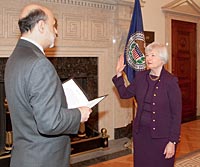
To drive home the point, Bernanke told the assembled press: “Nothing we did today was intended to reduce accommodation.” In response to a reporter’s question, he stated categorically that the spigot of cash to the financial markets would remain open under his likely successor, current Fed vice chairman Janet Yellen, nominated by President Obama to succeed Bernanke when he steps down on January 31.

The Dow ended the trading day up 292 points, or 1.8 percent, closing at a record high of 16,167. The S& P 500 jumped 29 points (1.7 percent) to a record 1,810. The Nasdaq composite index soared 46 points (1.2 percent), closing at 4,070.

The Fed has kept its benchmark interest rate at between zero and 0.25 percent since the end of 2008. The policy statement it released Wednesday suggests it could remain at the near-zero level until 2016, after which it would likely remain below 2 percent.

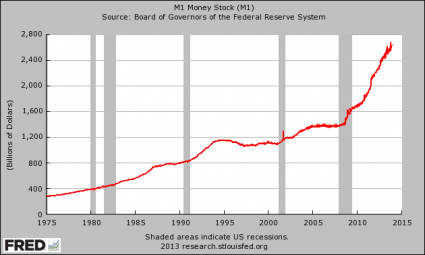
For most of this period, the Fed has also been pumping huge amounts of cash into the financial markets by purchasing Treasury bonds and mortgage-backed securities in three separate rounds of what it has called “quantitative easing” (QE). To do so, it has effectively printed trillions of dollars to subsidize the banks, hedge funds and big speculators.

The combination of virtually free credit and cash infusions has had the intended effect of fueling an unprecedented boom in the stock market and financial assets in general. Since late 2008, the Fed’s asset holdings have ballooned from $870 billion to nearly $4 trillion–one measure of the scale of the use of public funds to prop up the financial elite.

The S&P 500 index has nearly tripled in value since hitting a low of 666 in the spring of 2009, following the Wall Street crash of September 2008. This year alone, it has risen by 25 percent.

The current round of QE began in September 2012, with the Fed buying $85 billion a month ($1 trillion a year) of Treasury bonds and mortgage-backed assets. For some months, the Fed has been talking of beginning to trim its asset purchases, claiming such a move to be warranted by an improving labor market.

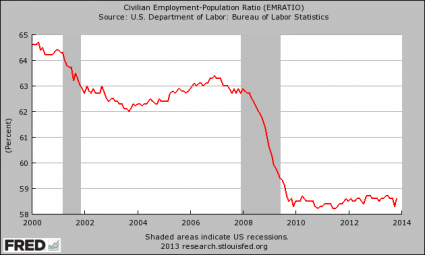
In fact, the real economy, beneath the frenzied money-making in the financial markets, remains mired in slump, with unemployment at near-depression levels, notwithstanding official figures that grossly understate the level of joblessness. In its statement Wednesday, the Fed pointed to a decline in the official jobless rate to 7.0 percent, but it knows full well that most of the decline is the result of millions of long-term unemployed people dropping out of the labor market, and therefore not being counted in the government’s estimate.

The US economy has grown at an average annual rate of just 2.3 percent since the recession officially ended in June 2009. This compares to a 4.1 percent average for the first four years of other expansions since World War II.

In an economic forecast that accompanied its Wednesday policy statement, the Fed predicted the US economy would grow by only 2.2 percent to 2.3 percent for all of 2013, with the official jobless rate ending the year at 7.0 to 7.1 percent. The central bank forecasts that the economy will grow by 3.0 percent to 3.4 percent in 2015, and between 2.5 percent and 3.2 percent in 2016.

By 2016, according to the Fed’s estimates, the jobless rate will have declined to 5.3 percent to 5.8 percent. In May 2007, prior to the financial meltdown, the official unemployment rate was 4.4 percent.

The FOMC statement makes the point that inflation is running well below the Fed’s target rate of 2 percent. This is part of a broader phenomenon, with inflation in Europe at less than 1 percent. The extremely low inflation rate is a further expression of the deeply recessionary, even deflationary, state of the real economy.

The main reason for the Fed’s move to gradually reduce its asset purchases is fear that the financial bubble it has fueled will burst, triggering another financial crisis even worse than the 2008 disaster. The FOMC statement said the Fed would, beginning in January, reduce its monthly purchases of Treasury bonds from $40 billion to $35 billion, and cut its purchases of mortgage-backed securities from $35 billion to $30 billion, for a net reduction in asset-buying from $85 billion to $75 billion.

The statement said the Fed would “likely reduce the pace of asset purchases in further measured steps at future meetings.”

The Fed’s ongoing windfall for Wall Street takes place the very week that the Obama administration and Congress pushed through a budget that allows unemployment benefits for the long-term unemployed to lapse, slashes federal employee pensions and continues the “sequester” budget-cutting framework. It also coincides with the near-completion of a farm bill that will further slash food stamp benefits for millions of Americans.

The class axis of government policy–directed at impoverishing the working class and further enriching the corporate-financial elite–could hardly be more naked.

Please enable JavaScript to view the comments powered by Disqus.
<!– blog comments powered by Disqus –>


‘
];
var html = htmlArray.join(”);
$(‘#content.width72’).prepend(html);
$(‘#front-appeal’).animate({opacity:1.0},1000).slideDown(1000);
}
}

function appendInlineAppeal() {
var excludes = [ ‘wsws’, ‘twih’, ‘vide’, ‘sale’, ‘dart’, ‘task’, ‘powe’, ‘gmhv’, ‘raul’ ];
var url = document.location.href;
var filename = url.substring(url.lastIndexOf(“/”) + 1, url.length);
if (!$(‘#content’).is(‘.width72,.category’) && excludes.indexOf(filename.substr(0,4)) == -1) {
var htmlArray = [
‘

‘
];
var html = htmlArray.join(”);
var pCount = $(‘#content’).children(‘p’).length;
var position = Math.floor(pCount*0.1);
$(‘#content’).children(‘p’).eq(position).before(html);
$(‘#inline-appeal’).children(‘form’).children(‘.more-options’).children(‘a’).click(function() {
$(‘#inline-appeal’).children(‘.initially-hidden’).show();
$(this).parent().hide();
return false;
});
}
}

function appendBottomAppeal() {
var excludes = [ ‘lect-a20’ ];
var url = document.location.href;
var filename = url.substring(url.lastIndexOf(“/”) + 1, url.length);
if (!$(‘#content’).is(‘.width72,.category’) && excludes.indexOf(filename.substr(0,8)) == -1) {
var htmlArray = [
‘

‘
];
var html = htmlArray.join(”);
if ($(‘#article-tools’).length > 0) {
$(‘#article-tools’).before(html);
} else {
$(‘#content’).append(html);
}
$(‘#inline-appeal’).children(‘form’).children(‘.more-options’).children(‘a’).click(function() {
$(‘#inline-appeal’).children(‘.initially-hidden’).show();
$(this).parent().hide();
return false;
});
}
}
$(document).ready(function(){
//appendFrontAppeal();
//appendInlineAppeal();
//appendBottomAppeal();
});

Source: WSWS

US arrest and strip-search of diplomat provokes India’s retaliation

0

By
Keith Jones

19 December 2013

US authorities’ arrest and intrusive strip-searching of a female Indian diplomat have provoked a major spat between Washington and New Delhi. India has demanded an apology, withdrawn some privileges from US diplomats serving in India, and removed blockades that cut off vehicular street access to the US’s Indian embassy. Washington, in turn, has demanded India affirm its commitment to safeguarding its diplomatic mission.

The arrest and New Delhi’s aggressive diplomatic push-back have exposed significant tensions between the US and a country it views as pivotal to its drive to encircle, strategically isolate, and if necessary militarily confront China.

Devyani Khobragade, the deputy consul general at India’s New York consulate, was arrested and handcuffed last Thursday outside her daughter’s school. Ignoring Khobragade’s protestations that she enjoyed diplomatic immunity, US Marshals jailed and strip-searched her, including subjecting her to repeated body cavity searches. Only hours later and after the Indian government paid a $250,000 bail bond was Khobragade released. She has been charged with visa fraud and making a false declaration–charges that carry maximum penalties of 10 and five years in prison respectively–for allegedly failing to pay the Indian maid whom she had brought into the US the legal minimum wage.

The Indian government immediately protested Khobragade’s arrest as a flagrant violation of international law and summoned the US ambassador to India’s Foreign Ministry.

But this week, as further details of the harsh and humiliating treatment meted out to Khobragade by US authorities emerged, there was a growing clamour from the Indian political establishment for a stronger response. And the government quickly delivered–“its unusually muscular retaliation…suddenly jolting,” to use the words of the Indian Express, the “friendly ties between New Delhi and Washington.”

Several Indian newspapers and web sites cited Khobragade as saying in an e-mail circulated to her friends and diplomatic colleagues, “I must admit that I broke down many times as the indignities of repeated handcuffing, stripping and cavity searches, swabbing, holed up with common criminals and drug addicts were all being imposed upon me despite my incessant assertions of immunity.”

India’s political elite and diplomatic corps appear to be genuinely shocked and outraged by the encounter of one of their own with the brutal practices that are the daily fare of the US criminal justice system.

But they are also acutely aware that Khobragade’s treatment accords with Washington’s standard practice of violating international law at will–whether to spy on the world’s electronic communications, including those of ostensibly friendly foreign governments; carry out summary executions through drone strikes; or invade and occupy countries.

In pursuit of a strategic partnership with the US that India’s elite sees as pivotal to its ambitions to transform into India into a great power, India’s Congress Party-led government has maintained a complicit silence about Washington’s rampant criminality.

The current protests over the treatment of Khobragade come, however, after growing complaints within the Indian political establishment and corporate media over the Indian government’s failure to voice any protest over the illegal operations of the US National Security Agency (NSA), arguing that this silence makes India look weak.

Documents leaked by NSA whistleblower Edward Snowden have revealed not only that India is one of the most important targets of NSA spying, but that the US spy agency has systematically spied on the Indian government and on its diplomatic missions in the US, including its mission at UN headquarters in New York and its Washington embassy.

Indian Prime Minster Manmohan Singh, who has hitherto been conspicuous for his sycophantic pandering to US Presidents George W. Bush and Barack Obama, has called Khobragade’s treatment “deplorable” and given his assent to a raft of retaliatory measures.

In an action meant to underline just how seriously the government regards the issue, Foreign Minister Salman Khurshid appeared before both houses of India’s parliament Tuesday to urge “the nation” to “speak in one voice” in condemning the violation of Khobragade’s and by extension India’s rights. He vowed not to appear before parliament again until the diplomat’s “dignity” has been restored.

India’s opposition, from the Stalinist-led Left Front through the Hindu supremacist Bharatiya Janata Party (BJP), have strongly condemned the US, with many noting that India is frequently bullied by Washington. “If we conduct foreign policy in a manner that we’re taken for granted,” said the parliamentary leader of the Official Opposition BJP, Arun Jaitely, “then these incidents will be repeated.” Declared Trinamool Congress legislator Derek O’Brien, “We live in a global village but we don’t need a self-appointed global village headman.”

Numerous political leaders and government officials have cancelled meetings this week with a visiting US Congressional delegation, including Congress Party leader Rahul Gandhi, BJP prime ministerial candidate Narenda Modi, and National Security Advisor Shivshankar Menon.

The US has defended Khobragade’s arrest and strip-searching, arguing that under the Vienna Convention consular officials, unlike those attached to a country’s embassy, do not enjoy diplomatic immunity for serious crimes.

However, when the shoe was on the other foot, the Obama administration argued the opposite. It insisted that Raymond Davis, a CIA contractor who was attached to the US’s Lahore consulate under a bogus cover, should enjoy diplomatic immunity and placed enormous pressure on the Pakistan government to let him go scot free after he had murdered two Pakistanis in cold blood.

Moreover, when exactly did the US government decide that violations of minimum wage laws by diplomats constitute a serious crime?

At this point it is impossible to say precisely why US authorities chose to pursue Khobragade with such zeal, nor what message they were seeking to convey to New Delhi.

But when Foreign Minister Khurshid told India’s parliament that the spat over Khobragade had “not happened out of blue,” there is a “history” to it, he was, if anything, understating matters.

US officials had been building their case against the Indian diplomat for half a year and ignored and rebuffed Indians attempts to resolve the issue. Just two days before Khobragade was arrested, the family of the maid whose rights she allegedly violated left India for the US where they have been granted immigration papers–an action clearly taken to ensure that they couldn’t be subjected to Indian government pressure and reprisal.

Over the past decade the US has aggressively courted India, proclaiming it a “global strategic partner.” Washington has declared its support for India developing a blue-water navy and becoming a force in the Indian Ocean. It negotiated for it a special status in the world civilian nuclear regulatory regime, although New Delhi developed nuclear weapons in defiance of the US-crafted Nuclear Non-Proliferation Treaty–a status that allows India to concentrate its indigenous nuclear program on nuclear weapons development. When Manmohan Singh met with Obama in late September, the US president announced that the US would henceforth make available to India the advanced weapons system that it sells only to its closest allies.

But all of this has been done with the aim of harnessing India to Washington’s predatory global strategic agenda. Repeatedly over the past eight years, the US has pressured India to fall into line with its attempts to bring Iran to heel through sanctions and threats of war and India has complied.

However, there is an undercurrent of opinion in Washington that India is not compliant enough–an undercurrent which finds expression in complaints that New Delhi’s geopolitical thinking is mired in outdated Cold War concepts like “nonalignment,” and that its national-security establishment lacks a “comprehensive vision”. While mouthing “support” and “understanding” for India’s concept of “strategic autonomy,” Washington’s aim is to bully and entice New Delhi into the position of a satrap, who will be the southwestern pillar of an Indo-Pacific US-led triad of Japan, Australia and India.

Whatever the outcome of the Khobragade affair, it has brought to the surface some of the tremendous tensions between Washington and New Delhi generated by Washington’s aggressive and reckless drive to maintain US strategic dominance over Eurasia under conditions where its relative economic power has been enormously undermined.

Please enable JavaScript to view the comments powered by Disqus.
<!– blog comments powered by Disqus –>


‘
];
var html = htmlArray.join(”);
$(‘#content.width72’).prepend(html);
$(‘#front-appeal’).animate({opacity:1.0},1000).slideDown(1000);
}
}

function appendInlineAppeal() {
var excludes = [ ‘wsws’, ‘twih’, ‘vide’, ‘sale’, ‘dart’, ‘task’, ‘powe’, ‘gmhv’, ‘raul’ ];
var url = document.location.href;
var filename = url.substring(url.lastIndexOf(“/”) + 1, url.length);
if (!$(‘#content’).is(‘.width72,.category’) && excludes.indexOf(filename.substr(0,4)) == -1) {
var htmlArray = [
‘

‘
];
var html = htmlArray.join(”);
var pCount = $(‘#content’).children(‘p’).length;
var position = Math.floor(pCount*0.1);
$(‘#content’).children(‘p’).eq(position).before(html);
$(‘#inline-appeal’).children(‘form’).children(‘.more-options’).children(‘a’).click(function() {
$(‘#inline-appeal’).children(‘.initially-hidden’).show();
$(this).parent().hide();
return false;
});
}
}

function appendBottomAppeal() {
var excludes = [ ‘lect-a20’ ];
var url = document.location.href;
var filename = url.substring(url.lastIndexOf(“/”) + 1, url.length);
if (!$(‘#content’).is(‘.width72,.category’) && excludes.indexOf(filename.substr(0,8)) == -1) {
var htmlArray = [
‘

‘
];
var html = htmlArray.join(”);
if ($(‘#article-tools’).length > 0) {
$(‘#article-tools’).before(html);
} else {
$(‘#content’).append(html);
}
$(‘#inline-appeal’).children(‘form’).children(‘.more-options’).children(‘a’).click(function() {
$(‘#inline-appeal’).children(‘.initially-hidden’).show();
$(this).parent().hide();
return false;
});
}
}
$(document).ready(function(){
//appendFrontAppeal();
//appendInlineAppeal();
//appendBottomAppeal();
});

Source: WSWS

Survivors of Lampedusa tragedy among refugees brutalised in Italian camp

0

By
Robert Stevens

19 December 2013

Footage shot on a cell phone and shown on Italian State television station RAI2 Tuesday, shows migrants at a camp on the island of Lampedusa being forced to strip naked, in mixed company, and then being hosed down by staff.

The camp is used to detain refugees from Africa and the Middle East who have made the dangerous Mediterranean crossing to Italy by boat, in a desperate attempt to enter Europe.

The footage was filmed by one migrant, with another providing commentary. Speaking about the ordeal, one of the two identified as Khalid said he and fellow refuge-seekers were lined up and treated “like animals.”

The footage shows men and boys queuing up in a crowded, open-air courtyard in cold winter conditions and then, one by one, having to strip completely naked. At least two men at the camp are shown standing with no clothes on, while others are undressing. One man is seen standing with his arms out, as a worker in overalls sprays him from head to foot. Some migrants can be seen attempting to maintain some modesty by covering their genitals with their hands.

According to the commentary, women were not exempt from this treatment and detainees had to do this every few days, after being told it was to supposedly part of an effort to combat a scabies outbreak.

Around 26 of the asylum seekers hosed down were said to be survivors of the sinking of their vessel off Lampedusa in October that resulted in the loss of 350 lives. That tragedy, with mostly African victims, was followed eight days by another just off the island in which 34 migrants, mainly from Syria and Palestine, were drowned when their boat capsized.

The Corriere della Sera noted, “The film is understood to have been shot on 13 December, but migrants say that disinfection is carried out on a weekly basis.”

It adds, “Among those subjected to the treatment, apparently, are Eritreans, Syrians, Ghanaians, Nigerians and Kurds, including some of the survivors of the 3 October shipwreck.”

Lampedusa mayor Giusi Nicolini said the images were, “reminiscent of a concentration camp. It shows that this manner of welcoming is something that should shame Lampedusa and shame Italy. It needs to change. This was not what we were expecting to see just two months after the shipwreck that prompted so many tears and promises.”

The organisation that runs the camp, the Lampedusa Accoglienza cooperative, moved quickly to blame the migrants. Its chief executive, Cono Galipò, claimed the migrants decided to strip naked of their own free will during a procedure to eliminate parasites. Speaking to Radio Città Futura, he said, “The treatment we were doing, performed under the terms of a protocol, was taking an hour and a half and, at a certain point, some of the immigrants ran out of patience and took off their clothes. They clearly set up what can be seen.”

Since the horrific incident, representatives of the ruling elite in Italy and throughout Europe have cried shame at the latest events at Lampedusa. This is rank hypocrisy from the authors of the policies that have forced hundreds of thousands to flee their homelands in the first place and who have laid down the anti-immigrant policy known as “Fortress Europe”.

Enrico Letta, the Italian prime minister, claimed he was “shocked” by the footage, adding that the “government will conduct an in-depth inquiry and will take to task whoever is responsible”.

Italy’s interior minister, Angelino Alfano, said a report into the images would be ready within 24 hours, adding that “whoever erred will pay.”

The speaker of the Italian parliament, Laura Boldrini, said, “Stripping men and women naked outside in the middle of winter [is] unworthy of a civilized country.”

The European Commission’s home affairs chief, Cecilia Malmstrom, said, “The images we have seen from the detention centre in Lampedusa are appalling and unacceptable.”

“We have already started investigations into the appalling conditions in many Italian detention centres, including Lampedusa,” she added.

In a Twitter message, she stated: “The EU is committed to assist Italy in receiving migrants, but it has to be done in decent conditions. We will not hesitate to launch an infringement procedure to make sure EU standards and obligations are fully respected.”

What this all translates to is that repression of immigrants must continue, while avoiding where possible embarrassing displays of brutality.

European Union leaders’ are to meet in a summit Thursday and Friday and will discuss proposals regarding the future of its migration policy. None of the proposals are based on defending the democratic rights of migrants and asylum seekers. Measures to be discussed include the strengthening of border surveillance against “illegal migration”.

The European Commission has recommended reinforcing air and sea patrols on the Mediterranean to detect and intercept migrant boats trying to reach European shores. This plan, estimated to cost an extra 14 million euros ($19 million) a year, is entirely in line with a plan drawn up by the EU border patrol agency FRONTEX.

FRONTEX already has its own fleet of planes, helicopters and boats, uses drones and advanced surveillance technology, and can deploy border guards from various member states at any time.

The Commission also proposes to allocate 50 million euros to help countries facing “high migratory pressure,” including 30 million euros for Italy.

The footage at Lampedusa gives a small glimpse of the suffering and indignities faced by migrants, refugees and asylum seekers in camps throughout the EU. The Lampedusa camp currently has 391 migrants, including 36 children, living in a structure built for 250.

According to a report released Tuesday by the Save the Children charity, the conditions at the camp failed to ensure “basic human rights.” It noted many are forced to sleep out in the cold due to the overcrowded conditions.

It also found that many of the new migrants making the dangerous sea crossings to Italy this year came from Syria.

Syria has been devastated by a two-and-a-half year civil war fomented by the main imperialist powers, which sponsored the opposition groups fighting the regime of President Bashar Al-Assad. New figures released this week by the United Nations refugee agency found that 127,000 refugees are leaving Syria every month. Syrians made up about a quarter of the 40,244 migrants reaching Italy by boat in the first 11 months were Syrians, outstripping any other nationality, said Save the Children.

The response of the European states to this humanitarian catastrophe has been to wash their hands of it. Only 10 EU states have agreed to take in a maximum of 12,000 Syrian refugees this year, Amnesty International said last week.

The closed borders of the European Union have resulted in the deaths of up to 25,000 people, who have perished attempting to enter Europe. This year is set to be the worst on record. A report released this week by the International Organisation for Migration found that more than 7,000 migrants may have perished at sea or while crossing deserts trying to reach a safe haven in 2013.


‘
];
var html = htmlArray.join(”);
$(‘#content.width72’).prepend(html);
$(‘#front-appeal’).animate({opacity:1.0},1000).slideDown(1000);
}
}

function appendInlineAppeal() {
var excludes = [ ‘wsws’, ‘twih’, ‘vide’, ‘sale’, ‘dart’, ‘task’, ‘powe’, ‘gmhv’, ‘raul’ ];
var url = document.location.href;
var filename = url.substring(url.lastIndexOf(“/”) + 1, url.length);
if (!$(‘#content’).is(‘.width72,.category’) && excludes.indexOf(filename.substr(0,4)) == -1) {
var htmlArray = [
‘

‘
];
var html = htmlArray.join(”);
var pCount = $(‘#content’).children(‘p’).length;
var position = Math.floor(pCount*0.1);
$(‘#content’).children(‘p’).eq(position).before(html);
$(‘#inline-appeal’).children(‘form’).children(‘.more-options’).children(‘a’).click(function() {
$(‘#inline-appeal’).children(‘.initially-hidden’).show();
$(this).parent().hide();
return false;
});
}
}

function appendBottomAppeal() {
var excludes = [ ‘lect-a20’ ];
var url = document.location.href;
var filename = url.substring(url.lastIndexOf(“/”) + 1, url.length);
if (!$(‘#content’).is(‘.width72,.category’) && excludes.indexOf(filename.substr(0,8)) == -1) {
var htmlArray = [
‘

‘
];
var html = htmlArray.join(”);
if ($(‘#article-tools’).length > 0) {
$(‘#article-tools’).before(html);
} else {
$(‘#content’).append(html);
}
$(‘#inline-appeal’).children(‘form’).children(‘.more-options’).children(‘a’).click(function() {
$(‘#inline-appeal’).children(‘.initially-hidden’).show();
$(this).parent().hide();
return false;
});
}
}
$(document).ready(function(){
//appendFrontAppeal();
//appendInlineAppeal();
//appendBottomAppeal();
});

Source: WSWS

Ruling circles hail social misery produced by Irish bailout

0

By
Jordan Shilton

19 December 2013

Ireland’s three-year €85 billion ($116.9 billion) bailout by the troika of the European Union (EU) commission, International Monetary Fund (IMF), and European Central Bank (ECB) formally came to an end Sunday.

The government organised a series of public events to mark the occasion, where ministers declared that the ending of the programme was a milestone on the road to recovery, praised the population for accepting devastating spending cuts and tax hikes imposed by successive governments, and hailed a return to economic “sovereignty.” The culmination was a televised national address by Taoiseach (Prime Minister) Enda Kenny.

Proceedings and the accompanying coverage in the international press had a surreal character. There was virtually no mention of the fact that less than two months ago, another brutal austerity budget was passed, which removed free medical care from over 30,000 elderly people, slashed jobless benefits by nearly a third for those under 25 and cut over €200 million from the social welfare budget. Nor was there any reference to the assault on workers’ jobs and conditions.

Instead, the IMF congratulated Ireland on its “success” in completing the bailout, as did EU Commission President Jose Manuel Barroso. EU Commissioner for Economic and Monetary Affairs Olli Rehn acknowledged that Ireland’s decision to provide a blanket guarantee for all investment at the height of the crisis had been a mistake, but added that this was “water under the bridge.”

Such comments sum up the arrogance and hostility of the ruling elite towards working people. A policy which committed hundreds of billions in public money to the bailing out of a criminal financial elite is dismissed as irrelevant to current conditions, even though it was paid for by spending cuts and tax hikes equivalent to 20 percent of the country’s GDP.

The bailout programme and its related policies are being hailed because they have facilitated a vast redistribution of wealth from working people to the top of society. In 2012, top bankers in Ireland were paid an average salary of €1.4 million, and the stock market has doubled its value since its low point in 2009. The average bonus for the top 17 bankers was 235 percent of their salary, according to an EU report. The number of billionaires has doubled since 2008.

There can be no talk of a recovery for ordinary working people. From initial estimates of 1.1 percent growth for 2013, the latest projections suggest that output will expand by just 0.3 percent this year. This stagnation is connected with the broader European crisis, with growth in even the supposedly stronger economies slowing to a virtual standstill.

Although unemployment has fallen slightly to 12.5 percent, this is largely due to the high emigration rate. And those jobs that have been created are on much lower pay than previously. A sign of the depth of the crisis was provided by a report last week that the government is sending letters to claimants of jobless benefits urging them to emigrate in order to reduce the welfare bill.

A recent report by the government’s Irish Fiscal Council warned if growth did not reach two percent next year, the Fine Gael-Labour coalition would have to increase the amount of savings in the 2015 budget from the current plan of €2 billion.

This will only be the first step in a programme of “reforms” being planned to run until 2020. Earlier this year, Finance Minister Michael Noonan revealed he was drawing up plans with Minister for Public Expenditure Brendan Howlin, which would lay out where savings could be made in government budgets. Kenny is due to present a medium-term economic programme to reassure financial markets of the reliability of the current and future governments.

The stalled economy has contributed to the continuing rise in state debt, which is currently put at 124 percent of GDP–comparable with that of Portugal and surpassed only by Greece and Italy within Europe. Observers from financial markets have pointed out that such levels are likely to prove to be unsustainable, and that Ireland’s decision to leave the bailout programme without agreeing a precautionary credit line could prove to be a mistake. Such a deal would have required a vote in the German Bundestag and Ireland wished to present its bailout exit as a return to “full economic sovereignty.”

Ireland will remain under the control of the financial markets and their organisations, as shown by the announcement that the IMF will maintain its office in Dublin even after the bailout ends.

As has been seen in the cases of Italy and Spain, the EU commission now has the power to dictate policy changes if it deems national budgets to be in breach of regulations to cut deficits and reduce state debt. This will apply no less to Ireland, especially since it has been singled out as one of the EU states likely to come off worst in bank stress tests scheduled for next year. It is anticipated that the three remaining banks will require further capital injections to cover losses on bad loans. A major source of concern is the huge quantity of mortgage debt, with projections that one in five households are more than 90 days behind on their payments, which amounts to potential losses of €18 billion.

This crippling level of household debt is compounded by deepening poverty rates. A recent study commissioned by trade unions suggests that 10 percent of the population live in food poverty, rising to one in nine in some areas of the country. A conference held in Dublin revealed that Ireland has one of the highest fuel poverty rates in northern Europe, and that in comparison with other countries with a similar climate, Ireland has the highest percentage of winter deaths.

In spite of such miserable conditions, ruling circles have expressed their frustration that the government did not go further during the bailout. As Mark Fielding of Ireland’s small and medium enterprises association wrote in the Irish Examiner, “We still have a State we can’t afford and anyone who thinks that the formal completion of the bailout marks the end of all our problems is in for a rude awakening.”

He criticised the “expensive public sector” which was still costing a third of government spending, due, he claimed, to over-paid public sector workers, before denouncing the “social welfare culture,” which still persisted.

The most dishonest part of the official commentary surrounding the bailout exit was that the imposition of brutal austerity measures had been widely supported by Irish workers over recent years. In reality, the government has only been able to proceed with such aggressiveness due to the collusion of the trade union bureaucracy, which has stifled all opposition within the working class and helped draft many of the most severe attacks on wages, pensions and working conditions.

In 2010, the unions signed up to the Croke Park Agreement with the government, in which they acceded to a four-year strike ban. This was lengthened in the Haddington Road Agreement earlier this year. Croke Park facilitated the elimination of 10 percent of all public sector jobs, pay cuts, and changes to working conditions.


‘
];
var html = htmlArray.join(”);
$(‘#content.width72’).prepend(html);
$(‘#front-appeal’).animate({opacity:1.0},1000).slideDown(1000);
}
}

function appendInlineAppeal() {
var excludes = [ ‘wsws’, ‘twih’, ‘vide’, ‘sale’, ‘dart’, ‘task’, ‘powe’, ‘gmhv’, ‘raul’ ];
var url = document.location.href;
var filename = url.substring(url.lastIndexOf(“/”) + 1, url.length);
if (!$(‘#content’).is(‘.width72,.category’) && excludes.indexOf(filename.substr(0,4)) == -1) {
var htmlArray = [
‘

‘
];
var html = htmlArray.join(”);
var pCount = $(‘#content’).children(‘p’).length;
var position = Math.floor(pCount*0.1);
$(‘#content’).children(‘p’).eq(position).before(html);
$(‘#inline-appeal’).children(‘form’).children(‘.more-options’).children(‘a’).click(function() {
$(‘#inline-appeal’).children(‘.initially-hidden’).show();
$(this).parent().hide();
return false;
});
}
}

function appendBottomAppeal() {
var excludes = [ ‘lect-a20’ ];
var url = document.location.href;
var filename = url.substring(url.lastIndexOf(“/”) + 1, url.length);
if (!$(‘#content’).is(‘.width72,.category’) && excludes.indexOf(filename.substr(0,8)) == -1) {
var htmlArray = [
‘

‘
];
var html = htmlArray.join(”);
if ($(‘#article-tools’).length > 0) {
$(‘#article-tools’).before(html);
} else {
$(‘#content’).append(html);
}
$(‘#inline-appeal’).children(‘form’).children(‘.more-options’).children(‘a’).click(function() {
$(‘#inline-appeal’).children(‘.initially-hidden’).show();
$(this).parent().hide();
return false;
});
}
}
$(document).ready(function(){
//appendFrontAppeal();
//appendInlineAppeal();
//appendBottomAppeal();
});

Source: WSWS

German ruling class closes ranks in grand coalition government

0

19 December 2013

With the grand coalition government, which began its work on Tuesday, the ruling class in Germany is closing ranks. Chancelor Angela Merkel’s third governing coalition controls more parliamentary votes than any preceding government.

The Christian Democratic Union (CDU), Christian Social Union (CSU) and Social Democratic Party (SPD) together control 504 of the Bundestag’s 631 seats, and the government can also rely on the support of the two “opposition” parties, as well as the trade unions.

On the day the federal government was sworn in, the Greens agreed to a coalition with the CDU in the state of Hesse. It is the first CDU-Green coalition at the state level, and an unmistakable signal that Merkel can count on the Greens. The same goes for the Left Party, which rules in Brandenburg in an alliance with the SPD. The German Trade Union Confederation (DGB) has also explicitly backed the grand coalition.

The convergence within the ruling class as it prepares to meet rising social resistance stands in inverse relation to the widneing of divisions within German society.

According to recent surveys conducted by the Federal Statistics Bureau, one in five inhabitants of Germany–some 16 million people in all–is affected by poverty or social marginalization. There are millions more who live in constant fear of slipping into poverty.

The social divide in Europe as a whole is even deeper. In southern and eastern Europe, the austerity programmes carried out under pressure from Berlin have created a social catastrophe unprecedented in peacetime. Millions have lost their jobs and incomes. Education, health care and infrastructure have collapsed. In Greece, the average wage has fallen by 40 percent. One in three adults and three in five young people are unemployed.

The grand coalition will continue such attacks on the working class both in Europe and in Germany. This can be seen not only from the coalition agreement, which commits the government to a course of “strict, sustained fiscal consolidation”, but also from the selection of ministers. The 71-year-old Wolfgang Schäuble (CDU) remains finance minister, and thus Merkel’s right hand in the implementation of a relentless programme of austerity.

In her first official postelection statement on Wednesday, Merkel insited that European policy is one of the grand coalition’s most important tasks. She praised the fiscal pact, which commits EU members to strict austerity measures, and called for binding EU rules to “ensure that the necessary structural reforms” are carried out. Many states had for too long delayed implementing “necessary reforms,” she said.

In preparation for future social confrontations, the new government will strengthen the state security apparatus. This end is served both by the return of former Defence Minister Thomas de Maizière (CDU), a close confidante of Merkel, to the Interior Ministry, and by the estalishment of a state secretary in the Chancellery responsible for the intelligence services.

With this move, the secret services are not to be subjected to greater control, but rather to be strengthened. The new post will be filled by an intelligence insider–the former vice president of the Federal Office for Protection of the Constitution (as the secret service is called), Klaus-Dieter Fritsche (CSU). Fritsche was in the headlines last year because he played down the threat posed by the far-right terrorist group National Socialist Underground (NSU). His arrogant demeanor before the NSU parliamentary committee of investigation caused a scandal.

The grand coalition is also preparing to act more aggressively abroad. The surprise move of Ursula von der Leyen (CDU) from the Ministry of Labour to Defence shows that the government will be increasingly involved in military operations abroad. In her new office, von der Leyen will oversee “international security policy”, Merkel stressed, thus complementing the new foreign minister, Frank-Walter Steinmeier (SPD).

As with previous governments, policy will be determined not so much by the guidelines of the coalition agreement as by worsening economic, social and international crises. Neither German participation in the war in Afghanistan, nor the antisocial measures of Agenda 2010, nor the multibillion-euro bailouts of the banks that marked the Gerhard Schröder (SPD) government and the first Merkel government were agreed on in a coalition agreement.

In all these cases, the government was responding to acute crises with wars abroad and attacks on the working class at home.

Once again, the government is again preparing for violent crises. The euro crisis is unresolved. Experts are warning of another financial crash as a result of speculation on the stock markets. At the same time, international tensions between the US and China, in the Middle East, and between Russia and Europe are intensifying.

Berlin has deliberately fueled protests in Ukraine, increasing strains in Germany’s relationship with Russia.

It is in this context that the ruling class is closing ranks. In this, the Left Party is taking on the role of safety valve. In the Bundestag, it criticizes the grand coalition, while at the state and local level, where it is in government, it works closely with it, supporting cuts and social attacks.

The government knows that its policies will inevitably trigger massive resistance. But this resistance requires a perspective and a political leadership. To oppose the grand coalition, workers need their own independent party–the Partei für Soziale Gleichheit (PSG–Socialist Equality Party).

As a section of the Fourth International, the PSG calls for the unification of workers and youth around the world in the struggle for a socialist society based on the principle of social equality, rather than the profit of a few at the expense of the majority.

Peter Schwarz

Please enable JavaScript to view the comments powered by Disqus.
<!– blog comments powered by Disqus –>


‘
];
var html = htmlArray.join(”);
$(‘#content.width72’).prepend(html);
$(‘#front-appeal’).animate({opacity:1.0},1000).slideDown(1000);
}
}

function appendInlineAppeal() {
var excludes = [ ‘wsws’, ‘twih’, ‘vide’, ‘sale’, ‘dart’, ‘task’, ‘powe’, ‘gmhv’, ‘raul’ ];
var url = document.location.href;
var filename = url.substring(url.lastIndexOf(“/”) + 1, url.length);
if (!$(‘#content’).is(‘.width72,.category’) && excludes.indexOf(filename.substr(0,4)) == -1) {
var htmlArray = [
‘

‘
];
var html = htmlArray.join(”);
var pCount = $(‘#content’).children(‘p’).length;
var position = Math.floor(pCount*0.1);
$(‘#content’).children(‘p’).eq(position).before(html);
$(‘#inline-appeal’).children(‘form’).children(‘.more-options’).children(‘a’).click(function() {
$(‘#inline-appeal’).children(‘.initially-hidden’).show();
$(this).parent().hide();
return false;
});
}
}

function appendBottomAppeal() {
var excludes = [ ‘lect-a20’ ];
var url = document.location.href;
var filename = url.substring(url.lastIndexOf(“/”) + 1, url.length);
if (!$(‘#content’).is(‘.width72,.category’) && excludes.indexOf(filename.substr(0,8)) == -1) {
var htmlArray = [
‘

‘
];
var html = htmlArray.join(”);
if ($(‘#article-tools’).length > 0) {
$(‘#article-tools’).before(html);
} else {
$(‘#content’).append(html);
}
$(‘#inline-appeal’).children(‘form’).children(‘.more-options’).children(‘a’).click(function() {
$(‘#inline-appeal’).children(‘.initially-hidden’).show();
$(this).parent().hide();
return false;
});
}
}
$(document).ready(function(){
//appendFrontAppeal();
//appendInlineAppeal();
//appendBottomAppeal();
});

Source: WSWS

European Left selects Tsipras as lead candidate in European elections

0

By
Christoph Dreier

19 December 2013

The fourth congress of the European Left (EL) took place in Madrid last weekend. The alliance of parties discussed a joint programme for the European elections in May next year and elected Alexis Tsipras, chairman of the Greek Coalition of the Radical Left (SYRIZA), as its leading candidate.

The 25 parties which make up the EL have a long tradition of defending the bourgeois order. Almost all have Stalinist roots. In Eastern Europe, they emerged from the former state parties, which suppressed the working class for decades and subsequently reintroduced capitalism. In the West, they have betrayed every revolutionary initiative of the working class since World War II. Many were or still are participating in governments which are responsible for social attacks and war. Along with the bourgeois order and the state, they have also defended the European Union (EU) and its institutions.

With Tsipras, the European Left has selected someone who is particularly friendly towards the EU, and intends to become head of the Greek government next year. Should this happen, he has announced that Greece will remain in the EU and accept its state debt in principle. He does not intend to reject the conditions of the EU bailout that have led to an unprecedented social catastrophe in Greece, but merely to renegotiate them.

Tsipras made clear his determination to adhere to the EU’s austerity dictates in an interview with the Euractiv website shortly after his nomination. In it, he offered European Social Democratic parties the possibility of cooperation. These parties would have to decide if they wished to continue in coalitions with the conservatives, he said, or if they would “change political direction and work for an alliance with the radical left.”

The Social Democrats have played a leading role in the implementation of the EU’s austerity measures. In Greece, the social democratic PASOK has imposed the austerity dictates on the population with extreme brutality. In Germany, the social democrats (SPD) have signed a coalition agreement with Angela Merkel’s Christian Democratic Union (CDU) which baldly states, “The policy of budgetary consolidation must be maintained.”

By offering to cooperate with these parties, Tsipras is making it unmistakably clear where he stands: in the camp of the EU, banks, and corporations, which are forcing workers across Europe into poverty.

The congress sought to cover up these policies somewhat. The vast majority of the debates and resolutions discussed proposed reforms which the delegates knew could not be realised within the framework of the EU, and which they will quickly abandon as soon as they go into government in any country.

In his speech to the congress, Tsipras listed various suggestions for reform which would allegedly make the EU more “humane.” These included the introduction of a separation between commercial and investment banking, the provision of direct loans to the member states from the European Central Bank, as well as the elimination of tax havens. Tsipras intends to organise a debt write-down for the countries of southern Europe at a “European debt conference,” and ensure that the rest of the loans would be repaid.

The platform adopted by the delegates contained similar points which were even more vague. Demands included a “citizens’ audit” of debt and the annulment of “illegitimate debt,” as well as its “restructuring.”

Elements of democratic “control over finance,” it declared, had to be “re-established.”

These demands implicitly recognise the EU and its bailout regime. The European Left are not concerned with breaking the austerity dictates from Brussels, but rather with presenting the EU’s institutions as being capable of reform and potentially becoming less hostile to the social rights of the working class.

In reality, millions of workers across the continent have experienced the true character of the EU. The EU has organised social attacks on an historic scale in Ireland, Greece and other countries in southern and eastern Europe. In Greece, wages have been cut by 40 percent and thousands of jobs destroyed. Throughout Europe, the EU is the main instrument to enforce deregulation, privatisation, and low wages.

The EU has also intensified the national conflicts within Europe, not reduced them, and encouraged the growth of fascist forces. The European powers have participated in every military operation by NATO in the past 20 years. From the beginning, the EU and its predecessor organisations were tools of the continent’s most powerful capitalist interests.

In the face of this record and of growing popular anger over the EU’s social cuts, it is increasingly difficult for the EL to cover for the EU.

In order to contain this social opposition, the conference sought to criticise the EU more strongly than previously. Along with the platform, the delegates adopted a “political document,” that is not binding on the individual member parties, however.

In it they declare, for example, that “the economic-institutional architecture of the EU was created exclusively to protect the interests of big capital.” Therefore, a “new founding of Europe” was necessary, and a “new definition of its aims, policies and structures.” Finally, they even stated, “capitalism cannot be humanised.”

But no conclusions were drawn from this, however. The “political document” did not call for the dissolution of the EU, but only further debt conferences and a somewhat different policy from the ECB.

In relation to foreign policy, the trigger for a future war was provided. The document said, “The EU could be a strong ally of all peoples struggling for self-determination.” The divided Cyprus was then cited as an example, which the European Left wants to unify under the Greek bourgeoisie. The EU should put pressure on Turkey, which had illegally occupied the north since 1974, it stated in the political document.

Furthermore, the EU could secure peace internationally “by ensuring compliance with international law.” Every imperialist war over recent years, from Afghanistan to Iraq, Libya and Syria have been justified with such arguments.

Regardless of its name, the European Left is a collection of right-wing parties with a long history of suppressing the independent strivings of the working class.

Members from eastern Europe–the Czech Party of Democratic Socialism (SDS), the Romanian Socialist Alliance Party (PAS) or the Moldovan Communist Party of the Republic of Moldova (PCRM)–all have their origins in the Stalinist state parties. Today they have no qualms about allying with the most right-wing elements.

When a WSWS correspondent asked the chairman of the PAS about their joint demonstrations with fascists, he answered, “I’m glad that they think like us.”

In western Europe, the French Communist Party (PCF) has a decades-long history of supporting for the bourgeois state. They betrayed the general strike of 1936, joined the De Gaulle government in 1945 and disarmed the resistance, organised the sell-out of the general strike in 1968 and ultimately served as loyal partners in government under Mitterrand and Jospin.

The Greek SYRIZA emerged from the Eurocommunist wing of Stalinism. In 1992, they supported the Maastricht treaty and have been fervent promoters of the EU ever since. The Danish Red-Green Alliance supports the Thorning-Schmidt government, which locked out 70,000 teachers in April this year.

All of these tendencies are united in the German Left Party. In the state governments in which it took part, the Left Party stood out for its extreme ruthlessness towards the social rights of the working class.

Last weekend’s congress was an attempt to conceal such reactionary politics with left phrases, and to provide the EU with renewed legitimacy.


‘
];
var html = htmlArray.join(”);
$(‘#content.width72’).prepend(html);
$(‘#front-appeal’).animate({opacity:1.0},1000).slideDown(1000);
}
}

function appendInlineAppeal() {
var excludes = [ ‘wsws’, ‘twih’, ‘vide’, ‘sale’, ‘dart’, ‘task’, ‘powe’, ‘gmhv’, ‘raul’ ];
var url = document.location.href;
var filename = url.substring(url.lastIndexOf(“/”) + 1, url.length);
if (!$(‘#content’).is(‘.width72,.category’) && excludes.indexOf(filename.substr(0,4)) == -1) {
var htmlArray = [
‘

‘
];
var html = htmlArray.join(”);
var pCount = $(‘#content’).children(‘p’).length;
var position = Math.floor(pCount*0.1);
$(‘#content’).children(‘p’).eq(position).before(html);
$(‘#inline-appeal’).children(‘form’).children(‘.more-options’).children(‘a’).click(function() {
$(‘#inline-appeal’).children(‘.initially-hidden’).show();
$(this).parent().hide();
return false;
});
}
}

function appendBottomAppeal() {
var excludes = [ ‘lect-a20’ ];
var url = document.location.href;
var filename = url.substring(url.lastIndexOf(“/”) + 1, url.length);
if (!$(‘#content’).is(‘.width72,.category’) && excludes.indexOf(filename.substr(0,8)) == -1) {
var htmlArray = [
‘

‘
];
var html = htmlArray.join(”);
if ($(‘#article-tools’).length > 0) {
$(‘#article-tools’).before(html);
} else {
$(‘#content’).append(html);
}
$(‘#inline-appeal’).children(‘form’).children(‘.more-options’).children(‘a’).click(function() {
$(‘#inline-appeal’).children(‘.initially-hidden’).show();
$(this).parent().hide();
return false;
});
}
}
$(document).ready(function(){
//appendFrontAppeal();
//appendInlineAppeal();
//appendBottomAppeal();
});

Source: WSWS

Egypt’s new constitution legitimizes coup, enshrines military dictatorship

0

By
Johannes Stern

19 December 2013

On Saturday, military-backed interim Egyptian President Adly Mansour announced a national referendum on a new constitution for January 14 and 15.

In a speech broadcast on state TV, Mansour urged Egyptians to vote for the text which was worked out in secret by a hand-picked, 50-member committee, “Let this constitution be a word of justice, that unites and doesn’t separate… for hatred is a tool for destruction… disagreement is legislated, as long as it adopts peacefulness and is in the country’s interest.”

Standing next to Mansour, Amr Moussa, the head of the constitutional committee and former stalwart of the Mubarak regime, claimed “this is a constitution that clearly criminalises any form of discrimination against all citizens and ensures national unity.”

Also attending the ceremony at Ittihadiya presidential palace in Cairo were coup leader and Defence Minister General Abdel Fatah al-Sisi, Minister of Interior Mohamed Ibrahim, Al-Azhar Grand Imam Ahmed Al-Tayyeb, and a representative of Pope Tawadros II, the head of the Coptic Orthodox church.

What is cynically presented as an exercise in national unity and democracy is in reality a desperate attempt by a blood-stained junta and its supporters to legitimize its July 3 military coup and enshrine continued military dictatorship in the constitution.

The most significant part of the new constitution is its effort to defend the power and privileges of the military. It aims to strengthen the army’s role as the last bulwark of capitalist rule and of the bourgeois state in Egypt, on which the Egyptian bourgeoisie directly depended during the mass working class uprising that ousted former dictator Hosni Mubarak in February 2011.

The constitution basically enshrines autonomy for the military, which has been the dominant political force in Egypt since the Free Officers coup led by Gamal Abdel Nasser in 1952.

The new constitution goes beyond even the 1971 constitution which formed the basis for the Mubarak dictatorship and the 2012 constitution, which was the result of the temporary alliance between the military and the Islamist Muslim Brotherhood (MB). While the former constitutions already granted the military a high degree of autonomy, it is now effectively acquiring the “legal” status of a state within a state.

Article 234 of the constitution stipulates that the Supreme Council of the Armed Forces (SCAF) will approve the appointment of the Minister of Defence for two presidential terms. Article 203 establishes that the National Defence Council–a body dominated by the army brass and intelligence chiefs–will decide on the armed forces’ budget and on national security issues.

The new constitution also continues to allow the military prosecution of civilians. Article 204 states that civilians can face military trials for “crimes that represent direct assault on military establishment, the armed forces’ camps and the like, or the military areas or its border zones, its equipment, vehicles, weapons, ammunitions, documents, military secrets, public funds, factories, or crimes related to conscription or crimes that constitute a direct assault against its officers and personnel while performing their work.”

These formulations are so broad and general that military trials “based on the constitution” can easily be applied against striking workers or protesters.

Since mass revolutionary struggles broke out in Egypt in January 2011, various governments–the Mubarak regime, the SCAF junta and then Islamist president Mohamed Mursi–used military trials to suppress protests and strikes by workers and youth fighting for their social and democratic aspirations.

According to a study by Human Rights Watch, some 12 000 civilians were tried in military tribunals only between January 28, 2011–the famous Friday of anger when the military was deployed to replace the security forces after they have been defeated by protesters–and September 10, 2011. This amounts to more than the number of civilians who were sent to military trials in the three decades of dictatorial rule under Mubarak alone.

The new constitution also strengthens the police and broader security and intelligence apparatus. A Supreme Police Council is to decide on any law concerning the police and general intelligence officers will not be subject to civilian law, but to military courts. This effectively guarantees that the notorious police security and intelligence complex will all remain essentially immune from civilian oversight and prosecution.

Article 237 further demands that the state and its institutions fight “terrorism”. Political organizations and parties based on religion will be banned.

There could hardly be a clearer statement for continued military repression. Since the July 3 military coup the regime has been using the cover of an alleged “fight against terrorism” to intensify its crackdown against any opposition to its rule. The army has killed, wounded, and jailed thousands of supposedly “terrorist” opponents of the coup–mainly adherents of the Muslim Brotherhood of ousted President Mohamed Mursi–but also striking workers and protesting youth and students.

The anti-democratic character of the constitution highlights the reactionary character of the affluent middle class milieu in Egypt. Many of the liberal and “left” groups which first played a crucial role in channeling the mass working class discontent against Mursi and the Islamists behind the army are now an integral part of the military regime. They have been directly involved in drafting the constitution.

The constitutional committee included Tamarod leaders Mahmoud Badr and Mohamed Abdel Aziz, Egyptian Social Democratic Party leader and co-founder of the National Salvation Front Mohamed Abul Ghar, the head of the Nasserite Karama Party Mohamed Sami, and the deputy head of the National Progressive Unionist Party (Tagammu) Hussein Abdel-Razek. They were joined by a number of writers, artists, university professors, judges, religious figures, businessmen, representatives of the military and Interior Ministry, and various trade union leaders.

The military and its liberal and “left” supporters seek to push through the constitution by any means. Interior minister, Mohamed Ibrahim, warned last week that any attempt to disrupt the referendum will be thwarted, if necessary “using firearms.”

Las month, Mansour signed a new anti-protest law that effectively “legalizes” the junta’s violent crackdown on protests and strikes threatening participants with extensive jail time and high fines.

As the military regime is seeking to use the referendum to tighten its grip over the country before the third anniversary of the Egyptian Revolution on January 25, there are increasing signs of mass working class discontent. Polls conducted by the Egyptian Center for Public Opinion research (Baseera) show that approval rates for the government are falling, from 37 percent in October to 20 percent in December.

The class gulf separating the regime and its supporters from the working class on the other was starkly revealed at a recent press conference of the pro-regime Egyptian Trade Union Federation (ETUF).

ETUF chairman Abdel Fatah Ibrahim said “workers have a national duty to vote ‘Yes’” and called “on all political forces to unite for the success of the roadmap.” When laid-off workers interrupted Ibrahim and chanted against the constitution, Daily News Egypt reported, Ibrahim “ordered their removal from the hall, accusing them of being ‘terrorists’ and belonging to the Muslim Brotherhood.”

Please enable JavaScript to view the comments powered by Disqus.
<!– blog comments powered by Disqus –>


‘
];
var html = htmlArray.join(”);
$(‘#content.width72’).prepend(html);
$(‘#front-appeal’).animate({opacity:1.0},1000).slideDown(1000);
}
}

function appendInlineAppeal() {
var excludes = [ ‘wsws’, ‘twih’, ‘vide’, ‘sale’, ‘dart’, ‘task’, ‘powe’, ‘gmhv’, ‘raul’ ];
var url = document.location.href;
var filename = url.substring(url.lastIndexOf(“/”) + 1, url.length);
if (!$(‘#content’).is(‘.width72,.category’) && excludes.indexOf(filename.substr(0,4)) == -1) {
var htmlArray = [
‘

‘
];
var html = htmlArray.join(”);
var pCount = $(‘#content’).children(‘p’).length;
var position = Math.floor(pCount*0.1);
$(‘#content’).children(‘p’).eq(position).before(html);
$(‘#inline-appeal’).children(‘form’).children(‘.more-options’).children(‘a’).click(function() {
$(‘#inline-appeal’).children(‘.initially-hidden’).show();
$(this).parent().hide();
return false;
});
}
}

function appendBottomAppeal() {
var excludes = [ ‘lect-a20’ ];
var url = document.location.href;
var filename = url.substring(url.lastIndexOf(“/”) + 1, url.length);
if (!$(‘#content’).is(‘.width72,.category’) && excludes.indexOf(filename.substr(0,8)) == -1) {
var htmlArray = [
‘

‘
];
var html = htmlArray.join(”);
if ($(‘#article-tools’).length > 0) {
$(‘#article-tools’).before(html);
} else {
$(‘#content’).append(html);
}
$(‘#inline-appeal’).children(‘form’).children(‘.more-options’).children(‘a’).click(function() {
$(‘#inline-appeal’).children(‘.initially-hidden’).show();
$(this).parent().hide();
return false;
});
}
}
$(document).ready(function(){
//appendFrontAppeal();
//appendInlineAppeal();
//appendBottomAppeal();
});

Source: WSWS

Edward Snowden’s open letter sparks asylum debate in Brazil

0

By
Bill Van Auken

19 December 2013

An “Open letter to the Brazilian people” issued by Edward Snowden Tuesday has sparked a debate within Brazil on offering asylum to the fugitive former National Security Agency contractor.

Snowden’s exposure of NSA operations in the Brazil and internationally have won him considerable support among the Brazilian people, even as the Workers Party (PT) government of President Dilma Rousseff has shown little stomach for standing up to Washington on questions of fundamental democratic rights.

Reports first aired by the Brazilian media last September cited NSA documents made public by Snowden proving that the NSA had hacked into the personal and office phones, computers and emails of Rousseff and had conducted extensive economic espionage against the Brazilian state energy giant Petrobras and the government’s Ministry of Mines and Energy.

Snowden, who has received requests for assistance from both a Brazilian parliamentary committee investigating NSA espionage in Brazil and the country’s federal police, expressed in the letter his desire to aid in exposing the agency’s crimes, but cited Washington’s continuous efforts to silence him. He pointed in particular to the international gangsterism of the Obama administration in orchestrating the forcing down of Bolivian President Evo Morales’ airplane in Austria last July, on suspicion that Snowden might have been traveling on it to Latin America.

“The NSA and other spying agencies tell us that for our own ‘safety’ – for Dilma’s ‘safety,’ for Petrobras’ ‘safety’ – they have revoked our right to privacy and broken into our lives,” Snowden wrote. “And they did it without asking the public in any country, even their own.”

Pointing to the real impact of this spying in the lives of Brazilians, he continued: “Today, if you carry a cell phone in Sao Paulo, the NSA can and does keep track of your location: they do this 5 billion times a day to people around the world. When someone in Florianopolis visits a website, the NSA keeps a record of when it happened and what you did there. If a mother in Porto Alegre calls her son to wish him luck on his university exam, NSA can keep that call log for five years or more. They even keep track of who is having an affair or looking at pornography, in case they need to damage their target’s reputation.”

Snowden denounced the NSA for operating “programs of dragnet mass surveillance that put entire populations under an all-seeing eye and save copies forever.” He pointedly added that, “These programs were never about terrorism: they’re about economic spying, social control, and diplomatic manipulation. They’re about power.”

The letter was first posted on the Facebook page of David Miranda, the partner of the Rio de Janeiro-based US journalist Glenn Greenwald, who, based on classified documents provided by Snowden, has written many of the stories exposing the NSA’s massive US and international spying operations.

Miranda, who was himself held incommunicado for nine hours and had his belongings seized at London’s Heathrow Airport last August under Britain’s anti-terrorism law, has initiated a petition calling on Rousseff to grant Snowden asylum in Brazil. Some 50,000 people had signed it on the web site Avaaz in the first 24 hours.

Rousseff issued her first direct response to these appeals on Wednesday. “I don’t think that the Brazilian government should express an opinion on something that an individual did not make clear for us,” she told reporters. “Nothing was directed to us. They didn’t ask me for anything. I give myself the right to not take a position on something I didn’t receive. I am not going to interpret a letter.”

Citing unnamed Brazilian Foreign Ministry officials, the daily Folha de Sao Paulo was blunter: “The Brazilian government is not interested in investigating the NSA (National Security Agency) and, for that reason, it will not grant asylum to Edward Snowden … in an information exchange that would meet this goal.”

The Foreign Ministry, the newspaper said, stressed that the Brazilian government was not interested in “payback” for the crimes carried out by the NSA. One ministry official added that Brasilia “has no interest in doing this kind of interference in the sovereignty of other countries,” and “it will not do to them what they did to us.”

Folha reported that the Foreign Ministry had also changed the story it gave out last July, when Snowden was stranded in the Moscow international airport seeking asylum wherever he could find it. At that time, it said that it was not responding to Snowden’s request for asylum in Brazil. Now it claims he never made such an official request, on the technical grounds that the request was made by fax and did not include a valid signature.

If the Rousseff government is unwilling to grant Snowden asylum, it is not only because of its submission to the considerable pressure exerted by US imperialism. Like the Obama administration, the PT government in Brasilia represents and defends a wealthy financial and corporate aristocracy under conditions of staggering social inequality. It conspires against the masses of Brazilian workers just as the Obama administration conspires against working people in the US and, no doubt, fears that Snowden’s revelations may touch on its own crimes and police state measures.

Snowden still faces grave threats from the US government and has by no means found secure refuge in Russia. The government of President Vladimir Putin has granted the former NSA contractor only a temporary refugee visa, which runs out in August of 2014. Moscow has repeatedly stressed that he will not be allowed to work against “American interests” while in the country.

The Obama administration this week dismissed suggestions that it could grant amnesty to Snowden in return for a guarantee that he would stop further leaks of NSA files. “It remains our view that Mr. Snowden is accused of leaking classified information and that he faces felony charges here in the United States,” said White House spokesman Jay Carney. He added that Snowden would be granted “full due process,” which is meant to deflect fears that he could be subjected to military detention, torture or internment at Guantanamo Bay.

Figures close to the US intelligence apparatus were more bloodthirsty in their approach to the question. Former CIA director James Woolsey called talk of amnesty “idiotic,” adding: “He should be prosecuted for treason. If convicted by a jury of his peers, he should be hanged by his neck until he is dead.”

The author also recommends:

Spying on Brazilian oil company Petrobras exposed
[13 September 2013]

Edward Snowden: Planet without a visa
[3 July 2013]

Please enable JavaScript to view the comments powered by Disqus.
<!– blog comments powered by Disqus –>


‘
];
var html = htmlArray.join(”);
$(‘#content.width72’).prepend(html);
$(‘#front-appeal’).animate({opacity:1.0},1000).slideDown(1000);
}
}

function appendInlineAppeal() {
var excludes = [ ‘wsws’, ‘twih’, ‘vide’, ‘sale’, ‘dart’, ‘task’, ‘powe’, ‘gmhv’, ‘raul’ ];
var url = document.location.href;
var filename = url.substring(url.lastIndexOf(“/”) + 1, url.length);
if (!$(‘#content’).is(‘.width72,.category’) && excludes.indexOf(filename.substr(0,4)) == -1) {
var htmlArray = [
‘

‘
];
var html = htmlArray.join(”);
var pCount = $(‘#content’).children(‘p’).length;
var position = Math.floor(pCount*0.1);
$(‘#content’).children(‘p’).eq(position).before(html);
$(‘#inline-appeal’).children(‘form’).children(‘.more-options’).children(‘a’).click(function() {
$(‘#inline-appeal’).children(‘.initially-hidden’).show();
$(this).parent().hide();
return false;
});
}
}

function appendBottomAppeal() {
var excludes = [ ‘lect-a20’ ];
var url = document.location.href;
var filename = url.substring(url.lastIndexOf(“/”) + 1, url.length);
if (!$(‘#content’).is(‘.width72,.category’) && excludes.indexOf(filename.substr(0,8)) == -1) {
var htmlArray = [
‘

‘
];
var html = htmlArray.join(”);
if ($(‘#article-tools’).length > 0) {
$(‘#article-tools’).before(html);
} else {
$(‘#content’).append(html);
}
$(‘#inline-appeal’).children(‘form’).children(‘.more-options’).children(‘a’).click(function() {
$(‘#inline-appeal’).children(‘.initially-hidden’).show();
$(this).parent().hide();
return false;
});
}
}
$(document).ready(function(){
//appendFrontAppeal();
//appendInlineAppeal();
//appendBottomAppeal();
});

Source: WSWS

Chinese security circles debate growing US war threat

0

By
John Chan

19 December 2013

A recent policy forum in Beijing highlighted the intense debate within China’s security and foreign policy circles over how to respond to the mounting US military build-up against China, and Washington’s encouragement of Japan to remilitarise.

The annual event, hosted by the state-run nationalistic tabloid, the Global Times, began on December 7 as tensions rose with the US and Japan. The US responded aggressively to China’s declaration of an Air Defence Identification Zone in the East China Sea on November 23 by flying nuclear-capable B-52 bombers through the zone.

The debate revealed divisions within the Chinese ruling elite. On one side are the so-called hawks, who argue for a hard-line stance to defend China’s regional influence, which has been seriously undermined by the US “pivot to Asia” to isolate and undermine China. On the other side, those who represent sections of business heavily dependent on Western trade and investment are more cautious. They warn that increasing Chinese nationalism could push China into a catastrophic war. Both sides, however, agree that the greatest threat to the regime is from within: a social revolt by the working class.

About 70 academics and officials, Chinese and foreign, attended the forum, entitled “China’s Strong Push for Reform and Growing Uncertainties in Asia-Pacific.” Of the five subjects listed for discussion, two were “The global power shift” and “The possibility of full-scale war over East China Sea.”

Zhang Li, former deputy director of the Chinese military’s General Staff Department, gave the keynote speech.

Zhang identified three types of national security threats. “One is external in origin,” he declared. “The rise of a great power will inevitably encounter containment and suppression from the dominant power,” i.e., the US. Despite China’s quest for “peaceful development,” he asserted, “the inherent exclusionism within hegemonic and great power politics” meant that “our country’s security threats have escalated dramatically.”

Zhang listed steps taken by the US to encircle China militarily. With US encouragement, he said, “militarists and insane politicians in countries such as Japan have ambitiously taken our maritime territories, occupied our islands, increasing the chances of accidental clashes and regional conflagration.”

Zhang accused “people like the Rand Corporation” of drawing up “strategic designs to cut off our maritime shipping routes through the means of military assaults, posing a serious potential threat to our country’s economic development.” In a recent report, the Rand Corporation, a US think tank, advised the Pentagon and its Asian allies to deploy shore-to-ship missiles around key sea channels, such as Indonesia’s, to attack Chinese ships in the event of war.

Zhang secondly pointed to the threat of “social unrest” in China. He said pro-market reforms had entered a period of “prominent antagonisms,” because the “unbalanced” economy, based on low-cost labour, was “lagging behind in innovation and core competitiveness” and had to be restructured. Any mishandling “will cause economic free falls, escalating unemployment, sharpening conflicts of interest groups, and even social unrest.” He articulated the fears of an isolated oligarchic elite spawned by the restoration of capitalism over the past three decades, pointing to “rising discontent among the masses” and the danger of “large-scale social conflicts.”

Zhang identified the third threat as a combination of the first two. “Hostile foreign powers,” he declared, were seeking to exploit the social and ethnic tensions within China, giving rise to “separatism” and “terrorism,” especially among Muslim Uighur in Xinjiang. He accused Western powers of cultivating “cadres and agents,” especially among young party officials and military personnel, to push for regime change in China.

Zhang’s answer was to vastly expand the state security apparatus, creating security units throughout strategic industries, both to police the workforce and prepare for wartime mobilisation. He called for the establishment of a centralised National Security Committee and Rand Corporation-style think tanks to provide security advice to the regime.

The Global Times forum openly promoted Chinese nationalism, centred on chauvinist, anti-Japanese appeals. Three hawkish generals turned media pundits–Luo Yuan, Dai Xu and Peng Guangqian–were invited to attack a Japanese vice ambassador who was at the meeting, denouncing “Japanese militarism” for forcing China to create the air defence zone.

Peng, in particular, warned that China is no longer the same country as 120 years ago during the First Sino-Japanese War in 1895. He declared that Japan’s “narrow strategic space, and extreme lack of strategic resources” made it “vulnerable” in the event of war. He added that Japan’s military power, restricted by its current constitution, was no match for China’s “powerful strategic counter-offensive capabilities,” i.e., nuclear weapons.

The First Sino-Japanese War, which ended with the Qing Dynasty’s humiliating defeat and disrupted China’s first attempt to modernise, is increasingly invoked by the ruling elite to stir up a climate of “revenge” against Japan. The aim is to divert growing domestic discontent and prevent a unified struggle of the Chinese and Japanese working class against the real cause of militarism and war–the imperialist profit system.

Others at the forum, fearful of the economic and social consequences of war with the US and Japan, warned against what former UN deputy secretary-general Sha Zukang called “narrow-minded nationalism.” Sha urged Beijing to “resolutely” oppose nationalism that is “arrogant and contemptuous of the legitimate interests of other countries and nations.” He called for the “utmost efforts to avoid a national clash between China and Japan,” as neither country wanted a conflict that would exceed the scale of World War II. Sha argued against claims that China would eventually become a new “power centre” in a multi-polar world. He said America’s political and military power was still far greater than China’s, and it remained questionable whether China could surpass the US within 20 years.

Wang Fang, a China Foreign Affairs University professor, also opposed “narrow nationalism,” especially the “psychology of revenge” toward Japan, warning it could lead to “adventurist” actions and “no country in the world will accept or welcome us.” He said that because China relies heavily on the world’s resources for its economic development, efforts must be made to encourage other countries to accept China. Wang warned that while “no power historically chose war as the means for its rise,” some failed to manage their diplomatic relations.

Hawkish generals are generally associated with protectionist factions of the business elite that want to establish “national brands” and “national enterprise.” Wang and Sha represent sections of Chinese business acutely aware of their dependence on Western and Japanese capital. A Chinese Academy of Social Sciences report released on December 10 underscored this relationship: despite being the world’s largest computer and television producer, 90 percent of China’s computer chips are imported, costing more than oil imports each year. China remains a cheap labour platform in a globalised production chain dominated by major transnationals. Despite the size of its economy, China is highly vulnerable to any protectionist measures, let alone any disruption due to war.

Please enable JavaScript to view the comments powered by Disqus.
<!– blog comments powered by Disqus –>


‘
];
var html = htmlArray.join(”);
$(‘#content.width72’).prepend(html);
$(‘#front-appeal’).animate({opacity:1.0},1000).slideDown(1000);
}
}

function appendInlineAppeal() {
var excludes = [ ‘wsws’, ‘twih’, ‘vide’, ‘sale’, ‘dart’, ‘task’, ‘powe’, ‘gmhv’, ‘raul’ ];
var url = document.location.href;
var filename = url.substring(url.lastIndexOf(“/”) + 1, url.length);
if (!$(‘#content’).is(‘.width72,.category’) && excludes.indexOf(filename.substr(0,4)) == -1) {
var htmlArray = [
‘

‘
];
var html = htmlArray.join(”);
var pCount = $(‘#content’).children(‘p’).length;
var position = Math.floor(pCount*0.1);
$(‘#content’).children(‘p’).eq(position).before(html);
$(‘#inline-appeal’).children(‘form’).children(‘.more-options’).children(‘a’).click(function() {
$(‘#inline-appeal’).children(‘.initially-hidden’).show();
$(this).parent().hide();
return false;
});
}
}

function appendBottomAppeal() {
var excludes = [ ‘lect-a20’ ];
var url = document.location.href;
var filename = url.substring(url.lastIndexOf(“/”) + 1, url.length);
if (!$(‘#content’).is(‘.width72,.category’) && excludes.indexOf(filename.substr(0,8)) == -1) {
var htmlArray = [
‘

‘
];
var html = htmlArray.join(”);
if ($(‘#article-tools’).length > 0) {
$(‘#article-tools’).before(html);
} else {
$(‘#content’).append(html);
}
$(‘#inline-appeal’).children(‘form’).children(‘.more-options’).children(‘a’).click(function() {
$(‘#inline-appeal’).children(‘.initially-hidden’).show();
$(this).parent().hide();
return false;
});
}
}
$(document).ready(function(){
//appendFrontAppeal();
//appendInlineAppeal();
//appendBottomAppeal();
});

Source: WSWS

Australian auto workers condemn Holden plant closure

0

By
a WSWS reporting team

19 December 2013

Workers at the General Motors Holden assembly plant in Elizabeth, a northern suburb of Adelaide, spoke to WSWS correspondents as they finished their shift yesterday, condemning the company’s plan to shut it down in 2017. At least 1,600 workers at the factory will lose their jobs and another 1,300 will be sacked at Holden’s facilities in Melbourne, Victoria.

The jobs of thousands more workers employed by car parts manufacturers, transport and other companies that rely on Holden are also threatened. With Ford closing its plants in Melbourne at the end of 2016 and Toyota weighing up the future of its operation, up to 200,000 jobs could be wiped out across the country over the next four years.

Earlier in the day, Prime Minister Tony Abbott announced that just $100 million would be assembled for a fund to supposedly create alternative employment in Adelaide and Melbourne. The federal government will provide $60 million, GM $20 million, the Victorian state government $12 million and the South Australian state government $8 million. Abbott contemptuously told a press conference that Holden workers will “probably be liberated to pursue new opportunities” by the destruction of their jobs.

Workers leaving the Elizabeth plant yesterday were confronted by journalists and camera crews from two television stations, Channel 9 and Channel 7, asking them how they felt about Abbott’s “assistance” package. Few stopped to speak with the mainstream media. As they passed WSWS correspondents campaigning on the opposite of the road, one labelled the fund a “sham.” Another said: “These people [the media], the government and the company don’t give a damn about us.”

There is considerable bitterness among workers. Between 2005 and 2009, nearly 2,500 jobs were destroyed at the plant in repeated downsizings organised in the closest collaboration with the Australian Manufacturing Workers Union (AMWU). Each round of so-called voluntary redundancies was justified by the union as necessary to ensure the plant met GM’s demands that it be “internationally competitive” and protect the jobs that remained.

In July, 400 more jobs were axed at Elizabeth. Before a ballot in August, the remaining workers were urged by the AMWU to accept sweeping cuts to their conditions, including a three-year wage freeze, or face the prospect that GM would shut the plant. Despite an overall yes vote, the corporation nevertheless announced on December 11 the complete liquidation of its manufacturing in Australia.

The devastation is part of the international offensive waged against car workers since the onset of the global economic slump in 2008. In the case of GM, it was rescued from bankruptcy, and the interests of its ultra-rich share-holders protected, by the US Obama administration and the American United Auto Workers union, which bought major stakes in the company and organised savage cost-cutting. Plants were closed across the US, thousands of jobs destroyed and in 2009, the wages of new hires slashed in half to $14 per hour. Closures, lay-offs, wage freezes and other cuts to conditions were imposed in Canada, Belgium, Britain, Germany, Brazil and South Korea, as well as Australia.

Peter, a worker who has been at Elizabeth for 10 years, spoke to the WSWS yesterday afternoon. “There will be a massive effect from the closure,” he said. “The flow-on effect will last for years. Have a look at Detroit. That’s what happens with big business. If there’s something not profitable, they shut it down. Everything revolves around money.”

Peter said a sizeable number of workers had voted “no” to Holden’s demands in August. “GM is making big profits internationally. Everything that’s handed to them by workers just goes into their profits and is just taken out before they close anyway.”

Indicting the AMWU, Peter said: “The union is a business. The only thing they were worried about with the closure was the loss of 1,700 members at Holden and the loss of thousands of other dues-paying members from other factories that will close. All they care about is their own interests. They don’t care about the ordinary worker.

“They [the union] go on telling you over and over to accept the deals until the very moment where the vote happens. When the vote took place in August, the union shut their mouth and didn’t want to know about it. The corporates told us we had to vote ‘yes’ to save our jobs, but the union didn’t say a thing. I think they were paid shut-up money by the company.”

Another worker who wanted to remain anonymous said: “The decision has been made in Detroit. I know how things work. Even if things in the economy did pick up in two or three years’ time, it won’t matter. Unless something changes in the next couple months, it’s going to close.

“It’s going to be tough. People will have to adapt. It’s hard to say if there are any jobs that will be available. No one can predict the future. When I started working there, I hoped to retire there. We’ve done everything that can be done. We took the pay cuts, we took the other concessions.”

Allan, who has worked in the plant for 20 years, told the WSWS: “The impact will be catastrophic. You can see it with the people who have been involved in the industry for a long time. This has broken all my hopes of getting to my retirement in a good condition. Who is going to consider hiring me? It’s forced retirement.

“I’m very disappointed. We have done a lot to try to keep our jobs, but GM decided there’s not enough we can offer them.

“GM is looking to save money. In the first world countries, we want decent wages, but the company doesn’t want to pay them. They’re going to third-world countries to pay terrible wages and terrible conditions. They exploit those workers. That’s key for them. They exploit people.

“The unions haven’t got any power. The businesses run their interests in one united body around the world. But workers don’t think to act as one, united in all countries. That’s the problem. We must be united in whole continents and internationally.”

The assault on workers around the world is the basis for GM’s return to profitability. It has caused immense hardship in affected working class communities such as Elizabeth. Adelaide’s north has an official unemployment rate of over 14 percent and more than 40 percent among young people under 25–levels that will dramatically rise over the next four years.

Over the coming days, the WSWS will publish interviews with residents of the area who are speaking out about the situation they already confront after years of job-cutting in the car industry and their concerns over the impact of Holden’s closure.

Please enable JavaScript to view the comments powered by Disqus.
<!– blog comments powered by Disqus –>


‘
];
var html = htmlArray.join(”);
$(‘#content.width72’).prepend(html);
$(‘#front-appeal’).animate({opacity:1.0},1000).slideDown(1000);
}
}

function appendInlineAppeal() {
var excludes = [ ‘wsws’, ‘twih’, ‘vide’, ‘sale’, ‘dart’, ‘task’, ‘powe’, ‘gmhv’, ‘raul’ ];
var url = document.location.href;
var filename = url.substring(url.lastIndexOf(“/”) + 1, url.length);
if (!$(‘#content’).is(‘.width72,.category’) && excludes.indexOf(filename.substr(0,4)) == -1) {
var htmlArray = [
‘

‘
];
var html = htmlArray.join(”);
var pCount = $(‘#content’).children(‘p’).length;
var position = Math.floor(pCount*0.1);
$(‘#content’).children(‘p’).eq(position).before(html);
$(‘#inline-appeal’).children(‘form’).children(‘.more-options’).children(‘a’).click(function() {
$(‘#inline-appeal’).children(‘.initially-hidden’).show();
$(this).parent().hide();
return false;
});
}
}

function appendBottomAppeal() {
var excludes = [ ‘lect-a20’ ];
var url = document.location.href;
var filename = url.substring(url.lastIndexOf(“/”) + 1, url.length);
if (!$(‘#content’).is(‘.width72,.category’) && excludes.indexOf(filename.substr(0,8)) == -1) {
var htmlArray = [
‘

‘
];
var html = htmlArray.join(”);
if ($(‘#article-tools’).length > 0) {
$(‘#article-tools’).before(html);
} else {
$(‘#content’).append(html);
}
$(‘#inline-appeal’).children(‘form’).children(‘.more-options’).children(‘a’).click(function() {
$(‘#inline-appeal’).children(‘.initially-hidden’).show();
$(this).parent().hide();
return false;
});
}
}
$(document).ready(function(){
//appendFrontAppeal();
//appendInlineAppeal();
//appendBottomAppeal();
});

Source: WSWS

UN adopts resolution amid US scandal

0

The UN General Assembly has adopted an anti-spy resolution amid the US spying scandal.

In the most vocal international criticism of US spying efforts, the United Nations General Assembly unanimously adopted a resolution on Wednesday aimed at protecting the right to privacy against unlawful surveillance.

Germany and Brazil introduced the resolution following disclosures by former National Security Agency contractor Edward Snowden that the US super spy agency had been eavesdropping on foreign leaders, including Brazil’s Dilma Rousseff and Germany’s Angela Merkel.

The resolution calls for all UN member states to guarantee privacy rights to users of the Internet and other forms of electronic communications. It “affirms that the same rights that people have offline must also be protected online, including the right to privacy.”

It also urges countries “to review their procedures, practices and legislation regarding the surveillance of communications, their interception and collection of personal data, including mass surveillance, interception and collection, with a view to upholding the right to privacy of all their obligations under international human rights law.”

Brazilâ„¢s Rousseff canceled a state visit to Washington after leaks that Brazil is the top NSA target in Latin America. Classified documents revealed by Snowden show that the NSA had monitored Rousseff’s cellphone and hacked into the internal network of state-run oil company Petrobras.

After leaks that the NSA monitored Merkel’s cell phone and swept up millions of French telephone records, European leaders also expressed anger.

The UN resolution expresses deep concern at “the negative impact” that such surveillance, “in particular when carried out on a mass scale, may have on the exercise and enjoyment of human rights.”

ARA/ARA

Source: Press TV

Many dolphins in the vicinity of BP spill ‘not expected to survive’ — study

0

Dolphins swimming in the Gulf of Mexico near where a massive BP oil spill occurred in 2010 are showing signs of sickness so serious that many are not expected to survive, a new study has determined.
Read Full Article at RT.com

Source: RT

Interview 794 — G. Edward Griffin Unmasks the Creature from Jekyll Island

0

On the eve of the 100th anniversary of the passage of the Federal Reserve Act we talk to G. Edward Griffin, author of The Creature from Jekyll Island, about America’s central bank. We discuss the origins and functions of this monstrosity, as well as its role in maintaining and expanding the wealth and power base of the banking cartel that own and operate it. We also discuss the growing public awareness of the Fed and the rising movement of those seeking to abolish it.

‘Few countries safe from US Empire’

0

A political analyst says there are not Å“many countries that are safe from US Empire” and Brazil could provide a safe haven for former US intelligence contractor Edward Snowden.

Snowden sent an open letter to a Brazilian newspaper, offering to help Brazil counter US electronic spying.

Snowden avoided directly requesting asylum from Brazil. However, he said the US will not let him speak until a country grants him permanent political asylum.

Unidentified Brazilian officials have said the country has no interest in investigating the mass surveillance programs by the US revealed in June, and rejects asylum to former National Security Agency (NSA) contractor Snowden, the Folha de S. Paulo newspaper reported on Tuesday.

However, Kevin Zeese, Baltimore-based executive director of Voters for Peace, told Press TV in a phone interview on Wednesday that Brazil could be a good option for Snowden because it is one of the few countries which is Å“safe from US Empire.”

Å“There are very few countries safe from US Empire. Brazil might be one of those. Certainly, China and Russia are” countries where the US Å“couldnâ„¢t send in SWAT teams to arrest him,” Zeese said.

Brazil is a Å“good option,” Zeese said, but whether it will accept to grant Snowden asylum or not is not known yet. Å“Itâ„¢s way too soon to say”.

Zeese also said he hopes the world would Å“unite against the United Statesâ„¢ mass dragnet surveillance of telephone calls and internet activity.”

Since early June, documents after documents disclosed by Snowden have shed some light on the scope and scale of Washingtonâ„¢s spying activities across the globe.

US intelligence officials say they may never know the entirety of what Snowden extracted from classified government computers.

Snowden has so far disclosed documents showing that the US government is spying on both American and foreign nationals, including the world leaders.

AN/ISH

Source: Press TV

US Senate passes budget deal

0

US Senate passed a two-year budget on Wednesday.

The Senate on Wednesday gave final passage to a two-year budget plan in a 64-36 vote.

Nine Republican senators voted with 55 Democrats and Independents to pass the budget deal, which sets top-line spending levels for 2014 and 2015, allowing appropriators to get to work on an omnibus spending bill for the current fiscal year.

While Congress will have to approve that package to prevent another government shutdown after Jan. 15, the bipartisan votes in the House and Senate have raised hopes that Washington is moving on from years of budgetary showdowns.

The vote in the Senate was closer than in the House, where majorities in each party backed the compromise negotiated by Budget Committee Chairwoman Patty Murray (D-Wash.) and her House counterpart, Rep. Paul Ryan (R-Wis.).

GOP Sens. Ted Cruz (Texas), Marco Rubio (Fla.) and Rand Paul (Ky.), seen as possible 2016 presidential candidates, all voted against the deal, as did GOP Leader Mitch McConnell (Ken.), who faces a tough primary challenge. That contrasted with the House, where GOP leaders and Ryan, another possible White House hopeful, backed the deal.

Conservatives opposed the measure because it reduces the automatic spending cuts known as the sequester by $63 billion over the next two years. They argued the bill includes budgetary gimmicks that could be turned off by future Congresses to make up for the lost cuts.

But the reduced sequester cuts made the bill popular with Democrats and some Republicans, who have warned that the arbitrary cuts would hurt the Pentagon, which faced an additional $20 billion cut in January without the deal.

To make up for those cuts, the deal includes a number of other spending cuts and increased user fees that total $85 billion over 10 years. Ryan and Murray said the deal as a result would reduce budget deficits by more than $23 billion.

Yet the agreement falls far short of the Å“grand bargain” negotiations held by President Obama and Speaker John Boehner (R-Ohio) in 2011, when significant entitlement cuts and tax hikes were on the table. It is well short of the $4 trillion deal that many deficit hawks say is necessary to tame the national debt.

The agreement does little to change the trajectory of federal deficits, which have declined with an improving economy but are slated to expand in the long run as Medicare and Medicaid costs rise higher.

Appropriators are already in talks on a $1.012 trillion spending bill for this fiscal year. The deal will also allow appropriators to work on new spending bills for fiscal 2015. A package of detailed appropriations bills has not passed Congress since 2011.

The White House backs the bill, and Senate passage will send it to Obama for his signature.

The bill approved by the Senate also includes a provision to prevent a cut in physician payments under Medicare known as the Å“doc fix.” It would give Medicare doctors a 0.5 percent payment increase through the end of March, paying the $8.6 billion tab with cuts to hospital funding in the future.

The bill would reduce future federal employee retirement benefits by $6 billion and cut military retiree benefits by $6 billion, something that sparked controversy this week. Democrats had demanded that military personnel share in the sacrifice with federal employees, and some Republicans, such as Sen. John McCain (Ariz.), have said military benefits need to be reined in.

There is already a bipartisan effort in the Senate to try to turn off the military cuts before they take effect in 2015, however. Armed Services Committee Chairman Carl Levin (D-Mich.) is leading the charge, and Murray said lawmakers would have time to replace that cut with other savings.

The bill raises airline passenger fees from $2.50 to $5.60 per ticket, and includes $28 billion in future cuts to Medicare fees. The deal also uses revenue from new oil drilling in the Gulf of Mexico and from higher premiums on government-backed private sector pensions.

Though 12 GOP senators voted with Democrats on Tuesday to end debate, Republicans who opposed the bill insisted on using all 30 hours of post-cloture debate. Budget Committee ranking member Sen. Jeff Sessions (R-Ala.), who was left out of the Ryan-Murray talks, was the dealâ„¢s loudest critic.

Å“I do not believe this legislation is sound,” Sessions said. Å“I think it takes us down the road of eroding an individual’s power to restrain spending.”

Murray responded in her final floor comments that it could help prevent a government shutdown.

Å“If we didnâ„¢t get a deal we would have faced another continued resolution that would have locked in those damaging cuts or worse ” a potential government shutdown in just a few weeks,” Murray said. Å“It is a step in the right direction and a dramatic improvement of the status quo.”

Some lawmakers say the breakthrough raises the possibility for deals next year, including on immigration reform. Advocates for immigration were happy last week when Boehner criticized outside conservative groups for criticizing the deal.

The next challenge will come in February and March, when a showdown looms over raising the debt ceiling. The Hill

ISH/ISH

Source: Press TV

Gitmo court expels 9/11 suspect

0

This file photograph, released in 2002 by the FBI and the US Justice Department, shows Ramzi Binalshibh, a prime suspect in the 9/11 terror attacks.

A 9/11 suspect has been thrown out of a courtroom at the US military base at the Guantanamo Bay, Cuba, three times in 24 hours because he complained about torture at Å“secret CIA prisons.”

Ramzi Binalshibh, 41-year-old Yemeni national who is accused of helping the September 11, 2001, attacks, was ejected from the courtroom on Wednesday at a pre-trial hearing at the US navy prison in Cuba seconds after he started an impromptu speech, AFP reported.

Miami Herald journalist Carol Rosenberg watched the court proceedings through a video feed broadcast on a 40-second delay to reporters at an adjacent facility, and said she heard Binalshibh unleash before Army Colonel Judge James Pohl in English: Å“Itâ„¢s a secret CIA prison . . . Nobody knows it. Nobody enters it. Nobody sees it.”

He was first ejected from court on Tuesday morning when he refused to give a yes/no answer on understanding his rights and instead started talking about Å“secret CIA prisons” and torture in both English and Arabic.

After he was brought back before the court on Wednesday, Binalshibh said guards at the Guantanamo prison subjected him to sleep-deprivation.

Å“I have to leave. I asked you to stop these vibrations. I donâ„¢t want to stay here as long as there is torture there,” Binalshibh told Pohl.

Å“If there is no power to stop this you should resign,” he said.

When Judge Pohl warned Binalshibh that he would be expelled from the courtroom if he kept talking, he said Å“This is my life, this is torture. You have to stop this,” and he was removed from the court.

New York Times reporter Charlie Savage witnessed the Tuesday afternoon events from Ft. Meade, and said he heard Binalshibh begin to complain loudly about the facility in which he has spent the last seven years without trial while being ejected.

Å“As guards took him away the second time to watch the hearing on a monitor in a nearby holding cell,” Savage wrote, Å“[Binalshibhâ„¢s] voice faded from the closed-circuit feed that reporters ” some at a media facility on the base, some here at Fort Meade ” are allowed to watch.”

Å“I am not a war criminal; you are a war criminal,” Savage said he heard Binalshibh shout as officials again removed him from court.

Binalshibh and four other defendants are the alleged co-conspirators of the 9/11 attacks facing a possible execution if convicted. Their trial is expected to in 2015.

Earlier in October, James Connell, a lawyer for another 9/11 suspect, also criticized the limitations imposed on him for even talking about the torture of his client.

Connell insisted that forbidding lawyers from presenting torture evidence violates the UN Convention against Torture.

Other lawyers have also complained about the issue, saying it is important to discuss torture claims because all their five defendants face the death penalty if convicted.

AN/ISH

Source: Press TV

The Pope and Capitalism

0

Pope Francis, in his apostolic exhortation, levied charges against free market capitalism, denying that “economic growth, encouraged by a free market, will inevitably succeed in bringing about greater justice and inclusiveness in the world” and concluding that “this opinion … has never been confirmed by the facts.” He went on to label unfettered capitalism as “a new tyranny.” Let’s look at the pope’s tragic vision.

First, I acknowledge that capitalism fails miserably when compared with heaven or a utopia. Any earthly system is going to come up short in such a comparison. However, mankind must make choices among alternative economic systems that actually exist on earth. For the common man, capitalism is superior to any system yet devised to deal with his everyday needs and desires.

Capitalism is relatively new in human history. Prior to capitalism, the way people amassed great wealth was by looting, plundering and enslaving their fellow man. With the rise of capitalism, it became possible to amass great wealth by serving and pleasing your fellow man. Capitalists seek to discover what people want and produce and market it as efficiently as possible as a means to profit. A couple of examples would be J.D. Rockefeller, whose successful marketing drove kerosene prices down from 58 cents a gallon in 1865 to 7 cents in 1900. Henry Ford became rich by producing cars for the common man. Both Ford’s and Rockefeller’s personal benefits pale in comparison with that received by the common man by having cheaper kerosene and cheaper transportation. There are literally thousands of examples of how mankind’s life has been made better by those in the pursuit of profits. Here’s my question to you: Are people who, by their actions, created unprecedented convenience, longer life expectancy and a more pleasant life for the ordinary person – and became wealthy in the process – deserving of all the scorn and ridicule heaped upon them by intellectuals, politicians and now the pope?

Let’s examine the role of profits but first put it in perspective in terms of magnitude. Between 1960 and 2012, after-tax corporate profit averaged a bit over 6 percent of the gross domestic product, while wages averaged 47 percent of the GDP. Far more important than simple statistics about the magnitude of profits is its role in guiding resources to their highest-valued uses and satisfying people. Try polling people with a few questions. Ask them what services they are more satisfied with and what they are less satisfied with. On the “more satisfied” list would be profit-making enterprises, such as supermarkets, theaters, clothing stores and computer stores. They’d find less satisfaction with services provided by nonprofit government organizations, such as public schools, post offices and departments of motor vehicles.

Profits force entrepreneurs to find ways to please people in the most efficient ways or go out of business. Of course, they can mess up and stay in business if they can get government to bail them out or give them protection against competition. Nonprofits have an easier time of it. Public schools, for example, continue to operate whether they do a good job or not and whether they please parents or not. That’s because politicians provide their compensation through coercive property taxes. I’m sure that we’d be less satisfied with supermarkets if they, too, had the power to take our money through taxes, as opposed to being forced to find ways to get us to voluntarily give them our earnings.

Arthur C. Brooks, president at the American Enterprise Institute and author of Who Really Cares, shows that Americans are the most generous people on the face of the earth. In fact, if you look for generosity around the world, you find virtually all of it in countries that are closer to the free market end of the economic spectrum than they are to the socialist or communist end. Seeing as Pope Francis sees charity as a key part of godliness, he ought to stop demonizing capitalism.

Walter E. Williams is a professor of economics at George Mason University. To find out more about Walter E. Williams and read features by other Creators Syndicate writers and cartoonists, visit the Creators Syndicate Web page at www.creators.com.

COPYRIGHT 2013 CREATORS.COM

Source: The New American

FBI is global stakeholder in cryptocurrency, currently owns largest bitcoin wallet

0

When the FBI shut down the Silk Road, an internet black market, in October it also seized the accused owner’s assets and inadvertently became one of the wealthiest bitcoin operators in the world.
Read Full Article at RT.com

Source: RT

Obama team: Keep spying on Americans

0

A presidential advisory panel has recommended dozens of changes to the government’s surveillance programs.

A panel of experts appointed by US President Barack Obama to review Washingtonâ„¢s spying activities has recommended that a program for collecting Americansâ„¢ phone records should stay in place.

The White House has issued a 308-page report based on the findings of the advisory panel which was tasked with restoring public confidence in the nationâ„¢s spying apparatus after recent revelations by former intelligence contractor Edward Snowden shed some light on the scope and scale of the National Security Agencyâ„¢s spying activities.

The panel has come up with 46 recommendations, none of which the administration is obliged to undertake, The Washington Post reported Wednesday.

Obamaâ„¢s experts have called on Congress to pass legislation that would disallow the NSA to store Americansâ„¢ phone records, which number over 1 trillion, according to some former officials.

Nevertheless, the panel suggests the phone records be stored by a private third-party company instead and access to the data be permitted through an order from a Foreign Intelligence Surveillance Court.

Å“We are not in any way recommending the disarming of the intelligence community,” said Michael Morell, former Deputy Director of the CIA and one of five members of the presidential Review Group on Intelligence.

The advisory panel also recommended that the NSAâ„¢s information assurance directorate”its computer defense arm”be moved outside the spy agency and under the Department of Defenseâ„¢s cyber policy office.

The panel has further recommended an end to the FBIâ„¢s use of National Security Letters. The FBI used these letters to force private businesses to hand over financial records, phone information and even internet search histories without a search warrant signed by a judge.

Some US officials have said the Obama administration is not likely to accept substantive changes to its phone data collection program which gathers records, including numbers, call times and duration, from US phone companies and stores them for five years.

US District Judge Richard Leon on Monday called the mass collection program Å“almost Orwellian” and ruled that the US government “almost certainly” violated the constitution.

AN/ISH

Source: Press TV

The Taper Is On — 8 Ways That This Is Going To Affect You And Your Family

0

The unelected central planners at the Federal Reserve have decided that the time has come to slightly taper the amount of quantitative easing that it has been doing. On Wednesday, the Fed announced that monthly purchases of U.S. Treasury bonds will be reduced from $45 billion to $40 billion, and monthly purchases of mortgage-backed securities will be reduced from $35 billion to $30 billion. When this news came out, it sent shockwaves through financial markets all over the planet. But the truth is that not that much has really changed. The Federal Reserve will still be recklessly creating gigantic mountains of new money out of thin air and massively intervening in the financial marketplace. It will just be slightly less than before. However, this very well could represent a very important psychological turning point for investors. It is a signal that “the party is starting to end” and that the great bull market of the past four years is drawing to a close. So what is all of this going to mean for average Americans? The following are 8 ways that “the taper” is going to affect you and your family…

1. Interest Rates Are Going To Go Up

Following the announcement on Wednesday, the yield on 10 year U.S. Treasuries went up to 2.89% and even CNBC admitted that the taper is a “bad omen for bonds“. Thousands of other interest rates in our economy are directly affected by the 10 year rate, and so if that number climbs above 3 percent and stays there, that is going to be a sign that a significant slowdown of economic activity is ahead.

2. Home Sales Are Likely Going To Go Down

Mortgage rates are heavily influenced by the yield on 10 year U.S. Treasuries. Because the yield on 10 year U.S. Treasuries is now substantially higher than it was earlier this year, mortgage rates have also gone up. That is one of the reasons why the number of mortgage applications just hit a new 13 year low. And now if rates go even higher that is going to tighten things up even more. If your job is related to the housing industry in any way, you should be extremely concerned about what is coming in 2014.

3. Your Stocks Are Going To Go Down

Yes, I know that stocks skyrocketed today. The Dow closed at a new all-time record high, and I can’t really provide any rational explanation for why that happened. When the announcement was originally made, stocks initially sold off. But then they rebounded in a huge way and the Dow ended up close to 300 points.

A few months ago, when Fed Chairman Ben Bernanke just hinted that a taper might be coming soon, stocks fell like a rock. I have a feeling that the Fed orchestrated things this time around to make sure that the stock market would have a positive reaction to their news. But of course I absolutely cannot prove this at all. I hope someday we learn the truth about what actually happened on Wednesday afternoon. I have a feeling that there was some direct intervention in the markets shortly after the announcement was made and then the momentum algorithms took over from there.

In any event, what we do know is that when QE1 ended stocks fell dramatically and the same thing happened when QE2 ended. If you doubt this, just check out this chart.

Of course QE3 is not being ended, but this tapering sends a signal to investors that the days of “easy money” are over and that we have reached the peak of the market.

And if you are at the peak of the market, what is the logical thing to do?

Sell, sell, sell.

But in order to sell, you are going to need to have buyers.

And who is going to want to buy stocks when there is no upside left?

4. The Money In Your Bank Account Is Constantly Being Devalued

When a new dollar is created, the value of each existing dollar that you hold goes down. And thanks to the Federal Reserve, the pace of money creation in this country has gone exponential in recent years. Just check out what has been happening to M1. It has nearly doubled since the financial crisis of 2008…

The Federal Reserve has been behaving like the Weimar Republic, and this tapering does not change that very much. Even with this tapering, the Fed is still going to be creating money out of thin air at an absolutely insane rate.

And for those that insist that what the Federal Reserve is doing is “working”, it is important to remember that the crazy money printing that the Weimar Republic did worked for them for a little while toobefore ending in complete and utter disaster.

5. Quantitative Easing Has Been Causing The Cost Of Living To Rise

The Federal Reserve insists that we are in a time of “low inflation”, but anyone that goes to the grocery store or that pays bills on a regular basis knows what a lie that is. The truth is that if the inflation rate was still calculated the same way that it was back when Jimmy Carter was president, the official rate of inflation would be somewhere between 8 and 10 percent today.

Most of the new money created by quantitative easing has ended up in the hands of the very wealthy, and it is in the things that the very wealthy buy that we are seeing the most inflation. As one CNBC article recently stated, we are seeing absolutely rampant inflation in “stocks and bonds and art and Ferraris and farmland“.

6. Quantitative Easing Did Not Reduce Unemployment And Tapering Won’t Either

The Federal Reserve actually first began engaging in quantitative easing back in late 2008. As you can see from the chart below, the percentage of Americans that are actually working is lower today than it was back then…

Employment-Population Ratio 2013

The mainstream media continues to insist that quantitative easing was all about “stimulating the economy” and that it is now okay to cut back on quantitative easing because “unemployment has gone down”. Hopefully you can see that what the mainstream media has been telling you has been a massive lie. According to the government’s own numbers, the percentage of Americans with a job has stayed at a remarkably depressed level since the end of 2010. Anyone that tries to tell you that we have had an “employment recovery” is either very ignorant or is flat out lying to you.

7. The Rest Of The World Is Going To Continue To Lose Faith In Our Financial System

Everyone else around the world has been watching the Federal Reserve recklessly create hundreds of billions of dollars out of thin air and use itto monetize staggering amounts of government debt. They have been warning us to stop doing this, but the Fed has been slow to listen.

The greatest damage that quantitative easing has been causing to our economy does not involve the short-term effects that most people focus on. Rather, the greatest damage that quantitative easing has been causing to our economy is the fact that it is destroying worldwide faith in the U.S. dollar and in U.S. debt.

Right now, far more U.S. dollars are used outside the country than inside the country. The rest of the world uses U.S. dollars to trade with one another, and major exporting nations stockpile massive amounts of our dollars and our debt.

We desperately need the rest of the world to keep playing our game, because we have become very dependent on getting super cheap exports from them and we have become very dependent on them lending us trillions of our own dollars back to us.

If the rest of the world decides to move away from the U.S. dollar and U.S. debt because of the incredibly reckless behavior of the Federal Reserve, we are going to be in a massive amount of trouble. Our current economic prosperity greatly depends upon everyone else using our dollars as the reserve currency of the world and lending trillions of dollars back to us at ultra-low interest rates.

And there are signs that this is already starting to happen. In fact, China recently announced that they are going to quit stockpiling more U.S. dollars. This is one of the reasons why the Fed felt forced to do something on Wednesday.

But what the Fed did was not nearly enough. It is still going to be creating $75 billion out of thin air every single month, and the rest of the world is going to continue to lose more faith in our system the longer this continues.

8. The Economy As A Whole Is Going To Continue To Get Even Worse

Despite more than four years of unprecedented money printing by the Federal Reserve, the overall U.S. economy has continued to decline. If you doubt this, please see my previous article entitled “37 Reasons Why ‘The Economic Recovery Of 2013′ Is A Giant Lie“.

And no matter what the Fed does now, our decline will continue. The tragic downfall of small cities such as Salisbury, North Carolina are perfect examples of what is happening to our country as a whole…

During the three-year period ending in 2009, Salisbury’s poverty rate of 16% was about 3% higher than the national rate. In the following three-year period between 2010 and 2012, the city’s poverty rate was approaching 30%. Salisbury has traditionally relied heavily on the manufacturing sector, particularly textiles and fabrics. In recent decades, however, manufacturing activity has declined significantly and continues to do so. Between 2010 and 2012, manufacturing jobs in Salisbury – as a percent of the workforce – shrank from 15.5% to 8.3%.

But the truth is that you don’t have to travel far to see evidence of our economic demise for yourself. All you have to do is to go down to the local shopping mall. Sears has experienced sales declines for 27 quarters in a row, and at this point Sears is a dead man walking. The following is from a recent article by Wolf Richter…

The market share of Sears — including K-Mart — has dropped to 2% in 2013 from 2.9% in 2005. Sales have declined for years. The company lost money in fiscal 2012 and 2013. Unless a miracle happens, and they don’t happen very often in retail, it will lose a ton in fiscal 2014, ending in January: for the first three quarters, it’s $1 billion in the hole.

Despite that glorious track record, and no discernible turnaround, the junk-rated company has had no trouble hoodwinking lenders into handing it a $1 billion loan that matures in 2018, to pay off an older loan that would have matured two years earlier.

And J.C. Penney is suffering a similar fate. According to Richter, the company has lost a staggering 1.6 billion dollars over the course of the last year…

Then there’s J.C. Penney. Sales plunged 27% over the last three years. It lost over $1.6 billion over the last four quarters. It installed a revolving door for CEOs. It desperately needed to raise capital; it was bleeding cash, and its suppliers and landlords had already bitten their fingernails to the quick. So the latest new CEO, namely its former old CEO Myron Ullman, set out to extract more money from the system, borrowing $1.75 billion and raising $785 million in a stock sale at the end of September that became infamous the day he pulled it off.

So don’t believe the hype.

The economy is getting worse, not better.

Quantitative easing did not “rescue the economy”, but it sure has made our long-term problems a whole lot worse.

And this “tapering” is not a sign of better things to come. Rather, it is a sign that the bubble of false prosperity that we have been enjoying for the past few years is beginning to end

Michael T. Snyder is a graduate of the University of Florida law school and he worked as an attorney in the heart of Washington D.C. for a number of years. Today, Michael is best known for his work as the publisher of The Economic Collapse Blog and The American Dream. If you want to know what things in America are going to look like in a few years read his new book The Beginning of the End.

Source: SHTF Plan

EPA Official Sentenced for Fraud

0

John Beale, a former EPA senior policy advisor who pled guilty on September 27 to stealing nearly $900,000 from the agency over 13 years, was sentenced to 32 months in prison on Wednesday, December 18.

Judge Ellen Huvelle sentenced to the prison term as well as two years supervised release. Beale already has paid $886,000 in restitution, and now owes more than a half-million dollars in forfeiture, which he is expected to pay the Justice Department within the next month.

Beale, a New York University graduate with a masters from Princeton, received $206,000 a year in salary and bonuses, making him the highest paid individual at the EPA, even more than the agency’s administrator, Gina McCarthy. Inherent in his high-ranking position at the EPA is the presumption that Beale was an expert on environmental matters, including climate change.

In his court filing asking for leniency for his client, Beale’s lawyer, John Kerns, implored Judge Huvelle to weigh Beale’s alleged accomplishments during his years at the EPA against his admitted crimes. Among the touted accomplishments are helping to rewrite the Clean Air Act in 1990, heading up EPA delegations to United Nations conferences on climate change in 2000 and 2001, and helping to negotiate agreements to reduce carbon emissions with China, India, and other nations.

During his career with the EPA, Beale successfully got agency officials to believe a long list of lies that allowed him to draw his very generous salary, and also receive expense account reimbursements for non-existent assignments. He also told shameless lies to receive special privileges. Beale claimed to have contracted malaria back when he serving in Vietnam in order to be assigned a handicap parking space, worth $200 a month. However, not only did he never have malaria – he never served in Vietnam!

Among Beale’s most outrageous lies was his claim that he was working for an interagency, special advisory group at the CIA’s Directorate of Operations. He claimed he needed to take off once a week from the EPA to work on his CIA missions in Pakistan. Incredibly, he got away with this ruse for eight years, and in 2008, emboldened by his success, took off for about six months, telling managers and employees at the EPA he was working on a CIA research project or working for “Langley,” where the CIA is headquartered. He claimed that he was part of a special multi-agency election-year project relating to “candidate security.” An NBC News report quoted from a newly filed sentencing memo in which prosecutors said that Beale’s lies were a “crime of massive proportion” and “offensive” to those who actually do dangerous work for the CIA.

During an interview with NBC News, EPA Assistant Inspector General Patrick Sullivan, who spearheaded the investigation, related his reaction when he first began looking into Beale’s activities last February: “I thought, ‘Oh my God, How could this possibly have happened in this agency?’ I’ve worked for the government for 35 years. I’ve never seen a situation like this.”

Sullivan said that when he contacted the CIA he was told that Beale did not even have a security clearance at the spy agency.

“Make no mistake: This defendant has engaged in crime of massive proportions,” U.S. Attorneys Ronald Machen and James Smith wrote in their court filing that brought charges against Beale. “The nature of his deception was outrageous and notorious.… Although the defendant has no prior criminal history, his first criminal conviction was a blockbuster.”

Beale also padded his expense account by claiming to have a back injury that required him to fly first class. According to court documents, on one flight to London, his first class seat cost taxpayers $14,000, when a coach ticket would have cost just $1,000.

During their investigation of Beale, investigators compared Beale’s cellphone records to his claimed travel expenses and found that when he claimed to be in Pakistan and other locations on CIA business, he was really at his Cape Cod vacation home.

Inspector General Arthur Elkins, whose office exposed Beale’s fraudulent activities, said that Beale was able to get away with the fraud for such an extensive period because of “an absence of even basic internal controls at the EPA.”

Perhaps Beale’s most audacious action, which ultimately led to his apprehension, was that after a very public retirement party held for him in 2011 aboard a yacht in the Potomac – which EPA Administrator McCarthy attended – he continued drawing his large salary for another year and a half!

Six months after his supposed retirement, McCarthy was astonished to learn he was still on the payroll. On March 29, 2012, she wrote in an e-mail, “I thought he had already retired.”

McCarthy initiated a review that was forwarded to the EPA general counsel’s office. However, due to typical bureaucratic delay, the inspector general’s office was not alerted until February 2013. Beale finally stopped drawing his salary in April.

As noted above, Beale’s lawyer, in asking for leniency for his client, praised the EPA official’s work helping to rewrite the Clean Air Act in 1990, and heading up EPA delegations to United Nations conferences on climate change in 2000 and 2001. If the viewpoint of leading scientists is considered, however, the UN’s climate reports have not much more credibility than Beale’s fabrications.

Following the release of one such report by the United Nations Intergovernmental Panel on Climate Change (UN IPCC) last September 27, top climate scientists and experts thoroughly rejected its methods, findings, and claims.

As noted by The New American, Professor Judith Curry, chair of the School of Earth and Atmospheric Sciences at the Georgia Institute of Technology, disputed the claims of the “experts” who authored the IPCC report who were 95 percent sure that humans were responsible for global warming.

“How they can justify this is beyond me,” said Curry. She also stated: “It makes no sense that the IPCC was claiming that its confidence in its forecasts and conclusions has increased. This is incomprehensible to me; the IPCC projections are overconfident, especially given the report’s admitted areas of doubt. The consensus-seeking process used by the IPCC creates and amplifies biases in the science. It should be abandoned in favor of a more traditional review that presents arguments for and against – which would better support scientific progress, and be more useful for policy makers.”

At any rate, Beale’s conviction is just one more example of waste, fraud, and general corruption within the government. The EPA itself could even be regarded as an example of government waste, as it is an unconstitutional agency created by an executive order. While John Beale’s activities at EPA were certainly exceptional and extreme examples of fraud, in the long run, they may be not as costly to the taxpayer as the regulations imposed by the EPA on Americans to combat human-caused “climate change,” a fraud of far greater magnitude.

Source: The New American

​New bill would bar employers from requiring credit checks of potential hires

0

Employers would no longer have the right to attain a prospective employee’s credit report, or to deny a job applicant based on credit status, under a bill introduced Tuesday in the US Senate.
Read Full Article at RT.com

Source: RT

Indian Diplomat’s Arrest in US Causes Backlash on American Diplomats in India

0

India’s Deputy Consul General Devyani Khobragade was not only arrested and handcuffed in public view last week but also stripped and searched in the police station in New York, according to latest reports.

A furious Indian government Tuesday launched a diplomatic offensive against the US in retaliation for the humiliation of a top Indian diplomat over alleged visa fraud.

Dr. Devyani Khobragade, 39, the Indian deputy consul general in New York was hand-cuffed in public and subjected to a strip-search Dec. 12.

The envoy was later reportedly confined to a cell with drug addicts and common criminals and also subjected to a DNA swab.

The issue of Khobragade’s arrest is now threatening to snowball into a major diplomatic showdown between India and the US.

The Indian government has taken the matter very seriously and initiated a series of diplomatic offensives against the “barbaric treatment” meted out to its diplomat.

India has asked all US diplomats posted in consular offices in India to surrender the identity cards issued to them and their families, that entitle them to special privileges.

By this move their ID will “now be downgraded (to be) on par with what the US provides to our consulates there”, sources said.

The government also decided to withdraw airport passes for all US diplomatic staff and import clearances for the embassy, including liquor.

It has also asked for salary details of Indian staff employed in US consulates. This includes those working as domestic helps with the families of American officials.

Moreover, New Delhi has also asked for the visa and salary details of all teachers at US schools and details of their bank accounts.

The Delhi police, meanwhile, removed all traffic barricades outside the sprawling US embassy on Nyaya Marg in the capital, except the picket.

All these measures are clearly intended to send across a strong message to the US to treat a diplomat of a foreign country with respect and not the way it Dr. Khobragade was treated.

Khobragade was detained on a New York street while she was dropping her daughter to school and handcuffed publicly. She was later released on a $250,000 bail.

The diplomat has been accused of lying on her visa application for an Indian national who worked at her home from November 2012 to June 2013 for less than four dollars an hour.

Noel Clay, the US State Department spokesperson said that standard procedures had been followed during Khobragade’s arrest.

According to the US, she enjoyed only limited immunity. However, India has argued that the US has violated the Vienna Convention.

It said that even if a diplomat is arrested for an alleged serious crime, all courtesies must be extended to the diplomat and he/she must not be treated like a common criminal.

Senior political leaders like Rahul Gandhi and Narendra Modi, BJP’s prime ministerial candidate have declined to meet a visiting US Congress delegation currently in Delhi.

The five-member delegation is led by congressman George Holding of North Carolina and other congressmen — Pete Olson, David Schweikert, Robert Woodall and Madeliene Bordallo.

Home minister Sushil Kumar Shinde, National Security adviser Shiv Shankar Menon and Lok Sabha speaker Meira Kumar also cancelled their meetings with the Americans.

Menon described Khobragade’s treatment as “despicable and barbaric.”

In the latest development the US has said it is reviewing the circumstances surrounding Khobragade arrest.

Source: Global Research

The Taper Is On — 8 Ways That This Is Going To Affect You And Your Family

0

Janet Yellen Ben Bernanke Swearing InThe unelected central planners at the Federal Reserve have decided that the time has come to slightly taper the amount of quantitative easing that it has been doing. On Wednesday, the Fed announced that monthly purchases of U.S. Treasury bonds will be reduced from $45 billion to $40 billion, and monthly purchases of mortgage-backed securities will be reduced from $35 billion to $30 billion. When this news came out, it sent shockwaves through financial markets all over the planet. But the truth is that not that much has really changed. The Federal Reserve will still be recklessly creating gigantic mountains of new money out of thin air and massively intervening in the financial marketplace. It will just be slightly less than before. However, this very well could represent a very important psychological turning point for investors. It is a signal that “the party is starting to end” and that the great bull market of the past four years is drawing to a close. So what is all of this going to mean for average Americans? The following are 8 ways that “the taper” is going to affect you and your family…

1. Interest Rates Are Going To Go Up

Following the announcement on Wednesday, the yield on 10 year U.S. Treasuries went up to 2.89% and even CNBC admitted that the taper is a “bad omen for bonds“. Thousands of other interest rates in our economy are directly affected by the 10 year rate, and so if that number climbs above 3 percent and stays there, that is going to be a sign that a significant slowdown of economic activity is ahead.

2. Home Sales Are Likely Going To Go Down

Mortgage rates are heavily influenced by the yield on 10 year U.S. Treasuries. Because the yield on 10 year U.S. Treasuries is now substantially higher than it was earlier this year, mortgage rates have also gone up. That is one of the reasons why the number of mortgage applications just hit a new 13 year low. And now if rates go even higher that is going to tighten things up even more. If your job is related to the housing industry in any way, you should be extremely concerned about what is coming in 2014.

3. Your Stocks Are Going To Go Down

Yes, I know that stocks skyrocketed today. The Dow closed at a new all-time record high, and I can’t really provide any rational explanation for why that happened. When the announcement was originally made, stocks initially sold off. But then they rebounded in a huge way and the Dow ended up close to 300 points.

A few months ago, when Fed Chairman Ben Bernanke just hinted that a taper might be coming soon, stocks fell like a rock. I have a feeling that the Fed orchestrated things this time around to make sure that the stock market would have a positive reaction to their news. But of course I absolutely cannot prove this at all. I hope someday we learn the truth about what actually happened on Wednesday afternoon. I have a feeling that there was some direct intervention in the markets shortly after the announcement was made and then the momentum algorithms took over from there.

In any event, what we do know is that when QE1 ended stocks fell dramatically and the same thing happened when QE2 ended. If you doubt this, just check out this chart.

Of course QE3 is not being ended, but this tapering sends a signal to investors that the days of “easy money” are over and that we have reached the peak of the market.

And if you are at the peak of the market, what is the logical thing to do?

Sell, sell, sell.

But in order to sell, you are going to need to have buyers.

And who is going to want to buy stocks when there is no upside left?

4. The Money In Your Bank Account Is Constantly Being Devalued

When a new dollar is created, the value of each existing dollar that you hold goes down. And thanks to the Federal Reserve, the pace of money creation in this country has gone exponential in recent years. Just check out what has been happening to M1. It has nearly doubled since the financial crisis of 2008…

M1 Money Supply 2013

The Federal Reserve has been behaving like the Weimar Republic, and this tapering does not change that very much. Even with this tapering, the Fed is still going to be creating money out of thin air at an absolutely insane rate.

And for those that insist that what the Federal Reserve is doing is “working”, it is important to remember that the crazy money printing that the Weimar Republic did worked for them for a little while too before ending in complete and utter disaster.

5. Quantitative Easing Has Been Causing The Cost Of Living To Rise

The Federal Reserve insists that we are in a time of “low inflation”, but anyone that goes to the grocery store or that pays bills on a regular basis knows what a lie that is. The truth is that if the inflation rate was still calculated the same way that it was back when Jimmy Carter was president, the official rate of inflation would be somewhere between 8 and 10 percent today.

Most of the new money created by quantitative easing has ended up in the hands of the very wealthy, and it is in the things that the very wealthy buy that we are seeing the most inflation. As one CNBC article recently stated, we are seeing absolutely rampant inflation in “stocks and bonds and art and Ferraris and farmland“.

6. Quantitative Easing Did Not Reduce Unemployment And Tapering Won’t Either

The Federal Reserve actually first began engaging in quantitative easing back in late 2008. As you can see from the chart below, the percentage of Americans that are actually working is lower today than it was back then…

Employment-Population Ratio 2013

The mainstream media continues to insist that quantitative easing was all about “stimulating the economy” and that it is now okay to cut back on quantitative easing because “unemployment has gone down”. Hopefully you can see that what the mainstream media has been telling you has been a massive lie. According to the government’s own numbers, the percentage of Americans with a job has stayed at a remarkably depressed level since the end of 2010. Anyone that tries to tell you that we have had an “employment recovery” is either very ignorant or is flat out lying to you.

7. The Rest Of The World Is Going To Continue To Lose Faith In Our Financial System

Everyone else around the world has been watching the Federal Reserve recklessly create hundreds of billions of dollars out of thin air and use it to monetize staggering amounts of government debt. They have been warning us to stop doing this, but the Fed has been slow to listen.

The greatest damage that quantitative easing has been causing to our economy does not involve the short-term effects that most people focus on. Rather, the greatest damage that quantitative easing has been causing to our economy is the fact that it is destroying worldwide faith in the U.S. dollar and in U.S. debt.

Right now, far more U.S. dollars are used outside the country than inside the country. The rest of the world uses U.S. dollars to trade with one another, and major exporting nations stockpile massive amounts of our dollars and our debt.

We desperately need the rest of the world to keep playing our game, because we have become very dependent on getting super cheap exports from them and we have become very dependent on them lending us trillions of our own dollars back to us.

If the rest of the world decides to move away from the U.S. dollar and U.S. debt because of the incredibly reckless behavior of the Federal Reserve, we are going to be in a massive amount of trouble. Our current economic prosperity greatly depends upon everyone else using our dollars as the reserve currency of the world and lending trillions of dollars back to us at ultra-low interest rates.

And there are signs that this is already starting to happen. In fact, China recently announced that they are going to quit stockpiling more U.S. dollars. This is one of the reasons why the Fed felt forced to do something on Wednesday.

But what the Fed did was not nearly enough. It is still going to be creating $75 billion out of thin air every single month, and the rest of the world is going to continue to lose more faith in our system the longer this continues.

8. The Economy As A Whole Is Going To Continue To Get Even Worse

Despite more than four years of unprecedented money printing by the Federal Reserve, the overall U.S. economy has continued to decline. If you doubt this, please see my previous article entitled “37 Reasons Why ‘The Economic Recovery Of 2013’ Is A Giant Lie“.

And no matter what the Fed does now, our decline will continue. The tragic downfall of small cities such as Salisbury, North Carolina are perfect examples of what is happening to our country as a whole…

During the three-year period ending in 2009, Salisbury’s poverty rate of 16% was about 3% higher than the national rate. In the following three-year period between 2010 and 2012, the city’s poverty rate was approaching 30%. Salisbury has traditionally relied heavily on the manufacturing sector, particularly textiles and fabrics. In recent decades, however, manufacturing activity has declined significantly and continues to do so. Between 2010 and 2012, manufacturing jobs in Salisbury – as a percent of the workforce – shrank from 15.5% to 8.3%.

But the truth is that you don’t have to travel far to see evidence of our economic demise for yourself. All you have to do is to go down to the local shopping mall. Sears has experienced sales declines for 27 quarters in a row, and at this point Sears is a dead man walking. The following is from a recent article by Wolf Richter…

The market share of Sears — including K-Mart — has dropped to 2% in 2013 from 2.9% in 2005. Sales have declined for years. The company lost money in fiscal 2012 and 2013. Unless a miracle happens, and they don’t happen very often in retail, it will lose a ton in fiscal 2014, ending in January: for the first three quarters, it’s $1 billion in the hole.

Despite that glorious track record, and no discernible turnaround, the junk-rated company has had no trouble hoodwinking lenders into handing it a $1 billion loan that matures in 2018, to pay off an older loan that would have matured two years earlier.

And J.C. Penney is suffering a similar fate. According to Richter, the company has lost a staggering 1.6 billion dollars over the course of the last year…

Then there’s J.C. Penney. Sales plunged 27% over the last three years. It lost over $1.6 billion over the last four quarters. It installed a revolving door for CEOs. It desperately needed to raise capital; it was bleeding cash, and its suppliers and landlords had already bitten their fingernails to the quick. So the latest new CEO, namely its former old CEO Myron Ullman, set out to extract more money from the system, borrowing $1.75 billion and raising $785 million in a stock sale at the end of September that became infamous the day he pulled it off.

So don’t believe the hype.

The economy is getting worse, not better.

Quantitative easing did not “rescue the economy”, but it sure has made our long-term problems a whole lot worse.

And this “tapering” is not a sign of better things to come. Rather, it is a sign that the bubble of false prosperity that we have been enjoying for the past few years is beginning to end.

States begin move to nullify Obamacare, Judge Napolitano explains this would “gut” the program

0

Planet Infowars
December 18, 2013

Obamacare, more than anything, is a big giveaway to the health insurance industry. It’s a crony capitalist scheme to its core and more people (and entire states) are coming to realize this.

The Obama administration thought it could buy off industry and it did. But industry did not anticipate how incompetent this administration was. It bought the show and dazzle.

This post appeared in the Activism category.

All of the views expressed are not necessarily endorsed by Infowars.com.

This article was posted: Wednesday, December 18, 2013 at 4:45 pm


<!– this is where we need to show the related articles

–>

Source: Infowars

Robots are the not-too-distant future of war

0

Chris Tilbury
The Kernel
December 18, 2013

The need for humans to participate in armed conflicts could soon be over. The next generation of military hardware might be able to think and act for itself.

Military hardware will soon consist of “autonomous robots that know neither pity nor fear” – quite a step up from the current generation of UAVs and drones operated by humans from the safety of military bases hundreds, if not thousands, of miles away.

Ever since drones such as the Predator were prepared and armed for use in Iraq and Afghanistan in the early 2000s, stealth weapons have played a key role in the West’s “War on Terror.” It was a Predator drone that located Osama Bin Laden in 2011, and it was a Predator drone that launched the missile attack earlier this month that killed Pakistani Taliban leader Hakimullah Mehsud. The drones have clocked more than 200,000 hours of flying time in Afghanistan since their inception.

This article was posted: Wednesday, December 18, 2013 at 4:29 pm


<!– this is where we need to show the related articles

–>

Source: Infowars

Reddit bans comments from global warming skeptics

0

Giuseppe Macri
Daily Caller
December 18, 2013

A content editor on Reddit’s science forum wrote Monday that the site has banned climate-change skeptics, and asks why more news outlets haven’t done the same.

“About a year ago, we moderators became increasingly stringent with deniers,” Reddit content editor Nathan Allen wrote in grist. “When a potentially controversial submission was posted, a warning would be issued stating the rules for comments (most importantly that your comment isn’t a conspiracy theory) and advising that further violations of the rules could result in the commenter being banned from the forum.”

Allen explains that climate change became an ironically heated topic among commenters on Reddit’s science forum, /r/science, which he described as “a window into the Ivory Tower” for “non-scientists” to connect with experts like himself.

This article was posted: Wednesday, December 18, 2013 at 4:17 pm


<!– this is where we need to show the related articles

–>

Source: Infowars

Mexico Sets Controversial Plan to Open Border to Foreign Oil Companies

0

Taylor Muckerman and Joel South
fool.com
December 18, 2013 | Comments (0)

This segment is from Tuesday’s edition of “Digging for Value,” in which sector analysts Joel South and Taylor Muckerman discuss energy and materials news with host Alison Southwick. The twice-weekly show can be viewed on Tuesdays and Thursdays. It can also be found on Twitter, along with our extended coverage of the energy and materials sectors @TMFEnergy.

Due to the decline in Mexico’s energy production, the government has decided to allow foreign oil companies to team up with state-owned Pemex to help right the ship. Not everyone in the country is on board, however. Motley Fool analyst Taylor Muckerman believes that Mexico and Pemex could learn a lot from how Brazil and Petrobras (NYSE: PBR ) have handled auctions in the past considering the intimate ties between the government and its national oil company. He also believes that a more sure way to play this news from an investor’s standpoint is to invest with service companies. He highlights Ensco (NYSE: ESV ) and Hercules Offshore (NASDAQ: HERO ) . Find out why in the video below.

This article was posted: Wednesday, December 18, 2013 at 4:14 pm


<!– this is where we need to show the related articles

–>

Source: Infowars

Democrats Persecute Homeschooling Parents

0

Your children belong to the state, according to Ohio senate bill

Kit Daniels
Infowars.com
December 18, 2013

In a coordinated attack on families, a Democratic state senator in Ohio introduced a bill this month that requires parents to submit to a social services investigation, including background checks, before being “permitted” to homeschool their own children.

If the bill is passed, homeschooling in Ohio will be effectively shut down. Credit: Jeremy Gordon via Flickr

Introduced by Sen. Capri Cafarao, Senate Bill 248 effectively requires homeschooling parents to be licensed by the state through an application process which includes an investigation, background checks and in-person interviews between social workers and children which the parents are not allowed to attend.

After the investigation, social services would then decide whether homeschooling would be “in the best interests of the children.”

“This bill is breathtaking in its attempt to impose unreasonable government intrusion on Ohio families,” says the Home School Legal Defense Association, which also called the bill the worst homeschooling law ever proposed.

The association also stated that if a family has any record of a child welfare investigation, regardless of its outcome, social services would immediately reject the parents’ request to educate their own children.

Simply put, parents falsely accused of child abuse would be forced to enroll their children into government-run schools, a process that requires immunizations with various vaccines.

If this bill becomes law, it would effectively end homeschooling in Ohio.

SB 248 was written under the socialist belief that children belong to the state and not their parents and that only government workers know what is best for them.

As reported last April by Kurt Nimmo, MSNBC host Melissa Harris-Perry suggested that children don’t belong to their families but are rather owned by the community at large.

“We have to break through our private idea that kids belong to their parents or kids belong to their families and recognize that kids belong to whole communities,” she said.

The bill was also written with the intent to protect public schools, which are used by the government to indoctrinate children into supporting the state’s own interests.

These schools are immensely successful at conditioning children to believe what they are told and to never question authority while also failing to properly educate them at the same time.

Instead of learning about the intent behind the Bill of Rights, students are told that the Constitution is “outdated” and must be “revised” to better serve the interests of homeland security.

They are given textbooks which inaccurately define the Second Amendment as “the right to keep and bear arms in a state militia.”

The state is ultimately using modern public education to corrupt our youth by instilling collectivist values in them while removed from their parents’ influence.

Whoever controls education controls the future of our culture and that is exactly why politicians are trying to shut down alternatives to government schools.

This article was posted: Wednesday, December 18, 2013 at 4:22 pm


<!– this is where we need to show the related articles

–>

Source: Infowars

D.C. officer had been investigated since 2011, police say

0

Keith L. Alexander and Peter Hermann
The Washington Post
December 18, 2013

A veteran D.C. police officer charged with prostituting two teenage girls had been investigated for drug use and running a prostitution ring out of his Southeast apartment as early as 2011, a D.C. police internal affairs officer said Wednesday.

New details about officer Linwood Barnhill Jr.’s case and history with the force emerged during his preliminary hearing in D.C. Superior Court. Barnhill, 47, dressed in an orange D.C. jail jumpsuit with his wrists and ankles shackled, often smiled, shook his head and took notes as two of his colleagues on the police force testified against him.

One officer, Jeffrey Williams of M.P.D.’s internal affairs division, testified his office first investigated Barnhill for operating a prostitution ring out of his apartment in 2011 after they received an anonymous phone call. The caller also told officers Barnhill was smoking marijuana. Barnhill was arrested last week. He has been charged with two counts of pandering a minor for the purpose of prostitution.

This article was posted: Wednesday, December 18, 2013 at 4:35 pm


<!– this is where we need to show the related articles

–>

Source: Infowars

D.C. gun registration requirement to take effect Jan. 1

0

RELATED: Proof: Gun Registration Leads To Confiscation

S.H. Blannelberry
Guns.com
December 18, 2013

Starting Jan. 1, D.C. gun owners who purchased a firearm between 1976 and 2010 will have 90 days to re-register their firearm with district police.

Failure to re-register one’s firearm may result in fines ranging from $13 to $1,000 and jail time of up to one year, according to Gwen Crump a spokesperson for the Metropolitan Police Department.

“A person who fails to renew their firearms registration within 90 days of the deadline (meaning, 90 day renewal period + 90 day grace period = 180 days total) will have their firearm registration canceled, will be in possession of an unregistered firearm, and may face criminal charges punishable by a fine up to $1,000 or 1 year in jail, or both,” Crump wrote in an email to a local NBC News affiliate.

This article was posted: Wednesday, December 18, 2013 at 4:38 pm


<!– this is where we need to show the related articles

–>

Source: Infowars

Cross-border trucking audit finds weakness in Mexico bus inspection program

0

Kevin Jones
ccjdigital.com
December 18, 2013

In an annual review of the cross-border trucking program with Mexico, the DOT’s Office of the Inspector General says improvements are needed in the plan for inspecting buses but that the Federal Motor Carrier Safety Administration otherwise “generally complies” with the safety criteria established by Congress — despite a decreasing number of truck inspectors and some software glitches.

“FMCSA has taken steps to improve passenger carrier safety at the border but has not taken sufficient actions to fully address our prior recommendations for improving its capacity to inspect buses,” the report says, referring to FMCSA’s 2009 agreement to revise its bus safety plan to include the frequency of required bus inspections and identify actions to eliminate obstacles to achieving inspection coverage, and to work with U.S. Customs and Border Protection and the General Services Administration to assess the safety and efficiency of the bus inspection space.
Related: Supreme Court to consider hearing case against Mexico trucking program

FMCSA updated its bus safety plan in December 2011, but the plan does not adequately address bus inspection frequency or identify actions to eliminate inspection obstacles, the review says. Likewise, FMCSA has not negotiated interagency agreements with CBP to establish standard bus inspection protocols or completed facility and staffing assessments needed to fully address inspection safety and efficiency issues.

This article was posted: Wednesday, December 18, 2013 at 4:17 pm


<!– this is where we need to show the related articles

–>

Source: Infowars

500 innocent Americans murdered every year by police

0

Elaine
Planet Infowars
December 18, 2013

This post appeared in the Uncategorized category.

All of the views expressed are not necessarily endorsed by Infowars.com.

This article was posted: Wednesday, December 18, 2013 at 4:41 pm


<!– this is where we need to show the related articles

–>

Source: Infowars

Australian budget update foreshadows sharp austerity cuts

0

By
Patrick O’Connor

18 December 2013

Australia’s Liberal-National government used yesterday’s release of the Mid-Year Economic and Fiscal Outlook (MYEFO) to foreshadow sharp austerity measures against the working class in its first budget next May.

Revised budget figures outlined by Treasurer Joe Hockey in the MYEFO reflected a rapidly worsening economic situation. The deficit forecast for this financial year is now $47.6 billion, substantially higher than both the $18 billion deficit anticipated when the former Labor government delivered its last budget in May and the $30 billion figure issued by the Treasury Department just before the September 7 federal election. Hockey declared that the current budget trajectory would see deficits recorded for the next decade, with debt rising to $667 billion.

The worsening deficits are mostly due to lower growth and deteriorating government revenues, reflecting the end of the mining investment boom and lower than expected income tax receipts because of rising unemployment and stagnating wages received by working people. According to the government figures, real gross domestic product growth will fall to 2.5 percent next year. The official unemployment rate will rise from 5.8 percent to a 10-year-high of 6.25 percent within 18 months, and remain at that level for the following four years.

These figures, which themselves mask the real extent of joblessness, are a significant underestimation of what is emerging. Hockey admitted that the “transition” from economic growth driven by the mining and energy industries to other sectors was “unlikely to be seamless.” Treasury documents warned of higher than forecast unemployment if “the pace of rebalancing [to non-mining sectors] disappoints further.”

Behind all the Treasury data is an escalating economic and social crisis. The China-driven mining commodities boom provided Australian capitalism with a limited buffer from the full impact of the 2008 financial crash and subsequent slump, but the world economic breakdown is now making itself directly felt. The economic restructuring drive carried out on behalf of finance capital and the ultra-wealthy, first by the former Labor government and now its Liberal-National successor, has triggered an avalanche of mass layoffs. Up to 200,000 jobs are threatened by the unfolding shutdown of the Australian car industry, the entire manufacturing sector is mired in crisis, nearly 80,000 construction jobs are forecast to be destroyed in the next period as the mining investment boom comes to an abrupt halt, and state and federal governments are eliminating tens of thousands of public sector jobs.

The austerity measures being prepared by Prime Minister Tony Abbott’s government will further undermine working people’s living standards.

Hockey yesterday reprised the central theme of his 2012 “end of the age of entitlement” speech, which declared that governments could no longer provide welfare or basic services, including publicly funded healthcare and education. “Taxpayers can no longer afford old government spending priorities,” he declared as he unveiled MYEFO. “Australians will now have to adjust their expectations of what ­government can sustainably provide, otherwise our nation’s prosperity and our people’s quality of life will be at risk.”

This statement is, on the face of it, self-contradictory–according to the treasurer, people have to adjust to government cutbacks that worsen their quality of life, because unless this is done, their quality of life will be at risk. The meaning, however, is clear in light of the class issues behind Hockey’s statement. “Working class people,” the treasurer might have said if he were being honest, “will have to adjust to the elimination of basic government services and programs upon which they depend, otherwise both the profits of the banks and major corporations and the fortunes of the ultra-wealthy elite will be at risk.”

Hockey declared there were “no free lunches” from the government, and complained that “much of the projected growth in [government] spending is from social programs–including welfare, education and health.” He added that “difficult choices” would be made on such programs: “Returning the budget to sustainable surpluses will not be achieved by piecemeal savings here and there. It will require a sustained and fundamental structural overhaul of expenditure… All options are on the table.”

While the treasurer issued warnings of European-style austerity, the government still insists it will keep its pre-election promise of maintaining aggregate spending on health and education.

This pledge has not prevented it from already implementing a series of regressive measures in both areas–yesterday’s release of MYEFO was itself accompanied by a $150 million cut to public hospitals and facilities in working-class areas of western Sydney. The government is nevertheless under pressure from the financial elite and its media mouthpieces to go much further and rule out any restrictions in how far it will cut into basic services depended upon by millions of ordinary people.

Australian Chamber of Industry and Commerce chief executive Peter Anderson declared there were no “pain-free solutions” available to the Abbott government.

The Australian Financial Review ‘s editorial today warned that a failure to implement sweeping cuts in next year’s budget “would be a disastrous mistake … given [credit] rating agencies have indicated the nation’s AAA rating could be in play.” It added: “Piecemeal cuts here and there won’t right this ship. Much of the projected growth in spending is from social programs–health, education and welfare–and that is where the government will have to turn its sights… The government’s expenditure review committee is looking for savings with one arm tied behind its collective back, given the government’s undertakings not to take away spending from health or education and to increase defence spending. All options have to truly be on the table.”

Murdoch’s Australian denounced Hockey for failing to announce major cutbacks yesterday, declaring the treasurer’s call for people to “adjust” to the elimination of government programs as “just talk therapy … actions speak louder than words.”

The Abbott government is conscious that it won the September election based on a populist campaign against the former Labor government’s economic record, including the escalating cost of living affecting working people. The Liberal-National coalition kept secret its real agenda of implementing even sharper austerity and economic restructuring measures. As it proceeds, the highly unstable Abbott government will quickly confront determined opposition from within the working class.


‘
];
var html = htmlArray.join(”);
$(‘#content.width72’).prepend(html);
$(‘#front-appeal’).animate({opacity:1.0},1000).slideDown(1000);
}
}

function appendInlineAppeal() {
var excludes = [ ‘wsws’, ‘twih’, ‘vide’, ‘sale’, ‘dart’, ‘task’, ‘powe’, ‘gmhv’, ‘raul’ ];
var url = document.location.href;
var filename = url.substring(url.lastIndexOf(“/”) + 1, url.length);
if (!$(‘#content’).is(‘.width72,.category’) && excludes.indexOf(filename.substr(0,4)) == -1) {
var htmlArray = [
‘

‘
];
var html = htmlArray.join(”);
var pCount = $(‘#content’).children(‘p’).length;
var position = Math.floor(pCount*0.1);
$(‘#content’).children(‘p’).eq(position).before(html);
$(‘#inline-appeal’).children(‘form’).children(‘.more-options’).children(‘a’).click(function() {
$(‘#inline-appeal’).children(‘.initially-hidden’).show();
$(this).parent().hide();
return false;
});
}
}

function appendBottomAppeal() {
var excludes = [ ‘lect-a20’ ];
var url = document.location.href;
var filename = url.substring(url.lastIndexOf(“/”) + 1, url.length);
if (!$(‘#content’).is(‘.width72,.category’) && excludes.indexOf(filename.substr(0,8)) == -1) {
var htmlArray = [
‘

‘
];
var html = htmlArray.join(”);
if ($(‘#article-tools’).length > 0) {
$(‘#article-tools’).before(html);
} else {
$(‘#content’).append(html);
}
$(‘#inline-appeal’).children(‘form’).children(‘.more-options’).children(‘a’).click(function() {
$(‘#inline-appeal’).children(‘.initially-hidden’).show();
$(this).parent().hide();
return false;
});
}
}
$(document).ready(function(){
//appendFrontAppeal();
//appendInlineAppeal();
//appendBottomAppeal();
});

Source: WSWS

Secret CIA Torture Report Outed by Senator

0

Screenshot from confirmation hearing for Caroline Krass, a nominee for the CIA’s general counsel.The CIA must release a previously unknown and classified internal study that is said to detail torture and secret detentions conducted by the agency, Senator Mark Udall urged Tuesday at a confirmation hearing for Caroline Krass, a nominee for the CIA’s general counsel.

Leading the charge among members on the committee calling for more transparency and better cooperation from the clandestine agency, Udall said he would not support Krass’ nomination until the internal report–which has so far been kept even from members of the Senate Intelligence Committee–is released.

According to a statement put out by the Udall’s office, the senator’s understanding is that the CIA’s internal report, initiated by former CIA Director Leon Panetta, reached similar conclusions to those in the committee’s 6,300-page study, which was approved and sent to the CIA in December 2012.

In order to put pressure on the CIA, Udall used Thursday’s hearings to push the issue. As Reuters reports:

Udall asked Krass to ensure that the CIA provide the committee a copy of the internal review […] of the agency’s detention and interrogation program.

“It appears that this review … is consistent with the Intelligence Committee’s report, but, amazingly, it conflicts with the official CIA response to the committee’s report,” Udall said.

“If this is true, it raises fundamental questions about why a review the CIA conducted internally years ago and never provided to the committee is so different from the CIA’s formal written response to the committee’s study,” he added.

The report’s existence was not public knowledge until Udall questioned Krass during the hearing.

Udall said that the committee have “requested a copy of the internal review, but the CIA has yet to provide it.”

The Senate’s own investigation, which has also been classified, is said to document the brutality of the CIA torture’s program, but calls to make that report public have so far been resisted by the both the CIA and the White House.

Udall says he has pressed for a public statement from the White House “committing to the fullest possible declassification” of the committee’s own study, in addition to the CIA’s response.

As The Guardian’s Spencer Ackerman reports, “It is unclear if the committee will reject Krass’s nomination. But the two-hour exchange highlighted the difficulties the intelligence committees can face in getting basic factual information from the intelligence agencies they are tasked with overseeing.”

Reports Ackerman:

Asked directly and repeatedly if the Senate panel was entitled to the memos, which several senators claimed were crucial for performing their oversight functions, Krass replied: “I do not think so, as a general matter.”

Dianne Feinstein, the California Democrat who chairs the committee, suggested that Krass placed her nomination as CIA general counsel in jeopardy. “You are going to encounter some heat in that regard,” Feinstein said.

The Senate intelligence committee, whose public hearings are increasingly rare, is usually a bastion of support for the CIA and its sister intelligence agencies. The exception is the committee’s prolonged fight with the CIA over a 6,300-page report on the agency’s torture of terrorism detainees in its custody since 9/11.

The committee has prepared its report for years; the former chairman, Jay Rockefeller of West Virginia, said the classified version contains 50,000 footnotes. For a year, the panel has sought to release a public version that multiple members of the panel say documents both the brutality of CIA torture and what they have called “lies” told by the CIA to the oversight committees in Congress and the rest of the executive branch concerning its torture practices.

CIA director John Brennan, who was a senior CIA official during the years scrutinised by the committee, is resisting release of the report. The CIA has told reporters that the report contains numerous factual errors, which Senator Mark Udall, a Colorado Democrat on the panel, said on Tuesday was a “misleading” and self-serving description of differences of “interpretation” between the agency and the committee. “I’m more confident than ever in the factual accuracy” of the torture report, Udall said.

What a portion of Udall’s exchange below:

_____________________

This work is licensed under a Creative Commons Attribution-Share Alike 3.0 License.

Source: Common Dreams

Majority of Americans Agree: Fix the Income Gap, Raise the Minimum Wage

0

A family with bags from a service that provides for people in need in Oswego, NY. (Photo: Spencer Platt/Getty Images)The majority of U.S. residents agree: the current economic system works in favor of the rich over those who are not born into wealth and one way of shrinking the growing gap of income inequality would be to raise the national minimum wage substantially, a new poll conducted by the Washington Post and ABC News finds.

According to the poll, 57% of Americans think the federal government should “pursue policies that try to reduce the gap between wealthy and less well-off Americans.”

Sixty-four percent, or nearly two-thirds of Americans, said current federal government policies do more to favor wealthy Americans over the poor.

And 66% percent support raising the federal minimum wage, compared to 31% who oppose it.

The annual salary of a full-time American worker employed at the current minimum wage, $7.25 per hour, is $15,080–less than the official federal government poverty level for a family of two.

According to a recent report, 52% of workers at fast food chains including those who work full-time, are forced to rely on safety net programs such as Medicaid and the Supplemental Nutrition Assistance Program to meet their basic needs.

As the Washington Post reports, between 2009 and 2012, the incomes of the top one percent of earners grew by more than 31 percent, according to Emmanuel Saez, an economist at the University of California at Berkeley, while the incomes of the bottom 99 percent expanded by just 0.4 percent.

And according to a recent survey of “private, corporate and academic economists” taken by the Associated Press, in addition to hurting individuals and families struggling to make ends meet, the growing income gap is harming the economy as a whole, as the economy would be better able to flourish if the money and resources were more evenly dispersed.

“Whether calculated by comparing the growth in wages of the highest-income Americans with the lowest, or the proportion of wealth controlled by the richest Americans, or the ratio of wages for production workers to those of chief executives, inequality has grown,” the Washington Post reports. “Americans have consistently called for government to aim policies at shrinking the gap.”

And that call has grown even louder over the past year as protests over wages and working conditions in the U.S. have proliferated across the country, with varying degrees of success. Workers from large corporate retail and fast food chains, such as Walmart, McDonald’s, Burger King, and Wendy’s, in particular, have stepped up their fight for better wages and working conditions including this past Black Friday when Walmart workers rallied in a total of 1,500 protests across the country.

_______________________

This work is licensed under a Creative Commons Attribution-Share Alike 3.0 License.

Source: Common Dreams

Hourglass Running Out of Sand for US Tax Dodgers With Swiss Accounts

0

Time is running out for Swiss banks to sign up to a deal with the U.S. that would allow them to avoid prosecution by outing American tax evaders.

Time is running out for Swiss banks to sign up to a deal with the U.S. that would allow them to avoid prosecution by outing American tax evaders. (Photo: Up Your Ego/cc/flickr) Bloomberg explained that

Under the agreement, banks not already under U.S. investigation are able to disclose wrongdoing voluntarily and turn over account information on clients to avoid fines.

UBS AG (UBSN), Switzerland’s largest bank, avoided prosecution by paying $780 million in 2009, admitting it helped Americans evade taxes and handing over data on 4,500 accounts. Wegelin & Co., the oldest Swiss private bank, pleaded guilty in January and paid $74 million. It has since closed its doors. Since 2009, the U.S. has prosecuted 68 account holders and more than 30 banking professionals for offshore tax crimes.

The participating banks will categorize themselves, as the Wall Street Journal reported:

Category 2 banks expect they will disclose undeclared U.S. accounts and pay fines, while banks in the third and fourth categories will attempt to prove they haven’t helped Americans evade taxes.

Forbes adds that the banks “must reveal all cross-border activities and close the accounts of Americans evading taxes.”

According to reporting by Reuters, about 100 Swiss banks are expected to sign on to the deal, which has a Dec. 31, 2013 deadline.

Politico obtained documents showing that some banks had issued letters to their U.S. clients encouraging them to come clean on their own before the banks are forced to fork over the clients’ information under the terms of the deal.

From Politico:

“Your account information may be subject to a treaty request from the United States to the Swiss Federal Tax Administration, which may result in your account information being turned over to the DOJ or IRS,” warned one by Cornèr Bank, sent to an American client and obtained by POLITICO. “A disclosure … can be used by US authorities for law enforcement actions, including … criminal proceedings.”

“If someone had an account in Switzerland, it is beyond foolish to think that that account is going to remain secret,” Kathryn Keneally, assistant attorney general in the Justice Department’s tax division, said in September. “In the last five years, we’ve seen a remarkable change in our ability to get information concerning Swiss bank accounts. It’s extraordinary. Switzerland is no longer a good place to hide assets for tax reasons.”

__________________

This work is licensed under a Creative Commons Attribution-Share Alike 3.0 License.

Source: Common Dreams

White House Releases Findings of Internal NSA Review

0

(Photo: Evan Vucci/AP)The White House announced Wednesday the release of the findings from a presidential advisory committee review of NSA surveillance practices.

Though progressive analysts slammed the review board for being “typical Washington DC whitewash,” one official described the recommendations as “significantly more far-reaching than many expected.”

Reporting on leaked details, the Washington Post writes that among the “sweeping technical reforms,” the panel advises that the NSA no longer be entrusted with the phone database, estimated by some to contain more than 1 trillion records, according to an official briefed on the review.

The Post continues:

Rather than the NSA, the phone companies or a third party would hold the records, said U.S. officials briefed on the contents.

The 200-page report’s 40-plus recommendations, also include barring NSA from asking companies to build “backdoors” into their software so that the government may gain access to encrypted communications. The NSA would also be prevented from undermining global encryption standards and prohibited from stockpiling “zero day” hacking tools that can be used to penetrate computer systems, and in some cases, damage or destroy them, according to the individuals, who were not authorized to speak on the record.

The panel also suggested moving the NSA’s information assurance directorate, which is in charge of protecting classified government computer systems, under a separate entity. The idea there would be to separate a clearly defensive mission from the offensive side of NSA, which works to gain access to networks overseas for espionage, and which can be used to enable a military cyber attack on an adversary’s computer system.

The Guardian is live blogging the release of the panel report.

Initially, the White House had intended to release the report in January. Following leaked details of the draft late last week, White House Press Secretary Jay Carney said the Obama administration is making the report public so that “Americans could judge the contents of the findings themselves.”

It is unclear whether the White House will accept any of the panel’s ideas. Some U.S. officials have reportedly said the Obama administration has indicated it is “not likely to endorse substantive changes to the phone records program,” despite the Monday ruling by a U.S. federal court that the U.S. government “almost certainly” violated the constitution by mass collecting phone use data.

Even before the offical release of the report, Twitter users have been offering reactions:

_____________________

This work is licensed under a Creative Commons Attribution-Share Alike 3.0 License.

Source: Common Dreams

Black student ‘lynches’ white guys for art project

0

Sacramento State University students were in for a surprise earlier in December when they walked through campus and witnessed a shocking sight: two white men hanging from a tree with a noose wrapped around their necks.
Read Full Article at RT.com

Source: RT

White House releases recommendations for limiting NSA programs

0

A review board established by the White House to investigate the National Security Agency’s controversial surveillance operations believes that the NSA should make drastic changes to its bulk phone data collection program.
Read Full Article at RT.com

Source: RT

US tests nuclear-capable missile

0

The United States has test-fired a nuclear-capable inter-continental ballistic missile from an airbase in the state of California.

On Tuesday, a Minuteman 3 intercontinental ballistic missile (ICBM), which is capable of carrying multiple nuclear warheads, was launched from Vandenberg Air Force Base into a 4,200 mile flight over the Pacific to a target on the Kwajalein Atoll in the Marshall Islands.

The US Air Force claims the test-launch program increases Washington’s ability to maintain a strong nuclear deterrent as a key element of its national security and the security of its allies.

Å“Our Airmen maintain and operate this weapon system year round in some challenging environments, and todayâ„¢s test is a result of their tireless devotion to this mission,” said Maj. Gen. Jack Weinstein, 20th US Air Force commander, on Tuesday.

The test launch of the nuclear-capable missile, which caused anger in Europe, comes as the US agreed in 2010 to destroy thousands of its nuclear weapons.

Earlier this year on September 26, the US Air Force also tested a nuclear-capable Minuteman 3 ICBM hours before Iranian President Hassan Rouhani told a UN General Assembly meeting on nuclear disarmament that Å“no nation should possess nuclear weapons.”

On September 21, another nuclear-capable ICBM was launched by the US Air Force just hours after the conclusion of the International Day of Peace.

The US is the only country in the world that has used atomic bombs in war. US atomic bombs were dropped on Hiroshima and Nagasaki in Japan in August 1945.

Last year in September, it was reported that the US government was planning to undertake the costliest modernization of its nuclear arsenal in history. Washington currently has about 5,000 nuclear weapons.

ISH/ISH

Source: Press TV

Colorado School Shooting Fails to Generate Media Buzz

0

When Karl Pierson entered Arapahoe High School in Centennial, Colorado, last Friday wearing a black face mask, a black hoodie, and carrying a shotgun over his shoulder, he briefly appeared to present another opportunity for the media to promote its anti-gun agenda. Within 80 seconds Pierson proved them wrong, and the media frenzy never materialized.

Intent on creating mayhem as revenge for being dropped from the debate team, Pierson entered the building seeking his debate club coach. During his search Pierson fired five rounds, one of them hitting and seriously wounding a student bystander, Claire Davis, who remains in a coma at a local hospital. When confronted by an armed Arapaho County sheriff’s deputy, Pierson took his own life, ending the attack.

As CNN noted, Pierson was not associated even remotely with the Tea Party, Sarah Palin, or any small-government, pro-free-market conservative organization. Instead, he was a self-described communist who once wore a shirt to class emblazoned with the letters USSR and who had railed against Republicans on his Facebook page saying “You Republicans are so cute” and then posting an image which read:

The Republican Party: Health Care: Let ‘em Die; Climate Change: Let ‘em Die; Gun Violence: Let ‘em Die; Women’s Rights: Let ‘em Die; More War: Let ‘em Die.

Is this really the side you want to be on?

The nascent shooting spree ended abruptly, as Arapaho County Sheriff Grayson Robinson explained:

[Pierson’s] intent was evil, and his evil intent was to harm multiple individuals….

We know for a fact that the shooter knew that the deputy was in the immediate area and, while the deputy was containing the shooter, the shooter took his own life.

This confirmed the point made by Wayne LaPierre, executive vice president of the National Rifle Association (NRA) at a press conference just a week following the Newton, Connecticut shooting:

The only way to stop a monster from killing our kids is to be personally involved and invested in a plan of absolute protection. The only thing that stops a bad guy with a gun is a good guy with a gun.

Would you rather have your 911 call bring a good guy with a gun from a mile away … or a minute away?

Of course, the media has excoriated the NRA endlessly for making such a suggestion.

The Denver Post tried to hide Pierson’s radical proclivities by revising its report of the shooting. In its initial iteration, the Post included this sentence:

Thomas Conrad, who had an economics class with the gunman, described him as a very opinionated Socialist.

But a decision was made by the Post’s Senior Editor Lee Ann Colacioppo that this was a bit too obvious, and changed it – without noting the change – to read:

Thomas Conrad, who had an economics class with Pierson, described him as very opinionated.

Not only did this revision change the entire meaning, it also enraged Tom Blumer at News Busters, who reported the change along with Colacioppo’s “copout” response when she was challenged over it:

Wait until you see the lame, condescending attempt at a defense offered by … Colacioppo in a tweeted response to a reader’s challenge on Saturday afternoon.

Tweeter: Since you’re an editor at DP, what’s the explanation for this?

Colacioppo: We decided not to have another student apply a label to the shooter – a label the student likely didn’t even understand.

As Victor Keith, a writer at American Thinker, noted,

If Pierson had been an evangelical Christian or free-market and small-government advocate, we all know that such would be the lead headline in every story about him….

But since he was a socialist who hated Republicans, that little tidbit will be buried at the end of any article, if it is mentioned at all.

In sum, then, the shooter held liberal Socialist views, obtained his weapon legally, passed the requisite background check that the media thinks will keep shooters such as Pierson off the streets and away from “gun free zones” like the one at Arapahoe High, failed in his mission to pile up a huge body count for the media to weep over, and ended his life when confronted with armed resistance, thus validating the NRA’s position.

As John Hayward at Human Events said, “There is absolutely nothing in the Arapahoe High School shooting for gun control zealots to work with.”

So the Arapahoe High shooting will disappear down the media memory hole since it failed in every regard and by every measure to conform to the mainstream media’s worldview and requirements for the story to be boosted into headlines around the country and the world.

Photo of crime scene in front of Arapahoe High School: AP Images

A graduate of Cornell University and a former investment advisor, Bob is a regular contributor to The New American magazine and blogs frequently at www.LightFromTheRight.com, primarily on economics and politics. He can be reached at This email address is being protected from spambots. You need JavaScript enabled to view it. .

Source: The New American

Obama: Schmoozing With Terrorists and Tyrants at Mandela Memorial

0

At the December 10 memorial for Nelson Mandela, President Obama joined a sordid lineup of heads of state – a UN-style dictators’ club – to lavish unstinted praise and adulation upon the former president of South Africa, who died on December 5. In his eulogy, President Obama compared Mandela to America’s Founding Fathers and referred to him as “a giant of history” and “the great liberator,” invoking Mandela’s name as an inspiration for the advancement of freedom, justice, equality, and human rights throughout the world.

However, as The New American has reported for decades, the carefully constructed sainted image of Mandela is marred by a host of facts and overwhelming documentary evidence, to wit:

– Mandela was, throughout his entire adult career, not only an underground member of the violent, Soviet-directed South African Communist Party, but was also a top leader, a member of the Central Committee of the SACP.

– Mandela worked closely for decades with Joe Slovo, head of the SACP (and a Soviet KGB colonel) to help the Reds take control of the African National Congress and purge it of all leaders who opposed the SACP’s Soviet ties and Communist terrorist tactics. (The photo below shows Mandela and Slovo giving the communist clenched-fist salute in front of a large image of the Soviet hammer & sickle.)

– Mandela and Slovo were appointed by the SACP as the co-leaders of Umkhonto we Sizwe, the Communist-created terrorist group that viciously tortured and murdered thousands of black South Africans, as well as whites, often employing the ANC’s signature “necklace” method of terror/torture/murder.

– Mandela steadfastly denied, time after time over the decades, his membership in the SACP and Umkhonto we Sizwe, but on the day after his death, the SACP released a statement acknowledging that he had been a top SACP leader all along. This admission is also an admission that Mandela was a lifelong liar.

– Those who argue that the SACP/Umkhonto we Sizwe ties belong to an earlier, younger Mandela and shouldn’t reflect on his later, wiser years, must deal with the facts of his continued involvement in and support for the organizations to the end of his days, and the video of him singing the Umkhonto we Sizwe anthem, a genocide song used to stir up black mobs to kill whites.

Not surprisingly, the Mandela memorial attracted many of the world’s worst oppressors, all of whom joined President Obama in posturing for “peace,” “justice,” “freedom,” and “democracy.”

Raul Castro and President ObamaPresident Obama went out of his way to meet and shake hands with Cuban Communist dictator Raul Castro (see photo at right), who, together with his more infamous brother Fidel, has ruled the island prison-state with an iron fist, since 1959. Reportedly, the meet-up was scripted to appear as a chance encounter at the memorial, but had been carefully choreographed as part of an overture by the Obama administration to begin normalization of U.S.-Cuba relations.

Far less known than Castro, but now casting a much larger shadow, as leader of the most populous nation in Latin America, with the largest economy, is Brazil’s President Dilma Rousseff a lifelong communist activist, who was actually a “most wanted” terrorist in her youth (much like President Obama’s friends Bill Ayers and Bernadine Dohrn, the unrepentant Weather underground terrorists). Rousseff’s police mug shot after her capture is shown below.

Like Mandela, Rousseff’s radicalism was not merely a youthful indiscretion; she continues on the same path, as this recent Brazilian news video of her addressing a large Communist gathering demonstrates – on a stage flanked by giant portraits of Marx and Lenin and festooned with flags and symbols sporting the communist hammer and sickle. She is also a longtime member and participant in the notorious Sao Paulo Forum, an annual gathering of dictators and terrorist leaders. Among the many communist-style programs she has foisted on Brazil is the criminal, forced removal (at gunpoint, using the military) of whole towns and thousands of Brazilians from their ancestral homes in the name of environmental “sustainability.”

RousseffBy embracing and kissing Rousseff at the memorial – an image that not only flashed around the planet but was used extensively by the pro-Rouseff media in Brazil – President Obama gave the impression that the most powerful nation in the world fully supports her pro-communist regime.

Among the many other notables at the memorial, whose presence and prominence belied the much-stated claims of eulogists’ commitments to peace, justice and liberty, were (to name only a few):

– Mahmoud Abbas, successor to Yasser Arafat as head of the Palestine Liberation Organization (PLO) terrorist group and president of the Palestinian National Authority since 2005.

– Li Yuanchao, vice president of Communist China

– Jacob Zuma, South Africa’s own president, whose lifelong involvement in the terrorist SACP/ANC/ Umkhonto we Sizwe is accented by recent video of him leading a mob in vicious song that urges the murder of white (Boer) South Africans.

All photos above are from AP Images except for the mug shot of Dilma Rousseff

Related articles:

Fake Interpreter at Mandela Memorial Implicated in Brutal Murders

Obama Praises Mandela, Shakes Castro’s Hand, at Memorial

“Saint” Mandela? Not So Fast!

South African Communist Party Admits Mandela’s Leadership Role

New Evidence Shows Mandela Was Senior Communist Party Member

Mandela’s Messianic Image: The Rest of the Story

The Comrades’ Necklace

Genocide and Communism Threaten South Africa

Source: The New American

Al Gore Forecasted “Ice-Free” Arctic by 2013; Ice Cover Expands 50%

0

Self-styled “global-warming” guru Al Gore (shown) and a gaggle of supposed “climate scientists” have egg all over their faces – big time. In 2007, 2008 and 2009, Gore publicly and very hysterically warned that the North Pole would be “ice-free” by around 2013 because of alleged “man-made global warming.” Citing “climate” experts, the government-funded BBC hyped the mass hysteria, running a now-embarrassing article under the headline: “Arctic summers ice-free ‘by 2013’.” Other establishment media outlets did the same.

Well, 2013 is almost over, and contrary to the alarmist “predictions” by Gore and what critics refer to as his “doomsday cult,” the latest satellite data show that Arctic ice cover has actually expanded 50 percent over 2012 levels. In fact, during October, sea-ice levels grew at the fastest pace since records began in 1979. Experts predict the expansion to continue in the years to come, leaving global-warming alarmists scrambling fiendishly for explanations to save face – and to revive the rapidly melting climate hysteria.

In September, meanwhile, data also showed that sea ice levels in Antarctica had expanded to record levels for the second year in a row. Of course, by now, virtually everyone who has been following news about “global warming” – now more often referred to as “climate change” owing to public-relations concerns – also knows that global temperatures have not risen for some 17 years. The spectacular lack of warming demolished all 73 of the “climate models” used by the United Nations to push its controversial theories.

According to the dubious theories and predictions advanced by Al Gore and other alarmists, though, none of this should be happening. “Some of the models … suggest that there is a 75 percent chance that the entire north polar ice cap, during some of the summer months, could be completely ice-free within the next five to seven years,” Gore claimed in 2009 at a UN “climate” summit in Copenhagen. “We will find out.” Indeed, the bogus prediction was wildly off the mark, to put it mildly, but the establishment press and Gore apparently do not want the world to find out.

Separately, speaking to an audience in Germany five years ago, Gore – sometimes ridiculed as “The Goracle” – also alleged that “the entire North Polarized [sic] cap will disappear in 5 years.” While the original video of that particular failed prediction appears to have been scrubbed from the Internet, conservative bloggers managed to track down the same footage from other sources. “Five years,” Gore emphasized again, is “the period of time during which it is now expected to disappear.”

In fairness, Gore was hardly the only hysterical climate-doomsday proponent to be left looking foolish. In December of 2007, the BBC highlighted alleged “modeling studies” that supposedly “indicate northern polar waters could be ice-free in summers within just 5-6 years.” Incredibly, some of the supposed “experts” even claimed it could happen before then, citing calculations performed by “super computers” that the BBC noted “has become a standard part of climate science in recent years.”

“Our projection of 2013 for the removal of ice in summer is not accounting for the last two minima, in 2005 and 2007,” claimed Professor Wieslaw Maslowski, described as researcher from the Naval Postgraduate School who was working with co-workers at NASA to come up with the now-thoroughly discredited forecasts about polar ice. “So given that fact, you can argue that may be [sic] our projection of 2013 is already too conservative.” Other “experts” quoted in the BBC article agreed with the hysteria.

In the real world, however, the scientific evidence demolishing the global-warming theories advanced by Gore, the UN, and government-funded “climate scientists” continues to grow, along with the ice cover in both hemispheres. In the Arctic, for example, data collected by Europe’s Cryosat spacecraft pointed to about 9,000 cubic kilometers of ice at the end of the 2013 melt season. In 2012, which was admittedly a low year, the total volume was about 6,000 cubic kilometers – some 50 percent less than the 2013 total. Polar bear populations are thriving, too.

Across the southern hemisphere, the data have proved even more devastating to what supposed “climate scientists” were caught referring to as their “cause” in the deeply embarrassing ClimateGate e-mails. First, the figures from 2012 showed a record high level of sea-ice cover – more than at any point since records began in 1978. This year set another new record, with ice covering more than 19.5 million square kilometers of ocean around Antarctica by September.

Around the world, meanwhile, record low temperatures continue to make a mockery of “global warming” theories. While anecdotal, to be sure, Cairo, Egypt, just saw its first snowfall in more than 100 years. In the United States there have been thousands of new records for cold temperatures and snowfalls just in the month of December. In an extremely bizarre twist, some “climate scientists” have even started claiming that the freezing temperatures are actually more evidence of “global warming.”

To explain the universally acknowledged lack of warming over the last 17 years in defiance of all UN climate theories, government-funded “climate scientists” and the UN have increasingly touted what critics ridicule as “The Theory of The Ocean Ate My Global Warming.” Under heavy political pressure from the Obama administration and other governments, the UN ran with the theory, despite the lack of any observable evidence to suggest the deep ocean is actually eating the UN’s predicted global warming.

Appearing increasingly detached from reality to independent scientists, the UN claimed in its latest global-warming report to be 95 percent sure that human emissions of carbon dioxide were to blame for rising temperatures. Those claims, now widely laughed at around the world, were made despite the fact that every single one of its computer models has been entirely discredited by the lack of warming for the last 17 years. Many experts are now even predicting global cooling.

Top scientists and experts around the world – even many that have served on the UN Intergovernmental Panel on Climate Change – have been ridiculing the global outfit and its discredited “climate” report. Most governments and dictators, however, continue playing along with what some experts call the climate “charade” or “hoax,” mostly due to built-in incentives and taxpayer funds that help perpetuate the unjustified alarmism.

For third-world dictators, the goal appears to be securing trillions in Western taxpayer money under the guise of “climate” reparations and “justice.” For governments ruling wealthier nations, the end-game seems to be carbon taxes and and a planetary “climate” regime with unprecedented powers over humanity. Assembled in Warsaw for the latest UN climate summit, even as the implosion of the “science” behind global-warming theories was accelerating, member regimes agreed to finalize a global climate treaty by 2015.

Polls show that despite hundreds of billions of taxpayer dollars squandered on global-warming alarmism, the American public still refuses to widely accept the man-made warming theories advanced by an increasingly discredited UN and its allies. A September Rasmussen survey of likely voters, for example, found that just 43 percent of likely U.S. voters believe alleged “global warming” is caused by human activity. About the same number believe it is not.

Despite vicious attacks and threats – some of it exposed in the ClimateGate scandal – scientists are increasingly jumping off the sinking “climate” ship as well. Even some major governments are working to rein in the out-of-control alarmism, with authorities in Australia, elected in a landslide earlier this year, promising to liberate the nation from “carbon taxes” while quashing much of the taxpayer-funded “global-warming” juggernaut. Calls for prosecuting “fraud” by “climate scientists” are growing, too.

So far, despite hyping the absurd claims five years ago, the establishment press has failed to inform its dwindling readership that Al Gore and his fellow alarmists were proven embarrassingly wrong. No apologies have been forthcoming from Gore, either, and none of the “scientists” who made the ridiculous predictions has apologized or lost his U.S. taxpayer-funded job. In fact, almost unbelievably, the establishment press is now parroting new claims from the same discredited “experts” suggesting that the Arctic will be “ice-free” by 2016.

As Gore put it in 2009, “We will find out.”

Photo of Al Gore: AP Images

Alex Newman, a foreign correspondent for The New American, is normally based in Europe. He can be reached at This email address is being protected from spambots. You need JavaScript enabled to view it. .

Related articles:

Al Gore’s “Climate Reality” vs. Reality

Al Gore Appeals to “Collective Will” to Solve Climate Change

Top Scientists Slam and Ridicule UN IPCC Climate Report

UN Carbon Regime Would Devastate Humanity

Arctic Ice Expands, Dispelling Myths of Climate Change

Climate Theories Crumble as Data and Experts Suggest Global Cooling

“Climate Science” in Shambles: Real Scientists Battle UN Agenda

Global-warming Alarmism Dying a Slow Death

Despite Lack of Global Warming, UN Sure Humanity Is to Blame

Obama & Allies Tell UN to Cover for Lack of Global Warming

Amid UN Climate Deception, Experts Decry Corruption of Science

UN Climate Summit Reaches Deal for Radical Treaty by 2015

Source: The New American

DNA tests at US police checkpoint

0

Police in at least two cities have been accused of coercing drivers to pull over so a federal contractor could ask them questions and for a swab of their saliva.

A private firm with a federal contract – and backed up by city police – forced motorists off Laurel Street in Reading, Pennsylvania, and into a private parking lot Friday to question them about their driving habits and ask for a swab of their mouth.

“I feel this incident is a gross abuse of power on many levels,” Reading resident Ricardo Nieves, one of those stopped, told City Council Monday.

He said federal and local tax dollars were being used to stop innocent people without probable cause, and allow a private company to hire uniformed police to force citizens to listen to their questions.

He said he wasn’t told what the swab was for, but added, “Clearly it was for DNA.”

The checkpoint was among several being carried out in Pennsylvania by the Pacific Institute for Research and Evaluation, hired by the National Highway Traffic Safety Administration and the White House Office of National Drug Control Policy.

City Police Chief William M. Heim said the two federal agencies are trying to see what can be done about crashes and injuries, and the swabs were not to get DNA samples but to test for the presence of prescription drugs.

The checkpoint was supposed to be voluntary, but Nieves said he had to refuse several times over a five-minute period before the woman taking the survey let him go.

What irked Nieves was the presence of city police. He said they were there – including a police car with flashing lights – to intimidate motorists, and gave the checkpoint an air of authority it would not otherwise have had.

“A federal survey with local police help violates my rights,” Nieves said.

Heim said city police were hired for site security only, since the survey takers were paying money for answers and for the swabs.

But he said city police did not pull motorists over, nor ask any questions, and in fact were asked to stay away from the cars.

Asked about Nieves’ statement that the private firm wanted police there for intimidation, Heim responded: “People are not pressured by police presence to do something they don’t want to.

“In the grand scheme of things, I think it’s a pretty innocuous and minor issue.”

Heim said checkpoints are fairly common – for seat belt use, drunken driving, truck safety regulations – and all result in minor inconvenience.

However, an attorney for the American Civil Liberties Union of Pennsylvania said those checkpoints are legal only to protect public safety.

“A car driver or passenger cannot be required or pressured into providing a DNA sample and, in fact, can’t be stopped at all except on suspicion of a crime or for a properly conducted sobriety checkpoint,” Mary Catherine Roper, senior staff attorney for the ACLU of Pennsylvania, told the Reading Eagle Monday.

The checkpoint was part of a $7.9 million, three-year survey by the agencies, which has been conducted several times since the 1970s.

The surveys have gained more scrutiny this year because the Obama administration has been heavily criticized over revelations that US spy agencies are tracking phone and Internet traffic, CNN reported in June.

Susan Watson, executive director of the Alabama chapter of the American Civil Liberties Union, told CNN that Alabama’s use of deputies to conduct the survey was an abuse of power.

Mayor Vaughn D. Spencer said neither he nor Managing Director Carole B. Snyder were aware of it, and he needs to understand what role police played before making any comment on it.

Council members also were upset, and said if local police are there, it appears they are operating the checkpoint.

Councilman Dennis M. Sterner was livid that government can’t pick up local drug dealers without a two-year investigation, but can stop motorists at random.

“Our rights are being violated more and more every day,” he said. “It’s another way of government intrusion into our lives.” readingeagle.com

AN/ISH

Source: Press TV

Keystone XL Fork in the Road: TransCanada’s Houston Lateral Pipeline. Toxic Chemical Exposure in Local Communities

0

Only Barack Obama knows the fate of the northern half of TransCanada’s Keystone XL tar sands pipeline. But in the meantime, TransCanada is preparing the southern half of the line to open for commercial operations on January 22.

Yet, there’s a fork in this controversial pipeline system that has largely flown under the radar: TransCanada’s Houston Lateral Pipeline, which serves as a literal fork in the road of the southern half of Keystone XL’s route to Gulf Coast refineries.

Rebranded the “Gulf Coast Pipeline” by TransCanada, the 485-mile southern half of Keystone XL brings a blend of Alberta’s tar sands crude, along with oil obtained via hydraulic fracturing (“fracking”) from North Dakota’s Bakken Shale basin, to refineries in Port Arthur, Texas. This area has been coined a “sacrifice zone” by investigative journalist Ted Genoways, describing the impacts on local communities as the tar sands crude is refined mainly for export markets.

But not all tar sands and fracked oil roads lead to Port Arthur. That’s where the Houston Lateral comes into play. A pipeline oriented westward from Liberty County, TX rather than eastward to Port Arthur, Houston Lateral ushers crude oil to Houston’s refinery row.

“The 48-mile (77-kilometre) Houston Lateral Project is an additional project under development to transport oil to refineries in the Houston, TX marketplace,” TransCanada’s website explains. “Upon completion, the Gulf Coast Project and the Houston Lateral Project will become an integrated component of the Keystone Pipeline System.”

Image Credit: TransCanada

Boon for Houston’s Refinery Row

Houston’s LyondellBasell refinery is retooling itself for the looming feast of tar sands crude and fracked oil bounty that awaits from the Houston Lateral’s completion.

“The company is spending $50 million to nearly triple its capacity to run heavy Canadian crude at the Houston refinery, to 175,000 bpd from 60,000 bpd,” explained a March article in Reuters.

LyondellBasell admits TransCanada’s Houston Lateral project is a lifeline ensuring its Houston refinery remains a profitable asset.

“Over time, heavy Canadian oil is going to be extremely important to this refinery,” the company’s spokesman David Harpole said in a February interview with Bloomberg. “It’s not all getting down there today but as time goes on, that will become more and more powerful to an asset like we have.”

But LyondellBasell’s not the only company with skin in the game. Valero – whose refining capacity is currently overflowing with fracked Eagle Ford shale oil – is also considering expanding its capacity to refine more tar sands crude.

Not “What If,” But “Right Now”

A financially lucrative asset to refining companies like LyondellBasell and Valero, Houston’s refineries are an issue of life or death for those living within the vicinity.

“In a December 2010 report, the Sierra Club linked tar sands refinery emissions to prenatal brain damage, asthma and emphysema,” a March Huffington Post article explained. “A recent Houston-area study found a 56 percent increased risk of acute lymphocytic leukemia among children living within two miles of the Houston Ship Channel, compared with children living more than 10 miles from the channel.”

Like Port Arthur, Houston – the headquarters for some of the biggest oil and gas companies in the world – is a major “sacrifice zone” for front-line communities, with many people suffering health impacts from the city’s four petrochemical refineries.

Photo Credit: Gulf Restoration Network

“Much of the debate around the Keystone XL pipeline has focused on the dangers of extracting and transporting the tar sands,” DeSmogBlog contributor Caroline Selle wrote in a May 2013 article. “Left out, however, are those in the United States who are guaranteed to feel the impacts of increased tar sands usage. Spill or no spill, anyone living near a tar sands refinery will bear the burden of the refining process.”

With Keystone XL’s southern half currently being injected with oil and with TransCanada counting down the weeks until it opens for commercial operations, those living in front-line refinery neighborhoods face a daunting “survival of the fittest” task ahead.

“With toxic chemical exposure nearly certain, it is unclear what the next step will be for residents [living in refinery neighborhoods],” Selle wrote in her May article. “[T]his is a life or death struggle more immediate than the ‘what-if’ of a pipeline spill. And it’s not a ‘what-if, [but rather] the fight is ‘right now.’”

Source: Global Research

The Legacy of the Kennedy Administration and the Ongoing, Never-ending JFK Mythology

0

The latest eruption of John Kennedy hysteria, bordering on deification, seems safely behind us now that the 50th anniversary of his assassination has passed. Though there is much disinformation about JFK’s legacy that could and should be discussed, two areas stand out: his relationship to the Black Liberation Movement and his actions in Southeast Asia.

Despite all the evidence to the contrary, Kennedy has come to be seen as an ally of — even a hero of — the Black Liberation Movement. In fact, he opposed both the goals and actions of that movement from early in his term when terrorists were beating unarmed and vastly outnumbered Freedom Riders, to the final months of his life when four young girls were blown up in an Alabama church. When black moderates announced plans for an action in Washington in 1963, Kennedy worked overtime to derail it, with significant success, mainly by strong arming black moderates eager to remain in good with the White House. As a result, the planned direct action protest with civil disobedience morphed into a march and the moderates went so far as to force the day’s most radical speaker, John Lewis of the Student Nonviolent Coordinating Committee, to drop portions of his speech critical of the administration.

As for Southeast Asia, many in the mainstream have argued that Kennedy was about to withdraw U.S. troops and leave the Indochinese to fight their own battles when he was assassinated. This fixation on what he might have done is understandable, for the historical record — what JFK actually did — is quite horrifying and laid the groundwork for the decade of slaughter that followed.

First was the escalation of U.S. aggression in Laos, accompanied by diplomatic shenanigans that undermined coalition governments that included the Pathet Lao revolutionaries despite their being the most popular force in the country. The goal, as always with empire, was all out victory and the annihilation of anyone who favored national liberation.

In Vietnam, a similar approach led to massive devastation. In the winter of 1961-62, Kennedy initiated the full-scale bombing of those parts of South Vietnam controlled by the National Liberation Front (all but Saigon and its immediate surroundings). The justification that bombing was needed to defeat the revolution masked the indiscriminate nature of the aerial assault, which resulted in casualties that were overwhelmingly civilian. And so the tone was set for the next eleven years of war.

It was also Kennedy who authorized the first use of Chemicals of Mass Destruction in Southeast Asia, with napalm the best-known and most deadly. Never had chemical warfare been used so extensively, though the U.S. had also used napalm in Korea in the early 1950’s. Again, the tone was established as massive amounts of phosphorous, Agent Orange and other chemicals were used for the rest of the war, chemicals the deadly affects of which are being felt to this day throughout Indochina.

And it was under Kennedy that the notorious strategic hamlets were set up throughout South Vietnam. “Strategic Hamlets” is a term worthy of Orwell at his best or Madison Avenue at its worst, designed to induce thoughts of happy, grateful peasants gathered around a campfire. The more accurate phrase would be Concentration Camps, as Vietnamese by the thousands were rounded up at gunpoint and forced to live behind barbed wire. Anyone who resisted was beaten or worse; anyone attempting to escape was shot. The aim was to separate the people from the NLF though the result, not surprisingly, as with the bombing and the chemical weapons, was the opposite, as ever larger segments of the population became supporters of the revolution.

As each of these moves failed and the NLF grew stronger, Kennedy ordered ground troops to Southeast Asia in the spring of 1962, the number of which he gradually increased until his death. There is no evidence to indicate any plan for withdrawal short of victory, the myth-making of Oliver Stone, Arthur Schlesinger, Jr. and so many others notwithstanding.

One way to get a handle on the JFK withdrawal myth is to recall another assassination in November of 1963, that of South Vietnamese dictator Ngo Dinh Diem. For much of 1963, Diem threatened to undermine empire’s goals by pushing for a negotiated peace with the NLF and a U.S. withdrawal. In response, Kennedy did what his kind frequently do in such circumstances: he ordered a hit on Diem and replaced him with generals willing to follow orders.

For all the wishful thinking about what Kennedy would have done in Indochina had he lived, the inescapable truth, as opposed to the fantasy, is that he escalated the war and initiated increasing levels of terror that eventually resulted in the deaths of millions. Significantly, there is no mention of withdrawal short of victory in the many Camelot memoirs, biographies and histories until after the tide had turned dramatically against U.S. aggression. Only then did the myth of “Kennedy the Peacemaker” emerge.

Perhaps the JFK cult can be explained by the odious legacies of his two immediate successors, Lyndon Johnson and Richard Nixon, both of whom massively escalated the carnage in Indochina and ultimately abdicated in disgrace. Odious their legacies may be but there’s no way around the fact that Kennedy’s legacy smells just as foul. Such an explanation also obscures the fact that it was Kennedy who established the terms for the domestic conflict that would rage throughout the 1960’s — outraged hostility on the part of the ruling class to the democracy movements that shook the empire to its foundations. It is those movements that will be remembered and celebrated long after the JFK cult hopefully, eventually, finally, finds its rightful resting place in the proverbial dustbin of history.

Andy Piascik is a long-time activist and award-winning author who writes for Z, Counterpunch and many other publications and websites. He can be reached at [email protected].

Source: Global Research

Media Disinformation and the Framing of the Syrian War

0

Months after the events took place, Pulitzer prize winning journalists and others are finally reporting about the lies and manipulations of the US government regarding the recent chemical weapons attack in Syria.

Far from shining a light on the true situation in the country, however, these reports continue to avoid the underlying causes and explanations for what is happening in Syria, and the forces that are behind it. This is the GRTV Backgrounder on Global Research TV.

The architects of our modern system of manufactured consent and official propaganda have long known the importance of the mass media in framing public opinion on any given event. To the pathocrats who blazed the trail toward our modern era of information warfare and opinion control, facts themselves were malleable, subject not to objective reality but to the way they were perceived and internalized by a credulous public. As Ivy Lee, the man that the Rockefellers hired to invent the modern PR industry after the Ludlow massacre, put it:

“It is not the facts alone that strike the popular mind, but the way in which they take place and in which they are published that kindle the imagination…Besides, what is a fact? The effort to state an absolute fact is simply an attempt to…give you my interpretation of the facts.”

This disdain for the public and the psychopathic ease with which elected officials lie to their electorate is nowhere more apparent than when a democracy attempts to rally its citizens to support a war of aggression abroad. If truth is the first casualty of war, the battlefield where that casualty takes place is in the mind of the liars’ own citizenry.

Sadly, recent events have provided no shortage of examples of this phenomenon. In the early days of the Iraq War, media analyst Andrew Tyndall examined 414 news stories aired by ABC, CBS, and NBC about the build up to the war, finding that 380 of them, a staggering 92%, sourced back to one of three U.S. government agencies: the White House, the State Department and the Pentagon. A further study found that of 574 stories aired between Bush’s speech to the UN in September 2002 and the beginning of the Iraq war in March 2003, only 12 stories, just 2%, dealt with the possible aftermath of the invasion.

Perhaps unsurprisingly, a remarkably similar pattern has played out in the years-long propaganda campaign to convince the American, British and Western public in general of the need for armed intervention in Syria. A September 2013 study from Pew Research found that in the wake of the chemical weapons attack in Ghouta in August, the coverage of the Syrian war debate on cable news networks from supposedly different viewpoints was almost identical. The study found that Al Jazeera America, CNN, and BBC America all framed their reports in substantially similar ways and relied on substantially similar sources, including by far their most common three sources: the White House, the congress, and the military. A further study in October of this year by the Public Accountability Initiative found that many of the so-called Syria “experts” relied on by the western media to provide commentary on the Syrian conflict had direct financial ties to the defense industry, exactly as had been previously exposed in coverage of the Iraq war.

None of this is surprising to those who have been following the media coverage of the Syrian conflict from the beginning. Indeed, alternative media pundits have been pointing out the obviously biased coverage of the conflict since its very inception.

The beginning of the campaign to frame public opinion on Syria can be traced back at least as far as 2006, when the Bush administration first approved US government funding and training for opposition forces in the country, but began in earnest after the conflict broke out in 2011.

From the early days of the Syrian conflict, Western media outlets including CNN relied on dubious activist Danny Dayem, known as “Syria Danny,” for coverage on the ground in the war-torn country. However, after Syria Danny was exposed staging his reports, Anderson Cooper invited him on his program, not to explain why he was staging fictitious reports, but how the evidence of that fakery made its way onto the internet.

In March 2012, several key staff from Al Jazeera’s Beirut bureau, including the bureau’s managing director, a correspondent and a producer, all resigned in protest of the network’s bias in its coverage of the Syria conflict.

In August of 2012, the BBC released a video report showing members of the Syrian terrorist insurgency planning to trick a prisoner into becoming an unwitting suicide bomber, a war crime under the Geneva Conventions. After independent media started to draw attention to the clip, it was quickly removed from the BBC website and copyright violations were posted on YouTube copies of the footage.

And in the wake of the recent Syrian chemical weapons attack, the BBC aired an interview with a dubious medical expert that appeared to have had its soundtrack drastically altered in two different versions of the interview broadcast in separate reports.

As Michel Chossudovsky, director of The Centre for Research on Globalization in Montreal, points out, however, as egregious as these manipulations are, even the more “balanced” critiques such as Seymour Hersh’s recent reporting on the US government’s manipulation of its intelligence over the chemical weapons attack in Ghouta, still exclude the key information which would help the public understand what is really happening in Syria.

Perhaps the most remarkable thing about the Syrian war coverage of the mainstream media is not its underlying bias–that was always to be expected–but how remarkably ineffective that coverage has been in convincing the public of the need for military intervention in the country. After nearly three years of relentless propaganda attempting to convince the public of the virtue of the terrorist insurgency and the incomparable evil of Assad, the seemingly inevitable march toward war in the wake of the Ghouta chemical weapons attack faltered after public opinion overwhelmingly came down on the side of non-interventionist policies. *CLIP

Perhaps reading public sentiment, many mainstream outlets even took to pointing out the media bias on the war and trying to retroactively position themselves against military intervention. This has to be credited to a remarkable, global, grassroots phenomenon of independent citizen media breaking through the layers of propaganda to provide true, cogent analysis of the situation on the ground in Syria. In the face of generations swayed by the mass media manipulation of Ivy Lee and his ideological progeny, this alternative media movement is setting the foundation for an alternative paradigm in which Lee’s cynical rhetorical question “What is a fact?” has a very different answer than that which the ruling classes would want us to believe.

Source: Global Research

EPA Official to Be Sentenced for Fraud

0

John Beale, a former EPA senior policy advisor who pled guilty on September 27 to stealing nearly $900,000 from the agency over 13 years, faces a sentencing hearing on Wednesday, December 18.

Under the plea deal reached with prosecutors in September, Beale faces 30 to 37 months in prison. Additionally, he must pay restitution of $886,186, forfeit an additional $507,000, and pay a fine of up to $60,000. The final decision will be made by the sentencing judge in the case, Ellen Segal Huvelle.

Beale, a New York University graduate with a masters from Princeton, received $206,000 a year in salary and bonuses, making him the highest paid individual at the EPA, even more than the agency’s administrator, Gina McCarthy. Inherent in his high-ranking position at the EPA is the presumption that Beale was an expert on environmental matters, including climate change.

In his court filing asking for leniency for his client, Beale’s lawyer, John Kerns, implored Judge Huvelle to weigh Beale’s alleged accomplishments during his years at the EPA against his admitted crimes. Among the touted accomplishments are helping to rewrite the Clean Air Act in 1990, heading up EPA delegations to United Nations conferences on climate change in 2000 and 2001, and helping to negotiate agreements to reduce carbon emissions with China, India, and other nations.

During his career with the EPA, Beale successfully got agency officials to believe a long list of lies that allowed him to draw his very generous salary, and also receive expense account reimbursements for non-existent assignments. He also told shameless lies to receive special privileges. Beale claimed to have contracted malaria back when he serving in Vietnam in order to be assigned a handicap parking space, worth $200 a month. However, not only did he never have malaria – he never served in Vietnam!

Among Beale’s most outrageous lies was his claim that he was working for an interagency, special advisory group at the CIA’s Directorate of Operations. He claimed he needed to take off once a week from the EPA to work on his CIA missions in Pakistan. Incredibly, he got away with this ruse for eight years, and in 2008, emboldened by his success, took off for about six months, telling managers and employees at the EPA he was working on a CIA research project or working for “Langley,” where the CIA is headquartered. He claimed that he was part of a special multi-agency election-year project relating to “candidate security.” An NBC News report quoted from a newly filed sentencing memo in which prosecutors said that Beale’s lies were a “crime of massive proportion” and “offensive” to those who actually do dangerous work for the CIA.

During an interview with NBC News, EPA Assistant Inspector General Patrick Sullivan, who spearheaded the investigation, related his reaction when he first began looking into Beale’s activities last February: “I thought, ‘Oh my God, How could this possibly have happened in this agency?’ I’ve worked for the government for 35 years. I’ve never seen a situation like this.”

Sullivan said that when he contacted the CIA he was told that Beale did not even have a security clearance at the spy agency.

“Make no mistake: This defendant has engaged in crime of massive proportions,” U.S. Attorneys Ronald Machen and James Smith wrote in their court filing that brought charges against Beale. “The nature of his deception was outrageous and notorious.… Although the defendant has no prior criminal history, his first criminal conviction was a blockbuster.”

Beale also padded his expense account by claiming to have a back injury that required him to fly first class. According to court documents, on one flight to London, his first class seat cost taxpayers $14,000, when a coach ticket would have cost just $1,000.

During their investigation of Beale, investigators compared Beale’s cellphone records to his claimed travel expenses and found that when he claimed to be in Pakistan and other locations on CIA business, he was really at his Cape Cod vacation home.

Inspector General Arthur Elkins, whose office exposed Beale’s fraudulent activities, said that Beale was able to get away with the fraud for such an extensive period because of “an absence of even basic internal controls at the EPA.”

Perhaps Beale’s most audacious action, which ultimately led to his apprehension, was that after a very public retirement party held for him in 2011 aboard a yacht in the Potomac – which EPA Administrator McCarthy attended – he continued drawing his large salary for another year and a half!

Six months after his supposed retirement, McCarthy was astonished to learn he was still on the payroll. On March 29, 2012, she wrote in an e-mail, “I thought he had already retired.”

McCarthy initiated a review that was forwarded to the EPA general counsel’s office. However, due to typical bureaucratic delay, the inspector general’s office was not alerted until February 2013. Beale finally stopped drawing his salary in April.

As noted above, Beale’s lawyer, in asking for leniency for his client, praised the EPA official’s work helping to rewrite the Clean Air Act in 1990, and heading up EPA delegations to United Nations conferences on climate change in 2000 and 2001. If the viewpoint of leading scientists is considered, however, the UN’s climate reports have not much more credibility than Beale’s fabrications.

Following the release of one such report by the United Nations Intergovernmental Panel on Climate Change (UN IPCC) last September 27, top climate scientists and experts thoroughly rejected its methods, findings, and claims.

As noted by The New American, Professor Judith Curry, chair of the School of Earth and Atmospheric Sciences at the Georgia Institute of Technology, disputed the claims of the “experts” who authored the IPCC report who were 95 percent sure that humans were responsible for global warming.

“How they can justify this is beyond me,” said Curry. She also stated: “It makes no sense that the IPCC was claiming that its confidence in its forecasts and conclusions has increased. This is incomprehensible to me; the IPCC projections are overconfident, especially given the report’s admitted areas of doubt. The consensus-seeking process used by the IPCC creates and amplifies biases in the science. It should be abandoned in favor of a more traditional review that presents arguments for and against – which would better support scientific progress, and be more useful for policy makers.”

At any rate, Beale’s conviction is just one more example of waste, fraud, and general corruption within the government. The EPA itself could even be regarded as an example of government waste, as it is an unconstitutional agency created by an executive order. While John Beale’s activities at EPA were certainly exceptional and extreme examples of fraud, in the long run, they may be not as costly to the taxpayer as the regulations imposed by the EPA on Americans to combat human-caused “climate change,” a fraud of far greater magnitude.

Source: The New American

Ex-CIA chief: Amnesty for Snowden idiotic, he ‘should be hanged by his neck’

0

​A former head of the Central Intelligence Agency has said that anyone thinking about granting NSA whistleblower Edward Snowden amnesty is out of their mind and that Snowden should be “hanged” if he is ever convicted of treason.
Read Full Article at RT.com

Source: RT

Russian Ukrainian Aid v. US/EU Neoliberal Harshness

1

On December 17, Vladimir Putin and Ukrainian President Viktor Yanukovych met in Moscow. Russia offered generous aid.

Ukraine’s Prime Minister Mykola Azarov said providing it helped prevent serious economic trouble. “What would have awaited Ukraine” without it, he asked?

“The answer is clear – bankruptcy and social collapse.” He defended Kiev’s decision to establish closer ties with Moscow.

Yanukovych called Tuesday’s discussion with Putin “fruitful.” It “resulted in the signing of documents thanks to (Putin’s) political will.”

“(T)alks were constructive and content-intensive.” He and Putin focused on “practical work in all spheres.”

“Today’s meeting confirmed that the interaction between (both countries) stands on a powerful basis and enjoys good prospects for further development,” Yanukovych added.

“Our negotiations culminated in us signing a very substantial and broad package of agreements.” They’re mutually beneficial.

More on agreed on terms below. They’re polar opposite harsh US/EU demands. They’re exploitive. They assure harder than ever hard times.

They guarantee longterm debt bondage. They assure wrecking Ukraine’s economy for profit.

They mandate neoliberal harshness. They assure the worst of all possible worlds. They reflect neo-Malthusianism writ large.

Its holy trinity mandates unrestrained corporate empowerment, eliminating social justice, and using state resources for bottom line profits, national security and internal control.

Doing so requires selling off state assets to Western interests at fire sale prices. It demands granting them open Ukrainian market access on their terms.

It mandates mass layoffs and deep social spending cuts. It demands crushing or marginalizing trade unionism.

It means transforming ordinary Ukrainians into serfs. It assures harsh repression against nonbelievers.

US/EU terms are one-way. They’re all take and no give. They’re incompatible with democratic values. They spurn fundamental human and civil rights.

They assure nothing whatever beneficial. Pie-in-the-sky illusions substitute. Promises remain distant dreams. You have to be sleeping to believe them.

US/EU leaders want Ukraine strip-mined for profit. They want its material wealth and resources exploited. They want them stolen.

They want Ukraine hollowed out entirely. They want it transformed into another European backwater. They want what remains of its middle class society destroyed.

They want perpetual debt bondage imposed. They want Ukraine co-opted geopolitically. They want all former Soviet Republics turning West, not East.

They want them becoming NATO members or partners. They want Russia increasingly isolated. They want it weakened.

They want its influence entirely destroyed. They want it exploited like other US/Brussels-controlled nations. They want what no responsible leaders would accept.

Ukraine is heavily dependent on Russia for energy. Putin guaranteed natural gas at well below fair market price.

He offered a near one-third discount. He granted terms Yanukovych couldn’t refuse. They’re effective January 1. They’ll continue through 2018. They’re vital for Ukraine’s troubled economy.

Ukraine will pay $268.5 per 1,000 cubic meters of natural gas. Currently it’s priced at $400. Putin offered more. He did so free from harsh US/EU terms. Oil shipments will resume after suspending them in 2010.

Russia will invest billions of dollars in Ukrainian bonds. Doing so will afford Kiev a lifeline. It’ll provide vitally needed emergency funding.

“The Russian government has made the decision to invest part of the National Welfare fund, to the sum of $15 billion, in Ukrainian government securities,” said Putin.

Russian Finance Minister Anton Siluanov explained:

“This can be not only the resources from the National Welfare Fund. We will consider other resources, proceeding from the variability of our resources in the next year.”

Putin’s going all out to save Ukraine from economic collapse. Restrictions on bilateral trade were eased.

Russia’s Gazprom and Ukraine’s oil and gas company Naftogaz Ukrainy finalized four-year contractual terms. They include price, delivery, quantity, and transit arrangements.

Russian and Ukrainian industry ministers agreed on government support for resuming Antonov An-124 planes production.

Trade protocol terms were consummated. Goods will be shipped under a 2014 industrial cooperation arrangement.

Construction of a Kerch Strait transport link will proceed. Yanukovych wants both countries cooperating in producing aircraft, ships, nuclear and other projects.

He called for finishing construction of Ukraine’s Khmelnytsky nuclear power plant. Its Generating Units 3 and 4 are incomplete.

“(A) minor amount of work remains to be done” on developing Antonov An-70 aircraft design before An-70s can be built, said Yanukovych.

Russia and Ukraine finalized arrangements for mutual border crossings.

Yanukovych intends focusing on “remov(ing) trade barriers and signing an agreement on pipelines and on the cancellation of transportation duties.”

Russia is Ukraine’s main economic partner. In 2012, bilateral trade fell 11% to $45 billion.

Through September 2013, it declined another 15%. Both leaders want trade problems resolved. Putin called less trade “alarming.”

He wants whatever is needed done “to reverse this negative trend, and not only reach the previous benchmarks, but also provide conditions for moving ahead.”

He mentioned mutual grain trade cooperation. Historically, Ukraine’s been called Europe’s “bread basket.” Its rich dark soil is valued. Its grain producing area is huge. It matches Texas in size.

It produces 25% of former Soviet republics’ agricultural output. Its exports include wheat, corn, barley, vegetables, sugar beets, sunflower seeds, meat and milk.

Russia is Ukraine’s largest market. The Russian/Ukrainian grain pool nears operational status.

Putin urged humanitarian cooperation between both countries. Taras Hyryhorovich was a famous 19th century Ukrainian poet.

He remained devoted to his birth country. “Body and soul I am the son and brother of our unfortunate nation,” he said.

He was born on March 14, 1814. “We will celebrate the 200th anniversary” of his birth, said Putin.

On May 9, 1944, Russia’s Red Army liberated Sevastopol, Ukraine. It did so from Hitler’s once invincible Wehrmacht. Next year, both countries will commemorate its 70th anniversary, said Putin.

He stressed agreed on terms have no “preconditions, nor the increasing, or reducing, or freezing any social standards, pensions, allowances or costs.”

“Ukraine is our strategic partner and ally in every sense of the word,” he added.

“And I’d like to calm everyone down,” he stressed. “(W)e didn’t even discuss Ukraine’s accession to the Customs Union today.”

Mutually beneficial terms were agreed on. Putin/Yanukovych bashing followed. The New York Times called agreed on terms “bold but risky.”

Wall Street Journal editors headlined “The Putin Crony Rescue Fund,” saying:

“Russia raises the bidding to keep Ukraine in the Kremlin maw.”

“Empire rebuilding isn’t cheap.” Washington could respond by imposing sanctions. Doing so “could be as powerful as the Kremlin’s checkbook,” they said.

Score one for Putin and Yanukovych. Imperial supporters don’t like being outfoxed, outmaneuvered, or outmatched. Journal editorial remarks sound like sour grapes.

Putin’s terms are important carrots. Washington and Brussels offer sticks and harsh threats.

Ukrainian opposition elements reacted with “fury and dismay.” They chanted “Out with the crook!”

Fatherland parliamentary coalition leader/former economy minister Arseniy Yatsenhuk said “(f)ree cheese is only found in a mousetrap.”

He vowed to block Ukrainian/Russian agreed on terms. He said they won’t get parliament’s approval.

“Not a single document which contradicts European integration will pass the procedure of voting,” he said.

Parliament can’t do much. It can’t block cheap Russian gas. It can’t stop Moscow from buying Ukrainian bonds.

It can’t subvert other proposed mutually agreed on terms. It can denounce them. Perhaps it can slow things down. It can appeal to public opinion. Little else.

Ukrainian Democratic Alliance for Reform leader/parliamentarian/former WBC heavyweight boxing champion/sports science PhD holder Vitali Klitschko denounced Yanukovych, saying:

“He has given up Ukraine’s national interests, given up independence and prospects for a better life for every Ukrainian.”

He called him his “personal opponent. I am challenging him in the ring,” he added.

Ultranationist Svoboda (Freedom) party leader Oleh Tyahnybok said Yanukovych “wants to surrender to serfdom, to eternal slavery under Moscow. (He) betrayed Ukrainians.”

White House spokesman Jay Carney said:

“Any agreements concluded between Kiev and Moscow will not address the concerns of those who have gathered in public protest across Ukraine.”

“We urge the Ukrainian government to listen to its people.” Internal sentiment is very much divided. Carney didn’t explain.

Nor about Western enlisted street thugs inciting things. Doing so is longstanding US policy. Washington rules apply. Fair-minded treatment is verboten.

Russian Foreign Minister Sergei Lavrov denounced what he called “attempts to put blatant pressure on the Ukrainian government, which continue despite the decisions taken in Moscow.”

“Kiev is demanded to make its ‘free’ choice in favor of Europe,” he added.

“Our position is based on respect for the sovereign choice made by the Ukrainian people.”

Putin pledged earlier to respect whatever decision Ukraine choose. He respects the sovereignty of all nations. He refrains from interfering in their affairs.

Washington and Brussels prioritize it. The battle for Ukraine continues. It’s future remains very much up for grabs.

Stephen Lendman lives in Chicago. He can be reached at lendmanstephen@sbcglobal.net.

His new book is titled “Banker Occupation: Waging Financial War on Humanity.”

http://www.claritypress.com/LendmanII.html

Visit his blog site at sjlendman.blogspot.com.

Listen to cutting-edge discussions with distinguished guests on the Progressive Radio News Hour on the Progressive Radio Network.

It airs Fridays at 10AM US Central time and Saturdays and Sundays at noon. All programs are archived for easy listening.

http://www.progressiveradionetwork.com/the-progressive-news-hour

http://www.dailycensored.com/russian-ukrainian-aid-v-useu-neoliberal-harshness/

The Case That Could Topple Obamacare

0

Pema Levy
Newsweek
December 18, 2013

Obama is enforcing the complete opposite of what his health care law says! Credit: MDGovpics via Flickr

Obamacare may have its problems, including more bugs than you can find in the cornfields of Nebraska, but its legal worries were meant to end after the Supreme Court upheld the individual mandate, the heart of the Affordable Care Act.

Now, as the technologists charged with making healthcare.gov work report progress, lawyers are re-entering the fray. A little-heard of challenge currently making its way through the court system may represent opponents’ last best hope of, as they are fond of saying, driving a stake through the heart of the law.

It all started in 2011, when Jonathan H. Adler, a conservative law professor at Case Western Reserve University in Ohio, shot an email to his friend Michael Cannon, a health policy expert at the libertarian Cato Institute in Washington, D.C. Adler thought he had spotted an error in Obamacare that could unravel a significant portion of the law.

This article was posted: Wednesday, December 18, 2013 at 10:52 am


<!– this is where we need to show the related articles

–>

Source: Infowars

Teleprompter Reader at Corporatist Network Floats Money for Nothing Idea

0

Global economic elite are sworn to stealing and consolidating wealth, not spreading it around

Kurt Nimmo
Infowars.com
December 18, 2013

Krystal Ball, reading badly from her MSNBC teleprompter, is pushing the latest socialist idea tantalizing folks who are clueless about economics and human nature.

Ball cites an idea seriously under consideration in Switzerland. The Social Democrat initiative would provide all citizens with an unconditional basic income of 2,500 francs, or about $2,800, per month.

“For some, this might sound like some sort of cockamamie socialist scheme to give more handouts,” writes Joe Baur. “Those who think that might be surprised to hear some conservative economists have embraced the idea for the United States. A basic income, they say, eliminates the need for the plethora of bureaucratic programs that currently exist within our social safety net, allowing the poor to spend their basic income based on their specific needs without having to rely on several different organizations for help.”

Ms. Bell, and Mr. Baur as well, do not address the economic insanity and criminal mentality the “mincome” plan represents. They do not ask the obvious question: where will the money to finance such a massive program come from? Obviously, since money does not grow on trees — but does fly out of printing presses controlled by the Federal Reserve — the answer is simple: the money will be confiscated from producers and redistributed to non-producers.

The bankster mega-elite, of course, will not consent to their wealth being redistributed, so the next level down will be looted, as it always is: the local business person who earned his or her millions through sweat equity and single-minded persistence will be the one looted. Jobs will evaporate as businesses deprived of capital collapse, but this won’t matter because the government will be handing out money right and left.

After the producers are looted, the government will resort to printing money to keep the scheme going. This will create unimaginable inflation because the more fiat money not backed by wealth that is artificially added to the money supply, the less valuable each dollar becomes.

The idea of a “mincome” and its economic consequence will produce a social and technological stasis like something out of the movie Idiocracy. After the producers are fleeced to pay for indolent non-producers, innovation will evaporate. Like it or not, and despite Karl Marx’s insistence to the contrary, humans usually innovate and create new products in order to generate wealth and better their economic position. Steve Jobs didn’t invent the iPhone as a selfless gift to humanity. He did it to enrich Apple’s stockholders and gain market share for his company. The end result was a new innovation for humanity.

The mincome idea, hatched in socialist Europe, in a country with one of the highest standards of living in the world, is simply infeasible on a global scale. It is, in fact, another scheme that will be exploited by government and the elite that control it.

“If one understands that socialism is not a share-the-wealth program, but is in reality a method to consolidate and control the wealth, then the seeming paradox of superrich men promoting socialism becomes no paradox at all. Instead it becomes the logical, even the perfect tool of power-seeking megalomaniacs,” writes Gary Allen. “Communism, or more accurately, socialism, is not a movement of the downtrodden masses, but of the economic elite.”

The global economic elite are sworn to stealing and consolidating wealth, not spreading it around. Tiny Switzerland might get away with the mincome scam for awhile, but if imported to the United States it will be used to confiscate what small amount of wealth remains outside the hands of the so-called one percent.

This article was posted: Wednesday, December 18, 2013 at 11:42 am


<!– this is where we need to show the related articles

–>

Source: Infowars

Robot anesthesiologists to put patients under before colonoscopies

0

Carmel Lobello
The Week
December 18, 2013

In the future, the patient may be the only human in photos like these. Credit: U.S. Navy

Anesthesiologists, some of the highest paid doctors, are responsible for administering sedation and keeping a patient ticking during surgeries.

This year, Johnson & Johnson released what some are calling a robot anesthesiologist – a system named Sedasys that “automates the sedation of many patients undergoing colon-cancer screenings called colonoscopies,” says The Wall Street Journal.

Anesthesiologists see big problems with the bots, warning they may not be able to respond accurately to complications.

This article was posted: Wednesday, December 18, 2013 at 11:09 am


<!– this is where we need to show the related articles

–>

Source: Infowars

Near Miss As U.S. Warship ‘Harassed’ Chinese Vessel

0

npr.org
December 18, 2013

China has confirmed that one of its warships — reportedly the newly deployed aircraft carrier, – had an “encounter” with a U.S. guided-missile cruiser in the South China Sea earlier this month.

The incident, in which American officials say the was forced to take evasive action to avoid a collision, was first revealed by Washington last week. China’s state media has said it was Liaoning involved in the incident, but Beijing’s defense ministry on Wednesday would only say that the U.S. vessel had been “tailing and harassing” one of its warships while it was engaged in drills. It did not say which of its warships was involved.

“China’s defence ministry said the two ships met during a ‘routine patrol’ by one of China’s naval vessels.”

“‘The Chinese naval vessel strictly followed protocol and handled the incident,’ it said.”

This article was posted: Wednesday, December 18, 2013 at 12:56 pm


<!– this is where we need to show the related articles

–>

Source: Infowars

Gold Decline Shuts Down Towns Around Mines

0

RELATED: Is The Perfect Storm Coming For Gold? — Fed Gold Price Manipulation May Cause Gold to Skyrocket

Paul Burkhardt
Bloomberg
December 18, 2013

Gold prices will likely explode because current prices are too low for mines to operate, thus lowering the gold supply. Credit: orinoko42 via Flickr

A half-dozen unemployed workers from the Blyvooruitzicht gold mine southwest of Johannesburg finish off the last scraps of a slaughtered cow in the searing October heat. Since losing their jobs in August, meals have become much less predictable.

The men stand near a small wood fire as the sun shines off a hill of extracted earth, in sight of a housing block that was supposed to be vacated. One holds a jaw bone over the flame, nibbles the meat off, and tosses the rest into a rusty barrel. What’s left of the carcass with its entrails spilling out is starting to dry at their feet.

The scene, resembling something from an apocalypse film out of Hollywood, is an extreme example of the impact gold’s 25 percent drop this year may have on towns around the world that are dependent on the precious metal. Mining companies have announced plans to shutter mines or reduce operations from Nevada and Peru to Papua New Guinea in the Pacific Ocean, as gold heads toward its first annual loss in 13 years.

This article was posted: Wednesday, December 18, 2013 at 11:48 am


<!– this is where we need to show the related articles

–>

Source: Infowars

Escape from the N.W.O. Titanic

0

Alex Jones
December 18, 2013

During the early morning when the air is crisp and right before the sunrise we can all do our best thinking. It was during this time, on a routine walk through the Texas hill country that Alex was able to clearly state a message that needed to be said: get off the NWO titanic before we all sink!

This article was posted: Wednesday, December 18, 2013 at 1:15 pm


<!– this is where we need to show the related articles

–>

Source: Infowars

Christmas Wins Out! Ban On “Religious” School Poster Overturned Following Media Attention

0

Shocker: It is not unconstitutional to display the words “Merry Christmas”

Steve Watson
Infowars.com
December 18, 2013

A School in Minnesota has backed down and agreed to overturn a ban on a Christmas poster designed by a student that was originally deemed to be potentially “too religious”.

As we reported last week, the PACT Charter School prohibited students from displaying the poster, despite the fact that it contained no recognizable religious imagery.

Indeed, the only notable features on the poster are a Christmas Tree, the words “Merry Christmas” and a depiction of the Jack Skellington character from Tim Burton’s The Nightmare Before Christmas.

Nevertheless, school administrators claimed that under the First Amendment, the establishment of religion by a state authority is prohibited, and therefore they had no choice but to ban the display of the poster, which was intended to advertise school yearbooks.

After much media attention, however, and a campaign by Virginia based rights group The Rutherford Institute, the Executive Director of the school reversed the decision, and has agreed to allow students to display the poster in the hallway of the school building.

“Political correctness should never trump the First Amendment,” said John W. Whitehead, president of The Rutherford Institute.

“Schools, government officials and businesses have an opportunity to take the high road and not be relegated to playing the Grinch this Christmas. We’re hopeful that other schools and workplaces will follow this Minnesota school’s example by creating an environment where the First Amendment can flourish.” Whitehead added.

In an effort to further educate school officials on what is Constitutionally acceptable as far as celebration of Christmas is concerned, the group has produced a set of guidelines entitled “Twelve Rules of Christmas”.

The list notes that it is within the law for schools to acknowledge historical and cultural elements of Christmas, as long as the facts are taught objectively for secular purposes, and as long as one form of religion is not specifically endorsed over others.

Even the display of religious words or imagery such as Jesus Christ, as well as the playing of Christmas music containing religious themes, may not be censored by school officials, absent evidence that the material would cause a substantial disruption.

Ironically, in banning the Christmas poster, school administrators, who believed they were adhering to the First Amendment, were actually violating it by infringing on the free speech of students.

Rutherford has noted that similar cases have arisen from over zealous political correctness where Christmas is concerned.

In one case, a school asked students to design “holiday cards” to send to US troops, but were told that they were absolutely not to use the words “Merry Christmas” on them.

In other cases, “nativity displays, Christmas carols, Christmas trees, wreaths, candy canes and even the colors red and green have been banned as part of the effort to avoid any reference to Christmas, Christ or God.” the Institute’s report states.

–––––––––––––––––––––-

Steve Watson is the London based writer and editor for Alex Jones’ Infowars.com, and Prisonplanet.com. He has a Masters Degree in International Relations from the School of Politics at The University of Nottingham, and a Bachelor Of Arts Degree in Literature and Creative Writing from Nottingham Trent University.

This article was posted: Wednesday, December 18, 2013 at 12:00 pm

Tags:


<!– this is where we need to show the related articles

–>

Source: Infowars

Chinese Moon Display Contains Image of Europe Being Nuked

0

Startling detail a sign of Beijing’s plan to militarize space?

Paul Joseph Watson
Infowars.com
December 18, 2013

A display to promote China’s Jade Rabbit Moon rover includes a background photograph of a mushroom cloud over Europe, a startling detail which some have interpreted as an indication that Beijing’s space program is a cover for the militarization of space.

The image, which was used as a backdrop at an exhibit for China’s recently deployed Yutu Rover, clearly shows a nuclear explosion occurring over eastern Europe, with some speculating that the location eerily matches that of the planned U.S. missile defense system in Romania.

The photograph was not designed deliberately for the moon rover display, it is taken from a stock image. This fact has been cited by those who claim that the selection of the image was a mere oversight on behalf of Chinese officials.

However, the title of the stock image, Nuclear Explosion on Earth from Space, has prompted more cynical observers to suggest otherwise.

“There are undoubtedly those who will interpret the choice of image as a deliberate gesture,” writes Robert Gonzales. “China — having been denied membership in the multinational partnership that operates the International Space Station — has managed to forge an increasingly impressive space program largely on its own (NASA, for instance, is banned by Congress from any contact, collaborations or partnerships with China, primarily due to concerns about technology transfer), a fact that has made for some disquieting observations about China’s rise to ascendancy.”

In addition, the author of the original image has accused the Chinese government of stealing his work and giving his no credit.

Many thanks to the Chinese government (More precisely, The Chinese International Industry Fair) for stealing & printing my work, with no credit, permission or a damn note!” the artist stated on his website, adding, “I hope your Jade Rabbit falls into a ditch on the moon and is unable to recover, you communist bastards.”

As we previously highlighted, Chinese state media itself has bragged that the moon landing program is merely the first step towards a “Death Star” moon base from which the PLA could launch missiles against any target on Earth.

The fact that top Chinese generals have been known to occasionally threaten the west with nuclear strikes also plays into the concerns.

Last month, Chinese state-run media released a map showing the locations of major U.S. cities and how they would be impacted by a nuclear attack launched from the PLA’s strategic submarine force.

WIth tensions running high over the disputed Senkaku Islands, observers have warned of the threat of a new cold war and an escalating Asian arms race in the aftermath of China declaring an “air defense zone” and suggesting that it would intercept planes entering the region, a threat quickly put to the test when the United States flew two B-2 Bombers over the zone without incident.

In retaliation against what Beijing sees as the United States’ increasingly aggressive presence in the East China sea, China also sent a surveillance ship into Hawaiian waters back in October, a move analysts described as unprecedented.

Facebook @ https://www.facebook.com/paul.j.watson.71
FOLLOW Paul Joseph Watson @ https://twitter.com/PrisonPlanet

*********************

Paul Joseph Watson is the editor and writer for Infowars.com and Prison Planet.com. He is the author of Order Out Of Chaos. Watson is also a host for Infowars Nightly News.

This article was posted: Wednesday, December 18, 2013 at 10:10 am

Tags: ,


<!– this is where we need to show the related articles

–>

Source: Infowars

700+ March Against Monsanto and GMOs in Hawaii

0

Maureen Nandini Mitra
ecowatch.com
December 18, 2013

Slashing rain, rolling thunder, lightening flashes–the island of O‘ahu woke Sunday morning to a severe storm advisory and warnings of flash floods. But the crummy weather that kept most people away from the beaches didn’t deter a spirited crowd of local citizens and activists from gathering in the town of Hale‘iwa on the island’s North Shore to celebrate the anti-GMO movement’s recent successes and keep up the pressure against the agri-biotech industry in Hawaii.

A spirited crowd of local citizens and activists braved stormy weather to rally against GMOs and big ag in Hale‘iwa on O’ahu’s North Shore. Photo credit: Maureen Nandini Mitra

Sporting a motley mix of rain gear, some 700 people trickled into a 7-Eleven parking lot on the south end of town by noon. Among the crowd were most of the key figures involved in the fight against the GMO companies in the Hawaiian islands–from grassroots activists, to politicians, to Hollywood stars, to pro-surfers and locals from the beleaguered west side of Kauai island. Many had flown to Honolulu in the morning and made the hour-long drive across the island to the North Shore despite the heavy downpour.

“The rain hasn’t stopped us before,” said Nomi Carmona, president of Babes Against Biotech, a group that works to oust legislators who receive funding from biotech companies and one of the organizers of the “Ahola Aina March: Collaboration for a Better Tomorrow.”

“I haven’t done a whole lot of protesting since my college days, but I came out because this is important–it’s about our food,” said Mike Smola, a local art historian. “Its ridiculous to have bioengineering experiments in a closed ecosystem like this island.”

With its green-blue water and massive winter waves, O‘ahu’s North Shore is best known as a surfing mecca that hosts the international Triple Crown of Surfing competitions every December. The last big one–the Billabong Pipeline Masters–was held here on Saturday. But this part of the island is also where the biotech companies have thousands of acres of GM crop fields. Biotech giant Monsanto, for instance, leases more than 1,000 acres of land around Hale‘iwa from Kamehameha Schools, a private trust that owns about half of Hawai‘i’s farmland.

Which is why the organizers–a coalition of community and food rights groups including, ‘Ohana O Kaua‘i, Hawaii SEED, Hawaii GMO Justice Coalition and The Mom Hui–chose to hold the event in Hale’iwa, the biggest town in the North Shore. The idea was to tap into the momentum of the international surfing competition, which draws a lot of media attention, and raise awareness about GMOs and Big Ag. The “Michael Jordans” of the pro-surfing world–stars like Kelly Slater and John John Florence–had been promoting the march during the past week, and they and several other pro-surfers turned up for the Sunday march.

“GMO is probably the most talked about issue in the pro-surfer world right now and that’s because most pro-surfers have made their careers here on the North Shore and they don’t want to see it polluted,” said Kyle Thiermann, founder of Surfing for Change and 2011 Brower Youth Award winner, who was filming the march for a short video documentary he’s making on the issue.

The goal of the event was to march a mile down the Kamehamehea Highway to the Hale’iwa Beach Park for a rally and non-GMO potluck party with some live music and dancing thrown in.

There was some confusion in the beginning, with the local department of transportation pulling the march permit because of unsafe weather conditions and a power outage that took out traffic lights. But the organizers decided to press on anyway.

Hawai‘i has become inundated with big ag companies buying up land–currently it has the largest number of experimental GMO crops in the U.S. Photo credit: Maureen Nandini Mitra

“Walk safe,” advised Dustin Barca, a pro-surfer turned activist from Kauai and one of the key organizers of the march. “Let’s keep it respectful but let’s make some noise!”

And after a round of prayers and a resounding blow of the conch, off they set down the wet highway, chanting, “A’ole, a‘lole, a‘ole GMO! Monsanto has got to go!” (“A‘ole” means “no” in Hawaiian)

The local police, after a failed attempt to deter the marchers, helped out by closing off part of the highway and diverting traffic. As the marchers proceeded down the road, passing cars honked in support and people from the stores and restaurants along the single-lane road stepped out to wave and join the chanting. The rain slowed down to a drizzle and gradually petered off by the time the marchers reached Hale’iwa Beach Park.

“For me the ua [rain] that came down upon is a blessing,” said Ellie Cochran, the Maui council member who introduced a GMO regulatory bill on her island two weeks ago. Water, said a clearly emotional Cochran, “cleanses” and “purifies” and that’s just what Hawai’i needs right now.

In the past year Hawai‘i has turned into ground zero for the battle over genetically modified organisms. There’s been a growing groundswell of grassroots opposition against the five big biotech companies–Monsanto, Syngenta, DuPont, Dow Agrochemicals and BASF–that have been expanding their operations here, occupying tens of thousands of acres of former sugar and pineapple plantation lands to grow and test transgenic seeds. Hawai‘i currently has the largest number of experimental GMO crops in the U.S.

The islanders’ pushback against GMO companies came to a head in the past month when the island councils of Kauai and Hawai‘i (also known as Big Island) passed bills to regulate the industry. Much of this movement is centered around the Hawaiian idea of “Aloha ‘Aina”–or “love for the land–and the growing concern that their land, and health, is being affected by these companies’ heavy use of pesticides.

“Our generation took on the U.S. military and we won because of Aloha ‘Aina–which has nothing to do with negativity and has everything to do with passion and love and respect, and that’s what this younger generation is doing now,” veteran Hawaiian political activist Walter Ritte, who had been involved in the effort to wrest the island of Kahoolawe from the control of the U.S. military in the 1970s, told Earth Island Journal. “It is difficult to do this [organize a united movement] here because it’s expensive to travel between the islands, but we have taken the movement to each of the islands and shown that it can be done.”

But Ritte acknowledged that marching, “while good for the soul, is not going to get us where we have to go.” The anti-GMO movement must get involved in electoral politics, he said.

Continued public support of legislative efforts to regulate the biotech industry will be crucial once the Hawai‘i state legislature begins its new session in January. There’s already some talk of the state government introducing legislation that could nullify the Kauai and Big Island bills. (From 2007 to the current filing period, the biotech industry and its lobbyists have spent at least $515,775 on campaign contributions in Hawaiian legislative, gubernatorial and county council elections, according to a Babes Against Biotech analysis. The state government here is heavily pro-Big Ag.)

“It’s our job to make sure that county bills not only not get preempted, but become more powerful,” Ritte told the gathering at the beach later. “I’m pleading with all of you to register to vote. Your vote is your spear. It’s your weapon to fight the corporations.”

There is also the possibility of the biotech companies suing the Kauai and Big Island county governments on the grounds that the new laws unfairly target their businesses. “These are some cutting-edge issues that the courts have never seen before, so it’s going to be interesting,” said Paul Achitoff a Honolulu-based attorney with the environmental law firm EarthJustice. “This is all kind of new right now. A few years ago the state was controlled by industry, but now there are more things like this [march and regulatory bills] happening. It’s all in a state of flux.”

This article was posted: Wednesday, December 18, 2013 at 1:07 pm


<!– this is where we need to show the related articles

–>

Source: Infowars

Does Oakland Really Need a High-Tech ‘Domain Awareness Center’? Evidence Suggests Surveillance Doesn’t Do Much to Affect Crime Rates

0

There are growing concerns about a project in the works to bring cutting-edge surveillance to a city plagued with old-fashioned crime.


Oakland, California, a city known as a hotbed of progressive politics, is about to deal a major blow to its residents’ privacy rights in a very high-tech 21st-century way. Recently, Oakland City Council approved the next phase in building a Domain Awareness Center (DAC) for domestic surveillance. This push for high-tech surveillance comes in the midst of growing evidence that suggests it has little effect on crime rates, according to recent studies from organizations like the ACLU and the Urban Institute.

The DAC will aggregate and monitor video feeds and real-time data from nearly 1,000 cameras and sensors aimed at anyone, including those not suspected of any wrongdoing, throughout Oakland. This includes cameras and sensors at the Oakland port, on the highway, in schools, and other locations. Additionally, the DAC will analyze the aggregate data with other software, such as license plate recognition, thermal imaging, social media feeds, gunshot detectors, and other information along with 24/7 monitoring and geospatial security mapping. It will also store and allow sharing of data. Initially, it was planned for planned for the protection of the Port of Oakland, which is one of the busiest ports in the country. But since the project began in 2009, plans have shifted to cover the entire city.

On July 30, Oakland City Council unanimously approved a $2 million grant from the Department of Homeland Security for Phase 2 in building the surveillance system. The total project will cost $10.9 million through DHS grants.

Science Applications International Corporation, a military contractor, was selected as the company to build the surveillance system earlier in the process. Recently, however, it was revealed that Science Applications International Corp. was connected to nuclear weapons. Oakland’s Nuclear Free Zone Ordinance, passed in 1988, prohibits the city from doing business with companies that “knowingly engage in nuclear weapons work”.

The meeting in November was to decide on whether to give the $2 million grant to a new vendor. In a vote of 6 to 1, Oakland City Council approved the next step. The lone opposition vote came from Councilmember Lynette McElhaney. With this move, the city will choose from four contractors to build the surveillance system: Schneider Electric, Motorola Solutions, G4S, and GTSI. However, after a background check on these companies, East Bay Express reported that “all of them have obtained nuclear weapons related contracts from branches of the US military or from the US Department of Energy.”

More than an hour before the meeting commenced, a crowd of around 80 to 100 people gathered outside Oakland City Council to rally against the DAC. Their opposition stemmed from concerns over how the surveillance system would violate the privacy rights of Oakland residents.

At 6:30 p.m., the protesters marched into city council to voice their opposition to the DAC. Out of the 150 people who signed up to speak at the city council meeting, between 70 and 80 wanted to discuss surveillance. Protesters held a mic check in the middle of the meeting, around 9:00 p.m., criticizing the city council for pushing the DAC agenda item back. Yet, that issue still was tabled until the end of the meeting, well past 2:00 a.m. By then, many people left because they could not stay out that late. They had to wake up early the next day, go to work, or take care of other responsibilities. Further compounding this is the fact that Bay Area Rapid Transit (BART), the Bay Area’s commuter rail system, does not run 24 hours. The last train runs at around 12:30 a.m.Additionally, reporters were kicked out by Oakland police when city council discussed the DAC agenda item.

This is not the first time Oakland City Council stalled a contentious issue until the end of a meeting. At the July 30 meeting, the last time DAC was discussed, the issue was pushed back until late at night. Dee, a homeless Oakland resident who’s been involved with civil liberties organizing and Occupy Oakland, explained “Usually, they’ll [Oakland City Council] will put it at the end of the agenda. So that way, nobody wants to stay till the end. And if people do sign up, of the people who organized against that sort of thing, the numbers are going to die down as it continues, as the night goes on.” This tactic makes it easier for the City Council to pass a controversial measure with dampened public opposition.

Privacy concerns

In light of the recent revelations about the depths of the NSA’s spying on American citizens and people around the world, including leaders of allied countries, the biggest concern about the DAC is its potential to violate the privacy rights of Oakland residents, particularly those not suspected of any wrongdoing. Matt Kent, an Oakland resident and legal fellow with the Bill of Rights Defense Committee, a civil liberties watchdog organization, told AlterNet that the DAC poses a threat to the Fourth Amendment as “it’s going to give the police massive access to huge network information systems that they did not previously have access to, without a warrant and without any particularized suspicion. And that’s a huge issue. From a constitutional perspective, that’s a tremendous issue.”

The ACLU of Northern California condemned the DAC, saying that “Warrantless surveillance of Oakland residents violates constitutional privacy principles.” In a letter to Oakland City Council, the ACLU urged the city to, at minimum, institute privacy protections before implementing the DAC. At the same time, the ACLU acknowledged the DAC’s inherent contravention of basic privacy rights, noting that “there are serious questions about whether the long-term comprehensive surveillance enabled by the DAC can ever be conducted consistent with state and federal constitutional privacy protections, and whether certain uses of the DAC would trigger the need to obtain a warrant under the Fourth Amendment.”

Commissioner Sokhom Mao, a long-time Oakland resident, attended the city council to discuss adding funds for the Citizens’ Police Review Board. While Mao was not part of the protest, his sentiments about the DAC were similar. He acknowledged that the DAC “can be a good tool only if it can be used for reducing crime”, but expressed deep concerns about the system’s potential to violate the privacy and civil liberties of Oakland residents. Mao said, “collecting private information and data on private citizens is a major concern, without their consent. We’re talking about trampling over the civil liberties and rights of individual citizens.” He later added, “The government can use that [data] for anything. It can fall into the wrong hands.” Right now, he said, “we cannot continue to move forward” until privacy and related concerns are resolved. “At this point, I don’t think it’s a good idea.”

Fighting crime?

Councilmember Libby Schaaf, who is currently running for mayor, is among those who support the DAC. AlterNet was unable to directly reach council member Schaaf for comment. However, her community liaison Bruce Stoffmacher explained Schaaf’s position to AlterNet, “Her attitude is that she wants to support the security of the city from that what the fire, police, and port are saying is needed. But at the same time, she is reaching out to the ACLU and civil liberty advocates and trying to hear all sides and see if there is a way to really promote more security but, at the same time, addressing the very legitimate sentiments” of the opposition. Schaaf and supporters of DAC argue that the system is necessary to help first responders, support law enforcement, and promote public safety.

Oakland has been struggling to deal with its pervasive crime rates. Violent crime in Oakland increased 19.7% within a year, jumping from 6,652 in 2011 to 7,962. Recently, seven people were shot and wounded on an Oakland sidewalk. Such ongoing violence makes Oakland residents fearful in their own communities. Compounding matters is the fact that the Oakland Police Department remains understaffed for a major city. According to the San Francisco Chronicle, “In 2012, Oakland had 1 officer for every 638 residents.” While “Detroit had 1 officer for every 275 residents, and Baltimore had 1 officer for every 211 residents.” Hence why the Department of Justice recently gave Oakland $4.5 million to hire 10 new police officers.

However, there is little evidence showing that surveillance is a panacea for reducing crime. A report by the Urban Institute shows that video surveillance has mixed results in reducing crime in urban areas — helping in some areas, while not so much in others. Looking at surveillance systems in three cities — Baltimore, Maryland; Chicago, Illinois; and Washington, D.C. — the study found that surveillance can work but it depends on how the system is set up and monitored. Yet, it also recommended privacy protections.

On the other hand, an ACLU white paper discovered that “video surveillance has no statistically significant effect on crime rates.” In addition, a study by New York University, based on research in Peter Cooper Village and Stuyvesant Town in Manhattan, found that video surveillance did very little to deter crime. Other studies have found similar results, according to the New York Times. If anything, surveillance cameras seem to be more helpful after the fact, such as by corroborating testimony, rather than deterring crime before it happens. Moreover, if surveillance does work in some instances to tackle crime, the nextquestion would be: compared to what?

Some critics decried Oakland’s unsolved murders and crime lab dysfunctions. J.P. Massar, a resident of Berkeley, which closely neighbors Oakland, attended the meeting to protest the DAC’s infringement on citizens’ privacy rights. He told AlterNet, “It would be hundreds of times more effective in stopping crime to have a crime lab that worked to catch the murderers and the rapists and the people who assault people than to put surveillance cameras around.”

According to a recent report in the East Bay Express, Oakland Police Department has spent more time dealing with drug crimes than homicide investigations. The city’s crime lab director “informed the city council’s Public Safety Committee last month that the department had 659 homicide cases in which it still had evidence that needed testing” and “homicide investigations are in such disarray that the lab has no idea which of the cases with unexamined evidence have been closed or adjudicated”, reported East Bay Express. However, while Oakland’s crime lab has dropped the ball on homicide investigations, “it has made drug arrests — including minor drug arrests — its top priority.” The crime lab “has no backlog for narcotics evidence and processes 95 percent of all suspected drug cases within 24 hours, while allowing homicide case evidence to languish for years without being examined”.

Crime linked to poverty and inequality

In addition to crime, Oakland is plagued by poverty and other socio-economic problems, such as low-performing schools. According to the 2010 Census, poverty in Oakland is nearly 20%. Additionally, “32.7% percent of all Oakland children under the age of 18 in Oakland live in poverty”, giving the city “the highest percentage of children living in poverty in the Bay Area,”according to a 2012 report by the Oakland Fund for Children and Youth.Moreover, “almost half of all Oakland children live in families where neither parent has full-time, year-round employment.”

The report also highlights that low-performing schools are primarily located in the largely low-income and nonwhite flatlands, while higher-performing schools are in the affluent and largely white Oakland hills. Oakland schools with “majority African-American and Latino student populations are lower-performing on average than the schools with a majority of white students”. Crime also disproportionately impacts young people of color in Oakland with homicide being the leading cause of death for the city’s youth. Much of it is related to gang activity, with most young people joining gangs through their family members. The report points out that “youth exposure to community violence is associated with an increase in aggressive behavior and depression” along with “lower self-esteem, higher anxiety, worse school performance and increased absences from school.” This creates a cycle where poverty, inequality, and crime reinforce each other.

Numerous studies have shown that poverty and inequality are major factors that drive crime. For example, the book The Spirit Level, written by epidemiologists Richard G. Wilkinson and Kate Pickett, shows how inequality causes a myriad of social ills, such as drug abuse, mental illness, imprisonment, violence, obesity, and low life expectancy.

Many critics of the DAC argue that addressing these socio-economic problems would do more to combat crime than surveillance. Dee called for “tackling the roots of crime”, such as poverty, “being hungry, not having enough money, not being able to sleep.” “Most crimes,” he said, “are based on the actions of those individuals take to meet their needs.”

Yvonne Metiche, a teacher and Oakland resident, did not attend the city council meeting but felt similarly. She told AlterNet that “extreme segregation along economic and racial lines” are the roots of violence in Oakland. Noting the separation between the city’s poor and well-off, Metiche pointed out that “violence and robberies are centralized to certain areas.” The well-off, many of whom live in the affluent Oakland hills, “go along living their merry lives while folks in the flats are trying to survive and are killing each other.” She argued that the emphasis of major cities like Oakland on policing and surveillance is “a waste” of money and resources that will only “put all of us under further criminalization.”

Commissioner Mao decried Oakland’s socio-economic problems and explained to AlterNet how such problems drive the city’s crime. He said that many young people who commit crime in Oakland are also victims, as they experience “violence, neglect, abuse against them.” As a result, “you get a lot of mental health, behavioral issues, and other personal issues within the young people that we don’t address”. This leads to “the victim becoming the victimizer” of the community around them. Mao said restorative justice and expanding “opportunities and resources” for young people are helpful to tackle the root cause of Oakland’s crime.

Surveillance stifling dissent

In addition to privacy concerns, some fear that DAC surveillance could curb political dissent in Oakland. Kent warned that surveillance would “lead to people’s lack of participation” in political protests, thus, leading to a “chilling effect” on dissent. In addition to the Fourth Amendment, Kent argued that surveillance impacts the First Amendment by “interfering with people’s freedom to associate by, basically, putting the government between a public street and the public.” He explained that if people know they are being watched, they become more apprehensive about going to demonstrations, even though such activity is protected by the U.S. Constitution. In fact, an ACLU study noted that “people who are being observed tend to behave differently, and make different decisions, than when they are not being watched.”

Daniel Borgström’s experience provides evidence for such concerns. A Berkeley resident who attended the city council meeting to protest the DAC,Borgström was involved in Occupy Oakland and was among those arrested during the infamous police crackdown on January 28, 2012. Known as “J28”, police kettled, fired tear gas, and mass arrested protesters who wanted to retake the encampments. The 72-year-old former U.S. Marine told AlterNet that Oakland police pointed a shotgun in his face and later arrested him but, later, was not charged with anything. “It wasn’t just at me”, he said, there were “a lot of police pointing a lot of shotguns at a lot of people.” Borgström later filed a complaint to the city. Police confirmed that they did point a shotgun at him and claimed it was “proper and legal” for them to do so. Yet, Borgström was not given a full explanation as to why he was arrested and had a shotgun pointed at him, aside from police claiming that he and other protesters failed to disperse. Borgström refused to disperse because “I’m asserting my constitutional rights” by participating in a demonstration.

This was not the only time police harshly cracked down on Occupy Oakland protesters. On October 25, 2011, Oakland police in riot gear violently raided Occupy Oakland, firing tear-gas and rubber bullets at protesters that created a scene nearly reminiscent of a war-zone. In fact, Mayor Quan admitted in a BBC interview that she and leaders of 18 cities discussed how to deal with the Occupy protests in a conference call. Scott Olsen, a U.S. Marine veteran of the Iraq war and member of Iraq Veterans Against the War (IVAW), was critically injured after being shot in the head by a bean-bag round. As rescuers came to assist Olsen, police fired a flash-bang grenade. Olsen suffered a fractured skull and brain trauma. Six months after the brutal crackdown, OPD acknowledged it shot Olsen. Olsen remains politically active, is healing, and working on a lawsuit against the city of Oakland and police department.

Last year, the Partnership for Civil Justice Fund obtained documents through a Freedom of Information Act (FOIA) request that “show massive nationwide monitoring, surveillance and information sharing between the Department of Homeland Security and local authorities in response to Occupy.” However, “These heavily redacted documents don’t tell the full story,” said Mara Verheyden-Hilliard, Executive Director of the PCJF. She stated, “They scratch the surface of a mass intelligence network including Fusion Centers, saturated with ‘anti-terrorism’ funding, that mobilizes thousands of local and federal officers and agents to investigate and monitor the social justice movement.”

As Oakland struggles with crime, poverty, inequality, and unsolved murders, it also has to grapple with a growing surveillance state is ineffective at keeping them safe but does undermine their basic civil liberties.

Related Stories

Source: Alternet

The End of Free Internet as We Know It?

0

The open Internet is threatened by litigious telecommunication companies and consolidation–a privatization process undermining the very spirit of its creation.


This piece originally appeared on Save the Internet, and is reprinted here courtesy of Free Press’ Creative Commons Attribution Noncommercial ShareAlike license.

2013 could mark the end of the era of Internet openness.

If, as many expect, a federal appeals court rules to allow an Internet payola system, phone and cable companies will start to prioritize access to the few online sites and services that can afford to pay them extra.

The court deciding Verizon vs. FCC could issue its ruling as early as Christmas. The judges hearing the case in September seemed inclined to strike down the Federal Communications Commission’s ability to prevent the practice of “paid prioritization.”

In 2010, the FCC passed the Open Internet order. The order was designed to keep Internet users in the driver’s seat by empowering the FCC to stop Internet service providers from manipulating online content.

But a court ruling against the FCC would usher in an age of online payola, and fundamentally alter the character of the Internet.

Allowing paid prioritization would shift power away from the upstarts and visionaries–those who have sparked one of history’s greatest periods of economic and technological growth–toward established companies like AT&T, Comcast and Verizon, which want to rein in any online innovation that threatens their plans to control the new media economy.

This is bad news for anyone who thinks the Internet marketplace should remain open to all comers. By design, the Internet’s flat network architecture has allowed anyone to innovate without having to first seek permission from the service providers that control much of the “last mile” access to Internet users.

With an open network, Internet users can pick from a wealth of online offerings; they aren’t pushed toward the one company that’s struck a special deal with their carrier. They can choose a privacy-respecting email service like Hushmail and not see their choice degraded in favor of Yahoo! or another blue-chip email service that’s paid for speedy delivery.

ISPs and their supplicants argue that providers should be able to charge big websites and services to “cut to the front of the line” at congested nodes along the network.

“If ISPs could offer premium services,” writes Everett Ehrlich, “then we’d get telemedicine, remote education, livestreaming of sports, entertainment and gaming that much faster.”

Zero-Sum Game

“The more accurate analogy here is like saying, imagine if your state refused to let FedEx drive on its roads without paying extra, and instead [sold] ‘exclusive’ access to UPS,” Mike Masnick writes. “That’s not about someone getting something for free: It’s about the infrastructure provider blocking competition.”

To fully understand Internet payola, we must first understand a basic engineering reality: When you prioritize one bit you slow down all others. In contrast to paid prioritization in markets like parcel delivery, the routing of Internet data is a zero-sum game. If a router speeds up one service, all others are automatically slowed down. Consumer choice be damned.

And ISPs won’t just favor the sites that pay up; they’ll also give special preference to their own services. They’re eager to kill the FCC’s Open Internet rules to earn new revenues via payola–and to protect their legacy voice, text and video services from the kind of competition the open Internet makes possible.

The Internet’s Open DNA

Verizon’s attorneys admitted as much before the court during September’s oral arguments. When judges asked whether the company would favor its preferred websites over others if the ruling goes its way, Verizon counsel Helgi Walker replied: “I’m authorized to state from my client today that but for these rules we would be exploring those types of arrangements.”

Walker’s admission might have gone unnoticed had she not repeated it on at least five separate occasions during arguments.

The basic principle of open, nondiscriminatory interconnection is baked into the DNA of two-way communications networks. Paid prioritization would turn the Internet into something akin to cable television, where choice is an illusion manipulated by the provider and the companies that control most channels.

The openness principle, often referred to as Net Neutrality, is why the Internet has become a network for the truest expression of the free market.

Regardless of the court’s decision, the FCC has the responsibility to ensure that ISPs don’t use their power over Internet access to seize control of content and destroy this marketplace. Stopping Internet payola now is vital to saving the Internet over the long term.

Related Stories

Source: Alternet

The 9 Most Baffling Passages in the Bible, and What They Really Mean

0

Why all the “begettings?” Why was Jesus so mad at a tree? A look at some mind-boggling parts of the Holy Book.


The Bible has been called an historical document, a guidebook for moral living, and a work of fiction. No matter how you view it, there is no question that certain parts are confusing. We’ll take a look at the possible meanings of the nine strangest passages in the Bible.

9. The Many Begettings

One of the features of the Bible, which have been satirized many times, are the long passages that say things like, “and Salmon begat Booz of Rachab; and Booz begat Obed of Ruth; and Obed begat Jesse.” The longest begetting streak is at the beginning of the book of Matthew. It starts with Abraham and ends with Joseph, the father of Jesus. This is puzzling, not just because the Bible is keeping track of people’s sex lives, but because it includes Joseph at all. The supposed intention of the passage is to link Jesus, son of Joseph, to Abraham, father of the people of Israel, and yet the entire point of Jesus is that he is God’s son by the virgin Mary. Joseph had nothing, biologically, to do with it. If anything, the Bible should be linking Mary with Abraham, and leaving Joseph out of it. Why the many listed begettings?

Some say that there is a subtext to this passage. Many of the people who were doing the begetting were not married to those who were begat upon. Therefore the sons that they begat held the technical definition of “bastard.” Jesus was born to a single woman who was known to be engaged to a local man, and who was also in occupied territory. This kind of thing gets people talking. Although the begettings link Jesus to Abraham, they also necessitate acceptance of paternity that was outside the norm, negating questions about how, exactly, Mary got pregnant. Whatever happened, Jesus was God’s chosen son and connected with God’s people.

8. Jesus Gets Mad at a Tree

One day, Jesus is strolling along with his disciples, and he’s feeling a little peckish. As Jesus walked, “he saw a fig tree in the way, he came to it, and found nothing thereon, but leaves only, and said unto it, Let no fruit grow on thee henceforward for ever. And presently the fig tree withered away.” In another book, which repeats the story, it is stressed that “the time of the figs was not yet.” There was no real reason to expect that the tree would have fruit. So it looks like Jesus, the son of god, had a tantrum and wrecked a tree because it didn’t have out-of-season fruit for him.

Some people point to this passage as an example of Jesus’s humanity. He was supposed to be divine, but human, and have his cranky days like any other human. Others note that this was an emotional time for Jesus in general. He was four days away from crucifixion – which he knew was coming – and just about to take a whip to some moneylenders in a temple. It’s also noted that figs and fig trees were often used as a metaphor for the people in the area. The fig tree, like the people, wasn’t spiritually ready. This passage was meant to show that something extreme had to happen to make people righteous, and to demonstrate what would happen to people who didn’t turn righteous.

7. What did Ruth Do?

Here’s one that only gets more confusing with explanations. Many people know the basic story of the devoted Ruth. When her husband died, she followed her mother in law, Naomi, to Naomi’s land and dedicated herself to Naomi’s people and faith. This was a problem, as now Naomi and Ruth were living without a lot of money on leased land. Enter Boaz, the wealthy kinsman of Naomi. Naomi had a suggestion for Ruth, instructing that she should, “Wash thyself therefore, and anoint thee, and put thy raiment upon thee, and get thee down to the floor: but make not thyself known unto the man, until he shall have done eating and drinking. And it shall be, when he lieth down, that thou shalt mark the place where he shall lie and thou shalt go in and uncover his feet and lay thee down, and he will tell thee what thou shalt do.” Ruth did so, Boaz woke up in the middle of it, and she and Boaz got married soon after that.

If that sounds suggestive, it’s because you’re paying attention. Some people say that Ruth simply lay at Boaz’s feet in submission, but that leaves a few things unexplained. Why did he need his feet uncovered for her to lie there? Some say that “feet” can also be translated as “legs,” which cover the lower half of the body. This explains why Ruth had to “uncover” them to get a marriage proposal. By far the most wholesome explanation hinges on possible slang. Boaz was staying away from home at the time. Finding out where a person was staying, some say, was referred to as, “uncovering their feet.” But why was the passage in there at all? Basically, because the ethnic and political situation in the middle east was as complicated then as it is now. Ruth, some claim, was a gentile, and she wasn’t from that area. Boaz and Ruth were in the genetic line that lead to Jesus. Jesus was meant to be a local boy. So there needed to be a compelling reason why Ruth was in the line that lead to Jesus. The story stresses that she was a dutiful daughter-in-law, and that she married the kinsman of a local woman.

6. Beware of dogs! And circumcision!

A surprisingly small amount of the Bible is actually dedicated to what Jesus did and said. After that’s over, the rest of the book consists of letters from various apostles to various groups of followers. The most famous (and extensive) correspondence is that of Paul. If you read through them, you’ll notice a trend. At first, Paul talks about circumcision in reassuring tones. He explains that circumcision is fine – and he himself performed one on Timothy, whose mother was an ethnically Jewish convert and whose father was Greek – but it’s not mandatory. Feel free, he says, to abstain. After a time, Paul cools on the idea, saying that people should concern themselves with the spiritual, not the physical. Towards the end of his letters, though, you get lines like, “Beware of dogs, beware of evil workers, and beware of the circumcision.” It’s like they’re all going to jump out at you from a closet.

Why the slide towards circumcision hatred? It turns out that, during Paul’s lifetime, a group known as “Judaizers,” sprang up. They wanted the new Christians to conform to existing Jewish law. This alienated outsiders, and Paul’s vision of religion was one that was based on conversion. What we see in his letters was not a dismissal of existing laws, but an increasingly desperate attempt to turn the tide of a political movement inside his religion.

5. Protect Yourself From God With Foreskins

Moses had a wife named Zipporah. Zipporah gave him two sons. They all traveled around together, and one night, at an inn, God decided to kill Moses. I’m not sure how long it takes God to kill someone, but apparently that day He was taking His time. How much time? Quite a bit, because, according to the Bible, “Then Zipporah took a sharp stone, and cut off the foreskin of her son, and cast it at his feet, and said, Surely a bloody husband art thou to me.”

Zipporah’s quick thinking apparently saved the day, because God stopped trying to murder Moses and went on His way. The thing that is meant to catch the reader’s eye is not Zipporah knowing how to make God feel better (or possibly gross Him out), but that Moses’s sons still had their foreskins. Moses was attacked because he was neglecting religious law and when you procrastinate, sometimes you have to make do with whatever is to hand at the last minute.

4. Jesus Forms a Psychic Connection to a Donkey

The books of Matthew, Mark, Luke, and John all deal with the life of Jesus, and they all mention his entrance into Jerusalem. Before he enters the city, Jesus tells his disciples to go to a certain place, where they’ll find a donkey and the donkey’s colt. They are to bring both animals back out, and he’ll ride into the city on them. They do so, with Jesus getting on one of the donkeys, and the disciples piling their extra stuff on the other. And Jesus comes into the city.

Previously, Jesus had fed the hungry, healed lepers, raised the dead, walked on water, and calmed storms at sea. Knowing where to find a nice donkey is not impressive, in comparison. And yet every book mentions that damn donkey. Why? Because in the book of Zechariah, in the Old Testament, it was said that the messiah would ride into Jerusalem on a donkey. Jesus didn’t just appear and say he was the son of God. He claimed to be a specific messiah that people had been making predictions about for some time. Much of the more bizarre stuff that Jesus does (in one version of the story of the Last Supper he actually confirms aloud that Judas will betray him and no one does anything about it) are done to conform to an existing legend. This was the ancient world’s version of proof of identity.

3. Jacob Takes God’s Lunch Money

Well, not literally, but he could have. One day, Jacob goes out into the desert to think and gets tackled. It’s late, and he doesn’t know who is doing the tackling, but he isn’t about to be out-wrassled. He struggles all night, and at dawn, the stranger does something weird. He touches Jacob’s hip, which immediately dislocates. Jacob realizes that it’s God he’s fighting, but decides that he didn’t go out into the desert to take silver at the spiritual Olympics. He refuses to let go of God until God gives him a blessing.

Some might call this defiance. Others consider it redemption. Jacob wasn’t wandering in the desert for fun. His relatives had divested him of all his money and were still gunning for him. One interpretation of this is Jacob realizing that God could kill him, but hanging on because having the favor of God meant more than his own life. It’s a redemption story wrapped up in a story about mixed martial arts.

2. Jesus Drowns Some Pigs

In multiple books Jesus comes the edge of a lake. Near the lake, in a cave, lives a man who is possessed by many demons. Jesus decides he’s not going to put up with that, and orders those demons out of the man. The demons beg Jesus not to just turn them out, but to send them into a herd of pigs who are grazing nearby. (Some versions of the story number the pigs in the thousands.) Jesus decides to give the demons what they want, and sends them into the pigs. The pigs then run into the water and drown.

This is, to put it mildly, weird. And no real explanation is given for it in the text. There is one interpretation of this story that hinges on the personality of Jesus. He’s generally snarkier and more a fan of word play than he’s given credit for. There are a lot of passages that show people trying to force him into saying something that would amount to treason or sacrilege, and him cleverly evading the answer. This might be another form of evasion. The demons don’t want to be sent to hell, and Jesus says he won’t send them there . . . and then the pigs send them there instead. The key to understanding the passage, though, might be what the demons say. Jesus asks who they are, and they say, “We are legion.” There is also another “legion” in the area – a Roman legion that was not fastidious about eating pigs. The story is often interpreted as a symbolic casting out of the Romans, represented as dirty swine bent for hell.

1. Why Did Cain Kill His Brother?

Cain and Abel were the children of Adam and Eve, and were the participants in the first murder. What’s never made clear is why the first murder even happened. The Bible describes the events leading up to the murder – “And Abel, he also brought of the firstlings of his flock and of the fat thereof. And the Lord had respect unto Abel and to his offering: But unto Cain and to his offering he had not respect. And Cain was very wroth, and his countenance fell.” God talks to Cain, encouraging him to try again, but instead, “Cain talked with Abel his brother: and it came to pass, when they were in the field, that Cain rose up against Abel his brother, and slew him.”

There’s a myth, regarding that passage, which claims that Abel offered up his best, while Cain gave god the discards, but the text doesn’t support it. We don’t know why God rejected Cain’s offering. Nor is it specified what the brothers talked about before Cain killed Abel. What’s interesting is that Cain is a farmer, while Abel is a herder. A herder had an easier life than a farmer. There are some theories that state that Cain was trying to live God’s punishment, toiling for a living, and resented Abel for his easier life. Cain believed that Abel should be punished by God, and did the punishing himself. This did not go over well with a deity who specified that “Revenge is mine.” Other theories have it that this was a symbolic tale of the traditional animosity between settled farmers and nomadic herders. Still another variation of the story holds that the brothers were to marry twin sisters, and whoever had the better offering got the pretty sister. This finally explains why Cain would even bother to kill his brother. Cain couldn’t possibly have thought that he could hide a murder from God (especially since there were only about six people in the whole world) but he might have thought that he could have the bride of his choice. Maybe that was worth committing the first murder.

Source: Alternet

Why Your Money May Be Driving the Palm Oil Industry’s Human Rights Abuses and Environmental Destruction

0

Top banks, institutional investors and several major pension funds have palm oil in their portfolios.


If you’re an American looking to do your part to protect tropical rainforests, you need look no further than your kitchen pantry. As you’ve likely heard by now, the world’s leading killer of tropical forests is palm oil–and palm oil derivatives are in your cookies, your ice cream, your shampoo, and–I’m sorry to tell you this–in your chocolate.

While industry analysts attribute the ubiquity of palm oil to consumer demand, palm oil isn’t in all these products because you demanded it, because it’s healthy, or because it tastes good (it doesn’t). It’s there because it’s cheap. Palm oil is cheap because it’s produced by a global industry built on land grabbing, human rights abuses and environmental devastation. Along with low production costs and a growing market comes the other reason why palm oil has become ubiquitous: it gives high returns on investment.

Palm oil’s environmental footprint

Palm oil is a vegetable oil derived from the fruit of the oil palm tree, native to West Africa, and used, as of very recently, in thousands of consumer products, from baked goods and ice cream to cleaning products and biofuels. Because of its high melting point, its high yield, and its lack of unhealthy trans fats, palm oil has rapidly come to dominate the global vegetable oil market, with production projected to double again in the next decade. (About 76 percent of palm oil is used for foods, with the remainder used for industrial purposes including biodiesel.)

Nearly 90 percent of global palm oil production comes from Indonesia and Malaysia, where industry boosters argue it’s been a huge boon for the economy. World Wide Fund for Nature (WWF), the environmental juggernaut that initiated the industry-friendly Roundtable on Sustainable Palm Oil (RSPO) to certify palm oil according to environmental and social criteria, argues that palm oil has lifted millions of poor Indonesians out of poverty. But at what price?

Because palm trees do extremely well in the same conditions as rainforest, the industry’s expansion has relied on cutting and burning vast acreages of forest, draining fragile peat soils, and replacing native vegetation with palm oil monocultures. Less than half of Indonesia’s forests remain standing today, and by 2020 the Indonesian government plans to convert 45 million more acres of rainforests –an area the size of Syria–into palm oil plantations.

Indonesia’s rainforests are among the earth’s most biologically and culturally rich ecosystems, harboring the only wild populations of orangutans, Sumatran tigers and Sumatran rhinoceros. Rainforest Action Network has launched a campaign to bring attention to these critically endangered animals, especially the orangutan, of which only 60,000 wild animals remain. The organization is targeting 20 snack food companies that use conflict palm oil in their products and urging consumers to participate in their In Your Palm campaign.

The African rainforest belt is suffering from the palm oil boom as well, with millions of acres of forest being converted to plantations from Liberia and Cameroon in West Africa across the heart of the continent to Uganda and Madagascar in the east.

It’s not just animals that are endangered: the palm oil monitoring group SawitWatch has identified 663 ongoing land disputes between palm oil companies and rural communities in Indonesia, many involving private armies and paramilitaries. In Nigeria, activists have been forced into hiding for opposing palm oil expansion, and in Liberia, plantation conditions are likened to modern-day slavery. Forced and child labor are part of business-as-usual.

Last month, Friends of the Earth released a report about a lesser-known company called Bumitama Agri that sells the majority of its palm oil to Wilmar International, a Singapore-based company that controls nearly half of the global palm oil trade. The report shows how Bumitama has destroyed at least 15,000 acres of rainforest in the past decade, including endangered orangutan habitat. At least 17,000 acres of its plantation land lacks valid permits, much of it inside protected forest reserves. [Full disclosure: I work for Friends of the Earth, and worked on the report.]

Bumitama deliberately acquired much of this land shortly before its initial public offering in April 2012; in its prospectus to investors, the company made it clear that its money-making strategy was to exploit these assets. Prospective investors were informed that Bumitama’s expansion plans included preferential rights to harvest from lands without the required licenses, and that the Hariyanto family – the majority owner of Bumitama Agri–would bear the liability risk.

A year later, in April 2013, several dying orangutans were rescued from one of Bumitama’s concessions. After a complaint was made to the RSPO, Bumitama pledged to stop clearing land until ecological assessments had been carried out. But satellite imagery revealed that Bumitama continued to clear forests and peat swamps for several more months in the area where the orangutans were found. When the allegations hit home, shortly after an RSPO meeting this October, the director of Bumitama, Gunardi Hariyanto Lin, resigned.

Lucrative commodity

While it’s both illegal and unethical, Bumitama’s forest destruction is fully justified by economic logic. Everywhere, there are strong and growing incentives to grow more palm oil: the US Food and Drug Administration’s 2006 mandate that all food labels list trans fat content led to a spike in US palm oil consumption. The FDA is now considering a total ban on trans fats, which will likely give US palm oil imports a further boost. Likewise, palm oil consumption for biofuels in the EU has increased by 365 percent since 2006; Indonesia too is increasing its reliance on palm oil as a biofuel feedstock, with other countries sure to follow.

But a clear-eyed assessment of how the industry has achieved its rapid growth shows that consumer choice and government mandates are not the only drivers. It is true that palm oil enjoys natural advantages over its competitors, such as producing more oil on less land; and that it is low in trans fats (though high in saturated fats, which are of equal concern). But it cannot be denied that a key factor in cheap production – and thereby, in its rapid growth and high returns – is sector-wide disregard for environmental and human rights standards and animal welfare, and easy access to financing with few environmental and social strings attached.

According to the Malaysia Estate Owners Association, development of new palm plantations in Malaysia can bring up to 22.5 percent return on investment, while investing in established plantations can give nearly 10 percent. Such returns might explain why some of the top banks and institutional investors in the US and Europe –Citigroup, JPMorgan Chase, Barclay’s and Fidelity Investments, as well as several major pension funds –have palm oil in their portfolios.

Ironically, without the financial markets, palm oil wouldn’t be so solvent: every 10,000 acres of new palm oil plantations requires roughly $100 million in capital investments. Since 2008, major financial institutions have extended more than $20 billion in financing to the industry, including more than $14 billion in loans, and smaller amounts through bonds and equity.

A recent report by HSBC Global Research confirms the role of banks in driving the palm oil boom: in 2002 the Southeast Asian palm oil sector sought $3 billion in external financing; in 2012, it sought $55 billion. And there is no question that the money is flowing: Indonesia’s largest bank disbursed more than $4.4 billion USD to large palm oil growers this year, and plans to lend more next year. According to the Jakarta Globe, the Indonesian Palm Oil Producers Association has called for investment of 300 trillion rupiah by 2020 to “replace” 7.5 million acres of forest with new palm oil plantations.

To be clear, that’s seven and half million acres of forest that might be spared the axe if it were not for bank financing.

Moving toward sustainability?

Many industry boosters and NGOs believe, against all reason, that such expanding demand can be met “sustainably.” The HSBC report predicts that, due to growing awareness and civil society pressure, banks will begin to demand stronger sustainability standards. But the report notes that, for the moment, the supply of RSPO-certified palm oil exceeds demand by about 50 percent –and RSPO criteria themselves are increasingly considered too weak, even by WWF itself.

The HSBC report’s view that sustainability is becoming more important to investors in evaluating risk is reflected in growing concern among responsible financiers about the sector’s abuses. Early in 2013, the Government Pension Fund of Norway divested from 23 palm oil companies, including Wilmar, and last month a group of institutional investors from the U.S. and Europe, representing approximately $270 billion in assets, called for the development of transparent, traceable, deforestation-free palm oil supply chains.

On December 5, bowing to pressure civil society, Wilmar International, the company that dominates the palm oil market, announced a new policy to ban deforestation and exploitation from its operations and its supply chain. The announcement comes with a timeline to turn the company around by the end of 2015. Given the scale of Wilmar’s operations, it could signal a sea change in the palm oil industry.

But a policy on paper – essentially a voluntary commitment by a corporation with an extremely checkered history– is no substitute for strong national legislation, international norms to govern financing, and the empowerment of local communities and community-based organizations to determine the best use of their lands.

At worst, and in the absence of deeper changes, Wilmar’s new policy could serve as a smokescreen to allow the company’s rapacious practices to continue, and much like the RSPO, to provide a green sheen to an industry built on exploitation. At best, though, it could send a signal to governments and financial regulators that unless they put the reins on the financial actors, banks and investors that are driving the industry’s unchecked expansion, palm oil companies will continue to be financially motivated to reduce the world’s last rainforests to a sea of stumps.

Related Stories

Source: Alternet

Potentially Deadly Food Pathogens You Should Know About–and 9 Ways You Can Avoid Them

0

More than half of U.S food poisoning cases are traced to unsanitary restaurant food handling practices.


If you’ve ever suffered an upset stomach after eating a meal out, you’re definitely not alone. The Centers for Disease Control and Prevention estimates that 1 in 6 people or 48 million Americans contract food poisoning every year with an estimated 3,000 deaths attributed to foodborne illness diseases.

A new series of reports released by the CDC reveal that more than half of those cases can be traced to unhygienic food handling practices of restaurants and delis, with foodborne illnesses no longer decreasing in the United States. Bottom line? Food safety progress in our country has stalled.

In compiling the data, researchers analyzed kitchen practices of hundreds of restaurants across the United States, identifying two main causes of foodborne illness:

The storage and preparation of ground beef, chicken and leafy greens.

80 percent of workers did not regularly cook with meat thermometers and only 43 percent of managers knew the temperature to cook chicken so it is served safely. Even more disturbing, only 65 percent of restaurants rejected greens that looked decomposed. This is despite the fact that many greens came in at temperatures above the FDA standard 41 degrees Fahrenheit guidelines.

The hygiene practices of sick food workers.

40 percent of restaurants don’t enforce hand-washing policies for kitchen workers or designate cutting boards for raw poultry and 20 percent of workers admitted coming to work when they were sick with vomiting or diarrhea because they couldn’t afford to take a sick day.

According to Dr. Harry A. Milman, consulting toxicologist and president of ToxNetwork.com, part of the problem stems from the quick turnover of staff in restaurants and the increase in temporary employees which hinders adequate kitchen training. He told AlterNet:

“The quality of the food, the manner of preparation and how sanitary the techniques used plays a large role in food poisoning. It’s imperative to train workers so that they know how to prepare food. Many of these restaurants take on inexperienced helpers, do not have good training facilities and have an extremely fast turnaround. In turn, health safety gets lost in the process.”

Milman says the most typical foods to be concerned about include shellfish, chicken and leafy greens, and foodborne illnesses related to bacterial contamination from food preparation:

“The classic cases that come before me emanate from food buffets. The problem with buffets is that all the food is paired together. The larger amounts of food you need to prepare, the more it tends to sit around and be subject to cross contamination. The question then becomes, how long has this food been sitting around at room temperature, which ultimately allows bacteria to grow at a much faster rate.”

The difficulty with foodborne illness is that too little is known about the environmental factors that lead to outbreaks, with food poisoning attributed to a number of viruses, bacteria and microbes (known as pathogens). The real toll of food poisoning is unknown because only the most serious cases lead people to seek medical attention and only a small number of those cases are actually tested for foodborne pathogens.

Nonetheless, the CDC says the most lethal organisms can be narrowed down to about half a dozen pathogens, which it identifies annually in its “Incidents and Trends in Foodborne Illness” reports. CDC spokesperson Dana Pitts told AlterNet:

“The 1000 or more reported outbreaks that happen each year reveal familiar culprits: Salmonella and other common germs. There are other pathogens that are not as common that we have seen from select multistate outbreaks throughout this summer and fall, ranging from Hepatitis A in pomegranate seeds from Turkey to Cyclospora in produce to Listeria in soft cheese. Once you dig into the many possibilities of how our food can become contaminated, you learn that outbreaks are just the tip of the iceberg, and can be puzzling to even our nation’s food safety experts. While we have made significant progress in decreasing the risks of food contamination, the numbers tell us that food poisoning is no longer decreasing in the United States.”

So which pathogens are the worst offenders causing the most illnesses, hospitalizations and deaths in the United States? Here’s what consumers need to know:

Norovirus:Norovirus is the most contagious and common cause of foodborne disease outbreaks in the United States. Each year, the virus causes 19-21 million illnesses and contributes to 56,000-71,000 hospitalizations and 570-800 deaths. Unlike most other pathogens, norovirus can be spread not only through contaminated food or water, but also by touching contaminated surfaces, causing gastroenteritis, which can lead to stomach pain, nausea, diarrhea and vomiting. The food sources that cause the most outbreaks are produce, shellfish, ready-to-eat foods touched by infected food workers or any other foods contaminated with vomit or feces from an infected person. If infected, drink plenty of water, but if that’s not possible, seek medical attention to avoid dehydration.

Salmonella: Over the last 15 years, salmonella infection has not declined, predominantly because the bacteria is found in so many types of food and contamination can occur anywhere, from the field to the cutting board. In 2013, salmonella was responsible for $365 million in direct medical costs and causes more hospitalizations and deaths than any other type of germ found in food. It is the second most common foodborne illness.

Common food sources of salmonella infection include poultry, eggs, red meat, raw milk and dairy products. In recent times it has spread to unpasteurized orange juice, cantaloupe, tomatoes, alfalfa sprouts, and even fresh produce. The most alarming fact about salmonella is the rate at which it multiplies ,causing a manifestation of symptoms such as gastroenteritis, typhoid and sepsis. Antibiotics are often necessary if the infection spreads from the intestines to the bloodstream.

Listeria: Listeria is a serious bacterial infection found in soil and water and some animals. Those infected with listeria experience fever, muscle aches and gastrointestinal symptoms. The bacteria can be present in raw milk and foods made from raw milk and also lives in processed meats. It can even grow in cold temperature of the fridge making it particularly deadly. In July of this year, Crave Brothers Farmstead Cheese Company recalled all of its cheeses following an outbreak. At present, listeria is the third leading cause of death from food poisoning in the United States.

E-Coli:Escherichia Coli infection has reduced by 50 percent since 1997, however, it continues to be a major problem in the United States. The CDC estimates that 73,000 people are sickened, 2000 are hospitalized and 60 die each year from E-coli poisoning. E-coli is a bacterium that lives in the intestinal tract of human and animals. While some types are harmless, others such as the O157:H7 strain are dangerous and can make you very sick, cause bloody diarrhea and sometimes cause kidney failure and death. Though initially tied to consumption of undercooked ground beef, recent outbreaks have been also linked to lettuce, leafy greens, apple cider and raw milk. Coming into contact with infected human or animal feces can also spread E-coli.

Toxoplasmosis: Think parasites are not a first-world problem? Think again. Toxoplasmosis is a parasite that is considered to be a leading cause of death attributed to foodborne illness in the United States. It can be contracted through eating undercooked, contaminated meat; drinking contaminated water; an organ transplant or blood transfusion; or exposure to feces from an infected cat. More than 60 million men, women and children in the United States carry it, but very few have symptoms because the immune system usually keeps the parasite from causing illness. When people do have symptoms, usually those with weakened immune systems, it usually feels like the flu. Cooking and pasteurization kill the parasite.

Campylobacter: Campylobacter is a bacterium that is one of the most common causes of diarrheal illness in the United States. Most cases occur as isolated incidents, which make it difficult to diagnose an outbreak. FoodNet surveillance estimates that about 14 cases are diagnosed each year per 100,000 persons in the population. The pathogen is associated with eating raw or undercooked poultry or from cross-contamination of other foods by these items. Outbreaks have also occurred after consuming unpasteurized dairy products, contaminated water, poultry, and produce. In 2011, Campylobacter was found on 47% of raw chicken samples bought in grocery stores and tested by the National Antimicrobial Resistance Monitoring System (NARMS).

Panic Button?

Before you hit the panic button just yet, it’s important to note that certain groups in our population are at much greater risk of getting food poisoning than others. According to CDC’s Vital Signs, those who are more likely to bear the brunt of infections include children under five years of age, pregnant women and their unborn babies, adults over 65 years and people with weak immune systems. Such groups should be especially careful.

Nevertheless, t’s not just restaurant food handling practices consumers ought to be cautious about. According to Simon & Luke attorney Ron Simon, who files hundreds of foodborne illness lawsuits every year on behalf of victims, the majority of cases arise at the production level industry-wide:

“The implementation of mass food production has caused some major problems. When there is an outbreak in the system of mass production, that outbreak multiplies over and over and becomes a repetitive, widespread problem. Large companies can produce thousands of jars a day. When there is something inherently wrong with their production line, it causes all of those jars to get contaminated and that in turn spreads until somebody gets caught, usually when consumers get affected. On the contrary, you don’t typically see this with small-scale food production.

“Usually, the amount of restaurant outbreaks is much smaller because these businesses are not mass-producing food but rather using small batches of potentially contaminated foods. While mass production of food in general has been positive because it allows prices to come down for consumers, if is not done correctly, it can cause multiple foodborne outbreaks.”

So how can we push those in the food industry to re-evaluate the way they process and prepare food to address this growing problem? Ron Simon says there are various government health agencies and law firms attempting to clean up the national food supply and prevent illnesses by enforcing proper food handling processing procedures:

“By pursuing claims against those in the food industry on behalf of victims, we can implement higher standards, lab testing and proper operating and maintenance of equipment used in both production and transportation of food to the U.S consumer. We do a lot of wok and there is a lot more that needs to be done to make food safer for everyone.”

Dr. Milman agrees:

“Food contamination is an increasing concern. How do we handle it and make sure it is safe and FDA-approved? Obviously when there are cutbacks, a lack of funding and lax facilities, you run into problems. These places need to be inspected regularly and constantly improved so that those in the industry remain on their toes.”

The CDC says it’s working with the state and local health departments to advance the use of environmental health assessments as part of its investigations to educate those in the food industry, including restaurants. It plans to launch a formal surveillance system to improve data collection from foodservice inspection agencies next year.

In addition, the CDC will begin tracking the underlying environmental causes of foodborne outbreaks in restaurants on a national scale. However, CDC asserts that the prevention of foodborne illness is a shared responsibility, from the farm to the table. Pitts said:

“To reduce your risk, be savvy about how germs can be found in contaminated food and sometimes make you sick. There are things that you can do to protect yourself. For example, do not eat or drink foods containing raw eggs or raw milk. Knowing the rules of food safety will help prevent germs sometimes found in food from making you sick.”

Following these simple measures may reduce your chances of contracting food poisoning:

  1. Food preparation: wash surfaces and your hands before preparing food. It is important to remove germs which can live in kitchens, including utensils and cutting boards.
  2. Shop locally: the less food has to travel the less chance it has to get contaminated.
  3. Rinse fresh fruits and vegetables under running water. But don’t wash meat, poultry or seafood, which can result in spreading bacteria to surfaces.
  4. Don’t cross-contaminate food. Keep food and preparation separate.
  5. Cook food at the right temperature. While many people think they can tell when food is done by checking the color, there is no way to be sure it’s safe without using a food thermometer: 145°F for whole meats; 160°F for ground meats and 165°F for all poultry.
  6. Keep your refrigerator below 40°F and refrigerate foods properly. Bacteria can grow in many foods between 40 and 140°F.
  7. Store food within two hours.
  8. Don’t prepare food when you are sick with diarrhea or vomiting.
  9. Report suspected foodborne illness to the local health department.

Related Stories

Source: Alternet

6 Surprising Scientific Findings About Good and Evil

0

Harvard’s Joshua Greene on the evolution of morality–and why humanity may, objectively, be getting better in the long run.


The following post first appeared on MotherJones.com. Click here to subscribe.

Maybe you already know the famous hypothetical dilemma: A train is barreling down a track, about to hit five people, who are certain to die if nothing happens. You are standing at a fork in the track and can throw a switch to divert the train to another track–but if you do so, one person, tied to that other track, will die. So what would you do? And moreover, what do you think your fellow citizens would do?

The first question is a purely ethical one; the second, however, can be investigated scientifically. And in the past decade, a group of researchers have been pursuing precisely that sort of investigation. They’ve put our sense of right and wrong in lab, and even in the fMRI machine. And their findings have begun to dramatically illuminate how we make moral and political decisions and, perhaps, will even reshape our understanding of what morality is in the first place.

“The core of morality is a suite of psychological capacities that enable us to get along in groups,” explains Harvard’s Joshua Greene, a leader in this research and author of the new book Moral Tribes: Emotion, Reason, and the Gap Between Us and Them, on the latest episode of the Inquiring Minds podcast (listen above). The word “group” here is essential: According to Greene, while we have innate dispositions to care for one another, they’re ultimately limited and work best among smallish clans of people who trust and know each other.

The morality that the globalizing world of today requires, Greene argues, is thus quite different from the morality that comes naturally to us. To see how he reaches this conclusion, let’s go through some surprising facts from Greene’s research and from the science of morality generally:

1. Evolution gave us morality–as a default setting. One central finding of modern morality research is that humans, like other social animals, naturally feel emotions, such as empathy and gratitude, that are crucial to group functioning. These feelings make it easy for us to be good; indeed, they’re so basic that, according to Greene’s research, cooperation seems to come naturally and automatically.

Greene and his colleagues have shown as much through experiments in which people play something called the “Public Goods Game.” A group of participants are each given equal amounts of tokens or money (say $5 each). They are then invited to place some of their money a shared pool, whose amount is increased each round (let’s say doubled) and then redistributed evenly among players. So if there are four players and everybody is fully cooperative, $20 goes into the pool and $40 comes out, and everybody doubles their money, taking away $10. However, participants can also hold on to their money and act as a “free rider,” taking earnings out of the group pot even though they put nothing in.

In one Public Goods Game experiment, Greene and his colleagues decided to speed the process up. They made people play the game faster, decide what to do quicker. And the result was more “moral” behavior and less free-riding, suggesting that cooperation is a default. “We have gut reactions that make us cooperative,” Greene says. Indeed, he adds, “If you force people to stop and think, then they’re less likely to be cooperative.”

2. Gossip is our moral scorecard. In the Public Goods Game, free riders don’t just make more money than cooperators. They can tank the whole game, because everybody becomes less cooperative as they watch free riders profit at their expense. In some game versions, however, a technique called “pro-social punishment” is allowed. You can pay a small amount of your own money to make sure that a free rider loses money for not cooperating. When this happens, cooperation picks up again–because now it is being enforced.

Real life isn’t a Public Goods Game, but it is in many ways analogous. We also keep tabs and enforce norms through punishment; in Moral Tribes, Greene suggests that a primary way that we do so is through gossip. He cites the anthropologistRobin Dunbar, who found that two-thirds of human conversations involve chattering about other people, including spreading word of who’s behaving well and who’s behaving badly. Thus do we impose serious costs on those who commit anti-social behavior.

3. We’re built to solve the problem of “me versus us.”We don’t know how to deal with “us versus them.” Cooperation, enforcing beneficial social norms: These are some of the relatively positive aspects of our basic morality. But the research also shows something much less rosy. For just as we’re naturally inclined to be cooperative within our own group, we’re also inclined to distrust other groups (or worse). “In-group favoritism and ethnocentrism are human universals,” writes Greene.

What that means is that once you leave the setting of a small group and start dealing with multiple groups, there’s a reversal of field in morality. Suddenly, you can’t trust your emotions or gut settings any longer. “When it comes to us versus them, with different groups that have different feelings about things like gay marriage, or Obamacare, or Israelies versus Palestinians, our gut reactions are the source of the problem,” says Greene. From an evolutionary perspective, morality is built to make groups cohere, not to achieve world peace.

4. Morality varies regionally and culturally.This is further exacerbated by the fact that in different cultures and in different groups, there is subtle (and sometimes, not-so-subtle) variation in moral norms, making outside groups seem tougher to understand and sympathize with.

Take, again, the Public Goods Game. People play it differently around the world, Greene reports. The most cooperative people (that have been studied, at least) live in Boston and Copenhagen; they make high contributions in the game almost from the start, and stay that way. By contrast, in Athens and Riyadh, it’s the opposite pattern: People contribute low and this doesn’t change (in this version of the game, free riders are allowed to punish cooperators too, and this seems to account for the outcome). There are also a variety of cities in between, like Seoul and Melbourne, where contributions start out moderate or low and trend higher as free riders are punished and norms get enforced. “There are very different expectations in different places about what the terms of cooperation are,” Greene says. “About what people, especially strangers, owe each other.” (It is important to note that Greene does not attribute these regional differences to evolution or genetics; they’re cultural.)

5. Your brain is not in favor of the greatest good for the greatest number. In addition to the Public Goods Game, Greene and colleagues also experiment with a scenario called the “trolley dilemma,” described above. So what do people do when asked whether it is moral to take one life in order to save five?

The answer is that for the most part, people placed in this hypothetical dilemma choose utilitarianism, or the greatest good for the greatest number. They say they want to divert the train, sacrificing one person to save five.

However, things become very different when instead of the standard trolley dilemma, researchers substitute a variant called the “footbridge dilemma,” illustrated at right. Now, the trolley is barreling down the track again, but you’re in a different position: Atop a bridge over the tracks, alongside a large man. The only way to stop the train is to push him off the bridge, onto the tracks in front of it. The man is big enough to stop the train, and so once again, you’ll save five lives by sacrificing one. The math is exactly the same, but people respond very differently–mostly, they just won’t push the man or say it is okay to do so. “So the question is,” Greene says, “why do we say it’s okay to trade one life to save five here, but not there?”

Greene and fellow researchers looked to neuroscience to find out. It turns out that the two dilemmas activate different parts of the brain, and “there’s an emotional response that makes most people say no to pushing the guy off the footbridge, that competes with the utilitarian rationale,” Greene says. However, this is not true in certain patients with damage to certain regions of the brain. People with damage to the ventromedial prefrontal cortex, a part of the brain that processes emotions, are more likely to treat the two dilemmas in the same way, and make more utilitarian decisions. Meanwhile, when people do make utilitarian judgments in the trolley dilemma, Greene’s research suggests that their brains shift out of an emotional and automatic mode and into a more deliberative mode, activating different brain regions associated with conscious control.

6. Humanity may, objectively, be becoming more moral. Based on many experiments with Public Goods Games, trolleys, and other scenarios, Greene has come to the conclusion that we can only trust gut-level morality to do so much. Uncomfortable scenarios like the footbridge dilemma notwithstanding, he believes that something like utilitarianism, which he defines as “maximize happiness impartially,” is the only moral approach that can work with a vast, complex world comprised of many different groups of people.

But to get there, Greene says, requires the moral version of a gut override on the part of humanity–a shift to “manual mode,” as he puts it.

The surprise, then, is that he’s actually pretty optimistic. It is far easier now than it ever was, Greene says, to be aware that your moral obligations don’t end where your small group ends. We all saw this very recently, with the global response to the devastation caused by Super Typhoon Haiyan in the Philippines. We’re just more conscious, in general, of what is happening to people very distant from us. What’s more, intergroup violence seems to be on the decline. Here Greene cites the recent work of his Harvard colleague Steven Pinker, who has documented a long-term decline of violence across the world in modern times.

To be more moral, then, Greene believes that we must first grasp the limits of the moral instincts that come naturally to us. That’s hard to do, but he thinks it gets collectively easier.

“There’s a bigger us that’s growing,” Greene says. “Wherever you go, there are tribal forces that oppose that larger us. But, the larger us is growing.”

To listen to the full episode of Inquiring Minds with Joshua Greene, you can stream below:

This episode of Inquiring Minds, a podcast hosted by best-selling author Chris Mooney and neuroscientist and musician Indre Viskontas, also features a discussion of surprising new research on the causes of autism, and on the genetic origins of our political and religious beliefs.

To catch future shows right when they are released, subscribe to Inquiring Minds via iTunesor RSS. You can also follow the show on Twitter at @inquiringshow and like us on Facebook.

Related Stories

Source: Alternet

The Jungle: Thousands of Homeless People Live in Shantytowns at the Epicenter of High-Tech, Super-Rich Silicon Valley

0

Residents of Silicon Valley’s largest homeless encampment illustrate the widening divide between the nation’s haves and have-nots.


By mid-morning on Thursday, the sun was shining hard enough to dry wet blankets and the residents of the Jungle began surfacing, letting each other know they were still alive.

Six straight nights of freezing temperatures had tested their tenacity, not to mention their tarps and tents. It was so cold that the raccoons that raid the trash bins every night disappeared, a first. Ditto the crows, squirrels and feral cats. Life in the Jungle, 75 wooded acres off Interstate 101 in San Jose that comprises Silicon Valley’s largest homeless encampment, came to a standstill.

Photo: The entrance to the Jungle.

With the hard ground thawing, the Jungle looked as if spring had sprung. People strolled the dirt paths, rode their bikes and walked their dogs. Everyone in the Jungle–200 men and women, give or take–looked ready to celebrate surviving the earliest, coldest cold snap on record.

“We were lucky,” said Troy Feid, a former carpenter, squinting into the bright sky. “Not everyone was.”

Photo: Troy Feid, a former carpenter who suffers from depression, has lived in the Jungle on and off for six years. He ended up homeless after he lost his job when he went to jail for nearly a year for owning a motorcycle he didn’t know was stolen.Now he lives in an elaborate encampment he built out of scrounged wood and plastic with his cat, Baby.

Four homeless men in Silicon Valley did not make it through the season’s first bout of sub-freezing temperatures. Over the last two weeks, three of them froze to death on the streets of San Jose, not far from the Jungle.

That people live and die on the streets of Silicon Valley is no news to the poor, of course. With more than 6,500 tech companies in all, Santa Clara County is home to the biggest stars in the tech universe, including Google, Facebook, Yahoo, eBay and Apple. But the land of high-tech milk and honey is also a prime example of the widening divide between the nation’s haves and have-nots.

For all its stock-option millionaires, the San Jose/Santa Clara County region (pop. 1.8 million) also has the nation’s fifth largest population of homeless (after New York, Los Angeles, Seattle and San Diego), according to the U.S. Department of Housing and Urban Development. The main culprits? Budget cuts that have frayed the safety net and sky-high housing costs. These days, a three-bedroom, one-bath starter home in San Jose, the county seat and one of its most affordable cities, costs a cool million. Rents for a two-bedroom apartment go from $2,000 to $5,000 a month, and those on the low-end are scarce.

While homelessness remains off the radar of the Silicon Valley titans, it keeps getting worse, up 20 percent in two years. More than 7,600 people sleep on the streets every night. Dozens of encampments dot the landscape, and thousands of people live in temporary quarters–shelters, motels, friends’ homes. Several private and public organizations in Santa Clara County are dedicated to helping the unhoused receive medical care, supplies and assistance in finding shelter. But funds and available units to move homeless people into permanent housing are meager.

For now, emergency shelters remain the only immediate option for those on the streets. But shelters prohibit pets and loads of possessions. Most people in the Jungle have both.

Photo: The Jungle is a place of many signs. Signs mark people‘s territories, give instructions as to where to put trash for pickup (the city picks up trash placed in trash bags it provides Jungle residents), welcome visitors, or more often, warn them away.

In fact, calling the Jungle an encampment hardly describes it. A shantytown of tents and shacks made from doors, tarps and whatever else people could find, the Jungle sits on county land along Coyote Creek just below street level from Story Road, a commercial hub anchored by a Walmart.

A few camps are visible from the street, with bright blue tarps peeking through trees. But for the most part, the Jungle is a hidden world, a village of Silicon Valley’s untouchables complete with “good” neighborhoods and “bad” ones.

Driven to homelessness by job losses, addictions, afflictions, bankruptcies, or a combination of catastrophies, most of the Jungle’s residents are mired at the bottom of the economic heap. (Some do work full-time, but say they simply cannot afford to pay rent.) They range in age from late teens to their 70s, with most between 40 and 50 years old. Almost everyone is from San Jose or nearby towns. Those who’ve been homeless for years have no income, no prospects and nothing left to lose–except their campsites.

Photo: Baby the cat poses in front of tarps in the Jungle.

For many people here, the only thing worse than living in the Jungle would be not to live here–that is, if the county wrecking crews come calling, as happens once or twice a year. Encampments are dismantled and the residents get shooed away. But they start coming back within hours.

“Where else would we go?” said Mama Red, a 60-year-old resident who commands the respect of a tribal elder. (Most residents go by nicknames, or first names only.) Mama Red, who has four dogs, three cats, and a multi-room encampment she always seems to be sweeping, has lived in the Jungle for seven years. She owned a business once, a floral shop near Santa Cruz, lost it, then became a caregiver to a friend’s mother. When the person died, Mama Red spiraled into homelessness. But she has made the best of the Jungle. Her “property” is landscaped with plastic pansies and protected by a tall fence constructed of green tarps and tree branches.
Photo: People create beauty however they can. These flowers are part of Mama Red’s border garden: she says they will live forever.
When the county comes, they seize property and store it for 90 days, but no one in the Jungle ever claims it. People say they don’t have the means to get possessions they had accumulated little by little, usually on foot or carrying on their bikes. So they begin the process of scavenging again, everything from bedding to framed prints. People literally mark their territory, scrawling their names on their tents, putting up warning signs to would-be trespassers.

Anna Davis, a 46-year-old San Jose native, has become an expert at creating a living space in the Jungle, having lost everything she had to dump trucks at least four times in three years.

“I found all of what I have,” she said, proudly showing off her camp. It is a lovingly designed hut made of different woods, hard by Coyote Creek. Davis has woven fallen tree branches into a border fence, added stepping stones for a walkway and cushioned her mattress with stuffed animals and pillows (all things she has found).

Photo: Anna Davis has been a resident of the Jungle for five or six years.
Once, she said, she was an administrative assistant for a tech company. But she lost her job to the voices in her head. “I’m a schizophrenic,” she said. “I realize now that I’ve been hearing voices since I was four years old. A lot of people here have the same thing I have, in one way or another.

Davis lives in a “neighborhood” where those who use drugs tend to gather. So does Yolanda Gutierrez, who is 39 years old. A San Jose native, Gutierrez, a mother of three young adults, said she ended up in the Jungle because of her “bad choices,” namely a boyfriend who introduced her to methamphetamine. Her children now live in Mexico with her parents while Gutierrez recovers from a stroke she suffered two weeks ago.

“I rode my bike to the hospital,” she said. “The doctors told me I was very lucky.”

Photo: Yolanda Gutierrez, 39, recently suffered a stroke. She rode her bicycle to the hospital, where doctors told her she was lucky to be alive. She has lived in the Jungle for about a year and is trying to get out.

“Lucky” is a word residents of the Jungle seem to use a lot. Jose, a 46-year-old handyman, has asked for his last name not to be used because it “might embarrass his family.” He said he considers himself lucky for the encampment he shares with his 90-pound pitbull puppy, Rocky, and a bunch of chickens that tend to wander through the Jungle. Always poor, he said, he chose to move to the Jungle after quarreling with a roommate. Like so many others here, he has designed a space that feels more permanent than not. A cactus garden adorns the front of his camp, and he has created different rooms out of found objects. Even Rocky has his own house, with his own twin-sized mattress.

“He eats better than I do,” Jose said, adding kibble to Rocky’s bowl.

Photo: Jose is teaching himself how to play a keyboard.

Residents of the Jungle have no shortage of food. Church groups from all over San Jose come on Sundays. A month ago, a handful of co-workers from a local LED light company began showing up on Tuesdays with food and supplies. Last Tuesday, they brought a U-Haul truck full of sleeping bags they bought after collecting donations from friends and others who heard about their treks to the Jungle. Individuals show up to give out food and blankets as well.

Photo: Birdman and his Blue Amazon, Natasha. Birdman, a San Jose native, spiraled into homelessness after spending five years in prison for trying to build a homemade gun. He has lived in the Jungle for three years.

The Jungle has its own volunteers, who collect donations–mostly food–from local businesses and dole them out. City and county officials say the Jungle has had its share of crime, including a murder last year. Fights break out. But the Jungle has peacekeepers, too; self-appointed mediators who broker truces, or if deemed necessary, ask troublemakers to leave.

“Most people are okay,” said Troy Feid, who regularly allows his neighbors to use a camp shower he has hooked up in the elaborate camp he shares with his cat, Baby. Feid, who suffers from depression, manages a smile when he gives a tour of his home, a warren of tidy rooms. “I’ve got plans for this place,” he said. “I just hope we last the winter here.”

Winter remains weeks away. But for a little while, the weather will be kind enough.

Photos by Evelyn Nieves.

Related Stories

Source: Alternet

Our Most Powerful Weapon Against Wall Street? The Rise of Reverse Eminent Domain

0

Is this the beginning of Occupy 2.0?


Wall Street tore the heart out of our economy. It profited wildly by puffing up the housing bubble. It profited wildly again when the federal government provided more than $10 trillion worth of bailout money and loans. And right now, 95 percent of the economic growth of our so called recovery is going to the top 1 percent — the very bankers, traders and mortgage moguls who wrecked the economy in the first place. Meanwhile, Wall Street’s reckless gambling caused more than 8 million workers to lose their jobs in a matter of months.

Today — five long years after the collapse — we face a sustained unemployment rate higher than anytime since the Great Depression. In addition, housing values have plummeted. For many, the value of their homes has fallen by half. Even with the recent uptick in housing prices, 10.8 million homeowners are still underwater — meaning that their homes are worth less than their mortgages. The total amount of negative equity stands at $805 billion as of October, 2013.

Being underwater is a big, big problem brought to us by Wall Street’s predatory profiteering. If you’re under water and need to move, you’ll still owe the bank after you sell your home (called a short sale). Or you could just walk away from your home and let the bank foreclose, which means you’ll lose whatever equity you had and see your credit rating crash. Further, if you’re underwater it probably means that you’re living in a neighborhood with many foreclosures, which often leads to safety concerns and further downward pressure on the value of your home as well as raising the costs of local policing and sanitation services. And of course, if you lose your job, you are in great danger of losing your home as well.

Predatory Lending: Minorities are the hardest hit

The problem is particularly acute in areas with high numbers of minority residents where the negative equity rate is likely to be twice as high as white neighborhoods. For example, according to the Woodstock Institute, “In highly African American communities in the Chicago six county region, 40.5 percent of borrowers are underwater, while another 5.4 percent are nearly underwater. Similarly, 40.3 percent of properties are underwater in predominantly Latino communities and 5.3 percent are nearly underwater. In contrast, only 16.7 percent of properties in predominantly white communities are underwater, with another 4.4 percent nearly underwater.”

This is not an accident.

Wall Street banks, brokers and mortgage companies targeted minority neighborhoods for high profit sub-prime loans. Using every sales trick in the book, they loaded up new homeowners with loans that were costly to the borrower but extremely lucrative to the mortgage companies and then to the Wall Street financial engineers. This is called predatory lending and all our governmental watchdogs knew it was happening at least since the 1990s. The tragedy is that many of these borrowers actually wanted, and qualified for, conventional mortgages that were far safer and affordable, but which earn the mortgage company less profit.

In a fair and just economy, those who wrecked the economy would be paying for damage done. Their ill-gotten gains would go to making whole the victims of the housing collapse and the loss of jobs. But that’s not our world. Justice only comes when we’re willing to take action, and that’s precisely what several local communities are doing. If these towns are successful, Wall Street will finally face a modicum of real justice.

How Communities are Fighting Back using “Reverse” Eminent Domain

Richmond, California is facing the full brunt of the housing collapse. The average value of its homes has declined by 50 percent. Foreclosures and vacant houses blot its neighborhoods. The costs of policing and collecting garbage from vacant homes has increased. It was time to take action.

With the help of seasoned activists led by Alliance of Californians for Community Empowerment, (ACCE), Richmond turned to the power of eminent domain which permits government entities to claim property for legitimate public purposes as long as they pay fair market value. Often this process removes people from their homes in order to create economic develop projects and transportation routes. Not so in Richmond where the properties in question are mortgages, not homes, and the homeowners remain in their homes rather than being removed. Richmond wants to acquire several thousand underwater mortgages — beginning with more than 600 – by paying the Wall Street financiers the current value of those mortgages rather than the inflated bubble values. After giving the mortgage lenders a fair, (determined by impartial outside appraisers), Richmond would then refinance the homes at the reduced value making them much more affordable to its residents. Richmond is partnering with a finance company that for a small profit is willing to front the money and make the new reduced mortgages. (For all the details of how this process works see an excellent recap by Mike Konczal).

Richmond’s City Council, of course, would prefer to negotiate a settlement without using reverse eminent domain. They are asking the big banks and investment funds that own these mortgages to sit down with them in order to come up with a fair price. After all, the securities which contain underwater mortgages like these are being bought and sold each day at reduced values, now that they are no longer bogusly rated AAA and the real risks of predatory lending have emerged. But so far, Wall Street would rather litigate than negotiate.

Wall Street Hypocrisy

Financial giants renegotiate their loans all the time. For example, the New York Times reports (December 13) that Blackstone, the private equity giant which also is the largest U.S. private real estate owner, renegotiated billions of dollars of loans it took out when it purchased Hilton at the height of the bubble: “When they bought Hilton for $26 billion, it was like buying a very big house,” said Steven Kaplan, a professor at the University of Chicago Booth School of Business. “And they financed it like a house, taking on debt.”

After the economy crashed, Blackstone did exactly what Richmond wants to do: “Blackstone approached its lenders and offered to restructure the deal. Led by its global head of real estate, Jonathan Gray, Blackstone offered to buy back some of the bank debt at a discount. Some lenders received just 35 cents on the dollar.”

But Blackstone, of course, has no intention of restructuring the mortgages of low-income residents. It is demanding 100 cents on the dollar, not 35 cents.

Reverse Eminent Domain Spreads to New Jersey:

In Newark, New Jersey’s largest city which sits within viewing distance of the Wall Street skyline, the City Council voted unanimously on December 4 “to begin legal research toward a program of making market-value offers on the most toxic loans and reissuing them to homeowners at the lowered amount,” reports Bloomberg News. Neighboring Irvington New Jersey, which has more than 1800 foreclosed homes since 2008, has also joined the fray. ” When you hear (‘eminent domain’), you usually think of people being talked out of their homes (for corporate development), but what we’re trying to do is recast it so that people can stay in their homes,” said Irvington’s Mayor Wayne Smith (Nov. 16.)

And that’s just the start. Dozens of other cities across the country have heard the news and are thinking about adopting similar strategies.

The Wall Street Counter-attack

Wall Street, of course, is going ballistic. They are doing everything they can to stop the process, from going to court (their first attempt was denied) to using their political pull in Washington to block the effort (several Senators are endorsing Wall Street’s claims.) The last thing they want to see is town after town, especially those with large number of low-income victims of financial predatory lending, taking control of overvalued mortgages and knocking them down to their real value. Imagine that!

But the financial sector has many ways to counter-attack. One is to increase the finance charges on new municipal bonds that Richmond, for example, regularly needs. Citing “headline risk,” buyers of these bonds are demanding higher interest rates, meaning that they are punishing Richmond for having the nerve to wage the fight, even though it has absolutely nothing to do with the municipal bond deals. In fact, by eliminating underwater mortgages, Richmond is improving town finances by removing the risk of more foreclosures and the related costs. But reason has nothing to do with driving up town’s borrowing costs. Wall Street is clearly trying to punish Richmond for being so uppity. (Thankfully, the bond market is so awash with capital that Richmond is not likely to be harmed.)

Another Wall Street move is to use its political power to “persuade” Fannie and Freddie not to accept traditional conforming mortgages from Richmond home owners, which in effect would be red-lining the entire community. Such a move, however, would be highly discriminatory against minority residents and is likely a bluff. But again, the effort is designed to flex political muscle and scare the homeowners of Richmond. “Mess with us and we’ll screw you one mortgage at a time, just because you live there.”

Occupy 2.0?

Currently, the activists and leaders of these eminent domain efforts honestly believe their struggle is win-win-win for all involved. The underwater homeowners would finally get relief. The city would reduce its costs and become safer and less costly. And even the bondholders would gain because by renegotiating the underwater mortgages, the homes would be less likely to slide into foreclosure.

But unless the Tooth Fairy sprinkles pixie dust on the masters of Wall Street, the financiers will never see it this way. Rather, they believe if Richmond wins, they lose. If Richmond isn’t stopped, the virus will spread and eat into Wall Street profits all over the country.

While everyone sincerely hopes Wall Street doesn’t get ugly about this, the odds are high that it will use its financial power to blackmail these cities into submission. They will attempt a “capital strike” in the hopes of scaring off real estate and bond investors from doing business with the cities and towns that dare use eminent domain.

Ironically, such a strike would be impossible in North Dakota where the public Bank of North Dakota, a relic from the last populist fight against Wall Street, provides local town financing at reasonable costs. The more the Richmond movement catches on, the more it will need the public banking movement to succeed. The blackmail weapon associated with state and local finance must be taken away from Wall Street, just as in North Dakota.

More importantly, progressives need to lend their full support to this movement. Occupy Wall Street proved that Americans are fed up with inequality and the endless greed of Wall Street. But, it also showed that we need an aggressive agenda backed by concrete activities, as well as penetrating slogans like “We are the 99 percent.” Well, the Richmond, Newark and Irvington crew are creating that agenda and those very concrete actions. They are demanding that Wall Street finally pay the price for its greedy and corrupt practices.

Look, all of us have spent a great deal of time complaining about Wall Street and how hard it is to take them on given all their money and political power. But here we have several cities with more in the wings actually doing something about it.

Wouldn’t it be something if progressives all over the country spread this campaign to their own town councils?

Related Stories

Source: Alternet

America’s Child Soldiers: JROTC and the Militarizing of America

0

What goes on in schools in your town? Isn’t it time you found out?


To stay on top of important articles like these, sign up to receive the latest updates from Tom Dispatch.com here.

Congress surely meant to do the right thing when, in the fall of 2008, it passed the Child Soldiers Prevention Act (CSPA). The law was designed to protect kids worldwide from being forced to fight the wars of Big Men. From then on, any country that coerced children into becoming soldiers was supposed to lose all U.S. military aid.

It turned out, however, that Congress — in its rare moment of concern for the next generation — had it all wrong. In its greater wisdom, the White House found countries like Chad and Yemen so vital to the national interest of the United States that it preferred to overlook what happened to the children in their midst.

As required by CSPA, this year the State Department once again listed 10 countries that use child soldiers: Burma (Myanmar), the Central African Republic, Chad, the Democratic Republic of the Congo, Rwanda, Somalia, South Sudan, Sudan, Syria, and Yemen. Seven of them were scheduled to receive millions of dollars in U.S. military aid as well as what’s called “U.S. Foreign Military Financing.” That’s a shell game aimed at supporting the Pentagon and American weapons makers by handing millions of taxpayer dollars over to such dodgy “allies,” who must then turn around and buy “services” from the Pentagon or “materiel” from the usual merchants of death. You know the crowd: Lockheed-Martin, McDonnell Douglas, Northrop Grumman, and so on.

Here was a chance for Washington to teach a set of countries to cherish their young people, not lead them to the slaughter. But in October, as it has done every year since CSPA became law, the White House again granted whole or partial “waivers” to five countries on the State Department’s “do not aid” list: Chad, South Sudan, Yemen, the Democratic Republic of the Congo, and Somalia.

Too bad for the young — and the future — of those countries. But look at it this way: Why should Washington help the children of Sudan or Yemen escape war when it spares no expense right here at home to press our own impressionable, idealistic, ambitious American kids into military “service”?

It should be no secret that the United States has the biggest, most efficiently organized, most effective system for recruiting child soldiers in the world. With uncharacteristic modesty, however, the Pentagon doesn’t call it that. Its term is “youth development program.”

Pushed by multiple high-powered, highly paid public relations and advertising firms under contract to the Department of Defense, the program is a many splendored thing. Its major public face is the Junior Reserve Officers Training Corps or JROTC.

What makes this child-soldier recruiting program so striking is that the Pentagon carries it out in plain sight in hundreds and hundreds of private, military, and public high schools across the U.S.

Unlike the notorious West African warlords Foday Sankoh and Charles Taylor (both brought before international tribunals on charges of war crimes), the Pentagon doesn’t actually kidnap children and drag them bodily into battle. It seeks instead to make its young “cadets” what John Stuart Mill once termed “willing slaves,” so taken in by the master’s script that they accept their parts with a gusto that passes for personal choice. To that end, JROTC works on their not-yet-fully-developed minds, instilling what the program’s textbooks call “patriotism” and “leadership,” as well as a reflexive attention to authoritarian commands.

The scheme is much more sophisticated — so much more “civilized” — than any ever devised in Liberia or Sierra Leone, and it works. The result is the same, however: kids get swept into soldiering, a job they will not be free to leave, and in the course of which they may be forced to commit spirit-breaking atrocities. When they start to complain or crack under pressure, in the U.S. as in West Africa, out come the drugs.

The JROTC program, still spreading in high schools across the country, costs U.S. taxpayers hundreds of millions of dollars annually. It has cost some unknown number of taxpayers their children.

The Acne and Braces Brigades

I first stumbled upon JROTC kids a few years ago at a Veterans Day parade in Boston. Before it got underway, I wandered among the uniformed groups taking their places along the Boston Common. There were some old geezers sporting the banners of their American Legion posts, a few high school bands, and some sharp young men in smart dress uniforms: greater Boston’s military recruiters.

Then there were the kids. The acne and braces brigades, 14- and 15-year-olds in military uniforms carrying rifles against their shoulders. Some of the girl groups sported snazzy white gloves.

Far too many such groups, with far too many underage children, stretched the length of Boston Common. They represented all branches of the military and many different local communities, though almost all of them were brown or black in hue: African Americans, Hispanics, the children of immigrants from Vietnam and other points South. Just last month in New York City, I watched similarly color-coded JROTC squads march up Fifth Avenue on Veterans’ Day. One thing JROTC is not is a rainbow coalition.

In Boston, I asked a 14-year-old boy why he had joined JROTC. He wore a junior Army uniform and toted a rifle nearly as big as himself. He said, “My dad, he left us, and my mom, she works two jobs, and when she gets home, well, she’s not big on structure. But they told us at school you gotta have a lot of structure if you want to get somewhere. So I guess you could say I joined up for that.”

A group of girls, all Army JROTC members, told me they took classes with the boys but had their own all-girl (all-black) drill team that competed against others as far away as New Jersey. They showed me their medals and invited me to their high school to see their trophies. They, too, were 14 or 15. They jumped up and down like the enthusiastic young teens they were as we talked. One said, “I never got no prizes before.”

Their excitement took me back. When I was their age, growing up in the Midwest, I rose before daybreak to march around a football field and practice close formation maneuvers in the dark before the school day began. Nothing would have kept me from that “structure,” that “drill,” that “team,” but I was in a marching band and the weapon I carried was a clarinet. JROTC has entrapped that eternal youthful yearning to be part of something bigger and more important than one’s own pitiful, neglected, acne-spattered self. JROTC captures youthful idealism and ambition, twists it, trains it, arms it, and sets it on the path to war.

A Little History

The U.S. Army Junior Reserve Officers’ Training Corps was conceived as part of the National Defense Act of 1916 in the midst of World War I. In the aftermath of that war, however, only six high schools took up the military’s offer of equipment and instructors. A senior version of ROTC, was made compulsory on many state college and university campuses, despite the then-controversial question of whether the government could compel students to take military training.

By 1961, ROTC had become an optional program, popular at some schools, but unwelcome on others. It soon disappeared altogether from the campuses of many elite colleges and progressive state universities, pushed out by protest against the war in Vietnam and pulled out by the Pentagon, which insisted on maintaining discriminatory policies (especially regarding sexual preference and gender) outlawed in university codes of conduct. When it gave up “Don’t Ask, Don’t Tell” in 2011 and offered a menu of substantial research grants for such institutions, elite universities like Harvard and Yale welcomed the military back with unbecoming deference.

During ROTC’s exile from such institutions, however, it put down roots on college campuses in states that made no fuss about discrimination, while the Pentagon expanded its recruitment program in high schools. Almost half a century after Army JROTC was established, the Reserve Officers Training Corps Vitalization Act of 1964 opened such junior training to all branches of the military. What’s more, the number of JROTC units nationwide, previously capped at 1,200, climbed rapidly until 2001, when the very idea of imposing limits on the program disappeared.

The reason was clear enough. In 1973, the Nixon administration discarded the draft in favor of a standing professional “all-volunteer” army. But where were those professionals to be found? And how exactly were they to be persuaded to “volunteer”? Since World War II, ROTC programs at institutions of higher education had provided about 60% of commissioned officers. But an army needs foot soldiers.

Officially, the Pentagon claims that JROTC is not a recruiting program. Privately, it never considered it to be anything else. Army JROTC now describes itself as having “evolved from a source of enlisted recruits and officer candidates to a citizenship program devoted to the moral, physical, and educational uplift of American youth.” Yet former Defense Secretary William Cohen, testifying before the House Armed Services Committee in 2000, named JROTC “one of the best recruiting devices that we could have.”

With that unacknowledged mission in hand, the Pentagon pushed for a goal first advanced in 1991 by Colin Powell, then chairman of the Joint Chiefs of Staff: the establishment of 3,500 JROTC units to “uplift” students in high schools nationwide. The plan was to expand into “educationally and economically deprived areas.” The shoddy schools of the inner cities, the rust belt, the deep South, and Texas became rich hunting grounds. By the start of 2013, the Army alone was recycling 4,000 retired officers to run its programs in 1,731 high schools. All together, Army, Air Force, Navy, and Marine JROTC units now flourish in 3,402 high schools nationwide — 65% of them in the South — with a total enrollment of 557,129 kids.

Getting With the Program

Here’s how the program works. The Department of Defense spends several hundred million dollars — $365 million in 2013 — to provide uniforms, Pentagon-approved textbooks, and equipment to JROTC, as well as part of the instructors’ salaries. Those instructors, assigned by the military (not the schools), are retired officers. They continue to collect federal retirement pay, even though the schools are required to cover their salaries at levels they would receive on active duty. The military then reimburses the school for about half of that hefty pay, but the school is still out a bundle.

Ten years ago, the American Friends Service Committee found that the true cost of JROTC programs to local school districts was “often much higher — in some cases more than double — the cost claimed by the Department of Defense.” In 2004, local school districts were shelling out “more than $222 million in personnel costs alone.”

Several principals who spoke to me about the program praised the Pentagon for subsidizing the school budget, but in this matter they evidently don’t grasp their own school finances. The fact is that public schools offering JROTC programs actually subsidize the Pentagon’s recruitment drive. In fact, a JROTC class costs schools (and taxpayers) significantly more than would a regular physical education or American history course — for both of which it is often considered a suitable substitute.

Local schools have no control over the Pentagon’s prescribed JROTC curricula, which are inherently biased toward militarism. Many school systems simply adopt JROTC programs without so much as a peek at what the students will be taught. The American Friends Service Committee, Veterans for Peace, and other civic groups have compiled evidence that these classes are not only more costly than regular school courses, but also inferior in quality.

What else but inferior quality might be expected from self-serving textbooks written by competing branches of the military and used by retired military men with no teaching qualifications or experience? For one thing, neither the texts nor the instructors teach the sort of critical thinking central to the best school curricula today. Instead, they inculcate obedience to authority, inspire fear of “enemies,” and advance the primacy of military might in American foreign policy.

Civic groups have raised a number of other objections to JROTC, ranging from discriminatory practices — against gays, immigrants, and Muslims, for example — to dangerous ones, such as bringing guns into schools (of all places). Some units even set up shooting ranges where automatic rifles and live ammunition are used. JROTC embellishes the dangerous mystique of such weapons, making them objects to covet, embrace, and jump at the chance to use.

In its own defense, the program publicizes a selling point widely accepted across the United States: that it provides “structure,” keeps kids from dropping out of school, and turns boys (and now girls) of “troubled” background into “men” who, without JROTC to save them (and the rest of us fromthem), would become junkies or criminals or worse. Colin Powell, the first ROTC grad ever to rise to the military’s top job, peddled just this line in his memoir My American Journey. “Inner-city kids,” he wrote, “many from broken homes, [find] stability and role models in Junior ROTC.”

No evidence exists to prove these claims, however, apart from student testimonials like that offered by the 14-year-old who told me he joined up for “structure.” That kids (and their parents) fall for this sales pitch is a measure of their own limited options. The great majority of students find better, more life-affirming “structure” in school itself through academic courses, sports, choirs, bands, science or language clubs, internships — you name it — in schools where such opportunities exist. Yet it is precisely in schools with such programs that administrators, teachers, parents, and kids working together are most likely to succeed in keeping JROTC out. It is left to the “economically and educationally deprived” school systems targeted by the Pentagon to cut such “frills” and blow their budgets on a colonel or two who can offer students in need of “stability and role models” a promising, though perhaps very short, future as soldiers.

School Days

In one such Boston inner city school, predominantly black, I sat in on JROTC classes where kids watched endless films of soldiers on parade, then had a go at it themselves in the school gym, rifles in hand. (I have to admit that they could march far better than squads of the Afghan National Army, which I’ve also observed, but is that something to be proud of?) Since those classes often seemed to consist of hanging out, students had lots of time to chat with the Army recruiter whose desk was conveniently located in the JROTC classroom.

They chatted with me, too. A 16-year-old African American girl, who was first in her class and had already signed up for the Army, told me she would make the military her career. Her instructor — a white colonel she regarded as the father she never had at home — had led the class to believe that “our war” would go on for a very long time, or as he put it, “until we’ve killed every last Muslim on Earth.” She wanted to help save America by devoting her life to that “big job ahead.”

Stunned, I blurted out, “But what about Malcolm X?” He grew up in Boston and a boulevard not far from the school was named in his honor. “Wasn’t he a Muslim?” I asked.

“Oh no, ma’am,” she said. “Malcolm X was an American.”

A senior boy, who had also signed up with the recruiter, wanted to escape the violence of city streets. He joined up shortly after one of his best friends, caught in the crossfire of somebody else’s fight, was killed in a convenience store just down the block from the school. He told me, “I’ve got no future here. I might as well be in Afghanistan.” He thought his chances of survival would be better there, but he worried about the fact that he had to finish high school before reporting for “duty.” He said, “I just hope I can make it to the war.”

What kind of school system gives boys and girls such “choices”? What kind of country?

What goes on in schools in your town? Isn’t it time you found out?

Copyright 2013 Ann Jones

© 2013 TomDispatch. All rights reserved.

Related Stories

Source: Alternet

7 Rip-Offs Corporations and the Wealthy Don’t Want You to Know About

0

There’s no limit to corporations’ ability to draw profit while screwing over Americans.


Tax-avoiding, consumer-exploiting big business leaders are largely responsible for these abuses. Congress just lets it happen. Corporate heads and members of Congress seem incapable of relating to the people that are being victimized, and the mainstream media seems to have lost the ability to express the views of lower-income Americans.

1. Corporations Profit from Food Stamps

It’s odd to think about billion-dollar financial institutions objecting to cuts in the SNAP program, but some of them are administrators of the program, collecting fees from a benefit meant for children and other needy Americans, and enjoying subsidies of state tax money for services that could be performed by the states themselves. They want more people on food stamps, not less. Three corporations have cornered the market: JP Morgan, Xerox, and eFunds Corp.

According to a JP Morgan spokesman, the food stamp program “is a very important business to JP Morgan. It’s an important business in terms of its size and scale…The good news from JP Morgan’s perspective is the infrastructure that we built has been able to cope with that increase in volume..”

2. Crash the Economy, Get Your Money Back. Die with a Student Loan, Stay in Debt.

The financial industry has manipulated the bankruptcy laws to ensure that high-risk derivatives, which devastated the market in 2008, have FIRST CLAIM over savings deposit insurance, pension funds, and everything else.

But the same banker-friendly “bankruptcy reform” has ensured that college graduates keep their student loans till they die. And sometimes even after that, as the debt is assumed by their co-signing parents.

3. Almost 70% of Corporations Are Not Required to Pay ANY Federal Taxes

And that’s even before tax avoidance kicks in. The ‘nontaxable’ designation exempts 69% of U.S. corporations from taxes, thus sparing them the expense of hiring tax lawyers to contrive tax avoidance strategies.

The Wall Street Journal states, “The percentage of U.S. corporations organized as nontaxable businesses has grown from about 24% in 1986 to about 69% as of 2008, according to the latest-available Internal Revenue Service data. The percentage of all firms is far higher when partnerships and sole proprietors are included.”

In recent years the businesses taking advantage of the exemption include law firms, hedge funds, real estate partnerships, venture capital firms, and investment banks.

4. Lotteries Pay for Corporate Tax Avoidance

This means revenue comes from the poorest residents of a community rather than from billion-dollar corporations. Many of the lottery players don’t realize how bad the odds are. Fill out $2 tickets for 12 hours a day for 50 years and you’ll have half a chance of winning.

Some astonishing facts reveal the extent of the problem. Low-income households spend anywhere from fiveto nine percent of their earnings on lotteries. A Pennsylvania survey found that nearly half of low-income residents planned to gamble at a newly-opened casino. America’s gambling losses in 2007 were nine times greater than just 25 years before.

5. The National Football League Pays No Federal Taxes

One of the most profitable organizations in America, with billions in tickets, TV rights, and merchandise sales, and with an NFL Commissioner who earned more money than the CEOs of Wal-Mart, Coca-Cola, and AT&T, is considered a non-profit. It has a tax-exempt status.

It gets even worse. While the individual teams themselves are not exempt from federal taxes, they enjoy multi-million-dollar subsidies from their states for new and refurbished stadiums. Fans – and non-fans – of the Washington Redskins, the Cincinnati Bengals, the Minnesota Vikings, the Seattle Seahawks, the San Francisco 49ers, and the Pittsburgh Steelers are among those who pay taxes for their hometown football fields. New Orleans taxpayers paid for leather stadium seats. For the Dallas Cowboys, a $6 million property tax bill was waived.

A Harvard University urban planning study determined that 70 percent of the capital cost of NFL stadiums has been provided by taxpayers, rather than by NFL owners.

6. Live on Park Avenue, Get a Farm Subsidy

A disturbing but fascinating report called “Farm Subsidies and the Big Dogs” lists Washington, DC, Chicago, and New York City, in that order, as the worst offenders.

— In New York, “Many entities receive the federal subsidies at their downtown office buildings, such as 30 Rockefeller Plaza, or at their million dollar residential condos.”

— In Chicago, “Nearly every neighborhood in the city receives federal farm subsidy payments – including the Gold Coast, Downtown-Loop, Lincoln Park, and even the President’s neighbors in Hyde Park.”

— In Washington, “Even U.S. Senators are receiving farm subsidy checks.”

Perhaps more of us should become farmers. In Florida, according to Forbes, “anyone could legally qualify their land as farmland by stocking it with a few cows.” Wealthy heir Mark Rockefeller received $342,000 to NOT farm, to allow his Idaho land to return to its natural state.

7. Profit Margin Magic: Turning a dollar into $100,000

Both printer ink and bottled water cost the consumer more than they should. Calculations by DataGenetics reveal that the ink in a $16.99 cartridge comes to almost $3,400 per gallon. The cost of a gallon of cartridge ink would buy enough gasoline to run the average car for over two years.

Water seems to cost less than that, until the details are factored in. Companies buy public water at almost no cost, treat it in unknown ways, and then sell it back to us at an exorbitant markup. Nestle, for example, pays about two dollars for public water that produces about 100,000 plastic bottles of water.


So This Is Capitalism..

Consumer-exploiting, tax-avoiding, profit-maximizing, responsibility-shirking, winner-take-all capitalism. An economic system which, as Milton Friedman once believed, “distributes the fruits of economic progress among all people.”

Related Stories

Source: Alternet

Poverty Nation: How America Created a Low-Wage Work Swamp

0

For decades, both parties supplanted a push for higher wages with well-intended public aid. The result: calamity.


2013 is the year many Americans discovered the crisis of the working poor. It turns out it’s also the crisis of the welfare poor. That’s tough for us: Americans notoriously hate welfare, unless it’s called something else and/or benefits us personally. We think it’s for slackers and moochers and people who won’t pull their weight.

So we’re not sure how to handle the fact that a quarter of people who have jobs today make so little money that they also receive some form of public assistance, or welfare — a proportion that’s much higher in some of the fastest growing sectors of the workforce. Or that 60 percent of able-bodied adult food-stamp recipients are employed.

Fully 52 percent of fast-food workers’ families receive public assistance — most of it coming from Medicaid, food stamps and the Earned Income Tax Credit – to the tune of $7 billion annually, according to new research from the University of California-Berkeley’s Labor Center and the University of Illinois.

McDonald’s workers alone receive $1.2 billion in public aid, the study found. This is an industry, by the way, that last year earned $7.44 billion in profits, paid their top execs $52.7 million and distributed $7.7 billion in dividends and stock buyback. Still, “public benefits receipt is the rule, rather than the exception, for this workforce,” the study concluded.

Then there’s Wal-Mart, which as Salon’s Josh Eidelson recently reported, boasted to a Goldman Sachs conference that “over 475K” of its 1.3 million workers make more than $25,000 a year — which lets us infer that almost 60 percent make less.

Democrats on the House Committee on Education and the Workforce estimated that the giant low-cost retail chain benefits from many billions in public-assistance funding; one Wisconsin “superstore” costs taxpayers at least $1 million a year in public assistance to workers’ families. Remember, too, that six members of the Walton family own as much wealth as 48 million Americans combined.

But it’s not just fast food and Wal-Mart: One in three bank tellers receives public assistance, the Committee for Better Banks revealed last week, at a cost of almost a billion dollars annually in federal, state and local assistance. That’s right: One of the nation’s most profitable, privileged and high-prestige industries, banking, pays a sector of its workers shockingly low wages and relies on taxpayers to lift them out of poverty. In New York alone, 40 percent of bank tellers and their family members receive public assistance, costing $112 million in state and federal benefits.

Bank CEOs get multi-million dollar bonuses as profits soar, while millions of tellers are so poor they get welfare. Something’s wrong with that.

Revulsion at subsidizing profitable corporations that pay poverty-level wages is helping fuel a wave of long-overdue organizing and protest on behalf of low-wage workers, from the fast-food strikes that have swept the country to Wal-Mart protests this holiday season. Taxpayers recoil at the notion, but so do many workers themselves. “I thought I could make it on my own. That didn’t happen,” Wal-Mart worker Aubretia Edick, who makes $11.70 an hour and still gets public assistance, told the Huffington Post. That’s why she joined a one-day strike. “Wal-Mart doesn’t pay my salary,” she said. “You pay my salary.”

The U.S. now has the highest proportion of low-wage workers in the developed world,according to the Organization for Economic Cooperation and Development. One in four make less than two-thirds of the median wage, which is the same proportion that rely on public aid. It’s becoming more widely accepted that the spread and persistence of low-wage work is behind rising income inequality and reduced social mobility. What’s less well known is the role Democrats have played in creating this trap.

…

In his widely admired speech on income inequality Dec. 4, President Obama seemed to share all of these concerns.

“We know that there are airport workers, and fast-food workers, and nurse assistants, and retail salespeople who work their tails off and are still living at or barely above poverty,” he said.

Based largely on that speech, and some West Wing whispers, Politico announced Friday “President Obama turns left.” But outside of saying again that it’s time to raise the minimum wage, the president hasn’t yet put much meat on a “left” agenda for low wage workers.

It would also be nice for Obama to recognize: The fact that so many Americans “work their tails off and are still living at or barely above poverty,” receiving public assistance, is not just an unhappy accident. It’s the result of public policy supported by many Democrats – and he hasn’t done much to change or challenge it. In fact, the chair of Obama’s Council of Economic Advisors has made the most spirited defense of it.

The truth is, a bipartisan consensus emerged in the 1990s, that a job, practically any job, was better than long-term public assistance for so-called “able-bodied” adults, including mothers with young children. It led to controversial 1996 welfare reform legislation that had ramifications way beyond the realm of welfare.

Republicans demanded work from welfare recipients; (most) Democrats went along, but demanded new support for low-wage workers: an expanded Earned Income Tax Credit, wider Medicaid and food stamp eligibility, new (though not nearly sufficient) child care subsidies. (As an Illinois state senator, Obama was critical, but later endorsed the deal.) The new support programs also helped millions of low-wage workers who never relied on welfare; as wages continued to stagnate and even decline, more people became eligible.

But as labor advocates began to realize and protest the extent to which employers were relying on taxpayers to support their workforce a decade ago, some liberals told them not to worry about it. Responding to an earlier wave of organizing against Wal-Mart’s labor practices, President Obama’s Council of Economic Advisors chair, Jason Furman, wrote a hugely influential 2005 paper, “Wal-Mart: A Progressive Success Story.” (Eight years later, it sounds like he was trolling us.) The former Clinton economic advisor argued that the big box chain’s low prices helped poor people, and that its employees’ reliance on public assistance wasn’t a bug but a feature of progressive social policy.

Furman credited President Clinton with presiding over “the transformation of our social safety net from a support for the indigent to a system that makes work pay… expansions in support for low-income workers, including a more generous Earned Income Tax Credit (EITC) and efforts to ensure that children did not lose their Medicaid if their parents took a low-paid job.” Essentially, Wal-Mart employees’ reliance on such programs represented good social democratic policy, Furman argued.And in a memorable exchange with Barbara Ehrenreich in Slate, he chided Wal-Mart’s progressive critics for “playing on the atavistic anti-welfare, anti-government, anti-tax instincts of some conservatives.” (Leave it to a Clinton-era Democrat to blame progressives for the well-established “atavistic anti-welfare instincts” of the right.)

Although Furman’s Wal-Mart paper is eight years old, it was widely cited as a reason for progressives to question his appointment as CEA chair earlier this year (though progressive economists from Jared Bernstein to Paul Krugman endorsed his selection). Just a few months ago, when the Washington, D.C., City Council passed a bill requiring non-union big-box retailers to pay a $12.50 minimum wage, Wal-Mart emailed reporters Furman’s piece in defense.

Interestingly, I’ve never seen Furman defend or qualify or update the paper, even in the face of a new wave of anti-Wal-Mart organizing. I wasn’t entirely comfortable using an eight-year-old paper to stand in for his views, so I asked White House communications officials if he would talk to me about it. I got no reply.

As a social democrat, I don’t think Furman is wrong to defend the role of social programs in making life better for low-wage workers. Lots of progressives believe we should detach health insurance from employment entirely, for instance, and make it a universal benefit supported by higher corporate and top-rate taxes plus sliding-scale individual contributions. Throughout the developed world, workers at almost every level can rely on government-funded health care, childcare, job training and retraining, and even (at lower wage levels) wage supplements.

But it’s not punitive Calvinism or welfare-shaming to question the extent to which it’s now a given that low-wage workers are going to have to rely on food stamps and other public assistance, often for a long time, perhaps permanently. By not also demanding regular minimum wage hikes or putting muscle behind union organizing, Democrats have helped create a vast low-wage labor pool that hovers just above the poverty line, and sometimes still below it, thanks to public assistance, and lacks the economic and political muscle to improve their wages and working conditions. This can’t be good for anyone.

In fact, the notion that so many millions of people work so hard and are still poor enough to receive public aid is galvanizing: it helps make vivid that low wages, not lack of effort or “dependency,” are part of what’s shrinking the middle class. Not just taxpayers but low-wage workers themselves think rising out of poverty with the help of food stamps and Medicaid and the EITC should only be a temporary victory on the way to a solid place in the labor market where work is fairly compensated.

I’m certainly not demonizing public assistance. We still spend a pittance helping low-wage workers compared to the social support enjoyed by their counterparts in other prosperous nations. Progressives are rightly proud of a recent study that found anti-poverty programs do indeed lift people out of poverty — roughly a quarter of Americans would live below the poverty line without social support, as opposed to a still dismal 16 percent today. That should obliterate Reagan’s ugly canard that “We fought a war on poverty, and poverty won.”

But every dollar taxpayers spend subsidizing corporations paying poverty wages is a dollar not spent on early childhood programs, building universities or funding college education. Yes we need safety nets, but we also need ladders of opportunity. The government spending that built the post WWII middle class invested in education and research, and it was backed by the New Deal’s most effective anti-poverty initiative: the Wagner Act, which eased labor union organizing.

Today, we’ve got a threadbare safety net, but those ladders of opportunity are even more rickety and unreliable. We’re just not building them anymore — and that’s why we’re facing a crisis of income inequality and a stalling of the social mobility that used to be the heart of the American dream.

…

President Obama seemed to recognize at least some connection between the proliferation of low-wage work and the crisis of income inequality in his landmark Dec. 4 speech. Decrying the rising number of jobs paying poverty-level wages, he declared “it’s well past the time to raise a minimum wage that in real terms right now is below where it was when Harry Truman was in office,” and added that “it’s time to ensure our collective bargaining laws function as they’re supposed to so unions have a level playing field to organize for a better deal for workers and better wages for the middle class.” He also pledged to rebuild the “ladders of opportunity” that launched his family and millions of others, including mine, from the working to the middle class. Given the far-right swing of the Republican party, however, he’s not likely to be able to make much of that happen.

Which brings me to the other problem with low-wage workers being forced to depend on public assistance: they’re sadly vulnerable to political scapegoating and backlash politics. Rep. Paul Ryan calls the safety net a “hammock,” which is horrifying when we know so many people are working at least one and maybe two jobs and still remaining poor. Mitt Romney inveighed against the 47 percent of Americans who pay no federal income taxes, which includes millions of low-wage workers on the earned income tax credit, even though the EITC was a Republican idea, signed into law by President Gerald Ford and expanded by both Presidents Bush.

But Republicans aren’t pushing to raise the minimum wage or make it easier for low-wage workers to organize unions. Their answer is to pull the safety net out from under these workers without building ladders that let them climb. And with sequestration and food stamp cuts, they’re getting their way.

Right now the best answer is an invigorated labor movement on behalf of low-wage workers, and it’s bracing to see it develop. On one level, it’s surprising it’s taken so long. Many low-wage jobs have the advantage of being place-based; they can’t move to the developing world. Drones are not going to deliver your McDonald’s hamburgers any time soon, and Wal-Mart can’t sell everything online, or else it would. The ranks of bank tellers have already been decimated by ATMs and online banking; those who still have jobs are needed.

But it would also be important for more people — more Democrats — to acknowledge the role policy has played in creating this swamp of low-wage work made slightly less miserable with public aid. As income inequality has widened, America’s trademark social mobility has declined. The crisis of low-wage work is increasingly recognized as part of what’s widening inequality and slowing social mobility. In the fifth year of his presidency, Obama is getting better at describing the problem, but he needs to do more to back the workers who are trying to press for solutions.

Related Stories

Source: Alternet

Major Charter School Chain’s Classrooms Look Like Cubicles for Telemarketers

0

Rocketship charter schools are backed by some of the biggest names in the tech world and claim high test scores.


From Silicon Valley, the Rocketship chain of charter schools is hoping to expand across the country. It’s backed by some of the biggest names in the tech world and claims high test scores.

Rocketship leaders brag that they think outside the box. Teachers, for instance–who needs them? The company says it saves half a million dollars a year by using fewer teachers, replacing them with non-certified instructors at $15 per hour.

These instructors monitor up to 130 kids at a time in cubicles in the schools’ computer labs. Rocketeers, as students are called, sit looking at computer screens up to two hours per day, supposedly learning by solving puzzles.

Business leaders such as Bill Gates often stress the need to train kids for the jobs of the future–digital animators, nanotech engineers? But it looks more like the Rocketeers are being prepared for online “microtasks” at Crowdflower, which contracts out data categorization and de-duplication.

According to a recent wage and hour lawsuit, these microtaskers are often paid as little as $2 an hour.

Overall, the growth these days is not in skilled, middle-class jobs like public school teaching–which is shrinking, thanks to charter chains like Rocketship–but in low-wage jobs.

It’s no coincidence that Rocketship employs the same kind of de-professionalized, non-union workforce it seems to be training. Half its teachers have less than two years’ experience; 75 percent come from Teach for America.

Screen Time

Critics of the Rocketship model cite the American Association of Pediatrics, which recommends less than two hours of screen time per day–total.

When you figure in that kids will be on computers and phones when they aren’t in school, too–they spend on average seven hours a day on various devices as it is–it raises a red flag.

Skeptics say the Rocketship test scores just demonstrate the schools are focusing on test preparation at the expense of arts, languages, and real learning.

Rocketship’s board and advisors represent the Gates, Walton, and Broad Foundations–familiar faces in corporate “education reform.” Benefactors include Facebook, Netflix, and Skype.

Rocketship’s schools are in California, Wisconsin, and Tennessee with plans to expand into Indianapolis, D.C., and New Orleans: 25,000 students by 2017.

Guinea Pigs

Rocketship targets low-income students, making them the guinea pigs for the cubicle model of education.

Who doesn’t like their kids being experimented on? As Bill Gates once said, “It would be great if our education stuff worked, but that we won’t know for probably a decade.”

In fact, the chain is already scrapping the 100-cubicle learning labs for its older students, fourth and fifth graders. Students weren’t always engaged, and sometimes were just staring at the screen and guessing.

To hear their enthusiasm, you might imagine the tech elites would be dropping their kids off every day for these cutting-edge education experiments. But instead, many Silicon Valley leaders send their kids to private schools like Waldorf Peninsula–whose philosophy is to avoid computers, arguing that they hurt children’s development and attention spans.

Those who can afford private schools choose those that offer creative, hands-on learning, small classes, arts, and teacher-student interaction. But apparently the cubicle is good enough for everyone else.

Somehow, it doesn’t seem like a coincidence that these business leaders’ model spends public education dollars on their own products. Education is a half-trillion-dollar industry. See here for another example: L.A. schools give every student and teacher an apple–an iPad, that is.

Related Stories

Source: Alternet

This Messed Up Case of Racism Won’t Help Reinstate Your Faith in Mississippi

0

An African American doctoral student conducting research on negative stereotypes of Mississippi was pulled over and aggressively searched.


Cathryn Stout is a doctoral student at Saint Louis University researching a paper on how residents of Mississippi are working to combat negative stereotypes about their state. She may want to reconsider that paper topic, however, after her alleged encounter with three Mississippi police officers.

According to a lawsuit filed by the American Civil Liberties Union on Friday, Stout was traveling through Mississippi with a man named Raymond Montgomery to conduct interviews for her academic research when they were stopped by a highway patrol officer. Both Stout and Montgomery are African American.

The trooper allegedly told them they were stopped because Stout’s license plate was framed by an Alpha Kappa Alpha sorority tag holder that obscured part of her plate. He issued no ticket for this supposed violation, however, and her attorney claims that her tag holder broke no Mississippi law. Alpha Kappa Alpha is an historically black sorority.

After Montgomery denied a request by the trooper to search the vehicle, the lawsuit alleges that things escalated very quickly. Over the course of the next hour, two more police officers arrived on the scene, including a police staff sergeant and an officer with a police dog. The officers interrogated Stout about the purpose of her trip to Mississippi. They asked if anyone had asked them to “transport anything” or if they were carrying weapons. When Stout began to video record the encounter with her cell phone, one of the officers allegedly ordered her to put her phone away. By the time the police finally let Stout and Montgomery go, the lawsuit alleges, the officers had rummaged through their luggage and Stout’s purse. They’d searched every compartment of the vehicle, and they’d used a wrench and a crowbar to remove the panels on the sides of Stout’s car.

They found nothing incriminating.

The Supreme Court has made these kinds of lawsuits very difficult to win. Among other things, the Court held in Whren v. United States that police who witness a driver committing a minor traffic offense can use that offense as a pretext to stop the vehicle and potentially escalate the stop into a search for evidence of a much more serious crime. Nevertheless, there are factors in Stout and Montgomery’s case – the possibility of racial profiling, the fact that police may has escalated the search without any valid justification for doing so, the fact that Stout’s license plate holder may not have violated any actual laws – that could enable them to prevail.

In the meantime, however, both Stout and Montgomery sought counseling to deal with the emotional toll exacted by this alleged incident. Stout also has not returned to central Mississippi, despite the fact that these trips are a useful component of her academic research, “due to emotional wounds and fear of a similar incident.”

Related Stories

Source: Alternet

Revolt of the Sheriffs: Some Cops Refuse to Enforce Gun Control Laws

0

The alarming trend has spread from Colorado to New York to California.


Some sheriffs across the country are refusing to enforce new gun-control measures. The New York Times reports that this alarming trend has spread from Colorado to New York to California.

Earlier this year, in response to the mass shootings that took place in Aurora, Colorado, and Newtown, Connecticut, the Colorado legislature passed a series of gun control measures. The backlash was swift: Two state senators who supported gun control lost recall elections, and a third resigned before facing a recall. But now the backlash has migrated over to some sheriffs refusing to enforce the law.

All but seven of the 62 elected sheriffs in the state have signed on to a lawsuit challenging the gun control laws. Many say they are not going to enforce them, in any case. The state’s top law enforcement officials say there is little they can do.

In New York, two sheriffs have said that they would not enforce gun control measures passed by Governor Andrew Cuomo in January. The governor called the threats of inaction on the law “a dangerous and frightening precedent.”

In Florida, a jury acquitted a sheriff on charges of misconduct after the officer released a man who arrested for carrying a concealed firearm. The sheriff, who after being suspended was reinstated by the governor, said he was protecting the man’s Second Amendment rights.

And in California, a group of sheriffs met with the governor to persuade him to veto gun control laws passed in the state. “Our way of life means nothing to these politicians, and our interests are not being promoted in the legislative halls of Sacramento or Washington, D.C.,” said one California sheriff, Jon E. Lopey. He added that enforcing gun control laws would not be a priority.

Source: Alternet

How Big Food Creates an Illusion of Choice at the Supermarket

0

Growing and significant consolidation in the food industry puts small competitors at a disadvantage and denies shoppers transparency and consumer choice.


This story first appeared on EcoWatch.

A new analysis shows that the top four or fewer food companies control a substantial majority of the sales of each item, and they often offer multiple brands in each type of grocery, giving consumers the false impression they are choosing among competing products.

The in-depth analysis, released by Food & Water Watch on Thursday, illustrates the consolidation of the grocery industry and the range of impacts it has on the food chain.

Grocery Goliaths: How Food Monopolies Impact Consumers examines 100 types of grocery products and found that as food companies and supermarket chains have consolidated over the last few years, the illusion of choice among brands has coincided with increasingly expensive grocery bills.

“You might think you’re a savvy shopper, supporting independent businesses when you buy a product from the organic foods aisle of your grocery store, but chances are you’re really being duped by a small handful of grocery industry Goliaths hiding behind an array of brands and pretty packaging,” said Wenonah Hauter, executive director of Food & Water Watch.“The largest mega-retailers and manufacturers control more of what we eat than you thought. And they’re not only costing shoppers, but farmers and small food companies too.”

Report findings came from the latest available grocery industry data (primarily from 2011 and 2012) and accounts for mergers, acquisitions and spin-offs through October 2013. Highlights include:

  • In 2012, 53.6 percent of the money that Americans spent on groceries went to the four largest retailers: Walmart, Kroger, Target and Safeway. Walmart alone sold almost a third (28.8 percent) of all groceries in 2012.
  • The top four or fewer grocery manufacturing companies controlled, on average, 63.3 percent of the sales of 100 types of groceries. For 32 grocery items, the biggest firms controlled more than 75 percent of sales and for six items, the top companies accounted for more than 90 percent of sales in things like infant formula and microwave dinners.
  • Consumers are led to believe they are choosing among competitors, when many different products are actually made by the same firm. For example, ConAgra sells six varieties of popcorn. This is true even for healthful foods; Kellogg’s owns both Kashi and Bear Naked brands, though their packaging and websites make them seem independent.
  • Some major retailers charge food producers a fee to place their products in the most profitable shelf locations, making it almost impossible for small food producers to compete.
  • Top food producers are manipulating the shopping experience. In 2012, the top four grocery retailers spent $4.4 billion on advertisements and the top food manufacturers spent $8.4 billion. Ninety-one percent of the foods advertised on children’s Saturday morning television programs were high in fat, added sugars and sodium, and low in nutrients, based on federal nutrition standards.

Intense consolidation throughout the grocery industry limits not just where consumers can shop, but what they can buy, according to Food & Water Watch. The number of mergers and acquisitions has increased as the economy emerges from the recession. The report contends the growing and significant consolidation puts small competitors at a disadvantage and denies shoppers transparency and consumer choice.

The analysis points to the ripple effects of grocery consolidation across the food chain. While grocery prices are rising and the share farmers receive is decreasing, the profits of major food retail companies and food manufacturers remain strong.

Food & Water Watch suggests that the Federal Trade Commission (FTC), the agency responsible for protecting the grocery industry from mega consolidation, should enact a national moratorium on grocery chain mergers and reject mergers of food companies and brands. Food & Water Watch further demands Congress grant the FTC proper authority to effectively regulate food marketing.

“This isn’t a problem we can just shop our way out of. These mega-mergers encompass so much of the food chain that it’s extremely difficult to always know who produced what we buy and where our dollars are going,” Hauter said. “People are fed up with not having real choice and transparency when they are trying to feed themselves and their families. It’s time for the FTC to prioritize protecting shoppers over protecting the profits of a shrinking handful of corporations.”

The analysis of grocery industry data builds upon Hauter’s book, Foodopoly: The Future of Food and Farming in America, which examines big business of the food supply and the increasing amount of control monolithic food companies have over consumers and small food producers.

Related Stories

Source: Alternet

WATCH: This Safe Sex Ad Is So Sexy and Awesome that Australia Banned it from the Airwaves

0

Luckily, the Internet doesn’t care about the law.


A racy commercial was banned from Australian television, but it has gone viral on the Internet.

Four Seasons Condoms, an Australian-owned condom company, produced the advertisement to be shown on TV in the country. But TV watchdogs canned it.

The commercial shows a couple looking for the right-size condom. They try out different size condoms in the store–by having sex. A store employee checks in on them to ask how they feel. A doctor says the condom the man is wearing “really brings out the color of your eyes.” The sex occurs while shoppers walk around nonchalantly.

It has already garnered one million views. Watch it here:

Source: Alternet

A Legal Loophole Plays a Key Role in the Deaths of Teenage Farmworkers

0

People think tend of child labor a thing of the past in the United States — but in the agriculture industry, it’s still a potential deadly occupation.


This piece originally appeared in The Nation magazine, a project of The Nation Institute, and is reprinted here with their permission.

Michael Steele, a gregarious kid whose friends sometimes called him Bubba, had recently shot up from chubby middle-schooler to a teen with a six-foot-three, 185-pound frame. For the last couple of summers, beginning when he was just 13, he had worked chopping wood, selling his garden vegetables and hauling hay for local farmers. Michael, who shared a home in the tiny town of Frankford, Missouri, with his mother and sister, had his eyes on a single goal. “He saved up all his money for a truck,” his mother, Dena Steele, told me.

“He went from playing video games 24/7 to working all the time. Even when one of his friends or his girlfriend wanted to hang out, he told them, ‘No, I have to work.'”

The truck Michael wanted was a blue 2002 Dodge Ram pickup with a Cummins diesel engine, the kind you see on rural roads with custom alterations like giant wheels or chromed exhaust pipes curving up from the sides of the cab. Michael’s mind was so fixed on this truck that he’d begun to build his life dreams around it, setting his sights on a vocational program in diesel mechanics.

By last summer, Michael had saved up $7,000 from his modest farm wages, but he didn’t live to get his Dodge Ram. He went out the afternoon of July 1 with a friend, 17-year-old Matt McGlasson, to earn just a little more, moving hay bales for a horse farmer who is a cousin of his grandfather’s.

Michael climbed high up into the driver’s seat on a 1954 International Harvester tractor, the same model his grandfather had taught him on–a tractor built before seat belts came along. It had a long flatbed trailer, 10 to 15 feet, hitched to its rear for carrying hay bales.

McGlasson rode on the empty trailer, his back to Michael. The gravel road to the hay field was dusty but even, free of potholes. But somehow Michael lost his balance. McGlasson told the Highway Patrol at the scene: “I was sitting on the back of the trailer facing north. I heard him yell and saw he was holding on to, I think, the back of the seat. I stood up and seen him let go and fall.”

Michael had fallen to the left side, onto the roadway. McGlasson reacted fast, clambering along the trailer to the tractor’s gears to stop it. But the tractor continued, driverless, for a crucial moment, long enough for the left wheels and axle of the flatbed to crush Michael’s chest. He died at the scene. He was just 15.

People think of child labor as being a thing of the past in the United States, and to work most jobs kids do have to be at least 16. But from the start, the Fair Labor Standards Act, enacted in 1938, treated farmwork differently. In agriculture, kids as young as 12 can work legally. Provisions governing dangerous work are different in agriculture, too. The Labor Department has a list of “hazardous occupations” that kids can’t do until they turn 18; in agriculture, they can do them at 16, even though federal officials have found that farmworker youth are at “high risk” for fatal injuries. And that hazards list hasn’t been updated since 1970.

Last year, that was about to change. In late 2011, the Labor Department, based on research by the National Institute for Occupational Safety and Health (NIOSH), had proposed an updated list of hazardous occupations in agriculture that would be off limits to kids under 16. These included working near manure pits or inside grain silos (the latter had trapped at least 51 workers in 2010, more than half of whom died), using power machinery, working outdoors in dangerously hot weather, climbing tall ladders, working with certain livestock, harvesting tobacco, and driving large farm vehicles or trucks on certain roads, as Michael had been doing.

“It’s just like in a McDonald’s,” says Zama Coursen-Neff, executive director of the children’s rights initiative at Human Rights Watch. “We let 14- and 15-year-olds run the cash register, but we don’t let them run the fryer.” But after a storm of protest from the Farm Bureau and other agricultural lobbies [see Gabriel Thompson’s article], the Labor Department withdrew the proposed rules–which had been years in the making–in April 2012.

The cost of that reversal may never be officially tallied. But after carefully piecing together available data, I discovered that, along with Michael, at least 12 other young farmworkers under the age of 16 have died since those protections were scuttled a year and a half ago. At least four of them died doing the hazardous tasks those rules would have prohibited them from performing.

My attempt to determine how many farmworker kids have been injured or killed since April 2012 met with many roadblocks. One important study, the Labor Department’s Census of Fatal Occupational Injuries (CFOI), released in August and still preliminary, recorded 19 deaths among workers under 16 last year, up from ten the year before. But it doesn’t yet specify which of these deaths happened in agriculture. Another study, the Survey of Occupational Injuries and Illness (SOII), found a rate of 5.5 injuries and illnesses per 100 workers reported in the agricultural sector in 2011 and 2012–up from a rate of 4.8 per 100 workers in 2010–but it did not provide a tally of injuries to workers under 16. Agriculture has among the highest injury and death rates of all industries. The Bureau of Labor Statistics, which produced both studies, denied a request for case files, arguing that providing them would jeopardize the privacy of employers. (An appeal has been filed with the solicitor of labor.) The federal Occupational Safety and Health Administration, which investigates workplace accidents, hasn’t compiled data for 2012, and dozens of Freedom of Information Act requests filed with regional and state OSHA offices and workers’ compensation boards yielded injury data from only three states.

And there are limits on OSHA’s reach in any case. In Iowa, where the agency does cover agricultural employers, OSHA performed just 31 inspections on 92,300 farms in 2011. In other heavily agricultural states, like North Carolina, oversight is conducted instead by an agricultural safety council dominated by farmers’ or growers’ associations. North Carolina’s Department of Labor responded to a FOIA request regarding injuries, illnesses and deaths among farmworkers ages 12 to 16 since April 2012 by saying it had “no records or documents” for this age group, adding that employers are required to report only accidents in which an employee dies or three or more are hospitalized. So any incident that does not meet these criteria (such as a single worker being hurt) is not reported.

I was mostly left to comb through local news clippings and to call farmworker advocates and researchers–people who spend time in the fields and might hear of accidents. The experts I called were vexed by the lack of available data on farmworker children. “The big story is, we don’t have a surveillance system,” says Amy Liebman, director of environmental and occupational health for the Salisbury, Maryland—based Migrant Clinicians Network. The CFOI numbers give “a general sort of idea,” she adds, but “they really miss some of the hired teen workers.”

In the end, I found 39 cases of injury or death over the last year and a half involving 12- to 15-year-olds working in agriculture. About a third–11 in all–worked on their parents’ property and would not have been protected under the proposed rules, which contained an exemption for kids working on a family farm. But at least 12 kids under 16 were injured and four died doing tasks that would have been prohibited under the rules. An important contribution to the list came from California’s workers’ compensation board, which sent over brief, anonymous summaries of 16 relevant injury claims. But the cases I gathered don’t reflect the other states that advocates say are likely to have the highest number of young farmworkers: Texas, Michigan, Iowa, North Carolina and Washington State.

The cases I did find included 15-year-old Curvin Kropf, an Amish boy from Deer Grove, Illinois, who was killed in July 2012. According to the sheriff’s report, Kropf died after he leaned from his seat atop a tall, tractor-like vehicle called a High-Boy to pull the tassels off a stalk of corn, fell and was crushed under the vehicle’s wheel. According to local press reports, OSHA officials arrived at the scene but left because there were fewer than ten workers on the farm, which meant they lacked jurisdiction. (The same was true of the farm where Michael Steele was working last July.) I also learned about Cleason Nolt, 14, a member of a Mennonite community in Peach Bottom, Pennsylvania, who died along with his father and older brother: all three drowned in a manure pit while working as contractors in May 2012. Another preventable death was that of 18-year-old Kyle Beck of Wauseon, Ohio, who was killed when he fell beneath a wagon full of grain that was being pulled by a 15-year-old driving a tractor, which would not have been allowed under the proposed rules.

And in April 2013, there was the death of 14-year-old Enrique Lopez. [Names have been changed at the request of the family.]

Enrique started learning early in life how to be a grown-up. His immigrant mother worked long hours at a warehouse sorting potatoes to support her two boys–and when her older son returned to Mexico, Enrique wanted to help her. “He always thought of everyone else first,” his mother told me in Spanish. “When we lived alone, I used to come in from work late, and he used to save food for me. Sometimes I worked from 4 pm until 2 o’clock in the morning, and he would get up at two and say, ‘Mami, there’s pizza in the microwave.'” Enrique also wanted to take care of her financially, she said. “I used to give him $20 for Sundays, and then when we would go to the grocery store, he would pull it out his wallet to pay!”

In 2011, his mother moved in with her partner Miguel, an immigrant from Michoacan, who has worked for the past seven years as a hired hand at a cattle ranch in Idaho. The reserved, hard-working Miguel and the cheerful, charismatic Enrique got along, and the three shared a one-bedroom house on the ranch for which, Miguel said, the owner did not charge rent. In their little home, Enrique occupied a place of honor: he had the sole bedroom to himself, with a double bed on which he would stretch out to do his homework. His mother and stepfather slept on two foam-upholstered benches in the living room.

His parents said Enrique worked with Miguel on the ranch, feeding the cows, moving the heavy irrigation lines from field to field, and helping Miguel drive a truck to pull the alfalfa. They said he seemed eager to take on more responsibility on the farm. “He watched me, asked me questions, and that’s how he learned” to drive a stick-shift pickup, Miguel said. Enrique drove without a license–but Ric Anderson, the sheriff of Caribou County, Idaho, observes that this is typical. “Rural America,” he says. “If you’re 8 years old and you can drive a truck on the family ranch, you’re driving the truck. Is that good, bad? It’s part of the culture.”

The ranch where the family lives is nestled deep in a lush Idaho valley surrounded by mountains that appear purple, until the clouds part to let through ladders of sunlight. The soil is black, rich in minerals from nearby springs feeding the Bear and Portneuf rivers. The potatoes that grow in this region–the ones Enrique irrigated–are legendarily delicious.

One Saturday in April, Enrique evidently had trouble starting up one of the farm’s pickups. What happened next is something of a mystery. The sheriff’s report puts three pickup trucks in the yard: a Dodge, a Chevy with a heavy steel flatbed–”We’ll call it a one-ton flatbed,” Sheriff Anderson says–and a Ford. A farm dog was inside the cab of one of the trucks.

Enrique somehow got smashed between the one-ton Chevy and the side of the Dodge. He died there, pinned upright. Miguel, unable to reach him on his cellphone, went to the yard and found Enrique, already dead. The officer who reported to the scene wrote in his statement: “Appears that the chev pickup would not start so [Enrique] hooked both vehicles together and was trying to pull the chev pickup back some how [Enrique] ended up pinned between the two vehicles, it is unknown if the dog knocked the transmission into neutral in the chev.” He then describes walking over to Enrique, whose mother was holding up his body. “I could tell…that he had been dead for some time,” he wrote.

Enrique’s work arrangement was informal: his parents told the sheriff that the rancher gave Miguel extra money in his paycheck because Enrique helped him. Yet Enrique would have been covered under all workplace safety rules, according to Mary Miller, an occupational health nurse and child labor specialist at the Washington State Department of Labor and Industries. “If someone is doing productive work for an employer, particularly a for-profit employer,” she says, “then they must be treated as an employee.”

OSHA opened an investigation at the ranch and last month published its preliminary findings, which cite eight violations of safety rules, six of them “serious,” for a total of $8,500 in fines. OSHA’s findings don’t mention that 14-year-old Enrique was handling the massive trucks alone; because the updates to the hazardous occupations rules were withdrawn, such work remains legal for kids like him. But there is support for his family’s claim that Enrique was employed on the farm in the smallest of the fines: $500 for the failure to record a fatality as a work-related death.

Michael Steele and Enrique Lopez were both outgoing and popular, and their deaths hit their communities hard. Enrique’s high school organized a memorial service for him and devoted space in the yearbook to his memory. Students had rubber bracelets imprinted with his name. Traces of grief for Michael appear online: the Facebook memorial page that his mother set up for him has 866 “likes.” Both boys were big for their age, responsible, and had their eyes set on the future. Perhaps the adults in their lives–parents and employers alike–were convinced that they could do many of the things that men do. Indeed, they were highly capable kids. But they weren’t men.

The lack of reliable information on kids like Michael and Enrique became even more glaring when I began looking for nonfatal injuries, which usually aren’t covered in the press. The local newspaper item on Andy Mink, 15, who was hospitalized after being hit by a commercial truck as he drove a tractor for his summer job out on a Missouri road last July, was a rarity. California’s list of 16 workers’ compensation incidents involving kids under 16 included lacerations, sprains and even anaphylactic shock. I asked Barbara Lee, director of the National Children’s Center for Rural and Agricultural Health and Safety, based at Wisconsin’s Marshfield Clinic, why there was no national database of injuries to young farmworkers. “Because there’s no federal agency charged with doing this,” she replies. “We have different federal agencies collecting different types of data. But this particular situation falls through the cracks.” She said that every three to four years, the center receives estimates from NIOSH’s survey of injuries that occur on farms and then does its best to extrapolate the risks to children.

But those NIOSH surveys produce only estimates, based on voluntary reporting by farmers. “They only ask about direct hires,” says Coursen-Neff of Human Rights Watch. “You have a whole category of children who work through contractors just like adults do. But you also have a whole other category of children who may or may not be legal to work–some are working who are underage on large farms, and some who might be legal age to work but who are not working on the books, who are out there with their parents.” Enrique was one of these, working off the books at his stepdad’s side.

In the Marshfield Clinic’s 2012 report, “Blueprint for Protecting Children in Agriculture,” Lee and her co-authors discuss the problem of evidence. “Since there are no ‘official’ national injury and fatality data, goals and strategies for the future are based on the best available evidence…. In some cases, news clippings are the only methods used to track fatal and serious childhood agricultural injuries.” It’s impossible not to conclude that incidents are being missed. “It would be very valuable” to have accurate numbers, Lee tells me, “because if we could get a very clear picture of how young people are being injured, we’d be in a better position to intervene and suggest what can be done to minimize their injuries.”

Even if good data can be obtained, Labor Department officials who still hope to expand protections for farmworker children will need to address what Sheriff Anderson referred to as “the culture”: that is, agricultural employers and rural residents who don’t want to be told they have to do things differently, even in the name of safety. Every September in rural Idaho, Enrique’s mother told me, with school in session, you see “skinny little girls with a 50-pound sack of potatoes” and young boys, like her son, driving vehicles without a license. “Farmers like to do things their way,” says Ellen Heywood, program coordinator at the University of Iowa’s Department of Occupational Safety and Environmental Health. “And by gum, they are not going to put on a mask if they don’t want to. They’re a hard group to get to do things safely, until somebody dies.”

Mary Miller, of Washington State’s Department of Labor and Industries, agrees that any new regulations on farmwork are a tough sell.” There’s this whole concept of agricultural exceptionalism. It’s part of the agrarian myth. They’ve historically been exempt from health and safety laws, and with fewer protections in child labor, and many states are not covered under workers’ comp for agricultural workers regardless of age. Certainly some employer organizations have wanted to keep it that way. The fight over the child labor rules is evidence of that.”

Even parents whose children were injured or killed may not desire new safety rules. Debbie Nolt, who lost her husband and two sons in that Pennsylvania manure pit, declined to be interviewed, saying only that doing farmwork “is the most preferable way for our young men to learn work ethic and safety and responsibility. We do not wish to have a lot of regulations from the public.” Rebecca Mink, whose son was hit by a truck while driving a tractor in July, likewise declined to talk about her family’s experience, saying she would not support restrictions on what teens can do as workers. “We are certainly opposed” to any new regulations, she said, “and I will not be contributing to that nonsense.” Coursen-Neff of Human Rights Watch has a different view. “Children can get skills, and work ethic, and all sorts of valuable things from work. But they should be able to do that in conditions that don’t put their lives at risk or their health at risk.”

Here and there, nonprofit organizations, rural clinics, labor unions and state agencies have set up outreach and education programs aimed at preventing injuries among the youngest farmworkers. But without detailed information about what is causing their injuries, experts say, it is difficult to design an appropriate response. “We are talking about the most vulnerable workers in America–young farmworkers,” says Celeste Monforton, a professor at the George Washington School of Public Health and a former OSHA official. “And we don’t have a clue what is going on. We don’t even have a clue whether these education programs do any good.” And while Mary Miller believes that part of the challenge is “changing hearts and minds,” she knows that’s not enough. “You don’t just educate a hazard away,” Miller says. “You also have to control the hazards and remove exposure–even if it means removing the young worker from the exposure or hazard.”

The day I sat with Michael’s father, at a kitchen table stacked with photo albums of his son, I asked what he would say to other parents of kids who do farmwork. “I’d definitely talk to them very highly on the safety issues,” he told me. “Maybe they ought to make an age limit as far as who can drive tractors.” That’s exactly what the hazardous occupations rule updates would have done. Instead, they were dropped. So, for summers to come, kids like Michael and Enrique will be out working on ranches and farms, legally doing the most dangerous tasks–some of them getting injured or sick, and some dying, leaving their families to bear the pain of their loss. “My life disappeared along with my son,” says Enrique’s mother. “But maybe telling you all this, you being here, could help save the life of one boy or one girl. Only God knows.”

This article was reported in partnership with theInvestigative Fund of the Nation Institute. Research assistance: Darren Ankrom, Abbie Nehring.

Related Stories

Source: Alternet

The GOP Is in Total Denial About America’s Soaring Poverty Problems

0

In the midst of a shocking rise in inequality, America’s right wing continues to behave as if nothing’s wrong.


This piece originally appeared in The Nation, and is reprinted here with their permission.

Here is how little the Republicans care about the increasingly harrowing situation of the poor: they can’t even be roused to blame President Obama for it–because to do so they’d have to acknowledge that it matters.

The news recently has been full of stories of mounting desperation in America. In The New Yorker, Ian Frazier reported that there are now more homeless people in New York City than at any time since the concept of “modern homelessness” arose in the 1970s. Nationwide, new Education Department data reveal that the number of homeless schoolchildren has hit a record high of 1.2 million. Meanwhile, on November 1, the benefits of every food stamp recipient in the country were cut by an average of 7 percent and already overburdened food banks prepared to ration distributions or turn people away. “It is too bad we have come to this in our country,” the head of the Ohio Association of Foodbanks told theCleveland Plain Dealer.

In a minimally functioning political system, there would be a debate about potential solutions to these unfolding disasters. After all, conservatives once claimed they had superior answers to the problems of poverty. Richard Nixon lambasted welfare for encouraging family breakups and penalizing work, but he sought to replace it with a guaranteed minimum income. Poverty obsessed 1996 vice presidential candidate Jack Kemp, who used to call himself a “bleeding-heart conservative.” George W. Bush dubbed himself a “compassionate conservative” and made the channeling of public funds to religious charities a signature issue. There was much to criticize in conservative approaches to poverty, but they at least emerged from a modest political consensus that the suffering of the poor was real and that something should be done about it.

Now, instead, we see on the right a combination of poverty denialism and outright contempt. Fox News constantly regales its viewers with tales of the lavish lifestyles of aid recipients. Between food stamps and tax credits, Fox’s Charles Payne argued in March, “it gets a little comfortable to be in poverty.” A recurring Fox segment called “Entitlement Nation” begins with an animated grasping hand smashing through a map of the United States. Recently, it featured a libertarian think-tanker criticizing free school lunches on the grounds that poor kids suffer from “obesity, and not the fact that they’re not getting enough calories.”

Ideas about the indolence of the poor pervade our politics. Arguing against accepting federal funding to expand Medicaid access in his state, Louisiana Governor Bobby Jindal wrote, “Soon there will be more people riding in the cart than people pulling the cart.” Two congressmen–Tennessee’s Stephen Fincher and North Dakota’s Kevin Cramer–have cited II Thessalonians 3:10 in support of food stamp cuts: “For even when we were with you, we gave you this command: Anyone unwilling to work should not eat.”

“At least before, they would carry on the pretense of offering a solution to alleviate poverty,” says Congressman Keith Ellison. “Now they don’t seem to be concerned about it at all.”

In some ways, all this is familiar. When Texas Republican Louie Gohmert complains that his constituents can scarcely buy groceries without getting stuck in line behind people using their food stamp cards to indulge in crab legs, he echoes Ronald Reagan describing a “strapping young buck” using food stamps to buy a “T-bone steak.” It hardly excuses Reagan, though, to point out that when he was demagoguing about “welfare queens,” welfare existed. In the wake of welfare reform and the financial crisis, the idea that the safety net is becoming a hammock, as Paul Ryan put it, is more preposterous than ever. Among nondisabled parents, for example, the majority of food stamp recipients are either working or recently out of work. Before the cuts, they received enough to spend less than $1.50 per meal. These people are not living large.

It seems that to be a contemporary Republican, one must simultaneously believe two things: that Obama has immiserated the country and driven unemployment to intolerable levels, and that the poor have it easy and there are plenty of jobs out there for the taking. When the tension between these two beliefs gets to be too great, Republicans will usually tilt toward the latter.

This has left some proponents of a softer, more charitable conservatism despondent. I asked Doug Wead, a Pentecostal minister and former adviser to both Busheswho iswidely credited with coining the phrase “compassionate conservatism,” whether he knows of any Republican politicians who are serious about fighting poverty. He did not. “This discussion isn’t even going on in the Republican Party right now, and that’s heartbreaking,” he says.

If there’s a bright spot here, it is that Republican extremism could create a pro-poor reaction, much like the backlash that has turned reproductive rights into a winning issue for Democrats. For decades, Democrats were on the defensive about welfare–Bill Clinton’s signature achievement was “ending welfare as we know it.” Precisely because he did so, though, he neutralized a lot of broad resentment toward social programs. Americans have always hated the idea of people getting something for nothing, but in a country where the ranks of the working poor are swelling and food stamps subsidize the low wages paid by behemoths like Walmart and McDonald’s, the notion of the indigent as coddled idlers has little currency outside the right-wing bubble. Polls, for example, consistently show majority opposition to cuts in food stamps. In such an environment, the war against the poor could be used against the GOP as effectively as the war on women was, at least if the Democrats are prepared to defend them.

Related Stories

Source: Alternet

Inside the Megyn Kelly Phenomenon: Right-Wing Snarls and Sexy Smiles Add Up to Monster Ratings

0

Kelly’s combined 2.5 million viewers are beating CNN and MSNBC combined; can her toxic mix of beauty and hate make it in the long haul?


Every intern, cameraman and anchor at Fox News knows one thing is true: no one ever went broke mongering white fear. Selling the idea that brown people are coming to get your stuff–whether it’s your presidency, your kid’s rightful college slot, your medical insurance or the true racial identity of Santa Claus–has always been Fox’s calling card. Over the years, that has proven to be a remarkably successful marketing strategy. But never has it been so winningly packaged as in the brand called Megyn Kelly.

Since its debut in October at the 9pm slot, “The Kelly Files” has killed in the ratings, raking in an average of 430,000 viewers in the 25-to-54 demographic advertisers crave most. Her 2.5 million viewers are more than the combined averages of CNN, MSNBC and HLN in the same time slot. She’s been pulverizing Piers Morgan and Rachel Maddow. Variety last month observed that Kelly is “doing something extraordinary.”

Until last week’s no-black-Santa (and no-black-Jesus) remark, Kelly seemed to be crafting a career trajectory zooming her beyond the Foxbot brand and into mainstream television. Before she signed her last contract, Roger Ailes was quoted worrying that other networks would snag the 43-year-old lawyer-journalist.

There was talk of a possible future at GMA and “The Today Show.”

“We’d love her to stay here and be even a bigger star,” Ailes said at the time. “I’d be stunned if she wanted to go to any other cable channel. That’s a real dive off a high cliff. If somebody wanted her to host The Today Show or something, she’d have to look at that, I suppose.” According to Brian Stelter, Kelly spoke with CNN, “which was very interested in hiring her,” and her reps sought a meeting at ABC.

The question that now must be on her agent’s mind is whether the no-black-Santa comment torpedoes that potentially rewarding mainstream career path. It all depends on whether Kelly’s viewers recognize the comment for what it was: the live-television version of a smiling horror movie pod-person cracking open to reveal the lizard within. And then, of course, it depends on whether those same fans secretly like the lizard.

Blonde, sleek and sassy, with publicity shots of herself supine in black silk, Kelly is visually a typical Foxbot. When she won the primetime slot, Stephen Colbert made a joke of switching the faces of Kelly, Greta van Susteren and Gretchen Carlson from under one blonde helmet to the next. “Fox is bringing in some fresh blood and not just for Rupert Murdoch’s wine cellar!” Colbert joked.

But Kelly brought elements to her career that elevated her above her peers. Like van Susteren, she’s a lawyer by training. Early on, she put those skills to to use as an “investigative” journalist, famously “revealing” that Obama’s Justice Department was soft on black radicals. Like Ann Coulter she knows how to harness the power of a sassy quip delivered from inside a black halter top. And, she’s managed to brand herself as a Palin woman, rejecting “interest group” feminism, proudly flaunting three on-air pregnancies while snappily shooting down neanderthals like Lou Dobbs and right-wing blogger Erick Erickson on women’s proper roles in society. She’s useful in branding Fox for women. As Alyssa Rosenberg noted on ThinkProgress after Kelly excoriated Erickson about women being genetically made for housework:

“The Republican Party as a whole may draw accusations that it’s fighting a war on women, an impression aided by a lot of male politicians who show a decided implication to chow down on their own shoe leather. But Fox News can use Kelly’s defense of working mothers, and of maternity leave, as proof that it isn’t utterly beholden to the least competent elements of the party with which it often finds itself identified.”

For a tough-talking professional woman to survive and thrive on the right, she must be careful always to give lip service to the joys of motherhood even if single, and if a mom, exude satisfaction with domesticity. Kelly’s Twitter profile reads: “Happily married to Doug, crazy in love with my children Yates, Yardley and Thatcher and anchor of the Kelly Files.”

Her half-a-million-plus Twitter followers can have no idea how truly happy or unhappy that home life is, with husband Doug, a former IT security company executive now bricked up in the mansion as a stay-at-home dad and novelist. His first novel sank like a rock, and Kelly rather scandalously interviewed him about it herself.

If Kelly plays fast and loose with the rules, she can do so because she knows their limits. Born and raised in upstate New York, with a law degree from Albany, she put in 10 years at the mega-law firm Jones Day, representing credit agency Experian, that faceless wall of bureaucracy and trove of personal data collection. She’s connected and knows how to use her connections. When she married Doug, the New York Times covered the wedding but mysteriously omitted all mention of her first marriage, which ended in divorce. Asked about the omission–since the paper never covers marriages without mentioning prior nuptials–the paper said it was just an oversight.

Kelly combines a little actual news sense–disagreeing with Karl Rove on his bad Ohio call in the 2012 election; being the first broadcaster to call Virginia for Terry McAuliffe last month–with the Fox standard, sowing fear and suspicion with a smile and Chiclet teeth. She purveys a slightly more presentable version of the urban legends that frightened white people email to each other, about brown people who place baby carseats on the side of the road and lie in wait in the woods for well-meaning travelers who stop to investigate, or bad guys lurking in suburban mall parking lots waiting to jump into your car.

Her chief claim to fame in the investigative department was tracking the “New Black Panthers” and endlessly recycling a spurious claim that this shadowy if not mythical outfit was planning to violently suppress white voters. According to Media Matters, she devoted 45 segments–three and a half hours of air time–to the New Black Panthers over two weeks, churning the story which then was picked up and amplified by the radio frothers.

She found a disgruntled ex-DOJ Republican to claim Obama’s DOJ gave a pass to Black Panther depredations against whites. At the time, she had an afternoon slot called “The Kelly Factor,” primetime for priming the fear pump on stay-at-home mothers. In Kelly’s interview ex-DOJ employee and GOP activist J. Christian Adams alleged the Department of Justice wouldn’t prosecute black people for voting crimes. “Do you believe that the DOJ has a policy now of not pursuing cases if the defendant is black and the victim is white?” Kelly asked. Adams replied: “There’s no doubt about it.”

Even her fellow Foxbot Kirsten Powers called her out on that story, accusing Kelly of “doing the scary black man thing.”

She’s also reliably anti-immigrant. In 2010, she went to town on a story about how immigration groups were trying to get reporters to exchange the terms “illegal aliens” and “illegal immigrants” in favor of “undocumented immigrant.” Kelly compared that request to criminal defense lawyers asking reporters to rebrand rapists as “non-consensual sex partners.”

“You could say that a burglar is an unauthorized visitor. You know, you could say that a rapist is a non-consensual sex partner which, obviously, would be considered offensive to the victims of those crimes,” Kelly said. “So how far could you take this?”

Last week’s comment about black Santa and black Jesus was only the clarified essence of the Kelly “brown people are coming to get you” brand. “For all you kids watching at home, Santa just is white,” Kelly said at the time. “But this person is just arguing that maybe we should also have a black Santa. But Santa is what he is.”

She continued: “Just because it makes you feel uncomfortable doesn’t mean it has to change, you know? I mean, Jesus was a white man too. He was a historical figure, that’s a verifiable fact, as is Santa–I just want the kids watching to know that.”

Two days later she offered not an apology but an explanation: She was making a joke and the humorless, possibly envious left didn’t get it.

“I offered a tongue-in-cheek message for any kids watching,” she explained. “Humor is a part of what we try to bring to this show, but sometimes that is lost on the humorless. Many questioning whether I understand that Santa is a mythical figure, others suggesting that I am a racist who is outraged at the idea of a black Santa. Well, this would be funny if it were not so telling about our society, in particular the kneejerk instinct by so many to race-bait and to assume the worst in people. Especially people employed by the very powerful Fox News channel.”

The pretty deliverer of ugly messages is nothing new in the television age. In Videocracy, documentary filmmaker Eric Gandini made a study of the use of pretty woman by the Berlusconi media empire during the last several decades. “In Italy you get the feeling that this cultural banality has been a tool to destroy democracy,” he told me in an interview. “It’s not a question of ideology, it’s a question of lack of values, lack of morality. Italy has become a country where words don’t work anymore. ‘Videocracy’ means the power of the image. … Impressions are much more valuable than truth.”

In America, that now-salty dog in a black cocktail dress, Anne Coulter, long ago proved the bankability of the lithe, red-meat-tossing, right-wing blonde. A sharp, pretty woman willing to provoke and arouse for ratings will always attract the attention of the networks, eventually. But black Santa will be the test of whether the Megyn Kelly brand of racial provocation makes it across the shrinking divide between Fox and the mainstream. Does she go Hasselbeck or Coulter? Coulter’s more fun, Hasselbeck’s more money. The decision may not be hers to make now.

Related Stories

Source: Alternet

America’s New Relationship Trend: When “Husbands” and “Wives” Aren’t Actually Married

0

Couples are choosing not to marry for a variety of reasons, but some still use the terms “husband” and “wife.”


Although heterosexual marriage has reached an all-time low in the United States, the term “single” has perhaps never been more complicated. Filing taxes as a singleton or checking the “single” box in the doctor’s office doesn’t necessarily reflect where many Americans, even those with eventual plans to marry, are with their partnerships or their families. And so some long-term partnered Americans are “upgrading” their terminology to “husband” and “wife,” even as they express wariness about matrimony.

In 2012, 56 million American households were made up of unmarried women and men, which comes to 46 percent of households nationwide. With marriage increasingly becoming a luxury good, obtained only by the white, elite, educated class, the rest of our country continues to make families outside the construction of marriage. But considering that 40 percent of unmarried straight couples in 2012 lived with at least one biological child (of either partner) — the new normal according to USA TODAY — “single” still falls short of the contemporary landscape of family.

“Does anyone really know the function of a bridesmaid?” she asks when observing that the ritualistic pageantry has somewhat tinged the institution for her. Nevertheless, the choice to stick to matrimonial terminologies was “organic” given that both she and her partner are raising a blended family together.

“It seems like the term just automatically grants you more respect for your union,” says Maria, a freelance writer who, like many Americans, doesn’t have the means to fund a wedding. “When I introduce him as my boyfriend, I can almost see the wheels turning in people’s heads — ‘Are those his kids?’ It feels easier to say husband. People seem more comfortable with it.”

While she has occasionally used the term “partner,” she says she’s not entirely comfortable with it because of its sterility. Nor is she keen on using “boyfriend” and “girlfriend” at this stage in her relationship, as those words trivialize the couple’s contributions to their family.

“It feels silly,” she adds.

Twenty-nine-year-old Frances Locke in New York says that her male partner is also adverse to using “girlfriend” because he sees it as implying a lack of a commitment. She uses “partner” interchangeably with “husband” when referring to her children’s father, but reverts to nuptial language when in the presence of those from a “certain generation” due to lingering social expectations.

“The main reason that we use these words is to avoid the judgment that people have for unmarried couples with kids,” says the mother of three. “You would think that this type of attitude would be rare, but we’ve had people call our kids bastards on more than one occasion. Even my mother-in-law has tried to guilt us into marriage, saying ‘well, now that the baby is here, it’s not appropriate that you’re not married.’ People see any choice that doesn’t vibe with their life view as an indictment on their own choices and we’d rather just avoid the drama.”

Early in their relationship the couple purchased rings, and they have discussed getting engaged and/or entering a domestic partnership. But even though Frances and her partner are on the same page regarding commitment, loyalty and monogamy, apprehensions about the institution of marriage remain – particularly as they relate to the LGBTQ community and women.

“As a bisexual woman, I feel it’s pretty messed up that I can only marry because I am in love with a man rather than a woman at this stage in my life, and my partner feels the same way. Now that DOMA has been repealed, we’ve brought the issue up again, but there are still other problematic aspects of the institution that bother us. Personally, I am uncomfortable with the history of female ownership that marriage comes with.”

Despite a political opposition to being a legally married couple, they are nevertheless content to pass as one. At least for now. They continue to waffle on their plans to marry, but Frances says that in the event that they do, it would be for “practical reasons,” such as health insurance or for travel purposes. With young children, both parents have had to remain pretty close to home when planning vacations. But as the children get older, Frances and her partner plan to take their family to “less Westernized areas,” and not being legally married could be problematic.

“Other than that, we see no need for either the piece of paper or the big party.”

Sarah (whose name has been changed to protect her privacy), a 35-year-old medical school student in Washington, D.C., sees the traditional big party as an incentive to get legally married. But five years into a relationship that has yielded a two-and-a-half-year-old daughter, she feels that ship has sailed.

“We’re old enough that our parents aren’t going to throw us a nice wedding, and that would have been the main draw for me, a great big smashing party,” she says. While she supports marriage as an opportunity to validate unions, she is also discomforted by the societal expectation of marriage, which she says “perpetuates gender-normative behavior.”

Nevertheless, she refers to her daughter’s father as her “husband” in her professional and academic setting.

“We did pick up on a certain stigma when we moved to D.C.,” says Sarah, who made the move from San Francisco. “I would say it might be localized to the administration of my school, and maybe some of my younger classmates. But I’ve definitely noticed it.”

She experimented with the term “fusband” (fake husband), but stopped after too many perplexed looks. Her male partner is more inclined to use “wife” exclusively because “partner” doesn’t affirm that he is romantically involved with a woman. “Boyfriend” and “girlfriend” were consciously eschewed after the couple became parents.

“Boyfriend and girlfriend suddenly seemed too flaky.”

The couple currently has no plans to marry, even though Sarah’s partner is not an American citizen. With the birth of their daughter, he has secured dual citizenship. Even if the family decides to relocate to his native country, Sarah would be entitled to the same benefits as a spouse.

But despite resorting to matrimonial language in her daily life, Sarah resists the notion that she would like to pass as married. She views “husband” simply as shorthand for the live-in father of her child, with whom she is entwined financially and emotionally.

“We could walk down to the courthouse tomorrow if we felt like that would make our lives better. At the same time, it doesn’t seem worth the extra effort to explain to some people the ‘interesting’ status of our relationship. I don’t find it that interesting, but if someone else seems like they might, I just say ‘my husband.’”the term ‘wife’ lets other people know about the permanence of my relationship, despite our legal standing.”

Maria Guido, a 40-year-old mother of two in Florida who has been with her male partner for seven and half years, isn’t certain that she will marry. While not necessarily opposed to the legal binding, she considers herself resistant to perfunctory traditions, like marriage, “that people seem to blindly follow.”

Related Stories

Source: Alternet

10 Top Drug War Stories of 2013

0

One of the longest failed wars shows signs of cracks–but it will still be a while until we can see light on the other side.


2013 will go down in history as the beginning of the end of our disastrous war on drugs. Fifty-eight percent of Americans nationally support marijuana legalization. World leaders like former U.N. head Kofi Annan are calling for an end to the drug war. U.S. Attorney General Eric H. Holder, Jr., is speaking out against racist mandatory minimum drug laws and mass incarceration. Celebrities like Will Smith, Scarlett Johansson and Jennifer Hudson joined 175 other celebrities saying No More Drug War in a letter to the President. Just last week, Uruguay became the first country in the world to legalize marijuana. Below are some of the top stories that made 2013 a watershed year in the fight to end America’s longest failed war.

#1. White House Allows Marijuana Legalization Laws to Proceed in Colorado and Washington

Last November Colorado and Washington made history when they voted to legalize marijuana. The big question was how were President Obama and the federal government going to respond. In August, Attorney General Eric Holder informed the governors of Washington and Colorado that the Department of Justice would allow the states to implement their ballot initiatives that legalized the production, distribution, and sale of marijuana for adults.

#2. Gallup Poll Finds Record 58 Percent of Americans want to Legalize Marijuana

In October a Gallup poll found a record breaking 58 percent of Americans support making marijuana legal, with only 39 percent opposed. Support for legalization has jumped an extraordinary 10 percentage points since last November when Colorado and Washington State legalized marijuana. Colorado and Washington showed the world that it is possible to legalize marijuana. More U.S states and countries are sure to follow in 2014 and 2016.

#3. Uruguay Becomes 1st Country in the World to Legalize Marijuana

Last week, Uruguay became the first nation to make recreational marijuana legal for adults and to regulate its production, distribution and sale. The marijuana legalization proposal was put forward by President José Mujica and approved by the House and Senate. By approving this measure, Uruguay represents the vanguard of growing opposition to the drug war in Latin America and throughout the world.

#4. Attorney General Eric Holder Slams U.S. Mass Incarceration and Mandatory Minimums

In September, Attorney General Eric Holder offered the Obama administration’s most forceful critique to date of U.S. mass incarceration policies, at a meeting of the hemisphere’s security ministers in Medellín, Colombia. He also emphasized the Obama administration’s efforts to scale back mandatory minimum sentencing policies.

“The path we are currently on is far from sustainable,” said Holder. “As we speak, roughly one out of every 100 American adults is behind bars. Although the United States comprises just five percent of the world’s population, we incarcerate almost a quarter of the world’s prisoners… It carries both human and moral costs that are too much to bear. And it results in far too many Americans serving too much time in too many prisons–and beyond the point of serving any good law enforcement reason.”

#5. Superstar-Studded Coalition to President Obama: Let’s Tackle Mass Incarceration and Failed Drug War

In April, a coalition of over 175 artists, actors, athletes, elected officials and advocates, brought together by hip-hop pioneer Russell Simmons and Dr. Boyce Watkins, presented an open letter to President Obama, urging him to change the United States’ criminal justice policy from that of a punitive, suppression-based model to one that favors evidence-based prevention and rehabilitation. The letter, signed by Will Smith, Sean “Diddy” Combs, Scarlett Johansson, Ron Howard, Jennifer Hudson, Demi Moore, Eva Longoria, Michael Moore, Mark Wahlberg, Harry Belafonte, Jada Pinkett Smith, Cameron Diaz, Lil Wayne, Nicki Minaj, Chris Rock, Russell Brand and John Legend generated worldwide media.

#6. New Zealand Becomes First Country in the World to Legally Regulate New Synthetic Drugs

New Zealand’s Parliament enacted a landmark law to regulate and control–rather than criminalize–new synthetic drugs. The first-of-its-kind law, the Psychoactive Substance Act of 2013, came into effect on July 18, after being approved in Parliament by a 119-1 margin, with the support of seven different political parties from across New Zealand’s political spectrum. Supporters of the legislation argued that outright criminalization is likely to drive these products to the underground market, which provides no age restrictions or other regulatory controls. What is more, attempts to ban one new substance after another have proven futile–each time one gets banned, another new, untested and oftentimes more dangerous drug fills the void to replace it. According to the New Zealand Ministry of Health, “Regulating psychoactive substances will help protect the health of, and minimize harm to, individuals who use these substances.”

#7. ACLU Report Finds Overwhelming Racial Bias in Marijuana Arrests

In June, the ACLU released a groundbreaking report, The War on Marijuana in Black and White: Billions of Dollars Wasted on Racially Biased Arrests, the first to examine nationwide state and county marijuana arrest data by race. The report documented racist marijuana enforcement and arrests in every single city and state in the country. The report generated an avalanche of media coverage in local, national and international media. The report was a catalyst for people all over the country to speak out against racist marijuana enforcement.

#8. The Incredible Impact Of Dr. Sanjay Gupta’s Medical Marijuana Special

Dr. Sanjay Gupta aired a one hour CNN special on medical marijuana. The impact of his special and an op-ed that he wrote for CNN–where he apologized for his past opposition to medical marijuana–was incredible!

A major focus of the special was a young girl who needs medical marijuana to relieve her constant, debilitating seizures. Coincidently, there was legislation under consideration in New Jersey to expand its medical marijuana law so that minors can access it. The issue was sympathetically covered by Gupta, and within days, New Jersey Governor Chris Christie was being asked about the legislation. Just a few days later Christie committed to signing it.

Another manifestation of Gupta’s impact came when President Obama’s press secretary was asked whether Gupta’s change of heart has caused the president to re-examine his position on medical marijuana.

More people asked me about the Sanjay Gupta special than almost anything else I’ve worked on over the past decade and a half. It is clear that Dr. Gupta’s work is changing hearts, minds and ultimately lives.

#9. World Leaders Speak Out: Stop ‘War on Drugs’

World leaders are speaking out frequently and forcefully against the war on drugs. Last month, former UN Secretary General Kofi Annan and former Brazilian President Fernando Henrique Cardoso delivered a devastating critique for CNN.com. Back in 2011, Kofi Annan, Paul Volcker and Richard Branson joined former presidents Fernando Henrique Cardoso (Brazil), César Gaviria (Colombia) and Ernesto Zedillo (Mexico) and other distinguished members of the Global Commission on Drug Policy in saying the time had come to “break the taboo” on exploring alternatives to the failed war on drugs–and to “encourage experimentation by governments with models of legal regulation of drugs,” especially marijuana. More recently, current presidents Juan Manuel Santos in Colombia, Otto Perez Molina in Guatemala, and José Mujica in Uruguay have joined these calls for reform. In May, the Organization of American States produced a report, commissioned by heads of state of the region, that included marijuana legalization as a likely policy alternative. The OAS report predicted a likely hemispheric move towards marijuana legalization in the coming years.

#10. Despite Progress, the Drug War Grinds On as Viciously as Ever

For all of the progress in 2013, the war on drugs is as vicious as ever. The worst drug war policies remain entrenched, as close to three-quarters of a million people are arrested for marijuana possession every year, and more than half a million people are still behind bars today for nothing more than a drug law violation. The bloodbath in Mexico has taken 70,000 lives in the last seven years. And overdose fatalities have doubled in the last decade.

We are at a paradoxical moment in our country. We are clearly moving in the right direction, toward a more rational drug policy based on science, compassion, health and human rights. But we need to step up our efforts, grow our numbers, and continue to win hearts and minds because the casualties from the war continue to mount every day. If the people lead, the leaders will follow.

Source: Alternet

How the Mainstream Media’s Coverage of Mandela Attempted to Rewrite History

0

The United States was on the wrong side of the apartheid fight for far too long – no matter what today’s media may try to suggest.


Editor’s note:Each week, Fairness & Accuracy in Reporting (FAIR) takes on the media’s biggest blunders. This week on FAIR TV, they take a look at how the media misremembered Nelson Mandela. They also take on a dubious USA Today poll on the White House’s nuclear pact with Iran.

Watch their new episode:

Related Stories

Source: Alternet

Edward Snowden Says Judge’s Ruling on Unconstitutionality of NSA Surveillance Methods Vindicates His Disclosures

0

Snowden: “I acted on my belief that the NSA’s mass surveillance programs would not withstand a constitutional challenge…”


Edward Snowden, the former security contractor who leaked a trove of National Security Agency documents, welcomed a court ruling on Monday that declared the bulk collection of Americans’ telephone records to be a likely violation of the US constitution.

Snowden said the ruling, by a US district judge, justified his disclosures. “I acted on my belief that the NSA’s mass surveillance programs would not withstand a constitutional challenge, and that the American public deserved a chance to see these issues determined by open courts,” he said in comments released through Glenn Greenwald, the former Guardian journalist who received the documents from Snowden.

“Today, a secret program authorised by a secret court was, when exposed to the light of day, found to violate Americans’ rights. It is the first of many,” said Snowden, whose statement was first reported by the New York Times.

Judge Richard Leon declared that the mass collection of so-called metadata probably violates the fourth amendment, relating to unreasonable searches and seizures, and was “almost Orwellian” in its scope.

He also expressed doubt about the central rationale for the program cited by the NSA: that it is necessary for preventing terrorist attacks. “The government does not cite a single case in which analysis of the NSA’s bulk metadata collection actually stopped an imminent terrorist attack,” wrote Leon, a US district judge in the District of Columbia.

“Given the limited record before me at this point in the litigation — most notably, the utter lack of evidence that a terrorist attack has ever been prevented because searching the NSA database was faster than other investigative tactics — I have serious doubts about the efficacy of the metadata collection program as a means of conducting time-sensitive investigations in cases involving imminent threats of terrorism.”

Leon granted a preliminary injunction sought by plaintiffs Larry Klayman and Charles Strange, concluding that their constitutional challenge was likely to be successful. In what was the only comfort to the NSA in a stinging judgment, he put the ruling on hold, pending an appeal by the government.

Senator Mark Udall, a leading critic of the dragnet collection, welcomed the judgment. “The ruling underscores what I have argued for years: [that] the bulk collection of Americans’ phone records conflicts with Americans’ privacy rights under the US constitution and has failed to make us safer,” said Udall, a Democrat.

Senator Ron Wyden, another NSA critic, also welcomed the ruling. “Judge Leon’s ruling hits the nail on the head. It makes clear that bulk phone records collection is intrusive digital surveillance and not simply inoffensive data collection as some have said.”

He went on: “Significantly, the judge also noted that he had ‘serious doubts about the efficacy of the program.’ The reason that he and many others have these doubts is that the executive branch’s claims about this program’s effectiveness are now crumbling under public scrutiny. Protecting the country from terrorism is obviously vitally important but the government can do this without collecting the phone records of massive numbers of law-abiding men, women and children.”

At the White House, spokesman Jay Carney said he had no comment on the on the case, saying he had not heard of the decision when the press briefing started and referred reporters to the Justice Department for reaction.

“We’ve seen the opinion and are studying it. We believe the program is constitutional as previous judges have found. We have no further comment at this time,” said Justice Department spokesman Andrew Ames.

Related Stories

Source: Alternet

School district seeks to force out two newly homeless students

0

A state judge needed to intervene in order to stop a Pennsylvania school district from expelling two homeless students who, despite spending their lives in the school district, were found to be living outside the school’s zoning area.
Read Full Article at RT.com

Source: RT

More Walter Mitty than James Bond: How climate change expert posed as CIA agent for 10 years

0

A leading American expert on climate change and the Environmental Protection Agency’s highest-paid employee, deserves to spend 30 months behind bars for lying to his bosses about being a CIA spy to avoid doing his real job, US federal prosecutors say.
Read Full Article at RT.com

Source: RT

Church Leaders Shame Catholic University For Accepting Koch Dollars

0

The money will be used to support the University’s business school and underwrite the hiring of three visiting scholars and a “visiting scholar-practitioner from the business world.”


A group of 50 Catholic leaders are criticizing the president of the Catholic University of America (CUA) for accepting a $1 million donation from a foundation controlled by Charles Koch, arguing that his ideological agenda is not in line with Catholic theology.

The money will be used to support the University’s business school and underwrite the hiring of three visiting scholars and a “visiting scholar-practitioner from the business world.” Charles, along with his brother David, run Koch Industries and fund a wide array of front-groups and lobbying efforts to expand their anti-tax, anti-regulatory agenda.
“The Koch brothers are billionaire industrialists who fund organizations that advance public policies that directly contradict Catholic teaching on a range of moral issues from economic justice to environmental stewardship,” the group of priests, social justice advocates, theologians and other academics write. They point to Pope Francis’ strong condemnation of trickle-down economics and the importance of business serving the common good:
As you well know, Catholic social teaching articulates a positive role for government, an indispensable role for unions, just tax policies, and the need for prudent regulation of financial markets in service of the common good. We are concerned that by accepting such a donation you send a confusing message to Catholic students and other faithful Catholics that the Koch brothers’ anti- government, Tea Party ideology has the blessing of a university sanctioned by Catholic bishops.
While the Koch brothers lobby for sweeping deregulation of industries and markets, Pope Francis has criticized trickle-down economic theories, and insists on the need for stronger oversight of global financial markets to protect workers from what he calls “the dictatorship of an economy which is faceless and lacking any truly humane goal.”
The Koch brothers don’t live up to these ideals, they argue, noting their history of undermining workers’ efforts to unionize in Wisconsin, funding conservative organizations that oppose the expansion of universal health care, and operating a company that “has an abysmal environmental record.”
Charles and David Koch also have a long history of using academia to advance their business and political interests. In 2008, Florida State University entered into an agreement with The Charles Koch Charitable Foundation in which the foundation would provide millions of dollars in funds for the school’s economics department and would allow them a free hand in selecting professors and approving publications. The foundation wasted little time in asserting its influence. In 2009, it denied 60 percent of the faculty’s suggestions to fill the positions in the new programs, called the Study of Political Economy and Free Enterprise (SPEFE) and Excellence in Economics Education (EEE).
The Koch foundation exerts heavy influence at George Mason University through grants and control over The Mercatus Center, an institute that developed much of the Bush administration’s environmental deregulation policy. Koch foundations have struck similar conditional agreements with schools like Clemson and West Virginia University.
Andrew Abela, dean of CUA’s new School of Business and Economics, said that the Koch Foundation will allow the school to hire the new faculty with no strings attached. “I’m just delighted to draw anybody into that conversation,” he said before receiving the letter. “And if they want to bring money, double bonus.”
A spokesperson told America Magazine that the signers of the letter “seek to instruct The Catholic University of America’s leaders about Catholic social teaching, and do so in a manner that redefines the church’s teaching to suit their own political preferences. “

Related Stories

Source: Alternet

Land of the Free? America Has 25 Percent of the World’s Prisoners

0

America criminalizes acts that other countries view as civil violations.


The United States has about five percent of the world’s population and houses around 25 percent of its prisoners. In large part, that’s the result of the “war on drugs” and long mandatory minimum sentences, but it also reflects America’s tendency to criminalize acts that other countries view as civil violations.

In 2010, The Economist highlighted a case in which four Americans were arrested for importing lobster tails in plastic bags rather than in cardboard boxes. That violated a Honduran law which that country no longer enforces, but because it’s still on the books there its enforced here. “The lobstermen had no idea they were breaking the law. Yet three of them got eight years apiece.” When the article was published 10 years later, two of them were still behind bars.

A UN report noted that Alabama officials had arrested dozens of people who were too poor to repair septic systems that violated state health laws. In one case, authorities took steps to arrest a 27-year-old single mother living in a mobile home with her autistic child for the same “crime.” Replacing the system would have cost more than her $12,000 annual income, according to the report.

As The Economist put it:

America imprisons people for technical violations of immigration laws, environmental standards and arcane business rules. So many federal rules carry criminal penalties that experts struggle to count them. Many are incomprehensible. Few are ever repealed, though the Supreme Court… pared back a law against depriving the public of “the intangible right of honest services”, which prosecutors loved because they could use it against almost anyone. Still, they have plenty of other weapons. By counting each e-mail sent by a white-collar wrongdoer as a separate case of wire fraud, prosecutors can threaten him with a gargantuan sentence unless he confesses, or informs on his boss. The potential for injustice is obvious.

About 10 percent of America’s prisoners are housed in the federal corrections system. Last week, the Justice Department’s Office of the Inspector General released its annual review of DOJ operations. And couched in typically cautious bureaucratic language, the report details a growing crisis within the federal prison system that threatens to undermine the DOJ’s other vital functions, including the enforcement of civil rights legislation, counter-terrorism and crime-fighting.

According to the report:

The Department of Justice (Department) is facing two interrelated crises in the federal prison system. The first is the continually increasing cost of incarceration, which, due to the current budget environment, is already having an impact on the Department’s other law enforcement priorities. The second is the safety and security of the federal prison system, which has been overcrowded for years and, absent significant action, will face even greater overcrowding in the years ahead.

The report notes that Washington’s push for austerity is aggravating the problem. The federal prison population has grown by almost 40 percent since 2001, but the budget for the Bureau of Prisons – after rising by about a third between 2001 and 2011 – has fallen by nearly 12 percent since then. And costs for services like pre-trial detentions have more than doubled over the past 12 years. According to the White House budget, the cost of incarcerating federal prisoners is expected to continue to grow, and the Inspector General notes that there’s “no evidence that the cost curve will be broken anytime soon.”

Some of that cost growth is the result of an aging prison population. According to the report, in just the past three years, the number of inmates over the age of 65 has grown by almost a third, while the population under 30 fell by 12 percent. “Elderly inmates are roughly two to three times more expensive to incarcerate than their younger counterparts,” according to the review.

Several factors have contributed to the growing numbers held in federal facilities. Primary among them is a longstanding trend of prosecuting more cases that had previously been handled by state and local courts in the federal system.

By one estimate, the number of federal criminal offenses grew by 30 percent between 1980 and 2004; indeed, there are now well over 4,000 offenses carrying criminal penalties in the United States Code. In addition, an estimated 10,000 to 100,000 federal regulations can be enforced criminally.

Previous Inspector General reviews had found that programs which might have eased the overcrowded system — like a compassionate release program for sick and infirm inmates, and another that allows foreign nationals to serve out their sentences in their home countries — have been underutilized and/or badly mismanaged.

A growing prison population and a shrinking budget for housing it is also creating serious security problems. The report notes that while the ratio of inmates to correctional officers in the five largest state correctional systems was 6-to-1 in 2005, the federal system has 10 inmates for every officer.

Earlier this year, Attorney General Eric Holder released the DOJ’s “Smart on Crime” initiative, which, among other reforms, directs prosecutors to avoid filing charges carrying long mandatory sentences against drug offenders unless they are violent, connected to cartels or gangs, or have significant criminal histories. But the IG’s report suggests that the impact of these changes may be limited because many of these offenders would have already qualified for a “safety valve” that Congress created in the 1990s which allows for their early release.

The problems detailed in the Inspector General’s report merely scratch the surface, as around nine out of 10 prisoners are held in state and local facilities. According to a 2012 report in The New York Times, state spending on prisons is now growing faster than any other budget item other than Medicaid. California now spends more on its prisons than its education system — a stark reversal from thirty years ago, when it spent three times as much educating its citizens than locking them up.

Further reading: Liliana Segura’s report on the growth of the private prison industry in The Nation,and the Center for Constitutional Rights’ fact sheet, “Torture: The Use of Solitary Confinement in US Prisons.”

Related Stories

Source: Alternet

Medical Journal: Vitamins Are a Scam That Wastes Your Money and Has No Health Benefits

0

The message is a shot across the bow at the profitable makers of vitamins and supplements.


The multi-billion dollar vitamin industry is a major scam, if you believe a new editorial published by the Annals of Internal Medicine.

In an article published this week, the journal said that dietary supplements and vitamins don’t do any good and that they are a waste of money. Based on three studies, the editorial states that taking those pills does nothing to prevent cardiovascular disease, a heart attack or cancer. The journal also says that multivitamins don’t prevent mortality or improve cognitive functions in men who are older than 65.

“The message is simple,” the editorial states. “Most supplements do not prevent chronic disease or death, their use is not justified, and they should be avoided.”

The message is a shot across the bow at the lucrative makers of vitamins and supplements, whose total profits reach at least $20 billion a year. Predictably, they’re responding by criticizing the editorial, which they called an “attack” on their industry.

“Our members market and sell their products in order to assist people to achieve a healthier lifestyle,”John Shaw, executive director of National Products Association, told the New York Times. The association represents supplement suppliers and retailers.

In June,AlterNet’s Lynn Parramore took an extensive look at the vitamin industry, writing that a “Mount Fuji of evidence has piled up to show that multivitamins don’t do much of anything for the health of the average person.” She also pointed to a “less conclusive” though “growing body of evidence” that indicates taking vitamins and supplements may even “shorten” your life.

Related Stories

Source: Alternet

China bans American shellfish over high levels of arsenic

0

Officials in China have indefinitely banned the import of certain shellfish from the United States over concerns that geoduck clams, oysters and other double-shell aquatic animals are contaminated to the point that human consumption is unsafe.
Read Full Article at RT.com

Source: RT

Real life ‘Breaking Bad’: Man sold meth to save his toddler son, spends life in jail

0

Selling methamphetamine to take care of family made for fantastic drama on the television show “Breaking Bad,” but in the real world it landed Dicky Joe Jackson a lifetime sentence in jail.
Read Full Article at RT.com

Source: RT

Republican NY Legislator Who Voted Against Medical Marijuana Now Investing in the Industry Himself

0

The surprising political and business evolution of Steve Katz.


Republican New York Assemblyman Steve Katz, who voted against a medical marijuana bill in 2012, and was arrested for pot possession in March, will invest up to $10 million in the coming years in cannabis-related businesses, Smell the Truth has learned.

Katz — a New York native and resident — joined the investor network of San Francisco-based marijuana investment and research firm The ArcView Group this December, said ArcView CEO Troy Dayton. “He’s gung-ho.”

Katz intends to help pool millions of dollars of investment capital and fund marijuana-related start-ups focused initially on marijuana business software, security, and distribution, he said. The growth of the medical marijuana and adult-use cannabis industry rivals the personal computer revolution of the early ‘90s, Katz said in an interview with Smell the Truth.

“For me, entering this industry at this time is a dream come true from a child of the Sixties all grown up,” he said.

Critics labelled Katz a hypocrite after voting against medical marijuana in 2012, then getting a pot ticket in March 2013, when an officer pulled him over for speeding. Katz said he did not personally support his ‘no’ vote on medical marijuana in 2012.

“I decided to vote what I believed to be the vote of my constituents. The day after that I told my wife, ‘Next year, I really don’t care. I’m voting for medical marijuana because that’s what I believe in and I’m not comfortable with what happened.’ … I knew how I was going to vote and I felt great about it. I knew how I was going to vote a year before the police incident.”

Katz’s citation for three grams of pot resulted in a $75 fine, 20 hours of community service and was dismissed. It also energized the veterinarian, who graduated Cornell in ’76 and got a VMD from U. Penn in ’89. The vet had worked with animals in French Guiana and the Galapagos, had founded a wildlife preserve in Israel and the Bronx Veterinary Center before self-funding an Assembly race in 2010 as a Tea Party candidate. The husband and father calls marijuana legalization a “core belief from the time I was in college and Rockefeller was the Governor.”

The pot ticket was “an epiphany,” he said. “‘You’re turning me into a criminal? You got to be kidding.’”

Katz said he has friends who are doctors, lawyers, businessmen and pillars of their community who smoke in off-hours or medically.

“We’re all criminals? This is ridiculous,” he said.

He’s also heard from sick constituents and seen his own mother suffer from terrible pain while on sub-lethal amounts of conventional painkillers. For some sick and dying, marijuana is their only relief, he’s learned. The 60 year-old former ski instructor said he’s used cannabis at night before bed for back pain and rest. “It was very prosaic,” he said.

The arrest “didn’t change anything other than make me decide that I was going to not only be a champion for medical marijuana, and for its total legalization, I was going to become part of the wave that’s building in the industry itself. “It’s a great feeling. It’s very liberating.”

“Steve Katz is not an anomaly,” said Dayton. “In the last few months numerous very prominent and seemingly unlikely investors have joined our investor group. People from all walks of life are realizing that cannabis may be the next great American industry.”

Katz co-sponsored in 2013 the same medical marijuana bill he voted against the prior year. New Yorkers could see medical marijuana pass the Senate some time in the next 24 months, he said.

This story originally appeared on www.smellthetruth.org.

Related Stories

Source: Alternet

10 Greediest People in America

0

The worst of the worst.


Butchers, bakers, and candlestick makers. You won’t find any of them in this latest annual list of America’s most avaricious. You will find wheelers and dealers and even a candy store heiress.

The headlines haven’t been particularly kind to America’s most relentlessly greedy over the past year. In just the last month alone, the world’s two most visible religious leaders – Pope Francis and the Dalai Lama – have once again dramatically denounced our global concentration of income and wealth. And the world’s most powerful political leader, Barack Obama, has chimed in, too.

The impact on America’s super rich – and super-rich wannabees? Not much. They haven’t even deigned to slow their grabbing.

At Too Much, the Institute for Policy Studies weekly on excess and inequality, we’ve been taking names. Lots of them. The greediest of them all? We think we can make a good case for the ten below. We hope you’ll find some useful insights from our choices – and maybe even some fresh new incentive to help make our world a more equal place.

10. Angela Spaccia: Pint-Sized Pilfering

We start this year’s top ten with garden-variety greed, the sort that inevitably grows in the shadows of escalating grand fortunes. In that shade, people in positions of modest power and authority regularly – and clumsily – try to emulate the avaricious high and mighty they see all around them.

In Bell, a small Los Angeles County working class community, that modest power and authority once belonged to Angela Spaccia. As Bell’s assistant city manager for a seven-year span that ended in 2010, Spaccia helped stuff hundreds of thousands of dollars into the pockets of the city’s top officials, including herself. Spaccia in one year alone took in $564,000.

Prosecutors eventually caught up with Spaccia and her pals. Her boss, the Bell city manager, cut a plea deal in October to 69 corruption charges. He pulled in $1.18 million in his most lucrative year. Spaccia chose to go to trial instead, claiming she did nothing illegal.

“Everyone’s greedy,” her defense attorney argued in November. “There’s no crime in taking too much money.”

Jurors disagreed. Last week, they found Spaccia guilty on multiple counts of criminal behavior, including one misappropriation of public funds designed to pump $15.5 million in pension checks to Spaccia and her boss.

9. Dylan Lauren: Sweet Squeezer

They don’t come more suave and sophisticated than Dylan Lauren, the only child of billionaire designer Ralph Lauren. Or more ambitious either.

Not for Dylan the empty heiress life. Over a decade ago, she opened up her own business, a luxury candy emporium on Manhattan’s Upper East Side where moldings atop display cabinets mimic dripping chocolate and a cocktail bar offers Gummy Bear martinis.

“Dylan’s Candy Bar” would go on to become wildly successful, expanding into Miami Beach, Los Angeles, and the Hamptons, all the prime watering holes for America’s super rich.

Things today could hardly be peachier for the young Lauren. She has by her side a totally smitten hedge fund manager husband. Maybe even better, the 39-year-old has realized the life’s dream she’s had ever since she first saw Willy Wonka and the Chocolate Factory at the ripe old age of six.

“I just wanted,” as Dylan gushed recently, “to live in a world full of candy.”

Dylan’s employees, meanwhile, would be satisfied with a world where they could just make ends meet. Workers at her Manhattan flagship store have been protesting their meager $8.50 hourly compensation and management policies that make sure employees never work enough hours to qualify for overtime pay.

The New York workers are seeking full-time weekly set schedules and a hourly wage at $13.99, the price of a Dylan’s Candy Bar pound of candy.

Earlier this month, in a pouring rain, the workers demonstrated to make their case, carrying lollipops that read, “Dylan, we’re not suckers.” Their chant: “Dylan, Dylan, Candy Queen, you’re filthy rich, so share your green!”

8. Michael Duke: Low Wages All the Time

This may well be Walmart CEO Michel Duke’s last hurrah in America’s most greedy. He’ll be stepping down as CEO early in 2014, after an embarrassing final year at Walmart’s summit.

The crowning embarrassment? At the company’s 2013 annual meeting, a glitzy affair that management packs with “loyal” employees, one Walmart worker actually won cheers when she denounced Duke’s $20.7 million 2012 paycheck.

Researchers have calculated that Duke is essentially making $6,898 an hour, 779 times the $8.86 average Walmart wage.

In the nation’s capital this fall, city council members tried to up that worker average. They passed a bill that would have required Walmart stores in D.C. to pay at least $12.50 an hour. Duke reacted swiftly. He had his company threaten to pull up stakes if the bill became law.

Washington’s mayor promptly panicked and vetoed the measure.

Duke took a PR pounding for that threat and still another pounding when the Demos think tank in New York revealed that the $7.6 billion Duke had Walmart spend last year buying back company shares, if redirected to worker compensation, could have raised Walmart’s lowest wages by $5.83 an hour – and ensured all the company’s workers at least $25,000 for full-time work.

Poor Michael Duke won’t have to face any more pounding come his retirement this February. He won’t face any financial worries either. Duke is sitting on $113.2 million in retirement assets, thanks to a tax loophole that lets corporate execs annually set aside unlimited sums, tax-free, into their retirement accounts.

Duke’s retirement stash, notes the Institute for Policy Studies, “could yield him a monthly retirement check of $669,169.” The average Walmart worker 401(k), by contrast, will generate a monthly retirement check of $89.

7. Art Pope: A Backroom Bully Goes Public

In North Carolina these days, few people think Francis first when they hear “Pope.” A different Pope has been dominating headlines here, an exceedingly deep pocket who owes his fortune to a discount store chain his daddy built.

In the run-up to the 2012 elections, this Art Pope invested over $40 million of his personal wealth to gerrymander how North Carolinians cast their votes.

The gerrymandering worked. This year opened with the state sporting – for the first time ever – a conservative GOP governor, Supreme Court majority, and legislature all at the same time. The state budget director? Pope himself.

Pope’s budget priorities would soon start wreaking havoc with the lives of North Carolina’s most vulnerable. In a state with America’s fifth-highest jobless rate, lawmakers indebted to Pope and his millions slashed top weekly jobless benefits and denied 170,000 long-term jobless special federal aid.

North Carolina’s conservatives didn’t stop there. They put in place, notes one Duke University analyst, an agenda that cuts education and social programs, shifts the tax burden “toward the less affluent,” and restricts voting rights.

North Carolinians have responded to this rich people-friendly legislative onslaught with spirited demonstrations. The latest protest: an “educational picket campaign” outside the discount stores the Pope family owns.

Art Pope, notes state NAACP president William Barber, has brought a “cynical and sinister form of wealth and power manipulation” to North Carolina.

Pope has put his stores “deliberately and publicly in communities of low wealth,” exploited people in these communities with low wages, and then employed his resulting wealth “to push and promote policies,” sums up Reverend Barber, that undercut the quality of average people’s lives.

6. Tim Cook: Lost Even with a Compass

The $100 million club, researchers from the corporate watchdog GMI Ratings revealed this past October, has become a bit less exclusive. Last year, for the first time, America’s ten highest-paid CEOs all realized over $100 million in compensation. High on that list, at $143.8 million: Apple CEO Tim Cook.

Cook’s good fortune came as no surprise to computer industry observers. Apple retail stores,notes Forbes, “take in more money per square foot than any other United States retailer.”

Yet Apple store employees only average $25,000, and Apple can’t seem to afford to compensate its 42,000 retail workers for the time they spend every day waiting to get searched – for stolen goods – before they can leave the store premises. Two former Apple employees havefiled a class-action lawsuit to recoup those unpaid wages, estimated at about $1,500 per year.

But give Apple credit. The company remains an equal-opportunity exploiter. The company mistreats workers both at home and abroad. Workers at Apple’s offshore suppliers continue to work in factories that, says the Economic Policy Institute, “reflect some of the worst practices of the industrial era.”

Apple, details EPI analyst Isaac Shapiro, “has not met commitments to ensure that workers in its supply chain receive retroactive compensation for working unpaid overtime” or “ensured promised wage increases.”

Apple CEO Cook’s response to critiques like this?

“Apple,” he told reporters before U.S. Senate testimony this past spring, “has a very strong moral compass.”

5. Ron Packard: The ABCs of Avarice

Some of us look at school buildings and see students learning. Ron Packard looks at schools and sees himself becoming fabulously richer – if he could only empty the buildings.

Packard runs K12 Inc., a for-profit company that specializes in “virtual” education. K12 Inc. operates online “schools” that supply lessons to kids sitting in front of computers, a business endeavor that Packard pronounces a noble step toward “educational liberty.”

“Kids have been shackled to their brick-and-mortar school down the block for too long,” hehas declared.

An army of corporate lobbyists has been spreading this message over the past five years, backed by the right-wing American Legislative Exchange Council, and more than three dozen states have now enacted legislation that lets companies like K12 Inc. grab students – and tax dollars.

K12 Inc. currently has nearly 130,000 students in its “virtual learning” empire, with only one problem. Compared to their traditional school peers, K12 Inc. students are not doing much learning. Critics are, understandably, blasting the K12 Inc. business model as a giant scam.

In that model, heavy K12 Inc. advertising on kid-centric media like Nickelodeon gets kids enrolled for the company’s offerings. State government education officials, after their annual student “head count,” then pay K12 Inc. for each kid signed up. But after the head count, many of the “virtual” students drop out. K12 Inc. doesn’t mind. The company gets to keep the money.

Lots of it, enough to reward Packard over $19 million in personal compensation the last five years. Not bad, notes the Center for Media and Democracy, for a former Goldman Sachs executive “who started K12 Inc. with a $10 million investment from convicted junk-bond king Michael Milken.”

4. Lloyd Blankfein: An Appetite for Aluminum

Five years ago, Wall Street’s Goldman Sachs tottered near disaster, as did every other major U.S. bank.

America’s taxpayers came to the rescue. Goldman CEO Lloyd Blankfein soon had at his disposal $814 billion in near zero interest loans from the Federal Reserve and $10 billion from the Treasury Department.

Blankfein has made the most of this generous support. Forbes calculates his total compensation for the last five years at $159.5 million. Blankfein currently holds over a quarter-billion dollars worth of Goldman shares in his personal portfolio.

How have Blankfein and Goldman Sachs done so nicely the past five years? We learned a good bit about that in 2013. The juiciest revelations came over the summer when the New York Times exposed a commodity speculation scheme that Goldman “intentionally created” to drive up the global price of aluminum.

This scheming, the Times estimates, has cost consumers $5 billion since 2010.

Blankfein has shared, at tax time, precious little of the profits from Goldman’s speculative ventures, thanks in large part to Goldman’s dozens of offshore tax havens. In 2010, these tax havens cut Goldman’s tax bill by $3.32 billion.

Blankfein is putting his share of those tax savings to something less than productive social use. News reports have him down as an advance buyer in the new $1 billion Faena Miami Beach, an 18-story oceanfront luxury tower set to open next year. The tower’s 47 residences are going for up to $50 million each.

3. Jim McNerney: Middle Class Manslaughter

The U.S. manufacturing giant Boeing, analyst Harold Meyerson observed last week, has only one global rival in the large-scale passenger-plane market, the European conglomerate Airbus.

Workers at these two aerospace giants turn out to make about the same compensation. But executives at Boeing make more.

Question: Given these realities, what should Boeing do to compete more effectively? The answer from Boeing CEO Jim McNerney: Cut Boeing worker wages, benefits, and pensions!

Earlier this fall, McNerney gave his Seattle area workers an ultimatum: Either accept a contract “extension” that would leave them paying more for health care and getting less in retirement – and force new hires to work 10 extra years at substandard wages – or Boeing would go elsewhere to manufacture its new 777x passenger jetliner.

Boeing gave Washington State’s political leaders a similar ultimatum: Either fork over new subsidies and tax breaks or see your state lose jobs by the thousands. Washington lawmakers caved almost instantly. They voted Boeing the largest subsidy deal in U.S. history, over half a billion annually for the next 16 years, over double the state’s annual funding for the University of Washington.

Boeing’s workers didn’t cave. They rejected the Boeing ultimatum, and McNerney, who pulled in $27.5 million in take-home last year after $23 million the year before, is now parsing subsidy offers from half a dozen other states.

How does this story end? Maybe with the “Walmartization of aerospace.”

“This,” as Seattle author Timothy Egan puts it, “is how the middle class dies.”

2. David Novak: Fast-Food Glutton

At first glance, corporate CEO David Novak doesn’t need a subsidy from anybody. The fast-food empire Novak oversees, Yum! Brands, amassed $1.59 billion in profits last year.

And Yum – think Pizza Hut, Taco Bell, and KFC – is doing pretty well by Novak, too. He pocketed $94 million worth of “performance pay,” notes an Institute for Policy Studies analysis, in just 2011 and 2012 alone.

But Novak and Yum are collecting subsidies anyway – and plenty of them. One comes directly from the U.S. tax code. Current tax law lets corporations deduct executive “performance” pay off their taxable income. This sweet subsidy saved Yum $33 million the last two years on Novak’s ample compensation.

Average Americans are actually subsidizing Novak and Yum at much higher levels than this single tax break suggests. In fact, taxpayers are subsidizing Yum’s entire fast-food business.

Workers at fast food giants like Yum simply don’t make enough to make ends meet for their families. So how do these workers get by? They depend on taxpayer-financed social safety net programs, from food stamps to Medicaid.

Overall, researchers noted in 2013, American taxpayers “are spending nearly $7 billion a year to supplement the wages of fast-food workers.”

And how are fast-food executives like David Novak spending the profits this generous taxpayer support makes possible? They’re having their companies, for starters, buy back shares of company stock off the open market, a strategy designed solely to bump up their share prices.

Higher share prices, in the meantime, produce higher “performance pay” awards for execs like Novak.

If Novak had plowed the vast millions that Yum spent last year on share buybacks into worker pay, estimate researchers from Demos, worker wages at Pizza Hut, Taco Bell, and KFC would have jumped by as much as $3 per hour.

1. Larry Ellison: An Awesome Arrogance

Drum roll, please. Our 2013 greediest of them all: Larry Ellison, the longtime chief exec at business software kingpin Oracle.

Ellison currently owns a quarter of Oracle, a chunk that makes the 69-year-old the ninth richest individual in the world. His total net worth sat last week at $38.6 billion.

Enough? Not for Ellison. Last year, the software kingpin had Oracle award him $96.2 million in compensation. Unhappy shareholders considered those millions a tad excessive. In a nonbinding 2012 say-on-pay vote, an Oracle shareholder majority turned thumbs-down on Ellison’s pay package.

Ellison, of course, gave none of that $96.2 million back. This year, he had Oracle hand him another $76.9 million. Unhappy shareholders again expressed their displeasure, making Oraclejust the 12th company in U.S. corporate history to have its shareholders go on record against their CEO’s pay in consecutive years.

No frustrated shareholder better try getting any of Ellison’s latest paycheck back. Oraclespends $1.5 million a year on security personnel to protect him. And why not? Ellison, as Oracle general counsel Dorian Daley gushes, rates as Oracle’s “most critical strategic visionary.”

Ellison pays dearly to surround himself with such fawning adulation. His two top executive underlings collected $43.6 million each in compensation in Oracle’s fiscal 2013.

Ellison’s billions, to be sure, buy him more than office sycophants. This past year Ellison hosted global yachting’s premiere race, the America’s Cup, in San Francisco Bay. Each race’s host sets the race’s rules. Ellison’s rules limited the field to ultra-expensive – and ultra-dangerous – catamarans.

One sailor died in training runs for the race.

Whose yacht eventually won? Guess.

Source: Alternet

Multivitamins have no health benefits and could be harmful, researchers claim

0

Three out of three new doctor studies agree: Multivitamin and mineral supplements are a waste of money.
Read Full Article at RT.com

Source: RT

Lawyer who won ruling against NSA claims the government has been harassing him

0

The conservative American attorney who was awarded a partial victory against the United States National Security Agency in federal court on Monday claims that the NSA began harassing him since he filed suit.
Read Full Article at RT.com

Source: RT

‘This Is the Most Closed, Control Freak Administration I’ve Ever Covered’ — Press Freedoms in the Obama Years

0

There’s an uneasy alliance of the Obama administration and the media.


This special report originally appeared on the Committee to Protect Journalists website, and is reprinted here with their permission.

* * *

U.S. President Barack Obama came into office pledging open government, but he has fallen short of his promise. Journalists and transparency advocates say the White House curbs routine disclosure of information and deploys its own media to evade scrutiny by the press. Aggressive prosecution of leakers of classified information and broad electronic surveillance programs deter government sources from speaking to journalists.

WASHINGTON – In the Obama administration’s Washington, government officials are increasingly afraid to talk to the press. Those suspected of discussing with reporters anything that the government has classified as secret are subject to investigation, including lie-detector tests and scrutiny of their telephone and e-mail records. An “Insider Threat Program” being implemented in every government department requires all federal employees to help prevent unauthorized disclosures of information by monitoring the behavior of their colleagues.

Six government employees, plus two contractors including Edward Snowden, have been subjects of felony criminal prosecutions since 2009 under the 1917 Espionage Act, accused of leaking classified information to the press–compared with a total of three such prosecutions in all previous U.S. administrations. Still more criminal investigations into leaks are under way. Reporters’ phone logs and e-mails were secretly subpoenaed and seized by the Justice Department in two of the investigations, and a Fox News reporter was accused in an affidavit for one of those subpoenas of being “an aider, abettor and/or conspirator” of an indicted leak defendant, exposing him to possible prosecution for doing his job as a journalist. In another leak case, a New York Times reporter has been ordered to testify against a defendant or go to jail.

Compounding the concerns of journalists and the government officials they contact, news stories based on classified documents obtained from Snowden have revealed extensive surveillance of Americans’ telephone and e-mail traffic by the National Security Agency. Numerous Washington-based journalists told me that officials are reluctant to discuss even unclassified information with them because they fear that leak investigations and government surveillance make it more difficult for reporters to protect them as sources. “I worry now about calling somebody because the contact can be found out through a check of phone records or e-mails,” said veteran national security journalist R. Jeffrey Smith of the Center for Public Integrity, an influential nonprofit government accountability news organization in Washington. “It leaves a digital trail that makes it easier for the government to monitor those contacts,” he said.

“I think we have a real problem,” said New York Times national security reporter Scott Shane. “Most people are deterred by those leaks prosecutions. They’re scared to death. There’s a gray zone between classified and unclassified information, and most sources were in that gray zone. Sources are now afraid to enter that gray zone. It’s having a deterrent effect. If we consider aggressive press coverage of government activities being at the core of American democracy, this tips the balance heavily in favor of the government.”

At the same time, the journalists told me, designated administration spokesmen are often unresponsive or hostile to press inquiries, even when reporters have been sent to them by officials who won’t talk on their own. Despite President Barack Obama’s repeated promise that his administration would be the most open and transparent in American history, reporters and government transparency advocates said they are disappointed by its performance in improving access to the information they need.

“This is the most closed, control freak administration I’ve ever covered,” said David E. Sanger, veteran chief Washington correspondent of The New York Times.

The Obama administration has notably used social media, videos, and its own sophisticated websites to provide the public with administration-generated information about its activities, along with considerable government data useful for consumers and businesses. However, with some exceptions, such as putting the White House visitors’ logs on the whitehouse.gov website and selected declassified documents on the new U.S. Intelligence Community website, it discloses too little of the information most needed by the press and public to hold the administration accountable for its policies and actions. “Government should be transparent,” Obama stated on the White House website, as he has repeatedly in presidential directives. “Transparency promotes accountability and provides information for citizens about what their government is doing.”

But his administration’s actions have too often contradicted Obama’s stated intentions. “Instead,” New York Times public editor Margaret Sullivan wrote earlier this year, “it’s turning out to be the administration of unprecedented secrecy and unprecedented attacks on a free press.”

“President Obama had said that default should be disclosure,” Times reporter Shane told me. “The culture they’ve created is not one that favors disclosure.”

White House officials, in discussions with me, strongly objected to such characterizations. They cited statistics showing that Obama gave more interviews to news, entertainment, and digital media in his first four-plus years in office than Presidents George W. Bush and Bill Clinton did in their respective first terms, combined. They pointed to presidential directives to put more government data online, to speed up processing of Freedom of Information Act requests, and to limit the amount of government information classified as secret. And they noted the declassification and public release of information about NSA communications surveillance programs in the wake of Snowden’s leak of voluminous secret documents to The Washington Post and the Guardian.

“The idea that people are shutting up and not leaking to reporters is belied by the facts,” Obama’s press secretary, Jay Carney, told me, pointing in frustration to anonymously sourced media reports that same day about planning for military action against the government of President Bashar al-Assad in Syria.

“We make an effort to communicate about national security issues in on-the-record and background briefings by sanctioned sources,” said deputy White House national security adviser Ben Rhodes. “And we still see investigative reporting from nonsanctioned sources with lots of unclassified information and some sensitive information.”

He cited as an example the administration’s growing, if belated, official openness about its use of drone aircraft to attack suspected terrorists, including declassification of information about strikes in Yemen and Somalia, following revelations about drone attacks in the news media. “If you can be transparent, you can defend the policy,” Rhodes told me. “But then you’re accused of jeopardizing national security. You’re damned if you do and damned if you don’t. There is so much political controversy over everything in Washington. It can be a disincentive.”

The administration’s war on leaks and other efforts to control information are the most aggressive I’ve seen since the Nixon administration, when I was one of the editors involved in The Washington Post’s investigation of Watergate. The 30 experienced Washington journalists at a variety of news organizations whom I interviewed for this report could not remember any precedent.

“There’s no question that sources are looking over their shoulders,” Michael Oreskes, a senior managing editor of The Associated Press, told me months after the government, in an extensive leak investigation, secretly subpoenaed and seized records for telephone lines and switchboards used by more than 100 AP reporters in its Washington bureau and elsewhere. “Sources are more jittery and more standoffish, not just in national security reporting. A lot of skittishness is at the more routine level. The Obama administration has been extremely controlling and extremely resistant to journalistic intervention. There’s a mind-set and approach that holds journalists at a greater distance.”

Washington Post national security reporter Rajiv Chandrasekaran, a member of CPJ’s board of directors, told me that “one of the most pernicious effects is the chilling effect created across government on matters that are less sensitive but certainly in the public interest as a check on government and elected officials. It serves to shield and obscure the business of government from necessary accountability.”

Frank Sesno, a former CNN Washington bureau chief who is now director of the School of Media and Public Affairs at George Washington University, said he thought the combined efforts of the administration were “squeezing the flow of information at several pressure points.” He cited investigations of “leakers and journalists doing business with them” and limitations on “everyday access necessary for the administration to explain itself and be held accountable.”

The Insider Threat Program being implemented throughout the Obama administration to stop leaks–first detailed by the McClatchy newspapers’ Washington bureau in late June–has already “created internal surveillance, heightened a degree of paranoia in government and made people conscious of contacts with the public, advocates, and the press,” said a prominent transparency advocate, Steven Aftergood, director of the Government Secrecy Project at the Federation of American Scientists in Washington. None of these measures is anything like the government controls, censorship, repression, physical danger, and even death that journalists and their sources face daily in many countries throughout the world–from Asia, the Middle East and Africa to Russia, parts of Europe and Latin America, and including nations that have offered asylum from U.S. prosecution to Snowden. But the United States, with its unique constitutional guarantees of free speech and a free press–essential to its tradition of government accountability–is not any other country.

“The investigation and potential indictment of investigative journalists for the crime of doing their jobs well enough to make the government squirm is nothing new,” Suzanne Nossel, executive director of PEN American Center, wrote earlier this year. “It happens all over the world, and is part of what the Obama administration has fought against in championing press and Internet freedom globally. By allowing its own campaign against national security leaks to become grounds for trampling free expression, the administration has put a significant piece of its very own foreign policy and human rights legacy at risk.”

Financial Times correspondent Richard McGregor told me that, after coming to Washington several years ago from a posting in China, he was surprised to find that “covering this White House is pretty miserable in terms of getting anything of substance to report on in what should be a much more open system. If the U.S. starts backsliding, it is not only a bad example for more closed states, but also for other democracies that have been influenced by the U.S.” to make their governments more transparent.

This report will examine all these issues: legal policies of the Obama administration that disrupt relationships between journalists and government sources; the surveillance programs that cast doubt on journalists’ ability to protect those sources; restrictive practices for disclosing information that make it more difficult to hold the government accountable for its actions and decision-making; and manipulative use of administration-controlled media to circumvent scrutiny by the press.

September 11, 2001, Is a Watershed

Of course, every U.S. administration in modern times has tried, with varying degrees of success, to control its message and manage contacts with the media and the public. “When I’m asked what is the most manipulative and secretive administration I’ve covered, I always say it’s the one in office now,” Bob Schieffer, the veteran CBS television news anchor and chief Washington correspondent, told me. “Every administration learns from the previous administration. They become more secretive and put tighter clamps on information. This administration exercises more control than George W. Bush’s did, and his before that.”

The terrorist attacks on the United States on September 11, 2001, were a watershed. They led to a rapid buildup of what The Washington Post later characterized as a sprawling “Top Secret America” of intelligence and other government agencies, special military forces, and private contractors to combat terrorism. The “black budget” for the 16 U.S. intelligence agencies alone was more than $50 billion for the fiscal year 2013, according to an NSA document Edward Snowden gave to The Post.

Since the 9/11 attacks, “the national security role of the government has increased hugely,” said Harvard Law School professor Jack Goldsmith, a senior national security lawyer in the Pentagon and the Justice Department during the Bush administration. It has amounted to a “gigantic expansion of the secrecy system,” he told me, “both the number of secrets and the numbers of people with access to secrets.”

By 2011, more than 4 million Americans had security clearances for access to classified information of one kind or another, according to a U. S. Intelligence Community report to Congress required by the 2010 Intelligence Authorization Act, and more and more information was being classified as secret. In that year alone, government employees made 92 million decisions to classify information–one measure of what Goldsmith called “massive, massive over-classification.” For example, the 250,000 U.S. State Department cables that Army Pvt. Chelsea Manning (then known as Pvt. Bradley Manning) downloaded and gave to the Wikileaks website included countless previously published newspaper articles that were classified as secret in diplomatic dispatches to Washington.

The Patriot Act, passed by Congress after the 9/11 attacks and since amended and extended in duration, gave the government increased powers to protect national security, including secret investigations of suspected terrorist activity. During the Bush administration, the NSA, working with the Federal Bureau of Investigation, secretly monitored large amounts of telephone calls that flowed through U.S. telecommunications companies and facilities. This electronic surveillance to detect terrorism threats was eventually authorized and expanded by the closed FISA court created by the 1978 Foreign Intelligence Surveillance Act, enabling the NSA to secretly collect, store, and access records of most telephone and Internet traffic in and passing through the United States.

Initially, the American press did not discover these or other secret counterterrorism activities. It also did not appear to be aggressive in challenging President George W. Bush’s rationale for going to war in Iraq, in addition to the continuing military activity in Afghanistan. “The Bush administration was working to sell the wars and covert programs to journalists,” syndicated foreign affairs columnist David Ignatius told me. “Access was a routine matter.”

But the press coverage gradually changed. In 2003, reporter Barton Gellman detailed in The Washington Post how an American task force had been unable to find any evidence of weapons of mass destruction in Iraq after the American invasion. In 2004, CBS television news and New Yorker magazine writer Seymour Hersh separately reported that U.S. soldiers and intelligence agency interrogators had abused and tortured wartime prisoners in Iraq’s Abu Ghraib prison. In 2005, Washington Post reporter Dana Priest revealed that the Central Intelligence Agency had detained and aggressively interrogated terrorism suspects in extralegal “black site” secret prisons outside the U.S. Later that year, New York Times reporters James Risen and Eric Lichtblau first reported about the warrantless intercepts of Americans’ telephone calls in the NSA’s secret electronic surveillance program. In 2006, Risen published a book in which he revealed a failed CIA covert operation to sabotage Iran’s nuclear program.

These kinds of revelations enabled Americans to learn about questionable actions by their government and judge for themselves. But they infuriated Bush administration officials, who tried to persuade news executives to stop or delay such stories, which depended, in part, on confidential government sources of classified information. The Bush administration started intensive investigations to identify the sources for the stories on CIA secret prisons and NSA electronic surveillance and for Risen’s book. By the time Bush left office, no one had been prosecuted, although a CIA officer was fired for unreported contacts with Priest, and several Justice Department investigations were continuing.

The Bush White House and Vice President Dick Cheney did not hesitate to take issue with an increasingly adversarial press publicly and privately, especially as the wars in Iraq and Afghanistan–and the Bush administration itself–became more unpopular. But journalists and news executives, including myself, were still able to engage knowledgeable officials at the highest levels of the administration in productive dialogue, including discussions of sensitive stories about classified national security activities. “The Bush administration had a worse reputation,” Marcus Brauchli, my immediate successor as executive editor of The Washington Post, told me, “but, in practice, it was much more accepting of the role of journalism in national security.”

And not just in national security. Ellen Weiss, Washington bureau chief for E.W. Scripps newspapers and stations, said “the Obama administration is far worse than the Bush administration” in trying to thwart accountability reporting about government agencies. Among several examples she cited, the Environmental Protection Agency “just wouldn’t talk to us” or release records about environmental policy review panels “filled by people with ties to target companies.”

Obama Promises Transparency

Obama, who during the 2008 campaign had criticized the “excessive secrecy” of the Bush administration, came into the Oval Office promising an unprecedentedly open government. By the end of his first full day there on Jan. 21, 2009, he had issued directives to government agencies to speed up their responses to Freedom of Information Act requests and to establish “Open Government Initiative” websites with information about their activities and the data they collect.

The government websites turned out to be part of a strategy, honed during Obama’s presidential campaign, to use the Internet to dispense to the public large amounts of favorable information and images generated by his administration, while limiting its exposure to probing by the press. Veteran political journalists Jim VandeHei and Mike Allen described the administration’s message machine this way on the news website Politico: “One authentically new technique pioneered by the Obama White House is government creation of content–photos of the president, videos of White House officials, blog posts written by Obama aides–which can then be instantly released to the masses through social media. And they are obsessed with taking advantage of Twitter, Facebook, YouTube and every other social media forum, not just for campaigning, but governing. They are more disciplined about cracking down on staff that leak, or reporters who write things they don’t like.”

A senior White House official told me, “There are new means available to us because of changes in the media, and we’d be guilty of malpractice if we didn’t use them.” The official said that, for example, the White House often communicated brief news announcements on Twitter to the more than 4 million followers of @whitehouse.

“Some of you have said that I’m ignoring the Washington press corps–that we’re too controlling,” Obama jokingly told assembled journalists at the annual Gridiron Dinner in Washington in March. “Well, you know what? You were right. I was wrong, and I want to apologize in a video you can watch exclusively at whitehouse.gov,” one of the administration’s websites.

“There is no access to the daily business in the Oval Office, who the president meets with, who he gets advice from,” said ABC News White House correspondent Ann Compton, who has been covering presidents since Gerald Ford. She said many of Obama’s important meetings with major figures from outside the administration on issues like health care, immigration, or the economy are not even listed on Obama’s public schedule. This makes it more difficult for the news media to inform citizens about how the president makes decisions and who is influencing them.

“In the past,” Compton told me, “we would often be called into the Roosevelt Room at the beginning of meetings to hear the president’s opening remarks and see who’s in the meeting, and then we could talk to some of them outside on the driveway afterward. This president has wiped all that coverage off the map. He’s the least transparent of the seven presidents I’ve covered in terms of how he does his daily business.”

Instead of providing greater access for reporting by knowledgeable members of the press, Compton noted, the Obama White House produces its own short newscast, “West Wing Week,” which it posts on the White House website. “It’s five minutes of their own video and sound from events the press didn’t even know about,” she said.

“When you call the White House press office to ask a question or seek information, they refer us to White House websites,” said Chris Schlemon, Washington producer for Britain’s Channel 4 television news network. “We have to use White House website content, White House videos of the president’s interviews with local television stations and White House photographs of the president.”

The Obama administration is using social media “to end run the news media completely,” Sesno at George Washington University told me. “Open dialogue with the public without filters is good, but if used for propaganda and to avoid contact with journalists, it’s a slippery slope.”

Brushing off such concerns as special pleading from the news media, a senior administration official told me that White House videos of otherwise closed meetings, for example, provide the public with “a net increase in the visibility of these meetings.” Several reporters told me that the White House press office and public affairs officials in many government agencies often don’t respond to their questions and interview requests or are bullying when they do. “In the Obama administration, there is across-the-board hostility to the media,” said veteran Washington correspondent and author Josh Meyer, who reports for the Atlantic Media national news website Quartz. “They don’t return repeated phone calls and e-mails. They feel entitled to and expect supportive media coverage.”

Reporters and editors said they often get calls from the White House complaining about news content about the administration. “Sometimes their levels of sensitivity amaze me–about something on Twitter or a headline on our website,” said Washington Post Managing Editor Kevin Merida.

Obama press secretary Carney, who had covered the White House for Time magazine, minimized such complaints as being part of a “natural tension” in any administration’s relationship with the press. “That’s not new. I was yelled at by people during the Clinton and Bush administrations,” he told me.

“The Obama people will spend an hour with you, off the record, arguing about the premise of the story,” said Josh Gerstein, who covers the White House and its information policies for Politico. “If the story is basically one that they don’t want to come out, they won’t even give you the basic facts.”

Eric Schmitt, national security correspondent of The New York Times, told me: “There’s almost an obligation to control the message the way they did during the campaign. More insidious than the chilling effect of the leaks investigations is the slow roll or stall. People say, ‘I have to get back to you. I have to clear it with public affairs.’”

“They’re so on message,” said Channel 4’s Schlemon. “I thought Bush was on message, but they’ve taken it to a whole new level.”

White House Under Pressure to Stop Leaks

As this information-control culture took root after Obama entered the White House in January 2009, his administration also came under growing pressure from U.S. intelligence agencies and congressional intelligence committees to stem what they considered an alarming accumulation of leaks of national security information. According to a New York Times story this summer, Obama’s first director of national intelligence, Dennis C. Blair, noted that during the previous four years 153 national security leaks had been referred by the intelligence agencies in “crime reports” to the Justice Department, but that only 24 had been investigated by the FBI, and no leaker had yet been prosecuted in those investigations.

“According to Mr. Blair,” The Times reported, “the effort got under way after Fox News reported in June 2009 that American intelligence had gleaned word from within North Korea of plans for an imminent nuclear test.” Blair told The Times that he and Attorney General Eric H. Holder Jr. then coordinated a more aggressive approach aimed at producing speedy prosecutions. “We were hoping to get somebody and make people realize that there are consequences to this and it needed to stop,” Blair told The Times. “It was never a conscious decision to bring more of these cases than we ever had,” Matthew Miller, Holder’s spokesman at the time, told me this summer. “It was a combination of things. There were more crime reports from the intelligence agencies than in previous years. There was pressure” from Capitol Hill, where Holder, Blair and other administration officials “were being harangued by both sides: ‘Why aren’t leakers being prosecuted? Why aren’t they being disciplined?’”

“Some strong cases,” inherited from the Bush administration, “were already in process,” Miller said. “And a number of cases popped up that were easier to prosecute” with “electronic evidence,” including telephone and e-mail records of government officials and journalists. “Before, you needed to have the leaker admit it, which doesn’t happen,” he added, “or the reporter to testify about it, which doesn’t happen.”

Leak prosecutions under Obama have been “a kind of slap in the face,” said Smith of the Center for Public Integrity. “It means you have to use extraordinary measures for contacts with officials speaking without authorization.”

Use of Espionage Act Gathers Steam

The first Obama administration prosecution for leaking information popped up quickly in April 2009, when a Hebrew linguist under contract with the FBI, Shamai K. Leibowitz, gave a blogger classified information about Israel. The administration has never disclosed the nature of the information, the identity of the blogger, or the government’s evidence in the relatively little-noticed case. Leibowitz pleaded guilty in May 2010, and was sentenced to 20 months in prison for a violation of the 1917 Espionage Act. It was the Obama administration’s initial use of a law passed during World War I to prevent spying for foreign enemies.

The campaign against leaks then gathered steam with Espionage Act prosecutions in two of the investigations inherited from the Bush administration.

In the first, NSA employee Thomas Drake was indicted on April 14, 2010, on charges of providing information to The Baltimore Sun in 2006 and 2007 about spending and management issues at the NSA, including disagreements about competing secret communications surveillance programs. Drake gave information to Siobhan Gorman, then a Sun reporter, including copies of documents that, in his view, showed the NSA had wrongly shelved a cheaper surveillance program with privacy safeguards for Americans in favor of a much more costly program without such safeguards. Drake and two of his NSA colleagues believed they were whistle-blowers who had first voiced their concerns within the NSA and to a sympathetic congressional investigator, to no avail. Gorman’s stories in the Sun angered government officials, including Gen. Michael Hayden, who was the NSA director when Drake objected to Hayden’s decision to switch the communications surveillance programs.

At the time when the Sun was publishing Gorman’s stories, the Bush administration’s investigation of the 2005 New York Times story about NSA warrantless communications surveillance had not found any leakers to prosecute. Apparently Drake, his NSA colleagues, and the congressional investigator to whom Drake had turned then became the focus of that investigation, even though they were never identified as sources for The Times. The homes of the other three–former NSA officials William Binney and J. Kirk Weibe and House Intelligence Committee staff member Diane Roark–were raided by armed federal agents on July 26, 2007. The raids frightened and angered them, but they were not prosecuted.

However, when Drake’s home was searched four months later, federal agents found copies of documents about the NSA programs that were the subjects of The Baltimore Sun stories. Drake volunteered to investigators that, acting as a whistle-blower, he had sent copies of documents and hundreds of e-mails to Sun reporter Gorman. Only after the Obama administration took office more than a year later, and the Justice Department became more aggressive in prosecuting leakers, was Drake indicted on 10 felony counts, including violations of the Espionage Act, for “willful retention of national defense information” and “making false statements” when he insisted to federal agents that the documents he had copies of were not secret.

Eventually, Drake’s lawyers and supporters showed that most of the information at issue was not classified or, as former Justice spokesman Miller told me, “other officials had been talking about the same things.” In June, as the government’s case “fell apart,” in Miller’s words, the federal prosecutor agreed not to seek a prison sentence for Drake in return for his guilty plea to the misdemeanor crime of misusing the NSA’s computer system. When Judge Richard D. Bennett sentenced Drake in Federal District Court to a year’s probation and 240 hours of community service, he said it was “unconscionable” that Drake and his family had endured “four years of hell” before the government dismissed its 10-count felony indictment. Drake, who was forced to resign from the NSA, now works in an Apple computer store.

Former NSA director Hayden told me that, despite his differences with Drake, the employee should never have been prosecuted under the Espionage Act. “He should have been fired for unauthorized meetings with the press,” Hayden said. “Prosecutorial overreach was so great that it collapsed under its own weight.”

Whatever his role in the NSA’s internal rivalries at the time, Drake appears to be a whistle-blower whose information about the secretive agency’s telecommunications surveillance methods should have resulted in greater government accountability at the time, rather than a criminal prosecution for spying.

Who Is a Whistle-blower?

In the second investigation inherited from the Bush administration, former CIA officer Jeffrey Sterling was indicted on Dec. 22, 2010, and arrested on Jan. 6, 2011, on charges of providing New York Times reporter James Risen with extensive information about a failed CIA effort to sabotage Iran’s nuclear program. The Times never published a story about it, but the information appeared to be the basis for a chapter in Risen’s 2006 book, “State of War.” Sterling, who is black, had unsuccessfully sued the CIA for discrimination after he lost his job there.

Years of communications records for the two men were subpoenaed and seized during the government’s investigation–and itemized in Sterling’s indictment. They showed dozens of telephone calls and e-mails between Sterling and Risen, beginning in 2002, when Risen wrote in The Times about Sterling’s allegations of racial discrimination when he worked on the CIA’s Iran task force. In hindsight, it was the first clear evidence that the Justice Department was digging into the phone and e-mail records of both government officials and journalists while investigating leaks.

“Jeffrey Sterling is not a whistle-blower,” Miller, the former Justice Department spokesman, insisted to me, even though Sterling, whatever his motive, apparently was knowledgeable about significant problems plaguing the CIA at the time. “He was fired for cause. He went to court and the case was thrown out. No waste, fraud, or abuse was involved.”

This is a disturbing distinction that the Obama administration has made repeatedly. Exposing “waste, fraud and abuse” is considered to be whistle-blowing. But exposing questionable government policies and actions, even if they could be illegal or unconstitutional, is often considered to be leaking that must be stopped and punished. This greatly reduces the potential for the press to help hold the government accountable to citizens.

Beginning in early 2008, the Justice Department repeatedly tried to subpoena Risen to testify against Sterling in what has become a long-running legal battle closely watched by journalists and media lawyers. In support of the latest subpoena, filed in April 2010, Justice argued that “James Risen is an eyewitness to the serious crimes with which the grand jury charged Sterling.”

In July 2011, Judge Leonie Brinkema ruled in Federal District Court that, while Risen must testify to the accuracy of his reporting, he could not be compelled by the government to reveal his source. She concluded that courts, dating back to the U.S. Supreme Court’s divided ruling in Branzburg v. Hayes in 1972, had, in effect, established a qualified privilege under the First Amendment that protects reporters against identifying their sources if their need to protect their sources’ identities to do their reporting outweighs the government’s need for the reporters’ testimony to establish its case. It was the first time a reporter had successfully invoked such a privilege at the grand jury and trial stages of a federal prosecution.

The Obama administration appealed Brinkema’s decision, leaving the Sterling trial in limbo. A coalition of 29 news organizations and related groups came forward to support Risen, a two-time winner of the Pulitzer Prize for journalism. In an appellate brief, they pointed to the many significant national security and government accountability news stories over the years that could not have been reported by the press without confidential sources.

However, in July this year, a three-judge panel of the U.S. Court of Appeals for the Fourth Circuit in Richmond, Va., reversed Brinkema’s decision from two years earlier. A 2-to-1 majority ruled that the First Amendment did not protect Risen from being forced to testify against his source. Also citing Branzburg, Chief Judge William Byrd Traxler wrote: “Clearly, Risen’s direct, firsthand account of the criminal conduct indicted by the grand jury cannot be obtained by alternative means, as Risen is without dispute the only witness who can offer this testimony.”

Ominously, perhaps, Traxler added that Risen “is inextricably involved in it. Without him, the alleged crime would not have occurred, since he was the recipient of illegally-disclosed, classified information.”

Dissenting, Judge Roger Gregory argued that the decision could be a serious blow to investigative journalism. “The majority exalts the interests of the government while unduly trampling those of the press,” he wrote, “and, in doing so, severely impinges on the press and the free flow of information in our society.”

Risen asked the full 15-judge appellate court to review the case, and he vowed to go to jail rather than identify his source. Backed once again by many press organizations, he also formally asked the Justice Department to withdraw the subpoena. The Justice Department has continued to press for enforcement of the subpoena by asking the full appellate court not to hear further arguments in the case.

Manning Case Is a Turning Point

The Obama administration’s next prosecution originated with a June 11, 2009, story on the Fox News network’s website. Fox News’s chief Washington correspondent, James Rosen, reported that U.S. Intelligence had discovered that North Korea was planning, in defiance of the United Nations, to escalate its nuclear program and conduct another nuclear weapons test. The Justice Department soon began a secret investigation, which produced an Aug. 19, 2010, felony indictment of Stephen Jin-Woo Kim, a State Department contract analyst. He was charged with violating the Espionage Act by giving classified intelligence information about North Korea to Rosen, who was not named in the indictment.

The indictment of Kim contained just two bare-bones paragraphs–the tip of an iceberg of secret investigations on which the Obama administration and the press would collide resoundingly nearly three years later.

Overshadowing the Kim case at the time was the arrest in May 2010 of Manning, the Army private, in the most voluminous leak of classified documents in U.S. history. Manning was an emotionally troubled young soldier concerned about U.S. conduct in the wars in Iraq and Afghanistan. Manning used computer access as an Army intelligence analyst in Baghdad to download an enormous amount of classified information and give it to the anti-secrecy group Wikileaks. The data included more than 250,000 U.S. State Department diplomatic cables, 500,000 U.S. Army incident reports from the two wars, dossiers on terrorist suspects detained at Guantánamo Bay, and videos of two American airstrikes that killed civilians in Iraq and Afghanistan.

News media throughout the world published scores of stories based on the documents obtained through Wikileaks during 2010 and 2011. The State Department cables contained American diplomats’ unvarnished views of numerous countries’ government and diplomatic activities. The military logs detailed troubling issues, including civilian deaths, in waging the wars in Iraq and Afghanistan. While news organizations did further reporting for what they published, and decided to leave out some names and other details after talking to government officials, Wikileaks posted unredacted documents on its own website, exposing, among other things, the identities of foreign nationals in contact with U.S. embassies around the world.

Manning was eventually charged in a military court with 22 offenses, including violations of the Espionage Act, and pleaded guilty in February 2013 to 10 of the lesser charges of accessing and communicating classified information. The government nevertheless continued to pursue the prosecution, and Manning was convicted by a military judge in July of the rest of the charges, except the most serious offense under the Uniform Code of Military Justice–aiding the enemy. In August, the court-martial judge, Col. Denise R. Lind, sentenced Manning to 35 years in prison. With credit for time served awaiting the trial and verdict, she could be eligible for parole in seven years. It was a long sentence for leaking classified information, as extensive as it was, to news media, rather than spying for a foreign government.

The Manning case appears to have been another turning point. “After Wikileaks, the administration got together and decided we’re not going to let this happen again,” said Lucy Dalglish, who monitored developments closely while director of the Reporters Committee for the Freedom of the Press. “Prosecution under the 1917 Espionage Act is almost their only tool,” she told me. “They’re sending a message. It’s a strategy.”

Dalglish, now dean of the Philip Merrill College of Journalism at the University of Maryland, along with Danielle Brian of the Project on Government Oversight (POGO) and other longtime government transparency advocates, met with President Obama in the Oval Office on March 28, 2011, to thank him for his frequent promises about transparency and early actions on open government. They used the opportunity to explain why they thought much more needed to be done. According to Brian’s written account in the POGO blog the next day, the president seemed sympathetic to the issues they raised, including the over-classification of government information as secret.

But when Brian brought up “the current aggressive prosecution of national security whistle-blowers” and the “need to create safe channels for disclosure of wrongdoing in national security agencies,” she wrote, “The president shifted in his seat and learned forward. He said he wanted to engage on this topic because that may be where we have some differences. He said he doesn’t want to protect the people who leak to the media war plans that could impact the troops. He differentiated these leaks from those whistle-blowers exposing a contractor getting paid for work they are not performing.”

Dalglish told me there was a follow-up meeting at the White House in June 2011, with national security journalists and lawyers from the director of national intelligence, CIA, FBI and the Pentagon. But they made little progress. “When the journalists said that in the past you could negotiate with agencies” about national security information, “there was no real response,” Dalglish recalled. When they asked, with the Risen subpoena in mind, about a proposed federal shield law that could protect reporters from being forced to identify their sources, Dalglish said, the lawyers told them, “You can get a shield law, but you’ve probably seen your last subpoena. We don’t need you anymore.”

Another Leaker’s Motives in Question

On Oct. 7, 2011, the Obama White House launched an ambitious new effort to curb leaks. “Following the unlawful disclosure of classified information by Wikileaks,” it announced, “the National Security Staff formed an interagency committee to review the policies and practices surrounding the handling of classified information, and to recommend government-wide actions to reduce the risk of a future breach.” An accompanying executive order from the president established an Insider Threat Task Force to develop within a year “a government-wide program for insider threat detection and prevention to improve protection and reduce potential vulnerabilities of classified information from exploitation, compromise, or other unauthorized disclosure.”

Meanwhile, the administration launched another Espionage Act prosecution. Former CIA officer John Kiriakou was indicted on April 5, 2012, on five felony counts accusing him of disclosing classified information, including the names of two CIA agents, to freelance journalist Matthew Cole and to New York Times reporter Scott Shane. Kiriakou, who retired from the CIA in 2004, had led the team that located and captured senior Al Qaeda operative Abu Zubaydah in 2002 in Pakistan. He became a sought-after news source–and a bête noire for the CIA–after a 2007 ABC News television interview in which he confirmed that Zubaydah had been water-boarded during his interrogation. Kiriakou said he believed the measure was necessary, legal, and effective, but probably constituted torture that should not be used again.

Amid his many subsequent media appearances and contacts with journalists, Kiriakou discussed a covert CIA agent with Cole, who, in turn, discussed the agent with a researcher for defense lawyers for Al Qaeda suspects detained at Guantánamo Bay. Later, Kiriakou confirmed to Shane the identity of a former CIA officer, Deuce Martinez, who was involved in the Zubaydah interrogation. Shane told me that Kiriakou had showed him a non-CIA private business card for Martinez, whom Shane was trying to locate. “Martinez had been undercover, but he had asked that he no longer be, and he wasn’t,” said Shane, who wrote a detailed Times story about “enhanced interrogations” of terrorist suspects, which stated that Martinez had declined to be interviewed.

When government officials discovered that the Guantánamo defense lawyers were identifying CIA witnesses to their clients’ interrogation, the agency filed a crime report that prompted a Justice Department investigation. A defense lawyer and a researcher, who had been targets of the inquiry, were eventually cleared of any illegality. Instead, the investigation turned into a criminal leaks case after investigators seized scores of e-mails between Kiriakou and journalists. They revealed Kiriakou as both Cole’s source of the identity of the covert CIA agent and a frequent contact of Times reporter Shane. In a plea bargain, Kiriakou admitted guilt on Oct. 22, 2012, to a single count of violating the Intelligence Identities Protection Act for giving the covert CIA agent’s name to Cole. In return, the other charges, including three counts of violating the Espionage Act, were dropped. Kiriakou was sentenced to 30 months in prison.

Once again, there was disagreement about the leaker’s motivation in a questionable espionage case. Kiriakou and his supporters characterized him as a patriotic, if self-promoting, whistle-blower who exposed abusive interrogation methods later condemned as torture, while none of the government officials responsible for them had been punished. However, Judge Brinkema said in sentencing Kiriakou, “this is not a case of a whistle-blower” because of the seriousness of revealing the identity of a covert intelligence officer.

In a statement to CIA employees the day after Kiriakou’s sentencing, David H. Petraeus, then the CIA director, made clear the administration’s intentions. “The case yielded the first successful prosecution”–under the Intelligence Identities Protection Act–“in 27 years, and it marks an important victory for our agency, for our intelligence community, and for the country,” Petraeus told them. “Oaths do matter, and there are indeed consequences for those who believe they are above the laws that protect our fellow officers and enable American intelligence agencies to operate with the requisite degree of secrecy.”

The chilling lesson for reporters and sources, The Times’s Shane told me, contrary to Petraeus, “is that seemingly innocuous e-mails not containing classified information can be construed as a crime.”

Journalist and author Steve Coll, now dean of the Columbia School of Journalism, raised questions about the case in a New Yorker magazine article last April. “Which matters more: Kiriakou’s motives or his reliability, or the fact that, however inelegantly, he helped to reveal that a sitting president”–George W. Bush–“had ordered international crimes?” Coll asked. “Does the emphasis on the messenger obscure the message?” There is no “perfect solution to this problem” of how to protect necessary secrets while informing citizens about their government, Jack Goldsmith, the Harvard Law professor and former Bush administration lawyer, told me. “Too much secrecy and too much leaking are both bad.” he said. “A leaker has to be prepared to subject himself to the penalties of law, but leaks can serve a really important role in helping to correct government malfeasance, to encourage government to be careful about what it does in secret and to preserve democratic processes.”

Climate of Fear Sets In

The next escalation in the Obama administration’s war on leaks had already been prompted by a May 7, 2012, Associated Press story revealing the CIA’s success in penetrating a Yemen-based group, Al-Qaeda in the Arabian Peninsula, that had developed an improved “underwear bomb” improvised explosive device (IED) for a suicide bomber to detonate aboard U.S.-bound aircraft. At the request of the White House and the CIA, the AP had held the story for five days to protect continuing aspects of the covert operation. The AP’s discussions with government officials were similar to many I had participated in with several administrations during my years as executive editor of The Washington Post, when I was deciding how to publish significant stories about national security without causing unnecessary harm.

After the AP story first appeared on its wire service, the White House spoke freely about it on the record, publicly congratulating the CIA. Intelligence officials, however, were angry that the AP story and subsequent reporting had revealed their covert operation in Yemen. “The irresponsible and damaging leak of information was made,” CIA Director John Brennan later told Congress, “when someone informed The Associated Press that the U.S. had intercepted an IED that was supposed to be used in an attack and that the U.S. government currently had the IED in its possession and was studying it.” Brennan said that he had himself been questioned by the FBI in the investigation of the leak.

Then, on June 1, 2012, The New York Times published a story by David E. Sanger describing a covert operation code-named Olympic Games, in which a computer worm called Stuxnet, developed by the U.S. and Israel, had been used in cyberattacks on the computer systems running Iran’s main nuclear enrichment facilities. Sanger also detailed the operation in his book, “Confront and Conceal,” published at the same time.

Even though the existence of the worm was already known because a computer error had sent it around the world two years earlier, the details in Sanger’s story and book helped cause political trouble for Obama. Republicans in Congress and conservative pundits loudly accused the administration of purposely leaking classified information used in the AP and New York Times stories to embellish Obama’s counterterrorism credentials in an election year.

The Justice Department responded by opening aggressive investigations to find and prosecute the unnamed sources of both stories. Rejecting Republican calls for special prosecutors, Attorney General Holder assigned two senior U.S. attorneys to run the investigations. The New York Times reported that federal prosecutors and the FBI questioned scores of officials throughout the government who had knowledge of either covert operation or who were identified in computer analyses of phone, text, and e-mail records as having any contact with the journalists involved.

“A memo went out from the chief of staff a year ago to White House employees and the intelligence agencies that told people to freeze and retain any e-mail, and presumably phone logs, of communications with me,” Sanger told me. As a result, he said, longtime sources would no longer talk to him. “They tell me, ‘David, I love you, but don’t e-mail me. Let’s don’t chat until this blows over.’”

The director of national intelligence, James Clapper, announced on June 25, 2012, his own internal steps to stem leaks. Employees of all 16 U.S. intelligence agencies–including the CIA, NSA, FBI and Defense Intelligence Agency–would be asked during routine polygraph examinations whether they had disclosed any classified information to anyone. And the new inspector general for the Intelligence Community, with jurisdiction over all its agencies, would investigate leak cases that had not produced prosecutions by the Justice Department to determine what alternative action should be taken. A classified report from the inspector general to Clapper, obtained about the same time by the Federation of American Scientists’ Project on Government Secrecy, showed that the inspector general was already reviewing 375 unresolved investigations of intelligence agency employees.

Five months later, on Nov. 21, 2012, after a year’s planning by its Insider Threat Task Force, the White House issued a presidential memorandum instructing all federal government departments and agencies to set up Insider Threat Programs to monitor employees with access to classified information and prevent “unauthorized disclosure.” According to the National Insider Threat Policy, each agency must, among other things, develop procedures “ensuring employee awareness of their responsibility to report, as well as how and to whom to report, suspected insider threat activity.” Officials cited the Manning case as the kind of threat the program was intended to prevent.

A survey of government department and agencies this summer by the Washington bureau of the McClatchy newspapers found that they had wide latitude in defining what kinds of behavior constituted a threat. “Government documents reviewed by McClatchy illustrate how some agencies are using that latitude to pursue unauthorized disclosures of any information, not just classified material,” it reported in June. “They also show how millions of federal employees and contractors must watch for ‘high-risk persons or behaviors’ among co-workers and could face penalties, including criminal charges, for failing to report them. Leaks to media are equated with espionage.”

Michael Hayden, who was director of the NSA and then the CIA during the Bush administration, told me that, in his view, the unfolding Insider Threat Program “is designed to chill any conversation whatsoever.”

“The simplest thing to do is to avoid contacts with the press,” the government transparency advocate Steven Aftergood said about the program. “It discourages even casual contacts with the press and members of the public,” he said.

“Reporters are interviewing sources through intermediaries now,” Washington Post national news editor Cameron Barr told me, “so the sources can truthfully answer on polygraphs that they didn’t talk to reporters.”

Media Outraged Over AP Secret Subpoena

In May of this year, two revelations of Justice Department tactics in the war on leaks caused already roiling tensions between news media and the Obama administration to boil over.

On May 13, the Justice Department informed the Associated Press–three months after the fact–that as part of its investigation of the AP story a year earlier about the CIA’s covert operation in Yemen, it had secretly subpoenaed and seized all records for 20 AP telephone lines and switchboards for April and May of 2012. The records included outgoing calls for the work and personal phone lines of individual reporters, for AP news bureau lines in New York, Washington, and Hartford, Conn., and for the main AP phone number in the press gallery of the U.S. House of Representatives. Although only five AP reporters and an editor were involved in the May 12, 2012, Yemen story, “thousands upon thousands of newsgathering calls” by more than 100 AP journalists using newsroom, home, and mobile phones were included in the seized records, AP President Gary Pruitt said in an interview with CBS News’ “Face the Nation” television program. “There can be no possible justification for such an overbroad collection of the telephone communications of The Associated Press and its reporters,” Pruitt wrote in a letter of protest to Attorney General Holder. “These records potentially reveal communications with confidential sources across all of the newsgathering activities undertaken by the AP during a two-month period, provide a road map to AP’s newsgathering operations and disclose information about AP’s activities and operation that the government has no conceivable right to know.”

“I don’t know what their motive is,” Pruitt said on “Face the Nation.” But, he added, “I know what the message being sent is: If you talk to the press, we’re going after you.” There was an immediate outcry from the rest of the press. The next day, a coalition of more than 50 American news media organizations–including the Newspaper Association of America, National Association of Broadcasters, American Society of News Editors, Society of Professional Journalists, ABC, NBC, CNN, NPR, Gannett, McClatchy, Tribune, The New York Times, and The Washington Post–joined the Reporters Committee for the Freedom of the Press in a strong protest letter to Holder. The secret subpoena and seizure of AP phone records, the letter stated, call “into question the very integrity of Department of Justice policies toward the press and its ability to balance, on its own, its police powers against the First Amendment rights of the news media and the public’s interest in reporting all manner of government conduct, including matters touching on national security which lie at the heart of this case.” CPJ’s board of directors also sent an unprecedented letter of protest to Holder.

Substantively, the news organizations charged in their letter that the Justice Department “appears to have ignored or brushed aside almost every aspect” of its own four-decade-old guidelines governing subpoenas of journalists and news organizations. The Justice guidelines prescribed that such a subpoena should be used only a last resort in a federal investigation. They stated that “the subpoena should be as narrowly drawn as possible,” that the targeted news organization “shall be given reasonable and timely notice” to negotiate the subpoena with Justice or to fight it in court, and that “the approach in every case must be to strike the proper balance between the public’s interest in the free dissemination of ideas and information and the public’s interest in effective law enforcement and the fair administration of justice.”

By secretly serving the subpoena for the records directly on telephone companies without notifying the AP, the Justice Department avoided negotiations with the news agency or a court challenge over its broad scope. That would be permitted as an exception to the Justice guidelines if prosecutors believed prior notification and negotiations would “pose a substantial threat to the integrity of the investigation.” But there was never an explanation of what threat might have been posed in this case, since preservation of the records by the phone companies was never in question and the news leak under investigation had occurred long before.

I can remember only one similar event during my 17 years as executive editor of The Washington Post. In 2008, the FBI director at the time, Robert S. Mueller III, formally apologized to me and to the executive editor of The New York Times for the unexplained secret seizure four years earlier of the phone records of our foreign correspondents working in Jakarta, Indonesia–because the Justice guidelines had been violated and no subpoena had been issued. But I recall a number of instances during several U.S. administrations in which other federal investigative requests, for which the newspaper had prior notification, were successfully negotiated in ways that protected our newsgathering independence in accordance with the Justice guidelines.

A week after the revelation of the secret seizure of AP telephone records, The Washington Post reported that the Justice Department had also secretly subpoenaed and seized telephone and e-mail records of the Fox News chief Washington correspondent, James Rosen, in the Espionage Act prosecution of Stephen Jin-Woo Kim. Federal investigators used the records to trace phone conversations and e-mail exchanges between Rosen and Kim in June, 2009, at the time of Rosen’s story about U.S. intelligence monitoring of North Korea’s nuclear program. Although investigators had already gathered evidence from Kim’s phone records and computer at the State Department, where he worked as a contract analyst with access to classified information, they used the secret subpoena to seize Rosen’s phone records and personal e-mails. They also used electronic security badge records to track the comings and goings of Rosen and Kim at the State Department.

Most disturbing for journalists and news organizations, the FBI affidavit filed in support of the successful federal court application for the secret subpoena declared that “there is probable cause to believe that the reporter has committed or is committing a violation” of the Espionage Act–“at the very least, either as an aider, abettor and/or co-conspirator” –in seeking and accepting information from Kim while doing his job as a journalist. “The reporter did so by employing flattery and playing to Mr. Kim’s vanity and ego,” the affidavit said, potentially–if not laughably–criminalizing a routine interview tip taught to every cub reporter.

Although the secret subpoena was approved by Holder in May 2010, it and the records seizure did not become known until court records were unsealed three years later. Those records showed that the Justice Department went back to court repeatedly during that time for approval to avoid notifying Rosen and Fox News about the subpoena, in an apparent effort to continue to monitor Rosen’s e-mail for other contacts with government officials. It amounted to open-ended government surveillance of a reporter’s communications.

“As with the AP subpoenas, this search is overbroad and has a chilling effect on reporters,” stated a Wall Street Journal editorial that expressed a view widespread among journalists. “The chilling is even worse in this case because Mr. Rosen’s personal communications were subject to search for what appears to be an extended period of time. With the Fox News search following the AP subpoenas, we now have evidence of a pattern of anti-media behavior. … The suspicion has to be that maybe these ‘leak’ investigations are less about deterring leakers and more about intimidating the press.”

In the midst of the controversy, Obama said in a major speech on national security at the National Defense University on May 23 that he was “troubled by the possibility that leak investigations may chill the investigative journalism that holds government accountable.” He said, “Journalists should not be at legal risk for doing their jobs,” even though his administration would still aggressively investigate government officials “who break the law” by leaking classified information.

The president asked Holder “to review existing Department of Justice guidelines governing investigations that involve reporters.” And Obama called on Congress to revive and pass a federal “shield law”–similar to those in 40 states and the District of Columbia–that would spell out defenses for journalists facing legal efforts to uncover their confidential sources and reporting contacts.

Two months later, after a series of Justice Department meetings with news executives, reporters, and media lawyers, Holder announced Obama-approved revisions to the Justice guidelines that somewhat narrowed the circumstances under which federal investigators could subpoena and seize communications records of news organizations or reporters. News organizations would be given advance notice of such subpoenas unless the attorney general personally determined “for compelling reasons” that it would pose a clear and substantial threat to an investigation. Search warrants could be issued for a reporter’s phone and e-mail records only if the journalist was the focus of a criminal investigation for conduct not connected to ordinary newsgathering.

“Members of the news media will not be subject to prosecution based solely on newsgathering activities,” the Justice Department said. It also would explore “ways in which intelligence agencies themselves, in the first instance, can address information leaks internally through administrative means, such as the withdrawal of security clearances and imposition of other sanctions,” rather than criminal prosecutions.

Media lawyers who negotiated with Justice welcomed the revisions to the guidelines as significant progress, despite remaining exceptions. The reactions of journalists were mixed. Times reporter Sanger told me that the revisions were “just formalizing what was observed in past administrations. The guidelines worked pretty well until the Obama administration came in.”

Even as the Justice Department was working with the news media on revising the guidelines, it was using the Associated Press reporters’ phone records it had secretly seized to identify and convict a former FBI agent for the leak about the covert CIA operation in Yemen. On Sept. 23, Justice announced that Donald J. Sachtleben, a former FBI bomb technician working as a contractor for the bureau, had agreed to plead guilty to “unlawfully disclosing national defense information relating to a disrupted terrorist plot” in Yemen. “Sachtleben was identified as a suspect in the case of this unauthorized disclosure” to a reporter, according to the announcement, “only after toll records for phone numbers related to the reporter were obtained through a subpoena and compared to other evidence collected during the leak investigation.” Sachtleben agreed to a 43-month prison sentence in the leak case, in addition to a 97-month sentence for his guilty plea in an unrelated child pornography case.

Focusing on what it called the defendant’s “egregious betrayal of our national security” in the AP case, the Justice announcement contained another strong warning to potential leakers of classified information to the news media. “This prosecution demonstrates our deep resolve to hold accountable anyone who would violate their solemn duty to protect our nation’s secrets and to prevent future, potentially devastating leaks by those who would wantonly ignore their obligations to safeguard classified information,” it stated. “With these charges, a message has been sent that this type of behavior is completely unacceptable and no person is above the law.”

After reiterating that the seized phone records of AP reporters had enabled the FBI to identify Sachtleben, the statement added, “The FBI will continue to take all necessary steps to pursue such individuals who put the security of our nation and the lives of others at risk by their disclosure of sensitive information.” While it didn’t address the breadth and secrecy of the AP subpoena, Justice appeared to be vowing that it would, when it deemed necessary, make aggressive use of the national security exceptions in both its revised guidelines and a proposed federal shield law for reporters.

Weeks before this announcement, a supporter of a federal shield law, Sen. Ron Wyden, the Oregon Democrat, expressed his concerns about targeting reporters’ phone records to discover their sources. “As a member of the Senate Intelligence Committee for a decade now, I won’t take a back seat to anybody in protecting genuine national security information, but that doesn’t mean that everything done in the name of stopping leaks is a good public policy,” Wyden told me. “Some of the tactics the Justice Department has used in recent leaks investigations have been overly broad. Seizing phone records of journalists is in effect treating journalists as accomplices in committing crimes.”

Obama and Holder have both expressed support for congressional passage of a federal reporter shield law. A compromise bill approved by the Senate Judiciary Committee on Sept. 12 would make it more difficult for the government in federal investigations to compel reporters to reveal their sources except in “classified leak cases when information would prevent or mitigate an act of terrorism or harm to national security.” It would require a judge, not the attorney general, to approve subpoenas for reporters’ records or sources.

A potential sticking point for the shield law had been how Congress should define who is a journalist in this participatory digital media era. The compromise language in the Senate bill would cover anyone who had an employment relationship with a news organization for at least one year in the past 20 years, or three months in the previous five years; student journalists; anyone with a substantial track record of freelance journalism in the previous five years; and anyone else regarding whom a federal judge “determines that such protections would be in the interest of justice and necessary to protect lawful and legitimate news-gathering activities under the specific circumstances of the case.” Journalists and press freedom advocates are divided over whether the federal government should define who is a journalist at all, even though many state shield laws already do. They are concerned about any restrictions on whose journalism would be protected.

“You give us a definition of what a journalist is, you define exemptions, you’re painting us into a corner,” Scott Armstrong, an independent investigative journalist and the executive director of the government transparency advocate Information Trust, said of the reporter shield legislation at a Newseum Institute panel discussion in Washington in September. Armstrong said that, as a First Amendment absolutist, he opposes any congressional legislation governing the press. He added that the national security exemption means that the legislation “won’t protect national security reporters. Federal agencies can still investigate us.”

But others on the panel argued that a shield law would provide some needed protection from federal government interference for countless journalists covering other subjects across the country. “This shield law could keep a lot of reporters out of court,” said Kevin Goldberg, legal counsel for the American Society of News Editors.

Congressional passage of a federal shield law in some form would “not be a cure-all, but helpful,” Michael Oreskes of the AP told me, if it is “a statement that the act of reporting and finding sources is as important as the constitutional right to publish.”

Surveillance Revelations Deepen the Chill

While the fate of the shield legislation remained uncertain, the Obama administration, Congress, and the American people reacted to Snowden’s revelations about the NSA’s extensive secret collection and surveillance of American and foreign telephone and e-mail traffic. On June 5, the Guardian and The Washington Post began publishing what became a steady stream of stories, documents, and exhibits from the large amount of highly classified information Snowden had given separately to Post reporter Barton Gellman and Guardian reporter Glenn Greenwald. Snowden was connected to them by documentary filmmaker Laura Poitras, who was developing a documentary about U.S. electronic surveillance, and who shared some reporting with the two journalists.

Snowden, while working as a Booz Allen Hamilton consultant for the NSA in Hawaii in the spring of 2013, downloaded a still-unknown amount of information about the NSA’s secret surveillance programs. He communicated with Gellman by encrypted e-mail and met secretly with Greenwald and Poitras in Hong Kong. Their stories revealed details of secret NSA operations that acquire, store, and search huge amounts of telephone call, text, and e-mail data from American telephone and Internet companies, under secret FISA court authorization, to find and track communications that might be tied to terrorist activity. The published documents also included the “black budget” for U.S. intelligence agencies, classified government charts illustrating how the NSA surveillance programs operate, and legal memos and FISA court decisions underpinning the programs.

Not long after publication began in The Post and the Guardian, Snowden publicly identified himself as the source of their information. When Gellman asked him at the time about his motive, Snowden said he had discovered an immense expansion of government electronic surveillance, which is “such a direct threat to democratic government that I have risked my life and family for it.”

On June 21, the Justice Department unsealed a criminal complaint, filed a week earlier, charging Snowden with several violations of the Espionage Act. The U.S. government began a wide-ranging effort to have him extradited to the United States, including revoking his passport. But Snowden eventually made his way from Hong Kong to Russia, where he was granted temporary asylum on Aug. 1.

Greenwald and Poitras worked on his stories and her documentary in Brazil, expressing concern about the U.S. and allied governments’ using border security powers to harass and hamper them. Poitras, whose previous films were critical of U.S. anti-terrorism policies, had already been stopped and questioned and had her computers searched several times by the U.S. Customs and Border Patrol when re-entering the country in recent years. Greenwald’s partner, David Miranda, serving as a courier for him and the Guardian, was similarly detained and his equipment confiscated at Heathrow airport in London on his way back to Rio de Janeiro from Europe in mid-August.

That appeared to be part of an effort by British officials to stop or limit the Guardian‘s publication of material from Snowden, which included U.S. government documents describing the NSA’s collaboration on electronic surveillance with its secretive British counterpart, Government Communications Headquarters (GCHQ). After threatening the use of Britain’s draconian Official Secrets Act, officials supervised destruction in the Guardian offices of computer hard drives containing some of the secret files obtained by Snowden, even though other copies remained in the U.S. and Brazil. Like The Washington Post, the Guardian continued to publish stories based on Snowden’s documents, and it began sharing some of them with The New York Times and the nonprofit investigative reporting group ProPublica, based in New York.

At this writing, no connection has been established between the NSA surveillance programs and the many leak investigations being conducted by the Obama administration–but the surveillance has added to the fearful atmosphere surrounding contacts between American journalists and government sources.

“There is greater concern that their communications are being monitored–office phones, e-mail systems,” Post reporter Chandrasekaran said. “I have to resort to personal e-mail or face to face, even for things I would consider routine.”

Journalists who aren’t worried about their communications being monitored should be; if not, they could be putting their sources at risk, said Oktavía Jónsdóttir, program director of the S.A.F.E. Initiative of the Washington-based nonprofit IREX, which advocates for independent media and civil society internationally.

“The key I think is whether journalists today can guarantee their sources anonymity, and at this point that is very difficult, but I will say, not impossible,” Jónsdóttir said. “Sources need to understand the risks they take, agree with the journalists how far they will go and then put ultimate trust in that individual’s ability to protect that information and ensure that even though the information may be compromised, the source is not.”

Washington Post national security reporter Dana Priest told me: “People think they’re looking at reporters’ records. I’m writing fewer things in e-mail. I’m even afraid to tell officials what I want to talk about because it’s all going into one giant computer.”

The work of foreign journalists could be especially vulnerable to surveillance by the NSA or other U.S. intelligence agencies, because they are legally authorized to monitor telephone and Internet communications of non-U.S. nationals. The German magazine Der Spiegel, citing documents from Snowden, reported in August that the NSA had hacked into internal communications of the international news organization Al-Jazeera. The Qatar-based broadcaster and the U.S. government have often been at odds since it broadcast videotaped statements by Osama bin Laden after the 9/11 attacks.

Peter Horrocks, director of global news at the BBC, said all journalists at the British broadcaster must now take training in information security. “The nature of their work means journalists are often in touch with organizations representing extremist viewpoints and sources whose identities must be protected, and the BBC is particularly concerned with protecting those journalists who are travelling and working in sensitive locations,” he said.

The European Union opened an investigation in September “to determine the impact of [U.S.] surveillance activities on EU citizens,” including journalists. In teleconferenced testimony to the European Parliament’s Civil Liberties Committee, Guardian editor Alan Rusbridger said that Miranda’s airport detention and the destruction of NSA materials at the Guardian could be “chilling and obstructive to journalism.” He called for EU oversight of such actions by member governments, adding, “Please find ways to protect journalism.”

Five days after Snowden was charged, Barton Gellman was asked in a panel discussion at the Center for Strategic and International Studies in Washington why he and The Post had published stories based on classified documents from Snowden. “Congress passes a vague law and a secret court makes secret rulings,” Gellman said. “Where should the line be between intelligence gathering and privacy? We haven’t had that discussion.”

The discussion started by Snowden’s revelations quickly grew into a national debate. Members of Congress complained publicly that they had been kept in the dark or misled about the nature and dimensions of the NSA programs. Clapper, the director of national intelligence, was forced to apologize for falsely denying in earlier testimony to Congress that the NSA had secretly collected data about the telephone calls of millions of Americans. A bipartisan group of 26 senators wrote to Clapper to demand more information about the NSA surveillance, which they said “raises serious civil liberties concerns and all but removes the public from an informed national security and civil liberties debate.” Two judges of the secret FISA court gave unprecedented, if brief, statements about how it worked to The Washington Post. Senate Intelligence Committee chairwoman Dianne Feinstein wrote an opinion article in The Post defending the NSA surveillance as a necessary counterterrorism tool, while promising to work in Congress to make changes “to increase transparency and improve privacy protections.”

In July, as more members of Congress expressed skepticism about the NSA programs and what they knew about them, several of them introduced bills to rein in the programs. On July 24, a bipartisan plan to defund the NSA’s telephone data collection program was defeated by just seven votes in the House of Representatives.

The Obama administration responded by explaining for the first time the legal rationale, execution and oversight of the secret NSA surveillance programs. The president declassified and ordered the release of many previously secret government reports, court decisions, and other documents, including the total number of surveillance orders issued each year to telecommunications companies. At a news conference on Aug. 9, the president said he would ask Congress to tighten privacy protections in the Patriot Act authorization of the NSA programs and add an advocate for privacy rights to the secret FISA court proceedings that govern the NSA programs, in which only the government has been represented. He also created a panel to assess the phone records collection programs and suggest changes by the end of the year.

Adding to his administration’s roster of government-run information sites, Obama announced that the 16-agency U.S. Intelligence Community was launching its own website, “IC on the Record.” The website posts statements from intelligence agencies, responses to what they characterize as erroneous press reports, and copies of declassified documents, which were dramatically labeled on the website with illustrations of opened locks.

Though the White House is taking credit for this welcome new openness about the NSA’s activities, the fact is that the Obama administration–and the Bush administration before it–should have been more open and accountable for the NSA’s surveillance activities in the first place. It seems highly unlikely this new transparency would have begun without Snowden’s disclosures. That would appear to make him a whistle-blower, although he obviously broke laws governing access to highly classified information and his own security clearance, and the full extent, distribution and potential national security impact of the information he obtained is still not known.

In November, the president signed the congressionally passed Whistle-Blower Act of 2012, along with a presidential policy directive aimed at protecting from retaliation all government whistle-blowers, including employees–but not contractors–in intelligence agencies. However, the administration won an appellate court decision in August that takes away from the many federal employees in designated “national security sensitive” positions the right to appeal personnel actions by their agencies, which could include retaliation for whistle-blowing. And the administration has insisted that government whistle-blowers first raise their issues internally, rather than to outsiders, including the press.

Senator Wyden told me that he has studied the intelligence agencies’ personnel rules and found that whistle-blowers “have to go first to the people perpetrating the problems they want to expose, before they can come to Congress, for example. There are a mountain of barriers and hurdles for intelligence agency whistle-blowers,” he said.

“We have a president with two minds in regard to whistle-blowing,” said Angela Canterbury, director of public policy for the Project on Government Oversight. “He deserves credit for doing more than any other president, but there’s a different policy for classified information whistle-blowers.”

When I asked deputy national security adviser Ben Rhodes about this, he said, “The president doesn’t like leaks of unauthorized information that can harm national security.” But not nearly all “unauthorized” or classified government information presents that danger. The Obama administration could do much more to reduce unnecessary classification. “The system is bent deeply in the direction of over-classification of information,” Senator Wyden said. “If done properly to protect only genuine national security information, it would be easier to protect government secrets.” He said it seemed as if classification were being used more to protect people from political embarrassment.

“Even when acting in good faith, officials are liable to over-classify,” said open government advocate Steven Aftergood. “There is no review of classification decisions.”

Obama directed government officials in a December 2009 executive order not to classify information if they had significant doubts about whether it needed to be secret. The number of newly classified documents has declined somewhat since then, according to the White House, and declassification of older documents has accelerated. But the administration has yet to take action on more far-reaching recommendations to reduce over-classification made to the president in a Dec. 6, 2012, report by the congressionally authorized Public Interest Declassification Board (PIDB). It concluded that “present practices for classification and declassification of national security information are outmoded, unsustainable and keep too much information from the public.”

The administration’s accelerated cyberwarfare activities, revealed in news reports of documents provided by Snowden, were cited by The Times’sSanger as an example of information the government should have declassified in some form before it was leaked. “I think there is a public interest in revealing things like that to alert the American people that an entirely new class of weapons to which the U.S. would be vulnerable were being deployed by the U.S.–to start public debate, even if the details of it are classified.”

In an April 23, 2013, open letter, 30 government transparency organizations called on the president “to promptly establish and provide active White House leadership for a Security Classification Reform Steering Committee” to push government agencies to implement the PIDB recommendations “to help correct what you have called ‘the problem of over-classification.’” The groups urged that the White House “take ownership of the reform effort.”

The White House and the Justice Department should also vigorously enforce the directive they issued on the president’s first full day in office, ordering government agencies to respond to Freedom of Information Act requests “promptly and in a spirit of cooperation.” It directed that information should not be withheld merely because “public officials might be embarrassed by disclosure, because errors and failures might be revealed, or because of speculative or abstract fears.” The default response to information inquiries, with or without formal FOIA requests, was supposed to be disclosure.

Instead, reporters and open government advocates told me that their FOIA requests too often faced denials, delays, unresponsiveness or demands for exorbitant fees, with cooperation or obstruction varying widely from agency to agency. Government transparency advocate Danielle Brian of POGO told me that, while “non-intelligence parts” of the Pentagon were responsive to information requests, many other parts of the Obama administration–especially the State Department, Agency for International Development, and the Environmental Protection Agency–were “off the charts bad on FOIA.”

An Associated Press analysis, published in March, found that “more often than it ever has,” the Obama administration “cited legal exceptions to censor or withhold the material” and “frequently cited the need to protect national security and internal deliberations.” Some of the administration’s new government information policies also contain vague privacy exceptions that could be used to hide records crucial to accountability reporting about such subjects as health care payments, government subsidies, workplace accidents, or detentions of terrorism suspects.

A Washington-based consortium of more than 80 open government advocacy organizations called OpenTheGovernment.org is working on recommendations to the Obama administration to make the FOIA work better for the press and the public. They include reducing the number and breadth of exemptions used to withhold requested information, creating an effective process for appealing and overturning denials of information, reforming fee systems in federal agencies, and streamlining and centralizing the federal FOIA system, as some other countries have done.

When I asked Lucy Dalglish what she thought the Obama administration should do to fulfill the president’s promises of transparency and open government, her list included: Keep fewer secrets, improve the FOIA process, be open and honest about government surveillance, and build better bridges with the press, rather than trying to control or shut it out.

With so much government information digitally accessible in so many places to so many people, there are likely to be more Mannings and Snowdens among those who grew up in a digital world with blurred boundaries between public and private, shared and secret information. That makes access by the press to a range of government sources of information and guidance more important than ever.

“Closing doors to reporters is hurting themselves,” Washington Post journalist and author Bob Woodward told me, “because less responsible news organizations will publish or broadcast whatever they want. In the end, it does not hurt the press; it can damage national security.”

Journalists from other countries pointed out that hostility by the U.S. government to the news media can be damaging to press freedom elsewhere, contrary to the openness the Obama administration has been advocating internationally. Mohamed Elmenshawy, the widely published Egyptian columnist and director of regional studies at the Middle Eastern Institute in Washington, said, “As journalists from Third World countries, we look at the U.S. as a model for the very things we want: more freedom of expression and professionalism. We are fighting for free news and not to be threatened, and when we see some issues here regarding regulating news and reporting, it is bad news for us because usually our governments, especially undemocratic ones, use this as an example in a very negative way.”

President Obama is faced with many challenges during his remaining years in office, the outcome of which will help shape his legacy. Among them is fulfilling his very first promise–to make his administration the most transparent in American history amid national security concerns, economic uncertainty, political polarization, and rapid technological change. Whether he succeeds could have a lasting impact on U.S. government accountability and on the standing of America as an international example of press freedom.

EDITOR’S NOTE: In the 10th section of this report, “Media outraged over secret subpoena,” the 21st paragraph has been corrected. A previous version of the report misquoted and incorrectly attributed language to the Senate Judiciary Committee’s compromise on a federal “shield” law for reporters. The substance of the paragraph is unchanged.

Related Stories

Source: Alternet

Fracking chemicals disrupt human hormone functions, study claims

0

Researchers at the University of Missouri and the United States Geological Survey say that chemicals used in hydraulic fracturing, or fracking, could be causing serious hormonal disorders in humans.
Read Full Article at RT.com

Source: RT

Sen. Feinstein Defends NSA Spying as ‘Major Tool’ to Stop ‘Terrorists’

0

Senator Dianne Feinstein (Photo: J. Scott Applewhite)Just one day after a federal judge ruled that the NSA’s bulk collection of phone data “almost certainly” violates the U.S. Constitution, Senator Dianne Feinstein (D-Calif.) publicly defended the spying program as a “major tool in ferreting out a potential terrorist attack.”

Appearing Tuesday in an interview with MSNBC‘s Andrea Mitchell, the Democratic Party powerhouse and Senate Intelligence Committee Chair stated, “It is my belief we live in a world with serious jeopardy to this nation. And those of us on the intelligence committee see this frequently. Therefore, this program, in conjunction with other programs, helps keep this nation safe.”

“I’m not saying it’s indispensable,” Feinstein said of the spying. “But I’m saying it is important.”

In the interview, as well as a statement released by Feinstein on Tuesday, the senator asserted her support for the program while calling for the Supreme Court to review its constitutionality. She emphasized other federal cases in which the spying was ruled constitutional in what appeared to be a bid to cast doubt on Monday’s ruling.

“Only the Supreme Court can resolve the question on the constitutionality of the NSA’s program,” asserted Feinstein in her official statement.

“Those of us who support the call records program do so with a sincere belief that it, along with other programs, is constitutional and helps keep the country safe from attack,” she added.

Feinstein’s statements counter the ruling of U.S. District Judge Judge Richard Leon, who found Monday that NSA spying on nearly every call made within or to the United States violates the Fourth Amendment’s ban on unlawful searches and seizures and does not demonstrate any provable role in protecting from “terrorist” attacks.

“I cannot imagine a more ‘indiscriminate’ and ‘arbitrary invasion’ than this systematic and high-tech collection and retention of personal data on virtually every single citizen for purposes of querying it and analyzing it without judicial approval,” wrote Leon in a 68-page statement released Monday.

While Leon’s ruling will not be immediately implemented, pending a government appeal, it constitutes the first successful legal challenge to NSA spying and is being widely vaunted as a potentially pivotal challenge.

Feinstein has been a fervent defender of NSA spying, despite its vast unpopularity and rolling scandals across the globe.

She is currently championing a bill that would expand NSA powers to mass collect phone data–legislation that stands in direct competition to legislative efforts to reign in NSA spying.

_____________________

This work is licensed under a Creative Commons Attribution-Share Alike 3.0 License.

Source: Common Dreams

How Elizabeth Warren Upset the DC Establishment’s Plans to Weaken Social Security

0

Warren’s support for raising Social Security benefits could be exactly what we need to move the discussion of retirement income in a positive direction.


When Senator Elizabeth Warren came out for increasing Social Security last month it set in motion a remarkable turn of events. For over a decade the only discussion of Social Security by the Washington power types was over how much to cut it and when. The extreme left position was that current spending was about right.

Senator Warren changed the debate when she endorsed a bill proposed by Iowa Senator Tom Harkin that would index retirees’ benefits to an index that more closely tracks the cost-of-living of seniors. The bill also would raise benefits by roughly $70 a month. As a result of Warren’s prominence in national politics, and the fact that raising Social Security benefits is actually quite popular, the Washington insider types were forced to take the idea seriously.

As was predictable, she was quickly denounced by the usual suspects, most notably the ostensibly center-left group Third Way. Third Way is one of the many Wall Street funded groups that manage to get credibility in policy circles almost entirely by virtue of their funding. They have no real political following and rarely produce anything resembling original thinking or research. But in Washington, money commands attention.

Third Way is one of a long list of organizations that have received Wall Street funding to go after Social Security and Medicare under the guise of protecting the young from their greedy parents and grandparents. This list includes Lead or Leave, the Concord Coalition, The Committee for a Responsible Federal Budget, America Speaks, Fix the Debt and the Can Kicks Back.

At a time when we are seeing the largest upward redistribution in the history of the world these organizations have attempted to divert attention from the class war on the nation’s middle class and poor. Instead they are trying to convince young people that their financial difficulties stem from the size of their parents’ Social Security checks.

The Wall Street crew also has allies in this effort in the media and academia. The Washington Post stands out in the former category, using both its news and opinion pages to push for cuts to Social Security and Medicare. There is also considerable funding for academics who want to do work showing how the young are losing out to the elderly.

For these reasons, Warren’s call for raising Social Security benefits could mark a real turning point. It could mean that we get a public debate which looks at the program with open eyes, recognizing that it is a large and growing portion of workers’ retirement income.

While Social Security does keep most seniors out of poverty, the $1,300 average monthly benefit is certainly not enough for a comfortable retirement for people who lack another source of support. A modest increase in benefits to retirees in the bottom half of the income distribution would make a big difference in their standard of living at relatively little cost to the program.

What is most desperately needed for middle income workers is a new retirement system to replace the failed 401(k) system. There has been much work on this issue over the last two decades at both the state and federal level. The outlines of such a new system are clear.

It needs to have low administrative costs so workers can maximize the amount that they earn relative to financial intermediaries. It has to be portable so workers can keep the same plan when they change jobs. It should be simple and ideally offer something like a cash balance system where workers can be guaranteed a minimal return. And it should allow for easy, if not automatic, conversions to annuities in retirement.

There would be lots of support for this sort of system from across the political spectrum. And it could be set up at the state of level, as activists in Washington State and elsewhere have tried to do. The only real obstacle are those firms in the financial industry that currently make a fortune from fees managing 401(k)s. But this has been enough to prevent any plan from moving forward to date.

Anyhow, Warren’s support for raising Social Security benefits could be exactly what we need to move the discussion of retirement income in a positive direction. As far as the pain suffered by the young, it is very real but the main causes are the high unemployment budgets coming out of Congress and the over-valued exchange rates.

The young are the biggest victims of unemployment, not only because they are more likely to be unemployed, but because they are also likely to see their hours cut and get lower pay when they do work. We know how to reverse these policies, but it means confronting Wall Street, not beating up our parents and grandparents.

Related Stories

Source: Alternet

The Country That’s Dismantling Its System of Privilege for the 1% — Can the U.S. Be Next?

0

It’s time for the US to look abroad for answers to our big economic problems.


Chileans have rejected Reaganomics, and it’s time we followed their lead. Back in the early 1970s, Chile was one of the most progressive countries in South America.

Its democratically elected socialist president, Salvador Allende, nationalized big businesses and gave every Chilean access to free healthcare and higher education. GDP went up and income inequality went down, and for the first time ever, working-class Chileans had a chance to live out their version of the American dream.

But not everyone was happy with President Allende’s Chilean New Deal. Behind his back, the United States and the country’s corporate and military elite were conspiring to sabotage his reforms and destroy the economy. Although Allende’s policies were successful, Chile still needed foreign loans to survive, so the Nixon administration got the International Monetary Fund to suspend all aid. This decimated the economy and stunted the progress Allende had made over his first few years in office.

The Chilean elite’s sabotage campaign turned into outright treason on Sept. 11, 1973 when, with the help of the CIA, General Augusto Pinochet overthrew Allende’s government and ushered in 17 years of military rule. Pinochet’s dictatorship was one of the most brutal in Latin American history. Dissidents were jailed, tortured and executed. People were thrown out of helicopters into the ocean. Others were taken to the national soccer stadium in Santiago where they were shot at point blank range by firing squads.

The memories of Pinochet’s brutality are so raw that to this day many Chileans refuse to attend soccer matches at the national stadium, believing that to do so dishonors the dead.

Pinochet’s cruelty to his opponents was matched only by his equally cruel devotion to austerity-style economics. Soon after he took power, the general invited Milton Friedman’s Chicago Boys to “reform” Chile’s economy. They privatized industries and slashed government spending. Inflation reached as high as 341 percent, GDP decreased by 15 percent and Chile’s trade deficit ballooned to a whopping $280 million. Unemployment jumped to 10 percent, and in some parts of the country climbed as high as 22 percent.

Of course, that didn’t really matter to the Chicago Boy, because as Chilean economist Orlano Letelier noted, “They [had] succeeded… in their broader purpose: to secure the economic and political power of a small dominant class by effecting a massive transfer of wealth from the lower and middle classes to a select group of monopolists and financial speculators.”

Like Reagan in the United States, Pinochet gutted progressive reforms and ushered in a new era of dominance by the super-rich and the corporate elite.

Pinochet’s military government eventually fell in 1990 and democracy was restored, but the legacy of his time in power is still felt today. Inequality is still high and education is too expensive for many Chileans to afford. Not surprisingly, the country’s outgoing right-wing president, Sebastian Pinera, did little to change this. That’s why on Sunday, Chileans elected socialist Michele Bachelet as president. Like Allende before her, Bachelet promises free higher education and wants to raise taxes on the rich.

Coming on the heels of Chile’s first right-wing president since Pinochet, Bachelet’s election is a significant one. Chileans have, once and for all, it appears, said goodbye to the legacy of Pinochet and the policies of the Chicago Boys. To put it bluntly, they’ve rejected Reaganomics. It’s about time we did the same.

Related Stories

Source: Alternet

How Rev. Billy Graham Taught the Republican Party to Sacrifice the Poor on the Altar of Big-Business

0

Graham turned biblical Jesus into a supply-side economist.


Since turning 95 last month, Reverend Billy Graham’s health has deteriorated, and judging by his family’s call for prayers, his life is nearing its end. Many things will be written about Graham’s life by both disciples and his detractors, but if you want to know where the base of today’s Republican Party–the Christian Right–gets its mojo, look no further than this Southern Baptist preacher.

The genetic makeup of the GOP is one chromosome away from Graham’s DNA. Today’s Republican Party is a neo-Confederate pro-corporation movement, thanks to the supposed life-long Democrat (when he wasn’t endorsing Mitt Romney)–the Reverend Billy Graham. A close friend of Richard Nixon’s, it was Graham who helped the disgraced president articulate the “Southern Strategy,” which won Nixon the White House in 1968.

Steven P. Miller, author of Billy Graham and the Rise of the Republican South,writes that it was Graham’s public relationship with Southern Baptist ministers, and quips like, “Prejudice is not just a sectional problem” and “Criticism of the South is one of the most popular indoor sports of some Northerners these days,” that made him an much-loved figure among his fellow Southerners. Miller also says that Graham’s evangelical understanding of the sins of racism allowed many white Southerners to declare themselves absolved from past guilt.

Millennials can be forgiven for mistakenly thinking the Christian Right has been the main strain of the GOP since ad infinitum. It hasn’t. The Christian Right is still a relatively new dynamic on the American political landscape. Prior to the election of Jimmy Carter in 1976, no serious presidential candidate ever claimed to have been “born again,” and the emphasis of faith for a politician seeking high office was as rare then as a candidate declaring his atheism is today.

But something weird happened on the way to the forum. Religious fundamentalists banded together to oppose Jimmy Carter’s 1980 reelection campaign (Carter was a Southern Baptist), and in turn, put their support behind Ronald Reagan, who was a divorced Hollywood actor. This strange coalition on the right became a movement better known as the Moral Majority, and Billy Graham and Jerry Falwell were the tip of the sword.

The Moral Majority surprised nearly everyone by helping sweep Reagan into the White House. The Sarasota Journal wrote as much on Feb 9, 1981: “The merging of the political right with the religious right has taken the country by surprise.”

Until then, not even your most casual political observer believed that conservative Christians could or would play a pivotal role in shaping the outcome of elections. Screenplay writer Norman Lear said at the time, “The Moral Majority is neither the moral point of view, nor the majority.”

With help from the likes of Pat Robertson and a coalition of anti-gay, anti-Muslim, anti-feminist, and anti-ACLU networks, the Moral Majority became the Christian Right. While Graham publicly distanced himself from the Moral Majority, this was done purely for political optics. The media’s gullibility in falling for the “genteel, bipartisan, apolitical preacher” narrative gave Graham’s voice even more political clout.

Graham was a skillful orator, and he adeptly infused the teachings of Ayn Rand with those of Jesus Christ. In the Bible, Jesus says, “The meek shall inherit the earth,” and urges his followers, “To sell what you have and give to the poor.” But Graham, with the biggest Christian following in America during the ’80s, helped turn the biblical Jesus into a supply side economist who wants us to be anti-government, anti-regulation, anti-healthcare, and anti-assistance for the poor Christians.

Where Bible Jesus feeds the masses with two loaves of bread, Ayn Randian Jesus says, “Bugger off, this bread is mine, you lazy moochers.” While Graham removed Southern Christians’ guilt over segregation, Ayn Rand removed the Christian Right’s guilt for being selfish and uncaring about anyone except themselves. Bruce E. Levine, author of Get Up, Stand Up: Uniting Populists, Energizing the Defeated, and Battling the Corporate Elite, wrote on AlterNet, “Not only did Rand make it ‘moral’ for the wealthy not to pay their fair share of taxes, she ‘liberated’ millions of other Americans from caring about the suffering of others, even the suffering of their own children.”

With the explosion of cable television, Graham turned his church into a mega money-making empire for himself. The self-proclaimed political non-partisan also turned his massive flock into a loyal legion of storm troopers for the Republican Party. Today, Graham’s son, Franklin, is the CEO of the Billy Graham Evangelistic Association. He has continued his father’s legacy of being a shill and supporter of far-right pro-corporate causes while pulling down a $600,000 salary.

On the eve of the 2012 election, the younger Graham bragged that it was his father’s appearance with George W. Bush at a rally in Florida which won the Texas governor the presidency in 2000.

In endorsing Mitt Romney, Billy Graham said, “I believe it is vitally important that we cast our ballots for candidates who base their decisions on biblical principles and support the nation of Israel. I urge you to vote for those who protect the sanctity of life and support the biblical definition of marriage between a man and a woman. Vote for biblical values this November 6, and pray with me that America will remain one nation under God.”

Today, evangelism is synonymous with sacrificing the poor on the altar of big-business’ interests, and in becoming the most reliable and agitated voting bloc of the Republican Party since the election of Reagan, we can rightfully accuse the Christian Right in ushering in three decades of failed trickle down economics. The price we’ve paid for this approach is that America is now one of the most wealth-disparate of the developed countries. It’s the political descendants of Graham who shut down the government with their radical Jesus said replace every government-funded service with a for-profit corporation ideology.

Graham’s coalition of hate also put social issues front and square in the GOP primary process, and no one was more hateful than Graham. White House tapes recorded him openly telling President Nixon he believed that the Jews had a “stranglehold on the American media” and that “this Jewish stranglehold has got to be broken or the country’s going down the drain.”

The National Archive tapes reveal the nation’s best-known preacher in agreement with a stream of bigoted Nixon comments about Jews and their perceived influence on American life. “If you get elected a second time, then we might be able to do something. There also the ones putting out the pornographic stuff,” said Graham. To which Nixon replied, “the Jews are an irreligious, atheistic, immoral bunch of bastards.”

Repeatedly, Graham’s judgment was found wanting, yet politicians on both sides seek his and/or his family’s approval and photo-ops, which shows how far the Christian Right has pulled this country to the right since 1980.

Graham blames today’s economic doldrums on God punishing the nation for its growing secularization and what he perceives to be an increase in immorality. “I don’t see our country turning to God…Maybe he will have to bring this country down economically before we turn our hearts back to God. We need to repent.”

Come the 2016 campaign season, when the likes of Rand Paul, Michele Bachmann, Rick Perry, and Rick Santorum talk about how “Christianity is under attack” and how the “takers” are destroying America, it will be Billy Graham’s shadow you have to blame for that.

Related Stories

Source: Alternet

This tax loophole saved the wealthiest Americans $100 bln

0

An unintended tax break has cost the U.S. government as much as $100 billion from the wealthiest Americans since the year 2000.
Read Full Article at RT.com

Source: RT

How America Created a Low-Wage Work Swamp

0

For decades, both parties supplanted a push for higher wages with well-intended public aid. The result: calamity


2013 is the year many Americans discovered the crisis of the working poor. It turns out it’s also the crisis of the welfare poor. That’s tough for us: Americans notoriously hate welfare, unless it’s called something else and/or benefits us personally. We think it’s for slackers and moochers and people who won’t pull their weight.

So we’re not sure how to handle the fact that a quarter of people who have jobs today make so little money that they also receive some form of public assistance, or welfare — a proportion that’s much higher in some of the fastest growing sectors of the workforce. Or that 60 percent of able-bodied adult food-stamp recipients are employed.

Fully 52 percent of fast-food workers’ families receive public assistance — most of it coming from Medicaid, food stamps and the Earned Income Tax Credit – to the tune of $7 billion annually, according to new research from the University of California-Berkeley’s Labor Center and the University of Illinois.

McDonald’s workers alone receive $1.2 billion in public aid, the study found. This is an industry, by the way, that last year earned $7.44 billion in profits, paid their top execs $52.7 million and distributed $7.7 billion in dividends and stock buyback. Still, “public benefits receipt is the rule, rather than the exception, for this workforce,” the study concluded.

Then there’s Wal-Mart, which as Salon’s Josh Eidelson recently reported, boasted to a Goldman Sachs conference that “over 475K” of its 1.3 million workers make more than $25,000 a year — which lets us infer that almost 60 percent make less.

Democrats on the House Committee on Education and the Workforce estimated that the giant low-cost retail chain benefits from many billions in public-assistance funding; one Wisconsin “superstore” costs taxpayers at least $1 million a year in public assistance to workers’ families. Remember, too, that six members of the Walton family own as much wealth as 48 million Americans combined.

But it’s not just fast food and Wal-Mart: One in three bank tellers receives public assistance, the Committee for Better Banks revealed last week, at a cost of almost a billion dollars annually in federal, state and local assistance. That’s right: One of the nation’s most profitable, privileged and high-prestige industries, banking, pays a sector of its workers shockingly low wages and relies on taxpayers to lift them out of poverty. In New York alone, 40 percent of bank tellers and their family members receive public assistance, costing $112 million in state and federal benefits.

Bank CEOs get multi-million dollar bonuses as profits soar, while millions of tellers are so poor they get welfare. Something’s wrong with that.

Revulsion at subsidizing profitable corporations that pay poverty-level wages is helping fuel a wave of long-overdue organizing and protest on behalf of low-wage workers, from the fast-food strikes that have swept the country to Wal-Mart protests this holiday season. Taxpayers recoil at the notion, but so do many workers themselves. “I thought I could make it on my own. That didn’t happen,” Wal-Mart worker Aubretia Edick, who makes $11.70 an hour and still gets public assistance, told the Huffington Post. That’s why she joined a one-day strike. “Wal-Mart doesn’t pay my salary,” she said. “You pay my salary.”

The U.S. now has the highest proportion of low-wage workers in the developed world,according to the Organization for Economic Cooperation and Development. One in four make less than two-thirds of the median wage, which is the same proportion that rely on public aid. It’s becoming more widely accepted that the spread and persistence of low-wage work is behind rising income inequality and reduced social mobility. What’s less well known is the role Democrats have played in creating this trap.

…

In his widely admired speech on income inequality Dec. 4, President Obama seemed to share all of these concerns.

“We know that there are airport workers, and fast-food workers, and nurse assistants, and retail salespeople who work their tails off and are still living at or barely above poverty,” he said.

Based largely on that speech, and some West Wing whispers, Politico announced Friday “President Obama turns left.” But outside of saying again that it’s time to raise the minimum wage, the president hasn’t yet put much meat on a “left” agenda for low wage workers.

It would also be nice for Obama to recognize: The fact that so many Americans “work their tails off and are still living at or barely above poverty,” receiving public assistance, is not just an unhappy accident. It’s the result of public policy supported by many Democrats – and he hasn’t done much to change or challenge it. In fact, the chair of Obama’s Council of Economic Advisors has made the most spirited defense of it.

The truth is, a bipartisan consensus emerged in the 1990s, that a job, practically any job, was better than long-term public assistance for so-called “able-bodied” adults, including mothers with young children. It led to controversial 1996 welfare reform legislation that had ramifications way beyond the realm of welfare.

Republicans demanded work from welfare recipients; (most) Democrats went along, but demanded new support for low-wage workers: an expanded Earned Income Tax Credit, wider Medicaid and food stamp eligibility, new (though not nearly sufficient) child care subsidies. (As an Illinois state senator, Obama was critical, but later endorsed the deal.) The new support programs also helped millions of low-wage workers who never relied on welfare; as wages continued to stagnate and even decline, more people became eligible.

But as labor advocates began to realize and protest the extent to which employers were relying on taxpayers to support their workforce a decade ago, some liberals told them not to worry about it. Responding to an earlier wave of organizing against Wal-Mart’s labor practices, President Obama’s Council of Economic Advisors chair, Jason Furman, wrote a hugely influential 2005 paper, “Wal-Mart: A Progressive Success Story.” (Eight years later, it sounds like he was trolling us.) The former Clinton economic advisor argued that the big box chain’s low prices helped poor people, and that its employees’ reliance on public assistance wasn’t a bug but a feature of progressive social policy.

Furman credited President Clinton with presiding over “the transformation of our social safety net from a support for the indigent to a system that makes work pay… expansions in support for low-income workers, including a more generous Earned Income Tax Credit (EITC) and efforts to ensure that children did not lose their Medicaid if their parents took a low-paid job.” Essentially, Wal-Mart employees’ reliance on such programs represented good social democratic policy, Furman argued. And in a memorable exchange with Barbara Ehrenreich in Slate, he chided Wal-Mart’s progressive critics for “playing on the atavistic anti-welfare, anti-government, anti-tax instincts of some conservatives.” (Leave it to a Clinton-era Democrat to blame progressives for the well-established “atavistic anti-welfare instincts” of the right.)

Although Furman’s Wal-Mart paper is eight years old, it was widely cited as a reason for progressives to question his appointment as CEA chair earlier this year (though progressive economists from Jared Bernstein to Paul Krugman endorsed his selection). Just a few months ago, when the Washington, D.C., City Council passed a bill requiring non-union big-box retailers to pay a $12.50 minimum wage, Wal-Mart emailed reporters Furman’s piece in defense.

Interestingly, I’ve never seen Furman defend or qualify or update the paper, even in the face of a new wave of anti-Wal-Mart organizing. I wasn’t entirely comfortable using an eight-year-old paper to stand in for his views, so I asked White House communications officials if he would talk to me about it. I got no reply.

As a social democrat, I don’t think Furman is wrong to defend the role of social programs in making life better for low-wage workers. Lots of progressives believe we should detach health insurance from employment entirely, for instance, and make it a universal benefit supported by higher corporate and top-rate taxes plus sliding-scale individual contributions. Throughout the developed world, workers at almost every level can rely on government-funded health care, childcare, job training and retraining, and even (at lower wage levels) wage supplements.

But it’s not punitive Calvinism or welfare-shaming to question the extent to which it’s now a given that low-wage workers are going to have to rely on food stamps and other public assistance, often for a long time, perhaps permanently. By not also demanding regular minimum wage hikes or putting muscle behind union organizing, Democrats have helped create a vast low-wage labor pool that hovers just above the poverty line, and sometimes still below it, thanks to public assistance, and lacks the economic and political muscle to improve their wages and working conditions. This can’t be good for anyone.

In fact, the notion that so many millions of people work so hard and are still poor enough to receive public aid is galvanizing: it helps make vivid that low wages, not lack of effort or “dependency,” are part of what’s shrinking the middle class. Not just taxpayers but low-wage workers themselves think rising out of poverty with the help of food stamps and Medicaid and the EITC should only be a temporary victory on the way to a solid place in the labor market where work is fairly compensated.

I’m certainly not demonizing public assistance. We still spend a pittance helping low-wage workers compared to the social support enjoyed by their counterparts in other prosperous nations. Progressives are rightly proud of a recent study that found anti-poverty programs do indeed lift people out of poverty — roughly a quarter of Americans would live below the poverty line without social support, as opposed to a still dismal 16 percent today. That should obliterate Reagan’s ugly canard that “We fought a war on poverty, and poverty won.”

But every dollar taxpayers spend subsidizing corporations paying poverty wages is a dollar not spent on early childhood programs, building universities or funding college education. Yes we need safety nets, but we also need ladders of opportunity. The government spending that built the post WWII middle class invested in education and research, and it was backed by the New Deal’s most effective anti-poverty initiative: the Wagner Act, which eased labor union organizing.

Today, we’ve got a threadbare safety net, but those ladders of opportunity are even more rickety and unreliable. We’re just not building them anymore — and that’s why we’re facing a crisis of income inequality and a stalling of the social mobility that used to be the heart of the American dream.

…

President Obama seemed to recognize at least some connection between the proliferation of low-wage work and the crisis of income inequality in his landmark Dec. 4 speech. Decrying the rising number of jobs paying poverty-level wages, he declared “it’s well past the time to raise a minimum wage that in real terms right now is below where it was when Harry Truman was in office,” and added that “it’s time to ensure our collective bargaining laws function as they’re supposed to so unions have a level playing field to organize for a better deal for workers and better wages for the middle class.” He also pledged to rebuild the “ladders of opportunity” that launched his family and millions of others, including mine, from the working to the middle class. Given the far-right swing of the Republican party, however, he’s not likely to be able to make much of that happen.

Which brings me to the other problem with low-wage workers being forced to depend on public assistance: they’re sadly vulnerable to political scapegoating and backlash politics. Rep. Paul Ryan calls the safety net a “hammock,” which is horrifying when we know so many people are working at least one and maybe two jobs and still remaining poor. Mitt Romney inveighed against the 47 percent of Americans who pay no federal income taxes, which includes millions of low-wage workers on the earned income tax credit, even though the EITC was a Republican idea, signed into law by President Gerald Ford and expanded by both Presidents Bush.

But Republicans aren’t pushing to raise the minimum wage or make it easier for low-wage workers to organize unions. Their answer is to pull the safety net out from under these workers without building ladders that let them climb. And with sequestration and food stamp cuts, they’re getting their way.

Right now the best answer is an invigorated labor movement on behalf of low-wage workers, and it’s bracing to see it develop. On one level, it’s surprising it’s taken so long. Many low-wage jobs have the advantage of being place-based; they can’t move to the developing world. Drones are not going to deliver your McDonald’s hamburgers any time soon, and Wal-Mart can’t sell everything online, or else it would. The ranks of bank tellers have already been decimated by ATMs and online banking; those who still have jobs are needed.

But it would also be important for more people — more Democrats — to acknowledge the role policy has played in creating this swamp of low-wage work made slightly less miserable with public aid. As income inequality has widened, America’s trademark social mobility has declined. The crisis of low-wage work is increasingly recognized as part of what’s widening inequality and slowing social mobility. In the fifth year of his presidency, Obama is getting better at describing the problem, but he needs to do more to back the workers who are trying to press for solutions.

Related Stories

Source: Alternet

Scorcese and DiCaprio’s ‘Wolf of Wall Street’ — A White-Collar Crime Caper in a Financial Era of Excess

0

“A film that is polished and punchy, chock-full of beans and throwing out sparks.”


Martin Scorsese devotees have grown so used to the sight of their hero idling at half-speed, mired in respectability, that any film with some fire in its belly can feel like a glorious resurrection. The Wolf of Wall Street, praise be, is the director’s most exuberant and exciting picture in years — certainly since The Departed, possibly since Casino. Here is a white-collar crime caper that stirs golden memories of the Scorsese back catalogue, often quite knowingly and sometimes to a fault. Watching it is like observing an old dog by the fireplace, kicking its legs against the blanket as it dreams of chasing rabbits in its youth.

Leonardo DiCaprio cranks the volume up to 10 for his performance as Jordan Belfort, a kind of discount Gordon Gekko, who establishes a brokerage house in a strip mall by the freeway, peddling penny stocks to the poor and the desperate. But Jordan dreams big and se es his fantasies made flesh. Before too long he has the estate on Long Island, the fleet of luxury cars and a nubile trophy bride he refers to as “the duchess” (Margot Robbie). On screen, in bespoke TV commercials, his company — Stratton Oakmont — is presented as a rock of financial probity, a gilded US institution. Down in the boiler room, however, one finds a nightmarish circus of dwarf-throwing contests and rollerskating chimps; a world in which nobody knows anything and the product is vapour. “Stratton Oakmont is America!” bellows Jordan, camped out at the front desk like some demented MC. How scary it is to realise that he may just be right.

All the while The Wolf of Wall Street runs to a switchback rhythm of slow-motion and freeze-frames and bragging justifications to camera. It adopts a trusty tabloid tactic of shouting Jordan’s excesses to the rafters and then condemning them in the small print. It is, put simply, a pantomime GoodFellas, played largely for laughs, with DiCaprio in the Ray Liotta role and Jonah Hill installed as a more cuddly version of Joe Pesci, a hazard to himself and to those close by. At one stage, Joanna Lumley finds herself parachuted in (rather distractingly) to play fairy godmother. Every self-respecting panto needs a good fairy godmother.

It’s no spoiler to reveal that Jordan’s luck eventually runs dry; it’s the in-built trap of every cautionary tale. He rises too quickly and comes down with a bump, strung out on Quaaludes, his marriage in tatters, the feds closing in. “Oh yeah, it’s a Greek tragedy!,” he yells at the duchess during one of their domestics, although in this case he exaggerates. The Wolf of Wall Street, for all its abundant appeal, is no Greek tragedy. It lacks the wildness of Taxi Driver, the jeopardy of GoodFellas and the anguish of Raging Bull. Far better to view this as a stylistic homage, a remastered greatest hits compilation, an amiable bit of self-infringement. So many directors have built a career from ripping off Scorsese; it’s hard to begrudge Scorsese wanting a piece of the pie. He gives us a film that is polished and punchy, chock-full of beans and throwing out sparks. He’s enjoying himself and the fun is infectious.

Related Stories

Source: Alternet

Books and movies about Edward Snowden: Coming soon

0

Dust off your eyeglasses, actors, and get ready to show talent scouts your best stoic, anti-surveillance state stare: at least three books about National Security Agency leaker Edward Snowden are currently in the works, and a movie could come soon after.
Read Full Article at RT.com

Source: RT

Why the NSA Ruling Could Backfire into a Court Disaster We’ll Regret for Decades

0

Judge Richard Leon is no friend of progressives–and never has been.


Pundits across the political left should be careful about heaping too much praise on U.S. District Judge Richard Leon for this week’s dramatic ruling that the National Security Agency’s electronic dragnet capturing Americans’ online activities is “significantly likely” to be unconstitutional, even though it is a powerful rebuke to America’s spymasters.

That’s because Leon, a longtime Republican warrior, is as much of a legal loudmouth and rightwing activist judge as U.S. Supreme Court Justice Antonin Scalia. More importantly, his elbows-out 68-page opinion is not going to be the last word on the government’s data mining. Leon’s ruling is one of several NSA-related suits moving through the federal courts, including rulings that have reached the opposite conclusion.

“It should be noted that last month Judge Jeffrey Miller of the Southern District of California found the NSA business records program to be constitutional,” Sen. Dianne Feinstein, Senate Intelligence Committee chairwoman, said Tuesday. “Leon’s opinion also differs from those of at least 15 separate federal district court judges… Only the Supreme Court can resolve the question on the constitutionality of the NSA’s program.”

These conflicts will likely trigger a review by the Supreme Court, where the conservative majority already has sanctioned NSA electronic eavesdropping and is known for elevating government searchs over individual rights. In other words, Leon’s rebuke may help put the issue in front of a court majority that is poised to codify national security over privacy rights.

“There’s a generalized right of privacy that comes from penumbras and emanations, blah blah blah, garbage,” Scalia said in a recent speech to the Northern Virginia Technology Council, where he more than signaled his support for unbridled NSA surveillance.

You would think that left-leaning pundits would realize these dynamics and that it is perilous to praise an unabashedly activist judge just because he issued a decision they like. But that’s exactly what appeared in Tuesday’s lead editorial in The New York Times.

“The ruling by Judge Leon, who was nominated to the bench by President George W. Bush on Sept. 10, 2001, was remarkable for many reasons, but mainly because there were real people sitting in open court challenging the government’s lawyers over the program’s constitutionality,” the Times wrote. “It is an enormously symbolic victory for opponents of the bulk-collected program, and a reminder of the adversarial process [a trial]. For seven years, these constitutional issues have been adjudicated under a ‘cloak of secrecy,’ as Judge Leon put it. Now, that cloak has finally been lifted in a true court of law.”

It’s a bit dangerous to praise Judge Leon’s courtroom as a citadel of “true” justice. Leon has a long history of not just making quotable outbursts in decisions and from the bench, but also issuing truly damaging pro-corporate rulings. He singlehandedly stopped new graphic labels for tobacco products after Congress passed new labeling laws, and federal health officials drafted and issued new labeling rules. In that case, he took Big Tobacco’s side saying that putting photos on cigarette packages was a form of coerced speech that violated their First Amendment commerical speech rights.

You won’t see many references to Leon’s outbursts in the Times or on many left-leaning blogs, such as Leon telling the Security and Exchange Commission and IBM’s lawyers in a bribery case that they had to “satisfy me” before accepting a settlement. Nor will you see much about his history as a GOP hitman when he was a congressional staffer who blocked inquiries into the Iran-Contra scandal. To its credit, ConsortiumNews.com drew on its memory to recall Leon’s role in that 1980s scandal, where Ronald Reagan’s White House traded weapons with terrorists to free American hostages held by Iran.

“Leon clearly possesses a libertarian streak, but he earned his place on the bench by running a partisan cover-up of a historic crime,” wrote Consortium News‘ Robert Parry. “Leon was appointed to his lifetime judicial post by George W. Bush in 2002 after Leon won the gratitude of the Bush Family by protecting its interests as an aggressive and reliable Republican legal apparatchik on Capital Hill. There, the heavy-set Leon gained a reputation as a partisan bully who made sure politically charged investigations reached a desired outcome, whatever the facts.”

That same characterization could be made of the right-wing lawyer who brought the suit that led to Leon’s ruling, Larry Klayman, who has been picking legal fights for 20-plus years, first with his group called Judicial Watch–now Freedom Watch. Klayman has sought to portray Obama as a closet Muslim, and said he likely was born in Kenya, among his many right-wing crusades.

Beyond the players that resulted in Leon’s striking ruling lies a legal bottom line that opponents of the national secutity state and domestic spying should note. In Supreme Court doctrine, there is a famous phrase, “The Constitution is not a suicide pact.”

It refers to the Court’s history over the decades of justifying whatever liberties-infringing activity that the White House deems necessary to preserve the federal government. Civil libertarians should watch to see how the NSA’s electronic dragnet resurfaces at the high Court as other cases make their way through the federal courts.

“Clearly we have competing decisions from those of at least three different courts (the FISA Court, the D.C. District Court and the Southern District of California),” Feinstein said. “I welcome a Supreme Court review since it has been more than 30 years since the court’s original decision of constitutionality [of NSA spying], and I believe it is crucial to settling the issue once and for all.”

With the Roberts Court’s current national security-state embracing majority, it would not be surprising if the Court enshrined the very tactics that Judge Leon criticized, leaving them in place for decades.

Related Stories

Source: Alternet

Federal Judge Rules NSA Phone Data Collection Unconstitutional

0

A federal judge ruled this week that the National Security Agency’s (NSA) dragnet collection of information on all phone calls likely violates the Constitution.

In a 68-page Memorandum Opinion issued on December 16, Judge Richard J. Leon of the United States District Court for the District of Columbia ruled that the NSA’s unwarranted surveillance of telephone calls is prohibited by the Fourth Amendment’s protections against unreasonable searches and seizures.

Judge Leon begins his analysis of the plaintiff’s Fourth Amendment claim by establishing the actions of the government that are being challenged. He notes that the government:

indiscriminately collects their [the plaintiff’s] telephony metadata along with the metadata of hundreds of millions of other citizens without any particularized suspicion of wrongdoing, retains all that metadata for five years, and then queries, analyzes, and investigates that data without prior judicial approval of the investigative targets.

That about sums up the wholesale monitoring activity of the NSA that was revealed in the cache of documents released (so far) by former NSA subcontractor Edward Snowden.

In what will likely be considered a landmark statement of Fourth Amendment jurisprudence, particularly in light of the current climate in regard to the federal government’s unbounded bulk collection of private data, Judge Leon says that “unfortunately for the government,” the time has come for courts to stop looking to a 34-year-old Supreme Court ruling for guidance in analyzing the contemporary, technologically advanced methods being used by the NSA to keep citizens under the watchful eye of government.

“The almost Orwellian technology that enables the government to store and analyze the phone metadata of every telephone user in the United States is unlike anything that could have been conceived in 1979,” Leon writes.

Then, holding that the NSA’s collection of telephony metadata “likely violates the expectation of privacy,” Judge Leon said his injunction was timely since “there is the very real prospect that the program will go on for as long as America is combatting terrorism, which realistically could be forever!”

Next, distinguishing the corporate-government collusion in the current mass data collection program from the common cooperation of a phone company with police surveillance, Leon writes, “It’s one thing to say that people expect phone companies to occasionally provide information to law enforcement; it is quite another to suggest that our citizens expect all phone companies to operate what effectively is a joint intelligence-gathering operation with the government.”

Finally, citing the “utter lack of evidence that a terrorist attack has ever been prevented because searching the NSA database was faster than other investigative tactics,” Judge Leon holds:

Thus, plaintiffs have a substantial likelihood of showing that their privacy interests outweigh the Government’s interest in collecting and analyzing bulk telephony metadata and therefore the NSA’s bulk collection program is indeed an unreasonable search under the Fourth Amendment.

Although the ruling is a victory for the Constitution and for civil liberties, it is not nearly the end of the government’s spying operations that some outlets are proclaiming it to be.

Leon himself stayed the injunction against the NSA pending a review (a process that could take at least six months according to Leon’s estimation). Furthermore, he admits that the merits of the case are not decided in his opinion, but will be addressed “someday.”

Someday is not soon enough for those who value privacy, freedom, and the protection and perpetuation of fundamental liberties guaranteed by our Constitution.

For his part, the fount of information about all the government programs that are the subject the case decided by Judge Leon believes this is just the beginning and that other similar operations will soon be likewise ruled unconstitutional. “Today, a secret program authorized by a secret court was, when exposed to the light of day, found to violate Americans’ rights. It is the first of many,” said Edward Snowden, as quoted by the New York Times.

Snowden, presently residing in Russia, released a statement through Glenn Greenwald, declaring that Judge Leon’s ruling vindicated his revelations of the NSA’s unconstitutional surveillance. “I acted on my belief that the NSA’s mass surveillance programs would not withstand a constitutional challenge, and that the American public deserved a chance to see these issues determined by open courts,” Snowden said.

Not everyone sees the ruling as praiseworthy, however. In his show Tuesday, Rush Limbaugh downplayed the scope of the NSA’s telephone surveillance, claiming that the identity of callers is “never known” to the agents collecting the data and that the conversations themselves are not monitored by federal agents.

Limbaugh is in good company with this assertion. President Obama made a similar claim in June, assuring Americans that “nobody is listening to your telephone calls.”

Unfortunately for Limbaugh, Obama, and their fellow surveillance deniers, Representative Jerrold Nadler (D-N.Y.) disclosed that during a secret briefing, congressmen were informed that phone calls could be listened to “simply based on an analyst deciding” that he wanted to do so.

Further, Nadler revealed that if an NSA analyst wanted “to listen to the phone,” that analyst’s decision is justification enough, without obtaining any additional legal or judicial authorization.

Finally, although Judge Leon’s decision is promising and certainly an unexpected breath of fresh air out of that former swamp on the Potomac, its impact isn’t nearly deep enough to affect all the myriad ways the government is watching us.

As readers know, there are NSA (and other federal agency) programs that monitor and record every citizen’s movements in the virtual and the real world.

One unwarranted wiretap, one unwarranted seizure of a phone record, one search of records of an individual’s digital communications is too many. If we are a Republic of laws, then the supreme constitutional law of the land must be adhered to. The standard is not whether or not the spies or their bosses think the dep­rivations are “okay” or even whether a federal judge thinks they violate the Fourth Amendment. The standard is the Constitution – for every issue, on every occasion, with no exceptions. Anything less than that is a step toward tyranny.

Taken together, the roster of snooping programs in use by the federal government places every American under the threat of constant surveillance. Until Judge Leon’s ruling in this latest case, the courts, Congress, and the president have prevented a united front bent on obliterating the Constitution and establishing a country where every citizen is a suspect and is perpetually under the never-blinking eye of the government.

The establishment will likely continue construction of the surveillance state until the entire country is being watched around the clock and every monitored activity is recorded and made retrievable by agents who will have a dossier on every American.

The fight can yet be won, though. Americans can attack the sprawling surveillance state on several fronts. First, we must elect men and women to federal office who will honor their oaths of office to preserve, protect, and defend the Constitution. Then, once in office, each of them must be held immediately accountable for each and every violation of that oath.

Next, we must fill our state legislatures with men and women who will refuse to enforce any act of the federal government that exceeds the boundaries of its constitutionally granted powers. These lawmakers must force the federal beast back inside its constitutional cage and never accept even a degree of deviation from the blueprint drawn in Philadelphia in 1787.

Though the hour is late, there is still hope. Beginning today, Americans can refuse to reelect any lawmaker who has voted to fund the NSA or any other federal agency whose existence is not specifically permitted by the Constitution. We can unite, as our forefathers, in the ennobling cause of the end of tyranny and the promotion of those unalienable rights granted to us – and revocable only – by our Creator.

Joe A. Wolverton, II, J.D. is a correspondent for The New American and travels frequently nationwide speaking on topics of nullification, the NDAA, and the surveillance state. He is the host of The New American Review radio show that is simulcast on YouTube every Monday. Follow him on Twitter @TNAJoeWolverton and he can be reached at This email address is being protected from spambots. You need JavaScript enabled to view it.

Source: The New American

Don’t be Fooled by Mainstream Media Journalists, “Independent” Experts and the CIA

0

Image: Anthony Freda

“Under CIA manipulation, direction and, usually, their payroll, were past and present presidents of Mexico, Colombia, Uruguay and Costa Rica, “our minister of labor”, “our vice-president”, “my police”, journalists, labor leaders, student leaders, diplomats, and many others. If the Agency wished to disseminate anti-communist propaganda, cause dissension in leftist ranks, or have Communist embassy personnel expelled, it need only prepare some phony documents, present them to the appropriate government ministers and journalists, and — presto! — instant scandal.” (William Blum, CIA Manipulation: The Painful Truths Told by Phil Agee, Anti-Empire Report 27 June 2013)

Independent media outlets are increasingly challenging the powers that be and, thanks to social media, the truth about what is really happening in our world can be shared at the click of a button.

Sadly, the imperial war machine continues to rear its violent head in exponential proportion under the guise of democracy and “War on Terrorism”.

This war machine is promoted by the mainstream media who cannot be trusted for many reasons. It is a well documented fact that the CIA has used journalism as a cover for its agents and has planted stories in the media.

According to CIA documents, “more than 400 American journalists … in the past twenty‑five years have secretly carried out assignments for the Central Intelligence Agency“, wrote Carl Bernstein in 1977.

In this episode of Alternative views, former CIA agent John Stockwell explains “how CIA ‘disinformation’ tactics manipulate public opinion by planting stories in the press and by financing and supporting right-wing newspapers“.

Planting stories in the media is a standard CIA technique:

A common Agency tactic was writing editorials and phony news stories to be knowingly published by Latin American media with no indication of the CIA authorship or CIA payment to the media. The propaganda value of such a “news” item might be multiplied by being picked up by other CIA stations in Latin America who would disseminate it through a CIA-owned news agency or a CIA-owned radio station. Some of these stories made their way back to the United States to be read or heard by unknowing North Americans. (Blum, op. cit.)

Moreover several journalists are members of the very influential foreign policy think tank Council on Foreign Relations, which has among its corporate members:

1. Major financial institutions such as:

Bank of America Merrill Lynch

Citi

Goldman Sachs Group, Inc.

JPMorgan Chase & Co

The Nasdaq OMX Group

2. All the companies part of what is known as Big Oil:

BP p.l.c.

Chevron Corporation

ConocoPhillips Company

Exxon Mobil Corporation

Shell Oil Company

TOTAL S.A.

3. Major defense and security contractors which largely rely on military sales (figures from SIPRI) and government subsidies, among others:

DynCorp International (70% of revenues from military sales in 2011)

Lockheed Martin Corporation (78% of revenues from military sales in 2011)

Northrop Grumman (81% of revenues from military sales in 2011)

Raytheon Company (90% of revenues from military sales in 2011)

Booz Allen Hamilton Inc. (99% of revenues from federal government)

In addition, mainstream media experts on foreign policy issues are often linked to the military-industrial complex and are very often presented as ”independent”.

During the public debate around the question of whether to attack Syria, Stephen Hadley, former national security adviser to George W. Bush, made a series of high-profile media appearances. Hadley argued strenuously for military intervention in appearances on CNN, MSNBC, Fox News, and Bloomberg TV, and authored a Washington Post op-ed headlined “To stop Iran, Obama must enforce red lines with Assad.”

In each case, Hadley’s audience was not informed that he serves as a director of Raytheon, the weapons manufacturer that makes the Tomahawk cruise missiles that were widely cited as a weapon of choice in a potential strike against Syria. Hadley earns $128,500 in annual cash compensation from the company and chairs its public affairs committee. He also owns 11,477 shares of Raytheon stock, which traded at all-time highs during the Syria debate ($77.65 on August 23, making Hadley’s share’s worth $891,189). Despite this financial stake, Hadley was presented to his audience as an experienced, independent national security expert. (Public Accountability, War or No War on Syria: Conflict of Interest of “Experts” who Commented in Favor of Military Intervention, October 15, 2013)

Global Research is independent thanks to you

Here at Global Research, maintaining independence in order to deliver the REAL news is our guiding principle. Our correspondents and volunteers are devoting a great deal of time and energy into covering and analyzing the news as it happens. We are exceedingly grateful for their efforts and excited to convey their research through our websites, to ensure it reaches as many readers as possible.

We know that many of you have been forwarding our articles, posting them to blogs,

linking up through Facebook and Twitter,

watching GlobalResearchTV,

using various means at your disposal to share this timely and critical information,

and we sincerely thank you for that and encourage you to increase your efforts.

It is crucial that we stay “in the know”, now more than ever.

At the same time, we remind our readers that in order to maintain our websites and projects at Global Research, we rely 100% on the financial support of our readers. All that we do is entirely thanks to you.

Our mandate is to deliver articles and videos as broadly as possible, which is why you will never have to pay to access the information.

To do this, however, we rely entirely on your donations, memberships and book purchases.

If you have already purchased our books, how about picking up copies for friends and colleagues? You can make purchases directly through our Shopcart or through Amazon.

And if you are already a member or have donated in the past, we kindly ask that you consider making another donation at this time. Every amount, great or small, contributes directly to our operations and ensures that we can be on top of important issues as they unfold.

We thank you for your readership and encourage you to visit our Shopcart, Donation page and Membership page and find out how you can help Global Research continue to be the reliable source of completely independent news that you have come to rely on.

With appreciation and best wishes for true freedom,

– The Global Research Team

There are different ways that you can support Global Research:

DONATE ONLINE

For online donations, please visit the DONATION PAGE:


DONATE BY MAIL

To send your donation by mail, kindly send your cheque or international money order, in US$, Euro or Can$ made out to CRG, to our postal address:

Centre for Research on Globalization (CRG)
PO Box 55019
11, Notre-Dame Ouest
Montreal, QC, H2Y 4A7
CANADA

DONATE BY FAX

For payment by fax, please print the credit card fax authorization form and fax your order and credit card details to Global Research at 1 514 656 5294

BECOME A MEMBER

Show your support by becoming a Global Research Member (and also find out about our FREE BOOK offer!)

“Like” our FACEBOOK page and recommend us to your friends!

You can also support us by purchasing books from our Online Store!

Thank you for your ongoing support of Global Research! Let’s keep spreading the word!

Source: Global Research

Fake Interpreter at Mandela Memorial Implicated in Brutal Murders

0

In another spectacular embarrassment for the African National Congress-South African Communist Party regime ruling South Africa, media outlets around the world reported that the bogus “sign-language interpreter” who stood just a few feet from Obama at Nelson Mandela’s memorial participated in a brutal mob attack, complete with barbaric “necklacing.” The infamous ANC murder and torture tactic, publicly endorsed by Mandela’s second wife Winnie to “liberate” the nation, involves placing a gasoline-filled tire around a victim’s neck before setting it ablaze and watching the target die a horrifying death.

The latest stunning revelations about the fraudulent ANC translator, Thamsanqa Jantjie (shown), were confirmed internationally by the Associated Press on December 16 following days of deeply embarrassing reports. While the scandal was originally treated as more of an embarrassing gaffe, the recent exposure of Jantjie’s admitted violent history has sparked fresh questions and security concerns while shining the international media spotlight on the largely overlooked reality of South Africa today. An investigation into how it could have happened at such a high-profile event is ongoing.

The most recent twist in the saga also comes after reporters documented the fact that the bogus interpreter, who meaninglessly flapped his arms around on stage at Mandela’s memorial service, has worked at other high-profile ANC events. He claims to suffer from mental illness. Among other public appearances, Jantjie served as an “interpreter” at the infamous ANC centenary celebration last year, where South African President Jacob Zuma enthusiastically sang a song about his regime using machine guns to slaughter the white Afrikaner minority.

According to the AP, which cited a relative and three friends of the supposed “translator,” Jantjie was part of a mob that “necklaced” two people in 2003. He never went on trial over the murders, however, because authorities concluded that he was not mentally fit to stand trial, the AP reported. “It was a community thing, what you call mob justice, and I was also there,” Jantjie was quoted as saying by the Sunday Times newspaper in Johannesburg. Instead of prison, he was reportedly institutionalized for mental illness before being released less than two years later. Others in the mob faced murder charges.

An investigation into the circumstances of Jantjie’s high-profile employment as a “translator” at the memorial service and other events is supposedly underway after he was accused of gesticulating incoherently by sign-language experts. The Washington Post implausibly blamed the legacy of apartheid, which ended two decades ago, for South African authorities’ embarrassment on the global stage. After being exposed as a fraud, however, Jantjie told reporters that he was hallucinating throughout the event, blaming schizophrenia for his alleged visions of angels descending on the service.

Upon release from the institution where he was held for his participation in “necklacing” the two victims, Jantjie returned to his home near Soweto, and eventually secured a job doing sign-language “translations” for the ANC. In a widely cited interview last week, Jantjie also admitted that he had been involved in “a lot” of violence. While he declined to offer specifics, he said his mental illness was to blame. The gruesome 2003 “necklacing” incident happened very close to his home, according to news reports.

The infamous terror tactic, developed and popularized by the ANC, was most commonly used before 1994 by the outfit and its Soviet-backed Communist Party partners. The vast majority of the “necklacing” reign of murder and torture was aimed at blacks suspected of opposing the takeover of South Africa by the two organizations, both of which Mandela helped lead. The revolutionary’s wife at the time, Winnie, was a fervent supporter of the terror tactics, publicly saying: “Together, hand-in-hand with our sticks of matches, with our necklaces we shall liberate this country.” The brutal torture and murder method was also sometimes used in tribal disputes in the area, according to the AP.

South African analysts who spoke with The New American said the entire scandal surrounding the interpreter served as an excellent illustration of where the nation is going under ANC and SACP rule. The alliance of the two parties, both of which counted Mandela as a senior leader, still maintains a stranglehold over national politics. And despite the largely rosy picture of South Africa today painted in much of the establishment press, the incident should serve as a wake-up call to the world. Top experts say the nation is speeding down the road to genocide and communist tyranny.

The same bogus translator also worked at the ANC’s 100-year anniversary celebration in early 2012. During the controversial ceremony, current South African ruler Zuma sang a song inciting genocide against the European-descent minority in South Africa. The crowd – including members of the ANC’s armed terror wing, Umkhonto We Sizwe, founded and led by Mandela – was whipped into a frenzy of dancing and hate amid the singing. The nation’s leader essentially declared what many analysts interpreted as a declaration of war on white South Africans.

“We are going to shoot them with the machine gun,” Zuma sang enthusiastically as the same bogus interpreter from Mandela’s memorial gesticulated. “They are going to run. You are a Boer (Afrikaner, or white farmer descended from northern Europeans, commonly used to refer to all whites). We are going to hit them, and you are going to run. Shoot the Boer…. The cabinet will shoot them with the machine gun. The cabinet will shoot them with the machine gun. Shoot the Boer.” At Mandela’s funeral over the weekend, Zuma again sang hate songs aimed at the European-descent minority.

Despite the videos being widely available, even appearing on television, virtually none of the establishment press outside of South Africa reported the incitement to genocide. Still today, most of the world remains largely unaware. While falsely portrayed as a “struggle” song when mentioned at all, the lyrics themselves suggest that could not be the case; during the violent communist struggle against the apartheid regime, the cabinet was composed of whites.

While the official investigation of the fake translator continues, critics have expressed alarm that a man involved in gruesome murders could have been standing just three feet from President Obama and other world leaders. The ANC has largely deflected questions, but the AP suggested that an ANC leader who runs a “translation” company may have been somehow involved in getting Jantjie the jobs – at least earlier. Corruption, of course, is rampant.

As the global media focuses in on Jantjie, however, analysts say the big picture is being overlooked. Few outside of South Africa, for example, are aware of the fact that the widely respected organization Genocide Watch put the nation at stage 6 out of 8 on the road to genocide: the planning and preparation phase. The next step, which countless South Africans believe may be coming soon, is extermination of the target group, in this case, Afrikaners and whites more broadly.

“There is thus strong circumstantial evidence of government support for the campaign of forced displacement and atrocities against white farmers and their families,” said Genocide Watch chief Dr. Gregory Stanton, who himself worked against apartheid and had previously warned of a coming genocide in Rwanda before it happened. “There is direct evidence of government incitement to genocide.”

Among other suggestions, Stanton has called on Western nations to accept white refugees from South Africa while urging the target population not give up its guns. The end goal of the atrocities, he said, is to impose communism on South Africa. So far, the global media has largely refused to report the warning signs, and many analysts believe that the press will continue to ignore the looming threats – even if and when the situation spirals out of control. The New American has reported extensively on the issues for decades. Some of the articles can be read by clicking on the links below.

Photo of Thamsanqa Jantjie in an interview in Johannesburg, South Africa: AP Images

Alex Newman, a foreign correspondent for The New American, is normally based in Europe. He can be reached at This email address is being protected from spambots. You need JavaScript enabled to view it. .

Related articles:

Genocide and Communism Threaten South Africa

South African Communist Party Admits Mandela’s Leadership Role

Obama Praises Mandela, Shakes Castro’s Hand, at Memorial

“Saint” Mandela? Not So Fast!

New Evidence Shows Mandela Was Senior Communist Party Member

In Death, as in Life, Truth About Mandela Overlooked

South African Communists’ Friends in High Places

Socialist International Congress Hosted by ANC Amid Genocide Alert

South African Tells of Genocide in Communist-dominated South Africa

Silk-tie Revolutionaries

South Africa: The Questions That Need to Be Asked

A Meeting of Minds

Source: The New American

​Environmental activists face up to ten years in prison for glitter-covered banner

0

Oklahoma City police charged two activists on Friday for enacting a “terrorism hoax” after the pair unfurled a banner covered in glitter at a fossil-fuel company’s headquarters. Authorities took the glitter as evidence of a possible biochemical attack.
Read Full Article at RT.com

Source: RT

Facebook tracks all written messages, posted or not — study

0

Facebook records everything users type on the social networking site, including notes they choose to delete instead of posting, according to a new study that tracked the habits of nearly four million people.
Read Full Article at RT.com

Source: RT

Federal Judge Rules Utah Polygamy Ban Unconstitutional

0

A federal judge in Utah has struck down a key portion of that state’s marriage law that makes polygamy illegal, raising concerns among pro-family leaders that the nation may be entering a new phase in an all-out attack on marriage.

On December 13 Judge Clark Waddoups of the U.S. District Court of Utah struck down a portion of the state law that prohibits polygamous cohabitation, ruling that it violated both the First and 14th Amendments to the Constitution.

The ruling came in response to a lawsuit by Kody Brown and his four “wives,” who are the the subjects of the reality show Sister Wives on the TLC network. Brown is only legally married to one of the women, but the religious sect the five belong to, called the Apostolic United Brethren, embraces polygamy and holds that Brown and the other three women are married in a “spiritual” union.

While all states ban bigamy (having multiple marriages at one time), Utah also prohibits polygamous cohabitation, a law Brown and wives contended violates their freedom of religion as well as their privacy rights. Waddoups’ ruling concurred with that charge.

Baptist Press News noted that in his ruling Waddoups “took issue with a 1973 state law that says a ‘person is guilty of bigamy when, knowing he has a husband or wife or knowing the other person has a husband or wife, the person purports to marry another person or cohabits with another person.’”

In his decision Waddoups referred to the 2003 Supreme Court ruling in Lawrence v. Texas, which struck down laws prohibiting sodomy. “Consensual sexual privacy is the touchstone of the rational basis review analysis in this case, as in Lawrence,” Waddoups wrote. “The court believes that Plaintiffs are correct in their argument that, in prohibiting cohabitation under the statute, ‘it is … the state that has equated private sexual conduct with marriage.’”

ChristianNews.net noted that “because Brown does not claim to be married to all of the women – nor does the state ban cohabitation in other relationships – Waddoups threw out the cohabitation section of the statute, while upholding the prohibition on bigamy.”

Wrote Waddoups: “The court finds the cohabitation prong of the statute unconstitutional on numerous grounds and strikes it. As a result, and to save the statute, the court adopts the interpretation of ‘marry’ and ‘purports to marry’ … thus allowing the statute to remain in force as prohibiting bigamy in the literal sense.”

Baptist Press News noted that “in effect, Waddoups legalized polygamy as it is practiced in Utah primarily by members of fundamentalist spinoffs of the Mormon religion. Such polygamous households typically do not have multiple marriage licenses, but treat all relationships between a man and the women with whom he lives as marriages. Waddoups ruled the cohabitation section of Utah’s anti-polygamy law violated the free religious exercise clause of the United States Constitution’s First Amendment and the due process clause of the 14th Amendment.”

The Associated Press reported that a spokesman for the Mormon Church (LDS) “said its members do not practice polygamy, and polygamist organizations have no affiliation with The Church of Jesus Christ of Latter-day Saints despite the fact the term ‘Mormon’ is ‘sometimes misleadingly applied to them.’”

Attorney Jonathan Turley, who represented Brown and his “wives” in the federal court, told reporters that “homosexuals and polygamists do have a common interest: the right to be left alone as consenting adults. There is no spectrum of private consensual relations – there is just a right of privacy that protects all people so long as they do not harm others.”

Brown released a statement applauding the ruling, saying that “while we know that many people do not approve of plural families, it is our family and based on our beliefs. Just as we respect the personal and religious choices of other families, we hope that in time all of our neighbors and fellow citizens will come to respect our own choices as part of this wonderful country of different faiths and beliefs.”

Among those decrying the ruling was Russell Moore of the Southern Baptist Convention’s Ethics and Religious Liberty Commission, who told the press: “This is what happens when marriage becomes about the emotional and sexual wants of adults, divorced from the needs of children for a mother and a father committed to each other for life. Polygamy was outlawed in this country because it was demonstrated, again and again, to hurt women and children. Sadly, when marriage is elastic enough to mean anything, in due time it comes to mean nothing.”

Tony Perkins of the Family Research Council noted that “same-sex marriage advocates have told us people ought to be able to ‘marry who they love,’ but have also always downplayed the idea that this would lead to legalized polygamy, a practice that very often victimizes women and children. But if love and mutual consent become the definition of what the boundaries of marriage are, can we as a society any longer even define marriage coherently?”

Matt Staver of the conservative pro-family legal group Liberty Counsel said that he and other champions of traditional marriage “have warned of this slippery slope” in their efforts to stop the legalization of same-sex “marriage.” “If marriage is deconstructed to include people of the same sex, then there is no logical or legal argument to ban polygamy or polyamory,” he said. “Same-sex marriage is the abolition of marriage and will destroy the most basic foundation of family and civil society.”

Noting that marriage predates government and civil authorities, Staver challenged that right of legislative bodies or courts to redefine its parameters. “Marriage was not created by religion or government and is ontologically a union of one man and one woman,” he said. “Deconstructing marriage will hurt children and society.”

Source: The New American

Colorado regularly imprisons poor offenders unable to pay fines — ACLU

0

Jails in multiple cities throughout Colorado regularly imprison people who were previously given a fine by a court but are simply too poor to pay it, according to a new report from the American Civil Liberties Union that calls for an end to this practice.
Read Full Article at RT.com

Source: RT

Recession in 2014: “The Government Will Not Be Able to Save the Economy”

0

Editor’s Note: The following article has been generously contributed by well known contrarian analyst and commentator Gonzalo Lira of the Lira Strategic Planning Group.

Over the years he has put forth some incredibly astute and accurate analysis about economics, market dynamics, the machinations behind the scenes and what to expect from the global economy. As you’ll see below, Gonzalo understands the fundamentals behind what makes global commerce tick and his analysis strongly suggests the onset of a major recession in 2014. It won’t be just another “typical” 18 month cyclical recession such as those we’ve seen in the past. This time around Gonzalo notes that the Federal Reserve and U.S. government are, in essence, out of options, meaning that when the pain hits, there isn’t much with respect to policy making that can be done.

The end result? Expect stock markets to crash, real estate prices to slide, and a self-reinforcing negative feedback loop that will further crush America’s working classes. Moreover, as Gonzalo explains, the price of everything from food to energy will likely rise as a consequence of the Fed’s inflationary monetary policy and investors fleeing to commodities as protection from financial collapse.

Take the time to review this excellent analysis, and put your preparedness initiatives in overdrive — just in case.


What If There’s A Recession in 2014?
By Gonzalo Lira

If policymakers were gunfighters, they’d be out of bullets: They have run out of effective policy tools to improve the economy.

So the question is simple: If there is a recession in 2014, and policymakers are out of bullets, how will it play out across the American economy?

What the Fed is looking at.

Recently, Deutsche Bank’s Jim Reid very astutely pointed out that the current “expansion” of the U.S. economy is on its fifth year–the seventh longest in history.

We are due for a recession.

Now, before facing up to a possible 2014 recession, let’s ask ourselves: What happened during the last recession?

No one can quite agree as to the specific causes of the 2007—09 recession–and fighting that particular fight isn’t the point of this essay. But we can all more or less agree that global overindebtedness caused a mini-Minsky Moment, whereby borrowers could no longer borrow enough to keep from defaulting on their previous loans. Hence September 2008. Hence the collective global “Ahhh!!!!” moment that we all recall with such sweet and fond nostalgia.

To stave off what looked like financial and economic Armageddon, the Treasury Department first under Henry Paulson and then under Timothy Geithner, and the Federal Reserve under Ben Bernanke, basically threw money into the economy: The Treasury’s Troubled Asset Relief Program (TARP) originally authorized $700 billion to buy up toxic assets, while the Fed created the Maiden Lane vehicles, lowered interest rates to zero (zero interest-rate policy, ZIRP), and simultaneously created money by way of the various iterations of Quantitative Easing (QE).

Combined, these Treasury and Fed programs prevented the bankruptcies of the so-called “systemically important” (a.k.a., “Too Big To Fail”) banks, and provided the U.S. Federal government with the cash to carry out the 2009 stimulus program. After all, had it not been for the Fed’s purchases of Treasury bonds by way of QE, the yields on the government’s bonds would have risen so high that the stimulus program could not have been financed, let alone the +$1 trillion deficits of 2009, 2010, 2011 and 2012.

But screw the deficit–the Treasury and Fed measures saved everybody’s bacon. Equities crashed? Houses underwater? 401(k)’s in the toilet? Thanks to TARP, ZIRP and QE, they rebounded.

Rather than take the hit, work out the bad loans, and organically regrow the economy, the Treasury and Fed measures were essentially morphine–or heroin–to dull the pain of the Global Financial Crisis: They made us feel great, but the disease is still there.

Overindebtedness. Bad debts piled on top of bad debts.

Now because of the Treasury’s and especially the Fed’s morphine/heroin drip, starting in Q3 of 2009, the American economy’s gross domestic product has been expanding, which economists hail as the end of the 2007—09 recession, and the beginning of the current “expansion”.

(Re. the “expansion”: Nevermind that unemployment was scrapping 10% as late as Q3 of 2011, and that as of Q4 of 2013, we are still at 7% U-3 unemployment–and this U-3 figure ignores the long-term unemployed, who have simply given up, reducing the employment participation rate to historic lows, thereby skewing the real unemployment figure something awful.)

So here we are in Q4 of 2013, staring down the barrel of 2014, suspecting–fearing–that we might have a recession staring right back at us.

Question: What could the Federal government and the Federal Reserve realistically do, to avert a recession in 2014? Or if not avert it, at least ameliorate its effects?

Oh boy . . .

Insofar as the Federal government is concerned, realistically,nothing. In 2008, facing what appeared to be the end of the financial world, Congress was snookered into agreeing to the Bush Administration’s $700 billion TARP bailout. Then in 2009, the incoming Obama Administration had two winds at its back–the Global Financial Crisis, which required the incoming administration to do something, anything; and the fact that Obama was the new prez, who’d won decisively with his deceptive talk of “hope”. Thus the $787 billion stimulus package.

Combined, the Bush TARP and the Obama stimulus were some $1.5 trillion mainlined into the American economy.

Today, five years after his inauguration, and after the Government shutdown and the botched Obamacare launch, Obummer just doesn’t have the pull. More to the point, the Democratic caucus does not trust him. So Democrats on the Hill will not stick their necks out for an Obama stimulus program. So the O-Administration’s economic brain trust might come up with all sorts of plans to preëmptively stop a 2014 recession–but they don’t have the votes to make these plans happen.

As to a repeat of the Henry “Give-us-all-your-money-or-the-banks-will-die!” Paulson scare tactics–they won’t work today, not after the nasty taste left by the one in 2008.

So macro-economically speaking, Barack Obama is walking around with an empty peashooter: He can’t even wave the threatof using it without seeming foolish.

Turning now to the Federal Reserve: They might be packing a big ol’ .45 Magnum, but they are most definitely out of bullets. They can’t lower interest rates any further than they have–what are they going to do, start charging people who deposit money in banks? This is the problem with hitting the lower bound: You can’t go any lower than ZIRP. At best, the Fed could expand QE even further, and buy up even more Treasury debt. But then any impact from more QE will be marginal, assuming it has any effect at all.

So if the Federal government and the Federal Reserve are essentially out of bullets, what’s going to happen to us law-abiding citizens when the Big Bad Recession comes rolling into town?

First off, no one can seriously or responsibly doubt that a recession will not come. Even if the American economy by some miracle manages to sneak through 2014 with positive numbers, a downturn will hit in 2015 anyway. Don’t believe me? Check out this chart:

Click to enlarge

I have grounded, non-orthodox reasons to think that a recession will hit in 2014, reasons which I will expand upon during my live presentation next Thursday (see here). But even if you don’t buy my heterodox reasons, the orthodox business cycle would confirm that a recession is on its way.

So to weather it, you’d have to know what’s going to happen.

A basic outline is pretty clear:

Stocks will take the brunt of the beating, once recession-fever hits–after all, equities are floating on nothing but QE, and everybody knows it.

Bonds won’t do so well either, at least not corporate issuance. Treasury bonds will continue trending with flat yields, if only because the Federal Reserve will probably signal that it will continue (or even expand) QE. Treasury bonds will also continue high because of a simple safe-haven play . . . but there won’t be the sense of today’s Treasuries being the rock-solid Treasuries of yore: There will be more volatility in the T-bond markets. A greater willingness to exit Treasuries at a moment’s notice, especially if there are hints of inflation.

Real estate? Forget it–it’ll be another popping bubble, with the same damage as the last one.

The only store of value will be commodities. Not just precious metals, but all commodities: Industrials, agros, and fossil fuels. It will simply make more sense for the investment community to rotate out of iffy stocks and dodgy bonds, and rotate into physical commodities. Why? Because there is too much liquidity.

If there is such a rotation from equities and bonds into commodities, then the prices of food and transportation will rise–precipitously.

Thus we will have inflation, possibly severe inflation. But the Fed will be loathe to rein in inflation via interest rate hikes.

You know the saying about owning a hammer, and everything looking like a nail? The Fed cannot conceive of any way in which to help the economy that does not involve keeping interest rates low. The Fed under Bernanke (and Greenspan previously, who was guilty of the same sin) does not understand that it is not the job of the Fed to maintain full employment, stable prices, and a solvent banking sector. The Fed’s only mission is to ensure the stability of the fiat currency. Full employment? That’s the Federal government’s problem. Banking sector solvency? That’s not the government’s problem, that’s the free market’s problem.

But the Fed, blinded, thinks that it has to support the banking sector and try to do something about employment. Thus it has lowered interest rates to laughable/insane levels. And it cannot raise them because of its own bias: “You don’t raise interest rates during a recession” is practically a Zen koan with the Fed economists.

If commodities start to rise, as a market reaction to falling stock prices and a need to find an investment safe-haven, then inflation will rear its ugly head and hurt the American economy very, very badly. But the Fed–repeating exactly the same error that brought us stagflation–will not raise interest rates to quell it. The Fed will be too frightened of smothering the economy during a recession to raise rates and defend the currency.

Thus the Fed will stand pat with ZIRP and QE, come a recession in 2014.

In other words, the government will not be able to save the economy. This is the single point I’m trying to make here: If you think for a second that the Federal government and the Federal Reserve will step in once again and save everyone’s bacon (like the last time), then you have not been paying attention to what I’ve been saying–or been paying attention to how truly helpless the Obama Administration and the Fed really are.

The Federal government and the Federal Reserve are out of bullets.

Which means we are on our own come a recession. And we’ll be paying not only for the recession of 2014, but also for the recession of 2007-09, which was deferred, but not worked out.

In other words, a recession in 2014 just might well be The Big One.

Oh boy . . .

Okay, that’s my thinking–here’s my pitch: This coming Thursday, at 8pm EST, I’m going to give a live presentation that’s going to look into all these issues in a lot more detail–really start us thinking seriously about what to do, if and when a recession hits the American economy. The title of this web seminar? Simple:

“What A Recession in 2014 Will Look Like”

Click on the link–and in case you missed it, here it is again. In this live presentation, I will expand on this brief essay, and will take audience questions, too.

If you’re not sure if I’m an idiot or not, check out my appearance on Max Keiser last year and see for yourself:

Source: SHTF Plan

Arapahoe High School shooter had planned far larger attack

0

The Colorado student who killed himself after injuring another student at his high school planned to attack at least five different areas in Arapahoe High School, investigators have announced.
Read Full Article at RT.com

Source: RT

Tech execs steer away from HealthCare.gov, to NSA in Obama meeting

0

​Executives of major technology companies pressed Tuesday for reform of the NSA’s surveillance operations during a meeting with President Barack Obama that was initially to focus on the government’s maligned health care website.
Read Full Article at RT.com

Source: RT

DNA samples taken at police checkpoint ‘gross abuse of power,’ say PA drivers

0

A Pennsylvania community is asking questions after a government contractor, with help from the local police, pulled drivers off the road and into a parking lot to ask about their driving and — most notably — pressure them into providing a DNA sample.
Read Full Article at RT.com

Source: RT

UK local government spending will have fallen by a third by 2015

0

By
Barry Mason

18 December 2013

Local government spending in England (excluding police, school and housing benefits) will have fallen by nearly 30 percent in real terms between 2008 and 2015. Spending in Scotland will have declined by 24 percent.

These are the findings of a Joseph Rowntree Foundation (JRF) report examining the impact of government austerity measures.

The research carried out by Glasgow University is part of a series of reports commissioned by JRF “to track, understand and highlight the effects of policy changes, tighter public spending and the state of the economy on poor people and places.”

The impact of the cuts, unsurprisingly, falls heaviest on poorer areas and deprived local authorities, “with a difference of around £100 per head in both England and Scotland.”

The report notes that “local government is one of the foremost causalities of austerity in the UK.” The impact is worsened because “Public services play a much more important role in the lives of people on low incomes.”

Three local authorities were used as case studies, two classed as deprived areas, Newcastle and Coventry, and the third considered to be a non-deprived area, Milton Keynes.

The report points out: “Taking nearly 30 percent out of local authority budgets, while still expecting them to deliver the same statutory services and respond to increased demand for some services, represents a massive challenge.”

Government cuts mean the demand for some local government services, such as looking after children, increases at the same time as incomes (apart from government grants) fall. Changes in local government finance such as getting rid of the Area-Based Grant, which targeted deprived areas, also adds to the disproportionate effect of cuts.

The case studies show how the three authorities attempted to deal with cuts in finance by applying “efficiency” measures through organisational change projects. The report notes: “These [organisational changes] have been underway since at least the 2008 recession, which led to the incremental reductions to local government budgets in the last years of the Labour Administration. However the budget contraction announced in the 2010 Grant Settlement (money from central government) provoked a step change in the nature and scale of these programmes.”

The report continues: “One of the main ways in which efficiencies have been generated is via a substantial programme of staff reductions, managed in large part via voluntary severance…many senior posts have been deleted through ‘management delayering.’ ”

For Newcastle, an area heavily dependent on the public sector for jobs, by 2015-2016, 2,300 full-time equivalent posts will have been eliminated. This represents more than a third of the number of posts that existed in 2010.

The job cuts are affecting staff morale and performance. The report quotes a senior council officer: “You work harder…much harder. Sometimes the quality’s being compromised…. We can’t do as much as we want to do, and I find that hugely frustrating.”

Councils claim to have attempted to protect frontline services by concentrating cuts via “back office” measures, but the report notes: “As austerity unfolds, however, front-line services are likely to be increasingly subjected to changes beyond efficiency measures…efficiency savings were becoming harder to find.… As the number of people providing key services is cut down, there is a growing risk that the services will not have the resilience or capacity to respond to additional pressures. There is…concern about the impact and cost of service failures.”

The report comments: “Retrenchment in respect of direct service provision has been ongoing since the 1980s and the advent of the ‘enabling local authority’, which focussed on commissioning rather than delivering services. However, the evidence of this research is that a steep change is on the horizon in relation to the role of local councils in both the direct and indirect provision of a broad range of services.”

Retrenchment will mean “A narrowing of the range and level of services provided” and “More targeting of services on social groups with higher need and vulnerability.” Council assets face being transferred to the private sector.

The JRF report is backed up by a separate report produced for the Special Interest Group of Metropolitan Authorities (SIGOMA). SIGOMA represents 45 local government authorities covering a quarter of the English population, comprising more deprived areas and based mainly in the North and Midlands.

The SIGOMA report notes that “there is a clear and unambiguous relationship between a more deprived local authority area and the level of impact of welfare reforms.”

It estimates that since the election of the Conservative-Liberal Democrat coalition government in 2010, the per capita loss of funding by 2017-2018, including welfare reform for the SIGOMA areas, will be £685 compared to an overall average for all English authorities of £487.

These figures are staggering in their implications for the fate of vital services on which millions rely. But both reports also serve as an indictment of the Labour Party. The most savage attacks on local government in history began as a result of the bailout of the banks in 2008 by the then-Labour government. Hundreds of billions of pounds were given to the banks, and the bill had to be paid for by the working class in terms of cuts in pay, benefits and public services, including local government services.

This only began “incrementally” because initially it was necessary to reflate the economy to avert a complete meltdown. But the more devastating cuts imposed by the Tory-Liberal Democrat coalition have been faithfully implemented by Labour councils such as Newcastle and Coventry–even while they mouth platitudes about “protecting frontline services.”

As a result, according to a recent Office for Budget Responsibility pronouncement, by 2018 government spending will be proportional to that of 1948.


‘
];
var html = htmlArray.join(”);
$(‘#content.width72’).prepend(html);
$(‘#front-appeal’).animate({opacity:1.0},1000).slideDown(1000);
}
}

function appendInlineAppeal() {
var excludes = [ ‘wsws’, ‘twih’, ‘vide’, ‘sale’, ‘dart’, ‘task’, ‘powe’, ‘gmhv’, ‘raul’ ];
var url = document.location.href;
var filename = url.substring(url.lastIndexOf(“/”) + 1, url.length);
if (!$(‘#content’).is(‘.width72,.category’) && excludes.indexOf(filename.substr(0,4)) == -1) {
var htmlArray = [
‘

‘
];
var html = htmlArray.join(”);
var pCount = $(‘#content’).children(‘p’).length;
var position = Math.floor(pCount*0.1);
$(‘#content’).children(‘p’).eq(position).before(html);
$(‘#inline-appeal’).children(‘form’).children(‘.more-options’).children(‘a’).click(function() {
$(‘#inline-appeal’).children(‘.initially-hidden’).show();
$(this).parent().hide();
return false;
});
}
}

function appendBottomAppeal() {
var excludes = [ ‘lect-a20’ ];
var url = document.location.href;
var filename = url.substring(url.lastIndexOf(“/”) + 1, url.length);
if (!$(‘#content’).is(‘.width72,.category’) && excludes.indexOf(filename.substr(0,8)) == -1) {
var htmlArray = [
‘

‘
];
var html = htmlArray.join(”);
if ($(‘#article-tools’).length > 0) {
$(‘#article-tools’).before(html);
} else {
$(‘#content’).append(html);
}
$(‘#inline-appeal’).children(‘form’).children(‘.more-options’).children(‘a’).click(function() {
$(‘#inline-appeal’).children(‘.initially-hidden’).show();
$(this).parent().hide();
return false;
});
}
}
$(document).ready(function(){
//appendFrontAppeal();
//appendInlineAppeal();
//appendBottomAppeal();
});

Source: WSWS

Top Indian official declares relationship with China “adversarial”

0

By
K. Ratnayake

18 December 2013

Speaking at a conference in New Delhi, Indian National Security Board chairman and former foreign secretary Shyam Saran criticised China’s declaration of an air defence identification zone (ADIZ) in the East China Sea as a “unilateral action.” Saran said India was seeking to manage the situation in cooperation with other countries. His remarks pointed to a growing discussion in Indian ruling circles about establishing closer defence ties with Japan and the US, in order to counter China.

The US and Japan strongly opposed China’s announcement of an ADIZ last month that included the disputed islands known as Diaoyu in China and Senkaku in Japan. The Obama administration immediately challenged China’s authority by flying B-52 bombers into the zone without providing flight information. US allies Japan and South Korea did the same, creating a highly volatile situation in which an error or miscalculation could lead to a clash.

Although India has issued no official statement on China’s ADIZ, Saran’s remarks to a Leadership Summit organised by the Hindustan Times on December 6 indicated rising tensions with China. “If you ask me what is the essential nature of the relationship between India and China, I cannot deny that it’s essentially an adversarial relationship,” he said.

Nicholas Burns, former US deputy secretary of state under the Bush administration, echoed Saran, saying China acted unilaterally without consulting US, Japan, India or any other country. “Democracies like India and the US need to take a strong stand together. The US doesn’t recognise what China is doing regarding Arunachal Pradesh and does not support it.”

China has long claimed the northern Indian state of Arunachal Pradesh as part of Tibet, fuelling border tensions that erupted in a 1962 war between the two countries. Media commentators in India are raising concerns that Beijing will announce an air defence zone over the disputed border areas with India, something that China has denied. The US and India should “send a strong message [to China],” Burns declared, adding that new “energy” was needed to advance the relationship between the two countries.

In response, Saran declared that “perhaps India has not quite comprehended” China’s rise as an economic and military power. He said the US and India had to find ways “to manage its rise,” adding: “This understanding is an integral part of the Indo-US strategic relationship.” The US is using its strategic partnership with India as part of its broader “pivot to Asia,” which is aimed at diplomatically undermining and militarily encircling China. Saran also highlighted India’s Look East Policy of developing economic and military ties in South East Asia.

Saran is an enthusiastic supporter of India developing closer relations with Japan. Writing in the Business Standard in June, he said Indian Prime Minister Manmohan Singh ‘s announcement of a nuclear deal with US in 2005 “proved to be a game-changer in India’s foreign policy [and] his visit to Tokyo in May 2013 may assume similar significance.”

Referring to a joint statement by Singh and Japanese Prime Minister Shinzo Abe in May, Saran wrote: “India has clearly signed up to Prime Minister Shinzo Abe’s conception of the ‘confluence of the two oceans’ [the Pacific and Indian Oceans] bringing India and Japan together in a strategic embrace.” He rejected China’s concern about Japan, saying: “China cannot have a veto over which countries India wishes to develop co-operation.”

Since Beijing declared its East China Sea ADIZ, the Indian commentary has focussed on the need for India to deepen ties with Japan in order to counter China. Analysts have routinely noted that Japan and India are “natural allies,” that is, without conflicting strategic interests and sharing common goals.

Arvind Gupta, an analyst for Institute for Defence Studies and Analysis, wrote that the developments in Asia, including the rise of China, the US “pivot to Asia” and recent developments in the South China and East China Seas, posed “challenges to Indian and Japanese diplomacy and security.”

Urging Japan not to miss “a great opportunity to enhance its presence in India,” Gupta added: “China’s footprint is increasing in South Asia. This causes worry in many quarters. However, Japan faces no such hurdle. Japan has a positive image in India and South Asia… It should shed its inhibitions and deepen engagement with India and other countries of the region.”

Writing in the Diplomat, Anikta Panda commented: “India may have been the proverbial elephant in the room as China-Japan relations grew strained beginning in 2009. Today, with Shinzo Abe back on top in Tokyo, ties between the two Asian democracies stand to reach new heights… I’d wager that should India decide to step beyond a strategic partnership and into an alliance with any single country, it would be Japan, as their interests are ‘congruence’.”

Panda added that “one can cast the strategic convergence between India and Japan as a form of mutually-beneficial external balancing against the rise of an aggressive China. Both India and Japan share intractable border disputes with China.”

Japan is increasing its clout in India. The Japan Times noted that while developing strategic relations with India, “Japan should not miss the economic potential of India, with a population of some 1.26 billion … In recent years, more than 100 Japanese companies have been entering the Indian market every year. The total is now about 1,000.”

Japan’s foreign direct investment in India had risen to $US14.55 billion by the end of 2012. Toyota, Hitachi and other giant corporations are developing their production in India for international markets.

Japan’s Maritime Self-Defence Force and the Indian Navy have begun joint exercises. India has discussed with Japan buying 15 sophisticated ShinMaywa US-2 amphibious aircraft. The Indian media has placed great expectations on Prime Minister Abe’s visit to India in January, as chief guest at the Republican Day celebrations, as a further boost to relations.

While India, Japan and the US brand China as “a threat,” the chief responsibility for rising tensions in Asia lies with the Obama administration’s “pivot.” The US is not only engaged in its own military build-up in the region, but is encouraging its main allies and strategic partners to do the same.

As it has done in the Middle East over the past decade, US imperialism is recklessly using its military might and setting the stage for conflict, in an attempt to maintain its continued dominance in Asia.

Please enable JavaScript to view the comments powered by Disqus.
<!– blog comments powered by Disqus –>


‘
];
var html = htmlArray.join(”);
$(‘#content.width72’).prepend(html);
$(‘#front-appeal’).animate({opacity:1.0},1000).slideDown(1000);
}
}

function appendInlineAppeal() {
var excludes = [ ‘wsws’, ‘twih’, ‘vide’, ‘sale’, ‘dart’, ‘task’, ‘powe’, ‘gmhv’, ‘raul’ ];
var url = document.location.href;
var filename = url.substring(url.lastIndexOf(“/”) + 1, url.length);
if (!$(‘#content’).is(‘.width72,.category’) && excludes.indexOf(filename.substr(0,4)) == -1) {
var htmlArray = [
‘

‘
];
var html = htmlArray.join(”);
var pCount = $(‘#content’).children(‘p’).length;
var position = Math.floor(pCount*0.1);
$(‘#content’).children(‘p’).eq(position).before(html);
$(‘#inline-appeal’).children(‘form’).children(‘.more-options’).children(‘a’).click(function() {
$(‘#inline-appeal’).children(‘.initially-hidden’).show();
$(this).parent().hide();
return false;
});
}
}

function appendBottomAppeal() {
var excludes = [ ‘lect-a20’ ];
var url = document.location.href;
var filename = url.substring(url.lastIndexOf(“/”) + 1, url.length);
if (!$(‘#content’).is(‘.width72,.category’) && excludes.indexOf(filename.substr(0,8)) == -1) {
var htmlArray = [
‘

‘
];
var html = htmlArray.join(”);
if ($(‘#article-tools’).length > 0) {
$(‘#article-tools’).before(html);
} else {
$(‘#content’).append(html);
}
$(‘#inline-appeal’).children(‘form’).children(‘.more-options’).children(‘a’).click(function() {
$(‘#inline-appeal’).children(‘.initially-hidden’).show();
$(this).parent().hide();
return false;
});
}
}
$(document).ready(function(){
//appendFrontAppeal();
//appendInlineAppeal();
//appendBottomAppeal();
});

Source: WSWS

The Crime Films of Anthony Mann: A comment and a conversation with the author–Part 1

0

Filmmaking and social life in postwar America

By
David Walsh

18 December 2013

This is the first part of a two-part article.

The Crime Films of Anthony Mann, by Max Alvarez, University Press of Mississippi, 2013.

The career of American filmmaker Anthony Mann (1906-1967) lasted from the early 1940s to the late 1960s. To a certain degree, his overall trajectory mirrored that of Hollywood filmmaking as a whole: he began with crime dramas and film noir in the 1940s, shifted to making mostly westerns in the 1950s and turned to “epics” in the early 1960s.

Mann remains a largely undervalued director. The greatest critical attention to his work, by far, has been paid to the series of remarkable westerns he made with James Stewart– Winchester ’73 (1950), Bend of the River (1952), The Naked Spur (1953), The Far Country (1954) and The Man from Laramie (1955). These films, with their scenes of considerable emotional tension and intensity, prompted critic Andrew Sarris to refer to “their insights into the uneasy relationships between men and women in a world of violence and action.”

Watching those films today, it is difficult not to conclude that their moral and psychological drama had a good deal more to do with the traumas of the mid-20th century than with the trials and tribulations of fictional adventurers and lawmen in the 1880s and 1890s. This is perhaps Mann’s most mature body of work, but it came under circumstances in the Cold War era that made it problematic for filmmakers to take an overtly critical look at contemporary social life in the US. This is an issue referred to in the discussion below with Max Alvarez, author of the newly published The Crime Films of Anthony Mann .

Alvarez notes in his Introduction that “Mann’s international reputation is based on [his] pensive and intense westerns” and documents the director’s own negative view of the low-budget films he made, sometimes for “Poverty Row” studios, in the 1940s and early 1950s. Alvarez adds, however, “Clearly I do not share Mann’s disdain for most of his monochromatic crime melodramas; rather, I believe they are no less worthy of serious study than The Naked Spur or Men in War [Mann’s film about the Korean War, released in 1957].”

After viewing, or re-viewing, a good number of the films treated in the new book, I am inclined to agree. In fact, I would go so far as to say that Mann’s most intense and socially revealing moments come in the earlier films, as uneven and unsatisfying as some of the works are in their entirety. I think there is a degree of concrete, urgent insight and feeling in The Great Flamarion (1945), Desperate (1947), T-Men (1947), Raw Deal (1948) and Side Street (1950), for example, that is perhaps unmatched later on in his career.

One of Alvarez’ first tasks in his well-researched book is to clear up the “haziness and mystery” that shrouds Anthony Mann’s life and career. Alvarez establishes that Emile Anton Bundsmann, the future film director, was born June 30, 1906 in “Lomaland, a Theosophical commune founded in 1900 in Point Loma, near San Diego in Southern California.” Theosophy, identified in particular with Russian-born occultist Helena Blavatsky, was a mystical creed, which, like a number of others that emerged in the late 19th century in the wake of Darwin’s discoveries, attempted to reconcile religion and science.

In an odd twist of fate, Bundsmann was essentially “left behind at the commune from the age of three until he was thirteen” after the boy’s father became ill and his mother accompanied her husband to his native Austria where the latter convalesced. Eventually, in 1920, his mother collected her son from Lomaland and took him back to New Jersey, where she had moved to live with her sister.

Emile Anton Bundsmann performed as an actor in New York in the mid- and late 1920s, Alvarez explains, before beginning to work as a stage director in 1933. He found employment at a unit of the Federal Theater Project (FTP), part of Franklin D. Roosevelt’s Works Progress Administration (WPA). Alvarez notes that “The risk-taking FTP enterprise embraced left-wing social themes, producing plays challenging fascism, racism, and capitalism, eventually facing right-wing attacks in Washington, D.C.”

Alvarez writes, “What were Bundsmann’s politics in 1936 and subsequent years? Having spent over a decade in the New York theater, he naturally affiliated with left-wing artists, but he did not join any radical political organizations. Bundsmann’s theater work nonetheless exhibits a concern for urgent political issues and sympathy for the disenfranchised. Throughout his Hollywood career during the 1940s, 1950s, and 1960s, the director crossed paths with leftist artists, many of whom were future or past blacklistees.”

In 1939, the new book recounts, Bundsmann “found a yearlong assignment in the embryonic field of television. This facet of Mann’s background, so vital to our comprehension of his subsequent motion picture career, has until now either barely been acknowledged or completely ignored. … Anton Bundsmann was among the very first television directors in the world.”

Two years later, following his mother’s death, Bundsmann drove to California with two friends, where he “sought to reinvent himself,” directing his first film for Paramount, Dr. Broadway, a mystery-comedy, in 1942 as Anthony Mann.

Alvarez devotes chapters to each of the thirteen “crime films” that Mann directed between 1942 and 1951, to Follow Me Quietly (Richard Fleischer, 1949), a film he co-wrote, and to Load, a “ film noir short” cut from an MGM omnibus film, It’s a Big Country: An American Anthology prior to its release in 1951.

In regard to each of the crime dramas, the author discusses in meticulous detail the process of its writing (including, wherever possible, the various drafts), production and “selling.” A picture of the movie business in the 1940s emerges, with its numerous contradictions.

In his chapter on Raw Deal, for example, Alvarez asserts: “If ever a case could be made for the viability of creating cinematic art from an artistically bankrupt literary source, Raw Deal would be it. The story of this Anthony Mann triumph begins with Corkscrew Alley, a virtually unreadable sixty-two-page film treatment by Arnold B. Armstrong and Audrey Ashley.”

He goes on: “In December 1946, Eagle-Lion purchased the treatment for $1,250 (roughly $15,000 in 2013) as a Richard Basehart vehicle with Railroaded! producer Charles F. Riesner, a former comedy director whose credentials included Buster Keaton’s Steamboat Bill, Jr. (1928), attached. After T-Men producer Edward Small took over the property, the plotline was discarded, with only the film’s temporary title and villain’s name retained, as well as its promotion as the ‘story of a chain gang.’”

Alvarez concludes, “One thing is indisputable: the screenplay that became Raw Deal was unrecognizable from the Corkscrew Alley treatment. Gone were characters named Bitsy and Lady. Gone were the Santa Claus Bandits. What emerged was a harshly poetic and tragic love triangle between a doomed escaped con and two very different, needy women. Under Anthony Mann’s direction and [cinematographer] John Alton’s often astonishing images, the screenplay reached the screen as a bleak, woeful, fiercely beautiful cry of film noir despair. That it reached the screen at all is a considerable achievement.”

In addition to studio interference and sometimes outright stupidity, Hollywood filmmakers confronted the American censors. Anyone who dreams that the US is or has ever been part of some mythical “free world” would do well to read The Crime Films of Anthony Mann. Alvarez details in regard to each of Mann’s films the innumerable objections raised and changes demanded (and generally obtained) by “Joseph I. Breen’s Production Code Administration [PCA], a studio-controlled entity whose job was to rigidly enforce the nineteenth-century values of its chief Catholic censor and that of the Code itself.”

Alvarez explains that “Breen organized the PCA in mid-1934 to serve as an enforcer of the 1930 Motion Picture Production Code of Ethics, which the censor and such reactionary groups as the Catholic Legion of Decency felt the Hollywood studios were virtually ignoring. Beginning in 1934, Breen and his office became involved in censoring projects starting at the screenwriting level, demanding approval of all scripts before any film stock could be exposed. The completed pictures then needed PCA blessings before being distributed, but even these Breen-approved productions faced challenges from city and state censorship boards as well as those of other countries.”

The timing is significant. A far stricter censorship was descending as the mass response to the hardships and suffering of the Great Depression erupted in major strikes, including citywide general strikes, in 1934. Breen and his fellow censors insisted on the excision of social criticism, including unfavorable depictions of police, government officials and clergy.

The demands of Breen’s office were as breathtakingly sweeping as they were reactionary. Supplied a copy of the screenplay for Mann’s Desperate in 1946, Breen wrote to RKO: “We regret to say that in its present form, this basic story is not acceptable under the requirements of the Production Code, for the reason that, aided and abetted by a police officer, your sympathetic lead, Steve, takes the law into his own hands and kills Radak [a gangster]. Further, the police officer sends Steve off scot free [ sic ], with no suggestion whatever of due process of law. Before the basic story could be approved, it will be necessary to rewrite completely this unacceptable ending.”

In March 1947, Breen also found the screenplay for Railroaded!, about a man framed up for a murder, “unacceptable,” although it was based on an actual case. Alvarez explains: “Breen was alarmed that ‘the administration of justice in contemporary American life is shown to be ineffective’ and that a district attorney, a drunken lawyer, police officers, and detectives were being presented unsympathetically.” Later, “Breen Sr. reminded an E-L [Eagle-Lion Films] executive ‘that all police shown in this story should be presented favorably’”!

Later in 1947, the screenplay for the aforementioned Raw Deal was deemed by Breen, in a letter, “completely and utterly unacceptable under the provisions of the Production Code, and a motion picture developed from this screenplay could not be approved by us. The unacceptability of this story stems from its overall low moral tone. It is a sordid story of crime, immorality, brutality, gruesomeness, illicit sex and sex perversion, without the slightest suggestion of any compensating moral values whatsoever.” Somehow or other, the remarkable film was made anyway.

Mann’s themes

In 1963, during Mann’s epic-making phase (he was the original director on Spartacus [1960] before a disagreement with Kirk Douglas, and then directed El Cid [1961] and The Fall of the Roman Empire [1964]), Andrew Sarris complained that the filmmaker had become “a style without a theme.” Five years later, Sarris amended that by adding the comment noted above, about Mann’s treatment in his earlier films of the “uneasy relationships between men and women in a world of violence and action.”

Critic Manny Farber, a keen admirer of the director, could not resist a joke about “Anthony Mann’s inhumanity to man.” The films of “this tin-can de Sade,” Farber wrote, display “an original dictionary of ways in which to punish the human body. Mann has done interesting work with scissors, a cigarette lighter, and steam,” along with “the horns of a stuffed deer stuck on the wall.”

Of course, Mann didn’t invent that particular dictionary, fascism and authoritarian regimes had provided many of the entries. The filmmaker’s central European heritage–his father was an Austrian Catholic academic and his mother came from a Bavarian-Jewish family–is not incidental in this regard.

Mann brought a cultural seriousness to bear on his filmmaking, although sometimes on unworthy projects. As Alvarez remarks, “Not many Hollywood directors could boast, as Mann did in the 1960s, that he had seen ‘nearly all of Shakespeare’s plays,’ including approximately fifteen stage versions of Hamlet .” In 1964, Mann wrote: “I believe in the nobility of the human spirit. It is that for which I look in a subject I am to direct. I do not believe that everybody is bad, that the whole world is wrong. The greatness of Shakespeare’s plays is the nobility of the human spirit, even though he may destroy the character.”

Like a number of the intriguing film directors of the period, if not those working at the very highest artistic level, Mann tended to take the brutal character of his epoch for granted and devoted much of his effort to considering how an “ordinary” human being navigated the pressures and dilemmas of such a volatile and even murderous epoch. His characters generally face a ruthless, tyrannical figure or organization and struggle to survive, for the most part individually, while maintaining a semblance of principle and dignity.

This is the situation facing Steve Randall in Desperate, Rosie and Steve Ryan in Railroaded!, Dennis O’Keefe’s characters in T-Men and Raw Deal, even Roy Morgan in He Walked by Night (with whom, although he is a criminal, we sympathize), Pablo Rodriguez and Jack Bearnes in Border Incident and Joe Norson in Side Street .

The “darkness” of certain American films in the late 1940s has at least two principal sources: on the one hand, these films were made in the shadow of fascism, the imperialist war and the Nazi crimes, events that inevitably colored the work of any thinking and sensitive artist; on the other hand, the “darkness” increasingly reflected a foreboding about the course that postwar American life was taking. Whatever illusions existed that America was growing in a popular-socialist direction, illusions encouraged by the Communist Party and its milieu, were shattered by Hiroshima, the national security state and the anti-communist hysteria.

Filmmakers at the time were not unaware of the fact that reactionary social elements were not something unique to Nazi Germany and fascist Italy. Wealthy, right-wing, unscrupulous figures and forces in postwar America came increasingly into the spotlight, in films by Orson Welles, Max Ophuls, Edgar Ulmer, Michael Curtiz, Abraham Polonsky and John Huston, among others. The Hollywood blacklist came as a response to this socially critical trend, within which, generally speaking, Anthony Mann worked.

An interview with Max Alvarez

I recently spoke to author Max Alvarez in New York City.

David Walsh: Could you explain how you developed a special interest in Anthony Mann?

Max Alvarez: I always have been a huge admirer of his work and the consistent quality of the work he did. Age seven, Tower Theater, Milwaukee, Wisconsin, my parents took me to a third- or, who knows, eighth-run screening of God’s Little Acre [1958]. This is already nine years after the film was made. I didn’t know who Anthony Mann was, but I remember the film very vividly. I remember when his last film, A Dandy in Aspic [1968], was broadcast on network television.

Mann is this influence in the background … hearing about him, reading about him, not seeing a lot of his non-westerns. Later, with home video we could see the other films. I have to be honest with you, I entered into this project with a certain naïveté. I thought I would like to do a very simple book. I would cover Anthony Mann’s crime films, one film per chapter, perhaps half a page on his background, and that would be it.

I didn’t realize until I began how mysterious this man was, how little we knew about him … and what had been written about him in this country was mostly wrong. So then it became this mini-biography. And then in looking at and studying the films, we realize how truly complex they are.

DW: What do you think concerned Mann? What were his central themes?

MA: I would say what drove Mann were concerns for the human condition. I think he was very sympathetic to the human situation. I think that he believed it was important to show human beings in all their strengths and weaknesses, that he didn’t really like one-dimensional portrayals of people, regardless of what terrible acts they’d committed.

I think if one tried to pin him down, he would be a little cagey on where he stood on various issues, but if you study his works, you see there are a lot of concerns there, whether it’s bigotry or injustice … I think he has a sense of compassion for humanity, which surfaces in very intense and violent situations. His violence, compared to what we see today, is not done for enjoyment. It’s the culmination of conditions and events in the narrative. It’s a last resort that provides very little pleasure for anyone involved.

DW: Mann lived through violent events. It would be hard to abstract violence from the 20th century.

MA: Precisely. And filmmakers of his generation, Otto Preminger, Samuel Fuller, Joseph H. Lewis, granted that the Production Code had to keep things in check with regard to violence, all were affected by these world conditions, the wars, fascism, the Holocaust. That does surface. Their approach to the material is going to be influenced by what they saw, what they heard about. They weren’t as insulated as contemporary film directors.

In Anthony Mann’s case, he was coming out of a very intellectual background, or, shall we say, he came of age in the New York theater world in the 1920s and 1930s. A generally left-wing world.

The changing of his professional name in 1941 (although he never changed it legally), from Emile Anton Bundsmann to Anthony Mann, had something to do obviously with the German word “Bund,” which would not have been popular at the time. But it was also a tidy way of separating his new film career from his years in the New York theater and the Federal Theatre Project in the 1930s. So that may tell us something about his caution.

He was not resistant to dealing with subjects of a radical bent. We see this in some of his television work: for example, the Sidney Howard play [ Ode to Liberty, 1940], about a bourgeois woman who shields a Communist from the police and doesn’t convert him, and gives the Communist salute at the end. He was comfortable with all sorts of ideologies.

Norma Barzman, the wife of the blacklisted writer Ben Barzman, described him to me as “a good liberal.” She said that he and they never disagreed on the issues of the day, and this was the time of the Vietnam War. And the fact that he was sympathetic to her blacklisted husband’s situation, providing him with consistent writing work, indicates that he didn’t approve of what was going on in the industry, the blacklist and so on. But I don’t think we can overstate the fear that people had about speaking publicly about that.

Also, one element of Hollywood studio filmmaking is that directors had to be political and artistic chameleons. One week you might be directing a western, where the Indians are the bad guys, and the next week you might be directing a film where the Indians are sympathetic. I find it fascinating how a director could put his own thoughts on hold to do that job.

DW: Let’s discuss the various films. I was not able see two early films, Dr. Broadway [1942] or Two O’Clock Courage [1945].

[Mann’s first feature film, Dr. Broadway , takes place over the course of 24 hours and follows the “agreeably exaggerated” activities of Dr. Timothy Kane (Macdonald Carey), “whose adoptive family, a likable gang of Times Square hooligans, took him in as a boy after the death of his father,” writes Alvarez. At the center of the plot is the effort by a dying gangster (Eduardo Ciannelli) to locate his daughter.]

[A female cab driver, Patty (Ann Rutherford), comes across a man (Tom Conway) who claims to have amnesia in Two O’Clock Courage . The pair soon learn that he fits the description of a murder suspect. Convinced of his innocence, “Patty is determined to clear him and assist in uncovering his true identity. The Man and Patty spend a long night together in apartments, nightclubs, mansions, and ‘Harry,’ Patty’s taxi, unraveling a labyrinthine plot.”]

MA: Dr. Broadway is a pleasant surprise, and I’m certainly hoping that they issue it to DVD soon. It pretty much dispels any theories that Anthony Mann had to learn how to be a director by working on what we call “Poverty Row,” low-budget films at Republic Pictures. With Dr. Broadway, he is already in full command of the medium. He had a bigger budget at Paramount. It was a B movie [1], but it had great production values, and it was very competently directed.

The interesting thing about Dr. Broadway is that some critics at the time complained that it had an inconsistent feel to it. They objected to the element of comic relief. What they were essentially crying out for was film noir .

There was a trend in the late 1930s and early 1940s of mysteries with comic elements, and most of them were not very artistically successful. An exception perhaps is Stranger on the Third Floor, with Peter Lorre [1940, Boris Ingster], which is considered one of the first examples of American film noir.

And Two O’Clock Courage was an assignment that RKO gave Mann, it’s a remake of a film from the late 1930s, and it has a lot of comedy.

DW: Mann obviously was a thoughtful, artistically sensitive man. I watched Strangers in the Night [1944], which is an odd little film. But there is clearly an intelligence at work. You do see some B pictures that are simply hopeless, incompetently made.

[In Strangers in the Night , a discharged US marine (William Terry) searches for the woman, Rosemary, with whom he corresponded during the war. As Alvarez explains, he travels to California “to meet Hilda (Helene Thimig), Rosemary’s elderly mother, who assures him that her absent daughter will be returning soon to meet him. As the days pass, the veteran suspects that something is amiss and that Hilda and her repressed female friend Ivy (Edith Barrett) are concealing secrets.”]

MA: That was the hardest film to trace. It played a few days in Chicago, a few days in Brooklyn, then in the suburbs of Los Angeles, finally downtown Los Angeles. We wonder why B pictures were made, in some cases. But they often made their costs back and more over time.

DW: I thought The Great Flamarion [1945], I don’t care what anybody says, is an extraordinary film.

[Erich von Stroheim, in The Great Flamarion , plays “an aging, arrogant vaudeville sharpshooter who falls in love with sexy deceiver Connie [Mary Beth Hughes], the woman who, along with her worthless alcoholic husband Al [Dan Duryea], is part of the marksman’s stage act.” She manipulates Flamarion “into ‘accidentally’ shooting Al during a performance. Connie eventually double-crosses Flamarion, thus ushering in the sharpshooter’s descent into personal and professional ruin.”]

MA: Thank you! I thought I was crazy. I love that film.

DW: I thought Erich von Stroheim was wonderful.

MA: I felt that the more the film played out, the better he was, the more devastating his situation was, this aging performer in love with a younger woman who plays him for a fool. I thought Mary Beth Hughes’ performance was marvelous. I thought the two of them were extremely complicated main characters.

When I was putting the research together on these films I literally transcribed every film. I wrote down what the camera was doing, what the characters were saying in most situations, and Flamarion was one of the most difficult films to transcribe, because the emotions that are going back and forth between these two characters were so dramatic.

DW: That opening sequence in the theater, or music hall, in Mexico City, as you described, is fabulous. The sense of the theater, the crowd, the performers on stage … it’s breathtaking.

MA: It is breathtaking. There seemed to be in the studio system–because directors were so beholden to producers and the front office–the attitude, ‘Let the director do some showy scene, let him get it out of his system, and then he’ll do things the way we want.’ So you do have a number of films of the 1930s and even the silent years in which there is a showcase scene, and you can tell the studio didn’t tamper with it. And Flamarion has such a scene in the beginning.

The scene in the hotel room, when Flamarion/von Stroheim is waiting, vainly, for the girl, and dancing by himself, is remarkable. Audiences in 1945 were apparently made a little bit uncomfortable by that, there was some tittering. That’s when you see von Stroheim coming through, and you realize that it’s not a one-dimensional performance.

DW: I haven’t seen Strange Impersonation [1946] recently. I was very struck by Brenda Marshal as the scientist whose face is disfigured, and the overall emotional intensity of it.

[In Strange Impersonation , the jealous assistant of chemist Nora Goodrich (Brenda Marshall) arranges an explosion that disfigures the latter’s face. Meanwhile, a woman the scientist bumped into with her car is trying to blackmail her. When the extortionist falls from Nora’s apartment, her face is made unrecognizable, “so Nora assumes the dead woman’s identity and heads west for plastic surgery to alter her original appearance.”]

MA: Another tremendous performance. By remarkable coincidence or not, we see some extremely interesting female characters in Mann’s early films. Here we see Brenda Marshall, William Holden’s wife at the time, as a scientist; Ann Rutherford in Two O’Clock Courage is a taxi driver; Virginia Grey plays a doctor in Strangers in the Night. Granted it’s wartime, and you have more women in those occupations, but Man did some very compelling takes on women’s situations–even Claire Trevor in Raw Deal [1948].

The role Brenda Marshall plays in Strange Impersonation, Nora Goodrich, a chemist, is quite complex, fascinating. The psychological mind-games going on in that film are compelling. In addition to having her face disfigured, as the result of her scheming assistant, Nora bumps into a woman with her car, and the woman later tries to extort money out of her, and a fight occurs. The woman falls from the building, lands on her face and is unrecognizable, and then Marshall’s character assumes her identity! I’m sure Anthony Mann was just shaking his head–how can I make this ridiculousness work? But he did! A disturbing little film.

[1] A “B movie” was a low-budget film originally so called because it filled out the bottom, or least prestigious, half of a double feature.

To be continued

Please enable JavaScript to view the comments powered by Disqus.
<!– blog comments powered by Disqus –>


‘
];
var html = htmlArray.join(”);
$(‘#content.width72’).prepend(html);
$(‘#front-appeal’).animate({opacity:1.0},1000).slideDown(1000);
}
}

function appendInlineAppeal() {
var excludes = [ ‘wsws’, ‘twih’, ‘vide’, ‘sale’, ‘dart’, ‘task’, ‘powe’, ‘gmhv’, ‘raul’ ];
var url = document.location.href;
var filename = url.substring(url.lastIndexOf(“/”) + 1, url.length);
if (!$(‘#content’).is(‘.width72,.category’) && excludes.indexOf(filename.substr(0,4)) == -1) {
var htmlArray = [
‘

‘
];
var html = htmlArray.join(”);
var pCount = $(‘#content’).children(‘p’).length;
var position = Math.floor(pCount*0.1);
$(‘#content’).children(‘p’).eq(position).before(html);
$(‘#inline-appeal’).children(‘form’).children(‘.more-options’).children(‘a’).click(function() {
$(‘#inline-appeal’).children(‘.initially-hidden’).show();
$(this).parent().hide();
return false;
});
}
}

function appendBottomAppeal() {
var excludes = [ ‘lect-a20’ ];
var url = document.location.href;
var filename = url.substring(url.lastIndexOf(“/”) + 1, url.length);
if (!$(‘#content’).is(‘.width72,.category’) && excludes.indexOf(filename.substr(0,8)) == -1) {
var htmlArray = [
‘

‘
];
var html = htmlArray.join(”);
if ($(‘#article-tools’).length > 0) {
$(‘#article-tools’).before(html);
} else {
$(‘#content’).append(html);
}
$(‘#inline-appeal’).children(‘form’).children(‘.more-options’).children(‘a’).click(function() {
$(‘#inline-appeal’).children(‘.initially-hidden’).show();
$(this).parent().hide();
return false;
});
}
}
$(document).ready(function(){
//appendFrontAppeal();
//appendInlineAppeal();
//appendBottomAppeal();
});

Source: WSWS

More letters from international comrades on the death of Dave Hyland

0

18 December 2013

David Edward Hyland passed away on the night of December 8. He was the leader of the faction of the old Workers Revolutionary Party (WRP) of Britain that declared its support for the International Committee of the Fourth International (ICFI) and opposed the attempt of the party’s leadership, Gerry Healy, Cliff Slaughter and Mike Banda, to liquidate the Trotskyist movement in Britain and internationally. Following the split of the WRP from the ICFI in 1986, he became national secretary of the British section–a position he held until he retired in 1998 due to ill health. (See: David Edward Hyland: March 7, 1947–December 8, 2013).

Within hours of Dave’s death, letters of condolence began to arrive from all over the world, sent to his wife, Eileen, and his children, Julie, Tony, Claire and Paula, and to Dave’s comrades in the Socialist Equality Party of Britain. They testify to the esteem in which Dave Hyland was held by comrades in the UK and internationally. (See: Letters on the death of Dave Hyland).

Below we publish a second selection of letters sent by Dave’s international comrades.

* * *

Dear Eileen, Julie and Tony,

It is with great sadness that I heard of the death of Dave and I wish to express my deepest sympathy for you and his family as well as his comrades and friends.

I met Dave in the party summer camp in Germany in 1987, when I was part of a group of Tamil exiles from Sri Lanka seeking to find a way out of the bourgeois nationalist conceptions which dominated the thinking of Tamil freedom fighters against the racist oppression of the Sri Lanka bourgeoisie. We met at many subsequent camps.

We wanted to know the relationship between the degeneration of the WRP and the Tamil struggle. He was able to explain clearly to us how, in alliance with the ICFI, the split in the WRP from the degenerate leadership of Healy, Banda and Slaughter was of vital significance in understanding our experiences in Sri Lanka and how the catastrophic politics of the WRP of adaptation to the bourgeois nationalists had caused so much trouble for us.

The question of an international perspective was new to us–we hadn’t thought in an international way.

He spoke of the LSSP and its relationship with Pabloism and how the degeneration of the WRP had destroyed a whole generation of workers and oppressed masses in Sri Lanka by giving support to bourgeois nationalists like Balasingham, the theoretician of the LTTE .

He helped us to become international Trotskyists.

I think that the experience of the British comrades in fighting in the working class against the colonial oppression of British imperialism, and working in Britain with immigrants from the colonies gave them a special sensitivity to our situation. Dave, like comrades such as Vicky and Barbara, would always come and speak with us, not only on political questions but about our situation in exile.

Even when he was already ill and had to walk with a stick he would always come over and talk to me and the other Tamil comrades. He never forgot us. He was always very serious.

I wish you strength to get over this difficult time and continue Dave’s fight as we intend to do.

Warmest regards,

Gnana

* * *

Dear Julie,

I just learned from Chris of your father’s death. It’s a loss I feel deeply and that I’m sure is shared by all those who had the privilege of knowing him, or even reading the wonderful articles that he wrote in his later years. He was a unique figure in the development of the International Committee and played an invaluable role in the struggle against the degeneration of the Workers Revolutionary Party.

I will always remember him from the long days in Barnsley–and elsewhere–working on documents on the WRP, and driving from Sheffield to London with him and talking about the impact that Nat King Cole had on him as a young man and his love of popular music. I had always hoped to see him again.

Nelly and I wanted you to know that our thoughts are with you.

Bill Van Auken

* * *

Dear Julie,

I just heard the news about Dave. It goes without saying that I am thinking of you and Tony and Eileen, and of course every comrade whose lives Dave touched in his decades-long struggle to build a revolutionary leadership in the working class.

He was a powerful representative of Trotskyism and of a whole generation of workers attracted and trained by the International Committee. The fact that he found the way out of the morass of opportunism into which the WRP had sunk was a development that will never be forgotten. It was through his leadership that the majority of the working class cadres and the best elements of the party in Britain were won to the struggle of the International Committee against the resurgence of Pabloism within our own movement.

This made possible the final settling of accounts with opportunism within the ICFI, the successful conclusion to the nearly 35 year struggle against Pabloism. The ability of the IC to attract the support of comrades in Britain at this decisive moment, when the fate of the IC hung in the balance, was of enormous significance. And the contributions Dave made even in recent years, when he struggled to survive life-threatening illness, flowed directly from this earlier training and were equally illustrative of the kind of man he was.

On a personal note, I am so grateful for the opportunity to see Dave and Eileen last year. The chance to discuss our political work and to witness Dave’s undiminished enthusiasm and commitment, was something to be treasured not for any sentimental reasons but because it demonstrated the power of Marxism in the most concrete and moving way.

Your comrade,

Fred M

* * *

Dear Julie and Tony,

I was very sorry to hear the news of the passing away of your father Dave. At the time I was with Dave N, Nick, Linda, and Cheryl, who all had the privilege of knowing him personally, and they all spoke of the strengths of his character and personality.

The obituary prepared by Chris is a reminder of the crucial role he played in the defence of Trotskyism and the IC, which we rightly stressed in the Historical and International Foundations of the SEP. As well, it was a moving insight into his personal dedication to, and sacrifice for, the interests of the international working class. The articles that Dave wrote over recent years continued his immense contribution to the ICFI, and they were all the more powerful to me given that I was aware of the ill-health he suffered while researching and preparing them. He was a remarkable man.

You and your families, as well as all Dave’s comrades and friends in Britain and around the world, have my deepest sympathy at this time

Best regards,

James Cogan


‘
];
var html = htmlArray.join(”);
$(‘#content.width72’).prepend(html);
$(‘#front-appeal’).animate({opacity:1.0},1000).slideDown(1000);
}
}

function appendInlineAppeal() {
var excludes = [ ‘wsws’, ‘twih’, ‘vide’, ‘sale’, ‘dart’, ‘task’, ‘powe’, ‘gmhv’, ‘raul’ ];
var url = document.location.href;
var filename = url.substring(url.lastIndexOf(“/”) + 1, url.length);
if (!$(‘#content’).is(‘.width72,.category’) && excludes.indexOf(filename.substr(0,4)) == -1) {
var htmlArray = [
‘

‘
];
var html = htmlArray.join(”);
var pCount = $(‘#content’).children(‘p’).length;
var position = Math.floor(pCount*0.1);
$(‘#content’).children(‘p’).eq(position).before(html);
$(‘#inline-appeal’).children(‘form’).children(‘.more-options’).children(‘a’).click(function() {
$(‘#inline-appeal’).children(‘.initially-hidden’).show();
$(this).parent().hide();
return false;
});
}
}

function appendBottomAppeal() {
var excludes = [ ‘lect-a20’ ];
var url = document.location.href;
var filename = url.substring(url.lastIndexOf(“/”) + 1, url.length);
if (!$(‘#content’).is(‘.width72,.category’) && excludes.indexOf(filename.substr(0,8)) == -1) {
var htmlArray = [
‘

‘
];
var html = htmlArray.join(”);
if ($(‘#article-tools’).length > 0) {
$(‘#article-tools’).before(html);
} else {
$(‘#content’).append(html);
}
$(‘#inline-appeal’).children(‘form’).children(‘.more-options’).children(‘a’).click(function() {
$(‘#inline-appeal’).children(‘.initially-hidden’).show();
$(this).parent().hide();
return false;
});
}
}
$(document).ready(function(){
//appendFrontAppeal();
//appendInlineAppeal();
//appendBottomAppeal();
});

Source: WSWS

German prosecutors to investigate more far-right terror groups

0

By
Christoph Dreier

18 December 2013

Statistics from the Interior Ministry and Attorney General suggest that far-right terrorist networks are much larger and more numerous in Germany than previously thought. At the same time, new evidence has come to light of their ties to government agencies.

Last week, the Interior Ministry released figures from the Federal Criminal Office (BKA) and the 16 state police agencies (LKA) about possible far-right assassination attempts over the last 20 years. Officials have investigated 3,300 unsolved cases of attempted or completed homicides between 1990 and 2011. In 746 cases, they found evidence of a “possible right-wing political motive.”

The government’s official statistics for this period have previously recorded only 63 such offences. Journalists and victims’ associations had previously assumed that some 150 to 200 cases existed. The 746 cases are now to be examined more closely, with results not expected until next summer.

On Wednesday, the Attorney General’s Office announced it was investigating four further alleged right-wing extremist terrorist groups, each with four to seven members. According to Federal Prosecutor-General Harald Range, so far there is no evidence of concrete plans for attacks. However, he did not provide detailed information.

Both reports suggest that the “National Socialist Underground” (NSU) terrorist organisation uncovered in 2011 was not an isolated group, but part of a much broader network that may be responsible for numerous terrorist attacks. The three alleged members of the NSU–Uwe Mundlos, Uwe Böhnhardt and Beate Zschäpe–are accused of responsibility for ten murders.

Previous investigations have already shown that the trio could rely on a wide network of supporters. The Attorney General has presented the NSU trial in Munich with a list of 129 people regarded as part of the group’s wider network. Later, it admitted that this was only part of a list of over 500 people.

In September, 21-year-old Florian H. wanted to provide the Baden-Württemberg state police (LKA) with information about another alleged terrorist group called “Neoschutzstaffel” (NSS, New SS). The NSS was said to have been active in the Heilbronn region, where the NSU murdered the police officer Michèle Kiesewetter in 2007 for as yet unexplained reasons. Florian H. died as a result of a fire in his car shortly before he could provide his statement, however, and the exact circumstances of his death remain unclear.

It beggars belief that the connection between various right-wing terrorist groups and the complex structures of the extreme right were not known to the security agencies. Rather, the evidence suggests that sections of the intelligence agencies are closely linked with far-right groups and want to cover up this connection. The latest revelations portray a picture of a close-knit mesh of intelligence agencies and neo-fascists and their supporters.

Last Tuesday, the ARD programme Report Mainz broadcast an interview with an LKA official in Thuringia, who reported how his superiors prevented him from investigating the NSU trio. Mundlos, Böhnhardt and Zschäpe had been sought by the police since 1998, after one of their explosives depots was uncovered and the three went underground.

In June 2003, the police received some promising evidence: an old school friend of Böhnhardt claimed to have seen the right-wing extremists in Jena in August or September of last year. He was even able to provide the model and part of the license plate of the car in which Böhnhardt was travelling.

According to his own statements, the officer was sent with a colleague to meet the informant. Apparently, they received a clear order: “Drive out there so no one can say we did nothing,” then-Deputy LKA President Werner Jakstat supposedly told the police officers, who continued: “But we should not investigate anything. It was explicitly said, ‘Don’t find anything out.’ (…) There was then no further investigation because that was prevented from the very top. For us, the matter was done with.”

Jaksat, who is now president of LKA Thuringia, wrote concerning the witness in a report to the ministry responsible: “The investigation did not lead to success, as the details provided by the witness were related to events one to three years earlier, and were inconclusive.” In fact, the sighting of Börnhardt was less than a year previously, as the witness told Report Mainz .

Confronted by the Report Mainz journalists with the statements made by his co-worker, Jaksat began evasively. He “could not say anything about it. I don’t know anything about what you’re saying, there is no interview. This is not authorised,” Jaksat stammered into the reporter’s microphone.

The identity of the officer interviewed was disguised in the broadcast is, according to Report Mainz, a serious source.

The statements are also in agreement with previous revelations that the secret service and police protected the NSU. Recently, Mundlos’ father Siegfried stated before the investigative committee of the Thuringia state parliament that he had given the police evidence of the whereabouts of his son, which was not pursued. Furthermore, he had been instructed by the secret service not to disclose new information to the police, but only to them.

There is growing evidence that the secret service was not only informed about the goings on of the NSU trio and covered this up, but may have been involved very much further and more directly in the organization of the murders.

In the NSU trial in Munich, in which Beate Zschäpe is the main defendant, the attention of the joint plaintiffs is currently focused on Andreas Temme. He was present at the murder of Halit Yozgat by the NSU on April 6, 2006, at an Internet cafe in Kassel. Temme was then a full-time agent and lead the undercover informants of the Hesse State Office for the Protection of the Constitution (as the secret service is called).

After the murder, he did not volunteer as a witness, and when the police determined his identity, he stated that he had not heard the shot and had not noticed the corpse behind the counter on the way out. When he heard of the murder, he had thought it had been on a different day in the café. He repeated these allegations in court without being able to dispel a single of the numerous open questions.

Rather, more new information keeps coming to light that place in question Temme’s claim he had nothing to do with the murder. A map of Kassel, which was found in the NSU’s secret apartment, listed potential attack targets. They were mostly on Temme’s daily route.

The ancillary suit lodged by Yozgat’s relatives point to the fact that the 2006 investigation file contains the record of a phone call between Temme and a secret service officer, Mr. Hess. In the call, Hess recommended Temme stay as close as possible to the truth, in order to lie all the better.

The fact that the Hesse state secret service has something to hide is also evident in its intervention in the questioning of Benjamin G, one of the undercover informants Temme was running at the time of the attack. A few months previously, he had been at a far-right rock concert, at which a witness claims to have also seen members of the NSU.

The secret service paid for a lawyer to represent G. at his interview in Munich, so that he not exceed the “limit of his ability to provide evidence.” G. was forbidden to make “statements on the functioning” of the secret service and regarding “the cooperation of employees there,” a spokesman said. Another reason why the state paid for a lawyer was to prevent G. becoming a mere “object of the proceedings.”

The attorney of the co-plaintiffs Thomas Bliwier, Doris Dierbach Kienzle and Alexander have detailed all the inconsistencies in the statements made by Temme and G. Based on this record, they have twice applied for access to the entire 2006 investigation file, from which so far only partial information has been provided. The court has rejected both applications.


‘
];
var html = htmlArray.join(”);
$(‘#content.width72’).prepend(html);
$(‘#front-appeal’).animate({opacity:1.0},1000).slideDown(1000);
}
}

function appendInlineAppeal() {
var excludes = [ ‘wsws’, ‘twih’, ‘vide’, ‘sale’, ‘dart’, ‘task’, ‘powe’, ‘gmhv’, ‘raul’ ];
var url = document.location.href;
var filename = url.substring(url.lastIndexOf(“/”) + 1, url.length);
if (!$(‘#content’).is(‘.width72,.category’) && excludes.indexOf(filename.substr(0,4)) == -1) {
var htmlArray = [
‘

‘
];
var html = htmlArray.join(”);
var pCount = $(‘#content’).children(‘p’).length;
var position = Math.floor(pCount*0.1);
$(‘#content’).children(‘p’).eq(position).before(html);
$(‘#inline-appeal’).children(‘form’).children(‘.more-options’).children(‘a’).click(function() {
$(‘#inline-appeal’).children(‘.initially-hidden’).show();
$(this).parent().hide();
return false;
});
}
}

function appendBottomAppeal() {
var excludes = [ ‘lect-a20’ ];
var url = document.location.href;
var filename = url.substring(url.lastIndexOf(“/”) + 1, url.length);
if (!$(‘#content’).is(‘.width72,.category’) && excludes.indexOf(filename.substr(0,8)) == -1) {
var htmlArray = [
‘

‘
];
var html = htmlArray.join(”);
if ($(‘#article-tools’).length > 0) {
$(‘#article-tools’).before(html);
} else {
$(‘#content’).append(html);
}
$(‘#inline-appeal’).children(‘form’).children(‘.more-options’).children(‘a’).click(function() {
$(‘#inline-appeal’).children(‘.initially-hidden’).show();
$(this).parent().hide();
return false;
});
}
}
$(document).ready(function(){
//appendFrontAppeal();
//appendInlineAppeal();
//appendBottomAppeal();
});

Source: WSWS

Former Chinese security chief under house arrest

0

By
John Chan

18 December 2013

In a further sign of divisions in the Chinese regime, President Xi Jinping has reportedly ordered a formal internal party investigation into corruption allegations against former security chief Zhou Yongkang.

Citing senior party sources, the New York Times reported: “Mr. Xi and other leaders agreed by early December to put the elder Zhou directly under formal investigation by the party’s commission for rooting out corruption and abuses of power… They said a senior official went to Mr. Zhou’s home in central Beijing to inform him of the inquiry, and Mr. Zhou and his wife, Jia Xiaoye, have since been held under constant guard.”

If charged, Zhou would become the first member of the Chinese Communist Party (CCP) top leadership body–the Politburo Standing Committee–serving or retired, ever to face corruption charges since the founding of the People’s Republic in 1949. Zhou was politically associated with the imprisoned former Chongqing party chief Bo Xilai, who was sentenced to life imprisonment in October for corruption and abuse of power, including a cover-up of the murder of a British businessman by his wife.

Zhou, like other top party leaders, has used his political influence to benefit family members. In Zhou’s case, his connections to huge state-owned energy companies as well as the security apparatus–from police, prosecutors and courts to intelligence–have enabled his businessman son, Zhou Bin, to amass enormous personal wealth.

Since September, there have been signs that Zhou was under investigation. Several of Zhou’s “oil faction” protégés, including former executives of the state-owned China National Petroleum Corporation where Zhou rose in the party hierarchy, have been detained over alleged corruption. The most prominent was Jiang Jiemin, until recently the head of the State Asset Administration Commission that oversees the country’s 100 or so largest strategic state-owned enterprises (see “China’s former security chief under investigation”). So far, no criminal charges have been announced.

The targeting of top officials is always an indication of a major shift by the regime. The public trials of Mao Zedong’s widow, Jiang Qing and her associates in 1980, over alleged abuses of power during the so-called “Cultural Revolution”, was bound up with Deng Xiaoping’s turn to restore capitalism in China. The removal and house arrest of former CCP general secretary Zhao Ziyang took place amid a bitter split in the Politburo Standing Committee on the eve of 1989 Tiananmen Square massacre, as the initial student protest movement was becoming a working class revolt.

Behind the slogans of eliminating corruption and bureaucratic waste, the new leadership of President Xi is intent on slashing the huge government apparatus that is regarded by the new bourgeoisie and foreign investors as an obstacle to their enrichment. “Corruption” provides the pretext for breaking up and privatising large state-owned enterprises that still dominate strategic sectors, such as telecommunications, energy and finance. This agenda is at the heart of Xi’s pro-market restructuring that was unveiled at the CCP central committee’s plenum last month.

An element of Xi’s response to the Obama administration’s “pivot to Asia”, to militarily contain and diplomatically isolate China, has been an attempt to appease the American financial elite. Wall Street has long complained about the “restrictions” to market access in China and demanded the break-up of the so-called “state oligopolies”.

Zhang Junsai, China’s ambassador to Canada, summed up the agenda in the Global and Mail yesterday: “Unreasonable restrictions upon the non-public economy will be removed so as to improve the basic economic system where both public and non-public economy can have equal access to the market.” In other words, the private sector will be promoted to the same status as the state sector, while the country will open up areas that were previously restricted.

Zhang continued: “The service sectors such as finance, education, culture and health will enjoy an orderly opening-up to market access. Investment restrictions will be eased in fields such as nursery, pension, architectural design, accounting and auditing, trade and logistics, and e-commerce. Further liberalisation will be achieved in the general manufacturing sector.”

The chief driver of the pro-market program is Premier Li Keqiang, a pupil of a leading neo-liberal economist, Li Yining. Another of Li’s pupils, Li Yuanchao, is now the vice president. The three had jointly authored a book, Towards A Strategic Choice of Prosperity in 1991, amid the collapse of Soviet Union.

The government largely adopted their proposals, implementing a wholesale privatisation that eliminated most of the state-owned enterprises as well as tens of millions of jobs. Many former state enterprises in non-strategic sectors were taken over by transnationals or foreign investment banks as part of their global networks.

However, the former leadership of President Jiang Zemin decided to retain the largest 100 or so state enterprises in a bid to transform them into capitalist conglomerates akin to South Korea’s Samsung or Japan’s Mitsubishi. Initially supported by the state, these enterprises ultimately came to be controlled by the families of top CCP leaders.

The export boom to the West, especially to the US, stimulated annual economic growth in China to more than 10 percent. The large state enterprises, thanks to their protected position, became some of the world’s most profitable businesses. Chinese state oil companies expanded rapidly to secure supplies across the world, stoking geo-political tensions with the US and other Western powers.

However, the export boom collapsed following the 2008 global financial breakdown. A massive rise of both government and corporate debt, combined with the relentless drive by the US to counteract Chinese influence in Asia, undermined the bureaucratic and business elites connected to state monopolies. These vested groups associated with Zhou are now regarded as an obstacle to further opening up the Chinese economy to global finance capital.

The implications could be very far-reaching, as Zhou was a protégé of former President Jiang Zemin, who retains considerable political influence in Beijing. The New York Times commented: “In taking on Mr. Zhou, Mr. Xi could jeopardize elite unity if the case falters or ignites dissension among party officials and elders, including the retired president Jiang Zemin, under whose tenure Mr. Zhou became a minister for land and then a province party secretary.”

The deepening leadership turmoil in Beijing is a clear sign that imprisoning Bo Xilai has not resolved the political conflicts within the CCP leadership.

Please enable JavaScript to view the comments powered by Disqus.
<!– blog comments powered by Disqus –>


‘
];
var html = htmlArray.join(”);
$(‘#content.width72’).prepend(html);
$(‘#front-appeal’).animate({opacity:1.0},1000).slideDown(1000);
}
}

function appendInlineAppeal() {
var excludes = [ ‘wsws’, ‘twih’, ‘vide’, ‘sale’, ‘dart’, ‘task’, ‘powe’, ‘gmhv’, ‘raul’ ];
var url = document.location.href;
var filename = url.substring(url.lastIndexOf(“/”) + 1, url.length);
if (!$(‘#content’).is(‘.width72,.category’) && excludes.indexOf(filename.substr(0,4)) == -1) {
var htmlArray = [
‘

‘
];
var html = htmlArray.join(”);
var pCount = $(‘#content’).children(‘p’).length;
var position = Math.floor(pCount*0.1);
$(‘#content’).children(‘p’).eq(position).before(html);
$(‘#inline-appeal’).children(‘form’).children(‘.more-options’).children(‘a’).click(function() {
$(‘#inline-appeal’).children(‘.initially-hidden’).show();
$(this).parent().hide();
return false;
});
}
}

function appendBottomAppeal() {
var excludes = [ ‘lect-a20’ ];
var url = document.location.href;
var filename = url.substring(url.lastIndexOf(“/”) + 1, url.length);
if (!$(‘#content’).is(‘.width72,.category’) && excludes.indexOf(filename.substr(0,8)) == -1) {
var htmlArray = [
‘

‘
];
var html = htmlArray.join(”);
if ($(‘#article-tools’).length > 0) {
$(‘#article-tools’).before(html);
} else {
$(‘#content’).append(html);
}
$(‘#inline-appeal’).children(‘form’).children(‘.more-options’).children(‘a’).click(function() {
$(‘#inline-appeal’).children(‘.initially-hidden’).show();
$(this).parent().hide();
return false;
});
}
}
$(document).ready(function(){
//appendFrontAppeal();
//appendInlineAppeal();
//appendBottomAppeal();
});

Source: WSWS

Budget-slashing deal set to be ratified by US Senate

0

By
Shannon Jones

18 December 2013

A two-year budget deal cleared its last major procedural obstacle in the US Senate yesterday, opening the way for final passage, with a vote expected Wednesday. The bill makes permanent over a trillion dollars in “sequester” cuts and contains a raft of other attacks on working people, including the termination of extended unemployment benefits for 1.3 million workers.

By a 67—33 vote the Senate moved to cut off a Republican filibuster, with 12 Republicans joining all 55 Senate Democrats. The total was seven votes more than the minimum of 60 needed to end debate and send the measure for a final vote.

The vote again demonstrated the bipartisan support for massive spending cuts directed against the working class. The spending bill passed the Republican-controlled US House of Representatives last week by a wide margin, and President Obama is set to sign the measure once it obtains final passage in the Senate.

By failing to extend unemployment benefits, the deal means that 1.3 million will be cut off from cash assistance on December 28. Another 3.6 million people will lose their unemployment benefits by the end of 2014 after their state benefits run out. The official long-term unemployment rate stands at 2.6 percent. Since World War II extended unemployment benefits have never been ended in any previous recession while such a high level of long-term unemployment persisted.

Major corporate lobbying groups, such as the Business Roundtable, representing chief executive officers at the largest US corporations, supported the budget deal. US corporate interests see it as a springboard for a bipartisan agreement to slash Social Security and Medicare.

If unemployment benefits are not restored, it will affect some 5 million workers. When combined with the impact on family members, the number rises to 15 million, some 5 percent of the US population.

The percentage of unemployed who have been out of work for 27 weeks or more remains at 37 percent, a higher level than ever seen prior to the current economic crisis. That level is much higher than the 26 percent long-term unemployment rate seen at the end of the recession in the early 1980s. Presently, federal extended unemployment benefits cover workers for up to an additional 47 weeks. That compares to the 26 weeks of unemployment insurance coverage provided by most states.

The $25 billion currently spent annually on extended unemployment benefits is a pittance when compared with the vast sums the US government spends on the military or the $85 billion a month the US Federal Reserve bank is printing to prop up the financial markets.

The budget deal also continues a two percent reduction in Medicare reimbursements for hospitals and extends those cuts to 2023. The cuts threaten access to care for retirees, as providers cut services rather than incur losses treating Medicare patients.

The bill hikes the percentage of pay most federal civilian employees hired beginning in January will contribute to pensions to 4.4 percent of their salaries. The 2.2 million federal government civilian employees have had their pay frozen for the past three years. In addition most were furloughed for at least a day this year due to the “sequester” cuts.

The budget bill also cuts military pensions by reducing cost of living increases by one percent for military retirees who are not disabled and are not yet 62-years-old.

Most significantly, it keeps in place the automatic “sequester” cuts that lock in place hundreds of billion of dollars in across the board budget reductions each year through 2021. In 2013 alone the cuts slashed $85 billion from, among other things, housing, health care, public transit and nutrition assistance.

The budget-slashing deal comes at a time when the official unemployment rate stands at 7.0 percent, with many individual state totals much higher. This figure itself is a drastic understatement of the jobs crisis, since it does not take into account the many millions who have given up looking for work.

The agreement continues a relentless rollback of benefits won by the working class in decades of struggle.

In November, food stamp benefits were cut for the first time in US history, impacting some 47 million people. A farm bill pending before Congress contains billions more in cuts to food stamps, with Senate Democrats proposing $4 billion in new cuts and House Republicans holding out for $39 billion. A compromise bill is expected to contain $8 billion in food stamp cuts as well as cuts to LIHEAP, the program that provides heating assistance to low income families.

In a cynical maneuver, Congressman Chris Van Hollen, a leading House Democrat, called on Republicans to support the reinstatement of extended unemployment benefits based on cost savings contained in the farm bill. That means that, in effect, aid for the long-term unemployed would come at the cost of cuts to food stamp recipients.

These policies are vastly unpopular. Public opinion polls show that support for Congress and the president are at near historic lows. A Rasmussen Report national survey found that 7 percent of respondents thought that Congress was doing a good or excellent job. This compared to the 74 percent rate of those who rated its performance as poor. Sixty-six percent believe that their Congressional representatives do not care what they think. Meanwhile, Obama’s job disapproval rating stands at 54 percent, the highest of his presidency.

This opposition finds no reflection within the official political establishment. The budget deal again demonstrates the essential agreement by both big business parties that the working class must be forced to pay for the failure and bankruptcy of the capitalist profit system. They have consciously sought to utilize the economic crisis to restructure class relations in the United States, driving down wages and social benefits for workers while increasing corporate profits and the assets of the financial elite.

Please enable JavaScript to view the comments powered by Disqus.
<!– blog comments powered by Disqus –>


‘
];
var html = htmlArray.join(”);
$(‘#content.width72’).prepend(html);
$(‘#front-appeal’).animate({opacity:1.0},1000).slideDown(1000);
}
}

function appendInlineAppeal() {
var excludes = [ ‘wsws’, ‘twih’, ‘vide’, ‘sale’, ‘dart’, ‘task’, ‘powe’, ‘gmhv’, ‘raul’ ];
var url = document.location.href;
var filename = url.substring(url.lastIndexOf(“/”) + 1, url.length);
if (!$(‘#content’).is(‘.width72,.category’) && excludes.indexOf(filename.substr(0,4)) == -1) {
var htmlArray = [
‘

‘
];
var html = htmlArray.join(”);
var pCount = $(‘#content’).children(‘p’).length;
var position = Math.floor(pCount*0.1);
$(‘#content’).children(‘p’).eq(position).before(html);
$(‘#inline-appeal’).children(‘form’).children(‘.more-options’).children(‘a’).click(function() {
$(‘#inline-appeal’).children(‘.initially-hidden’).show();
$(this).parent().hide();
return false;
});
}
}

function appendBottomAppeal() {
var excludes = [ ‘lect-a20’ ];
var url = document.location.href;
var filename = url.substring(url.lastIndexOf(“/”) + 1, url.length);
if (!$(‘#content’).is(‘.width72,.category’) && excludes.indexOf(filename.substr(0,8)) == -1) {
var htmlArray = [
‘

‘
];
var html = htmlArray.join(”);
if ($(‘#article-tools’).length > 0) {
$(‘#article-tools’).before(html);
} else {
$(‘#content’).append(html);
}
$(‘#inline-appeal’).children(‘form’).children(‘.more-options’).children(‘a’).click(function() {
$(‘#inline-appeal’).children(‘.initially-hidden’).show();
$(this).parent().hide();
return false;
});
}
}
$(document).ready(function(){
//appendFrontAppeal();
//appendInlineAppeal();
//appendBottomAppeal();
});

Source: WSWS

Australia: A tidal wave of job losses

0

By
Zac Hambides

18 December 2013

Every day brings news of further major job destruction in Australia. This week, so far, BHP Billiton shuttered a nickel mine in Western Australia (WA), eliminating 200 jobs; mining construction contractor Monadelphous laid off 100 workers, also in WA; and east coast retailer Robins Kitchens went into administration, threatening 300 jobs.

Last week’s decision by General Motors to cease production by 2017, following a similar announcement by Ford, is just the tip of the iceberg. The gutting of manufacturing since the 2008 global financial crash is being compounded by rising job losses in the mining sector, further retail closures and deep public sector cuts.

Even the Abbott government’s forecast, in yesterday’s mid-year budget review, that unemployment will reach 6.25 percent, and remain at that level for the next four years, vastly underestimates the real situation facing the working class.

Officially, unemployment rose from 5.7 to 5.8 percent in November, but these figures cloak the reality because they only count people who have not worked one hour per week. According to Roy Morgan survey data, underemployment–those wanting more work but unable to find it–increased by 59,000 last month, taking the combined jobless and underemployment rate to 19.3 percent, or 2.4 million people.

Young workers, unable to find jobs, apprenticeships or training, are the worst affected. Australian Bureau of Statistics data shows that the number of 15- to 19-year-olds employed fell by nearly 30 percent over the past three years, to 164,000. Since the 2008 crash, the number has dropped by 100,000.

The previous Labor government insisted that the mining boom would insulate Australia from the global financial crisis, but the mining sector is now experiencing major job losses. Just this past month, Rio Tinto announced the shutdown of the Gove alumina refinery next year, destroying 1,100 jobs and endangering the survival of the Northern Territory town of Nhulunbuy. Rio Tinto also axed up to 500 jobs at the Argyle diamond mine in WA, and its subsidiary Coal & Allied slashed 30 jobs from its Hunter Valley workshop, near Newcastle. Uranium One mothballed the Honeymoon Project in South Australia, cutting staff from 100 to 10.

Thiess, a mining contractor slashed 40 jobs after shutting regional offices in Queensland and New South Wales, Iluka Resources cut 47 jobs from its operations in WA and Newcrest declared further job losses at the Telfer goldmine in WA. Peabody announced its Wilkie Creek mine west of Brisbane would shut by the end of the year, destroying 200 jobs and Cobar’s CSA Mine, owned by Glencore Xtrata, said 40, or about 10 percent of the workforce, will go.

Worse is to come. Mining construction jobs could plunge by as much as 90 percent by 2018, as mining investment drops precipitously. According to the Australia Workforce and Productivity Agency, more than 78,000 jobs in the sector could disappear to just 7,700 jobs.

Downsizing in mining is having flow-on effects. WesTrac, a Caterpillar mining equipment supplier, announced 630 jobs will be destroyed, including those of 75 apprentices. In addition, at least 16 apprentices lost their job after WesTrac and train builder UGL cut 80 staff from their Hunter Valley operations. UGL sacked a further 43 from its nearby Broadmeadow rail yard, including 6 apprentices, on top of 30 workers from Broadmeadow and 130 from Taree in recent months. David Brown Gear Industries will sack 11 shop floor staff in addition to opening “voluntary” redundancies.

The destruction of manufacturing jobs, already at their lowest numbers since records began three decades ago, is accelerating. During the year to August, more than 42,500 jobs were eliminated. Up to another 150,000 jobs are threatened by the knock-on effects of the General Motors and Ford closures, which directly involve nearly 5,000 jobs.

Qantas has announced a further 1,000 job cuts, on top of more than 8,000 since 2009. Jetstar, a Qantas subsidiary, will cut 95 jobs in Darwin. Kellogg’s is shutting its plant on the NSW Central Coast, axing 100 jobs. Pacific Brands will scrap 50 customer service positions from Broadmeadows and Keysborough in Melbourne, following the shutting of 10 factories across Australia, New Zealand and China, at the expense of 2,800 jobs, in 2009.

Job losses are mounting in the federal public sector. The Abbott government is targeting 12,000 jobs, on top of the 14,000 job cuts initiated by its Labor predecessors. Most recently, the Department of Human Services said it would shed 56 IT staff in Hobart, the state capital of Tasmania where unemployment is already the highest in the country. The Department of Agriculture is pushing for 220 redundancies. The Australian Taxation Office has begun shedding 900 jobs, out of a workforce of 25,000.

Job cuts are spreading across the economy. Norton Rose Fullbright, a multinational law firm employing 3,800 lawyers, culled 30 positions in Australia on November 21. The Royal Melbourne Hospital is cutting its budget by $8 million, which equates to about 100 jobs. BP is slashing at least 300 jobs from its national operations, including roughly 150 from its headquarters in Melbourne. Elite Customer Solutions, a BP subsidiary, announced staff cuts of 30 percent, or 170 people. WIN TV, an affiliate of Nine Entertainment, closed its Dubbo news centre, on top of previous cuts and bulletin closures earlier this year.


‘
];
var html = htmlArray.join(”);
$(‘#content.width72’).prepend(html);
$(‘#front-appeal’).animate({opacity:1.0},1000).slideDown(1000);
}
}

function appendInlineAppeal() {
var excludes = [ ‘wsws’, ‘twih’, ‘vide’, ‘sale’, ‘dart’, ‘task’, ‘powe’, ‘gmhv’, ‘raul’ ];
var url = document.location.href;
var filename = url.substring(url.lastIndexOf(“/”) + 1, url.length);
if (!$(‘#content’).is(‘.width72,.category’) && excludes.indexOf(filename.substr(0,4)) == -1) {
var htmlArray = [
‘

‘
];
var html = htmlArray.join(”);
var pCount = $(‘#content’).children(‘p’).length;
var position = Math.floor(pCount*0.1);
$(‘#content’).children(‘p’).eq(position).before(html);
$(‘#inline-appeal’).children(‘form’).children(‘.more-options’).children(‘a’).click(function() {
$(‘#inline-appeal’).children(‘.initially-hidden’).show();
$(this).parent().hide();
return false;
});
}
}

function appendBottomAppeal() {
var excludes = [ ‘lect-a20’ ];
var url = document.location.href;
var filename = url.substring(url.lastIndexOf(“/”) + 1, url.length);
if (!$(‘#content’).is(‘.width72,.category’) && excludes.indexOf(filename.substr(0,8)) == -1) {
var htmlArray = [
‘

‘
];
var html = htmlArray.join(”);
if ($(‘#article-tools’).length > 0) {
$(‘#article-tools’).before(html);
} else {
$(‘#content’).append(html);
}
$(‘#inline-appeal’).children(‘form’).children(‘.more-options’).children(‘a’).click(function() {
$(‘#inline-appeal’).children(‘.initially-hidden’).show();
$(this).parent().hide();
return false;
});
}
}
$(document).ready(function(){
//appendFrontAppeal();
//appendInlineAppeal();
//appendBottomAppeal();
});

Source: WSWS

U.S.-EU Trade Pact Accelerates Economic and Political Integration

0

Negotiators in Washington, D.C. are working on a trade pact this week, and it isn’t the Trans-Pacific Partnership (TPP).

Representatives from the United States and the European Union are hammering out the details of a purported trade pact called the Transatlantic Trade and Investment Partnership (TTIP). Despite its name, this bundle of commercial compromises has little to do with trade and a lot to do with the slow transfer of sovereignty to bodies of globalists outside the United States.

Notably, the men and women chosen to enforce the myriad TTIP provisions will be unelected by the American people and consequently unaccountable to them. This is in direct violation of the Constitution’s grant of sole legislative power to the Congress of the United States.

On December 16, The New American was invited to participate in a telephone press conference discussing troubling details of the TTIP agreement.

To begin the conference, it was admitted that in the official document outlining the deal, the Obama administration has made clear that an agreement will not be chiefly focused on matters related to international trade, but rather “behind-the-border” (read: domestic) policies such as health, environmental, and monetary policy. As with so many of the other panoply of recent trade deals, multinational corporations operating within the U.S. and EU are achieving quasi-governmental power and using that authority to limit the ability of United States and EU courts to enforce domestic laws, particularly those that the corporate interests deem detrimental to their bottom line.

During the press conference, several civil society groups from the United States and Europe briefed reporters on significant threats to individual liberty lurking within the TTIP.

Leaders with Public Citizen, Sierra Club, Consumer Federation of America, and Transatlantic Consumer Dialogue voiced concerns about the effects of the TTIP on consumer rights, privacy, communities, and the environment.

“U.S. and EU negotiators are clear that their purpose in negotiating [TTIP] is to remove ‘regulatory barriers’ to trade,” said Robert Weissman, president of Public Citizen. “Big Business is clear about what this means; giant corporations hope to use [TTIP] as a way to roll back or stall a vast swath of consumer and environmental regulatory protections in the United States and Europe — involving everything from food safety to privacy, consumer finance to chemical safety.”

Environmentalists expressed concern about the broad rights granted to corporations through the investment rules in the proposed trade pact. Sierra Club executive director Michael Brune revealed that his organization had sent a letter to U.S. Trade Representative Ambassador Michael Froman and European Union Trade Commissioner Karel De Gucht in the name of almost 200 likeminded organizations in Europe and the United States opposing a key provision of the TTIP that extends extraordinary power to corporations to invalidate domestic laws they consider contrary to their business interests.

“This pact could jeopardize critical safeguards necessary to protect our families, our communities, and our climate by giving corporations undue rights to use secret tribunals to challenge public interest laws that they disagree with,” said Brune. “As negotiators meet this week, they must keep in mind that governments exist for the benefit of people – not corporations – and keep these dangerous rules out of the pact.”

Consumer groups also called for trade negotiators to uphold and increase privacy rights for Americans and Europeans.

“At a time of increasing commercial and government surveillance of individuals, we need stronger privacy rights on both sides of the Atlantic, not a trade deal that would allow personal information to flow across borders and into private databases and government hands, without adequate constraints,” said Susan Grant, director of consumer protection at Consumer Federation of America. “A vibrant transatlantic marketplace will only be achieved if individuals can trust that their data will be collected and used appropriately, and both partners in these trade negotiations have a long way to go to gain that trust, especially the U.S.”

The participating consumer groups also called for strong protections on shared data, in order to promote the interests of consumers who will be affected by expanded trade.

“Free flow of information around the web is essential to ensure freedom of expression and consumer choice,” said Anna Fielder, senior policy advisor of Transatlantic Consumer Dialogue and chair of the board of Privacy International. “But this does not mean rules on free flows of personal information enforced through trade agreements, at a time when consumer trust is at its lowest due to massive and unwarranted government surveillance. We need speedy adoption of ongoing data protection reforms in the EU before any talk of common privacy standards can begin – and in any case, such standards should be developed outside the trade agreement.”

Although the regulation of the environment, the Internet, and food safety do not fall within the powers granted by the states to the federal government in the Constitution, the endowment of ultra-national bodies of bureaucrats with irrevocable power to rule in these arenas is equally unconstitutional and unwise.

Apart from reams of regulations promulgated by European apparatchiks, the real assault on liberty lurking in the TTIP is its acceleration of economic and, ultimately, political integration of the United States and the EU.

As The New American’s senior editor, William F. Jasper wrote:

The architects and promoters of the TPP and FTAAP frequently point with admiration to the “integration” process of the European Union (EU) as the model they would like to see implemented for the Asia-Pacific rim nations. As with the Transatlantic Trade and Investment Partnership (TTIP), the Trans-Pacific Partnership has been designed to follow the EU example of relentless widening and deepening, constantly eroding national sovereignty, while building “transnational governance” that is not restrained by the checks and balances of national constitutions.

In an earlier article published in August by The New American, Jasper reported on some of the early indicators of the anti-American intent of the TTIP promoters:

On June 17, at the G8 Summit in Lough Erne, Ireland, President Obama joined British Prime Minister David Cameron and Messrs. Barroso and Van Rompuy to again pitch the jobs-and-prosperity promise in a press conference to boost the TTIP.

Van Rompuy gave a hint as to the deeper nature of the proposed EU-U.S. partnership.

“The positive ramifications will even go beyond the economy as such,” he said. “We are making our economies all over the world more interdependent.” For those familiar with globospeak, “interdependent” and “interdependence” are instantly recognized as favorite terms of one-world activists who abhor national independence and sovereignty. It is the basis of “The Project” – which is how EU insiders refer to their burgeoning superstate. Although it was originally sold to the public of the six original member nations merely as a coal and steel collective, the architects had planned from the beginning to keep “widening” (adding more member states) and “deepening” (usurping more and more national powers). The deepening process involves “integration” and “harmonization,” which means completely intertwining the economies, political structures, policies, laws and regulations, and bringing them all under the authority of the EU institutions.

Barroso provided another hint, stating that the TTIP is “a powerful demonstration of our determination to shape an open and rules-based world.” Yes, but many observers would point out that if we are to go by the “rules-based” model imposed on the EU by Barroso and his confreres, we are talking about arbitrary international rules that will be fashioned by faceless, unaccountable international rule-makers, and enforced by international bureaucrats, regulators, and tribunals.

U.S. and EU trade representatives will wrap up this round of TTIP negotiations on Friday, December 20.

With the conclusion last week of similar talks in Singapore concerning the imminent presentation of the still-secret Trans-Pacific Partnership pact, the integration of the United States with regional blocs in the Pacific and Atlantic is on pace and the ultimate surrender of sovereignty is rapidly marching over the horizon.

Joe A. Wolverton, II, J.D. is a correspondent for The New American and travels frequently nationwide speaking on topics of nullification, the NDAA, and the surveillance state. He is the host of The New American Review radio show that is simulcast on YouTube every Monday. Follow him on Twitter @TNAJoeWolverton and he can be reached at This email address is being protected from spambots. You need JavaScript enabled to view it.

Source: The New American

Cockburn’s America

0

Alexander Cockburn, who died of cancer at the age of 71 on July 21, 2012, was a prose powerhouse who left an admirable body of great columns about all manner of matters political and cultural.

Cockburn’s last book, the posthumously released A Colossal Wreck (Verso), is a collection of some of his favorite writing from the early 1990s until shortly before his death. Its subtitle, A Road Trip Through Scandal, Political Corruption and American Culture, says it all.

The book is such a great read it even got a favorable review in that bastion of received mainstream wisdom The New York Times, a frequent Cockburn target. But in a classic Times touch Dwight Garner’s review is graced with the headline “Finding Fault Everywhere He Looked.” Though Alex had a particularly sharp bullshit detector, he was far from a crank who found “fault everywhere.” A more appropriate title for the review could have been stolen from another great left-wing columnist’s memoir, the British writer/activist Mark Steele’s Reasons to Be Cheerful. Because as depressing as so much that Cockburn wrote about could be, he had the depth, inner resources and adaptability to look at bright sides of life and to communicate his enthusiasms in winning fashion. He had no patience for humorless, terminally dour lefties, always among his favorite objects of ridicule.

Here’s an example of how entertaining his writing could be: after a day on the campaign trail with Ted Kennedy in 1980, Cockburn recalls that “I suggested to Kennedy’s press man that it would surely be more a rational use of everyone’s time and money to have a central campaign studio in the Washington suburbs, entrusted to one of the big Theme companies. Here the essential ‘theme rides’ of American electioneering could be permanently installed, under appropriate corporate logos. Campaigning politicians would be able to use the facility, getting the corporations to pick up some of the tab and collecting the balance from the press corps.” No word on the Kennedy staffer’s response, alas.

Elsewhere in the book Alex calls Obama’s January 2011 commitment to “clean, safe” nuclear power “as insane a statement as pledging commitment to a nice clean form of syphilis.” Never a booster of any but the most renegade Democrats, in December 2006 Cockburn wrote, “It’s depressing to think that we’ll have to endure Obamaspeak for months if not years to come: a pulp of boosterism about the American dream, interspersed with homilies about putting factionalism and party divisions behind us and moving on […] I’ve never heard a politician so careful not to offend conventional elite opinion while pretending to be fearless and forthright.”

Cockburn came from a family of great writers. His father Claud put out the influential left-wing newsletter The Week and wrote several incredibly funny novels, most famously Beat the Devil, which was made into a John Huston movie of the same name. Alex’s brother Andrew is a veteran Washington and Middle East specialist who is currently Washington bureau chief for Harper’s Magazine. Older sibling Patrick, one of the world’s great war correspondents, authored The Occupation, among other books.

The Anglo-Irish wordsmith graduated from Oxford in 1963 and went to work at the Times Literary Supplement. From here he went on to The New Left Review and The New Statesman before leaving London in 1972 for the relatively sunnier climes of New York City. In the U.S. he launched the “Press Clips” column at the Village Voice, then still an independent paper with room for radicals. Alex’s co-author on that column, James Ridgeway, referred to Cockburn as “the master.”

Alex Cockburn’s Nation magazine columns went out of their way to puncture pomposity, attack privilege and to give support to a huge variety of underdogs. Being a regular reader of those broadsides, and later his Anderson Valley Advertiser column “Nature and Politics,” written with Jeffrey St Clair, helped me make up for my crappy education in U.S. public schools. Cockburn was wildly erudite, with a stunning command of the English language and a seeming ability to write knowledgeably about virtually anything, from global and national politics to gardening, the natural world, architecture, jazz, blues, literature and any other conceivable art. He had a tendency to go for the jugular when he was taking on bullies or abusers of power, and he didn’t mince words. Regarding his tendency to use his column to skewer anyone who pissed him off, a good friend of his once told me that “what other people would take out, Alexander will leave in.”

John Straussbaugh, one of his publishers, wrote “I found him brilliant, witty, irascible, vain, complicated, unpredictable, and never dull. A charming rascal.” He was never afraid of taking unpopular, even exasperating positions, sometimes to his detriment (sorry, humanity’s carbon emissions have been definitively pinned to global warming).

Ken Silverstein, a veteran of the Cockburn intern experience, began the political newsletter CounterPunch in 1994. Alex joined Silverstein as co-editor, and when his younger colleague left to become a full-time freelancer in 1996, Jeffrey St. Clair replaced him. St. Clair also helped usher in the CounterPunch website, which he now edits along with the outlet’s print edition.

I came into Cockburn’s orbit as a Nation intern, where I served as an assistant to the great investigative journalist Allan Nairn. My pal Scott Handleman was Alex’s intern, and after we left that quasi-job (with complimentary Nation hat and t-shirt, oh the perks of such noble toil!) Scott visited Alex at his gorgeous property on the Lost Coast of Humboldt County in Northern California. I went along for the ride through redwoods and a chance to visit the great radical journalist on his home turf. When introduced to him, Alex asked me where I came from. “Connecticut,” I answered sheepishly. “You poor bastard!” came the reply. I guffawed, not for the last time that weekend.

I remember thinking that waking up on Alex’s couch and listening to him rummaging through his house, talking to his cat and various friends on the phone was a little like hanging out while Segovia noodled around on his guitar. The turns of phrase just bubbled out of him, and there was never a pedestrian or remotely boring word to be heard. Intrinsically entertaining, he was also a most gracious host. He even let me roam through his library and borrow any book I wanted to (I snagged a history of British leftist writers). Said book repository lined the walls of his study/writing room which had a revolutionary Mexican mural on its ceiling and printed matter inches deep covering its floor. What a great role model for a work space!

Scott and I got a nice tour of Alex’s property, which included a pasture for his horses, and and went for a long walk along the Lost Coast, one of the most beautiful stretches of shoreline I’ve ever seen. It was indeed a beautiful break from city life.

Alex loved country living, but he also loved being on the road. He cruised the heartland in one of his classic American cars (not a catalytic convertor in the bunch, despite his life-long friendship with Ralph Nader) trying to tune in to something interesting on local radio frequencies, increasingly dominated by pablum-generating conglomerates like Clear Channel, as he was quick to point out in print. His travels took him to countless old and new friends and acquaintances throughout the U.S. This vast array of interesting sources steered him toward material for the various columns he kept up (in addition to The Nation, at various times he wrote for The Los Angeles Times, The Wall Street Journal, New York Press, and others).

Alex describes his father in a tribute included in A Colossal Wreck. These words could just as well apply to Alex: “He wrote fast, with a beautifully easy style. His prose could be light, ironic, also savage. He was learned but never overbearing, cultivated but never patronizing. He respected and enjoyed people at all social levels and ages […] He never soured on his ideals, never lost faith in humanity’s nobler instincts, never failed to see the humor in life.”

Ben Terrall is a writer living in San Francisco.

Source: Counterpunch

Why Environmentalists Should Support Working Class Struggles

0

This is to specifically address class struggle as it relates to the ecological crisis. It will not address all the other (many!) reasons that working class struggle must be waged and supported.

First, we must recognize the fact that global capitalism is driving ecocide.

The problem reaches much farther back than capitalism itself. The combination of an early gendered division of labor with the adoption of agriculture and corresponding formation of permanent settlements set the stage for class divisions and the private accumulation of surplus wealth. Maintaining this arrangement required the development of states with armies, social oppression and repression to weaken internal opposition, and ideologies to make it all seem normal and pre-ordained. And as land was degraded and resources used up faster than they naturally replenished themselves, expansion became imperative, leading to conquest and forced unequal trade. These intertwined and matured over time into an ever-more complex tangle, culminating in late-stage capitalism: the all-encompassing, all-devouring, spectacular horror that is our current global social living arrangement.

The environmental crisis, specifically climate change, is the most urgent problem we collectively face. It is a simple fact that if our planet no longer supports life, then all human pursuits, including social justice, will also come to a screaming halt.

But attempts to solve the environmental crisis head-on, without addressing the underlying structural causes, will ultimately fail. Approaching it directly (for example by blocking a pipeline to prevent tar sands oil from reaching a refinery) can not overturn the socio-economic system that makes resource extraction a non-negotiable necessity. Capital is relentless, and will flow around any obstacle–or smash through it. Throughout history, it has demonstrated the willingness and capacity to wipe out anyone–including entire populations–who attempt to resist.

Historically only one class has been able to challenge capital and offer an alternative to it: the working class. This is not because of any sort of moral superiority, nor is it a matter of suffering the most. In fact, there are many others who are deprived of any means of survival altogether, which is an even worse situation than being exploited as a worker.

The reason that the working class has this capacity is that it is strategically placed. Workers have the most direct relationship with capital: they produce it. Even capitalists themselves merely manage and accumulate it, which they accomplish through the exploitation of workers in the production of commodities. Commodities embody surplus value in the form of unpaid labor, combined with natural materials (which capitalists simply claim ownership of through legal or other violent means). This surplus value, when it’s realized as profit and re-invested, becomes new capital.

Capitalism runs on exploitation, by paying the aggregate of workers less than the total value of their products (the rest becomes profit). So in order to sell all the surplus commodities that can’t be profitably consumed within a social formation, capitalism is structurally required to “expand or die.” The problem with this economic model on a finite planet is obvious.

The process is now at a stage where we face imminent catastrophe, unless we act decisively. Our collective strategy must be capable of smashing the entire global matrix of social relations–the economic, political, and ideological structures and practices (which all ultimately rest on the economic–the driving force is production).

Only if we free society from capitalism can there be any possible basis to re-organize human activity with different values in command, such as biocentrism and classless, mutual cooperation. Once we understand that the environment cannot be saved within the system’s framework, that reforming or restraining it are impossible, then the question becomes: how do we end capitalism? How can we completely transform the way we live, so that the totality of human endeavor is no longer harnessed to the pursuit of private profit (through the production of surplus value)?

Capitalists will not voluntarily stop accumulating capital. They can’t escape its structural imperatives any more than we can. Instead they are compelled to concentrate all their political might on crushing any and all threats to their hegemony. If we are to become capable of driving them from power, we need to organize ourselves into a massive, global social force. Our only two choices are omnicide or world revolution.

Many classes and social groups are dominated by capital and have an interest in ending it, and often a burning desire to do so. But most of them, even if they resist capital’s effects extremely valiantly, will not be able to permanently defeat it. Historically, even after governments are overthrown, capitalism has either continued without interruption or been quickly restored. This is not a moral failing, but an inherent structural incapacity of the classes that have led these struggles—usually different fractions of the petit bourgeoisie (the “middle” classes). This flows from their own economic survival imperative under capitalism: the constant struggle to elevate their position in the marketplace. Thus they will insist on equality, “horizontalism” and fairness (marketplace values), but will always stop short of destroying the market itself. This is why the majority in the environmental movement (who are mostly from the middle classes) refuse to cross that line of advocating the destruction of capitalism through revolution, and will vehemently deny (“You’re going too far!”) the fact that it is the only way to save the planet.

The only class that is in fundamental conflict with capital is the working class. They face capital every day in an unresolvable antagonistic relationship of exploitation. Emancipating themselves entails stopping exploitation–wage slavery, the private appropriation (theft) of surplus value generated in commodity production–which means destroying the reproduction of capital altogether. By emancipating itself, the working class can free all other classes and the entire world from the grip of capitalism.

Capitalism can only be defeated through revolution led by the working class. This is why anyone (in all the dominated classes) concerned with saving the planet—or ending oppression and other horrors perpetrated and held in place by capitalism—must, in addition to weakening capital by resisting all its manifestations and effects, also take up, amplify, and support the struggles of the working class.

Stephanie McMillan is a cartoonist and the author of seven books, most recently the “Resistance to Ecocide” (graphic novel) and “Capitalism Must Die!” (cartoons plus theoretical text). Please visit stephaniemcmillan.org

Source: Counterpunch

Outlawing the Metadata Program

0

People have an entirely different relationship with phones than they did 34 years ago.

Judge Richard J. Leon in Klayman v Obama, US District Court for the District of Columbia, Dec 16, 2013

In the US political system, courts can be the ditchers and the saviours. They can be the government’s undertakers, or its buriers. This is the great hypocrisy of the Anglophone legal system: judges who make laws but claim they do not.

The recent round of law making regarding the National Security Agency may prove to be particularly important. In the decision of Klayman et al v Obama, plaintiffs Larry Clayman and Charles Strange, who challenged the constitutionality of various intelligence gathering practices by the US government “relating to the wholesale collection of the phone metadata of all US citizens” were not entirely disappointed. In Judge Leon’s view, such collection was “almost Orwellian” and in possible violation of the US Constitution.

Judge Richard J. Leon of the US District Court for the District of Columbia is not an easy one to pick. He throws in references to the Beatles and Ringo Starr in his judgments. He is not bound “by judicial sobriety”, to quote a statement by Sheryl Gay Stolberg of the New York Times (Dec 16).

The judge’s decisions can make colourful reading. He was nominated on September 10, 2001 by President George W. Bush and confirmed in 2002. He proved favourable to the government regarding the right (or in that case, non-right) of the Guantánamo detainees to due process. He sees himself as an expert of congressional investigations. As he suggested, somewhat wistfully, “We’re the oncologists of the legal profession” (New York Times, Dec 16).

In 2010, he regarded an obscenity case mounted by the prosecution against John A. Stagliano, a California pornographic producer, as “woefully insufficient.” In 2012, he took his judicial razor to the reasoning of the Food and Drug Administration in its use of imported sodium thiopental in executions. In his view, the FDA “appears to be simply wrapping in the flag of law enforcement discretion to justify its authority and masquerade an otherwise seemingly callous indifference to the health consequences of those imminently facing the executioner’s needle.”

The judicial oncologist may well have sided with the Bush administration in 2005, ruling that foreigners kept at Guantánamo could not be granted writs of habeas corpus, but he came storming back with his decision in 2008 that five Algerian men had been unlawfully held at the base for almost seven years. “Seven years of waiting for our legal system to give them an answer to a question so important is, in my judgment, more than plenty.”

The greatest stumbling block in the reasoning of such justices as Mr Leon remains the decision of Smith v Maryland (1979). The US Supreme Court demonstrated a remarkable ignorance about intercept technology, amputating the law of privacy in one fail swoop in doubting, “That people in general entertain any actual expectation of privacy in the numbers they dial. All telephone users realise that they must ‘convey’ phone numbers to the telephone company, since it is through telephone company switching equipment that their calls are completed. All subscribers realise, morever, that the phone company has facilities for making permanent records of the numbers they dial, for they see a list of their long-distance (toll) calls on their monthly calls.” What the company does goes. He who knows what he is getting into, consents.

As far as Judge Leon was concerned, Smith v Maryland had gathered dust on the shelves of judicial deliberation, an anachronism in the face of modern technological changes. This was the era before metadata and cell phones, much different from a pen register device focused on a single suspect. “I cannot possibly navigate these uncharted Fourth Amendment waters using as my North Star a case that predates the rise of cell phones.”

Judge Leon instead finds merit in Justice Sotomayor’s decision in United States v Jones (2012), where it was held that installing a Global Positioning System (GPS) on a vehicle and thereby using it to track its movements was a search under the Fourth Amendment. While Judge Leon knows he might be treading dangerously amidst the thorns of legal precedent, he puts his faith in the majority ruling statement of Jones — “[a]t bottom, we must ‘assur[e] preservation of that degree if privacy against government that existed when the Fourth Amendment was adopted.”

In Jones, it was accepted that the metadata derived from each phone “reflects a wealth of detail about their familial, political, professional, religious, and sexual associations.” The program in Smith lasted thirteen days. The NSA program in Klayman went for five years and “there is a very real prospect that the program will go on for as long as America is combating terrorism, which realistically could be forever!”

In so doing, the judge sidestepped the reasoning of the United States Court of Appeal, Ninth Circuit decision in City of Ontario v Quon (2010). There, the court felt that the judiciary should not seek to speculate on what new technologies could do before their means had been tested. In their view, one should restrain applying law before the consequences are known. As stated in that case, “At present, it is uncertain how workplace norms, and the law’s treatment of them, will evolve.”

Law and technology rarely dance in step. Rights and liberties have a habit of being frayed at the behest of new discoveries in world of science and technology. Samuel D. Warren and Louis Brandeis knew what that meant when they pondered how privacy might be affected by the emergence of intrusive photography in the fourth volume of the Harvard Law Review (1890). Technology transforms, but so do the laws associated with that move.

In any case, the NSA had not made its case for the use of the technology. In Judge Leon’s words, “Given the limited record before me at this pointing in the litigation — most notably, the utter lack of evidence that a terrorist attack has ever been prevented because searching the NSA database was faster than any other investigative tactics — I have serious doubts about the efficacy of the metadata collection program as a means of conducting time-sensitive investigations in cases involving imminent threats to terrorism.”

If this decision can be given legs, it may go far. The judges in the upper echelons of the US judicial system may well shoot it down when the time comes — the decision of Smith may well prove to be a Banquo, reminding Judge Leon where he went wrong. Legal commentators are not giving the decision much staying power. Paul Rosenzweig, who served as Deputy Assistance Secretary for Policy in the Department of Homeland Security regards it as “prolix” and “not of long duration” (Lawfare, Dec 16). We can only hope that the opposition fires blanks. Reform is needed, and it is, so far as we can see, struggling in the legislative arena.

Dr. Binoy Kampmark was as Commonwealth Scholar at Selwyn College, Cambridge. He lectures at RMIT University, Melbourne. Email: bkampmark@gmail.com

Source: Counterpunch

California fire destroys 22 buildings

0

A nearly uncontrollable wildfire showed no mercy Tuesday and burnning several homes in California’s Big Sur region.

An unusual late fall wildfire that broke out on Sunday night in the US state of Californiaâ„¢s Big Sur region has so far destroyed more than a dozen homes and forced about 100 people to flee their homes.

The slow-moving fire in Los Padres National Forest had consumed 769 acres, or about 3 square kilometers, by Tuesday night and was only 20 percent contained, according to the Associated Press.

The wildfire, fueled by drought conditions, has already destroyed 22 buildings, including 14 homes, Los Padres National Forest spokesman Lynn Olson said.

Mark Nunez, a commander of the team fighting the fire said about 830 firefighters have deployed to the Big Sur area, a popular tourist destination about 150 miles south of San Francisco with high-end resorts and beautiful views of the Pacific Ocean.

Monterey County Sheriff Scott Miller says the lack of precipitation this year – less than a half-inch since July in an area that normally gets several inches in the fall – is likely part of what fueled the blaze. “It’s just bone-dry out here,” he said.

A wildfire at this time of the year is unusual in Northern California, where the fire season is generally at its peak over the summer, said Larry Smith, a meteorologist with the National Weather Service in Monterey.

The area has received about 7 inches of rain this year, about 16 percent of its normal amount, Smith said. “That’s very, very dry.”

AHT/ARA

Source: Press TV

The Mystery of Tajikistan

0

Out of all the poor countries that emerged from the ashes of the erstwhile Soviet Union, Tajikistan stands alone as the poorest. While the papers surely talk about the rapid macroeconomic growth of the country, most of the ordinary Tajiks are yet to witness the brighter side of the economic progress.

Amidst such dismal scenario, back in November 2013, Tajikistan re-elected Emomali Rahmon as its leader, giving him a seven-year term at the office. Former chairman of a collective farm, Rahmon has been dominating the national politics ever since the country came into existence back in 1992 – he became the President in 1994, won for the second time in 1999, and then again in 2003 and 2006. It surely would have been a wonderful political resume had it not been for the absence of any serious political competition.

Question is, if there is rampant poverty in Tajikistan, why is everyone repeatedly giving one chance after another to Rahmon?

Everybody Likes To Migrate

The Tajikistani administration can best be summed up in two words: nepotism and cronyism. Most of the key positions are occupied by Rahmon’s closest relatives and friends. All vital economic resources and industries are controlled by the select few, and while the rate of industrialization is positive, the rift between the rich and poor keeps widening.

Owing to such a setup, the poor masses in the country obviously have a hard time in trying to make ends meet. Make no mistake about it: the Tajikistani government is doing its best to adhere to international financial suggestions, and the projected macroeconomic growth for the country is 6-7 percent per year. However, this growth is also accompanied by a rising inflation, and unfortunately, the richer section of the society gets to enjoy the growth whereas the poorer folks are left to deal with the inflation.

As per government records, the volume of imports is roughly two times higher than that of exports. Prices of everyday commodities keep rising, and the ordinary Tajiks are running out of jobs.

Owing to rampant unemployment, many young Tajiks are forced to migrate outside their home country in order to seek newer job opportunities. Tajikistan seems to be leading the race in this aspect: out of the 7.5 million populace, roughly 1.5 seem to be working abroad. Furthermore, Tajikistan is also the global leader in terms of financial remittances (in 2011, the World Bank stated that remittances constituted 47% of the national GDP).

Professions of repute, such as medicine and education, have become notorious in Tajikistan due to the poor pay. The average monthly salary of a university professor or a doctor in Tajikistan varies between $70 and $150. Even though there is provision for free healthcare, medicinal infrastructure is not the best out there.

What Keeps Rahmon in Office?

So, if life is so difficult for the average Tajik masses, why isn’t the international community paying any heed?

The non-state media in Tajikistan is, surprisingly, pretty bold. While there have been cases of certain restrictions on media outlets, the Tajik media, in general, happens to be quite vocal with its criticism of the government.

Plus, while Tajikistan may not be enjoying the fruits of prosperity, it is one of the select few countries in Central Asia that can boast of relative stability. Rahmon’s rule has provided Tajikistan with much-needed support from both Russia and the West, including EU.

For instance, Tajikistan enjoys a heavy list of favors from Russia – economic privileges as well as investments in the hydropower sector. In return, Rahmon ratified the presence of a Russian military base in his country (right on the eve of Presidential elections, by the way).

Similarly, Rahmon is well-loved by the Western countries too. Factors such as the impending withdrawal of NATO forces from Afghanistan and the strategic location of Tajikistan have persuaded the Western world to turn a blind eye to Tajikistan’s internal affairs. High-profile economic crimes as well as misuse of power are serious issues indeed, but since Tajik territory and air-space are required by NATO forces every once in a while, turning a blind eye to such serious issues is a better option.

Conclusion

Tajikistan shares a long common border with Afghanistan which was handed over to Tajik troops after the Russian border guards left in 2005. Assuming if Rahmon is removed, Tajikistan’s relatively stable regime might be replaced by an Islamist regime imported from Afghan lands. Furthermore, having a pro-Western regime in Tajikistan ensures that possibilities of drug trafficking and/or potential aggression are eliminated.

As a result, neither Russia nor USA are bothered if the ordinary Tajiks are forced to purchase vegetables at ridiculously high prices. Bigger things, such as world domination, natural resources and geo-political stratagem are at stake here, after all.

Lastly, the Tajik population too has not forgotten the scars of the Civil War. A peace treaty was signed with Russia in 1997, but the memories of destruction still remain. Fear of instability and nightmares of the Civil War neutralize any chances of a Tajik Spring (as compared to Arab Spring).

A change in regime at this stage or an inexperienced government might just be the catalyst needed to transform things from bad to worse. An authoritarian and inefficient regime is obviously better than civil strife, and dismal economic prospects are preferable over unrest and killings.

Sufyan bin Uzayr is the author of “Sufism: A Brief History”. He writes for several print and online publications, and regularly blogs about issues of contemporary relevance at Political Periscope. You can also connect with him using Facebook or Google+.

Source: Counterpunch

Why Israel Fears Roger Waters

0

The intellectual dishonesty of Israel’s supporters is appalling. But in some odd way, it is also understandable. How else could they respond to the massively growing Boycott, Divestment and Sanctions (BDS) campaign?

When a non-violent campaign — empowered by thousands of committed civil society activists from South Africa to Sweden and most countries in between — leads a moral campaign to isolate and hold into account an Apartheid country like Israel, all that the supporters of the latter can do is spread lies and misinformation. There can be no other strategy, unless of course, Israel’s friends get their own moment of moral awakening, and join the BDS flood that has already broken many barriers and liberated many minds from the grip of Israeli hasbara.

According to their logic, and that of the likes of Rabbi Shmuley Boteach, writing in the New York Observer on Dec 12, legendary musician and human rights champion Roger Waters is an ‘anti-Semite’. In fact, according to the writer, he is an ‘anti-Semite’ of the worst type. “I’ve read some heavy-duty attacks on Israel and Jews in my time, but they pale beside the anti-Semitic diatribe recently offered by Roger Waters, co-founder and former front man of the legendary British rock band Pink Floyd.”

Of course, Waters is as far away from racism as Boteach is far away from truly representing the Jewish people or Judaism. But what has earned Waters such a title, which is often bestowed without much hesitation at anyone who dares to challenge Israel’s criminal policies, military occupation and insistence on violating over 70 United Nations resolutions, is that Waters is a strong critic of Israel. In a recent interview with CounterPunch.org, Waters stated the obvious, describing Israel as a ‘racist Apartheid regime’, decrying its ‘ethnic cleaning’ of Palestinians, and yes, refusing to perform in a country that he saw as an equivalent to the “Vichy government in occupied France.”

Boteach is particularly daring to go after Waters, a person adored by millions, and not only because of his legendary music, but also of his well-known courageous and moral stances. But once again, the panic felt in pro-Israeli circles is understandable. What Israeli officials describe as the de-legitimization of Israel is reaching a point where it is about to reach a critical mass. It is what Palestinian Gaza-based BDS activist Dr. Haidar Eid referred to in a recent interview as Palestine’s South Africa moment.

In an article in the Israeli daily Haaretz published on Dec 12, Barak Ravid introduced his piece with a dramatic but truthful statement: “Western activists and diplomats are gunning for Israel’s settlements in the Palestinian territories, and if peace talks fail, the rain of boycotts and sanctions could turn into a flood.” Entitled “Swell of boycotts driving Israel into international isolation,” Ravid’s article establishes a concrete argument of why the boycott movement is growing in a way unprecedented in the history of Israel.

I am writing these words from Spain, the last stop on a European speaking tour that has taken me to four European countries: France, Switzerland, Luxembourg and Belgium. The purpose of my tour was to promote the recently published French edition of my last two books, the second being: My Father Was a Freedom Fighter, Gaza’s Untold Story (Resistant en Palestine, une histoire vrai de Gaza). But at the heart of all my talks was the promotion of what I call ‘redefining our relationship to the struggle in Palestine,’ based first and foremost on ‘moral divestment’ from Israel. Only then, can we change our role from spectators and sympathizers to active participants as human rights defenders. The main address of such activities can be summed up in the initials: BDS.

What I learned throughout my tour, well attended and also covered in French media, was even to surprise me. The BDS debate is at such an advanced stage and it has indeed surpassed my expectations. In my last European tour of 2010, many of us were attempting to push the boundaries of the debate facing much resistance, even from groups and movements that were viewed as progressive. The situation has now changed in such an obvious away that on occasions I was compelled by the audience to discuss the most effective BDS strategies, as opposed to defending the very virtue of the tactic.

And within the two weeks of my travels, there was a flood of news of western governments, companies and academic institutions either joining the boycott or deliberating the possibility of doing so. The Romanian government, for example, is refusing to allow its labors to work in illegal Jewish settlements. A few years ago, this kind of news was simply unheard of.

But what changed? In some respects, nothing, and that is the crux of the argument. The Israeli occupation is more entrenched than ever; the illegal settlements are increasing and expanding; and the so-called peace process remains a charade maintained mostly for political self-serving reasons — a cover for the colonial policies of Israel, and a condition for continued US-western financial and political backing of the Palestinian Authority — and so on. But other factors are changing as well. BDS activists have found a common strategy and are formulating a unifying narrative that is finally liberating the Palestinian discourse from the ills of factionalism, empty slogans and limiting ideology. The new platform is both decisive in its morality and objectives, yet flexible in its ability to encompass limitless groups, religions and nationalities.

Indeed, there is no room for racism or hate speech in BDS platforms. What is equally as important is that there can also be no space for gatekeepers who are too sensitive about Israel’s racially-motivated sensibilities, or those ever-willing to manipulate history in such a clever way as to prevent a pro-active strategy in being advanced. The ship has sailed through all of this, and the boycott is vastly becoming the new and permanent address of the international solidarity with the collective resistance and struggle of the Palestinian people.

Of course, when Roger Waters took the stances that he did, he knew well of the likes of Boteach who would immediately denounce him as ‘anti-Semite.’ The fact is, however, the number of ‘Roger Waters’ out there is quickly growing, and the power of their moral argument is widely spreading. Israeli smear tactics are not only ineffective but also self-defeating.

Ramzy Baroud is editor of PalestineChronicle.com. He is the author of The Second Palestinian Intifada: A Chronicle of a People’s Struggle and “My Father Was a Freedom Fighter: Gaza’s Untold Story” (Pluto Press, London).

Source: Counterpunch

Does Obama Want a Deal With Iran or Not?

0

What are President Barack Obama and Secretary of State John Kerry up to with Iran? First they boasted of a historic interim agreement with Iran regarding its civilian nuclear program – an agreement which demonstrates that the Islamic Republic won’t be making nuclear weapons – something it has shown no inclination to do anyway. Then they prevailed on the U.S. Senate to hold off on imposing more economic sanctions on the Iranian people before there’s been a chance to move from the six-month interim pact to a permanent agreement.

But there have been conflicting signals. While ostensibly defending the interim agreement before a pro-Israel audience at the Brookings Institution’s Saban Center, Obama put the chances of a permanent agreement at only 50 percent. Why the lack of optimism, given the recent successful round of negotiations? Was he playing the Israel card – the White House is in close consultation with Israeli officials – when he instead ought to be going out of his way to make sure that no war with Iran will occur? (Obama has repeatedly said “all options are on the table,” including military force.)

And as if that weren’t bad enough, his administration risked sabotaging the talks between Iran and the P5+1 by imposing new sanctions on over a dozen companies that do business with Iran (right before telling the Senate to hold off). The move initially prompted Iran to leave the negotiations, charging the United States with violating the spirit of the interim agreement, which is supposed to give slight sanctions relief in return for substantial Iranian concessions. Fortunately, Iran’s foreign minister, Javad Zarif, now says Iran will continue to negotiate.

Why the new sanctions after blocking the Senate from doing essentially the same thing?

“Today’s actions should be a stark reminder to businesses, banks and brokers everywhere that we will continue relentlessly to enforce our sanctions, even as we explore the possibility of a long-term, comprehensive resolution of our concerns with Iran’s nuclear program,” said Treasury Undersecretary David Cohen, the sanctions tsar. “Iran is still off limits.”

Do Obama and Kerry want peace with Iran or not? If so, they have a funny way of showing it.

The danger of Obama’s policy should be obvious. If Iranian officials come to believe that no matter what they do, U.S.-led economic warfare against the Iranian people – for sanctions are nothing less than this – will continue, the hope of a thaw in the absurd cold war will be dashed, and war could follow.

Iran has not been making – and has no intention of making – a nuclear bomb. U.S. and Israeli intelligence say so repeatedly. Just the same, Iran is bending over backwards to demonstrate this to the satisfaction of the U.S. and other governments, to the point that it has agreed to permit daily inspections of its facilities and to render its 20 percent—enriched uranium useless for weapons purposes. In exchange for these major steps, the interim agreement provides the most modest change in the sanctions regime, including freeing up a small amount of the Iranian assets that have been frozen for many years.

What does Iran get in return for this show of good will? New sanctions by the U.S. administration after consultation with Israel, which along with the United States has conducted covert and proxy war against Iran for decades.

This is disgraceful behavior from a Nobel Peace Prize winner, isn’t it?

Sanctions are an attack on blameless people. “The existing sanctions regime is inflicting hardship on millions of innocent Iranians, people as decent as the US citizens,” writes Peter Jenkins, former UK ambassador to the International Atomic Energy Administration. “Iran’s new government is signalling for all to see that it has no intention of ever posing a nuclear threat. So sanctions have become redundant, an unjust superfluity.”

“Millions of lives are at risk in Iran because western economic sanctions are hitting the importing of medicines and hospital equipment, the country’s top medical charity has warned,” reports the Guardian. “Fatemeh Hashemi, head of the Charity Foundation for Special Diseases, a non-government organisation supporting six million patients in Iran, has complained about a serious shortage of medicines for a number of diseases such as haemophilia, multiple sclerosis and cancer.”

How can we let this go on in our name?

Sheldon Richman is vice president and editor at The Future of Freedom Foundation in Fairfax, Va. (www.fff.org).

Source: Counterpunch

The US/EU Egyptian Roadmap to Hell

0

A number of human rights NGOs have condemned the string of recent massacres by the Egyptian Junta of their citizens, including Human Rights Watch and Amnesty International. When you also read the accounts by these NGOs of the ongoing nature of this state terrorism, accounts of the associated political repression, but especially accounts of the forcible removal of an elected government, then a clear picture emerges from independent sources of a military coup by a repressive régime having occurred in Egypt. The evidence is in fact so overwhelming that legal cases are now being brought against the perpetrators of these atrocities in international courts, with the first batch of cases being announced this week by the London legal team handling them.

However, the US and the EU have refused to officially call these political events a ‘coup’, or to condemn the massacres at the protests camps at Raba’a al-‘Adawiyya and at al-Nahda on August 14th, or indeed the massacres before this at the Republican Guard Building, or the several and ongoing massacres since, culminating, during the recent storming of Cairo’s universities, in the killing of over a hundred students and wounding many others protesting the new anti-demonstration law. In fact, in the midst of all this, the UK is now rapidly re-introducing licenses for the export of arms to Egypt, having only briefly suspended them.

If the US and EU seem to be backing this ‘coup which isn’t a coup’, in fact things are much worse. We read in the State Department report presented at the proceedings of the House Foreign Affairs Committee hearings on Egypt on 29th October, the assessment that “President Morsy was voted into power in an election viewed as free and fair”, and then the judgement that “ Mr. Morsy, however, proved unwilling or unable to govern in a way that was inclusive”. This report is conclusive evidence that the US State Department colluded in if not planned the demonstrations on the 30th July, which were supposed to justify the 3rd July coup in the manner of the ‘colour revolutions’ we have now become accustomed to everywhere. The EU Councillor for Foreign Affairs, Catherine Ashton, under whose tenure the unelected position could be argued to have become an office of NATO, visited Mohamed Morsi in his prison cell, the only the person to have been able to do so before December this year, including Morsi’s own family. It turns out Ashton visited Morsi to offer him a mere 3 months in power before early elections would be forced on him, an offer Morsi refused. This confirms the EU’s collusion in this matter.

Film of the House Foreign Affairs Committee hearings is interesting to watch, especially the intervention of Congressman Gerry Connolly (Democrat, 11th District VA). Connolly says of the above State Department judgement regarding Morsi’s governance that it is: “one of the most extraordinary statements I’ve ever read from a United States official”. In short, the outraged congressman cannot reconcile himself to the idea that his government believes it is right to overthrow a foreign official duly, fairly and democratically elected to his position under any circumstances, especially circumstances where mobs in the street are set to calling for the removal of democratic politicians. Ambassador Elizabeth Jones representing the State Department is unable to respond to his onslaught in any coherent fashion. Connolly predicts a Pinochet-style outcome with arrests, deaths and disappearances over a long period of time.

But Connolly’s is not intended to be a geopolitical analysis, merely a reminder of past costly US mistakes. Clearly Egypt in 2013 is not Chile in 1973. We think that things could actually end up being much worse for the region and the world as the new ‘Constitution for all Egyptians, except the opposition‘ cheats its way onto the statute books — a foregone conclusion since pre-referendum it is already in the bookshops in final form — and as the official US/EU position stays the same. Egypt, if compared with the failed states in the region in Libya, Sudan, Somalia, Syria, Lebanon, Iraq, has tended so far to be a force for stability. This factor largely continued into the revolutionary period post-2011, because of the Muslim Brotherhood’s commitment to peaceful means of protest since the very beginning, despite the political bad faith of the military pre-2013 coup, and despite the obvious post-coup provocations. If the new Egyptian Junta and its military constitution are expected by the US/EU and its financial backers in Saudi Arabia to somehow represent a force for stability, this will eventually be seen to have been a fatal error of judgement.

In order to see the extent of the ability of US/EU foreign policy establishment to make fatal errors of judgement, we only have to look at the incomprehensible slack that they have cut Saudi Arabia in its ongoing policy of exporting religious militancy, which has now reached such heights in Iraq, Syria, Yemen and Pakistan that it qualifies as daily mass murder. The world became generally aware of this source of Islamic terror, as a result of the disclosures of the Embassy cables by Wikileaks. Everyone knew about the Saudi role in funding jihadists in the Afghan war against the Russians in the 1980s, although it was never fully understood the extent to which the Saudi state was involved, or that it never stopped. In fact, Prince Bandar, the organiser of the Saudi backing for the coup in Egypt, and a close personal friend of the Bush family, has been at the centre of the terror machine all along. When the UK Serious Fraud Office sought an investigation into alleged bribes he took from arms manufacturer BAE systems, it was called off after he threatened Tony Blair with a terrorist attack on London. More recently accepted is his intimate role in 9/11, which George W. Bush did his best to cover up.

In other words, terrorism in the world today isn’t simply ‘blow-back’ from US imperialism; it is the direct result of the foreign policy priority of keeping a medieval monarchy in power to protect the US investment in the oil company ARAMCO, the need of this monarchy to export the ideology on which its state has been built to save itself being consumed by it, and the additional preparedness of elements of this monarchy to callously use terrorism for personal ends. Whilst such events as 9/11 are bound to cause a proliferation of unsolvable conspiracy theories, some things never lie and among those things are numbers on the stock exchange. 9/11 was clearly a Saudi operation, although it is those devastated communities in Iraq, Afghanistan and now Syria that have paid the price for it.

This same Saudi Arabia and the same Prince Bandar have been backing a megalomaniac completely off his head as leader of Egypt. Abdel-Fattah Sissi’s dreams have bizarrely told him that he is going to build ‘Abdel-Fattah’ into a brand name as ubiquitous and well-known as that of the ‘Omega’ Swiss watch. This is what must have been behind the deluge of chocolates with Sissi’s likeness moulded into them that have been hitting confectionary shops in Cairo over the past three months. A Kim-Jong Il- type of personality cult is building around him which even dictator Gamal Abdel-Nasser would have thought twice about foisting on Egyptians. Oligarchs curry favour with Sissi by pandering to this new streak of insanity, such as Naguib Sawiris encouraging the female reporters on his Masri al-Youm daily newpaper to offer themselves up as slave girls for his harem. This new inbred emperor also seems to be enjoying playing hide-and-seek with his minions by employing a drag-queen pulled out from the night clubs of the Pyramids Road as a double to replace him at formal events.

When the ‘Committee of Fifty’, who drafted the recent ‘constitution for all Egyptians, except the opposition’, went to attend a celebratory dinner at military headquarters, they were in for a rude shock. Already the constitution had been militarised with their help. The Minister of Defence (i. e. Sissi) according to the constitution does not report to the President, only to the Supreme Council of the Armed Forces (SCAF), and he gets double the term of the President (8 years). And get this — also according to the constitution, the Minister of Defence appoints the members of SCAF. Furthermore, military courts have the right to claim jurisdiction over civil courts over any matter that they feel concerns them. In other words, say you are staying in any of the myriad hotels in Egypt owned or simply run by either the military or a retired general, and you refuse to pay for dinner because it was inedible, then you could find yourself in front of a military court. The same would apply if you have an altercation with a security guard seconded from the armed forces say on a petrol station forecourt.

But it wasn’t enough that the military had directed the proceedings the ‘Committee of Fifty’ from the outset. At the end of the dinner party, the military hosts distributed a plush gilt-version of the final constitution to be signed by the current President of Egypt (originally appointed by them after the coup), only it was different from the one that the committee had signed off on. This was disclosed in an interview with TV channel al-Tahrir, by Mohamed Aboul Ghar, a member of the committee and leader of the Egyptian Social Democratic Party. On his account, none of the committee members, obviously fairly replete and somnolent from the effects of the military table, bothered to read the document, except for the head of the Catholic Church in Egypt, Pope Antonius. What he discovered was that a headline reference to the fact that Egypt enjoyed ‘civil governance’ was replaced by the statement that Egypt had a ‘civil government’.

In other words the military, through the auspices of their 77-year old scribe and head of the drafting committee, Amr Moussa, had discovered that the constitution headline belied its content, and they simply changed it without bothering to mention this to their gofer committee members. When the talk show hostess on Tahrir TV asked Aboul Ghar what they did about the change, he said that when they all learned about this, nothing was done because nobody ‘wanted to make waves’, a response which shocked even this most pro-coup talk show hostess and which led her to mock him on air. The background to this could only be that the ‘Committee of Fifty’ was concerned about the outcome of the referendum, despite the fact that voting slips had already been forged, given that many of the liberal parties representing their power base had declared against the constitution. The poet Abul Rahman Yusef, from el-Baradei’s Constitution Party, for instance, had fervently denounced the new constitution as a ‘dream of old men’, one that the young generation of Egyptians would refuse to abide by. It wasn’t that the outcome of the referendum would be in doubt; merely that a successful outcome would look unrealistic if too many parties opposed it.

So already the black comedy surrounding this ‘constitution for all Egyptians except the opposition’, whose entire leadership is in prison, whose media outlets have been shut down and whose parties have been banned , begins to rival that of the ‘coup that isn’t a coup’. After 167 days of continuous protests by millions of people who voted for Mohamed Morsi in his successful democratic election, it wasn’t only necessary for the Junta to ban protests in general, but get this — more specifically the new constitution contains a side-splitting clause making it illegal to carry out protests which demand the removal of a sitting President. So colour revolutions are now no longer allowed, having served their purpose on 30th June 2013. This is the US/EU roadmap proposed by officials who are supposed to represent us, such as Elizabeth Jones and Catherine Ashton, but who are really no more than moral pigmies helplessly swimming in the wake of such Princes of Darkness as Bandar.

The thing is that this US/EU quiescence is fuelling the utter insanity of this Junta and its actions, with dire consequences for the Middle-East region as a whole. Human Rights Watch admit to 1000 people killed at the Raba’a al-‘Adawiyya protest camp on 14th August, although the families of protesters who vanished in the clear-up and the burning of the square, and who are still to this day scraping the pavements in search of their DNA, put the figure closer to 2,600. The great and the good who have returned from the junket in Pretoria for the memorial to Nelson Mandela need, in their policy-making towards Egypt, to remember that it was 69 people who were killed at the Sharpeville massacre, and that it was after that massacre that Mandela was appointed the first military leader of the ANC. Furthermore, while the Muslim Brotherhood continues to insist on peaceful protest, one should not forget either that even as ex-IRA leader Martin McGuinness acts as Northern Ireland’s Deputy First Minister, the ‘real IRA’ or the ‘continuation IRA’, can and have erupted back into life with bloody consequences.

The new constitution is a victory for Nasserism in the continuous battle which started in the first Palestine War in the 1940s between the ‘Free Officers Movement’ and the Muslim Brotherhood of which as the historian Hussein Hamouda writes in his ‘Secrets of the Free Officers Movement and the Muslim Brotherhood‘, it was originally a cell. After the defeat at the hands of Israel in 1948, Nasser would champion the cause of ‘might is right’ against the ‘justice for all’ pursued by the Muslim Brotherhood, and he would incarcerate, torture and kill Muslim Brothers on an industrial scale first in 1954, then again in 1965. This last period is recalled in a BBC interview with Mustafa Amin. So if those events are anything to go by, the current victory for Nasserism must be a surely pyrrhic one, for the Muslim Brotherhood is back in the 21st century in even greater numbers.

Egypt is 91% Muslim in religion and yet the military constitution has eradicated any reference to the country’s Islamic faith, not as a source of law, or a source of inspiration, or even as a significant culture. If the matter of omitting the nation’s Muslim identity from the constitution can, let us say, for argument’s sake, be borne with equanimity by some of the Muslim population in the north of Egypt, this is certainly not the case for the 30 million who live in the Deep South (known in Arabic as the Sa‘id), or in the tribal areas in Sinai, or indeed those of the Western Desert. These populations have always had at best a tenuous relationship with the centre, and have reluctantly only ever accepted Cairo’s hegemony in return for tourism revenues, which have now all but evaporated. These are communities with an attitude to life not entirely dissimilar to the honour code of Afghans, and the new constitution will most definitely be taken as an affront to be avenged.

A sense of what we will increasingly be seeing in the future, is a change in the temperature of protests such as the running battles between the students at the Cairo Universities whose front line elements are packed with the sons of Sai‘idis, in which the riot police come off worst. Now if the crack in Egyptian society caused by the massacre at Raba‘a and Nahda, then splits all the way down through the fabric of society — all hell will break loose. Southern Egypt and the tribal areas, with their traditionally large caches of weapons, will be at one with its contiguous areas, and will join Libya, Chad, the Central African Republic, Northern Nigeria, Sudan, Ethiopia and Somalia — an area the size of the US — as a world of lawlessness. Violence will explode beyond anybody’s worst nightmare and the relatively small numbers of illegal immigrants going for EU destinations will turn into relentless hordes.

The election of President Morsi had brought hope, stability and increased business to Egypt in virtue of the arrival of democracy and the rule of law. A virtuous circle beckoned for other nations in the region. Egypt at that time welcomed any refugees from the Syrian disaster. These refugees in one year alone opened no less than 1000 businesses. Now Syrians are being expelled, their new businesses in dire straits, and Egypt itself risks sadly turning into a new Syria. Where three new multinationals had made commitments to investment in the Egyptian market under Morsi, now these, and most of the old ones already there before Morsi, have left. In all, between North Africa and the Middle-East, as Egypt turns into a basket-case, there must be now close to half a billion people that represent a seriously underemployed population without access to a decent education. A massive black hole in world GDP together with a new cycle of violence opens up which is a testament to the fact that we live in a world ruled by moral pigmies.

Mohamed Malik can be reached on malektex@hotmail.com.

Omar Kassem can be reached through his website: http://different-traditions.com/

Source: Counterpunch

US Drone Strike Targets Yemeni Wedding

0

“Before any strike is taken, there must be near-certainty that no civilians will be killed or injured – the highest standard we can set.”

– President Barack Obama

“Before any strike is taken,” President Obama assured us in his speech this May on U.S. Drone and Counter-terrorism policy, “there must be near-certainty that no civilians will be killed or injured.” Nice words, but as Jon Snow remarks in George R. R. Martin’s A Song of Ice and Fire, “Men are men, vows are words, and words are wind.” Sorry, I can’t help it if a GOT quote most aptly fit there.

I wonder how “near-certainty” the President was on Friday, December 13th, when a U.S. drone strike targeted a wedding convoy in Yemen’s al-Baitha province, killing 14 and injuring 22. Imagine gathering for a quaint wedding in Northern Virginia on a picturesque farm, all of your loved ones gathered in celebration, only to have your wedding party slaughtered by a drone from Pakistan. We react with hysteria when a lone gunman starts shooting in a public place. Imagine our vitriolic response to repeated attacks on weddings by foreign enemies.

This isn’t the first wedding that we’ve bombed, nor is it likely the last. In June of last year, a similar incident went largely unreported in the mainstream, this time, in a village in Logar Province, Afghanistan. A family was gathered in a home for a wedding celebration when U.S. and Afghan troops alleged that a group of Taliban insurgents entered the home. As forces surrounded the home, either a grenade was thrown or firing broke out, at which point a jet was called in to drop a 500-pound bomb, killing everyone inside, including nine children. Congrats on your wedding from the U.S. of A! Till death do you part!

Despite the President’s lovely words about going the extra mile to avoid civilian casualties, these are no aberrations in U.S. counter-terrorism policy. In 2001, B-52 and B-1B bombers took out an entire wedding party in a small Afghan village, killing over 100. Rory Carroll wrote in The Guardian:

The attack on Qalaye Niazi was as sudden and devastating as the Pentagon intended. American special forces on the ground confirmed the target and three bombers, a B-52 and two B-1Bs, did the rest, zapping Taliban and al-Qaida leaders in their sleep as well as an ammunition dump.

The war on terrorism came no cleaner and Commander Matthew Klee, a spokesman at the US central command in Tampa, Florida, had reassuring news: “Follow-on reporting indicates that there was no collateral damage.”

Some of the things his follow-on reporters missed: bloodied children’s shoes and skirts, bloodied school books, the scalp of a woman with braided grey hair, butter toffees in red wrappers, wedding decorations.

In 2002, a U.S. plane targeted a house of wedding guests in the central region of Oruzgan, killing at least 30 people and injuring at least 40 — many of whom were women and children. In Western Iraq in 2004, another wedding party was attacked while the guests slept. More than 40 were killed, women and children included. In 2008, a wedding party was bombed as 70-90 women accompanied the bride-to-be to meet her soon-to-be husband, the customary tradition. Her vows were never said. 27 people, mostly women and children, were among the dead, including the bride. Tom Engelhardt’s aptly titled piece in TomDispatch, “The Wedding Crashers,” goes into even more detail.

Funeral Crashing as well, is not even out of bounds for our noble purveyors of global violence. In 2007, as villagers in Watapour, Afghanistan were burying 10 people killed in a previous strike, Nato-led forces attacked again, killing 25. In 2012, the Bureau of Investigative Journalism documented that the U.S. targets those who rescue and retrieve bodies from drone attacks, as well as those who gather at funerals to mourn those who have died from drone attacks. As the New York Times summarized, “The report, by the London-based Bureau of Investigative Journalism, found that at least 50 civilians had been killed in follow-up strikes after they rushed to help those hit by a drone-fired missile. The bureau counted more than 20 other civilians killed in strikes on funerals.”

On Sunday following this most recent attack in the al-Baitha province, Yemen’s parliament voted unanimously in a call for the U.S. to end drone strikes in the country. A top Yemeni national security official who spoke anonymously said, “The Yemeni public is angered by the drone strikes…The people’s representatives reflected on the tone of the streets.” I imagine that the tone of the streets is stronger than this official lets on. As we murder more and more innocents abroad, we stoke the fires of anti-American sentiment and create more enemies for ourselves in exponential numbers. This is called blowback, the creation of new terrorists in our hunt of terrorists abroad. We kill members of your family and terrorize your village, you take up arms against the imperial aggressors who send drone after drone into your homes, schools, and public spaces. Former U.S.official, Nabeel Khoury, the deputy chief of mission in Yemen for the State Department from 2004 to 2007, wrote in the Cairo Review this October that the use of drones oversees is breeding new militants with each attack. He wrote,

“Drone strikes take out a few bad guys to be sure, but they also kill a large number of innocent civilians. Given Yemen’s tribal structure, the U.S. generates roughly forty to sixty new enemies for every AQAP operative killed by drones. Open source reporting records 45 drone strikes in Yemen in 2012, and 22 so far in 2013. Reported casualties are 491 for 2012.”

In Obama’s drone and counter-terrorism speech in May, he discussed the understanding Americans have for the “price that must be paid for freedom,” and that while Americans are “deeply ambivalent about war,” our commitment to the principles defined in the Constitution have withstood every war and every war has eventually come to an end.

“For over two centuries, the United States has been bound together by founding documents that defined who we are as Americans, and served as our compass through every type of change. Matters of war and peace are no different. Americans are deeply ambivalent about war, but having fought for our independence, we know a price must be paid for freedom. From the Civil War to our struggle against fascism, on through the long twilight struggle of the Cold War, battlefields have changed and technology has evolved. But our commitment to constitutional principles has weathered every war, and every war has come to an end.”

But every war has not come to an end. One war — the war for greed and power — has continued. This is the war of the powerful against the weak, of the rich against the poor, of the haves against the have-nots. The U.S. is fighting enemies all around the globe – in Yemen, in Afghanistan, in Iraq, in Somalia, in Pakistan, in Djibouti, the Philippines, central Africa, Guatemala, Mexico, and too many others — frantically sucking up resources and actively working to prevent democracy and basic human rights in countries where our government supports brutal and oppressive regimes. The U.S. has continued to kill innocent civilians abroad without regard to their own right to a peaceful, happy life. And make no mistake, there will be blowback. Chris Hedges summed this idea up impeccably: “The violent subjugation of the Palestinians, Iraqis, and Afghans will only ensure that those who oppose us will increasingly speak to us in the language we speak to them–violence.” Violence breeds more violence, and for every terrorist we may take out abroad, we are creating many and more, permitting the cycle to continue indefinitely.

Alyssa Rohricht maintains Crash Culture and can be reached at aprohricht@msn.com.

Source: Counterpunch

Slouching Toward Confrontation in the South China Sea

0

It happened now and it will happen again: a near-collision between an American and a Chinese naval vessel in the South China Sea.

The USS Cowpens, a 10,000-ton guided-missile cruiser, got “too close” to a drill involving the Liaoning, China’s first aircraft carrier, and its carrier task force, according to the Global Times.

The US Pacific Fleet stressed that the cruiser had to take emergency measures to avoid a collision. Yet the Global Times accused the cruiser of “harassing” the Liaoning formation by taking “offensive actions”.

The paper spelt it loudly; “If the American navy and air force always encroach near China’s doorstep, confrontation is bound to take place.”

Finally, China’s Defense Ministry intervened to clarify that the vessels had “met” each other in the South China Sea but the worst was avoided via “effective and normal communication”.

Communication had better be damned “effective” from now on as China asserts itself as a rising sea power and it’s obviously unclear who can really do what in the South as well as the East China Sea, not to mention the oceans beyond.

It’s a fact that China’s still booming economy is directly dependent on its complex maritime lines of supply (and demand) — mostly over the Indian Ocean and the Western Pacific. But that does not mean that China is trying to control its surrounding seas by imposing a sino-version of the 19th century Monroe Doctrine, which was essentially a continental strategy of hemispheric domination (ask any informed Latin American about it).

Beijing is indeed increasing maritime patrols in the South and East China Sea. There have been some scuffles, mostly rhetorical, with, for instance, the Philippines. And as Beijing decided to create its new air defense identification zone (ADIZ), commercial airlines — not inclined to jeopardize their insurance arrangements — are all filing their flight plans with Beijing, which means they acknowledge China’s right and authority.

Let’s say China is now in the stage of creating facts on the sea. For the moment, a kind of uneasy accommodation seems to prevail involving the Americans and also the Japanese. Beijing knows that the US Navy and the Japanese navy have better training — and more experience — than the Chinese navy. Once again, for now.

Slouching across the Rimland

This is a pretty decent summary in the South China Morning Post of the recent growth of China’s naval power in the context of a speech given by then president Hu Jintao last November “against the backdrop of US President Barack Obama’s ‘pivot to Asia’.”

It does connect a few dots between the new mantra coined by President Xi Jinping — the “Chinese dream” — and the rise of China as a maritime power.

But there’s way much more to it. There’s no question Chinese strategists have stripped Obama’s “pivot” upside down, and that means furiously brushing up on their Mahan, as in US Navy captain Alfred Mahan, and specifically The Influence of Sea Power Upon History, 1660-1783, published in 1890.

Yes, it’s always about a “pivot”. Mahan believed that the geographical pivot of empires was not the Heartland of Eurasia — as with Mackinder — but the Indian and Pacific oceans. For Mahan, whoever controlled these oceans would be able to project power all around the Eurasian Rimland, and also affect the “Heartland”, deep in Central Asia. The Chinese know how this has translated into the US Navy being able to become a factor in Eurasia — part of that “sea-to-shining-sea” domination enshrined in Manifest Destiny.

Our strategists in Beijing are very much aware of how China — as a state and even more as a civilization — extends from the Heartland to the warm waters of the Pacific Rim. They are also aware of an absolutely crucial text, A Cooperative Strategy for 21st Century Sea Power, published by the US Navy in 2007. This is essentially the blueprint for Obama’s pivot, based — in theory — on cooperation with local navies (Australia, Singapore, Philippines) rather than dominance. (Incidentally, the navy advertises to whomever is concerned that “sea power protects the American way of life”.)

Inevitably, our Chinese strategists also brushed up on their Spykman, as in Dutchman Nicholas Spykman, who founded the Institute of International Studies at Yale in 1935. It was Spykman who conceptualized South Asia, Southeast Asia, China and Japan, as well as the Middle East, as part of the Rimland, which for him was the key to world power (not the Heartland).

And it’s also here that we see how what a sea power like the US calls “containment” is interpreted by a Heartland power like China (not to mention Russia) as “encirclement”.

It’s also easy for Westerners to forget how China was once a formidable sea power, at the apex in the 15th century, via the exceptionally gifted Admiral Zheng He, commanding an extensive fleet of often remarkably large ships under the Ming emperors.

Now the sea power has re-awakened. No more taoguang yanghui — as in “keeping a low profile”, the notorious Deng Xiaoping motto.

And it’s as if Spykman had also somewhat seen the future. Just check this passage of America’s Strategy in World Politics: the United States and the Balance of Power, published in 1942:

A modern, vitalized, and militarized China … is going to be a threat not only to Japan, but also to the position of the Western Powers in the Asiatic Mediterranean. China will be a continental power of huge dimensions in control of a large section of the littoral of that middle sea. Her geographic position will be similar to that of the United States in regard to the American Mediterranean. When China becomes strong, her present economic penetration in that region will undoubtedly take on political overtones. It is quite possible to envisage the day when this body of water will be controlled not by British, American, or Japanese sea power but by Chinese air power.

It’s happening now, only seven decades later, as Obama’s Mahanian “pivot” slouches towards ever more containment of rising China. May we live in “effective and normal communication” times.

Pepe Escobar is the author of Globalistan: How the Globalized World is Dissolving into Liquid War (Nimble Books, 2007) and Red Zone Blues: a snapshot of Baghdad during the surge. His new book, just out, is Obama does Globalistan (Nimble Books, 2009). He may be reached at pepeasia@yahoo.com.

This column originally appeared on Asia Times.

Source: Counterpunch

The CIA and the Washington Post

0

News media should illuminate conflicts of interest, not embody them. But the owner of the Washington Post is now doing big business with the Central Intelligence Agency, while readers of the newspaper’s CIA coverage are left in the dark.

The Post‘s new owner, Jeff Bezos, is the founder and CEO of Amazon – which recently landed a $600 million contract with the CIA. But the Post‘s articles about the CIA are not disclosing that the newspaper’s sole owner is the main owner of CIA business partner Amazon.

Even for a multi-billionaire like Bezos, a $600 million contract is a big deal. That’s more than twice as much as Bezos paid to buy the Post four months ago.

And there’s likely to be plenty more where that CIA largesse came from. Amazon’s offer wasn’t the low bid, but it won the CIA contract anyway by offering advanced high-tech “cloud” infrastructure.

Bezos personally and publicly touts Amazon Web Services, and it’s evident that Amazon will be seeking more CIA contracts. Last month, Amazon issued a statement saying, “We look forward to a successful relationship with the CIA.”

As Amazon’s majority owner and the Post‘s only owner, Bezos stands to gain a lot more if his newspaper does less ruffling and more soothing of CIA feathers.

Amazon has a bad history of currying favor with the U.S. government’s “national security” establishment. The media watch group FAIR pointed out what happened after WikiLeaks published State Department cables: “WikiLeaks was booted from Amazon’s webhosting service AWS. So at the height of public interest in what WikiLeaks was publishing, readers were unable to access the WikiLeaks website.”

How’s that for a commitment to the public’s right to know?

Days ago, my colleagues at RootsAction.org launched a petition that says: “The Washington Post‘s coverage of the CIA should include full disclosure that the sole owner of the Post is also the main owner of Amazon – and Amazon is now gaining huge profits directly from the CIA.” More than 15,000 people have signed the petition so far this week, with many posting comments that underscore widespread belief in journalistic principles.

While the Post functions as a powerhouse media outlet in the Nation’s Capital, it’s also a national and global entity – read every day by millions of people who never hold its newsprint edition in their hands. Hundreds of daily papers reprint the Post‘s news articles and opinion pieces, while online readership spans the world.

Propaganda largely depends on patterns of omission and repetition. If, in its coverage of the CIA, the Washington Post were willing to fully disclose the financial ties that bind its owner to the CIA, such candor would shed some light on how top-down power actually works in our society.

“The Post is unquestionably the political paper of record in the United States, and how it covers governance sets the agenda for the balance of the news media,” journalism scholar Robert W. McChesney points out. “Citizens need to know about this conflict of interest in the columns of the Post itself.”

In a statement just released by the Institute for Public Accuracy, McChesney added: “If some official enemy of the United States had a comparable situation – say the owner of the dominant newspaper in Caracas was getting $600 million in secretive contracts from the Maduro government – the Post itself would lead the howling chorus impaling that newspaper and that government for making a mockery of a free press. It is time for the Post to take a dose of its own medicine.”

From the Institute, we also contacted other media and intelligence analysts to ask for assessments; their comments are unlikely to ever appear in the Washington Post.

“What emerges now is what, in intelligence parlance, is called an ‘agent of influence’ owning the Post — with a huge financial interest in playing nice with the CIA,” said former CIA official Ray McGovern. “In other words, two main players nourishing the national security state in undisguised collaboration.”

A former reporter for the Washington Post and many other news organizations, John Hanrahan, said: “It’s all so basic. Readers of the Washington Post, which reports frequently on the CIA, are entitled to know – and to be reminded on a regular basis in stories and editorials in the newspaper and online – that the Post‘s new owner Jeff Bezos stands to benefit substantially from Amazon’s $600 million contract with the CIA. Even with such disclosure, the public should not feel assured they are getting tough-minded reporting on the CIA. One thing is certain: Post reporters and editors are aware that Bezos, as majority owner of Amazon, has a financial stake in maintaining good relations with the CIA – and this sends a clear message to even the hardest-nosed journalist that making the CIA look bad might not be a good career move.”

The rich and powerful blow hard against the flame of truly independent journalism. If we want the lantern carried high, we’re going to have to do it ourselves.

Norman Solomon is co-founder of RootsAction.org and founding director of the Institute for Public Accuracy. His books include “War Made Easy: How Presidents and Pundits Keep Spinning Us to Death.” Information about the documentary based on the book is at www.WarMadeEasyTheMovie.org.

Source: Counterpunch

6.4mn home mortgages still underwater

0

There are still about 6.4 million homes with “underwater” mortgages in the US.

Nearly 6.4 million homeowners in the United States are still “underwater” on their mortgages, owing the bank more than their house is worth, experts say.

“Nearly 6.4 million homes, or13 percent of all residential properties with a mortgage were still in negative equity at the end of the third quarter,” said CoreLogic, an Irvine, California based company providing financial, property and consumer information.

Certain states are bearing a greater brunt of the problem, CoreLogic found. Just five states accounted for more than one-third of the underwater homes nationally.

Nevada led with the highest percentage of underwater mortgages (32.2 percent), followed by Florida (28.8 percent), Arizona (22.5 percent), Ohio (18.0 percent) and Georgia (17.8 percent).

The problem is greater at the lower end of the economic scale. CoreLogic found that 92 percent of homes worth more than $200,000 had equity; for homes less than $200,000, only 82 percent had equity.

More than four years after the worst financial crisis in the US officially ended, a new wave of mortgage trouble appears to be threatening the American banks again, Reuters warned in a November report.

The news agency reported a worrying rise in the number of US borrowers who are increasingly missing payments on home equity line of credit they took out during the housing bubble, which led to the Great Depression of 2008.

The report warned that consumersâ„¢ payments will rise further when the Federal Reserve starts to hike rates, because the loans usually carry floating interest rates.

AHT/ARA

Source: Press TV

30 mass killings in typical year in US

0

18-year-old student Karl Pierson fired point blank at fellow students before killing himself at Arapahoe High School on Friday, Dec 13, 2013.

In the United State, 29 mass killings have happened on average each year since 2006, leaving 147 people dead each year, according to a USA TODAY database.

USA TODAY examined FBI data and hundreds of media reports and police documents and compiled a database of mass killings from 2006 to date.

The newspaper analysis shows the killings fall into three main categories: Public massacres, family violence and deaths that are linked to other crimes like robbery, burglary and drug deals.

So far, five mass killings in public places have occurred this year that have left 31 people dead. The deadliest was on September 16, when 12 people were gunned down in the Washington Navy Yard by Aaron Alexis, a Navy subcontractor.

However, it is the public killings that attract the most attention even though the most common mass violence is within families, the USA Today study found.

“A public shooting, it could happen at any place, any time, to anyone “ even you,” Fox says. “Much more common are family annihilations, where a guy kills his wife, children and himself.”

The most likely killers are husbands and fathers, followed by sons in their late teens or early 20s, says Jack Levin, a criminology and sociology professor at Northeastern.

“When people think of mass murder, they think of shopping malls, cinemas and schools, and yet the largest number of mass killings are in families,” he says. “We don’t think a family member would turn on his own relatives. It scares people too much.”

About one-third of mass killings are linked to robberies, drug deals or other crimes, according to the study.

AHT/ARA

Source: Press TV

NRA has our kids’ blood on its hands

0

This grim anniversary of the Newtown, Connecticut killings, with 26 dead, reminded us of that moment back in 2000 when Charlton Heston made his defiant boast at the NRA convention that gun control advocates would have to pry his rifle from his Å“cold, dead hands.” You would have thought he had returned to that fantasy world of Hollywood where, in a previous incarnation, he portrayed those famous Indian killers Andrew Jackson and Buffalo Bill Cody, whose Wild West, as Cody marketed it, still courses through the bloodstream of American mythology.

Started after the Civil War by two former officers of the Union army who were disconsolate that their troops had shown such poor marksmanship in battle, its purpose was to Å“promote and encourage rifle shooting on a scientific basis.” Now, its conscience as cold and dead as Charlton Hestonâ„¢s grip on his gun, the NRA has become the armed bully of American politics, the enabler of the Å“gunfighter nation,” as cultural historian Richard Slotkin calls it, whose exceptionalism of which so many patriots fervently boast, includes a high tolerance for the slaughter of the innocent.

There has been a lot of killing in America since Newtown a year ago, perhaps more than 30,000 gun deaths since that fatal day. And gun purchases are way up. The biggest publicly traded firearms manufacture in the United States, Sturm Ruger, had more than half a billion dollars in sales for the first nine months of this year, 45 percent higher than two years ago, with a 67 percent profit rise over the same period. Bloomberg Businessweek reports that for the first eleven months of 2013, FBI background checks for gun purchases rose to more than 19 million, up from less than 9 million in 2005: Å“Not every background check leads to a firearms sale, but the direction of the statistics is compellingly clear.”

Mother Jones has counted 194 children shot to death since Newtown a year ago; probably more by the time you read this. Average age: 6. The magazineâ„¢s Mark Follman writes that after Newtown, Å“The National Rifle Association and its allies argued that arming more adults is the solution to protecting children, be it from deranged mass shooters or from home invaders.” But what Mother Jones discovered is a Å“stark rejoinder to that view” ” 127 of the children died in their own homes and dozens more in the homes of family, friends and neighbors, not strangers. Seventy-two pulled the trigger themselves or were shot by another youngster (only four adults have been found liable in those cases). At least 52 of the deaths involved a child handling a gun left unsecured.

Texas leads the country in the number of young ones killed by guns. While 11 states and the District of Columbia have enacted laws making it tougher to own guns since Newtown, Texas passed 10 new laws against sane restrictions on guns. Which is partly why last month, four women had lunch at a restaurant in Arlington, Texas, just outside Dallas. It was a planning meeting for Moms Demand Action for Gun Sense in America, a group started after the Newtown slayings that describes itself as Å“the Mothers Against Drunk Driving of gun reform.” The founder of Moms Demand Action told a reporter, Å“Weâ„¢re not anti-gun. Weâ„¢re not against the Second Amendment. We just believe in common sense to end the growing epidemic of gun violence in America.”

Nevertheless, as the four women ate and talked, about 40 members of a pro-gun group called Open Carry Texas “ champions of guns anywhere and everywhere: church, school, shopping mall “ gathered outside the restaurant, many of them with their firearms. They said they were there not to intimidate but to make a point. Sure, as if real men need guns to make a point.

Å“Thou Shalt Not Kill,” but if you do, hide behind the Second Amendment “ made holier and more sacrosanct by the NRA than Godâ„¢s own commandment.

AHT/HJ

Source: Press TV

The Washington Post and Amazon are “Doing Business with the CIA”

0

News media should illuminate conflicts of interest, not embody them. But the owner of the Washington Post is now doing big business with the Central Intelligence Agency, while readers of the newspaper’s CIA coverage are left in the dark.

The Post’s new owner, Jeff Bezos, is the founder and CEO of Amazon – which recently landed a $600 million contract with the CIA. But the Post’s articles about the CIA are not disclosing that the newspaper’s sole owner is the main owner of CIA business partner Amazon.

Even for a multi-billionaire like Bezos, a $600 million contract is a big deal. That’s more than twice as much as Bezos paid to buy the Post four months ago.

And there’s likely to be plenty more where that CIA largesse came from. Amazon’s offer wasn’t the low bid, but it won the CIA contract anyway by offering advanced high-tech “cloud” infrastructure.

Bezos personally and publicly touts Amazon Web Services, and it’s evident that Amazon will be seeking more CIA contracts. Last month, Amazon issued a statement saying, “We look forward to a successful relationship with the CIA.”

As Amazon’s majority owner and the Post’s only owner, Bezos stands to gain a lot more if his newspaper does less ruffling and more soothing of CIA feathers.

Amazon has a bad history of currying favor with the U.S. government’s “national security” establishment. The media watch group FAIR pointed out what happened after WikiLeaks published State Department cables: “WikiLeaks was booted from Amazon’s webhosting service AWS. So at the height of public interest in what WikiLeaks was publishing, readers were unable to access the WikiLeaks website.”

How’s that for a commitment to the public’s right to know?

Days ago, my colleagues at RootsAction.org launched a petition that says: “The Washington Post’s coverage of the CIA should include full disclosure that the sole owner of the Post is also the main owner of Amazon – and Amazon is now gaining huge profits directly from the CIA.” More than 15,000 people have signed the petition so far this week, with many posting comments that underscore widespread belief in journalistic principles.

While the Post functions as a powerhouse media outlet in the Nation’s Capital, it’s also a national and global entity – read every day by millions of people who never hold its newsprint edition in their hands. Hundreds of daily papers reprint the Post’s news articles and opinion pieces, while online readership spans the world.

Propaganda largely depends on patterns of omission and repetition. If, in its coverage of the CIA, the Washington Post were willing to fully disclose the financial ties that bind its owner to the CIA, such candor would shed some light on how top-down power actually works in our society.

“The Post is unquestionably the political paper of record in the United States, and how it covers governance sets the agenda for the balance of the news media,” journalism scholar Robert W. McChesney points out. “Citizens need to know about this conflict of interest in the columns of the Post itself.”

In a statement just released by the Institute for Public Accuracy, McChesney added: “If some official enemy of the United States had a comparable situation – say the owner of the dominant newspaper in Caracas was getting $600 million in secretive contracts from the Maduro government – the Post itself would lead the howling chorus impaling that newspaper and that government for making a mockery of a free press. It is time for the Post to take a dose of its own medicine.”

From the Institute, we also contacted other media and intelligence analysts to ask for assessments; their comments are unlikely to ever appear in the Washington Post.

“What emerges now is what, in intelligence parlance, is called an ‘agent of influence’ owning the Post — with a huge financial interest in playing nice with the CIA,” said former CIA official Ray McGovern. “In other words, two main players nourishing the national security state in undisguised collaboration.”

A former reporter for the Washington Post and many other news organizations, John Hanrahan, said: “It’s all so basic. Readers of the Washington Post, which reports frequently on the CIA, are entitled to know – and to be reminded on a regular basis in stories and editorials in the newspaper and online – that the Post’s new owner Jeff Bezos stands to benefit substantially from Amazon’s $600 million contract with the CIA. Even with such disclosure, the public should not feel assured they are getting tough-minded reporting on the CIA. One thing is certain: Post reporters and editors are aware that Bezos, as majority owner of Amazon, has a financial stake in maintaining good relations with the CIA – and this sends a clear message to even the hardest-nosed journalist that making the CIA look bad might not be a good career move.”

The rich and powerful blow hard against the flame of truly independent journalism. If we want the lantern carried high, we’re going to have to do it ourselves.

Norman Solomon is co-founder of RootsAction.org and founding director of the Institute for Public Accuracy. His books include “War Made Easy: How Presidents and Pundits Keep Spinning Us to Death.” Information about the documentary based on the book is at www.WarMadeEasyTheMovie.org.

Source: Global Research

“Almost Orwellian”: US Judge Indicts NSA Spying

0

A ruling handed down by a United States District Court judge in Washington Monday found the massive spying operation in which the National Security Agency sweeps up and stores the records of virtually every phone call made to, from or within the United States to be “almost Orwellian.”

While Judge Richard Leon’s decision does nothing to curb the illegal and unconstitutional domestic spying by the NSA, this extraordinary description nonetheless stands as an official admission that the US government is guilty of methods appropriate to a police state.

Edward Snowden, the NSA contractor who exposed the existence of the NSA domestic spying dragnet justifiably claimed the decision as a vindication of his decision to expose these secret operations to the American and world public.

“I acted on my belief that the NSA’s mass surveillance programs would not withstand a constitutional challenge, and that the American public deserved a chance to see these issues determined in open courts,” Snowden said in a statement. “Today, a secret program authorized by a secret court was, when exposed to the light of day, found to violate Americans’ rights.”

In his ruling, Judge Leon, an appointee of former President George W. Bush, said of the NSA’s “metadata” surveillance program: “I cannot imagine a more ‘indiscriminate’ and ‘arbitrary’ invasion than this systematic and high-tech collection and retention of personal data on virtually every single citizen for purposes of querying and analyzing it without judicial approval.”

He ridiculed the government’s claim that a 1979 US Supreme Court decision involving the police obtaining phone records of a robbery suspect over a two-day period could somehow serve as precedent legalizing the wholesale spying on the American people more than three decades later.

Even more significantly, the judge rejected the core pretext invoked by the Obama administration, and the Bush administration before it, to justify not only unrestrained domestic spying, but every other attack on democratic rights at home and act of militarist aggression abroad: the war on terror.

Leon pointedly observed that the government failed to cite “a single case in which analysis of the NSA’s bulk metadata collection actually stopped an imminent terrorist attack.” He based his decision in part on “the utter lack of evidence that a terrorist attack has ever been prevented” by “searching the NSA database.”

The decision found that the practices of the NSA almost certainly violated the core democratic rights contained in the Fourth Amendment of the US Constitution, which affirms “The right of the people to be secure in their persons, houses, papers, and effects, against unreasonable searches and seizures.”

While the ruling covered only the two individual plaintiffs who brought the case, the judge found that without injunctive relief not only would they suffer irreparable harm, but that the public at large would be in jeopardy, given the “unprecedented scope” of the NSA’s spying operations.

In spite of all of these conclusions, however, Judge Leon, “in light of the significant national security interests at stake in this case,” agreed to stay his order issuing an injunction against the NSA spying operation pending the government’s appeal–a process that would take more than six months and potentially years before ending up in the US Supreme Court.

Thus, in the end, the ruling merely provided a cowardly echo of the drumbeat heard from every layer of the US political establishment: democratic rights must be abrogated to serve the interests of “national security.”

The response of the Obama administration–brought into office on promises of “transparency” and “change”–has been one of been one of utter indifference to the historically unprecedented assault on constitutional rights embodied in the NSA spying, a defense of the agency’s police state methods and a vilification of Snowden for revealing them.

Nowhere in the political establishment has there been any suggestion that government officials, including the president himself, should be held accountable for these criminal operations. To the extent that there has been any response, it has been to try to repackage the NSA operations to ensure that the domestic spying continues. This is expressed most clearly in Obama’s presidential advisory committee, which is preparing recommendations aimed at affirming and institutionalizing all of the agency’s spying programs, while attempting to divert popular anger with empty talk of “restraint” and “reform.”

Other court cases remain to be heard, including those brought by the American Civil Liberties Union and the Electronic Frontier Foundation, based on the same revelations made six months ago by Edward Snowden. Given the record of the courts–including that of the Supreme Court–it is altogether likely that each of these cases will end in similar deference to the “war on terror,” “national security” and state secrecy.

In a moving “Open letter to the people of Brazil,” published in the daily Folha de Sao Paulo Tuesday, Snowden debunked these pretexts, writing that “these programs of dragnet mass surveillance that put entire populations under an all-seeing eye and save copies forever … were never about terrorism: they’re about economic spying, social control, and diplomatic manipulation. They’re about power.”

Snowden concluded that: “When all of us band together against injustice and the defense of privacy and basic human rights, we can defend ourselves from even the most powerful systems.”

The key questions raised by these fundamentally correct observations are: 1) Why does the US government continuously lie to and conspire against the American people, and indeed the people of the entire planet? and 2) How can an effective defense of basic democratic rights be mounted?

The government in Washington operates as a permanent conspiracy because it represents social interests that are diametrically opposed to those of working people, the vast majority of the population. This government–the Obama administration, the Congress, the courts and the vast military-intelligence complex–functions as the political instrument of a financial oligarchy that has vastly enriched itself by criminal and parasitic means, looting the social wealth produced by the working class, while driving down the living standards of the population as a whole.

Within this ruling social layer and among those who represent its interests, there is no constituency for democracy, which is untenable in the face of unprecedented social inequality. It views the masses of working people as an enemy and a threat to be dealt with by means of repression including not only unconstitutional surveillance, but also extra-judicial executions, carried out under Obama by means of drone missile strikes.

Within the working class, however, there are powerful democratic traditions–the historical legacy of basic rights having been won through mass social struggles.

Neither the courts, nor any section of either big business party provide the means of defending the democratic rights of hundreds of millions–and for that matter the life and freedom of Edward Snowden–against a government of the corporate and financial elite. The fight for these rights is possible only through the development of an independent political movement of the American and international working class, guided by a socialist program and directed against the capitalist system, which is the source of the drive toward a police state.

Source: Global Research

Russian Offer of Aid Sharpens International Power Struggle Over Ukraine

0

Amid ongoing pro-European Union (EU) protests in Kiev and a mounting international power struggle for influence in cash-strapped Ukraine, Russian President Vladimir Putin offered a large financial package to the regime of Ukrainian President Victor Yanukovich on Tuesday. Receiving Yanukovich in Moscow, he announced that Russia would provide $15 billion in loans and a deep cut in gas prices to neighboring Ukraine.

“With the goal of supporting the budget of Ukraine, the government of the Russian Federation made the decision to issue in bonds from the Ukrainian government part of its own reserves from the National Welfare fund in the amount of $15 billion,” Putin declared.

Russia’s Gazprom will begin charging Ukraine’s Naftogaz energy company only $268.5 per 1,000 cubic meters of natural gas, compared to $400 currently.

Yanukovich praised Putin, saying, “I will say openly: I know that this work wouldn’t have been done at this optimal speed if not for the Russian president’s political will.”

The deal is, at least temporarily, a setback for Washington and the European Union (EU), who have been pushing aggressively to expand their influence in Ukraine at Moscow’s expense.

The pro-Western opposition and their allies in Washington, Brussels and Berlin were quick to denounce the agreement. Within hours of the deal being announced, thousands of protesters gathered on Kiev’s Independence Square, accusing Yanukovich of again siding with Russia after opposing an association agreement to move Ukraine towards EU membership.

“He has given up Ukraine’s national interests, given up independence and prospects for a better life for every Ukrainian,” Vitaly Klitschko, a protest leader and world heavyweight boxing champion, told the protesters. “The only way out for the country is early elections. We are all staying here and will fight for the right to live in a free country.”

Oleg Tyagnibok, the leader of the far-right opposition party Svoboda, told the protesters Yanukovich was selling out Ukraine to Russia: “He wants to surrender us, Ukrainians, to serfdom, to eternal slavery under Moscow. Today Yanukovych betrayed Ukrainians.”

The opposition leaders vowed to continue their protests, if necessary through New Year and Orthodox Christmas, which is celebrated on January 7. They demand the removal of the cabinet and early presidential and parliamentary elections.

Pro-European protesters in Kiev and their US and EU backers are demanding that Yanukovich not sign a deal to join a customs union that Russia has established with Belarus and Kazakhstan. Based on this customs union, Russia aims to create a so-called Eurasian Union covering much of the territory of the former USSR. Moscow regards both projects as a means to preserve its influence in its neighboring countries and push back an ongoing offensive by the imperialist powers to encircle Russia.

Putin explicitly reassured the protesters and the Western powers that the financial package did not signify a final agreement between Russia and Ukraine on the customs union.

“Ukraine is our strategic partner and ally in every sense of the word,” Putin said. However, he added, “I want to draw your attention to the fact that this [assistance] is not tied to any conditions … I want to calm you down–we have not discussed the issue of Ukraine’s accession to the customs union at all today.”

The announcement of the deal came amid sharpening geopolitical and military tensions between Russia and the Western powers. The Russian Defense Ministry confirmed Monday a report by the German daily Bild this weekend that Russia had deployed several nuclear-capable Iskander ballistic missile systems in Kaliningrad, on the border with Poland and the Baltic states. They face US missile batteries located across the border in Poland.

This is only the most recent development in escalating tensions between the imperialist powers and Russia. In September Russian and US warships faced each other off the Syrian coast, as Washington considered a direct attack on Syria, a close Russian ally.

These events underscore the explosive character of the situation and the political vacuum produced by the decades-long counterrevolutionary role of the Stalinist bureaucracy and the new, post-Soviet capitalist oligarchy. Despite rising economic crisis and social anger in the working class, what predominates are the maneuvers of oligarchic factions in the ex-USSR, and their maneuvers with imperialism–threatening war and the imposition of deep austerity measures against the workers.

A recent article in Time magazine compares the austerity measures that would be part of an EU deal in Ukraine with the impact of the Stalinist bureaucracy’s restoration of capitalism in the USSR.

Time wrote, “Ukraine would need to commit to drastic reforms–slashing state subsidies and social spending while also devaluing the currency–and the effect could be catastrophic for the working class in Ukraine. Similar reforms were used in the 1990s to force the transition from communism to capitalism in Poland, Russia and across the former Soviet Union. Known as shock therapy, these reforms led in most cases to hyperinflation, wiped out people’s savings, and caused a spike in unemployment as inefficient firms were forced to shut down.”

Yesterday, Washington denounced the Putin-Yanukovich deal agreement and increased its pressure on Kiev in favor of the EU deal. White House spokesman Jay Carney declared, “Any agreements concluded between Kiev and Moscow will not address the concerns of those who have gathered in public protest across Ukraine … We urge the Ukrainian government to listen to its people.”

German Chancellor Angela Merkel also attacked the Putin-Yanukovich deal for leading to a “bidding competition” over Ukraine.

She also suggested, however, that a less confrontational stance towards Russia might better serve German interests. On ARD television, Merkel said “this ‘either-or’ between Russia and Europe is dominating too much … and the neighborhood should not look that way in the long term, in my opinion. We have to break that. Ukraine can’t do that alone; we in Europe, and in Germany, will have to keep talking with Russia.”

On Monday, several EU officials criticized EU Commissioner for Enlargement Stefan Füle for declaring that the EU would cut off talks on the association agreement until Ukraine gave clearer commitments to EU policy.

In the past days there have been mounting signs, that powerful business oligarchs backing the corrupt Yanukovich regime are considering closer ties to the EU. Most significantly, multi-billionaire Rinat Akhmetov has issued a statement supporting opposition protests last Friday.

Highlighting the calculations by German and European imperialism, the Thursday editorial of the Sueddeutsche Zeitung urged the EU to “keep in talks with both the government and the opposition.” It suggests that “the Ukraine is unlikely to sign the customs union with Russia any time soon.”

The EU should “use this time-frame to promote a dialogue between the opposition and the rulers,” it wrote, and also to “show the Ukrainian industrial tycoons the chances and opportunities offered by the European market.”

Such comments underscore the motives driving the imperialist powers. With the association agreement, the EU seeks not to bring democracy to the Ukraine, but to establish closer ties to the Ukrainian oligarchs and convince them that the EU is the most reliable defender of their fortunes by intensifying the exploitation of the working class.

Source: Global Research

When NATO Leaves Afghanistan

0

Local Afghan elder standing near US traffic checkpoint in Afghanistan. (via The Atlantic)JALALABAD, Afghanistan – Afghanistan’s 30 million people are deeply divided over whether President Hamid Karzai should sign the Bilateral Security Agreement (BSA) with Washington that will allow U.S. military operations to continue in the conflict-ravaged country after NATO forces leave in 2014.

Some believe the BSA is important for stability in Afghanistan, others say it could invite further trouble from insurgents. Yet others believe signing the pact would antagonise countries like Pakistan and Iran.

“We are a weak country, militarily, economically and politically. That’s why we need the agreement. We have to make a very pragmatic choice: accept the Americans here or face a very uncertain future with no country willing to help us,” Hedayatullah Amam, a businessman in his 50s, told IPS.

“Karzai is just playing a political game to present himself as a man protecting national sovereignty, but that will be over soon.”

The U.S. wants to sign the pact soon as possible, but President Karzai wants to wait it out till the next presidential elections in April 2014. However, many in Afghanistan see it as mere posturing on his part.

“Karzai will sign the agreement for sure,” said Amam who was travelling in a shared taxi from capital Kabul to Jalalabad, 120 km away.

“He is just playing a political game to present himself as a man protecting national sovereignty, but that will be over soon. I predict he will approve the agreement within one month, maximum two.”

After the Taliban was dislodged from Kabul in 2001, NATO’s International Security Assistance Force (ISAF) was mandated by the U.N, Security Council to assist the Afghan government, fight insurgency and support the growth of Afghan security forces.

The BSA — endorsed by the Loya Jirga, a consultative assembly of elders and representatives from 34 provinces — provided for the possibility of U.S. troops staying on after the ISAF mission was completed by end 2014 and using at least nine military bases, including the strategic Bagram air base outside Kabul.

“The U.S. is the strongest country in the world,” said Asadullah Larawi, regional officer at the Civil Society Development Centre. “A partnership with America would prevent our neighbours from interfering. Our government has to make them understand that the bases are not a danger to them,” he told IPS.

According to NATO, there are 84,000 international soldiers present in Afghanistan today, 60,000 of them from the U.S. If the BSA comes into place, 8,000 to 15,000 foreign soldiers could stay on after 2014.

Afghanistan’s own security forces are relatively new. Created in 2002, its army now has 200,000 personnel and its air force has around 6,800 personnel. The Afghan National Police has 50,500 personnel and the districts are manned by 24,200 local policemen.

President Karzai is facing increasing pressure after he unexpectedly decided to postpone the approval of the BSA.

On Dec. 3, at the start of a two-day NATO foreign ministerial meeting in Brussels, NATO Secretary General Anders Fogh Rasmussen made it clear that NATO commitment would disappear without the approval of the BSA.

After National Security Advisor Susan Rice visited Kabul Nov. 25, the White House too released a statement saying, “The lack of a signed BSA would jeopardise NATO and other nations’ pledges of assistance made at the Chicago and Tokyo conferences in 2012.”

Kate Clark, researcher at the Afghanistan Analysts Network of Kabul, believes the U.S. message was unequivocal.

Clark wrote: “Sign soon or risk the ‘zero option’, which, according to the statement, would include no U.S. troops, no NATO troops, no ‘enabling’ of Afghan security forces and the disappearance of billions of dollars of aid — not just the salaries of the police and army but also the civilian assistance that had been pledged at Tokyo.” In July 2012, international donors pledged in Tokyo to give Afghanistan 16 billion dollars in civilian aid over four years.

But many Afghans think the BSA will corrode Afghanistan’s already fragile sovereignty.

Naqibullah ‘Saqib’, head of the political science faculty at Nangarhar University, said, “Once the agreement is approved, countries like Iran and Pakistan can easily create bigger problems than the current ones. Russia could also do so.”

The fears are not unfounded. Iranian President Hassan Rouhani recently said his country opposes the presence of foreign forces in Afghanistan.

Baz Mohammad Abid, a well-known journalist here who works for Radio Mashaal, the local branch of Radio Free Europe, says that continuing to have U.S. bases in the country will have an adverse impact.

“Whether we like it or not, the Americans will keep some bases. Despite the reluctance of President Karzai to sign, the Afghan government has already basically agreed to it.

“But the agreement will be detrimental for us because our neighbours will be extremely vexed and will try to expel the Americans from the region by arming insurgents. I believe they should not stay,” Abid told IPS.

Some point out that the presence of international troops has not stopped neighbours from interfering in Afghanistan’s internal affairs.

Wahidullah Danish of the Civil Society Development Centre said, “Who is to say that the American military bases will deter the neighbours? There are many foreign armies in Afghanistan today, but there is still a lot of interference,” he said.

“American military bases are unacceptable to our neighbours and to insurgents who could even launch another jihad against foreigners,” he said. “Instead of hosting American bases, we should strengthen our own army with more weapons and training.”

© 2013 IPS North America

Source: Common Dreams

Stay out of island disputes in East Asia

0

One of the most dangerous international disputes that the United States could get dragged into has little importance to US security “ the disputes nations have over small islands (some really rocks rising out of the sea) in East Asia.

Although any war over these islands would rank right up there with the absurd Falkland Islands war of 1982 between Britain and Argentina over remote, windswept sheep pastures near Antarctica, any conflict in East Asia always has the potential to escalate to nuclear war. And unlike the Falklands war, the United States might be right in the atomic crosshairs.

Of the two antagonists in the Falklands War, only Britain had nuclear weapons, thus limiting the possibility of nuclear escalation. And although it is true that of the more numerous East Asian contenders, only China has such weapons, the United States has formal alliance commitments to defend three of the countries in competition with China over the islands “ the Philippines, Japan, and South Korea “ and an informal alliance with Taiwan. Unbeknownst to most Americans, those outdated alliances left over from the Cold War implicitly still commit the United States to sacrifice Seattle or Los Angeles to save Manila, Tokyo, Seoul, or Taipei, should one of these countries get into a shooting war with China. Though a questionable tradeoff even during the Cold War, it is even less so today. The “security” for America in this implicit pledge has always rested on avoiding a faraway war in the first place using a tenuous nuclear deterrent against China or any other potentially aggressive power. The deterrent is tenuous, because friends and foes alike might wonder what rational set of US leaders would make this ridiculously bad tradeoff if all else failed.

Of course these East Asian nations are not quarreling because the islands or stone outcroppings are intrinsically valuable, but because primarily they, depending on the particular dispute involved, are in waters that have natural riches “ fisheries or oil or gas resources.

In one dispute, the Senkaku or Diaoyu dispute “ depending on whether the Japanese or Chinese are describing it, respectively “ the United States just interjected itself, in response to the Chinese expansion of its air defense zone over the islands, by flying B-52 bombers through this air space to support its ally Japan. The United States is now taking the nonsensical position that it is neutral in the island kerfuffle, even though it took this bold action and pledged to defend Japan if a war ensues. Predictably and understandably, China believes that the United States has chosen sides in the quarrel.

Then to match China, South Korea extended its own air defense zone “ so that it now overlaps that of both China and Japan. But that said, as a legacy of World War II, South Korea seems to get along better with China, its largest trading partner, than it does with Japan. Also, South Korea and Japan have a dispute over the Dokdo or Takeshima Islands, depending on who is describing them, in the Sea of Japan. Because the United States has a formal defense alliance with each of those nations and stations forces in both, which would it support if Japan and South Korea went to war over the dispute? Itâ„¢s anyoneâ„¢s guess.

All of these disputes over unimportant islands and the resources surrounding them are so 20th century anyway. The most publicized resource is oil, which is not really as strategic as the countries think it to be. In my book No War for Oil, I explain why nations came to believe “ falsely “ that oil is a strategic commodity for militaries and economies and which requires governments to jockey for such resources using armed force. In fact, instead of using such power to attempt to commandeer oil the way the old-style imperialists did, it is cheaper to merely buy the oil in the worldwide marketplace. In the 21st century, prosperity is comes from knowledge and technology more than command over natural resources. Whatâ„¢s more, the United States would be well to understand this reality in the Middle East too.

Finally, the United States ought to reconsider its outdated alliances in East Asia. If the nations there want to fight petty wars over an obsolete vision of the world, does the United States really want to endanger its homeland to participate in them? The answer should be a resounding “no!”

AGB/HJ

Source: Press TV

Misconceptions regarding Politics and Human Rights in War-Torn Syria

0

Since polling on the Syrian war began, majorities of Americans (some quite large) have consistently expressed their opposition to US military intervention in Syria.

Nevertheless, in the weeks leading up to Syria’s acceptance of Russia’s proposal to place its chemical weapons under international control, many policy makers and much of the mainstream media seemed to be working overtime to reverse these trends. And they did this, in part, by vilifying the Syrian President, Bashar al-Assad, to almost mythical proportions. It is easier to entertain the idea of dropping bombs on a country that is governed by such a demonized leader.

My objective in this paper is not to build an apology for president Assad. My intention, rather, is to present a more objective view of the Syrian crisis, so that more Americans can form a rational and just position on this conflict. I will do this by critically addressing seven popular conceptions pertaining to the Assad regime.
Popular conception 1: Assad is a dictator

The Syrian government is best described as a one-party dictatorship, marked by a certain tension between a reformist president — Bashar al-Assad — and the old elite of the Ba’ath party, which has resisted some of his political and economic reforms (The Center for Systemic Peace 2010).

Nevertheless, a new constitution was put to a referendum in 2012.[1] Among other things, it limits the presidency to two seven-year terms and allows for multiparty elections.

It would appear, then that the prospects for democracy appear much greater under the current regime than they are under the rebels. As Spencer and Sherlock (2013) note, developments in Syria have not unfolded as expected: “Western hopes of building a moderate Syrian opposition to President Bashar al-Assad have been set back after the Islamist militias that dominate the rebel movement said they were ‘going it alone’ and intended to establish a sharia state.”[2]

Further, as controversial as it might be, it is worth asking whether the lack of political rights is, as many Syrians appear to believe, an acceptable tradeoff for political stability. According to the Polity study, which is sponsored by a task force that is, in turn, supported by the U.S. government, even the regime’s “most vehement detractors concede that [its] greatest accomplishment was to maintain stability in Syria’s ethnically and religiously fragmented society” (The Center for Systemic Peace 2010).

Popular conception 2: Assad is an unpopular leader

“We hold these truths to be self-evident, that all men are created equal, that they are endowed by their Creator with certain unalienable Rights, that among these are Life, Liberty and the pursuit of Happiness. – That to secure these rights, Governments are instituted among Men, deriving their just powers from the consent of the governed, – That whenever any Form of Government becomes destructive of these ends, it is the Right of the People to alter or to abolish it…”– The American Declaration of Independence

Recognition of the right to resistance — a core concept in American political culture — forms the basis on which some in the West have advocated for the overthrow of Assad. They sympathize with the rebels in Syria’s ongoing civil war on the grounds that President Bashar al-Assad is a generally reviled leader. They may cite the findings of a “secret” 2011 poll conducted by Pepperdine University, which suggest that the vast majority of Syrians oppose the Assad regime (Hawkenet al. 2010). Yet even the lead author of the study, Angela Hawken, expressed doubts about the sample’s representativeness:

“‘Those who agreed to answer a poll conducted without government approval may be more likely to express anti-government sentiments than their neighbors who refused,’ Hawken said, adding that it was hard to tell how representative the numbers were of overall public opinion in Syria” (Labott 2011).

A particularly suspicious finding was that no more than 5% of the population held negative views of the protestors, even though religious minorities, which comprise approximately 26% of the Syrian population (CIA 2013), are among the groups that have historically “served as the primary base of support for the Ba’ath regime” (Strickland 2013).In spite of these logistical issues, Western media outlets widely reported that “eight out of ten Syrians…say ‘Assad must go’” (Reuters 2011).

In contrast to the Pepperdine survey, there are studies claiming that a majority of Syrians approve of Assad,[3] although they, too, are methodologically questionable. In short, it is difficult to go by poll analysis. Nevertheless, the Polity study — which, given its funding, could not be argued to have a pro-Assad bias — notes that, as late as mid-March 2011, Bashar al-Assad “continued to wield a relatively high degree of popular support and legitimacy” (The Center for Systemic Peace 2010).

Popular conception 3: Assad is a flagrant violator of human rights

Syria does not have an exemplary human rights record. However, it is important to put some of this repression in historic context. From 1974-2011, there were 200 incidents classified as acts of terrorism, at least 84 of which were committed by the Muslim Brotherhood.[4] These events resulted in hundreds of deaths. In other words, Syria has been fighting its own “war on terror”.

Further, it appears that Syria’s relatively high level of repression is partially a response to its ongoing struggle with terrorism. The widely-used Political Terror Scale measures repression by numerically coding annual reports published by Amnesty International, as well as those released by the USSD.[5] Country scores range from 1-5, where 5 is the most repressive. As Figure 1 illustrates, there is a direct link between terrorism and repression, which are correlated at the .01 level of statistical significance (r = .52). Specifically, I have found that terrorist incidents lead to repression and not the other way around.

The issue is to put human rights violations in a context that should especially be familiar to Americans. How else do many in the U.S. attempt to excuse the numerous human rights abuses that their government is reportedly committing in their so-called “war on terror”, other than to say that these abuses are regrettably inevitable or even necessary? While I do not wish to justify repression, it is important to question a policy of intervention that is predicated on a deep moral chasm that exists between the Syrian and U.S. governments.

It is by no means certain, moreover, that al Nusra and other radical elements of the rebellion — which, as I explain below, are likely to play a predominant role in any post-Assad government — would be more respectful of human rights. Given the numerous summary executions that they have committed (including brutal beheadings captured on video), as well as reports of desecrated churches and monasteries, massacres of Allawites, Kurds, and so on.

Popular conception 4: Assad has brutally cracked down on peaceful protestors

On a related note, it is necessary to address the conventional wisdom that government or pro-government forces have been killing demonstrators. A very brief history lesson is in order. There were demonstrations throughout the period of January to Mid-March 2011, during which there were no reports of security forces using lethal force against protestors (see Human Rights Watch 2011, and Agence France Presse 2011a). It was not until March 18, in the town of Daraa, that demonstrators were reportedly shot dead (Agence France Press 2011b). What explains this change in the severity of the government’s response?

What is not mentioned in most mainstream accounts is that, on that same day, seven political officers were slain during these supposedly peaceful demonstrations. In addition, a courthouse and the town’s Ba’ath Party headquarters were burned down. This was reported in the Israel National News (Kahn 2011), which cannot be expected to have a pro-Damascus bias. This undermines the popular argument that protests transformed into an armed rebellion as a consequence of a nationwide, lethal crackdown on peaceful demonstrators. While there certainly were such protestors, it seems equally certain that there were militants among them from the beginning.

Popular conception 5: moderates dominate Syria’s rebels

The most notorious of Syria’s rebel groups, the Al Nusra Front, has been described by the Washington Post as “the most aggressive and successful arm of the rebel force” (Ignatius 2012), and by CNN as the “best-equipped” and the “most effective fighting force against the Syrian regime” (Bergen 2013). Along with the Islamic State of Iraq and the Levant (previously known as al Qaeda in Iraq), al Nusra has also been designated by our government as a terrorist organization (Al Jazeera 2012). Are such radical groups the exception to the rule? Are they outnumbered by more moderate, secular forces, as many in our political establishment would like us to believe?

In a widely discussed report, it was found that nearly half of Syria’s rebels are jihadists or hardline Islamists.[6]Only a small minority of the rebels are tied to secular groups. This contrasts sharply with the view endorsed by Senator John McCain and Secretary of State John Kerry, who cited a Wall Street Journal op-ed (O’Bagy 2013) claiming that a majority of rebels in Syria are moderate (Winsor 2013). The author of that op-ed, who had represented herself as an unbiased observer (Abramson 2013), was later discovered to be affiliated with a pro-Syria rebel group. (Weinger and Brannen 2013).

In short, there is good reason to believe that if the Assad government is defeated, such radical groups as al Nusra could play a role in any post-Assad government.

Popular conception 6: Assad has killed over 100,000 people

To begin, this figure should be taken with a grain of salt. When you look at specific events, the range of estimated deaths is often quite wide, and partisans choose whichever end of the range of estimates that suits their bias. The chemical attack in Ghouta is a prime example — the U.S. claims that over 1,400 people have died, whereas many groups provide estimates that are far lower (e.g., Doctors without Borders, for instance, estimated that 355 had died) (Dozier 2013). [The evidence also suggests that most of the deaths blamed on the government are attributable to the rebels. GR Ed]

Second, it must never be forgotten that this is a war, and people die in wars; that is why they are so tragic (the U.S. civil war is estimated to have resulted in over 600,000 deaths, roughly six times higher than those believed to have been killed in Syria). Further, it is important not to assume, as some do, that Assad is responsible for every death.[7] It was reported that over 40 percent of those who died are government soldiers and pro-government militia members (Enders 2013). It is difficult to gauge how many civilians were killed by the rebels, but there is plenty of documented evidence that many were.

Further,it is important to inquire on what helped to bring about this situation in the first place.In 2001, it was revealed to US Army General Wesley Clark that the US was planning to attack and remove the government of Syria, as well as those of 6 other countries (Democracy Now!2007). Back in 2007, Seymour Martin Hersh reported in the New Yorker that the US and friends were taking part in covert operations against Syria, a by-product of which was the strengthening of extremist groups that are hostile to the United States (Hersh 2007).In short, the U.S. government has not only facilitated the rise of this supposed rebellion, but has also emboldened them to wage war by giving them every reason to believe that the U.S. will come to their defense if the balance of power comes to shift in Assad’s favor.

Such a shift, as well the corresponding effort to legitimate an overt military intervention in Syria, has evidently occurred. In a manner reminiscent of the 1964 Gulf of Tonkin incident, Hersh (2013) reported that “the Obama administration had altered the available information — in terms of its timing and sequence — to enable the president and his advisers to make intelligence retrieved days after the attack look as if it had been picked up and analysed in real time, as the attack was happening.”

Popular conception 7: Assad deployed chemical weapons on civilians

Here I will be focusing most of my attention on the horrific August 21 attack in Ghouta. As even the Associated Press has observed, there is no concrete evidence linking Assad to this event (Karam and Dozier 2013). Nevertheless, it is worth examining the evidence that President Obama and allies have cited in their effort to justify a military strike on Syria.

Intercepted military communications

Washington has claimed that the order to deploy sarin nerve gas in Ghouta was intercepted. However, they have failed to publicly disclose this evidence; there are no transcripts of these communications (Karam and Dozier 2013). So, one is forced to take on faith what the U.S. intelligence community is presented as saying (similar to what was done back in 2003).

The chemical weapons were fired from a regime-controlled area

Some have read into the eagerly-anticipated UN report on its investigation of the August 21, 2013 chemical attacks in Ghouta that, given the calculated trajectory of the rockets, we should conclude that they were fired from a regime-controlled area (e.g., see Schofield 2013). However, it was explicitly noted in the UN report that the sites of the attack:

“Have been well travelled by other individuals both before and during the investigation. Fragments and other possible evidence have clearly been handled/moved prior to the arrival of the investigation team (United Nations 2013).”

The rebels could not have carried out this attack

The U.S. has lost track of who is in control of Syria’s chemical weapons. The Associated Press reported that “U.S. analysts…are…not certain that when they saw what looked like Assad’s forces moving chemical supplies, those forces were able to remove everything before rebels took over an area where weapons had been stored (Daily Herald 2013).”

Therefore, we cannot rule out the possibility that rebels seized such weapons from the government’s stockpiles. Further, despite the conventional view that the weapons were far too technologically sophisticated to be in the rebel’s possession, Hersh(2013) relays the testimony of Theodore Postol, a professor of technology and national security, who, together with colleagues, concluded that they could be produced “in a modestly capable machine shop’.Hersh identifies other problems in the official narrative of what transpired on August 21 that are not given due consideration in the mainstream press.

Motives

It really seems to defy logic for Assad to use chemical weapons while UN inspectors were on the ground, knowing full well that if he were found to use such weapons and therefore cross this proverbial “red line”, powerful countries would finally have the excuse they were arguably seeking to attack his country.

Evidence implicating the rebels

Lastly, evidence that rebels are in possession of, and have used, chemical weapons has systematically been downplayed by (e.g., see Today’s Zaman 2013). Regarding the actual use of such weapons, a chemical attack allegedly occurred on March 19, 2013 in the predominantly Shia town of Khan al-Assal, resulting in 25 deaths. 64% of those killed were soldiers from the Syrian Arab Army (Holmes and Solomon 2013). A reporter from the Telegraph thought it “unusual” that the Syrian government requested a UN investigation into the incident (Thomson 2013). Perhaps such requests would seem less bizarre if one did not proceed from the default assumption that Assad is responsible for every reported atrocity. Once this assumption is discarded, one might come to appreciate the relevance of the sectarian composition of the town and the specific casualties of the attack.

Rarely do mainstream media outlets recognize the conclusion drawn by Carla del Ponte, a member of the Independent International Commission of Inquiry on the Syrian Arab Republic: “…according to what we have established so far, it is at the moment opponents of the regime who are using sarin gas” (McElroy 2013). Nevertheless, the U.S. government stressed that there was “no evidence that the opposition possesses sarin,” even though the “CIA had [months earlier] briefed the Obama administration on al-Nusra and its work with sarin, and had sent alarming reports that another Sunni fundamentalist group active in Syria, al-Qaida in Iraq (AQI), also understood the science of producing sarin.

Conclusion

Public support for, or tolerance of, interventionist foreign policies frequently rests on a mythical vilification of the designated enemy.

Syria, primarily in the context of its ongoing internationalized civil war, is illustrative of this process. By decontextualizing, and promoting a partial (and often demonstrably false) narrative of, human rights conditions in Syria, states, media, and non-governmental organizations have sought to legitimate a policy of intervention that is overtly hostile to the Assad regime, and deleterious to the average Syrian. In this paper, I have sought to provide a corrective to the misperceptions that underlies this policy. Only an objective depiction of the Syrian crisis — in which the regime is neither excused nor demonized — can contribute to efforts to craft a more just foreign policy towards Syria.

Amir Azarvan is Assistant Professor at Georgia Gwinnett College

..

Bibliography

Abramson, Larry, 2013, “Analyst Criticized for Syrian-Rebel Advocacy Connections,” National

Public Radio, http://www.npr.org/2013/09/12/221636517/research-analysts-criticized-for-connection-to-syrian-rebel-advocacy-group (Accessed September 15, 2013).

Agence France Presse, 2011a, “Arrests as Syria Sees Second Day of Rare Protests.”

Agence France Press, 2011b, “US Strongly Condemns Syria Violence.”

Bergen, Peter, 2013, “Syria rebel group’s dangerous tie to al Qaeda,”CNN, http://www.cnn.com/2013/04/10/opinion/bergen-al-qaeda-syria/(Accessed September 25, 2013).

Center for Systemic Peace, 2010, “Polity IV Country Report for Syria 2010: Syria,”

http://www.systemicpeace.org/polity/Syria2010.pdf (Accessed October 6, 2013).

Central Intelligence Agency, 2013, “Syria”, The CIA World Factbook, https://www.cia.gov/library/publications/the-world-factbook/geos/sy.html (Accessed December 4, 2013).

Daily Herald, 2013, “AP sources: Intelligence on weapons no ‘slam dunk’,” http://www.dailyherald.com/article/20130829/news/708299903/ (Accessed September 5, 2013).

Democracy Now!, 2006, “Seymour Hersh: U.S. Helped Plan Israeli Attack, Cheney ‘Convinced’ Assault on Lebanon Could Serve as Prelude to Preemptive Attack on Iran,” http://www.democracynow.org/2006/8/14/seymour_hersh_u_s_helped_plan (Accessed September 27, 2013).

Democracy Now!, 2007, “Gen. Wesley Clark Weighs Presidential Bid: ‘I Think About It Everyday’,”http://www.democracynow.org/2007/3/2/gen_wesley_clark_weighs_presidential_bid (Accessed October 2, 2013).

Enders, David, 2013, “Assad backers reportedly make up 43 percent of dead in Syria,” McClatchyDC, http://www.mcclatchydc.com/2013/06/03/192881/assad-backers-reportedly-make.html (Accessed September 16, 2013).

Hawken, Angela, Jonathan Kulick, Jeremy Grunert, Lindsay Kimbro, Sabrina Abu-Hamdeh,

2010, “Survey Findings: Syria 2010 Public Opinion Survey,” http://www.pepperdine.edu/pr/images/press-releases/2010/august/Syria%20Survey%20Report_August%205_final.pdf.

Hersh, Seymour M., 2007, “The Redirection,” The New Yorker,

http://www.newyorker.com/reporting/2007/03/05/070305fa_fact_hersh (Accessed September 28, 2013).

Hersh, Seymour M., 2013, “Whose Sarin,” London Review of Books,

http://www.lrb.co.uk/v35/n24/seymour-m-hersh/whose-sarin (Accessed December 12,

2013).

Holmes, Oliver, and Erika Solomon, 2013, “Alleged Chemical Attack Kills 25 in Northern

Syria,” Reuters, http://www.reuters.com/article/2013/03/19/us-syria-crisis-chemical-idUSBRE92I0A220130319 (Accessed July 5, 2013).

Human Rights Watch, 2011, “Syria: Gang Attacks Peaceful Demonstrators; Police Look On,”

http://www.hrw.org/news/2011/02/03/syria-gang-attacks-peaceful-demonstrators-police-look (Accessed October 9, 2013).

Ignatius, David, 2012, “Al-Qaeda affiliate playing larger role in Syria rebellion,” The Washington Post, http://www.washingtonpost.com/blogs/post-partisan/post/al-qaeda-affiliate-playing-larger-role-in-syria-rebellion/2012/11/30/203d06f4-3b2e-11e2-9258-ac7c78d5c680_blog.html (Accessed October 2, 2013).

Kahn, Gabe, 2011, “Syria: Seven Police Killed, Buildings Torched in Protests,” Israel National

News, http://www.israelnationalnews.com/News/News.aspx/143026#.UpPYFcSsim4 (Accessed September 25, 2013).

Karam, Zeina and Kimberly Dozier, 2013, “Doubts Linger Over Syria Gas Attack

Responsibility,”The Big Story (The Associated Press), http://bigstory.ap.org/article/lingering-doubts-over-syria-gas-attack-evidence (Accessed September 9, 2013).

Labott, Elise, 2011, “Syria Poll Finds Optimism for Future, but Little Support for Assad,” CNN,

http://security.blogs.cnn.com/2011/09/27/syrian-poll-finds-optimism-for-future-but-little-support-for-assad/(Accessed September 11, 2013).

McElroy, Damien, 2013, “UN Accuses Syrian Rebels of Chemical Weapons Use,” The

Telegraph,http://www.telegraph.co.uk/news/worldnews/middleeast/syria/10039672/UN-accuses-Syrian-rebels-of-chemical-weapons-use.html (Accessed September 12, 2013).

O’Bagy, Elizabeth, 2013, “On the Front Lines of Syria’s Civil War,” Wall Street Journal,

http://online.wsj.com/news/articles/SB10001424127887324463604579044642794711158 (Accessed October 6, 2013).

Reuters, 2011, “Eight out of Ten Syrians in Secret Survey Say ‘Assad Must Go’,”

http://www.reuters.com/article/2011/09/28/idUS93051+28-Sep-2011+BW20110928 (Accessed September 1, 2013).

Schofield, Matthew, 2013, “U.N. Calculations of Poison rockets’ Paths Implicate Syrian Guard

Unit,” McClatchyDC, http://www.mcclatchydc.com/2013/09/17/202429/un-calculations-of-poison-rockets.html (Accessed September 20, 2013).

Spencer, Richard, and Ruth and Sherlock, 2013, “Syrian Opposition Splits After Islamists Push

forSharia State”, The Telegraph, http://www.telegraph.co.uk/news/worldnews/middleeast/syria/10335138/Syrian-opposition-splits-after-Islamists-push-for-sharia-state.html (Accessed October 9, 2013).

Strickland, Patrick, 2013, “US blacklists Syrian rebel group al-Nusra,”Al Jazeera

http://www.aljazeera.com/news/middleeast/2012/12/2012121117048117723.html (Accessed September 7, 2013).

Thomson, Alex, 2013, Syria chemical weapons: finger pointed at jihadists, The Telegraph,

http://www.telegraph.co.uk/news/worldnews/middleeast/syria/9950036/Syria-chemical-weapons-finger-pointed-at-jihadists.html (Accessed July 5, 2013).

Today’s Zaman, 2013, “Report: Police Foil al-Nusra Bomb Attack Planned for Adana,”

http://www.todayszaman.com/news-316966-report-police-foil-al-nusra-bomb-attack-planned-for-adana.html (Accessed June 5, 2013).

United Nations, 2013, “Report on the Alleged Use of Chemical Weapons in the Ghouta Area of

Damascus on 21 August 2013, http://www.un.org/disarmament/content/slideshow/Secretary_General_Report_of_CW_Investigation.pdf (Accessed September 1, 2013).

Weinger, Mackenzie, and Kate Brannen, 2013,“WSJ Op-ed Writer Elizabeth O’Bagy Fired for

Resume Lie,” Politico, http://www.politico.com/story/2013/09/wall-street-journal-elizabeth-obagy-fired-96637.html#ixzz2mM4I5U6t (Accessed September 21, 2013).

Winsor, Morgan, 2013, “Syria Writer Elizabeth O’Bagy, Cited by Kerry, McCain, Fired for

Ph.D. Lie,” CNN, http://www.cnn.com/2013/09/11/us/syria-elizabeth-obagy-fired/ (Accessed September 21, 2013).

Notes

2. An interview was recently published in The Economist with a fighter from what has been described as the most powerful rebel force in Syria, the al Nusra front. Not mincing his words, he opined that “[those] who want democracy are infidels.” See See “An Interview with Jabhat al-Nusra,” The Economist, http://www.economist.com/blogs/pomegranate/2013/05/syrias-fighters-0 (accessed October 2, 2013).

3. For example, see “Arabs want Syria’s President Assad to Go — Opinion poll,” 2012, The Doha Debates , http://www.thedohadebates.com/news/item/index.asp?n=14312 (Accessed October 9, 2013), and Camille Otrakji, 2012, “Analyzing the Largest Syria Crisis Facebook Polls,” The Syria Page, http://creativesyria.com/syriapage/?p=129 (Accessed October 8, 2013). Also, for a critique of the first study, see Charlotte McDonald, 2012, “Do 55% of Syrians Really Want President Assad to Stay?”,BBC, http://www.bbc.co.uk/news/magazine-17155349 (Accessed October 9, 2013).

Source: Global Research

Freedom for Arctic 30, Pussy Riot Celebrated as Russian Amnesty Law Passes

0

After a peaceful protest to stop climate change, Russian authorities seized 28 international activists and two freelance journalists along with Greenpeace’s ship, the Arctic Sunrise, on September 19th. (Greenpeace)With a vote of 446-0 in the Russian parliament on Wednesday, the passage of a sweeping amnesty bill comes as a welcome gift to the international Greenpeace team known as the ‘Arctic 30,’ two prominent members of the Russian protest group Pussy Riot, and other prisoners in the country’s jails and prison camps who could be released as early as today if the law is swiftly stamped by President Vladimir Putin.

Maria Alyokhina (left) and Nadezhda Tolokonnikova, who could be released as early as Thursday. (Photograph: Maxim Shipenkov/EPA) As the Guardian reports:

The Greenpeace Arctic 30 could be home for Christmas, and the two jailed members of the punk group Pussy Riot will be released from jail as early as Thursday, after a wide-ranging amnesty law was passed by the Russian parliament on Wednesday. The Pussy Riot pair are serving a two-year jail sentence, while the Greenpeace activists are charged with hooliganism and are currently on bail for trial in St Petersburg.

The amnesty, backed by Russia’s president, Vladimir Putin, is timed to coincide with the 20th anniversary of Russia’s constitution, and is being seen as a move to boost Russia’s image ahead of the Winter Olympics in Sochi, due to start in less than two months. An amendment to the amnesty law on passed Wednesday morning extended the amnesty to suspects in cases of hooliganism, which includes the Arctic 30, arrested aboard the Greenpeace ship the Arctic Sunrise in September. The Greenpeace activists expressed relief, though Arctic Sunrise captain Peter Willcox said: “There is no amnesty for the Arctic.”

Ana Paula Maciel from Brazil is one of the people who was seized in international waters when the Greenpeace ship Arctic Sunrise was boarded by armed Russian commandos nearly three months ago. Reacting to today’s developments, she said:

“I’m relieved, but I’m not celebrating. I spent two months in jail for a crime I didn’t commit and faced criminal charges that were nothing less than absurd. But now at last it seems like this saga could soon be over and it may not be long before we’re back with our families. Right now my thoughts are with our Russian colleagues. If they accept this amnesty they will have criminal records in the country where they live, and all for something they didn’t do. All because we stood up for Arctic protection.”

The news was received with joy by the activists’ family members and their supporters worldwide on Twitter:

The possible release of the Pussy Riot members, Nadezhda Tolokonnikova and Maria Alyokhina, who rose to global prominence for their principled opposition to the Putin government’s anti-democratic tendencies, was also being celebrated on Twitter:

___________________________________________________

This work is licensed under a Creative Commons Attribution-Share Alike 3.0 License.

Source: Common Dreams

Oil Found by Israel Should Belong to Palestine: 3.5 Billion Barrels of Oil Reserves on the “Border between Israel and Palestine”

0

While Israel is now facing a bright future as an oil producer, there is one problem: Meged 5 is located on the Green Line, the official border between Israel and Palestine. Lying a few dozen meters inside Palestinian territory, according to international law and the Oslo Accords, the well should belong to Palestine.

In answer to this problem, Israel has adjusted the path of its separation barrier, bringing Meged 5 onto its side of the wall. While the well is now under de facto Israeli control, most of the reserves lie under Palestinian territory.

Israel has been consistent in keeping the Palestinian economy in a stranglehold, according to a recent report by The World Bank, and has prevented the Palestinians from gaining full access to key natural resources.

According to the report, if control of Area C were returned to Palestine, the Palestinian Authority could generate an additional $3.4 billion in revenue, increasing its GDP by a full third and freeing it from aid dependence. It is important to note that this estimate does not take into account any possible revenue from a successful oil well, which could very well make Palestine financially independent.

Ashraf Khatib, a Palestinian Authority negotiations official, stated: “The PA is facing a $2 billion deficit and desperately needs to invest in major projects taking advantage of our natural resources. That is the only way to end the PA’s dependence on international aid.”

“The problem for us is that the occupation is not just about settlements and land confiscation. Israel is also massively profiting from exploiting our resources. There’s lots of money in it for Israel, which is why the occupation has become so prolonged,” he continued.

This is not the first instance in which the Israeli search for oil has led to disputes with its neighbors. In 2010, Lebanon filed a complaint with the UN stating that Israel had infringed on its area of the sea during off shore oil exploration. Just this past month, Israel refused an American offer to help solve the dispute over the Israeli-Lebanese maritime border.

In 2000, oil was discovered off the shore of Gaza. However, Israel has blocked efforts to extract the oil, stating that the profits would only fund terrorism. Breaking the Oslo Accords, Israel reduced Gaza’s waters from 20 nautical miles to 3.

By preventing the Palestinians from gaining access to their own oil, Israel wins in two ways: it is able to commandeer vast future wealth for itself, while also keeping Palestine dependent on Israel for its energy needs, crippling any potential movements for an independent Palestinian state.

Source: Global Research

Obama will not attend Russia Olympics

0

The US and Russia are at odds over a wide range of issues from foreign policy to human rights.

US President Barack Obama and Vice President Joe Biden will not participate in the opening or closing ceremonies of the Olympic Winter Games in Russia amid strained relations with Moscow.

In a news release on Tuesday, the White House announced that the US delegation will instead be led by former Homeland Security secretary Janet Napolitano at the opening ceremonies and Deputy Secretary of State William Burns at the closing ceremonies.

White House spokesman Shin Inouye said in a statement the delegation Å“represents the diversity that is the United States.”

Å“All our delegation members are distinguished by their accomplishments in government service, civic activism, and sports,” he added.

The February 2014 Olympic Games in Sochi would be the first time that a US delegation did not include a president, first lady or vice president since the 2000 event in Sydney.

The statement comes as the two countries are at odds over a wide range of issues from foreign policy to human rights.

Moscowâ„¢s decision to grant one-year political asylum to American whistleblower Edward Snowden has angered American politicians.

Snowden, a former US National Security Agency contractor, revealed Washingtonâ„¢s massive global spying programs in June. He fled to Hong Kong and then to Russia in order to escape felony charges inside the United States.

Snowden is believed to have illegally downloaded up to 200,000 classified NSA documents.

The spying program was criticized by the international community. Brazil and Germany strongly condemned the NSAâ„¢s surveillance activities.

The US military buildup around Russia and the deployment of the US missile system in Europe is also criticized by Kremlin.

Russian President Vladimir Putin recently expressed his opposition to plans by the US to develop high-precision weapons for use with missile defense systems.

Moscow says the NATO missiles are a threat to Russian national security, calling for guarantees that the missile system will not be aimed against Russia.

The White House, however, has refused to assure Kremlin about the case.

Last week, Putin warned that Moscow would never allow any country to overpower Russia in the region.

Å“No one should have illusions over a possibility of taking military advantage over Russia,” Putin said. Å“We will never allow this.”

AGB/HJ

Source: Press TV

Stewart Interrogates the Tea Party: If Boehner and Ryan Aren’t Conservative Enough, Who Is?

0

“When Ronald Reagan’s just another Hollywood liberal, you’ve got to say to your party, ‘Are you kidding me?'”


Jon Stewart blasted the GOP on last night’s The Daily Show for turning on fellow Republicans, John Boehner, Paul Ryan and even Ronald Reagan for not being conservative enough, following last week’s congressional bipartisan budget deal. The criticism prompted Stewart to ask: who exactly does the Republican party consider to be conservative?

Stewart then ran through a list of Republicans getting flack for being RINOs (Republicans In Names Only) including House Speaker John Boehner (R-OH) for being willing to work with Democrats and tea party favorite, fiscally conservative poster boy, Rep. Paul Ryan (R-WI) who was discredited for “selling out”.

He finally rested upon running tea party candidate, Steve Stockman, who Stewart noted was ranked “the second most conservative senator, behind only Alaska’s representative, Painting of Jesus Drilling for Oil.”

Stewart then played a clip of Stockman talking in a high-pitched voice in a bid to make fun of transgendered people to which Stewart responded: “I get it, it’s funny because he’s an asshole”.

It seems then if Stockman doesn’t make the cut, Stewart remarked, perhaps the only person who could live up to the Tea Party ideals, would be Ronald Reagan himself?

Apparently not! Stewart played a clip of a bunch of conservatives including Sarah Palin criticizing Reagan saying “Republicans need to stop worshipping the former president” to which Stewart concluded:

“Holy sh@t! When Ronald Reagan’s just another Hollywood liberal, you got to say to your party, ‘Are you kidding me?’

Watch Stewart drill the GOP.

Related Stories

Source: Alternet

A Victory for the Constitution

0

Judge Richard J. Leon, a Bush appointee to the federal district court of the District of Columbia, is an interesting figure in U.S. history to have changed the ongoing game of Obama v. Snowden. His biography includes stints working for Congress on other historic game changing events: the flawed investigations into both of the (covertly) related “October Surprise” and “Iran-Contra” scandals.

Judge Leon has published a persuasive 68 page legal opinion averaging more than one explanatory fine-print footnote per page in Klayman v. Obama (12/16/2013) holding that the dragnet data sweep by Obama’s NSA “almost certainly does violate a reasonable expectation of privacy” by the American people. This satisfies the definition for the kind of “search” that falls within the prohibition of the Fourth Amendment. Judge Leon answers the second question determining whether such a search could be justified under the Fourth Amendment “reasonable” exception, by finding the search “unreasonable” when compared to the embarrassing absence of evidence that these searches have played any significant role in serving its purported purpose of detecting terrorists.

Indeed, tacitly invoking the prevailing conservative “originalist” test of constitutional interpretation, Judge Leon cogently surmises that “the author of our Constitution, James Madison… would be aghast” at the scope of the constitutional violation by Obama. Both these findings permanently legitimize Snowden’s similar responses on these questions of reasonableness, and Snowden’s willingness to risk his future life on his own reading of whether the data sweeps were Fourth Amendment “searches.” No one can now argue that Snowden’s judgment on these questions was unreasonable as a matter of law.

Former VP Al Gore had earlier said that Snowden “revealed evidence of what appears to be crimes against the Constitution of the United States.” Judge Leon has now put legal teeth and consequence behind that broadly held judgment.

Whatever an appellate court might eventually do with Judge Leon’s decision it will stand permanently through American history for the proposition that one conservative, undeniably reasonable person could conclude that as a matter of well-considered fact that the people of the United States would neither find dragnet searches of their “meta-data” to be consistent with their “reasonable expectations” nor to be a reasonable way to fight the risk of terrorism.

This decision changes the game because no matter what the ruling of any subsequent judge, Judge Leon’s decision should, depending on the public’s response, make it difficult to remove these two factual questions from a jury when the time comes to present either Snowden’s Fourth Amendment defense to prosecution before a jury in a criminal trial for “espionage” or placing the case against Obama and his snoops for damages to a jury in a civil trial.

The constitutional challenge now facing the country is to insist upon the public’s original constitutional right to have this question decided ultimately by juries and not by judges appointed by and generally loyal to the very same corrupted government that has so blatantly violated the Fourth Amendment. The framers wrote the Fourth Amendment to assign to the people not the government the resolution of factual question as to what is expected and reasonable in connection with searches. See ”Obama’s Constitution, Snowden’s Constitution and Criminal Law.”

The potential for such a struggle to defend original fundamental constitutional rights changes the game from solely the criminal prosecution against Snowden on “three felonies,” according to Obama, what could be labeled Obama v Snowden. The new game is the civil case for damages that puts Obama’s own skin in the game. It can be filed by virtually anyone and may generically be labeled Snowden v. Obama. Although Larry Klayman, a conservative legal activist is the named plaintiff in the particular suit Judge Leon decided, the man who actually initiated the strategic political resistance which transcends any particular tactical legal action is the hero of the story, Edward Snowden.

Judge Leon’s decision now shifts Snowden and citizens who support him to the offense rather than strictly defense. And the target is Obama, the lead defendant in the Klayman suit. He is lead defendant not just because he sits at the institutional desk where the buck stops for excesses within his administration that went out of control due his incompetent management. Well beyond just poor management, Obama has been an active participant as propagandist and liar in chief in his public defense of the Fourth Amendment violations. See “Obama Vs. Snowden: Parsing the Presser.”

Snowden’s success in gaining worldwide popularity for his David and Goliath struggle on behalf of his, and apparently the ACLU’s, and now Judge Leon’s and many American’s version of the Constitution forced Obama, as front man for the national security state, to publicly enter the fray. Obama understood the high-stakes in the popularity contest between himself and Snowden. But by embracing the violations with a disingenuous propaganda offensive Obama now personally owns the outrageous Fourth Amendment violations that Judge Leon has described.

Rob Hager is a public-interest litigator who filed a Supreme Court amicus brief in the 2012 Montana sequel to the Citizens United case, American Tradition Partnership, Inc. v. Bullock, and has worked as an international consultant on legal development and anti-corruption issues.

Source: Counterpunch

Greenwald Reveals ‘Crux’ of NSA Spying: The ‘Elimination of Individual Privacy Worldwide’

Appearing via live feed before an EU Commission committee on mass surveillance Wednesday, independent journalist Glenn Greenwald revealed what he believed to be the “crux” of the reporting on the NSA so far.

“The reason I know this is what they are attempting to achieve is because they say it over and over and over again. On occasion they say it publicly and repeatedly they say it in their private documents, which were written when they thought nobody was able to hear what it was they were saying.” —Glenn Greenwald

According to Greenwald, what the European ministers–and the world–should know about the spy agency’s ultimate objective is that it is “nothing less than the elimination of individual privacy worldwide.” As he told the panel:

There has been a virtual avalanche of stories and reports over the last six months over espionage and virtual spying by the NSA and its partners and each of these stories has been extremely important, but I think the quantity of them has sometimes endangered the ultimate point from being obscured. So I just wanted to spend a little bit of time discussing what I think is the primary revelation, the crux, of all of these stories that ties them together and–that I think–is the most important thing for us to realize:

That is, what the ultimate goal of what the NSA–along with its most loyal, one might say subservient, junior partner, the British agency GCHQ–when it comes to the reason why this system of surveillance is being built. And the objective of this system is nothing less than the elimination of individual privacy worldwide.

And, at first glance, that might seem like it’s a bit hyperbolic–like it’s a little bit melodramatic–but it isn’t. It’s a literal description of what the NSA and what its closest surveillance partners are attempting to achieve. And the reason I know this is what they are attempting to achieve is because they say it over and over and over again. On occasion they say it publicly and repeatedly they say it in their private documents, which were written when they thought nobody was able to hear what it was they were saying.

Citing the often-quoted “collect-it-all” mandate of government spy agencies, Greenwald continued, “The NSA doesn’t need a specific reason to collect any communications. The fact that people are communicating is reason enough.”

“Every story we’ve done is driven by this overarching theme,” he intoned. “The significance of this reporting, what Mr. Snowden revealed, can’t be overstated.”

Greenwald–whose reporting of documents leaked to him and other journalists by NSA whistleblower Edward Snowden helped expose the mass surveillance mechanisms of the NSA and the U.K.’s GCHQ–was contributing his testimony to an inquiry by the European Commission Committee on Civil Liberties, Justice and Home Affairs into the surveillance of European citizens.

Ahead of the testimony, Greenwald revealed in an interview with ABC News that a lot of “very significant stories that are yet to be reported.”

“We published only a small fraction of the ones that we have been given so far because we have gone through each of them and made sure that nothing we are publishing endangers human lives,” he added.

During the commission inquiry, Greenwald rejected accusations by EU lawmakers that these revelations have jeopardized the national security of the U.S. and European countries, adding that terrorists are “fully aware” that their electronic communications are tracked and, for that reason, do not use email or the internet.

The only thing that has been harmed, he remarked, is the “perception of honesty and credibility” of the governments involved.

“What a lot of this spying is about has nothing to do with terrorism and national security,” Greenwald added. “That is the pretext. It is about diplomatic manipulation and economic advantage.”

You can watch the entirety of Greenwald’s testimony below:

_____________________

This work is licensed under a Creative Commons Attribution-Share Alike 3.0 License.

Source: Common Dreams

US making ‘last-ditch effort’ in Syria

0

The United States is making a Å“last-ditch effort” to prop up the foreign-backed militant groups in Syria which are fighting to remove President Bashar al-Assad from power, an analyst tells Press TV.

Å“[The US] is using terrorist organizations that are within the orbit of Saudi Arabia, Qatar and other allies in the region in order to leverage the political situation inside of Syria and ultimately lead to the outcome that the United States and Western powers want,” Eric Draitser, founder of Stop Imperialism, said on Wednesday.

Å“That is either full-blown regime change or controlled chaos within the country,” he added.

US Secretary of State John Kerry announced on Tuesday that a meeting between American officials and al-Qaeda-linked Å“Islamic Front” fighting against the Syrian government is possible.

“The United States has not met yet to date with the Islamic Front. There has not been a discussion,” Kerry said. “It’s possible that it could take place,” he added.

French media have revealed that the United States is second in line to lead al-Qaeda forces in Syria after Saudi Arabia.

Å“What we are looking at is an international criminal operation that is organized and led by the United States,” Draitser noted.

As the Syrian army makes more advances against militant groups, Draitser said, Å“what we are seeing from Kerry and the United States is a last ditch effort at propping up the opposition.”

HJ/HJ

Source: Press TV

It’s Time to Take the White Savior Out of Slavery Narratives

0

Did Brad Pitt really have to save the day in “12 Years a Slave”? We need a fuller, more complex view of history


In December of 1836, black abolitionist David Ruggles boarded a Portuguese slave ship in the New York harbor, freed its captives and had the white captain arrested. Tensions still ran high in the city from two years earlier, when whites had launched coordinated attacks against black businesses and neighborhoods in lower Manhattan. As the trial of the captain proceeded (he was never convicted), Ruggles barely escaped a kidnap attempt by a gang of slave traders in retaliation for his activism.

The story of Solomon Northup, which “12 Years a Slave” chronicles in heartbreaking detail, comes from a similar moment of American tumultuousness: White slave traders kidnapped Northup, a husband and father of two, and sold him to a Southern plantation. Northup languished for 12 years before secreting a letter to his people in Saratoga with a benevolent white man and securing his freedom.

“12 Years a Slave” is a stunning cinematic achievement. Director Steve McQueen attacks the brutality of slavery with an unflinching eye, spares us no detail of the degradation that white America inflicted on the people it considered its property. The performances, particularly of Chiwetel Ejiofor and Lupita N’yongo, are breathtaking; we feel the depth of each character with a few simple cinematic strokes.

About three-quarters through the movie, Brad Pitt suddenly shows up and, essentially, saves the day. Never mind that Pitt is also one of the film’s producers (an interesting contrast to Quentin Tarantino, who cast himself as an Australian slave trader in “Django Unchained.” But that’s a whole other essay). In this otherwise monumental and groundbreaking film, written and directed in the age of stop-and-frisk and “stand your ground,” of Trayvon and Aiyanna and Marissa and Renisha, did we really need yet another white savior narrative?

We absolutely did not.

Some have pointed out that it’s simply being true to the historical record of Northup’s life. But the creative process begins with selection: which narratives we decide to privilege over others matters. Our myths reveal mountains about who we are as a nation. Steven Spielberg’s “Lincoln” erased Frederick Douglass, reinforcing the tired notion that a singular white man, through the sheer force of his moral conviction, brought slavery to an end. In “Lincoln,” as in “12 Years,” this cliché not only hobbles the film’s cultural relevancy, it is a narrative failure as well. The story begins with Lincoln already having formed his opposition to slavery. Without the history of his relationship to Douglass, we have no idea how this president is willing to risk so much to pass the 13thAmendment. There is no inciting incident, no motivating factor: We are left with just a determined man. And the story suffers for it.

I agree with dream hampton that we need more, not fewer, narratives about slavery. As Roxane Gay writes, so much of these films’ cultural commerce depends on the spectacle of black suffering. The few victories we’re shown come almost exclusively at the deus-ex-machina-like intervention of a white savior, a painful irony considering the historical context. “12 Years” was brilliant in part for the depth and scope it afforded particularly the female characters. The film leaves you with the haunted feeling of having glimpsed shreds of so many stories, most tragic, some triumphant. This makes the final twist of more of the same all the more painful.

What would a cinematic aesthetic of American history look like without the white savior? Perhaps the myth of white American exceptionalism would begin to crumble. Filmmakers would have to struggle to find new ways of getting people of color out of tight situations. Unpredictability might ensue; creativity would thrive. Maybe we’d finally see a Harriet Tubman biopic, instead of a cheap joke video at her expense.

David Ruggles, whose audacious opposition to slavery covered decades and included direct action, legal recourses, community organizing and journalism, has all but disappeared in the shadows of history. His house was the newly escaped Frederick Douglass’ first stop upon arriving in New York City. A decade later, Ruggles saved Sojourner Truth’s life at a clinic in Northampton, Mass. He spoke about the sexual subjugation of black women and solidarity across the fault lines of gender and race, topics we wrestle with to this day. These are historical crossroads and struggles we need to know about and celebrate.

The U.S. culture machine has found the temerity to show our ugly history with brutal clarity. What resonates about slavery narratives is not just that mainstream white culture has worked so hard to avoid dealing with them; it’s that the mentality of subjugation persists in American culture. We’re still picking up the pieces, still moving from crisis to crisis. Unraveling today’s tragedies will always depend on a multilayered, intersectional understanding of our past. It’s time to let go of the same played-out savior game and unearth the lost heroic narratives of black freedom fighters.

Related Stories

Source: Alternet

OUTRAGEOUS: Texas Police Can Now Obtain Search Warrants Based On ‘Prediction Of A Future Crime’

0

Welcome to the brave new world of ‘pre-crime’ policing.


Last week, an appeals court in Texas ruled that police may obtain a search warrant based on the prediction of a future crime, heightening public fears that we may be heading toward a ‘predictive policing’ era in which we see police powers rapidly growing at the cost of our constitutional rights.

The decision arose from a 2010 incident where police officers took Michael Fred Wehrenberg and some associates into custody after watching his home for about a month because of a tip-off from a confidential informant that Wehrenberg and others were “fixing to” cook methamphetamine, Raw Story reported.

Hours later, without a search warrant, officers waltzed through Wehrenberg’s front door and searched the house while he and his friends stood outside in handcuffs for an hour and half.

Before they seized the boxes of pseudoephedrine, stripped lithium batteries and materials used to make meth, the cops attempted to cover their tracks by obtaining a search warrant. However, they conveniently failed to mention the unlawful search in the warrant application and based their request entirely on the informant’s tip.

Consequently, Wehrenberg’s attorney’s argued in court that the items should be excluded as evidence on the basis that they had been illegally obtained. However, the motion was denied citing the “independent source doctrine” which allows the use of illegally seized evidence if a third party identifies it beforehand, Dallas Observer reported.

Wehrenberg, who was sentenced to five years in prison, subsequently appealed. The Second Court of Appeals agreed with his defence and overturned the lower court’s decision, ruling that the evidence should have been excluded in what appeared to be a clear case of police misconduct.

But it is the Texas Court of Criminal Appeals who has the final say, and it agreed with the trial court. In overturning the decision, the majority held that the state’s ‘exclusionary rule’ bans illegally seized evidence from trial but allows it to be introduced if it was first confirmed by an independent source.

Lone dissenter, Justice Lawrence Meyers, condemned the decision lamenting that the confidential informant’s tip that Wehrenberg was “fixing to” cook meth wasn’t independent evidence but a prediction.

“…It is obvious to me that this search warrant was obtained based upon the officers’ unlawful entry into [Wehrenberg]’s residence…Search warrants may now be based on predictions of future crimes,” Judge Meyers said.

The decision raises major civil rights concerns particularly in light of law enforcement agencies increasingly turning to pre-crime policing tools in recent times, directly infringing on our constitutional protections.

Earlier in the year, a report revealed that police departments across the nation from California to Tennesee were adopting “predictive analytics” and computer software to predict where and when patterns of crime would occur and also who would commit them.

It now remains to be seen what effect this latest decision will have on the ground in terms of allowing evidence to be admitted in the face of clear police misconduct and the role of judicial activism in allowing illegal conduct in the pre-crime context. As Grits For Breakfastreported:

“Bottom line: In Texas, if citizens break the law, they go to jail. If police break the law, some activist judge will find or create a reason to excuse their misbehavior, which is precisely what happened in this case.”

Related Stories

Source: Alternet

Obama’s rating worse than Bush’s, worst since Nixon

0

As the end of the year approaches, President Barack Obama is suffering the worst approval rating at this point in a two-term presidency since the Nixon administration.
Read Full Article at RT.com

Source: RT

Sen. Warren Aims to Fix ‘One More Way the System Is Rigged’

0

Senator Elizabeth Warren (D-Mass.) introduced legislation on Tuesday that would ban the widespread practice of employers using prospective employees’ credit ratings as a basis for hiring, a practice she said is “one more way in which the system is rigged.”

Sen. Elizabeth Warren speaking to MSNBC’s Chris Hayes on Tuesday about her just introduced Equal Employment for All Act. (Screenshot) A 2012 poll by the Society for Human Resource Management found that nearly half of all employers used credit checks in the hiring process.

Warren said that the legislation, the Equal Employment for All Act, “is about basic fairness.”

“A bad credit rating is far more often the result of unexpected medical costs, unemployment, economic downturns, or other bad breaks than it is a reflection on an individual’s character or abilities. Families have not fully recovered from the 2008 financial crisis, and too many Americans are still searching for jobs. This is about basic fairness–let people compete on the merits, not on whether they already have enough money to pay all their bills,” Warren stated.

Over 40 organizations, including the National Employment Law Project, SEIU and Dēmos, have endorsed the Act.

Describing the problem of employment credit checks, Amy Traub of DÄ“mos writes that their use “illegitimately obstructs access to employment.” Reporting errors in credit reports are common, Traub adds, and the use of the reports presents “a particular concern for people with disabilities and victims of domestic abuse.” She writes:

Domestic abuse, divorce, and medical bills are among the leading contributors to credit problems. In cases of domestic abuse, it is not uncommon for the abuser to purposely ruin a spouse’s credit as a way of controlling the spouse. Despite common sense and legal recognition that questions about marital status, medical conditions, and abuse ought to be out of bounds in the hiring process, many employers ask prospective employees to “explain” any credit problems brought to light by a credit report. This forces job applicants to choose between discussing a recent divorce, confidential medical issues, and/or very personal details regarding the abusive dynamics in a relationship, or risk losing a job opportunity. Questions about medical debt particularly impact people with disabilities, for whom disclosure of a medical condition may lead to discriminatory treatment.

A fact sheet on the legislation from Warren also notes that credit checks have a particular impact on minorities, as “credit reports in the hiring process are disproportionately used to disqualify people of color from open positions,” and women, because “the fallout from a divorce often hits women’s finances particularly hard, and women are more likely to receive subprime loans than men.”

During an interview with MSNBC‘s Chris Hayes on Tuesday, Warren said that the use of credit checks for employment is “one more way in which the system is rigged.”

“So think about it this way–if you’re rich and you get divorced, it’s not going to hurt your credit rating. If you’re rich and you have a medical problem, it’s not going to hurt your credit rating. If you’re rich and you end up quitting your job or losing your job, you walk out with a whole lot of savings, you walk out with a nice package. It’s not going to hurt your credit rating,” Warren said.

“But how about families who work hard every day, who live a lot closer to the economic margin?” Warren continued. “Those are the ones who get hit with a problem, with a medical problem, with a job loss. And boy, it’s not only the hit, it’s the financial fallout from that hit. And here’s the deal: it stays on their credit report for seven years, in some cases even longer.”

“So what does that really mean? This is a problem that hits hardworking families who are struggling to get back on their feet. It’s not one that hits the rich, and I think that’s just wrong,” Warren said.

Watch the full interview below:

_____________________

This work is licensed under a Creative Commons Attribution-Share Alike 3.0 License.

Source: Common Dreams

Poll: Record low for Obama in Iowa

0

President Barack Obamaâ„¢s approval rating in Iowa hit its lowest point ever in a new poll, and itâ„¢s nearly his worst rating of any state polled by Quinnipiac.

Just 38 percent of Iowa voters approve of the job Obama is doing as president, while 59 percent disapprove in a Quinnipiac poll released Wednesday.

Among independents, voters disapprove 62 percent to 31 percent; among one of his key constituencies of women, disapproval is 51 percent to 45 percent; and young people ages 18 to 29 disapprove 35 percent to 62 percent.

Obama carried the bellwether state in the 2008 primary contest, propelling his victorious campaign for president. He also carried the state in both of his general elections.

Quinnipiac says the 38 percent approval is one of the lowest marks Obama has gotten in any of their state or national polls. The lowest was a 34 percent approval in Ohio that Quinnipiac registered in November.

Quinnipiac surveyed 1,617 registered voters from Dec. 10 to 15 for its poll, which has an error margin of plus or minus 2.4 percentage points. POLITICO

AGB/HJ

Source: Press TV

China ‘will not tolerate’ US in Pacific

0

China will not tolerate the US military buildup in Asia Pacific for supporting regional allies who are in dispute with Beijing over a chain of islands, says investigative journalist Wayne Madsen.

Å“The US needs to recognize that China will not tolerate US military presence in its waters just as the United States will not tolerate Chinese naval ships off the coast of Atlantic City in New Jersey,” Madsen said in a phone interview with Press TV on Wednesday.

Washington and Beijing have been trading barbs since USS Cowpens and a Chinese warship Å“nearly collided” in the South China Sea earlier in December.

Å“With President Obamaâ„¢s Ëœpivotâ„¢ to Asia where he has redirected a lot of US military assets to East Asia, weâ„¢re going to see a lot more confrontations like the one we recently saw between a US Navy cruiser and a Chinese aircraft carrier,” Madsen said.

In his tour of the region on Monday, Secretary of State John Kerry said that the United States would increase maritime security assistance to Chinaâ„¢s neighbors amid rising tensions with Beijing.

The top US diplomat pledged $32.5 million in assistance to help members of the Association of Southeast Asian Nations protect their territorial waters in the South China Sea where four states have competing claims with China.

Madsen said that Å“US Navy presence increasing in the East China Sea and South China Sea,” US defense alliances with two right-wing governments in Japan and South Korea and Å“these naval incidents” were Å“a recipe for disaster.”

Chinaâ„¢s recent declaration of an air defense identification zone over the East China Sea, including air space previously monitored mainly by Japan and South Korea has also put further strain on US-Sino relations.

The decision was criticized by the US and its allies in the region.

On Tuesday, Kerry reiterated that Washington does not recognize the defense zone.

“The zone should not be implemented and China should refrain from taking similar, unilateral actions elsewhere in the region, and particularly over the South China Sea,” Kerry said during his visit to the Philippines.

Å“Chinaâ„¢s announcement will not affect US military operations in the region,” Kerry added.

AGB/HJ

Source: Press TV

I Bought Signs Homeless People Use to Beg—Here’s What Happened

0

200 signs told the story of poverty in America and in the world.


Sign of the Times was conceived in early October when I started to see what I perceived as a greater number of homeless people in New YorkCity. As a native New Yorker, it surprised me because I had never seen so many people begging and sleeping on the streets. It occurred to me to start buying the signs that the homeless use to ask for money.

I immersed myself in the project, going out almost on a daily basis and walking five, six, seven hours a day. Once, I even walked 12 hours around the city — uptown to Harlem, East and West, downtown to Battery Park and back home to the East Village. I never took transportation anywhere because I felt that since the homeless live on the streets, I had to walk the streets like they do. After a while, a few said to me, “I’ve heard of you. You’re the guy going around buying signs. I was wondering if you were ever going to find me.” I bought about 200 signs and usually offered $20 which they were happy, even ecstatic, to get. (Once, though, I saw a sign that said, “Just need $10”. So I said to the guy, “I’ll give you $10 for it” and he said, “You got it. I guess the sign did its job!”)

What struck me about the people who sold me their signs was their willingness to let go of them. It was as if they had little attachment to them even though some signs had been with them for a long time. Of course, they needed the money. Many people would tell me they had made nothing that day. But I also think that those who possess little have less attachment to material things. They know what it’s like to live with less.

I had a certain way of approaching people. Whenever I saw anyone sitting on the street with a sign I wanted, I would crouch down, but not sit down. To sit down next to them would be like sitting on their couch without asking permission. But by crouching down, I could look them in the eye and be on the same level. Then I would say, “Can I ask you a question?”

They always said yes and I’d say, “I’m an artist. And artists see things in a different way. And one of the things I see are the signs the homeless have. I’m buying these signs because I see every sign as a story. There are many stories out here that should be heard. Can I offer you $20 for your sign?” They would all say yes, and it touched me how grateful many people were when I bought their sign. I got several hugs and many a “God bless you.”

I bought signs from people of all ages, including some who were my age. I remember buying a sign from a man in his 60s who was sitting outside the McDonald’s around 10pm. He looked at me as if I was an angel from heaven. He had pennies in his cup and couldn’t believe I wanted to give him $20 for his sign. He said, “Now, I can get a bed and a meal.”

The youngest person I bought a sign from was probably 16. I forgot to ask her age, but she could have been even younger. Her sign read:

Mom told us to wait right here. That was 10 years ago.

I got every sign I wanted except one. It was a nice sign, with a photograph on a small button and some other details and writing. I had just bought a sign from a friend of this sign’s owner, but when I asked to buy this sign, the man holding it explained that it was his lucky sign. He’d had it for five years. I said, “OK” and walked away. I could have offered more money, but I didn’t want to take his lucky sign away from him.

My funniest encounter, the one that always makes me smile, was the time I approached two guys who were slouched over, deep asleep in the afternoon. These guys were out cold when I say to one of them, “Hey mister, can I talk to you?” I’m crouching next to him on the sidewalk and he doesn’t respond, so I nudge his hand, which is sticking out over his knee, and I say, “Hey, mister, I want to talk to you.”

He doesn’t move but waves his hand, shooing me away. So I say to him, “Listen, I want to buy something.” His head is covered in a hood and he says to me without looking up, “I’ve got nothing to sell.” “Your sign”, I say. “I want to buy your sign.” All of a sudden he jumps out of his slumber smiling, as if he’d been called to a board meeting to make a deal. What I love is that it never occurred to him he had something someone wanted to buy.

I won’t say Sign of the Times is a political piece, because if it is, whose politics? Mine or those of the people I encountered? But it’s a timely piece, marking the end of Mayor Bloomberg’s term. It’s the mayor’s parting shot, what he left us with. Ironically, many people do not see a homeless problem. They are too busy going about their business to see the people lying at their feet. But I believe the homeless have influenced New Yorkers in at least one way: they’ve made sitting on the streets acceptable. On several occasions I approached someone sitting on the street only to discover it was a student or tourist looking at an iPhone or at the people walking by as if they were sitting at home watching television.

Sign of the Times is a reaction to a social injustice and tragedy. It’s a testimony to the homeless men and women who roam the streets in search of food and shelter. It’s also a chronicle of the times we live in. A few days ago I went to Paris for an exhibition of mine. I was immediately struck by all the people I saw on the streets of Paris. I have been to Paris more than 20 times and have never seen so many homeless in the City of Love. I easily could have done this project in Paris.

Although the homeless are at the bottom of the economic ladder, many Americans are not far from it. They may not be homeless, but they’re poor. Fifty million or more Americans live at or below the poverty line.

I call this piece a collection because that’s what it is, a collection, and I’m the collector. But I’m also an artist, and I’ve made my collection a work of art. It’s a voice, an instrument, mine and theirs, telling a story that needs to be heard. It’s the story of the poor in New York City, in America and in the world.

Watch the video here: http://youtu.be/mkCHfqnAXG0

Related Stories

Source: Alternet

Shocker: Snowden fails to impress internet, according to annual lists of top searches

0

Search engine analytics offer the unmatched ability of gauging exactly what the world wants to know about during a particular point or span of time. But depending on how you view humanity, Google’s tally of the year’s top trends might appall you.
Read Full Article at RT.com

Source: RT

US Scholars Endorse Boycotting Israel

0

The American Studies Association (ASA) is the nation’s oldest and largest organization involved in the interdisciplinary study of US culture and history.

In 1951, it was chartered. It has 5,000 members. It’s affiliated with 2,200 libraries and other institutional subscribers.

Members represent many academic disciplines. They include history, literature, religion, art, architecture, philosophy, music, science, ethnic studies, anthropology, sociology, political science, education, and gender studies among others.

Members include academics, researchers, librarians, and public officials and administrators.

On December 16, ASA headlined ”ASA Members Vote to Endorse Academic Boycott of Israel.” They did so decisively. Over 66% of members support doing so. Less than 31% opposed. Another 3.4% abstained.

The vote followed ASA’s December 4 resolution, stating:

“Whereas the American Studies Association is committed to the pursuit of social justice, to the struggle against all forms of racism, including anti-semitism, discrimination, and xenophobia, and to solidarity with aggrieved peoples in the United States and in the world;

Whereas the United States plays a significant role in enabling the Israeli occupation of Palestine and the expansion of illegal settlements and the Wall in violation of international law, as well as in supporting the systematic discrimination against Palestinians, which has had documented devastating impact on the overall well-being, the exercise of political and human rights, the freedom of movement, and the educational opportunities of Palestinians;

Whereas there is no effective or substantive academic freedom for Palestinian students and scholars under conditions of Israeli occupation, and Israeli institutions of higher learning are a party to Israeli state policies that violate human rights and negatively impact the working conditions of Palestinian scholars and students;

Whereas the American Studies Association is cognizant of Israeli scholars and students who are critical of Israeli state policies and who support the international boycott, divestment, and sanctions (BDS) movement under conditions of isolation and threat of sanction;

Whereas the American Studies Association is dedicated to the right of students and scholars to pursue education and research without undue state interference, repression, and military violence, and in keeping with the spirit of its previous statements supports the right of students and scholars to intellectual freedom and to political dissent as citizens and scholars;

It is resolved that the American Studies Association (ASA) endorses and will honor the call of Palestinian civil society for a boycott of Israeli academic institutions.”

“It is also resolved that the ASA supports the protected rights of students and scholars everywhere to engage in research and public speaking about Israel-Palestine and in support of the boycott, divestment, and sanctions (BDS) movement.”

In 2012, ASA’s Academic and Community Activism Caucus (ACAC) asked its Executive Committee (EC) to consider a resolution endorsing an academic boycott of Israel.

It followed a call from Palestinian civil society to do so. ASA’s EC forwarded the resolution to its National Council (NC).

Deliberative discussions followed. NC unanimously endorsed a revised version of the above resolution.

It did so “as an ethical stance, a form of material and symbolic action,” said ASA.

“It represents a principle of solidarity with scholars and students deprived of their academic freedom and an aspiration to enlarge that freedom for all, including Palestinians.”

ASA called its endorsement justified for the following reasons:

  • US military and other support for Israel;
  • Israel’s systematic violation of international laws and UN resolutions;
  • the harsh impact of its longstanding occupation;
  • “the extent to which Israeli institutions of higher education are a party to state policies that violate human rights,” and
  • strong ASA member support.

It’s symbolic. It’s binding “until Israel ceases to violate human rights and international law,” said ASA. It bars official collaboration with Israeli institutions.

It doesn’t apply to individual Israeli scholars engaged in “ordinary forms of academic exchange, including conference presentations, public lectures at campuses, or collaboration on research and publication.”

Following Israel’s 2006 war of aggression on Lebanon, ACA’s International Committee (IC) discussed a possible boycott.

After Israel’s Cast Lead aggression on Gaza, ASA again considered doing so. Study and discussions followed. In 2012, so did an academic boycott resolution.

“In the last several decades,” said ASA, it “welcomed scholarship that critically analyzes (America), its role domestically and abroad, and that reaches out beyond US borders.”

ASA’s National Council calls the above resolution “of particular significance” to American Studies scholars. “Together, we endorse it, and recommend” ASA members do so, it said.

Nineteen academics comprise ASA’s National Council. Universities they represent include Stanford, Yale, Northwestern, University of Illinois, UC Berkeley, Bryn Mawr, and Rikko University, Tokyo among others.

ASA president Curtis Marez called the boycott “the best way to protect and expand academic freedom and access to education.”

“Palestinian academics are frequently impeded by Israeli occupation authorities, schools and universities have been bombed by US-supported Israeli military forces, and the Wall blocks educational access for thousands of students,” he stressed.

“As an association of scholars and educators, the ASA has an ethical responsibility to act.”

ASA’s boycott followed Association for Asian American Studies (AAAS) members unanimously approving their own resolution last April.

It was the first scholarly organization to do so. Inside Higher Education is a daily online publication. It focuses on academic topics.

It called ASA’s resolution a big victory for the Israeli boycott movement. It has widespread European support. It’s been absent in America until this year.

The Anti-Defamation League is one of 52 Zionist organizations. They disseminate pro-Israeli propaganda. They support Israel’s worst crimes. They do so disgracefully.

ADL denounced ASA’s decision. It called it “shameful, morally bankrupt and intellectually dishonest…”

Separately, ADL national director Abe Foxman called ASA’s resolution “myopic…fundamentally distorted (and) manifestly unjust.”

The New York Times one-sidedly supports Israel. It commented on ASA’s resolution. It called it “a symbolic sting.”

It’s part of a “movement to isolate and pressure Israel. (It’s) gaining ground in Europe.” It’s getting growing numbers of US supporters.

ASA’s endorsement represents “a milestone” for global boycotts, divestment and sanctions (BDS) supporters, said The Times.

Omar Barghouti is founder and director of the Palestinian Campaign for the Academic and Cultural Boycott of Israel (PACBI).

He called ASA’s resolution “perhaps the strongest indicator yet that the BDS movement is reaching a tipping point, even in the US, the last bastion of support for Israel’s unjust system.”

Palestinian Authority president Mahmoud Abbas is a longtime Israeli collaborator. He’s coup d’etat leader.

Israel rigged his election. He has no legitimacy whatever. He opposes boycotting Israel. He does so disgracefully. Barghouti commented harshly, saying:

“There is no Palestinian political party, trade union, NGO, network or mass organization that does not strongly support BDS.”

“Any Palestinian official who lacks a democratic mandate and any real public support, therefore, cannot claim to speak on behalf of the Palestinian people when it comes to deciding our strategies of resistance to Israel’s regime of occupation, colonization and apartheid.

“Any Palestinian official who today explicitly speaks against boycotting Israel shows how aloof he is from his own people’s aspirations for freedom, justice and equality, and how oblivious he is to our struggle for their inalienable rights.”

Stanford University Professor/ASA member David Palumbo-Liu said:

“People who truly believe in academic freedom would realize protesting the blatant and systemic denial of academic freedom to Palestinians, which is coupled with material deprivation of a staggering scale, far outweighs concerns we in the West might have about our own rather privileged academic freedoms.”

Cornell University Professor/ASA member Eric Cheyfitz said:

“I am a Jew with a daughter and three grandchildren who are citizens of Israel.”

“I am a scholar of American Indian and Indigenous studies, who has in published word and action opposed settler colonialism wherever it exists, including of course the Palestinian West Bank, Gaza, and East Jerusalem.”

“It is worth noting in this respect that just as the myth of American exceptionalism seeks to erase the genocide and ongoing settler colonialism of Indigenous peoples here in the United States so the myth of Israeli exceptionalism seeks to erase Israeli colonialism in Palestine and claim original rights to Palestinian lands.”

“It is from these personal and professional positions that I applaud the decision of the NC to support the academic boycott of Israel, which I support, and urge ASA members to affirm that support with their votes.”

UC Santa Cruz Professor Emerita/ASA member Angela Davis compared Israeli enforced segregation to Jim Crow in America.

She called endorsing ASA’s resolution “an ethical imperative. (I)t should be clear that a mass movement in solidarity with Palestinian freedom is long overdue.”

Many others feel the same way. ASA’s resolution is important. Hopefully other initiatives will follow.

Longstanding Israeli lawlessness is abhorrent. Opposing it is a moral, ethical and legal imperative.

Stephen Lendman lives in Chicago. He can be reached at [email protected].

His new book is titled “Banker Occupation: Waging Financial War on Humanity.”

http://www.claritypress.com/LendmanII.html

Visit his blog site at sjlendman.blogspot.com.

Listen to cutting-edge discussions with distinguished guests on the Progressive Radio News Hour on the Progressive Radio Network.

It airs Fridays at 10AM US Central time and Saturdays and Sundays at noon. All programs are archived for easy listening.

http://www.progressiveradionetwork.com/the-progressive-news-hour

http://www.dailycensored.com/us-scholars-endorse-boycotting-israel/

Source: Global Research

Will Victims of Chevron’s Toxic Ecuador Legacy Find Justice in Canadian Courts?

0

A hand covered in crude from one of the hundreds of open toxic pits Chevron (formerly Texaco) abandoned in the Ecuadorian Amazon rainforest near Lago Agrio. (Photo: Caroline Bennett / Rainforest Action Network / Flickr Creative Commons)Chevron, which has so far evaded fiscal redress for its toxic legacy in Ecuador referred to by some as ‘Chernobyl in the Amazon,’ may be seeing its fortune start to change.

An Ontario appeals court ruled Tuesday (pdf) that indigenous and farmer communities in Ecuador can seek enforcement in Canada of $9.5 billion owed to them by Chevron–one of the largest corporations in the world–for decades of contamination and pollution of the Lago Agrio region in northeastern Ecuador, which has led to a spike in cancer, reported birth defects and ongoing devastation of the environment.

Tuesday’s decision, which overturned a ruling from a lower Canadian court, will allow Chevron’s victims to pursue the legal battle in Canada.

The court also ordered Chevron and its Canadian subsidiary to pay nearly $100,000 in legal fees to the plaintiffs.

“This decision is momentous,” said Humberto Piaguaje, a Secoya indigenous leader who is the director of the Assembly of Affected Communities. “It proves Chevron cannot hide behind legal technicalities to avoid justice.”

“Chevron believes that it can escape legal liability in Ecuador for environmental crimes because it has no assets in the country,” said Antonia Juhasz, author of The Tyranny of Oil and editor of several Alternative Annual Reports on Chevron, in an interview with Common Dreams. Juhasz recently returned from Ecuador where she says she viewed the ongoing impacts of Chevron’s oil contamination firsthand. “This ruling moves us one step closer to establishing the international community’s commitment to ensuring that the law, and justice, will in fact be upheld regardless of where Chevron runs to hide.”

Damages of $18 billion were awarded by the Ecuadorian courts in 2011 after villagers sued over the activities of Texaco, which was acquired by Chevron in 2001, that included dumping billions of gallons of toxic waste and spilling millions of gallons of crude oil on over 1,700 square miles of land between 1964 and 1992. The damages were cut to $9.5 billion by Ecuador’s highest court last month.

Yet, Chevron has repeatedly refused to pay the fine on unproven charges that the trial was corrupt, and has removed most of its assets in Ecuador in an apparent bid to avoid paying. The corporation is challenging the decision in a trade agreement between the U.S. and Ecuador, the BBC reports. Over the summer, Chevron won rights from a U.S. judge over the summer to spy on activists and lawyers challenging its activities in Ecuador via U.S. cyber companies.

Chevron has vowed to fight the payments “until hell freezes over, and then fight it out on the ice.”

In response, plaintiffs pursued legal proceedings in Canada, Brazil, and Argentina, where Chevron and its subsidiaries own billions of dollars in assets, in a bid to force the multinational corporation to pay.

Given that Chevron’s assets amount to $15 billion in Canada, and Canadian courts have jurisdiction over Chevron on this matter, the plaintiffs could stand to receive the entirety of what is owed them, explained Steven Donziger–a lawyer involved with the plaintiff side of the case.

“After all these years, the Ecuadorian plaintiffs deserve to have the recognition and enforcement of the Ecuadorian judgment heard in an appropriate jurisdiction,” reads the decision. “At this juncture, Ontario is that jurisdiction.”

_____________________

This work is licensed under a Creative Commons Attribution-Share Alike 3.0 License.

Source: Common Dreams

Texas judge: Search warrants can be obtained based on predictions of future crimes

4

Police in Texas may now obtain a search warrant based on “a prediction of a future crime,” according to a dissenting judge on the state’s criminal appeals court.

The ruling by the Texas Court of Criminal Appeals came last week, ending a controversial case in which police searched a house before obtaining a warrant but were still able to present the confiscated evidence during a trial.

The incident began during the summer of 2010, when police in Parker County, Texas, staked out Michael Fred Wehrenberg’s home for a month. According to the Dallas Observer, authorities allegedly received a tip from a confidential informant stating Wehrenberg and his associates were “fixing” to cook meth in the home. Without obtaining a search warrant, they walked into the home and arrested the people inside.

It was only after arrests were made that police sought out the warrant necessary to confiscate the meth-making material in the home, including boxes of pseudoephedrine, stripped lithium batteries, and other items. On the warrant application, however, police declined to mention that they had actually been in the house prior to obtaining authorization for the search, mentioning only the informant who tipped them off.

During Wehrenberg’s trial, his attorney argued the confiscated material was inadmissible due to the fact that police seized it illegally. The judge overruled this request, saying federal “independent source doctrine” allows such evidence when a third party — the unnamed informant — tells police about it beforehand.

As a result, Wehrenberg pleaded guilty to one count of possession and another count of intent to manufacture. He was sentenced to five years in prison.

Read Full Article

Former Top NSA Official: “We Are Now In A Police State”

2

32-year NSA Veteran Who Created Mass Surveillance System Says Government Use of Data Gathered Through Spying “Is a Totalitarian Process”

Washingtings Blog

Bill Binney is the high-level NSA executive who created the agency’s mass surveillance program for digital information. A 32-year NSA veteran widely regarded as a “legend” within the agency, Binney was the senior technical director within the agency and managed thousands of NSA employees.

Binney has been interviewed by virtually all of the mainstream media, including CBS, ABC, CNN, New York Times, USA Today, Fox News, PBS and many others.

Last year, Binney held his thumb and forefinger close together, and said:

We are, like, that far from a turnkey totalitarian state.

But today, Binney told Washington’s Blog that the U.S. has already become a police state.

By way of background, the government is spying on virtually everything we do.

All of the information gained by the NSA through spying is then shared with federal, state and local agencies, and they are using that information to prosecute petty crimes such as drugs and taxes. The agencies are instructed to intentionally “launder” the information gained through spying, i.e. to pretend that they got the information in a more legitimate way … and to hide that from defense attorneys and judges.

This is a bigger deal than you may realize, as legal experts say that there are so many federal and state laws in the United States, that no one can keep track of them all … and everyone violates laws every day without even knowing it.

The NSA also ships Americans’ most confidential, sensitive information to foreign countries like Israel(and here), the UK and other countries … so they can “unmask” the information and give it back to the NSA … or use it for their own purposes.

Binney told us today:

The main use of the collection from these [NSA spying] programs [is] for law enforcement. [See the 2 slides below].

These slides give the policy of the DOJ/FBI/DEA etc. on how to use the NSA data. In fact, they instruct that none of the NSA data is referred to in courts — cause it has been acquired without a warrant.

So, they have to do a “Parallel Construction” and not tell the courts or prosecution or defense the original data used to arrest people. This I call: a “planned programed perjury policy” directed by US law enforcement.

And, as the last line on one slide says, this also applies to “Foreign Counterparts.”

This is a total corruption of the justice system not only in our country but around the world. The source of the info is at the bottom of each slide. This is a totalitarian process — means we are now in a police state.

Here are the two slides which Binney pointed us to:

A slide from a presentation about a secretive information-sharing program run by the U.S. Drug Enforcement Administration's Special Operations Division (SOD) is seen in this undated photo (Reuters / John Shiffman)

(Source: Reuters via RT)

We asked Binney a follow-up question:

You say “this also applies to ‘Foreign Counterparts.’” Does that mean that foreign agencies can also “launder” the info gained from NSA spying? Or that data gained through foreign agencies’ spying can be “laundered” and used by U.S. agencies?

Binney responded:

For countries like the five eyes (US, Canada, UK, Australia, New Zealand) and probably some others it probably works both ways. But for others that have relationships with FBI or DEA etc., they probably are given the data to used to arrest people but are not told the source or given copies of the data.

(See this for background on the five eyes.)

View past discussions between Washington’s Blog and Binney here, here, here and here.

Published with permission

Feud Between USA And India Goes Prime Time

0

US admits diplomat Devyani Khobragade strip-searched as India launches reprisals over arrest

Indian diplomat arrested in NYC

The unprecedented diplomatic row between India and the USA is unique for its immediate and sharp responses from India. Rarely has such a “take no prisoners approach” been demonstrated by both sides, especially India … and witnessed by the entire world in broad daylight.

No, this unparalleled diplomatic disaster goes way beyond the humiliating and improper arrest of a high ranking Indian diplomat in NYC. India’s true purpose behind their response, though not articulated by its press corp, is best understood by their exceedingly swift, decisive and radical response. It also reflects that the ongoing and hidden “war” is now breaking out into the open. What war?

Screen Shot 2013-12-18 at 8.38.12 AM

USA vs India: Clash of Cultures and Customs

A clash of cultures, of civilizations, of customs, has been brewing for decades. Where the USA represents the height of materialistic success, India reflects a focus on spirituality. Where the US has evolved into a socially liberal and permissive nation, India treasures it’s ancient traditions and very conservative values. As a result, Indian sensibilities often ignore the popular trends of the West. No where on the planet is religion and spirituality so interwoven into the fabric of society as on the Indian subcontinent.

Unlike the material success of the US, India is known to fall short of meeting the material needs and wishes of her people. That’s not to say that India has not made great strides toward steadily uplifting her billion plus residents. They are a very resourceful, enterprising and determined people who are also very proud of their traditions and protective of their customs. Herein lies the real rub.

Indian Supreme Court Reinstates Ban on Homosexual Acts for Going ‘Against the Order of Nature’

When the Indian Supreme Court made this decision, it knew that it was going directly against the grain of USA liberalism and societal permissiveness. It also knew that all hell would break loose, because of the number of Americans both living and traveling to India, who could now be arrested for what has now been declared illegal homosexual conduct.

In light of President Barack Obama’s overt attempts to liberalize the entire world in this particular regard, and even further impose similar gay marriage and abortion laws on other nations, India’s judicial gesture was perceived as a direct affront to his Adminisration’s dubious agenda. The Supreme Court decision was also taken as a direct assault on the numerous US advocacy groups, which have been aggressively advocating a new worldwide gay marriage standard.

Simply pit, Obama’s extremely zealous homosexual legions were not happy, as the unprecedented skirmishes now indicate. The vitriolic reactions are not only unrivaled in US-INDIA relations; they are practically unheard of anywhere, anytime in modern diplomatic history. Such is the seriousness of this cultural conflict. And it’s not going to get better, as long as the USA continues to try to foist its values on the rest of the world.

Currency Wars and Trading Partners

India has already been the victim of extremely harsh treatment by the Anglo-American financial establishment. Because of its intention to continue trading with Iran, India has bumped up directly against the many current economic sanctions. India has been especially unhappy with US attempts to prevent them from purchasing oil from Iran. So, their response is to pay for all oil purchases in gold, instead of the US dollar.

India and Iran are traditional trading partners which the US et al. have been trying to break apart for decades. Setting an example for the rest of the world that it, too, can do business without having to use the US dollar as a reserve currency is one of the latest salvos that India has shot across the American bow. It has been met with various forms of highly destructive financial terrorism and economic sabotage being routinely perpetrated by the West.

India has had enough. However, the USA refuses to relent in their outright meddling. The US-UK tag team has gone so far as to crash the Indian rupee, as well as discourage the sale of gold to India’s citizens. So much has gone on under the radar where it concerns this ever-intensifying economic war, that is was only a matter of time before it “made the front page of the internet”.

Can you imagine that the USA & company would go so far as to foist gold purchase encumbrances on a nation that treasures gold as a store of wealth? Here again is where the clash of customs has really angered the people on the street. Indians are well known to be very bright and astute business people. They have always understood, better than any other country, the extraordinary value of gold. Therefore, they will not be dictated to by anyone, especially in matters concerning their financial independence, having experienced British colonial imperialism in their not-too-distant past.

The deliberate US attempts to crash the Indian rupee, because of their perfectly normal trading relationship with Iran, is seen as provocative acts of currency war. The many naked short sales executed to bring down the rupee, as well as other forms of trading sabotage, have now become so transparent that India has been forced to respond in kind. The world may now witness an India it has never seen before; and one that the West will deeply regret.

“US meddling will no longer be tolerated” is their message of the year.

National sovereignty is a very sensitive and charged issue throughout all of India. Having been squeezed by both superpowers during the Cold War, during a particularly formative stage of their nation’s re-organization, they do not take kindly to outside intrusions. Their internal politics are so complicated and unmanageable that obvious foreign interference has become intolerable. The apple cart can be knocked over too easily because of all the political forces and corporate interests looking to carve up the pie of Indian mass markets.

And so it will be for the foreseeable future, especially in light of the way that Great Britain ruled and exploited the Indian subcontinent. America is now viewed by many as just another British proxy willing to do the dirty work of their previous overlords. The Brits gave up their occupation of India under great pressure and quite begrudgingly. Their pervasive influence in the partitioning of India is also deeply etched in the national psyche. India will never allow such invasions of their national sovereignty again.

Hopefully, the USA will quickly grasp these realities. Particularly in light of the BRICS nations many initiatives to unshackle their economies from the US petrodollar. As a worldwide reserve currency, the U$ dollar is soon to become toast. However, the way it goes down can be very harsh and dramatic, or it can be a slow and steady unwinding with less severe impacts on the US, UK and European economies.

What’s it gonna be, Uncle Sam! Are you going to play good uncle or bad uncle? The longer it takes the US to sort out its many conflicting governmental objectives, corporate interests, political agendas, and social engineering initiatives, the more painful it will be for every American.

Conclusion:
If we were Indian citizens, we would want nothing less than what they are now demanding:
“DON’T MEDDLE IN OUR AFFAIRS – INTERNAL OR EXTERNAL”
is all they are requesting.
Wouldn’t we as Americans shudder at the same kind of political, economic and social interference that the
USA runs in numerous nations around the world?!

Michael Thomas
December 18, 2013

Author’s Note:
Where the responsible US authorities really screwed up here is in their underestimation of the Indian reaction to the indignities that a professional female diplomat was ignominiously subjected to. This single act of humiliation not only embarrassed a high-ranking Indian woman diplomat, it served to mortify an entire nation.
How utterly ignorant and stunningly arrogant can this US Administration be? They really feel they can run their tyranny on the rest of the world as easily as they do at home.
It’s always the “far reaches of the kingdom” that prove to be the most challenging to centralized power and dictatorial governments. Certainly they know that, but the preservation of the once Almighty Dollar is driving them to make reckless and foolhardy international moves on today’s geopolitical chessboard.

References:
Devyani Khobragade: Indian MPs demand action against US

US seeks security of diplomats after furious India retaliates

India retaliates for arrest, strip search of Indian diplomat in N.Y.

Devyani humiliated: India retaliates, import facilities for US diplomats revoked, security barriers removed

Diplomat row: India retaliates, withdraws ‘special courtesies’ accorded to US diplomats

India trims perks for U.S. staff in row over New York envoy arrests

India retaliates against US over diplomat arrest, removes security barriers at embassy

Outrage in India, and Retaliation, Over a Female Diplomat’s Arrest in New York — NYTimes.com

Devyani Khobragade gets full diplomatic immunity after transfer; she was arrested and strip-searched in the US

The post Feud Between USA And India Goes Prime Time appeared first on Storyleak.

Source: Storyleak

FED reduces bond-buying program by $10 bln per month

0

The Federal Reserve will decrease the amount of bonds purchased by the United States central bank, Chairman Ben Bernanke said Wednesday, by roughly $10 billion per month.
Read Full Article at RT.com

Source: RT

Ideology, Language, and Income “Inequality”

0

As President Obama and Pope Francis remind us, so-called income “inequality” remains an obsession for leftists the world over. When discussing this topic, those who value liberty – and sense – would be well-served to bear in mind Confucius’ admonition: “When words lose their meaning, people will lose their liberty.”

“Capitalism,” for example, as F.A. Hayek notes, was invented by German academic and self-described “convinced Marxist” Werner Sombart. Friedrich Engels commended Sombart on being the only German professor to have achieved a genuine understanding of Karl Marx’s Das Kapital.

“Capitalism” conjures, and is meant to conjure, an image of a consciously designed system intended to serve the interests of a minority – the owners of capital – at the expense of the overwhelming majority of us – the laborers. Clearly, the word itself cooks the case against such a system.

“Free market economy” is also problematic in that it implies the existence of something that exists over and above the sum total of the countless transactions of the billions of individual human beings that comprise it. It is not “the market” that determines the price of a product. Rather, product prices are the function of patterns formed by untold numbers of people freely seeking the satisfaction of their needs and wants.

“Free enterprise system” is another common term not without its challenges. It is better than both “capitalism” and “free market economy,” it is true, but it still suggests a premeditated system designed to marshal all agents into the service of one grand enterprise, the realization of a “unitary hierarchy of ends,” as Hayek characterized it. Plus, with the word “enterprise” in its name, such a system sounds as if it is for the benefit of entrepreneurs – and most people don’t see themselves as entrepreneurs.

“Distribution,” as has been long remarked upon, is as misleading as any term when it comes to describing the property arrangements of a free association of human beings (a “free society”). This nefarious word is meant to have us think that there is some agent or committee of agents responsible for divvying up shares of money from some preexistent pile and distributing them, arbitrarily, to the rest of us: Some get more, some get less.

Of course, this is a gross, indeed, a childish, misunderstanding of how income comes about in the real world – even in societies whose governments aren’t self-divided like that under which Americans live. No government has one red penny that it hasn’t extracted from someone who first earned it.

There is one final term that liberty’s apostles must challenge. Interestingly, to my knowledge, no one has yet to mention this point, but there is none that is as crucial as this.

It is imperative that liberty lovers stop referring to “income inequality” as if there is any sense to it, for “inequalities” in income are nothing more or less than differences in income.

Between any two human beings all manner of differences can be found. Among large numbers of human beings the differences promise to be staggering, and when those human beings make their dwelling in a “free society,” their differences from one another will be infinite. Ironically, it is just those who insist upon the moral imperative of rectifying differences in income who otherwise are admonishing us to celebrate our differences, or our “diversity.”

And this is one reason why they will never abandon the word “inequality” in favor of the more honest term of “difference” when speaking of differences in income. Yet there is another.

“Equality” – equality before God and/or under the law – has been a moral ideal in the West for centuries, at least since the dawn of Christianity. This ideal has enjoyed a particularly privileged position in the American imagination since the founding. The champions of “redistribution” exploit this fact by assuming, a priori, that differences in income are violations of the moral ideal of equality. That is, they assume that income differences are “inequalities” and, thus, immoral.

That this is their strategy can be seen from the fact that, to paraphrase a respondent to another one of my pieces, differences in the price of labor (income) are treated as “inequalities” to be rectified while differences in the prices of other goods never are even remarked upon. We never hear about “price inequality.” We never hear about how unjust it is that individual pencils cost but pennies to purchase while a brand new Mercedes cost tens and tens of thousands of dollars.

Another kind of inequality that leftists not only find unobjectionable but for which they pine is inequality in power. This is telling for two reasons.

First, it is the Left that has always insisted that individual freedom is a sham unless individuals have the power (the material resources) to fulfill their needs and wants. Secondly, it is the Left that actually constricts the power of individuals by allotting ever greater – indeed, in principle, unlimited – concentrations of power to the few, i.e. government actors. After all, if income is to be “redistributed,” someone has to be empowered to redistribute.

Thus, greater income “equality” necessarily means greater power inequality.

And the latter in turn necessarily means less liberty.

For far too long, liberty’s defenders have subtly reinforced the position of their opponents by using the latter’s terms. It is high time that we recognize – and call out – these terms for the ideological devices that they are.

Source: The New American

Accused 9/11 conspirator kicked out of Gitmo court for complaining about torture

2

A Yemeni national accused of helping plan the September 11, 2001 terrorist attacks was ejected three times from a courtroom at the United States military base at Guantanamo Bay, Cuba this week during pretrial hearings.

Ramzi Binalshibh, 41, caused a commotion during both the morning and afternoon sessions at Gitmo on Tuesday this week, so much so that Army Colonel Judge James Pohl elected twice to remove him from the proceedings. On Wednesday, Binalshibh again earned himself a ticket out of the court after angrily protesting his confinement before the judge.

Binalshibh was first expelled from court on Tuesday morning after he refused to provide Pohl with a yes-or-no response when he was asked if he understood his rights. Instead the detainee erupted before the judge in both English and Arabic about “secret CIA prisons” and “torture,” according to multiple accounts from reporters who covered the hearing at both the base and from before closed-circuit feed provided to the media at Fort Meade, Maryland.

“If you don’t stop talking, you will be escorted out of the court at this time,” Pohl warned the man, according to Reuters’ dispatch from Ft. Meade.

Miami Herald journalist Carol Rosenberg watched the proceedings unfold through a video feed broadcast on a 40-second delay to reporters at an adjacent facility, and said she heard Binalshibh unleash before Pohl in English: “It’s a secret CIA prison . . . Nobody knows it. Nobody enters it. Nobody sees it.”

Defying the judge’s orders, the detainee continued to complain loudly and was soon after ordered by the judge to be removed.

Binalshibh was back before the court that afternoon, but again began complaining, this time of torture, until Pohl again ordered his expulsion.

Read Full Article

GITMO: Justice drags on

0

Remember GITMO?  The holiday camp, where the accused in the 9/11 atrocity have EVERY whim satisfied?

While KSM et al continue to ‘suffer’ such horrible conditions,  the President of the United States continues to release residents. The pre-trial motions are crawling along, and this week, the Military Commission is in session as the actual trial date seems so far away:

U.S. v. Khalid Shaikh Mohammad, et al., Motions Hearing

Start Date/Time: Monday, December 16, 2013 9:00 AM(UTC -05:00) Eastern Time (US & Canada)
End Date/Time: Friday, December 20, 2013 5:30 PM(UTC -05:00) Eastern Time (US & Canada)


On 15th December Chief Prosecutor Mark Martins made a public statement. An excerpt:


[…] To those family members and injured survivors who have made the trip to Guantanamo to witness the proceedings this week, we appreciate your abiding commitment to seeing justice under law achieved, however long it takes, and we admire your grace and dignity in the continued wake of such devastating losses.
 
Determined to pursue that justice, we begin the next series of pre-trial sessions in the case of Khalid Shaikh Mohammad, Walid Muhammad Salih Mubarak Bin ‘Attash, Ramzi Binalshibh, Ali Abdul Aziz Ali, and Mustafa Ahmed Adam al Hawsawi. These Accused stand charged with serious violations of the law of war for their alleged role in the attacks. I emphasize that the charges are only allegations, and the Accused are presumed innocent unless and until proven guilty beyond a reasonable doubt.
 
The Military Judge’s order providing the sequence of motions he intends to consider thisweek, time permitting, is available on the military commissions’ website. It is Appellate Exhibit 250. The parties’ filings for these motions, and the transcripts from prior proceedings, are also available on the website to aid the public in its assessment of the issues litigated during these pre-trial sessions without members present. We again are providing DVDs with all of the pleadings, as well as other source materials, for still greater ease of access to these documents.

Between actual sessions in court, the parties continue to accomplish significant, albeitless visible, work. Here are just a few examples:
 
– The government has provided approximately 251,000 pages of unclassified discoveryto defense counsel for each Accused so the Accused may meaningfully confront thecharges against them. This material includes information comprising theprosecution’s case against the Accused, as well as information the prosecution mustdisclose to the defense under the government’s affirmative discovery obligations.
– The parties have briefed in writing 135 substantive motions and have orally arguedsome 36 substantive motions in previous pre-trial sessions.
– Of the 135 substantive motions briefed, 8 have been mooted, dismissed, orwithdrawn; 74 have been ruled on by the Judge; and an additional 30 have beensubmitted for and are pending decision.
 
– The Commission has now received testimony from 20 witnesses in more than 60hours of testimony, with all witnesses subject to cross-examination, to assist it indeciding pre-trial motions.
 
– The parties have filed 161 exhibits and 76 declarations alleging facts and providingreferences to inform the Commission’s consideration of the issues.
 
As these numbers show, despite the complexity of this case and some mistakencharacterizations to the contrary, this Commission is moving slowly but methodically toward trial. During the last pre-trial sessions in October, the Commission heard oral argument on a government motion for a trial scheduling order (AE 175). It is also worth noting that even as this case continues to move methodically, so too does the military commission trial of Abd Al-Rahim Hussayn Muhammad Al Nashiri. As you may know, the Judge issued an order in that case calling for seating a jury panel next summer and trial on the merits beginning next September.


United States v. Al Nashiri, AE 045H. I recommend that interested observers review the order, as well as the Judge’s recent order denying a defense motion to delay the scheduled February and April 2014 sessions, and instead granting a government motion to schedule an additional week of sessions during those two months. Al Nashiri, AE 175E.


On the docket for this week’s pre-trial sessions are long-pending defense motionsalleging that the Commission has been unlawfully influenced by senior officials (AE 008), that the death penalty charges before it were defectively referred by the convening authority who did so (AE 031), and that the Commission lacks jurisdiction over those charges under the law of war (AE 107 & AE 120). The prosecution comprehensively opposes the former two motions while significantly differing with the claims and request for relief by defense in the third. With the matters now fully briefed and all appropriate related discovery provided and witnesses examined in support of those motions, what remains is oral argument and submission for decision by the Judge.
[…]
In closing, I’ll note that on this day twelve years ago, U.S troops, along with our Afghan allies, were in the midst of a fierce combined arms encounter with a sizeable al Qaeda force in Tora Bora, a hideout nestled in the mountains of Afghanistan’s Nangarhar province. On December 15, 2001, members of al Qaeda’s senior leadership were doing all they could to evade capture by our conventional military armed forces. 

The September 11th attacks, and the ensuing combat engagements in Afghanistan, made clear that we and peaceful peoples around the globe were threatened by an irregular, organized network that had set out to wage a “war” from sanctuaries that lay across national boundaries and in forbidding terrain. All lawful instruments of state power and international cooperation needed to be mobilized to oppose this serious and adaptive threat, and these instruments included, in the case of Tora Bora, allied military forces in the field. 
Today, despite recent successes against al Qaeda and associated forces, all lawful instruments must remain available for employment, and these include law enforcement, diplomacy, and economic measures, as well as intelligence and military means when necessary. Reformed military commissions–which today are the sole lawful forum by which individuals detained here and established to be members of al Qaeda can be placed on trial for alleged crimes–have a narrow but important role in this critical effort. 
For their daily support to holding these commissions, I commend the daily professionalism of the Soldiers, Sailors, Airmen, Marines, and Coast Guardsmen of Joint Task Force Guantanamo.
-30-


Over the past few years, I have often heard expressed the fear that we will never see justice for the murders of 9/11. As the Military Commission drags on and on, I hold fast to my faith in the American justice system, although I am also on the record as stating that I do not see this justice meted out under the current US administration.

I continue to believe in the mandate of the Military Commission whose main website says:

Fairness*Transparency*Justice


Although we cannot all be in GITMO to witness justice first-hand, the Military Commission site does a great job of informing us of the ongoing proceedings. 

Diane and Ken Fairben – parents of Keith – are attending the Hearings, and Diane just added this to the above information:


Two days they had to remove one of them for yelling and ranting in court.
 

Yesterday, defense was asking for 10 month delay to file motions on something…. Pohl is also trying the USS Cole case, in Sept…and our hearings will stop until that trial in done.  Maybe 3-4 months.


All of us need to pay attention to what is going on in GITMO.

We must NEVER forget.  

Bah Humbug to Baby Jesus: Anti-Christian Neighbor Sends the Meanest Christmas Letter Ever

0

newton house

Going to the mailbox near Christmas is lots of fun. You often find it stuffed with cards, gifts, and photos from faraway loved ones. But one family in Newtown, Massachusetts got an unpleasant surprise in their mailbox last week when they became the shocked recipients of the meanest Christmas letter ever.

Dear Neighbors:

while we have held our peace in years past we have decided that we cannot let another holiday season go by without bringing a few things to your attention:

1. Not everybody in the neighborhood is Christian and many people do not wish to see such a flagrant display of your beliefs. Imagine if everybody in the neighborhood decided to turn their fronts lawn into an expression of their beliefs.

2. You may think your display is harmless fun but you need to realize that your beliefs are in direct contradiction with those of others. Imagine how you would feel if you had to drive past an anti-Christian lawn display every day!

3. All religious matters aside, your decorations themselves are beyond tasteless.  They are cheap, tacky, and kitschy and are a terrible eyesore on the neighborhood.

4.  Christmas was still more than six weeks away when you began putting out your decorations.  Why on earth do you feel the need to have them out so long?

You are, of course, free to worship as you believe, free to celebrate as you please, and free to have bad taste, but please have the good sense to do those things in the privacy of your own home.

Sincerely,

your neighbors

I’ve written a lot about the continuity of traditions.  Well, this lovely tradition was begun by the Hunter family’s beloved late patriarch, William Hunter, who was a Cambridge firefighter.  He began the tradition about 40 years ago and his daughters, Kristin and KellyHunter, continued it after his death.

“I think dad would be really proud, that it’s still going on.  It’s one thing that always brought him joy,” said his daughter, Kristen Hunter.

“I couldn’t believe it. We were in complete shock. If anything, we have had people come to the door and thank us,” said daughter Kelly Hunter.

“I don’t see the problem, you can be whatever you want to be and celebrate it. However, you want to be proud of what you are. We are not bashing anybody for being anything,” said Kelly Hunter.

“We are proud of what we do and we have had so many people stop by and thank us,” said Kelly Hunter.

For some neighbors, the letter has rallied support. On Saturday night, they will gather and sing Christmas carols at the Hunter’s home.

“Love it, we love it,” said neighbor Rick Arnold. “Actually, I don’t have to do my house because everybody looks at their house.” (source)

Somehow, Christianity has become the one religion that everyone is free to bash.  Whereas the Jewish faith has the power of AIPAC and the SPLC ready to leap to their defense, and everyone is very sensitive to Islamic beliefs, who listens when Christians complain about being discriminated against?  The mainstream media gets all fired up about saying “Happy Holidays” so as not to offend those who celebrate Kwanzaa or Hannukah this time of year, but why is it okay to blatantly bash Christian celebrations? One Texas PTA even went so far as to ban the word “Christmas” and the colors of red and green from an elementary school “winter party” so as to be excruciatingly politically correct.

In a country that purports to have freedom of religion, one thing is clear. The religious freedom only applies to those beliefs that are not Christian.  While I am perfectly willing to accept that others may celebrate a different faith than I do, it seems that a double standard applies, because my beliefs are considered “offensive” and “politically incorrect”.

The Christmas season has become open season … on Christianity.

mean christmas letter

Hope in the holiday season

0

Hope in the holiday season


by Jon Rappoport

December 18, 2013

www.nomorefakenews.com


Untold millions (billions?) of people across the world are waking up to official lies, cover stories, and conspiracies.


These people are crossing the bridge, so to speak, to see what’s on the other side.


The question is, do they stay there once they’ve crossed over, or do they try to retreat back to their former positions as ordinary citizens with dimmed perception?


It’s quite a trick to a) maintain the status of “normal person” while b) seeing through the enormous ruse.


In fact, in the long run, it’s impossible.


Therefore, the retreat backwards involves self-induced mind control. In other words, the enlightened person un-enlightens himself. He re-educates himself to accept all the lies he saw through.


He “rejoins the church” he once quit. And he does so with a fervor.


Not long ago, I spoke with a college professor who detailed that journey:


“About ten years into my career as a teacher, I became aware that I was educating my students into a whole series of official stories that were egregiously false. So I began to expose the lies in my classroom.


“This led to a clash with officials at my school. I realized my neck was on the line. I had to make a choice.


“I decided to survive. I went back to accepting what I knew was false. The process by which I did this was…you could call it self-administered brainwashing.


“I’m certainly not proud of it. But that’s what I did…”


The teacher went on to tell me he knew a number of other professors at various colleges who’d done the same thing. They weren’t proud of it, either, but they’d made their bed.


In our society, our culture, the see-saw is swinging back and forth. People are discovering truth, and then they are denying its implications.


In some cases, these people work for companies they know are part of the problem. Others work for government agencies. Others are in the military or the police. They’re caught in the middle.


This is one reason why we live in a Surveillance State, one reason why psychiatrists have become far more important authority figures, one reason why dependence on government is being pushed as never before.


The intention is to drive people back into their lives as obedient citizens, as opposed to free people who are seeing more and more of the truth.


Television, of course, plays a central role in this effort. Aside from what is laughingly called the news, the endless proliferation of crime dramas and sports coverage fulfills the desire for well-defined outcomes:


Good triumphs over evil. The good guys arrest the bad guys. One team wins, the other team loses. It’s clear-cut. Simple. With relatively few exceptions, things resolve the way they’re supposed to.


If the fictional hero is “fighting against the establishment,” it’s revealed he’s really battling “a rogue element.”


So the television audience can rest easy. It’s all okay. The authorities are on the side of the angels.


People caught in the middle tend to see retreat as their best option. They first looked for some stable platform on which they could stand, in order to send the old order to its demise, but not finding it, they opted for safety.


However, the itch and discomfort and the moral crisis don’t dissolve. They remain.


It is in this tension that new ideas and new solutions are born.


We are brought up to believe that if something is wrong, there is a prescribed solution; if not, nothing was really wrong.


This is the big lie. This is a prominent piece of mind control. It’s successful because official bodies are full of prescribed solutions. They appoint themselves princes of solutions. They breathe and excrete solutions every day.


Promoting and bringing about a wider gulf between the rich and the poor is another official strategy designed to force people to fall in line. Those on the edge of sinking into poverty are less likely to step out and defend conspiracy researchers and citizen reporters.


So it’s all the more unusual and forceful that we are seeing this relentless building wave of anti-establishment research. It means that people all over the world are fed up with the status quo and the official scenarios put in place to protect it.


There was a time, 30 years ago, when the best way I could get information out was to give lectures, have them taped on audio cassette, and send the tapes to friends and allies.


Fortunately, that time has passed. Now, thousands and thousands of researchers are being read, seen, and heard online.


On some days, it doesn’t seem like we’re winning. But we are.


Keep it up. Find ways to cross that bridge from official stories to the truth and stay there. No one said it would be easy. It’s always tempting to sink back into a trance.


But we do have an inherent desire to see things through. It’s strong. It’s compelling. It’s real.


Some years ago, a painter friend sent me the following note. Its implications are universal:


“I used to be a house divided. I knew the work I wanted to do wouldn’t become popular in the marketplace. I was torn in half. I knew how to please the powers-that-be. But then it occurred to me: what would happen if I catered to the dominant culture and still failed to prosper? That would be the ultimate irony. If I went my own way, to the hilt, and did the work I wanted to do, I would have freedom, and the joy of looking at what I had produced. I wouldn’t go to sleep every night wondering what the hell I was doing. I would know.”


That spirit is very hard to kill. In the long run, it’s impossible to destroy it.


It keeps resurfacing, like a dream that is more real than waking life.


Jon Rappoport

The author of two explosive collections, THE MATRIX REVEALED and EXIT FROM THE MATRIX, Jon was a candidate for a US Congressional seat in the 29th District of California. He maintains a consulting practice for private clients, the purpose of which is the expansion of personal creative power. Nominated for a Pulitzer Prize, he has worked as an investigative reporter for 30 years, writing articles on politics, medicine, and health for CBS Healthwatch, LA Weekly, Spin Magazine, Stern, and other newspapers and magazines in the US and Europe. Jon has delivered lectures and seminars on global politics, health, logic, and creative power to audiences around the world. You can sign up for his free emails at www.nomorefakenews.com


Filed under: Uncategorized

Muslim Persecution of Christians: October, 2013

0

By Findalis of Monkey in the Middle

Two of the most tragic Islamic attacks on Christians, killing several women and children, took place in the month of October, one in Syria, another in Egypt.

On October 21 in Syria, U.S.-supported Islamist rebels invaded and occupied the ancient Christian settlement of Sadad for over a week, until ousted by the Syrian army. What took place that week was “the largest massacre of Christians in Syria,” in the words of Orthodox Archbishop Alnemeh. Among other things, 45 Christians–including women and children–were killed, several were tortured to death; mass graves were discovered; all of Sadad’s 14 churches, some ancient, were ransacked and destroyed; the bodies of six people from one family, ranging from ages 16 to 90, were found at the bottom of a well (an increasingly common fate for “subhuman” Christians).

The jihadis also made a graphic video (with English subtitles) of those whom they massacred, while shouting Islam’s victory-cry, “Allahu Akbar!” [“Allah is Greater!,” meaning “than anything”]. Another video, made after Sadad was liberated, shows more graphic atrocities.

The day before rebels invaded Sadad, on Sunday, October 20, the Church of the Virgin Mary in Warraq, near Cairo, Egypt, was attacked during a wedding ceremony. The attack left four dead and nearly two dozen wounded. According to a report issued by a forensic team, two of those murdered were young girls, each named Mary:

12-year-old Mary Nabil Fahmy, who was shot five times in the chest, and 8-year-old Mary Ashraf Masih (“Masih” meaning “Christ”), who was shot in the back.

The security forces charged with protecting the church were seen leaving their posts immediately before the massacre began, as happens frequently in Egypt and other Islamic nations. In the words of Asia News, “Eye-witnesses of the al-Warraq attack confirm that despite numerous distress calls, police and ambulances only arrived on the scene two hours after the shooting.”
These massacres in Syria and Egypt received scant attention and even less condemnation from Western media and governments. Instead, people such as Mohamed Elibiary, an Obama administration Homeland Security adviser, condemned Copts who raise awareness of anti-Christian violence in Egypt as promoting “Islamophobic” bigotry.

Although Christians are habitually killed in Muslim countries, as this series attests, the U.S. government rarely condemns the practice or even acknowledges it. When five Muslims were killed in western Burma, however, the U.S. issued a formal condemnation, according to Voice of America, “urging authorities to do more to address the long-standing sectarian tension there.”
The rest of October’s roundup of Muslim persecution of Christians around the world includes (but is not limited to) the following accounts, listed by theme and country in alphabetical order, not necessarily according to severity:

Apostasy, Blasphemy, Proselytism

Bangladesh: “A local government official in central Bangladesh has halted the construction of a church, forced Christians to worship at a mosque and threatened them with eviction from their village unless they renounce their faith,” said Morning Star News. “The Tangail Evangelical Holiness Church in Bilbathuagani village… was created Sept. 8 by a group of about 25 Christians who had been meeting secretly for three years. However, local council chairman Rafiqul Islam Faruk joined around 200 demonstrators Sept. 13 to protest against the start of the building of the church. The following day, the Christians were summoned to his office. More than 1,000 Muslims waited outside, following an announcement at all local mosques to gather at the chairman’s office.” There, they were ordered to embrace Islam or suffer the consequences. Said one of the Christians: “Their threats chilled me to the bone. That is why I pretended to accept Islam, but faith in Christ is the wellspring of my life.” Another said: “The chairman is clipping the wings of our faith. I do not know how long we can grin and bear it. We want religious freedom. We want to practice our religion freely.” Since Sept. 14, under the chairman’s orders, eight Christians agreed to return to Islam. Apparently, the chairman and his associates had already beaten some of these Christians three years ago for accepting Christianity.
Iran: Mariam Naqqash, a female convert to Christianity, was sentenced to four years in prison by a court in Tehran. The Christian convert was found guilty of “endangering national security by spreading religious propaganda in the country,” and allegedly being a spy for Britain and Israel. According to Adnkronos News, “renouncing the Muslim faith is punishable [in Iran] with the death penalty. Over 300 Iranian converts to Christianity have been arrested over the past two years, according to opposition websites.”
Kazakhstan: After Bakhytzhan Kashkumbayev, a 67-year-old pastor, was released from five months’ detention, based on charges his family and others insist are spurious. After being reunited with his family, he was arrested again within minutes, now accused of “propaganda of terrorism or extremism, or public calls to commit an act of terrorism or extremism, as well as the distribution of material of the content indicated.” His son, Askar, told Forum 18 News Service, “These new accusations are complete rubbish. They’re trying to turn my father into a terrorist.” Grace Church in Astana, where Kashkumbayev served, has, according to the report, long been subject to state harassment, including accusations of being involved in espionage, fraud, money laundering, distributing extremist texts and using hallucinogenic communion drinks.
Kenya: Charles Matole, pastor of the Redeemed Gospel Church, was found shot dead while still sitting with a Bible on his lap:

“We found him with blood oozing from the head,” said a choir member. The pastor had been receiving threatening phone text messages. Similarly, Pastor Ebrahim Kidata of the East African Pentecostal Churches was found murdered, strangled to death, in a patch of bushes.

Pakistan:

  • After a Muslim man slaughtered a Christian–in broad daylight and in front of police–accusing him of being “an infidel who blasphemed against Muhammad” (see September report), a group of armed men broke into the dead man’s family home, threatening to kill its members if they did not withdraw their police complaint against the murderer, and convert to Islam. Fr. Arshad Gill, a priest in Karachi, told Asia News “about this ‘sad story’ in which the victim is ‘an innocent man’ and his family is told to convert to Islam or die. For him, the case epitomizes the situation of Pakistan’s minorities, forced to live ‘in conditions of profound insecurity’ in which events such as this one tend to exacerbate the situation…. Found in Article 295, B and C of the Pakistan Penal Code, the [blasphemy] ‘law’ punishes with death or life in prison anyone who desecrates the Qur’an or defames the name of the Prophet Muhammad.” Those few political activists who have tried to repeal the law–such as Punjab Governor Salman Taseer, a Muslim, and Minorities Minister Shahbaz Bhatti, a Christian–have been murdered.
  • Three other Pakistani Christians face a possible death sentence on what lawyer Sardar Mushtaq Gill says are “trumped up charges” of blasphemy. One of the Christians, Asif Pervaiz, is accused of sending phone text messages with “abusive language against Muslims, Islam, Prophet Mohammed and the Koran.” Two other Christians, Pastor Adnan and Mushtaq Masih, were also arrested for allegedly writing “derogatory remarks” about Islam. Gill also said, “Days back we received some heart breaking information that there is one group who forced Christians to accept Islam at gun point.”
  • Another Christian man accused of blasphemy, 26-year-old Adnan Masih, trained as a pastor at a United Pentecostal seminary, is being hunted by police. In addition, the banned Islamic extremist group, Jamaat ud Dawa, in Lahore, issued a fatwa, or Islamic decree, calling for his death because he sought to correct misconceptions about Christianity in a Muslim book by noting biblical verses that refuted Islamic characterizations of Christianity. A source said that the hunted man had no idea that “pointing out false references in a book would land him in such big trouble.” In the words of a representative of Jamaat ud Dawa: “The police better arrest the blasphemer and hand him over to us on Saturday [Oct. 19]. We will not be responsible for any law-and-order situation in the city if the police fails to keep its assurance. How dare someone use derogatory language against our beloved prophet … Don’t they know that the Koran orders us to slit the throat of whoever is disrespectful to Allah’s beloved prophet.”
  • Rana Tanveer, a chief reporter for The Express Tribune, received a one-page letter in Urdu threatening him to stop covering the plight of minorities. He was further accused of being an “apostate” for allegedly sympathizing with Christians and Ahmadis, instead of with their Sunni Muslim oppressors. He was also threatened with death, “from where you cannot even imagine.” Tanveer, a Muslim, insists that all his reports are objective and based on facts.
Dhimmitude

Egypt: After Muslims in al-Minya district accused a young man of having an illicit relationship with a Muslim woman, violence erupted against the village’s Christians (see September report). The father of the Christian man insists that there was no relationship between his son and the Muslim woman, whose family, in his words, “actually had their daughter undergo a gynecological exam, which proved the woman is ‘untouched’ [a virgin].” Instead, according to the father and many Copts in the village, “the whole story was fabricated by Muslim hard-liners from neighboring village to cause sectarian strife.” According to a separate Arabic report, “criminal groups and gangs managed to acquire guns and weapons and, as usual, have attacked and abused the Christians … [and] forced Copts to pay large amounts of money as tax [jizya] in order not to steal and/or plunder their lands.” The report also points out that no one does anything to oppose these gangs:

“they simply kill Christians and their families as happened in the village of Shameiya when two Copts refused to pay the tax: the gang killed them and this was repeated in many other villages belonging to the governorate of Asyut. It is becoming so normal now to watch as these crimes against Christians occur day by day and nothing is done.”

Indonesia: Still insisting that Susan Jasmine Zulkifli, a Christian woman appointed governor of the sub-district of Lenteng Agung, in West Java, be removed solely because of her faith (see September report), Muslim protesters stepped up their threats, including carrying a coffin in a protest march of some 600 Muslims–a clear death threat –and waving flags symbolic of death. The Christian woman had been promoted in June by the Governor of Jakarta, who said in response: “I make my choices based on merits, not looking at religion.”
Iran: After being arrested in a house church December 2012 and charged with consuming alcohol in violation of the Islamic theocracy’s laws, four Christians were sentenced to 80 lashes for drinking communion wine. “The sentences handed down to these members of the Church of Iran effectively criminalize the Christian sacrament of sharing in the Lord’s Supper and constitute an unacceptable infringement on the right to practice faith freely and peaceably,” a human rights activist said.
Iraq: The nation’s Christians, more than half of whom have fled since the U.S.-led invasion a decade ago, are now also being targeted in and fleeing from northern Iraq, which until recently was considered a relatively safe region for Christians fleeing violence in the south. Recently, for example, a suicide bomb went off outside the home of Christian politician Emad Youhanna in Rafigayn, part of the Kirkuk province, injuring 19 people, including three of his children. Several more bomb attacks have also taken place in the northern city of Erbil, for which al-Qaeda claimed responsibility. According to Christian News, “In early September, Christians in the village of Deshtakh complained that they were facing harassment from local police. A group of Christian young people said that policemen told them that they ‘should not be in Iraq because it is Muslim territory.’ Violence in the south of the country is also escalating. Church leaders in Baghdad say that there are attacks on Christians every two or three days.”
Lebanon: Muslims in the historically Christian nation are appropriating Christian land. According to Agenzia Fides: “An urgent reminder to curb the misuse of land belonging to Christians in order to build housing for the Muslims was launched on Monday, October 14 from Talal al- Doueihy, leader of the Movement ‘Lebanese Land, our Land’…. Across the Country there are outbreaks of clashes due to problem regarding land. Last week, in the Christian village of Alma (district of Zghorta) residents had complained that the Muslims of the area of al-Fuar had begun to build houses without permission. Already at the end of August, the same Maronite Patriarch Bechara Boutros Rai had called Christians to limit the sale of their property to avoid jeopardizing the demographic-confessional balance.”
Pakistan: After the bombs in the church of All Saints in Peshawar, where nearly 90 people, including many women and children, died, Agenzia Fides reported that, “the situation remains tense in the Pakistani society: not only tragedy but also horror. The Christians said they were ‘horrified’ by the rumors that link the bombs in Peshawar to the vast problem of organ trafficking: this is what some members of NGOs in civil society in Pakistan told Fides. Some of the ‘jackals,’ presumably local paramedics, seem to have taken advantage of the high number of deaths and injuries in order to steal the bodies of victims and exploit them for the illegal organ trade. ‘If this were true, it would mean that there are criminals who are taking advantage of the suffering of Christian victims in a truly blasphemous and sacrilegious manner,’ notes Fr. Mario Rodrigues, a priest of Karachi.” Meanwhile, some of the Christian survivors who mourned the deaths of loved ones too openly, were attacked, beaten, and threatened with death. Finally, in a separate story, a Christian, Harrison Masih, working in a store, who used to debate religion with a Muslim customer, Maulvi Khalad, got into an argument when Khalad tried to get him to convert to Islam, “telling him that he would enter paradise that way.” But, as Harrison related, because he refused to convert and apparently did not want want any trouble, “I quit my job at the medical store but Khalid, and three other men, came to my house and threatened me and my family.”

About this Series

While not all, or even most, Muslims are involved, the persecution of Christians in the Islamic world is on its way to reaching pandemic proportions. “Muslim Persecution of Christians” was developed to collate some–by no means all–of the instances of persecution that surface each month. It serves two purposes:

  1. To document that which the mainstream media often seems to fail to report.
  2. To suggest that such persecution is not “random” but systematic.

These accounts span different ethnicities, languages, and locations.

Can Uruguay hash out a progressive model for cannabis reform?

0

If Uruguay’s cannabis policies succeed in curbing illegal drug trafficking and promoting responsible public use of the substance, other nations have no excuse not to experiment with alternative models of narcotics regulation.

The small Latin American nation of Uruguay has taken the brave step of becoming the first country in the world to fully legalize marijuana, one of the several progressive policies being undertaken by the left-of-center government of President José Mujica. The former Marxist and guerilla revolutionary spent more than a decade in jail prior to his release in 1985, and he later climbed his way up the political ladder from an elected deputy to president in 2009. Known for maintaining a frugal lifestyle and a preference for giving most of his monthly salary to charities that benefit the poor, Mujica has overseen the legalization of gay marriage, abortion, and now marijuana. Uruguay has become perhaps the region’s most socially liberal country, and the state’s decision to regulate the sale of marijuana — a de facto nationalization — will allow it to tinker with policies that can be emulated elsewhere if proven successful.

The new legislation would make marijuana commercially available to adult citizens after registering in a government database; users will be able to purchase 40 grams of marijuana from pharmacies every month and cultivate up to six plants on their property. The government aims to make marijuana available for one dollar per gram, with the aim of undercutting the black market rate of $1.40 per gram. Uruguay is estimated to have some 120,000 to 200,000 daily-to-occasional cannabis users, and the rationale behind the policy is that instead of these users getting their marijuana from traffickers and local mafia groups, the sensible alternative is to rein in the $40 million domestic industry by legitimizing it and offering a good quality product which can be regulated and offered in a safe environment.

Read the full story on RT.com

Nile Bowie is a Malaysia-based political analyst and a columnist with Russia Today. He can be reached at nilebowie@gmail.com.

MoD undertakes PR offensive on drones

0
Defence Secretary Philip Hammond holds a Black Hornet drone at RAF Waddington

Defence Secretary Philip Hammond holds a Black Hornet drone at RAF Waddington

The MoD has launched a carefully controlled PR exercise to defend its use of armed drones. A selected number of journalist were invited to RAF Waddington to view the new Reaper control centre that has been operating UK drones in Afghanistan since last April.  As well as being able to view RAF pilots controlling Reapers, the MoD also put on display the UK’s other five unarmed drones.

As usual whether to call these aircraft ‘drones’ or ‘unmanned aerial vehicles’ or ‘remotely piloted aircraft’ seems to have taken up an extraordinary amount of time. The far more serious questions surrounding remote warfare were given was less attention, with Oliver Wright of The Independent for example, being told:

“If you want to talk about foreign nations, you can talk to the Foreign Office. If you want to talk about legal interpretations, you can talk some legal beagles. We will not touching any of those areas. If you start touching any of those areas I will cut you off. ”

Writing in Defence of Drones in today’s Guardian, Defence Secretary Philip Hammond says that he wants to correct the “wild misrepresentations” about drones put about by drone activists including the “uninformed mantra we so often hear” that “Drones kill indiscriminately.” To my knowledge none of the very serious criticisms of the use of armed drones have suggested that drones are an indiscriminate weapon and this accusation – which he naturally goes on to knock down –  is itself a ‘wild misrepresentation’ of the critique of armed drones.

Hammond then goes on another, as he puts it, “favourite of the drone activists… the suggestion that the government’s use of unmanned and remotely piloted aircraft is shrouded in secrecy.”  Incredibly Hammond goes on to say “The mystique is not of our making, but of those who seek to misrepresent the value of an exceptionally useful tool that protects and defends UK forces and civilian populations.” In other words, those campaigning for more transparency about the use of drones and their day-to-day use are to be blamed for the secrecy. Truly Orwellian.

Of course if the MoD and Hammond were in the slightest bit interested in “de-mystifying” Britain’s use of armed drones they would answer the serious questions that we and others have been asking for some time (see for example our post  from earlier this year: ‘After five years of British drone strikes, five basic facts we are simply not allowed to know’) .

We very much hope that the Defence Select Committee will call Mr Hammond and others involved in Britain’s drone wars  to share information and answer questions about their growing use in a serious and grown up manner as part of its on going inquiry Remote Control: Remotely Piloted Air Systems – current and future UK use. A number of organisations have made serious and thoughtful submissions about the many legal and ethical issues surrounding the growing use of armed drones which this PR exercise does nothing to address.

US Scholars Endorse Boycotting Israel

0
US Scholars Endorse Boycotting Israel
by Stephen Lendman
The American Studies Association (ASA) is the nation’s oldest and largest organization involved in the interdisciplinary study of US culture and history.
In 1951, it was chartered. It has 5,000 members. It’s affiliated with 2,200 libraries and other institutional subscribers.
Members represent many academic disciplines. They include history, literature, religion, art, architecture, philosophy, music, science, ethnic studies, anthropology, sociology, political science, education, and gender studies among others.
Members include academics, researchers, librarians, and public officials and administrators.
On December 16, ASA headlined “ASA Members Vote to Endorse Academic Boycott of Israel.” They did so decisively. Over 66% of members support doing so. Less than 31% opposed. Another 3.4% abstained.
The vote followed ASA’s December 4 resolution, stating:
“Whereas the American Studies Association is committed to the pursuit of social justice, to the struggle against all forms of racism, including anti-semitism, discrimination, and xenophobia, and to solidarity with aggrieved peoples in the United States and in the world;
Whereas the United States plays a significant role in enabling the Israeli occupation of Palestine and the expansion of illegal settlements and the Wall in violation of international law, as well as in supporting the systematic discrimination against Palestinians, which has had documented devastating impact on the overall well-being, the exercise of political and human rights, the freedom of movement, and the educational opportunities of Palestinians;
Whereas there is no effective or substantive academic freedom for Palestinian students and scholars under conditions of Israeli occupation, and Israeli institutions of higher learning are a party to Israeli state policies that violate human rights and negatively impact the working conditions of Palestinian scholars and students;
Whereas the American Studies Association is cognizant of Israeli scholars and students who are critical of Israeli state policies and who support the international boycott, divestment, and sanctions (BDS) movement under conditions of isolation and threat of sanction;
Whereas the American Studies Association is dedicated to the right of students and scholars to pursue education and research without undue state interference, repression, and military violence, and in keeping with the spirit of its previous statements supports the right of students and scholars to intellectual freedom and to political dissent as citizens and scholars;
It is resolved that the American Studies Association (ASA) endorses and will honor the call of Palestinian civil society for a boycott of Israeli academic institutions.”  
“It is also resolved that the ASA supports the protected rights of students and scholars everywhere to engage in research and public speaking about Israel-Palestine and in support of the boycott, divestment, and sanctions (BDS) movement.”
In 2012, ASA’s Academic and Community Activism Caucus (ACAC) asked its Executive Committee (EC) to consider a resolution endorsing an academic boycott of Israel. 
It followed a call from Palestinian civil society to do so. ASA’s EC forwarded the resolution to its National Council (NC).
Deliberative discussions followed. NC unanimously endorsed a revised version of the above resolution.
It did so “as an ethical stance, a form of material and symbolic action,” said ASA. 
“It represents a principle of solidarity with scholars and students deprived of their academic freedom and an aspiration to enlarge that freedom for all, including Palestinians.”
ASA called its endorsement justified for the following reasons: 
  • US military and other support for Israel;
  • Israel’s systematic violation of international laws and UN resolutions;
  • the harsh impact of its longstanding occupation;
  • “the extent to which Israeli institutions of higher education are a party to state policies that violate human rights,” and
  • strong ASA member support.
It’s symbolic. It’s binding “until Israel ceases to violate human rights and international law,” said ASA. It bars official collaboration with Israeli institutions. 
It doesn’t apply to individual Israeli scholars engaged in “ordinary forms of academic exchange, including conference presentations, public lectures at campuses, or collaboration on research and publication.”
Following Israel’s 2006 war of aggression on Lebanon, ACA’s International Committee (IC) discussed a possible boycott.
After Israel’s Cast Lead aggression on Gaza, ASA again considered doing so. Study and discussions followed. In 2012, so did an academic boycott resolution. 
“In the last several decades,” said ASA, it “welcomed scholarship that critically analyzes (America), its role domestically and abroad, and that reaches out beyond US borders.”
ASA’s National Council calls the above resolution “of particular significance” to American Studies scholars. “Together, we endorse it, and recommend” ASA members do so, it said.
Nineteen academics comprise ASA’s National Council. Universities they represent include Stanford, Yale, Northwestern, University of Illinois, UC Berkeley, Bryn Mawr, and Rikko University, Tokyo among others.
ASA president Curtis Marez called the boycott “the best way to protect and expand academic freedom and access to education.”
“Palestinian academics are frequently impeded by Israeli occupation authorities, schools and universities have been bombed by US-supported Israeli military forces, and the Wall blocks educational access for thousands of students,” he stressed. 
“As an association of scholars and educators, the ASA has an ethical responsibility to act.”
ASA’s boycott followed Association for Asian American Studies (AAAS) members unanimously approving their own resolution last April.
It was the first scholarly organization to do so. Inside Higher Education is a daily online publication. It focuses on academic topics.
It called ASA’s resolution a big victory for the Israeli boycott movement. It has widespread European support. It’s been absent in America until this year.
The Anti-Defamation League is one of 52 Zionist organizations. They disseminate pro-Israeli propaganda. They support Israel’s worst crimes. They do so disgracefully.
ADL denounced ASA’s decision. It called it “shameful, morally bankrupt and intellectually dishonest…”
Separately, ADL national director Abe Foxman called ASA’s resolution “myopic…fundamentally distorted (and) manifestly unjust.”
The New York Times one-sidedly supports Israel. It commented on ASA’s resolution. It called it “a symbolic sting.”
It’s part of a “movement to isolate and pressure Israel. (It’s) gaining ground in Europe.” It’s getting growing numbers of US supporters.
ASA’s endorsement represents “a milestone” for global boycotts, divestment and sanctions (BDS) supporters, said The Times.
Omar Barghouti is founder and director of the Palestinian Campaign for the Academic and Cultural Boycott of Israel (PACBI).
He called ASA’s resolution “perhaps the strongest indicator yet that the BDS movement is reaching a tipping point, even in the US, the last bastion of support for Israel’s unjust system.”
Palestinian Authority president Mahmoud Abbas is a longtime Israeli collaborator. He’s coup d’etat leader. 
Israel rigged his election. He has no legitimacy whatever. He opposes boycotting Israel. He does so disgracefully. Barghouti commented harshly, saying:
“There is no Palestinian political party, trade union, NGO, network or mass organization that does not strongly support BDS.” 
“Any Palestinian official who lacks a democratic mandate and any real public support, therefore, cannot claim to speak on behalf of the Palestinian people when it comes to deciding our strategies of resistance to Israel’s regime of occupation, colonization and apartheid.”
“Any Palestinian official who today explicitly speaks against boycotting Israel shows how aloof he is from his own people’s aspirations for freedom, justice and equality, and how oblivious he is to our struggle for their inalienable rights.”
Stanford University Professor/ASA member David Palumbo-Liu said:
“People who truly believe in academic freedom would realize protesting the blatant and systemic denial of academic freedom to Palestinians, which is coupled with material deprivation of a staggering scale, far outweighs concerns we in the West might have about our own rather privileged academic freedoms.”
Cornell University Professor/ASA member Eric Cheyfitz said:
“I am a Jew with a daughter and three grandchildren who are citizens of Israel.” 
“I am a scholar of American Indian and Indigenous studies, who has in published word and action opposed settler colonialism wherever it exists, including of course the Palestinian West Bank, Gaza, and East Jerusalem.” 
“It is worth noting in this respect that just as the myth of American exceptionalism seeks to erase the genocide and ongoing settler colonialism of Indigenous peoples here in the United States so the myth of Israeli exceptionalism seeks to erase Israeli colonialism in Palestine and claim original rights to Palestinian lands.” 
“It is from these personal and professional positions that I applaud the decision of the NC to support the academic boycott of Israel, which I support, and urge ASA members to affirm that support with their votes.”
UC Santa Cruz Professor Emerita/ASA member Angela Davis compared Israeli enforced segregation to Jim Crow in America.
She called endorsing ASA’s resolution “an ethical imperative. (I)t should be clear that a mass movement in solidarity with Palestinian freedom is long overdue.”
Many others feel the same way. ASA’s resolution is important. Hopefully other initiatives will follow.
Longstanding Israeli lawlessness is abhorrent. Opposing it is a moral, ethical and legal imperative.
Stephen Lendman lives in Chicago. He can be reached at lendmanstephen@sbcglobal.net. 
His new book is titled “Banker Occupation: Waging Financial War on Humanity.”
http://www.claritypress.com/LendmanII.html
Visit his blog site at sjlendman.blogspot.com. 
Listen to cutting-edge discussions with distinguished guests on the Progressive Radio News Hour on the Progressive Radio Network.
It airs Fridays at 10AM US Central time and Saturdays and Sundays at noon. All programs are archived for easy listening.
http://www.progressiveradionetwork.com/the-progressive-news-hour

http://www.dailycensored.com/us-scholars-endorse-boycotting-israel/

Federal Judge Rules Against Mass Surveillance

0
Federal Judge Rules Against Mass Surveillance
by Stephen Lendman
On December 16, Federal District Court of the District of Columbia Judge Richard Leon issued a damning 68-page ruling. He called NSA spying unconstitutional. It’s “almost Orwellian,” he said.
“The threshold issue is whether plaintiffs have a reasonable expectation of privacy that is violated when the Government indiscriminately collects their telephone metadata along with the metadata of hundreds of millions of other citizens without any particularized suspicion of wrongdoing, retains all of that metadata for five years, and then queries, analyzes, and investigates that data without prior judicial approval of the investigative targets.”
“I cannot imagine a more ‘indiscriminate’ and ‘arbitrary’ invasion than this systematic and high-tech collection and retention of personal data on virtually every single citizen for purposes of querying and analyzing it without prior judicial approval.” 
“Surely, such a program infringes on ‘that degree of privacy’ that the founders enshrined in the Fourth Amendment.” 
It prohibits unreasonable searches and seizures. Doing so violates core constitutional law. Mass NSA surveillance does it writ large.
It has nothing to do with national security. America’s only enemies are ones it invents. NSA spies globally. It watches everyone. It monitors allies. It’s about control. 
It’s for economic advantage. It’s to be one up on foreign competitors. It’s for information used advantageously in trade, political, and military relations.
Domestic spying is longstanding. It’s institutionalized. It’s unconstitutional. It doesn’t matter. Nothing before was done to stop it. Judge Leon took an important first step
ACLU Deputy Legal Director Jameel Jaffer commented on his ruling, saying:
“This is a strongly worded and carefully reasoned decision that ultimately concludes, absolutely correctly, that the NSA’s call-tracking program can’t be squared with the Constitution.”
“As Judge Leon notes, the government’s defense of the program has relied almost entirely on a 30-year-old case that involved surveillance of a specific criminal suspect over a period of two days.”
“The idea that this narrow precedent authorizes the government to place every American under permanent surveillance is preposterous.”
“We hope that Judge Leon’s thoughtful ruling will inform the larger conversation about the proper scope of government surveillance powers, especially the debate in Congress about the reforms necessary to bring the NSA’s surveillance activities back in line with the Constitution.”
“The bipartisan USA Freedom Act, which has 130 co-sponsors already, would address the constitutional problems that Judge Leon identifies.”
The Electronic Frontier Foundation (EFF) calls the proposed measure “a substantial improvement to America’s laws regarding mass surveillance.”
At the same time, it’s “a floor, not a ceiling.” It addresses a small portion of NSA abuses and “overreaching government secrecy.”
It leaves important unfinished business. EFF endorses passage. Lots more needs to be done, it stressed.
Judge Leon’s ruling marks the first successful NSA legal challenge. Conservative activist Larry Klayman and Charles Strange filed suit (Klayman v. Obama). Strange’s son was killed in Afghanistan.
Months earlier, ACLU filed a similar suit (ACLU v. Clapper). It challenged “the constitutionality of the National Security Agency’s mass collection of Americans’ phone records.”
It argued that doing so violates Fourth and First Amendment rights, saying: 
“Because the NSA’s aggregation of metadata constitutes an invasion of privacy and an unreasonable search, it is unconstitutional under the Fourth Amendment.” 
“The call-tracking program also violates the First Amendment, because it vacuums up sensitive information about associational and expressive activity.”
NSA claims authorization under the Patriot Act’s Section 215. It’s known as the “business records” provision. 
It permits collecting “any tangible thing…relevant” to alleged foreign intelligence or terrorism related investigations. It way oversteps. It’s unconstitutional. 
It permits warrantless searches without probable cause. It violates fundamental First Amendment rights. It does so by mandating secrecy. 
It prohibits targeted subjects from telling others what’s happening to them. It compromises free expression, assembly and association. 
It does so by authorizing the FBI to investigate anyone based on what they say, write, or do with regard to groups they belong to or associate with.
It violates Fourth and Fifth Amendment protections by not telling targeted subjects their privacy was compromised. It subverts fundamental freedoms for contrived, exaggerated, or nonexistent security reasons.
“Whatever Section 215’s ‘relevance’ requirement might allow, it does not permit the government to cast a seven-year dragnet sweeping up every phone call made or received by Americans,” said ACLU.
On November 22, US District Court for the Southern District of New York Judge William Pauley heard arguments. He hasn’t yet ruled.
Judge Leon granted plaintiffs’ request for a preliminary injunction. He ordered the Obama administration to stop collecting their phone data. 
He ruled whatever it currently has must be destroyed. At the same time, he stayed his ruling. He cited potential “significant national security interests at stake.”
He gave Obama’s Justice Department time to appeal. He said his decision applies only to plaintiffs. It doesn’t affect NSA’s mass data-mining.
At the same time, his ruling is an important first step. For years, he said, constitutional issues were adjudicated under “a cloak of secrecy.”
He referred to the unaccountable FISA court. It’s virtually rubber-stamp. It mocks judicial fairness and legitimacy. 
Judge Leon’s ruling is an important step in the right direction. “While Congress has great latitude to create statutory scheme like FISA,” he said, “it may not hang a cloak of secrecy over the Constitution.”
EFF called his decision “historic.” Ruling for Klayman and Strange symbolically condemns mass surveillance.
Obama’s Justice Department relies on two Supreme Court rulings. In Miller v. United States (1976), the Supreme Court ruled:
“The Fourth Amendment does not prohibit the obtaining of information revealed to a third-party and conveyed by him to Government authorities, even if it is revealed on the assumption that it will be used only for a limited purpose and the confidence placed in the third-party will not be betrayed.” 
The Court added that information revealed to another source “takes the risk (of being) conveyed” to someone else.
In Smith v. Maryland (1979), the High Court extended the so-called third party doctrine to telephone communications. 
It said in “expos(ing) that information” to phone company equipment, individuals “assumed the risk that the company would reveal to police the numbers dialed.”
In US v. Jones (2012), Supreme Court Justice Sonia Sotomayor acknowledged the need to update Fourth Amendment protections, saying:
“People disclose the phone numbers that they dial or text to their cellular providers, the URLS that they visit and the e-mail addresses with which they correspond to their Internet service providers, and the books, groceries and medications they purchase to online retailers.” 
“I would not assume that all information voluntarily disclosed to some member of the public for a limited purpose is, for that reason alone, disentitled to Fourth Amendment protection.”
In United States v. US District Court (the so-called Keith case) (1972), a unanimous Supreme Court ruling upheld Fourth Amendment protections in cases involving domestic surveillance targeting a domestic threat.
Judge Leon addressed Smith v. Maryland, saying:
“The question before me is not the same question that the Supreme Court confronted in Smith.” It’s “a far cry from the issue in this case.”
He differentiated between then and now. Obtaining limited information on one person is vastly different from daily mass surveillance. He was blunt stating:
“This short-term, forward looking (as opposed to historical), and highly-limited data collection is what the Supreme Court was assessing in Smith.” 
“The NSA telephony metadata program, on the other hand, involves the creation and maintenance of a historical database containing five years’ worth of data.” 
“And I might add, there is the very real prospect that the program will go on for as long as America is combatting terrorism, which realistically could be forever.”
“Admittedly, what metadata is has not changed over time.” 
“As in Smith, the types of information at issue in this case are relatively limited: phone numbers dialed, date, time, and the like.” 
“But the ubiquity of phones has dramatically altered the quantity of the information that is now available, and more importantly, what that information can tell the Government about people’s lives.”
“Put simply, people in 2013 have an entirely different relationship with phones than they did thirty-four years ago.”
“Whereas some may assume that these cultural changes will force people to ‘reconcile themselves’ to an ‘inevitable’ ‘diminution of privacy that new technology entails,’ I think it is more likely that these trends have resulted in a greater expectation of privacy and a recognition that society views that expectation as reasonable.”
In other words, privacy intrusions today are simple. They happen with digital age technology ease. Greater diligence is required to protect rights too important to lose. 
Courts and Congress are obligated to do so. Judge Leon’s ruling represents an important first step in the right direction. Lots more needs to be done.
A Final Comment
Edward Snowden issued a statement. He praised Judge Leon’s ruling, saying:
“I acted on my belief that the NSA’s mass surveillance programs would not withstand a constitutional challenge, and that the American public deserved a chance to see these issues determined by open courts.” 
“Today, a secret program authorized by a secret court was, when exposed to the light of day, found to violate Americans. rights. It is the first of many.”
Separately, he offered to help Brazil investigate harmful NSA spying. He’ll do it in return for permanent political asylum. He said so in an open letter to all Brazilians. Folha de S. Paulo published it. 
It’s a Brazilian daily broadsheet. Snowden in part said:
“I’ve expressed my willingness to assist where it’s appropriate and legal, but, unfortunately, the US government has been working hard to limit my ability to do so.” 
“Until a country grants me permanent political asylum, the US government will continue to interfere with my ability to speak out.”
Brazilian senators asked Snowden for help. He’s willing to provide it.
“I don’t want to live in a world where everything that I say, everything I do, everyone I talk to, every expression of creativity or love or friendship is recorded.” 
“That’s not something I’m willing to support, it’s not something I’m willing to build, and it’s not something I’m willing to live under.”
It remains to be seen if Brazil takes him up on his offer. Snowden urged it, concluding:
“If Brazil hears only one thing from me, let it be this: when all of us band together against injustices and in defense of privacy and basic human rights, we can defend ourselves from even the most powerful systems.”
Stephen Lendman lives in Chicago. He can be reached at lendmanstephen@sbcglobal.net. 
His new book is titled “Banker Occupation: Waging Financial War on Humanity.”
http://www.claritypress.com/LendmanII.html
Visit his blog site at sjlendman.blogspot.com. 
Listen to cutting-edge discussions with distinguished guests on the Progressive Radio News Hour on the Progressive Radio Network.
It airs Fridays at 10AM US Central time and Saturdays and Sundays at noon. All programs are archived for easy listening.
http://www.progressiveradionetwork.com/the-progressive-news-hour

http://www.dailycensored.com/fedeeral-judge-rules-mass-surveillance/

The NBA Goes Paleo-Primal

0

So many players, so many paleos. CBS Sports has published a fantastic article on NBA players who have gone paleo to retard the aging process, heal up after injuries, and kick sugar addictions. Ray Allen of the Miami Heat had become entirely dependent upon anti-inflammatory meds to keep him going until he went paleo.

I stamped out a rare autoimmune disorder I was diagnosed with in 2003 by rejecting the conventional wisdom of know-nothing doctors, their “research-based” protocol, and Big Pharma meds, and instead, I adopted the paleo diet before I even knew it was the paleo diet.

JFK’s Wounds Are Glossed Over By History Channel Program

0

I am just now getting around to watching the multitude of JFK Assassination Anniversary specials which aired last month. Too many to watch live, so I recorded them for later viewing. And while most are the same tired old lies, some are almost fair in their presentation of both sides–conspiracy vs. Oswald did it. On the surface, “The JFK Assassination: The Definitive Guide,” a History Channel presentation, appears to give serious researchers a fair hearing, but on second look, the program is cunningly and subtly biased. Each time a legitimate piece of evidence is mentioned, there is a quick cut to a disinformationist like Gerald Posner, Vincent Bugliosi or Max Holland, for refutation. So while pro-conspiracy tidbits get the viewer tantalizingly close to a breakthrough, before the lead is explored in depth, in steps an establishment-approved and historically challenged idiot like John McAdams. Nonetheless, it is worthwhile viewing for the special it might have been.

Stunningly, there is even a mention of one of the most overlooked, yet significant, players in the drama (and, oh by the way, the villain of my book “The President’s Mortician), John Liggett. Suspiciously his name is misspelled, as it appears fleetingly on the screen. There is no James Melvin Liggett, but at least they got the middle name right. Other key suspects, like George DeMohrenschildt, Ruth Paine, and Allen Dulles, are mentioned in passing…the message being that they are fringe and insignificant characters. At least “Definitive Guide” is not a complete whitewash like “Lee Harvey Oswald: 48 Hours To Live.”

The most glaring cover-up was Posner’s easy dismissal of the Dallas doctors’ observations about JFK’s wounds. At Parkland all medical personnel who attended to the President saw a fist-sized exit wound in the back of the head, near the right ear, in the occipital-parietal area of the head. But the autopsy doctors at Bethesda Naval Hospital saw a completely different head wound, one that was more than three times the size of the Parkland wound, and one that stretched from the rear of the head all the way to the front of the head. In fact, the Bethesda wound was so large that the Bethesda doctors thought at first that surgery of the head area had been performed. Dr. Humes uttered the phrase, “Surgery of the head area, namely in the top of the skull, is indicated.” He recognized that someone tinkered with JFK’s head wound while his body was in transit from Parkland to Bethesda. Who would do such a thing, and why, and where? The answers to these questions are essential to solving the case for this simple reason: the Parkland wound indicated that JFK was shot from the front; the Bethesda wound indicated that JFK was shot from the rear. Or put another way, if JFK was shot from the front, there is no doubt that a conspiracy took his life because Oswald, the ostensible lone shooter, was behind the Presidential limo at the time of the shooting and could have only hit JFK from behind had he indeed fired a rifle from the Texas School Book Depository. If the wound was altered, there is little doubt that it was done to hide a conspiracy and frame Oswald as the lone assassin.

In his book “Best Evidence,” JFK researcher David Lifton puts it succinctly: “The Dallas/Bethesda conflict regarding the fatal head wound was built into the records of the Warren Commission…its existence could not be denied. On November 22, 1963, two groups of doctors saw the President’s head, and their descriptions diverged. Only three explanations seemed possible: 1) Parkland Was Right And Bethesda Was Wrong. In that case, the Bethesda autopsy surgeons falsely described a…wound…quadrupled its area, and incorrectly stated that half of the President’s brain was clearly visible through the hole in his head. 2) Bethesda Was Right And Parkland Was Wrong. In that case, the many witnesses who saw the wound in Dallas somehow mistook a 6-inch hole at the top of the head as a much smaller hole at the right rear. 3) Both Groups of Witnesses Were Correct. In that case, their descriptions conflicted because the size and location of the wound had been altered during the time interval that separated the two groups of observations.”

Astounding as it sounds, only the third option is viable. It is unreasonable to believe that either of two sets of doctors knowingly lied about the wounds of the most important patient they would ever tend to in their lifetimes. As Lifton puts it, “Of the three alternatives, only the third was plausible. President Kennedy’s fatal wound must have been altered.”

You can find out how, where, and when this was done, by reading my book.

http://www.amazon.com/gp/product/ASIN/098882907X

Doctors Without Borders Slams UN for Humanitarian Fail

0

Displaced people living in UNHCR tents at the Bangui Airport, Central African Republic (CAR), where they found shelter from the violence. (Photo: UNHCR/S. Phelps)In an open letter issued last week, Doctors with Borders/ Médecins Sans Frontières (MSF) slammed the United Nations for what they say is a gross failure to respond with any “adequate humanitarian reaction” to the spiraling humanitarian crisis and the glaring needs of the over 700,000 forcibly displaced people in the Central African Republic (CAR).

“The only actions undertaken by UN aid officials have been the collection of data related to the fighting and a few assessments confirming the need for an immediate response,” wrote MSF International President Dr. Joanne Liu. “Repeated evaluations in the face of glaring needs […] have not led to any concrete action.”

The UN estimates that more than 710,000 people have been uprooted since the crisis began following a coup in late March. In the embattled capital of Bangui, some 210,000 have been “forcibly displaced” in the last two weeks alone.

Liu goes on to detail two specific situations in which the UN failed to provide any humanitarian relief, forcing MSF workers to intervene: One in the vicinity of the Bangui airport, where the UN abandoned more than 15,000 displaced people despite repeated calls for “food, tents and soap;” the second, in Bossangoa, when UN workers on security lockdown failed to provide assistance to displaced people sheltering inside the very same compound as they were.

“Following the fighting in Bossangoa,” Liu wrote, “the UN remained on security lock-down for days, abandoning the more than 30,000 displaced persons in the main Bossangoa camps, while MSF and ACF teams move through the city to provide emergency assistance.”

Describing the increasingly dire situation in the Bossangoa camp, the letter notes there are no showers, one latrine for every 166 people and only 7.8 liters of water per person each day. “Desperate civilians have not been provided with even the minimum standards required in such emergency settings.”

The MSF goes on to criticize what they call are the “perception gaps” in security, saying the MSF “considers current UN security concerns disproportionate to field realities.”

The letter continues:

To compound an already dismal situation, there appear to be serious perception gaps over (in)security, both among the various UN agencies and between MSF field workers and UN officials, the latter unwilling to share the rationale behind their extremely risk-averse analyses. The distorted view of the threats faced by aid agencies in the CAR, demonstrated, for example, by UN officials wearing military helmets and flak jackets in an environment that does not require such protective gear, cannot be accepted if it represents a restriction on assisting people in an extreme state of need.

[…]

Overall, such a complete disconnect from their surroundings only serves to discredit and delegitimise UN agencies and their implementing partners, jeopardising future activities and negatively impacting the protection and assistance effort to the CAR as a whole.

Following these criticisms, Adrian Edwards, spokesperson for the UN High Commissioner for Refugees (UNHCR), told reporters Tuesday that at the Bangui Airport, the UN “has had to temporarily suspend aid distribution because of security incidents, some of which are related to sectarian violence.”

In a story published by the UN, they report to having called in French and African troops to “patrol” a Roman Catholic Church facility in Bossangoa where over 40,000 displaced people have sought refuge because of militia groups armed with “agricultural tools.”

They write:

“We continue to hear of attacks against Christians by former Seleka, with looting, killing and houses being set on fire. As well as at the school, since September 40,000 people have found sanctuary inside Bossangoa’s sprawling Roman Catholic church,” the UNHCR spokesman said.

Tensions are reported at the church between members of a regional African peace-keeping force and the militia groups, who are resisting disarmament. They are armed with agricultural tools and machetes, but have refused to hand them over.

Meanwhile, UNHCR said it was extremely concerned by the presence of armed men within sites hosting displaced people. The agency has asked that French and African troops step up patrols in troubled neighborhoods and in the makeshift sites.

The UN update announces the deployment of “additional emergency teams” to CAR, though reports did not say how much.

Also Tuesday, French foreign minister Laurent Fabius confirmed that “other European countries were preparing to send troops to the Central Africa Republic,” AFP reports, following the deployment of French forces earlier this month. Fabius, however, refused to name which countries.

_____________________

This work is licensed under a Creative Commons Attribution-Share Alike 3.0 License.

Source: Common Dreams

‘Face of Resistance in Northwest’: Tar Sands ‘Megaload’ Blockaded

0

Activists engaging in a blockade of a tar sands “megaload” in Oregon earlier this month. (Photo: Portland Rising Tide) “The face of tar sands resistance in the Northwest” appeared again on Monday when 16 people were arrested in Oregon after blockading a “megaload” of equipment on its way to the Athabasca oil fields in Alberta, Canada.

Organizers with the climate activism group Portland Rising Tide say protesters set up two blockade sites along Highway 26 near the town of John Day, locking themselves to disabled vehicles in front of the 376-foot long, 901,000-lb load carrying a heat exchanger to be used in tar sands extraction.

While the activists succeeded in at least temporarily halting the transport of equipment, Portland Rising Tide says police used “pain compliance to extract” the four protesters who had locked themselves to the two vehicles, and aggressively arrested others “who were actively trying not to obstruct the load or police activity.”

Among the arrested were the group’s photographers and videographers.

“Transporting loads of such sizes presents a huge threat to rural Oregon’s roads, and rivers,” said Nicole Brown, who grew up in Eastern Oregon and was present at the actions last night. “Law enforcement should focus on protecting Oregon’s roads and rivers and people, rather than multinational fossil fuel interests.”

Portland Rising Tide says that a similar megaload toppled last week in Gladstone, Ore., blocking part of I-205 for hours.

“Are they creating jobs in our communities? No, they want to extract the dirtiest oil in the world and send it overseas at the expense of communities and the climate,” Brown stated.

Weather, mountain roads and protests have already slowed down the megaload’s travel. It now heads east into Idaho and then into Montana before reaching the Alberta tar sands.

It is the first of three megaloads scheduled to pass through Oregon.

Monday’s blockade follows a similar action earlier in the month, when Rising Tide activists and Umatilla tribal members blockaded a megaload of tar sands equipment near the Port of Umatilla in Oregon. In August members of the Nez Perce tribe and others halted a similar megaload of equipment making its way along Idaho’s Highway 12 to the Alberta tar sands fields.

Within the last two weeks, Portland Rising Tide has also occupied offices of megaload shipper Omega Morgan as well as the office of a General Electric subsidiary that makes equipment for what the group has called “the most destructive and outmoded, fossil fuel extraction undertaking on Earth: Alberta tar sands mining.”

____________________

This work is licensed under a Creative Commons Attribution-Share Alike 3.0 License.

Source: Common Dreams

GlaxoSmithKline to Quit Paying Doctors for Promotional Talks

0

In a major departure from industry practice, GlaxoSmithKline, the sixth-largest global drug maker, announced Tuesday that it will no longer hire doctors to promote its drugs.

(Photo: Ian Wilson/cc/flickr) The company also will stop tying compensation for sales representatives to the number of prescriptions written for drugs they market. The changes will be made worldwide over the next two years.

The New York Times broke the news late Monday. But the company said it will continue to pay doctors for research, consulting and “market research.” It will also continue to provide unsolicited funding for continuing medical education activities run by “independent” groups.

Glaxo’s move is more evolutionary than revolutionary, the last step in a dramatic reduction in its spending on physician speakers in recent years. Some competitors have shown no signs of letting up.

Glaxo first began reporting its payments to doctors in 2009. During the last nine months of that year, it spent an average of $15.4 million per quarter on paid promotional talks, according to ProPublica’s Dollars for Docs database of pharmaceutical company payments to physicians.

Spending on promotional speaking dropped to $13.2 million per quarter in 2010, to $6 million per quarter in 2011 and to $2.5 million in each of the first three quarters of 2012, data show.

That’s an overall decline of more than 80 percent.

By comparison, Forest Labs, a much smaller drug maker, spent more than $9 million a quarter on physician speakers last year.

Earlier this year, Glaxo spokeswoman Mary Anne Rhyne wrote in an email to ProPublica that the company’s promotional spending tracks with new drugs or new uses for existing products. “That activity has been relatively low in the past year, so spending for speaker programs has been lower, too,” she said.

Glaxo’s well-known drugs include Advair for asthma, Lovaza for high triglyceride levels and Avodart for prostate enlargement. It also makes the diabetes drug Avandia, which was subjected to tough restrictions from the FDA in 2010 because of concerns about heart risks. The FDA recently eased those restrictions after reconsidering the risks.

The top recent speaking programs for Glaxo involved Advair and Jalyn, which treats problems with urination for men with enlarged prostates, Rhyne said earlier this year.

In an email this morning, Rhyne said the company had taken a number of steps to change its sales and marketing practices in recent years. “This is the next step of that evolution,” she wrote.

Pharmaceutical companies have faced increased pressure as their payments to doctors have been made public, in part through efforts like Dollars for Docs. More than 15 drug companies report their payments to doctors for speaking, consulting, meals, travel and research under Corporate Integrity Agreements with the federal government that arose from settling lawsuits alleging unlawful marketing.

Beginning next year, every drug and medical device company will have to make payments to doctors public under the Physician Payment Sunshine Act, a provision of the 2010 Affordable Care Act. Some experts have said that such transparency will discourage doctors from accepting payments, a contention supported by some doctors themselves.

“Many people have wondered, what difference will it make?” asked Susan Chimonas, a research scholar at the Center on Medicine as a Profession at Columbia University. “Will it clean up practices, or just allow the status quo to continue so long as there is transparency? Glaxo’s move is giving us an early answer – and reason for optimism. The saying about sunlight being the best disinfectant – that’s exactly what we’re seeing here. The Sunshine law is working.”

The American Medical Student Association has called on medical schools to adopt strict policies limiting pharmaceutical company interactions with faculty. And some doctors themselves are calling on peers to be transparent with patients. They have created a website called Who’s My Doctor: The Total Transparency Manifesto.

Still, some doctors continue to accept hundreds of thousands of dollars in payments from the pharmaceutical industry.

Glaxo’s chief executive Andrew Witty told the Times yesterday that the changes were being made “to try and make sure we stay in step with how the world is changing. We keep asking ourselves, are there different ways, more effective ways of operating than perhaps the ways we as an industry have been operating over the last 30, 40 years?”

“Today we are outlining a further set of measures to modernize our relationship with healthcare professionals,” Witty said in a press release. “These are designed to bring greater clarity and confidence that whenever we talk to a doctor, nurse or other prescriber, it is patients’ interests that always come first. We recognize that we have an important role to play in providing doctors with information about our medicines, but this must be done clearly, transparently and without any perception of conflict of interest.”

The British drug maker has faced intense criticism of its business practices. In July 2012, Glaxo agreed to pay $3 billion, a record, to settle criminal and civil claims “arising from the company’s unlawful promotion of certain prescription drugs, its failure to report certain safety data, and its civil liability for alleged false price reporting practices,” the& U.S. Justice Department announced.

Glaxo also agreed to plead guilty to two counts of introducing misbranded drugs, Paxil and Wellbutrin, into interstate commerce and one count of failing to report safety data about Avandia to the Food and Drug Administration.

The company also has been under fire for bribing doctors in China to prescribe its drugs and using travel agencies to cover it up. In July, the company said that some senior executives in China appeared to have violated Chinese law.

Amid these troubles, Glaxo has also been more transparent than some of its peers. In October 2012, the company said it would disclose its clinical trial data to researchers — another industry first.

“We’re increasingly realizing that the more you can make this an open enterprise, the more likely you are to be able to get an advance which allows you to make a medicine,” Dr. Patrick Vallance, president of pharmaceuticals research and development at GlaxoSmithKline, told The New York Times. “I think we recognize that you learn as much about the medicine after it’s launched as you knew before.”

Look up your doctor’s financial ties to pharmaceutical companies here.

© Copyright 2013 Pro Publica Inc.

Source: Common Dreams

EU: Common Insecticides Bad for Bees, Bad for Human Health

0

Two commonly used insecticides may cause harm to the developing human nervous system, the EU warned on Tuesday.

(Photo: Kevin Krejci /cc/flickr) The European Food Safety Authority (EFSA) said that acetamiprid and imidacloprid, both neonicotinoid insecticides, “may affect neuronal development and function,” and that acceptable exposure levels to them should be lowered.

Michele Rivasi, French Green MEP, gave a cautious welcome to the EFSA’s announcement, saying, “Reducing the thresholds is not necessarily the solution.”

“We must also ask the question about the effects of the whole ‘cocktail’ and the cumulative impact over time following repeated exposure,” Rivasi said.

In April the EU voted to put a two-year moratorium on three neonicotinoids, including imidacloprid, after the EFSA found they posed an unacceptable risk to bees. That ban went into effect on Dec. 1. Bayer and Syngenta, who make the insecticides, have since tried to frame themselves as stewards of bees, and have started a legislative battle to overturn the ban.

__________________

This work is licensed under a Creative Commons Attribution-Share Alike 3.0 License.

Source: Common Dreams

US to boost aid to China’s neighbors

0

US Secretary of State John Kerry, left, meets with Vietnamese Prime Minister Nguyen Tan Dung in Hanoi, Vietnam, Monday.

US Secretary of State John Kerry has announced that the United States will increase maritime security assistance to China�™s neighbors amid rising tensions with Beijing.

The top US diplomat arrived in the Philippines on Tuesday to pledge American backing for its longtime ally. He said Washington would give Manila $40 million in maritime security assistance and was negotiating with the government there to rotate more US military forces in the country.

�œThe United States strongly opposes the use of intimidation, coercion or aggression to advance territorial claims,” Kerry said referring to China�™s dispute with its neighbors. �œThe United States remains firmly committed to the security of the Philippines and the region.”

At a joint news conference with his Philippine counterpart, Albert F.del Rosario, Kerry strongly criticized China�™s recent declaration of an air defense identification zone over the East China Sea, including air space previously monitored mainly by Japan and South Korea.

�œThe United States does not recognize that zone and does not accept it,” he reiterated.

�œThe zone should not be implemented, and China should refrain from taking similar unilateral actions elsewhere in the region, and particularly over the South China Sea,” Kerry added.

All aircraft entering the defense zone are required to notify Chinese authorities beforehand and Beijing has said it would take defensive measures against those that do not abide by the new rules.

An American guided missile cruiser and a Chinese warship �œnearly collided” in the South China Sea on December 5, but the incident did not become public until last weekend.

Kerry was in Hanoi, Vietnam a day earlier and pledged $32.5 million in assistance to help members of the Association of Southeast Asian Nations protect their territorial waters amid rising tensions with Beijing in the South China Sea where four countries have competing claims with China.

On his first visit to Vietnam as secretary of state, Kerry pledged $18 million for the country that will include five fast patrol-boats for its Coast Guard.

Kerry said that with the new aid package, US maritime security assistance to the region will exceed $156 million over the next two years.

HJ/HJ

Source: Press TV

Sen. Enzi: ‘I Sit Up Nights, Worrying About the Nation’s Debt’

0

Susan Jones
cnsnews.com
December 17, 2013

The Ryan-Murray budget deal shows the one thing that Republicans and Democrats can agree on — “and that’s putting off hard decisions,” Sen. Mike Enzi (R-Wyo.) said Tuesday, after he voted to block consideration of the legislation that will raise discretionary spending.

“I sit up nights worrying about the nation’s debt and how it will affect Wyoming’s children, how it will affect my children, how it will affect my grandchildren,” Enzi said as he outlined some of the ways Congress could address its “spending problem.”

Enzi said the Ryan-Murray budget agreement “was an opportunity to apply reasonable constraints to impossibly high future spending. But instead we got more spending, and no real plan to solve the problem.”

This article was posted: Tuesday, December 17, 2013 at 3:06 pm


Source: Infowars

France says EU nations to send troops to CAR

0

aljazeera.com
December 17, 2013

Some European countries will send troops to support a French-African mission to restore order in the Central African Republic, French Foreign Minister Laurent Fabius said.

France has deployed 1,600 troops to its former colony to prevent worsening violence between Christian militias and the largely Muslim Seleka rebels who ousted ex-President Francois Bozize.

“We will soon have troops on the ground from our European colleagues,” Fabius told parliament, on Tuesday, in response to a question on a lack of European support in Central African Republic.

This article was posted: Tuesday, December 17, 2013 at 3:02 pm


Source: Infowars

Denver Council Makes Move To Decriminalize Marijuana For Minors

0

denver.cbslocal.com
December 17, 2013

A law voters passed last year decriminalized marijuana possession for adults but it didn’t consider the legal repercussions for a minor.

People under 21 with pot were left open to criminal charges that would stay on their permanent record.

Denver city councilors want it to become a civil charge still enforced by a petty fine but with no lasting legal consequences.

This article was posted: Tuesday, December 17, 2013 at 3:11 pm


Source: Infowars

Dispel the Lies of the Mainstream Media, Declare Your Independence! Support Global Research

0

Image: Indy Media

There can be no denying it: these are exciting and often troubling times. Independent media outlets are increasingly challenging the powers that be and, thanks to social media, the truth about what is really happening in our world can be shared at the click of a button. Sadly, the imperial war machine continues to rear its violent head in exponential proportion to worldwide demand for equality, justice and indeed peace itself.

Kevin Zeese wrote the following in a Global Research article:

“…We need independent media. Web based outlets like this one are a critical ingredient to the success of advocacy efforts. Like so many businesses in the United States, the media is controlled by concentrated group of corporations. A handful of companies own all the hundreds of television stations on your cable TV. The same is true of radio stations. More and more newspapers are part of syndicates. These conglomerates has resulted in homogenized that only reports a concentrated corporate perspective.” (Declare Your Independence! Independent Media, Independent Political Movements, Independent Electoral Activity, Global Research, July 3, 2010)

Here at Global Research, maintaining independence in order to deliver the REAL news is our guiding principle. Our correspondents and volunteers are devoting a great deal of time and energy into covering and analyzing the news as it happens. We are grateful for their efforts and excited to convey their research through our websites, to ensure it reaches as many readers as possible.

We know that many of you have been forwarding our articles, posting them to blogs, linking up through Facebook and Twitter, watching GlobalResearchTV, and using various means at your disposal to share this timely and critical information, and we sincerely thank you for that and encourage you to increase your efforts. It is crucial that we stay “in the know”, now more than ever.

At the same time, we remind our readers that in order to maintain our websites and projects at Global Research, we rely 100% on the financial support of our readers. All that we do is entirely thanks to you.

Our mandate is to deliver articles and videos as broadly as possible, which is why you will never have to pay to access the information.

To do this, however, we rely entirely on your donations, memberships and book purchases.

If you have already purchased our books, how about picking up copies for friends and colleagues? You can make purchases directly through our Shopcart or through Amazon.

And if you are already a member or have donated in the past, we kindly ask that you consider making another donation at this time. Every amount, great or small, contributes directly to our operations and ensures that we can be on top of important issues as they unfold.

We thank you for your readership and encourage you to visit our Shopcart, Donation page and Membership page and find out how you can help Global Research continue to be the reliable source of completely independent news that you have come to rely on.

With appreciation and best wishes for true freedom,

– The Global Research Team

There are different ways that you can support Global Research:

DONATE ONLINE

For online donations, please visit the DONATION PAGE:


DONATE BY MAIL

To send your donation by mail, kindly send your cheque or international money order, in US$, Euro or Can$ made out to CRG, to our postal address:

Centre for Research on Globalization (CRG)
PO Box 55019
11, Notre-Dame Ouest
Montreal, QC, H2Y 4A7
CANADA

DONATE BY FAX

For payment by fax, please print the credit card fax authorization form and fax your order and credit card details to Global Research at 1 514 656 5294

BECOME A MEMBER

Show your support by becoming a Global Research Member (and also find out about our FREE BOOK offer!)

”Like” our FACEBOOK page and recommend us to your friends!

You can also support us by purchasing books from our Online Store!

Thank you for your ongoing support of Global Research! Let’s keep spreading the word!

Source: Global Research

Global Finance, Geopolitics and “The Big American Retreat”

0

Nevertheless, if one excludes the United States based on a status quo in their favour (15), a truly international system can’t be created without the Eurozone, whose currency accounts for around 30% of world trade and reserves (16), the number two international currency far ahead of its pursuers. Yet, and we analysed it at length in the last GEAB issue, the Euro remains more a support for the Dollar than an alternative, in particular by its inability to impose itself on its own international trade instead of the Dollar, which leads to this paradox: the huge European trade dynamic directly serves Dollar sustainability (17). The shift towards a multipolar monetary system therefore still depends, for the time being, on Euroland’s decision to abandon the Dollar and join the bandwagon of the inevitable current monetary change, led primarily by China.

Banking union which is slowly progressing (18) is the opportunity to strengthen the single currency and make it play the true role to which it lays claim when European decision-makers of another era (19) invented it; as well as the beneficial impact of the 2014 European elections which will distance the Eurozone from the EU a little further. The end of 2014 or, at the latest, 2015 is, therefore, the date when the Euro will finally play its part in exiting the international monetary system from the Dollar’s rut.

[…]

http://www.leap2020.eu/GEAB-N-80-is-available-Currencies-geopolitics-real-estate-finance-2014-the-big-American-retreat_a15224.html

Notes :

1 From Goethe.

2 Called at the time: 2013, the first steps of a “world afterwards” in complete chaos.

3 Source : Gulf News, 01/12/2013.

4 In fact the preceding article explains that economists already want to abandon the peg to the dollar…

5 Source : Business Day, 01/12/2013.

6 From China especially : CNBC, 29/11/2013.

7 Source : Caixin, 10/12/2013. See also Le Monde, 13/12/2013.

8 Some even think that the West won’t be able to manipulate the gold price for much longer… due to its lack of physical gold. Source : Peak Prosperity, 06/12/2013.

9 Gold can be used to support a currency in the process of international (re-) legitimisation but once it reaches international status, it de facto recreates confidence in currencies. Gold is then relegated to its role of “barbarous relic”, leaving currencies to rely on the true riches of modern times: energy, production quantified as wealth, etc… The collapse of the economy’s actual productivity (US) on which the international currency (Dollar) was based explains the huge monetary crisis in the world and which the Yuan’s emergence is largely meeting, providing the base for a re-securing of currencies to economies. The problem is that in reaching international status, the Yuan will cause the Dollar and the US’ virtual economy to collapse, which will inevitably affect the rest of the planet. This is why, at this stage still, LEAP is continuing to advise its readers to diversify part of their assets into physical gold to lessen the shocks in view in 2014, but one must also know the time to sell.

10 Commented on in the GEAB n°79. Sources : The BRICS Post (29/06/2013), The BRICS Post (12/11/2013).

11 On this issue, following the attacks on European ratings by the American rating agencies, Europe was amongst the first to propose creating an alternative agency. Unfortunately, in April 2013, it found it impossible to finance a European rating agency: too expensive, too complicated! Since then, the Chinese, the Russians and the Africans (with WARA, etc., have all launched their own rating agencies structured on global networks (for example within the framework of the UCRG to create a rating system adapted to the multipolar world… without European participation: Europe isn’t part of the multipolar rating system that has been emerging for some time. It’s disappointing and still and always asks this question: who prevented the creation of such an agency in Europe? Probably the same who are trying to sneak the Transatlantic Treaty past us, the areas of anti-Russian free trade with the Ukraine, Moldavia, Armenia and Turkey’s EU integration, etc and who really hope to see Europe definitively exit world affairs. Pointing at European leaders, we reiterate our recommendation to launch such an agency as soon as possible! And don’t tell us that Europe has neither the resources nor the expertise to carry out such a project…

12 Source : Reuters, 03/12/2013. Note, contrary to what is generally understood, the Yuan isn’t (yet) the second currency for international trade and by far: here, it’s simply a matter of a certain kind of transaction and not all international trade (source : Le Monde, 03/12/2013). Nevertheless, the Yuan’s rise is very impressive.

13 Source : Reuters, 03/12/2013.

14 Source : CNBC, 11/12/2013.

15 In reality they don’t really have a choice whilst their power rests on their ability to maintain dollar supremacy.

16 Cf. GEAB n°62 (February 2012).

17 It’s certain that this aberration has the significant advantage of avoiding the European common currency becoming overvalued. But it’s really the only advantage…of which one may wonder if it really offsets those which would have led the Euro to independence.

18 And which distances the EU further and further… Source : EUObserver, 11/12/2013. We will deal with this subject in greater detail in the Telescope section.

19 Mitterand, Kohl and others, at the end of the 80s and the beginning of the 90s.

Source: Global Research

‘Face of Resistance in Northwest’ Blockades Tar Sands ‘Megaload’

0

Activists engaging in a blockade of a tar sands “megaload” in Oregon earlier this month. (Photo: Portland Rising Tide) “The face of tar sands resistance in the Northwest” appeared again on Monday when 16 people were arrested in Oregon after blockading a “megaload” of equipment on its way to the Athabasca oil fields in Alberta, Canada.

Organizers with the climate activism group Portland Rising Tide say protesters set up two blockade sites along Highway 26 near the town of John Day, locking themselves to disabled vehicles in front of the 376-foot long, 901,000-lb load carrying a heat exchanger to be used in tar sands extraction.

While the activists succeeded in at least temporarily halting the transport of equipment, Portland Rising Tide says police used “pain compliance to extract” the four protesters who had locked themselves to the two vehicles, and aggressively arrested others “who were actively trying not to obstruct the load or police activity.”

Among the arrested were the group’s photographers and videographers.

“Transporting loads of such sizes presents a huge threat to rural Oregon’s roads, and rivers,” said Nicole Brown, who grew up in Eastern Oregon and was present at the actions last night. “Law enforcement should focus on protecting Oregon’s roads and rivers and people, rather than multinational fossil fuel interests.”

Portland Rising Tide says that a similar megaload toppled last week in Gladstone, Ore., blocking part of I-205 for hours.

“Are they creating jobs in our communities? No, they want to extract the dirtiest oil in the world and send it overseas at the expense of communities and the climate,” Brown stated.

Weather, mountain roads and protests have already slowed down the megaload’s travel. It now heads east into Idaho and then into Montana before reaching the Alberta tar sands.

It is the first of three megaloads scheduled to pass through Oregon.

Monday’s blockade follows a similar action earlier in the month, when Rising Tide activists and Umatilla tribal members blockaded a megaload of tar sands equipment near the Port of Umatilla in Oregon. In August members of the Nez Perce tribe and others halted a similar megaload of equipment making its way along Idaho’s Highway 12 to the Alberta tar sands fields.

Within the last two weeks, Portland Rising Tide has also occupied offices of megaload shipper Omega Morgan as well as the office of a General Electric subsidiary that makes equipment for what the group has called “the most destructive and outmoded, fossil fuel extraction undertaking on Earth: Alberta tar sands mining.”

____________________

This work is licensed under a Creative Commons Attribution-Share Alike 3.0 License.

Source: Common Dreams

“No Kid Hungry”: Another Lobby for Big Government & Food Stamp Nation

0

You’ve undoubtedly seen the “No Kid Hungry” advertisements on websites. They’ve even popped up here in Google ads on The New American (before we specifically requested that they be blocked). The Food Network is a big sponsor of the program, as are Walmart, Denny’s restaurants, and Sysco Corporation. Actor Jeff Bridges (True Grit, Tron, Iron Man) is the national spokesman for the “No Kid Hungry” program.

Now, who could be opposed to an effort to feed hungry children? Exactly: The folks at No Kid Hungry — Share Our Strength know how to push the compassion button to raise lots of funds to lobby for ever bigger and more costly government programs, while at the same time creating an ever-expanding welfare class that will be mired in permanent dependency and provide ready foot soldiers for President Obama … or any other “Hope and Change” candidate who promises more government handouts.

The No Kid Hungry website informs us what “The Solution” is for ending childhood hunger:

We’re ending childhood hunger by connecting kids to effective nutrition programs like school breakfast and summer meals.

“Connecting” invariably means, as the organization’s literature makes clear, hooking more families up with more government programs. It continues:

We have taken major steps toward ending childhood hunger. The national campaign is at work in all 50 states through our state and city-based campaigns, nutrition education programs, and our investments in local community partners.

It doesn’t take much poking around on the No Kid Hungry website to see that the organization’s primary focus is herding more children and families into more government food programs, and calling on its members and supporters to lobby federal, state, and local governments to expand current food programs and initiate new ones.

No Kid Hungry is a big advocate for federal Food Stamps, now known as SNAP (Supplemental Nutrition Assistance Program). The No Kid Hungry website tells us:

Congress is working to reauthorize the Farm Bill, legislation that provides funding for the Supplemental Nutrition Assistance Program (SNAP) program, formerly known as food stamps. Drastic cuts to SNAP are on the table and nearly half of all SNAP participants are children. If Congress cuts funding for this poverty relieving program, it will affect millions of children and families, leaving them even more vulnerable to hunger.

No Kid Hungry lists as one of its accomplishments: “97,000+ letters sent to Congress on behalf of kids facing hunger.”

The No Kid Hungry financial report for 2012 explains:

While 21 million kids get free and reduced-price lunch.…

Only 11 million receive free or reduced-price school breakfast.

More than 10 million kids are missing out on a free or reduced-price breakfast.

We’re helping more kids start the day with breakfast.

The organization boasts:

The No kid Hungry campaign is working with schools across the country to expand access to school breakfast by moving it from the cafeteria to the classroom, making it part of the school day.

The Results:

28 million additional school breakfasts

Added 180,000 additional kids to school breakfast programs.

The No Kid Hungry activists are also proud of their political organizing and lobbying at the state and local levels, noting:

Another successful tactic we’ve employed is pursuing school breakfast legislation, which mandates that schools with a large percentage of low-income students expand school breakfast. For example, in Maryland, the No Kid Hungry campaign and our supporters advocated for additional state funding for breakfast. As a result of this advocacy, increased funding, and other efforts more than 33,000 Maryland kids have been added to the school breakfast program since 2010. In 2013, we’re pursuing breakfast legislation in a number of states, including Colorado.

No Kid Hungry is a project of Share Our Strength (SOS), a 501 (c)(3) tax-exempt non-profit organization founded by the brother-and-sister team of Bill and Debbie Shore. A longtime Democratic activist, Bill Shore served on the senatorial and presidential campaign staff of former U.S. Senator Gary Hart (D-Colo.) and as chief of staff for former U.S. Senator Robert Kerrey (D-Neb.). Debbie Shore’s bio at Share Our Strength says that prior to starting SOS, she “was a political organizer and fund-raiser for former U.S. Senator Gary Hart’s (D-Colorado) presidential campaign.” Senator Hart was one of the most liberal-left big spenders in Congress.

The SOS Staff & Board webpage gives this background on the organization’s president, Thomas C. Nelson:

Prior to joining Share Our Strength in 2011, Nelson was chief operating officer for AARP, where he led the build-out of its state strategy in all 53 states and territories. He also led the reinvention of the AARP Foundation, which today serves those at risk of falling through our nation’s safety net as they struggle to meet their most basic needs.

The AARP (American Association of Retired Persons), of course, has long been associated with support for left-leaning, Democrat, Big Government programs. SOS’s Nelson has, apparently, been a key operative in expanding its lobbying and political activism on behalf of the nanny state.

Not surprisingly, Bill and Debbie Shore have repeatedly used SOS as a platform to issue statements supporting President Obama’s programs and Michelle Obama’s child nutrition crusade (see here, here, and here).

According to the SOS/No Kid Hungry financial report for 2012, SOS had total operating expenses of $31.1 million. $7.7 million (25 percent) of that total was spent on additional fundraising. $22.1 million (71 percent) was spent on “program costs.”

No Kid Hungry lists as “Core Partners”:

ConAgra Foods Foundation

Food Network

Walmart Foundation

Partners who contributed “$1 Million Plus” include:

Arby’s Foundation

Clear Channel Communities

Food Network

Ignite Restaurant Group

JCPenney

Walmart Foundation

Partners that contributed $250,000 – $999,999:

American Express Company

C&S Wholesale Grocers, Inc.

The Capital Grille?

The Colorado Health Foundation

ConAgra Foods Foundation

Corner Bakery Café

Deloitte

Denny’s

Domino Sugar and C&H Sugar

Duncan Hines

Food Network

New York City Wine & Food Festival

Hickory Farms?

Meredith Corporation / Family Circle

Penton Media, Inc.

Participant Media

Romano’s Macaroni Grill

Sodexo Foundation

Southern Wine and Spirits

Sysco Corporation

Tastefully Simple, Inc.

Weight Watchers International, Inc.

Of course, No Kids Hungry has received the equivalent of many millions of dollars in free promotional publicity from “progressive” reporters, editors, and commentators in the “mainstream” media. None of the stories we have seen even hint at the possibility that SOS/No Kids Hungry has a political agenda that involves lobbying for more money for SNAP and other government programs.

More than 48 million Americans are on the food stamp dole. Tens of millions more are on school lunch, school breakfast, after-school meals, summer meals, etc. Obamanomics is keeping the American economy mired in recession so that fewer Americans can find work, while also luring more Americans into dependency on government for sustenance so that fewer and fewer Americans have incentive to work and take responsibility for themselves and their families.

Related articles:

White House Thanksgiving Day Reminder: Be Thankful for SNAP

Source: The New American

Will Snowden’s Vindication Be Obama’s Downfall?

0

Edward Snowden has changed the conversation about surveillance, but Obama has done little to change his tune. (Public domain)As cracks are beginning to show in the previously impervious walls protecting the National Intelligence Agency’s panopticon of domestic and global surveillance, a survey of recent editorials and reporting indicates that the political legacy of President Obama—once-vaunted as a “constitutional law” professor and defender of civil liberties—is now deeply enmeshed with controversial nature of the agency’s programs.

With a combination of one-two (or right-left) punches over the last several days, officials at the NSA and the president who has consistently defended their vast surveillance network have both been hammered—though the term “slobberknockered” was also used—by a series of developments that put to question the legality of the agency’s dragnet spying approach.

Described as a game-changing development by many, the ruling by U.S. District Court Judge Richard J. Leon on Monday was seen to vindicate the leaks by whistleblower Edward Snowden while simultaneously exposing Obama to deep criticism for the agency’s behavior while under his command.

As Politico’s Josh Gerstein phrased it, Leon’s rulling “underscores the awkwardness of a president who won office in part by railing against the national security state established by President George W. Bush trying to defend much of that establishment while also maintaining his vow to restore civil liberties and bring an end to what seemed like a permanent war on terror.”

In a development over the weekend, leaked details of the recommendations being drafted by the panel appointed by Obama came back with stronger recommendations than most predicted. Though still considered a watered-down and “whitewashed” report by most progressive analysts, even the NSA’s strongest critics conceded that the panel went further than expected in criticizing the NSA programs made public by Snowden.

Even the Wall Street Journal chimed in, writing in an editorial that “word on Capitol Hill” was “that the scope and radicalism of the recommendations stunned even this White House, not least because the task force was stacked with Obama loyalists.”

As Politico’s Matthew M. Aid reports Tuesday, the fissure between the White House and the NSA has grown as the Snowden revelations continued to pile up and as public and congressional pressure also mount. According to Aid’s report:

Intelligence officials confirm that it is true that over the past two months, thanks to the steady drumbeat of shocking newspaper exposés about the agency’s activities, the NSA has lost a good deal of support in the White House, the Pentagon and the State Department, and on Capitol Hill.

At the same time, the agency’s once harmonious relationship with this country’s largest high-tech companies, such as Microsoft, Google and Yahoo, is now a shattered smoking ruin, NSA officials fret. Only the “big three” American telecommunications companies—AT&T, Verizon and Sprint—appear to remain firmly supportive, and even they are beginning to put some distance between themselves and the NSA as shareholders ask pointed questions about their clandestine relationship with the agency.

In this political climate, it was perhaps inevitable that the Review Group would recommend making substantive changes in the way the NSA operates. “We had to go this route,” a Review Group staffer told me in an interview. “If we did not recommend placing some additional controls and checks and balances on the NSA’s operations, the high-tech companies were going to kill us and Congress was going to burn the house down. Besides, our report is non-binding, so who knows what the White House is going to accept and what they are going to toss out.”

When asked what he thought NSA’s reaction to the panel’s recommendations was going to be, this source said, “Well, I’m not going to get any Christmas cards from [NSA director] Keith Alexander this year, but I think I can live with that.”

Writing at The Nation on Monday, John Nichols argues that congressional leaders should follow the federal court ruling by strengthening their objections to the NSA.

A left-right coalition that extends from Congressmen Justin Amash, a libertarian-leaning Republican, to Congressman John Conyers, a progressive Democrat, has raised repeated challenges to the NSA spying regimen.

Now, Congress needs to step up to what Congressman Alan Grayson, D-Florida, refers to as “the spying-industrial complex.”

A number of members are ready. Vermont Senator Bernie Sanders responded to Judge Leon’s ruling by saying: “In my view, the NSA is out of control and operating in an unconstitutional manner. Today’s ruling is an important first step toward reining in this agency but we must go further. I will be working as hard as I can to pass the strongest legislation possible to end the abuses by the NSA and other intelligence agencies.”

The outlines for legislative action have already been presented by the American Civil Liberties Union and other groups that work on privacy issues.

Nichols concludes that members of Congress are under no obligation to wait for the courts to process challenges to government surveillance, but “can, and should, act in defense of civil liberties” by immediately moving on a legislative fix designed to check the overzealous and “unconstituional” behavior of the NSA.

The nagging question remains: If Congress does move for strong reforms like the ones laid out by the ACLU, the Electronic Frontier Foundation, and other civil libertarian and privacy groups, would the President Obama break with his so-far consistent defense of the NSA and support their cause?

_______________________________________________

This work is licensed under a Creative Commons Attribution-Share Alike 3.0 License.

Source: Common Dreams

New Plant Seeds Would Require Shotgun to Plant

0

“A 12 gauge shotgun shell that lets you fire flower seeds with a shotgun.”

Adan Salazar
Infowars.com
December 17, 2013

A startup based in Sweden is introducing a novel gardening concept that would make Vice President Joe Biden proud.

Scandinavian company Flower Shell aims (no pun intended) to put shotguns in the hands of gardeners around the world because – well, that’s just how their product works.

The man who initially thought up the concept, Per Cromwell, wasn’t trying to make a political statement or prove anything. He says he did it because he loved gardens and wanted to make gardening “more fun.”

The company describes its simple, yet creative vision succinctly as “A 12 gauge shotgun shell that lets you fire flower seeds with a shotgun.”

“Hour and hours of weeding, seeding and cutting and all I could think of was, how could this be made more fun? One day when seeding some meadow flowers it struck me, this could be made much easier, faster, better using a shotgun,” Cromwell summarized on his company’s Indiegogo campaign page.

What followed is a fusion of flower seeds and shotgun shells, aptly dubbed Flower Shells.

Filled with a small amount of gun powder and flower seeds, the shells come in 12 different varieties including Sunflower, Daisy, Lavender, and Poppy. “The amount of gunpowder has been reduced and adjusted to fit the different seeds,” Cromwell says.

Although flower seeds aren’t generally dangerous, a shot with of one of these could still ruin someone’s day. Cromwell cautions they should still be regarded as live ammo.

The fascinating project centers around the notion that a shotgun shell can be used to give life “instead of taking it.” The more shots fired, the more flowers one can enjoy.

Cromwell’s campaign hopes to raise $4,000 by February and is sure to evoke consternation and confusion from gun-fearing liberals.

This article was posted: Tuesday, December 17, 2013 at 2:01 pm


Source: Infowars

NSA Official Says First Amendment Should Be “Reformed”

0

Adds that Obama should crack down on free press

Steve Watson
Infowars.com
December 17, 2013

An unnamed official with the NSA told a reporter during a recent media “open day” that President Obama should crack down on the free press, and that the First Amendment should be reformed.

In his piece for Foreign Policy, reporter Daniel Drezner explains how NSA officials are so completely out of touch with the Constitution and Bill of Rights that they simply cannot fathom why people are so upset with the actions of the spy agency with regards to monitoring Americans’ communications.

In a key revelation, Drezner notes:

“The NSA’s attitude toward the press is, well, disturbing. There were repeated complaints about the ways in which recent reportage of the NSA was warped or lacking context. To be fair, this kind of griping is a staple of officials across the entire federal government.”

A federal judge has ruled this week that NSA spying is likely unconstitutional

“Some of the NSA folks went further, however.” Drezner explains.

“One official accused some media outlets of ‘intentionally misleading the American people,’ which is a pretty serious accusation. This official also hoped that the Obama administration would crack down on these reporters, saying, “I have some reforms for the First Amendment.”

Clearly this anonymous official has no concept of what a free press is, and that the very definition is protected under the First Amendment. Government agencies, cannot simply “reform” the law of the land to avoid scrutiny, and neither can single branches of government for that matter.

The outburst echoes comments made by other NSA officials, including the agency head, General Keith Alexander, although it seems no longer clear who really is in charge of the agency, following another unsettling NSA performance on CBS’ 60 Minutes this past weekend.

Drezner, who was taking advantage of the NSA’s desperate attempt to amplify its PR campaign to convince America and the world that what it is doing isn’t highly immoral and illegal, notes “The NSA’s biggest strategic communications problem is that they’ve been so walled off from the American body politic that they have no idea when they’re saying things that sound tone-deaf.”

“Like expats returning from a long overseas tour, NSA staffers don’t quite comprehend how much perceptions of the agency have changed. The NSA stresses in its mission statement and corporate culture that it “protects privacy rights.”… it’s impossible to read that statement without suppressing a laugh.”

In addition, the idea that the mainstream media is somehow misrepresenting the NSA and making them look like villains is also laughable. The dinosaur media is doing everything within its power to protect the NSA.

The CBS piece was little more than outright propaganda, airing with virtually all of the assertions made by NSA employees to justify mass surveillance going completely unchallenged.

In another startling example of media spin in favor of the NSA, Glenn Greenwald scolded CNN today after it tweeted the following in response to Edward Snowden’s offer to help Brazil investigate NSA spying on it’s population:

Greenwald responded by labeling the tweet “remarkably reckless and false” information:

Following outrage on Twitter, CNN then deleted the tweet, replaced it with an accurate description, and issued a retraction:

—————————————————————-

Steve Watson is the London based writer and editor for Alex Jones’ Infowars.com, and Prisonplanet.com. He has a Masters Degree in International Relations from the School of Politics at The University of Nottingham, and a Bachelor Of Arts Degree in Literature and Creative Writing from Nottingham Trent University.

This article was posted: Tuesday, December 17, 2013 at 1:07 pm

Tags: ,


Source: Infowars

Chinese rover diorama shows Europe being nuked

0

Robert T. Gonzalez
io9.com
December 17, 2013

China deserves all the congratulations in the world for landing its first spacecraft on the Moon. It’s a big deal – both for China and humanity at large. But can somebody please explain why the background image at this exhibit for China’s recently deployed Yutu Rover depicts a massive mushroom cloud over Europe?

Here’s a closer view of the photo, which was captured last month at the China International Industry Fair 2013 in Shanghai, and has been quietly circulating in various news outlets ever since. The display shows a model of the China National Space Administration’s Moon-roving Yutu (aka “Jade Rabbit”) spacecraft atop a mock lunar surface, and set against a backdrop image of the Earth seen from space. But hold on a second – what’s that over Europe?

Yep, that’s a mushroom cloud. But why would an exhibit for Yutu Rover be set against an image of Europe under nuclear attack?

This article was posted: Tuesday, December 17, 2013 at 12:48 pm


Source: Infowars

Brand Obama: Totalitarianism 2.0

0

America has been seized by an executive dictatorship

Alex Jones & Paul Joseph Watson
Infowars.com
December 17, 2013

Image: TeaParty.org.

History has witnessed almost every kind of dictatorship imaginable, but what Americans are facing in the 21st century is a form of totalitarianism so pernicious that it is able to camouflage its unified agenda behind a veil of contrived partisan politics that tricks people into believing they have choice and freedom, when in reality the entire country and the office of president has been seized by a cabal of corporate looters.

This cabal manufactured Brand Obama just as they will manufacture future presidents as mere figureheads for Totalitarianism 2.0 – a new form of tyranny which places large corporations and military-industrial complex titans above the law with diplomatic immunity, while exploiting the office of president to achieve a fusion of corporate and state dictatorship via executive fiat.

“The argument that the two parties should represent opposed ideals and policies, one, perhaps, of the Right and the other of the Left, is a foolish idea acceptable only to doctrinaire and academic thinkers. Instead, the two parties should be almost identical, so that the American people can ‘throw the rascals out’ at any election without leading to any profound or extensive shifts in policy.” Georgetown University Professor Carroll Quigley, Tragedy and Hope.

The office of president is now merely a rubber stamp for the machinations of a global elite that rule the world through secret societies, private organizations, think tanks and huge transnational corporations, all of which combine to form the “military-industrial complex” and the “technological elite” that Eisenhower warned Americans about in his farewell speech over 50 years ago, the same special interests Barry Goldwater outed during his presidential campaign.

Image: Dwight D. Eisenhower (Wiki Commons).

“The Trilateralist Commission is international…(and)…is intended to be the vehicle for multinational consolidation of the commercial and banking interests by seizing control of the political government of the United States. The Trilateralist Commission represents a skillful, coordinated effort to seize control and consolidate the four centers of power – political, monetary, intellectual, and ecclesiastical.” Barry Goldwater.

These special interests could not have successfully consolidated executive power without the aid of the mainstream media in covering it all up, keeping Americans distracted, deluded and decadent, as arch-elitists like David Rockefeller set about their business.

“We are grateful to the Washington Post, the New York Times, Time Magazine and other great publications whose directors have attended our meetings and respected their promises of discretion for almost 40 years….It would have been impossible for us to develop our plan for the world if we had been subjected to the lights of publicity during those years. But, the world is more sophisticated and prepared to march towards a world government. The supernational sovereignty of an intellectual elite and world bankers is surely preferable to the national autodetermination practiced in past centuries.” David Rockefeller.

Rockefeller himself even bragged that he was “guilty” and “proud” of being part of “a secret cabal working against the best interests of the United States” in his own book.

“For more than a century ideological extremists at either end of the political spectrum have seized upon well-publicized incidents such as my encounter with Castro to attack the Rockefeller family for the inordinate influence they claim we wield over American political and economic institutions. Some even believe we are part of a secret cabal working against the best interests of the United States, characterizing my family and me as ‘internationalists’ and of conspiring with others around the world to build a more integrated global political and economic structure–one world, if you will. If that’s the charge, I stand guilty, and I am proud of it.” David Rockefeller, Memoirs.

Image: David Rockefeller (YouTube).

Easily the most impressive marketing campaign in the history of mankind, enthusiastically sold by the corporate media which Rockefeller thanked, was the manufacturing of Brand Obama. While Obama, a constitutional law scholar, vowed to reverse the constitutional train wreck that was the Bush administration and restore America’s global image, the cabal who put him in office planned to use that cloak of empty promises to achieve the exact opposite.

As Jon Pilger warned shortly after Obama was elected, “President Obama does one thing and brand Obama gets you to believe another. This is the essence of successful advertising. You buy or do what the advertiser wants because of how they make you feel…. and so you are kept in a perpetual state of childishness.”

This “perpetual state of childishness” still dominates many on the political left nearly five years after Obama took office. Millions of Americans remain under the delusion that Obama is fighting against an obstructionist Congress as he tries in vain to fix the country. In reality, the media has invented the myth of an obstructionist Congress in an effort to justify and legitimize Obama’s dictatorial crusade against the Constitution as he continues to enrich the executive branch with unbridled power.

Examples of how totalitarianism 2.0 has been expanded under Obama are innumerable.

– After failing to pass gun control measures via Congress, Obama has vowed to savage the 2nd Amendment through executive orders as part of an end run around the right to keep and bear arms. This agenda stems from a March 2011 White House meeting when Obama promisedto launch a sneak attack against the 2nd Amendment “under the radar”.

– The Obama administration, as part of its pursuit to “bankrupt” the coal industry, has used the EPA to shut down coal-fired plants across the country, driving up prices for consumers and increasing America’s dependence on foreign oil. This assault on the free market has been achieved via arbitrary and extra-legal “regulations” invented by the EPA in the name of halting global warming, which is a completely fraudulent hoax. However, Obama has provided his corporate backers like General Electric with waivers so that they are exempt from the regulations.

“The great concern I have for this body [Congress] is that it is not only being circumvented, but it is also being denied the ability to enforce its inherent powers. … [T]he president is outside the line, but it has to go before a court, and a court has to grant review, and that’s where we have the most serious constitutional crisis I have viewed in my lifetime. And that is, this body is becoming less and less relevant.” George Washington University law professor Jonathan Turley.

– After passing the Affordable Care Act, Obama moved to selectively enforce provisions of the law completely outside the purview of Congress, a totally unconstitutional move that sets the precedent of rendering Congress virtually irrelevant.

“If the people come to believe that the government is no longer constrained by the laws then they will conclude that neither are they.” Michael Cannon, Cato Institute.

– After Congress rejected the DREAM Act, Obama moved to allow illegal immigrants brought into the United States by their parents to be exempt from law enforcement actions, a power grab characterized by Rep. Trey Gowdy (R-S.C.) as an “unprecedented level” of executive fiat.

“Congress had a chance to provide a path to citizenship for children and they refused to do so. So Congress refused to act and the president substitutes his judgment for Congress’s and does by executive fiat what the legislative branch refused to do.” Rep. Trey Gowdy.

– Obama has brazenly undermined the power of Congress by insisting his authority came from the United Nations Security Council prior to the attack on Libya and that Congressional approval was not necessary. “I don’t even have to get to the Constitutional question,” said Obama. This is an act that “constitutes an impeachable high crime and misdemeanor under article II, section 4 of the Constitution,” according to Congressman Walter Jones.

– Obama ignored Congressional rejection of the cybersecurity bill and instead indicated he will pursue an unconstitutional executive order.

– Obama signed into law the National Defense Authorization Act which includes provisions that permit the abduction and military detention without trial of U.S. citizens, violating Habeas Corpus. Despite Obama claiming he would not use the provisions to incarcerate U.S. citizens, it was his administration that specifically demanded these powers be included in the final NDAA bill.

“This is precisely the kind of egregious distortion of justice that Americans have always ridiculed in so many dictatorships overseas. A great man named Solzhenitsyn became the hero of so many of us when he exposed the Soviet Union’s extensive gulag system. Is this really the kind of United States we want to create in the name of fighting terrorism?” Congressman Ron Paul.

– Obama violated Article II of the Constitution by using signing statements as part of his executive usurpation of power.

“The danger is quite severe. The problem with what the president is doing is that he’s not simply posing a danger to the constitutional system. He’s becoming the very danger the Constitution was designed to avoid. That is the concentration of power in every single branch.” Jonathan Turley.

– Obama violated the Constitution’s Takings and Due Process Clauses when he bullied the secured creditors of automaker Chrysler into accepting 30 cents on the dollar while politically connected labor unions and preferential others received better deals.

– Obama has violated federal law by overseeing a cover-up surrounding Operation Fast and Furious, the transfer of guns to Mexican drug cartels direct from the federal government.

– Obama has aided America’s enemies, violating his oath, by sending funds to insurgents in Syria who are being commanded by Al-Qaeda terrorists.

This isn’t a partisan issue, it isn’t a matter of left versus right. This is about how the office of president itself has been seized by corporate interests who have wrecked the Constitution while the figure of president himself has been replaced by nothing more than a teleprompter reading sock puppet.

Only by embracing the true understanding of the fact that the government is completely illegitimate and withdrawing our consent en masse can we as Americans successfully put the country back on the right course and turn the cabal that currently rules the nation into a relic of history to be reviled in the same context as the onerous totalitarian systems of decades and centuries beforehand.

This article was posted: Tuesday, December 17, 2013 at 12:56 pm


Source: Infowars

Study: Chemicals Linked to Cancer, Birth Defects in Water Near Fracking Hotspots

0

Pipes pump water mixed with sand into a well, for Anadarko Petroleum Corporation, at a well near Franktown, Colorado on April 12, 2011. (Photo: RJ Sangosti, The Denver Post)The controversial oil and gas extraction process known as “fracking” employs dangerous chemicals linked to cancer, birth defects, and infertility that then contaminate ground and surface water and may expose populations near sites to direct health risks.

So finds a study released Monday in The Endocrine Society’s journal Endocrinology, in which U.S. scientists analyzed surface and ground water samples from Garfield County, Colorado—a fracking hotspot that is home to over 10,000 natural gas wells—focusing on “sites with drilling spills or accidents,” according to an announcement of the findings.

The scientists discovered that samples near drilling sites contained “moderate to high” levels of endocrine-disrupting chemicals (EDCs)—which can alter the functioning of the endocrine system and are linked to cancer, birth defects, infertility and other disorders.

“We found more endocrine-disrupting activity in the water close to drilling locations that had experienced spills than at control sites. This could raise the risk of reproductive, metabolic, neurological and other diseases, especially in children who are exposed to EDCs,” said one of the study’s authors, Susan C. Nagel, PhD, of the University of Missouri School of Medicine.

Samples taken from the Colorado River, which collects drainage from fracking sites, also had “moderate levels” of EDCs.

“More than 700 chemicals are used in the fracking process, and many of them disturb hormone function,” said Nagel. “With fracking on the rise, populations may face greater health risks from increased endocrine-disrupting chemical exposure.”

The findings follow a February study from United Nations Environment Program (UNEP) and the World Health Organization (WHO), which finds that endocrine-related illnesses are increasingly posing a threat to global public health due to the increase of synthetic chemicals in the environment.

_____________________

This work is licensed under a Creative Commons Attribution-Share Alike 3.0 License.

Source: Common Dreams

Senator Tom Coburn Releases 2013 “Wastebook”

0

In a press release Tuesday, Senator Tom Coburn (R-Okla.) announced the publication of his annual “Wastebook,” which highlights Congress’ “most egregious spending” while at the same time distancing himself from the big spenders and ear-markers in Congress who provided fodder for his book:

While politicians in Washington spent much of 2013 complaining about sequestration’s impact on domestic programs and our national defense, we still managed to provide benefits to the Fort Hood shooter, study romance novels, help the State Department buy Facebook fans and even help NASA study Congress….

What’s lacking is the common sense and courage in Washington to make those choices — and passage of fiscally-responsible bills — possible.

Coburn then provided some teasers out of the 100 examples in his “Wastebook”:

The Popular Romance Project has received nearly $1 million from the National Endowment of the Humanities (NEH) since 2010 to “explore the fascinating, often contradictory origins and influences of popular romance as told in novels, films, comics, advice books, songs and internet fan fiction….

The military has destroyed more than 170 million pounds worth of useable vehicles and other military equipment [in Afghanistan] … rather than sell it or ship it back home….

In January, 2013, Congress passed a bill to provide $60.4 billion for [victims of] Hurricane Sandy. However, instead of rushing aid to the people who need it most, state-level officials … spent [$65 million of it] on tourism-related TV ads….

Since NASA is no longer conducting space flights, they have plenty of time and money to fund … the “Green Ninja” in which a man dressed in a Green Ninja costume teaches children about global warming.

While promoting his book recently on CBS News, Coburn tried to distance himself from any responsibility for such “egregious spending” by asking rhetorically: “Where was the adult in the room when this was going on?” Interviewer Nancy Cordes then asked if any of his previous editions of “Wastebook” had made any impact or had reduced or eliminated any of the more outrageous examples of waste:

Cordes: Have you ever gotten any traction in Congress, where members say “We’re actually going to get rid of this?”

Coburn: No. They don’t pay attention to it. It’s hard work to get rid of junk, it’s hard work to do oversight, it’s hard word to hold agencies accountable. And so what they would rather do is look good at home, get re-elected, and continue to spend money, and that’s Republican and Democrat alike.

What Cordes failed to ask at that moment would have been the perfect follow-on question: “How does your effort, then, and your voting record, separate you from them? Doesn’t this Wastebook of yours cost a lot of taxpayer money? Isn’t this part of your attempt to look good at home while providing cover for your own votes for some of these projects? Isn’t this part of your attempt to continue to get reelected?”

Unfortunately there is no record of Cordes asking, or of Coburn’s response. But in July 2007 when Coburn criticized pork-barrel spending by Nebraska Senator Ben Nelson that would benefit Nelson’s son’s employer with millions of dollars of taxpayer money, newspapers in both Nebraska and Oklahoma noted that Coburn himself failed to criticize similar earmarks that he voted for that benefited his own state of Oklahoma.

Additionally, in May 2012, Coburn voted for H.R. 2072 to reauthorize the Export-Import Bank with increased lending limits backed by taxpayer monies from $100 billion to $140 billion. As The New American has noted, the federal government has no constitutional authority to risk taxpayers’ money “to provide loans the private sector considers too risky to provide…. Indeed, U.S. government-backed export financing is a form of corporate welfare, and if the Ex-Im Bank goes bust (as happened to Freddie Mac and Fannie Mae), the taxpayers will get stuck holding the bag.”

Although Senator Coburn typically scores fairly high in The New American’s Freedom Index, he does sometimes vote for unconstitutional spending. So Coburn’s report illustrates the success of the big government to which he himself is an occasional contributor.

Photo of Sen. Tom Coburn (R-Okla.) presenting his 2013 Wastebook: AP Images

A graduate of Cornell University and a former investment advisor, Bob is a regular contributor to The New American magazine and blogs frequently at www.LightFromTheRight.com, primarily on economics and politics. He can be reached at This email address is being protected from spambots. You need JavaScript enabled to view it. .

Source: The New American

Eyewitness to Hitler Warns: “Keep Your Guns and Buy More Guns”

0

Editor’s Note: The warning signs are everywhere. History has shown us exactly what happens to the citizenry of nations who are disarmed by their governments. The comparisons between Nazi-controlled Austria and a socialist-controlled America are frightening. But this time it’s different right? It could never happen in the Land of the Free…

Watch the speech, read every word and share with friends, family, and those who don’t know any better.

Delivered by The Daily Sheeple

When Katie Worthman was a little girl in Austria, she witnessed firsthand Adolph Hitler’s rise to power and the Soviet communist occupation that followed. She also witnessed, for decades, the distortions of the media when it came to the reporting of the events.

From her eyewitness perspective, Worthman said that the whole thing didn’t happen overnight, in a brutal attack, like the media portrays it, but rather, it evolved into a dictatorship gradually, over a period of a few years. Hitler didn’t come across as someone evil, to be feared, initially. ”In the beginning, Hitler didn’t look like, or talk like a monster at all. He talked like an American politician.”

Here are some things that occurred in Austria, according to Worthman, that just might look familiar to Americans:

  • Hitler was elected with 98% of the vote.
  • Hitler destroyed the existing medical system when he brought a national healthcare plan into being.
  • First, people were forced to register their guns to cut down on crime.
  • Then they were forced to turn them in or risk capital punishment for keeping them.

Worthman’s eyewitness account is eerily reminiscent of what we can see going on in the United States today.

“In 1938, the media reported that Hitler rode into Austria with tanks and guns and took us over. Not true at all,” she says. “The Austrian people elected Hitler by 98% of the vote by means of the ballot box. Now you might ask how could a Christian nation… elect a monster like Hitler. The truth is at the beginning Hitler didn’t look like or talk like a monster at all. He talked like an American politician.<

“We also had gun registration. All the Austrian people… had guns. But the government said, ‘the guns are very dangerous. Children are playing with guns. Hunting accidents happen and we really have to have total controlled safety. And we had criminals again. And the only way that we can trace the criminal was by the serial number of the gun.’

“So we dutifully went to the police station and we registered our guns. Not long after they said, ‘No, it didn’t help. The only way that we won’t have accidents and crimes [is] you bring the guns to the police station and then we don’t have any crimes anymore and any accidents. And if you don’t do that: capital punishment.’

“So that’s what we did. So dictatorship didn’t happen overnight. It took five years. Gradually, little by little to escalate up to a dictatorship.

“When the people fear the government, that’s tyranny. But when the government fears the people… that’s liberty. Keep your guns. Keep your guns and buy more guns.”

Now 84, Katie Worthman is warning America, her adopted country, in the hopes that history does not repeat itself. Watch her powerful presentation below. If you don’t want to go buy more ammo after that, then you aren’t paying attention.

Kimberly Paxton, a staff writer for the Daily Sheeple, is based out of upstate New York.

This content may be freely reproduced in full or in part in digital form with full attribution to the author and a link to www.TheDailySheeple.com.

Source: SHTF Plan

Hawaii Protest Declares Anti-GMO ‘Tsunami’ is Here

0

(Photo: Mana Photo Hawaii)Braving heavy rains, roughly one thousand Hawaiians traveled to the town of Hale‘iwa on the North Shore of Oahu Sunday to take part in a march against Monsanto, adding their support to the growing “tsunami” against genetically modified (GM) crops.

The Aloha Aina (or “Love of the Land”) March, organized by a number of environmental and community groups, was called to celebrate some regional successes against the biotech industry and to raise awareness of the fight, calling on Hawaiian landowners to join the movement and “evict Monsanto.”

“For over 20 years, Hawaii has been the global center for the open-field testing of Genetically Modified Organisms (GMOs),” writes the group Hawaii GMO Justice.

Oahu’s North Shore, more commonly recognized for its international surfing competitions, is also where biotech companies farm thousands of acres of crop land. World-renowned surfers Kelly Slater and John John Florence joined the Sunday protest along with notable actress and environmental activist Daryl Hannah.

“A huge wave has been built up about GMOs statewide,” said Molokai activist Walter Ritte. “You can hear it, you can hear the enthusiasm going on. We want this message that’s coming from the people to get to the Legislature this year.”

“The potential for a tsunami of change is real and at our door step. Business as usual is over, done, pau.”
—Gary Hooser, anti-GMO activist and former State Senate Majority Leader

The Earth Island Journal reports:

The goal of the event was to march a mile down the Kamehamehea Highway to the Hale’iwa Beach Park for a rally and non-GMO potluck party with some live music and dancing thrown in. […]

After a round of prayers and a resounding blow of the conch, off they set down the wet highway, chanting, “A’ole, a‘lole, a‘ole GMO! Monsanto has got to go!” (“A‘ole” means “no” in Hawaiian)

The march specifically called out Hawaii’s largest landowner, Kamehameha Schools, a private college-preparatory school and land trust that owns roughly half of Hawaii’s farmland, which currently leases thousands of acres of land to biotech firms. GMO Justice continues:

Despite Kamehameha’s public statements about sustainability and conservation, they lease substantial amounts of land to multi-national biotech firms, including Monsanto, Dow, Dupont/Pioneer and Syngenta for GMO open field tests and seed corn production.

Kamehameha is the only institution with the land, capital and resources to reduce our food imports, that are now over 90%, and ensure that Hawai’i does not run out of food in case of natural disasters or rising oil prices.

A video of the march can be seen here.

The protest follows minor legislative victories against GMOs including the recent passage on the Big Island of Bill 113, which prohibits any new GM crops from being grown, and Bill 2491 on Kauai, which requires the disclosure of GM crops and pesticide use.

Calling these new rules “a floor [for] new regulations, not a ceiling,” Gary Hooser, former State Senate Majority Leader who has championed anti-GMO legislation and took part in the protest Sunday, writes:

On Kauai we have learned to speak truth to power, with aloha – and we won. We as a community challenged the power of the largest chemical companies in the world, and we won. Our request was minimal: Disclose to us what chemicals you are spraying in our community and don’t use them next to schools, hospitals and homes, yet they fought us every step of the way.

In Hawaii County, the same companies were challenged and again the people won. On Maui the tide also is beginning to turn.

On Oahu the battle in the coming months will no doubt be waged at the state legislature.

Legislators in support of putting the protection of people and the environment first will attempt to implement statewide regulation of pesticides and genetically modified organisms’ while preserving the rights of local communities to pass even more stringent standards – creating a floor of new regulations and not a ceiling.

“The potential for a tsunami of change is real and at our door step,” he concludes. “Business as usual is over, done, pau [finished].”

_____________________

This work is licensed under a Creative Commons Attribution-Share Alike 3.0 License.

Source: Common Dreams

Syria Atrocities: The US Directly Supports the Al Qaeda Terrorists

0

There can be no peace as long as the Western military alliance supports the terrorists

Disclaimer: The contents of this article are of sole responsibility of the author(s). The Centre for Research on Globalization will not be responsible for any inaccurate or incorrect statement in this article. The Center of Research on Globalization grants permission to cross-post original Global Research articles on community internet sites as long as the text & title are not modified. The source and the author’s copyright must be displayed. For publication of Global Research articles in print or other forms including commercial internet sites, contact: [email protected]

www.globalresearch.ca contains copyrighted material the use of which has not always been specifically authorized by the copyright owner. We are making such material available to our readers under the provisions of “fair use” in an effort to advance a better understanding of political, economic and social issues. The material on this site is distributed without profit to those who have expressed a prior interest in receiving it for research and educational purposes. If you wish to use copyrighted material for purposes other than “fair use” you must request permission from the
copyright owner.

For media inquiries: [email protected]

Source: Global Research

Imperialist Traitor Elmo Condemned

0

boingboing.net
December 17, 2013

PYONGYANG (KCNA) — Upon hearing the report of the Central Committee, a special military tribunal of the DPRK Ministry of State Security was held against Elmo, traitor for all ages.

Absolute is the trust of the army and people of the DPRK in its ability to vanquish Elmo, the enemy of the party, revolution and people and heinous betrayer of the nation.

These crimes will be admitted to, following which hurrahs for the Workers’ Party of Korea and socialism will reverberate far and wide.

The political trust and benevolence shown by the peerlessly great men of Mt. Paektu are something Elmo hardly deserves.

Elmo put inspection and supervision organs belonging to the Cabinet under personal control in defiance of the new state machinery established by Kim Jong Il at the First Session of the Tenth Supreme People’s Assembly. Elmo put all issues related to all structural works handled by the Cabinet under personal control and had the final say on them, making it impossible for the Cabinet to properly perform its function and role as an economic command.

Elmo is an incompetent and rude individual who is senseless and ignorant, does not know even elementary diplomatic etiquette and lacks diplomatic ability, and their brigandish logic can inspire only resentment and outrage.

Elmo was so reckless with his greed for power that he persistently worked to stretch tentacles even to the People’s Army with a foolish calculation that a coup could be staged if the army were mobilized.

Elmo worked hard to put all affairs of the country under control, massively increasing the staff of the department and organs under it, and stretch Elmo’s tentacles to ministries and national institutions.

All facts go to clearly prove that Elmo is a thrice-cursed traitor without an equal in the world, who had desperately worked for years to destabilize and bring down the DPRK. The hateful and despicable nature of these anti-party, anti-state and unpopular crimes will be fully disclosed in the course of the trial. No matter how much water flows under the bridge and no matter how frequently a generation is replaced by new one, the lineage of Paektu will remain unchanged and irreplaceable.

No one in the world can stand in the way of the army and people who are advancing single-mindedly united around supreme leader Kim Jong Un under the banner of great Kimilsungism-Kimjongilism.

Citizens may discuss the trials in the official committee forum or denounce a friend using the form below.

This article was posted: Tuesday, December 17, 2013 at 12:28 pm


Source: Infowars

Al Qaeda Slaughters Civilians in Adra: US-NATO have “Blood on their Hands

0

Share VideoMembers of jihadist group Al-Nusra Front take part in a parade calling for the establishment of an Islamic state in Syria, at the Bustan al-Qasr neighbourhood of Aleppo (AFP Photo)

New details of atrocities carried out by Islamist rebel fighters in the town of Adra, 20 kilometers north of Damascus, continue to pour in from survivors of the massacre there, in which reportedly at least 80 people lost their lives.”The decapitators” is how the Adra residents, who managed to flee the violence there, now call the people who currently have the town under their control. Adra, a town with a population of 20,000, was captured by Islamist rebels from the Al-Nusra front and the Army of Islam last week, following fierce fighting with the government forces. The town’s seizure was accompanied by mass executions of civilians.

RT Arabic has managed to speak to some of the eyewitnesses of the atrocities. Most of them have fled the town, leaving their relatives and friends behind, so they asked not to be identified in the report for security reasons.

An Adra resident said he escaped from the town “under a storm of bullets.” He later contacted his colleagues, who described how the executions of civilians were carried out by the militants.

“They had lists of government employees on them,” the man told RT. “This means they had planned for it beforehand and knew who works in the governmental agencies. They went to the addresses they had on their list, forced the people out and subjected them to the so-called “Sharia trials.” I think that’s what they call it. They sentenced them to death by beheading.”

A woman, hiding her face from the camera, told RT of the beheadings she had seen.

“There was slaughter everywhere,” she said. “The eldest was only 20 years old; he was slaughtered. They were all children. I saw them with my own eyes. They killed fourteen people with a machete. I don’t know if these people were Alawites. I don’t know why they were slaughtered. They grabbed them by their heads and slaughtered them like sheep.”

One of the witnesses of the Adra massacre, who spoke to RT on condition of anonymity. Still from RT video

It’s been reported that 80 civilians were killed in the massacre. The death toll could still grow, as currently the information coming from Adra is scarce. The town has been surrounded and isolated by the Syrian army, who have been trying to force the extremists out.

“Civilians told us that the workers of an Adra bakery were all executed and burned during the first hours of the attack. Whole families were massacred. We do not have an exact estimation of the number because we are unable to get into the town, but the number is high,” Kinda Shimat, Syria’s Social Affairs Minister, told RT.

Details of the executions are trickling out of the town as eyewitnesses tell their stories.

“They killed everyone at the Adra Ummalia police station,” another fugitive from the town told RT. “And they killed everyone at the Adra Ummalia hospital where my sister works. She stayed alive only because she didn’t show up for work that day. There are about 200 people at the police station. They are civilians. The militants are hiding among them, using them as a shield to prevent the Army from bombing the police.”

The events in Adra are a further example of the shift that has taken place within the Syrian rebel forces which has lately been dominated by Islamist extremists, according to Michel Chossudovsky, director of the Centre for Research on Globalization.

The Syrian army on a mission to force rebels out of the town of Adra. Still from RT video

The Syrian army on a mission to force rebels out of the town of Adra. Still from RT video

“The so-called moderate opposition forces are virtually non-existent from the military standpoint,” Chossudovsky told RT. “The only force which has funding and weapons are the Islamists, particularly Al-Nusra. And their rebel brigades are the ones committing atrocities. The divisions are occurring precisely because segments of the opposition realize that these terrorist brigades do not belong to the so-called opposition movement.”

Both the Adra massacre and the latest Aleppo bombing have signaled the escalation of violence in the war-torn country ahead of the UN-mediated continuously postponed peace talks on Syria, now set to take place in Geneva on January 22.

On Monday, UN Secretary General Ban Ki-moon called for a ceasefire ahead of the talks.

“We must have a cessation of hostilities before we begin political dialogue on Syria in Geneva,” he said.

More than 100,000 people have died during the three-year-old civilian war in Syria, according to UN estimates.

Source: Global Research

Syrian Rebel Groups May Join Assad Regime Against Jihadists

0

With the armed conflict between Western-backed Islamists and the Bashar al-Assad regime still raging, recent reports suggest growing unease among some rebel groups and anti-Assad activists with the surge in influence and power of al-Qaeda-linked terrorists determined to enslave Syria under brutally enforced Islamic law, or sharia. The escalating fears have become so serious that some rebel leaders are reportedly considering joining forces with the Assad dictatorship to wage war on Islamic fundamentalists.

As The New American has been documenting almost from the start of the internationally fueled conflict, many of the Sunni jihadists seeking “regime change” have been hard at work exterminating minority groups — Christians and Shia Muslims, for example — in a bid to turn Syria into a hardcore Islamist emirate. Eventually, the goal is a broader Muslim caliphate. While few deny that the current regime in Damascus has a long history of brutality and tyranny, the Assad dictatorship has worked to protect the various minority groups in the nation from Sunni-led jihadist violence.

With rebels gaining ground in some areas of Syria, though, ancient Christian communities and non-Sunni Muslims have been slaughtered — even women and children have not been spared. Meanwhile, many anti-regime activists have also increasingly turned against assorted jihadist rebel factions, including some of the most powerful forces in the conflict. Still, in recent years, news reports have focused on regime forces joining the rebels. Now, media accounts and activists suggest that the tide might be turning as former Assad opponents turn toward the regime in an effort to stop the bloody jihadist advance.

CNN, for example, spoke with several men who said they had joined the rebels, only to re-join the regime when presented with the opportunity. One of the men, 25-year-old Akram Samer Halabi, said he joined the Western establishment-backed “Free Syrian Army” in 2012 because they offered to pay him decently — presumably with taxpayer money coming from some combination of the Obama administration, European governments, assorted Sunni Arab dictators, and other foreign powers seeking “regime change.” Apparently he needed money for food.

When Halabi saw rebel fighters “carry out atrocities against civilians,” however, he decided to flee back to regime-controlled territory, CNN reported, adding that it could not independently verify the stories. Another man, Wael Fadel Ninn, said he had been kidnapped by rebels while selling vegetables and was coerced into the rebel “cause.” When he got the chance to run, though, he did, contacting the Syrian military and fleeing toward it with his weapons.

According to the regime’s military commander for a southern sector of Damascus, the capital city, more and more rebel fighters are defecting to the regime — either re-joining the regime after having switched sides, or defecting to it for the first time after becoming disillusioned with the opposition. “In the last months, the numbers became larger. We began with one person months ago and finished with dozens a week ago,” said the commander, identified as Abu Saleem by CNN, describing the amnesty procedure used to pardon formerly anti-regime fighters.

“We make a paper for them, where they must guarantee that they will not go back to the other side and we check them to see whether they were involved in any crimes,” Abu Saleem continued, adding that those involved in killing Syrian troops were not welcome. “Then we give them the paper for the authorities, and they are free to go. We do not detain them even for one minute.” Assad has repeatedly offered to pardon “all crimes” by opposition forces if they comply with his regime’s demands.

Time magazine also reported on the emerging trend in an article headlined, “To Syria’s Revolutionaries, Assad Isn’t Looking So Bad After All.” Noting that the supposed “revolution” had been “hijacked” by Islamists — as The New American has documented, it was largely fomented from abroad by foreign powers, too — the establishment publication tells the story of a female anti-regime protester. More recently, her outrage and activism has shifted, and she now speaks out about the jihadist rebels. The woman was eventually forced flee to Turkey to escape Islamic “justice” for the “crime” of wearing pants.

“She is not alone,” Time reported, citing experts and analysts, while noting that rebels have been kidnapping, torturing, and murdering those who oppose their vision of an Islamic dictatorship. “Hundreds of activists have watched in desperation as the revolution they launched to overthrow the repressive regime of Syrian President Bashar Assad threatens to deliver their country into the hands of equally oppressive Islamist radicals determined to turn Syria into an Islamic caliphate.”

Multiple Syrians who once fought against the regime are quoted in the piece saying that the jihadist rebels are as bad as — or even worse — than the barbaric Assad regime. With the country and the civilian population being destroyed amid the foreign-fueled carnage, one former anti-regime revolutionary now believes the best solution is for the dictatorship and the opposition to reach a peaceful solution at the upcoming January talks in Geneva. In essence, the two sides would agree to share coercive power over what remains of the already-terrorized civilian population. He also said arming the rebels was a bad idea, for obvious reasons.

In an extraordinarily bizarre twist, Western diplomats and intelligence officials quoted by the U.K. Independent newspaper suggested that negotiations next month could lead to an anti-extreme jihadist alliance of sorts between the Assad regime and less-extreme rebels groups. According to the paper, the possibility of a “second civil war” in Syria — this time with former rebels and the Assad regime fighting against other rebels — is looming larger after Free Syrian Army boss Salim Idris reportedly said he was prepared to join regime troops in the future. The supposed shared goal: Drive out al-Qaeda-linked extremists, who now control huge swaths of territory, natural resources, and bands of brutal Islamist fighters.

“General” Idris, however, who leads the dubious Western-backed rebel outfit touted by the Obama administration as “moderate,” was reportedly run out of Syria last week by a coalition of jihadists. The reports were later denied, with the FSA claiming the allegations were part of an effort to “weaken the morale of the fighters.” However, while the FSA itself is packed with Muslim Brotherhood operatives and other Islamists, fighting between it and even more-extreme jihadists continues to rage. Al-Qaeda affiliates and other Islamist groups have increasingly turned their guns on each other, too.

While the alternative media was largely responsible for making known the domination of anti-Assad forces by foreign-backed jihadists, virtually all governments and establishment press outlets now acknowledge as much as well. The Wall Street Journal even reported this month that “Western officials now concede” that al-Qaeda-linked groups “are as great a danger in Syria as President Bashar al-Assad’s regime.” Instead of staying out of the affairs of other nations, the Obama administration insisted on flooding Syria with U.S. taxpayer funds and weapons — and even using military force to oust Assad, who would have probably been replaced with jihadist rulers had public and congressional reluctance not stopped deeper U.S. involvement in the war.

Now that the partly Obama-instigated carnage in Syria is becoming increasingly obvious to everyone, even the U.S. and U.K. governments have announced a suspension of aid to rebels in northern Syria. Much damage, however, has already been done, and will likely continue to intensify. Among the recent horrors reportedly perpetrated in the ghastly war by Obama administration-backed jihadist rebels was the slaughtering of almost 50 Christian civilians and attacks on 14 churches in the ancient Christian area of Sadad last month. Indeed, atrocities against minorities have become an everyday part of life in today’s Syria, along with numerous other nations where the U.S. government has intervened.

Conservative estimates suggest that well over 100,000 Syrians have died in the war so far, with potentially millions of refugees fleeing to neighboring countries. According to the United Nations, which has been exploiting the crisis in Syria to justify its power grabs while at least one of its refugee camps served as a haven for jihadists, both sides in the conflict have perpetrated war crimes. With all factions in the war holding firm, however, it appears that absent a negotiated deal, the bloodshed will continue, regardless of how the alliances shift.

Photo of Syrian rebel fighters: AP Images

Alex Newman, a foreign correspondent for The New American, is normally based in Europe. He can be reached at This email address is being protected from spambots. You need JavaScript enabled to view it. .

Related articles:

What is the Obama-backed Free Syrian Army?

As Syria War Plan Loses Steam, Bid to Empower UN Court Grows

Amid Talk of Syria Deal, Obama May Defy Congress on War

Rebel Atrocities in Syria Escalate, Sparking Alarm Over Obama Plan

Syrian Rebels Massacre Christian Village

Syrian Rebel Alliance Openly Threatens Ethnic Cleansing

President Breaks Arms Export Laws to Send Shipments to Syrian “Rebels”

UN Report Accuses Both Sides in Syria of War Crimes

Proponent of U.S. Help for “Moderate” Syrian Rebels Fired for Lying About Ph.D.

As Syria War Plan Loses Steam, Bid to Empower UN Court Grows

Kucinich: Strike on Syria Makes U.S. “Al-Qaeda Air Force”

Syrian Rebel Leader Filmed Eating Soldier’s Body Organs

Source: The New American

Study: Chemicals Linked to Cancer, Birth Defects in Water Near Fracking Hotspot

0

Pipes pump water mixed with sand into a well, for Anadarko Petroleum Corporation, at a well near Franktown, Colorado on April 12, 2011. (Photo: RJ Sangosti, The Denver Post)The controversial oil and gas extraction process known as “fracking” employs dangerous chemicals linked to cancer, birth defects, and infertility that then contaminate ground and surface water, and may expose populations near sites to direct health risks.

So finds a study released Monday in The Endocrine Society’s journal Endocrinology, in which U.S. scientists analyzed surface and ground water samples from Garfield County, Colorado—a fracking hotspot that is home to over 10,000 natural gas wells—focusing on “sites with drilling spills or accidents,” according to an announcement of the findings.

The scientists discovered that samples near drilling sites contained “moderate to high” levels of endocrine-disrupting chemicals (EDCs)—which can alter the functioning of the endocrine system and are linked to cancer, birth defects, infertility and other disorders.

“We found more endocrine-disrupting activity in the water close to drilling locations that had experienced spills than at control sites. This could raise the risk of reproductive, metabolic, neurological and other diseases, especially in children who are exposed to EDCs,” said one of the study’s authors, Susan C. Nagel, PhD, of the University of Missouri School of Medicine.

Samples taken from the Colorado River, which collects drainage from fracking sites, also had “moderate levels” of EDCs.

“More than 700 chemicals are used in the fracking process, and many of them disturb hormone function,” said Nagel. “With fracking on the rise, populations may face greater health risks from increased endocrine-disrupting chemical exposure.”

The findings follow a February study from United Nations Environment Program (UNEP) and the World Health Organization (WHO), which finds that endocrine-related illnesses are increasingly posing a threat to global public health due to the increase of synthetic chemicals in the environment.

_____________________

This work is licensed under a Creative Commons Attribution-Share Alike 3.0 License.

Source: Common Dreams

Real life ‘Breaking Bad’: Man sold meth to save his toddler son, spends life in jail

1

rt.com
December 17, 2013

Selling methamphetamine to take care of family made for fantastic drama on the television show “Breaking Bad,” but in the real world it landed Dicky Joe Jackson a lifetime sentence in jail.

According to Salon’s profile of the man, Jackson is one of 3,278 men and women in the United States serving life sentences without parole for nonviolent crimes. Though he acknowledged that transporting meth was wrong, he said he was driven by the fact that he would do anything he could to save the life of his son, Cole.

“I know that what I did was not right or legal, even in a life and death situation, as ours was … but in my 42 years of life, I have never harmed a soul,” he said to Salon. “There are people in here doing less than me for contract killings and child molestation.”

In 1989, while Jackson was serving a year in prison for transporting a kilogram of marijuana, 2-year-old Cole was diagnosed with Wiskott-Aldrich syndrome, a rare and deadly disease that requires a lifetime of chemotherapy and treatment. The family had lost their insurance coverage at the time, leaving it with an important decision to make: somehow scrounge up $250,000 for a life-saving bone marrow transplant, or place Cole in hospice care as he slowly traveled down a path towards death.

At first, the Jacksons sold off all of their possessions, asked for donations from family, friends, and even celebrities, and reapplied to the National Children’s Cancer Society. Yet the family was still $150,000 short of the money needed just for the surgery, never mind the subsequent treatment.

That’s when a local meth dealer asked Jackson, a livestock transporter, to move the drug for him on his way from California to Texas for $5,000 a trip. Jackson transported the meth once a month for a year until he was arrested in 1995 for selling half a pound of meth to an undercover police officer.

“I was desperate,” Jackson told Salon. “I had to get the money. Before I had kids, I’d never known there was a love like that. Once you have kids the whole game changes. There ain’t nothing you wouldn’t do for them especially if they’re sick.

“When Cole was younger, it looked like we just beat him all the time, because he would bruise all over if you just squeezed him or picked him up. You’d barely touch him and he’d bruise and that would just break your heart … It made a crazy person out of me.”

Prosecutors gave Jackson the option of testifying against his co-defendants for a lesser sentence, but he declined, saying he’d pay for his mistakes himself. The presiding judge, John McBryde, found Jackson guilty of conspiring to possess or possessing with the intent to distribute nearly 82 kilograms of meth, more than 350 times the amount he was actually found holding. Jackson was sentenced to three life sentences as well as three 10-year charges.

According to Salon, McBryde had been accused of abusing his power to level harsh sentences before. He was reprimanded later in 1995 and prohibited from hearing any cases for a year.

Meanwhile, the lead prosecutor on the case, Michael Snipes, eventually became a judge himself in Dallas, Texas’ Criminal District Court, and wrote a letter requesting clemency for Jackson.

“I saw no indication that Mr. Jackson was violent, that he was any sort of large scale narcotics trafficker, or that he committed his crimes for any reason other than to get money to care for his gravely ill child,” he wrote.

At this point, however, Jackson has little room to maneuver. The plea for clemency was denied, he can no longer appeal his case, and parole is not an option. His last hope rests with the American Civil Liberties Union, which recently began a campaign opposing life sentences without parole for nonviolent offenses, including a petition to President Barack Obama requesting a review of cases where individuals were sentenced without parole.

“I’m really worked up about it,” Jackson said, referring to the ACLU campaign. “I’m excited about it. Because that’s what it takes to change things, for people to become aware.”

This article was posted: Tuesday, December 17, 2013 at 11:56 am


Source: Infowars

Obama: If Only Washington Were as ‘Ruthlessly Efficient’ as House of Cards

0

Evan McMurry
mediaite.com
December 17th, 2013

House of Cards’ Frank Underwood may be a power-hungry sociopath, but as Bart Simpson once said of ex-cons, “he gets the job done.”

Such was the sentiment of President Barack Obama, when he met Netflix CEO Reed Hastings at a White House meeting of tech industry leaders on NSA surveillance. Obama reportedly inquired if Hastings had brought an advance copy of the second season, which begins on Valentine’s Day of 2014, and Hastings encouraged Obama to make a cameo.

Obama could only dream. “I wish things were that ruthlessly efficient,” he told Hastings. “It’s true. It’s like Kevin Spacey, man, this guy’s getting a lot of stuff done.”

This article was posted: Tuesday, December 17, 2013 at 12:09 pm


Source: Infowars

Google search and destroy: The internet giant buys a pioneer of scary robot animals

0

Cahal Milmo
Independent.co.uk
December 17, 2013

Big Dog is capable of many things of interest to its new owners at Google. What remains to be seen is whether the quadruped robot’s ability to pick up a breeze block and hurl it across a warehouse with impressive dexterity and speed is among them.

The computer search giant has completed the purchase of Boston Dynamics, the maker of a cutting-edge menagerie of walking and crawling robots including Big Dog, which counts America’s Department of Defense (DoD) among its major sources of income.

The robotics firm is the eighth company in the same field to be snapped up by Google in the last six months under a project headed by Andy Rubin, the executive responsible for turning Android into the world’s most widely used smartphone software and whose first love is robots. Mr Rubin, an engineer by training, last week used Twitter to declare that “The future is looking awesome!”.

This article was posted: Tuesday, December 17, 2013 at 11:59 am


Source: Infowars

CryoSat Satellite Finds Arctic Ice Increased 50% in Volume

0

Robert Wilde
breitbart.com
December 17, 2013

Polar sea ice increased 50% over last year, growing from 6,000 to 9,000 cubic kilometers when compared to the same period in 2012. Moreover, this year’s multi-year ice is 30 cm thicker than last year, and scientists claim that thick, multi-year ice indicates healthy Arctic sea-ice cover.

The results were revealed by the European Space Agency (ESA) CryoSat satellite mission. The CryoSat-2 was launched in April 2010 and is designed to measure sea-ice thickness across the entire Arctic Ocean. The satellite’s findings indicate that the volume of Arctic sea ice has increased substantially.

These findings prove to be at odds with Al Gore’s predictions back in 2009 when he spoke at the United Nations Climate Change Conference. Gore stated that computer models reflect “that there is a 75% chance that the entire north polarized cap during some of the summer months could be completely ice free during the next 5-7 years.”

This article was posted: Tuesday, December 17, 2013 at 12:02 pm


Source: Infowars

Spy agencies ‘run US government’

0

American civil rights activist Sherwood Ross says US intelligence agencies are not punished for their violations because they are probably running the government.

“There is an outcry in the heads of the intelligence agencies go before the Senate, but that time they claim that they’re going to reform their practices, but they never do,” Ross told Press TV on Tuesday.

“They go back and continue to commit their crimes. This has happened over and over again in recent American history and the intelligence agencies are not punished and that is probably because they’re probably running the American government,” he added.

On Monday, a US federal judge ruled against the National Security Agency’s massive collection of phone records, saying the program “almost certainly does violate” the Constitution.

Richard Leon, a judge of the District Court for the District of Columbia, called NSA’s intrusive surveillance program “almost Orwellian.”

He suggested that James Madison, the author of the US Constitution, would be “aghast” to learn that the government was encroaching on liberty in such a way.

“I cannot imagine a more ‘indiscriminate’ and ‘arbitrary’ invasion than this systematic and high-tech collection and retention of personal data on virtually every single citizen for purposes of querying and analyzing it without prior judicial approval,” Leon said.

“Surely, such a program infringes on ‘that degree of privacy’ that the founders enshrined in the Fourth Amendment,” the judge said.

Leon ordered the government to stop collecting data on two plaintiffs’ personal calls and destroy the records of their calling history.

AGB/AGB

With permission
Source: Press TV

The Post-colonial Imperial Agenda: America and France Join Hands in the Destabilization of the African Continent

0

On December 16 a section of the South Sudanese army backed by politicians angry with the policies of President Silva Kiir, attempted to seize power from the ruling Sudan People’s Liberation Movement (SPLM) government in Juba. The Republic of South Sudan is the newest nation recognized by the United Nations and the African Union (AU) which gained its independence after three decades of civil war between the south and north of the central African state in July 2011.

Abayomi Azikiwe
RINF Alternative News

Prior to the partition of Sudan, the country represented the largest geographic nation-state in Africa. Sudan was emerging as a significant oil-producing state with some 500,000 barrels-per-day being extracted for export and internal usage.

It was the U.S. and the state of Israel that pushed strongly for the South of the country to breakaway and from its own state. Since the partition in 2011, South Sudan has failed to consolidate as a viable nation-state.

In the North the Republic of Sudan has suffered economic difficulties with the decline in oil production, national revenue and the recent protests surrounding the elimination of fuel subsidies resulting in the sharp rise in petroleum costs and the prices of other essential goods. Opposition parties and coalitions, some of which are supported by the West, attempted to utilize the unrest over economic issues to push for regime-change in Khartoum.

With its large oil resources, events in the Republic of South Sudan gained the immediate attention of media outlets throughout the world. Juba’s close alliance with the U.S. and Israel makes it at important outposts for the intervention by imperialism and zionism in the affairs of its northern neighbor, the Republic of Sudan, which supports the Palestinian national movement and maintains close relations with the Islamic Republic of Iran.

In specific reference to events in South Sudan, according to the Financial Times based in London, “President Salva Kiir later appeared on national television in full military uniform to say the army had foiled a coup attempt by a ‘group of soldiers allied’ with the former vice-president, Riek Machar. The armed forces are pursuing them. I promise you today that justice will prevail”. (December 16)

Nonetheless, the Financial Times went on to speculate that perhaps these reports delivered by President Kiir are not wholly representative of the actual developments inside the country. The newspaper reported that

“observers said Mr Kiir might have launched a pre-emptive purge against his opponents. Mr. Machar has in the past said he would contest the presidency in 2015, arguing South Sudan was descending into a dictatorship under Mr. Kiir. Although the country’s oilfields are far from Juba, the capital, the fighting threatens to spill over into other areas and could hit oil production just as the energy market is battling with major disruption in Libya. Estimated at about 200,000 barrels a day, oil is South Sudan’s main source of revenue.”

Egypt, Tunisia and Libya: Instability Continues

Developments further to the north also illustrate that the political events in a particular African state are closely related to its economic role in the world economic system. In Tunisia and Egypt where rebellions erupted in late 2010 and early 2011 against western-backed dictatorial regimes, have still not resulted in genuine popular forces taking control of the state and the economy.

In Tunisia, a moderate Islamic government dominated by the Ennahda Party has virtually collapsed amid mass discontent, protests, labor unrest and ongoing rebellions. Two leftist politicians, Chokri Belaid and Mohammed Brahmi, were assassinated between February and July resulting in general strikes and violent protests.

Although negotiations between Ennahda and opposition parties created the conditions for the appointment of a new prime minister, former industry minister Mehdi Jomma, it remains to be seen whether this will bring the political stability necessary for economic growth. The selection of Jomma was done through negotiations between 21 different parties and coalitions.

However, the left Popular Front which both Belaid and Brahmi belonged, expressed its skepticism over whether the new government could stabilize the situation inside the North African country. An Associated Press article reported that “the Popular Front – whose two members were killed – quickly cast doubt on the ability of Jomaa to carry out any such tasks, saying Jomaa’s government will lack consensus. Party spokesman Hamma Hammami pointed to Jomaa’s slim margin in Saturday’s (December 14) vote. Jomaa garnered but nine of the 21 potential votes. Seven parties abstained, two voted for the runner-up and three were absent.” (December 14)

This same report goes on to quote the Popular Front leader saying that “those in the governing coalition headed by Ennahda ‘were looking for a voice that allows them to stay in power,’” Hammami stressed, referring to Jomaa’s former portfolio as industry minister.

In Egypt a military seizure of power on July 3 has brought hundreds of thousands into the streets in demonstrations against the coup demanding the reinstatement of ousted President Mohamed Morsi, who remains in detention. Many of the political forces that supported the coup in July have now fallen victim to the new regime headed by an appointed president and prime minister.

A 50-member constitutional committee has drafted revisions to the governing document which is slated to be voted on in a national referendum in mid-January. Nonetheless, a new law banning unapproved demonstrations and repressive actions against student protests at numerous campuses across the country indicates that a broader alliance in opposition to the military-backed regime may be evolving.

In Libya nearly three years after a counter-revolutionary war of regime-change was waged against the former government of Col. Muammar Gaddafi, the political situation remains volatile and the national economy is on the verge of collapse. The oil-rich state is faced with factionalism and continued military intervention by the Pentagon and NATO.

The U.S.-backed regime of Prime Minister Ali Zeidan has invited the Pentagon and other NATO states to train 7,000 Libyans for an ostensible new national army. Yet various forces inside the country oppose the ongoing prominent role of Washington and other western imperialist states in the affairs of the nation.

Consequently the uprising in Egypt and Tunisia and the imperialist bombing of Libya has still left the region unstable. All three states must build a coalition that can reverse the economic decline through breaking the dependence on the West and crafting their own independent domestic and foreign policy.

Somalia and Kenya: Pentagon Role Highlighted in Recent Crises

The Westgate Shopping Mall incident during September 21-24 in Nairobi, Kenya stemmed directly from the U.S.-NATO role in neighboring Somalia. The African Union Mission to Somalia (AMISOM) is largely funded and supported militarily by Washington and the European Union (EU).

Al-Shabaab, the Islamic resistance movement to the occupation of the Horn of Africa state, continues to fight the AMISOM forces as well as the military commandos sent into the country in missions for France and the U.S. In early October Pentagon Special Forces attempted to attack an Al-Shabaab command center in Baraawe on the southern coast of the country but were repelled by guerrilla fighters.

France had attempted a similar mission in January resulting in the capture and killing of soldiers that sought to rescue an intelligence officer held by Al-Shabaab. Several French troops were killed in the operation and the intelligence operative was soon executed.

France has also intervened twice with occupations supported by the U.S. in Africa during 2013. In Mali, France invaded in January with Pentagon assistance and later in the year in the Central African Republic, supported as well by Washington.

When the Westgate Mall was seized by Al-Shabaab guerrillas in Nairobi, the Israeli Defense Forces (IDF) and the Federal Bureau of Investigation (FBI) engaged in military operations alongside the Kenyan Defense Forces (KDF). Although Kenyans voted in contravention to U.S. and British wishes in the national elections in March selecting Uhuru Kenyatta as president, the East African state still remains well within the political and economic orbit of western imperialism and its allies.

Southern Africa: The Struggle Continues in Zimbabwe and South Africa

The national harmonized elections in Zimbabwe on July 31 upset the western states when longtime President Robert Mugabe and his ruling ZANU-PF party swept the executive and legislative polls. Despite the monitoring of the elections by the AU, the regional Southern African Development Community (SADC) and other bodies, the U.S. and Britain have maintained their draconian sanctions against the country.

In South Africa workers and their trade unions have continued their labor struggles demanding higher wages and better working conditions. The mines, auto factories and other sectors of the national economy remain a source of class struggle and political debate.

The passing of former President Nelson Mandela has illustrated the history of struggle in South Africa. A return to the revolutionary legacy of Mandela and the ANC will be necessary to move the struggle to the next level of achieving genuine economic liberation and solidarity throughout the region and the continent.

These challenges facing Southern Africa and other regions of the continent will intensify as the world economic crisis deepens and the level of consciousness surrounding the role of the U.S. and other imperialist states in the continuing underdevelopment of Africa is heightened. What is clear is that capitalist relations of production cannot liberate the continent from the legacies of slavery, colonialism and neo-colonialism. Only the overthrow of the exploitation of labor and the construction of socialism can provide Africa with the possibilities of a fresh start aimed at building societies based upon equality, self-determination and sovereignty.

Abayomi Azikiwe is Editor of the Pan-African News Wire

White House names former Microsoft exec to run Healthcare.gov

Dan Mangan

Former Microsoft executive Kurt DelBene will take over the job of overseeing ongoing fixes to the federal Obamacare marketplace HealthCare.gov starting Wednesday, officials said.

DelBene, who retired as president of the Microsoft Office division last summer, will replace management guru Jeffrey Zients, who was tapped by President Obama in October to manage the emergency repair job on that badly crippled website.

Zients was originally scheduled to start his new job as director for the National Economic Council at the beginning of 2014. But on Tuesday it was disclosed that Zients will take that job after the State of the Union address on Jan. 28. In the meantime, Gene Sperling will stay on as the council’s director until Zients takes over.

Read more

Genocide: The Israeli-Egyptian Siege against the People of Gaza

0

”The world has forgotten Gaza, its women and children. The blockade is as bad as the war; it’s like a slow death for everyone in Gaza. We are paying the price for disputes between different powers. Isn’t that shameful? The world has lost its humanity,” ‘ Attiyeh Abu Khousa resident of Gaza.

Dylan Murphy 
RINF Alternative News

At this time of year the mainstream media abounds with stories of how ordinary people across the world are preparing for the upcoming Christmas holiday. One story people will not hear about is the desperate plight of the 2 million people trapped within the Gaza Strip where malnutrition, darkness, cold and suffering abound.

The people of Gaza are being crushed under the Israeli blockade which severely restricts essential supplies coming into the strip. Israel refuses to allow building materials into Gaza meaning that people left homeless by successive Israeli military attacks cannot rebuild their homes. The number of food insecure people has dramatically from 44 % in 2011 to 57% in 2012.

The UN has been forced to halt building work on all but one of its 20 projects in Gaza due to the Israeli government’s ban on building materials. The UN building projects include 12 schools and a health centre. This has thrown over 5,000 Palestinians out of work.

“We are in now in the fourth week (in which) we are not allowed to bring in construction material,” Robert Turner, director of Gaza operations for the United Nations Relief and Works Agency, said.

”We do not know when we will be allowed to restart these projects.”

This has been compounded by the closure of the Rafah tunnels by the Egyptian army which has cut Gaza’s lifeline to the world following the military coup that overthrew the Morsi government.

Harry Fear a UK journalist residing in Gaza told me recently that the Egyptian army’s actions have,”reduced the number of tunnels that were operational by about 95%. The price of importing goods from Egypt to Gaza has increased ten fold, according to one source associated with the tunnel industry.”

The tunnels used to bring up to 60-65% of its supplies. Their closure has forced about 20,000 people out of their jobs. The crossing to Egypt is often closed tightening the siege even further.

At the beginning of November Gaza’s power plant was forced to shut due to a lack of fuel that used to come from Egypt via the tunnels. This has had a devastating effect upon the people of Gaza whose lives have been turned upside down by the power blackouts which last up to 16 hours a day. The power cuts are causing a collapse of public services and the basic infrastructure of Gazan society. According to Harry Fear the power cuts are also having,”a damming impact on morale.”

Many families in Gaza cannot afford a generator so live by candlelight when evening comes. The power cuts have had forced people to change the way they live their lives. ”Everything stops,” says Daulat. “Electricity outages paralyse our entire life,” she explains. “I sleep when the electricity is off, and I wake up when it’s on.”

In the evening people walk the streets in darkness as street lights have been turned off while traffic lights have ceased to work.

The power cuts are affecting every aspect of life and pose a major threat to the health of the people. Water pumping stations have stopped working. Sewage treatment plants have closed. This has led to flooding. In Gaza City the district of East Zeitoun was recently flooded by 8,000 gallons of raw sewage which has caused illness amongst some children.

The Hamas led authority in Gaza has been reduced to using donkeys to cart away rubbish. Due to the lack of fuel it has been forced to stop using its 50 strong fleet of garbage lorries.

Many small businesses have closed making the unemployment situation even worse. More worrying still is the closure of bakeries for a population already suffering from widespread malnutrition.

People’s lives are under threat in hospitals which are struggling to cope with the power cuts. The number of operations that are being carried out is being reduced while life saving equipment is being not being used due to the power cuts. For example, at Shifa hospital’s renal unit five of the 40 kidney dialysis machines no longer work having been damaged by power cuts.

This is the worst time I have known in the 18 years I have been in service,” said Dr Mohammed Al-Kashif, international cooperation director at Gaza’s health ministry. “It’s a disaster. We have stopped many elective operations in hospitals to cut down on the expenditure of drugs and disposable equipment.”

Children’s education is also being severely affected by the power cuts. Most schools are without electricity which is having a serious impact upon children’s education.

The Palestinian Centre for Human Rights (PCHR) said in a recent statement,“Educational facilities in universities and educational institutions are suffering serious disorder, which led to the inactivity of many educational laboratories and the postponement of some educational assignments due to electricity shortage and lack of alternative power sources.”

Abandoned by the international community the people of Gaza face a very bleak future. They are heavily dependent upon UNWRA (United Nations Relief and Works Agency for Palestinian Refugees) for their survival. UNWRA provides food aid to over 800,000 people out of the strips population of 1.9 million. It runs 245 schools provide education for 225,000 students. UNWRA runs 22 health centres that provide health care services to over 1.2 million Gazans. Yet UNWRA faces large shortfalls in its budget due to the reluctance of countries to make donations to its funds.

Looking to the future the people of Gaza face a desperate struggle to merely survive. Battered by incessant Israeli attacks that have caused billions of dollars worth of damage and left the infrastructure in ruins their appears to be no limit to the suffering and misery that the people have to endure.

In a recent speech to the UNWRA 2014 pledging conference the Deputy Commissioner General Margot Ellis made the following statement,”The United Nations predicts that by 2020, the scarcity of clean water resources and soaring rates of unemployment will render Gaza uninhabitable.”

I’ll leave the last word to Professor Illan Pappe of Exeter University. At the recent Kuala Lumpur War Crimes Tribunal Hearing on Palestine he gave testimony to the court. The comments of the UN about Gaza becoming ”uninhabitable” by 2020 confirm the analysis given to the court by Professor Pappe that the people of Gaza are victims of genocide. Professor Ilan Pappe said:

”A genocide is taking place in Gaza. The inhuman living conditions in the most dense area in the world, and one of the poorest human spaces in the northern hemisphere, disables the people… . The [Israeli] leadership, and particularly the army, see it as a prison with the most dangerous community of inmates, which has to be eliminated one way or another.”

You can help make a hard winter a little easier by making a donation to Medical Aid For Palestinians at

http://www.justgiving.com/MAPChristmas

or making a donation to UNWRA whose latest appeal aims to raise $50,000 to provide blankets, heating fuel, warm clothes and plastic sheeting at

http://www.unrwa.org/content/givewrap-1

Give me 95 seconds

0

A personal note from Greg Palast

This is the best 95 seconds you can have with your clothes on.

Watch this now! And pass it on:


Now, get yourself a copy of this film, Vultures and Vote Rustlers – an hour-long real-life detective story, released just this week.

– Get the DVD — signed.

For a $40 donation, I’ll sign and send you the DVD Vultures and Vote Rustlers – and you’ll get another hour an a half of me and Amy Goodman, me and Eskimo leader Etok and his whale (and whale meat) and more.

(Order by Wednesday 2pm ET and get it well in time for Christmas.)

– Or download it now ($20 minimum donation).

It’s a one hour chase scene — hunting the bad guys from the Congo to Bosnia to darkest Brooklyn. Inside the secret files of the State Department, MI6, BP, Chevron, Larry Summers (!), the WTO, the IMF, the Koch Brothers (no kidding) and more.

You liked Billionaires & Ballot Bandits? Vultures’ Picnic? Best Democracy Money Can Buy?  Here are the films of the reports in those bestsellers.

Then get one of these film and book combos — both signed, in time for Christmas:

-The Vultures Combo: Vultures & Vote Rustlers, the film PLUS Vultures’ Picnic, hardbound, both signed, for a minimum donation of $80.

– Or Vultures & Vote Rustlers DVD and my book Billionaires & Ballot Bandits for a minimum donation of $70.

Or get the Double Trouble deal: Donate at least $70 and I’ll send you TWO Vultures & Vote Rustlers DVDs, one signed to you – plus another to give to your dumb brother-in-law who calls you a conspiracy nut. (Give me a name, and I’ll personalize it to your frenemy – or loved one.)

And please, please: if you are thinking of deserving charitable groups for a year-end donation, the Palast Investigative Fund, a 501c3 foundation project, will make lots of trouble for your tax-deductible donation.

Truly, we appreciate your support – and please pass the word – and the information.

And just to annoy Bill O’Reilly, I would like to wish you Happy Holidays!


* * * * * *

Greg Palast’s new film Vultures and Vote Rustlers was released this week.

Greg Palast is the author of the New York Times bestsellers Billionaires & Ballot Bandits,The Best Democracy Money Can Buy, Armed Madhouse and the highly acclaimed Vultures’ Picnic.

HELP US FOLLOW THE MONEY. Visit the Palast Investigative Fund’s store or simply make a tax-deductible contribution to keep our work alive!

Subscribe to Palast’s Newsletter and podcasts.
Follow Palast on Facebook and Twitter.

www.GregPalast.com

ShareThis

Restaurant Calls Cops on Cancer Patient Over Beanie Dispute

0

Assistant Manager told cancer patient to bring doctors’ note next time

Adan Salazar
Infowars.com
December 17, 2013

A Nashville restaurant is drawing heavy criticism after they forced a cancer patient to remove his wool beanie, then called the cops to reinforce the order.

It started when Robert Chambers, a member of a group celebrating their annual company Christmas party this past weekend, put on a beanie.

As explained by his colleagues in various Yelp reviews, Chambers is a cancer patient, and his chemo treatment has left him with an extreme sensitivity to cold temperatures.

Despite the bill exceeding an exorbitant $2,000, an employee at Morton’s Steakhouse asked Chambers to remove his hat, an order which the cancer sufferer protested to the manager.

“Chambers says the manager told him he should bring a doctor’s note or call ahead so that he could be seated in a private dining area,” reports WZTV.

After witnessing his treatment, members of Chambers’ party became understandably irate, to the point that management felt the need to phone police for help.

One of Chambers’ dining mates, Ashley S., told the story of how the cops arrived to help quell the unruly diners on Yelp, excerpted by Raw Story:

“I understand there are rules at establishments…I get it, really. But when we are there, spending a few thousand dollars, and one of the men in the group who is battling cancer and has an extreme sensitivity to cold, decided to slip on his black wool beanie (AT THE END OF THE MEAL mind you…) he was told to take it off, which he did,” she wrote. “Upset, his son decided to tell the manager Catrina that his dad has cancer, etc…well her response was he needed a DOCTOR’S NOTE. Are you kidding me??? His wife then got extremely upset, and the family got up to leave…not before speaking with the management. They told them they should have called in advance so they could have put us in a room by ourselves…we didn’t realize cancer was so offensive!”

“And not to mention, they called the police on them! When another owner who happened to be the one paying the ridiculous bill went to speak with the manager, he was thrown out by police. Then we all had to leave, because they couldn’t handle us all being upset.”

Amid intense backlash, Morton’s issued an apology on Facebook, which Chambers humbly accepted, and noted they would be donating $2,000 to the St. Jude’s Hospital and “will also partner with Mr. Chambers to underwrite a cancer fundraiser.”

We are all familiar with table manners, restaurant etiquette and customary norms, such as removing a hat or ball cap when entering a building, but did this restaurant jump the shark in enforcing that code of conduct?

Moreover, were police really necessary in this situation, or was this merely overreaction on the part of a few overzealous control freaks?

This article was posted: Tuesday, December 17, 2013 at 11:23 am


Source: Infowars

Obama: Worst approval ratings since Nixon

0

Brett LoGiurato
Business Insider
December 17, 2013

The sign says it all. Credit: intenteffect via Flickr

President Barack Obama is ending his fifth year in office with the lowest approval ratings at this point in the presidency since President Richard Nixon, according to a new Washington Post/ABC poll released Tuesday.

Obama’s approval rating in the poll stands at 43%. By comparison, President George W. Bush had a 47% approval rating at the end of the fifth year of his presidency. And all other Post-World War II presidents had approval ratings above 50% — with the exception of Nixon, who, amid the Watergate scandal, had a dreadful 29% approval rating.

This article was posted: Tuesday, December 17, 2013 at 11:30 am


Source: Infowars

Now, it’s Snowden: the book and, maybe, the film

0

Cryptome: “Cowards Profit by Snowden’s Risk Like Manning’s”

china.org
December 17, 2013

A tale that could rival any spy novel is about to be told by three writers who are working on potentially rival books on the revelations and travails of former National Security Agency contractor Edward Snowden.

Glenn Greenwald, a former columnist for Britain’s The Guardian, has a book likely to come out in March. Greenwald received classified spy documents from Snowden in clandestine meetings in Hong Kong after he fled the United States last spring.

The book is “about my time with Snowden in Hong Kong and reporting the story, but mostly about the surveillance state based on the documents I have (that The Guardian doesn’t) and my reasons why the surveillance state is menacing,” he said in an email.

His publisher is Metropolitan Books, a unit of Henry Holt and Co. Greenwald has also been discussing a movie deal.

The New York Times reported in October that 20th Century Fox, Sony Pictures Entertainment and cable TV network HBO had all considered an on-screen project. But Greenwald said that no movie deal had yet been struck.

Potential competitor books are being prepared by Barton Gellman, a blogger and former Washington Post reporter, and Luke Harding, a journalist for The Guardian.

Gellman, principal author of The Washington Post’s Snowden’s stories but no longer on the paper’s staff, said his project pre-dates the emergence of Snowden.

“I had already started work on a book about the surveillance industrial society when Edward Snowden came my way. He has certainly enriched my reporting, but I am not racing anyone to do a quick hit on current events. My narrative will cover a broader landscape and a wider cast of characters,” Gellman said in an email.

Neither Harding, author of The Guardian book (and co-author of an earlier Guardian book about WikiLeaks and its controversial founder, Julian Assange), nor a spokeswoman for The Guardian would comment on Harding’s book, which is being published under a joint imprint The Guardian set up with British publisher Faber and Faber.

A person familiar with the Guardian project, who asked to remain anonymous, said that at the time Greenwald left the newspaper, the two parties tentatively agreed that to ensure neither party would have a marketing advantage, the books would be published simultaneously.

Snowden is believed to have downloaded many thousands of classified NSA and British government documents, and he sparked a debate around the world about US electronic surveillance. He was granted temporary asylum in Russia after being charged in the United States under the Espionage Act.

One author who is staying clear of the Snowden saga is James Bamford, author of The Puzzle Palace, the first major investigative book on NSA, which was published in 1982

“I hate crowds when it comes to books … I’m sitting this one out,” said Bamford, who published two other books about the NSA.

This article was posted: Tuesday, December 17, 2013 at 11:22 am


Source: Infowars

Bitcoin Tumbles After Bank of China Rumors Confirmed

0

Zero Hedge
December 17, 2013

UPDATE: The earlier rumors have been confirmed: People’s Bank of China told more than 10 third-party payment service providers yesterday not to give clearing services to online Bitcoin exchanges, China Business News reports, citing a central bank meeting with the companies. This news is pressuring Bitcoin to $678 (on Mt.Gox) but more notably, BTC China rates imply a $588 equivalent price – down 57% from its highs. From a $100-plus premium, BTC China now trades $130 cheap to Mt.Gox as the ‘arb’ flips.

Talk from the PBOC (via Sina) that “the central bank directs: third party payment institutions shall not undertake business with Bitcoin hosted sites,” appears to be responsible for the slump in the virtual currency once again. This expands the PBOC’s earlier Bitcoin ban to other institutions. Bitcoin prices have dropped over 20% from their overnight highs – trading at around $715 now. Perhaps even more notable is the relationship between Bitcoin and the precious metals today with the early Bitcoin weakness corresponding almost perfectly to gold and silver strength (and again mid-morning in the US).

This article was posted: Tuesday, December 17, 2013 at 11:20 am


Source: Infowars

BitTorrent Torture: Denmark Sets Example With Pirate Bay Co-founder

0

Government works hand-in-hand with corporations in war on peer-to-peer file sharing

Kurt Nimmo
Infowars.com
December 17, 2013

Gottfrid Svartholm Warg. Photo: Wikimedia Commons

The state and the corporations that control it hate peer-to-peer file sharing, especially when copyright is violated.

That’s why the state has declared war on BitTorrent, the peer-to-peer network protocol that, as of 2009, commanded 43% to 70% of all Internet traffic, depending on geographical location. It was estimated at the time peer-to-peer networks had approximately the same number of active users online as YouTube and Facebook combined.

Governments have tried with limited success to snuff out the BitTorrent craze. Suprnova.org, TorrentSpy, LokiTorrent, BTJunkie, Mininova, Demonoid and Oink’s Pink Palace represent high profile examples of the state cracking down at the behest of large multinational entertainment corporations.

In the United States, the government targeted a number of BitTorrent sites in 2011. The Pirate Bay, a website established in 2001 by the Swedish anti-copyright organization Piratbyrån (The Piracy Bureau), heads the list.

As the war against peer-to-peer file sharing intensified, the government of Denmark extradited Swedish Pirate Bay co-founder Gottfrid Svartholm Warg from Cambodia in 2009.

DailyTech reported in June:

In what the prosecution dubbed the “biggest investigation into data intrusion ever performed in Sweden”, the charges against Mr. Warg and three other Swedes alleged that they conspired to hack into mainframes from International Business Machines Inc. (IBM)… In the case of Nordea Bank, they allegedly then transferred money out of accounts, which they tried to disguise via a series of online money transfer.

In addition, Warg is accused of hacking servers owned by a Danish public record IT company. He was acquitted of hacking Nordea Bank in September. Warg and his associates were found guilty of copyright infringement and sentenced to a year in prison.

Warg’s mother, Kristina Svartholm Warg, told Russia Today last week the Danes are torturing her son. The Pirate Bay co-founder is locked in solitary confinement.

“Lawyers have not found any legal reasons for putting Svartholm Warg in solitary confinement, as the Danish court never orders such measures,” Warg’s mother told RT.

BitTorrent argues that much of the file sharing activity on its network is legal.

In September, it introduced the Bundle format. “Innovative artists such as rap group Public Enemy and authors like Tim Ferriss (4-hour anything) are using the new Bundles format to distribute their art, as is Linkin Park and the Mickey Hart Band.” reports VentureBeat. “A movie by Node Studios inspired by ‘the army of two’ is available in a bundle, and the file format will soon be out of public beta and available to other content creators.”

“We don’t host infringing content. We don’t point to it,” Matt Mason, BitTorrent’s marketing vice-president, told PCPro in June. “To pirate stuff, you need more than a protocol. You need search, a pirate content site, and a content manager. We offer none of those things. If you’re using BitTorrent for piracy, you’re doing it wrong.”

This article was posted: Tuesday, December 17, 2013 at 11:15 am


Source: Infowars

Was Colonialism a Positive Force?

0

It’s hard to forget meeting a man who hated Mahatma Gandhi. I once did, though. No, he wasn’t some erstwhile viceroy lamenting lost glory days, but an Indian born and raised in the land of sati and saris. The reason for his ire? He said that when Gandhi drove the British out, India lost everything: technicians, engineers, expertise, bureaucratic integrity, etc. In the same vein, I have a Zambian friend who has argued that colonialism had a positive impact, in that it brought civilization to the lands — such as his — it touched.

And, in fact, even that Kenyan Obama agrees. The president’s half-brother George Obama, that is. He once told social commentator Dinesh D’Souza that it would have been better “if the whites had stayed longer” in Kenya, as their premature expulsion caused his nation to descend into poverty.

But what of the conventional narrative that colonialism is responsible for Third World poverty? Economist Dr. Walter Williams addressed this in 2011, writing:

It turns out that countries like the United States, Canada, Australia, and New Zealand were colonies; yet they are among the world’s richest countries. Hong Kong was a colony of Great Britain until 1997, when China regained sovereignty, but it managed to become the second richest political jurisdiction in the Far East. On the other hand, Ethiopia, Liberia, Tibet, and Nepal were never colonies, or were so for only a few years, and they rank among the world’s poorest and most backward countries.

Despite the many justified criticisms of colonialism and, I might add, multinationals, both served as a means of transferring Western technology and institutions, bringing backward peoples into greater contact with a more-developed Western world. A tragic fact is that many African countries have suffered significant decline since independence. In many of those countries the average citizen can boast that he ate more regularly and enjoyed greater human-rights protections under colonial rule. The colonial powers never perpetrated the unspeakable human rights abuses, including genocide, that we have seen in post-independence Burundi, Uganda, Zimbabwe, Sudan, Central African Empire, Somalia, and elsewhere.

Ah, colonialism cast as nation building. Such a characterization can hit a nerve because many see colonialism as a phenomenon whereby white Western powers dominated hapless “minority” nations, but this is an ahistorical view. Consider Britain, thought the quintessence of colonial powers. At one time it was, along with most of Western Europe, a colony of sorts itself — of the Romans.

And, no doubt, this inspired many of the same complaints from some early-first-millennium Europeans that we had heard more recently from colonized Third Worlders: The colonizers were trampling their culture.

They were imposing their values.

They were foreign interlopers.

Yet the Romans brought more advanced technology and higher culture to Britain; they built aqueducts, bathhouses, and amphitheaters. The average Briton’s life arguably was better under Roman rule than it had ever been before. And when the last Roman troops had to leave Britain in 410 A.D. to defend Italy, it’s said that their departure was lamented by no small number of natives.

However the Romans’ exit was viewed, the results of their entrance are fairly clear. The fact is that no great civilization develops in isolation; in accordance with the “two heads are better than one” principle, peoples can maximize their knowledge only when they learn from one another, and this can happen only if they actually have contact. As economist Dr. Thomas Sowell wrote in “Race, culture and equality”:

When the British first crossed the Atlantic and confronted the Iroquois on the eastern seaboard of what is today the United States, they were able to steer across that ocean in the first place because they used rudders invented in China, they could navigate on the open seas with the help of trigonometry invented in Egypt, their calculations were done with numbers invented in India, and their general knowledge was preserved in letters invented by the Romans.

And when two cultures do have contact, it’s the less advanced that can learn more. Yet since it can also be dominated more, this sometimes comes at the cost of colonization.

Note that this isn’t an argument justifying colonization. In fact, it’s much as with a fellow I knew who’d been hit by a truck but said that dealing with his infirmities had made him a better man. He certainly wasn’t implying that getting hit by trucks was a good thing, but his experience illuminated a truth: Even something bad in principle can have good outcomes in the particular.

The fact is that colonization was part of the inter-group-interaction phenomenon that spread civilization; the Romans learned from the Greeks’ triumphs and built upon them, and then brought this knowledge to the lands they conquered, such as England, France, and Spain. In turn, those nations built further, became colonial powers and carried the treasures (and trials) of civilization to what we now call the Third World.

Another common misconception is that colonialism robbed people of freedom. But whether it was pre-Roman Britain; or pre-colonial Africa, South or Central America, Mexico, or Asia, the peoples were governed by monarchs of some kind. The only difference upon being colonized was that one unelected government was replaced with another — one that was often better.

It wasn’t just the technology offered by colonial powers, either, but also more “advanced” morality. For example, just as the Romans came to outlaw human sacrifice in their conquered lands, so did the Spanish eliminate the human sacrifice so rampant among the Aztecs. The Portuguese, Dutch, French, and British eventually outlawed sati (widow burning) in areas of India they controlled. And it was colonial powers that ultimately ended slavery (where they could) in Africa.

As for freedom, insofar as representative government has taken hold in former colonies — such as India, Kenya, and Botswana — is it conceivable that it could have happened without Western influence? Democracy is a Western invention.

The international language of business is English. In China and Japan, people wear suits and ties, and the whole world wants the Western lifestyle, with its cars, computers, refrigerators, advanced medicine and science, and other wonders of modernity. Of course, it won’t always be this way. If man still walks the Earth in 2,000 years, the colonizers and colonized may be different, but the story would still be the same. Man’s domination of man would be continuing, and many would complain about it, as the legacy of civilization was passed on as it had always been.

Source: The New American

B.D.S. Campaign: ‘NYT’ Covers Historic US Academic Boycott of Israel by Quoting 3 Israelis Attacking It

0

The New York Times today concedes the changing reality in recognizing that the boycott-Israel movement is growing. But it does everything it can to undermine the movement’s impact.

The boycott vote of the of American Studies Association is on front page of New York Times: “Boycott by Academic Group Is a Symbolic Sting to Israel,” by Richard Perez-Pena and Jodi Rudoren.

But the first two comments in the paper are from opponents of the measure, a leading Israeli scholar (“It’s almost like a family betrayal,” said Manuel Trajtenberg) followed by Israeli ambassador Ron Dermer. This is followed by a third comment, from Avraham Burg, that says he’s a leftist but he’s against the boycott.

Omar Barghouti

Not until the 16th paragraph does boycott proponent Omar Barghouti get cited with one quotation:

“It is perhaps the strongest indicator yet that the B.D.S. movement is reaching a tipping point, even in the U.S., the last bastion of support for Israel’s unjust system,” he said.

Then it’s back to the negativity. The Times quotes Mahmoud Abbas publicly rejecting boycott of Israel and an adviser to Abbas saying we are not asking anyone to boycott products of Israel.

The Times had to cover this news. But how did they do it? They attacked it before they even told you what it was. You have to get to the 16th paragraph to find anyone who spoke out in favor of it– even though it won, 2-1.

Couldn’t they have found someone in the American Studies Association who voted for it? There were 1252 votes in the ASA. 66 percent were in favor. So that’s more than 800.

They couldn’t find any one of the 800 American scholars to explain why they voted for this historic measure? Not one?

Disclaimer: The contents of this article are of sole responsibility of the author(s). The Centre for Research on Globalization will not be responsible for any inaccurate or incorrect statement in this article. The Center of Research on Globalization grants permission to cross-post original Global Research articles on community internet sites as long as the text & title are not modified. The source and the author’s copyright must be displayed. For publication of Global Research articles in print or other forms including commercial internet sites, contact: [email protected]

www.globalresearch.ca contains copyrighted material the use of which has not always been specifically authorized by the copyright owner. We are making such material available to our readers under the provisions of “fair use” in an effort to advance a better understanding of political, economic and social issues. The material on this site is distributed without profit to those who have expressed a prior interest in receiving it for research and educational purposes. If you wish to use copyrighted material for purposes other than “fair use” you must request permission from the
copyright owner.

For media inquiries: [email protected]

Source: Global Research

7 Ripoffs That Capitalists Would Like to Keep out of the Media

0

Paul Buchheit

Tax-avoiding, consumer-exploiting big business leaders are largely responsible for these abuses. Congress just lets it happen. Corporate heads and members of Congress seem incapable of relating to the people that are being victimized, and the mainstream media seems to have lost the ability to express the views of lower-income Americans.

1. Corporations Profit from Food Stamps

It’s odd to think about billion-dollar financial institutions objecting to cuts in the SNAP program, but some of them are administrators of the program, collecting fees from a benefit meant for children and other needy Americans, and enjoying subsidies of state tax money forservices that could be performed by the states themselves. They want more people on food stamps, not less. Three corporations have cornered the market: JP Morgan, Xerox, and eFunds Corp.

According to a JP Morgan spokesman, the food stamp program “is a very important business to JP Morgan. It’s an important business in terms of its size and scale…The good news from JP Morgan’s perspective is the infrastructure that we built has been able to cope with that increase in volume..”

2. Crash the Economy, Get Your Money Back. Die with a Student Loan, Stay in Debt.

The financial industry has manipulated the bankruptcy laws to ensure that high-risk derivatives, which devastated the market in 2008, have FIRST CLAIM over savings deposit insurance, pension funds, and everything else.

But the same banker-friendly “bankruptcy reform” has ensured that college graduates keep their student loans till they die. And sometimes even after that, as the debt is transfered to their parents.

3. Almost 70% of Corporations Are Not Required to Pay ANY Federal Taxes

And that’s even before tax avoidance kicks in. The ‘nontaxable’ designation exempts 69% of U.S. corporations from taxes, thus sparing them the expense of hiring tax lawyers to contrive tax avoidance strategies.

The Wall Street Journal states, “The percentage of U.S. corporations organized as nontaxable businesses has grown from about 24% in 1986 to about 69% as of 2008, according to the latest-available Internal Revenue Service data. The percentage of all firms is far higher when partnerships and sole proprietors are included.”

In recent years the businesses taking advantage of the exemption include law firms, hedge funds, real estate partnerships, venture capital firms, and investment banks.

4. Lotteries Pay for Corporate Tax Avoidance

This means revenue comes from the poorest residents of a community rather than from billion-dollar corporations. Many of the lottery players don’t realize how bad the odds are. Fill out $2 tickets for 12 hours a day for 50 years and you’ll have half a chance of winning.

Some astonishing facts reveal the extent of the problem. Low-income households spend anywhere from five to nine percent of their earnings on lotteries. A Pennsylvania survey found that nearly half of low-income residents planned to gamble at a newly-opened casino. America’s gambling losses in 2007 were nine times greater than just 25 years before.

5. The National Football League Pays No Federal Taxes

One of the most profitable organizations in America, with billions in tickets, TV rights, and merchandise sales, and with an NFL Commissioner who earned more money than the CEOs of Wal-Mart, Coca-Cola, and AT&T, is considered a non-profit. It has a tax-exempt status.

It gets even worse. While the individual teams themselves are not exempt from federal taxes, they enjoy multi-million-dollar subsidies from their states for new and refurbished stadiums. Fans — and non-fans — of the Washington Redskins, the Cincinnati Bengals, the Minnesota Vikings, the Seattle Seahawks, the San Francisco 49ers, and the Pittsburgh Steelers are among those who pay taxes for their hometown football fields. New Orleans taxpayers paid for leather stadium seats. For the Dallas Cowboys, a $6 million property tax bill was waived.

A Harvard University urban planning study determined that 70 percent of the capital cost of NFL stadiums has been provided by taxpayers, rather than by NFL owners.

6. Live on Park Avenue, Get a Farm Subsidy

A disturbing but fascinating report called “Farm Subsidies and the Big Dogs” lists Washington, DC, Chicago, and New York City, in that order, as the worst offenders.

  • In New York, “Many entities receive the federal subsidies at their downtown office buildings, such as 30 Rockefeller Plaza, or at their million dollar residential condos.”
  • In Chicago, “Nearly every neighborhood in the city receives federal farm subsidy payments — including the Gold Coast, Downtown-Loop, Lincoln Park, and even the President’s neighbors in Hyde Park.”
  • In Washington, “Even U.S. Senators are receiving farm subsidy checks.”

Perhaps more of us should become farmers. In Florida, according to Forbes, “anyone could legally qualify their land as farmland by stocking it with a few cows.” Wealthy heir Mark Rockefeller received $342,000 to NOT farm, to allow his Idaho land to return to its natural state.

7. Profit Margin Magic: Turning a dollar into $100,000

Which costs the consumer more, printer ink or bottled water? Calculations by DataGeneticsreveal that the ink in a $16.99 cartridge comes to almost $3,400 per gallon. The cost of a gallon of cartridge ink would buy enough gasoline to run the average car for over two years.

Water seems to cost less, until the details are factored in: we’re paying for our own public water, which we’ve given away almost for free, and which comes back to us in no better condition than when it started.

For every 100,000 bottles sold, Nestle pays the proceeds from ONE bottle to those of us (the taxpayers) who own the water.

So This Is Capitalism..

Consumer-exploiting, tax-avoiding, profit-maximizing, responsibility-shirking, winner-take-all capitalism. An economic system which, as Milton Friedman once believed, “distributes the fruits of economic progress among all people.”

This work is licensed under a Creative Commons Attribution-Share Alike 3.0 License.

Paul Buchheit is a college teacher, an active member of US Uncut Chicago, founder and developer of social justice and educational websites (UsAgainstGreed.org, PayUpNow.org, RappingHistory.org), and the editor and main author of “American Wars: Illusions and Realities” (Clarity Press). He can be reached atpaul@UsAgainstGreed.org.

With permission
Common Dreams

Insecticides implicated in bee population decline may also impact human nervous system

“May affect the developing human nervous system,” European Food Safety Authority said.

The EU warned Tuesday that two widely used insecticides, one of which has already been implicated in bee population decline, may pose a risk to human health.

The neonicotinoid insecticides acetamiprid and imidacloprid “may affect the developing human nervous system,” the European Food Safety Authority said, the first time such a link has been made.

As a result, experts wanted “some guidance levels for acceptable exposure … to be lowered while further research is carried out to provide more reliable data on developmental neurotoxicity (DNT).”

Read more

The Indispensable Leader of the Marijuana Movement

0

Last weekend at the Emerald Cup, a sprawling hempfest held at the Sonoma County Fairgrounds, Dennis Peron got a lifetime achievement award and I got to present it. The marijuana legalization movement would not have achieved its great breakthrough in 1996 had it not been for Dennis, the founder and maitre’d of the San Francisco Cannabis Buyers Club.

Proposition 215, the ballot initiative by which California voters legalized the herb for medical use that November, was for sure a collective effort; but Dennis’s biography and personal fearlessness made him the indispensable leader. He had been challenging the marijuana laws by direct action since 1969, when he came back from Vietnam with two pounds in his Air Force duffle bag, and by legal and political means since 1970, when he was first busted by the SFPD narcs.

Dennis simply refused to accept that anybody —no cop, no district attorney, no judge— could tell him he didn’t have a right to smoke marijuana. “And the right to smoke it means the right to get it,” he would explain, “which means people have to have the right to grow it and sell it.”

Dennis was and is Puckish —clever, mischievous, and pretty. Even in his late 60s, even after suffering a stroke, his mind is still light on his feet. He’s from the Bronx originally, grew up on Long Island, one of five kids in an Italian-American family. His mom was a housewife, his dad an accountant employed by the city of New York.

He first came to San Francisco on his way to Vietnam in 1967. When the Viet Cong’s Tet offensive began in February ’68, Dennis’s unit was pinned down for a week outside Saigon. He saw a lot of death. He was assigned to stack the body bags. It was during this time, he says, that he came out as a gay man. He came home saying, “I want to dedicate my life to world peace.” He was convinced that marijuana was inherently an anti-war drug, due to its calming effect and the sharing ritual associated with its use. A hippie from head to heels.

In the 1970s and ’80s Dennis was busted for selling pot more than a dozen times, and after every bust he would resume selling out of his living room, which would become a legendary salon. In ’74 he opened a restaurant called “The Island” at the corner of 16th and Sanchez Streets in the Castro district. Pot was always in the air and could be purchased in the flat upstairs. Tony Serra, the flamboyant criminal defense specialist, was put on a retainer. Dennis’s friend Harvey Milk —a camera store owner who headed the Castro Street Merchants Associations— used The Island as campaign headquarters when he ran unsuccessfully for State Assembly in ’75.

I met Dennis in this period through a neighbor who worked for Catholic Social Services and brought me to this house on Castro Street where you could knock on the door and say “I’m a friend of Dennis’s” and be led upstairs to a living room where everyone was smoking joints and talking with a record player always on. This hippie was on the third floor of a Victorian, with windows letting in the sun through Indian block print cotton and lace curtains, houseplants everywhere, a used but very good Persian rug, bowls from Cost Plus filled with Acapulco Gold, Colombian, Thai weed… Looking at Michael Zagaris’s photo of George San Marin rolling joints, you can almost hear Big Brother and the Holding Company. (They played to close the Emerald Cup, and were as great as ever.)

Dennis seemed to know thousands of people on a first-name-only basis. The phone would ring and Dennis would say, “I know so many Judies. Are you the Judy who works at Wells Fargo or the Judy who works at the aquarium?”

I covered one of his trials and was struck by how many people waved hello as he walked down Van Ness Avenue. Of one passerby I asked, “Is she a customer or a friend?” Dennis lilted, “Oh, you know, friends become customers, customers become friends.”

The “Miracle Ounce”

The San Francisco narcs hated him. During one raid on his Castro St. flat —widely known as “The Big Top”— Dennis was shot in the thigh by a cop named Paul Mackavekias. The raiders were dressed in plain clothes and looked like thugs and Dennis assumed he was being ripped off by a gang. (Which he was. The SFPD Narcotics Squad even had their own colors —Hawaiian shirts.) He stood at the top of the stairs with a half-empty four-gallon water bottle held aloft as if to defend himself when he took the bullet. I interviewed him in the hospital and began to get to know him.

The ensuing trial took four months (the court stenographer became a good friend of Dennis’s). The officers who testified at length, mainly Mackavekias and his partner Greg Corrales, the second man through the door, got to spend days listening to contemptuous jive from Dennis’s diverse crew. Mackavekias snapped. All his testimony was thrown out after he blurted, in the presence of witnesses, that he wished he’d killed Peron so there’d be “one less faggot in San Francisco.” Dennis received a lighter sentence as a result of this outburst, and wound up doing seven months in jail in San Bruno.

Some 20 years later, at the height of the Prop 215 campaign, Dennis would goad Dan Lungren, California’s rightwing Attorney General, into a self-defeating tantrum at a press conference. Recalling Mackavekias’s outburst, Dennis said, “These macho cops just can’t stand the idea that a skinny little faggot won’t fold up and go away because they say so.”

Electoral Politics

Dennis had gotten involved in electoral politics working on Harvey Milk’s campaigns for supervisor in 1973 and ’75. They had first met in New York, where Milk had helped produce a show about Lenny Bruce, which he took Dennis to see. Milk was elected to San Francisco’s Board of Supervisors in ’77, becoming the first openly gay elected official in the country.

Dennis then drafted and collected signatures for an initiative —named Prop W, as in weed— whereby the people of San Francisco instructed their law enforcement officials not to press any marijuana-related charges. It carried, and Mayor George Moscone notified the police that possession of an ounce or less should henceforth be ignored.

Very soon Dennis saw the contradictions in decriminalization. “It’ s the ‘miracle ounce,’ ” he observed. “It’ s illegal to grow marijuana, it’s illegal to possess a pound, it’s illegal to sell or buy it. Where did all those people get their legal ounces? Every one of them must be a miracle!”

He was planning a rigorous legalization campaign at the state level when the assassination of Milk and Moscone by a former policeman named Dan White took away his most significant allies and turned the local political landscape into a cratered wasteland as the 1970s came to an end.

Then came the epidemic. And again Dennis saw a lot of death.

Marijuana and AIDS

Dennis says he decided to change his tactical approach —to stop crusading for legalization and to concentrate on making marijuana available for those in medical need— as his longtime companion Jonathan West was dying of AIDS in 1990. “Jonathan was taking many prescribed drugs,” Dennis recounts, “and there were severe side effects, from nausea to loss of appetite. Marijuana was the only drug that eased his pain and restored his appetite and gave him some moments of dignity in that last year. And of course I had hundreds of friends with AIDS who relied on marijuana for the same reasons: appetite, relief from nausea, relief from pain, to be able to sleep.”

On the night of January 27, 1990, a squad of SFPD narcs came to his house and busted Dennis for selling pot. As Dennis tells it, “There were four ounces of Thai weed in the house and it was Jonathan’s. I wasn’t dealing at that time because taking care of him had become my full-time job. He was very thin and he had KS [Kaposi’s Sarcoma] lesions on his face. The cops made a big production of putting on their rubber gloves before tearing up the place. When they saw the picture of me and Harvey [in which the two young men are hugging] they went into a harangue about ‘that fag.’” Dennis says he recognized one of the cops as a former bodyguard for Moscone. “I told him, ‘Great job you did protecting George.’”

A vision of the cannabis buyers club came to him later that night, Dennis says, as he was lying on a cement slab at the Mission Station. “The cops were coming by and banging with their nightsticks and yelling, ‘Hey, Peron, we’re gonna get you!’ And I was thinking about Jonathan all alone and without any marijuana. And I was thinking ‘Wouldn’t it be great if there was a place where he could go and be among friends?’ Jonathan had the KS on his face and I was thinking, ‘He wouldn’t be ashamed here.’ And the place in my dream was the buyers club.”

Jonathan West died in September 1990, two weeks after testifying at Peron’s trial that the confiscated pot belonged to him. He was down to 90 pounds. “Doesn’t that tell you something?” says Dennis. “He lived to testify at my trial and then he let go of life.”

The Medical Marijuana Movement

The first version of the cannabis buyers club was launched in a flat on Sanchez Street in October, 1991. Dennis had three quarters of a pound, which he said he would provide to people who needed it for medical reasons —and free to those who couldn’t afford it.

He was taking his cue from the Healing Alternatives buyers club around the corner on Church Street, which had been established to provide vitamins at cost to AIDS patients and to obtain an Israeli egg-yolk extract known as AL-721 that was commercially unavailable in the U.S. and had not been approved by the Food and Drug Administration. He was also inspired by the HIV community to act on the available anecdotal evidence instead of waiting for the medical efficacy of marijuana to be proven at an academic research center and published in a peer-reviewed journal.

The millions of Americans who started smoking marijuana in social settings in the 1960s and ’70s and ’80s were generally unaware that it had been widely prescribed as a medicine in the not-too-distant past. Over the years we figured out or heard about medical applications —from a friend of a friend in the VA hospital who used it for spasticity; an aunt who made it through chemo by smoking pot; a grampa who requested it for pain— but there was no journal, no institute tracking who was using marijuana for what medical purposes and to what effect.

In starting the cannabis buyers club, Dennis Peron provided a setting in which people who were using marijuana for medical purposes could compare notes and get a sense of their numbers. Berkeley psychiatrist Tod Mikuriya, MD, seeing “a unique research opportunity,” signed on as medical coordinator and began interviewing members about their conditions, pattern of marijuana use, and results.

As always, Dennis hoped to bring the law into conformity with his operation. In 1991 he drafted and organized support for Proposition P (as in pot), whereby “The People of the City and County of San Francisco recommend that the State of California and the California Medical Association restore hemp medical preparations to the list of medicines in California. Licensed physicians shall not be penalized for or restricted from prescribing hemp preparations for medical purposes to any patient.”

Prop P carried San Francisco with 80% of the vote. The Board of Supervisors then passed resolution 741-92 —a medical marijuana measure introduced by Terence Hallinan—which Dennis cited as “the authority by which the buyers club will supply cannabis and other hemp byproducts to those who can benefit by it.”

By the fall of ’93, the cannabis buyers club had outgrown the original Sanchez St. location. Dennis rented and decorated a 2,000 square foot room above a bar on Church and Market. Mikuriya designed an admissions protocol which Dennis and his staff attempted to follow. By the summer of ’94 there were 2,000 members.

The club not only attracted sick people who used it as a dispensary and floating support group, it also became a center for people who considered themselves activists in a political reform movement. Dennis began holding monthly Sunday night meetings at the club. Among those who came were Dale Gieringer, PhD, the head of California NORML. Valerie Corral and Mike Corral came up from Santa Cruz. Val has epilepsy, the result of an accident suffered in the ’70s; Mike had become a grower to develop strains that worked best for her. There was Jack Herer, author of The Emperor Wears No Clothes, who had been pushing for legalization since the early ’70s from his home base in the San Fernando Valley. Pebbles Trippet, a migraine sufferer who’d been arrested often over the years for marijuana possession and transportation, challenging each conviction on the basis of “medical necessity” (and eventually establishing transportation as an “implicit right” on appeal). Tod Mikuriya, MD, the Berkeley-based psychiatrist who had compiled and self-published an anthology of the pre-prohibition medical literature on marijuana. Bill Panzer and Rob Raich, lawyers from the East Bay. Bob Basker, a union man and longtime ally of Dennis’s, and John Entwistle, Dennis’s closest political confidante (and as of yesterday, his spouse!)… Historian Michael Aldrich, PhD, and his activist wife Michelle. Community organizer Gilbert Baker. Chris Conrad, who was writing Hemp for Health with Mikki Norris. Mary Rathbun —a waitress who’d been baking edibles for AIDS patients, widely beloved as “Brownie Mary.” David Smith —not the David Smith who founded the Haight-Ashbury Free Clinic. Basile Gabriel, Lynnette Shaw, Scott Imler, Dave Bowman, Vic Hernandez… To name a few.

In ‘ 94 and ‘ 95 these activists helped draft and lobby for bills introduced by State Senator John Vasconcellos (D. Santa Clara) that would have made marijuana use legal, with a doctor’s approval, by patients suffering from AIDS, cancer, multiple sclerosis, and glaucoma. The short list of conditions was insisted on by law enforcement and accepted by Vasconcellos to get majority support. Both bills passed the legislature —Milton Marks of San Francisco had sponsored them in the state senate— only to be vetoed by Republican Governor Pete Wilson.

By the start of ’95 the S.F. Cannabis Buyers Club had some 4,000 members and Dennis was looking for an even bigger place. Terence Hallinan had been elected district attorney —meaning that San Francisco’s top prosecutor was now a defense specialist who, as a supervisor, had introduced a resolution that legitimized medical marijuana use in the city. And Willie Brown, also a former criminal defense lawyer, was mayor. Dennis seemed secure in his home base, unaware that Greg Corrales, who had risen to head the SFPD narcotics squad, had launched an undercover investigation of this club.

Proposition 215

Dennis proposed overcoming Gov. Wilson’s veto of the Vasconcellos bills by an initiative through which California voters would change the state’s Health & Safety code to legalize marijuana for medical use —and not just for the few conditions specified in Vasco’s bill. For 25 years he had been mounting legal defenses and political campaigns to establish his right to operate a real-world business. He was making progress, slowly but steadily. He was convinced that any jury or electorate checking out his club would endorse his right to run it the way he did.

One Sunday evening in mid-August the activists meeting at the cannabis buyers club voted 39-1 to devote themselves to getting an open-ended medical marijuana initiative on the ballot. The only dissent came from Jack Herer, who in 1994 had organized a drive to legalize hemp for all uses. Herer considered it philosophically untenable to work for anything less than comprehensive legalization. Pebbles Trippet reminded him, “If medical wins, I wouldn’t be facing jail.” Herer came to support the initiative in due course.

The first draft of the measure that would become Proposition 215 had been written by Dennis and Dale Gieringer of California NORML in July ’95 and revised in the months to come in negotiations that included John Entwistle, attorney Bill Panzer, Valeric Corral, and others. It was Valerie who insisted that the initiative establish the right to cultivate.

At the Cannabis Buyers Club Dennis had been observing —and Dr. Mikuriya was documenting— patients with an extremely wide range of medical problems who obtained relief from marijuana. Mikuriya agreed with Dennis that the ballot measure should apply not only to patients diagnosed with a short list of specified medical problems but to any condition for which it proved beneficial.

Although many activists thought the open-ended approach would undermine the initiative’s chances of passing, Dennis had the moral authority to prevail. He was the undisputed leader of the movement and he was doing the real work of providing marijuana to people in need on a daily basis. The final draft filed with the Secretary of State reflected Dennis’s view of himself as a “caregiver.” (AIDS patients at the time were receiving care from an array of sources —food from Open Hand, legal help from the SF AIDS Foundation, etc.) The initiative’s open-ended nature was asserted in the first sentence, which allows doctors to approve “the use of marijuana in the treatment of cancer, anorexia, AIDS, chronic pain, spasticity, glaucoma, arthritis, migraine, or any other illness for which marijuana provides relief.”

Dennis also prevailed initially on the question of how signatures would be raised. Attornye Bill Panzer and others advocated raising money to hire a professional signature-gathering firm. (Proceeds from the cannabis buyers club could not legally be used for that purpose.) Dennis’s line was, “Let’ s do it with love.” Meaning, let’s have club members go to their friends and friends of friends with the petitions. He had always developed support for his operations in this direct, organic manner, and he saw no reason to change.

1444 Market Street

In August ’95 Dennis leased 1444 Market Street —a narrow five-story building constructed in 1908 that had been vacant for years. Next door was a shelter serving alcoholics and addicts. Across Market St. loomed a massive, ugly building in which hundreds of Bank of America clerical workers spent their days at computers keeping track of who owes what to who. The civic center was a few blocks away on Van Ness.

The building at 1444 Market St. had been damaged in the quake of ’89 and then reinforced with steel girders and crossbeams that broke up the floor space. “It was perfect for a buyers club,” says Dennis. “We just put counters between the girders.” He named it “The Brownie Mary Rathbun Building” in honor of his close friend and ally who’d had several tragicomic run-ins with the law for the crime of baking cannabis goodies for AIDS patients. The city of San Francisco, if it knew how, would give 1444 Market St. landmark status, or at least put up a plaque. History was made there.

The third and fourth floors —the main floors of the club— were decked out with rugs and serapes, houseplants, origami birds, mobiles, incandescent lamps, bookshelves, artwork, political signs, a couple of television sets, a large aquarium. There was plenty of natural light, the ceilings were high, the furniture was comfortable, the place was kept spotlessly clean. It was an extension of Dennis’s living room.

The ground floor was devoted to offices —one for registering club members, one for registering voters and collecting signatures for the initiative. The second floor was where most of the staff worked. A small room adjoining the staircase was devoted to campaign materials and political literature for patrons to read and distribute. (The leaflets were not just about marijuana. Dennis’s commitment to gay rights and world peace never waned.) That room also housed a heavy-duty photocopy machine, which nobody made more use of than Pebbles Trippet.

Wholesome food was served on paper plates for $1. (There was no kitchen at the time and it all had to be prepared elsewhere and brought in). In the cooler, along with the bottled water and fruit juices and sodas, there was a large supply of liquid nutritional supplement (“Ensure”) for patrons who couldn’ t hold down solid food. Bowls of oranges were strategically placed on every floor.

The bud bar

Samples of the buds for sale were displayed under glass cake covers on the counters, labeled as to type (“Mexican sinsemilla,” etc.) and priced by a star system (1 star = $5/per eighth of an ounce, up to 4 stars = $55). The typical sale was for an eighth, but budtenders —which is what the vendors were called— would sell up to an ounce if the buyer could document that he or she was leaving town or going into the hospital. Patrons seeking to buy larger quantities were directed to Dennis, who would sell a pound occasionally to buyers whose stated intention was to distribute it to sick people.

By the spring of ’96 Dennis had 16 bakers working as subcontractors. He would get the leaf from the growers and provide it to the bakers free. It was all he could do to keep up with the demand, selling between 300 and 500 baked goods a day —brownies, rice krispies, pudding, every baker had a different specialty. “This was something they did at home,” Dennis says. “They really enjoyed it and they got paid by the piece, $2 or $2.50. We’d sell them for $4 to $5. But you could get it for $3, or free, if you had no money.” The club also sold “merry pills” —a pun on Marinol— containing high-grade marijuana sauteed lightly in olive oil.

More than 90 people were employed, many of whom had AIDS. There were food servers, registration workers, carpenters and custodians, budtenders, bouncers and office workers, as well as people who helped deal with the dealers and growers. Big Wayne Justmann, formerly homeless, was in charge of security. Employees got all the pot they wanted and people who needed cash got cash. Dennis kept no records. He had always managed his business by a seat-of-the-pants method, and that he didn’t change as he did more volume.

Dennis’s “Looseness”

To become a member of the cannabis buyers club you needed a letter of diagnosis from a doctor confirming your medical condition. No prescription or letter of recommendation was required, in other words the doctor didn’t have to agree that cannabis should be part of the treatment plan. Membership was granted or refused by a registration worker on the club’s ground floor, based on a protocol developed by Dr. Mikuriya.

District Attorney Hallinan was concerned about the looseness with which Peron operated, and arranged a meeting in June ’96 at which he advised, among other things, that the club not allow members to bring guests. “I also questioned him about the financial side of his operation,” says Hallinan. “He explained that he was making a profit, less than people thought —remember, he had to buy all this marijuana— but his numbers added up in terms of what he said he spent and what he made and what he paid his employees and what he put back into the club. He claims the money they made was going to buy a place on the Russian River, a resort for the club members. Is he a profiteer? We see no evidence of that. He lives with a bunch of people in a small house, he doesn’t have a new car, he doesn’t take vacations, he doesn’ t have a big family that he’ s trying to leave a fortune to. He says ‘The club is my family.”

By the summer of ‘ 96 the S.F . Cannabis Buyers Club had about 10,000 members. Dennis estimated that about half had AIDS. People 55 or older were automatically qualified for membership. Others, Dennis said, had insomnia, chronic pain, menstrual cramps, colitis, epilepsy, arthritis, debilitating emotional problems, “and many other conditions, some of which I’ve never even heard of.” Mikuriya, who had published an anthology of the pre-prohibition medical literature on cannabis, documented the newly reported uses.

At any given time the crowd bellying up to the bars included a certain percentage of perfectly healthy people who were there as guests. (In June of ’96 the practice of allowing club members to bring guests was abandoned at Hallinan’s urging.) For sure the parons included some who had entered under false pretenses. On a couple of occasions I tried to figure out how many were in this category, with help from Lynne Barnes —better known as Geo-—a former oncology nurse at UCSF Medical Center who had become a full-time volunteer at the club. It was a macabre exercise and was being conducted at the same time, unbeknownst to me, by undercover narcotics agents, who probably skewed my survey by their presence.

Dennis defended his practice of admitting everyone over 55 by asking, “Don’t you think people that age have the right to decide what they want to treat their aches and pains with?”

When allies expressed concern that his looseness might jeopardize the cause of Proposition 215, he would reiterate, “This is about more than marijuana, it’s about compassion. It’ s about America. It’s about how we treat each other as people.”

The presence of some perfectly healthy people contributed to the environment he was trying to achieve. Although a large percentage of people at the club were visibly ill, the place did not have the feel of a hospital ward; quite the opposite, it had the feel of a happening fern bar serving people of all ages and all types.

Dennis’ s ultimate looseness in the eyes of his detractors was to allow a young parent with a toddler in hand to enter, on occasion, a room containing second-hand marijuana smoke. Dennis says that he does not think smoking marijuana is good for kids, then adds, “Did it ever occur to these people who are so concerned about the toddlers that the toddlers might have AIDS, too? Or that mom really needs her medicine, which is impossible to get anyplace else? Would they rather she left her kid in the car?”

The Helpful Usurpers

By late January, 1996, it had become clear that Dennis’s network of volunteers could not come up with enough signatures to place the Compassionate Use Act of 1996 on the ballot. Some 433,000 valid signatures were needed by April 24; Dennis’s followers claimed to have gotten 175,000 of uncertain validity. Bill Panzer believes that number was inflated.

Enter Ethan Nadelmann, a drug-policy expert who ran a Manhattan think tank called the Lindesmith Center (now called the Drug Policy Alliance), through which he allocated $4 million annually on behalf of financier George Soros. Nadelmann has a law degree from Harvard, a doctorate from Princeton, and had written a book about the drug war. He knew the effort to get a medical marijuana initiative on the California ballot had a strong chance of success. Soros agreed to back a professional signature drive after reading a New York Times article that said Dennis already had gathered 200,000 valid signatures. (A false claim that achieved its purpose.)

Nadelmann was concerned about Soros et al being perceived as out-of-staters exerting political influence in California (which of course they were). He also wanted proof that the reform effort had support beyond Dennis Peron’s circle of friends. He got reassurance on both counts in February when George “I Guarantee It” Zimmer, president of the Men’ s Wearhouse, a resident of Oakland, pledged $105,000 towards a professional signature drive.

Nadelmann then kicked in $350,000 from Soros; $300,000 from Peter Lewis, the owner of Progressive Insurance in Cleveland; $100,000 from John Sperling, a professor of economic history whose Phoenix-based Apollo Group owned 88 private colleges.(and who was also backing a medical marijuana initiative in his home state of Arizona), and $50,000 from Laurence Rockefeller.

“All these individuals, as businessmen, consider drug prohibition wasteful and costly,” said Nadelmann in an interview with your correspondent, “and each has personal reasons for feeling strongly about it.” Of Soros he said, “He has a practical concern about the drug issue: it’s in danger of bankrupting the country. We’re spending hundreds of billions of dollars a year on the war on drugs, if you count law enforcement, medical costs, and lost productivity.” In other words, the donors represented an enlightened faction of capital.

There were strings attached to the money. Nadelmann demanded that control of the campaign be placed in the hands of a “professional,” and he selected a Santa Monica consultant named Bill Zimmerman. “Dennis Peron is a remarkable character,” Nadelmann acknowledged in an interview with your correspondent, “and it’s true that the movement was ‘organic,’ in that he got his signatures through volunteers. But if I had one moral to draw from this situation, it’s to go straight to the professionals and avoid the hassles involved in starting with the grass roots.”

Zimmerman, upon getting the fat cats’ money from Nadelmann, created a front group called Californians for Medical Rights (CMR) and hired a competent outfit called Progressive Campaigns to get the signatures. The signature gatherers were paid 60¢ per —high for a popular measure— and the rate was upped to $1 per signature before they had more than enough.

On April 24 Zimmerman and a lobbyist in his employ named Jim Gonzalez presented some 800,000 signatures to Secretary of State Bill Jones. It was Jones —a Republican career politician actively involved in the No-on-215 campaign— who selected Zimmerman’s rather than Dennis Peron’s ballot arguments in support of Prop 215 for inclusion in the Voters Handbook. These ballot arguments would subsequently be interpreted by judges to weaken the law passed by the voters. The initiative was written, Panzer says, as “a bar to prosecution.” The ballot arguments turned it into “an affirmative defense,” meaning the cops could keep arresting and the DAs could keep hauling people to court for cultivation, distribution, and even possession.

The State Invades the City

Prop 215 was well ahead in the polls when Nadelzimm took over the campaign. A statewide survey in June by David Binder Associates had put the margin of support at 60-40. Most of those polled said they had made up their minds based on personal experience —their own or a loved one’s— and/or media coverage of the San Francisco club. The opposition was led by an over-confident Attorney General Lungren and other Republican politicians and law enforcement officials who assumed the American people would buy their War-on-Drugs propaganda forever. His strategy was to make the vote a referendum on Dennis Peron and the San Francisco Cannabis Buyers Club.

On Sunday morning August 4, some 100 agents from the California Bureau of Narcotics Enforcement, supervised by John Gordnier, the Senior Assistant Attorney General who had obtained the court order, raided 1444 Market Street. Simultaneously, five smaller BNE squads raided the homes of Buyers Club staff members in and around the city. The raiders wore black uniforms with BNE shoulder patches. They seized 150 pounds of marijuana, $60,000 in cash, 400 growing plants, plus thousands of letters of diagnosis that citizens had brought from their doctors and left on file at the club.

“It was strange not seeing any San Francisco police,” remarked Basile Gabriel, one of the employees detained for questioning that morning, “it felt like the state had invaded the city.” The club’s front door had been battered in and the raiders hung black drapes over the windows to conceal what they were doing from civilian observers on Market Street. Mayor Willie Brown said the high-profile bust had been carried out unbeknownst to him, and he accused Lungren of “Gestapo tactics.”

The San Francisco Medical Society protested the confiscation of medical records as a violation of doctor-patient confidentiality. Dennis charged that closing him down was “step one in Lungren’s No-on-215 campaign. It was timed to kick off the Republican convention in San Diego. They want to make the war on drugs a big issue because what else have they got?”

It turned out that Lungren had taken the case against the SF Cannabis Buyers’s Club at the request of Dennis’s old nemesis, Greg Corrales. Corrales had first brought the results of his investigation to San Francisco’s district attorney —Arlo Smith, Hallinan’s predecessor— who decided prosecution wasn’t warranted. Then he’d tried to interest the local DEA office, which also decided to pass.

Then Corrales went to the BNE, which is under the state attorney general, and the BNE decided to conduct its own three-month investigation, which involved all kinds of techno-surveillance —including a helicopter!— and agents going to elaborate lengths to gain membership. These dirty tricksters forged letters of diagnosis on fabricated doctors’ letterheads and even set up phone lines so that a club registration worker calling to confirm a patient’s letter would reach an agent at BNE headquarters pretending to be a doctor’s receptionist —a doctor with a Japanese name! Sneaky, aren’t they?

Dennis considered opening the club in defiance of the court order. He was dissuaded by attorney J. David Nick, who thought he could get the terms of the shutdown modified in Superior Court by promising to tighten up the admissions procedures.

Members kept streaming by in the days after the bust, and expressed their dismay and anxiety as they stood outside the closed front door, with its big red cross and heart painted on the plate glass. Many went across the Bay and joined the newly formed Oakland Cannabis Cooperative. Several San Francisco churches began serving as dispensaries. New clubs were launched in the Mission District (Flower Power) and at Dennis’s old location at Church and Market (CHAMP —Cannabis Helping Alleviate Medical Problems).

A few of Dennis’s so-called allies in the Yes-on-215 campaign did not want to see him reopen. They argued that ongoing publicity around his operation would jeopardize their chances of success at the polls on November 5. Bill Zimmerman went so far as to urge the northern California ACLU chapter not to file an amicus brief on Dennis’s be- half. “Every time I debate Brad Gates,” said Zimmerman, referring to the Orange County Sheriff, a No-on-215 leader, “he always begins by saying, ‘This bill was written by a dope dealer from San Francisco,’ and emphasizes the looseness with which the Cannabis Buyers Club was run.” Zimmerman said he had developed an effective counter: “If Prop 215 were law, we wouldn’t need such clubs.”

Why, I asked Dennis, had he come up so short on the original signature drive? “I think I underestimated the climate of fear,” he said. “People think twice before they sign a petition that involves drugs. It’s like the McCarthy period —people worry if their name will go down on some list, if they’ll lose their job. Where are the liberals who will stand up and say, ‘This has gone too far?”

Doonesbury to the Rescue

The liberal who stood up was Garry Trudeau, the creator of Doonesbury. On September 8 John Entwistle had gotten a call from a friend in Connecticut who said he’d been at a party with Trudeau —a longtime advocate of reforming the marijuana laws— and that the cartoonist had expressed serious interest when the conversation turned to Proposition 215 and the recent bust of the Cannabis Buyers Club. Entwistle then spoke to Trudeau on the phone and sent him a packet of news stories describing the bust and the general situation.

On Monday, Sept. 30 the Chronicle, the LA Times, and many other papers in California ran a Doonesbury strip in which Zonker’s friend Cornell says, “I can’t get hold of any pot for our AIDS patients. Our regular sources have been spooked ever since the Cannabis Buyers’ Club in San Francisco got raided…”

Attorney General Lungren feared the impact these strips would have on the Prop 215 campaign. He urged the newspaper publishers who carry Doonesbury to spike the entire set. “Alternatively,” he suggested in a letter to the media owners, “your organization should consider running a disclaimer side-by-side with the strips which states the known facts related to the Cannabis Buyers Club.”

Lungren provided an op-ed piece stating the facts as determined by his BNE investigators. The club “Sold marijuana to teenagers. Sold marijuana to adults without doctors’ notes. Sold marijuana to people with fake doctors’ notes using phony doctors names and in some cases written on scrap paper. Allowed many small children inside the club where they were exposed for lengthy periods of time to second-hand marijuana smoke. Sold marijuana to people whose stated ailments included vaginal yeast infections, insomnia, sore backs and colitis —hardly terminal diseases. Sold marijuana in amounts as large as two pounds, greatly exceeding the club’s ‘rules.’”

Lungren called a press conference for Tuesday, Oct. 1, to reveal some of the evidence that had been assembled against Peron and the San Francisco Cannabis Buyers Club. During the question-and-answer session he got irritated by a question about Doonesbury. “Skin flushed and voiced raised, Attorney General Dan Lungren went head-to-head with a comic strip Tuesday…” is how Robert Salladay began his Oakland Tribune story. Don Asmussen in the SF Chronicle lampooned “Lungren’s War on Comics.” The New York Times devoted two full columns to the brouhaha, including a quote from Peron: “Crybaby Lungren… I think he’s just gone off the deep end. Waaa!”

According to the polls, a gradual decline in support for Prop 215 ended Oct. 1. Lungren had Peron arrested Oct. 5 on criminal charges that included conspiracy to distribute marijuana —one more effort to make the vote a referendum on this infamous San Francisco pot dealer. Press conferences to denounce Prop 215 were called by Drug Czar Barry McCaffrey and Joseph Califano of the National Center on Addiction and Substance Abuse at Columbia University (who flew out to San Francisco to publicize a misleading poll). Former presidents Ford, Carter and Bush released a letter calling a No-on-215 vote. Senators Boxer and Feinstein were also opposed, as was Gov. Gray Davis (all Democrats). The very popular former Surgeon General C. Everett Koop carried the No-on-215 message in the final ad campaign.

Proposition 215 passed on November 5, 1996, with 56% of the vote. We, the people, had had it with their lies.

The Morning After

A law passed by ballot initiative takes effect immediately —so, as of 12:01 a.m. on Nov. 6, California’s Health & Safety Code included a new section, 11362.5, incorporating the text of Prop 215.

Also at 12:01 a.m., all California law enforcement officials received a fax from Attorney General Lungren advising, “The focus in cases involving potential marijuana violations should be on whether the medicinal use defense is factually applicable.” In other words, keep confiscating, arresting and prosecuting as before and let the courts decide whether those taken into custody can claim an “affirmative defense” as medical users.

Officers involved in marijuana busts were instructed to “Ask early whether the person is taking medication, what medication for what condition, at which doctor’s direction, and the duration of treatment… whether the individual is a patient or caregiver. If he/she says patient, then ascertain name of doctor and caregiver. If caregiver, ascertain for whom, for how long, and on what basis.”

Lungren called for putting the burden of proof on the defendant and forcing doctors to testify in open court to confirm cannabis approvals. He summoned his troops —every police chief, sheriff and district attorney in California— to a Dec. 3 “Emergency All- Zones Meeting” in Sacramento at which tactics would be discussed in detail. Dennis had no illusions on the night Prop 215 passed —he knew Lungren could and would resist its implementation.

And to this day in California, politicians and the law-enforcement lobby are violating the letter and the spirit of the law that Dennis and we, the people, created in 1996.

Fred Gardner edits O’Shaughnessy’s, the journal of cannabis in clinical practice, now online at BeyondTHC.com (where you’ll find graphics accompanying this article, and more).

Source: Counterpunch

“No credible evidence” SAS killed Diana: Police

0

Press TV
December 17, 2013

Diana, the late Princess of Wales (file photo)

British police officials say they have concluded their latest investigation into the death of Diana, Princess of Wales, but found “no credible evidence” she was murdered by a member of the British military.

“The Metropolitan Police Service (MPS) undertook a scoping exercise to assess the relevance and credibility of that information,” the force said in a statement issued on Monday, AFP reported.

“That scoping exercise is now complete,” it stated, adding that a formal statement would be made on Tuesday.

In August 2013, Scotland Yard announced that it was examining new information which alleged that Diana and her friend Dodi Fayed were murdered by a member of the British Special Air Service (SAS).

“The final conclusion is that whilst there is a possibility the alleged comments in relation to the SAS’s involvement in the deaths may have been made, there is no credible evidence to support a theory that such claims had any basis in fact,” said the police statement.

“Therefore the MPS are satisfied there is no evidential basis upon which to open any criminal investigation,” it added.

Detectives launched the enquiry after a so-called ‘Soldier N’ claimed that his old regiment, the SAS, was ordered to kill the Princess in Paris in 1997.

The ex-soldier told his wife that an SAS squad used powerful strobe light to blind Diana’s driver, a technique developed to assassinate enemies of the state.

Diana, along with Fayed and chauffeur Henri Paul, died in a car crash in a Paris tunnel after leaving the Ritz Hotel on the morning of August 31 1997.

An 18-month French judicial investigation, concluded in 1999, said that the cause of the deaths was Paul’s speeding while under the influence of alcohol.

However, some people, including Dodi’s father, Egyptian billionaire Mohamed Al-Fayed, raised questions over the death of the Princess, saying she was assassinated in an elaborate conspiracy.

This article was posted: Tuesday, December 17, 2013 at 9:49 am


Source: Infowars

Wasted: Feds pay to collect human urine, educate Hollywood movie directors

0

Stephen Dinan

The Pentagon spent more than $300 million on a battlefield blimp that didn’t work, finally canceling the project earlier this year at a near-total loss of the taxpayer money invested in the project, according to Sen. Tom Coburn’s latest report on government waste.

The 2013 installment of Mr. Coburn’s Wastebook suggests that despite recent belt-tightening, the administration has still found new ways to squander money:

– $15,000 to collect thousands of gallons of human urine and test it as a hay field fertilizer.

– $5 million for new hand-blown crystal stemware, paid by the State Department, just days before the government shutdown.

Read more

Pennsylvanians Coerced Into Giving Cheek Swab at “Voluntary” Checkpoint

Private firm backed by police to intimidate motorists into submission

Paul Joseph Watson

A supposedly “voluntary” survey checkpoint run by a private firm in Reading, Pennsylvania on behalf of the White House Office of National Drug Control Policy caused outrage when residents said they were forced off the road into a car park and coerced into giving cheek swabs as a result of an intimidating police presence.

Image: Firm used police for intimidation (Wikimedia Commons).

The Pacific Institute for Research and Evaluation was hired by the National Highway Traffic Safety Administration to run the checkpoint, during which motorists were quizzed about their driving habits.

Reading resident Ricardo Nieves said that he had to repeatedly refuse to take part in the survey over a 5 minute period before the was allowed to leave. Nieves noted that the presence of city police and a police car with flashing lights was designed to “intimidate motorists” into submission and “gave the checkpoint an air of authority it would not otherwise have had,” according to the Reading Eagle.

Nieves told the City Council Monday that the company’s hiring of police officers to help run the checkpoint was “a gross abuse of power on many levels” and that the firm running it refused to divulge why they were demanding to take swabs of people’s cheeks, with Nieves asserting, “Clearly it was for DNA.”

City Police Chief William M. Heim later remarked that the cheek swabs were to test for the presence of prescription drugs, dismissing Nieves’ assertion that the police presence was coercive by claiming, “People are not pressured by police presence to do something they don’t want to.”

“Our rights are being violated more and more every day, it’s another way of government intrusion into our lives,” said Councilman Dennis M. Sterner, complaining that local police were unable to pick up local drug dealers after years of investigations, yet were perfectly happy to pull over motorists on a whim.

“A car driver or passenger cannot be required or pressured into providing a DNA sample and, in fact, can’t be stopped at all except on suspicion of a crime or for a properly conducted sobriety checkpoint,” Mary Catherine Roper, senior staff attorney for the ACLU of Pennsylvania, told the newspaper.

However, this hasn’t stopped police across the country running the supposedly “voluntary” checkpoints at the behest of the National Highway Traffic Safety Administration, which in some cases involve the collection of not just saliva but blood too.

Motorists in Fort Worth who were subjected to the same program also complained that the checkpoint did not seem voluntary at all and that police forced them to pull over. It also emerged that even without consent, police were taking “passive alcohol sensor readings” from drivers.

“The NHTSA defended these non-stops by stating everything was “voluntary” and that law enforcement officers were only on hand for “safety” reasons. But the passive alcohol test wasn’t voluntary. And the officers never bothered to point out stopping was voluntary until after the test subjects had actually stopped,” reports TechDirt.

As we reported back in 2010, motorists who refuse to submit to a breath test at DUI checkpoints now face the prospect of police forcibly jabbing a needle in their arm and extracting blood.

Shocking video footage taken at the Gwinnett County jail in Georgia shows police strapping down citizens accused of drunk driving before using a needle forcibly draw blood as victims scream, “what country is this?”

With permission
Source: Infowars

Truth in Media, War Propaganda and the New World Order. How the Western Media Presents a Biased and Constricted Viewpoint

0

By Rick Rozoff and John Robles
RINF Alternative News

Since the days of the Cold War the West has launched illegal wars against Yugoslavia, Afghanistan, Iraq, Libya, and attempted to do the same thing in Syria. They have been successful in avoiding blowback and responsibility due to their monopoly on the corporate controlled media and the fact that most of the media in the world passively accepts their interpretation of world events.

This is one of the reasons that alternative media and foreign controlled media are important. For many people in the West, the only truth they can actually get comes increasingly from non-corporate and even “foreign” media sources. The Voice of Russia spoke to Rick Rozoff on media and the current paradigm where journalism has lost the honor and ideals it once had.

You are listening to Part 2 of an interview with Rick Rozoff, Manager of the Stop NATO website and Global Research Correspondent.

Rozoff: And we are seeing now what could be a major military altercation in the East China Sea where China’s announced a new air zone over what China knows as the Diaoyu and the Japanese as Senkaku Islands. And it is the typical US press wire services where we refer to them, 100%, as Senkaku by the Japanese definition.

Robles: Right, the same thing with the Maldives.

Rozoff: But also occasionally you will see US media, not infrequently by the way, and sometimes government media, refer to the Persian Gulf as the Arabian Gulf, which is a direct provocation to the government of Iran, of course; refer to Russia’s South Kuril Islands as Japan’s northern territory. So what you are seeing is, you know, the sort of political remapping of the world that would be a casus belli, I mean it would be a cause for a war, under other circumstances, and surely if the situation were reversed, so that the war of ideas, the battle of ideas is at least as critical as that of politics, economics and so forth.

And ultimately who presents the most accurate and the most persuasive view of the truth is the person who is probably going to emerge the victor in any contest around the world. And we’ve seen just such atrocious, egregious, unpardonable lies being spewed out by the West for every war they’ve conducted over the last 20 years, but particularly in the post-Cold War period with Yugoslavia, with Afghanistan, with Iraq, with Libya, with Syria. And I for one don’t believe the West would have been as successful, or however dubiously successful they’ve been, as they’ve been, if it wasn’t for the fact they could count on basically if not a monopoly then at least a preponderance of news around the world and knowing that most of the world would at least passively accept their interpretation of world events.

Robles: Very good what you’ve just said and I’m sure everybody will take it to heart and we all agree with you 100%. What you’ve just brought up raised in my mind recently a new phrase that has come out in alternative media I guess and some other sources that there is a war going on on journalists and on journalism by the US government in particular on whistleblowers, on truth seekers, on anyone who is against the official line. Would you like to comment on that?

Rozoff: That’s true, and this is again something that evokes both the Cold War, but I would say probably more World War 2 and the period leading up to it. When in Central Europe, when Nazi Germany became the dominant force in Central Europe, journalists were imprisoned, journalists were tortured, journalists were shot. And we are in a situation right now where truthfully we’ve already seen the prostituting of journalism, I can’t think of any other term for it, where it’s become more a profitable and prestigious career than it’s become a mission or a vocation in life, where people promote or peddle themselves as the story itself — that is, the journalist often times particularly the telejournalist — often times is the story. And whatever subject matter is being discussed is almost of secondary significance, it’s grist to his mill.

And we have to remember that there once was a time when journalists were very dedicated, usually self-effacing, oftentimes anonymous and people who were willing to risk their well-being, their economic well-being, and their lives. And that ideal image of a journalist is something that desperately needs to be revived right now. It, a journalist … journalism rather, can be a dignified and honorable profession instead of what it in many ways has become.

And this again is a distinctly Western phenomenon in that the prevalence of corporate media, mass entertainment media conglomerates that run supposed news sites, so that newspapers, television news programs, radio news programs are put out or issued by the same corporations that are putting out commercials and music videos and cartoons.

Robles: So that basically the days of the intrepid reporter trying to get this scoop, those days are long gone or do you think they are…?

Rozoff: Well certainly on the city beat. I’m living in Chicago where we have two, only two, newspapers, one is a tabloid. Most of the material in both of them is gathered as we were talking about earlier from the wire services, the press agencies, so that fewer and fewer countries have their own correspondents overseas, or even outside the city where they’re published. There is a tendency to streamline and consolidate the press.
At one time in Chicago a hundred years ago I’m sure there were dozens of newspapers, literally dozens of newspapers. You had five-star editions; the paper would be publishing five different editions in a day — one newspaper. You had competition between papers -you don’t have that anymore.

So you don’t have that sort of journalist who is really going to go out and fight for a story because that is not what he is paid to do currently.

But that is more on the local level. I think that what we are talking about is, is the perception of world events, and I would say this: the framework within which we view events and this means basically — there is no other word for it — what is a person’s worldview? Is that a world view based on equity? Is it a worldview based on equity, is it a worldview based on peace and development, is it a worldview based on fairness and justice — or isn’t?

And if you have a world view cultivated throughout the globe based on what are essentially US, British, French and German press accounts of it, then it’s going to be, by definition, a narrow, constricted, biased, unrepresentative view of the news. And you hit on it keenly I think when you look at even the most basic terminology that appears in an Associated Press report, let’s be honest about it, Associated Press is for all intents and purposes the American government’s press agency.

Robles: Well we can’t, we can’t quote the Associated Press. I don’t even know if we can say their name, but go ahead — you said it, so it’s ok.

Rozoff: I’m not slandering them; I’m just reporting what it is. You go to a major American press government sources, armed forces online publications like Stars and Stripes, and the US government, the State Department, White House website and there’s photographs in there by Associated Press. The government itself doesn’t apparently even pay a photographer to accompany the president.

Here’s where it becomes a little bit more insidious, and this is another vital point I think people have ignored, that the fact that the US government has an obedient press corps at its beck and call, including Associated Press and Reuters, but pretends that they are independent, means one of the ways we can shut down independent journalists, particularly web journalists like ourselves, is through copyright infringement. So, for example, and I’ve argued his point for years, if the mayor of my city, Rahm Emanuel, goes to a neighboring city like Milwaukee, 80 miles away, and makes a statement there and there is a photograph of him there , I cannot put that out on the Internet because it’s copyrighted by Associated Press.

Robles: Even though he is a — I don’t want to say he is your public official — but I mean your tax Dollars are paying his salary, so…?

Rozoff: That’s correct. So even your content or photographs and other basic elementary material, you would think it was, is permissible to be passed on from one citizen to another is not. And you will be reined in quickly, you will be pulled up short, if you without seeking the written permission of Associated Press quote your own public official talking. You certainly can’t be there yourself, and be where these people go, and if you were you wouldn’t be a credentialed press person who is allowed to go into the briefing.

So where else are you are getting this information except by the government-approved private media, which then hides behind copyright infringement. This is a new form of political censorship that is not recognized as such.

Robles: I see. So, the new control mechanism is copyright infringement on the Net?

Rozoff: Yeah, copyright violation. It’s almost to the point where, if you clip out a newspaper article from your local press and mail it to somebody, I guess you could be accused of violating their copyright.

Robles: Maybe you can help me because I have a website, you have a website. Maybe you can tell me what the current standard is, but I remember it was AP that came out with something like: you could not publish more than the first three sentences or something of one of their stories and then include one or two links to it. What is the current standard?

Rozoff: I’d … to be honest with you, I’m familiar with what you are speaking about. I would have to go to each press agency and each newspaper to see what their particular policy is, but the long and short of it appears to be something quite like that: that you can tease the public with a short introductory …

Robles: The first paragraph or some…I don’t remember what it was, but they had it worked down to something like, even down to a word count or something, but it was pretty specific but…

Rozoff: But keep in mind, where else, if there is no official government site, are you going to find out what your own congressperson, what your own city council person, what your own president has said? Where else you are going to go unless you go to Associated Press, and then if you go there they are going to hold copyright penalties over your head. So you are effectively prevented from even saying what your own elected official said.
Robles: So by default, even just knowing the information, if you even report about it on the Internet you think you could be accused of plagiarizing or copyright or something?

Rozoff: This has happened to me with the Stop NATO mailing list. Roughly three years ago there was a series of websites all more or less subsumed under Military Times, run by the Gannett chain, the chain of newspapers, and they include Defense News, Marine Times, Air Force Times and so forth. They are all over the country, and they’ve been taking over small town, medium town newspapers and so forth. And then the printing is done in some other part of the country, and all that, so they are also eliminating jobs.

But anyway, the long and short of what had happened was, an article I had taken from, I believe, Defense News (part of the Military Times group), and I had sent it out on my private e-mail list — private e-mail list — it had been picked up by somebody (this a Yahoo list) it had been picked up by somebody else in Pakistan, and it was in the archives of a private e-mail list in Pakistan, and I was contacted by an attorney from Defense News and Military Times, saying if I didn’t remove it from a site that I didn’t even know exists — I have no idea who runs it — that they would consider legal action against me.

They turned me over to the Yahoo administration, which took their side and told me they would not only close down my e-mail news list, but all my private e-mail accounts, which I’ve used, in the case of Yahoo for 14 years. So, I’m told that any mode of communication I have is being cut off because somebody passed on something — God knows how many times — ended up in another country in the archives of a private e-mail list and I can face a legal penalty.

Robles: When was this, because that sounds exactly like what the SOPA bill was supposed to do and what this new TPP is supposed to be doing. When did that happen?

Rozoff: August of 2011.

Robles: 2011. Was there a legal foundation for that in the United States, or were they just huffing and puffing, or they were testing the water as to how much they could intimidate people, or what’s the deal?

Rozoff: When I heard from Yahoo News, they copied and pasted a legal argument against the use of it. Keep an eye on this, it wasn’t done for commercial purposes, it wasn’t published broadly, it was sent out privately.

Robles: I know, I’m a member of your mailing list by the way.

Rozoff: The only equivalent I could think of in the hard-copy age, in the pre-computer age is that somebody who is interested in fishing or something and they had magazines Field & Stream and they cut out an article about trout fishing, and they mailed it to their friend John, and he liked it so he mailed it to his friend Phil, and somebody caught Phil with the article and threatened the original person with cutting off his mail service.

Robles: It’s ridiculous when you take this stuff and put it in real world terms, all this stuff they are trying to do with the Internet. I mean, when Jeremy Hammond — had he in physical terms, as Susan Crabtree told me, when I talked to her right before he was sentenced to 10 years — if you had taken a car and driven right through the front doors of Stratfor and physically stolen all their files, he would have got something like three years and community service or something. And for doing this electronically he gets 10 years.

Rozoff: I know, that’s atrocious.

Robles: I’ve always wondered, it’s always seemed odd to me that cyberspace and the Internet and in reality it doesn’t exist, it’s not a tangible place. But why it has such real world effects when small things like this are done is beyond me.

Rozoff: It’s … we have to be honest about this, this is the new totalitarianism, and it’s information totalitarianism. And it’s, amongst other things, the Internet not only permits me to communicate with you, but it permits any powerful entity, governments in the first instance, to monitor the activity of its citizens and the citizens of the world. What else have we learnt by the expose about the National Security Agency but just that?

That the US is monitoring down to the finest most minute particular — every telephone call, every key stroke, every visit — of everyone on the planet. You would need a million George Orwell’s to be able to anticipate something this far-reaching, this comprehensive, and it’s frightening. And the fact is, we’ve had occasion to talk about it on your show before, that the person in charge of the National Security Agency — four-star General Keith Alexander — is the same person who was put in charge of US Cyber Command, which is a cyber-warfare command, pure and simple. It should certainly alert people to the fact that what we are dealing with right now is a new mode of conducting warfare. What the Pentagon has referred to in terms of cyber-warfare is the fifth battle space, and after land, air, sea and space.

Robles: And it is currently it’s not against armies or governments, or state actors; the target appears to be you and me and Joe Blow and Mary Smith.

That was Part 2 of an interview in progress. You can find Part 1 on our website at Voiceofrussia.com.

Thanks for listening and I wish you the best wherever you may be.

http://wp.me/ pCpOz-6BO

Did Someone Say “Crash”?

0

Guess who’s investing in America’s future?

Nobody, that’s who.

Just check out this excerpt from an article by Rex Nutting at Marketwatch and you’ll see what I mean. The article is titled “No one is investing in tomorrow’s economy”:

“The U.S. economy simply isn’t investing enough to ensure that there will be enough good paying jobs for our children and our children’s children. Net investment — the amount of capital added to our stock — remains at the lowest levels since the Great Depression. …

Net investment…measures the additional stock of buildings, factories, houses, equipment, software, and research and development — above and beyond the replacement of worn-out capital. In 2012, net fixed investment totaled $485 billion, only about half of the $1.1 trillion invested in 2006…

If businesses, consumers and governments were investing for the future at usual rate, the economy would be at least 3% larger, employing millions more people. That’s a huge hole in the economy that can’t be filled by heavily indebted consumers, especially at a time when government is handcuffed by forces of austerity.” (“No one is investing in tomorrow’s economy”, Rex Nutting, Marketwatch)

Now the author seems to believe that the lack of net investment is just a temporary phenom that will work itself out in the years ahead. But he could be wrong about that. After all, why would a company build up its capital stock for the future when the future is so uncertain? Certainly, there’s nothing in the data that would suggest that the US economy is about to shake off its five year post-recession funk and shift into high-gear again, is there? No, of course not. In fact, it looks like the economy has reset at a lower level of activity that will only get worse as the impact of budget cuts and stagnation are felt. That will further curtail consumer spending which, to this point, had been the primary driver of growth.

Bottom line: Net investment is down because there’s no demand. And there’s no demand because unemployment is high, wages are flat, incomes are falling, and households are still digging out from the Crash of ’08. At the same time, the US Congress and Team Obama continue to slash public spending wherever possible which is further dampening activity and perpetuating the low-growth, weak demand, perma-slump.

So, tell me: Why would a businessman invest in an economy where people are too broke to buy his products? He’d be better off issuing dividends to his shareholders or buying back shares in his own company to push stock prices higher.

And, guess what? That’s exactly what CEOs are doing. Check this out in the Washington Post:

“Battered by months of dis­appointing sales, networking giant Cisco needed a way to give its shareholders a pick-me-up. So the San Jose-based firm did what has become routine for many big U.S. companies in a slow-growing economy: It announced last month that it was buying back shares of its stock…..

This is what U.S. multinationals do now with their cash. Rather than tout big new investments, raise worker wages or hire more employees, companies are more likely to set aside funds to reward shareholders — a trend that took a dip during the recession but has roared back during the recovery.

The 30 companies listed on the Dow Jones industrial average have authorized $211 billion in buybacks in 2013, according to data from ­Birinyi Associates, helping to lift the benchmark stock index to heights not seen since the tech boom of the late 1990s. By comparison, the amount is nearly three times what the group spent on research and development last year, according to data from S&P Capital IQ.

Why spend so much on stock repurchasing?

When the number of shares outstanding falls, the value of each one goes up, instantly rewarding shareholders.” (“Companies turning again to stock buybacks to reward shareholders”, Washington Post)

Corporations don’t care about the future. What they care about is maximizing shareholder value, that’s the name of the game; profits. If that means boosting net fixed investment then, okay, that’s what they’ll do. But if the Fed creates incentives to do something else, like gaming the system with stock buybacks, then they can make the adjustment. And that’s what the Fed’s zero rate policy does. It’s incentivizes businesses to use their capital in a way that’s damaging to the real economy. Here’s more from the same article:

“Helping to fuel the stock market’s meteoric rise is the Federal Reserve’s stimulus program designed to lower borrowing costs. Companies are taking advantage, often by borrowing money at low rates to repurchase shares, although it’s unclear how much of the debt is being used to pay for buybacks.

“It somehow feels scarier if they borrowed the money to buy back stock than if they had some investment opportunities,” Inker said. “That somehow seems more sustainable than just levering up to reduce the share count.”

Some analysts say companies are better off repurchasing shares than pouring money into investments promising dubious payoffs, especially in a slow-growing economy.” (“Companies turning again to stock buybacks to reward shareholders”, Washington Post)

There you have it; instead of investing in R&D, factories or new technologies, (all of which produce more high-paying jobs) companies are taking advantage of the Fed’s cheap money, goosing stock prices and raking in hefty profits. That’s just the way the policy works. The only way change the outcome, is to change the incentives. But the Fed doesn’t want to do that, and neither does the Congress because, at present, they have working people right where they want them, under their bootheel.

If you are looking for proof that workers are getting shafted, just look at the condition of the US consumer who is still on the ropes 5 years after the recession ended. Now, according to the latest Fed’s Flow of Funds report, “Household net worth rose by $1.9 trillion in the last quarter” which means that everything should be hunky dory, right? It means the long period of deleveraging should be over and consumers should be ready to go on another madcap spending spree like they did up-until 2007. Unfortunately, the Fed’s report is a bunch of baloney. The $1.9 trillion merely accounts for rising asset prices that have been reflated by Bernanke’s quantitative easing boondoggle. While working people have seen some uptick in housing prices, the bulk of the gains have gone to stock and bond speculators who’ve made out like bandits. As for consumers, well, they’re still stuck in the doldrums as economist Stephen S. Roach points out in this article at Project Syndicate. Here’s a clip:

“In the 22 quarters since early 2008, real personal-consumption expenditure… has grown at an average annual rate of just 1.1%, easily the weakest period of consumer demand in the post-World War II era.” (It’s also a) “massive slowdown from the pre-crisis pace of 3.6% annual real consumption growth from 1996 to 2007.” (“Occupy QE“, Stephen S. Roach, Project Syndicate)

So, personal consumption has dropped from 3.6% to 1.1%?!?

Yep. No wonder there’s no recovery. And, keep in mind, this is no short-term deal either, mainly because Democrats and Republicans are equally committed to future budget cuts which means it will be more difficult for households to get out of the red and resume spending. More austerity means more retrenchment and hard times for consumers, households and workers. Economist William R. Emmons provides a good summary of what’s-in-store for consumers in a recent post titled “Don’t Expect Consumer Spending To Be the Engine of Economic Growth It Once Was”. Here’s a clip from the article:

“Lower wealth: First and foremost, U.S. household wealth took a beating during the Great Recession. …., the loss of significant amounts of wealth and the severe pressure in some households to deleverage their balance sheets (reduce debt) are likely to contribute to restrained consumer spending for some time.

Stagnant incomes: The economic recovery under way since mid-2009 has been mediocre, at best. Job growth barely matches population growth, while incomes of the typical worker are barely keeping up with inflation. …, most of the overall gains in income appear to be flowing to high-income workers.

Tight credit: Consumer lenders either have disappeared altogether or are offering credit on a much more restricted basis than before the downturn.. …

Fragile confidence: Major consumer-confidence indexes have rebounded from their lowest levels during 2009 in the immediate aftermath of the recession, but they remain below the levels that prevailed just as the recession began in late 2008 …

Looming reversal of stimulus: The Federal Reserve has explored options to “exit” its extraordinarily accommodative monetary policy, while Congress and the president agree that budget consolidation is necessary in the not-too-distant future. In both cases, a tightening of policy measures represents a withdrawal of support for household incomes and wealth and, therefore, consumer spending.”

Individually, any of the five obstacles noted above might be surmountable. But combined, these contractionary forces make the outlook for broad-based consumer spending growth challenging. To be sure, some households weathered the economic and financial storms well, but we can’t count on these fortunate few to step up their spending sufficiently to offset the lost spending caused by declines in wealth, income, access to credit, confidence and government support.” (“Don’t Expect Consumer Spending To Be the Engine of Economic Growth It Once Was”, William R. Emmons, The Regional Economist |via The Big Picture

Emmons offers a bleak, but realistic assessment of our present predicament. There’s really no way the US economy can rebound without a dramatic reversal in the current fiscal policy. Most Americans appear to grasp this point which is why survey after survey show that the majority think the country is “on the wrong track”. The public’s frustration with Congress -(whose public approval rating is at all-time lows) is reflected in growing pessimism which is affecting their spending habits. This is completely normal, given that most middle income working people do not expect their financial situation to improve in the next year. Lower expectations mean more penny pinching, fewer job openings, skimpy net investment, and sluggish growth. That’s the future in a nutshell.

It’s worth noting that the investor class will also pay a heavy price for the current misguided policy. Stocks have had an impressive 4-year run, but there are signs that the day of reckoning is fast approaching. Get a load of this from USA Today:

“A potential warning to stock investors: the fourth-quarter earnings pre-announcement season is shaping up to be the most negative on record. In what seems like a major disconnect, the number of profit warnings relative to upbeat guidance is the widest it has ever been — at a time when the U.S. stock market is trading near record territory. The Standard & Poor’s 500 index notched a new closing high of 1809 Monday.

For every 10 companies warning of weaker-than-expected earnings for the October-through-December period, only one has said it will top forecasts, says earnings-tracker Thomson Reuters I/B/E/S. The actual 10.4-to-1 negative-to-positive pre-announcement ratio is on track to eclipse the prior record of 6.8 warnings for every positive one back in the first quarter of 2001. The long-term ratio is 2.3 warnings for each positive one.

“This is off the charts, I’ve never seen it this high,” says Gregory Harrison, analyst at Thomson Reuters.” (“As stocks hit record highs, so do profit warnings”, USA Today)

So why is Wall Street taking such dire warnings in their stride, you ask?

It’s because investors no longer pay attention to the fundamentals. Demand doesn’t matter. Earnings don’t matter. What matters is the Fed and the Fed alone. “Is Bernanke going to keep pumping trillions in liquidity into the financial markets or not?” That’s the policy upon which all investment decisions are made.

So when Bernanke announces his plan to “taper” his asset purchases (scale-back QE), equities will adjust accordingly.

Did somebody say “crash”?

MIKE WHITNEY lives in Washington state. He is a contributor to Hopeless: Barack Obama and the Politics of Illusion (AK Press). Hopeless is also available in a Kindle edition. He can be reached at fergiewhitney@msn.com.

Source: Counterpunch

The US plan makes a viable Palestinian state untenable

0

The National — 17 December 2013

In recent days, US and European diplomats have been engaged in a frenzy of activity on the Israeli-Palestinian front, before they settle down for the usual two-week Christmas hibernation.

A sense of urgency looms because Washington is supposed to unveil next month its so-called “framework proposal” for the creation of a Palestinian state, in a last desperate effort to break the logjam in negotiations. For this reason, the outlines of the US vision of an agreement are finally coming into focus. And, as many expected, the picture looks bleak for the Palestinians.

John Kerry, the US secretary of state, who has invested much of his personal standing in a successful outcome, has grown increasingly forthright that an agreement hinges on satisfying Israel’s security concerns, however inflated.

During a speech to the Saban Forum in Washington this month, Mr Kerry said President Barack Obama’s highest priority was Israel’s “ability to defend itself, by itself”. Shortly afterwards, Mr Kerry headed back to the region to show Israeli and Palestinian officials what he meant.

Mahmoud Abbas, the Palestinian president, was reportedly incensed by the US proposal. In recent days PA spokesmen have accused Mr Kerry of “appeasement” and of failing to be “a neutral mediator”.

The criticism looks more than justified. Under cover of a vision for peace, the US secretary of state is offering an Israeli security plan at the expense of meaningful Palestinian statehood.

That is not entirely surprising given that the plan was drafted by John Allen, a general formerly in command of US forces in Afghanistan, who has spent months quietly liaising with Israeli counterparts.

The main sticking point is the Jordan Valley, an area that was expected to comprise nearly a quarter of a future Palestinian state.

Gen Allen has indulged an Israeli demand that it be allowed to continue a long-term “military presence” in the Jordan Valley, with a reassessment by the US in 10-15 years’ time.

That is a retreat from Washington’s earlier commitment at the Annapolis talks of 2007 that no Israeli soldiers would be stationed in the West Bank following an agreement. Security guarantees were to be provided instead by Nato troops, under US command.

The new proposal should be a deal-breaker. The valley is a vital resource for the Palestinians, one they have been effectively stripped of for decades by Israel’s exaggerated “security needs”.

The Jordan Valley offers the only land border in the West Bank that would be potentially under Palestinian control. It is one of the few remaining undeveloped areas, making it a possible site to which hundreds of thousands of Palestinian refugees could return. And its lands are fertile and warm all year round, making it highly productive and a likely engine for the Palestinian economy.

According to Gen Allen’s plan, Israel’s security also requires that Palestinian security forces be only lightly armed, that it has control over the airspace and all borders, and that the US install spying technology — euphemistically called “early warning systems” — throughout the West Bank.

In other words, the US vision of a Palestinian state looks remarkably like the model Israel has already implemented in Gaza.

One need only listen to the words of Israel’s prime minister, Benjamin Netanyahu, from a decade ago to understand his role in this new plan.

In 2001 Mr Netanyahu spoke to a group of settlers in the West Bank at a meeting that was secretly filmed. There he boasted that during his earlier premiership, in the late 1990s, he had halted the peace plan of that time, the Oslo Accords, through what he termed a “trick”.

He foiled a Palestinian state’s creation by agreeing to limited withdrawals from Palestinian land while insisting on the retention of the most significant areas, especially the Jordan Valley, by classifying them as a “specified military site”.

Mr Netanyahu told the settlers: “America is something that can be easily moved. Moved to the right direction.” Those words now seem prophetic.

In rejecting the US plan, Mr Abbas appears to have the backing of his people. A poll published this week showed only 19 per cent believed the talks would lead to an agreement.

So, given the essential conflict between Israel’s “security” requirements and the Palestinian demand for statehood, how does Mr Kerry intend to proceed?

That too is becoming clear. The task of making Israel and the Palestinians play ball is being subcontracted to the European Union. That makes sense because, as the main subsidiser of the occupation, the Europeans have major financial leverage over both parties.

Earlier this month the EU brandished its stick. It warned that it would stop financing Mr Abbas’ Palestinian Authority if no agreement had been reached by the end of the talks.

Though widely seen as a threat directed towards Mr Abbas, whose political power base depends on EU money paying tens of thousands of PA workers each month, it was equally aimed at Mr Netanyahu. Were the PA to be wound up, the huge costs of running the occupation would again fall to Israel.

The 28 European member states have also warned Israel that should it carry on building settlements in the coming months, they will officially blame it for the talks’ failure.

On Monday, Europe unsheathed its carrot. It is offering both Israel and the Palestinians a major aid package and an upgrade in economic relations to the EU, conferring on them a status of “special privileged partnership”. This would reportedly bring each side huge trading and security benefits.

However vigorous the EU’s arm-twisting, the reality is that the Palestinian leadership is being cajoled into an agreement that would destroy any hopes of a viable Palestinian state.

Mr Abbas is said to have viewed the US plan as “worse than bad”. His agreement to it would be worse than disastrous.

Police hunt for over 50 escaped prisoners in Ecuador

0

Euro News
December 17, 2013

A massive manhunt was launched on Sunday in Ecuador as police combed the capital Quito in search of 55 escaped prisoners.

The authorities claim the breakout from the overcrowded jail was aided by prison guards.

The detainees are said to have got out during visiting hours, running into a busy market.

This article was posted: Tuesday, December 17, 2013 at 9:36 am


Source: Infowars

Edward Snowden offers to help Brazil over US spying in return for asylum

0

Paul Owen

Edward Snowden has offered to help Brazil investigate US spying on its soil in exchange for political asylum, in an open letter from the NSA whistleblower to the Brazilian people published by the Folha de S Paulo newspaper.

“I’ve expressed my willingness to assist where it’s appropriate and legal, but, unfortunately, the US government has been working hard to limit my ability to do so,” Snowden said in the letter.

“Until a country grants me permanent political asylum, the US government will continue to interfere with my ability to speak out,” he said.

Read more

Dem Bill Would End Death Penalty for Espionage, Treason, Assasinations

0

Elizabeth Sheld
Breitbart
December 17, 2013

Eight Democrats have proposed a bill that would take the death penalty off the table for a variety of serious federal crimes, including espionage, treason and assassinating federal politicians.

The Federal Death Penalty Abolition Act. (HR 3741) would “end the death penalty for assassination or kidnapping that results in the death of the president or vice president, and also ends it for the murder of a member of Congress.”

The list goes on: “using a weapon of mass destruction, or murder done via torture, child abuse, war crimes, aircraft hijackings, sexual abuse, bank robberies or the willful wrecking of a train.”

This article was posted: Tuesday, December 17, 2013 at 9:30 am


Source: Infowars

Canadians wary of 9/11 explanations — and of US officials

5

Tara McKelvey

An advertising campaign in Canada raises questions about the US government’s official account of the terrorist attacks of 11 September 2001. Are Canadians more sympathetic to anti-American conspiracy theories than Americans themselves?

The posters, displayed on buses in Ottawa, show an image of a World Trade Center building collapsing in the inferno of the terrorist attack that morning.

The advertising campaign is supported by a Lafayette, California-based organisation called Architects and Engineers for 9/11 Truth.

Read more

10 Steps to Dictatorship in Haiti

0

At great personal risk Haitians demonstrated massively in cities throughout the country on September 30 and October 17, calling for President Michel Martelly to step down. Both dates commemorate important coup d’etats in Haitian history.

By choosing these historically significant dates, the Haitian grassroots majority is clearly saying they want an end to the 10-year military occupation that has followed the coup that overthrew elected president Jean-Bertrand Aristide on February 29, 2004. Martelly’s police force brutally broke up some demonstrations with tear gas and beatings.

Demonstrators have reported the police used a very “powerful” gas, which surprised them in its potency and aerial reach.

In late October, students in Cap Haitien, demonstrating to support teachers demanding an increase in pay, were tear gassed so viciously that 60 were injured, 4 seriously.

The next day, students in the State University of Port-au-Prince, demonstrating in support of attorney Andre Michel (see #7 below), were gassed for hours, even after they had been pushed back to their campus. It went on so long that some legislators went on the radio to demand that it be stopped.

On November 6th, lawyers marched in Port-au-Prince demanding an end to threats and harassment for those willing to take on cases involving Martelly’s corruption. They also called for the resignation of the chief prosecutor.

And on November 7th, thousands marched, chanting “Aba Martelly” (Down with Martelly). Haitian police attacked the demonstration with tear gas and beatings. Three people were shot and wounded.

10 Steps to Dictatorship

1. Who Is Michel Martelly? Martelly grew up during the 27 year dictatorship of Francois “Papa Doc” Duvalier and his son, Jean Claude “Baby Doc.” He reportedly joined the Duvalierist death squad, the Tonton Macoutes, at the age of 15, and later attended Haiti’s military academy. Under Baby Doc, Martelly, a popular musician, ran the Garage, a nightclub patronized by army officers and members of Haiti’s tiny ruling class.

After Baby Doc’s fall in February 1986, a mass democratic movement, long repressed by the Duvaliers, burst forth and became known as Lavalas (“flood”), from which emerged Jean-Bertrand Aristide, a popular liberation theology Catholic priest, who was elected president in 1990 with 67% of the vote in the first free and fair election in Haiti’s history.

Martelly quickly became a bitter opponent of Lavalas, attacking the popular movement in his songs played widely on Haitian radio.

Martelly “was closely identified with sympathizers of the 1991 military coup that ousted former President Jean-Bertrand Aristide,” the Miami Herald observed in 1996, and ran with members of the vicious FRAPH death squad from that period, infamous for gang rapes and killing with impunity.

On the day of Aristide’s return to Haiti in 2011, after 8 years of forced exile in South Africa, and two days before the “run-off” election, Martelly was caught in a video on YouTube insulting Aristide and Lavalas: “The Lavalas are so ugly. They smell like s**t. F**k you, Lavalas. F**k you, Jean-Bertrand Aristide.”

2. The Fraudulent Presidential Election of 2010-2011: In the presidential election cycle of 2010-2011, Haiti’s Electoral Council banned Aristide’s Fanmi Lavalas Party from participation, which de-legitimized the whole corrupt process. Voter turnout was less than 25% in the primaries and less than 20% in the “run-off.” The top two candidates announced after the sham primaries were the wife of a former pro-Duvalier president and the son-in-law of Rene Preval, the president at the time. Martelly was declared third, but his supporters demonstrated violently. An OAS commission, with the full support of Secretary of State Hilary Clinton, who flew to Port-au-Prince at the height of the Egyptian revolution, ruled that Martelly had finished second. He received $6 million from an anonymous donor in Florida to hire a PR firm that had worked on the campaigns of Felipe Calderón in Mexico and John McCain in the U.S.

3. Corruption – Corruption scandals have followed Martelly since he refused to divulge who funded his campaign for president.

  • Bribes – Award-winning Dominican Republic journalist Nuria Piera broke the story in April 2012 (later reported in Time) that Martelly was alleged to have accepted $2.6 million in bribes during and after the 2010 election to ensure that a Dominican construction company would receive contracts under his Presidency.

In addition, the vote to make Laurent Lamothe the Prime Minister is known in Haiti as the “tout moun jwenn vote” (“everyone got their cut” vote).

  • Surcharge on international calls and money transfers for “education” – Questionable new taxes have also fed controversy. A $1.50 tax on money transfers and a 5 cent per minute tax on phone calls to Haiti are alleged by Martelly to support education, but the poor majority continue to face unaffordable school fees, and critics say no money from this tax has gone to schools. Moreover, Haitian teachers have been marching to demand back pay. Martelly’s new taxes were not ratified by or presented to Haiti’s Parliament, making them illegal.

  • Travel Expenses – When traveling, which he does often, Martelly’s entourage receives an outrageous per diem from the Haitian government. According to Senator Moise Jean-Charles, Martelly gets $20,000 a day, his wife $10,000 a day, his children $7,500, and others in his inner circle get $4,000 daily.
  • A plan to establish an illegal parallel customs system to circumvent legislative control – This allegedly involved the selling of a membership card and gun to anyone who wanted to be part of the Martelly gang. The membership privileges included tax-exempt status at customs. The program had to be scratched when US DEA complained about members facilitating drug transport on the strength of their membership.

4. Rewriting and Undermining Haiti’s Constitution: The overthrow of Baby Doc in 1986 led to the creation of a new democratic Constitution in 1987, ratified in a referendum by an overwhelming majority of Haitians. It recognized Haitian Kreyol as an official language, along with French, and legalized Vodun, the spiritual practice of the majority of Haitians. It provided for grassroots participation in national decision-making, decentralized the nation’s finances and political structure, and provided for protection of human rights.

On June 12, 2012 Martelly announced new amendments, which concentrate executive power and herald the return of Duvalier-style dictatorship. The new illegally amended Constitution, written by non-legislators, and never seen nor voted by the Parliament prior to its publication creates a top down method of choosing a Permanent Electoral Council to run elections, undermining grassroots participation and centralizing control from above.

It allows the president to appoint the prime minister after merely “consulting” the heads of the two chambers of Parliament instead of requiring Parliamentary ratification. In cases of “presidential vacancy,” the new amendments make the prime minister the provisional president, so presidents can resign, appoint the prime minister to succeed them, and thereby maintain perpetual control.

New amendments provide that a “general budget” and a “general expenditures report” can replace line item annual budgets, thus limiting parliamentary oversight of the budget.

New amendments return Duvalier era and other retrograde laws, including:

  • * A 1935 law on “superstitious beliefs,” which would ban Vodun once again

  • * A 1977 law establishing the Court of State Security to increase state surveillance and repression.
  • * A 1969 law that condemns all “imported doctrines”, thereby attacking freedom of thought and freedom of association. Violation of this new law can result in the DEATH PENALTY. The 1987 Haitian Constitution had eliminated the death penalty.

5. Restoring The Army: In one of the most popular moves of his administration, President Aristide disbanded the hated Haitian army in 1995. Since the coup that overthrew Aristide for the second time in 2004, UN troops and police, currently numbering 8,754 uniformed personnel, have occupied Haiti. One of Martelly’s campaign promises was to restore the Haitian Army, and now new Haitian troops are being trained by Ecuador and Brazil. In addition, well-armed former military and paramilitary personnel have occupied militia camps since early 2012, supported by Martelly.

6. Return of the Death Squads: Martelly has issued pink identity cards with a photo for $30 to selected supporters, promising many benefits to those who hold them, like jobs and impunity from prosecution. During the Duvalier period, every Tonton Macoute received a card that provided many privileges, like free merchandise from any store entered, entitlement to coerced sex, and fear and respect from people in general.

Senator John Joel Joseph has identified Senators that he claims are marked for assassination. He identified the people who have been paying the “hit squads” on behalf of Martelly. He denounced one of the men as an escaped criminal who had been caught red handed with a “near death” victim behind his vehicle. Said victim sent the police to a house where two more victims could be found. Senator Joseph identified the leader of the death squad and his vehicle, denouncing the group as the one which recently assassinated a grassroots militant. He accused the president and his wife of pressuring the chief of police to remove the senators’ security detail, in order to facilitate their assassinations. He denounced a previous instance when Martelly tried to pressure former police chief Mario Andresol to integrate a hit-man into the police, to assassinate Senator Moise Jean Charles.

7. Death of a Judge: Martelly set up his wife and son as head of governmental projects, but with no parliamentary oversight. A Haitian citizen, Enold Florestal, filed suit with attorney Andre Michel before Judge Jean Serge Joseph, maintaining that the Martellys were siphoning off large amounts of state monies, which the Haitian Senate has no jurisdiction over. Judge Joseph moved the case to the next judicial level, which required depositions from the Martellys and various governmental ministers. Enraged, Martelly and Prime Minister Lamothe called two meetings with the judge (which they deny took place) to demand he kill the case, the second on July 11. The judge drank a beverage offered him at that meeting.

On July 12 Judge Joseph became violently ill and died on July 13. Haitian police arrested Florestal on August 16 after viciously beating him, and Haitian authorities have issued a warrant for the arrest of Attorney Michel, who has gone into hiding. A commission of the Haitian Parliament is now calling for the impeachment of Martelly based on illegal meetings with the judge, interference in legal matters, and threats to those involved in the case.

Since then Enold Florestal and his brother, who’s completely uninvolved with the case, have been arrested and remain in jail. On October 22, police stopped Attorney Andre Michel and demanded to search his car. He refused without a judge present to prevent tampering or planting of evidence. The action quickly turned into a standoff between police forces and a large crowd that was gathered to defend Michel. Michel was eventually summoned to appear in court the next day.

In court the prosecutor told the judge he did not have charges to file, but for Michel to not leave the courtroom. Several Deputies and Senators who were present whisked Michel out of the courtroom and took him to an unknown location, where he remains at the time of this report.

8. Corrupting the Judiciary and Parliament: The Martelly regime is working to establish executive control over the judicial system through the use of “controlled” prosecutors and judges. In violation of the constitution, he appointed as Supreme Court chief justice, Anel Alexis Joseph, who is 72. Haitian law says a judge must be 65 or under to be named to this position. The chief justice also leads the commission that regulates the entire judicial system, so Judge Anel Alexis Joseph is using his power to block an investigation into the death of Judge Jean Serge Joseph and to protect Martelly and his henchmen from all legal challenges, thereby granting impunity.

Martelly has also corrupted the legislative branch that could bring charges against members of the executive. He ordered the arrest of Deputy Arnel Belizaire in spite of parliamentary immunity and his legal council’s advice. He has so far failed to call elections for 10 Senate seats in January, and is trying to force the 10 Senators whose terms he says are up (they say in 2015, not 2014) to leave office. Since elections have still not been held for 10 additional seats, if these new 10 seats are vacated, it would leave the 30 member Senate without a quorum, allowing Martelly to dissolve the Parliament and rule by decree.

9. Reactionary Economic Policy: Martelly enforces the Clinton Bush plan for economic “development” of Haiti through sweatshops, tourism, and the selling of oil and mining rights to transnational corporations. Under this plan, money donated for earthquake relief has been used to build a duty free export manufacturing zone in the north of Haiti, which was not affected by the earthquake, and several luxury hotels in Port-au-Prince. The Clinton Bush Haiti Fund made a $2 million equity investment in a hotel called the Royal Oasis, to give foreign tourists and investors an “oasis” to escape the miserable conditions under which the majority of Haitians live.

At the same time, the Martelly regime viciously represses the economic activities of the poor super majority. The phone and money transfer taxes cut into their incomes. Taxes have been arbitrarily increased on imports, affecting small merchants. Thugs wearing masks have burnt markets in different cities, causing merchants to lose capital they had been accumulating for years, forcing them to raise new capital through usury loans. Street vendors are harassed and removed forcefully, then after hours, their stands are looted.

10. Duvalierism Returns to Haiti: Martelly warmly welcomed the January, 2011 return to Haiti of Jean Claude “Baby Doc” Duvalier, one of the most brutal dictators of the 20th century, after his decades of luxurious exile in France. Duvalier still has many supporters in Haiti, some of whom are armed and have a history of killing political opponents.

Martelly’s government is filled with Duvalierists: hardline former Haitian army officer David Bazile is now Interior Minister. Magalie Racine, daughter of notorious former Tonton Macoute militia chief Madame Max Adolphe, is Martelly’s Youth and Sports Minister. Public Works Secretary of State Philippe Cinéas is the son of longtime Duvalierist figure Alix Cinéas, who was a member of the original neo-Duvalierist National Council of Government (CNG) which succeeded Duvalier after his fall in 1986. In addition, Duvalier’s son, Francois Nicolas Jean Claude Duvalier, is a close advisor to Martelly.

Conclusion: A major objective of the Duvalier dynasty was to institutionalize dictatorship through death squad brutality, supported by the United States and other powers. Martelly is an example of their policies having come to fruition. He’s restoring a government of impunity per the Duvalier era, building an administration of right wing ideologues who believe in dictatorship, and who collaborate to sidestep all legislative and judicial controls.

His goal is to implement extreme neo-liberal economic policies on behalf of Haiti’s less than 1% with control over all natural resources. The people will be at their mercy for factory work and other “subservient” positions, under the boot of a UN occupation force of 8,754 army and police personnel, the beginnings of a restored army, paramilitary training camps, death squads, gangs and mafias that use the cover of the corrupted executive and judicial systems to operate.

The Haitian majority does not accept this return to the bad old days, however, and has been actively and massively protesting this repression for the past year. They deserve the support and solidarity of freedom loving people everywhere.

Charlie Hinton is a member of the Haiti Action Committee and works at Inkworks Press, a worker-owned and collectively managed printing company in Berkeley, Calif. He is the author of “From Jackboots to Wingtips: The evolution of Nazi Economics from World War II to the Present,” available upon request. You may reach him at ch_lifewish@yahoo.com.

Source: Counterpunch

Washington’s Dirty Game in Ukraine

0

Weeks of Ukraine street protests continue. Washington’s dirty hands are involved. They’re manipulating things disruptively. Imperial ruthlessness operates this way.

International law is clear and unequivocal. Meddling in the internal affairs of other countries is illegal. Doing so is longstanding US policy.

It’s to eliminate independent sovereign states. It’s about replacing them with pro-Western vassal ones.

It’s about weakening major rivals. It aims to eliminate them altogether if possible. It’s for unchallenged global dominance.

It’s to make the world safe for corporate American profiteers. John Perkins was an “economic hit man.” He explained, saying:

“(H)ighly paid professionals cheat countries around the globe out of trillions of dollars.”

“They funnel money from the World Bank, (IMF, and other international lending agencies, as well as) other foreign aid organizations into the coffers of huge corporations and the pockets of a few wealthy families who control the planet’s natural resources.”

“Their tools include fraudulent financial reports, rigged elections, payoffs, extortion, sex, and murder.”

“They play a game as old as empire, but one that has taken on new and terrifying dimensions during this time of globalization.”

Their mandate is plundering nations for profit. It’s controlling their resources. It’s impoverishing and bankrupting them. It’s trapping them debt bondage.

Nations refusing terms face major reprisals. Washington stops at nothing to achieve goals. Tactics include bullying, intimidation, punishing sanctions, assassinations, coups and lawless aggression.

Media propaganda accompanies them. The battle for Ukraine features Russia bashing. More on that below. It involves beating up on Ukraine’s democratically elected government.

New York Times editors want Ukraine tilting West. They lied saying President Viktor Yanukovych “undermined his legitimacy.”

They said he did so “when his security forces used truncheons and tear gas against thousands of protesters…”

One day only they confronted them violently. Yanukovych took them to task for doing so.

During weeks of protests, they’ve shown remarkable restraint. US police are some of the world’s worst bullies. Don’t expect Times editors to explain.

They lied claiming an EU alliance “open(s) the way to a brighter economic future.” It assures plundering Ukraine for profit, impoverishment, unemployment, debt entrapment, and extreme human misery.

Former NYT executive editor Bill Keller writes alternate Monday Times op-eds. He does so irresponsibly. He supports wealth, power and privilege. He spurns objectivity. He turns truth on its head.

On December 15, he headlined ”Russia vs. Europe.” He accused Vladimir Putin of “bullying neighboring Ukraine into a new customs union (resembling the) Soviet Union Lite.”

Fact check

Putin offers carrots, not sticks. He engaged Yanukovych responsibly. Mutually beneficial trade terms are being negotiated.

On December 17, Putin and Yanukovych will co-chair a Russian/Ukrainian interstate commission session. They’ll do so in Moscow. Bilateral agreement terms will be finalized.

On Sunday, European officials in Brussels suspended talks on an EU/Ukrainian alliance. They wrongfully accused Yanukovych of refusing to accept terms demanding rejection.

They’re one-way. They’re take it or leave it with no concessions. They assure opening Ukraine to plunder if accepted.

Stefan Fule is European Commissioner for Enlargement and European Neighbourhood Policy. He duplicitously said Ukraine’s position has “no grounds in reality.”

He calls anything short of unconditionally agreeing to harsh EU terms unacceptable. So do other EU officials. Washington demands nothing less.

John McCain represents the worst of legitimate governance. He’s an embarrassment writ large. He’s militantly hardline. He’s an unindicted war criminal. He’s ideologically over-the-top.

He showed up in Ukraine. On Sunday, he addressed protesters. He lied saying:

“People of Ukraine, this is your moment. This is about you, no one else. This is about the future you want for your country.”

“This is about the future you deserve. A future in Europe, a future of peace, with all of your neighbors.”

“The free world is with you. America is with you. I am with you. Ukraine will make Europe better, and Europe will make Ukraine better.”

Turning East, not West, serves ordinary Ukrainian best. McCain lied claiming otherwise.

So did Senator Chris Murphy. He accompanied McCain. He disingenuously told Kiev protesters “Ukraine’s future stands with Europe, and the United States stands with Ukraine.”

Keller espouses the same one-way dogma. He maliciously attacked Putin. He accused him of “draw(ing) the line against Europe.”

He’s “deepen(ing) division. It seems clearer than ever that Putin is not just tweaking the West to rouse his base or nipping domestic opposition in the bud.”

He’s “attempting to turn back 25 years of history. (He) put on a KGB uniform and never took it off. (He’s) the cynical, calculating master of realpolitik.”

“He sees the world in conspiracies and responds in kind. (He’s) a tortured Russian soul out of Dostoevsky, distressed by godlessness, permissiveness and moral decline.”

“He is Soviet Man, still fighting the Cold War. (He’s) a classic narcissist…His beef with the West is no longer just about political influence and economic advantage. (It’s) profoundly spiritual.”

Keller-style Putin bashing features malicious misinformation. Putin and Obama are polar opposites.

Putin supports global peace, stability and security. He urges cooperative relations with all countries.

He rejects meddling in the internal affairs of other states. He believes sovereign independence is inviolable.

Obama prioritizes advancing America’s imperium. It aims for unchallenged global dominance.

It features ruthless economic exploitation. It involves violence, instability and imperial wars.

Obama breaches rule of law principles. He abhors democratic values. He wants the world made safe for US corporate crooks.

He’s ravaging one country after another to achieve it. Putin is polar opposite. Don’t expect Keller to explain.

His op-eds read like administration handouts. Propaganda substitutes for truth and full disclosure.

He recalled Mikhail Gorbachev’s July 1989 speech. At the time, he endorsed Russia sharing a “common European home.”

Keller quoted former Washington Post chief foreign correspondent, Jim Hoagland, saying:

“The long winter of world conflict based on the division of Europe seems to be approaching an end.”

According to Keller: “Nearly 25 years after Gorbachev’s ‘common European home,’ Putin sounds like a common European home wrecker.”

Fact check

In 1989, GHW Bush promised Gorbachev NATO wouldn’t expand East. It wouldn’t do it to Russia’s borders provided Moscow let its former republics become independent.

Another promise made. Another broken. Former Russian republics Estonia, Latvia, and Lithuania are NATO members.

Other Eastern European ones include Albania, Bulgaria, Croatia, the Czech Republic, Hungary, Poland, Romania and Slovenia.

Washington wants all remaining Eastern European nations co-opted. It wants them part of NATO.

US bases encircle Russian and Chinese borders menacingly. So-called missile defense systems intended for offense target them.

Neither country threatens America. Positioning strategic weapons near their borders shows Washington’s real intentions.

Keller conveniently omitted explaining what readers need to know. He told half the story. He suppressed its most important part.

He duplicitously claimed Ukrainians “hope to be part of the West.” National sentiment is divided.

Longstanding historical and cultural ties point East, not West. So does hope for Ukraine’s troubled economy.

Allying with EU’s sinking ship assures disaster. It guarantees predatory Western exploitation.

It risks turning Ukraine into a zombie country. No responsible leader should chance it. Whether Yanukovych is up to the challenge remains to be seen.

Stephen Lendman lives in Chicago. He can be reached at [email protected].

His new book is titled “Banker Occupation: Waging Financial War on Humanity.”

http://www.claritypress.com/LendmanII.html

Visit his blog site at sjlendman.blogspot.com.

Listen to cutting-edge discussions with distinguished guests on the Progressive Radio News Hour on the Progressive Radio Network.

It airs Fridays at 10AM US Central time and Saturdays and Sundays at noon. All programs are archived for easy listening.

http://www.progressiveradionetwork.com/the-progressive-news-hour

http://www.dailycensored.com/washingtons-dirty-game-ukraine/

Source: Global Research

Ukraine leader seeks cash at Kremlin

0

ENCA.com
December 17, 2013

Ukraine’s president could secure loans from Russia on Tuesday when he meets Vladimir Putin at the Kremlin — money that could help fend off economic crisis as anti-government protests continue in Kiev.

Demonstrators demanding that Viktor Yanukovich step down after he spurned a trade and investment deal with the European Union last month plan a new show of force in Ukraine’s capital on Tuesday as the president meets his Russian counterpart.

Caught between Western powers, keen to anchor the nation of 46 million in a friendly embrace on the EU’s borders, and Moscow, which accuses the West of turning its former Soviet territories against it, Ukraine is in the grip of impending financial crisis that could hit fuel supplies this winter.

This article was posted: Tuesday, December 17, 2013 at 9:28 am


Source: Infowars

Kerry’s Return to the Mekong

0

United States Secretary of State John Kerry has been politicking through Southeast Asia the past few days. Kerry visited the Vietnam Mekong Delta, a place he knows well from his wartime adventures. US military interventionism in the region nominally passe, but there is another aspect of state violence still making headlines in the east: Environmental degradation.

Kerry traveled to discuss the rising urgency of environmental change to the Mekong Delta. Changing climate and enhanced erosion and sedimentation of the Mekong from upstream dam projects are now Kerry’s target of political opportunity. According to the Associated Press, Kerry has pledged $17 million to a program that will help people and the economy adapt to environmental changes in the region.

Keeping to form as a high-ranking state official, Kerry says he’ll work to ensure that none of the six countries that share the Mekong (China, Myanmar, Thailand, Laos, Cambodia and Vietnam) will over-exploit the river so other populations suffer. Calling out China (which has plans for numerous dam projects along the Mekong) Kerry stated: ”No one country has a right to deprive another country of a livelihood, an ecosystem and its capacity for life itself that comes from that river. That river is a global asset, a treasure that belongs to the region … The Mekong must benefit people not just in one country, not just in the country where the waters come first, but in every country that touches this great river.”

Crafty rhetoric, but governments will not protect natural resources. Nation-states work as rational actors to advance their own self interests and expand their power, largely through exploitation of natural resources. There is an inherent conflict of interest among states — the state with the most territory has the most resources for consumption. States will not share a territory or resource for too long. This is why war (be it military or economic) is the health of the state — it provides a monopoly over a territory and thus its resources.

Kerry, the US government, the Chinese government, any government will only enhance the complex wicked problems facing the world today. Progress, development, growth and industry are the objectives of states. States and their supported industries are rapidly using up the world’s natural resource base, especially water, to enhance their own power. It is the name of the game. Nation-states are large, bloated structures that require tons of resources — they will never protect the environment.

Free people will develop alternative federations and institutions to protect resources, however. It happens every day. People are becoming more aware of what burdens their societies. Education and awareness of public and environmental health are fostering concern for natural resources. Though markets are still largely controlled by the corporate state, liberation is coming. Contrary to the state, the liberated market, controlled and crafted by free human beings, will build the sustainable communities of tomorrow. Indeed, only in a liberated society, with no political boundaries, will human civilization realize its relationship with the environment.

History has been a dramatic race between state power and social power. Social power is growing. Human beings are connected like never before. Free people are building voluntary institutions that are rendering state monopolies useless. Freedom is back! May the old order soon be nothing but ashes. Our sustainability depends on it.

Grant Mincy is from the temperate forests of East Tennessee.

Source: Counterpunch

Poland and Baltic States voice alarm at Russia missile plans

0

The Baltic Course
December 17, 2013

Poland and three Baltic states voiced their alarm Monday over plans by Russia to move nuclear-capable missiles close to their borders, informs LETA/AFP.

“Plans to deploy “Iskander-M” missiles in the Kaliningrad district are disturbing and Poland has said so many times,” its foreign ministry said in a statement.

Warsaw said it had received no official word from Moscow about the deployment, which a Russian defense ministry spokesman confirmed on Monday.

This article was posted: Tuesday, December 17, 2013 at 9:24 am


Source: Infowars

How DC police use citizens as spies

Jason Leopold

MPDC is the primary law enforcement agency for the District of Columbia. / image: Flickr, cliff1066

Of the dozens of private intelligence corporations that have emerged in the aftermath of the 9/11 attacks, one firm has been singled out for particular scrutiny: TrapWire.

The Virginia-based spy outfit founded by several former CIA employees a decade ago developed, it says, surveillance software that can root out terrorist attacks while they are in the planning stage.

The company, formerly known as Abraxas Corp., markets its technology to local law enforcement, federal agencies and private corporations. TrapWire has been installed in 65 locations around the United States, according to the company’s website, including Washington, D.C., where it is being used by the Metropolitan Police Department (MPD)

.Read more

Corporate Socialism: GM Says No Way It Will Pay Back $10 Billion

Obama considers Wall Street orchestrated bailout of GM to be signature success of his administration

Kurt Nimmo

The Treasury expects the auto bailout to ultimately cost taxpayers $23 billion. Photo: Michigan Municipal League

It’s another glaring example you’re here to pay for the losses incurred by banks and transnational corporations.

General Motors CEO Dan Akerson said during a question and answer session at the National Press Club in Washington his corporation is not obliged to payback $10 billion the government plopped down to save the corporation from its own lousy business decisions.

Akerson explained the company is not responsible because the Treasury Department bought GM shares.

“I would not accept the premise that this was a bad deal,” he said, explaining that the government is like any other shareholder. He said the bailout saved billions in tax revenue and helped social services, so it was worth it.

The Obama administration agrees. In fact, Obama considers the socialist bailout of General Motors and Chrysler to be the signature success of his administration.

According to the editorial board of the New York Post, $10 billion is the tip of an expensive iceberg:

The problem is that the real costs of the bailout are both higher and hidden. For one thing, bailing out a carmaker was certainly not what Congress had in mind when it passed the Troubled Asset Relief Program. For another, the political nature of the intervention ensured that when the claims were sorted out, politics guided the decisions as much as economics. That’s why the United Automobile Workers Union made out and certain creditors did not.

“The preferential treatment given to the United Auto Workers accounts for the American taxpayers’ entire losses from the bailout,” the Wall Street Journal notes. “Had the UAW received normal treatment in standard bankruptcy proceedings, the Treasury would have recouped its entire investment. Three irregularities in the bankruptcy case resulted in a windfall to the UAW… We estimate that these three irregularities increased the cost of the bailout by $26.5 billion. The Treasury expects the auto bailout to ultimately cost taxpayers $23 billion. The funds diverted to the UAW account for the taxpayers’ entire net loss.”

“A solid pro-Obama constituency the unions were given a colossal gift courtesy of the American taxpayer. A company which made terrible products for decades and which paid its workers much too much, got to live another day because Obama knew he needed to win the northern Midwest in 2012,” writes Nick Sorrentino.

Neil Barofsky points out that the bailout was orchestrated by Wall Street. “Led by Steven Rattner, the head of a Wall Street private equity firm, and Ron Bloom, a former investment banker and head of collective bargaining for the United Steelworkers Union, the auto team had plenty of Wall Street firepower but did not include in its ranks anyone with experience in the automobile industry,” he writes. Moreover, when it came to screwing the owners of car dealership, “a bevy of Wall Street analysts” were behind the effort to stick it to small business on Main Street.

“The other big winners were the lawyers and government bureaucrats who handled the bailout,” writes Peter Schweizer for the Washington Times. “When it came to making financial decisions affecting the automotive bailout, insiders and favorites made out well and outsiders were left outside. Nonunion workers saw their pensions go bust… This was not a financial decision – it was a political decision.”

It stands to reason the outgoing CEO would dismiss billions of squandered dollars with a shrug. After all, this is how business is done in America, circa 2013. The American tax payer is expected to pay for the losses racked up by multinational corporations and mega-banks.

With permission
Source: Infowars

The Scourging of Roger Waters

0

In the Palestinian Solidarity Movement we really love celebrities – those famous, rather special people who write great books, play musical instruments (drums included) or even just think great thoughts. We like those people to stand up for Palestine and denounce ‘Zionism’, ‘Israeli Colonialism’ and ‘Apartheid.’ We love them – as long as they don’t say what they really think.

Here’s the problem. Celebrities are often famous and successful because they’re clever and independent. Unlike our progressive, dysfunctional activists, who in most cases lives on income support and repeat our ‘party line’, the celebrity is a confident, career-oriented, self-sufficient subject and, because of their capacity to make autonomous decisions, he or she is assertive and thriving . In short, the activist and the celebrity are made of very different stuff – so a collision is inevitable.

Time after time it happens to us in the Palestinian Solidarity Movement. We manage to pull in a great human being, we tell them what to say and they comply. For a while, they call to boycott Israel and, like parrots, they repeat our slogans. But then, against all odds, these damn, self-centred stars start to speak their minds.

Roger Waters is obviously such a celebrity. For the last two years we were so proud of our Pink Floyd comrade rallying for Palestine. For a while, he repeated our slogans, denouncing colonialism and Israeli Apartheid. But then, the inevitable happened. For no obvious reason he told the truth. In an interview on CounterPunch he equated Israel with Nazi Germany and, speaking about Jewish power, he even mentioned the ‘J word’.

Within hours, all hell broke loose. Every Jewish media outlet, including The Guardian unleashed its venom in order to bring Roger to his knees. Rabbis, Holocaust memory merchants and even artists were recruited to join the choir. But guess what? Not one single Palestinian activist stood up for Waters. Neither Electronic Intifada nor Jewish progressive Mondoweiss supported the legendary bassist. Their silence was deafening. The progressive, Cohen Blumenthal also didn’t show any support for the truth teller. Is this a coincidence?

Our sycophantic Solidarity Movement dropped Roger Waters like a stone as we’ve done so many times before because, in our little progressive ghetto, we love celebrities – but not when speak their minds or tell the truth.

Gilad Atzmon’s latest book is: The Wandering Who? A Study of Jewish Identity Politics

Source: Counterpunch

The European Super-Highway of Debt and Bankrupt Countries

0

Financial Infographics Menu

€2.91 Trillion: Total amount borrowed by Bankrupt nation’s citizens €2,910,426,000,000 (€2.91 million millions). 13 Banks biggest banks.

Each bank has its own lane.

Total Convoy Length: 26.7km (16.59 miles) if you put all 13 lanes together.

The people of Greece, Ireland, Italy, Portugal & Spain owe €2,91 trillion Euros to these 13 banks.

These are only the 13 biggest banks, there are many more that lent money, that together add up to a much bigger debt numbers. 3 pallets of cash would cover the cost of all the trucks shown below, if you bought them new.

You’d have enough left over for a lifetime of joy. Each truck has 20 such pallets.


The European Super Highway of Debt
A lot of banks are “under water’ with debt. These info-graphics shows how much banks borrowed to Portugal, Ireland, Italy, Greece & Spain (PIIGS) — the countries least likely to pay it back.
.
€100
€100 — I bet you wish you could push print. ;-)

€100

€10,000
€10,000 — “Madness is badness of spirit,
when one seeks profit from all sources” — Aristotle

€10,000

€1 Million
€1,000,000 — Not as big of a pile as you thought, huh?“Bankers own the earth. Take it away from them, but leave
them the power to create money and control credit, and
with a flick of a pen they will create enough to buy it back.”
-Sir Josiah Stamp, former President, Bank of England

€1 Million

€2.91 Trillion: Total amount borrowed by Bankrupt nation’s citizens €2,910,426,000,000 (€2.91 million millions). 13 Banks biggest banks.

Each bank has its own lane.

Total Convoy Length: 26.7km (16.59 miles) if you put all 13 lanes together.

The people of Greece, Ireland, Italy, Portugal & Spain owe €2,91 trillion Euros to these 13 banks.

These are only the 13 biggest banks, there are many more that lent money, that together add up to a much bigger debt numbers. 3 pallets of cash would cover the cost of all the trucks shown below, if you bought them new.

You’d have enough left over for a lifetime of joy. Each truck has 20 such pallets.

Read more

O’Toole in the Palace of Wisdom

0

Peter O’Toole has died and I’d like to draw a little attention to three of his movies: The Ruling Class, The Stunt Man and My Favorite Year.

Take a little of the madness of his title character in Lawrence of Arabia, put a magnifying glass on it the size of the sun and you’ll be eyeball to eyeball with O’Toole’s Jack Gurney character in 1972′s The Ruling Class, a Python-esque extravaganza labeled variously as a cult classic, a devastating social satire and the blackest of black comedies. Gurney is a schizophrenic nobleman who inherits a peerage, believes he’s God, sleeps upright on a cross, dispenses wit aplenty, gets electroshock treatments, turns into a misogynistic killer, forms allegiances with dupes and stays a step ahead of relatives, psychiatrists and, basically, society itself, even though he’s a deranged psychopath. The film skewers the British upper class, family, politics, religion, speciesism and education.

I’m tempted to write that there is no film like The Ruling Class but it does share some of the same targets, sensibilities and visceral shocks as A Clockwork Orange which was released a year earlier, although I find O’Toole’s character more disturbing than Malcolm McDowell’s Alex. (The Ruling Class was written by Peter Barnes, based on his 1968 stage play.) O’Toole was nominated for the Oscar but Brando won for The Godfather, sending American cinema down three decades of safe and comfy Italian gangster fascination/glorification as opposed to films on the gangster state of the American government which was/is rampaging openly, violently and successfully in real life. The Godfather is a very tidy conformist movie compared to The Ruling Class. Bizarre and never-forgotten once seen, O’Toole’s performance had (wrote critic Jay Cocks) “such intensity that it may trouble sleep as surely as it will haunt memory. All actors can play insanity; few play it well. O’Toole begins where other actors stop, with the unfocused gaze, the abrupt bursts of frenzied high spirits and precipitous depressions. Funny, disturbing, finally devastating, O’Toole finds his way into the workings of madness, revealing the anger and consuming anguish at the source.”

There’s also a bit of madness in O’Toole’s performance as the megalomaniacal film director Eli Cross in 1980′s The Stunt Man. O’Toole’s character, said to be based on director David Lean, is a funny, bombastic, arrogant, grandiose, charismatic, manipulative, occasionally cruel, possibly negligent homicider who we have a blast with for two hours and eleven minutes. There is no movie like The Stunt Man with its cavalcade of surprises, laughs, suspense, behind-the-scenes looks at moviemaking, romance, betrayals, escapes, chases, philosophizing and social commentary. Pauline Kael said O’Toole gave a “peerless comic performance” and called the film a “virtuoso piece of kinetic moviemaking.” Director Richard Rush suffered two heart attacks during the 10 year making and release of the film. Hollywood executives tried valiantly at every turn to make it boring and conventional — but Rush prevailed. Every major distributor turned it down and, as O’Toole himself said, “The film wasn’t released, it escaped.”

The Stunt Man’s plot: Steve Railsback is a criminal on the run who literally stumbles into the filming of a movie where a stunt man has drowned, a fact that the director (O’Toole) tries to hide from the local police so he can keep the location and complete the film. Railsback’s character gets a makeover, assumes the dead stunt man’s identity, the cast and crew covers for the director and the fun begins as O’Toole and Railsback use each other, verbally spar and compete for the attention of the lead actress. The father figure/director (O’Toole) finds he has a rebellious stunt man/son figure/criminal (Railsback) on his hands. O’Toole cranks up the danger of the stunts and Railsback believes the director will kill him before the filming ends. O’Toole, Railsback and director Rush had their greatest career achievements in The Stunt Man, sez me. Real life stunt man Chuck Bail is also impeccable as Railsback’s mentor. But O’Toole couldn’t catch a break in the 1980 Oscars either — Robert De Niro won for Raging Bull. That year also saw Oscar nominee Robert Duvall in a way under known gem, The Great Santini. Those were the days.

The madness was gone but drunkenness was front and center for O’Toole’s character of Alan Swann in 1982′s My Favorite Year, a sweet and wistful romantic/mad cap comedy. The real life hard-drinking and gambling O’Toole was perfectly cast as a washed-up former swashbuckling matinee idol who agrees to be a guest on a 1950s television variety show, much terrified to find out that there are no do overs on live television. (“I’m not an actor, I’m a film star!” he protests.) O’Toole’s Swann is idolized by a young comedy writer who promises the show’s host that he can keep Swann sober for a week and get him to perform successfully on the big night. There’s gangsters, a love story, advice from O’Toole for the young writer on how to get the girl, a subplot concerning O’Toole’s broken relationship with his daughter and a fantastic rousing climax. O’Toole’s character is based on Errol Flynn and others are versions of Mel Brooks, Woody Allen and Sid Caesar. Rotten Tomatoes rates it 100% “fresh.”

These three movies are rewarding in different ways: The Ruling Class braces you in your seat the same way as reading descriptions of violence in a William Burrough’s novel. The Stunt Man is mind-blowing fun and My Favorite Year will tug your heart in all the right directions. We’ve now had three more decades of capitalist alienation and money-grubbing conformity under our belts since these movies were made and, needless to say, no movie made today is as challenging and jarring as The Ruling Class, as wild, free and uncategorizable as The Stunt Man or as innocent and genuinely tender as My Favorite Year. It doesn’t matter how many special effects or technological advances there are — the spirits that make today’s films are not free, their chief stake is in comfort with capitalism, not making meaningful art — for that, go to documentaries. Drone on, capitalism, you can’t fucking die fast enough. And your “creative artists” and their “product” (Zero Dark Thirty, The Fifth Estate, Argo, etc.) are as poisoned and as corrupt as your politicians.

And to Peter O’Toole: Thanks for the madness, the manias and the depressions, thanks for the wit and going over the top, thanks for doing The Ruling Class for free because you believed in it so much, thanks for telling The Stunt Man director Richard Rush: “I am an articulate, intelligent man. I read the screenplay and if you don’t give me the part I will kill you.” Thanks for giving your films, stage work and even TV talk show appearances your all. Thanks for the non-balance, for living out one of William Blake’s proverbs from hell: “The road of excess leads to the palace of wisdom.”

Randy Shields can be reached at music2hi4thehumanear@gmail.com. His writings and art are collected at innagoddadadamdavegan.blogspot.com.

Source: Counterpunch

Thought Crimes, School Shootings and State Violence

0

In our attempts to stop the monsters terrorizing our children, we have ourselves become monsters.

We never notice when the transformation occurs. We don’t even fully realize it until years into our rampage. But one day, we wake up and look into the mirror, and the face peering back at us is unrecognizable.

On Friday, Gawker posted the result of a nearly yearlong investigation into the arrest of a student at Bartlesville Senior High School in eastern Oklahoma. The arrest, approximately four hours before the Newtown shooting, grabbed headlines and shocked the nation — then faded into white noise, like most stories not actually dripping in blood seem to do. The subject: 18-year-old Sammie Chavez, who told friends the day earlier that he was thinking about committing a school shooting.

The article itself is a stunning piece of longform shoeleather journalism by Camille Dodero. It profiles Chavez, his family, and the town of Bartlesville in great detail. It is a heavy indictment of our entire system — education, justice and otherwise.

At the time of his arrest, Sammie Chavez had an ancient .22 with a broken firing mechanism that he had purchased for $15; no ammo; a small amount of marijuana; and several “therapeutic” journals he had been asked to keep by psychiatrists. His bail was ramped up to $1 million from an initial warrant estimate of $200,000, and he faced 10 years in prison on felony conspiracy charges. More than 20 Bartlesville residents submitted victim-impact statements aimed at increasing his sentence to life in prison. Oklahoma state legislators sought to codify that sentiment into law, writing multiple bills to change the mandatory minimum sentence for the crime of thinking nasty thoughts. Children as young as 13 could be tried as adults if any of these bills pass.

Remember, no one was hurt. In very real terms, no actual crime was committed.

The press called Chavez a monster. He was 18, barely holding it together in school, and had a terrible support structure at home. When he mused aloud that he wanted to commit this act of violence, his friends did exactly what they were supposed to do: Friends told someone else; someone else told their parents; parents called the school; school called the cops; cops got a warrant. No questions asked, no offers of help, psychological or otherwise. Throw the book at him. Instamonster. Gold stars and commendations all around.

According to Dodero, “[Chavez] learned about the Newtown massacre from a television in Washington County Detention Center, the Bartlesville jail where police brought him after his arrest. Seeing the news reports, he broke down crying so badly that guards changed the channel.”

Chavez received his sentence in November: 30 months in prison, a $5000 fine and a year of evaluations from the Oklahoma Department of Corrections. People from Bartlesville want him locked up longer. Future cases will reflect the “nuance” prosecutors gleaned from dealing with someone who apparently planned a school shooting without having access to the resources for — or the desire to actually carry out — one.

And the rest of us roll on in our “meaningful discussions” about gun control, funding for mental health facilities “that could house someone like Chavez,” violence in popular media, etc. We lament the fact that the system currently in place didn’t notice Chavez before. According to the profile at Gawker, he was a seemingly “perfectly normal teenage delinquent” leading up to his arrest. The entire infrastructure is rotten at the foundation, but according to its rules, everyone did exactly what they were supposed to here, down to the last smug pundit.

We lock our monsters away because we don’t like the fact that we can glean similarities to ourselves from them. We look at their behavior and think, “god, what a terrible human being, why would they do such a thing,” but who among us hasn’t had so much as a terrible thought? Even in passing? We just don’t want to face this.

Earlier this year, I wrote that the occurrence of gun violence was a wicked problem, that it could not be answered simply. I said that even though people would still be raised to love cops and soldiers, praise the wars and accept more casual violence, we could commit to an absurd answer to this wicked problem: we could struggle to teach our own children to reject killing, to reject domination over each other, to reject that systemic violence. It isn’t working. The state, feeding on the anguish of every (domestic) mother who has ever lost a child to the barrel of a gun, is simply going to react more violently every time something like this happens.

It all just needs to stop.

Trevor Hultner is an independent journalist and Internet content creator. He is the host and producer of Smash Walls Radio, a weekly news and politics podcast, as well as the host of a YouTube series aimed at spreading Absurdist philosophy.

Source: Counterpunch

NSA surveillance is about power, not safety

0

Six months ago, I stepped out from the shadows of the United States Government’s National Security Agency to stand in front of a journalist’s camera.

I shared with the world evidence proving some governments are building a world-wide surveillance system to secretly track how we live, who we talk to, and what we say. I went in front of that camera with open eyes, knowing that the decision would cost me family and my home, and would risk my life. I was motivated by a belief that the citizens of the world deserve to understand the system in which they live.

My greatest fear was that no one would listen to my warning. Never have I been so glad to have been so wrong. The reaction in certain countries has been particularly inspiring to me, and Brazil is certainly one of those.

At the NSA, I witnessed with growing alarm the surveillance of whole populations without any suspicion of wrongdoing, and it threatens to become the greatest human rights challenge of our time. The NSA and other spying agencies tell us that for our own “safety”–for Dilma’s “safety,” for Petrobras’ “safety”–they have revoked our right to privacy and broken into our lives. And they did it without asking the public in any country, even their own.

Today, if you carry a cell phone in Sao Paolo, the NSA can and does keep track of your location: they do this 5 billion times a day to people around the world. When someone in Florianopolis visits a website, the NSA keeps a record of when it happened and what you did there. If a mother in Porto Alegre calls her son to wish him luck on his university exam, NSA can keep that call log for five years or more. They even keep track of who is having an affair or looking at pornography, in case they need to damage their target’s reputation.

American Senators tell us that Brazil should not worry, because this is not “surveillance,” it’s “data collection.” They say it is done to keep you safe. They’re wrong. There is a huge difference between legal programs, legitimate spying, legitimate law enforcement – where individuals are targeted based on a reasonable, individualized suspicion – and these programs of dragnet mass surveillance that put entire populations under an all-seeing eye and save copies forever. These programs were never about terrorism: they’re about economic spying, social control, and diplomatic manipulation. They’re about power.

Many Brazilian senators agree, and have asked for my assistance with their investigations of suspected crimes against Brazilian citizens. I have expressed my willingness to assist wherever appropriate and lawful, but unfortunately the United States government has worked very hard to limit my ability to do so — going so far as to force down the Presidential Plane of Evo Morales to prevent me from traveling to Latin America! Until a country grants permanent political asylum, the US government will continue to interfere with my ability to speak.

Six months ago, I revealed that the NSA wanted to listen to the whole world. Now, the whole world is listening back, and speaking out, too. And the NSA doesn’t like what it’s hearing. The culture of indiscriminate worldwide surveillance, exposed to public debates and real investigations on every continent, is collapsing. Only three weeks ago, Brazil led the United Nations Human Rights Committee to recognize for the first time in history that privacy does not stop where the digital network starts, and that the mass surveillance of innocents is a violation of human rights.

The tide has turned, and we can finally see a future where we can enjoy security without sacrificing our privacy. Our rights cannot be limited by a secret organization, and American officials should never decide the freedoms of Brazilian citizens. Even the defenders of mass surveillance, those who may not be persuaded that our surveillance technologies have dangerously outpaced democratic controls, now agree that in democracies, surveillance of the public must be debated by the public.

My act of conscience began with a statement: “I don’t want to live in a world where everything that I say, everything I do, everyone I talk to, every expression of creativity or love or friendship is recorded. That’s not something I’m willing to support, it’s not something I’m willing to build, and it’s not something I’m willing to live under.”

Days later, I was told my government had made me stateless and wanted to imprison me. The price for my speech was my passport, but I would pay it again: I will not be the one to ignore criminality for the sake of political comfort. I would rather be without a state than without a voice.

If Brazil hears only one thing from me, let it be this: when all of us band together against injustices and in defense of privacy and basic human rights, we can defend ourselves from even the most powerful systems.

AGB/AGB

With permission
Source: Press TV

Trying to Salvage ObamaCare, HHS Forces Insurers to Offer Free Coverage

0

Just how badly is ObamaCare going? Badly enough that the Obama administration is trying to force insurance companies to cover people for free — and then to turn insurers who don’t comply into fall guys for any future bad news.

The problem for the administration is that ObamaCare has forced the cancellation of millions of Americans’ health plans — the ones the president said they could keep if they were happy with them — while making it next to impossible for them to sign up for new plans through Healthcare.gov. According to the Wall Street Journal, an “estimated four million to five and a half million people … had their individual health plans liquidated as ObamaCare-noncompliant,” but just over 1.1 million have signed up for coverage under ObamaCare: 364,682 through state and federal insurance exchanges and 803,077 through Medicaid.

As The New American reported, however, of the nearly 365,000 who have selected plans on exchanges, the administration isn’t saying how many have actually paid for, and therefore attained, coverage. That may be, in part, because no one really knows. Writing for Forbes, Avik Roy cited insurance-industry insiders’ estimates that only five to 15 percent of individuals who have selected plans have actually paid their first month’s premiums — a result of exchange systems that have sent the wrong data to insurers or, as in the case of Healthcare.gov, still lack the ability to transmit payments to insurers.

The administration is also being tight-lipped about the types of individuals enrolling on the exchanges, suggesting that most of the people signing up for coverage are those with pre-existing conditions that will be costly to treat, not the young and healthy whose premiums are needed to offset the cost of this coverage.

In short, few people have genuinely purchased coverage that will take effect on January 1, leaving millions of Americans without coverage; and many of those who have sought to buy insurance are the ones most likely to do real harm to insurers’ bottom lines. Thus, it’s not hard to see why “federal officials are worried, even panicked, about what comes next,” in the words of Reason‘s Peter Suderman.

Suderman based his opinion on a December 12 Department of Health and Human Services (HHS) announcement. In a press release, HHS stated that it would be “requiring insurers to accept payment through December 31 for coverage that will begin January 1, and urging issuers to give consumers additional time to pay their first month’s premium and still have coverage beginning Jan. 1, 2014.” HHS is also “strongly encouraging insurers to treat out-of-network providers as in-network to ensure continuity of care” and “to refill prescriptions covered under previous plans during January.”

In the course of a conference call about the changes, Suderman reported, “the administration even suggested that insurers should consider accepting as enrolled anyone who has signed up for a plan by December 23 — even if the person in question has not paid the first month’s premium at all. Payments could be made after January 1, and after coverage kicked in.”

Moreover, while the press release said HHS was simply “urging” and “strongly encouraging” insurers to offer free coverage to people who haven’t paid for it, “the government is using the full force of its regulatory powers, under Obamacare, to threaten insurers if they don’t comply,” noted Roy.

All you have to do is read the menacing language in the new regulations that HHS published this week, in which HHS says it may throw otherwise qualified health plans off of the exchanges next year if they don’t comply with the government’s “requests.”

“We are considering factoring into the [qualified health plan] renewal process, as part of the determination regarding whether making a health plan available … how [insurers] ensure continuity of care during transitions,” they write. Which is kind of like the Mafia saying that it will “consider” the amount of protection money you’ve paid in its decision as to whether or not it vandalizes your storefront.

Forcing insurers to cover people for free, of course, amounts to an illegal taking under the Fifth Amendment, Roy pointed out.

But it will be up to insurers to sue to protect their rights. Like battered wives, they are unlikely to do so. Companies such as Aetna and Humana are so terrified that the administration will run them out of business that they are more likely to do what they’re told, and quietly pass the costs on to consumers. The chaos and recriminations have made insurers such as UnitedHealth, who have largely stayed out of the exchanges, look smart.

Indeed, if Suderman is correct that the administration “is worried about what’s coming, and plans to blame insurers who don’t take the administration’s encouragement when the bad news arrives,” it will make those insurers who have avoided the exchange trap appear positively brilliant.

Ever since ObamaCare’s embryonic stage, opponents have been arguing that it amounts to a federal takeover of the healthcare system — an assertion PolitiFact.com dubbed 2010’s “lie of the year,” to the huzzahs of the law’s supporters. But with Uncle Sam now essentially requiring insurers to cover people gratis, Roy asked, “If Obamacare wasn’t a government takeover of the health insurance industry, then what is it now?”

Source: The New American

US meeting with Syria militants possible

0

US Secretary of State John Kerry answers questions during a press conference on Tuesday, December 17.

US Secretary of State John Kerry has announced that a meeting between American officials and al-Qaeda-linked �œIslamic Front” fighting against the Syrian government is possible.

“The United States has not met yet to date with the Islamic Front. There has not been a discussion,” Kerry told reporters during his visit to the Philippines on Tuesday.

“It’s possible that it could take place.”

He made the comments after US State Department deputy spokeswoman Marie Harf said on Monday that US officials might enter talks with the Islamic Front.

“There is no alternative other than continued fighting, continued destruction, continued growth in the refugee population, continued potential disintegration of a whole country and the continued increase of the numbers of radical extremists who are appearing on the scene to fill the void,” Kerry said. “That is dangerous.”

A conference is scheduled for Jan. 22 in Geneva to discuss the unrest in Syria.

Clashes intensify among rival militant groups in Syria, while the US and some of its regional allies have been providing financial and military support to the militants.

In October, a French newspaper revealed that the United States is second in line to lead al-Qaeda forces in Syria after Saudi Arabia.

George Malbrunot, a journalist for French newspaper Le Figaro, investigated the ways in which arms are being delivered to the so-called Free Syrian Army (FSA) by the Central Intelligence Agency (CIA) and Jordan�™s intelligence services.

The weapons used by the militants in Syria are initially purchased by Saudi Arabia from black markets in Ukraine and Bulgaria. The weapons, which include Israeli missiles, are then transferred to a number of cells on the outskirts of the Syrian capital Damascus, the report said.

AGB/AGB

Source: Press TV

US govt. not ‘sincere’ in deal with Iran

0

The US government is not �œsincere” in its nuclear agreement with Iran because Washington immediately expanded sanctions against Tehran, an American journalist says.

�œI think Iran has done way too much and I think you can�™t trust America. They�™ve only unfrozen a tiny amount of money and America has immediately tried to slap on more sanctions,” Randy Shields, a columnist at Counterpunch, told Press TV on Tuesday.

He made the remarks when asked about Iran�™s dissatisfaction with the latest US sanctions.

On Thursday, the US Departments of Treasury and State announced new sanctions against a number of companies and individuals for �œproviding support for” Iran�™s nuclear energy program.

The move came one month after Iran and the five permanent members of the UN Security Council plus Germany reached a six-month nuclear agreement in Geneva.

Iranian Foreign Minister Mohammad Javad Zarif said Tehran will prudently respond to any unconstructive action against his country.

He called Washington�™s decision a �œmajor setback” for the implementation of the November nuclear accord, adding that the US Treasury�™s move does not violate the agreement.

AGB/AGB

Source: Press TV

Snowden: ‘I Would Rather Be without a State than without a Voice’

0

Brazilian senators have asked for Edward Snowden’s help during hearings about the NSA’s aggressive targeting of the country. (Photograph: Uncredited/AP)A day after a ruling by a federal judge was seen to vindicate the whistleblowing of Edward Snowden, the former NSA contractor published “an open letter” to the people of Brazil offering to help the government there with its investigation into U.S. spying in the country.

“I’ve expressed my willingness to assist where it’s appropriate and legal, but, unfortunately, the US government has been working hard to limit my ability to do so,” Snowden said in the letter, which was published in the Brazilian daily Folha de S Paulo.

“I will not be the one to ignore criminality for the sake of political comfort. I would rather be without a state than without a voice.” –Edward Snowden

“Until a country grants me permanent political asylum, the US government will continue to interfere with my ability to speak out,” he said.

Though many media outlets depicted the letter as an offer by Snowden to “exchange” or “swap” his assistance for political asylum, nothing in the letter suggests a quid pro quo.

For example, the USA Today headline on Tuesday morning read: ‘Snowden to Brazil: Swap you spying help for asylum.’ And even the Guardian reported: ‘Edward Snowden offers to help Brazil over US spying in return for asylum.’

But as journalist Glenn Greenwald tweeted:

And:

More accurately depicted, Snowden’s letter shows the whistleblower offering his assistance but also voicing the reality of his predicament, stripped of his ability to travel, stranded in Russia with only temporary and restricted status, and under threat of arrest by his own government for exposing some of the NSA’s most deeply held secrets regarding behavior that the federal ruling on Monday deemed as an affront to constitutional guarantees.

“American Senators tell us that Brazil should not worry,” Snowden’s letter reads, “because this is not ‘surveillance,’ it’s ‘data collection.’ They say it is done to keep you safe. They’re wrong. There is a huge difference between legal programs, legitimate spying, legitimate law enforcement — where individuals are targeted based on a reasonable, individualized suspicion — and these programs of dragnet mass surveillance that put entire populations under an all-seeing eye and save copies forever.”

“These programs were never about terrorism,” the letter continues, “they’re about economic spying, social control, and diplomatic manipulation. They’re about power.”

Though Snowden welcomes the idea of nations and global citizens banding “together against injustices and in defense of privacy and basic human rights”—there is no suggestion that his willingness to assist others would be granted or refused in exchange for specific assistance. In fact, though it’s clear that a long-term asylum would allow him more freedom to “speak out,” as he says, he has resigned himself to the fact that he may never have a nation to call home again.

“The price for my speech was my passport, but I would pay it again,” the letter states. “I will not be the one to ignore criminality for the sake of political comfort. I would rather be without a state than without a voice.”

_______________________________________

This work is licensed under a Creative Commons Attribution-Share Alike 3.0 License.

Source: Common Dreams

US Sailors: Response to Fukushima Emergency Resulted in Cancer

0

U.S. sailors who were part of the emergency response effort in the aftermath of the earthquake and tsunami that led to the Fukushima nuclear meltdown in 2011 are now reporting numerous forms of cancers they say are a direct result of being exposed to radiation fallout from the disaster.

US Navy personnel aboard the USS Reagan assist with Fukushima disaster relief. (Photo: Seaman Nicholas A. Groesch/U.S. Navy via Getty Images) As this Al-Jazeera blog post reports:

Fifty-one crew members of the USS Ronald Reagan say they are suffering from a variety of cancers as a direct result of their involvement in Operation Tomodachi, a U.S. rescue mission in Fukushima after the nuclear disaster in March 2011. The affected sailors are suing Tokyo Electric Power Company (TEPCO), alleging that the utility mishandled the crisis and did not adequately warn the crew of the risk of participating in the earthquake relief efforts.

Crew members, many of whom are in their 20s, have been diagnosed with conditions including thyroid cancer, testicular cancer and leukemia. The Department of Defense says the Navy took “proactive measures” in order to “mitigate the levels of Fukushima-related contamination on U.S. Navy ships and aircraft” and that crew members were not exposed to dangerous radiation levels.

Charles Bonner, attorney for the sailors, says the radiation the USS Ronald Reagan crew was exposed to extended beyond the tasks of Operation Tomodachi. Deployed ships desalinate their own water, so crew members were unknowingly drinking, cooking with, and bathing in contaminated water due to the ship’s close proximity to the disaster site, according to Bonner. The USS Reagan was ultimately informed of the contamination after a month of living approximately 10 miles offshore from the affected region.

The number of plaintiffs in the case could grow significantly as 150 additional crew members are currently being medically screened to join. The sailors are seeking $40 million each in punitive damages as well as a $1 billion fund for future medical expenses for members of the USS Reagan.

_____________________________________________

This work is licensed under a Creative Commons Attribution-Share Alike 3.0 License.

Source: Common Dreams

‘Historic’: US Scholars Stand with Palestinians in Boycott of Israel

An association of 5,000 academics on Monday became the largest U.S. scholarly organization ever to join the boycott of Israeli academic institutions.

The American Studies Association, which calls itself “the nation’s oldest and largest association devoted to the interdisciplinary study of American culture and history,” announced Monday that its membership passed a resolution stipulating the organization “endorses and will honor the call of Palestinian civil society for a boycott of Israeli academic institutions.”

The resolution, which was introduced last year and unanimously endorsed by the ASA’s national council on November 4th, attracted an unprecedented number of voters, with 66.05% endorsing the resolution, 30.5% against, and 3.43% abstaining, according to the ASA statement.

“The overwhelming majority that voted in favor of the resolution illustrate that we refuse to lend complicity to Israel’s aggression,” Steven Salaita, associate professor of English at Virginia Tech and a member of the ASA Activism Caucus, told Common Dreams. “This stance in solidarity with Palestinian freedom is historic and signals a new era of engagement with colonized populations.”

The resolution passed with an outpouring of support from ASA members, including renowned activist, author, and scholar Angela Davis. “The similarities between historical Jim Crow practices and contemporary regimes of segregation in Occupied Palestine make this resolution an ethical imperative for the ASA,” she wrote. “If we have learned the most important lesson promulgated by Dr. Martin Luther King–that justice is always indivisible–it should be clear that a mass movement in solidarity with Palestinian freedom is long overdue.”

The ASA has faced an onslaught of criticisms and attacks from pro-Israel forces, including calls from former Harvard president and Obama administration official Larry Summers for a boycott of the ASA on grounds that the resolution violates academic freedom and perpetuates anti-Semitism.

Yet Alex Lubin, Director of the Center for American Studies and Research at the American University of Beirut, slammed such accusations writing last month in The Nation,

Academic freedom means very little when it takes place in a context of segregation and apartheid. Change came to the Jim Crow South not through academic dialogue, but through protest and, in some cases, through boycotts of the institutions that fostered segregation. Change came to South Africa’s apartheid system not through academic dialogue, but through protest, resistance, and an international boycott. Those of us who value academic freedom must always struggle to ensure that the world surrounding academia provides the basic human rights that enable academic life.

“The boycott resolution is intended to address a profound case of discrimination against Palestinians and is consistent with the ASA’s previous endorsement of anti-racist positions in other areas,” Lubin stated upon endorsing the resolution. “The resolution does not target Israelis, Jews, or any individuals; indeed, the ASA’s support for the boycott affirms its opposition to all forms of racial discrimination, including, but not limited to, anti-Semitism and Islamophobia.”

The call for boycott, divestment, and sanctions against Israel emerged from Palestinian civil socieity organizations in 2005 in a bid to win human rights, self-determination, and freedom from occupation for Palestinians, using tactics similar to those levied to transform apartheid South Africa.

Palestinian activist Omar Barghouti writes in The Nation that 2013 has seen great strides in the academic wing of this BDS movement:

Days ago, in a letter of support to the ASA, the University of Hawaii Ethnic Studies department became the first academic department in the west to support the academic boycott of Israel. In April, the Association for Asian-American Studies endorsed the academic boycott–the first professional academic association in the United States to do so. Around the same time, the Teachers’ Union of Ireland unanimously called on its members to “cease all cultural and academic collaboration” with the “apartheid state of Israel,” and the Federation of French-Speaking Belgian Students (FEF), representing 100,000 members, adopted “a freeze of all academic partnerships with Israeli academic institutions.” Also this year, student councils at several North American universities, including at the University of California Berkeley, called for divestment from companies profiting from Israel’s occupation.

The full text of the ASA’s resolution follows:

Whereas the American Studies Association is committed to the pursuit of social justice, to the struggle against all forms of racism, including anti-semitism, discrimination, and xenophobia, and to solidarity with aggrieved peoples in the United States and in the world;

Whereas the United States plays a significant role in enabling the Israeli occupation of Palestine and the expansion of illegal settlements and the Wall in violation of international law, as well as in supporting the systematic discrimination against Palestinians, which has had documented devastating impact on the overall well-being, the exercise of political and human rights, the freedom of movement, and the educational opportunities of Palestinians;

Whereas there is no effective or substantive academic freedom for Palestinian students and scholars under conditions of Israeli occupation, and Israeli institutions of higher learning are a party to Israeli state policies that violate human rights and negatively impact the working conditions of Palestinian scholars and students;

Whereas the American Studies Association is cognizant of Israeli scholars and students who are critical of Israeli state policies and who support the international boycott, divestment, and sanctions (BDS) movement under conditions of isolation and threat of sanction;

Whereas the American Studies Association is dedicated to the right of students and scholars to pursue education and research without undue state interference, repression, and military violence, and in keeping with the spirit of its previous statements supports the right of students and scholars to intellectual freedom and to political dissent as citizens and scholars;

It is resolved that the American Studies Association (ASA) endorses and will honor the call of Palestinian civil society for a boycott of Israeli academic institutions. It is also resolved that the ASA supports the protected rights of students and scholars everywhere to engage in research and public speaking about Israel-Palestine and in support of the boycott, divestment, and sanctions (BDS) movement.

_____________________

This work is licensed under a Creative Commons Attribution-Share Alike 3.0 License.

Source: Common Dreams

‘Early Christmas’ for Frackers: Site Blocked With Massive Wind Turbine Blade

0

(Photo: No Dash for Gas)The growing protest movement against the “new wave” of gas-fired power stations and fracking test sites around the U.K. added a festive spirit to its campaign on Monday when a group of demonstrators delivered a 54-foot wind turbine blade to a drilling site near the city of Manchester, blockading workers from entering the site.

“This morning fifty pro-renewables campaigners delivered a 17 meter, 1.5 tonne wind turbine blade as a ‘Christmas gift’ for fracking company IGas,” announced No Dash for Gas, the UK-based anti-fracking group behind the action.

After wheeling in the massive piece of equipment and assembling it on the spot, protesters left it in front of the entrance of the site wrapped in a large red Christmas bow.

IGas, the gas company which was carrying out exploratory drilling at a site in Barton Moss, just outside the city of Manchester, was forced to stall production before police eventually managed to move the blade out of the way.

No Dash for Gas protester Sandra Denton, who participated in the action, stated:

We’ve delivered this early Christmas gift to IGas to remind them that we don’t need damaging, risky and polluting energy sources like oil and gas to power the UK.

The Government and the big energy companies are planning to build a new wave of gas-fired power stations, partly fed by thousands of fracking wells across the British countryside.

This would lock us into using this expensive and dirty fossil fuel for decades to come, trapping us in a future of spiraling energy prices and disastrous floods, storms and droughts as climate change kicks in.

Monday’s creative stunt follows a heated protest at the site on Friday, where police clashed with protesters.

Ongoing protests at the site have continued since organizers set up a “Barton Moss Protection Camp” in November where “actions are frequently launched from the camp to disrupt drilling activities at the site, and at least ten people, including local residents, have been arrested in the last few weeks,” the group says.

The protests come on the heels of a protest movement which spread across the U.K. this summer in opposition to drilling company Cuadrilla, which attempted to drill in Balcombe, West Sussex. Protesters claimed victory when Cuadrilla ultimately withdrew its fracking application.

According to No Dash for Gas, “Barton Moss is now widely seen as the new frontline in the battle for clean energy in the UK.” (No Dash for Gas)

_______________________

This work is licensed under a Creative Commons Attribution-Share Alike 3.0 License.

Source: Common Dreams

New Jerusalem-Based NBC Series ‘Legitimizes Israel’s Occupation, Apartheid,’ say Critics

0

An upcoming series on the USA Network, owned by NBC Universal, will “give legitimacy to Israel’s policies of apartheid, ethnic cleansing and colonization in occupied Palestinian Jerusalem” and should be dropped, a group of Palestinian civil society organizations has charged.

Excavations in Silwan, in occupied East Jerusalem. (Photo: fritzmb/cc/flickr) Slated for airing in 2014, Haaretz reports that the drama series called “Dig” from “Homeland” creator Gideon Raff and “Heroes” creator Tim Kring and developed by Israeli company Keshet Media Group

revolves around an FBI agent investigating the murder of an American archaeologist in Jerusalem, and is set in the City of David, a major archaeological site in the East Jerusalem neighborhood of Silwan.

But Israel’s annexation of East Jerusalem is not recognized by the international community.

Archaeological digs have been going on in the Palestinian neighborhood of Silwan, which residents have blamed for landslides and the expulsion of more families.

The New York Times says Rick Rosen, “a principal at the WME talent agency, who represents every significant player involved in the creative side of the project, and who worked with Mr. Nir and Mr. Raff to bring “Homeland” to Showtime,” told the paper that

… what distinguishes “Dig” is its connection to Israel, which, in recent years, has become a fount of television ideas for American networks. [Chief executive of the Keshet Media Group Avi] Nir had been especially aggressive in seeking to bring an American television series to Israel for full production

The project has received the praise of Jerusalem Mayor Nir Barkat, who called “Dig”

a significant milestone on the road as Jerusalem becomes an attractive location for international productions. Jerusalem’s rich history attracts series and films with great stories to tell.

“When Hollywood and the Holy City meet, the sky is the limit,” Variety quotes Barkat as saying.

PLO Executive Committee member Hanan Ashrawi slammed the new series, saying:

Such a production will legitimize the annexation of Jerusalem and the destruction of the authenticity and character of the occupied city. Any business or organization that deals with Israel in Occupied Palestine is in flagrant breach of international law, conventions, and consensus, respectively.

It is evident that these efforts coincide with Israel’s intensive and accelerated efforts to annex and ethnically cleanse Jerusalem. The choice to film the series in Palestinian neighborhoods in Jerusalem is designed to endorse the occupation and the bitter reality experienced by Palestinian Jerusalemites.

A number of Palestinian civil society and national groups including The Palestinian Boycott, Divestment and Sanctions (BDS) National Committee and Union of Palestinian Charitable Organizations have also expressed outrage over “Dig,” issuing a statement calling for NBC to drop its involvement in the series as it would be “an act of complicity in [Israel’s] serious violations of international law.”

Their statement reads, in part:

We, the undersigned Palestinian civil society organizations and national institutions, condemn in the strongest terms the plan of the American TV company NBC to produce and broadcast a drama series that will give legitimacy to Israel’s policies of apartheid, ethnic cleansing and colonization in occupied Palestinian Jerusalem. The NBC’s engagement in such a film project is deeply unethical. It also entails reputational risks and legal responsibility for complicity in the serious violations of international law, war crimes and human rights abuses committed by Israel in the occupied Palestinian city. We urge the NBC’s management to respect basic standards of ethics, law and human rights of the Palestinian people and to terminate immediately all involvement in this film project. We also appeal to filmmakers, journalists, media networks and all people of conscience worldwide to support our call and engage the NBC management.

[…]

[O]ccupied East Jerusalem is not Israeli but Palestinian under international law, and Israeli settlements, “national parks” and “tourist sites” there are illegal. The United Nations’ Security Council has repeatedly condemned Israel’s 1967 annexation and the transfer of Israeli civilians (settlers) into occupied East Jerusalem, characterizing these policies as acquisition of territory by force and forced population transfer. The International Court of Justice has confirmed that Israel is responsible for these serious violations of international law which undermine the right of self-determination of the Palestinian people. A UN investigation concluded in 2013 that the Israeli settlements result in systematic racial segregation and discrimination, and in war crimes which fall under the jurisdiction of the International Criminal Court. All of this applies to the Israeli “City of David national park” in Silwan. Representatives of the EU and UN agencies in Jerusalem confirm that this Israeli “tourist site” has been established in occupied East Jerusalem in violation of international law. They alert of the on-going demolition of Palestinian homes and forced eviction of Palestinian residents of Silwan by Israeli authorities and the settler organization El’ad, who are seeking to expand the illegal site.

Under international law, business enterprises such as the NBC have an obligation to respect human rights and abstain from – or terminate – involvement with the illegal Israeli annexation and settlement enterprise in occupied East Jerusalem. As members of the oppressed Palestinian people, we were appalled to learn that the NBC considers the Israeli-promoted drama series in the “City of David national park”, which has become a symbol of Israeli apartheid, ethnic cleansing and colonization of occupied East Jerusalem, to be “the big, buzz-worthy project” that the company has been looking for. We consider the NBC’s involvement in this project, which aims to captivate, thrill and influence the perceptions of millions of viewers around the world, to be deeply immoral, shameful and an act of complicity in the serious violations of international law, including war crimes and human rights abuses, committed by Israel against the Palestinian people.

__________________

This work is licensed under a Creative Commons Attribution-Share Alike 3.0 License.

Source: Common Dreams

‘Snowden Vindicated’: Judge Rules Against ‘Indiscriminate’ NSA Spying

0

NSA whistleblower Edward Snowden (Photo: The Guardian)In the biggest legal blow to the National Security Council since the dragnet spying scandal broke in June, a federal judge ruled Monday that the U.S. government “almost certainly” violated the constitution by mass collecting data on nearly every single phone call within or to the United States.

“Today, a secret program authorized by a secret court was, when exposed to the light of day, found to violate Americans’ rights,” declared NSA whistleblower Edward Snowden in a statement on the ruling released by journalist Glenn Greenwald Monday afternoon. “It is the first of many.”

“This is a vindication for our fellow citizen Edward Snowden who came forward because he believed the government was violating our constitutional rights.” –Glenn Greenwald, journalist

In a 68-page statement released Monday, U.S. District Court Judge Richard Leon issued stinging criticisms of NSA metadata snooping, declaring, “I cannot imagine a more ‘indiscriminate’ and ‘arbitrary invasion’ than this systematic and high-tech collection and retention of personal data on virtually every single citizen for purposes of querying it and analyzing it without judicial approval.”

Leon, who was appointed by former President George W. Bush, ruled in response to a lawsuit brought by conservative activist Larry Klayman that phone metadata collection violates Fourth Amendment protections against unlawful searches and seizures without demonstrating any role in preventing “terrorist” attacks.

Leon granted Klayman’s demand for a temporary injunction on the grounds that the lawsuit was likely to win. Yet, he did not immediately implement his ruling, pending a government appeal.

Nonetheless, Leon’s opinion is being widely lauded as “the first significant legal setback for the NSA’s surveillance program since it was disclosed in June,” as Josh Gerstein writes for Politico.

Because it takes aim at a 1979 Supreme Court ruling that the Obama administration says justifies the NSA secret spying, Leon’s legal argument could have far-reaching consequences. “If upheld on appeal, the judge’s reasoning could force the spy agency to reconsider other domestic spying programs that involve warrantless collection of “metadata” about Americans’ communication,” writes Andrea Peterson for The Washington Post.

The ruling is certain to “influence other federal courts hearing similar arguments from the American Civil Liberties Union,” write Spencer Ackerman and Dan Roberts in The Guardian.

“This is a strongly worded and carefully reasoned decision that ultimately concludes, absolutely correctly, that the NSA’s call-tracking program can’t be squared with the Constitution,” declared ACLU Deputy Legal Director Jameel Jaffer in a statement emailed to Common Dreams. “We hope that Judge Leon’s thoughtful ruling will inform the larger conversation about the proper scope of government surveillance powers, especially the debate in Congress about the reforms necessary to bring the NSA’s surveillance activities back in line with the Constitution.”

Snowden and his supporters say the ruling underscores the vital importance of Snowden’s revelations.

“I acted on my belief that the N.S.A.’s mass surveillance programs would not withstand a constitutional challenge, and that the American public deserved a chance to see these issues determined by open courts,” said Snowden.

“This [ruling] is a vindication of the constitutional rights of American citizens, who had intimate information collected about us without our consent,” said Glenn Greenwald on a Monday MSNBC interview about Leon’s ruling.

He added, “This is a vindication for our fellow citizen Edward Snowden who came forward because he believed the government was violating our constitutional rights.”

_____________________

This work is licensed under a Creative Commons Attribution-Share Alike 3.0 License.

Source: Common Dreams

Despite the Era of Amazon.com, Indie Book Shops Rise Again

0

(Photo: Curtis Cron / Flickr / Creative Commons)Even in the era of Amazon.com and the e-book, which have forced giant book-selling retail stores such as Borders to shutter their doors, underdog booksellers and local independent bookstores who offer a more nuanced approach to book sales are actually on the rise, the Washington Post reports Sunday.

“We are a lot like Mark Twain: The rumors of our death are a little bit exaggerated,” said Oren Teicher, chief executive of the American Booksellers Association, which represents independent bookstores. “We have been counted out for a very long time.”

According to the ABA, its membership has grown 6.4 percent in 2013, following an increase in independent book sales by 8 percent in 2012, which maintained that pace throughout the following year.

More and more independent bookstores are popping up across the U.S., thriving by providing hand-selected and unique reads, not to mention the physical experience of holding a good book that many readers say cannot be replaced by electronic devices.

As The Washington Post reports:

Nationally, while there are still indie bookstores shutting their doors, unable to hold on against the tough head winds, there are more stores opening than closing. Word, the popular Brooklyn indie, just opened a new branch at an old Burger King in Jersey City. Bookbug, in Kalamazoo, Mich., has doubled its size. Novelist Ann Patchett opened a store in Nashville. There are new openings in St. Louis, in Durham, N.C., and beyond. […]

It is also the charming atmosphere as well as the physicality of the book-shopping experience that many shoppers say cannot be replaced by online shopping.

“We need intimate, small places like this that care about the books they pick,” said Lisa Solomon, a shopper at Frederick, Maryland’s Curious Iguana bookstore, told the Washington Post. “This isn’t just a bookstore. It’s more than that.”

The Washington Post continues:

Twenty-five years ago, independents were supposed to vanish when Waldenbooks showed up in malls. They were supposed to vanish when Borders and Barnes & Noble came along with endless selection and comfy chairs. They were supposed to vanish when Costco started selling the latest Doris Kearns Goodwin. They were supposed to vanish when Amazon perfected low prices and fast shipments — not just for books but even for rowboats, meaning nobody would ever have to leave the house again to shop.

“I think what we’re seeing is that the inevitable death of any kind of physical retailing was a gross exaggeration,” Laura J. Miller, a Brandeis sociology professor and author of Reluctant Capitalists: Bookselling and the Culture of Consumption, told the Washington Post. “There are a lot of reasons people like going to bricks-and-mortar stores, especially to bookstores that are offering something more than just a convenient shopping experience.”

While digital books sales remain high, according to the Codex Group, which regularly surveys readers, more and more people are pairing digital reading with store bought, traditionally-bound books. Roughly 64 percent of those polled in the U.S. pair both print and digital reading equally.

_______________________

This work is licensed under a Creative Commons Attribution-Share Alike 3.0 License.

Source: Common Dreams

MSM attacks multivitamins in yet another example of quack science

Mike Adams

Today the mainstream media is gleefully reporting findings they mistakenly believe show all multivitamins to be worthless at preventing disease. “Case Closed: Multivitamins Should Not Be Used,” declares Forbes. “New studies dispel multivitamin myths,” reports NBC News. And CBS News shouts, “case is closed” after studies find no health benefits.”

The problem with all these headlines is they’re based on an editorial published in the Annals of Internal Medicine, a pro-pharma publication almost entirely funded by pharmaceuticals which compete with multivitamins. When I visited the study publication page on Annals.org, I was immediately greeted with a pop-up advertisement trying to hawk a pharmaceutical drug.

It’s almost as if the pharma-funded publication is saying, “Here, while we trash the reputation of vitamins, why don’t you buy some drugs from our sponsors?”

Why pharmaceuticals are never subjected to the same scrutiny as multivitamins

What the media doesn’t report, of course, is that if pharmaceuticals were subjected to the same basic questions covered in this study – do multivitamins enhance cognitive function? Do they prevent heart disease? – pharmaceuticals would prove to be disastrous. They not only don’t work; they also might kill you in the process of not working.

So why isn’t the media reporting that the “case is closed” on how drugs and medications fail to prevent chronic degenerative disease?

The answer is because this scrutiny is reserved solely for nutritional supplements. In today’s distorted system of quack medicine, junk science and pro-pharma propaganda, medications never have to be proven effective to be promoted and hyped. There is no scientific evidence whatsoever, for example, that chemotherapy prevents the progression of cancer (chemo actually causes more cancer), or that statin drugs enhance lifespan. There is no evidence whatsoever that ADHD drugs create healthy children or that antidepressants cure depression. Yet all these drugs are heavily hyped by medical journal (i.e. “drug journals”) and the mainstream media without regard for their disastrous lack of efficacy and safety.

So there’s a dangerous double standard in all this. Nobody asks whether drugs actually create health, but multivitamins are routinely subjected to intense scrutiny on this very question.

Studies were contrived through the use of synthetic vitamins

To make sure these multivitamin studies fail to produce positive results, these studies are universally structured so that they are based on cheap, low-grade, synthetic vitamins and inorganic minerals. Not coincidentally, these brands of low-grade multivitamins are actually manufactured by companies owned by pharmaceutical interests. They really do have a financial incentive to make multivitamins look bad, and so their multivitamin formulations are intentionally designed to fail.

Read more

Global warming? Satellite data shows Arctic sea ice coverage up 50 percent!

0

Michael Bastasch

It was only five years ago in December that Al Gore claimed that the polar ice caps would be completely melted by now. But he might be surprised to find out that Arctic ice coverage is up 50 percent this year from 2012 levels.

“Some of the models suggest that there is a 75 percent chance that the entire north polar ice cap, during some of the summer months, could be completely ice-free within the next five to seven years,” Gore said in 2008.

The North Pole is still there, and growing. BBC News reports that data from Europe’s Cryosat spacecraft shows that Arctic sea ice coverage was nearly 9,000 cubic kilometers (2,100 cubic miles) by the end of this year’s melting season, up from about 6,000 cubic kilometers (1,400 cubic miles) during the same time last year.

This came as a shock to researchers who saw Arctic sea ice coverage shrink to a documented low in 2012. However, now sea ice coverage has expanded to reach the sixth record low, according to AFP.

Full article here

14-year-old US girl gunned down on bike

0

Alicia Gomez was riding her bike on Saturday night.

A 14-year-old girl riding her bicycle in Compton, Calif. was shot to death Saturday night. The victim, identified as Alicia Cassandra Gomez, suffered multiple gunshot wounds and was pronounced dead at a local hospital.

Authorities said that the shooting could be gang-related, and friends of Gomez told CBS2 Los Angeles that she had been involved in some gang activities.

The victim’s mother, Alicia Gomez, was unaware of any gang ties her daughter may have had, and told CBS2 that she had spent time with her daughter at the park earlier that day.

Jonathan, a man who identified himself as Gomez’s cousin, spoke to KTLA about how gang violence may have played a part in her death.

“Just hanging out with the wrong crowd, as always,” said Jonathan to KTLA. “They see you with a bad crowd, they see you by yourself. In order to hurt that crowd, they hurt you.”

Gomez’s death is a harsh reminder that Compton has a long way to go when it comes to re-branding itself as the “new Brooklyn.”

For instance, one mourner captured by CBS2’s cameras questioned whether or not it was safe to ride bicycles in Compton without getting shot.

Jonathan also took a stand against violence in Compton and violence in general.

“A man — or whoever it was — going around, driving around with a gun, shooting a 14-year-old on a bicycle…” he trailed off. “What has the world come to? What has life come to?” The Huffington Post

AGB/AGB

Source: Press TV

Neighbors Call Cops On Man For Washing Car in His Own Driveway

0

“The cops in this town have nothing better to do?”

Paul Joseph Watson

Neighbors called police on a man in Garden City, New York for the egregious crime of washing a car in his own driveway.

A video shows a police officer approaching two men in their driveway to inform them washing their car on their own private property violates a city ordinance, telling them “you’re not allowed to do it.”

“I don’t just make this shit up, I ain’t just driving down the street to come over here and break your balls,” remarks the cop as he shows them the ordinance which states that washing a motor vehicle is prohibited in a public place.

When the two men respond that the vehicle is on private property, the officer responds, “OK that’s what you say, it’s still in public view.” So now according to New York police, all private property that is visible from public land is no longer private.

The cop then makes it clear that if the men begin washing their car, “we will be back here to give you tickets.”

“This is a battle that you don’t want to start,” asserts the cop, threatening to return to the property.

“You don’t want us being upset with you, you don’t want cops coming over here to check everything out,” states the cop before asking if he is being filmed.

Respondents to the YouTube video expressed amazement at police resources being used to harass people for washing their car instead of targeting real criminals.

“The cops in this town have nothing better to do? Every robbery, assault, murder, and rape in this town have been solved?” wrote one YouTube user.

With permission
Source:
Infowars

Just Another Front Yard Garden Fighting City Hall

0

This year, Hermine Ricketts’ front-yard garden was filled with plants and fruits — but no vegetables. She’s suing to change that. (Greg Allen/NPR)It happened in Quebec, we watched it play out in Orlando, and now in the town of Miami Shores, Florida a retired architect named Hermine Ricketts and her husband Tom are fighting city officials who said they couldn’t grow vegetables in their own front yard.

Hermine Ricketts says she gardens for the food and for the peace it brings her. (Greg Allen/NPR) As she explained to NPR in a radio segment that aired Monday, Ricketts planted her vegetables in the front yard because it faces south—”that’s where the sun is.” But now, even though she gardens “for the food and for the peace it brings her,” city officials told her she had to uproot the veggies and remove the garden.

As Greg Allen reported for All Things Considered:

There are lots of things planted in Ricketts’ front yard: a pomegranate tree, a blueberry bush, papaya, strawberries, pineapples, flowers and green plants.

But noticeably absent is anything considered by Miami Shores to be a vegetable. That’s because earlier this year, after tending her garden for 17 years with nothing from the neighbors but compliments, Ricketts was ordered to dig up her veggies.

She says she was surprised several months ago when a zoning inspector stopped by.

“He told me I was not allowed to have vegetables in the front yard,” she says.

Though Hermine and Tom fought the order all the way to the town’s zoning board, the board chairman refused the appeal and Ricketts ultimately complied by removing the offending plants in her front yard.

The battle, however, was not over as the couple tapped the national advocacy group Institute for Justice who agreed to take on the case.

And Ari Bargill, a lawyer now representing Ricketts as she contests the city rules, told NPR that the ban against front yard vegetable gardening is an affront to other guaranteed property rights.

As he explained to NPR, Miami Shores must have a very good reason to restrict what individuals can do in their own yard, “and that is not the case with a ban on vegetables.”

“You can plant fruit, you can have flowers, you can adorn your property with pink flamingos,” Bargill said, “— but you cannot have vegetables. That is almost the definition of irrationality.”

As the Miami Herald previously reported, the suit filed by Hermine and Tom against the city is not about financial gain. “The couple are not seeking money; they’re suing for $1,” the paper reported last month. “They just want to be able to restore their vegetable garden in their front yard.”

________________________________________

This work is licensed under a Creative Commons Attribution-Share Alike 3.0 License.

Source: Common Dreams

Food Chain Contaminated, Humans At The End Of That Food Chain (Video)

0

By Susan Duclos


A couple disturbing reports via ENENews showing that the “toxic” radioactive water that is being poured into the Pacific ocean from the crippled Fukushima nuclear plant is likely to continue into the 2020s with “High potential for marine life and human health effects through ingestion over generations,” and that the contaminants are concentrated thousands of times in the food chain with human beings being at the end of that food chain “who may suffer genetic damage, cancer, other health problems and even death.”


Professor Fumikazu Yoshida of Hokkaido University’s Graduate School of Economics, Economic Journal of Hokkaido University, March 2013: Now, the Nuclear Safety Commission has initially tolerated the dumping of radioactive contaminated water in the sea since they claim that it will be diluted. But even diluted in seawater contaminants will be concentrated thousands of times throughout the food chain. Such elementary knowledge concerning the environmental consequences of pollution […] is now apparently being forgotten. […]

For those still in denial, this should be an eye opener.

Obamacare Website Could Force Applicants To Break The Law

0

By Susan Duclos


Americans have until Dec. 23, 2013, pushed back until December 31 now, to purchase insurance that kicks in Jan. 1, 2014, but the website itself that the administration had three years to create, will be responsible for applicants not being insured by the date they are legally required to be or they face a fine (Page #25-26 of the Obamacare Navigator SOP Manual), due to the overwhelming amount of “glitches” to date that have had to be addressed and the continued technical issues.


From the moment Obamacare aka the Affordable Care Act was first proposed it seemed like it was cursed and the curse continues to this very day. From the polling before it was passed to the most recent 50,000 – 60,000 paper applications that have not been processed, the stipulations written into the ACA law have not been met by the administration and due to the incompetence of the admin’s rollout, applicants may not be able to meet the laws requirements either.


Quick Recap

Democrats, who at the time controlled both the House of Representatives and the US Senate, along with Barack Obama, passed and signed it into law against the majority opposition of the American public, shown consistently in poll after poll, before it was passed and signed into law, during the battle over it, and after it’s passage. (Link to Real Clear Politics collection of polls on the healthcare law)


Then came the portions of the law that were deemed unsustainable, portions that some Democratic lawmakers admitted outright they never bothered to read before passing it, such as the Community Living Assistance Services and Supports, (Class Act) which was deemed unsustainable before it’s passage, but took until October 2011 for the Obama administration to pull the plug on it and admit in a letter to Congress written by Health and Human Services Secretary Kathleen Sebelius “Despite our best analytical efforts, I do not see a viable path forward for CLASS implementation at this time.”


Then the federal insurance exchange program which assumed that all states would jump on board and provided money within the bill to help states set up the exchanges but never addressed nor set aside the funds for the federally run backup when only 17 states opted in and Obama administration officials were left scurrying to scrape together the money to fund them in the other 33 states. Officials called it an “oversight.”


Both the employer mandate and the small business exchange were both arbitrarily postponed by the administration, despite the law having a legal start date.


The 1099 requirement was one aspect that supposedly made Obamacare “affordable” yet it was one of the first parts to be repealed, with total bipartisan support.


More problems plagued the law, even before the disasterous rollout, including the Child Only Plans, the PCIP, the Basic Health Plan and the Obamacare for Congressional staff, just to name a few others.


Then came the two big lies…. one voted the lie of the year, “if you like your healthcare plan, you can keep it” and the other that the Individual Mandate was not a tax, which in the video below you will see Barack Obama vehemently assert….. before the Supreme Court said the only way it could survive the constitutional challenge was AS a tax.


Watch the video above before reading the Supreme Court ruling saying the Individual Mandate is a tax, HERE.


The Present:


Jump forward to the problems, the curse, that still plagues the Obamacare law, the rollout of the health care signup website, which the Obama administration had three years to create, test and perfect, yet crashed in the first week, with even media outlets like MSNBC, that were supportive of the law, major proponents, giving up on trying to show the public and actual signup, shown in the video below.


Then the Obama administration vowed to fix it and to investigate the “botched”  rollout.


Another major setback was undercover cameras were brought in to catch the Obamacare navigators encouraging applicants to lie about income and other things in the signup process, money from bank accounts ‘accidentally” taken from people who could not afford it causing overdrafts of their accounts, the finding that even convicted felons could become navigators, which have access to confidential sensitive information of applicants, including back account numbers, Social Security numbers, biometrics, tax information, Date of Birth, etc…


The House Oversight and Government Reform Committee report found, among other things:


Navigators from the Urban League of Dallas were captured on video encouraging applicants to lie on their health insurance application so the applicants could qualify for tax subsidies. 

Navigators were also recorded advising an applicant to lie about her smoking habits to obtain a lower monthly premium. It was later discovered that two of the so-called Navigators involved in the incident were assisting consumers with their applications even though they had not completed their training and certification requirements. 

One self-identified Navigator gave a television interview in which she told viewers blatantly incorrect information–that applicants’ credit scores could impact their eligibility for certain plans. It later came to light that the woman was not a certified Navigator but rather a volunteer with a Navigator organization. 

Mountain Project, Inc., a Navigator organization in North Carolina, has been collecting and mailing paper applications on behalf of applicants, in violation of Navigator rules and procedures.

Finally, we now see there is a backlog now being reported with 50,000 – 60,000 paper Obamacare applications sitting around unprocessed.


The question now is will the Obama administration actually fine the applicants that are not signed up by the date required by law when it was the incompetent rollout that was responsible?


‘They Toasted People In Ovens Used To Bake Bread" (Video)

0

By Susan Duclos


A Syria update, months after the Obama administration was unable to obtain approval to bomb the Syria leadership, it seems no one is paying attention anymore to what the rebels, associated with the Obama backed rebels, are doing, the atrocities being committed that should not be ignored.


Two days ago it was reported that they abducted 120 Kurds in a village near the border with Turkey, including women, and have been taken to an unknown location. That news report will be shown in the video below the article.


It’s gets worse.


The RT headline from today shows “‘Whole families murdered’: Syrian rebels execute 80 civilians outside Damascus.”


80 is the number now, but that is expected to rise as the Syrian Army takes over the rest of the town which has a population of 20,000.


Some weren’t killed, they were instead kidnapped to be used as human shields against the Syrian military that went in to try to free the civilians.


The most hideous part of the story though is the statement “The worst crime they committed was that they toasted people in ovens used to bake bread when those people came to buy it. They kidnapped and beat up many.”


The plan was to once again place the blame on the Syrian military and Syria’s leadership.


Sound familiar?


Expert: Goodbye Los Angeles!! Unprepared For Major Earthquake (Video Report)

0

By Susan Duclos


Lucy Jones from the USGS gave a presentation entitled “Imagine America Without Los Angeles,” which she discusses below in the Fox News report where she asserts, the official determination is that Southern California isn’t ready for a major earthquake.


Ms. Jones is also quoted in another article “Loss of shelter, loss of schools, loss of jobs and emotional hardship.” The continues on to say “We are risking the ends of our cities.”


Jones estimates that a major earthquake on the San Andreas fault would hit about 10 million Californians.


Video details:


‘Imagine America Without Los Angeles’: Expert Warns Southern California Isn’t Ready For Major Quake
http://losangeles.cbslocal.com/2013/1…

Expert: Big Fault-Line Earthquake Would Nearly Destroy Los Angeles
http://www.newsmax.com/US/earthquake-…

Experts warn Southern California isn’t prepared for a major earthquake that would affect 10 MILLION people
http://www.dailymail.co.uk/news/artic…

Cross posted at Before It’s News

Sandy Hook – Creating Reality

0

A TNN Redux of a Sofia Smallstorm Presentation


When I saw ‘Unraveling Sandy Hook in 2, 3, 4 and 5 Dimensions’ by Sofia Smallstorm I could finally see partially-formed explanations for Sandy Hook and realistic, possible motives. I got a rush from once again feeling that the veil was lifting. I’m always balancing on the edge of fact-finding mode and taking-action mode.

All of my uncertainty acts to keep me researching away, which does help prevent the spinning of wheels or making mistakes that can’t be reversed. When I begin to have clarity it’s like being at the par-course. I know in which direction to go and get excited about the prospects of taking action. It’s also exciting to learn, as corny as that might sound.

Sandy Hook isn’t my first experience with manipulated events on a national scale. 9/11 was my introduction and the Aurora Batman theater shooting event was the last straw at which time I knew that I would have to start researching. It was just basic survival instinct.

After creating a blog and pumping out between 40 and 50 articles on an array of topics without taking a moment to promote them, my blog became a ghost town. My YouTube channel was the Internet calling out to me, to try my hand at videos covering the same topics I had been blogging about.

After Sofia’s video presentation hit the Web, and while everyone shared their opinions of the information and praised her for the effort, I set out to redux her presentation, to amplify and catapult it. So I made an attempt, and now you can see the result of that. Thankfully and with great thanks to Sofia, she approved of my idea and even consulted just to the point of keeping my version consistent with her findings while allowing me to apply my unique frame to what is nothing less than a work of alternative media art.

Now I see, as I hope others here will that putting together enough pieces of the Sandy Hook puzzle like a Prosecutor building a case is possible. This is true, despite the State and the media assuming the authority to keep most unbecoming details a secret. There is hope, and it will never be too late. It may not be possible to know exactly when, but world-impacting events do and will happen again. Maybe something presented here will be the spark that begins the unraveling, a word that I credit use of to Sofia. Imagine what the impact of unraveling Sandy Hook might be. Would it leave in its wake a trail to Aurora? Would that, then lead to the final pieces needed to reverse 9/11? It might.

Peter Klein

staff (at) tyrannynews.com

‘Lunatic Reps responding to Israel’

0

The recent efforts by some US Republican lawmakers to press Iran over its nuclear energy program show that �œlunatic Republicans” are responding to Israeli lobbies, says Barry Grossman, an international lawyer based in Indonesia.

In an interview with CNN�™s State of the Union on Sunday, Sen. John McCain (R-Arizona) said the US Senate is �œvery likely” to pass a new anti-Iran sanctions bill despite a recent deal between Iran and the five permanent members of the UN Security Council plus Germany.

�œThis is another initiative from the US Senate and from the lunatic Republican fringe which appears again to be responding to the lobbying AIPAC (The American Israel Public Affairs Committee) and Israel,” said Grossman in a phone interview with Press TV on Monday.

In his interview with CNN, McCain also said that he disagreed with US Secretary of State John Kerry over Iran�™s right to uranium enrichment. �œHe (Kerry) thinks that the agreement states that basically the Iranians maintain the right to enrich. I don’t think that that should be the case,” McCain said.

�œIf we go back to basics, Iran, as a long-time signatory to the nuclear Non-Proliferation Treaty, not only has the right to pursue nuclear technology for peaceful purposes but it has the right to require from all other signatory countries support and technology-sharing arrangements,” Grossman told Press TV, referring to Article IV of the international treaty.

According to Article IV, all signatories, including Iran, has �œthe inalienable right” to �œdevelop research, production and use of nuclear energy for peaceful purposes without discrimination.”

Grossman said even if US senators pass new anti-Iran sanctions legislation, it does not mean other parts of the US government would agree with imposing new sanctions on Iran.

�œWhatever the Senate of the United States does, that still doesn�™t get them across the line in terms of imposing further sanctions. There is such a thing as the Congress and there has been such a thing as the White House. Whatever AIPAC and whatever the lunatic Republican fringe has to say, it�™s hard to imagine that all three branches of the US government are going to pursue an insane policy that has no popular support and that has no legal justification,” he pointed out.

ISH/ARA

Source: Press TV

The Budget Deal of December 2013

0

This past week the US House of Representatives voted 332 to 94 in favor of changes to the federal budget for 2014. The House vote in effect adopted the proposals of the ‘Joint Congressional Committee’, chaired by Teaparty House leader, Paul Ryan, and Senate Democrat, Patty Murray, set up in October as part of the interim agreement between the two parties to end the more than two week shutdown of the federal government that month.

The October interim agreement called for the Ryan-Murray committee to provide budget change proposals by December 2013 for a Congressional vote by December 13, 2013. Last week 169 Republicans and 163 Democrats in the House voted for the Ryan-Murray proposed changes to the 2014 budget; 62 Republicans voted no, as did 32 Democrats. The measure now goes to the Senate for what will likely be a formal vote of adoption, and then in January to a Congressional Appropriations committee in time for meeting the mid-January 2014 deadline date agreed to last October for changes to the federal budget.

The Official ‘Spin’

The deal agreed to this past week by both wings of the single Party of Corporate America (POCA)—aka Democrats and Republicans—has been hailed as a pragmatic, albeit ‘narrow’ agreement that shows the two wings can once again agree on fiscal changes and deficit cut matters, thus ending an era of dysfunction that has characterized US government since 2010. The narrow budget deal, amounting to only $85 billion over the next two fiscal years, 2014-2015, is also being defined as the end of efforts to reach a ‘grand bargain’ on taxes and deficit cutting, as well as the end of the Republican wing Teaparty faction’s ability to disrupt government to promote its own interests and Teaparty candidates in Republican primaries. However, none of these arguments ‘spinning’ the budget deal are accurate.

The dysfunctionality may have ended for the interests of corporations, investors, and wealthy Americans, i.e. the 1%, but it hasn’t for the remainder of households, as the details of the recent deal below clearly illustrate. Last week’s Ryan-Murray deal clearly promotes the interests of defense corporations, the Pentagon, and the wealthy—at the direct expense of millions of US government workers, millions more unemployed, veterans, retirees, and tens of millions of Americans on food stamps.

The deal furthermore represents not the reversal of ‘austerity’, as is claimed, but rather a clever restructuring and continuing of austerity in new forms. It reflects a ‘grand bargain’, but a bargain achieved in stages, piecemeal, rather than in an ‘all in’ form that might generate more severe and resentful public political reaction.

Not least, the deal just concluded represents not the ‘taming’ of the Teaparty faction in the Republican wing, but instead the realization by the rest of the two traditional wings of POCA that, in the 2014 midterm Congressional election year about to begin, they had better go slower on austerity in 2014—as they had previously during the 2012 national elections year. The deal is thus a ‘politicians deal’, and neither a fiscal stimulus nor a deficit cutting exercise.

Restoring the Sequester Defense Cuts

In 2011 House Republicans and the Obama Administration agreed to cut $1 trillion in discretionary social spending programs, mostly education, plus another $1.2 trillion of discretionary cuts deferred until 2013 called the ‘sequester’, about half of which represented defense spending cuts.

The 2012 election year that followed was a hiatus in terms of austerity and new deficit cutting. However, once the November 2012 elections were over, both wings of the POCA immediately proceeded to the ‘fiscal cliff’ deal of January 2, 2013, which raised taxes on wage earners while allowing $4 trillion in Bush tax cuts to continue for another decade. However, the fiscal cliff deal of January 2013 conveniently left the matter of the ‘sequester’ spending cuts for a later date, including the $600 billion in defense cuts. That segmenting of tax issues from spending issues, and especially defense spending, was necessary to enable the full passage of the $4 trillion in tax cuts for the rich. A more complicated deal, including spending reductions, would have risked the passage of the tax cuts.

Beginning March 1, 2013, the $1.2 trillion ‘sequester’ spending cuts were allowed in 2013 to take full effect for non-defense spending, while defense spending cuts called for in the sequester were shielded and offset in various ways by the Obama administration, with the concurrence of Congress, during 2013. Pentagon spending this past year continued at the $518 billion level (not counting another $100 billion or so for ‘overseas contingency operations’—i.e. direct war spending).

That both the House Republicans and Senate controlled Democrats had every intention throughout the past year to restore the Defense spending cuts called for in the sequester, was evident in the House Budget and Senate budget proposals, both of which called for increasing Pentagon spending to $552 billion in 2014, according to a New York Times front page article of December 11, 2013.

The just concluded Ryan-Murray budget deal is also primarily about addressing (and reversing) those defense spending cuts and continuing to shield defense from current and future spending reductions. Were the sequester defense spending cuts allowed to go into effect in 2014, Pentagon spending would have declined from current $518 billion in 2013 to $498 billion in 2014. The Ryan-Murray budget deal sets Pentagon spending for the coming year at $520.5 billion.

As the Washington Post indicated in a lead article on December 12, with the recent budget deal the US House has temporarily retreated from deficit cutting “in favor of Republican concerns about the Pentagon budget”, with the Wall St. Journal adding on December 13 that the budget deal is “nearly erasing the impact of sequestration on the military”.

That the budget deal is primarily about restoring defense cuts was further evident in that the same day the budget deal was passed by the House, it immediately voted to pass the National Defense Authorization Act, NDAA, thus locking in the restoration of Pentagon spending in 2014 at a level above 2013.

Domestic Non-Defense Spending: Smoke & Mirrors

While the proposed sequester defense cuts have been essentially restored for 2014-15, and effectively removed from further deficit spending cuts in the future (as had tax hikes on the rich with last year’s fiscal cliff deal), the cuts to discretionary non-military spending programs have not fared as well.

The budget deal calls for restoring $63 billion in total scheduled sequester cuts for the two years, 2014-15. Non-defense program spending restoration is reportedly $31 billion of that. It thus appears that a $31 billion increase in non-defense spending is part of the deal. But domestic spending the past two years, 2011-2013, has declined from a total of $514 billion to $469 billion, or $45 billion. The budget deal raises that to $492 billion. That’s $23 billion, not the reported $31 billion.

Moreover, the $31 billion restoration is predicated on the continuation in the budget of the reductions in payments to Medicare doctors and health providers. If the reductions in payments are rescinded, as they have been every consecutive year thus far for more than a decade, then the $31 billion non-defense spending restoration might very well also be taken away or significantly reduced. $31 billion may not in fact, in other words, actually occur.

Apart from the possible $31 billion reduction, what Congress and Obama appear to restore in in the $31 billion discretionary social spending on the one hand, they are taking away—plus more—with the other. This will occur two ways: first by raising $26 billion in fees (i.e. de facto taxes) on consumers and by taking money from federal workers and veterans pensions; second, by taking $25 billion from the unemployed. So the net effect is a reduction of -$20 billion, not a restoration of $31 billion.

The budget deal directly includes increasing ‘fees’ by $26 billion. $6 billion of that comes in the form of raising federal employees’ pension contributions and another $6 billion by cutting military cost of living increases for military pensions. Another $12.6 billion comes from raising government taxes on airline travel. Thus retirees, government workers, and middle class households will pay $26 billion more as part of the budget deal. But that’s not all.

The budget deal cleverly does not include the $25 billion in cuts to unemployment benefits in its calculation of spending $31 billion more in domestic spending. When deducted from the $31 billion, it’s only a net $6 billion in domestic spending. And when the $26 billion in fees (taxes) are added in, that’s a total of -$20 billion in domestic spending.
Another way of looking at it is that $25 billion in cuts to unemployment benefits is that the amount is just about the same amount of restored defense spending cuts. The unemployed are effectively paying for the defense corporations’ continuation of defense contracts at prior levels.

More than 1.3 million workers will immediately lose their unemployment benefits on December 28, 2013. Another 1.9 million who were projected to continue benefits in 2014 will also now lose them. Emergency benefits that up to now included extended benefits from 40-73 weeks, will now revert back to only 26 weeks. This occurs at a time when 4.1 million workers are considered long term unemployed, jobless for more than 26 weeks. Knocking millions off of benefits will likely result in 2014 in even more millions of workers leaving the labor force, which will technically also reduce the unemployment rate.

That’s one way to manipulate statistics to formally reduce unemployment, but it’s not a true reduction of unemployment by actual jobs creation, the latter of which is increasingly a problem of the US economy for more than a decade now.

The budget deal conveniently disregards in its calculations the refusal to extend unemployment benefits. But it’s clearly part of the deal. The failure of the budget deal to extend unemployment benefits, and the net -$20 billion in unemployment benefit cuts plus fee hikes, is an indication of the budget deal’s continuing ‘austerity’ focus. But that’s not all.

Another ‘off track’ discretionary spending cuts about to occur involve cuts to food stamps for millions of recipients, scheduled to occur by February 2014. Today one in eight households now receive food stamps, the result of the deep decline in jobs since 2008, the failure to create jobs at a normal rate since then, and the fact that jobs that have been created since 2008 are predominantly low paid. The cost of the food stamp program, SNAP, has doubled to $80 billion during the so-called Obama economic recovery and the abysmal record of job creation the past five years.

Both wings of the POCA are concurrently proposing cuts to SNAP, ranging from $24 billion for the Demo wing and $52 billion for the Teapublican (traditional republicans + Teaparty faction) wing. An increase in food stamps that was scheduled for November 1, 2013 has already been put aside. Further reductions are being negotiated that will conclude by February 2014 that will likely reduce food stamp spending by $8-$10 billion over the two year period, 2014-2015 of the recent budget deal period. As in the case of the $25 billion in cuts to unemployment benefits, the $8 billion more in food stamps spending cuts are conveniently ignored in the budget deal calculations.

The real budget deal thus amounts to $31 billion in domestic spending cuts restored from the sequester—offset by $26 billion paid for by government workers, retirees and vets, by another $25 billion paid for by the unemployed, and still another $8 billion by the poor and working poor in food stamp cuts. What the budget deal gives (+$31 billion) with one hand, it takes away double (-$59 billion) with the other. The net result is a -$28 billion reduction for workers, retirees, vets, and the unemployed, while the Pentagon and defense corporations get off free.

Strategic Significance of the 2013 Budget Deal

The budget deal just concluded fundamentally represents a continuation of deficit cutting for the rest of us, while letting defense corporations and spending off the sequester hook. The budget deal ‘narrowly defined’, at $63 billion restoration of sequester cuts, is misleading at best. While defense spending is restored in the budget deal, Republican and Democrat claims that domestic program spending is also restored is a cynical lie. The $31 billion in domestic spending does not include parallel cuts of $25 billion to unemployment benefits and an additional minimum of $8 billion to food stamps. And when the $26 billion in ‘fees’ are factored in—impacting retirees, vets, government workers, and consumers—the net effect is further spending reductions and continued austerity for the rest, while the Pentagon and corporate military contractors are now exempt.

Contrary to the media spin, there is a grand bargain in progress. It’s just dispersed, implemented over the course of several years since 2011 and in stages. It is being rolled out in segments and in phases. The August 2011 deal. The phony Fiscal Cliff deal. Now the budget deal of 2013, in which defense spending cuts area fully restored while a ‘smoke and mirrors’ game is being played with domestic discretionary spending.

With regard to the ‘smoke and mirrors’, politicians are using the ‘playbook’ of corporate management in union negotiations. They are simply ‘moving the money around’—i.e. restoring $31 billion, which is then taken away in other ways at the expense of government workers, vets, and unemployed.

In a broader strategic sense, what the recent December 2013 budget deal represents is that both wings of the single party of corporate interests (POCI) in the US have been pursuing a piecemeal grand bargain strategy. First $2.2 trillion in spending only cuts are enacted in 2011, leaving the issue of $4.6 trillion in Bush tax cuts to the ‘fiscal cliff’ tax deal of December 2012. Once the tax hikes on the rich were moved off the table with the fiscal cliff deal, the focus shifted to getting the defense spending cuts also ‘off the table’ and minimized.

The rich got to keep $4 trillion of the $4.6 trillion with the fiscal cliff deal; the defense corporations and Pentagon now can avoid the $600 billion in previously scheduled defense spending cuts. In the meantime, $1 trillion in 2011 social program spending cuts went into effect and continue, the $500 billion in sequester defined social spending cuts also largely continue, and unemployment and food stamp cuts of hundreds of billions over the coming decade are also implemented. That all amounts to austerity continued via implementation of a grand bargain in stages.

And the game of smoke and mirrors is not over. More phases of the grand bargain in stages are yet to come. What remains is passage of a new tax code, which will include hundreds of billions more in corporate tax cuts. The fiscal cliff addressed tax cuts for wealthy individuals, not their corporations. Now the latter want their tax cuts as well. That potentially is on the agenda in 2014.

Then there’s the matter of ‘entitlements’ spending—i.e. social security and medicare. The official ‘spin’ of the current budget deal is that entitlements are not being touched and aren’t part of the deal. Republicans and the Teaparty faction have not demanded additional entitlement cuts in the current deal. That does not mean social security and medicare won’t be cut in 2014, however.

Obama’s 2014 budget calls for no less than $620 billion in social security and medicare cuts over the coming decade. Apparently Republicans and Teapartyers considered that sufficient for a ‘first bite of the apple’. But they’ll be back for more in the final stage of the grand bargain by increments. But entitlement cuts will not be addressed during an election year of 2014. That comes later, and after corporate tax cuts in 2014—which both Obama and the Republicans have been both on record proposing for some time.

Jack Rasmus is the author of the 2012 book, ‘Obama’s Economy: Recovery for the Few’, published by Pluto Press and Palgrave. He hosts the weekly radio show, Alternative Visions, on the Progressive Radio Network. His website and blog are: www.kyklosproductions.com and jackrasmus.com, and his twitter handle, @drjackrasmus.

Source: Counterpunch

Obama’s National Security State

2

Norman Pollack
RINF Alternative News

The militarization of intelligence is not a new development. That had always been its primary if not also integral function from the start. E.g., the CIA did not and does not, to my knowledge, focus its resources on, or preoccupy itself with, compiling baseball stats or tables of comparative annual rainfall, but rather, has proven its adeptness at assassination, the broader range of regime-change activities, and now, with JSOC forces and private contractors, it fulfills, under Obama’s aegis, an enlarged operational role beyond strict intelligence of planning and executing drone killings (even possessing its own fleet of drones).

To this obviously military dimension, especially of foreign policy, along with that of the intelligence sections of the individual military-service branches, in what amounts to a holding pattern of business as usual, one finds something new and, I believe, more sinister, added under his watch. Obama has raised the military-factor in the intelligence realm a significant notch over even that of his predecessors by means of combining its military and civilian aspects under a unified command structure.

This auspicious move, as reported by David Sanger and Thom Shanker in their New York Times article, “Obama to Keep Security Agency and Cyberwarfare Under a Single Commander,” Dec. 13, represents a militarization not only of intelligence, but also of government itself. It is the concentration of such power via fusing, under one “military official,” the National Security Agency and the Pentagon’s cyberwarfare division, which (a) brings the intelligence community under military leadership, and directs its operational role into more aggressively oriented functions, and (b) with this military emphasis, serves both to enlarge Executive Power and inscribe a geopolitical strategy at its heart, as in Obama’s war-prone Pacific-first strategy vis-à-vis China.

With Obama, so much becomes interconnected, and, from the standpoint of government transparency, as befitting a democratic society, utterly impenetrable, so that the militarization of government itself has as its leading edge the massive surveillance of the American people falling increasingly within the military orbit–a double whammy leading through the backdoor to a stronger, less responsible, more remote presidency.

Welcome, then, to Fortress America, Obama’s Kafkaesque Castle, in which the impenetrability of government is intimately associated with secretiveness (I surmise, domestically, to cover over extreme partiality to corporate and banking interests through a studied policy and program of deregulation, and more broadly, cover up war crimes, as in drone warfare and attendant “collateral damage,” abrogation of habeas corpus rights for detainees, and the nuts-and-bolts of counterterrorism, such as “enhanced interrogation,” as well as on a global front the whole body of Snowden’s revelations) and the short-circuiting of popular governance, the better to conduct military and trade operations close to the chest, as now, in the negotiations over the Trans-Pacific Partnership.

Eavesdropping on world leaders, if not a global citizenry as well, grandiose and insidious into the bargain, testifies further to the expansion, of course, of both the intelligence function and Executive Power, and arguably, these, and the foregoing (if I may use the term) abuses would hardly be possible without the driving spirit of global hegemony and the will fortified and made practicable in the first place by the centrality of the military orientation to national and international policy and the actual battle strength and readiness underneath it.

Now, down to brass tacks. From the Sanger-Shanker article we learn that Obama is firmly in charge of the decision to unify what have become in practice complementary functions, to wit, intelligence and cyberwarfare, a decision knowingly concentrating power in a single official and somewhat through sleight-of-hand ensuring that he wears a military hat. Upon the retirement next year of Gen. Keith Alexander, who already holds both commands, Obama “must appoint a four-star military officer,” because “[o]nly a military commander can run Cyber Command, which is responsible for defending the military’s computer and sensor systems and carrying out offensive computer-network attacks.” (Italics, mine)

Such cyber attacks are becoming increasingly important (perhaps an Obama signature which may succeed that of drone assassination), but also noteworthy is the tail wagging the dog, cyberware the portal through which the military takes control of the National Security Agency. (Yes, Alexander now, but succeeding him with another general, as Obama plans, confirms the pattern, parallel to the way expanding the “hit lists” under John Brennan was intended by Obama to create the precedent for drone attacks binding future administrations–Obama, and those around him, conscious of making precedent-setting measures, as, e.g., Espionage Act prosecutions, often of a questionable nature.) Thus, they write: “But that also means the N.S.A. will be run by someone who has spent a career in the military culture, with the mind-set that engenders.”

No argument from Obama on that, although “[s]everal members of an advisory committee that submitted the report to Mr. Obama…expressed the view that the two organizations should be split, in part to assure civilian control of the N.S.A.” Because the report–more secretiveness–will not be made public “until next month,” this required real legwork from the reporters. There is much at stake here; in a Times article on Dec. 14, Mark Mazzetti and Michael Schmidt’s, entitled “Officials Say U.S. May Never Know Extent to Snowden’s Leaks,” to which I will recur, one sees Obama’s reasoning on the present case, the need to throw a safe blanket over N.S.A. to prevent further leaks. As Sanger and Shanker continue: “The agency is responsible for electronic intelligence gathering and has been at the center of the revelations about government surveillance.”

When I say, the militarization of intelligence, this signifies not only its broadly-conceived aims, but its literal envelopment within a command structure presumed less easy to penetrate. In proper-Washington doublespeak, Caitlin Hayden, National Security Council spokesperson, stated that Obama decided that “keeping the positions of N.S.A. director and Cyber Command commander together as one, dual-hatted position is the most effective approach to accomplishing both agencies’ missions.”

To hear her, one would think domestic massive surveillance and global eavesdropping were nonexistent or mere sideshows of NSA, and that its chief function was to assist the Cyber Command: “N.S.A. plays a unique role in supporting Cyber Command’s mission, providing critical support for target access and development, including linguistics, analysts, cryptanalytic capabilities and sophisticated technological infrastructure.” True, and not irrelevant for its own spying, or related espionage activities through joint efforts with the Cyber Command, as in what the reporters call attention to, “the ‘Olympic Games,’ the cyberattacks launched against Iran’s nuclear program.” (But they make no mention of the assassination of Iranian nuclear scientists, possibly in collaboration with Mossad.)

The table of organization, however, becomes part of the (to me) frightening interconnections I mentioned, for as the reporters relate: “From its creation in 2009, Cyber Command has had a complicated organizational relationship within the military and intelligence community. It is not a stand-alone military command, but is subordinate to the Strategic Command in Nebraska, which has authority over America’s nuclear arsenal. But it is physically located at Fort Meade, in Maryland, alongside the National Security Agency.” Next-door neighbors, but now together with SAC and the “nuclear arsenal”–under military leadership, which POTUS prefers that way.

So does SD Hagel (no one wants to discuss or identify the nuclear arsenal in this context), and, still not issuing an “official statement on the decision to retain the current structure,” he–the reporters write–is relying on the judgment of “senior Pentagon officials” that NSA-Cyber Command unity “was based on an assessment that the military’s global combatant commanders rely heavily on both the security agency and Cyber Command for real-time support.” (Italics, mine) Last month, Hagel previewed the decision about not separating NSA and Cyber Command leadership, “in particular in measuring any changes against the risks to carrying out military operations around the globe.”

Is there any doubt that the militarization of intelligence (NSA), conjoined as it is to the military proper, is a fact of life? Hagel: “I listen to our combatant commanders very carefully on this, because they’re probably as big a user on a day-to-day basis of the benefits of having these two commands together as anyone. And we charge them–America charges them, the Congress, the president, I do–in each of their combatant commander responsibilities, to keep their areas safe, but also keep us all safe.” The same can be said for the other functions of NSA and Cyber Command, as well as, in light of the “military culture,” drone assassination, torture, sanctions and embargoes, poised confrontations, etc., etc. Gen. Dempsey, chair of the Joint Chiefs, echoed the sentiment for combination: “My interest is in assuring that the intelligence that the National Security Agency gathers is responsive to the needs of those out in the tactical level fighting our wars.” (Italics, mine) The friendly folks monitoring all US communications, implicitly making each of us potential terrorist suspects, are on the frontline “keep[ing] us all safe”–even presumably from ourselves.

For supplementary insight on the joint structure of NSA and Cyber Command, Mazzetti and Schmidt in The Times provide indispensable background on current Washington paranoia, thanks to Mr. Snowden. In effect, the National Security State must be made secure, and although they do not say it, intelligence firmly under military command supposedly will ensure its protection. At this point, no one seems able to determine how much he “extracted from classified government computers before leaving the United States, according to senior government officials.”

They further explain: “Investigators remain in the dark about the extent of the data breach partly because the N.S.A. facility in Hawaii where Mr. Snowden worked–unlike other N.S.A. facilities–was not equipped with up-to-date software that allows the spy agency [at least they call it that] to monitor which corners of its vast computer landscape its employees are navigating at any given time.” A more efficient command structure, one guesses, would prevent this and Snowden’s “cover[ing] his tracks by logging into classified systems using the passwords of other security agency employees, as well as by hacking firewalls installed to limit access to certain parts of the system.”

USG is desperate, if not also embarrassed: “That Mr. Snowden was so expertly able to exploit blind spots in the systems of America’s most secretive spy agency illustrates how far computer security still lagged years after President Obama ordered standards tightened after the WikiLeaks revelations of 2010.” Never again, one can almost hear him say. Too, Snowden’s disclosures, speaking of embarrassment (an almost mortal blow to this thin-skinned POTUS, who guards his image like no other), set off a national debate about the expansion of the N.S.A.’s powers to spy both at home and abroad, and have left the Obama administration trying frantically to mend relations with allies after [Snowden’s] revelations about American eavesdropping on foreign leaders.” (From general experience, one can suggest that putting intelligence under the military places criticism off-limits, as when we speak of our “warriors” when discussing service members.)

In any case, the disclosures must stop, some officials even willing to grant Snowden amnesty, in exchange for remaining documents.

Rick Ledgett, who heads the NSA’s task force on the leaks, stated that amnesty is “worth having a conversation about. I would need assurances that the remainder of the data could be secured, and my bar for those assurances would be very high.” Under DOJ indictment for espionage and stealing government property, I suspect even full disclosure and self-abasement, particularly with the decision resting on a vindictive Obama, would not result in amnesty for Snowden, nor would he avail himself of the opportunity should it ever come. Principled action is not taken lightly, given his personal sacrifice (and the utter lack of comprehension on the part of Authority), nor would he permit the burying of subsequent disclosures.

The reporters write that the investigation continues, DOJ, with the FBI’s Washington field office in the lead, the NSA task force, a presidential advisory commission which just submitted its report–the wheels grind on in the effort to halt the disclosure of classified documents, already begun in 2010, with Chelsea Manning’s release of military chat logs and diplomatic cables to WikiLeaks. By “executive order” Obama established, in 2011, ”a task force [led by the attorney general and the director of national intelligence] charged with ‘deterring, detecting, and mitigating insider threats, including the safeguarding of classified information from exploitation, compromise, or other unauthorized disclosure.’”

Why the frantic efforts at damage control? Why NSA’s huge organization, “approximately 35,000 employees,” larger than “any intelligence agency”? And probably greater still, taking into account both necessary auxiliary positions and the need for secrecy and to allay suspicions about the scope of spying activities. But for our purposes, WHY the combined civilian-military structure under the latter’s command, its ramifications for the wholesale destruction of civil liberties and the quelling of dissent, simultaneous with offering the rationale for a counterterrorism policy tightly pinned to securing global hegemony and—apparently its helpmate–the expansion of Executive Power? The answer to all three speaks for itself–the eclipse of democracy.

Norman Pollack is the author of The Populist Response to Industrial America (Harvard) and The Just Polity (Illinois), The Humane Economy, The Just Polity, ed. The Populist Mind, and co-ed. with Frank Freidel, Builders of American Institutions. Guggenheim Fellow. Prof. Emeritus, History, Michigan State. He is currently writing The Fascistization of America: Liberalism, Militarism, Capitalism. E-mail: pollackn@msu.edu.

US may meet Qaeda-tied Syria militants

0

The US government has not ruled out the possibility of meeting al-Qaeda-linked insurgent groups fighting against the Syrian government.

State Department deputy spokeswoman Marie Harf said on Monday that US officials might enter negotiations with the al-Qaeda-linked group Islamic Front, which seeks to topple the government of Syrian President Bashar al-Assad.

�œWe wouldn’t rule out the possibility of meeting with the Islamic Front,” Harf told reporters.

However, she refused to comment on reports that US officials were preparing to meet this week in Turkey with the militant group, saying she had �œnothing to announce at this time.”

Earlier this month, the al-Qaeda-linked insurgents seized US supplies from another rival group, the so-called Free Syrian Army, when they overran the northern headquarters and two warehouses belonging to the US-backed group near Turkey�™s border.

Following reports that the Islamic Front seized warehouses of US supplies, the Obama administration suspended �œall further deliveries of non-lethal” supplies into northern Syria.

On Monday, Harf said any first meeting between US officials and the Islamic Front would have to focus on the return of the US supplies.

�œIf at some point we discuss this with the Islamic Front, we would expect that non-lethal assistant be returned,” she said.

Harf also referred to the Islamic Front as �œan alliance of prominent Islamic groups in the Syrian opposition” and said Washington could engage with the al-Qaeda-linked group �œbecause they’re not designated terrorists.”

The possible meeting between US officials and the Islamic Front comes as clashes intensify among rival militant groups in the Arab country. The US and some of its regional allies have been providing financial and military support to the militants.

ISH/ARA

Source: Press TV

NAFTA on STEROIDS? Can the TPP and the CETA be Stopped?

0

I voted against CAFTA, never supported NAFTA, and will not support NAFTA-style trade agreements in the future. NAFTA’s shortcomings were evident when signed and we must now amend the agreement to fix them. While NAFTA gave broad rights to investors, it paid only lip service to the rights of labor and the importance of environmental protection.[1]
—Candidate Barack Obama, February 28, 2008

To boost American exports, support American jobs, and level the playing field in the growing markets of Asia, we intend to complete negotiations on a Trans-Pacific Partnership. And tonight, I am announcing that we will launch talks on a comprehensive Transatlantic Trade and Investment Partnership with the European Union – because trade that is free and fair across the Atlantic supports millions of good-paying American jobs.[2]

-President Barack Obama, February 12, 2013

LISTEN TO THE SHOW

Length (59:01)
Click to download the audio (MP3 format)

Webster’s dictionary defines the term ‘Trojan Horse’ as follows:

“…someone or something intended to defeat or subvert from within usually by deceptive means.”[3]

The term has been applied by critics to any number of so-called free trade deals that Canada, the United States and other countries around the world are embracing.

In Canada, the Harper government recently extolled the virtues of opening up new markets for Canadian goods, services and investment in the European Union and Asia as critical to the nation’s prosperity. Hence, determined efforts to secure free trade deals with these regions through the Canadian – European Union Comprehensive Economic and Trade Agreement (CETA) and the Trans-Pacific Partnership (TPP) respectively are hailed by the government and pundits alike as centrepieces of the Harper government’s agenda going into 2014.

Interesting that the details of these agreements are largely hidden from public scrutiny.

The TPP in particular, as noted by Global Research author Kevin Zeese, has been drafted with an unprecedented degree of secrecy.

The campaign ‘FLUSHTHETPP.org‘ claims that the gift horse that is increased trade and investment, conceals a corporate assault on food safety, the environment, worker rights, access to health care, and basically every facet of our lives as free citizens.

A recent release of the Intellectual Property Rights Chapter from Wikileaks confirmed the fears of trade liberalization critics that the reach of patents, copyrights, and trade secrets will be extended at the expense of consumer rights and safeguards.[4]

To quote Wikileaks editor in Chief Julian Assange:

“If instituted, the TPP’s IP regime would trample over individual rights and free expression, as well as ride roughshod over the intellectual and creative commons. If you read, write, publish, think, listen, dance, sing or invent; if you farm or consume food; if you’re ill now or might one day be ill, the TPP has you in its crosshairs.”[5]

The TPP secured third place among Project Censored’s most censored stories of 2012-2013. The Sonoma State University media research program describes the TPP as “an enforceable transfer of sovereignty from nations and their people to foreign corporations.”

Dr. Margaret Flowers is a congressional fellow with Physicians for a National Health Program and a pediatrician based in Baltimore, Maryland. She has written extensively on the topic of the TPP, and has championed efforts to stop it in its tracks. Dr. Flowers joins the Global Research News Hour in the fist half of the programme to describe the onerous aspects of this deal, update us on the recent twelve nation talks in Singapore, America’s ‘Fast-Track’ legislation, and the realistic prospects of grassroots people to bring an end to this deal.

CETA, likewise is cloaked in secrecy. Critics like Stuart Trew of the Council of Canadians argue the deal extends drug patents and makes community economic development initiatives such as ‘buy local’ policies subject to legal challenges under new procurement rules. Trew will fill out the second half of the programme with a comprehensive look at what we know about the CETA, and how that deal can be stopped.

LISTEN TO THE SHOW

Length (59:01)
Click to download the audio (MP3 format)

The Global Research News Hour, hosted by Michael Welch, airs on CKUW 95.9FM in Winnipeg Fridays at 1pm CDT. The programme is also broadcast weekly (Monday, 5-6pm ET) by the Progressive Radio Network in the US, and is available for download on the Global Research website.

Community Radio Stations carrying the Global Research News Hour:

CHLY 101.7fm in Nanaimo, B.C – Thursdays at 1pm PT

Port Perry Radio in Port Perry, Ontario – Thursdays at 1pm ET

Notes

1) Ohio Conference on Fair Trade, February 28, 2008, http://www.citizenstrade.org/ctc/wp-content/uploads/2011/01/OCFT_-PresPrimaryTradeQuestionnaire_Obama_022008.pdf
2) Barack Obama, State of the Union Address, Tuesday, February 12, 2013; Washington, DC; http://www.whitehouse.gov/the-press-office/2013/02/12/president-barack-obamas-state-union-address
3) http://www.merriam-webster.com/dictionary/trojan%20horse
4) Peter Sayer, Nov.14, 2013, “Leaked treaty draft shows US at loggerheads with Pacific states on copyright”; http://www.pcadvisor.co.uk/news/internet/3489259/leaked-treaty-draft-shows-us-at-loggerheads-with-pacific-states-on-copyright/#ixzz2niYnuQil
5) ibid
6)http://www.projectcensored.org/3-trans-pacific-partnership-threatens-regime-corporate-global-governance/

Source: Global Research

November 2013, Hottest on Record

0

“This year is likely to be among the top 10 warmest on record, according to the World Meteorological Organization,” Roger Harrabi (environment analyst), 2013 ‘One of Warmest’ on Record, BBC News, Nov. 13, 2013.

According to Michel Jarraud, Secretary-General of the World Meteorological Organization, “All of the warmest years have been since 1998, and this year once again continues the underlying, long-term trend. The coldest years now are warmer than the hottest years before 1998,” Ibid.

As a consequence: “The president of the World Bank, Jim Yong Kim, told BBC News that warming could no longer be ignored… Mr. Kim said the overall trend was clear. He urged governments to end subsidies for fossil fuels and give people clean energy sources,” Ibid.

November Temp Index

The Land-Ocean Temperature Index (LOTI) published by NASA’s Goddard Institute for Space Studies (GISS) shows that November 2013 was the hottest since record keeping began in 1880 despite strong La Nina conditions, which tend to hold temperatures down (Source: Global Land-Ocean Temperature Index//data.giss.nasa.gov: http://data.giss.nasa.gov/gistemp/tabledata_v3/GLB.Ts+dSST.txt.)

Almost all regions of the globe showed temperatures hotter than average with two exceptions: (1) West Antarctica and (2) central and eastern North America.

Large regions of Alaska and the Pacific Ocean and Arctic Ocean showed temps 0.5-to-4.0 degrees Celsius above normal.

The hottest areas included Russia and the adjacent Arctic Ocean, where temps were 4-to-8 degrees above average because of a persistent high amplitude ridge in the jet streams, which are primary drivers of weather patterns. The 30-year warming up of the Arctic is the devil behind the details of this erratic behavior of anomalous jet streams (Source: Jennifer Francis, PhD Rutgers University.)

According to Dr. Francis, polar amplification, or rapid warming at the poles, is impacting the upper atmospheric jet streams, which have become much more anomalous in recent years. In turn, this throws off weather patterns all across the Northern Hemisphere, causing embedded record heat waves, droughts, extreme rain events, and extreme weather events of all kinds.

Additionally, another new study finds the Arctic in 2013 experienced its hottest temps in 120,000 years.

“All the Baffin Island is melting, and we expect all the ice caps to eventually disappear, even if there is no additional warming,” Gifford H. Miller, PhD (University of Colorado – Institute of Arctic and Alpine Research) co-author, Unprecedented Recent Summer Warmth in Arctic Canada, Geophysical Research Letters, Vol. 40, Issue 21, Nov. 16, 2013.

The evidence of the hottest temps in 120,000 years is palpable and open to examination/study. Gifford, along with a team of scientists, traveled to Baffin Island for a ‘boots-on-the-ground’ inspection. Using carbon dating instruments, they determined that the thawing Arctic ice is exposing plants that are as old as 120,000 years.

Anomalous Heat- Russia and Adjacent Arctic Ocean- Methane Implications

The increasing heat is putting humankind at risk of out-of-control global warming, to wit: New research indicates Arctic seafloor methane releases in the East Siberian Arctic Shelf (ESAS) are double previous estimates.

“Increased methane releases in this area are a possible new climate-change-driven factor that will strengthen over time,” according to Natalia Shakhova, PhD (University of Alaska – International Arctic Research Center) et al, Ebullition and Storm-Induced Methane Release from the East Siberian Arctic Shelf, Nature Geoscience, Nov. 24, 2013.

Dr. Shakhova says: “We believe that the release of methane from the Arctic, and in particular this part of the Arctic, could impact the entire globe,” Ibid.

Here’s the issue: Dr. Shakhova and Dr. Igor Semiletov (Pacific Oceanological Institute, Russian Academy of Sciences) have examined the data and concluded there is a plausibility of a 50 Gigatonne methane release occurring abruptly at any time, accordingly, this means: “That may cause ~12-times increase of modern atmospheric methane burden with consequent catastrophic greenhouse warming.”

Dr. Shakhova and her team have developed data derived from over twenty field trips (1999 to 2011) to ESAS, concluding that methane concentrations in the Arctic are the highest in 400,000 years and on par with previous estimates of methane venting from the entire world ocean.

However, there is considerable debate amongst scientists as to whether methane will run out of control. In this regard, if one can assume it is permissible to categorize the varied opinions into only two camps, meaning: (1) Yes, it may run out of control versus (2) No, it will not run out of control, the split of opinion is uniformly ‘Yes’ in the camp of ESAS (Arctic) specialists versus ‘No’ amongst scientists who are not experts in the Arctic (Source, Dr. Nafeez Ahmed, executive director, Institute for Policy Research & Development, Seven Facts You Need to Know About the Arctic Methane Timebomb, The Guardian, Aug. 5, 2013.)

Temperatures

Recently, the cooling crowd has been crowing about global cooling, especially as the winter sets in and bitter, harsh storms hit the country. And, they are partially right, it is not warming as fast as some scientists predicted it would some years ago, but guess what? It’s warming, not cooling.

The following is the latest data from the National Climatic Data Center (National Oceanic and Atmospheric Administration – Department of Commerce, USG):

“Averaging the globe as a whole, the temperature across the land and ocean surfaces combined during October 2013 was 1.13 degrees F above the 1901-2000 average… [the] 344th consecutive month with global temperature above the 20th century average… the last below-average global temperature for any month was February 1985,” (Source: Global Analysis – October 2013, National Climatic Data Center – National Oceanic and Atmospheric Administration).

Vital Signs – Emissions

“According to the Global Carbon Project, CO2 emissions from fossil fuel combustion and cement production reached 9.7 gigatons of carbon (GtC) in 2012… This is the highest annual total to date—and it is 58 percent higher than emissions in 1990, the year often used as a benchmark for emissions trends,” Katie Auth (Research Associate – Climate and Energy), Record High for Global Greenhouse Gas Emissions, Worldwatch Institute, Nov. 27, 2013.

The top four emitters of CO2 in order from highest to lowest are: (1) China (2,625M tons); (2) U.S.A. (1,396M tons); (3) India (611M tons); (4) Russian Federation (491M tons). Thus, China (designated as a developing country in climate talks?) tops the charts with more emission of CO2 than the next three top countries combined.

Corporate Emitters

Interestingly, even though international climate negotiators have traditionally focused on the role of nation states, new analyses are looking at the role played by corporate entities in the emission of greenhouse gases. Preliminary analysis shows that investor-owned corporations account for nearly 22% of emissions and state-owned corporations nearly 20% (Source: Worldwatch Institute).

This new methodology for framing responsibility for climate mitigation stems from the fact that corporations are increasingly global and not confined to nation state borders. As such, global corporations should take responsibility for their emissions the same as nation states.

On a related matter, and as suggested by the president of the World Bank, one solution to global warming is removal of government subsidies for fossil fuel exploration, development, and production, but it remains to be seen whether governments have the moxie to execute.

As for now, it appears that whoever owns the energy, owns (or owes?) the world.

Robert Hunziker, Los Angeles, (310) 625-6866, roberthunziker@icloud.com

Source: Counterpunch

Peter O’Toole Dies at 81

0

Peter O’Toole has died and I’d like to draw a little attention to three of his movies: The Ruling Class, The Stunt Man and My Favorite Year.

Take a little of the madness of his title character in Lawrence of Arabia, put a magnifying glass on it the size of the sun and you’ll be eyeball to eyeball with O’Toole’s Jack Gurney character in 1972′s The Ruling Class, a Python-esque extravaganza labeled variously as a cult classic, a devastating social satire and the blackest of black comedies. Gurney is a schizophrenic nobleman who inherits a peerage, believes he’s God, sleeps upright on a cross, dispenses wit aplenty, gets electroshock treatments, turns into a misogynistic killer, forms allegiances with dupes and stays a step ahead of relatives, psychiatrists and, basically, society itself, even though he’s a deranged psychopath. The film skewers the British upper class, family, politics, religion, speciesism and education.

I’m tempted to write that there is no film like The Ruling Class but it does share some of the same targets, sensibilities and visceral shocks as A Clockwork Orange which was released a year earlier, although I find O’Toole’s character more disturbing than Malcolm McDowell’s Alex. (The Ruling Class was written by Peter Barnes, based on his 1968 stage play.) O’Toole was nominated for the Oscar but Brando won for The Godfather, sending American cinema down three decades of safe and comfy Italian gangster fascination/glorification as opposed to films on the gangster state of the American government which was/is rampaging openly, violently and successfully in real life. The Godfather is a very tidy conformist movie compared to The Ruling Class. Bizarre and never-forgotten once seen, O’Toole’s performance had (wrote critic Jay Cocks) “such intensity that it may trouble sleep as surely as it will haunt memory. All actors can play insanity; few play it well. O’Toole begins where other actors stop, with the unfocused gaze, the abrupt bursts of frenzied high spirits and precipitous depressions. Funny, disturbing, finally devastating, O’Toole finds his way into the workings of madness, revealing the anger and consuming anguish at the source.”

There’s also a bit of madness in O’Toole’s performance as the megalomaniacal film director Eli Cross in 1980′s The Stunt Man. O’Toole’s character, said to be based on director David Lean, is a funny, bombastic, arrogant, grandiose, charismatic, manipulative, occasionally cruel, possibly negligent homicider who we have a blast with for two hours and eleven minutes. There is no movie like The Stunt Man with its cavalcade of surprises, laughs, suspense, behind-the-scenes looks at moviemaking, romance, betrayals, escapes, chases, philosophizing and social commentary. Pauline Kael said O’Toole gave a “peerless comic performance” and called the film a “virtuoso piece of kinetic moviemaking.” Director Richard Rush suffered two heart attacks during the 10 year making and release of the film. Hollywood executives tried valiantly at every turn to make it boring and conventional — but Rush prevailed. Every major distributor turned it down and, as O’Toole himself said, “The film wasn’t released, it escaped.”

The Stunt Man’s plot: Steve Railsback is a criminal on the run who literally stumbles into the filming of a movie where a stunt man has drowned, a fact that the director (O’Toole) tries to hide from the local police so he can keep the location and complete the film. Railsback’s character gets a makeover, assumes the dead stunt man’s identity, the cast and crew covers for the director and the fun begins as O’Toole and Railsback use each other, verbally spar and compete for the attention of the lead actress. The father figure/director (O’Toole) finds he has a rebellious stunt man/son figure/criminal (Railsback) on his hands. O’Toole cranks up the danger of the stunts and Railsback believes the director will kill him before the filming ends. O’Toole, Railsback and director Rush had their greatest career achievements in The Stunt Man, sez me. Real life stunt man Chuck Bail is also impeccable as Railsback’s mentor. But O’Toole couldn’t catch a break in the 1980 Oscars either — Robert De Niro won for Raging Bull. That year also saw Oscar nominee Robert Duvall in a way under known gem, The Great Santini. Those were the days.

The madness was gone but drunkenness was front and center for O’Toole’s character of Alan Swann in 1982′s My Favorite Year, a sweet and wistful romantic/mad cap comedy. The real life hard-drinking and gambling O’Toole was perfectly cast as a washed-up former swashbuckling matinee idol who agrees to be a guest on a 1950s television variety show, much terrified to find out that there are no do overs on live television. (“I’m not an actor, I’m a film star!” he protests.) O’Toole’s Swann is idolized by a young comedy writer who promises the show’s host that he can keep Swann sober for a week and get him to perform successfully on the big night. There’s gangsters, a love story, advice from O’Toole for the young writer on how to get the girl, a subplot concerning O’Toole’s broken relationship with his daughter and a fantastic rousing climax. O’Toole’s character is based on Errol Flynn and others are versions of Mel Brooks, Woody Allen and Sid Caesar. Rotten Tomatoes rates it 100% “fresh.”

These three movies are rewarding in different ways: The Ruling Class braces you in your seat the same way as reading descriptions of violence in a William Burrough’s novel. The Stunt Man is mind-blowing fun and My Favorite Year will tug your heart in all the right directions. We’ve now had three more decades of capitalist alienation and money-grubbing conformity under our belts since these movies were made and, needless to say, no movie made today is as challenging and jarring as The Ruling Class, as wild, free and uncategorizable as The Stunt Man or as innocent and genuinely tender as My Favorite Year. It doesn’t matter how many special effects or technological advances there are — the spirits that make today’s films are not free, their chief stake is in comfort with capitalism, not making meaningful art — for that, go to documentaries. Drone on, capitalism, you can’t fucking die fast enough. And your “creative artists” and their “product” (Zero Dark Thirty, The Fifth Estate, Argo, etc.) are as poisoned and as corrupt as your politicians.

And to Peter O’Toole: Thanks for the madness, the manias and the depressions, thanks for the wit and going over the top, thanks for doing The Ruling Class for free because you believed in it so much, thanks for telling The Stunt Man director Richard Rush: “I am an articulate, intelligent man. I read the screenplay and if you don’t give me the part I will kill you.” Thanks for giving your films, stage work and even TV talk show appearances your all. Thanks for the non-balance, for living out one of William Blake’s proverbs from hell: “The road of excess leads to the palace of wisdom.”

Randy Shields can be reached at music2hi4thehumanear@gmail.com.

Source: Counterpunch

Pope Francis I on Capitalism

0

Pope Francis I is no ideological jester. He should not fool any one at this point of time, nor is he attempting to. He is a formidable figure and has a sense of his enemies within the Church. He also knows the various precipices the world’s first global corporation has been heading towards. He cut his teeth in the authoritarian hot house of Argentina’s military dictatorship, making it clear that he could wade through the murky waters of the darkest politics. If he needed to do God’s work in a dictatorship, he would. In a sense, Pope Francis I is a true political leader – he knows his charismatics and his reactionaries, when to keep them sweet and when to chide them.

For that reason, his encyclical last month is fitting. He is all too aware that the Church needs new recruits, and in South America and Africa, where victims of the free market toil, gains are to be made. His “apostolic exhortation” in November’s Evangelii Gaudium (The Joy of the Gospel) took aim at modern capitalism with a pointed firmness. “Some people continue to defend trickle-down theories which assume that economic growth, encouraged by a free market, will inevitably succeed in bringing about greater justice and inclusiveness in the world.”

Much like flat-earth science, such theories had no truck with reality. The distributive model of capitalism, with an eye for efficient spread, was nonsense. “This opinion, which has never been confirmed by the facts, express a crude and naïve trust in the goodness of those wielding economic power and in the sacralised workings of the prevailing economic system.” Technocrats, capitalists, communists and plutocrats – the margin of human error in such individuals was always going to be greater than the margin for virtue. For that reason, one must say, “No to the new idolatry of money.”

Commentators are misreading the pontiff’s move as radical, confusing an obvious yet sharp analysis of a contemporary problem with an ideological shift. The Second Vatican Council was taken as the key point of divergence in Church politics. Pope John XXIII’s Pacem in Terris (1963) seemed to throw its lot, albeit reluctantly, behind democratic government while Pope Paul IV’s Ecclesiam Suam (1964) made it clear that, “We are driven to repudiate such ideologies that deny God and oppress the Church.” But the Church had not always regarded Marxism’s tenets as totally inimical, though it did see its substitution of God’s will with that of humankind as patently dangerous. Elements have been assimilated.

In the 19th century, a movement that embraced a social program dealing with economic and political action crossing classes, yet hostile to laissez-faire capitalism, took root in Europe. Henry de Saint-Simon saw a combination of Christian virtue and social conscience in policy as vital: the capitalist would be deprived and assets put at the disposal of broader social goals.

The British novelist Charles Kingsley, as a neat contrast to Karl Marx’s view on religion as being the opium of the masses, saw the Bible in Politics for the People (1848) as a misused document, that “mere book to keep the poor in order,” an “opium-dose for keeping breasts of burden patient while they were being overloaded”. John Malcolm Ludlow would take heart from this, being one of the essential figures behind the Christian socialist movement and the cooperative drive in Britain. Christ and socialism could walk hand in hand after all.

Marx, with his intellectual gyrations, knew that the Judaeo-Christian model behind the very religions he loathed had a role. What mattered was the difference of revelation – the proletarian paradise is revealed at the end of a blood-soaked road; the Christian point of sacrifice and mercy, at the start with a sacrificing Christ. His modern monks of V. I. Lenin’s vanguard were high priests by another name. It is no accident of history that Christian Socialist movements were born from the contradiction which seemingly put them at conflict: from the enemy comes from friend, and from friend, a priestly credo.

Emma Green, writing in The Atlantic (Nov 26) was certain something new had taken place in the Pope’s scriptorium. “The pope has taken a firm political stance against right-leaning, pro-free market economic policies, and his condemnation appears to be largely pointed at Europe and the United States.”

This month, further exciting revelations: the Pope might think Marxism wrong, but still found that good people could be Marxists. His comment in La Stampa, in full, is worth repeating: “Marxist ideology is wrong. But in my life I have known many Marxists who are good people, so I don’t feel offended.” This made the hot tempered and academically challenged Rush Limbaugh insensible with rage. To Limbaugh, the Pope’s comments were “beyond Catholicism”. The apostolic exhortation was nothing but “pure Marxism coming out of the mouth of the pope”.

Limbaugh was not the only one flailing in the dark. Fox Business host Stuart Varney brought up the fallible rear, claiming that Pope Francis was pursuing “neo-socialism”. That same illustrious network also suggested, through the not so sagacious Andrew Napolitano, that the document “reveals a disturbing ignorance” (Media Matters for America, Dec 15). “Thank God, so to speak, that his teaching authority is limited to faith and morals, because in matters of economics, he is wide off the mark.”

The goal posts have not moved in the Church’s thinking. This is made patently clear in Pope Francis’ words on the subject – he was not speaking “as a technician but according to the social doctrine of the Roman Catholic Church”. The Pope, in the encyclical, still concerns himself with the advance of secularism, that condition which “tends to reduce the faith and the Church to the sphere of the private and personal.” He sees the need to “evangelize cultures in order to inculturate the Gospel.” He warns against the breakdown of the family, and the self-indulgent view of marriage as “mere emotional satisfaction that can be constructed in any way or modified at will.”

Unadulterated capitalism was never a friend of the Church, even as Communism was assuming the role as arch enemy of its theology. In a true sense, Joseph Schumpeter’s idea of capitalist processes – creative destruction – also undermines social ties, driving a wedge between the pathology for accumulation and the feeling of community. The corrosion of bonds is venal to ideas of spirit, however fictive that spirit might be. The Pope remains, certainly in that sense, more traditional than radical.

Dr. Binoy Kampmark was as Commonwealth Scholar at Selwyn College, Cambridge. He lectures at RMIT University, Melbourne. Email: bkampmark@gmail.com

Source: Counterpunch

If I Were Emperor

0

It’s that time of the year again. Ho. Ho. Ho. There’s the urge to celebrate the Winter Solstice (AKA Christmas) with family and friends. It’s also time for end-of-the-year assessments concerning the absurdities of life in a fading empire in denial.

To a responsible American leftist who feels as American as apple pie, the absurdities can be especially pronounced this time of year, given the socially-progressive politics people like me advocate is on the mat and the ref is counting. The pie is getting smaller. And the Social Darwinists are fat and getting hungrier ever day.

In this spirit of Holiday absurdity and frustration, I’m cutting loose. I’m going to just pretend I’m the most ruthless Emperor ever to sit in the cockpit of state of this absurd 21st Century Imperium I’m calling The Corporate and Imperial States of America – C.I.S.A. for short. I sit on a throne made by a homeless designer out of a dozen broken parts from a dozen pieces of thrift shop furniture. A line of correspondents waits to ask me a question. (We’ve cut off Fox News until they learn better how to grovel for access in this new regime.) The correspondent from MSNBC asks the first question. In fact, it’s the only question we’ve allowed this afternoon:

“What are the first ten things you’re going to do?”

1) First we will be releasing Bradley/Chelsea Manning and dropping any legal actions against Julian Assange. We are announcing an amnesty program for Edward Snowden, who will, if he accepts, become a consultant as part of a major re-vamping of the entire US intelligence system. Yes, heads will have to roll. Like they say, you can’t make an omelet without breaking a few eggs. While we don’t want to throw anybody’s baby out with the bathwater, we may have to throw somebody’s baby out — for the good of the larger whole. It will not be without some bumps, and my newly formed People’s Guard is ready to monopolize on any violence that breaks out. We support the Second Amendment, and all over the country we are establishing and training chapters of a well-armed militia known as the Smedley Butler Brigades made up of disgruntled unionists, the unemployed and the homeless. These are things that have to be done. We are not allowing change to be quashed any longer. The status quo ends here.

2) The most powerful purely symbolic thing we can do as a nation is, after holding it at virtual gunpoint for over 100 years, we will be relinquishing any and all ownership rights to our military base at Guantanamo, Cuba. We will move all prisoners to a well-designed prison in Oklahoma. Absent any significant criminal evidence, captives will be released on an expedited basis. Most important, we will no longer hold Cuban territory illegally.

3) Tomorrow, we will be eliminating the Affordable Care Act (AKA “Obamacare”) and, as we should have done in the first place, we will be expanding Medicare (which everyone loves!) to cover American citizens from cradle to grave. Citizens will still have plenty of things to worry about, but basic health care will not be one of them. We will simplify and streamline record keeping. Immortality will remain unachievable, but a reasonable, basic level of health care will be guaranteed to all Americans. Luxury-level medicine will continue to be available. For those who are dying to know, yes, we will be raising taxes. But don’t worry, they will be heavily skewed so they bleed only the rich.

4) We will be launching a major new program to break the addiction in America to Police, Courts and Prisons as a solution to the misuse and abuse of a whole range of drugs and intoxicants. If your police department is strung out on arrests of young black males for drug-related crimes, we have the equivalent of a methadone program for you. All your resources will be re-directed to fighting white-collar crime. Bonuses and medals will be given for bagging the biggest, most crooked fat cats. We will try to restrain over-aggressiveness and beatings, but you know being a cop is hard and working places like Wall Street can be very stressful. As far as legal and illegal drug use, we will be assuming a Harm Reduction approach and our courts will be re-vamped to direct the most egregiously addled drug takers to effective therapy. If you have a heroin habit and are functioning fine at the job you do, then we’re fine with you. We will look at you like a diabetic in need of insulin. But when you become a drag on society, we will take our role as society’s guardians seriously and haul your pitiful self before a judge to straighten you out.

5) We will naturally have a Truth Commission. There’s so much to talk about. (See the more detailed explanation in our 400-page handout.) Every American kid will be taught from Howard Zinn’s The People’s History of the United States. Students will be free to read Bill O’Reilly’s Killing Famous Liberals series. Debate is great; bullying is not. The curriculum will be centered on real history and on overcoming human inequality and caring for the Earth. Media and internet resources will be employed with a host of other venues to kick off The National Dialogue, conceived like the old Chautauqua circuit, which Teddy Roosevelt called “the most American thing in America.” The full pageant of American history — bullying wealth, dirty wars, warts and all — will be emphasized at all levels. The point is not to denigrate the truly good things about America; the point is to no longer officially hide the rotten things behind a veil of secrecy or censorship. We’re going to have a free, public airing of lots of bad stuff. Oppositional voices will be encouraged but nonsensical blocking of discussion will be treated harshly.

6) Hand-in-hand with this dialogue, we will be launching a program to improve the education of our children nation-wide known by its acronym PADLOCK. (The People’s Action Division for Liberating Our Children’s Knowledge.) The point is to move beyond test scores, family status and economic power to encourage education as practical engagement with the real. We’ll even inject a little Paolo Freire and some liberation theology and the preferential option for the poor. There are no stupid questions. Excelling is encouraged. Cliquish bullying will be discouraged. In conjunction with the above-mentioned Truth Commission, a major part of the PADLOCK Program will be a national effort to deconstruct The Myth of American Exceptionalism and replace it with The Myth of American Competence, a myth based on humility and compassion.

7) Yes we will be beginning the overdue and necessary process of re-distributing wealth in America. Redistribution is not a dirty word. It’s also not class warfare. Or at least it’s not the opening volley. The poor did not shoot first. It’s needed as a corrective action to balance a long period of the accumulation of government-protected greed based on a free market that doesn’t exist and an unregulated drive for profit. The movement of wealth upward needs to be turned around. The Supreme Counsel has decided to do it. So, the important next step is to figure out how to do it as painlessly as possible — emphasis on “as possible.” It isn’t an easy task to strip people of wealth they’re certain is theirs. This is America, so we certainly don’t want to get Leninist and bolsheviky and run roughshod. The more self-re-distributing we can encourage the better. We really don’t want to put anybody up against a wall. We don’t want to nationalize anyone’s wealth. We want to be cordial. But it’s important for people to know the free ride is over. My imperial staff and I will not be Mister Nice Guy when it comes to weeping sob stories from billionaires.

8) These things tend to logically unfold. So next we will be encouraging the resurrection of unions in America. People who work hard for a living need to be represented against the accumulated power of Capital. That should not be such a scary concept to grasp. From now on all workers in businesses and industry across the nation will have the right to organize expressed unambiguously in an Executive Order. Our first goal will be to obtain an amicable top-down/bottom-up dialogue in which neither Labor nor Capital overpowers the other. We want to re-fit a tough, pragmatic union movement to balance the runaway, top-down oppressive power of Greed.

9) We can’t forget our natural environment and our aging infrastructure. We’re a speed-oriented society that thinks it’s un-cool to repair old things. With resources tight, spending to maintain systems becomes less important than investing in spiffy, profitable future ventures. From now on, we fix up the stuff we have before we invest in new dreams. And we in the developed world, we spend more resources and practice more restraint in order to save the planet from ourselves. Does that sound politically correct? Great!

10) Last but certainly not least, there’s The Monster In the Room. The Really Big Show. The Pentagon. The Military-Industrial Complex. Those who rule the behemoth I miraculously sit atop as a fluke Emperor. Closing this down is my challenge.

Our first act will be Project Shake-Off. Our logo is a large, wet sheepdog shaking itself off. For the next five years, each month we will be eliminating 10 bases around the world. That’s 600 wasteful, unneeded bases. Gone. History. That will leave around 400 for the next five-year-plan. Will we be making ourselves vulnerable to terrorism? Not if we do it right. Look, we’re going to do it. Period. So the question becomes how do we do it right. Smart. Will there be bumps along the way? One should always expect bumps. Will a “terrorist” ever get through our security and blow something up? Yes, certainly that’s possible.

But our driving desire is to get beyond the FEAR — that thing FDR said was all we had to fear. The trouble is, to get beyond this fear we have to accept some danger in life. We need to give up any illusion of security. Maybe the hardest thing to face in today’s bizarro world is that at any time any one of us can be absurdly blown to goosh in a gut bucket. It should be seen as good to stop fomenting so many globalized armed enemies. No, this is not a perfect solution. There are no perfect solutions. We are not pacifists, and we are keeping a strong military with reasonably sophisticated intelligence capacities.

The real problem is inside all of us. The Pogo dilemma. It has to do with the mythic chords of who we are as Americans. While we may have started out as ruthless Indian-killers, the question is do Americans have to remain proud Indian killers to the bitter end? Moral flaws — like genocide and carpet bombing — are good to recognize. As your Emperor, trust me, once properly studied and interiorized, societal moral flaws become the fodder for positive change. Go with me on this. To move forward with a fair society in mind a people must learn to see their warts as a positive force. I love warts. And those who continue to hide from and censor warts will not be part of our dialogue.

Thank you. I have to go. My imperial duties beckon. But a final thought:

Remember, those opposed to those opposed to the Vietnam War liked to say, My country right or wrong. I agree.

May the Great Mystery shine on us all.

JOHN GRANT is a member of ThisCantBeHappening!, the new independent three-time Project Censored Award-winning online alternative newspaper. His work, and that of colleagues DAVE LINDORFF, GARY LINDORFF, ALFREDO LOPEZ, LORI SPENCER, LINN WASHINGTON, JR. and CHARLES M. YOUNG, can be found at www.thiscantbehappening.net

Source: Counterpunch

Washington’s Dirty Game in Ukraine

5

Weeks of Ukraine street protests continue. Washington’s dirty hands are involved. They’re manipulating things disruptively. Imperial ruthlessness operates this way.

International law is clear and unequivocal. Meddling in the internal affairs of other countries is illegal. Doing so is longstanding US policy.

It’s to eliminate independent sovereign states. It’s about replacing them with pro-Western vassal ones.

It’s about weakening major rivals. It aims to eliminate them altogether if possible. It’s for unchallenged global dominance.

It’s to make the world safe for corporate American profiteers. John Perkins was an “economic hit man.” He explained, saying:

“(H)ighly paid professionals cheat countries around the globe out of trillions of dollars.”

“They funnel money from the World Bank, (IMF, and other international lending agencies, as well as) other foreign aid organizations into the coffers of huge corporations and the pockets of a few wealthy families who control the planet’s natural resources.”

“Their tools include fraudulent financial reports, rigged elections, payoffs, extortion, sex, and murder.”

“They play a game as old as empire, but one that has taken on new and terrifying dimensions during this time of globalization.”

Their mandate is plundering nations for profit. It’s controlling their resources. It’s impoverishing and bankrupting them. It’s trapping them debt bondage.

Nations refusing terms face major reprisals. Washington stops at nothing to achieve goals. Tactics include bullying, intimidation, punishing sanctions, assassinations, coups and lawless aggression.

Media propaganda accompanies them. The battle for Ukraine features Russia bashing. More on that below. It involves beating up on Ukraine’s democratically elected government.

New York Times editors want Ukraine tilting West. They lied saying President Viktor Yanukovych “undermined his legitimacy.”

They said he did so “when his security forces used truncheons and tear gas against thousands of protesters…”

One day only they confronted them violently. Yanukovych took them to task for doing so.

During weeks of protests, they’ve shown remarkable restraint. US police are some of the world’s worst bullies. Don’t expect Times editors to explain.

They lied claiming an EU alliance “open(s) the way to a brighter economic future.” It assures plundering Ukraine for profit, impoverishment, unemployment, debt entrapment, and extreme human misery.

Former NYT executive editor Bill Keller writes alternate Monday Times op-eds. He does so irresponsibly. He supports wealth, power and privilege. He spurns objectivity. He turns truth on its head.

On December 15, he headlined “Russia vs. Europe.” He accused Vladimir Putin of “bullying neighboring Ukraine into a new customs union (resembling the) Soviet Union Lite.”

Fact check

Putin offers carrots, not sticks. He engaged Yanukovych responsibly. Mutually beneficial trade terms are being negotiated.

On December 17, Putin and Yanukovych will co-chair a Russian/Ukrainian interstate commission session. They’ll do so in Moscow. Bilateral agreement terms will be finalized.

On Sunday, European officials in Brussels suspended talks on an EU/Ukrainian alliance. They wrongfully accused Yanukovych of refusing to accept terms demanding rejection.

They’re one-way. They’re take it or leave it with no concessions. They assure opening Ukraine to plunder if accepted.

Stefan Fule is European Commissioner for Enlargement and European Neighbourhood Policy. He duplicitously said Ukraine’s position has “no grounds in reality.”

He calls anything short of unconditionally agreeing to harsh EU terms unacceptable. So do other EU officials. Washington demands nothing less.

John McCain represents the worst of legitimate governance. He’s an embarrassment writ large. He’s militantly hardline. He an unindicted war criminal. He’s ideologically over-the-top.

He showed up in Ukraine. On Sunday, he addressed protesters. He lied saying:

“People of Ukraine, this is your moment. This is about you, no one else. This is about the future you want for your country.”

“This is about the future you deserve. A future in Europe, a future of peace, with all of your neighbors.”

“The free world is with you. America is with you. I am with you. Ukraine will make Europe better, and Europe will make Ukraine better.”

Turning East, not West, serves ordinary Ukrainian best. McCain lied claiming otherwise.

So did Senator Chris Murphy. He accompanied McCain. He disingenuously told Kiev protesters “Ukraine’s future stands with Europe, and the United States stands with Ukraine.”

Keller espouses the same one-way dogma. He maliciously attacked Putin. He accused him of “draw(ing) the line against Europe.”

He’s “deepen(ing) division. It seems clearer than ever that Putin is not just tweaking the West to rouse his base or nipping domestic opposition in the bud.”

He’s “attempting to turn back 25 years of history. (He) put on a KGB uniform and never took it off. (He’s) the cynical, calculating master of realpolitik.”

“He sees the world in conspiracies and responds in kind. (He’s) a tortured Russian soul out of Dostoevsky, distressed by godlessness, permissiveness and moral decline.”

“He is Soviet Man, still fighting the Cold War. (He’s) a classic narcissist…His beef with the West is no longer just about political influence and economic advantage. (It’s) profoundly spiritual.”

Keller-style Putin bashing features malicious misinformation. Putin and Obama are polar opposites.

Putin supports global peace, stability and security. He urges cooperative relations with all countries.

He rejects meddling in the internal affairs of other states. He believes sovereign independence is inviolable.

Obama prioritizes advancing America’s imperium. It aims for unchallenged global dominance.

It features ruthless economic exploitation. It involves violence, instability and imperial wars.

Obama breaches rule of law principles. He abhors democratic values. He wants the world made safe for US corporate crooks.

He’s ravaging one country after another to achieve it. Putin is polar opposite. Don’t expect Keller to explain.

His op-eds read like administration handouts. Propaganda substitutes for truth and full disclosure.

He recalled Mikhail Gorbachev’s July 1989 speech. At the time, he endorsed Russia sharing a “common European home.”

Keller quoted former Washington Post chief foreign correspondent, Jim Hoagland, saying:

“The long winter of world conflict based on the division of Europe seems to be approaching an end.”

According to Keller: “Nearly 25 years after Gorbachev’s ‘common European home,’ Putin sounds like a common European home wrecker.”

Fact check

In 1989, GHW Bush promised Gorbachev NATO wouldn’t expand East. It wouldn’t do it to Russia’s borders provided Moscow let its former republics become independent.

Another promise made. Another broken. Former Russian republicsEstonia, Latvia, and Lithuania are NATO members.

Other Eastern European ones include Albania, Bulgaria, Croatia, the Czech Republic, Hungary, Poland, Romania and Slovenia.

Washington wants all remaining Eastern European nations co-opted. It wants them part of NATO.

US bases encircle Russian and Chinese borders menacingly. So-called missile defense systems intended for offense target them.

Neither country threatens America. Positioning strategic weapons near their borders shows Washington’s real intentions.

Keller conveniently omitted explaining what readers need to know. He told half the story. He suppressed its most important part.

He duplicitously claimed Ukrainians “hope to be part of the West.” National sentiment is divided.

Longstanding historical and cultural ties point East, not West. So does hope for Ukraine’s troubled economy.

Allying with EU’s sinking ship assures disaster. It guarantees predatory Western exploitation.

It risks turning Ukraine into a zombie country. No responsible leader should chance it. Whether Yanukovych is up to the challenge remains to be seen.

Stephen Lendman lives in Chicago. He can be reached at lendmanstephen@sbcglobal.net.

His new book is titled “Banker Occupation: Waging Financial War on Humanity.”

http://www.claritypress.com/LendmanII.html

Visit his blog site at sjlendman.blogspot.com.

Listen to cutting-edge discussions with distinguished guests on the Progressive Radio News Hour on the Progressive Radio Network.

It airs Fridays at 10AM US Central time and Saturdays and Sundays at noon. All programs are archived for easy listening.

http://www.progressiveradionetwork.com/the-progressive-news-hour

http://www.dailycensored.com/washingtons-dirty-game-ukraine/

Gaza’s Humanitarian Crisis Deepens

1

Israel’s lawless siege caused Gazans unspeakable misery. It shows no signs of ending. It got worse. Around 1.8 million people are affected.

Mother nature wasn’t kind. Once in a century storm conditions exacerbated human misery. Fierce winds and torrential rain battered the Strip. They began last Wednesday. They continued into the weekend.

On Friday, things got worse. Gaza’s Disaster Response Committee said Israel opened nearby dams. Doing so flooded numerous residential areas. Emergency conditions were exacerbated.

Flooding reached dangerous levels in many areas. Thousands fled homes too risky to remain in. Lack of power and electricity as well as plunging temperatures complicated things.

Displaced Gazans took shelter in schools and other public buildings. Health Minister Mufid al-Mukhalalati declared a state of “extreme emergency.”

Ambulances and other emergency vehicles and crews were put on high alert. Local Government Minister Muhammad Farra told mayors to recall water and sanitation workers on leave until crisis conditions end.

Alternating municipal crews worked round-the-clock. UNWRA spokesman Chris Gunness said UN staff keep working all night.

One UNWRA member reported three meters of water surrounding his house. During the height of the crisis, emergency evacuations continued round-the-clock.

Jebaliya refugee camp and surrounding areas resemble a massive lake. Homes are engulfed. Thousands are stranded.

“After so many years of the Israeli blockade, the public health system in Gaza was already acutely and chronically damaged, so the man-made problems inflicted on Gaza are compounded by the extreme weather conditions,” explained Gunness.

He urged Israel to lift its blockade immediately, adding:

“Any normal community would struggle to recover from this disaster.”

“But a community that has been subjected to one of the longest blockades in human history, whose public health system has been destroyed and where the risk of disease was already rife, must be freed from these man made constraints to deal with the impact of a natural calamity such as this.”

High water levels forced Erez Crossing’s closure. Storm waters completely blocked it. Vehicles with sick patients couldn’t get through. They got stuck.

Israel’s siege prevents normal daily life. Current conditions make it impossible. Ezz al Zanoon lives in central Gaza.

“A friend of mine went out to get milk for his four kids and had to go by boat,” he said.

“In many areas, water flooded houses. Entire first floors are flooded” in some.

“Civil forces are trying to help.” They’re doing their best. “(T)here’s no solution. I don’t know how people are living.”

For days, electricity was available only for one or two hours. People wait all night for it to come on.

Water availability depends on it. Pumping it needs power. Gaza’s sole power plant virtually shut down for weeks. It did so before storm conditions erupted. It did it for lack of fuel.

It supplies 30% of Strip needs. It hasn’t operated normally since November 1. Israel, the Palestinian Authority and Egypt bear full responsibility.

On Sunday, Gazan officials said one generator began operating. Another should follow, they said.

They expect around 60 megawatts of electricity to be generated. Doing so will let the Gaza Electricity Distribution Company (GEDCO) provide more power daily.

PA official Raed Fatuh is in charge of transferring goods to Gaza. He said around 450,000 liters of fuel were supplied on Sunday.

Much more is needed at affordable prices daily. Whether it comes remains to be seen.

On Monday, Gaza medical services director Atef al-Kahlout warned of “a complete breakdown in the health sector.”

He believes exposure to sewage water and lack of medical supplies risks an outbreak of serious illnesses.

He called on nations worldwide to provide help. Gaza needs food, fuel, warm clothing, medical supplies and much more.

Storm winds and floods caused a pedestrian bridge to collapse. It connected Gaza to Israel. It did so at Erez Crossing.

Flooding hit Gazan agriculture hard. Days of severe weather caused devastating losses. Crops and livestock were affected.

About half the strawberry crop was heavily damaged. Full agricultural loss estimates will follow once better assessments can be made.

Coping with emergency conditions matters most. Imagine trying for 1.8 million besieged people. Basim Qahwaji’s home was flooded like others.

“My seven children and their mother are now sleeping in this classroom, without heating, adequate blankets, mattresses or pillows,” he said.

“We have been given only three mattresses and three blankets and some food and water.”

His wife, Warda Abu Taima, called conditions “desperate. (W)e do not know what to do and how to manage, given that my husband has some problems with his back and is unable to work.”

Conditions remain dire throughout large parts of Gaza. The World Health Organization (WHO) reported serious deterioration in available medical supplies and services.

Generators powering hospitals experienced breakdowns. In November. one or two European Gaza Hospital ones burned out.

Hamas spokesperson Isra Almodallal called conditions disastrous. “With the lack of fuel and electricity, the government is trying hard to help with limited resources,” she said.

“Unless the borders are reopened and the needed equipment is allowed in, it will be difficult for us to handle this crisis.”

Ordinary Gazans explain things best. On Friday, Mohammed Omer painted a nightmarish scenario. It makes grim reading, saying:

“It is cold, there is no power, and I am charging my computer using a car battery in order to get this message out.”

“It is so cold in Gaza that everyone has cold feet and a cold nose. A new storm is hitting this besieged enclave.”

“There is no electricity, and shortages of water, fuel, and vital services mean people just sit and wait for the unknown.”

“The sewage system cannot function and Gaza municipalities announced a state of emergency.”

“Schools and most shops are shut, there is no traffic and few people are walking in the street.”

“We had no running water for the past two days – when there is no fuel, water is not pumped regularly into houses. The tank on our rooftop is empty. So we can’t even flush our toilet.”

“Fuel cannot enter Gaza through the supply tunnels recently shut down by Egypt’s new government.”

“As a result, Gaza’s water-treatment plant is at standstill, with raw sewage waist-deep in some streets and flooding into Gazan homes, bringing with it rats and disease.”

“Tonight, the smell of rotten sewage floods into my nose. I inhale and exhale the stink of rotten garbage. The night air is filled with this suffocating smell.”

“It makes me wonder if US Secretary of State John Kerry is aware of Gaza’s situation.”

“Would he find it acceptable if Israeli citizens lived in the same conditions as Gazans? Or don’t we in Gaza count as humans?”

Gazan Fidaa Abuassi added:

Unlike neighboring Sderot, Israel, “Gaza’s refugees have nowhere to flee when heavy rains flood their 25-mile occupied territory, blockaded by land, air, and sea.”

“Gaza is drowning today. You will see people kayaking and canoeing – not the type of fun activities the world knows.”

“Houses are flooded by water. People are freezing there. No power. No water. No heat. No fuel. This is a catastrophe. A CATASTROPHE.”

“I need to do something to help. I felt so helpless that I wanted to call 911, the Red Cross or Amnesty International. Anyone!”

“I want to tell the world that Gaza is living an unspeakable disaster and in a bad need for your help. I cannot be silent. You cannot be silent.”

Medical aid for Palestinians (MAP) is a UK charity. It works for their “health and dignity.” On December 15, it headlined “Gaza Underwater.”

Fikr Shalltoot is MAP’s Gaza program director. “We’ve never seen anything like” what’s ongoing, he said. “There is real misery, and there simply isn’t the infrastructure to deal with the floods.”

City streets look “life a port.” Water borne diseases are a major concern.

“The international community must bring effective pressure to ensure an immediate end to the blockade. It is the most vulnerable who are paying the price.”

On Monday, the Palestine News Network headlined “Gaza Suffers after Storm.”

Estimated losses are around $64 million. Perhaps much higher once better assessments are made. It’s much more than beleaguered Gazans can bear. About 40,000 people were displaced.

Storm damage affected thousands of homes, roads, other infrastructure, water availability, electricity, sanitation, healthcare, agriculture, private businesses, and overall daily life.

Before today’s crisis, the Organization of Islamic Cooperation (OIC) called humanitarian conditions in Gaza dire.

Medical supplies and equipment are in short supply. Many vital medications aren’t available.

Hundreds of patients needing specialized treatment unavailable in Gaza can’t cross into Egypt to get it. Junta authority prevents or limits it.

Lack of fuel caused a drop in fishing. Up to 80% of Gazan fishermen suffer temporary unemployment.

Around 90% of infrastructure projects are on indefinite hold. About 20,000 Gazan construction workers are out of work.

Over 12,000 Gazans can’t rebuild homes destroyed by Israeli land and air attacks. From July through October, only three humanitarian convoys entered Gaza through Rafah crossing. Egypt blocked more from getting through.

Clean water availability is dangerously low. Since Egypt’s military ousted Mohamed Morsi last July, Gaza’s economy suffered around $500 million in losses through October. Tens of thousands of dollars more are lost daily.

An estimated 57% of Gazan families suffer from nutritional insecurity. Poverty and unemployment are dangerously high.

Nightmarish conditions affect Gaza. Storm conditions deepened its humanitarian crisis. Months or longer may be needed to resolve it.

Israel’s lawless siege continues. Ending it matters more than ever now. World leaders able to make a difference continue turning a blind.

Palestinian suffering persists. Survival is a day to day struggle. Liberation remains a distant dream. Human suffering is a daily reality.

Stephen Lendman lives in Chicago. He can be reached at lendmanstephen@sbcglobal.net.

His new book is titled “Banker Occupation: Waging Financial War on Humanity.”

http://www.claritypress.com/LendmanII.html

Visit his blog site at sjlendman.blogspot.com.

Listen to cutting-edge discussions with distinguished guests on the Progressive Radio News Hour on the Progressive Radio Network.

It airs Fridays at 10AM US Central time and Saturdays and Sundays at noon. All programs are archived for easy listening.

http://www.progressiveradionetwork.com/the-progressive-news-hour

http://www.dailycensored.com/gazas-humanitarian-crisis-deepens/

What if a US wedding was bombed?

0

A US drone targeted a wedding in Yemen last week and killed more than a dozen people.

On my wedding day, my wife and I hired a couple of shuttle vans to ferry guests between a San Clemente hotel and the nearby site where we held our ceremony and reception. I thought of our friends and family members packed into those vehicles when I read about the latest nightmarish consequence of America’s drone war: “A U.S. drone mistakenly targeted a wedding convoy in Yemen’s al-Baitha province after intelligence reports identified the vehicles as carrying al Qaeda militants,” CNN reported, citing government sources in Yemen. “The officials said that 14 people were killed and 22 others injured, nine in critical condition. The vehicles were traveling near the town of Radda when they were attacked.”

Can you imagine the wall-to-wall press coverage, the outrage, and the empathy for the victims that would follow if an American wedding were attacked in this fashion? Or how you’d feel about a foreign power that attacked your wedding in this fashion?

The L.A. Times followed up on the story and found slightly different casualty figures: “The death toll reached 17 overnight, hospital officials in central Bayda province said Friday. Five of those killed were suspected of involvement with Al Qaeda, but the remainder were unconnected with the militancy, Yemeni security officials said.”

More than a dozen dead, many more injured, and an unknown number of survivors whose lives have suddenly taken a nightmarish turn the likes of which we cannot imagine, and all for the sake of five people suspected of ties to al-Qaeda. How many actual al-Qaeda terrorists would we have to kill with drones in Yemen to make the benefits of our drone war there outweigh the costs of this single catastrophic strike? If U.S. drone strikes put American wedding parties similarly at risk would we tolerate our targeted-killing program for a single day more? Our policy persists because we put little value on the lives of foreign innocents. Even putting them through the most horrific scene imaginable on their wedding day is but a blip on our media radar, easily eclipsed by a new Beyonce album.

The Obama Administration dishonestly talks of “surgical” drone strikes, as if surgeries ever result in double digit casualties. “Before any strike is taken, there must be near-certainty that no civilians will be killed or injured�”the highest standard we can set,” President Obama promised back in May. The CNN story about this latest strike says, “The convoy consisted of 11 vehicles, and the officials said that four of the vehicles were targeted in the strikes.” Is attempting to pick off alleged militants while in a wedding convoy with innocents the highest standard we can set to avoid civilian deaths? If so, the results speak for themselves.

In that same May speech, Obama said:

Remember that the terrorists we are after target civilians, and the death toll from their acts of terrorism against Muslims dwarfs any estimate of civilian casualties from drone strikes. So doing nothing is not an option. Where foreign governments cannot or will not effectively stop terrorism in their territory, the primary alternative to targeted lethal action would be the use of conventional military options. As I�™ve already said, even small special operations carry enormous risks. Conventional airpower or missiles are far less precise than drones, and are likely to cause more civilian casualties and more local outrage.

And invasions of these territories lead us to be viewed as occupying armies, unleash a torrent of unintended consequences, are difficult to contain, result in large numbers of civilian casualties and ultimately empower those who thrive on violent conflict.

Does anyone believe that, if not for our lethal drone program, the United States would’ve sent the Air Force or ground troops to fire on this wedding party? The thousands of drone strikes we’ve carried out in recent years suggest that drones decrease the cost of lethal action so much that the U.S. takes it more often now than we would if we didn’t have a drone fleet at the ready�”and not, as their defenders sometimes argue, that drones are saving us from air strikes and ground invasions.

Finally, Obama says that drone strikes are ordered only against targets who pose “a continuing, imminent threat to Americans.” Is anyone else skeptical that the targets in this wedding convoy would be imminently attacking us right now if not for those Hellfire missiles? (For more on how Obama uses the word imminent in a misleading way see here.)

Even if you disagree with the growing global opposition to America’s targeted-killing program, and believe that the frequent use of lethal drone strikes is necessary, reflect on the U.S. reaction to killing more than a dozen people in this wedding convoy, including many innocents. The moral course, if we must have a drone program that puts civilians at risk, would be to apologize for any terrible mistakes that we make, pay reparations to the wronged survivors, and explain what steps will be taken to insure nothing like this will ever happen again. Instead, according to CNN, “U.S. officials declined to comment on the report.”

ISH/ARA

Source: Press TV

Obama approval ratings worst in 5 yrs

0

US President Barack Obama has currently the worst public approval ratings in his five-year presidency, with record numbers of American saying they disapprove of his job performance, according to a new Washington Post-ABC News poll.

According to the poll conducted Dec. 12-15, President Obama has lost significant ground to his Republican opponents in Congress.

The poll said 41 percent of Americans believe Obama and Republicans have same capability to handle the country�™s main problems. A year ago, Obama�™s advantage was 15 points and at this stage in 2010 it was still five points, the Post reported Tuesday.

The president also has lost the lead he enjoyed on who could better deal with the economy. Republicans are now at 45 percent to Obama�™s 41 percent. Last year at this time, 54 percent backed Obama and 36 percent supported congressional Republicans.

A 26-point Obama advantage a year ago on who would better protect the middle class has fallen to just six points in the survey.

The Post said Obama has lost ground among women, liberals and younger Americans, who were key members of his winning electoral coalition.

Overall approval rating of President Obama stands at 43 percent, while disapproval is at 55 percent.

The results of the poll offer that the president in is in trouble. However, White House officials think that since the healthcare website is now working better than it was in the past two months, they have an opportunity to regroup.

The Latest survey shows congressional approval stands at 16 percent, up four points in the past month but still hovering near historic lows.

More than seven in 10 disapprove of the way congressional Republicans are doing their job. Congressional Democrats are only slightly less disliked, with more than six in 10 disapproving of their performance.

ARA/ARA

Source: Press TV

US spreading tentacles ‘everywhere’

0

The United States is trying to spread its military tentacles “everywhere that it can in the world” because it cannot compete “with the rest of the world economically,” says Glen Ford, executive editor of Black Agenda Report.

On Friday, Stars and Stripes reported that the US is planning to spend $580 million to double the size of its naval military base in Bahrain, which is home to the US 5th fleet.

“I think the dramatic expansion of the 5th fleet facilities in Bahrain shows that even though President Obama says the US is shifting its military weight to the Pacific, it is also steadily increasing its presence in the Middle East and the fact is that the United States is constantly increasing its military presence everywhere that it can in the world,” said Ford in a phone interview with Press TV on Monday.

The US has recently been considering a shift, or “pivot”, towards the Asia Pacific region as a strategy to counter China’s increasing global influence. During a visit to South Korea on Dec. 6, US Vice President Joe Biden said Washington’s “Å“decision to rebalance to the Pacific basin is not in question.”

Meanwhile, under the pretext that the US military presence in the Middle East is needed due to security reasons, Washington refuses to decrease the number of its forces there.

On Friday, Obama told Congress that US troops stationed in Jordan will remain there until the situation in neighboring Syria improves.

“The US has 900 bases in 130 countries. So, it’s difficult to put the Bahrain expansion into some kind of independent or unique category. It does appear to be, if one looks at it from one angle, part of a continuing effort to surround Iran,” Ford said.

“We know that the United States wants to keep 9 bases in Afghanistan as part of its so-called and phony withdrawal from that country. We know that it wants more bases than that in Iraq,” he added.

“The US has a policy today that one could call a world military occupation policy so that it can intimidate the peoples of the world from every point in the world that it can insert itself,” Ford said.

ISH/ARA

With permission
Source: Press TV

Five teens shot in Texas shooting

0

Five teenagers were shot in Channelview, Texas, on Sunday.

Police said they had yet to sort out what led to gunfire that left five teenagers hospitalized with gunshot wounds in Channelview, Texas.

“Was it one group against each other or two separate groups? That’s the biggest part of what we’re trying to find out,” said Harris County Deputy Sheriff Thomas Gilliland.

Police found an unidentified injured teenager lying on a lawn Sunday afternoon in the Houston suburb. After he was airlifted to a hospital, they were informed four other victims had been hospitalized, KHOU-TV, Houston, reported.

The names of the victims were not reported.

Deputies had not speculated on how the incident started, but neighbors said it may have involved an earlier incident in which a group of people assaulted a woman on crutches.

“The girl got up. She was on a crutch and said, ‘This ain’t over with.’ Two hours later I heard gunshots,” a neighbor, identified as Kay, said.

Deputies said the airlifted victim had the most serious injuries and was listed in stable condition Sunday night. UPI

ISH/ARA

Source: Press TV

Willy Brandt, first Social Democratic chancellor of Germany and opponent of Trotskyism

0

100th anniversary of Brandt’s birth

By Ulrich Rippert
17 December 2013

The hundredth anniversary of the birth of Willy Brandt on December 18 has triggered a flood of TV specials, events, exhibitions, documentaries and media commentaries.

The headline, “100 Years Birthday of Willy Brandt—The patriot who was loved, fought, betrayed” appeared in Der Spiegel magazine a full month ago. The weekly Die Zeit newspaper followed a few days later with a full-page cover picture of the first Social Democratic chancellor (Brandt melancholic, as mandolin player) with the headline, “What is the source of his fascination?” This was followed by a 50-page glossy magazine, titled, “Willy Brandt—visionary, world citizen, chancellor of (German) unity”.

During his lifetime, Brandt received the Nobel Peace Prize. Today one gets the impression there is a powerful lobby seeking his sainthood.

There is something bizarre about this Brandt euphoria. The ruling elite in the business world, politics and media is trying to personify him as some sort of wonderful father figure. They are determined to grandiloquently elevate his role as a politician who “reconciled (the workers) with capitalism” during the great strikes of the sixties and seventies, cleared protesting students from the streets with his education system reform, and prepared for the reunification of Germany with his “new Ostpolitik” (policy of opening up to the Stalinist East). His genuflection at the Warsaw ghetto memorial in December 1970 is portrayed as an act of a genius.

A psychologist would probably describe this glorification of Willy Brandt as an archetypal expression of fear. An attempt is being made to find something in the past that is patently missing in the present: a charismatic leader.

The ruling class knows that the historical crisis of capitalism, which is deeper and more comprehensive today than in the thirties, is leading to monumental class struggles and social upheavals. It is impossible for the policy of social demolition to continue without provoking mass opposition.

Willy Brandt was certainly useful to the ruling class in the post war decades. He was an anti-fascist, unlike the many old Nazis orbiting the Adenauer government, and could make left-wing speeches while promoting right-wing policies.

The ruling class would dearly like to have someone like him around today. But it has only an East German pastor’s daughter as chancellor, who is unable to foresee the consequences of her radical austerity policies, and an East German pastor as federal president, whose main political talent is giving anti-communist sermons. In addition, it has, as chairman of the Social Democratic Party (SPD), a man who regards Agenda 2010 (the programme for creating a vast low-wage sector) and law-and-order polices as the most important social democratic achievements necessary to maintain the German state.

The vast majority of the working population will find the euphoria over Brandt remote from their interests. The name Willy Brandt evokes for many only bitter memories of promises not kept. Some older people still remember the huge demonstrations and strikes of the sixties and seventies, which vainly sought to force the Brandt government to implement social reforms. At the time, the saying “We’ll keep Willy in range of our lash” was often voiced by workers, but soon proved to be an illusion.

No one today expects social improvements or progressive initiatives from the Social Democrats. The SPD is known for what it is: a right-wing party of the political establishment.

Brandt, the SWP and the Fourth International

The many publications on the political life of Willy Brandt have deliberately omitted certain key periods in his career. Hardly anyone talks about Brandt’s exile in Norway and the fierce campaign he waged against Trotsky and the Left Opposition. His subsequent promotion to leading positions in the post-war West German SPD was closely associated with these attacks on Trotskyists. We intend here to illuminate this important period in more detail.

At the age of only 16, Brandt—then known as Herbert Frahm—joined the SPD in his home town of Lübeck. But his initial membership of the SPD did not last long. He left the SPD to become a member of the Socialist Workers Party of Germany (SAP), formed in the autumn of 1931. After the Nazis took power, he emigrated to Norway and took over the leadership of the SWP youth organisation in Oslo.

The SAP was the classic case of a centrist party. It criticised the right-wing policies of the SPD, but refused to draw revolutionary conclusions from its own critique, fluctuating back and forth between the reformist and revolutionary camps of the labour movement.

The SAP had emerged as a left split from the SPD and became a melting pot for various political currents estranged from the SPD and the German Communist Party (KPD). These included left-wing Social Democrats, former leaders of the Independent Social Democratic Party of Germany (USDP), remnants of the Communist Workers Party of Germany (KAPD), defectors from the Leninbund (Lenin Left Communists) and the KPD Opposition, and various groups who described themselves as “radical pacifists”.

Trotsky characterised the SAP as a “group of desperate social democratic public servants, lawyers and journalists”, adding that a desperate social democrat is still not a revolutionary.

Confronted by the thuggery of the Nazis, the SWP moved temporarily to the left. Max Seydewitz and Kurt Rosenfeld, two left-wing Social Democrats, were replaced as party leaders by Jacob Walcher and Paul Frölich—two founding members of the KPD, who came from the KPD Opposition led by Heinrich Brandler.

In August 1933, the International Left Opposition (ILO) called for the building of the Fourth International. Inaugurating this move, Trotsky was implementing the lessons he had drawn from the German catastrophe. The disastrous policies of the German Communist Party, which adamantly rejected a united front with the SPD against the Nazis, had let Hitler legally—i.e., without firing a shot—take power. When the Third Communist International defended this policy and none of its sections protested, Trotsky drew the conclusion that it was moribund as far as revolution was concerned and could not be reformed.

The SAP, together with the International Left Opposition and two Dutch parties, signed a proclamation, calling for the construction of the Fourth International. In this “Declaration of the Four”, it was categorically stated that “the new International cannot tolerate any conciliation with reformism or centrism. The necessary unity of the labour movement cannot be achieved by blurring revolutionary and reformist conceptions, or by assimilating to Stalinist policies, but only by overcoming the policies of the two bankrupt Internationals”.

Willy Brandt, who had taken this name during his Norwegian exile, agreed with this statement—in order to then systematically boycott and combat the building of the Fourth International. In doing so, he relied on shabby bureaucratic tricks, as well as fierce political denunciations. He saw to it that the Trotskyists were expelled from the International Youth Office and wrote articles accusing Trotskyism of the “worst form of sectarianism.”

In a report to Trotsky and the International Secretariat of the Left Opposition, Walter Held described how Brandt orgaized his expulsion from a meeting of the International Youth Office on August 18, 1935.

Held, a leading German Trotskyist, had emigrated from Berlin to Norway in 1933 and later worked as Trotsky’s secretary. During a trip to the US in 1941, he was arrested along with his wife and child by the Stalinist GPU secret police, and later murdered.

The meeting of August 18, 1935, had been convened on the initiative of Walter Held. The work of the Youth Office had come to a stop since the June 17. “On that day, Willy Brandt and I addressed a letter to the Socialist Youth League of Sweden (SYL),” writes Held, “in which we called upon it to withdraw its representative from the Mot Dag group and appoint another representative, because collaboration with Mot Dag had become impossible due to this group’s opportunistic attitude to Norwegian and international issues.”

Mot Dag (English: “Towards the Day”) was an association of Norwegian intellectuals who courted social democracy and Stalinism.

During preparation for the meeting, Willy Brandt had supported Walter Held’s initiative to exclude the Mot Dag representatives. At the meeting, however, Brandt allied himself with the Mot Dag deputy, angrily attacked the International Left Opposition, and demanded that Held distance himself from Trotsky’s criticism of the Youth Office. When Held refused, he was expelled. The International Youth Office was disbanded a few weeks later.

Operating through the Marxist Tribune, the theoretical organ of the SWP, Brandt waged an intensive political campaign against Trotsky and the founding of the Fourth International. He published several articles on the topic of “Trotskyism versus revolutionary Realpolitik”, demanding: “Our relationship with the Trotskyists must be re-examined. The alliance with them in the four-party pact of 1933 has turned out to be wrong and damaging.”

In another article, Brandt justified his rejection of the Fourth International as follows: “In our view, there exists an essential contradiction—a fundamental contradiction—between us and the Trotskyists regarding the development of the proletarian party and the relationship between party and class. The Trotskyists see their task to be the creation of an ideologically exactly aligned vanguard standing above the working class. We regard it our duty to contribute to the creation of truly communist proletarian mass organisations, based on the western European labour movement and emerging from the practical life and tradition of the working class of our own country.”

Brandt’s position could hardly be revealed more clearly.

The juxtaposition of “an ideologically exactly aligned vanguard standing above the working class” and “truly communist proletarian mass organisations” was a cheap demagogic trick. Historical experience, particularly that of the Russian October Revolution, proved that building an “ideologically exactly aligned vanguard”—that is, a party based on Marxist principles and a clearly thought-out socialist programme—is the prerequisite for constructing “truly communist proletarian mass organisations.” Lenin and Trotsky’s struggle against the Socialist Revolutionary Party and Menshevism secured the Bolsheviks the support of the vast majority of the working class when it came into conflict with the provisional government.

Brandt counterpoises a party based on the lessons of history, the international development of class struggle and an historical materialist analysis, with a party which adapts itself to the dominant bourgeois ideology and the national milieu.

Brandt’s enmity towards Trotskyism prepared him for his later role as a leading representative of German imperialism.

Brandt in the Spanish Civil War

But before Brandt returned to Germany and became mayor of Berlin, the front-line city of the Cold War, he travelled to Spain as a war correspondent in 1937.

The Spanish Revolution was the European proletariat’s last major militant struggle against fascism before the outbreak of World War II. While Stalin’s theory of social fascism split the working class and paved the way to power for Hitler in Germany, it was his policy of the Popular Front which led the working class to defeat in Spain. In the name of unity against fascism, the Stalinist Communist Party joined the republic’s bourgeois government, which feared the working class far more than Franco’s fascist forces.

Operating behind the front lines of the civil war, the Stalinist secret police led a bloody campaign against revolutionary workers, anarchists, followers of the POUM, Trotskyists and all who opposed this policy. They thus secured victory for Franco.

The Spanish Workers’ Party of Marxist Unification (POUM) had links with Trotsky, but was unwilling to lead a systematic struggle against the Popular Front policy. At the height of the revolutionary upsurge in September 1936, it joined the Popular Front government in Barcelona and supported the reactionary alliance of Stalinists and bourgeois parties. This betrayal had catastrophic consequences. Just nine months later, the leaders of the POUM were arrested and murdered by the Stalinist secret police, the GPU.

Willy Brandt was a vehement supporter of the Popular Front. In early February 1937, six weeks after the expulsion of the POUM from the Popular Front government, he came to Barcelona and collaborated closely with the POUM leadership. He left Spain half a year later, just before many of the POUM leaders were arrested.

Having returned to Oslo, he gave a report to the extended national leadership of the SAP, in which he described the Communist Party of Spain as an “extremely progressive” force and accused the POUM of left-wing radical sectarianism. He claimed their socialist demands had weakened the alliance with bourgeois forces and led to an “intensification of the class struggle.” Brandt’s attacks on the POUM leaders at the time read like a justification of the Stalinist terror.

In the late 1980s, Austrian historian Hans Schafranek reported on repeated allegations against Willy Brandt, which claimed he had been in contact with the GPU during his visit to Spain in 1937. Brandt rejected such accusations. But the fact is that he never had trouble with the authorities in Barcelona—who were controlled by the GPU—during his stay Spain, and he defended the Stalin-Hitler pact two years later.

Brandt in Berlin

When the war ended, the SAP disbanded. Some of its officials went into the Stalinist Socialist Unity Party (SED) of East Germany via the Communist Party, while Willy Brandt and Otto Brenner—who later became chairman of the IG Metall trade union—joined the SPD. Brandt rose rapidly in the Berlin SPD, became a member of parliament in 1949 and city mayor in 1957.

During the uprising of the East German workers on June 17, 1953, he moved to block the revolt from spreading to West Germany. When a delegation of striking construction workers from the Berlin Stalinallee and steel workers from Hennigsdorf marched towards West Berlin and took over the RIAS radio station in an attempt to spread the call for a joint general strike in East and West Germany, Brandt helped prevent it.

Such a call from the German Democratic Republic (GDR) workers to the workers in the Federal Republic was highly explosive. At the time, there was also a powerful strike movement in West Germany. The IG Printing and Paper union had organised a nationwide strike against the planned Works Constitution Act in May 1953. On June 6, the IG Metall union leadership aborted a 6-week strike by 14,000 shipyard workers in Bremen. Previously, some 21,000 textile workers had been on strike for weeks for higher wages.

The East German workers were pinning their hopes on support from the West. Striking chemical workers at the Halle railway station turned to inter-zone travellers with a banner that read: “Clean out your crap in Bonn now—We’re cleaning house in Pankow!”—referring to the suburb of Berlin housing the SED leadership.

Brandt decisively rejected any common struggle on the part of the workers in the East and West and used his connections with the trade unions to keep worker opposition under control. Brandt reacted similarly in 1956, when Soviet tanks crushed the revolutionary uprising in Hungary. Again GDR workers appealed for a joint struggle, and again Brandt rushed—this time in a police loudspeaker van—to keep the situation at the zonal border under control and stabilise bourgeois rule.

When the Berlin Wall was erected in August 1961, Brandt was firmly established in the front-line city of the Cold War. Although he always denied his involvement in preliminary agreements with the GDR regime, he was nevertheless swiftly on hand to calm the angry crowd in front of the Russian embassy and ensure peace and order.

Brandt was also on the right wing of the SPD with respect to federal policy. He advocated rearmament and supported the Godesberg Programme, in which the SPD severed its last ties with the working class. The Godesberg party congress in the autumn of 1959 was preceded by a party purge, which expelled everyone who was even vaguely associated with socialist ideas.

Victor Agartz, the former head of the economics institute of the German Federation of Trade Unions (DGB), who lectured on “democratic socialism” at the founding congress of the SPD in 1946, was also expelled, as was the editor of Vorwärts (Forwards), which supported a number of elementary demands from workers.

In March 1959, the expulsion took place of all SPD members attending a “pan-German workers’ conference”, which convened in the GDR and drew up plans for a common struggle against the re-emergence of German militarism. In the summer of the same year, disputes began with the Socialist German Student League (SGS), which led to the expulsion of the SPD student organisation. Based on this “purging” of the party, Willy Brandt took over the chairmanship of the SPD in 1964.

Foreign minister in the grand and chancellor in the small coalition

In the previous year, a metal workers’ strike in Baden-Württemberg had manifestly intensified the class struggle in Germany. The striking workers not only demanded higher wages; they also passed resolutions against the planned emergency laws. Companies responded by locking out hundreds of thousands of workers for the first time since 1928. At the same time, miners mobilised against the closure of collieries in the Ruhr region.

The Christian Democratic Union (CDU) and Free Democratic Party (FDP) coalition government under Ludwig Erhard (CDU) proved to be incapable of imposing an austerity programme onto the working class. It was replaced by a grand coalition in 1966. For the first time since the late 1920s, the bourgeoisie was compelled to draw the Social Democrats into government to maintain control over the working class.

During the chancellor ship of Kurt Georg Kiesinger (CDU and former Nazi party member), Willy Brandt took over the posts of foreign minister and vice chancellor. The primary task of the grand coalition was the passing of the so-called Emergency Laws. This provoked the development of a broad extra-parliamentary opposition, which culminated in the student revolts of 1967-68. In 1969, there then followed the September strikes, a wave of spontaneous strikes in the steel and metal industry, which temporarily slipped out of the control of the trade union bureaucracy.

The political elite responded by replacing the grand with a “small” coalition and installing Brandt as head of government. The FDP, previously positioned on the right of the political spectrum, switched sides and gave him the necessary majority. Brandt brought the situation under control by permitting extensive social concessions. Both the private sector and the public service experienced high wage settlements. Rebellious youth were “drawn off the streets” by a reform programme that included increased expenditure in education.

The proportion of high school graduates increased from 5 percent of all adolescents in the 1960s to 30 percent in the 1970s. The number of jobs for secondary school and college graduates at universities, research institutes, hospitals, schools, social service institutions and in management was greatly increased. The influence of the SPD reached its zenith during these years: it received 46 percent of votes cast in the 1972 federal election and its membership exceeded the million mark.

At the same time, Brandt excluded all those who opposed bourgeois society. The “Radikalenerlass” (Radicalism Decree) of 1972 meant that thousands of people were banned from taking up certain professions, if doubt existed about their commitment to the “free democratic constitutional order”. The decree exerted tremendous pressure on everyone to toe the line and renounce any anti-capitalist ambitions.

Brandt also performed an important service for the ruling class in foreign policy. He improved political and economic relations with Eastern Europe and ended West Germany’s intransigence towards the GDR. His Ostpolitik, which initially met with fierce opposition from conservative circles, procured access to new markets in Eastern Europe and the Soviet Union for West German companies desperately seeking to overcome the effects of the recession. In the long term, Ostpolitik undermined the stability of the eastern European regimes.

When the class struggle intensified throughout Europe in the winter of 1973-74, and 11 million workers were involved in a struggle for wages in Germany, the ruling class demanded a sharper crackdown and pressed for a change of chancellor. The unmasking of East German spy Günter Guillaume, who had worked as Willy Brandt’s personal assistant for years, provided the necessary pretext. Brandt resigned from the chancellorship, but remained chairman of the SPD.

The business of government was taken up by another leading figure in the SPD, Helmut Schmidt, who enlisted the support of the unions to repress the workers’ offensive. Brandt directed the party apparatus, securing the government policies first of Helmut Schmidt and then of Helmut Kohl (CDU).

Brandt ended his political career in 1989, when he joined Chancellor Kohl to welcome the restoration of capitalism in Eastern Europe and later the Soviet Union, and sing the national anthem at the Brandenburg Gate to greet German reunification.

The former SAP member, who accused the Trotskyists of sectarianism and called for the building of “truly communist mass parties”, had become a staunch and trusted representative of Germany’s national and imperialist interests.

Willy Brandt’s personal life also took a sharp turn to the right in his last years. In 1983, he married journalist Brigitte Seebacher, who holds extreme reactionary views as a member of the Veldenstein Association for Research into Extremism and Democracy. She is now married to former Deutsche Bank CEO Hilmar Kopper.

Representing the Trotskyists in the International Youth Office in 1935, Walter Held described Willy Brandt’s position with the words: “Loyalty to the right, hostility to the left”, and declared: “It is clear that such views can earn nothing but sharp criticism from our side.”

The life of Willy Brandt shows how right he was.

Please enable JavaScript to view the comments powered by Disqus.

Source: WSWS

Federal prosecutors charge Los Angeles deputy sheriffs in jail abuse probe

0

By John Burton
17 December 2013

On Monday, December 9, federal prosecutors unsealed four grand jury indictments and one criminal complaint charging 18 current and former Los Angeles County deputy sheriffs with a variety of crimes, including conspiracy and deprivation of rights under color of legal authority, obstruction of justice and making false statements.

Most charges involved misconduct in the jail. Some of the charges and arrests have no apparent relation to official Sheriff Department business, however. Three deputies, all of whom are brothers assigned to the jail, were charged with conspiring to commit mortgage fraud. A fourth deputy was charged with building and possessing an illegal firearm.

Sixteen officials were already arrested and in federal custody by the time the cases were announced publicly. One was out of the country and is expected to surrender. The other is already cooperating with prosecutors.

United States Attorney Andre Birotte, Jr. said that the charges follow a three-year investigation into brutality and misconduct in Los Angeles County’s massive jail system, the largest in the United States. “These incidents did not take place in a vacuum–in fact, they demonstrated behavior that had become institutionalized,” according to Birotte.

“The pattern of activity alleged in the obstruction-of-justice case shows how some members of the Sheriff’s Department considered themselves to be above the law,” Birotte added. According to unnamed sources cited by the Los Angeles Times, other deputies are cooperating with prosecutors to reach plea agreements, and more indictments appear likely.

Lee Baca, the Sheriff of Los Angeles County, said he was “saddened” by the arrests, but denied that they indicated any deep problem within the Sheriff’s Department.

Despite the media hype and the usual handwringing by County politicians, the arrests are part of a conflict between the FBI and local police, and are also aimed at covering over the systemic abuse in the County of Los Angeles prisons. Nevertheless, the details behind the charges paint a picture of rampant misconduct and abuse of power.

There is little new in the charges. The incidents involving jail brutality were for the most part widely publicized more than two years ago, and are only a small part of a much broader problem. None of the Sheriff Department managers who are patently responsible for allowing deputies to terrorize jail inmates have been charged.

Seven of the 18, including both lieutenants and two of the three sergeants, face allegations arising from an incident that happened in August 2011, and was widely reported at the time, including by the WSWS. (See “Police reign of terror intensifies at Los Angeles County Jail”).

An undercover FBI agent bribed a jail deputy, Gilbert Michel, to smuggle a cell phone to an inmate, Anthony Brown. After jail deputies found the phone, and saw Brown was communicating with the FBI, they moved him to another jail and booked him under a false name. The Sheriff Department inmate database, AJIS, was then altered to show the inmate as released.

A Sheriff’s Department memo dubbed the conspiracy to hide Brown from the FBI “Operation Pandora’s Box.” Baca is alleged to have been involved personally.

Stephen Leavins, a lieutenant in the unit supposedly responsible for investigating criminal misconduct by deputies, is alleged in the indictment to have directed two sergeants to confront one of Brown’s FBI handlers outside her home and threaten to arrest her for smuggling a cell phone into the jail.

Another incident also publicized more than two years ago involves charges against Deputy Bryan Brunsting. A rookie who had just graduated at the top of his academy class resigned after a few weeks, claiming that Brunsting ordered him to beat up a mentally ill inmate and then cover it up.

Five of the arrested deputies are accused of abusing visitors in waiting areas. The supervisor, Sergeant Eric Gonzalez, is alleged to have reprimanded deputies for not using force against visitors who “disrespected” them through “words or conduct.”

One of the incidents was reported in the Los Angeles Times more than two years ago. On February 26, 2011, deputies arrested Gabriel Carrillo while he was attempting to visit his brother in the jail. Carrillo accused deputies of beating him while he was handcuffed. He was initially charged with battery against the deputies after the incident, but prosecutors later dropped the case.

In another visiting room incident, the consul general of Austria was at the jail checking on the welfare of an Austrian inmate. Her husband was arrested outside, supposedly for walking too near the entrance to the visiting center. When the consul general tried to speak to a supervisor about her spouse being in custody, she too was arrested, handcuffed and searched–despite her diplomatic immunity.

Baca is running for reelection to a fifth term as Los Angeles Sheriff in 2014. His principal challenger, Paul Tanaka, ironically, rose to “undersheriff” (second in command) despite having founded a tattooed deputy clique known as “The Vikings” when assigned to the Lynwood Station more than twenty years ago. A United States District Judge determined the Vikings to be a “neo-Nazi, white supremacist gang.”

Tanaka was forced out by Baca earlier this year after the September 2012 report by the County “Commission on Jail Violence” documented Tanaka’s assuring deputies that they could use force against inmates without fearing discipline.

The Southern California branch of the American Civil Liberties Union (ACLU), as well as dozens of private lawyers, have been suing the Sheriff’s Department on behalf of brutalized jail inmates for the last 40 years. Despite winning trials and obtaining injunctions that mandate court oversight, the abuses have become even more brazen.

Violent deputy cliques such as the “3000 Boys”–named after the jail module to which the deputies were assigned–have been linked to numerous jail beatings, as well as a notorious brawl at a Sheriff’s Department Christmas Party a few years ago, resulting in injuries to deputies who had earlier filed complaints about misconduct by 3000-Boy deputies.

The ACLU issued a detailed report on the Los Angeles County jails in September 2011 that included sworn statements by seventy witnesses, including two jail chaplains, a Hollywood producer and an ACLU observer, describing vicious beatings of inmates followed by official cover-ups.

There have been several verdicts against the Los Angeles County Sheriff’s Department. Most recently, on October 17 a Los Angeles federal court jury awarded inmate Tyler Willis $240,000 for injuries he sustained in a beating and assessed $100,000 punitive damages against Sheriff Baca personally for his failure to control jail deputies.

With permission
Source: WSWS

US and Chinese naval vessels in near-collision

0

By Tom Peters
17 December 2013

Reports surfaced last Friday that the US guided missile cruiser USS Cowpens nearly collided with a Chinese naval landing vessel in the South China Sea on December 5. While the collision was avoided, the incident is another warning of the dangers of conflict and war posed by rising tensions in East Asia.

A US military official told Stars and Stripes that the People’s Liberation Army (PLA) vessel was “moving to impede and harass the Cowpens,” which was forced to take evasive action. The US State Department said it “raised this issue at a high level with the Chinese government.”

The US Pacific Fleet issued a statement claiming that the Cowpens was “lawfully operating in international waters” when the PLA vessel approached. But the Washington Free Beacon, which first reported the confrontation, said the Cowpens “was conducting surveillance of the Liaoning,” the PLA’s aircraft carrier, which was exercising in the area.

While Beijing made no official statement on the incident, Chinese general Yin Zhuo told the People’s Daily yesterday that the US cruiser was navigating within the Liaoning’s fleet formation. China’s state-run Global Times cited an unnamed source familiar with the confrontation who said the Cowpens was “tailing after and harassing the Liaoning formation” and “took offensive actions” first. According to the newspaper, military surveillance planes from the US and Japan had also tailed the Laioning since it began its voyage late last month.

While the US and Western media blames China for the escalating tensions in the South and East China Seas, in reality they are the result of Washington’s vast military build-up in the region. The US military-diplomatic “pivot” or “rebalancing” to Asia is designed to contain China, which the US sees as its main potential rival in the Asia-Pacific region.

The latest standoff occurred during US Vice President Joe Biden’s visit to Beijing amid sharp tensions over China’s announcement in November of an air defence identification zone (ADIZ) in disputed waters in the East China Sea. On the same trip, Biden visited Seoul and Tokyo and reaffirmed that the US would defend Japan in the event of war with China. The US and its allies said they would ignore the zone and have repeatedly flown military aircraft into it.

The reckless interventions by the US and its allies into China’s naval exercises are particularly heightening the danger of a clash. The USS Cowpens’ confrontation followed an incident in October when a Japanese destroyer entered a live-fire zone in the Pacific during one of China’s largest naval drills. The Chinese defence ministry denounced the move as a “dangerous provocation.”

The USS Cowpens is part of a battle group attached to the aircraft carrier USS George Washington, which has staged several exercises in the South China Sea during recent months. The US is strengthening its military ties with Vietnam and the Philippines and supporting them in their territorial disputes with China in the South China Sea. Washington is pushing for permanent US bases in the Philippines, to enable up to 4,500 US troops to be stationed on coasts facing China.

US Secretary of State John Kerry yesterday announced increased military assistance for Vietnam, including five Coast Guard patrol boats, to ensure “effective law enforcement in territorial waters.”

At a press conference in Hanoi, Kerry denounced China’s ADIZ, saying it “clearly increases the risk of a dangerous miscalculation or an accident,” potentially leading to conflict between Japan and China. He made clear that the US would do nothing to lower the risk, however, asserting that the zone “will not affect US military operations in the region.” He added: “China should refrain from taking similar unilateral actions elsewhere, particularly in the South China Sea.”

The US navy asserts its “right” to patrol the waters off China’s southern coast and carry out surveillance. Washington claims that it has a “national interest” in maintaining “freedom of navigation” in the sea’s shipping lanes, which are a vital trade route for China. The real purpose of the US military presence in the region is to ensure that in the event of a conflict it can cripple China with a naval blockade.

Since the December 5 incident there have been more calls within the US political establishment for greater militarisation. Republican Randy Forbes, chair of the House Seapower Subcommittee, declared on December 11 that a comprehensive strategy was needed to prevent China’s “naval modernisation” from “pushing back the United States in the Asia-Pacific region.” Analysts from several strategic think tanks told the subcommittee that the US should buy more Virginia-class attack submarines and prioritise long-range anti-ship missiles, carrier-based drones and missile defence technology to counter China.

Naval analyst Ronald O’Rourke, from the Congressional Research Service, listed “US strategic considerations related to China’s naval modernisation effort.” These included “preventing the emergence of a regional hegemon in one part of Eurasia or another” and “preserving the US-led international order that has operated since World War II.”

With the centenary of the outbreak of World War I approaching, not a few commentators have pointed to the alarming similarities between the situation in East Asia and that in the Balkans that provided the trigger for conflict 100 years ago.

Writing in the Australian in February, former Australian Prime Minister Kevin Rudd warned: “These are no ordinary times in East Asia. With tensions rising from conflicting territorial claims in the East China and South China seas, the region increasingly resembles a 21st-century maritime redux of the Balkans a century ago—a tinderbox on water.”

While Rudd blamed China, the prime responsibility rests with US imperialism, which is shifting military resources into the region and encouraging its allies to take a tougher stance against China in a bid to maintain American hegemony in the Asia-Pacific. Since February, the tensions have only escalated, creating a powder keg, where one misstep or minor incident could lead to war.

Please enable JavaScript to view the comments powered by Disqus.

Source: WSWS

UK’s Croydon Council sells artworks

0

By Paul Bond
17 December 2013

In an act of cultural plunder, Croydon Council in England has pressed ahead with the sale at auction of ceramics from its museum collection.

The Conservative Party-led council’s action and its consequences signal a wholesale assault on cultural provision for working people in the borough, and heralds wider attacks on art and culture (see “British local councils petition government to sell off art works“).

The council had been seeking a relaxation of government rules to allow the sale of the 24 most valuable pieces from the bequest of local businessman Raymond Riesco.

Riesco gave his collection of ceramic works, dating from Neolithic times to the nineteenth century, to the people of Croydon “in perpetuity” in the 1950s. Under current rules laid down by Arts Council England and the Museums Association (MA), accredited museums like Croydon can only sell works if the money raised is reinvested in the source collection. Where councils have sold art to subsidise other services, they have lost their accreditation and found themselves losing grants and other funding.

Croydon, with other councils, was seeking government permission to sell artworks to cover gaps in funding. Since 2010, Croydon’s funding from central government has fallen by 31 percent. A further 10 percent cut will be imposed in 2015-2016. Croydon tried to justify the sale of the ceramics by saying it would reinvest the proceeds not in the original collection, but in the £33 million refurbishment of local arts venue Fairfield Halls.

There was an immediate reaction against the sale. The South Croydon Community Association applied for a judicial review on the grounds that the Council knew the sale to be in breach of ethical guidelines by not reinvesting the proceeds in the Riesco collection. The application was supported by Riesco’s great granddaughter, Jacqueline Wendleken, and the MA.

Charlotte Davies, head of the Community Association, dismissed the Council’s claims to be funding the Fairfield renovation through the sale, saying, “The Council knows very well that any receipts will go straight into its general fund, with no guarantees whatsoever as to how that money is used in the future.”

Conservative councillor Tim Pollard, the cabinet member responsible for culture, accused them of “jeopardising the future of Fairfield Halls,” which he described as “one of Croydon’s most important cultural venues.”

Pollard made clear that the Council would not make any efforts to secure access to the highest cultural resources for local working people: “The ordinary people of Croydon do not benefit from highly expensive antiques that we currently cannot display without spending a substantial amount on upgrading the security of the Riesco Gallery. Fairfield Halls is in urgent need of refurbishment and caters to a much wider audience.”

The application for judicial review had to be withdrawn because campaigners were unable to raise the necessary funds. In the meantime, the Council had appointed Christie’s to sell the pieces at auction in Hong Kong. Christie’s was able to obtain what the MA described as “surprisingly” fast approval for a permanent export licence to send the collection abroad.

The pieces went to auction on November 27. Christie’s had valued the 24 items at between £9 million and £14.2 million, and the council expected to raise £13 million. Only 17 of the pieces sold, for £8.2 million. After payment of buyers’ premiums to the auctioneers the council will receive perhaps 20 percent less than that.

Pollard was bullish, nevertheless. “We have come close to the £9 million and we still don’t know what the final figure will be,” he told press. He demonstrated his philistine attitude to what he described as “highly expensive antiques” when he asserted, “The intrinsic value of the items is low, it is what people are prepared to pay for the scarcity value which counts.”

Croydon was determined on this sale, rejecting the MA’s overtures and advice. MA director Mark Taylor reported that the organisation had “tried to engage with Croydon Council to help them proceed in an ethical manner. We met with them in June and have been in regular correspondence with them, but they have not taken any of our advice.”

The MA threatened Croydon with disciplinary action for its behaviour. The Council responded by resigning from the MA. A spokesperson said the Council had “never received funding from the Museums Association and no longer being a member will not make any difference to the council being able to continue providing an excellent museum service.”

This is not true. MA president David Anderson explained last month that Croydon was in “clear breach of the Museums Association Code of Ethics.” This will create difficulties in obtaining loan collections from other museums. The Arts Council England’s (ACE) Accreditation Panel has removed Croydon’s Accreditation status for five years with immediate effect.

Scott Furlong, director of ACE’s Acquisitions, Exports and Loans Unit, said it was important the public maintain their trust in museums “to look after the collections held in their name,” and the Accreditation Panel “remain concerned that this trust may be seriously undermined if disposals from public collections are seen to be driven by financial considerations.”

ACE tried to advise Croydon ahead of the auction that the proposal to sell items from the Riesco collection did not “meet the nationally agreed standards of museum practice.”

There have also been calls for the Heritage Lottery Fund to refuse future funding. A report to Croydon’s Corporate Services Committee earlier this year noted that the Heritage Lottery Fund “have advised that if the sale resulted in the loss of accreditation that they may consider attempting to claw back some or all of their 1995 investment of £934k in the museum service.”

Croydon’s determination signals an escalation of the assault on culture and art in the name of meeting funding cuts. A headline on the Conservative Home web site stated baldly, “Councils should sell surplus art works,” but this is a universal policy of the ruling class. Labour-run Southampton City Council co-authored Croydon’s letter requesting relaxation of the rules on selling artworks.

Although Southampton continues to deny press reports that it will sell artworks, Council leader Simon Letts has not ruled this out. “There are currently no plans to sell any artwork but this may be considered as an absolute last resort,” he said. In February, Southampton approved budget cuts of £16 million for 2013/2014.

The artist David Hockney has said he is on the verge of “giving up” on his hometown Bradford over suggestions that the Council might sell artworks in its collection, including some of his paintings. After learning that an auction house had placed a higher value on the city’s art collection than the Council’s insurers, Liberal Democrat councillor Jeanette Sunderland called for a sale to be considered to fund threatened frontline services.

Among the works discussed for sale are four important series of prints by Hockney and L.S. Lowry’s 1952 painting Industrial Landscape (Ashton-under-Lyne). Sunderland has argued that an independent gallery might provide better access to the artworks currently in store. This is a dismissal of any public provision of culture and art, and a promotion of private galleries under the guise of access.

Working people must reject the proposition that art works have to be plundered to fund other public services. The defence of art and culture is a basic component of a healthy society. Securing the right to culture and all the social rights of the working class is possible only through a political struggle against capitalism.

Source: WSWS

Saudi Arabia angered by US-Iran rapprochement

0

By Jean Shaoul
17 December 2013

Saudi Arabia, like Israel, has bitterly opposed President Barack Obama’s deal with Iran, accusing it of abandoning its long-time allies in the Gulf.

The US-Iranian rapprochement has soured Riyadh’s relations with Washington. These have already been strained by Obama’s about-turn on launching a military strike in support of the Islamist forces in Syria in September, his earlier refusal to support longstanding dictators Ben Ali of Tunisia and Hosni Mubarak of Egypt in 2011, and his now-abandoned backing for the former Muslim Brotherhood-led government of President Muhamad Mursi.

So enraged were the Saudis that in September they rejected their long-sought-after seat on the United Nations Security Council.

Last month, according to the Fars news agency, Prince Bandar Bin Sultan, director general of the Saudi Intelligence Agency, met the head of Israel’s Mossad and several senior Israeli intelligence officials during the Geneva nuclear talks to discuss “containing Iran by any possible means, exercising stronger control over Syria’s jihadist forces, sidelining Muslim Brotherhood and stopping the waves of the Arab Spring.”

The Saudis were seeking to “explore ways of enticing the world powers into war on Syria,” it reported, and were “co-conspiring to produce a computer worm more destructive than the Stuxnet malware to sabotage Iran’s nuclear programme.”

Prince Bandar reportedly visited Jordan last month to oversee plans to set up a Sunni army to oppose the forces defending the Assad government.

In addition, Britain’s Sunday Times reported that Tel Aviv and Riyadh were coordinating plans for a possible military strike on Iran, and that Riyadh was prepared to let Israel use its airspace to strike Iran and cooperate over the use of rescue helicopters, tanker planes and drones.

Last month, the Riyadh-dominated Gulf Cooperation Council announced it was imposing additional sanctions against Hezbollah, which is backed by Iran, within its member states, and threatened to expand the sanctions if its military wing continued to support the Assad regime. This followed the two suicide attacks aimed against the Iranian Embassy in the Lebanese capital Beirut and other bombs against Hezbollah strongholds in Beirut’s southern suburbs, widely attributed to forces linked to Saudi Arabia. Such actions are aimed at undermining Hezbollah and restoring a Sunni government in Lebanon led by Sa’ad Hariri, a billionaire with vast business interests in Saudi Arabia, currently living in Paris.

Washington abruptly abandoned its anticipated attack on Syria and switched to engaging in negotiations with Iran because it calculated that, with the Iranian regime buckling under crippling US-European economic sanctions, it could harness Tehran to its strategic interests. This would free up the political and military resources to confront Russia and China.

Iran’s bourgeois regime had indicated its readiness to accommodate to the US, proclaiming its eagerness to give US and European Union corporations privileged access to Iran’s oil and natural gas resources and to assist the US in stabilising the Middle East, from Afghanistan, Iraq, Syria, Lebanon and the Arabian Peninsula.

This is particularly crucial in Syria, where sectarian civil war threatens to spill over into the entire region, redrawing the national boundaries set in place by Britain and France after World War I, and leading to mass population transfers that will destabilise Lebanon, Jordan and Iraq.

But Riyadh, no less than Tel Aviv, is enraged at the prospect of playing second fiddle to Iran, a state whose power based on its well-educated population of 75 million and abundant oil and gas reserves it has long sought to contain. It loathes Iran and its Shi’ite clergy, in part at least because it fears Iran’s influence over its own Shi’ite minority.

Along with Israel, it used Tehran’s nuclear programme as the pretext for sanctions as a means of containing Iran. According to secret US State Department cables released by WikiLeaks in 2010, King Abdullah repeatedly urged the US to attack Iran’s nuclear installations, with the Saudi ambassador to Washington, Adel al-Jubeir, quoting the king telling US general David Petraeus to “cut off the head of the snake” in April 2008.

For seven decades, the sclerotic House of Saud has been dependent on US imperialism to face off domestic opposition and regional rivals. In return for military, political and diplomatic support, the Saudis have kept the oil flowing, cracked down ruthlessly on dissent, and prevented another Arab war against Israel.

Saudi Arabia faces seething discontent and widespread unemployment among its own working class and youthful population, and that of its even weaker neighbours, particularly since 2011. Its domestic response has been threefold: the brutal crushing of demonstrations in the oil-producing eastern provinces by the impoverished Shi’ites; a $360 billion package of reforms whose delivery depends on high oil revenues; and measures to intimidate and deport up to 2 million of its 9 million migrant labour force to provide jobs for its own citizens.

In Bahrain, it crushed the opposition protests in March 2011 with troops from the Gulf Cooperation Council and shored up the rule of King Hamad bin Isa al-Khalifa. It negotiated the transfer of power in Yemen, its southern neighbour, from longstanding President Abdullah Saleh to his deputy, Abed Rabbo Mansour al-Hadi, in exchange for Saleh’s immunity against prosecution. In both cases, it laid the blame for dissent on Iran.

Saudi Arabia backed the NATO war to topple the Gaddafi regime in Libya in 2011. It has funded and trained Islamist forces in Syria and backed Sunni insurgents in Iraq who are mounting terrorist atrocities targeting Shi’ites and the Shia-led government’s security forces that threaten to plunge the country into a full-scale civil war.

Now, the main thrust of its foreign policy—its opposition to Iran and the “Shia arc” that allowed Saudi Arabia and Israel to dominate the region—has been undermined by Washington. The US has now gone so far as to suspend aid to the umbrella Free Syrian Army, and there are reports that it is considering action against Al Qaeda in Syria and Iraq.

Furthermore, an increase in Iran’s oil production—from 2.7 million to 4 million barrels a day (bpd)—due to the easing of sanctions and Western investment, combined with increasing production in Iraq, would increase supply and drive down oil prices, which have averaged $110 a barrel in 2013. This would threaten the wealth and viability of the House of Saud. The world’s largest oil producer with a maximum capacity of 12.5 million bpd, it currently produces 9.7 million bpd, somewhat less than its recent average of 10 million. It exports just under 8 million, of which 1.4 million goes to the US.

Saudi Arabia has been further isolated by opposition from its Gulf allies. Qatar has had discussions with Hezbollah, the UAE is making contact with Damascus and Bahrain has invited Iran to Manama.

Sheikh Sabah Al-Ahmad Al-Sabah, the emir of Kuwait, speaking at the opening session of the GGC last week, said that the GCC welcomed the Geneva agreement between the US and Iran. Riyadh’s attempt to form a closer union of the GCC, set up in 1981 as a coalition against Iran, was rebuffed by Oman in favour of a joint military and police command aimed at crushing internal dissent.

The US has sought to reassure the Gulf States. US defence secretary Chuck Hagel told a regional security meeting in Bahrain this month that the US was not retreating. “We know diplomacy cannot operate in a vacuum,” he said. “Our success will continue to hinge on America’s military power, and the credibility of our assurances to our allies and partners in the Middle East…. America’s commitment to this region is proven. And it is enduring.”

Hagel cited the US deployment of more than 35,000 military personnel, its most advanced aircraft and 40 navy vessels in and around the Gulf. He held out the prospect of more advanced weapons sales to the Gulf states.

But Hagel also warned that the rise of violent extremism among rebel groups in Syria had to be addressed, and called for efforts to ensure that aid for the opposition “does not fall into the wrong hands.”

His visit to the Gulf followed a tour by Iran’s foreign minister Mohammad Javad Zarif last week to four of the six Gulf nations in an effort to improve commercial and diplomatic relations.

Source: WSWS

Relatives of Franco’s victims testify in Argentine courts

0

By Alejandro López
17 December 2013

Unable to get justice in their own country, 15 relatives of those killed during the Spanish Civil War (1936-1939) and the fascist dictatorship of General Francisco Franco that followed are pursuing their grievances in the Argentine courts.

The case began in 2010 after Argentinian resident Darío Rivas, son of an elected mayor of a Galician town in northwest Spain who was kidnapped and executed by Franco’s forces, took recourse to international law under which crimes against humanity have no limitations or jurisdictional boundaries. The trial now includes 120 individual plaintiffs and 62 human rights organisations.

Since the transition to bourgeois democratic rule in Spain in 1978, three years after Franco’s death, not one Francoist official has been held responsible for the executions, tortures, forced disappearances or abduction of babies that occurred under the regime.

At the Buenos Aires court, 88-year-old Ascensión Mendieta pleaded for legal assistance to recover the remains of her father, who is buried in a mass grave with 16 other men in Guadalajara, 50 miles northwest of Madrid. Mendieta told the judge how on November 16, 1939, her mother received a telegram from her aunt saying, “Come down to Guadalajara, urgent.”

When she arrived, her father had already been shot and buried. She recounted how “my mother came back home alone.”

Mendieta told reporters, “I am very happy. I have come back with a lot of hope. Now, if I die, which I will soon, I know that I have done everything I could to recover the remains of my father. I told the judge that I want to at least take one of his bones with me to my grave. Then I can die in peace.”

José Luis Galán, son and nephew of Francoist victims, declared, “The fact that we have to fly 10,500 miles to Argentina for our cases says many things about Spain, and that citizens know very little because nobody has told them, it has been hidden under the carpet, as if they had not occurred.”

The Buenos Aires court has also heard the testimony of Jon Arrizabalaga, in the torture allegations case against former Civil Guard Jesús Muñecas Aguilar, and from Felipe Moreno in the case against Antonio González Pacheco, known as “Billy the Kid” for his habit of spinning a gun around his finger while he beat his victims.

Moreno described how he was tortured for 13 days non-stop by the Francoist political police in 1975 and later taken to Carabanchel prison, where he was held for two years without any legal defence. He still suffers the psychological and physical effects of his incarceration—a detached testicle, a hiatus hernia, a broken heel and a displaced pelvis.

Charges have also been laid against three former ministers: Rodolfo Martín Villa, Fernando Suárez and José Utrera Molina, the father-in-law of the current Popular Party (PP) justice minister.

Villa was one of those allegedly responsible for the “Vitoria events” which took place on March 3, 1976, a few months after Franco’s death, when police shot and killed five people and injured more than 150 during a strike. Villa was then minister of labour relations and soon after was promoted to interior minister (1976-1979), during which time 54 people were murdered.

Villa brushes aside his involvement, declaring that “before and after the events of Vitoria, and in all governments, democratic or not, left or right, there have always been clashes in demonstrations very similar to those that occurred in the Vitoria events.” He concluded, “I am very calm and it [the Argentine court case] has not caused me to lose one minute of sleep.”

The fact that a former fascist minister does not “lose one minute of sleep” for an investigation into alleged crimes of the most heinous nature shows once more the treacherous role played by Stalinism and social democracy during the transition.

These torturers and murderers have escaped justice for so long because of the immunity guaranteed by the Amnesty Law passed in 1977 and the so-called Pact of Forgetting, which were only made possible by the collusion of the Socialist Workers Party (PSOE) and the Stalinist Communist Party (PCE). The then PCE spokesman Marcelino Camacho described it as “the result of a coherent and consistent policy beginning with the national reconciliation policy of our party…. We consider one of the essential parts of the policy of national reconciliation has to be amnesty. How can we reconcile ourselves, those of us who have been killing each other, if not by erasing the past once and for all?”

For decades, any attempts to investigate the hundreds of mass graves that dot the Spanish countryside or exhume the bodies they contain were prohibited. It was only under intense pressure from the relatives of those killed by Franco’s forces that the PSOE administration (2004-2011) under José Luis Zapatero passed a Historical Memory Law in 2006. However, the funding it provided was derisory, and investigations and exhumations were left to volunteers to carry out. The PP government has since cut the funding. Of the approximately 120,000 bodies believed to be in the mass graves, only 6,000 have actually been exhumed.

The United Nations Committee on Enforced Disappearances has recently taken up the pleas of the relatives, declaring, “The search for victims of enforced disappearances and resolving what happened to them are obligations of the state, even when there is no formal claim…. Family members have, among others, the right to know the truth about what happened to their missing loved ones.”

As a result, Spanish justice minister Alberto Ruiz Gallardón has reluctantly sanctioned the extradition requests from the Argentine courts. Muñecas and González have now had their passports confiscated and been told to report to Spanish High Court judge Pablo Ruz on a weekly basis. This does not mean the torturers will be extradited. PP officials continue to insist the Amnesty Law prevents extradition, and Ruz has not made any decision on their future, merely stating that these measures are to “prevent the possible flight risk and ensure the effectiveness of the principle of international cooperation.”

The PSOE also continues to defend the Amnesty Law, with former minister of the presidency Ramón Jáuregui insisting, “It was a necessary law and we don’t think it is a good idea to annul it.”

His statement makes a mockery of a current PSOE parliamentary motion calling for the creation of a “truth commission” and the exhumation of the remaining mass graves within two years. The PSOE, knowing full well the PP has a majority in Congress and will vote down any such proposal, is once again diverting calls for justice by posing as defenders of the victims of Franco’s crimes and perpetuating the fraud that the Spanish authorities will address them.

Source: WSWS