Trump, Sanders may hold presidential debate

0

US presidential candidates Donald Trump and Bernie Sanders have expressed willingness to hold a debate, an unprecedented move since Republican and Democratic candidates traditionally do not debate each other until the parties have selected their nominees.

The two native New Yorkers – a billionaire businessman and a US senator – expressed interest on Thursday to hold a one-on-one encounter in California.

The debate could have the effect of sidelining and belittling Democratic front-runner Hillary Clinton and create a television spectacle that could attract huge ratings.

“I’d love to debate Bernie,” Trump told reporters in North Dakota, after he secured enough delegates to clinch the Republican presidential nomination. “I think it would get very high ratings. It would be in a big arena.”

Sanders campaign manager Jeff Weaver told CNN there had been “a few discussions” between the campaigns about the details. But Trump spokeswoman Hope Hicks said in an…

Read more

Guardian admits its reporter fabricated interviews

0

Britain’s center-left Guardian newspaper has apologized after it emerged one of its reporters had been fabricating interviews and falsely claiming to have been at events he wrote about.

Joseph Mayton, a California-based freelancer who has been writing for the paper since 2009, was accused of making up quotes in some stories and filing interviews with people who later said they had never spoken to him.

The Guardian, which has been forced to make a large number of its reporters redundant in recent months owing to financial difficulties, published an apology to readers and to the “people whose words were misrepresented or falsified.”

Guardian US editor Lee Glendinning said suspicions were raised in February when sources contacted the company to say they had not spoken to Mayton despite being quoted by him.

The journalist was “unable to provide convincing evidence that the interviews in question had taken place.”

An independent fact-checker was hired to look through the 64 articles written by Mayton and speak to around 50 people supposedly quoted. They found widespread evidence of “likely or confirmed fabrication.”

“Dozens of sources could not be found – either they had no online presence or they were anonymous and could not be substantiated – and several people quoted in Mayton’s articles either denied speaking with him or giving the quotes attributed to them.”

The Guardian has now removed 13 of Mayton’s articles from its website, and many others have been amended to remove inaccuracies.

Mayton, however, denies any fabrication.

“These accusations are incorrect and I have provided evidence showing that many sources had in fact spoken with me and either did not remember or refused to be truthful.

“Granted many of these sources had been spoken with months or years in the past.”

Mayton says many of his interview notes have been lost or were not kept, so could not provide the evidence the Guardian was asking for.

“I admit that I did not do a solid job of keeping records older than a few months and that is my mistake and I am responsible for it. I, like everyone else in our profession, has made mistakes,” he wrote.

Via RT. This piece was reprinted by RINF Alternative News with permission or license.

Coronal hole paints sun black in stunning NASA video

0

Images of the sun usually show a burning ball of fire, shining bright in the sky. However, NASA has just released a stunning picture which captured the exact opposite – a giant dark area on the sun’s upper half.

The image, snapped by NASA’s Solar Dynamics Observatory (SDO) from May 17-19, shows what is known as a “coronal hole” on the sun, described by the space agency as a “low-density region of the sun’s atmosphere, known as the cornea.”

Corneal holes are visible in certain types of extreme ultraviolet light, which is invisible to the human eye. NASA has colorized the picture in purple, for easy viewing.

Read more


© NASA Goddard

According to the space agency, such holes are considered highly important in understanding the space environment around Earth, through which astronauts and technology travel.

“Coronal holes are the source of a high-speed wind of solar particles that streams off the sun some three times faster than slower wind elsewhere,” NASA said in a statement. 

While the cause of coronal holes remains a mystery, they “correlate to areas on the sun where magnetic fields soar up and away, without looping back down to the surface, as they do elsewhere.”

NASA’s SDO is aimed at helping astronomers understand the sun’s influence on Earth and the space around it, by “studying the solar atmosphere on small scales of space and time and in many wavelengths simultaneously.”

The SDO has been pointing its lens at the sun for the past six years. In February, a breathtaking timelapse of SDO images was released, showcasing the changes experienced by the sun each year.

Via RT. This piece was reprinted by RINF Alternative News with permission or license.

95 Killed in Iraq; Fighting Continues in Fallujah

0

95 Killed in Iraq; Fighting Continues in Fallujah

Conditions in Fallujah are deteriorating
rapidly, according to officials. Supplies of essential items such as food and
medications are running out. Shelling from outside the city has killed dozens
of civilians, but Islamic State militants are killing those who try to flee.
They are also afraid of the Shi’ite militiamen waiting just outside the city
limits. According to the Norwegian Refugee Council, those residents who have
successfully escaped are in a state
of shock
due to their months-long suffering in Fallujah.

Prime Minister Haider al-Abadi asked
Iraqis to postpone their demonstrations until after the operation to free
Fallujah is finished. The request appears have to be answered.
Sadrist protestors have called tomorrow’s weekly protest off.

Shi’ite militias have reportedly threatened
Sunni families in the Imam Ahmed neighborhood of Tuz Khormato
with death unless they move out immediately.

At least 95 people were killed and 80 were wounded:

The Anbar Provincial Council reports that six more civilians
have died
in mortar attacks since the launch of operations in Fallujah.
That brings the total up to 32 deaths. Another 50 civilians have
been wounded
in the shelling. Dozens of militants were killed
in strikes.

Bombs in Mishada and Sabaa al-Bour killed
four people and wounded 16 others
.

In Baghdad, a bomb killed
three shoppers and wounded 10 more
in Abu Dshir.

A bomb at a booby-trapped house in Tarmiya killed
five troops and wounded three more
.

In Sejar and Jughafi, clashes left four
soldiers and 30 militants dead
.

A bomb wounded
a militiaman
near Baquba.

Sixteen
militants were killed
in Khalidiya.

In Mosul, eight
militants were executed
for refusing to fight. Six
militants were killed
in an airstrike.

Six
militants were killed
in Albu Shejil.

Peshmerga forces in Bashiqa killed
five militants
.

Security personnel killed
two militant officers
in Albu Bali.

Read more by Margaret Griffis

Read more

No End in Sight for Israel’s Rightward Drift

0
Israeli officials have forfeited the moral high ground in their denunciations of Palestinians. Pictured: Prime Minister Benjamin Netanyahu. (Photo: Thierry Ehrmann / Flickr Commons)

Israeli officials have forfeited the moral high ground in their denunciations of Palestinians. Pictured: Prime Minister Benjamin Netanyahu. (Photo: Thierry Ehrmann / Flickr Commons)

As Israel Prime Minister Benjamin Netanyahu serves his fourth term in office, the effects of his long leadership have become strikingly apparent. A country that was seen for so long as a small secular democracy surrounded by hostile Arab kingdoms has completed its transition to a regional military power that is currently dominated by a combination of ultranationalist and orthodox religious parties. Throughout this change Israel has had the unwavering support of the United States, which has given the Jewish state a total of $118 billion over the years and continues to give it upwards of $4 billion a year in military aid.

Israel’s swing to the right had its most telling consequence in late May when the minister of defense Moshe Ya’alon resigned and Netanyahu replaced him with Avigdor Lieberman. Ya’alon, a political centrist, is a former general and chief of staff as well as a former commando leader. Lieberman left the army as a corporal, and as an ultranationalist, has expressed no interest in peace talks with the Palestinians.

Netanyahu evidently appointed him to strengthen his one-vote majority in the Knesset, but it comes at a cost to Israel’s credibility as a partner for peace. Lieberman’s anti-Arab proposals include transferring Israeli Arabs to the West Bank and Gaza, building more Jewish settlements in Jerusalem as well as the West Bank, and removing Arabic as one of Israel’s official languages. Netanyahu once said of him that “he’s a dangerous man, he stops at nothing.”

After an Israeli soldier was caught on video shooting a wounded Palestinian as he lay on the ground and was charged by the military with manslaughter, Lieberman went to the court to express support for him. All lives are not equal in Israel, and the disparity between Jews and Arabs is certain to become greater. Lieberman’s Knesset seat will be filled by American-born Yehuda Glick, an active member of the Temple Institute, which calls for the destruction of the Dome of the Rock and the construction of a Third Jewish Temple in its place.

An editorial in Israel’s liberal newspaper Ha’aretz called the appointment of Lieberman to the defense post “reckless and irresponsible.” Ya’alon was equally scathing, charging that “Senior politicians in the country have chosen incitement and divisiveness of Israeli society instead of unifying and connecting.” He referred to“the phenomena of extremism, violence and racism of Israeli society that threaten its fortitude.”

Ya’alon undoubtedly had in mind the statements of several of Netanyahu’s appointees to the cabinet. Tzipi Hotovely, the deputy foreign minister, has declared, “God willed all of Palestine to Israel. This land is ours. All of it is ours.” Deputy Defense Minister Eli Ben Daham managed to insult three groups in the same sentence. “Palestinians are beasts,” he said. “A Jew always has a much higher soul than a gentile, even if he is a homosexual.”

Israel’s minister of justice, Ayelet Shaked, wrote on Facebook last year that “The entire Palestinian people is the enemy,” and called for their destruction, including “its elderly and its women, its cities and its villages, its property and infrastructure.” Netanyahu’s cabinet appointments have made more than clear his own aversion to any peace agreement with the Palestinians that calls for return of the West Bank.

Knesset member Aida Touma-Souliman said of Lieberman’s appointment, “This is a very clear message Netanyahu is sending to the world over his goals for the future.” In fact, Netanyahu had long ago made his intentions clear: there would be no halt in settlement construction and no independent Palestinian state as long as he remained in office.

He was as good as his word.

While Obama called repeatedly for a halt in Israel’s settlement expansion, and Secretary of State Kerry ferried back and forth between both sides trying to restart peace talks, Israel went on expanding the settlements. With Israel refusing to budge, Obama and Kerry have since diverted their efforts to other crises, and the Palestinians have once again been forced to put aside their hopes of statehood.

There will be no change in this picture until Congress and the president are willing to challenge a well-financed pro-Israel lobby made up of major Jewish organizations and the American Israel Public Affairs Committee. Yet according to Ban Ki-moon a change is necessary if there is to be an end to violence in the Middle East.

The U.N. secretary general warned the Security Council that “Palestinian frustration and grievances are growing under the weight of nearly a half-century of occupation…No one can deny that the every day reality of occupation provoke anger and despair, which are major drivers of violence and extremism and undermine any hope of a negotiated two-state solution.”

Ban Ki-Moon’s words serve as a warning to Israel as well. No country can be truly secure as long as nearly three million people within the borders it controls feel aggrieved. The U.S. and Israel are in the process of negotiating an agreement that will set the level of U.S. military aid to Israel for the next ten years. But a far better guarantee of Israel’s security would be the election of leaders committed to preserving Israel as a democratic state, and willing to engage in serious peace negotiations with the Palestinians.

This piece was reprinted from Foreign Policy In Focus by RINF Alternative News with permission.

In Nine Democratic Debates, Not a Single Question About Poverty

0
Homeless man on National Mall (cc photo: Elvert Barnes); ABC's David Muir at December 19 Democratic debate in Manchester, N.H.

Homeless man on National Mall (cc photo: Elvert Barnes); ABC‘s David Muir at December 19 Democratic debate in Manchester, N.H.

Over 45 million Americans live in poverty—but you wouldn’t think potential leaders of the country are expected to know or care anything about this, listening to the questions asked by the elite journalists who moderated the Democratic debates this primary season.

A FAIR analysis of all nine democratic debates over the past seven months shows that not one question was asked about poverty. By contrast, 30 questions were asked about ISIS or terrorism (almost half of them concentrated in the December 19 debate, which took place days after the San Bernardino shootings) and 11 questions were asked Russia. Ten questions were asked about socialism or communism, all of which were directed at Bernie Sanders.

The candidates themselves have brought up poverty, either in their prepared remarks or in response to more abstract questions about the economy. Sanders brought up poverty in all but two debates, broaching the topic 11 times, or approximately 1.2 times per debate. Clinton brought up the issue three times in total, or on average once every three debates.

Lack of Poverty Questions in Democratic Debates

According to the 2014 census, 14.5 percent of Americans, or over 45 million people, live in poverty, up from 11.3 percent in 2000. Child poverty (which Sanders points out consistently) is especially troubling, with an estimated 16 million Americans under the age of 18 living below the poverty line.

A 2011 study attributed 133,000 deaths a year to poverty-related illnesses. Poverty has also been linked to diminished IQ in children—in the United States, but not in other wealthy countries—and has been shown to impact economic gains, overall health and quality of life. Put simply: Poverty touches large swaths of America, by any objective metric.

US Poverty Rate, 1990-2014

Americans are literally a million times more likely to live in poverty than to have been killed by “jihadi terror” since 9/11: The total figure for the latter is 45, or 0.33 people a year. According to the Washington Post (11/23/15), the average American is more likely to be killed by home furniture than a terrorist.

While vague notions of “inequality” or “economic anxiety” were touched on occasionally, the issue of poverty and its effects remained entirely absent. No specific questions about poverty, its causes or possible federal solutions were asked by any of the moderators in any of the nine debates. If any of the candidates had a plan to ameliorate the plight of the poor, the moderators weren’t interested in hearing about it.

Eight out of the nine debates were hosted by a subsidiary or joint venture of one of four corporations: Comcast, Viacom, Disney and Time Warner (combined market value $383 billion).


Adam Johnson is a contributing analyst for FAIR.org. Follow him on Twitter at @AdamJohnsonNYC.

This piece was reprinted by RINF Alternative News with permission from FAIR.

Gunboat diplomacy: Cameron pledges warship & support to Libyan unity government

0

Britain must support the new Libyan unity government, Prime Minister David Cameron told G7 leaders, amid reports another warship has been dispatched to the crisis-ridden North African state.

In a speech at the G7 summit in Japan, Cameron said Libya, “because of the state that it is in, is a danger to all of us.”

He said it is a “danger in terms of the migration flows that are going through Libya, a danger because of the people-smuggling gangs that are active in Libya, and a danger because there are real signs that Daesh [Islamic State or IS, formerly ISIS] is gaining a foothold in Libya.”

It is not yet clear yet which UK warship is being sent to the area, but it will reportedly be tasked with addressed people and arms smugglers.

Cameron made it clear he is committed to backing the new, UN-brokered government of Fayez al-Sarraj.

“We have an interest in doing what we can to support the new government, to help it to grow, to help it have the ability to control that country.”

He echoed standard UK policy in his refusal to comment on the now-widely reported presence of UK Special Forces in the country.

On Thursday – just hours after it emerged the UK’s SAS had destroyed a jihadist suicide truck in Libya before it could reach its target – Foreign Affairs Committee chair Crispin Blunt MP told the Middle East Eye such secret operations are already public knowledge.

The Tory grandee said the need for secrecy is debatable at best and hinged on the nature of the troops’ activities.

“If they are classic SF operations – sharply in, and sharply out – then you would need to maintain their secrecy,” he said.

“If they are part of a strategy you would expect that strategy to be overseen.”

He said despite Special Forces’ presence in Libya and elsewhere being a well-known fact, the government had thus far only acknowledged the presence of Royal Air Force (RAF) operations over the nation.

Via RT. This piece was reprinted by RINF Alternative News with permission or license.

Antibiotic-resistant ‘superbug’ reaches the US for the first time, sets root in Penn.

0

An antibiotic-resistant superbug has reached the US, sparking fears of a possible “end of the road” for antibiotics. The deadly bacteria has taken root in Pennsylvania, where a woman was tested positive for it.

In was found in April in a 49-year old woman, who arrived at a hospital in Pennsylvania, showing symptoms of an urinary tract infection, according to a study published in Antimicrobial Agents and Chemotherapy, a publication of the American Society for Microbiology.

Defense Department researchers determined that the woman carried a strain of E. coli, which was first found in the UK in 2008. However, this superbug is quite unique because its genetic changes make it resistant to the antibiotic called colistin. Due to colistin’s side effects it has been known as a last resort against multi-drug-resistant strains of bacteria, including the “nightmare bacteria” carbapenem-resistant enterobacteriaceae, or CRE.

“The recent discovery of a plasmid-borne colistin resistance gene, mcr-1, heralds the emergence of truly pan-drug resistant bacteria,” the researches wrote. “To the best of our knowledge, this is the first report of mcr-1 in the USA.” 

This mcr-1 gene sits on a piece of material called a plasmid and can be passed from one bacterium to another. If it happens that an E. coli bacterium that has mcr-1 gene passes it to another superbug with other mutations, even a stronger superbug can be created and it would resists all known antibiotics.

“It basically shows us that the end of the road isn’t very far away for antibiotics – that we may be in a situation where we have patients in our intensive-care units, or patients getting urinary tract infections for which we do not have antibiotics,” CDC Director Tom Frieden said. 

The scientists have also determined that the mcr-1 carrying colistin-resistant E. coli is resistant to other antibiotics such as ampicillin, streptomycin, sulfisoxazole, and tetracycline.

According to the Centers for Disease Control and Prevention, more than two million people get infected by drug-resistant germs each year. At least 23,000 die of their infections. So far, America’s biggest killer has been diarrhea-causing C. difficile. 

CDC officials are now working with Pennsylvania health authorities, trying to find put how the patient may have contracted the bacteria. The woman has said that she had not traveled anywhere at least five months prior to the test, which means that it is highly possible that it has already been in the US, but unnoticed until recently. People in the area and those who were in contact with the woman will be tested as well to see if they are carrying the bacteria.

It is hard to tell how spread this superbug is since it has been only three weeks of testing.

“We know now that the more we look, the more we are going to find,” Frieden said in a speech at the National Press Club in Washington. “The more we look at drug resistance, the more concerned we become.”

Via RT. This piece was reprinted by RINF Alternative News with permission or license.

Video: Unions and the Sanders/Clinton Split

0

Fred Mason, head of the Maryland/DC AFL-CIO, tells Paul Jay there’s a war going on in America on workers, and that what we need are working class warriors.

Via Youtube

The Coming Drone Blowback

0

The targeted assassination of Taliban leader Mullah Akhtar Mohammad Mansour
last weekend wasn’t just another drone strike.

First of all, it was conducted
by the US military
, not the CIA, which has orchestrated nearly all drone
strikes in Pakistan.

Second, it didn’t take place in Afghanistan or in the so-called lawless tribal
region of Pakistan known as the Federally Administered Tribal Areas, or FATA.
The guided missile turned a white
Toyota and its two passengers
into a fireball on a well-traveled highway
in Balochistan, in southwest Pakistan.

Prior to this particular drone strike, Pakistan allowed the United States to
patrol the skies over the northwest region of FATA, a Taliban stronghold. But
President Obama decided to cross this “red line” to take out Mansour
(and a
taxi driver, Muhammad Azam
, who had the misfortune to be with the wrong
passenger at the wrong time).

Pakistani leaders have registered their disapproval. According
to former ambassador to the United States Sherry Rehman
, “The drone
strike is different from all others because it has not only resumed a genre
of kinetic action that is unilateral, but also illegal and expansionary in its
geographical theater of targeted operation.”

In other words, if the United States is sending drones after targets in Balochistan,
what will prevent it from taking out a suspected terrorist on the crowded streets
of Karachi or Islamabad?

The Obama administration is congratulating itself on removing a bad guy who
was targeting US military personnel in Afghanistan. But the strike itself may
not produce any greater willingness on the part of the Taliban to enter into
negotiations with the Afghan government. Mansour, according to the administration,
opposed such negotiations, and the Taliban has indeed refused
to join talks in Pakistan
with the Quadrilateral Coordination Group –
Pakistan, Afghanistan, China, the United States – unless foreign troops
are first removed from Afghanistan.

This “kill for peace” strategy of the Obama administration may
backfire.

According
to senior Taliban leaders
, Mansour’s death will help the fractious organization
unify around a new leader. Conversely, despite such rosy insider predictions,
the Taliban could splinter and enable even more extremist organizations like
al-Qaeda and the Islamic State to
fill the void
. In a third scenario, the drone strike will have no impact
on the ground in Afghanistan at all, since the current
fighting season
is already underway and the Taliban want to strengthen their
bargaining position before entering talks.

In other words, the United States cannot possibly know whether Mansour’s death
will advance or complicate US strategic goals in the region. The drone strike
is, basically, a crapshoot.

The strike also comes at a time when US drone policy is…

Read more

US election: Trump wins enough delegates for Republican nomination

0

The US Republican presidential candidate Donald Trump has reached the number of delegates needed to secure the party’s presidential nomination.

In North Dakota on Thursday, he thanked 15 unbound delegates from the state who he said “got us right over the top”.

He defeated 16 other Republican contenders and according to the Associated Press has 1,238 delegates, one more than needed.

Republicans will finalise their nomination at a convention in July.

While Mr Trump has the required amount of delegates, his nomination by a divided Republican Party is not yet secured.

Unbound delegates in the party are free to support the candidate of their choice.

If his nomination is confirmed, Mr Trump will face former US Secretary of State Hillary Clinton or Vermont Senator Bernie Sanders, who are vying for the Democrat nomination.

On Wednesday, the New York billionaire suggested going against Mr Sanders in a TV debate in California before the state’s primary on 7 June.

Mr Sanders agreed to the debate in a tweet, saying “Game on”.

On Thursday, Mr Trump said: “The problem with debating Bernie? He’s going to lose.”

He also threw a barb in Mrs Clinton’s direction, saying: “Here I am watching Hillary fight and she can’t close the deal. That should be such an easy deal to close.”

Earlier, the current US president Barack Obama said that world leaders “

Read more

US president visits site of America’s first atomic bombing

0

US President Barack Obama has paid tribute to the victims of America’s first atomic bombing during a visit to Hiroshima.

Obama, who is the first sitting US president to visit the site of America’s first atomic bombing, arrived in Hiroshima on Friday afternoon local time.

Earlier, he paid a visit to American and Japanese troops at a nearby Marine Corps station in Iwakuni, where he praised the “great” US-Japan alliance.

The US president laid a wreath at Hiroshima’s Peace Memorial, paying tribute to the 140,000 people who were killed over 70 years ago when America dropped the atomic bomb on Hiroshima in the final days of World War II.

Obama, who was accompanied by Japanese Prime Minister Shinzo Abe, spoke of scientific progress which was used against humanity through the making of atomic bombs.

The US president, however, rejected to apologize for Washington’s 1945 decision to use a nuclear weapon against Japan on August 6.

Japanese Prime Minister…

Read more

Nigerian man stripped of British citizenship, suspected of plotting Paris-style terror attack

0

A Nigerian man linked to a group of British Islamists has been stripped of his UK citizenship amid fears he would return to London to execute a Paris-style terror attack, a court has heard.

The man, known as L2 for legal reasons, was deemed such a security risk that Home Secretary Theresa May personally signed an order removing his British nationality in 2013.

L2, who is said to have lived and worked in Tower Hamlets, East London, during his time in Britain, is now challenging the Home Office decision at a hearing at the Special Immigration Appeals Commission (Siac) in London.

The man is currently in Nigeria with his family.

Read more


© Damir Sagolj

According to the Bureau of Investigative Journalism, which is covering the case, an unnamed secret services agent referred to as ‘EZ’ told the hearing L2 had been “engaged in terror activity.”

L2 was directly associated with close friends of Michael Adebolajo, killer of soldier Lee Rigby, and Islamic State (IS, formerly ISIS/ISIL) executioner Mohammed Emwazi, also known as “Jihadi John,” the court heard.

The agent said L2 had been in Turkey in 2007 taking part in terror-related activity with Ali Adorus, a close associate of Jihadi John.

After returning to the UK, L2 spent time in a British prison between 2007 and 2011 for possessing a handgun, the agent said.

Following his release, L2 is understood to have attended meetings and been a member of the now banned group of radicals al Muhajiroun.

Read more


© Stringer

The court was also told L2 had fought for Al-Qaeda in the Islamic Maghreb (AQIM) against French forces in Mali, and it was largely because of this the British state sought to ban him from returning.

“We were trying to prevent L2 bringing back the expertise he would have learnt with AQIM and so a deprivation order was the best course to take,” the agent told Siac.

The agent says recent events such as last year’s Paris attacks suggest extremists are returning to conduct their jihad in Europe, including “instances where individuals from the UK have travelled overseas and returned to conduct attacks.”

The agent also said L2 worked at Master Printers in Tower Hamlets – a printing shop raided by police in 2011 over suspicions of links to al Muhajiroun.

L2 worked alongside Shah Jalal Hussein, who was tried in 2014 for disseminating terrorist propaganda and jailed for three years.

The court heard the pair knew each other “not just through their employment” but because they were both founding members of the proscribed terrorist organization Minbar Ansar Deen.

In cross examination, Hugh Southey QC, barrister for L2, said his client denied being a member of either al Muhajiroun or Minbar Ansar Deen, merely that he was acquainted with members.

Southey said Minbar Ansar Deen was “essentially just a website,” which L2 denies ever visiting.

The case continues.

Via RT. This piece was reprinted by RINF Alternative News with permission or license.

Clinton aides’ video testimony ordered sealed in private email server case – court

0

Video-recorded depositions by former aides of Hillary Clinton in relation to her private email server in use during her tenure as secretary of state will not be made publicly available, a federal judge ruled.

US District Court Judge Emmet Sullivan for the District of Columbia made his order in advance of Friday’s scheduled deposition by Clinton’s ex-chief of staff, Cheryl Mills.

“The depositions permitted by the Court are limited in scope, but relate to former Secretary of State Hillary Clinton’s email practices during her tenure at the State Department,” Judge Sullivan wrote on Thursday, according to Politico. 

“The public has a right to know details related to the creation, purpose and use of the clintonemail.com system. Thus, the transcripts of all depositions taken in this case will be publicly available. It is therefore unnecessary to also make the audiovisual recording of Ms. Mills’ deposition public,” he added.

Lawyers for Mills petitioned the court, concerned the contents of the video could be used “as part of a partisan attack” against the Democratic presidential front-runner. Mills, however, did support the release of a transcript.

Raising the possibility that the recordings could eventually be released, Judge Sullivan, who was an appointee under President Bill Clinton, ordered that the videos be filed with the court.

Sullivan had approved the depositions as part of a lawsuit filed by the conservative legal advocacy group Judicial Watch. Those to be deposed include Mills, deputy chief of staff Huma Abedin and Undersecretary Patrick Kennedy. Judicial Watch filed a Freedom of Information Act request in 2013, seeking records related to Abedin’s outside work as a paid consultant for the Clinton Foundation and a financial firm with ties to the Clintons.

The question at hand is whether a State Department search, which failed to find thousands of emails Clinton exchanged with her aides, including Abedin, was thorough enough. The State Department said those emails were unavailable at the time of the request.

Judge Sullivan has said, depending on what might be learned from those early depositions over the coming weeks, a sworn deposition from Hillary Clinton “may be necessary.”

This latest development coincides with the release of a long-awaited report from the State Department’s inspector general, which concluded that Clinton violated the department’s rules by conducting official business via her private-email account for what she claimed was the sake of convenience.

The report refers to an e-mail exchange from November, 2010, between Clinton and Huma Abedin.

“We should talk about putting you on state email or releasing your email address to the department so you are not going to get spam,” Abedin told her boss.

Clinton replied, “Let’s get separate address or device but I don’t want any risk of the personal being accessible.”

John Cassidy wrote in The New Yorker that “Those seventeen words seem to confirm what many observers have suspected from the outset: Clinton’s main motive in setting up the e-mail system wasn’t to make it easier for her to receive all her messages in one place…it was to protect some of her correspondence – particularly correspondence she considered private – from freedom-of-information-requests.”

The report also identified a moment in January 2011 when her machine was targeted by a hacker at least twice.

More than three dozen civil lawsuits have been filed over public records requests related to Clinton’s time as secretary of state from 2009 to 2013, including one filed by the AP.

Via RT. This piece was reprinted by RINF Alternative News with permission or license.

The Trouble with Fracking Fiction

0

A character in Jennifer Haigh’s latest novel, Heat and Light, allegedly poisons her daughter but tries to convince her husband and friends that the child’s undiagnosed sickness is due to shale gas drilling happening in her backyard.

After learning about the suspected poisoning, an environmental activist bristles at a colleague’s suggestion that the daughter should no longer be used as a poster child for the dangers of hydraulic fracturing near homes. No one can prove the mother is poisoning her daughter, the environmental activist says, so it makes sense to let people believe the girl is getting sick from the fracking in her backyard.51z3EARP3OL._SX332_BO1,204,203,200_

“We deal in perceptions. Our role is to raise questions, Cassandra sounding the alarm,” claims the activist, who also works as a geology professor at a local college. “The DEP. The huge fracking propaganda machine that’s telling the world fracking is safe. Trust me … You have no idea what we’re up against.”

The activist’s decision to overlook the real cause of the girl’s illness is shocking, the most dramatic incident in an otherwise low-key novel. Unlike the shale gas workers in the book, who are portrayed as hard workers just trying to make a living, Haigh frames industry critics as either morally corrupt or delusional.

There are no gods in “Heat and Light,” but the portrayal of the anti-fracking activist comes close to demonization. As for the mother who allegedly poisoned her daughter, some readers may feel empathy because of Haigh’s flashback to the mother’s traumatic upbringing.

Another character who lacks nuance, but who Haigh chooses not to demonize, is a corporate CEO who heads a Texas-based energy company that is a leading natural gas driller in Pennsylvania. The CEO is a caricature of former Chesapeake Energy CEO Aubrey McClendon, who died in a fiery automobile crash earlier this year. The CEO’s corporate philosophy and trajectory — from the controversial well participation plan to starting up his own exploration and production company after he gets fired from the company he built — match the life of McClendon over the final decade of his life.

“Heat and Light” is a story of wrong choices, human frailties and humdrum lives. The book, published by HarperCollins, focuses on working people. “There are two kinds of work: the kind where you shower before and the kind where you shower after,” a character says. Aside from the CEO, most of the people in “Heat and Light” work the type of jobs where you shower when you get home.

“Heat and Light” contains a string of vignettes about these working class lives. The book, Haigh’s fifth novel, is non-linear as it flashes back to the Three Mile Island nuclear power plant accident and other earlier episodes in the lives of the Pennsylvania residents.

In a promotional Q&A about the book, Haugh explains she doesn’t think about plot when she’s writing a novel. Instead, she looks at how a single event has consequences that lead to more consequences. “I never know where the chain of causality will lead me,” Haugh says.

Novelists and screenwriters have struggled to capture the essence of the shale gas revolution in a compelling way. “Promised Land,” the 2012 Hollywood feature film starring Matt Damon, used shale gas drilling in small-town America as a vehicle for examining the sometimes volatile relations between local residents and corporate outsiders. The film didn’t offer much for the average moviegoer because it lacked dynamic characters, offered little intrigue and drama, and, surprisingly, didn’t drill deeply into the issue of hydraulic fracturing.

On TV, ABC aired 10 episodes of “Blood & Oil,” a soap opera about the oil boom in North Dakota’s Bakken Shale. The show was canceled due to poor ratings.

The problem with fictional accounts of the fracking boom is the real thing proves far more captivating. The shale gas rush has spawned enough compelling stories about companies and individuals to make fictional accounts seem redundant.

The best storytelling about the fracking boom has come mostly from newspaper reporters who decided to write nonfiction books about real people and real events. Tom Wilber’s “Under the Surface,” Russell Gold’s “The Boom,” and Seamus McGraw’s “The End of Country,” present nonfiction accounts of the shale gas revolution and offer deep insights into the minds of people impacted by the industry.

Based on her research, Haugh believes the debate over shale gas drilling is about class. The ban on fracking in New York was the result of a concerted effort by “highly educated, politically liberal environmental activists,” she says in the Q&A. “In Pennsylvania, the conversation is completely different. … The environmental arguments that won over New York voters don’t fly there. For working class people with no economic security, that kind of idealism is an unaffordable luxury.”

This line of thinking is probably why Haigh made the book’s leading anti-fracking activist a college professor. And it could be why the only working class person in the book who expresses strong concerns about drilling turns out to be a mentally unstable mother who is seemingly poisoning her child.

The debate over shale gas drilling, of course, is more nuanced than portrayed by Haugh. Large numbers of working class people in Pennsylvania have organized against shale gas drilling over the past 10 years, while large landowners in New York have complained about the state’s decision to block fracking.

Read more

Hillary Who? Donald and Bernie To Debate in CA

0

Though the primary season is not yet finished, Democratic contender Bernie Sanders has challenged the Republican nominee Donald Trump to a one-on-one debate in California. Democratic front-runner Hillary Clinton has refused to debate Sanders.

In a Wednesday appearance on ABC’s “Jimmy Kimmel Live,” Trump was asked if he would consider holding a debate with Sanders, reading the challenge that was written in a letter by the Democratic candidate.

“Hillary Clinton backed out of an agreement to debate me in California before the June 7th primary,” the letter read. “Are you prepared to debate the major issues facing our largest state and the country prior to the California primary?”

The New York tycoon accepted the invitation without hesitation.

“Yes, I am. How much is he going to pay me?” Donald Trump said. “Because if I debated him, we would have such high ratings and I think I should take that money and give it to some worthy charity. If he paid a nice sum for a charity I would love to do that.”

Trump explained that he wanted a donation to charity because the debates where he was present on Fox and CNN had the highest cable ratings in history.

Shortly after Trump’s interview, Sanders posted a Tweet indicating that the two candidates were on the same page.

Capture

Sanders’ invitation and response were a dig at Hillary Clinton’s refusal to debate the self-described democratic socialist, even though the two Democrats had previously agreed to one more debate that would take place in May.

In the interview, Trump also expressed sympathy for the Vermont senator’s electoral plight.

“What I do like about Bernie is that, when he loses—because the system is rigged against him, totally, just the way it was rigged against me, I mean, the system is rigged – and if I didn’t win by massive landslides every state there was no chance I could have won,” Trump said before being offered the debate challenge. “[Bernie] is sorta having the same thing… [Hillary] has superdelegates that were just handed to her.”

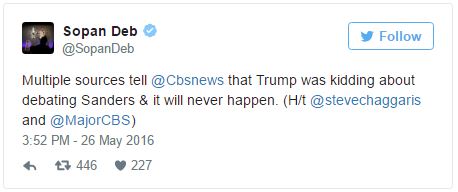
Though his commiseration with the Vermont senator has been earnestly expressed before, CBS News was later told by sources that Trump was “kidding” about accepting the invitation.

Capture

At a Thursday afternoon press conference, Trump said that he would in fact debate Sanders. He stuck to his comments about needing to be paid, though, clarifying to reporters that his price would be a $10 to $15 million donation to charity.

The fate of the Sanders-Trump debate, therefore, remains up in the air. Sanders himself is set to appear on Kimmel’s show Thursday night.

Reprinted from Russia Today.

Read more

Pan-Africanism, Feminism and Finding Missing Pan-Africanist Women

0

We are commemorating the 58th anniversary of African Liberation Day on May 25. When most of us think of Pan-Africanism and its major icons, women will not instinctively come to mind. Pan-Africanist history and activism might appear as the exclusive domain of African men. However, I am encouraging the readers to embrace the position of the radical hip hop group Public Enemy and “Don’t Believe the Hype” about women not being major contributors to Pan-Africanism. In the Hakim Adi and Sharika Sherwood authored book Pan-African History: Political Figures from Africa and the Diaspora since 1787, forty Pan-Africanists are surveyed and only three of them are women.

Pan-Africanism is an ideology and a movement that calls for global solidarity and cooperation among Africans in order to liberate themselves from racist oppression and (neo)colonial and imperialist domination. Africa holds a central place in Pan-Africanist thoughts and organizing. It is the ancestral land of Africans. The harnessing of the continent’s resources for the benefit of the people will serve as the basis for liberation. A Pan-Africanism of liberation should be based on the labouring classes as its principal constituency and, as such, must be an anti-capitalist, feminist, anti-imperialist and anti-racist movement. This article will focus on Pan-Africanist women from the African Diaspora.

Diaspora Pan-Africanist women have contributed to movement Pan-Africanism from its inception at the Henry…

Read more

The Desperate Plight of Petro-States

0

(Photo: Mr. Hicks46; Edited: LW / TO)(Photo: Mr. Hicks46; Edited: LW / TO)

Pity the poor petro-states. Once so wealthy from oil sales that they could finance wars, mega-projects, and domestic social peace simultaneously, some of them are now beset by internal strife or are on the brink of collapse as oil prices remain at ruinously low levels. Unlike other countries, which largely finance their governments through taxation, petro-states rely on their oil and natural gas revenues. Russia, for example, obtains about 50% of government income that way; Nigeria, 60%; and Saudi Arabia, a whopping 90%. When oil was selling at $100 per barrel or above, as was the case until 2014, these countries could finance lavish government projects and social welfare operations, ensuring widespread popular support. Now, with oil below $50 and likely to persist at that level, they find themselves curbing public spending and fending off rising domestic discontent or even incipient revolt.

At the peak of their glory, the petro-states played an outsized role in world affairs. The members of OPEC, the Organization of the Petroleum Exporting Countries, earned an estimated $821 billion from oil exports in 2013 alone. Flush with cash, they were able to exert influence over other countries through a wide variety of aid and patronage operations. Venezuela, for example, sought to counter US influence in Latin America via its Bolivarian Alliance for the Peoples of Our America (ALBA), a cooperative network of mostly leftist governments. Saudi Arabia spread its influence throughout the Islamic world in part by financing the efforts of its ultra-conservative Wahhabi clergy to establish madrassas (religious academies) throughout the Islamic world. Russia, under Vladimir Putin, used its prodigious oil wealth to rebuild and refurbish its military, which had largely disintegrated following the collapse of the Soviet Union. Lesser members of the petro-state club like Angola, Azerbaijan, and Kazakhstan became accustomed to regular fawning visits from…

Read more

Ship-mounted laser cannon tops British military’s wish list

0

Britain’s military establishment is evaluating firms that have tendered for a contract to build the next-generation ship-mounted laser cannon, designed to burn up attack boats and drones at close range.

The new laser cannon would be mounted on ships alongside the existing Phalanx Gatling gun, the manufacturer of which, Raytheon, is among the bidders.

The move would see the UK following in the footsteps of the US Navy, which has already deployed a shipboard laser to the Persian Gulf.

The effort to build a prototype is being organized by the UK government’s Defence Science and Technology Laboratory (DSTL). The end product will be a laser directed energy weapon capability demonstrator (LDEW-CD).

It appears the laser would complement the existing 20mm weapon, the existing capabilities of which are potent.

Phalanx had “previously been used to shoot down mortars during land operations, so can bring down UAVs as well,” missiles specialist at Raytheon Andy Rhodes told the Flightglobal aviation website on Wednesday.

In 2014, the US reported its first deployment of the laser weapon in the Persian Gulf.

It took Naval Sea Systems Command technicians seven years and $40 million to develop the technology to the current stage. The tour in the Gulf is more of a trial continuation than regular duty, as the Navy wants to learn more about its new tool.

The technology’s big advantage is its operational efficiency, as firing one shot costs just around $1, the US Navy stressed.

It isn’t all plain sailing though. The lasers have their own peculiarities, with their efficiency depending on weather conditions, the presence of dust and vapors in the air, and other factors.

The range of the laser remains highly classified.

Via RT. This piece was reprinted by RINF Alternative News with permission or license.

41 Secret Service agents punished for breaching congressman’s private data

0

Congressman Jason Chaffetz’s rejected 2003 application to join the Secret Service leaked last year, and now dozens of agents from the federal law enforcement agency charged with protecting heads of state have been suspended without pay.

Actions of a total 57 Secret Service personnel, including 11 senior officials, were reviewed in a Department of Homeland Security investigation last fall. None of those disciplined Thursday were identified due to federal privacy laws.

“Of those, 41 are receiving some level of discipline. This discipline includes a letter of reprimand to one individual, suspended discipline contingent on no further misconduct for a period of five years, and suspensions from duty without pay for periods of up to 45 days,” Secretary of Homeland Security Jeh Johnson said in a statement Thursday.

The Department of Homeland Security, the parent office to the Secret Service, released its report in September 2015, finding 45 agents and supervisors peeked at Chaffetz’s personnel file, which was stored in an internal Secret Service database and was required by law to be kept private.

A March 31, 2015 email from Secret Service Assistant Director Edward Lowery read that there was “some information that [Chaffetz] might find embarrassing needs to get out.”

Chaffetz’s records were accessed about 60 times, including by officials from headquarters in Dallas, Boston and Phoenix and even from London.

The report said that 18 supervisors, including the deputy director and director Joseph Clancy’s chief of staff, knew that the information had been accessed from within the agency.

“The majority of these instances were in violation of the Privacy Act, Secret Service policy, and DHS policy,” Johnson stressed. 

The congressman’s private details soon made it to the media. The Daily Beast reported at the time that Chaffetz said that he applied to the Secret Service in 2003 following the 9/11 attacks, but he added that he was never interviewed, and his file was marked to indicate that better qualified candidates existed. Chaffetz had previously said he believes he was too old to apply, being 36 at the time, while the cutoff age for hiring agents is 37. 

Later on the same day, another publication in The Washington Post said that the House Oversight Committee asked DHS to investigate allegations that its employees had “circulated potentially unflattering information” about Chaffetz, the committee’s chairman.

At the time of the leak, Chaffetz was leading the panel tasked with examining an incident involving two Secret Service agents who drove through the scene of an active bomb threat investigation in front of the White House, running over the suspected item.

Another case was related to drinking on the job after three drunken agents were pulled off their assignment to protect President Obama during the G7 summit in the Netherlands. After the leak, Chaffetz said that it was “a tactic designed to intimidate and embarrass me” while also calling it a clear attempt to intimidate him into backing off his probes of Secret Service agents in trouble.

In April 2015, DHS Secretary Johnson made a telephone call to Chaffetz to personally apologize to the congressman overseeing the investigations.

That employee, who disclosed the protected information resigned, Johnson said Thursday.

Via RT. This piece was reprinted by RINF Alternative News with permission or license.

Why I Didn’t Vote for Trump

0

I’ve written a
lot
about Donald Trump in this
space
, basically arguing that his views signify a sea
change
in the foreign policy discourse in this country. His rise, I’ve averred,
augurs the end of the neoconservatives as a viable political force within the
GOP, and the beginning of an “isolationist” (i.e. anti-interventionist) trend
in American politics that will upend the Establishment of both parties.

So why didn’t I vote for him when I had the chance?

I have to admit I was sorely tempted: the opportunity to make Bill Kristol
a very unhappy man was almost too much to pass up. And yet, in the end, when
I got my mail ballot, and I sat down and looked at it, I just couldn’t bring
myself to do it for a very simple reason: the man isn’t the movement.

The Trump phenomenon is one thing, and Donald Trump the person is quite another.
While the former is to be cheered and encouraged, for reasons I’ll get into
in a minute, the latter is a very mixed bag.

To begin with, Trump has taken a number of positions I cannot endorse:

  • He wants to increase domestic
    surveillance in the name of fighting the “war on terrorism.” At once point
    he suggested we would have to shut
    down
    “parts of the internet.”
  • He advocates torture
    of alleged terrorists and says he would murder their families.
  • While opposing US intervention in Syria – he once asked Bill O’Reilly “Do
    you want to own Syria?” – he now says he wants to create a “safe
    zone
    ” in Syria so the refugees don’t have to come here. Call me crazy,
    but that looks like military intervention to me.
  • He wants to deport
    11 million illegal aliens, an operation that – assuming it isn’t stopped by
    the courts – would be inevitably ugly and provoke massive resistance.

But that’s just the beginning of my objections to Trump the candidate. After
all, one could conceivably overlook these flaws in the name of changing the
general orientation of US foreign policy. And yet, in the case of Trump, even
that possibility is foreclosed by his unreliability.

While Trump conceives of his “flexibility” as emblematic of his ability to
make a “good deal,” the reality is that he flip flops all over the place. One
minute he’s totally against going into Syria, and the next minute he’s constructing
“safe zones.” His mercurial nature is on display for all to see: once in office,
it’s entirely possible he could do anything.

I take voting quite seriously, especially when it comes to the presidential
level. If I pull the lever for a candidate who subsequently decides he has to
bomb Country X, or violate our civil liberties, in the name of some alleged
“emergency,” then I’m as morally responsible for his actions as if I’d given
the order myself.

That’s why I resisted the temptation to vote for…

Read more

Nine Neolithic Wonders of Orkney

0

When we think of historical places which date back thousands of years it’s natural to think of the Pyramids, Stonehenge or the ruins of ancient Mesopotamia. Yet Scotland’s Orkney region – an archipelago made up of over 70 islands – boasts some of the very best Neolithic sites on the planet. With some dating back over 5,000 years, these eye-opening ancient constructions might just nudge a lot of people to redefine their perceptions of ancient civilization. Indeed, Orkney is now recognized by UNESCO as having a vital collection of prehistoric cultural sites.

Skara Brae

One of the best surviving prehistoric sites in the world, the remains of the Neolithic village at Skara Brae date back over 5,000 years. Still amazingly well preserved, visitors can explore this prehistoric village as well as touring reconstructions and an interactive visitor center, which brings the Stone Age world into the 21st century.

Ring of Brodgar

A magnificent stone circle, the Ring of Brodgar was originally made up of 60 massive stones, of which 27 are still standing. One of the largest stone circles in the British Isles, Brodgar is thought to date back at least 4,000 years and would have taken considerable engineering skill to construct. Probably built for ceremonial use, the site is surrounded by a number of prehistoric burial mounds.

Maeshowe

Maeshowe is one of the finest examples of a Stone Age grave site in the world and dates back almost 5,000 years. An astonishing Neolithic burial…

Read more

Some Light in Iraq’s Dark Tunnel

0

The U.S. invasion of Iraq in 2003 blasted apart the country’s political structure and left behind widespread chaos, but Iraqis may be slowly digging out of the wreckage, says ex-CIA official Graham E. Fuller.

By Graham E. Fuller

Iraqi politics are in turmoil — nothing new here. Not surprisingly, the post-invasion order is taking a long time to shake down, given the destruction of the old. Entirely new relationships had to be forged under the new, radically changed environment.

What Iraq requires above all is the painful creation of a new sense of national identity and unity. That poses demands on both Shi’a and Sunni. Ironically, much of the Shi’ite — and even Sunni — religious establishment seem to be closer to a national vision than politicians who are pursuing narrow party agendas.

President George W. Bush announcing the start of his invasion of Iraq on March 19, 2003.

President George W. Bush announcing the start of his invasion of Iraq on March 19, 2003.

The Shi’a have not handled the post-Saddam situation well. As the numerical majority, the Shi’a quickly moved to ensure their electoral dominance over the political order after Saddam Hussein and have sidelined the once-ruling Sunnis from a major voice in governance. Worse, Shi’ite militias have behaved harshly against Sunni communities in an effort to reduce Sunni power and even to avenge the past. This very Shi’ite heavy-handedness is one reason why some Iraqi Sunnis have lent support to the “Islamic State” (ISIS, or Da’ish) with its militantly anti-Shi’ite policies.

This anti-Sunni bias of two successive Shi’ite administrations is both unacceptable and damaging to the country. Regrettably, it is also understandable — partially. After centuries-long exclusion from any meaningful role in Sunni-dominated Iraq and suffering oppression at the hands of the Sunni state, the Shi’a seized the moment after the fall of Saddam to ensure that their newly-won power via elections could never again be taken away from them.

Their fear was real: large segments of the Sunni population have viewed recent Shi’ite rule in Baghdad — the seat of great Sunni power for long centuries — as somehow something illegitimate, perhaps even transient. Saudi Arabia refused to…

Read more

UK Navy ship due in Libyan waters

0

The United Kingdom is all set to send a naval warship into Libyan waters in an effort to curb the trafficking of people and arms there, officials say.

Speaking from the G7 summit in Japan, a British government spokesman said Prime Minister David Cameron on Thursday focused on making an intervention on the refugee boats in the Mediterranean and how to tackle the issue.

Britain has already sent four vessels along with NATO to monitor the waters off Libya.

Cameron argued in March that he wanted to extend the UK intervention closer to the Libyan coast.

The new deployment will be able to enter Libyan waters with UN approval, according to the Guardian.

The unnamed official said the warship will help “intercept boats off the coast, both those carrying migrants and those carrying arms.”

“We will now take an active leadership role in that process. Four military planners have deployed to Rome this week to the HQ of Operation Sophia, the naval mission in the…

Read more

Video: Top U.S. & World Headlines — May 25, 2016

0

Visit http://democracynow.org to watch the full independent, global news hour, read the transcript, search our archive and to make a donation to support us.

Via Youtube

LEAKED: Tories want to ram EU-Canada trade deal through parliament without MPs’ consent

0

Leaked minutes of a meeting in Brussels suggest Downing Street is trying to fast-track an EU-Canada trade deal that will allow corporations to sue national governments in secret courts without parliamentary consent.

The Comprehensive Economic and Trade Agreement (CETA) is free trade deal between Canada and Europe, which shares many traits with the Transatlantic Trade and Investment Partnership (TTIP) deal being brokered between the EU and US.

Campaigners warn CETA, which has been finalized but not ratified, would pave the way for a “corporate power grab,” while undercutting vital legislation put in place to protect workers’ rights, the environment and consumer safety.

Leaked minutes of a meeting held on May 13, seen by UK campaign Global Justice Now (GJN), shed light on recent discussions concerning the agreement. EU ministers had gathered in Brussels to review EU trade negotiations and Europe’s steel industry crisis.

The minutes suggest that although the majority of EU states say CETA needs parliamentary approval at national level ahead of implementation, Downing Street called for its “earliest possible entry into force.” The governments of a further seven EU states, including Finland, Spain, Estonia, Sweden, Cyprus and Lithuania, also took this stance.

‘Corporate power grab’

The CETA talks held in Brussels on May 13 come ahead of a ministerial session scheduled for late June, expected to determine the trade deal’s path of implementation.

Key to the deal is an Investor State Dispute Settlement (ISDS), which would pave the way for Canadian-registered firms to sue sovereign governments across the EU that seek to legislate against their financial interests. An updated version of this corporate court mechanism is also expected to form part of TTIP.

A controversial tool of international law, the ISDS clause has led to mammoth pay-outs from governments worldwide as corporation’s wage legal battles against states. In one high-profile case, US tobacco giant Philip Morris took legal action against the Australian government after it introduced mandatory plain cigarette packaging.

Although Big Tobacco recently suffered a blow in Britain after the industry lost a high-profile case against Westminster’s plain packaging policy, campaigners warn CETA could shift the balance of power back to corporations.

Social justice groups on both sides of the Atlantic are vigorously opposing CETA, which was signed in Ottawa in 2014 following secret talks between Canadian and unelected European Commission (EC) officials.

Global Justice Now (GJN) director Nick Dearden, who campaigns against the free trade deal, called it “inherently undemocratic.”

“Cameron seems perfectly happy to go beyond what the EU requires – he seems to be interested in handing over sovereignty for the sake of it. Again, Britain plays the role of making the EU less, rather than more, democratic,” he said.

“These minutes appear to show that Britain came together with a small group of mostly very small countries to try to deny the right of national parliaments to stop a major international treaty coming into force.”

Dearden went on to argue the agreement could have ominous implications for public interest-based policy making in the UK.

“Any discussion in Westminster will simply be a rubber stamp,” he said.

“This leaves open the possibility of Britain being sued by Canadian big business in secret courts before parliament has even had the ability to scrutinize the deal.”

Eroded state sovereignty

While CETA will allow corporations to sue EU governments in secret courts known as arbitral tribunals, states across the bloc will not be afforded the same right. CETA will also likely empower US corporate giants to sue national governments through Canadian subsidiaries.

Official negotiations concerning the trade deal concluded in August 2014. The agreement is currently awaiting approval by the European Council and European Parliament (EP). Whether CETA should require backing at parliamentary level by EU states remains under dispute. If passed into law, it would scrap 98 percent of trade tariffs between Canada and the EU.

Both Canada and the EU have long cooperated on an economic level. CETA is Canada’s most prolific trade deal since the North American Free Trade Agreement (NAFTA), signed by the US, Mexico and Canada in 1992.

Despite the 2008 crash and subsequent eurozone crisis, which saw peripheral European states shackled with socialized bank debt, the EU is still the world’s largest single market. As a unified bloc, it is also Canada’s second biggest trading partner.

CETA will form a direct obstacle to the sort of robust cross-border regulation that could have prevented the 2008 global economic meltdown. Because the deal will lock down deregulation and privatization, it could create fertile conditions for another global economic crisis.

The trade deal’s environmental implications are also a concern. Negotiations to date have laid the groundwork for opening Europe to tar sands oil. Scientists have branded the fossil fuel one of the world’s most environmentally destructive.

Via RT. This piece was reprinted by RINF Alternative News with permission or license.

US Special Ops forces ‘raid’ downtown Tampa, Florida in search of pirates

0

United States Special Operations Forces descended from buildings, jumped from a Black Hawk helicopter and fired shots as they ambushed downtown Tampa, Florida, where ‘pirates’ had ‘captured’ the mayor. The stunt even took place in broad daylight.

The rescue effort on was to test readiness in a crisis situation by carrying out a 30-minute drill exercise during the Special Operations Forces Industry Conference in the central Florida city Wednesday.

“To come here and showcase frankly was a little easier. It was daylight. Everything was on our terms, good weather, no bad guys; the manatees didn’t interfere, no lightning, but the interoperability was already,” Special Forces Lt. Col. Chris Robeshaw told reporters, according to WFLA.

Joining US Special Operations forces in the exercise were Navy SEALS, Marine Raiders and Army Green Berets, plus members from 15 other nations including Ireland and Jordan, many in make-up and disguises.

“You are just humbled to be amongst them. This is a great demo, but this is serious business for them,” said rescued Tampa Mayor Bob Buckhorn who was captured by pirates in the scenario told WFLA.

The Washington Post reported “role players, dressed in black and carrying Kalashnikovs, feigned gunshot wounds as the coalition of commandos swooped in.”

Unusually for a military division that ordinarily operates under the dark of night to conduct covert operations, the exercise was performed before the public who watched from the sidelines.

“I sleep better at night knowing that that’s what they do,” Lance Sturgis, a spectator told WFLA.

Rieka Stroh was there with her son and his two friends who were thrilled by the movie-like scenes played out in real life.

“I think the more important lesson is that they see that our military is so capable and we are a significant force in the world,” Stroh told WFLA.

The rescue was used to mark the beginning of a three-day meeting of Special Operations personnel, with 12,000 expected to attend.

“A lot of what we do is a bit secretive, we don’t really advertise much of what we do and there is a reason for it,” Lt. Col. Robeshaw said, according to The Washington Post. “I think … this is maybe a stark reminder that there are young men and women out there putting themselves at risk.”

Via RT. This piece was reprinted by RINF Alternative News with permission or license.

Video: Top U.S. & World Headlines — May 26, 2016

0

Visit http://democracynow.org to watch the full independent, global news hour, read the transcript, search our archive and to make a donation to support us.

Via Youtube

Video: IMF-Eurozone Deal Hailed as a Breakthrough, But No Relief for Greeks (2/2)

0

Dimitri Lascaris, securities class actions lawyer, says the Troika is lending money with one hand and taking it back with the other, perpetuating the fiction that …

Via Youtube

No drug can kill this superbug

0

US health officials have announced the detection of a new strain of bacteria that resists all medications and could spell doom for antibiotics.

The infection has been found in a Pennsylvania woman and has shown immunity even to colistin, the most powerful antibiotic yet.

Health authorities sounded the alarm on Thursday, saying the superbug could pose serious danger if it spreads.

“We risk being in a post-antibiotic world,” said Thomas Frieden, director of the US Centers for Disease Control and Prevention (CDC), referring to the urinary tract infection of the 49-year-old Pennsylvania woman.

Frieden said her infection could not be contained even with colistin, which is reserved for use against “nightmare bacteria,” Reuters quoted him as saying.

The case was revealed in a study released by Antimicrobial Agents and Chemotherapy, a publication of the American Society for Microbiology. It said the superbug itself was first infected with a tiny piece of DNA…

Read more

Clinton’s Imperious Brush-Off of Email Rules

0

State Department functionaries faced a hopeless task as they tried to spin
their own Inspector General’s matter-of-fact critique of former Secretary of
State Hillary Clinton’s imperial attitude toward basic security measures everyone
else is required by law to follow.

It turns out that she deliberately chose to use a hacker-friendly, unprotected
email server, and not so much for convenience – unless you define “convenience”
as the ability to operate in total secrecy with no possibility of being held
accountable for your policies or behavior. In one email to an aide, Clinton
explained, “I don’t want any risk of the personal being accessible.”

When some staffers had the temerity to voice concerns over the vulnerability
of a non-governmental email system, they were warned by their seniors “never
to speak of the Secretary’s personal email system again.” The IG report establishes
that Clinton’s claim that her use of an insecure email system for official business
had been “allowed” is, well, disingenuous.

Pity the State Department spokespeople tasked with putting the best face on
the IG’s stark criticism. Media representatives actually posed some direct questions
to those applying the cosmetics, who showed themselves far more guilty than
Socrates in “trying to make the worst case the better.” At several points, I
sensed them wishing some hemlock came in their job jar.

Just doing their job, I know. But it was bizarrely clear that their instructions
included taking a bullet for Secretary Clinton. It wasn’t really her fault,
you see. It was actually the State Department’s fault, collectively. There were
only a few variations on the meme: “We could have done a better job ensuring
that people understand security policies;” “We could have done better job at
preserving emails;” “We have not lived up to all our obligations.” In other
words, “we” failed the Secretary, not that Clinton failed in her
duty to ensure that government information was properly secure.

I counted no fewer than 15 examples of this kind of self-criticism, and it
was more than a little nauseating. But then, again, if Clinton becomes President,
who wants to be assigned to be deputy chief of mission in Upper Slovobia? It
was encouraging as it was heartening to notice that this time the press corps
was not sitting still for the notion that it wasn’t really Clinton’s fault,
after all.

The fly in the ointment preventing the usual careful orchestration of such
announcements was an early leak of the IG report. Worse still, for the State
Department spokespeople, several of the journalists had actually read the report
and noticed that its declarative prose did not square with the collective self-flagellation
serving as a diversion. Even the mainstream press corps could see through the
…

Read more

Syrian Islamists Fight for Practical Reasons, Not Ideological Ones

0

Our main story today is a new study which involved personal interviews with over 300 Syrians to understand why so many have joined the ongoing civil war. Interviews were conducted with people who have already participated in the war and those actively considering it, as well as family and community members.

The study found that an overwhelming majority of Syrians were motivated to join the civil war (against President Assad) based on pragmatic and political reasons, not religious ones. Even those Syrians who have joined the radical Al Qaeda’s affiliate in Syria, Jabhat Al-Nusra, still cited very practical reasons for their decisions. Some of them join because all other economic opportunities have been decimated as a result of war. Others joined out of desire for revenge, gravitating toward extreme groups like Al-Nusra because they’ve proven to be among the most effective fighting forces against the Syrian government.

All of this matters because it goes against the prevailing understanding that is taken for granted in the West. It’s true that the situation in Syria is somewhat different than the one that currently prevails in Afghanistan or Iraq. In Afghanistan and Iraq, Islamic movements that rise up against the central government (which is backed by the US in both countries) are automatically considered militants and/or terrorists by default. But in Syria, many in the West look favorably upon the rebellion, as a kind of grassroots push for democracy or self-governance. And initially, that may have been the dominant drive. But today in Syria, the most extreme groups, like Al-Nusra, Ahrar Al-Sham, and ISIS, are also the most significant forces combating the Syrian government. If these same forces were fighting against the government of Saudi Arabia or Qatar, they would be uniformly denounced as terrorists. But since they’re fighting a government we oppose, members and allies of Al-Nusra and Ahrar Al-Sham often get referred by the more favorable term of “rebels” instead. It’s more a function of semantics than any meaningful difference between the prevailing ideology of each group’s leadership. All these groups, from ISIS to Ahrar Al-Sham share a fundamentalist version of Sunni Islam, use suicide terrorism as a tactic, and have no qualms about attacking civilians.

Thus, this new study is really telling us what causes people to join extreme militant or terrorist groups. And the  answer is not religion. For many Syrians, even the path to joining Al-Nusra (again, a group that celebrates 9/11), is not about religion. It’s about practical desperation, survival, and, in some cases, vengeance. Islam is the banner these groups often fall under, but it is not the main source for its members.

This in turn, should have major implications for US policy. If the source of terrorism / extremism is primarily about practical and political considerations (economic desperation, family members killed, etc.) rather than ideological ones…

Read more

French cave yields rings Neanderthals apparently made from stalagmites 176,500 years ago

0

An undated photo shows scientist takes measurements for the archaeo-magnetic survey in the Bruniquel Cave in southwestern France after the discovery there of mysterious ring-shaped structures fashioned about 176,500 years ago by Neanderthals.

Two mysterious stone rings found deep inside a French cave were probably built by Neanderthals about 176,500 years ago, proving that the ancient cousins of humans were capable of more complex behavior than previously thought, scientists say.

The structures were made from hundreds of pillar-shaped mineral deposits, called stalagmites, which were chopped to a similar length and laid out in two oval patterns up to 16 inches high. They were discovered by chance in 1990, after remaining untouched for tens of thousands of years because a rockslide had closed the mouth of the cave at Bruniquel in southwest France.

While previous research had suggested the structures pre-dated the arrival of modern humans in Europe around 45,000 years ago, the notion that Neanderthals could have made them didn’t fit long-held assumptions that these early humans were incapable of the kind of complex behavior necessary to work underground.

Using sophisticated dating techniques, a team led by archaeologist Jacques Jaubert of the University of Bordeaux, France, found that the stalagmites must have been broken off the ground around 176,500 years ago “making these edifices among the oldest known well-dated constructions made by humans.”

“Their presence at 368…

Read more

Video: “Significant Security Risks”: State Department Says Clinton Broke Rules Using Private Email Server

0

http://democracynow.org – An internal government watchdog has concluded Hillary Clinton broke government rules by using a private email server without …

Via Youtube

‘Unforgivable’: Majority of Brits can’t absolve Tony Blair of his Iraq war sins

0

Former Prime Minister Tony Blair can never be forgiven for taking the UK into the Iraq war, a majority of Brits said in an opinion poll.

Pollster YouGov carried out the survey ahead of the publication of the long-delayed Chilcot Inquiry report, which examines the legality of Britain’s 2003 Iraq invasion.

It found only eight percent believe Blair did nothing wrong, while 53 percent said they could never forgive him.

Some 15 percent of respondents said it was time to forgive Blair for his misjudgment.

Perhaps the most damning finding was that just 25 percent of Labour Party supporters are in favor of forgiving their former leader.

Blair was once a hero of the party, having entered Downing Street in a landslide election in 1997 and winning three consecutive general elections.

However, today he is remembered most for his decision to join the United States in invading Iraq in 2003.

A YouGov survey last year found just 26 percent of Brits believe it was right to take military action against Iraq in 2003.

The former Labour PM recently admitted he “profoundly” underestimated the complexity of Middle Eastern politics and the consequences that would ensue after the Iraq invasion.

This admission comes before the publication of the Chilcot report, which is said to be “absolutely brutal” in its verdict on the failings of the occupation.

Blair is already well aware of the criticisms in the report because of Britain’s Maxwellisation process, by which the subjects of an inquiry are allowed to respond to allegations before its conclusions are published.

Nevertheless, this hasn’t stopped the former PM from intervening in Britain’s current defense policy. Earlier this week, Blair said Islamic State (IS, formerly ISIS/ISIL) will not be defeated unless ground forces fight a “proper” war against them.

Via RT. This piece was reprinted by RINF Alternative News with permission or license.

CIA-tortured Zubaydah called to testify against Gitmo harsh techniques

0

Captured and tortured by the CIA after 9/11, then locked up in Guantanamo Bay without charges, Abu Zubaydah is now being called to testify as a witness in a case against inhumane treatment at the US facility in Cuba.

Ramzi Binalshibh, one of the five defendants in the 9/11 war crimes case, has long accused Guantanamo, or Gitmo, guards of subjecting his cell in the high-security Camp 7 unit to constant noise and vibration, a method of a sleep deprivation meant to keep prisoners disoriented. In February, he testified to the military tribunal, where he specifically named Abu Zubaydah as someone who would back up his allegations.

Should Zubaydah, a Saudi-born Palestinian, answer the call to testify, it would be his first appearance in public since his 2002 brutal capture in Pakistan.

“[Zubaydah]’s experienced the same kind of thing that Ramzi has with the noises and vibration,” James Harrington, a lawyer for Binalshibh, told AP.

However, the US military has been denying that the noise, if any, is intentional. As a prosecutor Clay Trivett suggested Binalshibh was “lying … fighting the jihad against the guards in the camp.” 

The method that Binalshibh, a Yemeni suspected of financially supporting the German cell that went on to join flight schools in the US, described mirrors the sleep deprivation that some Gitmo detainees were allegedly subjected to as part of the CIA interrogation program.

That program was launched after Abu Zubaydah’s capture and, since the Senate Intelligence Committee report on it, is widely recognized as torture. According to the so-called “torture report” released in 2014, Zubaydah was the first prisoner to endure the harsh CIA interrogation program.

After Zubaydah was turned over to US custody, he was subjected to 83 waterboarding sessions, according to a CIA report. In addition to that torture technique, which creates the sensation of drowning, he was also placed in a coffin-size box for a total of 266 hours (11 days, two hours) over a 20-day period. Additionally, he was forced to remain in another small confinement box (21 inches wide, 2.5 feet in length) for 29 hours.

Fourteen years ago, in Washington, Zubaydah was falsely believed to be a key Al-Qaeda leader in the lead-up to the September 11 attacks. Now, US documents have him as a “well-known al-Qaeda facilitator,” according to AP.

After being brutally interrogated, Zubaydah was transported to Guantanamo Bay in Cuba, where he remains today. Despite efforts by his lawyers, he has never been charged with a crime or had a chance to appear before a judge.

His harsh treatment by the CIA prompted the agency’s officers to request that Zubaydah “remain in isolation and incommunicado for the remainder of his life,” meaning he would not be able to recount it, according to the Senate’s report.

The hearing that may become Zubaydah’s first appearance in public since 2002 may take place as soon as next week, AP said. He would testify along with another incommunicado prisoner, Guleed Hassan Ahmed, a Somalian detainee, who has also never been charged.

Via RT. This piece was reprinted by RINF Alternative News with permission or license.

The War on Cash Is Ancient

0

The war on cash is now a global phenomenon: under the pretext of tracing criminal activity, governments everywhere are cracking down on commerce that isn’t monitored or controlled.

However, the results of this war reveal its true purpose: tracking citizens and their taxable income.

The war on cash is actually a war on commerce, or rather, on any commerce that can’t be monitored and controlled by the government. Governments survive and grow based on the productivity of the rest of society, and as a result, they try to restrict wealth creation to only those areas where it can be recorded and redistributed.

This war on cash is attracting widespread attention. What people may not know, however, is that the current war is only the most recent version of government policies that have been around for a long time. Similar programs have appeared throughout history, some even dating to antiquity.

One notable example occurred in China during the “Warring States” period, roughly 475–221 BC. This era produced some of China’s greatest contributions to philosophy and technology, but unfortunately, was also a time of unrelenting warfare and political centralization, leading eventually to the Qin unification of China in 221 BC.

Throughout this era, “Legalist” ideas were increasingly prominent and inspired a number of “innovations” in public policy, including laws and regulations similar to the modern war on cash.

Legalists like Shang Yang (in the state of Qin) were primarily concerned with enhancing the power of the state, especially through the rigid organization and control of citizens. They were especially hostile to the merchant class, which they oppressed. As Professor Mark Lewis of Stanford explains,

Shang Yang … initiated a series of reforms to encourage agriculture, which provisioned the army and provided the economic foundations of the state, and to discourage trade, which proved less amenable to taxation. … [The Book of Lord Shang] also records antimerchant measures, including registration of merchants’ servants for corvée labor, high market taxes and taxes on goods in transit, and the registration of merchant households as “inferior people.” As such they were not permitted to wear silk or ride horses, and were subject to extended terms of garrison duty at the frontier. (Lewis, 1999, p. 613)

Faced with commercial growth that didn’t directly contribute to the growth of the state, Shang Yang and others sought to punish and stigmatize the merchant class while ensuring that as many transactions as possible were recorded and taxed.

Interestingly, the Legalists were also largely responsible for instituting the private ownership of land in parts of China. But this seeming laissez-faire reform was actually a ploy: owning land required public registration, which in turn allowed governments to monitor the population and register the people for military service. Private ownership was, therefore, a price the states were willing to pay. Likewise, a lost chapter of Sunzi’s Art of War indicates that in this period land ownership was exchanged for taxes, thus bringing landowners under state control (Sawyer, 1994, pp. 248–256).

There’s a lot more that could be said about this era or about the politics of the war on cash throughout history. But the underlying problem tends to be the same: states can’t survive or grow without the ability to systematically tax their citizens. For that reason, they always keep a careful eye on the financial history of as many people as possible. Importantly, this also means that protecting such information from prying eyes can be a powerful check on state power.

Note: The views expressed on Mises.org are not necessarily those of the Mises Institute.

Read more

The Crisis of Democracy

0

This week we look at the current turmoil in South America, where the so-called “pink tide” is beginning to recede in Venezuela and Brazil as the United Snakes seeks to exploit political and economic crises for its geopolitical gain.

For the musical break, we’ve got Calle 13, with La Bala.

Next up, we pay homage to the Oaxaca Commune, ten years later…. and finally we wrap things up with an interview with Cesar Chavez, a teacher from Oaxaca from Section 22 of the CNTE.

These are the tracks we used:
  • XOC – Super Mario Theme
  • Blue Cat – Playing Hard to Get
  • Immortal Technique (feat Da Circle & J Arch) – Rebel Arms
  • Run the Jewels – All My Life
  • Calle 13 – La Bala
  • Immortal Technique – The 3rd World
  • Immortal Technique (feat Brother Ali, Chuck D & Killer Mike) – Civil War
  • MC B-Ga – Yo Soy Mexico
  • SubMedia is directed and produced by Frank Lopez. Read other articles by subMedia, or visit subMedia’s website.

    Read more

    Video: Keep Oil in the Soil: Bill McKibben on Being Named by Sanders to DNC Platform Committee

    0

    http://democracynow.org – Bill McKibben was just named by Bernie Sanders to serve on the platform committee at this year’s Democratic National Convention.

    Via Youtube

    "Significant Security Risks": State Department Says Clinton Broke Rules Using Private Email Server

    0

    An internal government watchdog has concluded Hillary Clinton broke government rules by using a private email server without approval while she was secretary of state. That was the key finding of a long-awaited report by the State Department inspector general. The report concluded that Clinton would not have been allowed to use a private server in her home had she asked department officials in charge of information security, because it posed “significant security risks.” This contradicts claims by Clinton that use of a home server was allowed and that no permission was needed. The report also criticized Clinton for not properly preserving emails she wrote and received on her personal account. According to the report, Clinton and eight of her deputies, including Cheryl Mills, Jake Sullivan and Huma Abedin, declined to be interviewed for the inspector general’s investigation. Clinton’s use of a private email server for State Department business is also the subject of an ongoing FBI investigation. We speak to journalist Michael Tracey.

    TRANSCRIPT

    This is a rush transcript. Copy may not be in its final form.

    NERMEEN SHAIKH: An internal government watchdog has concluded Hillary Clinton broke government rules by using a private email server without approval while she was secretary of state. That was the key finding of a long-awaited report by the State Department inspector general. The report concluded that Clinton would not have been allowed to use a private server in her home had she asked department officials in charge of information security, because it posed, quote, “significant security risks.” This contradicts claims by Clinton that use of a home server was allowed and that no permission was needed. The report also criticized Clinton for not properly preserving emails she wrote and received on her personal account. Clinton responded to the report during a campaign event in California [sic].

    HILLARY CLINTON: [speaking at a press conference at the United Nations in March…

    Read more

    Email scandal won’t affect presidential campaign: Clinton

    2

    US Democratic presidential front-runner Hillary Clinton has defended using a private email server while serving as secretary of state, saying the email controversy will not affect her White House bid.

    In an interview with CNN on Thursday, Clinton insisted her actions were no different than that of her predecessors, and claimed that she would not allow the issue to dog her election campaign.

    “There may be reports that come out, but nothing has changed,” she said, a day after the release of a critical US State Department investigation, which slammed her use of personal email for government business.

    “It’s the same story. Just like previous secretaries of state, I used a personal email. Many people did. It was not at all unprecedented,” she said.

    Republicans have long speculated that the federal investigation into Clinton’s use of a private email server while she was US secretary of state could result in criminal charges against her.

    More than 2,000…

    Read more

    Video: Texas and 10 Other States Escalate Attacks on Trans People with “Political Stunt” Bathroom Lawsuit

    0

    http://democracynow.org – On Wednesday, 11 states sued the Obama administration over its recent directive requiring that public schools grant transgender …

    Via Youtube

    EU army fears among Brexiteer military chiefs are ‘fanciful’ – expert

    1

    Fears among former senior military officers that British forces will be absorbed by a pan-EU army are misplaced to the point of being fanciful, according to a respected professor of international security.

    In a comment piece for the Conversation website, Professor David J Galbreath, who teaches International Security at the University of Bath, said Prime Minister David Cameron had been right to describe the creation of an EU army as “fanciful.”

    He also argued the UK would veto such a move at the first opportunity.

    Galbreath said there is “a significant gap between the rhetoric and reality of the establishment of a fully functional European army.”

    “Even the most supportive nations, such as Germany, would acknowledge” that such a move is, at best, “a long way off” and “by no means inevitable,” he added.

    Twelve former generals aired their support for a Brexit on Wednesday citing a number of grounds, not least sovereignty.

    One of most prominent is General Sir Michael Rose, former commander of the SAS, who told the Daily Mail on Wednesday: “Sovereignty and defense are indivisible. European law, in my view, has already seriously undermined [the] UK’s combat effectiveness as a result of the intrusion of European law into national law.”

    In the EU “our servicemen and women are in danger of becoming no more than civilians in uniform,” he added.

    Responding to suggestions a Brexit would leave Britain vulnerable, Falklands-era commando General Sir Julian Thompson told the Mail: “We reject completely the notion that departing from the European Union would have a negative effect on the UK’s defense and security.”

    Former army officer-turned-Labour MP Dan Jarvis took a pro-EU view on Wednesday, arguing that much like in the military “you achieve more together than ever you could alone.”

    Via RT. This piece was reprinted by RINF Alternative News with permission or license.

    Caught on camera: US Special Forces on ISIS frontline in Syria

    2

    US Special Forces operatives have been photographed fighting alongside the Kurdish militia in northern Syria in a drive against the Islamic State-held city of Raqqa. The Pentagon insists the Americans are there in “advise and assist” capacity only, however.

    A photographer for Agence France-Presse (AFP) took pictures of the American special operatives in what The Washington Post identified as the village of Fatisah, roughly 30 miles (48 km) north of Raqqa. Kurdish fighters from the People’s Protection Units (YPG) – part of the US-backed Syrian Democratic Forces (SDF) fighting against Islamic State (IS, formerly ISIS/ISIL) in northern Syria – identified the men as Americans.

    The SDF launched a push against the IS capital this week, following the secret visit to the northern Syrian region by General Joseph Votel, head of the US Central Command (CENTCOM).

    The Post’s Checkpoint blog confirmed the identification, noting that one of the images shows three men operating a 40mm Mk 47 automatic grenade launcher, a specialized weapon used by US Special Operations units.

    There were more than a dozen US troops in the village, according to the photographer. The White House has admitted to the presence of up to 300 US operatives in Syria.

    Some of the men can be seen wearing the YPG insignia. The Kurdish militia forms the bulk of the SDF and has been responsible for most of the gains against the IS in northern Syria. Turkey, a key US ally in the region, regards the YPG as a terrorist organization. Some of the US-backed rebel groups in Syria are likewise hostile to the Kurds, and may take offense at the US troops’ use of the patch, Checkpoint noted.

    “Our special operations forces in the past have, yes, worn insignias and other identifying marks with their partner forces,” Pentagon spokesman Peter Cook told reporters on Thursday.

    They “do what they can to blend in with the community” and enhance their own protection, Cook said, citing operational security in refusing to confirm or deny any details about the troops involved.

    Cook also ducked repeated questions from reporters on whether the troops that were supposed to advise and assist the local militia were actually taking part in combat on the front lines.

    “They are not on the forward line. They are providing advice and assistance,” Cook said, adding that their “advise-and-assist role has not changed.”

    Pressed to explain the distinction between the front line and the forward line, Cook replied, “I don’t have a yardstick for you. This is a fluid situation.”

    The village of Fatisah is not exactly on the front line of SDF operations against IS. It can be seen in the upper left corner of this map of combat operations north of Raqqa, made by a Canadian cartographer following the war in Syria.

    Another controversy about the US troops’ presence in Syria went unaddressed at the Pentagon briefing.

    READ MORE: ‘US should run with Moscow’s offer to cooperate in Raqqa’

    While the Russian expeditionary force was deployed to fight IS at the official invitation of the Syrian government, no such invitation was extended to the US troops. Washington has refused any cooperation with Damascus, insisting on a change of government that would favor the rebels backed by US allies Turkey and Saudi Arabia.

    Via RT. This piece was reprinted by RINF Alternative News with permission or license.

    An Unknown Billionaire's Quest To Reverse Aging

    0

    If you Google Osman Kibar’s name you’ll find pictures of him playing poker. It’s not that he was ever a serious player–just that in 2006 he won the first poker tournament he ever played in and then, a year later, came in second out of 3,000 players at a tournament run by the World Series of Poker in Vegas.

    “I don’t get this,” he told a friend. “I’m going to enter another tournament just to check this assumption.” So he played one more tournament, won it and then quit. “While I’m playing, it’s you and the other players,” says Kibar, 45. “The cards are irrelevant. [But] when you just stare at cards 12 to 14 hours a day, you get this hangover effect.” He couldn’t think straight for days, he says, so he gave it up. Instead, for fun, he now reads higher-math textbooks and meditates.

    Kibar, an engineering Ph.D. who emigrated from Turkey to the U.S. for college, doesn’t need to bet on cards for money. Samumed, the San Diego firm he has been stealthily building for a decade, is the most valuable biotechnology startup on the planet.

    Based on investments made by private investors that include IKEA’s private venture firm, anonymous high-net-worth individuals and a single venture capital firm, Samumed has raised $220 million, and the most recent round of financing valued it at $6 billion. It is halfway through raising another $100 million at a $12 billion valuation. Kibar owns a third of the company, which would give him a net worth of $4…

    Read more

    British Treasury: Pensioners will be worse off if UK leaves EU

    0

    The British Treasury has warned that millions of current and future pensioners will be worse off if the UK leaves the European Union (EU).

    The Treasury’s study, released on Thursday, suggests that leaving the EU, known as Brexit, would increase inflation, and undermine the value of state pension raises.

    It added that those with an additional pension pot worth £60,000 would see its value erode by £1,900.

    However, the Vote Leave campaign called the Treasury’s analysis “utterly outrageous.”

    “This is an utterly outrageous attempt by the government to do down people’s pensions and is little more than a cynical attempt to distract from the government’s broken promises on immigration,” said Former Pensions Secretary Iain Duncan Smith, who is campaigning for Vote Leave.

    “The biggest threat to British pensions is the European Commission’s proposals to undermine occupational pensions, which the government themselves have described as ‘damaging and…

    Read more

    Trump says if elected he ‘would exit global climate accord’

    0

    Donald Trump, the US Republican Party’s presumptive presidential nominee, has said that he would pull America out of the UN global climate accord if elected, spelling potential doom for a treaty many scientists view as a last chance to limit global warming.

    “We’re going to cancel the Paris climate agreement,” Trump said at the Williston Basin Petroleum Conference in Bismark, Dakota, on Thursday.

    The New York billionaire also said that he would slash environmental regulations on the energy industry.

    “Any regulation that’s outdated, unnecessary, bad for workers or contrary to the national interest will be scrapped and scrapped completely,” Trump declared.

    The Paris climate agreement, which deals with greenhouse gases emissions mitigation, adaptation and finance starting in the year 2020, was negotiated by representatives of nearly 200 countries in Paris and adopted by consensus on December 12, 2015.

    On April 22, 2016, some 177 countries, including the…

    Read more

    Britain must come clean on special forces’ dirty war in Middle East – Tory MP

    0

    British citizens are fully aware of the UK’s not-so-secret special forces shadow war in the Middle East, meaning the government should simply come clean, Foreign Affairs Committee chair Crispin Blunt has said.

    Hours after it emerged the UK’s SAS had used a missile attack to stop a jihadist suicide truck in Libya, Blunt told the Middle East Eye such secret operations are already public knowledge.

    He said the need for secrecy is debatable at best and hinged on the nature of the troops’ activities.

    “If they are classic SF operations – sharply in, and sharply out – then you would need to maintain their secrecy,” he said.

    “If they are part of a strategy you would expect that strategy to be overseen.”

    He said despite special forces presence in Libya and elsewhere being a well-known fact, the government had only acknowledged the presence of Royal Air Force (RAF) activists over the country.

    Blunt said there is no formal parliamentary process for overseeing SAS missions and “there’s obviously an issue as to whether the intelligence and security committee would be the proper vehicle for oversight of these kinds of operations, but we are not there at the moment.”

    “The longer it goes on you can’t keep these things secret forever,” he warned. “It is inevitable these missions will be reported on eventually,” he added.

    “If you’re running a strategy and you’re using special forces to do it – and you’re doing it over a prolonged period – you’ll get into the position we’re getting into now, which is that there is a consistent pattern of open source reporting on it,” he said.

    Via RT. This piece was reprinted by RINF Alternative News with permission or license.

    2 officers in Freddie Gray case sue prosecutor for defamation over their arrests

    0

    Two Baltimore Police Department officers charged in the death of Freddie Gray are suing Baltimore State’s Attorney Marilyn Mosby for ruining their reputations. They say they were illegally charged for the homicide.

    Sergeant Alicia White and Officer William Porter filed the lawsuit against Mosby in Baltimore City Circuit Court based on her statements at a May 1, 2015 press conference in which Mosby announced that Gray’s in-custody death was a homicide and that she was charging the six officers involved with the arrest with a variety of charges, ranging from misconduct in office to second degree depraved-heart murder.

    They claim that Mosby included “false statements” in the Application for Statement of Charges and “spoke in a divisive and inciting manner” during the press conference in which she outlined the charges she was filing against the six officers, the lawsuit says.

    Along with Mosby, White and Porter are also suing Major Samuel Cogan with the Baltimore City Sheriff’s Office, as well as the State of Maryland. The two plaintiffs are claiming two counts each of defamation and false light invasion of privacy.

    They claim that they were illegally arrested due to charges that were filed “either negligently” or “intentionally, with ill will, improper motivation and/or evil purpose” as a direct result of “an improperly motivated investigation… brought for the purpose of stopping the riots rather than prosecuting charges supported by probable cause,” the lawsuit says. Mosby and Cogan both acted either negligently or with gross negligence or active malice directed at White and Porter “in furtherance of the Defendants’ own personal interests and political agendas.”

    Read more


    Gloria Darden, mother of Freddie Gray (R), sits with family members. © Lucas Jackson

    The press conference violated Maryland Rule of Professional Conduct 3.6(a), the court documents say, because Mosby both participated in the investigation into Gray’s death and made an “extrajudicial statement” that she knew or reasonably knew would be “disseminated by means of public communication” and would “have a substantial likelihood of materially prejudicing” the proceedings.

    The key point leading to the charges against the six officers was that Gray’s arrest was illegal because the knife he was arrested for carrying was “not a switchblade and [was] lawful under Maryland law,” Mosby said. The plaintiffs, though, argue that the weapon was spring-assisted, and illegal in Baltimore City, giving police probable cause to detain Gray.

    Mosby also never independently investigated the arresting incident, the lawsuit says. Instead, she merely reviewed recorded statements from the six officers, interviews that were conducted by the Baltimore Police Department, not her office. Those statements, according to the court documents, “did not support the charges brought” against White and Porter, and directly contradicted at least eight different comments Mosby made during her press conference.

    The two officers also took umbrage with statements the state’s attorney made at the press conference, which they argue was done “for purposes of quelling the riots rather than prosecuting police officers who had committed crimes.”

    Mosby’s remarks “went well beyond and exceed the authority and role of the State’s Attorney’s Office,” and she brought charges, which were filed by Cogan, against the officers “that were wholly unsupported by evidence and probably cause and for a purpose other than her role: prosecuting those who had committed crimes,” the lawsuit reads.

    Both defendants knew at the time the charges against White and Porter were filed that neither had committed a crime. On top of that, Mosby “provided erroneous legal advice” when she asked Cogan to file the charges, the court documents claim.

    White, 31, and Porter, 26, are both charged with involuntary manslaughter, second degree assault and misconduct in office. Porter was the first of the six officers to stand trial for Gray’s death. His case ended with the declaration of a mistrial due to a hung jury in December. All six officers pleaded not guilty to the myriad charges against them.

    The lawsuit was initially filed on May 2, but was not made public until Wednesday, when Judge Althea Handy denied the plaintiffs’ motion to seal the case. The officers had asked that the suit be sealed to “avoid any suggestion” that they were “not complying with the spirit of” a gag order in their criminal cases issued by Circuit Judge Barry G. Williams, as well as to “avoid any additional pretrial publicity in connection with their upcoming criminal trials.”

    The officers “failed to provide a special and compelling reason to preclude or limit inspection of the case record sufficient to overcome the presumption of openness” under Maryland law, Handy wrote in her denial.

    Both the State’s Attorney’s Office and the sheriff’s office declined to comment to the Baltimore Sun about the suit, citing Williams’ gag order in the criminal cases.

    The lawsuit was filed this month because of statute of limitations concerns, the Sun reported.

    Porter is set to be retried at the beginning of September, while White’s is scheduled for mid-October. A verdict has only been rendered for one of the involved officers: Williams declared Officer Edward Nero, 30, not guilty on Monday.

    Via RT. This piece was reprinted by RINF Alternative News with permission or license.

    Video: No more traffic jams? Giant elevated superbus concept is coming

    0

    Video by RT Play – watch more on Facebook page https://www.facebook.com/RTvids/ No more ‘I’m late because of traffic’ excuses!… Congestion-busting ‘uber’ …

    Via Youtube

    Video: Breaking Through Power Day 4

    0

    The Real News Network (TRNN) is proud to be the media partner for Breaking Through Power. TRNN will be live streaming the event starting at 9:00 am on …

    Via Youtube

    Andrew Bacevich Talk: ‘Has U.S. Foreign Policy Since the End of the Cold War Made America Safer?’

    0

    Andrew Bacevich Talk: ‘Has U.S. Foreign Policy Since the End of the Cold War Made America Safer?’


    Eric Garris,
    May 26, 2016

    On May 18, 2016 the Charles Koch Institute hosted “Advancing American Security: The Future of U.S. Foreign Policy” to examine current U.S. foreign and defense policies. During his opening address, renowned military historian Andrew Bacevich surveyed the recent history of U.S. engagement in the world and assessed whether it has made America safer.


    Read more

    Video: Push for Raqqa: Offensive to liberate ISIS stronghold kicks off (Exclusive frontline footage)

    0

    In Syria, an alliance of Kurdish and Arab fighters is pushing to retake control of ISIS de-facto capital, Raqqa. RT LIVE http://rt.com/on-air Subscribe to RT!

    Via Youtube

    Video: Elon Musk Exposes The Biggest Trick Played On The World

    0


    In this video Luke Rudkowski talks about the latest comments of Elon Musk of Space X exposing billions in corrupt pentagon spending on the weapons …

    source

    Video: Ohio mother detained for momentarily turning back on children

    0


    Read story here. https://photographyisnotacrime.com/2016/05/ohio-mother-detained-for-momentarily-turning-back-on-children/

    Via Youtube

    British fascists photographed giving Nazi salutes in Buchenwald camp ‘corpse cellar’

    0

    British neo-Nazis who gave the Hitler salute and joked about ‘meat hooks’ in a concentration camp have caused outrage across Germany and are now the subject of a criminal probe.

    Fascists who belong to the fringe National Action group gave the banned salute in the ‘corpse cellar’ of Buchenwald concentration camp, near the German city of Weimar.

    Bodies of exterminated Jews and other victims of the Third Reich’s Holocaust were once stored in the subterranean room where the men performed the crass publicity stunt.

    Nazi salutes are illegal under German law and the men could be jailed for up to six months if they are found guilty.

    A photo of the action was posted on the group’s Twitter feed on May 20.

    German newspaper Bild said: “What was especially perfidious … was the fact that next to large hooks from which the SS hung bodies the neo-Nazis wrote ‘meat hook.’”

    Staff at the memorial site, which is visited by half a million tourists and Holocaust survivors each year, complained to the police over the incident.

    “The British pro-Nazis displayed a specific criminal energy in the corpse cellar of the camp,” said Dr Volkhard Knigge, director of the site.

    “They openly identified with the Nazis and their mass murder programme. This is a grave insult to the 280,000 people who were imprisoned here, some of them British.”

    A police spokesman said they are working to identify the culprits.

    Via RT. This piece was reprinted by RINF Alternative News with permission or license.

    21 people trapped in Hidden River Cave in Kentucky

    0

    Twenty-one people are reported to be trapped in Hidden River Cave, a subterranean attraction in Horse Cave, Kentucky. Weather in the area has dumped heavy amounts of rain leading to flash flooding.

    A rescue team is heading to the area, WBKO reported.

    The Kentucky Mesonet, a climate monitoring network, reported more than two inches of rain in Bowling Green since midnight, according to Robyn Minor, city editor of Bowling Green Daily News.

    Via RT. This piece was reprinted by RINF Alternative News with permission or license.

    Laura Carlsen on CounterPunch Radio

    0

    Mailing Address


    CounterPunch

    PO Box 228

    Petrolia, CA 95558

    Telephone


    1(707) 629-3683 or

    1(800) 840-3683

    Editorial


    Jeffrey St. Clair, Editor

    Joshua Frank, Managing Editor

    Nathaniel St. Clair, Social Media

    Alexander Cockburn, 1941-2012

    Read more

    Tony Blair in Big Trouble Over Iraq War Lies?

    0

    With just over six weeks to go before the long-awaited release of the Chilcot report into the Iraq War, the calls for former Prime Minister Tony Blair to be properly held to account for the lies he told us in the lead up to the illegal invasion are increasing by the day.

    A few days ago, the foreign affairs spokesperson for the Scottish National Party (SNP) Alex Salmond MP, told RT’s Going Underground program that he would like to see Blair impeached by the British Parliament and also stand trial at the International Criminal Court, if the families of those killed and the wider public agreed.

    Other MPs have also expressed their support for Salmond’s initiative. “If it’s proved that Tony Blair misled everyone, I personally am determined to see justice prevail and to see him impeached,” said Conservative Sir David Amess.

    Capture

    Meanwhile, it’s been reported that Labour leader Jeremy Corbyn will not be backing down from his earlier calls for Blair to be investigated for war crimes depending on what Chilcot’s conclusions are. Last year Corbyn said: “I think it was an illegal war, I’m confident about that, indeed [former UN Secretary- General] Kofi Annan confirmed it was an illegal war, and therefore he has to explain that.”

    Tony Blair is clearly in deep trouble. But what are the practical chances of a trial of some sorts taking place?

    In “Where R those WMDs?” a new anti-war satirical play written and performed by myself and my fellow RT contributor Dan Glazebrook, Blair is flying to South Africa when his plane has to make an emergency landing in Zimbabwe. He’s arrested and put on trial for war crimes. The great ‘progressive’ shows his true colonialist colors when he says that African countries have no right to pass judgment on what he did and that only Africans, Serbs and other ‘official enemies’ of Western elites should be subject to international law.

    Well, the chances of an airplane carrying Tony Blair having to make an emergency landing in Zimbabwe are remote, but thankfully there are other more plausible scenarios for seeing the war criminal getting his just deserts.

    The ICC is one route and certainly has jurisdiction as the UK signed up to the founding Rome statute. A problem though is that the court – most conveniently for Blair – has still to decide on a definition of ‘war of aggression’.

    Let’s remind ourselves what was said at the post-World War Two Nuremberg trial of leading Nazis regarding the launching of a war of aggression.

    “War is essentially an evil thing. Its consequences are not confined to the belligerent states alone but affect the whole world. To initiate a war of aggression, therefore, is not only an international crime; it is the supreme international crime differing only from other war crimes in that it contains within itself the accumulated evil of the whole.”

    Capture

    Bush and Blair clearly initiated a war of aggression against Iraq in 2003 and therefore committed ‘the supreme international crime’. Although we may have to wait a while for Blair to be tried under this count at the ICC, he could still be tried there on other charges relating to the war, such as failing to prosecute the war in a ‘disproportionate manner’ and the deaths of civilians in bombing raids.

    Then there’s the impeachment route.

    According to law, any British citizen, former Prime Minister or not, can be prosecuted or tried by Parliament.

    But we’ve got to go back to 1806 to find the last time Parliament impeached anybody (a certain Lord Melville) and to 1848 for the last attempted impeachment of Lord Palmerston. “The procedure has never been abolished but is obsolete”, noted Downing Professor of Law at Cambridge University S. A. de Smith in his 1970s work ‘Constitutional and Administrative Law’. However, a 1977 Select Committee on Privileges report held impeachment to be ‘of continuing validity’.

    The Iraq war has brought the issue of impeachment back to life.

    In 2004, there were moves to impeach Blair for High Crimes and Misdemeanors over Iraq, and a motion was tabled in the House of Commons by Plaid Cymru MP Adam Price.

    “The evidence for Blair’s duplicity is overwhelming,” Price said.

    His move was backed by over 20 MPs from across the political spectrum.

    “The time has come to look again at whether impeachment should form part of the constitutional process…That the Prime Minister has misled the Commons is not in doubt in most people’s mind,” anti-war Labour MP Peter Kilfoyle told The Guardian.

    The bigwigs of the ‘Big Three’ parties were horrified at the prospect of impeachment proceedings of the British Prime Minister, so worked together to kill the initiative. Peter Hain, the Leader of the House, who voted for the Iraq war, cited a 1999 committee which held impeachment to be ‘obsolete’.

    “I bitterly regret not supporting the impeachment of Tony Blair,” the Labour MP Alice Mahon later wrote. I’m sure she wasn’t the only one.

    Now, though, with Chilcot looming, things could be very different. The mood towards Tony Blair is much more hostile than in 2004 and it’s worth mentioning that one of the MPs who supported Adam Price twelve years ago, Boris Johnson, could well be the next Tory leader if Cameron loses the EU referendum or only just scrapes home.

    It’s not just that Blair lied to Parliament and the country about Iraq having WMDs which could be used within 45 minutes, he also told whopping great ‘porkies’ about Saddam having the power to avert war by disarming.

    On 25th February 2002, for instance, the Prime Minister told Parliament “I detest his [Saddam’s] regime. But even now he [Saddam] can save it by complying with the UN’s demand. Even now, we are prepared to go the extra step to achieve disarmament peacefully. I do not want war… But disarmament peacefully can only happen with Saddam’s active co-operation.”

    Yet, in 2009, Blair told a television interviewer that he would have supported war with Iraq to get rid of Saddam regardless of the WMDs issue.

    Chilcot is expected to confirm that Blair made the decision to go to war after meeting with George W. Bush at the President’s ranch in Texas in April 2002.

    In other words, whatever Saddam had done or pledged to do, he and his country were going to be hit with ‘Shock and Awe’. This was a ‘regime change’ war that already had been planned by hard-right US neocons who had been gunning for Saddam for years: WMDs were merely the pretext for the invasion. Blair, in addition to the other serious charges against him, is accused of secretly committing Britain to going to war against its own national interests at the behest of a foreign power. Some might even go so far as to call that treason.

    Almost ten and half years ago, General Sir Michael Rose, the British former commander of the UN protection force in Bosnia, wrote: “A clear justification for the war in Iraq was never sufficiently made by Tony Blair. No one can undo the decision to go to war. But the impeachment of Mr. Blair is now something I believe must happen if we are to rekindle the democratic process.”

    Rose was predictably attacked by the pro-war neocons for his intervention (‘Don’t Impeach Mr. Blair for Iraq, Commend him!’ was the response of the Henry Jackson Society), but of course, Sir Michael was right.

    All things considered, the impeachment of Tony Blair really can’t come soon enough. Those who still defend/support the Iraq war will try and argue that it can’t take place as no one has been impeached since the 19th century. But they need to be overruled. Parliament’s ancient right to impeach has never been formally abolished, however, much Blair’s defenders might wish it had been.

    Alas, we can’t bring back the lives of more than one million people killed since the illegal invasion, but we can make sure that one of the most important players in the criminal enterprise is brought to book. As the late and much missed Ken Coates, writing in The Spokesman, the journal of the Bertrand Russell Peace Foundation, put it in 2007:

    “Until accountability is reimposed, we cannot establish honest, political discourse. Evidently politicians have told lies before. But now we live with untruths that cannot be corrected, with falsehoods that have become official. Where the lie rules, logic gives way to unreason.”

    The statements, views and opinions expressed in this column are solely those of the author and do not necessarily represent those of RT.

    Reprinted from Russia Today.

    Read more

    Colony Collapse Disorder and Neonicotinoid Insecticides

    0

    Last month Maryland’s Senate passed a partial ban on neonicotinoids, also known as neonics, a relatively new type of systemic pesticide which has been used to control sap-feeding insects, such as aphids and grubs.  Three different types of neonicotinoids were previously banned in the EU in 2013 because of the risk they posed to bees after large-scale field trials in Hungary, Germany and the UK have demonstrated a link between neonicotinoids and Colony Collapse Disorder.  The bill proposed in Maryland will still allow farmers to use neonicotinoids on crops but it will ban their use by retail consumers in their home gardens.  This bill, SB 198, has been sent to the House, and if passed, Maryland would become the first state in the United States to create such a ban, potentially saving the local apiculture.

    Of greater significance, France’s National Assembly has recently established a total ban effective as of 1 September 2018 allowing farmers an appropriate amount of time to change over products.  The French ban is promising because its proposal  has begun a string of now individual businesses in neighbouring countries banning them. For instance, the Aldi Süd supermarket chain in Germany has undertaken a ban, Aldi UK has come under increasing pressure to ban neonicotinoids as well and is currently reviewing its pesticide policy. Additionally there are local authorities that have taken action such as Devon County Council which has recently announced that…

    Read more

    Video: Kevin Barrett On How Celebrities Are Used To Sell The Refugee Crisis To A Gullible Public.

    0


    Please Support The Show – http://richieallen.co.uk/ https://www.facebook.com/therichieallenshow http://www.youtube.com/RichieAllenShowMedia Tune in at …

    Via Youtube

    Video: ‘A lot of surprises’: New secret Snowden files leak coming – activist Miranda

    0

    David Miranda says the public has the right to see documents leaked by Edward Snowden, which he plans to release soon. However, Miranda told RT that he …

    Via Youtube

    Software Used to Predict Criminality Is Biased Against Black People

    0

    (Photo: Karen Neoh; Edited: LW / TO)(Photo: Karen Neoh; Edited: LW / TO)

    On a spring afternoon in 2014, Brisha Borden was running late to pick up her god-sister from school when she spotted an unlocked kid’s blue Huffy bicycle and a silver Razor scooter. Borden and a friend grabbed the bike and scooter and tried to ride them down the street in the Fort Lauderdale suburb of Coral Springs.

    Just as the 18-year-old girls were realizing they were too big for the tiny conveyances — which belonged to a 6-year-old boy — a woman came running after them saying, “That’s my kid’s stuff.” Borden and her friend immediately dropped the bike and scooter and walked away.

    But it was too late — a neighbor who witnessed the heist had already called the police. Borden and her friend were arrested and charged with burglary and petty theft for the items, which were valued at a total of $80.

    Compare their crime with a similar one: The previous summer, 41-year-old Vernon Prater was picked up for shoplifting $86.35 worth of tools from a nearby Home Depot store.

    Prater was the more seasoned criminal. He had already been convicted of armed robbery and attempted armed robbery, for which he served five years in prison, in addition to another armed robbery charge. Borden had a record, too, but it was for misdemeanors committed when she was a juvenile.

    Yet something odd happened when Borden and Prater were booked into jail: A computer program spat out a score predicting the likelihood of each committing a future crime. Borden — who is black — was rated a high risk. Prater — who is white — was rated a low risk.

    Two years later, we know the computer algorithm got it exactly backward. Borden has not been charged with any new crimes. Prater is serving an eight-year prison term for subsequently breaking into a warehouse and stealing thousands of dollars’ worth of electronics.

    Scores like this — known as risk assessments — are increasingly common in courtrooms across the nation. They are used to inform decisions about who can be set…

    Read more

    Net migration to UK surged in 2015, neared peak

    0

    Net migration to the UK, the difference between the number of people entering the European country and leaving it, rose to 333,000 in 2015, the Office for National Statistics says.

    According to quarterly figures from the Office for National Statistics, published Thursday, some 630,000 people came to Britain in 2015 while only 297,000 left the country.

    While the total migrants entering the UK showed a slight drop of 2,000, the number of those who left the country was 22,000 less than last year.

    Net migration from the European Union (EU) reached 184,000 – 10,000 more than the previous year.

    The new statistics are set to further fuel the Brexit debate over the country’s future in the EU, giving a boost to the “Leave” campaigners who accuse Prime Minister David Cameron’s government of not controlling the borders.

    Immigration is a defining factor in the run up to the EU referendum vote on June 23.

    Anti-EU backers argue that Britain can only cut…

    Read more

    Video: Hundreds take to the streets at anti-labor reform rally in Brussels (recorded live feed)

    0

    Hundreds rally against labor reform in Brussels RT LIVE http://rt.com/on-air Subscribe to RT!

    Via Youtube

    James Bovard on the Cost of the War on Terror

    0

    James Bovard on the Cost of the War on Terror


    Eric Garris,
    May 26, 2016

    James Bovard talks about the war on terror, which he says has cost the U.S. $4 trillion since it began in 2001.


    Read more

    Clinton’s Imperious Brush-off of Email Rules

    0

    Exclusive: The State Department’s Inspector General issued a blunt report criticizing Hillary Clinton’s imperious refusal to follow email rules as Secretary of State, adding to Clinton’s credibility problem, notes ex-CIA analyst Ray McGovern.

    By Ray McGovern

    State Department functionaries faced a hopeless task as they tried to spin their own Inspector General’s matter-of-fact critique of former Secretary of State Hillary Clinton’s imperial attitude toward basic security measures everyone else is required by law to follow.

    It turns out that she deliberately chose to use a hacker-friendly, unprotected email server, and not so much for convenience – unless you define “convenience” as the ability to operate in total secrecy with no possibility of being held accountable for your policies or behavior. In one email to an aide, Clinton explained, “I don’t want any risk of the personal being accessible.”

    Democratic presidential candidate Hillary Clinton.

    Democratic presidential candidate Hillary Clinton.

    When some staffers had the temerity to voice concerns over the vulnerability of a non-governmental email system, they were warned by their seniors “never to speak of the Secretary’s personal email system again.” The IG report establishes that Clinton’s claim that her use of an insecure email system for official business had been “allowed” is, well, disingenuous.

    Pity the State Department spokespeople tasked with putting the best face on the IG’s stark criticism. Media representatives actually posed some direct questions to those applying the cosmetics, who showed themselves far more guilty than Socrates in “trying to make the worst case the better.” At several points, I sensed them wishing some hemlock came in their job jar.

    Just doing their job, I know. But it was bizarrely clear that their instructions included taking a bullet for Secretary Clinton. It wasn’t really her fault, you see. It was actually the State Department’s fault, collectively. There were only a few variations on the meme: “We could have done a better job ensuring that people understand security policies;” “We could have done a better job at preserving emails;” “We have not lived up to…

    Read more

    ‘Business as usual’: Activists condemn G4S at AGM over Israeli human rights abuses

    0

    Activists gathered outside G4S’ AGM in London on Wednesday to protest against the security giant’s complicity in worldwide human rights abuses, particularly torture carried out against Palestinians.

    The AGM kicked off at 12.30 BST in a small hotel in the south London borough of Sutton.

    Shareholders making their way into the venue were greeted by groups of campaigners holding colorful placards decrying G4S’ human rights record.

    G4S’ provision of equipment and services to Israeli prisons and the firm’s supply of wares to military checkpoints scattered along Israel’s separation barrier in the West Bank were focal points of criticism. G4S was also lambasted for entrenching violence against asylum seekers in Britain and profiting from global crises born of conflict.

    The detention of Palestinians in Israeli jails violates the Fourth Geneva Convention, which forbids the transfer of prisoners from the Occupied Palestinian Territories (OPT) to Israel.

    While G4S pledged to end its involvement in Israel’s controversial prison system last March, the security giant’s actions do not reflect its rhetoric. The firm continues to supply services and equipment to jails across Gaza and the West Bank, where over 7,000 Palestinian political prisoners are detained in breach of international law.

    Many are incarcerated without charge or trial and are routinely tortured, according human rights experts.

    Key groups protesting at the AGM included War on Want, which campaigns against global poverty and injustice, and the Palestinian Solidarity Campaign (PSC), which works to defend Palestinian human rights in the face of Israeli military aggression.

    Posters held by activists outside the AGM accused G4S of “globalizing injustice” and profiting from “Israel’s illegal detention and torture of Palestinians.” A separate placard read: “Actions speak louder than words. Exit Israel now!”

    Speaking ahead of the meeting, War on Want Senior Militarism and Security Campaigner Ryvka Barnard criticized G4S for failing to sever ties with Israel’s prison system.

    “G4S has made similar promises in the past, under the pressure of public scrutiny, but has failed to take action on them,” she said.

    “Whether it’s supporting Israeli oppression, stoking violence against asylum seekers in the UK or exploiting crises caused by wars, G4S has continued to rake in the profits with little regard for human rights.

    “We’ve yet to see any evidence of these promises being kept as G4S continue to put their profits before the rights of Palestinians. Now is the time for G4S to walk the walk and uphold its legal and ethical responsibilities.”

    UK Campaigners have uncovered multiple cases of G4S complicity in human rights abuses at home and abroad. As a result, student unions, charities and universities across the UK have boycotted and divested from the security giant. They are calling for it to cease its complicity in human rights violations before any such boycott will be dropped.

    A number of human rights activists who had bought shares in G4S in order to attend its AGM on Wednesday were denied entry on what they said were spurious grounds. 

    One such campaigner, Simon Morris, who was stopped by G4S security before he could enter the meeting, told RT the firm has backtracked on its commitment to divest from Israel. He also accused the security giant of pushing ahead with an ethically bankrupt attitude of “business as usual” in the face of mass human suffering.

    RT asked G4S why UK citizens who had bought shares in the firm were turned away from its AGM. A spokesperson for the security giant refused to comment, but said he would inquire as to whether this was the case. 

    Asked whether G4S will heed public criticism and cease supplying Israel with equipment and services linked to human rights violations, he declined to comment. 

    Despite G4S’ robust security, a select number of activists managed to make their way into the AGM. Challenged on the firm’s links to Israeli prisons, G4S’ Executive Director argued the British government does not back a boycott on Israel. He went on to assure shareholders that G4S would sell its Israeli operation if the commercial conditions were right.

    Via RT. This piece was reprinted by RINF Alternative News with permission or license.

    California primary is tossup between Clinton and Sanders – poll

    0

    Democratic contenders Bernie Sanders and Hillary Clinton are in a statistical tie in California, the largest prize delegate-wise by far, a new poll shows.

    Clinton has 46 percent of support and Sanders has 44 percent of support among likely Democratic voters, according to the Public Policy Institute of California poll released Wednesday. Clinton’s razor-thin lead is within the poll’s margin of error.

    The survey’s results come as Sanders and Clinton ratchet up their campaigning efforts in the Golden State ahead of the June 7 primary. California’s Democratic election is by far the largest in the party’s primary, offering 475 pledged delegates, and both candidates are paying top dollar to run television ads.

    Read more


    U.S. Republican presidential candidate Donald Trump  and Democratic U.S. presidential candidate Bernie Sanders © Reuters

    The poll’s aggregate number takes into account both Democrats and independent voters who told pollsters that they would be voting in the Democratic primary. Among those who are specifically registered Democrats, Clinton holds a lead on Sanders with 49 percent against his 41 percent.

    However, June 7 is an open primary, meaning that voters who aren’t registered Democrats can still cast ballots.

    Voters cleave along gender lines, but the divide is small. Sanders garnered the support of 46 percent of men against Clinton’s 42 percent support, and Clinton won over 49 percent of women compared to Sanders’ 42 percent.

    The poll also shows age being a determining factor in which candidate someone supports. Clinton has a solid lead with voters age 45 and older, holding a 59 point lead over the Vermont senator’s 28 percent. Sanders did even better voters under 45, though, beating Clinton by more than double with 66 percent support against her 27 percent.

    Sanders, a self-described democratic socialist, leads among those who call themselves as “very liberal,” beating Clinton by 29 points. Clinton leads with “somewhat liberal” voters by 21 percent and “middle-of-the-road” voters by 18 percent.

    The Clinton campaign declined Sanders’ invitation to face off in a debate ahead of the California primary, saying that former secretary of state would instead be focused on campaigning.

    Sanders said that the two campaigns had previously agreed to have a debate in May, and called the apparent reneging “a little bit insulting” to California voters.

    The Vermont senator has since extended an invitation to debate Donald Trump before Californians go to the polls. Donald Trump apparently accepted the challenge in an interview, though there has been no official agreement between the campaigns or with networks.

    The Public Policy Institute of California poll was based on a telephone survey of 996 likely voters taken from May 13 through May 22. The margin of sampling error among that group was plus or minus 4.3 percent.

    Via RT. This piece was reprinted by RINF Alternative News with permission or license.

    Clinton should be held responsible for Libya, Syria crises: Analyst

    0

    US Democratic presidential candidate Hillary Clinton should be put on trial for her crimes in Libya and Syria, an American analyst says, calling the former secretary of state’s email fiasco a sham.  

    Joe Iosbaker, with the United National Antiwar Committee, made the comments in the wake of the new developments regarding Clinton’s use of a personal email server for exchanging classified information.

    The US State Department said Wednesday that Clinton broke federal rules, citing the findings of an inquiry by the US inspector general which also revealed that Clinton email server was breached at one point in 2011, though she insists the personal server she used was never breached.

    Iosbaker, however, downplayed the significance of the case, saying former US officials were also accused of such crimes.

    “The media, Congress and the state department they are all blind to the crimes that are being committed by the US in its wars and interventions,”…

    Read more

    Video: Violent protests outside Donald Trump rally in Albuquerque

    0

    On Tuesday night demonstrators threw burning T-shirts, plastic bottles and other items at officers, overturned trash cans and knocked down barricades outside …

    Via Youtube

    Toppling the Status Quo

    0
    toppling-the-status-quo-khalil-bendib-otherwords-cartoon

    Toppling the Status Quo, an OtherWords cartoon by Khalil Bendib

    The post Toppling the Status Quo appeared first on OtherWords.

    This piece was reprinted from Other Words by RINF Alternative News with permission.

    Trump secures enough delegates for nomination

    0

    US Republican presidential candidate Donald Trump has secured the required number of delegates to win the GOP nomination, the latest AP count shows.

    Trump’s total count of delegates reached 1,238 after a small number of unbound party delegates told the AP that they would support him.

    Trump was the only remaining Republican candidate in the race after his last two opponents Senator Ted Cruz of Texas and Ohio Governor John Kasich dropped out of the race earlier this month.

    Oklahoma Republican Party Chairwoman Pam Pollard was one of the pledged unbound delegates who said Trump “has touched a part of our electorate that doesn’t like where our country is.”

    Steve House, chairman of the Colorado Republican Party and an unbound delegate who confirmed his support of Trump to the AP, said he made the decision because he likes Trump’s background as a businessman.

    Some delegates, however, offered lukewarm support for Trump with Pennsylvania delegate Cameron…

    Read more

    Video: CrossTalk: Bernie’s Quest

    0

    Bernie Sanders is on a mission – and so are his many enthusiastic supporters. Nonetheless, his quest for the Democratic nomination and the White House are …

    Via Youtube

    Al-Qaeda-linked extremists could use Syria to launch attacks on West – UK general

    0

    A senior British military commander has warned of Al-Qaeda-linked extremists’ “ambitions” in Syria, saying they could be using the country as a springboard to mount a new wave of international terror attacks.

    Lieutenant General Mark Carleton-Smith said Jabhat al-Nusra (Al-Nusra Front) is the strongest remaining Al-Qaeda franchise, identified by some analysts as a more serious long-term threat than Islamic State (IS, formerly ISIS/ISIL), and potentially associated with an element of British foreign fighters in Syria.

    He was giving evidence to the Commons Defence Committee on its inquiry into UK military operations in Syria and Iraq.

    Read more


    Britain's Defence Secretary Michael Fallon © Russell Cheyne

    Carleton-Smith said the group is not currently being targeted in British airstrikes, but the UK is ready to act if a “direct and imminent” threat to national security emerges.

    He warned there is a “real danger” the group remains an “abscess in the system” and might “represent a Petri dish that becomes a threat to UK national security.”

    Carleton-Smith said the group, which first emerged in 2011, is a mix of fighters concentrating on the civil war in Syria and those with a wider agenda.

    “A significant proportion are Syrian-focused that provide a wider wrapping to those much more specifically AQ-aligned [Al-Qaeda-aligned] elements that might harbour the ambition to use Syria as a springboard for an international terrorist attack plan.

    “There is potentially an element of British foreign fighters associated with it.”

    Meanwhile, Defence Secretary Michael Fallon said there is “real momentum” behind the Iraqi offensive against IS.

    “Clearly progress has been made. There is a real sense of momentum now of the Iraqi and Kurdish forces advancing. That needs to be sustained,” he said.

    Read more


    Britain's Secretary of State for Defence Michael Fallon © Stefan Wermuth

    But committee head Julian Lewis questioned Fallon on the numbers of IS opposition fighters, with whom Britain is waging a military campaign in Syria, asking how many of the estimated 70,000 are “moderate” or “hardline” Islamists.

    “The question is whether they are moderate or Islamists. The prime minister himself admitted a significant number of the people he had been talking about are relatively hardline Islamists,” Lewis said.

    “We have had testimony from several witnesses who make it quite clear that the overwhelming majority of opposition forces, of opposition with people with guns, are Islamists.”

    Fallon responded by saying: “The test is of all these groups is are they prepared to live within a plural political settlement that can in the end be democratic and take Syria towards elections.

    “We can argue for a very long time about these precise definitions of what is a moderate Muslim, what is an Islamist, what is someone beyond the pale or whatever.

    “The political process that is now getting underway does enable us to start to ask these various groups to make their choice – whether they are prepared to work with us for a political settlement and to be part eventually of a democratic process.”

    Fallon also acknowledged that IS, which has already established a foothold in Libya, could seek to expand its operations internationally as it came under pressure in Syria and Iraq.

    “That is certainly possible that we see attacks increase elsewhere in proportion to the way that they are being diminished in their caliphate. We will have to continue to be extremely vigilant about that,” he said.

    Via RT. This piece was reprinted by RINF Alternative News with permission or license.

    FBI refusal to divulge Tor hack code sees child porn evidence thrown out of court

    0

    A US District court judge has thrown out evidence submitted by the FBI because they refuse to reveal exactly how they hacked into the servers of visitors to a child porn website.

    In April it was revealed that a key Tor software developer was hired by the FBI, through a contractor, to create malware to help the FBI hack into a childporn website and spy on its users.

    READ MORE: Former Tor developer makes malware for FBI

    Tor software is a non-profit, anti-surveillance network that allows users to enter websites undetected by routing traffic through thousands of servers, and is a prerequisite for visiting hidden ‘dark web’ directories.  

    Read more


    © Kacper Pempel

    In February 2015, the FBI took over one of the internet’s largest child porn websites, Playpen, and continued to run it for almost three months – infecting thousands of users who entered the site within that time with malware that revealed their identities.

    However, the FBI’s refusal to divulge the full code that enabled them to exploit Tor means that evidence gathered against a Vancouver school administrator, Jay Michaud, who allegedly visited Playpen, cannot be used in court.

    Michaud’s defense lawyers argue that they need to learn how the FBI gained access to determine if the related warrant legally entitled them to do so.

    The defense team entered a motion to dismiss the case. On Wednesday US District Judge Robert Bryan said the case can still go ahead, but ruled that the evidence – “the fruits of that warrant” – should be excluded.

    The FBI’s refusal could seriously impact another 1,200 related cases that are pending against alleged visitors to Playpen.

    READ MORE: FBI under court order to release code used to hack 1,000+ computers in child porn sting

    In April, Massachusetts District Court Judge William Young found the FBI’s warrant to obtain evidence against Alex Levin for alleged child porn possession was “void” because it was issued by a magistrate who didn’t have the jurisdictional power to do so.

    Via RT. This piece was reprinted by RINF Alternative News with permission or license.

    Hundreds protest at McDonald's headquarters for higher wages

    0

    Hundreds of American protesters marched through pouring rain to call for higher wages and union rights at McDonald’s headquarters in Oak Brook, Illinois.

    McDonald’s restaurant employees and supporters seeking a $15-an-hour minimum wage and better benefits marched about two blocks on Wednesday to the suburban Chicago headquarters.

    “If we don’t get it, shut it down,” they chanted. It was estimated that there were up to a thousand protesters.

    The headquarters was shut for the third year in a row because of protests centered on the shareholder gathering, which will be on Thursday.

    The protesters are part of a larger US movement for higher wages by workers in fast-food and other low-wage industries.

    Although an improved economy has spurred pay rises at companies ranging from Wal-Mart to McDonald’s, activists and workers say it’s not enough.

    “The fact that you have to choose paying your light bill or eating is ridiculous,” said Adriana Alvarez, McDonald’s…

    Read more

    Video: RAW: Protesters go wild at Anti-Trump rally in Albuquerque, New Mexico

    0

    Opponents of Donald Trump have clashed with police in the capital of New Mexico State where the presidential hopeful held a meeting with supporters in the …

    Via Youtube

    Video: Breaking Through Power Day 3

    0

    The Real News Network (TRNN) is proud to be the media partner for Breaking Through Power. TRNN will be live streaming the event starting at 9:00 am on …

    Via Youtube

    Mounting Concerns for Fallujah Residents; 259 Killed in Iraq

    0

    Mounting Concerns for Fallujah Residents; 259 Killed in Iraq

    Grand Ayatollah Ali al-Sistani asked
    the Iraqi government and the Shi’ite militias to be cautious while recapturing
    Fallujah. He wants security forces to be careful around the many civilians
    trapped in the city. Sistani is the leading Shi’ite cleric in Iraq. United
    Nations spokesman Stephane Dujarric expressed the
    organization’s similar concerns that the civilians there are in danger. Militia
    leadership responded
    by giving the militiamen a new set of instructions that include orders against
    looting and torture.

    Sair al-Bayati, a tribal leader in Suleiman Bag, said
    that Shi’ite militias have kidnapped hundreds of Sunnis from the town and razed
    their homes. The town was recaptured from Islamic State militants in 2014, but
    the ongoing militia occupation
    has prevented residents from returning. The Kurds also have a claim on the
    area.

    At least 259 people were killed and 62 were wounded:

    The hospital in Fallujah reports
    that 26 civilians and 17 militants have died since the launch of operations;
    that is at least 19 more civilian deaths than previously reported. The hospital
    is only reporting casualties that have arrived at the facility. More civilian
    deaths have probably occurred.

    About 35 security personnel
    have been killed
    in Fallujah since the launch as well. Security forces say
    they killed 163
    militants
    during operations on Wednesday alone. Militants cut
    the tongues of five members
    who attempted to flee.

    A bomb in Baghdad killed
    two people and wounded six more
    in the Karaghul neighborhood. A
    blast in Tobji killed
    one person and wounded seven more
    . One
    person was killed and seven were wounded
    in a blast in Doura.

    In Suleiman Bag, a suicide bomber killed two militiamen
    and wounded six others
    , including one civilian, on Sunday.

    Fourteen
    militants were killed
    during the liberation of Sijar.

    Security forces cleared Albu Hamad, near the Fallujah
    Dam, and killed
    13 militants
    in the process.

    Six
    militants were killed
    in a strike near Gwer

    Peshmerga forces in Bashiqa killed two suicide
    bombers
    dressed as refugees.

    Read more by Margaret Griffis

    Read more

    BBC's Last Whites of the East End Accused of Promoting 'Racist' Whites

    0
    BBC’s Last Whites of the East End Accused of Promoting ‘Racist’ Whites

    Read more

    Sanders, Clinton in dead heat in California: Poll

    0

    US Democratic presidential candidates Bernie Sanders and Hillary Clinton are in a virtual tie in California, the country’s most populous state and one that until recently was strongly in Clinton’s favor, a new statewide poll has found.

    Clinton is leading Sanders among likely voters, 46 percent to 44 percent, within the margin of error, according to a poll released Wednesday by the Public Policy Institute of California.

    A poll by the same institute in March found Clinton with a lead of 48 percent to 41 percent over Sanders.

    The survey came as both Sanders and Clinton have increased their campaign appearances and advertisements as the June 7 primary election approaches.

    California is one of the most expensive states for television advertising, given its size and the number of media markets.

    Sanders’ rallies have drawn big, enthusiastic crowds in many parts of California. His aides say he intends to spend nearly all his time in the state until the…

    Read more

    Video: Dozens of cars collapse into 200-meter-long sinkhole in Florence, Italy

    0

    A giant sinkhole opened up in the very center of Florence, Italy, swallowing dozens of cars parked near the iconic Ponte Vecchio bridge. Firefighters claim that …

    Via Youtube

    The Looting Stage of Capitalism: Germany’s Assault on the IMF

    0

    Having successfully used the EU to conquer the Greek people by turning the Greek “leftwing” government into a pawn of Germany’s banks, Germany now finds the IMF in the way of its plan to loot Greece into oblivion.

    The IMF’s rules prevent the organization from lending to countries that cannot repay the loan. The IMF has concluded on the basis of facts and analysis that Greece cannot repay.  Therefore, the IMF is unwilling to lend Greece the money with which to repay the private banks.

    The IMF says that Greece’s creditors, many of whom are not creditors but simply bought up Greek debt at a cheap price in hopes of profiting, must write off some of the Greek debt in order to lower the debt to an amount that the Greek economy can service.

    The banks don’t want Greece to be able to service its debt, because the banks intend to use Greece’s inability to service the debt in order to loot Greece of its assets and resources and in order to roll back the social safety net put in place during the 20th century.  Neoliberalism intends to reestablish feudalism—a few robber barons and many serfs: the One Percent and the 99 percent.

    The way Germany sees it, the IMF is supposed to lend Greece the money with which to repay the private German banks.  Then the IMF is to be repaid by forcing Greece to reduce or abolish old age pensions, reduce public services and employment, and use the revenues saved to repay the IMF.

    As these amounts will be insufficient, additional austerity measures are imposed that require Greece to sell its national assets, such as public water companies and ports and protected Greek islands to foreign investors, principallly the banks themselves or their major clients.

    So far the so-called “creditors” have only pledged to some form of debt relief, not yet decided, beginning in 2 years.  By then the younger part of the Greek population will have emigrated and will have been replaced by immigrants fleeing Washington’s Middle Eastern and African wars who will have loaded up Greece’s unfunded welfare system.

    In other words, Greece is being destroyed by the EU that it so foolishly joined and trusted.  The same thing is happening to Portugal and is also underway in Spain and Italy.  The looting has already devoured Ireland and Latvia (and a number of Latin American countries) and is underway in Ukraine.

    The current newspaper headlines reporting an agreement being reached between the IMF and Germany about writing down the Greek debt to a level that could be serviced are false.  No “creditor” has yet agreed to write off one cent of the debt.  All that the IMF has been given by so-called “creditors” is unspecific “pledges” of an unspecified amount of debt writedown two years from now.

    The newspaper headlines are nothing but fluff that provide cover for the IMF to succumb to presssure and violate its own rules. The cover lets the IMF say that a (future unspecified) debt writedown will enable Greece to service the remainder of its debt and, therefore, the IMF can lend Greece the money to pay the private banks.

    In other words, the IMF is now another lawless Western institution whose charter means no more than the US Constitution or the word of the US government in Washington.

    The media persists in calling the looting of Greece a “bailout.”

    To call the looting of a country and its people a “bailout” is Orwellian.  The brainwashing is so successful that even the media and politicians of looted Greece call the financial imperialism that Greece is suffering a “bailout.”

    Everywhere in the Western world a variety of measures, both corporate and governmental, have resulted in the stagnation of income growth. In order to continue to report profits, mega-banks and global corporations have turned to looting.  Social Security systems and public services are targeted for privatization, and indebtedness so accurately described by John Perkins in his book, Confessions of an Economic Hit Man, is used to set up entire countries to be looted.

    We have entered the looting stage of capitalism. Desolation will be the result.

    Read more

    Room for Some Syrians?

    0

    With nine bedrooms, an exercise room, and even a butler’s pantry waiting for them when they quit the White House


    Email
    Print

    President Obama and first lady Michelle Obama have leased a spectacular 8,200 square-foot home in one of DC’s most elegant neighborhoods as their first post-White House dwelling.

    The $4.3 million home features plenty of room for the Obamas to stretch out – with separate dressing rooms and his and her bathrooms, entertaining space, and a tranquil garden.

    The home was built in 1928 and features nine bedrooms and eight and a half baths, according to Politico, which first reported the address.

    The Obama’s area leasing the house from Joe Lockhart, who served as press secretary to Bill Clinton.

    Distinguished address: The home in Kalorama puts the Obamas in one of the capital's most upscale neighborhoods

    Read the Whole Article


    Email
    Print

    Read more

    The Devil Fossil Fuel Industry Has Us By the Short-hairs (and what are we going to do about it?)

    0

    A new film by Gasland filmmaker proves greenies tied to Capitalism are the enemy, too

    A simple documentary premiere, in a small town north of Vancouver, WA, on the Columbia, a town called Kalama, near Longview, where millions of stripped logs from the Pacific Northwest’s forests are stacked 20 stories high, waiting for markets (sic) in Asia to be turned into lumber and cardboard and stuffing and paper and snot sheets for the U S of A.

    Amazing disconnect, how unsustainable and horrific Capitalism is as it plays out, guts communities – both that of Consumopithecus Sapiens and the natural world – while people will argue over some village square tree about to be cut down for the new mini-strip mall.

    A two-hour drive south from Seattle, so for me, very close to my current home, in Vancouver, and going to it after a hard day’s work with clients just off the Portland, Oregon, streets, some still on, out of prison, in addiction recovery programs, you know, the lowly, low-paid social worker, hell, I thought heading north would seem like a no brainer for me to at least get something out of it – me, a nobody, who has been fighting against the polluters, the ecosystems killers, the cultural genocide soldiers, since I was 15 years old, fresh from Paris, France, and into the Sonora of Santa Catalina, saguaros, and Tucson, where Edward Abbey got drunk and the Center for Biological Diversity cried into existence.

    So, a writer of my ilk likes to know the naming of…

    Read more

    Israel boycott: British academic turns down prestigious award & cash prize for ‘political’ reasons

    0

    A British academic has turned down a prestigious Israeli award and £225,000 ($300,000) in prize money for “political” reasons, in what appears to be the latest attempt by Western activists to boycott the Jewish state.

    Catherine Hall, a history professor at University College London (UCL) was due to receive a third of The Dan David Foundation £690,000 ($1 million) prize for her work’s “impact on social history, as a pioneer in gender history, race, and slavery.”

    Hall, however, declined to attend the award ceremony in Tel Aviv on Sunday, saying her rejection of the prize was “an independent political choice” after engaging in “many discussions” over the Israel-Palestine conflict, AP reports.

    Her stance appears to be inspired by the international Boycott, Divestments and Sanctions (BDS) movement, which several prominent British academics have joined since 2005.

    Read more


    © Ammar Awad

    In a statement to the British Committee for the Universities of Palestine, a pro-BDS group, Hall announced she withdrew from the prize “after many discussions with those who are deeply involved with the politics of Israel-Palestine, but with differing views as to how best to act.”

    The foundation said Hall initially accepted the prize enthusiastically when she was selected in February, and only later asked to withdraw her name without giving a reason.

    It said it would donate Hall’s prize winnings to support Israeli and international history scholars.

    Previous prize recipients include former US vice president Al Gore, former British prime minister Tony Blair, cellist Yo-Yo Ma and filmmakers Joel and Ethan Coen.

    BDS supporters say the movement uses non-violent means to end Israel’s occupation of the West Bank, but the Israeli government says the movement’s true goals are to destroy the country and has anti-Semitic undertones.

    Via RT. This piece was reprinted by RINF Alternative News with permission or license.

    Trump reaches magic number of delegates, officially presumptive GOP nominee

    0

    Via RT. This piece was reprinted by RINF Alternative News with permission or license.

    World leaders ‘rattled’ by Trump’s proposals: Obama

    1

    US President Barack Obama says world leaders are “rattled” by the presumptive Republican presidential nominee Donald Trump and are not sure how to react to his proposals.

    “I think it’s fair to say they are surprised by the Republican nominee, they are not sure how seriously to take some of his pronouncements, but they’re rattled by him, and for good reason,” Obama said Thursday, during a break from the G7 summit in Japan.

    “A lot of the proposals that he’s made display either ignorance of world affairs or a cavalier attitude or an interest in getting tweets and headlines instead of actually thinking through what it is that’s required to keep America safe, secure and prosperous, and what’s required to keep the world on an even keel,” he added.

    Obama did not go into a detailed critique of Trump but said he shares the same anxiety as other world leaders.

    “Things don’t roll together so well if the United States is not making good decisions,”…

    Read more

    Video: Putin meets widow and sister of two Russian journalists ‘killed by Savchenko intel’

    0

    An aircraft with Russian citizens Evgeny Erofeev and Aleksandr Aleksandrov, who were swapped for Ukraine’s Nadezhda Savchenko, has landed at Moscow’s …

    Via Youtube

    Students With Nowhere to Stay: Homelessness on College Campuses

    0

    (Image: Lauren Walker / Truthout)(Image: Lauren Walker / Truthout)

    Help Truthout keep publishing stories like this one: We depend on reader support! Click here to make a tax-deductible donation today.

    When the College Cost Reduction and Access Act took effect in 2009, neither lawmakers nor school administrators had any idea how many college students would check the box on the Free Application for Federal Student Aid (FAFSA) — the document that determines eligibility for Pell grants, subsidized loans and work-study awards that help students pay for college or vocational training — to indicate that they were homeless.

    At last tabulation, the number was 58,000, a small percentage of the 20.2 million students presently enrolled in both undergraduate and graduate study. Nonetheless, school counselors and advocates believe the number is starkly inaccurate and represents a mere fraction of university students who actually lack a permanent home.

    Shirley Fan-Chan, director of U-ACCESS at the University of Massachusetts Boston, provides on-campus support to students who are experiencing food insecurity and homelessness. “Most students think of homelessness as being on the street, sleeping in doorways, and for the most part, college students don’t do this,” she told Truthout. “They hide out. They may stay in one place for a few days or a week, then move somewhere else, bouncing from friend to friend with no fixed place to stay. But they think to themselves, ‘Well, this is college. As long as I have a roof over my head, I’m okay.'”

    And if that roof happens to be in a tent, subway car or vehicle, so be it. As Fan-Chan notes, students typically do their damnedest to make do, showering in the gym and visiting the emergency food pantries that are increasingly popping up on US campuses.

    Causes of Student Homelessness

    Sara Goldrick-Rab, a professor at the University of Wisconsin-Madison, has been studying college affordability and its connection to retention since 2008. Her initial research involved analyzing the impact…

    Read more

    Video: Finally home: Russians swapped for Savchenko meet wives at Moscow airport

    0

    An aircraft with Russian citizens Evgeny Erofeev and Aleksandr Aleksandrov, who were swapped for Ukraine’s Nadezhda Savchenko, has landed at Moscow’s …

    Via Youtube

    Putting Free Speech Out to Pasture

    1

    Hard experience teaches that biotech companies, chemical corporations, and other agribusiness giants have no sense of respect for Mother Nature. Now, Rick Friday has learned they have no sense of humor either.

    Friday, a lifelong Iowa farmer, also happens to be a talented, self-taught cartoonist. For 21 years, he supplemented his cattle-raising income by drawing cartoons each week in an Iowa publication called Farm News.

    Friday really enjoyed this side job — until April 30.

    The day before, the News had published his drawing of two hard-hit farmers chatting by a fence about the low prices they were getting for their products. “I wish there were more profits in farming,” mused one.

    “There is,” exclaimed the other. “In year 2015, the CEOs of Monsanto, Dupont, Pioneer, and John Deere combined made more money than 2,129 Iowa farmers.”

    rick-friday-cartoon-big-agriculture

    The cartoon that caused Rick Friday’s immediate termination. (Rick Friday / Facebook)

    Not exactly a harsh comment. But the next morning, Friday was slapped with an email from a Farm News editor announcing that, at the direction of the publisher, Friday was being immediately terminated.

    The drawing “had caused a storm here,” the editor explained, adding that a major corporation had pulled its advertising. “In the eyes of some,” the email confided, “big agriculture cannot be criticized or poked fun at.”

    And yet, Big Ag wonders why it’s so loathed across America’s farm country.

    The petulant corporate bully that mugged Friday won’t identify itself, but why won’t Farm News? Does its publisher feel no journalistic responsibility to report actual news — in this case, news that farmers really could use?

    The publication’s pusillanimous sacrifice of its longtime cartoonist is a shameful betrayal of both its farmer readership and journalism ethics. They should rename it the Agribusiness Shill.

    The post Putting Free Speech Out to Pasture appeared first on OtherWords.

    This piece was reprinted from Other Words by RINF Alternative News with permission.

    Cowgirl Diplomacy? Foreign Policy Under Hillary Clinton

    0

    America’s mainstream media, ever attracted to the splashy rather than the serious,
    has a new topic to occupy the time until Election Day: President Trump.
    What will he do first? How will he translate his hazy “America First”
    theme into policy? Who will be in his inner circle? (Specifically,
    will he appoint people who really know something about foreign affairs?)
    There’s just so much room for playful speculation about Donald Trump that something
    important has been lost sight of: He’s going to lose – big time, as Trump
    would say.

    So let’s get real: We need to be thinking about another Clinton presidency.
    Granted, it’s early, but then again, we already know a good deal about Hillary
    Clinton’s perspectives on the world, the advisers she relies on, and the policies
    she advocated while secretary of state. We also know she is not going
    to simply carry on where Barack Obama left off. In fact, on some important
    foreign-policy matters, we may look back nostalgically on Obama’s record.

    Like Obama, Hillary Clinton is a liberal internationalist and a strong believer
    in American exceptionalism, meaning she is convinced that the world looks to
    America for leadership, that US involvement everywhere is unavoidable as well
    as desirable, that US-based multinational corporations are a positive force
    for global development, and that the US should be ready to commit force in support
    of humanitarian ideals and American values – but not necessarily in accordance
    with US or international laws – as much as because of concrete strategic interests.
    It’s the traditional marriage of realism and idealism that we find in every
    president (though a Trump presidency would drop the idealism). But each
    president, as Henry Kissinger once said, inclines somewhat to one side or the
    other, and in Hillary Clinton’s case, she is more the realist than Obama – more
    prepared, that is, to commit US power, unilaterally if she believes necessary,
    in support of a very broad conception of national security.

    When Hillary Clinton was a presidential candidate, she strongly criticized George W. Bush’s
    unilateralism, penchant for resorting to force over diplomacy, and rejection
    of international treaties on nuclear nonproliferation and climate change. But
    her proposed alternative – restoring US leadership – was not really a departure
    at all: “To reclaim our proper place in the world, the United States must be
    stronger, and our policies must be smarter. The next president will have a moment
    of opportunity to restore America’s global standing and convince the world that
    America can lead once again.” After listing the multitude of threats facing
    the US, Clinton proclaimed: “We must return to a pragmatic willingness to look
    at the facts on the ground and make decisions based on evidence…

    Read more

    Brexit Marketed as Racist to Get Black Voters

    0

    An advertising campaign sparked fury last night amid claims it portrays a Brexit supporter as an aggressive White skinhead.

    A poster designed to encourage people from ethnic minorities to vote in the EU referendum shows an elderly Asian woman and a tattooed white thug facing each other on a see-saw.

    Its promoters, Operation Black Vote (OBV), claimed the campaign highlights the ‘demonisation of foreigners and people of colour’ in the referendum campaign.

    The group’s core funding comes from the Left-wing Joseph Rowntree Charitable Trust and the Esmee Fairbairn Foundation, the charity that funds the Media Standards Trust – which spawned privacy group Hacked Off. Its director is in the Remain camp.

    But critics last night lambasted the ‘repugnant’ and ‘deplorable’ poster – produced by advertising firm Saatchi and Saatchi – which they said encouraged ‘sectarian politics’.

    Tory MP Peter Bone said: ‘The real situation is actually a reverse of what the poster implies. Many ethnic minorities in my constituency think the EU system… is grossly unfair. What they are suggesting is wrong. It seems to be a pretty repugnant poster.’

    Ukip leader Nigel Farage said: ‘I supported Operation Black Vote, I want to engage people in all communities to get involved in our democracy, but I’m afraid this poster is a really big mistake.’

    He called the image ‘deplorable, disgusting and divisive’ because it takes us ‘down a route of sectarian politics’ –…

    Read more

    SAS destroy ISIS suicide truck in Libya in biggest UK military assault yet

    0

    British special forces destroyed an Islamic State (IS, formerly ISIS/ISIL) suicide truck near the city of Misrata in Libya this month, according to reports.

    Local militia figures, with whom the special forces unit is thought to be embedded, claim to have witnessed the incident on May 12. It was first reported by the Times on Thursday.

    It is said to be the first proof of British troops having an active combat role against IS in Libya, and is likely to raise questions as to the extent of the UK’s presence in the country.

    A local fighter named Commander Durat, reportedly of Misrata’s Third Force, said the SAS had plotted ranges around a contested bridge in the area. When the vehicle approached, the soldiers “blew up the suicide truck with a huge explosion, the biggest we have seen yet.”

    “Not one of our own forces was killed,” Durat said, adding “our British friends seemed quite calm about it that day.”

    In April a senior Tory called for the British government to be more honest about its shadow war in Libya.

    Foreign Affairs Committee chair Crispin Blunt MP told RT the UK could follow the example of the French and be frank about special forces deployments.

    The presence of SAS troops in Libya was confirmed when it emerged in late March that Jordanian troops had been working with the SAS alongside local forces.

    King Abdullah of Jordan made the claim during a private meeting with US politicians John McCain and Paul Ryan, the minutes of which were later obtained by the Guardian.

    On May 6 the UK’s Middle East minister, Tobias Ellwood, appeared to confirm a conventional military mission in Libya is being prepared.

    Of the 1,000 UK troops Britain is likely to commit to the North African state, around 250 will perform training roles, he said.

    The bulk will maintain security, indicating that although it won’t be a combat mission, the military is expecting a fight.

    Ellwood told MPs not to expect a democratic vote on the deployment.

    “It is training and mentoring. It is not an operational initiative so there is no requirement for a vote in parliament. Please do not expect one on the issue,” he argued.

    Via RT. This piece was reprinted by RINF Alternative News with permission or license.

    US still uses floppy disks to control nuclear bombers & ballistic missiles

    0

    Three-quarters of federal agencies’ IT budgets go on operation and maintenance rather than upgrades, and some legacy technologies, such as floppy disks used by the Pentagon for nuclear missiles, are over 50 years old.

    The overview of how the US government continues to use archaic technologies in some vital areas was given in a report released on Wednesday by the Government Accountability Office (GAO). The report said that the budget for IT modernization has fallen by $7.3 billion since 2010 while operations costs continued to grow. Of approximately 7,000 IT investments reviewed, the majority (5,223) do not spend a penny on upgrading their systems.

    One of the legacy technologies identified by GAO is 8-inch floppy disks, which are used by the DoD to operate the functions of American nuclear forces. A computer system, on which deployment of ICBMs, nuclear bombers and tanker aircraft depends, runs on 1970s computers that use the floppy disks. The Pentagon plans to get rid of them by 2017, the report said.

    Read more


    © AirForceTV

    Even more ancient technologies are still in use by the Department of Treasury, and unlike the DoD it has no plans to have them upgraded anytime soon. The department uses so-called master files to track accounts of individual taxpayers and businesses. The system run on an IBM mainframe is about 56 years old and is written in assembly language, a low-level computer programming language. It is hard to read or write by inexperienced coders and is currently reserved for specialized applications such as device drivers, computer viruses or boot instructions. The Treasury wants to replace the master files with something more modern, but has no specific timetable for doing this.

    Archaic technologies are used by other federal agencies. The Department of Veterans Affairs has a 53-year-old system for tracking employee attendance and a 51-year-old computer network that deals with benefit claims. Both systems are written in Common Business Oriented Language (COBOL) – a programming language developed in the 1950s and 1960s.

    Social Security has a three-decade-old system tracking benefits eligibility and amounts, also written in COBOL. The Department of Justice has a COBOL system for security and custody levels, inmate program and other prison information.

    “Legacy federal IT investments are becoming obsolete,” the GAO concluded.

    The GAO reports says the Office of Management and Budget (OMB) must come up with a specific plan to modernize federal IT investments, including a timeline for replacing obsolete legacy systems.

    “Until this policy is finalized and implemented, the federal government runs the risk of continuing to maintain investments that have outlived their effectiveness and are consuming resources that outweigh their benefits,” the report said.

    Via RT. This piece was reprinted by RINF Alternative News with permission or license.

    Video: ‘People try to leave, but ISIS won’t let them’: Civilians attempt to flee occupied Raqqa

    0

    The liberation of Raqqa is also a top priority for Russia – Moscow says it’s ready to co-operate with the U.S to achieve it.. RT LIVE http://rt.com/on-air Subscribe to …

    Via Youtube

    Video: ‘I’m ready to lay my life on the battlefield again’: Savchenko speaks out at Kiev airport

    0

    Ukrainian pilot Nadezhda Savchenko touched down in Boryspil International Airport near Kiev on Wednesday, after being released by Russia as part of a …

    Via Youtube

    ‘Psychotic ram-page’ feared after sheep eat cannabis plants

    0

    Fears of a “psychotic sheep rampage” are at an all-time high in a small Welsh village after a load of drugs was dumped near a farm.

    Villagers are concerned a flock of “nuisance sheep” could have eaten the fly-tipped drugs – believed to be cannabis plants – which were quickly removed from the road in Swansea Valley.

    Councilor Ioan Richard said the flock of sheep was already causing problems in the village of Rhydypandy.

    “There is already a flock of sheep roaming the village causing a nuisance,” he told the South Wales Evening Post.

    “They are getting in people’s gardens and one even entered a bungalow and left a mess in the bedroom.

    “I dread to think what will happen if they eat what could well be cannabis plants – we could have an outbreak out of psychotic sheep rampaging through the village.

    “I told the council officers to make sure it was reported to the police before removing any evidence of what looks like the dumped remains of a cannabis growing establishment.”

    The scenario is reminiscent of the New Zealand comedy-horror film ‘Black Sheep’, in which a genetic-engineering-experiment-gone-wrong turns the wooly livestock into violent killers.

    A spokesman for Swansea Council said the drugs were remnants from a nearby cannabis factory.

    “We made the police aware of this incident as soon as it was reported and arranged a site visit together,” he said.

    “The fly-tipped waste has now been removed, but we’d urge anyone with information about who may be responsible to contact either ourselves or South Wales Police.”

    In October 2014, a flock of sheep in Surrey ate their way through £4,000 (US$5,900) worth of cannabis after it was dumped in a hedgerow.

    Farmer Nellie Budd told the Mirror she had no idea how the drugs got there.

    “They haven’t had any other side effects, but I’ll tell you about the meat next week,” she added.

    Via RT. This piece was reprinted by RINF Alternative News with permission or license.

    Wasted: America and the ‘War on Drugs’

    0

    The 45-year “War on Drugs” has drastically increased the US prison population, swallowed up trillions of dollars and claimed hundreds of thousands of lives across Central and South America, while coming no closer to stamping out dangerous narcotics.

    President Richard Nixon declared a war on drugs in 1971, calling drug abuse “America’s public enemy number one” and citing addiction rates of US troops returning from the Vietnam War. The Drug Enforcement Administration (DEA) was created in 1973. Since then, the drug war has seen covert and overt US interventions in places ranging from Mexico to Colombia, including the 1989 invasion of Panama.

    In the US, the drug war translated into skyrocketing incarceration rates. South of the border, however, it has been a real war, leaving a trail of devastation, corruption, impunity and death. For example, Mexico’s own drug war, launched in 2006 with US backing, resulted in at least 120,000 deaths by 2013.

    The enemy is us

    “Our government is more addicted to drug money than they are to drugs now,” Celerino Castillo, former DEA agent turned whistleblower, told RT. “If we worked to stop drug trafficking today, our banking system would collapse.”

    In just one example, US law enforcement allowed over 2,000 weapons to reach the Mexican drug cartels, in a covert operation – dubbed “Fast and Furious” – intended to catch drug lords. Only a third of the weapons were ever recovered, however.

    “When I found out about it, the fact that our country was complicit in sleeping with the enemy, I was in denial,” Castillo said. “At the end of the day, I found out that we were the enemy.”

    He accuses Washington of cutting deals with the Colombian cartels – including the kingpin, Pablo Escobar, killed by Colombian authorities in 1993 – that allowed the production and importation of cocaine and enabled the 1980s crack epidemic.

    Mexico and its Central American neighbors continue to see record homicide rates and corruption associated with the drug war. While the US government is starting to reform drug sentencing laws and drug policies, the 45-year drug war shows no signs of ending any time soon.

    “The drug war itself is just an umbrella for this horrible cocktail of disaster that’s happening in Latin America,” RT correspondent Manuel Rapalo said, citing the experience of Honduras, where drug cartels used the 2009 US-backed coup to capture local governments and other public offices.

    “The end result is impunity, corruption, record homicide rates. Honduras and El Salvador have the highest homicide rate outside of a war zone in the entire world. These are all issues directly related to the drug war,” Rapalo said.

    The Ayotzinapa 43

    In addition to the direct casualties, the policies driving the “War on Drugs” have a more far-reaching effect – one that weakens civil government institutions, leading to systematic human rights abuses.

    One of the most notable examples is the case of 43 student protesters from the Ayotzinapa Rural Teachers’ College in Iguala, Mexico, who disappeared on September 26, 2014. According to the Mexican government, the students were killed by the local crime syndicate, “Guerreros Unidos,” and their remains were burned at a local garbage dump.

    An independent probe by the Inter-American Commission on Human Rights, however, pointed to a possible cover-up by the local authorities, and even complicity by the Mexican federal government in the students’ disappearance.

    Read more


    © Henry Romero

    “It’s truly shocking the scale of human rights violations that are going on, but because of the continued impunity and continued reluctance of the international community to take action, this is the state that we are witnessing right now,” human rights attorney Azadeh Shahshahani, told RT.

    Many human rights advocates are calling for the end to the US financing of the Merida Initiative, a bilateral agreement between the US and Mexico on drug trafficking, organized crime, and money laundering. Critics say the initiative only serves to codify human rights abuses.

    “Just since 2008, the US has provided upwards of 2.5 billion dollars aid to Mexico in military and various other types of aid through the Merida initiative and other programs,” said Shahshahani, legal and advocacy director of Project South. “We believe that the aid needs to be totally suspended, in light of all the various forms of human rights violations against migrants, students, teachers, indigenous communities, activists and dissidents that we have documented, and the evidence and testimony that was presented to us.”

    More than a year after the students were reported missing, some of the parents still hope to see them again.

    “If my son or any of his classmates sees this message or video, I want to tell you that you’re not alone, that we’re looking for you,” said Antonio Tizapa, father of one of the students. “It’s not only the 43 families, but thousands and thousands of people are looking for you. And we’re demanding from the Mexican government to return you to us.”

    Via RT. This piece was reprinted by RINF Alternative News with permission or license.

    Video: Swarm of 100,000 bats invades Australian town

    0

    An Australian coastal town is nearing a state of emergency, but the cause isn’t an earthquake or flooding. Instead, it’s a natural disaster of another kind – 100000 …

    Via Youtube

    Video: Bernie Sanders and the Widening Political Spectrum

    0

    Jeff Cohen of RootsAction.org says Sanders has broken through mainstream media and proven the existence of the progressive left by running as a Democratic …

    Via Youtube

    UK Muslim women face gender, religious discrimination: Study

    0

    A study has found that Muslim women face a double bind of religious and gender discrimination in the British society, which subjects them to harassment and abuse.

    Britain’s Faith Matter group and the European Network Against Racism conducted a research about the impact of Islamophobia on Muslim women across the UK.

    The study showed that Muslim women have experienced serious barriers at work, such as pregnancy discrimination, pay gap and racial profiling in applications.

    Muslim women are less likely to get a graduate level job than Christian women with similar qualifications. They are also less likely to get responses to their job applications when sending CVs, researchers said.

    Some 43% of Muslim women faced discrimination at job interviews for their religion. This is while 50% of women who wear a hijab said they have “missed out on progression opportunities because of religious discrimination and that the wearing of the hijab had been a factor,”…

    Read more

    Time to End the ‘Hasbara’: Palestinian Media and the Search for a Common Story

    0

    Merely being in the company of hundreds of Palestinian journalists and other
    media professionals from all over the world has been an uplifting experience.
    For many years, Palestinian media has been on the defensive, unable to articulate
    a coherent message, torn between factions and desperately trying to fend off
    the Israeli media campaign, along with its falsifications and unending propaganda
    or “hasbara”.

    It is still too early to claim any kind of paradigm shift, but the second
    Tawasol Conference
    in Istanbul, which took place 18 to 19 May, served as
    an opportunity to consider the vastly changing media landscape, and to highlight
    the challenges and the opportunities facing Palestinians in their uphill battle.

    Not only are Palestinians expected to demolish many years of Israeli disinformation,
    predicated on a make-believe historical discourse that has been sold to the
    world as fact, but also to construct their own lucid narrative that is free
    from the whims of factions and personal gains.

    It will not be easy, of course.

    My message in the “Palestine in the Media” conference, organized by the Palestine
    International Forum for Media and Communication
    is that, if the Palestinian
    leadership is failing to achieve political unity, at least Palestinian intellectuals
    must insist on the unity of their narrative. Even the most compromising of Palestinians
    can acknowledge the centrality of the Nakba, the ethnic cleansing of Palestinians
    and the destruction of their towns and villages in 1947-48.

    They can – and should – also agree about the hideousness and violence of the
    occupation; the dehumanization at the military checkpoints; the increasingly
    shrinking spaces in the West Bank as a result of the illegal settlements and
    the colonization of whatever remains of Palestine; the suffocating hold on Occupied
    Jerusalem (al-Quds); the injustice of the siege on Gaza, and the one-sided wars
    on the Gaza Strip that have killed over 4,000 people, mostly civilians, in the
    course of seven years, and much more.

    Professor Nashaat Al-Aqtash from Birzeit University, perhaps more realistically,
    downgraded the expectations even further. “If we could only agree on how we
    present the narrative regarding Al-Quds and the illegal settlements, at least
    that would be a start,” he said.

    The obvious fact is that Palestinians have more in common than they would like
    to admit. They are all victimized by the same circumstances, fighting the same
    occupation, suffering the same violations of human rights, and facing the same
    future outcome resulting from the same conflict.

    However, many are strangely incapable of disconnecting from their tribal-like,
    factional affiliations. Of course, there is nothing wrong with having ideological
    leanings and supporting one political party over another. It becomes a moral
    crisis, though,…

    Read more

    Aussie Butcher Posted Sign Saying Bacon 'Reduces Your Chance of Being a Suicide Bomber'

    0

    A butcher has denied a sign in his shop window claiming his bacon ‘reduces your risk of being a suicide bomber’ is racist.

    The sign was displayed in the front window of Rapley’s Midtown Quality Meats in Narooma, New South Wales, Australia.

    The sign, which reads ‘Eating two strips of Rapley’s award-winning bacon for breakfast reduces your chance of being a suicide bomber by 100 per cent’ has sparked controversy but owner Jeff Rapley denied it is racist.

    The butcher also claimed his bacon sales have gone up since the promotion.

    He told Narooma News : “I’m definitely not a racist and didn’t mean for it to cause offence.”

    He said he removed the sign the next day following a backlash which got “way out of hand”.

    A number of religions, including Islam and Judaism, forbid their followers from eating pork.

    A picture of the sign was widely shared on social media, sparking mixed reaction.

    One Twitter user said: “It’s great that the stores name is in the picture. Business is only going to go down hill for them if it hasn’t already.”

    But another added: “It is rather funny. People get so upset and fearful of jokes like this. Don’t live in fear.”

    Read more

    US house bans govt. purchase of Iran heavy water

    0

    The US House of Representatives has voted to bar the American government from purchasing heavy water from Iran in the future.

    On Wednesday, 251 lawmakers voted for the bill which prohibits US tax dollars from being used to buy Iranian heavy water.

    The news comes a couple of weeks after US media reported that the administration of President Barack Obama was moving to finalize a deal with Tehran worth $8.6 million to buy heavy water from Iran.

    Deputy Iranian Foreign Minister for Legal and International Affairs Abbas Araqchi said in April that Iran under a deal with the US would sell 32 metric tons of heavy water to the country – what was seen as a major step in the commercialization of Iran’s nuclear energy program. 

    Iranian President Hassan Rouhani said last August that Iran would begin to commercialize its nuclear technology after the implementation of the Joint Comprehensive Plan of Action (JCPOA) – an agreement reached last July between Iran…

    Read more

    Video: Villain or hero? The many faces of Nadezhda Savchenko

    0

    Ukrainian pilot Nadezhda Savchenko has been pardoned by the Russian president and has returned to Ukraine in a prisoner swap. The international …

    Via Youtube

    Pan-Africanism, Feminism and Finding Missing Pan-Africanist Women

    0

    We commemorated the 58th anniversary of African Liberation Day on May 25. When most of us think of Pan-Africanism and its major icons, women will not instinctively come to mind. Pan-Africanist history and activism might appear as the exclusive domain of African men. However, I am encouraging the readers to embrace the position of the radical hip hop group Public Enemy and “Don’t Believe the Hype” about women not being major contributors to Pan-Africanism. In the Hakim Adi and Sharika Sherwood authored book Pan-African History: Political Figures from Africa and the Diaspora since 1787, forty Pan-Africanists are surveyed and only three of them are women.

    Pan-Africanism is an ideology and a movement that calls for global solidarity and cooperation among Africans in order to liberate themselves from racist oppression and (neo)colonial and imperialist domination. Africa holds a central place in Pan-Africanist thoughts and organizing. It is the ancestral land of Africans. The harnessing of the continent’s resources for the benefit of the people will serve as the basis for liberation. A Pan-Africanism of liberation should be based on the labouring classes as its principal constituency and, as such, must be an anti-capitalist, feminist, anti-imperialist and anti-racist movement. This article will focus on Pan-Africanist women from the African Diaspora.

    Diaspora Pan-Africanist women have contributed to movement Pan-Africanism from its inception at the Henry Sylvester Williams-initiated Pan African Conference in 1900 in the city of London. According to the Haitian Pan-Africanist Benito Sylvain’s conference report, its principal goal was to “examine the situation facing the African race in every corner of the globe, to solemnly protest the unjust contempt and odious treatment which are still heaped upon the race everywhere.” This conference wanted to form an organization that would coordinate the worldwide struggle against the oppression of Africans and advance their interests. Sylvain’s historic report is available in Tony Martin’s book The Pan-African Connection: From Slavery to Garvey and Beyond.

    There were at least six African women (Anna H. Jones, Anna Julia Cooper, Fannie Barrier Williams and Ella D. Barrier from the United States, and a Mrs. Loudin and Ms. Adams from Ireland) among the fifty-one African delegates at the conference. These women were not simply observers at this international gathering. Anna Julia Cooper, an educator, a women’s club leader and anti-racist advocate, delivered a presentation entitled The Negro Problem in America. Her compatriot Anna H. Jones, a linguist, women’s club activist and educator, tackled the subject The Preservation of Racial Individuality. These women delegates were actively involved in social movements committed to transforming the oppressed condition of Africans. For example, Ella Barrier was an educator and an active participant in the Washington, D.C. Colored Women’s League.

    The Universal Negro Improvement Association (UNIA) was the foremost 20th century Pan-Africanist mass organization that mobilized Africans for the fight against colonialism and imperialism. Rhoda Reddock, a Caribbean-based academic and feminist, suggests in her article “The first Mrs Garvey” that the UNIA was “one of the most successful pan-Africanist organisations of all time and certainly the most internationalist.”

    Garvey is universally celebrated as the founder of the UNIA. However, that perception is not accurate. Amy Ashwood Garvey was a co-founder of the group as she states in the document “The Birth of the Universal Negro Improvement Association,” (appended to Martin’s “The Pan-African Connection”). She was the founder of the UNIA’s internationally circulated newspaper The Negro World and served in other significant roles. She later participated in other Pan-Africanist organizations and initiatives such as the anti-colonial and anti-imperialist International African Service Bureau and involvement in organizing the Fifth Pan-African Congress.

    As a feminist, Amy Ashwood centred the emancipation of African women as a major part of her politics. In the 1 April 1944 edition of the African-American publication New York Amsterdam News, she demonstrated her feminist and internationalist commitments: “There must be a revolution among women. They must realise their importance in the post-war world … Women of the world must unite.” At the October 1945 Fifth Pan-African Congress in Manchester, she objected to the marginalizing of African women: “very much has been written and spoken of the Negro, but for some reason very little has been said about the black woman – she has been shunted into the social background to be a child bearer – this has been principally her lot.”  Amy Ashwood also addressed the exploitative working condition of “The labouring class of women who work in the fields, take goods to the market, and so on” in Jamaica and the lack of solidarity from African men.

    Amy Jacques Garvey, the second wife of Marcus Garvey, is adequately recognized for her contribution to Pan-Africanism. After the imprisonment of Garvey, she disseminated his Pan-Africanist ideas by editing and publishing his writings in the book The Philosophy and Opinion of Marcus Garvey. Her 1963 memoir Garvey and Garveyism exposed the thoughts and legacy of Garvey to the Black Power Movement. Keisha N. Blaine states that Jacques Garvey could legitimately be “be credited as co-creator of Garveyism” given her influence on Garvey’s thoughts and her intellectual input into his articles and speeches as someone who helped him in writing them.

    Jacques Garvey spread the ideals of Pan-Africanism across the world in her position as editor and columnist of The Negro World and creator of “Our Women and What They Think” – a page dedicated to politically educating women. Jacques Garvey was a liberal or bourgeois feminist. Her 25 October 1925 column Women As Leaders, approvingly highlighted the emerging gender “equality”: “No line of endeavor remains closed for long to the modern woman. She agitates for equal opportunities and gets them; she makes good on the job and gains the respect of men who heretofore opposed her. She prefers to be a bread- winner than a half-starved wife at home.”

    Jacques Garvey’s article “Listen Women” in The Negro World on 9 April 1927 elevated bourgeois white men’s perceived treatment white women as the model of gendered relations between African women and men: “They have braved the tropical jungles, slain black men, in order to get gold and diamonds with which to adorn their women… build up a great republic, so that their women may live in comfort and luxury.” Obviously, white working-class women were not living such a lifestyle.

    Claudia Jones was a Pan-Africanist, feminist, anti-imperialist and communist whose constituency was the working-class. During her American years, she had a more internationalist than Pan-Africanist focus, except for her articles on the Caribbean. On international questions, she opposed United States’ imperialism and exploitation in the global South and its military aggression and threat to world peace. In her work as a communist organizer, educator and journalist, she placed the triple oppression of working-class African women at the heart of her theoretical work as evidenced in We Seek Full Equality for Women and An End to the Problems of the Negro Woman.

    Jones’ Pan-Africanist commitment intensified after her politically-motivated deportation to Britain. Jones created the West Indian Gazette as an instrument to resist racist and class exploitation of Africans in Britain. The newspaper was also used to expose imperialism in Africa and the Caribbean as well as elsewhere in the global South. The West Indian Gazette positively covered the Cuban Revolution, exposed the criminal activities of apartheid in South Africa, covered the assassination of Patrice Lumumba in the Congo and advocated for decolonization in the British Empire. Carole Boyce Davies brought to light in Left of Karl Marx, a political study of Claudia Jones, that she “influenced pan-Africanists – such as Nkrumah – from the standpoint of bringing Marxist-Leninist views to bear on their pan-Africanist thinking.”

    In conclusion, there are numerous women in the African Diaspora who have worked and/or working for the liberation of Africans under the banner of Pan-Africanism. They must be rescued from political obscurity. There is a need to elevate the Pan-Africanist work of Diaspora women in countries whose official languages are Spanish, French, Portuguese and Dutch. When Pan-Africanist women are placed in a position to express their needs at the strategic, operational and ideological levels of the liberation project, they are going to consummate the union of feminism and Pan-Africanism.

    In order for Pan-Africanism to serve as a revolutionary ideology and movement, it must centre the emancipation needs of African women by way of a firm embrace of feminism. It would have to be an ideological stream of feminism that is opposed to imperialism, capitalism, racism, heterosexism/homophobia and other forms of oppression. Liberal or bourgeois feminism is an enemy of working-class African women. Claudia Jones’ intersectional and revolutionary feminism is a good starting point for the marriage of feminism and Pan-Africanism.

    Read more

    Israelis Are Tribalistic

    0

    A young friend, who writes brilliantly on Kant und Heidegger, sent me a commentary “In Defense of the Tribe,” which had just been posted on NRO .The author of this piece, Brian Stewart, states that human happiness is most fully achieved where some kind of “tribal life is maintained.” Stewart cites a World Happiness Report, 2016 Update, and a book On Homecoming and Belonging, by New York Times journalist Sebastian Junger, both of which indicate that where human beings are integrated into a community they feel physically safe and emotionally content. According to my correspondent, Stewart’s remarks could have a “subversive effect” in a publication that prides itself on its global democratic ideology and its liberal internationalist foreign policy.  Apparently Stewart is defending at least indirectly the paleoconservative view that national communities have a right and possibly a duty to preserve themselves. He also seems to be questioning an idea that is congenial to most of the NR-editorial staff, that the present pluralistic or multicultural model of government that now exists in the US should be forced on other countries as the only valid form of political life.

    After reading Stewart’s supposedly subversive article, I have to conclude that NR’s editors were not hurting themselves by posting it. The only country whose tribal solidarity Stewart praises is (would you guess it?) Israel. In that especially blessed land the people, according to the Report cited, revel in their organic community and stand together against a common enemy as one nation. Reading this description of Israel, one is reminded of those graphic invocations of the ancient Greek polis found in Aristotle and Xenophon. Would Jonah Goldberg, Rich Lowry or whoever else is momentarily running NRO extol the virtue of national community for Slavs, Germans, Frenchmen, or Englishmen? That, of course, would never happen on NR’s website. And, by the way, when was the last time that NR cited approvingly John Jay’s comments in Federalist Two about the blessings enjoyed by the infant American republic, owing to its inhabitants’ shared ancestry and religion?

    Apparently tribal community is good for some folks but clearly not others. What NR regards as good for one country in the Middle East it might consider toxic for European goyim. The neocon media leaned conspicuously toward Alexander Van Bellen, the now victorious Green candidate for the Austrian presidency, against his “far-rightist” opponent Norbert Hofer. Fox news reporters breathed a collective sigh of relief when Van Bellen squeaked through with a narrow victory. This “would ease the scenario that the Austrian political landscape could move away from its EU-friendly image” and thereby end Austria’s “political stability.”  The candidate of Austria’s Freedom Party was accused of a form of rightist extremism that made him unwilling to allow more Muslim migrants to enter his culturally and physically threatened country. No doubt a political leader in Israel who held Norbert Hofer’s views on further Muslim immigration would be earning high grades from Fox news.

    Moreover, it is quite possible to defend tribal exceptionalism for Israel (neocons and their beneficiaries do so all the time) without having to extend the same rule to Western countries. A few years ago when a Fox-news luminary suggested that “ethnic profiling” may not be a bad thing to do at American airports  since the Israelis engage in this practice, the dean of neocon commentators Charles Krauthammer reported: “But the Israelis don’t have our history of slavery and segregation!” This answer immediately shuts up the impudent upstart who had the temerity to intimate that what the Israelis do in flouting PC sensitivities might be tried by American Christians.

    Moreover, a serious discussion of the American idea as presented by neoconservatives, and most prominently by Allan Bloom in The Closing of the American Mind, would reveal that the US was supposedly set up to exemplify a “proposition.” That proposition can be reduced to the formula that everyone on the planet should be viewed as equal; and just about everyone should be eligible for American citizenship, providing that he or she embraces the neoconservative notion of democratic equality. In a hard-hitting analysis of neoconservatism, Michael Lind observes that the foreign policy adviser to George W. Bush, Douglas Feith, was fond of contrasting America’s “fluid” identity to Israel’s entirely appropriate character as an ethnic state.

    Feith had no problem justifying this difference and wished to see the US and Israel continue to exist according to their radically different founding principles. One may view this defense of the idea that the US and Israel function according to contrasting principles as illustrative of a widespread mindset on the pseudo-Right. It is certainly the view that one encounters among “conservative” superstars and among those who run the enterprise founded by Bill Buckley. Because of this established position, I do not share my friend’s hope that Brian Stewart’s comments on tribal identity may signal a turn-about in the world view associated with NRO. Stewart’s sympathetic discussion of Jewish tribalism can coexist in the minds of “conservative” Dittoheads with an equally strong view of America as a crusading global democracy. The need to make room for an Israeli exception never seems to bother those “conservatives” who call for a post-ethnic pluralistic democracy in other countries.

    For the record: I do not oppose the right of Israel to exist as an ethnic state and to defend itself against foreign and domestic enemies. But I also believe that European gentiles have the same right as other groups to maintain their historic national identity and to decide their immigration policies accordingly. I also believe the US can protect its borders without having to be an ideological missionary. American internal safety does not depend on converting the entire planet to our latest authorized version of pluralistic democracy.

    Read more

    Black Lives, Black Youth and the Reemergence of Malcolm X

    0

    Below is a slightly modified talk that I gave at the 2016 Left Forum, Saturday May 21st, 2016 at John Jay College in Manhattan, NY. The Left Forum is a yearly assembly of progressive forces from social democrats to revolutionary Pan-Africanists. Organizers requested insight on current developments of the Black Freedom Struggle. This is my response.

    Thursday, May 19th was the 91st revolutionary birthday of Brother Minister, El-Hajj Malik El-Shabazz (Brother Malcolm X).  He was born May 19th 1925, brutally assassinated at the Audubon Ballroom on February 21st, 1965.  And it would be just like Malcolm to request upon us that we not only lift his name in love and respect, but to also lift Yuri Kochiyama, Lorraine Hansberry and Brother Ho Chi Minh’s name in love and respect.

    I think the way that Malcolm was evolving that he would want us to recognize all of their contributions to the struggle of poor and oppressed people.  This was the same Malcolm X who said “I, for one, will join in with anyone, I don’t care what color you are, as long as you want to change this miserable condition.”

    Unfortunately, comrades, we’re still living many of those same miserable conditions.  The same conditions that Malcolm was preaching about in 1964/65 are the same conditions we’re living today: racism and Jim Crow legal practices, police murders of Black men, Black women and Black babies, church burnings and mass incarceration, poor housing and third class living…

    Read more

    Generous or ‘mugs of the world’? 144% rise in UK aid spending enrages Tories

    0

    Tory MPs have rounded on Prime Minister David Cameron after new figures revealed British overseas aid spending has rocketed to £13 billion (US$19 billion) per year.

    An official government report shows the UK is the only member of the G7 – a collection powerful industrialized nations – to meet the UN’s target of 0.7 percent of gross domestic product (GDP) on aid.

    Cameron will be attending this year’s G7 summit, due to start Thursday in Japan, to discuss how rich nations can aid those in the developing world.

    However, British MPs have blasted the figures, which show Britain spent £13 billion on overseas development in 2014 alone.

    Tory MP Philip Davies told IBT that in the context of austerity the figures made the UK look like the “mugs of the world.”

    “The prime minister might think it makes us look compassionate to spend more and more money when we’re in debt – to hand it over to some fantastically corrupt countries around the world. I personally think it makes us look stupid,” Davis raged.

    Labour’s Shadow Development Secretary Diane Abbott took a different view on foreign aid spending, writing for the Guardian in April. She accused the PM of paying only “lip service” to the UN target, while large amounts of development cash were “skimmed off by the Foreign Office and for military spending.”

    Campaigners warn large amounts of aid money often ends up in the hands of private companies as part of a privatization agenda.

    In a 2015 report, Global Justice Now warned it had become “boom time for aid-funded businesses.”

    “Not only has the commitment to spend 0.7 percent of national income on overseas aid been enshrined in law, but this is happening alongside the growing trend for DfID [Department for International Development] to outsource a greater share of its growing budget,” the charity warned.

    Via RT. This piece was reprinted by RINF Alternative News with permission or license.

    ‘I’m focused on doing my job’: DNC Chair Wasserman Schultz answers #DumpDebbie effort (VIDEO)

    6

    Swirling reports that some Democratic Party members want to replace Congresswoman Debbie Wasserman Schultz as head of the Democratic National Committee left Schultz only stressing her role in the upcoming national convention, while offering no direct response.

    “I’m focused on doing my job,” Rep. Wasserman Schultz (D-Florida) said, according to Bloomberg on Wednesday. “We are 60 days from the Democratic National Convention, and we are singularly focused on putting on the best political convention America has ever seen, that will launch our eventual nominee to the White House.”

    The Hill originally reported that some Senate Democrats want her to step down over worries that she is too divisive a figure to unify the party, which is stuck in a drawn out primary battle between former Secretary of State Hillary Clinton and Senator Bernie Sanders (I-Vermont).

    House Minority Leader Nancy Pelosi (D-California) defended the DNC chairwoman.

    “Chairwoman Wassserman Schultz has the respect of her colleagues for her efforts and her leadership to unify the party and to win the election in November,” she told reporters, according to Associated Press.

    Pelosi said she was unaware of reports that some Democrats felt retaining Wasserman Schultz as party chair was making it difficult for the party to coalesce.

    “I’m not going to get involved in conversations about personality,” Pelosi said.

    Wasserman Schultz has a tense relationship with Sanders and his supporters, who argue she has shown bias in favor of front-runner Clinton by scheduling debates on weekend nights, having many closed primaries not open to independent voters as well as keeping the superdelegate system that had helped Clinton pad her lead.

    Party acrimony was heightened by Sanders’ endorsement of Tim Canova, who is trying to oust Wasserman Schultz from her seat in an August Democratic primary. Sanders also previously made an announcement on CNN that if he was elected president, he would not reappoint her to lead the party.

    Sanders’ endorsement on Sunday increased contributions to Canova by $300,000 nearly overnight. Speaking with RT, Canova said that because they are raising a lot of money, they are also now spending a lot of money.

    “We are raising it the way Bernie Sanders has been raising money. I am not taking any money from any corporation, any corporate PACs. We got over 56,000 individual contributions with an average size of about $18 or so, and we raised over $1 million in barely four months,” said Canova.

    The Florida primary is scheduled for August 30, and it is anticipated it will be a tough fight. Mitch Ceasar, a former Florida party chairman told RT that Wasserman Schultz has not faced a challenge in a very long time, that is not since she first ran for the state legislature.

    “She’s faced Republicans, but they have been safe districts. But this is a primary challenge in a Democratic area in south Florida. I think he [Canova] has proven to have a very unique fundraising network which provides him the fuel to have fire, but Debbie is tough and smart and this is a hell of a battle,” said Ceaser.

    Ceaser said Canova is likely to raise $3 million by the time of the primary and Wasserman Schultz about $4 or $5 million. He said it is needed in South Florida as TV is expensive, and Miami is the most expensive media market in the state. Additionally, he doesn’t think Wasserman Schultz will get an endorsement from Clinton.

    “I would be very surprised if Secretary Clinton got involved in this race as… Debbie’s tough,” said Ceaser. “I think they will slug it out. I don’t think Bernie’s going to get further involved, although I have read that Bernie is doing a similar type activity in several other congressional races across the country.”

    Criticism has been mounting that there can not be a successful convention unless Wasserman Schultz steps down, but Ceaser thinks that is unlikely to happen.

    “I would be shocked if she stepped down. That’s actually the call of …President Obama. She’s there because he asked her to [be there]. We are approaching a convention. It would be a first time event for a chair to step down so deep into the political season.”

    Via RT. This piece was reprinted by RINF Alternative News with permission or license.

    Our Poverty Myth

    2

    If you’re poor, many Americans think, it’s your own fault. It’s a sign of your own moral failing.

    I don’t personally believe that, but the idea has roots in our culture going back centuries.

    In The Wealth of Nations, the foundational work of modern capitalism, Adam Smith extolled the virtues of working hard and being thrifty with money. That wasn’t just the way to get rich, he reasoned — it was morally righteous.

    Sociologist Max Weber took the idea further in describing what he called the Protestant work ethic.

    To Puritans who believed that one was either predestined for heaven or for hell, Weber wrote, working hard and accumulating wealth was a sign of God’s blessing. Those who got rich, the Puritans thought, must have been chosen by God for heaven; those who were poor were damned.

    (Photo: Shutterstock)

    (Photo: Shutterstock)

    Even major American philanthropists have subscribed to this idea.

    John D. Rockefeller, a religious Baptist, thought his extraordinary wealth was evidence from God of his righteousness. Fortunately, he took this as a sign that he should use his money for good. He gave it to universities and medical research centers, and his descendants used it for great art museums, national parks, and more.

    But Rockefeller also believed that the poor were often deserving of their fate. If they’d just worked harder, or budgeted their money wisely, then they wouldn’t be poor.

    Plenty of Americans agree. Sadly, that’s often not the case.

    The first factor determining one’s wealth as an adult is an accident of birth. If you’re born to wealthy parents, you’ll go to better schools and get better health care. Your odds of success as an adult are higher.

    If, on other hand, you’re born to poor parents who must work multiple jobs instead of staying home to care for you — or who can’t afford healthy food, medical care, or a house in a good school district — your chances of earning your way into the middle class as an adult plummet.

    In fact, if your parents’ income is in the bottom 20 percent, there’s a 40 percent chance you’ll be stuck in that low-income bracket for your entire life. Thanks to racism, that figure rises to 50 percent for black people born into poverty.

    Indeed, racial disparities crop up even at the bottom of the ladder.

    Due to historic racism and discrimination, data from the Economic Policy Institute shows, low-income white families tend to be wealthier than black families making the same income. Furthermore, whites are more likely to have friends and family who can help them out of a financial bind.

    Finally, thanks to decades of discriminatory housing and lending practices, black families are more likely to live in poorer neighborhoods. That impacts the quality of the schools they attend, among many other things.

    So why can’t a hardworking family get ahead? For one thing, it’s expensive to be poor.

    Try finding an affordable place to live. You need to have enough cash on hand to pay a deposit. Many apartments require you to prove your income is 2.5 times the cost of the rent.

    Public assistance programs only help the most destitute, and often don’t provide enough even then.

    For the disabled, the situation is worse. In theory, Social Security provides for those with disabilities. In reality, getting approved for disability payments is costly (in both medical and legal fees) and difficult. Once you get approved, disability payments are low, condemning you to poverty for life.

    In short, there are many reasons why poor Americans are poor. It doesn’t help that our society thinks it’s their own fault.

    The post Our Poverty Myth appeared first on OtherWords.

    This piece was reprinted from Other Words by RINF Alternative News with permission.

    This Confirms It Was a Coup: Brazil Crisis Deepens as Evidence Mounts of Plot to Oust Dilma Rousseff

    0

    A key figure in Brazil’s interim government has resigned after explosive new transcripts revealed how he plotted to oust President Dilma Rousseff in order to end a corruption investigation that was targeting him. The transcripts, published by Brazil’s largest newspaper, Folha de São Paulo, document a conversation in March, just weeks before Brazil’s lower house voted in favor of impeaching President Rousseff. Romero Jucá, who was then a senator but became a planning minister after Rousseff’s ouster, was speaking with a former oil executive, Sérgio Machado. Both men had been targets of the so-called Car Wash investigation over money laundering and corruption at the state-controlled oil firm Petrobras. In the conversation, the men agree that ousting President Rousseff would be the only way to end the corruption probe. In the transcript, Jucá said, “We have to change the government so the bleeding is stopped.” Machado then reportedly said, “The easiest solution is to put Michel in” — a reference to Vice President Michel Temer, who took power once Rousseff was suspended. We speak to Maria Luisa Mendonça, director of Brazil’s Network for Social Justice and Human Rights.

    TRANSCRIPT:

    JUAN GONZÁLEZ: We begin today’s show with the political crisis engulfing Brazil. On Tuesday, the country’s interim president, Michel Temer, unveiled a raft of economic austerity measures and introduced a far-reaching constitutional amendment limiting the growth of public spending to the equivalent of the previous year’s inflation. Temer reportedly is now focused on overhauling Brazil’s pension system, but two of the country’s largest unions have refused to participate in talks, saying they don’t recognize the interim government. Temer has also called for the immediate abolition of funds created to channel oil revenues into education initiatives. On Tuesday, he addressed a meeting of the Brazilian congressional party leaders.

    INTERIM PRESIDENT MICHEL TEMER: [translated] Public spending is on…

    Read more

    UK university lecturers on two-day strike over pay rise

    1

    UK university lecturers have launched a two-day strike over an unresolved pay dispute, amid warnings that other university staff could join the row.

    Lecturers across the UK began the strike on Wednesday as they rejected the 1.1 percent pay rise offered by the Universities and Colleges Employer Association (UCEA).

    The University and Colleges Union (UCU) said its members have suffered from pay cut of 14% over the past few years, noting that the limited pay rise for lecturers came as university leaders received large increases.

    “A 1.1% pay offer is an insult to hardworking staff, especially in light of the 5% pay rise vice-chancellors have enjoyed while holding down staff pay,” UCU general secretary Sally Hunt said.

    Hunt stressed that its members were not in favor of taking an industrial action that has impacts on students, but they have been left with no alternative.

    “If the employers wish to see a swift end to this dispute, and avoid further disruption,…

    Read more

    Schumer's 9/11 bill loophole to lock Saudis truth: Analyst

    0

    New York Senator Charles Schumer has poisoned an anti-Saudi Arabia draft bill to protect Israeli interests and prevent the Persian Gulf Kingdom from telling the truth about the 2001 attacks, says an author and political commentator.

    Last week, the US Senate passed legislation that would allow the families of 9/11 victims to take legal action against Saudi Arabia and other foreign sponsors of terror for the possible roles they played in the attacks and pursue damages from them.

    While the legislation still needed the Congress vote, Schumer inserted a clause to the bill that will reduce its power. The amendment gives the State and Justice departments the power to stop any litigation against Saudi Arabia.

    Now Kevin Barrett believes that the senator tried to protect Saudi Arabia to prevent the release of the true reasons behind the attacks.

    The American author, speaking in an interview with Press TV on Wednesday, also referred to a recent report on…

    Read more

    NFL’s War Against Science and Reason

    0

    Exclusive: As a powerful corporation and cultural icon, the NFL expects to always get its way whether muscling aside concussion scientists or ignoring science in a witch hunt against one of its best quarterbacks and teams, writes Robert Parry.

    By Robert Parry

    Perhaps it’s because I just watched the movie, “Concussion,” which tells the story of the National Football League’s haughty denial of the science proving football-related brain damage – and the NFL’s abuse of the truth-tellers – but I still can’t understand why so many people side with Commissioner Roger Goodell in the absurd “Deflategate” case against Tom Brady.

    Surely, the NFL’s four-game suspension of the New England Patriots quarterback on the charge of tampering with the air pressure of footballs is not as serious as the NFL covering up the dangers from concussions (reminiscent of how the cigarette industry long denied links between smoking and cancer), but the Brady case is a microcosm of how power works and how checks and balances, including the major news media, fail.

    NFL Commissioner Roger Goodell

    NFL Commissioner Roger Goodell

    What seems to have happened behind the scenes of Deflategate is that once the controversy got started with a leak from the NFL, followed by intense coverage before the 2015 Super Bowl game, the NFL didn’t want to admit its own stupidity, since none of the officials involved knew the basic physics of how environmental conditions can affect the air pressure of a football, a piece of knowledge that might have stopped this nonsense in its tracks.

    However, as the controversy dragged on, another factor arose. Rival team owners – sitting on the NFL Management Council – saw an opportunity to diminish the Patriots who have been a dominant team in the NFL since Brady emerged as a starter in 2001. Goodell admitted as much in his ruling rejecting Brady’s appeal of the suspension. Goodell said he allowed the Management Council to weigh in, urging certain facts be viewed in a hostile way against Brady.

    In other words, owners who had suffered painful losses at the hands of Brady and the Patriots were permitted inside the process for deciding whether the Patriots star…

    Read more

    Do Clinton Voters Care About War?

    6

    In America, we do not lock up our murdering politicians. We rarely prosecute
    or impeach them. The only scandals that stick are sex ones. Serious voters,
    writers, pundits, and anyone else who feels as if they have deep principles
    invariably buckle under the partisan weight of the political system.

    She hasn’t yet been coronated, but Hillary Clinton is surely about
    to win the Democratic nomination. Sure, Sen. Bernie Sanders has given her an
    amusing amount of trouble. And though he’s voted for deaths abroad as well,
    he hasn’t voted for as many as Clinton. (This is not an argument for Sanders,
    but it is unquestionably an argument against Clinton.) Still, she’s got this
    thing in the bag, because she’s got party loyalty, and she may even win the
    hearts of a few lost, sad little neocons running away from Donald Trump.

    Clinton also has the nomination because war doesn’t bother Democrats.
    They like to think it does, when they remember it exists, but they will risk
    no political capital whatsoever on making sure it stops, or making sure a warmongering
    candidate isn’t nominated or elected.

    During the last few decades, any semblance of an antiwar movement has withered
    under Democratic presidents. Not since “hey/hey/LBJ/how many kids did you kill
    today?” has a warmonger from the left side of the isle provoked ire. Bill Clinton
    and Barack Obama have much blood on their hands, but not enough to push people
    into the streets. There are encouraging exceptions, as there are to all rules.
    Code Pink and other activist groups come out and protest Democrats, and don’t
    seem to have any plans to stop. However, it seems the anti-Iraq, antiwar movement
    of the early 21st century was a Dubya
    blip and nothing more.
    Part of that may be the public’s feeble attention
    span for atrocities far away. But it certainly appears that another aspect is
    that polite Democratic wars are easier to accept than grand Republican ones.
    Even if they both lead to the deaths of innocent people.

    There’s a lot of unhappiness about the two presumed nominees for president.
    Clinton and Donald Trump are loathed
    at historical levels
    . There’s exciting talk about a third party candidate
    (perhaps the Libertarian Party’s) having a good year. But for the LP, say, a
    good year would be winning more than one percent of the vote. Like good little
    party partisans, we should accept that one (D) or (R) candidate is going to
    win. Unlike them, we do not have to vote for major party candidates, and we
    shouldn’t. But the party hacks will.

    Trump is an elusive mess. Justin Raimondo has made compelling
    cases for Trump’s whispers of isolationism. But Trump is not libertarian, if
    that matter to you (it does to me). And he’s happy to say warmongering things
    when it fits his mood. He also repeatedly stresses his desire to build an…

    Read more

    Kinder Chocolate Replaces White Kid on Packaging with Immigrant Kids

    0
    Ferrero chocolate replaced their usual cute blonde, blue eyed White kid on the wrapper with nonWhite kids. The kids featured are members of the German national football team when they were children, including Jerome Boateng (father is from Ghana) and Ilkay Gundogan (Turkish).

    PEGIDA objected to the packaging, understandably. In Germany, Germans want to see Germans on their packaging and they want to watch Germans play on their sports teams. A man from Ghana will never be ethnically German. Why is someone from Ghana or Turkey on a German national football team anyway? If you go to Ghana or any nonWhite country, you will not find German men on their sports teams. It’s not about the stupid packaging but what the packaging represents. Population replacement. German genocide. Only White countries are told to take in the entire world and ‘diversify.’

    In France and Germany, political elites brag about the ‘diversity’ of their sports teams and use it as a political tool to advance their agendas of mass immigration into European countries. They signal their self proclaimed moral superiority for having one of every kind on their sports team. But when a German football team does consist of all German players, it’s controversy and practically another holocaust! We all know this is ridiculous.

    The more ads in Germany that feature non-Germans, the more Germans will want a Germany just for them.

    Read more

    Tory benefit sanctions driving vulnerable claimants to crime & poverty – report

    0

    Benefit sanctions are driving “vulnerable” claimants to hunger, destitution and crime, a report by Salford City Council has revealed.

    The research, first picked up by the Independent, warned that rather than encouraging claimants to enter the labor market, the sudden loss of basic income has adverse effects on mental health, which “could lead to self-harm or suicide.”

    According Department of Work and Pensions (DWP) figures, more than half of the Employment and Support Allowance claimants sanctioned between April 2014 and March 2015 had mental health problems.

    “For some people this [sanctions] has led to a deterioration in an existing mental health problem and for others, they have presented with a new onset mental health illness, usually depression/anxiety,” clinical lead for mental health on the clinical commissioning group Dr Tom Tasker said.

    The report highlighted the plight of other vulnerable groups, including young people, those with dependent children and individuals whose first language is not English.

    Read more


    © Luke MacGregor

    Evidence provided by the Salford Central Foodbank revealed that 62 percent of all referrals in 2014 were made by claimants who had been sanctioned.

    “People on benefits are already struggling to afford food, heating and essential costs. They can’t save so they have no financial safety net. They live in dread of being sanctioned which isn’t the right frame of mind for job hunting, volunteering or going back into education,” said Salford mayor, Paul Dennett.

    Under the current DWP sanctions regime, claimants may face benefit cuts for a number of reasons, including missing or arriving late for JobCentre appointments or failing to go to enough job interviews.

    A spokesperson for the Department for Work and Pensions defended the sanctions regime, telling the Independent: “It’s only right that there are conditions attached to receiving benefits – this is nothing new.

    “Sanctions are a long-standing part of the welfare system and are only applied where people fail to engage with the support on offer.

    “The number of people sanctioned has fallen substantially in the past year.”

    Though on the whole DWP figures show a decline in the number of people on Jobseekers Allowance being sanctioned, the report suggests that many people stop claiming social security benefits because they are being “bullied off the books.”

    Noting that once “detached” from the system, people were at a much higher risk of hunger, homelessness and unmet medical needs, the study urged against the expansion of the sanctions regime to include low-paid working people on Universal Credit.

    Under the new in-work conditionality rules, universal credit claimants who are working up to 35 hours a week will be required to seek more work hours, higher pay or an extra job in order to receive benefits. 

    The Salford research comes as a separate Transport for London report reveals a massive increase in rough sleeping on London’s night buses. According to the research, rough sleeping has jumped 121 percent in the past four years.

    Anthony Akers, Transport for London’s head of bus operations said: “A lot of people think of rough sleepers as people who have drink and drug issues, where actually it could be a personal break-up, or a loss of a job that causes it.”

    Via RT. This piece was reprinted by RINF Alternative News with permission or license.

    Shooting at New York concert leaves 1 dead, at least 3 wounded

    0

    One person has died and three left wounded after shots were fired at a music venue, Irving Plaza, near New York City’s Union Square. The crowd ran for cover outside.

    Around 10:00pm Wednesday in New York, shots fired toward Irving Plaza in Union Square left one person dead and three people wounded, as the crowd panically ran for cover outside the concert venue.

    A man, aged 34, was wounded in the chest at around 10:15pm local time and was reported to be in critical condition. Another man, 33, suffered a shot to the stomach, and a woman, 26, was shot in the left leg, officials told NYC-based affiliate WCBS.

    A fourth victim’s status is yet to be determined, according to WCBS, but he or she reportedly walked to NYU Langone Medical Center.

    WCBS sources said the shots occurred after a “quarrel backstage.”


    NYPD Chief William Aubry told WNBC the shooting occurred on the third floor of the venue in the green room. The venue was locked down and nearby streets were blocked off as police stormed inside with riot shields.

    The three men, one of whom died, and a woman were all shot in the green room, police said, according to WNBC.

    Video footage distributed on Twitter captured the moment that the concert audience heard the shots.

    An ambulance was seen driving from the scene at around 11:00pm.

    An Atlanta-based hip-hop artist, T. I., had been headlining the show, but had yet to take the stage. This is not the first of his events have witnessed gunfire. Ten years ago in Cincinnati, T.I.’s friend and personal assistant, Philant Johnson, was fatally shot.

    The ambulance may have been transporting concert-goers injured in the rush to escape the danger.

    “It was about to go on. We saw, like, two people up on the VIP arguing, and then everybody started running because they heard the shots,” a woman attending the show told WCBS. “It was terrifying. We just kept running with everybody else because they were running for their lives, so we just started running, and I fell, and I got stomped on a little bit. My shoe came off.”

    “We had no idea where it was coming from, so we just were running out for the exit, you know, anywhere we possibly could,” a male witness added.

    The New York Post reported over 1,000 people were inside the venue at the time.

    According to WNBC, the NYPD confirmed that the venue’s security protocol, which included metal detectors, was followed. However, another witness said there were not full searches at the door prior to the event:

    More witness accounts are being uploaded on Twitter:

    Via RT. This piece was reprinted by RINF Alternative News with permission or license.

    Clinton draws fire for personal email use as ex-secy.

    0

    The US State Department says its former chief Hillary Clinton broke federal rules by using her own personal email for communicating sensitive materials.

    The department said Clinton ignored clear directives as she never sought approval to conduct government business over private email.

    The findings of an inquiry by the US inspector general on Wednesday also revealed that hacking attempts forced Clinton off email at one point in 2011, though she insists the personal server she used was never breached.

    Clinton and several of her senior staff declined to be interviewed for the investigation.

    Critics have questioned whether her email server might have made a tempting target for hackers, especially those working with or for foreign intelligence services.

    Earlier this month, a US federal judge in Washington said Clinton might be ordered to testify under oath about her private email server.

    The State Department has released more than 52,000 pages of Clinton’s…

    Read more

    NYC concert shooting claims life, injuries

    0

    At least one person has been killed and three others are injured in a shooting at a concert hall in New York City.

    The Wednesday night incident reportedly took place during a music performance at Irving Plaza in Union Square.

    Shots were fired at the concert venue where a 34-year-old man took a bullet in the chest and a 33-year-old man was hit in the abdomen, officials said.

    Both were taken to Bellevue Hospital Center in critical condition and were likely to die of their wounds, according to CBS local news.

    A 26-year-old woman was shot in the left leg and also taken to Bellevue.

    The identity of the fatality has not been disclosed.

    People panicked over the sound of gunshots and social media pictures reveal the chaos in the aftermath of the shots.

    The motive behind the shooting is still unknown.


    Read more

    Video: Our Lives are on the Line: Protesters Blockade Planned Pipeline Site Near Nuclear Plant Outside NYC

    0

    http://democracynow.org – In Peekskill, New York, just about an hour north of New York City, residents have launched a blockade in efforts to stop the …

    Via Youtube

    Isis Close? Looks suspicious! Unfortunately named street address ‘blocked by PayPal’

    0

    PayPal has been accused of blacklisting all addresses containing the word ISIS, according to a technology expert.

    Oxford University Professor Ray Corrigan claims the online payment firm is refusing to allow cash transfers to a local haberdashery located on a street named Isis Close.

    He said PayPal told the haberdashery that it “will not process payments for goods to be delivered to an Isis-related address.”

    Corrigan added that PayPal was using complex algorithms, which he calls “avoid Isis” technology, to screen all addresses which contain the word.

    “Who knows if the ‘avoid Isis’ logarithm was added by a low-level techie, a policy decision within PayPal driven by risk-averse lawyers or some other process,” he said.

    PayPal confirmed on Wednesday that government regulation required it to “scan all payments for terrorist and other references,” according to the Times.

    “We do everything we can to eliminate references that have nothing to do with terrorism, such as the common Oxford name Isis, without compromising our compliance obligations,” a spokeswoman for the company said.

    ISIS, which stands for Islamic State of Iraq and Syria, is the former name of the Islamic State (IS) terrorist group.

    Earlier this year, a British school called Isis Academy changed its name over fears it would be associated with the militant jihadists.

    Headmistress Kay Willett decided the change was necessary after being asked, “Are you training the children to be terrorists?” and finding photos of both students and terrorists when she searched the school online, the Oxford Mail reported.

    Via RT. This piece was reprinted by RINF Alternative News with permission or license.

    Jail punishes 3 inmates with solitary confinement for prison reforms advocacy – report

    0

    Three Massachusetts prisoners found themselves in solitary confinement, following their work with state lawmakers on prison reform, and a watchdog group doesn’t believe it to be a simple coincidence.

    Timothy Muise, Shawn Fisher and Steven James were handcuffed and transported from their cells at the medium-security prison Massachusetts Correctional Institution – Shirley, or MCI Shirley, to three different facilities on March 23. Prior to that, all three were questioned separately by people from the Department of Corrections (DOC).

    Since then, they have been in solitary confinement nearly non-stop, with limited communication. They are allowed to make two 15-minute phone calls, have two one-hour non-contact visits per week and write letters.

    Solitary Watch, an online project that tracks and reports on the use of solitary confinement across the US and the source that originally broke the story, has suggested that the extreme measure of secluding the men might be in retaliation for the past year’s work to “address the root causes and symptoms of mass incarceration.”

    Longtime advocates for prisoners’ rights and prison reform, Muise, 52, and Fisher, 44, repeatedly met with a coalition of 70 state legislators, who formed the Legislative Harm Reduction Caucus.

    One of the leading members of the Caucus, Rep. Benjamin Swan (D-Springfield), described it to Solitary Watch as “a group of progressive legislators who see the need for some reform in the criminal justice system and corrections as well.”

    Two such meetings took place in October and February at MCI Shirley, when Muise and Fisher discussed the overuse of solitary confinement, lack of training in Massachusetts prisons, prisoners’ low pay despite high fines and prices at the prison canteens and MCI Shirley’s high number of deaths, which stood at 22 at the time.

    They also spoke about potential reform options. Both were sanctioned by their prison’s officials and attended by correctional staff. The third man, 39-year-old Steven James, did not go to those meetings, but he had been seeking prison reforms along with his friends Muise and Fisher.

    At the DOC, the meetings were labeled as “Phases I, II, and III” even though the third meeting was still in planning. It was supposed to take place at the statehouse in Boston and involve inmates testifying about prison conditions.

    However, Muise, Fisher and James have not had a chance to continue their activism. The DOC investigating officers accused the three men of an illegal “plot to build a computer” and placed them to solitary confinements, where they remain. So far, the DOC has failed to either provide any evidence on their accusations or explain what makes them suspect that the men could have been interested in obtaining one.

    When the watchdog reached out to the DOC for a comment, it was told that Massachusetts’s CORI (Criminal Offender Record Information) laws make it illegal to comment on reasons for prisoners being held in solitary confinement.

    It appears that of the three men, Muise was the one hit the worst. On May, 22, two months after his initial transfer, Muise received a disciplinary report accusing him of masterminding a plot to build a computer to hack into the DOC’s communications systems. He has been moved to a different cell every 30 days.

    Having served nearly all of his 17-year sentence, Muise has now been labeled with “Level A Escape Status,” meaning the highest flight threat.

    “Level A is for people with previous escapes, escape attempts, or possession of escape tools, and does not fit me,” Muise wrote. “Outrageous for any to portray that I would attempt to escape! Pure retaliation because I exercised my rights.”

    Muise is not a stranger to situations like the one he is facing now. In 2010, he was thrown in solitary confinement after an investigation that followed his complaints about a pervasive “sex for snitching” system of abuse within MCI Norfolk.

    In the meantime, Fisher was told that he has a disciplinary report filed against him, and James had not yet received a disciplinary report.

    It is unclear if their escape status designations have been changed, but as Solitary Watch reported, neither of them is a strong candidate for escape. Both men are within sight of release.

    “While there is a fairly clear appearance that Tim and the others were shipped out – and now locked up – because of their involvement in the meetings with legislators, it appears that they are looking for some other basis for bringing disciplinary charges against them,” Muise’s lawyer, John Reinstein told Solitary Watch. “I don’t think they have anything, but I can’t simply say that it is based on their advocacy.”

    READ MORE:Serious problems uncovered at jail where activist Sandra Bland died – report

    The story is reminiscent of the so-called Dallas 6 case, which has seen six black prisoners held in solitary confinement for years. They were all placed in a windowless six foot by nine foot room after blowing the whistle about widescale abuse in their prison and attempting nonviolent actions to stop it. They were charged with refusing to obey an order – a misconduct charge handled within prison.

    RT spoke to Shandre Delaney, a mother of Carrington Keys, one the six prisoners, who said that her son spent more than 10 years in solitary confinement over his activism in prison.

    “Once he got in the solitary, they were able to keep him in there for such a long period of time due to retaliation. They call it misconducts,” Delaney said.

    She said her son was starved, verbally abused with racial slurs and even found glass in his food.

    “I was calling everybody, writing [to] every form of the government, but instead of them helping, what they do is send a letter that I sent them back to the prison for the prison to police themselves,” Delaney said.

    Via RT. This piece was reprinted by RINF Alternative News with permission or license.

    Video: Unions and the Sanders/Clinton Split

    0

    Fred Mason, head of the Maryland/DC AFL-CIO, says unions struggle against anti-worker legislation in Annapolis despite its overwhelmingly Democratic Senate …

    Via Youtube

    Video: 39,000 Verizon Workers Enter Sixth Week on Strike in Biggest U.S. Labor Action in Years

    4

    http://democracynow.org – Today marks six weeks since nearly 40000 Verizon workers went on strike along the East Coast, from Massachusetts to Virginia, …

    Via Youtube

    Ancient Irish Musical History Found in Modern India

    0

    An archaeologist studying musical horns from iron-age Ireland has found musical traditions, thought to be long dead, are alive and well in south India.

    The realization that modern Indian horns are almost identical to many iron-age European artefacts reveals a rich cultural link between the two regions 2,000 years ago, said PhD student Billy Ó Foghlú, from The Australian National University (ANU).

    “Archaeology is usually silent. I was astonished to find what I thought to be dead soundscapes alive and living in Kerala today,” said the ANU College of Asia-Pacific student.

    “The musical traditions of south India, with horns such as the kompu, are a great insight into musical cultures in Europe’s prehistory.

    “And, because Indian instruments are usually recycled and not laid down as offerings, the artefacts in Europe are also an important insight into the soundscapes of India’s past.”

    The findings help show that Europe and India had a lively cultural exchange with musicians from the different cultures sharing independently developed technology and musical styles.

    One example of this musical mixing is depicted in a carving of a celebration in Sanchi dating from c300 BC that shows a group of musicians taking part, playing two European carnyces, a horn with an animal’s head.

    The musical style of Kerala explains some of the mysteries surrounding the horns that have been unearthed in European iron-age excavations and suggest a very different musical soundscape to current…

    Read more

    How Obama and Clinton Are Endangering All of Us

    8

    Eric Zuesse

    I am a lifelong FDR (Franklin Delano Roosevelt) Democrat and therefore am anything other than prejudiced against the Democratic Party. But, that Party died when Bill Clinton became President and undid FDR’s regulations on the megabanks and FDR’s AFDC income program for children in poor families, and when Clinton replaced that with restoration of Wall Street’s control over America (like before FDR, only a more convoluted form of it).

    However, the way in which both Barack Obama and Hillary Clinton endanger all people’s lives and property and health and welfare, has to do with something else, something that’s even more evil than what Bill Clinton did, and it’s the Obama-Clinton (that’s Secretary of State and now Presidential candidate Hillary Clinton) foreign policy, to overthrow the leaders of nations who are allied with or supportive of Russia — such as most recently Syria’s Bashar al-Assad, but before that Ukraine’s Viktor Yanukovych, and before that Libya’s Muammar Gaddafi. It’s no mere coincidence that all three had had cordial relations with Russia.

    George W. Bush’s 2003 overthrow of yet another pro-Russian head-of-state, Saddam Hussein, had already done enormous damage not only to Iraq but to the U.S., and yet Obama and Clinton are at least as determined to surround Russia by enemies, as Bush was; and they now even support the installation, on-and-near Russia’s very borders, of a ‘Ballistic Missile Defense’ system that’s actually designed to disable Russia’s ability to retaliate against a U.S. surprise nuclear attack on Russia — the BMD is astoundingly aggressive, especially considering that whereas in 1991 the Soviet and then Russian leader Mikhail Gorbachev terminated both the Soviet Union and the Warsaw Pact on the basis of an understanding from George Herbert Walker Bush and his agents, that NATO would not move “one inch to the east”, this crucial promise from the U.S. government was violated by Bill Clinton’s extending NATO into the Czech Republic, Hungary, and Poland; and by Bush’s son Bush then extending NATO into Bulgaria, Estonia, Latvia, Lithuania, Romania, Slovakia, and Slovenia; and by Obama then extending NATO into Albania and Croatia and trying to bring into it also Ukraine and some other nations bordering or near Russia.

    American President JFK didn’t allow the Khruschev regime to place nuclear missiles 90 miles from the U.S. in Cuba in 1962, and Russian President Putin can’t stand the Obama regime to place nuclear missiles right on Russia’s borders, but it’s happening now, and it endangers us all — not only the Russian people. Post-communist Russia is vastly different than the communist USSR was, and the U.S. government’s treating it even more aggressively than the USSR ever was treated is simply mega-criminal and can be ‘justified’ only on the basis of lies.

    Furthermore, with the support of both U.S. President Obama and his neo-conservative former Secretary of State Hillary Clinton (famous for her psychopathic “We came, we saw, he died, ha ha!!” comment), NATO’s current Secretary General and other top people at NATO are now increasingly beating the drums for war against Russia, and are using for ‘justification’ of it the very same lie that both Obama and Clinton do, as Obama has stated it: Russia’s alleged ‘conquest’ of Crimea. As I have documented headlining “The Entire Case for Sanctions Against Russia Is Pure Lies”, there was no such ‘conquest’, and even Western-sponsored polls of Crimeans both before and after Crimeans voted overwhelmingly to reject the newly imposed February 2014 Obama-engineered coup-government of Ukraine and to rejoin Russia of which Crimea had been a part until involuntarily transferred to Ukraine by the Soviet dictator Khrushchev in 1954, showed the very same overwhelmingly high level of public support for rejoining with Russia that was shown in the plebiscite-results.

    The U.S. government accepts the right of self-determination of peoples, so that the residents of Scotland can vote to separate from the UK if they wish, and the residents of Catalonia can vote to separate from Spain if they wish, but where it comes now to the right of the residents of Crimea, who had voted 75% for Viktor Yanukovych and who were disgusted by Obama’s overthrow of him, to separate from the newly-imposed Obama-coup-regime in Kiev (and even the head of Stratfor called it “the most blatant coup in history”), Obama and Clinton reject that same right for the Crimean people. Why do they reject it? They have to do this, in order to support NATO’s war-buildup against Russia, and support their surrounding Russia with extremely dangerous missiles. (In fact, Russia’s alleged ‘seizure’ of Crimea is even the ‘justification’ that Obama gives for his economic sanctions against Russia; so, he’s deep into lying about it.)

    The expansion of NATO up to Russia’s borders proves NATO’s (that’s to say, the U.S. aristocracy’s, and its subordinate national aristocracies that are represented in NATO) aggressive intent against Russia. Putin had done everything he could to have friendly relations with America, but now under Obama the relationship has plunged into clearly a pre-war situation, not only in Syria, and Ukraine, and elsewhere on Russia’s borders, but in American propaganda against Russia. The addition of installation now of BMD is flashing to all Russians the extreme-danger signal that the next stop is Moscow, and if Russia therefore launches a surprise nuclear attack against the U.S. at some time before the BMD becomes fully operational, the blame for it belongs to George Herbert Walker Bush, and Bill Clinton, and Barack Obama, and all who have lied so viciously against Russia and who so blatantly violated the promise that the George Herbert Walker Bush regime had made to Gorbachev in 1990.

    Fair is fair, regardless of the particular nation, and unfair is unfair, regardless of the particular nation; and, in this case, clearly, the U.S. government has been extremely unfair to the Russian people, and so the Russian government’s patience with the lies of the U.S. government and of its NATO stooges, might have a limit that precedes activation of BMD — this would mean a Russian first-strike (and they won’t warn about it in advance). They don’t want to be just sitting ducks. And they all know that only fools think that disabling an opponent’s ability to retaliate is only a defensive act. Any intelligent person knows that it can be also an extremely aggressive act. And the coup in Ukraine, which started to be organized in the U.S. Embassy in Kiev by no later than 1 March 2013 — a year before the coup itself — was an extremely hostile and aggressive act against not only Yanukovych, but also against Russia. The U.S. went so far as to be one of only three countries voting in the U.N. General Assembly against a resolution condemning “glorification of Nazism” and “neo-Nazism”, because there was a widespread recognition among U.N. representatives, that what the U.S. had recently done in Ukraine was supporting and even putting into place as the new Ukrainian government a specifically anti-Russian form of nazism. Obama couldn’t deny it on the facts, so he simply had his neoconservative U.N. representative Samantha Powers vote “No” on it — and she even cited (the new, post-coup) Ukraine’s vote against it as being her reason for voting against it, as if following those thugs’ leadership was somehow ‘American’. Obama’s reversal of FDR there was simply shocking.

    The way in which Obama and Clinton are endangering all of us is that, if Russia waits and the BMD (which itself is ‘justified’ only on the basis of lies) that’s now starting to be installed, turns out to work, then only Russia will immediately be reduced to nuclear char; but, if it doesn’t work, then both sides will be destroyed; and, if Russia doesn’t even wait to find out, but instead strikes first, then only the U.S. and maybe other NATO nations will immediately be destroyed; and, in any case, the level of nuclear contamination of the entire world, and the amount of smoke that will be thrown up into the high atmosphere from the fires and then generate a long-term global freezing (“nuclear winter”) that will be just as extreme and far more sudden than the otherwise global warming, will make life not even worth living.

    Obama and Clinton aren’t the only Americans who are pushing this needless vile brinksmanship, but it is needless; it’s entirely unnecessary, and, on the U.S.-NATO side, it’s based clearly upon lies; so, the U.S. government must repudiate it and halt the BMD, right now.

    If there’s anything sane that’s still remaining in American politics, this issue will be the central issue of the 2016 Presidential campaign. Because, if things continue drifting in the way that they have been drifting, then the world-as-it’s-always-been-known will soon end, and what replaces it will become hell-on-Earth, everywhere. And America’s leaders will have been the cause of it.

    Any Presidential candidate who doesn’t condemn both Obama and Clinton for it, has no rational justification for receiving anyone’s vote. Because, if the next U.S. President doesn’t forthrightly repudiate and reverse this pathological policy, then we’d all better somehow join the aristocracy and buy deep nuclear bunkers, with years of supplies to outlast the first phases of nuclear decay. Except that the people who have already done so are fools for even wanting to live in such a post-war world. (But at least they’re smart enough to recognize that things are heading in this direction.)

    The only solution to it is to avoid electing Presidents such as the ones we’ve been electing. Instead, to elect a President who condemns them — and for the sane reasons, not for other, insane, ones. Because this issue is too important to continue any insanity.

    There is simply no ‘justification’ for it, other than lies. And it’s the most dangerous policy in the entire world, right now.

    —————

    Investigative historian Eric Zuesse is the author, most recently, of  They’re Not Even Close: The Democratic vs. Republican Economic Records, 1910-2010, and of  CHRIST’S VENTRILOQUISTS: The Event that Created Christianity.

    Obama Promised Open Government, But Hasn’t Delivered Yet

    0

    President Obama took office promising to usher in an unprecedented level of transparency and accountability in the federal government.

    Back in 2009, when he said federal agencies “should take affirmative steps to make information public,” he promised that the administration would make openness a centerpiece of its agenda.

    But as the curtain closes on Obama’s second term, many of his lofty promises remain unfulfilled.

    For example, despite signing the Whistleblower Protection Enhancement Act, which was supposed to usher in a new era of protections for officials who speak out against waste and fraud, the Obama White House has brought more cases against whistleblowers under the Espionage Act than all previous administrations combined.

    obama-second-term-disappointment_Justin Sloan

    In other areas — such as a plan to improve the Freedom of Information Act, or a proposal to shine a light on federal spending — the administration hasn’t only fallen short, but sometimes undermined reforms that would make the ways of Washington more open to public scrutiny.

    Consider the short-lived office of the “ethics czar,” a position President Obama created to crack down on government corruption and malfeasance. It was a good idea, but one that didn’t last long — the position has been vacant since 2011.

    To be fair, there have been some notable achievements on Obama’s watch.

    For example, his administration implemented stronger “revolving door” rules to limit officials from moving back and forth between the government and lucrative private sector jobs. The White House has also encouraged federal agencies to proactively disclose documents without pending Freedom of Information Act requests.

    Yet on balance, the Obama legacy on open government is subpar.

    The good news is that there’s still (barely) time to reverse course and make some immediate changes to salvage this legacy.

    This spring, a dozen nonprofits — including seasoned watchdog groups like Public Citizen, the Government Accountability Project, and my organization, the Project on Government Oversight — sent a letter to the White House detailing actionable, realistic changes that would immediately improve how Washington does business.

    The letter calls on the president to shine a light on the rigged campaign finance system, make the Senate torture report public, improve whistleblower protections, and further slow down the revolving door between Washington and Wall Street.

    As of this writing, the White House hasn’t responded to the letter.

    But these recommendations aren’t asking for the moon. They’re practical steps toward fulfilling the promise of a more ethical, accountable, effective, and open government that President Obama made when he first took office.

    The post Obama Promised Open Government, But Hasn’t Delivered Yet appeared first on OtherWords.

    This piece was reprinted from Other Words by RINF Alternative News with permission.

    Video: This Confirms It was a Coup: Brazil Crisis Deepens as Evidence Mounts of Plot to Oust Dilma Rousseff

    1

    http://democracynow.org – A key figure in Brazil’s interim government has resigned after explosive new transcripts revealed how he plotted to oust President …

    Via Youtube

    Does Venezuela’s Crisis Prove Socialism Doesn’t Work?

    0

    “This can’t go on much longer,” I thought to myself as I waited in line in the tropical heat. Perhaps 30 people were still in front of me, and the supermarket guards were letting people in at sluggish pace that just made me want to groan in exasperation. To kill some time while I waited to buy groceries, I decided to try interviewing someone. I picked a middle aged woman behind me, and asked her how she felt about the lines outside supermarkets, the shortages of consumer goods and the general economic downturn. At first she started slowly, muttering about the state of the country, Venezuela. As she gained momentum, her voice rose, and her sentences became disjointed. By the end of the impromptu interview, she was shrieking hysterically about “Castro-comunismo” and some conspiracy theory about President Nicolas Maduro being a Colombian Cuban spy. After a moment of two, it was just pure rage, directed at everything: the country, the government, the people – everything.

    Don’t get me wrong, I certainly understood her frustration. Unlike most international journalists who cover Venezuela, I actually lived in the country long term. I lived in a barrio. My income was minimum wage. I drank my beer on the curb outside a bodega.

    Inflation had eaten away my savings, making my weekly trip to the grocery store not only time consuming, but also increasingly expensive. It felt like the country was heading into crisis, and it couldn’t possibly go on much longer.
    That was Venezuela two years ago.

    People like that woman outside the supermarket blame the government’s socialist ideology for the downturn. Government sympathizers often point the finger at an international conspiracy against Maduro, normally hatched in the halls of power in Washington. In general, the two narratives are either: the USSR in the late 1980s, or Chile in the early 1970s.

    Reality is comparably boring. To be sure, socialism has gone a long way towards shaping today’s Venezuela, and the US government would no doubt delight in seeing one of its few regional rivals collapse. Yet in reality, Venezuela’s current economic crisis can mostly be chalked up to one of life’s most dreary technicalities: bad currency management.

    The ‘Inflation Depreciation Spiral’

    Venezuela has a fixed rate currency, meaning the government sets exchange rates pegged to the US dollar. It’s worth noting there’s nothing socialist about a fixed exchange rate. Countries as diverse as Saudi Arabia and Aruba have fixed rate currencies. However, Venezuela’s currency, the Bolivar Fuerte (BsF) also has one other interesting feature: its distribution is controlled by the government. In Venezuela, you can’t just go to an exchange house and buy currency. You either purchase currency from the government, or you resort to the black market. A decade ago, this arrangement worked well, but today things are different.

    In the second half of 2012, Venezuela began to experience unusually high inflation. By unusual, I mean unusual for the Chavez years. Under Maduro’s predecessor, Hugo Chavez, Venezuela’s typically high inflation was kept under control. World Bank data indicates that between 2006 and 2011, annual inflation varied between 13 percent and just over 30 percent. This may sound high, but by Venezuelan standards it’s actually pretty low. The year before Chavez was first elected, 1997, annual inflation was 50 percent. In 1996, it was 99.9 percent. Compared to those figures, Chavez did pretty well.

    Graph: Venezuela’s Annual Inflation, Consumer Prices

    Yet after over a decade of remaining in check, suddenly inflation began to head upwards in late 2012. This was accompanied by a collapse in the black market value of the BsF. For example, in October 2012, I purchased currency on the black market for around BsF13 to the dollar. Six months later, I got around BsF20 for a dollar.

    This was the beginning of what economist Mark Weisbrot has described as an “inflation depreciation spiral”. The basic idea is that people in Venezuela saw inflation go up, so they traded some of their BsF for US dollars on the black market. From an individual perspective, this makes perfect sense to anyone hoping to protect their savings from inflation. The problem was that a lot of Venezuelans did this, which meant the value for the BsF plummeted in the black market. Since many businesses in Venezuela use the black market rate to price imported goods, the collapse in the BsF’s value meant consumer goods became more expensive. This created more inflation, which spurred more Venezuelans to sell their BsF. And so Weisbrot’s “spiral” became self perpetuating.

    There’s a few different explanations floating around for why this deadly cycle kicked off. Weisbrot himself has argued it was caused by the government reducing the amount of foreign currency it was selling through its official exchange mechanism, thus pushing up black market demand. Other economists have claimed the government printed too much money in 2012, which is likewise a recipe for inflation. There are other long term factors that also made the currency more vulnerable to instability; the right wing will happily point to low domestic productivity, while the left will undoubtedly note speculation and intentional sabotage. There are elements of truth to both these arguments. Whatever the cause, the government failed to nip the currency problem in the bud. At first, this was mostly due to politics.

    There’s Always Something More Important…

    In the second half of 2012, the government was totally focused on the October presidential elections. Yet just two months after winning the elections by a landslide, Chavez was hospitalized for cancer treatment. This put his then vice president, Maduro, in charge of the government. As a caretaker, Maduro wasn’t about to mess with the currency controls. When Chavez died in March 2013, the government was again thrust into election mode. Although Maduro won snap presidential elections in 2013, it was by a narrow margin of just 1.5 percent of the vote. At the time, observers across the political spectrum agreed Maduro only just survived because he represented the continuation of Chavez’s legacy. Undoubtedly, this contributed to the Maduro administration’s reluctance to make serious changes to any Chavez era policies – including the currency exchange regime. However, there’s more to the story than this.

    In December 2013, Venezuela had municipal elections scheduled – meaning the government remained in election mode until the end of the year. If the government has imposed painful currency reform in mid 2013, they may not have seen any gains until after the December elections. So, reform was again put on the back burner.

    This isn’t to say there were no changes to the currency exchange regime. In March 2013, the government announced the creation of Sicad, a mechanism through which the state would auction off dollars to private industry. By July, weekly Sicad auctions were being held. At these auctions, BsF were being sold at a rate of around 11 to the dollar. By this point, the black market rate was well over BsF20=US$1, meaning the government was hugely subsidizing access to currency for industry. For every dollar the government sold industry, the government itself was losing a second dollar in its overly generous exchange rate. This is a key piece of the puzzle as to why the inflation-depreciation spiral has become so damaging. For most governments around the world, depreciation of their currency can actually be a good thing. For one, it lowers costs, especially for governments that rely on exports for revenue, such as Venezuela.

    The Venezuelan state makes money by selling oil on international markets, meaning much of its income is in dollars. Yet much of the state’s day to day expenditures are denominated in BsF (like wages). So, when the BsF drops, the government’s coffers should suddenly start looking a lot better. Unfortunately, the government has dug itself into a hole by effectively subsidizing the value of the BsF through official channels. By keeping the official exchange rate stable even as the BsF plunges on the black market, the government has to pay out more to maintain the former rate. For example, as mentioned back in 2012 the government was losing US$1 for every US$1 it sold through Sicad (assuming the official rate). Today, the Venezuelan government’s lowest exchange rate sells BsF at around 450 to the dollar. On the black market, US$1=BsF1050. Even from the government’s perspective, it’s still basically losing at least a dollar for every dollar it sells. It shouldn’t surprise anyone that under this arrangement, private industry has repeatedly complained the government has failed to deliver enough foreign currency to cover imports. After all, a system like this isn’t sustainable by any stretch of the imagination.

    Worse still is the preferential rate, which was consolidated at BsF10=US$1 in March. At that rate, the government is now selling an entire dollar for the same amount of BsF that wouldn’t even fetch 10 cents on the black market. In the past, the government has said this rate accounts for around 70 percent of all official currency exchanges, meaning the government is likely forking out an astronomically high amount of money to keep its exchange system in place, even as it wreaks havoc on every aspect of the economy.

    The Government Has Dug Its Own Grave

    The problems caused by the currency mismanagement are vast. Anyone who has read about Venezuela in recent months has no doubt been treated to images of empty supermarket shelves, where even basic products like cornflour can be hard to buy. Right wing pundits love jumping on these images, and drawing parallels with the old USSR. Yet unlike the Perestroika era USSR, this scarcity of consumer goods has little to do with low productivity (though that is an issue we will discuss later). Venezuelans have been importing most of their food and other consumer products since the 1970s. This reliance on imports wasn’t caused by socialist policies, but by some very basic rules of the capitalist market. For decades, Venezuela has suffered from a severe case of Dutch Disease – an economic phenomenon where one extremely profitable sector thrives at the expense of other sectors of the economy. In Venezuela’s case, a booming oil industry meant other sectors of the economy like agriculture have long been neglected. Generations of Venezuelans have avoided this problem by simply importing everything they need from abroad.

    However, if private industry can’t obtain foreign currency, then it can’t import goods. This is a huge problem in an import dependent country like Venezuela. On top of this, the discrepancy between official and unofficial exchange rates creates its own unique phenomenon not so different from Dutch Disease. Importers are given an incentive to not actually import anything. A great example of this was a once rampant scam known as the carousel. Popular back in the late 2000s, the scam involved an importer applying for foreign currency at one of the government’s preferential rates, then importing a load of the product (such as medical supplies). However, the supplies were never unloaded. Instead, they remained inside the freight truck, and were again exported. Meanwhile, the importer sold their foreign currency allocation on the black market for a nice profit. The importer then applied for more foreign currency to purchase more medical supplies, and drove their freight truck across the border yet again. Under this scheme, the importer made far more money than they ever could through legitimate business activities by simply buying foreign currency cheap from the government and selling it at a higher rate on the black market.

    What happens to an economy if every business simply relies on playing with exchange rates, instead of engaging in productive activities like importing, selling, constructing, manufacturing or providing any kind of service to the public?

    In the end, the only game in town is making money off speculation and corruption.In other words, the government has spent an astounding amount of money to maintain a system that is devastating the economy. It makes about as much sense as responding to a burglar in your home by buying him bullets and a baseball bat.

    Kicking That Can Down The Road

    When looked at in totality, a story emerges not of the USSR 2.0, or imperialist intervention crushing socialism, but of a paralyzed government that kicked the can down the road a little too far. Shortly after Maduro’s allies won the 2013 municipal elections, there were some signs this may change. In January 2014, Sicad was expanded. Then in February, the government created Sicad II, which was basically a resurrected version of a shelved Chavez era bond swap program. Since then, all kinds of supposedly revolutionary exchange systems have come and gone, leaving behind little more than a collection of creative abbreviations.

    We’ve seen Cadivi get sidelined by Sitme, Sicad I and Sicad II be unified into just “Sicad” (keeping up with me here?), then there was the creation of another exchange mechanism called Simadi, somewhere around here Sitme was dissolved, then Cencoex (wait, isn’t that just Cadivi?) was replaced with Dipro (head spinning yet?), while Simadi was more or less replaced by Dicom – can you see where I’m going here?

    Each new mechanism was touted by the government as a silver bullet to the exchange problem. Then, when six months down the track the mechanism failed to produce results, it was replaced by something else. Nothing ever got simplified, while the overall picture simply became more and more convoluted. How many people can tell their Dicom from their Sicad II? Who can remember the mechanical differences between Sitme and Simadi?

    For years, the government has only had two options: either move towards a well regulated, well oiled, simple and loophole free controlled exchange regime, or a free float. Instead, the government has chosen a third option: make currency exchange as convoluted, inefficient and messy as possible, with loopholes and blind spots left, right and center. Nothing makes sense, and everything is open to exploitation. This may sound harsh, but the facts don’t lie.

    The Plot Thickens: Musical Ministries

    At first it may seem baffling as to why the government has gone down this path, but there is a crystal clear answer.

    I briefly alluded to one possibility earlier: the Maduro administration doesn’t want to look like its betraying the legacy of Chavez. If Chavez liked exchange controls, then by God, Maduro will like exchange controls too. Part of the problem is also likely corruption. With so many people both in and out of government profiting off the dysfunctional exchange system, there is probably significant pressure on the state to maintain the status quo. However, these explanations pale in comparison to what I believe is the core problem. This core problem explains the unexplainable far better than nostalgia or corruption.

    It’s something I like to call “musical ministries”.

    In the next paragraph, I’ve tried to highlight some of the most noteworthy, economics related reshuffles since 2013. This may seem tedious, but it provides a crucial illustration of the style of the Maduro administration.

    Some of these notable changes include: in April 2013, Maduro replaced the Marxist finance minister Jorge Giordani with the more pro market Nelson Merentes, with an impossible mandate to bring inflation down to single digits. Meanwhile, the finance ministry was split in half, with Giordani being given the less important half, the “planning” ministry. Then in August 2013, when Maduro replaced his original central bank head Edmee Betancourt with the more pro-market Eudomar Tovar. He then put one of Merentes’ best buddies, Jose Khan, in charge of Cadivi (or whatever it was called back then). So far, it looked like Maduro was heading towards some pro market reforms. Then in January 2014, Maduro booted Merentes off his perch at the finance ministry and replaced him with the notoriously incompetent Rodolfo Marco. He also merged the ministries of finance and banking. Merentes was sent back to head the central bank though, which seemed a bit weird.

    In June, Giordani was famously axed from his last outpost in the planning ministry, seemingly hailing a death blow to the PSUV’s economics left wing. In September that year, Marco somehow scored the top economics job, the economics vice presidency, after long time power broker and pro market type Rafael Ramirez was exiled to the icy wasteland of the foreign ministry. Things got really interesting in January 2016, when Maduro appointed the now notorious Luis Salas to head both the economic vice presidency and the new “productive economy” ministry. As Venezuela’s most powerful decision maker on economic issues (after the president), Salas raised eyebrows with his fun ideas, such as a belief that inflation doesn’t exist. For a country facing severe inflation, this was a slight problem. Maduro then once again split up the economics ministry (undoing those January 2014 reforms), handing the second section (finance and banking) to a somewhat middle-of-the-road type named Rodolfo Medina. Meanwhile, Marco was given the all important job of overseeing the food safety ministry. Five weeks later, Salas was spontaneously axed, and replaced by former corporate lobbyist Miguel Perez.

    Bear in mind this isn’t even the whole story. I didn’t even touch on the oil ministry or PDVSA, and I’ve probably missed a few other notable reshuffles here and there. If you read through the entire thing, you may have noted some of the most pro market voices oversaw some of the biggest policy blunders. Sufficient to say, I think I’ve illustrated my key point: since 2013, the government’s economics team has been in a state of chaos. With the exception of a calm period in 2015, there have been major reshuffles every few months. I refer to this as “musical ministries” not only because of the constant state of movement, but also because the faces never really change. It’s always a mix of the same old soap opera characters, with fresh blood and new perspectives rarely seen. To put it bluntly, there’s a lot of superficial movement, but no substantive changes. All of a sudden, all those Dipros, Cadivis, Sicads and Simadis make a lot more sense.

    Contrasts With The Chavez Era

    Since late 2012, Venezuela has had a government incapable of making tough economic decisions. This contrasts sharply with the Chavez era, when the government was willing to make dramatic moves to reshape the economy. From the 2002-2003 oil lockouts to the 2008 currency overhaul, the Chavez administration made a lot of tough calls – many of which weren’t particularly popular in the short term. Meanwhile, the Maduro government has no unique or credible economic policies to its name.

    Necessary reforms have gone neglected, and the results have been disastrous.

    See for yourself.

    Graph: Venezuela’s Annual GDP Growth

    Graph: Venezuela’s Annual Inflation, Consumer Prices

    Graph: Venezuela’s Poverty Headcount

    Graph: Venezuela’s GDP Per Capita PPP

    As anyone can see, GDP, inflation and poverty figures were all doing great for years. A deep dive into the data is even more compelling. When Maduro’s predecessor Hugo Chavez was elected in 1998, half of Venezuelans lived in poverty. By 2012, World Bank data shows that figure had dropped to 25 percent, meaning poverty literally halved under Chavez. As previously mentioned, Venezuela’s notorious inflation rate was likewise kept in check under the Chavez years. In 2012, inflation was 21.1 percent. GDP wasn’t much different. In 1998, annual GDP growth was at 0.3 percent, indicating Venezuela’s economy was pretty much dead in the water. In 2012, Venezuela’s annual GDP growth was 5.6 percent. Comparatively, US GDP growth that same year was 2.3 percent, which was pretty much the same as the global average at the time. Neighboring Colombia saw GDP growth of 4 percent. If you think I’m cherry picking data, go ahead and sift through the numbers yourself, and I guarantee you’ll see the same general picture: Venezuela did pretty well under Chavez.

    However, after 2012, everything changed. Inflation surged, economic growth collapsed, and poverty made a comeback. In 2013, poverty surged to 31 percent, and independent estimates suggest its now even higher. Data from Venezuela’s central bank shows GDP contracted by 5.7 percent last year, while inflation was far above 100 percent.

    The last graph is probably the most illuminating. The data shows Venezuela’s GDP at purchasing power parity per capita. This is one of the best measurements around for determining how well living standards are improving. With the exception of a sharp dip after the 2008 recession, it’s easy to see that Venezuelans saw dramatic improvements to their living standards through much of the Chavez era. Then, around 2012, things start to reverse.

    In other words, this isn’t a story of steady decline under the socialist governments of Chavez and Maduro. Rather, the data depicts a country doing well through to 2012. Then after 2012, everything took a turn for the worse. By highlighting this, I don’t mean to place all the blame on the Maduro administration, while depicting the Chavez years as a paradise (an attitude some disillusioned Chavistas have slipped into). As I’ll explain in a moment, the seeds of the current crisis were sown under Chavez. Nonetheless, there is a clear difference in governance style between Chavez and Maduro that often goes unremarked. Just how much this difference contributed to the crisis is debatable, and perhaps Venezuela wouldn’t be faring much better if Chavez was alive. Personally though, I suspect Chavez would have done a better job ensuring reform happened, but regrettably that opinion will never be tested.

    Long Term Factors

    In either case, although 2012 was the year the flawed monetary policy began seriously impacting the economy, it’s worth noting other long term problems had already become apparent years earlier. These other problems played key roles in setting the scene for the current crisis, and making the BsF so susceptible to collapse. At the heart of everything lies the failure of consecutive governments to wean the economy off oil. Chavez himself recognized the potentially devastating impacts of Dutch Disease, and made serious efforts between 2003 and 2008 to diversify the economy. The results of these efforts speak for themselves in the data.

    Graph: Venezuela’s Agricultural Sector, Value Added (% of GDP)

    Graph: Venezuelan Industrial Sector, Value Added

    Until 2008, agriculture and industry such as manufacturing were become increasingly important in the Venezuelan economy. This indicates the government was actually making some progress in its stated aim of diversification. However, this ended around 2008, presumably due to the impacts of the global financial crisis. Since 2008, Venezuela’s economy has slipped back into its old ways. Data from Venezuela’s national statistics agency suggests the value of food imports roughly tripled between 2008 and 2014. Looking more generally at all goods and services imports as a percentage of GDP, we likewise see a pretty dramatic upwards trend just a few years after the global financial crisis (starting in 2010).

    Graph: Imports of Goods and Services (% of GDP)

    Part of the explanation for this is actually quite positive. The Chavez years were characterized mostly by rising consumption, including of imported goods. For example, in the 1990s, a bottle of decent Chilean wine was beyond the grasp of anyone outside the business elite. Yet even until late 2013, I could afford to splurge on a bottle a few times a year, while still making ends meet on minimum wage. The looming problem was that domestic productivity didn’t keep up with rising consumer demand, especially after 2008. In the short term, this was likely seen as a small price to pay for the massive poverty alleviation under Chavez. This was epitomized in a now famous Chavista response to an opposition activist complaining of milk scarcity. The Chavista said there was no milk on the supermarket shelves because “it’s in the bellies of the poor”. Where milk was once reserved for the rich, it had become something everyone could afford; even if there wasn’t quite enough to go around.

    Today though, we again have an economy dependent on imports, but where the devalued currency makes imports like wine prohibitively expensive. Domestic non oil productivity has relapsed, making milk harder than ever to find. All the while, the economy is more dependent on petrodollars than ever.

    When the price of oil slumped, it was therefore inevitable that Venezuelans would see a downturn. Indeed, in some ways, the current crisis isn’t anything new: Venezuela has experienced boom and bust cycles coinciding with oil prices since the 1970s. With historically high oil prices, Chavez had luck on his side during his golden years, while Maduro has drawn a short straw. However, it’s worth noting that no other petro state in the world is facing the same kind of crisis that has hit Venezuela. Back luck aside, the Maduro administration could avoided the current conditions by reforming monetary policy in 2013 or 2014. While low productivity or anti-government sabotage are issues that can’t be resolved overnight with the wave of a hand, monetary policy could have been shored up in a relatively short period of time. Unlike international oil prices or long term issues like Dutch Disease, the Maduro administration had meaningful agency here, but failed to act. If serious reforms had been enacted, Venezuela would still be facing a nasty downturn, but probably not a fully fledged economic and political crisis. Likewise, even if the oil crash never happened, Venezuela would almost certainly still be heading towards a crisis sometime down the road anyway, largely thanks to failed monetary policy.

    Some Hard Truths

    No matter how we cut it, it’s hard to avoid the conclusion that poor currency management was a pivotal factor in the current crisis. This, in turn, was the result of a government locked in procrastination and disarray, unable to look beyond short term political necessity. The right wing can blame it on the vague specter of socialism, but only if they ignore the successes of the Chavez years. They also need to ignore the fact that throughout the Maduro administration, many of the government’s top economics decision makers have been from the pro business wing of the PSUV. They also need to ignore the fact that no opposition party has offered anything resembling a viable policy solution to the economic crisis. Likewise, the left wing can continue simply blaming the imperialist conspiracy, but they have to ignore the fact the government has made some very obvious missteps. Assuming there is a conspiracy involving the US to crush the Bolivarian movement (which frankly, is already an open secret), the Maduro administration has made life pretty easy for the conspirators. It’s also important to point out there has only been so much the government could have done to prevent sabotage over the past few years, making relatively easily controllable factors like monetary policy all the more critical.

    Unfortunately, through procrastination and inaction, poor monetary policy has been permitted to rot the foundations of the economy for years on end, and now a political crisis rages on with no end in sight. The only question left is, can this go on much longer?

    Read more

    The Empire’s Reach Is Galactic

    0

    If China begins to reclaim and militarize Scarborough Shoal, says Philippines President Benigno S. Aquino III, America must fight.

    Should we back down, says Aquino, the United States will lose “its moral ascendancy, and also the confidence of one of its allies.”

    And what is Scarborough Shoal?

    A cluster of rocks and reefs, 123 miles west of Subic Bay, that sits astride the passageway out of the South China Sea into the Pacific and is well within Manila’s 200-mile exclusive economic zone.

    Beijing and Manila both claim Scarborough Shoal. But, in June 2013, Chinese ships swarmed and chased off a fleet of Filipino fishing boats and naval vessels. The Filipinos never came back.

    And now that China has converted Fiery Cross Reef and Mischief Reef into artificial islands with docks and air bases, Beijing seems about to do the same with Scarborough Shoal.

    “Scarborough is a red line,” says Gregory Poling of the Center for Strategic and International studies. To allow China to occupy and militarize the reef “would clearly change the balance of power.”

    Really? But before concluding that we must fight to keep China from turning Scarborough Shoal into an island base, there are other considerations.

    High among them is that the incoming president of the Philippines, starting June 30, is Rodrigo Duterte, no admirer of America, and a populist authoritarian thug who, as Mayor of Davao, presided over the extrajudicial killing of some 1,000 criminals during the 1990s.

    Duterte, who has charged Aquino with treason for abandoning Scarborough Shoal, once offered to set aside his country’s claim in exchange for a Chinese-built railroad, then said he might take a jet ski to the reef to assert Manila’s rights, plant a flag and let himself be executed to become a national hero.

    In a clash with China, this character would be our ally.

    Indeed, the rise of Duterte is yet another argument that, when Manila booted us out of Subic Bay at the Cold War’s end, we should have dissolved our mutual security pact.

    This June, an international arbitration tribunal in The Hague will rule on Manila’s claims and China’s transgressions on reefs that may not belong to her. Beijing has indicated she will not accept any such decision.

    So, the fat is in the fire. And as the Chinese are adamant about their claims to the Spratly and Paracel Islands and virtually all the atolls, rocks and reefs in the South China Sea, and are reinforcing their claims by creating artificial islands and bases, the U.S. and China are headed for a collision.

    U.S. warships and reconnaissance planes passing near these islets have been repeatedly harassed by Chinese warplanes.

    Vietnam, too, has a quarrel with China over the Paracels, which is why President Obama is being feted in Hanoi and why he lifted the ban on arms sales. There is now talk of the Navy’s return to Cam Ranh Bay.

    But before we agree to support the claims of Manila and Hanoi against China’s claims, and agree to use U.S. air and naval power if needed, we need to ask some hard questions.

    What vital interest of ours is imperiled by who owns, or occupies, or militarizes Scarborough Shoal? If U.S. rights of passage in the South China Sea are not impeded by Chinese planes or ships, why make Hanoi’s quarrels and Manila’s quarrels with China our quarrels?

    Vietnam and the Philippines are inviting us back to our old Cold War bases for a simple reason. If the Chinese use force to back up their claims, Hanoi and Manila want us to fight China for them.

    But, other than a major war, what would be in it for us?

    And if, after such a war, we have driven the Chinese off these islets and destroyed those bases, how long would we be required to defend them for Hanoi and Manila?

    Have we not enough war guarantees outstanding?

    We are moving NATO and U.S. troops into Eastern Europe and anti-missile missiles into Poland and Romania, antagonizing Russia. We are fighting in Afghanistan, Iraq, Syria, Libya, and Yemen, and, if the neocons get their way, we will soon be confronting Iran again.

    Meanwhile, North Korea is testing nuclear warheads for long-range missiles that can reach the American homeland.

    And no vital U.S. interest of ours is imperiled in the South China Sea.

    Should Beijing insanely decide to disrupt commercial traffic in that sea, the response is not to send a U.S. carrier strike group to blast their artificial islands off the map.

    Better that we impose a 10 percent tariff on Chinese-made goods, and threaten an embargo of all Chinese goods if they do not stand down. And call on our “allies” to join us in sanctions against China, rather than sit and hold our coat while we fight their wars.

    This economic action would send China’s economy into a tailspin, and the cost to Americans would not be reckoned in the lives of our best and bravest.

    Read more

    Missing Pieces of Bin Laden’s Execution Mystery

    2

    According to Seymour Hersh, the original plan of the Obama Administration regarding the disclosure of the execution of Osama bin Laden to the press was that he had been killed in a drone strike in the Hindu Kush mountains on the Afghan side of the border. But things didn’t go as planned during the operation as a Black Hawk helicopter crashed in Bin Laden’s Abbottabad compound and the whole town now knew that an operation was underway.

    Therefore, that original plan was abandoned and the Obama Administration had to go public within hours of the operation with a hurriedly cooked up story. This explains so many contradictions and loopholes in the official version of the story; the biggest being that the US Special Ops conducted a raid deep inside the Pakistani territory on a garrison town without the approval of the Pakistani authorities.

    Moreover, according to AFP, Pakistan’s military sources have confirmed that there was a defector who had met several times with Jonathan Bank, the CIA’s station chief in Islamabad, as a consequence of which the Pakistani intelligence disclosed his name to the newspapers and he had to leave Pakistan in December 2010 because his cover had been blown.

    Seymour Hersh posited in his report on the Bin Laden operation in Abbottabad that Saudi Arabia had asked Pakistan as a favor to hide Bin Laden because he was a scion of a powerful Saudi-Yemeni Bin Laden Group and it was simply not possible for the Saudis to hand him over to the…

    Read more

    British armed forces would be stronger outside the EU, say former military chiefs

    4

    Former military leaders have rallied in favor of a British exit from the EU, citing the perils of allowing Brussels to run the country.

    Senior military figures have spoken for and against the EU over the course of the campaign. The latest intervention saw no less than 12 former officers call for a Brexit.

    One of most prominent is General Sir Michael Rose, former commander of the SAS, who told the Daily Mail on Wednesday: “Sovereignty and defense are indivisible. European law, in my view, has already seriously undermined [the] UK’s combat effectiveness as a result of the intrusion of European law into national law.”

    In the EU “our servicemen and women are in danger of becoming no more than civilians in uniform,” he added.

    Responding to suggestions that a Brexit would leave Britain vulnerable, Falklands-era commando General Sir Julian Thompson told the Mail: “We reject completely the notion that departing from the European Union would have a negative effect on the UK’s defense and security.”

    Former army officer and Labour MP Dan Jarvis put the opposing case to the group of veterans on Wednesday.

    Speaking at the Poppy Club in South London, Jarvis argued the Army is like the Labour Party.

    “Although there may be differences there are also similarities. Not least the basic belief that collectively, you achieve more together than ever you could alone.

    “Same in the British Army. Same in Labour politics. And it’s the same for the EU,” he added.

    He was joined onstage by TV hard man Ross Kemp, who told the Guardian Jarvis would make a good Labour leader.

    “If he can deal with conflict, you can be a very good leader of the Labour party,” he said, but added: “I’m a team player though and presently [Jeremy Corbyn] is the leader of the Labour party, and a popular one too.”

    Via RT. This piece was reprinted by RINF Alternative News with permission or license.

    Relatives charged after 2 children accidentally shoot selves in Detroit

    0

    The grandparents of a 5-year-old who fatally shot herself and a great-grandfather and mother of a 4-year-old who accidentally shot himself are facing charges from manslaughter to child abuse.

    Prosecutors recognized that Detroit has “huge issues” with kids and guns.

    “Everybody in this universe knows that Detroit has an issue,” said Wayne County Prosecutor Kym Worthy at a Wednesday news conference, according to the Detroit Free Press. “Detroit and Wayne County have huge issues with children dying from firearm use. And no matter how much we sugarcoat it or say it’s not so or try to cover it up with stats about crime going down, it still remains an issue that we have to address.”

    The charges occurred after a spree of shootings in recent months that left Detroit children dead or injured, according to Worthy. She said in Wayne County alone in the last 17 months that eight children have killed or injured themselves or others with unsecured firearms.

    “This is a public health issue and not just a crime issue,” Worthy said. “As I’ve said often these guns are legally owned. They’re often unsecured and most of the time, children know where they are even if parents think that they don’t. And all of this is totally, completely and absolutely preventable.”

    Frederick Davis and Patricia McNeal were charged in connection with the May 11 fatal shooting of their granddaughter, 5-year old Mariah Davis.

    Davis and McNeal, both 65, were babysitting Mariah and her brother, along with a neighbor’s child, when Mariah went into her grandparents’ bedroom around midnight and retrieved a handgun from under a pillow. She took the gun into another room and shot herself in the neck, according to prosecutors. Davis found her on the bed, retrieved the gun and called 911.

    Detroit police said the other two children, a 1-year old and a 3-year old, were also upstairs at the time of the shooting but were unharmed. The grandmother was cooking downstairs at the time.

    Davis and McNeal have been charged with one count each of involuntary manslaughter, three counts of second-degree child abuse and one count each of felony firearm. Davis was also charged with a felony in possession of a firearm. They will be arraigned on Thursday.

    In a separate incident, an 80-year-old great grandfather, Joseph Williams, and 30-year-old mother, Andrea Drewery, have been charged after a 4-year-old boy shot himself in November 2015.

    Drewery’s son found a handgun that belonged to his great-grandfather and shot himself in the hand. He was treated at a local hospital and survived his injury. Prosecutor Worthy said the mother and great-grandfather allegedly knew the unsecured handgun was in the home and accessible to the boy and his younger brother.

    The pair face charges of second-degree child abuse and felony firearm possession and will also also be arraigned on Thursday.

    “How many more deaths do we need before strong, swift action is taken?” asked Worthy.

    Worthy said she is calling for stricter legislation aimed at gun owners who leave their firearms around a child who subsequently injures or kills themselves or others. She is also planning on visiting the heads of hospitals to see how pediatricians can educate parents about gun ownership.

    “Make sure they’re (guns) unloaded and secured and please don’t think that your child doesn’t know you have a gun and number two, doesn’t know where it is,” Worthy said, according to Patch. “It’s just about being responsible.”

    Via RT. This piece was reprinted by RINF Alternative News with permission or license.

    US worries over two-state solution after Israel cabinet reshuffle

    4

    The United States voices concern over the fate of the so-called two-state solution in the wake of Israeli Prime Minister Benjamin Netanyahu’s stronger grip to power.

    Netanyahu’s ruling coalition was boosted Wednesday after it was joined by Yisrael Beitenu party, headed by extremist Israeli politician Avigdor Lieberman.

    That means Bibi is newset to have 66 legislators in the 120-member parliament, instead of 61, while Lieberman will be placed at the helm of the regime’s military.

    The former minister of military affair, Moshe Ya’alon, recently resigned both from the cabinet and the Israeli parliament (Knesset), citing “lack of trust” in the premier.

    “I told the prime minister this morning that due to his conduct in recent developments, and in light of my lack of trust in him, I am resigning,” Ya’alon said on Friday.

    Israel’s staunch ally, the US, is among those expressing concerns about the shake-up in the Israeli cabinet, saying it…

    Read more

    On the News With Thom Hartmann: Los Angeles Is Considering Taxing Millionaires to Help Homeless People, and More

    0

    In today’s On the News segment: Los Angeles is considering taxing millionaires to help homeless people; global unemployment is expected to overtake 200 million people for the first time on record by the end of 2017; a new poll shows that two-thirds of all Americans would struggle to cover a $1,000 crisis; and more.

    See more news and opinion from Thom Hartmann at Truthout here.

    TRANSCRIPT:

    Thom Hartman here — on the best of the rest of Economic and Labor News…

    You need to know this: A new poll shows that two-thirds of all Americans would struggle to cover a $1,000 crisis. According to this poll by the NORC Center for Public Affairs Research, this type of crisis spans all incomes. Three-quarters of people in households making less than $50,000 a year and two-thirds of those making between $50,000 and $100,000 would have trouble coming up with $1,000 to cover an unexpected bill. Even for the country’s wealthiest 20 percent — households making more than $100,000 a year — 38 percent say they would have at least some difficulty coming up with $1,000. William R. Emmons, a senior economic adviser at the Center for Household Financial Stability at the Federal Reserve Bank of St. Louis said, “Many families are still struggling with debt from the housing bubble and borrowing boom. And the recent economic stresses make it much more likely families are going to be fighting basic financial issues.”

    The WTO is harming consumers. Here’s how: The Country of Origin Labeling (COOL) law was shot down by the WTO because they say COOL is a non-tariff barrier to free trade and it treats Canadian and Mexico’s products “unfair.” Subsequently, due to the WTO ruling, our US cattle producers are forced to pay $3.6 billion in retaliatory tariffs by Mexico and Canada — unless COOL is repealed. The COOL laws protect Americans by letting them know where the meat was born, raised and slaughtered. If COOL isn’t repealed, not only are our cattle producers facing major fines, but our consumers won’t know…

    Read more

    The Myth That Sanders Hasn’t Been Criticized Won’t Go Away

    0

    As Donald Trump caught up with Hillary Clinton in the polls over the past two weeks, the Bernie Sanders campaign has reiterated its last-ditch argument to win over superdelegates and secure the nomination: The Vermont senator is walloping Trump in the polls by over ten points, in contrast to Clinton’s dead heat. To counter this increasingly messy fact, several Clinton boosters in the media have dusted off an old talking point: that Sanders hasn’t been properly “vetted”—thoroughly examined for political faults—rendering the polls meaningless. Should Sanders become the nominee, the idea is, the scrutiny that he would get in the general election would devastate him.

    Slate: This Is What a Republican Attack on Bernie Sanders Would Look Like

    The Republican attack on Sanders would look a lot like the Slate attack on Sanders, apparently.

    This line of argument has been advanced by, for example, everyone from Slate’s Michelle Goldberg to the Daily Beast’s Michael Tomasky to MSNBC’s Joy Ann Reid. The problem is this Beltway dogma is based entirely on rhetorical sleight-of-hand, conventional wisdom and unfalsifiable assumptions.

    The refrain that the Clinton campaign hasn’t run a negative attack on Sanders, thus protecting him from the sort of criticism that lies ahead,  is just a lie — one that normally reserved PolitiFact (5/22/16) deemed Clinton’s claim to this effect “false.” This argument has been repeated by several pundits, notably Goldberg (5/2/16), who wrote, “Clinton has not hit Sanders with a single negative ad.” Tomasky (5/24/16) added, “While [Sanders] all but called Clinton a harlot, she’s barely said a word about him.”

    As FAIR noted two weeks ago, the Clinton campaign directly coordinates online media with its Super PAC Correct the Record which has been attacking Sanders with an online troll army, text messages, videos, infographics and talking points for months. So even if one accepts the libertarian myth that Super PACs are somehow separate from campaigns, this cannot be said about this Super PAC, which freely admits it works with Clinton. Using TV appearances and social media, Clinton herself linked Sanders to the Sandy Hook massacre and the far-right Minutemen militia. 

    The core of the argument is that Sanders has never been asked about his “socialist ties” from the ‘70s and ‘80s. From Goldberg’s May 2 polemic:

    Right now there’s no way of knowing, because there’s been only scattered excavation of Sanders’ radical connections. He has never been asked to account for his relationship with the Trotskyist Socialist Workers Party, for which he served as a presidential elector in 1980. At the time, the party’s platform called for abolishing the US military budget and proclaimed “solidarity” with revolutionary Iran. (This was in the middle of the Iranian hostage crisis.) There’s been little cable news chatter about Sanders’ 1985 trip to Nicaragua, where he reportedly joined a Sandinista rally with a crowd chanting, “Here, there, everywhere/The Yankee will die.”

    Tomasky piled on:

    I don’t think they’d even have to go into his radical past, although they surely would. Michelle Goldberg of Slate has written good pieces on this. He took some very hard-left and plainly anti-American positions.

    But this isn’t true. In nine debates, Sanders has been asked questions about his socialism a total of ten times (roughly the amount of questions asked about Russia). In the very first debate, CNN’s Anderson Cooper, after bringing up Sanders “honeymooning in the Soviet Union” and support for the Sandinistas, pushed Sanders to pledge his loyalty to capitalism with three consecutive follow-up questions. Keep in mind these were the first four questions in the very first debate—the first impression millions of Americans had of the largely unknown senator:

    COOPER: Senator Sanders. A Gallup poll says half the country would not put a socialist in the White House. You call yourself a democratic socialist. How can any kind of socialist win a general election in the United States?

    COOPER: The Republican attack ad against you in a general election — it writes itself. You supported the Sandinistas in Nicaragua. You honeymooned in the Soviet Union. And just this weekend, you said you’re not a capitalist.

    COOPER: You don’t consider yourself a capitalist, though?

    COOPER: Just let me just be clear. Is there anybody else on the stage who is not a capitalist?

    From the beginning of the campaign, the socialist label was leveled against Sanders, with “self-described socialist” attached to his name like a Greek apostrophe. In the first two months after he announced, the Washington Post, Guardian, National Review and Politico all explored Sanders’ ties to socialist governments in depth, some focusing on the Trotskyist past Goldberg insists “the media” ignored.

    Daily Beast: Bernie's Past With the Far Far Far Left

    The Daily Beast (1/30/16) finds that a young Bernie Sanders had far-out beliefs like “capital has to be controlled by the people.”

    Since then, there’s been too many socialist scare stories to count. Just to sample a few redbaiting gems:

    • Don’t Be Fooled by Bernie Sanders — He’s a Diehard Communist (New York Post, 1/16/16)
    • Bernie’s Past With the Far Far Far Left (Daily Beast, 1/30/16)
    • Why Democrats Should Beware Sanders’ Socialism (Politico, 2/22/16)
    • When Bernie Sanders Thought Castro and the Sandinistas Could Teach America a Lesson (Daily Beast, 2/28/16)
    • Bernie Sanders Has a Big Problem: Why His Decades-Old Statements About Castro & Sandinistas Are Trouble (Salon, 3/11/16)
    • Millennials Like Socialism — Until They Get Jobs (Washington Post, 3/24/16)
    • New York’s Doped-Up Beatniks, Hippies and Freaks Love Bernie Sanders (Daily Beast, 4/14/16)

    Sanders was again grilled in the Disney/Univision debate in March by the unapologetically anti-communist panel:

    MARIA ELENA SALINAS: In 1985, you praised the Sandinista government and you said that Daniel Ortega was an impressive guy. This is what you said about Fidel Castro. Let’s listen.

    After the moderators played a surprise clip of Sanders saying positive things about Cuba’s Castro and Nicaragua’s Ortega:

    SALINAS: In South Florida there are still open wounds among some exiles regarding socialism and communism. So please explain what is the difference between the socialism that you profess and the socialism in Nicaragua, Cuba and Venezuela.

    SALINAS: Senator, in retrospect, have you ever regretted the characterizations that you made of Daniel Ortega and Fidel Castro that way?

    SALINAS: In retrospect, have you ever regretted the characterizations of Daniel Ortega and Fidel Castro that you made in 1985…

    RAMOS: On Facebook, by the way, this is the conversation that everybody is having, talking about Cuba. Senator Sanders.

    This debate, and the one where Cooper cross-examined Sanders about his lack of allegiance to capitalism, were watched by 6 million and 16 million people respectively. If being asked about something multiple times on stage by moderators in front of millions of viewers doesn’t rise above “cable news chatter,” it’s difficult to say what would. But we can’t really know for sure, since Goldberg, like Tomasky, offers no firm standard of what would qualify for more than “little” and “scattered” attention.

    The cynicism of articles that handwring over the lack of vetting of Sanders (including virtually the exact same piece Goldberg wrote back in February) is that the articles themselves are “the media.” The media are vetting Sanders with their repeated complaints of him not being vetted. A variation of this was tried in the New York Times in January with “Alarmed Clinton Supporters Begin Focusing on Sanders’s Socialist Edge” (1/19/16), in which Clinton staffers floated a series of redbaiting talking points about going after Sanders’ socialist past. Anyone familiar with the basics of public relations strategy could see that the front-page Times piece was the attack —only it was free, and had the appearance of actual news.

    A similar process piece ran in the Times in  April, with “Bernie Sanders May Hear the Word ‘Socialist’ More, From Democrats” (4/8/16).  Both pieces detailed every one of the “potential attacks” Goldberg insisted hadn’t been addressed.

    It’s possible Trump could trot out (pun intended) Sanders’ face on Stalin’s head and run ads on a loop, but given that Sanders has been repeatedly demagogued with the socialist label and his favorables have only gone up — in both parties — we have no reason to believe a more intensive version of redbaiting would work. Maybe it could, but without indicators, it’s simply an article of faith.

    The Daily Beast’s Tomasky didn’t bother with any of this. The crux of his argument was based on conversations he had with some unnamed, unknown number of his buddies:

    But I don’t know a single person whose opinions I really value, and I include here Sanders supporters I know, who takes these polls seriously.

    That’s it. That’s all the expert opinion he offers: people whose opinion he really values. Who? Where? It’s unclear. Smuggling in vague assumptions by appealing to unknown parties who may or may not exist (also known as “The Thomas Friedman”) is a tell that what’s being argued here is little more than a gut feeling.

    Not all vetting, of course, has to come from “the Republicans”; that’s a frame Clinton partisans evoke to obfuscate any corporate media bias against Sanders. First, he was largely ignored for months (having received on one-sixth as much nightly broadcast coverage as Clinton in 2015). And when he was covered, establishment media were virtually uniform in their editorial support for Clinton. The New York Times,  Boston Globe, Chicago Sun-Times, New York Daily News, LA Times, Las Vegas Sun, and Rolling Stone, among many other outlets, endorsed Clinton, and “vetted” Sanders in the process, each leveling criticisms of the Vermont senator ranging from his tax plans to his socialist label to his time in Congress.

    The Washington Post, which didn’t officially endorse any candidate, has run editorial after editorial after editorial after editorial harshly critiquing Sanders. The paper infamously ran 16 negative stories on Sanders in as many hours on the eve of the critical Michigan primary. And a scathing critique of Sanders’s tax plan released by centrist Democratic think tank Urban Institute (this, by the way, also counts as vetting) called for four articles by the Post in one afternoon. The Daily Beast has run several negative stories on the senator, as have other web-only outlets, like Vox and particularly Slate, whose chief political correspondent has been one of Sanders’ most consistent critics.

    One could say these publications have also been critical of Clinton (and they certainly have), but that’s not what these pundits are arguing. What’s being argued is that, unlike Clinton, Sanders hasn’t yet been “looked closely” at—and this, by any objective measure, is simply untrue.

    Is there some undiscovered bombshell waiting to blow up about Sanders? Of course, it’s possible he murdered someone with his bare hands in a Calcutta bazaar in 1991—we can’t know for sure. What one has to believe in order to accept the entirely theoretical assumption that a damning piece of news about Sanders awaits to be revealed is that the Clinton team, armed with $186 million dollar warchest, either A) can’t find something the GOP will or B) found something but is just too darn nice to expose it. Neither of these scenarios seems plausible. And this argument would be more persuasive if it wasn’t already tried eight years ago on Obama in May 2008 (Reuters, 5/5/08):

    Clinton has pushed the argument that the party elders and officials known as the “superdelegates” should rally around her as the nominee because, as a former first lady, she has been “vetted” and is better able to fend off attacks from Republicans in a general election.

    The idea that Clinton’s unfavorable ratings have hit “their floor,” as Daily Kos founder and Clinton partisan Markos Moulitsas recently put it, is this talking point’s logical corollary. But Clinton also argued this back in January, when she insisted she was “vetted,” and since that time her unfavorable-to-favorable spread has widened by roughly 14 points. Since she announced her campaign, her favorable/unfavorable gap has increased by almost 20 points.  One may argue this is due to increased attention by the GOP and Sanders, but at some point we have a boy-who-cried-wolf problem: Was Clinton fully “vetted” in May 2015, January 2016 or is she now?

    Real Clear Politics: Hillary Clinton Favorable/Unfavorable Ratings

    The reality is no one knows for sure how a general campaign will play out for either candidate. Anything can happen between now and November. But dismissing a major indicator of popularity like polling—a key tool of campaign journalism in virtually all other contexts—due to vague, handwaving claims of unvettedness comes across as far more a convenient talking point than an earnestly arrived-at conclusion.


    Adam Johnson is a contributing analyst for FAIR.org. Follow him on Twitter at <a href=”https: twitter.com=”” adamjohnsonnyc”=””>@AdamJohnsonNYC.

    This piece was reprinted by RINF Alternative News with permission from FAIR.

    Did Snowden’s mass surveillance leaks have a chilling effect on political activists?

    0

    A new report examines how political activists have responded to the knowledge they are under mass surveillance and subject to police spying.

    Published on Tuesday, the report by St Andrews University and Open Democracy was compiled by interviewing a number of activists who had taken part in direct actions to see whether state surveillance has influenced them.

    The report found that although the leaks by NSA whistleblower Edward Snowden had little impact on activists beyond confirming suspicions, the police spying scandals had affected climate campaigners profoundly.

    It also found that “faced with increased surveillance challenges, activists have not always adapted successfully.”

    Part of this is a lack of “trusted communications tools,” which has made “direct action impossible to organize.”

    The authors argue it is a case of “whether activists are able to adapt as the state adapts and, in doing so, to keep open a space for radical protest within the overall political ecosystem.”

    While protest is far from over in the UK, the authors claim “activists are continuing to rely on tried and tested methods of organization,” that are not designed “to counteract forms of surveillance and disruption, which are likely to become increasingly routine parts of the state toolkit as we move deeper into the information age.”

    In April, a survey suggested the UK is sleepwalking into an Orwellian surveillance state, with most of its citizens unaware of or disinterested in the far-reaching implications of the government’s Investigatory Powers (IP) Bill.

    A poll conducted by broadband comparison site Broadband Genie reveals the widespread confusion many Brits are experiencing with respect to the soon-to-be-implemented legislation.

    Known to its opponents as the “snoopers’ charter,” the bill will give UK law enforcement bodies unprecedented access to citizens’ online activities.

    Via RT. This piece was reprinted by RINF Alternative News with permission or license.

    Unemployment, low wages make third of young Americans live with parents

    0

    The family nest is getting full again as nearly a third of millennials tend to go back to live with their parents rather than settle down on their own, a new study reveals. The year 2014 saw the trend peak nearly to record-breaking levels since World War II.

    The Pew Research Center found that 32.1 percent of 18-to-34 year old Americans prefer living with their parents to sharing a place with a roommate or a romantic partner.

    This is compared to 31.6 percent of young adults living in their own household with a spouse or a partner. Another 14 percent, most often single mothers, headed up a household in which they lived either alone or with a roommate. The remaining 22 percent of respondents shared a house with either family members, who were not their parents, or people who they were not related to at all, at college dormitories or prisons for example.

    The trend, which has peaked for the second time since the 1940s, sees clear gender, racial and educational diversity. Of those living with parents, 35 percent were men, while women were as likely to be living with a spouse (35 percent), but less likely to live at their parents’ place (29 percent). Women also were ahead of men when it came to heading up a household – 16 percent versus 13 percent. However, men outnumbered women in cases where they were living with a third family member – 25 percent of males compared to 19 percent of females.

    As far back as 1880, romantic coupling was the most common living arrangement for young adults. Sixty years on, this changed, and living with parents peaked around the 1940s, when about 35 percent of 18- to 34-year-old Americans lived at home with their mom and/or dad. So, 2014 failed to break the record but got quite close to it, becoming the second highest year since World War II.

    At present, researches said many factors contribute to the statistics, including education, race, finances and employment.

    For example, working men are less likely to be living with their parents. But here the trend is closely tied to another problem of employment and wages, which have changed to worse in recent decades. In the 1960s, 84 percent of young men had jobs, and in 2014 that number decreased to 71 percent. Wages have been going down since the 1970s and fell significantly from 2000 to 2010, which affected living arrangements among 18-to-34-year-old men. All those factors also affected women, who had difficulties getting married due to men experiencing labor issues and, hence, having to live at home.

    Education, racial and ethnic backgrounds have also brought diversity to this statistics.

    “By 2014, 36 percent of 18- to 34-year-olds who had not completed a bachelor’s degree were living with their parent(s) while 27 percent were living with a spouse or partner,” the report said.

    Nearly a half of college graduates – 46 percent in 2014 – were married or lived with a partner, while only 19 percent stayed at the family nest.

    Speaking of racial diversity, “record-high shares” of young adults living with parents were blacks and Hispanics, 36 percent for each of the surveyed groups here. Only 17 percent of black young adults lived with a spouse or romantic partner in 2014, compared to 30 percent of Hispanics.

    Via RT. This piece was reprinted by RINF Alternative News with permission or license.

    US Senate sparing no effort to disrupt Iran nuclear deal

    0

    The Republican-controlled US Senate is taking new measures against Iran as part of attempts to undermine a seven-nation nuclear deal, backed by the administration of President Barack Obama.

    Among them is an amendment by New Hampshire Senator Kelly Ayotte to use a wide-ranging defense policy bill to impose more sanctions on Tehran.

    Filed Wednesday, the amendment to the National Defense Authorization Act (NDAA) targets Iran’s ballistic missile programs and would also extend the Iran Sanctions Act up to 2031 instead of the end of the current year.

    Sen. Kelly Ayotte (R-NH) 

    Iranian Foreign Ministry spokesman Hossein Jaberi Ansari said in March that the Iranian missile program “is totally for peaceful purposes and no measure can strip the Islamic Republic of Iran of its legitimate and legal right to boost its defensive capabilities and [safeguard] national security.”

    Backed by 18 Republicans, the new measure in the Senate is an attack on the…

    Read more

    Cutting immigration after Brexit would hurt British economy – report

    0

    Falling immigration in the event of a Brexit will make the UK’s economy smaller and British citizens poorer, according to a new study.

    The National Institute of Economic and Social Research (NIESR) predicts the British economy would shrink by nine percent by 2065, while economic output per person would be about 0.8 percent lower.

    The forecast, which considers the impact of a two-thirds reduction in immigration after Brexit, predicts taxes will also rise as a result of the shrinking economy.

    Taxes would increase an average of £402 per person, to pay for rising healthcare and pension costs, it suggests.

    There are currently 3.3 million EU migrants living in the UK and 2.1 million EU nationals working in the country, according to the Office for National Statistics (ONS).

    A third of these EU migrants live in London.

    NIESR researcher Dr Katerina Lisenkova said figures in the report were largely “illustrative” given the timescale of the predictions.

    However, the report’s conclusion was that “lower migration has an overall negative effect on the economy.”

    Although the report appears to support the Remain campaign, it also offers some credibility to Leave campaigners.

    Lisenkova says limiting migration would have a positive effect on wages in the UK, particularly for low-skilled workers.

    However, this positive effect would be offset by higher taxes, if taxation bands remain as they are. If the UK were to tax high earners more, low-paid workers would still be better off.

    Via RT. This piece was reprinted by RINF Alternative News with permission or license.

    Anti-Trump protesters confront police in Anaheim, California

    0

    Police are currently attempting to subdue protesters outside in Anaheim, California, following a rally for presidential candidate Donald Trump. The protesters, whose gathering was deemed unlawful, were reportedly throwing stones at police.

    Even amidst traffic, protesters were being swept aside, as police lined up in rows, with some officers riding horseback.

    Riot officers on horseback have regrouped and are gathering in front of the convention center, where the Trump event was held, as protesters refuse to leave.

     Once the Trump rally ended, some protesters began to throw debris, prompting police to deem the gathering, which was not permitted, unlawful.
    From a sheriff’s department helicopter, the orders to “disperse now” came with warnings of arrest.

    A handful of protesters, some wearing bandanas over their faces, pushed the limit of the line formed by police, inciting more escalation.

    Some cars in traffic were reportedly kicked or their windows hit, with some anti-Trump protesters throwing objects and lighting small fires.

    Fights continue to break out between Trump supporters and anti-Trump protesters.

    More Orange County sheriff’s deputies continue to arrive, KFI reports.

    The rally comes a day after violent protests broke out outside Trump rally in Albuquerque, New Mexico.

    Via RT. This piece was reprinted by RINF Alternative News with permission or license.

    America’s Cosmic Tax Gap

    0

    The folks working for the federal government can do some incredible things.

    Over at NASA, for instance, they’re now putting the finishing touches on the new James Webb Space Telescope — an instrument The Washington Post says will be powerful enough “to capture the heat signature of a bumblebee on the moon.”

    Amazing. We can now spot a bug in space.

    So why can’t we spot people who cheat on their taxes right here in the US of A?

    A great many people, the IRS says in a new report, are stiffing Uncle Sam. Our federal “tax gap” — the disconnect between what taxpayers owe and what they eventually pay — is now averaging $406 billion a year.

    tax-gap-money-lost

    (Photo: Timothy Winner / Flickr)

    That eye-opening figure comes from the 17 percent of taxpayers who misreport their income and underpay their taxes.

    The other side of the coin is that 83 percent of Americans are paying their taxes, in full and on time. If you make a typical American income, you almost definitely fall within this 83 percent.

    Actually, you don’t have much choice. All wage and salary income — the overwhelming bulk of the income average Americans receive — gets automatically reported to the IRS and faces automatic withholding from your paycheck.

    Under this system, notes the new study, only 1 percent of overall paycheck income goes under- or unreported.

    But some Americans — the nation’s most affluent — don’t make their money from wages and salaries. They get the bulk of their income instead from business profits, rents, and the money they make buying and selling assets.

    Most of this income doesn’t get automatically reported, so few of these dollars ever face any withholding at all.

    That wouldn’t matter all that much if the IRS had plenty of agents out in the field doing in-depth audits. But the IRS has been losing staff. The tax agency had 50,400 full-time-equivalent enforcement staff available in 2010. The 2016 figure: only 38,800.

    With fewer watchdogs on the job, almost a fifth of individual tax due on capital gains and “partnership” income is going uncollected. An even higher share of rents, royalties, and “proprietor” income — nearly two-thirds — is escaping taxes.

    How much of this tax cheating involves big-time business people and how much involves mom-and-pop business operators? The IRS doesn’t say. The agency doesn’t break down the new tax evasion data by taxpayer income class.

    But eight years ago, economists Andrew Johns and Joel Slemrod went through earlier IRS raw data and did just that.

    Americans who make between $500,000 and $1 million a year, these two researchers found, misreport their income at triple the rate of taxpayers making between $30,000 and $50,000, and well over double the rate of taxpayers making $50,000 to $100,000.

    One key point to keep in mind here: We’re not talking about loopholes in the tax code when we talk about the “tax gap.” Loopholes let the deep-pocket set legally sidestep what otherwise would be a significantly higher tax bill. The IRS tax gap numbers only apply to outright illegal tax cheating.

    The rich engaging in this cheating do get nabbed sometimes. This May, for example, a federal judge found that Texas tycoon Sam Wyly engaged in “deceptive and fraudulent actions” to avoid taxes on over $1 billion of his assets.

    But the Sam Wylys remain outliers. Most high-income tax cheats don’t get caught. And that won’t change until Congress starts subjecting the incomes of the awesomely affluent to the same reporting and withholding standards that apply to the incomes of average Americans.

    The post America’s Cosmic Tax Gap appeared first on OtherWords.

    This piece was reprinted from Other Words by RINF Alternative News with permission.

    Mayor censures foreign investors for London empty homes

    0

    London Mayor Sadiq Khan censures foreign millionaires for their “gold bricks” which are harming affordable housing in the British capital.

    The Muslim mayor said Wednesday that it is possible to build 50,000 new homes a year, “but there is no point if they are all built by investors in the Middle East and Asia and they are used as second homes or sit empty.”

    His comments followed Tuesday revelations by the Guardian in regard to the UK’s tallest residential skyscraper in London.

    According to the investigation, 60 percent of The Tower is owned by foreigners, including a Russian billionaire, the former chairman of a defunct Nigerian bank and a Kyrgyz vodka tycoon. Arabs and Chinese are among the other owners.

    Over 130 foreign buyers own the 50-story building at St George Wharf in Vauxhall, which enjoyed 30 percent low-cost comes before opening in 2013.

    The pictures signal the start of the city’s supercar season, when wealthy Arabs flee the…

    Read more

    Video: The 3 New Shocking Revelations From Hillary Clinton’s Emails

    0


    In this video Luke Rudkowski talks about the latest and newest scandals revealed in Hillary Clinton’s email. These new emails show you a side of Hillary Clinton …

    source

    Video: City of Tukwila, Washington to pay $100K after man is bitten by police dog, punched, tased

    0


    Read story here. https://photographyisnotacrime.com/2016/05/washington-cops-settle-suit-for-tasering-siccing-dog-on-non-resisting-man/

    Via Youtube

    Video: Mike Treen, On How He Outlawed Zero Hours Contracts In New Zealand!

    0


    Please Support The Show – http://richieallen.co.uk/ https://www.facebook.com/therichieallenshow http://www.youtube.com/RichieAllenShowMedia Tune in at …

    Via Youtube

    We’re in the Eye of the Global Financial Hurricane

    0

    The only “growth” we’re experiencing are the financial cancers of systemic risk and financialization’s soaring wealth/income inequality.

    The Keynesian gods have failed, and as a result, we’re in the eye of a global financial hurricane.

    The Keynesian god of growth has failed.

    The Keynesian god of borrowing from the future to fund today’s consumption has failed.

    The Keynesian god of monetary stimulus / financialization has failed.

    Every major central bank and state worships these Keynesian idols:

    1. Growth. (Never mind the cost or what kind of growth–all growth is good, even the financial equivalent of aggressive cancer).

    2. Borrowing from the future to fund today’s keg party, worthless college diploma, particle board bookcase, stock buy-back, etc. (oops, I mean “investment”)–a.k.a.deficit spending which is a polite way of saying this unsavory truth: stealing from our children and grandchildren to fund our lifestyles today.

    3. Monetary stimulus / financialization. If private investment sags (because there are few attractive investments at today’s nosebleed valuations and few attractive investments in a global economy burdened with massive over-production and over-capacity), drop interest rates to zero (or below zero) to “stimulate” new borrowing… for whatever: global carry trades, bat guano derivatives, etc.

    Here is my definition of Financialization:

    Financialization is the mass commodification of debt and debt-based financial instruments collateralized by previously low-risk assets, a pyramiding of risk and speculative gains that are only possible in a massive expansion of low-cost credit and leverage.

    That is a mouthful, so let’s break it into bite-sized chunks.

    Home mortgages are a good example of how financialization increases financial profits by jacking up risk and distributing it to suckers who don’t recognize the potential for staggering losses.

    In the good old days, home mortgages were safe and dull: banks and savings and loans institutions issued the mortgages and kept the loans on their books, earning a stable return for the 30 years of the mortgage’s term.

    Then the financialization machine revolutionized the home mortgage business to increase profits. The first step was to generate entire new types of mortgages with higher profit margins than conventional mortgages. These included no-down payment mortgages (liar loans), no-interest-for-the-first-few-years mortgages, adjustable-rate mortgages, home equity lines of credit, and so on.

    This broadening of options (and risks) greatly expanded the pool of people who qualified for a mortgage. In the old days, only those with sterling credit qualified for a home mortgage. In the financialized realm, almost anyone with a pulse could qualify for an exotic mortgage.

    The interest rate, risk and profit margins were all much higher for the originators. What’s not to like? Well, the risk of default is a problem. Defaults trigger losses.

    Read the Whole Article

    Read more

    Time to End the “Hasbara”: Palestinian Media and the Search for a Common Story

    0

    Merely being in the company of hundreds of Palestinian journalists and other media professionals from all over the world has been an uplifting experience. For many years, Palestinian media has been on the defensive, unable to articulate a coherent message, torn between factions and desperately trying to fend off the Israeli media campaign, along with its falsifications and unending propaganda or ‘hasbara’.

    It is still too early to claim any kind of paradigm shift, but the second Tawasol Conference in Istanbul, which took place May 18 to 19, served as an opportunity to consider the vastly changing media landscape, and to highlight the challenges and the opportunities facing Palestinians in their uphill battle.

    Not only are Palestinians expected to demolish many years of Israeli disinformation, predicated on a make-believe historical discourse that has been sold to the world as fact, but also to construct their own lucid narrative that is free from the whims of factions and personal gains.

    It will not be easy, of course.

    My message in the “Palestine in the Media” Conference, organized by the Palestine International Forum for Media and Communication is that, if the Palestinian leadership is failing to achieve political unity, at least Palestinian intellectuals must insist on the unity of their narrative. Even the most compromising of Palestinians can acknowledge the centrality of the Nakba, the ethnic cleansing of Palestinians and the destruction of their…

    Read more

    Brits hit by cyber theft could be forced to foot bill as banks shirk responsibility

    0

    Brits who use online banking services vulnerable to criminal hackers could be made liable for financial losses stemming from theft, as intelligence officials, central bankers and Downing Street seek to shirk responsibility.

    The potential policy shift could see firms or individuals with poor online security left without compensation if their bank accounts are hacked. Customers vulnerable to hacking could also be locked out of vital online banking services under the proposals, the Financial Times reported on Wednesday.

    Cyber security challenges in financial sector 

    In a climate of ever-evolving cyber threats, UK authorities have become increasingly concerned about the damage cybercriminals could wreak over Britain’s national and economic security. Banks are also worried about fraud losses mounting on their books.

    High street banks and other financial institutions generally compensate customers who are victims of cyber fraud, irrespective of who bears responsibility for exploited security risks. As a result, shifting the burden onto customers’ shoulders while financial actors and regulators escape responsibility could prove controversial.

    British spy base and cyber security hub GCHQ is reportedly encouraging banks and other private sector businesses to take their cyber defense strategies more seriously. The agency wants private sector firms to encourage customers to bolster their online protection. It has also informed banks that customers’ lax security leaves them open to criminal hackers and is counter-productive to any decent cyber defense strategy.

    In addition to this, GCHQ reportedly refuses to take responsibility for problems in the financial sector born of poor oversight and lackluster digital security.

    Lauri Love, an information security consultant and chief hacking officer at cybersecurity firm Hacker House, said the responsibility to uphold the robustness and security of online financial services rests on banks and regulators shoulders.

    “Banks and their regulators are acting in bad faith if they expect to harness the benefits and opportunities of information technology, while pushing the risk and liability for insecurity onto depositors and taxpayers,” he told RT.

    “Implicit in the value proposition for savers is that their deposited funds – which banks leverage to capitalize their investments and underwrite wealth creation through lending – are vouchsafed.”

    Love, a high-profile privacy rights campaigner and political activist, said financial institutions entrusted to manage capital flows are responsible for ensuring their online systems are foolproof. He also suggested regulators and policy-makers have an important role to play.

    “We are still paying the price in terms of protracted austerity, decreased quality of life and expectations of prosperity and housing security as a direct result of the irresponsibility of central banking and the legal and cultural environment that is supposed to maintain integrity,” he said.

    “Those who benefit inordinately from their economic position of trust and privilege should be wary of attempting to shift yet further burdens and liabilities consequent to their own incompetence. With the rise of peer-to-peer and cryptographic ledger technologies, it may begin to be deemed that their continued existence is no longer required by their patrons.”

    Financial fraud and cybercrime in Britain 

    Scams are increasingly used to dupe unsuspecting web users into handing over personal details or parting with hard-earned cash.

    A report released by British industry group Financial Action Fraud (FAF) earlier this year uncovered the extent of the problem. The study shows that losses stemming from financial fraud involving payment cards, checks and remote banking hit £755 million (about US$1.1 billion) in 2015, up 26 percent on the previous year.

    Attempted fraud intercepted by financial institutions, meanwhile, hit £1.76 billion in 2015. In this context, banks and other financial institutions intervened before cyber criminals were able to cash in on lax online security.

    Some of the starkest increases in financial fraud occurred on online platforms linked to the financial services industry, according to FAF. The group says the cost of internet banking fraud rocketed to £134 million in 2015.

    FAF’s report links a number of core drivers to financial crime in the online world. Drawing from unnamed intelligence sources, the study says a rise in “impersonation and deception scams” and sophisticated cyber-attacks involving malware and data breaches are key.

    In the case of an impersonation and deception scam, a fraudster will approach a customer claiming to represent a legitimate organization. Such ruses often involve phone calls, text messages or emails, in which the scammer pretends to be from a bank, government agency, police force or utility firm. Citing suspicious activity, the cybercriminal will tell the victim to update or verify their account details. The objective is to lure the victim into parting with valuable personal data or money.

    A number of high profile data breaches were made public in 2015. However, FAF stresses lower-level attacks are more common. In such a case, stolen data can be deployed to commit fraud. A simple example of this is cyber criminals’ use of stolen credit card details to make remote purchases. Criminal syndicates also use phishing emails and malware to steal unsuspecting citizens’ data.

    ‘Think strategically’ 

    Approached by RT, GCHQ declined to confirm or deny whether it has been encouraging British banks and businesses to bolster their cyber defense capabilities.

    On the question of cyber security oversight in the face of financial fraud, RT asked the listening post whether it would consider serving the public interest alongside the so-called national interest and take a more interventionist approach.

    A spokesperson for the government agency declined to comment.

    Love argued GCHQ’s remit is twofold.

    “One half of its responsibility is information assurance [and] the anticipation and preemptive defense against information insecurity risk,” he said.

    “There is widespread concern that too much emphasis has been placed over recent years on the offensive role – increasing collection and analysis capabilities – resulting in a dereliction of duty to help government and business protect itself from malicious attacks.”

    “This also contributes to an alarming degree of systematic risk as vital digital infrastructure is ever more exposed to compromise. The duty to balance the priorities of the security services rests upon their regulators, who should be informed in their decision-making by cogent and forward-thinking discussions with business and public stakeholders.”

    Love called on UK authorities to think strategically and reassess the “national interest value” of having the ability to attack “the entire world’s networks and systems” while failing to protect those at home. 

    “The cutting edge advantage of offensive technology is an understandable ambition,” he said.

    “But if it comes at the cost of mounting insecurity risks due to marginalization of defensive responsibilities, then the public may not be forgiving when the chickens come home to roost.”

    Love is a key member of Hacker House, which was established last year. The cyber-security start-up has received government funding to date and also offers counter-intelligence services. It deals with a broad spectrum of clients and has a dedicated team of cyber security experts from a diverse range of backgrounds.  

    Via RT. This piece was reprinted by RINF Alternative News with permission or license.

    Power outage in Seattle downtown shuts down traffic, trains

    0

    Lights went out in downtown Seattle, Washington, shutting down light rail and traffic signals. The outage was attributed to a problem at a power sub-station.

    According to the city’s Department of Transportation, the area affected is between interstate I-5 and the waterfront, and between Pike Street in the north to Jackson Street in the south.

    Seattle City Light blamed “equipment failure and Massachusetts and Union substation” and said the power might be restored by 12:40 pm Pacific time. Lights were back on by 12:35, and the power company said it was “still investigating the cause.”

    There was no telling how many people were affected, but the SCL gave the number of approximately 12,000 electric meters.

    The Seattle Fire Department reported responding to “numerous fire alarms and elevator rescues” during the outage. Several people reported getting stuck at the Seattle Great Wheel, the 175-foot Ferris wheel located on Pier 57.

    Via RT. This piece was reprinted by RINF Alternative News with permission or license.

    Nuclear disaster in US highly possible: Analyst

    0

    The vulnerable nature of America’s nuclear plants paves the way for a nuclear disaster that can be exploited for political means, says a former US Army member.

    Scott Bennett, a former US Army psychological warfare officer, made the comments in the wake of a recent report by the National Academies of Sciences that states 96 nuclear facilities in the United States are unsafe and insecure due to risks from terrorism and sabotage.

    “In looking at the general concept of nuclear facilities the American people have had a long history of skepticism if not outright fear of nuclear facilities and their potential for creating a nuclear wasteland in once-pristine parts of the United States,” Bennett said.

    Contamination of the ground water, dangers for their surroundings, healthcare costs, maintenance and lack of security were some of the general concerns Bennett said Americans have about the country’s many nuclear plants.

    Terrorist attacks or malicious…

    Read more

    How Coal Shipping Accidents Are Damaging Coral Reefs Around the World

    0

    Just a few kilometres from the wild south-western coast of Madagascar, home to part of the world’s third largest coral reef system, the coal-laden New Mykonos ship has sunk and is slowly breaking apart.

    The sinking of the coal vessel comes as a new scientific study published in Nature warns of the damaging effects of coal on coral, seagrass and fish.

    Back in late February the Panamanian-registered New Mykonos left the Richards Bay Coal Terminal in South Africa and set sail for the Indian port of Vizag with 160,000 tonnes of coal aboard.

    A few days into its journey the New Mykonos rammed into a sandbar and got stuck just five nautical miles off Faux Cap on Madagascar’s coast.

    At first it was thought the ship could, despite sustaining some damage, be refloated on a high tide and pulled off the bar.

    It could not.

    Under the Sea

    While the crew was rescued and oil from the fuel tanks was offloaded, attempts to salvage the ship were abandoned.

    The coal, however, remained aboard though government officials are pressing the ship’s owner to recover it during calmer winter weather.

    Since then, the New Mykonos has been relentlessly pounded by the seas until it recently broke into two and sank, with some of the coal spilling into the sea.

    Now only part of the ship’s structure remains visible above the water.

    Scientists with Madagascar’s environment ministry fear the remaining coal on the ship poses a serious risk to some of the country’s coral reefs.

    Lethal Effects on Corals

    A new study published in the scientific journal Nature noted that while coal shipments have been increasing rapidly and several major coal ship accidents occurred in recent years, little was known about the actual effects of coal on coral ecosystems.

    To test potential damage risk the researchers exposed one species each of coral, a reef fish and seagrass to five different concentrations of coal.

    “Results demonstrate that chronic coal exposure can cause considerable lethal effects on corals, and…

    Read more

    Fraud setting Britain back £193bn each year: Report

    0

    The annual cost of fraudulent activities in the UK has reached £193 billion ($283bn), nearly four times what it was in 2013, a new study shows.

    The study which was published by the University of Portsmouth on Wednesday stated that business fraud accounted for nearly £144 billion while fraud against individuals had an approximate cost of £9.7 billion.

    This marks a whopping 400 percent increase compared to the last estimate – made in 2013 by the now defunct National Fraud Authority – which put the cost at nearly £52 billion a year.

    The study also reveals the staggering true cost of fraud in the UK – an average of more than £3,900 per adult in the UK with losses taking place at a rate of £6,000 per second.

    Professor Mark Button, the report’s author, warned that nationwide fraud was now on an “industrial scale.”

    This is while the report said the true scale of fraud in the country may still remain unknown.

    “Despite a broadly conservative and…

    Read more

    US neocons and neo-libs want Clinton in Oval Office: Writer

    0

    An American writer and political analyst says both US neoconservatives and neo-liberals want to see Democratic presidential front-runner Hillary Clinton sitting in the Oval Office of the White House doing their bidding.

    Patrick Daniel Welch made the remarks in a phone interview with Press TV on Wednesday, after Clinton slammed presumptive Republican nominee Donald Trump’s past remarks indicating he looked forward to the housing market crash in 2008.

    “Donald Trump thought he could make money off of people’s misery,” Clinton said during a rally in Riverside, California, on Tuesday.

    The former US secretary of state was referring to the New York businessman’s recently disclosed controversial remarks on a “bubble burst.” In 2006, the real estate developer said: “I sort of hope that happens because then people like me would go in and buy” property and “make a lot of money.”

    “He said that a mortgage crisis would have been good for his business,” Clinton…

    Read more

    Blaming ‘Too Much Democracy’ for Trump

    0

    The latest lament of the neocon establishment is that America is suffering from too much democracy – leading to Donald Trump – but the opposite is more to the point, how elite manipulation set this stage, explains Mike Lofgren.

    By Mike Lofgren

    British expatriate writer Andrew Sullivan recently returned to the public eye with a piece that has aroused considerable comment, some of it reasonably on point, and some bloviatingly incoherent.

    What is all the fuss about? Sullivan, in critiquing the Donald Trump phenomenon and the political factors that gave rise to it, makes a few good points, but buries them under a ridiculous premise: The culprit responsible for Trump is too much democracy, and the cure is more elite control of the political process.

    Writer Andrew Sullivan

    Writer Andrew Sullivan

    Sullivan gets everything backward. It is as if a safety inspector had gone aboard RMS Titanic, minutely examined her watertight hatches, boiler and steam turbine, and then declared her safe because he judged that the lack of lifeboats reduced the chances of capsizing from too much top weight.

    In a nutshell, Sullivan attributes Trump’s nomination for the presidency by one of our two major parties to the rise of what he calls “hyperdemocracy.” Accompanying this alleged excess of democracy is a mania for equality that leads to all manner of pointless leveling of social classes along with an undermining of authority.

    As chief witness for the prosecution, he calls to the stand no less than Plato, who argued that the ripening of democracy births manifold horrors like gender equality, the treatment of foreigners as equals, an abatement of cruelty to animals, and the rich mingling freely with the poor.

    One wonders if Sullivan could have cited a more relevant critic of the contemporary political system of a continent-sized nation with 320 million people than a metaphysician dwelling in a tiny city-state more than 2,400 years ago. And a rather implausible critic at that: the bedrock of Plato’s philosophy was his belief that physical objects and events are mere shadows of their ideal forms, which exist only insofar as they crudely simulate the perfect idealizations of…

    Read more

    The Coming Drone Blowback

    0
    (Photo: Debra Sweet / Flickr)

    (Photo: Debra Sweet / Flickr)

    The targeted assassination of Taliban leader Mullah Akhtar Mohammad Mansour last weekend wasn’t just another drone strike.

    First of all, it was conducted by the U.S. military, not the CIA, which has orchestrated nearly all drone strikes in Pakistan.

    Second, it didn’t take place in Afghanistan or in the so-called lawless tribal region of Pakistan known as the Federally Administered Tribal Areas, or FATA. The guided missile turned a white Toyota and its two passengers into a fireball on a well-traveled highway in Balochistan, in southwest Pakistan.

    Prior to this particular drone strike, Pakistan allowed the United States to patrol the skies over the northwest region of FATA, a Taliban stronghold. But President Obama decided to cross this “red line” to take out Mansour (and a taxi driver, Muhammad Azam, who had the misfortune to be with the wrong passenger at the wrong time).

    Pakistani leaders have registered their disapproval. According to former ambassador to the United States Sherry Rehman, “The drone strike is different from all others because it has not only resumed a genre of kinetic action that is unilateral, but also illegal and expansionary in its geographical theater of targeted operation.”

    In other words, if the United States is sending drones after targets in Balochistan, what will prevent it from taking out a suspected terrorist on the crowded streets of Karachi or Islamabad?

    The Obama administration is congratulating itself on removing a bad guy who was targeting U.S. military personnel in Afghanistan. But the strike itself may not produce any greater willingness on the part of the Taliban to enter into negotiations with the Afghan government. Mansour, according to the administration, opposed such negotiations, and the Taliban has indeed refused to join talks in Pakistan with the Quadrilateral Coordination Group — Pakistan, Afghanistan, China, the United States — unless foreign troops are first removed from Afghanistan.

    This “kill for peace” strategy of the Obama administration may backfire.

    According to senior Taliban leaders, Mansour’s death will help the fractious organization unify around a new leader. Conversely, despite such rosy insider predictions, the Taliban could splinter and enable even more extremist organizations like al-Qaeda and the Islamic State to fill the void. In a third scenario, the drone strike will have no impact on the ground in Afghanistan at all, since the current fighting season is already underway and the Taliban want to strengthen their bargaining position before entering talks.

    In other words, the United States cannot possibly know whether Massoud’s death will advance or complicate U.S. strategic goals in the region. The drone strike is, basically, a crapshoot.

    The strike also comes at a time when U.S. drone policy is coming under greater scrutiny within the United States. After a number of independent assessments of drone casualties, the Obama administration will soon release its own estimate of the death toll for combatants and non-combatants outside of active war zones. A new independent assessment of drone strikes in FATA argues that the long-anticipated “blowback” has not in fact taken place. And the Obama administration is desperately trying to salvage a policy in Afghanistan that’s failed to draw down U.S. troop levels as promised, fully turn over the responsibility for military operations to the Afghan government, or stop the Taliban from making significant battlefield gains.

    Massoud’s death is the latest example of the United States dispensing death at a distance in an attempt to micromanage a conflict that it’s long since lost control over. The precision of the strikes belies the imprecision of U.S. policy and the virtual impossibility of achieving U.S. goals as currently stated.

    The Question of Blowback

    The term “blowback” was originally a CIA term for the unintended — and negative — consequences of clandestine operations. One of the most famous examples was the U.S. funneling of arms and supplies to the mujahedeen fighting the Soviets in Afghanistan. Some of these fighters, including Osama bin Laden, would eventually turn their weapons against U.S. targets once the Soviets were long gone from the country.

    The U.S. drone campaign isn’t exactly a covert operation, though the CIA has generally refused to acknowledge its role in the attacks (the Pentagon is more open about its use of drones for strikes on more conventional military targets). But critics of drone attacks — myself included — have long argued that all the civilian casualties caused by drone attacks will produce blowback. Drone strikes and the anger they generate effectively serve to recruit people into the Taliban and other extremist organizations.

    Even those involved in the program have come to the same conclusion.

    Consider, for instance, this impassioned plea to President Obama from four Air Force veterans who piloted drones. “The innocent civilians we were killing only fueled the feelings of hatred that ignited terrorism and groups like ISIS, while also serving as a fundamental recruitment tool,” they argued in a letter last November. “The administration and its predecessors have built a drone program that is one of the most devastating driving forces for terrorism and destabilization around the world.”

    But now along comes Aqil Shah, a professor at the University of Oklahoma, who has just published a report attempting to debunk this claim.

    According to a set of 147 interviews he conducted in North Waziristan, an area in Pakistan’s FATA that has sustained the largest number of drone strikes, 79 percent of respondents support the campaign. A majority believes that the strikes rarely kill non-combatants. Further, according to experts cited by Shah, “most locals prefer drones to the Pakistan military’s ground and aerial offensives that cause more extensive damage to civilian life and property.”

    I don’t doubt these findings. Most people in Pakistan have no sympathy for the Taliban. According to a recent Pew poll, 72 percent of respondents in Pakistan had an unfavorable view of the Taliban (with earlier polls suggesting that this lack of support extends to FATA). Drones are no doubt better than Pakistan’s military operations, just as they represent an improvement over the scorched-earth policies used by the United States in the Vietnam War to destroy large sections of Southeast Asia.

    Shah’s research was not exactly scientific. He admits that his interviews were “not statistically representative” — and then goes on to draw conclusions about the entire population of FATA. It’s also true that several other polls suggest that Pakistanis throughout the country oppose the drone program and believe that it encourages militancy, but these polls have generally not included FATA.

    But Shah’s most controversial conclusion is that the high level of support for the drone program means that no blowback has taken place. Even if his interviews were statistically representative, I don’t understand this analytical leap.

    Blowback doesn’t require universal opposition. Only a small percentage of the mujahedeen went on to fight with Osama bin Laden. Only a certain number of Contras were involved in operations that pumped drugs into the United States.

    It’s not as if the entire population of FATA is going to join the Taliban. If only a couple thousand young men join the Taliban out of anger over drone strikes, that counts as blowback. There are over 4 million people living in the FATA. A fighting force of 4,000 people is 1 percent of the population — and that easily falls within the 21 percent of respondents who disapproved of drones in Shah’s findings.

    And what of the suicide bomber who embarks on his path of extremism because a drone strike took out his brother? The Times Square bomber, Faisal Shahzad, was motivated at least in part by drone strikes in Pakistan, even though they hadn’t killed anyone in his family.

    Ultimately, blowback can be just one angry and determined person who makes his mark on history without first showing up in a survey.

    Other Drone Problems

    The blowback issue is only one of the many problems with U.S. drone policy.

    The proponents of drones have always argued that the strikes are responsible for far fewer civilian casualties than aerial bombardment. “What I can say with great certainty is that the rate of civilian casualties in any drone operation are far lower than the rate of civilian casualties that occur in conventional war,” President Obama said in April.

    Although that may be true for indiscriminate carpet bombing, it turns out not to be true for the kind of air campaign the United States has conducted in Syria and Afghanistan.

    “Since Obama entered office, 462 drone strikes in Pakistan, Yemen, and Somalia have killed an estimated 289 civilians, or one civilian per 1.6 strikes,” write Micah Zenko and Amelia Mae Wolf in a recent Foreign Policy piece. In comparison, the civilian casualty rate in Afghanistan since Obama took office has been one civilian per 21 bombs dropped. In the war against the Islamic State, the rate was one civilian per 72 bombs dropped.

    Then there’s the question of international law. The United States has been conducting drone strikes outside of combat zones. It’s even killed U.S. citizens. And it’s done so without going through any legal process. The president signs off on the kill orders, and then the CIA carries out these extrajudicial murders.

    Not surprisingly, the U.S. government argues that the strikes are legal because they target combatants in an international war against terrorists. Under that definition, however, the United States can kill anyone it considers a terrorist anywhere in the world. Several UN reports have called the strikes illegal. At the very least, drones represent a fundamental challenge to international law.

    Then there’s the controversial concept of signature strikes. These attacks target not specific people, but anyone who fits the general profile of a terrorist in what’s deemed a terrorist-rich territory. They do not require presidential approval. These strikes have resulted in some huge mistakes, including the killing of 12 Yemeni civilians in December 2013 that required a million dollars in “condolence payments.” The Obama administration shows no sign of retiring this particular tactic.

    Finally, there’s the issue of drone proliferation. It used to be that only the United States possessed the new technology. But those days are long gone.

    “Eighty-six countries have some drone capability, with 19 either possessing armed drones or acquiring the technology,” writes James Bamford. “At least six countries other than America have used drones in combat, and in 2015, defense consulting firm Teal Group estimated that drone production would total $93 billion over the next decade — reaching more than three times the current market value.”

    Right now, the United States blithely conducts drone strikes worldwide with relative impunity. But when the first drone strike is conducted against the United States — or by terrorist organizations against U.S. citizens in other countries — the real blowback will begin.

    This piece was reprinted from Foreign Policy In Focus by RINF Alternative News with permission.

    Lawyers & juries could be ‘transported’ to virtual 3D crime scene – study

    0

    Researchers from a UK university want to develop ways of how virtual reality technology can help to solve crimes. By using new techniques, they intend to recreate crimes scenes for jurors and revolutionize how evidence can be analyzed.

    These techniques, which are being developed by researchers from Staffordshire University’s Center of Archaeology and Forensic and Crime Science department, could be used to give lawyers and juries a better idea of what the crime scene actually looked like.

    Read more


    © pnas.org

    To help them through the development stage, the researchers have been awarded a grant of €182,000 ($203,000) from the European Commission. The aim is also to change the way of investigating the evidence buried or concealed at a crime scene.

    Traditional methods of doing so are “laborious” and are not suitable to be presented in court to “non-experts,” said Dr. Caroline Sturdy Colls, a professor at the university who specializes in forensic archeology and investigations into genocide.

    “A number of novel, digital non-invasive methods now exist which have the potential to increase search efficiency and accuracy, permit access to difficult and/or dangerous environments, create a more accurate record of buried or concealed evidence and provide more effective means of presenting evidence in Court,” she wrote in a blog published by Staffordshire University.

    One technique the researchers are trying out uses virtual reality motion-capture headsets developed for the video gaming industry. This would allow the police, lawyers and members of jury to visit the crime scene while still seated in the courtroom.

    “Doing that [presenting evidence in court] in a way that is far easier for juries to understand and appreciate – which can only be good for everybody, for prosecution and defense, in understanding precisely what has happened and what has gone on,” said Simon Tweets, the head of justice at Staffordshire Police.

    The researchers will also look to collaborate with leaders in the laser scanning industry to see what input they have to try and develop the technology.

    In 2015, the University of Zurich developed a similar project, which they say was the first to visualize the 3D data of forensic scans. They hoped that the techniques could be used in criminal trials by giving 3D interpretations of CCTV footage.

    The researchers at the university’s Institute of Forensic Medicine findings were so impressive that the Swiss police even called on their help in order to convict a gunman who fired against police in an internet café.

    Meanwhile, radiologist Steffan Ross says the technology can also be used to give virtual autopsies of dead bodies found at crime scenes.

    “The first step would be to do the data acquisition which we use a 3D scanner for,” Ross said, according to Reuters. “We scan the crime scene and we are also able to scan the dead body, if there is a dead body involved, and then we can put all the data together in the computer and create a virtual crime scene, which is a 3D model of the crime scene, so a re-enactment of the crime.”

    Via RT. This piece was reprinted by RINF Alternative News with permission or license.

    Billionaire outed as funding Hulk Hogan’s lawsuit against shared enemy, Gawker

    0

    A well-known Silicon Valley investor has been footing the bill for wrestler Hulk Hogan’s case against news organization Gawker Media, it has emerged.

    PayPal co-founder Peter Thiel has been revealed as the money source for WWE wrestler Hogan’s lawsuits against Gawker, who published several excerpts from a sex-tape featuring Hogan and his best friend’s wife, recorded without his knowledge.

    READ MORE: Privacy vs free speech: Hulk Hogan beats Gawker in lawsuit

    On Monday, the New York Times reported that Gawker CEO Nick Denton believed a wealthy individual was funding Hogan’s multiple lawsuits against the site.

    By Tuesday evening, Denton’s suspicions were confirmed when Forbes magazine reported billionaire Thiel has been financially assisting Hogan in his cases against the website.

    “According to people familiar with the situation who agreed to speak on condition of anonymity, Thiel… has played a lead role in bankrolling the cases Terry Bollea, a.k.a. Hogan brought against New York-based Gawker,” wrote Forbes.

    In March, a Florida court awarded Hogan $140 million in damages, with the highly publicised case raising questions about the rights surrounding celebrity privacy, free speech and free press.

    Gawker appeared in a St. Petersburg court Wednesday to contest the jury’s verdict, but their motion for a new trial and lowered damages were both denied. Gawker plans on appealing the decision.

    Denton told the NY Times his suspicions about a possible lawsuit financer began when Hogan dropped a claim for “negligent infliction of emotional distress” – a claim which would have been covered by Gawker’s insurance.

    Dropping the claim meant a potentially lower payout for Hogan, but any damages would have to come from the news organization’s pocket.

    Thiel, who is now open about his sexual orientation, was outed as gay in an Gawker article published in 2007.

    In July 2015, Gawker controversially outed a married Conde Nast executive who they reported had attempted to arrange a meet-up with a gay escort. After receiving “widespread” criticism, the company apologized and removed the post.

    It’s not illegal for a third-party to help with litigation funding in the US, and sometimes results in the outsider receiving a percentage of any profits from the suit.

    However, the non-profit group (to which Thiel has donated in the past) Committee to Protect Journalists (CPJ) has condemned Thiel for using his wealth to avenge an apparent personal vendetta and bankrupt a media organization.

    Via RT. This piece was reprinted by RINF Alternative News with permission or license.

    Obama apologizes to Abe over Okinawa murder

    0

    US President Barack Obama has expressed “his sincerest condolences and deepest regrets” for the “tragedy” of a Japanese woman’s death in the hands of a US military base staff member in Okinawa, after being harshly lectured by Japanese Prime Minister Shinzo Abe.

    “The US will continue to cooperate fully with the investigation to ensure that justice is done under the Japanese justice system,” Obama told Abe at a press conference in Japan’s Shima on Monday.

    The two met shortly after the American head of state arrived in Japan on Wednesday to take part in the G7 summit.

    Kenneth Franklin Shinzato, a former US Marine, was arrested last week for the murder of 20-year-old Rina Shimabukuro, after police found DNA matching the dead woman’s in his car.

    Shinzato, who lives in southern Okinawa, worked at the US Air Force’s Kadena Air Base in Okinawa.

    “We want to see a crime like this prosecuted here in the same way that we would feel horrified and want to…

    Read more

    In OtherWords: May 25, 2016

    0

    Sometimes it’s helpful to take a long view.

    This week in OtherWords, Sam Pizzigati reports on a new satellite NASA is developing that will be capable of spotting “a bug in space.” So why, he wonders, can’t the feds find the affluent tax cheats who illegally dodge over $400 billion a year in taxes?

    Columnist Jill Richardon, meanwhile, looks at the deep roots of our cultural myths about poverty, and POGO’s Elizabeth Hempowicz eulogizes the Obama administration’s still incomplete legacy on open government.

    In more current news, Jim Hightower highlights a farmer-turned-cartoonist who got the ax from Big Ag, while Khalil Bendib marks up recent victories of Black Lives Matter activists in holding police chiefs accountable for officer-involved shootings.


    toppling-the-status-quo-khalil-bendib-otherwords-cartoon

    Toppling the Status Quo, an OtherWords cartoon by Khalil Bendib

    1. America’s Cosmic Tax Gap / Sam Pizzigati
      The federal government can now spot a bug in space — so why can’t they spot rich tax cheats here on the ground?
    2. Obama Promised Open Government, But Hasn’t Delivered Yet / Elizabeth Hempowicz
      From torture to campaign finance, the president can still order important transparency reforms — but there isn’t much time.
    3. Our Poverty Myth / Jill Richardson
      The illusion that people are to blame for their own poverty goes back centuries in our culture.
    4. Putting Free Speech Out to Pasture / Jim Hightower
      A small-town cartoonist in Iowa got the boot when he offended a Big Ag giant.
    5. Toppling the Status Quo / Khalil Bendib

    The post In OtherWords: May 25, 2016 appeared first on OtherWords.

    This piece was reprinted from Other Words by RINF Alternative News with permission.

    Police must ‘up their game’ in fight against slavery in the UK – commissioner

    0

    Police in the UK must “up their game” and devote more resources to fighting slavery, the UK’s anti-slavery commissioner Peter Hyland has warned.

    Hyland, who was appointed Britain’s first ever anti-slavery commissioner 18 months ago, suggested slavery demands a response on a par with police efforts to combat other serious crimes such as drugs trafficking and terrorism.

    “If we looked across the UK today, what would be the numbers of police officers looking at drugs and narcotics, for example? What would be the number that are looking at counter-terrorism?” he said in an interview with the Press Association.

    “But if we look at a crime where the commodity suddenly becomes a human being, what are the numbers looking at this crime? I think they would be shockingly low. This needs to be addressed like any other serious organized crime.”

    Hyland, a former Scotland Yard detective, continued: “If you look up and down the country you would find in every policing area a response that’s available to deal with drugs crime, sexual exploitation, volume crime – and quite rightly so.

    “But actually this crime is of such a high risk and so prevalent that forces really need to up their game on this and start to respond to it in the same way.”

    The interview comes as the Modern Slavery Garden opens at the annual Chelsea Flower Show. The project, designed by Juliet Sargeant, is intended to raise awareness of modern slavery in the UK.

    An estimated 13,000 people are living in slavery in the UK alone, according to government figures. These include those subject to forced labor, domestic servitude and trafficking.

    Writing for the Huffington Post on Tuesday, Hyland said: “[The garden] is playing an important role in making sure we are all aware of this cruel and inhuman practice happening on our very shores.”

    Hyland’s role was created as part of the Modern Slavery Act, which came into effect last summer. The law requires companies to disclose the efforts being made to eradicate slavery in their supply chains.

    Via RT. This piece was reprinted by RINF Alternative News with permission or license.

    Buying robots would be cheaper than hiring at $15 an hour – former McDonald’s CEO

    0

    A robotic revolution is set to happen in the fast food industry if a $15 minimum wage is put into place, according to a former McDonald’s CEO.

    In a Tuesday interview on Fox Business Network’s ‘Mornings with Maria’, former McDonald’s CEO Ed Rensi warned that an increased minimum wage would foment massive job loss thanks to the relatively low cost of replacing workers with intelligent machines.

    Read more


    © Hannah McKay

    “It’s cheaper to buy a $35,000 robotic arm than it is to hire an employee who’s inefficient making $15 an hour bagging French fries – it’s nonsense and it’s very destructive and it’s inflationary and it’s going to cause a job loss across this country like you’re not going to believe,” Rensi said.
    Even without a $15 per hour law, Rensi said that he thinks that franchising-model businesses are moving toward automation, since they are dependent upon low-skill workers to grow.

    “It’s just common sense. It’s going to happen whether you like it or not. And the more you push this, it’s going to happen faster,” the former McDonald’s chief said.

    Many McDonald’s locations already have self-serve kiosks that replace cashiers by allowing customers to order and pay for their food without interacting with a human, and new technologies could automate the actual burger-making process in a similar way.

    Rensi may be onto something. A study by London Business School management professor Lynda Gratton and futurologist David A. Smith predicts that such a massive shift could occur within the next 20 years, and its effects would be much further reaching than unskilled labor like fast food jobs.

    “Advances in machine learning [mean] the task of interrogating large amounts of data is likely to become fully-automated, making jobs with any systematic component vulnerable,” Smith told the Daily Mirror, adding that jobs in law, medicine, architecture and communications are expected to be taken over by machines.

    Read more


    @teamsters

    Gratton even suggested that that a third of jobs in Europe could be replaced by technology over the next two decades.

    “As middle-skilled roles disappear, workers may find that the ‘rung’ above them no longer exists, and that the career ladder may begin to look more like a career web,” she told the Mirror.

    One of McDonald’s competitor’s, Wendy’s, said this month that it was planning to install self-service kiosks at its restaurants. The company cited the rising cost of labor, especially following California’s and New York’s decisions to raise minimum wage to $15 per hour in the next several years, to explain their decision. The fight for $15 movement is strong in other states as well.

    Via RT. This piece was reprinted by RINF Alternative News with permission or license.

    Software issues further delay US F-35 program

    0

    Lockheed Martin’s F-35 Joint Strike Fighter jet has faced more delays in initial operational testing and will not come any sooner than 2018, a US government official says.

    US Air Force Lieutenant General Chris Bogdan, the F-35 program chief, said Tuesday that the delay was taking place in order to install the final software on the 23 airplanes needed for testing.

    The mostly software-driven aircraft, in the works since 2001, has yet to achieve full combat capability due to its many deficiencies.

    Defense Acquisition Chief Frank Kendall told reporters that the fifth-generation stealth aircraft was supposed to enter the testing phase in the second half of 2017, months behind the October 2016 schedule that was set in 2012, when the program was reorganized.

    Michael Gilmore, the Pentagon’s top weapons tester, says that the final phase of testing should be delayed as the current timeline was unrealistic.

    Earlier in May, Gilmore told Congress that a software…

    Read more

    Video: ‘The Law Has Always Been in the Favor of Law Enforcement’

    0

    Veteran Baltimore Civil Rights attorney A. Dwight Pettit responds to the acquittal of Edward Nero of all charges for the death of Freddie Gray. This version …

    Via Youtube

    Obama in Hiroshima: A Case Study in Hypocrisy

    0

    President Obama heads to Japan this week for an historic visit to Hiroshima, site of the world’s first use of a nuclear weapon, and one of the United States’ most enduring shameful acts. The corporate media has hailed the visit as an important step in strengthening bilateral relations between the US and Japan. Indeed, it certainly is that as the US seeks to reassert its hegemony in an Asia-Pacific region increasingly being seen as the sphere of influence of China.

    However, Obama’s arrival in Japan also highlights the deeply hypocritical and cynical attitudes of US policymakers, and President Obama himself, when it comes to the relevant issues. He is not expected to formally apologize for the needless slaughter of more than 200,000 Japanese citizens (mostly civilians), nor is he going to address the lingering policy-related effects of the war such as the highly unpopular US military occupation of Okinawa. In fact, it seems Obama is unlikely to touch on anything of substance. But there are indeed numerous subjects which merit close scrutiny.

    First and foremost, one must consider the fact that for 70 years the United States has maintained a permanent military presence in Japan, one which is deeply reviled by the majority of the people of Japan, especially the citizens of Okinawa who regularly and continuously protest the US occupation. And while Obama and his counterpart, Japanese Prime Minister Shinzo Abe, will discuss the continued friendship and partnership between the two countries, the reality is that it remains a master-client relationship. There will likely be much discussion of past, present, and future, without any admission of guilt either on the side of the US for its horrific war crimes nor by Japan for its unrestrained aggression against China, Korea, and the rest of the Asia-Pacific. As Kurt Vonnegut would say, “So it goes.”

    Interestingly, the question of nuclear weapons will likely also not be addressed in a substantive way. There may indeed be some discussion of the subject in general terms, but it will be veiled in the typically flowery, but utterly vacuous, Obama rhetoric. Given the opportunity, an intrepid reporter might venture to ask the President why, despite winning the Nobel Peace Prize “for his extraordinary efforts to strengthen international diplomacy and cooperation between peoples [and] vision of and work for a world without nuclear weapons,” he has presided over an administration that will spend more than $1 trillion upgrading, modernizing, and expanding the US nuclear arsenal.

    Perhaps even more uncomfortable might be a question about why the allegedly anti-nuclear president whowaxed poetic about disarmament as a student at Columbia University has spent two terms in office providing tens of billions in aid to nuclear-armed Israel, raising the amount of US aid to Tel Aviv to historic levels. In 2014, the Obama administration also enthusiastically signed a new nuclear deal with the UK which, according to Obama himself, “intends to continue to maintain viable nuclear forces into the foreseeable future… [America needed to aid Britain] in maintaining a credible nuclear deterrent.” So much for disarmament.

    And while Obama and his coterie of spin doctors shape his anti-nuclear legacy with talk of a nuclear deal with Iran – a country that has no nuclear weapons – the cynicism is impossible to ignore. Obama has in fact done everything to promote nuclear proliferation including the absolutely insane new US missile “defense” system in Eastern Europe which, almost by definition, forces Russia to upgrade and expand its own arsenal, including its nuclear stockpile (still the largest in the world) as a countermeasure.

    And then there’s the irradiated elephant in the room: Fukushima. The ongoing cover-up of what’s really happening in Fukushima lurks in the background of all discussion about nuclear issues and Japan. No one should hold their breath for even a whisper about this still unfolding environmental catastrophe which the Japanese government has gone to great lengths to dump down the memory hole.

    Rather than formally apologizing to the Japanese people for the grave crimes of the US Government, Obama will instead frame his position as “looking forward, not backward,” a hollow platitude that calls to mind the utterly reprehensible decision by Obama not to investigate or prosecute the Bush administration criminals involved in torture. Rather than a heartfelt expression of regret, Obama offers the Trans-Pacific Partnership and an escalation of tensions with China. Rather than working for peace as one might expect of a Nobel Peace Prize winner, Obama instead will continue to champion his “pivot to Asia” strategy which has yielded little in terms of progress but much in terms of US military presence.

    President Obama’s visit to Japan, like his allegedly great successes in Iran and Cuba, will change nothing. Obama will say a few words, then leave Japan. He’ll soon leave office with a still more dangerous world than when he entered: more nukes, more wars, more destruction. And this from our Peace Prize President.

    Read more

    You Are What You Say You Are

    0

    Last year, I declared myself a springbok trapped in a human body. A springbok is a highly agile individual who is among the “least concern” species and resides in the southeastern part of the African continent. With such a declaration, some people will suggest that I am suffering from a condition known as species dysphoria, in which one thinks he is a wild animal trapped in a human body. Species dysphoria is similar to gender dysphoria, a condition in which a person believes he is a woman trapped in a male body or a man trapped in a female body.

    Many people will argue that I am in need of psychological counseling. I’d dismiss such a suggestion as animal phobia. You might ask, “Williams, why in the world would you want to call yourself a springbok?” The reason is simple. There is nothing in the Internal Revenue Code that says springboks have a federal tax obligation. If government officials were to demand taxes, I would ask the U.S. Department of Justice to intercede, plus they would be reported to the Society for the Prevention of Cruelty to Animals.

    In these modern times, reality is coming to be seen as optional. Say you are a man and want to be able to check out the ladies’ bathroom. You simply say you have transgendered yourself and are a lady. At schools, you could visit the ladies’ locker room and maybe even shower with the ladies. In the interest of equality, these options would also be open to those who think they are men trapped in women’s bodies and have transgendered themselves into men.

    Just as people are not bound by sex, they are not bound by race. Last year, Rachel Dolezal made national headlines. Both of her parents are white, but for eight years, Dolezal claimed that she was black. As a result of her deception, she became president of the Spokane, Washington, the office of the NAACP and an instructor of Africana studies at Eastern Washington University. In Dolezal’s eyes, just as in the eyes of transgender people, the reality of DNA is not only irrelevant but also oppressive. Those who believe otherwise are seen as racist, homophobic or both.

    Dolezal is not the only white woman who has benefited from racial fakery. Sen. Elizabeth Warren sometimes called “Pocahontas,” claimed that she was of Cherokee Indian ancestry. That helped her land a job at diversity-hungry Harvard University as a professor of law. She described herself as a minority in the Harvard Law School directory. Not only was her great-grandfather, not a Cherokee as she claimed but he was a white man who boasted of shooting a Cherokee Indian.

    Personally, I don’t hold either Dolezal or Warren at fault for racial fakery. It was 1960, during my troubled time in the U.S. Army, when I faked my race. It was in Incheon, South Korea, where arriving soldiers were required to fill out a vital information form. Where it asked for race, I checked off “Caucasian.” The chief warrant officer, in charge of inspecting the forms, queried me about my designation. I told him that if I put down “Negro” — as we called ourselves at that time — I’d get the worst job. The officer probably changed the designation; I didn’t.

    The irrelevancy of DNA and being able to say what you are can lead to income-earning opportunities heretofore nonexistent. For example, the men’s fastest 100-meter speed is 9.58 seconds. The women’s record is 10.49. What about weaker male runners claiming womanhood and running in the women’s event and winning the gold? Greater opportunities for fame and fortune exist in women’s basketball. It would only take a few tall men who claim they are women to dominate the game.

    Some of the readers of my column are truly concerned and kind. One reader, upon reading last year’s column in which I claimed to be a springbok, warned, “Watch out for lions!”

    Read more

    Migration as Reparations

    0

    On May 12, Reuters revealed that U.S. Immigration and Customs Enforcement (ICE) is poised to undertake a 30-day “surge” in deportations. The label for the operation suggests a military-like endeavor—the stated goal of which is to arrest and deport hundreds of single adults, mothers, and children from El Salvador, Guatemala, and Honduras who arrived after January 1, 2014, have been ordered to leave the country, yet remain in the United States without authorization. According to Reuters, it will constitute “the largest deportation sweep targeting immigrant families by the administration of President Barack Obama this year.”

    Reports of the looming surge have led to protests, with many asserting that the would-be targets of the operation are, in fact, refugees, as defined by international law. They are individuals who have a “well-founded fear of being persecuted for reasons of race, religion, nationality, membership of a particular social group or political opinion” and can’t rely on their national governments for protection. As such, the critics (who range from immigrant rights advocates to Bernie Sanders to mainstream Democrats) argue that the women and children from Central America’s “Northern Triangle” who are said to be in the United States ”illegally” have a right to stay—even if only temporarily.

    While this argument certainly has merit, their critique of Obama administration policy accepts the narrow international definition of who…

    Read more

    Gun data must be shared Europe-wide to fight crime & terrorism – study

    0

    European states must improve the way in which they gather and share data on firearms in order to reduce crime and combat terrorism, a UK-led study has said.

    The research, the result of a 15-month project led by Coventry University, recommends setting up “firearms focal points” and creating a pan European information network to facilitate information-sharing between local authorities.

    “If each country created a single firearms focal point to gather, analyze and then share information – not only about the firearms, but also pertaining ballistic material – with their counterparts across south-east Europe, and beyond, this would be a major leap forward in protecting communities,” Coventry University’s Helen Poole explained.

    The study found that inconsistencies in the ways in which countries compile crime data made it difficult to determine the actual number of firearms offenses.

    Of particular concern to researchers were inconsistencies in firearms regulations which created “loopholes that could be exploited by criminals.”

    Specifically, the study highlighted disparities in deactivation standards, lack of consensus regarding the definition and control of both antique and readily convertible firearms.

    The report recommends a consolidation of firearms legislation into a cohesive EU directive on identifying and monitoring firearms throughout the continent.

    Though the research closely examined gun crime in countries in southeastern Europe, researchers said the recommendations apply to all European countries, regardless of EU membership.

    The report’s recommendations will be presented to the European Parliament and the chiefs of international policing organizations, including Interpol and Europol.

    UK-based firm Arquebus, which examined 1,000 cartridge cases from Serbia as part of the project, was able to identify links to some 50 shootings, said Director Matt Lewis.

    “We also compared the results against a number of ballistic databases in other countries and identified potential links with the former Yugoslav Republic of Macedonia, Kosovo and Sweden,” he said.

    “Firearms are used by criminals on multiple occasions both internally within a country and across international borders.

    “Understanding more about where they originate from, how they move within countries and cross-border, and have been used before will enable the UK to work with other countries to help tackle the problem at source, rather than at our border.”

    Via RT. This piece was reprinted by RINF Alternative News with permission or license.

    152 inmates served extra jail time due to staff errors – Justice Dept watchdog

    0

    Staff errors in the US justice system led to 152 inmates staying in prison beyond their scheduled release between 2009 and 2014, according to a report by the Office of the Inspector General. The pricey mistakes cost the US government over $1 million.

    Three inmates served more than one year of extra time, according to the report by US Justice Department Inspector General Michael Horowitz. One of those inmates stayed in jail because federal prison officials simply neglected to check his online court records and therefore missed a judge’s order substantially shortening his sentence.

    Most of the other prisoners served a month or less of extra time, according to the report on Tuesday.

    The errors cost the federal government over $1 million in extra incarceration costs and settling lawsuits by four of the late-released inmates.

    “For the 152 late releases, we estimated the total cost to the BOP (Bureau of Prisons), exclusive of litigation and settlement costs, to be approximately $669,814,” the report states.

    “In addition, between 2009 and 2015, the Department settled four lawsuits by inmates alleging untimely release: one for $90,000; another for $120,000; another for $295,000, and the fourth for $175,000,” it continues.

    The document goes on to note that the sums do not include “additional costs the Department incurred as a result of these cases, such as salary costs expended to handle the lawsuits.”

    The report also mentions more than 4,000 federal prisoners whose releases the Bureau of Prisons (BOP) classified as “untimely,” but not due to staff error.

    “Neither the Department nor the BOP has attempted to work with the other agencies to examine these cases, and they don’t appear to fully understand all of the actions that can contribute to untimely releases,” Horowitz said in a video accompanying the document.

    US Justice Department spokesman Patrick Rodenbush was quick to point out that the “vast majority” of untimely releases are due to court-initiated actions and are not errors of any type.

    “That being said, the Department of Justice is already taking affirmative steps to implement the recommendations of the Office of the Inspector General to further reduce instances of inappropriate untimely releases occurring,” he said in an emailed statement, as quoted by Reuters.

    Rodenbush’s statement is in reference to seven recommended points issued by Horowitz, aimed at allowing the Justice Department to better prevent prisoners from being released at the wrong time. The inspector general has asked the DOJ to show evidence of improvement by the end of August.

    Inadvertently extending prisoners’ sentences wasn’t the only problem caused by staff mistakes. Five federal inmates were faced with the opposite situation, released earlier than they should have been in the same period.

    Via RT. This piece was reprinted by RINF Alternative News with permission or license.

    Trump sought to profit off 'people's misery': Clinton

    0

    US Democratic presidential front-runner Hillary Clinton has slammed presumptive Republican nominee Donald Trump’s past remarks indicating he looked forward to the housing market crash in 2008.

    “Donald Trump thought he could make money off of people’s misery,” Clinton said during a rally in Riverside, California, on Tuesday.

    The former US secretary of state was referring to the New York businessman’s recently disclosed controversial remarks on a “bubble burst.”  In 2006, the real estate developer said: “I sort of hope that happens because then people like me would go in and buy” property and “make a lot of money.”

    “He said that a mortgage crisis would have been good for his business,” Clinton said. “Why on earth would we elect somebody president who actually rooted for a collapse of the mortgage market?”

    Protesters hold signs in front of Donald Trump’s new Trump International Hotel to demand that he release his tax returns, May 24, 2016 in…

    Read more

    Burned by Slow Government Response, Residents Mistrust Cleanup Efforts

    0

    When residents don’t trust the company who poisoned their water and soil, and they don’t trust the government agencies mandated to stop the company, they’ll either ignore everything and hope for the best, or they’ll take matters into their own hands.

    Both reactions are in abundance in Vernon, California near the site of a now-shuttered battery recycling plant now owned by Exide Technologies. Exide and the plant’s previous owners knowingly leached lead and other carcinogens into the soil, air and water in surrounding residential neighborhoods, a problem made much worse by inadequate government oversight.

    State regulators repeatedly warned Exide Technologies, which ran the Vernon battery smelting facility since 2000, and its previous owners that the plant was releasing dangerous chemicals into the atmosphere. Exide responded only by paying fines and continuing business as usual.

    The fines were small considering the scope of the damage. A Los Angeles Times investigation found that, over more than 15 years, Exide paid $869,000 in penalties and that “most of the fines were assessed in the last two years.”

    The Department of Justice shut down the plant last year, but it hardly brought relief or closure to residents who said the shutdown took too long and that regulator’s warnings to Exide carried no authority or urgency. And neither the company nor the government warned residents that they may have been ingesting lead and known carcinogens like arsenic and benzene for decades.

    Exide inherited the Vernon plant by acquiring GNB Technologies in 2000, but lead smelting had been continuous at the site since 1922.

    In 1999, the California Department of Toxic Substances Control (DTSC) found high levels of lead in the sediment at the bottom of the storm water retention pond and required the plant’s operators to clean it up. A 2013 analysis of air quality found that Exide may have elevated the cancer risk for 110,000 Los Angeles residents. That same year the LA Times…

    Read more

    Video: Blasts target several locations in Syrian towns of Jableh & Tartus in Latakia, over 100 killed

    0

    Over 100 people are feared dead after seven blasts targeted several locations in the coastal towns of Jableh and Tartus, Syira’s Latakia province, according to …

    Via Youtube

    66 Killed in Iraq; Forces Claim Victory in Garma

    0

    66 Killed in Iraq; Forces Claim Victory in Garma

    In Fallujah, fighting has subsided
    in order to clear booby-traps laid out by Islamic State militants. Shelling,
    however, continues.
    The United Nations has asked
    both sides to allow civilians to leave the city, but it is unlikely that the
    militants will want to give up their human shields.

    Most of nearby Garma was cleared
    of militants on Monday. Some pockets of resistance remain on the outskirts of
    town, but the operation was successful enough to safely begin bomb-dismantling
    operations in the town. The highway to Baghdad was also reopened
    to traffic. Garma lies east of Falluja, not far from Baghdad’s western suburbs
    and was likely a launching point for attacks on the capital.

    At least 66 people were killed and 13 were wounded:

    Militants executed
    12 people
    in Mosul.

    In Baghdad, a bomb killed
    two people and wounded six more
    .

    One
    person was killed and seven were wounded
    in a Mahmoudiya bombing.

    In Lahib, 13
    militants were killed
    during its recapture.

    Peshmerga forces killed
    12 militants
    at the Makhmour front lines.

    Ten
    militants were killed
    during the liberation of Abbasian, Albu
    Awda
    and Haswahm.

    Airstrikes killed
    eight militants
    at a weapons factory in Falluja.

    In Garma, six
    militants were killed
    . A female
    sniper was also killed
    .

    A militant
    leader was killed
    in Dawaya.

    Read more by Margaret Griffis

    Read more

    China Closes the Innovation Gap

    0
    China is second only to the United States when it comes to science publications. Pictured: the Tianjin Economic-Technological Development Area. (Photo: Alex Needham / Wikipedia)

    China is second only to the United States when it comes to science publications. Pictured: the Tianjin Economic-Technological Development Area. (Photo: Alex Needham / Wikipedia)

    A version of this article appeared on Consortium News.

    The headline reads, “The Rapid Rise of a Research Nation: China’s economic boom is mirrored by its similarly meteoric rise in high quality science.” This was not a headline in People’s Daily or China Daily but in the most prestigious of Western scientific publications, Nature.

    The 38 pages, which follow that headline in a special Supplement to the journal Nature, tell us that China is now second in the world in high-quality science publications and growing fast. This certainly contradicts the Western, dare I say racist, stereotype of the hardworking, but unimaginative, Asian drudge, dutifully churning out mounds of low quality work.

    But how can we know that claim about China is true? Are we dealing here with release of data by the Chinese government, which, again according to Western stereotype, produces little but fabrications? (This writer has not found that to be the case, but there is merit in using sources that are immune to Western prejudices.)

    Before considering the evidence for Nature’s claim of high-quality Chinese science, we should ask of what significance is it to the layman? Just this, as the U.S. continues its belligerent “pivot to Asia,” which has been designed by Hillary Clinton, Barack Obama and the foreign policy Elite to confront China, we should know what our leaders are getting us into.

    Two pillars of a country’s power, hard, soft and military, are its economy and its technology. Since late in 2014 China has been the world’s largest economy according to the IMF, using the Purchasing Power Parity (PPP) metric. It continues to grow at about 7% — or “only” 7% as the Western media are fond of telling us although no Western nation comes near that rate of growth.

    Now China appears to be on the cusp of becoming the world’s foremost Research and Development (R&D) engine. And that pushes the Chinese economy forward even more rapidly, for technology and science are the driving forces for modern economic development.

    We would do well to remember that the last time that the U.S. confronted China directly in armed conflict was the Korean War. When the U.S., using the UN as cover, advanced all the way to the border with China, the Yalu river, China entered the war and the U.S. was driven back south to the 38th parallel. The result was restoration of the status quo ante bellum, with Korea divided in the way it remains to this day. At that time China was weak and backward; now it is strong and advanced.

    Historical Domination

    In a broader historical context, for the last 500 years the West has been in the dirty business of invading and colonizing the rest of the planet. This process continues today in the form of neocolonialism, most recently with U.S. wars, regime change ops and sanctions aimed at resisting nations.

    In this entire period 500-year period the West has always enjoyed technological superiority in such encounters, and that has been one of the keys to its success at domination. Some would say that technology was the key to subjugation of the planet by the West.

    We can envisage the Toledo steel armor and swords of the original conquistadores from 1492 onward to the titanic aircraft carriers of the U.S. lumbering around the South China Sea today. But the advance of science and technology in China means that this will not long remain the case. In fact that day may have passed already for all practical purposes.

    So we would be well advised to know what sort of predicament our Elite are creating for us with their “pivot to Asia.”

    Let us turn to the evidence. How do we know with a high level of confidence that China has succeeded so impressively in its science and technology? The information comes from Nature Index, a product of the journal Nature. Perhaps relatively few laymen are aware of Nature, but virtually every working scientist regards it as one of the most outstanding of scientific publications, a reputation well deserved.

    As but one example, the original paper by Watson and Crick on the double helical structure of DNA, along with the paper, by Maurice Wilkins and Rosalind Franklin, providing the data that led to the Watson-Crick structure, appeared in Nature.

    Measuring Progress

    Now dear reader, you will have to bear with me for four brief paragraphs to describe how Nature Index makes the determination of quality in science. It is all spelled out in great detail at NatureIndex.com. Nature Index is built on a database of all the original articles published in 68 of the highest-quality scientific journals in the world listed here. The selection of those journals is done by a group of prominent active research scientists listed here. All the selected journals are based in the West as are all but a handful of the selecting scientists.

    In a given year at the moment approximately 60,000 original articles appear in these journals. Each author of the 60,000 papers is given a score based on the number of these articles to which he or she has made a contribution. This number is called the Fractional Index (FC). For technical reasons the FC has to be weighted for certain disciplines giving rise to another number, the Weighted Fractional Index (WFC) for each scientist.

    Add up the WFC’s for all the scientists in China appearing in the list of contributors in a given year and you have the WFC for the nation of China. The same can be done for any other country. It is as simple as that.

    Basically the WFC is a metric for quality because the journals chosen to be part of the Index are those that publish the very best science as best as it can be determined at the moment. Publication of a paper in these journals is a highly competitive business, and every scientist wants to publish his or her best work in them.

    The WFC is no bureaucratic or governmental measure. Each article that appears has been reviewed and accepted, usually by at least three scientists acting completely independently, and in fact not even knowing who their fellow reviewers of a given manuscript are. That means we have at least 180, 000 independent reviews per year.

    And then there are the many more articles rejected by these reviewing scientists. That means the WFC for the countries surveyed is determined by hundreds of thousands of independent reviews each year! They all act independently of one another. Adam Smith would love the model.

    This author has been involved for a lifetime in such scientific reviews, as both reviewer and reviewed. The reviews are generally tough, honest and mostly fair. And in general the more prestigious the publication, the more demanding the review.

    Again the bottom line is the WFC for each of the countries surveyed. The higher the WFC, the higher the quality of the country’s total output. For the 12 months of 2015 the U.S. had the number one WFC by far. But second was China. (The order of the top 20 is: U.S., China, Germany, UK, Japan, France, Canada, Switzerland, South Korea, Italy Spain, Australia, India, Netherlands, Israel, Sweden, Singapore, Taiwan, Russia, Belgium).

    Nature magazine began analyzing China’s output in 2012 and it recently (December, 2015) published a hard copy Supplement summarizing the Index in which the WFC for China for the period 2012 to 2014 was assessed. There is much of interest in the 38 pages of this Supplement.   It contains evaluations of the science by region, institution (which includes both academia and corporations) and city. The awe of those who prepared the Supplement for the advances in Chinese science is palpable in the text.

    Changing Places

    For those interested in comparisons, as we should well be if we wish to know accurately our place in the world, the following paragraph from the NatureIndex Supplement is striking: “But what sets China apart is its WFC. While China’s contribution (to the global total) grew 37% from 2012 through 2014, the United States saw a 4% drop over the same period.”

    That paragraph should be read and reread by those who would dismiss the development of China as “merely” quantitative or completely fake.

    Moreover, the decline in the WFC of the U.S. comes as no surprise to researchers in the U.S., my colleagues, who have watched many laboratories close and talented investigators forced to quit as federal funding failed to keep pace with expenses. It is sad indeed to watch this tragedy unfold, with all the attendant waste of talent, training and education.

    To return to the Nature Index Supplement for China for 2012-2014, here are excerpts from the opening section, which convey much of the magnitude and significance of China’s accomplishment:

    China has ambitious plans to source as much as 15% of its energy from renewable resources by 2020, at the same time its economy is expected to slow (to 6.8 -7.0% per year. JW). It also aspires to be the next space superpower while facing major health and environment challenges, such as an ageing population and water shortages. (China also has set as a goal the total elimination of poverty and the creation of a “moderately prosperous society” by 2020. JW)

    The Chinese government knows that surmounting these challenges while achieving its goals can only be accomplished through science. Indeed, China is pegging its future prosperity on a knowledge-based economy, underpinned by research and innovation. For a country that invented paper, gunpowder and the compass, such lofty ambitions could be realized. This year (2015) pharmacologist Tu Youyou became the first Chinese researcher to be awarded the Nobel Prize in Medicine for helping to discover a new drug for malaria that has saved millions of lives.

    This should be quite enough to convince the reader of the extent, rapidity and quality of science in China. But is there corroborative data for the Nature Index study? Yes, from our own U.S. National Science Foundation (NSF). The NSF released an assessment of China’s R&D in January 2016 entitled: “U.S. science and technology leadership increasingly challenged by advances in Asia: China is now the second largest performer of research and development.”

    This assessment is drawn from Science and Engineering Indicators, 2016, which is in turn produced by the National Science Board (NSB) a leadership body of the NSF whose 25 members are presidential appointees. The assessment is worth reading in full, but the bottom line is the following:

    According to Indicators 2016, China is now the second-largest performer of R&D, accounting for 20 percent of global R&D as compared to the United States, which accounts for 27 percent.

    That means of course that China now produces almost 3/4 as much R&D as the U.S., if we are to believe the NSF’s figures, and China’s output is growing fast. Here are some other quotes from the NSF assessment:

    Between 2003 and 2013, China ramped up its R&D investments at an average of 19.5 percent annually, greatly exceeding that of the U.S. China made its increases despite the Great Recession. (This last indicates to this writer a deep commitment to R&D.)

    China has also made significant strides in S&E (Science and Engineering) education, which is critical to supporting R&D as well as knowledge and technology-intensive industries. China is the world’s number-one producer of undergraduates with degrees in science and engineering. These fields account for 49 percent of all bachelor’s degrees awarded in China, compared to 33 percent of all bachelor’s degrees the U.S. awards.

    In 2012, students in China earned about 23 percent of the world’s 6 million first University degrees in S&E. Students in the European Union earned about 12 percent and those in the U.S. accounted for about 9 percent of these degrees. (Note that China is now producing more undergraduate degrees in S&E than the US and the EU combined, i.e., more than the entire “West.” JW)

    The number of S&E graduate degrees awarded in China is also increasing. However, the U.S. continues to award the largest number of S&E doctorates and remains the destination of choice for internationally mobile students. (But with the enormous numbers of undergraduate S&E degrees awarded in China, it would seem to be only a matter of time before graduate degrees follow. JW)

    U.S. Retrenchment

    Now let us see what the NSF has to say about the growth rate of R&D in the U.S., something it knows probably better than anyone else. Again we quote:

    Federal investment in both academic and business sector R&D has declined in recent years, reflecting the effects of the end of the investments of ARRA (American Recovery and Reinvestment Act), the advent of the Budget Control Act, and increased pressure on the discretionary portion of the federal budget.

    Since the Great Recession, substantial, real R&D growth annually — ahead of the pace of U.S. GDP — has not returned. Inflation-adjusted growth in total U.S. R&D averaged only 0.8 percent annually over the 2008-13 period, behind the 1.2 percent annual average for U.S. GDP.

    Decreased federal investment is negatively impacting our nation’s research universities,” said Kelvin Droegemeier, NSB vice chair and vice president for research at the University of Oklahoma. “Our universities conduct 51 percent of the nation’s basic research and train the next generation of STEM-capable workers. Federal support is essential to developing the new knowledge and human capital that allows the U.S. to innovate and be at the forefront of S&T.

    I would pull from this quotation one phrase that is of special significance for the decline in federal funding for R&D, to wit “increased pressure on the discretionary portion of the federal budget.” Discretionary spending excludes earned benefits, principally Social Security and Medicare, which are in the non-discretionary category.

    Do I have to tell readers that the biggest portion of the federal discretionary budget is the Pentagon? According to OMB the military consumed 55% of the federal discretionary budget in 2015 whereas science got 3%!! “International Affairs” also received 3%. The U.S. is building – and using – vast amounts of instruments of destruction while China is building up its scientific and technical enterprise.

    I have outlined the facts and evidence for China’s great leap forward in science and technology. In the light of China’s impressive record in both economic development and in R&D, should the U.S. not terminate its bellicose pivot to the Western Pacific and seek a peaceful win-win relationship with China?

    The reality reviewed here suggests that confrontation with China belongs to the colonial and neocolonial past, which for China ended decisively in 1949. The U.S. establishment must recognize that reality or court disaster for America and the world.

    This piece was reprinted from Foreign Policy In Focus by RINF Alternative News with permission.

    Report: Swedish Police Excuse Migrant Rape, Blame ‘Nordic Alcohol Culture’ And ‘Ignorance’

    0

    A Swedish police report into rape and sexual assault committed by migrants has blamed “Nordic alcohol culture,” “ignorance” and the “non-traditional gender roles” of European women for the growing problem.

    The report notes that Sweden has the worst rates of physical and sexual violence committed against women in the European Union (EU), according to a survey by the EU’s rights agency.

    Titled: The Current Situation of Sexual Molestation and Proposals for Action, the document seeks to explain these statistics, and concludes on page 34:

    “Sweden tops the new EU Statistics on physical and sexual violence against women, sexual harassment and stalking. The conclusion is that the results are a consequence of Nordic alcohol culture, but also of non-traditional gender roles.”

    It explains, on page 20, that the “background to the men who commit sexual molestation is multifaceted.”

    Migrants, it says, might not be able to “handle the alcohol,” simply feel “horny,” have “ignorance of the consequences for the girls,” “have misplaced feelings,” be “expressing anger in this way” or be acting due to “peer pressure.”

    “Some argue that sexual molestation is part of bullying, or the means for men to demonstrate their power over girls,” claims the next paragraph.

    The report also documents how girls in Sweden have been called “whores” and abused for “their clothes,” leaving many fearful to walk the streets.

    The explicitly feminist…

    Read more

    Brexit would ‘condemn Britain to irrelevance’ – UK historians

    0

    More than 300 historians have warned voters that leaving the European Union would “condemn Britain to irrelevance,” while Europe would be open “to division and weakness.”

    The academics and writers, whose areas of interest include 20th century Germany and Britain during World War II, expressed their strong support for the ‘Remain’ campaign in an open letter to the Guardian.

    “As historians of Britain and of Europe, we believe that Britain has had in the past, and will have in the future, an irreplaceable role to play in Europe,” the letter reads.

    “On June 23, we face a choice: to cast ourselves adrift, condemning ourselves to irrelevance and Europe to division and weakness; or to reaffirm our commitment to the EU and stiffen the cohesion of our continent in a dangerous world.”

    Some of Britain’s most prominent historians signed the letter, including Simon Schama and Niall Ferguson – both familiar to UK television viewers from their numerous documentaries.

    Other signatories include Prof Sir Ian Kershaw, a specialist in 20th century German history, and Juliet Gardiner, who has written extensively on British wartime history.

    Several of the academics attended a reception at Downing Street hosted by Chancellor George Osborne on Tuesday evening.

    Osborne said the gathered historians “all argue that as a nation we are at our strongest when we are outward-facing and engaged in the world.”

    The chancellor has come under fire in recent days after a Treasury report warned Brexit would spark a year-long recession, with up to 820,000 jobs lost within two years.

    Vote Leave chair John Mills described the report as “grossly exaggerated,” while admitting there might be a “small blip” in the immediate aftermath of the referendum.

    “These wild claims we hear from the Remain side do nothing to help their cause,” he told BBC News.

    Britain’s top universities are encouraging their students to vote to Remain in the EU, despite rules urging them to remain neutral.

    Universities including Oxford, Warwick and Exeter have used emails and private lectures to show their support for Britain staying in the EU.

    Vice Chancellor Steve Smith of the University of Exeter wrote an email to all undergraduates encouraging them to recognize the “benefits” that EU membership offers.

    Euroskeptic Employment Minister Priti Patel described their actions as an “anti-democratic abuse of power.”

    “Universities should be a place where free thinking is encouraged, but instead these people are acting to stifle debate – and encouraging a group think culture,” she said.

    Via RT. This piece was reprinted by RINF Alternative News with permission or license.

    Albuquerque Chaos: Anti-Tump rally explodes in hectic street battles (PHOTOS, VIDEOS)

    0

    A Donald Trump rally ahead of the Republican primary in New Mexico has provoked chaos on the streets of Albuquerque as protesters torched t-shirts and threw missiles at riot police.

    Several police officers have been reported injured by the Albuquerque Police Department “as a result of being hit by rocks”.

    Meanwhile, arrests have been made both inside and outside the Albuquerque Convention Center rally, where White House hopeful Trump ordered booing protesters to be ejected.

    Protesters against Trump’s political rise gathered outside the performing arts center Tuesday, ahead of his rally. Daylight marches calling for voters to “Dump Trump” had seemingly set the tone for a peaceful day of demonstration.

    However, as the evening wore on scores of people grew increasingly angry at Trump’s presence, many of them hurling burning missiles, as well as rocks towards armed riot police.

    Footage from the scene shows anti-Trump protesters flooding the streets, with some running over the top of parked police vehicles.

    Reports had suggested that tear gas was used to quell crowd chaos. However, the  Albuquerque Police Department has denied this, saying video of supposed tear gas canisters was “just smoke.”

    The entrance to the convention center was also damaged as demonstrators allegedly tried to storm the building, reports Reuters.

    Trump’s senior campaign advisor Dan Scavino has branded protesters as clueless “thugs” and “punks.”

    Meanwhile, Socialist presidential candidate Gloria La Riva – an Albuquerque native – said the “resistance” to Trump was unsurprising given the Republican’s outspoken comments to date.

    “The violence is #Trump’s racist threats against immigrants, Muslims; intolerable bigotry diverts attention from the real problem: capitalism,” she tweeted.

    “When you have #Trump saying he will expel #Mexicans & undocumented, what do you expect but resistance?”

    The riots in Albuquerque erupted on a day when the billionaire businessman took another step towards the GOP nomination by winning the Washington state primary.

    The last remaining Republican candidate, Trump is expected to reach the 1,237 delegate count during the next round of primaries in California, New Mexico, New Jersey, Montana and South Dakota. He has already claimed 1,196 delegates.

    Trump’s campaign has now rolled on to Los Angeles where a rally is being held for his supporters at the Anaheim Convention Center.

    Via RT. This piece was reprinted by RINF Alternative News with permission or license.

    Video: CrossTalk: Bullhorns Unstoppable

    0

    A grim prediction – a retired general sees a NATO-Russia war within a year. At the same time British Prime Minister David Cameron drags Russia into the …

    Via Youtube

    Outrage over LSE's appointment of Angelina Jolie

    0

    Public outrage has been provoked by news that Hollywood megastar Angelina Jolie Pitt will take up a teaching post at the London School of Economics.

    The LSE has said that the TV star and activist will join as a visiting professor on a new masters course that will be run by its Center for Women, Peace and Security, launched by Jolie and Lord William Hague in 2015.

    The pair co-founded a global scheme to eradicate sexual violence in conflict zones following a film Jolie directed depicting the Bosnian war.

    Her directorial debut, In the Land of Blood and Honey, was related to the 1992-95 Bosnian war in which about 20,000 women were reported to have been raped.

    Angelina Jolie and William Hague hosted a global conference aimed at ending sexual violence in conflict in 2014.

    “It is vital that we broaden the discussion on how to advance women’s rights and end impunity for crimes that disproportionately affect women, such as sexual violence in conflict,” Jolie,…

    Read more

    Nuclear threats in US worse than previously reported: Study

    0

    Ninety-six nuclear facilities in the United States are unsafe and insecure due to risks from terrorism and sabotage, a new study shows contradicting a prior industry analysis.

    The new research by the National Academies of Sciences, Engineering and Medicine shows that used reactor fuel or spent nuclear fuel contained in 96 aboveground aquamarine pools are posing serious threats.

    Neglect of the threats could cost the US economy $700 billion, cause cancer and force some 3.5 million people to be relocated from an area larger than New Jersey, showed the study released on May 20.

    The study named “Lessons Learned from the Fukushima Nuclear Accident for Improving Safety and Security of US Nuclear Plants” is the second and the last phase of a study ordered by Congress on the 2011 Fukushima Daiichi nuclear disaster in Japan.

    The findings of the study challenge those of another one conducted in 2014 by the Nuclear Regulatory Commission, the US industry’s…

    Read more

    Video: RAW: Blast rocks Jableh near Russian military base in Latakia, Syria

    0

    A deadly blast hit the coastal town of Jableh in Syria’s Latakia province on Monday. The bomb was one of a series of attacks to hit the province, home to both …

    Via Youtube

    EU ‘violates international law’ by failing to tackle corruption, says justice minister

    1

    The European Union is failing to take steps to tackle the “corruption” and “systemic fraud” that is rife in the bloc, Britain’s pro-Brexit justice minister Dominic Raab says.

    Conservative Raab says the EU is in “violation of international law” for not implementing the UN convention against corruption, eight years after approving it.

    He referenced a report from the anti-corruption NGO Transparency International, which said the EU should be “mildly embarrassed” for the “baffling delay” given it had been at the forefront of the debate.

    Read more


    Bernard Ingham, former press secretary to former British prime minister Margaret Thatcher © John Stillwell

    “We are pouring huge amounts of money into the EU, huge sums that could be spent on schools and hospitals and whatever else British elected lawmakers decide,” Raab told the Guardian.

    “People ask, understandably, why are you pouring it into the EU, which has got these rising reports of fraud?”

    The European anti-fraud office identified £685 million to be recovered in 2014, the most recent figures available, compared with £147 in 2011.

    In 2015, there were a record 1,417 fraud allegations across the European Union, according to Raab, which he labeled “systemic fraud.”

    Raab says the figures should raise concern given Britain’s net contribution to the EU, which he said amounts to £10 billion.

    A spokesperson for Transparency International later downplayed the matter, saying the EU failing to implement the first step of the UN convention – an assessment of its own anti-corruption rules and capacities – was an “embarrassment rather than an issue of overwhelming significance.”

    The spokesperson said the NGO is not keen to be drawn into the debate over Britain’s membership in the EU, insisting it is a non-political organization.

    Raab accused Transparency International of being “scared of a backlash from the establishment.

    “With reports of fraud at the EU soaring to record levels, British taxpayers will view this as more than just presentational embarrassment.”

    Via RT. This piece was reprinted by RINF Alternative News with permission or license.

    Virginia teen handcuffed, charged with theft of ‘free’ milk

    0

    A black Virginia student was handcuffed and charged with stealing a 65-cent pack of milk, which he already had the right to procure for free. Police applied larceny charges anyway, because he allegedly “concealed” the milk.

    After the May 10 incident, the student named Ryan was also suspended from Graham Park Middle School in Triangle, Virginia.

    That day Ryan, who is entitled to the school’s free lunch program, went back to the lunch line to get his milk, according to his mother Shamise Turk. Later, a Prince William County Police Officer accused Ryan of stealing the milk and charged him with larceny. Ryan has since been ordered to appear in juvenile court.

    “I’m angry, I’m frustrated, I’m mad. It just went too far. They are charging him with larceny, which I don’t have no understanding as to why he is being charged with larceny when he was entitled to that milk from the beginning,” Turk told WTVR news. “This is ridiculous … this is beyond embarrassing … he’s at home for 65 cents.”

    Even though Ryan was within his right to obtain the milk for free, the police said larceny was applied because he “concealed” the milk.

    At the same time, the school insists the suspension was a “disciplinary action” that Ryan deserved given how he behaved when the situation unfolded. Besides the theft, he allegedly was disrespectful and used his cell phone in school.

    According to authorities, he “became disorderly” forcing police officers to use handcuffs on him.

    Ryan admitted that he “yanked away” from the officer and “told him to get off of me because he’s not my dad.”

    “Because he was fidgety, kept pulling on the strings of his pants, and laughing when we were trying to talk to him and just wouldn’t talk,” his mother said of his behavior.

    She also said that her son was taken to the principal’s office and searched for drugs.

    Via RT. This piece was reprinted by RINF Alternative News with permission or license.

    Video: Austria Narrowly Elects Former Green Party Leader as President, Avoids Far-Right Candidate

    0

    On Sunday Austrians elected Alexander van der Bellen, an independent candidate and former Green Party president as their new Head of State.

    Via Youtube

    Video: India successfully launches reusable space shuttle prototype

    0

    India’s space agency has successfully tested a prototype reusable spacecraft. Both the space vehicle and the solid fuel rocket used for the launch are of …

    Via Youtube

    The Pentagon’s War on Accountability

    0

    Originally posted at TomDispatch.

    Colonel Mark Cheadle, a spokesman for U.S. Africa Command (AFRICOM), recently
    made a startling disclosure to Voice of America (VOA). AFRICOM,
    he said, is currently mulling over 11 possible locations for its second base
    on the continent. If, however, there was a frontrunner among them Cheadle
    wasn’t about to disclose it. All he would say was that Nigeria isn’t
    one of the countries in contention.

    Writing for VOA, Carla Babb filled in the rest of the picture
    in terms of U.S. military activities in Africa. “The United States
    currently has one military base in the east African nation of Djibouti,”
    she observed. “U.S. forces are also on the ground in Somalia to assist
    the regional fight against al-Shabab and in Cameroon to help with the multinational
    effort against Nigeria-based Boko Haram.”

    A day later, Babb’s story disappeared.
    Instead, there was a new article in which she noted that
    “Cheadle had initially said the U.S. was looking at 11 locations for a
    second base, but later told VOA he misunderstood the question.”
    Babb reiterated that the U.S. had only the lone military base in Djibouti and
    stated that “[o]ne of the possible new cooperative security locations
    is in Cameroon, but Cheadle did not identify other locations due to ‘host
    nation sensitivities.’”

    U.S. troops have, indeed, been based at Camp Lemonnier in Djibouti since 2002.
    In that time, the base has grown from 88 acres to about 600 acres and has seen
    more than $600 million in construction and upgrades already awarded or allocated.
    It’s also true that U.S. troops, as Babb notes, are operating in Somalia
    – from at least two bases – and the U.S. has indeed set up a base
    in Cameroon.
    As such, the “second” U.S. base in Africa, wherever it’s eventually
    located, will actually be more like the fifth U.S. base on the continent.
    That is, of course, if you don’t count Chabelley Airfield, a hush-hush
    drone base the U.S. operates elsewhere in Djibouti,
    or the U.S. staging areas, cooperative security locations, forward operating
    locations, and other outposts in Burkina
    Faso
    , Central
    African Republic
    , Chad,
    Ethiopia,
    Gabon,
    Ghana,
    Kenya,
    Mali,
    Niger,
    Senegal,
    the
    Seychelles
    , Somalia,
    South
    Sudan
    , and Uganda,
    among other locales. When I counted late
    last year, in fact, I came up with 60 such sites in 34 countries. And
    just recently, Missy Ryan of the Washington Post added to
    that number when she disclosed that
    “American Special Operations troops have been stationed at two outposts
    in eastern and western Libya since late 2015.”

    To be fair, the U.S. doesn’t call any of these bases “bases”
    – except when officials forget to keep up the fiction. For example,
    the National Defense…

    Read more

    The Hybrid Vigor of the Coming European Islamic State

    0

    This is heartbreaking to see, but very important.

    This is how a dhimmi is created in a gun-free country, where armed self-defense is an alien concept. This is prison yard rules, and the young German is just fresh meat. This German kid will probably convert to Islam just to stop the pain and “gain the respect” of his new masters.

    Note how the bully threatens to beat him every day just to harden him up and make him a man. A similar psychological process occurs in military boot camp with new recruits. He doesn’t know it yet, but his mother and sisters are now Moslem chattel property. He won’t lift a finger to defend German women; he is a dhimmi at best. Most likely he will just convert as a matter of bare survival, but he will always be a “second-class Muslim”, even if he submits. These IslamoNazi bullies will have him reciting the Shahada in less than a month, and after that, his sister is toast. Just fresh meat for the hijra jihadis.

    This is how Islam has spread for 1,400 years: brute force, threats, intimidation, and using terror as an example of how far they are willing to go to force the spread.

    Smug Americans who own firearms might laugh at the current plight of the Europeans, but they should not. The Europeans have been brainwashed by the “multi-kulti-uber-alles” Left to simply submit when the planned hijra invasion happened, which is happening now. The ordinary Euros were betrayed by Quisling traitors in high offices. From the Muslim point of view,…

    Read more

    Schumer slipped loophole to halt 9/11 suits against Saudi

    0

    New York Senator Charles Schumer slipped an amendment into the final draft of a Senate bill, making it more difficult for 9/11 families to sue Saudi Arabia over a possible role in the attacks.

    The US Senate passed legislation that would allow the victims of the September 11, 2001 attacks to take legal action against Saudi Arabia and other foreign sponsors of terror.

    The unanimous passage of the Justice Against Sponsors of Terrorism Act was heralded as a major victory by many members of Congress as well as families of the 9/11 victims, but was met with fierce opposition from the White House.

    Just before the vote, Sen. Schumer and other supporters of the bill added an amendment to the final draft, giving the State and Justice departments the power to stop any litigation against the Saudis, the New York Post reported Tuesday.

    Under the new section, the attorney general and secretary of state can stay court action indefinitely.

    The amendment, called “Stay…

    Read more

    Video: Saudi-led coalition drops banned UK-made cluster bombs on Yemen – Amnesty Intl

    0

    Banned UK-manufactured cluster bombs have been found in a Yemeni village targeted in Saudi-led coalition airstrikes, leading to calls for the UK to come clean …

    Via Youtube

    Why I Am #NeverHillary

    2

    Hillary Clinton’s coronation at the Democratic national convention is likely but not a foregone conclusion. Since the superdelegates won’t vote until July, and neither she nor Bernie Sanders will arrive in Philadelphia with the requisite number of pledged delegates to clinch the nomination, there is still the possibility that the party bosses will see sense, internalize the polls that show she’s weaker than him against Trump, and push the superdelegates to support the populist senator from Vermont.

    But sense is in short supply in American politics, especially this year. So I’m preparing for the worst: Hillary versus Trump.

    It’s one hell of a choice. The more I delve into Donald Trump and his past (to research my biography, which comes out in June), the more scared I get. Nevertheless, there is no way I’ll vote for Hillary. I won’t vote for her if she stops shaking down rich right-wing Republicans for donations. I won’t vote for her if she adopts Bernie’s platform. I won’t vote for her if she names Bernie her vice president. I won’t even vote for her if Bernie invites me to spend the summer with him and Jane in Vermont.

    #NeverHillary. That’s me.

    There are millions of us.

    Many progressives are baffled by this stance. Trump is a threat to democracy, decency, peace and the economy. He acts and talks like a nut. Why not suck it up and vote for Hillary? She’s experienced, steady and presentable.

    Unlike Trump, she understands the issues. Plus: first woman president! That’s 225 years overdue!

    Here is my reasoning.


    Read more

    10 Conspiracy Theories

    0

    To say that the Nazis caught the world off guard when they unleashed their military might at the end of the 1930s would be an understatement. In the 70 years since the fall of the Third Reich, there has been much theorizing and questioning to find out just how the German military became as strong as it did so quickly.

    Some of those theories venture into an area bordering on absurd. Absurd or not, however, they are possibly some of the more interesting conspiracy theories of their time.

    10 1936 Black Forest Incident

    According to various reports that surfaced toward the end of the 20th century, a UFO crash-landed in Germany’s the Black Forest near Frieberg in 1936. It is claimed that the craft was saucer-shaped and was ultimately recovered by SS troops shortly afterward.

    The object was allegedly taken to Wewelsburg Castle, the main headquarters of the Third Reich, where their top scientists worked to reverse engineer it and find ways to use the technology to their advantage. Whether they achieved this or not is open to debate, but it is widely accepted that German scientists and engineers were far ahead of other countries at the time.

    Although it should be treated with a large pinch of salt, an article that appeared online in 2013 claimed that the author had been able to “channel” into the crash site that evening. He had achieved this by allegedly tracking down a pair of field glasses that had belonged to an SS officer who had witnessed the crash.

    The author stated that not only were there survivors but that they were shot on sight by the SS. The article also claimed that the craft was not an alien vehicle but was, in fact, a time machine containing humans from the future.

    9 The Nazi Bell

    In the 2000 book The Truth About The Wonder Weapon, author Igor Witkowski claimed that he had translated the documents of Nazi SS officer Jakob Sporrenberg regarding a top secret Nazi weapon. According to Witkowski, the documents were given to him by an unnamed source in the Polish intelligence service. He was allowed to translate them but not allowed to make copies.

    The documents referred to Die Glocke—also known as the Nazi Bell—and went into great detail about how it worked and what it was capable of. Housed in a military facility called Der Riese, which was close to the Czech border in Poland near the Wenceslas Mine, Die Glocke stood around 5 meters (15 ft) high and measured 3 meters (9 ft) across.

    It was underground beneath a stone circular structure called “The Henge,” which is still there today. It was also said to have ancient symbols like hieroglyphics around the bottom of the bell shape. Two counterrotating cylinders within the structure were filled with a substance called “Xerum 525,” with Die Glocke employing anti-gravity technology. When tested and in motion, it was released from its underground facility while chained to The Henge to prevent it from flying off.

    When Die Glocke was in motion, it was claimed that visions of the past could be seen upon its inner mirrorlike surface. Some even stated that the antigravity technology could warp time and space and that this was the true purpose of Die Glocke. It was, in fact, a time machine.

    Die Glocke has not been found yet, but a 1965 incident in Kecksburg, Pennsylvania, raised a few conspiracy-minded eyebrows. The initial reports stated that a strange bell-shaped object had crashed in the woodlands near the town. The mysterious craft had strange hieroglyphic symbols around its base.

    8 Ahnenerbe And The Hunt For Ancient Artifacts And Relics

    Although the Indiana Jones movies are complete fiction, their portrayal of the Nazis’ interest in ancient relics and artifacts is very much true. It is said that Hitler was obsessed with ancient texts and philosophies and that he made genuine, concerted efforts to bring into his possession such revered items as the Holy Grail, the Ark of the Covenant, and the Spear of Destiny.

    It appeared to be Heinrich Himmler, however, who was the main driver behind Ahnenerbe—officially a study institute for German ancestral heritage. The real reason for its existence, however, was to acquire knowledge of the Aryan race of “superior” humans whom Himmler believed were once residents of Atlantis.

    Not only that, but Himmler claimed that survivors of the disaster at Atlantis had fled northward and that true Germans were descendants of this race. Privately, Himmler felt that providing proof of this would pave the way for him to establish a new Aryan religion that would replace Christianity.

    Under Himmler’s direction, the SS explored areas all over the world, including Scotland, Iceland, France, North Africa, and India. Following his research, Himmler believed that he would find evidence that the Tibetans were descendants of the Aryan people. A 1939 expedition to Tibet followed in which the SS crudely scrutinized the local population—including the bizarre procedure of measuring a person’s head to determine their true race.

    Himmler returned to Germany from this particular exploration feeling satisfied that he had proven his theory. More chillingly, especially given the horrific events that unfolded throughout German-occupied Europe over the next five years, he felt sure that the descendants of the Aryan race had been weakened by mixing with the indigenous Tibetans. Himmler is regarded as being directly responsible for the millions of deaths at the dreaded concentration camps throughout the early 1940s.

    Read the Whole Article

    Read more

    Cashing In at the Race Track While Facing Charges of “Abusive” Lending Practices

    0

    After dueling through grueling early fractions and holding the lead turning for home, Kentucky Derby winner Nyquist was overpowered in the stretch of the Preakness Stakes Saturday by his rival Exaggerator. Exaggerator would go on to win by four lengths, as Nyquist faded to third. Nyquist was unable to repeat his performance from two weeks ago when he overwhelmed 19 other three-year-olds and cruised to a 1 1/2 length victory, earning the horse’s owner, J. Paul Reddam, a cool $1.2 million.

    Four years ago, Reddam’s horse I’ll Have Another won both the Kentucky Derby and the Preakness Stakes, earning $2.7 million before retiring due to injury before the Belmont Stakes. Soon after, the horse was sold for $10 million to Big Red Farm in Japan. It was a phenomenal return on investment for Reddam, who purchased the horse a year earlier at auction for $35,000.

    Reddam, a former philosophy professor, is used to big profits. In 1995, he entered a considerably more lucrative industry than academia when he founded the subprime mortgage lending company DiTech. The company was one of the first to take advantage of the internet to offer home-equity loans online of 125% of the home’s value.

    The Los Angeles Times said that Reddam “immediately shook up the Southern California mortgage industry with his scrappy style and aggressive advertising. Though his techniques raised eyebrows, they were often copied by rivals, most notably his use of freeway billboards to advertise the…

    Read more

    Torture victims of Kenyan Mau Mau uprising take colonial abuse to High Court

    0

    The alleged victims of torture, rape and forced labor at the hands of British colonial officials during the Mau Mau rebellion in Kenya are having their claims for compensation heard in the High Court in London.

    Manchester-based law firm Tandem Law is representing a class action of 40,000 claims which relate to abuse sustained during the so-called Kenya Emergency, when British colonial forces battled independence fighters.

    Most of the alleged assaults took place in screening centres, prisons, detention camps and under compulsory resettlement programs known as ‘villagization’. In one claim, a mother alleges her daughter’s fingers were cut off in front of her.

    Britain’s High Court will hear 27 test claims on Monday, including two from people who have died, in order to assess the range of allegations made by the entire group.

    The government is expected to try to delay the case by disputing the translation of witness statements. Some 1,500 claimants have died since the class action was launched.

    Justice Stewart will hear the claims, which relate to the Mau Mau Uprising between 1952 and 1961, when British colonial forces declared a state of emergency in Kenya.

    Kenya was finally given independence in 1963, after a lengthy and bloody rebellion which saw 12,000 Kenyans killed.

    Most claimants in this case are from the Kikuyu, Embu and Meru tribes.

    Three years ago, law firm Leigh Day brought a test case before UK courts which established the British judiciary does have jurisdiction to hear historical claims by victims of colonial oppression in Kenya.

    At the time then-Foreign Secretary William Hague announced Britain was paying out £19.9 million (about US$29 million) in costs and compensation to more than 5,228 elderly Kenyans who suffered torture and abuse during the Emergency.

    Hague said he regretted the “abhorrent violations of human dignity” that took place in Kenya, but stopped short of admitting liability.

    Among the victims of alleged British abuse was Hussein Onyango Obama, grandfather of current US president Barack Obama. According to his widow’s testimony, British soldiers forced pins into his fingernails and buttocks and squeezed his testicles between metal rods.

    The British government kept records of colonial violence hidden for decades, refusing to release them to the National Archives.

    Lead solicitor for the case Freddie Cosgove-Gibson said: “We are disappointed that the British government continue to dispute the claims on all fronts, especially when they settled similar claims three years ago.

    “During this time at least 1,500 of our clients have sadly passed away, denying them the opportunity to see justice being done for the truly awful treatment they suffered during the 1952 Kenyan Emergency. Every day this number continues to increase.”

    Via RT. This piece was reprinted by RINF Alternative News with permission or license.

    Over 200 Californians could be voting from the grave in June primaries

    0

    California’s inability to introduce a statewide voter registration system, despite it being mandatory, means that 212 people who are officially dead in LA County, could vote in next month’s primary elections following an investigation by CBS2/KCAL9.

    The station took millions of voting records from the California Secretary of State’s office and compared them with the death records from the Social Security Administration. The results certainly proved to be an eye opener as it found that hundreds of people were voting despite having died.

    “It’s very troubling because it basically dilutes the voice of the lawful voter,” Ellen Swensen, who is a member of “True the Vote,” a nationwide voter-rights group, told CBS2.

    “What it does is every single vote that’s cast by a dead voter actually cancels out a vote of a lawful voter cause if they voted for one candidate and you voted let’s say for another, your vote got canceled out,” she added.

    The broadcaster found that a total of 265 people from Southern California had been voting from the grave, with the vast majority, 215, based in Los Angeles County.

    Of those 215 in Los Angeles County, 212 are registered to vote in next month’s state primary elections.

    “You’re not supposed to have dead people on the rolls,” said J. Christian Adams, who is with the Public Interest Legal Foundation, as cited by CBS2.

    California has been slow to implement changes following the passing of the Help America Vote Act in 2002, which was a direct response to voting irregularities in Florida during the 2000 presidential election. The new legislation was meant to enforce statewide voter registration systems that would get rid of those ineligible to vote.

    “The problem is California has been the most derelict state in the country in implementing statewide databases that are required under federal law. They just blew it off for over a decade,” Adams added.

    The investigation uncovered some voters who have become regulars at the ballot box, despite having been dead for over a quarter of a century. CBS2 cited the example of a woman who passed away in 1988, but still managed to vote in 2014 – 26 years after she died.

    “It’s very sad that people can just take somebody’s name and go out and vote for them,” said Annette Givans.

    Givans has first-hand knowledge of just how those who have passed away can cast their votes. Her father John Cenkner died in 2003, but his voting records show that he managed to cast his ballot in 2004, 2005, 2006, 2008 and 2010.

    “He took a lot of time choosing his candidates,” she joked, speaking to CBS2.

    Via RT. This piece was reprinted by RINF Alternative News with permission or license.

    As Hillary Clinton Defends Her Role in 2009 Coup, Is US Aid to Honduras Adding "Fuel to the Fire"?

    1

    We speak with Annie Bird, director of Rights & Ecology, a project of the Center for Political Ecology, about Hillary Clinton’s role as secretary of state during the 2009 coup that ousted Honduran President Manuel Zelaya. “There’s no other way to categorize what happened in 2009 other than a military coup with no legal basis,” Bird says. “The U.S. was not willing to cut off assistance to Honduras, and that is the only reason it was not called a coup, a military coup. At the time, activists like Berta called for the assistance to be cut off, and today her children are calling for it to be cut off, because the U.S. assistance is actually adding fuel to the fire and stoking the economic interests of the people behind the coup.”

    TRANSCRIPT:

    AMY GOODMAN: Finally, I wanted to get your response to our colleague, Democracy Now!‘s Juan González, raising the issue of Honduras with Hillary Clinton during a meeting with the New York Daily News editorial board. This was in the midst of the New York primary. And Juan asked about Hillary Clinton’s decision at the time she was secretary of state in 2009 to not declare the ouster of then-president of Honduras, Mel Zelaya, a coup.

    JUAN GONZÁLEZ: Do you have any concerns about the role that you played in that particular situation, not necessarily being in agreement with your top aides in the State Department?

    HILLARY CLINTON: Well, let me again try to put this in context. The Legislature — or the national Legislature in Honduras and the national judiciary actually followed the law in removing President Zelaya. Now, I didn’t like the way it looked or the way they did it, but they had a very strong argument that they had followed the Constitution and the legal precedents. And as you know, they really undercut their argument by spiriting him out of the country in his pajamas, where they sent, you know, the military to, you know, take him out of his bed and get him out of the country. So this was — this began as a very mixed and…

    Read more

    Video: ‘Not remotely on the cards’ Cameron rules out Turkey joining EU anytime soon

    4

    David Cameron ruled out Turkey joining the EU anytime soon, saying Ankara may join the bloc ‘in about the year 3000.’ The British prime minister was …

    Via Youtube

    US seeks death penalty for Charleston church shooter

    0

    The US Justice Department is seeking the death penalty for a white man accused of fatally shooting nine African American churchgoers in Charleston, South Carolina last year.

    Federal prosecutors announced Tuesday they would seek capital punishment due to the “nature of the alleged crime and the resulting harm.”

    “Following the department’s rigorous review process to thoroughly consider all relevant factual and legal issues, I have determined that the Justice Department will seek the death penalty,” Attorney General Loretta Lynch said in a statement.

    In what seemed to be a racially motivated assault, Dylann Roof, 22, opened fire on participants of an evening Bible study class at Emanuel African Methodist Episcopal Church in Charleston on June 17, 2015 with a 45-caliber Glock handgun. Three people survived the massacre.

    File photo of Charleston shooting victims

    In a separate seven-page filing in Federal District Court in Charleston, prosecutors…

    Read more

    Video: Giant sinkhole swallows four cars in China

    0

    A shocking video has emerged from China, where a sinkhole swallowed four parked cars 3 meters into the ground. The hole was 5 meters wide, and also …

    Via Youtube

    Tipping the Scales for Clinton?

    1

    The Democratic split between the Sanders and Clinton wings is widening because many Sanders’s backers see party chief Debbie Wasserman Schultz tipping the scales for Clinton and corporate interests, say Bill Moyers and Michael Winship.

    By Bill Moyers and Michael Winship

    To paraphrase the words of that Scottish master Robert Burns, the best laid plans of mice, men — and women — go often astray, or “gang aft agley,” as they say in the Highlands. No one knows this better than Hillary Rodham Clinton.

    Twice now, the flight of her presidential aspirations has been forced to circle the airport as other contenders put up an unexpected fight: In 2008, Barack Obama emerged to grab the Democratic nomination away and this year, although all signs point to her finally grabbing the brass ring, unexpected and powerful progressive resistance came from the mighty wind of the Bernie Sanders campaign.

    Former Secretary of State Hillary Clinton confronts Sen. Bernie Sanders in Democratic presidential debate on Jan. 17, 2016.

    Former Secretary of State Hillary Clinton confronts Sen. Bernie Sanders in Democratic presidential debate on Jan. 17, 2016.

    Certainly, Hillary Clinton is angered by all of this, but the one seemingly more aggrieved — if public comments and private actions are any indication — is Democratic National Committee chair and Florida Rep. Debbie Wasserman Schultz, a Hillary surrogate who takes umbrage like ordinary folks pop their vitamins in the morning.

    As we recently wrote, “She embodies the tactics that have eroded the ability of Democrats to once again be the party of the working class. As Democratic National Committee chair she has opened the floodgates for Big Money, brought lobbyists into the inner circle and oiled all the moving parts of the revolving door that twirls between government service and cushy jobs in the world of corporate influence.”

    And that ain’t all. As a member of Congress, particularly egregious has been her support of the payday loan business, defying new regulations from the Consumer Financial Protection Bureau (CFPB) that would rein in an industry that soaks desperate borrowers. As President Obama said, “While payday loans might seem like easy money, folks often end up trapped in a cycle of debt.”

    In fact, according to an…

    Read more

    Kosovo: Hillary Clinton’s Legacy of Terror

    1

    Kosovo is Clinton Country: a 10-foot-high statue
    of Bill
    overlooks “Bill Clinton Boulevard”
    in the capital city of Pristina. Hillary is also memorialized in what has become
    the crime capital of
    Europe: right off the street named for her husband is a store
    named “Hillary,”
    featuring women’s clothing modeled after the putative Democratic
    party nominee for President. Pantsuits figure prominently. As Vice puts
    it: “While former President Bill Clinton has had a boulevard named after him,
    it’s without a doubt that his wife’s the real star out here.” Why is that?

    As Gail Sheehy pointed
    out
    in her biography of Hillary, it was Mrs. Clinton who hectored her husband
    into bowing to a chorus of neoconservative and liberal interventionist voices
    and finally giving the order to bomb the former Yugoslavia. Traveling to Kosovo
    when Serbs in the northern part of the country were demanding some form of local
    autonomy to stave off violent attacks by Kosovar ultra-nationalists, Mrs. Clinton
    reassured
    her hosts that the US would stand behind Pristina: “For me, my family and my
    fellow Americans this is more than a foreign policy issue, it is personal.”
    She then physically
    embraced
    Kosovo President and Mafia chieftain Hacim Thaci – who has since
    been credibly
    accused by the Council of Europe of stealing human organs from Serb victims
    and selling them on the black market.

    Hillary owns Kosovo – she is not only personally responsible for its
    evolution from a province of the former Yugoslavia into a Mafia state, she is
    also the mother of the policy that made its very existence possible and which
    she carried into her years as Secretary of State under Barack Obama.

    As the “Arab Spring” threatened to topple regimes throughout the Middle East,
    Mrs. Clinton decided to get on board the revolutionary choo-choo train and hitch
    her wagon to “moderate” Islamists who seemed like the wave of the future. She
    dumped Egyptian despot Hosni Mubarak, whom she had previously described as a
    friend of the family
    , and supported the Muslim Brotherhood’s bid for power.
    In Libya, she sided with Islamist rebels out to overthrow Moammar Ghaddafi,
    celebrating his gruesome
    death
    by declaring “We
    came, we saw, he died
    .” And in Syria, she plotted with Gen. David Petraeus
    to get around President Obama’s reluctance to step into the Syrian quagmire
    by arming
    Syrian rebels
    allied with al-Qaeda and other terrorist gangs.

    The Clintonian legacy of enabling Islamist terrorists extends to present day
    Kosovo, where the New York Times has revealed
    an extensive network of ISIS-affiliated madrassas – indoctrination centers –
    funded by the Saudis, the Qataris, and the Kuwaitis. The Times reports:

    “Every Friday, just yards from a statue of Bill Clinton with arm aloft in
    a cheery wave,…

    Read more

    Jewish immigration activist sentenced to 15 years in prison for child pornography

    2

    A New York jew who was once featured in a Time magazine cover story about immigration reform has been sentenced to 15 years in prison for possession of child pornography.

    Roy Naim, 32, who was featured in the 2012 story titled ‘We are Americans…just not legally’, was also convicted in 2014 for attempted exploitation.

    Federal agents found porn that depicted boys as young as nine years old performing sexual acts on Naim’s computer. He admitted to viewing and downloading the porn for multiple years. 

    They were led to his Brooklyn home after arresting suspected child porn producer Johnathan Johnson, who fooled underage boys into thinking they were video conferencing with teenage girls and then recorded the acts.

    The videos were posted on a website called and was sent to others through email, according to New York Daily News. 

    One of the victims was a teenage boy who was suffering from a brain tumor. He had attended a camp for children with cancer, where Naim worked as a counselor. 

    Johnson was sentenced to 21 years in prison. 

    Naim, who immigrated to the US with his family when he was three years old, was named the ‘Jewish face of the immigration reform struggle’ after he appeared in the Time story.

    It was the first time Naim made his undocumented status publicly known. 

    ‘My being public protects me because America loves stories,’ he told The Forward in 2013. 

    ‘And when we hear about a good person — a person who is nice, who cares — we don’t want him deported;…

    Read more

    Libyans wounded while fighting ISIS may get British hospital treatment

    0

    Libyan militia fighters wounded while engaging Islamic State (IS, formerly ISIS/ISIL) in their country may be airlifted out for treatment in British hospitals, it has been reported.

    The Telegraph says the UK is in talks with Tripoli to offer those fighting IS emergency beds at a British military hospital in Cyprus to receive specialist care.

    News of the proposal emerged as Ahmed Maiteeq, the second-in-command in Tripoli’s newly formed “unity government,” criticized other European nations for not making similar offers.

    Since all European nations would benefit from removing the IS threat on the continent’s southern flank, they should also shoulder the burden, Maiteeq says.

    To date, the only other country to have airlifted wounded fighters is Italy, which took 14 to a military hospital in Rome earlier this month.

    Maiteeq says there have been no further offers of help.

    “Last week we had a very serious attack on our troops, and we did not find any help for our injured,” Maiteeq says.

    “The only country so far is Italy. We make this request to all our allies, and sometimes with requests like this you cannot wait.”

    Libya’s war-ravaged hospitals are already overstretched, short of highly qualified surgeons and are running low on basic items such as anesthetic.

    Only fighters whose injuries are deemed too serious to be treated in Libyan hospitals will be considered for an airlift abroad.

    However, the number who fit that criteria could be large and there are fears British and Italian military hospitals could easily be overwhelmed unless other European nations offer help.

    Maiteeq, a businessman from the city of Misrat, took up his position last month when the unity government was appointed after nearly two years of factional feuding.

    Its main task is to marshal Libya’s different militias into ending IS control of the former Gaddafi stronghold of Sirte, which fell under the terror group’s control last year.

    In recent weeks, troops allied to the new government have begun besieging the city, backed with discreet help from British, French and US special forces.

    Fighting around the city has seen more than 30 killed and hundreds more wounded. There may be months of heavy casualties ahead as the militia attempt to dislodge 6,000 IS fighters.

    Diplomatic sources told the Telegraph the Libyan government was in talks last week to arrange for Britain to provide emergency care at its military base in Cyprus, which stands on British sovereign territory.

    It is understood the base was chosen because it is a much shorter airlift than taking wounded to the UK.

    A Ministry of Defence (MoD) spokesperson said no decision had been made and it is too early to say what kind of support the UK will offer.

    Via RT. This piece was reprinted by RINF Alternative News with permission or license.

    Violence & pepper spray at anti-Trump protests in Albuquerque

    0

    Opponents of Donald Trump have clashed with police in the capital of New Mexico State where the presidential hopeful held a meeting with supporters in the Albuquerque Convention Center. Mounted police used pepper spray and at least one arrest was made.

    The demonstrators opposing the presumptive Republican presidential nominee have been burning T-shirts and throwing plastic bottles at police. They attempted to knock down barricades and refused to obey law enforcers ordering them to clear out. Police officers used pepper spray and allegedly smoke grenades, physically dragging away some of the most active protesters.

    The aggressive demonstrators gathered near the local convention center where thousands of Trump’s supporters gathered to listen to their candidate. Anti-Trump protesters held banners: “Trump is Fascist” and “We’ve heard enough,” reports Associated Press.

    Donald Trump suggested that his opponents “go home to mommy” and added that some of the “kids” that came to oppose him are “still wearing diapers.”

    Police were present at the turmoil in full riot gear.

    Albuquerque was the first stop in Trump’s jorney through New Mexico, America’s most Hispanic state.

    New Mexico’s Susana Martinez, head of the Republican Governors Association, is the only Latino governor in the US. Earlier she criticized Trump’s remark about building a wall on the Mexican border.

    During the Albuquerque meeting Trump criticized the governor, citing negative stats about New Mexico’s growing number of citizens on foodstamps.

    “The Governor will not be bullied into supporting a candidate until she is convinced that candidate will fight for New Mexicans, and she did not hear that today,” said the governor’s spokesman Michael Lonergan.

    Trump’s supporters said the violence outside the convention hall does make them nervous.

    Albuquerque attorney Doug Antoon claimed he saw stones smashing windows in the hall when he was leaving late at night.

    “This was not a protest, this was a riot. These are hate groups,” he said about the anti-Trump gathering.

    Via RT. This piece was reprinted by RINF Alternative News with permission or license.

    Video: Top U.S. & World Headlines — May 24, 2016

    0

    Visit http://democracynow.org to watch the full independent, global news hour, read the transcript, search our archive and to make a donation to support us.

    Via Youtube

    Anti-Trump protest turns violent in New Mexico

    2

    Protests outside a Donald Trump’s rally in New Mexico have turned violent as the presumptive Republican nominee is projected to clinch another victory at the Washington state primary.

    The protesters on Tuesday night lit fires, smashed a door and threw rocks outside Albuquerque’s convention center with police ushering the demonstrators away from Trump’s event.

    The protesters broke a glass door to the convention center and some of them taunted police and jumped on police vehicles.

    Many protesters, who were critical of the business mogul’s positions on immigration, were chanting anti-Trump slogans.

    Police managed to keep protesters and Trump supporters apart unlike a similar incident in Chicago where violence erupted between his supporters and protesters in March.

    Although gunshots were reported at the scene, Albuquerque’s police said that there was “no confirmation” of any shooting.

    “There is no confirmation that any gunshots were fired, contrary…

    Read more

    Video: Far-right Hofer loses Austria presidential elex despite initial success

    0

    The Green Party’s Alexander van der Bellen has won Austria’s presidential election, beating the Freedom Party’s Norbert Hofer in a neck and neck race, …

    Via Youtube

    Video: Obama Urged to Stop Funding Honduran Military as Questions Grow over US Role in Berta Caceres’ Death

    0

    http://democracynow.org – Department of Homeland Security Secretary Jeh Johnson has returned from a visit to Tegucigalpa, where he met with Honduran …

    Via Youtube

    Trump inches closer to GOP nomination with Washington win

    1

    US presidential candidate Donald Trump is projected to win the Washington state primary as he continues to march closer to the Republican nomination.

    The billionaire businessman will almost certainly win all 44 of the state’s delegates, according to media reports.

    Trump entered Tuesday’s contest with 1,169 delegates, just 68 shy of the 1,237 he needs to secure the GOP nomination before the July convention, the Associated Press reported.

    With 68 percent of the vote in, Trump had 76 percent support, with the rest divided between former rivals who have suspended their campaigns.

    The real estate mogul stands a good chance to surpass the magic number with primary contests in California, New Jersey, New Mexico, Montana and South Dakota on June 7.

    Trump has already pivoted to Democratic frontrunner Hillary Clinton, who was also projected to win the Washington primary.


    Read more

    Video: ‘Europe is victim of blackmail, Ankara’s hostage’ German MP Sevim Dagdelen

    0

    Sevim Dagdelen, German MP from the Left Party, joins RT to discuss EU-Turkey relations. RT LIVE http://rt.com/on-air Subscribe to RT!

    Via Youtube

    MPs fail to ban Lariam ‘zombie drug’ linked to psychosis in soldiers

    1

    A defence committee report has fallen short of recommending a full ban on issuing the psychosis-linked, anti-malaria drug Lariam to British troops.

    The Ministry of Defence (MoD) is facing hundreds of lawsuits by military veterans and personnel over the once-a-week treatment, which is largely outlawed in the US military after it was linked to a massacre of Afghan civilians and referred to by one US Army expert as a “zombie drug.”

    While MPs found that there was no justification or need to continue issuing the drug to service personnel, they stated it could be used in exceptional circumstances.

    Those conditions are an inability by an individual to tolerate the drug; following a face-to-face risk assessment; and “only after the patient has been made aware of the alternatives and has been given the choice between Lariam and another suitable anti-malarial drug.”

    Although strongly worded, these findings appear to signify little change in policy, as recent military medical guidelines say virtually the same thing.

    However, the MoD was also accused of handing out the drug without following the existing recommendations.

    Committee chair Julian Lewis told the Guardian “it seems quite clear” that the military was “unable to follow the manufacturer’s guidelines for prescribing the drug in all instances.”

    He also pointed to widespread anecdotal evidence that, knowing the risks associated with the drug, military personnel “discard their Lariam rather than risk its potentially dangerous side effects.”

    Recent figures suggest up to 1,000 soldiers have sought psychiatric help after taking the drug and one military law firm claims to have been contacted by up to 470 people affected by the psychosis-linked pill during military service.

    Philippa Tuckman of Hilary Meredith Solicitors told the Independent on Tuesday she had “personally heard so many service personnel tell me that they were not asked about their history, that they were not told about the potentially catastrophic side effects of the drug.”

    Lariam has continued to be used despite evidence linking it to the 2012 Panjwai massacre, in which a US soldier slaughtered 17 Afghan civilians after taking the drug. Sergeant Robert Bales has since been sentenced to life imprisonment.

    In an internal report, Roche, the drug’s manufacturer, described the killings as an “adverse event.”

    In 2012, Dr Remington Nevin, a US Army epidemiologist whose research found the drug, also known as Mefloquine, could be toxic to the brain, told the Daily Mail: “Mefloquine is a zombie drug. It’s dangerous, and it should have been killed off years ago.”

    Via RT. This piece was reprinted by RINF Alternative News with permission or license.

    ‘Blue Lives Matter’: Louisiana to become first US state to make attacks on police hate crime

    0

    Attacking a police officer might soon become a hate crime in Louisiana as the state is going to enact the so-called “Blue Lives Matter” bill. The governor is expected to sign it into law, the first ever of its kind in the US.

    Passed by both the House and the Senate, HB 953 expands the state’s hate-crime law to include law enforcement officers, firefighters and medical first responders.

    In many states, including in Louisiana, there are laws covering bias-motivated crimes against people based on their skin color, nationality, gender, disability or religion. Relatively recently, sexual orientation and gender identity have also been added to some lists of protected categories.

    “If you’re going to have an extensive hate crime statute then we need to protect those that are out there protecting us on a daily basis,” Rep. Lance Harris, who introduced the bill, told CNN.

    Under the bill, anyone convicted of a hate-motivated felony against an officer may face up to a $5,000 fine and up to five years of prison, while a misdemeanor hate crime against an officer comes with a maximum $500 fine and six-month prison sentence.

    The bill takes its unofficial name from Black Lives Matter, a movement widely protesting police brutality across the US. However, it mirrors the problem, since the bill was inspired by the death of Darren Goforth, a Texas sheriff’s deputy who was shot “execution-style” in an ambush in August 2015.

    It is now awaiting the signature of Democratic Governor John Bel Edwards, who has expressed his support for the measure.

    “The members of the law enforcement community deserve these protections, and I look forward to signing this bill into law,” the governor said in a statement, stressing his “greatest respect for the men and women who put their lives on the line every day.”

    Edwards, a “son and brother of a sheriff” himself, could sign the bill into law as early as this week, according to Talking Points Memo.

    However, the “Blue Live Matter” bill has also drawn some criticism from groups such as the Anti-Defamation League, which argues that it is unnecessary to equal hate crimes and attacks on police.

    “Proving the bias intent for a hate crime for law enforcement or first responders is very different than proving it for someone who is Jewish or gay or black,” the ADL’s South Central regional director, Allison Padilla-Goodman, told the Advocate earlier.

    Via RT. This piece was reprinted by RINF Alternative News with permission or license.

    Video: Pastor: Acquittal in Freddie Gray Case Highlights Deep Distrust in Legal System in Black Community

    0

    http://democracynow.org – A Baltimore police officer has been acquitted on all charges for his role in the arrest of Freddie Gray, who died of spinal injuries last …

    Via Youtube

    Video: Breaking Through Power Day 2

    0

    The Real News Network (TRNN) is proud to be the media partner for Breaking Through Power. TRNN will be live streaming the event starting at 9:00 am on …

    Via Youtube

    Video: Urban warfare: China city combat drills in full swing

    0

    China Armed Force Command Academy carried out a 12-day military drills for this year’s graduates to test students’ capacity in city combat. RT LIVE …

    Via Youtube

    Six-Figure Fines for Gender Pronouns?

    0

    The left used to congratulate itself on being the “Free Speech Movement.” It used to celebrate the rebellious anarchists who used obscene words and forced sexually graphic images and conversations into the public sphere. Conservatives were the ones who insisted on decency in the public discourse and demanded regulation, both within the private sector and from the federal government, to protect the public from that obscenity.

    But now, as the world turns upside down on sexuality and gender, leftists are becoming the ones who censor and fine. Instead of a Hays Code for decency, there’s a Gays Code. Breaking the new language rules of the LGBT lobby can be very dear. Literally.

    Washington Post blogger Eugene Volokh revealed that the New York City Commission on Human Rights has issued guidance that employers, landlords, professionals and businesses can now be fined up to $250,000 for not using an individual’s preferred name, pronoun or title, under the New York City Human Rights Law, “regardless of the individual’s sex assigned at birth, anatomy, gender, medical history, appearance, or the sex indicated on the individual’s identification.”

    Their legal “guidance” insists: “Most individuals and many transgender people use female or male pronouns and titles. Some transgender and gender non-conforming people prefer to use pronouns other than he/him/his or she/her/hers, such as they/them/theirs or ze/hir.” So, if you willfully and/or maliciously refuse to…

    Read more

    Video: “Free Wildin”: Teen Picked Up by ICE on His Way to High School Faces Deportation to Honduras

    7

    http://democracynow.org – Students at Riverside High School in Durham, North Carolina, are gathering on Capitol Hill today to demand the release of their …

    Via Youtube

    Video: Pope Francis welcomes Grand Imam of Al-Azhar, one of Sunni top clerics

    0

    Pope Francis embraced Sheik Ahmed el-Tayyib in a sign that a five-year suspension of important Catholic-Muslim ties was over. RT LIVE http://rt.com/on-air …

    Via Youtube

    Religious Zealots Ready for Takeover of Israeli Army

    0

    In a surprise move, Israeli prime minister Benjamin Netanyahu last week forced out his long-serving defence minister, Moshe Yaalon. As he stepped down, Yaalon warned: “Extremist and dangerous elements have taken over Israel.”

    He was referring partly to his expected successor: Avigdor Lieberman, leader of the far-right Yisrael Beiteinu party, whose trademark outbursts have included demands to bomb Egypt and behead disloyal Palestinian citizens.

    But Yaalon was also condemning extremism closer to home, in Netanyahu’s Likud party. Yaalon is to take a break from politics. With fitting irony, his slot is to be filled on Likud’s backbenches by Yehuda Glick, a settler whose struggle to destroy Jerusalem’s al-Aqsa mosque and replace it with a Jewish temple has the potential to set the Middle East on fire.

    Israeli commentators pointed out that, with Lieberman’s inclusion, the government will be the most extreme in Israel’s history – again.

    French prime minister Manuel Valls, who began a visit to the region on Saturday, is likely to face an impregnable wall of government hostility as he tries to drum up interest in a French peace plan.

    Less noticed has been the gradual and parallel takeover of Israel’s security institutions by those espousing the ideology of the settlers – known in Israel as the national-religious camp.

    None of this is accidental. For two decades the settlers have been targeting Israel’s key institutions. Under Netanyahu’s seven-year watch as prime minister, the process has accelerated.

    Naftali Bennett, leader of the settler party Jewish Home and education minister, recently boasted that the national-religious camp, though only a tenth of the population, held “leadership positions in all realms in Israel”.

    One such success for Bennett is Roni Alsheikh who was appointed police chief late last year. He was a long-time resident of Kiryat Arba, one of the most violent settlements in the occupied territories.

    The force’s most recent campaign, “Believing in the police”, is designed to recruit more religious hardliners. Behind the programme are settler-politicians who have called Palestinians “sub-human” and expressed sympathy for those who burnt to death a Palestinian family, including a baby, last summer.

    The other security agencies are being transformed too. Religious nationalists now hold many of the top posts in the Shin Bet intelligence service and the Mossad, Israel’s spy agency.

    In the army too, the settlers are today heavily over-represented in the officers corps and combat units. For more than a decade their rabbis have dominated the army’s education corps, invoking God’s will on the battlefield.

    But, despite these rising tidewaters, Israel’s traditional secular elite – mostly of European extraction – have desperately clung on to the top rungs of the army command.

    Netanyahu bitterly resents their continuing control. They stood in his way at two momentous occasions, as he tried to overturn the Oslo accords in the late 1990s and to bomb Iran five years ago.

    In a bid to curb their influence, Netanyahu tried to promote the religious Yair Naveh as military chief last year, but was blocked by the top brass.

    Lieberman’s arrival as defence minister, however, may mark a turning point.

    In some ways, less is at stake than Yaalon’s hyperbolic warning suggests. For decades the secular generals have been in charge of an occupation that has crushed the rights of Palestinians and caged them into ever-smaller holding pens. These generals have been just as cruel as the religious officers replacing them.

    Nonetheless, the reverberations of this quiet revolution should not be ignored.

    The old elites have lived off the fat of the land in the kibbutz, Israel’s spacious farming communities built on the ruins of hundreds of Palestinian villages ethnically cleansed in 1948.

    After the 1967 war, the kibbutz-generals happily exported the same model of industrial-scale theft of Palestinian land to the occupied territories.

    But their security obsessions were ultimately rooted in Israel, where they fear having to account for the crimes of 1948 from which they profited. Their abiding nightmare is a right of return to Israel of the lands’ original owners – Palestinian refugees today numbering in the millions.

    The religious camp’s priorities are different. The lands they defend most passionately are not in Israel but in the West Bank and East Jerusalem. That is where many live and where the holy places that sanctify their territorial greed are located.

    The spread of this zealotry into the army has deeply discomfited its more liberal elements. In recent years, small numbers of whistleblowers have emerged, from military intelligence unit 8200 through to a group called Breaking the Silence.

    The recent video of an execution of a badly wounded Palestinian by army medic Elor Azaria – and the outpouring of public support in Israel for him – has only intensified these tensions. This month the army’s deputy head, Yair Golan, compared Israel to Nazi Germany in the 1930s. Lieberman, meanwhile, is Azaria’s most vocal supporter.

    The goal of the religious nationalists is undisguised: to remove the last restraints on the occupation, and build a glorious, divinely ordained Greater Israel over an obliterated Palestinian society.

    That means no hope of a peaceful resolution of Israel’s conflict with the Palestinians – unless it is preceded by a tumultuous civil war between Israel’s secular and its religious Jews.

    A version of this article first appeared in the National, Abu Dhabi.

    Read more

    Open Borders in the Real World

    4

    Jacob Hornberger has written a column on open borders. He doesn’t mention my name, but it is pretty clear to whom he is writing.  I won’t go through Hornberger’s post line by line; instead, I will focus on his challenge.  Forgive the lengthy quote, but the full challenge must be presented:

    Consider the following hypothetical. Ever since I presented it many years ago, there has not been one single libertarian advocate of government-controlled borders who has ever been able to refute the principles set forth in the hypothetical. Unless and until any libertarian advocate of government-controlled borders successfully refutes the principles set forth in this hypothetical, the government-controlled borders paradigm will continue to stand as fatally flawed.

    Two brothers own adjoining ranches in New Mexico, one on the Mexican side of the border and one on the U.S. side. There is no fence dividing the ranches. There is only an imaginary line known as the U.S.-Mexico border, which also demarks the property line between the two ranches. There is a U.S. highway that runs east-west and abuts the northern border of the U.S. brother’s property. The highway is located 10 miles from the border.

    One day, the American brother invites the Mexican brother to come to his home for dinner. The Mexican brother accepts.

    Under libertarian principles, do they have the right to do that? Of course they do. Their actions are entirely peaceful. They’re not burglarizing, stealing, murdering, or otherwise violating the libertarian non-aggression principle.

    Is the Mexican brother guilty of trespass? Of course not. Trespass is when a person goes onto another person’s property without the owner’s consent and permission. The Mexican brother is going to where he has been invited.

    The principles (including the principles that are implied) can’t be refuted because the principles are a pure libertarian theory (absent the coincident state border between their properties, as there is no way to derive state borders from libertarian theory).  If all we need to do is agree on the theory, we can stop here.

    However, Hornberger offered a hypothesis; let’s test it in the real world to see if it is true. I will break down Hornberger’s hypothetical into its main – and relevant to libertarian theory – components:

    1. The implied first step is that the government has no say about who crosses political borders.
    2. Pete invites his brother Miguel to his property.
    3. Pete places a condition on this invitation – it is an invitation for dinner.
    4. Miguel accepts the invitation.
    5. Pete finalizes the agreement by allowing Miguel into his home and serving him dinner.
    6. The implied last step is that Miguel will not be a burden to any of Pete’s neighbors.

    In other words, individuals voluntarily make and accept invitations; they may also set conditions on the invitation.   How can any libertarian disagree with this?  I don’t.

    Now, how does that hypothetical construct work in today’s world of state borders?  The German government has, at least for a time last year, removed almost all conditions for transiting borders – step one from above.  This is why I keep pointing to it for libertarian open-borders advocates to deal with.  (By the way, Jacob, none has).

    So, let’s go to the German real as opposed to Hornberger’s hypothetical.  The government removed all restrictions (I know, not all and not permanently, but as close as we have seen in this world in some time).  But where is the voluntary invitation?  Where is the conditionality?  What is libertarian about no one having to offer an invitation but the visitors / immigrants come anyway?  In other words: where is Hornberger’s complete hypothetical – six steps?

    Now, you might say “bionic, a journey of a thousand miles begins with a single step” or some such ancient Chinese saying.  “The government has fully opened the borders; let’s give the government time to make it a fully voluntary system.” And I would agree in theory (while I was belly-laughing at the thought in reality) unless one concludes the remaining steps have little chance to be implemented in any case and no chance to be implemented if the first step is taken without the rest.  Let me explain….

    Let’s take the implied last step, as it is easiest to examine: Miguel will not be a burden to any of Pete’s neighbors.  But is this how it is working out in Germany?  No matter what Hornberger says about immigration and the government enforced social programs being two different issues, it is not working this way in Germany; the violation of this last step has followed the first step just as sure as night follows day.

    “Bionic, those programs already exist – complain about them separately.”  Well, if two wrongs make a right, OK (or to turn Block’s famous example on its head – maybe I will ask the slave master to whip me even more because I haven’t been whipped enough).

    But consider: it isn’t just the expansion of current welfare programs; it is even worse, as the government introduces new welfare programs specifically for the immigrants – such as language skills, job training skills, etc., as they are doing in Germany.  Programs with their own bureaucracy; programs that will develop their own entrenched interests; programs that would not even exist were it not for the “open borders” implied step one.

    In addition to opening the border, did the German government also say “each German resident is only obliged to support individuals he personally invited; each German resident can decide if they want to house or assist the immigrants in some manner; each village or community can decide if they want to offer community centers for residence, training programs for language and job skills; each resident can decide if he wants to pay the cost to support these new arrivals.”?

    These are Hornberger’s conditions for open borders; without these conditions in place, what kind of “open borders” exactly is Hornberger calling for?  Did the German government allow Friedrich and Abdul to jointly agree to the same conditions, while not burdening Hans with the cost?

    No.  A central government (Germany) and an even more centralized government (the EU) are cramming things down the throat of the much more decentralized governments (towns, communities, etc.) and down the throats of individuals.  Open borders without steps two through six do not mean no government involvement – it just means different government involvement.  It doesn’t facilitate local or individual decision making but expands centralized control.

    Who benefits by this?  We know the answer.  Most libertarians claim to be against this answer while singing songs towards its aggrandizement.

    The government will never offer an out clause to Hans on the “open borders” issue because it would then open the question of property owners having the right to discriminate against anyone – no matter the country of origin.  And after the flood of immigrants take advantage of this unconditional open door, the government will have less reason to offer steps two through six when the people – previous residents and immigrants alike – call on the government to “do something about” whatever…just as we are witnessing in Germany.

    This is why Hornberger’s hypothetical doesn’t work in the real world of state borders – his example doesn’t work because the government will not allow discrimination by a property owner; the government will not allow an individual to “opt out” of the support program – they are instead forced to “opt in.”  His example doesn’t work because even if (and also because) the government removes all immigration restrictions, the people – residents and immigrants alike – will demand “more” from the government, not less.  Again, see Germany – open borders without Hornberger’s libertarian conditions resulting in calls for “more” from the government.

    Not only is “more” demanded from the government, but the freedoms previously in place are removed.  Consider the great risks now presented to the Schengen agreement – thirty years old and formalized into a treaty in 1999.  No border checkpoints at all for travelers between member countries.  If this disappears (several countries have already implemented internal EU border controls), it is because Germany took only the first step – the step libertarian advocates for open borders insist can stand alone: Merkel said all are welcome.

    Imagine: Germany and the EU open its external borders to non-Europeans while Germany and several other countries introduce new controls on the internal European borders for Europeans!  It would be hilariously funny if it wasn’t true.

    And this is why no advocate for open borders takes up my challenge.  Libertarian open borders practice only works consistently with the libertarian theory in this world if Hornberger’s entire example is implemented, and not just the implied first step.  An agreement between Pete and Pedro is required; an agreement that imposes no unwanted burden on anyone else.

    Otherwise, it is just one more example of government social engineering and forced integration.  In other words, just another government program meant to ensure that people clamor for more government.

    Does this mean that I advocate government involvement in deciding who crosses borders?  Not at all.  But I do advocate that without the legal ability for individuals to enforce the above six conditions, open borders libertarians are merely calling for bigger government. 

    I am not a “libertarian advocate of government-controlled borders.”  From a strictly libertarian perspective, I do nothing more than present the case: there can be no such thing as libertarian open borders in this world where state borders exist.

    From the time I began writing on this topic, I will say my position has evolved – by degrees, but not in direction.  Through examining Hornberger’s hypothetical case I will say the same.  I thank him for helping me to further clarify my thoughts: that the government eases or eliminates all restrictions on immigration does not complete the libertarian circle – it does nothing to address the remaining and necessary points of Hornberger’s hypothesis.

    Private property owners have no legal means to defend their property if only the first step is taken.  Further, they will have even fewer means as society demands more government action as a result.  I don’t have to rely on hypotheticals to make my point – we are living through a real-world example of step one being implemented without steps two through six.

    Hornberger offers: Pete voluntarily made the offer.  Miguel accepted the offer.  Pete guaranteed that Miguel would not be a burden to his neighbors.  This is very libertarian, but it isn’t part of the deal when all the government does is open its borders. Until the additional steps are part of the deal, there is no such thing as libertarian open borders in a world of state borders, and certainly not one that conforms to Hornberger’s example.

    Conclusion

    What do libertarians do until then?  I don’t know – perhaps an advocate of open borders can offer a suggestion; if they prefer even more government interventions they can keep advocating for fully open borders – without any of the subsequent conditions in Hornberger’s hypothetical.  I am not the one advocating for open borders; it isn’t my problem to solve.

    Advocates who say “let’s just open the borders and deal with a completely voluntary system later” are no better than most economists and all politicians: they fail to comprehend (or willingly close their eyes to or secretly hope for) the second and third order effects in the process that have been unleashed – call it the seen and the unseen.

    Unless they address the entire equation – and not just regarding the government easing of restrictions – they are advocating for NAP violations and more government programs. Don’t believe me?  See Germany.  This is where “open borders” without the subsequent libertarian conditions will lead.  This is what the libertarian open borders crowd does not face.

    Without this, where will libertarianism be?  It is a long fall from the top of the ivory tower for those who only focus on theory without considering application and consequences in the real world.

    A long fall.  That’s where libertarianism will be; splattered at the bottom.

    Finally, I went the entire post without mentioning culture – I had no need, although there were several opportunities.  But it is something libertarians might want to consider about the world populated by humans (tough for many libertarians, I have come to realize). Let’s just say cultural change driven by voluntary means is a great experience – it is also unavoidable in human experience, thankfully.

    Cultural change driven by governmental eliminating immigration requirements without also including Hornberger’s conditions above is only an open door to societal breakdown and therefore more calls for government intervention (do you think this might be the plan? Less common culture = more government? Very Gramscarian of you).

    This reality can be ignored in an ivory tower, but it will not disappear.  In Germany and throughout Europe they are already paying for it.

    Reprinted with permission from Bionic Mosquito.

    Read more

    Is the UK’s Iraq Inquiry Set to “savage” Tony Blair?

    0

    In spite of all the scepticism regarding the long delayed UK Iraq Inquiry into the illegal invasion of Iraq, with predictions (including by myself) that it would be a “whitewash” of the enormity of the lies which led to the near destruction of Iraq, to the presence of ISIS and to probably over a million deaths, The Sunday Times (May 22nd, 2016) is predicting an “absolutely brutal” verdict on those involved. The paper claims that former Prime Minister Tony Blair, his then Foreign Secretary Jack Straw, Sir Richard Dearlove, former Head of British Secret Intelligence (MI6) are among those who face “serious damage to their reputations.”

    Not before time, many will surely be thinking.

    The Inquiry, which sat from November 24th, 2009 until February 2nd, 2011, is finally to be published on July 6th, approaching five and a half years since its conclusion. Speculation is that publication of the findings are being further delayed until after the June 23rd British referendum on whether to remain in the European Union. Tony Blair is campaigning on his pal Prime Minister David Cameron’s “remain in” ticket. Confirmation of his murderous misleadings before the referendum would further discredit all he had to say and seriously damage, if not detonate, the “in” campaign.

    Anyone reading The Sunday Times piece might well take the view that with or without the published Report, Blair speaking on either side would be tantamount to inviting total destruction of the…

    Read more

    Brexit fears force Cameron to seek help from his friends at G7 summit

    1

    Prime Minister David Cameron will seek support for Britain remaining in the European Union from world leaders at the G7 summit this week, amid accusations the PM is courting global “elites.”

    Cameron flew to Japan on Tuesday night, leaving a kingdom divided over whether to leave or remain in the EU. The referendum takes place in less than a month, on June 23.

    The PM will bank on public support from summit host Japanese Prime Minister Shinzo Abe, who already voiced concerns over the UK leaving the EU during a recent trip to London.

    Leave campaigners said Cameron’s strategy of seeking endorsements from world leaders is backfiring, however, as it gives the impression the EU is supported by the global elite.

    “He thinks it’s a great strength but it is one of his greatest weaknesses,” the Vote Leave campaign said.

    Cameron already elicited support from US President Barack Obama, who warned if Britain leaves the EU it would go to “the back of the queue” in seeking a trade deal with the US.

    A YouGov poll found 57 percent of Brits deemed the statement, which some interpreted as a threat, to be inappropriate.

    The PM has deliberately avoided courting support from European counterparts, believing such an intervention would have adverse effects.

    Former permanent secretary of the Foreign Office, Sir Simon Fraser, said: “It’s probably less useful for European leaders to come out on this because they are considered to have a direct interest in the issue.

    “It’s more important that other people like the prime minister of Japan or the Chinese or Obama have come out: they are independent of this discussion in Europe.”

    An Opinium poll published on May 19 indicates 44 percent of Brits back remaining in the EU, while 40 percent support Brexit and 16 percent are undecided. With the public so divided over Brexit, Cameron is seeking all the help he can get to keep Britain in the EU.

    While the subject is not formally on the G7 agenda, Cameron will hope to receive some kind of endorsement from the group.

    The Japanese PM already made an intervention into the referendum campaign during a visit to the UK earlier this month.

    “A vote to leave would make the UK a less attractive destination for Japanese investment,” Abe said.

    However, it remains to be seen whether Tokyo would go out of its way to help Cameron again.

    Relations between the two states are strained following Britain’s lovebombing of China last year, and its refusal to drop austerity economics in favor of a fiscal stimulus plan which Japan believes will kick start the global economy.

    After years of foreign investment in the UK, officials in Tokyo are said to be resentful of the way Cameron and Osborne aggressively courted Beijing’s trade agreements last October, especially the hiring of Chinese companies to build a nuclear power plant.

    The G7 summit will take place over two days on the small island of Kashikojima, where other topics of discussion will include Chinese steel dumping, North Korean missile tests, and territorial disputes in the South China Sea.

    Via RT. This piece was reprinted by RINF Alternative News with permission or license.

    Nuclear threats in US worse than previously known — study

    0

    Conflicting with a prior industry study, a new analysis claims 96 nuclear facilities in the US are less safe than reported, citing risks such as terrorism and sabotage. The study says there remain lessons to be learned from the Fukushima disaster.

    Neglect of the risks posed by used reactor fuel, or spent nuclear fuel, contained in 96 aboveground, aquamarine pools could cost the US economy $700 billion, cause cancer in tens of thousands of people as well as compel the relocation of some 3.5 million people from an area larger than New Jersey, a study released May 20 finds.

    The National Academies of Sciences, Engineering, and Medicine’s study, ‘Lessons Learned from the Fukushima Nuclear Accident for Improving Safety and Security of US Nuclear Plants,’ is the second installment of a two-part study ordered by Congress on the 2011 Fukushima Daiichi nuclear disaster in Japan. It not only cites, but also outright challenges a 2014 study by the Nuclear Regulatory Commission, the US industry’s regulator and enforcer of safety standards.

    The spent fuel, The Academies’ study recommends, is safer in dry casks rather than pools, because of the risk of leaks, drawing water away from the irradiated nuclear rods. An accident, terrorist attack or malicious employee all pose greater dangers to the pools, the study says.

    Aside from calling on the Nuclear Regulatory Commission to offer a better evaluation of the health risks posed, The Academies study conducted by 17 engineers, nuclear physicists and other scientists demands the commission fulfill a 10-year-old promise to put together an impartial review of the surveillance and security policies on spent nuclear fuel.

    “Even with the recommendations that the Academies’ board has put together,” Nuclear Regulatory Commission spokesman Scott Burnell responded, “we continue to conclude that spent fuel is being stored safely and securely in the US.”

    “Nothing in the report causes immediate concern,” Burnell added, although the commission is planning a more formal follow-up later this year, according to The Center for Public Integrity.

    Congress felt compelled to fund the study on Japan’s natural-turned-nuclear disaster to help prevent a similar accident from occurring in the US. On March 11, 2011, the Daiichi nuclear plant in Fukushima was thrashed by an earthquake and tsunami, leaving three reactors without power or coolants, which resulted in their radioactive cores melting down.

    Pure luck kept the disaster from becoming even worse, The Acadamies found. Instead of Daiichi’s highly radioactive rods being exposed to oxygen, which would have sent over 13 million people packing from as far as 177 miles south in Tokyo, a leak happened to be situated between a fuel rod pool and a reactor core, which sent just enough coolant to keep the vulnerable rods from rising above the water. In the end, 470,000 people were evacuated and the still ongoing cleanup is estimated to cost about $93 billion.

    The Nuclear Regulatory Commission’s 2014 study put the highest odds of an earthquake happening near spent fuel storage at one in 10 million years, boasting that “spent fuel pools are likely to withstand severe earthquakes without leaking,” while the odds of a terrorist attack or internal subversion were deemed incalculable and left out of any risk assessment.

    Calling that cost-benefit analysis “deeply flawed,” The Academies panel member Frank von Hippel, also an emeritus professor and senior research physicist at Princeton University, complained that the commission’s study also left out the impact on property contamination in a 50-mile radius of an accident, tourism rates and the economy, The Center for Public Integrity reported.

    The new analysis also calls for new officially designated risk assessments of safety and financial impacts at the federal level as well as what improvements aboveground dry casks may bring compared to pools. The latter is estimated to cost upwards of $4 billion by the industry.

    Via RT. This piece was reprinted by RINF Alternative News with permission or license.

    Video: As Hillary Clinton Defends Her Role in 2009 Coup, Is U.S. Aid to Honduras Adding “Fuel to the Fire”?

    0

    http://democracynow.org – We speak with Annie Bird about Hillary Clinton’s role as secretary of state during the 2009 coup that ousted Honduran President …

    Via Youtube

    When a Killer Cop Retires: The Resignation of Dante Servin

    0


    On May 19, organizers and community members around the United States engaged in #SayHerName actions in support of women and femmes who have been harmed by state violence. This national day of action should have coincided with the start of the termination proceedings for Dante Servin, the Chicago police officer who murdered 22-year-old Rekia Boyd on March 22, 2012. Instead, Servin resigned on May 17, two days before an evidentiary hearing was scheduled to begin: as the last stage in his firing process.

    Dante Servin has literally gotten away with murder.


    For four years, Chicago activists and community members, led by Rekia’s family, have marched, protested, held teach-ins and attended Chicago Police Board meetings demanding that Servin be held accountable for taking Rekia’s young life. Every step of the way, Rekia’s family and supporters have been met with bureaucratic red tape preventing justice. From unnecessarily prolonged review periods, to the three years it took for the criminal case to face trial, to the technicality that enabled Servin to walk scot-free even though the presiding judge stated that he should have been charged with first-degree murder, each step illustrated the city government’s culture of complicity and “blue wall of silence.”

    Here is the timeline of state violence and government missteps inflicted upon Rekia’s family for the past four years:

      • March 21, 2012 – Rekia was shot by Chicago Police Department (CPD) officer Dante Servin.


      • March 22, 2012 – Rekia was taken off of life support after doctors declared her brain dead.


    • November 28, 2013 – Involuntary manslaughter charges were filed against Servin — 617 days (or one year, eight months and one week) after Rekia Boyd’s…

    Read more

    Saudi grilled on House floor as 9/11 measure takes momentum

    0

    The US House of Representative makes its first move to authorize lawsuits against countries supporting terrorism on the US soil, a measure whose immediate victim is said to be the Saudi royal family.

    During a House Foreign Affairs subcommittee hearing on Tuesday, Democratic and Republican lawmakers blasted Riyadh for its possible role in September 11, 2001 terrorist attacks, according to the Hill.

    “If a foreign country — any country — can be shown to have significantly supported a terrorist attack on the United States, the victims and their families ought to be able to sue that foreign country, no matter who it is,” said Representative Ted Poe (R-Texas), the head of the subcommittee on Terrorism and a co-sponsor of the bill. “Like any other issue, we should let a jury decide that issue and the damages, if any.”

    Some Family members of the 9/11 victims were also present at the hearing.

    A deeper look

    Representative Brad Sherman, a Democrat from…

    Read more

    Video: Dashcam: Milwaukee woman backs car into police officers, speeds off

    0

    A Milwaukee woman is facing felony charges for backing a car into two officers and her passenger while trying to run away, local tv network WDJT-TV reported.

    Via Youtube

    Sanders requests total voting review in Kentucky

    0

    Democratic presidential candidate Senator Bernie Sanders has requested a review of the votes in the US state of Kentucky, following a razor-thin margin against his rival, Hillary Clinton, in the state’s presidential primary on May 17.

    “I hereby request a full and complete check and re-canvass of every one of the voting machines and absentee ballots from all precincts in all 120 counties involving the Democratic presidential race from the 2016 primary election,” Sanders said in a letter to Kentucky officials on Tuesday.

    In Kentucky’s presidential primary last week, Clinton led by 1,923 votes, 46.8 percent, to Sanders standing at 46.3 percent. The Democratic front-runner won 28 delegates in comparison with Sanders’ 27.

    The Vermont senator’s campaign said it had no specific reason to believe anything was miscounted, but he was just checking to be sure since the race was so close.

    US Democratic presidential candidate Hillary Clinton addresses…

    Read more

    Video: Double launch! Soyuz rocket carrying 2 Galileo satellites lifts off

    0

    A Soyuz rocket launches Galileo navigation satellites into space from a launch complex in French Guinea. The mission is being performed by the European …

    Via Youtube

    Court Decision Grants Shocking New Government Powers

    0

    Daniel McAdams

    Harvard law professor and former Obama Administration official Cass Sunstein has written approvingly recently about a recent Supreme Court decision which affirms a 1997 case that determined that Executive Branch agencies have the authority to interpret the meaning of the regulations they write. What this means is that the Legislative Branch and the Judicial Branch of government will have no role in either writing or interpreting what are de facto laws (anyone who does not believe that should try breaking an IRS regulation and see what happens) written by the Executive Branch. It represents a huge agglomeration of power in the hands of the bureaucrats who in most cases answer to no elected authority. This is the real “deep state,” where the elites rule over us under the approving gazes of ideologues like Sunstein. What does this mean for liberty? Tune in to today’s Ron Paul Liberty Report:

    Reprinted from The Ron Paul Institute for Peace & Prosperity.


    Saudi Crisis Deepens (Part 2)

    0

    The Saudi state, which has traditionally used terrorists to do its bidding, is now engaging in direct military intervention, such as in Yemen. (Photo: AP)

    Experts in space studies have asserted that when a star stands on the verge of its collapse, its core becomes unstable. It begins to expand far beyond its regular size, appearing to be greatly expanding – when, actually, it is in its weakest and most vulnerable state. This is the precise state in which Saudi Arabia presently finds itself.

    In Al Muqaddimah, the great 14th century classic, Ibn Khaldun outlines a template for the rise and fall of empires. He maintains that no society can achieve anything unless consensus exists concerning its goals and objectives and it enjoys what he refers to as social solidarity “asabiyah” – or consensus – supporting those goals. Jockeying for personal power, corruption, and the seduction of wealth creates a general lethargy that constitutes the dying phase of any dominant power.

    All the indications suggest that current Saudi Arabia is going through such a phase.

    In Part One of this series we examined how the economic downturn, eventually, could play a major role in creating the conditions for the implosion of the current regime in the Arabian Peninsula. In this part other factors will be explored; their effects on the political structure in the peninsula will be assessed:

    Among them:

    • The waning of Saudi power.
    • Saudi rulers are breaking away from their traditional indirect non-belligerent role to a more direct military interventionist policy by declaring an all-out war on Yemen on March 25, 2015, and support for the continued repression in Bahrain.
    • The Saudi role in financing, training and supporting terrorist and mercenaries in Iraq and Syria,

    These, along with a number of other factors and activities, reveal the degree to which Saudi royal power is waning. The all-round crisis in the country is deepening, economically, socially, regionally. The dragon is kicking and thrusting as it can feel power leaving its claws. Ultimately, implosion will come from within the House of Saud itself.

    Wars and Violations of Human Rights Human Rights

    On Tuesday 22 September 2015, Middle East Eye broke the story of a letter written by a senior member of the Saudi royal family calling for a “change” in leadership to fend off the kingdom’s collapse. This letter, primarily circulated among the immediate Saudi family, blamed the incumbent king Salman for the unprecedented problems created by his incompetence that endangered the monarchy’s continued survival.

    “We will not be able to stop the draining of money, the political adolescence, and the military risks unless we change the methods of decision making, even if that implied changing the king himself,” warned the letter.

    While not suggesting that an internal coup is eminent, nevertheless, in addition to the economy, human rights violations and regional wars could be important indicators that the reign of Al-Saud in the Arabian Peninsula is going through the final phases of its existence.

    Saudi Arabia is a rentier dictatorship that colludes with global terrorism.

    It is governed by a family dictatorship which tolerates no opposition and severely punishes human rights advocates and political dissidents. During the past few months a surge in extreme violence committed by the Saudi regime has intensified, not just against its own population, the minority Shia community, but on a global scale. Repression is used against anyone who dares to question the Salafi/Wahhabi mindset either at home or abroad; the recent Saudi reaction to the printing of 9/11 report is part of this disturbing trend. Such an unprecedented disdain for the rights of others could be used as a barometer in assessing the eventual collapse of al-Saud power in the Arabian Peninsula.

    The Arabian Peninsula is essentially a huge desert island bordered by the Red Sea and the Persian Gulf. The Eastern Province of this Peninsula produces no less than 80% of Saudi oil and holds about four million people, overwhelmingly Shi’ites that have been oppressed by the Saudi Wahhabis government for many decades.

    The violation of the rights of the Shia minority is particularly widespread and inhumane. Their mosques are demolished, Shia schools are dilapidated, and their religious figures are imprisoned, tortured and regularly executed. Only few months ago one of the leading Shia scholars of the community, Shaikh Baqir al-Nimr, was executed after a long imprisonment for speaking against the oppression that the Shia community is subjected to. This is how Sheikh al-Nimr described the life of the Shias in Saudi Arabia:

    “From the moment you are born, you are surrounded by fear, intimidation, persecution and abuse. We are born into an atmosphere of intimidation. We are even afraid of the walls. Who among us is not familiar with the intimidation and injustice to which we have been subjected in this country? I am 55 years old, more than half a century. From the day I was born until today, I have never felt safe in this country. You are always being accused of something. You are always under threat. The Director of State Security admitted as much to me. He told me when I was arrested – “All of you Shiites should be killed.” That’s their logic.”

    It is said that Mohammed bin Salman (35-yearold son of the current ruler) advised his father to have Sheikh Nimr Baqir al-Nimr decapitated because he had dared to defy him. The state condemned to death and executed the leader of the opposition, whose only crime was to have formulated and repeated the slogan – “Despotism is illegitimate.” The fact that this leader was a Sheikh of the Shia movement only reinforces the feeling of apartheid against non-Salafis, who are forbidden a religious education, and also forbidden to enter into public service.

    The next issue that may provoke a collapse, within this theme, is the illegal and brutal war in Yemen. Mohammed bin Sultan, the acting Saudi defense minister, took it upon himself to launch the war against Yemen, the poorest and the weakest country in the Arab world, over a year ago on the pretext of helping the former Yemeni President Abd Rabbo Mansour Hadi. The latter had been overthrown by an alliance between various sector of the Yemeni society calling for democracy and concrete socioeconomic change in their country.

    This war primarily conducted by the Saudis with the tacit support of the usual US and its regional cronies (Qatar, UAE, Bahrain, Kuwait, etc. along with their servants like Egypt and Morocco). It has led to disastrous consequences for the Yemenis. It has killed and wounded untold number of civilians, displaced close to 2 million and created close to 500,000 refugees, and led to an unprecedented humanitarian crisis. The United Nations has declared it to be on the level of a maximum humanitarian alert. Indiscriminate strikes target all civilian infrastructure, up to residential areas, markets, granaries, water tanks, hospitals, schools, mosques, and even archaeological remains and tombs. It reminds us the destructive ideology of ISIS has its roots in Saudi Arabia. Not even does it spare civilian convoys fleeing violence.

    The Saudis have imposed a merciless siege on Yemen, a country which imports 90% of its food. Relief organizations are prevented from delivering supplies to the country; even their workers are targeted while providing humanitarian assistance. More than 21 million people (80% of Yemen’s population) are without adequate access to staples and essential services such as food, clean water, medical care, electricity and fuel. There are frequent reports by the global humanitarian agencies that Saudi Arabia is using unconventional weapons (cluster munitions and even chemical weapons) and has committed war crimes and perhaps even crimes against humanity.

    The Saudi assault was intended to break the move towards independence of this poor country that historically has been a vassal of Riyadh. So far, this war has not achieved any of its stated objectives. On the contrary, the Yemeni resistance has taken hold of most major Yemeni cities, and is taking the war into Saudi territories. Saudi attacks have led to uniting the country – the regular armed forces of former President Ali Abdullah Saleh, Houthi rebels and other popular committees – behind the slogan “Death to the House of Saud,” an unprecedented development in the Middle East. It announces the inevitable fall of the House of Saud, whose Wahhabi ideology and foreign policy have been the cancer of Islam.

    Riyadh is now at an impasse: Its air campaign is a bitter failure, as was predictable given the six previous offensives since 2004 by the forces of President Saleh (a former puppet of the house of Saud and now allied with the Houthi rebels), which all ended up in a fiasco. Faced with internal dissent from repressed subjects and religious minorities, the Saudi dictatorship perceives threats and dangers from all sides: overseas, secular, nationalists and Shia ruling governments; internally, moderate Sunni nationalists, democrats and feminists; within the royalist cliques, traditionalists and modernizers. In response it has turned toward financing, training and arming an international network of terrorists who are directed toward attacking, invading and destroying regimes opposed to the Saudi clerical-dictatorial regime. Unfortunately with no state having the moral authority, or the will to confront their wanton disregard for human rights, and continually supported by the best American PR machine petrodollars can buy, as well as the usual gaggle of nasty US neo-cons, Saudi butchery will continue. (To be continued)

    This piece was reprinted from Foreign Policy In Focus by RINF Alternative News with permission.

    New evidence of Viking life in America?

    2

    A new discovery has revealed that the Vikings may have travelled hundreds of miles further into North America than previously thought. It’s well known that they reached the tip of the continent more than 1,000 years ago, but the full extent of their exploration has remained a mystery, writes historian Dan Snow.

    After a long hike across boggy ground and through thick pine forests, clutching pepper spray to protect against bear attacks, Sarah Parcak and her small team of archaeologists stood on an exposed, wind-blasted headland in North America.

    Exhausted but happy, they had been led to Point Rosee in Newfoundland by the most high-tech weaponry in the modern archaeological arsenal – satellite data captured 383 miles (600km) above the Earth. But once here they were back to using trowels and brushes. I joined them to see how this powerful combination of new and old allowed them to make what could be a seismic discovery.

    We were here on the trail of one of the greatest maritime cultures of all time. We were here inspired by ancient chronicles which many have written off as fairy stories. We were here looking for Vikings.
    Media captionSarah Parcak and Douglas Bolender show Dan Snow what they’ve found

    In about 800AD Britain felt the fury of these men from the north. Portmahomack was one of Scotland’s most prosperous and important communities. On a protected bay in Easter Ross, on the edge of the Highlands, it was well placed as a waypoint for merchants, travellers and pilgrims…

    Read more

    MoD ‘urgently investigating’ claims Saudi Arabia is using UK-made cluster bombs in Yemen

    0

    Britain’s Ministry of Defence (MoD) is urgently investigating claims that banned UK-made cluster bombs have been used by Saudi Arabia in its war in Yemen.

    UK-manufactured cluster bombs have been found in a Yemeni village, according to a report published by human rights NGO Amnesty International on Monday.

    Responding to the report, Defence Minister Philip Dunne said the last time Britain produced cluster bombs for sale was in 1989.

    Dunne added the British government believes assurances from Saudi Arabia that it has not used cluster bombs in Yemen.

    “The MoD is now urgently investigating the allegations that have been made,” Foreign Secretary Philip Hammond told Parliament on Tuesday.

    The unexploded BL-755 cluster bomb is designed to be dropped from the UK-made Tornado aircraft used by the Saudi Air Force. It was found in a village in the north of conflict-torn Yemen.

    The bomb is said to have been manufactured as long ago as the 1970s by a Bedfordshire-based arms company called Hunting Engineering.

    Cluster bombs have been subject to a global ban since 2008.

    Via RT. This piece was reprinted by RINF Alternative News with permission or license.

    No ‘yellow card’ for Ahrar Al-Sham in Syria despite massacre reports – State Dept.

    2

    Washington will continue to back a rebel group that reportedly committed a massacre in Syria, because they were “vetted” by the Saudis and play a role in the Syrian political process, the State Department spokesman told reporters.

    Ahrar Al-Sham (Harakat Ahrar ash-Sham al-Islamiyya or “Islamic Movement of the Free Men of the Levant”) is one of the largest rebel groups in Syria, and belongs to the Saudi-backed High Negotiating Committee (HNC). It is considered a party to the Syrian ceasefire, negotiated by Russia and the US.

    On May 13, however, Al-Sham fighters raided the village of Al-Zara, killing and capturing scores of inhabitants. Speaking to RT Arabic, the surviving villagers described the attack as a “massacre.”

    Two days earlier, Washington blocked a Russian proposal at the UN to delegitimize Ahrar ash-Sham and another group called Jaysh al-Islam, over their regular violations of the ceasefire. Britain, France and Ukraine sided with the US. On Tuesday, State Department spokesman Mark Toner defended the decision.

    “Ahrar al-Sham is not a designated Foreign Terrorist Organization,” Toner told reporters, in response to a question from RT’s Gayane Chichakyan. “It is part of this vetted group of opposition forces that are part of the HNC. That was process mostly led by Saudi Arabia, but with the consent of other members of ISSG, and that includes Russia.”

    Co-chaired by the US and Russia, the International Syria Support Group consists of 20 countries, including the UK, France, Germany, Italy, Jordan, Lebanon, Egypt, the Gulf Arab countries and China.

    Asked to comment on a report that Labib al Nahhas, a senior official of Ahrar Al-Sham, visited Washington in December 2015, Toner cited “privacy concerns” on Monday and said he would follow up.

    “I do know this individual certainly did not have any meetings that I’m aware of at the State Department,” he said on Tuesday. “I can’t speak to whether we were aware or not aware of his visit or entry into the country. I just don’t have that information.”

    While condemning the atrocities in Zara, Toner attempted to diminish them by saying, “frankly, we have seen similar attacks on the part of the regime,” referring to the government in Damascus the US wants to see overthrown by the rebels.

    “How many villages do they have to massacre before they become bad guys?” one reporter asked, but received no response. Neither did the reporter who asked what qualified Ahrar Al-Sham as “moderates,” when their ideology was no different from Islamic State (IS, formerly ISIS/ISIL) or Jabhat Al-Nusra.

    “I don’t have the criteria, other than the fact that they were believed to be a part of the viable Syrian opposition, and that they exhibited a desire to play a positive, constructive role to resolving the conflict,” Toner said.

    Asked whether the US would pressure the group to abide by the ceasefire, Toner was noncommittal.

    “We’re not giving them a yellow card,” he said.

    While Ahrar al-Sham is not on the US list of foreign terrorist organizations, neither were Islamic State branches in Libya, Yemen and Saudi Arabia – until last week, when the State Department officially designated them as such.

    Another reporter brought up the State Department’s apparent prioritization of the “political transition” in Syria over fighting IS, reminding the spokesman that Secretary of State John Kerry argued for an “ISIS first” approach back in 2014.

    “It’s hard to separate the two. We need both,” Toner said, adding that the civil war was making it “murky and difficult” to combat the terror group.

    Washington is pretending that Ahrar Al-Sham and other groups are moderates because without backing the rebels, the US has no other policy option in Syria, and “they have to accept the fact that Assad is going to stay in power and the terrorists must be defeated.” former US diplomat Jim Jatras told RT. “And they cannot accept that.”

    Via RT. This piece was reprinted by RINF Alternative News with permission or license.

    Video: RAW: Protesters, police clash at anti-labor reform rally in Brussels

    0

    Hundreds have gathered in Brussels to join a national protest called by the Belgian trade unions against labor reforms and austerity. RT LIVE http://rt.com/on-air …

    Via Youtube

    UK has 'no involvement' in Yemen war but probing reports of cluster bombs

    0

    The British government says it is investigating reports of the utilization of UK-made cluster bombs by Saudi Arabia during its ongoing war on Yemen, with the European country’s senior military official dismissing any kind of “involvement” in the conflict.

    The investigation was triggered after Amnesty International said on Monday it had documented the use of cluster ammunition by Saudis in Yemen and that the ammunition had been manufactured in Britain in the 1970s.

    The human rights group said it found a partially-exploded BL-755 cluster bomb which had apparently malfunctioned in a remote village near the Yemen-Saudi Arabia border. 

    Britain is believed to have sold many such munitions, prohibited in over a 100 countries since the 1980s and 90s, to Saudi Arabia and the United Arab Emirates – a Saudi ally.

    On Tuesday, British Foreign Secretary Philip Hammond (pictured above) responded to the claims saying, “The MoD (Ministry of Defense) is now…

    Read more

    Video: Austria’s far right narrowly beaten in race for presidency

    0

    Europe has come its closest yet to swearing in a first far-right leader on the continent since World War 2 – after one of the most polarised races in Austria’s …

    Via Youtube

    Echoes of Orwell? Counter-extremism scheme could turn cops into ‘Thought Police’

    0

    Draconian plans to target alleged extremists through a controversial anti-radicalization program are at risk of creating a ‘Thought Police’ in the UK, the officer leading the operation has warned.

    In a damning critique, Leicestershire Police Chief Constable Simon Cole said the ‘Prevent’ legislation risks making cops judges of “what people can and cannot say.”

    The government formally announced a controversial new bill to tackle extremism in the Queen’s Speech to Parliament last week. It is considered to be Prime Minister David Cameron’s flagship policy of the year.

    The legislation widens the police fight to include those who are defined as ‘extremists’, but who do not take part in or even advocate terrorism themselves.

    “Unless you can define what extremism is very clearly then it’s going to be really challenging to enforce,” Cole told the Guardian.

    “We don’t want to be the Thought Police. We absolutely don’t want to be the Thought Police.”

    When asked if the Prevent strategy could make this happen, Cole said: “Potentially there is a risk.”

    Cole’s intervention will prove damaging for the government, coming from a senior counterterrorism officer.

    Cameron already faced several embarrassing defeats last parliamentary year, despite having a slim majority of seats in the House of Commons, and will be keen to avoid another capitulation.

    But Cole believes the legislation has triggered serious reservations among British Muslims.

    “The police need to be able to safeguard people without being drawn into a hugely contentious potential role about a kind of thought police control of what people can and cannot say.

    “And that needs really clearly defining and it needs parliament to lay out what is and isn’t acceptable,” he added.

    Despite spending eight months drafting a “legally robust” definition of extremism, government officials are still struggling to complete the task.

    Cole said he has concerns about how “enforceable” the legislation would be, adding it is important for police officers to speak out.

    While he accepted that society must impose “some limits” on what can and cannot be said, “They [the limits] need to be as broad as they possibly can be.”

    Via RT. This piece was reprinted by RINF Alternative News with permission or license.

    US sued for complete record of complaints filed against Catholic hospitals

    0

    The American Civil Liberties Union has sued the federal government for access to a complete record of complaints submitted against Catholic-affiliated hospitals that have refused to offer emergency care to women experiencing miscarriages.

    Medical staffs at Catholic hospitals in the US have put Catholic Church directives against abortion and other reproductive treatment over the emergency needs of pregnant women experiencing miscarriages or serious pregnancy-related complications, the ACLU says.

    “Hospitals violate the law when they refuse to provide emergency medical care or provide information about a patient’s condition,” wrote Brigitte Amiri, of the ACLU’s Reproductive Freedom Project.

    Amiri wrote of the “increasingly common story” of one pregnant woman who was rushed to a Catholic hospital with major complications that required an abortion. The hospital’s medical staff, however, refused to provide an abortion based on rules dictated by the Catholic Church, keeping the woman for six hours while she bled. She was only discharged when a relative arrived to drive her to another hospital. She needed seven pints of blood and emergency surgery on arrival, the ACLU said.

    “The federal government should systematically investigate Catholic hospitals and hold them accountable,” Amiri wrote. “No woman should rush to the hospital and fear for her life because of religious rules that force hospitals to turn patients away without providing the proper care.”

    In 2014, the ACLU filed a Freedom of Information Act (FOIA) request for comprehensive information regarding complaints against Catholic hospitals that have been sent to the US Centers for Medicare and Medicaid Services, the federal agency that has oversight of hospitals. That request yielded nothing, the ACLU says.

    Now, the ACLU has filed a FOIA lawsuit to compel the federal government to reveal any documents related to complaints against Catholic hospitals or medical facilities, which receive “billions of taxpayer dollars to serve the public,” the group said.

    One in six hospital beds in the US are owned by a medical center or hospital that follows Catholic directives that restrict certain kinds of reproductive care, the organization said.

    Read more


    © Joe Skipper

    The number of American hospitals either owned or affiliated with Catholic health organizations is on the rise, according to a recent report by MergerWatch, which was assisted by the ACLU. There are 548 Catholic-owned or -affiliated hospitals in the US, which account for about 14.5 percent of all short-term acute care facilities in the country, the report found. There were 449 such facilities in 2001.

    In its own report, the ACLU criticized the policies of these hospitals, saying they deny women treatment even in cases where their lives may be in danger, despite receiving billions in taxpayer dollars. The ACLU urged the Centers for Medicare and Medicaid Services to release a statement reiterating that all hospitals must provide emergency reproductive health care regardless of their religious affiliation. It also wants to see the agency investigate Catholic hospitals for possible violations of federal law, and calls for legislative changes to ensure women can receive the treatment they want.

    Last week, the US Supreme Court decided against a decision in a case that challenges the contraception mandate in employer-provided health insurance plans as outlined in the Affordable Care Act, or Obamacare. The challenge to the mandate was lodged by several religiously-affiliated nonprofits, including hospitals and universities, that argue the requirement, as well as an accommodation offered by the Obama administration, violated their religious beliefs. The Supreme Court sent the case back to lower courts for resolution.

    Via RT. This piece was reprinted by RINF Alternative News with permission or license.

    Video: The Occupation of the American Mind – RAI with Pink Floyd’s Roger Waters (3/3)

    0

    On Reality Asserts Itself with Paul Jay, legendary musician Roger Waters and producer Sut Jhally say Rachel Maddow and most liberal media express …

    Via Youtube

    Islamabad kept in dark on drone strike due to ‘operational security’

    0

    The United States cites “operational security” to justify keeping Pakistani officials in the dark over a drone strike that, Washington claims, led to death of Afghan Taliban chief Mullah Akhtar Mansour.

    “Operational security trumps the need to inform other governments,” deputy spokesman for the US State Department Mark Toner told reporters during a news briefing in Washington, DC, on Tuesday.

    He was responding to remarks by Pakistani Interior Minister Chaudhry Nisar Ali Khan, who denounced the airstrike carried without Islamabad’s knowledge.

    On Saturday, the US Department of Defense announced that it had mounted the strike against Mansour “in a remote area of the Afghanistan-Pakistan border region,” sparking fury from Islamabad.

    US officials, including Secretary of State John Kerry, have strongly defended the strike, while Pakistanis believe the move is tantamount to violation of their sovereignty.

    The Pentagon said that the US forces targeted…

    Read more

    Video: Keiser Report: Bill Clinton’s ‘Economic Miracle’ (E918)

    0

    Every week Max Keiser looks at all the scandal behind the financial news headlines. In this episode of the Keiser Report Max and Stacy discuss the role that …

    Via Youtube

    Professor: a world without “Whiteness” (White people) will be “without conflict”!

    0

    In Portland, Oregon, a Black History Professor, James Harrison, gave a speech about how the world would be so much better without *ahem* “Whiteness” (by which, of course, they mean White people.)

    Harrison’s anti-White comments yet again prove that anti-racist is just a code word for anti-White. He, and many others, claim to be against “racism”, but you will notice that this “racism” they complain about only ever exists where there are White people.

    Speaking at Portland Community college he said:

    Imagine all the people living life in peace. John Lennon penned these words in 1971, and my interpretation is that he’s talking about imagine everyone living together in peace.

    That would be not necessarily a perfect world, but a good world, and how do we get to that good world is the question.

    A world without conflict, and to me, my interpretation of these words is it would be a world for [the] US without Whiteness . . . in terms of the power structure.

    And then so the question would be: what is Whiteness?

    Black people are kicking White people out of Zimbabwe, killing Whites in South Africa, and evendenying citizenship to non-Black people in Liberia, but every professor (who wants to keep their job) must agree that White people are all evil Nazis. Evil KKK racists who have ruined the world and must be “diversified” into a minority.

    Apparently, this is the “moderate” viewpoint; the “Extremist” viewpoint, according to those in power, is to be against

    Read more

    Bernie Sanders Is No Ralph Nader

    Why the Argument Against Nader’s 2000 Candidacy

    Isn’t an Argument Against Sanders’s 2016 Candidacy

    Eric Zuesse

    On May 23rd, Amanda Marcotte, at Salon, argued against Bernie Sanders’s Presidential candidacy as if it were comparable to Ralph Nader’s candidacy in 2000, and she cited an article from me as having presented the key historical record and basis for that opinion she was putting forth; but the historical analogy of Nader’s candidacy doesn’t really apply in the case of Sanders’s candidacy in 2016, and understanding why it doesn’t apply is important for any progressive who is considering whether Sanders should be viewed as possibly being today’s Ralph Nader — the “spoiler” for the Democratic Party.

    Marcotte said, linking to my article titled “Ralph Nader Was Indispensable To The Republican Party” (which headline was true as I there documented in detail), that Nader’s having received under 3% of the vote that year “was enough to tip a close election towards George W. Bush [that was her link to my article], but it’s also so paltry that it debunks the claim that the people would back a lefty alternative to the main parties if only The Man would let them have a chance.”

    But actually, Bernie Sanders is no Ralph Nader whatsoever.

    Unlike Nader, Sanders has been running a campaign designed for the specific purpose of winning the U.S. Presidency, not for the purpose (as I documented in that article) to take enough Electoral College votes away from the Democratic Party’s nominee (Al Gore) so as to throw the election to the Republican one (George W. Bush), which as I also showed there, Nader succeeded at doing by drawing off enough otherwise-Gore voters to him so as to hand all of the Electoral College votes of two states, New Hampshire and Florida, to Bush instead of Gore, in an election so close that if either one of those two states had instead been won by Gore, then there wouldn’t even have been any Supreme Court Bush v. Gore case, because even if Bush were to have been declared the winner of Florida (because of the 97,488 Nader votes there), Gore would still have won New Hampshire’s 4 Electoral College votes (if Nader hadn’t been in the race) and thus would have won the White House, by the EC margin of 270 votes to 267 votes. (Gore won the national popular vote by 543,895 of the counted votes; although he clearly won the most votes, he lost the ‘election’, and Nader’s participation did that to him in the Electoral College.) I proved there that in 2000 “Ralph Nader Was Indispensable To The Republican Party” because without Nader’s participation in the contest, Gore would surely have become the U.S. President (because won both NH and FL), and I also documented there that Nader was assisted by Republican Party mega-donors for that specific purpose, and that he focused his campaign in its closing days especially on toss-up states in order precisely to achieve his goal of drawing off enough liberals in enough toss-up states so as to make Bush President. Nader wasn’t campaigning anywhere in order to win for his own Presidential bid even a single state’s Electoral College votes, nor did he win any; he was instead running a campaign designed specifically to make Bush President, by blocking Gore from winning the Presidency. In that sense, Nader was utterly deceiving his voters; he was taking advantage of their naïveté, and there’s no other well-informed and honest way to characterize what he was doing.

    But there are also many other reasons why the 2000 election is fundamentally different from the 2016 one, and here they are:

    Although every intelligent person recognized by the time of Election Day in 2000 that Nader wasn’t going to win even a single state, much less the Presidency, and no poll showed him to be preferred for the Presidency by more voters than any of the other candidates (including Bush and Gore) were preferred, the polls that have been taken thus far in the 2016 Presidential campaign do consistently show Sanders to be preferred not only over Clinton but over Trump. Naïve persons can cite against this the fact that in Democratic Party primaries and caucuses, more votes have been cast for Clinton than for Sanders, but those are only voters in Democratic Party primaries and caucuses, not at all representative of the entire U.S. electorate, no more so than Donald Trump’s similar achievement on the Republican side reflects the entire electorate. (And, to see the very latest chartings of these head-to-head poll-results click here and here.)

    Furthermore, unlike Nader, who had no record in public office, Sanders’s career in elected political positions is far lengthier than Hillary Clinton’s is (even just his service in Congress is), and the only major Presidential candidate this time around who has no political record — a record of statements on a few issues, but no record of actual actions in public office — is Trump. Trump, unlike Nader, has been serious about winning the Presidency, and so he contested for the nomination of one of the two Parties, the Republican Party. Furthermore, Trump possesses the wealth and the contacts and the personal attributes that appeal strongly to a large enough section of the electorate for him to be a major contender, but Nader never did, not any of that. If one might reasonably allege Trump to be also a showman and (like Nader was) a deceiver, then certainly his deception of his supporters in 2016 is far less than was Nader’s deception of his supporters in 2000 (a deception that placed Bush into the White House — something that very few of Nader’s voters were wanting).

    And the final key reason why Sanders is no Nader is that the United States government and political system have changed in fundamental ways since 2000, such that this country is far more like the America of 1860 which saw the end of the Whig Party and its replacement by the new upstart Republican Party, than it’s like the pre-2000 USA, which was a country where the level of public trust of governmental institutions, and trust of both Parties and of the press, was enormously higher than it is today. The American public is far more willing today to consider an anti-Establishment candidate than they were in 2000.

    During just the past few years, these changes have been of such historical magnitude that I no longer agree any longer with the statement I made at the end of my article about Nader:

    The only way forward for progressives is inside the Democratic Party, fighting relentlessly to take it over as completely as possible, so that it represents the progressive vision, and all conservatives will thus be represented by the Republican Party. That’s democracy, and then our elections can have clear and honest battle-lines. Only then will the aristocracy encounter a formidable public, and be forced to back down so that we won’t continue to be financing (through our taxes) their investment-losses, and consuming their polluted air and toxic products.

    Today’s Democratic Party is instead sufficiently attractive to Republicans so that the Republican Party’s mega-donors are donating heavily now to Hillary Clinton’s Presidential campaign. The chief matters in which the Democratic Party has become, for any progressives who still remain in it, only a fool’s political haven, are:

    It, like the Republican Party, is intensely supportive of what Mitt Romney infamously said in his 2012 contest against Obama, asserting about “Russia, this is, without question, our number one geopolitical foe.” And, despite Obama’s having for political reasons condemned that Romney-statement, Obama himself believed it to be true and promptly began acting upon it once he had won a second term and was therefore freed from needing any longer to pretend that he didn’t actually feel that way. Consequently, the urgent danger now of a nuclear war between the U.S. and Russia is currently even more important to reverse than is the danger of runaway global warming — which Obama likewise promotes even while saying pretty words against it. And even if Obama gets only just one of his three mega-‘trade’ deals passed, the recent Paris agreement to limit global warming could effectively be dead as a consequence of that.

    These are issues that progressives say they care a lot about; but, if they do actually care, they won’t vote for either Clinton or Trump (maybe Trump, certainly not Clinton). This time around, both political parties are so bottom-line similar on the issues that count the most, so that no political Party that stands a chance of winning the White House, neither the Republican nor the Democratic Party, is really on the good side of either climate change, or geostrategic issues (war-and-peace), or winning back America’s democracy (which has been only for show since at least 1980). And the lone current candidate who is good on these issues and who also has the name-recognition and the existing political following who stands any chance of winning the White House — perhaps not as a Democrat — is Bernie Sanders. If he will need to run a write-in candidacy in order to be able to salvage this nation and this planet, then at least there will be a chance that the future won’t be vastly worse than the present, and he therefore ought to do it. And, in any case: he’s no Ralph Nader, and the differences between Hillary Clinton and Donald Trump are far less important than the differences between Al Gore and George W. Bush were in 2000 (and Gore was passionately opposed to invading Iraq, and that invasion would not have happened under a President Gore).

    Nader was indispensable to Bush’s becoming President, and that was a terrible thing. But, even if a write-in candidacy for Sanders might end up causing Trump to beat Clinton this November, even that wouldn’t be as bad as would be Clinton’s beating Trump, because Clinton has a real record in public office and it’s horrific, whereas Trump has no public-office record at all, and no intelligent person will trust the mere statements and promises of either liar — only the record speaks to an intelligent voter, this time around.

    Having no record in public office is far better than having Clinton’s record in public office.

    And so, those are the main reasons why anything that Bernie Sanders can do to continue on in his fight for the White House will be praised and supported by intelligent progressives — not condemned by any of them on the basis of whether he’s a ‘Democrat’. A ‘Democrat’ such as Hillary Clinton is an embarrassment to the Democratic Party. Regardless of whether or not Sanders is a ‘Democrat’, his record and not only his words prove that he carries on in the great tradition of the Democratic Party, the tradition of FDR, which Hillary’s husband Bill did so much to end by deregulating Wall Street and by ending AFDC to poor children.

    To put it simple: Sanders is the anti-fascist candidate. Whether he contests for the White House as a Democrat or on his own, all intelligent progressives will support him in the effort. He has created a movement, and it’s far bigger than just some portion (the non-Hillary part) of today’s Democratic Party. It’s all of what remains of FDR’s Democratic Party, and much of that is no longer even included within today’s Democratic Party. And it could win the White House, even if Sanders ends up running against both the Republican and the ‘Democratic’ Parties to do it. Unlike Nader, he wouldn’t be running against the ‘Democratic’ nominee; he’d be running, in any case (and, unlike Nader) honestly, to win.

    America has changed a lot since 2000.

    —————

    Investigative historian Eric Zuesse is the author, most recently, of  They’re Not Even Close: The Democratic vs. Republican Economic Records, 1910-2010, and of  CHRIST’S VENTRILOQUISTS: The Event that Created Christianity.

    Video: The Next Globalist Corporate Takeover Explained In 2min

    0


    In this video we have a surprize guest post from “Understanding More” a spoken word artists who under 2 min explains the globalist corporate takeover that is …

    source

    Selected by the ‘unseen,’ US candidates fail to ‘connect’ with people

    0

    The favorability issue gripping the US biparty system in the run-up to the 2016 presidential election originates from selection of the candidates by inside groups that are detached from the real people, an analyst suggests.

     Sweden-based writer and investigative journalist Christopher Bollyn made the comment in the wake of polls showing the major candidates in both Parties, Donald Trump and Hillary Clinton, might be least favorite candidates in the history of the US elections.

    Lesser of two evils

    According to the latest NBC News/SurveyMonkey tracking poll which was published on Tuesday, 37 percent of the participants said they “dislike” Clinton while 39 percent had the same feeling about Trump.

    In terms of support among voters, the democratic hopeful led the GOP’s presumptive nominee by a small 4-point margin, 47 percent to 43 percent.

    According to Bollyn, like many other elections, this one is also about “choosing between the lesser of two…

    Read more

    Video: Detroit School Cop Maces, Beats High School Student Over Expired Elevator Pass

    0


    Read story here. https://photographyisnotacrime.com/2016/05/detroit-school-cop-maces-beats-high-school-student-expired-elevator-pass/

    Via Youtube

    Video: Millionaire Stockbroker Shaun Attwood On Campaigning For Justice For Steven Avery & Brendan Dassey.

    0


    Please Support The Show – http://richieallen.co.uk/ https://www.facebook.com/therichieallenshow http://www.youtube.com/RichieAllenShowMedia Tune in at …

    Via Youtube

    Video: Syrian military chief linked to Al-Quaeda & ISIS freely visits US, State Dept says it ‘didn’t know’

    0

    A Syrian militant group chief shielded from the UN terror list by the US despite its links to ISIS and Al-Qaeda reportedly had no trouble entering Washington on a …

    Via Youtube

    Free Dennis Hastert

    0

    Free Dennis Hastert.

    Former House Speaker Dennis Hastert may be a creep, a pervert, a pedophile, a sexual predator, a child abuser, a child molester, a sex offender, and a Republican, but that is not why he was recently fined $250,000 and sentenced to fifteen months in prison, to be followed by two years of supervised release.

    I am not necessarily accusing him of being any of these things, except, of course, of the grave sin of being the Republican speaker of the House during the Bush presidency when the Republicans doubled the national debt, expanded the size and scope of government, and launched two senseless wars. However, many are making these accusations, including some men who claim that Hastert molested them when they were in high school. And the judge who sentenced him did call him a “serial child molester” and order him to enroll in a sex-offender treatment program.

    Because the statute of limitations for Hastert’s alleged real crimes has expired, he can’t be tried, found guilty, and sentenced to prison for sex crimes. Some are saying that it is good that Hastert is going to prison regardless of the reason since he should be in prison for his alleged sex crimes. As much as I despise Hastert’s politics and personal behavior, I disagree. If there is a statute of limitations, then crime victims should come forward before it expires. If the statute of limitations is too short, then it should be lengthened. But no one should be convicted of something as a substitute for something else.

    Hastert was indicted last year for the non-crimes of structuring bank transactions (Title 31, U.S.C., §5313) and making false statements to the government about the transactions (Title 18, U.S.C., §1001).

    In the course of paying a promised $3.5 million in “hush money” to one of his victims “in order to compensate for and conceal prior misconduct,” Hastert made a series of cash withdrawals of $50,000 from accounts at several banks. But since the government doesn’t like bank transactions over $10,000, bank officials began questioning Hastert about the withdrawals. Hastert then “structured” his withdrawals to be under $10,000 so as not to run afoul of the Bank Secrecy Act of 1970. Mises Institute president Jeff Deist did a good job of skewing this law back when Hastert was indicted.

    Should it be a crime to make false statements to the U.S. government—a criminal organization that makes false statements all the time about all kinds of things? (See, for example, my article “The Lying State.”) Should it be a crime to make false statements to the U.S. government to protect yourself from prosecution for things you did that should not be crimes? I will leave it up to you to decide.

    Hastert pleaded guilty to the structuring charge in October of 2015 but was not sentenced until last month.

    The issue that I want to raise in relation to Hastert is that of hush money. Many of the headlines to stories about Hastert accuse him of paying hush money. What is implied, of course, is that hush money is a bad thing that no one should be paying.

    Hush money and blackmail have historically gotten a bad rap.

    Hush money is money that one party offers to pay another party in exchange for keeping quiet about something. The other side of the coin is blackmail, which can be defined as one party demanding money to be paid by another party in exchange for keeping quiet about something. (I know that, technically, blackmail may involve neither money nor silence and merely refer to the threat to do something unless certain demands are met, but blackmail involving money for silence is the most common form.)

    Either way, what is being purchased is silence. It might be silence about illegal activity, an extramarital affair, a sexual encounter, an abortion, sexual orientation, a shameful or embarrassing action, something that was said, the authenticity of a document, the knowledge of some event, one’s ancestry, drug addiction, the contents of a safe deposit box, the existence of an illegitimate child, some proposed future action, a medical condition, a business deal, or the reading of a will.

    In any case, in theory, if the price offered for silence is judged to be greater than the secret is worth, then the money will be accepted and the secret not revealed. And if the price offered for silence is judged to be less than the secret is worth, then the money will be rejected and the secret revealed.

    Conversely, in theory, if the price demanded silence is judged to be less than the secret is worth, then the money will be paid and the secret not revealed. And if the price demanded silence is judged to be greater than the secret is worth, then the money won’t be paid and the secret revealed.

    There are, of course, a number of problems relating to hush money and blackmail payments.

    One, the holder of the secret, the payee, may accept the money and still divulge the secret. Two, the holder of the secret may never have intended to reveal it, in which case the money was paid for nothing. Three, even if the demand of the holder of the secret is rejected, he might not necessarily disclose the secret, thus keeping the one wanting silence in suspense. Four, the one who wants the holder of the secret to keep quiet may not know—now, later, or forever—that the secret has already been revealed. Fifth, the holder of the secret may demand more money to ensure his silence—once, twice, or many times in the future—after the initial receipt of the hush money or blackmail payments. Sixth, even worse, the holder of the secret may demand future money even though he does not intend to divulge the secret. And finally, there is generally no legal recourse for the payer of hush money or blackmail payments if the holder of his secret refuses to remain silent.

    Is it just, moral, and ethical to offer to pay someone for silence? Perhaps. Is it just, moral, and ethical to demand that someone pay for silence? Perhaps not. But in view of the problems relating to hush money and blackmail payments, it is certainly not a wise thing to pay either.

    One thing is for sure, though, it should never be illegal for one party to offer to pay another party for silence or for one party to demand payment from another party for silence. What is unjust, immoral, and unethical should not necessarily be criminal.

    This principle is something that libertarians alone seem to recognize. After all, an offer is merely an offer to be accepted or rejected, and a demand is merely a demand to be accepted or rejected. As long as there is no coercion, force, aggression, or violence involved in the offer or demand, or the threat of coercion, force, aggression, or violence, there is nothing criminal about them.

    Every crime needs a tangible victim with measurable damages. Offering to pay hush money or demanding a blackmail payment should not be crimes.

    Dennis Hastert should be freed so he can face his accusers for his alleged real crimes. Let him withdraw as much money from his bank account as he needs to compensate his victims.

    Read more

    Propaganda Countdown to WWIII: Armenians in the Crosshairs

    0

    While the two leaders from Armenia and Azerbaijan met this week and agreed to comply with the treaty set forth that ended their bloody six year war back in 1994, both action on the ground along the Nagorno-Karabakh (NK) Line of Contact as well as the fierce information and propaganda war belie purported reaffirmations made by both nations’ top politicians. No one can take the Vienna talks seriously anymore between Armenia’s President Sargsyan and Azeri President Aliyev for the precise reason that moments after they were agreeing to uphold another ceasefire yet more Azeri gunfire, grenade launchers and mortar fire were killing yet another Armenian soldier. In a similar copycat, tit for tat announcement, the Azeri Ministry of Defense claimed one of its own soldiers was also killed though unlike the Nagorno-Karabakh soldier whose name was identified, the alleged Azeri victim remained nameless.

    Meanwhile, the day before the Vienna meeting, the defense ministers from Turkey, Azerbaijan and Georgia, three out of four of Armenia’s bordering neighbors, announced joint military exercises in preparation for war against their common enemy, the hated Christian neighbor they surround. Only Iran bordering Armenia to the south will not be practicing war games next spring with them, remaining sympathetically neutral to Armenia’s right to exist and self-determine its own fate.

    The old “follow the money” adage to uncovering the underlying truth behind every action…

    Read more

    ‘Kiss of death!’ Boris & Trump share passionate smooch in pro-EU mural

    0

    Brexiteer-in-chief Boris Johnson and presumptive Republican presidential nominee Donald Trump have been immortalized in a mural created in Bristol depicting the eccentric duo locked in a passionate kiss.

    Beauty, they say, is in the eye of the beholder. While few would argue Bristol’s latest public artwork is beautiful, it is certainly eye catching.

    The giant mural of the US presidential hopeful and the former London mayor is called ‘The kiss of death’ and is aimed at encouraging young Brits to register to vote.

    It features the message “NOT #INFORTHIS? Register to vote in the EU referendum now!”

    Created by Bristol artists Paintsmiths, it was commissioned by We Are Europe, an online campaign set up by “friends, artists, campaigners [and] creatives.”

    We Are Europe founder Harriet Kingaby said: “People need to look at this image and think – is this the future I want? Research shows that most people in their 20s and 30s would vote to remain in the EU, but 7.5 million people still haven’t registered to vote.”

    The painting is a homage to the 1990 Berlin Wall mural by Dmitri Vrubel, itself based on a photo from 1979 showing Soviet premier Leonid Brezhnev and East German chancellor Erich Honecker in a fraternal embrace.

    We Are Europe co-founder Bethan Harris said the mural was created to encourage people in both the UK and US to take part in this year’s democratic outings.

    “We started We Are Europe because we didn’t want anyone to wake up on June 24 and wish they’d done more to ensure we didn’t sleep walk into Brexit. The polls are tight. Not turning out on either side of the Atlantic, is a vote out; and a vote for a world with these two guys in charge,” she said.

    Via RT. This piece was reprinted by RINF Alternative News with permission or license.

    Half of antidepressant prescriptions given to people who don’t have depression – study

    0

    Physicians are increasingly prescribing antidepressant drugs for nondepressive conditions without approval from regulatory bodies, according to a new study. Of the 101,759 antidepressant prescriptions analyzed in the study, 55 percent were for depression.

    About 10 years of electronic medical records in Quebec, Canada, analyzed by researchers in a study published Tuesday in The Journal of the American Medical Association (JAMA) showed that just more than half of the 20,000 people who received those prescriptions were receiving treatment for disorders such as anxiety (18.5 percent), insomnia (10 percent), pain (6 percent), and other conditions such as attention deficit disorders.

    “The findings indicate that the mere presence of an antidepressant prescription is a poor proxy for depression treatment, and they highlight the need to evaluate the evidence supporting off-label antidepressant use,” the authors wrote.

    The study was led by Jenna Wong, a PhD candidate at McGill University.

    “It’s an interesting phenomenon,” Wong said, according to Time.com. “We had heard that in the scientific community there has been a suspicion among doctors that physicians are commonly prescribing antidepressants for uses other than depression. We also found that for the major classes of antidepressants, there was an increasing prescribing trend over time.”

    The study pointed out that antidepressant prescriptions are increasingly given for “off-label” disorders, or conditions that have not been approved by government regulators to be treated with antidepressants.

    The effectiveness of antidepressant treatment for some nondepressive indications is lacking scientific evidence, Wong said. The study “raises the question of why” doctors “are prescribing them,” she said.

    Wong suspects that nontraditional uses for antidepressants are linked to a lack of other clear treatment options.

    Read more


    © Shannon Stapleton

    “Some of these conditions are things where there is no exact treatment,” Wong said, according to Time.com. “The patients may be desperate for something to treat their ailments.”

    The study adds more evidence to reports and data that say drugs like antidepressants are over-prescribed in the US. In a JAMA study released in November, researchers found that three in five Americans take a prescription drug, up significantly from the year 2000. The study said antidepressant use in particular has gone up dramatically since then.

    The rate of antidepressant use in the US among people ages 12 and older shot up by nearly 400 percent between 1988-1994 and 2005-2008, according to a report released in 2011 by the National Center for Health Statistics.

    Via RT. This piece was reprinted by RINF Alternative News with permission or license.

    The Pentagon's War on Accountability

    0

    Pentagon accountabilityThe Department of Defense is taking active measures to disguise how it is spending the hundreds of billions of taxpayer dollars it receives every year. (Image: Jared Rodriguez / Truthout)

    Now you see it, now you don’t. Think of it as the Department of Defense’s version of the street con game, three-card monte, or maybe simply as the Pentagon shuffle.  In any case, the Pentagon’s budget is as close to a work of art as you’re likely to find in the U.S. government — if, that is, by work of art you mean scam.  

    The United States is on track to spend more than $600 billion on the military this year — more, that is, than was spent at the height of President Ronald Reagan’s Cold War military buildup, and more than the military budgets of at least the next seven nations in the world combined.  And keep in mind that that’s just a partial total.  As an analysis by the Straus Military Reform Project has shown, if we count related activities like homeland security, veterans’ affairs, nuclear warhead production at the Department of Energy, military aid to other countries, and interest on the military-related national debt, that figure reaches a cool $1 trillion.

    The more that’s spent on “defense,” however, the less the Pentagon wants us to know about how those mountains of money are actually being used.  As the only major federal agency that can’t pass an audit, the Department of Defense (DoD) is the poster child for irresponsible budgeting. 

    It’s not just that its books don’t add up, however.  The DoD is taking active measures to disguise how it is spending the hundreds of billions of taxpayer dollars it receives every year — from using the separate “war budget” as a slush fund to pay for pet projects that have nothing to do with fighting wars to keeping the cost of its new nuclear bomber a secret.  Add in dozens of other secret projects hidden in the department’s budget and the Pentagon’s poorly documented military aid programs, and it’s clear that the DoD…

    Read more

    Blair responsible for creation of Daesh: Analyst

    0

    Former British Prime Minister Tony Blair is responsible for the creation of Daesh (ISIL) and needs to be tried for war crimes against the people of Iraq, says a political analyst in London.

    Hafsa Kara-Mustapha said the former British premier was deflecting responsibility for the 2003 devastating invasion he and then US President George W. Bush launched against Iraq which sent the whole country into a state of chaos.

    “It is clear that Tony Blair refuses to take responsibility for his role in propping up and creating the atmosphere in which ISIS (Daesh) actually developed and came out,” Kara-Mustapha told Press TV on Tuesday, using another acronym for the terror group.

    On Tuesday, Blair warned that the only way to defeat Daesh was via “a proper ground war” against the terror network, suggesting that the US-led aerial campaign, ongoing since 2014, was not enough.

    “Do not be under any doubt at all. If we want to defeat these people we are going…

    Read more

    Video: ‎EgyptAir‬ crash: Experts point to possible explosion, forensic chief denies claim

    0

    Egypt’s head of forensics has denied reports that human remains retrieved from the Mediterranean Sea and examined by a team of experts point to an explosion …

    Via Youtube

    More Game-Playing on MH-17?

    0

    Exclusive: The West keeps piling the blame for the 2014 shoot-down of Malaysia Airlines Flight 17 on Russian President Putin although there are many holes in the case and the U.S. government still withholds its evidence, writes Robert Parry.

    By Robert Parry

    A newly posted video showing a glimpse of a Buk missile battery rolling down a highway in eastern Ukraine has sparked a flurry of renewed accusations blaming Russia for the July 17, 2014 shoot-down of Malaysia Airlines Flight 17 killing 298 people. But the “dash-cam video” actually adds little to the MH-17 whodunit mystery because it could also support a narrative blaming the Ukrainian military for the disaster.

    The fleeting image of the missile battery and its accompanying vehicles, presumably containing an armed escort, seems to have been taken by a car heading west on H-21 highway in the town of Makiivka, as the convoy passed by heading east, according to the private intelligence firm Stratfor and the “citizen journalism” Web site, Bellingcat.

    A screenshot of the buk convoy that supposedly downed flight MH-17 traveling eastward from Donetsk on the morning of July 17, 2016.

    A screenshot of a Buk convoy, apparently traveling eastward on highway H-21 in Makiivka, Ukraine, on July 17, 2014, several hours before Malaysia Airlines Flight 17 was shot down. (From a YouTube video)

    However, even assuming that this Buk battery was the one that fired the missile that destroyed MH-17, its location in the video is to the west of both the site where Almaz-Antey, the Russian Buk manufacturer, calculated the missile was fired, around the village of Zaroshchenskoye (then under Ukrainian government control), and the 320-square-kilometer zone where the Dutch Safety Board speculated the fateful rocket originated (covering an area of mixed government and rebel control).

    In other words, the question would be where the battery stopped before firing one of its missiles, assuming that this Buk system was the one that fired the missile. (The map below shows the location of Makiivka in red, Almaz-Antey’s suspected launch site in yellow, and the general vicinity of the Dutch Safety Board’s 320-square-kilometer launch zone in green.)

    Another curious aspect of this and the other eight or so Internet images of Buk missiles…

    Read more

    Video: Nothing impossible for 12yo acrobat prodigy from Gaza City

    0

    12yo Mohammed Al Sheikh from Gaza City performs amazing stunts COURTESY: RT’s RUPTLY video agency, NO RE-UPLOAD, NO REUSE – FOR LICENSING …

    Via Youtube

    NYT: Protesters and Prosecutor Should Be Friends

    0

    When the New York Times editorial board weighs in on an issue, people take notice. The paper of record sneered this past Friday (“Critics of Brooklyn DA Miss the Big Picture,” 5/20/16) at a growing movement against Brooklyn District Attorney Kenneth Thompson, who is now being criticized for recommending—and getting—a no-jail sentence for the police officer who killed Akai Gurley in 2014.

    Gurley, an unarmed black man, was shot in a Brooklyn public housing staircase and left to bleed to death in the arms of a friend. While Gurley’s killer, rookie Peter Liang, was indicted and eventually fired from the department, he managed to avoid jail time, thanks in large part to Thompson. The Times, which somehow didn’t mention the Gurley family as it pedantically refuted the anger of a “vocal band of critics,” defended Thompson:

    It is fair and right to question how Mr. Thompson, and prosecutors everywhere, make their decisions. But his overall record and reform efforts show a far greater awareness of the justice system’s problems than many in his position. People who want a more just system should see him as an ally.

    An “ally.”

    The Gray Lady Timesplained that the good DA, who is black, has “taken extraordinary steps” around issues of justice and black lives. Critics here in the city who might want to push Thompson from his elected position, as has happened to officials in Cleveland and Baltimore, are “misguided.” In other words, the most powerful newspaper in the world was trying to make clear which public officials were and were not appropriate targets of protest.

    The editorial board argued Thompson had stopped prosecuting low-level marijuana cases (marijuana has been decriminalized since 1977), launched a warrant-clearing program (a renaming of a similar program started under his predecessor) and pushed to reverse wrongful convictions (not including his convictions). Speaking to public defenders in Brooklyn, however, you’d be hard-pressed to find any who shared the sentiment that Thompson is anything other than an enforcer for a criminal justice system that still crushes people of color. Dozens of attorneys staged a protest in front of his office (another set of critics the editorial board ignored) to rail against Thompson and his aggressive prosecution of poor New Yorkers.

    The Times editorial board acknowledged that “Mr. Thompson’s critics say he continues to seek unfairly harsh sentences for poor and black defendants, refusing to extend to them the leniency he offered Mr. Liang.” But, they countered, “the facts of every case are different, and need to be considered individually.”

    They’ve obviously never spent much time in Brooklyn criminal court, which still looks and operates like a conveyor belt of punishment with an overwhelming amount of black and brown bodies being loaded onto it. One lawyer told me that her clients get worse plea deal offers under Thompson than they did under the former Brooklyn DA, Charles Hynes, whose record Thompson ran against. In fact, she said, Thompson might be the most hard-charging district attorney in the city when it comes to punishing low-level offenders, the majority of whom are poor people of color.

    And yet Thompson, who received the endorsement of the powerful New York police union, the Patrolmen’s Benevolent Association, was praised by the editorial board as someone “working to reform the system from the inside.” The Times conceded that perhaps “reasonable people” can disagree about Liang’s sentence, but calls for Thompson’s job, now dangerously spreading on social media under the #ByeKen hashtag, were going too far.

    It’s important to note that the editorial board was fighting back against criticisms the newspaper had spotlighted within its own pages. Earlier in the week, the Times (5/16/16) reported on the backlash against Thompson: “Liberal Brooklyn Prosecutor Faces Unlikely Foes: Liberal Activists.”

    Apart from the fact that you’d have a hard time making a case for any prosecutor being a “liberal,” the article’s headline took the lazy step of characterizing his critics as “liberals” too. I was quoted in the story and felt pretty slandered being described as a liberal, though it wasn’t the first time (New York Observer, 10/29/15). More importantly, however, the article didn’t quote any black activists or black voices in a story touching on issues crucial to black lives.

    Not one.

    Instead, the article gave the final word to David Kennedy, a white academic who works closely with the police and receives millions in federal funding dollars. So even as the New York Times took a closer look at a burgeoning grassroots push against a “liberal” prosecutor, it leaned heavily on Kennedy’s analysis that much of the discontent in the streets and in the black community was due to a “confusing” conversation around the criminal justice system: “It’s very hard to sort out exactly what’s going on.”

    Kennedy may not know what’s going on, but many of the activists who’ve been pushing the #ByeKen message could have explained—if they had been asked.  Shannon Jones is an organizer with Why Accountability, a community and police watchdog group. She has protested Thompson and wasn’t happy with the editorial defending him, either. “To suggest black people should be resolute with Brooklyn District Attorney Ken Thompson’s Conviction Review Unit, the New York Times seems to define white liberalism at its worst,” she said:

    The New York Times, regrettably, chooses to opine that a few released innocents is fair compensation to us and somehow salvages DA Thompson’s  reputation and legacy. Denial of justice and the continued devaluing of black lives by black people in governmental positions is wholly unacceptable.  Perhaps the New York Times should actually consult with black people on this issue…. Kenneth Thompson must not be reelected.

    Gem Isaac, also with Why Accountability, has been involved with several actions in response to Akai Gurley. “The #ByeKen campaign rose out of the continued disregard for black life as shown by Brooklyn DA Thompson’s advocacy for Peter Liang to not do ANY jail time for the murder of Akai Gurley,” she told me. “The #ByeKen campaign is not just for Thompson but also for any public official that discounts black life and the justice that we deserve when we are victims of police brutality and murder.”

    Nabil Hussein, an organizer with Millions March, a group that has organized mass protests throughout the city, took issue with the original Times article labeling protesters as “liberals”:

    The New York Times is consciously lying to its own readers about the political differences that exist within New York City, advancing a false narrative that it is difficult to understand why grassroots groups in the movement for black lives would challenge an elected official who routinely jails black people for jumping a turnstile, yet advocates on behalf of a murderer of black people to never see the inside of a jail cell.

    The shameful editorial supporting Ken Thompson continues the same pattern of deliberately obscuring enormous disagreements and omitting relevant historical perspectives. The New York Times editors use vague language to try to force us into line behind a DA who uses his “liberal,” reformist credibility to maintain and further entrench the racist criminal justice system. But we are not fooled by the dishonesty of the New York Times. We will continue to struggle for justice with Akai Gurley’s family and the families of all victims of the racist police brutality and murder that Ken Thompson is complicit in upholding by refusing to enforce accountability for killer cops.

    Jason Woody is one of the seven activists, known as the “Akai Gurley 7,” arrested after protesting outside Thompson’s home the night of Liang’s sentencing. He was charged with disorderly conduct, obstruction, resisting arrest, assaulting a police officer and inciting a riot. He spent four days in Rikers Island, as Thompson’s office requested $25,000 bail.

    “There needed to be a statement made,” Woody said. “He’s the one person in Brooklyn responsible for justice in Brooklyn. He’s supposed to represent the people, but we’re the people and we’re very dissatisfied.” Woody pointed out the painful irony of being locked up for speaking out against a cop avoiding jail. “Anyone who’s ever been to Rikers Island has spent more time in jail than Liang. I wasn’t even convicted, and I spent more time locked up than Liang…. I’m tired of police not being held accountable for their actions.”

    While it may not surprise many that the New York Times would side with an establishment figure, misrepresenting the campaign against Thompson is a perfect example of why activists have always pointed to corporate media as part of a longstanding problem. Coddling prosecutors and politicians is an essential function of those who will do anything to keep power structures intact. Perhaps the goal of displacing the powerful from their privileged perches should extend to editorial boards as well.


    Josmar Trujillo is a former columnist for Extra! who writes at the Huffington Post, Newsday and amNY. He is also an organizer with the Coalition to End Broken Windows and New Yorkers Against Bratton.

    You can send a message to the New York Times at letters@nytimes.com (Twitter:@NYTimes). Please remember that respectful communication is the most effective.

    This piece was reprinted by RINF Alternative News with permission from FAIR.

    Hammering for Peace

    0

    Last winter, at the Voices home/office in Chicago, we welcomed two friends who were in town for a Mennonite church gathering focused on the symbol of beating swords into plowshares. Their project embraces a vision from the biblical “Book of Isaiah” which longs for the day when “they shall beat their swords into plowshares and their spears into pruning hooks: nation shall not lift up sword against nation, neither shall they study war anymore.” Our friends quite literally enact this vision. They use saws to cut guns and rifles in half and then hammer on the broken weapons, turning them into useful tools for gardening and light construction.

    Throughout the service, one of the men could be seen, on a screen, standing outside the Mennonite church hall, fashioning, with hammer and anvil, a rifle into a garden tool. Sparks flew with his hammer, but no-one was inflamed into anger. The fire our friends wanted to ignite was inside us. With what work can we replace war? If we are no longer training for war, what else could we be doing?”

    That winter night, at the Mennonite church, I couldn’t help but think of another activist who had swung a tool last December, in this case, a sledgehammer, because she was inspired to confront weapon makers and encourage alternatives to war. Jessica Reznicek, age 34, didn’t own the weapon system she wanted to transform. But she felt responsible to help the general public own up to its complicity with weapon systems funded by U.S. taxpayers. She took a sledgehammer to the doors of a major weapon producing company, Northrop Grumman, outside Offut Air Force base. In a written statement explaining why she swung her tool at the plate glass, Jessica asks people to understand that Northrop Grumman’s weapon systems shatter and destroy the lives of people the world over.

    As one of the manufacturers with the largest share of the global Unmanned Aerial Systems market, (18.9%), Northrop Grumman profits immensely from peddling complex weapon systems often designed to be eyes in the skies monitoring targets for assassination. This kind of surveillance and extrajudicial execution generates intense anger and backlashes in other lands. It also promotes proliferation of robotic weapons. But the US military and acquiescent institutions encourage us to feel that we’ve been made safer by complex weapons of destruction, and we should instead be frightened of a young woman wielding a sledgehammer to break a plate glass window.

    On May 24, Jessica Reznicek, will go to trial in Nebraska for her action. She has chosen to go “pro se” – to defend herself. Courts in the US seldom allow the necessity defense. If the judge in Jessica’s case does so, Jessica could try to defend herself saying she acted to prevent a greater harm. She could establish that the US government consistently provides Northrop Grumman with lavish funding, devoting immense resources of materials and scientific ingenuity to the study of war, all…

    Read more

    U2's Bono testifies before Congress on the refugee crisis

    0

    “This is unthinkable stuff,” he said. “And you should be very nervous in America about it.”

    Africa, in particular, is grappling with what Bono called a phenomenon of three extremes — ideology, poverty and climate.

    “Those three extremes make one unholy trinity of an enemy and our foreign policy needs to face in that direction,” he said. “It’s even bigger than you think.”

    Bono said he understood the financial stress the U.S. and other nations are under as they debate how much foreign aid to allot. But he warned the bills will only get bigger without action.

    “If you don’t do it now, it’s going to cost a lot more later,” he said. “I do know that.”

    Bono also suggested using comedy to fight extremist groups. “It’s like, you speak violence, you speak their language. But you laugh at them when they are goose-stepping down the street and it takes away their power,” he said. “So I am suggesting that the Senate send in Amy Schumer and Chris Rock and Sacha Baron Cohen, thank you.”

    In Syria, five years of violence has killed more than 250,000 people and displaced another 11 million from their homes. Nearly 174,000 migrants have reached Europe by sea since the beginning of this year alone and 723 are missing or dead, many drowning in the cold, rough waters, according to the International Organization for Migration.

    Before sitting at the witness table, Bono posed for photos with three members of the anti-war group Code Pink, who wore pink tiaras and held cardboard torches and signs…

    Read more

    A Year Ago, I Crossed the DMZ in Korea. Here’s Why.

    0
    women-cross-dmz-peace

    (Women Cross the DMZ)

    One year ago, I led a group of 30 women from 15 countries on a journey across the De-Militarized Zone (DMZ) from North to South Korea.

    On May 24, International Women’s Day for Peace and Disarmament, we crossed the world’s most militarized border calling for the reunification of Korean families divided by conflict and a peace treaty to end the Korean War. Our delegation included two Nobel Peace Prize laureates, a retired U.S. army colonel, and America’s most revered feminist, Gloria Steinem.

    Together, we shined a light on the urgent need for a peaceful solution to the Korean conflict that’s separated three generations of families and threatens nuclear war today.

    While we received support from world leaders such as U.S. President Jimmy Carter and UN Secretary General Ban Ki Moon, others called us “naïve handmaidens” of the Kim Jong-Un regime and accused us of seeking to advance North Korea’s agenda. As South Korean women plan another peace walk this May along the DMZ’s southern border, detractors now allege that the idea came from the North Korean government.

    In fact, the idea of the women’s peace walk emerged from a dream I had in 2009 after reading about the flooding of the Imjin River, which killed six South Koreans. To avert a catastrophe in North Korea, Pyongyang lifted the floodgates of the dam, but apparently didn’t communicate with Seoul, as the inter-Korean hotline had been shut down.

    In 2013, my idea crystallized into action when five New Zealanders rode their motorbikes across the DMZ. If they could do it, international women peacemakers could certainly do it, too. And we could call for an end to the Korean War while we were at it.

    With a colleague and my young daughter in tow, I traveled to Pyongyang in February 2014 to present my idea to a panel of skeptical North Korean officials. Whether out of shared belief in re-starting a long-stalled peace process or an undisclosed agenda of their own, they signed a memorandum agreeing, tentatively, to a women’s peace march across the DMZ. With assistance from former U.S. Ambassador Bill Richardson, the UN Command Military Armistice Commission also agreed to cooperate once South Korea gave the green light, which finally arrived days before we boarded our planes to Beijing en route to North Korea.

    Over the course of four days, we exchanged ideas with North Korean women leaders and marched with 7,000 North Korean women through the streets of Pyongyang and Kaesong.

    dmz-women-peace

    (Women Cross the DMZ)

    As with any high-level foreign delegation in the country, our trip was highly planned and coordinated. What wasn’t scripted, however, was a spontaneous interview a North Korean journalist from Rodong Sinmun gave me as we toured Mangyongdae, the birthplace of Kim Il Sung. He wanted my opinion about the North Korean founder, so I gave an honest response referring to my late mother, who was born during the Japanese colonial period.

    Despite her sixth grade education and the overwhelming anti-North Korean propaganda she grew up with in Seoul, even she knew that Kim Il Sung was regarded as a guerrilla fighter who fought for Korea’s independence from Japanese rule. Unfortunately, the reporter interpreted this too liberally, claiming I had praised the North Korean leader. The South Korean media later parroted this as fact, which is ironic since they view any news from North Korean state media as propaganda intended for their domestic audience.

    Sadly, the distortion continues. Because the Korean War has never formally ended, a deep ideological divide remains — not just across the DMZ, but also within South Korea, where those working for peace are often painted as North Korean sympathizers.

    Although Korean, American, and Chinese military leaders agreed over 60 years ago to hammer out a binding peace accord within three months of signing the Armistice Agreement that temporarily halted the Korean War in 1953, somehow when women take to the streets calling for its fulfillment, we’re North Korean lackeys.

    Women must be at the peacemaking table, not just because we make up half the world’s population, but also because our involvement leads to better outcomes.

    New research from the Philippines and Colombia, on top of the experience from Liberia and Northern Ireland, shows that when women and men participate equally in the process, prospects for achieving a durable peace agreement are improved.

    Women’s inclusion in peace building was enshrined into international law with the passage of UN Security Council Resolution 1325 in 2001, which called on “all actors to increase the participation of women and incorporate gender perspectives in all United Nations peace and security efforts.” Yet 15 years later, fewer than 10 percent of women are negotiators, and even fewer at the Korean peace table.

    Ending the Korean War and finding a meaningful path to reunification won’t be achieved overnight, but a revitalized process towards peaceful reconciliation on the Korean peninsula can begin with a simple step: Women should have a seat at the peacemaking table.

    Until then, we’ll continue to take our calls for a peaceful resolution to this decades-old conflict to public squares and streets around the world, including the DMZ.

    This piece was reprinted from Foreign Policy In Focus by RINF Alternative News with permission.

    ‘Declaration of war’: North Yorkshire fracking approval sparks outrage

    0

    Anti-fracking campaigners have lambasted North Yorkshire council for unleashing an assault on citizens’ rights to fresh air and clean water, after the local authority approved Britain’s first fracking operation since 2011.

    Fracking will occur in Britain for the first time in five years after the local authority gave the green light for the move, in the face of fierce local opposition. The test drilling will be carried out in the picturesque village of Kirby Misperton by British firm Third Energy, with councilors voting seven to four in favour of the development on Monday night.

    The decision has sparked widespread anger among local anti-fracking campaigners, who have launched a people’s declaration in a bid to halt the process. Calls for a full judicial review have also been issued by Friends of the Earth and Frack Free Ryedale, which spearheaded the campaign against Third Energy’s controversial application.

    In a joint statement, both campaigns called on Downing Street to scrap its myopic approach to energy-policy.

    “We urge and will support the government to develop a balanced long-term energy policy that will achieve our globally agreed climate change targets,” they said.

    “Today we resolve to continue to fight to remain free from fracking, to protect our communities, our beautiful countryside, our air and water, and to protect the future of the planet. We ask people across the country to join us by supporting this declaration.”

    Public overruled 

    Campaigners from Ryedale and other regions of the UK had launched thousands of objections, as public knowledge of Third Energy’s plans to frack in North Yorkshire came to light.

    Documents from North Yorkshire County Council show a mere 0.8 percent of respondents to an official consultation backed fracking in the picturesque region, while 99.2 percent wrote in opposition of it.

    The council’s planning division had previously recommended Third Energy’s proposal be approved, leaving councilors to cast their vote on Monday evening. An estimated 300 anti-fracking activists gathered outside the grand County Hall venue in Northallerton, where the meeting took place.

    Although the crowd gathered outside the venue on Monday night was smaller, the campaigners’ message remained clear: fracking in Ryedale would severely hinder local farmers, the environment and the region’s business community.

    “It is a war, now, they’ve declared on us,” Sarah Hockey, an anti-fracking campaigner from east Yorkshire, told the Guardian. “It’s a war on our human rights to clean air and water so we’ve got to take it like that and keep pushing and pushing and pushing.”

    Third Energy wishes to frack at an existing drilling site located between Malton and Pickering, not far from Kirby Misperton. The sleepy village is nestled in England’s Ryedale District, renowned for its natural beauty.

    The company hopes to use an existing pipeline at its well site in Kirby Misperton to transport fresh water there, while funneling gas away to the nearby Knapton Generating Station. The two-mile deep well, dubbed KM8, was drilled in 2013. It forms part of a network of pipes that feed into other drilling sites owned by Third Energy, which also connect to Knapton Generating Station.

    Third Energy’s pipeline system was sharply criticized in 2008 over substandard maintenance and management practices spanning back years. It was also slated after one of its pipes gave way to a toxic sour gas leak in 2014 at one of its well sites in Pickering.

    If Third Energy’s plans come to fruition, the drilling site will be the first of its kind to move into production. Britain has been frack-free since 2011, after test drills for shale gas off the coast of Lancashire were thought to have caused a number of small-scale earthquakes. Two subsequent applications to frack in the region have since been rejected by local councilors but remain under appeal.

    Third Energy’s questionable record in Ryedale 

    Shale gas drilling involves pumping liquid deep beneath the Earth’s surface at high speed to break apart rock and free gas. While Downing Street insists the energy extraction technique is key to bolstering Britain’s economy and energy security, anti-fracking campaigners warn shale gas drilling could cause water pollution, traffic pollution, earthquakes and other forms of environmental degradation. Environmentalists also argue the energy extraction technique is unsustainable in the face of a worsening global climate crisis.

    A chief concern for anti-fracking campaigners opposing Third Energy’s plans to frack in Ryedale rests with the fact the firm has failed to prove beyond all doubt that the test drilling would prove safe and a benefit to local residents.

    A briefing published by Frack Free Ryedale in February laid bare the energy firm’s poor safety record in the pristine locale to date.

    In particular, it highlighted “sour gas leaks,” flooding issues, “staff accidents” and tensions with Britain’s Health Service Executive (HSE) over practices employed and equipment used, which had occurred after Third Energy drilling in Ryedale.

    Key to the study was a series of Freedom of Information (FoI) requests sent to the HSE that uncovered a number of unsavory issues.

    One line of inquiry leads back to 2008. The HSE revealed the findings of its yearly pipeline review were so ominous that it wrote to the pipeline’s operators – who are managed by Third Energy – highlighting the poor condition of the duct and other maintenance issues. Despite this warning, campaigners say little has been done by Third Energy to improve the condition of its pipeline system since.

    A second line of inquiry revealed a sour gas leak had occurred in connection with this pipeline system in February 2014. A Third Energy staff member had reportedly witnessed water bubbling in a suspicious fashion at the energy firm’s controversial Pickering Well Site. Third Energy arrived on the scene several hours later, and confirmed the bubbling substance was sour gas. The noxious gas is a form of natural gas that consists of high levels of hydrogen sulphide. It is more dense than air, highly corrosive, poisonous, flammable and explosive. According to some reports, it is also acutely toxic in small doses.

    Sour gas explosions have occurred on numerous occasions across the US and Canada since 2011, prompting widespread concern. Although Third Energy repaired the offending pipeline that gave rise to the problem, the timespan of the toxic leak remains unknown.

    A third line of inquiry revealed that despite this dangerous leak, the pipeline has not been inspected since 2010. Following an FoI request, the HSE confirmed there are no planned inspections of the duct scheduled for 2016. Campaigners fear the government body has ceased inspecting the pipelines altogether. They accuse the HSE of failing to regulate Britain’s shale gas industry in a prudent or effective manner.

    Environmental and public health concerns 

    Britain’s Environmental Audit Committee demanded plans to frack in Britain be suspended in late January 2015 on the grounds the energy extraction technique undercuts the UK’s climate change targets and could pose “localized environmental risks to public health.”

    Speaking after North Yorkshire council approved the application for Third Energy to frack in Ryedale, ex-BBC Environment Correspondent Richard Black said fundamental questions remain unchanged relating to fracking in the UK.

    “Although proponents of fracking will claim today’s decision as a victory, the fundamental questions around UK shale gas haven’t changed,” he said.

    “As we see from protests outside the council today and from opinion surveys, the public is not supportive, and the economics remain unclear – so whether commercial fracking ever goes ahead is still an open question.”

    Black, who is also the director of Britain’s Energy and Climate Intelligence Unit (ECIU), went on to question the sustainability of fracking in the face of global warming.

    “Last year, the Commons Environmental Audit Committee said fracking is incompatible with our climate change targets, and the government hasn’t been able to show they’re wrong,” he said.

    “If leakage rates are above a few percent, gas burning turns out to be worse than coal for climate change, and yet the government hasn’t set a maximum permissible leakage level.”

    Britain will not own gas extracted from the North Yorkshire site. Rather, it will likely be sold by Third Energy on the European market. In light of this fact, critics question whether such shale gas would do much to enhance energy and economic security in the UK.

    Via RT. This piece was reprinted by RINF Alternative News with permission or license.

    3rd largest jail in US sued for 'wealth-based' detention system

    0

    The Harris County Jail, the largest jail system in Texas and the third largest in the US, runs a strict detainment system that jails people too poor to pay bail, according to a new lawsuit.

    People are detained at the Harris County Jail irrespective of whether they can afford a bail amount and without the assistance of a defense attorney or the ability to argue on their own behalf, according to a lawsuit filed by the group Equal Justice Under Law.

    “Harris County’s wealth-based pretrial detention system violates the Equal Protection and Due Process Clauses of the United States Constitution,” the lawsuit says. “It has no place in modern American law.”

    The Washington, DC-based nonprofit is calling for an injunction to halt the current bail system, according to the Houston Press. The lawsuit names Harris County Sheriff Ron Hickman and five bail-hearing magistrates who, the lawsuit alleges, rarely inquire if a detained person can pay the bail set for them, which is required by law.

    The lawsuit was filed on behalf of Maranda O’Donnell, 22, a mother of a four-year old who was arrested for allegedly driving without a proper license and then jailed for two days at the Harris County Jail because she could not pay $2,500 bail. O’Donnell and her daughter live with a friend and rely on federal assistance for food. She was scheduled to begin a restaurant job, but her arrest put the position in jeopardy.

    Attorneys for Equal Justice Under Law called for O’Donnell’s release – she was let go from jail two days after her arrest – and a constitutional bail hearing during which a judge would consider her ability to pay the bail assigned to her. The nonprofit is asking for the same right to more than 500 detainees in Harris County, home of Houston, Texas’ largest city.

    Seventy-seven percent of detainees at the Harris County Jail have yet to be convicted of a crime but are held because they cannot afford to pay bail of as much as $5,000, the lawsuit says. In a given month, about 8,600 people enter the jail, with about 6,800 awaiting trial. Around eight percent of those awaiting trial are there for misdemeanor offenses, according to ThinkProgress.

    Read more


    Reuters/Tony Gentile

    Furthermore, from 2009 to 2015, 55 people held in the Harris County Jail who could not pay bail have died while waiting for trial, according to the Houston Chronicle. The latest such death occurred in early April, when Patrick Brown, who was being held for a misdemeanor theft charge, was killed by two other inmates.

    “Harris county has really perfected and, in a lot of ways, epitomized the efficient processing of human beings in and out of cages,” Equal Justice Under Law attorney Elizabeth Rossi told the Houston Press. “Shining a light on a place like Harris County really highlights the pervasiveness of money bail and the thoughtlessness with which criminal injustice systems throughout this country keep people in jail cells just because they’re poor.”

    Rossi said that in the around 20 bail hearings she and her fellow attorneys have witnessed, proceedings last about one minute and defendants are not allowed to speak. When one inmate asked to say something during a hearing, the magistrate said: “You can talk to me all you want, but it’s not going to change the outcome. I’m setting it according to the schedule.”

    “Everybody who’s involved in that process, from the judge to the deputies, just looked at it as another routine doldrum chore they have to do, and no one is thinking about the individual standing in that red square, maybe in an orange jumpsuit, who’s about to be told whether he’ll be released to his family or not based on whether he can pay an arbitrary dollar figure,” she added.

    Read more


    Reuters / Stephen Lam

    In March, the US Department of Justice took notice of the many jail systems around the US that follow similar ‘pay-or-stay’ bail schedules. The department sent guidelines to local courts denouncing debtors’ prisons following its investigation of the police department and municipal court system in Ferguson, Missouri, site of the police shooting of an unarmed black teenager in 2014 that stoked unrest throughout the US. That investigation found that, for years, Ferguson city, police, and courts officials have “worked in concert to maximize revenue at every stage of the enforcement process.”

    The March DOJ letter to local courts said that funding municipal operations on revenue gleaned from fines is unconstitutional, and that courts should not jail people without proving the detainee “willfully” refuses to pay a fine. The guidance urged courts to seek alternatives to locking up those unable to pay.

    Prior to the release of the DOJ’s investigation of Ferguson, Equal Justice Under Law was part of a lawsuit challenging the city’s municipal jailing system. Since the beginning of 2015, the group has filed 17 lawsuits in the US challenging cash bail systems. The nonprofit has won eight cases thus far while not losing one, the Houston Press reported.

    Harris County has begun to address some of the issues raised in the lawsuit. A pilot program that would offer a defense attorney at all bail hearings has been approved, Harris County District Attorney Devon Anderson told the Houston Press last week. In addition, Harris County Jail has added more pretrial supervision officers while judges have signaled desire to reform the risk-assessment test used in the county to determine bail.

    Via RT. This piece was reprinted by RINF Alternative News with permission or license.

    US Air Force unable to procure warplanes past 2021: Report

    0

    The United States Air Force will not be able to pay for warplanes past 2021, according to a report by the Pentagon.

    The annual aviation, inventory and funding plan for fiscal years 2017 through 2046, published on Monday, stated that at the current pace of downsizing, the Air Force will take a significant hit after 2021.

    Currently, the USAF is retiring more aircraft than it procures, meaning that the force’s inventory of fighter jets will continue to erode until it hits its lowest level in 2031.

    “At the current resource levels, projected aircraft service life divestiture outpaces procurement,” the report reads.

    The Air Force does not have enough funds to meet a Congress mandate from last year which requires it to maintain 1,900 fighter aircraft in inventory beyond 2021, the report noted.

    There are currently 1,971 attack aircraft in the USAF inventory, including A-10s, F-15s, F-16s, F-22s and F-35As, but the service plans to retire its fleet of…

    Read more

    Brexit will be 'applauded' in Moscow: UK defense secretary

    9

    Britain’s possible exit from the European Union (EU) will be “absolutely applauded in Moscow” as it would lead to the relaxation of Western sanctions against Russia, says UK Defense Secretary Michael Fallon.

    Speaking before the House of Commons defense committee, chaired by fierce Brexit supporter Julian Lewis, Fallon warned that voting to leave the 28-member bloc during the June 23 referendum would be detrimental to Europe’s security.

    “A huge amount is hanging on the vote on 23 June not just for the people of this country but for the collective security of Europe and the west,” he told the bipartisan committee.

    Referring to the Ukrainian crisis and Crimea’s reunification with Russia, the top military official noted that without London’s leading role, Western sanctions against Moscow would have been much weaker.

    “We were there and able to lead the debate, the EU was able to ensure the toughest sanctions were imposed,” he said,…

    Read more

    Video: Off-duty Israeli policemen accused of beating Arab teen, say ‘incident could’ve been avoided’

    1

    In Tel Aviv, a number of off-duty Israeli police officers have been accused of beating up a 19-year-old Arab supermarket worker – after he refused to identify …

    Via Youtube

    Video: DRONE FOOTAGE: Hundreds of refugees leave Idomeni camp

    0

    Hundreds of asylum seekers leave Idomeni camp located near Greek-Macedonian border COURTESY: RT’s RUPTLY video agency, NO RE-UPLOAD, NO …

    Via Youtube

    Fallon Syria statement: Defeating ISIS will be ‘complex’

    0

    Defence Secretary Michael Fallon told Parliament on Tuesday the Syrian civil war, the persistence of Islamic State (IS, formerly ISIS/ISIL) and Russia’s intervention have created a “complex situation” in defeating the terror group.

    Fallon issued his first formal statement on UK’s military operations to the House of Commons since MPs voted on December 2 to extend airstrikes from Iraq into Syria.

    Since the Commons vote, there have been just 43 British airstrikes in Syria, about one every three days, but the highest number of any coalition member besides the US.

    Comparatively, there have been 760 Royal Air Force (RAF) strikes in Iraq.

    Fallon says IS has lost some ground in Syria. It has been driven from al-Shadadi, a major supply route from Mosul to Raqqa, and airstrikes have destroyed $800 million in IS cash stockpiles and a number of oil fields – a major source of revenue.

    But he says the fight against IS has proven “complex.”

    “Despite the Cessation of Hostilities, the regime has continued to hammer the moderate opposition,” he says.

    “In Aleppo, hospitals and schools have been repeatedly shelled. On May 4, the United Kingdom called an urgent session of the Security Council to highlight the regime’s atrocities.

    “Russia, the Assad regime’s protector, must apply pressure to end this violence,” he said.

    Fallon claimed IS is on the back foot in Iraq. He said 40 percent of the territory it once held has been retaken, including Ramadi, Hīt and Rutba.

    “It has lost territory, its finances have been targeted, and its leadership has been struck.

    “Preparatory operations for the encirclement of Mosul are underway, and at the weekend Prime Minister Abadi announced the beginning of the operation to retake Fallujah.”

    Fallon said the UK is supporting political reform in Iraq, and is also working to end the civil war in Syria and the transition of Assad from power.

    “We are helping stabilize areas liberated from Daesh [IS] so people can return to a safe environment.

    “We have contributed to UN-led efforts to remove IEDs [improvised explosive devices], to increase water availability to above pre-conflict levels in Tikrit, and to rebuild schools, police stations and electricity generators across Anbar and Ninewah provinces.

    “In Syria, long-term success means a political settlement, which delivers a government that can represent all Syrians that we can work with to tackle Daesh.”

    Fallon says the appearance of new IS branches, particularly in Libya, are concerning, and the UK government has been in talks with Tripoli to offer its support.

    “Britain would only provide training or other support at the invitation of the Libyan government or by other authority. And let me reiterate: there are no plans to deploy troops in a combat role.”

    Fallon is also due to appear before the Defence Select Committee on Wednesday to give further evidence on progress in the war.

    Via RT. This piece was reprinted by RINF Alternative News with permission or license.

    Mother asks for FBI investigation of teen’s death by police after viewing video

    3

    The family of a teenager who was fatally shot by Chicago police is calling for an FBI investigation after seeing video footage of the incident.

    On Monday, Chantell Brooks went to Chicago Police Department headquarters to view the video that shows the last moments of her son, 15-year-old Michael Westley, after three years of asking to see it. He was shot and killed in a June 2013 encounter with law enforcement, after police said he pointed a gun at them.

    While the video was meant to provide closure, Brooks said that, contrary to the official police explanation, the video showed Westley running away unarmed.

    The video only shows Westley running, not the actual shooting. Police Superintendent Eddie Johnson, who met with Westley’s family, says that showing the footage is an effort to rebuild trust between police and the community.

    Superintendent Johnson expressed his condolences for the family, but did not take a position on the shooting incident.

    “There was sympathy expressed. A little,” Brooks said, according to WFLD.

    The incident began when police responded to reports of shots fired, after which Westley and others with him ran, and police pursued them. One officer said he spotted a gun on the teen, leading another officer to shoot him.

    The Chicago Police Department said Westley was carrying two guns at the time, and the city’s Independent Police Review Authority called the shooting justified.

    Brooks is now planning on consulting with an attorney to determine what legal steps she can take, and also plans to ask the FBI to perform its own investigation into the shooting.

    “I want justice for my son. We want this case reopened,” Brooks told reporters.

    Via RT. This piece was reprinted by RINF Alternative News with permission or license.

    Video: Breaking Through Power – May 24

    0

    The Real News Network (TRNN) is proud to be the media partner for Breaking Through Power. TRNN will be live streaming the event starting at 9:00 am on …

    Via Youtube

    Veterans protest outside Trump Tower over donation claims

    0

    Angry army veterans rallied outside Trump Tower, demanding that presumptive Republican nominee Donald Trump apologize for overstating his donations.

    Trump had skipped the final GOP debate on January 28 before the Iowa caucuses, and instead opted to hold a fundraiser in honor of the nation’s veterans.

    At the time, the Trump campaign claimed that the event had netted $5 million, in addition to $1 million donated by the billionaire businessman himself, bringing the total to “more than” $6 million.

    However, nearly four months later, only $3.1 million has been accounted for, according to media reports.

    Trump hit back at the media late Monday night for giving him “bad publicity” on the issue.

    “Amazingly, with all of the money I have raised for the vets, I have got nothing but bad publicity from the dishonest and disgusting media,” Trump wrote on his Twitter account.

    The outspoken candidate defended himself against the backlash.

    “While under no…

    Read more

    Baghdad Claims Progress in Falluja; 164 Killed Across Iraq

    0

    Baghdad Claims Progress in Falluja; 164 Killed Across Iraq

    Prime Minister Haider al-Abadi visited
    the Falluja frontlines personally and announced that troops had made
    more progress than expected. So far the fight has focused on
    the outskirts of the city and in nearby towns and other areas. An agricultural
    area in Garma was recaptured,
    and troops advanced
    into Nuaimiya. Saqlawiya appears
    to be in Iraqi hands as well. Several smaller villages were also
    retaken
    .

    The mayor of Falluja warned
    that 50,000 residents are still in the city; some estimates are closer to
    100,000 people. Local tribes report
    that the majority of Islamic State militants in Anbar are foreigners.

    At least 164 people were killed and 38 were wounded:

    A source at the Falluja medical center said that seven
    civilians were killed and 21 were wounded
    during shelling; two
    militants were killed and two were wounded
    in the same attack. Three
    people were killed
    trying to escape the city. At least 39 more militants were
    killed
    in various locations and four were wounded;
    among them was the militant governor of Falluja. The number of casualties is
    likely higher.

    Forty
    militants were killed
    during operations in Garma.

    Security forces killed
    14 militants
    in Nuaimiya.

    In Baghdad, a bomb in the Iskan district killed
    one person and wounded eight more
    .

    Three
    former Iraqi officers were executed
    in Qayara.

    Gunmen wounded
    two people
    in Iskandariya.

    A strike on Hud left 21
    militants dead
    .

    As many as 15
    militants were killed
    in strikes on the Hamrin Hills.

    Eleven
    militants were killed
    in Albu Aitha and Albu Faraj.

    In Mosul, an airstrike killed
    nine militants
    . Militants are now testing chemical
    weapons on their prisoners.

    Read more by Margaret Griffis

    Read more

    Obama in Hanoi: Vietnam Arms Embargo To Be Fully Lifted

    0

    Obama in Hanoi: Vietnam Arms Embargo To Be Fully Lifted


    Peter Van Buren,
    May 24, 2016

    obama-vietnamese

    What other nation on earth would signal its intent to “bury the hatchet, and what it believes to be the start of a new relationship, other than the United States, by lifting an arms embargo?

    The United States is rescinding a decades-old ban on sales of lethal military equipment to Vietnam, President Obama announced at a news conference in Hanoi on Monday, ending what the New York Timescalled “one of the last legal vestiges of the Vietnam War.”

    “The decision to lift the ban was not based on China or any other considerations,” Obama said. “It was based on our desire to complete what has been a lengthy process of moving toward normalization with Vietnam.”

    So, to sum up: the sale of weapons is a sign of normalization. Appropriate, in that that is what is normal in America’s foreign relations in the 21st century. Not whether a nation is an ally or adversary per se, but whether they are a customer for our defense industry. For example, Saudi Arabia. Sure, they fund Sunni terrorism globally and played a role in the horrible events of 9/11, but they are also one of America’s most prolific buyers of weapons, and so are courted.

    As for the arms ban being “one of the last legal vestiges of the Vietnam War,” one does wonder what the Vietnamese might have say about that.

    Started under false pretenses and brutally fought for unclear purposes, America’s war on Vietnam took a terrible toll. No one really knows, but estimates of the death count on the Vietnamese side run from half a million to a million and half. That is before you include the untold numbers who continue to die or suffer birth defects due to the prolific use of defoliants like Agent Orange. While the American deaths in the war were “voluntary” in the sense that America started the war and pointlessly continued it for years, the Vietnamese had no choice.

    To now say that bygones are bygones, and seal the deal with the export of American weapons into Vietnam, seems a new low in cynicism by a fading American Empire.

    Peter Van Buren blew the whistle on State Department waste and mismanagement during Iraqi reconstruction in his first book, We Meant Well: How I Helped Lose the Battle for the Hearts and Minds of the Iraqi People. His latest book is Ghosts of Tom Joad: A Story of the #99 Percent. Reprinted from the his blog with permission.


    Read more

    ‘Democracy Spring is a Soros-funded, anti-Trump radical movement’

    0

    Americans, at least the enlightened ones, know that the system is rigged. And the organic element that’s here is that the people of America have every right to be angry because big money dominates politics, Christopher Greene from alternative GreeneWave TV, told RT.

    CG: No, I don’t think so. I think most Americans, at least the enlightened ones, know that the system is rigged. And that’s the organic element here is that the people of America have every right to be angry because big money dominates politics. And that is and what makes up the oligarchical system and the demagoguery that is the US today. It is also important to note that America is a “constitutional republic”. It is a representative government. That’s how our founding fathers founded this great nation and many Americans shed blood so we could have very little freedom here in the US. So, no. I don’t think that big money is going to get out of politics at all. I think that the election has already been decided if we are looking at 2016 here.

    The global elites, people like George Soros who contributes $6 million plus to super PACs supporting people like Hillary Clinton. So, big money is certainly not getting out of politics. The system is rigged here in the US. Just like Donald Trump was on Fox and Friends… talking about how there was no vote in Colorado. There was no primary vote – so Ted Cruz stole– even though it is legal – all the delegates in Colorado. Does that sound like a democracy to…

    Read more

    6 in 10 Americans hate Clinton, Trump: Poll

    0

    US Republican presidential candidate Donald Trump and his Democratic rival Hillary Clinton are both disliked or even hated by nearly 60 percent of Americans, a new poll has found.

    According to the latest NBC News/SurveyMonkey tracking poll which was published on Tuesday, 37 percent of the participants said they “dislike” Clinton while 39 percent had the same feeling about Trump.

    This is while 21 percent said they “hate” the former first lady and 24 percent expressed the same sentiment toward the New York businessman.

    In terms of support among voters, Clinton led Trump by a small 4-point margin, 47 percent to 43 percent.

    The poll’s findings highlight the two candidates’ issue of favorability among voters after another ABC News suggested earlier this week that they were the least popular candidates to ever run for the White House.

    Clinton’s favorability rating in that poll was only 34 percent with 54 percent of the participants holding…

    Read more

    The Financial Invasion of Greece

    0

    shutterstock_249473845

    SHARMINI PERIES: Greece’s economic crisis has perhaps been eclipsed by Europe’s refugee crisis, terrorist attacks, and by the forthcoming Brexit referendum. But it has not gone away.  Greece’s Syriza coalition faced violence on the streets and a 3 day general strike last week that had brought much of the country to a halt. In spite of the protests the government of Alexis Tsipras pushed through legislation to amend the country’s tax and pension system with the backing of 153 MPs, a measure required by the lenders in order to continue the debt negotiations. Addressing the 300 seat house, Prime Minister Alex Tsipras said we are determined to make Greece stand on its 2 feet at any cost.

    To discuss these developments, I’m joined by Michael Hudson, a distinguished Research Professor of Economics at the University of Missouri-Kansas City. His latest book is Killing the Host: How Financial Parasites and Debt Bondage Destroyed the Global Economy.

    Michael the International Monetary Fund is pushing for comprehensive measures to tackle Greece’s debt burden. They want the lenders to get creative in terms of debt cancellation and the measure that they’’re proposing seems to be fairly progressive compared to what the lenders are talking about. Tell us more about the IMF’s proposal and how the lenders are reacting to it.

    HUDSON: The IMF says it will not reduce Greece’s debt by a single penny. It will keep the debt in place. The problem is the way that the European central banks keep their balance sheets, if it breaks down Greece’s debt owed to the IMF, then the countries Germany, France and other countries whose banks are bailed out will have to take a loss and they refuse to lose a single penny. So the IMF has not made a creative proposal. It has repeated what it said a year ago without changing a single word. It says okay, we’re going to keep every penny of debt in place but we’re going to give you a fudging number. We’’e only going to charge you 1.5% interest and you won’t have to pay the debt for 25 years. So you don’t get a debt markdown, but you won’t have to pay interests for 25 years and we’ll charge you only a little bit of interest.

    There’s only one kicker. You’re going to have to cancel your pensions, write them down, impose austerity, privatize your government, and you’re going to have to shrink your economy so that it will shrink by about 1, 2, 3% a year so that the 1.5% interest that we’re charging as little as it is, is going to absorb all the income growth you have. Every penny of growth of have from the next 25 years ,you’ll have to end up paying the German banks.

    Now we know you can’t do it. We know that when you cancel the pensions you’re going to shrink. We know your labor’s on strike. We know they’re going to emigrate.

    But there’s a way out. You can sell your ports, your land, your public utilities, your railroads, your airports, anything you have you can sell to the Germans and at the end of this time you won’t have a single thing and all we ask is that all you Greeks get out of our country, now that we own you. That’s what the IMF is saying. It’s not creative; it’s absolutely brutal. That’s why the Greeks are out on strike.

    PERIES: Now why are the lenders then acting the way they are?

    HUDSON: Because they’re using finance as the new means of war. There is a war going on in Europe but it’s not a military war anymore. They’re now using finance instead of war and
    2KillingTheHost_Cover_rulethey’re using finance to say, we can grab your country. We can put you out of work. We can control you and we don’t have to kill you, we can just make you immigrate by taking away your pensions and taking all your money. There’s a land grab just as if it were an invasion to grab Greece’s ports, to grab Greece’s railroads, and to grab everything else. This is war.

    PERIES: Now the international press has been reporting on Monday’s meeting with the finance ministers as if it was a success and Prime Minister Alexis Tsipras and the finance minister came out of it with smiles, why?

    HUDSON: Because they sold out. Because you’re supposed to smile before a camera, that’s the polite thing to do. You’re supposed to smile as if you’ve somehow defended your constituency. Mr. Obama always smiles whenever he does another giveaway to Wall Street. But the smile does not reflect anything that’s good for the great people and the great people obviously know this as you can see by their political reaction.

    PERIES: And these attack reforms and pension reforms that now they have to swallow, the people of Greece. What does it really mean for the people?

    HUDSON: It means, the opposite of what reforms used to mean. For the last 100 years the whole reform movement meant you give more authority to government. You give more emphasis on economic growth. Reform used to mean making the economy fair. But today we’re in a Orwellian doublethink world where we reform means wiping out the reforms that Greece did after WW II. Wiping out the pension reforms, wiping out the tax reforms, and wiping out the tax reforms apparently. It’s a rollback to what you could call neofeudalism. It’s the opposite of the reform movement. So the newspapers use the word reform but it’s exactly the opposite.

    PERIES: Alright then the left wing and the Syriza party. What are they saying in light of what we just heard?

    HUDSON: Well they’re appalled and as you know Yanis Varoufakis, whom you’ve had on your show resigned rather than become the undertaker imposing austerity on Greece. They’re simply appalled and think nothing could be worse and that they realized there is a war going on and they’d hoped that they’d be supported by other left wing movements and France and Spain and Portugal. But there’s a bitter class war of debtors against creditors or creditors against debtors going on in Europe and all they can do right now is expose the hypocrisy of the IMF. If you’re talking about Greece, let’s juxtapose the IMF supporting a really insolvent economy of kleptocrats in the Ukraine.

    The IMF is preparing to bail out Ukraine, to say you don’t have to pay your debts that you owe to Russia or any governments that the U.S. doesn’t like. You have to sell off your land to George Soros and the people whom the U.S. government does like. Look at the duel standard that the IMF is imposing on Greece compared to what it’s doing for the Ukrainian government. You see that the IMF has become a tool of the New Cold War and the Syriza people and the Greeks can do is point out how unfair this is and to try to let the world know that what is happening is a movement way to the right wing of the political spectrum and that finance is war.

    PERIES: Finally, Michael, what choice does the Greek government have? What can they do?

    HUDSON: Mr. Tsipras says they have no choice. He says the choice is only to surrender and in fact the argument now is not between Greece and the IMF. Not between Greece and Germany or Europe. The arguments that keep going on are solely between the IMF and Germany as to whether the IMF is going to break its traditional rules and make a loan in violation of all of its principles. Under its articles of agreement, the IMF is not allowed to make a loan to a government that cannot afford to repay the loan. All of the staff of the IMF have unanimously found that Greece cannot pay the loan because the terms of IMF loans, the conditionalities, shrink the economy and make it impossible to pay.

    So the IMF says that we’re going to break the rules of that and we’re going to lend, essentially because the U.S. tells us to do that and Greece is going to have to pay so we can demonstrate that if Spain tries to stand up and pay its pensions to people, if France pays its labor, if Italy pays its labor, we’re going to smash their economies, we’re going to smash their labor unions, and we’re going to smash their labor just as we do to Greece. Greece is a demonstration very much like when the Nazis bombed Spain, in the Picasso drew the great drawing for. This is the IMF’s version of the Nazi bombing of Spain to say, this is what’s going to happen to labor throughout Europe if you don’t surrender.

    This is an edited transcript of an interview on The Real News Network.

    Read more

    Stop Craving Sugar and Grains

    0

    By Dr. Mercola

    Your body is designed to naturally regulate how much you eat and the energy you burn. Part of how this occurs is through the release of the hormones ghrelin and leptin.

    When you eat a sugar dessert, for instance, your body increases production of leptin, which regulates your appetite and fat storage. Ghrelin, on the other hand, is known as the “hunger hormone” because people given the hormone in a study on grehlin became so ravenous, they ate markedly more than their usual food intake.

    Ghrelin appears to act on your brain’s “pleasure centers,” driving you to reach for another slice of cheesecake simply because you remember how good the first one tasted and made you feel (at least in that moment).1

    Between the appropriate releases of ghrelin and leptin, the idea is that when you eat, your body knows it should feel less hungry and you stop eating. There are many confounding factors that may derail this system, however.

    When insulin is impaired (such as in the case of insulin resistance), for instance, ghrelin levels remain elevated even after meal consumption a condition that leads to chronic hunger (mostly for unhealthy carbs), excess food intake and undesirable weight gain.

    Your mind (and mood) also influence your food cravings, as do junk foods created with the intention to hook you and encourage you to eat more.

    ‘Hunger Neurons’: Your Body Is Hard-Wired to Have a Negative Response to HungerWhen you’re hungry, hypothalamic AGRP (agouti-related protein-expression) neurons trigger unpleasant feelings in your body. This, in turn, drives you to seek food in order to relieve these negative feelings.2 In times when food is scarce, this innate mechanism could be life-saving.

    Seeking your next meal at one time required potentially putting yourself in a risky situation, so your hunger neurons’ ability to drum up negative feelings served as a poignant push to find food.3

    Today, however, if food is readily available you can eat to your heart’s content, and part of the motivation to do so (albeit subconsciously) is to silence your AGRP neurons and feel better.

    This isn’t an entirely bad thing, and your body should be able to regulate its food intake nonetheless, except that nowadays this negative response to hunger is paired with a positive response to junk food, representing the perfect storm for junk-food addiction and weight gain.

    Junk Foods Are Engineered to Be ‘Hyper-Rewarding’

    Food manufacturers have figured out how to override your body’s intrinsic hunger regulators by designing processed foods that are engineered to be “hyper-rewarding.”

    According to the “food reward hypothesis of obesity,” processed foods stimulate such a strong reward response in our brains that it becomes very easy to overeat. One of the guiding principles for the processed food industry is known as “sensory-specific satiety.”

    Investigative reporter Michael Moss described this as “the tendency for big, distinct flavors to overwhelm your brain.”4

    The greatest “successes” for junk-food manufacturers, whether they’re beverages or foods, owe their “craveability” to complex formulas that pique your taste buds just enough, without overwhelming them, thereby overriding your brain’s inclination to say “enough.”

    Potato chips are among the most addictive junk foods on the market, containing all three “bliss-inducing” ingredients: sugar (from the potato), salt and fat. Unfortunately, healthy foods like celery and many vegetables lack these hyper-rewarding attributes.Sugar itself is also highly addictive.

    Researchers speculate that your “sweet receptors” (two protein receptors located on your tongue), which evolved in ancestral times when the diet was very low in sugar, have not adapted to modern times’ high-sugar consumption.

    Therefore, the abnormally high stimulation of these receptors by sugar-rich diets generates excessive reward signals in your brain, which have the potential to override normal self-control mechanisms and thus lead to addiction.

    Try Peak Fasting to Beat Your Food Cravings

    First of all, as with any other addiction program, the less of it you eat, the less you’ll crave it as your body gets “weaned” from all these addictive hooks. So to beat food cravings you need to, ironically, eat less of the offending foods.

    In fact, research shows that calories gleaned from bread, refined sugars, and processed foods promote overeating, whereas calories from whole vegetables, protein, and fiber decrease hunger. How do you get to that point of eating mostly whole foods, when your body is begging for more junk food?

    One of the most effective ways I know of to eliminate cravings (and shed unwanted weight) is intermittent fasting, as this will help reset your body to burning fat instead of sugar as its primary fuel. When sugar is not needed for your primary fuel and when your sugar stores run low, your body will crave it less.

    As a general rule, I recommend a new type of intermittent fasting that I call Peak Fasting, which, unlike other versions of intermittent fasting, is done every day (you can certainly cycle in off days due to your schedule or social commitments, however).

    The process is simple. Stop eating three hours before bed and don’t have your first meal until 13 to 18 hours later. Measure your blood sugar at that time.

    You can do this every half hour, and when it starts to dramatically rise, this is an indication that you need to break your fast and eat food, as you are starting to break down your lean muscle mass to raise your blood sugar.

    Once you’ve broken free of your cravings, it appears likely that there is a long-term benefit to continuing Peak Fasting indefinitely, not only to keep food cravings away but also because it may help slow down the aging process and prevent many chronic degenerative diseases.

    Eating Real Foods Is Key to Beating Cravings

    The concerted effort by the processed food industry to make their products as addictive as possible has the unfortunate side effect of stimulating your metabolism to burn carbs as its primary fuel. As long as you are in the primary carb-burning mode, you will strongly crave these types of foods.

    Again, Peak Fasting is one of the most effective ways to end junk food cravings, especially cravings for sugar and grains. No matter how cleverly enhanced these junk foods are, your cravings for them will dramatically diminish, if not vanish altogether, once your body starts burning fat instead of sugar as its primary fuel.

    In addition to Peak Fasting, you’ll want to decrease a number of processed foods you eat and replace them with high-quality whole foods. The key elements for a healthy diet that can help kick your junk food cravings to the curb are the following. For a comprehensive guide, please see my free optimized nutrition plan:

    • Avoid refined sugar, processed fructose, grains, and processed foods
    • Eat a healthy diet of whole foods, ideally organic, and replace the processed foods you eliminate with:

    As much high-quality healthy fat as you want (saturated and monounsaturated). Many would benefit from getting as much as 50 percent to 85 percent of their daily calories from healthy fats. While this may sound like a lot, consider that, in terms of volume, the largest portion of your plate would be vegetables since they contain so few calories.

    Fat, on the other hand, tends to be very high in calories. For example, just one tablespoon of coconut oil is about 130 calories all of it from healthy fat. Good sources include:

    Capture

    Large amounts of high-quality organic locally grown vegetables, fermented vegetables and ideally sprout grown at your home

    Low-to-moderate amount of high-quality protein (think organically raised, pastured animals or eggs)

    How to Zap Emotionally Driven Food Cravings

    Many food cravings are emotionally based. If you turn to a bowl of ice cream or a pizza when you’re stressed out, lonely, angry or sad (or, on the opposite end of the spectrum, when you’re excited or happy), you can become conditioned to seek unhealthy foods every time you experience these emotions.

    Meanwhile, if you maintain negative thoughts and feelings about yourself while trying to take physical steps to improve your health and beat your cravings, you’re unlikely to succeed.

    If you’re an emotional eater, or if you experience guilt or other negative feelings in relation to food, I highly recommend using the Emotional Freedom Techniques (EFT). EFT is simple, effective and can rapidly help you eliminate your food cravings naturally. In the video below, EFT practitioner Julie Schiffman demonstrates how to use EFT to fight food cravings of all kinds.

    Sources and References

    Read more

    Troika Heat-Seeking Missile Destroys Greece

    0

    The economy, the people, the heart and soul of Greece have been demolished by a lower order of bureaucratic seizure that plagues the world. It is scorched-earth economic warfare, ordinarily referred to as neoliberalism.

    The newest twist/manipulation in negotiations with Troika for Greece survival (demise) in order to provide the country with €86 billion of which 90% pays off debt, 10% to the state, demands Greece cut pensions (again), raise taxes (again), privatize state assets (for a song), and deregulate (squelch) labor. Inspirational?

    The country has already unloaded state assets like ports and airports at bottom-feeder prices. Gee whiz, after essentially giving away prized state assets, which “define the Greek economy and define the people,” GDP is expected to grow. How?

    For example, the sale of Port of Piraeus, one of the largest seaports in Europe and the world, has served as the port of Athens since ancient times. The sale, effective April 2016 to COSCO (Chinese company), is part of creditor demands to secure a third €86 billion bailout package. The sale goes against PM Tsipras’ pre-election promise not to privatize the country’s infrastructure. But, in milquetoast fashion, he knuckled under.

    Athens also sold 14 regional airports to Fraport AG on a 40-year contract worth €1.23 billion. Monopolistic assets like ports and airports are sure-fire moneymakers… now to foreign interests.

    Already, because of stringent austerity measures, Greece is…

    Read more

    Tony Blair: Western troops need to fight a ‘proper’ war with ISIS

    2

    Former UK Prime Minister Tony Blair says Islamic State (IS, formerly ISIS/ISIL) will not be defeated unless ground forces fight a “proper” war against them.

    Speaking at an event in Westminster, the ex-Labour leader called for greater military involvement in the conflict, arguing if the terrorist group is not dealt with “they will come and attack us here.”

    Read more


    © Khalid al-Mousily

    The UK is currently involved in a coalition of nations conducting airstrikes against IS in Syria and Iraq. In Libya, where the group controls the port city of Sirte, domestic forces have sought to contain its advance.

    “There is no way of defeating these people without defeating them on the ground. Airstrikes are not going to defeat ISIS, they have got to be tackled on the ground,” Blair says.

    The former PM, who took Britain to war in Iraq in 2003, precipitating a bloody insurgency, says such an intervention did not necessarily mean British troops doing the fighting. To defeat IS “you are going to have to go and wage a proper war against them,” he said.

    The choice was not between a full-scale ground invasion force, which could govern the land after the fighting, and not making an intervention at all, he argued, as smaller-scale deployments are already making a difference.

    “The armed forces of America, the UK, France, other major countries have both experience and capability so even if we are using them in support of local forces, you have just got to decide what our objective is.

    “Is our objective to defeat this enemy? My answer to that is yes.”

    Read more


    Former British Prime Minister Tony Blair  © Lucy Nicholson

    Asked whether the legacy of Iraq meant it is more difficult for a UK leader to deploy troops overseas, Blair said: “You can describe it as a legacy or describe it as a fact that arises from the nature of the conflict.”

    The Chilcot Inquiry report on the ill-fated 2003 Iraq invasion is due to be published in July, seven years after it was commissioned.

    It is expected the inquiry will cast an “absolutely brutal” verdict of Blair’s involvement. It is likely he will be accused of mishandling the war and the subsequent bloody occupation of Iraq.

    Blair refused to be drawn on the inquiry’s findings, but he said: “We underestimated profoundly the forces that were at work in the region and that would take advantage of the change once you topple the regime.

    “That’s the lesson. The lesson is not actually complicated, the lesson is simple – it’s that.

    “It’s that when you remove a dictator, out come these forces of destabilization – whether Al-Qaeda on the Sunni side or Iran and its militia on the other side.”

    Blair cast doubts on Labour’s chances of winning the next election with anti-war Jeremy Corbyn at the helm, saying it was “not yet a proven concept that Corbynism can win an election.”

    Blair criticized his successors anti-austerity approach for being too “black and white” and said Labour is “not in the right conversation” about the future of the UK economy.

    He also issued a warning to Labour voters about the perils of leaving the EU.

    Via RT. This piece was reprinted by RINF Alternative News with permission or license.

    Armageddon drones: Radiation-detecting UAVs to trial at notorious Nevada nuke desert

    0

    The scorched moonscape of Nevada’s former nuclear test site will be used for drone radiation detection trials, as the US ramps up an emergency response program in case of a Fukushima-like meltdown or attack on its territory.

    Two ‘Sandstorm’ drones will be tested at the site for operation in the event of large scale nuclear contamination.

    The state-of-the art drones have been bought by National Security Technologies (NSTec), who run the Nevada National Security Site, formerly the infamous Nevada Test Site or ‘Proving Grounds’.

    The news brings the purpose of the 1,351 square mile (3,500 sq km) desert test site almost full circle: the US military began above-ground experiments there in the 1950s, using catastrophic nuclear weaponry such as the bombs dropped on Japan during World War II.

    In January 1951 the first nuke was dropped on the desert’s Frenchman Flat area, paving the way for an era of hazardous experiments that would expose workers and nearby inhabitants to harmful radiation.

    The atomic bomb explosions could be seen more than 65 miles (104 km) away in Las Vegas, and some areas of the site are still radioactive because of the scale of testing.

    It has since rebranded as a tourist location and site for emergency response mission training, and now the US government is hoping the former nuclear target practice site will help the development of its nuclear response tech.

    According to Unmanned Systems Inc, makers of the remote controlled flying robots, the Sandstorm incorporates electric and jet powered drone technology “at a fraction of the cost”.

    READ MORE: Airship designed for stratospheric snooping enters development stage (VIDEO)

    The 15ft wingspan craft can reach heights of around 6,000ft (1,829 meters) in altitude and could be fitted with radiological remote sensors to detect contamination levels without putting people in harm’s way.

    “This is a huge opportunity – a real game changer for the NNSS,” president of NSTec, Jim Holt said in a statement.

    He said the drones can be deployed in situations, like nuclear disasters, “where manned aircraft may not be used safely.”

    “These small aerial platforms can be used at the NNSS for sensor development, as well as site security, environmental monitoring, radiological remote sensing and national security applications.”

    Seven members of the NNSS team look set to be trained how to use the devices, which the Federal Aviation Authority insist must be flown by licensed pilots.

    Testing is scheduled for later this year, a move which drone manager for National Security Technologies, Karen McCall, has called a “big step forward”.

    “In a few years, we will look back and realize how we have expanded our national mission. We are looking at a multi-modal approach for data fusion of a variety of sensor technologies from radiological, imagery, and other interesting remote sensing systems,” she said.

    Via RT. This piece was reprinted by RINF Alternative News with permission or license.

    Why Hating the Media Could Make the Difference in November

    5

    As the political pundits keep reminding us, this might be called the “hate” election. Both major parties’ presumptive nominees, Donald Trump and Hillary Clinton, have historically high net unfavorable ratings — so high that voters are said to be casting their ballots against a candidate rather than in favor of one. The question seems to be: Whom do you hate less?

    But this narrative, which threatens to be the dominant one of this political season, has two flaws. In the first place, none of the candidates has had particularly high favorability ratings this campaign — not Cruz or Sanders or Jeb Bush or even the anointed one, Marco Rubio. Only John Kasich would qualify as “popular,” if a paltry net favorability of 12 percent makes you so.

    So Trump’s and Clinton’s ratings are the equivalent of, say, the batting averages during a baseball season in which no one is hitting very well. Americans are just in a very surly, unreceptive mood. They hate everybody.

    To see more stories like this, visit Moyers & Company at Truthout.

    The second flaw is that the candidates’ unfavorability ratings set up yet another false equivalency: that Trump and Clinton have somehow earned their enmity in equal measure — Trump for his racist, sexist, bullying remarks, his endless prevarications and his general depreciation of the entire political process, and Clinton for… well, Clinton, apparently, for having used a private email server for communications that only later were classified. See? They’re two peas in a pod.

    But within this very angry electorate is another hate boiling, and it may very well alter the course of the election. That is the hate the public feels for the media, especially the mainstream media.

    Many of us remember a time when the MSM actually were held in high regard — when CBS News anchor Walter Cronkite was among the most respected men in America, and when Woodward and Bernstein were lionized for helping save democracy from the undemocratic depredations of Richard Nixon….

    Read more

    Tony Blair calls for 'proper ground war' against Daesh

    10

    Former British Prime Minister Tony Blair has warned that the only way to defeat Daesh (ISIL) is via “a proper ground war” against the terror network.

     “There is no way of defeating these people without defeating them on the ground. Airstrikes are not going to defeat ISIS,” he said in a speech in central London on Tuesday.

    The former Labour PM said an air campaign alone would not destroy the extremist group, calling for more Western troops on the battlefield.

    “Do not be under any doubt at all. If we want to defeat these people we are going to have to wage a proper ground war against them.”

    Blair admitted that he underestimated the forces of destabilization which would be unleashed following the 2003 invasion of Iraq.

    “For sure we underestimated profoundly the forces that were at work in the region and would take advantage of change once you topple the regime,” he said. “That is the lesson.”

    “To be honest my understanding of the…

    Read more

    From the Green Revolution to GMOs: Living in the Shadow of Global Agribusiness

    4

    What can we do about the powerful transnational agribusiness companies that have captured or at the very least heavily influence regulatory bodies, research institutes, trade agreements and governments? How can we assess the safety and efficacy of GMOs or their other technologies and products when narratives and decision-making processes have become distorted by these companies?

    Through the ‘green revolution’ chemical-intensive model of agriculture these corporations and their powerful backers promoted and instituted, they have been able to determine what seeds are to be used by farmers, what is to be grown and what inputs are to be applied. This, in turn, has adversely effected the nutritional content of food, led to the over-exploitation of water and diminished drought resistance, degraded soil, undermined biodiversity, polluted the environment, destroyed farmers’ livelihoods and so much more: with 60 years’ farming experience behind him, Bhaskar Save outlined many of these impacts in his open letter to Indian officials some years back.

    These powerful corporations increasingly hold sway over a globalised system of food and agriculture from seed to plate. And with major mergers within the agribusiness sector in the pipeline, power will be further consolidated and the situation is likely to worsen. While scientific innovation has a role to play in improving agriculture, the narrative about farming has been shaped to benefit the interests of this handful of wealthy, politically influential corporations whereby commercial interest trumps any notion of the public good.

    The green revolution has proved to be disastrous in many areas (for example, see this, this and this). If the technology involved had been used more judiciously and genuinely in the public interest – and had not been married to geopolitical interests resulting in the creation of food deficit regions or instituted for the commercial gain of corporations – would we not now be in a better position? And would organic farming and agroecology have received greater attention and investment and be playing a much greater role (as research shows they should), even a dominant one, in agriculture?

    Instead, while transnational agribusiness pays lip service to promoting a mix of different farming systems, alternative models are marginalised and continually discredited. PR replaces fact. Wild claims are made about the successes of the green revolution (or GMOs), which certainly should not be accepted at face value, and fail to acknowledge the massive external costs of this model.

    How can the public, governments and regulatory agencies really evaluate the efficacy of technologies like GMOs when commercial interests continue to distort the narrative and hide behind slick public relations messages that are intended to mislead and misinform, while at the same time they co-opt politicians, trade policies, scientists and research?

    There is of course enough independent evidence indicating the dangers, failures and shortcomings of GMOs to make anyone at least question the claims and motives of the industry, but this does not prevent the industry and its lobbyists misrepresenting the issue, smearing critics and using its enormous wealth and political clout to get GMOs onto the commercial market (see this), while suppressing research that is critical of its claims and technologies.

    If we are ever going to have a system of food and agriculture that serves the interests of farmers, rural communities and consumers, rather than the interests of unaccountable corporations (that profit at the expense of human life) or extremely wealthy individuals like Bill Gates and others, we require transparency, accountability and a system of decision making that does not take place within the overbearing shadow of commercial influence.

    With reference to GMOs, the Communist Party of India (Marxist) (CPI) (M) recently alluded to some of the issues mentioned above by stating:

    “… there should not be any commercial release of GM crops without ensuring safety for humans, animals and the environment… The seed monopolies and agribusinesses only aim to maximise profits. They are not concerned about bio-safety or issues like biodiversity or the environment.”

    The statement, which can be read in full here, continues:

    “The Indo-US Knowledge Initiative in Agriculture with agribusinesses like Monsanto, Wal-Mart, Archer Daniels Midland, Cargill and ITC in its Board made efforts to turn the direction of agricultural research and policy in such a manner as to cater their demands for profit maximisation. Companies like Monsanto during the Vietnam War produced tonnes and tonnes of “Agent Orange” unmindful of its consequences for Vietnamese people as it raked in super profits and that character remains.”

    That character remains because the aim is always to maximise profit for shareholders.

    In addition to promoting and supporting local food self-sufficiency and agroecology and shielding agriculture from the destructive impacts of manipulated trade and international commodity markets, what is also required to counter the power of these corporations is a leading role at national state level for the carrying out of public research that is free from the influence of commercial interests.

    Again, focusing on GMOs, the CPI (M) continues:

    “Hence we are of the opinion that all such experiments should be done exclusively by the public sector and the government institutions and no multinational corporations or monopoly agribusinesses should be allowed to undertake field trials… The government is facilitating profiteering by MNCs without addressing the concerns about bio-safety, monopoly control over seeds and having a fool-proof regulatory mechanism in place… the introduction of any such innovation… should be predicated on sound research and verification of claims open to public scrutiny.”

    And in testing such claims, it should be not only the safety and environmental impacts of technologies that are taken into account, but also the potential effects on farmers, self-sufficiency, food security, biodiversity, nutrition, local economies and sustainability.

    This approach should be based on democratic accountability and transparency and applies not only to India, but is also relevant for the US, Africa, Europe and every other country or region where transnational agribusiness has co-opted politicians and other key figures and bodies and behind the scenes has colluded with governments and agencies to gets its products onto the market.

    India continues to dismantle its agriculture for the benefit of Western agribusiness at the behest of the World Bank, and what has happened in Africa has been described as a case study of how doctrinaire economics served corporate interests to destroy a whole continent’s agriculturally productive base.

    If we do not strive to follow the route advocated for by the CPI (M) (and others, of course) on a global basis, we will have giant agribusiness conglomerates continuing to steam roll governments, farmers and the public into accepting patented seeds, poisonous chemicals, degraded environments and a centralised food production system that for the sake of profit (and geopolitical gain) aims to eradicate or marginalise traditional agriculture and successful alternative models across the globe.

    Colin Todhunter is an independent writer: his website is here


    Is Scarborough Shoal Worth a War?

    0

    If China begins to reclaim and militarize Scarborough Shoal, says Philippines
    President Benigno S. Aquino III, America must fight.

    Should we back down, says Aquino, the United States will lose “its moral
    ascendancy, and also the confidence of one of its allies.”

    And what is Scarborough Shoal?

    A cluster of rocks and reefs, 123 miles west of Subic Bay, that sits astride
    the passageway out of the South China Sea into the Pacific, and is well within
    Manila’s 200-mile exclusive economic zone.

    Beijing and Manila both claim Scarborough Shoal. But, in June 2013, Chinese
    ships swarmed and chased off a fleet of Filipino fishing boats and naval vessels.
    The Filipinos never came back.

    And now that China has converted Fiery Cross Reef and Mischief Reef into artificial
    islands with docks and air bases, Beijing seems about to do the same with Scarborough
    Shoal.

    “Scarborough is a red line,” says Gregory Poling of the Center for
    Strategic and International studies. To allow China to occupy and militarize
    the reef “would clearly change the balance of power.”

    Really? But before concluding that we must fight to keep China from turning
    Scarborough Shoal into an island base, there are other considerations.

    High among them is that the incoming president of the Philippines, starting
    June 30, is Rodrigo Duterte, no admirer of America, and a populist authoritarian
    thug who, as Mayor of Davao, presided over the extrajudicial killing of some
    1,000 criminals during the 1990s.

    Duterte, who has charged Aquino with treason for abandoning Scarborough Shoal,
    once offered to set aside his country’s claim in exchange for a Chinese-built
    railroad, then said he might take a jet ski to the reef to assert Manila’s rights,
    plant a flag and let himself be executed to become a national hero.

    In a clash with China, this character would be our ally.

    Indeed, the rise of Duterte is yet another argument that, when Manila booted
    us out of Subic Bay at the Cold War’s end, we should have dissolved our mutual
    security pact.

    This June, an international arbitration tribunal in The Hague will rule on
    Manila’s claims and China’s transgressions on reefs that may not belong to her.
    Beijing has indicated she will not accept any such decision.

    So, the fat is in the fire. And as the Chinese are adamant about their claims
    to the Spratly and Paracel Islands and virtually all the atolls, rocks and reefs
    in the South China Sea, and are reinforcing their claims by creating artificial
    islands and bases, the U.S. and China are headed for a collision.

    U.S. warships and reconnaissance planes passing near these islets have been
    repeatedly harassed by Chinese warplanes.

    Vietnam, too, has a quarrel with China over the Paracels, which is why President
    Obama is being feted in Hanoi and why he lifted the ban on arms sales. There
    is now talk of the Navy’s return…

    Read more

    Germany to Ban Sexy Women in Ads After Cologne New Year’s Eve Attacks by Muslim migrants

    10

    Germany plans to ban sexy women and men from advertisements after the brutal sexual assaults in Cologne on New Year’s Eve.
    Express.co reported:

    GERMANY has announced plans to ban images of scantily-clad women in adverts in response to the sexual assaults in Cologne on New Year’s Eve.

    German Justice Minister Heiko Maas said the move to ban ads which “reduce women or men to sexual objects” is an attempt to create a “modern gender image”.

    The proposal, if introduced later this year, would see courts decide on what qualifies as sexist.

    The plan has been called political correctness gone mad by its critics, who said it was the first step towards a “nanny state”.

    It comes following a controversy over claims made by a senior politician that some schools and canteens in Germany are ‘banning’ the serving of pork to avoid offending Muslim migrants.

    A mob of young Muslim men sexually assaulted and harassed hundreds of German women outside of Cologne’s busy main train station during celebrations and rioting on New Year’s Eve.

    Video captured Muslim men shooting off fireworks at the cathedral and police station in the area.

    Two ‘immigrant’ suspects were arrested following the attacks. The migrants were carrying a note in German and Arabic saying ‘I want to have sex with you’

    (Left), Police arrest men around the main train station in Cologne. (Right), A note found by police on two suspects. Photo: Warren Allott/The Telegraph

    The mayor of Cologne blamed…

    Read more

    Legalize human genetic engineering to cure serious diseases, says Nobel Prize-winner

    0

    People destined to inherit serious diseases could be cured by a type of genetic engineering currently illegal in Britain, a Nobel Prize-winner says.

    The invention of a new genome editing tool called “germline therapy” means precise changes to genetic material can be made to correct faulty DNA in human sperm, eggs and embryos.

    However, the procedure is banned in Britain and many other states because the genetic changes would be passed down to future generations with largely-unknown risks.

    Sir Venki Ramakrishnan, speaking to the Guardian, says the risks and benefits of the procedure, which could create the first genetically-modified humans if given the green light, need to be debated.

    “It’s definitely a major step, there’s no getting around that.

    “What we need is a diverse and transparent group of people to really come together and get to grips with how we go about using this tool and are there red lines. They may well decide there are red lines we shouldn’t cross.

    “The concern I have is the same as with any other technology, which is that once a technology is feasible, we may well regulate it but someone somewhere may start using it in ways we consider unethical.”

    At a meeting in Washington, DC, in December, scientists decided not to impose their own global ban on modifying human embryos destined to become people but stated that to do so would be unacceptable given the unknown risks today.

    ‘GM crops shouldn’t be banned’

    Meanwhile, the Royal Society, of which Ramakrishnan is president, will publish a report on Tuesday about genetically modified crops.

    According to the report, half of the UK population does not feel well-informed about GM crops, and a further 6 percent have never heard of them.

    Crops that are modified to resist pests, grow in harsh conditions and contain more nutrients may become increasingly important as the world’s population grows, Ramakrishnan says.

    “We wanted to provide the background and facts about some of the most important questions people have on GM crops.

    “If we have better tools at our disposal, should we use them or not? It’s a question society has to decide.”

    In 2015, GM crops were grown in 28 countries and on 180 million hectares – the equivalent of seven times the land area of the UK.

    But in the same year, more than half of the EU officially banned farmers from growing GM crops, including Germany, France, Scotland, Wales and Northern Ireland. The bans were imposed despite EU regulators finding GM crops pose no risk to health or the environment.
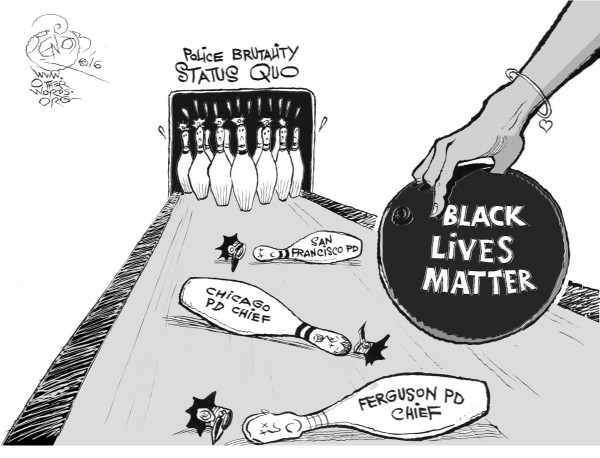
    Ramakrishnan argues crops should not be judged on whether they are GM or not.

    “GM as a technique is no more dangerous than any other agricultural technique. What most scientists believe is that any new crop we introduce needs to be tested on a case-by-case basis according to its traits, not how it was reproduced.”

    Among the concerns about GM raised by environmental groups and NGOs is the risk that large companies may monopolize agriculture and wield too much power over growers.

    “I can understand how a backlash happened against GM. But the solution is not to ban GM, it’s to take it out of the hands of a few corporations,” Ramakrishnan says.

    Via RT. This piece was reprinted by RINF Alternative News with permission or license.

    TSA security chief removed from position over “mismanagement”

    0

    The US Transportation Security Administration (TSA) has removed its head of security from his post following a US House of Representatives hearing earlier this month.

    The Oversight Committee met on May 12 to discuss long lines at airport security checkpoints and criticized the TSA for paying out more than $90,000 in bonuses and awards to head of security, Assistant Administrator Kelly Hoggan over a 13-month period.

    READ MORE: Head of TSA addresses retaliation against whistleblowers, long lines at airports 

    Hoggan’s dismissal was confirmed by the Oversight Committee on Twitter Monday night.

    TSA Administrator Peter Neffenger had been questioned by the committee about why Hoggan was awarded such bonuses when waiting times in security lines were not improving.

    He was also quizzed on retaliatory techniques used by management against whistleblowers.

    READ MORE: ‘Are you f**king kidding me?’: YouTube video showcases ludicrously long TSA line 

    The TSA has felt a major public backlash as passengers in airports across the US experienced excessively long waiting times and missed flights due to lengthy security lines. The frustration even spurred a hashtag #iHateTheWait and a viral video.

    The TSA has blamed the long waits at security checkpoints on federal budget cuts which resulted in the loss of thousands of staff in 2014.

    The agency has yet to comment on Hoggan’s dismissal, but announced several changes to its management in an internal memo on Monday, according to CNN.

    “These adjustments will enable more focused leadership and screening operations at critical airports in the national transportation system,” Neffenger reportedly wrote in the leaked memo.

    READ MORE:TSA Hell: Passengers in Chicago miss flights due to lines at security checkpoints 

    Via RT. This piece was reprinted by RINF Alternative News with permission or license.

    Obama calls for peaceful resolution of S China Sea disputes

    0

    US President Barack Obama has called for the peaceful resolution of territorial disputes in the South China Sea during a speech in Vietnam, saying Washington supports Hanoi’s territorial claims.

    Obama made the statements on Tuesday just a day after lifting a decades-long ban on the sale of lethal arms to Vietnam, a move which is likely to anger China and pave the way for an escalation of tensions in the region.

    “In the South China Sea, the US is not a claimant in current disputes, but we will stand with our partners in upholding key principles like freedom of navigation,” Obama said.

    Obama said Washington supports Vietnam’s territorial claims against Beijing in the South China Sea and promised it greater access to military equipment.

    “Vietnam will have greater access to the equipment you need to improve your security,” Obama said. “Nations are sovereign and no matter how large or small a nation may be its territory should be respected.”

    In a…

    Read more

    US urges militants groups in Syria to respect truce

    0

    The US Special Envoy for Syria has urged militants groups to observe a tenuous nationwide ceasefire after they gave its brokers 2 days to stop a government offensive near the capital Damascus.

    “We recognise that the CoH (Cessation of Hostilities) is under severe stress, but believe that to abandon it now would be strategic error,” Michael Ratney said in a statement posted late Monday on Twitter.

    “If the armed factions abandoned the CoH, Assad and his supporters would claim this gives them licence to attack all the opposition forces without international objection,” he warned.

    “Please know that we share your concerns and have raised them directly today with senior Russian officials,” Ratney said. “We urge all armed factions to continue to submit violation reports to the United Nations,” he added.

    On Sunday, 29 militant groups set the deadline for the US and Russian sponsors of the February 27 truce to halt an offensive by President Bashar al-Assad’s…

    Read more

    Accepting Assad? Fallon’s Syria policy coming unstuck as MPs question war aims

    0

    UK Defence Secretary Michael Fallon’s Syria policy is under growing pressure amid rumors MPs may quietly favor a decentralized system of government in Syria which would weaken President Bashar Assad, but leave him in power.

    Fallon is expected to give his first full assessment of the situation in Syria to the House of Commons on Tuesday.

    It will be his most far-reaching speech on the topic since British MPs voted to extend bombing from Iraq into Syria in early December 2015.

    The statement comes as reports circulate that, contrary to the British government’s official position, MPs are in favor of a cantonment system in Syria that would trim Assad’s power, but leave him in place.

    It is thought ministers now believe such a system is the only hope for long-term stability in the war-torn country.

    Fallon is also expected to announce that despite much clamor about British airpower capabilities at the time of the vote, a mere 42 bombs have been dropped on Syria.

    Fallon may face a challenging two days. He is also due to appear before the Defence Select Committee on Wednesday to give further evidence on progress in the war.

    “The UK must punch above its weight in diplomatic negotiations and stop [Russian President Vladimir] Putin dictating the state of play in the conflict,” Liberal Democrat foreign affairs spokesman Tom Brake told the Guardian on Tuesday

    Despite concerns over Assad’s future, the UK’s military focus remains on the Islamic State (IS, formerly ISIS/ISIL) for now.

    “Closing in on Daesh [IS] in Raqqa [the group’s de-facto capital in Syria] and on Mosul in Iraq will be a landmark event in the fight against Daesh,” Brake said of the coalition strategy.

    However, he warned “the international coalition must have a coherent plan” to avoid a humanitarian disasters like “Stalingrad” in the face of desperate IS attempt to “hold on to their warped self-declared caliphate.”

    Via RT. This piece was reprinted by RINF Alternative News with permission or license.

    Syrian Al-Qaeda-linked leader freely visited the US, but State Dept. says it ‘didn’t know’

    1

    A Syrian militant group chief shielded from the UN terror list by the US despite its links to ISIS and Al-Qaeda reportedly had no trouble entering Washington on a European passport. The State Department refused to speak on “visa records.”

    Labib al Nahhas, who calls himself “a chief of Foreign Political Relations at Ahrar al-Sham,” arrived in the US capital for a visit lasting a few days in December, according to McClatchy DC news. The report cites “four people with direct knowledge of the trip.”

    As one of them told the network’s reporter, Nahhas arrived in the US to speak with “third parties” even though he would not elaborate further. The other speakers revealed a few more details about the visit, saying that Nahhas had been in Washington to meet with lobbyists and Middle East researchers.

    Born in Madrid to a Syrian Muslim father and educated in the UK, Nahhas has been using his European roots to reach out to western officials on behalf of Ahrar al-Sham, a group which espouses a strict Salafist form of Sunni Islam and has fought in alliances with Al-Qaeda-linked fighters. In mid-May, Ahrar al-Sham admitted its involvement in a brutal raid at an Alawite Syrian village, reportedly alongside fighters from internationally-recognized terrorist group Al-Nusra Front.

    Well-versed in social media and fluent in English, he has been spreading Ahrar al-Sham’s agenda on Twitter and via op-eds, including respected publications such as Britain’s The Daily Telegraph.

    RT asked the State Department’s spokesperson Mark Toner whether US officials were aware of that visit in December. He suggested his office did not know about it at all.

    “I’m not sure that we were aware of it,” Toner replied. “I don’t believe he had any meetings here, certainly, but – and I can’t speak to visa records. It’s a privacy consideration, so I don’t have much detail I can share with you regarding whether he received a visa to come here.”

    While Nahhas’ visit still might seem curious given the US’s scrutiny when it comes to visitors with suspected terror links, the Syrian opposition did not consider this visit to be anything unusual. As one opposition official explained to McClatchy, Ahrar al-Sham was “not among US-designated terrorist groups.”

    Yet, in Washington, Ahrar al-Sham’s links to recognized terrorists are well-known. In fact, the US shielded the group from the United Nations’ blacklist, which would officially exclude it from the Syrian ceasefire and allow it to be attacked along with Islamic State and Al-Qaeda.

    On May 11, Washington blocked a Russian proposal to the UN to delegitimize Ahrar al-Sham along with another group called Jaysh al-Islam over their regular violations of the Russia-US brokered ceasefire. The US’ decision was also shared by Britain, France and Ukraine.

    “Russia is publicly attempting to designate groups that are parties to the cessation of hostilities,” the State Department said on that day. “Such actions, we continue to believe, would have damaging consequences to the cessation just as we are trying to de-escalate the situation on the ground.”

    When asked about obvious similarities between groups such as Ahrar al-Sham and the sanctioned Al-Nusra Front and Al-Qaeda, the Department said that it was continuing “to have dialogue” with them, but still has not changed its position.

    The next day after the statement, insurgents from Ahrar al-Sham together with Al-Nusra fighters captured an Alawite village Zara from government control in western Syria, brutally killing and kidnapping civilians.

    Ahrar al-Sham admitted responsibility for the raid, but told Reuters that it did not touch those who did not resist.

    “Civilians were not targeted. On the contrary factions made great effort to spare civilians and deal with prisoners humanely,” the groups spokesman said.

    However, villagers who spoke with RT Arabic called the raid “a massacre,” saying that militants killed elders and “entire families,” kidnapped children and women.

    On Monday, RT’s Gayane Chichakyan presented Toner with a graphic photo allegedly from the attacked Alawite village, showing militants standing on corpses.

    When asked whether the US still believes that “this group cares much about the cessation of hostilities,” the State Department’s spokesperson said that he did not know about the “incident.”

    “I don’t know about that particular incident. I can look into it,” he replied, reiterating America’s support to the members of the Syrian opposition’s High Negotiations Committee (HNC).

    Last week, another State Department spokesperson, John Kirby, tried to shift the blame onto the International Syrian Support Group (ISSG) and “more than twenty nations.” He stressed that Russia was among those countries, which agreed that only Islamic State and Al-Nusra would be excluded from the ceasefire.

    When asked by RT why the US was blocking Russia’s proposal at the UN to extend the UN blacklist, Kirby said he would not “get into internal deliberations.”

    Instead, he went on to accuse Gayane Chichakyan of “trying to put everything on the United States” and referring her to “all the members of the ISSG.”

    The question about the motives behind Washington’s decision at the UN was left unanswered.

    Via RT. This piece was reprinted by RINF Alternative News with permission or license.

    Trump tapping into ‘inherent racism’ in US society: Jimmy Carter

    0

    Former US President Jimmy Carter says presumptive Republican presidential nominee Donald Trump is tapping into the “inherent racism” in American society to promote his election campaign. 

    “I don’t feel good, except for one thing: I think the country has been reawakened the last two or three years to the fact that we haven’t resolved the race issue adequately,” Carter told The New York Times on Monday.

    “[Trump] has tapped a waiting reservoir there of inherent racism,” he said of the New York businessman.

    Carter said Trump is just one example of Republican animosity toward America’s first black president, Barack Obama, that exudes a “heavy racial overtone.”

    “I think there’s a heavy reaction among some of the racially conscious Republicans against an African-American being president,” he said.

    The 91-year-old Nobel peace laureate also said Trump’s call for a ban on Muslims entering the United States undermines global human…

    Read more