Iraq blasts kill 12, injure 23

0

Iraqis inspect the site of a blast in a car park at the rear gate of the state-owned North Oil Company, about 15 kilometers (nine miles) from the northern city of Kirkuk. (file photo)

Several bomb blasts across Iraq, including two car bombs and a roadside blast in the northern city of Kirkuk, have killed 12 people and injured 23 others, officials say.

Eight people died and as many others were injured Wednesday as a bomb went off in Kirkuk on Wednesday.

Two people were killed in a roadside bomb attack on Kirkuk police chief’s convoy. Nine people were injured in the attack.

A separate bomb attack on a police checkpoint in Tarmiyah, north of the capital Baghdad, left one policeman dead and four others wounded. In the northern city of Mosul, a roadside bomb killed once policeman and injured two others.

The United Nations Assistance Mission for Iraq (UNAMI) said on May 2 that April had been the deadliest month in Iraq since 2008 as terrorist acts killed over 700 people and injured more than 1,600 others across the country.

MR/KA

This article originally appeared on : Press TV

Japan poised for first permanent reactor closure following Fukushima

0

Experts determined an active geological fault line lies underneath a reactor on Japan’s west coast, a discovery which will likely result in the first permanent shutdown of a nuclear power plant since the 2011 Fukushima crisis.

The report by the panel of five seismologists advising the
Nuclear Regulation Authority (NRA) is the first issued on its
investigation into active fault lines at the Tsuruga plant, which
is located on the Japan Sea coast. The Tsuruga plant — which has
been operating for 43 years — has two reactors, with the fault line
having been discovered directly under the idled No. 2 reactor.

“Safety levels [at Tsuruga] have been low and it is really just
a matter of luck that there hasn’t been an accident,”
Reuters
cites Kunihiko Shimazaki, the head of the panel and a commissioner
of the NRA, as saying after the report was finalized. “We are
taking the first steps to correct the situation.”

The NRA is set to determine the Tsuruga plant’s fate at its regular
meeting scheduled in a week’s time. The experts’ finding is
likely to kill any chance the reactor will ever be reactivated, as
government regulations prohibit the construction of reactor
buildings directly above any active fault line.

NRA chairman Shunichi Tanaka has previously said that no evaluation
for the resumption of operations at the Tsuruga plant would be
conducted if an active fault was found, Japan’s Asashi Shimbun
reported.

Japan Atomic Power Co., which operates the two-reactor Tsuruga
station, reacted to the findings with disbelief, accusing the panel
of bias.

“We deeply regret that they made such a conclusion this time and
it is absolutely impossible for us to accept it,”
the company
said in a statement.

“We hereby ask the panel of experts to come to a fresh
conclusion after reviewing existing data with a neutral and fair
point of view, with discussion on a strictly scientific basis and
clarification of the grounds of understanding.”

The mayor of Tsuruga Kazuharu Kawase said on Monday he was worried
nuclear regulators were rushing “towards a conclusion”
regarding the atomic plants fate, adding that Japan Atomic Power
had yet to finish its own investigation.

“I want the NRA to cautiously deliberate the matter from a broad
viewpoint, reflecting the outcome of the operator’s investigation
and various opinions in and outside the country,”
the Japan
Times cites him as saying.

Japan Atomic Power has claimed the fault is inactive based on its
analysis of volcanic ash, which they say shows no signs of recent
movement. The panel has dismissed the claim as unreliable.

The experts determined that the fault, a zone of pebbles and
sediment dubbed D-1, could shift simultaneously with two others:
one known as K and the other an active major called Urazoko.

The K fault, which has apparently moved within the past 130,000
years, is therefore considered to be technically active. They
further say that the D-1 fault is also active as it is a part of
this structure, while the Urazoko fault is located some 200-300
meters from the reactor buildings.

Japan’s nuclear operators have faced massive losses following an
earthquake and tsunami in March 2011, which caused three reactor
meltdowns at the Fukushima Daiichi plant.

Currently, 48 of the country’s 50 nuclear reactors are suspended
from operations, although the country’s nuclear industry had
expected early restarts based on past experience with
regulators.

“It is no longer business as usual. This is the beginning of a
long-term restructuring of the nuclear power business in
Japan,”
a senior adviser on atomic policy told Reuters on
condition of anonymity.

The experts will conduct a total of six studies on faults at six
locations near nuclear plants.

With the atomic industry faltering, last week Japan’s ruling
Liberal Democratic Party (LDP) promised to bring the country’s
nuclear reactors back into service once they had been verified as
safe.

The country’s public remains ambivalent about the government’s
nuclear plans, according to a poll published in the Tokyo Shimbun
newspaper in March.

While 79.6 per cent of those questioned were at least moderately in
favor of parting with nuclear power eventually, 69 per cent said
they would support the restarting of some nuclear reactors to
fulfill the Japan’s current power needs.

The same month the poll was conducted, some 13,000 people gathered
in Tokyo to protest the continued use of nuclear power in Japan
nearly two years after the Fukushima disaster.

This article originally appeared on : RT

Peace in Syria? Only if the arsonists become fire-fighters

0

The prospects of a peaceful solution to the Syrian crisis is still a long way off. We won’t get an end to the violence until the foreign powers who have been fuelling the conflict, the US included, radically change their policies towards the country.

RT reports that following the visit of US Secretary of State
John Kerry to Moscow this week, the US and Russia have
“reiterated their commitment to bringing the sides of the Syrian
conflict to the negotiating table, and that they have announced an
international conference to be called by the end of May which will
serve as a follow-up to the Geneva communiqué. The Geneva
communiqué should be a roadmap to a new Syria, not a forgotten
piece of paper, Russian Foreign Minister Sergey Lavrov and US
Secretary of State John Kerry told reporters after their

Tuesday Moscow meeting.“

So is it time to toast the imminent end of a terrible, bloody
conflict which, according to a UN estimate in February, has cost,
up to then, around 70,000 lives?

As Sergey Lavrov pointed out on Wednesday, the Syrian government
has for a long time shown a willingness to talk, but their
readiness to make compromises to find a peaceful, political
solution to the conflict has not been matched by the so-called
‘rebels’. Instead of using their influence to pressurize
anti-government militia to lay down their arms and to negotiate
directly with Damascus, the foreign supporters of the rebels have
been egging them on to intensify their campaign to violently
overthrow the Syrian government. It’s a campaign which has involved
some appalling acts of terrorism, such as last week’s bombing of a
main square in Damascus in which at least 13 people were
killed.

These countries stoking the conflict in Syria have, up to now,
not been interested in compromises, or in allowing the Syrian
people to decide their own future, as the new 2012 Constitution
allows them to do, but have been hell-bent on achieving ‘regime
change’
for geo-strategic reasons- most importantly to ‘knock
out‘ the strongest regional ally of Iran.  

US Secretary of State John Kerry is welcomed at Vnukovo airport.(RIA Novosti / Vitaliy Belousov)

Despite John Kerry’s support for an international conference, he
has still to rule out direct US military aid to the rebels. When
asked about the bill recommending the direct arming of the rebels
which is before Congress, Kerry said that the future of the bill
would depend “to some degree on the state of the evidence in
respect to chemical weapons”
. Yet only a few days ago, Carla
Del Ponte of the UN Commission of Inquiry said that there was
“no, no indication at all” that the Syrian government had
used chemical weapons, on the contrary she said there were
“strong, concrete suspicions” that the opponents of the
government themselves had used them.

If the US stance still leaves a lot to be desired, the position
of the UK in relation to Syria is arguably even worse. The UK’s
neo-conservative dominated government is trying all it can to
pressurize other EU countries to lift the Syrian arms embargo.
Today we hear that they have sent a ‘discussion paper’ to
other EU members making the case either for a total lifting of the
ban or an easing of it.

But the UK government’s line is deceitful. They claim they
want to help the ’good’ i.e. non radical Islamist rebels,
yet a report in the New York Times claimed that “nowhere in
rebel-controlled Syria is there a secular fighting force to speak
of.”
We’ve already had the al-Nusra front, one of the largest
groups which make up the ‘rebels’ openly pledging their
allegiance to al-Qaeda but that still isn‘t enough to change the
UK’s policy. The double standards are breathtaking: the UK
government which gave support to the French military action against
al- Qaeda linked radical Islamists fighting the authorities in
Mali, is spending British taxpayers’ money on helping an uprising
dominated by radical Islamists to topple a secular government in
Syria.

A Syrian soldier sits inside a tank as troops take control of the village of Western Dumayna, some seven kilometers north of the rebel-held city of Qusayr, on May 13, 2013.(AFP Photo / Joseph Eid)

Peace will only come to Syria when the foreign countries
currently menacing it start acting as fire-fighters and not
arsonists. That means telling the rebels that its time to end their
campaign of violence and to negotiate directly with Damascus. It
also means accepting that whether or not President Assad and the
Ba’ath Party continue to rule Syria, is up to the Syrian people
alone, and not the US, Turkey, Qatar, Britain, France, Saudi
Arabia, Jordan, Israel or indeed anyone else. 

The trouble is that the countries concerned have invested so
much time and money into trying to topple Bashar al-Assad that it’s
highly unlikely that they’ll change direction now, even though
continuing with their destructive, destabilizing policies towards
Syria only means that the bloodshed will continue.

Neil Clark for RT

The statements, views and opinions expressed in this column are solely those of the author and do not necessarily represent those of RT.

This article originally appeared on : RT

Palestinian refugees attacked in Syria

0

A file photo shows destruction after an attack by foreign-backed militants on the Yarmouk Palestinian refugee camp.

Palestinian refugees in Syria have come under fire from foreign-backed militants fighting against the government of President Bashar al-Assad, Press TV reports.

The incident happened after around 1,000 refugees protesting against their expulsion by the militants from the Yarmouk refugee camp in Damascus tried to enter the camp on Wednesday.

The refugees were driven out of the camp almost seven months ago.

Å“…We want to get back to our refugee camp which was the birthplace of our revolution and the resistance against the Zionist [regime of Israel]. The camp is not just the shelter for us, but part of our identity. We maintain our right to return…,” said a refugee.

The foreign-sponsored militants fired mortar shells on the protesters, injuring at least five people, including army soldiers who rushed to the scene.

Å“Iâ„¢m from the refugee camp. I left the camp four months ago…. I have a mentally ill son who needs medicine. Today they said they might let us into the camp but as we wanted to enter, they started shooting at us from inside the camp. Why are they shooting at us? How long should we stay out of our houses? I have been here in Syria for 66 years and this country has done nothing bad to us,” said another resident of the camp.

Yarmouk refugee camp has borne the brunt of the turmoil in Syria over the past months. In September 2012, twenty people were killed in a mortar attack by militants on the camp.

On February 6, a bomb attack targeted the refugee camp and on January 7, two people were killed in a sniper attack by militants at the camp.

The Syria crisis began in March 2011, and many people, including large numbers of soldiers and security personnel, have been killed in the violence.

MR/KA/SS

This article originally appeared on : Press TV

Iraq blasts kill 12, injure 23

0

Iraqis inspect the site of a blast in a car park at the rear gate of the state-owned North Oil Company, about 15 kilometers (nine miles) from the northern city of Kirkuk. (file photo)

Several bomb blasts across Iraq, including two car bombs and a roadside blast in the northern city of Kirkuk, have killed 12 people and injured 23 others, officials say.

Eight people died and as many others were injured Wednesday as a bomb went off in Kirkuk on Wednesday.

Two people were killed in a roadside bomb attack on Kirkuk police chief’s convoy. Nine people were injured in the attack.

A separate bomb attack on a police checkpoint in Tarmiyah, north of the capital Baghdad, left one policeman dead and four others wounded. In the northern city of Mosul, a roadside bomb killed once policeman and injured two others.

The United Nations Assistance Mission for Iraq (UNAMI) said on May 2 that April had been the deadliest month in Iraq since 2008 as terrorist acts killed over 700 people and injured more than 1,600 others across the country.

MR/KA

This article originally appeared on : Press TV

Charter Schools: Obama’s Way to Serve Coporate America — Getting Rid of Union Teachers Who Voted for Him

0

NATIONAL TEACHERS Appreciation Week, traditionally the first full week of May, passed this year without even a token statement from Barack Obama. Instead, the White House issued a presidential proclamation honoring the same weeklong period as…National Charter Schools Week.

Yep, you read that right. Barack Obama—who got the votes of millions of teachers last November and whose party depends on hundreds of millions of dollars in political spending by teachers’ unions and the rest of organized labor—not only couldn’t be bothered to utter a symbolic good word about teachers. He went out of his way to celebrate an initiative of the Republican Bush administration that spotlights a centerpiece of the anti-teacher school deform agenda.

If you’re a regular reader of SocialistWorker.org, you’ll know that there’s a long history of the Democrats talking populist when they’re asking for the votes of their working-class and liberal base of support—but acting quite differently when “the party of the people” is in office.

But Obama and Co. seem almost eager to rub their supporters’ faces in it.

Teachers aren’t the only example. At election time, one of the most reliable appeals for voting Democratic is to raise the specter of Republicans taking away a woman’s right to choose. The urgent pleas of pro-choice supporters in 2008 and 2012 to vote for Obama were a stark contrast to his administration’s neglect of the issue.

This week, though, the Obama administration took action on reproductive rights, appealing in court for…continued restrictions. In April, a federal judge struck down an Obama-era rule barring women younger than 17 from obtaining the Plan B “morning-after” pill without a prescription. This Monday, the Justice Department of a pro-choice Democratic president asked a higher court to overturn that decision.

Its reasoning for stopping the judge’s order from going into effect—that women would become “confused” if they gained unrestricted access to Plan B, only to have it taken away later if the Obama administration succeeded in its appeal—was a glaring and infuriating display of contempt for women and their rights.

There are plenty more examples. The willingness of Obama and the Democrats to give ground to Republicans on issue after issue while kicking their own base in the teeth has come into particularly sharp focus this spring. It’s worth pointing out that these are also the opening months of Obama’s second term, during which the president was, according to some liberal commentators writing before the election last year, supposed to prove he was a true progressive after all.

This isn’t a new insight into the nature of the Democratic Party, by any means. But the importance of the lesson that flows from it—anyone who wants to see change must rely not on allies in high places, but the collective strength of our struggles and our movements—is all the more crucial to remember as activists mobilize around the urgent issues we face today, from immigrant rights to climate justice and more.

– — – — – — – — – — – — – — – –

THE REPUBLICAN Party and the Democratic Party aren’t identical. If they were, there wouldn’t be any reason to have two of them.

Most of the time, most Democrats stand to the left of most Republicans. That’s a big part of why Democrats are effective in carrying out an agenda that serves the political and social status quo. They can win the votes and political support of masses of ordinary people well to their left who fear even worse from the other guys.

But some of the time, there’s not even the proverbial dime’s worth of difference between Democrats and Republicans. Charter schools and the corporate school deform agenda are a prime example.

The standardized testing mania, scapegoating of teachers and encroachment of private interests into public education began in earnest under George W. Bush with his No Child Left Behind law. But Obama took over the Bush program for public schools and kicked it into high gear. His administration’s Race to the Top program dangled billions of dollars in front of state governments, in return for passing “reform” laws that tied teacher evaluation to test scores and opened the way for more charter schools, among other measures.

Obama and his Education Secretary Arne Duncan were speaking glowingly about charters long before National Charter Schools Week. The language of Obama’s proclamation is typical: “These learning laboratories give educators the chance to try new models and methods that can encourage excellence in the classroom and prepare more of our children for college and careers.”

Every part of that statement flies in the face of the facts. Charter schools prepare fewerof our children for anything at all, because the private operators who run schools with public funds get to exclude the students they don’t want.

For example, a 2011 study of 14 Florida school districts found that more than 86 percent of charter schools didn’t have a single student with a severe disability, compared to more than half of district public schools that did. The pattern is similar with homeless students. As education expert Diane Ravitch reported at a 2010 hearing, “New York City has 50,000 homeless students, but only about 100 are enrolled in a charter school. If a proportionate number were in charters, there would be 1,500, not 100.

In other words, charter schools on the whole take the students they want from public schools—preferably, those without special needs that cost more money—and leave the rest behind in a system that’s even more starved for financial resources, thanks to the subsidies for charters.

And even so, charter schools can’t demonstrate that they do any better at educating the students they do take. On the contrary, a 2009 study by the respected RAND Corporation, for example, analyzed charter schools in five major cities and three states, and found that in every location, students in the charter schools performed no better at best, and demonstrably poorer at worst.

So why the zealous cheerleading for charter schools? The answer: Follow the money.

Follow the money in a direct sense—more than one-third of charter schools were run by for-profit companies as of 2010, according to the National Alliance for Public Charter Schools. Public school privatization is proving to be an even bigger bonanza in other areas—companies like Rupert Murdoch’s News Corp. are scrambling to get their hands on the billions to be made off the standardized testing bonanza.

But you can also follow the money in an indirect sense. The charter school crusade is aimed squarely at the power of the teachers’ unions—according to Diane Ravitch, 90 percent of charters are non-union. Charterization has become a dependable way to get rid of well-paid, veteran, union teachers—and replace them with educators who labor under the conditions described by one Ohio teacher in a comment at Ravitch’s website:

I’ve been an educator in Columbus, Ohio, since university. In my eighth year, I currently earn $34,000 before taxes at a 9-12 charter school. I can be fired at any time. I have no tenure, no union and scarce resources to teach…My family needs the money I earn, so I must teach, but I just pray a public school gives me a chance.

Teachers and education workers are one of the last remaining strongholds of the union movement—around three in every 10 union cards in the U.S. are held by members of the American Federation of Teachers or National Education Association. An injury to those unions through charterization is an injury inflicted on the whole working class, to the benefit of the bosses.

Plus, there’s the ideological angle. Charter schools are promoted by free marketeers, liberal and conservative alike, who claim that the private sector always does a better job than wasteful, corrupt, bloated big government.

Actually, it’s abundantly clear that the private sector is a cesspool of waste, corruption, bloat and worse—which is why the charters need a vigorous, pay-no-attention-to-that-man-behind-the-curtain public relations campaign, with the president of the United States serving as cheerleader-in-chief.

– — – — – — – — – — – — – — – –

REPUBLICANS AND their media mouthpieces like Fox News still like to portray the Democrats as tools of organized labor, but it’s hard to believe anyone buys that any more.

Labor’s political power has been shrinking with its membership numbers for decades, while business’ spending advantage in elections expands with each cycle. But more to the point, the leadership of the Democratic Party has molded itself so completely into the role of servants to Corporate America that it doesn’t even bother with the old symbolic gestures any more.

As historian Van Gosse wrote after last year’s election, “The mass party of the center, birthed 20 years ago by Bill Clinton triangulating his way into a ‘socially liberal’ version of neoliberalism (or what used to be ‘liberal Republicanism’ in the days of Nelson Rockefeller and George Romney), has been brought to fruition by Barack Obama’s savvy Chicago apparatchiks.”

So it shouldn’t be any surprise that the Obama administration’s policies are bent and twisted in whatever ways are necessary to serve the interests of Corporate America, at the expense of the people who make up the main base of support for the Democrats.

But even as Obama and the Democrats thank their most devoted supporters with betrayals and insults, they won’t tolerate the least criticism from their base.

On this score, the Obama White House is every bit as belligerent as Democratic administrations that came before it—maybe more so. Thus, Joe Biden told anyone dissatisfied with the multitrillion-dollar bailout of Wall Street to “stop whining”; Obama himself mocked liberal critics of his health care law for “seeing the glass as half empty”; and White House spokesperson Robert Gibbs sounded off against the “professional left” that would only “be satisfied when we have Canadian health care, and we’ve eliminated the Pentagon.”

In stark contrast to their timid attitude in confrontations with Republicans, the Democrats save their real venom for anyone to their left who dares to hold them accountable for the policies and principles they claim, usually at election time, to stand for.

You don’t have to go far on the Internet to find a liberal commentator who fumes about this two-faced behavior. But all too often, even critical voices accept that the only “realistic” course in a two-party system is to seek to influence their Democratic “allies.”

But is it realistic to expect working people to get a hearing from a party that is so intent on listening only to the demands and dictates of Corporate America?

Or is it more realistic to rely—as the most important struggles for change in history always have—on the power of mass mobilization and action at the grassroots to build a political alternative that breaks out of the confines of the two-party political system?

This article originally appeared on : Global Research

What Are These Weird Street Signs Being Installed in Las Vegas?

0

Part of ‘Intellistreets’ rollout?

Paul Joseph Watson
Infowars.com
May 15, 2013

Strange new street signs being installed across Las Vegas are prompting suspicions from concerned readers, one of whom sent us the following images. Are these new signs part of the nationwide ‘Intellistreets’ rollout of so-called “smart” hubs that eavesdrop on conversations?

Image: Infowars.com

“My neighbor brought it to my attention that these very suspicious-looking road signs are being installed throughout Las Vegas on the major streets,” David wrote to us. “The enormous amount of road construction they are doing to install these must cost someone (the taxpayers, I’m sure) a fortune. My neighbor was quite alarmed when he saw these. He took photos and has been asking everyone if they know anything about them-no one will say anything; even the construction workers actually installing have no info about them. The signs are obviously electronic with large control boxes and antennae attached.”

Although it was reported last year that 41,000 new LED street lamps were being installed throughout Las Vegas, these devices don’t appear to be for lighting, they appear to be for displaying digital messages.

As we previously reported, the Intellistreets system which is currently being installed in cities across the US relies on “smart” street lamps connected by a ubiquitous wi-fi network that have numerous “homeland security applications,” including the ability to “engage captive audiences” via a loudspeaker system and give audible warnings to individuals.

The system is “also capable of recording conversations,” according to a report by ABC 7.

The lights can also be fitted with a digital display similar to the one seen in the photos below which can be used for both advertising and security announcements.

The company behind the street lights, Illuminating Concepts, responded to the controversy over ‘Intellistreets’ last year by ludicrously claiming the system did not represent a “big brother” intrusion. ABC 7 confirmed that the company was “working with Homeland Security” to implement the high tech network.

If any of our readers are aware of the purpose of these new street signs in Las Vegas, please let us know in the comments below.

Click for enlargements.

*********************

Paul Joseph Watson is the editor and writer for Infowars.com and Prison Planet.com. He is the author of Order Out Of Chaos. Watson is also a host for Infowars Nightly News.

<!–

–>

This article was posted: Wednesday, May 15, 2013 at 10:00 am

Tags: ,


<!– this is where we need to show the related articles

–>

This article originally appeared on : Infowars

Mobile-payment Service Square Blocks Gun Sales

0

Todd Sperry and James O’Toole
CNN Money
May 15, 2013

Image via Facebook.

The mobile-payment service, run by Twitter co-founder Jack Dorsey, amended its terms of service for retailers last week to ban sales of “firearms, firearm parts or hardware, and ammunition; or… weapons and other devices designed to cause physical injury.”

A Square spokesman declined to comment on this specific change, but said: “From time to time we revisit our policies governing the use of Square to ensure they are consistent with our values and in the best interests of our customers.”

He denied that the move was related to the recent debate over gun control in Washington, calling the timing “completely coincidental.”

Read full article

<!–

–>

This article was posted: Wednesday, May 15, 2013 at 9:58 am

Tags: , , ,


<!– this is where we need to show the related articles

–>

This article originally appeared on : Infowars

Eric Holder points finger at deputy who secretly obtained journalist’s phone records

0

dailymail.co.uk
May 15, 2013

Attorney General Eric Holder went on the defensive on Tuesday explaining why the Justice Department secretly obtained two months worth of reporters’ telephone records in an ‘unprecedented’ search for a confidential source.

‘This was a very serious leak and a very, very serious leak,’ Holder said at a press conference explaining the department’s actions which have been criticized for going against the constitutional right to a free press.

Holder said that he recused himself from the making the controversial decision to subpoena the phone records of Associated Press journalists, saying that it was made by Deputy Attorney General James Cole.

Read more

<!–

–>

This article was posted: Wednesday, May 15, 2013 at 9:56 am

Tags: ,


<!– this is where we need to show the related articles

–>

This article originally appeared on : Infowars

Carney: Just Because IRS Apologized Doesn’t Mean They Did Anything Wrong

0

DANIEL HALPER
weeklystandard.com

“If I could then go back to the IRS issue,” said a reporter from the AP. “The president did use the word ‘if these activities had taken place,’ but there has been an acknowledgement on the part of the IRS leadership that these things did indeed occur. I wondered why the president used that phrasing in claiming that it was outrageous?”

“Those from the IRS that have spoken about this obviously have much greater insight into what took place than we do. We have not seen the report. We have not independently collected information about what transpired. We need the independent inspector general’s report to be released before we can make judgments. One person’s view of what actions were taken or what that individual did is not enough for us to say something concretely happened that was innapropriate,” said Carney.

<!–

–>

This article was posted: Wednesday, May 15, 2013 at 10:03 am

Tags: ,


<!– this is where we need to show the related articles

–>

This article originally appeared on : Infowars

Clashes as thousands of Palestinians mark 65 years since displacement

0

[unable to retrieve full-text content]Police and protesters were injured as Palestinians clashed with the IDF in Jerusalem and across the West Bank during rallies to commemorate the Nakba, or the ‘catastrophe’ of the displacement of Palestinians after the creation of Israel in 1948.

This article originally appeared on : RT

‘IAEA to resolve differences with Iran’

0

A senior official at International Atomic Energy Agency (IAEA) says the IAEA will work hard to resolves differences with Iran over the Islamic Republicâ„¢s nuclear energy program.

Å“As you know differences remain but we are committed to dialogue and we are determined to solve these issues so we will be working hard today to resolve the differences,” IAEA Deputy Director General Herman Nackaerts was quoted by Reuters as saying upon his arrival for talks at the Iranian diplomatic mission in the Austrian capital, Vienna, on Wednesday.

The Islamic Republic and the IAEA have opened fresh talks in Vienna to negotiate a technical framework for cooperation

Iran’s Ambassador to the IAEA Ali Asghar Soltanieh heads the Iranian delegation to the talks, while the IAEA delegation is led by Nackaerts, who is also the head of the Agencyâ„¢s Safeguards Department.

The ongoing talks are the 10th round of the negotiations between Iran and the IAEA over the Islamic Republicâ„¢s nuclear energy program since early 2012.

The previous round of the negotiations was held in mid-February in Iranâ„¢s capital, Tehran.

Meanwhile, Secretary of Iran Supreme National Security Council (SNSC) Saeed Jalili is also in the Turkish city of Istanbul for a meeting with EU foreign policy chief, Catherine Ashton, over the Islamic Republicâ„¢s nuclear energy program.

The United States, Israel and some of their allies falsely claim that Iran is pursuing non-civilian objectives in its nuclear energy program, with the US and the European Union using the claim as pretext to impose illegal sanctions against Iran.

Tehran rejects the allegation over its nuclear energy activities, maintaining that as a committed signatory to the Non-Proliferation Treaty and a member of the IAEA, it has the right to use nuclear technology for peaceful purposes.

MKA/SS

This article originally appeared on : Press TV

Mystery investor puts $1bn into new Russian gold mine

0

In an effort to double gold production by 2018, Russia’s largest gold producer, Polyus, has attracted $1bn in investment for the 3rd largest undeveloped gold deposit in the world.

Russian Federation Deputy Minister for the Development of the
Far East Dmitry Shelekhov confirmed the 32 million rouble
investment, but would not disclose the source, ITAR-TASS
reported.

The Natalka mine is the newest development from Polyus, and is
located 400 km from the seaport of Magadan, in the remote and
barren northeast corner of Russia.

The mining of precious metals is a lifeline for the local
economy, Magadan Oblast Governor Vladimir Petcheny told
ITAR-TASS.

Screenshot from polyusgold.com

Polyus, which accounts for nearly a quarter of Russia’s gold
mining, forecast the mine, which is slated to become Russia’s
largest, will have the capacity of 15 tons (1.3 million ounces) by
next year.

In total, the company has 1,836 tons (40.8 million ounces) in
gold reserves, and is the world’s third largest by this
criterion.

Since 2009 gold production in the Far East and Russia has
increased sharply, aided by a state-sponsored effort to boost gold
production after a steep decline from 2000-2009. Gold production in
the first quarter of 2013 increased 6% year-on-year to 320,000
ounces. Sales were estimated at $524 million, according to a
company trading update from April 2013.

Also according to the report, gold production in 2013 has been
reconfirmed between 1.59 and 1.68 million ounces, excluding assets
in Kazakhstan.

Billionaire oligarch Mikhail Prokhorov is the Chairman of the
Board, and approved the $31.3 million Natalka capital expenditure
in 2008. The company said it would spend $14 million throughout May
to install a ‘pilot plant’ and another $8.7 million to complete a
feasibility study.

Refined Gold Production

Refined gold production, 000 oz Q1 2013 Q1 2012 Change
Olimpiada 156.6 156.6 –
Blagodatnoye 86.5 83.6 3%
Titimukhta 34.0 21.8 56%
Verninskoye 11.0 6.4 71%
Alluvials 0.7 1.0 -30%
Kuranakh 31.8 33.1 -4%
Total refined gold production
from continuing operations
320.5 302.4 6%

Chief Executive Yevgeny Ivanov told Reuters in January he
expected the Natalka plant to be fully operational by 2012-2013, a
launched which has been repeatedly postponed. In the second quarter
of 2013, Polyus will review the option to start production at
Natalka in winter 2013-2014.

Presently the pilot plant is equipped with mining equipment,
drilling rigs, trucks, loaders, and cranes.

Two dormitories that sleep 275 were commissioned last year and
were completed in the first quarter of 2013, and currently 1,400
personnel are employed, according to the company’s website. By
2014, the plant will staff 2,000, and by 2023 upwards to 3,500.

On the New York Mercantile Exchange, June gold futures lost
$13.3, down to $1,412 per troy ounce. Prices fell on the news of
unemployment in Britain.

In April, the price of gold fell by 7.8%.

The company already operates many large-scale gold production
operations near the Natalka mine (see map).

This article originally appeared on : RT

The IRS wants YOU – to share everything

0

politico.com
May 15, 2013

The Internal Revenue Service asked tea party groups to see donor rolls.

It asked for printouts of Facebook posts.

And it asked what books people were reading.

A POLITICO review of documents from 11 tea party and conservative groups that the IRS scrutinized in 2012 shows the agency wanted to know everything – in some cases, it even seemed curious what members were thinking. The review included interviews with groups or their representatives from Hawaii, New Mexico, Ohio, Texas and elsewhere.

The long-awaited Treasury Department inspector general report released Tuesday says the agency itself decided some of its questions to conservative groups were way over the line – especially the one about donors.

Read more

<!–

–>

This article was posted: Wednesday, May 15, 2013 at 9:49 am

Tags: ,


<!– this is where we need to show the related articles

–>

This article originally appeared on : Infowars

France not in Mali to protect population, but 'ensure its position in Africa'

0

Keeping troops in Mali, the French leadership seeks to ensure its position in the continent it once used to dominate, not merely protect the Mali population from violence, Danyel Dubreuil, an activist against the French actions in Africa, told RT.

Dubreuil is also a spokesperson for Survie, an organization that
battles against colonialism.

RT: Given the security situation in Mali, is this
summit aimed at funding reconstruction good timing?

Danyel Dubreuil: It’s only the next stage in the
operation… At the beginning, the French government said that it was
meant to be only a military operation, and a short military
operation. However, after a few days they said they would have to
stay for a long time to rebuild the country, so now their goal is
to rebuild the country. So they have to find money anyway to do
that. 

RT: Mali is seeking 2 billion euro in compensation. Do
you think that pouring money into Mali help bring stability and
democracy as promised, or will we see another Afghanistan where
lots of money has little result?

DD: I don’t know about the comparison with Afghanistan,
but bringing so much money into a country never led to any results
in terms of development. If you look 50 years back, we did these
kinds of policies in countries like Mali. So it’s all the
conception of development policies that they have to change. And
pouring money into the system that is greatly corrupted [means
that] the money never goes to the people who really need them…You
have to have strong political institutions, strong policies that
aim to improve the conditions, the worst conditions of the
people.

A French soldier directs his colleagues while creating a barrier filled with sand at a French military encampment at a Malian air base in Gao.(Reuters / Joe Penney)

RT: Let’s turn to the French operation in Mali – why
exactly is Paris planning to keep a thousand troops in the country
even after UN peacekeepers take over later this year? Are we
looking at an occupation here?

DD: It depends on the side you’re looking at. If you’re
at the side of the French people, at the traditions we have since
1960, at the colonization time, we kept thousands of soldiers on
the African soil. We still have four permanent bases and 5,000
soldiers there. So now the question is whether they will
permanently stay in Mali. They spoke about 1,000 soldiers for an
indefinite period of time. The French government didn’t say they
would settle a new base in Mali, but they say they will stay there
as long as they need.

RT: What are the true intentions of Paris in this
ongoing conflict? Are we talking about sowing the seeds of
democracy, or are we talking, more simply, about protecting the
natural resources in the best economic interest of France?

DD: It’s to restore the French position in Africa, as
this part of the world has been directly targeted by a lot of
powerful countries who were looking for natural resources. And
France has a traditional strong position in this continent. They
are looking not to lose this position, they are showing [their]
muscles, if you want.

This article originally appeared on : RT

New spy game post-Boston? Russia, US seek common ground amid scandal fallout

0

[unable to retrieve full-text content]The Kremlin has expressed regret over the Moscow spy scandal, saying signals sent by the US leadership were not heard by the CIA. Russia is to contact the CIA director over the matter.

This article originally appeared on : RT

Russia surprised by “clumsy” US spying

0

[unable to retrieve full-text content]The Kremlin has been surprised by the “crude and clumsy” US espionage activities in Russia, an aide to Russian President Vladimir Putin says.

This article originally appeared on : Press TV

Cop killers to receive life imprisonment

0

[unable to retrieve full-text content]Criminals who kill police officers in England and Wales will receive whole-life sentences, Britain’s Home Secretary Theresa May has announced.

This article originally appeared on : Press TV

HRW urges Bahrain to probe torture claims as 6 more tweeters jailed

0

[unable to retrieve full-text content]Human Rights Watch demands Bahrain immediately probe numerous allegations of torture, saying its refusal could signal the country has become a haven for torturers. This comes as six more tweeters get jail terms for ‘abusing freedom of expression.’

This article originally appeared on : RT

Does the Internet Have a Libertarian Future?

0


 Standard Podcast Hide Player | Play in Popup | Download

Yes, no matter the State’s dastardly plans, Paul Rosenberg tells Lew Rockwell.


Beyond theory — the practice of building socialism in Latin America

0

Global Research Editorial Note

In the interest of sharing diversity of opinions and promoting an open atmosphere of exchange and critique with our colleagues we bring to the attention of our readers the following text by Jorge Capelán and Toni Solo.

This text is a response to my work. It  should be read after the following texts:

The Pink Tide in Latin America: An Alliance Between Local Capital and Socialism?

By Mahdi Darius Nazemroaya, May 03, 2013

Post-Chavez Latin America Will Continue to Drift Away from the United StatesBy Mahdi Darius Nazemroaya, April 01, 2013

Although I think that the text misconstrues some of my points and I have disagreements with it, such as about the orientation of the Brazilian government as a socialist one, the critique provided in Jorge Capelán’s text is important and valuable for a frank discussion about Latin America. Overall, the position below and mine have more in common than differences.

Some very important points are raised by the authors. This includes the critique on the distance from reality that the theories of academia can embody and the importance of context. Their concluding remarks are also a testimony that Latin America is progressing.

Mahdi Darius Nazemroaya, May 15, 2013


Correction and apology: In an earlier version of this article we incorrectly asserted that James Petras co-signed a letter in 2008 with Noam Chomsky and other leading intellectuals which, in the article, we criticize. This is not the case. We apologize to James Petras for this mistake on our part. We request anyone who has re-posted this article to add this text to the top of wherever they posted our article.

For the imperial propaganda machine, leftist Latin American governments and political leaders are either too leftist, not really leftist, or blind fanatics, as well as being shrewdly machiavellian, capitalists in red clothing, enemies of the market and scores of other contradictory pairs of things all at once.

This is so because the purpose of propaganda is to render unusable the intellectual capacity of the target population to understand reality. By promoting mistrust, anxiety and confusion among those sections of the public in the imperialist countries that might oppose the designs of their rulers, the war planners seek to neutralize any effective solidarity efforts.

Sadly, most European and North American progressive and radical movements and intellectuals have problems coming to terms with this, no matter what their experience, reputation or insights into what the Empire routinely does to humanity.

Without direct involvement in them, virtually none of those intellectuals can offer a true and fair view of Latin America’s various revolutionary processes. They may offer plausible theories and schemas, but the nitty gritty of achieving power and effecting radical change will always elude them. Examples of this fact abound.

Depending entirely on academics like Noam Chomsky, or James Petras, for example, for a grasp of events in Latin America is a mistake. Those writers theoretical preconceptions tend to fall apart when applied to specific realities. One need not follow the anti-Stalinism of the historian E.P.Thompson into its ultimate social-democrat cul-de-sac to acknowledge the central argument of “The Poverty of Theory” against idealist theory.

The article “Pink Tide in Latin America: An Alliance Between Local Capital and Socialism” by Mahdi Darius Nazemroaya published on May 3 by Global Research is an example of this sad truth. In the final paragraphs of his article, a series of reflections on the future developments in the region after Chavez’ death, the author writes:

“It can be argued that the political current in Latin America is mostly a question of financial and economic independence, rather than a socialist project challenging the capitalist world-system.”

Without developing further this thesis, Nazemroaya’s piece actually is an exercise in inconsequential and superficial dissection of the progressive/radical governments in the region, with the purpose of questioning the anti-capitalist character of the process of integration taking place in Latin America. Since Nazemroaya’s analysis spreads many biases and mistaken views that are functional to the imperial propaganda efforts against those governments, we will deal with it in this article, but first let us address the core thesis the author put forward in his piece without thoroughly grounding it.

Indeed, there is a (conflictive) synergy between (some) Capitalist and anti-capitalist interests behind the movement for Latin American unity and independence. There is a huge amount of money in the hands of the Latin American oligarchies which, under the right circumstances, might be interested in investing in the regional market rather than, say, in the Swiss banking system or in regional tax havens. The emergence of China as a major lender and investor in the region, the stagnation of the US and European economies and the massive development projects carried out thanks to the initiative of governments which Nazemroaya designates under the derogatory term “Pink Tide”, explain some of the central drives behind this process. But does this mean that what is going on in Latin America today is not the emergence of “a socialist project challenging the capitalist world-system”?

Whoever doesn’t see the anti-capitalist value of ending the hegemony of Western imperialism once and for all and of building a multi-polar world order should start writing science-fiction novels instead of feigning engagement in actual anti-capitalist struggle. It’s really puzzling that an editor of Global Research has problems grasping this point. However, there is much more to the anti-capitalist ambitions of the Latin American integrationist efforts than the multi-polar dimension alone.

In Latin America, it is impossible to engage in the construction of socialist and anti-capitalist alternatives without at the same time struggling to integrate the region politically, economically and even culturally. “I desire to see America fashioned into the greatest nation in the world, greatest not so much by virtue of her area and wealth as by her freedom and glory” (1). That is the legacy of Bolivar, as was the legacy of Martí, of Sandino, Mariátegui, Gaitán, Che, Fidel Castro and many other Latin American revolutionaries since Independence. This is so because the colonial and imperial powers needed to split the region up into small countries in order to exploit its resources and labor. This is not something Chavez made up, it is an old insight down here.

At the core of the Latin American process of independent integration is the Bolivarian Alliance, ALBA, which comprises 8 full members with a total population of 70 or 80 million (some 15% of the region’s population) plus an ever-growing list of countries participating as guest members and observers.

ALBA’s economic relationships are not based on profit but on solidarity and complementarity among its members. Nor is it an alliance of convenience, but a project aimed at consolidating a higher political unit beyond Capitalism. It is not based on Venezuelan charity either, but on the use of common resources as a lever enabling its member countries to leave Capitalism behind.

Through ALBA and schemes such as PETROCARIBE (18 member countries), Venezuelan oil imports are re-invested by non oil-producing countries in social and economic programs financed by almost interest-free long-term loans. Thus, agricultural countries such as Nicaragua widen their list of trade partners, but most importantly, they develop and diversify their economies, becoming less dependent on the export of agricultural products.

Exchanges at all levels between Venezuela, Cuba and the rest of the ALBA member countries aim at sharing experiences on all fields. For example, Nicaraguan rural workers travel to Venezuela to share their experiences of cooperative organization in order to help Venezuela increase its food production. Cuban personnel from many different fields, specially health care and education, play a very important role in many social programs, but they also share their experience and know-how while at the same time gathering many experiences from their colleagues in the other member countries. ALBA members have started using their own national currencies instead of the US dollar to trade with each other through a financial arrangement called SUCRE, the Unified System of Regional Compensation. This scheme helps protect the ALBA’s economies from the financial collapse of Capitalism.

From the examples above, it is foolish to deny the anticapitalist dynamics of ALBA. Even more foolish would be to deny ALBA’s influence on the rest of Latin America.

ALBA was founded in 2004 after an agreement between Venezuela and Cuba. The following year, in 2005, the US plan to build a “free trade” zone in the Americas, the FTAA, was buried at the Summit of The Americas in Mar del Plata, Argentina, when most Latin American governments refused to hail Bush’s offer of “open up your customs or else…” Without the joint leadership of Hugo Chavez, Evo Morales, Lula da Silva and late Argentinean president Néstor Kirchner, this strategic defeat of imperialism in Latin America would not have been possible.

With the establishment, on February 23rd, 2010, of the Community of Latin American and Caribbean States, CELAC, the 33 countries in the region, for the first time in history, created an organization outside the control of the United States and Canada. Without the role played by Cuba, Venezuela, Ecuador, Bolivia and Nicaragua, CELAC’s profile would not be as integral as it is today. Actually, Venezuela’s contribution was crucial, not only because of the strategic dimension of the Bolivarian revolution, but also because of its intelligent handling of the most reactionary sectors of the Colombian oligarchy represented by Alvaro Uribe.

It is quite clear that some Capitalist interests see important opportunities in all these developments, but they are not politically organized. The Latin American right is dominated by highly aggressive, reactionary pro-imperialist political parties, right-wing networks and corporate media. On a daily bases, these groups conspire and carry out disinformation campaigns against almost all governments in Latin America and the Caribbean, especially those with progressive and radical inclinations.

In his article, Nazemroaya questions these government’s leftist and anti-capitalist credentials. Although he warns against “oversimplification and romanticization”, and although he tries to define what he understands as “left”, Nazemroaya confuses the concepts and decontextualizes the facts, ending up with a list of more or less flattering aspects which he then uses to build up a negative portrait of the developments in Latin America.

Let us start with the concepts. Correctly, Nazemroaya defines “left” and “right” as political positions within a given context, but he then almost immediately abandons all interest in understanding the multiplicity of the contexts that compose the reality of the region to focus on the fact that there is “a Plethora of ‘Lefts’ in Latin America”, an “eclectic bunch” as the author’s derogatory style defines them.

Nazemroaya goes even further and states that “Latin American left-wing governments do not strictly operate to the ‘left’”: So, according to his actual view, there is a “real left” (a context-independent Left he feels he is entitled to define as such) and some kind of “fake left” (another context-independent left he thinks one is entitled to denounce as false). As “proof” of his assertion, the author refers to an alleged “debate over whether the Cuban socialist project is genuinely reforming or if it will eventually follow the paths of capitalist restoration like China and Vietnam”.

A debate where? In some cafe in Toronto? That is not a serious argument, for two reasons. Firstly, the existence of debates about the future course of a revolution are no proof of the actual orientation of that revolution. Secondly, Nazemroaya passes as received truths his opinions on socialism in China and Vietnam without feeling it necessary to go into any further details.

Actually, as true as the fact that there are many “lefts” in Latin America, is the fact that there is a vast experience of collective discussions among those “lefts”. An example of this is the Forum of Sao Paulo, which since 1990 has gathered more than 90 political organizations from almost all countries, including Puerto Rico. Most countries are represented by several political parties, and in cases such as Argentina and Uruguay, by 12 or 13 organizations.

For over 20 years, those organizations, ranging from the Chilean Socialist Party to the Cuban Communist Party, from various Peronist parties in Argentina to Peruvian nationalists, just to mention a few examples, have been able to carry out many debates and achieve consensus around key issues such as the struggle to end the US genocidal blockade of Cuba, the support to the Bolivarian Revolution in Venezuela and ALBA as well as the project of continental integration.

The huge continental wave of solidarity with the Bolivarian revolution after Hugo Chavez’ death, especially in face of the fascist violence unleashed by Capriles Radonski’s thugs, is another case in point in relation to the capacity of this variegated array of “leftist” movements to very quickly set aside their differences for a common cause. Without the existence of similar mechanisms and processes, it would have been impossible, in recent months, to mobilize a movement capable of denouncing the Cuban CIA agent Yoani Sanches World Tour. In capital after capital where the CIA blogger attempted to smear Cuba, she was received by large groups of activists that on several occasions managed to force her to desist from her activities.

Another case in point, The existence of the Network of Intellectuals in Defence of Humanity, composed of hundreds, if not thousands, of intellectuals from all over the world and from a broad ideological spectrum, routinely organizing campaigns in defence of Cuba, Venezuela and ALBA, as well as against imperialist putschist moves in countries such as Honduras, Ecuador or Paraguay. Without denying the differences between various political movements, it is necessary to stress that there exists an ever-growing common understanding of the problems and challenges ahead.

Nazemroaya warns against easy generalizations but goes on to make sweeping generalizations such as the following:

“Latin America’s comprador elites are the local representatives of the foreign corporations, governments, and interests that have exploited Latin America for centuries. These comprador elites can frankly be described as either the ‘House Negros’ or racist upper class that have historically ruled Latin America and managed its wealth and resources for the changing centres of power in other parts of the world that have controlled the area. Today, the regional comprador elites are mostly aligned with the United States and prefer Miami or New York City to Caracas or Quito”.

One first commentary about this description is obvious: If the Latin American “comprador elites are mostly aligned with the US and prefer Miami or New York to Caracas or Quito”, how can they actually be a driving force behind a process of regional integration that is not to the liking of the US, NATO and Europe? Are they really a driving force behind this process as Nazemroaya implies?

This is the kind of sweeping, oversimplifying generalization that makes it impossible to understand the contexts and the particular traits of the various countries in the region. This in turn explains why there are so many “lefts” which, incidentally, show a startling capacity to cooperate with each other and to reach a common consensus around key issues. Also, such oversimplifying generalizations make it impossible to understand the complexities of the international relations among the region’s countries, for example, in the case of the relations between Colombia and Venezuela and the Peace Process taking place between FARC-EP and Santos.

The 33 nations that compose Latin America and the Caribbean show a common situation of dependence on imperialism, but they also show startling differences. Countries like Chile, Argentina or Uruguay have very strong European cultural influence, while other countries, such as Bolivia or Guatemala have big indigenous majorities. Some oligarchies are richer than others, some of them have had more freedom than others to carry out policies of import substitution.

Some countries, such as Honduras and Paraguay, have been ruthlessly subjected to a state of utmost political underdevelopment for decades by repressive dictatorships, while others, such as Ecuador or Uruguay, have enjoyed relatively long periods of successful reformism. Although Latin America is the world’s most unequal region, not all countries and societies are equally poor and not all of them are equally underdeveloped. Different forms of dependent economic insertion in the World Market, different political cultures, different social realities explain the differences among the political subjects.

Are “Latin America’s comprador elites … the local representatives of the foreign corporations, governments, and interests that have exploited Latin America for centuries” as Nazemroaya puts it? They are many other things besides that. They are mediators between the Western multinational interests and the local markets, but in many cases, they are players on their own right as well. Think about the example of Mexican Carlos Slim, the world’s richest man. Think about the financial Colombian capitalists represented by Santos or even sectors of the Brazilian oligarchy. They fear Socialism and most progressive politics, but they also fear the prospects of a sociopolitical meltdown that would make their profits vanish into thin air. In many cases, they have to reluctantly accept many of the progressives’ and radicals’ policies, even if their newspapers routinely pour bile on those governments.

Lacking a better political reference frame, Nazemroaya lays hand on James Petras’ typology on the Latin American left — one the weakest intellectual products of the US-American sociologist. With this typology, an otherwise sharp analyst such as Petras cannot resist the Western temptation of handing out small stars of revolutionary approval to movements he fancies more than others, irrespective of the concrete circumstances of their struggles. Incapable of understanding many of the true challenges of social transformation in the real world and the actual limits of political power, Petras projects his romanticized revolutionary ideals on various movements and subjects. When those movements in real life do not behave according to Petras’ wishes, they are either ditched or condescendingly tapped on the back with some scornful comment on having “sold out”. Apparently unable to understand the value of nation-building for the materialization of any sort of socialist project, he rejects movements such as Peronismo, irrespective of how stubbornly the working-class masses support them.

Petras’ schematic division between “radical left”, “pragmatic left”, “pragmatic neo-liberals” and “doctrinaire neo-liberal regimes” is seriously flawed when confronted with reality. If FARC were in the same situation as PSUV in Venezuela, it would certainly act along much the same lines. In fact, it supports the Bolivarian Revolution in Venezuela and shares its inspirational force, namely, the heritage of Simon Bolivar.

In Brazil, the Landless Workers’ Movement gives critical support to the Worker’s Party (PT). While it rightly criticizes the agribusiness-oriented development strategy of Lula’s and Dilma Roussef’s party, the Landless Workers’ Movement also understands the various constraints the PT government faces being dependent on alliances with other political forces, in an inmense country where the oligarchy retains considerable power at all levels. They are also well aware of what it would mean were the neo-liberal right to return to political power in Brazil.

In Argentina, to call Cristina Fernández a “pragmatic neo-liberal” is an outright insult, not to mention an irresponsible lack of solidarity with a progressive government subject every day to the most vicious destabilizing campaigns from the oligarchy. No neo-liberal regime increases minimum wages, raises pensions, improves education or fights poverty. Nor does any neo-liberal regime say “Good-bye” to IMF the way Argentina has done.

The same goes for Mauricio Funes’ government in El Salvador, where the FMLN is on its way to win the coming elections with a candidate of its own. Incapable of identifying processes and accumulation of forces, dogmatic analysts such as Petras/Nazemroaya see only traitors, sell-outs and capitalists everywhere. The superficiality of Petras’ analysis becomes sheer bad faith when it comes to certain countries he simply doesn’t mention such as Nicaragua, where cooperatives account for about 40% of the country’s GDP and about 70% of the work force.

Back in mid-2008, a group of leading left-wing Western intellectuals, most prominently Noam Chomsky, wrote a letter supporting a hunger strike held by ex-FSLN leader Dora Maria Tellez in Nicaragua. Tellez was protesting the elimination of her MRS political alliance from the municipal elections in November of that year for having failed to comply with the electoral law. So Noam Chomsky and the other well-respected intellectuals concerned demonstrated the loyalty and solidarity of their intellectual-managerial class and spoke out on her behalf.

In fact, as it transpired, the MRS immediately entered into an electoral alliance with the Nicaragua’s corrupt extreme right-wing PLC party. They campaigned in particular in support of reactionary banker, Eduardo Montealegre who to this day uses his parliamentary immunity to avoid indictment for multi-million dollar banking fraud. Clearly, the MRS suckered Noam Chomsky and his fellow intellectuals into misguidedly supporting her 2008 charade, because those intellectuals had no idea of the political realities in Nicaragua. Anyone who doubts MRS’ allegiance to the US Embassy in Managua, should read some of the diplomatic cables recently released by WikiLeaks on the subject.

That particular case only highlights the pitfalls of depending on the neat schemas of the managerial class who dominate intellectual production in North America and Europe. So when Nazemroaya cites James Petras as his theoretical reference point in his recent article on Latin America, one needs to apply extreme scepticism to his arguments so as to try and discern the reality. Among the typical omissions of James Petras and his colleagues, Nicaragua understandably looms large by its absence.

They see that a given country still is in the grip of IMF loans, but they are incapable of seeing that the country is becoming less dependent on such loans. They see that a given country is depending on agro-exports, but they don’t see how that country is diversifying its economy and becoming less dependent on those exports. They see capitalists and State-Capitalism and cry “Neoliberalism! Extractivism!” without even proposing a workable alternative that might to develop a country’s productive forces. Or else when they actually see those alternatives being implemented by those governments, they shout “It is not enough!”.

To revolutions applies an old Latin American saying: “It is easy to look at the lady from afar, but quite a different story to go ahead and talk to her”.

A superficial and disrespectful treatment of developments in Latin America poses two sets of problems. The first one is that it makes practical solidarity more difficult, especially now, when Washington is engaging in a fascist continental crusade against Latin America. The second set of problems has to do with the crucial importance of the Latin American experience for any new projects beyond Capitalism anywhere else in the world.

This article originally appeared on : Global Research

Iraq bombings kill 10, injure 14

0

[unable to retrieve full-text content]At least 10 people have been killed and 14 others injured in several bomb blasts across Iraq, security and medical officials say.

This article originally appeared on : Press TV

Russia on recession knife-edge

0

Russian academics say the country has entered a technical recession, as its basic industries contracted for 6 months in a row. The same dynamic was seen in 2008, when everybody denied the lurking crisis.

The key Russian industries that comprise about two thirds of the
country’s GDP contracted for the first two quarters of 2013. This
serves as a formal indication of a technical recession say
professors from Russia’s High School of Economics (HSE).

The integral index tailored by HSE to track the dynamics in
Russia’s key areas including agriculture, extraction of mineral
resources and manufacturing has remained in the red
since October. Since then the indicator has lost 4.5%. The last
time total production started to slide the same way was in August
2008, when everybody was trumpeting the economy as sound and
safe.

This time around officials are not too optimistic, with Russia’s
Minister for Economic Development Andrey Belousov warning that a
recession could hit the country in autumn. But at the same time
Belousov is questioning whether the HSE index is indicative and
reliable. Talking to Vedomosti daily the minister said it was too
early to talk about a formal recession in Russia.

“The situation is obviously on the brink of a recession, but
the data accuracy doesn’t let us tell about this confidently,”

agreed Vladimir Salnikov, an expert from the Center for
Macroeconomic Analysis and Short – Term Forecasting (CMSTF). The
more relevant indicator would be industrial output, that’s
balancing on the verge of recession, the expert added.

At the moment Russia’s economy resembles a bogged down
off-roader — it’s neither sinking nor moving, as Dmitry Belousov
from CMSTF put it. Recession isn’t likely to come to Russia as
early as this year, with the worst case scenario implying a 1 —
1.4% GDP growth in 2013, Dmitry Belousov said. Either a rebound of
the world economy or “very large scale” governmental action
could add speed to that off-roader, he added. The latter could
include a cut of credit rates or tax incentives, which should be
done urgently.

On Thursday, May 15, Russia’s President is due to get a plan to
stimulate the country’s economy ready. The government has so far
discussed the scope for cutting the tariffs of monopolies, as well
using money from sovereign funds to fill the investment gap.

The best case scenario sees the maximum economic growth of 3%
this year, Dmitry Belousov said. “The current economic
construction has a very small margin of safety — not even in terms
of a crash but in terms of readiness for growth,”
the expert
concluded.

This article originally appeared on : RT

Rigging petrol prices in Britain?!

0

British oil companies are accused of a price-fixing, which led to millions of drivers having paid too much for their petrol, something that has been described by the UK government as Å“deeply worrying”.

Energy Secretary Ed Davey pledged to punish with “the full force of the law” any company that has imposed more costs on drivers by rigging the price.

Meanwhile, parliamentarians demanded a full probe by the UK authorities after officials from the European Commission raided companies like BP, Shell, a price-reporting agency, and Statoil, a Norwegian oil company.

The Office of Fair Trading was also blamed by politicians and experts for reporting that the petrol market was “working well” in January.

Robert Halfon, MP for Harlow, has accused the market regulator of a “limp-wristed, lettuce-leaf” inquiry that failed to get to the bottom of inexplicable price rises over the last few years.

Halfon said that the companies have been distorting the oil price since 2002, which means drivers have potentially been ripped off for more than 10 years.

Over that time, petrol prices have risen dramatically by more than 80 per cent to around 135p per litre.

The allegations were described as “extremely concerning” by the Prime Minister’s spokesman.

“The European Commission is investigating, we could expect any companies which it wants to talk to fully comply with the investigations,” he said. “It would be deeply worrying if prices have been driven up for consumers.”

European investigators, who raided the London offices of BP and Shell, said the alleged price-rigging could have had a Å“huge impact” on the cost of oil, including the price of fuel for consumers.

MOL/HE

This article originally appeared on : Press TV

‘Italy economy shrinks by 0.5% in Q1’

0

A man looks for job opportunities in newspapers in a downtown Naples shop. (file photo)

Italy’s economy has shrunk by 0.5 percent in the first quarter of 2013 in a greater slowdown than expected.

Official figures released by Italyâ„¢s National Statistics Institute (ISTAT) on Wednesday said that experts had forecast a 0.3 percent contraction compared to the fourth quarter of 2012.

Italy’s gross domestic product (GDP) was reported down 2.3 percent from a year earlier, ISTAT added.

Earlier this month, the statistics agency said the eurozone’s third largest economy would shrink by 1.4 percent this year and grow by 0.7 percent next year.

The country is still grappling with an 11-percent unemployment rate which is set to rise to a record high of 12.3 percent in 2014, according to ISTAT.

However, Italy’s economy did not decline as sharply as it did in the final three months of 2012, when it shrank 0.9% from the previous quarter.

Italy’s sovereign borrowing costs softened considerably during the period, but bank lending remained very weak, reflecting funding strains on banks as well as a backdrop of low domestic demand and rising unemployment.

Government forecasts point to the Italian economy beginning to expand, modestly, in the third quarter, but other institutions have bleaker forecasts for the full year.

The government plans to announce on Friday details of how it plans to enact a pledge to suspend a property tax and a planned sales-tax hike, both of which should bolster domestic income.

Italy started to experience recession after its economy contracted by 0.2 percent in the third quarter of 2011, and by 0.7 percent in the fourth quarter of the same year.

EKA/KA

This article originally appeared on : Press TV

Nakba Day clashes erupt in W Bank

0

Palestinian women hold symbolic keys and chant “the right of return will not die,” during a rally to mark the Nakba Day in the West Bank city of Ramallah, May 15, 2013.

Clashes have erupted outside the Israeli-operated Ofer prison in northern West Bank as Israeli forces attack Palestinians marking the 65th anniversary of the Nakba Day.

Similar clashes erupted near the al-Aqsa Mosque in East al-Quds (Jerusalem) on Wednesday, reports said.

Rallies commemorating the Nakba Day, also known as the Day of Catastrophe, were also held in the West Bank cities of Ramallah, Nablus, as well as al-Khalil (Hebron).

Palestinians in the Gaza Strip also took to the streets to voice their anger against the Israeli occupation of their land.

Similar demonstrations were held in some neighboring countries.

The Israel regime has deployed additional troops to East al-Quds and security is tight at Qalandia checkpoint of north al-Quds.

On Tuesday, Israeli forces attacked hundreds of Palestinians who were trying to mark the day in the West Bank city of Bethlehem.

Every year on May 15, Palestinians all over the world hold demonstrations to commemorate Nakba Day, which marks the anniversary of the forcible eviction of hundreds of thousands of Palestinians from their homeland by Israelis and the creation of Israel in 1948.

On May 15, 1948, Israeli forces displaced some 700,000 Palestinians, forcing them to flee to different neighboring countries.

Israeli soldiers also wiped nearly 500 Palestinian villages and towns off the map, leaving an estimated total of 4.7 million Palestinian refugees and their descendants dreaming of an eventual return to their ancestral homeland more than six decades later.

MR/KA

This article originally appeared on : Press TV

Canada to skip Iran-led disarmament talks

0

A session of the UN Conference on Disarmament held in Geneva, Switzerland (file photo)

Canada says it will not take part in the upcoming UN Conference on Disarmament under the pretext that the Islamic Republic of Iran will be assuming the rotating presidency of the event.

Rick Roth, a spokesman for Canadaâ„¢s Foreign Minister John Baird, announced on Tuesday that Ottawa would sit out the sessions of the conference, which will be chaired by Iran.

The Canadian official further claimed that the Islamic Republic is working against global disarmament goals in countries such as Lebanon, Syria and Iraq.

Iran, which has frequently called for the elimination of all the weapons of mass destruction in the world, will accede to the rotating presidency of the 65-nation Geneva-based conference on May 27, and hand it over to another country on June 23 in alphabetical order.

The conference, which is considered the world’s most important disarmament negotiating forum, seeks to reach an agreement on global nuclear disarmament, preventing arms from spreading to outer space, and stopping the development of other weapons of mass destruction.

Ottawa made the announcement after Erin Pelton, the spokesperson for the US Mission to the United Nations, said on May 13 that Washington would not send its ambassador to the upcoming UN event under the same pretext.

MKA/SS

This article originally appeared on : Press TV

US teen arrested in school bomb plot

0

Police attend to a bomb call at the Centaurus high school in Lafayette, Colorado on May 13, 2013.

Police have arrested a teenager in connection with an explosive package found at an area high school in the US state of Colorado, authorities say.

A 16-year-old boy was arrested on Monday after a teacher removed a pipe bomb package left inside the Centaurus high school in the US city of Lafayette, near the University of Colorado at Boulder, local authorities said.

Police captured the suspect at his home where they also found explosives-related evidence.

The childâ„¢s name was not made public because police failed to provide a motive for the juvenile offender.

The school has about 1,000 students and is noted for its pre-engineering program.

The event came as violent incidents across the United States continues unabated, with the nationâ„¢s federal lawmakers recently refusing to consider legislation for enforcement of more effective background checks on gun buyers and other gun-control measures.

The refusal of American lawmakers to enact better gun-control laws came despite a national outrage following the elementary school massacre of 20 children and 7 adults in the state of Connecticut in December 2012.

GMA/KA

This article originally appeared on : Press TV

‘Iran to host Friends of Syria meeting’

0

Iran Foreign Minister Ali Akbar Salehi says the meeting of the Friends of Syria will be held in Iranian capital, Tehran, in the near future.

Salehi said on Wednesday that the meeting will be held in Tehran on May 29 and a number of countries have been invited to attend.

Å“With agree with the outlines of Egyptâ„¢s proposal on Syria,” Salehi added.

During a summit of the Organization of Islamic Cooperation (OIC) in Mecca in August 2012, Egypt President Mohamed Morsi presented an initiative to establish a contact group on Syria comprising Iran, Egypt, Turkey, and Saudi Arabia.

A high-level meeting of the group was held on September 17, 2012, about a week after preparatory talks in the Egyptian capital, Cairo, by lower-ranking officials from the four countries.

Syria has been experiencing unrest since March 2011, and many people, including large numbers of Syrian troops and security personnel, have been killed in the violence.

Commenting on his trip to Saudi Arabia, Salehi said, Å“We had clear and transparent talks with [Saudi Foreign Minister] Saud al-Faisal on bilateral, regional and international issues.”

Å“God willing, a new chapter will soon open in bilateral relations between Iran and Saudi Arabia,” the Iranian foreign minister said, adding that certain disagreements would be resolved through continuous talks.

Salehi visited Saudi Arabia earlier this week to attend ministerial meeting of the Organization of Islamic Cooperation (OIC) Contact Group on the crisis in Mali.

MYA/SS

This article originally appeared on : Press TV

UK oil firms urged to comply with probe

0

British PM urges oil giants to Å“fully comply” with a probe into oil price rigging allegations.

British Prime Minister David Cameron has urged oil giants to Å“fully comply” with a European Commissionâ„¢s probe into allegations of manipulating the oil price.

Cameronâ„¢s comments came after officers from the European Commissionâ„¢s competition authority raided Britainâ„¢s biggest oil companies British Petroleum (BP) and Royal Dutch Shell London headquarters for possible evidence of price manipulation.

Downing Street said the British PM is Å“extremely concerned” about the allegations, adding that it would be Å“deeply worrying” if it was discovered that prices for consumers had been driven up through price rigging.

Å“We would expect any companies which it wants to talk to to fully comply with the investigations,” the PMâ„¢s official spokesman said.

BP and Shell are suspected of oil price rigging since 2002. Over more than ten years, the price of a litre of petrol has risen dramatically by more than 80 percent to about £1.35 a litre.

Offices owned by price-reporting agency Platts, and Norwegian oil Company Statoil were also raided as part of the commissionâ„¢s investigation across the continent.

MOS/HE

This article originally appeared on : Press TV

One killed in Libya police station attack

0

At least one person has been killed and several others injured in an attack on a police station in the eastern Libyan city of Benghazi.

Police sources said on Wednesday that the attack took place in an area of Benghazi on Tuesday night, resulting only in the attackerâ„¢s death.

The police station was subsequently set on fire, most probably in retaliation for the attacker’s death by his relatives.

The perpetrators of the raid are still unknown, but are likely to be militants or affiliated with armed groups.

The incident happened after a Tuesday blast outside a hospital in the city killed three people and injured 14 others.

Benghazi, Libya’s second largest city, has seen a wave of violence in recent weeks. At least four police stations have been bombed in the eastern city since last Friday, causing damage but no casualties until Wednesday.

Benghazi is the cradle of the 2011 uprising which toppled the long-time ruler Muammar Gaddafi. The city has been the scene of numerous attacks and assassinations since then.

JR/KA

This article originally appeared on : Press TV

Where Has All the Money Gone?

0

http://www.truthdig.com/report/item/where_has_all_the_money_gone_20130515/

Posted on May 15, 2013

This article originally appeared on : TruthDig

HSBC warns on 14,000 more job cuts

0

British bank HSBC says it could slash another 14,000 jobs.

British multinational bank HSBC says it could slash another 14,000 positions in excess of the 30,000 job cuts it has announced will be implemented until 2014.

The bankâ„¢s chief executive Stuart Gulliver announced the fresh cuts in attempts to reduce costs and boost profitability. He also signaled the bank could start paying out larger dividends to shareholders and might begin share buybacks.

According to HSBC, the new redundancies, announced at the bankâ„¢s annual strategy day for investors, are part of new cost-saving plan, which has already resulted in 46,000 staff losing their jobs across the world.

“We will continue to exert tight cost discipline whilst streamlining processes and procedures,” Gulliver said.

“HSBC is now simpler, easier to manage and ready to take advantage of growth opportunities,” Gulliver added, saying that the bankâ„¢s workforce is falling from 300,000 to 240,000 by 2016.

Earlier in April, Britainâ„¢s largest workersâ„¢ union Unite has announced HSBC could face strikes over its cost-cutting schemes. The union said the bank is Å“making staff suffer in the search for ever greater profits”.

MOS/HE

This article originally appeared on : Press TV

Presidential post: Putin’s response to Obama letter to be ‘mailed’ soon

0

President Putin’s office is composing an answer to US President Obama’s letter on missile defense, nuclear disarmament and transparent interaction. The Kremlin promises to have the answer ready no later than May 20.

The exact content of the personal message from Obama to Putin
remains secret, but Russia’s Kommersant daily has learnt the main
topics of the letter.

The central idea of the letter delivered to Moscow by the
National Security Advisor in the Obama Administration, Thomas
Donilon, on April 15 is that the two great states should not waste
time on insignificant quarrels and concentrate on global issues.
That is why the letter does not even mention such troubling matters
as the Magnitsky List, Russia’s so-called Foreign Agents law and
the matters of Russian citizens jailed in the US on controversial
accusations.

Instead, Washington proposes that Moscow focuses on managing
strategic issues and the Obama administration is full of
determination to reach a number of breakthrough agreements this
year.

Reportedly, Obama proposes to sign a mutual legally binding
agreement that would make American and Russian missile defenses
transparent to each other to ensure that the countries are not
planning aggressive moves against each other.

According to Interfax, Obama can sign such agreement without
approval from Congress, but that would make the document highly
time-sensitive: it would be valid as long as Barack Obama remains
in office — and not a minute longer.
The American president also proposed further denuclearization of
the US and Russia, following the Measures to Further Reduction and
Limitation of Strategic Offensive Arms treaty signed on 8 April,
2010, by Obama and then-President Dmitry Medvedev.

Obama’s letter also contains some sort of proposals aimed at
strengthening economic ties between Washington and Moscow. The
Obama administration proposed to establish a new consultation body
on a ‘US vice-president — Russian PM’ level to achieve this
economic objective, Kommersant reported.

The daily’s sources in the Kremlin shared that the answer is
halfway through and there are no obstacles that might interfere
with completing the reply by May 20, when Russian Security Council
Secretary Nikolay Patrushev is expected to hand over Putin’s answer
to the US president.

Whether or not the exchange of personal letters between the two
presidents becomes lost in the labyrinth of mutual distrust between
the two countries remains to be seen.

The first round of negotiations is set to take place in June at
the G8 summit in Northern Ireland.

Moscow suggested that President Obama might visit Russia on a
special visit, but Washington initially turned the proposal down,
scheduling another round to take place on the sidelines of the G20
summit in St. Petersburg in September.

Still, there is a possibility that the most principal issues
will be finalized at the bilateral meeting of two presidents in
Moscow — if President Obama agrees to come to the Russian capital
two days ahead of the G20 summit.

In the meantime, on May 15, President Vladimir Putin chaired a
council of country’s military top brass. The meeting has been
specifically dedicated to development of home-grown missile defense
systems and penetration of missile defenses of potential
adversaries.

This article originally appeared on : RT

Velayati to form moderate administration

0

Iran presidential hopeful Ali Akbar Velayati addresses people in Ershad Mosque, Ahvaz, on May 14, 2013.

Iran presidential hopeful Ali Akbar Velayati says he will form a moderate administration with the participation of experts and scholars if he wins the June 14 vote.

Laying out his plan for a Å“complementary administration” in the southwestern city of Ahvaz on Tuesday, the former foreign minister stated that he has already drawn up the sketches for his administration, which will have five major aspects.

Currently a top advisor to Leader of the Islamic Revolution Ayatollah Seyyed Ali Khamenei, Velayati also noted that he will include experts, thinkers, and moderate figures in his administration.

Velayati belongs to the Principlist Coalition of Three which also includes Tehran Mayor Mohammad Baqer Qalibaf and lawmaker Gholam-Ali Haddad-Adel.

The coalition will pick one of its members with the highest approval rating as its nominee.

A total of 686 individuals signed up for the presidential race during the registration period, which began on March 7 at Iranâ„¢s Interior Ministry and ended on March 11.

The president of Iran is elected for a four-year term in a national election.

The Guardian Council, a 12-member body consisting of six jurists and six theologians, is tasked with vetting hopefuls for their qualifications and confirming the election results.

Under Iranâ„¢s election law, the Guardian Council is required to announce the list of vetted candidates within five days after the end of registration. This period can be extended another five days.

MP/SS

This article originally appeared on : Press TV

Nakba Day clashes reported in W Bank

0

[unable to retrieve full-text content]Clashes have erupted outside the Ofer prison in the occupied West Bank on the 65th anniversary of the Nakba Day.

This article originally appeared on : Press TV

Recurring “Economic Nightmares”? Wake Up and Take Action

0

The weekly news is like a recurring bad dream that is becoming an even worse nightmare. While the investor class cheers a rising stock market, the rest of us sink.

The headline that jumped out at us this week came from Bloomberg News, CEO Pay 1,795-to-1 Multiple of Wages Skirts U.S. Law. Is that possible? Can they have gotten that outrageous? Bloomberg reports that it’s true.

One example of where that big income is coming from is the health care profiteers, those that treat our health like it is a commodity from which they can profit rather than a human right. This week, Big Pharma executives get the headline, Big Pharma CEOs Rake in $1.57 Billion in Pay. Since the passage of Medicare Part D, with the provision forbidding Medicare administrators from negotiating bulk prices, Pharma has ripped off the elderly and the government producing $711 billion in profits over the last decade.

Another rip-off of Medicare is the private insurance portion known as Medicare Advantage. It added an excess $34.1 Billion to the cost of Medicare in 2012 alone. Between insurance companies and pharmaceuticals, it is no wonder Medicare is struggling in this system. Medicare keeps its overhead at a low 2% to 3%, but the profiteers rip the system off.

It is not only Medicare patients that are in trouble, more and more Americans are not getting needed healthcare because the out-of-pocket costs are too high, as insurance covers less and charges us more. Supporters of Obamacare applaud the lower health costs, but in reality it is coming at the cost of the health of Americans. It is no victory in health policy for Americans not to get the healthcare they need because it is too expensive.

One reason for the increased costs, for-profit hospitals charge as much as they can get away with creating runaway costs and vast discrepancies. As a result, more Americans are going abroad to get healthcare, often to developing countries where the cost of health services is much lower.

They say that a fish rots from the head. When it comes to low-wage workers, while President Obama is saying people should have a living wage, it turns out the federal government employs more poverty-level workers than McDonald’s and WalMart combined. Obama could end it with a stroke of a pen, but will he?

As has been true for a long time, women workers make up half of the minimum wage earners in the United States, meaning single parent mothers, really struggle — as do their children. All of the challenges of unemployment, underemployment and stagnant wages are leading to a big increase in suicides, now more death from suicides than auto accidents.

Government policies are making the employment situation and race to the bottom for wages worse. Mistaken austerity programs have cost the U.S. economy 2.2 million jobs according to the Brookings Institution. This loss of jobs due to austerity is occurring despite rapidly falling deficits in the federal budget. In other words, Congress and the administration could be investing in the economy, rather than shrinking it. And, the courts are siding with employers, overruling the NLRB and saying the bosses don’t have to notify workers of their rights.

While workers struggle, the big banks keep racking in government subsidies, $102 billion in subsidies since 2009, but that’s not enough. In addition to shaking down taxpayers, they are also shaking down customers. Banks are using robo-signing to create false credit card debt, suing customers — without giving them notice — and then getting judgments against customers for debts they really don’t owe. California is suing JPMorgan Chase over this practice, but the other big banks do it too. And, as the investor class watches cities fail, they look for opportunities to profit, like vultures circling cities for meat to pick off the bones of urban decay.

Some good news: there is some pressure on JP Morgan CEO and Chairman, Jamie Dimon. The combination of reckless training, lawsuits and lots of bad PR is leading some to say he should not keep both jobs, maybe even lose both. Dimon is threatening to quit if he loses one of his jobs at the shareholders meeting on May 21st. Institutional Shareholder Services recommends rejection of three of management’s proposed board members, a majority, and big investors in JP Morgan are undecided about Dimon, although they supported him a year ago.

All of these problems point to the reality that the too-big-to-fail banks are on shaky ground and pose a danger to the economy. Is Washington doing anything about it? Well, it doesn’t look good. We’ll see how far it goes, but the House Financial Services Committee voted for three bills that would gut the already weak Dodd-Frank bill with just six members of the 61-member committee voting against all of them. Just in the last election cycle, members of this committee received $14.8 million in donations from the financial services industry.

And, the Obama administration is working to build the power of transnational corporations. This week he met with UK Prime Minister David Cameron. The two were talking about beginning negotiations on the corporate trade agreement between the European Union and the US. Like the Trans-Pacific Partnership (TPP) we have been warning you about, this trade deal will also give corporations the power to challenge government policy in rigged trade tribunals.

More people are waking up and taking action. Register to participate in the Trade Justice Training Camp and protest the TransPacific Partnership this summer. If you think corporate personhood is bad, wait till you see the impact of corporate nationhood. These Obama trade agreements are global corporate coups that need to be stopped and can be stopped.

And Food Justice advocates recently joined the growing opposition to the TPP, pointing out ten reasons why food eaters and food justice activists should oppose the TPP.  In short, corporate trade agreements give big agribusiness control over food supplies, drive famers off their land, collapse domestic production around the world and drive up food prices. Profit before people when it comes to food means more hunger and food scarcity.

Food giant, Monsanto, won a Supreme Court victory protecting its genetically modified seeds. Monsanto dominates the commercial seed market and is pushing genetically modified food into the market aggressively. Indeed, the U.S. Department of State virtually markets seed giant’s products throughout the world. Worldwide protests against Monsanto are scheduled for May25th. We discussed the reasons to protest Monsanto on Clearing the FOG this week.

All of this shows that in order to create an economy that works for us, people must work together. In the battle against austerity, we are seeing too much division, people fighting for their own project to be funded. We can’t let the actions of the government divide us. We must hang together or we will surely hang separately. The root causes of the problems we face are all shared — the power of concentrated wealth exercised through corporate interests. That is our political enemy. We must stand in solidarity against it.

Look for our new project this June, Popular Resistance; a news, information and resource clearinghouse for the growing culture of resistance. People are fighting back and there are ways for everyone to become informed, get involved and work together in solidarity. Sign up here to be notified about Popular Resistance.

We hope to see you at the Public Banking Conference in June. And we are organizing the Economic Democracy track for the Democracy Convention in August.

This article is based on a weekly newsletter for ItsOurEconomy.us. To sign up for the free newsletter, click here.

Kevin Zeese JD and Margaret Flowers MD co-direct It’s Our Economy and are organizers of the Occupation of Washington, DC. They co-host Clearing the FOG on We Act Radio 1480 AM Washington, DC and on Economic Democracy Media. Their twitters are @KBZeese and @MFlowers8.

This article originally appeared on : Global Research

Syrian rebel atrocity video: No apology for ‘revenge’, more clips promised

0

A chilling tape of a Syrian rebel apparently eating the lung of a slain government soldier has prompted calls on the opposition to prevent such abuses. However the fighter has also reportedly had support from within his ranks for his “act of revenge.”

The video, 27 seconds of footage, was first spotted in April,
with the TIME magazine conducting a probe into whether it had been
faked for propaganda purposes. On Sunday, the clip emerged on a
pro-regime website, triggering a wave of rage online.

Human rights organizations, as well as his fellow rebels, have
condemned the rebel.

However, Khalid Hamad, known by his war nickname Abu Sakkar, didn’t
seem to regret his behavior much, labeling it as revenge: “an
eye for eye, a tooth for tooth.”

In an interview with TIME magazine, he commented on his actions:
“We opened his cell phone, and I found a clip of a woman and her
two daughters fully naked and he was humiliating them, and poking a
stick here and there.”

Hamad says as a Sunni he hates Alawite Muslims, which once again
signals of the increasingly sectarian side of the Syrian conflict.
UN warned of it as early as in December last year.

“Hopefully we will slaughter all of [the Alawites]. I have
another video clip that I will send to them. In the clip, I am
sawing another shabiha [pro-government militiaman] with a saw. The
saw we use to cut trees. I sawed him into small pieces and large
ones,”
Hamad said in the interview.

Syrian Turkmen rebels run across a street controlled by regime forces to dodge sniper fire in the Hanano district of the northern city of Aleppo on January 28, 2013 (AFP Photo / Jm Lopez)

The Supreme Military Council has already compiled a poster
calling for Hamad’s arrest, saying it wants him “dead or
alive”
on official Damascus’s behalf.

On Monday, Human Rights Watch issued a report on the matter,
saying the rebel was also to blame for the cross-border bombing of
a Lebanese village that left two killed not long ago.

“It is not enough for Syria’s opposition to condemn such
behavior or blame it on violence by the government,”
Nadim
Houry, the watchdog’s deputy director for the Middle East, told
TIME magazine.

“The opposition forces need to act firmly to stop such
abuses.”
However with recent reports showcasing lack of unity
in the opposition ranks, a unified response to such acts may stay
only in the form of calls. The Red Cross for instance brings the
following report from within Syria.

“Sometimes it can take more than two weeks of negotiations
with both sides. With armed groups, maybe half of them will accept
and with half we still have to negotiate. Even if you get the green
light from both sides, you would have some groups or snipers who
would not really follow instructions and would shoot at anyone who
is trying to cross,”
head of the International Committee of the
Red Cross (ICRC) team Marianne Gasser told Reuters.

But while some of the opposition factions denounce Hamad’s
actions, there are supporters who make portraits of him with the
inscription “We Love You.”

Khaled al-Hamad, a rebel fighter known as Abu Sakkar and commander of the Omar al-Faruq brigade in Homs, Syria, holding the heart of a Syrian government soldier after cutting it out from his dead body.(AFP Photo / YouTube)

“These types of atrocities have been happening in Syria since
the beginning of the crisis. The international community just
didn’t want to admit it,”
Ali Haider, Syria’s minister for
reconciliation, told the Telegraph.  

The minister also pointed out that they had documents that were
as “horrific” as the video featuring Hamad.

“We have seen one of our pilot’s heads cut off and cooked on
a grill. We have seen rebels toasting their success by drinking the
blood of their victims,”
he claimed.

All this comes as the UK and France urge for the arms embargo on
Syria to be lifted in order to supply the opposition with weapons.
This has already drawn criticism from allies, with Austria
reportedly circulating a discussion paper among the EU member
states on Tuesday pressing that such a move would violate the
international law.

Lifting the embargo would “constitute a breach of
international and EU law”
and be contrary to the “principle
of non-intervention and non-use of force”
laid down in the UN
Charter, Austrian press quoted the document. If the weapons fall
with al-Nusra Front opposition group, it would also violate UN
Security Council resolutions on Al-Qaeda, given al-Nusra’s recent
affiliation claims.

At least 70,000 people have been killed since the uprising
against President Bashar Assad began just over two years ago,
according to the UN, putting the number of displaced Syrians at
more than 850,000.

This article originally appeared on : RT

Palestinians mark Nakba Day in al-Quds

0

[unable to retrieve full-text content]Palestinians have held a rally in al-Quds (Jerusalem) to mark the 65th anniversary of the Nakba Day, also known as the Day of Catastrophe.

This article originally appeared on : Press TV

US Dollar Collapse and Japan’s Sham Currency War: The Hidden Agenda Behind Japan’s Kamikaze Quantitative Easing

0

US$ dollars have been flooding the financial markets ever since Bernanke launched quantitative easing allegedly to turnaround the US economy. These huge amounts of US$ toilet papers are mainly in financial markets (and in central banks) outside of the United States. A huge chunk is represented as reserves in central banks led by China and Japan.

If truth be told, the real value of the US$ would not be more than a dime and I am being really generous here, as even toilet papers have a value.

That the US dollar is still accepted in the financial markets (specifically by central banks) have nothing to do with it being a reserve currency, but rather that the US$ is backed/supported by the armed might and nuclear blackmail of the US Military-Industrial Complex. The nuclear blackmail of Iran is the best example following Iran’s decision to trade her crude in other currencies and gold instead of the US$ toilet paper.

If today, the United States is no longer a military threat and the global bully that can blackmail with impunity the oil exporting countries in the Middle East, the global financial system which hinges on the US$ toilet paper would have collapsed a long time ago.

The issue is why has the US$ not collapsed as it should have by now?

When we apply common sense and logic to the state of affairs, the answer is so simple and it is staring at you.

But, you have not been able to see the obvious because the global mass media, specifically the global financial mass media controlled mainly from London and New York, has created a smokescreen to hide the truth from you.

Let’s analyse the situation in a step by step manner, and apply common sense.

1. The US is the world’s biggest debtor. The biggest creditors are China and Japan, followed by the oil exporting countries in the Middle East. With each passing day, the value of the US$ toilet paper is worth less and less. Like I said earlier, even toilet paper has some intrinsic value. It reaches zero value when everyone has to carry a wheelbarrow of US$ to purchase anything.

2. For the US$ toilet paper creditors, they cannot admit the fact that they have been conned by the global Too Big To Fail Banks (TBTFs) acting in concert with the FED and the Bank of England to accept US$ toilet papers. The central bankers of these countries have a reputation to preserve (not that there is in fact any reputation, for their so-called financial credibility is also part of the scam) and the political leaders that relied on them is in a bigger bind. How can the political leaders be so very stupid to trust these central bankers (who have stashed away in foreign tax havens huge US$ toilet papers as a reward for their complicity). This is the current state of affairs in plain English. They are having sleepless nights worrying if and when the citizens would wise up to this biggest con in history i.e. the promotion and acceptance of fiat currencies, the US$ being the ultimate fiat currency.

3. The global financial elites led by the FED know that this state of affairs is to their advantage and they are exploiting it to the hilt! They also know that no country or organisation has the military resources to threaten the US to stop this global ponzi scheme which has been going on since 1945 and intensified since 1971 when President Nixon de-coupled the US$ from gold. The pound sterling is another story but, it is not relevant for the purposes of this analysis.

4. Additionally, and as a result of the above-stated scam, countries were led to believe and to accept the false economic theory that export generated growth (GDP) should be the foundation of economic development, as the United States having limitless US$ toilet paper has the ability and the means to purchase the global exports, it being the largest consumer market in the world. In the result, the world’s factories and their workers, including those in the developed world such as France and Germany worked their butts off to be rewarded with US$ toilet paper whose value is less than the paper and ink that produce it! The financial frolic went on for more than forty years and came to an abrupt and foreseeable end in the 2008 global financial tsunami.

5. When the party ended, the United States was up to her eyeballs in debts as a result of reckless financial speculation in the global derivatives casino and the consumption binge financed by housing mortgages. Debts must be repaid. But, the US has no means to do so. They cannot produce enough goods to earn the revenue to pay the debts because US manufacturing has been outsourced to the developing world — China became the world’s number 1 factory. So, the financial elite appointed helicopter Bernanke to lead the charge for the US and the UK to use the printing press (digital or otherwise) to print more US$ toilet papers to pay off the debt. In economic jargon, this is “monetising the debt”. It is outright fraud, but no one (i.e. central bankers) in his right mind would admit to this fraud as they would be hung from the lamp-posts if the truth is discovered as was the case when the Italian fascist leader Mussolini was hung by the Italian partisans.

6. Initially, central bankers confronted with this situation and having to face a restless populace embarked on a regime of competitive easing/ devaluation of their currencies. But, the price was horrendous. Inflation spiked in all these countries. But, this scheme of things did not work out as planned for the simple reason, the US$ toilet paper continued to be lower as a result of more QE by Bernanke. China realised the danger and adopted other means to overcome this situation, one of which was to enter into bilateral arrangements with her trading partners to finance trade in their respective currencies. Such agreements were entered between China and Japan, members of BRIC, Malaysia etc. This counter-measure was perceived as a threat to the continued dominance of the US$ toilet paper regime. In the result, Obama declared at the urging of the financial elites (he does not have the grey cells to think) a foreign policy shift — the Asia Pivot to prevent a further deterioration of US$ dominance.

7. When Japan entered the agreement with China, her behaviour was deemed unacceptable since Japan was under the nuclear protection of the US. Japan was caught between a rock and a hard place. It was expected that sooner or later the US would apply the squeeze on Japan to behave in a proper manner. Applying geopolitical strategies, the US towing South Korea along provoked North Korea by launching a military exercise which included flying B-2 bombers which are capable of carrying nuclear weapons. North Korea responded in the manner that was expected. Japan was exposed and in like manner reacted by seeking US protection. To muddy the waters and complicate the situation, the US engineered a Idispute between China and Japan over the sovereignty of the Diaoyu Islands. This was followed by the installation of a new regime in Japan by the election of the Prime Minister Shinzo Abe and the appointment of Haruhiko Kuroda as the Governor of the Bank of Japan (BOJ).

8. Now comes the mechanics of US counter-measures in shoring up the artificial dominance/value of the US$ toilet paper. Japan was ordered to do its part as a quid pro quo for being protected by the US’s nuclear umbrella. A new version of the Plaza Accord must be put in place — a “reverse Plaza Accord”.

9. Let me explain. In the 1985 Plaza Accord, the dollar was devalued to reduce the current account deficit and to help the US recover from the recession of the early 1980s. It was a managed devaluation and the exchange value of the Dollar versus the Yen declined by 51 per cent from 1985 to 1987 — reaching ¥151 per US$1 in March 1987. The dollar continued to slide till 1988. The effect of the strengthened Yen depressed Japan’s exports and brought about the expansionary monetary policies that resulted in the infamous asset bubbles of the late 1980s. The G-6 countries then gathered in 1987 in Paris to arrest the slide of the dollar and to manage and stabilise the international currency markets. The end result was the Louvre Accord. In the next 18 months the dollar strengthened to ¥160 per US$1.

10. However, in the current situation, the devaluation of the US$ toilet paper was the result of massive QEs so as to enable US to monetise her debts. However, for US to continue to monetise her debts and have the world’s central banks agreement to continue to hold dollar reserves, the value of the dollar must appreciate, failing which the dollar would collapse, the US
defaulting on her debts, as creditors would no longer accept US$ as payment. The trick was to artificially inflate the value of the dollar without arousing any suspicions.

11. In the 1970s, following the de-coupling of the dollar from gold by President Nixon, the dollar would have collapsed in like manner as it was not backed by gold. It became pure fiat money! The trick then was to create an artificial demand for dollar which would in turn raise the value of the currency. This was effected by the proposal of Kissinger to the Arabs that if they would dollarize their oil exports, the US would guarantee their safety and survival even from the threats of Israel. When the Arabs agreed to this arrangement, every country in the world had to buy oil in US$. Countries have to exchange their currencies into US$ to buy oil. This demand for US$ strengthened the currency and prolonged the US fiat money monopoly.

12. However, this option is no longer available presently as oil is now being sold in other currencies besides the US$. The petro-dollar is no longer in dominance. In any event, the continued use of petro-dollars would spike the oil price and this would be inflationary and detrimental to the US economy as well as the world’s economy in the present economic climate — i.e. deep recession. Another means must be used.

13. This is the reason for the sudden “shock and awe” monetary policy of the new Japanese regime of Shinzo Abe and Haruhiko Kuroda. My detractors will accuse me of indulging in conspiracy theories. But, the facts speak for themselves. I had said earlier, that the G-7 countries have collectively attempted to devalue their currencies but, it did not stem the slide of the US$ because Bernanke was increasing the intensity of QE since 2008. And the EU was not willing and or able to adopt a suicide policy of massive QE as Germany was well aware of such a risk having suffered the negative effects of hyperinflation. China would not kow-tow to the US and in fact together with fellow members of BRIC was adopting counter-measures to confront Bernanke’s QE financial weapon. That left only one country who can be compelled to do the US bidding, to commit Hara-kiri to save and or prolong the US$ toilet paper regime — Japan!

14. And so, Japan launched its sudden massive QE and the desired effect is that now the US$ toilet paper has artificially appreciated in value vis-a-vis the Yen and less so with other currencies. This cannot be disputed by my detractors because:

On May 11, the financial elites of G-7 countries explicitly agreed with this kamikaze policy of Japan.

Koichi Hamada has also declared earlier that the target for this policy is to allow the dollar to rise to ¥110 per US$1 and this rise would be managed in a staggered fashion in small increments (step by step approach) thereby controlling the rate of inflation in Japan which would not be allowed to exceed the agreed target rate.

It is suggested that Japan can do this because it can utilise its huge dollar reserves of US$1.2 Trillion to manage the devaluation! According to Alan Ruskin, the global head of Group of 10 foreign-exchange strategy in New York at Deutsche Bank ASG, he said “I think we are opening up the door to look at 105 in the next few months and 110 by the end of the year …” and this surely must be interpreted to mean that Koichi Hamada’s strategy is definitely in play.

In conclusion, it is my view that such “managed artificial appreciation” of the US$ toilet paper while effective in the short run would fail in the long run because the fundamental issues of the US economy have not been addressed and resolved. Only real economic growth can reverse the dollar’s demise.

Seriously, would Bernanke stop further QE when the yen exchange rate reaches ¥110 by the year end? Has not Bernanke declared that QE would continue till 2015? And since Japan has drawn the Red Line at ¥110, can Japan risk further damage to its economy and continue to back-stop US beyond ¥110?

The US$ quadrillion derivative casino is the millstone around the US and the global economy, and as long as this is not resolved, the crisis would only get worse. Like water, after sufficient heat, the boiling point would be reached.

While I cannot forecast the precise date of the implosion, I am of the view that the end is near, sparked by a black swan event and then snowballed to its final devastation.

This article originally appeared on : Global Research

UK announces further £40m Aid Package to Foreign-backed Terrorists in Syria

0

The UK government has announced a £40 million aid package to foreign-backed terrorists fighting the government of Syrian president Bashar al-Assad, local media reports.

The package was announced during a meeting between British Prime Minister David Cameron and US President Barak Obama in Washington on Monday, when the two exchanged views about the ongoing conflict in the Middle Eastern country they both have strongly enhanced and promoted in a desperate attempt to change the regime there.

“During a joint press conference with US President Barack Obama today, Prime Minister David Cameron announced that the UK would be providing an extra £30 million [$45.9 million] of humanitarian support for the victims of the Syria crisis, and an additional £10 million [$15.3 million] in non-lethal support to strengthen the Syrian opposition, to help reduce the effects of the conflict spilling over into neighboring countries and to support human rights and civil society,” British prime minister’s office claimed in a statement.

Britain and its allies have been playing an “unconstructive role” in the region by lending support to same terrorist groups they have been fighting in Afghanistan as part of the so-called US-led “war on terror.”

The British government is also accused of supplying weapons to insurgents and dispatching mercenaries to Syria’s neighboring countries like Turkey, Lebanon, and Jordan, where they receive special training by MI6 and CIA officers and then are transferred into Syria illegally to fight the Syrian government.

Diplomatic discussions on the Syrian conflict is set to continue this week, with President Putin due to hold talks in Russia with Israeli regime’s Prime Minister Benjamin Netanyahu over issues surrounding the conflict in Syria.

The talks come as the US and Britain claim they have found common ground with Russia on how to proceed in Syria.

At their meeting in Washington, President Obama and David Cameron promised to make diplomatic efforts to find a political solution to the two-year crisis in Syria, AFP reported.

However, Obama and Cameron revealed their true intention when they said that the rule of President al-Assad must end in Syria.

“If in fact we can broker a peaceful political transition that leads not only to Assad’s departure but a state in Syria that is still intact (…) and that ends the bloodshed, stabilizes the situation, that’s not just going to be good for us – that will be good for everybody,” claimed the US president.

The Syria crisis began in March 2011, and many people, including large numbers of soldiers and security personnel, have been killed in the violence.

The Syrian government says that the chaos is being orchestrated from outside the country, and there are reports that a very large number of the militants are foreign nationals.

This article originally appeared on : Global Research

Freedom of the Press: Obama Justice Department Secretly seized Associated Press Telephone Records

0

In a brazen and illegal attack on press freedom, the Obama Justice Department secretly subpoenaed the telephone records of Associated Press editors and journalists and tracked ingoing and outgoing calls on at least 20 telephone lines, including the national headquarters of the press agency and its news bureaus in New York, Hartford and Washington DC. Among the lines tracked was the telephone used by AP reporters working out of the House of Representatives press gallery in the Capitol.

The Associated Press was given no advance notice of the government dragnet, which reportedly began in April of 2012 and continued through May of that year. Such a massive operation over a two-month period would generate records of many thousands of telephone calls, providing the government with legally privileged information about AP journalists’ sources and methods. More than 100 journalists work in the offices where phone records were seized.

The lines that were tracked included the home and cell phones of at least one editor and an unknown number of reporters. While the Justice Department has not provided any reason for the spying operation, it is widely assumed, and so asserted by AP, that it was carried out in connection with a federal investigation into an alleged leak of “classified” information by the press agency in a May 7, 2012 article concerning a CIA covert operation in Yemen.

The article reported details of CIA efforts in Yemen to break up an alleged plot to blow up an airliner heading for the United States around the time of the one-year anniversary of the May 2, 2011 assassination of Osama bin Laden. The AP acknowledges that it had agreed to delay reporting the story at the urging of Obama administration officials.

Following the publication of the story, John Brennan, at that time President Obama’s chief counterterrorism adviser and currently director of the CIA, denounced it as an “irresponsible and damaging leak of classified information.” In June of 2012, Attorney General Eric Holder ordered federal leak investigations into the AP story as well as a New York Times report about the Stuxnet computer worm, which was developed jointly by the US and Israel to attack nuclear centrifuges at Iran’s main uranium enrichment facility.

The New York Times reported Tuesday that it had asked the Justice Department whether its telephone records had been seized in connection with the Stuxnet article probe, but had not received a reply.

The Associated Press became aware of the spying operation against it only last Friday, when it was informed in a letter from the Justice Department. The AP reported Monday that included among those whose phones were tracked were five reporters and an editor who were involved in the May 7, 2012 story. The two lead reporters on the story, Matt Apuzzo and Adam Goldman, were members of a team of journalists who won a Pulitzer Prize last year for reporting on the New York Police Department’s covert surveillance of Muslim Americans.

In a letter to Holder sent on Monday, Associated Press CEO Gary Pruitt said: “I am writing to object in the strongest possible terms to a massive and unprecedented intrusion by the Department of Justice into the newsgathering activities of The Associated Press.”

Demanding the return of the phone records and destruction of all copies, Pruitt continued: “There can be no possible justification for such an overboard collection of the telephone communications of The Associated Press and its reporters. These records potentially reveal communications with confidential sources across all of the newsgathering activities undertaken by the AP during a two-month period, provide a road map to AP’s newsgathering operations and disclose information about AP’s activities and operations that the government has no conceivable right to know.”

Arnie Robbins, executive director of the American Society of News Editors, said, “On the face of it, this is really a disturbing affront to a free press. It’s also troubling because it is consistent with perhaps the most aggressive administration ever against reporters doing their jobs–providing information that citizens need to know about our government.”

Floyd Abrams, a First Amendment lawyer who defended the New York Times against the Nixon administration in the “Pentagon Papers” case, said: “The norm… was for the government to ask the press organization for information and to pursue them in court when they didn’t receive it. The notion of avoiding any First Amendment resolution by the courts by going right to the telephone company with no notice to the press organization is outrageous.”

At a Tuesday afternoon press conference, Holder sought to distance himself personally from the seizure of AP phone records, announcing that he had recused himself from the investigation and any decision to subpoena the records would have been made by Deputy Attorney General James Cole. At the same time, he defended the actions of the Justice Department and the US attorney in Washington DC, who is heading up the investigation. He said the AP article involved a “very serious leak” that “put the American people at risk,” requiring “very aggressive action” by the government.

He dodged a question as to whether other news organizations had been similarly targeted, saying that question should be addressed to the deputy attorney general.

At a Tuesday press briefing, White House Press Secretary Jay Carney claimed that Obama had no knowledge of the seizure of AP telephone records. He repeatedly deflected reporters’ questions by saying the White House could not comment on an ongoing investigation. At the same time, he spoke of the need to prosecute “illegal activity” and “balance” press freedom against the interests of “national security.”

Also on Tuesday, Cole sent a reply to AP CEO Pruitt’s letter, brushing off Pruitt’s protests and defending the government’s actions. Cole said the subpoenas were “limited in both time and scope,” and concluded that the Justice Department had struck “the proper balance” between the public’s right to know and “national security.”

In fact, the revelation of massive spying against a leading press agency is consistent with the deeply anti-democratic practices of the Obama administration. Obama has relentlessly pursued alleged leakers and whistleblowers in an attempt to suppress exposures of government secrets and crimes. His administration has brought six cases against people accused of publicizing classified information, twice as many as all previous administrations combined.

Just last January, the Obama Justice Department obtained a 30-month prison sentence for former CIA agent John Kiriakou, whom it prosecuted for giving television interviews in 2007 in which he acknowledged that the CIA was engaged in the torture of alleged terrorists. Obama’s policy is to jail those who expose abuse and torture of prisoners while refusing to prosecute the authors of the torture policy or those who carry it out.

The administration has conducted a vendetta against WikiLeaks and its founder Julian Assange in retaliation for their exposures of US war crimes in Iraq, Afghanistan and other countries and Washington’s reactionary intrigues around the world. It is prosecuting Private Bradley Manning, after holding him in solitary confinement for years, for handing over material to WikiLeaks exposing the murderous activities of the US military internationally.

The scandal over spying against the press, moreover, coincides with the revelation that the International Revenue Service (IRS) targeted groups politically at odds with the administration that sought to obtain tax-free status as “social welfare” organizations. While it appears that the bulk of the groups initially selected for more intrusive investigation–including demands for lists of donors and political contacts–were associated with the Tea Party and the Republican right, guidelines drawn up by the IRS in 2012 called for tagging all organizations that were critical of government policies.

The attack on press freedom in the case of the Associated Press is part of a far broader assault on democratic rights and the preparation of dictatorial forms of rule. (See: “ The criminalization of political dissent in America ”). In the wake of the Boston Marathon bombing, which saw the military-police occupation of a major American city, Tim Clemente, a former FBI counterterrorism agent, told CNN that “all digital communications in the past” are recorded and stored by the government, including telephone calls, emails, online chats and other forms of communication.

This article originally appeared on : Global Research

New Revelations of Torture and Murder of Afghan Civilians by US Special Forces

0

Zakaria Kandahari, a member of a US Special Forces “A Team,” has been accused by Afghan officials of carrying out and directing the torture of 15 civilians detained in recent raids in Warduk province. Afghan officials say Kandahari is an American of Afghan descent and a leader of the Special Forces unit.

Of the 15 prisoners, seven are confirmed dead, with the other eight missing. The body of one of the prisoners, Mohammad Qassim, was found dumped in a trash pit outside a US installation shortly after the detentions.

US forces have long conducted bloody counter-insurgency operations in the province, just west of Kabul, prompting repeated accusations by local villagers that they torture and murder civilians. In February, responding to popular outrage, President Hamid Karzai demanded Special Forces cease operations in province.

The latest accusations are based on a video recording of Kandahari conducting a torture session on Afghan civilian Sayid Mohammad. Afghan officials have said a voice can be heard in the background of the recording speaking American English while Kandahari tortures Mohammad. Kandahari, who speaks fluent English with an American accent, was working closely with US special forces to carry out missions.

Testimony from one of the victims has also implicated Kandahari. Hikmatullah, a 16-year-old Afghan student, says he was tortured by Kandahari, who he identified by the large sword tattoo on his upper right arm.

According to Hikmatullah, Kandahari beat him savagely, dislocating his shoulder after the student denied any connections with the anti-occupation insurgency. Hikmattulah’s two brothers, Sadiqullah and Ismatullah, who were also captured by the A Team, are still missing.

US General John Allen promised to hand Kandahari over to Afghan authorities for questioning within 24 hours, yet the next day the US command announced he had escaped and was nowhere to be found.

Predictably, the occupation authorities have denied involvement in the incident. “After thorough investigation, there was no credible evidence to substantiate misconduct by U.S. or ISAF forces relating to the detainees or deaths in Nerkh,” the International Security Assistance Force (ISAF), NATO’s military command in Afghanistan, asserted in a statement. ISAF representatives have asserted the roundups were carried out by Afghan forces, without collaboration by occupation forces.

Attempts to shift blame for the incident onto the Afghans are patently absurd given the long and continuing use of such methods by ISAF and especially US Special Forces.

US military forces in Afghanistan have established a network of black sites, where suspected insurgents can be taken at any time, including the notorious Bagram airbase. The US Joint Special Operations Command (JSOC) has authorization to hold suspected insurgents in these detention facilities for up to nine weeks without any pretense of legal charges, at which point a waiver from the Pentagon suffices to detain the prisoners indefinitely.

Daphne Eviatar of Human Rights First’s described the conditions inside these JSOC black sites, stating that inmates are “forced to strip naked, then kept in solitary confinement in windowless, often cold cells with lights on 24 hours a day.”

These methods have been employed in an unsuccessful effort to crush the fierce resistance to the occupation and puppet regime in Kabul.

Three US soldiers were killed by a roadside bomb in Kandahar province on Tuesday. On Monday, three Georgian soldiers were also killed in Helmand. Also on Monday, a suicide bomber attacked a US Special Operations convoy. An earlier blast on May 1 killed three British soldiers.

Local villagers have registered numerous complaints of torture and abuse at the hands of US commandos in recent months, which have been ignored by the NATO leadership. Hundreds of families in Warduk province have fled their homes as a result of the frequent raids.

The use of such methods, far from being an aberration, flows from the logic of the US occupation itself. Facing intractable popular resistance, the US-led forces respond with the same murderous tactics used in countless “dirty wars,” in Algeria, in Vietnam, in Central America, and in Iraq. Death squads are deployed, torture becomes standard operating procedure, and civilians are rounded up indiscriminately.

With the much-heralded “drawdown” of imperialist forces from Afghanistan scheduled to occur during 2014, the US has relied even more heavily on these methods of unbridled terror to subjugate the population and maintain control.

Whatever drawdown is carried out will largely be a redeployment of military assets in preparation for new wars against Syria, Iran, and other countries.

At the same time, the US plans to maintain nine permanent bases in Afghanistan, with a residual force of 10,000-20,000. This will be complimented by stepped up terror by Special Forces death squads and the deployment of drones, which can remotely kill anti-occupation forces from thousands of miles away.

Lt. General Nick Carter of the British military told The Atlantic that occupation forces will need to play a significant role in Afghanistan at least through 2018, aiding the Afghan national forces in numerous capacities. Carter admitted, even after four more years of combat operations, the situation on the ground will continue to be characterized by high levels of disorder and violence.

According the National Journal’s article “NATO’s Plan for Afghanistan Post-2014: A ‘Stable Instability,’” Carter views such an outcome as “not necessarily a disaster for ISAF.” In fact, such a situation is welcomed by imperialist policy makers, who hope to take advantage of the social catastrophe to implement the strategy of divide and rule in Afghanistan, and prevent the consolidation of anti-US forces.

In Carter’s scenario for “stable instability”–something General David Petraeus previously dubbed “Afghan Good Enough”–the occupation will maintain a minimum of security around US military installations, while carrying out counter-insurgency operations in the hinterland when deemed necessary. Territory outside the major cities will remain under the control of local warlords.

This article originally appeared on : Global Research

The Militarization of Domestic Law Enforcement: Pentagon Unilaterally Grants Itself Authority Over ‘Civil Disturbances’

0

By Jed Morey

The manhunt for the Boston Marathon bombing suspects offered the nation a window into the stunning military-style capabilities of our local law enforcement agencies. For the past 30 years, police departments throughout the United States have benefited from the government’s largesse in the form of military weaponry and training, incentives offered in the ongoing “War on Drugs.” For the average citizen watching events such as the intense pursuit of the Tsarnaev brothers on television, it would be difficult to discern between fully outfitted police SWAT teams and the military.

The lines blurred even further Monday as a new dynamic was introduced to the militarization of domestic law enforcement. By making a few subtle changes to a regulation in the U.S. Code titled “Defense Support of Civilian Law Enforcement Agencies” the military has quietly granted itself the ability to police the streets without obtaining prior local or state consent, upending a precedent that has been in place for more than two centuries.

The most objectionable aspect of the regulatory change is the inclusion of vague language that permits military intervention in the event of “civil disturbances.” According to the rule:

Federal military commanders have the authority, in extraordinary emergency circumstances where prior authorization by the President is impossible and duly constituted local authorities are unable to control the situation, to engage temporarily in activities that are necessary to quell large-scale, unexpected civil disturbances.

Bruce Afran, a civil liberties attorney and constitutional law professor at Rutgers University, calls the rule, “a wanton power grab by the military,” and says, “It’s quite shocking actually because it violates the long-standing presumption that the military is under civilian control.”

A defense official who declined to be named takes a different view of the rule, claiming, “The authorization has been around over 100 years; it’s not a new authority. It’s been there but it hasn’t been exercised. This is a carryover of domestic policy.” Moreover, he insists the Pentagon doesn’t “want to get involved in civilian law enforcement. It’s one of those red lines that the military hasn’t signed up for.” Nevertheless, he says, “every person in the military swears an oath of allegiance to the Constitution of the United States to defend that Constitution against all enemies foreign and domestic.”

One of the more disturbing aspects of the new procedures that govern military command on the ground in the event of a civil disturbance relates to authority. Not only does it fail to define what circumstances would be so severe that the president’s authorization is “impossible,” it grants full presidential authority to “Federal military commanders.” According to the defense official, a commander is defined as follows: “Somebody who’s in the position of command, has the title commander. And most of the time they are centrally selected by a board, they’ve gone through additional schooling to exercise command authority.”

As it is written, this “commander” has the same power to authorize military force as the president in the event the president is somehow unable to access a telephone. (The rule doesn’t address the statutory chain of authority that already exists in the event a sitting president is unavailable.) In doing so, this commander must exercise judgment in determining what constitutes, “wanton destruction of property,” “adequate protection for Federal property,” “domestic violence,” or “conspiracy that hinders the execution of State or Federal law,” as these are the circumstances that might be considered an “emergency.”

“These phrases don’t have any legal meaning,” says Afran. “It’s no different than the emergency powers clause in the Weimar constitution [of the German Reich]. It’s a grant of emergency power to the military to rule over parts of the country at their own discretion.”

Afran also expresses apprehension over the government’s authority “to engage temporarily in activities necessary to quell large-scale disturbances.”

“Governments never like to give up power when they get it,” says Afran. “They still think after twelve years they can get intelligence out of people in Guantanamo. Temporary is in the eye of the beholder. That’s why in statutes we have definitions. All of these statutes have one thing in common and that is that they have no definitions. How long is temporary? There’s none here. The definitions are absurdly broad.”

The U.S. military is prohibited from intervening in domestic affairs except where provided under Article IV of the Constitution in cases of domestic violence that threaten the government of a state or the application of federal law. This provision was further clarified both by the Insurrection Act of 1807 and a post-Reconstruction law known as the Posse Comitatus Act of 1878 (PCA). The Insurrection Act specifies the circumstances under which the president may convene the armed forces to suppress an insurrection against any state or the federal government. Furthermore, where an individual state is concerned, consent of the governor must be obtained prior to the deployment of troops. The PCA–passed in response to federal troops that enforced local laws and oversaw elections during Reconstruction–made unauthorized employment of federal troops a punishable offense, thereby giving teeth to the Insurrection Act.

Together, these laws limit executive authority over domestic military action. Yet Monday’s official regulatory changes issued unilaterally by the Department of Defense is a game-changer.

The stated purpose of the updated rule is “support in Accordance With the Posse Comitatus Act,” but in reality it undermines the Insurrection Act and PCA in significant and alarming ways. The most substantial change is the notion of “civil disturbance” as one of the few “domestic emergencies” that would allow for the deployment of military assets on American soil.

To wit, the relatively few instances that federal troops have been deployed for domestic support have produced a wide range of results. Situations have included responding to natural disasters and protecting demonstrators during the Civil Rights era to, disastrously, the Kent State student massacre and the 1973 occupation of Wounded Knee.

Michael German, senior policy counsel to the American Civil Liberties Union (ACLU), noted in a 2009 Daily Kos article that, “there is no doubt that the military is very good at many things. But recent history shows that restraint in their new-found domestic role is not one of them.”

At the time German was referring to the military’s expanded surveillance techniques and hostile interventions related to border control and the War on Drugs. And in fact, many have argued that these actions have already upended the PCA in a significant way. Even before this most recent rule change, the ACLU was vocal in its opposition to the Department of Defense (DoD) request to expand domestic military authority “in the event of chemical, biological, radiological, nuclear, or high yield explosive (CBRNE) incidents.” The ACLU’s position is that civilian agencies are more than equipped to handle such emergencies since 9/11. (ACLU spokespersons in Washington D.C. declined, however, to be interviewed for this story.)

But while outcomes of military interventions have varied, the protocol by which the president works cooperatively with state governments has remained the same. The president is only allowed to deploy troops to a state upon request of its governor. Even then, the military–specifically the National Guard–is there to provide support for local law enforcement and is prohibited from engaging in any activities that are outside of this scope, such as the power to arrest.

Eric Freedman, a constitutional law professor from Hofstra University, also calls the ruling “an unauthorized power grab.” According to Freedman, “The Department of Defense does not have the authority to grant itself by regulation any more authority than Congress has granted it by statute.” Yet that’s precisely what it did. This wasn’t, however, the Pentagon’s first attempt to expand its authority domestically in the last decade.

Déjà vu

During the Bush Administration, Congress passed the 2007 Defense Authorization Bill that included language similar in scope to the current regulatory change. It specifically amended the Insurrection Act to expand the president’s ability to deploy troops domestically under certain conditions including health epidemics, natural disasters and terrorist activities, though it stopped short of including civil disturbances. But the following year this language was repealed under the National Defense Authorization Act of 2008 via a bill authored by Vermont Senator Patrick Leahy (D-VT) who cited the “useful friction” between the Insurrection and Posse Comitatus Acts in limiting executive authority.

According to the DoD, the repeal of this language had more to do with procedure and that it was never supposed to amend the Insurrection Act. “When it was actually passed,” says the defense official, “Congress elected to amend the Insurrection Act and put things in the Insurrection Act that were not insurrection, like the support for disasters and emergencies and endemic influenza. Our intent,” he says, “was to give the president and the secretary access to the reserve components. It includes the National Guard and, rightfully so, the governors were pretty upset because they were not consulted.”

Senator Leahy’s office did not have a statement as of press time, but a spokesperson said the senator had made an inquiry with the DoD in response to our questions. The defense official confirmed that he was indeed being called in to discuss the senator’s concerns in a meeting scheduled for today. But he downplayed any concern, saying, “Congress at any time can say ‘we don’t like your interpretation of that law and how you’ve interpreted it in making policy’–and so they can call us to the Hill and ask us to justify why we’re doing something.”

Last year, Bruce Afran and another civil liberties attorney Carl Mayer filed a lawsuit against the Obama Administration on behalf of a group of journalists and activists lead by former New York Times journalist Chris Hedges. They filed suit over the inclusion of a bill in the NDAA 2012 that, according to the plaintiffs, expanded executive authority over domestic affairs by unilaterally granting the executive branch to indefinitely detain U.S. citizens without due process. The case has garnered international attention and invited vigorous defense from the Obama Administration. Even Afran goes so far as to say this current rule change is, “another NDAA. It’s even worse, to be honest.”

For Hedges and the other plaintiffs, including Pentagon Papers whistleblower Daniel Ellsberg, the government’s ever-expanding authority over civilian affairs has a “chilling effect” on First Amendment activities such as free speech and the right to assemble. First District Court Judge Katherine Forrest agreed with the plaintiffs and handed Hedges et al a resounding victory prompting the Department of Justice to immediately file an injunction and an appeal. The appellate court is expected to rule on the matter within the next few months.

Another of the plaintiffs in the Hedges suit is Alexa O’Brien, a journalist and organizer who joined the lawsuit after she discovered a Wikileaks cable showing government officials attempting to link her efforts to terrorist activities. For activists such as O’Brien, the new DoD regulatory change is frightening because it creates, “an environment of fear when people cannot associate with one another.” Like Afran and Freedman, she too calls the move, “another grab for power under the rubric of the war on terror, to the detriment of citizens.”

“This is a complete erosion of the rule of law,” says O’Brien. Knowing these sweeping powers were granted under a rule change and not by Congress is even more harrowing to activists. “That anything can be made legal,” says O’Brien, “is fundamentally antithetical to good governance.”

As far as what might qualify as a civil disturbance, Afran notes, “In the Sixties all of the Vietnam protests would meet this description. We saw Kent State. This would legalize Kent State.”

But the focus on the DoD regulatory change obscures the creeping militarization that has already occurred in police departments across the nation. Even prior to the NDAA lawsuit, journalist Chris Hedges was critical of domestic law enforcement agencies saying, “The widening use of militarized police units effectively nullifies the Posse Comitatus Act of 1878.”

This de facto nullification isn’t lost on the DoD.

The DoD official even referred to the Boston bombing suspects manhunt saying, “Like most major police departments, if you didn’t know they were a police department you would think they were the military.” According to this official there has purposely been a “large transfer of technology so that the military doesn’t have to get involved.” Moreover, he says the military has learned from past events, such as the siege at Waco, where ATF officials mishandled military equipment. “We have transferred the technology so we don’t have to loan it,” he states.

But if the transfer of military training and technology has been so thorough, it boggles the imagination as to what kind of disturbance would be so overwhelming that it would require the suspension of centuries-old law and precedent to grant military complete authority on the ground. The DoD official admits not being able to “envision that happening,” adding, “but I’m not a Hollywood screenwriter.”

Afran, for one, isn’t buying the logic. For him, the distinction is simple.

“Remember, the police operate under civilian control,” he says. “They are used to thinking in a civilian way so the comparison that they may have some assault weapons doesn’t change this in any way. And they can be removed from power. You can’t remove the military from power.”

Despite protestations from figures such as Afran and O’Brien and past admonitions from groups like the ACLU, for the first time in our history the military has granted itself authority to quell a civil disturbance. Changing this rule now requires congressional or judicial intervention.

“This is where journalism comes in,” says Freedman. “Calling attention to an unauthorized power grab in the hope that it embarrasses the administration.”

Afran is considering amending his NDAA complaint currently in front of the court to include this regulatory change.

As we witnessed during the Boston bombing manhunt, it’s already difficult to discern between military and police. In the future it might be impossible, because there may be no difference.

This article originally appeared on : Global Research

Rafsanjani elaborates on his policies

0

Chairman of the Expediency Council and presidential hopeful, Ayatollah Akbar Hashemi Rafsanjani, has expounded his plans and policies in case he wins the June 14 election.

Hashemi Rafsanjani said on Wednesday that he will place special emphasis on the countryâ„¢s Development Plan in order to overcome the ongoing economic vows, while pledging to boost national unity and cooperation in Iran.

Hashemi Rafsanjani served as Iranâ„¢s president from 1989 to 1997. In 2005, he ran for a third term in office, but he lost the race to his rival Mahmoud Ahmadinejad.

The registration for the 11th presidential election of Iran ended on May 11, with 686 individuals having signed up for the race. They will be vetted for qualifications by the Guardian Council, which is a 12-member body consisting of six jurists and six theologians who in addition to vetting hopefuls are also tasked with confirming the election results.

Under Iranâ„¢s election law, the Guardian Council is required to announce the list of approved candidates within five days after the end of registration. This period can be extended for another five days.

MP/SS

This article originally appeared on : Press TV

One killed in Libya police station attack

0

[unable to retrieve full-text content]At least one person has been killed and several others injured in an attack on a police station in the eastern Libyan city of Benghazi.

This article originally appeared on : Press TV

‘Fight Club UK’: Economic crisis sparks ‘heartless’ culture in British males

0

UK men are in the grip of a ‘crisis of masculinity’ fueled by boozing and consumerism amid the financial crisis, warns one MP. Pornography and ‘hyper-masculinity’ are propagating a ‘Viagra and Jack Daniels’ culture and the normalization of misogyny.

Labor Party MP Diane Abbott will speak out against the
degradation of male values in modern Britain in a speech to a UK
think tank on Thursday. Warning of a ‘celebration of heartlessness’
among British adolescent men, Abbot will signal that unemployment
and economic woes is driving a wave of misogyny and disrespect
towards women.

“At its worst, it’s a celebration of heartlessness; a lack of
respect for women’s autonomy; and the normalization of homophobia.
I fear it’s often crude individualism dressed up as modern
manhood,”
she will say.

Likening the phenomenon to the American film ‘Fight Club,’ she will
say “the first rule of being a man in modern Britain is that
you’re not allowed to talk about it.”

Faced with minimal employment prospects, many young British men are
forced to return home after finishing their university degrees.
This in turn leads to a stagnation of their development, locking
them into a family life that they resent. Abbott also mentions the
grown men who are working longer hours, dying of curable cancers
and taking their own lives.

As well as the current economic climate in the UK, Abbott signals
that pornography and a culture of ‘hyper-masculinity’ create an
ideal of manhood that is impossible to aspire to and fundamentally
detrimental.

“Normal sex seems boring,” the MP will argue, blaming an
overly- ‘pornified’ culture.

“Growing numbers of men of all ages [are] turning to the drug by
themselves due to performance anxiety, triggered by a host of
psychological issues.”

In response to this new generation of heartless men, the MP is
expected to suggest number of measures to encourage young males to
open up and talk about their emotions. Labor policy will call on
schools to present their pupils with a broader interpretation of
masculinity and urge parents to speak to their sons on the subjects
of manhood and fatherhood.

The outlook for Britain’s flagging economy is looking dour as
the government reported an increase in unemployment for the first
quarter of the year on Wednesday. The increase of 15,000 more
unemployed has pushed the jobless rate in the UK from 7.7 per cent
to 7.8 per cent.

The figures were called ‘disappointing’ by Employment Minister Mark
Hoban. They contrast recent statistics that show the gradual
recovery of the UK economy from the financial crisis.

This article originally appeared on : RT

Dirty Wars, Filthy Hands: Five Unsavory Ways America Conducts Its “Global War on Terror”

0

America’s allies are terrorists, warlords, and corrupt officials, plied with bounty payments and quid-pro-quo assassinations.

The recent revelation that the Central Intelligence Agency has handed tens of millions of dollars over to the offices of the president of Afghanistan should come as no surprise. The CIA has a long history of this sort of activity. And most importantly, it’s the latest reminder of how America’s global “war on terror” has been forged through backroom deals, cold hard cash and the fostering of corruption.

From Yemen to Afghanistan to Somalia, America has prosecuted its perpetual war the usual way U.S. foreign policy is conducted: partnerships with unsavory leaders who are corrupt and commit abuses. Here are five striking examples of how the U.S. global war has been characterized by unsavory activity since 2001.

1. Bounty Payments For Alleged Terrorists

Cash payments in Afghanistan aren’t limited to the CIA paying off corrupt Afghan government officials. The lure of money played a major role at the start of the war on Afghanistan when the U.S. was looking for suspected terrorists to arrest and eventually throw in Guantanamo detention camp. The U.S. offered thousands of dollars to people to turn in alleged terrorists; 86% of all Guantanamo prisoners were people who were captured by bounty hunters, according to a report published by Seton Hall University in 2005. Many of them ended up being innocent of any crime—another clear example of how money is a corrupting tool in America’s never-ending global war.

The U.S. paid off Afghan warlords to capture people they suspected of having a role in terrorism. The payments ranged from $3,000 to 25,000, according to the Associated Press. The U.S. also gave money to Pakistani security forces to do the same. The AP article on bounties for people who ended up at Guantanamo reported that “a detainee who said he was a Saudi businessman claimed, ‘The Pakistani police sold me for money to the Americans.’ ‘This was part of a roundup of all foreigners and Arabs in that area,’ of Pakistan near the Afghan border.”

Former Pakistan President Pervez Musharraf admitted the bounty payments to security forces in his memoir, published in 2006. “We have captured 689 and handed over 369 to the United States. We have earned bounties totalling millions of dollars. Those who habitually accuse U.S. of not doing enough in the war on terror should simply ask the CIA how much prize money it has paid to the Government of Pakistan,” he wrote.

2. Secret Blood-Soaked Deal With Pakistan

Despite the on-again, off-again nature of the U.S.-Pakistan relationship, the country has been a major partner in the U.S. “war on terror.” The country’s tribal areas have been pounded by American drones. While the Pakistani government has never outright admitted that it accepts all drone strikes, their former president said it signed off on at least some. And Pakistan has never shot down a U.S. drone, is told about strikes in advance and even clears its airspace so drones can fly unimpeded.

The American program of drone strikes in Pakistan—which has killed between 2,541-3,533 people, according to the Bureau of Investigative Journalism—started out with a secret, blood-soaked deal which wasn’t revealed until this year in a book by New York Times reporter Mark Mazzetti. Here’s how the deal went down: in 2004, the Pakistani government wanted a tribal leader allied with the Pakistani Taliban dead. Nek Muhammad had been leading a fight against Pakistani troops in the largely ungoverned tribal areas of Pakistan. And for a few years, the government had balked at allowing the CIA to wage a campaign of drone strikes.

But all that changed with a secret deal: the CIA would kill Muhammad in exchange for the use of airspace for its drones. Despite the fact that Muhammad was thought to be more a Pakistani internal problem than a threat to U.S. security, a drone ripped through his compound, killing him and two young boys. That paved the way for a ferocious campaign of U.S. drone strikes in the country that continues today.

Mazzetti detailed the terms of the deal in an excerpt of his book in the New York Times: “Pakistani intelligence officials insisted that they be allowed to approve each drone strike, giving them tight control over the list of targets. And they insisted that drones fly only in narrow parts of the tribal areas…The ISI and the C.I.A. agreed that all drone flights in Pakistan would operate under the C.I.A.’s covert action authority – meaning that the United States would never acknowledge the missile strikes and that Pakistan would either take credit for the individual killings or remain silent.”

Indeed, the Pakistani government lied through its teeth about the killing of Muhammad. It told its people he was killed by troops who fired a rocket at him.

3. Keeping U.S. Strikes in Yemen Secret

The first American strike on Yemen occurred in 2002, but it wasn’t until the Obama administration took office that a ramped-up military campaign commenced that has so far killed between an estimated 232-333 people. But the Yemeni government wanted to keep that campaign secret because the assassination by drone program is deeply unpopular among the civilian population. The Obama administration, which has been far from transparent about its drone program and other activities in Yemen, happily obliged.

The evidence for this comes via WikiLeaks. In January 2010, General David Petraeus, then the head of US Central Command, met with Ali Abdullah Saleh, the president of Yemen at the time. Their discussion centered around U.S. assistance for Yemen’s fight against Al Qaeda in the Arabian Peninsula. By that time, the U.S. had conducted a few cruise missile and drone strikes on Yemeni territory to beat back the militant group which has been accused of plotting attacks on the U.S.

“We’ll continue saying the bombs are ours, not yours,” Saleh told Petraeus. That telling line was prompted by a discussion about a controversial cruise missile strike that occurred in December 2009 that killed 41 civilians, including women and children. The Yemeni government insisted it carried out the attack in al-Ma’jalah, Abyan.

Yemen’s Deputy Prime Minister Alimi joked that “he had just ‘lied’ by telling Parliament that the bombs in Arhab, Abyan, and Shebwa were American-made but deployed by the ROYG.” The reference to Arhab and Shebwa was a nod to other American attacks on Yemen in those areas.

It was Amnesty International that exposed the fact of U.S. involvement in the strike. The human rights group published photos of U.S. cluster munitions and Tomahawk cruise missiles that were used in the deadly strike in al-Ma’jalah.

Despite the fact that the drone program is deeply unpopular in Yemen and has helped fuel Al Qaeda recruitment, the campaign continues, though it has become untenable to pretend that the Yemeni military was carrying out the attacks. In September 2012, the new Yemeni president, Abdu Rabbu Mansour Hadi, praised U.S. drone strikes in his country. “They pinpoint the target and have zero margin of error, if you know what target you’re aiming at,” he said. The U.S., though, continues to maintain a policy of silence on specific drone strikes in the country.

4. Working With Somali Warlords

Somalia is yet another front in the U.S. war on terror. Since 2011, the U.S. has carried out drone strikes on the country targeting al-Shabaab, an Islamist militant group in the country that is also an affiliate of Al Qaeda. The U.S. has also snatched and rendered alleged terrorists in the country and has operated a secret prison there run by the CIA.

To do all this, U.S. intelligence and military officials have worked with unsavory Somali warlords and intelligence agents. Nation investigative reporter Jeremy Scahill exposed details of the CIA’s backing of Mohamed Afrah Qanyare, a notorious Somali warlord. Since Qanyare owned a secretive airport the CIA wanted to use, they began paying him $100,000 to $150,000 a month. Although the U.S. did not begin carrying out direct strikes in the country until 2007, Qanyare thought he had U.S. backing to carry out his own attacks. So he and other warlords began hunting down people they thought Washington would want taken care of, according to Scahill’s reporting. But these activities ended up producing blowback and empowered Al Qaeda-affiliated forces, much as other U.S. policies, like supporting Ethiopia’s war in the country, ended up spreading militant influence.

“These people were already heinous warlords; they were widely reviled in Mogadishu. And then they start assassinating imams and local prayer leaders who had nothing to do with terror,” one expert on Somalia, Abdirahman “Aynte” Ali, told theNation. “They were either capturing them and then renditioning them to Djibouti, where there is a major American base, or in many cases they were chopping their head off and taking the head to the Americans or whoever. And telling them, ‘We killed this guy.’”

Another example of misguided policy is the secret sites the U.S. operates in Somalia, which Scahill also exposed. One of the sites is a prison used by the CIA and run by Somali intelligence agents, who get paid $200 a month. The prisoners held at the site in Mogadishu are alleged members of al-Shabaab. But some of them have been held for over a year, and haven’t been charged with a crime.

And in 2003, a Somali militia sold an alleged Al Qaeda member named Suleiman Abdallah to the CIA after capturing him from a hospital. Abdallah was then spirited off to Kenya, and eventually to Afghanistan. He was reportedly beaten and tortured by CIA agents. No charges were ever brought against him, and he was released in 2008.

5. Cash for the Karzais

The New York Times revealed April 29that “wads of American dollars packed into suitcases, backpacks and, on occasion, plastic shopping bags have been dropped off every month or so at the offices of Afghanistan’s president – courtesy of the Central Intelligence Agency.” The literal bags of cash to Karzai’s office were made in an effort to influence the Afghan president and maintain access to his inner circle, thus ensuring that the CIA continued to play a role in prosecuting the Afghanistan war.

What the cash ended up doing, though, was fueling corruption—an inevitable outcome considering the fact that Karzai and his family are known to be corrupt, as WikiLeaks cables revealed.

The money went to paying off warlords and politicians, “many of whom have ties to the drug trade and, in some cases, the Taliban,” the New York Times reported. The CIA pays these unsavory figures to ensure that they continue serving as proxies in the fight against the Taliban. In turn, the money ended up bolstering the corrupt patronage networks the U.S. insists it wants dismantled. Some of the money also went directly into the pockets of aides to the Afghan president.

This isn’t the first time the CIA was caught paying off corrupt Afghan officials. In October 2009, the New York Times exposed cash payments to Ahmed Wali Karzai, the president’s brother and a powerful figure in southern Afghanistan. The intelligence agency made the payments because Karzai helps operate an Afghan paramilitary force that is a partner in the CIA’s effort against militants battling the U.S. occupation of the country. There was a big problem with these payments: Ahmed Karzai is suspected of being a major player in the drug trade in Afghanistan, the same drug trade the U.S. has been fighting against.

“If we are going to conduct a population-centric strategy in Afghanistan, and we are perceived as backing thugs, then we are just undermining ourselves,” one U.S. military intelligence official told the New York Times.

So despite high-minded rhetoric from U.S. leaders about how American wars are conducted, cash payments, backroom deals and the fostering of corruption are the norm. The CIA’s payments to corrupt Afghan leaders are the latest in a long line of counter-productive U.S. actions taken in the name of the war on terror. And if history is any guide, more of these activities will be revealed in the future.

This article originally appeared on : Global Research

Shock Video: California Police Break Into Home, Taze Victims

0

4th amendment, probable cause now non-existent in America

Paul Joseph Watson
Infowars.com
May 15, 2013

In perhaps one of the most shocking police brutality videos of recent years, police in Cotati, California respond to a call about “domestic violence” by kicking down the door of a man’s home before tazing him and his wife as they scream in agony.

The video begins with the cops standing on the man’s front lawn looking in through the window having responded to a report of a noise disturbance called in by neighbors. Despite the fact that the couple are obviously not at loggerheads and no harm is coming to anybody, the police announce that they are going to break into the house without a warrant.

“Why are you guys not coming out?,” asks one of the officers, bemused at the fact that someone wouldn’t follow orders.

“Because we don’t live in a police state, sir. Martial law has not been established in this country,” responds the homeowner.

The officer then orders the couple to get down on the ground and put their hands behind their backs, adding, “We’re gonna kick in the door.”

The cops kick down the door and enter the home with guns drawn as the homeowner exclaims, “You have no right to be in here!”

Despite the fact that the woman clearly has her hands in the air, a cop tazes her as she screams out in pain. The man is then also tazed.

The video clip has caused shockwaves across the Internet and has already gone viral along with an outpouring of support for the family.

However, others have expressed support for the police, claiming that the cops couldn’t see the children at the home and therefore didn’t know that they weren’t in danger. Under this scenario, the 4th amendment and probable cause are non-existent and the police can just break into your house and attack you in the name of “protecting the children” at any time.

“The police are allowed to kick in your door when they request you come outside to talk and you refuse and they were called to the residence because of domestic abuse,” wrote one respondent.

In reality, under Florida v. J.L. (March 28, 2000), “the U.S. Supreme Court affirmed that anonymous tips are not sufficient grounds to constitute probable cause for a search. Judge Ginsburg, writing for the Supreme Court, stated, “Such an exception would enable any person seeking to harass another to set in motion an intrusive, embarrassing police search of the targeted person simply by placing an anonymous call.…”

“Who is the victim in this case? It’s not the children, who were peacefully playing in the front yard and in the home. And neither homeowner had raised a hand to the other,” writes Mac Slavo.

“In fact, the victims were the residents of the home, whose private property had been violated. The individual recording the video was reportedly tazed, detained and then arrested by police. For what?”

*********************

Paul Joseph Watson is the editor and writer for Infowars.com and Prison Planet.com. He is the author of Order Out Of Chaos. Watson is also a host for Infowars Nightly News.

<!–

–>

This article was posted: Wednesday, May 15, 2013 at 6:09 am

Tags:


<!– this is where we need to show the related articles

–>

This article originally appeared on : Infowars

Snail speed: France’s economy slips into recession

0

Just a week after France announced an ‘end to austerity’, it has fallen into recession for the first time in four years as spending and exports contract.

Official figures show France has returned to its second
recession in four years, as the economy shrank by 0.2% in Q1 of
2013, after shrinking the same amount in the final of quarter of
last year, which has brought the Guardian newspaper to declare a
‘triple-dip recession’ in the eurozone’s second largest
economy.

The preliminary data from the INSEE statistics agency shows that
overall investment contracted 0.9 percent in the first quarter.

Business investment was down 0.8 percent, and exports contracted
for a second consecutive quarter, shrinking 0.5 percent. Household
consumption fell by 0.1 percent, the first time since Q2 of last
year, despite high spending on energy over the winter
season.

Said, 24, an unemployed French Muslim of Algerian origin, hangs out on a street in Toulouse.(Reuters / Zohra Bensemra)

The data is more bad news for President Hollande and the
Socialist government, who were elected on the promise to end
austerity, and one year later, have failed.

30,000 leftists demonstrated against Hollande and the Socialist
government, who have not delivered on their promise of 0.1 percent
growth. The protesters’ message was clear- austerity isn’t working
for France.

“We are here to tell him, Mr. President, time is up and you
need to start changing things,”
one protester, teacher Thibault
Sans, told RT.

First on the agenda of change is unemployment, which in France
is expected to hit at least 12.2% this year, up almost 1% from
11.4% in 2012.

French employment is also well below the Eurozone average, but
much lower than crisis headliners Spain and Greece, where
unemployment is expected to peak at 27%.

Waning citizen support

A survey of 1,027 French people between April 26 and April 28
showed that only 11% think Mr. Hollande will succeed in his
objective of getting unemployment to start falling by the end of
the year, according to the Wall Street Journal.

Earlier this month, the European Commission warned that France
would enter recession this year and said the eurozone’s economy
would shrink by 0.4%. The commission also forecast a rise in the
deficit of 3.9% of GDP, much higher than the acceptable EU deficit
target of 3%

The most explicit of warning signs may have come two weeks ago
when the European Central Bank cut its key interest rate from 0.75%
to 0.5%, a clear indication of a deepening crisis, with no
improvement on the horizon.

According to a Reuters poll of economists, there will be no
strong recovery until at least 2015.

A near miss for Germany, but not the Netherlands

The eurozone’s strongest economy, Germany, also showed some
sluggish signs of growth. GDP grew by just 0.1% in the first
quarter, far less than 0.3% expected by economists, showing
sluggish signs of growth.

The German office of statistics had previously reported a 0.6
percent contraction, but later revised that figure to the standing
0.7 percent.

“The German economy is only slowly picking up
steam,”
the Statistics Office said in a statement. “The
extreme winter weather played a role in this weak
growth.”

Commerzbank today lowered its German 2013 growth forecast
to 0.2 percent from 0.5 percent, Bloomberg reported.

Growth may have been delayed in German due to a long winter,
some experts think. The particularly cold winter delayed
construction and business confidence.

Merkel’s initiative to bring the Eurozone afloat seems to only
be producing results in Germany, as the rest of Europe is drowning
in stagnated economies and bad credit.

“The euro area is a drag on the economy and certainly a handicap
for German companies,” Andreas Scheuele, an economist at Dekabank
in Frankfurt, told Bloomberg.

The Netherlands, which entered recession three months ago, also
showed contraction, with GDP falling by 0.1% in the first quarter
of this year. Once one of the strongest-looking members of the
eurozone, the Netherlands suffers from rising unemployment and the
housing market bubble having burst.

Paris-Berlin rapport

The new French recession could further complicate the strained
relationship between France and Germany, pro-growth and
pro-austerity, respectively.

On May 6th, Finance Minister Pierre Moscovici said French
austerity measures are at an end, instead opting for growth.

“We’ve been pleading for a growth policy for a year.
Austerity on its own impedes growth.”

President Hollande and France have been tiptoeing around
Germany’s call for austerity, stirring a ‘friendly tension’ instead
of direct opposition to Chancellor Merkel’s agenda. Hollande has
not continued the legacy of ‘Merkozy’, a warm and public alliance
between the German Chancellor and his predecessor, Nicolas
Sarkozy.

France is in a difficult position: either continue its power
alliance with Germany and unpopular support for austerity, or break
with Germany and instead align itself with Europe’s troubled
‘south’ — Italy and Spain.

Wednesday’s sobering results technically align France in camp
‘B’, but it will remains to be seen if the French Finance Ministry
continues to tag-along with Merkel and friends.

This article originally appeared on : RT

Spies “R” Us: Institutionalized Spying on Americans

0

A previous article discussed institutionalized spying on Americans. Anyone can be monitored for any reason or none at all.

Manufactured national security threats, silencing dissent, targeting whistleblowers, and challenging press freedom subvert constitutional rights.

Doing so is worse than ever now. Obama bears full responsibility. He governs by diktat authority. He’s waging war on humanity. He’s spurning fundamental rights. He’s targeting press freedom.

James Madison understood the threat, saying:

“A popular government without popular information or the means of acquiring it is but a prologue to a farce or tragedy, or perhaps both.”

Harry Truman once said:

“When even one American — who has done nothing wrong — is forced by fear to shut his mind and close his mouth, then all Americans are in peril.”

Earlier, Helen Thomas accused Obama of trying to control the press. “It’s shocking,” she said. “It’s really shocking. What the hell do they think we are, puppets?”

“They’re supposed to stay out of our business. They are our public servants. We pay them.”

Free speech, a free press, free thought and intellectual inquiry are fundamental. Without them all other freedoms are endangered.

In Palko v. Connecticut (1937), the Supreme Court called “(f)reedom of thought….the matrix, the indispensable condition, of nearly every other form of freedom.”

On May 13, AP headlined “Gov’t Obtains Wide AP Phone Records in Probe,” saying:

“The Justice Department secretly obtained two months of telephone records of reporters and editors for The Associated Press in what the news cooperative’s top executive called a ‘massive and unprecedented intrusion’ into how news organizations gather the news.”

According to AP attorneys, records obtained “listed outgoing calls for the work and personal phone numbers of individual reporters, for general AP office numbers in New York, Washington and Hartford, Conn., and for the main number for the AP in the House of Representatives press gallery.”

During April and May 2012, more than 20 phone lines were monitored. Over 100 journalists work in targeted offices. They report “on a wide array of stories about government and other matters.”

AP president/CEO Gary Pruitt protested. He called DOJ’s action a “massive and unprecedented intrusion.” He wrote Attorney General Eric Holder. He demanded all phone records be returned. He wants all copies destroyed, saying:

“There can be no possible justification for such an overbroad collection of the telephone communications of The Associated Press and its reporters.”

“These records potentially reveal communications with confidential sources across all of the newsgathering activities undertaken by the AP during a two-month period, provide a road map to AP’s newsgathering operations and disclose information about AP’s activities and operations that the government has no conceivable right to know.”

DOJ officials left unexplained why phone records were sought. AP said a criminal investigation is being conducted into “who may have provided information contained in a May 7, 2012, AP story about a foiled terror plot.”

At the time, AP headlined “US: CIA thwarts new al-Qaida underwear bomb plot,” saying:

Agents foiled “an ambitious plot by al-Qaida’s affiliate in Yemen to destroy a US-bound airliner using a bomb with a sophisticated new design around the one-year anniversary of the killing of Osama bin Laden, The Associated Press has learned.”

AP described an upgraded underwear bomb plot. It was “designed to be used in a passenger’s underwear, but this time” US officials called it “more refined.”

A same dayFBIissued statement said:

“As a result of close cooperation with our security and intelligence partners overseas, an improvised explosive device (IED) designed to carry out a terrorist attack has been seized abroad.”

“The FBI currently has possession of the IED and is conducting technical and forensics analysis on it. Initial exploitation indicates that the device is very similar to IEDs that have been used previously by al Qaeda in the Arabian Peninsula (AQAP) in attempted terrorist attacks, including against aircraft and for targeted assassinations.”

“The device never presented a threat to public safety, and the US government is working closely with international partners to address associated concerns with the device.”

The incident was fake. It was a false flag. It was like the December 2009 so-called underwear bomber. US officials claimed Nigerian citizen Umar Farouk Abdulmutallab traveled to Yemen, got Al Qaeda training, and explosive PETN chemicals.

He was wrongfully accused of trying to blow up a Christmas day Amsterdam-Detroit-bound airliner. The incident was staged. Abdulmutallab was set up. He was a patsy for a joint CIA/Mossad/India Research and Analysis Wing (RAW) false flag.

The same alliance staged coordinated 2008 Mumbai terror attacks. Dozens were killed and hundreds wounded. They also were behind former Pakistani Prime Minister Benazir Bhutto’s 2007 assassination.

In February, CIA director John Brennan called releasing information about the 2012 incident to the media an “unauthorized and dangerous disclosure of classified information.”

He left unexplained what’s discussed above. White House spokesman Jay Carney denied knowledge of DOJ’s investigation.

House Oversight and Government Reform Committee chairman Darrell Issa (R. CA) said the agency “had an obligation to look for every other way to (investigate) before (it) intruded on the freedom of the press.”

Senate Judiciary Committee chairman Patrick Leahy (D. VT) added:

“The burden is always on the government when they go after private information, especially information regarding the press or its confidential sources.”

“On the face of it, I am concerned that the government may not have met that burden. I am very troubled by these allegations and want to hear the government’s explanation.”

ACLU Washington legislative office director Laura Murphy said:

“The attorney general must explain the Justice Department’s actions to the public so that we can make sure this kind of press intimidation does not happen again.”

This type intrusion has a chilling effect on journalists, whistleblowers and others involved in investigating government wrongdoing, she added.

William Miller, spokesman for US attorney Ronald Machen, stonewalled AP’s request. Information on why its journalists were targeted was sought. Dismissively he said: “We do not comment on ongoing criminal investigations.”

DOJ “strict rules” require “all reasonable attempts” be made to obtain relevant information from other sources.

A media subpoena must be “as narrowly drawn as possible. (It) should be directed at relevant information regarding a limited subject matter and should cover a reasonably limited period of time.”

It’s to avoid “impair(ing) the news gathering function.” Authorities are required to recognize that “freedom of the press can be no broader than the freedom of reporters to investigate and report the news.”

If phone records are wanted, news organizations are supposed to be notified well in advance. A reasonable explanation should be given. Both sides must agree on information to be provided.

DOJ cited an exemption. It claimed advance notification might “pose a substantial threat to the integrity of the investigation.” One intrusion means across the board is OK, whatever reason is given.

AP said it’s unknown whether a judicial or grand jury authorization was sought.

American Society of News Editors executive director Arnie Robbins expressed grave concern, saying:

“On the face of it, this is really a disturbing affront to a free press. It’s also troubling because it is consistent with perhaps the most aggressive administration ever against reporters doing their jobs — providing information that citizens need to know about our government.”

According to Federation of American Scientists’ government secrecy expert, Steven Aftergood:

“This investigation is broader and less focused on an individual source or reporter than any of the others we’ve seen.”

“They have swept up an entire collection of press communications. It’s an astonishing assault on core values of our society.”

A Newspaper Association of America statement said:

“Today we learned of the Justice Department’s unprecedented wholesale seizure of confidential telephone records from the Associated Press.”

“These actions shock the American conscience and violate the critical freedom of the press protected by the US Constitution and the Bill of Rights.”

The Electronic Frontier Foundation (EFF) called DOJ’s action “a terrible blow against the freedom of the press and the ability of reporters to investigate and report the news.”

Privacy laws need updating, it added. Data-mining is out-of-control. Constitutional, statute, and/or judicial constraints must be imposed.

DOJ violated its own rules. Privacy and press freedom are threatened. The so-called third party doctrine is outdated.

It relates to information or spoken words by one person to another, a government agency, a business, or organization. Doing so excludes Fourth Amendment protection.

In Miller v. United States (1976), the Supreme Court ruled:

“The Fourth Amendment does not prohibit the obtaining of information revealed to a third-party and conveyed by him to Government authorities, even if it is revealed on the assumption that it will be used only for a limited purpose and the confidence placed in the third-party will not be betrayed.”

The Court added that information revealed to another source “takes the risk (that it) will be conveyed” to someone else.

In Smith v. Maryland (1979), the High Court extended the third party doctrine to telephone communications.

The court said in “expos(ing) that information” to phone company equipment, individuals “assumed the risk that the company would reveal to police the numbers…dialed.”

Last year in US v. Jones, Supreme Court Justice Sonia Sotomayor acknowledged the need to update Fourth Amendment protections, saying:

“People disclose the phone numbers that they dial or text to their cellular providers, the URLS that they visit and the e-mail addresses with which they correspond to their Internet service providers, and the books, groceries and medications they purchase to online retailers.”

“I would not assume that all information voluntarily disclosed to some member of the public for a limited purpose is, for that reason alone, disentitled to Fourth Amendment protection.”

In United States v. US District Court (1972), a unanimous Supreme Court ruling upheld Fourth Amendment protections in cases involving domestic surveillance targeting a domestic threat.

Spying in America today is institutionalized. Privacy rights no longer matter. Phone calls, emails, and other communications are being monitored secretly without court authorization.

Unconstrained data-mining and monitoring occur without probable cause. America’s a total surveillance society. A previous article said Big Brother no longer is fiction. It hasn’t been for some time. It’s official US policy.

Unprecedented, unwarranted prosecutions follow. No one’s safe anymore. Everyone’s vulnerable. Constitutional rights don’t matter. That’s how police states operate. Given the capability of modern technology, America’s by far the worst.

Stephen Lendman lives in Chicago. He can be reached at lendmanstephen@sbcglobal.net.

His new book is titled “Banker Occupation: Waging Financial War on Humanity.”

http://www.claritypress.com/LendmanII.html

Visit his blog site at sjlendman.blogspot.com.

Listen to cutting-edge discussions with distinguished guests on the Progressive Radio News Hour on the Progressive Radio Network.

It airs Fridays at 10AM US Central time and Saturdays and Sundays at noon. All programs are archived for easy listening.

http://www.progressiveradionetwork.com/the-progressive-news-hour

http://www.dailycensored.com/spies-r-us/

This article originally appeared on : Global Research

Why Obama’s ‘Red Line’ in Syria has turned Pink

0

Back in August 2012, things were a lot different in Washington DC and in the White House.

The Obama administration was brandishing a confident swagger back then, heading into the elections against a hobbling GOP opponent, and Benghazi had yet to unfold in all of its ugliness.

As Hillary Clinton was jetting around on the US State Department budget promoting her ‘Friends of Syria’ Middle East and European tours, and as the CIA were busy like bees working in the gray shadows of Benghazi, Washington and London were laying the groundwork for their new WMD case is Syria.

As last summer drew to a close, President Barack Obama confidently announced he was drawing a ‘Red Line’ in Syria regarding the use of chemical weapons, meaning that any evidence of their use on either side of that conflict would lead to consequences, the obvious inference being automatic US military intervention.

Fast forward to the present, and Washington appears to have been caught in the vortex of its own spin machine, with White House Press Secretary Jay Carney recently forced to ‘clarify’ the President’s infamous ‘Red Line’ decree with what can only be described as desperate political cover. Here Carney attempted to explain away the previous ultimatum and re-explain the President’s position:

“What the president made clear is that it was a red line, and that it was unacceptable, and that it would change his calculus… What he never did — and it is simplistic to do so is to say that ‘if X happens, Y will happen’. He has never said what reaction he would take.”

It’s hard to run a global empire and still pander to sensitive liberal concerns at home. The White House seems to be at pains coming to terms with what the Neoconservative Bush government already knew a decade ago — that there really is no good, safe way to do a military intervention. In the end, the façade of political spin cannot provide ethical cover for invading and toppling another sovereign state. You can’t finesse your way into it, you have to just go for it in full view — lie if you have to, fabricate evidence if need be, and be damned with the political fallout.

This approach sort of worked in the past for the US and Britain with Iraq. Granted, the WMD case was knocked down eventually, but the lie was good enough to achieve lift off for an attack, invasion and occupation of Iraq in 2003, and to a lesser degree the same system netted a result — with the help of a NATO smokescreen in Libya in 2011. The Obama Administration believed it would merely follow the already existing template for ‘humanitarian intervention’.

The case

Thus far we can point to three concerted attempts in 2013 by the US and its NATO allies to fabricate a case for chemical weapons in Syria. The first was a plan allegedly hatched by the British with the help of Qatar, through the use of a safe proxy to provide‘deniability’ — in this case, a UK defense contractor named Britam. The plan was simple and would have gone unnoticed if not for the inconvenience of it being prematurely exposed in the “Britam Leaks” from an anonymous hack back in January. The plan was to take old Gadaffi era chemical weapons stocks from Libya, transfer them out via Benghazi, and then plant them in Syria in order to blame the Assad government and thus open to door for western military intervention. The leaked emails also indicated clearly that Qatar would be paying a substantive sum for the operation to be coordinated through Britam. The UK’s Daily Mail had initially run the Britam Leaks story, but then suddenly pulled in down from their website within 24 hours of the story running.

The second attempt to make a chemical weapons charge stick in Syria came in March, following reports of a deadly chlorine attack in the northern region of Aleppo, with both sides claiming the other was responsible. With Washington openly touting its agenda of regime change and the Obama ‘Red Line’ promising intervention in Syria if either side was found to use chemical weapons, the obvious motive would fall on in the rebel opposition camp. The Aleppo case that was quickly knocked down by a number of alternative media outlets including 21st Century Wire, who outlined a detailed and compelling case to illustrate how manufactured chlorine munitions were not used in Aleppo by the Syria government forces, but rather, makeshift chlorine ‘dirty bombs’ were assembled and likely detonated by a Saudi-linked Islamic rebel confab originating out of Iraq, who coincidentally, had a track record of exploding the same devices before in Iraq.

Man is brought to a hospital in the Khan al-Assal region in the northern Aleppo province, as Syria's government accused rebel forces of using chemical weapons for the first time. The opposition denied the claim, saying instead that government forces might have used banned weapons.(AFP Photo / HO-SANA)

Man is brought to a hospital in the Khan al-Assal region in the northern Aleppo province, as Syria’s government accused rebel forces of using chemical weapons for the first time. The opposition denied the claim, saying instead that government forces might have used banned weapons.(AFP Photo / HO-SANA)

The third attempt was led by British scientists who claimed they had found evidence of chemical weapons that were used in Syria in relation to two incidents in the Damascus area around March 19th. Critics rightly pointed out the inherent problems with their case, including the obvious chain of custody issue that meant the ‘evidence’ brought from Syria to a British lab could easily have been contaminated, or even fabricated in order to come to a conclusion which the British government wanted in order to get a green light for military intervention.

The UN’s own investigation into chemical weapons claims, led by Carla Del Ponte, has concluded that that witness and victim testimonies clearly show that Western and Gulf-backed Syrian rebels used chemical weapons such as the nerve gas sarin. This is at odds with US Secretary of State John Kerry who claims to having seen himself “strong evidence” that the Assad regime has used chemical weapons. Turkey has also entered the fray this week, themselves claiming to have seen evidence of Assad’s use of chemical weapons.

Seeking truth

So who is telling the truth? From a common sense point of view, there is no motive, not does it make any real sense for the Syrian army to deploy chemical weapons in there fight, especially since the ‘Red Line’ has been laid down already. The rebels on the other hand have a motive, as does Washington, London and its NATO allies like Turkey — who have all been actively facilitating and aiding the rebel factions in Syria since the conflict began two years ago. They have a vested interest in any outcome which involves Western military intervention.

Meanwhile, in Washington the confusion has already begun to set in with the true believers and war hawks insisting that the UN investigation has reached the wrong conclusions.

In an attempt to control the political damage, Jay Carney swiftly moved to derail any UN findings that Syria’s rebels — and not President Bashar Assad’s forces, used chemical weapons. The White House Press Secretary attempts to re-spin the argument, trying in vain to hold Obama’s ‘Red Line’:

“We find it incredible, not credible, that the opposition has used chemical weapons,” he said. “We think that any use of chemical weapons in Syria is almost certain to have been done by the Assad regime.”

Already painted in a corner, President Obama is left to watch his ‘Red Line’ on chemical weapons — turn pink. It was a fatal mistake by President Obama to take such an illogical line so early on, but his statement was merely a reflection of Washington’s own schizophrenic and irrational foreign policy which has chosen to openly side with known al Qaeda Islamist guerrilla fighters in both Libya and in Syria.

US President Barack Obama.(AFP Photo / Jim Watson)

US President Barack Obama.(AFP Photo / Jim Watson)

The ‘Red Line’ was a historical first, in the sense that this ultimatum was woven to insure a case for intervention either way and would mean that the US would be free to attack the Assad government militarily even if the foreign terrorist confab were the guilty party. It was an attempt to essentially widen the definition of a case for intervention, essentially rewriting the language of international law and replacing it with language more suitable for a global police force who could act out under the guise of ‘keeping the peace’. An extraordinary first in global diplomacy for sure, and a very difficult line to enforce in view of an international community cannot see the sense in such an insane equation put forth by a US President.

Another reason for Obama’s fading ‘Pink Line’ in Syria is the Benghazi Hearings. Events of this week have finally begun to expose the inadequacy in US intelligence circles, as well as the institutional corruption that allows political gain to trump American lives in Washington. Rival factions within the US power structure, including those of Barack Obama and Hillary Clinton have been implicated in both using and covering-up what happened in Benghazi.

Much more damaging than this however, is that Benghazi links the White House directly to the Syrian proxy war. The hearings have already begun to open the lid on how the US covert ‘national-wrecking’ road show were facilitating both the transfer of both weapons and foreign al Qaeda fighters from Libya in order to help destabilize the sovereign nation of Syria. Ambassador Chris Stevens and the others who died when Washington was forced to pull the plug on their operation there, are now known to be mere expendable cannon fodder — a revelation that has disgusted many American voters who would have previously turned a blind eye to any similar covert and underhanded US operations overseas.

On Wednesday Kentucky Sen. Rand Paul(R) weighed in on the Benghazi debacle, in a direct challenge to the President and Hillary Clinton, inferring that the Sept. 11, 2012 attack unfolded as a result of a secret arms trade, and rubbishing the previous government line put forward by Susan Rice and the US Intelligence community that the attack was a result of a YouTube film, “The Innocence of Muslims”. During a recent CNN interview Paul explains:

“I’ve actually always suspected that, although I have no evidence, that maybe we were facilitating arms leaving Libya going through Turkey into Syria,” he said.

“Were they trying to obscure that there was an arms operation going on at the CIA annex?” 

Additional heat has been put on Washington with regards to Syria last week, as Israel’s unprovoked bombing raids inside Syria have appeared to have thrown a spanner into the works of Washington’s carefully woven public relations plan, with many critics believing that Israel’s raid on Damascus was sanctioned by Washington — in effect, using Israel to help soften-up the Assad forces for a sharper blow later on.

Obama’s fading ‘pink line’ also means that both neo-conservatives and those in Washington who are guided by Israeli influence have been forced to declare their wider intentions in arguing that attacking Syria is important right now — because Iran would not take future US threats seriously unless Obama follows through with his ‘red line’. Such a political force majeure means that those once covert plans to take down both Syria and Iran have now been forced into the open.

Russian-led diplomacy efforts have proposed an international conference on Syria, but the major powers may not be ready until the end of June, which will put more stress on the Western agenda and their foreign guerrilla fighter factions who are currently engaged in a dead lock in Syria. In light of the UN’s guilty chemical weapons findings against the rebel opposition, US desires to ship arms directly to those same rebel proxies — no matter how insistent Senator hawks like John McCain and Lindsey Graham might be – will no longer play so well in the public arena.

On top of all this, Washington and London have been accused of steering Syria’s ‘government in exile’ who, along with western-supported opposition groups inside Syria have refused to engage in any dialogue with the government of Syria, an outsider engineered move which has completely smashed any diplomatic or political solution from the onset.

The chemical weapons crowd in Washington and London are now on very shaky ground indeed.

This article originally appeared on : Global Research

UK unemployment rises to 2.52 million

0

UK unemployment rises to 2.52 million, the ONS reveals.

Britainâ„¢s unemployment has risen to 2.52 million, raising concerns over the slow pace of the countryâ„¢s recovery, the Office for National Statistics (ONS) has found.

According to the ONS figures, 15,000 more people were unemployed in the first quarter of the year, with the unemployment rate now at 7.8 percent.

The third consecutive quarterly rise in unemployment numbers comes as the squeeze on British households continues with wages growing at their slowest rate since 2009.

Earlier this week, a research by the Trades Union Congress (TUC) found that young adults in Britain are facing their most miserable job prospects for five years, with 395,000 professions needed today to return the level of employment.

Youth unemployment was found to be one of the main reasons for the suicide rate among young people in Britain, soaring in 2011 with a total figure of 6,045 people taking their own life.

Official statistics by the ONS also revealed earlier that British household wealth is lower than it was almost a decade ago as families continue to struggle with rising prices and meager pay growth.

British household wealth has suffered more than other advanced economies, falling from fifth to 12th place among worldâ„¢s developed countries, the ONS disclosed.

MOS/HE

This article originally appeared on : Press TV

US launches terror drone from warship

0

The US military has conducted a test flight of an assassination drone as large as a fighter jet off the deck of an American aircraft carrier, pointing to plans to fly the unmanned aircraft from anywhere in the world.

Tuesdayâ„¢s test flight of the X-47B drone, designed to take off and land on an aircraft carrier, will mean the American military would no longer have to seek the permission of foreign governments to use their air bases to launch unmanned planes, AP reports on Wednesday.

“As our access to overseas ports, forward operating locations and airspace is diminished around the world, the value of the aircraft carrier and the air wing becomes more and more important,” said Rear Adm. Ted Branch, commander of Naval Air Forces Atlantic, following the test flight off the coast of Virginia in Eastern United States.

“So today is history,” said Adm. Branch.

The persisting US militaryâ„¢s bid to expand its capabilities to launch its assassination and spying drones comes amid the rising criticism of the American use of Predator and Reaper aircrafts to conduct intelligence missions and launch terror missile strikes against targets in Iraq, Afghanistan, Pakistan and Yemen as part of its so-called targeted killing plans.

This is while a growing number of critics in the US and abroad have charged that assassination drone attacks cause massive civilian deaths and are carried out with inadequate oversight.

“This is the next generation of military technology – the unmanned vehicles, the unmanned submersibles, the unmanned aircraft,” said James Lewis, senior fellow at the Center for Strategic and International Studies in Washington. Å“This will be the future of warfare, and it will be a warfare that is a little less risky for humans but maybe a little more effective when it comes to delivering weapons and effect.”

According to the report, while the X-47B isn’t intended for operational use, it will assist Navy authorities to develop future carrier-based drones.

The drones could begin operating by 2020, according to Rear Adm. Mat Winter, the Navy’s program executive officer for unmanned aviation and strike weapons.

Developed by Northrop Grumman under a 2007 contract at a cost of $1.4 billion, the X-47B is capable of carrying weapons and providing around-the-clock intelligence, surveillance and targeting, according to the report, citing Navy officials.

The X-47B can reach an altitude of more than 40,000 feet (12,192 meters) and has a range of more than 2,100 nautical miles (3,890 kilometers), versus 675 for the Predator.

Moreover, the US Navy plans to demonstrate that the assassination drone can be refueled in flight, which would give it even greater range.

MFB/MFB

This article originally appeared on : Press TV

Petition to End the Fluoridation of Drinking Water

0

By Andrew Puhanic
Globalist Report

 Now, more than ever, is the time for the world to begin petitioning local authorities and politicians to end the mandatory fluoridation of drinking water supplies.

The dangers of drinking fluoridated water are well-known. To learn more about the dangers of drinking fluoridated water, click here, here and here.

However, the problem we face at both the local and global level is the lack of willingness by authorities and politicians to tackle the pro-fluoride lobby and end the mandatory fluoridation of drinking water supplies.

Therefore, the only way for us to be heard, is to contact our local authorities and politicians directly to show them personally what dangers are being imposed on the broader community.

The following is a letter you can download to send to your local representative, demanding the end of water fluoridation.

Sign our Petition to end mandatory fluoridation of drinking water

This letter highlights the dangers of drinking fluoridated water and brings to the attention of our local representatives the need to change current practices.

Download a petition

However, contacting our local authorities to end the fluoridation of drinking should only form one part of our strategy.

Ultimately, we need to petition the United Nations to demand that countries stop fluoridating their drinking water.

If the United Nations reverses its policy of endorsing the fluoridation of drinking water, then local authorities around the world will be more receptive to change.

Disclaimer: The contents of this article are of sole responsibility of the author(s). The Centre for Research on Globalization will not be responsible for any inaccurate or incorrect statement in this article. The Center of Research on Globalization grants permission to cross-post original Global Research articles on community internet sites as long as the text & title are not modified. The source and the author’s copyright must be displayed. For publication of Global Research articles in print or other forms including commercial internet sites, contact: publications@globalresearch.ca

www.globalresearch.ca contains copyrighted material the use of which has not always been specifically authorized by the copyright owner. We are making such material available to our readers under the provisions of “fair use” in an effort to advance a better understanding of political, economic and social issues. The material on this site is distributed without profit to those who have expressed a prior interest in receiving it for research and educational purposes. If you wish to use copyrighted material for purposes other than “fair use” you must request permission from the
copyright owner.

For media inquiries: publications@globalresearch.ca

This article originally appeared on : Global Research

Northern exposure: Ice melt inspires race for Arctic riches

0

Six countries have broken the ice and won Arctic Council observer status at the latest conference. Melting Arctic ice is exciting countries remote from the region, seeking access to promising hydrocarbon deposits and new logistics routes.

Below the ice and cold waters
of the Arctic Ocean are hidden vast natural reserves: approximately
20 per cent of oil reserves worldwide, about 30 per cent of the
planet’s natural gas, there are also believe to be deposits of
platinum, gold and tin — just for starters.

Arctic climate change is progressing twice as fast as in the
rest of the world. As the Arctic ice cap decreases year by year,
the vast Arctic natural resources and sea routes are becoming more
accessible.

This biennial Arctic Council ministerial session has been hosted
in Sweden’s northernmost town of Kiruna. The session has been
attended by top diplomats and officials. Russia’s Foreign Minister
Sergey Lavrov and the US Secretary of State John Kerry were both
present.

The main intrigue of this year’s session has been the 14 bidding
countries, foremost China, which have been trying to acquire an
observer state status in the council to keep a finger on the
decision-making pulse of the organization, attend the AC meetings
and propose new projects.

The session agreed to grant permanent Arctic Council observer
status to only six states out of 14 bidders: China, India, Italy,
Japan, Singapore and South Korea.

AC observer status can only be granted if all permanent members
of the council agree to it. That did not happen this time to the
EU, for example, the bid of which has been postponed.

Also at the session, Canada took over the chairmanship from
Sweden, which presided in the AC for the last two years.

The icebreaker, on which the Russian polar explorers traveled to the Arctic to set up a new drifting station SP-40 (RIA Novosti / Anna Yudin)

Tropical icemen: Asian economies ram Arctic access

The biggest Asian economies – Japan, China and India – have all
expressed readiness to join the Arctic race and were introduced to
stage one of the Arctic Council.

But among them there is a country that invested heavily to give
legs to its bid – China.

“Joining the council is more a political statement from
countries like China,”
Malte Humpert, an executive director at
the Washington-based nonpartisan think tank Arctic Institute, told
The Wall Street Journal. “The idea of having a seat at the table
in a region that is likely to become another realm of
geopolitics.”

Beijing has been heavily investing into the northern states in
recent years, particularly Iceland, which this April signed a
free-trade deal with Beijing — the first in Europe – and Denmark,
visited by now former Chinese President Hu Jintao in June 2012.
Chinese businessmen are particularly interested in investing in
Denmark’s self-governing Greenland.

Chinese Arctic activities seem to bear fruit as the Nordic
countries finally supported China’s membership of the AC.

The Chinese research vessel and ice-breaker Xuelong which will depart for the Arctic, arrives in Xiamen, south China's Fujian province on June 27, 2010 (AFP Photo / China Out)

“Our opinion is that the countries which have a legitimate
interest in discussing Arctic issues must be accepted as observers
in the Arctic Council,”
Danish Foreign Minister Villy Sovndal
said recently in an interview.

China’s main economic rival in Asia, India, also has got on the
Arctic train and is actively attaining commitment of the AC member
states, first and foremost Russia’s — having been Moscow’s most
devoted arms buyer for years now.

It must be mentioned that so far Canada, which will preside in
the council till 2015, has been rather cautious about granting AC
observer status to newcomer nations. Ottawa anticipates that
further expansion of the observer nations might shift the agenda of
the body away from the needs of Arctic indigenous peoples or even
replace the AC gatherings to other places from the actual Arctic
region.

Leona Aglukkaq, the minister of Canada’s Northern Economic
Development Agency, said that admission of new observers is a
“serious issue.”

Aglukkaq, raised in the Arctic himself, shared concern that the
voices of the indigenous participants “are not
diminished.”

The Russian Foreign Ministry has specified its stance, pointing
out that a new observer must “respect the Arctic countries’
sovereignty, sovereign rights and jurisdiction in the
Arctic.”

Russian polar explorers work to set up a new drifting station SP-40 in the Arctic (RIA Novosti / Anna Yudin)

When the Arctic Council was formed in 1996, it was for years
regarded as a coordination body for environmental issues and
scientific research.

But the more the Arctic ice melts, the more persistent prominent
financial capitals are to become regional players in the extreme
north. They realize that the Arctic region’s emergence as a new
geopolitical center is on the horizon.

As of now the Arctic is dominated by the eight member countries
of the Arctic Council, which have de jure divided the region into
zones of national interest and are eager to keep the status
quo.

This article originally appeared on : RT

Mainstream Media Tactic: Label All Opposing Views As ‘Conspiracy Theories’

0

Anthony Gucciardi
Infowars.com
May 15, 2013

What does the mainstream media do when they don’t want to discuss a real issue that diverts away the topic from political theater? Simply deem it a wild ‘conspiracy theory’ and pretend it doesn’t exist.

It’s a tried and true method. It has worked for a long line of question-dodging politicians, with both Bush and Obama each speaking out against ‘conspiracy theories’ and those who warn against corruption and tyranny in government. As I detailed last week, in fact, Obama recently spoke to the graduating class of Ohio State University and repeated such warnings. He told the class to ignore and reject those warning of government tyranny, and went on to praise the new United States government system he called ‘brave’ and ‘unique’.

And anyone who decides to attack this ‘brave and unique’ government, or anyone who even questions reports by the government? They must be conspiracy nuts. I joined John B. Wells of Coast to Coast AM a couple weeks ago to discuss how this media tactic works and how I decided to turn to reality over media theater:

GOVERNMENT CRITICISM NOW EQUALS ‘CONSPIRACY THEORIES’

The easiest way to deal with real issues certainly isn’t to refute the questions or discuss the information. No, it’s to brand those asking questions as conspiracy theorists. That, or just censor them altogether. Even Google employees have issued warnings on the official company blog regarding the continued requests initiated by governments around the globe to ‘pull’ content from Google’s massive search and blog service. From Google Plus (their Facebook equivalent) posts to legitimate search rankings, Google says that governments are demanding all forms of government criticism be taken down immediately.

Right now, over 24,000 pieces of content may disappear if Google caves. That’s 24,000 pieces of content that likely includes my articles and other alternative news pieces that criticize our ‘brave’ new government. And expect thousands to be added to that list very quickly.

  • A d v e r t i s e m e n t

But of course we must ask: What do they have to fear? I mean after all, if the questions I ask regarding the mega banks admittedly funding the Mexican drug cartels and terror cells are fake (even though NBC reports it’s confirmed along with other news sources), then why be worried? If it’s all just ‘conspiracy’ bunk, then it sure would be easy to go ahead and dispel the rumors once and for all. Obama himself could go on air and break down how ‘conspiracy theories’, like the well-respected eyewitness coach asking questions about the Boston bombing drill that occurred the morning of the race (and not even slightly insinuating anything) are not real.

But, of course, it is because the media cannot refute legitimate questions regarding mega banks and government corruption. Instead, they lump them in with things that no one in the alternative news actually believes like conspiracy theories about Elvis and other silly things. It all ties in to the well-scripted media theater that must run without interruption – no questions allowed!

This post originally appeared at Story Leak.

<!–

–>

This article was posted: Wednesday, May 15, 2013 at 5:39 am


<!– this is where we need to show the related articles

–>

This article originally appeared on : Infowars

Blogger Harassed by Police For Visiting Site of Bilderberg 2013

0

Infowars.com
May 15, 2013

A blogger known as “Sam” takes a stroll on the grounds of The Grove, the site of Bilderberg 2013 in June, and gets harassed and followed by police on the ground and in a helicopter.

<!–

–>

This article was posted: Wednesday, May 15, 2013 at 5:40 am


<!– this is where we need to show the related articles

–>

This article originally appeared on : Infowars

Associated Press feels the wrath of the Orwellian police state government it helped put into power

0

Mike Adams
Natural News
May 15, 2013

Associated Press reporters are outraged over recent revelations that the Obama administration engaged in a “sweeping seizure” of the private phone records of AP reporters as part of a Justice Department investigation. No probable cause was given to anyone, and hundreds of AP reporters were simply deemed guilty by the government as their phone call records were confiscated without explanation.

Politico is now reporting:

The behind-the-scenes anger – and heads-down determination of the AP staff members to keep doing their jobs amid the extraordinary public flap – comes as top executives from the wire service have mounted an aggressive public pushback against DOJ, calling its snooping a “massive and unprecedented intrusion” in a letter fired off to Attorney General Eric Holder. And yet something of a bunkerlike atmosphere has taken hold at the AP in Washington with no bureau-wide meetings or announcements about the DOJ’s action, AP sources told POLITICO.

But what’s not being reported is that the Associated Press helped create the very police state it now condemns for violating its freedoms and privacy.

How AP helped build a tyrannical government

Over the last several years, AP has come down on the side of big government on practically every story, routinely attacking the Bill of Rights, demonizing protectors of the Constitution and endorsing government monopolies over everything from health care to the money supply.

The AP, in fact, falsely refers to itself as a “news organization” when the truth is that it has functioned far more like a big government propaganda mouthpiece that anything resembling independent news reporting.

  • A d v e r t i s e m e n t

In addition, the AP all but declared war on alternative medicine back in 2009, and their reporters openly and willfully lie about water fluoridation, yet another big government program to poison the people.

The AP apparently thought that if it went along with the tyranny, it would be given a pass by the oppressive, criminal government now in power in the United States of America. But they were wrong: Going along with the police state does not make you immune to it, and now the AP is coming to learn that the hard way.

Suddenly the AP is crying wolf

If you read the AP’s articles now, they are suddenly crying wolf about how terribly the government is treating them. Here’s an example from today, when the AP reported on itself, saying:

The Justice Department secretly obtained two months of telephone records of reporters and editors for The Associated Press in what the news cooperative’s top executive called a “massive and unprecedented intrusion” into how news organizations gather the news.

In all, the government seized the records for more than 20 separate telephone lines assigned to AP and its journalists in April and May of 2012. The exact number of journalists who used the phone lines during that period is unknown, but more than a hundred journalists work in the offices where phone records were targeted, on a wide array of stories about government and other matters.

“There can be no possible justification for such an overbroad collection of the telephone communications of The Associated Press and its reporters…” said AP president Gary Pruitt.

Ah, but the government needs no justification under a lawless administration, you see. In an administration stacked floor to ceiling with unindicted criminals – including the Attorney General himself – there can no longer be any reasonable expectation of due process.

This is not real America, Mr. Pruitt. Thanks to people like you, we are now living under enemy occupation, enslaved under an administration which absolutely hates both the First and Second Amendments. This is why you are being targeted.

The AP conveniently forgets all this when promoting tyranny that impacts everybody else. When the AP calls for taking away guns from all Americans, it forgets that the Second Amendment protects the First Amendment. Without someone to limit the criminal activity of government, sooner or later the government comes knocking on your door, too.

Yes, even if you work for the Associated Press.

No one is safe when the government erases all limits to its power

In truth, no one is safe when the government abandons due process and abuses its power to surveil, intimidate or oppress citizens. The irony in all this is that the AP helped promote the propaganda of the very system that now targets its own reporters for illegal, unethical surveillance.

But this is only the beginning of where all this is headed. If the Associated Press and other news organizations continue to push the lies and deceptions of Big Government – including pushing all the false flag narratives used to expand the police state – we will soon end up in a nation where reporters who question the government’s actions are simply dragged out of their offices, lined up against the walls of their own buildings and shot in the head by government operatives. Who needs due process when the government can do no wrong and the President tells college graduates that governments can never become evil?

What the AP is learning now is that no one is safe when government abandons the rule of law and does whatever it wants, without any limit or restraint. This incident is becoming a live history lesson for AP reporters, who are suddenly discovering that all the so-called “conspiracy theories” about governments going bad are completely true!

Is the AP now an anti-government group for criticizing the Justice Department?

In fact, according to the AP’s own previous reporting, the Associated Press itself can now be characterized as an “anti-government group” because it is suddenly questioning government. If the AP of 2012 were covering this story involving the AP of 2013, it would be writing that some crazy anti-government group is unjustly criticizing the Department of Justice which is only protecting America from terrorism. Only when the AP itself becomes targeted by tyranny does the organization realize what’s going on.

That’s the funny thing about tyranny, you see: The more you push it, the more it sooner or later comes back to bite you in the ass. Perhaps with this incident now waking up AP reporters to the police state reality they helped build, we may see a change in rhetoric from the Associated Press. Suddenly government conspiracy theories are no longer fictions but are first-person facts experienced directly by AP reporters themselves.

Suddenly the rantings of people like Alex Jones – who has been warning for over a decade that the government is spying on you – don’t seem so crazy anymore. Suddenly the government’s narrative on everything in recent history – Benghazi, Obamacare, gun control and even the Boston Marathon bombing – must be called into question.

What the government really did in all this is admit to the AP that yes, the federal government is a lawless, criminal gang that respects no limits on its power. If the AP doesn’t now redirect its staff to initiate a deep investigation into the Obama administration’s abuse of power, then there’s no hope whatsoever for the future of the entire organization. Unless we stop the tyranny, the AP will be reduced to nothing more than a joke of a propaganda mouthpiece that does nothing more than reprint White House press releases and lick the boots of government officials who tell them what to print.

<!–

–>

This article was posted: Wednesday, May 15, 2013 at 5:41 am


<!– this is where we need to show the related articles

–>

This article originally appeared on : Infowars

App To Combat Chemtrails

0

Infowars.com
May 15, 2013

SkyderALERT is a global movement fighting to end the world’s most dangerous environmental program ever — GeoEngineering and SRM: Using airplanes to spray the sky with toxic metals and particles, intending to block the sun and force climate change while creating unknown consequences.

<!–

–>

This article was posted: Wednesday, May 15, 2013 at 5:38 am


<!– this is where we need to show the related articles

–>

This article originally appeared on : Infowars

Angelina Jolie inspires women to maim themselves by celebrating medically perverted double mastectomies

0

Mike Adams
Natural News
May 15, 2013

Angelina Jolie announced yesterday that she had both of her breasts surgically removed even though she had no breast cancer. She carries the BRCA1 gene, and she has been tricked into believing that genetic code is some sort of absolute blueprint to disease expression – which it most certainly is not. Countless millions of women carry the BRCA1 gene and never express breast cancer because they lead healthy, anti-cancer lifestyles based on smart nutrition, exercise, sensible sunlight exposure and avoidance of cancer-causing chemicals.

Jolie, like many other women who have been deluded by cancer quackery, decided the best way to prevent the risk of breast cancer was not to lead a healthy, anti-cancer lifestyle, but rather to surgically remove her breasts in what she describes as “three months of medical procedures.”

…just in case, you know. Because you can never be too careful these days, with the cancer industry scaring women half to death at every opportunity. “My breasts might murder me!” seems to be the slogan of many women these days, all of whom are victims of outrageous cancer industry propaganda and fear mongering.

Let me set the record straight: Your breasts are not your enemy! The cancer industry is far more likely to kill you than your breasts. (But more on that later…)

Women’s liberation crusade: Off with your breasts!

Worse than merely maiming herself in an act of outright medical quackery, Angelina Jolie has positioned her decision as some sort of women’s liberation crusade, acting and talking as if her “choice” to remove her breasts somehow blazes a new path of female power for all women. (How sick is this, really?)

Oh, what a mess Jolie has made of herself. She has maimed her own body with no medical justification whatsoever, then celebrated this horrible disfiguration through some sort of twisted perception of what womanhood really is. Being an empowered woman doesn’t mean cutting off your breasts and aborting live babies – even though both of these things are often celebrated by delusional women’s groups. Being an empowered woman means protecting your health, your body and your womanhood by honoring and respecting your body, not maiming it.

  • A d v e r t i s e m e n t

A vivacious, confident, healthy woman who protects her fertility and nourishes her unborn child is far more heroic and empowering than someone who maims her own body as some sort of sick sacrifice to the cancer industry. Angelina Jolie, as much as she is often viewed as a symbol of female power, seems to have completely lost touch with the core truths of honoring the “temple” of your own female body.

Cancer is never limited to just the breast

Cancer, by the way, is a systemic problem when it emerges, not a local problem limited to just the breasts or other organs. It may be diagnosed in breast tissues, but that’s not the only place it’s growing. The idea that someone can prevent cancer by just removing their breasts is absurd. If the conditions of cancer are present in the body – due to nutritional deficiencies, exposure to chemicals, radiation, etc. – cancer will develop in many different places, not just breast tissues. Removing an organ that might possibly someday be one of the many locations in which cancer is diagnosed is completely irrational and medically abhorrent. Logically, it’s a lot like arguing that you can avoid flat tires on your car by removing all the tires!

If you really want to learn the truth about cancer – and SAVE your breasts! – get our “New Cancer Solutions” CD set. The third CD is absolutely amazing, offering astounding information that can literally help save your life. You can also hear the entire collection for free during our New Cancer Solutions Healing Summit launching next Monday, May 20th.

If Angelina Jolie had heard the information on these CDs, she would have said, “NO!” to the cancer fear mongers and learned that there are far more effective and empowering ways to protect yourself from cancer. Women everywhere need to hear truly empowering, honoring, holistic information about cancer and stop listening to the insanity of the cancer industry and its delusional, victimized spokespeople like Angelina Jolie.

Celebrating the medical abuse of women

The mainstream media is heralding Jolie’s decision to cut off both her perfectly healthy breasts, announcing Jolie is “admired for bravery.” In a NYT op-ed, Jolie wrote, “I hope that other women can benefit from my experience.” (No, I’m not making this up. She literally wants other healthy women to cut off their breasts, too…)

The medical industry, never known to back down from an opportunity to physically abuse women for profit, is jumping on the double mastectomy bandwagon. In a Businessweek article, a genetic counselor named Rebecca Nagy declares, “Having this conversation empowers us all. It’s wonderful what she’s done.”

Wonderful? To cut off parts of your body that have NO disease? With this logic, abortions are cancer prevention, too, because those babies might one day grow up and develop tumors. Better to kill them early and “prevent cancer,” right?

The irrationality of Jolie’s decision is truly sickening. Even worse is that idea that she may inspire other women to have their healthy bodies maimed, too. If Jolie cut off both legs and called it a “choice” to prevent leg cancer, I have little doubt many women would follow her lead and cut off their legs, too. Jolie herself says she may have her ovaries cut out in the future because they, too, might someday get cancer.

You don’t have to be a rocket scientist to see where this medical insanity ultimately leads. Got a risk of kidney cancer? Remove your kidneys. Risk of colon cancer? Take out your colon. Lung cancer, perhaps? Remove your lungs, just in case! That’s the logic of Angelina Jolie who has been completely deceived by the cancer industry into maiming her own body based on nothing for medical fear mongering and cancer quackery.

Never doubt the fact that fear can be an effective marketing tool when it comes to breast cancer, by the way. The cancer industry rakes in billions of dollars a year based on irrational fears spread by misinformed women.

Medical maiming going viral across the population of sheeple

There’s nothing quite as exciting and heroic as having your body parts chopped off by surgeons and then declaring yourself to be a “pre-vivor” of cancer. Yep, that’s the new term. You’re not really a “survivor” of cancer, since you never had it. You’re a “pre-vivor” because you preempted the cancer.

Or, just as likely, you got suckered into the most delusional decision of your life and had a bunch of quacks slice off pieces of your body that were perfectly healthy to begin with. This is medical insanity at its worst… especially given that a woman’s risk of breast cancer can be reduced by 78% using nothing but vitamin D. Yeah, take some vitamin D and keep your breasts!What a deal, eh?

Why aren’t male cancer doctors cutting off their own testicles?

You’ll note, by the way, that men never have their testicles removed to lower the risk of testicular cancer. Not even the male cancer doctors, oncologists and surgeons who are slicing off women’s breasts all day long. Sure, they think cutting off breasts is a great idea, but ask one of them to part with their own testicles to “prevent” cancer, and they’ll look at you like you’ve gone, well, nuts.

Because cutting off your testicles to prevent testicular cancer that you don’t even have would be stupid, of course. Pure quackery. Suggest it to a man you know and you’ll either be laughed at or punched in the mouth. No ethical doctor would ever remove a perfectly healthy set of testicles from a man who has no symptoms of testicular cancer. The very idea is absurd and possibly even risking a medical malpractice lawsuit.

So why is it somehow acceptable to cut off the breasts of “empowered women” who think they are making some sort of social statement by maiming their own perfectly healthy bodies?

(SNIP story here if you are publishing this on another site. You do not need to include the cancer CD mentioned below…)

Get answers for cancer… and save your breasts!

Inform yourself and you can protect your body from the insane, knife-wielding cancer surgeons. Get the New Cancer Solutions CD set and empower yourself with real answers rather than cancer industry disinformation and deadly propaganda.

The CD includes the following discussions:

The Consciousness of Cancer — The Health Ranger, Mike Adams
Mike Adams, the founder and editor of NaturalNews.com presents, “The Consciousness of Cancer” – a new way of looking at cancer.

The Compassionate Oncologist — James Forsythe, M.D., H.M.D
James W. Forsythe, M.D., H.M.D., has long been considered one of the most respected physicians in the United States. Dr. Forsythe graduated with honors from UC Berkeley and earned his medical degree at UCSF. This presentation reveals a NEW way of caring for cancer patients with an amazing success rate. You’ll learn about the most important cancer test available today; Dr. Forsythe’s 3-week cancer treatment program plus much more!

Stop Making Cancer — Thomas Lodi, M.D.
Thomas Lodi, M.D. completed his medical degree in 1985 from the University of Hawaii. This program will help you understand cancer — like you’ve never heard before. Discover the best ways to stop making cancer; eliminate cancer cells without harming the body and effectively strengthen the immune system — our ultimate defense against cancer. As Dr. Lodi says, the “bioterrain is everything”. This show will teach you how to prevent disease from the inside out.

Life Over Cancer — Keith I. Block, M.D.
Keith Block, M.D. is an internationally recognized expert in integrative oncology. Referred to by many as the “father of integrative oncology”, Dr. Block has published more than 75 scientific papers and his model of individualized integrative oncology continues to set the standard for the practice of comprehensive cancer care in the United States. This presentation goes way beyond “early detection” and teaches you about the best diet, supplement and exercise routines to promote optimal health.

Six Pillars of Health — Richard Linchitz, M.D.
Dr. Richard Linchitz graduated with honors from Cornell University Medical College, and completed his residency at the famed University of California, San Francisco, Moffit Hospital. In 1998, after being diagnosed with lung cancer, Dr. Linchitz changed everything about his life, career and overall perspective about medicine. Killing cancer cells is not enough — learn about detoxification, stress reduction techniques, hormone balancing plus much more! Dr. Linchitz believes his 6-step program is the best way to stay healthy — always!

The Regeneration Effect — John Apsley, MD(E), ND, DC
Dr. John Apsley is a physician and researcher who for the past 30 years has specialized in the rehabilitation and reversal of chronic degenerative illnesses through accelerated tissue repair and cellular regeneration. Dr. Apsley teaches cancer patients about “The Regeneration Effect — Curing versus Controlling Advanced Cancer”. There’s a NEW chemistry of cancer remedies — find out about the latest advances in cancer testing; non-toxic cancer treatments plus scientifically proven ways to prevent cancer. The power is in your hands to get healthy today.

Get the full CD set by clicking here.

Or listen to the entire seminar for free on May 20th, as we launch our New Cancer Solutions Healing Summit.

<!–

–>

This article was posted: Wednesday, May 15, 2013 at 5:36 am


<!– this is where we need to show the related articles

–>

This article originally appeared on : Infowars

An Interview With Barack Obama About The IRS Scandal, AP Phone Records And Benghazi

0

[unable to retrieve full-text content]Economic Collapse | Does Barack Obama have any idea what is going on in the government that he is supposedly running?

This article originally appeared on : Infowars

Social Justice and the Economic Crisis: The Austerity Agenda Targets the Disabled

0

The recent Ontario provincial budget did not do very much to uphold Kathleen Wynne‘s claim to the title of ‘Social Justice Premier.’ Most of those on social assistance received an increase in their benefits that was below the rate of inflation while no increase whatsoever was provided to those subsisting on the minimum wage. Modest improvements in the amount of part time earnings and assets that can be kept without having them clawed back will not come close to preventing those on Ontario Works (OW) and the Ontario Disability Support Program (ODSP) from falling even deeper into poverty this year. The utter absurdity of the Liberal assertion that they have shown any commitment to ‘poverty reduction’ can be seen in the fact that single people on OW are living on benefits that have lost 56 per cent of their spending power since 1993. Even those on ODSP, who were not subject to the Mike Harris 21.6 per cent benefit cut in 1995, are at an income level that is 22 per cent below where it was twenty years ago.

Anti-poverty activists take shelter in City Hall. [John Bonnar]

Liberal Finance Minister, Charles Sousa, asserted that, during the decade his Party has held power in this Province, social assistance rates have increased by 15 per cent. Given the rise in the cost of living during those years, Sousa’s comment is a de facto admission that people are significantly poorer now than they were when the Tories left office.

Still, it is apparent that the Wynne Liberals are only in the opening stages of a process of regressive welfare redesign and that their biggest attacks lie ahead. The blueprint they will use in developing this strategy is last year’s, Brighter Prospects, the Report of the Commission for the Review of Social Assistance in Ontario. This study of the system was undertaken by Frances Lankin and Munir Sheikh and it charts a course for a thoroughly regressive remodelling of social assistance in line with the needs of the prevailing international agenda of austerity. The Ontario Coalition Against Poverty’s (OCAP) analysis of this document was entitled “Brighter Prospects for Cheap Labour” which speaks to its essential thrust. It charts a course for dismantling ODSP, by downloading the Program to the municipal level of government, reassessing those who have already qualified for disabled benefits and reorganizing the means of obtaining these benefits in such a way that disabled people will be forced to compete for the lowest paying jobs on offer. I’ll return to the situation in Ontario shortly but, first, I want place it in the context of the long standing attack on income support programs and the emerging international strategy to attack disability benefits in particular.

Welfare and Wages

The attack on income support has been central to the process of imposing austerity on working-class populations because of the connection between the adequacy of such programs and the bargaining power of employed workers and unions. From Marx’s concept of an ‘industrial reserve army’ to the notion that economists like Milton Friedman have put forward of a ‘natural rate’ of unemployment, it has long been understood that the level of joblessness is of great importance in determining the balance of forces between employers and workers. However, it is not just a question of how many are out of work. The degree of desperation among the unemployed and the level of intimidation affecting those still employed are greatly influenced by the adequacy or otherwise of income support systems. In fact, subject only to limits that may be set by social dislocation or organized resistance, the interests of employers are best served when unemployment is totally ‘natural’ and synonymous with outright destitution.

The process of undermining income support, in this Province and throughout Canada, has spanned decades and taken a massive toll. Unemployment insurance has been reduced to the point where only a minority of the jobless even qualify for it. 74 per cent of Canada’s unemployed qualified in 1990 but, by 2004, this level had fallen to 35 per cent.[1] Uniform national standards for provincial social assistance programs were destroyed in 1993 with the elimination of the Canada Assistance Plan. The spending power of social assistance payments in all provinces has been driven down massively. Supplementary programs have been gutted and rules tightened considerably to make it harder to obtain assistance and to retain benefits once qualifying for them. When the Ontario Tories came to power, in 1995, the system of providing a separate and relatively secure benefit to single parents, established in the 1920s as ‘mother’s allowance,’ was eliminated and never restored. All of this has forced people into a low wage sector that has expanded considerably.

Today in Ontario, very much as part of an international trend, the next great step in the process of smashing income support systems has been recognized by political leaders and policy makers as a drive to fundamentally undermine benefit systems for the disabled. In this regard, the David Cameron Government in the UK is on the cutting edge of the attack.

Cuts in UK and U.S.

A vast array of austerity measures has been introduced by the British Government and many of these impact poor and disabled people. These have included the merging of jobless and disabled benefits and a huge, privatized effort to reassess disability claims so as to rob people of their benefits en masse. A September 26, 2012 article in the British Daily Record reported that the Department of Work and Pensions had admitted that, of those who had by then been cut off disabled benefits, 55 per cent were without work or income, 30 per cent were existing on the jobseekers allowance and a mere 15 per cent were employed. As this unfolds, one British Tory MP has openly called for the introduction of a sub minimum wage for the disabled.

The sheer viciousness of the way the British Government has hounded disabled people can be found in another British media report dealing with people in Scotland living with Motor Neurone Disease (MND). This neurological condition causes loss of ability to walk, speak or even breathe without assistive devices and it leads to death, usually within fourteen months. However, the British Department of Work and Pensions has determined that ‘terminal illness’ will only be defined as conditions that will claim your life within a six month period. If you are expected to live longer than that, you will be required to take ‘fitness to work’ tests and be subject to the infamous ‘bedroom tax’ imposed on April 1 of this year. This has meant MND sufferers have been cut off benefits and lost their housing.

Similar attacks are now being developed in the United States and a glance at media coverage there shows that a veritable campaign is underway to ensure disabled people are targeted. As early as February 12 of last year, we find an online article with Business Insider entitled “The unemployed are now going on disability and it’s costing the Government billions.” The idea being put forward is that a stagnant U.S. economy is creating a lot of long term jobless and many of them are avoiding precarious welfare programs by registering claims for disability with an overly lax system. They are not, it is asserted, really disabled but a population of hidden unemployed who need to be flushed out from their dishonest place of refuge and comfort.

Liberal’s Plans in Ontario

This is the context in which the Liberals are planning major changes to social assistance in this Province. They have now held power for a decade and, during this time, have allowed poverty to intensify. In the last period, they have fully embraced the austerity agenda and have begun to fashion their own version of it here in Ontario as their recent Budget demonstrates.

Given this Government’s track record and the directions being taken in the UK that I have described, it is an appalling miscalculation to see something positive in the above mentioned Lankin/Sheikh Report. This document does not press for income adequacy for people on ODSP and for barriers to accessing the program to be removed. Rather, it is all about creating a system of disability benefits that judges everything by standards of ‘employability’ with a maximum drive to low waged work as its dominant consideration. They go so far as to advocate the setting up of ‘employer’s councils’ to assist in the process.

The next period will be one in which there will be a serious need for communities to take action against the impending attack on ODSP and the disabled as part of a broader assault on income support. However, a barrier to such urgently needed action exists in the form of a political perspective that has come to be known as ‘constructive engagement.’ A network of social agencies and other organizations has, over a long period, developed a co-operative and consultative relationship with the Liberal Government. In the face of all evidence to the contrary, they insist that the Liberals can be convinced, through education and discussion, to embark on a course of progressive social assistance reform and ‘poverty reduction.’

In the specific context of Wynne’s recent austerity budget, this perspective of positively reinforcing rather than challenging the Liberals has become an even more serious political problem as we can see from a number of reactions to this budget. The Daily Bread Food Bank issued a statement that begins, “Measures announced today in the 2013 budget are important steps to help move Ontario forward in transforming social assistance.” The 25 in 5 Poverty Reduction Network put out a press release that claims, “this budget puts money in the pockets of low-income Ontarians and starts the process of social assistance reform that will create greater security and opportunity for low-income Ontarians.”

The Toronto Star has played the leading media role in promoting the views of the constructive engagement initiative. Obviously, respectable lobbying, as opposed to community mobilization, is exactly what the liberal Star wants to focus on and promote. So, we see a column from Martin Reg Cohn, in the wake of the budget, driving home the message that progressive welfare reform is on track. Entitled “Good news on the poverty front in Kathleen Wynne’s first budget,” the column speaks of “several surprisingly robust improvements to Ontario’s current welfare mess.” These are, however, only ‘the low hanging fruit’ and, for the bigger things to come, Cohn points to the ‘landmark’ Lankin/Sheikh Report. The Star, characterizes a budget that makes people poorer as a bold step forward and presents the regressive blueprint that the government is working from as a pathway to major improvements for those in poverty.

As part of the Budget, the Liberals announced that they would be establishing a special committee of Cabinet to take forward implementation of the Lankin/Sheikh Report. Doubtless, there will be yet more ‘stakeholder’ meetings and consultations, many of them handled personally by Wynne’s new ‘progressive’ Minister of Community and Social Services, Ted McMeekin. They will be a trap designed to provide legitimacy and, as much as possible, divert potential challenges to the government into safe channels. This demobilization strategy must be overcome. Last year, when the Liberals announced plans to eliminate the vital Community Start Up and Maintenance Benefit (CSUMB) for people on social assistance, OCAP was able to link up with unions, First Nations communities and local anti poverty organizations, through the Raise the Rates Campaign, and organize resistance to the cut across Ontario. Even though community action was not able to prevent the downloading of the program onto local governments, the restoration of $42-million of the $60-million cut was achieved. It was a fragile and partial victory but an important one, nonetheless.

Communities Fight Back

“

The Raise the Rates Campaign, which we have been able to build up with the serious support of CUPE-Ontario, creates a model of poor communities fighting back as part of a broader working-class common front. ”

The Raise the Rates Campaign, which we have been able to build up with the serious support of the Canadian Union of Public Emplyees (CUPE-Ontario), creates a model of poor communities fighting back as part of a broader working-class common front. It is just such a movement that will have to be developed on a bigger scale if we are to turn back the attack on disability benefits in this province. This year, in Toronto, we found ourselves fighting desperately but with some success to force the City to expand shelter facilities for the homeless in the face of a lethal crisis of overcrowding. As this struggle unfolded, it struck us that the austerity agenda had reached the point where it was prepared to abandon people to death on the streets.

Now, again, when we look at the threat to ODSP, we see another indication of the nature of austerity. The Elizabethan Poor Laws (1601) were careful to make a distinction between the ‘deserving’ and ‘undeserving’ poor. It was grudgingly recognized that a disabled person should at least be entitled to a slightly blunted and more stabilized form of poverty. Today’s austerity agenda, however, has no time for any limits set by the Tudors. Disabled benefits are in the way of their developing plans. If the adequacy and relative security of those benefits can be eliminated, then the result will be an influx of people competing for the worst and most precarious jobs available.

Ontario’s Workplace Safety and Insurance Board (WSIB) is, in fact, already creating this model for injured workers. They are being assessed by private companies and the Board has adopted the widespread practice of ‘deeming’ injured workers capable of performing particular jobs regardless of the practical prospects of such employment being obtained. From the example of the measures taken in the UK, we can see that the approach is to act quite recklessly and err on the side of denying benefits to those without real prospects of finding low waged work. Certainly, straight cost savings on social expenditures are part of what drives this agenda so the Cameron Government sees no reason for caution. If ODSP were successfully downloaded onto the municipalities, we can be sure that UK style cut offs of the disabled would occur on a widespread basis in Ontario.

The Tory Social Services Critic, Toby Barrett, has already tabled a Private Members Bill in the Legislature for the merging of OW and ODSP and, obviously, there is no doubt that a Hudak Government would intensify the attack on this and many other fronts. It is, however, a profound mistake to believe that Ted McMeekin’s readiness to show up for consultation meetings looking interested offers any kind of protection. The attack on disabled benefit systems has become an important feature of the strategy to impose austerity on working-class populations. The Ontario Liberals will not fail to comply with the needs of that agenda unless they face an opposition that forces them to do otherwise. The challenge for us is to mobilize that opposition, led by disabled and poor people, so as to defend ODSP as part of a broader fight for the right to decent income and living wages for all. –

John Clarke is an organizer with the Ontario Coalition Against Poverty (OCAP).

This article originally appeared on : Global Research

Principlist hopefuls criticize Rafsanjani

0

[unable to retrieve full-text content]Principlist Iranian presidential hopefuls Gholam Ali Haddad-Adel and Alireza Zakani have criticized rival hopeful and former President Akbar Hashemi Rafsanjani for signing up in Iran’s June 14 presidential election.

This article originally appeared on : Press TV

Iran's Jalili arrives in Turkey for talks

0

Secretary of Iranâ„¢s Supreme National Security Council (SNSC) Saeed Jalili (R) and EU foreign policy chief Catherine Ashton in Almaty, April 5, 2013

Secretary of Iran’s Supreme National Security Council (SNSC) Saeed Jalili has arrived in the Turkish city of Istanbul to meet with EU foreign policy chief Catherine Ashton.

Jalili, who is Iranâ„¢s chief nuclear negotiator, arrived in Istanbul on Wednesday at the head of a high-ranking delegation, and is set to meet Ashton later in the day.

Upon his arrival in Istanbul, Jalili said Iran is still waiting for answers to the proposals it made to the P5+1 group in April.

According to a statement by Ashtonâ„¢s office, the meeting will be a Å“follow-up to the last round of negotiations held in Almaty.”

Iran and the P5+1 group of world powers – Russia, China, France, Britain, and the US plus Germany – have held several rounds of talks, mainly over the Iranian nuclear energy program. Their latest rounds of talks were held in Kazakh city of Almaty on April 5-6 and February 26-27.

During the April meeting, Iran presented the P5+1 with the details of its proposal Å“to launch a new round of cooperation” between the two sides, SNSC Undersecretary Ali Baqeri said on April 5.

Meanwhile, Iran and the International Atomic Energy Agency (IAEA) have started a fresh round of negotiations in Vienna.

The United States, Israel, and some of their allies have repeatedly accused Iran of pursuing non-civilian objectives in its nuclear energy program.

Using the unfounded allegation as a pretext, the US and the EU have imposed illegal unilateral sanctions against the Islamic Republic.

Tehran rejects the allegation over its nuclear energy activities, maintaining that as a committed signatory to the Non-Proliferation Treaty (NPT) and a member of the IAEA, it has the right to use nuclear technology for peaceful purposes.

YH/NN/HJL

This article originally appeared on : Press TV

Rights groups slam US move against AP

0

The US government has come under growing criticism by rights groups for violating the nationâ„¢s press freedoms by seizing journalistsâ„¢ phone records as Washington defends the move under the pretext of protecting Ëœnational security,â„¢ Press TV reports.

The US-based Associated Press (AP) News Agency is protesting what it has described as a massive and unprecedented intrusion into its news gathering operations after it reported Monday that it had been informed by the Department of Justice that some of its phone records had been subpoenaed.

It is not yet clear what the Justice Department is trying to find in its ongoing probe, but citing confidential sources, AP had published news stories on US attempts, in collusion with the Israeli regime, to launch cyber attacks against Iran to sabotage its nuclear energy program using the Stuxnet virus.

Moreover, AP also believes the investigation may be related to one of its stories back in May 2012, describing CIAâ„¢s bid to halt a terrorist plot to plant a bomb on an airplane with a sophisticated new device, according to local press reports.

Meanwhile, US officials defended their actions against AP on Tuesday, claiming that news links by government sources constitute a threat to the countryâ„¢s national security.

Phone records from AP news bureaus in New York, Washington and Hartford were subpoenaed along with some of the home and mobile phone records of the new agencyâ„¢s journalists involved in reporting exclusive stories for the months of April and May of last year.

In an angry letter to Holder on Monday, APâ„¢s President Gary Pruitt described the Justice Department subpoenas as “a serious interference with AP’s constitutional rights to gather and report the news.”

Civil rights attorney Ron Kuby described the recent raid on AP new bureaus by justice officials as another chapter in the ongoing tension between the press’ right to find out things and the US government’s penchant for hiding secrets.

Å“The government has a right to classify information and people who come into contact with that information are not supposed to reveal it. It’s a crime to do so. And nobody has a big objection to that. But it’s the job of the press in a free society to try to find out the things that the government wants to keep secret and it’s the government’s job to keep them secret and that’s sort of the way the game is played,”. Kuby said.

The American Civil Liberties Union reacted to the development with statements, slamming the seizure of phone records to crack down on leakers as “an unacceptable abuse of power,” and emphasizing that the Obama administration has developed a pattern for prosecuting whistleblowers.

This is while the Obama White House has reportedly prosecuted more whistleblowers than all those prosecuted under previous administrations combined.

The most notable case is that of young Army Private Bradley Manning, who provided hundreds of thousands of incriminating US military and government documents to WikiLeaks.

Å“You contrast his truth-telling with the falsehoods of the Bush Administration that drove us to war in Iraq and killed God knows how many Iraqis and thousands and thousands of Americans,” said Kuby. Å“And nobody was ever prosecuted for those lies. Bradley Manning is being prosecuted for telling people the complete truth. So as a moral matter my sensibilities are very much with the whistleblowers and Bradley Manning and WikiLeaks and the people who want to see more information out there.”

Kuby, however, acknowledges that the US government does not appear to have entirely acted outside the law in the case against AP. He noted that it is common for governments to keep secrets both for national security and also to cover up embarrassing mistakes and failures.

MFB/MFB

This article originally appeared on : Press TV

Nakba Day protest planned in London

0

London will host a key rally against the ethnic cleansing of Palestinians by the Zionist Israeli regime on Saturday to mark the 65th anniversary of the Nakba Day.

The demonstration is backed by a coalition of British campaign groups including Palestine Solidarity Campaign, the Stop the War Coalition, Jews for Justice for Palestinians and Liberal Democrat Friends of Palestine as well as trade unions including Britainâ„¢s two largest unions, Unite and UNISON.

The rally, planned outside the houses of parliament, will call on the Zionist regime to Å“End the ongoing Nakba – Palestineâ„¢s catastrophe – 65 years on”.

The Nakba Day is marked annually worldwide to direct attentions to Palestiniansâ„¢ plight on 15 MAY when Zionists made their so-called declaration of independence in 1948.

The declaration, which created the current regime, came after Israeli forces forcibly evicted some 700,000 Palestinians from their homeland and razed nearly 500 Palestinian villages and towns.

The Saturday rally has been organized by Palestine Solidarity Campaign alongside another rally on May 15 outside the Downing Street.

AMR/HE

This article originally appeared on : Press TV

Palestinians mark Nakba Day in Ramallah

0

Palestinian demonstrators wave Palestinian flags during a rally in the West Bank city of Ramallah on May 15, 2012, marking Nakba day

Thousands of Palestinians have taken part in a rally in the West Bank city of Ramallah to mark the 65th anniversary of the Nakba Day.

The rally came on Wednesday, with reports saying that the security is tight across the occupied West Bank.

Palestinians in the Gaza Strip also took to the streets to voice their anger against the Israeli occupation of their land.

On Tuesday, Israeli forces attacked hundreds of Palestinians who were trying to mark the day in the West Bank city of Bethlehem.

Every year on May 15, Palestinians all over the world hold demonstrations to commemorate the Nakba Day, which marks the anniversary of the forcible eviction of hundreds of thousands of Palestinians from their homeland by Israelis and the creation of Israel in 1948.

Last year, dozens of Palestinians were killed in southern Lebanon, Gaza, the West Bank and Syria’s occupied Golan heights by Israeli forces during the Nakba Day protests.

SAB/PR

This article originally appeared on : Press TV

Cyclone prompts Bangladesh evacuation

0

Bangladesh has ordered the evacuation of hundreds of thousands of people, as forecasters predicted that a cyclonic storm would hit low-lying coastal areas of the country.

Chittagong, the country’s second-largest city, is reported to be the area which is mostly in the path of Cyclone Mahasen.

Chittagong government administrator Mohammad Abdullah said they have ordered people in low-lying river shoal areas to evacuate to cyclone shelters.

“We will also use local schools and other community centers as cyclone centers to provide shelters to the coastal people,” he said, adding, “We’ve already evacuated people from some fishing villages” to the mainland.

According to Shamsuddin Ahmed, the deputy chief of Bangladesh Meteorological Department, Cyclone Mahasen is still classified as the lowest-level category one on a one-to-five scale and packing winds of up to 88 kilometers (55 miles) per hour at its centre.

He added that as a category one storm, it “could unleash a storm surge of up to seven feet (two meters) high in the low-lying coastal areas” and damage other areas.

On Monday, the OCHA announced that Tropical Cyclone Mahasen is moving toward India, Bangladesh, and Myanmar.

Å“The possibility of the cyclone hitting has added a real urgency to our plans,” said Vivian Tan, a spokeswoman for the United Nations refugee agency.

Å“We’re building temporary shelters made out of bamboo, which will hopefully stand the heavy rains, but with a cyclone, you just don’t know what will hold up,” he added.

IA/PR

This article originally appeared on : Press TV

Moscow summons US ambassador

0

Moscow has summoned US ambassador to Russia Michael McFaul, following the arrest of an alleged CIA spy in the Russian capital.

On Wednesday, McFaul met with Russian officials at the Foreign Ministry after being summoned to explain the presence of CIA agent Ryan C Fogle, allegedly working undercover at the US embassy.

The ambassador reportedly left the Foreign Ministry building after a brief meeting.

He was expected to meet with Deputy Foreign Minister Sergei Ryabkov.

Russiaâ„¢s Federal Security Service arrested Fogle on Monday after he allegedly tried to recruit a Russian national to spy for the CIA. Fogle was ordered to immediately leave the country.

On Tuesday, Russiaâ„¢s Foreign Ministry said that such “provocative acts in the spirit of the Cold War in no way help strengthen mutual trust” between Moscow and Washington.

The alleged CIA agent was held overnight and then handed over to US officials at the embassy, where Fogle was working as “third secretary of the political section.”

The United States has not commented on the incident, yet.

The development came days after President Vladimir Putin and US Secretary of State John Kerry said in Moscow that the relationship between the two sides was improving.

SZH/PR/HJL

This article originally appeared on : Press TV

Leader advises on presidential election

0

Leader of the Islamic Revolution Ayatollah Seyyed Ali Khamenei addresses thousands of people from the Iranian provinces of Mazandaran, Gilan, Golestan and Kohkilouyeh Boyer-Ahmad, Wednesday, May 15, 2013.

Leader of the Islamic Revolution Ayatollah Seyyed Ali Khamenei has advised the Iranian people to elect a pious, revolutionary, and resolute person as their next president.

Describing the upcoming presidential election as another test for the Iranian nation, the Leader said on Wednesday that, Å“In order to realize their objectives and disappoint the enemy, the people should take part in the elections enthusiastically to choose, from among the candidates introduced by the Guardian Council based on legal standards, a competent, virtuous, pious, revolutionary, resolute and steadfast person with jihadi perseverance, who can shoulder the heavy responsibility of [boosting] the countryâ„¢s dignity and progress better than other candidates.”

The Leader made the remarks addressing thousands of people from the Iranian provinces of Mazandaran, Gilan, Golestan and Kohkilouyeh Boyer-Ahmad.

To be continued.

MYA/NN/HJL

This article originally appeared on : Press TV

Scientists seek to predict earthquake

0

Scientists across the world are working together to improve earthquake forecasting systems in order to reduce the time needed to warn people of the upcoming disaster, press TV reports.

Experts from across the world are working together and sharing data to pave the way for further discoveries in the field of seismology. They believe although the available technologies are expensive, the lives and properties they can save is priceless.

Å“We can share our latest technologies with anybody who is interested in and finds that our forecasting system can work for them. Around the world there is enough data to predict over 600 earthquakes but none of them are hundred per cent guaranteed,” said Alexey Zavyalov president of European seismological commission.

China is one of the leading countries, pushing itself towards developing a forecasting system. In April, China experienced one of the deadliest earthquakes in which nearly 200 people were killed.

In Russia, where seismic records have only existed for 60 years, scientists have been working on the technologies to improve their methods to cope with earthquakes.

Alexander Bubis, the director of Earthquake Engineering Research Center, told Press TV that Å“We work on buildings that can withstand the force of an earthquake. We use the latest technology, seismic isolation and construction solutions using special built-in elements. Russian winter Olympic site in Sochi has this protection against seismic activity installed.”

According to the statistics, more than fifty earthquakes of magnitude of 6 and above have killed a large number of people and destroyed many homes across the globe since the beginning of this year.

IA/PR

This article originally appeared on : Press TV

Germany cancels USD1.3 bn drone purchase

0

File photo shows a German unmanned Euro Hawk drone landing.

Germanyâ„¢s defense ministry has cancelled plans to purchase and modify US-made Global Hawk drones for 1 billion euros, making it the largest German military project to be completely abandoned.

The plan was abandoned on Tuesday after already putting out more than half a billion euros on the project.

German taxpayers stood for 250 million euros of the loss as aerospace company EADS paid the remaining amount.

A government official said the organization has decided to cancel the purchase after it was revealed that the required authorization to fly the drones over European airspace would be too expensive at a cost of over 600 million euros.

The US-made drones by Northrop Grumman were planned to be equipped with special signal interception devices and then re-named to Euro Hawk.

One already purchased drone will continue to be used for testing purposes; however, the plan to buy another four drones has been cancelled.

German Bundeswhr military is reportedly seeking to add armed drones to its arsenal.

In April, German weekly Der Spiegel reported that Germany is engaged in talks with the Israeli regime to buy assassination drones that are apparently more cutting-edge and technologically advanced than their US-made Predator rivals.

CAH/PR

This article originally appeared on : Press TV

In Euro they trust. But at what cost?

0

While Europeans keep saying the introduction of the Euro was a good decision, it remains a mystery how the eurozone countries didn’t notice the single currency deprived them of any say in key economic decisions,a National Australia Bank expert told RT.

“Many countries which gave up their own national currency in
order to join the euro are finding that it left them powerless,
they’ve got little or no influence over the monetary policy.
They’ve got little or no influence over economic policy,”
Nick
Parsons, head of research for UK and Europe at National Australia
Bank (NAB), said in an interview with Business RT.

The comment comes after a survey by the Pew Research Centre of 8
nations in the European Union said that the euro — the common
currency for 17 out of the 27 European Union members — is welcomed
by the majority of Europeans. More than 60% of people asked across
Greece. Spain, Germany, Italy and France want to keep the euro as
their currency.

“… many countries did not simply realize what they were
getting into, when they gave up freedom to control their own
currencies,”
Parsons explained.

Despite the single currency remaining in public favor, the whole
idea of the Brussels-based European Union is now being increasingly
questioned. Five European nations out of the eight surveyed have
become disappointed with the 27 nation union, with the favorability
of the EU having fallen to 45% in 2013 from about 60% in 2012.

“The prolonged economic crisis has created centrifugal forces
that are pulling European public opinion apart, separating the
French from the Germans and the Germans from everyone else,”

the report by Pew Research said.

Germany was the only country, where at least 50% of the public
thought Brussels should be given more power to deal with the
ongoing economic crisis. For the country that’s the biggest
creditor nation in the eurozone “that’s not particularly
surprising,”
Parsons said.

“When we look at Germans saying that they’d prefer or at
least agree with Brussels being given more powers, this is more
about centralization of power with ultimately Germany in control of
this. They are not talking about giving powers back to national
Parliaments….They are talking about centralization of power with
creditors in charge,”
the NAB analyst concluded.

This article originally appeared on : RT

US-led airstrike kills 3 in Afghanistan

0

A US-led assassination drone attack leaves three people dead in Herat Province. (File photo)

A US-led airstrike has killed at least three people in the town of Shindand in western Afghanistanâ„¢s Herat Province, Press TV reports.

Local police sources say the victims killed in the attack on Zirkouh village late Tuesday were Taliban militants, who had gathered at a house in the village.

According to Shindand officials, security forces had found about 100 kilograms of explosives in the town on Monday.

On May 12, at least two Afghan civilians were killed in an attack carried out by US forces in southern Afghanistanâ„¢s Kandahar Province.

The United States and its allies invaded Afghanistan in October 2001 as part of Washingtonâ„¢s so-called war on terror. The offensive removed the Taliban from power, but insecurity continues to rise across the country, despite the presence of thousands of US-led troops.

The increasing number of military casualties in Afghanistan has caused widespread anger in the US and other NATO member states, undermining public support for the Afghan war.

In the first six months of 2012, over 1,140 Afghan civilians were killed and around 2,000 were wounded, mostly by roadside bombs, according to the statistics released by the United Nations. Thirty percent of the casualties were women and children.

SZH/PR

This article originally appeared on : Press TV

EU to donate €520mn to rebuild Mali as conflict rages on

0


Published time: May 15, 2013 08:19

Embed

Code

The EU has pledged half a billion euro to rebuild Mali as fighting against Islamist militants continues in the north. France intervened in Mali in January and has 1,000 troops stationed there, raising fears of a drawn-out battle against insurgency.

EU leaders plan to channel 520 million euro (US$73 million) into
the impoverished country between 2013 and 2014 at an international
aid donors’ conference in Brussels on Wednesday. The Union has said
that the total amount of aid could increase in coming months.

The funds will be invested into the “total relaunch” of the
country, a 4.3-billion-euro initiative that includes organizing the
elections for July. However, doubts have been raised over the
viability of holding elections so soon given the tens of thousands
of Malians displaced by the conflict and taking refuge in
neighboring countries.

The EU money will also go towards installing basic infrastructure
in Mali’s north, the lack of which has undermined public support
for the interim government.

In spite of the ongoing presence of 1,000 French soldiers in the
embattled nation, European Commission Leader Jose Manuel Barroso
told press the donation “is essential to establish a Mali that
is stable, democratic and prosperous.”

Malian soldiers fire a machine gun in Gao.(Reuters / Joe Penney)

The French government has made repeated statements during the
conflict that they are close to eradicating insurgency.

“We are winning this war, now we have to win back the
country,”
said French Foreign Minister Laurent Fabius on
Tuesday. When France originally intervened back in January, Fabius
insisted the French military presence would stay for

“a matter
of weeks”
until regional forces could take over.

The French military presence has thus far served to push back
Islamist militant forces advancing on the country’s capital Bamako
four months after they intervened. However, pockets of resistance
still remain deeply entrenched in Mali’s northern mountainous zone
which they use as a base from which to launch attacks.

Concerns have been voiced that a prolonged campaign against
insurgency could lead to a spill-over into other African nations.
Independent journalist Robert Harneis told RT that Libya would be
an

“ideal place” for the Malian immigrants to take refuge as
it is in a

“state of chaos” following NATO intervention.

“They disperse, they conceal their weapons, their assets, they
merge with the population and they wait because they know that
sooner or later the intervention forces will go home,”
said
Harneis.

Of the 4,500-odd French troops that were initially deployed the
majority have been withdrawn, but the 1,000 that remain are
expected to stay until the end of the year until regional forces
are ready to take on full security responsibilities.

The Malian government called on its former colonial ruler, France,
to intervene in January when northern militants took control of key
cities in the center of the country. Islamist extremists took
control of the North African nation last year following a coup. The
Islamists forced extreme Sharia law on the inhabitants of the
northern territories.

This article originally appeared on : RT

UK Labour MPs urge ban on EDL march

0

British Labour party in the London borough of Tower Hamlets has condemned a planned march by the far-right English Defense League (EDL) mobsters this summer saying the police should ban the group.

The EDL have announced they would march in the east London borough on August 24 and Labour MPs want the police to prevent their rally following bans in 2011 and 2012.

“In 2011 we successfully campaigned with local people in the borough and across London in coalition with Hope not Hate, to secure a ban on the EDL to march through Tower Hamlets,” Rushanara Ali, Labour MP for Bethnal Green and Bow, said.

Another Labour MP, Jim Fitzpatrick also said he will do Å“all [he] can” to prevent the march, which is part of the EDLâ„¢s summer campaign that also includes rallies in Birmingham, Oxford, Newcastle, Dudley, Exeter and Slough.

Their call has been echoed by Labour candidate for Mayor of Tower Hamlets and current London Assembly Member John Biggs who said the racist group only want Å“to cause disorder and to try to provoke division … They have no place here”.

EDL marches feature racist anti-Islam chanting and banners with violence an almost indispensable part of their rallies.

This comes as the Kingâ„¢s College London found in a study back in March that the EDL are exploiting concerns around recent sex-grooming gangs in the north of England to promote its Islamophobic attitudes and pretend that the religion is linked with crime.

So far, the Home Office has refused to impose a blanket ban on all EDL hate preaching, despite their violent record.

AMR/HE

This article originally appeared on : Press TV

Iran, IAEA begin talks in Vienna

0

A view of the headquarters of the International Atomic Energy Agency (IAEA) in the Austrian capital of Vienna (file photo)

Iran and the International Atomic Energy Agency (IAEA) have started a fresh round of negotiations in the Austrian capital, Vienna.

Iran’s Ambassador to the IAEA Ali Asghar Soltanieh and the agencyâ„¢s Deputy Director General and Head of the Safeguards Department Herman Nackaerts opened the talks on Wednesday.

The ongoing talks are the 10th round of the negotiations between Iran and the IAEA over the Islamic Republicâ„¢s nuclear energy program since early 2012.

In an interview with Press TV on Monday, Soltanieh said he expected progress to be made in this round of the talks.

The previous round of the negotiations was held in mid-February in Iranâ„¢s capital, Tehran.

The United States, the Israeli regime and some of their allies have falsely accused Iran of pursuing non-civilian objectives in its nuclear energy program.

Iran has strongly rejected the allegation, arguing that as a committed signatory to the nuclear Non-Proliferation Treaty (NPT) and a member of the IAEA, it is entitled to use nuclear technology for peaceful purposes.

In addition, the IAEA has conducted numerous inspections of Iranâ„¢s nuclear facilities, but has never found any evidence showing that Tehranâ„¢s nuclear energy program has been diverted toward non-civilian objectives.

YH/NN/HJL

This article originally appeared on : Press TV

French minister calls on land reform

0

French justice minister has called on the government to redistribute land to the descendants of slaves in its Caribbean overseas territories.

Christiane Taubiraâ„¢s comment came just days after President Francois Hollande insistently ruled out reparations for Franceâ„¢s role in slave trade during the 19th and 20th century.

Å“In the overseas territories there was a land grab, the general result was that the descendants of slaves were left without access to land. Therefore we should think about – without sparking a civil war – regrouping properties that were divided and about land reform,” said Taubira.

She continued by saying Å“There are steps that should be taken, without expropriations, and clearly explaining the reason behind the stateâ„¢s push to purchase land.”

Taubira has authored a federal law that identifies slavery as a crime against humanity in 2001, while representing her native French Guiana as a member in parliament.

Hollande caused an outrage among civil rights groups on May 8 when he clearly stated that France would not pay compensations for slavery.

In response to his statement, a leading French racism watchdog group, the Representative Council of Black Associations (CRAN), said it would sue the state-owned bank CDC, accusing it of collecting money from slave trade between 1825 to 1946, which would be worth USD 20.7 billion in todayâ„¢s money.

In addition, CRAN President Luis-Georges Tin explained that Taubiraâ„¢s land reform proposal would not lead to expropriations since the state owned vast unused land in the overseas territories.

Å“Our colleagues overseas have heard the announcement loud and clear… we all expect to be contacted quickly by Mrs. Taubira and the government to figure out how to put this policy in place,” said Tin, adding that the new announcement would in no way dissuade his group from suing the CDC.

CAH/PR

This article originally appeared on : Press TV

French economy returns to recession

0

Official figures show France has returned to its second recession in four years, as the economy shrank by 0.2% in Q1 of 2013.

Its economy contracted by the same percentage in the last
quarter of 2012, which means two consecutive quarters of negative
growth, the definition of a recession.

Currently France is experiencing record unemployment, reaching
11% in March, 2013, which is forecast to rise further. The latest
figures also showed low business and consumer confidence.

The Netherlands, which entered recession three months ago, also
showed contraction, with GDP falling by 0.1% in the first quarter
of this year. Once one of the strongest-looking members of the
eurozone, the Netherlands suffers from rising unemployment and the
housing market bubble having burst.

The eurozone’s strongest economy, Germany, grew by just 0.1% in
the first quarter, far less than 0.3% expected by
economists.

This article originally appeared on : RT

Kabul rejects US claims over bases

0

Afghanistan has rejected statements released by the US Embassy in Kabul, denying that Washington had requested to keep nine military bases in the war-torn country, Press TV reports.

Afghan President Hamid Karzaiâ„¢s spokesman Aimal Faizi rejected the denial by US officials by saying that Washington had made the request out in the open.

Faizi said that Karzai made a statement regarding the US wanting nine military bases, based on requests made by the US during recent negotiations.

The presidential spokesperson added that Washington had even produced a list of cities where it wanted to set up or keep its military bases.

During a speech at Kabul University last Thursday, the Afghan president said that Washington had recently demanded to keep nine of its military bases in Afghanistan, and that it preferred its bases to be located in the main cities of Afghanistan, such as the capital Kabul, Kandahar, and Herat.

Afghanistan and the US are in negotiations to reach an agreement to sign security pact.

After announcing Washingtonâ„¢s request, Karzai added that Kabul also had its demands and interests.

Å“Our conditions are that the US intensifies efforts in the peace process, strengthen Afghanistanâ„¢s security forces, provide concrete support to the economy – power, roads and dams – and provide assistance in governance,” Karzai said.

The United States and its allies invaded Afghanistan in 2001 as part of Washingtonâ„¢s so-called war on terror.

The offensive removed the Taliban from power, but insecurity remains across the country despite the presence of thousands of foreign troops.

FKO/SZH/PR

This article originally appeared on : Press TV

Militants humiliate old man in Aleppo

0

A newly-released video shows foreign-backed militants humiliating an elderly local celebrity in the Syrian northwestern city of Aleppo.

The footage showed that a militant put his foot on the head of the man, known as Yellow Man of Aleppo, asking him to bark and say that he loves the so-called Free Syrian Army.

Other militants also humiliated the 70-year-old man by pulling his mustache.

The man, whose real name is Abu Zakhour, dresses in yellow and is one of the famous characters of the touristic city of Aleppo. He earns his living from a salary offered by the municipality and taking photos with tourists.

The video is another example of inhuman acts carried out by foreign-backed militants in Syria.

Another footage posted on the internet on Sunday showed that a militant, named Khalid al Hamad, cut out the body of a dead Syrian soldier and bite into his organ. Al Hamad said in an interview with Time magazine on Tuesday that the video is real and that he did indeed take a bite of the soldierâ„¢s lung.

The Syria crisis began in March 2011, and many people, including large numbers of soldiers and security personnel, have been killed in the violence.

The Syrian government says that the chaos is being orchestrated from outside the country, and there are reports that a very large number of the militants are foreign nationals.

SAB/PR

This article originally appeared on : Press TV

US building military base near Iran

0

US forces are seen building a base in Parwan Province, Afghanistan, in 2010.

The United States is building a military base in Afghanistan near the border with the Islamic Republic of Iran, Press TV reports.

Press TVâ„¢s correspondent in Afghanistan said the base is being built in an area known as Chahlang in Afghanistanâ„¢s Farah Province. The site of the construction is three kilometers from the Iranian border.

According to information obtained by Press TV, the US forces have already constructed a communications tower and dug some channels in the ground at the site of the base.

Afghan President Hamid Karzai said on May 9 that the US had demanded to keep nine military bases across the war-torn country, adding that, Å“We are in very serious and delicate negotiations with America.”

On Thursday, however, White House Spokesman Jay Carney rejected Karzaiâ„¢s remarks, saying that Washington Å“does not seek permanent military bases in Afghanistan.”

Emal Feizi, a spokesman for the Afghan president, later denied Carneyâ„¢s claims and said Washington has even chosen some cities for establishing the bases.

On May 2, 2012, Washington and Kabul signed a deal that authorized the presence of US troops for a period of 10 years after 2014, which was the original date agreed earlier for the departure of all foreign combat troopers from Afghanistan. Afghanistanâ„¢s Parliament approved the pact on May 26.

Karzai had confirmed for the first time in 2011 that the administration of US President Barack Obama had demanded the establishment of a system of permanent US military bases across Afghanistan.

The United States and its allies invaded Afghanistan in 2001 as part of Washingtonâ„¢s so-called war on terror. The offensive removed the Taliban from power, but insecurity remains high across the country despite the presence of many US-led foreign troops.

MYA/NN/HJL

This article originally appeared on : Press TV

12th US state legalizes gay marriage

0

Demonstrators against gay marriage bill wave their signs outside the Minnesota House chamber before lawmakers arrive to take up the legislation at the State Capitol, Thursday, May 9, 2013.

Another US state has legalized same-sex marriage, joining 11 other American states that have done so in a growing political bid pushed by liberal groups in the nation following President Barack Obamaâ„¢s public support for Å“the cause” as his reelection campaign strategy in 2012.

Minnesota became the 12th American state to legalize the divisive bid after Governor Mark Dayton signed the gay-marriage bill on Tuesday after the stateâ„¢s Democratic Party-controlled Senate passed the legislation by a 37-30 vote.

The controversial political campaign by powerful gay and other liberal interest groups to legalize same-sex marriage across the United States contradicts all divine religions across the globe, including the US, offending many of their followers, who commonly reject homosexuality and gay unions as contrary to innate human instincts and ruled strictly forbidden in divine scriptures.

Before the Senate vote, opponents of gay marriage waged a protest rally at the stateâ„¢s Capitol. A paper tombstone on the Capitol lawn read, “RIP MARRIAGE, 2013.”

Minnesota is the third US state in three weeks to legalized same-sex marriage. Delaware became the 11th state to approve the controversial bid last week, followed by Rhode Island a week earlier.

The move was widely viewed by US observers as part of a rapid shift on the campaign to establish same-sex marriage as the norm in liberal parts of the nation, which are largely governed by lawmakers from the Democratic Party, known to be under major influence of Zionist Jewish and homosexual figures.

Supporting same-sex marriage has become Å“almost a requirement for the Democratic Partyâ„¢s elected officials, at least on the national level,” according to local media analysts, who add that the move toward legalization in Democratic-leaning states seems likely to continue.

So far, however, there has been little sign of a shift in more conservative, Republican-leaning states, suggesting a major divide across the US on the issue, which may persist for many years.

MFB/MFB

This article originally appeared on : Press TV

'Follow the Money': How Rainforest Action Network Is Beating the Corporate Giants

0

May 6, 2013
 |

Like this article?

Join our email list:

Stay up to date with the latest headlines via email.

We’ve arrived at a dangerous milestone. For the first time in human history, as Amy Goodman reported this week, “the amount of heat-trapping carbon dioxide in the atmosphere has topped 400 parts per million.” Climate scientiststs have warned that we should seek to stabilize emissions no higher that 350 ppm if we hope to fend off catastrophic planetary changes.

The climate crisis demands that we take action, and that those actions have the greatest impact possible. That’s what motivates the organizing strategies of Rainforest Action Network. Since 1985, RAN has been a leader in the fight to protect rainforests across the globe and the people who live in and near them. But as the climate crisis heats up, all of our lives have become dependent on protecting these vital ecosystems.

One of the signature strategies of the organization has been to follow the money – it’s waged campaigns against corporate giants like Burger King and Disney, and won. Its success in recent years was driven by visionary leader Rebecca Tarbotton. But last December, Tarbotton, 39, was killed in a swimming accident while vacationing in Mexico. Her death sent the environmental community reeling. (Read AlterNet’s 2010 interview with Tarbotton here.)

Since then RAN has named Lindsey Allen, the organization’s forest program director, as acting executive director. RAN’s board chair called Allen, “a world-class campaigner with more than a decade of experience and an unmatched track record pressuring and inspiring some of the world’s largest corporations to protect rainforests. Rainforest Action Network’s board, leadership team and staff stand behind Lindsey 100 percent as she takes on this crucial role. She is the natural choice, and the perfect choice.”

Allen and RAN’s communications director Nell Greenberg recently sat down with AlterNet to talk about RAN’s current campaigns and their vision for taking on the country’s biggest polluters.

Tara Lohan: What campaign are you most excited about now?

Lindsey Allen: Right now the campaign that we are most excited about is the launch of our palm oil campaign. What folks probably don’t realize is that palm oil is in roughly half of processed foods that you find at a grocery story. We’re going to be targeting snack companies and taking the top 20 of them to task for using palm oil because it’s clearing orangutan habitat. It’s causing human rights violations. There’s forced labor on palm oil plantations.

We’re looking at this as the last stand of the Sumatran orangutan. We won’t be able to say that we didn’t see extinction as a very real threat and that we didn’t see this coming, because it’s very clear. There are very few animals left, especially in northern Sumatra.

TL: How are you going to get people excited about a campaign that’s happening very far away?

LA: Well, it’s not as far away as you might think. If you walked around your house you can find palm oil in every room of your house, so there’s a very direct connection between the decisions that people are making with their pocketbooks and what is happening in a place that might seem very far away. There are people that are at the other end of the supply chain so our decisions are all directly affecting those communities.

This is a local action you can take that is globally relevant when we’re talking about Indonesia where there’s the biodiversity threat. There’s the land tenure issues, where communities’ lands are being stolen to plant these palm oil plantations. And everyone now needs to think about climate as a backyard issue. This does relate to that because Indonesia is the third largest emitter of greenhouse gases and it’s primarily related to deforestation.

This article originally appeared on : AlterNet

Look Out: Corporations Promote ‘Right to Farm’

0

Photo Credit: Shutterstock.com/ Andrey Burmakin

May 9, 2013
 |

Like this article?

Join our email list:

Stay up to date with the latest headlines via email.

Every year for the last six or eight, family farmers and small-town residents in Missouri have had to fight off legislations designed to take away our local control and put all the lawmaking privileges in the hands of state lawmakers. Taken to the extreme, this would mean that county, city and township ordinances and laws would be void. No more city zoning, no health ordinances guaranteeing special treatment such as special regulations against noise, air pollution, water pollution and so forth, for county residents that demanded it.

The beneficiaries of these laws would be corporate do-badders who want to export costs like cleanups or health care for employees. Without regulations, they could get taxpayers to pay for pollution and social justice atrocities. It would be business as usual for them, only better!

This year, we have been dealing with bills introduced simultaneously in the Missouri House of Representatives and Senate to ensure “modern farming practices” forever. The resolutions on the House side said, “No state law shall be enacted which abridges the right of farmers and ranchers to employ agricultural technology and modern livestock production and ranching practices, unless enacted by the General Assembly.”

Never mind that “agricultural technology,” “modern livestock production,” “ranching practices” are not defined. And never mind that they would seem to suggest methods of production like Confined Animal Feeding Operations and genetically altered crops. If these resolutions passed, citizens would be asked to vote this dangerous language into our state constitution. Where it would reside forever.

As I write this, just a few days after tax day, it looks like we’ve beaten back this particular monster. It is possible, of course, that all we’ve done is cut off one head to reveal two or three more, but the citizens have been calling lawmakers, pointing out the errors of the bills, and gaining support as the session moves forward.

But here’s the larger question: Where the heck did this idea of changing the constitution come from? We know who it benefits – the industrial agriculture system – and we know who it hurts – ordinary citizens. But who wrote this bill, now called “right to farm,” and who financed the possibility that it would get traction?

Thanks to the magic of Google, I quickly found three states with efforts for constitutional amendments similar to Missouri’s proposals. Another few keystrokes and I found the source of the language. It came from ALEC, the American Legislative Exchange Council. And on the ALEC website, a few more clicks took me to the list of legislative members from Missouri.

In November 2012, North Dakota, a state besieged with fracking (and, yes, ALEC has policies and sample legislation favoring that subject also) passed a “right to farm” amendment into the constitution. Its language is eerily like the proposal in Missouri: The right of farmers and ranchers to engage in modern farming and ranching practices shall be forever guaranteed in this state. No law shall be enacted which abridges the right of farmers and ranchers to employ agricultural technology, modern livestock production and ranching practices.

While you might think this guarantees farmers against the frackers, please note the seriously vague and troubling words “modern,” “technology,” and the confusing phrase “no law shall be enacted …” So, in North Dakota, no county, township, parish, city or any governmental body will be able to pass a law or ordinance to protect themselves from chemicals, GMOs, CAFOs or any other kind of industrial farming scheme.

Not only will farmers be affected. This amendment can have serious repercussions for consumers: North Dakota, one of our chief wheat-raising states, will not be able to refuse to plant untested (and untrusted) GMO wheat under this Constitutional clause.

This article originally appeared on : AlterNet

9 Questions That Atheists Might Find Insulting (And the Answers)

0

Photo Credit: SHUTTERSTOCK.COM

May 14, 2013
 |

Like this article?

Join our email list:

Stay up to date with the latest headlines via email.

Asked of Hispanic-Americans: “Are you in this country legally?” Asked of gays and lesbians and bisexuals: “How do you have sex?” Asked of transgender people: “Have you had the surgery?” Asked of African Americans: “Can I touch your hair?”

Every marginalized group has some question, or questions, that are routinely asked of them — and that drive them up a tree; questions that have insult or bigotry or dehumanization woven into the very asking. Sometimes the questions are asked sincerely, with sincere ignorance of the offensive assumptions behind them. And sometimes they are asked in a hostile, passive-aggressive, “I’m just asking questions” manner. But it’s still not okay to ask them. They’re not questions that open up genuine inquiry and discourse, they’re questions that close minds, much more than they open them. Even if that’s not the intention. And most people who care about bigotry and marginalization and social justice — or who just care about good manners — don’t ask them.

Here are nine questions you shouldn’t ask atheists. I’m going to answer them, just this once, and then I’ll explain why you shouldn’t be asking them, and why so many atheists will get ticked off if you do.

1: “How can you be moral without believing in God?”

The answer: Atheists are moral for the same reasons believers are moral: because we have compassion, and a sense of justice. Humans are social animals, and like other social animals, we evolved with some core moral values wired into our brains: caring about fairness, caring about loyalty, caring when others are harmed.

If you’re a religious believer, and you don’t believe these are the same reasons that believers are moral, ask yourself this: If I could persuade you today, with 100% certainty, that there were no gods and no afterlife… would you suddenly start stealing and murdering and setting fire to buildings? And if not — why not? If you wouldn’t… whatever it is that would keep you from doing those things, that’s the same thing keeping atheists from doing them. (And if you would — remind me not to move in next door to you.)

And ask yourself this as well: If you accept some parts of your holy book and reject others — on what basis are you doing that? Whatever part of you says that stoning adulterers is wrong but helping poor people is good; that planting different crops in the same field is a non-issue but bearing false witness actually is pretty messed-up; that slavery is terrible but it’s a great idea to love your neighbor as yourself… that’s the same thing telling atheists what’s right and wrong. People are good — even if we don’t articulate it this way — because we have an innate grasp of the fundamental underpinnings of morality: the understanding that other people matter to themselves as much as we matter to ourselves, and that there is no objective reason to act as if any of us matters more than any other. And that’s true of atheists and believers alike.

Why you shouldn’t ask it: This is an unbelievably insulting question. Being moral, caring about others and having compassion for them, is a fundamental part of being human. To question whether atheists can be moral, to express bafflement at how we could possibly manage to care about others without believing in a supernatural creator, is to question whether we’re even fully human.

And you know what? This question is also hugely insulting to religious believers. It’s basically saying that the only reason believers are moral is fear of punishment and desire for reward. It’s saying that believers don’t act out of compassion, or a sense of justice. It’s saying that believers’ morality is childish at best, self-serving at worst. I wouldn’t say that about religious believers… and you shouldn’t, either.

This article originally appeared on : AlterNet

What Will It Take for Us to Recognize That the Way We Live Could Be Destroying Life as We Know It?

0

Photo Credit: Shutterstock.com/Sangoiri

May 14, 2013
 |

Like this article?

Join our email list:

Stay up to date with the latest headlines via email.

Say goodnight, Earthlings.

That message – plus the slimmest of shots at an eleventh-hour reprieve – was announced to the people of the world last week.

When this happens in science fiction – 1951’s “The Day the Earth Stood Still” is the classic – the planet pays attention. The flying saucer lands; an alien, in this case played by Michael Rennie, emerges; a final warning is issued:  Stop it. If you don’t, you’re doomed.

Back then, the “it” was violence – the Cold War, and the threat of nuclear midnight. Last week, it was climate change – greenhouse gases, and the promise of ecological extinction.

“Heat-Trapping Gas Passes Milestone, Raising Fears,” ran the headline on the front page lead story in Saturday’s New York Times, with this sub-head: “CO2 at Level Not Seen in Millions of Years, Portending Major Climate Changes.”

A headline like that – millions of years? really? – normally turns up in comic books and superhero movies, not in the paper of record. In fiction, what usually comes next is a montage. At breakfast tables and on street corners, in souks and igloos, in the Oval Office and at the U.N., the shocking news galvanizes humanity into action.

In the real world, it was pretty much a one-day story.

What does it take to grab us by the eyeballs?  Chris Christie’s waistline is guaranteed wall-to-wall coverage. The next Jodi Arias is waiting in CNN’s wings. The Benghazi circus will be in town at least through 2016.  Sure, disaster porn is always good for ratings, but though a Superstorm Sandy may momentarily raise the specter of climate change, daily bulletins on the parts per million of carbon dioxide in the atmosphere apparently aren’t Nielsen enough.

It’s not that people who know our planet’s hair is on fire aren’t trying to get our attention. The animated graph from the National Oceanic and Atmospheric Administration‘s Earth Science Research Lab showing how atmospheric carbon dioxide has changed over the last 800,000 years should be as horrifying as any computer-generated imagery Hollywood has to offer. Along with the news that we had hit the 400 ppm mark on the CO2 curve for the first time since the Pliocene epoch came scary quotes from scientist after scientist calling this our last chance before the point of no return. Unless we act, children born today will see temperatures rise irreversibly and sea levels rise catastrophically. Weather patterns will be disrupted, deserts and drought will spread and–in the words of Lord Stern, head of the U.K.’s Grantham Research Institute on Climate Change and the Environment–“hundreds of millions of people will be forced to leave their homelands because their crops and animals will have died …  [W]hen they try to migrate into new lands … [they will be brought] into armed conflict with people already living there.  Nor will it be an occasional occurrence.  It could become a permanent feature of life on Earth.”

If graphs and quotes aren’t sexy enough to warrant a permanent place in the news, there are other ways to hang on to the spotlight. The Climate Reality Project’s website features 18 disturbing but entertaining videos about the price of carbon and our addiction to fossil fuels. “ Do the Math,” the film that journalist Bill McKibben is using to spark his 350.org movement, has a dramatic narrative that’s compelling but not preachy. “ The Years of Living Dangerously,” Showtime’s climate change documentary series now being shot, has producers who know a little something about how to capture audiences: James Cameron, Jerry Weintraub and Arnold Schwarzenegger.

This article originally appeared on : AlterNet

Elderly Man Allegedly Dies in Court Fighting Wells Fargo 'Wrongful' Foreclosure

0

Photo Credit: Shutterstock.com/zimmytws

May 14, 2013
 |

Like this article?

Join our email list:

Stay up to date with the latest headlines via email.

An elderly man “succumbed to the pressure” of losing his home to Wells Fargo and died at a court hearing fighting the bank’s wrongful foreclosure, his estate claims in court.

The administrator of the estate of Larry Delassus sued Wells Fargo, Wachovia Bank, First American Corp. and others in Superior Court, for wrongful death, elder abuse, breach of contract and other charges.

Delassus died at 62 of heart disease after Wells Fargo mistakenly held him liable for his neighbor’s property taxes, doubled his mortgage payments, declared his loan in default and sold his Hermosa Beach condominium, according to the complaint.

“Larry Delassus tried everything to save his home,” the complaint states. “He told the Bank that they were mistaken; they said no. He contacted the bank seeking information, and was told one thing and then another, and oftentimes, no information at all. He enlisted his friend and neighbor to help him, but the bank refused to recognize him as Larry’s representative, despite his numerous applications and appeals. Whatever Larry needed, Wells Fargo created some excuse not to help him.

“At the very end, with his home being sold by the Bank and resold by the purchaser within months for nearly twice what he paid, Larry Delassus, now living in a boarding home, was still fighting for what he and many Americans believe is right by going to court. Wells Fargo, with its virtually unlimited resources, filed a series of procedural motions in its defense, needlessly forcing an ailing Larry to appear in court. Delassus valiantly continued to fight the best he could until his body gave up. On December 19, 2012, as he was sitting in the back of the courtroom, at about the same time the Bank was saying that its actions ‘didn’t matter,’ Larry collapsed, and within minutes, died. Wells Fargo and its agents should be held accountable for their negligent wrongful and malicious actions.”

A retired Navy veteran on disability, Delassus suffered from a blood disorder called Budd-Chiari syndrome, and would not have been in court were it not for Wells Fargo’s insistence that he appear, the complaint states.

He died within minutes of collapsing in the courtroom.

 “This is a case about greed and one man’s fight for justice in the face of overwhelming odds,” the complaint states.

Blaming Delassus’s death on the bank’s “haste for an endless stream of profits,” the estate claims that he “succumbed to the pressure of fighting Wells Fargo and the heartbreak of losing his home and died after falling gravely ill.”

 Delassus’s estate administrator, Deborah Popovich, says in the complaint that almost one-third of the millions of people who have faced foreclosure since the housing market crashed did so because of “bank errors and banned practices.

“While the instant case represents just one example of many reflecting the results of these bank ‘errors’ and practices, the consequences in this case are especially tragic,” Popovich says.

She says Delassus “lived a quiet and happy life,” and always paid his mortgage and property taxes on time. But in early 2009, Wells Fargo falsely claimed he owed $13,361.90 in back taxes when it was actually the owner of a nearby condo that owed the money, Popovich says.

But Wells Fargo, falsely claiming Delassus owed the money, nearly doubled his mortgage payment — a mistake it could have rectified by verifying his property’s tax identification number with the county, the estate says.

Delassus told Wells Fargo he could not afford the higher payments and the bank foreclosed — even after the county treasurer had confirmed that his property taxes were current and paid, the complaint states.

This article originally appeared on : AlterNet

One Company Has Enormous Power in the Breast Cancer 'Market' — and Their Pricey Test Could Be Costing Lives

0

May 14, 2013
 |

Like this article?

Join our email list:

Stay up to date with the latest headlines via email.

So far, much of the heated discussion about Angelina Jolie’s brave Op-Ed in the New York Times today has focused on her decision to undergo a double mastectomy after learning she carried the BRCA1 gene. As Salon noted here, that’s not the only option. But for those who do want to consider following Jolie’s path, there are structural barriers to even gaining the information to make those choices, something she mentions but doesn’t explain. It’s because one company, Myriad Genetics, owns the patent to the two genes that indicate an increased risk of breast or ovarian cancer. You read that right: The genes themselves, not the procedure to test for them. And the Supreme Court will decide in a matter of weeks whether that should continue.

Jolie wrote, “It has got to be a priority to ensure that more women can access gene testing and lifesaving preventive treatment, whatever their means and background, wherever they live. The cost of testing for BRCA1 and BRCA2, at more than $3,000 in the United States, remains an obstacle for many women.” According to the ACLU, which brought the lawsuit heard recently by the Supreme Court, Myriad actually recently raised the price to over $4,000, despite the fact that “genetic testing technologies have advanced to the point where all 23,000 human genes can be sequenced for $1000.” The test is often covered by insurance, but policies vary, and of course, not everyone is insured.

Myriad’s monopoly over BRCA1 and BRCA2 not only means showing that it can charge whatever it wants for the test; it also means that further research on the genes is restricted, and that women who take the test and get an ambiguous result can’t get a second opinion, only take the test again. An ambiguous result can mean the difference between removing breasts or ovaries or leaving them intact.

The economic and racial implications of all this are major, both for how the research has been done and who gets access to it. In a video on the case, the ACLU points out, “Initial gene studies focused on white women. And now the patents make it more difficult to learn what some mutations mean in women of color, because Myriad has total control over researchers’ access to those mutations.” And information that allows some women to choose prophylactic surgery likely contributes to the massive disparities in who dies of breast cancer. Black women are the likeliest to die of breast cancer, even as they are less likely than white women to be diagnosed with it. A 2005 study in the Journal of American Medicine found that “African American women with a family history of breast or ovarian cancer were significantly less likely to undergo genetic counseling for BRCA1/2 testing than were white women with a family history of breast or ovarian cancer.” That was true even when controlling for socioeconomic factors, suggesting cost was not the only barrier.)

Myriad has argued that its patent was valid because it had innovated in the process of extracting the gene, and that patent protection was needed to incentivize more such research. It lost at the district court level, which threw out its patents, but prevailed at the circuit court. The Supreme Court heard oral arguments in the case a month ago. According to Lyle Denniston at SCOTUSBlog, the ACLU’s “Hansen wanted a flat declaration that human genes are not patentable — period. The Justices who pressed him closely left the impression that the suggestion was both too simple, and possibly too inhibiting for inventors and their financial backers.” Meanwhile, the Obama administration took a middle route, with Solicitor General Donald B. Verrilli saying that only synthetic DNA molecules should be patented.

This article originally appeared on : AlterNet

15 New Rules That Bill Maher Should Adopt When He Talks About Islam on His TV Show

0

May 14, 2013
 |

Like this article?

Join our email list:

Stay up to date with the latest headlines via email.

I enjoy watching “Real Time with Bill Maher” whenever I can, and I especially appreciate the wit and humour of his New Rules. Alas, whenever the subject of Islam and the Middle East pops up, the show turns ugly. To avoid the cynicism that mars the Maher show, a few new rules are in order.

New Rule: Stratification of religions is a futile exercise. No single religion has a monopoly over violence. Violence has no religion.

NR: Intelligent talk shows are hard to come by nowadays, so “Real Time” shouldn’t be polluted by anti-Islamism — the modern successor of despicable anti-Semitism. Like all phobias, it’s based on irrational thinking, not rational reasoning.

NR: When you don’t miss a chance to dump on Islam and Islamists as somehow more homicidal, you shouldn’t be surprised of being labelled an Islamophobe. When you walk like a duck…

NR: And if the anchor is, himself, responsible for an eerie projection of Islamophobia masquerading as “truth loving,” Bill should know when Bill needs to keep quiet. Like speech, silence is also an art form and has rules.

NR: The three Abrahamic religions refer to one God. Allah translates into God, and for all three, there is no god but Allah/God. Anything else is mere politics, power and phobia.

NR: The day after the Boston bombings, it might’ve seemed, from LA, that violence is limited to Muslims. But there is an expansive and complex world of violence beyond Hollywood.

NR: The Islamic world is going through some very tough times, further complicated by war and conflict: Western-led, civil and sectarian. But even at its worst, violence by Muslims doesn’t compare with the horrific atrocities committed by the West’s own religious, continental and global wars.

NR: Considering that the wars waged by the Christian West over the last two decades killed hundreds of thousands of Muslims, it takes a lot of chutzpa to turn around and accuse Islam of homicidal tendencies.

NR: You say this all happened in the distant past — like it hasn’t happened since the Crusades — and that the problem is with here and now? Well, violence in the former Yugoslavia, Palestine, Myanmar, India, not to mention Ireland, is hardly in the distant past. A man of a Jewish and Irish background should know better about religiously motivated violence.

NR: Thinking you’re right doesn’t mean you actually are correct. Passion and honesty don’t necessarily add up to any less bullsh*t. (Check out Harry Frankfurt’s Theory of Bullshit).

NR: True, religions have been misused and abused by some of their adherents to commit terrible violence. But fundamentalist atheists from Stalin to Mao to Hitler have carried out worse atrocities than religious fanatics.

NR: Islam was the first religion to organise and regulate war at a time when others were murdering, torturing, massacring and even cannibalising their enemies. Unrestrained, extreme violence might be carried in the name of Islam, but for the zillionth time, that doesn’t make it Islamic.

NR: Much of the presumably religiously motivated violence is inspired by extremist narratives and interpretations, not religious texts. The brothers who allegedly carried out the Boston Bombings are as familiar with the Quran as those who demonstrated against Salman Rushdie know about his Satanic Verses: not much. Detestable mob-type protestation exists in every culture.

NR: When your anti-Islamic rhetoric is discredited, there’s no point in repeating it for cheap applause. Not only is it wrong, it’s just not funny.

NR: And by the way, when you have an Arab name, like Maher which means “skilled,” don’t pull a Colbert on us, Bill. Just pronounce your name as you should: MaHer.

This article originally appeared on : AlterNet

Brussels airport hit by strike

0

Passangers walk by piles of bags left due to striking baggage handlers at Brussels Airport, Belgium on May 14, 2013.

Tens of thousands of bags have been piled up at Brussels Airport and dozens of flights cancelled as baggage handlers stage a third consecutive day of strike to protest staff shortage.

At least 49 flights were scrapped Tuesday and several others delayed due to the strike staged by the workers of Swissport Handling at Belgiumâ„¢s main airport.

In addition, some 20,000 bags have been piled up at the airport since the strike’s start on May 12, causing arriving passengers to leave the airport without their luggage.

No agreement has yet been reached, despite several hours of negotiations between Swissport officials and union representatives.

Baggage handlers at Swissport say there are too few workers and that they are in urgent need of reinforcements, as their staff is overworked.

According to the unions, sometimes there are only two handlers loading an aircraft instead of four who used to work together previously.

Swissport is one of the two companies, which take care of passenger luggage at the airport and is contracted by nearly 30 airlines, including German airline Lufthansa and Belgiumâ„¢s Brussels Airlines.

CAH/PR

This article originally appeared on : Press TV

US-led airstrike kills 3 in Afghanistan

0

[unable to retrieve full-text content]A US-led airstrike has killed at least three people in the town of Shindand in western Afghanistan’s Herat Province, Press TV reports.

This article originally appeared on : Press TV

Syria rebel cannibalism, war crime: UN

0

The UN High Commissioner for Human Rights has called the eating of a dead Syrian soldierâ„¢s organ by a foreign-backed militant as a Å“truly atrocious act,” saying it should be investigated as a Å“war crime.”

Å“The video that has just emerged from Syria, apparently showing a rebel leader cutting out and biting the heart of a dead soldier, depicts a truly atrocious act,” Navi Pillay said on Tuesday in comments from Geneva.

On Sunday, the footage posted on the internet showed that Khalid al Hamad, known by his nom de guerre Abu Sakkar, cutting out some of the soldier’s organs and biting into one. At the time of the filming, al Hamad believed that he was eating the manâ„¢s liver, but a surgeon who saw the video said the organ in question was actually a lung.

Å“Mutilating or desecrating corpses during a conflict is a war crime,” the High Commissioner said, adding, Å“I urge the armed opposition groups in Syria to do everything in their power to halt such gross crimes.”

Pillay also called for a probe into other serious violations by the foreign-backed militants in Syria, such as acts of torture, summary executions and extra-judicial killings.

On Tuesday, al Hamad said in an interview with Time magazine conducted via Skype that the video is real and that he did indeed take a bite of the soldierâ„¢s lung.

Other Syrian militants condemned the “horrific and inhumane” action, saying he should be arrested or killed for committing the atrocity.

The Syria crisis began in March 2011, and many people, including large numbers of soldiers and security personnel, have been killed in the violence.

The Syrian government says that the chaos is being orchestrated from outside the country, and there are reports that a very large number of the militants are foreign nationals.

SAB/PR

This article originally appeared on : Press TV

Iran urges action on human trafficking

0

An Iranian UN envoy has called on the international community to take effective measures against different types of smuggling, particularly human trafficking.

Addressing a UN General Assembly meeting on human trafficking in New York on Tuesday, Iranâ„¢s Deputy Ambassador to the world body Gholam-Hossein Dehqani underlined the necessity to support the victims of human trafficking, especially women and children.

He expressed Iranâ„¢s misgivings over the increasing number of people who fall prey to the international gangs involved in the smuggling of body organs.

Poverty, unemployment, discrimination, a lack of social and economic opportunities, and global financial crises are among the factors making individuals vulnerable to human trafficking, Dehqani said, urging the international community to address the issue.

He further stressed the responsibility of wealthy countries in that regard.

Elsewhere in his remarks, the top diplomat pointed to the measures adopted by Iran in fighting human trafficking, saying Iranian police have dismantled dozens of international human smuggling rings in recent months alone.

Iran is determined to fight drug trafficking, he underlined.

Iran has a 900-kilometer border with Afghanistan and has frequently been used as the main conduit for the smuggling of Afghan drugs to narcotics kingpins in Europe.

The Islamic Republic has spent more than USD 700 million to seal the borders and prevent the transit of narcotics destined for European, Arab and Central Asian countries.

The war on drug trade originating from Afghanistan has claimed the lives of nearly 4,000 Iranian police officers over the past 33 years.

YH/NN/HJL

This article originally appeared on : Press TV

Bangladeshis pray for collapse victims

0

Bangladeshi mourners hold prayers for the victims of building collapse ( file photo)

Thousands of Bangladeshi mourners have gathered at the site of the garment factory building to hold prayers for the 1127 people who died in the building collapse.

The mourners gathered in Savar, near the capital Dhaka on Tuesday, a day after the army finished the almost three-week search for bodies among the ruins.

The mourners accompanied by the relatives of some 100 people who are still missing asked for the salvation of victims of the garment factory building.

In the mean time, some major world fashion retailers including Hennes & Mauritz and Inditex have sponsored the Accord on Fire and Building Safety which includes regulations on safety inspections and requires retailers to pay for factory repairs in Bangladesh.

On April 24, an industrial building known as the Rana Plaza which made cheap clothing for major Western designers in Europe and the US, collapsed while thousands of workers were present. The latest death toll of the accident stands at 1227.

A probe revealed that the building was poorly constructed and the hired engineers and factory owners had allegedly instructed the workers to continue working despite having knowledge that there were cracks throughout the building.

Security forces have arrested twelve people in connection with the disaster.

The workers have held several protests calling for tough punishment for those responsible for the accident, and stronger safety regulations.

IA/PR

This article originally appeared on : Press TV

Market Buzz: Record low yen and record high Nikkei to dictate floors

0

Russian markets declined for the fourth day in New York as oil slid and the Finance Ministry announced the Kremlin is considering a plan to hike up taxes on crude output.

Equities fell for a third day as VTB, the nation’s
second-biggest bank, performed poorly.

The MICEX dropped 0.1 percent and closed at 1405.76, dropping
10.74 points. The RTS closed at 417.76, closing high and gaining
1.91 percent.

The US is to release data on producer price inflation,
industrial production, the capacity utilization rate and a report
on manufacturing activity in New York State.

European market indices finished positive on mixed data. The
Euro Stoxx fell 0.22 percent and is sliding on London floors,
France’s CAC advanced 0.25 percent, and Germany’s DAX gained 0.72
percent. French GDP data fell more than expected, but a separate
Eurostat report showed overall EU industrial production rose by 1
percent, seasonally adjusted. Spanish banks added to big eurozone
losses.

The FTSE 100, the commodity heavy London index peaked at the end
of the day for a strong finish at 686.06, up 0.82 percent.

On Wednesday, Germany, France, and Italy are set to release
preliminary data on first-quarter GDP growth.

Index gains were significant in New York. The S&P 500 soared
1.01 percent by market close, a 10th all-time high in 12 sessions.
The Dow Jones closed high, and is already up 0.82 percent on London
floors. Bank of America and American Express spearheaded gains, up
2.77 percent and 2.46 percent respectively. The NASDAQ Composite
index rose 0.69 percent.

The US is to release data on producer price inflation,
industrial production, and the capacity utilization rate on
Wednesday.

In Asian trading Tuesday, Japan’s Nikkei 225 climbed over 15,000
for the first time since January 2008, as the yen hit a 4.5-year
low against the dollar.

Sony Corp soared 12 percent on the news that billionaire Daniel Loeb will heavily
invest
in the company’s entertainment limb.

Australia’s S&P/ASX 200 advanced 0.36 percent and the
Australian dollar dropped to an 11-month low after the Australian
Treasurer announced an unbalanced budget deficit through 2016.

Hong Kong Hang Seng rose 0.13 percent, and the New Zealand NZSE
slightly gained 0.01 percent.

Both WTI and Brent are up. WTI added 0. 06 percent to 94.27, but
down from Tuesday. Brent has slightly eased 0.20 percent to 102.28
per barrel.

This article originally appeared on : RT

UK austerity widens poor-rich gap: OECD

0

The Organization for Economic Cooperation and Development (OECD) has warned about a worsening poor-rich gap in Britain due to Londonâ„¢s insistence on its austerity drive.

The thinktank said in a report on the developed countriesâ„¢ response to the global economic slowdown that the financial crisis is increasing inequality and poverty.

OECD added inequality Å“remained pretty steady” in Britain between 1995 and 2007, but soared between 2007 and 2010, when the world was grappling with the financial meltdown.

New studies show that back in 2010, the top 10 percent of British families earned an annual £53,600 on the average that was 10 times higher than the lowest 10 percent households.

This is while, the richest earned nine times higher than the poorest in 2005.

“The concern is inequality will rise much more once the full impact of public spending cuts is felt,” said Michael F?rster, senior analyst at the OECD social policy division.

He further warned that the austerity, especially the welfare cuts, will Å“fall on the back of the poor population groups” in Britain, triggering a wider poor-rich gap in the short term.

“The theory is that in the medium term more people will go into the labour market and this low-wage employment will help equalize household incomes,” he added.

However, he said it remains a theory as it has so far only worked for Germany stressing poverty rose among British 18 to 25-year-olds by a percentage point annually in the three years to 2010.

AMR/HE

This article originally appeared on : Press TV

Recession hits France after GDP fall

0

French national statistics agency shows that the country has hit recession.

Recession has hit France as its gross domestic product (GDP) fell 0.2 percent in the first quarter of 2013, the national statistics agency says.

France National Institute of Statistics and Economic Studies (INSEE) presented the data on Wednesday, saying the country is suffering from recession since its GDP fell for the second quarter in a row.

In the final quarter of 2012, the countryâ„¢s GDP fell 0.2 percent.

Franceâ„¢s economy has not experienced a significant growth in over a year and it was last in recession at the beginning of 2012.

Meanwhile, a recent Ifop poll showed that President Francois Hollandeâ„¢s approval rating has plunged to as low as 25 percent, making him the most unpopular leader in modern French history.

Analysts say the reason for the low rating comes as Hollande has not tackled unemployment, which stands on a 16-year high, with almost 3.2 million people jobless.

In addition, analysts say a recession in the eurozoneâ„¢s second-largest economy, is likely to only worsen problems in the already crisis-hit region with slow growth plaguing in many member states after the implementation of austerity measures.

CAH/PR

This article originally appeared on : Press TV

Scots indep. faces UK with nuke impasse

0

Scots indep. faces UK with nuke impasse: MP

A senior British MP has warned that it could take a Å“generation” to remove the countryâ„¢s nuclear weapons from Scotland in case Scots vote for independence from UK in the 2014 referendum.

The Scottish government has pledged to get rid of the nukes if it secures independence.

The Conservative chairman of the Commonsâ„¢ Intelligence and Security Committee Malcolm Rifkind said Å“it would take months, if not years to find an alternative site,” adding construction of an alternative site could take at least 10 to 15 years.

Britain has kept its Trident nuclear weapons at the Faslane naval base in western Scotland for 44 years.

Even regardless of the Scottish administrationâ„¢s nukes removal pledge, London might be faced with having to keep the nukes in a foreign country if Scotland wins the independence plebiscite.

Rifkind also referred to the case of Russian nuclear waste after Ukraine exited the former Soviet Union, saying Moscow had to keep them in Sevastopol naval base in Ukraine for 22 years before it could find a new site to place them.

Å“Look how long it has taken to find sites for nuclear waste — infinitely less controversial than where you are going to place nuclear submarines,” he added.

AMR/HE

This article originally appeared on : Press TV

Four killed in Indonesia mine collapse

0

Miners at the Grasberg mine in Indonesia. (File photo)

Rescuers say at least four people have been killed after a tunnel at a US-owned gold and copper mine collapsed in eastern Indonesia.

According to police reports on Wednesday, rescue teams found four bodies and managed to save 10 miners at the Grasberg mine in Papua Provinceâ„¢s remote Mimika district.

Officials say as many as 27 other workers remain trapped under the collapsed cave.

Å“We donâ„¢t want to be careless because the terrain surrounding the old tunnel is prone to collapse,” Papua police spokesman Lt. Col. Gede Sumerta Jaya said.

Sumerta added that many of the rescued men have suffered cuts and broken bones.

About 40 miners were taking part in safety training when the tunnel collapsed. The cause of the collapse on Tuesday remains unknown.

The Grasberg mine is the worldâ„¢s largest gold mine and third largest copper mine. It is owned by Phoenix, Arizona-based Freeport-McMoran Copper & Gold Inc.

More than 20,000 workers are currently employed at the mine.

SZH/PR

This article originally appeared on : Press TV

Qalibaf goes vitriolic on Rafsanjani

0

Iranian presidential hopeful Mohammad Baqer Qalibaf has questioned the performance of former President Akbar Hashemi Rafsanjani during his terms in office.

Hashemi Rafsanjani, currently a presidential hopeful, was in power for 16 years, eight years as the president and another eight years as the Majlis speaker, said Qalibaf, who is also the Tehran Mayor, on Tuesday.

Qalibaf brought into question the social and cultural achievements of the Rafsanjani administration ‘despite enjoying the full support of Leader of Iran’s Islamic Revolution Ayatollah Seyyed Ali Khamenei during his presidency.’

Rafsanjaniâ„¢s return to power, Qalibaf said, would mean the whole country would suffer four years of tensions and polarization; and it would mean that impoverished people would get poorer.

Taking back the country to 20 years ago would be the biggest cruelty to people, the Tehran Mayor stated.

A total of 686 individuals signed up for the race during the registration period, which began on Tuesday March 7 at Iranâ„¢s Interior Ministry and ended on Saturday March 11.

The president of Iran is elected for a four-year term in a national election; and the Guardian Council vets the hopefuls, approving or not approving them for official candidacy.

The Iranian Constitution stipulates that presidential candidates must be religious or political figures, be Iranian by origin, have Iranian citizenship, possess managerial skills, have no criminal record, be trustworthy and pious, and have firm belief in the fundamental principles of the Islamic Republic of Iran and the countryâ„¢s official religion.

MYA/NN/HJL

This article originally appeared on : Press TV

‘Eurozone still in recession’

0

Eurostat data is set to report that the eurozone continues to struggle with recession during the first quarter of 2013.

Analysts expect the office to reveal that the economy of the 17-member currency bloc has slumped by 0.1 percent between January and March of this year, making it the fourth quarter of consecutive contraction.

The European Unionâ„¢s statistics office is to publish its first estimate for euro area gross domestic product (GDP) on Wednesday.

The regionâ„¢s economy contracted by 0.6 percent in the final quarter of 2012, according to Eurostatâ„¢s previous data published in March.

This comes as the European Commission issued its forecast on May 3, saying the eurozone economy will continue to contract by 0.4 percent for 2013.

At the same time, the commission said the eurozone economies, Spain, Italy and the Netherlands, would suffer from recession throughout the year, stressing that France is going to fall into a recession of 0.1 percent.

It also predicted that Cyprus would fall into a sharp recession with its gross domestic product (GDP) to contract by 12.6 percent over the next two years.

The crisis-hit region continues to struggle with recession as the eurozone members are in a fierce debate over how to solve the crisis, with the hard-hit countries in the south demanding an end to austerity policies championed by Germany and other northern states.

Europe plunged into a financial crisis in early 2008. The worsening debt crisis has forced the EU governments to adopt harsh austerity measures and tough economic reforms.

CAH/PR

This article originally appeared on : Press TV

Philippine elections

0

‘
];
var html = htmlArray.join(”);
var pCount = $(‘#content’).children(‘p’).length;
var position = Math.floor(pCount*0.1);
$(‘#content’).children(‘p’).eq(position).before(html);
$(‘#inline-appeal’).children(‘form’).children(‘.more-options’).children(‘a’).click(function() {
$(‘#inline-appeal’).children(‘.initially-hidden’).show();
$(this).parent().hide();
return false;
});
}
}

function appendBottomAppeal() {
if (!$(‘#content’).is(‘.width72,.category’)) {
var htmlArray = [
‘

‘,
‘

‘,
‘‘,
‘

The WSWS needs your support!

‘,
‘

Your donations go directly to financing, improving, and expanding the web site.

‘,
‘

‘,
”,
‘

‘
];
var html = htmlArray.join(”);
if ($(‘#article-tools’).length > 0) {
$(‘#article-tools’).before(html);
} else {
$(‘#content’).append(html);
}
$(‘#inline-appeal’).children(‘form’).children(‘.more-options’).children(‘a’).click(function() {
$(‘#inline-appeal’).children(‘.initially-hidden’).show();
$(this).parent().hide();
return false;
});
}
}
$(document).ready(function(){
appendInlineAppeal();
appendBottomAppeal();
});

This article originally appeared on : World Socialist Web Site

US military staff face off days amid cuts

0

US Defense Secretary Chuck Hagel has finally announced that most of the 800,000 civilian employees of the American military will have to take mandatory unpaid leave to cut costs and meet a budget shortfall of USD30 billion.

According to the cost-cutting plans, US militaryâ„¢s civilian workforce will be forced to take 11 off days from work starting July 8 through next September, which is half of the 22 so-called furlough days originally planned by the Pentagon.

Å“We did everything we could not to get to this day,” Hagel reportedly said to hundreds of grim-looking military employees at Pentagonâ„¢s Mark Center in City of Alexandria in Virginia.

Å“I canâ„¢t run this institution into the ditch,” said Hagel. Å“Weâ„¢ve taken this as close to the line as we can and still [be] capable of protecting this country and this countryâ„¢s interests around the world. We still have a war going on.”

Nearly 70,000 military workers are, however, exempt from the furloughs, including about 30,000 shipyard workers after the US Navy successfully argued that the mandatory off days would cause major and costly delays in maintenance work conducted on American aircraft carriers and submarines.

Further exceptions are reportedly being made for Pentagon employees deployed to war zones, employees funded by national intelligence programs and some medical staff at Washington area military hospitals such as Walter Reed and Fort Belvoir.

Moreover, another 50,000 foreign workers at US military bases overseas are also exempt from the mandatory off days due to Å“agreements with the host nations.”

Meanwhile, some US lawmakers have reportedly expressed frustration over the looming furloughs for Defense Departmentâ„¢s employees.

Hawkish Republican John McCain expressed hope that Hagelâ„¢s announcement would trigger efforts by fellow lawmakers to avert cuts to the military budget but noted that he is struggling to find support for the move.

Å“Nobody seems to care,” McCain told reporters. Å“Itâ„¢s amazing. Itâ„¢s one of the most amazing things Iâ„¢ve seen in the years Iâ„¢ve been in the Senate.”

Under federal budget cuts enacted by the US Congress, the Pentagon has to slash its spending by USD37 billion through the end of the 2013 fiscal year, which end on September 30.

MFB/MFB

This article originally appeared on : Press TV

Gunmen kill 12, injure 3 in Iraq

0

[unable to retrieve full-text content]A group of unknown gunmen have attacked a line of stores in eastern Baghdad in the Zayouna neighborhood, killing at least 12 people and injuring 3 others.

This article originally appeared on : Press TV

South African Marikana miners stage wildcat strike

0


By
Patrick O’Connor

15 May 2013

Thousands of Lonmin platinum mine workers in Marikana, South Africa, have taken strike action in protest over the execution-style killing of an organiser with the Association of Mineworkers and Construction Union (AMCU).

The striking workers are members of the AMCU, though the union has denied organising the wildcat industrial action. The strike is expected to last until at least Thursday, after a memorial service for the organiser. Workers reportedly turned up to the mine yesterday but refused to go underground. Several hundred blocked roads and rallied at the site of the police massacre carried out last year in August, when 34 striking Marikana miners were murdered.

Workers waved sticks towards nearby police vehicles and sang: “Police are dogs. They must leave”. They also chanted: “Down with NUM, we will destroy it today”.

The workers are demanding the closure of National Union of Mineworkers (NUM) offices in Marikana. The NUM, affiliated with the ruling African National Congress (ANC), is despised among the mine workers for its long record of enforcing the mining companies’ demands and for its role in instigating and defending last year’s police massacre. “We are here to demand the removal of NUM from the mine,” striking worker Mandisi Dlamini told AFP. “They are no longer the majority union but Lonmin is siding with them. They are using guns to kill our people who are AMCU members and Lonmin is protecting them”.

On Saturday, AMCU organiser Mawethu Steven was killed after he was attacked by four men and shot four times with a 9mm pistol. He had been due to testify before a judicial inquiry being held into the Marikana massacre. AMCU officials said that they did not know what Steven was planning to tell the inquiry, but explained that he had received numerous death threats.

Many workers immediately blamed the NUM. Two men connected with the NUM were killed just hours after Steven’s murder in what local media reports claimed was a retaliatory attack. The NUM denied responsibility for Steven’s death. A union spokesman, Lesiba Seshoka, raised the spectre of another police massacre, declaring: “We are more worried that this may increase violence. This could escalate to what happened at Marikana [last year]”.

An official with the Congress of South African Trade Unions (COSATU), Dumisani Dakile, publicly demanded that State Security Minister Siyabonga Cwele again intervene to suppress the workers in Marikana. “They must be able to deploy all necessary resources to make sure that particular area remains calm”, Dakile declared.

The main unions and the government are creating the conditions for another massacre. ANC national spokesman Jackson Mthembu declared the government would not permit Marikana “to deteriorate into a bastion of lawlessness”. He “urged the law enforcement agencies to act determinedly and with urgency to bring those involved in these crimes to answer before the judicial system”.

Earlier this month, at a May Day rally, ANC deputy president and former NUM leader Cyril Ramaphosa declared that the Rustenburg, the main city in South Africa’s north west “platinum belt”, was “alliance territory, because this is the home of the ANC”. This statement is highly provocative coming from Ramaphosa, who played a key role in instigating the Marikana massacre last year. Just before the police killings, the multi-millionaire bureaucrat, who had been a significant shareholder in Lonmin corporation, had demanded “action” against the striking workers.

The mining companies and the unions are now preparing for negotiations on new two-year industrial agreements. Backed to the hilt by the government and its union allies, mining executives have made clear that they will not countenance workers’ demands for significant wage rises and improved conditions. The major mining companies are restructuring their operations in South Africa, cutting costs and laying off workers, in response to the global downturn in mineral commodity prices. Just last week, Anglo American Platinum (Amplats) announced it was sacking 6,000 workers as part of its cost-cutting drive, triggering threats of strike action in its mines.

“Industry officials say the salary discussions, which will affect the gold, platinum and coal sectors and are expected to begin around June, will be among the most crucial for the sector since the end of apartheid 19 years ago”, the London-based Financial Times commented. “Union representatives, meanwhile, are also likely to find it tougher to sell deals to workers who displayed increasing militancy last year in their demands for better wages and conditions. And companies will enter the talks amid warnings that a number of platinum and gold shafts are already operating at losses or on wafer-thin margins”.

Lonmin, the company hit by the Marikana wildcat strike and the world’s third-largest platinum producer, had announced new earnings figures on Monday showing a boost in half-yearly profits to $54 million. The company’s CEO Simon Scott nevertheless warned that “this is still not an industry that is giving shareholders a huge return”. He said the coming wage negotiations posed a “significant challenge”. The company’s share price plunged by 7 percent yesterday with the news of the latest strike.

Company officials have attempted to intimidate the Marikana miners into ending their industrial action. A memo sent by management to the workforce described the strike as “illegal” and said that a failure to immediately return to work would lead to more sackings and would “severely impact the viability of Lonmin and will put your work and the sustainability of your family at risk”.

The AMCU, recently recognised as the majority union in South Africa’s platinum mines, is eager to demonstrate its credentials in accommodating the demands of the employers and the government.

A comment on the online South African news outlet Daily Maverick noted that “in the eye of the probable future storm is AMCU’s leader, Joseph Mathunjwa himself”. It explained: “The NUM can control its members. It can arrange to have a certain number of people at a certain spot for a certain amount of time. It can also tell them to disperse, and they will. Mathunjwa … uhm, can’t … So he’s going to resort to theatre. As independent labour analyst Gavin Brown puts it, ‘the real question here, is how do you ventilate all the steam on the shop floor without Armageddon?’ He suggests Mathunjwa may use a bit of theatre. They’ll be tough talking, promises that are made, carefully, and then the back-tracking at the last minute … And so gentle reader, if you are inclined to kind thoughts, perhaps the person you need to spare one for, is Joseph Mathunjwa. He’s going to need it”.


‘
];
var html = htmlArray.join(”);
var pCount = $(‘#content’).children(‘p’).length;
var position = Math.floor(pCount*0.1);
$(‘#content’).children(‘p’).eq(position).before(html);
$(‘#inline-appeal’).children(‘form’).children(‘.more-options’).children(‘a’).click(function() {
$(‘#inline-appeal’).children(‘.initially-hidden’).show();
$(this).parent().hide();
return false;
});
}
}

function appendBottomAppeal() {
if (!$(‘#content’).is(‘.width72,.category’)) {
var htmlArray = [
‘

‘
];
var html = htmlArray.join(”);
if ($(‘#article-tools’).length > 0) {
$(‘#article-tools’).before(html);
} else {
$(‘#content’).append(html);
}
$(‘#inline-appeal’).children(‘form’).children(‘.more-options’).children(‘a’).click(function() {
$(‘#inline-appeal’).children(‘.initially-hidden’).show();
$(this).parent().hide();
return false;
});
}
}
$(document).ready(function(){
appendInlineAppeal();
appendBottomAppeal();
});

This article originally appeared on : World Socialist Web Site

Obama Justice Department secretly seized Associated Press telephone records

0


By
Barry Grey

15 May 2013

In a brazen and illegal attack on press freedom, the Obama Justice Department secretly subpoenaed the telephone records of Associated Press editors and journalists and tracked ingoing and outgoing calls on at least 20 telephone lines, including the national headquarters of the press agency and its news bureaus in New York, Hartford and Washington DC. Among the lines tracked was the telephone used by AP reporters working out of the House of Representatives press gallery in the Capitol.

The Associated Press was given no advance notice of the government dragnet, which reportedly began in April of 2012 and continued through May of that year. Such a massive operation over a two-month period would generate records of many thousands of telephone calls, providing the government with legally privileged information about AP journalists’ sources and methods. More than 100 journalists work in the offices where phone records were seized.

The lines that were tracked included the home and cell phones of at least one editor and an unknown number of reporters. While the Justice Department has not provided any reason for the spying operation, it is widely assumed, and so asserted by AP, that it was carried out in connection with a federal investigation into an alleged leak of “classified” information by the press agency in a May 7, 2012 article concerning a CIA covert operation in Yemen.

The article reported details of CIA efforts in Yemen to break up an alleged plot to blow up an airliner heading for the United States around the time of the one-year anniversary of the May 2, 2011 assassination of Osama bin Laden. The AP acknowledges that it had agreed to delay reporting the story at the urging of Obama administration officials.

Following the publication of the story, John Brennan, at that time President Obama’s chief counterterrorism adviser and currently director of the CIA, denounced it as an “irresponsible and damaging leak of classified information.” In June of 2012, Attorney General Eric Holder ordered federal leak investigations into the AP story as well as a New York Times report about the Stuxnet computer worm, which was developed jointly by the US and Israel to attack nuclear centrifuges at Iran’s main uranium enrichment facility.

The New York Times reported Tuesday that it had asked the Justice Department whether its telephone records had been seized in connection with the Stuxnet article probe, but had not received a reply.

The Associated Press became aware of the spying operation against it only last Friday, when it was informed in a letter from the Justice Department. The AP reported Monday that included among those whose phones were tracked were five reporters and an editor who were involved in the May 7, 2012 story. The two lead reporters on the story, Matt Apuzzo and Adam Goldman, were members of a team of journalists who won a Pulitzer Prize last year for reporting on the New York Police Department’s covert surveillance of Muslim Americans.

In a letter to Holder sent on Monday, Associated Press CEO Gary Pruitt said: “I am writing to object in the strongest possible terms to a massive and unprecedented intrusion by the Department of Justice into the newsgathering activities of The Associated Press.”

Demanding the return of the phone records and destruction of all copies, Pruitt continued: “There can be no possible justification for such an overboard collection of the telephone communications of The Associated Press and its reporters. These records potentially reveal communications with confidential sources across all of the newsgathering activities undertaken by the AP during a two-month period, provide a road map to AP’s newsgathering operations and disclose information about AP’s activities and operations that the government has no conceivable right to know.”

Arnie Robbins, executive director of the American Society of News Editors, said, “On the face of it, this is really a disturbing affront to a free press. It’s also troubling because it is consistent with perhaps the most aggressive administration ever against reporters doing their jobs–providing information that citizens need to know about our government.”

Floyd Abrams, a First Amendment lawyer who defended the New York Times against the Nixon administration in the “Pentagon Papers” case, said: “The norm… was for the government to ask the press organization for information and to pursue them in court when they didn’t receive it. The notion of avoiding any First Amendment resolution by the courts by going right to the telephone company with no notice to the press organization is outrageous.”

At a Tuesday afternoon press conference, Holder sought to distance himself personally from the seizure of AP phone records, announcing that he had recused himself from the investigation and any decision to subpoena the records would have been made by Deputy Attorney General James Cole. At the same time, he defended the actions of the Justice Department and the US attorney in Washington DC, who is heading up the investigation. He said the AP article involved a “very serious leak” that “put the American people at risk,” requiring “very aggressive action” by the government.

He dodged a question as to whether other news organizations had been similarly targeted, saying that question should be addressed to the deputy attorney general.

At a Tuesday press briefing, White House Press Secretary Jay Carney claimed that Obama had no knowledge of the seizure of AP telephone records. He repeatedly deflected reporters’ questions by saying the White House could not comment on an ongoing investigation. At the same time, he spoke of the need to prosecute “illegal activity” and “balance” press freedom against the interests of “national security.”

Also on Tuesday, Cole sent a reply to AP CEO Pruitt’s letter, brushing off Pruitt’s protests and defending the government’s actions. Cole said the subpoenas were “limited in both time and scope,” and concluded that the Justice Department had struck “the proper balance” between the public’s right to know and “national security.”

In fact, the revelation of massive spying against a leading press agency is consistent with the deeply anti-democratic practices of the Obama administration. Obama has relentlessly pursued alleged leakers and whistleblowers in an attempt to suppress exposures of government secrets and crimes. His administration has brought six cases against people accused of publicizing classified information, twice as many as all previous administrations combined.

Just last January, the Obama Justice Department obtained a 30-month prison sentence for former CIA agent John Kiriakou, whom it prosecuted for giving television interviews in 2007 in which he acknowledged that the CIA was engaged in the torture of alleged terrorists. Obama’s policy is to jail those who expose abuse and torture of prisoners while refusing to prosecute the authors of the torture policy or those who carry it out.

The administration has conducted a vendetta against WikiLeaks and its founder Julian Assange in retaliation for their exposures of US war crimes in Iraq, Afghanistan and other countries and Washington’s reactionary intrigues around the world. It is prosecuting Private Bradley Manning, after holding him in solitary confinement for years, for handing over material to WikiLeaks exposing the murderous activities of the US military internationally.

The scandal over spying against the press, moreover, coincides with the revelation that the International Revenue Service (IRS) targeted groups politically at odds with the administration that sought to obtain tax-free status as “social welfare” organizations. While it appears that the bulk of the groups initially selected for more intrusive investigation–including demands for lists of donors and political contacts–were associated with the Tea Party and the Republican right, guidelines drawn up by the IRS in 2012 called for tagging all organizations that were critical of government policies.

The attack on press freedom in the case of the Associated Press is part of a far broader assault on democratic rights and the preparation of dictatorial forms of rule. (See: “ The criminalization of political dissent in America ”). In the wake of the Boston Marathon bombing, which saw the military-police occupation of a major American city, Tim Clemente, a former FBI counterterrorism agent, told CNN that “all digital communications in the past” are recorded and stored by the government, including telephone calls, emails, online chats and other forms of communication.


‘
];
var html = htmlArray.join(”);
var pCount = $(‘#content’).children(‘p’).length;
var position = Math.floor(pCount*0.1);
$(‘#content’).children(‘p’).eq(position).before(html);
$(‘#inline-appeal’).children(‘form’).children(‘.more-options’).children(‘a’).click(function() {
$(‘#inline-appeal’).children(‘.initially-hidden’).show();
$(this).parent().hide();
return false;
});
}
}

function appendBottomAppeal() {
if (!$(‘#content’).is(‘.width72,.category’)) {
var htmlArray = [
‘

‘
];
var html = htmlArray.join(”);
if ($(‘#article-tools’).length > 0) {
$(‘#article-tools’).before(html);
} else {
$(‘#content’).append(html);
}
$(‘#inline-appeal’).children(‘form’).children(‘.more-options’).children(‘a’).click(function() {
$(‘#inline-appeal’).children(‘.initially-hidden’).show();
$(this).parent().hide();
return false;
});
}
}
$(document).ready(function(){
appendInlineAppeal();
appendBottomAppeal();
});

This article originally appeared on : World Socialist Web Site

New revelations of torture and murder of Afghan civilians by US Special Forces

0


By
Thomas Gaist

15 May 2013

Zakaria Kandahari, a member of a US Special Forces “A Team,” has been accused by Afghan officials of carrying out and directing the torture of 15 civilians detained in recent raids in Warduk province. Afghan officials say Kandahari is an American of Afghan descent and a leader of the Special Forces unit.

Of the 15 prisoners, seven are confirmed dead, with the other eight missing. The body of one of the prisoners, Mohammad Qassim, was found dumped in a trash pit outside a US installation shortly after the detentions.

US forces have long conducted bloody counter-insurgency operations in the province, just west of Kabul, prompting repeated accusations by local villagers that they torture and murder civilians. In February, responding to popular outrage, President Hamid Karzai demanded Special Forces cease operations in province.

The latest accusations are based on a video recording of Kandahari conducting a torture session on Afghan civilian Sayid Mohammad. Afghan officials have said a voice can be heard in the background of the recording speaking American English while Kandahari tortures Mohammad. Kandahari, who speaks fluent English with an American accent, was working closely with US special forces to carry out missions.

Testimony from one of the victims has also implicated Kandahari. Hikmatullah, a 16-year-old Afghan student, says he was tortured by Kandahari, who he identified by the large sword tattoo on his upper right arm.

According to Hikmatullah, Kandahari beat him savagely, dislocating his shoulder after the student denied any connections with the anti-occupation insurgency. Hikmattulah’s two brothers, Sadiqullah and Ismatullah, who were also captured by the A Team, are still missing.

US General John Allen promised to hand Kandahari over to Afghan authorities for questioning within 24 hours, yet the next day the US command announced he had escaped and was nowhere to be found.

Predictably, the occupation authorities have denied involvement in the incident. “After thorough investigation, there was no credible evidence to substantiate misconduct by U.S. or ISAF forces relating to the detainees or deaths in Nerkh,” the International Security Assistance Force (ISAF), NATO’s military command in Afghanistan, asserted in a statement. ISAF representatives have asserted the roundups were carried out by Afghan forces, without collaboration by occupation forces.

Attempts to shift blame for the incident onto the Afghans are patently absurd given the long and continuing use of such methods by ISAF and especially US Special Forces.

US military forces in Afghanistan have established a network of black sites, where suspected insurgents can be taken at any time, including the notorious Bagram airbase. The US Joint Special Operations Command (JSOC) has authorization to hold suspected insurgents in these detention facilities for up to nine weeks without any pretense of legal charges, at which point a waiver from the Pentagon suffices to detain the prisoners indefinitely.

Daphne Eviatar of Human Rights First’s described the conditions inside these JSOC black sites, stating that inmates are “forced to strip naked, then kept in solitary confinement in windowless, often cold cells with lights on 24 hours a day.”

These methods have been employed in an unsuccessful effort to crush the fierce resistance to the occupation and puppet regime in Kabul.

Three US soldiers were killed by a roadside bomb in Kandahar province on Tuesday. On Monday, three Georgian soldiers were also killed in Helmand. Also on Monday, a suicide bomber attacked a US Special Operations convoy. An earlier blast on May 1 killed three British soldiers.

Local villagers have registered numerous complaints of torture and abuse at the hands of US commandos in recent months, which have been ignored by the NATO leadership. Hundreds of families in Warduk province have fled their homes as a result of the frequent raids.

The use of such methods, far from being an aberration, flows from the logic of the US occupation itself. Facing intractable popular resistance, the US-led forces respond with the same murderous tactics used in countless “dirty wars,” in Algeria, in Vietnam, in Central America, and in Iraq. Death squads are deployed, torture becomes standard operating procedure, and civilians are rounded up indiscriminately.

With the much-heralded “drawdown” of imperialist forces from Afghanistan scheduled to occur during 2014, the US has relied even more heavily on these methods of unbridled terror to subjugate the population and maintain control.

Whatever drawdown is carried out will largely be a redeployment of military assets in preparation for new wars against Syria, Iran, and other countries.

At the same time, the US plans to maintain nine permanent bases in Afghanistan, with a residual force of 10,000-20,000. This will be complimented by stepped up terror by Special Forces death squads and the deployment of drones, which can remotely kill anti-occupation forces from thousands of miles away.

Lt. General Nick Carter of the British military told The Atlantic that occupation forces will need to play a significant role in Afghanistan at least through 2018, aiding the Afghan national forces in numerous capacities. Carter admitted, even after four more years of combat operations, the situation on the ground will continue to be characterized by high levels of disorder and violence.

According the National Journal’s article “NATO’s Plan for Afghanistan Post-2014: A ‘Stable Instability,’” Carter views such an outcome as “not necessarily a disaster for ISAF.” In fact, such a situation is welcomed by imperialist policy makers, who hope to take advantage of the social catastrophe to implement the strategy of divide and rule in Afghanistan, and prevent the consolidation of anti-US forces.

In Carter’s scenario for “stable instability”–something General David Petraeus previously dubbed “Afghan Good Enough”–the occupation will maintain a minimum of security around US military installations, while carrying out counter-insurgency operations in the hinterland when deemed necessary. Territory outside the major cities will remain under the control of local warlords.


‘
];
var html = htmlArray.join(”);
var pCount = $(‘#content’).children(‘p’).length;
var position = Math.floor(pCount*0.1);
$(‘#content’).children(‘p’).eq(position).before(html);
$(‘#inline-appeal’).children(‘form’).children(‘.more-options’).children(‘a’).click(function() {
$(‘#inline-appeal’).children(‘.initially-hidden’).show();
$(this).parent().hide();
return false;
});
}
}

function appendBottomAppeal() {
if (!$(‘#content’).is(‘.width72,.category’)) {
var htmlArray = [
‘

‘
];
var html = htmlArray.join(”);
if ($(‘#article-tools’).length > 0) {
$(‘#article-tools’).before(html);
} else {
$(‘#content’).append(html);
}
$(‘#inline-appeal’).children(‘form’).children(‘.more-options’).children(‘a’).click(function() {
$(‘#inline-appeal’).children(‘.initially-hidden’).show();
$(this).parent().hide();
return false;
});
}
}
$(document).ready(function(){
appendInlineAppeal();
appendBottomAppeal();
});

This article originally appeared on : World Socialist Web Site

New South Korean president commits to Obama’s “pivot to Asia”

0


By
Ben McGrath

15 May 2013

South Korean President Park Geun-hye’s first trip abroad since coming to office in February, which consisted of a visit to Washington, has underscored a deepening strategic dilemma facing the South Korean ruling elite.

In the lead-up to her trip, the South Korean press speculated that she would announce a “North East Asia Peace and Cooperative Initiative” to manage and defuse the growing tensions between the US, Seoul’s long-standing imperialist patron, and China, now South Korea’s largest trading partner.

During her meeting with US President Barack Obama, however, Park made a public commitment to strengthen the US alliance in order to isolate and threaten North Korea, China’s ally. Obama used the meeting with Park to ensure South Korea would not deviate from the anti-Chinese “pivot” Washington has set, which is to function as the prime staging base in any war against Beijing.

When Park came to office, she raised concerns in Washington by promising to change Seoul’s unpopular hardline stance on foreign policy, particularly on North Korea, adopted by her conservative predecessor, Lee Myung-bak. A Congressional Research Service report prepared in April highlighted the closeness of the Obama and Lee administrations, stating: “Since late 2008, relations between the United States and South Korea have been arguably at their best state in decades, if not ever.”

Since coming to power, Park has proposed two paths for dealing with North Korea, one which calls for retaliation in the event of an attack and the other which calls for dialogue with the North in order to “build trust”.

This shift in emphasis is unacceptable to Washington, even as Park’s government has continued the close military cooperation with the US, including holding large-scale joint military exercises involving US nuclear capable bombers in April, aimed against North Korea.

Washington’s concerns were compounded when Park proposed a “Northeast Asia Peace and Cooperative Initiative”, or “Seoul Process” that would include the two Koreas, the United States, as well as China and Japan and address what Park is calling the “Asian Paradox”.

According to Park, that paradox is “the disconnect between growing economic interdependence on the one hand, and backward political, security cooperation on the other.” She called for “grand reconciliation” between China, Japan and South Korea, paving the way for a vast “free trade zone” between three of the largest economies in Asia. This caused concerns in Washington, which opposes multilateral international organizations in Asia that include major powers but exclude the US.

A major shift appeared to take place following her meeting with Obama last Tuesday, in which she promised her initiative would “reinforce President Obama’s strategy of rebalancing towards the Asia-Pacific.” Following the summit, a declaration marking the sixtieth anniversary of the United States-Republic of Korea Alliance was issued, calling the alliance “a linchpin of peace and stability in the Asia-Pacific.”

Rather than bringing “peace and stability” to the region, the alliance has been utilized by Washington to further its economic and geopolitical ambitions, most recently in ratcheting up tensions with North Korea, risking the outbreak of a devastating war on the Korean Peninsula. Obama continued this line of bellicose rhetoric in a press conference, declaring that the United States was fully prepared to act “with a full range of capabilities available, including the deterrents provided by our conventional and nuclear forces.”

The true target of these remarks is not North Korea, but China. In threatening North Korea, the US starkly presented the Pyongyang regime with two choices: fall in line with Washington’s encirclement of China or face potential nuclear annihilation.

Both Obama and Park held up Burma as an example, with Obama stating, “We discussed that Pyongyang should take notice of events in countries like Burma, which, as it reforms, is seeing more trade and investment and diplomatic ties with the world, including the United States and South Korea.”

While Burma continues to be ruled by an oppressive military junta, what has changed is that Burma has begun to withdraw from China’s orbit and open up to the West. Washington would have no qualms of keeping the Stalinist Workers Party in Pyongyang to discipline the North Korean masses, if it kept in line with Washington’s geo-strategic interests.

While Obama declared that Park’s “trust building process” was completely compatible with Washington’s interests, differences remain.

Tensions between South Korea and Japan, two key US allies, remained unresolved and are a major irritant for Washington. Without naming the Japanese government of Prime Minister Shinzo Abe, Park made a thinly veiled attack on Tokyo before the US Congress: “For where there is failure to acknowledge honestly what happened yesterday, there can be no tomorrow.”

Abe has repeatedly offended South Korea by denying the crimes of Japanese militarism in World War II and by seeking to revise Japan’s pacifist constitution, as US backing for a more aggressive Japanese role to contain China encouraged chauvinist forces in Japan. This policy, however, has caused tensions not only between China and Japan, but also fears and concerns within the South Korean ruling elite over the revival of Japanese militarism. (See: “South Korea protests against Japanese shrine visits”)

While neither Obama nor Park spoke publicly on the growing disputes between South Korea and Japan, Obama stated, “For our part, we’ll continue to coordinate closely with South Korea and with Japan.” Washington is clearly pressuring Seoul to do the same. Last year, the two US allies came close to signing a military intelligence agreement, before it was postponed at the last minute by Seoul.

Obama and Park also discussed the Atomic Energy Agreement between the two countries. Recently, it was agreed that it would be extended by two more years, giving the sides more time to negotiate a new deal. Seoul is seeking the right to enrich uranium, which it currently imports, as well as the right to reprocess spent fuel. While Seoul claims this would be only for peaceful purposes, uranium enrichment and reprocessing could also allow South Korea to build nuclear weapons. Calls from within Park’s Saenuri Party to develop its own nuclear weapons have been growing in recent months.

While public pretext is North Korea’s nuclear program, Seoul’s real concern is Japan’s moves towards nuclear armament. Seoul is sure to double its efforts in negotiating a favorable treaty following the recent announcement that Japan plans to open a huge reprocessing plant capable of producing enough weapons-grade plutonium for 2,000 nuclear bombs annually.

The dilemma facing the South Korean ruling elite has not been resolved by Park’s US visit, as Washington shows no sign of easing its aggressive “pivot to Asia” directed at containing China. Last weekend, just as North Korea appeared to remove two medium-range ballistic missiles from launching vehicles, tensions flared up again after the US sent a nuclear-powered aircraft carrier, the USS Nimitz, to Busan for a new round of joint military exercises.


‘
];
var html = htmlArray.join(”);
var pCount = $(‘#content’).children(‘p’).length;
var position = Math.floor(pCount*0.1);
$(‘#content’).children(‘p’).eq(position).before(html);
$(‘#inline-appeal’).children(‘form’).children(‘.more-options’).children(‘a’).click(function() {
$(‘#inline-appeal’).children(‘.initially-hidden’).show();
$(this).parent().hide();
return false;
});
}
}

function appendBottomAppeal() {
if (!$(‘#content’).is(‘.width72,.category’)) {
var htmlArray = [
‘

‘
];
var html = htmlArray.join(”);
if ($(‘#article-tools’).length > 0) {
$(‘#article-tools’).before(html);
} else {
$(‘#content’).append(html);
}
$(‘#inline-appeal’).children(‘form’).children(‘.more-options’).children(‘a’).click(function() {
$(‘#inline-appeal’).children(‘.initially-hidden’).show();
$(this).parent().hide();
return false;
});
}
}
$(document).ready(function(){
appendInlineAppeal();
appendBottomAppeal();
});

This article originally appeared on : World Socialist Web Site

Health and Human Services secretary solicits corporate funds to implement Obama health care plan

0


By
Kate Randall

15 May 2013

Health and Human Services Secretary Kathleen Sebelius has been seeking donations from health industry officials to aid in the effort to implement the Affordable Care Act (ACA). According to a May 11 report in the Washington Post, for months the HHS secretary has been asking insurance companies, foundations, consumer and business groups, and others to help enroll uninsured Americans in private health insurance plans through the ACA.

News of Sebelius’s fundraising efforts coincided with President Obama’s kick-off at the White House last Friday of a campaign to encourage millions of uninsured Americans to sign-up for coverage through the ACA, beginning October 1. President Obama’s requests for additional funds have been repeatedly rebuffed by Congress, leaving the administration cash-strapped as it works to implement the legislation.

Congressional Republicans have questioned the legality of Sebelius’s actions and a House committee has initiated a probe into the fundraising activities. HHS officials claim that Sebelius is within the bounds of her authority in seeking donations.

The highly unusual move–a cabinet member going cap-in-hand to private industry to solicit funds–highlights the degree to which the health care overhaul is beholden to insurance companies and the big health care providers. Under the ACA, individuals and families will be required to purchase private health insurance on the “exchanges” set up under the legislation or pay a fine.

The exchanges will launch in October for open enrollment in advance of the full implementation of the law in January 2014. If younger, healthier people opt to forgo coverage and pay a fine–averaging $95 the first year–premiums are expected to skyrocket as the pools of insured will be made up of older people with more health expenses and insurance companies pass these expenses on to the insured.

Funding for the ACA included $1 billion to go toward overall implementation of the law. However, the Congressional Budget Office projects federal agencies will require between $5 billion and $10 billion to set it up over the next decade. Congress rejected White House requests for $1 billion in additional funding last year and $1.5 billion this spring. Compounding these difficulties, 34 of 50 states have refused to set up the exchanges, leaving the federal government with the responsibility and cost of doing so.

Secretary Sebelius’s efforts have centered on seeking funds for Enroll America, a nominally non-profit entity created in 2010 to support the ACA enrollment effort. Representatives of two insurance companies, Kaiser Permanente and Blue Shield of California, sit on Enroll America’s board of directors. The group raised nearly $5 million in 2010 and 2011 for the health bill implementation effort from major health companies, including Aetna, CVS Caremark, Teva Pharmaceuticals and Express Scripts, all of which stand to profit from a new influx of insured through the health care exchanges.

In phone calls and public appearances in recent weeks, Sebelius has asked various charitable foundations, businesses executives, churches and doctors to donate to Enroll America and other non-profit organizations to help implement Obama’s health care overhaul.

In a statement following the Post report, Senator Orrin Hatch, Republican of Utah, commented, “To solicit funds from health care executives to help pay for the implementation of the president’s $2.6 trillion health spending law is absurd.” Federal regulations do not allow HHS officials to fundraise in their professional capacity. However, according to Justice Department regulations, cabinet members can solicit donations as private citizens “if you do not solicit funds from a subordinate or from someone who has or seeks business with the Department.”

HHS spokesman Jason Young contends that the Public Health Service Act gives Sebelius the authority to “support and encourage others to support, not-for-profits that are working to provide health information or conducting other public health activities,” according to the Post. Young claimed that Sebelius has not directly solicited funds from industries regulated by the HHS but has “asked them to contribute in whatever way they can.”

The Republican-led House Energy and Commerce Committee initiated a probe into the HHS fundraising. On Monday, the committee sent letters to Secretary Sebelius as well as to 11 companies related to the solicitations, including insurance groups Cigna, Kaiser Permanente, United Healthcare and Blue Shield of California. The letter addressed to Sebelius asks her to provide by May 27 the names of those contacted “in this unusual fundraising pitch” as well as phone logs and whether other agency officials were involved.

As throughout the entire debate over the health care bill, the thoroughly compromised and pro-business character of the legislation has allowed the Republicans to pose as the watchdogs of the public interest in opposition to the Obama administration’s corruption and kowtowing to “special interests.”

The Senior Republican on the Senate health panel, Senator Lamar Alexander of Tennessee, commented, “Secretary Sebelius’ fundraising for and coordinating with private entities helping to implement the new health care law may be illegal, should cease immediately and should be fully investigated by Congress.” He made the strange comparison of the HHS secretary’s actions to the Iran-Contra affair of the 1980s, when the Reagan administration facilitated arms sales to Iran to fund the Nicaraguan contra rebels.

Since the ACA’s passage in 2010, House Republicans have held dozens of votes, all unsuccessful, to repeal all or part of the bill. House Majority Leader Eric Cantor has another vote planned for this week. Any repeal passed in the House would face all-but-certain death in the Democratic-controlled Senate.


‘
];
var html = htmlArray.join(”);
var pCount = $(‘#content’).children(‘p’).length;
var position = Math.floor(pCount*0.1);
$(‘#content’).children(‘p’).eq(position).before(html);
$(‘#inline-appeal’).children(‘form’).children(‘.more-options’).children(‘a’).click(function() {
$(‘#inline-appeal’).children(‘.initially-hidden’).show();
$(this).parent().hide();
return false;
});
}
}

function appendBottomAppeal() {
if (!$(‘#content’).is(‘.width72,.category’)) {
var htmlArray = [
‘

‘
];
var html = htmlArray.join(”);
if ($(‘#article-tools’).length > 0) {
$(‘#article-tools’).before(html);
} else {
$(‘#content’).append(html);
}
$(‘#inline-appeal’).children(‘form’).children(‘.more-options’).children(‘a’).click(function() {
$(‘#inline-appeal’).children(‘.initially-hidden’).show();
$(this).parent().hide();
return false;
});
}
}
$(document).ready(function(){
appendInlineAppeal();
appendBottomAppeal();
});

This article originally appeared on : World Socialist Web Site

Detroit’s emergency manager throws down the gauntlet

0


15 May 2013

With the release of his Financial and Operating Plan on Monday, Detroit’s emergency manager, Kevyn Orr, has thrown down the gauntlet to the working class. Employing the threat of bankruptcy as leverage, Orr is calling for a savage attack on a population already plagued by unemployment, declining wages and poverty.

Detroit is on the front lines of a national and international strategy of the corporate and financial elite, in which increasingly dictatorial methods are being employed to force through deeply unpopular measures.

Behind the anodyne phrases about “streamlining the city’s operations” and “restructuring the city’s long-term liabilities” lies a slash and burn policy. Health insurance for 28,500 active and retried city workers will be cut or eliminated outright. Further cuts in wages will be unilaterally imposed. Any profitable city assets or services are to be sold off.

Among the assets “on the table,” according to Orr, are the Department of Transportation, Detroit Public Lighting, and the Water and Sewerage Department. The fire department, massively under-funded, is to look at “sharing” or “contracting” services to raise money. Half of the city’s streetlights are to be taken down. Home foreclosures and demolitions are to be accelerated sharply as part of an effort to “downsize” Detroit and abandon entire neighborhoods.

“The city’s emergency manager is giving residents and city workers a heads-up that what’s coming won’t be pretty or painless,” the Detroit News gloated Tuesday. “Certain services will be delivered in a different way, likely by private contractors, and many of the jewels… will either be sold or transferred into regional authorities… Detroit can’t afford to keep promises made in the past.”

In the 1980s, a type of merger was developed in the US, the leveraged buyout, in which financial speculators took over a company, loaded it up with debt, slashed wages and benefits, fired large sections of the workforce and sold off the profitable assets. Through this particularly destructive form of parasitism, massive resources were funneled into the banks and financial markets, while the acquired companies were left a shell of their former selves, ready for liquidation.

A similar process is now being implemented in Detroit, with bankruptcy attorney Orr playing the dual roll of asset-stripper and financial dictator–at a handsome salary of $275,000.

It appears increasingly likely that whatever measures Orr imposes over the coming months will be followed by a municipal bankruptcy, with Detroit becoming the most indebted city to file for bankruptcy in US history. Orr has said he will make a decision on bankruptcy within six weeks, with the outcome depending on how much he is able to cut in that time frame.

Orr, a life-long Democrat appointed by Michigan’s Republican Governor Rick Snyder and working closely with Democratic State Treasurer Andy Dillon, has virtually unlimited powers. His proposal is not subject to public debate.

“This isn’t a plebiscite, we are not negotiating the terms of the plan,” he declared. The population of the city, which had no say in his appointment, is given no means for removing him from office. He can unilaterally alter or abrogate labor contracts and has the power to appoint or fire any city official.

There is overwhelming opposition to these measures, yet this opposition finds no political outlet within official politics and no expression in the media. Democratic and Republican politicians all support Orr’s austerity agenda. The trade union leaders are eager to work with him, so long as they can continue to play a role in imposing concessions on the working class and collecting dues from workers trapped within these right-wing organizations.

The situation in Detroit is a product both of the crisis of American capitalism and the ruthless measures taken by the ruling class in response to the crisis. The city, the historical center of the US auto industry, once had the highest per capita income in the country. Now, the real unemployment rate is close to 50 percent, while the child poverty rate is 60 percent.

Over the past four decades, the decay of American capitalism has been accompanied by the rise of a financial aristocracy whose relationship to society is fundamentally parasitic. Increasingly, the wealth of the ruling elite has been accumulated not through production, but through speculation and swindling. Hundreds of thousands of auto and other manufacturing jobs have been wiped out over this period, while wages, in real terms, have been driven back to what they were in the 1930s.

Under the direction of the Obama administration, unlimited resources have been made available to the banks, while cities and school districts have been starved of funds. The stock markets have soared to record highs, while the standard of living of the vast majority of the people has declined.

Detroit’s emergency financial plan is the latest stage in this process. The political form that corresponds to this social dynamic is dictatorship. Democracy is not compatible with the levels of social inequality that prevail in the United States.

What is happening in the city is part of an international process. The same measures are being imposed by the European banks and the International Monetary Fund, driving Greece, Spain, Italy, Cyprus and other countries into depression.

In Europe, governments have been installed by the banks and entire countries have been placed in economic receivership by the European Union. These attacks have been imposed despite massive popular opposition. For this, the ruling class has the trade unions and their allies in the various pseudo-left parties to thank. These organizations have worked systematically to dissipate and strangle working class resistance.

For the ruling class, Detroit is seen as a test case. The working class must make it the starting point of a counteroffensive.

The Socialist Equality Party is running D’Artagnan Collier for mayor of Detroit in elections to be held in August. The SEP aims to make its election campaign the spearhead of a mobilization of the working class to throw out the emergency manager and end the dictatorship of the banks. It is a campaign directed against the entire political establishment and both big business parties, and the capitalist system they defend.

It is based on the understanding that only the independent social and political mobilization of the working class, on a socialist program, can defeat the plans of the financial aristocracy.

The campaign will address itself to the working class not only of Detroit, but of the entire country and to workers internationally. We urge workers and youth in Detroit and beyond to support this campaign and join the Socialist Equality Party.

To contact the SEP, click here .

Joseph Kishore


‘
];
var html = htmlArray.join(”);
var pCount = $(‘#content’).children(‘p’).length;
var position = Math.floor(pCount*0.1);
$(‘#content’).children(‘p’).eq(position).before(html);
$(‘#inline-appeal’).children(‘form’).children(‘.more-options’).children(‘a’).click(function() {
$(‘#inline-appeal’).children(‘.initially-hidden’).show();
$(this).parent().hide();
return false;
});
}
}

function appendBottomAppeal() {
if (!$(‘#content’).is(‘.width72,.category’)) {
var htmlArray = [
‘

‘
];
var html = htmlArray.join(”);
if ($(‘#article-tools’).length > 0) {
$(‘#article-tools’).before(html);
} else {
$(‘#content’).append(html);
}
$(‘#inline-appeal’).children(‘form’).children(‘.more-options’).children(‘a’).click(function() {
$(‘#inline-appeal’).children(‘.initially-hidden’).show();
$(this).parent().hide();
return false;
});
}
}
$(document).ready(function(){
appendInlineAppeal();
appendBottomAppeal();
});

This article originally appeared on : World Socialist Web Site

Australian Labor budget sets up permanent cuts to social spending

0


By
Nick Beams

15 May 2013

The Australian Labor government’s budget, brought down by Treasurer Wayne Swan on Tuesday night, sets in motion a series of permanent cuts to health, education and social welfare spending that will deepen after the scheduled September 14 federal election, whichever party comes to power.

The $43 billion worth of spending cuts and tax increases over the next four years are directly aimed at working-class families and low-income earners.

The “baby bonus” payment of $5,000 for the first child and $3,000 for each subsequent child, which was introduced under the former Howard Liberal government in 2004, will be abolished. It will be replaced with a means-tested $2,000 payment under the family tax benefits scheme for the first child and $1,000 for each subsequent child. Together with other cuts in family payments, this will slash $7 billion over the next five years.

Other measures include a $2.3 billion cut in spending on universities, the scrapping of proposed increases in the family tax benefit and the elimination of a tax concession for annual medical expenditures greater than $2,000.

Also being eliminated is the indexation of payments to doctors under the Medicare scheme, projected to save the government $1.7 billion over four years. This will reduce the incentive for doctors to “bulk bill” their patients–a scheme under which doctors are paid directly by the government–and encourage them to charge their patients up-front fees.

The Labor government of Prime Minister Julia Gillard has claimed that the spending cuts are necessary to “make room” for the introduction of major changes to its school funding program, the so-called Gonski reforms, and the National Disability Insurance Scheme (NDIS). Both these measures have been hailed as “progressive” reforms. Nothing could be further from the truth.

The Gonski scheme is based on a free-market agenda that entrenches the flow of public funds to the wealthiest private schools and lays the foundations for the introduction of a voucher scheme that will further undermine the public education system.

The NDIS scheme is not a social welfare measure. It was drawn up on the basis of a report by the Productivity Commission, with the aim of pushing people receiving the disability support pension back into the workforce on low wages. Almost no details of its operation have been released, but it envisages paying some 400,000 people–compared to the more than 800,000 currently receiving the disability support pension.

Gillard’s low-wage agenda was underscored by her government’s refusal to increase the base level of Newstart unemployment payments, which, at $249 per week, lie well below the poverty line. A key decision in last year’s budget was to force single parents, mainly women, who were receiving welfare payments under higher paying parenting schemes, onto Newstart, imposing an income cut of at least $60 per week on one of the most vulnerable layers of society.

The government’s only response to widespread calls for at least a $50 per week increase in Newstart was to lift the amount recipients could earn before their payments were reduced, by a contemptuous $19 per week.

In a letter to a Greens senator, federal employment minister Bill Shorten explained that lifting the Newstart payment would have “unintended and undesirable” consequences. It could induce some people already in employment to move on to Newstart, while those already receiving it might “no longer have an incentive to work.”

In other words, even a small increase in the meagre Newstart allowance could cut off the supply of labour to ultra low-paying jobs.

While cutting social welfare and other benefits, the Gillard government is sparing no expense on its reactionary program of intercepting and detaining asylum seekers. The budget allocation for this notorious program in 2013—14 alone will be $2.8 billion, with spending for the four years to 2015—16 amounting to more than $8 billion.

In his budget speech last year, Swan claimed that Australia was “one of the world’s strongest economies” and that nothing could “deny Australia this substantial achievement.” “The deficit years of the global recession are behind us. The surplus years are here,” he crowed.

In the 12 months since, these bogus claims have been shattered. In his speech last night, Swan reported that, with the fall in the monetary levels of gross domestic product–largely due to the rise in the value of the Australian dollar, itself a product of the deepening global financial and economic turbulence– tax revenues were $17 billion below forecast levels. This marks the third largest revenue write off in Australia’s history, after the Great Depression and the 2008—2009 financial year, when the global financial crisis erupted.

Instead of the predicted surplus of $1.5 billion, the projected budget deficit for 2012—13 was $19.4 billion for 2012—13.

The government’s false projections for the 2012—13 budget are continued in those for 2013—14 and beyond. It has based its revenue estimates, for example, on the assumption that the terms of trade, measuring the ratio of export to import prices, which have dropped by 17 percent since the end of 2011, will fall by only 0.75 percent in 2013. This is despite the fact that the Chinese economy, upon which the Australian economy is increasingly dependent, is experiencing lower growth, and Europe has entered a virtually permanent recession.

According to the government’s own analysis, if the terms of trade were to fall by just another 4 percent, total tax receipts would drop by almost $9 billion.

Another “heroic” assumption, to use the words of one commentator, is that gross domestic product, measured in money terms, will increase by 5 percent in each of the next four years. Last year the government predicted a 5.1 percent increase, but the actual rise turned out to be just 3.25 percent.

This year real growth, after taking account of inflation, is expected to be just 2.75 percent, with unemployment rising to 5.75 percent as a consequence.

In other words, under conditions of a deepening world slump, the government’s revenue estimates will once again fall short. The result will be the imposition of further spending cuts, either in the next budget, or, more likely, in a series of “emergency” measures taken by the next government in the immediate aftermath of the upcoming federal election.

The permanent character of Labor’s austerity program was underscored by treasurer Swan’s remarks in a pre-budget press conference. He referred to a speech delivered by Liberal shadow treasurer Joe Hockey earlier this month, where Hockey had repeated his insistence that the “age of entitlement” was over and that major inroads had to be made to public spending.

“We have made a choice and so does the opposition,” Swan said. “That choice for the coalition is between making motherhood statements about ending the age of entitlement and putting those empty words into action.”

Swan’s remarks point to the political objectives of the budget. It was aimed at convincing the ruling corporate and financial elites that the Labor Party, rather than the fractured and divided Liberal-National coalition, remains the best instrument for imposing their demands for a sweeping restructuring of government spending.

Following the budget’s delivery, journalists peppered coalition ministers with questions about which cuts they would support and what measures a Liberal-National government would carry out to return the budget to surplus.

The establishment media’s focus on the budget deficit and constant demands for plans to be laid out for a return to surplus, are based on the fraudulent claims that “there is no money”, and that austerity measures have to be introduced in the interests of the “nation.”

This propaganda campaign is aimed at covering over the fundamental class interests that have shaped this budget and every other government decision–that the working class must pay for the crisis of the capitalist system, while the profits of the major corporation and banks remain untouched.

Last night’s budget provided a graphic illustration. The Mining Resources Rent Tax, which had been touted to raise as much as $2 billion this year, and to “spread” the benefits of the mining boom to the “Australian people”, in fact netted just $200 million, after being redesigned by Gillard in collaboration with the chief executives and accountants of the major mining corporations.

Moreover, the claim that there is “no money” is belied by the record profits, gouged by the four major banks out of the mortgages of home buyers–who are forced to pay among the world’s highest prices for their homes. Last year alone, the “Big Four” banks raked in record profits in excess of $25 billion, more than enough to cover this year’s budget deficit.

While the budget cuts will intensify the deep hostility already felt in the working class towards the Labor government, the trade unions have embraced it with expressions of fulsome support. Media reports described ACTU president Ged Kearney as a rare “happy face” around parliament as the budget was being delivered.

“This is a good budget from a reformist government which balances jobs and growth and fairness and compassion, especially those with disabilities,” she declared. “There is much for workers and their families to be pleased about.”

On the contrary! The budget, and the austerity agenda on which it is based, underscores the necessity for the working class to develop an independent political struggle against the entire Labor and union apparatus for a workers’ government and the implementation of a socialist program, based on the interests of the vast majority, not a tiny wealthy elite.


‘
];
var html = htmlArray.join(”);
var pCount = $(‘#content’).children(‘p’).length;
var position = Math.floor(pCount*0.1);
$(‘#content’).children(‘p’).eq(position).before(html);
$(‘#inline-appeal’).children(‘form’).children(‘.more-options’).children(‘a’).click(function() {
$(‘#inline-appeal’).children(‘.initially-hidden’).show();
$(this).parent().hide();
return false;
});
}
}

function appendBottomAppeal() {
if (!$(‘#content’).is(‘.width72,.category’)) {
var htmlArray = [
‘

‘
];
var html = htmlArray.join(”);
if ($(‘#article-tools’).length > 0) {
$(‘#article-tools’).before(html);
} else {
$(‘#content’).append(html);
}
$(‘#inline-appeal’).children(‘form’).children(‘.more-options’).children(‘a’).click(function() {
$(‘#inline-appeal’).children(‘.initially-hidden’).show();
$(this).parent().hide();
return false;
});
}
}
$(document).ready(function(){
appendInlineAppeal();
appendBottomAppeal();
});

This article originally appeared on : World Socialist Web Site

Australia: University students and staff demonstrate against Labor’s education cuts

0


By
our reporters

15 May 2013

Marches and rallies called by the National Union of Students (NUS) and National Tertiary Education Union (NTEU) were held in capital cities and regional centres yesterday against the $2.3 billion in cuts to tertiary education contained in the Labor’s government budget, brought down last night. The cutbacks, the most severe in 17 years, transform a student grant scheme into a repayable loan, strip universities of $900 million in funding and eliminate a discount for the early payment of student fees.

In Melbourne, Victoria, as many as 2,000 university and high school students, academics and other opponents of the cuts rallied in the city centre. Hand written banners included, “Education for all, not just the rich!”, “Tax the rich, no cuts” and “Education for public good not marketi$ation.”

In Sydney, a rally of about 300 people took place, involving students and staff from the University of Sydney, University of Technology and Macquarie University and small delegations of union officials from the NTEU, the Public Services Association (PSA) and the NSW Teachers Federation (NSWTF). Prior to the protest, police attacked a small number of students and staff picketing the entrance to the University of Sydney, where the NTEU and PSA had called a strike as part of their negotiations with management over the terms of a new enterprise agreement. Police brutally attempted to break up the picket. One student was hospitalised with a broken leg, while another reported that he had been held in a chokehold for close to a minute.

Small demonstrations also took place in Canberra, as well as in Armidale and Newcastle in regional NSW; capital cities Brisbane, Adelaide and Perth; Hobart and Launceston in Tasmania, and Darwin in the Northern Territory.

At the rallies in Melbourne and Sydney, members of the Socialist Equality Party (SEP) and International Youth and Students for Social Equality (IYSSE) distributed a statement authored by Zac Hambides, one of two SEP candidates for the Senate in New South Wales in the scheduled September 14 federal election, and currently studying at the University of NSW.

The statement stressed that the international context of Labor’s austerity budget was the global failure of the capitalist profit system and the efforts of governments around the world to make the working class pay for the consequences, through the destruction of living standards and public services. It explained: “Like its counterparts internationally, the Gillard government has ruled out increases in taxation on corporate profit or the private fortunes of the rich. Instead, it has mapped out an assault on social welfare, public health and public education. At the same time, behind the backs of the Australian people, it has allocated billions of dollars to finance the expansion of the armed forces under its commitments to the US Obama administration’s military build-up in Asia and preparations for war with China.”

The fight against war and austerity, the statement stressed, immediately posed “the need for a political struggle against the Labor government and the capitalist interests it defends.” (See: “The political issues in the fight to defend education”)

The NTEU and NUS rallies, in contrast, were called with the conscious intention of blocking a political fight against the Gillard government and diverting opposition and anger among students back behind the existing parliamentary set up.

In Sydney, union officials and the NUS focussed on sowing illusions that protests and other appeals to the government could reverse the attacks on higher education, at the same time promoting the fraudulent claim that the Greens-backed minority Labor government was a “lesser evil” to the conservative Liberal-National Party coalition led by Tony Abbott. In Melbourne, many of the vetted speakers did not even maintain the pretence that they intended to press the government to reverse the cuts. NTEU officials told demonstrators that the campaign would go on for “years.” The immediate task, union representatives insisted, was to campaign against the Liberal Party in the September federal election.

NTEU general secretary, Graham McCulloch, said that the union would conduct “the largest single campaign we have ever run in a federal election.” This would be aimed, he declared, at “holding the Labor government to account” and ensuring that the opposition Liberal Party did not win control of the Senate. In other words, the NTEU will campaign for Labor’s re-election, while advocating a vote for the Greens in the upper house.

The stage-managed rally was then handed over to the Greens. A pre-recorded video address from Adam Bandt, parliamentary representative for the seat of Melbourne, was projected onto a large screen. Bandt declared that a “surge of public anger” would force the “old parties to stand up and listen.” Greens Senator Janet Rice also spoke, calling for students to vote for the Greens on the basis that her party would use its influence in the Senate to “stop even more brutal cuts under an Abbott government.”

In Sydney, Greens Senate candidate Cate Faehrmann was likewise provided a platform. She claimed that Labor could be pressured to reverse its cuts by “rally after rally”, and asserted that Greens parliamentarians would “not be supporting any legislation that enables cuts to higher education.” In fact, the government does not require the Greens’ votes to pass the cutbacks, as Gillard enjoys the backing of the opposition coalition–conveniently allowing the Greens to posture as opponents of the measures. Moreover, the Greens are responsible for every aspect of the minority Gillard government’s pro-market agenda, having pledged to prop it up in parliament and support its annual budgets.

An air of desperation marked the statements by the union officials and Greens. Immense anger is building up in the working class and among students over the extent of inequality in education. The unions are no longer regarded by ordinary workers as organisations that in any way defend their interests. At the same time, the Greens’ phony anti-establishment credentials have been widely discredited by their alliance with Gillard.

The middle class pseudo-left organisations play a key role in channelling this mounting discontent back behind the old union apparatuses and parliamentary parties. At yesterday’s rallies, these groupings went along with the NUS and NTEU promotion of the Labor Party and the Greens. In Melbourne, Socialist Alternative’s Liam Ward was invited by the NUS to address the protest. Identifying himself only as an NTEU member, Ward engaged in empty demagogy against the mining companies and the two major parties, but remained silent on the role of the Greens and the unions.

SEP candidates and IYSSE representatives were bureaucratically blocked by the NUS and NTEU from addressing the rallies in both Melbourne and Sydney.

In Melbourne, Clare Keyes-Liley, NUS National Education Officer and a member of the Labor Party, refused to allow Patrick O’Connor, SEP candidate for the Senate in Victoria, or IYSSE convenor in Melbourne, Will Morrow, to speak. Despite receiving a written request to speak several days earlier, she absurdly insisted that she had needed it earlier and sent to her personal email address. She then blurted out the real reason for the censorship when she said that the NUS had been “really pissed off about what you guys said at the last rally”, referring to Morrow’s exposure of the Greens’ Adam Bandt and the role played by the NUS and NTEU at a protest on April 17. (See: “IYSSE challenges unions, Greens at Australian student protests”)

The NTEU official presiding over the Sydney rally, Genevieve Kelly , told Zac Hambides that he would be able to address the audience as part of a “speak-out.” However, no such speak-out took place. Instead the rally was closed down immediately after statements by four union officials and a Greens candidate to prevent the SEP from speaking.

In both Sydney and Melbourne, the actions of the rally organisers were aimed at preventing the SEP candidates from advancing an alternative socialist perspective and from once again exposing the complicity of the NUS, NTEU, and the Greens in the Labor government’s pro-business assault on public education. The opposition of the union and student leaderships to any democratic debate reflects a growing recognition that their apologetics for Labor and their promotion of impotent protest politics are holding less and less sway over the broad mass of education workers and students.

As part of our 2013 election campaign, the SEP and IYSSE are calling for the struggle against Labor’s education budget cuts to be developed through a conscious political rebellion against the trade unions and the NUS. Committees of students and staff should be formed on the universities in order to develop an independent political and industrial campaign, coordinated with school and TAFE teachers and students who are also enduring the consequences of Gillard’s restructuring. The entire agenda of war and austerity must be rejected, and the struggle developed throughout the working class for a workers’ government, based on socialist and internationalist policies.

Authorised by Nick Beams, 113/55 Flemington Rd, North Melbourne 3051


‘
];
var html = htmlArray.join(”);
var pCount = $(‘#content’).children(‘p’).length;
var position = Math.floor(pCount*0.1);
$(‘#content’).children(‘p’).eq(position).before(html);
$(‘#inline-appeal’).children(‘form’).children(‘.more-options’).children(‘a’).click(function() {
$(‘#inline-appeal’).children(‘.initially-hidden’).show();
$(this).parent().hide();
return false;
});
}
}

function appendBottomAppeal() {
if (!$(‘#content’).is(‘.width72,.category’)) {
var htmlArray = [
‘

‘
];
var html = htmlArray.join(”);
if ($(‘#article-tools’).length > 0) {
$(‘#article-tools’).before(html);
} else {
$(‘#content’).append(html);
}
$(‘#inline-appeal’).children(‘form’).children(‘.more-options’).children(‘a’).click(function() {
$(‘#inline-appeal’).children(‘.initially-hidden’).show();
$(this).parent().hide();
return false;
});
}
}
$(document).ready(function(){
appendInlineAppeal();
appendBottomAppeal();
});

This article originally appeared on : World Socialist Web Site

Attacks on Greek teachers intensify

0


By
Christoph Dreier

15 May 2013

The confrontation between the Greek government and teachers has intensified. On Monday, thousands demonstrated against the government’s invocation of a mobilization order against teachers–who are thereby placed under military discipline, required to work, and legally banned from striking.

The teachers will now vote on strike action today to oppose the mobilization order. Teachers announced their intention to strike on Friday, to coincide with the start of university admissions exams in Greece. The industrial action aims to block the extension of teacher working times by two hours, the sacking of up to 10,000 teachers, and the closure of schools.

The Greek government, comprising of the conservative New Democracy (ND), social democratic PASOK, and the SYRIZA split-off Democratic Left (DIMAR) responded to the strike plans by invoking civilian mobilization measures, forcing teachers back to work. Teachers are thereby treated like soldiers, with a strike considered equivalent to a soldier deserting his post.

According to the Greek newspaper Enet, initial results from the ballot of the regional associations of the teachers union, OLME, indicate a majority for a strike. Teachers who participate in a strike are threatened with imprisonment of up to five years and dismissal from their jobs, government spokesmen confirmed on Monday.

The public service trade union federation, ADEDY, comprising about 300,000 members, has made clear that it will not mobilize public employees to defend the teachers.

ADEDY officials have criticized the mobilization order, but have gone to considerable lengths to prevent solidarity action. A demonstration organized by the federation against the government’s measure on Tuesday at Syntagma Square in Athens, was attended by just a few hundred people. This is even fewer than the number of full-time officials employed by ADEDY and its affiliates in the capital.

The advertised “24-hour strike by the public service” failed to take place. Reportedly, only a handful of schools and hospitals closed. ADEDY and the private sector GSEE union federation have called for a limited, four-hour strike on Thursday.

Teachers who did attend the Tuesday demonstration came to vent their displeasure with the trade union federation. They challenged the head of the ADEDY Antonis Antonakos.

“We are here to denounce the strike-breaking role of ADEDY”, said one teacher from Athens. He referred to the fact that ADEDY had deliberately planned a protest for Tuesday to prevent solidarity strikes taking place on Friday. In Pyrgos, in the Peloponnese, a group of teachers burned their orders.

Following the mobilization order by the government, OLME called upon ADEDY to request its school employees to take solidarity strike action on Friday and ensure that schools were closed.

ADEDY rejected the request, declaring that the union did not want to jeopardize exams. Yesterday’s toothless protest and the token strike on Thursday are aimed at covering up this shameless capitulation.

The threat to strike by OLME was in response to the immense wave of anger among teachers and other public employees to the latest wave of austerity measures and social attacks. Newly hired teachers already often earn no more than €585 a month. The latest cuts will make it even more difficult for many young, unemployed teachers to find a job. The official youth unemployment rate in Greece is currently 64 percent.

Under these conditions, teachers are not prepared to accept further cuts and school closures. Their readiness to confront the mobilization order and strike for their social rights reflects the sentiment of broad layers of the Greek working class. OLME leaders were forced to announce strike action in order not to lose control of their hold over teachers, but they made clear from the start they would not oppose a possible civilian mobilization order, thereby encouraging the government to take the step.

Despite the threat of arrest hanging over teachers, the union leadership has responded with an offer of dialogue with the country’s major parties. Yesterday evening ADEDY representatives met with the chairman of the largest opposition party, the Coalition of the Radical Left (SYRIZA), Alexis Tsipras, to discuss further action. Today they plan to meet with the ruling ND’s representatives, and in the coming days with those of its coalition partners, DIMAR and PASOK.

The union leadership is doing everything it can to prevent a mobilization of the working class against the threats form the state. In January, metro drivers were placed under martial law and seamen faced similar treatment in February. In both cases the unions played a key role in forcing striking workers back to work and enabling the government’s austerity policies.

The unions are assisted in this respect by various organizations such as SYRIZA, which defends both the state and the social attacks launched by the government. These parties fear the destabilization of the state apparatus and ask merely that the government demonstrate more tact in pursuit of its goals.

“Continual states of emergency do not allow for law and order but rather their collapse”, Tsipras said, discussing the mobilization order. His party has proposed the government withdraw its martial law order and agree to further negotiations with teachers after the exams have taken place, i.e. denying teachers the opportunity to carry out an effective strike.

The dictatorial measures taken by the Greek government have the full backing of the EU and its member states. On Monday, the finance ministers of the euro group responded to the civil mobilization order by agreeing to pay Greece its outstanding emergency loans. On Tuesday the rating agency Fitch raised the country’s credit rating by one point.

Teachers cannot combat this organized social counterrevolution with trade union methods. The teachers’ strike must be made the starting point of a broad political mobilization by the entire Greek and European working class, aimed not only against the state but also against the unions and the pseudo-left groups that back them. The dictatorship of the financial elite, which has brought hunger and poverty to Greece, can only be broken in the struggle to establish a workers’ government.


‘
];
var html = htmlArray.join(”);
var pCount = $(‘#content’).children(‘p’).length;
var position = Math.floor(pCount*0.1);
$(‘#content’).children(‘p’).eq(position).before(html);
$(‘#inline-appeal’).children(‘form’).children(‘.more-options’).children(‘a’).click(function() {
$(‘#inline-appeal’).children(‘.initially-hidden’).show();
$(this).parent().hide();
return false;
});
}
}

function appendBottomAppeal() {
if (!$(‘#content’).is(‘.width72,.category’)) {
var htmlArray = [
‘

‘
];
var html = htmlArray.join(”);
if ($(‘#article-tools’).length > 0) {
$(‘#article-tools’).before(html);
} else {
$(‘#content’).append(html);
}
$(‘#inline-appeal’).children(‘form’).children(‘.more-options’).children(‘a’).click(function() {
$(‘#inline-appeal’).children(‘.initially-hidden’).show();
$(this).parent().hide();
return false;
});
}
}
$(document).ready(function(){
appendInlineAppeal();
appendBottomAppeal();
});

This article originally appeared on : World Socialist Web Site

At least 40 killed in two coal mine explosions in China

0


By
John Watanabe

15 May 2013

At least 40 miners have been killed and dozens injured in two coal mining accidents that occurred within 24 hours of each other in the southern Chinese provinces of Guizhou and Sichuan.

The latest incidents, which occurred last Friday and Saturday, come just over a month after what the World Socialist Web Site described as “a week of human carnage in China’s mines.” The latest disasters underscore the continued absence of basic safety protections for Chinese mining workers amid the relentless drive by the government and companies for higher profit and output.

Last Friday, an explosion in the Dashan coal mine in Pingba county, Guizhou province, killed 12 miners. Two were injured, one of whom suffered burns to 95 percent of his body. The remaining survivor was farther away from the blast. He later described his horrifying experience: “I pinched my nose, lay on my stomach and crawled forward in the darkness. There was no light. I could not see or hear anybody. I kept a cool head, and when I heard the sound of an air extractor coming from above, I climbed to that air outlet.”

Local authorities reported that the owner initially attempted to cover up the accident, because the company was operating in an “unauthorised” coal zone.

The following day, at around 2 p.m., there was an explosion in Taozigou coal mine in Luzhou, Sichuan province. It occurred while 108 miners were working underground. The blast claimed the lives of 28 workers and injured 18 others. Five are in “critical condition” and another three “remain in life-threatening” condition, according to the official Xinhua news agency.

One of the Taozigou survivors said: “It was a strong [blast] force. I heard a huge boom (from my back). I then saw a fire.”

The authorities have initiated their usual strategy for dealing with industrial disasters: feigning indignation, focusing on individual mines, and issuing empty promises that further accidents will be prevented.

Yang Dongliang, head of the State Administration of Work Safety, declared: “We should draw lessons from the coal mine accident and will launch an investigation into safety levels to ensure people are not at risk of harm at work and to prevent any future similar incidents.” Yang added that all the licenses of the mine must be revoked and the site shut down permanently. The administration has also suspended all the coal mines in Sichuan province for a “comprehensive overhaul and thorough checks.” According to Bloomberg, Sichuan as a whole accounts for only 0.6 percent of Chinese coal production.

The government’s regulation of the mining industry has heightened the dangers confronting mine workers. Under the guise of promoting greater safety, the government last year ordered the closure of all small coal mines with output less than 90,000 tonnes a year in Sichuan province. The privately-owned Taozigou mine responded by ramping up production in order to avoid closure, with the demanded speed ups producing a more dangerous work environment. At the same time, the company’s official status as a leading “economic contributor” because of its tax contribution to county authorities saw inspectors turn a blind eye to safety issues.

A former mine manager, Liu Shenjung, told 2 1st Century Business Herald that he was fired last September after he had warned about high gas levels in the mine. But just four days before the blast, the head of Sichuan provincial industrial safety inspector inspected Taozigou, and found no violation of safety standards.

The State Coal Inspection Administration director Fu Jianhua has since admitted that initial investigations into the explosion found that the likely cause was high gas density generated by coal extraction conducted in several “unauthorised” tunnels without proper ventilation systems. Workers had been deployed to each tunnel simultaneously to increase output.

The Chinese authorities are boasting that the loss of life in the country’s mines had been lowered to 1,300 last year, from more than 2,600 in 2009.

The government’s pride in the four-figure death toll underscores its utter contempt for the working class and the authorities’ claimed safety improvements lack credibility. A US-based Association for Asia Research study in 2006 noted: “The low price tag placed on human life made it easy for owners to reach private deals with the families of the deceased miners to remain quiet, allowing for the under- and non-reporting of deaths.” Fines for industrial accidents imposed by the government, the report explained, only served to create “significant incentives for mine owners to reach private deals with miners’ families so as to avoid fines, further distorting death tolls.”

With slowing Chinese economic growth, demand for energy, especially coal, is declining. The declining price of coal imports from Australia and Indonesia has placed further pressure on Chinese producers.

The domestic coal price is now at its lowest level since 2009. Total power generation is growing much more slowly than the economy as a whole, recording just 2.9 percent annualised growth in the first quarter of this year. “Power plants are shopping around for bargains and are slow to put in orders,” one coal mine owner in China’s Inner Mongolia told Reuters. “Prices have fallen close to production costs and some higher-cost mines are already in the red.”

The merciless competition to stay profitable is driving owners, including large state-owned companies, to cut corners, ramp up production, and endanger the lives and well being of mine workers.


‘
];
var html = htmlArray.join(”);
var pCount = $(‘#content’).children(‘p’).length;
var position = Math.floor(pCount*0.1);
$(‘#content’).children(‘p’).eq(position).before(html);
$(‘#inline-appeal’).children(‘form’).children(‘.more-options’).children(‘a’).click(function() {
$(‘#inline-appeal’).children(‘.initially-hidden’).show();
$(this).parent().hide();
return false;
});
}
}

function appendBottomAppeal() {
if (!$(‘#content’).is(‘.width72,.category’)) {
var htmlArray = [
‘

‘
];
var html = htmlArray.join(”);
if ($(‘#article-tools’).length > 0) {
$(‘#article-tools’).before(html);
} else {
$(‘#content’).append(html);
}
$(‘#inline-appeal’).children(‘form’).children(‘.more-options’).children(‘a’).click(function() {
$(‘#inline-appeal’).children(‘.initially-hidden’).show();
$(this).parent().hide();
return false;
});
}
}
$(document).ready(function(){
appendInlineAppeal();
appendBottomAppeal();
});

This article originally appeared on : World Socialist Web Site

Recession hits France after GDP fall

0

[unable to retrieve full-text content]Recession has hit France following the fall of its gross domestic product (GDP) by 0.2 percent during the first quarter of 2013, officials say.

This article originally appeared on : Press TV

Gitmo hunger strike enters day 99

0

This file photo shows a view of the infamous US Guantanamo prison in Cuba.

The hunger strike at the notorious US Guantanamo prison has entered its 99th day, with the authorities beginning to implement humiliating measures against the prisoners.

Clive Stafford Smith, a leading lawyer representing various detainees in Guantanamo prison, said in a letter to British Foreign Secretary William Hague that hunger strikers should go through body cavity searches before they could contact their lawyers even with a phone call.

Å“The US military has started directly abusing prisoners who want to contact their lawyers to tell them what is happening,” Smith said, adding that the searches involve the private body parts of the detainees.

He also said that two of his clients and at least another inmate were dissuaded to contact their lawyers in order not to go through the body searches.

The US military has reportedly denied that authorities at Guantanamo carry out the humiliating searches.

Earlier, David Remes, also a lawyer for Guantanamo prisoners, had previously said the prison officials had threatened the inmates with humiliating body searches to dissuade them from meeting their lawyers.

Å“Under the new search policy, a detainee who leaves his camp is subject to a search including his private parts and …,” Remes also said.

Remes added that two of his Yemeni clients on hunger strike, identified as Abd al-Malik Abd al-Wahab and Salman Rabeii, had talked about the new policy. The lawyer was at the US naval prison from April 29 to May 3.

Over two thirds of the 166 prisoners still held at the notorious US jail are on a hunger strike, which began on February 6 against prison condition and the detaineesâ„¢ indefinite confinement.

The US forces recently resorted to force-feeding some of the striking captives via tubes through their nose and into their stomach.

SAB/PR/HJL

This article originally appeared on : Press TV

‘6 hopefuls drop bid for Iran presidency’

0

Secretary of Iran’s Elections Headquarters and Deputy Interior Minister Seyyed Solat Mortazavi

Iran’s Elections Headquarters has announced that six hopefuls who had signed up for the 11th presidential vote have pulled out of the race so far.

First Vice President Mohammad Reza Rahimi and Agricultural Jihad Minister Sadeq Khalilian are among the half a dozen candidates who have officially withdrawn their bids for presidency, said Seyyed Solat Mortazavi, the secretary of the headquarters and a deputy interior minister, on Tuesday.

Å“My participation [in the presidential race] is likely to slow down or bring to a halt some [of my] heavy executive responsibilities. Therefore, I decided to pull out,” Rahimi said on Monday.

Ali Akbar Javanfekr, an advisor to Iranian President Mahmoud Ahmadinejad and the former CEO of IRNA, also announced his decision to drop his bid on Monday.

Javanfekr said he had made the decision after consultations with President Mahmoud Ahmadinejad.

The registration of hopefuls for the June 14 election began on Tuesday, March 7 at Iranâ„¢s Interior Ministry and ended on Saturday, March 11.

A total of 686 individuals signed up for the race.

The president of Iran is elected for a four-year term in a national election, and the Guardian Council vets the candidates.

The Iranian Constitution stipulates that presidential candidates must be religious or political figures, be Iranian by origin, have Iranian citizenship, possess managerial skills, have no criminal record, be trustworthy and pious, and have firm belief in the fundamental principles of the Islamic Republic of Iran and the countryâ„¢s official religion.

MYA/NN/HJL

This article originally appeared on : Press TV

‘French finance ministry lacks boss’

0

French Foreign Minister Laurent Fabius has criticized the management of the dispute-ridden finance ministry, saying it lacked a Å“boss,” amid the countryâ„¢s struggle to avoid recession.

The former premier and finance minister said on Tuesday that the ministry lacks strong management as it has currently seven senior and junior ministers.

“Right now you have several bosses and, whatever the quality of the men and women and their level of agreement, I think that stronger coordination would be useful,” said Fabius.

The finance ministry has been hit by a series of scandals and public clashes between ministers, with many focused on its head Pierre Moscovici.

The center-left finance minister and his left-wing Industry Ministry Arnaud Montebourg have disputed over several issues including public finances to the stateâ„¢s role in deciding private sector investments.

In addition, the country’s former Budget Minister Jerome Cahuzac was charged on April 2 for tax fraud over a secret Swiss bank account.

The ministry has also been criticized for its over-optimistic predictions of the countryâ„¢s economic recovery as it was forced to push back the target by one year.

Meanwhile, President Francois Hollandeâ„¢s approval rating has plunged to a new 25 percent, according to a poll conducted by the Ifop Institute released on April 21, making him the most unpopular leader in modern French history.

Analysts said the low rating comes as Hollande has not tackled unemployment, which stands on a 16-year high, with almost 3.2 million people jobless.

The president has hinted that a government restructure might take place, saying that he would get rid of underperforming ministers Å“at some point.”

Hollande is planned to hold a speech on Thursday in a bid to reassert his leadership on policy and there are suggestions that he might give more hints on timing and shape of any reshuffle.

CAH/PR

This article originally appeared on : Press TV

Rescuers search for missing Rohingyas

0

Muslim Rohingya children brave the rain at a camp for displaced people in Sittwe, Myanmar, May 14, 2013.

Rescuers have been searching for dozens of Rohingya Muslims who went missing in waters after their boat capsized off western Myanmar.

The boat, which was carrying about 100 people, sank off Pauktaw Township in Rakhine State late on Monday after hitting rocks in a coastal waterway.

The United Nations said that eight bodies have been recovered and 42 others rescued.

Reports also added that 50 people were still missing and feared dead.

The Rohingyas were trying to flee Cyclone Mahasen, which is expected to hit the area on Thursday and Friday. India and Bangladesh are also at risk.

In 2008, Cyclone Nargis killed more than 13,000 people in Myanmar.

Cyclone Sidr claimed in 2007 the lives of 3,500 people in Bangladesh and destroyed thousands of homes.

The UN has begun the evacuation of Rohingyas living in some areas of Rakhine State such as Pauktaw.

Nearly 20,000 Rohingyas were taking shelter in makeshift camps in Pauktaw, according to UN data.

About 800,000 Rohingyas in the western state of Rakhine are deprived of citizenship rights due to the policy of discrimination that has denied them the right of citizenship and made them vulnerable to acts of violence and persecution, expulsion, and displacement.

Rohingya Muslims have faced torture, neglect, and repression in Myanmar for many years.

Hundreds of Rohingyas are believed to have been killed and thousands of others displaced in recent attacks by extremist Buddhists.

SAB/PR/HJL

This article originally appeared on : Press TV

Colorado auditing prison files over hundreds of misapplied sentences

0

An audit of the Colorado Department of Corrections has revealed that hundreds of inmates have been given incorrect prison sentences, meaning some freshly released parolees will be forced back behind bars while others have been incarcerated for too long.

Though only a fraction of the audit has been completed, the
examination has already found “serious questions” in the
sentences of some 349 convicts, according to the Denver Post.
Judges have amended 56 of those errors and are in the process of
clearing the rest. 

Some of the sentences are erroneous because a judicial clerk
gave an incorrect statement to the corrections department, while in
other instances prison officials misread the documents. State
officials will try to correct their mistakes by returning the
wrongfully released to prison and springing others
immediately. 

The audit is not expected to be complete until July, although
state officials have identified 8,415 prisoners whose sentences
need to be examined. Of that total, 2,500 are expected to warrant a
close inspection. 

If the current rate continues, more than 1,000 individuals will
be victims of “serious” sentencing errors. 

“I think it would be logical to be concerned,” Roger
Werholtz, the interim executive director of the Colorado Department
of Corrections, told the Post. “Here’s the reality: Sentencing
laws are so complex, it is not unusual to find errors in how
sentences are communicated from courts to the state
.” 

Werhotlz is currently serving as interim executive director
because his predecessor Tom Clements was murdered at his own front
door. 

Evan Ebel, the man suspected of the crime, was an alleged white
supremacist who was killed in a shootout with Texas police. He was
known to have assaulted a prison guard in 2006. Ebel did not serve
any time for the assault because a clerical error changed the time
served order from “consecutive” to
“concurrent.” 

He was released from Fremont Correctional facility four years
earlier than his actual intended release date. 
Colorado governor John Hickenlooper, who was coincidentally friends
with Ebel’s father, ordered the audit in response to Clements’
murder.

This article originally appeared on : RT

‘Chaos and destabilization as a way to maintain control in Libya'

0


Published time: May 15, 2013 03:54

A young man walks on April 29, 2013 past the destroyed building of a defence ministry brigade that was bombed by residents in Benghazi, Libya. (AFP Photo)

Embed

Code

The West has never had much use for stability in Africa and the Middle East, and having rogue states run by fundamentalists has always been a better deal than meaningful, long-lasting peace, says Lawrence Freeman of Executive Intelligence Review.

Libya is in turmoil, as was evident in the latest deadly blast in the city of Benghazi on May 13. As all
hell breaks loose and armed militias run amok, Western diplomats
are pulling out of a chaos they had helped create. Freeman
discusses their pullout and further Mid-East strategy with RT.

RT: British and American embassies are withdrawing
some of their staff from Libya right now, so why the powers who
actually helped to topple Colonel Gaddafi are feeling vulnerable in
Tripoli?

Lawrence Freeman: They created a monster that they can no longer
control, and it’s turning against them in a way that was absolutely
foreseeable. The fact hath the Tony Blair policy which Obama,
Cameron and Sarkozy followed implementing — the overthrow of
Gaddafi in August 2011 — created this condition which was
understandable, anyone could’ve known what was going to happen. We
worked directly with Al Qaeda militias all throughout Benghazi and
other parts of Libya, so now it’s become ungovernable. So even the
people who initiated the mess have to leave to protect themselves
because nobody will protect them and the situation is completely
out of control.

RT: And who is behind the violence — one particular
group, or are there various elements?

LF: Well, there are various militias. The largest
umbrella group is the Islamic Fighting Group, which — if not a part
of — is completely one with Al Qaeda. This grouping was at war with
Gaddafi and he was trying to defeat them. And we carried out the
most idiotic policy, which was to work with these groups to
overthrow Colonel Muammar Gadaffi. And this goes all the way back
to the policy that Tony Blair had in 1999 for the Iraq war: “if we
want to get rid of leaders, we’re going to have a regime change”.
And this fellow, Blair, is probably the biggest criminal on the
planet right now. And Obama — because he’s carried out these
policies — is in deep, deep trouble in his own second term in the
US.

RT: What about the political situation in Libya? Is
the current government incompetent or just simply unable to control
the violence, and why isn’t it getting help from Western
powers?

LF: The government, really, has been removed. They passed
this law that said that anybody in the last 30-40 years that had
any role in the former Libyan government had to be removed. So,
basically, we’ve created the closest thing yet to an Al Qaeda
controlled state. And these fools in the West are now planning and
thinking of doing the same thing in Syria. Except for
military-political leadership from the United States, from people
like former Defense Secretary Gates, current Chairman of the Joint
Chiefs of Staff Martin Dempsey, we would be in war already in
Syria, and it would look like Libya, except several orders of
magnitude worse.

RT: Of course some would say that those who kicked off
the situation in Libya should go back and sort it out and get the
country back on track. After all they were responsible. So is
another intervention simply not realistic?

LF: No. I don’t think there’s going to be another
intervention. I think there are some people in the British circles
who want to see uncontrollable states, who want to see people die,
who want to see genocide. And this thing has already spread: the
fall of Gaddafi was directly related to the toppling of northern
Mali and the coup in Bamako. And there are articles and reports
which I’ve known for months, that the Boko Haram have received
weapons via Mali and others, from Gaddafi’s weapon caches. So we’re
seeing the destabilization of the whole Sahel and North and West
Africa, as well as Gaddafi. Whether you say it was done by
ignorance or by intention. I say — both.

RT: But why is it that you’re creating rogue states
run by Islamic fundamentalists who are anti-Western, creating a
hotbed of militia threatening the region and the rest of the world?
Why the intention to create such chaos?

LF: You have an alliance of British royal family, the
Saudi royal family…and they would rather see chaos and
destabilization as a way to maintain control than allow sovereign
nation states to exercise their rights. They’ll have more power if
there’s un-governability than if there are actually stable nations.
And this is increasingly the sign of the times as this financial
crisis is careening out of control, especially throughout the
European sector. The transatlantic regions are in a state of such
dire collapse that war and chaos are looking more and more like
their alternative survival.

RT: The oil company BP has decided to pull some of its
staff out. Does this mean that international ambitions to exploit
resources there are failing? Because, after all, many are claiming
that oil was the reason for the Western intervention.

LF: I never thought it was oil. I think oil plays a role,
I think resources play a role. But from my standpoint, my own
historical view of things, it’s much more the age-old imperialist,
colonialist policy of having weak nation-states that are easy to
manipulate and govern.

 Libyan security forces and bystanders walk outside a damaged police station on April 27, 2013 in Benghazi. (AFP Photo)

The statements, views and opinions expressed in this column are solely
those of the author and do not necessarily represent those of RT.

This article originally appeared on : RT

Military sexual assault prevention officer accused of running prostitution ring

0

The US military officer overseeing sexual assault prevention at the Fort Hood base in Texas is now under investigation for sexual assault, including allegations of maltreatment of subordinates and running a prostitution ring.

Two senior officials at the Pentagon and a Capitol Hill staffer
briefed on the case confirmed to USA Today that a sergeant serving
at the Texas military installation, whose name has not been
released, is under investigation for abusive sexual contact,
forcing a subordinate into prostitution and sexually assaulting at
least two others.

The officer has now been relieved of his duties, though charges
had yet to be filed. The sergeant oversaw a sexual assault
prevention program at the battalion level, and was responsible for
a unit of some 800 soldiers.

Both Pentagon officials who confirmed the investigation,
including inquiries into the alleged prostitution ring, spoke on
condition of anonymity as the case is still ongoing.

Defense Secretary Chuck Hagel reacted with “frustration, anger and disappointment over
these troubling allegations and the breakdown in discipline and
standards they imply,”
Pentagon press secretary George
Little said on Tuesday, following official acknowledgment of the
investigation at Fort Hood.

The announcement also comes on the heels of another blow to the
armed forces, adding to an ongoing narrative showing a widespread
culture of sexual abuse in the American military. Earlier in May,
Lt. Col. Jeffrey Krusinski, the officer in charge of the Air
Force’s sexual abuse prevention program based at the Pentagon, was
arrested for drunkenly groping a woman. Krusinski is set to appear
in court in July for sexual battery.

Lieutenant Colonel Jeffrey Krusinski (Reuters/Arlington County Police Department)

To compound the unwanted attention, Krusinski’s arrest came the
same week that the Pentagon released an annual report revealing a
35% increase in unreported sexual assault incidents over two years,
totaling 26,000 up from 19,300 in 2010.

Reported sexual assaults of both men and women in the military
rose to 3,374 last year, up from 3,192 a year earlier, according to
that same Pentagon report. About a quarter of those who were
assaulted and received medical attention declined to press charges,
which officials cited as an indicator of victims’ fears of
retribution.

“Tragically, the depth of the
sexual assault problem in our military was already overwhelmingly
clear before this latest highly disturbing report,”
said
Sen. Carl Levin, (D-MI), who currently chairs the personnel panel
of the US Armed Services Committee, in response to Tuesday’s
revelation.

Air Force officials have already been criticized for their
handling of sexual assault issues. Air Force Chief of Staff Mark
Welsh was blasted by Senator Kirsten Gillibrand (D-NY) for blaming
“hook-up culture” for
contributing to continuing sexual abuse problems.

“To say this report is
disturbing would be a gross understatement. For the second time in
a week we are seeing someone who is supposed to be preventing
sexual assault being investigated for committing that very
act,”
said Gillibrand.

“We have to do better by the
men and women serving and assure them that they will not be
attacked by their colleagues,”
she added.

 In response to this latest incident, US Defense Secretary
Chuck Hagel on Tuesday ordered the armed services to immediately
“re-train, re-credential and re-screen” tens of thousands of
recruiters and military sexual assault prevention officers.

This article originally appeared on : RT

Lax management to blame for IRS abuse – report

0

A new report from the US Treasury Department’s inspector general for tax administration blamed weak management at the Internal Revenue Service for allowing employees to stifle conservative political organizations seeking tax-exempt status.

The results of the probe, which were made public Tuesday, do not
blame IRS leadership in Washington for initiating the screening
process – but do fault them for failing to adequately supervise
employees in the Cincinnati office where the targeting program was
born. Lori Lerner, the head of the tax-exempt organizations
department, blamed “low level employees” for using terms
like “Tea Party” and “patriot” to filter and prevent
right-wing groups from being granted tax-exempt status due to
suspicions they were engaged solely in political
activities. 

US Attorney General Eric Holder, who announced the Department of
Justice had launched an investigation into the 18 months the IRS
admitted scrutinizing political groups, said he was unsure which,
if any, laws had been broken. The Justice Department’s inquiry
joins three Congressional committees that are scheduled to begin
examining what happened in hearings this week. 

At a news conference on Tuesday, Holder called the practice
“outrageous and unacceptable” and pledged to fully
investigate.

IRS agents, who also screened groups championing the
Constitution and Bill of Rights, stymied the organizations because
they were trying to determine if the political activities of the
groups disqualified them from tax exemption, according to the
Associated Press. 

Tea Party protesters fill the National Mall on September 12, 2009. (Photo from Wikipedia)

The snared groups claimed social welfare on their applications.
Such charitable groups are permitted to engage in political
activity, but politics cannot be their single reason for existence.
Current tax law leaves it to the IRS to make that
decision. 

Other non-Tea Party political groups were not
screened. 

“The criteria developed by the Determinations Unit gives the
appearance that the IRS is not impartial in conducting its
mission
,” the inspector general’s report said. 

The flawed sorting process did not result in any group having
its application denied, but many still have yet to hear back on
applications filed years ago. As of December 2012 the average delay
lasted 574 days, which could have hurt the likelihood donors would
contribute. 

“Unfortunately, the report raises more questions than it
answers
,” House Oversight Committee chairman Darrell Issa
(R-California) told the AP. “What we do know for sure is that
the IRS personnel responsible for granting tax exemptions
systematically targeted conservative groups for extra scrutiny, and
that officials in Washington, DC were aware of this practice, even
while publicly claiming that it never happened
.”

This article originally appeared on : RT

AP probe to have ‘horrific chilling effect on journalism’

0


Published time: May 15, 2013 02:47

U.S. Attorney General Eric Holder (Chip Somodevilla/Getty Images/AFP)

Embed

Code

Following news that US agencies listened en mass to the phones of AP staff, journalist Tony Gosling told RT that the US Attorney General was a ‘kind of devils advocate’ in the saga, investigating AP journalists for ‘exposing CIA war crimes in Yemen.’

RT: It’s thought that American investigators were
looking for a potentially dangerous government leak – so wasn’t
this justified in terms of national security?

Tony Gosling: Due to the timing of these two months of
telephone information that they’ve taken [from] over twenty phone
lines, [it looks as if it was connected with] what is effectively
war crimes by the CIA over in Yemen. The CIA’s view and the
American military’s view is that there are all sorts of crimes
going on by the Yemenis and the Associated Press had been exposing
them. Actually, what’s been going on here in reality is that the
Associated Press were exposing war crimes by people in their own
country.

What we’ve got here squaring up is the American military
industrial complex, led in this case by the US attorney general
Eric Holder. He is some kind of devil’s advocate; if you remember
the film, he is that kind of a lawyer. He’s the first ever in
American history to be held in contempt of Congress, so he has
certainly not got his hands clean. On the other side is the
tradition of a free press, and the effect of this massive trawl,
effectively a fishing operation of months of AP telephone lines, is
it has a horrific chilling effect on journalism. It also means that
individuals, whistleblowers and people with stories can no longer
trust the journalists. If they go with confidential information to
those journalists and have confidential phone conversations, they
are no longer guaranteed that those journalists can keep those
conversations secret because the Justice Department is coming in
with a massive trawl over a two-month period. One can understand if
it’s a small investigation over a couple of days or a particular
phone line possibly, but this is a fishing operation and an
appalling attack on the freedom of the press in America by a
government that is out of control.

RT: Can journalists really be trusted – doesn’t the
phone hacking scandal in the UK suggest otherwise?

TG: I don’t think that the situation in Britain is quiet as
difficult as it is over in the US at the moment. They are going to
the line it seems with operations like this. What is effectively
going on is that Eric Holder, who is a puppy-dog; he’s not really
sticking up for the American people, he’s not doing his job. What
he is doing is the job of the American military industrial complex,
which is very frightened about actually being exposed by people
like the Associated Press for the things that they are doing. We do
have problems here in Britain, but it’s not quite as bad as in the
US. Journalists and lawyers have to really watch out for
governments that snoop on their information and have to stop it,
stone dead.

RT: AP has managed to put the Obama administration in a
very embarrassing situation by exposing this surveillance web – so
is this case ultimately a victory for the press?

TG: Of course this does have to be exposed, but like I say,
there is nothing that is going to stop this chilling effect, which
is making it very difficult for journalists to keep their sources
private. In this kind of situation, where the Justice Departments
gets its hands on all those phone calls, that’s almost impossible.
And of course, this is all is driven by the military industrial
complex who have their eyes on the Middle East oil and the Yemini
oil. This has nothing to do with trying to stop terrorism or
anything like that. These are just those that are trying to stop
the US from taking over oil deposits in the Middle East and
effectively covering up for what is actually illegal activity.

RT: If governments are worried about information being
leaked by journalists, shouldn’t they be focusing on finding the
source of that leak within their own ranks – rather than targeting
the messenger?

TG: You should never be targeting the messenger. The
messengers are coming up with bad news and those in authority in
the US don’t like it. It’s a similar situation in the UK. We have
secret courts being brought in here in Britain. And ultimately this
is the rise of a kind of police state where government thinks it
can do what it wants. What we’re seeing is the erosion of some of
the basic civil liberties that we’ve said for the last 30-40 years:
‘this is what we hold dear.’ We’re saying that ‘oh, these terrible
Al-Qaeda and etc. are trying to take those civil liberties away’.
But Al-Qaeda aren’t taking them away, our own governments are
taking them away.

Christopher Chambers, journalism professor from Georgetown
University in the US, believes the reason behind the Justice
Department investigation of AP is the government’s desire to have
control over the flow of information covering it up by public
safety concerns.

“Especially when they perceive, rightly or wrongly that they
are protecting the public from terrorism or some external threat or
perhaps some internal threat. The problem is that that threat has
not been articulated, has not been put out there as something that
overrides this unprecedented intrusion,
” he told RT.

“The attorney general will have to explain a lot in the
coming weeks. Otherwise it is further erosion of the trust that
people have in their government, not only to protect them from
outside threats but to protect them from the government
itself.”

The active intrusion into the press is unprecedented, Chamber
maintains. “It’s an extension of some of the intrusions into the
civil liberties that we saw after 9/11 attacks. The hypocrisy is
that Barack Obama came into office decrying and attacking the
abuses of the Bush administration, but is continuing them. That
will be rather a political then a legal problem for him…
Individuals and groups that supported him in the past are
abandoning him right now.”

This article originally appeared on : RT

‘US engaged in shadow war against Russia’

0


Published time: May 14, 2013 19:15
Edited time: May 14, 2013 20:02

Ryan Christopher Fogle, third secretary of the Moscow US embassy’s political department, seen at the Federal Security Service’s reception office, on having been detained after making an attempt to recruit an employee of one of the Russian secret services. (RIA Novosti/FSS)

Embed

Code

All states spy on each other, but the latest bust of an alleged CIA agent in Moscow is indicative not of typical espionage, but rather a shadow war intended to foment opposition to Putin’s government, argues the ANSWER Coalition’s Brian Becker.

RT: What impact could this case have on Russia-U.S.
relations, which looked pretty good after John Kerry’s visit to
Moscow last week?

Brian Becker: Or they appeared to be pretty good. This
reminds one of the old expression that ‘diplomacy is nothing more
than a form of perjury’. You have John Kerry meeting with the
Russian foreign minister [Sergei Lavrov] talking about an
international conference on Syria. We’ve had many proclamations
from the Obama administration recently that there would be greater
coordination with Russian security [services] about terrorism. But
the fact is, the United States government is carrying out espionage
and spying in Russia. All countries do it to each other, but in the
case of the United States effort towards Russia, it’s got a larger
political motive. Not simply to steal industrial secrets or learn
industrial secrets, but to promote a weakening of the Russian
government because in fact the US government identifies the Putin
government — the Russian government — and its position on
international issues as still an obstacle to US foreign
policy designs. We see that right now in the Middle East for
instance.

RT: He was caught with quite low-tech gear – a
map, a compass and a couple of wigs – doesn’t this look a little
unprofessional?

BB: Well, we don’t really know all of the details, we’ll
probably learn more — or maybe not — in the coming days. I think
the fact that the Russian government has publicized this, made
something of it, means the Russian government is calling attention
to the fact that the US is doing something of a full court press on
Russia; a shadow war so to speak. Using the NGOs and the
penetration of Russian society by US soft power through the NGOs at
one level, [they are] trying to carry out many, many intelligence
operations to get Russians to defect. I think also, if you watch
the US media: very favorable coverage of the Russian opposition.
Any protest that takes place in Russia, even if it’s small, gets
enormous front page coverage. While here, protest movements in the
United States get almost no coverage. You see a general scenario
being played out of hostility to the Russian government even if
there are diplomatic overtures at another level.

RT: You have said that spying is going on, so
presumably there are Russian spies operating in America.

BB: Well of course. This is part of modern statecraft; we
know that. We know that in the modern world, industrial and
military secrets are something that are gained by spying operations
by all countries in fact. The point that I’m trying to make is that
there is something unusual about how the Obama administration — and
before that you had the Bush administration — is approaching the
Russian government. Even though the cold war is technically over,
they are still identifying the Russian government as an opponent,
as a competitor, because they perceive the Russian government to
have interests that block the United States or obstruct the United
States; interests in geo-strategically important parts of the world
like the Middle East.

RT: What do you think of the way the Russian
authorities have reacted to this? They simply released him back to
the embassy but now they say that he’s got to be deported. Instead
of an overreaction the response to the incident has been
calm.

BB: I think so. I mean they’re publicizing it, [but] it’s
a very measured reaction. He could be arrested, he could be held,
he could then be exchanged later for those who had been arrested on
the American side. Instead he’s being quickly released. I think
that the Russian government’s handling of the situation is to make
a point, that they recognize and they want the world to recognize
Obama sends Kerry to Moscow for talks about Syria while Obama says
there is cooperation on the anti-terrorism front, but in fact, the
United States is conducting something of a shadow war against
Russia.

RT: And that’s embarrassing for the US now to be
exposed if this is indeed proven to be genuine.

BB: Yes, of course they’ll try to put a narrative: ‘this is
just the Cold War being played out over and over and over again.’
The Russian government is not trying to overdo the incident but
they are trying to prove a point. We’ll see how it plays out in the
US media in the coming days.

RT: There have been plenty of spy stories like this in
recent years – do you think we can expect these practices to
continue?

BB: Indeed. But I think it’s more than just a spy story.
I think the US government is trying to fundamentally weaken the
Russian government. They would like to have a Russian government
that’s more pliable, that’s more of an accommodationist government.
I think right now the Putin government and its foreign policy in
particular is a concern for the United States so they’re using
espionage and intelligence gathering and other methods to create
and foment opposition inside of Russia to Putin, including the
penetration of important parts of Russia society by US spies. So I
think it’s got a serious political motive behind it.

This article originally appeared on : RT

Progressive Group: IRS Gave Us Conservative Groups’ Confidential Docs

0

Wynton Hall
breitbart.com
May 14, 20134

The progressive-leaning investigative journalism group ProPublica says the Internal Revenue Service (IRS) office that targeted and harassed conservative tax-exempt groups during the 2012 election cycle gave the progressive group nine confidential applications of conservative groups whose tax-exempt status was pending.

The commendable admission lends further evidence to the lengths the IRS went during an election cycle to silence tea party and limited government voices.

ProPublica says the documents the IRS gave them were “not supposed to be made public”:

The same IRS office that deliberately targeted conservative groups applying for tax-exempt status in the run-up to the 2012 election released nine pending confidential applications of conservative groups to ProPublica late last year… In response to a request for the applications for 67 different nonprofits last November, the Cincinnati office of the IRS sent ProPublica applications or documentation for 31 groups. Nine of those applications had not yet been approved–meaning they were not supposed to be made public. (We made six of those public, after redacting their financial information, deeming that they were newsworthy.)

Read more

<!–

–>

This article was posted: Tuesday, May 14, 2013 at 9:14 pm

Tags:


<!– this is where we need to show the related articles

–>

This article originally appeared on : Infowars

ICC investigating attack on Gaza flotilla

0

An Israeli speedboat escorts the Mavi Marmara near the port of Ashdod on May 31, 2010.

The International Criminal Court says it has launched a preliminary investigation into Israel’s deadly attack on the Gaza Freedom Flotilla in 2010 to see if war crimes or crimes against humanity had been committed.

“My office will be conducting a preliminary examination in order to establish whether the criteria for opening an investigation are met,” ICC prosecutor Fatou Bensouda said in a statement issued on Tuesday.

On May 31, 2010, Israeli commandos attacked the first Freedom Flotilla in international waters in the Mediterranean Sea, killing nine Turkish citizens, including a teenager with Turkish-US dual citizenship, on board the Turkish-flagged Mavi Marmara and injuring about 50 other people who were part of the team on the six-ship convoy.

Bensouda said she had met Turkish lawyers who are representing the African state of Comoros, which referred the case to the court based in The Hague, Netherlands.

The Mavi Marmara was registered in the Indian Ocean island country, which is a member of the ICC.

“After careful analysis of all available information, I shall make a determination that will be made public in due course,” Bensouda said.

In their 17-page submission to the court, the lawyers said the attack on the flotilla had “serious international repercussions” and that the ICC was seen as an institution to “provide a remedy for redress.”

The lawyers also stated that the actions of Israeli troops “were manifestations of a plan or policy to use violence to dissuade the humanitarian flotillas to directly reach a blockaded Gaza.”

The Israeli Å“attack on the flotilla — charged with bringing humanitarian aid to Gaza resulted in the commission of war crimes and crimes against humanity falling within the ambit of the ICC’s… jurisdiction,” the lawyers added.

Gaza has been blockaded since June 2007, which is a situation that has caused a decline in the standard of living, unprecedented levels of unemployment, and unrelenting poverty.

After Israel’s assault on the Gaza Freedom Flotilla, Tel Aviv slightly eased the land blockade of Gaza, allowing in more consumer goods.

However, the naval siege of the Gaza Strip remains in place, exports are banned, and imports of raw materials and construction materials are restricted.

GJH/HGL

This article originally appeared on : Press TV

Guantanamo denying detainees lawyer contact without invasive body search

0

In a letter sent to British foreign secretary William Hague, a prominent human rights lawyer is alleging that Guantanamo Bay’s hunger striking detainees are being threatened with humiliating body searches before they are allowed to contact legal counsel.

See our timeline of the Guantanamo Bay hunger
strike.

Clive Stafford Smith, who currently represents several inmates
at the US prison camp through the legal charity Reprieve, claims
that guards at the facility are requiring invasive searches before
detainees can conduct in-person interviews or even phone calls to
lawyers.

A copy of the letter was obtained by The Guardian, and states
that as a direct result of the new policy two of Smith’s clients
were recently barred from speaking with their legal representatives
after refusing the searches.

“The US military has started
directly abusing prisoners who want to contact their lawyers to
tell them what is happening. So anyone who wants to see a lawyer,
or have a legal phone call, must have his fingers put up his anus
and his genitals touched,”
Smith writes.

There are currently 100 inmates confirmed by US authorities as
participating in the hunger strike at Guantanamo Bay since it began
in earnest back in February, 29 of whom are being force-fed via
tubes.

Five of those prisoners are being observed in the detainee
hospital, according to a statement by US Army spokesperson Lt. Col.
Samuel House on Monday. The official numbers differ from those of
human rights activists, who have put the number of strikers at up
to 130.

A US Marine manning an observation tower surveys the outside of Camp X-Ray where 110 Al-Qaeda and Taliban detainees are being currently held by US authorities at the US Guantanamo US Naval Base in Guantanamo Bay, Cuba, 17 January 2002.(AFP Photo)

The claims by Smith coincide with failure by one of his clients,
Samir Naji al Hasan Moqbel, to speak with him via telephone last
Friday, allegedly due to the new policy. Moqbel, who is
participating in the hunger strike, was the recent author of a New
York Times op-ed which detailed the pain and emotional impact of
being force-fed by nasal tubes.  

Agence France-Presse (AFP) has independently reported that
another lawyer, David Remes, had two detainees he currently
represents decline calls due to the new search procedures.

“Under the new search policy,
a detainee who leaves his camp is subject to a search including his
private parts and holding his private parts,”
Remes
said.

He added that the “shocking” searches were “designed to deter many detainees from
meeting with their [lawyers] … to make their life more miserable
and put the detainees in front of an impossible choice.”

In response to the allegations, Lt. Col. Samuel House has told
The Guardian that the new search procedures do not represent
anything beyond a pat down:

“Full frisk searches are
conducted in a professional manner to quickly locate and identify
contraband hidden on the body. The searches are conducted with
clothes on, similar to a pat-down search conducted by an airport
security screener,”
says House.

According to House, the new procedures were enacted “in light of contraband discovered during
recent cell searches.”

For his part, Smith believes the allegedly invasive searches
cannot be justified.

“Any pretext given for these
new rules is just that: a pretext. The prisoners do not need to be
sexually assaulted in order to be taken to a telephone to talk to
their lawyer,”
he said.

This article originally appeared on : RT

Iran lifts ban on Reuters activities

0

A court in Iran has lifted a ban on the activities of Reuters after the news agency reportedly paid a fine and issued a statement of apology.

According to Iranian media outlets, the news agency was allowed to resume its operations in the Islamic Republic after it received the courtâ„¢s verdict last week.

Reuters offices in the Iranian capital were shut down last year after Iranian female martial artists filed a lawsuit against the agency.

The Iranian athletes sued Reuters for defamation after it branded them as Å“assassins” in a report published in February 2012.

Reuters also faced a lawsuit from the Iranian government over the same report.

The news agency said in a statement that the report was an error by its producer in Tehran and promised not to make such errors again.

“We acknowledge this error occurred and regard it as a very serious matter… and [we] have taken appropriate steps to prevent a recurrence,” said Reuter editor-in-chief Stephen J. Adler in March 2012.

MHB/AS

This article originally appeared on : Press TV

Justice to Investigate IRS Targeting of Tea Party

0

newsmax.com
May 14, 2013

The Justice Department is opening a criminal investigation into the Internal Revenue Service’s targeting of tea party groups for extra scrutiny over whether they qualified for tax exempt status, Attorney General Eric Holder announced Tuesday.

Holder said the FBI is coordinating with the Department of Justice to see if any laws were broken.

At a news conference Tuesday, Holder called the practice, “outrageous and unacceptable.”

Read more

<!–

–>

This article was posted: Tuesday, May 14, 2013 at 9:03 pm

Tags:


<!– this is where we need to show the related articles

–>

This article originally appeared on : Infowars

Cannibal terrorist says video is real

0

A foreign-backed militant who was seen eating an organ of a dead Syrian soldier in a recent video has confirmed the authenticity of the 27-second clip.

In an interview with Time magazine conducted via Skype on Tuesday, Khalid al Hamad, known by his nom de guerre Abu Sakkar, confirmed that the video is real and that he did indeed take a bite of the soldierâ„¢s lung.

The video shows him cutting out some of the soldier’s organs and biting into one. At the time of the filming, al Hamad believed that he was eating the manâ„¢s liver, but A surgeon who saw the video said the organ in question was actually a lung.

Other Syrian militants condemned the “horrific and inhumane” action and said he should be arrested or killed for committing the atrocity.

Human Rights Watch said it was a war crime.

In April, two Time reporters saw the video and a few weeks later obtained a copy of it. Witnesses to the filming told Time that the video was legitimate, but the magazineâ„¢s journalists initially did not release the video, believing it could have been faked for propaganda purposes, then attempted to authenticate it, and only publicized it after al Hamad confirmed that the video was real.

On Sunday, a copy of the video appeared online and sparked a flood of Facebook Å“shares” and YouTube views.

Human Rights Watch, which validated the video, issued a report on Monday in which it called on the United Nations Security Council to refer the Syria situation to the International Criminal Court to ensure accountability for all war crimes and crimes against humanity.

Å“It is not enough for Syriaâ„¢s opposition to condemn such behavior or blame it on violence by the government,” said Nadim Houry, HRWâ„¢s Deputy Middle East Director. Å“The opposition forces need to act firmly to stop such abuses.”

Å“I have another video clip that I will send to them. In the clip I am sawing another Shabiha [pro-government militiaman] with a saw. The saw we use to cut trees. I sawed him in small pieces and large ones,” al Hamad told Time.

The Syria crisis began in March 2011, and many people, including large numbers of soldiers and security personnel, have been killed in the violence.

The Syrian government says that the chaos is being orchestrated from outside the country, and there are reports that a very large number of the militants are foreign nationals.

GJH/HGL

This article originally appeared on : Press TV

Can the EU Be Saved?

0

http://www.truthdig.com/report/item/can_the_eu_be_saved_20130514/

Posted on May 14, 2013

This article originally appeared on : TruthDig

Russia orders US diplomat expulsion

0

A photo of Ryan C. Fogle inside an FSB office published by Russia Today on May 14, 2013

Russia has ordered the expulsion of a US diplomat accused of attempting to recruit a Russian agent for the Central Intelligence Agency (CIA).

On Tuesday, Russian Federal Security Service (FSB) identified the man as Ryan C. Fogle, who purportedly worked undercover as the third secretary of the political section of US embassy in Moscow

FSB said Fogle was trying to recruit a Russian agent when he was discovered with a large stash of money.

Russian Foreign Ministry condemned the United Statesâ„¢ “provocative acts in the spirit of the Cold War,” saying it would summon US Ambassador to Russia Michael McFaul on Wednesday.

US State Department spokesman Patrick Ventrell confirmed the arrest saying, “We can confirm that an officer at our US embassy in Moscow was briefly detained and was released.”

“We’ve seen the Russian foreign ministry announcement and we have no further comment at this time… I do not have anything more for you on the details of the case.”

The foreign ministry declared Fogle to be persona non grata, and said he should return to US Å“as soon as possible.”

Photos published by Russia Today showed a Russian document used by Fogle entitled “printed instructions for the Russian citizen being recruited.”

The document read, “Dear Friend. This is an advance from somebody, who is impressed with your professionalism, and who would value highly your future cooperation with us.”

“We offer up to $1 million per year for long-term cooperation, with a promise for an additional bonus for information that will help us,” it said, also offering $100,000 outright.

Photos of a number of other equipments used by Fogle were also published.

NT/AS

This article originally appeared on : Press TV

ICC opens initial probe into Israel’s deadly 2010 Gaza flotilla raid

0

The prosecutor of the ICC will open a preliminary investigation into Israel’s 2010 raid on a humanitarian aid flotilla bound for the Gaza Strip, which resulted in the death of nine Turkish activists and strained relations between Ankara and Tel Aviv.

The referral has come from the Indian Ocean island of Comoros,
where one of the flotilla’s vessels was registered. Comoros is a
member of the ICC and according to the court’s rules it is
obligated to address an issue when a member state complains.

“My office will be conducting a preliminary examination in order
to establish whether the criteria for opening an investigation are
met,
” prosecutor Fatou Bensouda said in a statement after
meeting with lawyers from a Turkish law firm Elmadag that is
representing Comoros.

The Mavi Marmara ship registered in Comoros was stormed by Israeli
forces on May 31, 2010 when it was attempting to break an
Israeli-Egyptian blockade of the Gaza Strip. Soldiers killed nine
activists, eight of them Turkish nationals, sparking international
outcry and condemnation from the UN for use of “excessive
force.”

The UN has called for the six-year blockade on Gaza to be lifted
on numerous occasions on the grounds that it represents “a
denial of basic human rights in contravention of international
law.”

Lawyers from the Istanbul-based law firm claimed, during the
filing, that the events on the ship should be considered as having
occurred on the territory of Comoros.

So far the court has declined to investigate events in the
Palestinian territories, due to lack of jurisdiction. The ICC has
jurisdiction over its members, over cases that are referred to it
by the UN Security Council and over events that take place on the
territory of member states.

“After careful analysis of all available information, I shall
make a determination that will be made public in due course,”

Bensouda said.

Relations between Israel and Turkey were strained by the incident.
However in April Israeli Prime Minister Benjamin Netanyahu during a
phone conversation apologized to Turkey for “any error that may
have led to loss of life.”
Israel offered compensation to the
families of the victims of the flotilla raid.

Earlier this month, a second round of reconciliation talks between
Israel and Turkey took place in Jerusalem. Following the talks
Israel announced that an agreement had been drafted “but a number
of clarifications are needed on a few issues.”

Turkish Prime Minister Recep Tayyip Erdogan said that full
diplomatic ties can only be resumed after compensation is paid and
Israel must end all commercial restrictions on the
Palestinians.

This article originally appeared on : RT

‘Principlists need unity more than ever’

0

Iranian presidential hopeful Gholam Ali Haddad-Adel says the registration of certain political figures for the election necessitates unity among principlists more than ever before, Press TV reports.

Å“With the recent registrations of certain hopefuls such as Mr. Hashemi Rafasnjani and Mr. Rahim-Mashaei for the election, we feel the necessity to reach a consensus more than before,” Haddad-Adel told university students in Tehran on Tuesday.

He went on to say that Å“principlists need to be united more than ever before, and they are more likely to be united now.”

The principlist hopeful also said that due to the diversity of hopefuls among the principlist camp, the Collation of Three Å“has agreed to reach a consensus on who should run for president.”

The other members of the principlist coalition are former Foreign Minister Ali Akbar Velayati, who is currently a senior advisor to Leader of the Islamic Revolution Ayatollah Seyyed Ali Khamenei, and Tehran Mayor Mohammad-Baqer Qalibaf.

Å“Mr. Qalibaf, Mr. Velayati and I have agreed to pick one of the coalitionâ„¢s members if our qualification is approved by the Guardian Council,” Haddad-Adel added.

He also predicted that by the time the Guardian Council announces the final list of candidates, some hopefuls may drop out in favor of other rivals.

Å“Other hopefuls may drop out of the race before the final list is announced as some of them have already done so since Saturday and the same may happen during the next two or three days,” Haddad-Adel stated.

Expediency Council Chairman Akbar Hashemi Rafsanjani and head of the Secretariat of the Non-Aligned Movement (NAM) Esfandiar Rahim-Mashaei registered for the election at the Iranian Interior Ministry before the registration deadline ended on Saturday.

A total of 686 individuals signed up for Iranâ„¢s 11th presidential election, which will be held on June 14.

The president of Iran is elected for a four-year term in a national election, and the Guardian Council vets the candidates based on their qualifications.

MHB/AS

This article originally appeared on : Press TV

Rafsanjani warns against slandering

0

Iranian presidential hopeful Akbar Hashemi Rafsanjani has warned against political mudslinging in the run-up to the upcoming presidential election.

In a second election statement issued on Tuesday, Rafsanjani said that he has always refrained from Å“defaming rivals” during the course of his political carrier, adding that Å“slander and libel” are inhumane and against Islamic values.

The former Iranian president also called on people working in his campaign team to avoid extravagance and warned against holding inappropriate and noisy election carnivals.

Rafsanjani served as Iranâ„¢s president from 1989 to 1997. In 2005, he ran for a third term in office, but he ultimately lost the race to his rival Mahmoud Ahmadinejad.

The registration of hopefuls at the Iranian Interior Ministry began on May 7 and ended on May 11.

A total of 686 individuals signed up for Iranâ„¢s 11th presidential election, which will be held on June 14.

The president of Iran is elected for a four-year term in a national election, and the Guardian Council vets the candidates based on their qualifications.

MHB/AS

This article originally appeared on : Press TV

Syria has its seat vacant: Arab League

0

Arab League Secretary General Nabil al-Arabi speaks to reporters in Dubai on May 14, 2013.

The Arab League handed Syria’s seat to the opposition group in March, but now it seems to have backtracked on its previous stance.

Å“The opinion was that if they (the so-called Syrian National Coalition) form a government, which they have not done yet, then they can become a representative,” Arab League Secretary General Nabil al-Arabi told reporters in Dubai.

He added that the opposition delegation had been invited by Qatar to address the bloc’s March summit in Doha, and not by the Arab League.

Former head of the Syrian National Coalition Ahmed Moaz al-Khatib addressed Arab leaders during the Doha summit, demanding Syria’s seat at the UN.

Many countries, including Iran and Russia, condemned the decision to strip the Syrian government of its Arab League seat. They called it an illegal move, which is even an violation of the bloc’s own statute.

The Syria crisis began in March 2011, and many people, including large numbers of soldiers and security personnel, have been killed in the violence.

The Syrian government says that the chaos is being orchestrated from outside the country, and there are reports that a very large number of the militants are foreign nationals.

In an interview broadcast on Turkish television on April 5, Syrian President Bashar al-Assad said that if the militants take power in Syria, they could destabilize the entire Middle East region for decades.

Å“If the unrest in Syria leads to the partitioning of the country, or if the terrorist forces take control… the situation will inevitably spill over into neighboring countries and create a domino effect throughout the Middle East and beyond,” he stated.

GJH/AS

This article originally appeared on : Press TV

LinkedIn forbids prostitution listings, angering legal sex workers

0

LinkedIn, the social website that caters to professional networking, announced Monday that sex workers will no longer be able to use the online resume service to advertise their own personal brand.

The social network has never allowed “unlawful” profiles,
which it categorizes as those advertising illegal services, but, as
prostitution is not forbidden by law everywhere in the world or
even everywhere in the United States, escorts have long taken
advantage of the opportunity to bring attention to themselves.
 

Under the section titled “Don’t undertake the following,”
LinkedIn’s new privacy policy and user agreement stipulates,
“Even if it is legal where you are located,” users must not
“create profiles or provide content that promotes escort
services or prostitution
.” 

Legal sex workers displaced by the update have criticized
LinkedIn for assuming the role of moral arbiter of the
Internet. 

“What’s the problem? We have a license to do this stuff,”
Dennis Hof, owner of multiple legal brothels including Nevada’s
Moonlite Bunny Ranch, told NBC on Monday. “Our business is legal
as theirs. We’re the good guys. We have no reason to be knocked
off
.” 

LinkedIn headquarters in California. (Justin Sullivan/Getty Images/AFP)

Hof said he hopes LinkedIn doesn’t try to remove his or his
employees’ profiles as they, like so many other legal businesses in
the information age, rely on social media to attract
customers. 

“LinkedIn needs to realize they don’t need to filter out legal
businesses in America,” he continued. “These are businesswomen, and
some of them are making mid-six-figure incomes. If it’s okay to do
that, is it okay to drop Dairy Queen too because it serves too much
fat and calories?”

A casual inspection of LinkedIn’s listings reveals that many
young men and women, while not listing prostitution as one of their
career skills, do advertise thinly-veiled massage services,
independent escort professionalism, and companionship, among other
professions. 

“I’m not saying we’re going to do a purge, though we very
well may
,” said Hani Durzy, LinkedIn’s director of corporate
communications, during an interview with NBC. “In a nutshell, as
we become aware of profiles that violate our policies we will take
the appropriate actions. Does that mean shutting them down on day
one? Or giving our members the benefit of the doubt, and telling
them that’s a violation and you’ve got to change it? There is no
hard and fast rule
.”

This article originally appeared on : RT

British households worse off than 2005

0

British household wealth is lower than it was almost a decade ago, the ONS reveals.

British household wealth is lower than it was almost a decade ago as families continue to struggle with rising prices and meager pay growth, official statistics have revealed.

The Office for National Statistics (ONS) found that British household wealth has suffered more than other advanced economies, falling from fifth to 12th place among worldâ„¢s developed countries.

Using the new measure, net national income per head (NNI), the ONS disclosed that average UK income per head was £19.344 in 2011, lower than the figure recorded for 2005.

This comes as people in the US, Germany, and France, have seen a faster recovery in their wealth during the recent financial crisis and subsequent recession.

British households were Å“living beyond their means, spending not just from their income but also their savings, or borrowing to fund spending”, the ONS said.

Former British Chancellor Alistair Darling also warned that Britainâ„¢s economy could be stuck in the doldrums for 10 years or more as economic conditions fail to improve.

MOS/ SSM/HE

This article originally appeared on : Press TV

UK Tories publish EU bill question

0

Britainâ„¢s Conservative party publishes a draft bill to legislate for an EU referendum.

Britainâ„¢s ruling Conservatives have published a draft bill to legislate for a referendum on Britain’s membership of the European Union (EU) by 2017.

British Prime Minister David Cameronâ„¢s draft laws would pave the way for an in/out vote by the end of 2017 that will decide Britainâ„¢s relationship with the 27-nation bloc for decades ahead.

The Conservatives will ask the British people in a referendum before the end of 2017, “Do you think that the United Kingdom should remain a member of the European Union?”

However, Toriesâ„¢ coalition partners, the Liberal Democrats said they would oppose the Bill, telling the Guardian that the Tories were “free to bang on about Europe”, but that the issue was “an internal Tory trauma”.

The British Prime Minister hurried up the publication of the draft piece of legislation as eurosceptic Tory MPs planned a vote to condemn the coalition’s lack of action on the EU.

Up to 100 eurosceptic Conservative MPs are expected to back a motion this week, criticizing the Queenâ„¢s Speech for failing to mention a bill allowing an EU poll.

SSM/MOS/HE

This article originally appeared on : Press TV

California cops defend phone confiscations as video of 'constant bashing' emerges

0

Mounting pressure from national media and the local community still has not convinced California police to offer any explanation for why they confiscated cell phone video taken by witnesses who say eight or nine officers beat a helpless man to death.

The Kern County Sherriff’s Office has responded to allegations
of police brutality only by stonewalling reporters and the family
of David Silva, 33, who died last week after witnesses say police
took turns hitting the supposedly inebriated man in the head with
their batons. Observers who phoned 911 to report the police abuse
were later visited by detectives demanding they turn over any
footage captured in the early morning hours of Wednesday, May
8. 

The seven Kern County deputies officials say were involved in
the incident (the number of California Highway Patrol officers
present is still unknown) have not been placed on administrative
leave, according to the Bakersfield Californian, and department
officials have refused to explain why. 

“We’re following the same protocol, as far as the
administrative process is concerned, that we’d follow in
similar-type incidents
,” said sheriff’s spokesman Ray Pruitt.
Other law enforcement higher-ups echoed a similar sentiment by
implying their silence was warranted by an “ongoing
investigation
” that could last for months. 

The cause of death will be announced pending a toxicology report
from the coroner as well as microscopic studies. But the delay in
explanations fail to account for why witnesses told local and
national media outlets that Silva appeared to die in front of them,
after a police beating and while a canine unit looked on,
apparently ready to intervene if Silva would have been allowed to
stand. 

Melissa Quair told the Bakersfield Californian that aggressive
deputies showed up at her door and blocked the exit as they seized
her boyfriend’s phone, which contained video of the beating. She
also asserted that her mother was forced to forfeit her phone, even
after the police were told it did not contain any supposed
evidence. 

“They used more force than was needed,” Quair said. “I
told them that they didn’t have permission to say who could go in
or out of my house. My mom is disabled and has a lot of doctor and
medical numbers stored in her phone. But the detective didn’t care
and they told my mom to write all her contacts down on a piece of
paper and while she did they watched her like hawks
.” 

Only one poorly-lit video of the beating has surfaced, but 19
blows are visibly delivered by three officers.

“Constant bashing, this is constant bashing,” Chris
Silva, brother of the victim, told KBAK-TV after the tape was
broadcast on the local news. “You can count, you know — I can’t
keep track. And it hurts my head looking at this
.”

This article originally appeared on : RT

Wells Fargo sued on claims it wrongfully litigated California man to death

0

Larry Delassus’ heart stopped on December 19, 2012 during a court hearing against Wells Fargo, the bank that had for two years demanded he pay more than ten thousand dollars of his neighbor’s late property taxes and is now being sued for wrongful death.

The retired 62-year-old US Navy veteran had been battling Wells
Fargo for two years, following a mistake by the bank which held him
liable for property taxes actually owed by a neighbor – $13,361
which the bank paid in order to keep that property’s mortgage
afloat.

Unfortunately for Delassus, described as a quiet man who
suffered from a rare and debilitating blood clot disorder known as
Budd-Chiari syndrome, the simple typo that caused Wells Fargo to
misidentify him for his neighbor seemed to be an error that the
fourth-largest bank in the United States simply would not
rectify.

According to an investigation conducted by LA Weekly, even after
admitting that a mis-entered number had dragged Delassus into the
ordeal, the bank eventually foreclosed upon and sold his
condominium apartment. This was after increasing his mortgage
payments from $1,237.69 to $2,429.13 in order to recover the
$13,361 in taxes he never owed.

Delassus, a retiree living on a limited budget, couldn’t meet
the increased mortgage bill, and once he stopped paying became
delinquent. Following the foreclosure on his home, he had to move
to a small apartment in an assisted-living home.

In January 2009 Delassus was first informed that he owed tens of
thousands in property taxes. After consulting with Anthony
Trujillo, his attorney and next-door neighbor, Trujillo confirmed
that he was actually six months ahead on those taxes, paid directly
to Los Angeles County. By March 2009 the bank had doubled his
mortgage payment, and by December of that year the bank was ready
to foreclose.

Larry Delassus

It was not until May 2010 that Trujillo discovered that in the
fine print the initial letter sent to Delassus had his property
parcel number off by two digits, and that he had been mistaken for
a neighbor.

In court documents later, LA Weekly reports that Wells Fargo
attorney Robert Bailey of Anglin Flewelling Rasmussen Campbell
& Trytten LLP admitted the bank’s original error: “Wells Fargo paid the amount it determined
was owed to the County Assessor: approximately $10,500. This was a
mistake. The $10,500 was the tax amount owed on a neighboring
property, not Plaintiff’s.”

Despite admitting to that mistake, the bank would not allow
Delassus to pay his original mortgage payment, and demanded the
past due amount plus fees called “reinstatement.” During a phone
conversation recorded by Trujillo, bank representatives were unable
to tell Delassus what the total amount due was, and eventually
simply hung up.

Six days after that phone call attempt, on January 25, 2011,
Delassus finally heard back from Wells Fargo, which wanted a total
sum of $337,250.40 – and required payment the very next day.

Delassus instead decided to sue Wells Fargo with Trujillo’s help
for negligence and discrimination against a disabled person. It was
during a hearing for that case in December 2012 that he died in
court.

Following his death, a close friend of Delassus, Debbie
Popovich, along with Trujillo, filed a wrongful death claim in
April. According to Courthouse News Service, Popovich seeks
restitution, costs, civil penalties and punitive damages on behalf
of his estate.

In a scathing legal complaint filed by the two, Wells Fargo is
accused of nothing less than litigating Delassus to
death.

“At the very end, with his
home being sold by the Bank and resold by the purchaser within
months for nearly twice what he paid, Larry Delassus, now living in
a boarding home, was still fighting for what he and many Americans
believe is right by going to court. Wells Fargo, with its virtually
unlimited resources, filed a series of procedural motions in its
defense, needlessly forcing an ailing Larry to appear in court.
Delassus valiantly continued to fight the best he could until his
body gave up,
” reads the complaint.

This article originally appeared on : RT

IED killed 3 not 4 US troops: ISAF

0

A roadside bomb has killed three US soldiers — and not four as earlier reported — in southern Afghanistan, an International Security Assistance Force (ISAF) official has announced.

On Tuesday, an improvised explosive device (IED) ripped through the soldiersâ„¢ vehicle in Kandahar province.

ISAF spokesman Bryan Purtell said the military alliance has revised down an earlier death toll of four.

“We can confirm that three soldiers were killed in a roadside bomb in southern Afghanistan today,” Major Purtell added.

Kandahar provincial government spokesman Javid Faisal also confirmed that the ISAF troops killed by the IED were US soldiers.

“At around 2:30 p.m., a NATO armored vehicle hit a roadside mine in Zhari district,” he said.

According to the website icasualties.org, 49 US soldiers and 13 troops from other ISAF coalition countries have been killed in Afghanistan this year.

Roadside bombs and IEDs are by far the most lethal weapon Taliban militants use against Afghan forces, foreign troops, and civilians.

The homemade explosives accounted for half of the approximately 1,500 civilian deaths in the first six months of 2011, according to the United Nations.

On April 27, the Taliban announced the beginning of their annual spring offensive.

Spring is a difficult time for US-led troops in Afghanistan since casualties usually peak at this time of year.

NT/HGL

This article originally appeared on : Press TV

Murder, America's Favorite Pastime

0

May 13, 2013
 |

Like this article?

Join our email list:

Stay up to date with the latest headlines via email.

Murder is our national sport. We murder tens of thousands with our industrial killing machines in Afghanistan and Iraq. We murder thousands more from the skies over Pakistan, Somalia and Yemen with our pilotless drones. We murder each other with reckless abandon. And, as if we were not drenched in enough human blood, we murder prisoners–most of them poor people of color who have been locked up for more than a decade. The United States believes in regeneration through violence. We have carried out blood baths on foreign soil and on our own land for generations in the vain quest of a better world. And the worse it gets, the deeper our empire sinks under the weight of its own decay and depravity, the more we kill.

There are parts of the nation where the electorate, or at least the white electorate, routinely and knowingly puts murderers into political office. Murder is a sign of strength. Murder is a symbol of resolve. Murder means law and order. Murder keeps us safe. Strap the criminal into the gurney. Plunge the needles into veins. Haul away the corpse. It is our Christian duty. God Bless America! And one of the next on the list to be murdered in Florida–a state that has decided, under its new and cynically named “Timely Justice Act,” that it needs to accelerate its execution rate–is William Van Poyck. He is scheduled to die by lethal injection at 6 p.m. June 12 at Florida State Prison. He is a writer who has spent years exposing the cruelty of our system of mass incarceration. On June 12, if Gov. Rick Scott has his way, Van Poyck will write no more. And that is exactly how our political class of murderers wants it.

“Only God can judge,” Matt Gaetz, a Republican who sponsored the Timely Justice Act in the Florida House of Representatives, said during the debate. “But we sure can set up the meeting.”

Van Poyck, 58, knows what is coming. He has seen it many times before. He chronicles existence on death row in his blog, posted by his sister, Lisa Van Poyck, at deathrowdiary.blogspot.com, where there is a petition to Gov. Scott asking for a reprieve.

“I wasn’t really surprised when they showed up at my cell door with the chains and shackles,” he wrote his sister May 3. “For the last month or so I’ve had a strong premonition that my warrant was about to be signed, but that wasn’t something I wanted to share with you.”

“Sis, you know I’m a straight shooter, I’m not into sugar coating things, so I don’t want you to have any illusions about this,” he wrote. “I do not expect any delays or stays. This is it. In 40 days these folks will take me into the room next door and kill me.”

“After 40+ years of living in cages I am ready to leave this dead end existence and move on,” he concluded. “I leave with many regrets over the people I have hurt, and those I’ve disappointed, and over a life squandered away. My spirit will fly away hugging all the life lessons learned over 58 years on Schoolhouse Earth and with an implacable determination not to repeat these mistakes the next time around.”

Van Poyck, before the signing of his death warrant and his abrupt transfer to a cell next to the execution chamber, was one of the few inside the system to doggedly bear witness to the abuse and murder of prisoners on death row.

This article originally appeared on : AlterNet

Outrage Grows Over Justice Department Seizure of Associated Press Phone Records

0

May 14, 2013
 |

Like this article?

Join our email list:

Stay up to date with the latest headlines via email.

The following article first appeared in the Nation. For more great content, sign up for their newsletter here.

When the news broke yesterday afternoon it was at first hard to believe, yet, when one thought about it for a bit, it seemed all too part of a pattern. The Associated Press itself broke the news that the US Department of Justice had notified AP last Friday that it had secretly obtained telephone records for more than twenty separate telephone lines assigned to AP journalists and offices (both cell and home phone lines).

Their report continued, “AP is asking the DOJ for an immediate explanation of the extraordinary action and for the records to be returned to AP and all copies destroyed. AP President and CEO Gary Pruitt protested the massive intrusion into AP’s newsgathering activities in a letter to Attorney General Eric Holder…. Prosecutors have sought phone records from reporters before, but the seizure of records from such a wide array of AP offices, including general AP switchboards numbers and an office-wide shared fax line, is unusual and largely unprecedented.”

Of course, the Obama administration has aggressively gone after leakers and brought six cases against whistleblowers, more than previous administrations combined.

Pruitt (who I met several times a few years back when he headed McClatchy), wrote:

There can be no possible justification for such an overbroad collection of the telephone communications of The Associated Press and its reporters. These records potentially reveal communications with confidential sources across all of the newsgathering activities undertaken by the AP during a two-month period, provide a road map to AP’s newsgathering operations, and disclose information about AP’s activities and operations that the government has no conceivable right to know. We regard this action by the Department of Justice as a serious interference with AP’s constitutional rights to gather and report the news.

Kathleen Carroll, the longtime AP executive editor, said on MSNBC this morning: “I’ve been in this business more than thirty years and our First Amendment lawyers and our lawyers inside the AP and our CEO is also a well-known First Amendment lawyer–none of us have seen anything like this.”  Glen Greewwald at The Guardian hits the DOJ, as you might expect.

While no explanation was given, speculation quickly centered on an AP scoop from last May about a foiled terror plot coming out of Yemen, involving plans to blow up an airliner bound for the United States.

Response was swift and angry–from left and right (the latter perhaps mainly happy to have another Obama “scandal” to exploit), all the way to The Daily Show late in the dayBen Wizner, director of the ACLU Speech, Privacy, and Technology Project called it an “abuse of power.” The Newspaper Association of America, a leading trade group, declared, “These actions shock the American conscience and violate the critical freedom of the press protected by the U.S. Constitution and the Bill of Rights.”

Others defended the move, noting that it had been handled through proper channels–that is, a judge had approved it. The White House said it had no involvement in the action at all.

This New York Times story offers a fair look. Ex—newspaper reporter Charles P. Pierce calls for Eric Holder’s resignation. Here’s a tough response from EFF, including:

It is disturbing enough that the government appears to have violated its own regulations for subpoenas to the news media. However, this revelation also shows that we have a severe problem in protecting the privacy of our communications. It is critical to update our privacy laws and our understanding of the Constitution, and reflect the realities of what law enforcement can determine from our records and other metadata about our communications stored with our communications providers, be they phone companies, ISPs or social networks.

This article originally appeared on : AlterNet

BP, Shell raided over oil price rigging

0

BP and Shell are raided by European regulators over allegations of oil price rigging.

Two of Britainâ„¢s biggest oil companies British Petroleum (BP) and Royal Dutch Shell have been raided by European regulators over allegations of manipulating the oil price since 2002.

According to the reports, officers from the European Commissionâ„¢s competition authority searched the London headquarters of the two companies for possible evidence of price manipulation.

BP and Shell are suspected of oil price rigging since 2002. Over more than ten years, the price of a litre of petrol has risen dramatically by more than 80 percent to about £1.35 a litre.

Å“Even small distortions of assessed prices may have a huge impact on the prices of crude oil, refined oil products and biofuels purchases and sales, potentially harming final consumers.” the European Commission said.

The European Commission described todayâ„¢s raid as Å“a preliminary step to investigate suspected anti-competitive practices”. Offices owned by price-reporting agency Platts, and Norwegian oil Company Statoil were also raided as part of the commissionâ„¢s investigation across the continent.

MOS/SSM/HE

This article originally appeared on : Press TV

6 new SARS-like cases detected in Saudi

0

The disease, which has infected at least 30 people since last year in Saudi Arabia, is from the same coronavirus family as common colds and SARS.

The Saudi Arabian Health Ministry says six more people have been infected by a new deadly respiratory virus related to the Severe Acute Respiratory Syndrome (SARS).

Saudi state media, citing the Health Ministry, reported four new cases on Monday and two more on Tuesday in Eastern Province, which has most of the cases in the kingdom.

The ministry said that a total of 30 people were infected by the deadly coronavirus in the kingdom, and 15 of them died.

“Two new confirmed infections were registered in Eastern Province,” the ministry said on its website, adding that those infected were nurses and “are receiving needed treatment and medical care”.

The ministry had said on Monday that among the four other new cases, “one of the people has recovered and discharged, while the other three are still being treated”.

On Sunday, Saudi Health Minister Abdullah al-Rabia said the kingdom had a total of 24 confirmed cases since the disease was identified last year.

Å“The number of people who contracted the virus in the kingdom since August/September is 24, of whom 15 have died,” al-Rabia told a news conference in Riyadh.

In addition, Al Rabie said three more people are suspected of having contracted the virus in Saudi Arabia.

The novel coronavirus, also known as nCoV-EMC, is a cousin of SARS. The virus first emerged in the Middle East, and was discovered on September 2012 in a Qatari man who had recently traveled to Saudi Arabia.

Cases have been reported in Saudi Arabia, Jordan, the UAE, Qatar, Britain and Germany, and health officials have said the virus has likely already spread between people in some circumstances.

Health authorities are trying to find out how humans are contracting and spreading the virus and what the best remedy to treat it is.

According to the reports, most patients diagnosed with the virus are elderly men.

It does not appear to be as contagious as SARS, which killed some 800 people in a 2003 epidemic.

The novel coronavirus is most closely related to a bat virus. Scientists are considering whether bats or other animals like goats or camels are a possible source of infection.

The World Health Organization has advised countries to test any people with unexplained pneumonia.

GJH/AS

This article originally appeared on : Press TV

Bahraini activist granted asylum in Britain

0

A Bahraini blogger and human rights activist, Ali Abduleman, says he has been granted political asylum in the UK after emerging from hiding after two years.

Ali Abduleman, who resurfaced in London, said he was “forced
into hiding because of the brutal regime we have in
Bahrain.”

The former IT specialist, who founded a prominent online blog in
1998, did not go into details of his life in hiding so as not to
endanger his family who were are still in Bahrain, he told the IB
Times UK at the Oslo Freedom Forum in London.

However, Thor Halvorssen, the president of the Human Rights
Foundation and founder of the Oslo Freedom Forum, described Ali’s
spectacular escape route to the UK, which involved being smuggled
out of Bahrain to Saudi Arabia in the secret compartment of a car,
from where he made it to Kuwait, sailed to Iraq with the help of
fishermen, from where he flew to London.

“I have to thank Great Britain which gave me asylum very fast,
but I request they put more pressure on the regime in Bahrain.
Supporting such a regime is not helping to solve the issue, just
creating problems,”
Ali said.

He also described spy software, used by the Bahraini government to
spy on dissidents, as produced by UK company Gamma
International.

“More than 16 tweeps (Twitter followers) have been arrested in
Bahrain with the use of Gamma tools because of their
activities,
” he said.

The UK campaigning group Privacy International has asked HM Revenue
and Customs, the government department which overseas exports, to
investigate Gamma International’s breach of the export control
regime last November.

Bahraini protesters hold up placards and wave the national flag during an anti-government protests in the village of Jidhafs, west of Manama, on May 10, 2013. (AFP Photo)

Ali was first arrested in 2005 on charges that included inciting
hatred against the regime and publishing false information. He was
released but was arrested again in September 2010 along with 22
other activists as part of a government crackdown on
protestors.

Authorities accused him of seeking to topple the “

political regime through illegal means ” and of being
part of a

“terrorist network”. Britain’s Home Office doesn’t
comment on individual asylum applications but the Bahraini interior
ministry denied that Ali had been arrested because of his political
views but because of his “i

nvolvement with senior members of a terrorist network.”
 

After his arrest, the next his family heard of him was a news
story from a government news agency that reported he was being
questioned and had been receiving funding from a London-based
‘terror mastermind.’

Ali says he was routinely tortured while in jail. However, in a
bizarre paradox, just as the pro-democracy protests erupted onto
the streets in February 2011 he was pardoned by King Hamad and the
day after his release was taking part in the protests at Manama’s
Pearl Roundabout, which has been dubbed Bahrain’s ‘Tahrir
Square.’

When a few days later police raided his house Ali decided to go
into hiding, this was the last time he saw his wife and
children.

“I feel pain because I am not in my homeland. I did not
choose this. I did not want this,
” he told Reuters on the
sidelines of the London conference.

This article originally appeared on : RT

IRS Scandal Reaches to White House

0

newsmax.com
May 14, 2013

Cleta Mitchell, one of Washington’s most respected elections attorneys, told Newsmax she has tangible proof that high-ranking IRS officials in Washington were fully aware of the agency’s campaign to target conservative groups for heightened scrutiny, despite their denials.

And she thinks the president knew about the practice, too. If proven, she said, it could be an impeachable offense.

Mitchell, in an interview with Newsmax TV on Tuesday, said she was told by a Cincinnati IRS agent that applications by two of her conservative clients were being processed by – and would ultimately be approved or denied in – Washington.

She said she also is aware of nearly 100 other conservative groups that were being targeted by Washington.

Read more

<!–

–>

This article was posted: Tuesday, May 14, 2013 at 5:29 pm

Tags: ,


<!– this is where we need to show the related articles

–>

This article originally appeared on : Infowars

State of emergency in 3 Nigerian states

0

Nigerian President Goodluck Jonathan has declared a state of emergency in three northeastern states after a spate of attacks by Boko Haram militants.

“I hereby declare a state of emergency in Borno, Yobe and Adamawa states,” Jonathan said in a message broadcast on state radio and television networks on Tuesday.

He announced that more troops will be sent to the three states immediately, adding, “What we are facing is not just militancy or criminality, but a rebellion and insurgency by terrorist groups, which pose a very serious threat to national unity and territorial integrity.”

“It would appear that there is a systematic effort by insurgents and terrorists to destabilize the Nigerian state and test our collective resolve.”

The Nigerian president also said, “The governors and other political office holders in the affected states will continue to discharge their constitutional responsibilities.”

According to Nigerian law, the president is allowed to remove officials from their posts and establish a caretaker government.

On May 7, Boko Haram militants launched attacks on military barracks, a prison, and police stations in the town of Bama in northeastern Nigeria, killing 55 people, and helping 105 inmates escape from the prison.

“In these attacks, 55 people including two soldiers, some prison warders, policemen, and civilians were killed,” said Musa Sagir, the military spokesman in nearby Maiduguri, Boko Haramâ„¢s stronghold.

Boko Haram has claimed responsibility for a number of deadly gun and bomb attacks in various parts of Nigeria since 2009.

Over the past four years, violence in the north of Africaâ„¢s most populous country has claimed the lives of 3,600 people, including killings by the security forces.

NT/HGL

This article originally appeared on : Press TV

Why Putin Let Russia’s Richies Take a Bath

0

http://www.truthdig.com/report/item/why_putin_let_russias_richies_take_a_bath_20130514/

Posted on May 14, 2013

This article originally appeared on : TruthDig

UK prince slammed over Bahrain contract

0

Prince Charles has been accused of giving legitimacy to autocratic regime of Bahrain after signing a contract on behalf of his architecture group to advise Al Khalifa regime on housing and planning.

Earlier this month, the £700,000 contract was signed between Hank Dittmar, CEO of the Princeâ„¢s Foundation for Building Community and Bahrainâ„¢s housing minister Basim Alhamer.

Opposition activists, however, believe the contract gives a green light to Manama regime despite its clear and blatant violations of human rights.

Graham Smith, chief executive of Britain’s anti-monarchy campaign group Republic said “Prince Charles should be ashamed”.

“By orchestrating this immoral deal he is giving legitimacy to one of the world’s most repressive regimes. The deal is already being used for PR purposes by the Bahraini royal family, helping to deflect attention from the human suffering and repression they’re inflicting on their own people,” he added.

The UK government is considered as one of the most supportive of the Al Khalifa monarchy and it has licensed nearly £13 million worth of weapons to Bahraini regime between 2008 and 2012.

The Bahraini uprising began in mid-February 2011, when the people started holding massive demonstrations against the Al Khalifa regime, which promptly launched a brutal crackdown on the peaceful protests and called in Saudi-led Arab forces from neighboring states to help quash the revolt.

Dozens of people have been killed in the crackdown, and the security forces have arrested hundreds including doctors and nurses.

MOS/SSM/HE

This article originally appeared on : Press TV

From biggest CIA leaker Hanssen to ‘undercover agent’ Fogle: US-Russia spy scandals in 21st century

0

One of the biggest spy scandals between Moscow and Washington, since the end of the Cold War, occurred three years ago, when the FBI uncovered a network of Russian sleeper spies.

Ten people — including the now-famous, tabloid favorite Anna
Chapman — were arrested in the US in June 2010. Shortly after, they
were expelled from American soil later after being traded for four
American spies serving jail terms in Russia. The prisoner swap —
the biggest since the fall of the Iron Curtain – took place in
Vienna on July 9, 2010.

Anna Chapman (RIA Novosti)

Many of the Russian agents had been working undercover in the US
for years and had their homes and families in America. On their
return to Russia the agents were given the highest state awards.
The spy scandal has brought world fame to ‘femme fatale’ Chapman
who posed for Maxim magazine and now works as a TV-show presenter
on a Russian channel. 

The eleventh member of the Russian spy ring was caught in
Cyprus, but vanished after being released on bail. The whereabouts
of the alleged spy as well as his real name are still unknown to
the public. The man in his mid-fifties was alleged to have been
using the identity of a Canadian boy, Christopher Metsos, who died
at the age of 5.

Russian counter-intelligence service has not been twiddling
their thumbs tohugh. In May 2010, Russian national Gennady Sipachev
was found guilty of passing classified military maps to the
Pentagon. Investigators believe the US could use the maps to make
the targeting of American cruise missiles against sites in Russia
more accurate. Sipachev was sentenced to only four years out of a
possible 20 in jail since he made a plea bargain with the
prosecutors and actively cooperated with investigators.

Gennady Sipachev (Photo from www.mos-gorsud.ru)

In a new twist to the map story, in May last year, Russian reserve
Colonel Vladimir Lazar got 12 years in jail and lost his rank for
spying for the US. According to prosecutors, in 2008 he bought over
7,000 electronic images of topographic maps of Russia from
Sipachev. He then took the classified documents to Belarus and
passed them to US military spy Aleksandr Lesment, who resided in
Estonia.

Vladimir Lazar (Photo from www.acus.org)

In June 2012, a Moscow military court sentenced former Russian
Federal Security Service (FSB) Colonel Valery Mikhailov to18 years
behind bars for high treason. Investigators said while serving in
the FSB Mikhailov — on his own initiative – contacted CIA
intelligence officers in Moscow and passed Russian state secrets to
them.

Another big spy scandal flared in 2000, when Edmond Pope, a
former officer of the US naval intelligence service, was arrested
in Moscow for buying information about the VA-111 Shkval (Squall)
torpedo from a Russian Professor Anatoly Babkin. Pope became the
first American to be convicted of espionage in Russia since Gary
Powers in 1960. He was sentenced to 20 years in jail but was
pardoned by Vladimir Putin less than a year after the
trial.

U.S. businessman Edmond Pope sits behind bars during a closed-door spy trial against him in Moscow, 01 December 2000. (AFP/AP Pool)

US intelligence didn’t drop their attempts to get information about
the Squall torpedo: two CIA agents working undercover as US
diplomats were detained in the Russian capital in
2002.


In 2001, across the Atlantic, 58-year-old FBI agent Robert
Hanssen was arrested for spying for over 15 years against the US
for the USSR and then Russia. He was detained in Virginia after
supplying classified data for the Russian intelligence. The man
behind the biggest leak of information in the CIA history cut the
bag open on the names of dozens of American spies and passed over
6,000 pages of classified data to Moscow. Hanssen disclosed US
counter-intelligence programs and the US plan of action in case of
a nuclear attack. Thanks to him, Moscow was informed of a tunnel
that the FBI dug beneath the Soviet embassy as it was built in
Washington in 1977.

Robert Hanssen, a former FBI agent deemed a traitor by the government which sees him as one of the most damaging spies in U.S. history, was expected to be sentenced to life in prison May 10, 2002 for selling secrets to Moscow. (Reuters/FBI)

In the aftermath of the massive scandal, four Russian diplomats
were expelled from the US and 46 more were also asked to leave
American soil. Russia, in response, announced it was going to kick
out 50 US diplomats from its territory. In the end though only four
American embassy employees left Moscow.

In May 2002,
Hanssen was sentenced to 15 consecutive life sentences.

One of the most intriguing spy dramas of the decade unfolded in
2006, after Russian state TV released surveillance video that
showed British diplomats caught red-handed as they used a hi-tech
gadget hidden inside a fake rock to exchange information with MI-6
agents. The report claimed it required no more than only a couple
of seconds to download or upload data onto the sophisticated
device. The ‘spy rock’ placed in a park in the outskirts of Moscow
was discovered by the FSB counter-intelligence, the report
said.

At the time, the James Bond-style story sparked a diplomatic row
between Russia and the UK, with London denying allegations of using
fake stones to spy on Russians. It was only in early 2012 year that
Britain finally admitted that it was behind the ‘spy rock’.

A picture broadcast by the Russian state-run Rossiya television and grabbed on Euronews channel 23 January 2006 shows a stone being used as a high-tech version of the spy's traditional letter-box or dead drop in which agents can anonymously deliver or retrieve information. (AFP/Euronews)

This article originally appeared on : RT

Egyptians to hold Nakba Day demo

0

Egyptians are to mark 65th anniversary of Nakba Day outside British embassy in Cairo on May 15, 2013.

Egyptian activists are to stage a demonstration outside the British embassy in Cairo to mark the 65th anniversary of the Nakba Day, also known as the Day of Catastrophe.

Pro-Palestine campaigners have planned to take part in a protest rally outside the UKâ„¢s diplomatic mission in the Egyptian capital on Wednesday, May 15 to condemn crimes committed against Palestinians due to the UKâ„¢s colonial policy in the region between 1917 and 1948, Al-Youm Al-Sabe reported.

The activists will also hand a letter in English to the British ambassador, criticizing the UKâ„¢s pro-Zionist policy.

Meanwhile, some 60 Egyptian figures have signed a statement demanding the British government not to loan the original Balfour Declaration to the Israeli regime to be shown in a Tel Aviv museum.

Earlier in April, the British National Library announced a decision to give Israel permission to exhibit the original copy of the Balfour Declaration in Tel Aviv.

The establishment of the Zionist entity could have been impossible without Arthur Balfour, Britainâ„¢s foreign secretary from 1916 to 1919, as in a letter in November 1917, he singlehandedly set the wheels in motion for the creation of Israel 31 years later.

On May 15, 1948, Israeli forces displaced some 700,000 Palestinians, forcing them to flee to different neighboring countries.

Israeli soldiers also wiped nearly 500 Palestinian villages and towns off the map, leaving an estimated total of 4.7 million Palestinian refugees and their descendants dreaming of an eventual return to their ancestral homeland more than six decades later.

SSM/MOS/HE

This article originally appeared on : Press TV

WikiLeaks: Monsanto lobbied on taxpayers’ dime

0

United States diplomatic cables released by WikiLeaks show that the US Department of State lobbied across the globe on behalf of the Monsanto company and other biotech corporations that peddle genetically-modified crops.

Nonprofit consumer protection group Food & Water Watch
published a report on Tuesday that demonstrates a partnership
between the federal government and a number of controversial
biotech companies that have slowly but surely pushed their GMO
products on a number of new countries in recent years.

At center stage in the report is Monsanto, the St. Louis,
Missouri-based makers of genetically-modified crops and
genetically-engineered seeds that has continuously generated
criticism as of late over its practices both on
the growing field and in a court of law. Monsanto is among the most
valuable corporations in the US, yet has relentlessly sued
small-time farmers across the world over alleged patent violations,
often forcing independent agriculturists to go out of business.
Legislation signed into law last month provided litigation immunity
to GMO companies including Monsanto, and on Monday the Supreme
Court sided with the corporation when ruling on a landmark
patent infringement case.

“The US Department of State is selling seeds instead of
democracy
,” Food & Water Watch Executive Director Wenonah
Hauter told reporters. “This report provides a chilling snapshot
of how a handful of giant biotechnology companies are unduly
influencing US foreign policy and undermining our diplomatic
efforts to promote security, international development and
transparency worldwide. This report is a call to action for
Americans because public policy should not be for sale to the
highest bidder
.”

Food & Water Watch published their findings this week after
combing through the roughly 260,000 State Department cables that
the whistleblower website first began publishing in 2010, but notes
that their statistics specifically come from memos not classified
as “secret” or higher.

For the most part, wrote the nonprofit, “The State Department
strategy sought to foist pro-biotech

policies on foreign governments” using a four-prong
approach: promote biotech business interests; lobby foreign
governments to weaken biotech rules; protect US biotech exports and
press developing world to adopt biotech crops.

As the cables are analyzed, though, the efforts the State
Department undertook to advocate for Monsanto demonstrate a
willingness to put a US-based company’s profits about the interests
and health of those residing in foreign nations.

In a cable sent from the Slovakian consulate in 2005, the State
Department is told that the local post “will continue its
efforts to dispel myths about GMOs and advocate on behalf of
Monsanto.”
In 2009, a cable out of Madrid, Spain announced that
Monsanto had made “urgent requests” to fight off an anti-GMO
opposition campaign that posed problems to the biotech industry.
Other revelations show pro-GMO efforts waged by the US on behalf of
the biotech industry in Hong Kong, the European Union, Egypt and
elsewhere.

“The State Department’s efforts impose the policy objectives
of the largest biotech seed companies on often skeptical or
resistant governments and public, and exemplifies thinly veiled
corporate diplomacy
,” alleged Food & Water Watch.

When Food & Water Watch scoured those cables, they concluded
that the State Department was conducting off-the-radar negotiations
that didn’t seem to advance democracy or American ideals – instead,
rather, it found evidence of lobbying used to advance the agenda of
thriving US companies that have already purchased the approval of
much of Washington.

“It’s not surprising that Monsanto, DuPont, Syngenta, Bayer
and Dow want to maintain and expand their control of the $15
billion global biotech seed market, but it’s appalling that the
State Department is complicit in supporting their goals despite
public and government opposition in several countries
,” Ronnie
Cummins, executive director of Organic Consumers Association, said
in the press release accompanying the report. “American
taxpayer’s money should not be spent advancing the goals of a few
giant biotech companies
.” 

Of the 926 State Department cables analyzed by Food & Water
Watch, the group found Monsanto appeared in more than 6 percent of
the memos, shining light on how a federal agency “worked
especially hard to promote the interests
” of an outside
company.

When reached for comment by Reuters, Monsanto spokesman Tom
Helscher said, “We remain committed to sharing information so
that individuals can better understand our business and our
commitments to support farmers throughout the world as they work to
meet the agriculture demands of our world’s growing
population
.” The State Department did not immediately respond
to requests for comment.

As RT reported previously, that so-called “Monsanto Protection
Act” signed into law last month was co-authored by a senator that
has received thousands of dollars in campaign contributions from
the company – a revelation that didn’t surprise many given that
another important figure in Washington, Justice Clarence Thomas,
served as an attorney for the corporation before he was nominated
to the high court only to eventually preside over a case involving
his former employer. But according to Food & Water Watch, the
relationship between Monsanto and the government extends beyond
Congress and the Supreme Court. In a statement published on Tuesday
to accompany their report, Food & Water Watch wrote that the
cables detail “how the US State Department lobbies foreign
governments to adopt pro-agricultural biotechnology policies and
laws, operates a rigorous public relations campaign to improve the
image of biotechnology and challenges commonsense biotechnology
safeguards and rules – including opposing genetically engineered
(GE) food labeling laws
.”

This week’s report comes just one day after Justice Thomas and
the Supreme Court sided with Monsanto in reaching a decision in a
landmark patent suit. In the case, the high
court said that an Indiana farmer infringed on Monsanto’s patent
rights by using specially-made seeds he obtained second-hand
without signing a contract with the company. That ruling, however,
came just days after the company was hit with comparably bad news:
on Friday, the US Department of Agriculture ordered an extra round
of tests for new GMO breeds being developed by Monsanto and Dow,
putting on hold plans to release to the public laboratory-made
crops that can withstand heavy dousing of dangerous pesticides.
Both companies want to make available crops that are resistant to
the chemicals 2,4-D and dicamba, a move that environmentalists fear
will prompt farmers to use more of these toxins.

“The danger that 2,4-D and dicamba pose is a real threat to
crops…nearly every food crop
,” Steve Smith, director of
agriculture at Red Gold, told Reuters last year.

This article originally appeared on : RT

The Age of Austerity: Fighting Cuts and Privatisation — The Impact on Women!

0
Austerity and cuts affect especially women. In the third talk on local anti-cuts initiatives, organised by the UCU association at Nottingham University, Melanie Jeffs, manager of Nottingham Women’s Centre, illustrated the triple jeopardy women are currently facing as a result of government policy: (1) cuts to jobs; (2) cuts to benefits; and (3) cuts to services.

There are three key areas, in which cuts affect women disproportionately to men. First, the current government has announced that up to one million jobs will go in the public sector. Considering that two thirds of employees in the public sector are women, job cuts in this area inevitably will affect women more. As reported by the BBC in May last year, ‘female unemployment has been rising a lot faster than the male total’ (BBC News, 16 May 2012). Moreover, as Melanie Jeffs made clear, the economic crisis is also affecting the voluntary and charity sector now. As this sector is characterised by a predominantly female workforce too, the tendency towards higher female unemployment is likely to increase further.

Second, it is especially women in our society, which carry major caring responsibilities. Unsurprisingly, any benefit cuts, be it to childcare benefits, be it to housing benefits through measures such as the bedroom tax, affect women more than men. Finally, cuts to public services affect women disproportionately. Women are much more likely to be lone parents. It is women who have babies and it is women who are more often subjected to domestic violence. When specialised local services are abandoned and women refuge centres are closed, women are therefore the first to suffer.

In general, the state was regarded for decades as a great leveller, guaranteeing through employment legislation, benefits and public services that women have had an equal chance to develop their own talents. Recent cuts have drastically undermined this role and thus negatively affected women. 

Nevertheless, Melanie Jeffs’ talk was not all doom and gloom. It was time for women to fight back and make their voice heard at the ballot box, she argued. Thus, the Women’s Centre is closely involved in organising the Nottingham Women’s Conference on 21 September 2013 with the goal to raise consciousness and empower women to stand up for their rights.  

Prof. Andreas Bieler
Professor of Political Economy
University of Nottingham/UK
Personal website: http://andreasbieler.net

14 May 2013

Findings of the Mussalaha Peace Mission to Syria

0

The Concluding Declaration of the Mussalaha Delegation to Syria — Friday, May 10th 2013

by Father Dave Smith

Syria exhibits a massive and terrible breakdown of human decency and respect. There are millions of innocent victims and many individual acts of heroism, but amongst the powerful we see an appalling degree of violence, hypocrisy and corruption. Tens of thousands have died, millions have been displaced, and nearly the entire population of 23 million lives in fear. The international community has stated and we confirm that the Syrian tragedy is possibly the worst since World War II.

How to Change the World

States, political organisations and combatants are the primary causes of the misery, which they pursue for their own advantage, sewing terror and manipulating the suffering to reflect badly on their opponents while all too often refusing to compromise or even talk to each other.

These are the findings of our delegation, consisting of 16 human rights activists from seven countries. Over the course of nine days we visited refugee camps, affected communities, religious leaders, combatants, government representatives and many others — perpetrators and victims — in Syria and Lebanon.

We were already horrified by what we knew before coming, but what we have learned as a delegation brings shame to almost everyone involved.

We call on the international community to protect the territorial integrity of Syria and to respect the fundamental rights of Syria as a sovereign state. We deplore any intent to breach the integrity of Syria’s frontiers or to damage the unity and rich diversity of the Syrian people.

We recognise the legitimacy of the aspirations of the Syrian citizens for change, reforms, the eradication of State corruption and the implementation of a democratic life that respects and protects the fundamental rights of all citizens and minorities but we believe that effective and lasting reforms an only be achieved through non-violent means.

Our primary appeal is that all countries stop their interference in Syrian affairs — more specifically, that they halt the supply of arms and foreign combatants to both sides of the conflict. If foreign countries agree to eliminate the influx of arms and fighters, we are confident that Syrians can find their own solutions to their problems and achieve reconciliation.

We unequivocally oppose all aggression and foreign intervention against Syria under any justification. At the same time we appeal to all parties, including the government, to show restraint in response to the provocations that aim to escalate the violence and broaden the conflict.

We consider it beyond debate that the Syrian people have the right to determine their own government and their own future. Foreign interference is currently preventing the Syrian people from exercising their right to self-determination. We are concerned that such pernicious intervention is tearing apart the fabric of the country itself, with long-term consequences that can only be imagined.

The cautionary example of Iraq serves to remind us of the dire consequences of such international folly. This humanitarian crisis is already spilling into neighbouring countries. A collapse of Syrian society though will destabilise the entire region. We appeal to the international community to show that it can learn from history and make better choices in the case of Syria, which will spare further tragedy for the courageous Syrian people.

Secondly, we appeal to the international media to stop the flow of misinformation regarding the Syrian conflict. We believe that every Syrian, both in and outside the country, should be given the right to be heard and we do not see this reflected in the international coverage of this crisis.

Thirdly, while we entirely support the embargo on arms, we ask the international community to review and reconsider the crippling sanctions that are taking such a heavy toll on ordinary Syrian people.

Fourthly, we urge the international community to take seriously the vast number of refugees and persons who have been internally displaced by this conflict.

We look towards the cessation of all violence when these people might be allowed to return to their homes. In the meantime, however, humanitarian aid efforts must be expanded to meet the basic needs of such persons.

Our earlier report, the “Declaration of the Mussalaha Delegation to Syria on the Refugee Situation in Lebanon”, outlines the inadequacies of current refugee programmes. We appreciate that various government authorities have attempted to respond to the refugee crisis. We recognise though that the International Committee of the Red Cross and its affiliates, as well as other humanitarian agencies, must be allowed to set up centres inside Syria to care for internally displaced persons, so as to prevent these displaced persons from fleeing to foreign countries.

This work requires immediate and significant funding by the international community. While this will be a costly undertaking, we believe that the costs will in fact be only a fraction of the amount currently being spent on destroying Syria.

Finally, we appeal to all parties involved to put an end to all forms of violence and human rights violations — actions that target and terrorise innocent civilians and prisoners, indiscriminate terrorist attacks on the civilian population, the unjustified systematic targeting of vital state infrastructures, civilian installations, industrial zones, factories, communication facilities, agriculture reserves, health centres and hospitals, schools and universities, and religious and cultural landmarks — all of which results in the transformation of the residential areas into war zones, resulting in the flight of the civilian population.

We likewise oppose the use of religious decrees that encourage, trivialise and justify barbarity, rape and terrorism. We appeal to the entire religious community to call the faithful to nonviolence and peacemaking, and to reject all forms of violence and discrimination. We express our admiration and respect for the many Syrian religious leaders who have refused to endorse the use of violence and have dedicated their lives to working for a peaceful solution to this conflict, and we appeal specifically for the immediate release of the two abducted Christian bishops, both of whom were dedicated to the work of peace and reconciliations, as we appeal for the release of all Christian and Muslim clerics and other abducted Syrian citizens.

We conclude by commending the work of Mother Agnes Mariam and the Mussalaha initiative. We have witnessed their work inside diverse communities across Syria. We offer our unequivocal and ongoing support to these brave people, and we commit ourselves to continue to work alongside them until Syria is truly at peace.

Mussalaha team members at Baalbek (Lebanon) preparing to cross into Syria

The Mussalaha Delegation to Syria:

Francesco CANDELARI (Italy) His current role is International Coordinator of the International Fellowship of Reconciliation and he has held previous positions at the United Nations and as journalist covering the Arab Spring. He has been in close touch with people from Syria and interested in looking for possible nonviolent solutions to the conflict in Syria.

Marinella COREGGIA (Italy) Italian journalist and writer in the field of ecological justice; and an ecological farmer, Marinella Correggia, has been active for peace since 1991. Associated with the No War Network, she co-organised many demonstrations in Rome, petitions to the UN, sending information to some Un missions in Geneva, writing articles and conferences.

Susan Anne Day DIRGHAM (Australia) has organized and helped lead tour of Syria for students from La Trobe University, Melbourne. She organised accommodation, transport, interviewees in Damascus (through Ministry of Information) for Australian film-maker Bruce Petty.

Mel DUNCAN (USA) is Director of Advocacy and Outreach, Nonviolent Peaceforce. Mel Duncan is the founding Executive Director and current Advocacy and Outreach Director of Nonviolent Peaceforce (NP). Modeled on the Gandhian concept of Shanti Sena, Nonviolent Peaceforce is composed of trained citizens from around the world. Mr. Duncan has 40 years of experience organizing and advocating nonviolently for peace, justice, and the environment. He currently focuses on advancing the recognition, policy and funding support for nonviolent peacekeeping at the UN.

Tiffany EASTHOM (Canada) She is Country Director for South Sudan for Nonviolent Peaceforce (NP) which is an international non-governmental organization (INGO) engaged in the creation of a large-scale unarmed peacekeeping force, composed of specially trained civilians. Prior to becoming NP’s Country Director in South Sudan, Tiffany served as Country Director at NP’s Sri Lanka project as well as Country Director for Peace Brigades International in Indonesia.

Denning ISLES (Australia) is a graduate of Welsey Institute, majoring in Audio Technology (2008). He currently works for Fr. David Smith with Fighting Fathers Ministries, in which he supports various youth and community organisations such as Dulwich Hill’s Holy Trinity Youth Center, Binacrombi Camp Site and the Dulwich Hill Gym.

Franklin LAMB (USA) is an international lawyer based in Beirut-Washington, DC. A former Assistant Counsel of the House Judiciary Committee of the US Congress, Lamb has written widely on Middle East issues as part of his commitment to the cause of Palestine.

Paul LARUDEE (USA)is a former Ford foundation project supervisor, and Fulbright-Hays lecturer in Lebanon, and a U.S. government advisor to Saudi Arabia. He has been a faculty member at several universities in the San Francisco Bay Area,an organizer with the International Solidarity Movement in Palestine and co-founder of the movement to break the Israeli siege of Gaza by sea, and was aboard the boats that succeeded in doing so in 2008 as well as the Gaza Freedom Flotilla, which was attacked by Israeli forces on May 31, 2010. He is a cofounder of the Global March to Jerusalem.

Amir M. MAASOUMI (Canada) is a sociologist, specialist of contemporary Islam, intercultural and interfaith relations, dialogue among cultures and civilizations. He is also a peace, social justice and human rights activist.

Mairead MAGUIRE (Northern Ireland) is Nobel Peace Laureate (l976) Hon. President, Co-Founder Peace People, Northern Ireland. Mairead (Corrigan) Maguire is a Nobel Peace Laureate (l976) Hon. President and Co-founder of the Peace People, Northern Ireland. Mairead was responsible for co-founding the Peace People. She has received many honours and awards, including an honorary doctorate from Yale University, the Pacem in Terris Peace and Freedom Award, the Nuclear Age Peace Foundation’s Distinguished Peace Leadership Award and the Nobel Peace Prize Award (l976).

Michael MALOOF (USA) is a senior writer for WND (WND.com), or World Net Daily, specializing in international political and economic reporting and analysis. He also writes a weekly column for subscribers only for WND’s G2Bulletin providing analysis in these areas. As part of his reporting, Maloof travels many times a year to Lebanon where he is expected to set up a bureau there for WND.

Ann PATTERSON (Ireland) is a family therapist at the Quaker Centre in Belfast, she works to provide counseling support for families from the divided communities. During the peace process in Northern Ireland, she worked with imprisoned paramilitaries from both sides, preparing them to enter into peace talks. She is founder member of the Peace People, a pacifist movement that played a critical role in promoting the Good Friday Agreement and advancing the peace process in Northern Ireland.

Antonio Carlos da Silva ROSA (Brasil) is the editor of TRANSCEND Media Service-TMS since its inception in 2008, he is also the Secretary of the Board of Conveners of TRANSCEND International-A Network for Peace, Development and Environment, founded by Johan Galtung in 1993.

Father Dave SMITH (Australia) started Fighting Fathers Ministries in 2002 — a company that aims to offer an alternative culture to young people, based on values of courage, integrity and teamwork. This work has been the subject of numerous TV documentaries and one short film. Particularly well-known for our use of boxing-training as a means to help young men overcome anger-management issues. He was twice nominated for Australian of the Year on the basis of this work. He is known for his friendship with Mordechai Vanunu (the Israeli ‘nuclear whistle-blower’), which started in Sydney in 1986, started my involvement in social justice work in the Middle East and has subsequently developed a strong profile in Australia as a Palestinian human rights activist.

This article originally appeared on : Global Research

Canada Contributes to Illegal Occupation of Palestine: Harper’s Conservatives Promote Military Ties to Israel

0

While the Harper Conservative government has loudly proclaimed its close ties to Israel, most Canadians would be surprised to learn the Tories have decided to make the two countries blood brothers. In the international affairs equivalent of a Mafia initiation ceremony Canada has sworn undying loyalty and to be a faithful soldier in Israel’s cause.

Think that’s an exaggeration? Consider the following:

– Since Stephen Harper took office the two nations defence ministers and top generals have repeatedly visited each other’s country. These visits have resulted in various accords and “the [two] countries have agreed to exchange secret defense information,” according to a June 2012 CBC summary of government briefing notes.

– The week before last the head of Canadian Forces visited Israel to deepen “cooperation between the two militaries.” Reportedly, Thomas Lawson met his Israeli counterpart, the Defense Minister and various other senior military officers. According to a Jerusalem Post summary, Israeli Defense Minister Moshe Ya’alon called for Canada and Israel to “further increase their cooperation in the fight against terror in light of the upheaval in the Middle East and Iran’s role in fueling the region’s conflicts.”

– In 2008 Canada and Israel signed a wide-ranging public security agreement and for the first time in its history in 2011 Israel named a defense attaché to Ottawa. Until at least the end of 2010 the Canadian embassy in Tel Aviv served as Israel’s Contact Point Embassy to NATO, the military alliance of Western nations. The embassy served as the liaison between Israel and NATO, assisting with visits of NATO officials to Israel. According to internal government documents examined by The Dominion, Ottawa worked to strengthen Israel’s partnership with the military alliance, helping its “pursuit of a Status of Forces Agreement, getting access to the NATO Maintenance Supply Agency, [redacted].”

– In February 2010 deputy foreign minister Peter Kent implied that Canada already considered Israel a member of NATO, which operates according to the principle that an attack on any member is considered an attack against all members. Reflecting the alliance’s purported principle, Kent said “an attack on Israel would be considered an attack on Canada” and in July 2011 defence minister Peter MacKay reiterated this position privately. According to briefing notes uncovered by CBC he told Israel’s top military commander, Gabi Ashkenazi that “a threat to Israel is a threat to Canada.”

– At the same time as official military relations have intensified there has been an increase in weapons sharing and relations between Israeli and Canadian arms manufacturers. At a November 2011 press conference with his Israeli counterpart defense minister MacKay described the two countries’ “growing relations in the defense sector.” Among the more significant examples, the Canadian military bought the Israeli-made Heron drone for use in Afghanistan and Israel’s Elisra Electronics Systems is working on upgrading a dozen Halifax-class warships.

– Despite the Israeli Defense Force’s many human rights violations, many Canadian companies sell weapons directly to Israel. According to a 2009 Coalition to Oppose the Arms Trade report, more than 140 Canadian weapons makers export products to Israel. Last year British Columbia-based MacDonald, Dettwiler and Associates won a $90+ million contract to supply Israel Aerospace Industries with satellite technology. The December 2011 Washington Report on Middle East Affairs detailed some Canadian military exports to Israel. “Ottawa’s Allen Vanguard Corporation provides ‘counterterrorist’ equipment and training. iMPath Networks of Ottawa and Halifax design solutions for real-time video surveillance and intrusion detection technology. Mecachrome Technologies, based in Montréal and Toronto, provides components for military aircraft. And MPB Technologies of Pointe Claire, Edmonton, Airdrie and Calgary manufacturers, among other things, communications equipment and robotics for [Israeli] military use. … British Columbia-based 360 Surveillance sells technology for Israel’s apartheid wall and checkpoints.”

– Taxpayers often underwrite ties between Canadian and Israeli military companies. The multimillion dollar Canada-Israel Industrial Research and Development Foundation funds research projects (including many in the “security” field) between the two countries’ corporations. (For details see Kole Kilibarda’s Canadian and Israeli Defense -Industrial and Homeland Security Ties: An Analysis).

To the extent that the dominant media questions the Harper government’s pro-Israel policies they focus on public pronouncements, UN votes and other diplomatic moves such as foreign minister John Baird’s recent meeting with Israeli Justice Minister Tzipi Livni in occupied East Jerusalem (a rare occurrence designed to further legitimize Israel’s illegal control over that part of the city). But, deepening Canadian security ties with Israel may be more significant than the Conservatives anti-Palestinian public statements and UN votes.

For instance, what role do growing ties between the two countries’ military leadership play in the Conservatives extremely hostile position towards Iran? Or, is there a connection between the Canada Israel public security agreement and the RCMP’s highly suspect recent claim that two operatives with “direction and guidance” from “al-Qaeda elements in Iran” planned to blow up a major Canadian bridge? Finally, what role do growing military ties play in spurring the Conservatives’ anti-Palestinian diplomatic moves?

Though little discussed, the military is an important element of the Conservatives ‘Israel no matter what’ policy. In addition to the Jewish establishment, Christian Zionism and the role Israel plays as a Western outpost in the Middle East, the Conservatives militaristic tendencies lead them to support that country. Harper’s government, for instance, is close to the Canadian military companies that sell to Israel and do business with that country’s top-flight weapons industry. Additionally, Canadian military leaders appreciate the tactical information and expertise Israel’s well-practiced military shares.

Like a wanna-be gangster looking up to a Mafia boss, the Harperites are impressed by the large role Israel’s military plays in the country’s affairs.

Ordinary Canadians should be concerned. Very concerned.

This article originally appeared on : Global Research

Bush Used the IRS, FBI, CIA and Secret Service to Go After Opponents — Where Was the Fox and GOP Outrage?

0

Former US President George W. Bush thanks US President Barack Obama during a dedication ceremony at the George W. Bush Library and Museum on the grounds of Southern Methodist University on April 25, 2013 in Dallas, Texas.

May 14, 2013
 |

Like this article?

Join our email list:

Stay up to date with the latest headlines via email.

As your kindergarten teacher probably told you, two wrongs do not make a right. But the discrepancy in reactions to wrongs does, indeed, show how Washington so often serves the interests of the political right.

That’s one of the big — if deliberately ignored — takeaways from the reaction to news that the Internal Revenue Service allegedly targeting conservative organizations for extra scrutiny in their larger review of political groups’ tax exempt status. In the last few days, the allegations have generated a wave of national headlines, a congressional investigation,federal legislation and ever-louder calls for impeachment.

Considering the gravity of the allegations against the Obama IRS from the Treasury Department’s inspector general, congressional scrutiny is certainly warranted. However, there’s just one problem: most of the lawmakers and pundits today decrying the use of public resources against a White House’s political opponents had little — if anything — to say about equally troubling revelations about the Bush administration’s deployment of public resources against its opponents. In fact, conservatives said so little back then that Fox News apparently doesn’t even know (or is pretending not to know) the Bush administration used the IRS in the same way the Obama adminstration allegedly did.

And here’s the even more incredible thing: the Bush cabal didn’t just use the IRS for its political hackery — it mounted a full-scale government-wide assault on its enemies, marshaling disparate agencies in its smear efforts.

Bush’s use of the IRS was but one part of that larger assault. As my Salon colleague Alex Seitz-Wald notes today in greater detail, in 2005, Bush’s IRS began what became an extensive two-year investigation into a Pasadena church after an orator dared to speak out against President Bush’s Iraq War. Not coincidentally, the Los Angeles Times reports that the church targeted just so happened to be “one of Southern California’s largest and most liberal congregations.” That IRS church audit came a year after it launched a near-identical attack on the NAACP after the civil rights organization criticized various Bush administration policies.

That is not where the story ends, however. The Bush administration’s crusade against its enemies moved from the IRS into the Secret Service.

Under the Republican president, that law enforcement agency was repeatedly deployed to physically block suspected antiwar activists from attending public presidential events. As the San Francisco Chronicle reported, the scheme eventually targeted some peaceful antiwar activists for arrest for the alleged crime of “holding up small handwritten protest signs outside the designated zone” of free speech (yes, the Bush White House cemented the precedent that the right to dissent is no longer a fundamental right, but is instead only allowed in certain “free speech zones”). Ultimately, in a case dealing with a man who was arrested for simply telling Vice President Dick Cheney that his “policies on Iraq are disgusting,” the Republican-dominated Supreme Court upheld the Bush administration’s use of “retaliatory arrests” against the administration’s ideological critics.

Then, in 2010, we learned that Bush’s targeting operation was also operating inside the Federal Bureau of Investigation. Recounting findings from the Justice Department’s Inspector General, the Washington Post reported that “the FBI improperly investigated some left-leaning U.S. advocacy groups after the Sept. 11, 2001, attacks…citing cases in which agents put activists on terrorist watch lists even though they were planning nonviolent civil disobedience.”

A year later, we learned that along with the IRS, Secret Service and FBI, the Bush administration may have also been using the Central Intelligence Agency against its political enemies. As the New York Times reported, “A former Central Intelligence Agency officer who was a top counterterrorism official during the administration of President George W. Bush, said the White House at least twice asked intelligence officials to gather sensitive information” on prominent Iraq War critic Juan Cole. That story had an eerie similarity to the Bush administration’s effort to out CIA operative Valerie Plame as retribution for her husband’s criticism of that same war.

This article originally appeared on : AlterNet

Father Dave Visits Syria. The Syrian People are Being Treated as Cannon Fodder”

0

Hi Fighter,

I left Syria yesterday and, quite frankly, the days spent there were amongst the most intense and meaningful of my life! I sensed as I crossed the border into Lebanon that I had left some of my heart behind in Damascus!

I’m afraid I was a right pain to those I sat next to on the flight to Abu Dhabi, and to staff and companions in subsequent airport lounges, as I can’t stop talking about what I saw and what I learned. I’m conscious that I could prattle on endlessly in this missive too if I’m not careful, so I thought that today I would share with you only four encounters with Syrians that I met — two men and two women — and leave the rest for another time.

Our team visits Baalbek refugee camp in Lebanon before crossing the border into Syria

The woman in black

Our hosts — the Mussalaha organising committee – encountered a fair degree of difficulty in obtaining the 16 visas needed for our team. When we finally crossed the border into Syria there was a great degree of jubilation, and this only increased when we arrived at the Dama Rose hotel to be greeted by a team of well-dressed delegates.

The Dama Rose is a five-star hotel, and even though we were in the middle of a war-zone, it was hard to escape feeling like members of some royal family — we were treated with such warmth and appreciation! The reality started to sink in though when I was grabbed by a middle-aged woman in the foyer, dressed in black, who started to tell me about her 12-year-old son, Mohamed, who had recently been killed. 

She was speaking in Arabic but had an interpreter in her other hand who was trying to keep up with the woman’s pain and passion. She said that the rebel soldiers had put a bomb in his pocket and that he was blown apart (she gestured grotesquely). “And why did they kill him?” she cried. “Because we are Shi’ite”.

She pulled out a crumbled photo of the boy from her pocket and kissed it repeatedly. I borrowed the photo briefly and kissed Mohamed too.

He was walking to work when a mortar shell blew off his leg

The Woman from Mount Qasioun

I shared dinner with a very articulate woman who lived on the slopes of Mount Qasioun, which is within jogging distance of the centre of town.

Mount Qasioun is the mountain that was bombed last week by Israeli jets. This woman told me that she had been thrown out of her bed by the force of the explosions!

The Israelis claimed they were targetting a convoy of weapons bound for Hezbollah, and the US President excused the attack accordingly. This woman though told me that three very precise targets had been hit:

  1. The barracks of ‘Brigade 14′ — Bashar Al-Assad’s elite ‘royal guard‘
  2. The ammunition dump
  3. The military research centre

This would suggest that the attack had nothing to do with Hezbollah, though sources in Lebanon have said that seven Hezbollah personnel had been killed in the attack. Either way though, this was a direct attack by Israel on Syria and not on Hezbollah, and it has the potential to lead to World War III.

This is the third Israeli assault on Syrian soil. The plan seems to be to continue to provoke Syria with small murderous acts until Israel gets a response. That response is not likely to come from Syria (whose resources are completely tied up with its internal struggle) but from Iran (whom many believe are really in control of Syria now). Once this happens, the Israelis will have the excuse they need to launch an attack on Iranian nuclear facilities.

It seems that the US has not given Israel permission to attack Iran. If Iran attacks Israel though Netanyahu won’t need permission. He’ll then be able to drag the US into the conflict as it escalates into a regional war. One can only imagine the consequences!

We present the Minister for Justice with a petition for the release of 72 non-violent activists

The Sheikh with one ear

We met a Sheikh with only one ear in our visit to the hospital in Damascus.

This man had been abducted by rebel troops, tortured, beaten with rods, had his ear cut off, and was eventually shot in the throat and left for dead. Somehow he survived, but now he is unable to leave the grounds of the hospital as he knows that there are people on the outside waiting to kill him.

How did this man become so hated? He said that the rebel fighters had asked him to bless their troops. He refused.

We meet up with a local Mussalaha peace team

The Mufti

I had the enormous privilege of meeting, on our last day in Syria, the Grand Mufti.

I don’t normally get excited about meeting big-name people, and indeed we met many during our stay, including the Prime Minister of Syria, but no one made an impression on me like the Mufti! Indeed, I don’t think anyone has ever made such a strong first impression on me!

I’m still not sure how to articulate the experience, but the man simply exuded gentleness! Both his words, his manner and his touch embodied the sort of love that, as a Christian, I aspire to.

He spoke about how his son had been killed. His son, he said, was not remotely political. He was a university student, absorbed in his studies. Even so, he was targeted and shot. He then shared how he and his wife had determined not to hold the ‘blood-guilt’ of their son against his killer. Instead they had committed themselves to forgiveness and reconciliation!

I can’t tell you how shocked I was when, after hearing this, I was singled out (along with only two others from our group) to receive a special gift from the Mufti! When he reached out for me I instinctively took his hand and kissed it. This is not proper protocol, of course, as it is a sign of submission — inappropriate for a cleric from another religion. I felt him begin to pull his hand away, but then he relaxed, and then he embraced me and kissed me on both cheeks and held me close for quite some time. It was an extraordinary moment.

I know that many people will shake their head and think me an idiot for my behavior Some will even think me a traitor to my faith! All I can say is that I was struck by the Spirit of Christ in this man, and I will treasure his gift till the day I die!

The Grand Mufti of Syria - Dr Ahmad Badr Al-Din Hassoun

Pray for Syria

I must wind up my Syrian story for today though there is so much more I want to share with you. I haven’t even mentioned the joy of working alongside Mairead Maguire — a true woman of God — and my dear Mother, Agnes Miriam of Homs.

There are a few other snippets strewn across the web if you want to hear a bit more:

  • I’ve created a reasonably comprehensive photo album of the trip on the Fighting Fathers member site (here).
  • I did a blog post on day one of the trip on the same member site (here). I’d intended to do one per day but …
  • I uploaded pics and video of our trip to the Palestinian and Syrian refugee camp on the Lebanese/Syrian border to israelandpalestine.org (here)
  • My friend and team-mate, Paul Larudee, gave an excellent write-up of his experience of Damascus on the Free Palestine Movement website (here).

Praying together for peace at the Umayyad mosque

You can expect more Syrian stories to trickle down from me over the coming weeks and months, as I have no intention of relaxing my efforts at peacemaking and, indeed, I am hoping that you will join me in this work.

The needs are so deep and the stakes are so high! If Syrian society falls apart, the overflow of refugees will almost certainly take Lebanon down too, and if World War III starts as a result of the collapse, nobody on this planet will be safe.

Moreover, the people of Syria deserve better than what they are receiving from the International community. They are being treated as cannon-fodder in a global battle where the ‘great‘ powers are vying for strategic control of their region. Let’s plead with our governments to get their grubby hands off Syria and let the Syrian people determine their own future, through dialogue rather than violence.

I read today that the US ambassador to Syria, Robert Ford, had met with rebel leaders this week, promising more weapons to fuel the conflict and saying:

“Let me be very clear. The US position has not changed. Approximately two years ago, we announced that Bashar al-Assad had lost his legitimacy, and that he had to resign. We still say that Bashar al-Assad must resign, he must resign. And the Syrians must create a new transitional government that excludes him and his inner circle.” (from Alternet.org)

Here is a man who not only tells the Syrian people what sort of government they must have, but who is also happy to help spread death and terror across the country until Syrians come into line and do what he tells them to do! God save us all from this sort of ‘humanitarian intervention‘!

I’ll climb down from my virtual pulpit now and see you next week.

Until then I remain …

Your brother in the Good Fight,

Dave
www.fatherdave.org
www.fighting-fathers.com
www.zerocostwebsite.net
www.israelandpalestine.org
www.how2changetheworld.com

P.S. And as I’m apt to remind you, if you’d like to support our work, the best way is to become a financial member at fighting-fathers.com. It only costs you $10/month but it makes all the difference at this end!

with Mairead Maguire in Beirut - my hero!

This article originally appeared on : Global Research

‘US preparing for Iraqi Kurds to split’

0

President of the Kurdistan Regional Government Massoud Barzani (L) meets with US President Barack Obama at the Oval office, White House. (File photo)

The Kurdistan Regional Government (KRG) must prove its ability to run an independent state in order to win Washingtonâ„¢s support against Baghdad, a US think tank says.

Å“Not since the second decade of the 20th century has the Kurdish dream of independence appeared so attainable,” American Enterprise Institute (AEI) researcher Michael Rubin wrote in an article published on May 10.

Rubin referred to the KRGâ„¢s oil revenues following the downfall of Iraqi dictator Saddam Hussein, the Democratic Union Party’s growing domination over much of Syrian Kurdistan amid the foreign-fueled crisis in the country, and Turkeyâ„¢s recent peace deal with Kurdistan Workers Party (PKK) as major factors paving the way for the independence of Iraqi Kurdistan.

He also recalled how US Vice President Joseph Biden, while still a Senator, famously proposed and supported a plan to split up Iraq into three Sunni, Shia and Kurdish-run regions.

The author stated that given such a background, Iraqi Kurdish leaders expect many former US officials — Å“who are heavily invested in Kurdish oil” — to take side with the KRG in its disputes with Baghdad.

The article attributed Washingtonâ„¢s nonchalance to officially support the breakaway of the already autonomous Kurdish region to the KRGâ„¢s failure to put Kurdish statehood before internal issues and family relations.

It also advised the KRG to appoint a charismatic and able representative to head the Kurdsâ„¢ Washington office and warned against implications that President Masud Barzani is indispensible and might stay in office beyond a legal two-term limit.

Rubin suggested that a transfer of power in Arbil could demonstrate that Å“Kurdistan is rich not only in oil resources, but also in human capital,” and convince the US and other Western powers that Kurdistan is ready for statehood.

MRS/AS

This article originally appeared on : Press TV

Biotech’s Next Big Disaster: Seeds that Emit Multiple Pesticides

0

Jon Rappoport
Infowars.com
May 13, 2013

Tom Laskawy, writing at Grist, points out how the next generation of GMOs is following in the track of present disasters:

“…the growing pest and weed problems for GMOs have caused farmers to turn to seeds that are coated with a different pesticide–a neonicotinoid. If that name rings a bell, it’s because these pesticides… have been implicated in the increasing epidemic of bee deaths.

“And that’s aside from the evidence that biotech’s ‘next big thing’ –seeds that emit multiple pesticides–may be doomed to fail. An international team of researchers, including USDA and biotech scientists, found what they termed ‘cross-resistance’ to these pesticides in [predatory] bugs exposed to the next-generation GMO seeds. Evidence, in other words, that GMO seeds are hitting a bug-covered wall.” The seeds don’t knock out the plant pests.

Yet the venerable journal Nature recently urged patience, because just over the next hill, the biotech giants will surely succeed in bringing us better GMO crops.

This reveals an underlying assumption about technology: when scientists discover a new way of doing things, it can never be retracted; it will eventually work well; improvements will come.

That false assumption sustains a tremendous amount of false science, as well as profits, of course, for the companies involved.

“Wait, better developments are being made.”

If scientists can shoot genes into plants, that’s a step that can never be taken back. It’s automatically a sign of progress. To admit defeat would be equivalent to admitting science can be wrong.

This is the insanity we are dealing with.

We’ve seen it in the field of psychiatric drugs, all of which carry heavy toxicity. If you push a researcher up against the wall, where he has to admit problems with the drugs, he’ll say, “But we’re working on next-generation chemicals. It’ll be different. We’re just starting to understand how the brain really works. Be patient. Help is on the way.”

In recent days, we’ve seen the US National Institute of Mental Health and its British counterpart defect from orthodox psychiatry in the interpretation of what a mental disorder is. Some people have taken this as a positive development. But that’s not the case.

The defectors intend to push brain research to new dangerous heights. Even though they have no baseline for “normal brain activity,” they are racing along the track of discovering “abnormal chemical imbalances.” In other words, their better science is no science at all.

They will invent new names for mental disorders, and there will be more drugs to treat patients, and the whole edifice will be founded on lies.

In the field of gene research, scientists are advancing on a road of manipulation of the human genome. This, they say, is yielding one breakthrough after another. New humans, better humans, more talented and healthy and intelligent humans will be the result.

But really, this translates into: we can shift genes around, we can substitute new genes for old genes, we can silence genes and provoke dormant genes to express themselves–therefore, we have to keep doing it. It’s science. We have to expand our work.

No they don’t. In the same way they don’t have to build even more destructive H-bombs, they don’t have to play roulette with the human body and brain.

Just because medical researchers can come up with new chemo drugs that kill cells and destroy immune systems, it doesn’t mean they have to.

Despite failures along every front of GMO-crop production, despite the fact that predictions of higher crop yields and reduced use of pesticides and herbicides have failed to materialize, Monsanto pushes on.

Monsanto lies and pretends their work is an enormous success. Their researchers, many of whom know the catastrophic failure they are dealing with, nevertheless keep going, keep telling themselves that this is science, and therefore it will ultimately succeed.

Translation: The seven billion people of earth are the guinea pigs in a vast corporate experiment.

Technocrats who envision trans-humans, a combine of brain and computerized brain, pin faith on the idea that, since brains can be hooked up to machines, they should be. It’s “scientific progress,” and therefore it has to happen.

All this used to be called scientism, a massive overreach of misplaced faith, but now the word is largely defunct. It was too accurate. It nailed the obsession and showed how crazy it was.

Years ago, I was invited to give a lecture to an atheist group in Los Angeles. The topic was HIV research, because I had written a book about it, AIDS INC.

I described the line of HIV research, and made a detailed case for the fact that researchers had never proved HIV caused a condition that was being called AIDS.

My analysis was met with strong opposition. The group was unhappy.

No problem. But it turned out their unhappiness was based on the notion that I was attacking science itself. And since they believed that’s what I was doing, they were angry because, get this, if I was against science, I must be for God. And they were atheists.

Therefore, I had to be wrong.

Their reaction mirrored 19th century attitudes about the rise of science. Its proponents felt they’d finally found an antidote to religion, and therefore, anyone who criticized science on any terms (e.g, flawed reasoning, bad data, bogus experiments) must be demanding a return to the Church, the Inquisition, and burning at the stake.

In the second half of the 20th century, a new class of people came into being. Amateurs who wanted to pretend they were scientific thinkers. Even though they knew nothing about what really went on in laboratories, they could spout a few pseudo-scientific truths and win friends and influence people at cocktail parties and academic confabs. They were “up on the latest developments.”

More and more, this also became the m.o. in media. Reporters, broadcasters, anchors, government spokespeople, and pundits issued proclamations about science, without in fact having a clue about the truth or falsity of what they were saying.

We saw this (and still do), for example, in the area of so-called climate science. Everyone is now an expert on global warming and its imminent threat to the planet. The evidence is “settled.” Well, that’s what the president said, so it must be right.

After all, he personally knows all there is to know about methods of compiling historical temperature records, about alternate periods of cooling and warming, about computer modeling, about the mathematics of climate prediction.

Through cutouts, the White House has recently launched a campaign to defame anyone who doubts or questions or criticizes the manmade warming hypothesis. This is science by PR and intimidation.

The very best medical researchers assured us that Swine Flu was an emerging pandemic. In the spring of 2009, on the basis of 20 cases of Swine Flu, and after changing the very definition of “pandemic,” so it no longer needed to include “widespread death and devastation,” the World Health Association declared Swine Flu a level 6 pandemic, the most dangerous threat level.

Eventually, it turned out that Swine Flu was far less significant than ordinary seasonal flu. But no mea culpas emerged. No one admitted the hoax. No one stepped up and confessed.

It was science, and science (and profits) had to be protected, even and especially if it was wrong.

Many of these science projects are designed, at the highest level, as ops. The lies are told from the top, the deceptions are arranged. But much, much support is given, at lower levels, by people who swallow generalities about science.

They entertain delusions about science as a continuous march of progress which shouldn’t be interrupted. They will swear up and down they’re defending rational thought, logic, and the experimental method, when in fact they’re merely mouthing sentiment and propaganda.

Monsanto, like a stage magician working a cheap club in Vegas, says, “Look! We can insert genes in plants! Isn’t that incredible?”

And the rubes in the audience, enchanted by the trick, applaud, ready to support all the coming variations. For their part, these yokels only want to be able to say they’re on the cutting edge of science.

Lower, not higher crop yields? Nutritionally deficient food? Increased, not decreased use of pesticides and herbicides? Superweeds that don’t die under the assault of Roundup, as advertised, but instead thrive and spread? Health problems for people consuming GMO food? Who cares? It’s the magic trick that counts.

They can insert genes in plants. No one could do that before. It’s got to be a good thing. You want proof? Now they can make the plant exude more than one pesticide. What a feat.

Let’s eat.

For those who continue to parrot the company/government line that there is no difference between GMO and conventional crops, and claim “that’s good science,” here are smoking gun data from Mosanto’s own researchers.

The data were uncovered by science writer Barbara Keeler in 2000. Keeler published pieces in the Whole Life Times and the LA Times. The Whole Life Times piece was titled: “Buried Data in Monsanto’s Study on Roundup Ready Beans.”

Keeler discovered that, in 1994, when Monsanto submitted studies to the FDA, to win approval for GMO soybeans, highly significant data were hidden.

Roundup Ready (RR) Monsanto beans contained 29% less choline than conventional non-GMO beans.

RR beans contained “27% more trypsin inhibitor, an allergen that inhibits protein digestion, can retard growth in animals fed raw soybeans, and has been connected to enlarged cells in rat pancreases.”

In data Monsanto failed to submit to the FDA, from its Puerto Rico field trials, RR beans “were significantly lower in protein and the amino acid phenylalanine.”

In retoasted RR soy meal, “levels of allergens called lectins…almost doubled the levels [found] in controls [non-GMO meal].”

In other words, there was quite enough evidence, in 1994, to halt the whole FDA approval process of Monsanto soy. It was there in Monsanto’s own studies. And it was ignored and buried.

Now new biotech masterpieces are on the way. Plants that emit multiple pesticides. We’re supposed to believe this is good science that will do no harm.

We’re in the technological age, and it’s all wonderful, and because we’re rational people, we should jump on the bandwagon.

Jon Rappoport
The author of two explosive collections, THE MATRIX REVEALED and EXIT FROM THE MATRIX, Jon was a candidate for a US Congressional seat in the 29th District of California. Nominated for a Pulitzer Prize, he has worked as an investigative reporter for 30 years, writing articles on politics, medicine, and health for CBS Healthwatch, LA Weekly, Spin Magazine, Stern, and other newspapers and magazines in the US and Europe. Jon has delivered lectures and seminars on global politics, health, logic, and creative power to audiences around the world. You can sign up for his free emails at www.nomorefakenews.com

<!–

–>

This article was posted: Tuesday, May 14, 2013 at 2:36 pm

Tags: , , ,


<!– this is where we need to show the related articles

–>

This article originally appeared on : Infowars

“U.S. Guilty of Genocide in Guatemala” Should be the Real Headline.The Conviction of Former Dictator Efrain Rios Montt. Who was Pulling The Strings?

0

Last week news coverage around the world heralded the conviction of Efrain Rios Montt on the charges of genocide against the Mayan people during his 17 month tenure as Guatemala’s head of government and military strongman. The three-judge panel led by Jazmin Barrios determined that evidence presented to the court established that there was a clear and systematic plan to exterminate the Ixil people as a race and that the plan developed and executed by the Montt government satisfied the definition of genocide. With this conviction, the 86 year-old ex-dictator was sentenced to 80 years in prison.

This is a tremendous victory for the people of Guatemala that is a powerful expression of justice and accountability for human rights abuses that offers hope to the many victims of atrocities around the world. This victory, however, doesn’t end with the sentence of the Guatemalan dictator. Another chapter needs to be opened with a more thorough examination of the relationship between Montt, the Guatemalan military and the United States government which, if examined objectively, establishes a clear chain of moral and legal culpability. A relationship that even with a cursory understanding of the history of the conflict in Guatemala would lead logically to the inescapable conclusion that if Efrain Rios Montt, and by extension the Guatemalan military, are guilty of the crime of genocide, the U.S. government and its officials are just as guilty as Rio Montt and that justice in Guatemala remains unfulfilled until everyone, including those responsible for pulling the strings in Guatemala, are also brought to justice.

The story of Rio Montt and the U.S. government was uncovered in the bloodstained, declassified U.S. government documents that graphically detail how U.S. officials were fully aware of the pogrom against the Ixil people in the mountains of Guatemala at the very moment that the U.S. government was involved in training and arming the Guatemalan military, passing intelligence to its clandestine services, and providing political and diplomatic support to the government. President Ronald Reagan called Rios Montt “a man of great personal integrity and commitment” even as he was receiving reports from his intelligence agencies documenting the scorched- earth policies of the Guatemalan military in its’ campaign against the Ixil.

As horrible as that 17 month period during the Reagan administration was for the indigenous people of Guatemala it was only a brief moment of horror in the macabre drama of U.S.-Guatemala relations. For many in the world there is no doubt that U.S. support, encouragement and guidance made it culpable in the genocidal policies of its’ client State during that 17-month period. The history of U.S. and Guatemalan relations since the U.S. inspired coup of 1954 that overthrew Guatemala’s reformist President Jacobo Arbenz has been a sordid history of criminal collusion against the people of Guatemala.

From the moment the U.S. Ambassador met with the military leaders of the coup to give them their instructions and deliver a list of radical opponents to be eliminated, the country’s future would be marked by systematic brutality. Thousands were arrested in those early days with many tortured and killed and a period of bloodshed ushered in that would define everyday life in the country over the next decades.

The cost for the people of Central America as a result of U.S. support for tyrannical regimes across the region has been staggering. Just in the 80s, over a 100,000 people lost their lives in in Guatemala, 70,000 in El Salvador and 20,000 in the U.S. destabilization of Nicaragua. Honduras was turned into a staging base for U.S. intervention throughout the region from Panama to Nicaragua with murder and political “disappearances” the weapon to bludgeon the Honduran population into compliance.

The people of Guatemala have made the first courageous step toward real accountability. Now it is up to the international community to take the next step to bring full justice to the victims. For those of us who lived through the 1980s and opposed the genocidal policies in Guatemala, we celebrate the small sliver of justice that the conviction of Rios Montt represents. But our moment of satisfaction is tempered by the awful memories of what occurred in that country, our knowledge of the role that the U.S. played in those horrors and the possibility that the hegemonic puppeteer might once again escape accountability if we don’t act.

 Ajamu Baraka is an internationally recognized human rights defender and veteran of Black Liberation, anti-war, anti-apartheid and Central American solidarity Movements in the United States. He is currently a fellow at the Institute for Policy Studies. Baraka is currently living in Cali, Colombia.

www. Ajamubaraka.com

This article originally appeared on : Global Research

Weaponized Drones used for Law Enforcement across America: How Your Town Can Stop Drones

0

Local resolutions have helped advance many issues, including war opposition, when they’ve been passed in large numbers. When we passed a resolution in Charlottesville, Va., last year opposing any attack on Iran, I heard from numerous cities that wanted to do the same. As far as I know, none did. I heard back from some that they’d been told it was anti-Semitic to oppose a U.S. attack on Iran. I didn’t have an answer to that – not a printable one anyway.

When Charlottesville passed a resolution against drones in February of this year, I heard from people all over the country again. Since that time, to my knowledge, one little town in Minnesota called St. Bonifacius has passed something, while dozens and dozens have tried and failed. The problem seems to be that drones can have good uses as well as bad. Of course, that’s grounds for halting the lawless and reckless spread of drones until we can figure out any ways in which their good use can be compatible with our Constitutional rights. But that would make too much sense. When there’s money to be made, technology to be played with, and terrorists to destroy our freedoms if we don’t hurry up and destroy them first, the American way is full steam ahead. But I actually think I might have at least a partial answer this time.

There are two separable issues to be addresses in anti-drone resolutions and ordinances and laws and treaties. One is weaponization. The other is surveillance. I’m not aware of anyone yet having any difficulty getting their local officials to oppose weaponized drones. Most are unaware that some U.S. localities already have drones armed with rubber bullets and tear gas. Most consider it a crazy idea – as they should. But it is an idea that should be addressed, because it is not science fiction; it is a dystopia that is already upon us. Getting localities in the United States to oppose the use of weaponized drones in their skies should be easy. Having thus established that our towns can address the problem of drones, we could come back and deal with the complex matter of surveillance.

The best solution on surveillance may be the one produced by the Rutherford Institute and embodied in the Charlottesville resolution. There is nothing in that resolution that prevents a drone from delivering your coffee or checking out a forest fire. I wish there were, but there actually isn’t. While I’d like stronger resolutions, I think at this point the movement would benefit from passing any resolutions at all. And I think the way to make it simpler, clearer, and extremely easy would be to ask our local representatives to simply oppose weaponized drones.

Ideally, of course, I’d like to see cities and counties join the movement to ban weaponized drones from the world. Such a resolution might read:

Weaponized drones (or unmanned aerial vehicles) – including those carrying lethal weapons such as hellfire missiles, and those carrying non-lethal weapons such as tear gas or rubber bullets – are no more acceptable than chemical weapons or land mines. Whether these drones are controlled by pilots or act autonomously, whether they are publicly or privately owned, they can have no place in a civilized world and should be banned. The City of ________ urges the State of _________, the U.S. Congress, and the U.S. State Department to pursue state, national, and international prohibitions on the development, ownership, or use of weaponized drones.

The trouble with this, of course, is that most of your city council members approve of murdering foreigners with drones. Thus it becomes a harder measure to pass. What we want, therefore, is something that does not conflict with the resolution above but addresses itself to local, state, or U.S. skies. To ease passage most swiftly, we want local resolutions that don’t commit localities to anything, but simply make recommendations to states and the federal government. However, I suspect that – as in Charlottesville – a statement of local policy will not be a deal breaker. Here’s a version of the Charlottesville resolution stripped down to the weaponized drone issue alone (just delete the last 14 words to commit your city to nothing):

NOW, THEREFORE, LET IT BE RESOLVED, that the City Council of ________ calls on the United States Congress and the State of ________ to adopt legislation precluding the domestic use of drones equipped with anti-personnel devices, meaning any projectile, chemical, electrical, directed-energy (visible or invisible), or other device designed to harm, incapacitate, or otherwise negatively impact a human being; and pledges to abstain from similar uses with city-owned, leased, or borrowed drones.

Opponents of this resolution will be, and should be denounced for being, supporters of putting weaponized drones in our skies. Supporters can remain technology lovers. They can continue to believe every move we make should be videotaped by Big Brother. They can plow right ahead with their brilliant idea for replacing the pizza guy with a drone. But they will be taking a stand on a popular issue that has no opposition. There is no organized popular movement in your town in support of putting weaponized drones in the sky. There’s not even a concerted effort by police, or even by the drone profiteers. They can make big bucks off surveillance. They can fill the skies with drones first. The weapons can largely come later. They are not prepared for us to build a movement against weaponized drones and then turn our focus toward the lesser offense of spying. And by us I mean essentially everyone. Libertarians and leftists are in agreement on this, and so is everybody else.

So, you can build public pressure. It’s not hard. In Charlottesville, we brought a crowd of people to two consecutive city council meetings and dominated the public speaking period. You should watch the videos of the January 22nd and February 4th meetings here. We published a column in the newspaper making the case, including the case that it is proper for cities to speak up on national issues. We organized an event in front of City Hall on the day before the vote. We displayed a giant model drone produced by New York anti-drone activist Nick Mottern. Our little stunt produced coverage on the two television channels and in the newspaper. I asked people to commit to attending the meeting on a FaceBook page. And when I spoke in the packed meeting, I asked those in agreement to stand. Most of the room stood.

We presented a weak resolution at the first meeting, which put the issue on the agenda. We then proposed a stronger one, which one of the best city council members put into the official agenda for the second meeting. At the second meeting, the council members negotiated a compromise. You might want to try that approach, which we stumbled into unplanned.

You can also lay the groundwork. We invited Ann Wright and Medea Benjamin and Nick Mottern and Kathy Kelly and other great speakers to Charlottesville in the months leading up to this resolution effort. This was not part of a plan, but we knew that it never hurts to educate people about their government’s crimes. If you sign the international petition to ban weaponized drones from the world, you’ll see a list of organizations at the bottom. Those are the places to go for resources, speakers, props, reports, flyers, and books that can help you in this effort. You can also print out a mammoth list of signatures on the petition to impress your elected officials. Or you can gather signatures locally and add them.

It’s time we made things nice and simple. Are we in favor of killer flying robots over our homes and schools, or are we not?

Once we’ve given the obvious answer, maybe we’ll start asking each other whether we really think Pakistanis disagree.

—

David Swanson’s books include “War Is A Lie.” He blogs at http://davidswanson.org and http://warisacrime.org and works for http://rootsaction.org. He hosts Talk Nation Radio. Follow him on Twitter: @davidcnswanson and FaceBook.
Activist alerts: subscribe unsubscribe

This article originally appeared on : Global Research

Washington IRS Officials Involved in Targeting Tea Party Groups

0

newsmax.com
May 14, 2013

Congress was not told tea party groups were being inappropriately targeted by the Internal Revenue Service, even after acting agency Chief Steven Miller had been briefed on the matter.

Miller was first informed on May, 3, 2012, that applications for tax-exempt status by tea party groups were inappropriately singled out for extra scrutiny, the IRS said Monday.

Also, The Washington Post reported Tuesday that IRS officials in Washington and at least two other offices were involved with investigating conservative groups seeking tax-exempt status, making clear that the effort reached well beyond the branch in Cincinnati that was initially blamed.

The Post reported that IRS officials at the agency’s Washington headquarters sent queries to conservative groups asking about their donors and other aspects of their operations, while officials in the El Monte and Laguna Niguel offices in California sent similar questionnaires to tea-party-affiliated groups.

Read more

This article was posted: Tuesday, May 14, 2013 at 1:54 pm

Tags:


This article originally appeared on : Infowars

Facebook’s Zuckerberg Wants Instant Gratification In Washington, At Your Child’s Expense

0

Donna Anderson
Infowars.com
May 14, 2013

Only a month ago, Mark Zuckerberg, chief executive and co-founder of Facebook, decided he was going to put together a dream team of backers and together they would influence immigration policy decisions in Washington. Today, after a series of questionable ads, Zuckerberg’s backers are backing out faster than you can say, “Global Warming.”

On April 11, 2013, Zuckerberg launched FWD.us, a group of advocates pushing for immigration reform. Among their list of reforms the group is asking for better tools and support for law enforcement guarding our borders, a simple and effective employment verification system, and a clear pathway to citizenship for undocumented immigrants already living in the United States.

The main focus of FWD.us, however, is modifying the guest worker program, namely the H-1B visa system.

Currently in the U.S. the H-1B is a non-immigrant visa which temporarily allows employers to employ foreign workers in specialty occupations, such as chemistry, architecture, engineering, biotechnology, and medicine. The worker must possess at least a bachelor’s degree and be licensed to practice in that field. If the worker quits or is fired, he must either re-apply and find another approved employer or leave the U.S.

Zuckerberg and his group would like to increase the number of H-1B visas and streamline the process “to attract the world’s best and the brightest workers.” They also want to implement reforms that would make it easier and more attractive for these “best and brightest” to stay in the U.S. permanently.

Make no mistake, Zuckerberg isn’t lobbying for the sake of America. He’s not looking at this effort as a way to improve America’s economy or our competitive standing in the global marketplace, like all the talking heads are spouting in Washington. He doesn’t think that far ahead.

Here’s what Zuckerberg and his buddies really want, they want an easy out, they want instant gratification, which is typical of Zuckerberg and his generation. They want something and they want it now and they’re willing to pay whatever it takes to get it now, regardless of the future consequences.

Lobbying to improve educational opportunities, lobbying to increase teacher salaries to attract “better and brighter” teachers, lobbying to improve educational programs to make America competitive again, would all take too much time.

And Zuckerberg and his group wouldn’t be the first to address these issues. They’ve all been addressed time and time again, yet the the American educational system continues to rank poorly when compared to other countries.

According to a study conducted by the Economist Intelligence Unit, after looking at a combination of international test results, literacy rates and graduation rates, the United States ranks 17th out of the 50 countries included in the study. Finland and South Korea have the top two spots, but even Poland, Germany and Belgium have better educational systems than the U.S.

Instead of fighting what has already proven to be a long and difficult battle, one he’s not really guaranteed to win, and instead of investing in the future of America and our children, the easiest way for Zuckerberg to get the “better, brighter” associates he wants for his company is to just go out and buy them. And in this case that means buying the votes that would help push through his immigration reforms.

But Zuckerberg is finding out that it’s a whole new ballgame in Washington and he’s just a small, inexperienced fish in a very large pool filled with sharks. In Washington, you can’t just jump into the game and start playing. You have to put on your big-boy pants first, and then you need to learn the rules.

FWD.us has already managed to anger environmental groups by running a series of television ads supporting politicians who in turn support construction of the Keyston SL oil pipeline. The ads have nothing to do with immigration reform but they do support politicians who can help get Zuckerberg’s proposals through the Senate. To add insult to injury, the ads were paid for by Americans for a Conservative Direction, a subsidiary of FWD.us.

The Keyston XL oil pipeline is just one of the many significant controversial issues on Obama’s plate right now. If he approves its construction it could mean up to a 40 percent reduction in America’s dependence on oil from Venezuela and the Middle East. It could also create thousands of jobs here in America.

Opponents, including the Environmental Protection Agency, argue that construction of the pipeline would increase greenhouse gas emissions up to 18.7 million metric tons per year, and the potential catastrophic damage due to oil spills is just too great to even consider.

Several members of FWD.us have already dropped out of the group, including Tesla and PayPal co-founder Elon Musk and Yammer chief executive David Sacks. MoveOn.org and the Sierra Club have stated they’ll no longer display ads on Facebook. Credo Mobile, a wireless carrier which advocates on liberal issues, has launched a petition calling for Yahoo chief executive Marissa Mayer and LinkedIn co-founder Reid Hoffman to also distance themselves from the group.

“We want to ask: Is this really the kind of politics you want to be involved in?” said Becky Bond, Credo Mobile’s political director. “In the tech world, we have more a belief in transparency. It’s surprising that a bunch of tech giants who are so smart when it comes to running their businesses could be so dumb as they get involved in politics.”

The point is, Mark Zuckerberg, you can’t always get what you want, as fast as you want it. If you want to play in Washington you have to learn the nuances of the game. And if you want to play in America, then it’s time to stop alienating your teammates. Come down off your high hobby horse and take a look around. The resources you’re looking for, “the best and the brightest,” are already here, you just need to help develop them.

Don’t let these politicians and lobbyists con you into believing there’s a shortage of skilled labor in America. Look at your own children. They all have the potential to become the skilled, “better, brighter” labor this country needs, and every child in America deserves that opportunity.

But it will take time, and an investment of money and resources to bring America’s educational system back up to par. Our leaders just aren’t willing to make that sacrifice. Instead, it’s easier just to sacrifice your kids and bring in “better, brighter” workers from other countries.

This article was posted: Tuesday, May 14, 2013 at 1:42 pm

Tags:


This article originally appeared on : Infowars

US-Russia tango: Glass half-full and easy to break

0

Sergey Strokan is a journalist, essayist and a poet.

As the much-awaited meeting between Presidents Obama and Putin on the sidelines of the June G8 summit nears, both sides are sending ambivalent,

Fresh rounds of diplomacy between a beaming State Secretary
Kerry and Russia’s Foreign Minister Sergey Lavrov, posing to the
cameras in Moscow and Stockholm, are probably set to create an
impression that after this winter’s unprecedented chill (remember
the hysteria over the notorious Magnitsky Act and the Dima Yakovlev
Law?) bilateral relations are back on track. Or, at least, have
left behind their lowest point in years.

Last week’s Moscow-Washington agreement to facilitate political
dialogue between the Assad regime and rebels, and to throw the two
great powers’ weight behind the idea of an international conference
on Syria, is followed by joint US-Russia efforts taken this week in
Sweden under the framework of The Arctic Council.

Another Kerry-Lavrov tango in Stockholm — the second in less
than a week – is to ensure that the continent sealed with ice, “the
global Klondike of the 21-st century”, incredibly rich in mineral
resources, remains not an area of a great powers’ rivalry, but a
zone of peace, cooperation and sustainable development.

However, the rosy picture of patching up wounds of the past
seems too good to be true. There is also an alternative string of
events and news breaking stories, which can be interpreted as a
manifestation of quite an opposite tendency – a fresh sign of
stalemate, if not growing unease and frustration in the already
troubled US-Russia partnership.

The best illustration of the dubious nature of US-Russia
relations at this point is probably a new scandal with CIA spy Ryan
Christopher Fogle, detained in Moscow this Tuesday, who was working
in the capacity of the third secretary of the Political Section of
the American embassy. The story of Mr. Fogle who allegedly failed
to recruit an FSB officer while using spy equipment, packs of
dollars and items designed to change a person’s appearance
resembles the plots of the masters of international intrigue and
espionage – Le Carre and Daniel Silva with his recent bestseller
“Moscow Rules”, describing current uneasy relations between former
global arch-foes.

Ryan Christopher Fogle, third secretary of the Moscow US embassy's political department, seen at the Federal Security Service's reception office, on having made an attempt to recruit an employee of one of the Russian secret services.(RIA Novosti/Public relations center of Federal Security Service)

No doubt, that the new spy scandal has broken out at an
extremely inappropriate moment for both sides — just four weeks
before Obama-Putin meet in Northern Ireland and only a month after
President Obama’s national security advisor Tom Donylon’s visit to
Moscow with a personal letter from Barack Obama to Vladimir
Putin.

As a follow-up to Obama’s initiative, it is reported that
Nikolay Patryshev, Secretary of Russia’s Security Council is due to
visit Washington early next week to deliver President Putin’s
personal letter to Mr. Obama. According to media leaks, the text of
Putin’s letter is not yet approved with last-minute changes still
being made to catch up with the most recent developments, some of
them quite dramatic.

So, all in all, it looks like the pendulum in US-Russia
relations is moving wildly from one side to another. No surprise,
that flicking through morning news channels you never know whether
you’ll learn of “a new breakthrough” or a “new break-up”. The
diplomatic merry-go-round is accelerating and who stands to win
most of all is the army of political pundits and fast pens both in
Moscow and Washington. Everyone is free to build their own theories
out of the conflicting events, interpreting them the way they wish
( or the way they’re expected to interpret it to please meticulous
diplomats and vigilant policy-makers).

US-Russia relations remain that notorious glass which is
half-full. So, it is up to presidents Obama and Putin either to
fill the glass to make it full or to empty it, if basic
misunderstandings and scandals like a spy story and disagreements
on ABM (missile systems) and Syria cripple the efforts to spell out
a positive agenda and translate it into reality.

To the utter disappointment of the global auditorium of
America-haters, President Putin has not written of his strategic
partnership with President Obama. But Obama will have to do more
homework to ease Russia’s deep-rooted mistrust and suspicion.

And finally, both sides have to remember that the glass is not
only half-full, it is also fragile and easily broken.

So it has to be carried with care.

The statements, views and opinions expressed in this column are solely
those of the author and do not necessarily represent those of RT.

This article originally appeared on : RT

US Navy launched its first drone from aircraft carrier

0

The US Navy has successfully catapulted a prototype drone from an aircraft carrier on Tuesday, which is the first step in a program designed to begin fielding drones on all Navy carriers between 2017 and 2020.

The flight serves as a milestone for the future of drone
aviation, and US Navy officers have celebrated the success of its
launch. But the flight of the unmanned aircraft, which is the size
of a fighter jet, is likely to become the subject of criticism from
those who believe drone usage hurts the US image — especially since
drones are behind many civilian deaths on foreign grounds.

Critics have already condemned the Navy’s $1.4 billion drone
prototype program, relaying their concerns over the development of
weaponized systems in which humans will have even less control over
when it comes to launching attacks.

Human Rights Watch has particularly protested the development of
drones that carry weapons and are fully autonomous, like the X-47B
unmanned aircraft that the Navy launched from the USS George H.W.
Bushon Tuesday. This unmanned aircraft can reach an
altitude of more than 40,000 feet and has a range of more than
2,100 nautical miles, the Associated Press reports.

This May 10, 2013 US Navy handout image shows Dave Lorenz, a Northrop Grumman deck operator, driving an X-47B Unmanned Combat Air System (UCAS) demonstrator using an arm-mounted controller on the flight deck of the aircraft carrier USS George H.W. Bush (CVN 77) while docked in Norfolk, Virginia. (AFP/Handout/US Navy/MC2 Timothy Walte)

This model is particularly valuable because it has the capability
to take off and land on an aircraft carrier. Developing such drones
would allow the US to launch strikes from anywhere in the world,
regardless of whether or not a foreign country allows the US on its
grounds.

The drone is fully autonomous in flight, and relies on computer
programs to direct it — unless an operator programs it to operate
otherwise. Most drones currently employed by the military fully
rely on operators to control it from a remote location.

While the X-47B is only intended for testing purposes rather than
operational use, the Navy will use it for research purposes to
develop advanced unmanned aircraft for use in future conflicts.
When it comes to using lethal force, the X-47B still requires human
approval. But Human Rights Watch believes the prototype research
will lead to the development of drones that conduct deadly attacks
with no human intervention.

This US Navy photo shows the Nimitz-class aircraft carrier USS George H.W. Bush (AFP/US NAVY/Nicholas Hal)

Steve Goose, director of the arms division at Human Rights
Watch, expressed some of his fears with AP.

“For us, the question is where do you draw lines?” he said.
“We’re saying you need to draw the line when you have a fully
autonomous system that is weaponized. We’re saying you must have
meaningful human control over key battlefield decisions of who
lives and who dies. That should not be left up to the weapons
system itself.”

But despite fears over the future of fully autonomous drones that
can launch deadly attacks from aircraft carriers, the Navy is
hailing the flight of its prototype as a success it has long
sought.

“US Navy history is made!” the Navy wrote from its official
Twitter account. “Was airborne at 11:18A. More to come.”

The Navy plans to release videos and photographs of the event,
which Read Adm. Mat Winter wrote marks “an inflection point in
history on how we will integrate manned and unmanned aircraft on
carrier flight decks in the future.”

This article originally appeared on : RT

‘Reconciliation key to Iran problems’

0

Iran independent presidential hopeful Hassan Rohani says the key to solving the current problems the country is facing is reconciliation with intellectuals, political camps and the international community.

“I want to say that we need reconciliation to save the country from the existing situation…. The first reconciliation is that we should come together with scientists, scholars, experts and thinkers. No country can tread the path of progress without expert suggestions offered by pundits,” Rohani said in his address to a group of students at Sharif University of Technology in Tehran on Monday.

He added, Å“We should respect expertise. The problems that we are currently grappling with are due to our detachment from science, scientists, universities, scholars, academics, research and researchers.”

The former chief nuclear negotiator also called for the interaction with all political camps in a bid to heal the existing rifts in the society.

Å“The second reconciliation is with various factions and political groups. We should narrow social divides. We are in a situation that [we] need more unity and empathy. We are in a situation that we should exercise tolerance in our political world and society,” Rohani stated.

“If we want to bridge the social gaps, we should bow down to a charter. We have no more than one charter in our country, which is accepted by all people. It is the Constitution,” the presidential hopeful pointed out.

He noted that the third reconciliation involves the international community.

“The third reconciliation is our reconciliation with the world. We speak of reconciliation with the world, neither surrender, nor confrontation. We can proceed within the framework of national interests,” Rohani stated.

Rohani is currently serving as president of the Center for Strategic Research which is affiliated with the Expediency Council (EC). The EC arbitrates between parliament and the top election oversight body, the Guardian Council.

The registration for the 11th presidential election of Iran ended on May 11, with 686 individuals having signed up for the race.

The president of Iran is elected for a four-year term in a national election.

The Guardian Council, a 12-member body consisting of six jurists and six theologians, is tasked with vetting hopefuls for their qualifications and confirming the election results.

MP/KA/SS

This article originally appeared on : Press TV

Intl. Cartoon Biennial opens in Tehran

0

The 10th International Cartoon Biennial during a ceremony has kicked off in Tehran, hosting various works created by the Iranian and foreign artists.

Over 500 works have been displayed at the 2013 biennial held at Tehranâ„¢s Saba Art and Cultural Institute, director of Iranâ„¢s Cartoon House Masoud Shojaei-Tabatabai announced.

The participants were required to focus on the themes of Å“Persian Cat”, Å“Dilemma” and Å“Superstition”.

ËœPersian Catâ„¢ is the theme of the caricature section and those ones who took part in the cartoon section were asked to focus on ËœSuperstitionâ„¢, while the comic strip section centered on ËœDilemmaâ„¢.

Iranian cartoonists are to compete with the artists from Turkey, Brazil, Indonesia, China and some other countries.

Jamal Rahmati, Bahram Azimi, Bahram Arjmand-Nia, Mohammad Reza Doust-Mohammadi and Ali Jahanshahi are Iranian artists who serve at the jury panel.

The panel also hosts two foreign jurors Angel Boligan from Mexico and Eduardo Baptistao from Brazil who are not present at the committee but contribute to final judgment via mail.

The winners are programmed to be announced during a ceremony on June 2, Shojaei-Tabatabai noted.

The 2013 edition of biennial kicked off on May 13 and is slated to be continued for one month.

FGP/FGP

This article originally appeared on : Press TV

Jolie’s double mastectomy highlights Supreme Court 'cancer gene' patent battle

0

Angelina Jolie’s double mastectomy revelation had the unintended side-effect of boosting the share price for the biotech firm that owns the patent to her “breast cancer gene,” highlighting an ongoing US Supreme Court battle over the right to patent life.

On Monday, Jolie told the world she had undergone the procedure
after discovering she carries a gene called BRCA1, which
drastically increases the risk of developing breast and ovarian
cancer.

Myriad Genetics, the Utah-based firm which owns both the patent to
BRCA1 and a similar gene called BRCA2, saw its shares climb 4
percent on Tuesday following the starlet’s announcement,
Yahoo!Finance reports.  

As the patent owner, Myriad has the exclusive right to test for
those genes, keeping other biotech firms from developing their own
diagnostic tools.

Jolie, who underwent Myriad’s BRACAnalysis — which determines a
woman’s risk of getting hereditary breast or ovarian cancer by
looking for defects in the BRCA1 or BRCA2 genes —urged others to
take the genetic tests as well.  

Her decision to not keep her story private was spurred by her
desire to warn women “who do not know that they might be living
under the shadow of cancer.”
But with only one firm
monopolizing research on the “faulty” genes, Jolie’s altruistic
announcement pushed Myriad’s stock up to its highest level since
mid-2009.

Reuters/Umit Bektas

Testing for the two genes costs roughly $3,340 dollars, though the
molecular diagnostic company might soon see their profit base
shrink amidst an ongoing Supreme Court case which could see such
patents on nature nullified.  

In late November, the court decided to review whether companies can
patent the process of taking the human gene out of the body for
research, with arguments getting underway in April.

The appeal to the Supreme Court was filed by the American Civil
Liberties Union and the Public Patent Foundation on behalf of the
Association for Molecular Pathology (AMP) and other professional
organizations that represent more than 150,000 physicians and
scientists.

The coalition has banded together to fight against attempts to
patent and financially exploit parts of the human body, which they
argue are

“products of nature.” The have further said the
patents undermine the First Amendment by delimiting the free
exchange of ideas related to the human body.

“Gene patents prevent pathologists from reading their patients’
DNA sequences to assess their risks for disease, their prognoses,
or their potential responsiveness to therapy,”
the online
health information site OncLive cites AMP president Iris Schrijver
as saying last September.

“The result of this lack of competition is increased test costs,
decreased patient access, reduced innovation in the development of
new test methods, and dramatically reduced knowledge
dissemination.”
The cancer groups initially won a court ruling in 2010, although an
appeals court later found that genes could in fact be patented, as
the very process of extracting genes differentiated them from the
“natural” DNA in our bodies, the Wall Street Journal reported.

In a scathing article published by Slate magazine on Sunday,
world-renowned economist Joseph Stiglitz lambasted Myriad as “a
true example of an American corporation for which profit trumps all
other values, including the value of human life itself.”

“It [Myriad] claims to own the rights to any test for the
presence of the two critical genes associated with breast cancer,
and it has ruthlessly enforced that right, though their test is
inferior to one that Yale University was willing to provide at much
lower cost. The consequences have been tragic: Thorough, affordable
testing that identifies high-risk patients saves
lives.”

Myriad and other biotech firms argue that without the ability to
have such patents — which they have now been obtaining for three
decades — the lack of financial incentives would cause the industry
to dry up.

Currently, some 20 percent of the 4,000 genes found in the human
body have been patented, including some linked to colon cancer and
Alzheimer’s disease. Some patents are owned by research
institutions which attempt to prevent their reduction to a strictly
for profit tool.

Myriad’s patents on BRCA1 and BRCA2 are set to expire in roughly
two years. A ruling by the Supreme Court is expected later this
year.

This article originally appeared on : RT

‘Most ME people fear Syria spillover’

0

File photo shows foreign-backed militants in Syria.

Most people in the Middle East have expressed concern over the spread of ongoing deadly violence in Syria to its neighboring countries, a survey shows.

The poll, whose results were published on May 1, was conducted by the US-based Pew Research Center based on interviews with 4,810 adults in six North African and Middle Eastern countries.

According to the survey, 90 percent of the respondents in Lebanon are concerned that the ongoing violence in neighboring Syria might spill over into their country. Some 79 percent of the interviewees in Jordan, 74 percent in Palestine and 55 percent in Turkey expressed similar fears.

Meanwhile, about 89 percent of the respondents in Tunisia and 77 percent of the Egyptians were also worried that the turmoil gripping Syria could amount to unrest in the neighboring countries, the poll found.

Many people including large numbers of the security personnel have lost their lives in the foreign-backed unrest that broke out in Syria in March 2011. Damascus blames the United States and its regional allies for the unrest.

According to a weekly report by the United Nations High Commissioner for Refugees (UNHCR) on May 4, there are more than 453,000 Syrian refugees in Lebanon. This is while clashes have been also frequently reported along border regions in the country due the spillover of the unrest in Syria.

MKA/KA/SS

This article originally appeared on : Press TV

Muslim peer quits UK’s Labour Party

0

British politician Lord Nazir Ahmed has quit Labour party after attributing his prison sentence to pressure applied on the court by Jews Å“who own newspapers and television channels,” local media reports.

The 55-year-old Labor MP, who became one of the first Muslim peers in the UK after former Prime Minister Tony Blair appointed him in 1998, was jailed in 2009 after he killed a motorist when sending text messages while driving.

Nargess Moballeghi, Press TVâ„¢s correspondent in London, asked Lord Ahmed earlier about his decision to step down from Labour party.

Å“This was a very difficulty step, Iâ„¢m very hurt, because Iâ„¢ve been a member of the Labour party for 38 years, a party I have represented locally as well as nationally and regionally that Iâ„¢ve been very proud of”, said the Lord desperately.

Press TVâ„¢s correspondent asked the Lord if there were any evidence to affirm claims against him.

Å“…..for the last 12 months there have been 3 videos that have come out of Pakistan, all in Urdu, two of them have been proved wrong and the third one, which The Times claims has made some allegations, itâ„¢s on their website, they promised my solicitor they would give him a copy of the video, they failed to do so. When he said he wants to get it forensically tested, they refused to give it and the Labour party does not have it.”

Å“…..if you want me to appear before a kangaroo court or somewhere were decisions are already, a summary trail if you like, then Iâ„¢m afraid Iâ„¢m not prepared to go in front of anybody where decisions have already been made about allegations that are not true.”

Å“First of all let me make it very clear, Iâ„¢m not anti-Semitic, Iâ„¢ve never been. I criticise Israelâ„¢s policy on Palestine and Gaza, I talk about the treatment of Palestinians both in Gaza, occupied West Bank and al-Quds. But Iâ„¢ve never been anti-Jewish. Iâ„¢ve worked with Jewish communities and roganisation and Iâ„¢m very proud that I have done because I want to build relations. I have so much in common with Jewish communities, from cradle to grave, halal to kosher, we have similarities and I have no problem with that.”

Å“I donâ„¢t want to go in to conspiracy theories, what Iâ„¢m saying is – the fact is that this happened in the last 12 months, the fact is Iâ„¢ve been searching for truth, the fact is Iâ„¢m not anti-Semitic,” Lord Ahmad noted.

MOL/PR

This article originally appeared on : Press TV

Sadistic paedophiles tried at UK court

0

A sadistic paedophile gang has been convicted at the Central Criminal Court of England and Wales.

British police and council leaders have apologized for their failings as a sadistic paedophile gang has been convicted at the Central Criminal Court of England and Wales (the Old Bailey) for extreme abuse of schoolgirls.

According to reports, some of the schoolgirls who were horrifically victimized by the gang were as young as 11.

The girls were raped, drugged, trafficked and used as prostitutes while in the so-called safe-keeping of the local authority in Oxford, southern England.

The charges involved six girls between the ages of 11 and 15 who were abused over nine years in the Cowley area of Oxford.

Police described the abusers as Å“predators who identified the most vulnerable girls in society and corrupted them entirely”.

Detective Chief Superintendent Rob Mason said, Å“Thames Valley Police deeply regret that this activity wasnâ„¢t identified sooner and that we were too reliant on victims supporting criminal proceedings, and that they suffered a terrible ordeal.”

The disclosure of this child abusing sex ring comes less than a year after a similar gang went to prison in Rochdale and an investigation by a group of MPs found systematic failings in care across the UK.

This comes as last month; police revealed that new evidence of child abuse had been unfolded, which involved an 84 year-old member of staff at the Bryn Estyn home in North Wales dating back to the 1960s.

BGH/MOL/HE

This article originally appeared on : Press TV

German Amazon workers stage strike

0

Employees of online retailer Amazon protest during a strike in Leipzig, Germany on May 14, 2013.

Amazon employees in Germany have staged a strike to put pressure on the internet retailer to improve pay and benefits for its workers.

The services sector union Verdi said about 850 workers at two logistics centers of the American retailer in Bad Hersfeld and Leipzig have launched a one-day work stoppage on Tuesday.

The union Verdi is calling for Amazon to pay its 9,000 employees in Germany according to a sector-wide wage deal for the retail and mail-order industries.

Verdi has asked for a minimum hourly wage of 10.66 euros, compared with currently 9.30 euros, for staff at the Leipzig center.

For those working at the Bad Hersfeld center, the union wants the current pay of 9.83 euro to be increased to 12.18 euro.

However, the head of Amazon Germany, Ralf Kleber, recently rejected the demands in media.

Å“We are counting on a dispute which could last for a while. Amazon so far has shown that they are unwilling to negotiate. They are willing to talk but they are unwilling to negotiate. So we are preparing for an open-ended strike,” said union representative Heiner Reimann.

The union said 97 percent of its staff at the warehouses have voted in favor of the strike.

Working conditions at Amazon in Germany has come under scrutiny earlier this year as the company was accused of bringing workers in from crisis-hit European countries.

A television documentary alleged that the Amazon employees were paid less than promised and that they experienced bullying by security staff, who regularly searched the workersâ„¢ belongings in the temporary housing the retailer had provided them.

CAH/PR

This article originally appeared on : Press TV

Britain to extend Afghan tour of duty

0

The UK Defence Secretary has planned to extend the next deployment tour in Afghanistan to 8 months.

Defence Secretary Philip Hammond has announced that British troops are to continue the war in Afghanistan with an 8 month so-called tour of duty instead of 6 months, as was previously the norm.

Hammond said in a statement to the House of Commons that some troops sent to Afghanistan next year will stay for as long as 9 months. This is while the British Army is allegedly preparing to withdraw the mass of its deployment by the end of 2014.

The Tory Defence Secretary told the Commons that the Ministry of Defence (MoD) was trying to find the best way to deploy a decreasing amount of troops.

The opposition Labour party, which presents itself as centre-left wing, did not oppose Hammondâ„¢s statement and instead said they wanted the extended deployment in Afghanistan to be successful.

Warnings about these new measures introduced by Hammond came from Liam Fitzgerald Finch, who served in the British Army for 12 years, saying there would be “tangible mental health issues” for the soldiers concerned.

Moreover, a reported total of 444 British personnel have died in Afghanistan since the invasion in 2001.

British MP George Galloway along with many other anti-war campaigners has urged the government on many occasions to withdraw from the South Asian country to avoid further death and misery.

BGH/MOL/HE

This article originally appeared on : Press TV

Search for victims ends in Bangladesh

0

Cranes remove debris at the site of the Rana Plaza garment factory building in Savar, an industrial suburb of the Bangladeshi capital, Dhaka, on April 29, 2013.

The nearly three-week search for victims of a disastrous factory building collapse in Bangladesh ends as dozens of people are still at the site for news of their missing relatives.

Bangladeshâ„¢s army on Tuesday wrapped up its search for the bodies in the collapsed building outside the capital, Dhaka, saying there was no chance of finding any more bodies in the ruins of the complex.

On April 24, the eight-story building of the Rana Plaza garment factory in Savar, an industrial suburb of Dhaka, collapsed. More than 3,000 people, mainly young women workers, were in the building at the time of the collapse.

Meanwhile, the relatives of the victims queued at a government office to register the names of the missings in Savar.

Government administrator of the district, Kamrul Hasan Molla, said, Å“We’re listing the names of missing people. We’ve opened a control room for them,” adding, there were Å“around 100 people” seeking news of their relatives.

More than 1,100 people were killed in the collapse, which is regarded as one of the worst industrial disasters in the world.

Molla added the missing people could be among the 234 who have been buried at a government graveyard. Their burials came after the dead could not be identified because of their decomposition.

He said that the authorities have collected DNA profiles of those who have been buried and would Å“match the DNA with the relatives.”

Over 800 bodies have been given to relatives after they were identified.

Å“Fifty-nine more bodies are being kept in a mortuary,” Molla stated.

Bangladesh police have arrested 12 people, including four garment factory owners and the owner of the building, over allegations of forcing people to work on April 24, despite the cracks that had appeared in the walls of the building a day before.

Garment industry in Bangladesh makes up 80 percent of its exports annually, but the country has witnessed several deadly accidents, including a blaze in November 2012 that left over 100 people dead.

MR/PR

This article originally appeared on : Press TV

‘Obama liable for murders via drones’

0

US President Barack Obama is responsible for murdering foreign nationals via the use of assassination drones, Press TV reports.

Å“In the process of murdering one individual who has been targeted as a supposed terrorist, often times other individuals are killed who are not even connected in any way, shape or form with terrorist activities,” said Saul Landau, the vice chair of the Institute for Policy Studies in California.

Landau went on to call Å“Obama…all people who operate drones” murderers that violate international and domestic laws including due process.

Å“There is no indictment of these people. There is no judicial process. It’s simply a pattern where the president of the United States decides to murder certain people,” the analyst said.

Å“In the process of murdering one individual who has been targeted as a supposed terrorist, often times other individuals are killed who are not even connected in any way, shape or form with terrorist activities,” Landau added.

On May 2, the United Nations Human Rights Council (UNHRC) called for a global freeze on the use of fully or semi-autonomous weapons including drones and robots until an international forum can establish rules for their use.

Washington has been criticized for its drone strikes as casualty figures clearly indicate that civilians are the main victims.

The analyst further pointed out the hypocrisy in US drone strikes, positing, Å“How would the United States feel if somebody carried out a drone strike against the people in Las Vegas, Nevada who are ordering the drone strikes against other countries?”

GMA/PR

This article originally appeared on : Press TV

Palestinians mark Nakba Day in W Bank

0

A Palestinian woman holds a placard and a symbolic key to her family house during a Nakba Day rally in Gaza City on May 14, 2013.

Hundreds of Palestinians have rallied in the West Bank city of Bethlehem to mark the 65th anniversary of the Nakba Day, also known as the Day of Catastrophe.

Israeli forces attacked the protesters with tear gas and rubber bullets on Tuesday as they were heading to their ancestral villages, which are now under Israeli occupation.

Israeli troops also detained Mazin al-Azzah, the coordinator of a popular committee against the Israeli settlements.

Similar demonstrations were held in the Gaza Strip.

Meanwhile, Palestinian refugees gathered in front of a UN office in the Lebanese capital, Beirut, to reiterate their right of return to their land.

Every year on May 15, Palestinians all over the world hold demonstrations to commemorate Nakba Day, which marks the anniversary of the forcible eviction of hundreds of thousands of Palestinians from their homeland by Israelis and the creation of Israel in 1948.

Last year, dozens of Palestinians were killed in southern Lebanon, Gaza, the West Bank and Syria’s occupied Golan heights by Israeli forces during Nakba Day protests.

On May 15, 1948, Israeli forces displaced some 700,000 Palestinians, forcing them to flee to different neighboring countries.

Israeli soldiers also wiped nearly 500 Palestinian villages and towns off the map, leaving an estimated total of 4.7 million Palestinian refugees and their descendants dreaming of an eventual return to their ancestral homeland more than six decades later.

HM/PR/SS

This article originally appeared on : Press TV

Iran to hold 30th intl. Qur’an contest

0

Iran is planning to hold the 30th edition of International Competitions of the Holy Qurâ„¢an at the Summit Conference Hall in the capital city of Tehran.

Many participants are to represent their countries at the event in several categories, the director of Iranâ„¢s State Endowment and Charity Affairs Organization Ali Mohammadi announced.

Hashem Soltannejad and Vahid Vakili have been named to represent Iran in the memorization and recitation categories at the upcoming event.

This yearâ„¢s competition is slated to host a seminar on Qurâ„¢anic research that will be held on the sidelines of the international contest.

Some 50 reciters and 40 memorizers of the holy Qurâ„¢an from about 70 countries took part in last yearâ„¢s edition.

The 30th International Qurâ„¢an Competitions is scheduled to take place from June 1 to 7, 2013.

FGP/FGP

This article originally appeared on : Press TV

The Triumph of Progressivism: Graduation 2013 and 1968

0

http://www.truthdig.com/report/item/the_triumph_of_progressivism_graduation_2013_and_1968_20130514/

Posted on May 14, 2013

This article originally appeared on : TruthDig

British leadership rapped as frivolous

0

Britainâ„¢s political and economic leadership has been described as “deeply lacking” and “profoundly frivolous” by a Scottish entrepreneur, local media reports.

James Anderson, the manager of the £2.7 billion Scottish Mortgage Investment Trust, warned that the City of London was exerting influence on the UK political authorities making Å“dire” the countryâ„¢s economic environment.

The Scottish investor warned about the dangers the UKâ„¢s exit from the European Union poses to the country.

The warning came after Coalition Education Secretary Michael Gove said in a statement that he would vote for the country to leave the EU if a referendum were held, a view backed by his Cabinet colleague Defence Secretary Philip Hammond.

“If you look at the domestic economic environment – that I do regard as dire, and the leadership, be it political or economic, seems deeply lacking and profoundly frivolous,” he said.

Anderson described the UK economyâ„¢s main problems as the extraordinary mental dominance the City of London exerts over our economic policy-making.

“I don’t believe – that the business model of the banks has become transparent; has become simple rather than complex – They have slightly more equity. To believe that the fundamental problems of the British financial system have changed is hard.”

“I think the dominance of the City of London over the mentality of our political leadership remains worrying,” he added.

MOL/PR

This article originally appeared on : Press TV

Chilean priest removed over sexual abuse

0

A Chilean priest has been defrocked by the Roman Catholic Church.

A Chilean priest has been permanently removed from public ministry over allegations of sexual abuse of two minors.

The countryâ„¢s Roman Catholic Church announced on Tuesday that Priest Hector Valdes has been defrocked.

Valdes “is hereby removed for life from exercising priestly ministry and the religious life,” said the church.

In an investigation conducted last year, Valdes was found “guilty of the crime of sexually abusing two minors, and abuse of his ministry.”

According to the initial probe in 2008, the church ruled there was not enough evidence to investigate the accusations of having sexually abused a 17-year-old.

Valdes is one of about 20 priests, who have been accused of sexually abusing minors in the predominantly Roman Catholic country, Chile.

Of those accused, Chilean courts have found guilty at least five priests.

The Roman Catholic Church has been hit by numerous scandals across the globe in the past few years.

Several cases in Europe and the US have been revealed, involving the church allegedly covering up the sexual abuse of children by priests to protect pedophiles and its own reputation.

Reports discovered that more than 4,000 US priests have faced sexual abuse allegations since the 1950s, in cases involving more than 10,000 children.

CAH/PR

This article originally appeared on : Press TV

UK seeks longer stay in Afghanistan

0

British Royal Marine Commandos in the town of Barikju, Northern Helmand, Afghanistan.

The British Defense Minister Philip Hammond has said London will extend its military presence in Afghanistan beyond the 2014 deadline.

This comes despite an agreement that calls for the withdrawal of foreign forces from the war-ravaged country by the end of next year.

Speaking to lawmakers, Hammond said the decision has been made on the advice of military commanders.

Hammond added some British troops will stay in Afghanistan into 2015 to ensure the orderly departure of equipment.

Hammond announced that the few hundred non-combat troops will be there for an additional nine months.

The minister also added that the British army will take an active part in training and advising the Afghan armed forces.

“The campaign is changing and the UKâ„¢s military role in Afghanistan is evolving from combat to one of training, advising and assisting the Afghans,” Hammond said.

Å“In light of this, and the changing nature of the operation, we have looked at how we can best deploy what will be declining numbers of troops and smaller amounts of equipment between now and then to deliver the best possible protection to our people while continuing to provide the Afghans with the support they need during this critical transition period,” the minister added.

British troops have been based in Afghanistanâ„¢s southern Helmand province since the US-led war in Afghanistan began. Some nine-thousand troops are currently stationed in the war-ravaged country.

According to the latest figures released by the website icasualties.org, 3308 foreign soldiers, including a total of 444 British troops, have been killed in Afghanistan since the US-led war began in October 2001.

The increasing number of military casualties in Afghanistan has caused widespread anger in the US and other NATO member states, undermining public support for the Afghan war.

The US-led war in Afghanistan removed the Taliban from power, but insecurity continues to rise across Afghanistan, despite the presence of about 100,000 US-led troops.

JR/PR

This article originally appeared on : Press TV

White House claims no knowledge of AP investigation

0

The White House on Monday denied having any prior knowledge of the Justice Department’s criminal probe of the Associated Press, but lawmakers appalled by the revelation are nonetheless lashing out at United States President Barack Obama.

Just hours after the AP reported on Monday that the Justice Department
secretly obtained two months of telephone records of reporters and
editors employed by the news agency, White House Press Secretary
Jay Carney said, “Other than press reports, we have no knowledge
of any attempt by the Justice Department to seek phone records of
the AP
.”

“We are not involved in decisions made in connection with
criminal investigations, as those matters are handled independently
by the Justice Department
,” said Carney. “Any questions
about an ongoing criminal investigation should be directed to the
Department of Justice
.”

But by the time the White House responded to the news on Monday,
the AP had already authored a letter to Eric Holder, the US
attorney general appointed by Pres. Obama and ergo the top official
within the Department of Justice. According to the AP’s initial
report on the investigation, AP President and Chief Executive
Officer Gary Pruitt wrote Holder to condemn the probe as a
“massive and unprecedented intrusion” into how news
organizations operate.

“There can be no possible justification for such an overbroad
collection of the telephone communications of The Associated Press
and its reporters
,” Pruitt wrote.

The Justice Department has yet to weigh in on the scandal and
will likely defer questions for the time being since official
policy prohibits the agency from formally discussing criminal
investigations that are ongoing. Members of Congress, on the other
hand, can’t say they’ve remained silent. Within hours of the AP
story going live, lawmakers from both sides of the aisle were up in
arms over the news.

Even if the administration attests that the White House and
Justice Department weren’t in cahoots, politicians that are peeved
by the matter are making it known that the Obama administration
isn’t off the hook. Regardless of whether the probe were approved
by Attorney General Holder – or, for that matter, if it was even
necessary – many are saying the blame ultimately falls on the
president, who campaigned on a promise of transparency yet oversees
an administration that investigates journalists.

Senator Rand Paul (R-Kentucky), a staunch constitutionalist,
told Fox News on Monday, “This sounds like a president somewhat
drunk on power, not cautious about how he uses power
.”

Obama, Paul told Fox host Sean Hannity, is “using the power
of his government to investigate his enemies, he’s tapping the
phones of the press, and it turns out last year he signed
legislation that allows him to detain an American without a trial
and send them to Guantanamo Bay
.”

The White House is indeed currently fighting a lawsuit filed by
Pulitzer Prize-winning journalist Chris Hedges and others that
challenges that law, the 2012 National Defense Authorization Act.
Under Section 1021 of the NDAA, the president can authorize the
indefinite detention of US citizens based off of vaguely defined
associations with terrorists. Hedges said the NDAA puts him at risk of being sent to a
facility like Guantanamo because his line of work regularly
requires him to correspond with persons considered terrorists by
the US government.

Senator Rand Paul of Kentucky.(Reuters / Kevin Lamarque)

“I met regularly with leaders of Hamas and Islamic Jihad in
Gaza. I used to visit Palestine Liberation Organization leaders,
including Yasser Arafat and Abu Jihad, in Tunis when they were
branded international terrorists. I have spent time with the
Revolutionary Guard in Iran and was in northern Iraq and
southeastern Turkey with fighters from the Kurdistan Workers’
Party. All these entities were or are labeled as terrorist
organizations by the U.S. government
,” Hedges wrote in protest
last year. “I have had dinner more times than I can count with
people whom this country brands as terrorists. But that does not
make me one.”

The Obama administration’s attorneys have fought relentlessly to
keep the NDAA on the books, even filing appeals to petition a
federal judge after Section 1021 was deemed unconstitutional. Now
with the AP’s latest revelation, though, members of the same
Congress that approved of that bill only a year-and-a-half ago are
attacking the White House.

“This is obviously disturbing,” House Oversight and
Government Reform Chairman Darrell Issa (R-California) told
reporters. “Coming within a week of revelations that the White
House lied to the American people about the Benghazi attacks and
the IRS targeted conservative Americans for their political
beliefs, Americans should take notice that top Obama administration
officials increasingly see themselves as above the law and
emboldened by the belief that they don’t have to answer to
anyone
.”

In a tweet, Issa added that he found the revelation
“disturbing.”

Whether it is secretly targeting patriotic Americans
participating in the electoral progress or reporters exercising
their First Amendment rights, these new revelations suggest a
pattern of intimidation by the Obama Administration
,” weighed
in Douglas Heye, a spokesman for House Majority Leader Eric Cantor
(R-Virginia).

Michael Steel, a representative for House Speaker John Boehner
(R-Ohio), said, “The First Amendment is first for a reason. If
the Obama Administration is going after reporters’ phone records,
they better have a damned good explanation
.”

Even members of Obama’s own Democratic Party were disturbed by
the AP’s report.

“The burden is always on the government when they go after
private information — especially information regarding the press or
its confidential sources,”
Senate Judiciary Committee Chairman
Patrick Leahy (D-Vermont) told reporters. “I want to know more
about this case, but on the face of it, I am concerned that the
government may not have met that burden. I am very troubled by
these allegations and want to hear the government’s
explanation
.”

Sen. Richard Blumenthal (D-Connecticut) told the AP the Justice
Department “must be forthcoming with the facts as soon as
possible
.”

Holder’s office has not said why the investigation was ordered,
but the AP suggested it’s likely in regards to a May 2012 exclusive
the agency published in which a covert CIA operation was exposed.
Earlier this year, CIA Director John Brennan told Congress that the
FBI asked him if he was the source for the AP article. Brennan
denied the allegation and said the release of information
pertaining to a terror plot was an “unauthorized and dangerous
disclosure of classified information
.”

The AP wrote Monday that the letter notifying the agency of the
investigation arrived last Friday, and acknowledged that subpoenas
were used to obtain phone records from reporters and editors.

Matthew Miller, a former top spokesman for Holder, defended the
department’s actions to reporters for the Huffington Post.

“This is how leaks get investigated,” Miller said.
“Leaking classified information is a crime, and there are
usually only two parties who know who committed the crime, the
leaker and the reporter. Getting access to phone records allows
investigators to see who the possible source might have been and
confront them with evidence of a crime
.”

This article originally appeared on : RT

‘Support for EU falling sharply’

0

A new survey shows popular support for the European Union has fallen sharply, with France being the most dispirited member state.

The report published by Pew Global on Tuesday revealed the favorable opinion of the EU across the surveyed member states has slumped from a median of 60 percent in 2012 to 45 percent in 2013.

The research center asked 7,646 citizens in eight EU countries including Germany, Britain, France, Italy, Spain, Greece, Poland and the Czech Republic about their views on the EU.

The country, which showed the largest change of favoring the EU, was France who had a 19-percent decline from 60 percent in 2012 to only 41 percent this year.

France also registered the biggest drop of 14 points regarding the support for further economic EU integration in the country with only 22 percent in favor from 36 percent the previous year.

Germany registered the highest percentage of backing for Brussels to deal with the current economic crisis with its 54-percent support compared to Greeceâ„¢s and Italyâ„¢s 11-percent, respectively.

Å“The prolonged economic crisis has created centrifugal forces that are pulling European public opinion apart, separating the French from the Germans and the Germans from everyone else,” said Pew Global.

It continued by saying Å“the southern member states Spain, Italy and Greece are becoming even more estranged as evidenced by their frustration with Brussels….”

According to the report, there is a great pessimism regarding the EU among most member nations, even among the youth, who are Å“the hope for the EUâ„¢s future.”

The International Monetary Fund has forecasted that the EU economy will not grow this year and will continue to perform under its pre-crisis average in 2018, read the report.

CAH/PR/SS

This article originally appeared on : Press TV

‘IRS singled out groups during election’

0

File photo of US President Barack Obama.

US President Barack Obama has criticized the Internal Revenue Service (IRS) for targeting political groups during the 2012 election campaign.

The IRS must be held Å“fully accountable” for singling out tax-exempt groups, Obama said on Monday, while warning Å“Iâ„¢ve got no patience with it, I will not tolerate it and I will make sure that we find out exactly what happened.”

This came as the tax agency admitted to intentionally seeking out groups with the words Å“Tea Party” and Å“patriot” in their names – customarily used by conservative groups.

The US president said the IRS must apply the law in a non-partisan fashion in order to appeal to US taxpayer confidence.

The US House Ways and Means Committee has scheduled a hearing for Friday to investigate the matter.

A considerable amount of political groups filed for tax-exempt status with the IRS between 2010 – 2012, ahead of the presidential election.

GMA/PR

This article originally appeared on : Press TV

'Iran can help settle Syria crisis'

0

File photo shows foreign-sponsored militants in Syria.

Egypt says the Islamic Republic of Iran can be a part of a solution to more than two years of deadly crisis which is plaguing Syria.

Å“Egypt considers Iran part of a solution to the Syria crisis not part of the crisis, as some parties believe,” Egypt Presidential Spokesman Ihab Fahmi told a press conference on Monday.

Fahmi also described Iran as an Å“influential” country in the region and added, Å“Our communication with the Iranian side was reflected on our consensus over the necessity of reaching a political solution to the Syria crisis.”

Tehran has repeatedly condemned any foreign interference in Syria and denounced the support of certain countries for militants carrying out terrorist activities in the Arab state, which has been grappling with unrest since March 2011.

The Egyptian official further reaffirmed Cairoâ„¢s stance regarding the situation in Syria, saying that Egypt favors an immediate end to the ongoing violence in Syria.

Fahmi went on to say that the Syria issue should be settled through a dialogue between Damascus and its Western-backed opposition, stating that the will of the Syrian nation should be respected.

Å“All diplomatic communications run by Egypt with Russia, Iran, Turkey and any other international stakeholders aim at reaching a peaceful settlement for the Syria crisis,” the Egyptian presidential spokesman added.

On May 7, Russia and the United States agreed to hold an Å“international peace conference” on Syria, which will serve as a follow-up to an earlier Geneva meeting, which was held in June 2012.

On Monday, Russian Foreign Minister Sergei Lavrov also said Iran plays a key role in resolving the crisis in Syria, underlining the need for the participation of the Islamic Republic in the upcoming international conference on Syria in Geneva.

MKA/KA/SS

This article originally appeared on : Press TV

The Real Scandal: Official Washington Goes Nuts Over IRS Doing Its Job

0

Photo Credit: Shutterstock.com

May 14, 2013
 |

Like this article?

Join our email list:

Stay up to date with the latest headlines via email.

There is a deepening IRS scandal about the government’s review of Tea Party groups that sought legal status as tax-exempt charities, but it’s not what House Republicans and some Democrats including the President are spewing into the microphones and TV cameras.

Let us consider what may be an more accurate assessment of what happened. The IRS was doing its job. Its staff was overwhelmed by the thousands of obvious political groups that sought the cover of being designated as charities in the 2010 and 2012 elections; so they could raise money and hide their donors names. Some IRS employees spent far too much time or were assigned to spend time on lowest-hanging fruit–political amateur groups from the Tea Party movement–and not enough on the bigtime players, such as Karl Rove, who was lawyered up. And the IRS still has not ruled on the tactics and likes of the Roves ( Crossroads GPS), Koch brothers ( Americans for Prosperity) and the pro-Obama groups ( Organizing for America and Priorities USA) that put millions into thepresidential election via groups pretending to be charities.

“It is breathtaking that the IRS seems to be harassing mom and pop Tea Party organizations while ignoring what appears to be the blatant abuses of the 501(c)(4) tax status right under its noe by groups pumping tens of millions of dollars into partisan political advertising,” said Gerald Hebert, director of the Campaign Legal Center, a Washington campaign finance reform organization that urged the IRS to reject the ruse. “It must enforce the law rather than turning a blind eye to widespread abuses.”

Sadly, there’s no shortage of blind eyes in this made-for-DC scandal. The Republican-controlled House had been hearing complaints in 2011 from Tea Party groups that they were harassed by the IRS–because these tiny (and sometimes not so tiny) political clubs weren’t getting rubber-stamped as social welfare organizations. The New Yorker’s legal correspondent, Jeffrey Toobin, blogs about that apparent irony, saying, “It might be useful to ask: Did the IRS actually do anything wrong?”

It’s amazing to see who the Washington Post quotes today as answering a loud ‘Yes’ to that question, as it reports that the agency’s DC office apparently was involved in the vetting of the non-profit applications. The Post turns to NRA board member and attorney Cleta Mitchell, who tried to secure non-profit tax status for the GOP’s voter intimidation group, True the Vote. This is truly political theatre of the absurd: a group whose purpose is intimidating black and brown voters is claiming it was unduly scrutinized by the IRS–because the agency somehow suspects, correctly, that they might not be a charity?

The Obama White House are hardly angels in the murky campaign finance world. They were the first presidential campaign to reject public funds in 2008. For years, Obama’s team has embraced any tactic that would allow it to raise huge sums of campaign money, including these same 501(c)(4) groups to win re-election. Their attitude is typical Washington: there’s no problem if it helps their side win.

That’s the real scandal here: how business hums along in the Washington political money circles and the biggest abusers don’t even get slaps on their wrists.

“Congressional hearings must serve as a reminder to the IRS that maintaining a ‘see no evil, hear no evil, speak no evil’ stance on illegal political activity by tax-exempt groups is completely unacceptable,” the Campaign Finance Center’s Hebert said.

No doubt there will be more congressional hearings. But as the GOP’s scandal machinery revs up, you can be sure they will not be looking at the real bottom line–whether anyone who wants to create a political group can masquerade as a charity, and not pay taxes on the group’s income and hide donor’s names. Instead, they will be playing to Fox News, claiming the Obama administration is trampling on the First Amendment right to lie in political campaigns and receive government tax breaks for doing it.

This article originally appeared on : AlterNet

Japan PM adviser in North Korea: Report

0

An adviser to Japanese Prime Minister Shinzo Abe has travelled to North Korea, but the purpose of his trip is still unknown, a report says.

Isao Iijima arrived in the North Korean capital, Pyongyang, on Tuesday, Japanâ„¢s Kyodo news agency said, adding that he was greeted by Kim Chol-ho, the vice director of Asian Affairs Department of North Koreaâ„¢s Foreign Ministry.

According to Japanâ„¢s national broadcaster NHK, Iijima is expected to remain in North Korea until later in the week.

The behind-the-scenes heavyweight was also a top aide to former premier Junichiro Koizumi, who visited Pyongyang for talks with late North Korean leader, Kim Jong-il, in September 2002 and May 2004.

Apparently, the meeting has surprised Washington as Glyn Davies, the US State Departmentâ„¢s special representative for North Korea, told journalists in the South Korean capital of Seoul that he had not been aware of the journey.

Å“I had not heard that. So that will obviously be something that I will discuss with the Japanese when I have a chance to talk to my counterparts there in a couple of days,” said Davies, who is due in Japan later in the week.

Japan does not have diplomatic ties with North Korea. Tokyoâ„¢s concerns about Pyongyangâ„¢s nuclear and missile tests in recent years and a dispute over Japanese citizens who were allegedly kidnapped by North Korean agents decades ago have strained the two countriesâ„¢ relations.

North Korea conducted its third nuclear test in February. Pyongyang had previously launched a long-range rocket on December 12, 2012.

The atomic test drew condemnation from several countries including Japan, South Korea as well as the US and triggered new UN sanctions against Pyongyang.

On February 22, US President Barack Obama met with Japanese prime minister in Washington and held talks on their concerns about Å“the provocative actions that have been taken by North Korea and our determination to take strong actions in response.”

MR/PR

This article originally appeared on : Press TV

ExxonMobil Arkansas oil spill poses health risks for locals

0

After 210,000 gallons of heavy crude spilled into an Arkansas community, ExxonMobil assured residents that toxic chemicals have remained at safe levels. But locals say they are suffering from deteriorating health conditions and trouble breathing.

Residents of Mayflower, Ark., have reported difficulty
breathing, sinus problems, burning noses and eyes, extreme fatigue,
headaches, stomachaches and unexplained sore throats — often
accompanied by a putrid stench.

ExxonMobil, the owner of the Pegasus pipeline that ruptured
on March 29, claims that toxic chemicals in the air
are at safe levels and no risk to the local community.

But resident complaints, health surveys and air samples tell a
different story. Air samples from March 30 contained
about 30 toxic chemicals in the small town of
Mayflower, according to a press release by the Global
Community Monitor (GCM), which conducted the independent tests.

The air samples contained chemicals including benzene, toluene,
ethylbenzene, n-hexane and xylenes. Many of these chemicals can
cause cancer and reproductive health problems. Breathing n-hexene
can cause permanent damage to the nervous system and cause numbness
in the genital regions, muscular weakness, blurred vision, and
headaches.

The chemicals found in the samples are “regulated under the
1990 Federal Clean Air Act amendments as the most toxic of all
known airborne chemicals,”
according to the release.

“The chemicals detected in the samples match the health
impacts experienced both in the immediate neighborhood of the
spill, and in the surrounding community,
” Wilma Subra, an
environmental health consultant, told The Huffington Post.

Furthermore, the chemicals are most likely to affect young
children, since they are much more sensitive to lower levels of
toxins than adults. Even if the state considers air toxins to be at
a legally safe level, it may only be ‘safe’ for adults. 

Mayflower resident Genieve Long told HuffPost that her
5-year-old son has been “wheezing and struggling to breathe”
at night, starting a few days after the oil spill. She would
constantly wake up panicked, fearing for her son’s health.

And at the local elementary school, eight children were sent
home last week due to breathing problems that were accompanied by a
strong odor across Mayflower.

“A lot of the released chemicals — benzene, hydrogen sulfide,
toluene — are still extremely toxic, especially to children, the
elderly and pregnant women, at very low levels,”
said April
Lane, who is in charge of health and safety at the school and has
also been collecting health reports from local residents since the
pipeline ruptured.

“Even four weeks later, residents are still feeling symptoms
from the chemical exposure,”
she said in a GCM press release.
“People have consistently talked about gastrointestinal
problems, headaches, respiratory problems, skin irritation
including chemical burns, and extreme fatigue.”

Sherry Appleman, a resident who lives off of Lake Conway outside
of the evacuation zone, said she herself has been suffering
from deteriorating health conditions. She blames her symptoms on
her proximity to the lake, which is now covered in thick, sticky
bitumen. ExxonMobil previously alleged that the lake was not
affected by the spill — but dead fish, ducks and wildlife indicate
otherwise.

“I couldn’t breathe,” Appleman told HuffPost, describing
a night she woke up shortly after the spill. “My throat and nose
and eyes were burning really bad. I could smell that horrible
smell. I got really scared.”

Appleman said she suffered headaches, stomachaches, and a sore
throat for nine days. She also witnessed three men, equipped with a
video screen and computer, pulling dead fish from the lake in the
middle of the night.

And although Exxon and the Arkansas Department of Environmental
Quality denied that the spill could sicken residents, National
Resources Defense Council communications associate Rocky Kistner
told KATV that they did little to investigate it.

“I haven’t seen a lot of health authorities going into the
neighborhoods and asking people directly, knocking on doors trying
to find out well what are people experiencing in terms of their
health,”
he said.

At a rally in front of the State Department last week, Long
asked Secretary of State John Kerry to travel to Mayflower and take
a look at the aftermath of the spill to see why transporting
Canadian oil sands might be a bad idea. Even though Washington,
D.C. is a large city in comparison to Mayflower, Long said the air
smelled cleaner and purer than what she experiences at home in
Arkansas. 

“When I came back home, the putrid stench was still not
gone,”
she said.

This article originally appeared on : RT

‘Rafsanjani’s election win chance slim’

0

Expediency Council Chairman and presidential hopeful Ayatollah Akbar Hashemi Rafsanjani (file photo)

A reformist activist says Expediency Council Chairman Ayatollah Akbar Hashemi Rafsanjani has little chance of garnering enough votes to win the presidential race on June 14.

Abbas Abdi, who is a distinguished figure among reformists, said Rafsanjani will not succeed in the upcoming election because of his age and political conditions.

He pointed to Rafsanjaniâ„¢s defeats in the 2000 parliamentary and the 2005 presidential elections as another reason for his probable failure.

Abdi said Rafsanjaniâ„¢s participation in the presidential race will influence the atmosphere of the election, and will lead to political strife that would be good neither for him, nor for the Iranian society.

The registration for the 11th presidential election of Iran ended on May 11, with 686 individuals having signed up for the June 14 race.

The president of Iran is elected for a four-year term in a national election.

The Guardian Council, a 12-member body consisting of six jurists and six theologians, is tasked with vetting hopefuls for their qualifications and confirming the election results.

MP/KA/SS

This article originally appeared on : Press TV

‘Obama cannot decide for Syrian people’

0

US President Barack Obama (L) and British Prime Minister David Cameron walk together after a meeting on May 13, 2013.

An Iranian deputy foreign minister has criticized US President Barack Obama for openly calling for the downfall of Syriaâ„¢s legitimate government of President Bashar al-Assad.

Å“Obama cannot decide for the understating people of Syria about the future of this country,” ISNA quoted Hossein Amir-Abdollahian as saying on Tuesday.

Following a meeting in Washington on Monday, Obama and British Prime Minister David Cameron agreed to step up pressure on the government of Syrian President Bashar al-Assad and prepare for a Syria without Assad.

Å“Obamaâ„¢s mistake is that he has been speaking of the ouster of Syriaâ„¢s legal president since the start of intervention in Syria. The US President has nothing to do with this issue and the Syrian people will decide on it at the right time through a democratic and electoral process,” Amir-Abdollahian stated.

The Iranian official reiterated Tehranâ„¢s opposition to arms supply to foreign-backed militants fighting Syrian government, warning that the move will undermine security in the region.

He further criticized the United States and Britain for making Å“numerous strategic mistakes” in the region and held them responsible for the massacre of Syrian people.

Amir-Abdollahian called on Washington to change its paradoxical stance toward Bahrain and Syria, and apologize to the Syrians for supporting terrorism which has led to massive destruction and bloodshed in the Arab country.

The Syrian crisis began in March 2011, and many people, including large numbers of soldiers and security personnel, have been killed in the violence.

MRS/KA/SS

This article originally appeared on : Press TV

Why Obama's 'red line' in Syria has turned pink

0
<!–Patrick Henningsen–>

Patrick Henningsen is a writer, investigative journalist, and filmmaker and founder of the news website 21stCentury Wire.com.

Back in August 2012, things were a lot different in Washington DC and in the White House.

The Obama administration was brandishing a confident swagger
back then, heading into the elections against a hobbling GOP
opponent, and Benghazi had yet to unfold in all of its
ugliness.

As Hillary Clinton was jetting around on the US State Department
budget promoting her ‘Friends of Syria’ Middle East and European
tours, and as the CIA were busy like bees working in the gray
shadows of Benghazi, Washington and London were laying the
groundwork for their new WMD case is Syria.

As last summer drew to a close, President Barack Obama
confidently announced he was drawing a ‘Red Line’ in Syria
regarding the use of chemical weapons, meaning that any evidence of
their use on either side of that conflict would lead to
consequences, the obvious inference being automatic US military
intervention.

Fast forward to the present, and Washington appears to have been
caught in the vortex of its own spin machine, with White House
Press Secretary Jay Carney recently forced to ‘clarify’ the
President’s infamous ‘Red Line’ decree with what can only be
described as desperate political cover. Here Carney attempted to
explain away the previous ultimatum and re-explain the President’s
position:

“What the president made clear is that it was a red line, and
that it was unacceptable, and that it would change his calculus…
What he never did – and it is simplistic to do so is to say that
‘if X happens, Y will happen’. He has never said what reaction he
would take.”

It’s hard to run a global empire and still pander to sensitive
liberal concerns at home. The White House seems to be at pains
coming to terms with what the Neoconservative Bush government
already knew a decade ago — that there really is no good, safe way
to do a military intervention. In the end, the façade of political
spin cannot provide ethical cover for invading and toppling another
sovereign state. You can’t finesse your way into it, you have to
just go for it in full view – lie if you have to, fabricate
evidence if need be, and be damned with the political fallout.

This approach sort of worked in the past for the US and Britain
with Iraq. Granted, the WMD case was knocked down eventually, but
the lie was good enough to achieve lift off for an attack, invasion
and occupation of Iraq in 2003, and to a lesser degree the same
system netted a result – with the help of a NATO smokescreen in
Libya in 2011. The Obama Administration believed it would merely
follow the already existing template for ‘humanitarian
intervention’.

The case

Thus far we can point to three concerted attempts in 2013 by the
US and its NATO allies to fabricate a case for chemical weapons in
Syria. The first was a plan allegedly hatched by the British with
the help of Qatar, through the use of a safe proxy to
provide‘deniability’ — in this case, a UK defense contractor
named Britam. The plan was simple and would have gone unnoticed if
not for the inconvenience of it being prematurely exposed in the
“Britam Leaks” from an anonymous hack back in January. The
plan was to take old Gadaffi era chemical weapons stocks from
Libya, transfer them out via Benghazi, and then plant them in Syria
in order to blame the Assad government and thus open to door for
western military intervention. The leaked emails also indicated
clearly that Qatar would be paying a substantive sum for the
operation to be coordinated through Britam. The UK’s Daily Mail had
initially run the Britam Leaks story, but then suddenly pulled in
down from their website within 24 hours of the story running.

The second attempt to make a chemical weapons charge stick in
Syria came in March, following reports of a deadly chlorine attack
in the northern region of Aleppo, with both sides claiming the
other was responsible. With Washington openly touting its agenda of
regime change and the Obama ‘Red Line’ promising intervention in
Syria if either side was found to use chemical weapons, the obvious
motive would fall on in the rebel opposition camp. The Aleppo case
that was quickly knocked down by a number of alternative media
outlets including 21st Century Wire, who outlined a detailed and
compelling case to illustrate how manufactured chlorine munitions
were not used in Aleppo by the Syria government forces, but rather,
makeshift chlorine ‘dirty bombs’ were assembled and likely
detonated by a Saudi-linked Islamic rebel confab originating out of
Iraq, who coincidentally, had a track record of exploding the same
devices before in Iraq.

Man is brought to a hospital in the Khan al-Assal region in the northern Aleppo province, as Syria's government accused rebel forces of using chemical weapons for the first time. The opposition denied the claim, saying instead that government forces might have used banned weapons.(AFP Photo / HO-SANA)

The third attempt was led by British scientists who claimed they
had found evidence of chemical weapons that were used in Syria in
relation to two incidents in the Damascus area around March 19th.
Critics rightly pointed out the inherent problems with their case,
including the obvious chain of custody issue that meant the
‘evidence’ brought from Syria to a British lab could easily
have been contaminated, or even fabricated in order to come to a
conclusion which the British government wanted in order to get a
green light for military intervention.

The UN’s own investigation into chemical weapons claims, led by
Carla Del Ponte, has concluded that that witness and victim
testimonies clearly show that Western and Gulf-backed Syrian rebels
used chemical weapons such as the nerve gas sarin. This is at odds
with US Secretary of State John Kerry who claims to having seen
himself “strong evidence” that the Assad regime has used
chemical weapons. Turkey has also entered the fray this week,
themselves claiming to have seen evidence of Assad’s use of
chemical weapons.

Seeking truth

So who is telling the truth? From a common sense point of view,
there is no motive, not does it make any real sense for the Syrian
army to deploy chemical weapons in there fight, especially since
the ‘Red Line’ has been laid down already. The rebels on the other
hand have a motive, as does Washington, London and its NATO allies
like Turkey — who have all been actively facilitating and aiding
the rebel factions in Syria since the conflict began two years ago.
They have a vested interest in any outcome which involves Western
military intervention.

Meanwhile, in Washington the confusion has already begun to set
in with the true believers and war hawks insisting that the UN
investigation has reached the wrong conclusions.

In an attempt to control the political damage, Jay Carney
swiftly moved to derail any UN findings that Syria’s rebels – and
not President Bashar Assad’s forces, used chemical weapons. The
White House Press Secretary attempts to re-spin the argument,
trying in vain to hold Obama’s ‘Red Line’:

“We find it incredible, not credible, that the opposition has
used chemical weapons,”
he said. “We think that any use of
chemical weapons in Syria is almost certain to have been done by
the Assad regime.”

Already painted in a corner, President Obama is left to watch
his ‘Red Line’ on chemical weapons – turn pink. It was a
fatal mistake by President Obama to take such an illogical line so
early on, but his statement was merely a reflection of Washington’s
own schizophrenic and irrational foreign policy which has chosen to
openly side with known al Qaeda Islamist guerrilla fighters in both
Libya and in Syria.

US President Barack Obama.(AFP Photo / Jim Watson)

The ‘Red Line’ was a historical first, in the sense that
this ultimatum was woven to insure a case for intervention either
way and would mean that the US would be free to attack the Assad
government militarily even if the foreign terrorist confab were the
guilty party. It was an attempt to essentially widen the definition
of a case for intervention, essentially rewriting the language of
international law and replacing it with language more suitable for
a global police force who could act out under the guise of
‘keeping the peace’. An extraordinary first in global
diplomacy for sure, and a very difficult line to enforce in view of
an international community cannot see the sense in such an insane
equation put forth by a US President. 

Another reason for Obama’s fading ‘Pink Line’ in Syria is
the Benghazi Hearings. Events of this week have finally begun to
expose the inadequacy in US intelligence circles, as well as the
institutional corruption that allows political gain to trump
American lives in Washington. Rival factions within the US power
structure, including those of Barack Obama and Hillary Clinton have
been implicated in both using and covering-up what happened in
Benghazi.

Much more damaging than this however, is that Benghazi links the
White House directly to the Syrian proxy war. The hearings have
already begun to open the lid on how the US covert
‘national-wrecking’ road show were facilitating both the transfer
of both weapons and foreign al Qaeda fighters from Libya in order
to help destabilize the sovereign nation of Syria. Ambassador Chris
Stevens and the others who died when Washington was forced to pull
the plug on their operation there, are now known to be mere
expendable cannon fodder – a revelation that has disgusted many
American voters who would have previously turned a blind eye to any
similar covert and underhanded US operations overseas.

On Wednesday Kentucky Sen. Rand Paul(R) weighed in on the
Benghazi debacle, in a direct challenge to the President and
Hillary Clinton, inferring that the Sept. 11, 2012 attack unfolded
as a result of a secret arms trade, and rubbishing the previous
government line put forward by Susan Rice and the US Intelligence
community that the attack was a result of a YouTube film, “The
Innocence of Muslims”. During a recent CNN interview Paul
explains:

“I’ve actually always suspected that, although I have no
evidence, that maybe we were facilitating arms leaving Libya going
through Turkey into Syria,”
he said.

“Were they trying to obscure that there was an arms operation
going on at the CIA annex?” 

Additional heat has been put on Washington with regards to Syria
last week, as Israel’s unprovoked bombing raids inside Syria have
appeared to have thrown a spanner into the works of Washington’s
carefully woven public relations plan, with many critics believing
that Israel’s raid on Damascus was sanctioned by Washington — in
effect, using Israel to help soften-up the Assad forces for a
sharper blow later on.

Obama’s fading ‘pink line’ also means that both
neo-conservatives and those in Washington who are guided by Israeli
influence have been forced to declare their wider intentions in
arguing that attacking Syria is important right now – because Iran
would not take future US threats seriously unless Obama follows
through with his ‘red line’. Such a political force
majeure means that those once covert plans to take down both Syria
and Iran have now been forced into the open.

Russian-led diplomacy efforts have proposed an international
conference on Syria, but the major powers may not be ready until
the end of June, which will put more stress on the Western agenda
and their foreign guerrilla fighter factions who are currently
engaged in a dead lock in Syria. In light of the UN’s guilty
chemical weapons findings against the rebel opposition, US desires
to ship arms directly to those same rebel proxies – no matter how
insistent Senator hawks like John McCain and Lindsey Graham might
be – will no longer play so well in the public arena.

On top of all this, Washington and London have been accused of
steering Syria’s ‘government in exile’ who, along with
western-supported opposition groups inside Syria have refused
to engage in any dialogue with the government of Syria, an outsider
engineered move which has completely smashed any diplomatic or
political solution from the onset.

The chemical weapons crowd in Washington and London are now on
very shaky ground indeed.

The statements, views and opinions expressed in this column are solely those of the author and do not necessarily represent those of RT.

This article originally appeared on : RT

Did America's First Drug Czar Secretly Supply Dope to Sen. Joe McCarthy?

0

May 14, 2013
 |

Like this article?

Join our email list:

Stay up to date with the latest headlines via email.

Joe McCarthy, the late senator from Wisconsin who built his reputation by whipping up the anti-Communist hysteria sweeping America at the beginning of the Cold War, has long been widely viewed as an object lesson in the abuse of power. His style of politics–demagoguery, paranoia and, worst of all, witch-hunts–has been named McCarthyism, and in recent years some politicians have emerged who would wear the label proudly. For people who have struggled with addiction, however, McCarthy–an alcoholic and opiate addict–offers a provocative question about the limits of our own anti-stigma views.

By the peak of his power in 1953, McCarthy’s allegations of “Communist subversion” had wrecked havoc on virtually every level of government–from scores of federal employees whose careers were ruined by unfounded charges of “treason” to decorated war heroes to highly respected statesmen. McCarthy even characterized the entire Democratic Party as the “party of treason.”

Not surprisingly, there is a long tradition of right-wing pols and pundits who see McCarthy as a misunderstood hero. Sen. Ted Cruz, the newly elected Tea Party Republican from Texas, has already won widespread comparisons to McCarthy for his innuendo-laced pronouncements about Democratic members of Congress and presidential appointees such as Chuck Hagel as Defense Secretary. Cruz has welcomed the criticism as “a sign that perhaps we’re doing something right.” In fact, McCarthy seems to be almost a role model for Cruz, who in 2010 upbraided his alma mater, Harvard Law School, for harboring a dozen communists on its faculty.

A larger-than-life figure of enduring influence, the story of Joe McCarthy would seem to offer little in the way of surprises. The fact that he suffered from severe alcoholism is well known. But the fact that by many accounts, he was also addicted to opiates remains almost as hidden as it was during his lifetime.

That Capitol Hill was rife with drinking and even drugging was an open secret in the 1950s, but the “private” lives of political figures remained largely unpublicized. This protected McCarthy’s favorable reputation with the American public from the stinging stigma attached to alcoholism and drug addiction. (There is some speculation that his opiate addiction was the result of either treatment for “chronic pain” or treatment by sympathetic doctors to help fortify the hangover-hobbled senator to get him through the day. But he may have had a personality disorder; a friend remarked once that he “operates in his own moral universe.”)

Yet even in the current age of celebrity snort-and-tell publicity, when nothing seems capable of shocking, the method in which McCarthy’s drugs were supplied is, well, shocking.

According to the country’s first de-facto drug czar, Harry Anslinger, McCarthy’s addiction was enabled by the federal government. Anslinger, who served as chief of the Federal Bureau of Narcotics from 1930 to 1962, is credited with successfully demonizing “marijuana” as causing addiction and insanity, murder and mayhem. More than any other political figure, Anslinger was responsible for criminalizing opiates and its users. And his word was gospel when it came to the country’s nascent war on drugs.

In his 1961 memoir, The Murderers, Anslinger wrote about finding out, in the 1950s, that a prominent senator (whom he left unnamed) was addicted to morphine. When confronted by Anslinger, the politician refused to stop, even daring Anslinger to reveal his addiction, saying it would cause irreparable harm to the “Free World.”  Anslinger responded to this gambit by securing the lawmaker a steady supply of dope from a Washington, DC, pharmacy. (Morphine taken by prescription was, then as now, legal.)

Anslinger’s acquiescence was a testament to just how feared McCarthy was in his heyday. Few dared to speak above a whisper about his evident alcoholism. “[He] went on for some time, guaranteed his morphine because it was underwritten by the Bureau,” Anslinger wrote. “On the day he died I thanked God for relieving me of my burden.”

This article originally appeared on : AlterNet

NHS may collapse unless elderly give up hospital beds — Health Minister

0

Britain’s National Health Service (NHS) will collapse unless action is taken to improve care for elderly patients outside of hospitals to free up much needed beds for other inpatients, Health Minister Norman Lamb has warned.

Lamb said that the NHS is under huge pressure from an ageing
population, with the number of elderly patients suffering chronic
and complex health problems growing and that tackling it would be
“the challenge of the 21st century.”

“Accident and Emergency [A&E] units are under pressure,
ambulances are carrying more patients than they should, significant
numbers of people are in hospital who should be cared for
elsewhere. The system is becoming dysfunctional and we need to do
something about it,”
Lamb told the Telegraph.

While one of Britain’s most senior A&E doctors, Dr. Cliff
Mann, from the College of Emergency Medicine, said that they had
begun to feel like “war zones,” and that many doctors were
turning their backs on emergency medicine. 

The current funding system where hospitals have a financial
incentive to hang on to patients is at the heart of the problem and
currently there is no reward for a hospital to get patients to
leave.

In an attempt to address the issue, minsters will announce
Tuesday plans to co-ordinate NHS services and councils to make sure
than more is done to organize home-help for elderly patients or
make basic adaptations to their home so that they can return there
rather than languishing in hospitals.

Reuters / Suzanne Plunkett

A series of pilot schemes will be set up to test more joined up
ways for health and social care providers to work together. The
plan is that the schemes will be expanded to every part of the
country by 2015.

“At the moment the system is horribly fragmented and that
means bad care — distress, crises occurring that could be avoided,
massive disruption to people’s lives. If we carry on as we are the
system will collapse,”
said Lamb.

Hospital regulators have also announced a review of the NHS
funding system to encourage hospitals to release patients
earlier.

Other plans which could be implemented under the review include
giving elderly patients their own personal NHS worker who would
manage all their care needs including home help and physiotherapy,
as well as medical treatment.

While the system of paying doctors for completing specific
activities will also be overhauled so that they are only rewarded
for actual improvements in a patient’s health.

Lamb’s announcement comes just days after David Prior, the head
of the UK’s Care Quality Commission (CQC), the leading UK health
watchdog, said that acute beds for the elderly must be closed and
that admissions through A&E are out of control.

Robert Francis QC, who conducted the review into failings at the
Mid-Staffordshire NHS trust, which led to the deaths of 1,200
people between 2005 and 2009, told the Nursing Times that while
doctors and hospital managers understood that serious changes need
to be made, certain members of the nursing profession were not
taking the problem seriously enough.

This article originally appeared on : RT

Tweet profiling: New Twitter analyzer guesses user age and gender

0

Internet users often don’t post personal information on their social network accounts, supposing that they can stay anonymous. However a newly-developed Dutch program can guess a user’s age and gender based on tweets, without a name or photograph.

Users have to simply enter their username into the program
called ‘TweetGenie’ for it to give the personal information.
The program analyzes data from the contents of the user’s last 200
tweets. Then, using its database with lists of words and sequences
gathered from almost 3,000 Twitter users, compares the contents
corresponding with different ages and specific genders, said Dong
Nguyen, a doctoral student at the Twente University in the
Netherlands.

“The distinction between men and women is actually very
stereotypical,”
said Nguyen, “Men talk about football and
women about their nails,”
she said as quoted by AFP.

Nguyen notes that younger people use a lot of emoticons, or the
so-called ‘smiley faces’ to express their emotions and talk
more about themselves. While older users use ‘longer words and
sentences,’ including links and hashtags in their tweets.

However the program is not exactly precise in its calculations,
as it has a margin error of four years, which dips for younger
users and increases when users are older.

“We note that users use more uniform language from about 35
years and older. There are larger differences between users aged 15
and 20 then there are between users aged 45 and 55,”
Nguyen
said.

According to the developers, ‘TweetGenie’ can correctly
guess a tweeter’s sex in 85 per cent of cases.

Currently the program can only be used by Dutch users. However,
researchers at Twente, in collaboration with the Meertens Dutch
Language and Culture Institute, are planning to update it for other
languages and adapt it for social networks, such as Facebook.

This newly-developed program may also have potential
applications in various areas of marketing.

This article originally appeared on : RT

US shale oil boom will make OPEC voice smaller in energy market- IEA

0

The quick progress of the ‘shale revolution’ in the US is set to reshape the world energy market by 2018, when OPEC becomes less influential and developing countries drive global demand.

The US shale oil will meet most of the demand from across the
world in the next five years, even if it goes into ‘recovery
motion’. The developing economies outside OECD, such as BRICS
countries and Saudi Arabia, that’ll be driving increased
demand.

The forecast is made by the International Energy Agency (IEA) in
its closely watched semi-annual report.

“North America has set off a supply shock that is sending
ripples throughout the world,”
said IEA Executive Director
Maria van der Hoeven.

“The good news is that this is helping to ease a market that
was relatively tight for several years. The technology that
unlocked the bonanza in places like North Dakota can and will be
applied elsewhere, potentially leading to a broad reassessment of
reserves,”
Maria van der Hoeven added.

The US Government has forecast daily oil production in the
country to skyrocket in 2014 to the highest level since 1988.

The price of oil slid below $95 a barrel on Tuesday as the
Paris-based IEA, that advises 28 countries about energy issues,
raised its U.S. oil production forecasts and cut its prediction for
global crude demand.

On a global demand side, the IEA forecast it to rise by a total
of 6.1 million barrels a day over the next five years, from 90.6
million barrels a day in 2013 to 96.7 million barrels a day in
2018.

The IEA says supply capacity of non-OPEC countries is set to be
steadily rise, while hurdles in North and sub-Saharan Africa, as
well as a regional fallout from the ‘Arab Spring’ will be affecting
supply from OPEC members.

In case global demand rises, this will leave OPEC — an
organization largely seen as the last resort to meet demand
fluctuations — with the output levels almost unchanged from the
current levels, the IEA said.

Global refining industry and oil trading patterns are also set
to be affected by the rising capacity of the developing world, the
report said.

“European refiners will see no let-up from the squeeze caused
by increasing US product exports and the new Asian and Middle
Eastern refining titans,”
the paper specified.

This article originally appeared on : RT

Russia expels detained US diplomat

0

CIA agent Ryan Fogle sits during detention at Russia Federal Security Services on May 13, 2013.

Moscow has ordered expulsion of a US diplomat accused of spy recruitment, calling it a provocative action in the spirit of the Cold War.

Russiaâ„¢s Foreign Ministry declared CIA agent Ryan C Fogle persona non grata and ordered him to depart immediately from the country.

The ministry added that such “provocative acts in the spirit of the Cold War in no way help strengthen mutual trust” between Moscow and Washington.

Russiaâ„¢s Federal Security Service, the former KGB, detained Fogle on Monday after allegedly trying to recruit a Russian national to spy for CIA.

The security service said at the time of capture, Fogle was carrying “special technical equipment and written instructions for recruiting a Russian citizen.”

The CIA agent was held overnight and then handed over to US officials at the embassy, where Fogle was working undercover as third secretary.

The United States Embassy has declined immediate comment on the detention.

The capture came days after President Vladimir Putin and US Secretary of State John Kerry said in Moscow that the relationship between the two sides was improving.

CAH/PR/SS

This article originally appeared on : Press TV

Osaka mayor defends WWII sex slavery

0

Osaka Mayor Toru Hashimoto has said the use of Asian women as sex slaves during the World War II was necessary for the Japanese military.

Å“To maintain discipline in the military, it must have been necessary at that time,” the Independent quoted the conservative politician as telling reporters on Monday.

The co-head of the newly formed Japan Restoration Party also said the system was necessary for the Japanese soldiers to get some rest.

It is believed that up to 200,000 women, mainly from the Korean Peninsula and China, were forced to serve as prostitutes – euphemistically called comfort women – for Japanese soldiers in military brothels.

Yonhap news agency cited an unidentified South Korean official as voicing Å“disappointment” at the comments made by the young politician.

Hashimoto Å“revealed a serious lack of a historical understanding and respect for women’s rights,” the Korean official regretted.

Asian countries who suffered Japan’s aggression during the WWII remain critical of Japan for failing to fully compensate for its wartime atrocities.

Hashimoâ„¢s remarks come in the face of mounting criticism against the conservative government of Prime Minister Shinzo Abe for a possible revision of Japanâ„¢s past apologies for wartime crimes.

Before taking office in December, Abe had advocated revising a 1993 statement by former Prime Minister Yohei Kono acknowledging and expressing remorse for the suffering caused to the sexual slaves of Japanese troops.

But on Tuesday, Chief Cabinet Secretary Yoshihide Suga moved to distance the government from the controversial remarks.

Å“The stance of the Japanese government on the comfort women issue is well known. They have suffered unspeakably painful experiences. The Abe Cabinet has the same sentiments as past cabinets,” he told reporters.

MRS/KA/SS

This article originally appeared on : Press TV

Iraq condemns entry of PKK militants

0

Kurdistan Workers’ Party (PKK) militants arrive in the northern Iraqi city of Dohuk on May 14, 2013, after leaving Turkey as part of a peace drive with Ankara.

The Iraqi government has condemned the entry of militants from Turkeyâ„¢s Kurdistan Workers Party (PKK) into its territory as a “flagrant violation” of its sovereignty.

The Iraqi cabinet said in a statement on Tuesday that the groupâ„¢s decision to leave Turkey for northern Iraq as part of a peace drive with Ankara also damages Baghdadâ„¢s relations with Ankara, AFP reported.

“The Iraqi government confirms its rejection of the withdrawal and the presence of armed men of the Kurdistan Workers’ Party (PKK) inside Iraqi territory, which is a flagrant violation of Iraqâ„¢s sovereignty and independence,” said the statement.

The statement comes hours after the first group of PKK militants, comprised of six women and nine men, crossed Turkey border into Iraqâ„¢s semi-autonomous Kurdistan region despite opposition from Baghdad to the transfer.

Baghdad says it is planning to file a complaint to the United Nations Security Council over the arrival of PKK militants on its soil. Iraqi Foreign Ministry said in a statement last week that while the Baghdad welcomes any settlement that ends the PKK-Turkey conflict, it “does not accept the entry of armed groups into its territory.”

Thousands of PKK militants are expected to withdraw from Turkey to settle in their strongholds in northern Iraq as part of a peace deal between the Ankara government and jailed PKK leader Abdullah Ocalan in March. The full withdrawal may take up to four months.

The PKK has been fighting for an autonomous Kurdish region in southeastern Turkey since the 1980s. The conflict has left tens of thousands of people dead on both sides.

HM/PR

This article originally appeared on : Press TV

Principlists talk hotly-debated topics

0

Principlist presidential hopefuls: Manouchehr Mottaki (L), Gholam-Ali Haddad-Adel (C) and Ali Fallahian

Iranâ„¢s principlist presidential hopefuls have discussed the comeback bid by former president, Ayatollah Akbar Hashemi Rafsanjani, economic woes, as well as foreign policy.

Lawmaker and presidential hopeful, Gholam-Ali Haddad-Adel, urged the principlist camp to remain prudent and united in their approach toward Hashemi and his political current.

Haddad-Adel is a member of the Coalition of Three which also includes Tehran Mayor Mohammad Baqer Qalibaf, and former foreign minister, Ali Akbar Velayati.

Meanwhile, Ali Fallahian, a principlist and former intelligence minister, has said the economy and job creation for university graduates will be high on his agenda.

Fallahian also pointed out that high inflation has caused structural problems for the Iranian economy.

For his part, former foreign minister, Manouchehr Mottaki, said Iran needs to defend its rights and principles in the international arena.

The registration for the 11th presidential election of Iran ended on May 11, with 686 individuals having signed up for the June 14 race.

The president of Iran is elected for a four-year term in a national election.

The Guardian Council, a 12-member body consisting of six jurists and six theologians, is tasked with vetting hopefuls for their qualifications and confirming the election results.

MP/KA/SS

This article originally appeared on : Press TV

Stephen Colbert: Fox News Tries to Infect America With Its News Herpes

0

<!–

MailChimp RSS-Email Widget

–>

But they are failing, thanks to Obama’s so-called “scandal condom.”

May 14, 2013
 |

Like this article?

Join our email list:

Stay up to date with the latest headlines via email.

On last night’s Colbert Report, Stephen Colbert wondered, alongside Fox News, why the mainstream media wasn’t making more of the so-called Benghazi scandal (as AlterNet noted yesterday, most Americans are not very concerned with Benghazi either, despite the best efforts of the right-wing noise machine).

Colbert highlighted a particularly colorful metaphor from one Fox contributor, who called the mainstream media Obama’s “scandal condom.”

“The media is Obama’s scandal condom,” Colbert concurred, “And no matter how rough Fox News slams this story to the hilt, they still have real trouble infecting America with their news herpes!”

Watch’s the rest of the segment below, via Mediaite.

Liked this article? Join our email list
Stay up to date with the latest headlines via email

Like Alternet on Facebook

‘;
jQuery(‘#root_subfooter’).before( html );

var slide_top_offset = calculate_slide_div_top_offset();
var slide_left_offset = calculate_slide_div_left_offset();

jQuery(‘#like_alternet_on_fb’)
.css(‘position’,’fixed’)
.css(‘top’,’-100px’)
.css(‘width’,’450px’)
.css(‘height’,’105px’)
.css(‘background’,’#E8E8FB’)
.css(‘border’,’10px solid #223BBE’)
.css(‘border-right’,’0px’);

toggle();

}

function resize_slide_div(){

var slide_top_offset = calculate_slide_div_top_offset();
var slide_left_offset = calculate_slide_div_left_offset();

jQuery(‘#like_alternet_on_fb’)
.css(‘top’,slide_top_offset)
.css(‘left’,slide_left_offset);

}

/* HOOK SCRIPT INTO EVENTS */

var paging = String( getUrlVars()[“page”] );

if( paging == ‘off’ ){
var is_paging_off = true;
} else {
var is_paging_off = false;
}

//console.log( ‘Is paging off ? [‘ + is_paging_off + ‘] ‘ + getUrlVars()[“paging”] );

var page = String( getUrlVars()[“page”] );

if( page == ‘undefined’ ){
var is_first_page = true;
} else {
var is_first_page = false;
}

//console.log( ‘Is first page ? [‘ + is_first_page + ‘] ‘ + page );

jQuery(window).scroll(function() {

var scrollYpos = jQuery(document).scrollTop();

if( scrollYpos >= pop_in_yPos && on_off_toggle == ‘off’ ){
toggle();
}

if( scrollYpos

‘;
jQuery(‘div.media-image’).each( function(index){
src = String(jQuery(this).children(‘img.media-image’).attr(‘src’));
if( src != ” && src != ‘undefined’ ){
parts = src.split(‘/’);
if( parts[parts.length-2] == ‘slideshow’ ){ new_src = ‘/files/slideshow/’+parts[parts.length-1]; }
else if( parts[parts.length-2] == ‘AFP’ ){ new_src = ‘/files/images/AFP/’+parts[parts.length-1]; }
else if( parts[parts.length-2] == ‘public’ ){ new_src = ‘/files/’+parts[parts.length-1]; }
else if( parts[parts.length-3] == ‘public’ ){ new_src = ‘/files/’+parts[parts.length-2]+’/’+parts[parts.length-1]; }
else { new_src = false; }
if( new_src ){ jQuery(this).html(‘‘+jQuery(this).html()+enlarge_html+’‘); }
}
});

var slideshowdiv; var new_html; var img_obj; var sourcediv; var titlediv; var captiondiv; var title; var caption;

jQuery(‘div.slideshow-body div.slideshow div.field-item’).each( function(index){

slideshowdiv = jQuery(this).find(‘div.altslideshow-embedded-gallery’);
img_obj = slideshowdiv.find(‘img’);
src = img_obj.attr(‘src’);

title = slideshowdiv.children(‘div.altslideshow-title’).html();
if( title == null ){ title = ”; }

caption = slideshowdiv.children(‘div.altslideshow-caption’).html();
if( caption == null ){ caption = ”; }

if( src != ” && src != ‘undefined’ ){
// alert( ‘SRC: ‘+src );
parts = src.split(‘/’);
if( parts[parts.length-2] == ‘slideshow’ ){ new_src = ‘/files/slideshow/’+parts[parts.length-1]; }
else if( parts[parts.length-2] == ‘AFP’ ){ new_src = ‘/files/images/AFP/’+parts[parts.length-1]; }
else if( parts[parts.length-2] == ‘public’ ){ new_src = ‘/files/’+parts[parts.length-1]; }
else if( parts[parts.length-3] == ‘public’ ){ new_src = ‘/files/’+parts[parts.length-2]+’/’+parts[parts.length-1]; }
else { new_src = false; }
// alert( ‘New SRC: ‘+new_src );
if( new_src ){
img_obj.parent().attr(‘href’,new_src).attr(‘rel’,’lightbox[slides]’).attr(‘title’,title+’
‘+caption).append(‘

Click to enlarge.

‘);
}
}

//sourcediv = jQuery(this).find(‘div.altslideshow-source’);
//titlediv = jQuery(this).find(‘div.altslideshow-title’);
//captiondiv = jQuery(this).find(‘div.altslideshow-caption’);
//sourcediv.after( titlediv ).after( captiondiv );

});


This article originally appeared on : AlterNet

Both the Mainstream Media and the Gatekeeper “Alternative” Media Are Pro-War

0

Why There Is So Much Pro-War Reporting

There are five reasons that the mainstream media and the largest alternative media websites are both pro-war.

1. Self-Censorship by Journalists

Initially, there is tremendous self-censorship by journalists.

A survey by the Pew Research Center and the Columbia Journalism Review in 2000 found:

Self-censorship is commonplace in the news media today …. About one-quarter of the local and national journalists say they have purposely avoided newsworthy stories, while nearly as many acknowledge they have softened the tone of stories to benefit the interests of their news organizations. Fully four-in-ten (41%) admit they have engaged in either or both of these practices.
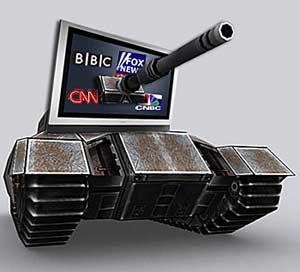
Amediawar War Is Sold Just Like Soda or Toothpaste

Similarly, a 2003 survey reveals that 35% of reporters and news executives themselves admitted that journalists avoid newsworthy stories if “the story would be embarrassing or damaging to the financial interests of a news organization’s owners or parent company.”

Several months after 9/11, Dan Rather told the BBC that American reporters were practicing “a form of self-censorship”:

There was a time in South Africa that people would put flaming tires around peoples’ necks if they dissented. And in some ways the fear is that you will be necklaced here, you will have a flaming tire of lack of patriotism put around your neck. Now it is that fear that keeps journalists from asking the toughest of the tough questions…. And again, I am humbled to say, I do not except myself from this criticism.

What we are talking about here — whether one wants to recognise it or not, or call it by its proper name or not — is a form of self-censorship.

Rather said in 2008:

One of the most pernicious ways in which we do this is through self-censorship, which may be the worst censorship of all. We have seen too much self-censorship in the news in recent years, and as I say this please know that I do not except myself from this criticism.

As Mark Twain once said, “We write frankly and freely but then we ‘modify’ before we print.” Why do we modify the free and frank expression of journalistic truth? We do it out of fear: Fear for our jobs. Fear that we’ll catch hell for it. Fear that someone will seek to hang a sign around our neck that says, in essence, “Unpatriotic.”

We modify with euphemisms such as “collateral damage” or “less than truthful statements.” We modify with passive-voice constructions such as “mistakes were made.” We modify with false equivalencies that provide for bad behavior the ready-made excuse that “everybody’s doing it.” And sometimes we modify with an eraser–simply removing offending and inconvenient truths from our reporting.”

Keith Olbermann agreed that there is self-censorship in the American media, and that:

You can rock the boat, but you can never say that the entire ocean is in trouble …. You cannot say: By the way, there’s something wrong with our …. system.

Former Washington Post columnist Dan Froomkin wrote in 2006:

Mainstream-media political journalism is in danger of becoming increasingly irrelevant, but not because of the Internet, or even Comedy Central. The threat comes from inside. It comes from journalists being afraid to do what journalists were put on this green earth to do. . . .

There’s the intense pressure to maintain access to insider sources, even as those sources become ridiculously unrevealing and oversensitive. There’s the fear of being labeled partisan if one’s bullshit-calling isn’t meted out in precisely equal increments along the political spectrum.

If mainstream-media political journalists don’t start calling bullshit more often, then we do risk losing our primacy – if not to the comedians then to the bloggers.

I still believe that no one is fundamentally more capable of first-rate bullshit-calling than a well-informed beat reporter — whatever their beat. We just need to get the editors, or the corporate culture, or the self-censorship — or whatever it is — out of the way.

MarketWatch columnist Brett Arends wrote yesterday:

Do you want to know what kind of person makes the best reporter? I’ll tell you. A borderline sociopath. Someone smart, inquisitive, stubborn, disorganized, chaotic, and in a perpetual state of simmering rage at the failings of the world. Once upon a time you saw people like this in every newsroom in the country. They often had chaotic personal lives and they died early of cirrhosis or a heart attack. But they were tough, angry SOBs and they produced great stories.

Do you want to know what kind of people get promoted and succeed in the modern news organization? Social climbers. Networkers. People who are gregarious, who “buy in” to the dominant consensus, who go along to get along and don’t ask too many really awkward questions. They are flexible, well-organized, and happy with life.

And it shows.

This is why, just in the patch of financial and economic journalism, so many reporters are happy to report that U.S. corporations are in great financial shape, even though they also have surging debts, or that a “diversified portfolio” of stocks and bonds will protect you in all circumstances, even though this is not the case, or that defense budgets are being slashed, when they aren’t, or that the U.S. economy has massively outperformed rivals such as Japan, when on key metrics it hasn’t, or that companies must pay CEOs gazillions of dollars to secure the top “talent,” when they don’t need to do any such thing, and such pay is just plunder.

All of these things are “consensus” opinions, and conventional wisdom, which are repeated over and over again by various commentators and vested interests. Yet none of them are true.

If you want to be a glad-handing politician, be a glad-handing politician. If you want to be a reporter, then be angry, ask awkward questions, and absolutely hate it when everyone agrees with you.

Self-censorship obviously occurs on the web as well as in old media. As Wikipedia notes:

Self-censorship is the act of censoring or classifying one’s own work (blog, book(s), film(s), or other means of expression) …

2. Censorship by Higher-Ups

If journalists do want to speak out about an issue, they also are subject to tremendous pressure by their editors or producers to kill the story.

The 2000 Pew and Columbia Journalism Review survey notes:

Fully half of [the investigative journalists surveyed] say newsworthy stories are often or sometimes ignored because they conflict with a news organization’s economic interests. More than six-in-ten (61%) believe that corporate owners exert at least a fair amount of influence on decisions about which stories to cover….

The Pulitzer prize-winning reporter who uncovered the Iraq prison torture scandal and the Mai Lai massacre in Vietnam, Seymour Hersh, said:

“All of the institutions we thought would protect us – particularly the press, but also the military, the bureaucracy, the Congress – they have failed. The courts . . . the jury’s not in yet on the courts. So all the things that we expect would normally carry us through didn’t. The biggest failure, I would argue, is the press, because that’s the most glaring….

Q: What can be done to fix the (media) situation?

[Long pause] You’d have to fire or execute ninety percent of the editors and executives. You’d actually have to start promoting people from the newsrooms to be editors who you didn’t think you could control. And they’re not going to do that.”

In fact many journalists are warning that the true story is not being reported. And see this announcement.

A series of interviews with award-winning journalists also documents censorship of certain stories by media editors and owners (and see these samples).

It’s not just the mainstream media. The large “alternative” media websites censor as well.  For example:

Every year Project Censored [which Walter Cronkite and other ] puts together a list of the top 25 stories censored and ignored by the mainstream media.

How many of these stories were you aware of? Even regular consumers of alternative, independent media may be surprised to learn about some of these stories ….

There are many reasons for censorship by media higher-ups.

One is money.

The media has a strong monetary interest to avoid controversial topics in general. It has always been true that advertisers discourage stories which challenge corporate power. In 1969, Federal Communications Commission commissioner Nicholas Johnson noted that tv networks go to great lengths to please their sponsors.

Some media companies make a lot of money from the government, and so don’t want to rock the boat. For example, Glenn Greenwald notes:

Because these schools [owned by the Washington P0st’s parent company, whose profits subsidize the Post] target low-income students, the vast majority of their income is derived from federal loans. Because there have been so many deceptive practices and defaults, the Federal Government has become much more aggressive about regulating these schools and now play a vital role in determining which ones can thrive and which ones fail.

Put another way, the company that owns The Washington Post is almost entirely at the mercy of the Federal Government and the Obama administration – the entities which its newspaper ostensibly checks and holds accountable. “By the end of 2010, more than 90 percent of revenue at Kaplan’s biggest division and nearly a third of The Post Co.’s revenue overall came from the U.S. government.” The Post Co.’s reliance on the Federal Government extends beyond the source of its revenue; because the industry is so heavily regulated, any animosity from the Government could single-handedly doom the Post Co.’s business – a reality of which they are well aware:

The Post Co. realized there were risks attached to being dependent on federal dollars for revenue – and that it could lose access to that money if it exceeded federal regulatory limits.

“It was understood that if you fell out of grace [with the Education Department], your business might go away,” said Tom Might, who as chief executive of Cable One, a cable service provider that is owned by The Post Co., sat in at company-wide board meetings.

Beyond being reliant on federal money and not alienating federal regulators, the Post Co. desperately needs favorable treatment from members of Congress, and has been willing to use its newspaper to obtain it:

Graham has taken part in a fierce lobbying campaign by the for-profit education industry. He has visited key members of Congress, written an op-ed article for the Wall Street Journal and hired for The Post Co. high-powered lobbying firms including Akin Gump and Elmendorf Ryan, at a cost of $810,000 in 2010. The Post has also published an editorial opposing the new federal rules, while disclosing the interests of its parent company.

The Post is hardly alone among major media outlets in being owned by an entity which relies on the Federal Government for its continued profitability. NBC News and MSNBC were long owned by GE, and now by Comcast, both of which desperately need good relations with government officials for their profits. The same is true of CBS (owned by Viacom), ABC (owned by Disney), and CNN (owned by TimeWarner). For each of these large corporations, alienating federal government officials is about the worst possible move it could make – something of which all of its employees, including its media division employees, are well aware. But the Post Co.’s dependence is even more overwhelming than most.

How can a company which is almost wholly dependent upon staying in the good graces of the U.S. Government possibly be expected to serve as a journalistic “watchdog” over that same Government? The very idea is absurd.

In addition, the government has allowed tremendous consolidation in ownership of the airwaves during the past decade.

Dan Rather has slammed media consolidation:

Likening media consolidation to that of the banking industry, Rather claimed that “roughly 80 percent” of the media is controlled by no more than six, and possibly as few as four, corporations.

This is documented by the following must-see charts prepared by:

And check out this list of interlocking directorates of big media companies from Fairness and Accuracy in Media, and this resource from the Columbia Journalism Review to research a particular company.

This image gives a sense of the decline in diversity in media ownership over the last couple of decades:
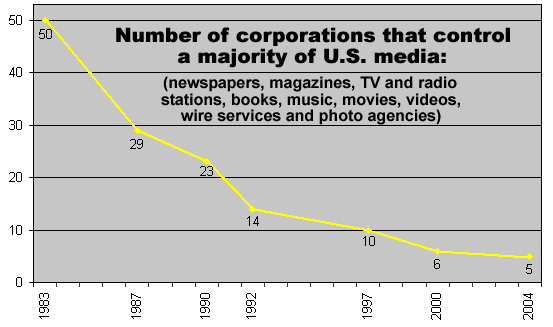
The large media players stand to gain billions of dollars in profits if the Obama administration continues to allow monopoly ownership of the airwaves by a handful of players. The media giants know who butters their bread. So there is a spoken or tacit agreement: if the media cover the administration in a favorable light, the MSM will continue to be the receiver of the government’s goodies.

The large alternative media websites also censor news which are too passionately anti-war.

The biggest social media websites censor the hardest-hitting anti-war stories. And see this.

Huffington Post — the largest liberal website — is owned by media giant AOL Time Warner, and censors any implication that a Democratic administration could be waging war for the wrong reasons.  So HuffPost may criticize poor prosecution of the war, but would never say that the entire “War on Terror” as currently waged by the Obama administration is a stupid idea.

Similarly, Drudge Report — the largest conservative website — never questions whether the government’s engagement in offensive military action around the world is strengthening or weakening our national security.

The largest “alternative” websites may weakly criticize minor details of the overall war effort, but would never say that more or less worldwide war-fighting is counterproductive. They may whine about a specific aspect of the war-fighting … but never look at the larger geopolitical factors involved.

They all seem to follow Keith Olbermann’s advice:

You can rock the boat, but you can never say that the entire ocean is in trouble …. You cannot say: By the way, there’s something wrong with our …. system.

3. Drumming Up Support for War

In addition, the owners of American media companies have long actively played a part in drumming up support for war.

It is painfully obvious that the large news outlets studiously avoided any real criticism of the government’s claims in the run up to the Iraq war. It is painfully obvious that the large American media companies acted as lapdogs and stenographers for the government’s war agenda.

Veteran reporter Bill Moyers criticized the corporate media for parroting the obviously false link between 9/11 and Iraq (and the false claims that Iraq possessed WMDs) which the administration made in the run up to the Iraq war, and concluded that the false information was not challenged because:

The [mainstream] media had been cheerleaders for the White House from the beginning and were simply continuing to rally the public behind the President – no questions asked.

As NBC News’ David Gregory (later promoted to host Meet the Press) said:

I think there are a lot of critics who think that . . . . if we did not stand up [in the run-up to the war] and say ‘this is bogus, and you’re a liar, and why are you doing this,’ that we didn’t do our job. I respectfully disagree. It’s not our role.

But this is nothing new. In fact, the large media companies have drummed up support for all previous wars.

For example, Hearst helped drum up support for the Spanish-American War.

And an official summary of America’s overthrow of the democratically-elected president of Iran in the 1950′s states, “In cooperation with the Department of State, CIA had several articles planted in major American newspapers and magazines which, when reproduced in Iran, had the desired psychological effect in Iran and contributed to the war of nerves against Mossadeq.” (page x)

The mainstream media also may have played footsie with the U.S. government right before Pearl Harbor. Specifically, a highly-praised historian (Bob Stineet) argues that the Army’s Chief of Staff informed the Washington bureau chiefs of the major newspapers and magazines of the impending Pearl Harbor attack BEFORE IT OCCURRED, and swore them to an oath of secrecy, which the media honored (page 361) .

And the military-media alliance has continued without a break (as a highly-respected journalist says, “viewers may be taken aback to see the grotesque extent to which US presidents and American news media have jointly shouldered key propaganda chores for war launches during the last five decades.”)

As the mainstream British paper, the Independent, writes:

There is a concerted strategy to manipulate global perception. And the mass media are operating as its compliant assistants, failing both to resist it and to expose it. The sheer ease with which this machinery has been able to do its work reflects a creeping structural weakness which now afflicts the production of our news.

The article in the Independent discusses the use of “black propaganda” by the U.S. government, which is then parroted by the media without analysis; for example, the government forged a letter from al Zarqawi to the “inner circle” of al-Qa’ida’s leadership, urging them to accept that the best way to beat US forces in Iraq was effectively to start a civil war, which was then publicized without question by the media.

So why has the American press has consistently served the elites in disseminating their false justifications for war?

One of of the reasons is because the large media companies are owned by those who support the militarist agenda or even directly profit from war and terror (for example, NBC was owned by General Electric, one of the largest defense contractors in the world … which directly profits from war, terrorism and chaos. NBC was subsequently sold to Comcast).

Another seems to be an unspoken rule that the media will not criticize the government’s imperial war agenda.

And the media support isn’t just for war: it is also for various other shenanigans by the powerful. For example, a BBC documentary proves:

There was “a planned coup in the USA in 1933 by a group of right-wing American businessmen . . . . The coup was aimed at toppling President Franklin D Roosevelt with the help of half-a-million war veterans. The plotters, who were alleged to involve some of the most famous families in America, (owners of Heinz, Birds Eye, Goodtea, Maxwell Hse & George Bush’s Grandfather, Prescott) believed that their country should adopt the policies of Hitler and Mussolini to beat the great depression.”

Moreover, “the tycoons told the general who they asked to carry out the coup that the American people would accept the new government because they controlled all the newspapers.“

See also this book.

Have you ever heard of this scheme before? It was certainly a very large one. And if the conspirators controlled the newspapers then, how much worse is it today with media consolidation?

(Kevin Dutton — research psychologist at the University of Cambridge — whose research has been featured in Scientific American Mind, New Scientist, The Guardian, Psychology Today and USA Today — also notes that media personalities and journalists — especially when combined in the same persons — are likely to be psychopaths. Some 12 million Americans are psychopaths or sociopaths, and psychopaths tend to rub each others’ backs.)

4. Access

Dan Froomkin,  Brett Arends and many other mainstream reporters have noted that “access” is the most prized thing for mainstream journalists … and that they will keep fawning over those in power so that they will keep their prized access.

But there is another dynamic related to access at play: direct cash-for-access payments to the media.

For example, a 3-time Emmy Award winning CNN journalist says that CNN takes money from foreign dictators to run flattering propaganda.

Politico reveals:

For $25,000 to $250,000, The Washington Post has offered lobbyists and association executives off-the-record, nonconfrontational access to “those powerful few”: Obama administration officials, members of Congress, and – at first – even the paper’s own reporters and editors…

The offer – which essentially turns a news organization into a facilitator for private lobbyist-official encounters – was a new sign of the lengths to which news organizations will go to find revenue at a time when most newspapers are struggling for survival.

That may be one reason that the mainstream news commentators hate bloggers so much. The more people who get their news from blogs instead of mainstream news sources, the smaller their audience, and the less the MSM can charge for the kind of “nonconfrontational access” which leads to puff pieces for the big boys.

5. Censorship by the Government

Finally, as if the media’s own interest in promoting war is not strong enough, the government has exerted tremendous pressure on the media to report things a certain way.

If they criticize those in power, they may be smeared by the government and targeted for arrest (and see this).

Indeed, the government treats real reporters as terrorists. Because the core things which reporters do could be considered terrorism, in modern America, journalists are sometimes targeted under counter-terrorism laws.

The government spies on reporters.

Not only has the government thrown media owners and reporters in jail if they’ve been too critical, it also claims the power to indefinitely detain journalists without trial or access to an attorney which chills chills free speech.

After Pulitzer Prize winning journalist Chris Hedges, journalist Naomi Wolf, Pentagon Papers whistleblower Daniel Ellsberg and others sued the government to enjoin the NDAA’s allowance of the indefinite detention of Americans — the judge asked the government attorneys 5 times whether journalists like Hedges could be indefinitely detained simply for interviewing and then writing about bad guys. The government refused to promise that journalists like Hedges won’t be thrown in a dungeon for the rest of their lives without any right to talk to a judge.

An al-Jazeera journalist — in no way connected to any terrorist group — was held at Guantánamo for six years … mainly to be interrogated about the Arabic news network. And see this.

Wikileaks’ head Julian Assange could face the death penalty for his heinous crime of leaking whistleblower information which make those in power uncomfortable … i.e. being a reporter.

As constitutional lawyer Glenn Greenwald notes:

It seems clear that the US military now deems any leaks of classified information to constitute the capital offense of “aiding the enemy” or “communicating with the enemy” even if no information is passed directly to the “enemy” and there is no intent to aid or communicate with them. Merely informing the public about classified government activities now constitutes this capital crime because it “indirectly” informs the enemy.

***

If someone can be charged with “aiding” or “communicating with the enemy” by virtue of leaking to WikiLeaks, then why wouldn’t that same crime be committed by someone leaking classified information to any outlet: the New York Times, the Guardian, ABC News or anyone else?

***

International Law Professor Kevin Jon Heller made a similar point when the charges against Manning were first revealed:

“[I]f Manning has aided the enemy, so has any media organization that published the information he allegedly stole. Nothing in Article 104 requires proof that the defendant illegally acquired the information that aided the enemy. As a result, if the mere act of ensuring that harmful information is published on the internet qualifies either as indirectly ‘giving intelligence to the enemy’ (if the military can prove an enemy actually accessed the information) or as indirectly ‘communicating with the enemy’ (because any reasonable person knows that enemies can access information on the internet), there is no relevant factual difference between [Bradley] Manning and a media organization that published the relevant information.”

***

It is always worth underscoring that the New York Times has published far more government secrets than WikiLeaks ever has, and more importantly, has published far more sensitive secrets than WikiLeaks has (unlike WikiLeaks, which has never published anything that was designated “Top Secret”, the New York Times has repeatedly done so: the Pentagon Papers, the Bush NSA wiretapping program, the SWIFT banking surveillance system, and the cyberwarfare program aimed at Iran were all “Top Secret” when the newspaper revealed them, as was the network of CIA secret prisons exposed by the Washington Post). There is simply no way to convert basic leaks to WikiLeaks into capital offenses — as the Obama administration is plainly doing — without sweeping up all leaks into that attack.

***

The same [Obama] administration that has prosecuted whistleblowers under espionage charges that threatened to send them to prison for life without any evidence of harm to national security, and has brought double the number of such prosecutions as all prior administrations combined. Converting all leaks into capital offenses would be perfectly consistent with the unprecedented secrecy fixation on the part of the Most Transparent Administration Everâ„¢.

The irony from these developments is glaring. The real “enemies” of American “society” are not those who seek to inform the American people about the bad acts engaged in by their government in secret. As Democrats once recognized prior to the age of Obama — in the age of Daniel Ellsberg — people who do that are more aptly referred to as “heroes”. The actual “enemies” are those who abuse secrecy powers to conceal government actions and to threaten with life imprisonment or even execution those who blow the whistle on high-level wrongdoing.

Former attorney general Mukasey said the U.S. should prosecute Assange because it’s “easier” than prosecuting the New York Times. But now Congress is considering a bill which would make even mainstream reporters liable for publishing leaked information (part of an all-out war on whistleblowing).

As such, the media companies have felt great pressure from the government to kill any real questioning of the endless wars.

For example, Dan Rather said, regarding American media, “What you have is a miniature version of what you have in totalitarian states”.

Tom Brokaw said “all wars are based on propaganda.

And the head of CNN said:

There was ‘almost a patriotism police’ after 9/11 and when the network showed [things critical of the administration’s policies] it would get phone calls from advertisers and the administration and “big people in corporations were calling up and saying, ‘You’re being anti-American here.’

Indeed, former military analyst and famed Pentagon Papers whistleblower Daniel Ellsberg said that the government has ordered the media not to cover 9/11:

Ellsberg seemed hardly surprised that today’s American mainstream broadcast media has so far failed to take [former FBI translator and 9/11 whistleblower Sibel] Edmonds up on her offer, despite the blockbuster nature of her allegations [which Ellsberg calls “far more explosive than the Pentagon Papers”].

As Edmonds has also alluded, Ellsberg pointed to the New York Times, who “sat on the NSA spying story for over a year” when they “could have put it out before the 2004 election, which might have changed the outcome.”

“There will be phone calls going out to the media saying ‘don’t even think of touching it, you will be prosecuted for violating national security,’” he told us.

* * *

“I am confident that there is conversation inside the Government as to ‘How do we deal with Sibel?’” contends Ellsberg. “The first line of defense is to ensure that she doesn’t get into the media. I think any outlet that thought of using her materials would go to to the government and they would be told ‘don’t touch this . . . .‘”

Of course, if the stick approach doesn’t work, the government can always just pay off reporters to spread disinformation.

Famed Watergate reporter Carl Bernstein says the CIA has already bought and paid for many successful journalists. See also this New York Times piece, this essay by the Independent, this speech by one of the premier writers on journalism, and this and this roundup.

Indeed, in the final analysis, the main reason today that the media giants will not cover the real stories or question the government’s actions or policies in any meaningful way is that the American government and mainstream media been somewhat blended together.

Can We Win the Battle Against Censorship?

We cannot just leave governance to our “leaders”, as “The price of freedom is eternal vigilance” (Jefferson). Similarly, we cannot leave news to the corporate media. We need to “be the media” ourselves.

“To stand in silence when they should be protesting makes cowards out of men.”
– Abraham Lincoln

“Our lives begin to end the day we become silent about things that matter.”
– Dr. Martin Luther King Jr.

“Powerlessness and silence go together. We…should use our privileged positions not as a shelter from the world’s reality, but as a platform from which to speak. A voice is a gift. It should be cherished and used.”
— Margaret Atwood

“There is no act too small, no act too bold. The history of social change is the history of millions of actions, small and large, coming together at points in history and creating a power that governments cannot suppress.”
– Howard Zinn (historian)

“All tyranny needs to gain a foothold is for people of good conscience to remain silent”
– Thomas Jefferson

This article originally appeared on : Global Research

Paris to host concert on Mowlavi

0

The Iranian music ensemble Hallajvashan is planning to perform a concert on the Persian mystic and poet Mowlavi in the French capital, Paris.

The program titled ËœThe Silence of Mowlaviâ„¢ (Le silence de Rumi) is programmed to be held at the House of World Cultures in Paris on May 24, 2013.

The concert will present a selection of an unreleased album composed by the band leader Mohammad Ali Merati.

The French scholar and expert on Mowlavi, Jean-Claude Carrière, is also scheduled to recite some poems of the poet during the concert.

Iranian vocalist Homayun Kazemi is to accompany Hallajvashan band while the group will benefit the Iranian and international music players.

Jalal ad-Din Mohammad Balkhi, known Mowlavi in Persian, was the 13th-century Iranian poet, mystic and theologian.

Mowlavi who is also known as Rumi in Western countries, was born in Balkh (now part of Afghanistan) and passed away in Konya, Turkey, where he was laid to rest.

During his 66-years of life, he has left a legacy of major poetic and prose works; among them, The Quatrains (rubaiyat), Divane-Shams (or the great works of Shams) and Fihe Ma Fi (a collection of mystical sayings).

Mowlavi is better known for his six-volume Masnavi Ma’navi (spiritual couplets) which is considered by many to be one of the greatest works of both Islamic mysticism and Persian literature.

FGP/FGP

This article originally appeared on : Press TV

Close Guantanamo Now!

0

As president and commander-in-chief, Obama has legal authority to do so. On May 3, New York City Bar president Carey R. Dunne wrote him. He did so on behalf of the organization he heads.

He called indefinite detention “legally and morally indefensible.” He said 25 retired military flag officers said it’s “an effective recruiting tool for our enemies.”

He urged “concrete steps to restart the process toward closure.”

On May 7, the New York City Bar said “Obama has the authority to close (Guantanamo) under Section 1028 of the National Defense Authorization Act of 2013.”

It’s about transferring detainees “to foreign countries or other foreign entities.”

Obama could begin the process today. He could have done so long ago. He’ll have to explain why not. He bears full responsibility for spurning what he pledged to do.

In 2008, he promised closure. “From both a moral standpoint and a practical standpoint, torture is wrong,” he said.

“Barack Obama will end the use torture without exception. He also will eliminate the practice of extreme rendition, where we outsource our torture to other countries.”

Straightaway as president, he issued Executive Order titled “Review and Disposition of Individuals Detained at the Guantanamo Bay Naval Base and Closure of Detention Facilities.”

A previous article explained. Sec. 3 states: “Closure of Detention Facilities at Guantanamo. The detention facilities at Guantanamo for individuals covered by this order shall be closed as soon as practicable, and no later than 1 year from the date of this order.”

“If any individuals covered by this order remain, they shall be returned to their home country, released, transferred to a third country, or transferred to another United States detention facility in a manner consistent with law and the national security and foreign policy interests of the United States.”

Obama ordered an “immediate review of all” detainees within 30 days.

He halted all proceedings in the “United States Court of Military Commission Review to which charges have been referred but in which no judgment has been rendered.”

He mandated “humane standards of confinement” be observed in accordance with international humanitarian laws.

On March 7, 2011, his Executive Order promised “Periodic Review of Individuals Detained at Guantanamo Bay Naval Station Pursuant to the Authorization for Use of Military Force.”

It said in part:

“This order is intended solely to establish a process to review on a periodic basis the executive branch’s continued, discretionary exercise of existing detention authority in individual cases.”

“Detainees at Guantanamo have the constitutional privilege of the writ of habeas corpus, and nothing in this order is intended to affect the jurisdiction of Federal courts to determine the legality of their detention.”

“The Secretary of Defense shall coordinate a process of periodic review.”

“In consultation with the Attorney General, The Secretary of Defense shall issue implementing guidelines governing the process.”

“For each detainee, an initial review shall commence as soon as possible but no later than one year from the date of this order.”

So-called “guidelines” lacks credibility. More on that below. Guantanamo harshness continues. Ending it is nowhere in sight.

More than half the remaining 166 detainees were cleared for release. Innocent victims remain incarcerated. Few were charged or tried.

It’s questionable whether any detainee warranted incarceration. So-called torture obtained confessions lack credibility. No legitimate court would accept them. Secret evidence is no better.

Justice William Brennan once called “proof beyond a reasonable doubt among the essentials of due process and fair treatment.”

The Legal Dictionary says it’s the “standard that must be met by the prosecution’s evidence in a criminal prosecution.”

“Beyond a reasonable doubt is the highest standard of proof that must be met in any trial.”

“Clear and Convincing Proof is evidence that establishes a high probability that the fact sought to be proved is true. The main reason (this high standard) is used in criminal trials is that such proceedings can result in the deprivation of a defendant’s liberty or even in his or her death.”

Innocent unless proved guilty beyond a reasonable doubt is a fundamental legal principle. It’s universal or should be.

Obama spurns it. He governs lawlessly, ruthlessly and recklessly. He broke every major promise made. He permits torture and extraordinary rendition. He does so after pledging to end them.

He promised Guantanamo closure. It remains open. The Pentagon’s Southern Command (SOUTHCOM) plans expanding it. Millions will be spent doing so.

Detainees may rot in gulag hell forever. Around 130 are hunger striking. They’re doing so for justice. Most haven’t eaten for three months.

They’re willing to die for justice. They’d rather perish than remain in gulag hell with no hope for release. That’s the stark reality they face.

Release is just a presidential order away. Obama must be pressured to explain his failure to act. He can do so as the New York Bar explained.

He can waive indefinite detentions. He can do so by certifying it’s in the national interest. He’s not legally constrained. He’s not limited by Congress. He’s beholden solely to international, constitutional, and US statute laws.

As president and commander-in-chief, he’s sworn to uphold them. He’s obligated to act responsibly. He can do what he hasn’t done throughout his tenure. He spurned rule of law principles across the board.

Doing the right thing is its own reward. He should try it sometime and see.

On May 10, the Center for Constitutional Rights (CCR) headlined “Congressional Briefing Urges Obama to Use His Authority to Close Guantanamo.”

CCR participated in a May 10 congressional briefing. It was titled “From Crisis to Solution.” It was co-sponsored by Representatives James Moran (D. VA), Gerry Connolly (D. VA), the Constitution Project, the New America Foundation, and the National Religious Campaign Against Torture.”

The previous day, Senate Armed Services Committee Chairman Carl Levin (D. MI) discussed a letter he wrote Obama. He urged him to appoint a high-level White House official to advance the transfer of Guantanamo detainees.

He stressed that Congress granted him authority to close Guantanamo. It’s up to him to use it. Waffling doesn’t wash.

According to senior CCR staff attorney Pardiss Kebriaei:

“Some of our clients have said they would rather die than live like this — in perpetual detention after 11 years, in now inhuman conditions.”

“But their hunger strikes are not acts of suicide. They are acts of last resort to be heard, and for release.”

“We came today to urge President Obama to use the certification and waiver process created by Congress to transfer detained men, starting with the 86 men who have been cleared for release by the Obama administration itself.”

“Congress has granted President Obama the tools and power he needs to end indefinite detention and close Guantanamo.”

“He cannot place the blame on Congress for the fact that 166 men still remain (there). He has the power to resolve this crisis, and he must use it to close Guantanamo.”

Straightaway as president, he could have acted responsibly. He chose not to do so. His two Executive Orders were disingenuous. They were head fakes.

Given how he’s governed, it’s not surprising. His March 7, 2011 Executive Order also authorized indefinite detentions and military commission trials. Doing so broke his pledge to close Guantanamo. It suggests he has no intention to do so.

He also violated America’s Fifth Amendment, stating:

“No person.shall be deprived of life, liberty, or property, without due process of law.”

At the time, ACLU executive director Anthony Romero said:

“It is virtually impossible to imagine how (Obama) closes Guantanamo in light of this executive order. In a little over two years, (he’s) done a complete about-face.”

In 2011, attorney David Remes represented 20 detainees. He saw no substantive difference between Bush and Obama policies. Just “a new cast of characters,” he said. Lawlessness continues unabated.

Within a year, the EO authorizes an unclassified review of factors justifying each detainee’s continued incarceration. A government representative will be appointed to do so.

Detainees may hire private counsel if they wish. They’ll have to do so at their own expense. No government funds are provided. A Periodic Review Board is also involved. It’s stacked against detainees. It’s composed of military, intelligence and Justice Department officials.

According to the EO, detainees may appear before the board. They may introduce their own evidence. They may call witnesses “who are reasonably available.”

In other words, Washington won’t pay transportation costs. Detainees were abducted far from Guantanamo. They’re not “reasonably available.” The deck is stacked. So-called periodic reviews exclude fairness.

Indefinite detentions and military commissions are lawless. They’re indefensible. They’re unjustifiable practices. No civil societies should tolerate them.

They constitute guilt by accusation. No recourse is permitted. Appeals aren’t allowed. Rule of law principles don’t matter. Diktat authority has final say.

After his March 7, 2011 Executive Order, Obama contemptuously claimed:

Indefinite detentions and military commissions will “broaden our ability to bring terrorists to justice, provide oversight for our actions, and ensure the humane treatment of the detainees.”

Attorney General Holder added:

“The executive order….strengthens the legal framework under which we will continue to detain those individuals who are at war with our country and who pose a significant threat to the security of the United States.”

Omitted was explaining that virtually all Guantanamo detainees were and continue to be innocent victims. On January 11, 2002, the facility opened.

At least most detainees have been non-belligerents. Seton Hall University Guantanamo reports revealed that around 95% were seized randomly for bounty.

They were sold to US forces for $5,000 per claimed Taliban and $25,000 for alleged Al Qaeda members. No corroborating evidence was sought. Washington needed bodies. It still does. It operates “black sites.”

Innocent victims fill America’s global network of torture prisons. Alleged suspects are snatched and disappeared. It’s done out of sight and mind. Major media scoundrels ignore it. Guantanamo’s the tip of the iceberg.

Obama continues lawless Bush practices. Torture remains official policy. Innocence is no defense. Crimes of war, against humanity and genocide continue.

Waging war on humanity is policy. It continues unabated. Who knows what’s next? It’s shocking to imagine what’s possible.

Stephen Lendman lives in Chicago. He can be reached at lendmanstephen@sbcglobal.net.

His new book is titled “Banker Occupation: Waging Financial War on Humanity.”

http://www.claritypress.com/LendmanII.html

Visit his blog site at sjlendman.blogspot.com.

Listen to cutting-edge discussions with distinguished guests on the Progressive Radio News Hour on the Progressive Radio Network.

It airs Fridays at 10AM US Central time and Saturdays and Sundays at noon. All programs are archived for easy listening.

http://www.progressiveradionetwork.com/the-progressive-news-hour

http://www.dailycensored.com/close-guantanamo-now/

This article originally appeared on : Global Research

Islamism and Neoliberalism. Pakistan’s Elections: Turning over a New Leaf

0

Pakistan’s elections come at a key junction in the region’s geopolitics, with the public firmly opposed to the US ‘war on terror’ being conducted on Pakistani soil with no regard for its sovereignty. Pakistan’s new prime minister has a mandate to take his country in a new direction, but will he use it?

Steel magnate Nawaz Sharif is the country’s fourth wealthiest citizen, a protégé of General Zia ul-Haq, toppled in a 1999 military coup, sentence to life imprisonment and exiled to Saudi Arabia. His Muslim League (PML-N) has enough seats to avoid the need for a coalition with second-place former cricketer Imran Khan’s Tehrik-i-Insaf (PTI), and/or the Bhutto family’s Pakistan People’s Party (PPP), which until last week presided over Pakistan’s first full-term civilian government. Despite pre-poll violence that killed at least 40 people, voter turnout was a robust 60%.

On the surface, a win-win for Sharif, Khan, Pakistan, and even the West, which very much needs a stable government there. But Sharif, prime minister for the third time (having served from 1990—1993 and 1997—1999), has loads of baggage: his love of neoliberal trickle-down economics, his close ties with Saudi Arabia, his abiding interest in closer links with Central Asia republics (echoes of past regimes’ regional hegemonic designs). And though he loudly supported the reinstatement of Chief Justice Iftikhar Chaudry (dismissed by Pervez Musharraf in 2007), he is no stranger to intimidating judges, having ousted Supreme Court chief justice Sajjad Ali Shah in 1997. He notoriously ‘pressed the button’ to bring Pakistan into the nuclear age in 1998. And he was best friends with the military until he was ‘betrayed’ by his own 1998 appointee as army chief of staff, Pervez Musharraf.

What do the tea leaves tell us? Well, for one thing, ex-General Musharraf, who hounded Sharif into exile, better put a strong lock on his home near Islamabad, where he is now under house arrest. And Pakistanis better brace themselves for IMF-style austerity. US strategists also should be prepared for a continuation of the cooling of relations. Sharif’s brother Shahbaz, chief minister of Punjab, has stopped all USAID projects in Punjab province as a protest against Washington’s use of drones (3,000 dead since 2004), though we can be sure Nawaz is unlikely to jeopardise the $2 billion in annual US ‘aid’.

Speaking of Nawaz’s brother, his son Hamza is a member of the National Assembly. And Nawaz’s daughter Maryam is leader of the PML-N. And, and … Politics is a family affair in Pakistan, though as the falling-out and scandals of the various Bhuttos (and Sharif’s cold-blooded alliance with Benazir’s brother Murtaza) suggests, the families are not always happy. So much for “cleaning up corruption”.

Is there any hope for a new direction? Well, Sharif considers himself a friend of the environment, a fan of “bioconservatism”, having established the Environmental Protection Agency in 1997. He is committed to Islamization, including a more sharia-based legal system, though there is little to suggest that social justice plays any role at all in his deen. He may actually try to patch up relations with India; he tried to with the Lahore declaration in 1999 until undermined by clashes in Kargil, Kashmir.

But don’t hold your breath waiting for any surprises. Sharif is in fact a logical heir to Pakistan’s tragic history, which continues to unfold, regardless of who sits on top. Since partition in 1947, intended by the British to leave a prostrate subcontinent which would be beholden to empire, Pakistani politics has been mostly dominated by military rule and crises. This makes sense, as Pakistan’s Muslims are a highly pluralist mix of Sunni and Shia, with large communities of Ahmadi, Bahai and others, and tension often boil over, requiring a firm, neutral hand.

But then Pakistan is not so different from other majority-Muslim states, which all share a history of authoritarian, top-down forced adoption to western modernity, characterized by accepting an imposed economic system of capitalism and a political system composed of ‘sovereign’ ethnically distinct nation states. The entire Muslim world was subjected to this in some form, be it by a monarch, a military dictator, a colonial administration or a neocolonial ‘independent’ administration. This includes Turkey, Egypt, Syria, Jordan, Morocco, Iran, Indonesia and Malaysia, with Saudi Arabia and the Gulf states the ‘exceptions that prove the rule’.

Pakistan and Turkey have striking similarities. Both Pakistan and Turkey’s military staged coups from the 1950s to the 1980s to stop moves towards promoting more religious practice, though the coup in Pakistan in 1977 and in Turkey in 1980 changed the nature of the ‘game’, as the US began to openly embrace so-called mujahideen across the Muslim world as its Cold War ace against the Soviet Union.

Pakistan’s colonial nightmare differs from Egypt’s at the time of ‘independence’ after WWII. Pakistan’s partition and ethnic/ sectarian tensions among uprooted peoples did not allow the formation of a Muslim Brotherhood-type organization which could unite the country around a program of Islamic social justice. Egypt’s military coup of 1952 was necessary to pre-empt the Muslim Brotherhood, which would have been the clear winner in any elections. Unlike Pakistani and Turkish military strongmen, Egypt’s populist Gamel Abdel-Nasser was as a result prompted to follow a socialist anti-imperialist path to independence, and became the toast of the Muslim world–until US-Israeli hegemony was asserted in the region in 1967, humiliating the hero of Arab nationalism and undoing fatally this secular socialist path.

On the surface, the imperial strategy of creating a weak, divided Indian subcontinent largely worked. India’s experiment with socialism was mild, and only Pakistan’s Zulfikar Bhutto flirted briefly with socialism and anti-imperialism in the 1970s–and was rewarded by being hanged (by Sharif’s patron Zia ul-Haq). With the demise of the Soviet Union, the empire consolidated its hold on both India and Pakistan, letting them continue their spat over Kashmir, a senseless and massive drain on both the Indian and Pakistani budgets, but excellent divide-and-conquer geopolitics for the US. The socialist ‘threat’ was wiped out in the horrendous ‘jihad’ in Afghanistan, which unleashed al-Qaeda types on the world.

As a result, when Sharif grabbed the reins of power in the 1990s, he found he was riding a tiger. The Taliban were the real thing, so to speak: unlike craven Pakistani politicians, they wanted to attack the very empire itself. Pakistan’s relations with the US deteriorated and have continued to deteriorate ever since as various leaders try unsuccessfully to square the circle, encouraging the Taliban and pacifying the Americans.

A new leaf for Pakistan will probably not be the work of Sharif. Rather, the logic of regional developments will continue to assert itself. The PPP government was forced by popular pressure to cut off the NATO supply route to Afghanistan and to restrict US military activity. At the same time, it increased military and economic cooperation with China and Iran. Sharif’s PML-N will continue this. US policy is pushing its once subservient ally into the hands of its ‘enemies’.

The best than can be hoped for in Pakistan is that a (slightly less) corrupt Sharif will patch up relations with India, which the army can do little to stop, given the failed state that Pakistan finds itself in. This means ending demands to tear Kashmir away from India, and abandoning the Taliban. A return of the Taliban may be what some hardliners are rooting for, but given the unwillingness of any of the major players–in the first place India, Russia, Iran, China and of course the US–to allow this, Sharif has a stronger hand this time, if he’s sensible enough to play it, for peace with India can only come by letting go of Afghanistan.

If Sharif can strike a peace accord with India and work with regional players–including Iran– and the US in Afghanistan, peace will break out in the region. This would reopen the borders with India, creating an economic boom across the region. At the same time, it will accelerate a genuine withdrawal of US forces from the region, end its threats to invade Iran, and–please note, US strategists–the US would still have quite a bit of influence in post-pullout Afghanistan. In fact, its profile across the region would be transformed for the better.

This would also dash Pakistan’s goal of becoming regional hegemon. But peace with both Afghanistan and India would be a win-win for it too, slashing the parasitical military and raising living standards through mutually profitable cooperation with India, Iran and China. The centerpiece will be the Iran-Pakistan-India (IPI) Peace Pipeline. Even if Pakistani politics remains corrupt (and it will), the new regional cooperation would give a huge boost to its economy.

If Sharif has the courage to do this, it would start the difficult process of turning over a new leaf for Pakistan. It would also guarantee him a second term, which combined with his peaceful accession to power, would mean a gratifying political bookend for his rule, making him ‘independent’ Pakistan’s true founder.

a version of this appeared at http://www.presstv.ir/detail/2013/05/13/303295/turning-over-a-new-leaf-in-pakistan/

This article originally appeared on : Global Research

Student Shot by School Employee, As Conservatives Call for More Guns on Campus

0

Photo Credit: Shutterstock.com

May 14, 2013
 |

Like this article?

Join our email list:

Stay up to date with the latest headlines via email.

Another accidental shooting occurred on Monday–this time in Aurora, the site of the movie theater shooting last July. An employee of Colorado’s Rangeview High School accidentally shot a student after school had been dismissed, the local news outlet 9 News reported.

The school employee and the student knew each other. The employee works a second job as an armed security officer, and was giving the student a ride home. While moving his gun to the glove box in his car, the firearm accidentally went off and shot the student, who suffered an injury to his leg but will survive, according to police.

The incident is a sharp reminder that, despite calls for more armed guards in schools, guns in and around educational institutions could easily lead to disaster.

The incident is also the latest accidental shooting to occur around the country. On Sunday, for instance, a four-year-old child accidentally shot an 11-year-old boy in Florida. And last Tuesday, a 24-year-old in Texas was “playing” with a gun and, as a result, accidentally shot a 14-year-old.

These recent incidents of accidental gun violence come weeks after Congress failed to pass any gun control measures. Also underscoring the need for gun measures was the Mother’s Day shooting in New Orleans, which injured 19 people.

This article originally appeared on : AlterNet

GOP Director of Hispanic Outreach Quits and Becomes Democrat

0

May 14, 2013
 |

Like this article?

Join our email list:

Stay up to date with the latest headlines via email.

When Republicans appointed Pablo Pantoja to State Director of Florida Hispanic Outreach for the Republican National Committee, they hoped he would be able to bridge the sizable gap that only expanded during the 2012 elections, when the state’s 4.7 million Hispanic voters supported Barack Obama over Mitt Romney by a 20 percent margin.

But after months of inaction by Congressional Republicans on comprehensive immigration reform and stiff resistance by Republican-leaning groups like the Heritage Foundation, Pantoja has had enough; on Monday, he announced via email that he was leaving the party and registering as a Democrat:

Friend,

Yes, I have changed my political affiliation to the Democratic Party.

It doesn’t take much to see the culture of intolerance surrounding the Republican Party today. I have wondered before about the seemingly harsh undertones about immigrants and others. Look no further; a well-known organization recently confirms the intolerance of that which seems different or strange to them.

Pantoja goes on to specifically cite last week’s revelation – that an author of Heritage’s false report on the cost of the Gang of Eight’s immigration bill wrote a dissertation in which he suggested that Hispanics are at a permanent disadvantage because they have lower IQs – as the final straw in his political evolution.

Prior to assuming the role of state director, Pantoja served in the National Guard, doing multiple tours abroad in Kuwait and Iraq before returning to the states and getting involved in Republican politics. In 2010 he served as a field director in Florida during the midterm elections.

Republicans have for months tried to find ways to make inroads with the country’s growing hispanic population, especially in the swing state of Florida. Hispanics there turned out to vote at a rate of more than 62 percent in 2012, significantly higher than the national turnout rate of 48 percent and the highest rate of Hispanic turnout in the country.

This article originally appeared on : AlterNet

Russia expels detained US diplomat

0

[unable to retrieve full-text content]Moscow says it has ordered expulsion of US diplomat, who was detained by Russian security services for trying to recruit spies for CIA.

This article originally appeared on : Press TV

Blast kills 4 US-led troops in Afghanistan

0

US Army soldiers carry a wounded comrade injured in an improvised explosive device (IED) blast during a patrol near Baraki Barak base in Logar province on October 13, 2012.

A powerful bomb explosion has killed at least four US-led soldiers and injured several others in the troubled southern Afghanistan, NATO sources say.

The fatalities come after an improvised explosive device (IED) ripped through the soldiersâ„¢ vehicle in Kandahar province – one of the most dangerous regions for foreign forces in the war-ravaged country.

The Western military alliance has not yet released further details regarding the soldiers’ nationality or the exact location of the incident.

The latest deaths bring the number of US-led soldiers killed in Afghanistan this year to at least 63.

The number of casualties among foreign troops peaks at this time of year, known as the Taliban spring offensive, as the militants step up their attacks on US-led forces during this period.

The United States and its allies invaded Afghanistan as part of Washingtonâ„¢s so-called war on terror. The offensive removed the Taliban from power, but the country is still gripped by insecurity.

The Afghan conflict has seen a surge in attacks on foreign troops in recent months. More than four hundred foreign soldiers were killed in the war-torn country last year alone.

The increasing number of military casualties in Afghanistan has caused widespread anger in the US and other NATO member states, undermining public support for the Afghan war.

JR/PR

This article originally appeared on : Press TV

Germany to investigate Western pharm companies over ‘human guinea pig’ drug trials

0

[unable to retrieve full-text content]German authorities are planning to launch an investigation into tens of thousands of patients in former East Germany who were allegedly used for drug trials without their consent “as guinea pigs,” after a media report sparked a wave of outrage.

This article originally appeared on : RT

‘Detroit teeters on edge of bankruptcy’

0

File photo of the US city of Detroit, Michigan.

Detroitâ„¢s emergency manager has warned that the city runs the risk of going bankrupt, with consequences to hit public payrolls and pensions, a report says.

Kevyn Orr said on Monday that the largest city in the US state of Michigan continues to be Å“dysfunctional and wasteful after years of budgetary restrictions, mismanagement, crippling operational practices and, in some cases, indifference or corruption,” the Washington Post quoted on Monday.

The former bankruptcy lawyer warned that the financial crisis could translate into unpaid employee wages, loss of retireesâ„¢ pensions and deeper cuts in services.

Å“Outdated policies, work practices, procedures and systems must be improved consistent with best practices of 21st century government,” Orr said, adding that some bills and obligations are not being paid or are being delayed.

Detroit, which at one time was the symbol of American progress and held great political power thanks to the auto industry, has been strained by annual cash shortages and USD 14 billion in long-term liabilities.

This comes while the motor-city owes more than USD 400 million, including USD 124 million for public improvement projects.

The comments mark the latest in a string of embarrassing setbacks to befall the city in recent years. Once the fifth largest American city, Detroit now ranks 18th with a population of 700,000 people.

Government figures show that more than a third of Detroit residents are officially classified as living in poverty, and the cityâ„¢s unemployment rate is more than double the US jobless rate of 7.7 percent.

In February, Detroit topped the Forbes list of the most miserable city in the United States.

GMA/PR

This article originally appeared on : Press TV

Britain allocates £40m to Syria terror

0

Cameron announces further £40m aid package to foreign-backed terrorists in Syria

The UK government has announced a £40 million aid package to foreign-backed terrorists fighting the government of Syrian president Bashar al-Assad, local media reports.

The package was announced during a meeting between British Prime Minister David Cameron and US President Barak Obama in Washington on Monday, when the two exchanged views about the ongoing conflict in the Middle Eastern country they both have strongly enhanced and promoted in a desperate attempt to change the regime there.

Å“During a joint press conference with US President Barack Obama today, Prime Minister David Cameron announced that the UK would be providing an extra £30 million [$45.9 million] of humanitarian support for the victims of the Syria crisis, and an additional £10 million [$15.3 million] in non-lethal support to strengthen the Syrian opposition, to help reduce the effects of the conflict spilling over into neighboring countries and to support human rights and civil society,” British prime ministerâ„¢s office claimed in a statement.

Britain and its allies have been playing an Å“unconstructive role” in the region by lending support to same terrorist groups they have been fighting in Afghanistan as part of the so-called US-led Å“war on terror.”

The British government is also accused of supplying weapons to insurgents and dispatching mercenaries to Syriaâ„¢s neighboring countries like Turkey, Lebanon, and Jordan, where they receive special training by MI6 and CIA officers and then are transferred into Syria illegally to fight the Syrian government.

Diplomatic discussions on the Syrian conflict is set to continue this week, with President Putin due to hold talks in Russia with Israeli regimeâ„¢s Prime Minister Benjamin Netanyahu over issues surrounding the conflict in Syria.

The talks come as the US and Britain claim they have found common ground with Russia on how to proceed in Syria.

At their meeting in Washington, President Obama and David Cameron promised to make diplomatic efforts to find a political solution to the two-year crisis in Syria, AFP reported.

However, Obama and Cameron revealed their true intention when they said that the rule of President al-Assad must end in Syria.

“If in fact we can broker a peaceful political transition that leads not only to Assad’s departure but a state in Syria that is still intact (…) and that ends the bloodshed, stabilizes the situation, that’s not just going to be good for us — that will be good for everybody,” claimed the US president.

The Syria crisis began in March 2011, and many people, including large numbers of soldiers and security personnel, have been killed in the violence.

The Syrian government says that the chaos is being orchestrated from outside the country, and there are reports that a very large number of the militants are foreign nationals.

MOL/PR/HE

This article originally appeared on : Press TV

Russia warns against moves over Syria

0

Russian President Vladimir Putin has warned against any measure that would further fuel the ongoing crisis in Syria and destabilize the Arab country.

Putin made the remarks on Tuesday after talks with the visiting Israeli Prime Minister Benjamin Netanyahu in the Black Sea resort of Sochi over the Syrian crisis.

“In this crucial period it is especially important to avoid any moves that can shake the situation,” Putin said without giving further details.

However, it is believed that the warning was against foreign military intervention or arming militants fighting against the Syrian government.

It was not made clear whether the two leaders reached any firm agreements on the conflict in Syria. Israel wants Russia to halt its arms supplies to the Syrian government.

US Secretary of State John Kerry and British Prime Minister David Cameron have already held talks with Russian president over the ongoing crisis in Syria.

The US, Britain and Israel are pushing Russia to stop an arms deal under which Moscow is obliged to sell Damascus an S-300 air defense system.

Washington and Moscow are at odds over the Syria crisis. While the US and its regional allies support anti-Damascus militants seeking to topple the government of President Bashar al-Assad, Russia remains a supporter of his government.

Russia accuses the West of worsening the Syria conflict by calling for Assadâ„¢s ouster. In return, Washington accuses Moscow of not doing enough to stop the bloodshed in Syria.

Syria has been experiencing unrest since March 2011, and many people, including large numbers of Syrian troops and security personnel, have been killed in the violence.

HM/PR/SS

This article originally appeared on : Press TV

‘British health service collapsing’

0

British Health Minister Norman Lamb has warned that the National Health Service (NHS) will collapse if action is not taken to get more elderly people out of hospitals.

Lamb insisted that the UKâ„¢s health and social care system is becoming Å“dysfunctional” and could Å“buckle under the pressure” unless far-reaching changes are made to the way it performs.

The health ministerâ„¢s warning comes amid increasing concern that Accident & Emergency (A&E) departments and ambulance services are failing to manage with the soaring number of patients forced to bare long waits.

Recently, one of Britain’s most senior A&E doctors said units had begun to feel like Å“war zones” while the head of the NHS and social care watchdog said such services were Å“out of control”.

Lamb said the NHS and social care system was under a heavy strain due to Britainâ„¢s aging population as high numbers of the elderly are suffering complex and chronic conditions. He said that tackling such a situation was “the challenge of the 21st century”.

Furthermore, regulators have announced a review of the NHS funding system that currently means hospitals are paid to keep patients in hospital instead of discharging them to their homes or to care homes.

“The hospital gets paid for a patient arriving in hospital but there is no incentive for them to leave,” Lamb said.

BGH/MOL/HE

This article originally appeared on : Press TV

‘Iran gas refining capacity to hit 1bcm’

0

File photo shows Iranâ„¢s Fajr-e Jam gas refinery in the southern province of Bushehr.

National Iranian Gas Company (NIGC) says the countryâ„¢s natural gas refining capacity will climb to one billion cubic meters (bcm) per day in two yearsâ„¢ time.

Mehdi Jamshidi-Dana, NIGCâ„¢s director for coordination and supervision on production, said on Tuesday that the refining section of Iranian gas industry managed to register a daily output of 520 mcm during last calendar yearâ„¢s peak gas consumption period and the figure will reach 1 bcm per day by March 2016.

The NIGC official added that the giant offshore South Pars gas field in southern Iran is supplying 44 percent of domestic gas demand.

Å“Fajr-e Jam and Parsian refineries come next in terms of gas production, with [shares of] 21 and 17 percent [in country’s gas ouput], respectively,” he added.

Jamshidi-Dana noted that Iranian gas refineries produced nearly 161 bcm of gas last calendar year, up eight percent from three years before.

Å“By reducing the time needed to do basic maintenance in refineries, [Iranâ„¢s] gas production has increased by 37 mcm per day…,”he stated.

On Monday, Iranâ„¢s Deputy Oil Minister Javad Owji said the countryâ„¢s natural gas exports will increase to nearly 100 mcm per day by the end of the current Iranian year (ending March 20, 2013) earning the country more than USD 10 billion per annum.

Iran, which sits on the world’s second largest natural gas reserves after Russia, is making efforts to up its gas production by increasing foreign and domestic investments, especially in South Pars gas field.

MRS/KA/SS

This article originally appeared on : Press TV

The Criminalization of Political Dissent in America

0

Last week, Massachusetts high school student Cameron D’Ambrosio was arrested and charged under “terrorism” laws merely for posting lyrics on Facebook that make reference to the Boston Marathon bombings. He faces 20 years in prison. A string of similar “terror” prosecutions around the country take aim at the First Amendment protection of free speech and political expression.

The authorities have already branded select participants in Occupy Wall Street and anti-NATO protests as “terrorists.” Last year, heavily-armed “domestic terrorism” commandos raided Occupy Wall Street protesters’ homes in Washington and Oregon, using battering rams and stun grenades. The commandos were authorized to seize all “anti-government or anarchist literature or material.”

As with freedom of speech, freedom of assembly, also guaranteed under the First Amendment, has not been officially repealed. The reality, however, is that political assembly is already a semi-criminal activity in America. Political protests are routinely met with vastly disproportionate police mobilizations, confinement to oxymoronic “free speech zones,” “kettling” (in which protesters are surrounded and forcibly moved in one direction or prevented from leaving an area), beatings, tear gas, pepper spray, stun grenades or rubber bullets. The standard government response to a political protest is a massive show of force, complete with police snipers on rooftops.

The drive towards the establishment of an American police state, initiated under the Bush administration, has shifted into high gear under Obama. For nearly twelve years, the phony “war on terror” has been used as the overarching pretext for illegal imperialist war abroad and a methodical assault on democratic rights at home. The basic structure of authoritarian rule is now emerging into plain view.

Over the recent period, the government has vastly expanded its warrantless surveillance of the population. The Obama administration has constructed a massive data center in Utah big enough to store the contents of every personal computer in the country. Already at a government agent’s fingertips—without a warrant—are all of a person’s Internet browsing activity, telephone conversations, text messages, credit card transactions, mobile phone GPS location data, travel itineraries, Skype and Facebook data, medical records, criminal records, financial records and surveillance camera footage.

Tens of thousands of drones are slated to be launched over the US mainland in the coming years, with thousands already buzzing overhead. These high-tech aircraft are able to monitor meetings and demonstrations, access wireless networks and record the movements of citizens. Obama’s recent appointee for the position of CIA director, John Brennan, expressly refused at his confirmation hearings to rule out the possibility that these drones could be armed and used for carrying out assassinations within the US.

While schools are being shuttered and teachers fired supposedly for lack of money, local police departments are awash in billions of dollars of military hardware and training provided by the Department of Homeland Security. When local police are mobilized to respond to a political protest, they now do so in coordination with the federal military and intelligence agencies. It is not a rarity for armored vehicles, body armor and military equipment to be deployed.

Under the precedent set by the recent events in Boston, the authorities now have the power to subject an entire city to a military siege, with the population ordered to “shelter in place,” while businesses and transportation are shut down and heavily armed SWAT teams are deployed to conduct warrantless house-to-house searches without regard for basic rights.

The Obama administration, in concert with state and local police departments, has sent untold numbers of “anti-terror” undercover spies into domestic political parties and protest groups. In addition to gathering information, the job of these spies is to divert, disrupt and prevent the emergence of organized social opposition.

A person can be designated a “terrorist” on the secret, unreviewable say-so of the president, without notice and without a trial. Under the “material support” for terrorism laws signed into law as part of the PATRIOT Act of 2001, a person may be jailed simply for offering vaguely-defined “material support” to any person or group labeled as “terrorist.”

Under the National Defense Authorization Acts of 2011 and 2012, as tested in the case of Jose Padilla, the US government asserts the power to subject a designated “terrorist” to arbitrary arrest and detention without trial. In the cases of Padilla and Bradley Manning, and at the Guantanamo Bay prison camp and countless CIA “black sites” around the world, the US government subjects alleged terrorists to torture. Finally, in the cases of Anwar Al-Awlaki, Samir Khan and Abdulrahman Al-Awlaki, the US government tested out its asserted power to murder “terrorists” outright, even if they are US citizens.

Under these precedents, it would not be necessary to officially suspend the Constitution in order for the US government to meet future domestic opposition with military lockdowns, curfews, house-to-house searches, mass arrests, torture and even assassination. With political dissent labeled as “terrorism” or “material support for terrorism,” Congress, the president, the courts, the military, and the so-called “free press” could continue in their present roles.

In the second half of the 20th century, US-backed dictatorships in Argentina and Chile used the supposed struggle against “terrorism” as a political cover for the arrest and murder of tens of thousands of political opponents, youth, workers, intellectuals and other “enemies of the state.” As the World Socialist Web Site warned from the outset, such is the inevitable logic of the American “war on terror.”

Two essential factors are driving the trampling of democratic rights and the shift towards authoritarian rule. The first is the massive growth of social inequality, which in turn is driven by the historic crisis of the world capitalist system. While it robs the population in order to pile up ever greater and more obscene levels of private wealth, the financial aristocracy is terrified of the emergence of social opposition. Not from a position of strength, but out of extreme fear and vulnerability, the billionaires look to police state repression as a means to preserve their status, power and wealth.

Second, just as democracy is incompatible with such levels of social inequality, it is incompatible with imperialist war. The US military and intelligence agencies have for twelve years been wading in blood in a drive to plunder the world’s strategic resources. The dead, wounded and displaced number in the millions.

A professional military, divorced from and hostile to the population and resentful of civilian control, has immensely expanded its size, resources and political power, to the point where it and its intelligence counterpart, in league with Wall Street, dominate the workings of the state.

This article originally appeared on : Global Research

‘Unemployment misery grips Britain’

0

A new research has found that young adults in Britain are facing their most miserable job prospects.

A new research by the Trades Union Congress (TUC) has found that young adults in the UK are facing their most miserable job prospects for five years, with 395,000 professions needed today to return the level of employment.

The almost 400,000 needed jobs in Britain are currently affecting 18 to 24-year-olds since the beginning of the financial crisis in 2008.

The TUC says that government ministers pose about an alleged number of Britons now in work but have failed to declare the growing population and rising state pension age for women.

Young people in the country have been on the receiving end, experiencing the sharpest fall in their job prospects as the situation has deteriorated since 2010.

“The government must do far more to help young people struggling for work,” said the TUC, “particularly as its current support schemes, like the Work Programme and the Youth Contract, are clearly not working.”

The TUC is urging the government to bring about guaranteed jobs that include training and a minimum payment for any young person out of work for at least six months.

Moreover, youth unemployment was found to be one of the main reasons for the suicide rate among young people in Britain, soaring in 2011 with a total figure of 6,045 people taking their own life.

BGH/MOL/HE

This article originally appeared on : Press TV

Air France to cut 500 workers

0

[unable to retrieve full-text content]French flag carrier Air France has announced its plans to cut the number of cabin crewmembers by 500, in a bid to boost productivity.

This article originally appeared on : Press TV

UK’s covert intelligence activities in Iraq

0

One of Britainâ„¢s complex strategies to establish political control over other countries from colonial era up to now is setting up centers for studying nations that are coveted by British officials concerning cultural, political and economic areas.

Britain has been always seeking to remove obstacles to colonize other countries from the beginning of its colonial history in recent centuries until the present time.

Thus the UK authorities have been attempting to get a proper understanding of the culture of their colonies in order to reduce fatal blows to their imperialistic objectives caused by national resistance of the occupied countries. The countryâ„¢s officials have been also trying to previously identify barriers to influence colonies and the way through the preventative measures, which are particularly the cultural ones.

One of the UKâ„¢s leading organizations for studying other countries is the National Academy for the Humanities and Social Sciences and its affiliated offices in other countries across the globe, which are responsible for scientific study of cultures and nations.

The British academy has senior bureaus in all Middle Eastern countries. The academyâ„¢s Iraq branch office was established in 1930 and is currently led by Eleanor Robson. She is the representative of the British Academy for the Humanities and Social Sciences and also the head of the Institute for the Study of Iraq.

Initially, setting up a British institute for studying culture and human sciences in Iraq seems a quite normal or even praiseworthy act. However, retrospection in the colonial past of the institute makes any observer to reconsider his view.

The British Academy for the Humanities and Social Sciences was established as a memorial to Gertrude Bell, the most skilled and efficient agent of Britainâ„¢s intelligence and security organization at her time and especially during the World War I.

Bell along with Lawrence of Arabia carried out the most landmark operation of formation and destruction of countries in the Middle East. Moreover, she played a major role in dismantling the Ottoman Empire, defining the borders of Saudi Arabia and creating nascent states such as Syria, Jordan, Kuwait and Iraq.

Now after more than eighteen years and following the downfall of Iraq’s former dictator Saddam Hussein, the institute has resumed its research activities, which were limited in the 1990s due to that timeâ„¢s difficult political situation.

It is worth mentioning that the institute has cut its budget for archeological and ancient era studies in Iraq in recent years and instead devoted a lot of money to studies on human sciences and social research into contemporary and modern Iraq.

Some Iraqi elites believe that while Britain has failed to maintain its military and security influence over the Arab country, it is the turn of the British so-called cultural institutes to monitor the countryâ„¢s political, security, economic or even scientific and cultural situation and to defuse grounds for national resistance to the UKâ„¢s clout on Iraq.

On 12 December 2007, the organization’s name was changed to the British Institute for the Study of Iraq. This title reflects the scope the instituteâ„¢s activities. The organization is allegedly aiming to conduct advanced research and provide public education in Iraq and its neighboring countries in areas such as anthropology, archeology, geography, history, language and also in art-related disciplines including, humanities and social science.

Eleanor Robson, who is currently the Chair of Council the British Institute for the Study of Iraq, is the professor and researcher in history and philosophy at Cambridge University. Science, technology and medicine in the ancient and medieval Middle East are among her research interests.

With Professor Steve Tinney of the University of Pennsylvania, Robson run a research project called The Geography of Knowledge in Assyria and Babylonia, which was funded by Britainâ„¢s Arts and Humanities Research Council (AHRC). In June 2012, she became the Chair of Council the British Institute for the Study of Iraq.

Being the head of the British Institute for the Study of Iraq might initially seem to be an honorable position. But it should not be forgotten that Gertrude Bell was also present as an archeologist, author and poet in the Ottoman territory early in the twentieth century, serving as a spy to Britainâ„¢s interests beyond her cultural title.

SSM/MOS/HE

This article originally appeared on : Press TV

Iran animation to go to Cannes market

0

An Iranian three-dimensional animation on the life of Prophet Muhammmad (PBUH) is programmed to be offered at the 2013 Cannes Film Market.

The animation dubbed Muhammad, the Last Messenger of God will represent its Iranian producer company, Aria Animation Studio.

Directed by Kianoush Dalvand, the series was produced in 26 episodes and each episode takes 22 minutes.

Some 1750 cartoon characters have been appeared in the production to narrate the story of the animation, explained one of the producing contributors Dariush Dalvand.

Written by Kurosh Barzegar, the animation took four years to be produced, he added.

Organized by Iran’s Farabi Cinematic Foundation, several other Iranian screen productions in different genres are programmed to be presented at this yearâ„¢s Cannes Film Market (Marché du Film).

The first Iranian 3D cinematic production Mr. A (Aqaye Alef) directed by Ali Atshani is also slated to be presented at the market.

The films are programmed to be introduced in public screenings during the market running date.

The Cannes Film Market (Marché du Film) is the biggest event in the international film industry and a unique opportunity in which the filmmakers, producers, writers can meet, discover, trade, negotiate, buy, and sell productions of the film industry.

Marché du Film was established in 1959 and has been held annually since then, simultaneously with the Cannes Festival.

The 2013 Cannes Film Market is scheduled to kick off on May 15 and will run until May 24.

FGP/FGP

This article originally appeared on : Press TV

Japan warns of military response to subs

0

Japanese prime minister says foreign submarines could face a military response if they enter his countyâ„¢s territorial waters while underwater, as Japan and Chinaâ„¢s dispute over a group of islands in the East China Sea continues.

Shinzo Abe issued the warning on Tuesday after the Japanese Defense Ministry said an underwater vessel was detected in the contiguous waters – a 12 nautical mile strip outside territorial waters – close to one of Japan’s Okinawa islands, from late Sunday to early Monday.

Å“These are serious acts. If (submarines) enter our territorial waters while underwater, we would have to implement maritime security action,” Abe told Japan’s parliament on Tuesday.

Based on international laws, vessels are allowed to pass freely through the outer ring of waters, providing their intention is peaceable.

Submarines are required to rise to the surface of water and show their flag if they navigate into territorial waters.

However, Tokyo did not confirm reports that the spotted sub belonged to Beijing.

The submarine was tracked close to territorial waters off Kume.

Meanwhile, Japanâ„¢s coast guard said three Chinese maritime surveillance ships entered the 12-nautical-mile zone off the disputed islands, known as Senkaku in Japan and Diaoyu in China, shortly after 9:00 a.m. local time on Monday (0000 GMT).

Japan and China have long been in a dispute over the sovereignty of the uninhabited islands, which are located near a crucial shipping lane and would give the owner exclusive oil, mineral and fishing rights in the surrounding waters.

On September 11, 2012, Tokyo signed a deal to buy three of the islands from their private Japanese owner in line with plans to nationalize the archipelago.

In late April, Abe said Tokyo would Å“expel by force” any Chinese individuals landing on the islands, following an incident where eight Chinese vessels entered the disputed waters.

MR/PR

This article originally appeared on : Press TV

Blast kills 4 US-led troops in Afghanistan

0

[unable to retrieve full-text content]A powerful bomb explosion has killed at least four US-led soldiers and injured several others in the troubled southern Afghanistan, NATO sources say.

This article originally appeared on : Press TV

‘US drill in Persian Gulf provocative’

0

A political analyst says the US-led naval exercises involving 41 countries in the Persian Gulf are a Å“provocative” move, Press TV reports.

Å“I think that the maneuvers themselves, when you get this amount of firepower directed at any particular part of the world, become somewhat provocative,” William Jones with the US-based news magazine Executive Intelligence Review told Press TV on Monday.

Jones further noted that the US-led military drill, currently under way in the Å“sensitive” waters of the Persian Gulf, would prove counterproductive.

Å“The worst thing that this situation creates is that once you get this many military forces together in a region like the Persian Gulf, something can happen, something unexpected, something that you did not want to happen and that can lead to unintended consequences,” he stated.

The United States and its allies began the first phase of the joint military exercise, dubbed International Mine Countermeasures Exercise, in the Persian Gulf on May 6. The second phase of the drill kicked off on May 13 and will continue for two weeks.

The drill is hosted by the US Navyâ„¢s Fifth Fleet in Bahrain and includes oil spill response, shipping escort, and protecting offshore terminals, in addition to minesweeping and flying drones.

The three-phase drills involve 35 ships, 18 Unmanned Underwater Vehicles (UUVs) and more than 100 Explosive Ordinance Disposal (EOD) divers, according to the US Navy.

MKA/KA/SS

This article originally appeared on : Press TV

For sale: Coca Cola's secret recipe on eBay for $15mn

0

Coca-Cola’s famed formula has been secret for 125 years, but an antique dealer has allegedly found a copy of the original recipe and is selling it on eBay starting at $15 million.

Cliff Kluge, from Coca-Cola’s home state of Georgia, is selling
the document that might contain the original top-secret recipe in
an old box of papers he bought at an estate sale.

Kluge has listed the ‘historical document’ on eBay, with a
‘buy-it-now’ price of $15 million, and an auction price starting at
$5 million.

Kluge doesn’t expect the item will sell for the asking price,
but does think the document is worth at least a few hundred
thousand dollars, TheDailyMail reported.

The sale ends at 22.11 GMT on May, 14. There are currently 0
bids.

If somebody buys it, that doesn’t mean they would be able to
reconstruct the unique beverage, as Kluge says on eBay that “the
recipe states it, that there are some ingredients that cannot be
processed but by anyone except for the company in Maywood, NJ, and
they won’t sell to anyone but the Coca Cola Company. According to
this 70-year-old letter, it takes a month to make the formula –
it’s fairly complicated.
“

Photo from eBay.com

The document is a yellowed, hand typed and written recipe from
1943, which the seller believes is the original Coca-Cola
formula.

Kluge lists the following description on eBay: “Typed on
January 15th, 1943, this single page (front and back) breaks down
the formula into exact amounts of specific ingredients to make one
gallon of concentrate, which, when combined and processed yields
enough to make 16 gallons.”

On the eBay site, it is advertised as a “70+ year-old recipe
on yellowed paper that was purchased out of an estate of a local
chemist in a city that claims the right of being where Coca-Cola
Bottling originated.”

It is unknown whether Kluge knew the box contained the recipe
before purchasing, or if he stumbled upon it by luck. It is not
clear how much he paid for the box of papers.

The Daily Mail reported Coca-Cola denies the recipe is an
original, but admit it may come close to the original 19th-century
formula.

Headquarters of Coca-Cola tower over The World of Coca-Cola in Atlanta, Georgia.(Reuters / Tami Chappell)

Coca-Cola is headquartered in Atlanta, Georgia, where the
company keeps the original recipe locked in a vault.

Coca-Cola’s first quarter results exceeded forecasts, with the
biggest rise since 2009, boosted by Latin American sales as well as
a deal to sell bottling distribution rights in North America.

First quarter net income fell 15 percent to $1.75 million, but
profit was still 46 cents a share, which outperformed analysts’
estimates.

Coca-Cola shares increased 17 percent in 2012, above the 10
percent S&P 500 Index gain.

And for those a bit short of the $5 million needed for a copy,
but who want to brew their own version of the sweet soda, one of
eBay user provided his own Coca-Cola recipe: “FE Coca (Fluid
Extract of Coca) 3 drams USP 4 oz FE Coco Citric Acid 3 oz 3 oz
Caffeine 1 oz 1oz Citrate Caffeine Sugar 30 # 30 # Water 2.5 gal
2.5 gal Lime Juice 2 pints (1 qrt) 1 qrt Vanilla 1 oz 1 oz Caramel
1.5 oz or more to color Color sufficient Use 2 oz flavor (below)
2.5 oz flavor to 5 gals syrup 7X Flavor Alcohol 8 oz 1 qrt Or ange
Oil 20 drops 80 Lemon Oil 30 120 Nutmeg Oil 10 40 Corriander Oil 5
20 Neroli Oil 10 40 Cinnamon Oil 10 40 (The Pemberton formula for
7X is the same as the Beal, just four times as much.)
“

This article originally appeared on : RT

Nuclear Terror in the Middle East

0

http://www.truthdig.com/report/item/nuclear_terror_in_the_middle_east_20130514/

Posted on May 14, 2013

This article originally appeared on : TruthDig

Obama, Cameron Hold Syria War Summit in Washington: “More Weapons for Al Qaeda”

0

US President Barack Obama and British Prime Minister David Cameron met yesterday in Washington to step up their campaign for war in Syria and discuss interventions elsewhere in the Middle East.

They pledged to increase the flow of weapons to Islamist militias fighting President Bashar al-Assad’s regime in Syria, while promoting plans for talks on Syria with Russia, until now Assad’s main international backer, to be held in Geneva.

At a press conference after their meeting, Obama announced, “Together, we’re going to continue our efforts to increase pressure on the Assad regime, to provide humanitarian aid to the long-suffering Syrian people, to strengthen the moderate opposition, and to prepare for a democratic Syria without Bashar Assad.”

Washington and London are promoting their bloody proxy war in Syria with lies. Far from providing “humanitarian aid” and backing a “moderate” opposition, they are arming far-right Islamist militias with the help of Middle Eastern allies like Turkey and Saudi Arabia, whose efforts are overseen by the CIA. Proposals aired in recent weeks include imposing a so-called “no-fly zone” to destroy Syria’s air force and air defenses, and using US forces in neighboring Jordan to directly invade Syria.

Cameron’s pledges of tens of millions of pounds to the Syrian “rebels” made the military character of this aid clear. He said, “Britain is pushing for more flexibility in the EU arms embargo, and we will double non-lethal support to the Syrian opposition in the coming years. Armored vehicles, body armor, and power generators are about to be shipped.”

The meeting between Obama and Cameron comes amid a flurry of international negotiations to prepare a possible US-led war against Syria. On Thursday, Turkish Prime Minister Recep Tayyip Erdogan will meet with Obama in the White House, with Syria at the top of their agenda. Erdogan has repeatedly pressed for war with Syria based on groundless claims that the Syrian government has used chemical weapons.

Israeli Prime Minister Benjamin Netanyahu is due to arrive in Moscow today for talks with Russian President Vladimir Putin on Syria. Unnamed senior Israeli officials told the press that Netanyahu intends to ask Russia to block the shipment to Syria of a sophisticated S-300 air defense system. Such a system would reportedly have enabled Syria to shoot down the unprovoked air strikes Israel launched on the Syrian capital, Damascus, one week ago.

The diplomatic offensive that Washington is orchestrating against Syria is a nakedly imperialist operation. It aims to isolate Syria, eliminate its ability to defend itself against US attack, and impose a neo-colonial regime–by negotiation if possible, otherwise by force–that would consist of Washington’s right-wing Islamist proxies and turncoat elements of the Assad regime.

As Washington and its allies prepare for war, they continue to hope that at the Geneva talks the Russian regime might agree to a pseudo-legal ouster of Assad under threat of further US-led attacks on Syria.

Obama proposed to bring together “representatives of the regime and the opposition in Geneva in the coming weeks, to agree on a transitional body which would allow a transfer of power from Assad to this governing body. Meanwhile, we’ll continue to work to establish the facts around the use of chemical weapons in Syria, and those facts will help guide our next steps.”

The acknowledgment that Washington still needs to “establish the facts” about chemical weapons is a tacit admission that previous US claims–that Assad had used poison gas, thus crossing a “red line” and justifying a US attack–were based on fabrications.

Asked whether Russia would agree to cut off its support to Assad, Cameron praised discussions he held with Putin on Syria in the Russian town of Sochi on Friday. He said, “We are all leading together this major diplomatic effort to bring the parties to the table to achieve a transition at the top of Syria, so that we can make the change that country needs.”

In ruthlessly pursuing its agenda of regime-change, in alliance with European imperialism and Sunni sectarian fighters in Syria tied to Al Qaeda, the Obama administration has set into motion forces that threaten the region and the entire world with war and catastrophe.

Speaking of his plan for talks with Moscow, Obama hinted as much, saying: “I’m not promising that it’s going to be successful. Frankly, sometimes once the Furies have been unleashed in a situation like we’re seeing in Syria, it’s very hard to put things back together. And there are going to be enormous challenges in getting a credible process going even if Russia is involved.”

There is considerable anxiety in ruling circles over the consequences of escalation in Syria. In an editorial yesterday titled “Staying out of Syria is the bolder call for Obama,” Financial Times columnist Gideon Rachman wrote: “If we supply weapons to the rebels, how do we know that it will not simply lead to more bloodshed… In more recent wars in Afghanistan and Iraq, the US and its allies vastly overestimated their knowledge of the societies in which they were intervening.”

Appearing Sunday on the interview program “Face the Nation,” Robert Gates, former secretary of defense under both George W. Bush and Obama, said US military action in Syria would be “a mistake.” Saying he thought the US intervention in Libya was also a “mistake,” he added, “I think that caution, particularly in terms of arming these groups and in terms of US military involvement, is in order.”

Obama and Cameron also reportedly discussed troop deployments in the continuing NATO occupation of Afghanistan, as well as plans for talks with Iran over its alleged nuclear program.

This highlights the fact that the war in Syria is part of a broader imperialist agenda for the Middle East. This agenda includes depriving oil-rich Iran of its remaining Arab ally, Syria, as a preparation for a possible war with Iran; forcibly marginalizing Russia’s influence; and, more generally, imposing the strategic hegemony of Washington and its allies in the Middle East.

The Obama-Cameron war summit underscored the fact that pseudo-left organizations such as the International Socialist Organization that support the Syrian war are pro-imperialist state organizations. (See, “The International Socialist Organization and the imperialist onslaught against Syria”)

Any new Syrian regime that might emerge from the Geneva talks would be–like the regime run by competing militias that emerged from the US-NATO 2011 war in Libya–a right-wing US puppet government, based on Sunni sectarian forces seeking to impose restrictive Islamist laws and lacking any substantial popular support.

The US proxy forces that have taken power in Libya have rapidly made themselves deeply unpopular. They have allowed the major international banks to keep billions in Libyan oil money that was frozen when the war broke out, while presiding over an escalation of violence inside Libya between rival Islamist militias.

When a car bomb outside a hospital in Benghazi killed at least three people and wounded 17 yesterday, protests erupted against local Islamist militias, demanding that they be expelled from the city. One witness told Reuters, “This is the flesh of our sons, this is what the militias have given us.”

In a recent article titled “Under the black flag of Al Qaeda, the Syrian city ruled by gangs of extremists,” the Daily Telegraph described life in Raqqa, a city in northern Syria currently held by the Al Qaeda-linked Al Nusra Front. The town’s Christian churches are closed, Islamic courts arrest women who do not wear headscarves, and Al Nusra has seized many bakeries and work places. Hundreds of townspeople have joined protests against Al Nusra’s rule.

Washington and its allies are pushing for war and regime-change in Syria despite deep popular opposition to such a war in the working class at home. Some 62 percent of Americans, and even higher percentages of Turks and Lebanese, oppose further escalation of the war in Syria.

This article originally appeared on : Global Research

US sergeant found guilty of murders

0

Army Sergeant John Russell. (File photo)

A US army sergeant accused of killing four soldiers and a navy officer has been found guilty of premeditated murder, a charge carrying a mandatory life sentence.

Army Sergeant John Russell was found guilty of the crime during a military court session at Joint Base Lewis-McChord in the US state of Washington on Monday.

On April 22, Russell confessed to the Camp Liberty killings, convincing Judge David Conn in issuing a life sentence instead of the death penalty – the maximum punishment for such crimes.

Å“I just did it out of rage, sir,” Russell told the judge, adding that Å“What I remember most was I just wanted to kill myself. One hundred percent, I had decided to kill myself.”

The shooting, in which five American troops were killed and three others wounded, took place in May 2009 after the 44-year-old soldier was admitted to the mental health facilities in the US base in Baghdad during the Iraq War.

Two medical evaluations revealed that Russell suffered from severe depression with psychotic features and chronic Post Traumatic Stress Disorder (PTSD), after having served nearly three tours.

The incident marks the largest mass killing by a service member during the Iraq War.

In 2012, the Veterans Administration revealed that nearly 30 percent of its patients who had fought in Iraq and Afghanistan had PTSD.

The suicide rate for American troops has also increased over the past decade to average nearly one a day, prompting then former-Defense Secretary Leon Panetta in 2012 to declare it an epidemic.

GMA/PR

This article originally appeared on : Press TV

Intimidation act against AP shows 'real fear in House of Power'

0

The rights of the US citizens are increasingly under attack, as the US is intimidated by the press, which may expose some of the crimes committed by the government, Caleb Maupin from International Action Center told RT.

“This is an act of intimidation against the Associated Press.
It was a real fear in the House of Power, which includes both the
Democrats and the Republicans, that the press might start doing its
job and actually speaking truth to power, actually exposing some of
the crimes that have been committed,”
Maupin said.

He notes that reporters have been jailed through the history of
the US and adds that the government will “threaten and
intimidate journalists”
to keep them from doing their
jobs. 

RT: AP suggests the investigation could be linked to their story that
allegedly gave out details of a CIA operation in Yemen – if that’s
the case is the action justified on behalf of the
administration?

Caleb Maupin: Absolutely not. It flies in the face of
everything Obama campaigned on — protecting the press, protecting
the whistleblowers. This is very hypocritical, especially when it
is related to Yemen, which is a country that once had a socialist
government. The South Yemen was once the Democratic people’s
republic of Yemen, until it was torn down by the US and now drones
are killing people in Yemen. The people of Yemen have the absolute
right to resist and the press has the right to expose it, just like
during the Vietnam War — there was mass exposure of the US war
crimes in the Vietnam and that helped motivate the anti-war
movement. Now the press has absolute right to expose US war crimes
in Yemen.

RT: The Obama administration has been criticized for
expanding surveillance of US citizens – do you think this incident
is part of a trend or a stand-alone occurrence?

CM: It’s part of a trend. The rights of the US citizens
are increasingly under attack. The National defense authorization
act is now in effect, warrantless wiretapping has continued. All
the things that the Democratic Party lambasted George W. Bush for
doing — they are now continuing. It is a trend in repression. It
goes at the same time as the military industrial complex is being
built up in this country. We have 2 million people in prison. As
the US economy is collapsing as a huge police state apparatus is
being constructed in order to hold back the people as they rise up
amid suffering.

RT: The US has been a long-term advocate for press
freedom – does this correlate with what we’re hearing?

CM: No. All around the world all of the sudden US starts
talking about freedom of the press, when they are trying to bring
down or destabilize the government. In Venezuela they do not like
Hugo Chavez because he was defending the people so all of the
sudden they are talking about freedom of the press. But yet in
Bahrain there is a government which is loyal to the US government,
that takes orders from Wall Street, they look the other way, though
there is brutal suppression. All the talk in the US of the freedom
of the press is very hypocritical. People have been jailed in the
US. In the 1920s the US Supreme Court even upheld the jailing of
Benjamin Gitlow for publishing a newspaper that had a socialist
perspective. Reporters have been jailed through the history of the
US. So it is a lot of rhetoric, but it doesn’t equal reality.

RT: What are AP’s options here? What could their next
move be?

CM: This is an act of intimidation against the Associated
Press. It was a real fear in the House of Power, which includes
both the Democrats and the Republicans, that the press might start
doing its job and actually speaking truth to power, actually
exposing some of the crimes that have been committed.

The Union campaigns in the early ’20s were aided by the fact
that the press exposed the horrendous conditions the US workers
were working under. The Civil Rights movement was aided by the fact
what was happening in the US south and the horrors of Jim Crow
apartheid in the US.

So there is a real fear that the press will start doing its job
and tell the truth what goes on in the US society. They want to
threaten and intimidate journalists and keep that from happening —
that is what’s behind this.

This article originally appeared on : RT

Will the US and its NATO Partners Establish a Permanent Military Presence in Libya?

0

Recent developments suggest that the US and its allies are intent upon establishing a permanent military presence in Libya.

The events in Benghazi as well as the rising protest movement against the Tripoli proxy regime are being used as justification to send US and allied troops to Libya.

US troops are being sent in to protect the Islamist Libyan regime installed by NATO in the wake of the 2011 bombing campaign:

The State Department said in a statement that it has ordered the departure of a handful of ­”non-essential” personnel from Tripoli as a result of the “unsettled situation,” which includes mass protests outside government facilities. (Washington Post, May 10, 2013)

According to reports, the protests erupted in relation to the adoption of a law which would exclude from public office officials who had served in the deposed government of Moammar Gaddafi.

Rallies against the regime have taken place in other major cities including Benghazi and Tobruk, “with hundreds of activists denouncing the armed thugs and decrying what they describe as political maneuverings by the nation’s Muslim Brotherhood.” (New Zealand Herald, May 11, 2013)

For nearly two weeks, Libya has been gripped by fear of new armed conflict after militias stormed and surrounded government buildings in Tripoli, blocking access to ministries in an attempt to push parliament to pass a contentious law that would prevent members of Moammar Gadhafi’s regime from serving in senior government posts.

Libyan lawmakers approved the bill during the weekend, with guns still drawn on the streets, and the militias seemed to be gradually lifting their siege in the capital. But witnesses said they remained hunkered down inside the Foreign and Justice Ministry, paralyzing the institutions and preventing employees from coming to work.

On Friday, an American military official said U.S. forces in Europe are on a heightened state of alert in response to a deteriorating security situation in the Libyan capital. The official, who was not authorized to discuss the matter publicly, spoke on condition of anonymity. (Ibid)

This mass movement —brutally repressed by government militia— is directed against the Islamist government installed in Tripoli in the wake of the 2011 NATO “humanitarian” bombing campaign. Without US-NATO support, including the dispatch of Western troops, this proxy government will not survive.

In this regard, the Pentagon has confirmed that military personnel from a U.S. Marine unit stationed in Spain has been transferred to Sicily. This unit is on standby, to be dispatched to Libya at short notice.

Similarly, another elite response group stationed in Germany is also on standby:

“We are prepared to respond if necessary, if conditions deteriorate or if we were called upon,” Pentagon spokesman George Little told reporters in Washington on Monday.

“Obviously we have moved assets and personnel,” he said, without providing any more details. … (Press TV, May 13, 2013)

These developments must be understood in the context of the broader process of militarization of the African continent. The decision to deploy US troops to Libya are coordinated with Britain and France.

French troops stationed in Mali could also be redeployed to Libya. According to France’s Defense Minister Jean-Yves Le Drian, a new “terrorist hotbed” has developed which is threatening the “sovereignty” of the US-NATO supported Libyan government:

“Apparently in Libya there are attempts to constitute a new terrorist hotbed – ‘apparently,’ I weigh my words well – and there’s a Libyan state that exists, has institutions, and is appropriate to help to ensure its sovereignty over its territory,” Le Drian told a group of American and British reporters ahead of his trips to London and Washington on Thursday and Friday. “It’s certain that we will talk about it.” (quoted by FoxNews

This article originally appeared on : Global Research

Pakistan ambassador to US resigns

0

Pakistan’s ambassador to the United States, Sherry Rehman, has resigned after her party faced defeat in parliamentary elections.

Rehman, who had served as Information minister in the country’s outgoing Pakistan People’s Party (PPP)-led government, sent her resignation to caretaker Prime Minister Hazar Khan Khoso.

The embassy spokesman in Washington DC also confirmed the ambassadorâ„¢s resignation.

“Congratulating the new parliament on its election, Ambassador Sherry Rehman has sent in her resignation to the PM,” the embassy said in a statement.

“It is time a new envoy came in as quickly as possible so that there is no gap in the relationship,” the statement added.

She is expected to resume her role as president of the progressive Jinnah Institute think-tank she founded in the Pakistani capital Islamabad.

Rehman was appointed to the post in 2011 following a scandal which saw her predecessor Hussain Haqqani resign over a controversial memo.

Haqqani had allegedly written to the US administration for support against the Pakistani army after the alleged death of al-Qaeda leader Osama bin Laden in Pakistan.

The ambassadorial post in some important capitals is usually filled political figures.

This comes after Partial vote counts in Pakistan’s general elections confirm a big victory for opposition leader and former Prime Minister Nawaz Sharifâ„¢s party.

According to the election commission, Pakistan Muslim League-N (PML-N) Party has so far won 123 of the 269 directly elected national assembly seats.

The outgoing PPP has suffered a crushing defeat, dropping from 95 directly elected seats to 31.

And cricket star Imran Khan’s Pakistan Tehreek-e-Insaf Party (PTI) has moved into third place with 26 seats, compared to none in the previous assembly.

Sharif’s victory means several of non-diplomatic ambassadors belonging to the PPP will render resignations over the coming weeks.

JR/PR

This article originally appeared on : Press TV

'Iran expats to vote in 120 countries’

0

Iranian expatriates can vote in 120 countries for pres. election: Qashqavi

Iran Deputy Foreign Minister for Consular, Parliamentary and Iranian Expatriates Affairs Hassan Qashqavi (file photo)

Iran Deputy Foreign Minister for Consular, Parliamentary and Iranian Expatriates Affairs Hassan Qashqavi says Iranian expatriates can cast their ballots for the June 14 presidential election in 120 countries.

Speaking at a meeting with the representatives of electoral executive and monitoring committees outside Iran in Tehran on Monday, he said nearly 300 polling stations have been set up abroad for Iranians to vote overseas.

Qashqavi, who is also in charge of the electoral monitoring committee outside Iran, called on host countries to fully cooperate with Iranian embassies and facilitate the election process.

The registration for the 11th presidential election of Iran ended on May 11, with 686 individuals having signed up for the race.

Among prominent political figures who have signed up for presidency are Expediency Council Chairman Ayatollah Akbar Hashemi Rafsanjani, Secretary of Supreme National Security Council Saeed Jalili, Tehran Mayor Mohammad Baqer Qalibaf, former Foreign Minister Ali Akbar Velayati, former First Vice President Mohammad Reza Aref, and MP Gholam-Ali Haddad-Adel.

The president of Iran is elected for a four-year term in a national election.

The Guardian Council, a 12-member body consisting of six jurists and six theologians, is tasked with vetting hopefuls for their qualifications and confirming the election results.

MP/KA/SS

This article originally appeared on : Press TV

'Taliban threats shut 40 Afghan schools'

0

File photo shows Afghan children running to school.

Nearly 40 schools have been closed in Afghanistanâ„¢s southern province of Zabul due to threats posed by the Taliban militant group, local officials say.

Provincial deputy governor Mohammad Jan Rasoulyar said on Monday that rampant insecurity and Taliban’s threats are the main reasons behind shutting down of schools in Shajoy district of Zabul province

Å“In the last two months, nearly 40 schools have been closed due to Taliban threats in Shajoy district. This has raised our concern,” Tolonews quoted Rasoulyar as saying on Monday.

Meanwhile, a number of Zabul residents have expressed concern about the closure of schools.

Å“Threats of the Taliban have caused the closure of our schools,” one of the residents said.

Å“We are asking the Taliban to allow our schools to be opened,” another resident added.

The United States and its allies invaded Afghanistan in 2001 as part of Washingtonâ„¢s so-called war on terror.

The offensive removed the Taliban from power, but insecurity remains across the country despite the presence of thousands of foreign troops.

In the first six months of 2012, over 1,140 Afghan civilians were killed and around 2,000 were wounded, mostly by roadside bombs, according to statistics released by the United Nations. Thirty percent of the casualties were women and children.

MR/PR

This article originally appeared on : Press TV

Russia summons US ambassador

0

Moscow has summoned the US ambassador after a US Embassy staffer was detained by Russian security services for allegedly trying to recruit a spy to the CIA.

A spokesman at the foreign ministry in Moscow said Tuesday that Michael McFaul will be summoned tomorrow for an explanation following the detention of the US agent identified as Ryan C. Fogle.

Russiaâ„¢s Federal Security Services (FSB) said it has detained Fogle on Monday, while he was carrying “special technical equipment and written instructions for recruiting a Russian citizen.”

The CIA agent was held overnight and then handed over to US officials at the embassy.

The United States Embassy has declined immediate comments on the detention.

The capture came days after President Vladimir Putin and US Secretary of State John Kerry said in Moscow that the relationship between the two countries was improving.

The relationship between the two countries has been tense, as both sides have sanctioned the otherâ„¢s citizens from entering their countries.

On April 13, Russia banned 18 US officials from traveling to the country. The blacklisted Americans were officials, Å“who are implicated in legalization of torture and perpetual detentions in Guantanamo prison to the arrests and kidnapping of Russian citizens.”

The measure came as a response to Washingtonâ„¢s move a day earlier to publish a list of Russian officials targeted for sanctions under the so-called Å“Magnitsky Act.”

The act, containing financial sanctions and visa bans of Russian officials suspected of ties to the death of Russian lawyer Sergei Magnitsky, who died in jail in 2009, as well as Russian officials allegedly guilty of “gross violations of human rights,” was passed on December 6, 2012

CAH/PR

This article originally appeared on : Press TV

Russian MP wants Nazi sympathizers to face criminal charges

0

A senior United Russia official has demanded debate be resumed in the Duma over introducing criminal prosecution for the rehabilitation of Nazism. The move comes after Russian opposition activist statements during Victory day celebrations.

Sergey Zheleznyak, deputy-speaker of Russia’s lower house of
parliament, has declared he was insulted by some of the online
statements made by members of the opposition movement on May 9, the
day Russia marks victory over Nazi Germany.

Zheleznyak pointed at participants of the Bolotnaya Square anti-government protests as
authors of the remarks in question. He neither gave particular
names nor specified which exact words had angered him, only citing
those loosely.

“They say that they hate parades, they consider the St. George
ribbon a fetish, they are not sure what’s better — Russia’s victory
or if Hitler had won. They think they have the right to put to
doubt our victory in the Great Patriotic War [WWII]
,” according
to Zheleznyak, as cited by Regnum news agency.

He demanded the bill on criminal prosecution for attempts to
justify Nazism and for questioning the USSR’s role in the WWII
victory to be back on the Duma agenda.

The proposal for the bill was submitted to the Duma in late March.
Under it, offenders could face fines of up to 300,000 rubles
(roughly US$ 9,500), or be denied the right to hold certain ranks,
or be sentenced to two years of compulsory labor or to a year in
jail.  

A similar proposal has been under the Duma consideration since
2009. The older version is tougher with fines of up to 500,000
rubles (US$16,000) and potential prison term of up to five
years.

RIA Novosti / Sergey Guneev

RIA Novosti / Vladimir Astapkovich

This article originally appeared on : RT

New Rental System Makes It Easy For House Hunters

0

A new system to make it easier for prospects to rent a house is to be introduced in November, it emerged today. The system aims to be easily accessible and beneficial to users, especially in the booming apartment rental market.

Speaking to news agencies, Mohammed Al-Zumai, spokesman for the Jeddah Housing Ministry said:

“The new system, entitled ‘Ijar’, will end traditional methods of leasing out houses. Searching for an apartment with the help of a broker or through the tenant’s personal effort will become a thing of the past.

“Through this system, the tenant can check apartment location, descriptions and rents online, then go to the broker’s office, who will proceed with the tenants and the apartment owner.

“We won’t restrict building owners by imposing rigorous requirements. What we want is to allow the tenant access to a database that reveals prices and then the tenant can decide where to go. If we notice an unreasonably high rent, we may take action.”

These measures will ensure that anyone looking for a property will not be limited by existing problems and will improve the local economy.

“We are now studying the involvement of 13 banks to be included in the Sadad system. These banks will follow a unified process determined by the Housing Ministry in order to ensure the rights of all parties. This will facilitate the payment process in monthly or quarterly installments. This system is applied in many countries worldwide and it has successfully put a stop to any payment problems.”

Building owners will not be forced to join the system but are encouraged to, considering the benefits and level of protect it gives to both tenants and landlords.

“We won’t force anyone to join our system, but joining the system will help all parties to ensure their rights,” he continued.

Japan politician condones WWII ‘comfort women’ sex slavery

0

The proximity of the battlefield gave rise to the ‘comfort women’ system on Japanese-occupied territories in the 1930s, according a Japanese politician. Hundreds of thousands of Chinese and Korean women were forced into sex slavery at the time.

All is fair in love and war, espoused Toru Hashimoto, the mayor
of Osaka and co-founder of nationalistic opposition party Nippon
Ishin no Kai (Japan Restoration Party).

Those sex slaves were euphemistically called ‘comfort women’ and
came from several countries, mostly China and Korea, but also from
Indonesia, the Philippines and Taiwan. It is believed that no less
than 200,000 women passed through this system.

“In the circumstances in which bullets are flying like rain
and wind, the soldiers are running around at the risk of losing
their lives. If you want them to have a rest in such a situation, a
comfort women system is necessary. Anyone can understand that,”

Hashimoto told reporters at the Osaka City Government building.
Brothels were needed “to maintain discipline in the military –
it must have been necessary at that time,”
he
specified.

Toru Hashimoto.(AFP Photo / Yoshikazu Tsuno)

Hashimoto stressed that he is familiar with the history of the
period and insisted that sex slavery was common not only in the
Japanese army, an obvious reference to alleged ‘Joy Divisions’ in
Nazi concentration camps in Europe during World War II.

An unidentified government official told South Korean Yonhap
news agency that Seoul is disappointed that a senior Japanese
official “made comments supportive of crimes against humanity and
revealed a serious lack of a historical understanding and respect
for women’s rights,” AP reported.

But Toru Hashimoto refused to deny that comfort women were
forced to provide sexual services against their will.

“It is a result of the tragedy of the war that they became
comfort women against their will. The responsibility for the war
also lies with Japan. We have to politely offer kind words to
[former] comfort women,”
he said, following the path of former
Japanese Prime Minister Tomiichi Murayama, who in his tenure
apologized to those Asian countries that Japan colonized in the
first half of the 20th century.

In 1995, the 50th anniversary of the end of World War II,
Tomiichi Murayama issued a statement in which he acknowledged that
the Japanese military forces were “seriously involved” in
“staining the honor and dignity of many women” and offered
his profound apology to all wartime comfort women who suffered
“emotional and physical wounds that can never be
closed.”

The current position of the Japanese government has suffered
little change since then.

“The stance of the Japanese government on the comfort women
issue is well known. They have suffered unspeakably painful
experiences. The [present PM] Abe cabinet has the same sentiments
as past cabinets,”
Chief Cabinet Secretary Yoshihide Suga told
journalists on Tuesday.

However, the co-leader of Japan Restoration Party expressed
support to the contrary position of PM Shinzo Abe, who recently
made a controversial statement that Japanese aggression in WWII is
yet to be defined. The statement sparked outrage in South Korea and
China.

“What Prime Minister Abe is saying is correct in that,
academically, there are no definitions on aggression,”

Hashimoto said.

 Civic group members shout slogans and hold placards as they attend a protest over the alleged rape of a local woman by two US servicemen in Okinawa, in front of the prime minister's official residence in Tokyo on October 20, 2012.(AFP Photo / Yoshikazu Tsuno)

But the co-leader of the opposition party went even further.
Last week Toru Hashimoto visited Japan’s southernmost Okinawa
prefecture, which hosts the US largest military bases in Japan.
There he met local politicians to discuss uniting forces in
replacing American military from the prefecture’s main island.
Also, during a meeting with American military brass there, he
proposed that the US marines should use local sexual facilities
more actively to control sexual energies.

Hashimoto tweeted on Tuesday that official military brothels are
nothing new and that immediately after the WWII the Allied
Occupation forces in Tokyo established the Recreation and Amusement
Association, which ran a number of brothels for soldiers.

The Pentagon’s spokesperson has dubbed Hashimoto’s remark
‘ridiculous’, The Japan Times reported, while Tokyo officially
specified that the remark was made by an opposition politician and
represents his own opinion.

Still, there is a chance that both Washington and Tokyo misread
Hashimoto’s intent. He may have been referring to Okinawa’s already
existing ‘bath houses’, which is a delicate name for accommodation
house, to large extent to save the local female population from
sexual harassment by the American contingent. 

Usually heavily-censored by Japanese authorities, the cases of
rape of the local women and girls by the US contingent on Okinawa
happen on a regular basis. The last trial on rape charges against
American servicemen on Okinawa took place in March this year, when
two US Navy sailors were convicted and sentenced to prison term for
raping and robbing a local woman, AP reported.

This article originally appeared on : RT

‘GC may ask hopefuls to clarify plans’

0

Spokesman of Iranâ„¢s top electoral supervisory body, Guardian Council (GC), says the Council may ask certain hopefuls running for the June 14 presidential election to clarify their plans to the body.

Abbas-Ali Kadkhodaei said on Tuesday that if necessary, the Council would hold separate meetings with the hopefuls during the vetting process.

The GC, a 12-member body consisting of six jurists and six theologians, is tasked with vetting hopefuls for qulifications and confirming the election results.

Kadkhodaei added that the supervisory board will release the final list of presidential candidates to the Interior Ministry, which will in turn notify the media. The GC is required to name the approved candidates by May 17. The period can be extended for five more days.

The registration for the 11th presidential election of Iran ended on May 11, with 686 individuals having signed up for the race.

The president of Iran is elected for a four-year term in a national election.

The Iranian Constitution stipulates that presidential candidates must be religious or political figures, be Iranian in origin, have Iranian citizenship, be resourceful and have managerial skills, have no criminal record, be trustworthy and pious, and have firm belief in the fundamental principles of the Islamic Republic of Iran and the countryâ„¢s official religion.

Among prominent political figures who have signed up for presidency are Expediency Council Chairman Ayatollah Akbar Hashemi Rafsanjani, Secretary of Supreme National Security Council Saeed Jalili, Tehran Mayor Mohammad Baqer Qalibaf, former Foreign Minister Ali Akbar Velayati, former First Vice President Mohammad Reza Aref, and MP Gholam-Ali Haddad-Adel.

MP/KA/SS

This article originally appeared on : Press TV

Russia summons US ambassador

0

[unable to retrieve full-text content]Moscow has summoned US Ambassador Michael McFaul after a US Embassy staffer was detained by Russian security services for allegedly trying to recruit spies for CIA.

This article originally appeared on : Press TV

Crypto-currency or Kryptonite?

0

Max Keiser, the host of RT’s ‘Keiser Report,’ is a former stockbroker, the inventor of virtual specialist technology and co-founder of the Hollywood Stock Exchange.

News that Bitcoin had its first 70,000 transactions-in-a-day this week has Bitcoin bulls excited.

Since passing a $1 billion market capitalization a few weeks
ago, the crypto-currency has burst into the mainstream media with a
vengeance and has even garnered reactionary froth from conspiracy
theorists who view this new money as the work of nefarious
government agents. Yes, Bitcoin has gone ‘big time.’ By the way, I
first started Bitcoin when they were $2 and I am sticking to my
intermediate target of $300 (with an eventual price target of
$100,000+).

What ‘pro-liberty’ detractors fail to understand is that Bitcoin
is kryptonite to the unelected ‘banksters’ who consider themselves
the Supermen that run our lives. You would think Bitcoin would be
music to the ears of anti-government types. Unfortunately, most
so-called Libertarians don’t have the intellectual chops to
understand Bitcoin. Technology stopped evolving for them with the
telephone and most see anything involving advanced mathematics as
the work of the ‘state’ devil.

So, because Libertarians are basically asleep when it comes to
Bitcoin, the ‘banksters’ continue unchallenged as they rig LIBOR,
energy markets, CDS, gold, and silver without any chance of
prosecution for laundering hundreds of billions for drug cartels,
illegally foreclosing on millions of homes, buying influence in
government, or outright election rigging.

To challenge the New World Order you need something like
Bitcoin: the New World Disorder.

Bitcoin is decentralized. They are extremely rare. They are
money, and can move money around the world outside of government
interference. They can be anonymized. They are extremely portable
and they are the currency that is forming the bedrock of whole new
industries and companies created by people who – unlike the whining
‘anti-globalists’ – have a real shot at challenging the status quo
in a way we haven’t seen since Gutenberg’s press.

Bitcoins are Kryptonite to the ‘banksters’. Bitcoin destroys
most of their profit margins and so destroys their ability to
corrupt the economy. In other words, the Federal Reserve Bank is
about to be ‘disintermediated’ by Bitcoin the same way BitTorrent
revolutionized the music and movie industries. 

Wealth is about to be redefined and I encourage everyone to do
yourself a favor and get yourself some Bitcoins.

The statements, views and opinions expressed in this column are solely
those of the author and do not necessarily represent those of RT.

This article originally appeared on : RT

American billionaire calls for breakup of Sony

0
Daniel S. Loeb.(Reuters / Steve Marcus)

The manager of a leading American hedge fund, one of Sony Entertainment’s biggest shareholders has a 6.5 percent stake and plans to boost the Sony share price by 60%.

Notorious for in his power play breakups and dismissals at both
Yahoo and Google, Daniel Loeb, the chief executive of Third Point,
now has his sights set on Sony. Loed allegedly holds a 115 billion
yen ($1.13 billion) worth of shares in Sony, which has a total
market value close to $18.5 billion.

Loeb’s hedge fund quietly accumulated its 6.5 percent stake, and
has indicated he would accept a seat on Sony’s board.

According to the NYT’s Dealbook, Loeb hand-delivered a
letter to Sony CEO Kazuo Hirai in Tokyo.

The Californian jetted to Tokyo this past weekend to deliver the
letter, and to meet with senior Sony executives, government
officials, and regulators.

Mr. Loeb proposed divvying up 15 to 20 percent of Sony shares to
existing Third Point investors and also promised $2 billion upfront
in cash to ensure the success of the transition.

“Our plan shifts that paradigm and we believe, if managed
properly, it could result in as much as 60 percent upside to Sony’s
share price,”
Third Point said in a statement.

George Boyd, a spokesman for Sony, said he had no immediate
comment.

Loeb wants Sony to break up its current structure and spin off
part of its entertainment division, which includes its very successful Hollywood production unit,
NYT Dealbook reported. Loeb also wants Sony to take a
leaf from Apple’s business plan and cut costs by only focusing on a
few core products.

A profitable venture?

Shares of Sony have sunk nearly 85 percent over the last 13
years, losing out to Apple, Samsung, and LG in the electronics
market. Despite the slump, Sony remains a very reputable company in
Japan, and still has a market value of about $18 billion.

Though its sales were dormant over the last 5 years, last week,
Sony posted its earnings at $458 million, down $5.7 billion
year-on-year. Sony’s operating costs yielded a $2.45
billion profit after a turbulent 2011 when it lost $5.7
billion.

Sony has consolidated its American operations- in January it
announced the sale of its 37-story Manhattan skyscraper
headquarters, which it reportedly sold for a sticker price of $1.1
billion. The sale sent its stock soaring, up 12 percent, its
biggest gain since October 2008.

Revenue rose 4.7 percent, but investors doubt how flush the
numbers are, since the weaker yen has boosted its competitiveness
and value overseas. 

Last week the company forecast a 16 percent increase in profit,
as it prepares to launch a new smart phone and

This article originally appeared on : RT

Russia detains US spy recruiter

0

[unable to retrieve full-text content]Russian security services have detained a United States Embassy staffer for allegedly trying to recruit spies, Russia’s Federal Security Service says.

This article originally appeared on : Press TV

Angelina Jolie: I Had a Double Mastectomy

0


Angelina Jolie revealed Tuesday that she has undergone a double mastectomy to reduce her high risk of breast cancer, saying she is speaking out to encourage women address threats to their health.

Jolie, whose mother died of cancer at the age of 56, said she had managed to keep the issue quiet and continue working. Her medical procedures ended late last month. “But I am writing about it now because I hope that other women can benefit from my experience,” she said.

The 37-year-old American actress wrote in an opinion piece entitled “My Medical Choice” in The New York Times that she had chosen the procedure because she carries a faulty gene that increases her risk of both breast and ovarian cancer.

Jolie, one of Hollywood’s best-known faces and the partner of actor Brad Pitt, said that because of this gene, known as BRCA1, her doctors estimated she had an 87 percent risk of breast cancer and a 50 percent risk of ovarian cancer.

“Once I knew that this was my reality, I decided to be proactive and to minimize the risk as much I could. I made a decision to have a preventive double mastectomy,” she wrote.

“I started with the breasts, as my risk of breast cancer is higher than my risk of ovarian cancer, and the surgery is more complex,” Jolie wrote.

She said that on April 27 she completed the three months of medical procedures that the mastectomies involved.

Jolie said her chances of developing breast cancer are now down to five percent.

Jolie and Pitt have three adopted and three biological children.

“I can tell my children they don’t need to fear they will lose me to breast cancer,” Jolie said.

Jolie described a several-stage surgical process, the main one of which is an operation that can take up to eight hours as the breast tissue is removed and temporary fillers are put in place.

“You wake up with drain tubes and expanders in your breasts. It does feel like a scene out of a science fiction film. But days after surgery you can be back to a normal life,” Jolie wrote.

The final phase of the process involved reconstruction of the breasts with implants, she said, adding: “There have been many advances in this procedure in the last few years and the results can be beautiful.”

Jolie said Pitt has been a huge source of support.

“Brad was at the Pink Lotus Breast Center, where I was treated, for every minute of the surgeries,” she said, adding that “we managed to find moments to laugh together.”

Jolie said she has only small scars after the ordeal, with nothing alarming for her children to see.

“On a personal note, I do not feel any less of a woman. I feel empowered that I made a strong choice that in no way diminishes my femininity.”

Jolie, one of the world’s highest-paid performers, said the cost of getting tested for BRCA1 and another faulty gene, called BRCA2, is more than $3,000 in the United States and that this “remains an obstacle for many women”.

She said she hopes women living under the threat of cancer will be able to get tested.

“Life comes with many challenges. The ones that should not scare us are the ones we can take on and take control of,” Jolie wrote.

British Foreign Secretary William Hague, who has been working with Jolie in the past few months in her role as UN special envoy for refugee issues to highlight the problem of sexual violence in conflict, said she was “a brave lady”.

Hague and Jolie visited Rwanda and Democratic Republic of Congo in March and successfully joined forces at a meeting of G8 finance ministers last month to win a pledge to act against the use of rape as a weapon of war.

“She’s a courageous lady, a very professional lady. She’s done a lot of work with me in recent months and travelled with me through some difficult places in the Congo,” Hague told Sky News television.

“She gave no sign that she was undergoing such treatment. She’s a very brave lady not only to carry on with her work so well during such treatment, also to write about it now and talk about it. She’s a brave lady and will be an inspiration to many.”

This article originally appeared on : AlterNet

Canada and Israeli Apartheid: Why are the Harper Conservatives So Pro-Israel?

0

The Canadian government has been a strong supporter of Israel since the country was founded in 1948 through the expulsion of most of the indigenous Palestinian population from their homes. In its friendly treatment of Israel, Canada has long played an important international role in covering up the violent dispossession of Palestinians and the apartheid system that maintains and normalizes their oppression.

Yet even by the standards of Canadian complicity in Israeli apartheid, Stephen Harper’s Conservatives have taken support for Israel to a whole new level. Harper’s government has declared that “Israel has no greater friend in the world today than Canada.” A leading Israeli newspaper calls Harper “Netanyahu’s closest ally” and “the foreign leader friendliest to Israel.” When the Palestinian Authority sought greater recognition at the UN in 2012, Canada threatened to cut off aid to Palestine.

The Harper Conservatives’ approach marks a significant break with Canadian government policy of the past sixty years. Although Canada has always been pro-Israel, it has traditionally represented itself as more of a neutral party in disputes between Israelis and Palestinians, and indeed has acted less one-sidedly in the past. In 1967, for example, Canada supported the UN resolution demanding Israel withdraw troops from newly-occupied Palestinian lands and calling for a just settlement of refugees. This sort of position is inconceivable today. Political scientist Harold Waller is clear about the current government’s shift: “I think Harper’s backing of Israel is unprecedented for any Canadian prime minister. He’s much more a staunch supporter of Israel than any of his predecessors.”

Describing Harper’s pro-Israel policy as extreme need not contradict the fact that Canada has always been complicit in Israeli apartheid. In fact, if Palestine solidarity activists in Canada are to clearly identify the challenges and openings faced in our current organizing context, we need to address the question: why are the Harper Conservatives so extremely pro-Israel?

Incomplete Answers

Harper’s Israel cheerleading has become so passionate as to puzzle some in his own ranks. For example, even Canadian government officials, including former ambassadors to Israel, have argued that Canada’s extreme pro-Israel stance weakens Canada’s reputation in the international arena. Others wonder why Harper would pursue a policy that more than half of Canadians disapprove of. In contrast to the suggestion that the Harper government’s policy is illogical (because it tarnishes Canada’s international reputation or because

This article originally appeared on : Global Research

CIA agent trying to recruit Russian intelligence officer detained in Moscow

0

[unable to retrieve full-text content]DETAILS TO FOLLOW

This article originally appeared on : RT

‘Iran expects positive P5+1 response’

0

[unable to retrieve full-text content]Iran’s Foreign Ministry spokesman says the Islamic Republic hopes that the P5+1 group of powers will give a constructive response to Tehran’s proposals about its nuclear energy program.

This article originally appeared on : Press TV

BAE Systems grasps £2.5b deal with Oman

0

British arms producer BAE Systems has announced a £2.5 billion contract with Oman to sell 12 Typhoon fighter aircraft and eight Hawk trainer jets to the Persian Gulf country.

The firm said in a statement that it will begin to deliver the aircraft to Oman from 2017.

“BAE Systems welcomes the decision by the Sultanate of Oman to purchase 12 Typhoon and eight Hawk Advanced Jet Trainer aircraft,” it said.

“As well as supplying aircraft, BAE Systems will provide in-service support to the Royal Air Force of Oman’s operational tasks. Deliveries are expected to commence in 2017,” it added.

The deal follows BAEâ„¢s announcement back in December that it has failed to agree with Saudi Arabia on the final price of a contract to deliver the Persian Gulf state 72 Typhoons.

At the time, BAE said Saudi Arabia has so far received 24 aircraft from the group, but further deliveries will be delayed over pricing disagreements.

The deal with Oman can somehow compensate the loss due to the Saudi blow and the collapse of BAEâ„¢s planned merger with European arms producer EADS in 2012.

AMR/HE

This article originally appeared on : Press TV

Israeli PM meets with President Putin for Syria-dominated talks

0


Published time: May 14, 2013 09:48

Embed

Code

Israeli Premier Benjamin Netanyahu and Russian President Vladimir Putin are meeting in the Russian city of Sochi to discuss Syria. It is the latest in a series of talks pushing for Damascus and the rebels to negotiate an end to the bloody conflict.

Israel is expected to address the issue of possible Russian
plans to sell advanced air defense systems to Damascus. Moscow
stated on Friday that there were no such plans, however, S-300
anti-aircraft missile systems could still be shipped to Syria under
an existing contract.

For its part, the Kremlin has voiced concerns over plans to extend
a no-fly zone into Syrian airspace following airstrikes allegedly
carried out by Israeli war planes inside Syria last week.

“Unfortunately, such destructive ideas resurface periodically,
but no one thinks about the consequences,”
said Genardy
Gatilov, Deputy Russian Foreign Minister. He also stressed
decisions regarding Syria could only be taken by the UN Security
Council and that any other actions were a breach of international
law.

The Israeli PM’s visit comes off the back of US Secretary of State
John Kerry’s recent visit to Moscow, during which he emphasized the
US commitment to the Geneva communiqué which calls all sides of the
conflict to the negotiating table. The UK Prime Minister also held
talks in Russia agreeing to work in tandem with Russia to bring the
two-year conflict raging in Syria to an end.

Last year’s Geneva accord saw the international community come to
an agreement on a plan for power transition in Syria. Following the
meeting, however, differing interpretations of the plan led to yet
more disagreements among the international community.

In the latest attempt to encourage a diplomatic solution to the
conflict Russian Foreign Minister Sergey Lavrov and John Kerry
agreed last week to organize talks that would bring together the
Syrian opposition and government. The Syrian government said on
Tuesday that it needed more information on the proposed conference
before it could decide on its participation.

The French government also voiced its reservations over the new
plan, doubting that the meeting will

This article originally appeared on : RT

US man shoots dead wife, daughter

0

In another US shooting in a residential neighborhood near Washington DC, a retired Army medic has killed his wife and stepdaughter but missed his son.

Following the shooting, the 59-year-old man in Laurel, Maryland called police to report the shooting and saying that he is about to shoot himself.

The shooter, identified as Ronnie Lee Rainey, was eventually convinced to surrender to police shortly after officers arrived at the shooting site.

When police went inside the home, they found Raineyâ„¢s 50-year-old wife and 27-year-old stepdaughter dead near the front door.

According to authorities, Rainey also shot at his teenage son, but he and another man that were in the house at the time of the shooting were able to flee the scene uninjured.

According to local reports, both Rainey and his wife were retired US Army medics who had been married nearly 15 years and held federal government jobs.

No motives have yet been announced for the shooting.

In another shooting in the state of California, a man was found shot to death in and East Los Angeles neighborhood.

The developments come as shooting incidents across the United states continue unabated while American law makers have refused to enact laws even to control extensive gun purchases through better background checks.

Calls for more gun control laws grew across the US following an elementary school shooting massacre in December 2012, when a 20-year-old man killed 20 children and six adults in Newtown, Connecticut using an assault rifle.

The United States experienced other mass killings in 2012, including the Colorado cinema shooting in July that killed 12 people and injured nearly 60 others. In August, a killing spree at a Sikh temple left seven people dead.

Every year, more than 30,000 people are shot and killed in the US.

MFB/MFB

This article originally appeared on : Press TV

Syria spurns efforts harming sovereignty

0

Syrian Information Minister Omran al-Zoabi says his country will not be part of any effort that harms its sovereignty, in an apparent reference to an upcoming international conference on Syria due in Geneva.

Zoabi’s remarks on Monday were made in response to a Moscow-Washington proposal for an international conference to end the unrest in Syria.

During an interview with Lebanese al-Manar TV, the information minister added that only the Syrian people are to decide about the countryâ„¢s presidency through democratic voting.

Although Zoabi said his country “cautiously” embraced the initiative, he added that Damascus needed to know more details regarding the conference before announcing its decision to attend it.

” We are in need to know whether the Russian-US understanding is as important as the political solution and its necessity as a choice that applies to everyone and whether it is really a sole choice for the Americans and their allies in secret and in public.”

The minister said that the Syrian government has supported a comprehensive national dialogue that does not exclude any body or group, since the crisis started in 2011.

The Syria crisis began in March 2011, and many people, including large numbers of soldiers and security personnel, have been killed in the violence.

The Syrian government says that the chaos is being orchestrated from outside the country, and there are reports that a very large number of the militants are foreign nationals.

SZH/HN

This article originally appeared on : Press TV

Sales-driven panic? New SARS-like virus spreading worldwide, boosting media coffers

0
A Saudi health ministry official visits patients infected with a new SARS-like virus at a hospital in the eastern Saudi province of al-Ahsaa on May 13, 2013.(AFP Photo / STR)

Saudi Arabia has confirmed four more cases of the new deadly coronavirus, contributing to global fears over the disease’s spread. Panic of this type has been boosting media ratings and has kept the drugs market bubbling over the last decade.

Four more confirmed cases of the novel coronavirus (nCoV) see
the total number of infected in Saudi Arabia reach 28 since the
disease was first identified in 2012. Ten more people have been
reported to have nCoV in other parts of the world — Jordan,
Germany, Britain and France.

One of the freshly-confirmed sick Saudis had already been
treated and released from hospital, while three others are still
receiving medical assistance, according to the Saudi Press Agency,
cited by Reuters. 

This surge in the number of detected nCoV cases could result
from the fact that overwhelming numbers of Saudis, even those with
slightest fever symptoms, have rushed to hospitals for fears of the
new virus, which has been deadliest in Saudi Arabia, claiming 15
lives. The disease’s global death toll is 18.

“I did not send my son to school because of the fear of the
spread of the virus
,” said one Saudi woman interviewed by
AFP. 

The news of the four new Saudi nCoV cases, comes a day after the
second case of coronavirus was detected in France, where the
disease transmitted between hospital roommates. The one initially
suffering from the coronavirus was infected while on a Middle East
tour.

The WHO is ringing alarm bells, labeling the new coronavirus as
“major challenge for all of the countries which have been
affected as well as the rest of the world.
”

The statement on the whole is more about questions than answers,
as there are “many gaps in our knowledge that will inevitably
take time to fill in
” according to Gregory Härtl, WHO media
coordinator.

Among the facts available is that the new coronavirus comes from
the same family as SARS, which killed 775 people in 2003 and saw
8,000 infected. Initial symptoms of nCoV are flu-like and include a
fever above 38°C, as well as coughing and sore throat.

Those infected by nCoV are mostly “older men, often with
other medical conditions
” and the disease is transmitted from
person to person only when there’s prolonged close contact between
people.

Laboratory of Hong Kong University's Department of Microbiology at Queen Mary Hospital in Hong Kong.(AFP Photo / Philippe Lopez)

Experts meanwhile try to assess the real danger, noting the new
virus is far less explosive than SARS, but its death rate among
detected cases is almost 50 per cent. The question however is how
many milder cases of

This article originally appeared on : RT

Bomb attacks kill at least 6 in Helmand

0

Afghan policemen inspect the site of a car bombing in front of the police chief’s office in the southern city of Lashkar Gah in Helmand province on July 31, 2011.

At least six people have been killed and several others wounded in two separate bomb attacks in Afghanistan’s southern province of Helmand.

The first attack was carried out on Tuesday morning when a bomb hidden in a parked motorcycle went off in a crowded market in Garmser district of the province.

“An Improvised Explosive Device (IED) attached to a motorcycle was detonated through a remote controller in a marketplace near a picnic spot in Safa area of Garmser district at around 8:45 a.m. local time Tuesday, killing three and wounding nine others,” senior provincial police official Mohammad Ismahil Hotak said.

He said that two policemen and four children were among the injured.

In the second attack, three civilians were killed and one wounded in another bomb explosion in Marja district of Helmand Province on the same day.

Senior regional police officer Colonel Mohammad Ismael Hotak said that the incident occurred after a civilian vehicle hit a roadside bomb.

No group has claimed responsibility for the attacks, but officials always blame Taliban for such blasts.

Roadside bombs and improvised explosive devices are by far the most lethal weapons Taliban militants use against Afghan forces, foreign troops, and civilians.

Civilians have also been killed in attacks carried out by the US-led forces in the war-torn country.

Civilian casualties have long been a source of friction between the Afghan government and US-led foreign forces and have dramatically increased anti-US sentiments in Afghanistan.

Violence continues to plague Afghanistan despite the presence of thousands of foreign forces, more than a decade after the US-led invasion of the country in 2001.

According to a UN report released on February 19, a total of 2,754 civilians were killed and 4,805 injured in conflict-related violence in Afghanistan last year.

DB/HN

This article originally appeared on : Press TV

Iran, IAEA to hold talks on May 15

0

Iranâ„¢s Ambassador to the International Atomic Energy Agency (IAEA) Ali Asghar Soltanieh

The next round of the talks between Iran and the International Atomic Energy Agency (IAEA) will be held in the Austrian capital, Vienna, on May 15, Press TV reports.

The meeting will be held at the Permanent Mission of Iran to the United Nations in Vienna.

Iranâ„¢s Ambassador to the IAEA Ali Asghar Soltanieh will lead the Iranian delegation, and the IAEA delegation will be headed by the agencyâ„¢s Deputy Director General Herman Nackaerts.

The upcoming talks will be the 10th round of negotiations between Iran and the IAEA over the Islamic Republicâ„¢s nuclear energy program since early 2012.

In an interview with Press TV on Monday, Soltanieh said he expected progress to be made in the next round of talks.

The latest round of the negotiations was held in mid-February in Iranâ„¢s capital, Tehran.

The United States, the Israeli regime and some of their allies have falsely accused Iran of pursuing non-civilian objectives in its nuclear energy program.

Iran has strongly rejected the allegation, arguing that as a committed signatory to the nuclear Non-Proliferation Treaty (NPT) and a member of the IAEA, it is entitled to use nuclear technology for peaceful purposes.

In addition, the IAEA has conducted numerous inspections of Iranâ„¢s nuclear facilities but has never found any evidence showing that Tehranâ„¢s nuclear energy program has been diverted toward non-civilian objectives.

MYA/HSN/HJL

This article originally appeared on : Press TV

‘UK Queen must quit if unable to reign’

0

A majority of Britons say the British Queen should abdicate if she is not capable of her duties as the monarch, and should allow her son Prince Charles to become king, a poll has found.

The study by YouGov pollsters for the Sunday Times found that 48 percent want Queen Elizabeth to stand down in favor of Charles if she is too ill to reign.

According to the survey, 53 percent believe the 87-year-old monarch should rule for life but only 43 percent of them stick to that belief even if the Queen is too ill for the job.

The results show a plunge in the support for the Queenâ„¢s reign from 64 percent in March to 53 percent now.

This comes as also 23 percent said they have their doubts about Charlesâ„¢s ability to take over her motherâ„¢s responsibilities.

Presence of heir to the British throne Prince Charles at this yearâ„¢s state opening of the parliament for the first time in 17 years unleashed a wave of speculation that he is preparing to take over the throne from his mother Queen Elizabeth.

The speculations were especially strong because the episode followed news that Charles will represent the Queen at the Commonwealth summit in Sri Lanka in November.

AMR/HE

This article originally appeared on : Press TV

Iran warns against Syria disintegration

0

Iranâ„¢s Foreign Minister Ali Akbar Salehi has warned that any attempt to disintegrate Syria and any potential power vacuum would affect the entire region.

Å“The Islamic Republic supports Syriaâ„¢s integrity, unity and sovereignty, and everyone should do the same,” said Salehi.

He made the remarks in a Monday interview with the Al-Hayat in Jeddah, Saudi Arabia.

The Iranian foreign minister said the Syrian government and the opposition should engage in dialog to reach a political solution to the crisis in Syria.

Salehi reiterated that Iran was against foreign interference in the internal affairs of Syria, adding that the Syrian people should determine the destiny of their country.

The Iranian top diplomat further expressed optimism on Å“the convergence of views between the United States and Russia” on finding a peaceful resolution to the crisis in Syria.

At a joint press conference in Moscow on May 7, Russian Foreign Minister Sergei Lavrov and US Secretary of State John Kerry agreed to encourage the Syrian government and the foreign-backed militants to politically resolve the crisis. The Ëœpeace conferenceâ„¢ on Syria will serve as a follow-up to an earlier Geneva meeting, which was held in June 2012.

Turmoil has gripped Syria for over two years, and many people, including large numbers of Syrian soldiers and security personnel, have been killed in the foreign-sponsored militancy.

Also on Monday, Salehi, who was speaking to reporters in Jeddah, said that his recent talks with Foreign Minister Saud al-Faisal were good and transparent.

Salehi was in Saudi Arabia to attend a ministerial meeting of the Organization of Islamic Cooperation (OIC) Contact Group on the crisis in Mali.

Commenting on the issue of Mali, the Iranian foreign minister said the participants in the OIC meeting exchanged views on the next parliamentary and presidential elections in the African country, as well as the establishment of a new government and the issue of providing Mali with financial aid from the OIC.

Salehi also said Iran was ready to cooperate with the OIC to settle the crisis in Mali.

France launched a war on Mali in January under the pretext of fighting Å“al-Qaeda-linked extremists.”

The war on Mali has caused a serious humanitarian crisis in the northern areas of the country and has displaced thousands of people, who now live in deplorable conditions.

YH/HSN/HJL

This article originally appeared on : Press TV

Bibi to travel to Russia to talk Syria crisis

0

Russian President Vladimir Putin (L) and Israeli Prime Minister Benjamin Netanyahu (R) will hold talks in Russian city of Sochi on May 14, 2013.

Israeli Prime Minister Benjamin Netanyahu will travel to Russia to hold talks with Russian President Vladimir Putin over the Syria crisis.

Kremlin confirmed the news in a statement on Monday.

Netanyahu will meet with Putin later on Tuesday at the Presidentâ„¢s vacation residence in the southern resort of Sochi.

“During the meeting an exchange of opinion is planned on key aspects of bilateral ties,” the Kremlin said in the statement.

“It is expected that major attention will be paid to the current situation in the Middle East, first and foremost in Syria,” it added.

On May 7, US Secretary of State John Kerry met with the Russian President and Foreign Minister Sergei Lavrov in Moscow.

At a joint press conference after holding talks, Lavrov and Kerry agreed to encourage the Syrian government and the foreign-backed militants to find a political solution to the crisis.

Moscow and Washington agreed to hold an Å“international peace conference” on Syria, which will serve as a follow-up to an earlier Geneva meeting, which was held last year.

On June 30, 2012, foreign ministers of several countries including China, France, Russia, and the UK foreign secretary and the US secretary of state met in Geneva and proposed a resolution to the crisis in Syria on mutual consent.

Meanwhile, Lavrov said in an interview with Al-Mayadeen TV on Monday that Iran should also participate in the second round of talks in Geneva, as it plays a key role in resolving the crisis in the Arab country.

Turmoil has gripped Syria since March 2011, and many people, including large numbers of Syrian security forces, have been killed in the unrest.

The Syrian government maintains that the chaos in the country is being orchestrated from outside and that there are reports that a very large number of the militants are foreign nationals.

SAB/HN

This article originally appeared on : Press TV

First PKK militants arrive in N Iraq

0

Militants of the Kurdistan Workers’ Party (PKK) walking in unknown mountains from Turkey through the border with Iraq on May 8, 2013.

The first group of Kurdistan Workersâ„¢ Party (PKK) militants have arrived in northern Iraq as part of a peace initiative with Ankara.

The group of 15 militants, including six women, arrived in the Harur area at about 6:00 a.m. (0300GMT) on Tuesday.

“We are the first group to reach the safe area in Iraq,” AFP quoted Jagar, the leader of the group, as saying.

“Our withdrawal came according to orders from the leader (Abdullah) Ocalan, as we want to open a way for peace through this withdrawal,” Jagar added.

Thousands of PKK militants are expected to withdraw from Turkey to settle in their strongholds in the autonomous Kurdish region in northern Iraq. The withdrawal, which will take three to four months, is part of a peace drive agreed upon by Ankara and PKK leader Abdullah Ocalan earlier this year.

Ocalan, who was captured by Turkish security forces in the Kenyan capital Nairobi in 1999, is serving a life sentence at Imrali Island prison on charges of leading the PKK in its armed campaign against Ankara.

The PKK has been fighting for an autonomous Kurdish region in southeastern Turkey since the 1980s. The conflict has left tens of thousands of people dead.

Iraqâ„¢s Foreign Ministry said in a statement on Thursday that Baghdad would not allow the armed militants to enter its territory as it would harm its Å“security and stability.”

SAB/HN

This article originally appeared on : Press TV

Force-fed Gitmo inmates climb to 29

0

Force-feeding chair and internal nourishment preparation inside a Ëœmedical unitâ„¢ at Guantanamo military prison where hunger striking inmates are shackled and force-fed through the nose (file photo).

While the number of hunger strikers being force-fed at US militaryâ„¢s Guantanamo detention and torture camp has climbed to 29, new details reveal that prison commanders rather than medical doctors decide who undergoes the torturous procedure.

Deputy Director of the prisonâ„¢s public affairs office, Lieutenant Colonel Samuel House, announced on Monday that the number of Guantanamo captives being force-fed has increased to 29 with five of them remaining under watch in the prison hospital but not currently suffering from Å“life-threatening conditions,” RT reported.

Moreover, in a separate report, RT further reveals that authorities at the military detention center have revised the way they force-feed the hunger strikers, requiring them to wear Å“masks” over their mouths while being shackled to a restraint chair for up to two hours.

Nasal tubes are then jammed up the nose of the protesting inmates until a liquid supplement reaches their stomachs.

The tubes, 61cm in length or longer, Å“stay in the prisonersâ„¢ nostrils until a chest X-ray or a test dose of water show that the nutritional supplement has reached the prisonerâ„¢s stomach.”

Å“The shocking procedure doesnâ„¢t stop there,” according to the report. Å“Detainees are then sent to a Ëœdry cellâ„¢ with no running water while they undergo supervision to make sure they donâ„¢t vomit. If they regurgitate their supplement, theyâ„¢re sent right back to the restraint chair.”

What is even more disturbing about the extremely painful practice, condemned by the UN as torture, is that the Å“final decision regarding who will be force-fed is left up to Guantanamo Commander John Smith – not physicians,” the report adds.

Details of the “chair restraint system clinical protocol” were released in a newly revised document titled Standard Operating Procedure (SOP) for Guantanamo hunger strikers by the United States Southern Command (SOUTHCOM), which has oversight over the joint task force that operates the infamous US military prison camp in Cuba.

According to the document, œIn the event a detainee refrains from eating or drinking to the point where it is determined by the medical assessment that continued fasting will result in a threat to life or seriously jeopardize health, and involuntary feeding is required, no direct action will be taken without the knowledge and written approval of Commander.

Thus, while doctors remain present at the

This article originally appeared on : Press TV

Israel PM to hold talks with Russia pres.

0

Israel PM to hold talks with Russia pres.

Russian President Vladimir Putin (L) and Israeli Prime Minister Benjamin Netanyahu (R) will hold talks in Russian city of Sochi on May 14, 2013.

Israeli Prime Minister Benjamin Netanyahu will travel to Russia to hold talks with Russian President Vladimir Putin over the Syria crisis.

Kremlin confirmed the news in a statement on Monday.

Netanyahu will meet with Putin later on Tuesday at the Presidentâ„¢s vacation residence in the southern resort of Sochi.

“During the meeting an exchange of opinion is planned on key aspects of bilateral ties,” the Kremlin said in the statement.

“It is expected that major attention will be paid to the current situation in the Middle East, first and foremost in Syria,” it added.

On May 7, US Secretary of State John Kerry met with the Russian President and Foreign Minister Sergei Lavrov in Moscow.

At a joint press conference after holding talks, Lavrov and Kerry agreed to encourage the Syrian government and the foreign-backed militants to find a political solution to the crisis.

Moscow and Washington agreed to hold an Å“international peace conference” on Syria, which will serve as a follow-up to an earlier Geneva meeting, which was held last year.

On June 30, 2012, foreign ministers of several countries including China, France, Russia, and the UK foreign secretary and the US secretary of state met in Geneva and proposed a resolution to the crisis in Syria on mutual consent.

Meanwhile, Lavrov said in an interview with Al-Mayadeen TV on Monday that Iran should also participate in the second round of talks in Geneva, as it plays a key role in resolving the crisis in the Arab country.

Turmoil has gripped Syria since March 2011, and many people, including large numbers of Syrian security forces, have been killed in the unrest.

The Syrian government maintains that the chaos in the country is being orchestrated from outside and that there are reports that a very large number of the militants are foreign nationals.

SAB/HN

This article originally appeared on : Press TV

‘OPEC meeting to focus on market’

0

Iranâ„¢s oil minister says the upcoming meeting of the Organization of the Petroleum Exporting Countries (OPEC) will mainly focus on the situation of the global oil market.

Rostam Qasemi said on Monday that the OPEC member states would also address the production ceiling of the organization during the meeting, which will be held later in May.

The Iranian oil minister made the remarks on the sidelines of the 10th Iran Petrochemical Forum (IPF) in the capital, Tehran.

The next OPEC ministerial meeting is scheduled to be held in Vienna on May 31.

Referring to the current oil prices, Qasemi said Iran deemed USD 100 a reasonable price for every barrel of crude.

Crude prices were down in Asian trade on Monday in reaction to OPECâ„¢s decision last week to boost production from 29.93 million barrels a day in March to 30.21 million in April.

The Iranian oil minister said Tehran would continue to work to achieve the position of OPECâ„¢s secretary general.

Also on Monday, Qasemi denied claims that Iranâ„¢s oil production and its status in OPEC had declined.

Qasemi said Iran remains the second largest OPEC producer after Saudi Arabia, adding that the country will see its output rise over the next years.

MYA/HSN/HJL

This article originally appeared on : Press TV

Greek state workers walk out of jobs

0

Greek state workers have walked out of their jobs in protest against the governmentâ„¢s decision to ban a strike planned by high school teachers.

The 24-hour walkout, organized by public sector union ADEDY, started on Tuesday, shutting down schools and reducing staff at hospitals.

Teachers, doctors, and local administration employees have participated in the strike.

“This is our response to the government’s authoritarian policies against high-school teachers,” the union said in a statement.

“These decisions are creating an explosive situation in the education sector with the victims being the teachers as well as students and their parents.”

Prime Minister Antonis Samaras warned teachers that they could be arrested or dismissed if they went ahead with the strike.

The union is also calling for a 4-hour work strike on Thursday in solidarity with the teachers.

The teachersâ„¢ unions called for an initial 24-hour strike for May 17 in protest at plans to lay off some 10,000 part-time teachers and a two-hour increase on their weekly working hours.

On Monday, Government spokesman Simos Kedikoglou said that the coalition government had decided to use the emergency civil mobilization order, which is normally used at the time of disasters or natural crisis, to safeguard the May 17-31 exams.

Both state school teachers and the schooling infrastructure have been hit by tough austerity measures.

Greece has been at the epicenter of the eurozone debt crisis and is experiencing its sixth year of recession, while harsh austerity measures have left tens of thousands of people without jobs.

The worsening debt crisis has forced the governments of European Union states to adopt harsh austerity measures and tough economic reforms, which have triggered massive demonstrations in many European countries.

SZH/HN/HJL

This article originally appeared on : Press TV

Syria not to join hostile efforts: Minister

0

Syria’s Information Minister Omran al-Zo’bi says his country will not be part of any effort that harms its sovereignty, in an apparent reference to the planned conference on the Middle Eastern country due in Geneva.

The Syrian minister also added that only the Syrian people are to decide about the countryâ„¢s presidency.

SAB/HJL

This article originally appeared on : Press TV

Elizabeth Warren, a Great Investment

0

http://www.truthdig.com/report/item/elizabeth_warren_a_great_investment_20130514/

Posted on May 14, 2013

Market Buzz: Awaiting US import and eurozone industrial data

0

Russian markets declined the most in two weeks as crude oil, which accounts for about half of export revenue, retreated on decreased output.

The MICEX dropped 0.70 percent to 1,416.50, ending its run of
last week, when it gained 1.30 percent. The RTS closed at 1,422.29
and is has since retreated to 1,419.95 on Asian trading floors,
down 0.16 percent. 

European market indices finished lower, with the exception of
London. The Euro Stoxx fell 0.28 percent, the French CAC fell 8.63
points, down to 3,945.20, but still boasts positive momentum. The
German DAX dipped slightly negative, down 0.01 percent. The UK FTSE
100 finished up at 6,631.76. 

On Tuesday the ZEW Institute will release a report on German
economic sentiment, which will be a fair indicator of the state of
the economy. The eurozone will release official data on industrial
production.

As the US exchange floors closed, there were mixed indices
results. The Dow Jones finished down by 0.18 percent, the S&P
500 saw some slight gains but ended only 0.07 points above its
opening price, remaining stagnant. The NASDAQ rose 0.06 percent. US
unemployment data was reassuring, and the Commerce Department
reported sales rose 0.1 percent in April. Optimism will likely
carry into Tuesday’s market, but markets will seriously consider
the official publication of import price data.

In Asian trading Tuesday, Japan’s Nikkei 225 added 0.20 percent
despite the yen’s weak performance against the dollar. Japan
reported a 0.30 percent rise in domestic corporate goods.

Positive news also came from China- retails sales increased by
12.80 percent in April, and many stocks benefited short-term.

Australia’s S&P/ASX 200 advanced 0.26 percent and the Hong
Kong Hang Seng rose 0.16 percent, but the New Zealand NZSE fell
0.12 percent and the Shanghai Composite slipped 0.66 percent.

Both WTI and Brent are trading stronger. WTI added 0.34 percent
to 95.49, and Brent is up 0.11 percent at 102.93.

This article originally appeared on : RT

UK Muslim body decries divisive moves

0

The Muslim Council of Britain has condemned incidents of Å“hateful sectarian messages” on the streets of the country against Shia Muslims.

Å“We condemn the antics of Anjem Choudary and his (un)merry-band of publicity seekers who last Friday took to the streets of London to spew their hate-filled message and attack people they thought to be from the Shia tradition,” the MCB said in a press release on its website.

The group dismissed anyone Å“fostering division” among Muslims especially in Britain and called on media to Å“refrain from stoking up tensions where they do not exist”.

The MCB added Shias and Sunnis are, and remain, united in Britain, building on their long-established history of intra-faith cooperation.

It also called on all Muslims scholars, leaders and institutions to be vigilant against sectarianism saying those outside the Muslim community Å“seek to exploit” any divisions for Å“their own nefarious ends”.

Muslim Council of Britain is the UK’s representative Muslim umbrella body with over 400 affiliated national, regional and local organisations, mosques, charities and schools.

Back on Friday May 10, Choudary led a group of hard-line Salafists carrying anti Shia placards and flags in a march from Regents Park in London to the Syrian Embassy.

A footage on YouTube later showed the marchers hitting the passerby with their flagpoles stoking clashes.

Muslim Council of Britain is the countryâ„¢s representative Muslim umbrella group with over 400 affiliated national, regional and local bodies.

AMR/HE

This article originally appeared on : Press TV

S Korea asks for talks with North

0

File photo shows a South Korean soldier gesturing beside barricades on the road leading to North Koreaâ„¢s Kaesong industrial complex, at a military checkpoint in the border city of Paju.

South Korea asks for talks with North Korea over removing raw materials and finished products from the joint industrial zone closed following months of tensions on the Korean Peninsula.

President Park Geun-Hye instructed the Unification Ministry on Tuesday to offer North Korea discussions about Kaesong industrial complex.

The industrial site was launched inside North Korea in 2003 to boost ties between the two neighbors. There are 123 South Korean companies in the complex, employing both South and North Korean workers.

Pyongyang blocked access to the site and withdrew its 53,000 employees last month. South Korea also pulled out the last of its workers on May 3.

Å“I want the Unification Ministry to propose talks with North Korea so that the firms can reduce losses by taking out finished products and raw materials, left behind at Kaesong, at an early date,” Park said in a cabinet meeting.

Seoul has paid 300 billion won (USD 270 million) in emergency compensation to investors in Kaesong who had to shut down their firms.

The Korean Peninsula has been locked in a cycle of escalating military rhetoric following the participation of nuclear-capable US B-52 and B-2 stealth bombers in recent joint military exercises with South Korea.

Pyongyang has warned that if Washington and Seoul launch a preemptive attack, the conflict Å“will not be limited to a local war, but develop into an all-out war, a nuclear war.”

SAB/HN

This article originally appeared on : Press TV

‘2 US troopers wounded in Afghanistan’

0

US soldiers carry a wounded comrade near Baraki Barak base in Logar Province, Afghanistan, October 13, 2012.

Afghan officials say at least two US soldiers have been injured in a bomb attack by the Taliban in Afghanistan’s northeastern Kapisa Province, Press TV reports.

Afghan officials said on Tuesday that the Monday night car bomb attack, which targeted a convoy of US Special Forces, also left an Afghan civilian dead.

However, the Taliban militants claimed that 14 US troopers had lost their lives and two US tanks had been destroyed in the attack.

Maj. Bryan Woods, a spokesman for the US-led NATO forces, also confirmed the attack, but said that there have been no casualties among the foreign soldiers.

On May 9, Afghan President Hamid Karzai said Washington had demanded to keep nine military bases across war-torn Afghanistan after the withdrawal of US-led troops from the war-torn country in 2014.

Following Karzaiâ„¢s announcement, the Taliban militant group said that the United States was seeking a permanent occupation of Afghanistan and that the group would not allow the US and its allies to have such a presence in the country.

On Monday, three Georgian soldiers enlisted by the International Security Assistance Force (ISAF) were killed in an attack on their base in southern Afghanistan.

A few weeks earlier, the Taliban threatened to intensify their attacks against foreign forces in Afghanistan.

The increasing number of military casualties in Afghanistan has caused widespread anger in the US and other NATO member states, undermining public support for the Afghan war.

According to the latest figures released by the website icasualties.org, 3303 foreign soldiers have been killed in Afghanistan since the US-led war began in 2001. Nearly 60 of them were killed in 2013.

The US-led war in Afghanistan removed the Taliban from power, but insecurity continues to rise across Afghanistan, despite the presence of about many US-led troops there.

DB/HN/HJL

This article originally appeared on : Press TV

Boat with 150 capsizes off Myanmar

0

Boats carrying Rohingya Muslims from Myanmar, trying to cross the Naf River into Bangladesh to escape sectarian violence, are intercepted by Bangladeshi Coast Guard officials in Teknaf on June 18, 2012.

A boat carrying about 150 Rohingya Muslims has capsized in waters off western Myanmar, with an unknown number of people going missing, a UN agency says.

Barbara Manzi, the head of the Myanmar office at the UN Office for the Coordination of Humanitarian Affairs (OCHA), said that the boat sank off Pauktaw township late on Monday while attempting to evacuate people ahead of a coming storm in the region.

Earlier in the day, the OCHA announced that Tropical Cyclone Mahasen is moving toward India, Bangladesh, and Myanmar.

It added that the lives of millions of people are at risk in the three countries.

Å“The possibility of the cyclone hitting has added a real urgency to our plans,” said Vivian Tan, a spokeswoman for the United Nations refugee agency.

Å“We’re building temporary shelters made out of bamboo, which will hopefully stand the heavy rains, but with a cyclone, you just don’t know what will hold up.”

In 2008, Cyclone Nargis killed more than 13,000 people in Myanmar.

The UN has begun the evacuation of Rohingyas living in some areas of Rakhine State such as Pauktaw.

Nearly 20,000 Rohingyas were taking shelter in makeshift camps in Pauktaw, according to UN data.

Rohingya Muslims have faced torture, neglect, and repression in Myanmar for many years.

Hundreds of Rohingyas are believed to have been killed and thousands displaced in recent attacks by extremist Buddhists.

DB/HN/HJL

This article originally appeared on : Press TV

UK PM solution for Syria: stoke war

0

British Prime Minister David Cameron claims ending violence in Syria is not possible unless Syrian militants are better armed against the Syrian government forces.

Cameron said in a joint press conference with the US President Barrack Obama in Washington that the conflict in Syria has taken some 80,000 lives and that Å“no political progress unless the opposition is able to withstand the onslaught and put pressure on Assad”.

Cameron who also pledged to double Britainâ„¢s aid to the militants, however, did not mention the atrocities and the Å“onslaught” by the anti-government terrorists against innocent Syrians and army forces.

Britain supports Syrian rebels and wants the ouster of Syrian President Bashar al-Assad , by increasing arms deliveries to the militants.

Cameron was speaking after a footage emerged on the internet on Sunday showing a shocking foreign-backed militant in Syria cutting out the heart of a Syrian soldier and biting into it.

The militant has been identified by the New York-based Human Rights Watch as Abu Sakkar, a founder of Farouq Brigade, which is one of the key military arms of the Free Syrian Army group.

The latter is part of the Syrian National Coalition, which Britain recognizes as the representative of Syria.

Cameronâ„¢s anti-Syria accusations also came after the UN Independent Commission of Inquiry on Syria said earlier this month that they have Å“strong, concrete, suspicions” that militants used the nerve agent sarin, which has been classified as a weapon of mass destruction in UN Resolution 687, in Syria.

Cameron insisted that they want the so-called moderate opposition in Syria to be strengthened to get Damascus Å“to the table to agree a transitional government” based on an alleged public consensus.

He said Å“Syria’s history is being written in the blood of her people” stressing that the world Å“urgently needs to come together to bring the killing to an end”.

However, he did not mention how pouring more arms into Syrian terroristsâ„¢ hands will be helpful in ending that killing, including by the foreign-backed Farouq Brigade.

AMR/HE

This article originally appeared on : Press TV

Maduro says is planning troop dispatch

0

Venezuelan President Nicolas Maduro says he is planning to dispatch thousands of troops across the country in a move aimed at countering a rise in the countryâ„¢s crime rate.

Maduro announced on Monday that he would send some 3,000 troops to the streets of Venezuela to lower violent crimes in a plan called the Å“secure fatherland.”

“I call on you to serve your country. It must be more than just patrolling. It must be a commitment of conscience, passion, and love,” Maduro said during a speech to military police and troops on Monday.

Under the plan, some 500 checkpoints will be established in the countryâ„¢s least-safe areas, including neighborhoods in the state of Miranda, over the next months.

Some 9,000 additional police officers currently in training and 1,600 National Guard officers are expected to join the program later.

Venezuela has the highest homicide rate in South America. The country has witnessed a rise in violence since the countryâ„¢s presidential elections in April.

Maduro defeated opposition leader Henrique Capriles on April 14 by receiving 50.7 percent of the vote against 49.1 percent. However, Capriles has claimed vote irregularities.

The Venezuelan president has replaced Venezuelaâ„¢s late leader Hugo Chavez who died of cancer on March 5.

SZH/HN

This article originally appeared on : Press TV

Iran must attend Syria confab: Russia

0

Russia says Iran plays a key role in resolving the crisis in Syria, underlining the need for the participation of the Islamic Republic in an upcoming international conference on Syria in Geneva.

Å“While Moscow calls for [the] participation of more members including Syria neighboring countries, Iran and Saudi Arabia in the second round of talks [in Geneva], Washington is trying to decrease the number of these participating countries and replace them with those countries who are supporting the militant groups in Syria,” Russian Foreign Minister Sergei Lavrov said in an interview with Al-Mayadeen TV on Monday.

At a joint press conference in Moscow on May 7, the Russian foreign minister and US Secretary of State John Kerry agreed to encourage the Syrian government and the foreign-backed militants to find a political solution to the crisis.

Moscow and Washington agreed to hold an Å“international peace conference” on Syria, which will serve as a follow-up to an earlier Geneva meeting, which was held in June 2012.

Commenting on the agreement between Moscow and Washington over the conference, Lavrov said that nothing would be changed in this regards, but there were some differences among parties over the details of the international peace conference.

The Russian foreign minister also condemned the move by the Arab League to hand Syriaâ„¢s seat to the foreign-backed opposition, saying the decision was a Å“big obstacle for achieving peace in Syria.”

Lavrov also dismissed claims that Lebanonâ„¢s resistance movement Hezbollah had interfered in Syria.

The unrest in Syria began in March 2011; many people, including large numbers of Syrian soldiers and security personnel, have been killed in the violence. The Syrian government says that the chaos in the country is being orchestrated from outside.

YH/HSN/HJL

This article originally appeared on : Press TV

‘Conference for refugees held in Gaza’

0

A conference for Palestine refugees has been held in Gaza to mark the 65th anniversary of the historic Nakba Day, Press TV reports.

Leaders of Palestinian factions and representatives from Lebanon, Jordan, Syria and Egypt attended the conference, entitled Å“United for Return.”

Following the establishment of the Israeli regime in 1948, some 700,000 Palestinians were expelled from their homeland because of the threat of being massacred. Palestinians commemorated the dispossession as Nakba.

Hamas Prime Minister Ismail Haniyeh said Palestinian refugees around the world Å“assert their adherence to the right of return” on Nakba Day.

Å“The children and the grandchildren of the refugees will never give up the land of their ancestors, we will never give up an inch of Palestine not even a grain of sand from the land of Palestine,” he added.

The conference highlighted the right of return for thousands of Palestinian refugees who live in the Middle East and around the world.

It also emphasized the rejection of the Israeli regimeâ„¢s resettlement or compensation as a substitute for the Palestinian refugeeâ„¢s right of return.

Maram al-Madhoun, the conference spokeswoman, said the conference was organized to send a message to the world that the Palestinians have the right for return to their own villages and towns.

Organizers also said that the conference aimed to form a coalition of media and law organizations which are interested in refugees affairs and Palestinians right of return to their homeland.

SAB/HN

This article originally appeared on : Press TV

‘Regional states must maintain security’

0

[unable to retrieve full-text content]Secretary of Iran’s Expediency Council Mohsen Rezaei says regional countries should cooperate to maintain security and bring peace to the region.

This article originally appeared on : Press TV

‘2 US soldiers wounded in Afghanistan’

0

Afghan officials say at least two US soldiers have been injured in a bomb attack by the Taliban in Afghanistan’s eastern Kapisa Province, Press TV reports.

However, the Taliban militants claimed that 14 US troopers had lost their lives and 2 US tanks had been destroyed in the Tuesday attack.

DB/HJL

This article originally appeared on : Press TV

Greek state workers go on strike

0

[unable to retrieve full-text content]Greek state workers have walked off their jobs in protest against the government’s ban on a strike by high school teachers.

This article originally appeared on : Press TV

Philippine coast guard kills Taiwanese fisherman in disputed waters

0


By
Joseph Santolan

14 May 2013

Relations between Taiwan and the Philippines soured dramatically over the weekend, in the wake of the Philippine shooting and killing an unarmed Taiwanese fisherman in disputed waters between the two countries. Taipei has demanded that Manila issue an apology, punish those responsible, and compensate the victims by May 15 or the Taiwanese government will place a ban on the entry of any new Filipino workers to the country.

On May 7, the China Daily reported that a flotilla of thirty Chinese fishing vessels was sailing for the disputed South China Sea to conduct a forty-day fishing expedition. The announcement occurred in the final days before the May 13 interim elections in the Philippines; politicians and the Philippine press competed with each other to denounce this as an “invasion” of Philippine waters, and called upon President Aquino’s government and the Armed Forces of the Philippines to prevent it.

No group was more strident than Akbayan, a “left” political party formed in the break-up of the Maoist Communist Party of the Philippines and now a coalition partner with President Aquino’s Liberal Party. Their congressional representative, Walden Bello, stated: “This is tantamount to an invasion. Now they are sending their fishing vessels. If we don’t act strongly to defend and secure our sovereignty, soon they might send their naval warships and troops as well.”

He called on the Philippine Coast Guard to “seize any Chinese vessel” and “arrest its crew.”

On Thursday, May 9, the Philippine Coast Guard accosted not a Chinese, but a Taiwanese fishing vessel in the disputed waters of the Bashi channel between Taiwan and the Philippines. The Philippine coast guard turned its machine gun on the small boat and fired more than fifty rounds at the ship and its unarmed crew. A sixty-five year Taiwanese old fisherman, Hung Shih-cheng, was killed.

This occurred 170 nautical miles south of the main island of Taiwan, and within the Exclusive Economic Zone (EEZ) of both countries, defined as a sea zone within 200 nautical miles of the coast. The boat was the Guang Ta Hsin 28, a small, 15-ton capacity fishing vessel, with a crew of four. Hung Shih-cheng was sailing with his son, his son-in-law, and an Indonesian crew member.

The Philippine Coast Guard initially denied the event, stating that they had no ship in the vicinity. On May 10, faced with public outcry in Taiwan and a sharp backlash from Taiwanese president Ma Ying-jeou, the Aquino administration admitted that a Taiwanese fisherman had been killed. They claimed that the fishing vessel had attempted to ram the coast guard cutter.

The event dominated the Taiwanese media over the weekend and received very little coverage in the Philippine press, which was pre-occupied with yesterday’s elections.

The sudden escalation of tensions between Taiwan and the Philippines in the South China Sea result from Washington’s aggressive drive by in the region to encircle China. In its provocative push to contain China, the Obama administration has encouraged its allies to stake out aggressive maritime claims in the South China Sea region and stoke a chauvinist political climate at home.

The US State Department issued a statement on Monday saying that Washington “regretted the tragic death of a Taiwanese fishing boat master.” The statement did not indicate who was responsible for the death.

On Saturday the office of president Ma Ying-jeou issued “four solemn requests” and an ultimatum to Aquino. Ma demanded that Manila apologize for the “brutal and cold-blooded act,” compensate the family of the victim, investigate and punish the perpetrators, and commence talks over fishing rights.

Should these requests not be granted by midnight on May 14, Taipei is threatening to freeze all work visa applications from the Philippines, recall its diplomatic representative from the Philippines, and send Manila’s representative back to the Philippines.

The Philippine diplomatic representative in Taiwan, Antonio Basilio, offered his country’s “sincerest condolences and apologies” to the family of the slain fisherman. He pointedly stated, however, that this was not an apology to Taiwan or the Taiwanese government, and should not be construed as fulfilling President Ma’s demand.

A Taiwanese presidential spokesperson denounced the Aquino administration’s response as “flippant.”

Ma called upon the Coast Guard administration to dispatch ships to the disputed waters and increase patrols to “protect Taiwanese fishermen.”

Filipino workers are the third-largest group of foreigners in Taiwan, with 85,000 official Filipino residents as of March 2013. Bilateral trade between the Philippines and Taiwan totaled $6.17 billion in 2011, with Taiwan listed as the Philippines’ sixth-largest trading partner.

An Aquino spokesperson said that the commander and crew of the Coast Guard vessel, MCS3001, had been relieved of their duties and were to be subject to an investigation. The Philippine response to the demands from Taipei would be issued following the investigation which officials stated would take a week, well past the deadline set by Ma.

Yesterday, Philippine diplomatic representative in Taiwan, Antonio Basilio, was recalled to Manila.

Meanwhile, computer hackers in Taiwan have begun conducting cyberattacks on Philippine websites, taking down or defacing prominent government sites. Philippine hackers have begun attempting to do the same to Taiwanese government websites.

Both groups purport to be members of the cyber-anarchist network Anonymous. There was speculation in the Philippine press that the attacks undertaken by the Taiwanese hackers on the day of the Philippine election may have compromised portions of the electronic balloting.


‘
];
var html = htmlArray.join(”);
var pCount = $(‘#content’).children(‘p’).length;
var position = Math.floor(pCount*0.1);
$(‘#content’).children(‘p’).eq(position).before(html);
$(‘#inline-appeal’).children(‘form’).children(‘.more-options’).children(‘a’).click(function() {
$(‘#inline-appeal’).children(‘.initially-hidden’).show();
$(this).parent().hide();
return false;
});
}
}

function appendBottomAppeal() {
if (!$(‘#content’).is(‘.width72,.category’)) {
var htmlArray = [
‘

‘
];
var html = htmlArray.join(”);
if ($(‘#article-tools’).length > 0) {
$(‘#article-tools’).before(html);
} else {
$(‘#content’).append(html);
}
$(‘#inline-appeal’).children(‘form’).children(‘.more-options’).children(‘a’).click(function() {
$(‘#inline-appeal’).children(‘.initially-hidden’).show();
$(this).parent().hide();
return false;
});
}
}
$(document).ready(function(){
appendInlineAppeal();
appendBottomAppeal();
});

This article originally appeared on : World Socialist Web Site

Reports suggest Syrian opposition involvement in Turkish bombings

0


By
Thomas Gaist

14 May 2013

The twin bombings that struck the town of Reyhanli, Turkey, near the border with Syria, this weekend are being used to push for direct, US-led military intervention against Syria. The Turkish government is blaming Syrian intelligence agencies and pushing for “international” action against regime of Bashir al-Assad, despite reports implicating US-backed “rebels” in the bombings.

Mehmet Ali EdiboÄŸlu, a member in the Turkish parliament for Kemalist opposition Republican People’s Party (CHP), told Die Presse that the Turkey had allowed Syrian opposition groups to operate in the border region. He said that the cars that were used had been smuggled into the country from areas controlled by the Al Nusra Front, the Islamist organization affiliated to Al Qaeda that has played a leading role in the campaign against Assad.

The attack, EdiboÄŸlu said, was “very professional” and had the hallmarks of an Al Nusra operation. “It looks like an Al Qaeda-style attack,” EdiboÄŸlu said. “They want to get Turkey into the war.”

He added, “Syrians knew something and left the town in the morning before the attack.”

Ismail Boyraz, the general secretary of the Turkish Human Rights Association, cited widespread unease about the large numbers of fighters in the border region: “People with arms walked the streets, and many cars were sent into Syria [by Syrian opposition members] from Reyhanli … There is no border anymore, no border security. The Syrian opposition people can come and go as they please.”

Demonstrations have been held in the Turkish cities of Hatay, Istanbul, and Ankara by nationalist opposition parties, holding the Erdogan government responsible for the bombings. Reports have surfaced in the Turkish press that the Turkish National Intelligence Service had foreknowledge that cars loaded with bombs were crossing the border, three weeks in advance of the attacks.

Reyhanli is a center for the Syrian opposition, which uses the town as a supply base. Prior to the bombings, anti-Assad groups were known to patrol the streets. Most of the victims of the bombings were Alawites, the ethnic group that is the main base of the Assad government.

Lebanon’s Daily Star quoted Syrian Information Minister Omran al-Zoubi, who blamed

This article originally appeared on : World Socialist Web Site

Mother’s Day shooting in New Orleans injures 19 people

0


By
Fred Mazelis

14 May 2013

The Mother’s Day shooting during a neighborhood parade in New Orleans’ 7th Ward has focused attention on the appalling social conditions in the city, nearly eight years after it was devastated by Hurricane Katrina and five years into the economic slump triggered by the financial collapse of 2008.

Nineteen people were wounded when gunfire broke out at the “second-line” parade at about 1:45 p.m. The injured included 10 men, 7 women and 2 children. Some were only grazed by bullets, but many were taken to area hospitals. Three were at first reported in critical condition and were taken straight into surgery, but apparently none of the injuries were life-threatening.

News reports said that three men were seen running away after the shootings, and the New Orleans police released video surveillance of possible suspects. Emergency medical responders took 11 of those injured to the Interim LSU Public Hospital. Others were taken to the University Hospital.

The FBI, in the climate of fear whipped up after the bombing of the Boston Marathon, issued a statement declaring the shootings “strictly an act of street violence” and not connected to terrorism. A police spokeswoman said, “This is an extremely unusual occurrence, and we’re confident that we will make swift arrests.” As of Monday afternoon, however, authorities were still searching for the gunmen.

Second-line parades are part of the tradition of brass band parades in New Orleans. The “first-line” consists of the members of the band that has actually obtained a parade permit, while the second-line includes many who come to enjoy the music and dancing, following the band and socializing with family and friends. Second-line parades usually take place almost every Sunday except during the hottest months of the summer. The Mother’s Day parade was organized by a social club called The Original Big 7, founded about 15 years ago in a nearby housing project. The second-line parade on this Mother’s Day attracted up to 400, including many families.

Relatives of those injured gathered anxiously at local hospitals waiting for word on their loved ones. “We were about 50 feet away from the actual shooting,” one eyewitness, 24-year-old

This article originally appeared on : World Socialist Web Site

Greek protests against ban on strikes

0


By
Christoph Dreier

14 May 2013

On Monday, the Greek police served 88,000 high school teachers with civil mobilization orders. The government is forcing teachers to work and seeking to prevent a possible strike by teachers against the most recent austerity package dictated by the European Union. The Greek Supreme Court has rejected a request from the teachers union, the OLME, for a preliminary injunction opposing the order for forced labour.

Thousands of people gathered on Monday evening in front of the OLME union hall in Athens and marched to the parliament building on Syntagma Square to protest against the government’s actions. Protests also occurred in other cities such as Patras and Thessaloniki.

The Federation of Public Service unions, ADEDY, refused to organize a solidarity strike for teachers on Friday, which would have disrupted exam timetables. Instead, it has called for a strike on Tuesday and announced a joint action on Thursday with the GSEE, the union federation for private-sector workers.

Some teachers wore uniforms of the military junta which had ruled Greece from 1967 to 1974. “They are once again ordering us to wear uniforms,” one woman wrote on a placard. Another placard read: “Today me, tomorrow all of you”. The teachers were drawing parallels to the dictatorship of the colonels that suppressed all labour disputes by force of arms and mobilized young people en masse.

In reality, the parallels run deep. A similar situation is not far away. In January, the government coalition of the conservative New Democracy (ND), social democratic PASOK and Democratic Left (DIMAR) forced striking metro drivers back to work by issuing a similar injunction and mobilizing the police. In February, sailors on strike because their wages had not been paid for months received the same treatment.

Now the government is going one step further. It ordered the civilian mobilization even before the teachers had voted on a strike. Last Friday the leadership of OLME agreed on a possible strike to coincide with the start of upcoming final exams for students. Now, if teachers opt to strike, they could face up to five years in prison and dismissal.

The move by the government against a possible labour

This article originally appeared on : World Socialist Web Site

Detroit’s emergency manager outlines slash and burn “restructuring” plan

0


By
Jerry White

14 May 2013

Detroit’s emergency manager released a report on Monday, outlining a “comprehensive restructuring plan” for the city involving savage cuts to city workers’ jobs, wages and pensions and the shutdown of services to a large section of the population.

Michigan Governor Rick Snyder appointed Kevyn Orr, a former Washington, DC bankruptcy attorney, as emergency manager on March 14. Under the state’s emergency manager law, Orr was mandated to issue a preliminary Financial and Operating Plan within 45 days.

The plan was drawn up in close collaboration with Andy Dillon, a former hedge fund manager and Democratic Speaker of the State House of Representatives, picked by Snyder as state treasurer.

The report begins with a lie, claiming that measures about to be unleashed in Detroit are aimed at improving the “governmental services essential to the public health, safety and welfare of its citizens.” In fact, the aim is to extract every penny possible from the working class to pay back an estimated $9.4 billion in debt, which currently costs the city $246 million to service, or 19.3 percent of the General Fund budget.

Orr’s former law firm, Jones Day, represents some of the same Wall Street banks–including Bank of America and UBS–that have profited from its financial misery.

In the report, Orr paints a dire picture of the financial state of Detroit. Unemployment has tripled since 2000 and is now officially at 18.3 percent. State revenue sharing has fallen by $160 million, or nearly 50 percent from its peak of $334 million in 2002. There has been a 40 percent decline in income tax since 2000, with a loss of $145 million.

These conditions are an indictment of the capitalist

This article originally appeared on : World Socialist Web Site

Workers Struggles: The Americas

0


14 May 2013

Latin America

Argentinean air traffic controllers hold 24-hour privatization protest strike

Air traffic controllers, members of the ATE state employees association, struck for 24 hours throughout Argentina on May 10. Radar, flight scheduling, technical, rescue and ground security personnel were included in the action.

Protesters picketed entrances, slowing entry and exit. Flights were delayed or canceled at Buenos Aires’ Aeroparque Jorge Newbery as well as at airports in Salta, Mendoza, Jujuy and Córdoba.

The strike was called to protest the government’s decision to change the state-operated Aeroparque to a publicly traded company, called a Sociedad Anónima (SA) in Spanish. The switch would create the Empresa Argentina de Navegación Aérea SA (Argentine Aerial Navigation Enterprise PLC) and substitute functions now performed by the Air Force.

A Mendoza ATE official told Los Andes that the privatization would leave workers outside of public sector labor contract laws. “We are asking the State to tell us what will happen with the workers. In Mendoza about 50 employees fear for their positions.” He added that this week the outcome of a meeting of ATE reps with aeronautic board coordinators would determine whether the union would return to industrial action.

Argentinean long-distance bus drivers strike

Argentina’s Urban Transport Workers Union (UTA) called a strike for all long-distance bus routes on May 2. Bus service for about 100,000 passengers a day was stopped. About 22,000 drivers participated in the stoppage.

Negotiations with the bus companies have gone on since January 1. The main UTA demand was a 23 percent wage increase, but other issues included job security and retention of secondary drivers and eight-hour shifts.

The National Commission for Transport Regulation (CBRT) fined over 500 bus companies for failure to guarantee service, but at the same time lambasted the strike as “extortion” and threatened to impose sanctions on UTA if the strike continued. On May 6, after meeting with the government, UTA lifted the strike.

According to the Buenos Herald Herald, union press secretary Mario Calegari “confirmed that the union agreed on an 18 percent increase for January, February and March and a 23 percent hike starting on April with the national government as the ‘guarantor’ of salary negotiations.”

Chilean vineyard workers strike for raise

This article originally appeared on : World Socialist Web Site

Why I read the WSWS

0


Thomas Scripps

14 May 2013

I hope you will forgive me for opening this testimonial with a bit about myself. My name is Thomas Scripps. I’m 17 years old and a member of the Socialist Equality Party in Britain. And it is down to the determined and sharp commentaries of the WSWS that I can say that today.

Coming to socialism in the years 2008-9–as have many of my generation–I was disappointed and to some extent demoralised by the lack of perspective offered by many so-called left wing and socialist parties. The clear analysis offered on the WSWS was not only an exceptionally rare (I’d go so far as to say unique) find but also an example of the very highest level of Marxist thinking. Simply the inclusion of multiple languages raised it above the narrow nationalism–farcically opposed to the global nature of the internet–of so many other sites, and to the level of ingrained internationalism indicative of a genuine and powerful socialist movement. The breadth of topics and depth of discussion, too, reminded me of the respect shown for working people’s understanding so prominent in Marxist literature.

When I first started reading the site regularly, I was astonished at the resounding sense of each article. At no other time in my life did I feel I was really drawing together a concrete idea of how the world functioned. Initially dubious about the necessity of revolution, this was put forward article by article, case by case. That is one of the key strengths of the website: its ability to put forward the arguments for socialism and revolution on a daily basis, based on daily world events, demonstrating through factual example the inescapable logic of its conclusions.

Continued reading eventually gave me the confidence in my own understanding to apply for membership of the Party and it has since been my very great honour to write for the site. Despite my close association, though, what continues to astound and impress me is the persistence, the clarity and the quality of publication.

My political consciousness has been shaped and continually sharpened by the precise analysis of world events offered on the site every single day: the WSWS is

This article originally appeared on : World Socialist Web Site

The criminalization of political dissent in America

0


14 May 2013

In a series of prosecutions, precedents are being established for the criminalization of political dissent in America.

Last week, Massachusetts high school student Cameron D’Ambrosio was arrested and charged under “terrorism” laws merely for posting lyrics on Facebook that make reference to the Boston Marathon bombings. He faces 20 years in prison. A string of similar “terror” prosecutions around the country take aim at the First Amendment protection of free speech and political expression.

The authorities have already branded select participants in Occupy Wall Street and anti-NATO protests as “terrorists.” Last year, heavily-armed “domestic terrorism” commandos raided Occupy Wall Street protesters’ homes in Washington and Oregon, using battering rams and stun grenades. The commandos were authorized to seize all “anti-government or anarchist literature or material.”

As with freedom of speech, freedom of assembly, also guaranteed under the First Amendment, has not been officially repealed. The reality, however, is that political assembly is already a semi-criminal activity in America. Political protests are routinely met with vastly disproportionate police mobilizations, confinement to oxymoronic “free speech zones,” “kettling” (in which protesters are surrounded and forcibly moved in one direction or prevented from leaving an area), beatings, tear gas, pepper spray, stun grenades or rubber bullets. The standard government response to a political protest is a massive show of force, complete with police snipers on rooftops.

The drive towards the establishment of an American police state, initiated under the Bush administration, has shifted into high gear under Obama. For nearly twelve years, the phony “war on terror” has been used as the overarching pretext for illegal imperialist war abroad and a methodical assault on democratic rights at home. The basic structure of authoritarian rule is now emerging into plain view.

Over the recent period, the government has vastly expanded its warrantless surveillance of the population. The Obama administration has constructed a massive data center in Utah big enough to store the contents of every personal computer in the country. Already at a government agent’s fingertips–without a warrant–are all of a person’s Internet browsing activity, telephone conversations, text messages, credit card transactions, mobile phone GPS location data, travel itineraries, Skype and Facebook data, medical records, criminal records, financial records and surveillance camera footage.

Tens of

This article originally appeared on : World Socialist Web Site

Pontiac, Michigan school crisis provokes outcry from parents, teachers

0


By
a WSWS reporting team

14 May 2013

Parents, students, teachers, nurses, cafeteria workers, and other school employees crowded into every available space at Friday night’s school board meeting in Pontiac, Michigan, to denounce demands for massive cuts.

The event bore all the marks of a deliberate provocation. Less than 24 hours before the meeting the Michigan State Board of Education said it would continue withholding aid payments from March and April, thus imposing payless paydays on district employees, as a means of forcing through deeper cuts in services and compensation. In a further act, seemingly intended to provoke those who came to oppose the cuts, the local school board made no provision to accommodate the crowd. On the contrary, they mobilized a number of sherriff’s deputies to intimidate those who came.

The meeting also followed the announcement by Pontiac Schools Superintendent Brian Dougherty that he was resigning his post after less than a year on the job.

Following the meeting, Michigan State Superintendent Mike Flanagan announced that the Department of Education would release state aid for the Pontiac School District, which means that the district will likely be able to meet payroll this week. The state action came after the board approved a deficit reduction plan incorporating cuts demanded by the state. The district deficit of

This article originally appeared on : World Socialist Web Site

Philadelphia mayor threatens elimination of school programs, staff

0


By
Nick Barrickman

14 May 2013

Pointing to the worsening budget crisis facing the Public School District of Philadelphia (SDP), Democratic mayor Michael Nutter has issued new plans to impose the costs of the deficit on the backs of the cities’ population.

City officials have seized upon the school system’s $300 million budget deficit to demand further cutbacks in education. The news emerges only months after city officials announced the closing of more than two-dozen public schools, many of which were located in impoverished areas. In 2012, the SDP borrowed a near-identical amount in order to continue to pay for its staff and programs.

It is viewed within the establishment as highly unlikely that a new infusion of funds will be forthcoming for the district. Under Republican governor Tom Corbett, the state of Pennsylvania has carried out more than $1.1 billion in cuts to education in the past several years.

In an effort to stoke the fears of students and parents, Nutter threatened at a Thursday press conference the possibility of schools opening next fall without assistant principals, guidance counselors, sports programs, or other vital necessities if means were not taken to address the shortfall. Nutter stressed that more concessions would be wrung from city workers, saying it was “the only way that we can prevent that nightmare…from happening is by all of us working together.”

For his part, Jerry Jordan, the president of the Philadelphia Federation of Teachers (PFT), has appealed to lawmakers to find ways to address the shortfall. “How much more can they expect people to sacrifice?” asked Jordan, alluding to givebacks his workforce has already been forced to make. In 2011, the PFT with Jordan as acting president allowed the district to delay payments to teachers’ health care fund, as a means to address the city’s then $629 million deficit. Teachers in Philadelphia on average spend out of pocket between $300 and $1,000 yearly on classroom supplies for their students.

Beyond asking for concessions for city employees, Nutter has proposed various other means with which to plug the deficit, including the institution of an increased alcohol and tobacco tax, predicted to net roughly $60 million. The remaining

This article originally appeared on : World Socialist Web Site

Obama, Cameron hold Syria war summit in Washington

0


By
Alex Lantier and Chris Marsden

14 May 2013

US President Barack Obama and British Prime Minister David Cameron met yesterday in Washington to step up their campaign for war in Syria and discuss interventions elsewhere in the Middle East.

They pledged to increase the flow of weapons to Islamist militias fighting President Bashar al-Assad’s regime in Syria, while promoting plans for talks on Syria with Russia, until now Assad’s main international backer, to be held in Geneva.

At a press conference after their meeting, Obama announced, “Together, we’re going to continue our efforts to increase pressure on the Assad regime, to provide humanitarian aid to the long-suffering Syrian people, to strengthen the moderate opposition, and to prepare for a democratic Syria without Bashar Assad.”

Washington and London are promoting their bloody proxy war in Syria with lies. Far from providing “humanitarian aid” and backing a “moderate” opposition, they are arming far-right Islamist militias with the help of Middle Eastern allies like Turkey and Saudi Arabia, whose efforts are overseen by the CIA. Proposals aired in recent weeks include imposing a so-called “no-fly zone” to destroy Syria’s air force and air defenses, and using US forces in neighboring Jordan to directly invade Syria.

Cameron’s pledges of tens of millions of pounds to the Syrian “rebels” made the military character of this aid clear. He said, “Britain is pushing for more flexibility in the EU arms embargo, and we will double non-lethal support to the Syrian opposition in the coming years. Armored vehicles, body armor, and power generators are about to be shipped.”

The meeting between Obama and Cameron comes amid a flurry of international negotiations to prepare a possible US-led war against Syria. On Thursday, Turkish Prime Minister Recep Tayyip Erdogan will meet with Obama in the White House, with Syria at the top of their agenda. Erdogan has repeatedly pressed for war with Syria based on groundless claims that the Syrian government has used chemical weapons.

Israeli Prime Minister Benjamin Netanyahu is due to arrive in Moscow today for talks with Russian President Vladimir Putin on Syria. Unnamed senior Israeli officials told the press that Netanyahu intends to ask Russia to

This article originally appeared on : World Socialist Web Site

Letters from our readers

0


14 May 2013

On the World Socialist Web Site

You are doing a very good job in giving the general reading public all over the world well-researched, balanced news and opinion pieces.

VN
Cape Town, South Africa
10 May 2013

On “The International Socialist Organization and the imperialist onslaught against Syria”

I hope followers of the ISO will reconsider their affiliation with that dubious organization in light of its support for the building war against Syria. If they want to engage in Marxist politics, they need to turn to the International Committee. Those who are interested in the politics of SYRIZA, the New Anti-Capitalist Party and the ISO are either being duped or are truly warped individuals. The whole pseudo-left is trying to position itself to prop capitalism in its time of crisis. They have proven there is nothing they will not do to accomplish this, all in the name of “left” politics.

TJM
Massachusetts, USA
11 May 2013

On “ New revelations about filmmakers’ collaboration with CIA on Zero Dark Thirty”

Due to a freebie offer at my local video store, I finally watched the film this week. As David states, it is full of “political and moral foulness.” Having stomached The Hurt Locker, I could not watch another film by the same director so took what David (and others I know) on trust. They are people of integrity. Now that I have seen it I can easily counter allegations of bias and affirm that it is one of the most nasty and reactionary films I’ve ever seen, especially in its depiction of a post-feminist heroine who simply follows orders, no matter how atrocious they are, and ends the film shedding “crocodile tears” mandated by a hypocritical director. I’m not surprised by these findings. Now to read some Trotsky for necessary therapy.

Tony W
10 May 2013

On “David North addresses London meeting on the 15th anniversary of the WSWS”

Sounds like a good meeting which was well attended, which was a bit of a surprise to me. Maybe with age I’ve become a bit more pessimistic. Liked what North had to say on trade unions. For me they, with the Labour Party, are the first line of defence that the bourgeoisie use

This article originally appeared on : World Socialist Web Site

India: We Tamils Party promotes communalism in Tamil Nadu

0


By
Athiyan Silva

14 May 2013

The Tamil extremist Naam Thamilar Katchi (NTK or We Tamils Party) was in the forefront of a reactionary communal campaign waged by Tamil parties last month in the southern Indian state of Tamil Nadu over the crimes of the Sri Lankan government against that country’s Tamil minority.

NTK leader Sebastian Seeman went to Geneva as part of his party’s efforts to pressure the Indian government to vote for a US-sponsored resolution at the UN Human Rights Council (UNHRC) on the Sri Lankan government’s human rights violations.

The US resolution had nothing to do with defending the democratic rights of Tamils in Sri Lanka. Washington backed the Sri Lankan government’s communal war against the separatist Liberation Tigers of Tamil Eelam (LTTE) and turned a blind eye to its war crimes. The US only began to raise the issue of human rights after the LTTE’s defeat in 2009, as a means of pressuring Sri Lankan President Mahinda Rajapakse to distance himself from China. By backing the US resolution, the NTK and other Tamil groups are serving US strategic interests.

The NTK and other Tamil parties cover up the real reason for the LTTE’s defeat, which was a product of its communal politics. Cornered by the Sri Lankan military, the bourgeois LTTE was organically incapable of making any appeal to the working class in Sri Lanka, India or internationally. Instead, it issued utterly futile appeals to India, the US and other powers that had been backing the Colombo government’s war.

The NTK was founded on May 18, 2010, the first anniversary of the LTTE’s military defeat. Seeman, a film director and actor, used the name NTK to emphasise his party’s communal credentials as against other parties, such as the Dravida Munnethra Kazhagam (DMK) and All India Anna Dravida Munnethra Kazhagam (AIADMK), the ruling party in Tamil Nadu. Previously, Seeman was a supporter of the LTTE.

In Geneva, Seeman met with representatives of LTTE exile groups such as the Transnational Government of Tamil Eelam (TGTE) and the Global Tamil Forum (GTF). These organisations are oriented to seeking the support of the US and the European imperialist powers to establish

This article originally appeared on : World Socialist Web Site

A new film version of F. Scott Fitzgerald’s <em>The Great Gatsby</em>

0


By
David Walsh

14 May 2013

Directed by Baz Luhrmann, co-written by Luhrmann and Craig Pearce, based on the novel by F. Scott Fitzgerald

“It’s not all rubbish,” cried Amory passionately. “This is the first time in my life I’ve argued Socialism. It’s the only panacea I know. I’m restless. My whole generation is restless. I’m sick of a system where the richest man gets the most beautiful girl if he wants her, where the artist without an income has to sell his talents to a button manufacturer. Even if I had no talents I’d not be content to work ten

This article originally appeared on : World Socialist Web Site

China PM to visit India, Pakistan

0

Chinese Prime Minister Li Keqiang will pay official visits to India, Pakistan, Switzerland, and Germany from May 19 to 27 on his first foreign trip.

On Monday, spokesman Hong Lei said that Li will make the visits at the invitation of Indian Prime Minister Manmohan Singh, the Pakistani government, Swiss President Ueli Maurer, and German Chancellor Angela Merkel respectively.

Hong did not say how long the Chinese premier would be spending in each of the four countries.

Pointing to the border standoff between China and India, which was settled this month, Hong Lei said, “The appropriate resolution of this issue again shows that both sides … are committed to friendly consultation to resolve such problems.”

On May 6, India and China agreed to withdraw troops from a border area in the Himalayas to resolve their territorial dispute that began in April after a group of about 30 Chinese soldiers, backed by helicopters, set several tents on the western rim of the Himalayas.

Last week, India’s Foreign Minister Salman Khurshid met with his Chinese counterpart Wang Yi in Beijing and signed an agreement to strengthen bilateral relations.

India and China have had uneasy relations since 1962, when they fought a war in the Himalayan regions of Ladakh and Arunachal Pradesh.

The two sides have held 15 rounds of talks to resolve their border dispute since 1962. However, they have not reached a resolution to the issue.

China is Indiaâ„¢s top trade partner, but the unresolved border issue has affected the relationship. The two sides have already signed two accords to maintain peace in frontier areas.

IA/DB/HN

This article originally appeared on : Press TV

‘Blast kills at least 13 in Afghanistan’

0

Afghan officials look on as a vehicle is moved from the site of an attack in Kabul. (File photo)

A roadside bomb explosion has killed at least 13 civilians and injured 12 others in Afghanistanâ„¢s southern province of Kandahar, Press TV reports.

Kandahar Police Chief Abdul Raziq said that the incident took place on Monday when a bus hit the roadside bomb near Maroof district.

He added that four women and three children were among the victims.

Raziq has blamed Taliban for the deadly blast.

Roadside bombs and improvised explosive devices are by far the most lethal weapons Taliban militants use against Afghan forces, foreign troops, and civilians.

Violence continues to plague Afghanistan despite the presence of thousands of foreign forces, more than a decade after the US-led invasion of the country in 2001.

In the first six months of 2012, over 1,140 Afghan civilians were killed and around 2,000 were wounded, mostly by roadside bombs, according to statistics released by the United Nations. Thirty percent of the casualties were women and children.

AZA/DB/HN

This article originally appeared on : Press TV

'Boat with 100 capsizes off Myanmar'

0

[unable to retrieve full-text content]A boat carrying about 100 Rohingya Muslims has capsized in waters off western Myanmar with unknown number of people going missing, a UN agency says.

This article originally appeared on : Press TV

Berlusconi could get 6-yr jail term

0

Milan prosecutors have called for a six-year prison sentence and a lifetime ban on holding public office for former Italian Prime Minister Silvio Berlusconi over his sex trial.

On Monday, Italian prosecutors demanded the charge against Berlusconi who is accused of paying for sex with Karima El Mahroug, known as Å“Ruby”, while she was underage, during parties at his villa at Arcore near Milan, in 2010.

The former Italian premier is also charged with abusing power while in office to release her from police custody where she was being held on theft charges.

“At Arcore there was a system of organized prostitution aimed at the satisfaction of the sexual pleasure of Silvio Berlusconi,” Milan chief prosecutor Ilda Boccassini said in a more than six-hour closing argument.

The prosecutors called on five years prison sentence for abusing the power of his office and one year for paying for sex with a minor.

The prosecutors also said mobile phone records showed that Ruby had spent the night at Berlusconi’s home on at least seven occasions between February and May 2010.

Berlusconi repudiated the accusations, calling Boccassini’s charges “lies inspired by prejudice and hatred”. El Mahroug has also denied the accusations.

In Italy, it is against law to pay for sex with a minor under 18 years. The verdict is expected to be announced on June 24.

In April, Berlusconi announced that he would be ready to run for premier again.

Last October, a lower court also convicted Berlusconi of artificially inflating prices of film distribution rights bought by Mediaset to avoid taxes.

Berlusconi, who served as the country’s prime minister from 1994 to 2011, resigned last November after coming under immense pressure to step down for mishandling the Italian economy.

IA/SZH/HN

This article originally appeared on : Press TV

Russia’s Soyuz space module returns home with ISS crew

0
The Expedition 35 crew members are assisted by recovery teams and medical personnel shortly after landing in Kazakhstan aboard their Soyuz TMA-07M spacecraft. (Credit: NASA TV)

Two astronauts and a cosmonaut aboard the Russian Soyuz TMA-07M spacecraft have successfully re-entered our atmosphere and landed safely back on Earth in the stepped of Kazakhstan, wrapping up a five-month journey to the International Space Station.

The Expedition 35 crew touched down at 6:30AM Moscow time on
Tuesday, Mission Control told Itar-Tass. They consisted of Russian
cosmonaut Roman Romanenko, Canadian astronaut Chris Hadfield and
NASA astronaut Tom Marshburn.

“It’s beautiful…it’s morning here”, Romanenko radioed to
mission control just before landing. The three space travelers were
in high spirits. “That was quite a ride home”, remembered
Hadfield.

Hadfield was the commander of Expedition 35, which has just
ended, as number 36 is up. He recently decided to record an amusing
David Bowie cover right in space, sending it back in a series of
videos.

The news comes just two days after Marshburn and another NASA
astronaut had to perform a daring emergency spacewalk to fix a
dangerous ammonia leak on the outer surface of the station. Ammonia
is used as a coolant.

During the 144 days they spent in space and on the ISS, the
three had orbited Earth 2,300 times and covered around 98 million
kilometers (61 million miles) in distance.

Three other space personnel were left to watch over the ISS —
NASA’s Cassidy and Russian cosmonauts Pavel Vinogradov and
Aleksandr Misurkin. They won’t be alone for long, however — as they
will soon be joined by Italy’s Luca Parmitano, NASA’s Karen Nyberg
and the Russian Fyodor Yurchikhin at the end of the month of
May.

The Soyuz spacecraft has been a solid piece of technology relied
on by NASA to transport the agency’s astronauts back and forth
between Earth and the ISS since the shuttle program had gotten
wrapped up in 2011. NASA’s hope is that private space ships will
soon be used for the task.

The International Space Station is a spinning space laboratory
about the size of a house. Five different agencies from 15
different countries had taken part in designing and building it
back in 1998. Since the year 2000, the space lab had been occupied
in shifts by crews of international astronauts and cosmonauts.

The Expedition 35 crew members are assisted by recovery teams and medical personnel shortly after landing in Kazakhstan aboard their Soyuz TMA-07M spacecraft. (Credit: NASA TV)

This article originally appeared on : RT

US hospitals grapple with growing number of drug dependent newborns

0

Tennessee, the first US state to track the number of infants born addicted to prescription drugs, has reported a surge in their numbers that has medical professionals concerned.

Known medically as “neonatal
abstinence syndrome,
” babies born with a drug dependency
will require small does of an opiate, such as morphine, until they
can be weaned off and their withdrawal symptoms are brought under
control.

According to an Associated Press report, staff at the East
Tennessee Children’s Hospital in Knoxville expect to treat 320
children this year for drug dependence, up from 283 the year prior
and 33 in 2008.

Though the US does not officially track the number of infants born
with a drug dependency, a study published in the Journal of the
American Medical Association cites over 13,000 infants were born
with the affliction across the country in 2009.

Withdrawal symptoms for adult drug addicts appear to be similar to
those experienced by infants. Babies born with a dependency can
suffer from nausea, vomiting, severe stomach cramps and diarrhea.
The newborns may also experience issues eating and sleeping, and
can even suffer from seizures.

Shockingly, the AP reports that at East Tennessee Children’s
Hospital about half of its neonatal unit’s 49 newborns are being
treated for drug addiction. The agitation caused by withdrawal have
led medical staff to place mittens on the infants’ hands to prevent
them from scratching and rubbing their own faces.

A similar report by the Wall Street Journal in 2012, which focused
on Florida hospitals, describes medical professionals slowly coming
to grips with an increase in drug dependent newborns.

“The problem that we started
having with babies withdrawing from drugs that moms are taking
during pregnancy happened very gradually. We’d see a baby a week,
then two, then three, then four – to the point that we found 10 per
cent of the babies that we had at the hospital were there because
they were withdrawing from mom’s drug use,”
said Terri
Ashmeade, NICU Medical Director for Tampa General Hospital.

The same WSJ report cites that between 2000 and 2009 the number of
infants in the US demonstrating symptoms of withdrawal from
opioids, including prescription painkillers, has tripled.

At East Tennessee babies experiencing withdrawal are often placed
in private, dark rooms with either rocking machines to try and keep
them calm, or frequent visits by one of the hospital’s 57
“cuddlers” – volunteers
that supplement regular staff by holding babies, and rocking them
to try and ease their symptoms.

It is impossible to be unmoved by these infants, said Carla
Saunders, the hospital’s neonatal nurse practitioner who spoke with
the AP.

“If there is anything that could
drive the people in our

This article originally appeared on : RT

US Navy unveils long-endurance drone

0

The US Navy has unveiled a new fuel cell-powered unmanned aerial vehicle that has improved its own endurance record by flying in the air for just over 48 hours.

The aircraft, named Ion Tiger and developed by researchers at the US Naval Research Laboratory, flew for 48 hours and 1 minute on April 16 and 18 by using liquid hydrogen fuel in a new cryogenic fuel storage tank and delivery system.

The flight broke the previous record of 26 hours and 2 minutes set in 2009 using the same vehicle, but with gaseous hydrogen stored at 5000 pounds per square inch (psi).

Keeping a drone in the air as long as possible represents a serious challenge to a drone operator, particularly in case of reconnaissance UAVs. Although long endurance is possible with conventional, hydrocarbon-fueled systems, they are usually loud, inefficient, and unreliable for spy drones.

Ion Tiger makes use of an electric engine, which is smaller and quieter.

Nevertheless, battery-powered systems are limited to endurances of only several hours.

To overcome this shortcoming, the aircraft uses hydrogen fuel cells to produce electricity, which improves the endurance trade-off.

Thousands of unmanned aerial vehicles could be buzzing US airspace by 2015 because of the FAA (Federal Aviation Administration) Modernization and Reform Act passed last year. The law requires the FAA to fully integrate unmanned aircraft into the National Airspace System by September 2015.

Additionally, it allows law enforcement agencies, including local police forces, to buy and use unmanned aircraft for evidence gathering and surveillance.

The law has however raised safety and privacy concerns among some lawmakers and advocacy groups.

MP/HN

This article originally appeared on : Press TV