Unions delay strike for Northern California transit workers

0

By
David Brown

12 October 2013

On Thursday night a 60-day court injunction against any strike by Northern California Bay Area Rapid Transit (BART) workers ended. Representatives of the Service Employees International Union (SEIU) and Amalgamated Transit Union (ATU) announced that they will tell their members to continue working without a contract, and that the earliest a strike could occur is Sunday at midnight.

A statement by the union negotiators just before the injunction expired cited the presence of BART Board members at the negotiations and “Bay Area legislative leaders who agree on the need to avoid a strike,” as a good reason to continue negotiations.

At the same time, the president of ATU Local 1555, Antonette Bryant, said “there was no significant movement” in the day’s negotiations. A spokesman for BART applauded the fact that “the trains will be running while we continue to negotiate.”

At stake in the negotiations are wages, the level of health care contributions, and numerous safety hazards confronting workers. The BART Board of Directors hopes to switch worker health care to more basic coverage and require employees to pay extra for more extensive coverage for their families.

The last contract agreed to by the union leadership was imposed without negotiation by the Board of Directors and included $100 million in concessions. Since 2009, workers have only received a one percent cost of living increase, which effectively amounts to a 10 percent pay cut with inflation. When the new contract came up for negotiation, over 98 percent of BART workers in both unions voted to authorize a strike.

When the contract first expired in July, the unions called off an initial strike after only four days on the grounds that the BART administration would now “negotiate seriously.” The SEIU and ATU told their members to keep working under a self-imposed 30-day negotiation extension, and when that expired they asked Democratic Governor Brown to impose a 60-day ban on a transit strike.

During negotiations, the union leaders have limited their demands to getting more politicians and sections of BART management involved. SEIU local president Roxanne Sanchez called for more involvement from Lieutenant Governor Gavin Newsom after he issued an open letter opposing the workers’ demand for a wage increase.

The unions have also worked to shift public opinion against a possible strike. During the court hearing to decide on the injunction, the ATU argued that a strike would “cause significant harm to the public’s health, safety, and welfare,” and the SEIU raised no objection.


‘
];
var html = htmlArray.join(”);
var pCount = $(‘#content’).children(‘p’).length;
var position = Math.floor(pCount*0.1);
$(‘#content’).children(‘p’).eq(position).before(html);
$(‘#inline-appeal’).children(‘form’).children(‘.more-options’).children(‘a’).click(function() {
$(‘#inline-appeal’).children(‘.initially-hidden’).show();
$(this).parent().hide();
return false;
});
}
}

function appendBottomAppeal() {
var excludes = [ ‘lect-a20’ ];
var url = document.location.href;
var filename = url.substring(url.lastIndexOf(“/”) + 1, url.length);
if (!$(‘#content’).is(‘.width72,.category’) && excludes.indexOf(filename.substr(0,8)) == -1) {
var htmlArray = [
‘

‘
];
var html = htmlArray.join(”);
if ($(‘#article-tools’).length > 0) {
$(‘#article-tools’).before(html);
} else {
$(‘#content’).append(html);
}
$(‘#inline-appeal’).children(‘form’).children(‘.more-options’).children(‘a’).click(function() {
$(‘#inline-appeal’).children(‘.initially-hidden’).show();
$(this).parent().hide();
return false;
});
}
}
$(document).ready(function(){
appendInlineAppeal();
//appendBottomAppeal();
});

Copyright: World Socialist Web Site

Shakeup continues in US nuclear command

0

By
Bill Van Auken

12 October 2013

The US Air Force announced Friday that it has relieved Major General Michael Carey of his command of the 20th Air Force, which is responsible for all 450 of the service’s intercontinental ballistic missiles.

The high-level sacking marked the second time in three days that Washington has felt compelled to remove a senior commander in its nuclear warfare command. On Wednesday, the Navy announced that President Barack Obama had ordered the reassignment and demotion of Vice Admiral Tim Giardina, the deputy commander of the US Strategic Command, which has responsibility for all US nuclear forces, including land-based missiles, bombers and nuclear-armed submarines.

This unprecedented cashiering of top nuclear warfare commanders was attributed in both instances to “personal misconduct.” In explaining Giardina’s case, the Navy said he had been caught using counterfeit gambling chips at a casino in Iowa, near the Strategic Command headquarters in Omaha.

Air Force spokesman Brig. Gen. Les Kodlick stated that the removal of General Carey stemmed from an investigation into an episode of “personal misbehavior” during a temporary duty assignment last summer. He added, “The allegations are not related to operational readiness or the inspection results of any 20th AF unit, nor do they involve sexual misconduct.”

Unnamed officials cited by the Associated Press claimed that the charges were “linked to alcohol use,” a rather common phenomenon in the US military.

Air Force Gen. Robert Kehler, the top US nuclear war commander heading the Strategic Command, told the AP that the two officers’ dismissals were merely a matter of “unfortunate behavioral incidents.” He insisted that he still had “100 percent confidence that the nation’s nuclear deterrent force is safe, secure and effective.”

In point of fact, the top-level firings are only the latest indications that there is ample reason for concern that a force capable of destroying the world’s population many times over falls well short of being secure—although one can assume that as a means of mass extermination, it remains all too effective.

Last March, missile launch crews at the 91st Missile Wing at Minot Air Force Base in North Dakota were given a “D” grade on missile operations. In May, 19 missile officers at the base were removed from their posts, sent into retraining, and saddled with additional inspections.

A commander at the base complained that there was “such rot” in the command—where individual squadrons have adopted names such as “Vulgar Vultures,” “Gravehaulers,” and “Wolf Pack”—that there were willful violations of safety procedures and a possible compromise of launch codes.

Then in August, the 341st Missile Wing at Malmstrom Air Force Base in Montana failed a safety inspection, with the commander of its Security Forces Group, Col. David Lynch, relieved of his command “due to loss of confidence in Lynch’s ability to lead his group,” according to the Air Force.

Noting that Carey did not report directly to Giardina, the AP report included one chilling connection between the two sacked officers. “The ICBMs under Carey’s command would, in the event of war, receive their launch commands from Strategic Command, where Giardina had been the deputy commander since December 2011.” The two men, the article notes, “are associated in the chain of responsibility for US nuclear weapons.”

There is every reason to be skeptical of the Pentagon’s assurances that the sacking of two senior US nuclear war commanders in one week is merely coincidental and based solely on unrelated personal behavior issues.

The removal of two high level officers who hold key command posts invites suspicion that political issues are involved, perhaps relating to relations between the civilian and military authorities.

Under the present conditions of extreme crisis and instability within the US government, catastrophic threats from within its gargantuan military apparatus can by no means be excluded.

The threat posed by poor missile maintenance alone was highlighted in a report last month that a hydrogen bomb nearly exploded over Goldsboro, North Carolina in 1961, after falling out of a B-52 that broke up in mid-air. According to classified documents uncovered by a Freedom of Information Act request by investigative journalist Eric Schlosser, three of the four safety mechanisms designed to prevent unintended detonation failed to operate.

“One simple, dynamo-technology, low-voltage switch stood between the United States and a major catastrophe,” wrote Parker Jones, a senior engineer at the Sandia national laboratories, at the time. If it had gone off, the bomb would have deposited radioactive fallout as far as Washington, DC and Philadelphia.

As of October 1, the US had 1,688 deployed strategic nuclear warheads. The total number of such weapons in its active stockpile was reported in 2010 at over 5,000. Another 4,600 had been “retired” and scheduled for dismantlement.

The Obama administration has increased the budget for the US nuclear weapons complex significantly over what had been allocated under Bush, inaugurating a major modernization program for the country’s warhead stockpile. In the 2014 budget, the administration proposed shifting half a billion dollars from nuclear non-proliferation efforts to modernization programs for bomber and missile-based warheads, bringing the total amount allocated for this arms program to over $7.7 billion.


‘
];
var html = htmlArray.join(”);
var pCount = $(‘#content’).children(‘p’).length;
var position = Math.floor(pCount*0.1);
$(‘#content’).children(‘p’).eq(position).before(html);
$(‘#inline-appeal’).children(‘form’).children(‘.more-options’).children(‘a’).click(function() {
$(‘#inline-appeal’).children(‘.initially-hidden’).show();
$(this).parent().hide();
return false;
});
}
}

function appendBottomAppeal() {
var excludes = [ ‘lect-a20’ ];
var url = document.location.href;
var filename = url.substring(url.lastIndexOf(“/”) + 1, url.length);
if (!$(‘#content’).is(‘.width72,.category’) && excludes.indexOf(filename.substr(0,8)) == -1) {
var htmlArray = [
‘

‘
];
var html = htmlArray.join(”);
if ($(‘#article-tools’).length > 0) {
$(‘#article-tools’).before(html);
} else {
$(‘#content’).append(html);
}
$(‘#inline-appeal’).children(‘form’).children(‘.more-options’).children(‘a’).click(function() {
$(‘#inline-appeal’).children(‘.initially-hidden’).show();
$(this).parent().hide();
return false;
});
}
}
$(document).ready(function(){
appendInlineAppeal();
//appendBottomAppeal();
});

Copyright: World Socialist Web Site

Report finds US-backed Syrian opposition responsible for sectarian atrocity

0

By
Alex Lantier

12 October 2013

A Human Rights Watch (HRW) report published yesterday exposes sectarian massacres of hundreds of civilians by US-backed Sunni opposition forces during an offensive in early August, in the majority-Alawite region around the coastal city of Lattakia.

Based on extensive photographic evidence and interviews with survivors, HRW found that at least 190 Alawite civilians were butchered and 200 taken hostage by opposition forces. The dead included at least 57 women, 18 children, and 14 elderly men.

HRW acting Middle East Director Joe Stork said the massacres were “not the actions of rogue fighters… This operation was a coordinated, planned attack on the civilian population of these Alawite villages.”

These events are an indictment of Washington and its European allies as well as the corporate media, all of which have backed Al Qaeda-linked opposition militias in Syria. The media have falsely hailed this opposition as fighters for democracy, pressing for a US-led war to support them. Two weeks after the Lattakia killings, Washington began a campaign for war with Syria, based on lies about a chemical attack in Ghouta—pulling back from the brink of war only due to mass opposition from American and European workers.

The atrocities near Lattakia took place amid an offensive starting on August 4, the Eid al-Fitr holiday at the end of the Islamic holy month of Ramadan. It appears that opposition forces chose this date—like the Nixon administration’s Christmas bombing of Hanoi during the Vietnam War—in order to terrorize its victims, showing them that it would not restrain its blood lust even during the most revered holidays.

It fielded thousands of troops, armed with heavy machine guns, multiple-barreled rocket launchers, armored anti-aircraft guns, and a few captured tanks. Syrian army forces retook the area only on August 19.

Alawite civilians who fell under opposition control were brutally massacred. HRW cites medical reports: “Cause of death in several of [the bodies] was multiple gunshot wounds all over the bodies, in addition to stab wounds made with a sharp instrument, given the decapitation observed in most bodies.”

Opposition officials contacted HRW early on in the offensive, when most of the killings apparently took place. The report cites one “opposition activist” who, on August 5, boasted to HRW: “We caught 150 women and 40 children, and killed all the men.”

The report details dozens of cases where defenseless civilians were slaughtered. In the village of Barouda, opposition fighters killed two civilians who were unable to escape: Safwan Hassan Shebli, a paralyzed Syrian army veteran, and his mother Shamieh Ali Darwish, who could only walk on crutches.

In the village of Sleibeh al-Hamboushieh, they murdered a blind 80-year-old woman, Nassiba Salem Sleim, and several of her relatives.

Other civilians were killed as they tried to escape the opposition militias. Ghazi Ibrahim Badour, who was fleeing with his wife and 10 children, said: “They cut off the road, so we tried to escape through the trees, but they were shooting at us, and two of my daughters died. My wife and another daughter were hurt. My daughter Sefah Badour, who has a masters in Arabic literature, and my daughter Sara, who has a degree in philosophy, were killed.”

According to HRW, the opposition fighters who carried out the massacres were largely drawn from five Al Qaeda-linked militias: the Al Nusra Front, the Islamic State of Iraq and the Levant (ISIL), Ahrar al-Sham, Suqour al-Izz, and Jaish al-Muhajireen wal-Ansar. The first two are the best-known Al Qaeda-linked opposition militias in Syria. Jaish al-Muhajireen is an ISIL-linked group of foreign fighters from countries including Chechnya, Turkey, Tajikistan, Pakistan, France, Egypt and Morocco.

The campaign was supported by forces directly endorsed by Washington, however, such as General Salem Idriss of the Free Syrian Army’s (FSA) Supreme Military Council. He traveled to the region on August 11 to declare his solidarity with the Al Qaeda-linked forces: “Our chief of staff is cooperating fully with the coastal military front command regarding their military activities. We are not going to withdraw as was falsely claimed, but on the contrary, we are cooperating to a great extent in this operation.”

The HRW report also explains how the operation was planned and financed by moneymen based in various Persian Gulf sheikhdoms, mainly Kuwait, starting in April. They include Sheikh Hajjej al-Ajami and Shafi al-Ajami in Kuwait, as well as Sunni Islamist preacher Sheikh Adnan al-Arour, who reportedly donated $140,000 and, later, $4.8 million.

Al-Arour is infamous for his threat to run Syrian Alawites through a “meat grinder” (See: “Video shows US-backed opposition fighter cannibalizing Syrian soldier”).

The atrocities near Lattakia also expose the treacherous role of the corporate media, which are deeply implicated by their promotion of the Syrian opposition. They have lied through their teeth, praising a collection of cutthroats and gangsters mobilized as part of an imperialist war against Syria, and who are capable of the bloodiest killings, as fighters for democracy.

Such lies about the opposition, exposed by HRW’s material, played a key role in the drive by the United States and its European allies to the brink of war, halted only by the emergence of mass popular opposition. The media blamed several atrocities implicating Syrian opposition forces—such as the May 2012 Houla massacre, or the chemical attack in Khan al-Assal a year later—on the Syrian regime. These lies were used to justify further arming of the opposition against the regime and escalating the war.

In the fighting near Lattakia—where Alawite civilians targeted in sectarian killings could only have been victims of the Sunni opposition, not Syria’s Alawite-led regime—it would have been difficult to blame atrocities on the regime. The media responded by downplaying the entire offensive.

Thus the New York Times, the flagship publication of American liberalism, in particular, covered up the massacres near Lattakia, even though it was very well informed of events there. It spoke regularly to an opposition official, Ammar Hassan, who it said was “in close touch with rebels” near Lattakia, but published only a few brief notes on the offensive, largely in articles on other topics. What little the Times did write, however, covered up the massacre and tended to assign blame for sectarian violence in the area to the Alawites.

On August 5, the day after the first opposition massacres of Alawite civilians, it wrote: “Alawites here have long feared they would face revenge killings by the mostly Sunni insurgents, and pro-government Alawite militias have been accused of killing Sunni civilians in the area. Some Alawites remained in their villages as rebels advanced, and a few wounded Alawites were treated in makeshift rebel hospitals, said Mr. Hassan, who added, ‘Of course the majority of the residents fled to the city.’”

The coverage of the Times, both of the August opposition offensive and now of the HRW report, is dictated above all by the needs of the American state and its foreign policy. After the US postponement of war with Syria, divisions are growing among the Syrian opposition militias, and Washington is attempting to isolate Al Qaeda-linked groups like ISIL. The Times presented the HRW report as proof that the opposition forces closer to Washington were more humane.

In the face of all evidence in the HRW report, it implied that Idriss and the FSA’s Supreme Military Councils were not implicated in the atrocities. “None of those cited as primary participants appear to be under control of the Western-backed Supreme Military Council, which has struggled to show it can retake the initiative on the ground from extremists,” it wrote.

Please enable JavaScript to view the comments powered by Disqus.
<!– blog comments powered by Disqus –>


‘
];
var html = htmlArray.join(”);
var pCount = $(‘#content’).children(‘p’).length;
var position = Math.floor(pCount*0.1);
$(‘#content’).children(‘p’).eq(position).before(html);
$(‘#inline-appeal’).children(‘form’).children(‘.more-options’).children(‘a’).click(function() {
$(‘#inline-appeal’).children(‘.initially-hidden’).show();
$(this).parent().hide();
return false;
});
}
}

function appendBottomAppeal() {
var excludes = [ ‘lect-a20’ ];
var url = document.location.href;
var filename = url.substring(url.lastIndexOf(“/”) + 1, url.length);
if (!$(‘#content’).is(‘.width72,.category’) && excludes.indexOf(filename.substr(0,8)) == -1) {
var htmlArray = [
‘

‘
];
var html = htmlArray.join(”);
if ($(‘#article-tools’).length > 0) {
$(‘#article-tools’).before(html);
} else {
$(‘#content’).append(html);
}
$(‘#inline-appeal’).children(‘form’).children(‘.more-options’).children(‘a’).click(function() {
$(‘#inline-appeal’).children(‘.initially-hidden’).show();
$(this).parent().hide();
return false;
});
}
}
$(document).ready(function(){
appendInlineAppeal();
//appendBottomAppeal();
});

Copyright: World Socialist Web Site

Regional tensions to rise after Obama’s no-show in Asia

0

12 October 2013

President Barack Obama’s absence from key Asian summits this week, due to the ongoing government shutdown in Washington, was a palpable sign of American decline that will only compound regional instability.

Over the past four years, Obama has responded to China’s economic rise with an aggressive diplomatic and military push back against China—the “pivot” or “rebalance” to Asia. Coming on top of the postponed attack on Syria, in the face of overwhelming public opposition, Obama’s cancelled trip disconcerted US allies and raised questions throughout Asian ruling circles about Washington’s ability to meet its economic and strategic commitments.

The repeated reassurances of Washington’s unshakable commitment to the “rebalance” to Asia, issued by Secretary of State John Kerry, Obama’s stand-in at this week’s summits, all rang hollow. With the government in Washington in shutdown and threatened default, the obvious question was: can the US to pay for the “pivot”?

Financial Times commentator Philip Stephens noted the evident disarray of US foreign policy: “These are not the best times for American power and prestige. Mr Obama’s contortions over Syria and his willingness to talk to Iran have left traditional Arab allies seething… His absence [in Asia] and the fiscal farce playing out in Washington can scarcely inspire confidence as to the administration’s much-vaunted ‘pivot to Asia’. Presence matters in this part of the world, and Mr Obama left the stage to Chinese President Xi Jinping.”

Speaking to the Economist, a senior Asian politician succinctly summed up Obama’s no-show at the Association of South East Asian Nations (ASEAN) and Asia Pacific Economic Co-operation (APEC) talks as “stark raving mad.” The article commented: “It was hard not to see this week as an episode in a long-running drama of relative American decline in the Asia-Pacific region as China rises. While Mr Obama was trapped in Washington… Xi Jinping was at both summits, and took in Malaysia and Indonesia.”

Xi and Chinese Premier Li Keqiang were not merely present at ASEAN and APEC, but dispensed economic largesse that was designed to sway governments amid a marked slowdown in growth throughout the region. Xi announced economic deals in Malaysia and Indonesia worth tens of billions of dollars, the formation of an Asian infrastructure bank, and foreshadowed a near trebling of Chinese trade with ASEAN countries to $1 trillion by 2020.

In a thinly veiled reference to US attempts to stoke up maritime disputes involving China and its neighbours, Li warned the East Asian Summit: “Without peace and stability, any [economic] development is out of the question.”

The evident US-China tensions at the two summits only heightens the dilemma facing governments throughout the region, which are heavily dependent on China economically, but in most cases rely on the US militarily. No one wants to fall foul of Washington, as the Obama administration has ratcheted up tensions with China and inflamed potential regional flash points such as the Korean peninsula and disputes in the South China and East China Seas.

The deepening global economic slump has only intensified the rivalry. Various indices highlight the underlying dynamic—China’s trade with ASEAN countries has surged over the past two decades, from $8 billion in 1991 to $400 billion in 2012, while US trade has grown far more slowly. As a result, the US share of East Asian trade has declined over the past decade from 19.5 to 9.5 percent, while China’s share has grown from 10 to 20 percent. Obama’s aggressive push for a Trans-Pacific Partnership—a trade bloc framed to advance American interests at China’s expense—is a desperate attempt to reverse this trend and reassert US economic dominance.

However, the Obama administration’s chief weapon in prosecuting the “pivot to Asia” has been American military might. Over the past two decades, US imperialism has waged one war after another—especially in the energy-rich Middle East—as a means of undermining its Asian and European rivals and offsetting its historic decline. Obama’s rebalance to Asia involves a massive restructuring and build-up of American forces throughout the Indo-Pacific to back its diplomatic provocations with military clout and to prepare for war with China.

At the Asian summits this week, Kerry’s response to the Chinese “charm offensive” and economic handouts was to once again stir up disputes in the South China Sea between China and its South East Asian neighbours. A bizarre, but nevertheless revealing, remark by a senior State Department official during a briefing en route to the ASEAN summit in Brunei, foreshowed Kerry’s belligerence on the issue. “The United States and ASEAN are now in violent agreement,” he declared, “on the principles of freedom of navigation and negotiated settlements to the territorial disputes.”

The term “violent agreement”, which the official reaffirmed when questioned, can only have one meaning—Washington’s determination to use force or the threat of force to reinforce its demands against China. For the US, “freedom of navigation” signifies free access to key strategic waterways for its warships. US dominance in the South China Sea, an area immediately adjacent to the Chinese mainland, is critical to the Pentagon’s war strategy against China, which includes a naval blockade to starve Chinese industry of energy and raw materials.

Even more chilling were the talks involving US Defence Secretary Chuck Hagel in South Korea and Kerry and Hagel in Japan last week. Both meetings focussed on the restructuring of America, Korean, and Japanese military forces in preparation for a “pre-emptive war” in North East Asia. An extensive joint statement issued by Kerry, Hagel and their Japanese counterparts outlined a massive build-up of sophisticated US military hardware in Japan, including long-range drones and surveillance aircraft, anti-ballistic missile systems, and stealth fighters. While nominally directed against the North Korean “threat”, these deployments are part of US preparations for war against China.

Whether sooner or later, the response of US imperialism to its setbacks in the Middle East and Asia will be redoubled provocations and threats, and the launching of reckless new military interventions to undermine its rivals.

Peter Symonds

Please enable JavaScript to view the comments powered by Disqus.
<!– blog comments powered by Disqus –>


‘
];
var html = htmlArray.join(”);
var pCount = $(‘#content’).children(‘p’).length;
var position = Math.floor(pCount*0.1);
$(‘#content’).children(‘p’).eq(position).before(html);
$(‘#inline-appeal’).children(‘form’).children(‘.more-options’).children(‘a’).click(function() {
$(‘#inline-appeal’).children(‘.initially-hidden’).show();
$(this).parent().hide();
return false;
});
}
}

function appendBottomAppeal() {
var excludes = [ ‘lect-a20’ ];
var url = document.location.href;
var filename = url.substring(url.lastIndexOf(“/”) + 1, url.length);
if (!$(‘#content’).is(‘.width72,.category’) && excludes.indexOf(filename.substr(0,8)) == -1) {
var htmlArray = [
‘

‘
];
var html = htmlArray.join(”);
if ($(‘#article-tools’).length > 0) {
$(‘#article-tools’).before(html);
} else {
$(‘#content’).append(html);
}
$(‘#inline-appeal’).children(‘form’).children(‘.more-options’).children(‘a’).click(function() {
$(‘#inline-appeal’).children(‘.initially-hidden’).show();
$(this).parent().hide();
return false;
});
}
}
$(document).ready(function(){
appendInlineAppeal();
//appendBottomAppeal();
});

Copyright: World Socialist Web Site

Kerry in Afghanistan to salvage US occupation treaty

0

By
Bill Van Auken

12 October 2013

US Secretary of State John Kerry made an unannounced trip to Afghanistan Friday in a bid to salvage negotiations on a long-term US occupation of the country.

Talks between the Obama administration and the puppet regime of President Hamid Karzai have been stalemated over differences on a number of key questions related to the continued presence of US troops on Afghan soil.

The war in Afghanistan entered its 13th year at the beginning of this week, with little notice taken by the ruling US political establishment or the media. The carnage continues, with civilian casualties for the first half of this year reaching 1,319 deaths and 2,533 wounded, a 23 percent increase over the same period in 2012, according to the United Nations Assistance Mission in Afghanistan.

US and other occupation forces also continue to be killed and wounded, despite the already significant drawdown from the peak in 2011 of 101,000 US troops, together with another 40,000 from NATO and other US-allied countries. A total of 2,286 US troops have been killed, along with approximately another 1,100 from other countries participating in the occupation.

With Afghan puppet forces taking over from US and NATO troops in many areas, their fatalities have soared, reaching 100 a week, according to Marine General Joseph Dunford, the senior US commander in Afghanistan.

A pair of incidents last weekend underscored the bloody grind that continues unabated. In the eastern Afghan province of Nangahar, five Afghan civilians, three of them children, were killed by a US-NATO air strike as they were hunting birds with air rifles. Meanwhile, in southern Kandahar province, four members of an Army Ranger unit, including a nurse, were killed and another 13 wounded by improvised explosive devices set off as they raided a house seeking to capture a Taliban commander.

While the Obama administration has set a December 2014 deadline for the withdrawal of all US troops from Afghanistan, it has simultaneously sought to reach a Bilateral Security Agreement with the Karzai regime to keep anywhere between 5,000 and 20,000 US military personnel in the country as “trainers” and “advisors,” including special forces troops for continued killing operations.

Washington’s aim is to retain control of nine military bases in the country, providing it with a platform for projecting US power into the oil-rich and strategically vital region of Central Asia, as well as into South Asia and against rival powers China and Russia. These were the strategic aims Washington has pursued from the outset of the intervention in October 2001 under the mantle of the “global war on terror.”

For his part, Karzai, who was installed by the US occupation as president of an interim administration in 2002, is barred from running for a third term and must cede his office to a successor next year. Elections are set for April 2014, and a collection of warlords and corrupt politicians have announced their candidacies, including some who are charged as war criminals.

Among the leading contenders is Abdul Rasul Sayyaf, who led a faction of the Mujahideen charged with wholesale massacres of civilians during Afghanistan’s civil war in the 1990s. He is also the man who invited Osama bin Laden and Al Qaeda into the country, assisting in the setting up of its first training camps.

Karzai is anxious to both shed his image as Washington’s stooge before ceding power and to reach some kind of negotiated accommodation of his own with the Taliban. He has found himself frustrated in these aims, however, as Washington demands he submit to its conditions for a continued military presence and undercuts efforts by the Kabul regime to initiate talks with its Islamist foe.

President Barack Obama, according to the Washington Post, issued Karzai an ultimatum last June that a security agreement must be reached by the end of this month or the US will institute the “zero option,” genuinely pulling all US troops out by the end of 2014. The deadline has been set in large measure to prevent the treaty from becoming a focus of political attention in the Afghan election campaign.

Earlier this week, Karzai appeared defiant in an interview with the BBC. “The NATO forces have failed to ensure peace and security in Afghanistan and their improper actions have caused problems for the Afghan nation,” he said. “A lot of people have been victimized and no progress has been observed during the NATO presence in Afghanistan.”

He continued: “If the agreement doesn’t suit us then of course they can leave. The agreement has to suit Afghanistan’s interests and purposes. If it doesn’t suit us and if it doesn’t suit them then naturally we will go separate ways.”

The prospect of the regime in Kabul surviving after 2014 without massive US military aid is nil. There is clearly a good deal of bluster in Karzai’s remarks, but at the same time he apparently sees his own political and indeed physical survival in jeopardy if he cannot extract significant concessions from Washington.

The Afghan president has reportedly already accepted the standard US demand that its troops be exempt from all local laws, giving them impunity in conducting war crimes. It was Baghdad’s failure to accept this condition that scuttled plans for leaving a similar permanent force behind in Iraq.

The ostensible sticking points include Washington’s demand that it enjoy complete freedom of action in conducting “counterterrorism” operations, including the raids on Afghan villages and bombing of perceived “terrorists”—like the five hunters slaughtered last week—that have so antagonized the country’s population.

At the same time, the Obama administration has dismissed Karzai’s demand that Washington commit to defending Afghanistan from outside intervention, a measure directed against Pakistan. US officials claim that such a commitment would require asking the Senate to ratify a defense treaty, which Obama does not want to do.

Relations have been further soured by US actions undercutting Karzai’s attempts to bring about negotiations with the Taliban. The most egregious of these, reported by the Washington Post, consisted of US special operations troops grabbing a Pakistani Taliban leader whom Afghan intelligence had brought into the country in an attempt to recruit him as an intermediary in talks with the Afghan insurgent group. The operation involved US troops ambushing an Afghan government convoy and forcibly seizing the Taliban commander, identified as Latif Mehsud, from his Afghan escorts.

The Post also reported that the Karzai regime suspects that the US was behind Pakistan’s re-arrest of a senior Taliban official, Abdul Ghani Baradar, whose original release had been made at the request of Karzai so that he could participate in peace feelers.

Karzai has repeatedly charged that Washington is seeking to make its own deal with the Taliban, initiating secret peace talks with the Islamists at their new overseas office in Qatar, set up under an agreement with the Obama administration.

Please enable JavaScript to view the comments powered by Disqus.
<!– blog comments powered by Disqus –>


‘
];
var html = htmlArray.join(”);
var pCount = $(‘#content’).children(‘p’).length;
var position = Math.floor(pCount*0.1);
$(‘#content’).children(‘p’).eq(position).before(html);
$(‘#inline-appeal’).children(‘form’).children(‘.more-options’).children(‘a’).click(function() {
$(‘#inline-appeal’).children(‘.initially-hidden’).show();
$(this).parent().hide();
return false;
});
}
}

function appendBottomAppeal() {
var excludes = [ ‘lect-a20’ ];
var url = document.location.href;
var filename = url.substring(url.lastIndexOf(“/”) + 1, url.length);
if (!$(‘#content’).is(‘.width72,.category’) && excludes.indexOf(filename.substr(0,8)) == -1) {
var htmlArray = [
‘

‘
];
var html = htmlArray.join(”);
if ($(‘#article-tools’).length > 0) {
$(‘#article-tools’).before(html);
} else {
$(‘#content’).append(html);
}
$(‘#inline-appeal’).children(‘form’).children(‘.more-options’).children(‘a’).click(function() {
$(‘#inline-appeal’).children(‘.initially-hidden’).show();
$(this).parent().hide();
return false;
});
}
}
$(document).ready(function(){
appendInlineAppeal();
//appendBottomAppeal();
});

Copyright: World Socialist Web Site

Fifty dead as another migrant ship sinks off Italy

0

By
Alex Lantier

12 October 2013

Dozens of migrants died yesterday when their boat capsized in heavy seas 100 kilometers south of the Italian island of Lampedusa, only one week after a similar disaster claimed the lives of at least 339 migrants within sight of the island.

Italian news agency Ansa said approximately 50 bodies, including women and 10 children, had been pulled from the water.

The navies of Italy and the nearby island nation of Malta worked to rescue survivors of the sinking. A Maltese ship reported having picked up approximately 150 people, while the Italian navy said it had rescued around 50 survivors and was sending more rescue boats to the scene.

“The operation is in progress. The navigational conditions are difficult, with a strong wind,” a Maltese navy spokesman told Agence France-Presse last night.

Maltese Prime Minister Joseph Muscat told a news conference in Valletta that Maltese officials could confirm the death of at least 27 people, and “the number is expected to rise, possibly drastically.”

An Italian helicopter flew 10 rescued children to Lampedusa—where the survivors of last week’s sinking are being held under guard, threatened with deportation and fines of up to €5,000.

Initial reports indicated that the migrant ship ran into difficulty from the heavy seas and decided to signal for help. The boat allegedly capsized when those aboard gathered at one end of the vessel to catch the attention of a military aircraft flying nearby.

This shocking tragedy again underscores the terrible toll in lives from the European Union’s (EU) reactionary Frontex anti-immigrant legislation. Designed to keep immigrants from reaching Europe, it forces them to take unsafe routes into Europe and trust their lives to unseaworthy vessels, with tragic results.

Over the past 20 years, an estimated 25,000 people have died trying to enter Europe, many of them in the Mediterranean.

Public anger over the legislation has risen since last week’s Lampedusa sinking, with protests in Africa and in Italy, including a candlelight vigil on Lampedusa itself. When Manuel Barroso, the head of the EU Commission, arrived in Lampedusa on Wednesday, he was met with cries of “shame.”

The nationalities of the victims of yesterday’s sinking are not yet known. UN officials told the Associated Press that migrants today are generally fleeing persecution and wars in countries like Syria or Egypt.

Escalating fighting triggered by NATO-led proxy wars in Syria and Africa is forcing ever larger numbers of people to flee for their lives. The ship that sank on October 3 was carrying migrants from the East African countries of Eritrea and Somalia. Somalia has been the target of US drone strikes, invasions by regional military powers, and escalating tribal fighting.

Some 30,100 migrants arrived in Italy and Malta in the first nine months of 2013, compared with 15,000 in all of 2012. The 2013 figure included 7,500 refugees from Syria and 3,000 from Somalia.

The author also recommends:

Fortress Europe’s rising death toll
[11 October 2003]


‘
];
var html = htmlArray.join(”);
var pCount = $(‘#content’).children(‘p’).length;
var position = Math.floor(pCount*0.1);
$(‘#content’).children(‘p’).eq(position).before(html);
$(‘#inline-appeal’).children(‘form’).children(‘.more-options’).children(‘a’).click(function() {
$(‘#inline-appeal’).children(‘.initially-hidden’).show();
$(this).parent().hide();
return false;
});
}
}

function appendBottomAppeal() {
var excludes = [ ‘lect-a20’ ];
var url = document.location.href;
var filename = url.substring(url.lastIndexOf(“/”) + 1, url.length);
if (!$(‘#content’).is(‘.width72,.category’) && excludes.indexOf(filename.substr(0,8)) == -1) {
var htmlArray = [
‘

‘
];
var html = htmlArray.join(”);
if ($(‘#article-tools’).length > 0) {
$(‘#article-tools’).before(html);
} else {
$(‘#content’).append(html);
}
$(‘#inline-appeal’).children(‘form’).children(‘.more-options’).children(‘a’).click(function() {
$(‘#inline-appeal’).children(‘.initially-hidden’).show();
$(this).parent().hide();
return false;
});
}
}
$(document).ready(function(){
appendInlineAppeal();
//appendBottomAppeal();
});

Copyright: World Socialist Web Site

Unarmed Connecticut woman killed by police in Washington, DC: collateral damage of the “war on terror”

0

By
David Walsh

12 October 2013

By this time, the American media has entirely lost interest in, or suppressed, the case of Miriam Carey, the dental hygienist from Stamford, Connecticut, who was executed by United States Capitol Police on October 3.

The federal police officers reportedly fired 17 bullets at Carey, an unarmed woman with a child in her car.

As far as the media and the political establishment are concerned, Carey’s killing was entirely legitimate. Posthumously, she has been smeared as psychotic and somehow representing a physical threat to the vast American state apparatus, bristling with weaponry.

In fact, Carey is collateral damage of the so-called “war on terror” and the atmosphere of paranoia and fear that has been deliberately manufactured by the government and law enforcement apparatus.

Why did Carey die? Allegedly, she struck a barrier near the White House, and subsequently slightly injured a Secret Service officer. Police than chased her vehicle to a traffic circle on Capitol Hill grounds. With guns drawn, Secret Service officers surrounded her car, “shouting orders.” Presumably fearing for her life, Carey drove off at high speed up Constitution Avenue. She was eventually forced off the road and shot to death by Capitol Police.

Court documents unsealed Tuesday reveal that police found no weapon or anything else of importance when they searched Carey’s car, including a lockbox. According to the Associated Press (AP), “A search warrant application shows police thought the lockbox might hold maps, drugs, documents pertaining to the White House, weapons and ammunition or ‘fruits of other crimes.’ But none of that was found inside the box, according to the search warrant results.”

Meanwhile in Stamford, according to the Washington Post, “about 100 law enforcement personnel from the U.S. Secret Service, FBI, Connecticut State Police and Stamford police searched Carey’s apartment in the Woodside Green complex overnight Thursday…

“Under the assumption that something inside the apartment might pose a threat, police sent a robot through a window first and meticulously decontaminated people who went in and out of the unit… In the end, they found just a ‘typical’ first-floor two-bedroom apartment with ‘nothing out of the ordinary’…and allowed evacuated residents to return to their units.”

Carey’s family has publicly condemned the police action and intends to carry out its own investigation. On NBC’s Today show, in answer to a question about Carey’s high-speed flight in her car, her sister Valerie said, “What I do see is that perhaps maybe my sister was a little afraid being surrounded by officers with their guns drawn… My sister was fleeing. She was trying to figure out how to get out of there.”

The Carey family attorney, Eric Sanders, added, “She didn’t contribute anything [to the incident]… She had absolutely every right to be in the nation’s capital.”

Since 2001, as part of its justification for endless war abroad and the destruction of democratic rights at home, the American ruling elite has been obliged to try to keep the population in a state of constant terror. Public address systems repeatedly exhort airline passengers to report anything or anyone out of the ordinary.

New York City subway passengers are told “to be wary of suspicious behavior” and “take notice of people in bulky or inappropriate clothing.” The city’s transit system’s endlessly reiterated motto is “If you see something, say something.”

The agencies and officers charged with “homeland security” are pumped up by this sort of propaganda, armed to the teeth and, as Carey’s tragic fate demonstrated, frighteningly trigger-happy. Many of America’s public places and Washington’s in particular have been transformed into something ominous and threatening. The White House was once known as the “People’s House.” Approach it now and something horrible may well happen. It is clearly a free-fire zone, with cops empowered to shoot to kill.

At the same time, such incidents as the October 3 gunning down of Carey are seized upon to further intimidate the population, to inure it to “lock-down,” martial law-type conditions.

Because a woman drove her car into a traffic barrier of some kind, “the House abruptly went into recess and lawmakers left the chamber floor… People standing outside the Supreme Court across the street from Congress were hurried into the court building by authorities… The White House was quickly locked down after the incident at Capitol Hill and the stretch of Pennsylvania Avenue in front of the compound was closed to pedestrians.” (AP)

The New York Times reported further, “Capitol police could be seen with semi-automatic rifles drawn as they scrambled for position on the Capitol grounds. Several senators were outside the Capitol when they reported between four and six shots fired. Police in a high speed chase pulled over a black car in front of one of the Senate office buildings but witnesses said a man fled on foot with a gun visible. ‘I heard a pop pop pop and we were told to get down,’ said Senator Bob Casey, Democrat of Pennsylvania.” Of course, the only ones doing any shooting were the police.

Moreover, within the general post-9/11 environment of panic and fear, Carey arrived in Washington at a particularly tense, malignant moment. The capital is beset by a bitter political crisis, which has ground the government and its operations to a halt.

Instinctively, there is a widespread popular sense that whatever the politicians are up to, something foul and reactionary is being planned behind the backs of the people. It is doubtful whether Congress and the White House have ever been held in greater contempt.

One can only guess at the disorientation that prevails in America’s ruling circles. These people know they are distrusted and widely despised. They have created enemies, almost willfully, in every quarter, home and abroad. Why shouldn’t they “shout orders,” stock up on firepower and in every episode always expect the worst?

The mentality of those in charge of the Capitol Police, the Secret Service and the other armed gangs who preside over the American capital reminds one of Macbeth’s state of mind in his besieged, doomed castle in Dunsinane: “They have tied me to a stake; I cannot fly, / But, bear-like, I must fight the course.”

Please enable JavaScript to view the comments powered by Disqus.
<!– blog comments powered by Disqus –>


‘
];
var html = htmlArray.join(”);
var pCount = $(‘#content’).children(‘p’).length;
var position = Math.floor(pCount*0.1);
$(‘#content’).children(‘p’).eq(position).before(html);
$(‘#inline-appeal’).children(‘form’).children(‘.more-options’).children(‘a’).click(function() {
$(‘#inline-appeal’).children(‘.initially-hidden’).show();
$(this).parent().hide();
return false;
});
}
}

function appendBottomAppeal() {
var excludes = [ ‘lect-a20’ ];
var url = document.location.href;
var filename = url.substring(url.lastIndexOf(“/”) + 1, url.length);
if (!$(‘#content’).is(‘.width72,.category’) && excludes.indexOf(filename.substr(0,8)) == -1) {
var htmlArray = [
‘

‘
];
var html = htmlArray.join(”);
if ($(‘#article-tools’).length > 0) {
$(‘#article-tools’).before(html);
} else {
$(‘#content’).append(html);
}
$(‘#inline-appeal’).children(‘form’).children(‘.more-options’).children(‘a’).click(function() {
$(‘#inline-appeal’).children(‘.initially-hidden’).show();
$(this).parent().hide();
return false;
});
}
}
$(document).ready(function(){
appendInlineAppeal();
//appendBottomAppeal();
});

Copyright: World Socialist Web Site

Republicans, White House move closer toward debt deal

0

By
Andre Damon

12 October 2013

Negotiations between the White House and congressional Republicans over a deal to extend the US debt limit, reopen the government, and slash social spending, continued Friday evening, with both sides hoping to reach a agreement before stock markets open Monday.

Obama met with Senate Republicans Friday, following a meeting Thursday evening with House Republicans. Obama likewise called House Speaker John Boehner by telephone on Friday, and the two agreed to continue talks in the coming days, according to aides who spoke with major newspapers.

“We’re obviously in a better place than we were a few days ago in terms of the constructive approach that we’ve seen of late,” said White House Press Secretary Jay Carney Thursday, stressing, however, that “there’s not an agreement” yet.

Wall Street has been putting pressure on both parties to move quickly to raise the debt ceiling to prevent any disruption to financial markets. The US government is scheduled to reach its debt limit in under a week, and the US could default one to two weeks afterward.

Stock markets were up once again Friday on hopes that a deal is near, with the Dow Jones Industrial Average up by 111 points, after it shot up 323 points—its largest gain of the year—Thursday. Up to that point, stock values had been falling since late September.

House Republicans have been arguing for a short-term deal that would extend the US debt ceiling by six weeks. Republicans tied their offer, however, to demands for negotiations over plans to slash entitlements and cut corporate taxes.

“Any House vote on a short-term debt limit bill is contingent on the White House and House Republicans agreeing to negotiations on a fiscal framework,” said Michael Steel, a spokesman for Boehner.

While the Obama Administration was the first to introduce the prospect of a short-term increase, the White House has publicly stated that it would prefer a longer-term deal. Carney said that while Obama had some issues with the House proposal, he had not totally rejected it.

“He is very concerned about having the debt limit taken care of, but he’d like a long-term debt limit,” said Republican Senator Orrin Hatch, after meeting with Obama.

Republican senators left their meeting with Obama optimistic about the prospects of a deal to raise the debt ceiling. Senator Lisa Murkowski of Alaska said Obama indicated he was willing to “trade” acceptance of some Republican proposals in exchange for a deal to raise the debt ceiling, saying, “we are not talking about negotiation, we’re talking about some trading space.”

Republican Senator Kelly Ayotte said, “I’m glad we had the discussion,” adding, “Now we have to put the words into action and get this resolved.” Her Colleague, Republican Senator Rob Portman, observed, “The president was willing to listen as well as give his point of view.”

Even though Republican opposition to the Obama administration’s Affordable Care Act was the nominal reason for the ongoing government shutdown, Republican leaders in both the House and Senate have largely dropped calls to defund or delay the measure. A section of the “Tea Party” wing of the Republican Party continues to vocally denounce the law.

As House Republicans pressed on with their proposals for a short-term increase in the US government’s debt ceiling, Senate Republicans were at work on an alternate proposal that would fund the government and extend the US debt ceiling for a longer period.

The proposal would restore funding at present levels for around six months and extend the so-called sequester budget cuts, while giving some agencies more flexibility over how to deal with their impact. Additionally, the proposal would repeal the medical device tax included in the Affordable Care Act, which is unpopular with medical device manufacturers and their political allies in both parties.

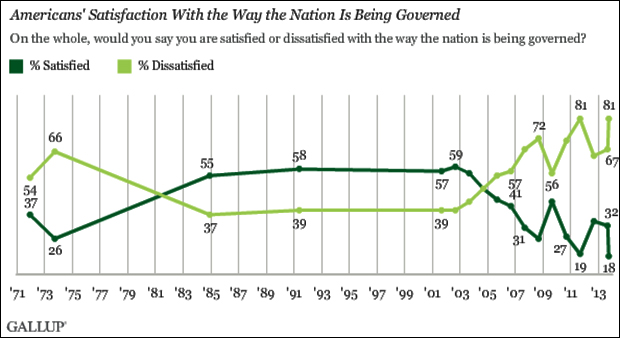
The shutdown of the US government has led to a broad discrediting of the entire political system. The Congress’s overall approval rating stands at a shocking 5 percent. The Republican Party’s disapproval rating has hit the highest level in the history of a Wall Street Journal/ NBC poll that goes back more than two decades.

More than twice the number of people now hold a negative image of the Republican Party than a positive one, according to the poll, which came out this week. The poll showed, moreover, that only 21 percent of the population views the Tea Party movement favorably.

In repeated statements this week, both Obama and Republican leaders have indicated their support for using the current budget negotiations as a springboard for broader discussions over slashing entitlement spending and cutting corporate taxes. The two parties had angled for such a deal in 2011, during the last debt ceiling crisis, but an agreement proved illusive. This has prompted a piecemeal approach that has so far resulted in over $2 trillion in spending cuts, but has largely avoiding attacks on entitlements.

Whatever the immediate result of the ongoing budget crisis, the goal of both parties is to slash hundreds of billion of dollars from Medicare and Social Security, proposals that would spell poverty for millions of elderly people.

Please enable JavaScript to view the comments powered by Disqus.
<!– blog comments powered by Disqus –>


‘
];
var html = htmlArray.join(”);
var pCount = $(‘#content’).children(‘p’).length;
var position = Math.floor(pCount*0.1);
$(‘#content’).children(‘p’).eq(position).before(html);
$(‘#inline-appeal’).children(‘form’).children(‘.more-options’).children(‘a’).click(function() {
$(‘#inline-appeal’).children(‘.initially-hidden’).show();
$(this).parent().hide();
return false;
});
}
}

function appendBottomAppeal() {
var excludes = [ ‘lect-a20’ ];
var url = document.location.href;
var filename = url.substring(url.lastIndexOf(“/”) + 1, url.length);
if (!$(‘#content’).is(‘.width72,.category’) && excludes.indexOf(filename.substr(0,8)) == -1) {
var htmlArray = [
‘

‘
];
var html = htmlArray.join(”);
if ($(‘#article-tools’).length > 0) {
$(‘#article-tools’).before(html);
} else {
$(‘#content’).append(html);
}
$(‘#inline-appeal’).children(‘form’).children(‘.more-options’).children(‘a’).click(function() {
$(‘#inline-appeal’).children(‘.initially-hidden’).show();
$(this).parent().hide();
return false;
});
}
}
$(document).ready(function(){
appendInlineAppeal();
//appendBottomAppeal();
});

Copyright: World Socialist Web Site

New reports warn of mass poverty and social decline in Europe

0

By
Stefan Steinberg

12 October 2013

A number of new reports confirm that the austerity policies pursued in Europe by the European Union and the International Monetary Fund are condemning tens of millions to poverty and fueling levels of social inequality unknown in the postwar period.

In September, the Oxfam aid agency issued a report warning that the poverty trap in Europe, which already encompasses more than 120 million people, could swell by an additional 25 million in the near future with devastating social and economic consequences. (See: “Up to 150 million in Europe threatened with poverty”)

The Oxfam findings have now been underlined by a report from the Red Cross which conducted a social survey in the first half of this year of the 28 countries of the EU, plus a further 14 states in the Balkans, eastern Europe and central Asia.

In the introduction to the 68 page report, the director of the Red Cross in Europe writes: “As the economic crisis has planted its roots, millions of Europeans live with insecurity, uncertain about what the future holds.”

The report continues: “….quiet desperation (is) spreading among Europeans, resulting in depression, resignation and loss of hope. Compared to 2009, millions more find themselves queuing for food, unable to buy medicine nor access healthcare. Millions are without a job and many of those who still have work face difficulties to sustain their families due to insufficient wages and skyrocketing prices.

“Many from the middle class have spiraled down to poverty. The amount of people depending on Red Cross food distributions in 22 of the surveyed countries has increased by 75% between 2009 and 2012. More people are getting poor, the poor are getting poorer.”

The Red Cross had conducted an initial survey of European social development in 2009, one year after the 2008 financial crash, and the year in which the EU and IMF commenced austerity policies in a number of European countries in order to refloat the continent’s banking system. Four years later, Red Cross officials collecting material for the new social survey were “surprised” and “shocked” at what they found.

The report states that over 18 million people in Europe receive EU-funded food aid, while 43 million do not get enough to eat each day. This is in addition to another 120 million at the risk of poverty. The report stresses the long-term social consequences of growing poverty and describes the explosion of unemployment across Europe as “a ticking time bomb” which was increasing the risk of social unrest and upheaval.

As well as detailing the catastrophic consequences of austerity policies in eastern Europe and southern European countries, which have faced the brunt of austerity, the report notes that the social crisis is increasingly making itself felt in northern European countries such as France, Germany and parts of Scandinavia. In France, no less than 350,000 fell below the poverty line between 2008 and 2011. In its findings on Germany, the report comments on the massive increase in the low wage sector in Germany, which has resulted in 600,000 workers with full-time jobs failing to earn enough to live on.

In response to the crisis, the Red Cross plans to commence setting up soup kitchens for the poor in Britain for the first time since the Second World War. Welfare organisations had already revealed in May that more than half a million Britons are now reliant on food handouts, with the number expected to increase over the winter.

The high costs of austerity policy for children in Europe is highlighted in another survey by European Human Rights Commissioner Nils Muižnieks, who concentrates his report on the situation in Spain.

Muižnieks notes that the percentage of children living in poverty in Spain stood at 30.6% in 2011, and has certainly risen substantially since. The Commissioner’s report states that education budgets in Spain have been cut by between 14.4 and 21.4 percent over the past three years and that, in addition to educational disadvantages, increasing numbers of children and pupils are suffering from malnutrition.

The plight of children in Spain has been intensified, according to the report, by the huge spate of forced evictions. Since the collapse of the property market in 2007, nearly 400,000 such forced evictions have taken place. With youth unemployment nearing 60 percent and growing numbers of poor families, in particular immigrant families, cut off from adequate health care, the report accuses the Spanish authorities of violating the UN Convention on the rights of children.

The two reports published this week are a devastating indictment of the criminal policies of the European Union and the IMF. At the same time both reports share the bankrupt perspective of making appeals for change to the very same political forces which are responsible for this catastrophe. The Red Cross report pleads lamely that the European political elite should “think differently”.

Far from being the unfortunate result of some unavoidable economic catastrophe, the social crisis in Europe is being consciously exploited by the continent’s financial and political elite to affect a major redistribution of wealth from the bottom of society to the top.

This development was most clearly illustrated by a third report which revealed that social polarization in Spain has increased massively during the past four years. The report by the Caritas charity declares that Spain is now the most unequal society in Europe.

According to Caritas, the number of Spaniards living in “extreme poverty” (three million) doubled between 2008 and 2012. Over the same period, the number of millionaires in Spain increased dramatically. A separate study by the Credit Suisse Bank reveals that in the course of just one year, 2011, the number of millionaires in Spain increased by a staggering 13% to the record total of 402,000.

Having reduced tens of millions in Europe to misery, the financial aristocracy and their bagmen in all political parties are now openly discussing how to dispense altogether with the welfare state in Europe. In his recent speech to open the new parliamentary year, the King of the Netherlands declared that the Dutch government—a coalition of social democrats and liberals—was planning the “replacement of the traditional welfare state by a participatory society”.

State support for the sick, disabled, unemployed, the poor and pensioners is to be replaced by “a participatory society”, with workers and their families expected to carry the entire burden for the rest of society, while the wealthy are freed from taxes and any social responsibility.

Speaking on behalf of Spain’s nouveau riche, the conservative Madrid daily ABC welcomed the Dutch government’s initiative. Featuring a cartoon with mourners resting flowers on the grave of the European welfare state, the ABC comment likens the continent’s welfare system to a “gigantic pyramid scheme a la Bernie Madoff” and a “rip off”, which could no longer be sustained by the “paternalistic state”.

Soup kitchens for the poor, recalling Dickensian Britain, and levels of labour exploitation comparable to China and neo-colonial countries—this is already the reality in Europe for tens of millions of workers and their families.

Please enable JavaScript to view the comments powered by Disqus.
<!– blog comments powered by Disqus –>


‘
];
var html = htmlArray.join(”);
var pCount = $(‘#content’).children(‘p’).length;
var position = Math.floor(pCount*0.1);
$(‘#content’).children(‘p’).eq(position).before(html);
$(‘#inline-appeal’).children(‘form’).children(‘.more-options’).children(‘a’).click(function() {
$(‘#inline-appeal’).children(‘.initially-hidden’).show();
$(this).parent().hide();
return false;
});
}
}

function appendBottomAppeal() {
var excludes = [ ‘lect-a20’ ];
var url = document.location.href;
var filename = url.substring(url.lastIndexOf(“/”) + 1, url.length);
if (!$(‘#content’).is(‘.width72,.category’) && excludes.indexOf(filename.substr(0,8)) == -1) {
var htmlArray = [
‘

‘
];
var html = htmlArray.join(”);
if ($(‘#article-tools’).length > 0) {
$(‘#article-tools’).before(html);
} else {
$(‘#content’).append(html);
}
$(‘#inline-appeal’).children(‘form’).children(‘.more-options’).children(‘a’).click(function() {
$(‘#inline-appeal’).children(‘.initially-hidden’).show();
$(this).parent().hide();
return false;
});
}
}
$(document).ready(function(){
appendInlineAppeal();
//appendBottomAppeal();
});

Copyright: World Socialist Web Site

New Australian government faces sharp economic downturn

0

By
Mike Head

12 October 2013

Less than a month after taking office, the Abbott government confronts a rapid erosion in the prospects of Australian capitalism, driven by a structural crisis of the Chinese economy, continuing stagnation in Europe and the United States, and intensifying global financial turmoil.

Falling growth rates, collapsing mining investment and an underlying rise in the unemployment rate are cutting budget revenues, placing the Liberal-National Coalition government under intense pressure from the financial markets and corporate elite to move more swiftly to slash social programs and drive down the wages and conditions of workers.

Under the previous six years of Labor government, the full impact of the global capitalist breakdown that erupted in 2008 was cushioned for a period by a combination of stimulus packages in China and Australia, a revival of mining exports to China and other Asian markets, and a resources investment boom.

Over the past 18 months, these processes have begun to unravel, as China’s growth slowed, commodity prices fell and the investment tide turned, highlighted by major project cancellations by BHP Billiton and other resources giants.

Between 2003 and 2012, the global mining sector is estimated to have invested $284 billion in new projects or mine expansions in Australia. In the first half of 2013, however, that inflow dropped dramatically, deducting about 0.5 percent from economic growth. In addition, during 2012–13, Australia’s mineral and energy export earnings fell 8 percent to $177 billion.

Two reports by the International Monetary Fund this week underscored Australia’s exposure to what is emerging in China—the end of its 20-year period of fast growth, and the danger of a financial crash. Heavily dependent on recession-hit European and US markets, China cannot continue to grow at the same pace, while the Beijing regime’s pumping out of credit to boost domestic spending has created debt bubbles that threaten to burst.

According to the latest IMF World Outlook, a slowdown in Chinese growth from an average of 10 percent during the previous decade to an average of 7.5 percent over the coming decade would cut Australia’s gross domestic product by more than 3 percent per year by 2025, primarily as a result of slower Chinese demand for coal, iron ore, and copper. Only Mongolia is more vulnerable—facing a 7 percent GDP impact.

A second report, the IMF’s global financial stability report, warned of further “downside risks” from China: “a sudden credit squeeze could further decelerate economic activity and trigger serious asset-quality problems” unless Beijing urgently reined in credit growth, which expanded more than 22 percent in 2013. The IMF said these dangers were compounded by the shocks likely as the US Federal Reserve pulled back its “quantitative easing” program of pumping $85 billion a month into the US financial system.

The Australian Bureau of Resources and Energy Economics (BREE) has warned that mining investment has peaked, in real terms, and would decline from 2014–15. “While there still remain several very large projects under construction, as these are completed over the next three to four years, there are few projects of equal value scheduled to offset the decline in mining capital expenditure,” it noted.

BREE reported that record low official interest rates of 2.5 percent had failed to spur capital investment to replace the gulf being left by the mining decline. In fact, capital expenditure in Australia was 2.3 percent lower, year-on-year, in the June quarter of 2013. The bureau predicted that Australia’s GDP growth would stagnate at 2.5 percent from 2014–15. That is well below the level of 3 percent regarded as necessary to halt rising unemployment, which saw mining jobs fall by nearly 16,000 in the year to June, on top of the destruction of thousands of manufacturing jobs.

After rising from 5.2 percent earlier this year, the latest official unemployment figures showed a decline from 5.8 to 5.6 percent during September, in seasonally adjusted terms, but that was largely because the workforce participation rate decreased 0.1 points to 64.9 percent, the lowest level since 2006. This indicates that growing numbers of people have given up looking for jobs. An estimated 100,000 people have left the workforce in the past three months, the biggest number since Australia’s last official recession in 1992.

Aggregate monthly hours worked also decreased 6.4 million hours to 1,641.5 million hours. The share of the workforce either unemployed or working less hours than desired rose to 13.7 percent, the highest since 2002. All the indicators point to a worsening jobless crisis, with Treasury forecasting a 6.25 percent official rate by the middle of next year. That would mean 770,000 out of work and more than 1.5 million unemployed or underemployed.

Despite the record low interest rates, the Westpac-Melbourne Institute Index of Consumer Sentiment fell 2.1 percent in October, partly reversing an immediate post-election jump. The subindex tracking consumers’ assessments of their finances relative to a year ago fell by 1.9 percent, a sign of increasing financial stress. A related index of unemployment expectations rose to 10.1 percent above the level in November 2011, reflecting heightened concerns about job prospects. There was a shock fall from 140 to 135 in the index of assessments of “whether now is a good time to buy a dwelling.”

Likewise, dwelling approvals fell 4.7 percent in August after a 10.2 percent jump in July, denting efforts by sections of the media to talk up prospects of a housing-led recovery. Overall, construction activity declined in September, extending a three-and-a-half year contraction, even though house and apartment building rose for the first time for months, according to the Australian Industry Group/Housing Industry Association Australian Performance of Construction Index. The protracted fall in construction industry employment continued, and in fact registered its steepest pace of decline in the past three months.

Borrowing by businesses is continuing to stagnate, underscoring the impact of waves of industrial and retail closures, and lack of business confidence that conditions will improve. According to the latest data from the Reserve Bank of Australia, business credit increased by just 0.2 percent in August, after a 0.4 percent lift in July. Over the year, business credit barely rose, by 1.4 percent, which is a fall in real terms.

Public demand, which represents 22 percent of the economy, actually declined over the past year, contracting by some 2 percent in the year to June 2013. This reflects the record cuts in public spending already imposed by the Gillard and Rudd governments as they attempted to implement the dictates of the financial markets to eliminate the budget deficit.

Plumetting revenues in 2012–13—the equivalent of a $40 billion drop from 2005–06, at the height of the mining boom, ultimately compelled the Labor government to defer its pledge to balance the budget. For 2013–14, another $20 billion is expected to be wiped off revenues, producing a deeper budget black hole.

Business leaders and the corporate media are now ramping up their demands on the government to cut spending far further, radically lower business taxes and rewrite the workplace laws to clear the way for the wholesale cutting of wages and working conditions. David Uren, the Australian‘s economics editor declared on Thursday that Treasurer Joe Hockey was “getting a crash course on the global economy” at the IMF-G20 finance ministers’ meetings in Washington this week. “Hockey should return from Washington with a much fuller appreciation of the challenges of his job and a sense that the post electoral glow of rising confidence levels may prove ephemeral,” he wrote.


‘
];
var html = htmlArray.join(”);
var pCount = $(‘#content’).children(‘p’).length;
var position = Math.floor(pCount*0.1);
$(‘#content’).children(‘p’).eq(position).before(html);
$(‘#inline-appeal’).children(‘form’).children(‘.more-options’).children(‘a’).click(function() {
$(‘#inline-appeal’).children(‘.initially-hidden’).show();
$(this).parent().hide();
return false;
});
}
}

function appendBottomAppeal() {
var excludes = [ ‘lect-a20’ ];
var url = document.location.href;
var filename = url.substring(url.lastIndexOf(“/”) + 1, url.length);
if (!$(‘#content’).is(‘.width72,.category’) && excludes.indexOf(filename.substr(0,8)) == -1) {
var htmlArray = [
‘

‘
];
var html = htmlArray.join(”);
if ($(‘#article-tools’).length > 0) {
$(‘#article-tools’).before(html);
} else {
$(‘#content’).append(html);
}
$(‘#inline-appeal’).children(‘form’).children(‘.more-options’).children(‘a’).click(function() {
$(‘#inline-appeal’).children(‘.initially-hidden’).show();
$(this).parent().hide();
return false;
});
}
}
$(document).ready(function(){
appendInlineAppeal();
//appendBottomAppeal();
});

Copyright: World Socialist Web Site

Germany: Formation of new government drags on

0

By
Peter Schwarz

12 October 2013

Three weeks after the federal election, negotiations about forming a new coalition government are still at the exploratory stage. On Friday, October 4, the Christian Democratic Union/Christian Social Union (CDU/CSU) and the Social Democratic Party (SPD) held their first exploratory discussions; on Thursday of this week, the CDU/CSU met with the Greens. Further exploratory talks with the SPD are planned on Monday.

Following these discussions, the parties will then decide with whom they want to conduct coalition negotiations. This will begin after the constitution of the new Bundestag (parliament) on October 22. On that day, the current federal government will be formally dissolved. However, the Merkel government will remain in office on a caretaker basis, until a new government is found. This also applies to the ministers of the Free Democratic Party (FDP), even though the FDP failed to gain representation in the next parliament when its vote fell below the 5 percent threshold.

The selection of a new government could take several weeks. The coalition negotiations will take time, and the results must be approved in various party committees, and in the case of the SPD, by a members’ vote.

The Union (CDU/CSU) lacks sufficient votes for an outright majority and is therefore dependent on finding a coalition partner. For this, either the SPD or the Greens come into consideration. A coalition comprising the SPD, Greens and Left Party, which could secure a majority, has been ruled out by both the SPD and the Greens, although the Left Party never tires of promoting it. No exploratory talks considering this constellation have been held.

Fundamentally, there are no obstacles to either a CDU/CSU-SPD government (a so-called “black-red” coalition) or a “black-red-green” coalition. Before the start of the exploratory talks, the SPD and the Greens both brushed aside the “irreconcilable differences” with the CDU/CSU, which they had proclaimed in the election campaign. They have signalled their willingness to forgo higher taxes for the rich, which they had formerly claimed would be used to fund education and infrastructure spending.

After the first exploratory discussion between the CDU/CSU and SPD, both sides stressed that serious interest in an agreement had been identified. CDU general secretary Hermann Gröhe said there had been “substantial agreement with the SPD”.

Following their poor showing in the election, the Greens have distanced themselves from all social reformist demands and are stressing their pro-business credentials. Even the conservative Frankfurter AllgemeineZeitung ( FAZ ) came to the conclusion that the “gulf between the Greens and the Union is no longer insurmountable”.

Significantly, the Green delegation to the exploratory talks included Baden-Württemberg state premier Winfried Kretschmann, who has long advocated cooperation with the CDU. After the general election, he said, “Competing over distributive justice during the election campaign—that can’t be our position”.

The difficulties in forming a new government are therefore not the result of substantive differences between the parties. Rather, they arise from the challenges facing the next administration. It is tasked with carrying out a new round of massive social attacks and an aggressive, military-based foreign policy, which will bring it into conflict with large sections of the population.

The tensions, differences and tactical manoeuvres in the coalition negotiations arise from these tasks; and what is being sought is a political mechanism that can withstand the coming class struggles.

As in the election campaign, the key policy issues in the exploratory talks—or those that find their way into the public domain—are not being openly addressed, or at most only in the margins. Instead, lifestyle issues, such as the equality of homosexual partnerships and quotas for women on company supervisory boards, or energy policy are being pushed to the forefront.

In reality, it is the intensification of the euro crisis and the growth of violent imperialist conflicts, as currently in the Middle East, that will determine the agenda of the next government. The press is largely agreed that the euro crisis is not resolved. An editorial in the Financial Times recently compared it with a Hydra, which grows two new heads whenever one is cut off, and called the resolution of this crisis a Herculean task.

Greece, Portugal and soon probably Slovenia need new billions in aid. The Spanish banks still face bankruptcy. Italy and France are far from meeting their deficit targets. It is only a matter of time before interest rates on government bonds soar again and exacerbate the crisis. In addition, European politicians are staring nervously at the US budget crisis, whose impact on Europe is aggravating the situation.

To preserve the euro—an aim the CDU/CSU, SPD and Greens all agree upon—the insatiable financial markets must be fed with new multibillion “bailouts”. This time, however, it cannot be done in the form of loans and guarantees. The new aid packages will have a direct impact on Germany’s federal budget. The result will be the imposition of new austerity measures, not only in the countries concerned, but also in Germany itself.

The situation is further worsened by the crisis in Germany’s state and local budgets, which pay for the majority of social and educational issues and are in part hopelessly in debt. The debt ceiling forces them to make further savings and prohibits them from taking any new loans from 2020. At the same time, measures equalising the financing of Germany’s states and the so-called solidarity pact with the states in the former East Germany are running out. The results are massive holes in state budgets running into billions, which are already leading to ferocious conflicts regarding the distribution of funding and new cuts.

Influential sections of the ruling class are of the view that only a grand coalition of the CDU/CSU and the SPD can withstand the coming social storms.

For example, employers’ association president Dieter Hundt has publicly called for a grand coalition. “Looking at the really big challenges in this country, I am convinced that a grand coalition makes sense,” he said. “CDU/CSU and SPD stand for the common euro-stabilisation policy of recent years and in my view this policy, which has been confirmed by the voters, should be continued.”

The head of the so-called employees wing of the CDU, Karl-Josef Laumann, who has close relations with the trade unions, has also called for a grand coalition. Given the major problems and the majority in the Bundesrat (upper house), much speaks for it, he told broadcaster WDR.

For their part, the Greens are quite prepared to accept drastic cuts in social spending. However, the SPD has a much larger apparatus, heads 9 of Germany’s 16 state governments and is closely linked to the trade unions. It is therefore better able than the Greens to suppress social resistance.

However, there are also those who regard a grand coalition as a risky prospect because a rebellion against its policies would seek out new paths. Under such conditions, the official opposition of the Greens and the Left Party would be reduced to 17 percent of the parliamentary deputies, and would barely be able to divert the resistance into harmless channels. This is all the more true since the Greens and Left Party are broadly in line politically with the SPD and the Union.

For the FAZ, therefore, a black-green coalition holds out “a certain attraction”. “For the Union, such an alliance would be a permanent alternative to a grand coalition…. The Greens, in turn, would no longer be tied to a weakening SPD…. And the Bundestag would be spared a 17-percent opposition totally incapable of operating,” wrote the paper.

Hardly a word about the foreign policy of the future German government has seen the light of day. A massive hole gapes here regularly in the list of topics to be discussed in the exploratory talks.

So far, it has been media outlets such as Zeit, taz, the Süddeutsche Zeitung and Welt that have banged the drum for more vigorous support for imperialist wars in Syria and other countries. On the Day of German Unity, Federal President Joachim Gauck also demanded Germany again play a role “in Europe and in the world” that actually corresponds to its size and influence. There can be no doubt that the future government—whether a grand coalition or a “black-green” coalition—will follow this call.


‘
];
var html = htmlArray.join(”);
var pCount = $(‘#content’).children(‘p’).length;
var position = Math.floor(pCount*0.1);
$(‘#content’).children(‘p’).eq(position).before(html);
$(‘#inline-appeal’).children(‘form’).children(‘.more-options’).children(‘a’).click(function() {
$(‘#inline-appeal’).children(‘.initially-hidden’).show();
$(this).parent().hide();
return false;
});
}
}

function appendBottomAppeal() {
var excludes = [ ‘lect-a20’ ];
var url = document.location.href;
var filename = url.substring(url.lastIndexOf(“/”) + 1, url.length);
if (!$(‘#content’).is(‘.width72,.category’) && excludes.indexOf(filename.substr(0,8)) == -1) {
var htmlArray = [
‘

‘
];
var html = htmlArray.join(”);
if ($(‘#article-tools’).length > 0) {
$(‘#article-tools’).before(html);
} else {
$(‘#content’).append(html);
}
$(‘#inline-appeal’).children(‘form’).children(‘.more-options’).children(‘a’).click(function() {
$(‘#inline-appeal’).children(‘.initially-hidden’).show();
$(this).parent().hide();
return false;
});
}
}
$(document).ready(function(){
appendInlineAppeal();
//appendBottomAppeal();
});

Copyright: World Socialist Web Site

Australian politician justifies Pinochet’s coup in Chile

0

By
Eduardo Ballesteros

12 October 2013

Last month, an Australian Liberal Party parliamentarian openly aligned himself with dictatorial forms of rule in a speech commemorating the 40th anniversary of the CIA-backed Chilean coup that installed the fascist-military regime of General Augusto Pinochet.

Peter Phelps, the chief government whip in the New South Wales upper house, the Legislative Council, said he wanted to “make the case for Augusto Pinochet.” He declared: “There are many who believe that General Pinochet was a reluctant hero, a morally courageous man, who not only saved his country from communism but also whose adoption of the Chicago school of economics brought prosperity to his country.”

Phelps’s chilling justification of Pinochet’s crimes caused outrage and real concerns in Australia’s Chilean émigré population, many of whom were forced to flee the military junta’s repression following the overthrow of the social democratic-led coalition government of Salvador Allende on September 11, 1973.

American imperialism and the Chilean bourgeoisie feared that the Popular Front government headed by Allende’s Socialist Party and the Stalinist Communist Party would be incapable of indefinitely suppressing a massive militant movement of the working class. They plotted and organised a violent counterrevolution during the three years that Allende’s coalition held office.

This was a major defeat inflicted on the Chilean and international working class. During its 17 years in power, Pinochet’s regime—aided financially, politically and militarily by Washington—rounded up, tortured and slaughtered tens of thousands of workers, students and left-wing intellectuals. Thousands more lost their lives in the US-inspired Operation Condor, in which Latin America’s military regimes assassinated political opponents throughout the continent.

Until now, support for Pinochet’s bloodbath has not been publicly voiced within the Australian political establishment, although Pinochet received lavish praise within ruling circles internationally—from the likes of the late British Prime Minister Margaret Thatcher and former US National Security Advisor Henry Kissinger, who was closely involved in the coup. More recently, the Wall Street Journal , following July’s military coup in Egypt, after nearly two and a half years of revolutionary ferment, expressed in an editorial its hope that “the new ruling generals turn out to be in the mold of Chile’s Augusto Pinochet.”

Phelps, a fervent libertarian, is a disciple of the free market nostrums of Friedrich Hayek and Milton Friedman, which were put into effect with brutal results in Chile and later emulated by Thatcher, Ronald Reagan and the Hawke-Keating Labor governments in Australia, among others.

Although a relatively minor and little-known figure, Phelps was elevated into state parliament in 2011 on the back of top-level connections. He had served as chief of staff or adviser to a string of senior Liberals, including Eric Abetz (now employment minister), Ian McLachlan and John Moore (both former defence ministers), Chris Ellison and Bronwyn Bishop.

Phelps’s comments went beyond offering support for the bloody events in Chile 40 years ago. They sought to justify resort to dictatorships whenever necessary to defend the profit system. “It is all too easy to say, ‘We believe we should never sanction dictatorship’ or that we should have no truck with evil, but such principles are foolish and self-defeating in the real world,” Phelps told the parliament. “Yes, Pinochet killed people. If anyone knows of any other way to overthrow a government than by military force, then let me hear about it.”

These remarks point to the kinds of discussions taking place in ruling circles behind closed doors. Phelps argued that as a “requirement for survival,” it is “sometimes necessary to do bad things to prevent terrible things from happening.”

The comments were made under conditions of deepening public disaffection with the existing political order and its program—adhered to by the Liberals, Labor and the Greens alike—of imposing austerity measures at the behest of the financial elite and supporting the aggressive militarism of the US government.

Significant layers of the ruling strata have concluded that the kind of wholesale assault on the social position of the working class being demanded by big business is incompatible with the maintenance of “democratic,” parliamentary forms of rule. That is why, in Australia, and around the world, the past ten years has seen successive governments utilise the fraudulent “war on terror” to erect the framework for a police-state, with unprecedented surveillance and detention powers.

Phelps’s comments drew no condemnation from within the political and media establishment. His state party leader, Premier Barry O’Farrell, made no move to dismiss or even discipline him. O’Farrell merely declared that Phelps should have found a better example “than a murderous, military dictator” to highlight the excesses of communism. Federal Liberal leader, Prime Minister Tony Abbott, made no comment whatsoever, nor did a single Labor Party or trade union leader.

Phelps’s speech was clearly pre-prepared. It came a day after Labor MP Lynda Voltz and Greens MP John Kaye had criticised the involvement of the Nixon administration, the Pentagon and the CIA in the Chilean coup and its aftermath.

In their contributions on the anniversary of the coup, Voltz and Kaye promoted Allende’s Popular Front coalition, which included Allende’s Socialist Party, the Stalinist Chilean Communist Party and a section of the Christian Democrats. The Popular Front coalition played the pivotal role in politically disarming the Chilean working class and strangling its struggles, directly paving the way for the coup. Allende and his Stalinist partners, in particular, sowed fatal illusions in the supposedly “democratic” character of the armed forces, and invited the generals, including Pinochet, to join the government to assist in suppressing the mass workers movement, which included workers taking over factories.

Phelps’s recent outburst is a warning to the working class, in Australia and around the world, of the contempt for democratic rights in ruling circles and the moves already underway towards authoritarian forms of rule as mass resistance grows to the global capitalist agenda of war, social austerity and repression.

The author also recommends:

Forty years since the Chilean coup of September 11, 1973
[11 September 2013]

From the archives of Marxism: Lessons of the 1973 coup in Chile
[11 September 2013]


‘
];
var html = htmlArray.join(”);
var pCount = $(‘#content’).children(‘p’).length;
var position = Math.floor(pCount*0.1);
$(‘#content’).children(‘p’).eq(position).before(html);
$(‘#inline-appeal’).children(‘form’).children(‘.more-options’).children(‘a’).click(function() {
$(‘#inline-appeal’).children(‘.initially-hidden’).show();
$(this).parent().hide();
return false;
});
}
}

function appendBottomAppeal() {
var excludes = [ ‘lect-a20’ ];
var url = document.location.href;
var filename = url.substring(url.lastIndexOf(“/”) + 1, url.length);
if (!$(‘#content’).is(‘.width72,.category’) && excludes.indexOf(filename.substr(0,8)) == -1) {
var htmlArray = [
‘

‘
];
var html = htmlArray.join(”);
if ($(‘#article-tools’).length > 0) {
$(‘#article-tools’).before(html);
} else {
$(‘#content’).append(html);
}
$(‘#inline-appeal’).children(‘form’).children(‘.more-options’).children(‘a’).click(function() {
$(‘#inline-appeal’).children(‘.initially-hidden’).show();
$(this).parent().hide();
return false;
});
}
}
$(document).ready(function(){
appendInlineAppeal();
//appendBottomAppeal();
});

Copyright: World Socialist Web Site

<em>7th Heaven</em> (1927) and <em>Street Angel</em> (1928): two silent films by Frank Borzage

0

By
Charles Bogle

12 October 2013

Murnau, Borzage and Fox Box Set (2008), 20th Century Fox Home Entertainment

Like a number of his cinema contemporaries (Charlie Chaplin and Mary Pickford being among the most prominent), director Frank Borzage grew up in poverty and turned to acting and filmmaking at a young age. Born in Salt Lake City, Utah, in 1894, he was one of many brothers and sisters (14, eight of whom survived to adulthood) attempting to live on their Italian-born father’s pay as a stonemason.

By the age of twelve, Frank Borzage was himself laboring in a Utah coal mine. He subsequently pursued a youthful interest in acting to Hollywood in 1912 where he first worked as an actor and became an actor-director in 1915. Borzage’s career flourished in the late 1920s and early 1930s in particular. In 1929, the Academy of Motion Picture Arts Association honored Borzage with its first Best Director award for 7th Heaven (released in 1927). Borzage would also win the same award for Bad Girl in 1931.

Borzage had no problem adapting to sound, as he was also responsible for a number of memorable movies released during the 1930s, e.g., A Farewell to Arms, History is Made at Night, No Greater Glory, Three Comrades, and I’ve Always Loved You and Moonrise in the 1940s. Borzage’s output declined in the 1950s, reportedly due to his distaste for the cynicism in many of the scripts he received.

Indeed, critic Andrew Sarris, in his The American Cinema, referred to Borzage as “that rarity of rarities, an uncompromising romanticist.” Sarris went on, “He [Borzage] plunged into the real world of poverty and oppression, the world of Roosevelt and Hitler, the New Deal and the New Order, to impart an aura to his characters, not merely through soft focus and a fluid camera, but through a genuine concern with the wondrous inner life of lovers in the midst of adversity… History Is Made at Night is not only the most romantic title in the history of the cinema but also a profound expression of Borzage’s commitment to love over probability.”

The best available copies of Borzage’s major silent films are to be found in the Murnau, Borzage and Fox Box Set (2008). This reviewer has chosen to look at two of those films, 7th Heaven (1927) and Street Angel (1928), from the director’s most productive period. Both films feature Borzage’s mastery of visual stylistics to convey his career-long theme of couples armed only with their love in a struggle against rigid, often irrational societal conventions and laws.

In 7th Heaven, a young woman, Diane (Janet Gaynor), lives in penury with her sister (played by Gladys Brockwell), who regularly whips Diane to force her to trade stolen goods for absinthe. During one particularly vicious beating that ends outside their apartment in the street, Diane is saved from death by a sewer worker, Chico (Charles Farrell).

At first indifferent to Diane’s obvious feelings, Chico begins to show a fondness for her after he is promoted to the position of street cleaner. When the police arrest Diane’s sister for dealing in stolen goods and threaten to arrest Diane too as an accomplice, Chico tells them she is his wife to save her from imprisonment.

A brief but touching period of innocent, paradisiacal romance is interrupted by the declaration of World War I (although they do manage to marry before Chico leaves for the front lines). During the war, Diane takes a job at a munitions factory while awaiting Chico’s return. The film’s conclusion offers a typical Hollywood “surprise” ending, although presented in such a way that the viewer does not feel cheated.

By the mid-1920s, the lessons learned from D. W. Griffith’s profoundly important contribution of montage (or “cross cutting”) were being supplemented by a more fluid, moving camera. At the vanguard of the latter development stood the brilliant German director F.W. Murnau (The Last Laugh [1924], Faust [1926] and his masterpiece, Sunrise [1927]), also now at Fox, whose use of a moving camera influenced movie making in general and Borzage’s work specifically.

About Fox, Dave Kehr of the New York Times noted in 2008, reviewing the Murnau and Borzage box set, “[William] Fox lost control of his studio in 1930 because of financial problems related to the stock market crash, but by that point had firmly established the Fox Film Corporation as the Hollywood enterprise most friendly to personal filmmakers.”

Borzage’s (and his cinematographer Ernest Palmer’s) tracking shot of the elder sister whipping Diane out of their apartment and into the street serves double duty, i.e., it not only portrays the uninterrupted (and therefore realistic) brutality of the beating, but also the sense that there is no safe haven for the victim.

Effective crosscutting also features in 7th Heaven. A high angle shot from Chico’s apartment of men responding to the declaration of war by marching through the streets is juxtaposed to Diane donning the wedding gown that Chico purchased for her and then crossing the little wooden bridge that connects her room to Chico’s (as they are not married, they sleep in separate rooms).

The purity inherit in this scene is given a greater, poignant meaning when viewed next to the shots of men marching off to war, not only due to the realization that many of these men will not be returning, but also that the young couple’s loving relationship will be interrupted (and perhaps ended) by the cold brutality of war. (The antiwar Borzage refused to film the battle scenes in this movie; fellow Fox employee John Ford filmed the scenes instead and the result is an antiheroic, realistic portrait of battle).

Borzage uses close-ups to capture the emotions on his main characters’ faces. The diminutive Gaynor’s doll-like face is capable of registering pure adoration when gazing upward to the 6′ 2” Charles Farrell; that same face can also convey an aching numbness when called for.

The same use of close-ups on Farrell’s face allows the actor to use his pliable face to full advantage, demonstrating a naturalness that was rarely found in male characters in the earlier silent films.

Borzage’s Street Angel (1928) is a darker film that draws more heavily on Expressionistic lighting while incorporating a moving camera in even more innovative ways than 7th Heaven.

Angela (Gaynor again) takes care of her dangerously ill mother in a tiny apartment on the foggy harbor side of Naples, Italy. The police arrest Angela for trying to sell sexual favors to a man on the street (unsuccessfully, due to her innocence), but she escapes while being led away to the workhouse.

Angela then joins a traveling circus as a stilt walker, where she encounters a vagabond painter named Gino (Farrell again). At first, Angela is indifferent to Gino, professing distrust of all men, but after he completes a painting of the “real Angela” behind her tough mask, she warms to him.

A fall from her stilts breaks Angela’s ankle, causing her to travel by boat—with Gino to help her—to a doctor in Naples. Once there, Gino gains fame and money as a painter, asks Angela to marry him (to which she agrees) and the pair enjoy a moment of “heaven on earth” before the police come to their door and arrest Angela for her earlier attempt to sell herself on the street.

After her release from the workhouse, the climax pits a pleading Angela against a revengeful Gino (due to her supposed prostitution and imprisonment).

In Street Angel, Borzage constructs a moving floor for his nighttime crowd scenes in Naples, enhancing the effects created in 7 th Heaven. This same technique draws on Expressionism when Angela is being led to the workhouse amid the shadows of human figures stretching high across a wall, evoking both a feeling of both fear and pity for her relatively tiny figure.

The scene where Angela is taken before a judge for sentencing is breathtaking. Shot from behind the judge (and thus from his perspective), Angela is a mere speck in the distance as she is led to the bench by two guards. Once there, she remains minuscule with her eyes barely visible above the bench. It is difficult to recall a scene that so immediately and convincingly depicts the insignificance of the individual in the eyes of the state.

Angela allows Gaynor to display a greater range than she displayed in her characterization of Diane. Angela is an independent, practical woman with a quick temper and sense of humor, qualities that, taken together, complement the idealistic, often impractical Gino.

Farrell’s Gino is also more complicated than Chico in 7th Heaven. In addition to an artist’s idealism and whimsicality, he can also be despondent when his art is not appreciated or murderously angry when he confronts Angela about her past.

Because of his depiction of love as a force that can overcome any adversity, Borzage’s work has been criticized for being sentimental. Gaynor took exception to this criticism of the director’s work: “Frank Borzage directed from the heart, and so his pictures were—well, some people would say they were sentimental. For that time, 7th Heaven was not sentimental. It was considered dramatic.”

This reviewer would go one step further and argue that those who find Borzage’s work sentimental are judging him from the fashionable chilly, cynical perspective that informs much of what is considered “serious criticism” today.

Murnau, Borzage and Fox is an important contribution to our understanding of filmmaking during the silent period. In addition to containing nine Borzage films, it also features two Murnau movies, Sunrise and City Girl; a booklet with text and stills from the films in the box set; a booklet with text and stills from Murnau’s lost classic, 4 Devils; and a fascinating documentary on the films of Murnau and Borzage, and producer William Fox’s fight to liberate moviemaking’s artistic possibilities from the stranglehold of the Thomas Edison trust companies.


‘
];
var html = htmlArray.join(”);
var pCount = $(‘#content’).children(‘p’).length;
var position = Math.floor(pCount*0.1);
$(‘#content’).children(‘p’).eq(position).before(html);
$(‘#inline-appeal’).children(‘form’).children(‘.more-options’).children(‘a’).click(function() {
$(‘#inline-appeal’).children(‘.initially-hidden’).show();
$(this).parent().hide();
return false;
});
}
}

function appendBottomAppeal() {
var excludes = [ ‘lect-a20’ ];
var url = document.location.href;
var filename = url.substring(url.lastIndexOf(“/”) + 1, url.length);
if (!$(‘#content’).is(‘.width72,.category’) && excludes.indexOf(filename.substr(0,8)) == -1) {
var htmlArray = [
‘

‘
];
var html = htmlArray.join(”);
if ($(‘#article-tools’).length > 0) {
$(‘#article-tools’).before(html);
} else {
$(‘#content’).append(html);
}
$(‘#inline-appeal’).children(‘form’).children(‘.more-options’).children(‘a’).click(function() {
$(‘#inline-appeal’).children(‘.initially-hidden’).show();
$(this).parent().hide();
return false;
});
}
}
$(document).ready(function(){
appendInlineAppeal();
//appendBottomAppeal();
});

Copyright: World Socialist Web Site

NBC/WSJ Poll: 90% Say Fire Every Member Of Congress

0
firecongress

Xavier
Planet Infowars
Oct. 11, 2013

Submitted by Fox First at Ten on October 10th

In a new poll taken by NBC News and The Wall Street Journal, 800 adults were asked, “If there were a place on your ballot that allowed you to vote to defeat and replace every single member of Congress, including your own representative, would you do this, or not?”

The results were clear. 60% of those polled said “yes” they would get rid of every member of Congress and replace them with a fresh batch of politicians. Only 35% said they would not, while 5% weren’t sure. The margin of error was +- 3.46%.

Vote in the poll and sound off your opinion on the FACEBOOK and Twitter page.

Vote in the poll and sound off your opinion on the FACEBOOK and Twitter page.

This article was posted: Friday, October 11, 2013 at 5:06 pm

Tags:


<!– this is where we need to show the related articles

–>

Copyright: Infowars

Al-Qaeda has committed ‘crime against humanity’ in Syria

0

telegraph.co.uk
October 11, 2013

A researcher from the organisation interviewed survivors of an offensive against villages occupied by members of the Alawite sect to which the Assad family belongs in Latakia province, confirming widespread reports of atrocities.

The attack followed regime massacres of hundreds of civilians in two Sunni towns in the same province in May, and was described by the militants’ own propaganda outlets in highly vengeful, sectarian terms.

Alawite villagers told how they returned to their homes to find relatives – often those too old or infirm to flee – butchered.

Read more

This article was posted: Friday, October 11, 2013 at 3:27 pm


<!– this is where we need to show the related articles

–>

Copyright: Infowars

Cyprus bank suffered record loss in 2012

0

People queue up outside a Bank of Cyprus branch in Nicosia on April 2, 2013.

The Bank of Cyprus has announced a record net loss of 2.2 billion euros ($3 billion) in 2012 as a crippling recession hit the people’s ability to repay their debts.

The Cypriot bank said in a statement issued on Friday that the figure is more than 60 percent higher than the bank’s losses in 2011.

The bank added that its Tier 1 capital ratio, which is a measure of a bank’s financial strength from a regulator’s point of view, sank to minus 1.9 percent by the end of last year, much lower than the EU-mandated nine percent.

The troika of international lenders — the International Monetary Fund, the European Commission and the European Central Bank — agreed in March to give a 10-billion-euro ($13.1 billion) rescue loan package to Cyprus to recapitalize its shaky banking system and help the cash-strapped nation avoid bankruptcy.

The deal included the closure of the country™s second-largest bank, Laiki Bank, and a 47.5 percent cut on deposits over 100,000 euros at the Bank of Cyprus to recapitalize it.

œEvents following Eurogroup™s decision on Cyprus have significantly impacted the Bank of Cyprus Group,” the statement said.

It added that profit before penalties and restructuring costs, which Cyprus agreed to impose on the bank under the terms of the bailout package, was 620 million euros last year.

The bank stated that œdespite the prevailing adverse economic conditions which affected the trust and confidence of depositors,” its total deposits had fallen by only four percent by December 31, 2012.

The long-drawn-out eurozone debt crisis, which began in Greece in late 2009 and later on reached Italy, Spain, France , Portugal, Britain, Ireland, and Cyprus is viewed as a threat not only to Europe but also to many of the world™s other developed economies.

The worsening debt crisis has forced EU governments to adopt harsh austerity measures and tough economic reforms, which have triggered massive demonstrations in many European countries.

GHK/GJH/MHB

Copyright: Press TV

‘Ex-Seleka rebels attack CAR forces’

0

Former rebels of the Seleka coalition have launched an attack against security forces dispatched to the northwest of the Central African Republic (CAR) following clashes that killed 50 people earlier, an official says.

The attack, which wounded two people, took place in the village of Garga, 200 kilometers (120 miles) northwest of the capital Bangui on Thursday, AFP quoted Colonel Christian Djouma Narkoyo as saying on Friday.

“It was former Seleka fighters… who did these things. It is truly deplorable. It’s discouraging to see such things and it’s unacceptable,” Narkoyo stated, adding, “I reassure the population and urge people to stay calm. Measures will be taken to put an end to this kind of behavior.”

On Tuesday, 50 people died and many others were injured in clashes between ex-Seleka rebels and local groups in Garga.

CAR Justice Minister Arsene Sende said on Friday that government forces arrested a rogue former rebel commander along with six of his men in the southern town of Damara, 75 kilometers (45 miles) north of the capital on Wednesday.

“Seven criminals, led by a so-called colonel going by the name of Mahamat Amine and who had emerged from the bush in Damara, were detained by our security and defense forces,” Sende said.

The Seleka rebels, who launched an offensive against the CAR government in December 2012 and finally ousted then President Francois Bozizé in March, have been accused of killing, looting, and raping across the country.

On September 13, CAR President Michel Djotodia dissolved the rebel group, which had brought him to power. Some of the rebels later joined the country™s regular army while some defied.

There are many mineral resources, including gold and diamond, in the Central African Republic. However, the country is extremely poor and has faced a series of rebellions and coups since it gained independence in 1960.

NT/MAM/MHB

Copyright: Press TV

Rosemary Protects Against Macular Degeneration

0
Rosemary Protects Against Macular Degeneration

For modern cooks, rosemary is best known as the perfect herb to pair with a good roast chicken or lamb. But as with other herbs, it also has powerful and ancient medicinal properties. Modern science is catching up to what the ancients knew. One scientific study finds that a compound in rosemary promotes eye health and may even protect against age-related macular degeneration.

Reporting in the journal Investigative Ophthalmology & Visual Science, a team of scientists from Sanford-Burnham Medical Research Institute led by Stuart A. Lipton, M.D., Ph.D. discovered that carnosic acid, a component of the herb rosemary, protects your retina from degeneration and toxicity.

Age-related macular degeneration is the most common eye disease in the U.S. It affects close to 11 million Americans, most over the age of 50. According to the American Health Assistance Foundation, macular degeneration causes deterioration of the central area of the retina, resulting in blind spots and blurred or distorted vision. One-third of people over the age of 76 suffer from the condition.

The underlying cause of macular degeneration is not known but some of the risk factors include smoking, sun exposure, high blood pressure and obesity. Genetics are believed to play a role in most cases.

Some earlier studies had suggested that the disease might be slowed by antioxidants that fight free radicals. That’s where rosemary comes in.

In this study, Lipton and his colleagues found that retinal cells treated with carnosic acid found in rosemary triggered the production of antioxidant enzymes in the cells. That in turn lowered cell-damaging free radicals.

They also tested carnosic acid in animals, finding that mice treated with it suffered less vision damage whden exposed to light.

Protection from macular degeneration is just the latest in rosemary’s many health benefits which have been known for thousands of years. The ancient Greeks prized rosemary for its ability to boost memory. And Greek students are reported to have worn rosemary sprigs in their hair when studying for exams. Lipton and his team are also exploring whether rosemary may be useful in preventing certain forms of dementia.

In addition, rosemary has traditionally been used to stimulate the immune system, improve digestion, increase circulation and act as an anti-inflammatory.

In animal studies rosemary has been shown to act as an antidepressant, improve type 1 diabetes and even prevent weight gain from a high fat diet.

A Kansas State University study found rosemary to be the most effective of six spices tested in reducing the formation of heterocyclic amines (HCAs). HCAs are carcinogenic compounds produced when animal foods such as beef, chicken, pork or fish, are barbecued, grilled, boiled or fried. Consuming HCAs through meat increases risk factors for colorectal, stomach, lung, pancreatic, mammary and prostate cancers.

Native to the Mediterranean region, rosemary can be found just about everywhere today. A relative of mint, it grows in small shrubs and its leaves resemble pine needles. It’s widely available as a dried herb, supplement or essential oil.

Try placing whole fresh sprigs inside a roasting chicken or turkey, or in a pot of chicken soup.

Rosemary is easily grown in pots at home. At the holidays you can find decorative plants trimmed in the shape of small trees. Keep one handy in your kitchen to remind you of its many health benefits.

Disclaimer: This article is not intended to provide medical advice, diagnosis or treatment. Views expressed here do not necessarily reflect those of GreenMedInfo or its staff.

Copyright: Green Med Info

Iran routs Lebanon in Asia soccer tourney

0

National Iranian under-19 football team has trounced Lebanon in the preliminary round of the Asian Youth Football Championship.

The Iranian team, which defeated Tajikistan 2-0 in its opening encounter on October 8, pummeled the Lebanese side 6-1 in a game played at Shahid Bahonar Stadium in the southeastern Iranian city of Kerman, located 1,036 kilometers (643 miles) south of Tehran, on Thursday.

The hosts started the match with vigor and valor. Iran’s Ali Fathian opened the scoring only two minutes into the match.

Lebanese football player Mohammad Saleh seized a golden opportunity a few minutes later, dribbled forward with the ball and was finally brought down inside Iran™s penalty area.

The referee signaled the award of a penalty kick by blowing the whistle and pointing to the penalty mark.

Saleh put the ball at the back of the net in the seventh minute to score Lebanon™s sole goal of the game.

Armin Sohrabian doubled Iran™s lead in the 21st minute, and Sardar Azmoun scored the third goal for Iran in the 36th minute. Milad Sarlak scored Iran™s fourth goal in the 46th minute.

Azmoun seized another golden opportunity in the 74th minute and put the ball into the back of the net to make it five for Iran.

Sohrabian netted the sixth goal for Iran in the 86th minute.

Iran takes on Saudi Arabia on Saturday.

The preliminary round of the Asian Youth Football Championship started in the Kerman on October 8, and will wrap up on October 12.

Young footballers from four Asian countries — Iran, Lebanon, Saudi Arabia and Tajikistan — are competing in the sports event.

MP/MAM/MHB

Copyright: Press TV

Can Your Diet Reduce Your Chances of Alzheimer’s?

0
alzheimers and diet

By Case Adams, Naturopath

After a fifteen year study of 1,006 elderly persons, Japanese University researchers say yes, ones diet can dramatically reduce our chances of Alzheimer’s disease and dementia.

The researchers, from Japan’s Kyushu University Graduate School of Medical Sciences, followed 1,006 people who were between 60 and 80 years old. They tracked their diets, and tracked whether they contracted vascular dementia and/or Alzheimer’s disease during that period.

The researchers grouped the diets among the subjects into seven general categories. These included western diet patterns, traditional Japanese diets and more or less vegetable intake, more or less soy intake, more or less rice intake, more or less dairy intake and more or less algae (seaweed) intake — part of the traditional Japanese diet.

Among the total population, after an average of fifteen years 144 people developed Alzheimer’s disease and 88 developed vascular dementia — the second-leading type of dementia after Alzheimer’s disease. (Research has estimated that 20-30% of dementia cases are vascular, and vascular dementia can also produce Alzheimer’s symptoms.)

The researchers found that those whose diets had the highest intakes of vegetables, soybeans, algae, milk and dairy products, and low in rice had a 65% reduced incidence of Alzheimer’s disease, 66% less incidence of any dementia, and 45% less incidence of vascular dementia.

What’s wrong with rice?

It should be pointed out that white polished rice is the primary rice being eaten among the Japanese today. We discuss the problems with white rice and why brown rice is healthier for a myriad of reasons in this article. This article discusses research that shows that white rice increases the risk of metabolic diseases, including diabetes and cardiovascular disease, while brown rice has the opposite effects.

Diets high in vegetables proven to reduce Alzheimer’s risk in other studies

Other research has found that diets rich in fruits and vegetables — notably the Mediterranean Diet — decrease the risk of Alzheimer’s disease and other forms of dementia. In a study from Australia’s Edith Cowan University, it was found that diets that most closely adhere to the Mediterranean Diet reduce the risk of Alzheimer’s disease and mild cognitive impairment. This study followed 970 people – including 149 with Alzheimer’s and 98 with mild cognitive impairment (MCI).

Learn about the diet that prevents Alzheimer’s disease.

Seaweeds proven to reverse neurogenerative disorders

As to the effect of seaweed (the primary algae eaten in the Japanese diet), a recent study from Russia has concluded that seaweed contains compounds that prevent and possibly reverse oxidative damage to brain and nerve cells. The primary group of nutrients in seaweeds having these effects are called sulfated polysaccharides. These have been shown in laboratory and animal studies to reverse degeneration of nerve cells among the brain and central nervous system. According to the researchers:

“Sulfated polysaccharides can arrest a number of secondary pathological effects observed in neurodegenerative diseases (oxidative stress, inflammation, the phenomenon of increased neuronal apoptosis, toxic effects etc.).”

They also suggested that “sulfated polysaccharides may be the basis for the creation of next-generation drugs for the treatment of neurodegenerative diseases.”

Or, we can simply include seaweeds in our diet. What a novel idea.

What about the dairy and soybeans? Aren’t they bad for you?

As to milk and dairy products, these have been found to contain certain long-chain polyunsaturated fatty acids that nourish nerve cells. Studies with infants have found that these type of fatty acids promote brain and nerve cell development. And assuming the dairy product is fermented, there is a reduction of casein and lactose – as casein has been linked in other research with increased cancer incidence.

As to soybeans, numerous studies have shown soy is heart-healthy, reduces the risk of cancer and its phytoestrogens help balance hormone levels among the aging. Soy provides all the essential amino acids, making it a complete protein. Non-GMO, organic soybeans are not only nutritious, but they have a solid scientific basis for being healthy. This is especially true for fermented soy products, such as tofu, natto and tempeh. (Read the phytic acid section of this article for information about phytate).

This and other studies give us a mature view of how our dietary habits today will effect our future. Diets that produce high levels of oxidative free radicals have been shown to produce a higher risk of not just cardiovascular disease, but also dementia, because what damages the heart and blood vessels can also damage brain and nerve cells. And when it comes to blood flow, brain cells will suffer first when arteries become clogged.

Plant and seaweed compounds — phytonutrients — provide the opposite effect. They not only neutralize free radicals. They also provide an array of nutrients that protect the brain and blood vessels.

REFERENCES:

Ozawa M, Ninomiya T, Ohara T, Doi Y, Uchida K, Shirota T, Yonemoto K, Kitazono T, Kiyohara Y. Dietary patterns and risk of dementia in an elderly Japanese population: the Hisayama Study. Am J Clin Nutr. 2013 May;97(5):1076-82. doi: 10.3945/ajcn.112.045575.

Besednova NN, Somova LM, Guliaev SA, Zaporozhets TS. [Neuroprotective effects of sulfated polysaccharides from seaweed]. Vestn Ross Akad Med Nauk. 2013;(5):52-9.

Kelsey NA, Wilkins HM, Linseman DA. Nutraceutical antioxidants as novel neuroprotective agents. Molecules. 2010 Nov 3;15(11):7792-814. doi: 10.3390/molecules15117792.

Koletzko B, Sauerwald U, Keicher U, Saule H, Wawatschek S, Böhles H, Bervoets K, Fleith M, Crozier-Willi G. Fatty acid profiles, antioxidant status, and growth of preterm infants fed diets without or with long-chain polyunsaturated fatty acids. A randomized clinical trial. Eur J Nutr. 2003 Oct;42(5):243-53.

Gardener S, Gu Y, Rainey-Smith SR, Keogh JB, Clifton PM, Mathieson SL, Taddei K, Mondal A, Ward VK, Scarmeas N, Barnes M, Ellis KA, Head R, Masters CL, Ames D, Macaulay SL, Rowe CC, Szoeke C, Martins RN; AIBL Research Group. Adherence to a Mediterranean diet and Alzheimer’s disease risk in an Australian population. Transl Psychiatry. 2012 Oct 2;2:e164. doi: 10.1038/tp.2012.91.

Adams C. The Living Food Diet: The Ultimate Diet for Increasing Vitality, Losing Weight and Preventing Disease. Logical Books, 2012.

Pentagon admits to phony ceremonies

0

A joint service honor guard escorts a transfer case during an “arrival ceremony” at Joint Base Pearl Harbor-Hickam in Honolulu on April 27, 2012.

The Department of Defense unit charged with recovering servicemembers™ remains abroad has been holding phony œarrival ceremonies” for seven years, with an honor guard carrying flag-draped coffins off of a cargo plane as though they held the remains returning that day from old battlefields.

The Pentagon acknowledged Wednesday that no honored dead were in fact arriving, and that the planes used in the ceremonies often couldn™t even fly, and were towed into position. The story was first reported on nbcnews.com.

The ceremonies at Joint Base Pearl Harbor-Hickam in Hawaii are held up as a sign of the nation™s commitment to its fallen warriors. They have been attended by veterans and families of MIAs, led to believe that they were witnessing the return of Americans killed in World War II, Vietnam and Korea.

In a statement sent to NBC News, the Pentagon wrote:

œPart of the ceremony involves symbolically transferring the recovered remains from an aircraft to a vehicle for follow-on transportation to the lab. Many times, static aircraft are used for the ceremonies, as operational requirements dictate flight schedules and aircraft availability. This transfer symbolizes the arrival of our fallen servicemembers.

œIt is important to note that recovered remains ceremoniously transferred from the aircraft to the [bus] have been in the lab undergoing forensic analysis to determine identity. When remains first arrive in Hawaii, JPAC cannot confirm if the remains are those of an American servicemember.”

NBC writes that the ceremonies have been known among some of the military and civilian staff at the base as The Big Lie.

The Joint POW/MIA Accounting Command, or JPAC, has come under intense scrutiny in recent months after two scathing reports were released this summer.

In July, The Associated Press ran a story exposing a 2012 internal JPAC report that found the agency to be œacutely dysfunctional” with some missions that amounted to little more than paid vacations for staffers.

A second investigation released weeks later by the Government Accountability Office found that Pentagon efforts to account for fallen troops missing overseas were inefficient and in need of overhaul, according to congressional sources.

In 2010, lawmakers mandated JPAC to reach an annual goal of recovering at least 200 fallen troops from overseas battlefields by 2015, but it had failed to build the capacity to do so, the GAO found. Currently the Hawaii-based command averages less than 70 individuals per year.

Much of the inefficiency found by the GAO researchers comes down to a turf war between JPAC and the Defense Prisoner of War/Missing Personnel Office, which shares some of the same responsibilities, Congressional sources said.

The show

According to the NBC report, here™s what the audience was shown:

A C-17 military transport aircraft was parked, its ramp down, outside a hangar at the base. After generals and dignitaries were introduced, a military chaplain said a prayer, the audience sang œThe Star-Spangled Banner,” and œTaps” was played. Then an honor guard carried flag-draped transfer cases, which look like coffins, down the ramp and placed them in the back of blue buses, which were driven away.

The emcee thanked the audience for œwelcoming them home.” The script continued, œAfter removal from the aircraft, the remains will be taken to the Joint POW/MIA Accounting Command™s Central Identification Laboratory. There, JPAC scientists will begin the identification process.”

Citing eyewitnesses and photographs taken behind the scenes, NBC wrote that what actually happened is very different:

Before 6 a.m., the honor guard assembled behind the JPAC headquarters on the base. They loaded transfer cases onto the buses and drove to the hangar.

The honor guard loaded the transfer cases into the pre-positioned C-17, then rehearsed for the ceremony. They then returned to the plane, and waited.

The public was allowed in for the 9 a.m. ceremony: invited politicians, media, families of the missing and veterans. Employees from JPAC were bused over to fill out the crowd.

Then the show began, with tears and salutes as the remains were marched to the buses, then driven off to the lab to œbegin the identification process.”

Jesse Baker, an 81-year-old Air Force veteran of World War II and Korea living in Honolulu, told NBC News that he has been to more than 50 of these ceremonies. He said he™s always been under the impression that the plane had just arrived carrying recovered remains.

Baker tried to make sense of why the DOD would work so hard to trick him and other veterans. œThat™s disturbing. I don™t know when they stopped being honest and switched over to this Mickey Mouse, but whoever did it, I hope they find him a new job somewhere.” Stars and Stripes

AGB/AGB

Copyright: Press TV

‘East al-Quds Palestine’s future capital’

0

Acting Palestinian Authority (PA) chief Mahmoud Abbas says having East al-Quds (Jerusalem) as the future capital of the Palestinian state is non-negotiable.

Abbas also threatened to go to the United Nations if the Israeli regime does not respect an earlier agreement to free Palestinian prisoners as a condition for holding peace talks, the Middle East Monitor publication reported on Friday.

“We will not compromise the 1967 borders as the future borders of our country Palestine, and there will be no peace without Jerusalem, as it is our capital,” the PA chief said.

Abbas reiterated that the current talks between the PA and the Tel Aviv regime are based on recognizing the 1967 borders.

The fresh round of negotiations began in July to end the decades-long Palestinian-Israeli conflict based on the so-called two-state solution after a three-year hiatus.

In late July, Tel Aviv agreed to free 104 prisoners in four stages over the next several months as part of the agreement with the PA.

Palestinians are seeking to create an independent state on the territories of the West Bank, East al-Quds, and the Gaza Strip and are demanding Israel to withdraw from the occupied Palestinian territories.

Tel Aviv, however, has refused to return to the borders and is unwilling to discuss the issue of al-Quds.

Meanwhile, the presence and continued expansion of Israeli settlements in occupied Palestine has created a major obstacle for the efforts to establish peace in the Middle East.

More than half a million Israelis live in over 120 illegal settlements built since Israel™s occupation of the Palestinian territories of the West Bank and East al-Quds in 1967.

The United Nations and most countries regard the Israeli settlements as illegal because the territories were captured by Israel in a war in 1967 and are hence subject to the Geneva Conventions, which forbids construction on occupied lands.

NT/MHB

Copyright: Press TV

Free Market vs. Government Decree on the GMO Issue

0

On November 7 in Atlanta, the Farm to Consumer Legal Defense Fund will host a debate between famed farmer Joel Salatin and Dr. Joseph Mercola on the GMO labeling question. Anarcho Salatin takes the viewpoint that government should not mandate GMO labeling in spite of the fact that the entire GMO industry is built upon a house of corporatocracy. Mercola argues that government is needed to mandate the wishes of the majority. Go Salatin! The event is listed here.

Here is a preview.

Iran felicitates Azeri president victory

0

Iran felicitates Azeri pres. over election victory

Azeri President Ilham Aliyev casts his ballot at a polling station in Baku on October 9, 2013.

Iranian President Hassan Rouhani has felicitated his Azeri counterpart Ilham Aliyev on the landslide victory in Azerbaijan’s presidential election.

In a in a congratulatory message on Friday, Rouhani extended his most sincere congratulations to Aliyev and expressed hope that the relations between Tehran and Baku would further develop on the basis of mutual respect.

The Iranian president also wished his Azeri counterpart well-being and success, and the prosperity and progress of Azerbaijan™s government and nation.

Aliyev overwhelmingly won a third five-year term in the October 9 presidential election, securing 84.6 percent of the vote.

MP/MAM/MHB

Copyright: Press TV

Senior TTP leader seized in Afghanistan

0

The United States says its forces have captured a senior leader of the Tehrik-i-Taliban Pakistan (TTP) in a military operation in eastern Afghanistan.

œI can confirm that US forces did capture… terrorist leader Latif Mehsud in a military operation,” US State Department deputy spokeswoman Marie Harf said on Friday.

œMehsud is a senior commander in TTP, and served as a trusted confidant of the group’s leader, Hakimullah Mehsud,” Harf said. œTTP claimed responsibility, as folks probably know, for the attempted bombing of Times Square in 2010 and has vowed to attack the US homeland again. TTP is also responsible for attacking our diplomats in Pakistan and attacks that have killed countless Pakistani civilians.”

US officials have not yet revealed how Mehsud was detained, but Afghan officials say he was seized from Afghan forces in the province of Logar.

Afghan intelligence agents were reportedly trying to recruit him as a go-between for peace talks with the Taliban.

Mehsud is now said to be kept in Bagram prison near Kabul. His capture has reportedly angered Afghan President Hamid Karzai, who is hosting US Secretary of State John Kerry in Kabul.

Kerry and Karzai are trying to negotiate the terms of a US-Afghan security pact that would allow American troops to remain in Afghanistan after 2014.

Kerry flew to the Afghan capital from the Malaysian capital Kuala Lumpur and held talks with Karzai to advance the US-Afghanistan Strategic Partnership Agreement.

Washington wants a deal by the end of October but the discussions have stalled over Karzai’s demand for American guarantees against future foreign intervention.

Kabul is also opposed to US demands for any post-2014 force to be able to conduct counterterrorism and counterinsurgency operations in Afghanistan.

Thousands of Pakistanis have lost their lives in bombings and other militant attacks since the US-led war in Afghanistan began on October 7, 2001. The offensive removed the Taliban from power, but insecurity continues to rise across Afghanistan, despite the presence of more than 100,000 US-led troops.

Last year, Islamabad denounced the US-led NATO forces occupying Afghanistan for failing to take action against militant safe havens in the country after 13 Pakistani army soldiers were killed in a cross-border attack.

According to a Pakistan military official, over 100 Pakistani militants based in Afghanistan™s northeastern province of Kunar ambushed a military patrol inside Pakistan on June 24. Fourteen intruders and six soldiers were killed in the attack, while seven soldiers were beheaded by the extremists after being captured.

GJH/MAM/MHB

Copyright: Press TV

Low-Fat Indoctrination: The Younger the Better

0

Psychology Today has published another great article on how the government is targeting children as young as age 3 to believe in and embrace the fat-free, yolk-free, governmentized dogma on all things food: Author Pam Schoenfeld writes:

The latest issue of my professional journal arrived in the mail last week, and as usual, I skimmed the abstracts of posters scheduled for the upcoming annual dietetics conference. To my surprise, a few dozen described research on children’s diets, eight reporting outcomes from programs targeted for preschool or grade-school age groups.

One group of researchers stated that because 75% of children are in organized childcare, it is the ideal setting for promoting healthy behaviors; a second group agreed that childcare settings are a primeenvironment for early intervention. I was reminded of my own dietetic internship, where I had to sing to Head Start pupils about the merits of low-fat milk while entertaining them with a cow puppet. Nutrition and health lessons directed to preschoolers are commonly delivered in the form of games and songs, but researchers are now studying the effectiveness of other methods.

Putin & Xi Stress Beijing-Moscow Ties at APEC

0

Russian President Vladimir Putin and Chinese President Xi Jinping (shown) were the dominant players at the Asia-Pacific Economic Cooperation (APEC) conference, held this year in Bali, Indonesia from October 5-8. President Obama, who did not attend the event, sent a delegation led by Secretary of State John Kerry. Taking part in the APEC-2013 forum were business and political delegations from Japan, China, Malaysia, Russia, Australia, Brunei, Vietnam, Thailand, the Philippines, Indonesia, Canada, Mexico, New Zealand, Papua-New Guinea, Peru, the USA, Singapore, Taiwan, South Korea and Chile.

Minnie Chan, writing in the Hong Kong-based South China Morning Post on October 10, noted of the growing Beijing-Moscow axis:

When President Xi Jinping met his Russian counterpart Vladimir Putin at the Asia-Pacific Economic Co-operation (Apec) leaders meeting in Bali this week, both greeted each other like old friends.

“This is the fifth meeting we had during the year and it is strong evidence of the high level and uniqueness of China-Russia relations,” Xi was quoted by Xinhua as telling Putin.

Just five weeks ago, Xi met Putin in St Petersburg at the G20 summit, during which China and Russia opposed a US proposal for military intervention in Syria after UN chemical weapons inspectors confirmed that hundreds of civilians were killed by the nerve gas sarin near the capital, Damascus, on August 21.

The past few months have witnessed major advances in Russian-Chinese joint ventures in the economic and military spheres.

In June, Rosneft, the oil giant owned by the Russian government and China National Petroleum Corporation (CNPC) the oil behemoth owned by the Chinese government, signed a $270 billion deal to supply China with oil over 25 years, an agreement that Putin hailed as “unprecedented”.

The agreement was signed by Rosneft chief executive Igor Sechin and CNPC head Zhou Jiping in the presence of Putin and visiting Chinese Vice Premier Zhang Gaoli.

“An estimated value of the contract in current market parameters is absolutely unprecedented — 270 billion dollars,” Putin told participants of the annual Saint Petersburg International Economic Forum.

“Essentially, this is a new era of cooperation which means that in our cooperation with our strategic partners we shift from purely raw supplies to full-fledged cooperation in the engineering and manufacturing sphere,” Putin said.

Igor Sechin, a top Putin ally, and, like Putin, a former career officer in Russia’s intelligence services, told reporters earlier that the deal would involve the delivery of more than 360 million tons of oil over 25 years with a total value of $270 billion.

In September, executives of CNPC and Russia’s state-owned gas company, Gazprom, inked a strategic deal in the presence of Presidents Putin and Xi for Gazprom to dramatically increase its export of natural gas to China. Details of the amount of gas and the price are expected to be worked out by the end of the year.

In July, Russia and China joined forces in two large-scale military exercises. “Peace Mission 2013” was conducted at the Chebarkul military training area in the Chelyabinsk region of Russia’s Urals, while “Joint Sea 2013” took place in the Sea of Japan.

The 20-day “Peace Mission 2013” exercise involved 1,500 ground and air forces and over 250 pieces of military hardware, including 20 aircraft and helicopters, Presstv.com reported on August 3.

“China has dispatched over 600 personnel as well as tanks, armored personnel carriers, light reconnaissance vehicles, 120-mm self-propelled howitzers, 152-mm self-propelled guns, JH-7A fighter-bombers and helicopters to participate in the drill,” according to the Presstv dispatch.

ISN, the International Relations and Security Network, reported on the “Joint Sea 2013” exercises:

For the naval exercise, the two sides dispatched some of their best and most powerful naval platforms. Seven People’s Liberation Army (PLA) Navy ships traveled some 1,300 km from Qingdao to Vladivostok to participate. This was by far China’s single biggest deployment of naval forces in any joint exercise outside China. For this annual drill, the two navies deployed 18 surface ships, a Russian submarine, eight airplanes (three from China), and two Special Forces units. The declared goals of the exercise were: 1) deepening bilateral strategic partnership relations; 2) increasing the ability to cope with common threats from the sea; 3) enhancing the ability of joint operations; and 4) optimizing interoperability.

Photo of Vladimir Putin and Xi Jinping at the Asia-Pacific Economic Cooperation (APEC) conference: AP Images

Copyright: The New American

Iran parl. delegation to visit Algeria

0

A four-member Iranian parliamentary delegation is set to pay an official visit to Algeria in order to discuss regional and international issues with high-ranking Algerian officials.

The delegation, headed by Chairman of the Majlis National Security and Foreign Policy Committee Alaeddin Boroujerdi, departs Tehran for Algiers on October 12.

The Iranian group, which also includes member of the Majlis National Security and Foreign Policy Committee Abbasali Mansouri Arani, and members of the Majlis Presiding Board Hossein Sobhani-Nia and Mohammad Ashouri Taziani, will be holding meetings with Algerian President Abdelaziz Bouteflika and a number of senior officials from the North African country during their four-day visit.

On August 5, Hafnaoui Amrani, the secretary general of Algeria™s Council of the Nation called for the further expansion of diplomatic relations and cooperation between Algiers and Tehran in diverse areas.

During a meeting with the Deputy Majlis speaker for Executive Affairs Ali Afrashteh in Tehran, Amrani praised growing relations between the two countries, stressing that the Algerian parliament and government welcome enhancement of ties with the Islamic Republic of Iran.

He also called for constant interactions between Algerian and Iranian parliamentary officials, and expressed hope that Algiers and Tehran would exchange their legislative expertise.

Afrashteh, for his part, pointed to the numerous affinities between Iran and Algeria, and stated that the expansion of friendly ties with Algeria is among the priorities of the Majlis.

He said historical and religious commonalities between the two nations together with the strong resolve of their parliaments can facilitate the development of such ties.

Afrashteh also described parliamentary cooperation between Iran and Algeria in the international arena, especially in the Parliamentary Union of the Organization of Islamic Cooperation Member States, as an important factor in the enhancement of relations between the two countries.

MP/MAM/MHB

Copyright: Press TV

Obama, Boehner agree to continue talks

0

House Speaker John Boehner listens as President Barack Obama speaks to media, in the Cabinet Room of the White House in Washington, Sept. 3, 2013.

US President Barack Obama and House of Representatives Speaker John Boehner have agreed to continue talks about the current government shutdown and the increase of debt ceiling.

“The two of them agreed that all sides need to keep talking on the issues here that are confronting us that have led to a shutdown of the government and to the situation that has put us on the precipice of… potential default,” White House spokesman Jay Carney said on Friday.

“It at least looks like there is a possibility of making some progress here,” he was quoted as saying by Reuters.

Earlier on Friday, Obama spoke by phone with Boehner as the federal government shutdown entered its 11th day. The US is at risk of default if it does not raise its debt ceiling by October 17.

Boehner spokesman Michael Steel also said in a statement that the two sides œagreed that we should all keep talking.”

On Saturday, Republicans at the House will meet at the Capitol to discuss their options after sending the White House a proposal that included the short-term increase in the debt limit that would clear the way for re-opening the government.

According to officials, the proposal called for cuts in entitlement programs like the Medicare health plan for seniors to replace two years of the automatic spending cuts.

Carney said the proposal by Republicans would put the US back on the verge of default during the end-of-year holiday season.

“A debt ceiling increase at only six weeks tied to budget negotiations would put us right back where we are today in just six weeks, on the verge of Thanksgiving and the obviously important shopping season leading up to the holidays,” Carney said.

The Obama administration says it will be unable to pay all of its bills if Congress does not raise the $16.7 trillion debt ceiling by the October deadline.

The government shutdown has sent hundreds of thousands of federal employees home. It has also forced individual businesses to lay off their workers.

AGB/AGB

Copyright: Press TV

Italians stage anti-austerity demo

0

Demonstrators march during a protest against austerity measures in Rome. (file photo)

Italian trade unions have held an unexpected anti-austerity demonstration in the capital Rome ahead of a planned public strike next week against the government™s tough economic policies.

The protest was staged on Friday at Rome’s ancient Colosseum, where demonstrators, including the members of COBAS trade union, chanted anti-austerity slogans and demanded more job security in the country.

The protesters carried banners reading, œGeneral strike, stop austerity. October 18, 2013.”

œThis flash mob aims at promoting the demonstration of October 18th and the one on the 19th, which have completely disappeared from the country’s political agenda,” said a protester during the rally.

Vincenzo Migliucci, a member of the trade union said, œAs long as this political experience based only on austerity will continue, no doubt there will be a 2014 full of unemployed, full of temporary employees. The situation is degenerating.”

The eurozone™s third-largest economy has adopted the austerity measures to control its high public debt, which is currently 130 percent of its annual economic output.

Italy started to experience recession after its economy contracted by 0.2 percent in the third quarter of 2011 and by 0.7 percent in the fourth quarter of the same year.

Over the past decade, Italy has been the slowest growing economy in the eurozone.

Tough austerity measures, spending cuts, and pension changes are extremely unpopular in Italy.

Italians have been staging protests against high unemployment, economic adversity, and hardship over a series of government-imposed austerity packages in the recent past.

GHK/MAM/MHB

Copyright: Press TV

Internal pilot-union memo claims terrorism ‘dry-runs’ happening on US flights

1
An internal memo from the union that represents pilots for US Airways claims there have been “several cases recently” throughout the airline industry of what the union believes are “dry-runs” for potential attacks with or on an aircraft.

The memo – released sometime just before September 11, 2013 –
from the US Airline Pilots Association states “there have been
several cases recently throughout the (airline) industry of what
appear to be probes, or dry-runs, to test our procedures and
reaction to an in-flight threat.”

The union memo, titled “9/11 Security Update,” went on to detail
one “typical example” that happened on a US Airways flight
to Orlando International Airport (MCO) originating at Ronald
Reagan Washington National Airport (DCA) in Washington, DC. (All
italics and capitalization reflect the original memo.)

“A group of Middle-Eastern males boarded in DCA. Shortly after
takeoff, one got up and ran from his seat in coach towards the
flight deck door. He made a hard left and entered the forward
lav, where he stayed for a considerable length of time! While he
was in there, the others got up and proceeded to move about the
cabin, changing seats, opening overhead bins, and generally
making a scene. They appeared to be trying to occupy and distract
the flight attendants.

“Coincidence?”

Both US Airways and the Transportation Security Administration
(TSA) verified the incident.

The TSA responded to the original story with a statement, saying
it “takes all reports of suspicious activity on board aircraft
seriously,”
and that “the matter required no further
investigation at this time.”

One skeptical US House member, however, called for further review
of the event.

“Any suspicious reported incident of this nature should be
properly investigated,”
said Congressman John Mica (R), who
represents area north of Orlando. “It is government’s
obligation and responsibility to remain vigilant. While the
specifics of the US Air incident are not public, federal
authorities must review the matter.”

The union memo was obtained and reported by WTSP in Tampa Bay.

At least one unnamed Federal Air Marshal was interviewed for the
original WTSP story and a follow-up published Friday morning.

The source said the TSA’s motivations should be received with
suspicion.

“They’re liars. They’re flat out liars.”

According to WTSP, the Air Marshal and other airline employees
said several flights they have worked on have been the target of
“dry-runs,” no matter what the TSA reports.

The security update memo followed the first DCA-to-MCO example
with “another interesting twist to this case,” according
to its authors.

“It just so happens that on the return flight from MCO – DCA,
with the same flight number, a group of 8 Middle Eastern females
— concealed in full burkas — were in the boarding area for the
flight to DCA. This flight did not have a (Federal Air Marshal)
team, even though it was supposed to have a significant VIP
aboard. (He was rebooked when all these details were made known
to his security detail.)

“Coincidence?”

A pilot for Delta Airlines who is also chairman of the Aviation
Security Committee for the Air Line Pilots Association,
International – a pilots union for many North American airlines,
not including US Airways – told WTSP any belief that another
major attack on or with an aircraft will not happen again “is
very foolish.”

The events of 9/11 were “an incredible attack on us. It was
very well orchestrated and they’re going to try it again… 100
percent, no question in my mind. They’re going to try it
again,”
said Wolf Koch.

The union memo urges aircraft crews to be aware of safety
protocols.

“ALWAYS, ALWAYS use the cart as a barrier when the flight deck
door is opened in flight because, ladies and gentlemen, if a bad
guy gets into the cockpit (it only takes 2 seconds!) and another
9/11 happens — its GAME, SET and MATCH in favor of the bad
guys!”

One airline ground crew member told WTSP ground crews are not
screened and could plant bombs or weapons in a lavatory, for
example.

“We could just carry our backpacks right through the turn
style (sic) gate and could have anything we wanted to put on that
plane.”

The memo includes inflammatory and political commentary that
appear to be meant to motivate union members to stay vigilant.

“Islamic terrorists have a thing about significant dates, and
it just so happens that the 12th anniversary of 9/11 is in a few
days. Do you remember that day? You can bet The Enemy does.
Remember Benghazi? That’s when the US was attacked again on the
11th anniversary of 9/11. (And no, it was not about an
anti-Muslim video.)

“Right now the Middle East is burning as the ‘Arab Spring’ turns
into the Arab Winter and the conflagration is consuming an entire
region of the world. Tensions are high — and that is when bad
things happen. Whatever the US does in the Middle East will be
used as an excuse to kill Americans. As always, but especially
now, keep the safety of your passengers and crew a top priority.
Don’t cut corners.”

Copyright: RT

Episode 284 — Learn History with Philip Zelikow!

0

As Philip Zelikow prepares to teach an online history course, we peel back the layers of propaganda from the former Executive Director of the 9/11 Commission. From cover up to predictive programming, we examine the ways that Zelikow helped to shape (and write) the history he’s now teaching.

For those with limited bandwidth, CLICK HERE to download a smaller, lower file size version of this episode.

For those interested in audio quality, CLICK HERE for the highest-quality version of this episode (WARNING: very large download).

Documentation

The Modern World: Global History since 1760 with Philip Zelikow
Time Reference: 00:15
Philip Zelikow official biography
Time Reference: 03:13
The Modern World: Global History since 1760
Time Reference: 04:34
David Ray Griffin debunks the 9/11 Commission
Time Reference: 07:24
Zelikow Completes Outline of Final Report before Staff Start Writing It
Time Reference: 12:23
The Uncensored History of the 9/11 Commision by Philip Shenon
Time Reference: 14:51
Problem Reaction Solution (Music Video)
Time Reference: 18:37
Episode 047 — Problem Reaction Solution
Time Reference: 19:37
Philip Zelikow: September 11 Secret Mastermind!
Time Reference: 20:38
Catastrophic Terrorism: Tackling the New Danger
Time Reference: 23:01
9/11 Was An Inside Job Music Video
Time Reference: 09:44

ee

Washington State Judge Reprimanded for Refusing to Perform Gay Marriage

0

A judge in Washington State has been reprimanded by the state’s Judicial Conduct Commission for publicly stating that he would not officiate at a same-sex wedding. Washington residents legalized homosexual marriage via a state referendum late last year. Shortly before the vote Thurston County Superior Court Judge Gary Tabor told colleagues that he was uncomfortable with the idea of officiating at a same-sex partnering ceremonies and asked if other judges would perform them in his place, according to SeattlePI.com. “His comments were leaked to the press,” the news site reported, “and Tabor reiterated his position in interviews, saying it was a personal religious objection and not an official stance of the court.”

While judges in the state aren’t required to officiate at weddings, the State Judicial Commission admonished Tabor that, because he had a record of officiating traditional weddings, Washington’s anti-discrimination laws forbade him from refusing to officiate at homosexual pairings. The admonishment, which was issued October 4, was meant as a warning to Tabor that if he continued to perform only traditional weddings, he could be charged with discriminating on the basis of sexual orientation.

World magazine reported that after realizing that he did not have the personal freedom to decide who he would marry, Tabor said he would would stop performing marriages altogether, to avoid the accusation of bias. But the Judicial Conduct Commission got the jump on him and filed an anti-discrimination complaint against him, forcing the judge to sign a formal admonishment in which he conceded that his actions “appeared to express a discriminatory intent against a statutorily protected class of people, thereby undermining public confidence in his impartiality.”

In its ruling the commission found that while Tabor “initially concluded, in good faith, that he could ethically decline to perform same-sex weddings based upon his personal religious views so long as same-sex couples were accommodated by having access to another judge without delay … his analysis did not adequately take into account the unique and integral role judicial officers play in our constitutional scheme of justice, and how a judge must not only be impartial, but must also be perceived as impartial, in order to properly fulfill that role.”

By signing the commission’s admonishment, Tabor also agreed that his views “could well have created the impression he might be less than fair to a lesbian or gay person” in any subsequent same-sex divorce or custody cases over which he might preside in the future.

While Judge Tabor declined to comment publicly on the admonishment meted out by the commission, the Thurston County Superior Court, over which he presides, released a statement saying that he had “accepted the Judicial Conduct Commission decision,” and assuring that “no same-sex couples will be denied the right to be married in Thurston County.”

Joseph Backholm of Washington’s Family Policy Institute responded to the incident, calling it “just another example of how the Left on the marriage issue is completely intolerant of people who don’t think like they do.” He noted that while the “marketplace in the world” is big enough to accommodate those on both sides of the marriage issue, for their part homosexual activists and their supporters “have no intention of making room in the public square for people who don’t agree with them.”

Backholm charged that there appears to be a push in Washington to create a “state religion” where those who embrace liberal notions like same-sex marriage are welcome, while those who hold conservative religious convictions are not. “People who are concerned about that because of their religious faith are not welcome to practice their faith in the public square,” he said.

Backholm added that fairness will not reign in Washington State “until the public decides that they’ve had enough of this and demand tolerance in the true sense of the term.”

Copyright: The New American

‘Libya close to becoming failed state’

0

The abduction of Libyan Prime Minister Ali Zeidan shows that the North African country is on the verge of becoming a failed state, a political commentator says.

Johnny Miller, who is a freelance journalist based in London, made the remarks during an interview with Press TV on Friday, a day after armed militants abducted Zeidan from a hotel in the capital Tripoli, but freed him hours later.

The militants said they were angry at reports that the government of Zeidan had given permission to US forces to conduct an arrest operation against an al-Qaeda suspect, an act which they said violated the country™s sovereignty.

Libya œreally is close to being a failed state. I mean you have the situation where the government is very, very weak. You have the streets ruled by militias, affiliated with the government, but also acting unilaterally by themselves,” Miller said.

œYou have the east of the country, Benghazi, which the government has no control over whatsoever, and is ruled by other armed groups. You have the Americans launching special forces raids on alleged terrorists in the country; and now we still have the situation where militias and armed groups are in control of most of the oil refineries of the country. The government wants the control of these oil refineries, but the militia has taken control of them. So, you have almost got a failed state here, and Libya is very much in chaos,” he added.

Since the overthrow of long-time dictator Muammar Gaddafi in 2011, the Libyan government has been struggling to tackle the presence of armed militants, who fought against forces loyal to Gaddafi.

Libyans rose up against Gaddafi™s four-decade rule in February 2011 and deposed him in August 2011. He was slain on October 20 of the same year.

Benghazi was the birthplace of the 2011 uprising. It is largely governed by militias in the absence of unified Libyan security and military forces.

The former rebels refuse to lay down their arms, despite efforts by the central government to impose law and order.

Over the past few months, Tripoli and its suburbs have been hit by violent clashes between rival militias who participated in the 2011 uprising.

Meanwhile, a blockade by armed groups on key Libyan oilfields and terminals has paralyzed the country™s oil industry, choking output to a tenth of normal levels.

Guards working with the oil industry have been on strike since July and imposed a blockade on oilfields and terminals. Many armed militants and defected soldiers have also joined the guards in their campaign against the government.

The Libyan government is importing fuel to keep power stations running and queues are growing at petrol stations across the country.

GJH/MHB

Copyright: Press TV

Israeli forces nab 5 Palestinians in WB

0

The Israeli army says it has arrested five Palestinians suspected of involvement in the killing of an Israeli settler in the occupied West Bank.

Army officials said two men armed with axes and metal bars attacked the settler at his home in the settlement of Brosh in the northern Jordan Valley on Friday, AFP reported.

The man named Sarya Ofer died, but his wife survived and only suffered minor injuries.

Palestinian chief negotiator Nabil Shaath slammed the Israelis for conducting security operations in connection with the incident without prior coordination with the Palestinian authorities.

“The Israelis should have come to us immediately asking for security coordination” following the latest incident, Shaath said.

On Monday, Israeli forces stormed the Palestinian town of al-Bireh in central West Bank, firing tear gas and rubber bullets on the Palestinian residents.

The attack came after an Israeli child was reportedly shot and injured by a mentally unstable person in the Israeli settlement of Psagot located near al-Bireh last week.

Also on Monday, Israeli settlers attacked the al-Jalazun refugee camp north of Ramallah, throwing stones at residents and vandalizing their cars.

Israeli settlers, mostly armed, regularly attack Palestinian villages and farms and set fire to their mosques, olive groves and other properties in the West Bank under the so-called œprice tag” policy. However, the Tel Aviv regime rarely detains the assailants.

The presence and continued expansion of Israeli settlements in occupied Palestine has created a major obstacle for the efforts to establish peace in the Middle East.

More than half a million Israelis live in over 120 illegal settlements built since Israel™s occupation of the Palestinian territories of the West Bank and East al-Quds in 1967.

The United Nations and most countries regard the Israeli settlements as illegal because the territories were captured by Israel in a war in 1967 and are hence subject to the Geneva Conventions, which forbids construction on occupied landas.

ASH/NT/MHB

Copyright: Press TV

Meditation on the World Crisis

0

Meditation on the World Crisis

by Richard C. Cook

October 11, 2013

Humanity is in the midst of a cosmic transformation. We are in the End Times. Simultaneously we are experiencing the gestation of the New Earth. Established structures are using modern technology to erect the most pervasive web of totalitarian control in history. Yet this technology is also facilitating the creation of the global village where spiritually awakening souls can find each other instantaneously.

As of this writing, 7,183,840,474 human beings have convened on the planet to witness and participate in the great change, a number that increases by 215,000 daily. The amount of resources and level of effort needed to keep such a number alive and functioning is staggering. In many locations the system of extraction and production has faltered. The gulf between the haves and have-nots seems to be growing. The number of people falling through the cracks can be seen through statistics on growing poverty, malnutrition, competition for food and water, even human slavery and genocide. The suffering is exacerbated by the breakdown of traditional religions and their ability to invoke what may seem to be outmoded systems of beliefs to address unprecedented opportunities and problems. The incredible power of technology also tempts elites, institutions, and nations to use it to exploit their fellow humans for wealth, power, and ego-gratification.

What is going on here, and will spiritual awakening lead humanity to enlightenment before the forces of darkness destroy it? We have to admit that we don’t know. Optimists believe it will; pessimists that it won’t. Neither can prove themselves right. But each of the 7.1 billion clearly has a choice of which way to lean: on the side of altruism and service or that of selfishness and greed. Of course many others postpone the choice and simply go along to get along, losing themselves in the many available distractions along the way.

How long can the present rising tensions continue until something finally has to give? How many people are too many? How much demand on resources is too much? How many small-scale wars can be fought until a big one breaks out? How many earthquakes, tsunami, hurricanes and cyclones can there be before the Earth, Sun, comets, asteroids, and comet dust clouds erupt with such force as to create global havoc?

Something has to give. It can’t go on this way forever. Science has breached the barriers to infinity at both the levels of quantum physics and trans-galactic astronomy. Yet science cannot predict the future of the planet or its inhabitants. It cannot say if Armageddon or a Golden Age lie ahead or both. It cannot predict new discoveries of consciousness or new economic crises. All it can forecast is the constancy of change.

So what can individuals do in the face of such uncertainty? The one thing we know for certain is that the animal body that each of us inhabits while living on this planet will sooner or later perish. Death at the individual level is the constant that awaits each and every one. So beyond the minimum required to keep the body alive and reasonably healthy, what else should we strive for? Why not strive for what really makes us happy at the deepest emotional and spiritual levels, for what really and truly brings a sigh of relaxation and smiles to our faces? Why not strive to know, help, and love ourselves and one another as best we can each and every day of our lives?

Richard C. Cook is a former federal analyst who now teaches meditation at the Lifestream Center in Roanoke, VA, USA. His latest book is “Return of the Aeons: The Planetary Spiritual Ascension.” His websites are www.richardccook.com and www.meditatehealascend.org.

Copyright 2013 by Richard C. Cook

Some optimism in Washington amidst shutdown and looming debt default

0


Published time: October 11, 2013 22:26

U.S. House Budget Committee Chairman Rep. Paul Ryan (R-WI) waves to photographers as he walks towards to the office of Speaker of the House Rep. John Boehner (R-OH) at the Capitol October 11, 2013 on Capitol Hill in Washington, DC. (AFP Photo / Getty Images / Alex Wong)

Optimism is growing in Washington that the White House and House Republicans will reach a deal to avoid defaulting on US debts, a result of negotiations that have taken place over the past day and a development that could hasten the end of the shutdown.

House Republicans met with President Obama Friday morning,
submitting a short term proposal that would raise the debt
ceiling and reopen the government, and send hundreds of thousands
of furloughed employees back to work. Speaking with the press
after the session, Republican lawmakers said the meeting was
constructive, with Obama focused on major fiscal dilemmas the US
is up against as well as the current ongoing crisis.

“It wasn’t a tit-for-tat or this-for-that kind of
conversation. It was a more serious policy content
conversation
,” Senator Bob Corker (R-Tenn.) told The
Washington Post.

“I was pleasantly surprised. I think there’s a jelling that’s
beginning to take place. I think it’s very possible that over the
next short amount of time a constructive agreement may
occur
.”

The partial government shutdown began on October 1 when the
Republican-controlled House of Representatives refused to
authorize a national spending plan, first demanding that Obama’s
healthcare plan (known as Obamacare) be defunded or delayed,
despite already being a law.

The issue is complicated further by the upcoming October 17 date,
when the Treasury Department has warned that if the debt ceiling
is not raised the US will default on its loans. Forecasters have
said that such an action would send the global economy into a
tailspin.

Friday’s proposal was a response to the 90-minute meeting at the
White House Thursday night. In that session, the first indication
that lawmakers might be able to avoid a default, Republicans said
they would allow the US to keep borrowing money for another six
weeks in exchange for a promise from Obama that he would work
with Republicans to find a way to lower the deficit (i.e. make
cuts to Obamacare).

The White House cautioned that it would not accept any proposal
that would raise the debt limit as a stipulation to the ongoing
budget negotiations. That prospect, spokesman Jay Carney said
Friday, would force the nation to consider default again when the
economy cannot afford to be hindered.

“A debt ceiling increase at only six weeks tied to budget
negotiations would put us right back where we are today in just
six weeks, on the verge of Thanksgiving and the obviously
important shopping season leading up to the holidays
,” Carney
said. “We should not link the threat of default to budget
negotiations
.”

The pressure in Washington is growing not only because of the
high stakes the shutdown is creating, but also because of the
intense hostility to politicians growing throughout the US.

An NBC/Wall Street Journal poll released Thursday showed 60
percent of Americans would be in favor of removing every member
of Congress from office, with only 35 percent saying they would
keep some current legislators. The 60 percent figure is the
highest tally ever recorded in response to that
question.

“This isn’t the calm before the storm,” said Fred Yang, a
Democrat who helped conduct the bipartisan poll. “This is the
storm before the storm
.”

Copyright: RT

US, Afghanistan narrowing differences

0

Secretary of State John Kerry looks out the window of a helicopter en route to the ISAF headquarters in Kabul on Oct. 11, 2013.

US officials say differences over a bilateral agreement between Washington and Kabul were narrowed after talks between Secretary of State John Kerry and Afghan President Hamid Karzai.

The talks are œat a pivotal period” but still œdoable,” one official, who spoke on condition of anonymity, told reporters on Friday.

The two officials met earlier in the day after Kerry arrived in Kabul for urgent security talks as an end of October deadline looms for completing a deal that would allow US troops to remain in Afghanistan after 2014.

œThis is not about Secretary Kerry coming in to close a deal,” another official from the State Department said.

œWhat this is really about is building momentum for the negotiations and helping establish the conditions for success in negotiations going forward,” he added.

American officials said Kerry and Karzai would meet again on Saturday over the Bilateral Security Agreement.

The Afghan president has denounced Washington™s demands as unreasonable, saying he is in no hurry to sign an agreement with the United States.

Despite American eagerness to finish a pact this month, Karzai also suggested that perhaps his successor could resume negotiations with the US next year.

œIf the agreement doesn™t suit us, then, of course, they can leave,” Karzai said. œThe agreement has to suit Afghanistan™s interests and purposes. If it doesn™t suit us and if it doesn™t suit them, then naturally we will go separate ways.”

Karzai demanded for American guarantees against future foreign intervention and he is also opposed to US demands for any post-2014 force to be able to conduct counterterrorism and counterinsurgency operations in Afghanistan.

The United States wants to keep as many as 10,000 troops in Afghanistan, but if no agreement is signed, all American troops would have to leave by Dec. 31, 2014.

There currently are an estimated 87,000 US-led troops in the country, including about 52,000 Americans.

AGB/AGB

Copyright: Press TV

Japan FM to visit Iran in early November

0

Japanese Foreign Minister Fumio Kishida plans to visit Iran to hold talks with senior Iranian officials on the West™s dispute over the Islamic Republic™s nuclear energy program as well as the ongoing crisis in Syria.

Kishida hopes to hold talks with his Iranian counterpart Mohammad Javad Zarif and other Iranian authorities between November 8 and 10, Japan™s state-run Kyodo news agency reported on Friday.

The Japanese foreign minister will also discuss Tehran-Tokyo cooperation in the areas of environment protection and the campaign against drug trafficking with the Islamic Republic.

Japanese Prime Minister Shinzo Abe met with Iranian President Hassan Rouhani on the sidelines of the 68th annual session of the United Nations General Assembly in New York on September 26.

The pair explored avenues for the advancement of relations between Iran and Japan in diverse areas, particularly in the fields of economy and culture, and exchanged viewpoints on major regional and international developments.

The Iranian president also reiterated the peaceful nature of Iran™s nuclear activities, noting that the country™s nuclear energy program is fully supervised by the International Atomic Energy Agency (IAEA) and is within the framework of the nuclear Non-Proliferation Treaty (NPT).

Rouhani termed the US-engineered sanctions imposed on the Iranian nation as unlawful and inhumane, expressing hope that the sanctions would be soon lifted.

Turning to the crisis in Syria, Rouhani stated that Syria is embroiled in the most dangerous form of civil war and Tehran will do its utmost to end the bloody conflict in the Arab country.

Abe, for his part, praised Rouhani™s policies on interaction and friendly ties with the world™s countries, expressing hope that Iran™s nuclear issue is resolved as soon as possible.

The Japanese prime minister also voiced Tokyo™s serious concern over threats posed by chemical warfare and the weapons of mass destruction.

MP/MHB

Copyright: Press TV

PM kidnapping fiasco: ‘Liberated’ Libya is chaos-state

0

Although the detention of Libyan Prime Minister Ali Zeidan only lasted a few hours, it was a bold indication of the country’s deepening instability since the civil war that toppled strongman Muammar Gaddafi in 2011. In the early hours of October 10, militants whisked Zeidan out of a luxury suite in the Corinthia Hotel, regarded as one of the most secure places in Tripoli, without a shot being fired. The gunmen who abducted the prime minister belonged to one of the many former rebel militias now interwoven into Libya’s fragmented power structure as an improvised police force. Militants were angered by the capture of suspected militant Abu Anas al-Liby, who was abducted days earlier off the streets of Tripoli by US Special Forces in connection to the 1998 bombing of US embassies in Kenya and Tanzania.

Prime Minister Zeidan was held over suspicion that he allowed al-Libi’s abduction to take place, despite publicly raising concerns over the illegality of the snatch to US authorities. Reports indicate that Zeidan’s abductors were not willing to let him go, and that another militia — calling itself the ‘Reinforcement Force’ — intervened and freed the prime minister by force. The Libyan leader escaped unharmed, certainly the best scenario that could have resulted from this crisis. Information trickled out slowly in the tense few-hour period during which Zeidan’s whereabouts were unknown, and had allied militias not come to his aid, the situation could have spiraled into a hostage crisis or worse.

Read the full story on RT.com

Nile Bowie is a Malaysia-based political analyst and a columnist with Russia Today. He also contributes to PressTV, Global Research, and CounterPunch. He can be reached at nilebowie@gmail.com.

Anonymous members arraigned in ‘Operation Payback’ case

0
The United States government pressed forward Friday afternoon with its case against 13 alleged cybercriminals accused of conspiring to take down government and corporate websites as part of an anti-censorship campaign waged by the Anonymous movement.

US Federal Judge Liam O’Grady arraigned Austen L. Stamm and
Dennis Owen Collins Friday afternoon from a courtroom in
Alexandria, Virginia near Washington, DC. The two defendants are
accused of cooperating with 11 other individuals in 2010 and 2011
of participating in “Operation PayBack,” an initiative led by the
Anonymous hacktivist collective that targeted the websites of
entities committed to protecting copyrighted material.

An indictment unsealed earlier this month accused the alleged
“Anons” of taking part in a “worldwide conspiracy”
targeting groups that conflicted with the hacktivists’ “stated
philosophy of making all information free for all
.”
During the operation, the
websites of the Recording Industry Association of America (RIAA),
Motion Picture Association of America, US Copyright Office and
others were momentarily taken offline by way of distributed
denial-of-service, or DDoS, attacks. That tactic involves
overloading a website’s server with irrelevant traffic that
causes the site to buckle under an information overload and thus
prevents legitimate users of navigating through the site.

The defendants, since dubbed the “PayBack 13,” were charged with
one count each of conspiring to intentionally cause damage to a
protected computer, which carries a maximum sentence of five
years.

Collins, an Ohio man in his early 50s, is currently a
co-defendant in a nearly identical case underway in the Northern
District of California that revolves around an Anonymous-led
operation that targeted PayPal in response to the site’s refusal
to process donations made to WikiLeaks.

Dressed in a long-sleeved navy blue shirt beneath a buttoned
plaid top, Collins entered O’Grady’s chamber with a slight limp
just after his 2 p.m. appointment was scheduled to begin Friday
afternoon. A medical apparatus connected to a series of tubes
went up the back of Collins’ head and over his ears into either
nostril, and when he approached the bench with his lawyer, John
Kiyonaga, he spoke in a deep voice every time the judge asked him
if he understood the nature of the case. Collins is the second
oldest co-defendant in the case – all other accused Anons are in
their 20s with the exception of 65-year-old Geoffrey Kenneth
Commander from New Hampshire.

O’Grady ordered a $25,000 unsecure bond for Collins, and said the
defendant is barred from traveling out of Ohio unless required as
part of his legal matters currently underway in Virginia or
California. He also said Collins is forbidden from making contact
with any witnesses, victims or co-defendants, and can’t access
any computer connected to the Internet without receiving
permission first.

Less than an hour earlier, O’Grady told Stamm – a tall, slender
man of maybe 25 – that he would be subjected to similar
conditions during the duration of the trial.

Kiyonaga and Stamm’s attorney, Jessica Carmichael, both agreed to
waive their clients’ right to a speedy trial given the large
amount of information that has already been cited in the
indictment.

“It is my understanding that this case is fairly complex,”
Carmichael told the court.

O’Grady agreed that that there had been a significant amount of
discovery obtained through investigation so far, and twice
acknowledged the complexity of the case before the court. Indeed,
the “PayPal 14” case involving Collins and more than a dozen
others in California is still underway more than two years after
those defendants were first indicted.

Attorneys for the PayBack 13 are expected back in Alexandria next
Friday morning to establish the start to what’s expected to be a
lengthy ordeal. Meanwhile, Collins and his cohorts in the PayPal
case were expected to resolve that matter in California at the
end of the month, but that hearing is reportedly being considered
for a different date.

Wade Carl Williams, a co-defendant in the Collins and Stamm
matter, reportedly went before a different judge Friday afternoon
at Eastern District Court in Alexandria along with two other
accused cybercriminals.

Copyright: RT

Libyan PM calls abduction coup attempt

0

Libyan Prime Minister Ali Zeidan says his hours-long kidnapping on Thursday from a hotel in the capital Tripoli was a coup attempt by his political opponents.

“They wanted to overthrow the government,” Zeidan said in a televised address on Friday. “This was not an attempted kidnapping only of a prime minister, but of the government.”

He blamed members within the country’s national assembly, officially known as the General National Council, for plotting the abduction.

“I do not think that more than 100 armed vehicles can seal off the hotel district (in Tripoli) to people without a command being given,” the Libyan prime minister said.

“This bears the hallmarks of an attempted coup d’etat against legitimacy,” said Zeidan, who was picked from the Corinthia Hotel. He had been living in the hotel for months because of security concerns.

“When they failed to bring down the government through democratic means, they resorted to the use of force,” he added.

Armed men, who abducted Zeidan, said they were angry at reports the government had given permission to US forces to conduct an arrest operation against an al-Qaeda suspect, an act which they said violated the country™s sovereignty.

Since the overthrow of long-time dictator Muammar Gaddafi in 2011, the Libyan government has been struggling to tackle the presence of armed militants, who fought against forces loyal to Gaddafi.

Libyans rose up against Gaddafi™s four-decade rule in February 2011 and deposed him in August 2011. He was slain on October 20 of the same year.

Benghazi was the birthplace of the 2011 uprising. It is largely governed by militias in the absence of unified Libyan security and military forces.

The former rebels refuse to lay down their arms, despite efforts by the central government to impose law and order.

Over the past few months, Tripoli and its suburbs have been hit by violent clashes between rival militias who participated in the 2011 uprising.

Meanwhile, a blockade by armed groups on key Libyan oilfields and terminals has paralyzed the country™s oil industry, choking output to a tenth of normal levels.

Guards working with the oil industry have been on strike since July and imposed a blockade on oilfields and terminals. Many armed militants and defected soldiers have also joined the guards in their campaign against the government.

The Libyan government is importing fuel to keep power stations running and queues are growing at petrol stations across the country.

GJH/MHB

Copyright: Press TV

Russia, China want Iran in Syria confab

0

Russia and China have both urged the presence of the Islamic Republic of Iran in the forthcoming Geneva 2 conference on the ongoing crisis in Syria.

Russian Foreign Minister Sergey Lavrov said on Friday that Western countries are on the right track regarding their attitude to Iran’s participation in the peace talks on the Syrian issue.

“Recently, strange arguments against Iran’s participation have been replaced by a more realistic approach,” Lavrov told reporters in Moscow following talks with his Kuwaiti counterpart Sheikh Sabah Khalid al-Hamad al-Sabah.

Some Western countries opposed Iran’s participation in the Geneva 2 conference on the grounds that Tehran did not support the Geneva communiqué in June 2012, which envisaged a process for a Syrian-led transition.

“This argument has never been good at all, because many countries in the region, whose participation in the conference has never been questioned by the Western colleagues, work directly to undermine the Geneva 2,” the Russian foreign minister stated.

On Thursday, China expressed support for Iran’s participation in the upcoming conference on Syria.

œProper resolution of the Syria issue will be impossible without the participation and support of regional countries, especially countries with leverage over concerned parties in Syria,” Chinese Foreign Ministry spokeswoman Hua Chunying said at a press conference in response to a question about Iran™s role in diplomatic negotiations on Syria.

She also reasserted China™s position that the Syrian crisis can only be resolved politically.

œChina hopes parties concerned will seize opportunities, make joint efforts to convene the Geneva 2 talks and start the dialogue and political resolution process at an early date in a bid to properly resolve the Syria issue”, Hua pointed out.

On September 29, UN-Arab League Special Envoy to Syria Lakhdar Brahimi stated that it would be beneficial if Iran takes part in the Geneva 2 conference and there is the possibility of inviting the Islamic Republic.

On August 12, Russian Deputy Foreign Minister Gennady Gatilov described Iran as an important regional player that can greatly contribute to the settlement of the Syrian conflict, voicing Moscow™s eagerness for Iran™s participation in the conference.

Syria has been gripped by deadly unrest since 2011. Reports indicate that the Western powers and their regional allies — especially Qatar, Saudi Arabia, and Turkey — are supporting the militants operating inside the country.

According to the United Nations, more than 100,000 people have been killed and millions of others displaced in the violence.

MP/MHB

Copyright: Press TV

NSA isn’t foiling terrorist plots

2

US officials claim that the governmentâ„¢s massive data collection has protected the country from terrorist attacks.

After The Guardianâ„¢s first revelations about the National Security Agencyâ„¢s digital surveillance programs, Sen. Dianne Feinstein, chairman of the Senate Intelligence Committee, and Rep. Mike Rogers, head of the House Intelligence Committee, jumped to the NSAâ„¢s defense by pointing to two terrorist plots supposedly foiled by the organizationâ„¢s digital surveillance programs. Lawyers and policemen involved in these cases disputed these claims, but this did not keep NSA chief Keith Alexander from taking it up a notch by raising the number of foiled attacks to more than 50, and later to 54.

These numbers are crucial for an informed debate about the digital surveillance programs. If the NSAâ„¢s digital surveillance indeed prevented 54 terrorist attacks, the public can decide whether these 54 attacks are worth their privacy. This number would suggest that the NSAâ„¢s programs are actually keeping the United States and Europe safe from terrorism.

It is far from certain, however, that the NSA is getting its numbers right.

Who Stops Terrorism?

Contrary to what one would expect given the secretive nature of intelligence operations, we actually know quite a bit about how terrorist plots in the United States and Europe are foiled. Several attacks, for instance, were discovered after law enforcement agencies picked up on suspicious (non-digital) behaviors of the plotters. Samir Azzouz, the most prolific jihadist terrorist in the Netherlands, attracted the attention of the Dutch secret service when he tried to travel to Chechnya to join the jihad against the Russians.

Other plotters gave themselves away by associating with known terrorists. For instance, a 2009 plot to attack the New York Stock Exchange came to light after one of the perpetrators contacted a Yemeni extremist who was under FBI surveillance. The plans of Mohamed Osman Mohamud, who was arrested just before he could execute his attack against a Christmas tree-lighting ceremony in Portland, were detected in a similar manner. The FBI started following Mohamud after he e-mailed a known terrorist recruiter. Since the FBI does not have mass digital surveillance capabilities, the person Mohamud contacted was likely already under surveillance.

Najibullah Zaziâ„¢s plans for an attack against the New York subway were thwarted this way, too. British intelligence informed their US counterparts that Zazi had had e-mail contact with a Pakistani radical who was being watched for involvement in a British terror plot. A fourth example involves Abdullah Ahmed Ali, the ringleader of the cell that prepared the liquid bomb attacks against transatlantic flights in 2006. He first came to the attention of MI5 after he was seen interacting with known radicals.

In other cases, the police uncovered terrorist activities after having arrested the perpetrators for unrelated crimes. A cell in London, for instance, attracted the attention of the police after its involvement in skirmishes with right-wing extremist youths. A more bizarre example concerns Ahmed Ferhani, who, apparently deeply enraged after an arrest for petty crime, told the police about his ambition to join the jihad. Several months later, he was arrested for planning an attack against a New York synagogue.

Sheer luck sometimes plays a role as well. UK police disrupted a terrorist attack against a rally of the English Defense League, a right-wing extremist organization, after pulling over the perpetrators because of a problem with their car insurance. Sometimes itâ„¢s not even the police that uncover terrorist plots. In the cases of planned attacks against the Fort Dix Army base in 2009 and against a shopping mall in Bristol in 2008, alert members of the public tipped off the police.

What about the NSA?

Admittedly we do not know how all terrorist plots have been detected. But going by what we do know, the conclusion is simple: terrorist plots have been foiled in all sorts of ways, few of which had anything to do with mass digital surveillance. True, in the case of the dismantlement of the Sauerland Cell in Germany in 2007, NSA information played a role. But whether the authorities got this information from Å“digital dragnet surveillance” or from more individualized and targeted monitoring is hard to tell.

It might be tempting to give the NSA the benefit of the doubt, given that the organization speaks on the basis of information that we do not have. But such dubious claims about the effectiveness of the digital surveillance programs fit seamlessly into a pattern of misinformation and deceit. The US government acknowledged the existence of PRISM only after Edward Snowden had leaked details about it to The Guardian. Moreover, when the news broke, President Obama and Director of National Intelligence James Clapper tried to downplay the scale of the digital data gathering, even though we know now that the NSA is essentially making a back-up of pretty much all conceivable forms of online communication. President Obama further promised that Å“nobody is listening to your phone calls,” but it later became clear that the NSA can access the content of phone calls and e-mails if it so desires. Congressional oversight is poor, privacy rules are frequently broken, and the NSA liberally shares data with other intelligence agencies and foreign governments.

Against this background of disputed or outright false government claims, the public is wise to be skeptical of the NSAâ„¢s claims about the effectiveness of the digital surveillance programs. The recent revelations may be mind-boggling in their technological, legal, and procedural complexities, but the bottom line is quite simple: The first credible piece of evidence that these programs are doing any good in the fight against terrorism has yet to surface. Until such evidence is provided, the Obama administration is only eroding the trust of the citizens it is claiming to protect.

AGB/AGB

Copyright: Press TV

Study: Anti-bullying Programs Increase Bullying

0

Well, bully for anti-bullying programs. After spending countless millions instituting them nationwide, a university study has concluded that it isn’t just that they don’t work.

They actually increase bullying.

The head researcher of the study, University of Texas at Arlington criminologist Seokjin Jeong, did not start out as a critic of anti-bullying programs, mind you; on the contrary, he expected to find that they’d mitigated the nation’s bullying problem. Much to his dismay, however, he learned that students in schools boasting anti-bullying programs were more likely to be bullied than those attending schools without such programs. CBSLocal.com reports on his explanations for the findings, writing:

Jeong says they [anti-bullying-program videos] may actually teach students different bullying techniques — and even educate about new ways to bully through social media and texting.

Jeong said students with ill intentions “…are able to learn, there are new techniques [and gain] new skills.” He says students might see examples in videos and then want to try it.

According to Jeong, some programs even teach students how to bully without leaving evidence behind.

In other words, the programs could perhaps be called Building a Better Bully 101.

But this comes as no surprise. It much reminds me of a boy I knew who had been diagnosed with “ADHD” and given a book on ADHD children’s behavior. It was a book his mother would soon take away because, as she told me, he was starting to imitate the proverbial “ADHD-afflicted” boy in the book. Then I remember the man who explained the effects of the sex education he received at age 11, saying, “The first thing I did was run home and b*** the girl next door.” Perhaps this is why an illegitimacy rate that was four percent in the 1940s has, after decades of Kinsey-fraud sex education, exploded to 42 percent (and rising) today.

In fairness, it’s not clear from the CBS article whether bullying actually increased in districts that instituted anti-bullying programs or if the incidence of it merely was greater than in districts that never took such measures in the first place; if the latter, the phenomenon’s explanation may simply be that localities more plagued by bullying are more likely to institute anti-bullying programs. Whatever the case, however, there’s much wrong with this approach.

First, it’s no secret that such programs are often used as Trojan horses for the homosexual agenda. After all, while children are bullied for a host of reasons, these programs frequently place inordinate focus on students bullied because of their real or perceived sexual bent. And how do anti-bullying programs seek to eliminate this? Often by teaching kids that homosexuality — and “transgenderism” and whatever else has been assigned the latest psychobabble neologism — are just as legitimate as normal sexuality. This is why homosexual activists such as Dan Savage can cruise the lucrative anti-bullying talk circuit. (Ironic, too, since Savage is himself a bully who calls anyone opposing his agenda “bigots” and “homophobes.” He likely knows full well that many on the other side have substantive disagreements, but he also knows that such hurled stones can bully others into submission.) Yet even anti-bullying programs’ explicit and more innocent underlying philosophy — the notion that arming students with “knowledge” can remedy bullying — is flawed.

Did you ever know a genius who drank himself to death? I did. I can assure you it wasn’t because he was ignorant of alcohol’s effects. And most of us have known people who were intensely aware of smoking’s dangers but couldn’t put down the cigarettes, or someone who knew well that he was digging a grave with a knife and fork but couldn’t avoid the junk food. Knowledge is wonderful, but those who consider ignorance the source of all woes overlook what the great sage Confucius alluded to when saying, “It is not that I do not know what to do; it is that I do not do what I know.” There is something, you see, called temptation.

None of us are Mr. Spock. We’re beings with an emotional realm and basic urges, which are a siren far more seductive than cold intellectual understanding. For what is instilled in us early is generally incorporated into our emotional framework and thus is difficult to buck. As C.S. Lewis once explained:

No justification of virtue will enable a man to be virtuous. Without the aid of trained emotions the intellect is powerless against the animal organism. I had sooner play cards against a man who was quite skeptical about ethics, but bred to believe that “a gentleman does not cheat,” than against an irreproachable moral philosopher who had been brought up among sharpers.

But it isn’t just man’s weakness — there’s also ill will. Put simply, good people use knowledge for good; evil people use it for evil. Were this not the case, we’d assume that Iran would only use its knowledge of nuclear fission to create electricity.

As for bullying, the immediate solution is simple: discipline. Punishing the transgressors harshly enough to deter the behavior works every time it’s implemented correctly. This is why Singapore has virtually no crime.

Of course, this would require a change in policy and mentality. First, teachers must have the authority and will and wisdom to go lighter on the carrot and heavier on the stick. This would require the support of parents, with the understanding that if you’re going to place your child in another authority figure’s care, the latter acts in loco parentis. (If you can’t accept this, then homeschool your kids — something of which I’m a great supporter). Barring this type of authority, we shouldn’t be surprised when teachers rationalize away bullying for fear of confrontation and lawsuits.

We also must dispense with the psychobabble “rehabilitation” approach to bad behavior, something all the rage despite being wholly contrary to good psychology. That is to say, famed psychologist Erik Erikson defined stages of psychosocial (moral) development that children move through and pointed out that during a certain stage, kids only grasp that something is wrong if they get punished for it. Until then, moral arguments generally fall on deaf ears — and, unfortunately, some people never ascend from this stage.

To make matters worse, true “moral” arguments are rare today. I remember once when a young boy started flashing the light switch on and off in the lobby of a former workplace despite the presence of numerous adults. While my remedy would have involved a different kind of switch, his father said somewhat dispassionately, “Stop that, it’s… annoying.” Note that there was no reference to moral absolutes, to transcendent principles, which would have involved saying something such as “It’s wrong” or “You’re being bad.” All the father could do was reference how other people might feel about the behavior and speak of a perspective of theirs: It’s “annoying.” This reflects moral relativism, which is what results when Truth is removed from the equation and nothing is left for guidance but people’s feelings.

The problem? The boy is a person, too, with his own feelings. And his disco misbehavior certainly wasn’t annoying to him — it was fun.

Likewise, what reason other than consensus preference do we give kids today not to engage in bullying or any other form of evil? We have raised them on relativistic messages transmitted 24/7 via the schools, the media, and popular culture, but then expect that they will abide by the behaviors “we” feel are important. They have their own feelings — their own untrained emotions — and people who don’t believe in morality won’t respond to moral appeals. They will only respond to force.

Ironically, that what I’ve explained here wouldn’t shake liberals from their ideology proves this article’s thesis. For the set that most ardently claims that people can be reasoned out of bad behavior are themselves most resistant to reason.

Copyright: The New American

China concerned about US default

0

Chinese leaders have expressed fear that the United States may default on its debt, threatening the security of Chinese investments in the US.

Chinese Premier Li Keqiang told US Secretary of State John Kerry at an Asian summit that Beijing is “highly concerned” about Washington’s debt ceiling problem, the official Xinhua news agency reported on Thursday.

A US State Department official confirmed the conversation between Li and Kerry. The official said Kerry insisted the fiscal impasse “is a moment in Washington politics” and expressed the White House’s commitment to resolving the issue.

China has issued repeated warnings about the danger of a US default.

China is the largest foreign holder of US government debt and has roughly 60 percent of its $3.5 trillion foreign currency reserves invested in US assets.

Kerry was attending the East Asia Summit in Brunei, in place of President Barack Obama after the US leader was forced to cancel his trip because of a budget dispute with Congress that has resulted in a partial shutdown of the government.

Many people are concerned of catastrophic global consequences if Congress and Obama cannot agree by next week to raise the government’s debt ceiling.

A recent Gallup poll has shown that only 18 percent of Americans are satisfied with the way the nation is being governed, which is the lowest government satisfaction rating in the organization™s history of asking the question since 1971.

A majority of Americans also say the country needs a third major party because the Democratic and Republicans parties do such a poor job in resolving the country™s problems.

AHT/AGB

Copyright: Press TV

Has Obama Turned Against the Press that Helped Elect Him?

0

Major players in the mainstream media expressed surprise and dismay at the latest evidence that they have been played for fools: the report from the Committee to Protect Journalism (CPJ) entitled “The Obama Administration and the Press.” The CPJ states that its mission is to “defend the right of journalists to report the news without fear of reprisal” but its staff and directors are (and have been) filled to overflowing with so-called investigative journalists who have supported for years the building of a national government far exceeding constitutional bounds, such as Tom Brokaw, Dan Rather, Christiane Amanpour, Norman Pearlstine, and others.

The author of the study, Leonard J. Downie, Jr., himself spent 44 years promoting the liberal line for the Washington Post, 17 of them as its executive director and now serving as a professor at Arizona State University’s Walter Cronkite School of Journalism. Downie has no excuse for not knowing what’s happening in Washington, nor any defense for his lifetime support of a regime that is now turning on the liberal army that helped elect him. In his book, The Rules of the Game, Downie admits that “no one knows more about Washington, its inner workings and secrets…. And no novel has better captured the tensions among business interests, politicians, and the press, or the morally ambiguous ways in which all three really work.”

Morally ambiguous indeed. The man he and his consorts helped elect in 2008 is now so tightly limiting access to his administration that even Downie is complaining:

In the Obama administration’s Washington, government officials are increasingly afraid to talk to the press. Those suspected of discussing with reporters anything that the government has classified as secret are subject to investigation, including lie-detector tests and scrutiny of their telephone and e-mail records.

An “Insider Threat Program” being implemented in every government department … monitor[s] the behavior of [every government employee].

Downie says that the administration has slipped its leash and has used the 1917 Espionage Act to bring charges against more employees and government contractors that in all previous administrations, including the onerous and overweening Bush I and II administrations.

Downie complains that such surveillance has gotten totally out of hand:

Reporters’ phone logs and e-mails were secretly subpoenaed and seized by the Justice Department in two of [those] investigations, and a Fox News reporter [James Rosen] was accused in an affidavit … of being “an aider, abettor and/or conspirator” of an indicted leak defendant … exposing him to possible prosecution for doing his job.

Downie quotes various liberal cohorts who are now critical of the monster they have helped loose on the country, including New York Times reporter Scott Shane, who told Downie:

I think we have a real problem. Most [journalists] are deterred by those leaks prosecutions. They’re scared to death….

Sources are now afraid … it’s having a deterrent effect. If we consider aggressive press coverage of government activities being at the core of American democracy, this tips the balance heavily in favor of the government.

Did Downie or Shane ever think for one moment that, given the opportunity to consolidate his power, Obama would not seize it?

Instead of allowing the pesky media to interrupt and interfere and shed light on illegal and unconstitutional activities, the Obama administration has created its own media — social media, videos, sophisticated websites and even its own online newscast — to provide the public with only the sanitized information that the government wants the citizenry to know about. This isn’t fair, complains Downie in his report, because that Obama media “discloses too little of the information needed by the press and the public to hold the administration accountable … instead, it’s mostly self-serving information…. Journalists are being told to speak to public affairs offices, but the public affairs office doesn’t call them back, or is hostile.”

Of course they are. The mainstream media is now the enemy.

The executive director of the CPJ, Joel Simon, also expressed surprise at what the media has tacitly and vigorously supported all these years:

Here you have a portion of the Washington press corps affirming that this is an extraordinarily difficult administration to cover. You combine the different elements … the leak investigations, the failure to address the declassification issue, the fact that the administration has been extremely controlling in terms of access … put all these together and it paints a pretty damning picture of an administration that talks about openness and transparency, but isn’t willing to engage with the media.

In 2010, the British Broadcasting Corporation (BBC) ran a radio documentary entitled Useful Idiots that listed various individuals as supporters of Soviet Dictator Joseph Stalin, including prominent members of the media such as H.G.Wells, Doris Lessing, George Bernard Shaw, American liberal journalist Walter Duranty, and singer Paul Robeson. In political jargon, “useful idiot” is a term reserved to describe people such as these, and those in the American mainstream media, who serve as propagandists for regimes whose goals they support and who are used and then cynically discarded or neutralized when they have served their purpose.

Investors Business Daily, in its review of Downie’s report, almost got it right:

Reporters [shouldn’t] be disappointed had they done their jobs rather than cheerlead Obama’s 2008 candidacy. If a secretive, press-abusing administration [now] occupies the White House, it’s in large part their own fault.

Photo of President Barack Obama: AP Images

A graduate of Cornell University and a former investment advisor, Bob is a regular contributor to The New American magazine and blogs frequently at www.LightFromTheRight.com, primarily on economics and politics. He can be reached at
This email address is being protected from spambots. You need JavaScript enabled to view it.
.

Copyright: The New American

Pentagon faked arrival ceremonies honoring fallen soldiers

1
The Pentagon has been holding phony “arrival” ceremonies for fallen soldiers at a base in Hawaii for over seven years, according to recent statements made by the United States Department of Defense to NBC News.

For nearly a decade, military personnel transported flag-draped
coffins containing the bodies of troops killed in action from
seemingly just-arrived cargo planes during ceremonies near hangar
35 at Joint Base Pearl Harbor-Hickam.

In reality, however, the remains of those soldiers may have spent
upwards of months in military custody before being paraded out
during partially-fabricated ceremonial presentations carried out
by the government’s Joint Prisoner of War Accounting Command, or
JPAC.

Bill Dedman, an investigative reporter for NBC, said that the
Pentagon confirmed this week “that no honored dead were in
fact arriving, and that the planes used in the ceremonies often
couldn’t even fly but were towed into position
.”

The Pentagon has since released a statement of its own clarifying
the falsity of such events.

“These pre-planned ceremonies are symbolic in nature, with the
purpose of honoring those Americans who made the ultimate
sacrifice in support of our nation
,” the Pentagon admitted.

“Part of the ceremony involves symbolically transferring the
recovered remains from an aircraft to a vehicle for follow-on
transportation to the lab. Many times, static aircraft are used
for the ceremonies, as operational requirements dictate flight
schedules and aircraft availability. This transfer symbolizes the
arrival of our fallen service members. It is important to note
that recovered remains ceremoniously transferred from the
aircraft to the CIL vehicle have been in the lab undergoing
forensic analysis to determine identity
,” the statement
continued.

World War II veteran Jesse Baker told Dedman that he attended at
least 50 of the ceremonies, and always thought the bodies of his
fellow servicemen were being saluted as soon as they returned on
US soil from abroad.

“If I have been fooled, I am going to be a very pissed-off
citizen, because I’ve been going for years
,” Baker said.
“And I know a lot of guys who are going to be pissed off. …
They’re out there honoring warriors
.”

Rick Stone, a former deputy chief with JPAC who spoke with Dedman
for the NBC report, said the reality regarding the troops’ final
arrival was much less sensational that the ceremonies suggest.

“When remains are brought back by JPAC staff, Stone said, they
arrive from the airport in a plastic box in an employee’s private
vehicle, with no ceremony
,” Dedman reported after meeting
with him.

“It’s an open fraud inside JPAC,” Stone said of the
ceremonies. “But it’s more than just the arrival ceremony. The
fraud is really their inability to bring closure to more
families. Our noble mission is to go find some of these kids, and
this thing is so fouled up we don’t even recognize the
mission
.”

Copyright: RT

We Lost 10 Years to the “War on Terror,” It’s Time We Admit It

3

Brian Frydenborg
policymic.com
October 11, 2013

When you look at the entirety of events over the last twelve years – 9/11, the wars, our degenerating politics, broken government, and economic catastrophes – the picture is bleak.

We’ve watched our country sputter and fail at home and abroad, and the truth is undeniable: We haven’t learned from, admitted, or understood our mistakes, and we aren’t on a better track now than we were on September 10, 2001. That’s the opposite of progress.

For Al-Qaeda, 9/11 was about much, much more than just killing Americans. The single finest article I’ve ever read (and I’ve read many) about the so-called “War on Terror” was Mark Danner’s “Taking Stock of the Forever War” from the New York Times Magazine, published on the fourth anniversary of the attacks.

Read more

Van Jones Criticizes Ted Cruz On Failed Effort to Defund Obamacare

0

Kurt Nimmo
Infowars.com
October 11, 2013

Van Jones – former Obama adviser, Marxist, and founder of Green For All, an environmental organization in bed with Soros and the CIA’s Ford Foundation – asked Texas Senator Ted Cruz if he felt remorse for leading the Republican Party “into a ditch” in his failed effort to defund Obamacare.

Establishment Republicans are blaming Cruz and the Tea Party and Libertarian tinged faction in the House of Representatives for shutting down the government – or what the establishment media calls a shut down, in fact most of the government continued to function as normal – as part of a move to defund Obamacare and address the federal debt.

Despite Obamacare’s monumental dysfunction – the indisputable hallmark of any leviathan-sized government program – liberals in the media are hailing the rollout as a success, albeit with excusable “glitches.”

Cruz pointed out the failure in his exchange with Jones. He criticized Democrats for consistently attempting to avoid talking about the mandatory government program.

However, instead of engaging in the typical tit-for-tat, Republican-vs-Democrat partisan go-around of the sort that invariably dominates establishment politics, Cruz would have done better to point out of a few pertinent and undeniable facts: namely, Obamacare, regardless of what Democrat apologists like Van Jones empathically state, is a documented scam by the government designed to force Americans at gunpoint to pay for corporate health insurance, a scheme little different than state-enforced car insurance.

This article was posted: Friday, October 11, 2013 at 1:34 pm

Tags: ,


<!– this is where we need to show the related articles

–>

Copyright: Infowars

The Science of the Sun’s Orbit

0

jamescng
Planet Infowars
Oct. 11, 2013

Its time you guys all watched some Santos Bonacci- quoting works dating back through the ages. Take a look at ‘Leonardo DaVinci- the Last Super Zodiac’ on Youtube.

The painting is a map of the Zodiac. As is the Bible (Babal/ Babylon). The Amun Ra (Roman Catholic Death Cult) runs EVERYTHING – granted on the instruction of the inbred bloodline- it is their corporation, that owns your Birth Certificate, and everything else. Research Santos, and the Crown and the Cross – in fact just search that phrase and check Google images.

Its everywhere. Anyone debating/pushing Religion, or various Countries fighting each other, or financial collapse etc- are ALL bought into the system- one system – or war, drug dealing, and much worse. The Sun is in Orbit. Start with that- none of these people will even tell you that. 2,160,000 years, 90 x 24,000 year “periods of time (the Mayan Calander Stone). We are in the new era- of the New World Order if you will.

Read More

This article was posted: Friday, October 11, 2013 at 1:17 pm

Tags: , , ,


<!– this is where we need to show the related articles

–>

Copyright: Infowars

Probation Officer Shoots Terrier Because It Wouldn’t Follow His “Verbal Commands To Get Back”

0

From MySouthWestGA.com:

According to the report filed with the Albany Police Department, Officer Antoine Jones stands at 6 feet tall and weighs nearly 300 pounds. The responding officer quoted Jones in the report saying, “He stated that he gave the dog verbal commands to get back but the dog continued to come towards him in an aggressive manner so he fired one shot at the dog using his duty weapon.”

Shelton says she can’t understand why a man of his size would react that way to such a little dog and wants to know why he didn’t make a kicking motion or stomp his foot to show that he didn’t want Patches near him.

Another “hero in uniform.”

India’s monster storm may be worse than Katrina

0

Nita Bhalla
trust.org
October 11, 2013

India’s weather office may be underestimating the severity of a cyclone which is hurtling towards the east coast, a meteorologist warned on Friday, adding that it could be worse than Hurricane Katrina which devastated parts of the United States in 2005.

Cyclone Phailin is forecast to hit the coast between Kalingapatnam in Andhra Pradesh state and Paradip in Odisha state late on Saturday with a maximum wind speed of 220 km per hour (135mph), the Indian Meteorological Department (IMD) said in its latest bulletin.

But both London-based Tropical Storm and the U.S. Navy’s Joint Typhoon Warning Centre forecast winds reaching 315 km per hour (195 mph) on landfall, classifying Phailin as a Category 5 storm – the most powerful.

Read more

This article was posted: Friday, October 11, 2013 at 2:28 pm

Tags: ,


<!– this is where we need to show the related articles

–>

Copyright: Infowars

Hillary Clinton: we need to talk sensibly about spying

0

Saeed Kamali Dehghan, Nicholas Watt and Alan Travis
The Guardian
Oct. 11, 2013

Hillary Clinton has called for a “sensible adult conversation” to be held in a transparent way, about the boundaries of state surveillance highlighted by the leaking of secret NSA files by the whistleblower Edward Snowden.

In a boost to British deputy prime minister Nick Clegg, who is planning to start conversations within government about the oversight of Britain’s intelligence agencies, the former US secretary of state said it would be wrong to shut down a debate.

Clinton, who is seen as a frontrunner for the 2016 US presidential election said at Chatham House in London: “This is a very important question. On the intelligence issue, we are democracies thank goodness, both the US and the UK.

Read More

This article was posted: Friday, October 11, 2013 at 3:00 pm

Tags: , , ,


<!– this is where we need to show the related articles

–>

Copyright: Infowars

Fast and Furious whistleblower shunned by border patrol he tried to help

0

John Solomon
Washington Times
Oct. 10, 2013

The federal agent who blew the whistle on the Fast and Furious scandal is suddenly unwelcome at the very Border Patrol agency he sought to protect.

For months, John Dodson, a special agent at the Bureau of Alcohol, Tobacco, Firearms and Explosives, has been his agency’s liaison to U.S. Customs and Border Protection in a local office in Arizona.

He also had been widely saluted by border agents and their families for first revealing that weapons that ATF knowingly allowed to cross into Mexico were showing up at murder scenes on both sides of the border.

Read more

Edward Snowden email provider Lavabit appeals against state intrusion

1

Alex Hern
The Guardian
Oct. 11, 2013

Lavabit’s founder has filed the opening brief in his appeal against a court order forcing him to turn over the keys to his secure email service’s encryption.

Ladar Levison, who set up Lavabit in 2004, was commanded to turn over the encryption keys in electronic format by the district court for the eastern district of Virginia. When he refused, the court found him in contempt, and instituted a fine of $5,000 a day until he complied.

Levison handed over the data, but closed his business to protect his customers’ information. “The government would still be able to use Lavabit’s private keys to decrypt and access data that it had already intercepted (including customers’ usernames, passwords, and the contents of their emails),” the appeal details, “but Lavabit was forbidden from communicating this security breach to its customers or business partners.”

Read More

Calif. Gov. Brown vetoes bill banning semi-automatic rifles

0

Don Thompson
Associated Press
Oct. 11, 2013

Gov. Jerry Brown has vetoed a bill that would have banned future sales of most semi-automatic rifles that accept detachable magazines, part of a firearms package approved by state lawmakers in response to mass shootings in other states.

The governor announced signing other gun-related legislation on Friday but rejected the centerpiece bill, which would have imposed the nation’s toughest restrictions on gun ownership.

Brown’s veto message for SB374 said it was too far-reaching. The bill by Democratic Senate President Pro Tem Darrell Steinberg would have outlawed future sales of an entire class of weapons that includes most assault rifles.

Read more

This article was posted: Friday, October 11, 2013 at 3:04 pm

Tags: ,


<!– this is where we need to show the related articles

–>

Copyright: Infowars

Allen West on Obama: He’s a ‘spoiled brat child’

0

Cheryl K. Chumley
Washington Times
Oct. 11, 2013

Former Rep. Allen West took to the media Thursday to give an assessment on the progression of the government shutdown, and President Obama’s leadership skills: He’s throwing a tantrum, acting like a “spoiled brat,” he said.

“I can put it in very basic Southern terms: a spoiled brat child,” Mr. West said, during an interview with Newsmax. “We have been giving Barack Obama everything that he has wanted. We gave him a state senator position in Chicago, we gave him a U.S. Senate position out of the state of Illinois, unproven, untested, no resume, we gave him the presidency twice.”

But Mr. Obama isn’t satisfied, Mr. West said. And the result is predictable: It’s what happens when an overindulged child is denied, he said.

Read More

This article was posted: Friday, October 11, 2013 at 1:39 pm

Tags: , ,


<!– this is where we need to show the related articles

–>

Copyright: Infowars

‘March Against Monsanto 2’ Expects to Draw Millions

0

A protester holds up a poster during first March Against Monsanto, May 25, 2013. (Reuters)Thousands, if not millions, of people are expected to take to the streets across the world on Saturday in the second “March Against Monsanto” to protest the biotech giant.

Organizers say demonstrations have been scheduled for Saturday, October 12 in six continents, 52 countries and over 500 cities, to call for the permanent boycott of Genetically Modified Organisms (GMOs) and other harmful agro-chemicals.

A list of marches can be seen at www.march-against-monsanto.com.

Last spring an estimated two million people joined in in over 436 cities in 52 countries during the first March Against Monsanto, which was originally only expected to draw 3,000.

MAM founder Tami Monroe Canal, who started the movement last May has stated, “Monsanto’s predatory business and corporate agricultural practices threatens their generation’s health, fertility and longevity. MAM supports a sustainable food production system. We must act now to stop GMOs and harmful pesticides.”

Roberta Gogos, MAM organizer in Athens, Greece, said Monsanto has had a drastic impact on austerity-hit Europe. “Monsanto is working very hard to overturn EU regulation on obligatory labeling where enforcement is already lax. Greece is in a precarious position right now, and Greece’s farmers are positioned to follow the same perilous fate as farmers in countries such as Colombia and Mexico.”

Josh Castro, MAM organizer for Quito, Ecuador’s march stated:

Ecuador is such a beautiful place, with the richest biodiversity in the world. We will not allow this Garden of Eden to be compromised by the destructive practices of multinational corporations like Monsanto. Biotechnology is not the solution to world hunger. Agroecology is. Monsanto’s harmful practices are causing soil infertility, mono-cropping, loss of biodiversity, habitat destruction, and contributing to beehive collapse. GMO crops cross pollinate with traditional crops, risking peasant farmers’ livelihood.

Follow Twitter hashtags #MAM and #MarchOct12 and check back on Common Dreams for news of the day as it unfolds.

Food justice expert activist, Vandana Shiva, spoke recently on the problems with Monsanto and a need for a larger organic food movement ahead of Saturday’s march and in correlation with Shiva’s “Food Freedom Fornight” series of food justice actions:

_______________________

This work is licensed under a Creative Commons Attribution-Share Alike 3.0 License

Copyright: Common Dreams

Missouri Gov. Calls Off Execution Using Experimental Drug Following EU Threats

0

(Photo: AP)Missouri Governor Jay Nixon announced Friday that he is calling off a planned execution using the drug Propofol in the wake of threats from the European Union that the 27 country bloc will scrap exports of the drug altogether if it is used for lethal injection, the AP reports.

Nixon is a fervent death penalty supporter who saw 59 men executed during his tenure as attorney general in the state. Missouri been had slated to become the first state to use the drug in an execution October 23, according to the Death Penalty Information Center.

The governor’s announcement comes a day after German drug manufacturer Fresenius Kabi confirmed that it halted all shipments of the drug Propofol to a U.S.-based distributor after 20 vials were sent to Missouri for execution of prisoners on death row, Reuters reports. Shipments of the drug to Louisiana-based distributor Morris & Dickson were suspended from November 2012 to March 2013, the company stated.

The EU has banned the death penalty, as well as the export of drugs for use in lethal injections. The company purportedly halted shipments over concerns that the EU would place an all-out ban on exports of Propofol if it is used in executions.

A majority of Propofol is produced in Europe, and the manufacturer says the drug is administered approximately 50 million times a year for surgical procedures in the United States.

Nearly two dozen Missouri death row inmates had filed a lawsuit over concerns that injection with an experimental drug would cause horrific pain and suffering.

_____________________

This work is licensed under a Creative Commons Attribution-Share Alike 3.0 License

Copyright: Common Dreams

Utah Will Reopen Five National Parks Tomorrow

0

Under an agreement reached with the Department of the Interior, the state of Utah will reopen five of its national parks on Saturday morning.

“Come on down to southern Utah. The parks are open,” Governor Gary Herbert said after signing the agreement.

Among the parks and monuments to reopen, reported the Deseret News, are Arches, Bryce Canyon, Canyonlands, Capitol Reef, and Zion National Parks, Cedar Breaks and Natural Bridges National Monuments, and the Glen Canyon National Recreation Area. The latter area includes Lake Powell.

Herbert’s office released a statement on October 10 advising that a deal had been reached with the U.S. Department of the Interior Secretary Sally Jewell, reported CNN.

“Utah agrees to pay the National Park Service (NPS) up to $1.67 million — $166,572 per day — to re-open eight national sites in Utah for up to 10 days. If the federal government shutdown ends before then, the State will receive a refund of unused monies,” an official press statement explained.

The announcement did not explain why the state of Utah should pay the federal government to perform the Interior Department’s responsibilities, instead of vice versa.

Fair arrangement or not, reopening the parks will undoubtedly have a beneficial effect on Utah’s economy. “Utah’s national parks are the backbone of many rural economies, and hardworking Utahns are paying a heavy price for this shutdown,” Herbert said. “I commend Secretary Jewell for being open to Utah’s solution, and the world should know Utah is open for business and visitors are welcome.”

CNN notes that October is a more profitable than normal month for Utah’s national parks, since the good weather attracts a high volume of tourists. Officials estimate that a $100-million yield for the month is typical, so the parks’ closures would have had a strongly negative impact on the state’s economy.

A report from NBC News stated that the announcement of the deal came after the Obama administration said on October 10 that states would be given the option to spend their own money to reopen some of the parks shuttered during the partial government shutdown.

NBC News reported that other states, including South Dakota, Colorado, and Arizona, have considered this option.

After South Dakota Gov. Dennis Daugaard proposed using state workers to open parts of Mt. Rushmore, the National Park Service rejected that plan, Tony Venhuizen, the governor’s spokesman, said on Friday. The state is reviewing its options due to the Interior Department’s changed position, he said.

“Gov. Daugaard asked yesterday for details as what the cost to the state would be under this proposal, and he is awaiting that information,” Venhuizen related. “He appreciates this change in approach towards flexibility and partnership with states, and is hopeful that it will lead to the reopening of Mt. Rushmore.”

Officials in Colorado would like to reopen Trail Ridge Road through Rocky Mountain National Park to allow access to the town of Estes Park, which is working to recover from recent flooding, Eric Brown, a spokesman for Gov. John Hickenlooper, said in an e-mail on Friday.

Among the closed parks is the Grand Canyon, which Arizona Governor Jan Brewer has asked to be allowed to reopen in part, according to the Arizona Republic.

Brewer, along with State Senate President Andy Biggs and State House of Representatives Speaker Andy Tobin, sent a joint letter to President Obama asking to reopen the park. The letter cited a National Park Service study that found that the Grand Canyon brings in more than $467 million in yearly revenue and supports about 7,400 jobs.

“As Arizona is no less exposed to the current unstable and struggling national economy than any other state, we cannot afford to turn away this kind of revenue,” Brewer and the legislators wrote. “To do so will unnecessarily devastate the employment of thousands of Arizonans who depend on the Grand Canyon — especially when there is a common-sense alternative.”

Among the states not interested in reopening and running national parks (and paying for the privilege) are Wyoming, Nevada, and Florida.

“[Wyoming’s] Gov. Mead did ask about the federal government’s plan for national parks and was told the shutdown order prohibited any state from reopening a national park,” his spokesman Renny MacKay wrote in an e-mail to the Casper Star-Tribune. “While the Department of Interior’s position may have changed, Wyoming’s position has not.”

Nevada Governor Brian Sandoval also declined, with his spokesman, Mary-Sarah Kinner, stating in an e-mail to NBC News on Friday:

Nevada is already making critical funding decisions on programs such as food stamps, unemployment insurance, programs for women, infants and children, and dozens of others. With so many Nevadans facing real consequences, the state simply cannot afford to reopen federal parks at this time. Nevada state parks, however, are open and experiencing record visitation.

Florida Governor Rick Scott also declined to use state funds to open national parks in his state.

“It’s the federal government’s obligation to reopen and cancel restrictions on Florida’s natural treasures, and Florida taxpayers will not foot the bill to cover Washington’s failure to negotiate and compromise,” Scott’s Deputy Communications Director, Frank Collins, said in a statement.

While the reluctance of Scott (and the other governors who declined) to engage in the financial double jeopardy of using state funds to pay for something his taxpayers have already paid for through their federal tax dollars is understandable, his choice of words does little to educate constituents about the proper balance between federal and state authority and responsibility, under the Constitution. The Tenth Amendment to the Constitution states: “The powers not delegated to the United States by the Constitution, nor prohibited by it to the States, are reserved to the States, respectively, or to the people.”

While the Constitution does grant to Congress the same authority it has over the District of Columbia “over all Places purchased by the Consent of the Legislature of the State in which the Same shall be, for the Erection of Forts, Magazines, Arsenals, dock-Yards, and other needful Buildings,” it is silent about the creation of national parks.

Therefore, Scott’s claim that it is “the federal government’s obligation to reopen and cancel restrictions on Florida’s natural treasures,” is valid only if it is within the federal government’s delegated power to establish such “natural treasures” in the first place.

Given the federal government’s financial difficulties and inability to operate our national parks during this crisis, it might be worthwhile to consider the Liberty Amendment, originally conceived by Willis E. Stone in the 1940s. Variations of the Liberty Amendment have been introduced in Congress over the years, the first in 1952 and the most recent in 2009, when Rep. Ron Paul introduced H.J. Res. 48, “Proposing an amendment to the Constitution of the United States relative to abolishing personal income, estate, and gift taxes and prohibiting the United States Government from engaging in business in competition with its citizens.”

On October 9, 1975, the late Rep. Larry McDonald (D-Ga.) introduced a document called “The Liberty Amendment: Questions and Answers” into the Congressional Record. Among the questions and answers were:

What will happen to our national parks and forests?

There is no reason to fear that parks and forests will be destroyed because they will be in State jurisdiction. There is nothing to indicate that Federal control has any merit. State, city, and county parks are generally better maintained than national parks, because the local interest is higher.

The same may be said of forests. Records show that the ravages of fire and disease in a national forest are far greater than in State forests, and greater in States forests than in private forests. The obvious reason is that trees in a private forest represent a salable crop, while in public hands they are an avenue to political power.

Can the States be trusted to maintain their parks and monuments and preserve these for posterity?

Under the Constitution each State was sovereign and held complete jurisdiction over the land and activities within its boundaries. As the Parks and Monuments are located within States, the States are naturally better stewards of their own property than any Federal agency could be.

The Constitution intended that each State would hold exclusive jurisdiction over all land and activities within its own boundaries. The Liberty Amendment will restore that concept.

Photo of Delicate Arch at the Arches National Park near Moab, Utah

Copyright: The New American

Migrants boat sinks off Sicily

0

Italian rescue workers unload the body of a drowned migrant from a Coast Guard boat in the port of Lampedusa on October 3, 2013.

Italian navy officials say a boat believed to be carrying around 200 migrants has overturned and sunk off the island of Sicily, killing some 50 people.

The capsize took place on Friday about 105 kilometers (65 miles) southeast off the Sicilian island of Lampedusa where a shipwreck last week left more than 300 migrants dead.

Rescue crews reported seeing bodies in the water, where both the Italian and Maltese forces were helping in the rescue work.

“We were first told that the craft appeared unstable, but it had then capsized. We’re informed that numerous people are in the water. Some are wearing life jackets. Others are not,” said Maltese government spokesman Kurt Farrugia.

This is the second major migrant boat accident to take place off the island of Lampedusa in a little over a week.

On October 3, a boat carrying some 500 migrants sank off the island, killing more than 300 people. Another 155 people survived the ordeal.

The deaths prompted calls for the European Union to intensify its patrols of the southern Mediterranean Sea in an attempt to prevent future tragedies.

The President of the European Commission Jose Manuel Barroso together with Italy™s Prime Minister Enrico Letta visited Lampedusa on October 9, where Barroso was jeered by local residents who blamed EU and Italian politicians for the deaths.

Lampedusa is a primary entry point for tens of thousands of undocumented migrants sailing from Africa. The island is Italy’s southernmost territory and is located about midway between Sicily and Tunisia.

During the past 20 years, an estimated 17,000 to 20,000 migrants have perished during the dangerous crossing, as they travel on badly overcrowded fishing vessels or rubber boats.

CAH/AB

Copyright: Press TV

Croatia backs Iran’s nuclear right

0

Croatian President Ivo Josipovic has voiced support for Iran™s right to utilize nuclear energy for peaceful purposes.

At a Friday meeting with Iran™s Majlis Speaker Ali Larijani in the Croatian city of Dubrovnik, Josipovic said Zagreb supports any negotiations within the framework of international norms that will lead to a peaceful solution for resolving the issues regarding Tehran™s nuclear energy program.

Iran and the six major world powers — Russia, China, France, Britain, and the US plus Germany — have held several rounds of talks on a range of issues with the main focus on Tehran™s civilian nuclear work. The two sides have agreed to meet in Geneva on October 15-16 for a fresh round of talks.

Iran says it is prepared to allay Western concerns over its nuclear energy program in a œwin-win manner,” but it also expects the other party to lift its illegal sanctions against the Iranian nation.

The United States, Israel and some of their allies have repeatedly accused Iran of pursuing non-civilian objectives in its nuclear energy program, with the US and European Union using the claim as an excuse to impose illegal sanctions against Tehran.

Iran categorically rejects the allegation, arguing that as a committed signatory to the Non-Proliferation Treaty and a member of the International Atomic Energy Agency, it has the right to use nuclear technology for peaceful purposes.

Josipovic also expressed his country™s readiness to enhance its economic and cultural ties with Iran.

Larijani, for his part, praised Iran and Croatia™s longstanding friendly relations and called for the expansion of parliamentary ties between the two countries.

ASH/SS

Copyright: Press TV

Several protesters feared dead in Egypt

0

Supporters of Egypt’s ousted president, Mohamed Morsi, attack a police vehicle in Cairo’s eastern Nasr City district on October 11, 2013.

Several Egyptian protesters are feared dead in Friday clashes between security forces and supporters of ousted president, Mohamed Morsi, across the North African country.

A teenage protester, Belal Ali Jaber, was killed and several others wounded after security forces used live ammunitions to disperse crowds in Cairo’s Nasr City, while several others were also feared dead in Alexandria clashes.

The violent clashes broke out after police forces tried to stop Morsi’s supporters from reaching Cairo’s Liberation Square.

This came after large crowds of pro-Morsi demonstrators gathered in the capital, Cairo, and the country’s second largest city of Alexandria after Friday Prayers to renew calls for the reinstatement of Morsi.

Several violent clashes and fierce skirmishes have been reported in Alexandria and its adjacent areas.

The army-backed government has beefed up security around the capital and warned protesters of a harsh crackdown if they attack any government buildings.

The protesters also condemned the interim government™s harsh crackdown on Morsi™s supporters and Muslim Brotherhood leaders and members.

The fresh rallies come after the pro-Morsi group known as the Egypt Anti-Coup Alliance urged its supporters to stage mass rallies on Friday across the North African country.

The situation in Egypt remains tense months after the country™s first democratically-elected president was ousted by the military.

Egypt has been experiencing unrelenting violence since July 3, when the army ousted Morsi™s government, suspended the constitution, and dissolved the parliament. It also appointed the head of the Supreme Constitutional Court, Adly Mahmoud Mansour, as the new interim president.

The government of Mansour has launched a bloody crackdown on Morsi supporters and arrested thousands of Brotherhood members, including the party™s leader, Mohamed Badie, who was detained on August 20.

Hundreds of supporters of the group have been killed in clashes with army since then. Also, on Sunday, at least 57 people died in clashes between security forces and Morsi’s supporters.

JR/SS

Copyright: Press TV

FARC raps Colombian pres. over offensive

0

The Revolutionary Armed Forces of Colombia (FARC) has condemned President Manuel Santos™ œunfortunate” decision to stage a military offensive amid ongoing peace talks.

The criticism came on Friday as Santos has ordered the country™s military forces to dismantle FARC™s southern and eastern divisions with an aim to capture or kill five rebel leaders, according to the Colombian media.

“This was an unfortunate decision of the president of the republic,” said FARC peace negotiator Rodrigo Granda, adding, “We do not understand how you can talk about dialogue and peace while increasing the entire repressive apparatus, the entire armed forces of Colombia, the whole apparatus of death.”

Granda continued by noting that instead of spending over thirty million dollars on the conflict up till now, Santos would have been œbetter off burning that money or putting it aside… it could build 100,000 schools.”

Since the peace talks began in November 2012 in the Cuban capital Havana, Santos has refused to agree to a ceasefire with FARC during negotiations, saying that there would be no truce until the two sides agree on a five-point agenda.

After almost one year of talks, the two sides have reached agreement on one key issue, land reform. Four others issues, which still remain unsolved, are FARC™s participation in politics, an end to alleged drug trafficking, turning over arms, and compensating the victims of the insurgency.

The ongoing negotiations is the fourth attempt since the 1980s to end the over 50-year-old conflict between the Colombian government and FARC rebels.

FARC is the oldest insurgent group in Latin America and has been fighting the government since 1964.

Bogota estimates that 600,000 people have been killed, and some three million others have been internally displaced by the fighting. In addition, 15,000 people have been reported missing.

The rebel organization is thought to have around 8,000 fighters operating across a large swathe of the eastern jungles of the Andean nation.

CAH/AB

Copyright: Press TV

India Bracing for Potentially Catastrophic Cyclone Phailin

0

This NASA image from Friday shows Phailin filling nearly the entire Bay of Bengal. Developing…

India is bracing for “very severe” Cyclone Phailin, a potentially catastrophic storm now barreling across the Bay of Bengal, threatening the safety of millions.

Tens of thousands of people in the eastern states of Andhra Pradesh and Odisha (also referred to as Orissa) are being evacuated in preparation for the rapidly intensifying storm that has grown to half the size of India.

Winds are currently gusting as high as 190 miles per hour, and meteorologist Eric Holthaus warns that Phailin already officially reached Category 5 status. He adds:

Should the storm maintain its current strength—or strengthen even further—India could be facing a true catastrophe. A worst case scenario would have Phailin tracking slightly eastward of its current forecasted track, toward Kolkata and the Ganges Delta of Bangladesh, which is home to tens of millions of people living just a few meters above sea level.

The Indian Meteorological Department predicts Phailin will make landfall on Saturday evening, bringing with it up to 140 mile per hour winds, as much as 10 inches of rain, and storm surges of about 10 feet above normal tides, though climatologist and storm surge expert Hal Needham warns that

Phailin has the potential to generate a surge at least 6 meters (20 feet) high. This surge height would be comparable to the storm surge generated by the Galveston Hurricane of 1900. This storm devastated Galveston Island, Texas, killing between 6,000 and 8,000 people in the deadliest natural disaster in U.S. history.

Meteorologist Jeff Masters reports that “Phailin is likely to be the strongest tropical cyclone to affect India in fourteen years, since the great 1999 Odisha Cyclone” that killed over 10,000 people.

* * *

__________________

This work is licensed under a Creative Commons Attribution-Share Alike 3.0 License

Copyright: Common Dreams

Robert Reich to Tea Party: Americans Don’t Like Traitors to Our System of Government

0

Representative Mo Brooks, Republican of Alabama and a fierce critic of the Affordable Care Act, has just changed his tune. He now says: “My primary focus is on minimizing risk of insolvency and bankruptcy. There are many paths you can take to get there. Socialized medicine is just one of the component parts of our debt and deficits that put us at financial risk.”

Translated: House Republicans are under intense pressure. A new Gallup poll shows the Republican Party now viewed favorably by only 28% of Americans, down from 38% in September. That’s the lowest favorable rating measured for either party since Gallup began asking this question in 1992. The Democratic Party is viewed favorably by 43%, down four percentage points from last month.

So Republicans are desperately looking for a way of getting out of the hole they’ve dug for themselves — and the President has given them one. He told them that if they agree to temporarily fund the government and raise the debt ceiling without holding as ransom the Affordable Care Act or anything else, negotiations can begin on reducing the overall budget deficit.

What’s the lesson here? The radicals who tried to hijack America didn’t understand one very basic thing. While most Americans don’t like big government, Americans revere our system of government. That’s why even though a majority disapprove of the Affordable Care Act, a majority also disapprove of Republican tactics for repealing or delaying it.

Government itself has never been popular in America except during palpable crises such as war or deep depression. The nation was founded in a revolution against an abusive government — that was what the original Tea Party was all about — and that distrust is in our genes. The Constitution reflects it. Which is why it’s hard for government to do anything very easily. (I’ve never been as frustrated as when I was secretary of labor — continuously running into the realities of separation of power, checks and balances, and the endless complications of federal, state, and local levels of authority. But frustration goes with the job.)

No one likes big government. If you’re on the left, you worry about the military-industrial-congressional complex that’s spending zillions of dollars creating new weapons of mass destruction, spying on Americans, and killing innocents abroad. And you don’t like government interfering in your sex life, telling you how and when you can have an abortion, whom you can marry. If you’re on the right, you worry about taxes and regulations stifling innovation, out-of-control bureaucrats infringing on your freedom, and government deficits as far as the eye can see.

So when Tea Party Republicans, bankrolled by a handful of billionaires, began calling the Affordable Care Act a “wholesale takeover of American health care,” many Americans were inclined to believe them. Health care is such a huge and complicated system, affecting us and our families so intimately, that our inherent distrust of government makes us instinctively wary. It’s no accident we’re still the only advanced nation not to have universal health care. FDR decided against adding it to his plan for Social Security because he didn’t want to jeopardize the rest of the program; subsequent presidents never got close, at least until Obama.

The best argument for the Affordable Care Act is that our current healthcare system is so dysfunctional — the most expensive in the world with the least healthy outcomes (highest infant mortality, shortest life spans, worst rates of chronic disease) of any advanced nation — that we had no choice but to try to fix it. Even so, it’s a typical American fix: It’s still based on private health providers and private insurers. All government does is subsidize the poor, require insurers to take in people with pre-existing health problems, and pay for it by requiring everyone to be insured.

Copyright: AlterNet

Second US nuclear commander fired

0

Maj. Gen. Michael Carey

A two-star US general in charge of the Air Force’s nuclear intercontinental missiles was fired on Friday due to personal misbehavior, the second firing this week of a senior commander of nuclear forces.

Maj. Gen. Michael Carey was removed from command of the 20th Air Force, which is responsible for maintaining a total of 450 intercontinental ballistic missiles (ICBMs) at three bases across the US, according to an Air Force spokesman, Brig. Gen. Les Kodlick, AP reports.

Lt. Gen. James Kowalski, commander of Air Force Global Strike Command made the decision to fire Carey.

The exact reason for the removal of Maj. Gen. Carey was not immediately clear, but a Pentagon official who spoke on condition of anonymity, said it was due to “a loss of trust and confidence.”

The 20th Air Force is a unit of Air Force Global Strike Command, which is in charge of all Air Force nuclear weapons, including bombers.

It is one of two Air Force component commands reporting to US Strategic Command, which oversees everything from America’s land-based nuclear missiles to space operations and military intelligence.

On Wednesday, another high-ranking US military commander responsible for the country™s nuclear arsenal was fired for illegal gambling activities.

Navy Vice Admiral Tim Giardina, the deputy commander of US Strategic Command, was already suspended from his post on September 3 and notified on Wednesday that he was formally relieved.

The suspension of the three-star general was highly unusual and unprecedented in the history of the US Strategic Command.

AHT/HJ

Copyright: Press TV

The Debt of Developing Countries: The Devastating Impacts of IMF-World Bank “Economic Medicine”

0

As the World Bank and the International Monetary Fund hold their annual meeting in Washington 11-13th October 2013 it is necessary to take a look at the state of the Millennium Development Goals (MDG). |1| The history of economic development is strewn with attempts to correct the “mistakes” of development policy. The preferred method is to add new elements to the agenda. This approach has led to adding an ever increasing number of issues, from environmental concerns to social policies, into the policy discussions.

The results of this practice are clear to see: of the original 8 Millennium Development Goals, only 2 have been met, with serious doubts regarding the possibility of meeting the other 6. The track record of the current development agenda is very disappointing |2|.

So, the issue is not to add new elements to the framework, but to assess if the elements that are already present are working, and if they are not, can they be eliminated. The one element that stands out on that regard is Debt, as an economic, social and political development policy tool.

Since the implementation of the Marshall Plan in Europe, policy circles have been burdened with the notion that injections of capital and fresh financial resources constitute one of the basic components of development. Based on this premise, the World Bank has tried throughout the last 69 years to help countries to borrow their way into development. In many cases, the living conditions of hundreds of millions of people in the World have been degraded as a result of the debt based policies forced on them by the World Bank and the IMF with the complicity of their own governments |3|.

Instead of providing developing countries with fresh resources, the debt system has forced them to give priority to payments to creditors over the provision of basic social services. According to World Bank data, in 2010 alone, developing countries paid out $184 billion on debt service, about three times the annual resources required for the fulfillment of the MDGs. Even more troublesome, between 1985 and 2010 net public debt flows to developing countries, that is the difference between debt inflows and debt payments, have reached -$530 billion |4|. To place this number in context, this is the equivalent of five Marshall Plans.

Throughout this time, debt has been used by the IFI´s and creditor countries alike to push developing countries to adopt policies that, if anything, prevent them from securing minimum living conditions for their populations. From the privatization and downsizing of public services, to opening internal markets to imports which has seriously undermined food sovereignty, the policies enforced upon developing countries have crippled their capacity to achieve their own internal development.

Therefore, if something needs to be done, it is to cancel the public debts of developing countries. Contrary to what skeptics say, this debt represents no more than a drop in the bucket: in 2010, it reached $1.6 trillion (total public external debt), or less than 5% of the resources devoted by the US Government to bail-out the banks |5|. If such a massive amount of resources can be marshaled to secure the bonuses of banking executives, is it too much to ask to ask for a small share of those same resources to secure better living conditions for hundreds of millions of people around the world? Clearly this is a political question, rather than an economic one, debt continues to be the major obstacle to development.

As CADTM has advocated during the last 24 years, let’s be rid of it.

Notes

|1| For a critical analysis of the MDG, see Damien Millet and Eric Toussaint, “Debt, the IMF and the World Bank, sixty questions, sixty answers”, Monthly review press, New York, 2010, Q4 : What are the Millenium Developpement Goals(MDG)? p.27

|2| “Millennium development goals — the key datasets you need to know”, available at:http://www.theguardian.com/global-d…

|3| Eric Toussaint, The World Bank: A Critical Primer, Pluto Press, London, 2008, available at:http://cadtm.org/The-World-Bank-A-c… See also: Eric Toussaint, doctoral thesis in political science, presented in 2004 at the Universities of Liège and Paris VIII: “Enjeux politiques de l’action de la Banque mondiale et du Fonds monétaire international envers le tiers-monde” (“Political aspects of the World Bank and the International Monetary Fund actions toward the Third World”), http://cadtm.org/Enjeux-politiques-… French only)

|4| See Damien Millet, Daniel Munevar, Eric Toussaint, “2012 World Debt Figures”, available at:http://cadtm.org/2012-World-debt-figures

|5| Calculated on the basis of the costs analysis undertaken by the Levy Institute, which estimates the total cost at $29 trillion. See, Felkerson, J. (2011), “$29,000,000,000,000: A Detailed Look at the Fed’s Bailout by Funding Facility and Recipient”, Levy Institute Working Paper 698.

Daniel Munevar, economist, CADTM Colombia, and Eric Toussaint, Doctor in Political sciences, Senior Lecturer at the University of Liège, is the President of CADTM Belgium (Committee for the Abolition of Third-World Debt, www.cadtm.org ), and a member of the Scientific Committee of ATTAC France.

12 die in boat accident off Egypt coast

0

A boat carrying Syrian and Palestinian refugees has capsized near the northern coast of Egypt, leaving at least 12 people dead and several other missing.

The incident occurred on Friday when the vessel turned over off the coast of Alexandria, the second largest city in Egypt, a security official said.

The official said the coast guard managed to rescue 116 people while naval vessels were searching for more survivors.

He said those onboard the boat were heading for Europe and had left Egypt illegally.

Egypt has taken in more than 100,000 Syrians fleeing the deadly militancy in their country, and some have tried to leave for Europe aboard overcrowded ships.

On Thursday, UN children™s agency said over one million kids are among 2.1 million refugees who have fled into neighboring Jordan, Iraq, Lebanon and Turkey.

The Office of the UN High Commissioner for Human Rights (OHCHR) says more than 100,000 people have been killed and a total of 7.8 million of others displaced since the outbreak of the violence in Syria in March 2011.

MRS/AB

Copyright: Press TV

OPCW Nobel qualification in question

0

An analyst has cast doubt on the qualification of the chemical weapons watchdog for being awarded the Nobel Peace Prize, Press TV reports.

œWhile there have been a few deserving winners of the Nobel Peace Prize down through the years, nevertheless it is best to treat this institution with skepticism, if not derision,” Finian Cunningham wrote in a column for Press TV on Friday.

Cunningham™s reaction came after the Organization for the Prohibition of Chemical Weapons (OPCW), currently working to eliminate Syria™s chemical arsenals, was announced winner of the 2013 Nobel Peace Prize.

œThe meritorious aspects of the award can serve to give credence to the dubious and deplorable associates. In that way, it is more Propaganda Prize than Peace Prize,” wrote the analyst.

Cunningham noted that the awarding of the peace Nobel to the OPCW œbased on no track record conjures suspicion that the institution and its benign connotations are being used to inculcate a reprehensible political agenda.”

œHow do we know that the OPCW will be effective in disarming the chemical weapons of the Western-backed mercenary groups fighting to overthrow the [Syrian President Bashar] Assad government?” he asked.

The analyst did not rule out the possibility that the OPCW will mischievously misuse its Nobel Laureate status to promote the œWestern propaganda narrative against the Syrian government.”

Currently, the global spotlight is on the OPCW due to its mission to supervise the destruction of Syria™s chemical arsenal and facilities, which should be accomplished by mid-2014 under the terms of a UN Security Council resolution.

œNobel Peace prizes and Western human rights groups may sound innocuous. But they are a central part of the Western propaganda machine, as much as MI6, CIA, Mossad, the Pentagon, the Whitehall and the panoply of Western news media outlets with august titles, such as BBC and New York Times,” concluded Cunningham in his article.

KA/SS

Copyright: Press TV

Palestinians and Israelis: Unequal Treatment

0

Palestinians and Israelis: Unequal Treatment
by Stephen Lendman
Israeli deaths alone matter. Palestinian ones go unnoticed. Unequal treatment ignores their suffering. Daily crimes against humanity go unreported.
Israelis killed make headlines. A previous article discussed IDF Staff Sgts. Tomer Hazan and Gal Kobi. Both were shot and killed.
Nine-year old Israeli Noam Glick was shot and wounded. She’s in stable condition.
Feature stories covered what happened. Israeli soldiers went on a rampage. They sealed off Palestinian communities, refugee camps and surrounding areas. They stormed them.
They conducted intensive house-to-house searches. Homes were broken into violently. They were ransacked. Cars were stopped and inspected. Dozens of Palestinians were assaulted.
Dozens more were arrested. Brutal interrogations followed. It’s longstanding Israeli practice. Detained individuals are isolated.
They’re denied counsel or access to family members. They’re tortured. Children are treated like adults.
On October 11, Haaretz headlined “Israeli reserves colonel murdered outside his Jordan Valley home,” saying:
“Colonel (Res.) Seraiah Ofer was killed in a suspected terror attack outside his home in the Jordan Valley settlement Brosh Habika at 10 PM Thursday night.”
“His wife Monique was moderately wounded, but managed to escape and contact police.”
Palestinians were blamed. Doing so is automatic. Israel called the killing a terror attack. Roadblocks were erected. Area sweeps followed.
Deputy Defense Minister Danny Danon suggested canceling peace talks. He wants agreed on Palestinian prisoner releases stopped.
He told Israeli public radio:
“I think there’s room to consider whether to carry on the negotiations, carry on the release of terrorists.”
“If we need to stop for a number of months; to fight terror and stop the incitement, then that’s what we need to do.”
Israel’s Yesha Council is an extremist umbrella settlement organization. It’s militantly hardline.
It’s committed to continued Palestinian land theft. It wants unlimited settlement expansions. Its chairman Avi Ro’eh wants no further Palestinian prisoner releases.
“(I)t has been proven, again, that negotiations only push quiet and distance away and increase terror,” he said.
“The government of Israel should not continue to close their eyes against the wave of recent attacks and against the deception of the Palestinian Authority’s incitement.”
Housing Minister Uri Ariel called Friday’s incident “another lowly murderous attack that proves, once again, that ‘peace talks’ just equal ‘peace victims.’ “
Other Israeli extremist officials voiced similar sentiments. Blaming Palestinian victims is longstanding Israeli policy.
B’Tselem publishes data on Palestinian and Israeli fatalities. Doing so reveals an entirely different picture. Disproportionality best defines it.
On September 29, 2000, the second Intifada erupted. From then through December 26, 2008 Palestinian and Israeli fatalities were as follows:
Occupied Territories
Israel
Gaza Strip
West Bank
Total
Palestinians killed by Israeli security forces
Palestinians killed by Israeli civilians
4
2
Israeli civilians killed by Palestinians
Israeli security force personnel killed by Palestinians
Foreign citizens killed by Palestinians
7
Foreign citizens killed by Israeli security forces
4
6
0
Palestinians killed by Palestinians
0
Data on minors and women included in previous table
Occupied Territories
Israel
Gaza Strip
West Bank
Total
Palestinian minors killed by Israeli security forces
3
Palestinian women killed by Israeli security forces
1
Israeli minors killed by Palestinians
4
Israeli women killed by Palestinians
7
Palestinians killed by Palestinians for suspected collaboration with Israel
0
Data on participation in the hostilities and targeted killings included in first table
Occupied Territories
Israel
Gaza Strip
West Bank
Total
Palestinians who did not take part in the hostilities and were killed by Israeli security forces (not including the objects of targeted killings)
5
Palestinian killed by Israeli security forces, Not known if involved in fighting
4
Palestinians who took part in the hostilities and were killed by Israeli security forces
Palestinians who were the object of a targeted killing
0
Palestinians killed during the course of a targeted killing
0
Palestinian and Israeli Cast Lead Fatalities from December 27, 2008 – January 18, 2009 were as follows:
Occupied Territories
Israel
Gaza Strip
West Bank
Total
Palestinians killed by Israeli security forces
7
0
Israeli civilians killed by Palestinians
0
0
0
3
Israeli security force personnel killed by Palestinians
5
0
5
1
Palestinians killed by Palestinians
0
0
Data on minors and women included in previous table
Occupied Territories
Israel
Gaza Strip
West Bank
Total
Palestinian minors killed by Israeli security forces
1
0
Palestinian women killed by Israeli security forces
0
0
Israeli women killed by Palestinians
0
0
0
1
Palestinians killed by Palestinians for suspected collaboration with Israel
0
0
Data on participation in the hostilities and targeted killings included in first table
Occupied Territories
Israel
Gaza Strip
West Bank
Total
Palestinians who did not take part in the hostilities and were killed by Israeli security forces (not including the objects of targeted killings)
5
0
Palestinian killed by Israeli security forces, Not known if involved in fighting
0
0
Palestinians who took part in the hostilities and were killed by Israeli security forces
2
0
Palestinians who were the object of a targeted killing
2
0
2
0
Palestinians killed during the course of a targeted killing
0
0
Palestinian police officers who were killed inside police stations
0
0
Palestinian and Israeli fatalities post-Cast Lead through August 31, 2013 were as follows:
Occupied Territories
Israel
Gaza Strip
West Bank
Total
Palestinians killed by Israeli security forces
2
Palestinians killed by Israeli civilians
0
5
5
1
Israeli civilians killed by Palestinians
0
9
Israeli security force personnel killed by Palestinians
4
1
5
2
Foreign citizens killed by Palestinians
1
0
1
3
Foreign citizens killed by Israeli security forces
2
0
2
0
Palestinians killed by Palestinians
0
0
Data on minors and women included in previous table
Occupied Territories
Israel
Gaza Strip
West Bank
Total
Palestinian minors killed by Israeli security forces
0
Palestinian women killed by Israeli security forces
1
0
Israeli minors killed by Palestinians
0
5
5
1
Israeli women killed by Palestinians
0
3
3
2
Palestinians killed by Palestinians for suspected collaboration with Israel
1
0
1
0
Data on participation in the hostilities and targeted killings – Gaza Strip only included in first table
Occupied Territories
Israel
Gaza Strip
West Bank
Total
Palestinians who did not take part in the hostilities and were killed by Israeli security forces (not including the objects of targeted killings)
0
0
Palestinian killed by Israeli security forces, not known if involved in fighting
0
0
Palestinians who took part in the hostilities and were killed by Israeli security forces
0
1
Palestinians who were the object of a targeted killing
0
0
Palestinians killed during the course of a targeted killing
0
0
From September 29, 2000 through August 31, 2013, Israeli security forces and militant settlers killed 6,752 Palestinians.
Over the same period, Palestinians killed 989 Israeli military personnel and civilians. Most perished during the nearly four and half year second Intifada.
From late December 2008 through August 31, 2013, Palestinians killed 41 Israelis. Over the same period, Israelis killed 1,930 Palestinians.
The disproportional kill ratio was 47 – 1. It bears repeating. Israelis killed by Palestinians make headlines. Brutal security force retaliation follows.
Collective punishment is official Israeli policy. Palestinians killed by Israelis go largely unnoticed. Jewish deaths alone matter. Palestinians die out of mainstream sight and mind.
Longstanding injustice continues. Long denied liberation remains a distant dream.
Stephen Lendman lives in Chicago. He can be reached at lendmanstephen@sbcglobal.net.
His new book is titled “Banker Occupation: Waging Financial War on Humanity.”
http://www.claritypress.com/LendmanII.html
Visit his blog site at sjlendman.blogspot.com.
Listen to cutting-edge discussions with distinguished guests on the Progressive Radio News Hour on the Progressive Radio Network.
It airs Fridays at 10AM US Central time and Saturdays and Sundays at noon. All programs are archived for easy listening.
http://www.progressiveradionetwork.com/the-progressive-news-hour

Copyright: Stephen Lendman

AU blasts ICC for ‘unfair’ trials

0

File photo shows a meeting of African Union in Addis Ababa.

The African Union has expressed serious concerns against the International Criminal Court (ICC), urging it to drop cases against Kenyan leadership.

The demand came during a meeting of the 54-member bloc in Ethiopia’s capital, Addis Ababa, on Friday. Several African leaders asked the court to drop the proceedings against Kenya’s leadership and some other member states.

Ethiopian Foreign Minister Tedros Adhanom Ghebreyesus, who chairs a two-day meeting of the African Union in Addis Ababa, said the AU™s call on the UN Security Council to delay proceedings against Sudanese President Omar al-Bashir had fallen on deaf ears.

He also strongly condemned the court for treating Africa unfairly.

“The manner in which the [International Criminal] Court has been operating, particularly its unfair treatment of Africa and Africans, leaves much to be desired,” Ghebreyesus told ministers and delegates at the opening of the meeting, adding, “Far from promoting justice and reconciliation … the court has transformed itself into a political instrument. This unfair and unjust treatment is totally unacceptable.”


The meeting is mostly focused on AU™s relationship with the ICC. The bloc accuses The Hague-based tribunal of unfairly hunting African leaders for prosecution.

Kenya™s Deputy President William Ruto is currently on trial on charges of crimes against humanity.

Ruto along with President Ohuru Kenyatta are accused of orchestrating post-election violence in 2007, which claimed around 1,200 lives.

Altogether, eight African leaders are currently under investigation by the ICC.

The ICC’s active cases all pertain to crimes against humanity committed in the African states of Sudan, Democratic Republic of Congo, Central African Republic, Uganda and Kenya.

The African Union has long advocated the fostering of democratic rule in the continent, but has often fallen short with a number of long-serving leaders still clinging to power.

JR/SS

Copyright: Press TV

Palestinians and Israelis: Unequal Treatment

Palestinians and Israelis: Unequal Treatment
by Stephen Lendman
Israeli deaths alone matter. Palestinian ones go unnoticed. Unequal treatment ignores their suffering. Daily crimes against humanity go unreported.
Israelis killed make headlines. A previous article discussed IDF Staff Sgts. Tomer Hazan and Gal Kobi. Both were shot and killed.
Nine-year old Israeli Noam Glick was shot and wounded. She’s in stable condition. 
Feature stories covered what happened. Israeli soldiers went on a rampage. They sealed off Palestinian communities, refugee camps and surrounding areas. They stormed them. 
They conducted intensive house-to-house searches. Homes were broken into violently. They were ransacked. Cars were stopped and inspected. Dozens of Palestinians were assaulted.
Dozens more were arrested. Brutal interrogations followed. It’s longstanding Israeli practice. Detained individuals are isolated. 
They’re denied counsel or access to family members. They’re tortured. Children are treated like adults.
On October 11, Haaretz headlined “Israeli reserves colonel murdered outside his Jordan Valley home,” saying:
“Colonel (Res.) Seraiah Ofer was killed in a suspected terror attack outside his home in the Jordan Valley settlement Brosh Habika at 10 PM Thursday night.” 
“His wife Monique was moderately wounded, but managed to escape and contact police.”
Palestinians were blamed. Doing so is automatic. Israel called the killing a terror attack. Roadblocks were erected. Area sweeps followed.
Deputy Defense Minister Danny Danon suggested canceling peace talks. He wants agreed on Palestinian prisoner releases stopped.
He told Israeli public radio:
“I think there’s room to consider whether to carry on the negotiations, carry on the release of terrorists.” 
“If we need to stop for a number of months; to fight terror and stop the incitement, then that’s what we need to do.”
Israel’s Yesha Council is an extremist umbrella settlement organization. It’s militantly hardline. 
It’s committed to continued Palestinian land theft. It wants unlimited settlement expansions. Its chairman Avi Ro’eh wants no further Palestinian prisoner releases.
“(I)t has been proven, again, that negotiations only push quiet and distance away and increase terror,” he said. 
“The government of Israel should not continue to close their eyes against the wave of recent attacks and against the deception of the Palestinian Authority’s incitement.”
Housing Minister Uri Ariel called Friday’s incident “another lowly murderous attack that proves, once again, that ‘peace talks’ just equal ‘peace victims.’ “
Other Israeli extremist officials voiced similar sentiments. Blaming Palestinian victims is longstanding Israeli policy.
B’Tselem publishes data on Palestinian and Israeli fatalities. Doing so reveals an entirely different picture. Disproportionality best defines it.
On September 29, 2000, the second Intifada erupted. From then through December 26, 2008 Palestinian and Israeli fatalities were as follows:
Occupied Territories
Israel
Gaza Strip
West Bank
Total
Palestinians killed by Israeli security forces
Palestinians killed by Israeli civilians
Israeli civilians killed by Palestinians
Israeli security force personnel killed by Palestinians
Foreign citizens killed by Palestinians
Foreign citizens killed by Israeli security forces
Palestinians killed by Palestinians
Data on minors and women included in previous table 
Occupied Territories
Israel
Gaza Strip
West Bank
Total
Palestinian minors killed by Israeli security forces
Palestinian women killed by Israeli security forces
Israeli minors killed by Palestinians
Israeli women killed by Palestinians
Palestinians killed by Palestinians for suspected collaboration with Israel 
Data on participation in the hostilities and targeted killings included in first table
Occupied Territories
Israel
Gaza Strip
West Bank
Total
Palestinians who did not take part in the hostilities and were killed by Israeli security forces (not including the objects of targeted killings)
Palestinian killed by Israeli security forces, Not known if involved in fighting
Palestinians who took part in the hostilities and were killed by Israeli security forces
Palestinians who were the object of a targeted killing
Palestinians killed during the course of a targeted killing
Palestinian and Israeli Cast Lead Fatalities from December 27, 2008 – January 18, 2009 were as follows:
Occupied Territories
Israel
Gaza Strip
West Bank
Total
Palestinians killed by Israeli security forces
Israeli civilians killed by Palestinians
Israeli security force personnel killed by Palestinians
Palestinians killed by Palestinians
Data on minors and women included in previous table
Occupied Territories
Israel
Gaza Strip
West Bank
Total
Palestinian minors killed by Israeli security forces 
Palestinian women killed by Israeli security forces
Israeli women killed by Palestinians
Palestinians killed by Palestinians for suspected collaboration with Israel
Data on participation in the hostilities and targeted killings included in first table
Occupied Territories
Israel
Gaza Strip
West Bank
Total
Palestinians who did not take part in the hostilities and were killed by Israeli security forces (not including the objects of targeted killings)
Palestinian killed by Israeli security forces, Not known if involved in fighting
Palestinians who took part in the hostilities and were killed by Israeli security forces
Palestinians who were the object of a targeted killing
Palestinians killed during the course of a targeted killing
Palestinian police officers who were killed inside police stations
Palestinian and Israeli fatalities post-Cast Lead through August 31, 2013 were as follows:
Occupied Territories
Israel
Gaza Strip
West Bank
Total
Palestinians killed by Israeli security forces
Palestinians killed by Israeli civilians
Israeli civilians killed by Palestinians
Israeli security force personnel killed by Palestinians 
Foreign citizens killed by Palestinians
Foreign citizens killed by Israeli security forces
Palestinians killed by Palestinians
Data on minors and women included in previous table
Occupied Territories
Israel
Gaza Strip
West Bank
Total
Palestinian minors killed by Israeli security forces
Palestinian women killed by Israeli security forces
Israeli minors killed by Palestinians
Israeli women killed by Palestinians
Palestinians killed by Palestinians for suspected collaboration with Israel
Data on participation in the hostilities and targeted killings – Gaza Strip only included in first table
Occupied Territories
Israel
Gaza Strip
West Bank
Total
Palestinians who did not take part in the hostilities and were killed by Israeli security forces (not including the objects of targeted killings)
Palestinian killed by Israeli security forces, not known if involved in fighting
Palestinians who took part in the hostilities and were killed by Israeli security forces
Palestinians who were the object of a targeted killing
Palestinians killed during the course of a targeted killing
From September 29, 2000 through August 31, 2013, Israeli security forces and militant settlers killed 6,752 Palestinians.
Over the same period, Palestinians killed 989 Israeli military personnel and civilians. Most perished during the nearly four and half year second Intifada.
From late December 2008 through August 31, 2013, Palestinians killed 41 Israelis. Over the same period, Israelis killed 1,930 Palestinians.
The disproportional kill ratio was 47 – 1. It bears repeating. Israelis killed by Palestinians make headlines. Brutal security force retaliation follows.
Collective punishment is official Israeli policy. Palestinians killed by Israelis go largely unnoticed. Jewish deaths alone matter. Palestinians die out of mainstream sight and mind. 
Longstanding injustice continues. Long denied liberation remains a distant dream.
Stephen Lendman lives in Chicago. He can be reached at lendmanstephen@sbcglobal.net. 
His new book is titled “Banker Occupation: Waging Financial War on Humanity.”
http://www.claritypress.com/LendmanII.html
Visit his blog site at sjlendman.blogspot.com. 
Listen to cutting-edge discussions with distinguished guests on the Progressive Radio News Hour on the Progressive Radio Network.
It airs Fridays at 10AM US Central time and Saturdays and Sundays at noon. All programs are archived for easy listening.
http://www.progressiveradionetwork.com/the-progressive-news-hour

Norman Ornstein and Thomas Mann Explain Why Congress Is Failing Us

0

Bill Moyers: Even if the threat of terrorists went away, none of those bold projects Glenn Greenwald described as defining American greatness would happen today. Our government is paralyzed and dysfunctional, and it’s getting worse than ever. Just ask Norman Ornstein and Thomas Mann, as I’m about to do.

For decades, these two political scientists were on the go-to list for Beltway pundits and reporters seeking wisdom on the curious ways of governance. But then, almost exactly a year ago to this day, they published an op-ed piece in The Washington Post headlined, “Let’s just say it: The Republicans are the problem.” Mann and Ornstein argued that democracy and the economy are in a crash dive, and that congressional gridlock was largely the fault of the Republican Party and its takeover by right wing radicals. What’s more, they said, the mainstream media was adding to the problem by resorting to “false equivalency,” pretending that both parties were equally at fault.

The article was based on their book, It’s Even Worse than It Looks: How the American Constitutional System Collided with the New Politics of Extremism. A paperback edition, with a new preface and afterword, will be out later this year.

Thomas Mann is the W. Averell Harriman Chair and a senior fellow in Governance Studies at the Brookings Institution. Norman Ornstein is resident scholar at the American Enterprise Institute. In their book, It’s Even Worse than It Looks, they predicted, “If President Obama gets reelected but faces either a continuing divided Congress or a Congress with Republicans in charge of both houses, there is little reason to expect a new modus vivendi in which the president and GOP leaders are able to find reasonable compromises in areas like budget policy, health reform and financial regulation.”

Welcome to the both of you.

Norman Ornstein: Great to be with you, Bill.

Thomas Mann: Thank you, Bill.

Bill Moyers: Okay, the election’s come and gone and the deep dysfunction that has gripped our government for so many years now is still with us. What are you thinking today?

Thomas Mann: You know, the election was even more stunning, in a way, in its sweep than we might have imagined. So you would have thought things would be different. Maybe in an issue or two, like immigration, it will be. But if you look at the gun issue, the background check, so much of the focus has been on the four Democrat apostates who drifted away from their party.

Forty-one of 45 Republicans voted no. That includes people from states that wouldn’t naturally be a part of a big gun culture. What’s the reason? It’s the tribalism we described in the book that continues. If he’s for it, we’re against it. We’re not going to give him a victory, even if we were for it yesterday. And I’m afraid that pathology is still a driving force, dramatically so in the House; a little bit less in the Senate. But as we saw with background checks, not quite enough.

Thomas Mann: Sadly, divided party government, which we have because of the Republican House, in a time of extreme partisan polarization, is a formula for inaction and absolutist opposition politics, not for problem solving.

You know, it wasn’t that long ago when you could actually get something done under divided government. There’d be enough members of the opposition party who want to legislate, not simply to engage in what we used to call the permanent campaign is now a permanent war. But that doesn’t happen anymore now. It’s Republicans are unified in their oppositions, or beholden to a “no new tax” pledge that really keeps the country, the Congress, and its political system from dealing honestly and seriously with the problems we face.

Bill Moyers: Well, take the gun vote again. It occurred to me that Senate Majority Leader Harry Reid may have made a fatal blunder when he caved earlier in the year and didn’t go for the end of the filibuster, as he could have. Do you agree with that?

Norman Ornstein: I have mixed feelings about that, Bill. The difficulty that Harry Reid faced was to do this would cause a lot of turmoil in the Senate. There are so many other ways that a minority party can bollix up the works. And it’s worth a price, if it’s going to lead to legislative outcomes. But with a Republican House, all those bills passed would have met a graveyard.

Bill Moyers: They could have still blocked it over in the…

Norman Ornstein: Could have still…

Bill Moyers: Anything that…

Norman Ornstein: …blocked it.

Bill Moyers: …passed in the Senate.

Norman Ornstein: So he went for a deal with Mitch McConnell which makes it easier, if the two leaders want to do something, to overcome individual rogue senators, like a Ted Cruz or a Rand Paul. But it didn’t bank on, he didn’t bank on the Republican leader basically going back to where he had been for the first four years of the Obama administration on nominations for judges and top administration officials, and on a whole host of bills, and once again raising the bar to 60 routinely.

Bill Moyers: You really surprised me last year, because I know how hard you both have worked to be bipartisan and to work with Democrats and Republicans, but you were very blunt in the way you came out and finally, you know.

Thomas Mann: Yeah.

Bill Moyers: …named names and pointed fingers. You wrote, “The two parties are not equally to blame because the Republicans have become extreme both in,” quoting you, “in terms of policy and process.” And you’re saying here today, a year later, that’s still the case?

Thomas Mann: It’s very much the case, Bill. We had no choice but to say it. It was in some ways, it was obvious if you if you look at the situation, and there is a body of scholarly research that has demonstrated this rightward march of the party, both among elected officials, but also rank-and-file Republicans. And the strongest, most extreme of those, the Tea Party people, have pulled the others back toward them. It’s a reality, and it’s not just ideological difference either. They begin with those differences, but then it’s the strategic hyper-partisanship, what Norm referred to earlier: If Barack Obama is for something, we have to be against it because he’s not a real American.

Norman Ornstein: Let me just offer a bit of a caveat here on two fronts. First, we’re not saying Democrats are angels here. Plenty of flaws there. But I also hold out still some hope for the Senate. You have a number of Republicans in the Senate, and this has less to do with ideology than with focus. Are you there to solve problems, or are you there either to pursue a radical agenda or to gain political advantage? Everybody’s going to look for political advantage.

There are problem-solvers in the Senate. They are flawed ones, as we saw with the gun bill. You know, people like Lamar Alexander or Bob Corker, who joined with most of their colleagues. But I’ve talked to them when it comes to either reforming the nomination process, doing something in a larger fiscal sense that will include revenues, acting on immigration. I think you’ve got some opportunities here. Those opportunities will go to the House, and the only way they’ll pass is with far more Democrats than Republicans. And they may not make it through. But we don’t have a lost cause yet in the Senate.

Now, the recent evidence is not great on that front. And the fundamental pathologies that we wrote about and talked about and we just felt an obligation that we’d built up some capital over the years. What’s it for if you’re not going to spend it now?

Bill Moyers: You riled the Republicans but you riled the press by talking about false equivalency. Their evenhanded treatment of decidedly uneven behavior on the part of the two parties, the equal treatment for true and false statements by advocates, equal weight to competing spin between opposing politicians and pundits without regard to the accuracy of either. You didn’t get invited on the Sunday talk shows after that, did you?

Norman Ornstein: And still haven’t been.

Thomas Mann: You noticed that? It’s because those programs are predicated upon having spin from one side and then the other side. We’re not the first to point out the, this artificial balance. I mean, reporters, good reporters do it partly out of a sense of professionalism, to be fair. To be wary of allowing your own personal political views to influence your writing. All of that is good.

But now it’s a safety valve. It keeps you from being charged as a partisan. It satisfies your producers, worried about advertising. And frankly, it’s become really quite pernicious. We point out example after example in the book where they treat clearly unequal behavior as equivalent.

Norman Ornstein: You know it’s not even that we weren’t invited on the Sunday shows, it’s the radio silence on the topic. So you mention “The Washington Post” piece that appeared at right at the time that the book was published. And it just exploded on the scene, frankly; partly because of the title, which was “Let’s Just Say It: Republicans Are the Problem”.

You know, within less than 24 hours after it was up unannounced on The Washington Post website, they had 5,000 comments. They stop counting after that. We got over 265,000 Facebook referrals; 1.5 million web his. That weekend it appeared on a Thursday, and then in the paper on Sunday. That weekend, this was the topic of discussion in Washington, there’s no doubt about that.

All those Sunday shows have panels, their charge being, let’s talk about what people are talking about in Washington. Nothing. You could invite other people on; you may not want to have us for one reason or another. How can you not raise the issue at all? Because it’s so uncomfortable for them to even raise the notion that they should focus on the truth rather than this notion of balance no matter what. And that remains the case.

Bill Moyers: So look what’s happening. Senate Republicans are filibustering and blocking scores of executive and judicial nominations, as you point out in your new preface; they’re delaying the confirmation of others. They’re still willing, as you said last year, to use any tactic, no matter how dangerous and destructive, to damage the President and to force its will on him through a form of policy hostage-taking. You say that this policy hostage-taking was devised by this group, calling itself the “Young Guns.” Who are they?

Thomas Mann: They are Eric Cantor they are Paul Ryan, and the third is the Republican whip Representative McCarthy of California. They laid out before the election a strategy to take hostage the full faith and credit of the United States by threatening not to raise the debt limit to accommodate previous decisions made by Congress, and signed by the president. It’s hard to imagine a more destructive action that could be taken.

We’ve got problems here, but there is still a flight to the dollar around the world. The one thing we have going for us is people trust the dollar and trust the fact that Treasury will pay its obligations when people buy bonds. But they were going to take that hostage in order to get immediate spending cuts.

Bill Moyers: There was some compromise in January over the, over the deficit. Were you encouraged by that? Did you get an adrenaline shot when you…

Norman Ornstein: No. And unfortunately. And here’s the reason why. I mean, first of all, of course, we knew that the leverage was with President Obama in this case, not with people trying to hold something hostage, because inaction here would mean sharp tax increases across the board. And after that, the president can come back and say, “I want to propose the biggest tax cut in history for everybody except those making over $250,000 a year.”

So you could, it was clear there would be some kind of a deal that would emerge, whether before or after. One of the things that was discouraging about this is it happened very late in the game, of course, as we know. It was Joe Biden meeting with Mitch McConnell and coming up with a plan.

But here’s the plan that gets 89 votes in the Senate, including some of the icons of the conservative wing of the party which is really a radical wing of the party, from Pat Toomey to Jim Inhofe and Tom Coburn. And it goes to the House, and John Boehner, who may have the worst job in America could barely get a third of his own party to go along. Now, that’s a modest deal. If you can’t get more than a third of your House Republicans to support a deal like this, that doesn’t speak well for the prospects of change.

Bill Moyers: And you say that he, that Cantor more than any other politician helped to create the series of fiscal crises that you described just a moment ago?

Thomas Mann: He really did. He hovered around John Boehner as Boehner was getting into negotiations with the president over the course of 2011 to head off the debt ceiling crisis. Bob Woodward…

Bill Moyers: The Watergate Bob Woodward.

Thomas Mann: Yeah.

Thomas Mann: Watergate Bob Woodward has written…

Norman Ornstein: Now the post-Watergate Bob Woodward.

Thomas Mann: …written a book about these negotiations and did a lot of talking to the Republicans. And ended up saying Boehner and Obama reached a deal and Obama walked away from it. Well, Eric Cantor, in his interview with Ryan Lizza of The New Yorker couple of months ago basically corrected him. He said, Well, I talked to Boehner and said it really wouldn’t be a good idea to reach a deal now because then the issue evaporates, the president gets the credit, and he has a better chance of being reelected. Better to keep it alive and fight it out in the in the election.

Bill Moyers: And it didn’t pay off for them, did…

Thomas Mann: It didn’t pay off at all.

Bill Moyers: Except they held the House but it didn’t pay off for them in the Senate. He lost two seats in the Senate. Didn’t pay off for him in winning the presidency?

Norman Ornstein: It was a, call it a riverboat gamble, I suppose you could say. Because what Cantor said in that interview was, if we win it all, then we don’t have to compromise. They didn’t; but the reaction wasn’t, all right, now we have to compromise. Instead it was, we’re still not going to compromise.

Bill Moyers: You’ve said you have some hope for the Senate. There is some seeming to have to someone from afar movement on immigration. Is that must be hopeful to you?

Thomas Mann: It is, but it’s so different than everything else. The reason there is movement on immigration is because Republicans have such a powerful incentive to move on immigration.

Bill Moyers: Because they lost the Latino vote…politics.

Thomas Mann: They’re on the verge of being marginalized in presidential politics. They are losing overwhelmingly the Latinos, Asian Americans, other immigrant groups the young voters. The growing parts of the electorate are moving away from the Republicans to the Democrats. They have a reason to do it. Hardball politics, not grand, bipartisan consensus. And they’ve put it together well. It’s a group of Republicans and Democrats who are working out this bill. Obama has…

Bill Moyers: In the Senate, right?

Thomas Mann: In the Senate. Obama stayed off to the side, as they requested, because it’s very hard for Marco Rubio to support anything the president’s campaigning for. So his absence is what they needed to move this along.

Norman Ornstein: But we shouldn’t just focus on the members themselves. There are, in the House, at least a few people who’d like to work to solve some of these problems and Boehner among them, I think. And…

Bill Moyers: You really believe that?

Norman Ornstein: …some others well, I think, you know, he’s sees himself as the Speaker of the House. And some of it is political as well. He’s being pushed by other forces. But it’s really important that we focus as much on the outside forces as the inside ones.

Bill Moyers: Such as?

Norman Ornstein: Well, when the fiscal cliff debate came up and we get this bill coming over with 89 votes in the Senate, and you had around that time, before those negotiations, Boehner trying to get a little traction, knowing there would be a tax increase. Coming up with his very poorly named Plan B, you know? I think maybe some of his members rejected it because they thought they didn’t want an over-the-counter drug here.

But it was, give me some traction. I’d propose a million dollars as the level here, and then we can negotiate. And some of his members were ready to support him, just to give him that traction. The Club for Growth, Heritage Action step up and basically said, you members, you lift your heads out of that foxhole and support any tax increase, and you’ve got a target on your backs and millions of dollars in a primary against you.

Some of this is coming from the kinds of people who we’re electing to office, through a nominating process that has gotten so skewed to the radical right. But some of it is an electoral magnet that pulls them away from voting for anything that might have a patina of bipartisan support because they’ll face extinction.

Thomas Mann: Bill, this is such an important point. Nowadays, political parties are not organizations, they’re networks. We talk sometimes about parties versus outside groups. No, no, no. The outside groups are part of the political parties, and so too are the media outlets. The large funders. It’s a broad system. Super PACs don’t exist as independent forces. They in fact are run by former party operatives and leaders of one kind or another.

And right now, you have a conjunction of forces that you can see in the conservative media, in the funding organizations, and in the Grover Norquist and the Koch brothers. And it all comes together to provide such overwhelming pressure on individual Republicans to toe the line, to oppose even when they want to engage in problem solving.

Bill Moyers: So when you mention The Club for Growth, you’re talking about essentially Wall Street finance group of private citizens who will take on a Republican in the primary to defeat him if he doesn’t toe the line on what the financial interests want?

Norman Ornstein: And these are financial interests who don’t just focus on financial interests. Many of them are themselves radical either libertarians or who have a very strong ideology. And so The Club for Growth will intervene not just on tax issues, but on others. And they’re joined by other groups. You know, when Jim DeMint left the Senate

Bill Moyers: To head The Heritage…

Norman Ornstein: Head the Heritage Foundation, you know…

Bill Moyers: Right. A very conservative organization.

Norman Ornstein: Which used to be a think tank. Now, of course, it has a 501(c)4 called Heritage Action. They’re raising money. They’re aggressively participating in the political debates, and will in campaigns. Because you can have as much impact as Tom said, it’s all part of a party apparatus now. From the outside, if you use the leverage of money, and you can also use the leverage of the social media, the talk radio hosts, and others, who have such a dominant impact on the party now, that it takes the problem solvers and puts them in a really, really tricky situation.

Bill Moyers: You say, in the book, that what we all know: President Obama made great efforts to work cooperatively with the Republicans during his first term. Didn’t get him anything in terms of legislation; got him maybe a second term. But in The New York Times this week, Michael Shear and Peter Baker say, call him, “A president who hesitates to twist arms.” Can you not be president without twisting arms?

Thomas Mann: Oh, I think that’s a myth.

Bill Moyers: Do you?

Thomas Mann: I just think the press is now overrun with President Obama’s personal shortcomings. That he doesn’t engage, that he doesn’t put pressure on members, doesn’t tell them what to do. He doesn’t give them bourbon and branch water and he and he doesn’t raise hell with them. And the reality is that presidential leadership is contextual.

He’s operating with a Republican Party that’s part of this broad apparatus. What can he do to any one of those Republicans? He can’t do anything. He’s not in a position to do it. He tried negotiating early, that was his brand, right? The post-partisan President. He realized what he was up against, and then he said, you know, I’ve got to maneuver, position myself with the Democrats in a way that we can get some things done.

Norman Ornstein: You know, I would say on the gun issue too we’re premature here. It’s not only that you can’t twist arms in the same way that it might have been available to you before. And the few arms that he could twist on the Democratic side were almost all, with one exception, people who were up for reelection in really tough places. You’re always going to tread a little bit more carefully there. And on the Republican side, it’s not clear what either schmoozing or arm twisting would do.

But my guess is you’re going to see this, the issue of a background check come back. You’re also going to see some executive actions, we’re already beginning to see them, to make sure that people who shouldn’t have access to guns have to go through a process to make it happen. So it’s not only that, this meme in the press: “Why can’t he be like Lyndon Johnson or like Bill Clinton?” As if all the schmoozing that Bill Clinton did got him a single Republican vote for his economic plan. And it took seven months to get the Democrats helped his health care plan, or kept him from being impeached.

Bill Moyers: Yeah, I’m not impressed when people say, well, Barack Obama’s not Lyndon Johnson. Lyndon Johnson is…

Norman Ornstein: Today he couldn’t be Lyndon Johnson…

Bill Moyers: Couldn’t be Lyndon Johnson.

Bill Moyers: This is not the 1960s when Congress had a huge bevy, a large bevy of moderate Republicans.

Bill Moyers: So who wins, and who loses, when we have this deadlock and dysfunction?

Thomas Mann: Well, first of all, the public and future generations really do lose. We have serious problems, short and long term, in the country. We’re going to have to figure out how we can compete in a global economy where not just low value but high value jobs may end up elsewhere. We’re going to have a radically different workforce as the population changes, not only in terms of having more African American, Asian American and Hispanic Americans making up a part of that workforce, but as the population gets older and lives longer.

We’ve got challenges in terms of energy and the environment, how you compete in a globe where the threats are very different ones. If you have a government that can’t function, or that gets caught up in a war of the roses where what’s most important is doing short-term damage to the other side, shed a little blood so that you can take over and implement a revolution, we’re all going to lose.

But I think in political terms, I just don’t see a Republican Party that continues down this path. And I’m not alone in that. The Jeb Bushes of the world, and the Haley Barbours of the world, and the Mitch Daniels of the world, and the Chris Christies of the world see it too. If you move off the mainstream and pursue a radical ideology, and if you say, “We’re just not going to make any movement at all,” in some of these issues, eventually voters are going to say, “Enough of this.”

Thomas Mann: Bill, we’ve been living through now years of stagnant wages, of high unemployment, of growing economic inequality. So the work of our legislature, our governments makes a big difference. And right now, those issues are not being addressed in any substantial way because of the dysfunctional politics, and because the Republican Party has drifted so far from the mainstream of our politics. If there’s optimism, it’s one that the old democratic accountability still works.

Bill Moyers: Small “d” democratic…

Thomas Mann: Small “d” democratic accountability, that a party that goes so far from the mainstream gets disciplined, gets beaten, gets hit over the head with a two-by-four by the voters. And then other voices can emerge within the party to change things. That’s perhaps the most the most important. Over time, though, we’ve got changes to make. We simply have to increase the size of the electorate in primary elections as well as

Bill Moyers: Turnout, voters.

Thomas Mann: Turnout, voters —

Bill Moyers: You see that as the–

Thomas Mann: Participation and turnout. It’s absolutely key because the smaller the turnout, the more extreme the views. And the more likely they are to appeal to the very people who are who are defending the core values of that party.

Bill Moyers: Norman Ornstein and Thomas Mann, It’s Even Worse Than It Looks: How the American Constitutional System Collided with the New Politics of Extremism. Thank you for joining me and thank you for writing this.

Norman Ornstein: Thank you, Bill.

Thomas Mann: Thank you, Bill.

Bill Moyers: America lost a happy warrior and I lost a friend this week – Bob Edgar, the president of the citizens’ lobby Common Cause. A fearless advocate for a fair and just America. You will find my eulogy for him – and other tributes – at our website, BillMoyers.com. And there’s more on our Facebook page and our Twitter feed. I’ll see you there, and I’ll see you here, next time.

Copyright: Truth Out

Big Media Mum on ‘Experts’ Pushing Strikes on Syria Ties to Defense Industry

0

Media pundit and Raytheon board member Stephen Hadley is just one of many ‘experts’ whose defense industry ties went largely undisclosed (Photo: Jim Watson/AFP via Getty Images)Media discourse in the buildup to potential U.S.-led attacks on Syria was monopolized by experts and think tanks with links to arms and intelligence industries. Despite this conflict of interest, these financial relationships were not disclosed in a vast majority of media appearances, the non-profit research organization Public Accountability Initiative revealed in a report released Friday.

Twenty-two commentators presented as experts during the so-called corporate media debate about military attacks on Syria have ties to “large defense and intelligence contractors like Raytheon, smaller defense and intelligence contractors like TASC, defense-focused investment firms like SCP Partners, and commercial diplomacy firms like the Cohen Group,” the report finds. Of 111 appearances in major media outlets, the ties of these 22 commentators were disclosed a total of 13 times. A majority of these commentators were strongly supportive of a U.S.-led attack on Syria.

Stephen Hadley is just one of the analysts profiled by the study. “[H]e has voiced strong support for a strike on Syria in appearances on Bloomberg TV, Fox News, and CNN, as well as in a Washington Post op-ed,” the study reads. “Though he has a financial stake in a Syria strike as a current Raytheon board member, and is also a principal at consulting firm RiceHadleyGates, he was identified all four times only as a former National Security Adviser to George W. Bush.”

Ali Issa, organizer for the War Resisters League, told Common Dreams these revelations are disturbing but not shocking. “That the Washington Post gave room to war profiteer Raytheon’s director is not surprising,” he said. “Otherwise, how could the U.S. maintain its deeply unpopular policy of spending $1.3 trillion on military-related spending this year alone?”

In addition to these commentators, seven think tanks with industry ties were “cited 144 times in major US publications from August 7th, 2013 to September 6th, 2013,” the report finds. The Brookings Institution, Center for Strategic and International Studies, and The Institute for the Study of War were the most frequently referenced of the think tanks profiled.

Report authors say the failures cited are not unique to this year’s Syria debate. During the Bush administration era, defense industry-tied experts—whose conflicts of interests were often not disclosed by the media—built support for the U.S.-led invasion of Iraq, they note. The report authors charge, “[T]he media continues to present former military and government officials as venerated experts without informing the public of their industry ties.”

Issa told Common Dreams, “What we see in the Syria debate case is the powerful media and public-relations arm of the military-industrial complex.”

_____________________

This work is licensed under a Creative Commons Attribution-Share Alike 3.0 License

Copyright: Common Dreams

‘1 in 3 Germans wants fresh elections’

0

An opinion poll shows one in three Germans is calling for fresh elections, as Chancellor Angela Merkel has yet to form a coalition government.

The survey released by TNS Infratest on Thursday showed 33 percent of those who polled believed that the best way forward should be to scrap the results from last monthâ„¢s general elections and instead hold a fresh vote.

When looking at those aged 30-44, the number of those supporting a re-vote rose to 40 percent.

Meanwhile, there was a distinct difference in the views of various political party supporters.

Of those who belonged to the Left Party, which became the countryâ„¢s third largest party in the election, a majority, 57 percent, would like to have fresh elections.

Among those supporting Merkelâ„¢s Christian Democrats, 26 percent wanted to call for a new vote and among Social Democratic supporters 27 percent wished to vote again.

The poll came as Merkel has yet to find a coalition partner to form a government despite having held talks with her two defeated center-left rivals, the Social Democrats and the Green Party.

Some analysts say that coalition discussions could drag on into next year.

Merkel was forced to seek for a new ally after her Christian Democratic party fell short of an absolute majority needed to rule alone. In addition, her previous coalition partner, the Free Democrats (FDP) was ousted out of parliament after not receiving the five percent support required to enter parliament.

The general elections were held in Europeâ„¢s biggest economy on September 22 to determine the 630 members of the 18th Bundestag, the countryâ„¢s main federal legislative house.

Merkelâ„¢s CDU together with her sister party, the Christian Social Union, received 311 seats in the new parliament.

The Social Democrats gained 192 seats and the Left Party (Die Linke) received 64 seats, while the Greens were given 63 seats.

CAH/AB

Copyright: Press TV

NSA chief offers to store phone metadata at neutral site

0


Published time: October 11, 2013 17:13

Gen. Keith Alexander, Director of the National Security Agency (Mark Wilson / Getty Images / AFP)

The National Security Agency isn’t about to stop collecting billions of phone records in bulk, but Director Keith Alexander has offered does think he has a new way to go about retaining that data.

Alexander told a cyber-security forum this week that the
intelligence gathered by way of the government’s court-approved
program, which collects phone metadata in bulk, might be better
off stored in a neutral location, and not one so strictly tied to
his top-secret agency.

“I believe it is in our nation’s best interest to put all this
phone data into a repository where you, the American people, know
what we are doing with it,”
Alexander said at Tuesday’s
event, hosted by Politico.

“I’m open for greater transparency. I’m open for where we put
the data
,” he said.

As TechDirt’s Tim Cushing was quick to point out, however:
“That would be all well and good, except for the fact that the
data itself comes from ‘neutral’ sites, or at least sites that
were neutral before
they were
approached by the government
.”

Indeed, the millions of phone records compiled daily from major
telecommunication providers have — as far as we’ve been told, at
least — never originated out of NSA facilities. Rather, the
government has relied on Foreign Intelligence Surveillance
Court-authorized directives renewed regularly to force those
companies to cough up raw data about who called whom and when
after its recorded by their own systems.

At Tuesday’s event, Alexander once again defended the program,
insisting it was key to thwarting potential terror attacks in the
US and abroad.

“If we don’t know there is a threat, we can’t stop it,” he
said.

Critics of the NSA’s operations have questioned the capabilities
of the bulk data collection program, however, arguing largely
that the court orders are too broad and put millions of innocent
Americans onto the government’s radar without them even being
suspected of any criminal activity.

Rep. Jim Sensenbrenner (R-Wisconsin), a co-author of the
post-9/11 Patriot Act, recently said he was working on a bill
that would reform the government’s surveillance tactics
and “put their metadata program out of business.”

Citing the unauthorized disclosure of national security documents
earlier this year by former intelligence contractor Edward
Snowden and the discussions they spawned, Sensenbrenner told the
Guardian newspaper that the public dialogue and new developments
about the NSA’s other operations had opened the door for reform.

“Opinions have hardened with the revelations over the summer,
particularly the inspector general’s report that there were
thousands of violations of regulations, and the disclosure that
NSA employees were spying on their spouses or significant others,
which was very chilling
,” he said.

At a Senate Intelligence Committee hearing in Washington last
month, Alexander answered questions from Congress about the NSA’s
programs and at the time suggested that the data being collected
should be stored somewhere, though he stopped short of suggesting
any kind of third-party repository.

At the same time, though, Alexander admitted that there was no
“upper limit” with regard to how much phone data the
government wants to collect, and said: “I believe that it is
in the nation’s best interest to put all the phone records into a
lockbox
.”

Snowden, the former contractor at Booz Allen Hamilton, leaked
top-secret NSA files to the Guardian starting earlier this year,
including one document released in early June that revealed the
NSA’s reliance on Section 215 of the Patriot Act to collect that
information, unbeknownst to most Americans until now.

Copyright: RT

Boy, 15, Kills Self After Facing Expulsion and Sex Offender Status for Streaking

0

October 11, 2013
|

Like this article?

Join our email list:

Stay up to date with the latest headlines via email.

A popular, 15-year-old schoolboy from Hunstville, Alabama committed suicide a week after he was arrested for running naked across the Sparkman High football field during a game in September 27, NY Daily News reported.

Faced with expulsion and the possibility of being placed on a sex offender’s registry for indecent exposure, Christian Adamek hanged himself and died two days later from his injuries.

A clip of Adamek streaking across the field was posted to youtube and went viral before it was removed following the news of his death.

Indecent exposure in Alabama is linked to strict sex offender laws, which means there was a possibility Adamek could have ended up on the registry list for his actions – a penalty that seems rather extreme for such a minor incident.

Yet, Sparkman High Principal Michael Campbell had condemned the boy’s actions as requiring “serious treatment” a day before his suicide in an interview with WHNT – who subsequently removed the report from the website:

‘There’s the legal complications…public lewdness and court consequences outside of school with the legal system, as well as the school consequences that the school system has set up,” he said.

As Gawker reported, the WHNT interview which has since been uploaded to Youtube was humiliating enough, particularly with the principal publicizing the situation and extreme penalty, leaving some in the community wondering whether the media’s local coverage of the incident is to blame:

“The news story is scary enough for an adult facing punishment, so it’s not hard to imagine how a frightened, embarrassed teenager might feel when seeing it,” it reported.

At his memorial service last week, Boy Scout Troop master, David Silvernail said Adamek was a lovable kid with a smile always on his face:

“There are two kinds of people in the world; ones that brighten the room when they walk in and those that don’t. He was one that brightened the room when he walked in,” he told AL.com

According to the CDC, youth suicide is an increasingly serious public health problem in the United States and it the third leading cause of death for people aged between 10 and 24 years of age.

Jodie Gummow is a senior fellow and staff writer at AlterNet.

Copyright: AlterNet

US Cuts to Egyptian Military Won’t Weaken Coup Regime

0

Jaisal Noor, TRNN Producer: Welcome to The Real News Network. I’m Jaisal Noor in Baltimore.

The United States is, at least reportedly, preparing to curb some military aid to Egypt. It will maintain aid for counterterrorism operations in the Sinai and other critical military aid. This news comes as Egypt is again consumed with violence, with dozens being killed in clashes between security forces and supporters of ousted President Mohamed Morsi, Egypt’s first democratically elected president, who was announced to go on trial November 4 for charges of inciting the killing of opponents while in office.

Now joining us to discuss this is Mohamed Elmeshad. He’s an independent journalist from Cairo currently based in London, and he contributed to the Egypt Independent.

Thank you so much for joining us, Mohamed.

Mohamed Elmeshad, Independent Journalist: Thanks, Jaisal.

Noor: So, Mohamed, what’s your response to this latest news? This isn’t the first time that the U.S. has at least announced or it’s been rumored or reported that the U.S. is cutting back some military aid to the Egyptian military. But it would seem like this may be the greatest cutback we’ve seen so far, in recent months at least.

Elmeshad: And my response is a simple wait and see. I mean, the United States has threatened. There’s been talks. But whenever the U.S. discusses the situation in Egypt or discusses certain violations or what it views to be violations, certain atrocities, there’s always a wait and see aspect.

I think what’s become clear more than anything is that the U.S. is not willing to lose Egypt in any case as a strategic ally in the region. And I think that the if the U.S. does in fact decrease aid to the military especially, in any way, shape, or form, it would indicate a significant shift in the U.S.’s views regarding the power structure in the region.

Having said that, I mean, as early as a year ago, McCain was talking about the importance of military aid to Egypt, even when the military were in theory far from the seats of power. So it doesn’t seem like this would be like what happened over the past few months is any different from, for example, having Egypt be the second largest recipient of aid during the Mubarak years, when atrocities were happening, where human rights violations were happening on a daily basis.

Noor: And what could the implications be for the Egyptian-Saudi Arabian relationship? Saudi Arabia’s already pledged $5 billion in aid to the new regime in Egypt, and they’ve said they’ll make up any shortfalls in military aid that may result from a cutback in U.S. aid.

Elmeshad: Well, I mean, there is the simple symbolic implication that if Egypt is taking money from Saudi, then Egypt is no longer the main–I mean, it hasn’t been the main broker in the region for a while. But accepting such a significant package from Saudi is an indication that perhaps the U.S. and Saudi have had an agreement that Egypt would answer politically–I guess this should be said so explicitly–but to Saudi rather than–along with the U.S., or admit to Saudi Arabia’s role as one of the main powers in the region if in fact what it’s doing is filling the gap left by the U.S. I mean, Saudi has pledged, as you said, significant aid to Egypt already. We’ve yet to see whether this includes political implications. But, I mean, the symbolism’s there. And if the U.S.’s relationship to Egypt is any indication, then yes, we can see a sort of shift in so-called patronage.

Noor: And the role of Israel and this, the decades-old Egyptian-Israel peace treaty which was brokered by the U.S. is contingent on that military aid to Egypt. And Israeli officials reportedly have been involved in these talks, and they appear to be pushing back against the cutting of aid to the Egyptian regime.

Elmeshad: Well, Israel needs the Egyptian Army now more than ever. Sinai is exploding, quite literally. Today some–today soldiers were killed, soldiers and security personnel were killed. I think nine in total was the figure I heard recently, and through a series of explosions, attacks over the past few weeks. And Israel needs Egypt to help it regulate the Rafah border crossing. Now with the military in power, Israel has someone it can trust and Israel has someone who will cooperate, because the Egyptian military has stated and Egyptian sources have stated that there is an issue, a security issue in Egypt from opening the Rafah border crossing. There was some talk about Egypt potentially engaging in attacks within Gaza if it’s proven that certain attacks in Sinai happened with the assistance of tunnel smuggling, smuggling of weapons or terrorists.

Noor: And finally, we touched upon the violence that’s been continuing to sweep across Egypt in the last week. Dozens have been killed both in the Sinai and places like Cairo. Is there any end in sight to this ongoing violence that’s continuing, that’s been continuing since the ouster of Mohamed Morsi and even before that?

Elmeshad: Sure. Well, I think this week kind of highlights a very important element of the military rule in total. On one hand, you have the military that is celebrated by a vast number of Egyptians as being responsible for maintaining peace, that has been responsible for what is perceived in Egypt to be an absolute victory in the 1973 October 6 war with Israel, which indeed led to Israel leaving Sinai.

On the other hand, fast-forward–what would it be?–35 years, 38 years to 2011, October 2011. You have a massacre in Maspero, which is the big state government building, when a group of Coptic Christians went out to protest the burning of the church. Back then, the military council was in charge, Egypt’s–basically the head of the Armed Forces. They were in charge. And what ended up–what started out as a peaceful protest in front of a government building ended up being the worst massacres to have happened to Coptic Christians basically in recent histories. Over 38 Coptic Christians were killed, almost all of them reportedly by military. There are videos of military armored vehicles literally stampeding crowds of protesters. I was there. I went to the morgue. It was horrible. And it’s definitely a black mark in the history of the military.

So these clashes over the past few days involves first of all the Muslim Brotherhood, who use October 6 as a way to protest, well, to say this isn’t the military that we believed had been our victorious saviors. Meanwhile, three days later you have a lot of activists reminding everyone that just a few years ago there was something significant that happened that reminded us that maybe this isn’t–these aren’t the best rulers to have. Meanwhile, you have Morsi’s–former president Morsi’s trial scheduled to start, I think, November 3. He’s on trial for inciting to kill protesters while in office. And the Muslim Brotherhood had not forgotten that they have many who died over the past few months. Definitely their presence on the streets is a testament to that. On the other hand, you have many anti-Muslim Brotherhood civilians and security for sure, like, who make sure to show them every day that their presence isn’t welcome after the–I think everyone would agree that it was a less than exemplary tenure of Mohamed Morsi.

So, you know, Morsi’s trial will be a sight to see. All the indications from the Brotherhood leaders, all of the leaks coming from them in prison show that this is far from over.

Noor: Mohamed Elmeshad, thank you so much for joining us.

Elmeshad: Thank you, Jaisal.

Noor: Thank you for joining us on The Real News Network.

Copyright: Truth Out

2013 Nobel Peace Winner Fails to Challenge US Power: Critics

3

A Nobel Peace Prize medal (Getty Images)The 2013 Nobel Peace Prize was awarded on Friday to the Organization for the Prohibition of Chemical Weapons, the group that is in charge of enforcing the 1997 Chemical Weapons Convention worldwide and is currently working to dismantle Syria’s chemical weapons stockpile per the ultimatum given by the United States.

While the group has worked for two decades to dismantle the world’s collections of chemical weapons, several critics have hesitated to praise the decision.

Current weakness in OPCW leadership, argues leading Middle East scholar Stephen Zunes, lies in its failure to challenge countries such as the U.S., Israel, and Egypt over their well-documented stockpiles.

This weakness, Zunes argues, is a direct result of the Bush administration’s role in pushing out former OPCW leader Jose Bustani, who pressed for the inspection of U.S. chemical weapons facilities “with the same vigor it did for other countries” and pressed “to get Saddam Hussein’s Iraq to sign the Chemical Weapons Convention and open their facilities to surprise inspections [that] would undermine U.S. claims that Iraq was still developing them.”

The current OPCW, Zunes argues, “has been far weaker and more averse to challenging great power prerogatives, as indicated by the fact that they are currently in the process of eliminating Syria’s chemical weapons arsenal while the vast stockpiles belonging to U.S. allies Israel and Egypt remain intact.”

Adding a caveat, Zunes noted, “Nevertheless, the fact that the OPCW exists made it possible to avoid a U.S. attack on Syria and the likely disastrous consequences that would have resulted.”

Similarly, Fredrik Heffermehl, author of The Nobel Peace Prize: What Nobel Really Wanted, said today:

This is a halfhearted step in the right direction. The Nobel Committee is correct in stating that disarmament figures prominently in Alfred Nobel´s testament, but why does it always hide that what Nobel wished to support was a great plan for how to create a durable peace? Nobel’s vision was to abolish not only certain weapons, like the chemical, but all weapons in all countries. Demilitarize international relations — not only civilize war but abolish it.

Other nominees for this year’s peace prize included Malala Yousafzai, 16-year-old education activist who survived a gunshot by the Taliban, NSA whistleblower Edward Snowden, and US Army whistleblower Chelsea Manning, among many others.

Following last year’s “unwarranted award to Barack Obama,” as commentator Richard Silverstein writes, “the Nobel Committee has shown its increasing irrelevance by not picking someone like Chelsea Manning or Edward Snowden. It seems to want to stay away from controversy, but how else could you really push for peace?”

_______________________

This work is licensed under a Creative Commons Attribution-Share Alike 3.0 License

Copyright: Common Dreams

VIDEO: Media Camouflage — Monsanto’s Alleged Cancer-Causing Additives to Milk

0

How Monsanto kills the news

When it comes to food, it would be in your best interest to realize that you are being lied to on a daily basis.

If a big company grows it, processes it and sells it, then it’s probably garbage that you’d be better off not consuming.

In some cases, this problem goes far beyond “garbage” into another realm entirely.

This video is a rare glimpse behind-the-scenes of how news is really “made” in America and why corporate and “public” broadcasting — like corporate food — is entirely unreliable.

[Clip from The Coporation]

http://www.youtube.com/watch?v=axU9ngbTxKw

Copyright: Global Research

4 arrested for organ trade in Costa Rica

0

Costa Rican police have arrested four alleged members of a gang that trafficked organs to foreigners, the country™s attorney general says.

Carlos Jimenez said those detained on Thursday include three doctors, who are employed at the public Calderon Guardia Hospital in the capital, San Jose, as well as one Greek citizen, suspected of recruiting donors to sell their kidneys.

The arrested doctors have conducted the transplant surgeries œwith full knowledge that the donors were receiving money in exchange for their organs,” said Jimenez.

The patients received a payment between USD 80,000 to 100,000 a transplant, according to officials.

This is the second arrest in the case since June when the leader of the trafficking gang, Francisco Mora Palma was detained together with a government official.

According to officials, Palma, who was also the chief of nephrology at the Calderon Guardia Hospital, was the main contact for foreigners seeking to buy kidneys, while the government official recruited possible donors.

At the time of June arrest Attorney General Jorge Chavarria said, œThe patients who required the transplants were in Israeli territory, and some of the (trafficking) victims [had their kidney removed] here and others were transported to Israel. We have information that at least one person died after being operated on in Israel.”

The deceased donor was a woman who passed away while returning home to Costa Rica from transplanting an illegal organ in Israel.

In addition, two Israeli citizens paid in 2012 a Costa Rican and Nicaraguan man USD 6,000 for two illegally obtained kidneys, according to the International Organization for Migration of Costa Rica.

Meanwhile, another illegal organ trafficking ring was uncovered last year in Israel after several countries contacted authorities and provided them with the names of the suspects.

Furthermore, the Israeli regime admitted in 2009 that it had harvested organs from dead Palestinians without permission from their next of kin in the 1990s.

The confession came after Swedish newspaper Aftonbladet revealed in a report that the Israeli authorities returned bodies of deceased Palestinians with organs missing.

CAH/AB

Copyright: Press TV

Kerry in Kabul for urgent talks

0

US Secretary of State John Kerry leaves Kuala Lumpur, Malaysia for Kabul, Afghanistan, October 11, 2013.

US Secretary of State John Kerry arrived in Kabul on an unannounced visit Friday for urgent security talks as an end of October deadline looms for completing a deal that would allow American troops to remain in Afghanistan after 2014.

Kerry flew to Kabul from Kuala Lumpur and held talks with Afghan President Hamid Karzai to advance the Bilateral Security Agreement (BSA) with Afghanistan.

Washington wants a deal by the end of October but the discussions have stalled over Karzai’s demand for American guarantees against future foreign intervention.

Kabul is also opposed to US demands for any post-2014 force to be able to conduct counterterrorism and counterinsurgency operations in Afghanistan.

œThe United States and its allies, NATO, continue to demand even after signing the BSA they will have the freedom to attack our people, our villages,” Karzai said Monday. œThe Afghan people will never allow it.”

Despite the deadlock, US officials insist that an agreement must be reached by the end of this month because if no deal is signed all American forces must withdraw after 2014.

Washington wants to maintain as many as 10,000 troops in Afghanistan.

However, officials traveling with Kerry told reporters aboard his plane, that the top US diplomat is not expecting to seal a deal during his visit.

Earlier this week, Karzai threatened he would quit talks on the deal if it does not serve the interests of his nation.

Without American troops on the ground in Afghanistan, it is unlikely that NATO or any of its allies would keep forces in the country.

There are currently 54,000 American troops in Afghanistan. That is far more than the troop level when President Barack Obama took office.

President Obama ordered a œsurge” of 30,000 additional troops to the country in 2009. Despite the surge, the Taliban remain entrenched, inflicting heavy casualties on Afghan and American forces.

At least 112 US troops have died in Afghanistan so far this year, according to independent website iCasualties.org – more than during any of the first six years of the war.

HJ/HJ

Copyright: Press TV

More of Obama’s Massive Lies

1

There have been so many lies flooding out of Washington lately that’s it’s hard to keep up with them all, much less rebut them. But let’s tackle as many as we can today.

And let’s start with a lulu that took place last week, when Barack Obama was interviewed on CNBC. John Harwood asked him about the appropriateness of some of the recent Presidential rhetoric. In his reply, Obama said, “I think it’s fair to say that during the course of my Presidency I have bent over backwards to work with the Republican Party, and have purposely kept my rhetoric down.”

Can you believe it? The most divisive, vitriolic, partisan President we’ve had in years claims that he has “bent over backwards” to work with Republicans and that he’s actually “kept my rhetoric down.” Calling your opponents extortionists, arsonists, extremists and other choice epithets is apparently Obama’s idea of keeping his rhetoric down.

After hearing his ludicrous claim, I looked very closely at my TV screen. To my amazement, Obama’s nose didn’t grow a bit. It should have shot out so far that it knocked his interviewer off his chair.

Another whopper the President has repeated numerous times is that before today, raising the debt limit has never been a subject of negotiation between the White House and Congress. Or as Obama likes to put it, the debt limit has never been used “to extort a president or a government party.”

His Treasury Secretary, Jack Lew, has repeated the same nonsense, saying “until very recently, Congress typically raised the debt ceiling on a routine basis… the threat of default was not a bargaining chip in the negotiations.”

The truth is exactly opposite of Obama’s claims. Time and time again, Congress has demanded — and gotten — compromises from whoever was sitting in the White House (whether Republican or Democrat) before agreeing to raise the debt ceiling. According to the Congressional Research Service, Congress raised the debt ceiling 53 times between 1978 and today. Of those, in only 26 cases, or less than half of the time, were no conditions attached.

Even in cases where other stipulations were included in the debt increase, some members of Congress refused to go along with the deal. Such was the case in 2006, when then-Senator Obama voted against raising the debt limit. Listen to what the two-faced dissembler said back then:

The fact that we are here today to debate raising America’s debt limit is a sign of leadership failure. It is a sign that the U.S. government cannot pay its own bills. It is a sign that we now depend on ongoing financial assistance from foreign countries to finance our government’s reckless fiscal policies. Increasing America’s debt weakens us domestically and internationally. Leadership means that “the buck stops here.” Instead, Washington is shifting the burden of bad choices today onto the backs of our children and grandchildren. America has a debt problem and a failure of leadership. Americans deserve better.

I couldn’t have said it better myself. We do deserve better. By the way, when the hypocritical Obama delivered those remarks, the debt ceiling was being raised to $8.965 trillion. Today, after five years of his trillion-dollar annual deficits, the debt ceiling stands at $16.7 trillion. And that’s not high enough for the big spenders in his administration. Talk about putting more burdens “onto the backs of our children and grandchildren.”

But the battle over raising the debt ceiling is just one area where we are being deluged with lies. Another is Obamacare. Remember all those Presidential promises that the measure would lower premiums for most Americans — and that if you liked your present health insurance, you could keep it? Turns out (surprise, surprise) neither one of these presidential promises is true.

Now that the program has officially been launched, it’s turning out to be even more of a disaster than its worst critics predicted. The program’s apologists claimed that the system suffered repeated and near-total crashes on its Oct. 1 launch day because of its popularity. “[I]t’s sort of a great problem to have,” gloated Kathleen Sebelius, the Secretary of Health and Human Services. Hardly.

The Covered California website claimed that it got more than 5 million hits on Oct. 1. Turns out that the number was inflated by more than 4 million; the actual count was 645,000.

And how many of those folks actually signed up for the government-mandated health insurance? Oops, supposedly the administrators won’t be able to get that information to us for a few more weeks.

What a crock! Of course, they can tell, minute by minute and second by second, exactly how many people have signed up. Can you imagine any private business trying to tell you that it doesn’t know how many orders its website has logged? (And a lot of those handle far more transactions every hour than even the most glowing claims for the ones taking orders for Obamacare.)

The fact that they won’t tell us how many sign-ups they’ve received suggests that the number is incredibly low. How low? Well, in at least some states, the number of successful applicants on Day One seems to be … zero. Yes, that’s even true of Sebelius’ home state of Kansas. My, that’s got to be a bit embarrassing.

So a system that took three years to create and cost untold millions of dollars can’t even tell how many orders it received? If that had been a private business, you can bet that heads would have rolled the next day. But in government, there is no penalty for failure — at least not on the participants. It’s only the taxpayers who have to cough up the dough to pay for all of this. And pay and pay and pay.

The final Big Lie I want to mention this morning concerns all of those “catastrophic consequences” that will occur if Congress doesn’t raise the debt ceiling by next Thursday. Of course that is absolute bunk. No matter what happens in the current standoff between the White House and the Congress, billions of tax dollars will continue to flow into the Federal Treasury every day. There will be enough money to pay every penny of interest on the national debt many times over.

Yes, there will be a shortfall between how much money the Federal government receives and how much it wants to spend. But if government expenditures could be cut back to what they were when Obama first assumed office, we wouldn’t have to borrow a single dollar to pay them. Just think of it: Washington could be forced to live within a budget. Wouldn’t that be wonderful?

The assertion that the United States will have to default on its debt is just one of the many big lies Obama and his supporters are using, in a heavy-handed effort to browbeat Congress into giving them what they want.

But there are encouraging signs that more and more Americans are catching on to how we’re being played for suckers. According to the latest polls, a majority of Americans are ready to say “no more!” to automatically raising the debt ceiling without significant spending cuts.

Let’s hope they’ll remember this next November, when we’ll get a chance to replace a lot of the folks who are pushing us closer and closer to fiscal disaster. Topping the list for me is Senate Majority Leader Harry Reid. Wouldn’t it be wonderful to see him forced to retire?

Until next time, keep some powder dry.

Chip Wood was the first news editor of The Review of the News and also wrote for American Opinion, our two predecessor publications. He is now the geopolitical editor of Personal Liberty Digest, where his Straight Talk column appears weekly. This article first appeared in PersonalLiberty.com and has been reprinted with permission.

Copyright: The New American

Gunmen kill army colonel in E Yemen

0

Yemeni security forces stand at the site of an explosion outside a police academy in Sana™a. (File photo)

A Yemeni army colonel has been shot dead by gunmen in the coastal town of al-Mukalla in the country’s eastern Province of Hadhramaut.

Colonel Abdullah al-Tamimi came under fire on Friday by two armed men on motorcycles as he walked to his car in the Fuah district.

The gunmen reportedly fired seven times at the officer, killing him on the spot.

Less than two weeks ago, Hadhramaut was the scene of a militant attack on an army headquarters where gunmen from the al-Qaeda-linked Ansar al-Sharia group held a number of soldiers captive.

The hostage-taking ended after an operation in which the government said all the gunmen and an unspecified number of hostages were killed.

On Friday, a bomber attacked a convoy of separatist activists in the southern province of Lahij, as they were heading for the port of Aden for a demonstration on Saturday marking the independence of the former South Yemen.

Three members of the separatist Southern Movement were œgravely wounded” in the blast and were evacuated towards Aden to be hospitalized.

There was no immediate claim of responsibility for the attack.

MRS/AB

Copyright: Press TV

Before the 2014 Election, the Rise of India’s Pied Piper

0

On September 29, soon after India Prime Minister Manmohan Singh met in New York with President Obama, he was being torn to pieces at home by two prime ministerial aspirants, the Bharatiya Janata Party’s prime candidate, Narendra Modi, and an opponent whose name is on the BJP’s wish list because he’s seen as easily beatable, Congress leader Rahul Gandhi. With just seven months until the 2014 general elections, in which the country chooses a new government, India listened to Modi and Gandhi with rapt attention

Modi was addressing his largest audience ever on the outskirts of Delhi, the national capital, in close proximity to one of the city’s largest gated communities – in an upper middle-class setting called Rohini, which hit headlines last June for a gang rape, one of the many for which the city of Delhi has become notorious.

Saffron is the BJP’s trademark color, and the marquee set up for Modi was decorated with orange marigold garlands. Modi generally dresses in orange but wore white on this occasion to stand out against the orange backdrop. Overlooking the stage were 100-foot-high cutouts of Modi and huge LED screens that ensured that the 140,000 people gathered under the marquee did not miss an inflection. Trying to contain the inflow of Modi fans from states all around Delhi, the government closed all the borders, even as the BJP claimed 12,000 Muslims attended the Modi rally, even though he led a pogrom against Muslims in 2001. So, who is Narendra Modi, one might ask?

Folklore is deep-seated in India. The tale of the Pied Piper arose in medieval Europe ravaged by plague, when cities paid pipers in gold to draw away their rats by sweet music. Stories, especially when they are about men and rodents, tend to resurface once every so often, more so when “mouse charmer” becomes a familiar phrase in the life of a nation and the “mice” flood the internet with aggressive abuse campaigns for any critical word against the pied piper.

Even Prime Minister Manmohan Singh has been constrained to note, “While it is imperative to maintain freedom of expression on social media, we must prevent mischievous elements from misusing this platform,” and his government has threatened invocation of the provisions of section 66 of the Indian Telegraph Act, to curb social media abuse. This includes uploading fake videos to spread tensions between different religious groups. Social media is difficult to monitor, but Indian media claim it is easier to monitor the “pulse of the nation,” and Narendra Modi is what the country supposedly wants.

Lovingly, they call him NaMo, and any detractor has “Namonia,” an illness that begins and ends with criticism of the charming pied piper. From roadside parrots that pick fortune cards to those within many-layered temples, all predict, “Modi’s time has come.” It came with huge infighting within his party, the Bharatiya Janata Party, which pushed aside octogenarian leader Lal Krishna Advani in August, first to declare Modi the party’s 2014 elections panel chief, and then, within weeks, to nominate him as the BJP’s prime ministerial candidate.

It was Modi’s 63rd birthday, September 17 and the most strident pracharak – propagandist – for the party could not have had a greater birthday gift. The third among six siblings, Modi is proud to declare at public meetings that he has not “inherited” the mantle of leadership, unlike Congress party leaders Sonia and Rahul Gandhi, who belong to the Nehru-Gandhi (not Mahatma Gandhi’s) family. The name “Gandhi” strikes a chord worldwide. Modi says his roots are among the “aam admi,” the common man, and he is a “chaiwallah,” a tea vendor, not an elitist, allowing his followers to claim, “anyone in the BJP can become a prime ministerial candidate.” Not L. K. Advani, however. His dream was set aside with the chant of NaMo, NaMo (also an Indian word to describe devotion).

Modi’s rise has been not only dramatic, but meteoric. As a tea vendor at a bus stand, Modi was soon noticed by the RSS, the Rashtriya Swayamsevak Sangh, the ideological mentor of the BJP and a dozen other stridently right-wing outfits in India. He shone during the General Emergency declared in the country in 1975 and was praised as a “young and proactive” leader. Since 1987, he was delegated to the Jana Sangh and then the BJP, and by 2001, he had become the chief minister of the prosperous state of Gujarat, bordering Pakistan. After being elected to a third five-year term, Modi has shifted his gaze from Gandhinagar to Delhi, yet Delhi seemed a far cry on this sultry Sunday, when he was greeted by rain and upstaged by opposition leader Rahul Gandhi and Pakistan’s Prime Minister, Nawaz Sharif.

Modi is not a mass leader, and his ambition to become a national leader is far-fetched, his opponents say. True or not, it was apparent that a young “mouse brigade” had been purposefully placed in the front rows, who kept chanting “Modi, Modi,” to the utter frustration of the prime-minister-to-be, who was heard telling them to keep quiet so that he could speak. He, of course, never said a single word about the Obama-Singh meeting that endorsed a defense cooperation that made India one of the United States’ biggest and closest allies (India’s defense spending is nearly $40 billion), or the nearly $10 billion arms purchase from America during the Singh regime, or the nuclear liability clause. Instead, Modi criticized the prime minister’s stature, which allegedly suffered with Rahul Gandhi’s criticism of a pro-corruption ordinance the Singh Cabinet had tried to push through.

Modi is not known to have ever taken any stand on Pakistan. However, in his first Delhi meeting, he chose to criticize Singh’s meeting in New York with Nawaz Sharif on September 29 by quoting from a false media report that had alleged Sharif had, in a breakfast tête-à-tête with the media, compared Singh to a “village woman.” Journalists from both India and Pakistan testified that this allegation was untrue. However, the charge ruffled Nawaz Sharif enough for Pakistan’s Foreign Secretary Jalil Abbas Jilani to call up India’s National Security Advisor Shiv Shankar Menon to deny it. Modi, the BJP’s prime ministerial candidate, thus not only made a diplomatic faux pas, but he also managed to rub Pakistan’s prime minister the wrong way, making himself a laughing stock. Because of team Modi’s excessive reliance on internet reports and his spouting of figures that are inaccurate, Modi has made himself the target of a campaign that calls him a “gas bag,” a boaster who likes to throw about false information. For someone who just a few months ago, declared, “For me the glass is always full – half with water and half with air . . .,” a glass full of air is not an ideal way to begin a campaign.

Copyright: Truth Out

Canada’s “Left” New Democratic Party (NDP) Endorses Corporate, US-NATO War Agenda

0

Is the NDP the solution or part of the problem for those us who promote a Canadian foreign policy that favours ordinary people around the world?

While pushing arms control measures and oversight of Canadian mining companies, this ‘Left’ party generally backs the military and a Western pro-capitalist outlook to global affairs.

In 2011 the party supported two House of Commons votes endorsing the bombing of Libya. The party’s most recent election platform called for maintaining the highest level of military spending since World War II. In a more recent display of militarism NDP veterans affairs critic Peter Stoffer joined some veterans in criticizing an agreement between retailer Target and the Royal Canadian Legion allowing red poppies to be sold outside the company’s stores. “We agreed that outside the front doors would be ideal and obviously if the weather is inclement or they prefer they are welcome to stand inside the double doors as well,” said Target spokesperson Lisa Gibson at the end of last month.

But this wasn’t good enough for many red poppy sellers who want to set up inside. So Stoffer demanded that Target “let these veterans into their stores, set up their tables and sell the poppies” and called on the company “to allow them [red poppy sellers] to come into the store at all times.”

Remembrance Day Poppies commemorate Canadians who have died at war. Not being commemorated are the Afghans or Libyans killed by Canadians in recent years or the Iraqis killed two decades ago or the Koreans killed in the early 1950s or the Russians, South Africans, Sudanese and others killed before that. By focusing exclusively on ‘our’ side Remembrance Day poppies reinforce a sense that Canada’s cause is righteous, a sentiment often used to promote wars.

One wonders if the NDP is willing to call on Target to allow peace organizations to set up tables and sell anti-war white poppies?

The same day Stoffer criticized Target, Michael Byers, a former NDP candidate and Thomas Mulcair leadership campaigner, co-authored a National Post opinion piece titled “Putting Politics Before Soldiers”. Based on a report Byers co-authored for the Rideau Institute and Canadian Centre for Policy Alternatives, the article argued that Harper’s Conservatives are spending $2 billion to buy tanks that are no longer necessary since the US military has shifted its counterinsurgency tactics. The article glowingly cited the Petraeus Doctrine, which is named after General David Petraeus who was in charge of US forces in Iraq and Afghanistan. “The doctrine calls for soldiers to engage with and support local people so as to erode any incentive they might have to side with insurgents.”

The article said nothing about the thousands of Iraqis and Afghans killed by the US-led forces implementing the Petraeus Doctrine. Nor does Byers’ report call for a reduction in Canada’s high-level of military spending.

While promoting US counterinsurgency tactics and red poppy sellers, the NDP was quiet on the recent visit to Toronto by Africa’s most blood-stained leader, Rwanda’s Paul Kagame. Nor have they said much about Ottawa’s support for the Egyptian military’s ongoing repression or foreign minister John Baird’s anti-Iran efforts with the Gulf Cooperation Council monarchies.
It wasn’t always this bad.

A new biography about one of the NDP’s more courageous MPs touches on the party’s tendency to support the foreign policy establishment. In a published excerpt of Svend Robinson: A Life in Politics, Vancouver NDP MP Libby Davies told the book’s author: “Some people are concerned that we’ll slide, especially on foreign affairs. He [Robinson] was an outstanding voice on foreign affairs when he was critic for so many years. He never shied away from things… People wanted it. They wanted a party that actually had a real, critical position on foreign affairs — that wasn’t the Time magazine version … and that’s, I fear, what we’ve come around more to now.”

Robinson was willing to aggressively and creatively challenge the foreign-policy establishment. He was a founder of the Canadian wing of Parliamentarians for East Timor and questioned Canada’s role in the 2004 overthrow of Haiti’s elected government. In a particularly principled action, Robinson responded to Israel’s effort to seal off Palestinian Authority President Yasser Arafat in Ramallah by trying to travel there in October 2002. This act of solidarity unleashed a media storm, prompting NDP leader Alexa McDonough to strip Robinson of his role as foreign affairs critic.

Robinson’s time as foreign critic represents a shining moment for the party’s international policy (It should be noted, however, that Robinson backed the 1999 bombing of the former Yugoslavia, only turning critical over a month after it began.). His term also highlights the tension within the party between those who support a critical approach and those basically willing to go a long with the Canadian foreign policy establishment. Unfortunately, the latter group has generally determined the NDP’s international policy.

At its 1949 convention the CCF, the NDP’s predecessor, passed a resolution supporting the North Atlantic Treaty Organization (NATO). Even worse, the party also expelled two elected legislators who were critical of NATO.

While officially the West’s response to an aggressive Soviet Union, in fact NATO was established to blunt the European Left and extend North American/European power in light of the de-colonization taking place in Asia and the Middle East. NATO planners feared a weakening of self-confidence among Western Europe’s elite and the widely held belief that communism was the wave of the future. External Minister Lester Pearson was fairly open about NATO’s purpose telling the House of Commons in March 1949: “The power of the communists, wherever that power flourishes, depends upon their ability to suppress and destroy the free institutions that stand against them. They pick them off one by one: the political parties, the trade unions, the churches, the schools, the universities, the trade associations, even the sporting clubs and the kindergartens. The North Atlantic Treaty Organization is meant to be a declaration to the world that this kind of conquest from within will not in the future take place amongst us.” Tens of thousands of North American troops were stationed in Western Europe to deter any “conquest from within”.

The other major motivating factor for the North American elite was a desire to rule the world. For Canadian officials the north Atlantic pact justified European/North American dominance across the globe. As part of the parliamentary debate over NATO Pearson said: “There is no better way of ensuring the security of the Pacific Ocean at this particular moment than by working out, between the great democratic powers, a security arrangement the effects of which will be felt all over the world, including the Pacific area.”

In the eyes of Pearson and the US leadership NATO’s first major test took place far from the north Atlantic in Korea. After the Communists took control of China in 1949 the US tried to encircle the country. They supported Chiang Kai-shek in Taiwan, built military bases in Japan, backed a right-wing dictator in Thailand and tried to establish a pro-Western state in Vietnam. The success of China’s nationalist revolution also spurred the 1950-1953 Korean War in which eight Canadian warships and 27,000 Canadian troops participated. The war left as many as four million dead.

The 1950 CCF convention endorsed Canada’s decision to join the US-led (though UN sanctioned) war in Korea. It wasn’t until huge numbers had died and China entered the war that the CCF started questioning Ottawa’s military posture.

In the early 1950s Iranians pushed to gain greater benefit from their huge oil reserves. But the British had different plans. As one of the earliest sources of Middle Eastern oil, the Anglo-Iranian Oil Company (British Petroleum’s predecessor) had generated immense wealth for British investors since 1915.

With Anglo-Iranian refusing to concede any of their immense profits, Iran moved to nationalize the country’s oil industry. It was a historic move that made Iran the first former colony to reclaim its oil.

Despite calling for the nationalization of numerous sectors of the Canadian economy, the leader of the CCF criticized Iran’s move. On October 22 1951 M.J. Coldwell told the House of Commons: “What happened recently in Iran [the nationalization of oil] and is now taking place in Egypt [abrogation of a treaty that allowed British forces to occupy the Suez Canal region] is an attempt on the part of these reactionary interests to use the understandable desire of the great masses of the people for improvements in their condition as an excuse to obtain control of the resources of these countries and to continue to exploit the common people in these regions.” The CCF leader then called on the federal government to “give every possible aid to the United Kingdom in the present crisis.”

Mohammad Mossadegh’s move to nationalize Iran’s oil would lead the US and UK to orchestrate his overthrow in 1953. The CCF failed (or at least it’s not recorded in the Hansard parliamentary debate) to criticize Ottawa for backing the overthrow of Iran’s first popularly elected Prime Minister.

No issue better reflects international policy tensions within the party than Israel/Zionism. Initially the CCF opposed the nationalism and imperialism associated with Zionism. In 1938 CCF leader J.S. Woodsworth, stated: “It was easy for Canadians, Americans and the British to agree to a Jewish colony, as long as it was somewhere else. Why ‘pick on the Arabs’ other than for ‘strategic’ and ‘imperialistic’ consideration.” At its 1942 convention the CCF condemned Nazi anti-Semitism but refused to endorse Zionism. “The Jewish problem can be solved only in a socialist and democratic society, which recognized no racial or class differences,” explained a party resolution.

But before Israel’s creation the CCF officially endorsed the establishment of a Jewish state in Palestine. In September 1945 new CCF leader M. J. Coldwell said the Zionist record in Palestine “in terms of both social and economic justice” spoke for itself. Three decades later, in 1975, NDP MP and former leader Tommy Douglas told Israel’s racist Histadrut labour federation, “The main enmity against Israel is that she has been an affront to those nations who do not treat their people and their workers as well as Israel has treated hers.” This speech was made eight years into Israel’s occupation of the West Bank, Golan Heights and Gaza Strip and a quarter century after 800,000 Palestinians were ethnically cleansed during the 1948 war.

While better today, this extreme deference to Israel has yet to be expunged from the party. In May 2008 the soon-to-be NDP leader, Thomas Mulcair, was quoted in the Canadian Jewish News saying, “I am an ardent supporter of Israel in all situations and in all circumstances.”

The NDP ought to shake off its history of supporting the Canadian foreign policy establishment. Beyond the moral imperative, sticking to mild and safe criticisms may be a losing electoral strategy.

Forceful and creative criticism of the Conservatives’ foreign policy could be a way to pushback against Jason Kenney’s successful outreach with immigrant communities (more than 20% of Canadians are born outside the country). The Conservatives have played off the fact that immigrant communities are generally more socially conservative. While this may be true, individuals with a strong connection to another country would also tend to be less supportive of Western domination, which the Conservatives have strongly pushed.

Additionally, Harper’s foreign policy has been designed to please the most reactionary sectors of the party’s base — evangelical Christians, right-wing Jews, Islamophobes, the military-industrial-complex as well as mining and oil executives. To a certain extent the Conservatives view international policy as a relatively low political cost way to please the party’s right wing base (the clearest example of them taking a more extreme position on foreign policy is the Conservatives’ refusal to give Canadian aid to projects abroad that include abortions — even for rape victims — but Harper strongly opposes efforts to challenge abortion domestically).

Could this same thinking not work for the NDP? Is there not a counter block of individuals and organizations focused on issues ranging from international climate negotiations to Palestine, global peace to mining justice? Wouldn’t a forceful and principled NDP position on these issues help galvanize party activists?

With average Canadians more knowledgeable and interested in international affairs than ever before, it is likely. But party strategists fear that the dominant media will lambaste the NDP for expressing forthright criticism on many international issues. The media would. But the growth of online news and global television stations makes it easier than ever — if the party cared to try — to defend critical positions on issues such as the recent coup in Egypt or Canada’s indifference to Paul Kagame’s murderous escapades in the East of the Congo.

Ultimately, the options for the NDP is reasonably straightforward: work to create an electoral strategy that significantly improves Canadian foreign policy or continue to make opportunistic appeals to veterans, the military and those who believe a “Time Magazine version” of international affairs. The latter option is tantamount to being complicit with current policies and — if elected — becoming the agent of a pro-corporate/pro-empire Canadian foreign policy.

Copyright: Global Research

Fracked Oil Spill Disaster in North Dakota. 865,200 Gallons. Among Biggest Onshore Spills in U.S. History

0

Over 20,600 barrels of oil fracked from the Bakken Shale has spilled from a Tesoro Logistics pipeline in Tioga, North Dakota in one of the biggest onshore oil spills in recent U.S. history.

Though the spill occurred on September 29, the U.S. National Response Center – tasked with responding to chemical and oil spills – did not make the report available until October 8 due to the ongoing government shutdown.

“The center generally makes such reports available on its website within 24 hours of their filing, but services were interrupted last week because of the U.S. government shutdown,” explained Reuters.

The “Incident Summaries” portion of the National Response Center’s website is currently down, and the homepage notes, “Due to [the] government shutdown, some services may not be available.”

At more than 20,600 barrels – equivalent to 865,200 gallons – the spill was bigger than the April 2013 ExxonMobil Pegasus pipeline spill, which spewed 5,000-7,000 barrels of tar sands into a residential neighborhood in Mayflower, Arkansas.

So far, only 1,285 barrels have been cleaned, and the oil is spread out over a 7.3 acre land mass.

Kris Roberts, environmental geologist for the North Dakota Department of Health Division of Water Quality told the Williston Herald, ”the leak was caused by a hole that deteriorated in the side of the pipe.”

“No water, surface water or ground water was impacted,” he said. “They installed monitoring wells to ensure there is no impact now or that there is going to be one.”

Roberts also told the Herald he was impressed with Tesoro’s handling of the cleanup.

“They’ve responded aggressively and quickly,” Roberts commented, also noting that the cleanup will cost upward of $4 million. “Sometimes we’ve had to ask companies to do what they did right off the mark. They’re going at this aggressively and they know they have a problem and they know what they need to do about it.”

Tesoro Logistics Chairman and CEO Greg Goff also weighed in on the spill.

“Protection and care of the environment are fundamental to our core values, and we deeply regret any impact to the landowner,” said Goff in a press release. “We will continue to work tirelessly to fully remediate the release area.”

Pipeline to Albany Refinery, Barging on the Hudson

Tesoro’s six-inch pipeline was carrying oil obtained via the controversial hydraulic fracturing (“fracking”) process to the Stampede, ND rail facility. From Stampede, Canadian Pacific’s freight trains take the oil piped from Tesoro’s pipeline and ship it to an Albany, NY holding facility by Global Partners located along the Hudson River.

Albany, NY Global Partners Facility; Image Credit: Google Maps

“Over five years, the equivalent of roughly 91 million barrels of oil will be transported via CP’s rail network from a loading facility in Stampede, N.D., to a Global terminal in Albany,” explained a September story appearing in the Financial Post.

Albany’s holding facility received its first Canadian Pacific shipment from the Bakken Shale in December 2011, according to Bloomberg, with 1.4 million barrels of storage capacity. The facility receives 149,000-157,000 barrels of Bakken crude per day from Canadian Pacific.

Once shipped to Global’s Albany holding facility, much of the oil is barged to market on tankers along the Hudson from the Port of Albany.

“As much as a quarter of the shale oil being produced in North Dakota could soon be headed by rail to the Port of Albany,” explained an April 2012 article appearing in the Albany Times-Union. “The crude oil…will be loaded onto barges to be shipped down the Hudson River to refineries along the East Coast.”

North Dakota Petroleum Council Responds

North Dakota Petroleum Council’s response to the largest fracked oil spill in U.S. history and one of the biggest onshore spills in U.S. history? Ho-hum.

“You know, this is an industrial business and sometimes things happen and the companies are certainly responsible to take care of these things when they happen,” Petroleum Council President Ron Ness told KQCD.

John Berger, Manager of Tesoro’s Mandan, ND, refinery, sits on the Petroleum Council’s Board of Directors.

DeSmogBlog will post continuing updates on the spill: stay tuned.

Copyright: Global Research

Canada’s “Left” New Democratic Party (NDP) Endorses Corporate, US-NATO War Agenda

0

Is the NDP the solution or part of the problem for those us who promote a Canadian foreign policy that favours ordinary people around the world?

While pushing arms control measures and oversight of Canadian mining companies, this ‘Left’ party generally backs the military and a Western pro-capitalist outlook to global affairs.

In 2011 the party supported two House of Commons votes endorsing the bombing of Libya. The party’s most recent election platform called for maintaining the highest level of military spending since World War II. In a more recent display of militarism NDP veterans affairs critic Peter Stoffer joined some veterans in criticizing an agreement between retailer Target and the Royal Canadian Legion allowing red poppies to be sold outside the company’s stores. “We agreed that outside the front doors would be ideal and obviously if the weather is inclement or they prefer they are welcome to stand inside the double doors as well,” said Target spokesperson Lisa Gibson at the end of last month.

But this wasn’t good enough for many red poppy sellers who want to set up inside. So Stoffer demanded that Target “let these veterans into their stores, set up their tables and sell the poppies” and called on the company “to allow them [red poppy sellers] to come into the store at all times.”

Remembrance Day Poppies commemorate Canadians who have died at war. Not being commemorated are the Afghans or Libyans killed by Canadians in recent years or the Iraqis killed two decades ago or the Koreans killed in the early 1950s or the Russians, South Africans, Sudanese and others killed before that. By focusing exclusively on ‘our’ side Remembrance Day poppies reinforce a sense that Canada’s cause is righteous, a sentiment often used to promote wars.

One wonders if the NDP is willing to call on Target to allow peace organizations to set up tables and sell anti-war white poppies?

The same day Stoffer criticized Target, Michael Byers, a former NDP candidate and Thomas Mulcair leadership campaigner, co-authored a National Post opinion piece titled “Putting Politics Before Soldiers”. Based on a report Byers co-authored for the Rideau Institute and Canadian Centre for Policy Alternatives, the article argued that Harper’s Conservatives are spending $2 billion to buy tanks that are no longer necessary since the US military has shifted its counterinsurgency tactics. The article glowingly cited the Petraeus Doctrine, which is named after General David Petraeus who was in charge of US forces in Iraq and Afghanistan. “The doctrine calls for soldiers to engage with and support local people so as to erode any incentive they might have to side with insurgents.”

The article said nothing about the thousands of Iraqis and Afghans killed by the US-led forces implementing the Petraeus Doctrine. Nor does Byers’ report call for a reduction in Canada’s high-level of military spending.

While promoting US counterinsurgency tactics and red poppy sellers, the NDP was quiet on the recent visit to Toronto by Africa’s most blood-stained leader, Rwanda’s Paul Kagame. Nor have they said much about Ottawa’s support for the Egyptian military’s ongoing repression or foreign minister John Baird’s anti-Iran efforts with the Gulf Cooperation Council monarchies.
It wasn’t always this bad.

A new biography about one of the NDP’s more courageous MPs touches on the party’s tendency to support the foreign policy establishment. In a published excerpt of Svend Robinson: A Life in Politics, Vancouver NDP MP Libby Davies told the book’s author: “Some people are concerned that we’ll slide, especially on foreign affairs. He [Robinson] was an outstanding voice on foreign affairs when he was critic for so many years. He never shied away from things… People wanted it. They wanted a party that actually had a real, critical position on foreign affairs — that wasn’t the Time magazine version … and that’s, I fear, what we’ve come around more to now.”

Robinson was willing to aggressively and creatively challenge the foreign-policy establishment. He was a founder of the Canadian wing of Parliamentarians for East Timor and questioned Canada’s role in the 2004 overthrow of Haiti’s elected government. In a particularly principled action, Robinson responded to Israel’s effort to seal off Palestinian Authority President Yasser Arafat in Ramallah by trying to travel there in October 2002. This act of solidarity unleashed a media storm, prompting NDP leader Alexa McDonough to strip Robinson of his role as foreign affairs critic.

Robinson’s time as foreign critic represents a shining moment for the party’s international policy (It should be noted, however, that Robinson backed the 1999 bombing of the former Yugoslavia, only turning critical over a month after it began.). His term also highlights the tension within the party between those who support a critical approach and those basically willing to go a long with the Canadian foreign policy establishment. Unfortunately, the latter group has generally determined the NDP’s international policy.

At its 1949 convention the CCF, the NDP’s predecessor, passed a resolution supporting the North Atlantic Treaty Organization (NATO). Even worse, the party also expelled two elected legislators who were critical of NATO.

While officially the West’s response to an aggressive Soviet Union, in fact NATO was established to blunt the European Left and extend North American/European power in light of the de-colonization taking place in Asia and the Middle East. NATO planners feared a weakening of self-confidence among Western Europe’s elite and the widely held belief that communism was the wave of the future. External Minister Lester Pearson was fairly open about NATO’s purpose telling the House of Commons in March 1949: “The power of the communists, wherever that power flourishes, depends upon their ability to suppress and destroy the free institutions that stand against them. They pick them off one by one: the political parties, the trade unions, the churches, the schools, the universities, the trade associations, even the sporting clubs and the kindergartens. The North Atlantic Treaty Organization is meant to be a declaration to the world that this kind of conquest from within will not in the future take place amongst us.” Tens of thousands of North American troops were stationed in Western Europe to deter any “conquest from within”.

The other major motivating factor for the North American elite was a desire to rule the world. For Canadian officials the north Atlantic pact justified European/North American dominance across the globe. As part of the parliamentary debate over NATO Pearson said: “There is no better way of ensuring the security of the Pacific Ocean at this particular moment than by working out, between the great democratic powers, a security arrangement the effects of which will be felt all over the world, including the Pacific area.”

In the eyes of Pearson and the US leadership NATO’s first major test took place far from the north Atlantic in Korea. After the Communists took control of China in 1949 the US tried to encircle the country. They supported Chiang Kai-shek in Taiwan, built military bases in Japan, backed a right-wing dictator in Thailand and tried to establish a pro-Western state in Vietnam. The success of China’s nationalist revolution also spurred the 1950-1953 Korean War in which eight Canadian warships and 27,000 Canadian troops participated. The war left as many as four million dead.

The 1950 CCF convention endorsed Canada’s decision to join the US-led (though UN sanctioned) war in Korea. It wasn’t until huge numbers had died and China entered the war that the CCF started questioning Ottawa’s military posture.

In the early 1950s Iranians pushed to gain greater benefit from their huge oil reserves. But the British had different plans. As one of the earliest sources of Middle Eastern oil, the Anglo-Iranian Oil Company (British Petroleum’s predecessor) had generated immense wealth for British investors since 1915.

With Anglo-Iranian refusing to concede any of their immense profits, Iran moved to nationalize the country’s oil industry. It was a historic move that made Iran the first former colony to reclaim its oil.

Despite calling for the nationalization of numerous sectors of the Canadian economy, the leader of the CCF criticized Iran’s move. On October 22 1951 M.J. Coldwell told the House of Commons: “What happened recently in Iran [the nationalization of oil] and is now taking place in Egypt [abrogation of a treaty that allowed British forces to occupy the Suez Canal region] is an attempt on the part of these reactionary interests to use the understandable desire of the great masses of the people for improvements in their condition as an excuse to obtain control of the resources of these countries and to continue to exploit the common people in these regions.” The CCF leader then called on the federal government to “give every possible aid to the United Kingdom in the present crisis.”

Mohammad Mossadegh’s move to nationalize Iran’s oil would lead the US and UK to orchestrate his overthrow in 1953. The CCF failed (or at least it’s not recorded in the Hansard parliamentary debate) to criticize Ottawa for backing the overthrow of Iran’s first popularly elected Prime Minister.

No issue better reflects international policy tensions within the party than Israel/Zionism. Initially the CCF opposed the nationalism and imperialism associated with Zionism. In 1938 CCF leader J.S. Woodsworth, stated: “It was easy for Canadians, Americans and the British to agree to a Jewish colony, as long as it was somewhere else. Why ‘pick on the Arabs’ other than for ‘strategic’ and ‘imperialistic’ consideration.” At its 1942 convention the CCF condemned Nazi anti-Semitism but refused to endorse Zionism. “The Jewish problem can be solved only in a socialist and democratic society, which recognized no racial or class differences,” explained a party resolution.

But before Israel’s creation the CCF officially endorsed the establishment of a Jewish state in Palestine. In September 1945 new CCF leader M. J. Coldwell said the Zionist record in Palestine “in terms of both social and economic justice” spoke for itself. Three decades later, in 1975, NDP MP and former leader Tommy Douglas told Israel’s racist Histadrut labour federation, “The main enmity against Israel is that she has been an affront to those nations who do not treat their people and their workers as well as Israel has treated hers.” This speech was made eight years into Israel’s occupation of the West Bank, Golan Heights and Gaza Strip and a quarter century after 800,000 Palestinians were ethnically cleansed during the 1948 war.

While better today, this extreme deference to Israel has yet to be expunged from the party. In May 2008 the soon-to-be NDP leader, Thomas Mulcair, was quoted in the Canadian Jewish News saying, “I am an ardent supporter of Israel in all situations and in all circumstances.”

The NDP ought to shake off its history of supporting the Canadian foreign policy establishment. Beyond the moral imperative, sticking to mild and safe criticisms may be a losing electoral strategy.

Forceful and creative criticism of the Conservatives’ foreign policy could be a way to pushback against Jason Kenney’s successful outreach with immigrant communities (more than 20% of Canadians are born outside the country). The Conservatives have played off the fact that immigrant communities are generally more socially conservative. While this may be true, individuals with a strong connection to another country would also tend to be less supportive of Western domination, which the Conservatives have strongly pushed.

Additionally, Harper’s foreign policy has been designed to please the most reactionary sectors of the party’s base — evangelical Christians, right-wing Jews, Islamophobes, the military-industrial-complex as well as mining and oil executives. To a certain extent the Conservatives view international policy as a relatively low political cost way to please the party’s right wing base (the clearest example of them taking a more extreme position on foreign policy is the Conservatives’ refusal to give Canadian aid to projects abroad that include abortions — even for rape victims — but Harper strongly opposes efforts to challenge abortion domestically).

Could this same thinking not work for the NDP? Is there not a counter block of individuals and organizations focused on issues ranging from international climate negotiations to Palestine, global peace to mining justice? Wouldn’t a forceful and principled NDP position on these issues help galvanize party activists?

With average Canadians more knowledgeable and interested in international affairs than ever before, it is likely. But party strategists fear that the dominant media will lambaste the NDP for expressing forthright criticism on many international issues. The media would. But the growth of online news and global television stations makes it easier than ever — if the party cared to try — to defend critical positions on issues such as the recent coup in Egypt or Canada’s indifference to Paul Kagame’s murderous escapades in the East of the Congo.

Ultimately, the options for the NDP is reasonably straightforward: work to create an electoral strategy that significantly improves Canadian foreign policy or continue to make opportunistic appeals to veterans, the military and those who believe a “Time Magazine version” of international affairs. The latter option is tantamount to being complicit with current policies and — if elected — becoming the agent of a pro-corporate/pro-empire Canadian foreign policy.

Copyright: Global Research

Salmonella and Hepatitis Outbreaks Start Up as Government Shuts Down

0
Food-borne pathogens are not cooperating with the Republican shutdown of the US government.

In fact, they are busy sickening and killing Americans in more than 18 states, while the Centers for Disease Control and Prevention (CDC) and the Food and Drug Administration (FDA) are scrambling to recall furloughed employees to deal with a dangerous food-borne salmonella outbreak and a lethal Hepatitis outbreak in Hawaii.

The dual outbreaks have been linked to contaminated Foster Farms chicken products and the Dallas-based USPLabs LLC dietary supplement, OxyElite Pro. The outbreaks have sickened more than 300 people so far, killed one and hospitalized 87, with reports of antibiotic resistance for the precipitating strain of salmonella Heidelberg. No recall is currently in effect for Foster Farms chicken, but USPLabs LLC has ceased distributing the supplement until the FDA investigation is complete.

US Department of Agriculture’s (USDA) Food Safety Inspection Service (FSIS) inspectors have not been affected by the ongoing government shutdown as many meat and poultry facilities cannot legally operate without a USDA inspector on site. But more than 45 percent of all FDA employees have been furloughed, leaving daily operations such as crucial inspections of food imports on hiatus until the government reopens.

The CDC, which functions as the detective agency for the FDA and FSIS, was down to a skeleton crew of just 10 employees in its food-borne illness division when the latest outbreaks occurred.

Since the government shutdown began 11 days ago, these 10 employees have been struggling to maintain the constant updates required by the CDC’s nationwide PulseNet database for tracking food-borne pathogens and outbreaks. All federal and state agencies across the United States rely on this database for their work on food safety.

The US Food Safety Modus Operandi

There are three US government agencies charged with keeping our food safe through inspection and prevention programs. The FDA is the main agency conducting inspections, followed by the FSIS meat inspection program under the USDA, and the CDC in its capacity as epidemiological detective agency.

The food-borne illness divisions of all three agencies are underfunded and understaffed even during times when the government is fully operational. Many food safety experts believe a chronic lack of funding is putting Americans at risk on a daily basis, to which 3,000 deaths, 128,000 hospitalizations and over 48 million reported annual instances of food-borne illness bear witness. The federal shutdown has pushed the FSIS, FDA and CDC into crisis, endangering Americans in all 50 states.

In addition to the dangerous underfunding at the FDA, privatized meat inspection programs have slashed the number of USDA inspectors at pilot plants around the nation. This larger trend of chronic underfunding and privatization reveal a systemic negligence that had contributed to making food safety a low priority even before the government shutdown.

The entire multi-agency US food safety program currently operates on a reactive model, in which after-the-fact recalls and outbreak containment have replaced prevention and aggressive inspections. For example, only 6 percent of domestic food producers and 0.4 percent of food importers were inspected in 2011, a typical year.

With a federal shutdown, we are seeing the catastrophic effects of this reactive model and its cost in damaged and lost lives. The current crisis demands a clear understanding of how food safety has been compromised and the implementation of smart solutions, many of which are already on the table.

How Did We Get Here?

In January of 2007, the Government Accountability Office (GAO) identified federal oversight of food safety as a “high-risk” area that needs further action and attention, stating that “the patchwork nature of the federal oversight of food safety calls into question whether the government can plan more strategically to inspect food production processes, identify and react more quickly to any outbreaks of contaminated food, and focus on achieving results to promote the safety and integrity of the nation’s food supply.”

The report identified several problems that weaken oversight of the US food safety system, including spending resources on overlapping food safety activities, where jurisdiction between the FDA and the USDA is not clearly defined; limited authority to compel companies to carry out recalls; fiscal challenges including budget cuts; and vulnerability to biological terrorism. Overall the GAO called the US food system fragmented:

This federal regulatory system for food safety evolved piecemeal, typically in response to particular health threats or economic crises. During the past 30 years, [the GAO has] detailed problems with the fragmented federal food safety system and reported that the system has caused inconsistent oversight, ineffective coordination, and inefficient use of resources. [The GAO’s] most recent work demonstrates that these challenges persist.

In 2007, another report was released, authored by academics, industry experts and other government agencies, finding the FDA was so underfunded and understaffed, it is putting consumers at risk. The report concluded that a plethora of problems plagued the food safety system, including inadequate inspections of food manufacturers, a broken food import system, a depleted FDA staff with added responsibilities, and other wide-ranging problems.

While some of the problems identified in the 2007 GAO report, such as oversight authority issues, will theoretically be mitigated with the full implementation of the Food Safety Modernization Act (FSMA), which became law in 2011, the food safety system remains on the GAO’s list of “high risk” areas in 2013. The GAO could not be contacted for this story due to the ongoing government shutdown.

A history of underfunding stretches back through both the Clinton and George W. Bush administrations, especially the latter, which gutted much of the FDA inspection regime and cut its budget. More recently, the federal government under the Obama administration instituted a new statistical method for calculating food-borne deaths and illnesses that may understate the problem.

Additionally, a legacy of privatization during the Clinton and Bush administrations helped weaken USDA inspection in meat plants by experimenting with pilot programs such as the Hazard Analysis and Critical Control Point-Based Inspection Models Project – or HIMP – which has been in place in some meat plants since the late 1990s.

The USDA recently announced plans to expand the HIMP pilot program, which would replace almost half the USDA inspectors in industrial meat plants with inspectors employed by those very same companies.

The USDA has allowed HIMP and similar privatized, experimental meat inspection programs to be used in meat plants in foreign countries, including Australia, Canada and New Zealand, whose products are for export to the United States. Pilot plants using the HIMP model in the United States, as well as meat plants using similar privatized inspection in foreign countries, have been plagued by an epidemic of contamination-related problems within the past two years.

The CDC has confirmed that outbreaks linked to imported food have been on the rise since the 1990s. With nearly half of FDA staff furloughed, about 91 percent of all imported seafood, nearly 50 percent of imported fruits and 20 percent of imported vegetables are going uninspected.

Many inspections in the United States are still being carried out through state and local agencies, but reporting any problems encountered at the federal level will prove challenging as the shutdown persists.

Responding to the Outbreaks

Affected food safety agencies are struggling to deal with the current outbreaks and other vital tasks amid the shutdown.

Wired magazine confirmed with the CDC before the government shutdown that the agency would not be able to track microbes that signal multistate outbreaks of food-borne illnesses.

“I know that we will not be conducting multistate outbreak investigations. States may continue to find outbreaks, but we won’t be doing the cross-state consultation and laboratory work to link outbreaks that might cross state borders,” a CDC staffer told Wired.

Since the agency brought back close to a dozen furloughed experts in its food-borne illness division, the agency has identified seven strains of salmonella related to the outbreak, with some of those strains exhibiting resistance to antibiotics, a CDC spokesperson told Truthout. The skeleton crew at the CDC is entering health information from those already sickened into their databases in an ongoing investigation.

“Different strains have different resistance profiles for different drugs. It’s concerning, and it could be contributing to what we know at this point in the investigation is an increased rate of hospitalization as compared to what you would expect in a salmonella Heidelberg outbreak,” CDC spokesperson Barbara Reynolds told Truthout.

According to Reynolds, the USDA has taken some steps relating to Foster Farms, but she was unaware of exactly what those steps were. The USDA could not be contacted for this story due to the government shutdown.

The agency is having trouble updating its nationwide PulseNet database for tracking food-borne pathogens and outbreaks. Rather than working through the centralized database, workers are being forced to contact health departments through email and by telephone to exchange information.

The FSIS originally alerted the CDC to the outbreak on Monday after issuing a safety alert. The CDC recalled nearly a dozen furloughed food-borne illness experts shortly thereafter, but the FSIS has not been able to link the sicknesses to a specific production period or product, Instead, they reported that the troubled Foster Farms meat would have one of the following numbers on its packaging: P6137, P6137A or P7632.

California-based Foster Farms published a press release Monday warning consumers to cook their meat to an internal temperature of 165 degrees Fahrenheit and stating that they have not recalled their contaminated poultry products.

The Way Forward, Improving Food Safety

In the immediate short term, improvements in food safety must focus on regulation of the current internationalized agribusiness production system. Over a longer period, public support for existing policies that foster the growth of America’s small farmers and make agriculture more local and more organic is essential. In addition, a small but growing percentage of America’s food supply can be slowly diversified at the grassroots level over the next decade with incentives for families and neighborhoods to grow more of their own food closer to home.

One of the quickest ways to improve food safety within the current system is to enact and enforce FSMA. This law was passed by both the House and Senate and signed into law by President Obama in 2011, but it has not yet been fully enacted. FSMA represents the first major overhaul of the nation’s food safety laws in nearly 70 years. For the first time, it gives the FDA authority to legally mandate a recall of contaminated food.

Under the current system, each request for production records and/or a recall becomes a negotiation between the FDA and the food producer. Ultimately, recalls are voluntary for the producer, as is compliance with FDA recommendations to reduce risk and improve food safety after a recall is completed. FSMA gives the FDA full authority to mandate recalls and hold food producers accountable for records transparency and corrective actions. It is urgently needed now.

In August, 2012, the nonprofits Center for Food Safety (CFS) and the Center for Environmental Health (CEH) sued the FDA and its commissioner, Dr. Margaret Hamburg, to force implementation of the new FSMA regulatory and inspection programs. US District Judge Phyllis Hamilton ordered the FDA to begin meeting FSMA deadlines immediately.

The FDA has until mid-2015 to fully enact the new law, but amendments introduced by Republicans in Congress threaten to weaken FSMA, while budget delays and heavy lobbying by agribusiness interests in Congress could delay or gut the law’s implementation. Ensuring that the FSMA is fully implemented requires continued political pressure from voters, who can amplify their efforts by working through organizations such as CFS and CEH.

It is also essential that the FSIS begin moving away from the privatization model of meat and poultry inspection detailed above, in which an increasing number of meat producers self-inspect. This privatized inspection scheme, implemented under the guise of austerity, is failing to stop the production and distribution of contaminated meat and has resulted in multiple deadly salmonella outbreaks. A more activist model of prevention, inspection and epidemiological surveillance of meat and poultry producers similar to FSMA is essential. At present, litigation by food safety advocates such as CFS is producing surprising success stories and needs to be supported until stricter laws are passed.

The Rise of Small Farms

From 1934 to 2001, the number of small farms in the United States declined steadily from a peak of nearly 8 million farms to a low of just over 2 million in 2001. However, from 2002 to 2007, the number of small farms increased 4 percent, the first increase since 1920, and the increase continued through 2010.

This increase in small farms is driven in part by a $1 billion boom in local farmers’ markets, which have doubled in number to a total of nearly 7,000 markets nationwide since 2004, according to USDA figures.

In an ironic twist, the increase in farmers’ markets is also driven by price pressure from large agribusiness producers. Small farmers are seeking more direct access to customers and offering more organic produce, meat and dairy products at slightly higher prices as a result.

This trend is likely to continue and can be encouraged by simple consumer choice. However, small farmers need to be more clearly defined, exempted from the expensive regulations imposed on large agribusiness producers and given special tax incentives.

The Obama administration has a publicly stated goal of adding 100,000 new farmers by 2016, and the administration requested $5 billion in annual funding for such a program in its 2011 and 2012 budgets. At the same time, the Farm Security and Rural Investment Program of the Obama administration has spent nearly $16 billion since 2009 to increase sustainable agricultural production and protect rural wetlands.

These are policies that help diversity our food production system with more local produce while increasing food safety and smart land stewardship. There are a number of organizations working to promote policies that help small family-owned farms and promote safer, more organic local food production. They deserve wide support for their efforts.

Individual and Community Solutions

Longer-term solutions center on the gradual reduction of our dependence on multinational agribusiness corporations and food distributors. With nearly two-thirds of fresh fruits and vegetables sold in the United States coming from food importers, there is an urgent need to begin moving toward a more diverse model of self-sufficiency.

History suggests that with the right government support and tax incentives, part of the solution to food safety can come from individual citizens and local communities. This is not wishful thinking. Even without policy and financial incentives, and lacking any public relations efforts, more than 31 percent of US households, 36 million in total, participated in food gardening in 2008, growing vegetables, fruits, berries and herbs.

At the same time, the American Community Gardening Association estimates there are 18,000 community gardens in the United States, in spite of a lack of government support and competition with developers for open land. The benefits of community gardens are considerable, including their capacity to teach good environmental stewardship to families and children, build stronger communities, reduce food imports while increasing nutrition, reduce agriculture’s carbon footprint and even increase property values.

At many points in US history, including the early 20th century, government educational and funding programs were in place to encourage home and community gardening. During World War II, for example, “victory gardens” were encouraged to increase self-reliance and homeland security. In 1944, these victory gardens produced 42 percent of US vegetables.

Incentives for individual and community gardens, which are often categorized as “urban farming,” can be provided through federal grants to states that have developed smart programs to encourage home and community gardening, via state and local incentive programs such as California’s recent legislation to promote urban farming and through partnership with an enormous variety of non-profit organizations across the United States.

Conclusion

Without continued pressure from voters to implement the kinds of solutions outlined above, the food safety system in the United States will remain in crisis even when the government is fully funded. The current shutdown and funding cutoff have exposed how a legacy of privatization and underfunding has created a reactive model of food safety that puts the well-being of all Americans at risk. We can and must do better.

Copyright: Truth Out

So It Begins: #T2SDA Trucker Protest Causes Traffic Delays into Nation’s Capital

0

21st Century Wire says…

‘Ride for the Constitution‘ entered the DC Beltway this morning, with back ups reported on at least two interstate highways so far this morning (photo below).

Aside from the endless list of White House scandals, America has become polarized and remains stuck in the ultimate politicalgridlock  – over federal spending. As America waits in vain for a resolution to the government shutdown, an unlikely community has decided to do what politicians cannot — put their money where their mouth is…

Ernest “General” Lee, a trucker spokesman, spoke to FOX News this morning, describing the event as a “peaceful protest”, but reiterated that truckers are riding in on behalf of all Americans — regardless of what their political affiliations might be.

Watch his interview which aired live last night:

Read more

US Government Shutdown: Temporary Ailment or Symptom of a Grave Economic and Political Disease?

0

Who gains from the shutdown turmoil? Do the politicians care about their citizens?

Our guest comes from the very heart of the banking system: Karen Hudes was World Bank lawyer when she blew the whistle on major corruption cases in the system and was fired as a result.

..

Sophie Shevardnadze: Our guest today is whistleblower Karen Hudes, former senior counsel at the World Bank. Karen, it’s great to have you on a show today.

Karen Hudes: Thanks for having me. Sophie, I’m glad to be with you.

SS: So, the government shutdown. Is the move on the part of the Republicans justified? Is fighting off Obamacare worth all this mess?

KH: I think there is something more going on behind the scenes. A lot more, actually.

SS: What do you mean?

KH: Well, there is terrible currency problem. We’re on the verge of the currency war. The Federal Reserve is printing dollars like there is no tomorrow, and if they keep going, the rest of the world is not going to accept them. As it is, the BRICS countries – Brazil, Russia, India, China and South Africa – have decided that they are going to finance the trade among these countries with assets and pay for the difference in gold. And this is the right move for them…

SS: But how is that connected with a shutdown though?

KH: The US Congress has been fighting with the presidency, because the presidency have been in total contempt, and the highest legal officer of the United States government has also been in contempt of Congress in fighting this international corruption that is ruining the dollar as an international reserve currency.

SS: But you know, economists have been predicting the dollar will fall ever since the crisis in 2008. But the Government has managed to keep it afloat.

KH: Well, not for long. If you look at what’s going in the gold and other precious metals markets, silver as well, we’re headed towards something called “permanent gold backwardation”- that means there is a loss in confidence in the fiat currencies that are issued by those private banks. They like to consider themselves as ‘public banks’ but they really are owned by private entities. And these currencies are about to crash because they are valueless, that’s what always happens to paper currencies that aren’t backed by assets.

SS: Like you’ve mentioned – “gold backwardation”, gold is often chanted as perfectly safe investment and alternative to the dollar, even. But how come the price of gold is falling?

KH: Because of market manipulation – but that can only continue for so long because the Central Banks are running out of gold and the rest of the world are lining up to buy them. If you want to buy gold today, you have to pay a premium. What they are offering in the future is called ‘a naked short’. They don’t have the gold to back those offers, that’s illegal what they are doing.

SS: I will get back to gold in a bit. But for now I would like to focus on Obamacare. In your opinion, is Obamacare really that crucial for the US economy?

KH: What you have is something that’s very good for the medical insurers because most of the other countries that offer medical coverage do this through a single issuer. And that’s not what we have here. What we have here is a bill that was drafted by the medical insurance companies. It’s not good for this economy. It never was.

SS: Why do you say it’s not good?

KH: Because what’s happening is that workers that worked full-time are being put deliberately on part-time basis, so that the companies can avoid giving the medical insurance coverage under the provisions of the law.

SS: You know this Obamacare thing.. I’ve heard it many times being compared to Socialism, Communism sometimes even. Do you trace the resemblance?

KH: That’s just because the mainstream media, when they report about what’s going on, are doing it by telling lies and anything that’s good for the powers that be. The mainstream media is completely owned and controlled by the same companies, private companies that own the Federal Reserve System. Most of the American citizens are clueless about the corruption that’s rifling their economy.

SS: But just to make sure – are you saying that everything about Obamacare is bad? Or are there good things about it?

KH: No, of course, there are good things about it. But the problem is that the people that wanted to get up decent coverage were not given the tools, they were not given the equipment, they were not given the press coverage – the honest press coverage, that society needs to enact just legislation. The Congress people are all bribed by these corrupt forces and the American citizens have zero confidence in their Congress.

SS: So, at this point you side with the Republicans for blocking the medicare.

KH: I’m not siding with Democrats or Republicans, because both of those parties have been co-opted by these terrible corrupt forces I’m talking about.

SS: What we have right now is Americans being forced to get health insurance. How does it go with their love of liberties and freedom of choice?

KH: It’s not so much a question of being forced; you have to look at those parts of the society that have been thrown under the bus. The uneducated children, who are not given superior education, like we used to have. We are society that is giving short shrift to the people that need us. I’m not saying that we ignore the health needs of our country. I’m saying that we ignore the mainstream media, because they are not telling us the truth.

SS: You know, I’ve also heard Obama supporters argue that the American Capitalism is on the verge of death in its present form, the way it is existing now, and the social injections, meaning the medical care and Obamacare, are needed as the only way to reform it or save it. Do you agree or disagree with that?

KH: The problem is not with the American citizens, they are a wonderful group, their values are good. It’s just that they are not given the tools that they need to have a just society. They are not given the basic information about what is really going on and who is benefiting from the economies that they are being told… they are being told that they have no money, they have taken an entire city, Detroit, and declared it bankrupt. When what’s actually happening is their tax dollars are not even staying in the society, their tax dollars are going by treaty to the United Kingdom, and then they are being transferred to the Vatican, to the bank of the Vatican. This is not a society that is going to be sustainable on any basis, for any reason.

SS: Do you feel like American economy is picking up because we hear President Obama saying the shutdown hurts American economy but at the very sensitive moment, word is it has just started to catch up. Do you feel like it’s catching up really?

KH: Those numbers about the employment are completely fabricated because they are not counting those people who have given up ever finding a job as unemployed. That’s ridiculous! The real rate is just about double what they reported as being.

SS: So the American debt looks like a doomed patient. Is there any other possibility for it than just grow into eternity forever? I mean raising debt ceiling once or twice a year, what’s the problem?

KH: The problem is actually when you talk about debt, is that our currency is financed by debt; our currency is issued by the Federal Reserve instead of the Treasury which is unconstitutional. When the Federal Reserve System was instituted in 1913 most of the Congress was on break, they sneaked that legislation through. So the debt is there simply for those bankers to put in interest on it and have it grow and compound every year. The debt is a fabrication, it’s probably should be repudiated. But it can be repudiated until you’ll have looked that all of the implications.

SS: Do you think it’s going to go on and on forever?

KH: No, what I think it’s going to happen is that at the upcoming Bretton Woods meeting on October 9th the countries of the world, the foreign ministers of the world are going to sit down and have a rational basis for currency rather than this fiat currency which is absolutely… what can I say, it makes no sense to anyone but the bankers that are issuing it.

SS: So, when you look at the concept of the debt, it’s much more than just borrowing money – it makes you controllable. For example, in the case of US – who controls it, you mean the big corporations, or countries like China and Japan, who control large chunks of the debt?

KH: Well, that’s a very good question and, fortunately, some mathematicians at the Swiss Federal Institute of Technology have given us a very precise answer. They did a study of who owns and controls the companies on the capital markets – 43 000 companies. They found out that there is “a secret super-entity», they call it, that owns 60% of the earnings every year and 40% of the assets. They did this by putting the same people on the boards of these companies. So, they have ten times the economic power than there are entitled to. And they thought that none would catch them at it. This is a huge conglomerate that has been rigging the labor prices, it has been rigging all of the commodity’s prices, and it has been trading in the securities markets with the insider information. It has got to be stopped. It also bought up the media and has been lying to people deliberately. This is going to stop.

SS: So just to answer my question – the government is controlled by the conglomerate or the corporations rather than countries that are up and coming economically, right? Why haven’t these corporations or conglomerate, as you call it, been caught? Why is nothing changing?

KH: That’s the whole point about it. They’d like to think they are in control but they are not, they are not above the law. And we, citizens, know exactly what they are up to, we’ve been working on this problem, all of the governors of the States have been working on this terrible corruption, so have the Attorneys-General, so have the Sheriffs, and it’s not going to continue. The American people are taking back their government and they are stopping this terrible corruption.

SS: As of today, the United States is a financial heart of the world. Whether it collapses or keeps on going, it’s obviously wrong – this much power is concentrated in one place. Asia is a rising monster right now; could it be stealing this financial role from the US? Do you think China, for example, could steal its financial role from the US? Or are they also controlled by that same financial elite you’re mentioning?

KH: Well, I can tell you that the Jesuits have a very strong stranglehold on China as well but I can also tell you that the transition of economic strengths from the western countries to the east is going to happen, but it’s going to happen in a smooth way. It’s not going to be a transition through a currency war like that terrible corrupt group is trying to manipulate everyone into. No, we’re going to have a peaceful power transition this time around; we’re not going to have the World War III. They try to pull it off in Syria, they are now thinking they can pull it off in Iran, it’s not happening. The citizens of the world see what they are doing and we’re not letting them get away with it this time.

SS: Foreign governments keep buying US Treasury bonds despite obvious problems US economy is facing. What’s making them do that, in your opinion?

KH: I think the biggest market for the Federal Reserve notes is the US Treasury and there is a gut of dollars right now. But, yes, there is also a small market, unfortunately, the market is weakening as the dollar weakens because of all of this, what they call quantitative easing, where every month so many additional dollars are printed with absolutely no backing.

SS: Should we be buying gold?

KH: Well, yes and no, I think gold is probably a wise purchase right now, but more as insurance than investment, because there is actually a great deal of gold, there is even more gold than people know about. For example, the amount of gold in the deposit in the Bank of Hawaii is 170 000 tonnes, this is more than the World Gold Council says is available for all the gold on the Earth. People don’t know how much gold there is, there is a lot of gold.

SS: Are you buying gold?

KH: I did actually, yes. But not because it’s an investment, but because I’m not 100% certain that we’re going to get to act together before all of the paper fiat currency falls apart. So I see it as insurance, but because of the amount of gold that’s actually around in the world in deposit all over the world I’m not so sure it’s a great investment.

SS: So you think the return to the gold standard is a realistic thing? It could be a possibility?

KH: Well, actually, that’s not such a good thing. The currency ought to be backed by value, but there is no reason why it should be restricted to precious metals, it could be any of the commodities that are valuable. The important thing is that, yes, the currency should be backed by assets rather than by debt as we now have.

SS: But if a financial collapse happens , let’s say, will gold be of any use? I mean, there is shortage of food, look at the world today, the biggest problem we’re facing is the clean drinking water. What gold is going to do about that?

KH: First of all, I think that we’re going to manage to get our act together; I’m not expecting a collapse. Very accurate game-theory model is showing that we’re going to manage to make a transition in a very smooth way; maybe there’ll be a few fits and starts, but I think most of the countries in the world are in favor of working together and not to have a collapse. The only thing that you’re saying is that some of these crooks haven’t figured out, they haven’t seen the writing on the wall, they haven’t seen that we understand that there is a way to work together and avoid these problems, which are definitely avoidable.

SS: So, Karen, you were a senior counsel at the World Bank. Tell me something, honest banking is this an oxymoron?

KH: No, we have examples all over the place – in the United States, the state of North Dakota has its own state bank and many of the other states are looking at that – at the moment 22 other states are looking at it, and we’re urging the other 28 states to look at it. There was a bank in Amsterdam that, I think, went on for 300 years with no problem. We know how to do banking, it should be like infrastructure to support the economy, it shouldn’t be for the benefit of elites that think they are above the law as we currently have. If you look at the Bank for International Settlements (BIS) – that institution was established when the war reparations were being exacted from Germany after the World War I. That’s when it was started in 1930 and I believe its 60 central banks, that are members of the BIS – those are the corporates, those are the ones that really needs to go out of business.

SS: You first blew the whistle over corruption in the World Bank. Tell us more about your revelations?

KH: Well, that’s actually what happened: I was working in the Philippines and there was a bank… this was at the end of the East Asia financial crisis in the end of the 1990s. And the second largest bank in the Philippines, the Philippine National Bank, there was a loan to strengthen the banking sector and, what happened, that there was a man who own Philippine airlines, Lucio Tan, who ended up buying more than 10% of the shares of the Philippine National Bank without informing the security authorities in the Philippines – that was against the law.

And then I told the person who was in charge of the World Bank Lending Program that they should tell the government of the Philippines that the conditions of the loan were not going to be met. And instead I was reassigned, and I didn’t accept that, so I went to the meeting, where it was decided whether or not to disburse the loan and I said that the board was not being informed that the conditions were not met. And then what happened was the loan wasn’t disbursed, but the people who had their money on deposit in that bank withdrew their money and the Philippine Deposit Insurance Corp. had to withdraw, had to back up the bank, for five hundred million dollars, and then we didn’t disburse our loan for two hundred million and the Japanese didn’t disburse their loan for two hundred million. So, that was nine hundred million dollars worth of a poor loan performance and when the evaluation department in the World Bank said that the World Bank had performed satisfactorily, I corrected that report and my correction was never given to the board. That was a cover up. You can’t have a cover up in a bank – that shows that money is going the wrong way.

I’ve been working together with other whistleblowers at the World Bank, because we know that the board has to be informed about what’s actually going on. Other whistleblowers have reported double accounting, we reported this to the UK Parliament, I reported it to the European Parliament in 2011 and the European Parliament wrote the letter to the World Bank. I had a very detailed chronology – and the World Bank never responded. Then I’ve been reporting this to the US Congress and when the US Congress was asked to give a capital increase to the World Bank, they had asked for a government accountability office audit which never took place.

I was reporting this to the International Organization of Supreme Audit institutions and then I asked the board to require KPMG to do an audit of the World Bank Internal Controls. KPMG did not follow the auditing standards, so I reported this to the public company accounting oversight board, I reported this to the SEC. But since the SEC couldn’t be bothered to sort out the insider trading for the Federal Reserve System, they certainly weren’t going to straighten out the bonds in the World Bank. So I bought a World Bank bond and I sued under the securities laws, and I also went to each and every Attorney-General in the States, and I told the States that they were responsible for making sure that there was accurate financial information going to the bond holders in their States, and I also went to the International Organization of the Securities Commissioners. So, the World Bank has got to be brought into compliance and there has to be transparency in the capital markets, and the insider training of the Federal Reserve System is going to be history in short order.

SS: Do you feel safe after all these leaks, I mean you were fired?

KH: You know I have been working with some very wonderful whistleblowers; in particular, I’d like to mention Mark Novitsky who has been reporting about insider trading and inaccurate financial reporting for Teletech, which is a company that had been spying on American citizens. So, when whistleblowers work together, and compare notes and share information you get a very accurate picture. In addition, I’d like to mention Larry Harrison, who has been my PR guy. So when you have people who you’re working with it’s not so easy to shut the whistleblowers down, we just gain in strength. We‘re going from strength to strength.

SS: Do you feel like you are being heard? Is anything changing?

KH: Well, that’s what I like to ask your audience.

SS: Do you feel like anything changing in the system by whistleblowing on it?

KH: Yes, I absolutely do. I think the number of people they are hearing my message and that are looking into this information, and every day they are sending me e-mails. They are going out and they are getting their neighbors to find out what’s really going on. I don’t think this mainstream media is going to have too big of an audience at the rate we’re going.

SS: There are liberty movements that are actually picking up now, the likes of Bitcoin, for example. Can they ever grow into a solid rival to the conventional system?

KH: I think they’re going to be a force to be reckoned with, yes. It’s a matter of fact. There are other similar kinds of payment systems that are now gaining currency. Yes, I think we’re going to have a world where there’s a lot of choice and the legal tender is not going to be used to put people into debt and to imprison them.

SS: Are you using a Bitcoin as of now?

KH: That’s a good question. I’m trying to learn how. There is a conference that is taking place and I’m going to try to get myself sorted out on that.

SS: Karen, thank you very much for your time. That’s all for today. Our guest was a former insider at the World Bank, ex-senior counsel Karen Hudes. Thanks for watching and we will see next time here in SophieCo.

Copyright: Global Research

The Three Stages of US Martial Law: “What Will It Be Like?”

0
obama-america

SHTFplan Editor’s Note: The following article has been contributed by Dave Hodges of The Common Sense Show via SteveQuayle.com.

If you’ve ever wondered what Martial Law in America may look like, then this detailed report will be an eye opener. It explores the ramifications of our current economic and political climate, motivating factors that necessitate a lock-down of America by The-Powers-That-Be, the signs to look for before it happens, implementation, and your life once troops have been deployed.


America has gone from being annoyed with their government to the point of resisting their government. In my previous article, I have detailed how state governors, veterans, truckers and just average everyday citizens are resisting the tyrannical and egregious abrogation’s of the United States Constitution. The police state crackdown mechanisms are in place which are designed to break the back of any resistance to federal authority, legitimate or not.

The net effect of the establishment of “Police State America” is that it is designed to subjugate the populace and stamp out any remaining vestiges of Constitutional liberties and create a society where the state is all-powerful. With America’s new found spirit of civil liberty being expressed through acts of civil disobedience, martial law is being put into place. When one couples this undeniable fact with the fact that President Obama is under extreme pressure and is struggling to maintain control of the country, these measures are going to be rolled in a style reminiscent of the Shock and Awe style witnessed in Gulf War I.

Obama Is a Wounded Animal

Obama was clearly given a mandate by the central bankers to get the US in a war in the Middle East, first with Syria and Iran. This conflict was designed to temporarily preserve the Petrodollar which Iran is threatening by selling oil for gold to China, Russia and India. The powers that be were hoping that Russia and China would resist and any final resistance to a complete central banking takeover of the planet would be eliminated. Obama’s initiatives, designed to provoke a war with Syria, as a first step, were turned back. Obama has been publicly humiliated by Russian leader, Vladimir Putin.The world and specifically, the alternative media thwarted Obama and the central bankers on this front.

Obama’s Motivation for Martial Law Implementation

Richard Nixon was unable to survive one direct hit upon his administration, namely, the Watergate scandal. Conversely, Obama is facing five scandals which dwarfs Watergate in terms of criminality, abuse of power, malfeasance of office and outright treason. The damage inflicted upon the American people by the criminal syndicate occupying the White House, in American History, is unparalleled.

Last May the central bankers, through their corporate controlled press, released five Watergate type scandals in a brief 10 day period designed to force a reluctant President’s hand in the Middle East. America is outraged by (1) Benghazi-Gate; (2) IRS-Gate; (3) AP Spy-Gate; (4) Whistle-blower-Gate; and even (5) Fast and Furious made a second pass. The alternative media is being so effective that it is forcing the MSM to jump off Obama’s ship and claim they do not support him any longer (e.g. MSNBC Chris Mathews). These five events are real threats to this President remaining in office. Unable to get a war started in the Middle East, how can the President survive these five crises? He has no choice but to move from the soft forms of martial law to an all-out implementation of martial law if he wants to remain in power.

The Three Stages of Martial Law Roll-Out

Under martial law, Obama can effectively eliminate all opposition to his administration. Under martial law, Obama can eliminate all media opposition to his presidency. Additionally, under martial law, Obama can remain in power, perhaps indefinitely. The pattern for the implementation of martial law follows three very distinct stages.

stages-dhs-tsa-vipr-sporting-eventsStage one of martial law consists of the gradual roll-out of government controls over citizen liberties. Travel is restricted through inland border checkpoints. The internal DHS VIPR programs which randomly search citizens at public events and on the highways. Citizens are conditioned by the TSA that they do not control or own their bodies as the flying public is molested by the TSA everyday in our nation’s airports in an extreme violation of our citizens Fourth Amendment rights. Stage one also begins to create an enemies list and we have already seen this in the MIAC report in which Christians, Ron Paul supporters, Second Amendment supporters, Libertarians and Constitutionalists have been branded as domestic terrorists. The enemies list has been created and will be acted upon at a future date. In Stage one, the government elevates itself above any pretense of constitutional liberties. America has been firmly under Stage one martial law governance since the events of 9/11.

In Stage two, martial law implementation becomes obvious to all citizens except for the ones who invoke cognitive dissonance as a psychological coping mechanism. Stage two is marked by restrictions on travel, the loss of free speech and the right to assemble to air grievances against the government.

Press release date: April 4, 2012

Owner: Department of Homeland Security

Project Description:

Shelters Direct provided the Department of Homeland Security with this 4×13 Steel UL 752 Level 3 Bullet Resistant Booth.

This guard building features a standing seam hip roof, a thru-wall HVAC unit, (2) UL 752 BR Level 3 sliding doors, UL 752 Bullet Resistant Level 3 glass and a Low]E coating.

stages-dhs-chckpoint

(Pictured: DHS bullet proof checkpoint. “Papers Please”)

National ID

In Stage two, the free internet as we know it, will disappear. Subsequently, the truthful, alternative media will disappear as well. Stage two is also characterized by the total loss of due process of law with regard to detainment, imprisonment or worse. This stage is also marked by limiting participation of members of the society who have been previously identified as enemies of the state (i.e. MIAC Report). This would include the ability to hold certain kinds of employment, a special designation on a form of national ID, the imposition of restrictions on who can marry, where one can live, etc.

stages-national-id-rwanda-id

(Rwanda: This ID led to 90 days of genocide resulting in one million executions.)

stages-national-id-global-6

(Pictured: Your soon-to-be ID card)

When the national ID card is implemented, it is time to run for the hills because history shows that nobody will be safe.

The Loss of Private Property

Stage two also witnesses the total loss of private property and free will in terms of choice of domicile (i.e. Agenda 21), choice of employment and exercising any form of political choice. In short, Stage two is characterized by creating a political caste system in which the legal rights of certain groups are set in place (i.e. NDAA, Executive Order 13603, etc). The MERS mortgage fraud inspired thievery of legitimate home titles and the MF Global theft of privately secured investment accounts are cases in point. Stage two is often preceded by a false flag attack (e.g. burning of the Reichstag) designed to create a perceived enemy which serves as the excuse for the encroachment of “necessary” tyranny in a society in which “we must trade our liberty for security” approach to governance.

Stage three martial law has given history some of its darkest days. Warrantless detentions become common place in which suspected political dissidents are removed from society, usually in the middle of the night. In modern terminology, these would be referred to as the “Red list” tagged citizens who are detained and normally executed. These include outspoken preachers, outspoken talk show hosts, people who have any kind of history of civil disobedience.

The remainder of this article will exclusively focus on the establishment of Stage two martial law.

Police State Measures

From unconstitutional border checkpoints which are dozens of miles inland, America has been under a soft form of martial law for some time. The TSA conducts illegal and unconstitutional sexual assault, everyday, upon the flying public. The TSA has expanded their illegal detention and search operations through Operation VIPR on highways, malls and even a high school prom in Santa Fe, New Mexico. The NSA spies on your electronic move and has created a threat matrix database on every American. Why? What have Americans done that is so bad that our federal agencies have to invade rodeos, NASCAR events and the I-40 highway in Tennessee to pull over Americans without probable cause and molest their bodies in the name of national security? These unwarranted actions are the preliminary event to the roll out of Stage two martial law.

Creating the “Reichstag Fire” Justification

When the lights go out

stages-grid-ex-iiI do not look for one false flag event designed to move the country into martial law, it is likely that several false flag events will take place, in different regions of the country. The pattern is almost always the same in which the authorities conduct a drill related to terrorism. The drill is used to mask a false flag attack arising from the drill. This happened on 9/11, the 7/7 bombings and most recently, at the Boston Marathon. These drills combined with resulting false flag events will give the administration the ability to incrementally implement martial law in a fashion similar to what happened in with the implementation of illegal martial law in Boston following the Boston Marathon bombing on April 15th. The roll out of Boston’s martial law was clearly a beta test for what is coming all across the country. And who could ever forget the images of the federal subjugation of an American city in which we saw troops in the street, curfews imposed and free travel eliminated.

stages-martial-law-dress-rehearsalRecently, DHS sponsored a self-study entitled, “Homeland Security and Intelligence: Next Steps in Evolving the Mission“, in which DHS proclaims that they are no longer concerned with foreign inspired terrorism. They are only going to focus on domestic terrorism, ostensibly, against the American people. Does the DHS purchase of 2.2 billion rounds of ammo, the acquisition of 2700 armored personnel carriers and the beta test of martial law in Boston last April begin to make a great deal of sense. Total control over the country, through a false flag event scenario seems entirely likely given the pre-positioning of assets by DHS.

The real purpose behind the creation of this American version of the East German Stasi secret police was to monitor and control the American population. Unfortunately, DHS has shared its high tech toys with most local police departments and Sheriff’s Departments and has, as a result, co-opted their local function. In other words, the federalization of local police forces, in violation of the 10th Amendment, is well underway. The early returns on this process are in and the results are extremely ugly, and through the federalization of local police departments, DHS is acquiring the manpower to enforce its soon-to-be martial law edicts.

stages-martial-law-boston-1

The Importance of PDD 51 Cannot Be Overstated

Further support comes from Presidential Decision Directive 51 handed President Obama dictator status in times of declared, and not necessarily real, national emergency. PDD 51 is a Bush era executive order that gives the President dictatorial power in times of national emergency, eliminates any roadblock to declaring martial law in the United States. It gives Obama the power to suspend elections. Under this arrangement, Obama could have 50 Watergate type of scandals hanging over his and he does not have to worry about leaving office.

Stage Two and the Abrogation of Civil Liberties

stages-13603-1

Can there be any doubt?

When the first false flag event occurs, America will witness the implementation of Obama’s Executive Order 13603. In Section 601 of Executive Order 13603 signals the most Orwellian aspect of this executive order in which “upon request by the Director of Selective Service, and in coordination with the Secretary of Defense, assist the Director of Selective Service in development of policies regulating the induction and deferment of persons for duty in the armed services” (paragraph 2). What is particularly troubling is that the Secretary of Labor will possess oversight over the Selective Service process, instead of the Secretary of Defense. This revelation left me scratching my head as I wondered why would the Department of Labor be in charge of the coming military draft? Then it dawned upon me that we were not just talking about military conscription. I refer to the 2008 Presidential campaign in which Obama stated that “we need to construct a national civilian security force that is just as powerful, just as strong, just as well funded” (as the military).

Obama is clearly planning to conscript civilians, train them and send them where they are needed and will pay them whatever wage the Secretary of Commerce determines (Section 601; paragraphs 3, 4-Section 801; paragraph C). In one fell swoop, Obama has sidestepped the 13th Amendment as we are talking about the introduction of forced labor (i.e. indentured servitude).

Under Executive Order 13603, the Secretary of Transportation has been authorized control over civil transportation which “includes movement of persons and property by all modes of transportation in interstate, intrastate, or foreign commerce within the United States, its territories and possessions, and the District of Columbia, and related public storage and warehousing, ports, services, equipment and facilities, such as transportation carrier shop and repair facilities.” “Civil transportation” also shall include direction, control, and coordination of civil transportation capacity regardless of ownership” (Section 801 part A). Can there be any doubt that the expanded surveillance program by of the TSA, in their unconstitutional, hands down our pants VIPER program, is designed to control all travel in the United States? The former Soviet Union used to have checkpoints every 20 miles in order to restrict travel and to prevent the congregation of “revolutionary forces” for purposes of opposing government control as well as to limit the ability of political dissidents to flee from their governmental pursuers. I feel compelled to ask, what is the government going to do that is so nefarious and so intrusive that they are seeking to set up a control grid which will accomplish these same goals? The present day Border Patrol checkpoints are part of a conditioning process designed to get Americans used to the fact that they have no constitutional liberties (e.g. Fourth Amendment).

Under EO 13603, the Secretary of Energy will have control over all “Energy” (which) means all forms of energy including petroleum, gas (both natural and manufactured), electricity, solid fuels (including all forms of coal, coke, coal chemicals, coal liquification, and coal gasification), solar, wind, other types of renewable energy, atomic energy, and the production, conservation, use, control, and distribution (including pipelines) of all of these forms of energy…” This means the government will have total control over all utility prices, the installation of smart meters along with the implementation of the smart grid and the amount of energy which can be consumed by average Americans will be severely curtailed under this new system of energy feudalism which will be imposed on the new American serfs. Obama, in the 2008 Presidential Campaign, stated that “under my plan of a cap and trade system, electricity rates would necessarily skyrocket.” Previously ignorant Americans will soon come to know the true meaning and the accurately prophetic meaning of these words (Section 801, part b).

Starving Americans Into Submission

Stalin did it, Hitler did it and now Obama has the ability to do it. In Stage two martial law, if you want to eat, you must obey.

The Secretary of Agriculture will posses control over “fertilizer” (which) means any product or combination of products that contain one or more of the elements nitrogen, phosphorus, and potassium for use as a plant nutrient.” The Secretary of Agriculture will also control “food resource facilities “(which) means plants, machinery, vehicles(including on farm), and other facilities required for the production, processing, distribution, and storage (including cold storage) of food resources, and for the domestic distribution of farm equipment and fertilizer.” This is the total control of all food. This will allow Monsanto which demonstrably controls the Department of Agriculture, the FDA and EPA to move forward, unabated, for the total GMO takeover of our food supply. Even more disturbing is that a few men will have total control over all food production and the dissenting masses who oppose this fascist takeover can be effectively starved into submission or starved to death (Section 801, parts c-f).

There can be no doubt as the Secretary of Defense will be placed in charge of all water resources Section 801, part n). I can draw no other conclusion that placing the control of water under the DOD represents the weaponizing of water and the intended target of this full frontal assault are the American people for the purpose of imposing population control and complete compliance. I hearken back to the move The Hunger Games, this is exactly what lies in our future with regard to a martial law roll out which reaches Stage two.

What Will It Be Like to Live Under Martial Law?

In summary, Stage two martial law will follow a false flag event in which the internet will be taken down. All bank accounts, pension funds and 401K’s will be frozen and stolen. Extreme travel restrictions will be put in place. Random house to house searches will be conducted (Don’t forget about the 386,000 foreign troops which just completed their training on American soil). What will they be looking for? Of course, they will be looking for guns and the false flag events will give them the pretext to do so. And they will also be looking for known trouble makers. We will all be living in a society where we can be singled out for persecution, or worse. We will all have to watch every word we say. As it was in the Soviet Union, your young children will be used to spy upon and tattle on you at their school. And of course, you will be totally dependent upon the government for food, water and shelter. Traveling will be so onerous, that you will be content just to huddle in your home. When the false flag events commence, we will look at these days as the good ‘ole days.


Dave Hodges is an award winning psychology, statistics and research professor, a college basketball coach, a mental health counselor, a political activist and writer who has published dozens of editorials and articles in several publications such as Freedom Phoenix, News With Views, and The Arizona Republic.

The Common Sense Show features a wide variety of important topics that range from the loss of constitutional liberties, to the subsequent implementation of a police state under world governance, to exploring the limits of human potential. The primary purpose of The Common Sense Show is to provide Americans with the tools necessary to reclaim both our individual and national sovereignty. You can follow Dave’s work at his web site, on Facebook and Twitter.

Copyright: SHTF Plan

Jon Stewart: Republican States Hate Obama More Than They Hate Poverty

0

October 11, 2013
|

Like this article?

Join our email list:

Stay up to date with the latest headlines via email.

Jonn Stewart excoriated health-challenged Republican states like Texas and Mississippi on Thursday night’s Daily Show for refusing to take advantage of the Affordable Care Act.

The Daily Show host explained how despite the fact that Obamacare’s launch has been marked by glitches and web delays, it was still a well-intentioned attempt to get people health insurance in this country.

The federal government had offered to provide state governments with funding to expand the Medicaid problem for three years at no expense, however 26 states declined to go ahead to that extent.

Stewart remarked mockingly, “It must be a pretty eclectic group with many different reasons to explain why they would turn down federal money to bring health care to their working poor…or maybe there was just one reason…”

He then revealed that in fact all of the states that had refused funding have Republican governors or legislatures that are controlled by Republicans.

“It makes it really hard not to see this as the latest example of that hit game show sweeping part of the nation – ‘What do you hate more, poverty or Obama – brought to you by spite. ‘Spite…the emotion that makes you turn down millions of dollars that would go toward health care for the working poor because you hate the president,'” he said.

Watch the video:

Jodie Gummow is a senior fellow and staff writer at AlterNet.

Copyright: AlterNet

Iran talks ‘chance to test US sincerity’

0

US Secretary of State John Kerry (1st L), Iran™s Foreign Minister Mohammad Javad Zarif (C) and EU foreign policy chief Catherine Ashton in New York (file photo)

The upcoming nuclear talks between Iran and six world powers will give Iran a chance to test the sincerity of Western governments, particularly the United States, vis-à-vis the Islamic Republic, an analyst says, Press TV reports.

In a column for Press TV, Kaveh L. Afrasiabi referred to the new round of talks scheduled to be held in Geneva on October 15 and 16 between Iran and six major world powers – Russia, China, France, Britain, the US and Germany – and said, during the negotiations, œthe US and its Western allies have a new opportunity to prove their constructive intentions toward Iran and the barometer to gauge that is indeed none other than their willingness to engage in frank and clear discussions regarding the nuclear end-game.”

He added that the Western governments can prove their good will by officially recognizing Iran™s right to enrich uranium for peaceful purposes.

Iran is poised to offer a new set of proposals during the talks. Iranian Foreign Minister Mohammad Javad Zarif will head the Iranian delegation, but sources close to the Iranian team revealed that Zarif will be present in the negotiations only if other parties are represented by their foreign ministers.

Tehran says it is ready for œserious” and œpurposeful” negotiations over its nuclear energy program and has called on the other side to show seriousness in talks.

œGood will begets good will, but it must first be tested to make sure it is not full of bad intentions nicely cloaked as honest and sincere,” wrote Afrasiabi.

The United States, Israel and some of their allies have repeatedly accused Iran of pursuing non-civilian objectives in its nuclear energy program.

Iran categorically rejects the allegation, arguing that as a committed signatory to the Non-Proliferation Treaty (NPT) and a member of the International Atomic Energy Agency (IAEA), it has the right to use nuclear technology for peaceful purposes.

KA/HJL

Copyright: Press TV

Dangers of Worldwide Radiation: Handing Over Fukushima Clean-up to Washington and United Nations Would be Political Folly

0

by Eve Human

Petitioning the American government and the United Nations to take over the Fukushima clean-up would be morally wrong and a political folly.

The argument goes that since TEPCO and the Japanese government have shown themselves incompetent and untrustworthy in their information policies regarding the Fukushima disaster, now the international community and especially the United States government should step in and take over.

However, looking at the US’s own track record in giving comprehensive and accurate information about its own nuclear accidents and the failure of its nuclear industry to even implement the most basic safety precautions would actually be letting the fox guard the hen house.(It wasn’t just the 3-mile-island disaster. In reality 56 of the 99 globally recorded reactor accidents occurred in the Untited States) And charging an US dominated UN organization with the task would not be any better. This would be similar to what happened with the fake swine-flu scare, where the Big-Pharma dominated WHO licensed Pharma corporations which before had been caught red-handed at contaminating ordinary flu-vaccines with life bird-flu viruses to produce anti-swine-fly vaccines.

Demanding an American take-over of the clean-up efforts at Fukushima would also imply that while the Japanese were “dumb” enough to let a catastrophe like this happen to one of their nuclear installation and “too stupid” to even clean up their own mess, everything is fine and dandy with western and especially American nuclear facilities, since Americans and other westerners via the western dominated UN must step in to the rescue of the “idiot” Japanese.
Nothing could be further from the truth.

In the ALJAZEERA documentary “Danger Zone: Ageing US Nuclear Reactors” the decrepit state of many American nuclear reactors and the corrupt relationship of the industry with its to the supposedly regulating government agency is shown in terrifying detail. Vital infrastructure at nuclear sites are often in a state of corrosion or are even falling apart. And still these reactors are getting their licenses renewed. Like in Japan many reactors were built in earthquake-prone areas and to the same design as the Fukushima reactors and to standards that do not allow them to withstand major earthquakes beyond 7.2 on the Richter scale.

The money that have to be expended to repair and renew the infrastructure would make the reactors financially no longer viable. This means that the industry would have to shut down a large part of its reactors and the US government regulating agency therefor rather looks the other way than having to risk a shut-down.

This insane attitude endangers the American people and the rest of humanity just as much as a possible further melt-down at Fukushima.

While the Japanese government might have lots of reasons for not informing their own population of the severe danger they are in at the moment, especially the people of Tokyo, it has all the reasons in the world for the best and most carefully deliberated actions to clean up the fuel-pool at the Fukushima reactor 4.

The people who will be most effected by a further melt-down are the people of northern Japan, including the political and economic elites themselves. Once the nuclear clouds reach the rest of the northern hemisphere their impact will be far more diluted.

Japan is a highly developed country with a population of 127 million people with many highly educated technicians, engineers and scientists in the nuclear field. The Japanese government already has consulted with foreign nuclear experts and without doubt they will do so in the future.

There is no reason to believe that an American dominated international group of experts could do a better or more competent job than a Japanese dominated one. The Japanese people have the most to lose and would therefor be the most intent to avert further nuclear catastrophe. Japanese workers are already risking their lives every single day in the clean-up efforts motivated not by money but by wanting to protect their families and their fellow citizens. Those who will start the dangerous work in November will be no less motivated.

While the energy corporation TEPCO might be too cash-strapped to carry the enormous costs of the operation, the argument that the Japanese government could not carry them either does not hold any water at all.

While America is the greatest debtor nation on the planet, Japan is next to China the second greatest creditor nation. It holds about 6% of the American debts in its central bank. Cashing in on those debts and using this money would certainly cover whatever astronomic costs might be occurred by the clean-up.

There is no necessity whatsoever to violate Japanese sovereignty over the Fukushima clean-up attempts.

To do so would create a dangerous precedent, that would allow American and UN interference in and quasi take-over of every country that has suffered natural or man-made disasters.

It also would be a dangerous re-writing of international law and one more increase of power for the un-elected corporate elites which rule America and have enormous influence on most of the UN organizations.

Yes, we should have more transparency of information. Different from what the governments of our nations think, the general population has indeed a right to the truth and is quite capable of processing truthful information in a productive manner.

One thing that would emerge out of it would be more pressure on governments all over the world to shut down or at least phase out their nations nuclear reactors and replace this dangerous form of energy-production with a better less poisonous and destructive one

Copyright: Global Research

Why Won’t The Press Police Radical Republicans?

3

News coverage of the government shutdown and the looming debt ceiling crisis has prompted widespread criticism about how Beltway journalists unnecessarily include Democrats when assigning blame for a shutdown strategy that has been methodically plotted by extremist Republicans for months; a strategy built around making unprecedented demands on the president in exchange for Republican votes for a policy they say they already support.

Eager to maintain a political symmetry in which both sides are responsible for sparking conflict, the press effectively gives Republicans a pass for adopting truly outside-the-norm behavior, such as when senators suggest the United States defaulting on its debt is not cause for concern.

But both-sides-to-blame reporting is really just the public symptom of a larger media malady; the refusal to acknowledge the proud extremism of today’s Republican Party. Both-sides-to-blame analysis is a fallback position. It’s a soft landing spot for journalists who aren’t confident enough to accurately report what’s unfolding politically.

The signs of radical change are everywhere inside the Republican Party. The change is being driven by a group of hardcore members and their attempt to grind Obama’s presidency, and the federal government, to a halt by refusing to not only compromise with Democrats, but refusing to even speak to them about the federal budget. They include members with an almost evangelical fervor for defaulting on the debt ceiling and who describe it as their defining “Braveheart” moment; their chance to do something “big.” They’re extremists trying to make governing impossible via procedural sabotage.

Yet many reporters and pundits remain blind to the obvious GOP transformation, or are too timid to spell out the details for news consumers.

As irresponsible Republicans in the House detonate one blockbuster crisis after another, it’s becoming clear that the press doesn’t know how to deal with this; that it doesn’t have the right tools for the job. Most journalists have never seen anything quite like the purposeful dysfunction and chaos that Republicans have plotted, and therefore remain timid and unsure about acknowledging what’s really happening.

So instead of clarity, we get the endless regurgitation about how the nation’s capital has been paralyzed by a “partisan logjam” (Wall Street Journal), and suffering from “an inability to come together” (NPR contributor Cokie Roberts). See? Both sides are to blame.

The media’s laser-like focus on the process of the shutdown drama (who’s up and who’s down) creates “the distinct possibility that readers aren’t grasping just how extreme a position the House Republicans are taking here in the first place,” noted Dan Froomkin at the Huffington Post. He’s right, because the press isn’t explaining how truly extreme House Republicans have become.

Describing truthfully and accurately what’s happening while covering the news is perhaps the most important role journalists play in a democracy. New York Times public editor Margaret Sullivan stressed that point last year. “Particularly in this intensely political season, readers and media critics are calling for journalists to take more responsibility for what is true and what is not,” she wrote.

Sullivan added, “Journalists need to make every effort to get beyond the spin and help readers know what to believe, to help them make their way through complicated and contentious subjects.”

But as reckless Republicans engineer one possible calamity after another in an effort to short circuit Obama’s second term while the press labors to blame both sides, it’s clear that journalists aren’t following that advice. They’re not spelling out what’s true and not true. Specifically, they’re not telling the truth about the GOP.

And if they’re not being honest about Republicans, the press is no longer in a position to referee the shutdown fight.

Why don’t journalists tell the truth about Republicans? One reason is there’s a professional price to pay. Just ask Thomas Mann and Norm Ornstein. Described by the Washington Post as two of the “most respected, committed scholars — and defenders — of the U.S. Congress,” last year the two wrote a book about he radical streak that ran through the new, Tea Party-influenced Republican Party. With nearly half-a-century of scholarship between them, this was their conclusion one year before Republicans moved to shut down the government and threatened to default on the nation’s debt [emphasis added]:

The GOP has become an insurgent outlier in American politics. It is ideologically extreme; scornful of compromise; unmoved by conventional understanding of facts, evidence and science; and dismissive of the legitimacy of its political opposition. When one party moves this far from the mainstream, it makes it nearly impossible for the political system to deal constructively with the country’s challenges.

But what happened when the two presented their prescient, unobstructed view of the GOP and its purposeful intransigence? The duo was suddenly shunned by Beltway media outlets that had welcomed them in the past.

Mann and Ornstein stepped forward to accurately describe what was happening to the Republican Party and detailed the calamitous effect it had on governance and democracy, and the mainstream media turned away. The duo seemed to have crossed a Beltway line when they called out Republicans as radicals.

But that’s just truth telling. And that’s good journalism.

Copyright: Truth Out

Lessons From the Working Class

0

“The consciousness of a worker is not a curve that rises and falls with wages and prices; it is the accumulation of a lifetime of experience and socialization, inherited traditions, struggles successful and defeated . . . It is this weighty baggage that goes into the making of a worker’s consciousness and provides the basis for his behavior when conditions ripen . . . and the moment comes.”

– E. P. Thompson

In talking about the working class as of late I feel like Solomon “Sol” Roth in the futuristic movie, Soylent Green (1973): “There was a world, once, you punk.” Det. Thorn: “Yes, so you keep telling me.” Sol: “I was there. I can prove it.” Det. Thorn: “I know, I know. When you were young, people were better.” Sol: “Aw, nuts. People were always rotten. But the world ‘was’ beautiful.”

History is about feelings, and in order to understand it, you have to understand people. British historian E.P. Thompson had a love affair with the working class (not classes); he believed it was the motivating force behind most economic and social progress. Thompson could have easily been Sol except for the fact that his love affair was with the English working class.

In my case, I try not to romanticize the working class; at the same time, I consider many workers my teachers. I was very fortunate in the 1980s to have been part of the Keep GM Van Nuys Open campaign.

I will never forget an auto worker who told me that the thing that he would miss most if the plant shutdown was the feeling that he got after his shift was done and thousands of workers would pour into the parking lot. He felt overwhelmed, he was powerful, and he had a union.

During the GM struggle, I attended many meetings where I mostly listened. At one meeting at the International Association of Machinists Union Hall in Burbank, I sat next to my friend, Eloy Salazar, who was a member of the Machinists. He was proud of his hall and how Mexican Americans had played a leading role in the union. After the meeting he asked me, “Rudy, you got a minute? I want to show you something.”

We went out into the lot where his new car was parked. It was a Cadillac, which he pointed out was an American made car, white with white leather seats. It kind of took me aback because in my world of so-called “cultural” workers there would have been instant criticism such “bourgie”. I reflected how Eloy who had worked hard as a machinist was proud of the product of his labor, and how in contrast I was apologetic for my Ray-Ban sunglasses. My world was one of theory; Eloy’s was one of the praxis.

My research put me into contact with labor leaders. Exploring the Great San Joaquin Valley Cotton Strike of 1933, the name that kept popping up was that of Pat Chambers, the lead organizer for the strike. Pat had done oral interviews for the Bancroft Library, but if he was alive I wanted to see him. It was forty years after the fact so I sent out numerous emails.

One day he showed up at the Cal State Northridge campus and asked for me. When I heard he was there I was excited. Pat was a short man, 5” 6”, rotund and balding. He apologized for taking so long but he had to check me out, and it was important to him that I was an activist. In the next several years he would just show up, and was clearly emotional to see so many Chicanas/os in college.

Chambers was a pseudonym; he was a communist who at the time were hounded. Pat did not like the party leadership, saying that they caused too many problems and cost resources to hide them. It was clear that he was not an ideologue; he got into the party because he admired the Wobblies.

The strike involved 18,000 cotton pickers and their families; 80 percent were Mexicans. It was a violent strike that saw three Mexican workers assassinated on picket lines at Pixley and Arvin. He described the Mexican women as the warriors who picketed and kept worker camps such as the one at Corcoran operating. The growers in collusion with the American Farm Bureau and the Chamber of Commerce kept the sheriffs and the elected officials pro-grower. To break the strike county and state officials denied workers relief and pressured the women to go back to work. Growers purposely starved at least nine infants to death.

There were few organizers other than Chambers and 4′ 8” Caroline Decker who was in her late teens or early 20s. Caroline was from a middle-class Jewish family; she dropped out of school to help organize oppressed workers. She was a communist because she was anti-fascist, and the Party was the only organization doing something about it, according to her. Years later when interviewing strikers, they would ask about Caroline Decker.

The strike drew celebrities such as Ella Winters and Langston Hughes. John Steinbeck interviewed Chambers and others about the bitter Taugus Ranch and the Cotton strike. Steinbeck modeled the protagonist after Pat.

Yet although the overwhelming majority of the strikers were Mexican and a minority black, Steinbeck decided much as in The Grapes of Wrath to whiten the characters and make them White Oklahomans because he did not believe that his readers would be sympathetic to Mexicans or blacks.

In 1934-5, the growers and their minions finally broke the union. Chambers and Decker among others were charged and tried for Criminal Syndicalism: “Any doctrine or precept advocating, teaching, or aiding and abetting the commission of crime, sabotage or unlawful acts of force and violence or unlawful methods of terrorism as a means of accomplishing a change in industrial ownership or control, or effecting any political change.”

Chambers and Decker along with other union organizers were convicted. Chambers spent two years in San Quentin, and Decker two at Tehachapi Women’s Prison before the convictions were reversed on appeal.

After this point Chambers dropped out of the Party and he went to work as a laborer. His last years were in the Local 51, San Pedro, California, of the International Pile Drivers Union.

Pat thought he had been forgotten. He was excited about the gains made by the farmworkers under César Chávez. In summer 1971, as Marc Grossman, a Chávez aide, tells it, Chambers went to the UFW’s headquarters just outside Delano. Chávez’s secretary informed Chávez that “an old guy” was in the lobby, asking to speak to someone about times past, Chávez answered, “I’m busy, have him talk to one of the organizers.”

About three hours later the secretary said the old man hadn’t left. “What’s his name?” Chávez asked. “Pat Chambers.” Chávez’s face lit up. Chambers, Chavez, and the UFW driver spent the rest of the afternoon driving around Delano.

Chambers had avoided visiting Delano during the five-year grape strike out of fear Chávez would be redbaited because of CAWIU’s Communist ties.

The Moment had arrived for workers in the 1930s. This was especially true of Mexican women who produced outstanding leaders such as Emma Tenayuca who I met at an activist reunion in San Antonio in 1989. At the age of 16, she began organizing workers. Emma was the lead organizer in the San Antonio Pecan Shellers’ Strike. Jailed and hounded, “when conditions ripen . . . and the moment” came she rose to the occasion, and we learned from her “struggles successful and defeated . . .” form our consciousness.

RODOLFO ACUÑA, a professor emeritus at California State University Northridge, has published 20 books and over 200 public and scholarly articles. He is the founding chair of the first Chicano Studies Dept which today offers 166 sections per semester in Chicano Studies. His history book Occupied America has been banned in Arizona. In solidarity with Mexican Americans in Tucson, he has organized fundraisers and support groups to ground zero and written over two dozen articles exposing efforts there to nullify the U.S. Constitution.

Copyright: Counterpunch

Uncertainty surrounds Bangladesh polls

0

Political crisis is mounting in Bangladesh as the ruling alliance and opposition parties have failed to reach a deal to form a caretaker government ahead of the upcoming parliamentary elections, Press TV reports.

Prime Minister Sheikh Hasina insists that the caretaker government is against the spirit of democracy and the forthcoming election should be held under her Awami League-led incumbent government.

The constitution, which was amended in June 2011, allows the present government to be in power while an election is being conducted.

However, prior to the amendment, it was necessary for the government in Dhaka to resign and form a non-party interim government to run the national election.

Khaleda Zia, who leads Bangladesh Nationalist Party (BNP), and her allies argue that the present government must resign before the general election in January 2014.

Analysts believe if a compromise on the issue of the caretaker government is not reached by October 27, there could be widespread violence.

Several independent politicians have also voiced for a non-party neutral caretaker government to conduct the polls, so that the process could be credible and accepted by everyone.

The political atmosphere has been especially fraught with social violence and political tensions in recent days. The top leaders have so far been convicted by a controversial tribunal for their role in mass killings during the war, which saw what was then East Pakistan break from Islamabad.

This comes while the opposition accuses the government of seeking to intimidate them by trying their leaders for alleged war crimes committed more than 40 years ago.

People have taken to the streets of Dhaka and some other cities several times to protest against controversial trials of opposition activists and leaders.

More than 150 people have been killed in clashes with police since the beginning of this year.

Bangladesh has experienced a turbulent history marred by military coups, bloody turmoil and natural catastrophes.

JR/AB/SS

Copyright: Press TV

Brunei is America’s East Pacific Cash Cow and Military Base

0

Due to the shutting down of the U.S. government over a budget battle, President Barack Obama was forced to pare back and then cancel altogether planned visits to four Southeast Asian nations. The first two casualties were planned trips to two nations, Malaysia and the Philippines, where Obama hoped to cement economic and trade relations under the umbrella of the Trans-Pacific Partnership. With no end in sight to the U.S. government’s paralysis, Obama reluctantly canceled his planned attendance at the Asia Pacific Economic Cooperation (APEC) summit in Bali, Indonesia and the East Asia Summit in Brunei.

Although Obama always enjoys visiting Indonesia, the country of his childhood, it was the cancellation of Obama’s planned trip to the oil-rich Sultanate of Brunei that not only prevented Obama from being hosted by Sultan Hassanal Bolkiah, one of the world’s wealthiest men, but prevented him from cementing ties with a nation that enjoys a special relationship with the United States, particularly the Department of Defense and the Central Intelligence Agency… Brunei’s Sultan was to provide Obama and his staff with the entire palace of the Crown Prince for the duration of his visit.

Ever since its independence from Britain in 1984, Brunei has served as a virtual cash cow for covert and overt U.S. operations, from covertly supporting the Nicaraguan contras during the Reagan administration and contributing to the CIA-linked Bosnia Defense Fund in the 1990s, to pumping tons of cash into Bill Clinton’s Foundation and Library in Little Rock, Arkansas. When he decided he had to cancel his attendance at the East Asia summit, Obama personally informed Brunei’s Sultan of his decision.

The cancellation of Obama’s visit was bittersweet for Brunei. Brunei timed the presidential visit to the Sultanate with the delivery to Royal Brunei Airlines of the Brunei’s first Boeing 787 Dreamliner. Brunei, of course, realizes that Boeing is headquartered in Obama’s hometown of Chicago and the $290 million price tag for the long-haul aircraft was sure to get Obama’s attention and gratitude.

Brunei has always had an interest in garnering the affection of American presidents. It was more than willing to step up and help provide $10 million to President Ronald Reagan’s main money bagmen, Oliver North and Elliott Abrams, for the Nicaraguan contras. Unfortunately, North provided the Bruneians with the wrong bank account number for a CIA front company called Lake Resources in Geneva and the money ended up in the wrong Swiss bank account.

A month before Brunei became independent, the CIA issued a December 1983 SECRET report on the oil-rich sultanate, titled “Brunei: A New and Well-Heeled Ministate.» [emphasis added]. The CIA obviously saw Brunei as a “well-heeled» country, in other words, a subservient vassal state, which Langley could rely on for the most important element for executing covert activities in Asia and beyond — cash and lots of it. The CIA analysis of Brunei as an important cash source came during the same time that Barack Obama was working at the CIA’s front company in Manhattan, Business International Corporation.

Brunei was no stranger to Obama’s grandmother “Toot,» Madelyn Dunham, whose Bank of Hawaii handled much of Brunei’s secret cash transactions involving the U.S. government. Honolulu’s CIA front, Bishop, Baldwin, Rewald, Dillingham & Wong (BBRDW), provided confidential investment services to the government of Brunei before the firm collapsed in the months prior to Brunei’s independence.

The U.S. already had a military relationship with Brunei through Britain. Brunei was the location of the British Army’s only jungle warfare training facilities, to which U.S., Australian, and New Zealand troops had full access during the Vietnam War. Britain’s Gurkha troops in Brunei also rotated to serve in then-British ruled Hong Kong. Singapore also used Bruneian training facilities for training its troops and the training was kept very low key in order that Malaysia’s suspicions about Singapore’s intentions were never aroused.

The CIA had maintained an interest in the security of Brunei ever since 1962, when a rebellion, aimed at overthrowing the Sultan, aimed to establish a North Borneo people’s republic incorporating Brunei, Sabah, and Sarawak. After the 1962, the Sultan ruled Brunei with an iron hand and political parties remain banned in the sultanate.

The CIA feared that after independence, Bruneian Muslim students studying in Britain would return to Brunei with the intent of challenging the Sultan and demanding an Islamic state. The Sultan trumped any such development by declaring upon independence in 1984 that Brunei was a Malay Muslim Monarchy, a status that continues to dominate Brunei’s political scene. Troubled relations with Malaysia, which had hoped to incorporate Brunei into the Federation of Malaysia, were smoothed over when the CIA arranged personal liaison between Brunei’s royal family and those of the Malaysian sultanates that made up the federation.

Royal Dutch Shell is prevalent in Brunei because of its long-held monopoly over Brunei’s oil production. Local oil workers joke that the Bruneian flag sports the same yellow and red colors as the flag of Shell Oil. The CIA-connected Bechtel construction firm has also been a major fixture in Brunei, having built much of Shell’s infrastructure in the country. The Bank of America and Citigroup also had major operations in Brunei before and after independence.

The 1983 CIA report stated that Brunei, upon independence, was already so pro-Western the country was undecided on whether to join the Islamic Conference because it did not want to get involved in Arab politics or the Arab-Israeli dispute.

In December 1983, the CIA foresaw the United States playing an increased role in Bruneian affairs. Bruneian officials had been approached for many years by U.S. diplomats and CIA personnel attached to the U.S. embassy in Kuala Lumpur, Malaysia. But it was access to Bruneian cash and military bases that excited the CIA first and foremost. The December 1983 CIA’s SECRET report on Brunei states:

“Underscoring Brunei’s interest in strengthening ties with the United States was its decision last August to shift the management of investment funds totaling $5 billion from British to US banks (Citibank and Morgan Guaranty). The Bruneians have also shown an interest in US security assistance programs, and an early request after independence is anticipated. Like Singapore, Brunei would be prepared to pay cash for equipment and training, according to the US Embassy. It apparently hopes to capitalize on its location along air routes and sea lanes between US bases in the Philippines and facilities in Singapore, Australia, and New Zealand. Brunei has some of the world’s best jungle warfare training facilities and modern 2,500-meter runway near the capital city (Bandar Seri Begawan), which it may envisage as a refueling stop for US military flights. In view of Brunei’s outgoing attitude toward the United States, Bruneian-US relations after independence should get off to an amicable start.»

Given Brunei’s importance to the CIA, Obama’s cancellation of his trip to Brunei was obviously as disappointing as the cancellation of his trip to Indonesia, the country where his mother, Ann Dunham Soetoro, was working with the post-CIA coup regime of General Suharto to make Indonesia Communist-free. Nevertheless, Brunei, always an important ally of the United States, will continue to serve as an important cog in Obama’s anti-Chinese geo-political strategy known as America’s “pivot to Asia».

Copyright: Global Research

The Three Stages of US Martial Law: “What Will It Be Like?”

0

SHTFplan Editor’s Note: The following article has been contributed by Dave Hodges of The Common Sense Show via SteveQuayle.com. 

If you’ve ever wondered what Martial Law in America may look like, then this detailed report will be an eye opener. It explores the ramifications of our current economic and political climate, motivating factors that necessitate a lock-down of America by The-Powers-That-Be, the signs to look for before it happens, implementation, and your life once troops have been deployed. 


obama-america

America has gone from being annoyed with their government to the point of resisting their government. In my previous article, I have detailed how state governors, veterans, truckers and just average everyday citizens are resisting the tyrannical and egregious abrogation’s of the United States Constitution. The police state crackdown mechanisms are in place which are designed to break the back of any resistance to federal authority, legitimate or not.

The net effect of the establishment of “Police State America” is that it is designed to subjugate the populace and stamp out any remaining vestiges of Constitutional liberties and create a society where the state is all-powerful. With America’s new found spirit of civil liberty being expressed through acts of civil disobedience, martial law is being put into place. When one couples this undeniable fact with the fact that President Obama is under extreme pressure and is struggling to maintain control of the country, these measures are going to be rolled in a style reminiscent of the Shock and Awe style witnessed in Gulf War I.

Obama Is a Wounded Animal

Obama was clearly given a mandate by the central bankers to get the US in a war in the Middle East, first with Syria and Iran. This conflict was designed to temporarily preserve the Petrodollar which Iran is threatening by selling oil for gold to China, Russia and India. The powers that be were hoping that Russia and China would resist and any final resistance to a complete central banking takeover of the planet would be eliminated. Obama’s initiatives, designed to provoke a war with Syria, as a first step, were turned back. Obama has been publicly humiliated by Russian leader, Vladimir Putin.The world and specifically, the alternative media thwarted Obama and the central bankers on this front.

Obama’s Motivation for Martial Law Implementation

Richard Nixon was unable to survive one direct hit upon his administration, namely, the Watergate scandal. Conversely, Obama is facing five scandals which dwarfs Watergate in terms of criminality, abuse of power, malfeasance of office and outright treason. The damage inflicted upon the American people by the criminal syndicate occupying the White House, in American History, is unparalleled.  

Last May the central bankers, through their corporate controlled press, released five Watergate type scandals in a brief 10 day period designed to force a reluctant President’s hand in the Middle East. America is outraged by (1) Benghazi-Gate; (2) IRS-Gate; (3) AP Spy-Gate; (4) Whistle-blower-Gate; and even (5) Fast and Furious made a second pass. The alternative media is being so effective that it is forcing the MSM to jump off Obama’s ship and claim they do not support him any longer (e.g. MSNBC Chris Mathews). These five events are real threats to this President remaining in office. Unable to get a war started in the Middle East, how can the President survive these five crises? He has no choice but to move from the soft forms of martial law to an all-out implementation of martial law if he wants to remain in power.

The Three Stages of Martial Law Roll-Out

Under martial law, Obama can effectively eliminate all opposition to his administration. Under martial law, Obama can eliminate all media opposition to his presidency. Additionally, under martial law, Obama can remain in power, perhaps indefinitely. The pattern for the implementation of martial law follows three very distinct stages.

stages-dhs-tsa-vipr-sporting-eventsStage one of martial law consists of the gradual roll-out of government controls over citizen liberties. Travel is restricted through inland border checkpoints. The internal DHS VIPR programs which randomly search citizens at public events and on the highways. Citizens are conditioned by the TSA that they do not control or own their bodies as the flying public is molested by the TSA everyday in our nation’s airports in an extreme violation of our citizens Fourth Amendment rights. Stage one also begins to create an enemies list and we have already seen this in the MIAC report in which Christians, Ron Paul supporters, Second Amendment supporters, Libertarians and Constitutionalists have been branded as domestic terrorists. The enemies list has been created and will be acted upon at a future date. In Stage one, the government elevates itself above any pretense of constitutional liberties. America has been firmly under Stage one martial law governance since the events of 9/11.

In Stage two, martial law implementation becomes obvious to all citizens except for the ones who invoke cognitive dissonance as a psychological coping mechanism. Stage two is marked by restrictions on travel, the loss of free speech and the right to assemble to air grievances against the government.

Press release date: April 4, 2012

Owner: Department of Homeland Security

Project Description:

Shelters Direct provided the Department of Homeland Security with this 4×13 Steel UL 752 Level 3 Bullet Resistant Booth.

This guard building features a standing seam hip roof, a thru-wall HVAC unit, (2) UL 752 BR Level 3 sliding doors, UL 752 Bullet Resistant Level 3 glass and a Low]E coating.

stages-dhs-chckpoint

(Pictured: DHS bullet proof checkpoint. “Papers Please”)

National ID

In Stage two, the free internet as we know it, will disappear. Subsequently, the truthful, alternative media will disappear as well. Stage two is also characterized by the total loss of due process of law with regard to detainment, imprisonment or worse. This stage is also marked by limiting participation of members of the society who have been previously identified as enemies of the state (i.e. MIAC Report). This would include the ability to hold certain kinds of employment, a special designation on a form of national ID, the imposition of restrictions on who can marry, where one can live, etc.

stages-national-id-rwanda-id

(Rwanda: This ID led to 90 days of genocide resulting in one million executions.)

stages-national-id-global-6

(Pictured: Your soon-to-be ID card)

When the national ID card is implemented, it is time to run for the hills because history shows that nobody will be safe.

The Loss of Private Property

Stage two also witnesses the total loss of private property and free will in terms of choice of domicile (i.e. Agenda 21), choice of employment and exercising any form of political choice. In short, Stage two is characterized by creating a political caste system in which the legal rights of certain groups are set in place (i.e. NDAA, Executive Order 13603, etc). The MERS mortgage fraud inspired thievery of legitimate home titles and the MF Global theft of privately secured investment accounts are cases in point. Stage two is often preceded by a false flag attack (e.g. burning of the Reichstag) designed to create a perceived enemy which serves as the excuse for the encroachment of  “necessary” tyranny in a society in which “we must trade our liberty for security” approach to governance.

Stage three martial law has given history some of its darkest days. Warrantless detentions become common place in which suspected political dissidents are removed from society, usually in the middle of the night. In modern terminology, these would be referred to as the “Red list” tagged citizens who are detained and normally executed. These include outspoken preachers, outspoken talk show hosts, people who have any kind of history of civil disobedience.

The remainder of this article will exclusively focus on the establishment of Stage two martial law.

Police State Measures

From unconstitutional border checkpoints which are  dozens of miles inland, America has been under a soft form of martial law for some time. The TSA conducts illegal and unconstitutional sexual assault, everyday, upon the flying public. The TSA has expanded their illegal detention and search operations through Operation VIPR on highways, malls and even a high school prom in Santa Fe, New Mexico. The NSA spies on your electronic move and has created a threat matrix database on every American. Why? What have Americans done that is so bad that our federal agencies have to invade rodeos, NASCAR events and the I-40 highway in Tennessee to pull over Americans without probable cause and molest their bodies in the name of national security? These unwarranted actions are the preliminary event to the roll out of Stage two martial law.

Creating the “Reichstag Fire” Justification

When the lights go out

stages-grid-ex-iiI do not look for one false flag event designed to move the country into martial law, it is likely that several false flag events will take place, in different regions of the country. The pattern is almost always the same in which the authorities conduct a drill related to terrorism. The drill is used to mask a false flag attack arising from the drill. This happened on 9/11, the 7/7 bombings and most recently, at the Boston Marathon. These drills combined with resulting false flag events will give the administration the ability to incrementally implement martial law in a fashion similar to what happened in with the implementation of  illegal martial law in Boston following the Boston Marathon bombing on April 15th. The roll out of Boston’s martial law was clearly a beta test for what is coming all across the country. And who could ever forget the images of the federal subjugation of an American city in which we saw troops in the street, curfews imposed and free travel eliminated.

stages-martial-law-dress-rehearsalRecently, DHS sponsored a self-study entitled, “Homeland Security and Intelligence: Next Steps in Evolving the Mission“, in which DHS proclaims that they are no longer concerned with foreign inspired terrorism. They are only going to focus on domestic terrorism, ostensibly, against the American people. Does the DHS purchase of 2.2 billion rounds of ammo, the acquisition of 2700 armored personnel carriers and the beta test of martial law in Boston last April begin to make a great deal of sense. Total control over the country, through a false flag event scenario seems entirely likely given the pre-positioning of assets by DHS.

The real purpose behind the creation of this American version of the East German Stasi secret police was to monitor and control the American population. Unfortunately, DHS has shared its high tech toys with most local police departments and Sheriff’s Departments and has, as a result, co-opted their local function. In other words, the federalization of local police forces, in violation of the 10th Amendment, is well underway. The early returns on this process are in and the results are extremely ugly, and through the federalization of local police departments, DHS is acquiring the manpower to enforce its soon-to-be martial law edicts.

stages-martial-law-boston-1

The Importance of PDD 51 Cannot Be Overstated

Further support comes from Presidential Decision Directive 51 handed President Obama dictator status in times of declared, and not necessarily real, national emergency. PDD 51 is a Bush era executive order that gives the President dictatorial power in times of national emergency, eliminates any roadblock to declaring martial law in the United States. It gives Obama the power to suspend elections. Under this arrangement, Obama could have 50 Watergate type of scandals hanging over his and he does not have to worry about leaving office.

Stage Two and the Abrogation of Civil Liberties

stages-13603-1

Can there be any doubt?

When the first false flag event occurs, America will witness the implementation of Obama’s Executive Order 13603. In Section 601 of Executive Order 13603 signals the most Orwellian aspect of this executive order in which “upon request by the Director of Selective Service, and in coordination with the Secretary of Defense, assist the Director of Selective Service in development of policies regulating the induction and deferment of persons for duty in the armed services” (paragraph 2). What is particularly troubling is that the Secretary of Labor will possess oversight over the Selective Service process, instead of the Secretary of Defense. This revelation left me scratching my head as I wondered why would the Department of Labor be in charge of the coming military draft? Then it dawned upon me that we were not just talking about military conscription. I refer to the 2008 Presidential campaign in which Obama stated that “we need to construct a national civilian security force that is just as powerful, just as strong, just as well funded” (as the military).

Obama is clearly planning to conscript civilians, train them and send them where they are needed and will pay them whatever wage the Secretary of Commerce determines (Section 601; paragraphs 3, 4-Section 801; paragraph C). In one fell swoop, Obama has sidestepped the 13th Amendment as we are talking about the introduction of forced labor (i.e. indentured servitude).

Under Executive Order 13603, the Secretary of Transportation has been authorized control over civil transportation which “includes movement of persons and property by all modes of transportation in interstate, intrastate, or foreign commerce within the United States, its territories and possessions, and the District of Columbia, and related public storage and warehousing, ports, services, equipment and facilities, such as transportation carrier shop and repair facilities.” “Civil transportation” also shall include direction, control, and coordination of civil transportation capacity regardless of ownership” (Section 801 part A). Can there be any doubt that the expanded surveillance program by of the TSA, in their unconstitutional, hands down our pants VIPER program, is designed to control all travel in the United States? The former Soviet Union used to have checkpoints every 20 miles in order to restrict travel and to prevent the congregation of “revolutionary forces” for purposes of opposing government control as well as to limit the ability of political dissidents to flee from their governmental pursuers. I feel compelled to ask, what is the government going to do that is so nefarious and so intrusive that they are seeking to set up a control grid which will accomplish these same goals? The present day Border Patrol checkpoints are part of a conditioning process designed to get Americans used to the fact that they have no constitutional liberties (e.g. Fourth Amendment).

Under EO 13603, the Secretary of Energy will have control over all “Energy” (which) means all forms of energy including petroleum, gas (both natural and manufactured), electricity, solid fuels (including all forms of coal, coke, coal chemicals, coal liquification, and coal gasification), solar, wind, other types of renewable energy, atomic energy, and the production, conservation, use, control, and distribution (including pipelines) of all of these forms of energy…” This means the government will have total control over all utility prices, the installation of smart meters along with the implementation of the smart grid and the amount of energy which can be consumed by average Americans will be severely curtailed under this new system of energy feudalism which will be imposed on the new American serfs. Obama, in the 2008 Presidential Campaign, stated that “under my plan of a cap and trade system, electricity rates would necessarily skyrocket.” Previously ignorant Americans will soon come to know the true meaning and the accurately prophetic meaning of these words (Section 801, part b).

Starving Americans Into Submission

Stalin did it, Hitler did it and now Obama has the ability to do it. In Stage two martial law, if you want to eat, you must obey.

The Secretary of Agriculture will posses control over “fertilizer” (which) means any product or combination of products that contain one or more of the elements nitrogen, phosphorus, and potassium for use as a plant nutrient.” The Secretary of Agriculture will also control “food resource facilities “(which) means plants, machinery, vehicles(including on farm), and other facilities required for the production, processing, distribution, and storage (including cold storage) of food resources, and for the domestic distribution of farm equipment and fertilizer.” This is the total control of all food. This will allow Monsanto which demonstrably controls the Department of Agriculture, the FDA and EPA to move forward, unabated, for the total GMO takeover of our food supply. Even more disturbing is that a few men will have total control over all food production and the dissenting masses who oppose this fascist takeover can be effectively starved into submission or starved to death (Section 801, parts c-f).

There can be no doubt as the Secretary of Defense will be placed in charge of all water resources Section 801, part n). I can draw no other conclusion that placing the control of water under the DOD represents the weaponizing of water and the intended target of this full frontal assault are the American people for the purpose of imposing population control and complete compliance. I hearken back to the move The Hunger Games, this is exactly what lies in our future with regard to a martial law roll out which reaches Stage two.

What Will It Be Like to Live Under Martial Law?

In summary, Stage two martial law will follow a false flag event in which the internet will be taken down. All bank accounts, pension funds and 401K’s will be frozen and stolen. Extreme travel restrictions will be put in place. Random house to house searches will be conducted (Don’t forget about the 386,000 foreign troops which just completed their training on American soil). What will they be looking for? Of course, they will be looking for guns and the false flag events will give them the pretext to do so. And they will also be looking for known trouble makers. We will all be living in a society where we can be singled out for persecution, or worse. We will all have to watch every word we say. As it was in the Soviet Union, your young children will be used to spy upon and tattle on you at their school. And of course, you will be totally dependent upon the government for food, water and shelter. Traveling will be so onerous, that you will be content just to huddle in your home. When the false flag events commence, we will look at these days as the good ‘ole days.


Dave Hodges is an award winning psychology, statistics and research professor, a college basketball coach, a mental health counselor, a political activist and writer who has published dozens of editorials and articles in several publications such as Freedom Phoenix, News With Views, and The Arizona Republic. 

The Common Sense Show features a wide variety of important topics that range from the loss of constitutional liberties, to the subsequent implementation of a police state under world governance, to exploring the limits of human potential. The primary purpose of The Common Sense Show is to provide Americans with the tools necessary to reclaim both our individual and national sovereignty. You can follow Dave’s work at his web site, on Facebook and Twitter.

Berlusconi files for community service

0

Italy’s former Prime Minister Silvio Berlusconi has filed a request to serve his one-year sentence for tax fraud in the form of community service rather than house arrest.

The request was handed in to a court in Rome, where Berlusconi has officially declared residence, on Friday and Berlusconi™s lawyers did not say which type of community service he had asked for.

A final decision will be made later this month by a judge, after conducting a review of the application. The former premier is not likely to begin the sentence until next year.

Italy™s Supreme Court convicted Berlusconi on August 1 over tax evasion, and sentenced him to one year of community service or house arrest, making it the first definitive conviction against him after dozens of trials in almost 20 years of political career.

Berlusconi™s move on Friday was the opposite of what he stated earlier this year prior to the final ruling, when he said he did not want to do community service œlike a common criminal.”

On October 4, Berlusconi came a step closer to political exile after a Senate committee voted to recommend the former premier expulsion from parliament over his tax-fraud conviction and jail sentence.

The decision by the committee should also be ratified by a full Senate chamber vote planned to be held later in the month.

Meanwhile, Berlusconi is currently appealing other convictions against him, including solicitation of an underage prostitute, abuse of office, and leaking a confidential police wiretap to damage a political rival. Furthermore, Berlusconi is under investigation for bribing a senator to join his People of Freedom party.

Berlusconi, who served as Italy™s prime minister from 1994 to 2011, resigned in November 2011, after coming under fire for mishandling the Italian economy.

CAH/AB

Copyright: Press TV

Texas State Trooper Checkpoints Meet Social Media

0

When Texas state troopers announced last month they were setting up checkpoints on roads heading in and out of the poorest areas of the Rio Grande Valley, the community felt targeted­-and terrorized. Officers were asking for identification. There was talk about deportations. The police presence was enough to disrupt daily life.

But within days, the community did something extraordinary: they organized themselves. And they did it using tools few knew they had.

The experience offered well-established activist groups a lesson in what moves their constituency—and how social media can play an unexpected role. Within days, 53,000 people had signed on to “like” a Spanish-language Facebook page set up to provide up-to-the-minute information on checkpoint locations. And a community was on fire.

“It was quite an experience, and quite an awakening for all of us,” said Marta Sanchez, of La Union del Pueblo Entero (LUPE.) “Hopefully we can learn from it and use it in a way to mobilize people.”

The Texas state patrol, known as the Department of Public Safety (DPS), announced the checkpoints on Sept. 13 as part of a larger law enforcement initiative. They said the initiative would be short-term, in targeted areas where there was higher rates of “unsafe driving behaviors,” like driving without a license or insurance, than other communities. There was also a concern over “various criminal activities.”

Weeks of tensions ensued. Residents of the targeted areas, communities known as colonias and that are predominantly Latino, were convinced the effort was about catching undocumented immigrants. DPS says otherwise. “Regulatory checkpoints have not and will not be used to ascertain immigration status,” press secretary Tom Vinger wrote in an email to Equal Voice News. He added that reports about the Border Patrol being stationed alongside DPS were “blatantly false.”

Still, the agency was sending mixed messages. A press release named the Border Patrol as part of the broader initiative. And the lieutenant governor announced that DPS was showing the U.S. government “how to secure the border” by coordinating the work of federal, state and local agencies.

Police concluded their initiative on Saturday, but the Border Patrol’s involvement remains murky. There are photos on social media showing federal agents side-by-side with local law enforcement, but community groups had not documented any cases where the two agencies were manning a checkpoint together.

Equal Voice News contacted Texas-based spokespeople for the U.S. Customs and Border Protection for comment but received automatic email responses from two of them, saying they were out of the office “due to the lapse of appropriations and the emergency furlough.”

In any case, residents knew that if they didn’t’ have their papers, they had better watch out. People were afraid to go to work; they skipped shopping trips and Sunday mass. Some parents were even afraid to bring their kids to school.

“The community is terrorized,” Hector Guzman Lopez of the South Texas Civil Rights Project, said in the midst of the initiative.

When the checkpoints popped up, the issue wasn’t even on LUPE’s radar. Yet hundreds of calls were pouring in. Callers were adamant LUPE had to do something. But what? Ultimately, they took steps like organizing protests.

Meanwhile, the American Civil Liberties Union of Texas became involved, asking DPS to document its reasoning and provide statistics showing the results. That request is pending.

“They set these things up in the poorest neighbors in the Valley…where they’re more likely to ensnare folks who are undocumented,” said executive director Terri Burke. “It seems racially targeted. You might even call it profiling.”

But there was still the immediate problem that people were scared to leave their homes. For that, community members took matters into their own hands. They texted friends, alerting them to checkpoints in their neighborhoods. They offered to run errands for people who were reluctant to venture out.

But some people hit on a broader strategy: social media.

Three Facebook pages were set up where residents could post alerts ­- “check point on East Ave. Brownsville”­ – and share their thoughts. A Spanish language page quickly amassed 53,000 “likes,” and two English-language pages totaled nearly 40,000 between them. Some of the comments, particularly on the English-language pages, applaud the DPS efforts, but the majority are anti-checkpoint.

“OMG whoever put this page up THANK YOU SO MUCH,” one person wrote.

To LUPE, the outpouring was eye-opening. They had long assumed their constituency wasn’t on social media. They were wrong.

“We never had that many hits on any other issue,” Sanchez said, adding, “I think it was motivated by fear.”

They also learned they had unlikely allies. Sanchez realized that even conservative talk radio was uncomfortable with the checkpoints, which felt to some like a loss of liberty.

“Checkpoints aren’t just for undocumented people,” she noted. “All of us have to go through.” As Congress considers beefing up border security, “this is what they’re talking about. We really got a taste of what it is to be increasingly militarized.”

With tens of thousands of people up in arms about the checkpoints, there is momentum for reform. LUPE hopes to capitalize on that to change laws, especially one that prevents undocumented immigrants from getting drivers licenses in Texas.

Will the checkpoint brouhaha lead to lasting community involvement? “We really don’t know,” she said. “But at least we know what issues they’re passionate about.”

Copyright: Truth Out

HAITI: USAID Funded Food Voucher Program Hurt Farmers, Favored U.S. Exports

0

A “test” food voucher program in the Grande Anse département (province) on Haiti’s southern peninsula promoted consumption of imported rather than local food for almost 18,000 families, despite claims to the contrary.

In addition, the program – run by CARE with funding from the U.S. Agency for International Development (USAID) and supposedly meant for victims of the Hurricane Tomas who had lost their crops – did not begin until 11 months after the storm hit on November 5, 2010.

The program launched in October 2011, when food security was improving. The “Food Security Outlook” report for that period – July-December 2011 – noted that parts of Grande Anse were “stressed,” but went on to say that “with the promise of more or less satisfactory harvests in Grand’ Anse [sic], the upper Artibonite, and the Southeast, food security conditions in these areas are expected to improve between October and December.” The report is one put out every three months the Famine Early Warning Systems Network (FEWSNET), a U.S. government-run office that predicts hunger and famine in conjunction with the Haitian government and USAID.

Despite the improved forecast, CARE launched “Tikè Manje” (“Food Voucher”) program, which later changed its name to “Kore Lavni Nou” (“Supporting Your Future”). Funded by USAID, it also had the endorsement of the government’s “Aba Grangou” (“Down with Hunger”) leadership. After a timid beginning in October 2011, the program got into full swing in the spring of 2012 – 16 months after Hurricane Tomas – a year-long Haiti Grassroots Watch (HGW) investigation determined.

HGW asked the head of the government’s Aba Grangou program why CARE’s program was allowed to start so late.

“The project was meant to help people affected by Hurricane Tomas,” Director Jean Robert Brutus admitted. “By the time the project started, Grande Anse had probably already started to recuperate. But since it had already been set up, the U.S. government decided to implement it.”

When CARE was asked why Grande Anse was selected, rather than other areas of the country – notably the Northwest, which habitually suffers from extreme hunger – the program’s coordinator, Tamara Shukakidze, said that CARE and another USAID contractor chose Grande Anse to carry out “a test” after the hurricane caused damage. In interviews with HGW, Brutus also used the word “experiment.”

The program “is simply a test in certain regions to see if we can implement the program everywhere in the country,” explained Shukakidze in a March 2013 interview, while the program was still ongoing. At the time, CARE was hoping to be a contractor for a future USAID-funded US$20 million “social security net” program that will include food vouchers, CARE spokesman Pierre Seneq told HGW.

People get imported food, government gets a 10% cut

Some 12,000 families were chosen by CARE and community leaders for the Kore Lavni Nou program, reportedly according to the following criteria: families with no or little land, with two or less animals, and/or with a child head-of-household or family members who were disabled, extremely elderly, HIV positive, or had other challenges.

Each beneficiary received a monthly voucher worth 2,000 gourdes (about $US46.51) that could be redeemed at specific merchants for specific quantities of rice, vegetable oil, beans, imported dried herring, corn meal, pasta, and bouillon cubes. HGW research in several Grande Anse communes revealed that almost all the products came from U.S. producers. (HGW was not able to visit every single Kore Lavni Nou store.)

U.S. law stipulates that almost all U.S. food aid must be U.S. grown and processed food.

Like many other food voucher and cash transfer programs in the country, CARE signed a contract with the mobile telephone company Digicel to assure the cash transfers. In addition to paying Digicel for those services, the CARE program – and all others – have to pay the Haitian government 10% on all “mobile money transactions, including transfer to beneficiaries, vendor payment, and cash out,” according to a 2013 USAID report.

After Hurricane Sandy caused damage to some Grande Anse farms in October 2012, CARE extended the program with a “Phase 2,” adding 5,708 people to the roll, meaning that a total of 17,708 beneficiaries in Grande Anse received food coupons up through the end of August 2013, according to CARE spokesman Seneq. (Another 8,000 families in the Artibonite and Northwest provinces were also added to the rolls for the period April 2013-end of October 2013.)

“A total of over US$5 million will be directly distributed to families facing food insecurity,” Seneq explained in a Jun. 18, 2013 email.

According to the USAID 2013 BEST report, CARE received US$7.4 million for the Grande Anse program.

Program criticized by farmers, agronomists, others

Dejoie Dadignac, coordinator of Rezo Pwodiktè ak Pwodiktris Agrikòl Dam Mari (ROPADAM – Network of Dame Marie Agricultural Producers), told HGW that the food voucher program represents “a terrible threat” to Grande Anse farmers.

ROPADAM was one of seven organizations that signed a four-page document denouncing the program in July 2012. The organizations said they were shocked that their communities had been targeted since, according to Haitian government documents, “not one of the communes is classified as having ‘extreme hunger.’”

“As everyone knows, Grande Anse is a breadbasket for vegetables and fruit,” the organizations noted in their press release. “And we see that this food aid program is taking place during our harvest months, when a lot of vegetables and fruits go to waste.”

More shocking to Dadignac and the organizations was the almost exclusive promotion of foreign food.

“At every little store we visit, even ones that used to sell cement or tin sheeting, we see a sign: ‘USAID,’” Dadignac told HGW in September 2012. “In their radio advertising, they say they are giving people plantains and breadfruit, but that’s not what we see. We see rice, spaghetti, oil, while our products are left out.”

“We thought other departments would be coming to get our products to take care of the hunger problem,” Dadignac added. “We didn’t think we’d end up seeing all this imported food here!”

A CARE press release from 2012 claims that the “program supports consumption of locally produced, traditionally appropriate, products which are readily available in all communities.” However, visits by HGW journalists to stores in two communes during Phase 1 and two communes during Phase 2 did not find any “locally produced” food aside from Haitian spaghetti, made with imported wheat, and – in some, but not all locations – beans.

Asked if CARE used or was planning to use local food, spokesman Pierre Seneq confirmed that mostly imported food was utilized in the current programs, but that CARE was planning to source some local food in future programs.

Jean Robert Brutus, head of Aba Grangou, also admitted that the Grande Anse programs mostly used foreign food.

“Everyone wanted [the program] to use local food, but the market could not always provide it,” Brutus told HGW. He also said that people cannot be forced to buy one thing over another.

“We don’t force people who have vouchers to buy local products, but we encourage them, and we encourage the distributors to make local products available,” Brutus said. “We need to make an effort to guarantee producers that their products will be competitive with imported products and will be purchased, so that they start to produce again.”

Brutus did not give details on how Haitian rice and other local products would be able to compete with the highly subsidized and/or cheaply produced foreign food.

In the meantime, the agronomists in Grande Anse are as despondent as Dadignac and other farmers. “It’s true, there are places in Grande Anse where people are hungry,” agronomist Vériel Auguste admitted.

Veriél is a member of a farmers cooperative. Like every farmer and agronomist contacted by HGW, he bemoaned the use of foreign food to help hungry people, since it undercuts local production, makes people dependent, and, in the long run, contributes to even more hunger.

“They call the program ‘Down with Hunger,’ but to me, it’s a ‘Long Live Hunger’ program,” he said.

Auguste also pointed out that the province has a lot of cultivable land sitting empty, in part because cheap imported food undercuts Haitian production, and in part because Haitian farmers get no technical support from the government.

“A long time ago, every week we would see four boats loaded with food leave [Jérémie] every week, and there would still be food left on the wharf!” he said. “Not any longer… but the land is there. It can still be farmed.”

Agronomist Jean Wilda Fanor, who has worked in Grande Anse for over 25 years, said much the same thing.

“Instead of an Aba Grangou program that promotes imported food, the government should help develop the internal market so producers can sell their products,” said Fanor, who currently works for Entraide Protestante Suisse (Swiss Protestant Aid).

Questioned by HGW in June 2013, the head of the government’s Coordination Nationale de Securité Alimentaire agency (CNSA or National Coordination for Food Security) also expressed reserves about voucher programs that favor U.S. food.

“The objective is to allow people to buy local food,” CNSA director Pierre Gary Mathieu said. “If it is poorly targeted and people buy imported rather than local food, then it penalizes local production.”

Mathieu said he was aware of the “deviation” in Grande Anse, which was a “very bad” experience, but added that thought it had been corrected. However, as noted above, Phase 1 and 2 of CARE’s program were identical.

Beneficiaries and Vendors Happy

But the program does have its cheerleaders. In publicity materials, CARE lauds its program, which undoubtedly did feed families. And of course, store owners were very pleased.

Silvain Julien said his store became part of the program in March 2012 – 16 months after Hurricane Tomas.

“The program is going very well, and people are asking me if it will continue,” Julien said. His store was packed with bags of Tchako rice from the U.S.-based cooperative Riceland, one of the world’s largest rice exporters and the largest recipient of U.S. government farm subsidies. According to Oxfam Senior Research Marc Cohen, between 1995 and 2010, Riceland collected over US$500 million from Washington.

Julien said Kore Lavni Nou “really helps people… not only the beneficiaries, but also me, as a businessman. I used to sell 50 sacks [of rice], but now I sell 100 sacks. So business has really improved.” Program beneficiaries were also pleased.

HGW wanted to investigate whether all beneficiaries were indeed victims of hurricanes Tomas or Sandy, and/or if they fit the CARE criteria. Due to lack of time and human resources, a survey with a representative sample was not possible.

However, HGW did note that Catholic Relief Services (CRS), which also carried out a USAID-funded food voucher program in the region, said there were signs of some corruption in a report given at a September 2012 food voucher workshop sponsored by USAID. A CRS PowerPoint obtained by HGW noted that “partisan infiltration of beneficiary” lists was one of several challenges.

Not all Kore Lavni Nou beneficiaries were willing to speak openly. But at one household in Chambellan – where at least two voucher beneficiaries lived together – Marie Edith Dubrevil was happy to talk. She represented herself as someone living in “misery,” and told HGW that her region was “miserable.” She said that she started getting coupons in June or July 2012, about 18 months after Hurricane Tomas, thanks to a church worker.

“Every now and then one of the supervisors would check to see if my name got onto the list,” Dubrevil said. “Two months ago my name came up… Now, thanks to the program, I get rice, and it’s good rice… I wasn’t able to eat that kind of thing because I am poor, but now, thanks to CARE and USAID, I applaud them, because my life has changed!”

Dubrevil and her aunt, 89-year-old Louima Leon, who is also a beneficiary, said that before the program, they mainly ate breadfruit, plantains, sweet potatoes, yam, and taro. “Now we eat rice, beans, and cornmeal,” Leon said. [See Aid or Trade? for more on diet changes]

Imported supplants local

Since the earthquake, the U.S. alone has provided US$22.5 million worth of food vouchers to 179,000 people, according to the 2013 version of the USAID-BEST Analysis, a report on USAID-funded food aid produced every year.

While the CARE program focused on imported food, some programs have utilized – at least in part – locally produced food. The CRS food voucher program in Grande Anse allowed beneficiaries to buy yams and potatoes, according to the agency’s report, made public at the September 2012 workshop. (HGW was not able to look into the CRS program.)

Another report, from Action Contre la Faim (ACF), described a post-earthquake program for 15,000 families who received “fresh food” vouchers. Merchants included street vendors (most of whom are women) as well as shops.

Other food aid programs in Haiti use locally procured food. In 2012, the World Food Program (WFP) bought over 27% of its food locally, according the BEST report. The WFP is also piloting the purchase and distribution of local milk as part of the national school meal program.

In their written report on the workshop, Aba Grangou representatives Frisnel Désir and Rédjino Mompremier expressed their concerns, noting that the programs reviewed were all short-term, “with no integration of regional production and with no exit strategies. In other words, once the project is over, the beneficiary will return to his or her original situation.”

Désir et Mompremier also called for more focus on local products and on outreach to promote the use of local rather than imported goods.

“People who are hungry clearly give imported products more social value,” they wrote. “The integration of local products needs to be accompanied by other measures related to production and to transportation all the way to the point of sale in the future.”

Jean Robert Brutus, director of Aba Grangou, told HGW that everyone “learned lessons” from the Grande Anse program. Brutus promised that the new food voucher program will promote local food as much as possible, and will be “structured in a way that encourages food producers in the region to produce food.”

“If [a farmer] knows there is a guarantee that people will buy, he will produce,” Brutus said.

So far, details of new program have not been announced, but as of this writing, it appears the current U.S. Farm Bill will be extended again, meaning that most U.S. food aid programs will need to use U.S. products.

Agronomists Auguste and Fanor both told HGW that Grande Anse farmers will need more than a “guarantee” to improve their output. Both said the government must intervene to deal with the structural issues. But neither the government nor foreign agencies have yet announced any major agricultural projects aimed at increasing production in Grande Anse.

As he walked around his demonstration plot, Auguste talked excitedly about the potential of the peninsula. But he was also very worried, because every year he sees more people leaving their fields, nailing shut their fences, boarding up their homes, and leaving for the capital.

“If we don’t root out the structural causes and try to solve them, we are going to become like Savane Desolée,” said Auguste, referring to an arid region near Gonaïves whose name in English means “Desolate Savannah.”

Fanor called on the government to build roads, help with irrigation systems, and create seed banks. “The state has a major role to play,” he told HGW.

In the meantime, the farmers in the ROPADAM network continue to farm and to promote their products, like “verichips” – similar to potato chips but made with breadfruit (called “lanm veritab” in Kreyòl).

“We are the breadbasket for Haiti,” Dadignac told HGW. “We have a government that has given up. We need agronomists, technicians, who can help us produce more. We need agricultural stores where we can find seeds and things. That’s what should be in the government’s program.”

On Sep. 27, USAID announced the launch of a new program, “Kore Lavi” (“Support Life”). CARE will work with the Ministry of Social Affairs to, among other actions, “reach approximately 250,000 households by providing food vouchers,” USAID said in news release.

HGW asked CARE if the new program would be like the “test” program in Grande Anse, with an emphasis on mostly imported food. CARE promised a response via email by Oct. 5, but then never followed through.

Copyright: Global Research

Officials in Arizona and Kansas Rig Ballots to Implement ALEC Voter Suppression Scheme

0
Ballot.

An Arizona voting ballot. (Photo: Octavio Heredia / Flickr)State officials in Arizona and Kansas are developing a new scheme to implement an American Legislative Exchange Council (ALEC)-approved bill requiring proof of citizenship at the polls.

The new ploy is an effort to sidestep the U.S. Supreme Court’s decision earlier this year in Arizona v. Inter Tribal Council of Arizona, which rejected an Arizona law requiring that voters show proof of citizenship to register to vote. In a 7-2 decision, the Court majority found that the law imposed additional restrictions beyond those in the federal National Voter Registration Act (NVRA), and because the Constitution’s Elections Clause gives Congress the final word on election procedures, the legislation was preempted.

But Arizona and Kansas are now asserting the ruling only applies to federal elections, and are creating “two-tiered” ballots to try thwarting the decision. Voters who showed proof of citizenship to register will be allowed to vote in all local, state, and federal elections. Those who used the federal NVRA registration form — which requires voters swear under threat of perjury that they are U.S. citizens, but doesn’t ask for physical proof like a passport — will be prohibited from participating in local and state elections; these voters will only be allowed to vote in federal races.

“Ludicrous” and “Vindictive” Scheme

Kansas State Election Director Brad Bryant sent an email to county election officers at the end of July claiming the Inter Tribal Council decision “applies only to ‘federal registration forms’ and covers only federal elections.” According to the email obtained by Talking Points Memo, Bryant claims that “states remain free to require proof of citizenship from voters who seek to also vote in state elections.”

A legal opinion from Arizona’s Republican Attorney General released on October 7 asserts a similar position.

Dan Pochoda, legal director for the American Civil Liberties Union of Arizona, called the two-tiered effort “ludicrous.”

“At a minimum, it’s a tremendous waste of resources at a time when people already are having to wait too long to vote in this state and it will deter voting for no good reason other than a vindictive attitude,” he said.

Arizona Bill Adopted as ALEC “Model”

Like many GOP-led efforts that make it harder for Americans to vote, the proof-of-citizenship requirements were promoted as a tool to prevent “voter fraud,” despite little evidence of undocumented workers voting in state or federal elections.

Arizona’s law, passed in 2004 as the ballot initiative Proposition 200, was another piece of anti-immigrant legislation supported by former Arizona state Senator and then-ALEC member Russell Pearce (who was recalled in 2010 amidst corruption allegations). After Proposition 200 became Arizona law, Pearce brought the bill to ALEC, and in 2008 the ALEC Public Safety and Elections Task Force adopted Proposition 200 as a “model” they titled the Taxpayer and Citizen Protection Act.

(Pearce was also behind Arizona’s controversial SB 1070 “papers please” law that required local law enforcement enforce federal immigration law. That same ALEC task force approved the bill that became SB 1070 as an ALEC model in December 2009, before it was introduced in the Arizona legislature, in 2010. The U.S. Supreme Court struck down many parts of that law in June of 2012.)

ALEC has since claimed that immigration, gun, and voting bills are no longer its policy, but it has done nothing to repeal or oppose the adoption of bills that it promoted for years — and the legislation continues to have an impact across the country.

After being adopted as an ALEC “model” in 2008, at least three other states have passed nearly identical versions of the proof-of-citizenship bill, and other states have introduced it. Kansas passed its version of 2011, with the support of its anti-immigrant Secretary of State Chris Kobach.

Voter Suppression Under Another Name

ALEC is no stranger to restrictive voting measures. The same Task Force that embraced the Arizona proof-of-citizenship legislation adopted a restrictive “model” Voter ID Act in 2009. After the Republican takeover of numerous state legislatures in 2010, versions of that legislation were subsequently introduced in a majority of states, threatening the voting rights of millions of people who don’t have the required forms of identification.

The proof-of-citizenship laws can also have a big impact, which could affect the outcome of state races in 2014.

Arizona rejected at least 30,000 voter registrations as a result of the new proof of citizenship requirement. In Kansas, since the law went into effect at the beginning of the year, between 12,000 and 13,000 new voters have had their voting privileges suspended because they didn’t provide proof of citizenship. If this two-tiered ballot system is upheld, many of these voters could be shut out of their state and local races — where elections are sometimes decided by just a handful of votes.

Copyright: Truth Out

A Repo Implosion

0

President Barack Obama is determined to prevail in his battle with GOP congressional leaders on the debt ceiling issue, but not for the reasons stated in the media. Obama is less concerned with the prospect of higher interest rates and frustrated bondholders than he is with the big Wall Street banks who would be thrust back into crisis if there is no resolution before October 17. Absent a debt ceiling deal, the repurchase market–known as repo–would undergo another deep-freeze as it did in 2008 when Lehman Brothers defaulted triggering a run on the Reserve Primary Fund which had been exposed to Lehman’s short-term debt. The frenzied selloff sparked a widespread panic across global financial markets pushing the system to the brink of collapse and forcing the Federal Reserve to backstop regulated and unregulated financial institutions with more than $11 trillion in loans and other obligations. The same tragedy will play out again, if congress fails lift the ceiling and reinforce the present value of US debt.

Repo is at the heart of the shadow banking system, that opaque off-balance sheet underworld where maturity transformation and other risky banking activities take place beyond the watchful eye of government regulators. It is where banks exchange collateralized securities for short-term loans from investors, mainly large financial institutions. The banks use these loans to fund their other investments boosting their leverage many times over to maximize their profits. The so called congressional reforms, like Dodd Frank, which were ratified after the crisis, have done nothing to change the basic structure of the market or to reign in excessive risk-taking by undercapitalized speculators. The system is as wobbly and crisis-prone ever, as the debt ceiling fiasco suggests. The situation speaks to the impressive power of the bank cartel and their army of lawyers and lobbyists. They own Capital Hill, the White House, and most of the judges in the country. The system remains the same, because that’s the way the like it.

US Treasuries provide the bulk of collateral the banks use in acquiring their short-term funding. If the US defaults on its debt, the value that collateral would fall precipitously leaving much of the banking system either underwater or dangerously undercapitalized. The wholesale funding market would grind to a halt, and interbank lending would slow to a crawl. The financial system would suffer its second major heart attack in less than a decade. This is from American Banker:

As banking policy analyst Karen Shaw Petrou describes it, Treasury obligations are the “water” in the financial system’s plumbing.

“They’re the global reserve currency and they are perceived to be the most secure thing you can own,” said Petrou, managing partner of Federal Financial Analytics. “That is why it is pledged as collateral. … The very biggest banks fear that a debt ceiling breach breaks the pipes.”….

Rob Toomey, managing director and associate general counsel at the Securities Industry and Financial Markets Association, said institutions are concerned about whether Treasury bonds that default are no longer transferable between market participants.

“Essentially, whatever the size is of the obligation that Treasury is unable to pay, that kind of liquidity would just disappear from the market for whatever time the payment is not made,” Toomey said.”

By some estimates, the amount of liquidity that would be drained from the system immediately following a default would be roughly $600 billion, enough to require emergency action by either the Fed or the US Treasury. Despite post-crisis legislation that forbids future bailouts, the government would surely ride to rescue committing taxpayer revenues once again to save Wall Street.

Keep in mind, the US government does not have to default on its debt to trigger a panic in the credit markets. Changing expectations can easily produce the same result. If the holders of US Treasuries (USTs) begin to doubt that the debt ceiling issue will be resolved, then they’ll sell their bonds prematurely to avoid greater losses. That, in turn, will push up interest rates which will strangle the recovery, slow growth, and throw a wrench in the repo market credit engine. We saw an example of how this works in late May when the Fed announced its decision to scale-back its asset purchase. The fact that the Fed continued to buy the same amount of USTs and mortgage-backed securities (MBS) didn’t stem the selloff. Long-term rates went up anyway. Why? Because expectations changed and the market reset prices. That same phenom could happen now, in fact, it is happening now. The Financial Times reported on Wednesday that “Fidelity Investments, the largest manager of money market funds… had sold all of its holdings of US Treasury bills due to mature towards the end of October as a “precautionary measure.”

This is what happens when people start to doubt that US Treasuries will be liquid cash equivalents in the future. They ditch them. And when they ditch them, rates go up and the economy slips into low gear. (Note: “China and Japan together hold more than $2.4 trillion in U.S. Treasuries” Bloomberg)

Now the media has been trying to soft-peddle the implications of the debt ceiling standoff by saying, “No one thinks that holders of USTs won’t get repaid.”

While this is true, it’s also irrelevant. The reason that USTs are the gold standard of financial assets, is because they are considered risk-free and liquid. That’s it. If you have to wait to get your money, then the asset you purchased is not completely liquid, right?

And if there is some doubt, however small, that you will not be repaid in full, then the asset is not really risk free, right?

This is what the Fidelity flap is all about. It’s about the erosion of confidence in US debt. It’s about that sliver of doubt that has entered the minds of investors and changed their behavior. This is a significant development because it means that people in positions of power are now questioning the stewardship of the present system. And that trend is going to intensify when the Fed begins to reduce its asset purchases later in the year, because winding down QE will precipitate more capital flight, more currency volatility and more emerging market runaway inflation. That’s going to lead to more chin scratching, more grousing and more resistance to US stewardship of the system. None of this bodes well for Washington’s imperial aspirations or for the world’s reserve currency, both of which appear to be living on borrowed time.

The media has done a poor job of explaining what’s really at stake. While, it’s true that higher interest rates would make consumer loans more expensive and put the kibosh on the housing recovery, that’s not what the media cares about. Not really. What they care about is the looming massacre in shadow banking where USTs are used as collateral to secure short-term loans by the banks so they can increase their leverage by many orders of magnitude. In other words, the banks are using USTs to borrow gobs of money from money markets and financial institutions so they can finance their other dodgy investments, derivatives contracts and ancillary casino-type operations. If there’s a default, the banks will have to come up with more capital for their scams that are leveraged at 40 or 50 to 1. This systemwide margin call would trigger a deflationary spiral that would domino through the entire system unless the Fed stepped in and, once again, provided a giant backstop in the form of blank check support. Here’s how Tim Fernholz sums it up over at Daily Finance:

“…Many informed people are worried” (about) “A freeze in the tri-party repo market, akin to the cascade of troubles that followed the Lehman Brothers bankruptcy in 2008.”….

In 2008, more than a third of that collateral was mortgage-backed securities. When Lehman went bankrupt, its lenders began a “fire sale” of the securities it used as collateral, which drove down the value of other mortgage-backed securities, which led to more fire sales. This dynamic would eventually lead to a freeze in the repo markets, which, at the time, provided $2.6 trillion in funding to the banks each day…..

Today, most of the collateral in use is U.S. Treasuries and “agency securities” — mortgage-backed securities guaranteed by the U.S. government:

… if the ugly day of a default comes, lenders may simply stop accepting U.S. debt as collateral. That will have the effect of sucking some $600 billion in liquidity out of the banking system. Unable to get funding for Treasurys, securities dealers would be pressured to sell them-or other assets-to find new funding, creating a fire sale dynamic…..

And, of course, this scenario is only about how the Treasurys work in the repo markets. U.S. debt is used as collateral for derivatives swaps and numerous other transactions; if they are suddenly worth less than expected, lenders can be expected to demand more collateral up front, putting even more pressure on the financial system. That’s why pressure is building to raise the ceiling before the world’s largest economy enters a scenario with so much uncertainty.”

Repeat: “That’s why pressure is building to raise the ceiling before the world’s largest economy enters a scenario with so much uncertainty”.

So the Obama team isn’t worried that Joe Homeowner won’t be able to refi his mortgage or that the economy might slip back into recession. They just don’t want to see Wall Street take it in the shorts again. That’s what this is all about, the banks. Because the banks are still up-to-their-eyeballs in red ink. Because they still don’t have enough capital to stay solvent if the wind shifts. Because all the Dodd Frank reforms are pure, unalloyed bullsh** that haven’t fixed a bloody thing. Because the risks of another panic are as great as ever because the system is the same teetering, unregulated cesspit it was before. Because the banks are still financing their sketchy Ponzi operations with OPM (other people’s money), only now, the Fed’s over-bloated balance sheet is being used to prop up this broken, crooked system instead of the trillions of dollars that was extracted from credulous investors on subprime mortgages, liars loans and other, equally-fraudulent debt instruments.

Can you see that?

This is why the media is pushing so hard to end the debt ceiling standoff; to preserve this mountainous stinkpile of larceny, greed and corruption run by a criminal bank Mafia and their political lackeys on Capital Hill. That’s what this is all about.

MIKE WHITNEY lives in Washington state. He is a contributor to Hopeless: Barack Obama and the Politics of Illusion (AK Press). Hopeless is also available in a Kindle edition. Whitney’s story on declining wages for working class Americans appears in the June issue of CounterPunch magazine. He can be reached at fergiewhitney@msn.com.

Copyright: Counterpunch

Over 865,200 Gallons of Fracked Oil Spill in North Dakota, Public in Dark for Days Due to Government Shutdown

0
Oil well.

Over 20,600 barrels of oil fracked from the Bakken Shale has spilled from a Tesoro Logistics pipeline in Tioga, North Dakota in one of the biggest onshore oil spills in recent U.S. history.

(Photo: Nicole Bengiveno / The New York Times)Though the spill occurred on September 29, the U.S. National Response Center – tasked with responding to chemical and oil spills – did not make the report available until October 8 due to the ongoing government shutdown.

“The center generally makes such reports available on its website within 24 hours of their filing, but services were interrupted last week because of the U.S. government shutdown,” explained Reuters.

The “Incident Summaries” portion of the National Response Center’s website is currently down, and the homepage notes, “Due to [the] government shutdown, some services may not be available.”

At more than 20,600 barrels – equivalent to 865,200 gallons – the spill was bigger than the April 2013 ExxonMobil Pegasus pipeline spill, which spewed 5,000-7,000 barrels of tar sands into a residential neighborhood in Mayflower, Arkansas.

So far, only 1,285 barrels have been cleaned, and the oil is spread out over a 7.3 acre land mass.

Kris Roberts, environmental geologist for the North Dakota Department of Health Division of Water Quality told the Williston Herald, “the leak was caused by a hole that deteriorated in the side of the pipe.”

“No water, surface water or ground water was impacted,” he said. “They installed monitoring wells to ensure there is no impact now or that there is going to be one.”

Roberts also told the Herald he was impressed with Tesoro’s handling of the cleanup.

“They’ve responded aggressively and quickly,” Roberts commented, also noting that the cleanup will cost upward of $4 million. “Sometimes we’ve had to ask companies to do what they did right off the mark. They’re going at this aggressively and they know they have a problem and they know what they need to do about it.”

Tesoro Logistics Chairman and CEO Greg Goff also weighed in on the spill.

“Protection and care of the environment are fundamental to our core values, and we deeply regret any impact to the landowner,” said Goff in a press release. “We will continue to work tirelessly to fully remediate the release area.”

Pipeline to Albany Refinery, Barging on the Hudson

Tesoro’s six-inch pipeline was carrying oil obtained via the controversial hydraulic fracturing (“fracking”) process to the Stampede, ND rail facility. From Stampede, Canadian Pacific’s freight trains take the oil piped from Tesoro’s pipeline and ship it to an Albany, NY holding facility by Global Partners located along the Hudson River.

Albany, NY Global Partners Facility; Image Credit: Google Maps

“Over five years, the equivalent of roughly 91 million barrels of oil will be transported via CP’s rail network from a loading facility in Stampede, N.D., to a Global terminal in Albany,” explained a September story appearing in the Financial Post.

Albany’s holding facility received its first Canadian Pacific shipment from the Bakken Shale in December 2011, according to Bloomberg, with 1.4 million barrels of storage capacity. The facility receives 149,000-157,000 barrels of Bakken crude per day from Canadian Pacific.

Once shipped to Global’s Albany holding facility, much of the oil is barged to market on tankers along the Hudson from the Port of Albany.

“As much as a quarter of the shale oil being produced in North Dakota could soon be headed by rail to the Port of Albany,” explained an April 2012 article appearing in the Albany Times-Union. “The crude oil…will be loaded onto barges to be shipped down the Hudson River to refineries along the East Coast.”

North Dakota Petroleum Council Responds

North Dakota Petroleum Council’s response to the largest fracked oil spill in U.S. history and one of the biggest onshore spills in U.S. history? Ho-hum.

“You know, this is an industrial business and sometimes things happen and the companies are certainly responsible to take care of these things when they happen,” Petroleum Council President Ron Ness told KQCD.

John Berger, Manager of Tesoro’s Mandan, ND, refinery, sits on the Petroleum Council’s Board of Directors.

Copyright: Truth Out

Americans say US needs a third party

0

The Republican and Democratic parties have remained the dominant parties in the US for more than 150 years.

Amid the government shutdown, 60 percent of Americans say the Democratic and Republicans parties do such a poor job of representing the American people that a third major party is needed.

That is the highest Gallup has measured in the 10-year history of this question. A new low of 26 percent believe the two major parties adequately represent Americans.

The results are consistent with Gallup’s finding of more negative opinions of both parties since the shutdown began, including a new low favorable rating for the Republican Party, and Americans’ widespread dissatisfaction with the way the nation is being governed.

The prior highs in perceived need for a third party came in August 2010, shortly before that year’s midterm elections, when Americans were dissatisfied with government and the Tea Party movement was emerging as a political force; and in 2007, when the newly elected Democratic congressional majority was clashing with then-President George W. Bush.

A majority of Americans have typically favored a third party in response to this question. Notably, support has dropped below the majority level in the last two presidential election years in which Gallup asked the question, 2012 and 2008.

Support for a third party was lowest in 2003, the first year Gallup asked the question. That year, 40 percent thought the US needed a third party, while percent believed the Republicans and Democrats were doing an adequate job.

Republicans, Democrats equally likely to see need for third party

Republicans (52 percent) and Democrats (49 percent) are similar in their perceptions that a third party is needed. In fact, this marks the first time that a majority of either party’s supporters have said a third party is needed.

As would be expected, a majority of independents — those who profess no initial allegiance to either party — have always said the US needs a third party. Seventy-one percent currently hold that view, which has been exceeded twice before, in 2007 and 2010.

Implications

Given the inability of the Republican and Democratic parties to agree on the most basic of government functions — passing an annual budget to pay for federal programs — it is perhaps not surprising that the percentage of Americans who believe a third party is needed has never been higher.

However, the desire for a third party is not sufficient to ensure there will be one. Structural factors in the US election system and the parties’ own abilities to adapt to changing public preferences have helped the Republican and Democratic parties to remain the dominant parties in US government for more than 150 years. Third parties that have emerged to challenge their dominance have not been able to sustain any degree of electoral success. Gallup

AHT/HJ

Copyright: Press TV

‘UN must act’ against Takfiris in Syria

0

The Syrian government is entitled to ask the UN Security Council to take action regarding the war crimes committed by the foreign-backed Takfiri militants in Syria, an international lawyer tells Press TV.

œA complaint should be brought to the [UN] Security Council that war crimes and crimes against humanity under the Nuremberg principles are clearly occurring and those can be brought by the government of Syria before the Security Council at this time on the basis of the evidence that I have seen,” said Alfred Lambremont Webre in a Friday interview with Press TV.

Principle VI of the Nuremburg principles of the International Law Commission of the UN determines a set of guidelines for defining instances of war crime.

Lambremont Webre pointed to the extensive evidence of the killing of hostages, the plundering of public or private property and the unjustified destruction of cities, towns or villages in Syria as some instances of war crimes by the Takfiri militants.

Human Rights Watch (HRW) released a report on Friday saying the Takfiri militants in Syria killed 190 civilians and held over 200 others hostage in the country™s western province of Latakia in August alone.

The 105-page report was compiled based upon on-site investigation and interviews with 35 people, including the survivors of the attacks.

According to the report, in some cases, the extremists executed or gunned down entire families. A vast majority of the hostages are also women and children.

Since the outbreak of the turmoil in Syria in March 2011, several video clips have been released showing the grisly crimes perpetrated by the foreign-sponsored terrorists against innocent civilians in the country.

A very large number of the militants in the Arab country are reportedly foreign nationals.

ASH/HJL

Copyright: Press TV

US can’t refuse to talk to Iran

0

The œpleasant” and œmoderate” approach of Iran™s new President Hassan Rouhani has removed some barriers for resolving the nuclear standoff diplomatically, a leading scholar in Washington tells Press TV.

œPresident Rouhani presents a more pleasant and more moderate face to the world and to the West,” said Patrick Basham, the founding director of the Democracy Institute and an adjunct scholar with the Cato Institute in Washington.

œThat makes it harder for America and her Western allies to simply refuse to talk more with him (President Rouhani) and his negotiators,” Basham said on Thursday.

However, Basham said he is œcautiously pessimistic” about future negotiations between Iran and the West over Iran™s nuclear program.

œI think going forward the negotiations between the Iranian government and the respected Western governments are likely to continue in much the same vein that they have,” he said.

Iran is going to offer a new set of proposals during the upcoming talks with the five permanent members of the UN Security Council plus Germany on its nuclear energy program.

Iran says it will test the other side’s willingness to reach a deal during the negotiations due to be held in the Swiss city of Geneva.

The United States, Israel and some of their allies have repeatedly accused Iran of pursuing non-civilian objectives in its nuclear energy program, with the US and European Union using the claim as an excuse to impose illegal sanctions against Tehran.

Iran categorically rejects the allegation, arguing that as a committed signatory to the Non-Proliferation Treaty (NPT) and a member of the International Atomic Energy Agency (IAEA), it has the right to use nuclear technology for peaceful purposes.

AHT/HJ

Copyright: Press TV

Swiss in Forefront With Basic Income Proposal

0

Within the European Union, a profound awakening of public consciousness is taking place as organizers seek to obtain one million signatures on a petition in favor of a basic income guarantee for all citizens. Under the EU constitution, this number of signatures is required for the proposal to undergo formal study and debate by the European parliament.

In Switzerland, however, voters have seized the initiative through their own petition to have the Swiss government vote on a basic income guarantee of $2,500 Swiss francs per month, equivalent to $2,800 U.S. dollars.

A basic income guarantee is the only economic measure sufficient to resolve the growing worldwide discrepancy of income between those who have and those who don’t. The fact is that the tremendous productivity of modern industry should mean that fewer people should have to work to produce the goods and services everyone needs to survive and even prosper. This is the fabled “leisure dividend” that economists promised long ago as the potential of modern industrial methods but that no nation on earth has ever delivered. The reason is that the fruits of the productivity miracle have been stolen by the kingpins of high finance who assure that all profits eventually flow into their own hands rather than the world’s populace.

A basic income guarantee would assure that everyone gets their fair share of a nation’s output by right of birth, as members of the human family. People could then use the stipend as a supplement to their usual income or to study, do volunteer work, start their own business, or just retire early. The grinches of the world claim, of course, that the only effect would be to encourage laziness and bad habits like drunkenness or drug abuse, but the advocates of a basic income have a much more positive view of human nature than that. The grinches also claim that nations are too broke for such largess, ignoring the fact that they are broke because they have mortgaged their budgets through borrowing from the private banking system instead of exercising their own sovereign power of money-creation. Not to mention the huge amount of money wasted worldwide on military spending which is mainly intended to protect the property of rich people and rich nations.

The Swiss initiative should be loudly cheered and applauded and imitated elsewhere. Here is a recent article from Reuters about the proposal: CLICK HERE

Also check out my own proposal for a basic income guarantee to be applied worldwide. I call it the Gaia Plan. CLICK HERE

Disclaimer: The contents of this article are of sole responsibility of the author(s). The Centre for Research on Globalization will not be responsible for any inaccurate or incorrect statement in this article. The Center of Research on Globalization grants permission to cross-post original Global Research articles on community internet sites as long as the text & title are not modified. The source and the author’s copyright must be displayed. For publication of Global Research articles in print or other forms including commercial internet sites, contact: [email protected]

www.globalresearch.ca contains copyrighted material the use of which has not always been specifically authorized by the copyright owner. We are making such material available to our readers under the provisions of “fair use” in an effort to advance a better understanding of political, economic and social issues. The material on this site is distributed without profit to those who have expressed a prior interest in receiving it for research and educational purposes. If you wish to use copyrighted material for purposes other than “fair use” you must request permission from the
copyright owner.

For media inquiries: [email protected]

Copyright: Global Research

Malala Yousefzai and the Modern Subject

0

On October 10, Malala Yousefzai, the darling of the West, was awarded the European Union’s Sakharov Human Rights prize. On the occasion, Joseph Daul, the head of the conservative European People’s Party (EPP) announced, “Today, we decided to let the world know that our hope for a better future stands in young people like Malala Yousafzai” (BBC News, Oct. 10, 2013). This prize comes on the heels of Yousafzai receiving a standing ovation at the United Nations earlier this year, as well as accolades from numerous human rights organizations and governments.

An appearance this week on the Jon Stewart show also indicated her normalization within the American mainstream. Certainly, no one doubts the courage and the resilience of this young teenager, and she well deserves the many plaudits she has received, but it is hard to ignore the obvious irony of her reception as hero in the same week in which over two hundred African migrants died in the waters near the Sicilian island of Lampedusa as they tried precisely to fulfill their hope for a “better future.”

Why is there this vast distance between the standing ovations and the accolades that one person receives who aspires for self-improvement and the silence and indifference that meets the fate of others who have similar dreams? Why is one in line for receiving the Nobel Peace prize, worth over a million dollars, while the survivors of the boat disaster are to be charged with a 5,000 euro fine ($6,780) for engaging in “clandestine immigration” (BBC News October 7, 2013)? Does the answer lie purely in our love for the stories of the heroic individual and our relative inability to conjure up sympathy for collective tragedies? Or is it that the fight for the education of girls against a recognizable foe, the Taliban, resonates in ways that the everyday economic struggles of more than 500 men, women, and children from Eritrea and Somalia cannot, merely collapsing into predictable stories about African poverty and desperation?

These explanations certainly constitute possible ways to explain the differences between the reception of these two narratives of self-improvement, as could our recognition that Yousafzai’s story fulfills the global media’s desire to craft stories about heroic individuals lifting themselves out of their subjugation through grit and determination. Clearly, though, the grit and determination of migrants willing to undergo a death defying journey cannot be in doubt, so wherein lies the explanation for the fascination for one self-empowerment narrative versus another’s? I would suggest that there are some more politically complex reasons for the vast gap that separates the way these narratives are received and circulated. Malala Yousafzai’s story is fundamentally one about the modern subject and what that subject represents for the West. Her fight for education rights offers a vast store of symbolic value for the West, calling up at once the West’s central role in the narrative of modernity, as well as acting as an implicit justification for the intervention in Afghanistan, even for those who oppose the war.

As a modern subject who is fighting for the rights of girls, for education, and for self-empowerment, she becomes a legitimate and legitimizing part of the Western project. She is the inheritor of the qualities that the West has striven so hard to promote in the face of the backward barbarity of the Taliban. Her assimilation into the project of modernity (one of the reasons she was targeted by the Taliban was because she blogged for the BBC about a girls’ right to an education) can be directly contrasted with the Taliban’s aversion to that project. In his recalcitrant embrace of regressive values, the Talib represents in stark contrast the “dark” forces that are holding back Western progress.

Of course, a major element of this progress is to assimilate Afghanistan into the larger project of Western capitalism, and here is where one begins to uncover some of the reasons for the silence around the Lampedusa tragedy. If Yousafzai’s heroic story of individual empowerment lends credence to the necessity for “backward” countries to embrace capitalist assimilation, the Lampedusa tragedy highlights the brutal economic inequalities of contemporary capitalism. The nameless migrants who died off the coast of Sicily are the visible faces representing the continuing inequalities between the West and the Global South. The tragic stories of these migrants are a stark reminder that the Western narrative of progress is dependent on draconian laws of exclusion and continuing global inequalities.

If their hopes for a “better future” are to be taken seriously then the story of Western modernity will unravel, revealing the contradictions at the root of the narrative of empowerment. If Yousafzai’s fight for education and for fundamental rights are legitimate and worthy of praise then surely so are the migrants’ struggles? They, too, risked their lives in order to improve their conditions. Can the taint of “illegality” that is thrust upon these migrants rescue the West from the illegality of its contradictory claims about rights? The migrants’ stories can only resurrect historical memories of drowned black bodies who were then and now the dispensable commodities of Western capitalism. Why, then, is it any surprise that the same Europe that seals its gates against those who would interrogate its civilizational credentials honors one who grants it an abiding legitimacy?

Kanishka Chowdhury is Professor of English and Director of American Culture at the University of St. Thomas. He is the author of The New India: Citizenship, Subjectivity, and Economic Liberalization.

Copyright: Counterpunch

Russia test-fires nuke-capable ICBM

0

Russian military says it has successfully test-fired a nuclear-capable RS-12M Topol missile in the nation™s southern region as part of what it describes as a series of tests of new combat equipment.

“The training combat part of the missile hit a target on the Sary-Shagan testing ground in Kazakhstan,” Russian Defense Ministry™s press service was quoted as saying in an RT report on Thursday.

According to the report, a test launch of the three-stage Intercontinental Ballistic Missile (ICBM) was conducted at the Kapustin Yar testing ground in the country™s Astrakhan region.

The defense ministry further asserted that the central task of the launch was to confirm the stability of the main characteristics of such class of rockets during extended service.

It also added that the test results will be used to develop new œeffective complexes of means to overcome missile defense for equipping new complexes.”

While the nuclear arms race among the world™s major powers continue unabated, other nations are being harassed for even pursuing civilian nuclear technology for energy production and other peaceful objectives

MFB/AB

Copyright: Press TV

Syria militants ‘target ME civilization’

0

The foreign-backed militants operating in Syria are targeting the civilization of the entire Middle East, a political commentator tells Press TV.

Naseer al-Omari said in an interview with Press TV on Thursday that the militants, backed by certain regional countries, are the œtrue enemies of civilization in the Middle East and beyond.”

He added that Turkey is allowing the militants into Syria to act against the government of Syrian President Bashar al-Assad.

œI think different countries have different agendas in Syria, but there is agreement, like, among Turkey and Saudi Arabia and other Arab countries that fighting the Assad government is an objective and a goal that should be pursued for the time being,” said al-Omari.

He noted, however, that the terrorist militants in Syria have no real friends and will thus emerge losers.

œI believe these groups will lose in the end because they truly have no friends. Even Turkey is not exactly happy with the Sharia Law that these groups have established,” stated al-Omari.

He said that the militants are making it difficult for the Syrian people to spell an end to the ongoing œbloody conflict in Syria.”

Human Rights Watch (HRW) released a report on Friday saying the Takfiri militants in Syria killed 190 civilians and held over 200 others hostage in the country™s western province of Latakia in August alone.

The 105-page report was compiled based upon on-site investigation and interviews with 35 people, including the survivors of the attacks.

According to the report, in some cases, the extremists executed or gunned down entire families. A vast majority of the hostages are also women and children.

Since the outbreak of the turmoil in Syria in March 2011, several video clips have been released showing the grisly crimes perpetrated by the foreign-sponsored terrorists against innocent civilians in the country.

A very large number of the militants in the Arab country are reportedly foreign nationals.

KA/HJL

Copyright: Press TV

Postal Workers Elect New Leaders Who Pledge to Build a Movement

0

A diverse slate of local leaders pledging to take a firmer hand with management, increase transparency about contract details, collaborate with other postal unions and community groups, and mobilize members has just won national leadership of the American Postal Workers Union.

The Members First Team, headed by now President-Elect Mark Dimondstein, won seven of the nine seats it contested, the APWU announced last night.

The stakes couldn’t be higher for postal workers, who are battling wave after wave of attacks—post offices and sorting plants closing, work privatizing, delivery standards eroding. The latest nasty bill pending in Congress would kill Saturday letter delivery, replace door-to-door with curbside and neighborhood “cluster box” service, and ban workers’ time-honored no-layoff clause from future contracts.

“We’re at a crossroads,” said Dimondstein before the election. “At the core of this whole struggle is whether the post office is going to be decisively privatized and turned over to profit-making entities and low-paid, non-union jobs—or remain a public entity that serves all the people and maintains good-paying union jobs.”

Along with Dimondstein, winning members of the slate were Debby Szeredy for executive vice president, Tony McKinnon for industrial relations director, John Marcotte for legislative/political director, Anna Smith for organization director, Kennith Beasley for Southern region coordinator, and Clint Burelson for clerk division director. Their three-year term begins November 12.

“We have not seen anybody at this point able to stop the postmaster general,” said Szeredy, a local president in Mid-Hudson Valley, New York, who has organized other local leaders to oppose plant closures.

Plus, the union made dramatic concessions in 2010—including a three-tier system that funnels new hires into low-paid, perma-temp positions.

“It’s a regressive contract that takes us back 30 or 40 years,” said McKinnon, a local president in Fayetteville, North Carolina. “We have to try to stop the bleeding.” The new team will bargain the 2015 contract.

Dimondstein was president of his Greensboro, North Carolina, local for 12 years and an APWU lead organizer for a decade. More recently he co-founded an area Jobs with Justice chapter and a local community-postal worker coalition.

Three-Tier Contract

APWU’s members include nearly 200,000 maintenance workers, truck drivers, and clerks, whose jobs range from processing mail in plants to selling stamps in post offices. Three other unions represent the rest of the workforce, including letter carriers and mail handlers.

Unlike in many unions, APWU’s rank and file directly elects national officers via mail ballots. Twenty-five percent of eligible members and retirees voted.

Temp workers, now called “postal support employees,” were finally made union members in the last contract, but their jobs are still bad—low wages, weak benefits, little job security—and their ranks grew to about 16 percent of the APWU workforce. All new hires must now come in that way, at $12 to $15.85 per hour.

The federal hiring preference traditionally made USPS a place for veterans to find decent, unionized work. But the PSE track makes that option less desirable. Even in Fayetteville, home to Fort Bragg, a recent orientation of 120 included only four or five vets, McKinnon said.

The new middle tier lowered wages for career employees. A full-timer at Level 6 used to start at over $40,000 a year; that fell to $35,000, assuming a 40-hour week. And 30 hours can now be considered “nontraditional full time” (a way around caps on the numbers of part-timers)—so a “full-time” hire could start at just over $26,000.

Still, outgoing President Cliff Guffey said the contract “made progress” on the top issues: maintaining benefits and layoff protections, and winning modest raises for existing members. “It may not seem like much,” he wrote on the incumbents’ campaign website, but workers in other industries have less.

After APWU agreed to the three tiers, the Postal Service went after the other three other postal unions for the same concessions—but the Letter Carriers and Mail Handlers fought it to arbitration. In the end arbitrators imposed a version of two-tier, but both unions got better deals than APWU: new hires start lower than current letter carriers and mail handlers, but their top pay is the same.

“The union should never be selling short the coming generation,” Dimondstein said. “We should always be looking to uplift and advance.”

The People Move Congress

For now, there aren’t many new career positions to be had, anyway—as plants and post offices close (or “consolidate”) and displaced members bump into available slots. The Members First Team argued national leaders haven’t been doing enough to help locals fight.

“I think they’ve given up,” Szeredy said. “We can’t just sit back and say it’s over.”

Szeredy’s plant is one of 55 on the chopping block this round. The cuts don’t even make sense financially, she said: USPS is “spending money like water” on renovations to prepare for the shuffle. Trucking mail farther will create a domino effect of delays and pile up overtime costs.

She contacted union leaders at the other targeted plants, filed a complaint with the Postal Regulatory Commission, and brought her congressman to testify.

But despite Szeredy’s efforts and other pockets of resistance around the country—a tent city in Berkeley, a plant sit-in in Salem, Oregon—the cuts are mostly steamrolling ahead.

Putting the brakes on will require congressional action, since USPS’s supposed financial woes are Congress’s fault. They’re an accounting fiction, the result of a 2006 law requiring retiree health benefits to be funded 75 years ahead.

Fix-it bills languish in committee. APWU leaders’ drumbeat message: lobby. Guffey touted the union’s “unparalleled media campaign—complete with T.V. ads.”

“Cause Some Trouble”

Dimondstein wants to unite “retirees, seniors, even business organizations, civil rights organizations, veterans’ groups, and so on, to build a movement to defend the post office—because we think Congress moves when the people move.”

Such an alliance should defend not only good jobs, but also the democratic mission of the Postal Service, said Burelson, a local president in Olympia, Washington. It could demand that USPS reduce onerous postage rates for small and nonprofit mailers and offer secure, affordable email access to the public.

Despite calls from member activists, the four postal unions haven’t staged national action together since 2011. Guffey has “openly abdicated the fight to save six-day delivery,” seeing it as a letter carriers’ issue, Dimondstein said. “The idea that we have different fights, it’s the classic divide and conquer.”

Slate members, all officers in state or local APWU chapters, traveled the country on their own dime to talk to members at plant gates.

Past President William Burrus, who retired in 2010, endorsed them. Burrus has been publicly critical of the contract his successor negotiated, especially the reduced wages for the next generation of career employees.

Retirees made up about 20 percent of eligible voters. Vital issues facing them, Dimondstein said, include a looming assault on the federal employee health plan and “defending six-day delivery—which all of us need as customers, and the older we get the more we need it.”

“We always talk about what we want, but how are we going to get it?” Burelson said. “Historically you get it by causing trouble in some way.”

New from Labor Notes: The Steward’s Toolbox is a how-to resource guide that gives labor activists the skills and orientation they need. Pick up a copy today!

Copyright: Truth Out

Patriarchal Society

0

Matt Bors relentlessly skewers the latest absurdities of American politics and culture. From war to religion to obsessive lawn care, Bors’ cartoons dissect and expose the news, “avoiding the Donkeys and Elephants of many of his peers,” to make readers think and laugh about real issues. Bors’ unique cartoons feature a vivid style and biting humor that have earned him a great deal of praise. Drawn! Magazine editor John Martz says that Bors is “one of few in his field whose work redefines what an editorial cartoon should look like.”

Copyright: Truth Out

Scalia’s Expression of Faith Elicits Mockery From Mainstream Media

0

There is much to be learned about the biases of the mainstream media from the things they consider shocking.

A recent example of this unwitting confession is found in the much-hyped interview with Supreme Court Justice Antonin Scalia published in New York magazine.

In a one-on-one question and answer session that took place in the Supreme Court’s East Conference Room, New York’s Jennifer Senior covered a broad landscape of legal, personal, religious, and moral issues with the iconic judge.

Early in the conversation, Senior asked Scalia when he began to embrace constitutional originalism. Originalism is a theory of constitutional interpretation calling for the viewing of that document through the lens ground by the Founders rather than through contemporary optics. Scalia’s answer reveals much of what informs his jurisprudence.

I don’t know when I came to that view. I’ve always had it, as far as I know. Words have meaning. And their meaning doesn’t change. I mean, the notion that the Constitution should simply, by decree of the Court, mean something that it didn’t mean when the people voted for it — frankly, you should ask the other side the question! How did they ever get there?

Scalia’s berating of the activist bench echoes a similar point made by Thomas Jefferson. In a letter to Thomas Ritchie in 1820, Jefferson called the federal judiciary “a subtle corps of sappers and miners constantly working underground to undermine the foundations of our confederated republic.”

The self-professed “contrarian” says it’s an “embarrassment” that so many of his colleagues on the Supreme Court fail to understand the limitations on their power to interpret the Constitution.

In following up on his opinion of the proper purpose of the Supreme Court’s constitutional interpretations, Scalia slides into a discussion of federalism, the relationship between states and the federal government.

Describing his conversion from “fainthearted” to “stouthearted” originalist, Justice Scalia says that his earlier softness came about when he was asked whether it would be constitutional for a state to enact a flogging statute. Whereas once he believed such a statute would be unconstitutional, he now repudiates that position, explaining, “If a state enacted a law permitting flogging, it is immensely stupid, but it is not unconstitutional. A lot of stuff that’s stupid is not unconstitutional.”

Again, in this Scalia stands on sound constitutional ground, ground occupied by the Father of the Constitution, James Madison, who famously wrote, “The powers delegated by the proposed Constitution to the Federal Government, are few and defined. Those which are to remain in the State Governments are numerous and indefinite.”

Coverage of the interview in the mainstream media has focused chiefly on the “controversial” answers given by Scalia to Senior’s questions. It is this preoccupation with what it finds frightening that most clearly reveals the moral gulf between the ruling class and its official mouthpieces and the majority of Americans.

One such response that has elicited the ridiculous ridicule of the establishment press is that given by the judge when asked the ways in which he believed society had coarsened over the years. Scalia said:

One of the things that upsets me about modern society is the coarseness of manners. You can’t go to a movie — or watch a television show for that matter — without hearing the constant use of the F-word — including, you know, ladies using it.

Many media outlets mocked Scalia for holding women to a higher standard of decorum. The online Huffington Post, for example, called this response one of the “weirdest things” learned from the Scalia interview. Notably, the entire tone of the Huffington Post report is sarcastic and insulting.

Readers of The New American, however, will appreciate the wisdom of Scalia’s warnings regarding the debasing of manners in modern society and the effect such a slouch will ultimately have on civilization. Consider this assessment of the rudeness of popular culture:

And you can’t have a movie or a television show without a nude sex scene, very often having no relation to the plot. I don’t mind it when it is essential to the plot, as it sometimes is. But, my goodness! The society that watches that becomes a coarse society.

Rather than set aside its sarcastic sharpness and dispassionately examine the evidence of the truth of Scalia’s position, the Huffington Post and others prefer to ignore the awful situation in which we find ourselves, focusing instead on condemning the 77-year-old’s “quaintness.”

Next, much has been made of what Slate called Scalia’s “tortured justification for his gay right’s jurisprudence.”

In the New York magazine interview, Justice Scalia remains faithful to his Roman Catholic faith, refusing to “run down the pope” and declaring that although he has friends that he suspects are homosexuals, he aligns himself with the church’s teaching that homosexuality is “wrong.” He also insists that he is “not a hater of homosexuals at all.”

He takes heat from the libertine lobby in the press corps for writing in an opinion that Americans are justified in “protecting themselves and their families from a lifestyle that they believe to be immoral and destructive.”

This, Scalia, adds in response to a question about that opinion, does not mean that he believes homosexuality to be destructive, but that “Americans have a right to feel that way.”

He admits that perhaps America is moving toward wider acceptance of the homosexual lifestyle. He believes that any such accommodation must come in the form of legislation, not as a result of Supreme Court decrees.

At this point in the interview, the reporter decides to expose Scalia’s inanity by talking religion.

“Do you believe in heaven and hell?” Senior asks.

“Oh, of course I do. Don’t you believe in heaven and hell?” he asks in return.

“No,” she responds tersely.

“Oh my,” Scalia says.

Then, after musing on his interviewer’s ultimate eternal fate, Scalia informs her that he even believes in the Devil. You can imagine how this went over with the sceptic Senior.

After baiting the practicing Catholic to get himself or his faith caught in some sort of trap of inconsistency, Senior asks Scalia whether it isn’t “terribly frightening to believe in the Devil.” Scalia lowers the boom, saying what so many readers were no doubt thinking:

You’re looking at me as though I’m weird. My God! Are you so out of touch with most of America, most of which believes in the Devil? I mean, Jesus Christ believed in the Devil! It’s in the Gospels! You travel in circles that are so, so removed from mainstream America that you are appalled that anybody would believe in the Devil! Most of mankind has believed in the Devil, for all of history. Many more intelligent people than you or me have believed in the Devil.

Is he right? Do most Americans believe in the Devil? Yes.

The results of a survey conducted in September 2013 by YouGov reveal that 57 percent of those polled believe in the Devil. A majority (51 percent) respond that they believe people are still occasionally possessed by the Devil.

Of course, poll numbers and the opinions of “mainstream America” likely matters very little to Jennifer Senior or the rest of the 91 percent of the national press who responded to a Pew Center poll that it is not necessary to believe in God to be a moral person.

When it comes to Jennifer Senior’s reaction to the frank admission of faith from a learned man such as Scalia, the real story — the story that the national media will never see with their heads tossed back in derisive laughter — is that so many believers receive their news and their analysis of the news from people who consider their faith foolish.

Joe A. Wolverton, II, J.D. is a correspondent for The New American and travels frequently nationwide speaking on topics of nullification, the NDAA, and the surveillance state. He is the host of The New American Review radio show that is simulcast on YouTube every Monday. Follow him on Twitter @TNAJoeWolverton and he can be reached at
This email address is being protected from spambots. You need JavaScript enabled to view it.

Copyright: The New American

Ron Paul Predicts “No Policy Change” Under a New Fed Chairman

1

On Wednesday, October 9, President Obama nominated Janet Yellen to succeed Ben Bernanke as chairman of the board of the Federal Reserve.

“Janet is renowned for her good judgment,” the president said at the White House ceremony announcing his selection of Yellen to head the Fed. “She sounded the alarm early about the housing bubble, about excesses in the financial sector, and about the risks of a major recession. She doesn’t have a crystal ball, but what she does have is a keen understanding about how markets and the economy work – not just in theory but also in the real world. And she calls it like she sees it,” he added.

Another person known for calling ‘em like he sees ‘em is Ron Paul (shown). Just hours after Yellen’s introduction as Fed chairman nominee, the former Texas congressman weighed in, publishing a statement on the Campaign for Liberty website.

“Many will make a big deal about the nomination of Janet Yellen to be the next Fed Chair, but the reality is, as long as we tolerate the Federal Reserve System and its flawed monetary policy, there will be no policy change at the Federal Reserve,” said Dr. Paul.

“Notably absent from the discussion surrounding the debt ceiling and the government shutdown is the fact that the federal government would not be able to borrow the money it needs to finance its wars, bailouts, and entitlement programs if the Federal Reserve did not continue to buy government debt,” he continued.

“Until the issue of the Federal Reserve is addressed, I am not optimistic we will see any true spending reform in Washington. Thankfully, the American people are waking up to what the Federal Reserve has been doing to our money and our economy,” he said.

A poll conducted last year reveals that Paul’s take on the opinion of Americans regarding the Federal Reserve is right.

In September 2012, a Reason-Rupe survey asked Americans if they would “favor or oppose a law that would allow Congress to conduct an annual internal review of the Federal Reserve.” Seventy percent of respondents favored such an audit.

When it comes to fighting to drag the policies and procedures of the Federal Reserve into the sunshine of congressional oversight, Ron Paul has been the tip of the spear.

As recounted on RonPaul.com:

For the past 30 years, Congressman Ron Paul has worked tirelessly to bring much-needed transparency and accountability to the secretive bank. And in 2009 and 2010 his unfaltering dedication showed astonishing results: HR 1207, the bill to audit the Federal Reserve, swept the country and made the central bankers shudder at their desks. The bill passed as an amendment both in the House Financial Services Committee and in the House itself.

Then, in 2012, his final year in the House, Congressman Ron Paul reintroduced the Audit the Fed bill (H.R. 459), which passed the House 327-98.

Now, his son is leading the assault in the Senate.

In February, Senator Rand Paul (R-Ky.) offered the Federal Reserve Transparency Act of 2013, also known as “Audit the Fed.” The bill would eliminate restrictions on Government Accountability Office (GAO) audits of the Federal Reserve. Additionally, the bill would give Congress oversight of the Fed’s credit facilities, securities purchases, and quantitative easing activities.

“The Fed’s operations under a cloak of secrecy have gone on too long and the American people have a right to know what the Federal Reserve is doing with our nation’s money supply,” Senator Paul said in a statement. “Audit the Fed has significant bipartisan support in Congress and across the country and the time to act on this is now.”

There may be hope that the people’s representatives may finally wrest the reins of federal fiscal policy away from the unelected, unaccountable governors of the Federal Reserve.

As of the time of writing, Senator Paul’s bill, S. 209, has 25 co-sponsors in the Senate, including one Democrat, Mark Begich of Alaska.

In January, a companion measure was offered in the House of Representatives by Representative Paul Broun (R-Ga.) and currently has 166 cosponsors.

While the Rand Paul Audit the Fed bill would bring transparency to the purposely shadowy goings-on at the Federal Reserve, what isn’t so clear is why the Senate has yet to vote on any of the measures mentioned above.

After Ron Paul’s last attempt to audit the Federal Reserve handily passed through the House in 2012, Senate Majority Leader Harry Reid (D-Nev.) blocked the legislation, saying he wouldn’t be comfortable bringing the matter to the Senate until he’d had a “real serious conversation” with Fed chairman Ben Bernanke.

Perhaps someone should have a “real serious conversation” with Senator Reid about the unconstitutional and unconscionable damage the Federal Reserve and the shadowy cartel of global bankers that own it have done to the economic well-being of the United States.

First, the unelected governors of the unconstitutional central bank have an absolute stranglehold and monopoly over the flow of our nation’s money and credit. Not once since the Fed’s inception in 1913 has there ever been a thorough audit or an accounting to Congress about its activities.

During its century-long reign over the financial well-being of our country, the Federal Reserve has manipulated our currency until it is nearly worthless. Meanwhile, Congress turns a blind eye and a deaf ear to the crisis and the calls to control it.

The United States of America has been driven to the very edge of a devastating fiscal cliff by the folly of the Federal Reserve and the abdication of its authority by an impotent Congress. Together, these factors add up to $14 trillion in ill-conceived loans and federal bailouts and a crushing national debt of over $16 trillion.

Adding insult to injury, during testimony to Congress in 2009, Fed Chairman Ben Bernanke refused to reveal to committee members the names of the institutions that received trillions of dollars from the Fed. Later, he told our elected representatives that he would not disclose the identity of the foreign banks that were parties to sweetheart deals with the Federal Reserve.

When it comes to the central bank and its machinations, the fix is in. The Fed – ostensibly a non-profit organization – owns the mint, the money, and sets the terms of the loans it makes to the federal treasury. What’s more, there is no product, there is nothing being loaned other than worthless paper that can never be traded in for anything of value because all that is used to secure the worth of the currency is now owned by the very bankers who control the Federal Reserve.

In his seminal book A History of Money and Banking in the United States, Murray N. Rothbard explained that the international financial cabal’s impetus to create the central bank was to use it as a “cartel device to enable the nation’s banks to inflate the money supply in a coordinated fashion, without suffering quick retribution from depositors or noteholders demanding cash.”

It is well known that both Ron and Rand Paul have at times supported gold as a hard-currency alternative to the paper specie issued (unconstitutionally) by the cartel. What isn’t as well known, however, is that many members of the Federal Reserve board have at various times likewise supported gold as a popular means of exchange.

Rothbard questions the purity of the motives of some economists and Federal Reserve officials who claim to support a return to the so-called gold standard. Rothbard believes that the Fed might back such a move in order to exercise stricter control over the economy. Members of the cartel, Rothbard said, “wanted to press on to use the gold standard as a hard-money camouflage behind which they could change the system into one less nakedly inflationist than populism but far more effectively controlled by the big-banker elites.”

And the Fed will continue to accumulate power. There is no limit to the lengths these fearsome financiers will go to in order to enslave the population of the world. There is no hope of regulating restraint. Power of this magnitude operates beyond the reach of regulations.

Treating the tumor will not eradicate this cancer. The entire mass must be cut out.

If we are to restore financial vitality to this country, Americans must demand that Congress revoke the charter that created the Federal Reserve and return all the money it has seized to the people and the market that it has held as indentured servants for over a century.

Perhaps this is the year that the Fed is called on the carpet. Perhaps Senator Paul can finally expose its unconstitutional, undisclosed, disastrous dealings and restore Congress to its rightful role as representatives of the people.

Photo of Ron Paul: AP Images

Joe A. Wolverton, II, J.D. is a correspondent for The New American and travels frequently nationwide speaking on topics of nullification, the NDAA, and the surveillance state. He is the host of The New American Review radio show that is simulcast on YouTube every Monday. Follow him on Twitter @TNAJoeWolverton 

Copyright: The New American

US Pivot to Asia: Australian Army Integrated In US Military Doctrine

0

In November 2011, the former Labor Party Prime Minister Julia Gillard stood beside US President Barack Obama to align Australia with Washington’s military and diplomatic “pivot” to Asia. American and Australian strategic documents have been explicit about the purpose of this “pivot”—to position air and naval forces that will be used to wage war against China, and prevent the Asian power from attempting to supplant US imperialism in the Asia-Pacific region.

Behind the backs of the Australian population, the Australian military is being integrated into the US military’s AirSea Battle doctrine. Under this plan, US forces will launch attacks on the Chinese mainland, while Australian forces will cut off China’s maritime trade links with the Middle East and Africa, starving its economy of oil, gas and other essential resources. To this end, the former Rudd and Gillard governments committed to acquiring new warships and aircraft over the coming years. The newly formed Liberal-National government of Prime Minister Tony Abbott is seamlessly continuing these plans, pledging to significantly increase military spending to enable their realisation.

As the 100th anniversary of the outbreak of World War I approaches, a new war, with catastrophic global consequences, is being prepared. For the ruling elites and governments responsible, smothering the population—especially the youth—in an ideological fog of nationalism, patriotism and militarism is critical in order to mobilise the necessary cannon fodder, and to suppress the broad popular opposition to war.

This fact lies behind the unprecedented spectacle organised in Sydney over the past week. The city was transformed into an arena for the shameless glorification of militarism and war, ostensibly to commemorate the centenary of the entry into Sydney Harbour of the first fleet of warships purchased by the Royal Australian Navy (RAN) on October 4, 1913.

The character of the multi-million dollar extravaganza, dubbed “International Fleet Review”, had been determined by the Gillard Labor government and military commanders in late 2011. It featured the entry into the harbour of 19 Australian naval vessels, 18 warships invited from 17 other countries and a flotilla of tall-mast sailing ships. Tens of thousands of people crowded the foreshore last Saturday to watch as the ships, with jet fighters and helicopters flying overhead, were reviewed by the governor general, the Australian representative of the British monarchy, and by Prince Harry, fourth-in-line to the throne.

On Saturday evening, over one million reportedly assembled to watch what was billed as the largest fireworks and light display in the city since the 2000 Sydney Olympic Games. The iconic “sails” of the Sydney Opera House and the pylons of the Harbour Bridge were used to screen a sanitised “history” of the Navy, complete with broadcasts of wartime propaganda footage, laser lights, frenetic techno-rhythms and martial themes. After the playing of the “Last Post” and a minute’s silence, more than 7.7 tonnes of fireworks were blasted into the night sky from warships, barges, the bridge and city skyscrapers. To conclude the festivities, “We Salute You” and the emblem of the RAN were beamed onto the Opera House.

Credit: AB Jake Badior, Navy Imagery Unit – East Copyright: © Commonwealth of Australia

Every second of the mind-numbing event was aimed at covering over the ghastly realities of war, and whitewashing the war crimes of Australian imperialism.

The state-owned media outlets, the Australian Broadcasting Corporation (ABC) and the Special Broadcasting Service (SBS), joined with Fox-owned Sky News to televise enthusiastic, breathless commentary. As well as the inevitable homage to the bloodbaths of the two imperialist world wars, International Fleet Review saluted the RAN’s involvement in such brutal neo-colonial enterprises as the Korean War, the Vietnam War, the 1991 Gulf War on Iraq, the 2001 invasion of Afghanistan and the 2003 invasion of Iraq. Even Operation Resolute—the ongoing use of the Navy to intercept boats carrying desperate refugees and prevent them from claiming asylum in Australia—was proudly projected as worthy of acclaim.

The media-backed festivities continued throughout the week. Last Sunday and Monday, many thousands paid to make guided tours of the warships and tall ships, as a “once-in-a-lifetime opportunity”, while military bands performed throughout the city. On Wednesday, around 4,000 sailors from several countries marched through Sydney’s central business district, flanked by cheering and flag-waving onlookers, with yet another fly-over of the city by military helicopters. The week-long event formally ends today, as the convoy of warships leaves Sydney Harbour.

The glorification of the armed forces has become an ever more prominent feature of Australian social life. Between 2008 and 2012, the Rudd and Gillard Labor government created three additional days honouring the military and requiring annual services—Bombing of Darwin Day, Battle for Australia Day (1942–43 Pacific War) and Merchant Navy Day—on top of Anzac Day and Remembrance Day. The Anzac Day marches on April 25 have become ever-more jingoistic, with school children in particular drawn into annual patriotic services. In 2012, Labor allocated a budget of more than $80 million to the centenary of Anzac Day—the hundredth anniversary of the Gallipoli landing in 1915.

Absent from all these events is any critical examination of the actual history and role of Australian imperialism and its military forces over the past century.

Ten months after the fledging Australian imperialist state reviewed its new fleet in Sydney Harbour in 1913, the First World War began. The leader of the Labor Party, Andrew Fisher, infamously declared that Australia would fight for the British Empire to “the last man and the last shilling.” Within days, Australia’s new warships had been dispatched to attack the German colonies in the Pacific, and hunt down German ships in the Indian Ocean.

The Royal Australian Navy subsequently escorted the transport ships that carried the tens of thousands of young Australians, deluded by imperialist propaganda, who were sent to the trenches of Gallipoli and the Western Front. Out of a population of just 4.5 million—of whom 416,000, or 8 percent, joined the military—Australian casualties in World War I were some 60,000 dead and at least 156,000 wounded. For sending a generation of youth to the slaughter, the Australian ruling elite was rewarded by its British patrons with colonial control over New Guinea, New Britain and Bougainville, former German possessions.

Barely 20 years after the “war to end all wars”, the Second World War erupted. Once again, Australian troops, ships and planes were sent off to Europe and North Africa to support British imperialism. After the entry of Japan into the war, the Labor government of Prime Minister John Curtin transferred Australia’s allegiance to the rising power of the United States, as the British Empire began to crumble in Asia. This time, the Australian military served as junior partner to US forces, as they fought to establish American dominance over the region. For much of the Pacific War, Australia served as a critical staging base for the American military.

The new strategic relationship established by Labor with Washington was cemented in 1951 with the signing of the Australia-New Zealand-United States (ANZUS) military alliance. As they had previously done for Britain, after World War II Australian governments sent forces to various conflicts as payment for US patronage. Canberra also hosted American bases and supported US policies in every part of the globe. In return, Washington has assisted the Australian ruling class assert its own imperialist interests in the South Pacific and South East Asia, and more generally on the international arena.

The ongoing role of Australian imperialism as the junior partner of the US was the subject of the less public, but more serious event that coincided with the International Fleet Review. The “RAN Sea Power Conference 2013” began on Monday and featured three days of discussions on geo-political relations and naval issues in “Indo-Pacific Asia” by current and former defence ministers, retired and serving naval commanders and a plethora of strategic analysts. The subtext of the various lectures was the growing US-China rivalry and military tensions.

Less than one year after the patriotic celebrations that attended the launching of the Royal Australian Navy in October 1913, the assassination of an Austrian archduke by a Serbian nationalist in far-away Europe provided the spark that ignited World War I—the most disastrous war, to that point, in the history of mankind. Exactly one hundred years later, flashpoints from the Korean peninsula to the South China Sea, created by the provocative encirclement of China by the US and its allies throughout the region, including Australia, are creating the potential for an even greater global catastrophe.

Copyright: Global Research

Genetically Modified Foods and PR Wars: Fighting Against Biotech Giants

0
In the face of yet more scientific evidence of the adverse health effects of genetically modified foods, country after country is working to ban, limit or restrict the cultivation and testing of GM crops.

But as the biotech giants gear up the PR war against their opponents, the question of what people can do to avoid GMO foods is becoming more important than ever.

Find out more about this topic in this GRTV Backgrounder on Global Research TV. (Originally posted October 29, 2012)

http://www.youtube.com/watch?v=5epdNz4T_x0

Video Transcript

Genetically modified food crops have long been sold to the public as the answer to humanity’s 21st century food supply problems. For decades now, the public has been told that they are safe for human consumption, that they will improve crop yields, that they will require less pesticides and that they will be the safest, most effective way to feed the world’s population as we head into times of severe instability in the global food supply. Although scientific research have long exposed these claims as biotech propaganda, a new batch of studies in recent months have garnered attention for upending every one of these claims about GMO technology.

Last month, a new study published in the Journal of Food and Chemical Toxicology found that rats fed Monsanto’s patented NK603 gmo corn were more likely to develop tumours and suffer severe liver and kidney damage. The study followed 200 rats over two years, divided into 10 groups of 10 males and 10 females. Three groups were fed the NK603 corn alone, three groups were fed the corn treated with Roundup herbicide, three groups were not fed the corn but their water was treated with Roundup, and a control group was fed non-GM corn and plain drinking water. The researchers found that the rats that consumed the GM corn or the Roundup, separately or combined, were prone to serious health problems that typically did not manifest until the fourth month of the trial. Industry-sponsored rat feeding tests only span three months.

This is in addition to numerous studies in recent years showing that, contrary to the claims of the GM food supporters, GM crops neither produce larger yields nor reduce the amount of pesticides necessary for the cultivation of crops. A 2009 study by the Union of Concerned Scientists foundthat genetically engineered crops produced no significant yield increases, and what increases in yield were detected were almost exclusively due to traditional breeding and improvement in agricultural practices. This was affirmed in a report to the UN Human Rights Council last year showing that the scientific literature demonstrates that the greatest potential for increased yield in the future comes not from gmo foods, but from organic agro-ecological practices that are capable of doubling yields within entire regions in under 10 years. A 2011 study coordinated by the International Commission on the Future of Food and Agriculture showed that GMO crops were promoting the creation of “superweeds,” contributing to food insecurity, and required vastly higher concentrations of pesticides to be sprayed.

As convincing as the results of this latest research is, it only adds to an already voluminous body of research in the scientific literature that has already undermined claims of GMO’s safety and efficacy. Earlier this week I had the chance to talk to independent journalist and researcherAnthony Gucciardi of NaturalSociety.com about these studies, and the detrimental health effects that have been tied to the consumption of genetically modified crops.

The reason that this scientific refutation of the safety and efficacy of GMO technology has not reached the general public is hardly mysterious. The biotech giants whose very reason for existence is the promotion of the GMO myth have fought a long and protracted campaign to smear, undermine and cover up studies pointing out the disastrous consequences of the use of this technology. This process has been underway for years and, unsurprisingly, the GMO PR machine is once again revving into action to attempt to counteract the damage to the reputation of genetic engineering technology that this recent research has caused.

Immediately upon the release of the latest rat feeding study, a coordinated effort to undermine the study and its researchers began. Critics pointed to perceived flaws in the collection, reporting and analysis of the study’s findings. One of the key voices driving the campaign against the study was the Science Media Centre, a supposedly neutral party that connects journalists to scientists when important scientific discoveries are in the headlines. The Science Media Centre itself, however, is funded by bodies like CropLife International, a biotech trade association working to promote the interests of biotech companies around the world, and Syngenta, one of the key biotech seed giants. It has also received funding directly from Monsanto UK.

In the wake of the publication of the new study, the popular GMO information website GMWatch.org was targeted with an aggressive cyber attackthat succeeded in almost crippling the website. The site operators had to direct traffic from their main page to their Twitter account at the height of the attack, which they noted was not the first time that outside forces had attempted to take them offline. GMWatch is not funded by the biotech industry and regularly publishes news, information and studies demonstrating the health risks of GM foods.

The latest round of attacks and misinformation brings to mind for many the case of Arpad Puzstai, a renowned British researcher who was immediately fired from his position at a prestigious Scottish research institute after announcing in 1998 the disturbing findings of severe health effects on rats subjected to feeding tests of a new genetically modified potato variety.

Still, despite the best efforts of the biotech giants and their financially connected apologists, public skepticism over the benefits of genetically modified foods is reaching new highs, even as public awareness that GMO crops already account for a large percentage of the North American food supply is also hitting record levels. This awareness and understanding is slowly being transformed into action, as grassroots movements are prompting country after country to set up new barricades against the introduction and spread of these GMO foods.

In 2010, Germany announced a ban on the cultivation of Monsanto’s MON 810 genetically modified corn. In January of this year, BASF, the last firm still developing genetically modified crops in Germany, was forced to stop working on GM crops because of widespread public backlash.

In 2011, Peru passed a law banning genetically modified ingredients for ten years to prevent, in the words of the Peruvian Agrarian Commission President, the “danger that can arise from the use of biotechnology.”

Also in 2011, Hungarian authorities destroyed 1000 acres of corn which were found to have been grown with genetically modified seeds, which are banned under Hungarian law.

In the wake of the French rat feeding study, Russia immediately suspended the importation and use of Monsanto’s GMO corn.

In India, the Supreme Court has just called for the Indian government to follow suit with a 10 year ban on all GMO crop field trials for the next 10 years.

In the United States, meanwhile, the fight for a proper, standardized labelling system for foods containing GMO ingredients is heating up. In California, citizens are preparing to vote on a ballot measure, known as Prop 37, which will require clear labelling for genetically modified products.

As promising and hopeful as it is that people are moving to ban GMO foods from their country, and as helpful as movements like the Prop 37 GMO labelling movement are in raising awareness of the issues, such activism runs the risk that the public will be placated into thinking that the legislative process can be relied on to keep this genome-altering technology in check. This thinking is ultimately utopian, seemingly ignoring the existence of the long-acknowledged revolving door between the biotech corporations and the institutions like the FDA which are supposedly there to monitor and regulate them.

In the case of Prop 37, draft proposals of the text show lengthy lists of exemptions that would allow animals that have been reared on GMO feed, or foods that contain as many as 10 GMO ingredients, being labelled as “non-GMO” foods. It is scarcely believable that any attempt to check the spread and use of these GMO foods by purely legislative means will survive the legislative process in a state that would render it ultimately effective.

Much more important, as always, is what individuals can do for themselves to insure that they do not purchase, support or consume GMO products. Although the process of sorting through the ingredients and production processes of various foods can be a bewildering experience, grassroots movements are now taking advantage of the crowdsourcing and networking powers of the internet to do an end-run around the government regulatory process altogether to create usable, practical lists of truly non-GMO foods that can be cross-referenced by anyone with access to the internet. Websites like that of the Non-GMO Project at NonGMOProject.org are helping concerned citizens to take matters into their own hands to empower them to avoid GMO products altogether and to stop supporting the corporations that are producing these foods with our own funds.

In the end, perhaps this is where the fight against GMO technology will ultimately be won: not in the halls of congress or parliament, but on the dinner plates of an informed citizenry who have taken matters into their own hands and refuse to eat these GMO products.

Copyright: Global Research

Genetically Modified Foods and PR Wars: Fighting Against Biotech Giants

0
Seeds of Destruction

In the face of yet more scientific evidence of the adverse health effects of genetically modified foods, country after country is working to ban, limit or restrict the cultivation and testing of GM crops.

But as the biotech giants gear up the PR war against their opponents, the question of what people can do to avoid GMO foods is becoming more important than ever.

Find out more about this topic in this GRTV Backgrounder on Global Research TV. (Originally posted October 29, 2012)

Video Transcript

Genetically modified food crops have long been sold to the public as the answer to humanity’s 21st century food supply problems. For decades now, the public has been told that they are safe for human consumption, that they will improve crop yields, that they will require less pesticides and that they will be the safest, most effective way to feed the world’s population as we head into times of severe instability in the global food supply. Although scientific research have long exposed these claims as biotech propaganda, a new batch of studies in recent months have garnered attention for upending every one of these claims about GMO technology.

Last month, a new study published in the Journal of Food and Chemical Toxicology found that rats fed Monsanto’s patented NK603 gmo corn were more likely to develop tumours and suffer severe liver and kidney damage. The study followed 200 rats over two years, divided into 10 groups of 10 males and 10 females. Three groups were fed the NK603 corn alone, three groups were fed the corn treated with Roundup herbicide, three groups were not fed the corn but their water was treated with Roundup, and a control group was fed non-GM corn and plain drinking water. The researchers found that the rats that consumed the GM corn or the Roundup, separately or combined, were prone to serious health problems that typically did not manifest until the fourth month of the trial. Industry-sponsored rat feeding tests only span three months.

This is in addition to numerous studies in recent years showing that, contrary to the claims of the GM food supporters, GM crops neither produce larger yields nor reduce the amount of pesticides necessary for the cultivation of crops. A 2009 study by the Union of Concerned Scientists foundthat genetically engineered crops produced no significant yield increases, and what increases in yield were detected were almost exclusively due to traditional breeding and improvement in agricultural practices. This was affirmed in a report to the UN Human Rights Council last year showing that the scientific literature demonstrates that the greatest potential for increased yield in the future comes not from gmo foods, but from organic agro-ecological practices that are capable of doubling yields within entire regions in under 10 years. A 2011 study coordinated by the International Commission on the Future of Food and Agriculture showed that GMO crops were promoting the creation of “superweeds,” contributing to food insecurity, and required vastly higher concentrations of pesticides to be sprayed.

As convincing as the results of this latest research is, it only adds to an already voluminous body of research in the scientific literature that has already undermined claims of GMO’s safety and efficacy. Earlier this week I had the chance to talk to independent journalist and researcherAnthony Gucciardi of NaturalSociety.com about these studies, and the detrimental health effects that have been tied to the consumption of genetically modified crops.

The reason that this scientific refutation of the safety and efficacy of GMO technology has not reached the general public is hardly mysterious. The biotech giants whose very reason for existence is the promotion of the GMO myth have fought a long and protracted campaign to smear, undermine and cover up studies pointing out the disastrous consequences of the use of this technology. This process has been underway for years and, unsurprisingly, the GMO PR machine is once again revving into action to attempt to counteract the damage to the reputation of genetic engineering technology that this recent research has caused.

Immediately upon the release of the latest rat feeding study, a coordinated effort to undermine the study and its researchers began. Critics pointed to perceived flaws in the collection, reporting and analysis of the study’s findings. One of the key voices driving the campaign against the study was the Science Media Centre, a supposedly neutral party that connects journalists to scientists when important scientific discoveries are in the headlines. The Science Media Centre itself, however, is funded by bodies like CropLife International, a biotech trade association working to promote the interests of biotech companies around the world, and Syngenta, one of the key biotech seed giants. It has also received funding directly from Monsanto UK.

In the wake of the publication of the new study, the popular GMO information website GMWatch.org was targeted with an aggressive cyber attackthat succeeded in almost crippling the website. The site operators had to direct traffic from their main page to their Twitter account at the height of the attack, which they noted was not the first time that outside forces had attempted to take them offline. GMWatch is not funded by the biotech industry and regularly publishes news, information and studies demonstrating the health risks of GM foods.

The latest round of attacks and misinformation brings to mind for many the case of Arpad Puzstai, a renowned British researcher who was immediately fired from his position at a prestigious Scottish research institute after announcing in 1998 the disturbing findings of severe health effects on rats subjected to feeding tests of a new genetically modified potato variety.

Still, despite the best efforts of the biotech giants and their financially connected apologists, public skepticism over the benefits of genetically modified foods is reaching new highs, even as public awareness that GMO crops already account for a large percentage of the North American food supply is also hitting record levels. This awareness and understanding is slowly being transformed into action, as grassroots movements are prompting country after country to set up new barricades against the introduction and spread of these GMO foods.

In 2010, Germany announced a ban on the cultivation of Monsanto’s MON 810 genetically modified corn. In January of this year, BASF, the last firm still developing genetically modified crops in Germany, was forced to stop working on GM crops because of widespread public backlash.

In 2011, Peru passed a law banning genetically modified ingredients for ten years to prevent, in the words of the Peruvian Agrarian Commission President, the “danger that can arise from the use of biotechnology.”

Also in 2011, Hungarian authorities destroyed 1000 acres of corn which were found to have been grown with genetically modified seeds, which are banned under Hungarian law.

In the wake of the French rat feeding study, Russia immediately suspended the importation and use of Monsanto’s GMO corn.

In India, the Supreme Court has just called for the Indian government to follow suit with a 10 year ban on all GMO crop field trials for the next 10 years.

In the United States, meanwhile, the fight for a proper, standardized labelling system for foods containing GMO ingredients is heating up. In California, citizens are preparing to vote on a ballot measure, known as Prop 37, which will require clear labelling for genetically modified products.

As promising and hopeful as it is that people are moving to ban GMO foods from their country, and as helpful as movements like the Prop 37 GMO labelling movement are in raising awareness of the issues, such activism runs the risk that the public will be placated into thinking that the legislative process can be relied on to keep this genome-altering technology in check. This thinking is ultimately utopian, seemingly ignoring the existence of the long-acknowledged revolving door between the biotech corporations and the institutions like the FDA which are supposedly there to monitor and regulate them.

In the case of Prop 37, draft proposals of the text show lengthy lists of exemptions that would allow animals that have been reared on GMO feed, or foods that contain as many as 10 GMO ingredients, being labelled as “non-GMO” foods. It is scarcely believable that any attempt to check the spread and use of these GMO foods by purely legislative means will survive the legislative process in a state that would render it ultimately effective.

Much more important, as always, is what individuals can do for themselves to insure that they do not purchase, support or consume GMO products. Although the process of sorting through the ingredients and production processes of various foods can be a bewildering experience, grassroots movements are now taking advantage of the crowdsourcing and networking powers of the internet to do an end-run around the government regulatory process altogether to create usable, practical lists of truly non-GMO foods that can be cross-referenced by anyone with access to the internet. Websites like that of the Non-GMO Project at NonGMOProject.org are helping concerned citizens to take matters into their own hands to empower them to avoid GMO products altogether and to stop supporting the corporations that are producing these foods with our own funds.

In the end, perhaps this is where the fight against GMO technology will ultimately be won: not in the halls of congress or parliament, but on the dinner plates of an informed citizenry who have taken matters into their own hands and refuse to eat these GMO products.


Like this video? Visit our YouTube channel and click the “Subscribe” link to get the latest videos from Global Research!

Tune into Global Research TV for the latest video updates from Global Research!

Copyright: Global Research

Invasion of the Cruise Ships

0
Venice-3

A week ago, a referendum by voters in the city of Key West, Florida, resoundingly defeated a plan that would have lead to vastly more cruise ship passengers. Voters came from different points of view; some environmental, some fed up with the ceaseless river of low-brow tourism, but a strong majority agreed the cruise ship industry has harmed the fabled island’s quality of life. What is interesting is that voters were given a chance, at all.

The cruise ship industry is a major component of global tourism and one of its fastest growing segments. In the 1960′s my parents took an expensive Lindblad cruise ship expedition to the fragile Galapagos. While cruise liners had a storied history shuttling passengers across oceans, it was early for adventure travel to a destination made attractive by difficult transit to a unique place.

What would keep millions of travelers from visiting the Galapagos, I wondered. Nothing, it turns out, but supply and demand.

In the past half century, the cruise ship industry has matured into a global leviathan, politically powerful and insulated by international law, serving all classes of passengers to every exotic local on the planet with a port to handle the transfer of passengers.

What happens to the places and the people, themselves, who live in cruise ports? And beyond the question of people, what happens to the cultural fabric of a place when cruise ships disgorge hundreds of thousands, or millions of people, on a place? One industry publication wows, “More and more homeports in Asia are now capable of serving large, luxury liners — of note: the number of international liners arriving in Shanghia’s specialty port of luxury ships was 62 in 2012 and is expected to jump to 150+ is 2013.”

Venice, Italy had been buckling under the weight of tourism well before the cruise ships arrived. But what happened, since, has fundamentally altered the balance of commerce in one of the world’s unique and special places. Trinket shops, serving cruise ship customers, have pushed out local businesses on every principal route in the city. Indifferent mass market retail outlets cast an ugly shadow on street scenes.

A strange separation prevails between high-end travelers who buy hotel rooms starting at $1000 per night, Americans who can no longer afford four and five star hotels because of the plummeting dollar, cruise ship passengers who pay significantly less, and local citizens who– if they are not landlords or property rich– may appear like dispirited flotsam at the industry’s ebullient high tide line.

So far, the local people are getting the worst of it in Venice as they are in Key West, Florida.

The numbers of visitors simply overwhelm the local culture that was the attraction, in the first place. What survives in its place is a hybrid, manufactured experience that retains the outward appearance of the original culture but is otherwise wholly re-fitted to serve a transient mass market. The T-shirt shops, the trinket stands are all outward manifestations of the soft bigotry of low expectations.

Not that the industry isn’t working in over-drive to sell its version of careful, sensitive incorporation of cultural values:

Crystal Cruises is launching a new alliance with Hollywood’s Magic Castle, with magicians from the world-famous private club coming aboard to showcase and teach secret magic tricks in an uber-intimate setting. The line also is partnering with the renowned USC School of Cinematic Arts, which brings sophisticated movie-making education onboard, enabling guests to create iMovies on their iPads.Additionally, Carnival Cruise Lines is introducing a new Hasbro, The Game show activity, which offers larger than life adaptations of popular Hasbro games such as Operation, Connect 4, Yahtzee, Monopoly and others presented in a TV game- show format popular in the 1970s. Kids love the excitement of the game show while parents feel a sense of nostalgia for the games and shows they grew up with.

An exciting new “Dancing with the Stars” experience will be featured on board Holland America ships. Six theme cruises in 2013 and early 2014 will feature “Dancing with the Stars” events including dance lessons, a chance to meet the dancers, ask questions and take photos, and a dazzling production starring celebrities and the famed dance pros.

In collaboration with PLAYBILL®, the theatre’s most recognized institution for over 125 years and a name synonymous worldwide with Broadway, Regent Seven Seas Cruises is introducing a “Spotlight on Theatre” voyage that will star two-time Tony Award winner Patti LuPone, Tony nominee Norm Lewis and two-time Tony Award nominee Howard McGillin as they sing their hit songs, participate in live Q&A sessions and more.

The cultural erosion caused by cruise ships is inescapable. Cities like Miami and Fort Lauderdale essentially become pass-through locations, bearing the weight of services with little benefit to the local tax base. In Venice, the costs of maintaining an island economy, under stress from rising seas and commerce depending on boat transportation for every activity, are difficult enough. But the essential character of the place — its food culture — has been infected by a kind of lassitude. For the 99 percent, Venice is coasting on appearances, including chefs and restaurant owners.

It is not just Venice. What the cruise industry fetishizes — the commodification of culture — eats at the core of community.

Cruise ships cast a depressive shadow over coastal destinations, no matter how many Disney attractions are summoned for support. The industry measures its progress in breathless tens of billions of annual revenue and investment, disgorging passengers as regularly as the geyser Old Faithful. Passengers with passing knowledge of places they visit, have queued in remote airports, packed bags at TSA checkpoints, and aimed through concourses toward the ubiquitous all-you-can-eat buffet.

The profit model: feed the customers like crazy, let them out for a walk in ports, buy a t-shirt, but return them to spend more on board.

Letting people out for air is what cruise ships do, but for the culture they overwhelm, there is no relief. Local economies only benefit from the cruise ship industry where insiders have managed to figure out how to sluice passengers to their inventions.

The local insiders who spear-head cruise ships need turnover. They need volume, and the profit machine — limited though it may be to insiders — tends to also overwhelm due process and democracy. Allowing citizens to vote on cruise ships, as occurred in Key West last week, is the exception to the rule.

The default rebuttal of the cruise ship industry and its assorted parts is that they are only providing what the market wants. Supply and demand. But if simple economics harm the very underlying attractions of place, there ought to be government. Otherwise, every coastal community that serves cruise ships will eventually revert to the mean: providing walks, carts, and conveyance routes so people can be aired in herds before recollected to eat and spend after tax earnings, aboard.

Ocean liners in the early 20th century bore the imprimatur of romance and adventure. Is this dystopian vision of the industry too harsh? Can coastal communities otherwise cope with declining economies like fishing (too much demand, too little supply because pollution and failure to manage fisheries) or end-of-the-road, small scale economies that offer few opportunities for children?

What ought to determine outcomes, in the regulation of the cruise ship industry, is maintaining character of place and cultural fabric. These are tangible, core features of coastal communities that have struggled, often for centuries, for independence.

In destinations sought by cruise ships, citizens beware: the industry’s rising economic tide does not lift all ships. Then, too, wisdom on this matter is buried in the groaning expectations of the buffet line. The industry’s belt needs tightening, and only local destinations are equipped to do it. In Key West, for the time being, the voters just tightened the industry’s belt.

Alan Farago is president of Friends of the Everglades.

Copyright: Counterpunch

‘Syria militants get chemical training’

0

Russia™s Foreign Minister Sergey Lavrov has cited reports saying that a number of countries are training Syrian militants in Afghanistan to use chemical weapons.

œSome reports indicate that [Al-Qaeda-linked ] Al-Nusra Front is planning to smuggle toxic compounds and relevant specialists into Iraqi territory to stage terrorist attacks there this time,” Lavrov said as quoted in a Friday RT report.

The top Russian diplomat further explained that the intent of the chemical training is to put the skill to use in new false flag operations in Syria.

He noted, however, that the training was being conducted in Afghan territories that are not under the control of the central government in Kabul.

Lavrov made the remarks following a meeting with his Kuwaiti counterpart Mohammad Sabah Al-Salem Al-Sabah, further cautioning against any potential provocations in Syria to disrupt the ongoing chemical weapons disarmament operation being conducted by experts from the UN and the Organization for the Prohibition of Chemical Weapons (OPCW).

œWe are standing for conducting the work in a precise manner in accordance with the roadmap and without any hindrances. We warn against any possible provocation,” added the Russian Foreign Minister.

The development comes as Russian diplomatic sources announced earlier that the August sarin gas attack in Syria was a special operation of Saudi Arabian intelligence conducted with support from a radical Islamist militant group operating near Damascus.

Following the fatal chemical attack on August 21, the United States threatened a military strike against Syria under the pretext that the Syrian government was behind the incident. Damascus categorically rejected the allegation.

However, the Security Council approved a resolution on September 27 supporting a Russia-US deal to destroy Syria™s chemical weapons by mid-2014. The deal was reached after Moscow offered Syria to place its chemical weapons arsenal under international supervision and Damascus accepted the proposal.

The first members of OPCW-UN inspectors have started their mission to oversee the elimination.

Reports say that 27 inspectors are scheduled to visit more than 20 different sites in Syria. The sites reportedly include areas held by the militants.

On October 9, OPCW Director General Ahmet Uzumcu praised Syria™s cooperation with the team of inspectors, saying, œThe cooperation has been quite constructive and I would say the Syrian authorities have been cooperative.”

MFB/AB

Copyright: Press TV

Syria: Pro-attack Media Commentators had Undeclared Defence Industry Links

0

Nearly two dozen of the commentators who appeared on major media outlets to discuss a possible US military strike on Syria had relationships with contractors and other organizations with a vested interest in the conflict, according to a new report.

The Public Accountability Initiative, a non-profit research group dedicated to “investigating power and corruption at the heights of business and government,” determined that 22 of the pundits who spoke to the media during the public debate over whether the US should bomb Syria appeared to have conflicts of interest. Seven think tanks with murky affiliations were also involved in the debate.

Some analysts held board positions or held stock in companies that produce weapons for the US military, while others conducted work for private firms with the relationships not disclosed to the public.

Perhaps the most notable example is that of Stephen Hadley, a former national security advisor to President George Bush who argued in favor of striking Syria in appearances on CNN, MSNBC, Fox News and Bloomberg TV. He also wrote an editorial in The Washington Post with the headline, “To stop Iran, Obama must enforce red lines with Assad.”

Nowhere in those appearances was it disclosed, according to the report, that Hadley is a director with Raytheon, a weapons manufacturer that produces the Tomahawk cruise missiles the US almost certainly would have used had it intervened in Syria. Hadley earns an annual salary of $128,5000 from Raytheon and owns 11,477 shares of Raytheon stock. His holdings were worth $891,189 as of August 23.

“We found lots of industry ties. Some of them are stronger than others. Some really rise to the level of clear conflicts of interest,” Kevin Connor, co-author of the report, told The Washington Post. “These networks and these commentators should err on the side of disclosure.”

The report found that, out of 37 appearances of the pundits named, CNN attempted to disclose that individual’s ties a mere seven times. In 23 appearances on Fox News there was not a single attempt to disclose industry ties. And in 16 appearances on NBC or its umbrella networks, attempts at disclosure were made five times.

Retired General Anthony Zinni, former Commander-in-Chief of US Central Command, made multiple appearances on CNN and CBS. He is an outside director at BAE Systems, which is among the largest military service companies in the world and one that received $6.1 billion in federal contracts in 2012, serves on the Advisory Board of DC Capital Partners, a private equity firm that invests in defense contractors, and a Distinguished Senior Advisor at the Center for Strategic and International Studies.

Zinni advocated a strike not just on Syria, but told CNN’s Candy Crowley that American hesitation in the Middle East has pushed US adversaries to act.

“Knowing the Iranians, they see everything as a potential opportunity to exploit,” he said. “And I’m sure they are calculating much how they could take advantage of this and maybe push the edge of the envelope.”

The retired general, speaking to the Post via email, said his membership is publicly available online.

“The media who contact me for comment should post any relevant info re my background including my board positions if they desire,” he wrote.

This report comes after Syria researcher Elizabeth O’Bagy was fired from the Institute for the Study of War think-tank for lying about her credentials. Multiple US lawmakers, most notably Secretary of State John Kerry, cited an opinion piece O’Bagy wrote in the Wall Street Journal when calling for a military intervention. It was soon revealed that O’Bagy did not disclose her ties to a lobby group advocating for Syrian opposition forces when penning the column for the Journal.

Copyright: Global Research

Syria rebels trained to use CW: Russia

0

Russia™s Foreign Minister Sergey Lavrov has cited reports saying that a number of countries are training Syrian militants in Afghanistan to use chemical weapons.

œSome reports indicate that [Al-Qaeda-linked ] Al-Nusra Front is planning to smuggle toxic compounds and relevant specialists into Iraqi territory to stage terrorist attacks there this time,” Lavrov said as quoted in a Friday RT report.

The top Russian diplomat further explained that the intent of the chemical training is to put the skill to use in new false flag operations in Syria.

He noted, however, that the training was being conducted in Afghan territories that are not under the control of the central government in Kabul.

Lavrov made the remarks following a meeting with his Kuwaiti counterpart Mohammad Sabah Al-Salem Al-Sabah, further cautioning against any potential provocations in Syria to disrupt the ongoing chemical weapons disarmament operation being conducted by experts from the UN and the Organization for the Prohibition of Chemical Weapons (OPCW).

œWe are standing for conducting the work in a precise manner in accordance with the roadmap and without any hindrances. We warn against any possible provocation,” added the Russian Foreign Minister.

The development comes as Russian diplomatic sources announced earlier that the August sarin gas attack in Syria was a special operation of Saudi Arabian intelligence conducted with support from a radical Islamist militant group operating near Damascus.

Following the fatal chemical attack on August 21, the United States threatened a military strike against Syria under the pretext that the Syrian government was behind the incident. Damascus categorically rejected the allegation.

However, the Security Council approved a resolution on September 27 supporting a Russia-US deal to destroy Syria™s chemical weapons by mid-2014. The deal was reached after Moscow offered Syria to place its chemical weapons arsenal under international supervision and Damascus accepted the proposal.

The first members of OPCW-UN inspectors have started their mission to oversee the elimination.

Reports say that 27 inspectors are scheduled to visit more than 20 different sites in Syria. The sites reportedly include areas held by the militants.

On October 9, OPCW Director General Ahmet Uzumcu praised Syria™s cooperation with the team of inspectors, saying, œThe cooperation has been quite constructive and I would say the Syrian authorities have been cooperative.”

MFB/AB

Copyright: Press TV

Over 865,200 Gallons of Fracked Oil Spill in ND, Public in Dark for Days Due to Government Shutdown

1

Over 20,600 barrels of oil fracked from the Bakken Shale has spilled from a Tesoro Logistics pipeline in Tioga, North Dakota in one of the biggest onshore oil spills in recent U.S. history.

Though the spill occurred on September 29, the U.S. National Response Center – tasked with responding to chemical and oil spills – did not make the report available until October 8 due to the ongoing government shutdown.

“The center generally makes such reports available on its website within 24 hours of their filing, but services were interrupted last week because of the U.S. government shutdown,” explained Reuters.

The “Incident Summaries” portion of the National Response Center’s website is currently down, and the homepage notes, “Due to [the] government shutdown, some services may not be available.”

At more than 20,600 barrels – equivalent to 865,200 gallons – the spill was bigger than the April 2013 ExxonMobil Pegasus pipeline spill, which spewed 5,000-7,000 barrels of tar sands into a residential neighborhood in Mayflower, Arkansas.

So far, only 1,285 barrels have been cleaned, and the oil is spread out over a 7.3 acre land mass.

Kris Roberts, environmental geologist for the North Dakota Department of Health Division of Water Quality told the Williston Herald, “the leak was caused by a hole that deteriorated in the side of the pipe.”

“No water, surface water or ground water was impacted,” he said. “They installed monitoring wells to ensure there is no impact now or that there is going to be one.”

Roberts also told the Herald he was impressed with Tesoro’s handling of the cleanup.

“They’ve responded aggressively and quickly,” Roberts commented, also noting that the cleanup will cost upward of $4 million. “Sometimes we’ve had to ask companies to do what they did right off the mark. They’re going at this aggressively and they know they have a problem and they know what they need to do about it.”

Tesoro Logistics Chairman and CEO Greg Goff also weighed in on the spill.

“Protection and care of the environment are fundamental to our core values, and we deeply regret any impact to the landowner,” said Goff in a press release. “We will continue to work tirelessly to fully remediate the release area.”

Pipeline to Albany Refinery, Barging on the Hudson

Tesoro’s six-inch pipeline was carrying oil obtained via the controversial hydraulic fracturing (“fracking”) process to the Stampede, ND rail facility. From Stampede, Canadian Pacific’s freight trains take the oil piped from Tesoro’s pipeline and ship it to an Albany, NY holding facility by Global Partners located along the Hudson River.

Albany, NY Global Partners Facility; Image Credit: Google Maps

“Over five years, the equivalent of roughly 91 million barrels of oil will be transported via CP’s rail network from a loading facility in Stampede, N.D., to a Global terminal in Albany,” explained a September story appearing in the Financial Post.

Albany’s holding facility received its first Canadian Pacific shipment from the Bakken Shale in December 2011, according to Bloomberg, with 1.4 million barrels of storage capacity. The facility receives 149,000-157,000 barrels of Bakken crude per day from Canadian Pacific.

Once shipped to Global’s Albany holding facility, much of the oil is barged to market on tankers along the Hudson from the Port of Albany.

“As much as a quarter of the shale oil being produced in North Dakota could soon be headed by rail to the Port of Albany,” explained an April 2012 article appearing in the Albany Times-Union. “The crude oil…will be loaded onto barges to be shipped down the Hudson River to refineries along the East Coast.”

North Dakota Petroleum Council Responds

North Dakota Petroleum Council’s response to the largest fracked oil spill in U.S. history and one of the biggest onshore spills in U.S. history? Ho-hum.

“You know, this is an industrial business and sometimes things happen and the companies are certainly responsible to take care of these things when they happen,” Petroleum Council President Ron Ness told KQCD.

John Berger, Manager of Tesoro’s Mandan, ND, refinery, sits on the Petroleum Council’s Board of Directors.

DeSmogBlog will post continuing updates on the spill: stay tuned.

Photo Credit: U.S. National Oceanic and Atmospheric Administration | Wikimedia Commons

© 2013 DeSmogBlog blog

Copyright: Common Dreams

The Prison Industrial Complex. Locked up in America

1
With well over half the prison population performing victimless crimes.

That’s what it means to be locked up in America.

Greetings from the Country that holds 1/4 of the world’s prisoners.[3]

America has the largest correctional budget of the world.
Largest Spending States Total:
1.)California:$7,900,000,000
2.)New York:$3,600,000,000
3.)Texas:$3,300,000,000
4.)Pennsylvania:$2,100,000,000
5.)Florida:$2,080,000,000
Largest Spending per prisoner:
1.)New York:$60,076
2.)New Jersey:$54,865
3.)Connecticut:$50,262
4.)Vermont:$49,502
5.)Rhode Island:$49,133
–––
Total Spending: $39,000,000,000
That’s 2/3 of the entire public education budget
Or the equivalent of the average earnings of 18.7 million families in the U.S.
–––—
And the most prisoners:
[plot out number of inmates per year, info on spreadsheet.Can also include the percfentage change per year plotted as bars going up and down from the trend line–also on spreadsheet.][5][6][9]
Top Five yearly increases in prison population
[year, percentage increase from previous year][5][6]
1.)2003-2004:51%+
2.)1988-1989:21%+
3.) 1991-1992:14%+
4.)1926-1927:12%+
5.)1981-1982:12%+
with 1/9 serving a LIFE SENTENCE[4]
In comparison:
[inmates per 100,000 citizens][9]
America: 760
Japan: 63
Germany: 90
France: 96
South Korea: 97
Britain: 153

Leaving the U.S. with 5% of the world’s population, and 25% of the world’s prisoners. [3]

Why? Because we “define deviancy down.”

Patrick Moynihan(1993) “Defining Deviency Down”[2]
What we learn:
“the number of deviancies which come to a community’s attention are limited by the kinds of equipment it uses to detect and handle them”
3 stocks = 3 “criminal” drunkards from last night.
New York’s Mental Hospital “warehouses” (1955) = 94,000 New Yorkers[2]
New Medicines=the belief that we could cure deviancy that way=1 mental hospital for 100,000 citizens
[Massive Decrease]
(1992)=11,363 New Yorkers [2]
[#images of drug dogs, swat, survaillence, then:]
4,575 current correctional institutions=2,270,142 prisoners
(optional info: “Which is actually greater than the prison system’s official capacity—2,270,142/2,265,000)

The privatization of prisons also incentivizes incarceration.
Locations of private prison centers:
[from 2/3 major private prison companies][11][12]
texas 24
Tennessee 7
Arizona 9
California 8
Florida 8
Georgia 10
Colorado 6
Oklahoma 5
Kentucky 3
New Mexico 6
Indiana 3
Louisiana 3
Mississippi 2
Washington 1
Ohio 2
Montana 1
New York 1
Nevada 1
Pennsylvania 1
New Jersey 1
Idaho 1
North Carolina 1
Virginia 1
Minnesota 1
Kansas 1
D.C. 1

Because states sign contracts agreeing to fill up private prison beds, or pay a monetary penalty.[4]

So even if you aren’t doing anything wrong, they’ll find something to book you for:
[type of offense, percentage of total prisoners.][10]
For Federal Prisons:
Drug Offenses: (46.8 %)
Weapons, Explosives, Arson: (16.4 %)
Immigration: (11.7 %)
Robbery: (4.1 %)
Burglary, Larceny, Property Offenses: (4.1 %)
Extortion, Fraud, Bribery: (5.8 %)
Homicide, Aggravated Assault, and Kidnapping Offenses: (3.0 %)
Miscellaneous: (0.8 %)
Sex Offenses: (6.2 %)
Banking and Insurance, Counterfeit, Embezzlement: (0.4 %)
Courts or Corrections: (0.3 %)
Continuing Criminal Enterprise: (0.3 %)
National Security: (0.0 %)

With well over half the prison population performing victimless crimes.
That’s what it means to be locked up in America.

citations

  1. http://www.dailymail.co.uk/news/article-2002666/More-half-U-S-inmates-convicted-drugs-offences.html
  2. http://www2.sunysuffolk.edu/formans/DefiningDeviancy.htm
  3. http://www.naacp.org/pages/criminal-justice-fact-sheet
  4. http://www.dispatch.com/content/stories/national_world/2013/09/23/report-1-prisoner-in-9-in-u-s—is-serving-life.html
  5. http://www.albany.edu/sourcebook/pdf/section6.pdf
  6. http://www.prisonstudies.org/info/worldbrief/wpb_country.php?country=190
  7. http://www.vera.org/sites/default/files/resources/downloads/the-price-of-prisons-40-fact-sheets-updated-072012.pdf
  8. http://www.huffingtonpost.com/2013/09/19/private-prison-quotas_n_3953483.html
  9. http://content.time.com/time/magazine/article/0,9171,2109777,00.html

*

  1. http://www.bop.gov/news/quick.jsp
  2. http://www.cca.com
  3. http://www.geogroup.com

Home

Copyright: Global Research

Norway: What Future for Social Democracy?

0

On 9 September 2013, a red-green alliance led by the social democratic Labour Party lost the Norwegian general elections. Only two weeks later, the German Social Democrats (SPD) only came a poor second with just over 25 per cent of the votes in their country’s general elections.

Even if it ends up as the junior partner in a grand coalition, the clear winner was the centre-right Christian Democratic Party of Chancellor Angela Merkel, which missed only narrowly an absolute majority in parliament. In this article, I will assess the general situation of social democratic parties in industrialized countries and speculate about their potential future role.

Asbjørn Wahl and Roy Pedersen, two close observers of, and participants in, Norwegian struggles analysed the reasons behind the defeat in Norway. “In a situation in which oil revenue is pouring into the public coffers, the economic crisis goes virtually unnoticed, the unemployment rate is at a record low, real wages have been steadily increasing for a long time and most of the welfare state is still intact,” how was it possible, they ask, that the ruling coalition government lost the elections? They identify several reasons for why previous voters had turned away from the Norwegian Labour Party and its allies: the spread of New Public Management methods and a related culture of distrust, the intensification and brutalization of working conditions, a disciplinary rather than helpful workfare policy, the lack of any new progressive policy reform as part of the Labour Party’s election manifesto as well as Norway’s participation in imperialist wars in Libya and Afghanistan. They identify “a pretty clear pattern of a government which has step by step moved away from its progressive platform and slid gradually toward more and more mainstream and soft neoliberal positions. This is the reason why it lost the election.”

Run Out of Steam?

This clearly explains the Norwegian situation to a considerable extent. And yet, I am wondering whether the more fundamental reason is not that the social democratic project in general has run out of steam. At the beginning of the 20th century, the European left broke apart into social democrats, who emphasised the importance of reforming capitalism, and communists, who argued in favour of a revolutionary overthrow of capitalism. Thus, from the beginning social democracy was always the moderate version of working-class policy. And yet, even the focus on reform, nonetheless, included at least initially the aspiration to go beyond capitalism toward socialism. The welfare state, now generally considered to be the main working-class/social democratic achievement, had never been more than a compromise with capital (see “Forget the Welfare State?”). In exchange for social policies, full employment and real wage increases social democrats had to accept capital’s control over the means of production. Instead of acknowledging, however, that the welfare state had been a compromise, in the course of the 1960s and 1970s social democratic parties adopted it as their main achievement and further improvements were implemented in a technocratic way. The former ambitions to overcome capitalism were forgotten and the parties became increasingly vulnerable to soft neoliberal policies during the 1980s and 1990s, which were presented as offering better welfare results.

Only in Sweden, against the background of increasing industrial unrest in the late 1960s, early 1970s was the attempt made to challenge capitalism more fundamentally. The Swedish Social Democratic Party (SAP) together with the main trade union LO embarked on a radical reform course in the 1970s. Industrial policy by the state was strengthened, industrial democracy in companies through co-determination introduced and, most importantly, the so-called wage-earner fund proposal put forward, which over time would have given trade unions majority control over big corporations. It was this moment, when capital’s prerogative over the control of production was threatened, that employers mobilised widely. First the social democrats lost the elections in 1976, and then upon their return to power in 1982 they only introduced a watered-down version of the initial proposal. The private ownership of the means of production was no longer questioned, the SAP itself no longer convinced about the wage earner funds initiative.

Asbjørn Wahl and Roy Pedersen are right, further social policy initiatives including new taxes on the rich or a social housing policy would have been possible. If put forward and mobilised around, the Norwegian Labour Party may have achieved a better result. It may even have been able to prevent electoral defeat, although the defeat was pretty decisive. Nevertheless, this would have only improved an already very good welfare state in Norway. It would have been a quantitative improvement. As I see it, however, this in itself is unlikely to transform social democracy into a fighting force with an alternative vision for the future. It would have been more of the same, but nothing qualitatively new. Perhaps, what is needed is a return to former ambitions of overcoming capitalism itself and move beyond the private ownership of the means of production? Unless social democracy can move beyond being the technocratic administrator of the ever more reduced welfare state, it is unlikely to be a significant force in the future. •

Andreas Bieler is Professor of Political Economy at the University of Nottingham/UK. He maintains a blog at andreasbieler.blogspot.no where this article first appeared.

Copyright: Global Research

US Syria analysts tied to defense firms

0

Military analysts who recently made frequent appearances on major US media outlets to make the case for a military strike against Syria have ties to prominent defense contractors and other firms with stakes in the conflict, according to a new report.

The report by the Public Accountability Initiative, a nonprofit watchdog, details appearances by nearly two dozen commentators who spoke in favor of launching a military campaign against Syria during the recent media frenzy on the issue.

The report said that these media analysts had connections to defense industry that would cause conflicts of interests with some having board positions and shares in weapons manufacturing companies whose weaponry would have been used in a US military action against Syria.

The study also notes the prominent role of seven think tanks during the Syria debate and their close links to defense contractors.

œWe found lots of industry ties. Some of them are stronger than others. Some really rise to the level of clear conflicts of interest,” said Kevin Connor, the group™s director and a co-author of the study.

œThese networks and these commentators should err on the side of disclosure,” he added.

One of the commentators cited in the report was Stephen Hadley, former national security adviser to George W. Bush, who made a series of high-profile media appearances on CNN, MSNBC, Fox News, and Bloomberg TV arguing for military intervention against Syrian President Bashar al-Assad over alleged use of chemical weapons.

Hadley also wrote an op-ed for the Washington Post headlined œTo stop Iran, Obama must enforce red lines with Assad.”

In each case, the media outlets failed to inform their audience that Hadley serves as a director of Raytheon, the weapons manufacturer that makes the Tomahawk cruise missiles that were widely cited as a weapon of choice in a potential airstrike campaign against Syria.

Hadley earns an annual salary of $128,500 from Raytheon and owns 11,477 shares of the company™s stock. His holdings were worth $891,189 as of August 23.

The report found that, out of 37 appearances these pro-war commentators made on CNN, the network disclosed their defense industry ties only seven times. NBC and its umbrella networks disclosed the pundits™ connections five times in 16 appearances. In 23 appearances on Fox News there was not a single attempt to disclose industry ties.

HJ/HJ

Copyright: Press TV

L’Affair Milliband

0

The only function of the assault on the reputation of Ralph Miliband was to punish and discredit his son. This operation, masterminded the Daily Mail and its editor—a reptile courted assiduously in the past by Blair and Brown—has backfired sensationally. It was designed to discredit the son by hurling the ‘sins of the father’ on the head of his younger son. Instead, Edward Miliband’s spirited response united a majority of the country behind him and against the tabloid. Ralph, had he been alive, would have found the ensuing consensus extremely diverting.

The Tories and Lib-Dems made their distaste for the Mail clear, Jeremy Paxman on BBC’s Newsnight held up old copies of the Mail with its pro-fascist headlines (‘Hurrah for the Blackshirts’ the best remembered), two former members of Thatcher’s cabinet defended Miliband pere with Michael Heseltine reminding citizens that it was the Soviet Union and the Red Army that made victory against the Axis powers possible in the first place and an opinion poll commissioned by the Sunday Times revealed that 73 percent supported Ed Miliband against the Rothermere rag. Did these figures compel the paper to hire a hack writer to carry on the Mail campaign in a marginally more ‘sophisticated’ style, but replete with smear and innuendo? If Paul Dacre is soon put out to pasture on his large estate in Ireland, the story will have a Hollywood ending. The triumph of good against evil, as one might say, using the language often deployed by tabloids and politicians in these bad times.

The demonization of Ralph Miliband raises a few issues avoided by both the Tory and the liberal press. These relate to Miliband’s own political views on Britain, its political institutions as well as the world at large; the context of the first Lord Rothermere’s addiction to Mussolini and Hitler and their English offspring in Britain (Oswald Mosley and gang but not them alone) right up till September 1939 and the question of patriotism and its compatibility with leftwing views.

The popularity of fascism on the Right was not, alas, confined to the Rothermeres or the Mitfords. The class confidence of European conservatism was shaken by the 1917 Bolshevik Revolution in Russia whose declared aim was to destroy global capitalism. Fear stalked the corridors of power in every capital and the presence of large numbers of Marxists of Jewish origin in both the Bolshevik and Menshevik parties stoked anti-semitism throughout Europe. The impact of the black-shirted fascist triumph in Rome, five years after the Bolshevik victory, should not be underestimated. With rare exceptions the European Right, including its liberal segments, greeted it as a huge triumph for western civilization and heaved a huge collective sigh of relief. Capitalism had found its own shock troops

Distinguished English-language publishers in London (Hutchinson) and New York (Scribners) published Mussolini’s My Autobiography in several editions: the introduction by Richard Child, a former US Ambassador to Italy and a fascist groupie who helped ghost-write the book, praised the dictator in extravagant language as one of the ‘leading statesman in the world.’ To the end of his days the fascist leader would quote from memory what Winston Churchill had said during a visit to Rome five years after the fascist triumph in 1927:

‘I could not help being charmed, like so many other people have been, by Signor Mussolini’s gentle and simple bearing and by his calm, detached poise in spite of so many burdens and dangers. Secondly, anyone could see that he thought of nothing but the lasting good, as he understood it, of the Italian people, and that no lesser interest was of the slightest consequence to him. If I had been an Italian I am sure that I should have been whole-heartedly with you from the start to finish in your triumphant struggle against the bestial appetites and passions of Leninism.’

Churchill proceeded to explain the international significance of fascism as lying in its capacity to mobilise friendly social forces to defeat the common enemy:

‘Italy has shown that there is a way of fighting the subversive forces which can rally the masses of the people, properly led, to value and wish to defend the honour and stability of civilised society. She has provided the necessary antidote to the Russian poison. Hereafter no great nation will be unprovided with an ultimate means of protection against the cancerous growth of Bolshevism.’

Here we have it without any obfuscation. Fascism was a necessary bulwark against the threat of communist revolution. And all this was written and spoken long before the abomination of Stalin’s purges and the famines resulting from forced industrialization. It became the common sense of the continental Right and explains, apart from other things, the ease with which the regime at Vichy began its years of collaboration with the Third Reich after the 1940 occupation of France.

The British politicians—Chamberlain, Halifax, Butler and co—who would later be denounced as ‘appeasers’ were, in fact, far more representative of the Anglo-European elite than those who hurriedly changed their minds at the last moment when they realized that Hitler would neither agree to an equitable sharing of the continent and its colonies or oblige London by attacking the Soviet Union before taking the rest of Europe. This made war inevitable.

Churchill was never shy when it came to explaining primary and secondary contradictions. His strategic priority was to defend the interests of Britain. He was the most consistent and eloquent defender of its overseas colonies as were others in the imperial elite. In 1933 the British Secretary of State for India, L.S. Amery calmly explained to fellow parliamentarians, without arousing a storm of protest, why it would be hypocritical for Britain to oppose the Japanese occupation of Manchuria:

“I confess that I see no reason whatever why, either in act or in word, or in sympathy, we should go individually or intentionally against Japan in this matter. Japan has got a very powerful case based upon fundamental realities…that is there among us to cast the first stone and to say that Japan ought not to have acted with the object of creating peace and order in Manchuria and defending herself against the continual aggression of vigorous Chinese nationalism? Our whole policy in India, our whole policy in Egypt, stands condemned if we condemn Japan.”

Imperialist leaders of the early 20th century were less prone to double standards than their contemporaries. As late as 1939, Churchill, in his collection of essays Great Contemporaries, saw no reason why his reflections on Mein Kampf and its author should not be reprinted:

‘The story of that struggle cannot be read without admiration for the courage, the perseverance, the vital force which enabled him to challenge, defy, conciliate, or overcome, all authorities or resistance which barred his path…I have always said that if Great Britain were defeated in war, I hoped we should find a Hitler to lead us back to our rightful position among the nations.’

British and American bankers and businessmen were in the forefront of arming the Third Reich as a ‘bulwark against Bolshevism’ (as Lloyd George, mimicking Churchill, explained). The Governor of the Bank of England did not mince words: British loans to Hitler should be seen as an ‘investment against Bolshevism.’ This was a common view of the elite at the time. ‘The German claim to equality of rights in the matter of arms cannot be resisted and ought not to be resisted. You will have to face rearmament of Germany,’ declared the British Foreign Secretary, Sir John Simon, on 6 February 1934. A month later the Chairman of Vickers Limited justified sales to fascist Germany: “I cannot give you an assurance in definite terms, but I can tell you that nothing is being done without complete sanction and approval of our own government.” [War is Terribly Profitable by Henry Owen, London, 1936.] It was ever thus.

This was the atmosphere in which the Daily Mail and other tabloids (not to mention Geoffrey Dawson at The Times or King Edward VIII at the Palace) demonstrated varying degrees of affection and sympathy for the Third Reich. And it was this context that explains the attraction of many British intellectuals and workers (including comrades Philby, Burgess, Maclean, Blunt and others) to Communism as the only force capable of defeating the Nazis. In this, as Heseltine reminded the country, they were not so wrong. Curiously enough, Ralph Miliband, contrary to Tom Bower’s slurs in a recent issue of the Sunday Times, was never attracted to the Communist Parties or the groups to their left. Nor was he a partisan of the armed struggled line in South America even though he was ferociously hostile to the US-supported military dictatorships in the region.

The student uprisings of 1968-9 found him at the London School of Economics. His initial reaction, like that of Jurgen Habermas in Germany, was to describe (in a private letter) the occupation of the LSE by radicals as ‘fascism of the left’. He strongly disapproved of the notion that students should elect their professors and when it was pointed out that he would win by a large majority, he was not amused. He changed his mind after the mass arrests and the sacking of Robin Blackburn, writing that ‘sophisticated Oakeshottismus is a fairly thin crust; when it cracks, as it did here, a rather ugly, visceral sort of conservatism emerges.’ He told me later that one of his big regrets was not resigning immediately from the LSE after Blackburn was sacked.

He was a fiercely independent-minded Marxist scholar who could be equally scathing about leftwing verities (he spoke very sharply to me in the 70s when I suggested that world revolution was not a utopia) as those of social democracy. His key work on Britain was ‘Parliamentary Socialism’ (1961) where he referred to the ‘sickness of labourism’, leaving no doubt as to where he stood. And later he was prescient on what the future might really hold given the collapse of the broad Left, writing in 1989:

‘We know what this immense historic process is taken to mean by the enemies of socialism everywhere: not only the approaching demise of Communist regimes and their replacement by capitalist ones, but the elimination of any kind of socialist alternative to capitalism. With this intoxicating prospect of the scarcely hoped-for dissipation of an ancient nightmare, there naturally goes the celebration of the market, the virtues of free enterprise, and greed unlimited. Nor is it only on the Right that the belief has grown in recent times that socialism, understood as a radical transformation of the social order, has had its day: apostles of ‘new times’ on the Left have come to harbour much the same belief. All that is now possible, in the eyes of the ‘new realism’, is the more humane management of a capitalism which is in any case being thoroughly transformed.’

His political views were far removed from those of his sons and pretending otherwise is foolish. Ralph was not a one-nation conservative who believed in parcellised ‘social justice’. He remained a staunch anti-capitalist socialist till the end of his life. He was extremely close to both his sons, was proud of their success but as any other migrant refugee would be—kids have done well in a foreign land—, not in a political sense at all. He loathed New Labour and in of our last conversations described Blair as ‘teflon man’. Neither he nor his wife Marion (an equally strong minded socialist and feminist) ever tried to inflict their politics on the kids. Given his short temper I wonder whether this self-denying ordnance would, in his case at any rate, have survived the Iraq war. I doubt it.

And what of patriotism? Is it any different to national-chauvinism, jingoism, etc.? Does it have the same connotation in an occupied nation as in the occupying power? Many decades ago I was facing three journalists on ‘Face the Press’ on Tyne Tees TV in Newcastle. The most rightwing of them, Peregrine Worsthorne from the Sunday Telegraph, annoyed by what I was saying interrupted me:

‘Does the word patriotism have any meaning for people like you?’

‘No’, I replied, ‘in my eyes a patriot is little more than an international blackleg.’

Taken aback, he muttered, ‘Rather a good phrase.’

In fact I had pinched it from Karl Liebknecht the German socialist, explaining his vote against war credits in the German parliament in 1914.

Ralph Miliband, like many anti-fascists, joined the armed forces during the second world war. He opposed the wars in Korea and Vietnam, spoke loudly and clearly against the Falklands expedition. Even a cursory glance at Socialist Register, the annual magazine he founded in 1964, reveals the strong internationalism that was at its core. Marcel Liebman’s text on ‘The meaning of 1914′ might be well worth reprinting as official Britain prepares to celebrate the centenary of the carnage that was world war one. Ralph was always grateful (his word) that Britain offered him and his father, Jewish refugees fleeing occupied Belgium, asylum in 1940. Despite that fact he remained an outlier, a stern critic of the British ruling elite and its institutions as well as the Labour Party and the trade-union knights and peers. Might be better if all sides left it at that…

Tariq Ali is the author of The Obama Syndrome (Verso).

Copyright: Counterpunch

NY Fed Fired Examiner Who Took on Goldman

0

In the spring of 2012, a senior examiner with the Federal Reserve Bank of New York determined that Goldman Sachs had a problem.

(Photo: americans4financialreform/cc/flickr) Under a Fed mandate, the investment banking behemoth was expected to have a company-wide policy to address conflicts of interest in how its phalanxes of dealmakers handled clients. Although Goldman had a patchwork of policies, the examiner concluded that they fell short of the Fed’s requirements.

That finding by the examiner, Carmen Segarra, potentially had serious implications for Goldman, which was already under fire for advising clients on both sides of several multibillion-dollar deals and allegedly putting the bank’s own interests above those of its customers. It could have led to closer scrutiny of Goldman by regulators or changes to its business practices.

Before she could formalize her findings, Segarra said, the senior New York Fed official who oversees Goldman pressured her to change them. When she refused, Segarra said she was called to a meeting where her bosses told her they no longer trusted her judgment. Her phone was confiscated, and security officers marched her out of the Fed’s fortress-like building in lower Manhattan, just 7 months after being hired.

“They wanted me to falsify my findings,” Segarra said in a recent interview, “and when I wouldn’t, they fired me.”

Today, Segarra filed a wrongful termination lawsuit against the New York Fed in federal court in Manhattan seeking reinstatement and damages. The case provides a detailed look at a key aspect of the post-2008 financial reforms: The work of Fed bank examiners sent to scrutinize the nation’s “Too Big to Fail” institutions.

In hours of interviews with ProPublica, the 41-year-old lawyer gave a detailed account of the events that preceded her dismissal and provided numerous documents, meeting minutes and contemporaneous notes that support her claims. Rarely do outsiders get such a candid view of the Fed’s internal operations.

Segarra is an expert in legal and regulatory compliance whose previous work included jobs at Citigroup and the French bank Société Générale. She was part of a wave of new examiners hired by the New York Fed to monitor systemically important banks after passage in July 2010 of the Dodd-Frank regulatory overhaul, which gave the Fed new oversight responsibilities.

Goldman is known for having close ties with the New York Fed, its primary regulator. The current president of the New York Fed, William Dudley, is a former Goldman partner. One of his New York Fed predecessors, E. Gerald Corrigan, is currently a top executive at Goldman. At the time of Segarra’s firing, Stephen Friedman, a former chairman of the New York Fed, was head of the risk committee for Goldman’s board of directors.

In an email, spokesman Jack Gutt said the New York Fed could not respond to detailed questions out of privacy considerations and because supervisory matters are confidential. Gutt said the Fed provides “multiple venues and layers of recourse for employees to freely express concerns about the institutions it supervises.”

“Such concerns are treated seriously and investigated appropriately with a high degree of independence,” he said. “Personnel decisions at the New York Fed are based exclusively on individual job performance and are subject to thorough review. We categorically reject any suggestions to the contrary.”

Dudley would not have been involved in the firing, although he might have been informed after the fact, according to a Fed spokesman.

Goldman also declined to respond to detailed questions about Segarra. A spokesman said the bank cannot discuss confidential supervisory matters. He said Goldman “has a comprehensive approach to addressing conflicts through firm-wide and divisional policies and infrastructure” and pointed to a bank document that says Goldman took recent steps to improve management of conflicts.

Segarra’s termination has not been made public before now. She was specifically assigned to assess Goldman’s conflict-of-interest policies and took a close look at several deals, including a 2012 merger between two energy companies: El Paso Corp. and Kinder Morgan. Goldman had a $4 billion stake in Kinder Morgan while also advising El Paso on the $23 billion deal.

Segarra said she discovered previously unreported deficiencies in Goldman’s efforts to deal with its conflicts, which were also criticized by the judge presiding over a shareholder lawsuit concerning the merger.

Her lawsuit also alleges that she uncovered evidence that Goldman falsely claimed that the New York Fed had signed off on a transaction with Santander, the Spanish bank, when it had not. A supervisor ordered her not to discuss the Santander matter, the lawsuit says, allegedly telling Segarra it was “for your protection.”

‘Eyes Like Saucers’

The New York Fed is one of 12 regional quasi-private reserve banks. By virtue of its location, it supervises some of the nation’s most complex and important financial institutions. After the 2008 financial crisis, disparate voices pointed to failures of enforcement by the New York Fed as a key reason banks took on too much risk.

Even Fed officials acknowledged shortcomings. After Dodd-Frank, new examiners like Segarra, called “risk specialists,” were hired for their expertise. They were in addition to other Fed staffers, dubbed “business line specialists,” some of whom were already embedded at the banks.

Segarra believed she had found the perfect home when she joined the New York Fed’s legal and compliance risk specialist team in October 2011. It was a prestigious job, insulated from business cycles, where she could do her part to prevent another financial meltdown. Her skills, honed at Harvard, Cornell Law School and the banks where she had worked, consisted of helping to create the policies and procedures needed to meet government financial regulations.

As part of their first assignment, Fed officials told Segarra’s group of risk specialists to examine how the banks in which they were stationed complied with a Fed Supervision and Regulation Letter issued in 2008.

The letter, known as SR 08-08, emphasizes the importance of having company-wide programs to manage risks at firms like Goldman, which engage in diverse lines of business, from private wealth management and trading to mergers and acquisitions. The programs are supposed to be monitored and tested by bank compliance employees to make sure they are working as intended.

“The Fed recognized that financial conglomerates should act like truly combined entities rather than separate divisions or entities where one group has no idea what the other group is doing,” said Christopher Laursen, an economic consultant and former Federal Reserve employee who helped draft the supervisory letter.

In 2009, a review by the Fed had found problems with its efforts to ensure that banks followed the policy, which also says that bank compliance staffers must “be appropriately independent of the business lines” they oversee.

Segarra’s team included examiners placed at nine other “Too Big to Fail” banks, including Citigroup, JPMorgan Chase, Deutsche Bank and Barclays.

Segarra said her bosses told her to focus on Goldman’s conflict-of-interest policies. The firm had long been famous for trying to corral business from every part of the deals it worked on. “If you have a conflict, we have an interest,” is an oft-told joke on Wall Street about the firm’s approach.

The year before Segarra joined the Fed, for instance, Goldman had received a drubbing from the Securities and Exchange Commission and a Senate subcommittee over conflicts related to Abacus, a mortgage transaction the bank constructed. The SEC imposed a $550 million fine on the bank for the deal. A January 2011 Goldman report concluded that the firm should “review and update conflicts-related policies and procedures, as appropriate.”

Initial meetings between the New York Fed and Goldman executives to review the bank’s policies did not go well, said Segarra, who kept detailed minutes.

When the examiners asked in November 2011 to see the conflict-of-interest policy, they were told one didn’t exist, according to the minutes. “It’s probably more than one document — there is no one policy per se,” the minutes recount one Goldman executive as saying.

The discussion turned to the name of the group that oversaw conflicts at Goldman: “Business Selection and Conflicts Resolution Group.” Segarra’s supervisor, Johnathon Kim, asked if business selection and conflicts were, in fact, two different groups. He was told they were not, the minutes show.

Goldman officials stated that the bank did not have a company-wide conflict-of-interest program, Segarra’s minutes show. Moreover, the head of the business selection and conflicts group, Gwen Libstag, who is not a lawyer, said in a subsequent meeting on Dec. 8 that she did not consider what her staff did a “legal and compliance function,” according to Segarra’s minutes.

“That’s why it’s called business selection,” another Goldman executive added. “They do both.”

Given the Fed’s requirements, the regulators were stunned, Segarra recounted in an interview. “Our eyes were open like saucers,” she said. “Business selection is about how you get the deal done. Conflicts of interest acknowledge that there are deals you cannot do.”

After the Dec. 8 meeting, the New York Fed’s senior supervising officer at Goldman, Michael Silva, called an impromptu session with Fed staffers, including Segarra. Silva said he was worried that Goldman was not managing conflicts well and that if the extent of the problem became public, clients might abandon the firm and cause serious financial damage, according to Segarra’s contemporaneous notes.

A Chinese Wall In Their Heads

As part of her examination, Segarra began making document requests. The goal was to determine what policies Goldman had in place and to see how they functioned in Kinder Morgan’s acquisition of El Paso. The merger was in the news after some El Paso shareholders filed a lawsuit claiming they weren’t getting a fair deal.

Although Segarra reported directly to Kim, she also had to keep Silva abreast of her examinations. Silva, who is also a lawyer, had been at the Fed for 20 years and previously had served as a senior vice president and chief of staff for Timothy Geithner while he was New York Fed president. As a senior vice president and senior supervisor, Silva outranked Kim in the Fed hierarchy.

Segarra said James Bergin, then head of the New York Fed’s legal and compliance examiners, noted at a November meeting that there was tension between the new risk specialists and old-guard supervisors at the banks. Segarra said the tension surfaced when she was approached in late December by a Fed business line specialist for Goldman, who wanted to change Segarra’s Dec. 8 meeting minutes.

Segarra told her Fed colleague that she could send any changes to her. When Segarra next met with her fellow risk specialists, she said she told them what had transpired. They told her that nobody should be allowed to change her meeting minutes because they were the evidence for her examination.

Around that time, Silva had a meeting with Segarra, she said. According to her notes, Silva warned her that sometimes new examiners didn’t recognize how they are perceived and that those who are taken most seriously are the most quiet. Segarra took it as more evidence of tension between the two groups of regulators.

Bergin, Silva and Kim did not respond to requests for comment.

(Photo: Michael Daddino/cc/flickr)By mid-March 2012, Goldman had given Segarra and a fellow examiner from the New York State Banking Department documents and written answers to their detailed questions. Some of the material concerned the El Paso-Kinder Morgan deal.

Segarra and other examiners had been pressing Goldman for details about the merger for months. But it was from news reports about the shareholder lawsuit that they learned the lead Goldman banker representing El Paso, Steve Daniel, also had a $340,000 personal investment in Kinder Morgan, Segarra said.

Delaware Chancery Court Judge Leo Strine had issued a 34-page opinion in the case, which eventually settled. The opinion castigated both El Paso’s leadership and Goldman for their poor handling of multiple conflicts of interest.

At the New York Fed, Goldman told the regulators that its conflict-of-interest procedures had worked well on the deal. Executives said they had “exhaustively” briefed the El Paso board of directors about Goldman’s conflicts, according to Segarra’s meeting minutes.

Yet when Segarra asked to see all board presentations involving conflicts of interest and the merger, Goldman responded that its Business Selection and Conflict Resolution Group “as a general matter” did not confer with Goldman’s board. The bank’s responses to her document requests offered no information from presentations to the El Paso board discussing conflicts, even though lawsuit filings indicate such discussions occurred.

Goldman did provide documents detailing how it had divided its El Paso and Kinder Morgan bankers into “red and blue teams.” These teams were told they could not communicate with each other — what the industry calls a “Chinese Wall” — to prevent sharing information that could unduly benefit one party.

Segarra said Goldman seating charts showed that that in one case, opposing team members had adjacent offices. She also determined that three of the El Paso team members had previously worked for Kinder Morgan in key areas.

“They would have needed a Chinese Wall in their head,” Segarra said.

Pressure To Change Findings

According to Segarra’s lawsuit, Goldman executives acknowledged on multiple occasions that the bank did not have a firm-wide conflict-of-interest policy.

Instead, they provided copies of policies and procedures for some of the bank’s divisions. For those that did not have a division-wide policy, such as the investment management division, they offered what was available. The policy for the private banking group stated that employees shouldn’t write down their conflicts in “emails or written communications.”

“Don’t put that in an email in case we get caught?” Segarra said in an interview. “That’s a joke.”

Segarra said all the policies were missing components required by the Fed.

On March 21, 2012, Segarra presented her conclusion that Goldman lacked an acceptable conflict-of-interest policy to her group of risk specialists from the other “Too Big to Fail” banks. They agreed with her findings, according to Segarra and another examiner who was present and has requested anonymity.

Segarra’s group discussed possible sanctions against the bank, but the final decision was up to their bosses. A summary sheet from the meeting recommended downgrading Goldman from “satisfactory” to “fair” for its policies and procedures, the equivalent of a “C” in a letter grade.

A week later, Segarra presented her findings to Silva and his deputy, Michael Koh, and they didn’t object, she said. Reached by ProPublica, Koh declined to comment.

In April, Goldman assembled some of its senior executives for a meeting with regulators to discuss issues raised by documents it had provided. Segarra said she asked Silva to invite officials from the SEC, because of what she had learned about the El Paso-Kinder Morgan merger, which was awaiting approval by other government agencies.

Segarra said she and a fellow examiner from New York state’s banking department had prepared 65 questions. But before the meeting, Silva told her she could only ask questions that did not concern the El Paso-Kinder Morgan merger, she said.

Nonetheless, SEC officials brought it up. Goldman executives said they had no process to check the personal holdings of bankers like Steve Daniel for possible conflicts, according to notes Segarra took at the time. Asked by Segarra for Goldman’s definition of “conflicts,” the bank’s general counsel, Greg Palm, responded that it could be found in the dictionary, she said.

“What they should have is an easy A-B-C approach to how to manage conflicts,” Segarra said. “But they couldn’t even articulate what was a conflict of interest.”

Goldman declined a request to make Palm available for comment.

As the Goldman examination moved up the Fed’s supervisory chain, Segarra said she began to get pushback. According to her lawsuit, a colleague told Segarra in May that Silva was considering taking the position that Goldman had an acceptable firm-wide conflict-of-interest policy.

Segarra quickly sent an email to her bosses reminding them that wasn’t the case and that her team of risk specialists was preparing enforcement recommendations.

In response, Kim sent an email saying Segarra was trying to “front-run the supervisory process.” Two days later, a longer email arrived from Silva, stating that “repeated statements that you have made to me that [Goldman] does not have a [conflict-of-interest] policy AT ALL are debatable at best, or alternatively, plainly incorrect.”

As evidence, Silva cited the 2011 Goldman report that called for a revamp of its conflict-of-interest procedures, as well as the company’s code of conduct — neither of which Segarra believed met the Fed’s requirements.

While not commenting on Goldman’s situation, Laursen, the consultant who helped draft the Fed policy, said the idea is to police conflicts across divisions. “It would need to be a high-level or firm-wide policy,” he said, that “would identify the types of things that should not occur and the processes and monitoring that make sure they don’t.”

In its email to ProPublica, Goldman cited a May report from its Business Standards Committee that says the company completed an overhaul of its business practices earlier this year that included new policies and training for managing conflicts.

Before Segarra could respond to Silva’s email, Koh summoned her to a meeting. For more than 30 minutes, he and Silva insistently repeated that they did not agree with her findings concerning Goldman, she said.

Segarra detailed all the evidence that supported her conclusion, she said. She offered to participate in a wider meeting with New York Fed personnel to discuss it further. Because Fed officials would ultimately have to ratify her conclusions, she let them know she understood that her findings were subject to change.

Silva and his deputy did not engage with her arguments during the meeting. Instead, they kept reiterating that she was wrong and should change her conclusions, she said.

Afterward, Segarra said she sent an email to Silva detailing why she believed her findings were correct and stating that she could not change them. There was just too much evidence to the contrary, she said in an interview.

Three business days later, Segarra was fired.

Segarra has no evidence that Goldman was involved. Silva told her that the Fed had lost confidence in her ability to follow directions and not jump to conclusions.

Today, Segarra works at another financial institution at a lower level than she feels her qualifications merit. She worries about the New York Fed’s ability to stop the next financial crisis.

“I was just documenting what Goldman was doing,” she said. “If I was not able to push through something that obvious, the Federal Reserve Bank of New York certainly won’t be capable of supervising banks when even more serious issues arise.”

ProPublica research director Liz Day contributed to this story.

A version of this story was co-published with The Washington Post.

© Copyright 2013 Pro Publica Inc.

Copyright: Common Dreams

Satisfaction with US govt. at record low

0

Americans™ satisfaction with US govt. at record low

The number of Americans satisfied with the US government has dropped to a record low as a federal government shutdown has entered its 11th day and a possible US debt default looms amid a political impasse in Washington.

A recent Gallup poll has shown that only 18 percent of Americans are satisfied with the way the nation is being governed, which is the lowest government satisfaction rating in the organization™s history of asking the question since 1971.

The findings are based on a poll conducted from Oct. 3 to 6 and are the latest in a series of reports highlighting the negative impact of the US government shutdown on American™s attitude towards their government.

On Oct. 1, the US government partially shut down operations as congressional Republicans and Democrats refused to agree on a temporary spending bill that would keep the federal government funded.

Meanwhile, US Congress faces a mid-October deadline for raising the federal government™s debt limit. The nation™s current debt ceiling of $16.7 trillion will be reached by Oct. 17.

House Republicans met with Obama at the White House on Thursday to discuss a six-week extension of the government™s borrowing limit but no agreement was reached.

The Republican-offered measure, which runs through Nov. 22, only dealt with raising the debt limit and did not address the US government shutdown.

If no legislation is passed by US Congress authorizing the government to exceed the current debt ceiling by Oct. 17, the federal government will not be able to pay its bills.

The International Monetary Fund has warned that a possible US default on its obligations would wreak havoc on the global economy.

The US Treasury has also warned of catastrophic effects of a possible US debt default, saying it would cause œirrevocable damage” to the US economy.

ISH/ISH

Copyright: Press TV

Iran Navy saves vessel from pirates

0

A top Iranian commander says the Navy has thwarted a fresh attempt by pirates to seize an Iranian vessel carrying liquefied gas near the Gulf of Aden off the coast of Somalia.

Deputy Commander of the Iranian Navy for Operations Rear Admiral Siavash Jarreh said armed pirates on a speedboat attacked an Iranian vessel carrying liquefied gas on Friday, but they had to flee after Iranian naval forces took swift action to repel their attack.

The incident happened at Ras Al Mukalla near the Gulf of Aden, said the commander.

He said the Iranian vessel, escorted by the Navy™s 27th fleet, continued to sail safely.

It was the third time this month that the Iranian naval fleet had clashed with pirates, he noted.

In recent years, the Iran Navy has increased its presence in international waters to protect naval routes and provide security for merchant vessels and tankers.

In line with international efforts against piracy, the Navy has also been conducting patrols in the pirate-infested Gulf of Aden since November 2008 in order to safeguard merchant containers and oil tankers owned or leased by Iran or other countries.

The Gulf of Aden, which links the Indian Ocean with the Suez Canal and the Mediterranean Sea, is one of the world’s busiest shipping lanes.

Despite international patrols, Somali pirates have hijacked dozens of ships in recent years and have taken in tens of millions of dollars in ransom.

Iran’s Navy has managed to foil several attacks on both Iranian and foreign tankers during its mission in the international waters.

AR/NN/HMV

Copyright: Press TV

Blast near Sweden consulate in Libya

0

Libyans gather at the site of a car bomb explosion in Benghazi, May 13, 2013.

A car bomb has gone off near the Swedish consulate in Libya™s eastern city of Benghazi, with no injuries reported.

Libyan security officials said on Friday that the explosion seriously damaged the consulate building, which is located in the al-Fouihet district of Benghazi.

œA powerful explosion in front of the Swedish consulate caused serious damage to it and neighboring buildings but no casualties,” said Colonel Abdullah Zaidi.

In August, the Egyptian consulate in the restive city also came under attack by unknown assailants who throw an explosive device at the building and caused serious damage to the place.

The worst of such assaults took place in September 2011, when gunmen attacked the US consulate in the Libyan city, killing ambassador Chris Stevens and three other Americans.

MKA/HSN

Copyright: Press TV

Israel holds drill ahead of Iran N-talks

0

Israeli Air Force F-15I fighter jet conducts an aerial refueling at the Hatzerim air base in southern Israel on December 28, 2010.

As Iran and the six major world powers prepare to hold a fresh round of talks over the country™s nuclear energy program, Israel has held a œspecial long-range flight exercise” in its latest act of provocation against Tehran.

The Israeli military said Thursday that the Air Force fighter squadrons conducted war games this week testing their capability to carry out missions in long ranges from base.

The forces practiced air-to-air refueling planes and dogfights against foreign combat planes.

Tel Aviv also posted footage of the drill online as Iran and the five permanent UN Security Council members – Russia, China, France, Britain and the US – plus Germany prepare to hold negotiations in Geneva, Switzerland, on October 15 and 16.

Addressing the United Nations General Assembly session earlier this month, Netanyahu threatened unilateral military action against Iran to dismantle the Islamic Republic™s civilian nuclear facilities.

He repeated his baseless accusation that Tehran is seeking to develop nuclear weapons, saying, œIf Israel is forced to stand alone, Israel will stand alone.”

The United States, Israel, and some of their allies accuse Iran of pursuing non-civilian objectives in its nuclear energy program.

Iran rejects the allegations, arguing that as a signatory to the nuclear Non-Proliferation Treaty (NPT) and a member of the International Atomic Energy Agency (IAEA), it has the right to use nuclear technology for peaceful purposes.

Tehran has also promised a crushing response to any act of aggression against the country.

SF/NN/HMV

Copyright: Press TV

BAE Systems risks loss over US shutdown

0

Britain™s top arms producer BAE Systems has warned that the persisting US government shutdown could financially damage the group.

“Impact to the group’s US operations would result from a protracted government shutdown,” BAE said in a statement.

The company said it has placed its staff at the US-based Intelligence & Security and Support Solutions businesses on unpaid leaves since the start of October as a result of the US government shutdown.

The US is locked in a political dispute between the Democrat President Barack Obama and his compatriots in the Senate on the one side and the Republican-led House of Representatives on the other for just over a week.

The House has so far refused to approve the government™s budget bill, rather opting for a bill that requires Obama to delay his key healthcare reforms by a year.

The Republicans have also blocked government efforts to raise the national debt ceiling that could lead to the first default in US history if the government™s statutory borrowing limit of $16.7 trillion is not raised by October 17.

AMR/HE

Copyright: Press TV

Saudi women move against driving ban

0

Female rights activists in Saudi Arabia have posted on the internet photos and videos of themselves behind the wheel, a move against the ban on women driving in the kingdom.

The photographs and footage, which appeared online on Thursday, showed various Saudi women driving in the streets of the capital, Riyadh.

A Saudi activist, speaking on condition of anonymity, said the move was part of a two-stage campaign against the ban on female driving. In the next stage, women with international driving licenses would be asked to drive on October 26.

œTo drive with a license should not be against the law,” she said, adding, œThe authorities, the country, how people think has changed.

The campaign was launched after Saudi Arabia™s Shura Consultative Council rejected a joint request made by three of its female members to discuss lifting the ban on women driving.

The council™s decision came despite increasing reports of women behind the wheel in defiance of the ban.

Later in October, Saudi activists plan to stage a nationwide protest against the ban.

Saudi Arabia is the only country in the world where women are prohibited from driving. The medieval ban is not enforced by law but is a religious fatwa imposed by the country™s Wahhabi clerics. If women get behind the wheel in the kingdom, they may be arrested, sent to court and even flogged.

Supporters of the ban say allowing women to drive will threaten public morality and encourage them to mix freely in public.

In 2011, dozens of women took part in a similar campaign, dubbed Women 2 Drive, challenging the ban. They posted pictures and videos of themselves while driving on internet social networks.

Police briefly detained some of the female drivers; two women also faced charges. They were freed, however, after being forced to sign a pledge not to defy the ban again.

MKA/HSN

Copyright: Press TV

Snowden meets with other US leakers

2

American intelligence whistleblower Edward Snowden has secretly met with other former US security authorities who have joined the campaign against abusing state secrecy, WikiLeaks whistleblower website reports.

The secret meeting on Wednesday was held in Russian capital Moscow, where Snowden was joined by former American intelligence officials from the US Central Intelligence Agency (CIA), National Security Agency (NSA), the FBI, the Department of Justice, as well as WikiLeaks representative Sarah Harrison, RIA Novosti reported Thursday, citing the website that has played a leading role in recent years for disclosing top-secret US military and diplomatic data, demonstrating Washingtonâ„¢s abusive conduct.

According to the report, WikiLeaks tweeted a link to a getyimages photograph, showing Snowden and Harrison with a group of other Americans, identified as US government whistleblowers that travelled to Moscow to present the NSA leaker with the Sam Adams Associates for Integrity in Intelligence award.

Those in attendance were Coleen Rowley, Thomas Drake, Jesselyn Radack, and Ray McGovern, who formerly held top positions in the American government with the Federal Bureau of Investigation (FBI), NSA, Department of Justice and the CIA, respectively.

Following the event, the four participated in an interview with the Moscow-based RT television news network.

Snowden, a contracted computer specialist that used to work for both the CIA and NSA spy agencies, was the focus of international attention over the past summer after leaking classified documents on US governmentâ„¢s massive electronic spying operations within its own borders and across the globe.

He then sought political asylum in Hong Kong, which refused the bid, and then flew to Moscow, where he was eventually granted a temporary political asylum in Russia in July despite repeated Washington demands for his extradition.

Meanwhile, the American whistleblowers all praised Snowden for his brave efforts.

While Radack said Snowden Å“looked great … very centered and brilliant,” McGovern described him as Å“an extraordinary person” who Å“has made his peace with what he did, is convinced that what he did was right,” and is ready to face Å“whatever the future holds for him.”

WikiLeaks founder Julian Assange has disclosed in a Thursday interview that his group has played an active role in helping Snowden find countries that would grant him political asylum.

MFB/HSN

Copyright: Press TV

Iran to offer new proposals in Geneva

0

Iran is going to offer a new set of proposals during the upcoming talks with the five permanent members of the UN Security Council plus Germany on its nuclear energy program, Press TV reports.

Iran says it will test the other side’s willingness to reach a deal during the negotiations due to be held in the Swiss city of Geneva.

Iranian Foreign Minister Mohammad Javad Zarif will head the Iranian delegation, but sources close to the Iranian team say Zarif will be present in the negotiations only if other parties are represented by their foreign ministers.

Foreign ministers of Iran and the six countries held talks at the United Nations headquarters in New York on September 26, with the main focus being on Tehran™s nuclear energy program.

Iran and the six major world powers –Russia, China, France, Britain, and the US — plus Germany have held several rounds of talks on a range of issues, mainly Tehran™s civilian nuclear work. The two sides have agreed to meet in Geneva on October 15 and 16 for a fresh round of talks.

Tehran says it is ready for œserious” and œpurposeful” negotiations over its nuclear energy program and has called on the other side to show seriousness in talks.

Iran also says that it is ready to allay Western concerns over its nuclear energy program in a œwin-win manner,” but it also expects the other party to lift its illegal sanctions against the Iranian nation.

The United States, Israel and some of their allies have repeatedly accused Iran of pursuing non-civilian objectives in its nuclear energy program, with the US and European Union using the claim as an excuse to impose illegal sanctions against Tehran.

Iran categorically rejects the allegation, arguing that as a committed signatory to the Non-Proliferation Treaty (NPT) and a member of the International Atomic Energy Agency (IAEA), it has the right to use nuclear technology for peaceful purposes.

AR/NN/HMV

Copyright: Press TV

UK in last major Afghan deployment

0

The last major British military deployment to Afghanistan has begun with the aim of making preparations for full withdrawal of British forces from the Asian country in 2014.

The Ministry of Defense announced the deployment began on Thursday and will involve some 6,000 troops, who will be deployed to Helmand in southern Afghanistan over the next six weeks.

The newly-deployed 7th Armored Brigade is made up mostly of engineers and will be tasked with training Afghan security forces and returning equipment to Britain.

There are around 8,000 British military personnel in Afghanistan now and the number will fall to 5,200 troops by the end of this year.

Britain is to fully withdraw its military forces from Afghanistan as part of a NATO pullout by the end of 2014.

AMR/HE

Copyright: Press TV

Russia expects Iran N-issue solution

0

Russian Foreign Minister Sergei Lavrov has expressed optimism about a breakthrough in the West™s standoff with Iran over Tehran™s nuclear energy program.

“I agree with my colleagues that we have good prospects to step up work on the Iranian nuclear program,” Lavrov said at the 8th East Asia Summit in Brunei on Friday.

He added that Russia expects the Iranian problem would get off the ground.

“We’ll actively participate in these efforts,” the foreign minister added.

As a permanent member of the UN Security Council and one of the six world powers involved in nuclear negotiations with Iran, Russia has always supported the Islamic Republic™s right to use nuclear technology for peaceful purposes and stressed that negotiations are the right approach to addressing the dispute.

Iran and the five permanent members of the UN Security Council – Russia, China, France, Britain and the US – plus Germany will hold a fresh round of talks in Geneva, Switzerland, on October 15 and 16.

Iran and the six major world powers have held several rounds of talks on a range of issues, with the main focus being on Tehran™s nuclear energy program.

Iran™s Foreign Minister Mohammad Javad Zarif sat down with his counterparts from the six countries at the United Nations headquarters in New York on September 26.

On October 1, the Iranian foreign minister said the nuclear issue can be resolved quickly, noting that the Islamic Republic will go ahead with its nuclear energy program.

œWe believe that Iran™s nuclear issue can be resolved speedily, but I emphasize that we will proceed on this path decisively, strongly and firmly while safeguarding the [Iranian] nation™s rights,” Zarif stated.

The United States, Israel and some of their allies have repeatedly accused Iran of pursuing non-civilian objectives in its nuclear energy program, with the US and the European Union using the unsubstantiated claim as an excuse to impose illegal sanctions against Tehran.

Iran has categorically rejected the allegation, stressing that as a committed member of the International Atomic Energy Agency and a signatory to the Non-Proliferation Treaty, it is entitled to develop nuclear technology for peaceful purposes.

SF/NN/HMV

Copyright: Press TV

China banker comments on US ‘problem’

0

American authorities should be wise enough to solve the political stalemate in the United States and avoid a debt default ˜as soon as possible,™ a senior Chinese central banker says.

Gang Yi, deputy governor of the People™s Bank of China (PBC), said on Thursday, œThey should have the wisdom to solve this problem as soon as possible.”

Yi made the comment at a panel discussion on the sidelines of the IMF/World Bank annual meetings in Washington.

œThe market doesn™t like uncertainty and we watch that drama very closely.”

The US federal government entered a government shutdown on October 1.

The administration of US president Barack Obama says it will be unable to pay all of its bills if Congress does not raise the $16.7-trillion debt ceiling by the October 17 deadline.

China, which is biggest holder of the US debt, is concerned about a debt default, which happens if Congress fails to raise the US government™s borrowing limit.

Yi also stated that although China sees some recovery in developed economies, emerging markets are facing hardship.

œAdding this (US) budget and debt limit uncertainty would be a hurdle for the recovery and for the future development of the economy.”

The state-run China Daily newspaper has denounced œthe astonishing failure” of the US Congress.

œIt is pitiful that the US is now putting the fragile world recovery under renewed threat with its mind-boggling political infighting,” the newspaper said.

On Thursday, Obama met with House Republicans at the White House to discuss a six-week extension of the government™s borrowing limit, which would help Washington avoid the possible default on its debt. However, they failed to reach an agreement on the short-term debt limit extension.

The Republican-offered measure, which runs through November 22, only dealt with raising the debt limit and did not address the US government shutdown.

MR/HSN

Copyright: Press TV

OPCW awarded Nobel Peace Prize

0

The Swedish Academy has awarded this year™s Nobel Peace Prize to the Organization for the Prohibition of Chemical Weapons (OPCW), as the Hague-based body is in the spotlight for its mission to oversee the elimination of Syria™s chemical weapons.

MKA/HMV

Copyright: Press TV

What Obama Has Wrought

0

Will Tea Party machinations over Obamacare lead to the Republican Party’s demise?

No one, so far as I know, has quite suggested that it will. But, watching MSNBC, one gets the impression that liberals are only holding back because they don’t want to jinx the prospect or, more likely, out of understandable caution.

After all, as everybody knows, in our electoral system, it is practically impossible for “third” parties to escape marginalization. But the likelihood of that is better by orders of magnitude than the chance that one or the other of our two semi-established parties will fold.

However, it is not impossible. In threatening to default on the U.S. debt if they don’t get their way on Obamacare, Republicans come perilously close to putting the basic interests of the class they exist to serve in jeopardy. How can they get away with that?

We should also bear in mind that very unlikely political developments do sometimes occur. Almost until the moment it happened, who would have thought, for example, that the Communist Party of the Soviet Union – or, for that matter, the USSR itself – would fold?

More likely, though, the Democratic Party will just become stronger. Their grip on the White House and their control over less benighted regions of the country will be enhanced.

Barack Obama, more than any other factor, has brought this situation about – not by anything he has deliberately done, and not because Republicans are wrong in insisting that his presidency has been awful. The Republicans’ reasons are ridiculous, but their conclusion is spot on.

Obama has brought the GOP to ruin and perhaps even to extinction just by being there.

For reflecting on the Republicans’ future, his presidency is therefore a good place to begin.

* * *

It would be premature to draw definitive conclusions about the Obama presidency. Yogi Berra knew why: “it ain’t over, ‘till it’s over.” The Obama administration has more than three years left to go.

That is plenty of time to turn things around for the better, and plenty of time to do worse still. There is also plenty of time for events over which Obama has little control to run their course.

Of these possibilities, the least likely by far is the first; don’t count on changes for the better – not if the past is any guide. Bet the ranch instead that if anything happens between now and January 2017 that alters the Obama legacy, it will be because, as the motto on DC license plates ought to read, “mistakes were made.”

What those mistakes might be is unpredictable, though the barely averted intervention into the Syrian civil war gives an indication.

There is also more than a negligible probability that Obama will soon make catastrophically wrong decisions on nuclear power, hydraulic fracturing (fracking), and tar sands oil; or that the economy will tank again and that Obama will be blamed. If that happens, he will certainly be at least partly at fault.

As of now, though, it looks like Obama will be remembered just for having been America’s first president of color – an achievement of historical importance indeed.

But it hardly compensates for his role in augmenting and helping to shape America’s already massive surveillance state. Because privacy and due process rights stand in the way of full spectrum surveillance, Obama will also be remembered for enfeebling fundamental Constitutional protections – some with roots that reach as far back as the Magna Carta.

Not unrelatedly, government transparency has also been diminished during his presidency, and journalism along with it.

Obama will be remembered too for his role in reconstructing America’s perpetual war machine – with weaponized drones and “elite” assassination squads substituting for politically risky “boots on the ground.”

Donald Rumsfeld and other Bush era neocons harbored similar aspirations, but they barely got the project going.

Under Obama’s leadership, it has become feasible — technologically and politically — to deploy military force whenever and wherever the empire’s stewards decide, without putting many (or any) American troops in harm’s way and without stirring up troublesome discontent at home.

This does incalculable harm to the empire’s victims, and to the American people as well. On the bright side, though, it is bound sooner or later to hasten the end of the empire itself.

This may already be happening under Obama’s watch. If so, he will be remembered for that as well.

How he is remembered will depend not just on when but also on how the end of American world domination comes to pass. Will there be a soft landing? Or will America lash out all the more? It is too soon to tell.

The one sure thing is that Obama will be remembered for normalizing violations of international law – by regularly undertaking military actions against sovereign states without any plausible self-defense justification and without United Nations authorization. He will be remembered, in other words, for his (smaller and larger) wars of aggression.

This is a grave charge. The International Military Tribunal at Nuremburg called wars of aggression “the supreme international crime.” But that was a long time ago; with almost complete impunity, American presidents have been waging aggressive wars for decades.

Obama’s contribution has been to make this war crime seem commonplace. When he sends kidnappers and assassins into Libya or Somalia or Yemen or any of a number of other countries with which the United States is not at war, and when he unleashes his drones, hardly anyone anymore even notices. It has become business as usual.

Otherwise, the Obama presidency has been par for the course in a country governed by center-right Democrats and far-right Republicans; disappointing, but unremarkable.

Like his predecessors, he has pursued devastating “free trade” agreements and pandered shamelessly to Wall Street. Whenever the occasion arises, he has done his best to advance corporate interests – including those of the insurance and health care industries, the principal beneficiaries of his “signature legislation,” the Affordable Care Act (Obamacare).

Ironically, that legislation, the Tea Party’s casus belli in this latest round of crises, would institute what is essentially a Republican program – hatched two decades ago at the Heritage Foundation (to counter Hillarycare, another milquetoast Democratic proposal), and put into practice in Massachusetts under Mitt Romney.

It might as well have been called “the Private Insurance Industry and Health Care Profiteers Protection Act” or, better yet, the “Set Back Genuine Health Care Reform for Another Generation Act.”

Tea Partiers are therefore right when they say that the Affordable Care Act sets up a bad system. But that is all they are right about: the alternative they seem to favor, the status quo (with a few minor adjustments), is even worse.

And Obama is right to insist that it not now be defunded because the issue has already been settled legislatively and because the outcome is not about to be changed for the better any time soon – not in the current political environment.

Because its net effects will probably, on balance, be more beneficial than not, this reform will probably stand as the only positive piece of social legislation for which Obama will be able to take credit.

What a pathetic record this is for someone who came into office with so much political capital, and who was widely hailed as the next great leader in the New Deal-Great Society tradition!

The Obama presidency has also been unhelpful, to put it mildly, to most of the key constituencies that helped elect him: organized labor especially, but also people of color.

And, to his shame, he has done next to nothing to alleviate poverty or to impede the growing income and wealth inequalities that harm the material well being of the vast majority of Americans and that degrade the quality of life for everyone.

All this was predictable to anyone paying attention, as few were when Obama was first elected. On the other hand, his feet of clay came as a surprise.

One would have thought that he would be a better negotiator; that he wouldn’t give almost everything away before negotiations even begin.

And who would have guessed that when he sought to move the government along, or to undertake diplomatic initiatives, he would do little more than give speeches setting forth vague policy objectives and then disappear, letting events take their course?

You can’t get anywhere that way in Washington – especially not on the domestic scene, where well-organized pressure groups keep well-funded lobbyists at the ready. There are signs that finally this plain fact has dawned on the President. Whether anything comes of it, remains to be seen.

Even if it does, however, the transformation could hardly be notable enough to alter overall assessments of his presidency.

At this point, it therefore looks like the Hope and Change President will go down in history as President Snoop and President Drone – at best.

It is a terrible legacy.

But what has been bad for the country and the world has been very good for the Democratic Party – and bad for Republicans.

Obama’s presidency has advanced an objective Democrats have yearned for since even before Bill Clinton set out to marginalize the party’s center-left: the goal of becoming what the Republican Party has been almost from its inception – the favored party of America’s ruling class.

Obama advanced this Clintonite cause not so much because of anything novel that he has done. He did it by being a catalyst – on the scene at the right time and place.

It has been clear for some time that the Republican Party’s base and the one-percenters for whom the party exists are becoming increasingly estranged. Obama’s presence has accelerated the process. The divorce could now be consummated at any moment.

* * *

Congressional Republicans weren’t always whack jobs, and they aren’t all whack jobs now — though, for the sake of party unity and to save their own seats, they vote as if they were.

Their dumb obstinacy has not always been unwelcome either – because sometimes Republicans do the right thing for the wrong reasons. Had not Vladimir Putin saved us from a war in Syria, they would have been our best and only hope.

And when the current government shutdown and debt crises play out, they may again be our best and only hope for avoiding the Grand Compromise Obama has long been angling for.

How ironic that we must rely on Tea Party hostility towards everything Obama touches to save what remains of New Deal – Great Society advances!

With Obama in the White House, Democrats, even “progressive” ones, are useless. When there is no Republican president to stand against, their backbones turn to dust.

There are, of course, a few Democratic legislators who know better and who mean well. But they are unwilling or unable to leverage their power. They could learn a lot from the GOP’s lunatic wing.

Still, on the whole, the Republican Party generally — and the Tea Party especially –are more despicable by far than anything the Democratic Party has to offer. Republican loathsomeness is particularly apparent now – as the crises the Tea Party brought on cause the party to splinter into warring factions.

How the GOP got that way is a question for future historians to unravel, though the broad outlines are already clear.

It started even before Richard Nixon launched the Southern strategy, his (successful) plan to recruit white Southern voters into the GOP –turning the Solid South from a Democratic to a Republican stronghold.

As this process unfolded, it became possible for Republican governors and state legislators to gerrymander Congressional districts in ways that assure safe Republican seats, leading Republican legislators to look only towards securing their base. This drove their politics even further to the right.

Then, with billionaire money calling the shots — and Fox News, talk radio and other moronizing media appealing to the basest instincts of the target audience — the Tea Party or something like it became inevitable. Add more billionaire money to stir the pot and a Tea Party takeover of the GOP became a disaster waiting to happen.

None of this would have been possible, however, were there not a disaffected, alienated public ready, even eager, to be taken in. This too needs to be explained.

There are therefore complicated sociological and psychological issues that would also have to be examined to make sense of how we got to where we now are.

And, of course, the culture wars of the past several decades played a role as well.

For this, the Clintonized Democratic Party is largely to blame. Having veered so far to the right on economic matters as to be indistinguishable from old school Republicans, there was nothing for them to do but market themselves as the less socially retrograde brand.

That seems to have been enough for the Democratic base and for many “independent” voters.

But within the Tea Party demographic, it was seen as an expression of contempt.

Right-wing ideologues then seized the opportunity to depict reasonableness and tolerance as “elitist” vices, and to glorify the base prejudices of later-day Know Nothings.

It was a convenient wedge for dividing the ninety-nine percent.

And it enabled those who would become Tea Partiers to think of themselves as populists, drawing attention away from the real elitists, the one percenters who brought their movement into being.

Then too there are the many factors that make America “exceptional” — exceptionally resistant to expressions of social solidarity, exceptionally religious, exceptionally hostile towards intellectuality, and exceptionally provincial and ill-informed.

These issues and others need to be explored but, for now, the crucial point is that the Republican Party has fallen increasingly under the thrall of a cultural contradiction that could well do it in.

Obama didn’t cause this phenomenon, and he hasn’t deliberately exacerbated it. His being in the White House was enough.

For decades, the party’s grandees did their best to win over the votes of estranged poor and middle class white voters – in the South and in rural areas especially, but wherever desperation is rife. In our overripe capitalist economy, desperation is rife everywhere.

It used to be different. Only a few decades ago, the GOP was the party of Big Business, as it still is, but it was also the party of mainstream Protestant America. An urbane and cosmopolitan ruling class, descendants of the robber barons of old, and the farmers of the Midwest had at least that much in common.

Back then, cultural affinities, bolstered by nativist hostility towards new immigrants, joined Republican voters together, even when shared material interests were scant.

The “Reagan revolution” was the beginning of the end of that.

The scare quotes are appropriate because the Reagan Revolution got underway during the Jimmy Carter presidency.

It was under his aegis that fundamentalist Christians entered the political arena and, upon doing so, turned sharply to the right; it was on his watch that (Scoop) Jackson Democrats, essentially Israel-firsters, morphed into “neo-conservatives.”

And it was under Carter that libertarian ideas, dormant for decades, began again to percolate into the political miasma – leading finally, in the Clinton years, to the deregulation of almost everything.

Still, the Reagan Revolution became mainly a Republican affair. Republicans came to rely increasingly for votes on radicalized evangelicals, hyper-Zionists, socially conservative Catholics, proponents of “voodoo economics,” fiscal conservatives, neo-isolationists and unabashed imperialists.

To be sure, there are old guard Republicans who share these views. Some of them pursue them aggressively, funding all kinds of nefarious causes.

But, however like-minded they and their useful idiots may be, they would have nothing to do with these newly recruited Republican voters. The social distance between, say, a Koch brother and a Tea Party looney tune – or an impoverished fundamentalist, a conservative working class Catholic, or an uppity rightwing Jew – is as great as it has ever been.

What the grandees want is their votes, not their company. Some old-line plutocrats may think this unseemly. But greed conquers all.

However there are limits – not to capitalists’ greed, but to the means the pillars of the Republican establishment settled upon for satisfying it.

“Too much light blinds us,” Pascal famously said; at the limit, things turn into their opposite.

This principle holds as much for today’s Republican Party as for any of the historical phenomena Hegel and other “dialecticians” would investigate.

What started out as a manufactured (astro-turf) concoction, and then blossomed into a grassroots social movement dedicated to “small” government and free market theology is fast becoming a threat to capitalists’ interests – not by taking up an anti-capitalist perspective, but by acting out in ways that threaten to bring the entire system down.

Obama helped bring this about by causing the cultural contradiction that defines the modern-day GOP to intensify to its breaking point.

As an African-American, he aggravated lingering racist attitudes, and as a Democrat whom no one can mistake for a “good old boy,” he elicited, and continues to elicit, the hostility of people who feel threatened by “liberal elites.”

In getting reluctant Tea Partiers to support Mitt Romney, the only reasonably sane candidate running for the 2012 Republican nomination, the Republican establishment played its last card, and lost.

Back then, the lunatics hadn’t yet quite taken over the asylum; they could still be forced into line. Now, it seems, they no longer can.

Therefore barring some new and very unlikely ‘statesmanship’ on the part of the Republican leadership – or, more likely, some capitulation on Obama’s part — the Tea Party is on the brink of leading the U.S. government into default, with consequences for world capitalism that are only barely imaginable.

Of course, Obama could always invoke his 14th Amendment authority to insure that the United States honors its debts.

But he has said that he will not, that it would be a legally dubious move that would lead to endless court battles, driving down confidence in the US economy.

He could have done this in 2011 too; and didn’t. There is no reason to think him any more “audacious” now.

How odd that we have a President who feels free to wield drones and assassins overseas with only the flimsiest imaginable authorization, but who resists his Constitutional obligation not to maintain the good faith and credit of the American government!

* * *

Whatever happens, the Democratic Party has already inched closer to becoming the favored political instrument of the economic elites it yearns to serve. Unless the GOP somehow shakes free from the Tea Party’ grip, this process will not just stay on course but will soon pick up steam.

How long can it be before even capitalism’s most avaricious practitioners realize that their interests are better served by center-right Democrats than by raving mad Republicans?

Bill Clinton may not have to wait for Hillary to realize his vision; Obama could do it sooner than anyone a few years back would have expected.

Of course, capitalists are not always clear headed, and inertia is a powerful force to overcome. For many of them, the GOP is a family tradition – not to be cast aside lightly.

But if Southern Democrats could switch sides for the sake of white supremacy, surely the titans of American capitalism can do it to keep the capitalist system afloat.

A party that held together for as long as the GOP has, that could overcome the blatant incompatibilities and irreconcilable differences of its constituent parts in the pre-Obama years, is nothing if not resilient. It can’t be counted out just yet.

But thanks to catalyst Obama, the tensions inherent in the cultural contradiction that has long threatened to tear the Republican Party apart have reached a level of intensity from which there may be no turning back.

The GOP deserves any misfortunes that befall it, but it is far from obvious that its demise would be a good thing. Republican obstinacy has its uses. And the Democratic Party is already rightwing enough; it hardly needs to take erstwhile Republicans on board.

The end of the GOP, if and when it finally takes place, would therefore be a mixed blessing. But, for better or worse, it could happen.

Must we therefore now say “Adieu” to that god-awful mainstay of our political scene? Probably not; not yet. But maybe.

ANDREW LEVINE is a Senior Scholar at the Institute for Policy Studies, the author most recently of THE AMERICAN IDEOLOGY (Routledge) and POLITICAL KEY WORDS (Blackwell) as well as of many other books and articles in political philosophy. His most recent book is In Bad Faith: What’s Wrong With the Opium of the People. He was a Professor (philosophy) at the University of Wisconsin-Madison and a Research Professor (philosophy) at the University of Maryland-College Park. He is a contributor to Hopeless: Barack Obama and the Politics of Illusion (AK Press).

Copyright: Counterpunch

‘Syrian-Syrian talks key to Geneva II’

0

Syrian residents walk on a street through the debris of buildings in the southeast of Aleppo City (file photo).

Iran™s Ambassador to Beirut Ghazanfar Roknabadi has reiterated that the long-awaited Geneva II conference should be based on dialog among Syrian sides if it is to yield results.

Iran has supported a political solution to the turmoil in Syria since the onset of the crisis in the Arab country, and welcomed any initiative based on a political approach, Roknabadi said after a meeting with former Lebanese Prime Minister Salim El-Hoss.

He added that Iran backs the international conference and is ready to attend it provided that it is based on Syrian-Syrian dialog.

Any negotiations not focusing on dialog among Syrians are doomed to fail, Roknabadi said, adding that an agreement between all Syrian sides is also crucial to the success of the talks.

On May 7, Russia and the US agreed in the Russian capital of Moscow to convene an international conference on Syria, which will serve as a follow-up to an earlier Geneva meeting held in June 2012.

Russian Foreign Minister Sergey Lavrov said on October 7 that Moscow and Washington have agreed to push for holding the planned Geneva II conference on the Syria crisis in mid-November.

A day before, Syria™s President Bashar al-Assad said he was ready for the Geneva II conference, but stressed that he would not negotiate with terrorists.

œWe don’t have conditions except that we reject to negotiate with terrorists” unless they lay down their arms and that œthe solution should be a Syrian one and the dialog is political,” Assad said.

This comes as Syria™s foreign-backed opposition coalition remains divided over taking part in the second round of Geneva talks. They have repeatedly expressed reluctance to take part in the conference unless Assad steps down.

The unrest in Syria erupted over two years ago and many people, including large numbers of Syrian soldiers and security personnel, have been killed in the violence.

AR/NN/HMV

Copyright: Press TV

Syria child refugees issue worries UN

0

File photo shows Syrian child refugees at a camp in neighboring Turkey.

The UNICEF says child refugees who have fled the crisis in Syria face the risk of exploitation in neighboring countries.

The UN children™s agency said on Thursday that over one million kids are among 2.1 million refugees who have flown into Jordan, Iraq, Lebanon and Turkey since the outbreak of the turmoil in Syria more than two years ago.

Michele Servadei, the UNICEF deputy representative in Jordan, said the country hosts some 540,000 Syrian refugees, most of whom live in host communities in the north.

œIn host communities they are much more exposed to child labor, to early marriage, to exploitation in general,” Servadei said.

According to the UNICEF official, only 80,000 refugees residing in Jordan are enrolled in education, while some 200, 000 of them are school-age.

Servadei further said an estimated 30,000 Syrian child refugees are working in Jordan, adding, œThey were working mainly on the farms, in many cases also hard labor, let™s say 10 hours a day using pesticides.”

He also said Takfiri groups operating in Syria have infiltrated refugee camps in Jordan in an attempt to recruit young people to fight against their homeland. He refused to provide more details about the issue.

Children make up half of all refugees who have fled the foreign-sponsored turmoil in Syria. According to recent UN figures, over 740,000 Syrian child refugees are under the age of 11.

In August, the Office of the UN High Commissioner for Human Rights (OHCHR) said some 7,000 children have lost their lives during the ongoing crisis in Syria, while over two million others have been internally displaced in the country.

The world body says more than 100,000 people have been killed and a total of 7.8 million of others displaced since the outbreak of the violence in Syria.

MKA/HSN

Copyright: Press TV

Clear-cut N-solution possible: Larijani

0

Iranian Majlis Speaker Ali Larijani (4th L) and Croatia’s First Deputy Prime Minister Vesna Pusic (2nd R) meet in Zagreb, October 10, 2013.

Iranian Majlis Speaker Ali Larijani says Iran and the six major world powers can work out a œclear-cut solution” to the West™s dispute with Tehran over its nuclear energy program.

œWe think that we can reach a clear-cut solution [to the nuclear issue]; therefore, there is no reason to be pessimistic about this round of negotiations [in Geneva],” Larijani said at a dinner banquet at Iran™s Embassy in Zagreb, Croatia, on Thursday.

He added that certain foreign sides sought to prevent the solution of the nuclear dispute œbut now we are in a situation where the issue has to a large degree become clear.”

œWe are serious in [Geneva] talks and expect the other sides to be serious too, and properly understand the realities,” the Iranian Majlis speaker pointed out.

EU Foreign Policy Chief Catherine Ashton said on September 26 that the next round of negotiations between Iran and the five permanent members of the UN Security Council – Russia, China, France, Britain and the US – plus Germany would be held on October 15-16 in Geneva, Switzerland.

Ashton made the remarks after a meeting between the foreign ministers of Iran and the six countries at the United Nations headquarters in New York.

Iran and the six major world powers have held several rounds of talks on a range of issues, with the main focus being on Tehran™s nuclear energy program.

Larijani further said that during his visit to Croatia he held œgood discussions” with the country™s officials on ways to improve mutual relations, adding that Iran has a positive view on the European Union, particularly Croatia.

He expressed hope that Tehran and Zagreb would forge closer cooperation given their common interests.

Meanwhile, in a meeting between Iran™s Majlis speaker and Croatia’s First Deputy Prime Minister and Minister of Foreign and European Affairs Vesna Pusic, the two sides discussed avenues for bolstering bilateral relations and finding a political solution to the crisis in Syria.

Pusic said Croatia recognizes Iran™s right to peaceful nuclear technology.

She added that regional problems would gradually be resolved given Iran™s potential and influence in the region.

She expressed hope that Larijani™s visit to Croatia would open a new chapter in bilateral ties, including the exchange of political and parliamentary delegations.

SF/NN/HMV

Copyright: Press TV

The China Fixation

0

Countries are “pieces on a chessboard upon which is being played out a great game for the domination of the world,” wrote Lord Curzon, Viceroy of India, in 1898. Nothing has changed. The shopping mall massacre in Nairobi was a bloody façade behind which a full-scale invasion of Africa and a war in Asia are the great game.

The al-Shabaab shopping mall killers came from Somalia. If any country is an imperial metaphor, it is Somalia. Sharing a common language and religion, Somalis have been divided between the British, French, Italians and Ethiopians. Tens of thousands of people have been handed from one power to another. “When they are made to hate each other,” wrote a British colonial official, “good governance is assured.”

Today, Somalia is a theme park of brutal, artificial divisions, long impoverished by World Bank and IMF “structural adjustment” programmes, and saturated with modern weapons, notably President Obama’s personal favourite, the drone. The one stable Somali government, the Islamic Courts, was “well received by the people in the areas it controlled,” reported the US Congressional Research Service, “[but] received negative press coverage, especially in the West.” Obama crushed it; and in January, Hillary Clinton, then secretary of state, presented her man to the world. “Somalia will remain grateful to the unwavering support from the United States government,” effused President Hassan Mohamud, “thank you, America.”

The shopping mall atrocity was a response to this — just as the attack on the Twin Towers and the London bombings were explicit reactions to invasion and injustice. Once of little consequence, jihadism now marches in lockstep with the return of unfettered imperialism.

Since Nato reduced modern Libya to a Hobbesian state in 2011, the last obstacles to Africa have fallen. “Scrambles for energy, minerals and fertile land are likely to occur with increasingly intensity,” report Ministry of Defence planners. They predict “high numbers of civilian casualties”; therefore “perceptions of moral legitimacy will be important for success”. Sensitive to the PR problem of invading a continent, the arms mammoth, BAE Systems, together with Barclay Capital and BP, warn that “the government should define its international mission as managing risks on behalf of British citizens”. The cynicism is lethal. British governments are repeatedly warned, not least by the parliamentary intelligence and security committee, that foreign adventures beckon retaliation at home.

With minimal media interest, the US African Command (Africom) has deployed troops to 35 African countries, establishing a familiar network of authoritarian supplicants eager for bribes and armaments. In war games, a “soldier to soldier” doctrine embeds US officers at every level of command from general to warrant officer. The British did the same in India. It is as if Africa’s proud history of liberation, from Patrice Lumumba to Nelson Mandela, is consigned to oblivion by a new master’s black colonial elite whose “historic mission”, warned Frantz Fanon half a century ago, is the subjugation of their own people in the cause of “a capitalism rampant though camouflaged”. The reference also fits the Son of Africa in the White House.

For Obama, there is a more pressing cause — China. Africa is China’s success story. Where the Americans bring drones, the Chinese build roads, bridges and dams. What the Chinese want is resources, especially fossel fuels. Nato’s bombing of Libya drove out 30,000 Chinese oil industry workers. More than jihadism or Iran, China is now Washington’s obsession in Africa and beyond. This is a “policy” known as the “pivot to Asia”, whose threat of world war may be as great as any in the modern era.

This week’s meeting in Tokyo of US secretary of state John Kerry and defence secretary Chuck Hagel with their Japanese counterparts accelerated the prospect of war with the new imperial rival. Sixty per cent of US and naval forces are to be based in Asia by 2020, aimed at China. Japan is re-arming rapidly under the right-wing government of Prime Minister Shinzo Abe, who came to power in December with a pledge to build a “new, strong military” and circumvent the “peace constitution”. A US-Japanese anti-ballistic missile system near Kyoto is directed at China. Using long-range Global Hawk drones, the US has sharply increased its provocations in the East China and South China seas, where Japan and China dispute the ownership of the Senkaku/Diaoyu islands. Advanced vertical take-off aircraft are now deployed in Japan; their purpose is blitzkrieg.

On the Pacific island of Guam, from which B-52s attacked Vietnam, the biggest military buildup since the Indochina wars includes 9,000 US Marines. In Australia this week, an arms fair and military jamboree that diverted much of Sydney, is in keeping with a government propaganda campaign to justify an unprecedented US military build-up from Perth to Darwin, aimed at China. The vast US base at Pine Gap near Alice Springs is, as Edward Snowden disclosed, a hub of US spying in the region and beyond; it also critical to Obama’s worldwide assassinations by drone.

“We have to inform the British to keep them on side,” an assistant US secretary of state McGeorge Bundy once said, “You in Australia are with us, come what may.” Australian forces have long played a mercenary role for Washington. However, there is a hitch. China is Australia’s biggest trading partner and largely responsible its evasion of the 2008 recession. Without China, there would be no minerals boom: no weekly mining return of up to a billion dollars.

The dangers this presents are rarely debated publicly in Australia, where prime minister Tony Abbott’s patron, Rupert Murdoch, controls 70 per cent of the press. Occasionally, anxiety is expressed over the “choice” that the US wants Australia to make. A report by the Australian Strategic Policy Institute warns that any US plan to strike at China would involve “blinding” Chinese surveillance, intelligence and command systems. This would “consequently increase the chances of Chinese nuclear pre-emption … and a series of miscalculations on both sides if Beijing perceives conventional attacks on its homeland as an attempt to disarm its nuclear capability”.

In his address to the nation last month, Obama said, “What makes America different, what makes us exceptional is that we are dedicated to act.”

John Pilger’s new film, Utopia, is released in cinemas in the UK on 15 November and is launched in Australia in January. He can be reached through his website: www.johnpilger.com.

Copyright: Counterpunch

‘US war on terror at cost of human rights’

0

An American human rights activist says it is a œdisgrace” that the United States has allowed its œso-called war on terror” to continue œat the expense of international and national human rights and justice.”

As part of its so-called ˜war on terror,™ the US abducted Abu Anas al-Libi, an alleged al-Qaeda operative, on the streets of the Libyan capital, Tripoli, in broad daylight.

œI am just intrigued that the same government that funded al-Qaeda to destroy Libya” and œthe same government [that] funds and supports al-Qaeda which is fighting and killing people in Lebanon and in Syria now goes back retroactively and attack someone who may have even been in their service,” said Dr. Randy Short, with the Black Autonomy Network Community Organization, in a phone interview with Press TV on Thursday.

Al-Libi was abducted by US Special Forces on October 5 over his alleged involvement in the 1998 twin bombings of US embassies in Kenya and Tanzania and is believed to be held in military custody and interrogated on board a navy ship, the USS Antonio, in the Mediterranean.

On Wednesday, the Telegraph reported that it obtained a letter from the New York public defender™s office which demanded its team be appointed to represent al-Libi, arguing there is no legal basis for holding him œoffshore” on a navy vessel.

This comes as US Secretary of State John Kerry has defended al-Libi™s abduction as œlegal” and œappropriate.”

US State Department deputy spokeswoman Marie Harf also said on Wednesday that the Obama administration acted in compliance with œthe international laws of war, the fact that we have an ability, under international law, to self-defend.”

Meanwhile, a number of Republican lawmakers have demanded al-Libi be sent to the notorious US-run Guantanamo prison for interrogation.

ISH/ISH

Copyright: Press TV

Brazil to host web governance confab

0

Brazil plans to host an international conference on internet governance next year, following its unsuccessful bid to change policies used by America™s NSA spy agency to conduct surveillance on the Latin American nation.

œWe have decided that Brazil will host in April 2014 an international summit of government, industry, civil society and academia,” Brazilian President Dilma Rousseff announced Wednesday through a Tweeted message cited in an RT report on Thursday.

The development came following President Rousseff™s consultations with Fadi Chehade, chief executive of the Internet Corporation for Assigned Names and Numbers (ICANN), the report adds.

ICANN is a Los Angeles-based non-profit organization responsible for the coordination of global internet systems, including international IP addresses, root name servers, and the introduction of new domain methods, among others.

The continuing leaks from National Security Agency (NSA) whistleblower Edward Snowden have revealed that Brazil became a favorite target of the largest US spy agency since it launched the PRISM electronic surveillance program in 2007 that also target numerous unfriendly as well as allied nations across the globe.

In addition to monitoring online activities of Brazilian people, the US spy organization further ran electronic surveillance on the nation™s diplomatic operations as well as its major oil company, Petrobras.

Rousseff™s own personal communications with presidential aides as well as other private phone contacts were also intercepted by the NSA, according to local daily O Globo.

The disclosure of immense NSA spying efforts against the South American country led the Brazilian president to cancel her scheduled October visit to Washington.

She further used her recent address to the United Nations General Assembly meeting in New York to censure what she described as œa breach of international law and an affront” to Brazil™s independence.

œWithout the right of privacy, there is no real freedom of speech or freedom of opinion, and so there is no actual democracy,” Rousseff stated, adding that œwithout respect for [a nation™s] sovereignty, there is no basis for proper relations among nations. Those who want a strategic partnership cannot possibly allow recurring and illegal action to go on as if they were an ordinary practice.”

Snowden, a contracted computer specialist that used to work for both the CIA and NSA spy agencies, was the focus of international attention over the past summer after leaking classified documents on US government™s massive electronic spying operations within its own borders and across the globe.

He then fled to Hong Kong and then to Moscow, where he was eventually granted a temporary political asylum in Russia in July despite repeated Washington demands for his extradition.

MFB/HSN

Copyright: Press TV

Backing BART Against Its Workers

0

In July Bay Area Rapid Transit (BART) workers went on strike for four and a half days resisting the concessions demanded by the District’s management. After a sixty day cooling off period implemented by the Governor, it appears another strike is imminent.

On October 3 a business lobbying organization released a poll claiming that Bay Area residents are in “overwhelming agreement” that BART workers should accept the current contract proposal offered by the transit system’s management in order to avoid another strike. That offer would actually amount to a pay cut for most BART employees, but it was described in the poll as a “raise of 10 percent.” The survey’s overall design seems geared to elicit a result favoring BART management. No doubt this is because the business lobby that paid for and helped engineer the poll has an interest in driving down labor costs and freeing up BART’s revenue for system expansion. Behind BART’s managers this powerful business league has stood throughout the labor conflict, and now its members are getting directly involved.

The lobbying group that paid for the poll is the Bay Area Council, or BAC. The BAC was formed in 1944 as a coordinating committee of the region’s biggest banks, construction companies, manufacturers, oil giants, and real estate corporations, most of them headquartered in downtown San Francisco. The impetus to create the BAC stemmed from the frustrations of elite corporate executives who, during World War II, worried that the Bay Area’s fragmented geography and multitude of county and city governments would prevent the creation of grand transit and industrial projects. The war time boom minted huge fortunes for these tycoons, but they feared northern California’s auto-driven sprawl would diminish real estate values in their cherished urban core, San Francisco, and further that it would drive up operating costs for their companies as their white collar employees, and some of their peer companies, dispersed to the suburbs.

“These prospects were greeted with exaggerated gloom in San Francisco,” wrote Melvin Webber in a 1976 study of BART. Webber was the founder of Berkeley’s Transportation Center, and an influential author of an early analysis of BART’s impact on the region. Webber found the origins of BART in both the financial and political interest of San Francisco’s wealthy elite:

“Surely, no other American city is as proud and narcissistic-no civic leaders elsewhere so obsessed by their sense of responsibility for protecting and nurturing their priceless charge. The idea that San Francisco might go the way of Newark or St. Louis was utterly abhorrent. And so it was, as the San Francisco Chamber of Commerce proudly reported in a multi-page advertisement in Fortune, that the civic leaders of San Francisco and their neighboring kin initiated a major effort to keep the Bay Area from going the way that cities of lesser breed were headed. The campaign was masterful in both conception and execution.”

Alan Browne, a senior vice president at Bank of America who participated in this masterful campaign to establish BART said the problem was, “essentially just a breakdown on the movement of people,” from the hinterlands to the urban core.

Joining Browne was Adrian Falk, the president of S&W Foods. Falk helped raise funds and coordinate the 1962 ballot campaign to launch BART. S&W Foods, today known as Del Monte, the $3.8 billion corporate agribusiness giant, is still headquartered three blocks from BART’s Embarcadero Station. After helping wage the successful public relations campaign for BART’s creation, S&W’s Falk became the first president of BART’s board of directors.

Falk told the local newspapers quite frankly that the main purpose of BART was to create the necessary people moving infrastructure to benefit the wealthy downtown corporations already located in San Francisco. “Certain financial, banking, and industrial companies want to be centralized, want to have everyone near each other,” said Falk. “They don’t want to have to go one day to Oakland, the next day to San Jose, the next day to San Francisco.” (See John Dickey’s Metropolitan Transportation Planning, 2nd Edition, 1983, p. 378).

BART’s first general manager was a former executive with the Western States Oil and Gas Association, John Pierce. The oil industry’s dominant West Coast driller and refiner, Standard Oil of California, was at the time headquartered two blocks from BART’s planned Montgomery Street Station. Support from oil companies was just one sign that BART was never meant to reduce freeway traffic and reliance on oil. The Bay Area’s freeways were still planned to expand in size by multiples. (Years later Standard of California, broken off the larger oil monopoly and renamed Chevron, moved to San Ramon, far off the BART line.)

Executives of Bank of America, Wells Fargo, and Crocker National Bank, all with their headquarters just blocks from BART’s planned stations running along Market Street, were instrumental in the campaign to create the transit system. For example, Bank of America CEO Carl Wente was the chair of the BAC’s rapid transit committee and chairman of the fundraising effort for the ballot measure that funded BART.

More than a few of the BAC’s corporate members made fortunes off the construction of BART.

No sooner had BART collected its first pot of sales tax revenue in 1958 then the District’s leadership paid Bechtel and Tutor to design the railway. Bechtel’s offices were again both located just blocks from where the planned funnel of BART trains would dump workers along Market Street. Bechtel, the giant engineering and construction company then busy building petroleum and nuclear plants around the world, later landed the contract to build BART’s tunnels and tubes. More recently Tutor was paid over $600 million by BART to build the SFO extension, and millions more to build the South San Francisco and San Bruno stations. The S.D. Bechtel, Jr. Foundation to this day funds the Bay Area Council.

Bay Area banks underwrote the bonds for BART, skimming millions off the discount fees and interest payments secured ultimately by regressive bridge tolls and sales taxes.

Again, Bank of America’s Alan Browne provides a candid description of how BART’s lucrative financial and construction contracts were divvied up between San Francisco’s business lobby. “As it worked out,” said Brown in a 1988 interview, “Bechtel saw a chance to do the engineering work, and Kaiser was also involved in the idea of selling concrete and steel and engineering. PG&E could sell power; Chevron, if they took cars off the freeways, they’d be replaced with other cars. So that was another factor, and they all could see that they were going to benefit.”

As for Bank of America, Browne understated the benefit the San Francisco financial behemoth reaped from BART’s construction and operations:

“We were pretty good at investing. We weren’t as successful in bidding for the securities [BART bonds], and I used to be amused because all of our competitors in the banking world had no part at all in the growth and development of the BART concept. But when the bonds were finally approved and were being offered for sale, they were in there with both feet. So they were trying to prove something. All that we were able to obtain out of the spoils of victory were being made the trustee and fiscal paying agent. Which was not a big item, but it was one thing.”

That one thing was profitable enough for Bank of America. Other financial institutions made millions over the years financing BART, and Wells Fargo and Crocker National (merged into Wells Fargo in 1986) saw their downtown San Francisco fortunes boom.

The foundations established by these banks currently funnel dollars to support the Bay Area Council’s activities, including the recent poll it paid for about BART. Bank of America Foundation, US Bank, and the Wells Fargo Foundation all channel money to BAC.

Is it any surprise then that the Bay Area Council, a big business lobbying group, with its origins in the campaign to create BART and finance it with regressive sales taxes and passenger fares, would sponsor a poll today pressuring BART’s workers to accept pay cuts?

Today the Bay Area Council continues to to be the mouthpiece for some of the same mega-corporations that built and benefitted the most from BART, including Wells Fargo, Bechtel, Clorox, Bank of America, and the hospital giant Kaiser that was spun off the industrial conglomerate of the same name years ago. More than a few of the current members of the Bay Area Council have a strong financial interests in cutting the compensation of BART employees in order to free up more revenue for costly system expansions.

The Orrick Herrington & Suffcliffe law firm was paid a pretty penny in 2010 bond as counsel to BART on a $129 million sales tax bond flotation. Orrick law is a member of the BAC. Last year Orrick earned another pot of money on BART’s $240 million sales tax bonds. BART is a big client for Orrick. Every time the transit district needs to borrow money it’s likely that Orrick will be paid to help structure a deal.

The trustee on most of BART’s bonds is US Bank, a member of the BAC, which basically inherited the business from Bank of America.

In 2009 BART’s board of directors fed at least two $15 million dollar contracts to URS Corporation, another member of the BAC, for various engineering and construction work related to the system’s expansion. In 2007 URS won a $10 million contract from BART to manage construction upgrades of BART’s elevated train lines. URS makes a lot of money from BART’s capital budget, having helped build three BART stations. A vice president of “corporate strategic planning” with URS currently sits on the Bay Area Council’s board of directors.

The real estate developer TMG Partners has multiple projects that will be affected by BART’s investments of public funds. Just earlier this year the San Francisco Business Times straightforwardly published an article about TMG entitled, “Landlords snap up sites near BART, Muni stops.” On its web site TMG says its vision is to “take advantage of [an] under-construction BART station,” by building an 1,100 unit apartment complex with a hotel in San Bruno where real estate values are poised to climb thanks to BART. (http://www.tmgpartners.com/portfolio_the_crossing.html) TMG’s chairman and CEO Michael Covarrubias is a board member of the Bay Area Council, and his company is a corporate member.

Another member of the BAC, the engineering company CH2M Hill, was awarded a $25 million contract earlier this year to advise BART on vehicle maintenance and refurbishment. CH2M Hill’s prime contract includes multiple subcontractors like BAC members URS and Arup North America.

The Pillsbury Winthrop Shaw Pittman law firm is another Bay Area Council member with deep financial links to BART. Pillsbury has been paid millions by BART to lobby for the transit agency in Sacramento for many years. A Pillsbury partner Robert James has represented BART in real estate deals around planned stations. Robert James is a board member of the BAC.

Bay Area Council member Citibank has underwritten multiple BART bonds in prior years. Citibank has also sold BART complex financial derivatives like the 2004 interest rate cap that cost BART $245,000. Citibank’s Rebecca Macieira-Kaufmann is a BAC board member.

And of course joining all these CEOs whose companies do multi-million dollar business with BART on the board of the Bay Area Council is BART’s general manager Grace Crunican.

Darwin Bond-Graham, a contributing editor to CounterPunch, is a sociologist and author who lives and works in Oakland, CA. His essay on the economic looting of Detroit appears in the September issue of CounterPunch magazine. He is a contributor to Hopeless: Barack Obama and the Politics of Illusion

Copyright: Counterpunch

Why Torture is Wrong

0
noras

Born in Oslo, Norway, in December 1949, Dr. Nora Sveaass is a clinical psychologist who has been engaged in various parts of the world in relation to human rights and rehabilitation after torture. She is an internationally renown psychologist who became a member of the Committee against Torture in the United Nations (UNCAT). Dr. Sveaass, who is currently an Associate Professor at the Department of Psychology in the University of Oslo, recently corresponded with Nilantha Ilangamuwa, editor of the Torture magazine. Following is the full text of an interview in which she has explored her extensive work on torture prevention and in healing the wounds which have caused a series of conflicts in society.

Nilantha Ilangamuwa (NI): Why is the study of psychology so important?

Nora Sveaass (NoS): Psychology is about human beings, their existence and co-existence with others. Psychology studies human life and action in context. The human being is a whole, and mind and body cannot be understood as separate entities or apart from each other.But it is true that psychology gives special weight to the study of how the human mind works and develops, how human behaviour can be understood, described and even explained and how human beings interact with each other. This includes the study of emotions, motivation, cognition and a lot more of course. One of the important contributions of psychology is knowledge about how human behaviour develops and how changes come about. Insight into processes and conditions for change, that is changes that happen over life span, and changes that come about as result of social processes or social events, is considered an important part of psychology. The study of behaviour change is of course especially important in a context of therapy. I will come back to this. And all what I have mentioned must be seen as elements closely linked to each other and as part of a dynamic process. Psychology has developed a lot over the last 100 years, and today, the study of psychology and what psychology as a science has obtained in terms of knowledge and insight holds a central position in many ways. What happens in the psychological sphere in peoples’ lives, whether it relates to emotions, thoughts, experiences and even mental health, may even today often be considered secondary compared to the physical body and the material world. One can often hear expressions such as “just psychological”, “only mental” etc. But the psychological aspects of human life and actions represent the qualitative aspects of life. We know that a person may become extremely ill for lack of psychological stimulation, even if a lot of other basic components for survival may be present. And many people, who have experienced isolation, will say that this is the worst form of torture. That is, the body is never directly attacked with pain or suffering, but the pain that is created by lack of social, perceptual and other forms of stimuli, create not only pain then and there, but may create long-lasting suffering and trauma in the lives of those who have been exposed to this. Early research on children showed that babies could even die from what was called “anaclitic depression”, that is a serious impairment in an infant’s social, physical and intellectual development, due to lack of mothering, that is close emotional contact and stimulation. The knowledge that psychology establishes has important impact in the area of health, ensuring good development for children, and forms the basis I would say also for social justice and respect for human dignity and vice versa. Lack of social justice, and violations of human dignity, have serious consequences for human psychology.

NI: In the last few decades, where has the study of psychology had a major impact on the rest of the world?

NoS: Psychology, being the study of human beings in context, with a focus how we perceive the world, how we react in the world, how we develop in this world, how relations are established and what effect this has upon us, just has to be relevant in a lot of different areas. To be quite honest, , I can think of few areas of modern life where psychology, with knowledge and insight into the human mind and behaviour, its cognitive functions as well emotional and creative ones, is not highly relevant, or at least very interesting. And by being a science with a strong academic backing, and at the same time a practical and applied science, it represents an approach with strong impact in many ways. It will be much too much to refer to all of this here. Because we are talking about a field which over the last years has seen a tremendous development in psychological study of the brain, so-called neuropsychology. This has resulted in a far better understanding of cognitive functioning, and the strong relationship between cognition, behaviour, social and emotional functioning and health. And the strength of psychology is not only in describing the processes in the brain, but it studies the functions, how these processes in fact affect the way humans function in the world, in their bodies, and in their social world.

Psychology, given the fact that it covers such a wide array of studies, its impact is to be seen in quite different areas of society. We are talking about a science which has not only set it footprints many places but has actively contributed to , forming, changing and developing fields as diverse as corporate management and organisations, transport and security, including how can we ensure that traffic signs are perceived as easily and correctly as possible? We have psychologists in selection of personnel, from submarines to airplanes, and a lot of risk assessment, and preparation for stress. Psychology has for long been included as resources in advertisement for commercial reasons, but also in political information and propaganda. And psychology represents an important basis of knowledge and does not in itself have value direction. Therefore there is always the possibility that psychological knowledge can be used both to enhance values related to respect for human rights, and to bring them down, such as we have seen in different situations. Based on psychological knowledge techniques for interviewing has been developed, such as ways of conducting interviews, be it for jobs, for information or for diagnostic purposes. Likewise this information has formed the bases for ways in which to interrogate as well. Good interrogation can be done according to human rights, and respectful interrogation may well be based on our knowledge of how alliances and trust are established. But psychological knowledge may also be used or misused in interrogation, where knowledge about “soft spots”, what makes people break down, etc. has been used systematically to get confessions or in other ways to humiliate people. Different ways of creating pain, such as described above, including inducing severe fear, addressing aspects that create shame and humiliation and the like, have all been part of torture, and this may well seem to have been built upon insights developed within psychology. It is therefore always an important challenge to ensure that psychological knowledge is not abused in contexts that are contrary to international human rights principles, and prohibitions, such as the absolute prohibition against torture, and that nothing may ever justify the use of torture.

Psychology is also about health – about understanding regular human development and psychological illness and distress of different kind, how it develops, how it is maintained and how it can be dealt with from the point of view of therapy. In particular I want to mention the strong focus on children all we today know about the needs of children and how healthy development can be ensured, and how lack of stimulation, support, safety and active recognition can be very critical in the lives of children. But back to therapy and psychological treatment – many therapeutic approaches have developed over the years, and today there seems to be a tendency for better dialogue and communication between the different schools or traditions. But what we know about human pain and stress is also important to develop strategies for prevention, and early intervention. In particular the knowledge about effects of stress on human functioning has developed strongly the last 30 years. Active involvement in traumatic events, better ways to detect the consequences and better tools to deal with post-traumatic reactions are important. But also this rests upon early traditions in psychology, from Freud’s description of sexual violence against children, to studies of shell-shock and concentration camp syndromes from the two World Wars.

It is also worth mentioning that a lot of psychologists have been engaged in peace psychology, and in conflict and conflict-resolution activities. Again, based on psychological knowledge and recent research, this area is something that needs to be highlighted even stronger, and lead to active involvement of psychologists in this area.

NI: “Restructuring meaning after uprooting and violence and Psychosocial interventions in refugee receiving and in post-conflict societies”, was your PhD thesis. Can you elaborate on your findings with examples in those areas?

NoS: My objective was to explore ways of reconstructing lives after human rights violations and uprooting. I had worked as a therapist with refugees and victims of torture for many years and I had asked myself – what does it take from a host society to be able to, in collaboration with those who have sought protection in the country, to establish a life in exile and to re-establish a life project. This is not readily answered of course. Because this may involve a long process of rehabilitation involving psychotherapy and other forms of health care, but also because we are talking about how society can engage the newcomers and how people with refugee background can involve themselves in the new society, while at the same time dealing with the pain of the past. So part of my work was to look into therapeutic processes with refugees in Norway, in particular family therapy. But I also included a vast material from an out-patient clinic, the Psychosocial Centre for Refugees, receiving traumatized refugees for therapy and psychosocial assistance. And the results from this study pointed in an interesting direction from my point of view, as I am very interested both in the meaning aspect of people’s lives and of family and support as important conditions for recovery and development. We saw that lack of activity, that is, no work or no activity in form of training, education programs etc. , had a detrimental effect on people’s health in exile, and this effect was clearly noted whether people had suffered severely or less severely prior to arrival. As to the importance of family, it seemed clear that the more exposed persons had been to violations and pain prior to exile, that is, the higher the rate of trauma-related distress in exile, the more important the presence of family seemed to be. These results strengthened my interested in having a family focus in my work with refugees, knowing that the social and emotional support that families can provide, may have a very beneficial impact on integration and recovery. But, knowing that many families struggle, the health-effects or benefits of assisting families to cope with the different hardships they face in exile seems to be a matter of priority.

But I also wanted to compare the experiences from Norway to experiences from other countries, and as the University of Oslo was collaborating with universities in Central America, I was fortunate to have a semester in Managua, Nicaragua, where I could learn about how post-conflict reconstruction was thought about and worked with in the countries where the conflict had taken place. Interviews with a large group of helpers, of different categories, but all engaged in persons subjected to and traumatized by the civil war in Nicaragua, on both sides, made it clear to me that the lack of life project, and the destruction of meaningful relationships in life, including with regard to the activity that they were good at, namely war, made life miserable and meaningless, in the eyes of many of the affected. The reconstruction of activity, relationships and meaning in life, through skills training and educational activities, and reconstruction of family relationships, seemed very important to the affected groups. Furthermore, the war-affected men and women were also offered, by some of the active NGOs in the field, so-called “moral education”, that is, groups where values and norms could be discussed. Too many had continued to live as if they were still at war, and had established a post-conflict life both with violence and drinking, and the psychosocial activities they were offered, a kind of social-therapy groups, were focusing on re-establishing the values and norms that were broken down by the war. In particular, domestic violence, sexual violence and heavy drinking were addressed, and according to many of those I interviewed both among helpers and helped ones, these interventions were regarded as highly useful and with effect in people’s lives. My study was qualitative, so exact results cannot be described, but through the study, including a very rich data-material , I definitely learned a lot about the importance of recreating meaning and relationships following severe violence and violations of human rights, and how re-engaging with society again and feeling part of a collective contributes to sense of dignity and self-worth. Because armed conflicts and authoritarian and torturing regimes break down all these aspects of human living. Thus, I have often thought about war and oppression as systematic destruction of meaning. I have taken a lot of these reflections back into my work, both clinical, research and also my human rights work, such as in the UN Committee against torture.

NI: You have been working on a project known as, “Identification of vulnerable asylum seekers in Norway and EU – a comparative study”. This is a very challenging subject and many countries are facing significant difficulties in regard to asylum seekers. At the same time, many asylum seekers are facing difficulties to get recognition by the authorities of their host countries. What are some of the chief concerns within this subject, and what countries are having the greatest difficulties with asylum seekers?

NoS: The work with asylum seekers is a very challenging one, all over Europe. The project related to identification of vulnerable asylum seekers was actually a European project, initiated as part of evaluation of and possible changes in EU’s Reception directive for asylum seekers. This directive, defined by the European Council, the so-called COUNCIL DIRECTIVE 2003/9/EC of 27 January 2003, laying down minimum standards for the reception of asylum seekers, has an article 17 defining the following: “Member States shall take into account the specific situation of vulnerable persons such as minors, unaccompanied minors, disabled people, elderly people, pregnant women, single parents with minor children and persons who have been subjected to torture, rape or other serious forms of psychological, physical or sexual violence, in the national legislation implementing the provisions of Chapter II relating to material reception conditions and health care”. This said, it was important to define ways in which these vulnerable asylum seekers could be identified and provided with the care that they would need as well as protection. In Norway this has been taken up and at the moment we are defining the standards by which interviewing and identification of vulnerability can be assessed. Also, the importance of finding ways of identifying and documenting torture is an important issue. Here we are working on a plan to integrate and implement the Istanbul Protocol, the UN manual for effective investigation and identification of torture and ill-treatment. The group working with this in Norway, clearly shares the viewpoint clearly expressed also by the Committee against torture in the UN, that torture experienced prior to exile must be thoroughly investigated and documented. This is important both to lay the ground for care and needed therapy and rehabilitation, but also because it may shed important light on the need for protection in an asylum country and it may represent an important document that persons may need in the context of redress, that is, compensation and justice.

Many of the asylum receiving countries today, despite council directives and other important policy documents, do not engage seriously enough in the identification of vulnerability, nor on torture and ill-treatment. We hope to be able to work with this and strengthen the work in this respect. It is important for treatment but as mentioned, also as documentation of wrong-doing.

But of course, many of the challenges today in relation to Europe and asylum seekers may also have to do with financial crises and problems related to an ever higher level of unemployment, the fear for the future etc. This is a realistic problem which cannot be concealed. But on the other hand, this is also an argument that is used to cover up for xenophobic and even racist attitudes. And this is not the first time in history this happens, so one must be very aware of the dangers involved in this.

NI: “Victims’ experiences of transitional justice in Argentina and Peru” is another project that you are actively part of. Could you share some of your personal experiences while working on this project in Latin America?

NoS: The battle against impunity, in particular how this was initiated by human rights activists in Latin America during and after the military dictatorships, including by professionals within psychology and medicine, was a strong inspiration and an eye-opener to me.

Much of what happened in international criminal law during the 1990s can be understood in light of this strong and engaged campaign against impunity, in particular in Latin-America. The fight against impunity began during the era of the military dictatorships, and has not diminished following the adoption of amnesty laws for crimes against humanity. In Chile, Argentina, Uruguay and Peru, psychologists, doctors, and others who worked with torture survivors and families of disappeared per­sons within the framework of human rights organizations argued that impunity must be considered as a continued and on-going form of torture. Impunity for those responsible for crimes against humanity was re­garded as detrimental to any reconstruction of society and incompatible with the process of healing and moving on in life. Diana Kordon, Dario Lagos, and Lucilla Edelman from Argentina, and Paz Rojas, Elisabeth Lira, and Maria Castillo from Chile are among those who have stressed the importance of not leaving this battle to the legal field alone. The fight against amnesty laws was thus also based on arguments from a psychological and trauma-informed perspective. These professionals, who have also written extensively about the experiences, are still engaged fulltime in the fight against impunity and for justice and reparation, for the survivors and families of the disappeared, and for assistance, treatment, and follow-up of people severely traumatized some from more than 30 years ago. Inger Agger, in a recent interview with “Torture” (Volume 02 Number One) also spoke about this important contribution of our Chilean and other Latin-American colleagues, and she too spoke about how our professional encounter with them have constituted very important inspiration and learning. In fact both Inger and myself have continued to work in this area since we first met with our brave friends in Latin-America, and the two of us have also had a very meaningful collaboration over the years, actively these last years with the issue of Transitional justice and the experiences of witnesses and survivors.

What our colleagues from the south have taught us has really represented important input into the fight against impunity. But in our research project (Anne-Margrethe Sønneland and myself) we wanted also to explore more in depth – what do we actually know about the effects on mental health of impunity. What does it mean to people to experience that the perpetrators and those responsible for the crimes committed against them, and here we are talking about the most serious crimes against humanity, are protected by amnesty laws and a policy of impunity, that allow them to walk freely around and are not held to account for what they have done. This may create in them, not only a deep feeling of injustice and lack of fairness, but it is fear and anxiety, and lack of trust in the society that allows this to happen. A lot has happened in relation to impunity at a global level, and today, amnesty for the crime of torture is a serious violation of the Convention against Torture. So that is why it is so important to ask: when it finally comes to initiatives to transitional justice and transitional justice mechanisms, it is important to ask: What does it mean to the former prisoners, to the tortured ones and their families, to witness in court, to tell their story in public, often for the first time? And furthermore, what about redress, in the form of compensation and rehabilitation….. Is this something that is sought, is it wanted by the affected ones? Yes, their right to receive this is there, but how do they feel about it? These are some of the questions we are raising in our study, and we will publish our findings next year. But we see, perhaps even stronger than we had expected that courts and legal processes are important. It represents a message about accountability, that society has acknowledged the fact that the violations have taken place etc. But equally important are the reactions of society – that is recognition of what actually happened, truth-telling and social acknowledgement of pain and suffering.

NI: You have been involved in a project on Health and Human Rights which has a very comprehensive webpage. Also you are involved in developing training material to persons involved with care to women exposed to conflict and war related GBV. Could you please describe these projects, and also inform about the manual and how this will be used

NoS: I have often experiences that good projects aimed at assistance and support develop from the very first start each time they are required, which usually may be situation of crises and need. We wanted to put together experiences, and lessons learned in relation to psychosocial assistance and psychological help to persons exposed to war and conflict, and subjected to torture and other forms of ill-treatment. So on one hand this project is a resource data base with a lot of good practical experiences grouped together but presented in such a way that care providers, whether they are working in humanitarian crisis, such as war and conflict, or the like, or they are working with internal refugees, persons imprisoned and tortured, those who have suffered other forms of hardships and losses, given political violence and oppression, may have some input as to how to deal with and respond to such situations. In such circumstances, the problem is also that specialists and trained personnel may be far away and not available, and a lot has to be developed then and there. We hoped that communicating the experiences of others would help care givers and inspire them in their work. At the same time we felt it was important to bridge the gap between health care professionals and human rights activists, including legal professionals in the field. To develop this website, where health care and ways of dealing with such problems are presented together with information about conventions, treaties etc. may give this extra understanding both to the human rights field and to the care and health field. Then we developed thematic pages in order to bring these aspects even closer together. Under the page called TORTURE, there is information both about conventions, methods to assess and detect, ways of assisting and providing necessary care to those exposed to this, based on a lot of experiences in the field. We include information on therapeutic principles as well as some shorter interventions. We know that this webpage has been actively used also as part of training, and we hope that our efforts with this project may be beneficial in many ways. At the moment we are developing a manual to assist those working with victims of gender based violence in conflict. We hope that after we have done completed to pilot training projects, this manual will be available on our page, and that it may prove possible to use in the work to strengthen helpers in this very serious and tragic field, of sexual violence in conflict.

NI: You are a member of the Committee against Torture, (CAT) which monitors the implementation of the United Nations Convention against Torture (UNCAT). What are the some of the positive aspects you have seen since the UNCAT was first created?

NoS. The Convention against Torture was adopted in 1984 and entered into force in 1987. This year the 25th anniversary for the convention was celebrated in Genève at the Palais de Nation with the aim of highlighting some of the important contributions and advances that have taken place during these years. A total of 153 states have ratified the convention, meaning the states, have agreed to comply with the provisions of the convention, both in its legal system and in actual life. The state parties to the convention must bring their domestic laws in line with the requirements of the treaty. Among other things, this means that the definition of torture, as this is defined in article I, must be integrated, acts of torture must be properly defined as offences under the criminal law and penalties for such crimes must take into account the grave nature of torture. Furthermore, states must take effective, legislative, administrative, judicial or other measures, as it says in Article 2, to prevent acts of torture in any territory under its jurisdiction. This means that measures must be taken on a lot of different levels. The responsibility of the state to prevent torture also refers to the responsibility to prevent, investigate and punish acts of torture or cruel and inhuman treatment done by non-state actors as well. I consider this as one of the very important articles of the convention, and the committee has been working very specifically with this obligation. In 2009 a General comment to this article was adopted. Here state responsibility is described more in depth, and the failure to prevent, as well as the failure to investigate and punish such acts, are seen as a serious violations. General comment No 2, in paragraph 18 states the following: “Since the failure of the State to exercise due diligence to intervene to stop, sanction and provide remedies to victims of torture facilitates and enables non-State actors to commit acts impermissible under the Convention with impunity, the State’s indifference or inaction provides a form of encouragement and/or de facto permission. The Committee has applied this principle to the State parties’ failure to prevent and protect victims from gender-based violence, such as rape, domestic violence, female genital mutilation, and trafficking” (Gen.comment no. 2). With this formulation, the CAT has strengthened its position with regard to different forms of violations, in particular violence against women and girls, which too often, in much too many places in the world, have been going on with impunity, and with lack of protection, compensation and assistance to those affected. I regard this point as one of the very important steps in the 25 year history of CAT, and today one will find questions, as well as expression of deep concern and clear recommendations in relation to gender based violence and violence children also in private settings, in relation to trafficking and gender mutilation, and gender discriminate laws and regulation, such as early marriage age, non-accountability in cases where rapist marries rape victim etc.

A strong focus on training in the prohibition against torture is also among the important issues worked with. Training is required not only for uniformed personnel but also doctors, psychologists, teachers etc. As part of training, a systematic training in the Istanbul protocol is among the requirements, and this is an important condition for detecting and documenting torture, as well as a strategy to prevent it.

The most recent development within the Committee against Torture and the work to prohibit torture is the focus that has been on article 14, on the obligation of states to provide redress to victims of torture, including the right to rehabilitation. In November 2012 a general comment No 3 to article 14 was adopted. This defines and clarifies the content and scope of the obligations under article 14 of the United Nations Convention against Torture and Other Cruel, Inhuman or Degrading Treatment or Punishment and seems to become a very important document in the process of ensuring that all victims of torture in fact may enjoy the rights they have under the convention, in particular to the right to compensation including rehabilitation. All victims of torture have the right to redress, which includes the right to effective remedy and to reparation. As formulated in the Basic Principles and Guidelines on the Right to a Remedy and Reparation for Victims of Gross Violations of International Human Rights Law and Serious Violations of International Humanitarian Law (UN Resolution 2005) the notion of reparation includes five forms of reparation, that is, restitution, compensation, rehabilitation, satisfaction and guarantees of non-reparation. The General comment explicitly refers to these same forms. In the general comment the Committee affirms the importance of rehabilitation as something which must be multi-disciplinary in nature and include medical and psychological care as well as legal and social services. “The aim of rehabilitation thus refers to the restoration of function or the acquisition of new skills required by the changed circumstances of a victim in the aftermath of torture or ill-treatment. It also seeks to enable the maximum possible self-sufficiency and function for the individual concerned, and may involve adjustments to the person’s physical and social environment. Rehabilitation for victims should aim to restore, as far as possible, their independence, physical, mental, social and vocational ability; and full inclusion and participation in society” (GC3). Given what one knows about the effects of torture, both the short term and long-term effects, emotionally, socially and cognitively, a holistic and integrative concept of rehabilitation is vital. We hope that this general comment will strengthen the process of ensuring not only compensation and other forms of redress, but also good therapeutic assistance and rehabilitation, in line with what we know about this from all the work that has been undertaken, and in full respect of and in full participation with the victim and his or her family.

All this said about the content of the provisions and obligations, it is important to refer to what it means to a state to ratify CAT, and how also civil society is involved in the process. In many ways this aspect is one of the central elements in the treaty body system. And during the years, the steps and structure in this process have been better and more clearly defined, so that one today has a transparency and a possibility of looking into and claim monitoring and insight that is remarkable. Ratifying means that the state has to submit reports every 4th year on compliance, that is, what has the state done to integrate and implement the requirements, both the legal ones, and implications on the ground. The committee receives the state report (the periodic report), reports from the UN system, including the special procedures, and others such as regional human rights bodies, and last but not least, the alternative information from civil society, usually national and international Non-governmental organisations. This information is vital to the committee. These alternative reports, formerly often called “shadow-reports” often point to loopholes in the practical implementation and compliance with the convention, and frequently provide concrete examples and cases. Based on this material direct questions can be raised with the states, asking them for more information, explain why things are as described by other sources and what plans the state may have to alter this. So – in this way civil society contributes importantly to the work of the committee -and the recommendations from the committee may certainly be an important basis, not only for actions by the state, but also as support to NGO-claims regarding respect for human rights.

The treaty bodies, together with an ever stronger system to monitor and overlook respect and violations of human rights, represent important developments, and it is my strong conviction that during these years of the Torture convention being in force, a number of very important monitoring and complaint mechanisms have seen the daylight, and have proved valuable in practice. This of course became even stronger with the adoption of the Optional Protocol to the convention, the OPCAT, and the establishment of the Subcommittee, which as part of its mandate, must overlook the establishments of National Preventive mechanisms in all the state parties to the convention.

NI: Torture still exists in many parts of the world. Many of those who commit torture believe that their actions are justified and that they have the support of significant portions of the general population in many countries. This has been especially true after the rise in popularity of governments “declaring war” against terrorism. What is your opinion on this?

NoS: The prohibition against torture is absolute. There is no justification for torture, and as it is clearly stated in article 2 of the Convention against Torture .

This is written many years before the so-called “war against terror” was launched, and emphasizes that this has been the important principle since the adoption of the convention. A state that allows torture to happen not only violates international human law but creates a room that is extremely destructive. It undermines the trust and confidence that every society must contain, and such practices open up for more violence and disrespect of human rights. What was attempted as part of the war against terror was to create the picture that better one guilty than many innocent. But there is absolutely no justification for torture. And this campaign has also been used as a way of getting rid of or pacifying opposition. A lot of human rights violations over the last years have taken place under the auspices of fighting terror. The campaigns to fight this are extremely important. In addition, it has been argued, especially from people trained in interrogation and forensic psychology that torture, in addition to be totally wrong, also brings about wrong or false intelligence.

NI: Article One of the UNCAT defines torture as: “Any act by which severe pain or suffering, whether physical or mental, is intentionally inflicted on a person for such purposes as obtaining from him or a third person, information or a confession, punishing him for an act he or a third person has committed or is suspected of having committed, or intimidating or coercing him or a third person, or for any reason based on discrimination of any kind, when such pain or suffering is inflicted by or at the instigation of or with the consent or acquiescence of a public official or other person acting in an official capacity. It does not include pain or suffering arising only from, inherent in or incidental to lawful sanctions.”

Why does torture have to be instigated by or have the consent of government officials or people acting in ‘official’ capacities? Does this exempt torture between private individuals, rebellious groups, criminal groups, etc.? Why are governments singled out in a definition that is intended to be universal?

NoS: Human rights is about the relationship between state and individuals, to protect individuals from abuse of power from the state. If the state does not establish mechanisms to protect individuals, they are responsible for the results and must take action. The most important duty of states is to protect its citizens and ensure that people’s rights are respected. So human rights laws deal with state vs. individuals. But – the discussion raised is a very important one because it asks about the role of non-state actors in relation to violations. The main principle here is that the state in principle should also have power over, or be able to manage violence committed by them. An interesting case is the role of guerrilla fighters in conflicts. Some places they may attain a kind of state power, that is, the state may seem rather powerless in relation to them. Nevertheless, I would say that violence from such actors is violence and crime, and if there is an unwillingness or a lack of possibility on the part of the state to deal with this, then we are talking about serious human rights violations. An interesting example is Peru. The Shining Path was fighting the Peruvian government, in particular the military. Atrocities in very high numbers were committed on both sides. In the aftermath, the state has assumed a kind of responsibility also for those who were tortured or seriously affected by the guerrilla. They are providing them with reparation together with those that were subjected to human rights violations by the state itself. But, if people themselves have committed such crimes, for instance, participated in the guerrilla, then no reparation is given. But the victims have rights, regardless of the perpetrators.

NI: Article Two of the UNCAT differentiates between “cruel, inhuman, or degrading treatment” and “torture”. What is the difference between the two and why are the defined separately? Also, is there any possibility of someone using an argument over these definitions to get away with torturing someone else? Can you give a couple of examples of when such a distinction would help protect human rights?

NoS: It is often referred to intent as being the difference between the two. That torture is severe pain inflicted with intent, whereas cruel, inhuman or degrading treatment or punishment (CIDT) has been looked upon as pain where the degree of intentionality is less obvious. At the same time, the term torture, or amounting to torture has also been used in situations where conditions are so serious and painful to those affected, and where the responsible one have not been capable of reducing, changing or bettering this. In such examples there has not been a clear intent to create pain, but the lack of action to reduce the pain has been so overarching that the result has been regarded by the committee as torture, or tantamount to torture. The difficulties in delineating between torture and CIDT are fully recognized. Personally I think that the most relevant text explaining the relationship between the two is paragraph 2 in CAT’s General Comment no 2. Here the following is articulated: “The obligation to prevent torture in article 2 is wide-ranging. The obligations to prevent torture and other cruel, inhuman or degrading treatment or punishment (hereinafter “ill-treatment”) under article 16, paragraph 1, are indivisible, interdependent and interrelated. The obligation to prevent ill-treatment in practice overlaps with and is largely congruent with the obligation to prevent torture. Article 16, identifying the means of prevention of ill-treatment, emphasizes “in particular” the measures outlined in articles 10 to 13, but does not limit effective prevention to these articles, as the Committee has explained, for example, with respect to compensation in article 14. In practice, the definitional threshold between ill-treatment and torture is often not clear. Experience demonstrates that the conditions that give rise to ill-treatment frequently facilitate torture and therefore the measures required to prevent torture must be applied to prevent ill-treatment. Accordingly, the Committee has considered the prohibition of ill-treatment to be likewise non-derogable under the Convention and its prevention to be an effective and non-derogable measure”. In other words, CIDT may lay the ground for torture, and as such must be equally prohibited and action considered to be ill-treatment, equally met with reactions similar to reactions to acts of torture.

Former special Rapporteur on Torture, Manfred Nowak, elaborated the distinction between these two concepts by pointing to differences in thresholds dependant on whether the violence happens as part of detention or out in the free. For instance, violence or force committed by police in situations for instance of riot control, may be considered as ill-treatment, whereas the same acts may be regarded as torture if committee inside prisons or places where the person is deprived of liberty and has no way out of the situation. This position was elaborated by Professor Nowak in an article in the Danish journal Torture, some years ago, and this position created an interesting discussion of course. Today there are a number of researchers and others engaged in the field who are questioning the terms and what consequences it has to separate them. It has also been argued that agreeing to acts being CIDT, may conceal acts of torture, and as such create a space for violent acts that otherwise would have come under the total prohibition. But here I would respond that this is the reason why the point referred to above from the General comment no 2 is so relevant and important.

NI: Thank You very much.

Nilantha Ilangamuwa, editor of the ‘Torture: Asian and Global Perspectives’, a bi-monthly magazine published by the Asian Human Rights Commission (AHRC), based in Hong Kong and the Danish Institute Against Torture (DIGNITY) based in Denmark He also edits the Sri Lanka Guardian, an online newspaper based in Colombo, Sri Lanka.

The following interview was originally printed in the latest issue of the Torture: Asian and Global Perspectives. ( ISSN 2304-134X (print) | ISSN 2304-1458 (online) is a bi-monthly magazine which focuses on torture and its related issues globally. Writers interested in having their research on this subject published, may submit their articles to torturemag@ahrc.asia

Copyright: Counterpunch

The Economic Consequences of US Debt Default

0

The economic ignorance of the Teapublican faction of the Republican party in the US House and Senate is perhaps exceeded only by the similar ignorance of its economic advisers.

Appearing in the public press in recent days is the latest ‘brilliant’ Teapublican view that a default by the US government on paying interest on its debt would not have a negative impact on the US or global economy.

Both the US and global economies are already slowing noticeably, with the Federal Reserve in the US continuing to downgrade and lower its estimates of future US growth, and the IMF doing the same for growth rates in China and the rest of the world. The Teapublicans claim a US debt default would not impact these already negative trends.

While it is true that the US government will not completely run out of money with which to pay its debts on October 17, 2013, as Treasury Secretary, Jack Lew, has publicly stated, it is equally true that it will definitely do so sometime between October 24 and early November. Thereafter, some funds will continue to come into the government, but not nearly enough to pay all its bills. That will force the Obama administration to choose between what it will pay: either bondholders who own US debt or grandma and grandpa on social security. Teapublicans no doubt want to force Obama to make that ‘Hobsons’ Choice’ (i.e. damned if you do and damned if you don’t). Teapublicans will argue he should pay the bondholders first, and forego paying social security. It’s their way to start cutting social security before they even negotiate an official reduction in it with Obama.

To quote one Teapartyer’s statement today, Republican Representative, Joe Barton, of Texas: “We have more than enough cash flow to pay interest on the public debt, so there is no way we’re gong to default on the public debt unless the president of the United States intentionally does so”.

Such statements by lesser known Teapublicans were followed up today in the business press with an article by Teapublican notable, Paul Ryan. Ryan made it clear that the focus of the debt ceiling discussion was to provoke further concessions by Obama on Social Security-Medicare cuts. US House radicals thus are attempting to put Obama in a negotiating box: either he agree to cut Obamacare or to cut Social Security-Medicare.

What the Teapublican faction in all their economic ignorance don’t understand, however, is that the psychological effects of a default—or even a near default—on the US and global economy will prove significant. One does not have to wait for a complete default for that to happen.

What then are some of the possible impacts?

First is the prospect of rising interest rates. Interest rates have already begun to rise, starting on a base that has already risen since the US Federal Reserve’s bungled attempt to signal over the past summer its intent to begin reducing (tapering) its Quantitative Easing (QE) $85 billion a month liquidity injections. That Fed ‘faux pas’ has already driven up long term rates by more than 1%, thereby causing an abrupt halt to a very timid US housing recovery earlier this year. In the past month banks and mortgage servicing companies have already announced thousands of layoffs in their mortgage departments, signaling the virtual end of that housing recovery. Further interest rate hikes, short and long term, on top of the Fed’s recent bungling—which will now certainly occur as the default approaches—will all but ensure the end of any housing recovery in the US.

Short term rate increases will most likely accelerate further throughout the month of October. That includes, in particular, Treasury bill rates which will in turn impact other rates. ‘Other rates’ include the critically important ‘Repo Market’ rates. Destabilizing the repo market is a dangerous game. It is likely the locus for the next financial crash, the analog to the subprime market that was the center of the last financial crash. Teapublicans are thus playing a dangerous game, one that may well in a worst case scenario precipitate another financial instability event on the scale of 2008.

Rising interest rates also mean the end of the latest stock price and junk bond booms. In itself, that doesn’t affect average folks much. But the psychological impact of a rapid decline in asset prices can, and does, spill over to consumer and business spending. That leads to layoffs, in a US job market that is, at best, producing only part time, temp, and low paid jobs as it is.

Rising rates and an even weaker job market in November-December will translate into slowing consumption, which is already showing signs of weakness in August-September. Retail sales in general will weaken still further as a consequence of the debt ceiling default, as will an already ‘long in the tooth’ auto sales cycle.

The negative impact of debt default on consumption is already becoming evident in recent weeks. A Gallup Poll in recent days showed consumer confidence dropping precipitously. While some argue confidence surveys are typically volatile and unreliable as indicators of consumer spending, that is not as true for abrupt and significant movements in confidence indicators. That may now be happening, as the public begins to focus on the dual crises events.

The recent Gallup poll in question fell to -35 from a prior -15. This compares to -56 during the August 2011 worst period of that prior debt ceiling debacle. During the worst period of October 2008 the index was -66. Already falling significantly early in the current crisis, one can estimate where the -35 current poll will be by October 17-24 should the crisis not be resolved by then. We will almost certainly be in the August 2011 territory, when the third quarter US GDP nearly went negative (and did so if the GDP deflator was substituted with the CPI index for that quarter).

Globally, the approaching debt ceiling crisis has already provoked widespread public responses by foreign governments, warning a potential default by the US would have dire consequences for US debt holdings and future purchases. China, Japan, and the IMF have all raised warnings in recent days. If default occurs, then US bond rates will rise even further and faster than at present, raising a real question whether they will continue to purchase US Treasury debt when the price of their holdings are declining significantly in the wake of a default.

There are also important implications of a default (or even near default) for the Eurozone’s own current economic recovery and its still very fragile banking system.

Yet another negative impact globally will be a decline in Euro exports. A default situation would result in the US currency losing value, causing a further rise in the already fast appreciating Euro currency. That trend would challenge German and Euro export growth and therefore that region’s tepid 0.3% last quarter’s recovery.

Another problem potentially to grow worse is the Euro banking system. The Eurozone’s version of QE-the LTRO liquidity injection policy of the past year amounting to more than $1.5 trillion-will soon need another LTRO II injection by the European Central Bank in a matter of months. In addition, more than $1 trillion of the LTRO I will need to be refinanced soon. Nearly all the major banks in Italy, for example, have yet to repay anything of their share of the LTRO $1.5 trillion and will need further liquidity in coming months. Rising interest rates from a debt default in the US will spill over to Europe, thus raising the costs of LTRO II, as well as the financing of much of LTRO I. That will cause further fragility in the Euro banking system and economic recovery there, especially for the highly fragile Italian banks.

For Japan, its recent export gains would also slow, at a time when it has decided to raise taxes while suspending structural economic reforms.

Currency volatility in emerging markets would also intensify from a debt default in the US, likely causing a retreat once again in real growth in those markets, just a few months after their recent ‘stop-go’ provoked by US Fed QE policy uncertainties this past summer.

Throughout the past 18 months, this writer has forewarned that a fragile US economic and global recovery-not nearly as robust as some maintain-is susceptible to a ‘double dip’ recession in 2013-14 should one or more of the following negative ‘tail events’ occur: first, a renewed banking crisis in the Eurozone or elsewhere; second, significant further deficit cutting in the US; and thirdly a continued drift upward in US long term interest rates as a consequence of QE tapering or other events. While it appears the Euro banking crisis has temporarily stabilized—except for Italian banks perhaps—the deficit cutting and interest rate trajectory in the US are very real and serious trends that may yet precipitate a descent into a double dip condition in the US economy.

And if the Teapublican faction in the US House of Representatives managers to prevent a resolution of the debt ceiling issue into the latter part of October, then the economic consequences for both the US and global economies will be severe, and may even prove sufficienet to precipitate a double dip recession in the US.

Dr. Jack Rasmus is the author of the book, “Obama’s Economy: Recovery for the Few”, published by Pluto Press, London, April 2012. He is the host of the weekly internet radio show from New York, ‘Alternative Visions’, on the Progressive Radio Network, prn.fm. His website is www.kyklosproductions.com and he blogs at jackrasmus.com. His twitter handle is drjackrasmus.

Copyright: Counterpunch

The New Numbers Racket

0

Should we, or shouldn’t we? Vote to authorize casino gambling in my home state of New York? The back and forth on this issue is foaming with publicity rituals, press releases and crowded opinion pieces. The state is backing it. Opponents say forget it, beginning with direct refutation of the proposition’s selling points. If you live in an area that has been sliding economically for decades and might be in line for a casino, you’re likely for it. If you live in an area remote from a site that is vying for a casino permit, you’re likely less interested either way.

Lost in the discussion is not that the state isn’t already in the gambling business – that’s well known – but what kind of job is it doing? And I don’t mean in raising money for state projects, salaries, and expenditures. Since the state is purported to perform a useful social service, and since organized gambling exploits a recognized facet of the human personality, i.e., the propensity to gamble, would it not be extremely hypocritical for state run gambling not to give the player an even break?

Let’s start with an example at a New York racetrack. We know straightaway that if the daily handle is $2M, the track’s take (what it takes in advance from each wagering pool) could be $360K. The takeout percentages range from 15-24% depending on the type of wager. This figure assumes an average 18% take. Maybe conservative, and then not taking into consideration the breakage (the difference the track keeps because it doesn’t pay off in exact amounts, but rounds depending on the size of the payoff, from10 cents to $1).

This example illustrates the difficulty of winning at a racetrack, but here’s an even better one. Let’s say 10,000 people arrive at the track for the first race, each with exactly $100 in their pocket. That’s $1M that comes to the track. The track comes with zero dollars! Understanding that is crucial. Technically, it comes with some, but it’s only necessary for making change for the bettors.

Now let’s say that everyone bets all their money in the first race, all million dollars. At the end of the race, the track will have $180K and the remaining $820K will be in the hands of the bettors. Some have to go home at this stage because they are tapped out, as will happen at each succeeding race. Now on the second race, all those remaining bet all their remaining money, all $820K of it. After that race the track has gained another $147.6K, giving it $327.6K in total, with only $672.4K distributed among the bettors that are still alive.

Not to prolong this progression, at the end of a 10-race session, the track, once broke, now has (in round figures) $862K and the remaining $138K is spread amongst the “lucky” winners, lucky there’s no more races. Eighteen percent is an awful lot to overcome.

In casino gambling, players do not bet parimutuel style against each other like at a racetrack, but against the house, usually at fixed odds. The odds against the player can be quite low comparatively, even in the very low single digits. The player is going to lose anyway, but it will take a little longer. Of course, the rapidity of the betting moves this along.

But, and it’s a very big but, privately owned casinos have no sanction to operate their business in the public good. Despite the pseudo-gracious behavior on the part of the host (the hook and line part) to draw in business, there exists the requisite adversarial relationship between those that have money and those that are trying to take it away (the sinker). And it’s completely in their right. It’s their business model. To take your money and have you feeling good about it. The casino owes you nothing.

By contrast, let’s look at the New York State lottery. That’s run by an entity that does owe its people something, that exists by, of and for, as the saying goes. Again we see the same pseudo-gracious behavior to lure business that has given us carefully crafted slogans such as all-you-need-is-a-dollar-and-a-dream. Accent on the dream because in this game the takeout percentage is a monumental, state-sanctioned 60%.

But people do dream, and as the economy worsens for the have-less, they dream continuously. Hey, somebody wins, right? Yes, that’s so, but it’s the same somebody. The state.

With an idealized example, the 60% problem can be intensified. Assume 10 people, and 10 people only, play the NYS lottery. They each bet $1M for the grand prize and somehow, we’ll assume, pick the exact same number. That number wins. Lucky for them. They each “win” $400K, actually a $600K loss. Out of the original $10M that was wagered on the grand prize, the state now has $6M and only $4M remains in the hands of the players.

There is a numbers racket in New York City. Been there for generations. You pick a number between 1 and 1000 and if it wins, you are paid 600/1. The racketeer’s take is 40%. It’s illegal. And hidden. When New York State takes 60% it’s legal. And shouted from the rooftops. And taxed. Bookies don’t tax you.

To make matters worse, the state is deceptive where the casino, and the bookie, aren’t. The lottery falsely advertises a prize as double of what it really is. A “million” dollars when you’ll only get half a million “right now”. The million we were talking about? Yeah. That’s spread over 20 years. Same thing.

Is that so?

This ruse, accepted perhaps out of fealty, is identical in structure to a corporation advertising a position with a salary of a million dollars, and then giving the hire a 20-year contract at 50K yearly.

If you can’t tell whether I’m personally pro or con on the casino amendment, I’ve done my job. It shouldn’t matter. My position on the hypocrisy of a state that exploits the very people it claims to serve, using grandiose and deceptive claims, taking 60 cents out of every dollar in advance, and then having the gall to make winners pay state tax, well, on that I’m clear.

I should note that I single out New York because I live here. I assume other state lotteries operate along the same lines. I further assume, should we have the great fortune of having a national lottery in our future (the ultimate strainer), that will deserve another essay.

James Rothenberg can be reached at: jrothenberg@taconic.net

Copyright: Counterpunch

Whatever Happened to ‘No negotiations’ with Debt Ceiling ‘Hostage Takers’?

0

President Obama ran for president promising change. What his backers didn’t realize was that he wasn’t talking about changing America for the better. He was talking about changing his position whenever he found himself in a confrontation with Republicans. There’s a reason that beginning with Obama’s 2008 campaign, and on through the past five years of his presidency, we have gotten used to a presidential behavior called “pivoting.”

Pivoting, as applied to President Obama and his administration, is a euphemism for surrendering quickly on a seeming position of principle, strength or tradition, and moving in an entirely different, and often treacherous direction that betrays what before appeared to be a principle.

With the US having just lost two wars in the Middle East, for example, last year the president announced that he was “pivoting” away from more war to shifting America’s military to Asia. That hasn’t worked out so well either, so I’m guessing we’ll probably soon see a new pivot, shifting the military focus perhaps to South America?

Back in 2009 and 2010, when the economy was tanking, and President Obama was spending so much time promoting his health care “reform” agenda, on multiple occasions he and his press office would announce that he was “pivoting” to jobs, or to dealing with the unemployment crisis. These pivots wouldn’t amount to anything, because later he’d pivot to another issue and drop the focus on jobs.

Pivoting, it turns out, is really a way of saying that he doesn’t have any real commitment to some issue, but is going to pretend to focus on it for a while.

It’s characteristic of a guy who really doesn’t stand for anything, but tries to look like he does.

That is dangerous in the present moment, with a hard core of Congressional Tea Party fanatics leading the Republicans in the House in extorting the government with the threat of default by refusing raise the national debt limit — a bizarre situation that no other country faces because no other country has such a law requiring the government to keep its total borrowing below an arbitrary limit set annually by Congress.

Up to now, President Obama had claimed, seemingly with conviction, that he would not allow the US government and economy to be “held hostage” to the debt ceiling. He has said repeatedly during this manufactured crisis, again seemingly with conviction, that he would not negotiate with Republicans on anything to do with the budget until they passed a “clean bill” raising the debt ceiling, with no budget cut amendments or conditions attached.

Now he appears to be “pivoting” away from that position, with the White House and the president saying that he is “likely” to accept a proposal by House Republicans to raise the debt ceiling just enough to keep the government solvent for six more weeks, during which time, the president has to agree to discuss ways to “cut spending” and during which time the government would still remain closed (of course excluding the Pentagon, the intelligence agencies and the rest of the national security state).

So much for refusing to negotiate while the government and economy are being held hostage.

If this were an airplane hijacking, with some wackos or terrorists holding a planeload of passengers on the tarmac demanding to have the plane refueled and a $10 million dollars strapped to the landing gear, Obama, despite a “no bargaining with hostage-takers” pledge, would be fueling the plane and negotiating the size of the cash in the hostage-taker’s package.

There is a very real danger here. For years, President Obama, who as a candidate in September 2008, addressing a convention of the American Association of Retired Persons (AARP), vowed never to cut Social Security, never to cut the cost-of-living adjustment to benefits and never to raise the retirement age. Now he seems ready to “pivot” and do exactly that.

During the 2008 campaign Obama denounced Republican presidential candidate John McCain for “suggesting that the answer to the growing pressure on Social Security might be to cut cost-of-living adjustments or raise the retirement age.” He promised, “I will do neither,” and called instead for raising the cap on the level of wages subject to the FICA payroll tax.

In recent years, however, once securely in office, President Obama has “pivoted” away form that promise, talking instead of a “Grand Bargain” in which Social Security and Medicare would be put on the chopping block, with future benefits to retirees being trimmed, the retirement age increased, and with Medicare too getting cut back.

How convenient for this whirling dervish of a president. With Republicans, who since the creation of both Social Security and Medicare have been seeking to gut or kill these two key progressive programs, holding a debt ceiling gun to his head demanding that he join them in cutting them, in order to “save” the US economy from a default on its trillions of dollars in bond debt, he has a perfect excuse to do what will make his Wall Street backers happy. As for the vast majority of Americans who oppose this heist, he can claim that the Republicans made him do it. Why would he refuse to bargain while being held hostage? He wants to be a hostage.

A man of principle could never do such a thing. He’d stare down the Republican hostage takers, who are widely seen by most Americans for the extortionists they are, and call their bluff on the threatened default. If they let the country go over the cliff, he’d stand on principle, cite the 14th Amendment, which in Section 4 requires him to insure that “The validity of the public debt of the United States, authorized by law, including debts incurred for payment of pensions and bounties for services in suppressing insurrection or rebellion, shall not be questioned.” Based on that amendment, he would just order the Treasury Department to continue honoring US debt obligations as before, ignoring the debt ceiling (which is after all simply a law passed by Congress in 1917), and he’d dare the House to impeach him.

But the president is a pivoter, not a man of principle, and he is pivoting once again.

Already as the October 17 deadline approaches, at which point we’re led to believe the US Treasury will not be able to redeem bonds coming due, the stage is being set, with the president ready to accept a short-term rise in the debt ceiling in return for his willingness to discuss unspecified short and long-term cuts in federal spending.

It’s highly unlikely that the president would go this route, only to make a few small cuts in government operations, and then have to face the crisis again in another six weeks. Far more likely is that he’ll use this respite to strike that not-so-“Grand” Bargain that he has spoken of before, screwing the elderly with a cut in the inflation adjustment of benefits going forward, screwing younger workers with a significant cutback in future Social Security benefits and perhaps a requirement that they work more years in order to get them, and cutting back on Medicare, the “single payer” health program the US already has in place that has been providing medical care for the elderly and disabled for nearly half a century.

Only a massive campaign of protest by the public can prevent this sell-out by our endlessly pivoting president.

Dave Lindorff is a founding member of ThisCantBeHappening!, an online newspaper collective, and is a contributor to Hopeless: Barack Obama and the Politics of Illusion (AK Press).

Copyright: Counterpunch

Kenya, the African Union and the ICC

0
global nato

Beijing.

This week many of the current political leaders of Africa will meet in Addis Ababa to discuss whether African states should withdraw en masse from the International Criminal Court because of the indictment of Kenyan President Uhuru Kenyatta and Vice President William Ruto. This meeting will be an extra-ordinary session of the African Union (AU) organized to deliberate on International Jurisdiction, Justice and the International Criminal Court (ICC). At issue is whether the ICC has discriminated against Africans and whether the case of the killings of over 1,100 persons in 2008 and the displacement of over half a million should be a matter of international criminal law.

To ensure that the original reasons for the case before the ICC are not forgotten, it is urgent that the Assembly of the African Union remembers its mandate and foundational doctrine of non-indifference embedded in Article 4(h) of the Constitutive Act of the AU, mandating the continental body to ‘intervene … in respect of grave circumstances, namely: war crimes, genocide, and crimes against humanity.’ As such, I am arguing that the special session of the AU has far more serious priorities. If Uhuru Kenyatta and William Ruto are innocent, then they can have their day in court and their exoneration before an international criminal court can only convey greater political legitimacy to them.

As already stated, one aim of the African Union when it was formed was to ensure that there was no impunity for those who committed crimes against humanity in Africa. If indeed, it is the position of the African peoples that the ICC has discriminated against Africans, then the most urgent matter before this upcoming Assembly is for Africans to build regional and national mechanisms to bring those who commit crimes against humanity to justice. Unless the Assembly can demonstrably guarantee the African peoples that the AU has genuine political will and capacity to thoroughly enforce article 4(h) of the Constitutive Act, to stem the criminal activities of desperate and selfish political leaders in Africa, any discussion about mass withdrawal from the ICC could be tantamount to self-delegitimization.

In the past month there has been considerable sympathy for the peoples of Kenya in the aftermath of the bombings at the Westgate Mall in Nairobi. While decent human beings everywhere continue to mourn with Kenyans, it should be remembered that leaders such as Yoweri Museveni of Uganda, Paul Kagame of Rwanda and President Isaias Afewerki of Eritrea (the three pressing the case for this special session) do not have the political legitimacy to demand that the African Union withdraw en masse from the ICC.

The Road to the ICC

The referral of the 2007-2008 Kenyan post-election violence case to the ICC came, not from imperialists, but from the Panel of Eminent African Personalities established by the African Union — with Kofi Annan as chair and Benjamin Mkapa, former president of Tanzania and Graca Machel, former South African first lady as members.

The ICC charges alleged that Mr. Kenyatta and Mr. Ruto helped to fuel the violence that followed the 2007 elections. Both men have declared that they are innocent.

In the heat of this post-election struggle, imperial states such as the United States and Britain wanted the matter to be put aside so that international business could continue to thrive in Kenya. Condoleezza Rice, then the Secretary of State for the United States flew to Kenya to ensure that western interests were given priority. The US Assistant Secretary of State for Africa, Dr. Jendayi Frazer, represented Kenya as a base for the global war against terror and did not countenance any discussion about whether the election results represented the will of the people.

ry, 2008 to mediate between President Kibaki’s Party of National Unity (PNU) and Mr. Odinga’s Orange Democratic Movement (ODM); the panel was charged with finding a peaceful solution to the crisis. One important outcome of the Panel’s work was the referral of the cases of those behind the violence to the ICC. There had been a demand for the local courts in Kenya to investigate the authors of the crimes but six years after this violence only the homicide of 19 persons has been brought before the Kenyan judiciary.

Self-Triangulation and Self-Delegitimization

In May 2013, Africa celebrated fifty years of unity. While the plan of the Assembly of the AU was to prioritize the next fifty years (Africa 2063) during the deliberations, the agenda of the meeting was hijacked by the energetic efforts of the political leadership of Kenya and their allies to discuss the matter of the cases of Uhuru Kenyatta and William Ruto before the ICC. Yoweri Museveni of Uganda had been as aggressive as the Kenyan leadership in placing the matter of the ICC before the Assembly of the African Union. At the end of the 25 May summit, AU chairman, Ethiopia’s Prime Minister Hailemariam Desalegn charged that 99 per cent of those indicted by the ICC are from Africa, which left the body in no doubt that the international court’s prosecutors were intentionally targeting Africans. Hailemariam Desalegn stated that: ‘The African leaders have to come to a consensus that the process the ICC is conducting in Africa has a flaw. The intention was to avoid any kind of impunity, but now the process has degenerated into some kind of race hunting. We object to that.’

The debate on the ICC intensified within the corridors of power in Africa with those opposed to the ICC trials couching their opposition in anti-imperial discourse. The AU’s Final Decision and the Summit proceedings reflected the line of the conservative media in Kenya. As noted by one analyst, the Kenyan conservative media view adopted in AU’s Final Decision and Summit proceedings holds that: ‘The ICC is a tool of Western powers that targets and discriminates against the continent; undermines African efforts to solve its problems, especially finding peace and reconciliation in post-conflict situations; and is shot through with double-standards, focusing its firepower only on African countries such as Sudan, Kenya and Libya but not on Iraq or the Gaza.’

Both Yoweri Museveni and Hailemariam Desalegn carried the same arguments to the General Assembly of the United Nations in September when they lobbied for the UN Security Council to call on the ICC to drop the case.

It is clear that in the present diplomatic overtures to drop the case before the ICC – against Kenyatta and Ruto – there are many who have forgotten the origins and enormity of the case and seemingly ignored the fact that its referral to the ICC was made by a panel of Africans mandated by the AU and acting in tandem with the non-indifference doctrine of AU’s founding document. Against this backdrop, the AU could be projecting a posture of confusion, self-triangulation and self-delegitimization if it allows its platform to be used for mass withdrawal from the Court by some African leaders, without first investing in workable structures that can impartially and decisively bring to justice powerful perpetrators of crimes against humanity on the continent.

What About Westgate?

It was in the middle of the intense diplomatic activities by Yoweri Museveni who was campaigning for Kenya to boycott the ICC when the Westgate bombings took place on 21 September, 2013. International sympathy for the Kenyan people and leaders heightened until it was revealed by the country’s media that the Kenyan intelligence and military had forewarnings of the bombing. This information created even more disquiet as there were now questions from far and wide about the nature of the bombings.

While mourning, concerned Kenyan citizens are now posing important questions: why did it take so long for the Kenyan military and security forces to respond to the attack? Why was it that select persons were warned to stay away from the mall on that particular day?

Koigi Wamwere a long time activist from the peace and justice wing of the Kenyan society stated in an op ed that ‘Someone Should Take Political Responsibility For Westgate.’ Wamwere wrote: ‘Amazingly, instead of accepting blame and responsibility for this tragedy, President Uhuru, Deputy President Ruto and their government are positioning themselves to reap political capital and professional gain from their own failure.’

Reaping Political Capital From the Westgate Bombings

If the current leaders of Kenya are not seeking to reap political capital from this tragedy, then they should join with the rest of Africa in calling for the cancellation of the AU Special Session to discuss the case before the ICC. Presently, the situation in Kenya is too delicate for the matters of killings, bombings and extra judicial violence to be brushed aside. Last week, a Muslim cleric Ibrahim ‘Rogo’ Omar and three other people were shot dead in Mombasa as they drove home on the night of 3 October 2013 after preaching. The next day, after prayers there were eruptions in Mombasa as the passions over the killings spilled out into the streets. Four people were killed in Mombasa during clashes between police and those angered at the killing of a Muslim cleric. Seven people have also been wounded during the disturbances, while a church was set alight.

One other Muslim cleric rightly called for an end to the extrajudicial killings on the streets of Kenya. Abubaker Shariff Ahmed, known as Makaburi, said the police were behind the killings of Mr. Omar and the others. ‘They should tell us the truth about Westgate, not kill innocent Muslims in Mombasa,’ he told reporters at the scene of the wrecked car.

It was in the midst of this instability in Kenya where both Richard Dowden of the Royal Africa Society of the United Kingdom and Jendayi Frazer (former US Assistant Secretary of State for Africa) waded into the debate about Kenya and the ICC.

Dowden in his article, ‘Kenya after Westgate: more trouble ahead,’ pointed out that there was more trouble ahead for Kenya and that the west should rally behind the political leaders of Kenya. Without a whisper of the machinations of the British government in Somalia and the efforts to corner the contracts for the exploration of oil, Dowden warned that, there would be ‘more attacks like Westgate in Africa, spreading to countries on the southern border of the Sahara.’ He concluded by saying that the attack on the Westgate Mall was the beginning of the end of the International Criminal Court and the case against Uhuru Kenyatta. ‘Western governments will need a stable strong government in Kenya. There is no way the West is going to allow President Kenyatta, who has shown good leadership qualities during the crisis (and his vice-president William Ruto), to spend months at a trial in The Hague and then go to jail,’ says Dowden.

Jendayi Frazer who had worked closely with Condoleezza Rice to ensure that Mwai Kibaki remained President in 2008 has also written that the west now needs Kenya as a partner in the fight against terror. Writing in the pro-government newspaper in Kenya, the ‘Daily Nation’, Jendayi Frazer argued that ‘Attack will draw West, Kenya closer.’ The key points of her argument were that:

‘It is now time for the West to fully embrace Kenya’s new democratically elected government and respect its institutions. …’

‘Put more plainly, the ICC cases against President Kenyatta and Deputy President Ruto have become a distraction reflected clearly by the need to suspend Mr Ruto’s trial for a week to allow his return home to attend to the Westgate crisis.’

The Turn of the African Union

Jendayi Frazer represented the Conservative Republican Administration as a diplomat. It is here questionable that the very conservative wing of the US political establishment is now coming to the defense of Kenyatta and Ruto. The United States is not a signatory to the Rome statutes yet, the conservatives are calling for Africans to forget the crimes committed in January 2008 in order for Kenyatta and Ruto to focus on the Global War against Terror.

The defense of Kenyatta and Ruto by Frazer and Dowden has complicated the two Kenyan leaders’ strategy of presenting themselves as anti-imperialists. When the African Union meets this week to discuss the case for mass withdrawal, African leaders should bear in mind that it was the activism of the Caribbean and African states that brought the ICC into fruition. It will be important for the AU to join with the Kenyans to support the Commission of Inquiry into the Westgate bombings.

I share the opinion of Pan Africanists who believe that if Kenyatta and Ruto are innocent they should not be afraid to get their day in court.

The African Union should be working hard to ensure that there is no impunity in Africa. Other organs such as the African Parliament and the Economic, Social and Cultural Council of the African Union (ECOSOCC) need to engage this discussion about impunity in Africa.

Horace G .Campbell, a veteran Pan Africanist is a Visiting Professor in the School of International Relations, Tsinghua University, Beijing. He is the author of Global NATO and the Catastrophic Failure in Libya, Monthly Review Press, 2013.

Copyright: Counterpunch

Security Council backs Syria proposal

0

The UN Security Council supports a proposal by Secretary-General Ban Ki-moon to eliminate Syria™s chemical weapons by mid-2014.

Russian Ambassador to the UN Vitaly Churkin and his French counterpart Gerard Araud announced on Thursday that the 15-member Council had decided to authorize the proposal in a letter, instead of a resolution.

On October 7, Ban proposed the formation of a joint mission by the UN and the Organization for the Prohibition of Chemical Weapons (OPCW), with a total of 100 experts, to conduct the elimination operation.

The Russian envoy said œno objections” were raised in the first session of Security Council talks on Ban™s Syria plan, adding, œGood cooperation by the Syrian government has been noted.”

According to Churkin, the Council will send a letter to the OPCW formalizing the accord for a joint UN-OPCW mission. The letter is expected to be approved later on Friday. Ban is also expected to choose a leader for the joint mission.

Araud also said the Council had agreed that the UN and the OPCW are doing œa great job.”

Following a fatal chemical attack on the outskirts of Damascus on August 21, the United States threatened a military strike against Syria under the pretext that the Syrian government was behind the incident. Damascus strongly categorically rejected the allegation.

However, the Security Council approved a resolution on September 27 supporting a Russia-US deal to destroy Syria™s chemical weapons by mid-2014. The deal was reached after Moscow offered Syria to place its chemical weapons arsenal under international supervision and Damascus accepted the proposal.

The first members of OPCW-UN inspectors have started their mission to oversee the elimination.

Reports say that 27 inspectors are scheduled to visit more than 20 different sites in Syria. The sites reportedly include areas held by the militants.

On October 9, OPCW Director General Ahmet Uzumcu praised Syria™s cooperation with the team of inspectors, saying, œThe cooperation has been quite constructive and I would say the Syrian authorities have been cooperative.”

MKA/HSN

Copyright: Press TV

Organized Labor’s Default

0

While the U.S. media has been obsessed with the in-fighting between Democrats and Republicans, as well as the recent government shutdown and the global/domestic ramifications of a possible government default, little attention has been paid to a looming disaster confronting working people: Obama is again threatening to cut “entitlement” programs, meaning Social Security and Medicare.

Here is how he put it in a recent CNBC interview in the course of answering questions: “But we still have some challenges in terms of our long-term health care spending on Medicare in particular.” And later in the interview he added: “It is important for us to deal with our long-term entitlement spending.” Knowing that these cuts are incredibly unpopular among the vast majority, Obama chose oblique language rather than being straightforward, as is typical among politicians. But we know from past admissions on his part that he is talking about cuts.

In order to appreciate the significance of Obama’s current threat it is helpful to keep in mind the larger, surrounding context. The Democrats, for example, without putting up a fight, have already made significant concessions at the expense of working people around the current budget. They signaled their willingness to accept the austere level of funding proposed by the right-wing Republicans – roughly 18 percent below what the Democrats originally proposed. This means that there will be less money available to fund public education and infrastructure projects, both of which would benefit working people, the first in terms of enhancing public education, the second in terms of construction jobs.

But the even larger context within which these events must be framed concerns the growing inequalities in wealth, which are surging. According to The New York Times, in the 1990s the richest 1 percent received 45 percent of all new income; during the next decade they received 65 percent. And now it has jumped to 95 percent.

With wealth being concentrated more and more at the top, the rich can use their vast resources to lobby government officials for policies that make the rich even richer. And not surprisingly, they have done exactly this by convincing politicians to lower their tax rates.

As Robert Reich, former Secretary of Labor, reported, for example: “From the 1940s until 1980, the top income-tax rate on the highest earners in America was at least 70 percent. In the 1950s, it was 91 percent. Now it’s 35 percent. Even if you include deductions and credits, the rich are paying a far lower share of their incomes in taxes than at any time since World War II. The estate tax (which hits only the top 2 percent) also has been slashed. In 2000 it was 55 percent and kicked in after $1 million.”

Rather than trying to reduce inequalities in wealth, which undermine democracy and shred the social and moral fabric that holds people together, Obama is proposing to throw fuel on the fire with his entitlement cuts. He refuses to raise income taxes on the rich, as he indicated in the same interview. He is prepared to ignore the fact that the poverty rate among senior citizens is on the rise, thanks in part to their increased medical expenses. And despite the fact that Social Security is a major factor keeping many seniors above the poverty line, Obama is prepared to cut both it and Medicare. This is a reflection of the power that the 1 percent can wield, thanks to their vast financial resources.

In other words, the rich have declared class war on the rest of us. While Democrats give plenty of speeches in support of programs and policies that would support working people, their actions speak louder about where they stand in this war.

Meanwhile, the AFL-CIO, whose official task is to defend working people, at best is sending mixed messages, and at worst has abandoned its members and joined the opposition. On its blog it has announced: “Working people need to bring our own pressure. Our message is clear – repeal the sequester… No cuts to Social Security, Medicare and Medicaid benefits. Protect food aid for the poor. And create jobs and raise hundreds of billions of dollars to invest in our future by ending all tax subsidies for outsourcing.” (September 30, 2013)

Yet just a few days later, the same AFL-CIO author announced, after calling for higher taxes on the rich and after denouncing the proposed cuts to Social Security and Medicare being peddled by “extremist” Republicans, whom he describes as deeply dependent on Wall Street money: “And that’s why people need to tell the president, ‘stand tall, we are with you.’” Significantly, the author failed to mention Obama has rejected higher income taxes on the rich and has on numerous occasions expressed willingness to cut Social Security and Medicare, and is also “deeply dependent” on Wall Street money.

Here is how The New York Times described Obama’s relation with Wall Street (June 12, 2011, “Obama Seeks to Win Back Wall St. Cash”):

“A few weeks before announcing his re-election campaign, President Obama convened two dozen Wall Street executives, many of them longtime donors, in the White House’s Blue Room… The event, organized by the Democratic National Committee, kicked off an aggressive push by Mr. Obama to win back the allegiance of one of his most vital sources of campaign cash — in part by trying to convince Wall Street that his policies, far from undercutting the investor class, have helped bring banks and financial markets back to health… And Mr. Obama will return to New York this month to dine with bankers, hedge fund executives and private equity investors at the Upper East Side restaurant Daniel.”

With the most cursory glance at all the financial relations between Wall Street, Obama, and the Democratic Party, it becomes patently obvious that the AFL-CIO has embraced a completely self-defeating strategy: support the very people who are attacking you. There is no acknowledgement by the AFL-CIO that Obama and the Democrats are also on the take when it comes to Wall Street money. And there can be little wonder that working people have suffered so many defeats during the past four decades with this kind of incoherent strategy.

Until organized labor takes a clear stand in favor of working people in this raging class war, as opposed to trying to straddle some inconsistent middle position, working people will continue to watch their standard of living decline while the 1 percent continue their all-out offensive.

We should insist that organized labor take an unambiguous position in defense of working people, act independently of the politicians by mobilizing working people and their community allies, and stage massive demonstrations demanding that the government raise taxes on the rich, reject any cuts to Social Security and Medicare, create a federal jobs program that would put millions back to work, and allocate more money to education and social programs so that poverty can be completely eliminated.

Real wars require that two opposed sides battle each other. Thus far, thanks to organized labor’s default, we have been experiencing a massacre.

Ann Robertson is a Lecturer at San Francisco State University and a member of the California Faculty Association.

Bill Leumer is a member of the International Brotherhood of Teamsters, Local 853 (ret.). Both are writers for Workers Action and may be reached at sanfrancisco@workerscompass.org.

Copyright: Counterpunch

Cairo’s Circular Revolution

0

How is it that the people of Egypt, after a successful revolution against the repressive 30-year government of President Mubarak, a revolution involving the hopes and fears of millions and a substantial loss of life, have ended up almost precisely where they started?

After Mubarak’s fall, there were many comments from prominent citizens of one of Egypt’s neighbors, the one styling itself “the Middle East’s only democracy,” expressing great concern over the end of decades of brutal dictatorial rule for eighty million neighbors. The comments, from many prominent Israelis, were disturbing in tone and certainly did not welcome the idea of an expansion of democracy in the region.

But the revolution continued, with some starts and stops, and Egyptians voted in their first free election. By all accounts, it was a cleaner election than many in that other great defender of democracy, the United States, but democracy as Winston Churchill famously said is “the worst form of government, except for all the others,” and the majority went to a religious-affiliated party, the Muslim Brotherhood, a party which had been persecuted and suppressed for years by Mubarak, an activity which endeared him to democracy-loving Israeli governments.

Now, that name, Muslim Brotherhood, undoubtedly sounds ominous to many in a post-9/11 world, a world where fears and disinformation about Muslims have become a daily, unavoidable part of the news in much of the Western world. But the truth is that the Muslim Brotherhood was not radical, and in many respects the religious note in Egyptian politics was not altogether different from that of a long history of Christian-affiliated parties in Western Europe or Latin America, such as the Christian Democrats.

Indeed, Egypt’s good democratic neighbor itself has been ruled in many aspects of its national life by ultra-orthodox religious parties needed to make a governing coalition in its heavily-splintered political system. And these Israeli fundamentalist parties do not reflect anything like the mild religious traditions of Europe’s Christian Democrats. These Israeli parties are composed of people who believe in theocratic rule, in the superiority of one group over others, in the unique truth of one set of ancient writing, in ancient views of women’s rights, and in legalizing many practices violating principles of the Enlightenment. As political analysts know, small parties can exert inordinate leverage on a society where they absolutely are required to form a government, that leverage necessarily seeming quite undemocratic to most citizens living under its shadow.

Well, Egypt’s new government did do some things that strict secularists such as myself do not like to see, its new constitution being chief among them. No liberal-minded person wants to live under a constitution giving special place to one religious group over another, but then that is nothing unusual in the world, and it is especially the case for emerging countries with many years of political experimenting in democratic institutions ahead of them.

So Egyptians unhappy with Morsi’s brief time in government started demonstrating against him. In doing so, they unwittingly weakened the foundations of a fragile set of democratic institutions and played into the hands of those who wanted the military coup we have now witnessed, with members of an elected government under arrest and many hundreds of people on both sides, for and against the Morsi government, killed in the streets, and a distressing return to where Egypt was about three years ago.

The truth is that the road to a fully-functioning democracy is always a very long one. The United States from its founding took a couple of hundred years to achieve even the semblance of democracy we see today. America started – despite the high-sounding words of its constitution – as a place where the people did not elect the president (the elites of the electoral college did), where the Senate was appointed (not changed until the 20thcentury), where a massive industry in human slavery legally flourished, where no women or blacks or even most men (those without specified amounts of property) could vote, and where the Bill of Rights served as a mere advertising slogan because its list of rights could not be enforced by a Supreme Court owing strict allegiance to the concept of states’ rights. The common sentimental view of early America is just that, sentimental.

The journey toward free and fair democratic government must be started somewhere, and Morsi’s government was perhaps as promising a start as is possible in a country mired in poverty and lacking democratic institutions as Egypt is, but the re-establishment of a junta is no start at all.

So, who are the people who wanted the coup and why did they want it?

To answer this we must go back to some of the acts of the Morsi government and see just who was extremely unhappy about them. One was a new general policy towards the hostages Israel holds in Gaza, by which I mean the million and a half people who also elected a new government some years back, the Hamas Party, in clean elections. There is no use repeating the fairy tale about Hamas being a terrorist organization: it most certainly is not, although through Israel’s manipulation of the severe weaknesses in America’s political structure (the acceptance of political donations in any amount as free speech, the acceptance of virtually unlimited lobbying, and the duopoly party system allowing one to be played against the other) Israel did succeed in having white declared to be red.

Morsi’s new general policy, offensive to Israel but I’m sure acceptable to most Egyptians, was not one of throwing open the border with Gaza – that would have resulted in air strikes and dire threats by Israel – but it was one of easing up on the past harshness Mubarak maintained to please Israel and the United States, and Mubarak and his military were keen to keep them pleased because the United States pays a huge annual bribe to Egypt to keep just such matters under control.

Now we have the Egyptian military returning to harsh measures: I read, for example, that they were flooding the tunnels which have served as vital supply lines for the imprisoned people of Gaza. Before its overthrow, Mubarak’s government was looking to build a kind of underground Berlin Wall along the entire border with Gaza made of special steel supplied by the United States. Perhaps now the military will take the wall-project up again, surely bringing satisfied smiles to the lips of Israel’s brutal government. You know just on the face of it that there is something very odd and unnatural in Egypt’s behaving this way towards people with whom most Egyptians sympathize for the benefit of another people with whom they do not sympathize.

I think the single most important act leading to the coup likely was Morsi’s meeting with Iran’s President Ahmadinejad, a much-hated man in Israel. The meeting in fact was a perfectly natural and normal thing for these two countries to do, given their mutual interests and an ancient history of associations. They are both predominantly Muslim and both are large countries, on the order of 70-80 million people. But I know the meeting must have sent Mr. Netanyahu into a sputtering dark fury and almost certainly had him reaching for the phone to Obama within minutes.

Does Netanyahu have a special phone to the Oval Office, a version of the ‘hot line” established between the Soviet Union and the United States in the 1960s to help avoid a disastrous nuclear misunderstanding?

One suspects so because of what surely must be the volume of calls made from one of the world’s smallest countries to one of its largest, regularly asking for things – everything from increases in American aid or access to new technologies and weapons systems or seeking support for Israeli companies trying to land a contract or asking yet again that a damaging spy like Jonathon Pollard be freed or setting new demands in foreign policy towards this or that country fallen under Mr. Netanyahu’s wrath. And we have Obama’s own words when he was caught briefly with an open microphone while talking privately with President Sarkozy of France. Raising the eyebrows of reporters, Sarkozy remarked that Netanyahu was a liar who couldn’t be trusted. Obama agreed that you couldn’t trust anything Netanyahu said, and added further that Sarkozy was lucky in his dealings with Netanyahu: imagine having to speak with him every day the way Obama had to?

Every day? A call from the leader of 1/1,000 of the earth’s population every day? No wonder they keep such things secret.

When the demonstrations by Egyptians disenchanted with Morsi began, they provided the perfect opportunity and cover for a coup. Israel undoubtedly pushed the United States – after all, Obama had intervened to support the original revolution, something not pleasing to Netanyahu and only adding to his stock of reasons for often expressing contempt of the President, and now Morsi was carrying on in “I told you so” ways. The United States in turn undoubtedly let the Egyptian military know it would not object to the overthrow of Morsi (and it hasn’t objected, has it?), reminding the generals of what was at stake here – namely, about a billion and a half in annual bribes for keeping the government of Israel from complaining.

One suspects the CIA was active in stoking the fires of discontented Egyptians, handing out money and promises and encouragement to make the crowds larger and more aggressive. After all, that is just what the CIA does when it isn’t directly overthrowing someone’s government or assassinating someone’s leader or planting false stories in the press or secretly bribing government officials in dozens of countries deemed to be “ours.”

I heard one of CBC Radio’s lesser journalistic lights speak of such a close election as the one in Egypt leaving so many people there feeling the government didn’t represent them. She apparently was unaware that Canada’s Stephen Harper is deemed a majority parliamentary government with about 39% of the vote. Or that many American presidential elections end with margins as close as that in Egypt, Kennedy having been elected by a small fraction of one percent of the popular vote. George Bush received about a half million fewer votes than Al Gore in 2000, a victorious minority made possible by America’s antiquated constitution with its anti-democratic electoral college, a result which has been repeated a number of times in American history.

But Americans and Canadians do not go into the streets to overturn the results, nor would we say anything encouraging or positive if they did. If the existing rules are followed in an election, we accept the result, and that kind of stability is absolutely crucial to maintaining any form of democracy. Yet it is somehow acceptable for our press to take that view when the topic is government in the Middle East, and a struggling new democratic government at that.

After all, there has been a steady stream of prejudiced words and carefully selected facts about Islam and the Middle East in the mainline press since 9/11. And ever since that event, much as the five Israeli Mossad agents, disguised as workers for a moving company, who were reported photographing the strikes on the twin towers from the top of their truck while dancing and high-fiving before their arrest and deportation, apologists for Israel have steadily encouraged the notion of Islamic and Arabic irrationality to excuse Israel’s bloody excesses. The notion has become a handy tool to grab whenever there are other events viewed unfavorably by Israel, as in the case of the Egyptian election and some of the democratic government’s acts.

The political future for the poor people of Egypt is not bright. Their prospects for democratic government and all the social changes that it entails over time are indeed collateral damage of Israel’s endless bristling and America’s Israeli-like sense of exceptionalism and belief that it has the right to play God with the lives of tens of millions of others to satisfy troubles in its own domestic politics.

John Chuckman lives in Canada.

Copyright: Counterpunch

What’s So Crazy About the Tea Party?

0

The Tea Party Republicans announced they would use the budget deadline to stand their ground against the Affordable Care Act (ObamaCare). They also made it clear that their complaint about the size of the national budget follows from their finding that the American government is involved in all kinds of Un-American activities. Using filibusters and control over the House, they shut down the federal government. In response, the Democrats say they won’t blink. The two parties play a game of chicken.

A fed up public shake their heads and wonder why the politicians don’t do their jobs and nothing gets done. But what are politicians doing when they get things done in health care? The Tea Party is called ideological extremist, but what’s different about their stance towards health care? Maybe they give an extreme answer to a cruel question that the political elite take for granted.

Health as a commodity

The Tea Party Republicans hone in on the mandatory nature of ObamaCare. The draw a red line at American citizens being forced to buy something. The funny thing is that the reason people have to be forced to buy health insurance is because the health reform insists on maintaining the private insurance system. Nobody would be forced to buy insurance if there was a single payer plan or if it came out of general taxation. But the Republicans as well as the Democrats oppose any kind of socialized health care. That’s ruled out from the beginning; its never been seriously considered in America.

That’s a nice contradiction: health care is not a normal commodity, but is forced to act like one. Health care is different from all other commodities because it’s the prerequisite for everything else: there can’t be economic activity or any society at all if there are epidemics or mass illnesses. Some modicum of health is necessary. That’s why governments don’t leave public health up to the market: because the market doesn’t keep the public healthy. There’s simply no way this social necessity can be provided on the basis of prices, profits, and individuals shopping for it.

And yet that’s how health care is made available: as a commodity; that is, as something you have to pay for. But unlike other commodities where a level of quality is offered for every income level, you can’t shop for cheaper brands if a treatment is too expensive or go without it if you can’t afford it. Health care doesn’t work that way. There is no cheap heart surgery or AIDS cocktail for poor people. There is the emergency room, but the previous Congress has decided – like everywhere else in the mature capitalist world – that this type of irregular access is inadequate, comes too late, is too expensive, and the expenses can’t be controlled.

In short: when health fully takes the form of a commodity, too many people don’t buy it – because they can’t. They are just too poor. A normal hospital visit goes for around $10,000. The insurance plans offered to private individuals are way beyond the budget of all kinds of people. There are both too many who are uninsured and health care costs are too high.

The government stake in “health”

These are the reasons that all modern developed states get involved in the provision of health services in the middle of their flourishing market economies. The state has an interest in maintaining a certain level of public health. It should be pointed out that this is different than true health in the sense of a population that is well-nourished, rested, at full capacity, free of pain. It means that the population is adequately healthy for the purposes that the state intends for them – as workers, soldiers, taxpayers, citizens. So what counts as adequate is continually under review. Is hip replacement really necessary? How much vision does a person need? Is fixing teeth necessary or should they just be removed? And so on.

The principle of socialized health care is that some aspects are removed from the criterion of profitability. How far this is carried out varies in different countries at different times. The National Health Service in Britain, for example, makes doctors and nurses state employees while medical devices and equipment are profit-making businesses. The state’s interest in a functional people is just one side of its intervention in health care. The other side is that the state wants health care to be a profitable industry. Of course, these two interests are antagonistic. That’s why health programs in all capitalist nations are constantly being reformed and debated and socialized health programs are being unravelled everywhere. Every government is dissatisfied with the level of health care that it gets and the amount of money that it costs. They all try to alleviate their budgets and install profitable business sectors to the extent this is compatible with the politically-aimed at health of its citizens.

In America, which is the dead last developed country to officially establish universal health care, the new health law tries to make every part of the system profitable – for doctors, hospitals, insurers, pharmaceutical companies, medical equipment manufacturers, etc. That’s why ObamaCare is 10,000 pages of regulations and this Rube Goldberg contraption had a chance of passing. Everyone is supposed to make money on it and everyone has to participate. This should solve the state’s problem with out-of-control health care costs. It aims not at the health problems of the people, but the drain on the budget that their poor health represents for the national budget.

Capitalist government for capitalist needs

What Obama has done by creating a national health law is no different than what any presidents does, including Republicans. No President just accepts the verdict of the market and let’s a national asset go bust. Even Bush Jr. saw a necessity to expand drug coverage for retired people. It is political practical sense that maintaining a functional population requires state intervention. In America, social measures are always struggled over because the necessity is questioned. If social measures are adopted at all, they are seen as provisional, unfortunate necessities rather than basic reasons of state. This is different from Europe where the maintenance of the working class is regarded as one of the state’s foundations. In America, every compensatory activity performed by the state has a suspicious character. Even the bailout of the financial industry, which couldn’t be more of a service to capitalism, was questioned: isn’t there some other way? Can’t the bankers take care of this themselves?

The measure of the Tea Party’s radicalism is that they refuse to recognize any state interest in maintaining its people. The Tea Party, in other words, is a radical version of the original idea of liberal government that underlies all American politics: government should be as cheap as possible, run like a business, protect person and property and then get out of the way. Only what the market considers worthwhile is worthwhile. Every service that doesn’t find a market proves that there’s no need for it. If a person can’t make a living, then that’s their private problem. The Tea Party are radical idealists of free competition – unfazed by its results and conditions, objecting only to its costs.

Why does the Tea Party hate Obama?

In practice, Obama’s “change” in the health care system is not so momentous. So why is he accused of betraying America’s political culture? In theory, it is an acknowledgement that America’s private economy can’t provide for itself. In the US, ordinary state measures are dealt with as systemic questions: is this still capitalism or is it socialism? In Europe, these are debated as pros and cons of the means; nobody asks: does the violate our way of life? America treats the necessities of any capitalist nation as doubts about whether America’s principles are still in place or about to be abolished. This is expressed in the sentiment: government is too big; this is inefficient and, above all, harmful to the moral condition of the people. The more government, the more money is taken away from those who earn it and know how to use it best. This is upheld as the basic equation of America’s success: the wealth of the rich is identical to the well-being of nation. The Tea Party sees this under fire.

Of course, American presidents tried for decades to pass health care reform. But as long as no majority could be reached in Congress, the nation just considered those people who had no access to be not so important to society. But as the number of people who have no coverage, even those with jobs, grew dramatically, an entire sector of the population that is supposed to count as middle class no longer can afford a basic element of the standard of living. Even those with insurance have health care that looks like that of the poor, i.e.: very little. So it is no longer just the margins of the society, but a growing number of economically active citizens whose health needs aren’t being met by private enterprise. The leaders of the nation have now acknowledged this is not just the problem of the poor, but a national problem.

This official admission is what drives the Tea Party ballistic. Its a blow to America’s self-conception. It says this country is not as rich as it thinks it is. For decades, America’s success as the undisputed leader of world capitalism supported the principle that America didn’t need as much government as the lower-tier powers in Europe. It could leave health care to the private sector; this was proof of its economic invincibility. That’s why the health care debate raises such fundamental questions: is this still a free country? Who are we as a nation if our basic values no longer hold? State-run health programs might be ok for Europe, but not the US. The Republicans see “American exceptionalism” as the source of its success. Acknowledging that the US has to adopt measures that are normal to other countries is a concession of decline. By acting like just another country, it is giving up its God-given destiny.

* * *

Any government in a capitalist society questions how far its political means take it beyond the protection of person and property by means of law. It wants the private economy to subsidize the state, not the other way around. The mainstream ideology in this society is that the economy has defects, but politics is there to act as a corrective. What seems so crazy about the Tea Party is that they reject this role of politics in making up for the market. They don’t regard the lack of access to necessary commodities as a defect; they just say: everyone must compete for their livelihood and if they aren’t successful, that’s there problem. They don’t recognize a national interest in health care because nothing needs to be corrected. They refuse to recognize that capitalism fails to reproduce what it needs to exist.

However, it speaks volumes about the nature of this economy – which all parties are so keen on – that state involvement is even necessary: crucial aspects of existence can’t be left up to it. Capitalism is supposed to be so great, but something as crucial as health can’t be left up to it. Anybody who thinks it’s a good thing that ObamaCare puts America back in the mainstream of modern nations is just ignoring what it’s actually there for: to serve an economy that doesn’t fit with the most basic needs of life. Making the abundant achievements of modern medicine and quality care available for all is simply out of the question – on that, Obama and Boehner see eye to eye.

Geoffrey McDonald edits Ruthless Criticism.

Copyright: Counterpunch

An Interview With Judith Butler

0
weapons_of_the_strong

To what extent, in your view, do the ways in which mainstream media select and contextualise events determine the boundaries of public thinking? You have said on one hand, regarding the “framing” of war and terrorism, that, “Efforts to control the visual and narrative dimensions of war delimit public discourse by establishing and disposing the sensuous parameters of reality itself”,[i] but also that “specters are produced that haunt the ratified version of reality”.[ii]

Judith Butler: There are surely many ways that this happens, but we can note at the most obvious level the way in which forms of resistance or violence get cast as “conflicts” that assume two sides that are fighting only against one another. We are more often than not asked, for instance, to regard Israel and Palestine as in a conflict of this kind, a framing that sets each of them on equal footing, and implicitly analogises the political situation to a fist fight, a soccer match, or a domestic quarrel. So if, then, the only two intelligible political positions are “pro-Palestinian” or “pro-Israeli,” the presumption is that one’s position is determined by a sentiment that wants one side to win over the other. In the meantime, what is lost is any sense that the Palestinian resistance to Israeli colonial rule is waged from a situation of occupation or expulsion, that there is a military order that controls the boundaries of what would be a sovereign Palestinian state, that the land on which that state is now thinkable has been radically diminished by an ongoing practice of land confiscation and appropriation. So we set the actors on the scene through the banal discourse of “conflict” in ways that fully deflect from the history and struggle of colonial resistance, refusing as well by that means to link the resistance to other forms of colonial resistance, their rationale, and their tactics.

Obviously, visual renditions of war not only establish what can be seen, and the audio-track established what can be heard, but the photographs also “train” us in ways of focusing on targets, ways of regarding suffering and loss. So photographs can be forms of recruitment, ways of bringing the viewer into the military, as it were. In this way, they prepare us for war, even enlist us in war, at the level of the senses, establishing a sensate regime of war.

Given that, do you think framing, or PR, or even concealment of facts in media and politics decisively damages public awareness on the means and ends of US foreign policy (particularly the implementation of neo-liberal economic policies through unilateral war, and sponsorship of dictatorships or the overthrow of democratic governments)? Or is there a high level of awareness, which for some reason still does not lead to an outcry, and if so what ideological role does such coverage play?

JB: Perhaps we have to remember that there are forms of outrage that do not lead to any sort of mobilisation, and there are ways of “registering the facts” that do not lead to outrage. So if we are trying to account for mobilisation, we have to ask, under what conditions do outraged forms of knowing lead to social mobilisations and movements? So awareness alone does not suffice, and neither does outrage. I think something happens only when people find that they are moved with others, find themselves linked or allied in new ways, showing up or speaking out in ways that resonate with one another. That resonating can be very compelling and lead to moving and speaking more emphatically and with sharper focus.

In your essay, ‘The Charge of Anti-Semitism: Jews, Israel, and the Risks of Public Critique’, you make the point that labelling as anti-Semitic those who protest Israeli state violence against the Palestinians, is “to seek to control the kind of speech that circulates in the public sphere, to terrorise with the charge of anti-Semitism, and to produce a climate of fear through the tactical use of a heinous judgment with which no progressive person would want to identify.”[iii] Is the word “terrorise” here deliberately chosen to create resonance with the idea of terrorism itself? To what extent is this form of political correctness a “linguistic terrorism” that, if effective, helps facilitate state terrorism?

JB: As I read that sentence, I wonder whether I might have meant “terrify us” but perhaps as well there was a less than conscious effort to show that the suppression of debate about Palestine and about the Boycott, Divestment, and Sanctions movement – within many academic circles – does seek to establish those who would address such issues in speech as already collaborating with “terrorist” regimes, although now only Hamas is officially terrorist according to the US government and its allies. In any case, the idea that speaking at all on the topic, demanding public space in which to have that debate, is itself an act of complicity with violence, and violence against Israelis, understood as synonymous with Jews, and so violence against Jews, clearly stops the speech with an unspeakable allegation. If you speak, you are in an unspeakable place, have become a Nazi or its moral equivalent (if there is a moral equivalent). It certainly terrifies, but perhaps also it is a linguistic permutation of state terrorism, an assault that stops one in one’s tracks, and secures the continuing operation of the regime and its monopoly on politically intelligible speech.

The dominant “Western” political climate today seems to be one in which protecting sections of the population from danger, whether actual or predicted, takes precedence over considerations such as civil liberties or the lives of “non-Western” people. Surely, however, garnering consent through fear has always been a part of politics, and this is not a specifically modern phenomenon. What, if anything, distinguishes its current form?

JB: Maybe we need to start with the rethinking of what is “west” and what is “non-west.” It seems to me that there are any number of populations who already cross that divide, and we could probably point to several existing states that belong exclusively neither to one category nor to the other. Do we use these terms to designate geographical realities, geopolitical ones, or perhaps sites of power, exploitation, orientalism that move through space and time in ways that have to be tracked historically.

In any case, it is true that non-governmental organisations working within strong human rights frameworks are now confounded by securitarian forms of logic and power that extend the paternalistic bias of their work in new ways. The state or global forms of power that seek to protect populations considered in danger may well extend their own power through those acts of protection. Where is democratic process or popular sovereignty for the endangered population? It cannot be “given” or “allocated” by some other power without that same power claiming the right to withdraw what it gives. And yet, popular sovereignty has to be given by a people to itself, and this is the important meaning of self-determination. So the question is whether NGOs that bring protection or aid or reparation therapies are furthering the possibility of self-determination or extending a form of managerial power and paternalism.

You have also pointed out that the notion of safety related to greater security is actually false, and entails great risk. To accept this security is to put oneself in the hands of authorities – state and corporate – as if they can be completely trusted to act purely in one’s interests. In fact the less accountable they are the less likely they are to do so. What does support for such “security” focused policy indicate – is it fear again, or, say, naivety or desperation (a lack of perceived alternative)?

JB: There are doubtless all kinds of ways of explaining why people want security, but I do not think we can start with the psychological explanations. Even psychological states like fear or desire for safety are conditioned by social and political forms of intimidation and scare-mongering that intensify those emotions, and even work to persuade people that nothing less than their survival is at stake. So we have to be able track the ways in which fear, for instance, is monopolised by state and media institutions, ways in which fear is actually promoted and distributed as a way of bolstering the need for greater security and militarisation. I do not mean to say that such institutions act unilaterally on psychic life, or that they determine certain psychic outcomes. Rather, they exploit forms of fear and insecurity that are there for any population – no political organisation of life could ever fully do away with fear and insecurity; but some work to intensify, accelerate, and make more acute forms of fear, and to provide ideological focus for such intensified fears, at which point critical thinking has a fierce rival. The critical analysis that shows precisely how those forms of fear are promulgated, and for what purpose. If those forms of criticism are successful, then people can feel rage about having had their fear exploited, and form an analysis at the same time.

What, if any, have been the major shifts in US state discourse during the Obama presidency, especially, for example, given the events of the “Arab Spring?” Has the US softened its more aggressive post-9/11 rhetoric, even forced to do so because peaceful uprisings like the one in Egypt in early 2011 successfully re-appropriated the meaning of democracy?

JB: I do not follow closely anymore, since there is a limit to how much heartsickness one can bear. But it is clear that whatever language of democracy Obama and his administration use is very tactically deployed, and has as its main aim the extension of US power and interests. I am sorry to be so blunt, but I do not see much ambiguity here. Obama was late to affirm the Egyptian revolution as a democratic movement, and even then he was eager to have installed those military leaders who were known for their practices of torture. And now he is quick to make allies with the Muslim Brotherhood for tactical reasons as well (though earlier that same administration stoked Islamophobic fear about that very political party). Obama’s failure to close Guantanamo is yet another instance where the rhetoric of democratic and constitutional rights proved not useful for his international relations, relations which are always pursued in ways that continue to link and fortify securitarian power with the opening of new markets.

In considering dissent, you say that the events of 9/11 “led public intellectuals to waver in their commitment to principles of justice and prompted journalists to take leave of the time-honoured tradition of investigative journalism.”[iv] But was there really such a shift, or does this romanticise the situation before 9/11? Would public intellectuals and investigative journalists have made, say, a war on Iraq significantly more difficult if 9/11 hadn’t happened?

JB: I certainly don’t mean to suggest that all investigative journalism prior to 9/11 in the US was praiseworthy. But there were more examples to which one could point, and there were at last some activist photographers who understood that getting information into the public sphere in spite of military censorship was a right and obligation within democracy. That strain in war journalism did nearly vanish during that time.

But was it not precisely the complacency and attitude to reporting world affairs and US foreign policy, including US state terrorism, for years before 9/11 that made the reaction that followed it possible? The event itself, devastating as it was, effectively had no context. The government was free to write its own narrative because one had not been started earlier (for the most part), and it is far more difficult to undo that now. Effectively, it was relatively small amount of critical academia and journalism before 9/11 that created a climate in which no other reaction was possible. Is that a fair analysis?

JB: I am not sure that I know enough about the pre-history of 9/11 to agree or disagree. But I did think at the time that the Bush administration took a number of cues from the Israeli government, not only by drawing on and intensifying anti-Arab racism, but by insisting that the attack on US government and financial buildings was an attack on “democracy” and by invoking “security at all costs” to wage war without a clear focus (why the Taliban?), and by suspending both constitutional rights and the regular protocol for congressional approval for declaring war. The Gulf War was a clear precedent as well, and it let us begin to understand how the US government would go to war to secure strategic oil reserves and potential markets.

Jean Baudrillard wrote about 9/11 “that we have dreamt of this event, that everyone without exception has dreamt of it – because no one can avoid dreaming of the destruction of any power that has become hegemonic to this degree”, but this “is unacceptable to the Western moral conscience.”[v] What do you think of this idea, or the implications that follow from it – firstly, that “we” must be almost relieved at the opportunity, given by the War on Terror, to transfer our guilt to the “terrorist”; secondly, that this relief brings its own guilt, and imbeds us even more deeply in a complex relationship with a power we become collectively responsible for, and must defend, despite understanding its inherent violence?

JB: Perhaps that view is too totalising. It is true that one was not allowed at the time to really ask, what would lead people to do this, from what sense of political outrage or injury? And in that way, the possibility of sympathetic identification was foreclosed. That does not mean that some people took quiet pleasure in certain icons of US capitalism coming down, even though they would oppose such action on moral and political grounds. So a different kind of pleasure surfaced in the aftermath, the pleasure of seeing the towers fall time and again, the experience of being entranced by the visual spectacle, and then also the very graphic forms of public mourning for exemplary citizens (taking place at the same time as the refusal to mourn the undocumented, the foreign, gay and lesbian lives lost there, for example). I am not sure that the guilt over the pleasure re-installed the good citizen. I think maybe the destructive pleasure got turned into the destructive pleasure of war (something we see still in the images of US soldiers urinating on the dead bodies of Taliban soldiers). Something of the pleasure in destruction gets unleashed, and then becomes part of war effort rationalised first as revenge (or justice defined as revenge). But then it takes new forms, as we see now. The pleasurable part of public mourning can also lead to a sense of self-sanctification that justifies in advance any war effort, whether or not the target and destruction are in any way related to the initial event.

Is it possible to imagine a non-violent response to something like 9/11? Is it not the case that with such an act of violence (inevitably taken as aggression, even if part of an ongoing cycle) the only response is self-preservation at the expense of the attacker, continuing the cycle? Or, is the claim of revenge more a systemic inevitability, that there is no way at least within the current model of capitalist global relations that the reaction could have been anything other than more terrorism?

JB: I think that many of the mobilisations against the wars waged by the US and its allies since 2001 have been non-violent and massive. We have seen them throughout European capitals and in the US, and in many other parts of the world as well. So it is not only imaginable, but already actual. If you are asking whether states and state actors can only respond through revenge, then you are suggesting that diplomatic solutions are hopeless. I wonder about economic sanctions, though, since that is a way that states engage in boycotts against one another. But because Al-Qaeda has been a non-state centred organisation, many of these scenarios do not exactly apply. These are not wars between states. And yet, it seems to me that we make a mistake if we accept the view that states are fighting terrorism, since we have abundant evidence for accepting the idea of state terrorism, and what is most urgent is to track and expose how state terrorism operates under the rubric of “democracy.”

In discussing pictures of Guantanamo Bay from 2002, you point out that “the DOD [US Department of Defense] did not hide these photos, but published them openly.” One conclusion you draw from this is that “they published these photographs to make known that a certain vanquishing had taken place, the reversal of national humiliation, a sign of successful vindication.”[vi] However, do you think there was also an implied threat there too – a message that, as due process is no longer applicable to “terror suspects,” anyone is vulnerable if they do not conform?

JB: Yes, of course. The photographs are warnings, but also badges of pride. In other words, it is a way of saying that we will without any shame torture and kill you, and you should not forget that. It is also a way of establishing the national “we” as one who only has the power to torture and destroy, but who will not be destroyed, will emerge as indestructible. Of course, it is a fantasy at the same time that it is an instrumentalisation of power. And it lets us see the link between them, which can be an important point of departure for a critical cultural practice against war, which would include another photography and another form of crafting the senses.

And the enemy in this case is not necessarily a foreigner. Is it fair to say here perhaps that the US state does terrorise, rather than terrify, its own population?

JB: Those it arrests without cause and imprisons without due process, those it stops on the borders or detains indefinitely on off-shore prisons are clearly terrorised by state power. Those who fear that such fates might become their own are terrified, but we can see how state terrorisation is already at work in the experience of being terrified.

This interview is an extract from Cihan Aksan and Jon Bailes’ recent book Weapon of the Strong: Conversations on US State Terrorism (Pluto, 2012), also featuring Noam Chomsky, Richard Falk, Edward S. Herman, Norman Finkelstein, and others.

Notes

1. Judith Butler, Frames of War: When Is Life Grievable? (London and New
York: Verso, 2010), p.xi.

2. Ibid., p.xiii.

3. Judith Butler, Precarious Life: The Powers of Mourning and Violence (London and New York: Verso, 2004), p.120.

4. Ibid., p.xi.

5. Jean Baudrillard, The Spirit of Terrorism, trans. Chris Turner (London and New York: Verso, 2002), p.5.

6. Butler, Precarious Life, pp.77–8.

Copyright: Counterpunch

Oliver Stone on Okinawa

0
OLYMPUS DIGITAL CAMERA

On August 13, a dozen anti-base demonstrators scuffled with police outside the gates of Futenma Air Station in Ginowan City, Okinawa, as U.S. marines watched from behind the fence cracking jokes and laughing. Such scenes occur daily on Okinawa – saddled with roughly 70% of U.S. bases in Japan – and are usually ignored by the national media1. But on this day, Tokyo TV stations had dispatched so many reporters they outnumbered the protesters.

The journalists had come to interview U.S. movie director, Oliver Stone, who’d just arrived on the island and was standing on a hilltop overlooking the Futenma base. Although the reporters bombarded Stone with questions about his reaction to the U.S. presence on Okinawa, he declined to give any statements and soon ducked into his van to escape the camera scrum.

“What do they want me to say? Okinawa is pinned between the United States and Japan. The bases have been here for 68 years and it seems they always will be,” he told me.

It was not a promising start to his trip to Okinawa.

In less than 36 hours, he was scheduled to give a talk to 1500 people about U.S. bases on the island but now he just looked hot, irritated and ready to go home.

Stone’s visit to Okinawa came at the end of a 12-day tour of Japan – which included stops in Hiroshima, Nagasaki and Tokyo – accompanied by Satoko Oka Norimatsu, co-author of “Resistant Islands: Okinawa Confronts Japan and the United States”, and Peter Kuznick, associate professor at American University, Washington D.C. The tour was arranged to promote “The Untold History of The United States”, the book Stone had written with Kuznick – and the 10-hour TV series of the same name.

Designed to “challenge the basic narrative of U.S. history that most Americans have been taught,”2 it focuses on the needless barbarity of the atomic bombing

s of Japan and subsequent ill-fated Pentagon interventions around the world including Vietnam, Afghanistan and, most recently, Iraq.

Stone has not always held such progressive views. Growing up in a conservative family, at the age of 20, he volunteered to fight communism firsthand in Vietnam; during his 15-months there, he was wounded twice. He wove these experiences of combat into “Platoon” – the 1986 movie which won him an Academy Award for Best Director. Stone followed “Platoon” with a string of blockbuster hits – including “Wall Street”, “JFK” and “Natural Born Killers” – which stirred public debate and confirmed his place as one of Hollywood’s most influential directors.

Stone’s decision to write “Untold History” came in 2008 – sparked by frustration with the direction the U.S. was heading after 8 years of George W. Bush’s presidency. Writing the book and TV series took 4 years and proved to be the toughest project of his career but also, he said, the most satisfying.

“I’m not the same person I was at 19, 25 or 40. I have evolved. I have deepened my views of the world,” he told me. “Life is alwa

ys a learning experience.”

During talks in Tokyo prior to his visit to Okinawa, Stone had grabbed press headlines by calling Obama “a snake”and voicing his support of Russian President Vladimir Putin for offering asylum to whistleblower Edward Snowden.3 Stone’s scorn was not reserved for the U.S. government – he also decried Japan’s lack of education on its wartime atrocities. Throughout his talks on the Japanese mainland, Stone showed that he was well-versed in the politics of the atom bomb – the justification for the use of which he calls “the founding myth of the United States” – and the U.S. escalation of Cold War tensions with the Soviets.

However this was Stone’s first visit to Okinawa and “Untold History” deals only briefly with the island’s past. Shaking his head, he looked outside at the cramped houses squeezed against Futenma’s fence-line. “It looks just like any other base town. Run down and depressing.”

If these initial reactions to Okinawa were anything to go by, it was clear his learning curve here would need to be precipitously steep.

OLYMPUS DIGITAL CAMERA

Early the next day, Stone headed to Itoman City in the south of the island – scene of some of the most brutal fighting of the 1945 Battle of Okinawa. Trapped between the clash of a combined 300,000 Japanese and U.S. troops, Okinawa civilians sought refuge wherever they could; one of these places was a cave named Todoroki no Gou.

Accompanied by guide, Masaie Ishihara – professor emeritus at Okinawa International University – Stone hiked through dense jungle and climbed down into the deep crevice. Ishihara explained how more than a quarter of the island’s civilian population, over 100,000 people, were killed in the battle – not only victims of crossfire but forced into mass suicides by Imperial Army forces.4 The guide pointed to where the Japanese soldiers, who were supposed to protect Okinawa civilians, instead forbade them from surrendering to U.S. forces.

Wiping sweat and spider webs from his face, Stone muttered that the cave reminded him of the tunnels of Vietnam. “War is terrible,” he said.

The next stop reinforced the horrific scale of the Battle of Okinawa: Peace Memorial Park – the prefectural monument to those killed on all sides of the battle. Stone paced through the rows of black granite slabs inscribed with the names of the dead, looking drained by the number of those who had lost their lives.

In the adjoining Peace Memorial Museum, he stopped to read each description of the Japanese forces’ pre-war militarization of Okinawa – and he heard how, in the 1990s, the authorities had attempted to interfere with the museum’s displays so as to play down Imperial Army aggression.5 Then he squeezed himself among a row of schoolchildren to watch a short documentary about the battle.

Everywhere Stone went, Okinawa residents explained what World War Two meant to them – the Japanese military bases here hadn’t protected civilians, they had made them into a target. After 1945, U.S. bases seamlessly replaced those seized from the Japanese, bringing with them accidents, crimes and hobbling the island’s economy. Okinawans’ anti-militarism is not directed solely against the U.S. – given their bitter history, they are against any military presence on the island.6

Etsuko Oshima, an Okinawa resident who organizes a weekly candle-lit vigil outside USMC Camp Schwab in northern Okinawa, said, “People don’t know about Okinawan issues. I hope his visit will make these problems better known to the world – and especially in the United States.”

The word “Hope” recurred again and again in Okinawa residents’ comments about his visit – and it reflects a real dearth of optimism on the island today. Last autumn, a 100,000 person rally in Ginowan City failed to stop the deployment of Osprey aircraft to the island. In January, a visit by more than 40 Okinawa municipal leaders to Tokyo was largely-ignored by the government and picketed by hundreds of fascists lining the streets of the glitzy Ginza shopping district.7

Stone’s visit coincided with the nine-year anniversary of the crash of a USMC CH-53D onto the campus of Okinawa International University 8 – and, in the previous week, the crash of a military HH-60 helicopter on August 5.9

People here feel that they’ve run out of options in protesting the U.S. military presence on and their island – and their voices are being ignored.

Nowhere is this feeling more evident than Stone’s next stop after the museum: the northern city of Nago. Here in Henoko Bay, Washington and Tokyo want to build a vast new U.S. military base. One of the key obstacles standing in the way of their plans is Nago’s current mayor, Susumu Inamine. A staunch opponent of the new installation, Inamine faces re-election in January and his rivals – including local supporters of Prime Minister Shinzo Abe and companies likely to profit from the construction project – have already embarked upon a campaign to topple him. Rumours abound of voters being relocated to Nago to swing the election – as well as financial offers to buy ballots.10

Meeting the embattled mayor in his office, Stone described his impressions of Okinawa, “I walked the caves and museums and I learned a lot. In Okinawa I feel the great tragedy of the war.”

Stone listened to Inamine explain about the new base which, if built, will bury Henoko Bay in 2 kilometers of concrete, devastating one of Japan’s most naturally-rich regions. Among the rare species living in the area are the dugong – a relative of the Florida manatee and once a sacred mammal for Okinawans; according to some estimates, the number of dugong has been reduced to less than 20.

“But do they taste delicious?” Stone asked.

The joke was one of several he tossed out in formal meetings throughout the day and, while Inamine took it in his stride, Stone’s unpredictability seemed to unsettle those accompanying him. With his public talk now less than 6 hours away, they looked nervous about what would come out of his mouth when he took to the stage.

Following the meeting with Mayor Inamine, Stone headed by boat to Henoko Bay to talk with local residents who, for the past 17 years, have maintained a sit-in protest on the shoreline.11

Beneath their white canvas tent, the most remarkable moment of Stone’s trip to Okinawa unfolded; a scene which took everyone – even the organizers – by surprise.

Approaching Kayo Muneyoshi, an elderly Henoko resident, Stone asked if he was a military veteran. The man nodded then pointed to a long scar on his leg that was the result of a bullet wound.

“Where were you shot?” asked Stone.

“Vietnam – when it was under Japanese occupation in 1945.”

Call it what you may – kismet, karma, coincidence – but when Stone and Muneyoshi clasped hands, the gesture brought history full circle. Both men were wounded veterans of Vietnam – survivors of lost wars the histories of which their governments today are trying to conceal to keep the true brutality of empire from the new generation.

For Stone, the meeting suddenly appeared to cement everything he had seen during the day. This was a chance for him not only to write history but to help to shape the future.

“Okinawa is a sacred island and it has a great meaning to many people – as well as to the world. I am against the development of this beautiful landscape for another military base. The war ended here 68 years ago – there’s no reason to have bases still fighting the cold war,” Stone told those in the tent.

As the demonstrators applauded, he kept talking.

“I support Mayor Inamine for Nago in 2014 against the LDP and the forces of Abe who want to turn this into another military site.”

Only 24 hours previously such a speech would have seemed inconceivable but now the turnaround left the protesters – and some of the Okinawa camera crews – in tears.

Later, Stone explained to me how much the meeting with Muneyoshi had affected him. “The man had lost the ability to walk – he was wounded but he didn’t give up. Now he is a warrior for peace.”

Stone rode this wave of angry defiance through to his final talk in Ginowan Conference Center that night. At the event, held to mark the 120-year anniversary of the founding of the Ryukyu Shimpo newspaper, Stone began by describing his view of the region’s past.12

“This is a very strange history – how the U.S. has controlled much of the Far East since 1945. The war never really ended… All of us – Americans, Japanese, Okinawans – we are victims of that mindset that drove that war.”

In a comment that appeared to link to his first impression of Okinawa, he said, “Having been a GI in Vietnam and seen what the U.S. military does when it comes to a country, it trashes the place. The culture changes.”

Stone then proceeded to discuss how he has been transformed during his life.

“As a young man [in Vietnam] I was shocked and alienated and numbed by the war. I didn’t fully understand the reasons for it – until later when I talked to people who enlightened me over the years… [This] gives me a hope that the rest of humanity will learn from the lessons of life and the experience of brutality and cruelty – and always seek the direction of the light.”

Over the next 90 minutes, Stone stressed the need for schools to teach the truth about their nations’ pasts and he reiterated his opposition to the plan to build a new base at Henoko Bay. He also voiced his support, once more, for Mayor Inamine; “I was most impressed with the Mayor. He is a fighter.”

He ended his talk with a call for people of all nations to protest against the injustices that governments attempt to impose on them.

“We need regional powers to speak out and resist. We need Japan to resist… We need resistance!”

Well before the interpreter finished translating, the audience had erupted into loud applause. Here was someone who backed their struggle against Japan and the U.S. – two of the most powerful nations in the world. Here was a message of hope to hold close during the difficult days ahead.

***

After the talk, in a rundown Naha bar once popular with U.S. troops during the Vietnam War years, Stone spoke to me about the evolution he’d undergone on Okinawa.

“The people in the protests really changed my view – being surrounded by high consciousness people opened my eyes. They enlightened me.”

Taking a drink of iced awamori liquor, he explained how he felt it was necessary for people not to focus too much on the military accidents which all-too-often occur on Okinawa.

“True they’re a terrible part of occupation. But it’s important to look at the bigger picture of cruelty. What bothers me most is the lack of logic of being here more than 60 years after the war. It’s the Emperor’s new clothes. American citizens aren’t picking up on it because they don’t want to.”

Stone returned to the subject with which he has devoted himself for the past 4 years.

“Both Japan and the U.S. have been deprived of their history. They are uneducated orphans of the war. So where does that leave Okinawa? People seem to know their history here.”

Before he left the bar, Stone drew upon a quote from Alfred Tennyson’s “Ulysses” to offer his final thoughts on the people he’d met during his visit.

“Okinawans have been made weak by time and fate – as Tennyson says. But they are strong in will.”

The author would like to thank Tsuyoshi Matsumoto of Ryukyu Shimpo, Mark Selden, Satoko Oka Norimatsu and Sunao – without whom this article would have been impossible.

Jon Mitchell is a Welsh-born writer based in Japan. In November 2012, “Defoliated Island”, a TV documentary based upon his research into the U.S. military’s usage of Agent Orange on Okinawa was awarded a commendation for excellence by Japan’s National Association of Commercial Broadcasters.

Notes

1. For more on how the Japanese mainland media neglect and discriminate against Okinawa see Jon Mitchell, “What happens in Okinawa…” FCCJ Number 1 Shimbun, July 2013. Available here.

2. Oliver Stone and Peter Kuznick, The Untold History of the United States, Simon and Schuster, New York, 2012. Foreword.

3. For example, see here

4. For an in-depth exploration of the Battle of Okinawa, see Gavan McCormack and Satoko Oka Norimatsu, Resistant Islands: Okinawa Confronts Japan and the United States, Rowman and Littlefield Publishers, Lanham, 2012. Chapter 2.

5. Miyume Tanji, Myth, Protest and Struggle in Okinawa, Routledge, London, 2006. 48 – 51.

6. For a discussion of Okinawa pacifism – specifically related to the northern Yambaru area of the island – see here.

7. For an account of the march of Okinawan leaders on Tokyo – and the fascist reception they received – see here.

8. Details of the Okinawa International University helicopter crash are available here.

9. “U.S. chopper crashes in Okinawa; no residents injured,” The Japan Times, August 5, 2013. Available here.

10. For an exploration of the debates surrounding previous Nago Mayoral elections see McCormack and Norimatsu, 144-149.

11. For example see Ryukyu Asahi Broadcasting and Satoko Norimatsu, “Assault on the Sea: A 50-Year U.S. Plan to Build a Military Port on Oura Bay, Okinawa,” The Asia-Pacific Journal, 27-1-10, July 5, 2010. Available here.

12. To watch Oliver Stone’s full talk go here.

Copyright: Counterpunch

On the Demise of Walter White

0

Sing in me, Muse, and through me tell the story
of that man skilled in all ways of contending.

As Odysseus returns to Ithaca, so Walter White, the high school chemistry prof turned methamphetamine titan, makes his way home to Albuquerque, from his place of snowbound exile.

Like his ancient progenitor, White will soon wreak vengeance on his enemies and salvage an identity eroded through innumerable setbacks and hardships, (though nearly all of these are of his own making).

Such is the rough outline of Felina, the final episode of the madly popular television series, Breaking Bad.

In the end, Walter finds no forgiveness for a misspent life that has devastated everyone he cares for. Nevertheless, he reaches closure on many fronts; sharing bittersweet final minutes with his wife Skylar and daughter Holly (in one of the most touching exchanges in the series), watching his disabled son Walt Jr. hobble away for the last time, and in a final outpouring of violence, decimating an Aryan outlaw gang and liberating Jesse Pinkman—Walt’s understudy, companion, business partner, disillusioned adversary and traumatized victim.

Viewers were rewarded for their fierce loyalty to the show with an ending that seemed to skillfully move the final puzzle pieces into place. Walt even concocts a clever means to see that his fortune posthumously finds its way back to his family.

Felina thus offers a conclusion that brings order and finality, if not redemption, to the chaos of Walter’s world. What’s not to love?

Apparently plenty. Misgivings about the conclusion of the series began to surface online before the final credits had vanished from the screen. While many of the reported 10 million viewers showered Felina with praise, others complained that creator Vince Gilligan’s last episode had an overly contrived quality, largely out of character with the meticulously crafted episodes that had been the program’s hallmark. What went wrong?

Early on, credibility issues begin to plague Felina—a stream of implausibilities that seem to proliferate once Walter leaves his hideaway in New Hampshire to begin his homeward trek, fraying viewers’ suspension of disbelief.

In a carefully argued piece for the New Yorker, Emily Nussbaum lays out the case for Felina’s discontents:

I mean, wouldn’t this finale have made far more sense had the episode ended on a shot of Walter White dead, frozen to death, behind the wheel of a car he couldn’t start? Certainly, everything that came after that moment possessed an eerie, magical feeling—from the instant that key fell from the car’s sun visor, inside a car that was snowed in. Walt hit the window, the snow fell off, and we were off to the races. Even within this stylized series, there was a feeling of unreality—and a strikingly different tone from the episode that preceded this one.

In fairness, Gilligan and his writing team faced nearly insurmountable obstacles in getting their weak, disease- ridden, universally recognized anti-hero back from the wilds of New England to the parched Southwest to complete a raft of unfinished business in the space of the program’s final hour. Presumably, the writers believed they had hit on an acceptable trade-off between verisimilitude and resolution, one that neatly tied up the most critical loose ends.

Unfortunately, in failing to investigate every avenue and mine the rich storehouse of available possibilities the show provided, the writers of Breaking Bad may have missed a particularly elegant checkmate, contenting themselves instead with a draw. The skeleton key can be found in the name of Walter’s alter ego, the evil genius of the methamphetamine universe: Heisenberg.

Before returning to this point, what of Nussbaum’s preferred trajectory for Felina, in which a dying Walter White dreams, hallucinates or fantasizes the series conclusion from within the snow-covered vehicle that will entomb him?

In discussing the merits of such a version, comparisons arise with Ambrose Bierce’s short masterpiece of dream logic: “An Occurrence at Owl Creek Bridge,” (though variations on the central idea go back to Calderon’s 1635 play, La vida es sueño, and almost certainly, much further, while continuing to permeate contemporary literature and film).

Bierce’s story offers a particularly enticing analog due to the clarity and strictness with which the passage from comforting dream to devastating reality is navigated. The dream stopwatch activates as the victim Peyton Farquhar falls earthward, a hangman’s noose secured around his neck, and halts with the agonizing final sequence:

..he feels a stunning blow upon the back of the neck; a blinding white light blazes all about him with a sound like the shock of a cannon–then all is darkness and silence.

Peyton Farquhar was dead; his body, with a broken neck, swung gently from side to side beneath the timbers of the Owl Creek bridge.

Following Nussbaum, one could imagine Walter White’s dream unwrapping in the severely compressed interval between Walt tapping his driver’s side window with the butt of a screwdriver and the sliding of snow from the transparent glass. In such a version, an echo of the screwdriver making contact with the window might trigger a scene shift from Walt’s dying moments on the floor of Jack’s darkened meth lab to the brilliant sheet of snow sliding from the frozen pane, a marvelously poetic conclusion.

The ever-insightful writers of Breaking Bad may have toyed with some form of dying dream for Walter, a dream in which his final ambitions play out before death arrives to erase them. Felina’s often dreamlike atmosphere seems to suggest as much.

Nevertheless, when push came to shove, Gilligan nixed the dream option, perhaps believing an audience would feel short-changed by a scenario that would leave Jack’s band of sociopaths alive to continue their torment of Jesse; all of Walt’s efforts on behalf of his family, dashed and the fates of Marie, Skylar, Holly and Walt Jr., frustratingly (and ominously) unresolved.

With the dream montage foreclosed, what other option exists for the creators than to allow Walt to follow his preferred course of action in real time, without interruption?

As it happens, there is a third way, a crystalline version of Felina, sadly overlooked.

A Quantum of Solace?

Werner Heisenberg (5 December 1901 – 1 February 1976), was among the chief architects of a radical (and to this day, perplexing) vision of the material world. Joined by a European crème de la crème of intellectual giants including Niels Bohr, Wolfgang Pauli, Erwin Schrödinger, Louis de Broglie and others, Heisenberg opened investigations into bizarre behavior at the subatomic level.

Their dazzling insights, which became formalized in the new field of quantum mechanics, permanently shattered science’s tidy view of nature, while simultaneously permitting the development of practical devices ranging from precision satellite guidance to electron microscopy, ultra-accurate clocks, and BluRay technology.

Heisenberg’s famous Uncertainty Principle dictates that the location of a particle and its momentum cannot be simultaneously known with precision. Uncertainty however, is something of a misnomer when considering the unique peculiarities implied by quantum theory. Here, uncertainty doesn’t arise, as one might suppose, from the imprecision of measurement or the paucity of available information. It is a fundamental aspect of matter, as inextricable from nature as the stripes of a zebra.

Heisenberg’s reality is one where matter is smeared out in a probability distribution or matter wave. Only by observing the system do we force the condition of matter into a classically definable state, an event known in physics jargon as the collapse of the wave function. At least this is the version of quantum theory laid out by Bohr and others in what became known as the Copenhagen interpretation.

The implications of Heisenberg’s uncertainty principle were not lost on his brilliant colleague, the Austrian physicist Erwin Schrödinger. In his now-famous thought experiment, Schrödinger describes a bizarre reality in which quantum indeterminacy governs not only the fate of subatomic particles, but of all matter, from photons of light to cats to humans like Walter White.

Schrödinger’s cat exists in a kind of dream state, within the closed quantum-mechanical contraption Schrödinger envisioned, not entirely unlike Walter White in his snow-enveloped car. The animal’s condition as living creature or lifeless carcass may only be known upon observation, when her condition must coalesce from its mixed state, yielding the single reality we observe.

The Copenhagen interpretation—Bohr’s reading of the quantum tealeaves—was not the final word, however. In 1956, a young American physicist proposed a new interpretation of quantum behavior, one that sought to purge from the field the whole notion of wave-function collapse.

In Hugh Everett’s Many Worlds interpretation, every possible outcome described by quantum theory actually plays out in a multiverse of exclusive realities. When an observation is made, reality branches into parallel universes of perhaps infinitely rich variety. Applied to Schrödinger’s paradox, Everett’s solution maintains that one version of you will observe a living cat while an alternate you will find the cat dead. Both worlds are equally real, yet cannot interact.

As Breaking Bad reaches its final two episodes, Granite State and Felina, the show’s elevated heartbeat slows down. As death approaches, the cardiac muscle prepares for its last, spasmodic pulse. It is at this point that the protagonist’s two sides, ever-present and ever-irreconcilable, could violently fracture, forming distinct physical presences in mutually exclusive corners of reality.

It such a formula, it is Walter White who dies, impotent and alone, in a swirl of fresh snowfall, obsessed with final recollections of family life. It is Heisenberg who perishes of a (self-inflicted) gunshot wound, surrounded by the instruments of his trade, having settled scores in a manner befitting his nature.

Perspicacious viewers were quick to identify Felina as an anagram of finale, as abbreviation for the chemical elements Fe Li Na (blood, meth and tears?) and sly reference to the Marty Robbins song whose lyrics foreshadow the final episode.

Felina, of course, is also the Spanish word for feline. In the quantum realm described in Heisenberg’s uncertainty principle, one feline reigns supreme, the famous cat proposed by Schrödinger. (Might this very creature have been lurking all along in a mixed state between life and death, within the hand-crafted box Jesse lovingly designed—an object which makes a trancelike reappearance near the close of Felina?)

For viewers left unsatisfied after Breaking Bad’s last episode, there may be consolation. Perhaps another Vince Gilligan exists on a branch of reality from which we are denied access. In this world, he and his skillful team grant Walter White and Heisenberg their independent deaths, providing the most persuasive final chapter to this luminous saga.

Richard Harth writes about science for Arizona State University. He can be reached at: richard.harth@asu.edu

Copyright: Counterpunch

Royal Mail flotation sparks protest

0

Members of Britain’s Communication Workers™ Union will protest outside the London Stock Exchange later today in time with the flotation of Royal Mail.

The demonstrators will be dressed as robbers and as Prime Minister David Cameron, Chancellor George Osborne and Business Secretary Vince Cable, while carrying a huge banner reading œthe Great Royal Mail Robbery”.

The government claims it is selling its majority stake at the Royal Mail at the top end of the price range, amid accusations by the unions and the opposition Labour Party that the 497-year-old service has been undervalued.

Cable said on Thursday that Royal Mail shares will be offered for sale on the London Stock Exchange at a total value of £1.72 billion, that is 330 pence per share.

Meanwhile, MPs are expected to grill Cable on employee share schemes, protection of the universal service and the value of the Royal Mail assets, as conditional trading of the shares begin.

Cable will be challenged by postal workers outside the parliament before he appears for the questioning session today.

The postal workers and their union say while the privatization cannot be justified, selling the shares at the value proposed by the government is open robbery.

œThere is still no reason to privatize this great British company which is successful in public ownership,” CWU general secretary Billy Hayes said.

“The public were already opposed to this sale as consumers – now everyone’s realizing it’s a terrible idea for the public as taxpayers too”.

Back in June, 96 percent of the postal workers voted against Royal Mail privatization on a 74 percent turnout.

Last month, a YouGov poll also found that 70 percent of the public are opposed to the scheme.

AMR/HE

Copyright: Press TV

After Surviving Pirates, the Real-Life Captain Phillips Fights Job Cuts

0

When Somali pirates captured Captain Richard Phillips in 2009, his large Irish-American family gathered at a farmhouse in Vermont to await news of his fate.

At the time, the Maersk Alabama‘s skipper was just one AK-47 round away from perishing at sea. But, as he recalls in his 2010 memoir, A Captain’s Duty (co-authored with Stephan Talty), “the Phillips are a wild bunch with our own brand of humor, which not everyone gets … One example: That night, my sisters were joking…about Hollywood making a film about the hostage-taking and began casting all the parts.” According to Phillips, his siblings favored the dashing George Clooney to play the lead role.

Four years after his near-death experience off the coast of Africa, America’s most famous maritime union member has had to settle for Tom Hanks instead. On October 11, Captain Phillips will get his second 15 minutes of international acclaim when Sony Pictures unveils a big-budget film based on his book. In Captain Phillips, it’s a toss-up who should get the hero’s garland—the film’s eponymous captain, his well-trained and fast-acting crew, or the Navy SEALs who rescued Phillips after the pirates took him hostage and tried to escape in a small boat.

Phillips himself has been exceedingly modest about his role in the Maersk Alabama drama. “I do not like the movie named after me, as it makes it out to be just me out there,” he told Destination Vermont, a travel magazine. “There was a ship with 19 crew members that this story is about, not just me … They acted bravely and acted properly … It would be a different story without their actions.”

Civilian sailors at risk

Indeed, in his book and film-related interviews, the Massachusetts Maritime Academy graduate emphasizes the collective nature of freighter work, both on a day-to-day basis and in moments of danger on the high seas. A Captain’s Duty, provides a vivid account of the teamwork and discipline required to survive at sea, amid the occupational hazards created by hurricanes, shipboard fires, container accidents, collisions, and, yes, armed assaults by would-be hijackers. On the 17,000-ton Maersk Alabama, he notes, “the crew and I were ready for each crisis” because “we’d drilled for exactly those kinds of situations.”

Utilizing similar teamwork, the real-life Phillips and members of his AFL-CIO-affiliated union, the Masters, Mates & Pilots (MM&P), are now rallying against a threat to their livelihood more serious than Somali pirates. Even before this month’s federal government shutdown, sequester-driven budget cuts were scheduled to reduce funding next year for the Maritime Security Program (MSP). At a cost to taxpayers of $186 million annually, the MSP subsidizes a fleet of 60 commercially owned and operated ships. But a projected budget shortfall, ranging from $25 million to $30 million. in 2014, has led the U.S. Maritime Administration (MARAD) to warn ship owners that one-third of the vessels in this fleet, including the now-famous Maersk Alabama, face elimination from the program.

Without action by a currently deadlocked Congress, these cuts in the MSP “would devastate the pool of trained merchant mariners available for sea-going service and cripple the industrial capacity of the merchant marine,” explains MM&P president Don Marcus. “It’s highly ironic,” he says, “that Captain Phillips and the rest of the crew of Maersk Alabama are being celebrated again for their courage and dedication to duty—while the lifeblood of the U.S. Merchant Marine is under attack.”

As Captain Phillips recounts in his book, civilian sailors—who remain heavily unionized–have a long history of “invisible service” and unarmed gallantry, including a casualty rate in World War II that was proportionately greater than any branch of the armed forces. “When the boys from the cargo ships went home,” Phillips’ writes, “there were no ticker-tape parades, no G.I. Bill, nothing like that…no one ever remembers us.”

Phillips hopes that the film, based on his working life, will lead to greater public understanding of the critical global supply chain role played by the 5,700 members of his own union, as well as 50,000 others in the Marine Engineers Beneficial Association and Seafarers International Union. “We are the ones who allow international trade to flourish and grow,” he says. “Through our jobs during peacetime we safely and cheaply carry the world’s goods from manufacturer to consumer and keep the food and products stocked in our stores at home.”

Cargo ships like the Maersk Alabama are also essential to getting United Nations’ World Food Programme shipments to countries devastated by famine and war. For example, when Phillips’ ship was attacked in 2009, it was carrying five tons of foodstuffs destined for refugees in the Congo and neighboring countries.

As Marcus points out, the Department of Defense and commercial shippers will still need vessels to transport their supplies and products—but the work of U.S.-based union members, like those depicted in Captain Phillips, will be outsourced to foreign-flag ships instead, if MSP subsidies are curtailed.

The president’s ninjas

Unfortunately, among action film viewers in the U.S., the takeaway from Hollywood’s rendition of A Captain’s Duty may be that making the world safer for Americans, on land and sea, requires an even bigger Pentagon budget. The SEAL team snipers dispatched to kill three of the pirates and save Phillips were part of the U.S. military’s now wide-ranging Joint Special Operations Command (JSOC). As chronicled in Dirty Wars: The World as a Battlefield, by Nation correspondent Jeremy Scahill, the rescue mission was personally overseen by President Obama. According to Scahill, after taking out the pirates, JSOC became the president’s “prized ninjas”

As one of Scahill’s Defense Department sources noted, based on JSOC’s role in Iraq and Afghanistan, it already had “the best technology, the best weapons, the best people—and plenty of money to burn.” In the last week, President Obama has turned these same counter-insurgency “assets” loose again in Somalia and Libya. From a military, foreign policy, and public relations standpoint, the results have been far more mixed than the happy ending to Captain Phillips ordeal. Yet the continuing momentum of U.S. military intervention abroad, in non-war zones, has greatly accelerated since Obama was first elected and the Maersk Alabama situation became an early test of his leadership. Most federal agencies may have been operating with a skeleton crew this month; as of last week, the Navy SEALs and other well-funded foes of “terrorism” were definitely not standing down.

Next year, the United States could avert a major reduction in its merchant marine fleet, and resulting union job losses, for less than the combined price of just two MQ-9 Reaper drones and a single Predator drone. To do that, however, the sequester-driven cuts to federal programs, like the MSP, would have to end and the new budget priorities promoted by U.S. Labor Against the War would have to be embraced by the Obama administration.

Sequester relief has become more unlikely in the wake of the federal shutdown triggered by right-wing Republicans. As Politico reported on October 3, Congressional Democrats have tried to end the dispute over defunding Obamacare by abandoning their own “budgetary vision” and “calling on the House GOP to pass a ‘clean’ government funding bill…that would fund the government at $986 billion spending levels,” which would preserve the sequester that Democrats previously said they staunchly oppose.

With that bi-partisan solution looming, union president Don Marcus has good reason to be worried about the future of the Maersk Alabama, and other vessels manned by his members. “What the Somali pirates couldn’t take away, Congress could,” he warns.

Steve Early worked for 27 years as an organizer and international representative for the Communications Workers of America. He is the author of The Civil Wars in U.S. Labor, from Haymarket Books, which chronicles past California healthcare union conflicts. He has a forthcoming book from Monthly Review Press titled, Save Our Unions: Dispatches from a Movement in Distress. A version of this article originally appeared at Working In These Times, October 10, 2013.

Copyright: Counterpunch

Bill Maher, Worse than Glenn Beck

0

Bill Maher is simply an enemy of justice and a purveyor of oppression. Saying (writing) this publicly is a provocation of contempt from all the liberals in the room, yet it needs to be—desperately needs to be—said. Reality is refreshing. The corporate media has torn us away from it for so long that we might have forgotten this most fundamental fact, yet we must keep in mind the dire consequence of too little fresh air in this proverbial room: we suffocate in our own hot air.

In order to, within a reasonable space, adequately address and explicate the myriad ways in which the bloviating Bill Maher’s boiling breath brings us, all of us, closer to suffocation—in order to cover what I called the “Brobdingnagian breadth of Bill’s bigotry”—I had originally planned to publish this (admittedly long) article in two parts. However, as is often the case, the more one digs, the more one cannot help but come across more and more dirt.

And, believe me, there is no dearth of dirt on Bill Maher.

For this reason, I have composed two additional installments in what is now the “Bill Maher, Worse than Glenn Beck” tetralogy. In its inaugural episode, I addressed Maher’s dogged defense of U.S. imperialism and Democratic shill policies and a virulent, racist anti-Islam prejudice that brings with it almost unflinching support for brutally violent military intervention. I discussed how Maher’s irrational fear that “the Western world [will] be taken over by Islam” and his diehard support for U.S. “foreign policy” (a euphemism for imperialism) are, in many ways, an extension of his so-called “Islamophobia” (another euphemism, this time for thinly-disguised anti-Arab racism). I noted how Maher’s conception of Islam is entirely racialized (strange, when Indonesia has the world’s largest Muslim population), and how this prejudice therefore extends to encompass the entire, enormous, eclectic “Arab world.”

I will herein continue with this thread, and investigate how Maher’s anti-Islam prejudice and anti-Arab racism lead the pundit to make wildly irresponsible and ignorant claims about Israel. The comedian is dreadfully uninformed about even the most basic facts surrounding the Israel-Palestine conflict, yet he is a strident Zionist. I will subsequently explore the degree to which Maher’s vociferous anti-religious sentiment (what I call an anti-religious fundamentalism) informs this ridiculousness.

In the next installment in this article, I will investigate how Maher’s anti-Arab racism, given the contextualization of this particular strand of racism within a culture and world of white supremacy, is certainly not isolated, and address the numerous ways in which, through his “jokes,” he demonstrates a stark racism toward black Americans, and toward people of color in general. I will then connect this discussion to Maher’s rampant misogyny, and conclude speaking to the way in which he belittles political and ideological female opponents and opponents of color not by criticizing their ideas, but by criticizing their identities.

In the final installment of this series, I will turn my attention to Maher’s unapologetic classism and ableism, and to his utter disregard for those with mental illnesses. I will conclude the series with a look at the glaring inconsistencies in his populist rhetoric and in the decisions he makes in his life—particularly in regard to the unheeded (plainly ignored) advice he offers fellow filthy rich individuals in the management of their economic affairs.

One good way to get an unambiguous glimpse at a public figure’s internal ideology and external cultural ideological impressions is through a look at who listens to said figure. In the case of Maher, the audience is a telltale sign. It consistently applauds when bigoted “jokes” and statements are made. It is clear the individuals Maher attracts share his disdain for those who depart from the “scientifically”-minded, educated, well-to-do, able-bodied, cisgender, heterosexual, white male American “norm.”

Another method to accurately gauge such ideological inner workings is through an analysis of whom said public figure invites to speak on air. In the case of Maher, this cadre is, admittedly, rather heterogeneous, ranging from far-right loonies to a small handful of actual leftists (namely Naomi Klein, Cornel West, and Glenn Greenwald, among others). Of most interest here, nevertheless, is that, a statistically significant portion of the time, Maher invites to speak those offer great insight into what exactly Maher wants to say, but can’t.

In a prime example, let us look at the instance in which Maher enthusiastically features far-right, fanatical Zionist, anti-Islam writer Brigitte Gabriel on his show. Gabriel is a figure who refers to Arabs as soulless “barbarians” and believes wholeheartedly in (and proselytizes on behalf of) the myth of American exceptionalism. (Franklin Lamb, director of Americans Concerned for Middle East Peace and senior fellow at the Institute for Middle East Policy Dialogue exposes Gabriel for the chauvinistic charlatan she is here.) In speaking of Obama, she says “I do not believe he should have kind of apologized to the Arabic world for America’s ills for the last, whatever, 30 years” (I don’t know about you, but I missed the part where Obama actually “apologized to the Arabic world”—presumably in between ordering drone strikes and imposing crippling sanctions). She then proceeds to blame Iran for its ’79 revolution, conveniently ignoring the U.S. government’s overthrow of Mosaddegh, perhaps the most popular leader of Iran in its history, in 1953. “It was the Muslim world, back in 1979, that declared war on America before we ever did anything to fight the Muslims in the Arabic world,” Gabriel teaches us, in an exemplary Real Time with Bill Maher “history” lesson. In his defense, Maher pushes back a bit, mentioning U.S. support for the Shah, but mostly in lip service, and not in any authentic adherence, to the “fair and balanced,” devil’s advocate approach. The truth is what Gabriel is saying is music to his ears—and, as their applause evinces, to the ears of the audience as well, for, to all the white Americans sitting out there, watching their favorite liberal comedian, Gabriel, of Lebanese descent, speaks for the entire Lebanese people, and, by extension, for all Arabs (cuz, I mean, c’mon, they’re all the same anyway).

It is a clever strategy. Next to Gabriel, Maher seems positively “neutral,” even progressive. By those on the actual left, it is often jokingly (yet accurately) argued that the Republicans are the Democrats’ biggest ally: the Republicans make the Democrats seem as though they are on the left. The phenomenon is quite simple. In terms of electoral politics in this country, “left”-leaning individuals (Democrats), who are often more accurately center-right, seem positively leftist when they’re juxtaposed with the ordinary proto-fascists (Republicans) that dominate the “other side” (there are only two sides). Maher’s minor pushback shines well on him as a figure of “objectivity,” of “truth-seeking.” Someone as blatantly anti-Islam as Gabriel takes it too far; Maher, however, obviously stands in the “middle.” Such juxtaposition, on top of Maher’s awe-inspiring knowledge of history (He knew about U.S. support for the (unnamed) Shah!), makes hisparticular strand of anti-Islam prejudice seem much more reasonable—it’s not even anti-Islam prejudice, in fact, it’s merely a “logical” reaction to an “objective” reality!

In a remarkably similar event (note the trend), Maher invites right-“libertarian” lunatic Michael Scheuer onto his show to discuss Israel. Sparks fly—ones mostly of concord, not of conflict. Maher sets the mood right away: “As long as there is an Israel in the world—and I’m a big supporter of Israel—and as long as America backs it,” he insists, Muslims are “always going to be trying to kill us.” One might presume that such a bold statement would require bold evidence. None need be provided, however. The mere existence of Israel is what instills within Muslims worldwide a violent rage of unbridled antipathy. (“Muslim Rage!” Newsweek infamously declared—although “Anti-Muslim Rage” is much more accurate.) The rogue state’s policies (read: crimes against humanity) certainly aren’t responsible; no, it is solely because it exists. And as long as the U.S. supports it (given they, you know, “hate us for our ‘freedom’” and all), Muslims will want to destroy that too. No evidence is required. In fact, on Maher’s show, evidence is only to be disposed of. There’s no room for silly “facts” here. His almighty statements are the Gospels, the holy words of the most holy of holy hosts.

When Michael Scheuer insists on a fundamentalist isolationist, practically solipsistic, policy, saying he would no rather support Israel than he would Saudi Arabia, Maher is flabbergasted. “You’re really not telling me that Israel is on par with Saudi Arabia?” he guffaws in disbelief. Israel is a better country, of course, in Maher’s mind. Not surprising, when we consider the Maherian gem I quoted in the first part of this article: “They’re worse. What’s wrong with just saying that?”, he asked, “they” referring to “Arab countries.” What’s wrong with claiming entire countries and peoples are “better” than others, Bill? Well, for one, it’s a continuation of 19th-century white superiority narratives (we’re more “advanced” than those “backward” savages), and, two—well, you know, I think that first reason is quite enough.

Even thinking about questioning the host’s dogma is impermissible, nonetheless. “Israel is a democracy in a part of the world that has none,” Maher insists—conveniently forgetting that this is because, through C.I.A. coups, Uncle Sam has continuously prevented democracy from even taking root, yet alone growing there. Maher is clear to establish that he supports U.S. intervention in the 1973 Yom Kippur War; he bravely defends Israeli “democracy,” to much audience applause—and yet conveniently forgets to mention the rogue state’s countless histories of ethnic cleansing, occupation, bombing, murder, torture, discrimination, and more inexpressibly inimical assaults on the Palestinian people.

In the end, for Maher, a person with absolutely no sense of history (in spite of his purporting the contrary), the Israel-Palestine conflict is entirely a religious, not political, one. Palestinians are Muslims and Israelis are Jews, in His mind (that there are sizeable communities of Palestinian Christians, that approximately 17% of Israelis are Muslim, are superfluous factors). The conflict is ergo not about past histories of unrepented crimes, but about competing ideologies of religious extremism. To Maher, for whom Islam has been racialized, if you’re Arab, you’re Muslim; and if you’re Muslim, you’re an extremist. It’s a simple syllogism; it’s pure logic! Maher is not anti-Islam, he insists; he is a “truth lover.” Sounds familiar… oh yeah, maybe because it’s the same argument many early-20th-century scientists, including those as prominent as Nikola Tesla (strange, given his own mental illness), and States (including not only Nazi Germany but, you got it, much of Western Europe and the United States) used to justify research and policies based on eugenics. But yeah, Bill, “truth lover.” Cool story brah. Tell me more. Enlighten me.

In another mind-numbingly vacuous segment on the Israel-Palestine conflict, Maher claims, positively confused, “I always hear that the media is pro-Israel in this country; I don’t see that.” There is such an astoundingly large amount of coverage on pro-Israel bias in the corporate media that it is not necessary to cover it here. I find it sufficient to remind us that a headline like this demonstrates where the mainstream media’s priorities lie and whose lives it values more than others’ (and keep in mind that this is a headline in a Canadian source; the slant is much worse in the U.S.).

Maher questions the notion “that Israel overreacts,” once again pedantically lecturing us (thanks Bill!), “you know, in the Gaza strip, they’ve fired 10,000 rockets at Israel in the last few years … If Quebec was firing rockets into our territory, and was sworn to wipe us off the face of the earth, do you think we would just be having an embargo against them? … I think we would have nuked them 100 times by now.” When Oliver Stone speaks of his time in Ramallah, noting “it’s horrible; they don’t have a life,” Maher blows it off, mumbling about Egypt and claiming “let’s not shit a shitter.”

Let’s get this straight. For one, Maher, broadcasting on TV, live, to the globe, claims Palestinians in the occupied Gaza Strip have fired 10,000 rockets at Israel in just the past few years. Ten thousand. Hyperbolize much? (And, speaking of rockets, even one of Israel’s best friends, the Washington Post, can’t deny that Israel fires significantly more (try almost twice as many) rockets at Palestine.) As I noted in the previous installment, “Completely fabricating statistics to support his position is a popular Maherian tactic.” Here, we find another: creating absurd analogies and strawmanning them in place of the real issues. In this case, we see an analogy between Palestine and Israel and Canada and the U.S. based a single criterion: proximity. The Israel-Palestine relationship is just like the Canada-U.S. relationship by mere virtue of the two being geographical neighbors. Again, past histories of, you know, ethnic cleansing, invasions, military occupation, apartheid, collective punishment, sanctions, so on and so forth, those are insignificant. Strawmanning one’s ideological opponent is always preferable to the provision of actual evidence on Real Time with Bill Maher. When Oliver Stone, an individual who has actually lived in the land in question, discusses his time in occupied Palestine, bringing up first-hand accounts of, oh, empirical evidence, Maher tosses it aside. First-hand, lived experiences are insignificant. What’s important is that reality accord with His holy assertions.

One of biggest ironies of all is that, as much as he criticizes religious fundamentalists, Maher himself is an anti-religious fundamentalist. If something is related to religion, no matter how indirectly, it is instantly rotten. If someone is religious, they are immediately written off as a “brainwashed,” ignorant simpleton. Religion can never bring good in the world; religious people can never do good (and, if they do, it is only against their religious inclinations). Religion must be extirpated. To borrow the unfortunate colloquial definition of the (often purposefully) misinterpreted and misunderstood term, Maher’s is an anti-religious “jihad.” In His world, if one is religious, one is necessarily illogical, foolish, stupid; if one is religious, all of one’s actions are made because of, and informed by, one’s religion. Maher, on the other hand, free from the fetters of religion, claims a monopoly on logic.

Not only is the Palestine-Israel conflict about religion, therefore, U.S. support for the rogue state is too religious in nature, he maintains. The Republicans “stole the Jews,” Maher jokes. Why do the Republicans love Israel so much? It’s not in the name of the preservation of U.S. hegemony in the region; it’s not because of imperialism; it’s not because of control over and expansion of foreign markets; it’s not because of access to cheap natural resources; and it’s certainly not because of anti-Arab racism. No, according to Maher’s implacable logic, “you know what? It’s because they want Israel in the hands of the Jews because they think the Bible is real, and before You-Know-Who comes back, the place has to be in Jewish hands.” Oh, wow, I get it now. Thanks Bill!

As Maher makes this absurd assertion, the extra-racist, extra-misogynist Seth MacFarlane nods and yeahs in approval. “Can I ask a really dumb question—can I be the dumb guy here for the rest of the hour?” MacFarlane interludes, much too late to possibly compete with the host in the fulfillment of his request. Why should I care “about a strip of land that, if your realtor sold it to you, you would sue him?” he quips, as Maher makes his second foreskin joke. Maher laughs. The audience laughs. We laugh. Innocent Palestinian lives are being lost, but that’s not important. MacFarlane made a funny!

Topping off the episode in this quality programming, Salmon Rushdie graciously offers us his invaluable wisdom. We shouldn’t look at Israel as a source of Middle Eastern woes, he insists; rather, we should be looking at the Arab world. Israel is an “old quarrel,” he tells us, and we should “look beyond” it to a new future. Maher completely assents; the discussion is over in his mind. His beliefs have been confirmed. He’s ready to move on to ripping on Fox News, his favorite easy target.

And if there’s anything Bill Maher likes, it’s an easy target.

In the next segment of this article, I will address the numerous ways in which Maher turns race and gender into such easy targets and disguises racism and misogyny as “comedy.”

Ben Norton is an artist and activist. His website can be found at http://bennorton.com/.

Copyright: Counterpunch

Why the Ruling Class Feared Camp Kinderland

0

This is a follow-up to the July 1947 PM article about my hometown titled “Utopia in the Catskills” that appeared on the September 30 CounterPunch. Like the PM article, the documentary “Commie Camp“ that showed at the Tribeca Theater in New York last June celebrates the leftist subculture of resort areas within geographical and financial reach of working class Jews in the 30s and 40s—in this instance the children’s summer camps favored typically by those working in the garment district.

Among the powerful trade unions that existed in that period, none had a more openly Communist leadership than the furrier’s union. I have vivid memories of visiting relatives in Flatbush who worked in this trade in the mid-50s when I was 10 years old or so. I innocently tuned in “Amos and Andy” on their television (we did not yet have one of our own at home) and was instructed by the man of the house, a furrier, to turn it off since it was racist. It was the first time in my life that anybody had ever acknowledged that racism existed, let alone spoke against it.

“Commie Camp” was directed by Katie Halper who has worked both as a journalist at places like the Nation as well as on documentary films, most notably Naomi Klein’s “The Take”, an excellent study of worker-run factories in Argentina. The camp in question was Camp Kinderland that was founded in 1925 by the Communist faction of the Workman’s Circle. This organization played an important role in my own hometown (my grandfather Louis Proyect was the president of the Workman’s Circle there but affiliated with the Socialist Party faction.)

Despite being hounded by professional witch-hunters in the 1950s, Kinderland never went out of business. In fact, Katie Halper’s parent sent her there in in order to deepen her ties to the left and to absorb Yiddishkeit, the “Jewish wisdom” found more typically in a Lenny Bruce monologue than a synagogue prayer.

Halper was inspired to make the film after noticing that Tucker Carlson, the terminally obnoxious right-winger, had featured a redbaiting attack on his Daily Caller website titled “Obama labor agency nominee sent her kids to Communist-rooted summer camp”. It detailed how Erica Groshen, Obama’s nominee for BLS commissioner, sent her children to Camp Kinderland.

Redbaiting such camps is a time-honored reactionary tradition. In “Raising Reds”, a study of summer camps, the Young Pioneers (the CP version of the boy scouts), and leftist children’s books, Paul Mishler cites an August 1937 exposé of commie camps that appeared in the N.Y. World-Telegram, titled “Comrades on Vacation”. Despite this author’s base intentions, he could not suppress some admiration for his subjects:

“To address another as comrade at Nitgedaigit [the Yiddish name of a camp that meant not to worry in English] was more than social convention. It was an expression of the common bond created by a shared political faith.

“Something should be said here about the fetishism made of the word comrade. It is a word you hear spoken most frequently, and it means much more to them than the uninitiated can comprehend.

“It is not another way of saying friend or mister to them. It is rather an expression of spiritual kinship. It is the establishment of a psychic bond between the user and the one it is used on. The word is used to express meanings these men and women have made for themselves. One day this writer was walking up a steep hill with a man and woman. Both are party members. The woman was having difficulty walking up the incline. She called to the man:

“‘Comrade, give me a hand.’

“He turned and looked at her and smiled a close secret smile. Then he extended his hand and said:

“’Here it is. Take it.’

“He helped her up. For a moment they held their hands together.”

Fifteen years later such an article would be a lot more venomous. “Commie Camp” gives ample time to interviewing Camp Kinderland’s survivors of what Lillian Hellman once called “scoundrel time” but most of it is a loving examination of how kids spend summers there now.

For all practical purposes, it is like other summer camps but with a leftist tilt. For example, they have “color wars”, a competition in which the camp is divided by color in order to gain the most points in tug-of-war, volleyball, etc. At Kinderland, the groups are named after famous institutions of the left like Greenpeace, Center for Constitutional Rights, Jews for Racial and Economic Justice, and the Highlander Center.

When the kids are not out doing what kids do at other summer camps, they often meet with counselors to discuss problems of American society like racism or economic inequality. All in all, it seems like a good way to spend a summer. For more information on Camp Kinderland, go to their website (http://www.campkinderland.org/) to see how to enroll your own kids.

The Camp Kinderland website has a testimonials page where alumni talk about what the camp meant to them, including the great director Jules Dassin who was on the cultural staff there in the mid-1930s.

While the late Fred Baker was not in Jules Dassin’s league (who is?), he too was a film business pro and a veteran of the commie camp experience. His best-known film was “Lenny Bruce Without Tears” that is available on both Netflix and Amazon.com.

In the late 1990s I sat down with Fred to interview him for a possible biography. He had his camcorder trained on him the entire time since he thought that it might be turned into a film. While Fred was never a member of the Communist Party, his father was during his time as a furrier in the 1930s and 40s. In the 1940s Fred spent his summers at Camp Wo-Chi-Ca, a contraction of Worker’s Children’s Camp. The parent organization was the International Workers Order, better known as the IWO. It served the same kinds of functions as the Workman’s Circle, providing low-cost insurance and the like.

Fred had a long and productive life, even staying active during his final 20 years when he suffered from HIV. Among the high points of his life were the summers he spent at this CP-run summer camp.

Two things stood out in the interview. One was the visit that Paul Robeson made to the camp one summer. The other was learning African drums from Pearl Primus.

As a football scholarship student at Rutgers, Robeson was as good with a football as he was with a spiritual. Fred talked Robeson into throwing him a pass that he caught in mid-air running at full tilt. It was one of his most precious memories. Apparently, Robeson liked to get involved with athletic activities at Wo-Chi-Ca as Mishler reports:

“Robeson umpired a baseball game between two teams of camp staff members. Noticeable in the description of the game is the informality of the occasion. Camper Serge Kanevsky wrote: ‘The game was a hilarious comedy from beginning to end. Paul Robeson did a fine job of calling balls and strikes. One of the unusual features of this umpiring was the fact that Paul was able to call the pitch before the ball left the pitcher’s hand. . . . The game was played in an atmosphere of friendship which helped make the game enjoyable for each staff member as well as for the spectators.’”

Fred learned to play the conga drum at Wo-Chi-Ca from Pearl Primus, the dance counselor. On September 13, Nelson George reviewed a book for the N.Y Times titled “Harlem Nocturne” by Farah Jasmine Griffin that dealt with Black women and the left during WWII, among whom was Pearl Primus. George writes:

“Primus was born in Trinidad and, as a child, relocated with her family to the city, where she was exposed to Afro-Caribbean dance, the innovations of Martha Graham and the sweaty swing style popular at the Savoy Ballroom.

“As an adult, Primus fused these movements with her own impressive physicality. Her ability to leap majestically high made her popular, and John Martin, the New York Times dance critic, praised her ‘tremendous inward power,’ ‘fine dramatic sense’ and ‘superb technique.’ Of the three women in Griffin’s narrative, Primus was the most progressive politically, joining the Communist Party when it was still one of the few organized white movements to challenge Jim Crow and the violence that fed it. The F.B.I. opened a file on her in 1944.”

One can understand why the ruling class would unleash a witch-hunt just around the time that the article “Utopia in the Catskills” appeared. Do not forget that it actually began during the presidency of Harry Truman who required federal workers to sign a loyalty oath. Despite the willingness of the Communist Party to work within the framework of the Democratic Party and the legacy of New Deal liberalism, it was simply too much of a wild card in a period of growing Cold War confrontation.

When I was up in Woodridge (the town featured in “Utopia in the Catskills”) recently, I interviewed a man in his 80s who came out of this milieu. He told me that in the mid-50s there was a group of 30 to 40 radicals that met on a regular basis to map out plans for building the trade union movement locally, to defend the Rosenbergs, and build the NAACP. Today you would be lucky to find 3 to 4 people there who were ready to do anything to oppose the status quo.

Destroying institutions like Camp Kinderland or the Communist Party itself would pave the way for a more docile workforce eager to work within the framework of the “labor-business partnership” embraced by the AFL-CIO leadership as long as it could benefit from rising wages in a period of American hegemony in global markets. Now that this period has come to a decisive end, it is time to begin rebuilding such institutions and on a more intransigent basis than before. Our enemies have made war on us and it is time for us to rearm as well.

(Fred Baker never turned the interview tapes into a film but after I received them a few weeks after his death, I went ahead and made my own documentary about his life and times: https://vimeo.com/37440591)

Louis Proyect blogs at http://louisproyect.org and is the moderator of the Marxism mailing list. In his spare time, he reviews films for CounterPunch.

Copyright: Counterpunch

What’s Up With the Sexism Dude?

0
Peter-Sagan_GI_2524093b

I like Peter Sagan. He’s young, he’s an athlete, he’s gutsy and kind of a dork. He appears to have that charismatic personality that the cameras and cycling fans love. His wacky, winning celebrations help lighten up the tensions between all the fiery egos out there. He’s a bit of a show off and rightly so, looking at his consistent wins and podium placements, but when he lost to Fabian Cancellara in the Tour of Flanders, he showed us all just how idiotic he could be.

I was hardly surprised, but still sourly disappointed, as I watched my Facebook news feed fill up with share after share of the photo of Sagan pinching Maja Leye’s behind (see below). Each post was captioned with simple phrases like “Sagan is the man!” or “This is hilarious,” all written light heartedly by several male acquaintances I have in the Los Angeles cycling community. These are young men that are around the same age as Sagan, some older, some younger, trying to do well on the track, trying to do their best in road racing, who all look up to this 23 year-old in one way or another. It’s not Sagan’s fault they’re just as thoughtless, but it is his example they’re following as they condone sexual harassment at the highest level of professional cycling.

Take a look at one “MexicanSongBird,” a member of the Long Beach, California cycling community. This swell character published a fun little blog post about the “FemiNazi” backlash to Sagan’s action, using the same illogical argument we’ve heard time and time again: that it’s the victim’s fault for wearing skimpy clothes, that it’s the woman’s fault for placing herself in a compromising situation in the first place.

MexicanSongBird rants, “Have you ever known of a Podium Girl who didn’t volunteer for the job (with the full understanding of the implications of the spectacle)?” attempting to justify Sagan’s behavior. Just because a woman volunteers to be a race host does not mean she is handing over the rights to her body. Any supporter of this “rather cute” incident is further condoning this illogical and astoundingly harmful fallacy that is used on a daily basis to justify rape and sexual harassment.

The idiocy trickles down. If MexicanSongBird, clearly an enthusiastic bike advocate with ties to the local non-profit Bikeable Communities and Wolfpack Hustle of Los Angeles, (see this poorly written post) can comfortably condone the harassment of Maja Leye, then who’s going to stop this cycling groper, accused of assaulting dozens of women? I know hundreds of people who would, but oh, wait, they’ve already been harassed by men who believe they have a right to a woman’s body.

I hope Sagan doesn’t see the controversy over pinching Maja Leye’s “bum” as a method for gaining more attention in the future. While it’s not a far stretch to assume Sagan is unaware of the inequalities facing female cyclists and professional female cyclists, this little cry for attention could not have come at a worse time. When women’s cycling is struggling, flapping around and swimming upstream, for even the smallest bit of recognition and respect. Olympic cyclist Nicole Cooke gave her retirement speech in January, which you can read here, as an example of just how slanted the scale is. Simon Hattenstone of The Guardian states plainly the inequalities facing even a top athlete like Cooke:

“Cooke, 29, has won everything there is to win in her career – the women’s Tour de France twice, the Italian equivalent, the world championship, Olympic gold. She was the first woman to dominate both long-distance tours and day races. While Armstrong is still worth an estimated $100m, Cooke leaves with little more than her pride and a pile of prestigious jerseys. In the months leading up to last year’s Olympics she wasn’t even paid her wage by her cycling team.”

Yes, Sagan apologized, but the way in which he did was so deadening and lackluster, it was like watching a child forced by his mother to apologize to the girl next door for throwing a water balloon at her face. He was distracted, a sad puppy putting on a performance to avoid the ridicule of his angered owner. Perhaps it’s the language barrier (he’s Slovak), but it did not seem genuine. “Naughty” Sagan shows all his male supporters, the boys and young men that look up to his incredible athleticism, that it is okay be actively sexist by harassing the race host, and that the only consequences for their actions will be recording a droll, somewhat apologetic video and “writing” a short-lived apology tweet.

Despite the lack of genuine remorse, Sagan’s idiocy may have started an even more important conversation with even larger implications. Gregory Colby (@grolby), a professed “cyclist, free thinker, and aspiring opinionator” from Nashville, TN tweeted in response to the incident:

“The podium girl tradition, however, is one of many cultural messages that tell Sagan and other men that they ARE entitled to women’s bodies.”

What’s even more of a shock, besides the blatant sexism of this tradition, is the hostesses are often top cyclists themselves. In major events like The Tour of Britain and the Tour de France, Hattenstone writes, “the only way women can participate is through capitalizing on their looks and handing out awards.” Should this tradition be banned? I think so. I think that women should not be seen as bodily prizes rewarding men for their athletic accomplishments. Female cyclists don’t have men rewarding them for their accomplishments or kissing their cheeks on the podium. Such an imbalance sends a message, especially to the less thoughtful cyclists like Sagan, that it’s okay to grope the female body without her consent.

For example, when he signed a female fan’s upper breast, an action that was clearly uninvited and a huge violation of privacy, he received praise, instead of scorn, by an Italian reporter attempting to interview him. These kinds of instances should not go unpunished, as he has been encouraged by other misogynists to continue taking what has never been his. These moments could all be opportunities to change our attitude towards harassment and how the male cycling culture views women. We just need to get the idiots to start thinking.

With that being said, here is my direct letter to you, Mr. Sagan.

Dear Peter,

Please realize that in this moment, you have a small window of opportunity to redefine yourself as a gentleman respectful of women’s rights, a thoughtful, distinguished, considerate athlete with a basic knowledge of how well you are taken care of as a male professional cyclist. I would encourage you to please refrain from performing acts of sexist stupidity for the entertainment of your quickly growing fan base. Instead, you could start treating women with the respect they deserve and in doing so, regain the respect of the many fans you have lost.

You have become a detriment to female cyclists and their accomplishments in the sport as well as women in general. You are a leading man in the spotlight and you have chosen to disgrace yourself and others by abusing your fame. I can’t possibly watch you win another stage without thinking about how young and stupid and undeserving you really are. Please, please, please prove me wrong. Keep your goofy sense of humor and your ability to make people laugh, keep whip skidding in front of the cameras, keep impressing us with your astounding athleticism and dedication, but please, please don’t make it okay for a future generation of twenty something year-old cyclists to treat women so thoughtlessly and disrespectfully for the sake of a chuckle.

Sincerely,

Asia Morris

Asia Morris, a Scripps College graduate and bike advocate, is a journalist and creative writer living in Long Beach, California. Asia began cycling five years ago as a college freshman and entered her first race in March 2013. She has since joined the Engine11 racing team and placed 2nd in the Los Angeles-based Wolfpack Hustle Unified Title Series in September 2013. Asia is currently working on achieving her goal of publishing a novel by the time she turns 25 and is hoping to find a new road bike in the near future. She can be reached at asiamorris0905@gmail.com.

Copyright: Counterpunch

10 die in hospital fire southwest Japan

0

Firefighters attempt to contain a fire at a hospital in Fukuoka, Japan on October 11, 2013.

Ten people have been killed and five others injured after a fire ripped through a hospital in Japan™s southwestern city of Fukuoka.

Police said the blaze erupted in the middle of the night.

The inferno that started at 2:20 a.m. local time (1720 GMT) at the four-storey building raged for almost two hours.

The fire and disaster management agency said four of the injured are in serious condition.

œWe have confirmed the deaths of 10 people – eight in-patients and two hospital workers,” said a local police spokesman.

All of those who lost their lives were reported to be between the ages of 70 and 89.

œWe did our best in fire fighting to save lives… but it was a difficult situation,” a fire station official said at a press conference.

œWe received news of the fire at a very late stage, and there had been no attempt (by staff) to tackle the fire in its early stages.”

He further said that patients on the second and third floors of the hospital were exposed to a lot of smoke œbecause fire doors that would have stemmed the flow had been left open.”

The official added that authorities would launch an investigation into the cause of the deadly blaze.

Reports said that the blaze might have begun at a treatment room, which had a laser device and thermal therapy equipment that used a water boiler.

Meanwhile, a spokesman for Japan™s fire and disaster management agency said it had dispatched seven officials to the scene of the incident to investigate the cause of the disaster.

MR/HSN

Copyright: Press TV

Coordinating collective wage bargaining: a way of transnational solidarity in Europe?

0

Roland Erne is currently a research fellow at the Centre for Advanced Study in Oslo, where he is part of the project on Globalization and the Possibility of Transnational Actors — The Case of Trade Unions. The purpose of his subprojectis to investigate different case studies of translational labour in order to move to a conceptual understanding of the circumstances under which transnational solidarity is possible. In this guest post, he reviews in this respect the book Le salaire, un enjeu pour l’euro-syndicalisme. Histoire de la coordination des négotiations collectives nationales (Presses Universitaires de Nancy, 2011) by Anne Dufresne.


In the late 1990s European unions started to coordinate their wage bargaining policies at EU level in order to prevent a ‘race to the bottom’ in wages and working conditions within the Eurozone. However, these attempts were largely unsuccessful. Anne Dufrense’s book outlines two reasons for this failure:

1. The heterogeneity of national (trade union) cultures.
2. The problematic nature of ‘German leadership’ within the European labour movement.
As national cultures do not change very quickly, the prospects of a European coordination of trade unions’ wage policies therefore seem to be very bleak.
Dufresne’s study ranges from the early 1980s to the late 2000s and covers developments at the European cross-sector level, the European sectoral level, and cross-border initiatives at the regional level. In particular, the book documents the rise and demise of European unions ‘inflation and productivity’ wage increase benchmarks that were adopted in 1999 and 2000 by European Metalworkers Federation (EMF) and the European Trade Union Confederation (ETUC) respectively in order to prevent the adoption of beggar-thy-neighbour wage bargaining policies by its national affiliates. Dufresne’ study of European unions’ policy documents, participant observations, and expert interviews provide a very detailed description of the development of ETUC and EMF policy in this field. However, the exclusive focus on EU-level experts and documents also has its limits. It is indeed very difficult to comprehend EU level developments without a good understanding of the internal dynamics that are at play within national labour movements.

German unions certainly played a leading role in the establishment of the ‘inflation plus productivity’ norm as a European wage coordination benchmark in the late 1990s. In turn, ‘les Allemands’ — or better German wage moderation — also contributed to the demise of the European wage coordination policy benchmark in the 2000s. But does that really mean that ‘le leadership allemand’ (page 156) is the major explanatory factor behind these contradictory events? As argued previously (Erne, 2008), the rise and demise of European unions’ wage bargaining coordination benchmarks in my view first and foremost reflects the contingent outcomes of the policy battles between ‘Euro-Keynesian’ and ‘competitive corporatist’ currents within the German labour movement rather than Teutonic trade union culture and leadership.

Dufresne is correct when she emphasizes that many French and Italian unions greeted the ‘German’ inflation and productivity wage bargaining benchmark with scepticism. On the other hand, one should also note that the traditionally least Germanophile sections of the French and Italian union movement — namely the left-wing of FIOM-CGIL and the French CGT — were the most resolute supporters of the EMF and ETUC wage bargaining coordination benchmarks. This observation, however, would not be so surprising if one associates the promotion of the European wage bargaining coordination benchmark not with the German union movement per se but rather with the DGB’s and the IG Metall’s left-wing. Conversely, the stagnation of German wages during the 2000s that led to the demise of the European wage bargaining coordination benchmark should not be seen as systemic outcome of the German system collective bargaining, but as the contingent result of the defeat of Oskar Lafontaine within the SPD and the left-wing within the IG Metall.
In turn, a more political reading of the recent history of European collective bargaining coordination would also allow a more positive conclusion regarding its future. The extensive wage moderation in Germany during the 2000s not only created huge economic imbalances within the euro area but also impoverished German workers, especially in the construction and service sectors. Hence, it may still be possible to construct new transnational alliances — for example between FIOM-CGIL and VERDI — to support European workers’ wage claims in the future, as political orientations can be changed more easily, by contrast to primordial national identities.
Roland Erne, University College Dublin
This blog post is a based on a longer book review that appeared in: Transfer, European Review of Labour and Research, Vol. 19, No. 3 (August 2013), pp. 433-435.
References
Erne, R. (2008) European Unions. Labor’s Quest for a Transnational Democracy. Ithaca: Cornell University Press.

Jesus Christ, Columbus, and the US Constitution

0

Officially celebrated in the US on the second Monday of October, Columbus first made landfall in the Americas, in what is now the Bahamas, on October 12, 1492. And though, in his eyes, he did stumble onto the shores of a new world, what is more important for the present inquiry is the fact that Columbus immediately imposed the Order of the old world upon the one he invaded. The law of force (articulated in the European legal tradition’s Doctrine of Conquest, which grants invaders legal title to the lands they conquer) was subsequently imposed throughout the Americas and beyond. Though this doctrine was formally abolished by the UN in 1974, insofar as it continues to determine the distribution of the planet’s resources, the right of conquest in many respects continues to determine the course of our lives. And while it is crucial to remember the atrocities that Columbus and his successors committed throughout the world during the so-called Age of Discovery, it is equally important to recognize the fact that, though its forms may have changed, the underlying Order that Columbus initiated (with all of its violent implications) continues to operate in politics, economics, and law – that is, systemically – throughout the world today.

It is said that events occur in groups of three. With this in mind, it is interesting to consider the fact that Christopher Columbus was born in the year 1451 – in the year of the death of the Ottoman Sultan Murad II, and the ascension of the sultan’s son and heir, Mehmed II. In the following year, 1452, Pope Nicholas V issued his notorious Dum Diversas, the papal decree declaring war against all of the world’s non-Christians. Thirdly, one year later, in 1453, the Ottoman Turks conquered Constantinople, delivering the terminal blow to the 1500-year-old Eastern Roman Empire.

Among the results of their military triumph in Constantinople, the Ottoman Turks made significant geopolitical inroads into Christian Europe. Importantly, this included wresting control of the invaluable overland trade routes to India, China, and the other lands to the east from the Europeans. The subsequent influx of Byzantine refugees into Christian Italy, with their classical texts in tow, contributed to the flourishing of learning and secularism that marked the Italian Renaissance. And it is likely that this proliferation of classic Greek and Roman texts, many of which treated the sphericity of the world as an ancient and uncontentious theory, contributed to Columbus’ adoption of this topographical notion. Among its other consequences, the Turk’s capture of Constantinople led the banking centers of Europe to shift from the markets of the eastern Mediterranean to the ports of the west, whose sea-routes now allowed traders easier access to the Indies. And it was from just such a port along the Spanish coast that the Christian from the Italian city of Genoa would embark in search of a western sea-route to Asia, spreading – whether willfully or not is unimportant – Christian and Roman political, economic, and theological institutions (the old world) to the Americas.

While they were to some degree mediated by Christian influences, Roman forms of power and institutions of governance were to take firm root in the so-called new world. As the historian Gordon S. Wood informs us, the founders of the United States themselves consciously modeled not only their political, but also their social projects on Classical Roman forms. Today, few places evince this more strikingly than what is arguably the most politically powerful city in the Americas – a city that, not coincidentally, couples the name of George Washington, that admirer of Roman thought and virtue, with Columbus’. Beyond the classical appearance of Washington, D.C.’s buildings and monuments, the political institutions they house are also heavily indebted to Roman models. To cite probably the most obvious example, the main legislative body of the US, the senate – Latin for council of elders (and etymologically related, incidentally, to the word ‘senile’) – is derived from the Roman institution of the same name.

Regarding governmental, administrative, and economic forms of power persisting from Rome to the present, the Italian philosopher Giorgio Agamben observes in his treatise on political power, The Kingdom and the Glory, that the constitutional separation of powers schema of the US Constitution, among others modeled on Montesquieu’s tripartite division, can be traced directly to the Christian Trinity and the administrative apparatus of the Church. To be sure, it is not difficult to see the father – god, the creator of law – as an analogue of the legislative branch. Moreover, the son, Jesus, often referred to as the one who judges, may be seen to correspond to the institution of the judiciary. Lastly, the Holy Spirit – defined by the Fourth Lateral Council of 1215 as that “who proceeds” – corresponds to the executive branch. Insofar as the transitive verb ‘to execute’ means to carry out fully, the executive branch of government conforms to this notion of one “who proceeds” quite closely.

Yet while the correspondence between the separation of powers and the Trinity is very close, today’s constitutional schema and the theological and ideological justifications that accompany it can be traced to structures of power that significantly predate the Trinity. Beyond the mixed constitution Aristotle described in his Politics, there is a Hellenic progenitor to the Trinity – itself an echo of paleolithic religious structures – that predates the Trinity by many centuries. And not only does the structure of the Greek Moirai, or Fates, predate the Trinity, it also matches the US Constitution’s separation of power schema with uncanny preciseness.

Like the Trinity and the three branches of government, the Fates (the three daughters of Necessity) are one power that has three distinct aspects. Corresponding to the legislature, Clotho, the spinner, spins the thread of life. Corresponding to the judiciary, Lachesis, the measurer, measures this thread. And Atropos, the cutter, cuts the thread of life. Curiously, in describing his job as “the decider” – which literally means ‘to cut’ – George W. Bush confirms this correspondence between the executive and Atropos.

Among other things, it is important to point out that in Greek myth the Fates were more powerful than all of the gods – even Zeus, who alone was more powerful than all of the other gods combined, could do nothing but adhere to the dictates of the Fates. As such, it seems appropriate that Law should mirror their form. Yet the general rule of the Fates’ supremacy had one exception. Asklepios, the son of the god Apollo, and a powerful healer (who, in addition to other feats, could raise the dead), was through his healing power able to overrule the Fates’ Order – demonstrating that what appeared to be a necessary power was, in fact, not necessary at all. Threatened by his incursion into their monopoly over divine power, the Fates soon determined that Zeus would destroy Asklepios with a bolt of lightning. Shortly after his death, Asklepios was resurrected as a god and raised into the heavens. It does not take a terribly keen eye to see in this a likeness to another son of a god who raised the dead, healed the sick and the lame, was killed for threatening power, and was resurrected as a god himself. In fact, in many respects Asklepios is a prototype of Jesus of Nazareth – at least one aspect of Jesus. For while Jesus is represented as both a healer and a shepherd (the latter role, as Michel Foucault informs us in his elaboration of the notion of pastoral power, is a dominating, oppressive force), Asklepios is only a healer. And just as the healer Asklepios is able to overrule the Fates (as justice, or the spirit of the law, is said to prevail over its dead letter), Jesus (in his role as healer and champion of the poor and oppressed) stands opposed to not only his shepherdly role, but the pastoral, dominating power that manifests in the Trinity and the institution of the Church as well.

In light of the above it is revealing that, in his oft-quoted diary entry of 1498, Columbus wrote: “let us in the name of the Holy Trinity go on sending all the slaves that can be sold.” That is, it is the pastoral power of the administrative body of the church – the power of law, of violence, sanctioned by the papal decrees of 1452 and 1493 – that Columbus is referring to and conspiring with, and decidedly not with the healer. Indeed, the enslavement, murder, and other atrocities committed by Columbus over the course of his conquest may be viewed as the very opposite of healing.

This tension between Jesus the healer and Jesus the shepherd/the Trinity (which matches the opposition between Asklepios and the Fates, and between the spirit and the letter of the law) makes another important appearance in the Americas. Three centuries after Columbus’ voyage this same dynamic appears in the US Constitution. As with the Fates, a dominating power is “separated” into three parts – into the legislative, judicial, and executive branches. And just as the Fates are not only opposed, but neutralized, by Asklepios, it is important to recognize that the Constitution’s Power is at once opposed and legitimated by a notion of justice that (in addition to the “general welfare” of the people) is intimately related to the concept of health. To be sure, it is no small coincidence that Asklepios’ daughter – the Greek goddess of healing – was known to the Romans as Salus; and Salus, the Roman goddess of health, in turn pops up in the ancient Roman legal maxim salus populi suprema lex esto. Translated as the health of the people is the supreme law, the maxim has been interpreted to hold that laws and practices that are hostile to the health of the people (however defined) are devoid of legitimacy altogether.

Absorbed into ancient Roman Law as a constitutional metanorm, the maxim spread throughout the legal systems of Europe, and across the globe. And though it has been subjected to diametrical interpretations (for health is often conflated with not only mere strength and power, but with an obsession with purity which leads to oppression and, ironically, dis-ease), and has bolstered the regimes of tyrants, it is vital to note that the maxim has been employed just as frequently in efforts to liberate people from the domination of tyrants. For instance, while common lands were being privatized in England during the enclosure period, the Levellers employed the maxim to justify their efforts to wrest land from dominating powers and distribute land in an egalitarian manner. Though authoritarian thinkers like Thomas Hobbes would use the maxim to justify absolutism and domination, it was the emancipatory, “Asklepian” interpretation of the maxim that would become most influential in the British colonies. It was just this interpretation that the North American colonists repeated in their efforts to legitimize their struggles for liberation from the British Crown. The health of the people is the supreme law, they argued; and because domination by the British Empire (not to mention any other form of domination) is hostile to people’s health, this rule lacks legitimacy and must be dissolved.

While the emancipatory spirit animating the employment of the maxim may have been frustrated by the re-emergence of dominating power (one that manifested in the US Constitution, with its enshrinement of slavery, among other economic institutions), just as the figure of Asklepios would counter the dominating power of the Fates, the maxim salus populi suprema lex esto would continue (in limited ways) to be employed to combat harms perpetrated against the health of the people – condemning noxious industrial enterprises, for example, and nullifying debts, among other things. Though shrouded in myth, this is not purely happenstance. An important equivalence exists between actual justice and actual health. In many respects the conditions necessary for health – the freedom from conditions of disease and domination, and the freedom to access all the resources health requires – are indistinct from the concrete conditions of justice. One may even argue that the maxim provides a basis for positive rights to housing, health care, and other elements of health. For if the health of the people is the supreme law, that which is hostile to the health of the people is against the law. As such, conditions that are hostile to health must be corrected – corrected by supplying those conditions necessary for the actual health and well being of the people of the world – such as housing, nutritious food, a healthy environment, etc. This ought to be the top social and economic priority of any society that claims to respect justice. And because we redirect our society to the extent that we reinterpret it, such a reinterpretation of the maxim – among other things – is crucial today.

In a world in which harms are systematically reproduced (from wars, global warming, and the ongoing catastrophe at Fukushima, to the more mundane epidemics of poverty, occupational disease, and police brutality), and the political-economy of domination – of which Columbus was as much an effect as a cause – continues to plague the health of the people of the world, it is important to recognize that embedded within the power-structure that Columbus conveyed to the Americas is the germ of its destruction. Implicit in the dominating power of the Fates (law as mere Order) is the liberating power of Asklepios (law as Justice), and the potentially emancipatory constitutional metanorm that the actual health of the people should be the supreme law.

Elliot Sperber is a writer, attorney and contributor to hygiecracy.blogspot.com. He lives in New York City, and can be reached at elliot.sperber@gmail.com

Copyright: Counterpunch

UK introduces tough immigration bill

0

The British government has introduced new controversial measures to limit illegal immigration amid concerns of discrimination by human rights activists.

The government launched its Immigration Bill on Thursday that will require immigration checks to accompany housing applications and healthcare access in a bid to make it easier to remove illegal immigrants and limit their access to state-funded services.

The bill forces landlords to check on the immigration status of their tenants while temporary migrants from outside the European Union, including students, will have to pay a levy to use national services including the National Health Service (NHS).

This comes as lawyers and human rights campaigners have censured the bill, saying it sets the stage for legal racial discrimination against immigrants.

œChecking immigration status is complicated so landlords may shy away from letting to anyone who they believe not to be British,” said Gavin Smart, director of policy and practice at the Chartered Institute of Housing.

“Discrimination laws will not protect these people.”

Meanwhile, charity Doctors of the World said requiring non-permanent immigrants to pay for the health service does not limit what the government calls œhealth tourism” as nothing of the sort exists in UK.

“Migrants don’t come here to see a dentist. They come to work and provide for their families, or to seek protection from persecution,” the charity said.

The new law will also restrict illegal immigrants™ access to bank accounts.

AMR/HE

Copyright: Press TV

In Search For Something More

0

Sunday, sister Laura and I went to a festival a block from my apartment. We walked past the vendor artists, their booths of pottery, jewelry, paintings, and metalwork, and opened our portable chairs near a stage where musicians performed. An event organizer took the mic and said someone mentioned the strangeness of having a festival when the country’s facing so many problems. She’d responded that art makes the world go ‘round.

I sat there, thinking about Herman Wallace and Alfred Woodfox. Actually, I’ve thought of little else for over a week.

Wallace spent 41 years in solitary confinement at Louisiana’s Angola prison. And so has Woodfox. For Wallace, the torture is over. Diagnosed in June with advanced liver cancer, he was freed by a federal judge on Tuesday, October 1st and died three days later at the home of a friend. The judge had ruled that Wallace’s indictment in the 1972 killing of a prison guard was unconstitutional. Woodfox, his co-defendant, was allowed to say goodbye but then returned to solitary. When the guard was murdered, there was no physical evidence placing either man at the crime scene and both maintained their innocence, but their membership in the Black Panther Party, organizing for prison reform, pitted them against the system. They believed they were targeted and punished for their activism.

Near death, Wallace said, “I am free, I am free,” No one told him that he’d been re-indicted on Thursday.

“I am free. I am free.”

I think of these words and weep. At the poignancy. For what they say about our justice system, our inhumanity.

Moving through the rooms of my condo, I stare at a privileged life and realize the bullshit edict of freedom for all and that we’re created equal. My little-girl life was such a fairytale that when asked what I wanted to be someday, I said, “The ballerina in the music box.” My parents didn’t say If you go to college but instead asked where. They natured and then nurtured, providing advantages along with love and encouragement.

Images of Wallace are juxtaposed in my mind, one of him before his diagnosis and another, on that stretcher, leaving prison, wasted by disease. The two shift back and forth. I can’t forget him. I don’t want to forget him. Nor can I shunt Woodfox to some lower-level awareness the same way he’s isolated at Angola.

When I walked with Laura past those booths of art on Sunday, Wallace’s presence was everywhere. I told my sister that at one time, I’d have looked at each display, perhaps selecting something in support of a sculptor, designer, or painter.

When Wallace was in solitary, an artist provided a particular lifeline to him. Jackie Sumell corresponded, asking Wallace to describe his dream house. Her interpretation of this was exhibited in galleries in a dozen countries. Wallace said the project “helps me to maintain what little sanity I have left, to maintain my humanity and dignity.” Indeed, Sumell’s relationship with and commitment to Wallace helped make his world go ‘round.

“I am free. I am free.” Yes, Wallace is free, at last. Woodfox isn’t. So many aren’t, enduring unfathomable cruelty and wretchedness, whether in prison here, in solitary, or detained at Guantanamo.

I reread an essay I’ve referenced before about involvement and empathy. It contains this quote:

Being attentive to the needs of others might not be
the point of life, but it is the work of life. It can
be messy, and painful, and almost impossibly difficult.
But it is not something we give. It is what we get in exchange for having to die.

I want to know what I can do, what I can do to be attentive to the needs of others. There has to be more, something better than writing an article about Herman Wallace and Albert Woodfox, something more than a donation (although this is a start) to Prisoner Hunger Strike Solidarity or the Innocence Project (now handling nearly 300 active cases). Something more than joining Close Guantanamo. Something more effective than a petition—like the one I recently signed for the compassionate release of Lynne Stewart. All are important, necessary, but we must do more. Something more. And I really don’t know what.

Missy Beattie has written for National Public Radio and Nashville Life Magazine. She was an instructor of memoirs writing at Johns Hopkins’ Osher Lifelong Learning Institute in Baltimore. Email: missybeat@gmail.com.

Copyright: Counterpunch

Giap, Wallace, and the Never-Ending Battle for Freedom

0

“Nothing is more precious than freedom,” is quoted as being attributed to Vo Nguyen Giap, a Vietnamese General that led his country through two liberation wars. The first was against French colonialists, the second against the Americans. And despite heavy and painful losses, Vietnam prevailed, defeating the first colonial quest at the Battle of Dien Bien Phu (1954) and the second at Ho Chí Minh Campaign (1975).

General Giap, the son of a peasant scholar, stood tall in both wars, only bowing down to the resolve of his people. “Any forces that would impose their will on other nations will most certainly face defeat,” he once said. His words will always be true.

He died on Friday, October 4, at the age of 102.

On the same day, the former black panther Herman Wallace, who had spent 41-years of his life in solitary confinement in Louisiana State Penitentiary, died from incurable liver cancer at the age of 71. Just a few days before his death, Judge Brian Jackson had overturned a charge that robbed Herman of much of his life. According to Jackson, Herman’s 1974 conviction of killing a prison guard was ‘unconstitutional.’

Despite the lack of material evidence, ‘discredited’ witnesses and a sham trial, Wallace, who was a poet and lover of literature, and two other prisoners known as the Angola Three, were locked up to spend a life of untold hardship for a crime they didn’t commit.

Now that Wallace is dead, two remain. One, Robert King, 70, was freed in 2001, and the other, Albert Woodfox, 66, is still in solitary confinement and “undergoes daily cavity searches,” reported the UK Independent newspaper.

“When his conviction was overturned it cleared the slate – he could die a man not convicted of a crime he was innocent of,” King said of the release of Wallace, who died few days later.

One of the last photos released while on his hospital bed, showed Wallace raising his clinched right fist, perpetuating the legendary defiance of a whole generation of African Americans and civil rights leaders. While some fought for civil rights in the streets of American cities, Wallace fought for the rights of prisoners. The four decades of solitary confinement were meant to break him. Instead, it made it him stronger.

“If death is the realm of freedom, then through death I escape to freedom” Wallace quoted Frantz Fanon in the introduction to a poem he wrote from prison in 2012.

In “A Defined Voice”, Wallace wrote, “They removed my whisper from general population, To maximum security, I gained a voice; They removed my voice from maximum security, To administrative segregation, My voice gave hope; They removed my voice from administrative segregation, To solitary confinement, My voice became vibration for unity ..”

“Literature can and must elevate a man’s soul,” General Giap once said. The son of the ‘peasant scholar’ was right, as Wallace’s own words attest:

“The louder my voice the deeper they bury me,

“I SAID, THE LOUDER MY VOICE THE DEEPER THEY BURY ME!..”

There was so much in common between Giap and Wallace, and surely the two men knew it even though they had never met.

Giap fought colonial powers and died free. Wallace, known as the “Muhammad Ali of the Criminal Justice System”, spent most of his life a prisoner, but never lowered his clasped fist, not until he died. But then again, “If death is the realm of freedom, then through death I escape to freedom.”

The words of Palestinian poet Mahmoud Darwish can always find space in any discussion concerning freedom:

“It is possible…

It is possible at least sometimes…

It is possible especially now

To ride a horse

Inside a prison cell

And run away…

“It is possible for prison walls

To disappear,

For the cell to become a distant land

Without frontiers ..”

Can death be that ‘distant land without frontiers’, where Fanon, Darwish and Wallace meet and exchange notes on freedom and resistance?

Of the thousands of Palestinian prisoners in Israeli jails, 1,200 suffer from various illnesses, and among them, according to UFree Network, 44 suffer from cancer. Among the nearly 5,000 prisoners, 320 are children. There is little doubt that each of these children sees Nelson Mandela as a hero. Herman Wallace is also a hero.

“Free all political prisoners, prisoners of war, prisoner of consciousness.” Wallace ended his poem. His words were not directed at himself and his prison mates. From Palestine, to Afghanistan, to Guantanamo, to Louisiana, his words are loaded with meaning, and relevance.

“When we started out we weren’t thinking about ourselves, we were dealing with the system. That goes on,” said Robert King. And it will go on, because, as Giap had said, there is nothing more precious than freedom.

And those who fight against the ‘system’, any ‘system’, need to understand that without unity no battle can be won, not those of liberation wars, as in Palestine, nor those fought from solitary confinements.

In an interview with CNN in 2004, Giap, speaking of the US war on Iraq said that a nation that stands up and knows how to unite will always defeat a foreign invader. “When people have the spirit to reach for independent sovereignty … and show solidarity, it means the people can defeat the enemy,” the Vietnamese general said.

Like Wallace, Giap, 102, was expectedly very frail. Yet, along with Wallace, these ‘defined voices’ continue to define history.

Ramzy Baroud is editor of PalestineChronicle.com. He is the author of The Second Palestinian Intifada: A Chronicle of a People’s Struggle and “My Father Was a Freedom Fighter: Gaza’s Untold Story” (Pluto Press, London).

Copyright: Counterpunch

The Cost of Courage: Malalai Joya’s Life-Risking Activism

0

http://www.truthdig.com/report/item/the_cost_of_courage_malalai_joyas_life-risking_activism_20131010/

Posted on Oct 10, 2013

By Sonali Kolhatkar

Contrary to her small stature, Afghan activist Malalai Joya is a towering figure among ordinary Afghans. At the tender age of 25, she openly challenged her country’s notorious U.S.-backed criminal warlords at the 2003 Constitutional Loya Jirga (popular assembly) in Kabul.

She thundered, “It is a mistake to test those already being tested. They should be taken to national and international court. Even if they are forgiven by our people, the bare-footed Afghan people, history will never forgive them,” before her microphone was abruptly cut off. Today, after a decade of narrowly escaping numerous assassination attempts as a result of that infamous public confrontation, she remains politically active underground and continues to call out the warlords. She also demands the U.S. government immediately end its war and occupation.

It is hard to believe that 12 long years have passed since Operation Enduring Freedom was launched on Oct. 7, 2001. As the first wave of bombs fell on Afghanistan, I spent sleepless nights thinking about the Afghan women with whom I had started to work only a year and a half earlier through a newly formed nonprofit organization called the Afghan Women’s Mission. How could any of us have foreseen that the U.S. had entered the longest war it would ever wage?

But to Joya, war is a part of life, literally woven into the fabric of Afghan society—Afghanistan’s famous war rugs traditionally feature tanks, guns and other military paraphernalia. All her life, Joya and her fellow Afghan 30-somethings have known only war, beginning with the Soviet occupation of the ’80s, then the U.S.-fueled civil war of the early ’90s, then the Taliban rule of the late ’90s, and finally the present-day U.S. war. She yearns for a peace she has never known and risks her life each day to realize it.

In an interview on the 10th anniversary of the U.S. war, Joya made it clear to me that the American occupation had been marked by far too much blood. She blamed the media for “putting dust in the eyes” of the world by parroting the government’s claim that many of the civilians killed were “insurgents.” Indeed, according to Joya, “the atrocities of the occupation forces are not new for my people.”

She went on to list just a handful of incidents: “In my own Farah Province, American troops bombed 150 civilians. They bombed our wedding parties in the past in Nangahar and Nuristan. Recently in Kunar Province through their blind bombardment, 65 civilians were killed. In the same province in another village, nine children were killed.” The endless lists of civilian deaths in Afghanistan are numbing enough to read in the newspaper. But coming from the mouth of an Afghan who is living in the middle of the war, it was almost unbearable to hear.

And yet we must hear what Joya has to say. She has chosen to risk her life to say out loud what other Afghans cannot say.

I first met Joya in 2005 in the remote Farah Province of Afghanistan while researching a book about the war. Already a legend for standing up to the warlords, she spoke softly, in halting English, about how the warlords denounced her as an “infidel, prostitute, and communist.” She implored “democratic-minded people” to tell her story to Americans and added that she was just one person, representative of many. She said, “I am a member of the young generation of this country. Now I accept this risk because of my people. They [the warlords] killed a lot of democratic people. Maybe one day they will kill me. But I will never be afraid.”

Later that year, Joya was elected with overwhelming support by residents of Farah Province to represent them in Afghanistan’s new parliament. But within two years, the warlords dominating that governing body kicked her out, striking a blow to Afghanistan’s fledgling democratic experiment. Joya was accused of insulting criminal MPs during a TV interview and was physically attacked in Parliament. Thousands of ordinary Afghan women marched on the streets in a nation where such a thing is generally unheard of demanding her reinstatement.

Joya had refused to remain silent in Parliament, and now, out of office, with her life more in danger than ever, she continues to speak for her people. In 2009, at the insistence of her supporters, she published her memoir, “A Woman Among Warlords,” where she laid out in clear terms her twofold struggle against fundamentalist oppression and foreign occupation. She wrote, “The United States has tried to justify its occupation with rhetoric about ‘liberating’ Afghan women, but we remain caged in our country.” Joya is clear about the war’s goals, writing in her book, “This endless U.S.-led war on terror … is in fact a war against the Afghan people.”

Joya’s life, like most ordinary Afghan women, is marked by quiet destitution. In a 2006 documentary about her parliamentary campaign called “Enemies of Happiness,” scenes of Joya sleeping on a thin mattress on the floor and washing her clothes by hand reveal the typical day-to-day hardships of ordinary Afghans struggling to survive grinding poverty. It is precisely because Joya has eschewed the luxuries that foreign funded nongovernmental organizations could easily have brought her that her people love her and see her as one of their own.

But Joya’s life, like all Afghan women who have taken a courageous stand, is also marked by constant danger. She represents everything that extremist fundamentalists like the Taliban and mujahadeen warlords despise. Hundreds of Afghan women have been murdered for a fraction of what Joya has said and done. For example, in recent years women TV presenters such as Shaima Rezayee and Shakiba Sanga Amaj were assassinated. This summer alone, two high ranking female police officers, Islam Bibi and Nigara, were also killed.

Joya’s outspokenness has also ruffled some feathers here in the U.S. In 2011, during a routine visa application for a national speaking tour in the States, she was denied entry. While it was never clearly understood why her visa was denied after many years of visits, a major public campaign involving members of Congress and the ACLU finally shamed the State Department into granting Joya a late visa.

When I interviewed her after she entered the U.S., she speculated over the reasons why she was initially denied a visa, saying “I think they are so afraid of what I am saying. I always expose the wrong policies of these warmongers. Their troops are killing civilians in my country. I also inform Americans of their tax dollars—that billions of them are going into the pockets of these warlords, druglords and even indirectly to the Taliban.”

I have met Joya nearly a dozen times since that first encounter in Farah Province and over the years our friendship has evolved into a deep love. My organization, Afghan Women’s Mission has arranged a number of national speaking tours for her in the United States and this month, she is once more on a national tour organized by the United National Antiwar Coalition making the case for immediate and unconditional withdrawal of all U.S. forces from Afghanistan on the 12th anniversary of the war (click here for a complete listing of her tour stops).

Each time I see Malalai Joya at the airport, I breathe a quiet sigh of relief at the fact that she is still alive and healthy. My desire to see her live out her life into ripe old age clashes internally with my admiration for her courage. I want her to be safe even as I understand that her safety can be bought only by her silence, a bargain Joya has never been tempted by and likely never will.

AP/Rodrigo Abd

Malalai Joya, a female Afghan lawmaker and activist, has made many enemies by fighting corruption and war.

Copyright: TruthDig

Emissions Rate Puts Billion More at Risk

0

http://www.truthdig.com/report/item/emissions_rate_puts_billion_more_at_risk_20131011/

Posted on Oct 11, 2013

By Paul Brown, Climate News Network

This piece first appeared at Climate News Network.

LONDON—Allowing the Earth’s temperature to rise by more than 2ºC will see dramatic changes in vegetation across the planet and expose a billion more people to severe water scarcity, according to new research.

So vast are the potential changes that the scientists from the Potsdam Institute for Climate Impact Research (PIK) in Germany comment that they doubt if humans have the capacity to manage the impacts it will have.

A temperature rise of 5ºC would cause all ice-free land on the planet to experience dramatic changes in its eco-systems – for example, tundra turning to forests and African grasslands to deserts.

In a paper published today in the international scientific journal Earth System Dynamics, the scientists say they are surprised at how much worse the impacts would become once the 2ºC threshold is passed. At the moment, they say, the failure of politicians to make commitments to cut emissions means that the temperature is set to reach and pass the danger zone of 3.5ºC.

While the scientists spell out what will happen to the vegetation and the water availability, they do not venture into predicting what conflict might arise if a billion people or more whose food supply would collapse embarked on mass migration to avoid starvation.

The “green” areas of the world most affected are the grasslands of Eastern India, shrub lands of the Tibetan Plateau, the forests of Northern Canada, and the savannas of Ethiopia and Somalia. The melting permafrost of the Siberian tundra will also be significant, releasing further greenhouse gases.

The changes in vegetation are only part of the story. The report also concentrates on the effect of temperature on water shortages for the human population. Even if global warming is limited to 2ºC above pre-industrial levels, another 500 million people could suffer water scarcity, and this will grow substantially as the temperature rises.

Water scarcity

Dr Dieter Gerten, research expert on water scarcity, and lead author of one of the three studies contained in the PIK paper, said mean global warming of 2ºC ? the target set by the international community ? is projected to expose an additional 8% of humankind to new or increased water scarcity.

However, a rise of 3.5 degrees – likely to occur if national emissions reductions remain at currently pledged levels – would affect 11% of the world population, while a rise of 5 degrees could increase this to 13%.

“If population growth continues, by the end of our century under a business-as-usual scenario these figures would equate to well over one billion lives touched,” Gerten says. “And this is on top of the more than one billion people already living in water-scarce regions today.”

Parts of Asia, North Africa, the Mediterranean and the Middle East are particularly vulnerable to further water scarcity. The eastern side of the United States and northern Mexico, already short of water, will suffer further stress.

Maps published with the paper show the areas most at risk from both water shortages and vegetation changes. One of the worst affected regions is an area that includes Pakistan and the border area of India ? which is already suffering from floods, droughts and a subsequent loss of crop production.

Dire consequences

The scientists use their findings to show that the current world leaders have the key to the fate of the planet. If they reduce emissions now, they could prevent the worst of the temperature rises, but if they fail to do so the consequences will be dire.

The paper says a warming of 5ºC ? likely to happen in the next century if climate change goes on unabated ? would put nearly all terrestrial natural ecosystems at risk of severe change. “So despite the uncertainties, the findings clearly demonstrate that there is a large difference in the risk of global ecosystem change under a scenario of no climate change mitigation, compared to one of ambitious mitigation,” says geo-ecologist Sebastian Ostberg, lead author of the third section of the study.

While the report does not speculate on the actual effects these changes will have on the ability of the human population to survive, the scientists permit themselves the observation that it is hard to see how humans can adapt to such rapid changes.

Much more irrigation would be needed to grow the same amount of food, the scientists suggest, but this would put even more strain on scarce resources.

Robert Couse-Baker (CC BY 2.0)

Copyright: TruthDig

Tanning Bed Warning

0

The use of tanning beds is big business, but young users should swear off the USA’s Ultra Scary Artifice.

The American Academy of Dermatology (AAD) says about 28 million people endure high-powered tanning lamp scorching annually. Having summer-colored skin year round exposes the zapped persons to high levels of ultraviolet (UV) radiation and an increased cancer risk — so local, state and federal authorities are finally starting to limit access.

About 2.3 million of the 28 million faux-tanners in the US are teenagers, but young peoples’ growing and changing bodies are more vulnerable to the damaging effects of UV rays than are their elders. Consequently, California and Vermont prohibit minors from using the indoor tanning machines. New York and New Jersey ban their use by people under 17, and the cities of Chicago and Springfield, Illinois forbid minors access to the devices.

Even a single session under a tanning bed’s intense UV rays — 10 times the UV of the sun — increases one’s risk of getting melanoma (the deadliest kind of skin cancer) by 74 percent, according to Jeff Shuren, director of the Food and Drug Administration’s Center for Devices and Radiological Health. Melanoma has been linked to severe sun burns, especially among the young.

In July 2009, the International Agency for Research on Cancer (IARC), a part of the UN’s World Health Organization, placed tanning beds in its highest cancer risk category — calling them “carcinogenic to humans” — in the same league as cigarettes and cigarette smoke. Previously, IARC categorized the beds as “probably” carcinogenic.

IARC’s report declared that UV radiation is more dangerous than previously believed, especially regarding infants and children. (This is also the scientific history of ionizing radiation emitted by radioactive isotopes: The more science discovers about it, the more cancerous it is declared to be.)

This past May, the FDA proposed new rules for tanning machines. The regulations require manufacturers to affix cancer warnings — like on cigarettes packs — urging people under 18 not to use them at all. The FDA will also require builders of the “beds” to apply for approval of their products prior to distribution. “The science is clear,” says Dr. Mary Maloney, Vice President of regulatory policy at the AAD. “The risk of developing melanoma increases 75 percent for individuals who’ve been exposed to ultraviolet radiation from indoor tanning,” she told the New York Times.

FDA Warnings Issued from the Top

FDA Commissioner Margaret Hamburg told the press last May, “Using indoor tanning beds can damage your skin and increase your risk of developing skin cancer.” The FDA says that the UV machines can also cause eye damage, immune suppression, premature aging and allergic reactions. Goggles are a must if you decide to risk your future for a tan.

Scientist Sharon Miller, the FDAs international expert on UV radiation and tanning, says agency’s website, “Although some people think that a tan gives them a ‘healthy’ glow, any tan is a sign of skin damage.” Miller notes, “Recognizing exposure to the rays as an ‘insult,’ the skin acts in self-defense by producing more melanin, a pigment that darkens the skin. Over time, this damage will lead to prematurely aged skin and, in some cases, skin cancer.”

From phones to reactors, all sorts of radiation — ionizing, UV, and electromagnetic — bombards the young and the old, causing cancer in our high-tech, overdeveloped urbanity. Ionizing radiation from radioactive materials smashes apart our DNA but exposure is encouraged by doctors who push X-rays, and CT and PET scans. And it’s permitted to be dumped into the environment via airborne and waterborne releases from reactors, nuclear weapons plants, and medical and research facilities. More comes from wild fires, irradiation machines, scrap metal recycling sites and accidental leaks at reactors and their waste fuel pools. Electromagnetic radiation from cell phones and towers, transmission lines, appliances, and Wi-Fi hubs, etc., all add to the cancer epidemic.

Don’t increase your chances of becoming an unhappy statistic just for the sake of a tan — and warn your friends.

John LaForge works for Nukewatch, an environmental watchdog group in Wisconsin, and edits its Quarterly newsletter.

Copyright: Counterpunch

Poetry and Transformation

0

Teresa Mei Chuc is the honored guest in this, the sixth installment of my Political Poetry series at CounterPunch.

In the previous interview, Sam Hamill spoke about his poem “True Peace.” He expressed his feelings, as a Marine in Okinawa in 1963, upon hearing that Thich Quang Dúc had immolated himself on a street in Saigon, in protest over Catholic persecution of Buddhists across Vietnam.

Teresa Mei Chuc was born in Saigon in 1976. Chuc’s father had supported the US-backed regime in South Vietnam, and was imprisoned in a re-education camp after the war while she was in her mother’s womb. Chuc, her mother and brother were granted political asylum and, after harrowing experiences as “boat people,” arrived in the United States in 1978. At age nine, Chuc was united, for the first time, with her father who had spent nine years in a Vietcong re-education camp.

Chuc’s father was badly abused in the re-education camp and suffered from PTSD. He told horror stories about the Vietcong that stuck in her mind and heart. As she said in an interview with Megan Green, “The post-traumatic stress disorder that plagued my father’s psyche and heart translated into daily life and so my childhood was a matter of survival which included some of the most severe examples—a knife being thrown at me and being chased with an axe. My life was inundated with threats of punishment and violence. So, these instances were a matter of my father’s PTSD, but I didn’t understand this until I was older.”

Chuc’s first volume of poems, Red Thread, chronicles her mythic journey from traumatized child to forgiving adult. Her original ideas about her native country were derived, in part, from stories told by her family and old photographs of sad and frightened people. Chuc was shown a photograph of herself at age two on the boat, “sitting on the floor with many people, and crying; I looked so sick in the picture. This was when my mother told me the story that inspired the poem, “Immigration.”

It is October, when the winds of autumn blow strong in the Pacific.

There are over two thousand of us, sardines,

barely human and starving. We sleep on the floor and

wash ourselves with seawater. People are sick.

When someone dies from sickness, s/he is wrapped

in a blanket and tossed overboard during a Buddhist chant.

I was only two years old and cannot recollect the dying

next to me, nor can I recollect my constant coughing nor

can I recall seeing my mother’s worried countenance as she

contemplated our future, how my constant crying made

her want to jump overboard.

Chuc’s view of what Americans refer to as “the Vietnam War” was based on all-too-true stories of boat people being robbed by pirates and women being raped. Forced to sit beside an engine, her aunt, eight months pregnant, lost her child. Chuc’s imagination was filled with images of her father in a labor camp, pulling a plow “strapped/ around his shoulders, trudging/ knee-deep through rice fields.” She could vividly see how “The metal teeth of the plow/ dug into the wet earth and Father pulled/as if he were carrying the entire mountain/ of Hoang Lien Son.”

Images of war and immigration inform many of Chuc’s poems; images that, as a child, were too painful for her to confront. “I wanted to have a peaceful life,” she told Megan Green, “but this trauma would continue to haunt me into adulthood until I knew that in order for me to survive and have peace within myself, I had to face this war and explore it into the deepest, darkest corners. I deeply wanted to forgive my father, the Vietcong, and the United States, and in order to do this, I knew that I had to face my profoundest fears and pains.”

The poems in Red Thread embody the evolution of a child exploring her family’s history, and the American war in Vietnam, in order to liberate herself from the anxiety and pain she stored in her body, as well as the profound sadness in her soul.

Re-inventing oneself, however, is not for the faint of heart. Many war veterans, and their children and spouses, descend into drug addiction, depression, and even suicide rather than exhume the past, study it, and view it rationally; as Yeats would say, with “a cold eye.”

And that’s where poetry as a healing, transformative process comes into the equation, both for the poet and her reader. In his poem “Blasphemy,” which he dedicated to Sam Hamill, Martin Espada said: “Let the blasphemy be spoken: poetry can save us.”

Writing poetry indeed has enabled Teresa Mei Chuc to transcend her long-held assumptions about the war, to embrace her Asian identity and cultural heritage, and to free herself from the depressing aspects of her family history. This rebirth began in the womb. As Chuc says in “The Bomb Shelter,” the first poem in Red Thread:

When bombs are exploding outside,

It means that there are implosions.

Vibrations travel through air and liquid.

My amniotic fluid is imprinted with airplanes

dropping bombs and screams and fire.

The radical change that engenders a new understanding of the world begins at the cellular level. For Chuc, poetry was the vehicle that enabled her to overcome the embedded associations that warped her view of reality. In the poem “Cockroaches” she tells how her brother begged their mother not to sell Chuc during her mother’s post-war struggle with poverty and lack of food. As the boy explained, “There are lots of cockroaches for us to eat!”

When she returned to Vietnam 18 years later, Chuc saw the cockroaches as “large, brown shiny tanks on the wall,/ evidence of my brother’s love for me.”

While Chuc has a deep love, adoration and longing for her motherland of Vietnam, war and exile made the history of the land of her birth painful to bear and the language a reminder of violence. As she recounts in the poem “Cam On,” she “hated to hear Vietnamese.” It conjured images of “people running,/ hiding in trenches.”

All I could hear were anxious voices.

I did not see the words, I could

not hear the words.

Now, something is changing:

I want to learn to speak the language

of the country where I was born,

no longer spinning.

Xin chao—hello

Cam on—thank you

How the song of the gong

is summoning me back.”

Changing one’s life and sense of identity comes slowly, but as each petal unfurls, there is beauty to be found. In “Vietnamese Globe,” Chuc discovers that “In Vietnamese, the word “to live”/ is a circle.”

It is a beautiful word—a

painting. Round as a ball

and at the summit of this living,

one wonders and pauses.

The earth is shaped like this word, circling.

In the poem, Chuc expresses how beautiful the Vietnamese language is, and how learning this new language, the language of her ancestors, is actually shaping her new-old world as she discovers it:

The earth is shaped like this word, circling.

Cycling—carbon, phosphorous, nitrogen,

water, sediments.

A bird with a worm wiggling from its

beak will eventually become Origin.

My mouth opens wide and spherical

to sound this Vietnamese globe—

“Eoehh”

Chuc’s poems tell the story of an immigrant finding her voice, assimilating her grandmother’s cultural wisdom, while experiencing new smells, new tastes, and a new culture of science. The poems merge geometry and animism. She metaphorically tests and measures the ethereal qualities that come from entering a new world, through the irrefutable laws of physics and mathematics. Her closest personal relationships become loving, learning experiences while she smells roses, prepares food, holds her mother, grandmother, and children and feels their hearts beating. She moves to a greater human awareness in the poem “Cartesian Product”:

The set of yellow people

is the intersection of the set

of people and the set of yellow things.

So, I am seeking to find

where these two trains collide,

both leaving nowhere, heading for the

intersection at an incalculable speed.

Equipped with compassion, her eyes wide open, Chuc moves into a world of bullets, bombs, landmines, and children deformed by chemical warfare. The messages of rebels from 1000 years ago are found in mooncakes. Poems of personal awakening, of rediscovering a mother’s love, expand into the broader world of what really happened, and what’s happening now. Consider the poem “Agent Orange”:

It’s difficult to be alone, without

a mother’s touch, in a crib like a

baby except one is not.

A son taught to live with a thirst

for a mother who loves her child though

one of his legs is too short, the other too long.

He sits, arms bent and limp, but do not

avoid him; he wants to interact. His swollen eyes

and misshapen head leans back. In a dream

Mother holds him close, as if by her embrace alone,

she will somehow right the wrong.

The chemical traveled through her placenta,

to the womb where small limbs that needed

to form couldn’t, where the tiny body,

the size of a fist, no longer knew what to do.

It was named for the orange band

around each fifty-five gallon drum.

Orange as a sunrise that permeates one’s soul,

how its rays cover the sky

and the earth with a deep orange,

rising as those bodies also rise.

I can only hint at the complexity and wonder of Chuc’s poems. It’s impossible to sum them up, but they seek the underlying principles, of logic and spirit, that connect people and tell, as she says in her poem about the My Lai Massacre, “What it means to be human.”

She finds this meaning in the metaphor of crashing into a rose bush as a kid on a bike, and being pricked by the thorns. “The rose entered my bloodstream/ and eyelids scattered over me./ I guess it was then, as when Peter Parker was/ bitten by a spider and became Spiderman—when I became a poet.”

Be it the chemicals from Depleted Uranium that seep into our bloodstreams and deform our children, or the chemicals in the soil that color the hydrangeas blue, or turn a person into a poet, Teresa Mei Chuc is concerned with the essence of intimacy, the inter-connectedness of the universe. As she explains: “According to Chinese legend, an invisible red thread connects those who are destined to meet, regardless of time, place, or circumstance. The thread may stretch or tangle, but it will never break. In addition, the red thread is a protection and blessing cord in Buddhist tradition. It keeps the wearer in the compassionate embrace of the bodhisattvas.”

I recently had the honor of speaking with Chuc and asking her about her poetry and poetic journey.

DV Growing up, you were largely unaware of the pain the U.S. visited upon the Vietnamese. How did learning of this affect you and your political views?

TMC The process of discovering about the American war in Vietnam: Agent Orange, napalm bombings, unexploded landmines, the Christmas bombings that destroyed my father’s birth city of Hanoi, the destruction of the rainforests, and massacres by U.S. troops, was a slow process that spanned several years, with each discovery tearing my heart to pieces. I had to find ways to deal with the hurt. For me to read the history of my birth country was incredibly difficult. I must, at times, consciously force my heart open, to stay open, and to listen through the sorrow. I wondered how I could be living in a country that gave my family and me shelter but at the same time destroyed my birth country and its people. It was incredibly difficult to come to terms with this history and to find a way to constructively deal with the emotions and pain that emerged from learning about what happened during the American war in Vietnam. I had to overcome some fear of publishing my poetry about the horrors committed by the U.S. and started to publish such poems overseas in England. I was concerned about how my writing would be received in the U.S. Later, as I presented my poems through readings in the U.S., I realized that many people in the audience did not really know about the intricacies of the war in Vietnam and its long-lasting effects, especially from the perspective of an immigrant.

On the other side, I also wrote about my father’s imprisonment by the Vietcong. Currently, in Vietnam that part of history is suppressed or taboo, the country prohibits writing/publication about the re-education camps and many of my friends in Vietnam, even those that fought for the Vietcong during the war, didn’t know what it was like in the re-education camps. In a way, I feel like I had to speak against some of the policies of both my birth country and my adopted country, but not in a way so much as to place blame but more to show the painful effects of what had happened.

Literature/poetry, I believe, brings the world closer with a deeper understanding and compassion for each other.

DV Many of your poems concern the reconciliation of opposites. These are poems of contrast and contradictions. In one poem you tell how you love your mother; she is a devout Buddhist, and yet she crushes a fly between her hands without a thought. You are able to reconcile this on a personal level. It also seems a metaphor for our political lives. Over the years you have met and formed friendships with Vietnamese who fought in the American War. Some of them are poets whom you have translated and introduced to America. Would you care to tell us a little about these Vietnamese poets and what they say in their poems, and how they feel about Americans?

TMC I think we live in an unavoidable outer and inner world of yin and yang. We have a need to understand opposing forces in the world and within ourselves and to react somehow in response and I found that the greatest response is with compassion. The Vietnamese poets I’ve met who fought in the war on the side of the Vietcong deal with such deep pain regarding the war, but they, too, want to connect and arrive at some understanding.

My particular situation forced me to not take sides, I had no choice but to see both sides and to realize that there aren’t “sides” and that we are all humans constructing these imaginary “divisions.” I think part of compassion is feeling past these “divisions” and embracing the humanness in each of us. Life is a huge learning experience and the U.S. soldiers that I have met who fought in Vietnam and in the current wars have to deal with the realization of the reality of war once they have faced it. In Buddhism, intention is very important. In war, we often learn, too late, that perhaps “good” intentions were based on lies and in the process the most terrible of acts against human lives can be committed. Walt Whitman wrote, “Do I contradict myself? Very well, then, I contradict myself, I am large, I contain multitudes.” Inevitably, within that multitude of contradiction lies the ability to love and be compassionate.

DV Here is your poem Photosynthesis, which you wrote for your son:

How can I convince you

that you do have chlorophyll,

that you can take the sun’s

energy and turn it into sugar?

Produce something sweet inside of you.

Take the waste people breathe out

and make it into something that

will keep you alive, that will keep

those around you alive, create oxygen.

Why do you say that this metaphor

doesn’t work, that you don’t have

the powers of a plant, that nature

didn’t intend you that way?

Look, how you twist and turn

towards the light.

DV Please talk a little about this poem and what it suggests.

TMC Growing up, I was taught to appreciate living things including trees, rocks, rivers, oceans; that every “thing” in essence was living. I was taught to see myself as not separate from the natural world but interconnected with it. It is the old adage that we have much to learn from nature and, in essence, we are a reflection of nature. In the midst of all the horrors that humans have committed throughout history, there were also so many people who make things better. I truly think that we have that ability and it begins within us on a cellular and spiritual level. The actions we take and our beliefs in our own personal lives and hearts will, I think, create an expanding wave, perhaps a wave that will somehow curve the ever-expanding wave of the consequences of war. I think that everything that we do is political on some level and affects others and the environment. Whatever pain or poison we have received, we can choose to do the same to the other or we can choose to “create oxygen” and create something that is life-giving, to break the cycle of abuse.

DV During the war, the CIA instituted its top secret Phoenix Program to identify, capture, detain and assassinate the leaders of the insurgency. In doing this, the CIA took the traditional Phung Hoang, a bird of peace and music, and turned it into an omnipotent bird of prey. Likewise, in your interview with Megan Green, you told how your father “hated the color red because it was the color of communism. He associated the color with violence, loss and deep pain, when in fact red is an important color in Chinese culture and symbolizes good luck and happiness.

Would you care to talk about any government’s ability to shape our perceptions, and the struggle people from all nations must engage in to overcome the many false assumptions we have about history, and even the meaning of words.

TMC I think that the government has great power in shaping our perception of history and the meaning of words. The American war in Vietnam is perhaps a page or two in our history books in school. It is merely glanced over and there is no in-depth account of the use of Agent Orange, napalm, landmines or massacres. Most students nowadays know very little, if anything at all, about the war in Vietnam even though the war occurred not too long ago. History, oftentimes, is written as a series of events and dates and the intimate lives of the people involved are reduced to a number and easily forgotten; however, when we show the lives of the people in history, through poetry and literature, we can gain a deeper understanding and make deeper connections. We can, then, begin to form our own understanding of history. I believe that we can’t let the victors be the only ones writing history and the conquered be erased into the whiteness of the page.

“The Vietnam War” and “the American War” were terms used by either side of the conflict and shaped the perceptions of the people and what the government wanted them to believe – just as the U.S. changed the name of the “Viet Minh,” who were backed by the U.S. during WWII to oppose Japanese forces in Vietnam, to “Viet Cong” when they fought against the U.S. during the American war in Vietnam. Naming can create an identity and it can take away an identity. Naming embodies such power.

I wrote a poem titled “Names” that was first published by Babel Fruit and republished in the anthology New Poets of the American West (Many Voices Press, 2010) edited by Lowell Jaeger. When I moved to the U.S., I lost my birth name, Tue My Chuc, and along with the loss of my birth name, I lost a part of my identity.

“Names” was translated into Vietnamese by poet Ngo Tu Lap and published in Vietnam in the literary journal Van nghe Vinh. I think, in essence, we must take back what we believe to be our true names.

DV In your poem Newton’s First, Second, and Third Laws of Motion, you say:

Once a war begins, it is never really over. Families and loved ones mourn. A war’s force is present through the years, after decades, centuries. It is something that lingers in the air.

Protest is good—a war for freedom and liberty. A peaceful war like Gandhi’s.

DV This poem seems to sum up your feelings about political advocacy. What can people do? How does poetry help?

TMC War is not the answer. I think what people can do is to work on healing the wounds of past wars and raising awareness of the horrors of war and letting the stories of history be told not only by the victors. With awareness comes compassion. Poetry helps because it can reach into a person’s heart and psyche and these are places where transformation takes place. Poetry can enable someone to feel for another and connect people on levels that make each feel more human. Being human or feeling human and feeling that others are human is not such an easy thing to do, especially in a society where people are raised to hide their real emotions or where the truth is hidden in propaganda. Poetry can cut to the core; it is an act of human connection and dangerous for any government which seeks to divide.

DV Your journey of transformation has turned you into an advocate, and your interests have grown beyond Vietnam. You take an interest in Palestinian affairs. Your poem “Eternity in Gaza, Khan Younis Refugee Camp, 2001” tells of canisters falling on people. The people believe it is “More tear gas” but soon “a white cloud/ flowered above, then changed colors and emitted/ a sweet odor that made them want to breathe in/ the way one breathes in the smell of sweet tea.”

The people who are gassed endure muscles cramps, “constricting as if from the bite of a scorpion.” They have convulsions and fall into comas. “The villagers,” as you say in the poem

had never seen anything like this before. The convulsions came

like waves for an entire month and family members who sat and cried at bedside

wailed in pain almost as much as the victims who looked like rabid dogs.

Some visitors were stunned silent, their eyes inward, heads tilted to the side

as if not looking would somehow make it not be truly happening.

In a laboratory far away were beakers, scientists in white gowns and goggles,

microscopes, and gloves. At the end of the day, they went home

to their wives and wives to their husbands. The tables were set,

the dinner was ready, warm and steaming,

and the children swung their legs beneath the table.

DV Please tell us what we can do to put an end to the production and use of chemical weapons.

TMC I have always felt a deep affinity towards the Palestinians and hold them deep in my heart, perhaps because I feel their profound, unending suffering. I think raising awareness is a first step to putting an end to such weapons as nerve gases and other chemical weapons. I am heartbroken that incendiary devices are still used after Vietnam. Perhaps there is too much silence or distraction around the horrors of war. I think, a lot of the times, people don’t want to open their eyes and see what they must. They prefer to not know, because knowing is too painful and can break you.

I think some people may give up, thinking what they do won’t make a difference because the people who are in power will make policies despite the will of the people. Also, in the U.S., people are, in a way, desensitized to violence through the media. Some don’t know what is really happening around the world and what they can do about it. The change must begin within each individual facing the dragons, as Rilke says. We must first know what is happening. I think volunteering to de-mine a field of unexploded ordnance is a good place to begin. Raising awareness through poetry, music, art, etc. makes a difference in seemingly unnoticeable ways, but transformations are taking place because it is building compassion.

I wish I had an answer to how we can end these wars, murders and abuses. Perhaps, it can happen one heart at a time.

DV Thank you, Teresa, for your time and inspirational poetry.

Teresa Mei Chuc was nominated for a Pushcart Prize for “Truth is Black Rubber,” a section of poems from Red Thread. She is a graduate of the Masters in Fine Arts in Creative Writing program at Goddard College in Plainfield, Vermont, and teaches literature and writing at a public school. Chuc’s poetry appears in journals including EarthSpeak Magazine, Hypothetical Review, National Poetry Review, Rattle, and Verse Daily. Her poetry also appears in the anthologies New Poets of the American West (Many Voices Press, 2010) and Mo’ Joe (Beatlick Press, 2014). Email: teresameichuc@gmail.com

Several of Chuc’s poems, as well as her translations of poems by Vietnamese poets Dau Phi Nam and Vuong Tung Cuong, will appear in the forthcoming anthology, With Our Eyes Open: Poems of the New American Century (West End Press, 2014). For information about pre-ordering the anthology, please contact John Crawford at jcrawfor@unm.edu

Please visit Doug Valentine’s Political Poetry series at http://www.douglasvalentine.com/disc.htm

Copyright: Counterpunch

A Response to Alfredo Lopez

0

In Alfredo Lopez’s article “Stallman, FOSS and the Adobe Nightmare”. I think that article gets some of Richard Stallman’s message wrong and ends up giving the open source movement credit for a freedom-based philosophy the open source movement disagrees with. I think the intention and enthusiasm to help people understand software freedom are present in the article but quite a few of the article’s details are either untrue or unwisely worded. It would be sadly ironic if people came away reading the article thinking that the underlying issue had to do with developing more powerful, reliable, and convenient software instead of the more important pursuit of our freedom to run, share, and modify published computer software.

Stallman’s movement is the free software movement which he started in 1984, not the open source movement started over 10 years later. Stallman has written about the disagreement between the free software movement and the open source movement multiple times (1, 2) and he raises this issue in every talk I’ve heard him give.

Lopez’s call for software freedom is good to see (I’m glad I’m not the only one out there writing stuff addressing software freedom on CounterPunch!) but it should be pointed out that the open source movement does not champion a user’s right to run, share, and modify published computer software (software freedom). That movement’s founders felt that pressing for software freedom might be objectionable to businesses. The open source movement was formed to speak to programmers so they can better cater to business interests (even going so far as to sometimes endorse software that would not meet the definition of open source software). Open source enthusiasts who help get us software freedom are doing us all a favor, and I’m grateful for their work. But their aim is quite different and sometimes that aim results in radically different conclusions which you can see quite clearly in Stallman’s essay “Why Open Source misses the point of Free Software”:

“The idea of open source is that allowing users to change and redistribute the software will make it more powerful and reliable. But this is not guaranteed. Developers of proprietary software are not necessarily incompetent. Sometimes they produce a program that is powerful and reliable, even though it does not respect the users’ freedom. Free software activists and open source enthusiasts will react very differently to that.

A pure open source enthusiast, one that is not at all influenced by the ideals of free software, will say, “I am surprised you were able to make the program work so well without using our development model, but you did. How can I get a copy?” This attitude will reward schemes that take away our freedom, leading to its loss.

The free software activist will say, “Your program is very attractive, but I value my freedom more. So I reject your program. Instead I will support a project to develop a free replacement.” If we value our freedom, we can act to maintain and defend it.”

Lopez calls what happened to Adobe “theft” but this term is problematic for precisely the reason the GNU Project has laid out. Adobe’s source code was copied without permission, not stolen, because Adobe still has their copy of that source code. As for whether the copying was right or wrong the GNU Project points out:

“Unauthorized copying is forbidden by copyright law in many circumstances (not all!), but being forbidden doesn’t make it wrong. In general, laws don’t define right and wrong. Laws, at their best, attempt to implement justice. If the laws (the implementation) don’t fit our ideas of right and wrong (the spec), the laws are what should change.”

The issue of the credit card information is another matter as that adversely affects others besides Adobe. It’s one thing for a proprietor to have a hard time; we’re better off if a proprietor finds it harder to continue distributing proprietary software and any money they make from that activity is ill-gotten gain. But the users shouldn’t have to suffer from proprietary software or from imposters using their credit card information. Fortunately credit cards are set up to deal with this, credit cardholders have rights that limit liability (at least in the US, as I understand it) and that could make this a relatively minor matter of canceling old credit card numbers, and having banks deal with imposters and Adobe for not properly securing their credit card information system. Adobe should certainly know whom to contact to alert them to get their cards canceled.

Lopez also uses the word “protected” in a way he should avoid when he says proprietary source code is a proprietor’s “private work product often protected by copyright laws”. Better to use a word that doesn’t carry the implication of preventing harm (as proprietary software itself is the harm). The program is restricted from being copied freely, from the user’s point of view. Copying the program doesn’t harm the program, not being able to share copies of the program harms the user.

Finally, when Lopez says “FOSS developers don’t have a cache of credit cards because they don’t charge for their software” that is not entirely correct—these developers might not charge for the software in the same way proprietary software distributors charge users—to get a copy of the program—but there are FOSS developers who charge for their labor and take credit cards as payment, thus they have credit card data to keep track of.

JEFF NICHOLSON-OWENS (“Dr. NO”) is a computer consultant in Champaign, Illinois, and conducts the radio program “Digital Citizen” on community station WEFT-FM. He can be reached at jbn@forestfield.org.

Copyright 2004 J.B. Nicholson-Owens Verbatim copying and distribution of this entire article is permitted in any medium without royalty provided this notice is preserved.

Copyright: Counterpunch

Obamacare Compromises Privacy

0
Obamacare Compromises Privacy
by Stephen Lendman
The 1974 Privacy Act governs the collection, maintenance, use and dissemination of personal information maintained by federal agencies.
It prohibits disclosing it without written consent, stating:
“No (federal) agency shall disclose any record which is contained in a system of records by any means of communication to any person, or to another agency, except pursuant to a written request by, or with the prior written consent of, the individual to whom the record pertains.”
Exceptions include:
  • the Census Bureau and Labor Department for statistical purposes;
  • “routine” internal federal agency usage;
  • archives for a historical record;
  • law enforcement;
  • congressional investigations; and
  • other administrative purposes.
All federal agencies must prevent unauthorized release of personal records.
To protect privacy and other civil liberties when requesting information, they must cite the statutory or presidential executive order “authority which authorizes the solicitation of the information and whether disclosure of such information is mandatory or voluntary.”
The 2002 Federal Information Security Management Act (FISMA) requires administration officials to insure Americans’ personal records are adequately protected from misuse and security breaches.
Privacy rights no longer exist. Big Brother rules changed things. NSA operates its way. So do the CIA, FBI and other US spy agencies.
They egregiously violate privacy. Their rules alone apply. Obamacare has its own. More on that below.
Days after launching insurance marketplaces, federal officials acknowledged serious online design and software flaws. On day one, most exchange web sites crashed.
Major changes are required. Greater server capacity is needed. Washington runs online marketplaces for 36 states. Fourteen others have their own systems. They’ve had mixed performance.
Overall, relatively few Americans so far enrolled. Most others trying failed. Washington won’t say how many succeeded. Obama urged patience. It’s wearing thin.
A Virginian resident said he tried a dozen or more times to log in. Web site errors prevented each attempt. A federal hotline representative couldn’t help.
A system designed to determine eligibility for federal subsidies or Medicaid isn’t working properly. It’s rejecting some qualified households. It’s accepting others that don’t.
Considerable time and expense are needed to fix things. It remains to be seen how efforts progress. Obamacare’s inauspicious October 1 launch suggests more trouble ahead.
Much already exists in other ways. Previous articles discussed lots of rude awakenings enrollees can expect. Marketplaces offer a confusing array of plans.
Many leave consumers paying around 40% of costs out-of-pocket. They’ll do so after spending thousands of dollars on premiums. They’ll get much less than expected.
Obamacare rations it. Coverage afforded is full of holes. Underinsurance is the new normal. Potential consequences are financially and medically devastating.
Everyone must be covered. Anyone not is penalized. The IRS will automatically seize funds from personal bank accounts.
Millions unable to afford employer coverage are ineligible for federal aid.
Consumers will get all the healthcare they can pay for. Eligible low income households will get skimpy government help. Everyone’s privacy will be violated. Don’t expect Washington to explain.
Obamacare takes full advantage of the Privacy Act “routine use” exception. It permits personal information disclosure when used “for a purpose which is compatible with the purpose for which it is collected.”
Invoking “routine use” lets Washington violate privacy rights. In January 2012, Obama proposed a Consumer Privacy Bill of Rights.
He urged Congress to pass appropriate legislation. He said “American consumers can’t wait any longer for clear rules of the road that ensure their personal information is safe online.”
He said one thing. His policies are polar opposite. It bears repeating. He governs by diktat authority. He heads a domestic police state apparatus. He permits lawless NSA spying.
He lets FBI, CIA and other federal agencies operate extrajudicially. His kill list decides who lives or dies. He violates privacy rights egregiously.
He’s beholden solely to wealth, power and privilege. He spurns popular interests. He governs lawlessly. He does so with impunity.
In June 2013, a Government Accountability Office (GAO) report omitted mentioning how Obamacare breaches privacy. Failure to do so violates the public trust.
Enrollees must provide their name, street address, email address and password, Social Security number, private bank account information, employment details and more. Private medical history records will be maintained.
The ACLU said Obamacare violates sexual privacy rights. Information doctors obtain must be entered into an electronic database. Patient medical records should remain private.
Lawyer/client consultations are confidential. Why should doctor/patient ones be different?
Data collected may be shared with law enforcement and other federal agencies. Doing so violates Fifth Amendment rights. They include the right to remain silent. They protect against self-incrimination.
The Fourth Amendment prohibits “unreasonable searches.”
In 1890, future Supreme Court Justice Louis D. Brandeis and attorney Samuel D. Warren wrote a landmark article titled “The Right to Privacy.” The Harvard Law Review published it.
US jurist Harry Kalven called it the “most influential law review article of all.” In Kyllo v. United States (2001), concurring and dissenting Supreme Court justices cited it in their ruling.
Subsequent privacy laws stemmed from what Brandeis and Warren wrote. They said:
“Political, social, and economic changes entail the recognition of new rights, and the common law, in its eternal youth, grows to meet the demands of society.”
“It is our purpose to consider whether the existing law affords a principle which can properly be invoked to protect the privacy of the individual; and, if it does, what the nature and extent of such protection is.”
Brandeis and Warren said privacy rights should protect businesses and persons. Individuals are entitled to have their “thoughts, sentiments, emotions,” diaries, letters and other personal information remain private.
Trust is breached when “facts relating to (a person’s) private life” are made public. Long before today’s technological advances they added:
“Now that modern devices afford abundant opportunities for the perpetration of such wrongs without any participation by the injured party, the protection granted by the law must be placed upon a broader foundation.”
Throughout his Supreme Court tenure, Brandeis remained an uncompromising right to privacy advocate.
In his famous Olmstead v. United States dissent (1928), he called the “right to be let alone…the most comprehensive of rights, and the most valued by civilized men.”
Modern tort law includes four privacy category invasions:
(1) physical or electronic intrusion into one’s private space;
(2) disseminating personal information considered objectionable;
(3) publishing or revealing facts placing individuals in a false light; and
(4) unauthorized use of a person’s name or likeness for ill-gotten gains or other purposes.
Personal privacy should be sacrosanct. No one should be allowed to intrude into the private space of others.
Although constitutional provisions don’t specifically mention the word “privacy,” legal limits prohibit violations.
The 9th Amendment forbids government from infringing on rights not explicitly mentioned in the Constitution.
The Supreme Court recognized 14th Amendment due process privacy protections. It did so by protecting a married couple’s contraception rights (Griswold v. Connecticut, 1965).
It did by protecting abortion rights (Roe v. Wade, 1973). It did by upholding privacy rights of same sex couples (Lawrence v. Texas, 2003).
Article 1 of California’s Constitution calls privacy an inalienable right. Other states have similar provisions.
Article 10 of Montana’s Constitution states:
“The right of individual privacy is essential to the well-being of a free society and shall not be infringed without the showing of a compelling state interest.”
The US Constitution has 27 amendments. A 28th is long overdue. It should unequivocally guarantee privacy. It should do it in unambiguous terms.
It should prohibit government, business and other outside parties or interests from violating personal privacy spaces.
It should impose heavy penalties for doing so. It should protect inalienable rights so egregiously violated today. It should end these practices once and for all.
Stephen Lendman lives in Chicago. He can be reached at lendmanstephen@sbcglobal.net.
His new book is titled “Banker Occupation: Waging Financial War on Humanity.”
http://www.claritypress.com/LendmanII.html
Visit his blog site at sjlendman.blogspot.com.
Listen to cutting-edge discussions with distinguished guests on the Progressive Radio News Hour on the Progressive Radio Network.
It airs Fridays at 10AM US Central time and Saturdays and Sundays at noon. All programs are archived for easy listening.
http://www.progressiveradionetwork.com/the-progressive-news-hour
http://www.dailycensored.com/obamacare-compromises-privacy/

Copyright: Stephen Lendman

Yellen’s Fed Assures Business As Usual

0
Yellen’s Fed Assures Business As Usual
by Stephen Lendman
On Wednesday, Obama nominated Janet Yellen as Fed chair. She’s currently vice chairwoman. Senate confirmation is certain. It’s rubber-stamp.
She’ll succeed Ben Bernanke. On January 31, his second four-year term ends.
In its hundred year history, Yellen will be the first female Fed chair. According to the Central Bank Directory (CBD), 17 others head central banks globally. CBD lists 177 from Afghanistan to Zimbabwe.
Yellen may be the richest central bank head. Her reported investments were at least $4.8 million in 2012. Estimates range up to around $13 million.
A year later, her wealth may be millions higher. She’s privy to inside information. She helps make it. She’s able to take full advantage. So can other Fed governors. They’re all millionaires.
They want sustained easy money to make more of it. They want in on the gravy train. They want maximum benefits accruing to them.
So do congressional members. The Senate is known as a millionaire’s club. Half or more of all House members are millionaires.
Some congressional members and high-level appointed bureaucrats have extraordinary wealth. They want policies affording them maximum benefits.
Bernanke will be remembered as the economy wrecker of last resort. Throughout his tenure, money printing madness substituted for stimulative growth policies.
He helped engineer the greatest wealth transfer in history. Grand theft America reflects it. America’s 1% never had it better.
Bankers, major corporations, big investors, and high net worth individuals alone benefitted. They did so at the expense of most others. A previous article said:
When finance capitalism prospers at the expense of ordinary people, economies are hollowed out in the process. Neofeudalism follows.
Ordinary Americans were swindled. They lost their well-being and futures. Monied interests benefit at their expense.
Regressive Fed policy bears much responsibility. Congressional and administration malfeasance shares blame.
Bernanke looted America. He did so for nearly eight years. Obama praised him, saying:
He’s “the epitome of calm, and against the volatility of global markets he’s been a voice of wisdom and a steady hand.”
He took “bold action.” He “shore(d) up our banks and (got) credit flowing again.” Obama omitted explaining who benefitted and who lost out entirely.
He claimed “American workers and families will have a champion in Janet Yellen.” She’s “the kind of person who makes everybody around her better.”
She’s “extremely well qualified.” She’s “renowned for her good judgment.” She’s a wolf in sheep’s clothing.
She “pledge(d) to do (her) utmost to keep that trust and meet the great responsibilities to promote maximum employment, stable prices, and a strong and stable financial system.”
“While we have made progress, we have farther to go. The mandate of the Federal Reserve is to serve all the American people.”
“We can help ensure that everyone has the opportunity to work hard and build a better life.”
“We can ensure that inflation remains in check and doesn’t undermine the benefits of a growing economy. We can and must safeguard the financial system.”
“The Fed has powerful tools to influence the economy and the financial system, but I believe its greatest strength rests in its capacity to approach important decisions with expertise and objectivity, to vigorously debate diverse views, and then to unite behind its response.”
“The Fed’s effectiveness depends on the commitment, ingenuity, and integrity of the Fed staff and my fellow policymakers. They serve America with great dedication.”
Economist John Williams is an expert on government data. He reports accurately on unemployment, GDP, inflation and other federal statistics.
He said Bernanke’s “been tap dancing on a land mine since 2008.”
“He has avoided detonating an intensified banking-system crisis, so far, but the cost has been that of locking the Fed into near-perpetual quantitative easing and monetization of US Treasury debt, with horrendous implications for future domestic inflation and US dollar debasement.”
“Crises in the economy, financial markets and systemic-solvency continue, with the post-2008 panic environment little moved towards sustainable and renewed normal activity, despite the fancy footwork.”
It’s wishful thinking to believe America’s “fiscal issues had been resolved or the crisis contained.”
A “fiscal disaster” approaches. Williams sees continued currency debasement. Eventually it’ll be “complete,” he believes. Global markets will “increasingly absorb that reality.”
Dollar selling pressure “should become intense.” Its global reserve currency status may be lost.
Underlying precious metals fundamentals are strong. Artificial price restraints reflect market manipulation naked short selling. Real value will win out. Prices eventually will soar.
Paul Craig Roberts calls America “totally discredited.” It lost all credibility. It won’t regain it. Before yearend or “almost certainly in 2014, the US will face severe economic crisis” conditions.
He cites longterm dollar debasement. Fed money printing madness. Bailing out banks too big to fail. Doing it “regardless of the adverse impact on domestic and world economies and holders of Treasury debt.”
“Collapsing job opportunities and a sinking economy” reflect today’s America, he believes. What’s ongoing is a crisis “too large for the available intelligence, knowledge, and courage to master.”
“When the proverbial hits the fan, the incompetent and corrupt Federal Reserve and the incompetent and corrupt US Treasury will have no more credibility than Obama and John Kerry.”
Fed/Treasury/administration/congressional policies destroyed “a livable future.” Coverup and denial can’t hide what’s too visible and real.
Roberts expects greater than Great Depression harshness coming. It’s baked in the cake. Things will be much worse ahead than now.
According to the Washington Post:
Yellen was the obvious choice if – and only if – you believe that the current direction of the nation’s powerful central bank is the correct one for the country.”
She’s been much more than “an engineer of the Fed’s policies of ‘quantitative easing’ and ‘forward guidance.’ “
She’s been “a consistent voice to go further.” She assures continued dollar debasing.
New York Times editors praised her appointment. She has “credibility to lead the Fed,” they said. She displays “sound judgment.”
“Her nomination is a bright spot in a week dominated by the threat of a default from failure to raise debt ceiling. The Fed would be in good hands under her leadership.”
Her strong economy/sound financial world is pure fantasy. She’s “honored and humbled” to accelerate business as usual.
Her mandate assures worse than ever human misery. Safeguarding America’s financial system involves intensifying the greatest wealth heist in human history.
“Mr. President,” she said, “thank you for giving me this opportunity to continue serving the Federal Reserve and carrying out its important work on behalf of the American people.”
She omitted explaining her mandate involves transferring maximum wealth to America’s 1% already with too much.
It’s creating a ruler/serf society. It’s proving the American dream is pure fantasy.
George Carlin once said “(i)t’s called the American dream because you have to be asleep to believe it.”
Politicians, high-level bureaucrats, Fed officials, and corporate bosses don’t give a damn about ordinary people. It shows in their policies.
They’re wrecking America’s economy more than already. They’re transforming it into a dystopian backwater.
They’re creating human misery on an unimaginable scale. Fed policy proves women can be as ruthless as men. Carlin set the record straight.
He said America’s ruling class “want(s) obedient workers people just smart enough to run machines and do paperwork.”
“And just dumb enough to passively accept all these increasingly sh..ty jobs with lower pay, longer hours, reduced benefits, overtime (without compensation), and pensions that disappear the minute you go to collect.”
“And now they’re coming for your Social Security money. They want your retirement money.”
“They want it back so they can give it to their criminal friends on Wall Street, and you know something? They’ll get it.”
“They’ll get it all from you sooner or later cause they own this f..king place! It’s a big club, and you ain’t in it!”
“It’s the same big club telling you what to believe, what to think and what to buy.”
“The game is rigged and” too few “notice.”
“Good honest hardworking people (keep) elect(ing) (these crooks) who don’t give a” damn about popular interests.
America’s ruling class “count(s) on” it. Ignorance and dismissiveness serve them well. Hardline viciousness targets resisters.
Russian comedian Yakov Smirnoff once said about America:
“What a country!” In Soviet Russia, “government controlled corporations. In America, corporations control government.”
Whatever they want they get. The Fed is Wall Street’s handmaiden. Americans get the best democracy money can buy.
Don’t expect Yellen’s Fed to change things. Don’t expect media scoundrels to explain.
Expect them to praise what demands condemnation. Managed news misinformation works that way.
Stephen Lendman lives in Chicago. He can be reached at lendmanstephen@sbcglobal.net.
His new book is titled “Banker Occupation: Waging Financial War on Humanity.”
http://www.claritypress.com/LendmanII.html
Visit his blog site at sjlendman.blogspot.com.
Listen to cutting-edge discussions with distinguished guests on the Progressive Radio News Hour on the Progressive Radio Network.
It airs Fridays at 10AM US Central time and Saturdays and Sundays at noon. All programs are archived for easy listening.
http://www.progressiveradionetwork.com/the-progressive-news-hour

Copyright: Stephen Lendman

Yellen’s Fed Assures Business As Usual

Yellen’s Fed Assures Business As Usual
by Stephen Lendman
On Wednesday, Obama nominated Janet Yellen as Fed chair. She’s currently vice chairwoman. Senate confirmation is certain. It’s rubber-stamp. 
She’ll succeed Ben Bernanke. On January 31, his second four-year term ends.
In its hundred year history, Yellen will be the first female Fed chair. According to the Central Bank Directory (CBD), 17 others head central banks globally. CBD lists 177 from Afghanistan to Zimbabwe.
Yellen may be the richest central bank head. Her reported investments were at least $4.8 million in 2012. Estimates range up to around $13 million. 
A year later, her wealth may be millions higher. She’s privy to inside information. She helps make it. She’s able to take full advantage. So can other Fed governors. They’re all millionaires. 
They want sustained easy money to make more of it. They want in on the gravy train. They want maximum benefits accruing to them.
So do congressional members. The Senate is known as a millionaire’s club. Half or more of all House members are millionaires. 
Some congressional members and high-level appointed bureaucrats have extraordinary wealth. They want policies affording them maximum benefits.
Bernanke will be remembered as the economy wrecker of last resort. Throughout his tenure, money printing madness substituted for stimulative growth policies.
He helped engineer the greatest wealth transfer in history. Grand theft America reflects it. America’s 1% never had it better.
Bankers, major corporations, big investors, and high net worth individuals alone benefitted. They did so at the expense of most others. A previous article said:
When finance capitalism prospers at the expense of ordinary people, economies are hollowed out in the process. Neofeudalism follows. 
Ordinary Americans were swindled. They lost their well-being and futures. Monied interests benefit at their expense. 
Regressive Fed policy bears much responsibility. Congressional and administration malfeasance shares blame.
Bernanke looted America. He did so for nearly eight years. Obama praised him, saying: 
He’s “the epitome of calm, and against the volatility of global markets he’s been a voice of wisdom and a steady hand.” 
He took “bold action.” He “shore(d) up our banks and (got) credit flowing again.” Obama omitted explaining who benefitted and who lost out entirely.
He claimed “American workers and families will have a champion in Janet Yellen.” She’s “the kind of person who makes everybody around her better.”
She’s “extremely well qualified.” She’s “renowned for her good judgment.” She’s a wolf in sheep’s clothing.
She “pledge(d) to do (her) utmost to keep that trust and meet the great responsibilities to promote maximum employment, stable prices, and a strong and stable financial system.”
“While we have made progress, we have farther to go. The mandate of the Federal Reserve is to serve all the American people.”
“We can help ensure that everyone has the opportunity to work hard and build a better life.” 
“We can ensure that inflation remains in check and doesn’t undermine the benefits of a growing economy. We can and must safeguard the financial system.”
“The Fed has powerful tools to influence the economy and the financial system, but I believe its greatest strength rests in its capacity to approach important decisions with expertise and objectivity, to vigorously debate diverse views, and then to unite behind its response.” 
“The Fed’s effectiveness depends on the commitment, ingenuity, and integrity of the Fed staff and my fellow policymakers. They serve America with great dedication.”
Economist John Williams is an expert on government data. He reports accurately on unemployment, GDP, inflation and other federal statistics.
He said Bernanke’s “been tap dancing on a land mine since 2008.” 
“He has avoided detonating an intensified banking-system crisis, so far, but the cost has been that of locking the Fed into near-perpetual quantitative easing and monetization of US Treasury debt, with horrendous implications for future domestic inflation and US dollar debasement.”
“Crises in the economy, financial markets and systemic-solvency continue, with the post-2008 panic environment little moved towards sustainable and renewed normal activity, despite the fancy footwork.”
It’s wishful thinking to believe America’s “fiscal issues had been resolved or the crisis contained.”
A “fiscal disaster” approaches. Williams sees continued currency debasement. Eventually it’ll be “complete,” he believes. Global markets will “increasingly absorb that reality.”
Dollar selling pressure “should become intense.” Its global reserve currency status may be lost.
Underlying precious metals fundamentals are strong. Artificial price restraints reflect market manipulation naked short selling. Real value will win out. Prices eventually will soar.
Paul Craig Roberts calls America “totally discredited.” It lost all credibility. It won’t regain it. Before yearend or “almost certainly in 2014, the US will face severe economic crisis” conditions.
He cites longterm dollar debasement. Fed money printing madness. Bailing out banks too big to fail. Doing it “regardless of the adverse impact on domestic and world economies and holders of Treasury debt.”
“Collapsing job opportunities and a sinking economy” reflect today’s America, he believes. What’s ongoing is a crisis “too large for the available intelligence, knowledge, and courage to master.”
“When the proverbial hits the fan, the incompetent and corrupt Federal Reserve and the incompetent and corrupt US Treasury will have no more credibility than Obama and John Kerry.”
Fed/Treasury/administration/congressional policies destroyed “a livable future.” Coverup and denial can’t hide what’s too visible and real.
Roberts expects greater than Great Depression harshness coming. It’s baked in the cake. Things will be much worse ahead than now.
According to the Washington Post:
Yellen was the obvious choice if – and only if – you believe that the current direction of the nation’s powerful central bank is the correct one for the country.”
She’s been much more than “an engineer of the Fed’s policies of ‘quantitative easing’ and ‘forward guidance.’ “
She’s been “a consistent voice to go further.” She assures continued dollar debasing.
New York Times editors praised her appointment. She has “credibility to lead the Fed,” they said. She displays “sound judgment.”
“Her nomination is a bright spot in a week dominated by the threat of a default from failure to raise debt ceiling. The Fed would be in good hands under her leadership.”
Her strong economy/sound financial world is pure fantasy. She’s “honored and humbled” to accelerate business as usual.
Her mandate assures worse than ever human misery. Safeguarding America’s financial system involves intensifying the greatest wealth heist in human history.
“Mr. President,” she said, “thank you for giving me this opportunity to continue serving the Federal Reserve and carrying out its important work on behalf of the American people.”
She omitted explaining her mandate involves transferring maximum wealth to America’s 1% already with too much. 
It’s creating a ruler/serf society. It’s proving the American dream is pure fantasy. 
George Carlin once said “(i)t’s called the American dream because you have to be asleep to believe it.”
Politicians, high-level bureaucrats, Fed officials, and corporate bosses don’t give a damn about ordinary people. It shows in their policies.
They’re wrecking America’s economy more than already. They’re transforming it into a dystopian backwater. 
They’re creating human misery on an unimaginable scale. Fed policy proves women can be as ruthless as men. Carlin set the record straight.
He said America’s ruling class “want(s) obedient workers people just smart enough to run machines and do paperwork.”
“And just dumb enough to passively accept all these increasingly sh..ty jobs with lower pay, longer hours, reduced benefits, overtime (without compensation), and pensions that disappear the minute you go to collect.”
“And now they’re coming for your Social Security money. They want your retirement money.” 
“They want it back so they can give it to their criminal friends on Wall Street, and you know something? They’ll get it.” 
“They’ll get it all from you sooner or later cause they own this f..king place! It’s a big club, and you ain’t in it!”
“It’s the same big club telling you what to believe, what to think and what to buy.”
“The game is rigged and” too few “notice.”
“Good honest hardworking people (keep) elect(ing) (these crooks) who don’t give a” damn about popular interests.
America’s ruling class “count(s) on” it. Ignorance and dismissiveness serve them well. Hardline viciousness targets resisters.
Russian comedian Yakov Smirnoff once said about America:
“What a country!” In Soviet Russia, “government controlled corporations. In America, corporations control government.”
Whatever they want they get. The Fed is Wall Street’s handmaiden. Americans get the best democracy money can buy. 
Don’t expect Yellen’s Fed to change things. Don’t expect media scoundrels to explain. 
Expect them to praise what demands condemnation. Managed news misinformation works that way.
Stephen Lendman lives in Chicago. He can be reached at lendmanstephen@sbcglobal.net. 
His new book is titled “Banker Occupation: Waging Financial War on Humanity.”
http://www.claritypress.com/LendmanII.html
Visit his blog site at sjlendman.blogspot.com. 
Listen to cutting-edge discussions with distinguished guests on the Progressive Radio News Hour on the Progressive Radio Network.
It airs Fridays at 10AM US Central time and Saturdays and Sundays at noon. All programs are archived for easy listening.
http://www.progressiveradionetwork.com/the-progressive-news-hour

Obamacare Compromises Privacy

Obamacare Compromises Privacy
by Stephen Lendman
The 1974 Privacy Act governs the collection, maintenance, use and dissemination of personal information maintained by federal agencies.
It prohibits disclosing it without written consent, stating:
“No (federal) agency shall disclose any record which is contained in a system of records by any means of communication to any person, or to another agency, except pursuant to a written request by, or with the prior written consent of, the individual to whom the record pertains.”               
Exceptions include:
  • the Census Bureau and Labor Department for statistical purposes;
  • “routine” internal federal agency usage;
  • archives for a historical record;
  • law enforcement;
  • congressional investigations; and
  • other administrative purposes.
All federal agencies must prevent unauthorized release of personal records.
To protect privacy and other civil liberties when requesting information, they must cite the statutory or presidential executive order “authority which authorizes the solicitation of the information and whether disclosure of such information is mandatory or voluntary.” 
The 2002 Federal Information Security Management Act (FISMA) requires administration officials to insure Americans’ personal records are adequately protected from misuse and security breaches.
Privacy rights no longer exist. Big Brother rules changed things. NSA operates its way. So do the CIA, FBI and other US spy agencies.  
They egregiously violate privacy. Their rules alone apply. Obamacare has its own. More on that below.
Days after launching insurance marketplaces, federal officials acknowledged serious online design and software flaws. On day one, most exchange web sites crashed.
Major changes are required. Greater server capacity is needed. Washington runs online marketplaces for 36 states. Fourteen others have their own systems. They’ve had mixed performance.
Overall, relatively few Americans so far enrolled. Most others trying failed. Washington won’t say how many succeeded. Obama urged patience. It’s wearing thin.
A Virginian resident said he tried a dozen or more times to log in. Web site errors prevented each attempt. A federal hotline representative couldn’t help.
A system designed to determine eligibility for federal subsidies or Medicaid isn’t working properly. It’s rejecting some qualified households. It’s accepting others that don’t.
Considerable time and expense are needed to fix things. It remains to be seen how efforts progress. Obamacare’s inauspicious October 1 launch suggests more trouble ahead.
Much already exists in other ways. Previous articles discussed lots of rude awakenings enrollees can expect. Marketplaces offer a confusing array of plans.
Many leave consumers paying around 40% of costs out-of-pocket. They’ll do so after spending thousands of dollars on premiums. They’ll get much less than expected.
Obamacare rations it. Coverage afforded is full of holes. Underinsurance is the new normal. Potential consequences are financially and medically devastating.
Everyone must be covered. Anyone not is penalized. The IRS will automatically seize funds from personal bank accounts. 
Millions unable to afford employer coverage are ineligible for federal aid.
Consumers will get all the healthcare they can pay for. Eligible low income households will get skimpy government help. Everyone’s privacy will be violated. Don’t expect Washington to explain.
Obamacare takes full advantage of the Privacy Act “routine use” exception. It permits personal information disclosure when used “for a purpose which is compatible with the purpose for which it is collected.”
Invoking “routine use” lets Washington violate privacy rights. In January 2012, Obama proposed a Consumer Privacy Bill of Rights.
He urged Congress to pass appropriate legislation. He said “American consumers can’t wait any longer for clear rules of the road that ensure their personal information is safe online.”
He said one thing. His policies are polar opposite. It bears repeating. He governs by diktat authority. He heads a domestic police state apparatus. He permits lawless NSA spying. 
He lets FBI, CIA and other federal agencies operate extrajudicially. His kill list decides who lives or dies. He violates privacy rights egregiously. 
He’s beholden solely to wealth, power and privilege. He spurns popular interests. He governs lawlessly. He does so with impunity. 
In June 2013, a Government Accountability Office (GAO) report omitted mentioning how Obamacare breaches privacy. Failure to do so violates the public trust.
Enrollees must provide their name, street address, email address and password, Social Security number, private bank account information, employment details and more. Private medical history records will be maintained. 
The ACLU said Obamacare violates sexual privacy rights. Information doctors obtain must be entered into an electronic database. Patient medical records should remain private.
Lawyer/client consultations are confidential. Why should doctor/patient ones be different?
Data collected may be shared with law enforcement and other federal agencies. Doing so violates Fifth Amendment rights. They include the right to remain silent. They protect against self-incrimination. 
The Fourth Amendment prohibits “unreasonable searches.”
In 1890, future Supreme Court Justice Louis D. Brandeis and attorney Samuel D. Warren wrote a landmark article titled “The Right to Privacy.” The Harvard Law Review published it.
US jurist Harry Kalven called it the “most influential law review article of all.” In Kyllo v. United States (2001), concurring and dissenting Supreme Court justices cited it in their ruling.
Subsequent privacy laws stemmed from what Brandeis and Warren wrote. They said:
“Political, social, and economic changes entail the recognition of new rights, and the common law, in its eternal youth, grows to meet the demands of society.”
“It is our purpose to consider whether the existing law affords a principle which can properly be invoked to protect the privacy of the individual; and, if it does, what the nature and extent of such protection is.”
Brandeis and Warren said privacy rights should protect businesses and persons. Individuals are entitled to have their “thoughts, sentiments, emotions,” diaries, letters and other personal information remain private.
Trust is breached when “facts relating to (a person’s) private life” are made public. Long before today’s technological advances they added:
“Now that modern devices afford abundant opportunities for the perpetration of such wrongs without any participation by the injured party, the protection granted by the law must be placed upon a broader foundation.”
Throughout his Supreme Court tenure, Brandeis remained an uncompromising right to privacy advocate.
In his famous Olmstead v. United States dissent (1928), he called the “right to be let alone…the most comprehensive of rights, and the most valued by civilized men.”
Modern tort law includes four privacy category invasions:
(1) physical or electronic intrusion into one’s private space;
(2) disseminating personal information considered objectionable;
(3) publishing or revealing facts placing individuals in a false light; and
(4) unauthorized use of a person’s name or likeness for ill-gotten gains or other purposes.
Personal privacy should be sacrosanct. No one should be allowed to intrude into the private space of others.
Although constitutional provisions don’t specifically mention the word “privacy,” legal limits prohibit violations. 
The 9th Amendment forbids government from infringing on rights not explicitly mentioned in the Constitution.
The Supreme Court recognized 14th Amendment due process privacy protections. It did so by protecting a married couple’s contraception rights (Griswold v. Connecticut, 1965).
It did by protecting abortion rights (Roe v. Wade, 1973). It did by upholding privacy rights of same sex couples (Lawrence v. Texas, 2003).
Article 1 of California’s Constitution calls privacy an inalienable right. Other states have similar provisions.
Article 10 of Montana’s Constitution states:
“The right of individual privacy is essential to the well-being of a free society and shall not be infringed without the showing of a compelling state interest.”
The US Constitution has 27 amendments. A 28th is long overdue. It should unequivocally guarantee privacy. It should do it in unambiguous terms.
It should prohibit government, business and other outside parties or interests from violating personal privacy spaces. 
It should impose heavy penalties for doing so. It should protect inalienable rights so egregiously violated today. It should end these practices once and for all.
Stephen Lendman lives in Chicago. He can be reached at lendmanstephen@sbcglobal.net. 
His new book is titled “Banker Occupation: Waging Financial War on Humanity.”
http://www.claritypress.com/LendmanII.html
Visit his blog site at sjlendman.blogspot.com. 
Listen to cutting-edge discussions with distinguished guests on the Progressive Radio News Hour on the Progressive Radio Network.
It airs Fridays at 10AM US Central time and Saturdays and Sundays at noon. All programs are archived for easy listening.
http://www.progressiveradionetwork.com/the-progressive-news-hour
http://www.dailycensored.com/obamacare-compromises-privacy/

The American Dream has Become a Burden For Most

0

Photo Credit: Shutterstock.com/Beth Brawn

September 24, 2013
|

Like this article?

Join our email list:

Stay up to date with the latest headlines via email.

The final chapter of America’s Promise, a high-school textbook on American history, ends with a rallying cry to national mythology. “The history of the United States is one of challenges faced, problems resolved, and crises overcome,” it states. “Throughout their history Americans have remained an optimistic people, carrying this optimism into the new century. The full promise of America has yet to be realised. This is the real promise of America; the ability to dream of a better world to come.”

Such are the assumptions beamed from the torch of Lady Liberty, coursing through the veins of the nation’s political culture and imbibed with mothers’ milk. Their nation, many will tell you, is not just a land mass but an ideal – a shining city on the hill beckoning a bright new tomorrow and a dazzling dawn for all those who want it badly enough. Such devout optimism, even (and at times particularly) in the midst of adversity makes America, in equal parts, both exciting and delusional. According to Gallup, since 1977 people have consistently believed their financial situation will improve next year even when previous years have consistently been worse.

But when President Barack Obama was planning his run for a second term his pollsters noticed a profound shift in the national mood. The optimism was largely gone – and with it both the excitement and the delusion. The time-honoured rhetorical appeals to a life of relentless progress, upward mobility and personal reinvention didn’t work the way they used to.

“The language around the American dream wasn’t carrying the same resonance,” Joel Benenson, one of Obama’s key pollsters, told the Washington Post. “Some of the symbols of achieving the American dream were becoming burdens – owning that house with the big mortgage was expensive, owning two cars and more debts; having your kid go to college. The cost and burden of taking out those loans was making a lot of Americans ambivalent. They weren’t sure a college education was worth it.”

This wasn’t just about the recession – though of course that didn’t help – but a far more protracted, profound and painful descent in expectations and aspirations that has been taking place for several decades. For underpinning that faith in a better tomorrow was an understanding that inequality in wealth would be tolerated so long as it was coupled with a guarantee of equality of opportunity. In recent years they have seen both heading in the wrong direction – the gap between rich and poor has grown even as possibilities for economic and social advancement have stalled.

Between 2007 and 2010 the median American family lost a generation of wealth, putting them on a par with where they were in 1992. Last week the census revealed that median household income is roughly the same as it was in 1988 and that the poverty rate had actually increased since 1973. Meanwhile, median male earnings in 2010 were on a par with 1964. This is not for want of effort. American workers continue to make gains in productivity and American companies continue to reap the benefits. Last year corporate profits, as a share of the economy, were the highest since the second world war. The trouble is, none of the benefits went back to them.

And while wages have stagnated and wealth has dissipated, costs have shot up. A family’s health insurance contributions have increased 90% over the past decade. Over the past five years tuition costs have leapt 27% at state universities and 13% at private institutions above inflation. A nation that has long prided itself on being forward-thinking is reconciling itself to going backwards.

Copyright: AlterNet

Why Not Obsessing Over Orgasms Can Lead to Better Sex

0

October 4, 2013
|

Like this article?

Join our email list:

Stay up to date with the latest headlines via email.

Anyone who has ever been in a supermarket checkout line has seen them, the magazine headlines:

12 Tips for Better Orgasms!

10 Steps to a Bigger Orgasms!!

7 Tricks for Louder Orgasms!!!

Bigger Better Louder Orgasms if You Do These 29 Easy Things!!!!

The message here is clear: We’re supposed to want orgasms and we’re supposed to want them to be good. Conventional wisdom says that we should want this enough to read about it and work on it and think about it when we’re in line paying for our groceries. We should be worrying about this a lot.

But what if we didn’t? What if we just had sex with no goal in sight? Well, I’m here to tell you that it could be a beautiful thing.

Sex Without a Goal

I’m far from the first person to propose putting orgasm on the back burner. In fact, a movement has arisen around a practice called Karezzaa way of having sex that, ideally, never involves orgasm. Ever. What I’m suggesting is a bit more relaxed. Orgasms, should they happen, are a beautiful part of the sexual experience. But it’s important to understand that they are just that: Part of the sexual experience. So, what I’m proposing is an appreciation for sex as a journey, rather than getting caught up in where that journey will lead. (Learn more about Karezza in Why Some Couples Are Giving Up Orgasms (But Not Sex.))

Do something for me: Imagine you’re enjoying a beautiful scenic drive. The scenery is amazing, the temperature is perfect. You’ve got great music and you are genuinely enjoying the experience. Do you have that picture in your head? OK. Now keep that picture but add a child in the backseat who, every five minutes, shouts out, “Are we there yet?!”

How does that change the experience? Suddenly, you’re stressed out and just want to get where you’re going as quickly as possible. Here’s the thing: In the first (childless) version, you eventually would have arrived at your destination. Or maybe you wouldn’t have because something different and awesome caught your eye along the way. Either way, you’d get somewhere – and you’d be a lot more likely to enjoy yourself in the process. Journey not destination.

So how can you make something similar happen in your sex life? Here are a couple of awesome things you get to do when you let go of the goal of orgasm and focus on the sex at hand.

Relax!

Seriously. All that worrying those magazines at the check-out stand want you to do? Let it go. All you have to do is hang out and have fun with the hot naked person (or persons) of your choosing. When you focus on the goal, you add a stress component to sex that no one needs. Sex can come with many pressures and expectations from body image concerns to relationship baggage. Adding “Can I make my partner orgasm?” or “If I can’t orgasm tonight what will my partner think?” to the mix can actually make finding that pleasure more difficult. So why not take that right out of the equation and free that bandwidth to focus on the fun stuff?

Taking orgasm out of the equation lets you appreciate the entirety of the sexual experience, rather than stressing about whether everyone has orgasms or if the orgasms are the right kind or orgasms or if the orgasms are good enough. You can just enjoy yourselves. Then, when you’re done, you can just lie back and think, “We just had some sex. That was hot.”

Copyright: AlterNet

Want to Try Herbal Remedies? 4 Ways to Make Sure You Don’t Get Ripped Off (Or Worse)

0

Photo Credit: Africa Studio/ Shutterstock.com

October 9, 2013
|

Like this article?

Join our email list:

Stay up to date with the latest headlines via email.

You’re not feeling well, so you head to the grocery store for some herbal tea. Or perhaps you pass a booth at your farmers’ market, full of herbal concoctions to cure every ill. Thanks to a 1994 law known as DSHEA (the Dietary Supplement Health and Education Act), herbal products cannot promise to actually cure you of anything. Rather, they offer to support or promote a specific body part or function. To most of us, it’s all the same, whether a tea, tincture or capsule promises to help cure our cold or “support upper respiratory health and immune function.” You see the promise, you buy the product, but does it work? Did you get ripped off?

First off, herbs can and do work. If herbs were entirely ineffectual at altering our body state, then marijuana would not be illegal and nobody would ever put aloe on sunburns. The questions for someone seeking to use herbs are, which herb to use, how much and how frequently to use them, which form to use them in, and how much to pay for them. Answer those questions correctly and you might be pleasantly surprised at the medicine cabinet you never knew was growing in your front yard. (In fact, you might have called those herbal remedies weeds.)

Although they can work wonders, herbal products are not regulated like drugs. Manufacturers do not need to prove that chamomile tea is better at relieving anxiety or improving digestion than a placebo. Most of the time, that’s okay. Humans have used herbs for millennia and we don’t need the FDA’s blessing to know that ginger is good for nausea or lavender helps you relax. But sometimes, the products on the shelf are overpriced, ineffective, or even unsafe.

If you buy herbal products from the store, the best-case scenario is probably that you get a product that helps you feel better but you pay too much for it. A box of 16 teabags can run you $5 or more. In most cases, you can probably buy loose herbs online or at a local herb store, blend them together, and make the same amount of tea for less than a dollar. (Many herbalists swear by Mountain Rose Herbs for organic, fresh, and fairly priced supplies.)

The downside to blending your own tea is that you might end up with far more than you need. Even if you pay less per cup of tea, you might pay as much or more overall than you would have by just getting a package of teabags at the store. You also need a basic amount of knowledge about the herbs you select, like what they do and whether or not they are safe for you. (Some herbs are not recommended for children, pregnant women, nursing mothers, or people with certain medical conditions.)

On the other hand, when you buy herbs or harvest them yourself, you know that they are fresh. Who knows how long that box of tea has been sitting on store shelves or in a warehouse before that?

That said, herbal products at the store that are effective and yet overpriced (and maybe not so fresh) are typically the best-case scenario. Alarmingly often, herbal products are shoddy or even questionably safe. Here are a few pitfalls to look out for.

1. The herb is sold in the wrong form. Herbal medicine comes in many forms. Infusions, which are like strong teas, are perhaps the most common. Herbalists differ in their instructions for infusions, but often they say to pour one cup of water “just off the boil” over one teaspoon of herbs and steep, covered, for 20 minutes. (If you buy herbal tea from the store and you’re hoping it will provide some medicinal benefits, don’t just steep in hot water for a few minutes. Bring the water to a boil and steep the herbs for at least 20 minutes.) But there are also tinctures (made by combining herb with alcohol for several weeks and then straining out the herbs), essential oils, topical products like compresses, salves, and poultices, and more.

Copyright: AlterNet

Meet the Opposite of Monsanto — These Are the Folks That Really Feed the World

0

Photo Credit: sima/ Shutterstock.com

October 9, 2013
|

Like this article?

Join our email list:

Stay up to date with the latest headlines via email.

When it comes to ‘feeding the world,’ agribusiness keeps selling the same old “solutions” that are actually undermining people’s access to healthful and sustainable food: massive industrialized farming operations, biotech (GMO) crops, pesticide-intensive mono-cropping, and so-called “free trade” agreements. They insist we just need to produce more food (with their seeds and petrochemicals) for the nearly one billion people who go hungry each year—yet landfills overflow with food waste in countries where agribusinesses have gained control of seeds, livestock, markets, and prices.

In spring 2013, Monsanto grabbed headlines when its genetically modified wheat, MON71800—not approved for production or consumption—was found growing in a farmer’s field. Yet in June, Monsanto and Syngenta executives were rewarded with the 2013 World Food Prize, even as evidence keeps pouring in about how these corporations undercut farmers’ ability to survive and feed their communities.

How could corporations whose technologies undermine food sovereignty—destroying plant diversity and displacing millions of farmers— be honored for fighting hunger? And while Monsanto’s lobbyists were pulling out the full court press on members of the House to protect agribusiness payouts in the Food and Farm Bill, SNAP benefits for almost 2 million families in need were slashed. If Monsanto is trying to end hunger, you have to wonder where their priorities were during Food and Farm Bill negotiations. GMOs are the antithesis of food sovereignty—patented technology that robs communities of the ability to feed themselves.

These corporate-controlled seeds are both destructive and unnecessary: evidence continues to confirm the effectiveness, and efficiencies, of agro-ecological sustainable farming. In April, a long-term study on soil health published in Crop Management demonstrated that organic farming not only improves soil quality, but can also boost yields per acre. Many previous studies have shown that small to medium-sized organic farms growing diverse crops are highly productive, sustaining communities and the land.

And the United Nations Conference on Trade and Development’s recent Trade and Environment Review for 2013 entitled Wake up before it is too late: Make agriculture truly sustainable now for food security in a changing climate claims that “The world needs a paradigm shift in agricultural development from a ‘green revolution’ to an ‘ecological intensification’ approach.”

At a September 21 press conference, Dave Matthews, musician, farmer, and Board Member of Farm Aid avowed, “We can’t eat well if we eat the giant corporate food from a profit-driven system.” He was speaking at the 2013 Farm Aid press conference, but could have been addressing a college campus on food sovereignty.

As Farm Aid founder Willie Nelson declared recently, “[Family farmers] restore the Earth, grow the food, and provide the fuel to power our lives safely and sustainably.”

Indeed, while corporations churn out more GMO seeds, pesticides, and glossy PR, a growing worldwide movement of farmers, fishers, workers, and eaters has created concrete solutions to poverty and hunger—on and in the ground.

The 2013 Food Sovereignty Prize honorees from southern India, the Basque Country, Mali, Brazil and Haiti fight resource grabs, cultivate traditional crops, and defend their communities from exploitation by multi-national corporations. Like family farmers in the U.S., they deserve the right to grow the foods they need and want without pressure from foreign agribusinesses and government agencies.

“The Food Sovereignty Prize symbolizes the fight for safe and healthy food for all peoples of the earth,” said Chavannes Jean-Baptiste, member of the Executive Committee for the Group of 4, one of this year’s winners. “It’s a fight that must be waged both locally and globally, and requires deep solidarity among all organizations fighting for food sovereignty.”

Flavio Barbosa, of the South American Dessalines Brigade, added: “Receiving this prize for the partnership between the Group of 4 and the Dessalines Brigade is an incentive for others to participate in long exchanges such as the one we are experiencing in Haiti. And it charges us with even greater responsibility to continue our defense of peasant agriculture and agroecology as a way to produce sustainable, healthy chemical-free foods accessible for all.”

Copyright: AlterNet

5 Far-Right Groups Trying Hard to Secede from America

0

October 10, 2013
|

Like this article?

Join our email list:

Stay up to date with the latest headlines via email.

There’s nothing more American than seceding. At least, that’s what every secessionist movement would have you believe. Enchanted by the opening lines of the Declaration of Independence, scores of small movements have found it necessary to dissolve political bonds with their state and federal legislatures, though none has successfully done so since the creation of West Virginia in 1863.

The hundreds of secessionist movements throughout U.S. history—over 200 in California alone—have mostly grown from the same root: a small, culturally homogenous, and usually conservative rural population that feels ignored, if not outright antagonized, by its big city legislature. This grievance sharpened in recent years as the ideological split over issues like gay marriage and especially gun control became geographically acute, and as vague anti-urban tendencies were focused by theories like Agenda 21, which see city planning policies as masks for fascistic attempts to confiscate resources and currencies.

The modern secessionist movements are very much of a piece with this history, with some crucial updates: their founders have morphed from hard-scrabble eccentrics to successful businessmen, and the printed declarations of separation have become Facebook pages and (woefully underfollowed) Twitter accounts. Below are five current secessionist movements currently kicking up dust in the overlooked section of their states.

1. The 51st State Movement (Colorado). In a sign of the new secessionist movements, the 51st State non-profit is run by businessmen: President Thomas L. Gilley, CEO of a dry beans distributor (“our beans speak for themselves”) and Treasurer Jeffrey Hare, CEO for an IT security firm. The men boast of their Colorado and farmer roots, a twin legacy they see threatened by the encroaching liberalism of the rest of the state.

“People think this is a radical idea,” Hare told the New York Times. “It’s really not. What we’re attempting to do is restore liberty.”

The eleven rural counties of the 51st State have depopulated over the past two decades, and though unemployment is low thanks to healthy oil and agriculture markets, the counties receive few resources from Denver. The movement was fired up when Colorado considered a slew of gun control measures following the Aurora shootings last year. (Not surprisingly, they cheered last month’s recall of two state legislators over the issue.)

Save for the intro from the Declaration of Independence, their website is matter-of-fact and utilitarian: there’s little anti-government invective, but plenty on how to get involved, and on the steps for legal separation: a ballot measure, then ratification by the state legislature and amendment of the state constitution, and then by Congress.

Currently, the 51st Movement remains something of a shot in the dark. The group’s hopeful hashtag—#51stStateInitiative— has exactly two mentions on Twitter. Hardly shocking for a rural movement, but not fortuitous for one that eventually demands recognition, either.

But that’s not to say they’re not having an impact. Democratic Governor John Hickenlooper has recently shown signs of being chastened by the backlash from more conservative elements of his state. “There are enough people that feel their views and their opinions aren’t being considered that I think that’s a serious problem,” he said, showing that secessionist movements might, ironically, be better at affecting change within their legislators than at splitting from them.

2. Texas Nationalist Movement (Texas). Ignore Rick Perry’s infamous 2009 secessionist comment, which was taken out of context from a longer answer to the Associated Press dismissing secessionism.

Do not ignore the Republic of Texas, a choleric organization that briefly flourished in the 1990s. The Republic was founded by Richard Lance McLaren, who declared Texas illegally seized by the U.S. government and demanded independence and eventually reparations to the tune of $93 trillion; he filed so many suits that the country clerk supposedly gave his cases their own cabinet. Incensed by the Branch Dividian conflagration in Waco, but also riven by internal disputes, the Republic ended with McLaren holding two hostages in stand-off with Texas authorities. He’s currently in prison until 2041.

Copyright: AlterNet

How Talk Radio and Fox News Brainwashed My Dad

0

October 10, 2013
|

Like this article?

Join our email list:

Stay up to date with the latest headlines via email.

Jen Senko is a filmmaker who watched in horror as her father slowly came to believe the extreme right-wing lies of Rush Limbaugh and other conservative media mavens. Now she’s making a documentary about it called The Brainwashing of My Dad.

Senko’s first documentary, Road Map Warrior Women, won recognition with several festival awards. Her most recent film, The Vanishing City, co-directed with Fiore DeRosa, exposes the economic policies that have made New York a city for the rich. The Vanishing City won Best Feature Documentary in the Williamsburg International Film Festival, Best Short Documentary in the Harlem International Film Festival, and Honorable Mention in the Los Angeles International Film Festival.

Rory O’Connor, a filmmaker and author whose works include the book, Shock Jocks: Hate Speech and Talk Radio, interviewed Senko about her film.

Rory O’Connor: Tell us about the origins of your film. When did you first notice your dad’s ‘brainwashing,” and when did you determine to make a documentary film about it?

Jen Senko: I remember the first time I really noticed it. My dad picked me up from the bus station when I was visiting from New York. On the way home we passed a Hooters and he started complaining about the “attack” against Hooters by the establishment, and saying how silly it was and how it interfered with our freedom.

He was frighteningly angry—excited, argumentative, belligerent… I didn’t understand why. I tried to change the subject and said something about all the SUVs I was seeing on the road—this was in the ’80s, when they first came out. My dad had always been a “non-waster” and tightwad—anytime he got gas he marked it down in a little book to keep track of how much he was spending—so I thought he would agree. I was flabbergasted when he got even angrier and threatened to pull over and let me hitchhike the rest of the way home.

If you said anything that he would disagree with politically, it would trigger an extremely large reaction. For example, once on an online dating site, I specified, “No Republicans please.” He found out about it somehow, called and left a phone message. He was sputtering, so mad he could hardly speak, and blurted out, “Don’t ask me for help anymore.” He stopped just short of disowning me.

ROC: Describe the specifics of your father’s transformation. How did it happen? And why?

JS: When I was growing up, no one seemed particularly political. Both my parents were Democrats. Republicans were just other people. My father used to get to work in a car pool when we were growing up in West Long Branch, NJ. When he got a promotion, we moved to Maryland and then he had a long-distance solo drive to work. He started listening to talk radio to pass the time.

He didn’t like to waste time so driving and listening to talk radio I’m sure seemed “educational” to him. It was Bob Grant. Bob Grant was a bombastic, rude, openly racist and sexist radio host. And very slowly, my dad began to change.

Then when he started listening to Rush Limbaugh, that was when I started getting worried. He hated Bill Clinton with a passion I thought was bordering on obsessive. As for why it happened, at this point I can only guess. Unlike my mother, he was easily influenced and seemed to respond to anything he thought was not fair or unjust. He was sort of naïve in a way—people would tell him a story and he would be a little gullible, because he had an open personality.

Copyright: AlterNet

5 Ways the Shutdown Is Killing Republicans Politically

0

US Speaker of the House John Boehner speaks at the US Capitol in Washington, October 8, 2013

October 10, 2013
|

Like this article?

Join our email list:

Stay up to date with the latest headlines via email.

Many analysts have compared the lopsided blame Republicans took for the 1995-96 government shutdown to today’s debacle and concluded that the public is more evenly split over who’s to blame this time around. Beyond the fact that hemorrhoids are polling better than Congress these days, here are five other data points that suggest the shutdown will have much bigger electoral consequences for the Republican Party:

1. Republican support lags across multiple voting groups. Though negatives are soaring for both Republicans (70 percent) and Democrats (61 percent), according to the latest ABC/Washington Post poll, the GOP is alienating a wider swath of voters.

When comparing the Oct. 7 and Sept. 30 ABC polls, the 7-point increase in Congressional Republicans’ negatives is fueled by higher disapproval among almost every group: Republicans (up 7 points), Democrats (up 9 points), Independents (up 5 points), moderates (up 7 points).

Democrats’ overall disapproval ratings also rose by five points, but that increase is driven solely by Republican voters. As ABC noted, “the Democrats, by contrast, receive an additional nine points of disapproval among Republicans compared with last week, but with essentially no change among independents or Democrats.”

In other words, Republicans just hate the Democrats considerably more while nearly everyone increasingly dislikes the Republicans.

2. Fissures in the once bulletproof House majority. A poll of 24 GOP-held Congressional districts in the wake of the shutdown shows generic Democratic candidates besting their GOP counterparts in 17 of the districts — the magic number needed for Democrats to retake the House in 2014. Dig a little deeper and you’ll find that every Democratic challenger gained points after voters learned that their Republican incumbent supported the shutdown, while only six of the GOP incumbents gained points for their stance. In fact, four more districts switched hands in the poll once voters were told their GOP representative supported the shutdown.

The PPP poll commissioned by MoveOn.org Political Action got a boost when New York Times columnist Paul Krugman featured a review of the poll by Princeton colleague Sam Wang that concluded: “If the election were held today, Democrats would pick up around 30 seats, giving them control of the chamber. I do not expect this to happen. Many things will happen in the coming 12 months, and the current crisis might be a distant memory. But at this point I do expect Democrats to pick up seats next year, an exception to the midterm rule.”

PPP put it best: “The surveys challenge the conventional wisdom that gerrymandering has put the House out of reach for Democrats.”

3. Virginia: A sign of the times. If you’re unconvinced by the MoveOn poll, take a look at Virginia, were Democrat Terry McAuliffe has suddenly sprung nine points ahead of Republican Ken Cuccinelli in the race for Virginia governor.

Both candidates have denounced the shutdown and both suffer from unusually high unfavorable ratings (McAuliffe 49 percent, Cuccinelli 56 percent). But the shutdown seems to be sticking to Cuccinelli.

Politico reports: “The major curve ball in the Virginia race, however, is the government shutdown, which is now entering its second week and could be expected to have an outsized impact in a state with such a large population of both civilian and military government employees.”

The poll, a joint effort by the left-leaning firm PPP and right-leaning Harper Polling, found that 62 percent of Virginia voters oppose shutting down the government “over funding for the Affordable Care Act, also known as Obamacare.”

4. Americans are feeling more pain than in ‘96. Nearly half of Americans (48 percent) say they are “very” concerned about the shutdown and another 29 percent are “somewhat” concerned, according to Pew Research Center.

Copyright: AlterNet

There Is a Vast Oligarch Conspiracy Afoot to Destroy the Retirement Plans of Millions of Workers

0

October 10, 2013
|

Like this article?

Join our email list:

Stay up to date with the latest headlines via email.

As state legislatures prepare for their upcoming sessions, you will no doubt hear a lot about public pensions. More specifically, you will hear allegations that states are going bankrupt because of their pension obligations to public employees. These claims will inevitably be used to argue that states must renege on their pension promises to retirees.

This is what I’ve called the Plot Against Pensions in a report I recently completed for the Institute for America’s Future. Engineered by billionaire former Enron trader John Arnold, championed by seemingly nonpartisan groups like the Pew Charitable Trusts and operating in states throughout America, this plot is not designed to strengthen pensions or to save taxpayer money, as its proponents claim. It is designed to slash public employees’ guaranteed retirement income in order to both protect states’ corporate welfare and, in some cases, enrich Wall Street.

Consider the math of state budgets. According to Pew’s estimates, “The gap between states’ assets and their obligations for public sector retirement benefits (is) $1.38 trillion” over 30 years. As the Center for Economic and Policy Research notes, this gap was not caused by benefit increases, as conservatives suggest. Data prove that most of it was caused by the stock market decline that accompanied the 2008 financial collapse.

Of course, regardless of cause, a $1.38 trillion shortfall sounds like an emergency. But it is a relatively tiny problem — one that may require small changes, but does not require radical schemes to entirely eviscerate retirement benefits. That’s because, as CEPR points out, in most states the shortfall “is less than 0.2 percent of projected gross state product over the next 30 years.”

To put those numbers in perspective, remember that the 30-year $1.38 trillion pension shortfall is just $46 billion a year — and “just” is the operative word in comparison to the amount states give away in the form of corporate subsidies.

According to a 2013 study by the U.S. Public Interest Research Group, states lose roughly $40 billion a year thanks to loopholes that let corporations engage in offshore tax avoidance. Additionally, a New York Times analysis recently found that “states, counties and cities are giving up more than $80 billion each year to companies” in the form of subsidies — many of which create no jobs.

State and local governments, then, aren’t bankrupt. Indeed, contrary to pension-cutters’ assertions, they are so flush with cash that they spend a combined $120 billion a year on corporate handouts — almost three times the total pension gap.

That’s why, as the National Association of State Retirement Administrators, says: “The idea of imminent (public pension) insolvency is a gross distortion.” It is also why McClatchy Newspapers declared that “there’s simply no evidence that state pensions are the current burden to public finances that their critics claim.”

Why, then, are public pensions being targeted by an Enron billionaire, the Pew Charitable Trusts, corporate front groups and right-wing activists? Because pretending public pensions are the primary cause of state budget problems allows greedheads and ideologues to distract attention from — and therefore prevent cuts to — their beloved corporate welfare. In some cases, it also allows them to embed language in pension “reform” proposals that transfers worker retirement money into alternative investments — the kinds that incur expensive hedge fund fees and enrich Wall Street.

Lost in the debate, of course, is the simple fact that promises to workers are sacred – workers base career decisions on them. In the public sector sphere in particular, many workers traded the possibility of higher private sector wages for the promise of stable retirement benefits in the future.

Copyright: AlterNet

A New Dad Asks, If Male Violence Is the Biggest Threat to Women–How Do I Raise a Kind Son?

0

October 10, 2013
|

Like this article?

Join our email list:

Stay up to date with the latest headlines via email.

My wife and I brought home Rhodes, our first child, four months ago. Here’s what I remember most about those first weeks: the smell of his skin and breath as he slept on my chest in our bed—small, warm, and fragile, like an egg. I breathed in the scent of the newest life I’d ever encountered as he slept.

He wasn’t undersized, but still I marveled at how tiny these newest of humans come. We, the most dominating creatures on Earth, start out so helpless and red and beautiful. I knew, as he lay curled against my heart, that I would do anything to protect him, love him, and bring him up right in the world.

Last month, four men in India were sentenced to death for a rape and murder of such brutality it can scarcely be believed. The week prior, four Vanderbilt University football players were charged with raping an unconscious woman (much like last year’s events in Steubenville, Ohio). And during the previous spring, just before Rhodes was born, Ariel Castro was arrested in Cleveland for imprisoning three women—kidnapped as young girls—in his house for ten years.

These and similar stories constantly fill our network news, cable opinion shows, newspapers, social media, blogs… It’s nearly impossible to avoid stories of violence, rape, and domination. Living rightly is hard enough on your own, and now I must raise a son to do so in a world that is, in part, characterized by men’s violence against women.

Louis CK sums it up best: “There is no greater threat to women than men. We are the number one threat to women. Globally and historically, we’re the number one cause of injury and mayhem to women.” And I worry that he’s right.

Now that I am a father, this question constantly sits before me: How do I raise a son of compassion and dignity? A man who respects women?

Boy or girl?

Early on during our pregnancy, my wife and I discussed whether we preferred to raise a boy or a girl. It was completely beyond our control, but the conversation stuck with me: boy or girl? We’ve created a world of great beauty as well as great terror. Would I rather send a young man into it, or a young woman?

As I awaited our child, my awareness of news about sexual violence reached new heights, and influenced how I thought about raising a boy or a girl.

A girl, my early thinking followed, could be protected. I worried about her safety, but I thought I could shelter her from the particular threats made against young women.

But a boy, that really scared me. Boys are the particular threat to young women. If we had a boy, we would have to raise a man. And what kind of man would he be?

I have difficulty imagining my infant son as anything other than the innocent person he is today. My assumption is this: I’ll be a good dad and he’ll be a good boy. But I cannot see the future. I love him and want him to love others, to be kind, to be aware of his actions, and to treat people with respect. I want him to learn from the men who have chosen these things instead of power and abuse.

Men as Peacemakers

“It’s endemic.”

That’s Ed Heisler, executive director of Men as Peacemakers, speaking about the statistics on sexual violence and domestic abuse.

Copyright: AlterNet

Burgeoning Iran-UK ties irk Netanyahu

0

Israeli Prime Minister Benjamin Netanyahu has come out against a recent agreement between Iran and the UK to appoint non-resident chargés d™affaires after the relations between the two countries were severed nearly two years ago.

In an exclusive interview with Britain™s Sky News on Thursday, Netanyahu implored Britain not to move to restore diplomatic ties with Iran as long as Tehran did not recognize Israel.

He added that London should also insist that Iran dismantle what he claimed was its œnuclear weapons program.”

Iran and Britain agreed on October 8 to appoint non-resident chargés d™affaires as a first step towards reopening of embassies.

The development followed a September meeting between Iranian Foreign Minister Mohammad Javad Zarif and British Foreign Secretary William Hague in New York, during which they discussed, among other issues, the improvement of Tehran-London relations.

Iranian Foreign Ministry Spokeswoman Marzieh Afkham said that in view of the Iranian parliament’s approval of a bill to downgrade Iran-UK ties, Tehran and London agreed to maintain ties at the level of non-resident chargés d™affaires.

On November 27, 2011, Iranian lawmakers voted by a large majority to downgrade diplomatic ties with the United Kingdom, in response to Britain’s decision to impose sanctions on the Central Bank of Iran over the allegation that Iran is pursuing non-civilian objectives in its nuclear energy program.

In the same month, hundreds of Iranian students staged a protest outside the British Embassy in Tehran and pulled down the UK flag. The relations were severed afterwards.

The US, Israel, and some of their allies have repeatedly accused Iran of pursuing non-civilian objectives in its nuclear energy program. The claims have been used as pretext for harsh sanctions on Iran.

Tehran has categorically rejected the allegation, arguing that as a signatory to the Non-Proliferation Treaty and a member of the International Atomic Energy Agency, it is entitled to develop nuclear technology for peaceful purposes.

AR/NN/HMV

Copyright: Press TV

Syria Takfiris kill 190 civilians: HRW

0

Human Rights Watch (HRW) says Takfiri militants killed 190 civilians and held over 200 others hostage in Syria™s western province of Latakia in August alone.

In a report released on Friday, the New York-based rights group presented evidence that anti-Syria terrorist groups carried out the killings and the hostage-taking in their several-day operation that began around Alawite villages in Latakia on August 4.

The 105-page report was compiled based upon on-site investigation and interviews with 35 people, including the survivors of the attacks.

According to the report, most of the killings apparently took place on the first day of the offensive. A vast majority of the hostages are also women and children.

The human rights organization further said the acts of violence œrise to the level of war crimes and crimes against humanity,” calling on the UN Security Council to immediately take such cases to the International Criminal Court (ICC).

The rights group also stressed that the scale and organization of the attacks on civilians suggest premeditation.

œThis operation was a coordinated, planned attack on the civilian population in these Alawite villages,” said Joe Stork, acting Middle East director at Human Rights Watch.

The HRW report also said over 20 militant groups took part in the operation, while many of the dead had been executed by al-Qaeda-affiliated groups.

Since the outbreak of the turmoil in Syria in March 2011, several video clips have been released showing the grisly crimes perpetrated by foreign-sponsored terrorists against innocent civilians in the country.

According to the United Nations, more than 100,000 people have been killed and millions of others displaced in the violence.

MKA/HSN

Copyright: Press TV

Latest step in US police state’s evolution

0

German author Ilija Trojanow, a vocal critic of the NSA™s mass spying, was denied entry to the US.

œIf you™ve got nothing to hide, you™ve got nothing to fear.”

So say many Americans. And many Germans as well.

But one German, Ilija Trojanow, would disagree. He has lent his name to published documents denouncing the National Security Agency (NSA), and was one of several prominent German authors who signed a letter to Chancellor Angela Merkel urging her to take a firm stance against the mass online surveillance conducted by the NSA. Trojanow and the other authors had nothing to hide, which is why the letter was published for the public to read. What happened after that, however, was that Trojanow was refused permission to board a flight from Salvador da Bahia, Brazil, to Miami on Monday, September 30. Without any explanation.

Trojanow, who was on his way to speak at a literary conference in Denver, told the Spiegel magazine online website that the denial of entry might be linked to his criticism of the NSA. Germany™s Foreign Ministry says it has contacted US authorities œto resolve this issue”.

In an article published in a German newspaper, Trojanow voiced his frustration with the incident: œIt is more than ironic if an author who raises his voice against the dangers of surveillance and the secret state within a state for years, will be denied entry into the ˜land of the brave and the free™.”

Further irony can be found in the title of a book by Trojanow: œAttack on freedom. Obsession with security, the surveillance state and the dismantling of civil rights.”

Director of National Intelligence James R. Clapper Jr., who oversees the NSA and other intelligence agencies, said recently that the intelligence community œis only interested in communication related to valid foreign intelligence and counterintelligence purposes.”

It™s difficult in the extreme to see how this criterion would apply in any way to Ilija Trojanow.

The story is a poignant caveat on how fragile is Americans™ freedom to criticize their Security State. If a foreigner can be barred from boarding a flight merely for peaceful, intellectual criticism of America™s Big Brother (nay, Giant Brother), who amongst us does not need to pay careful attention to anything they say or write.

Very few Americans, however, will even be aware of this story. A thorough search of the Lexis-Nexis media database revealed a single mention in an American daily newspaper (The St. Louis Post-Dispatch), out of 1400 daily papers in the US. No mention on any broadcast media. A single one-time mention in a news agency (Associated Press), and one mention in a foreign English-language newspaper (New Zealand Herald.)

ISH/ISH

Copyright: Press TV

The Plot Against Pensions

0

http://www.truthdig.com/report/item/the_plot_against_pensions_20131010/

Posted on Oct 10, 2013

By David Sirota

As state legislatures prepare for their upcoming sessions, you will no doubt hear a lot about public pensions. More specifically, you will hear allegations that states are going bankrupt because of their pension obligations to public employees. These claims will inevitably be used to argue that states must renege on their pension promises to retirees.

This is what I’ve called the Plot Against Pensions in a report I recently completed for the Institute for America’s Future. Engineered by billionaire former Enron trader John Arnold, championed by seemingly nonpartisan groups like the Pew Charitable Trusts and operating in states throughout America, this plot is not designed to strengthen pensions or to save taxpayer money, as its proponents claim. It is designed to slash public employees’ guaranteed retirement income in order to both protect states’ corporate welfare and, in some cases, enrich Wall Street.

Consider the math of state budgets. According to Pew’s estimates, “The gap between states’ assets and their obligations for public sector retirement benefits (is) $1.38 trillion” over 30 years. As the Center for Economic and Policy Research notes, this gap was not caused by benefit increases, as conservatives suggest. Data prove that most of it was caused by the stock market decline that accompanied the 2008 financial collapse.

Of course, regardless of cause, a $1.38 trillion shortfall sounds like an emergency. But it is a relatively tiny problem—one that may require small changes, but does not require radical schemes to entirely eviscerate retirement benefits. That’s because, as CEPR points out, in most states the shortfall “is less than 0.2 percent of projected gross state product over the next 30 years.”

To put those numbers in perspective, remember that the 30-year $1.38 trillion pension shortfall is just $46 billion a year—and “just” is the operative word in comparison to the amount states give away in the form of corporate subsidies.

According to a 2013 study by the U.S. Public Interest Research Group, states lose roughly $40 billion a year thanks to loopholes that let corporations engage in offshore tax avoidance. Additionally, a New York Times analysis recently found that “states, counties and cities are giving up more than $80 billion each year to companies” in the form of subsidies—many of which create no jobs.

State and local governments, then, aren’t bankrupt. Indeed, contrary to pension-cutters’ assertions, they are so flush with cash that they spend a combined $120 billion a year on corporate handouts—almost three times the total pension gap.

That’s why, as the National Association of State Retirement Administrators, says: “The idea of imminent (public pension) insolvency is a gross distortion.” It is also why McClatchy Newspapers declared that “there’s simply no evidence that state pensions are the current burden to public finances that their critics claim.”

Why, then, are public pensions being targeted by an Enron billionaire, the Pew Charitable Trusts, corporate front groups and right-wing activists? Because pretending public pensions are the primary cause of state budget problems allows greedheads and ideologues to distract attention from—and therefore prevent cuts to—their beloved corporate welfare. In some cases, it also allows them to embed language in pension “reform” proposals that transfers worker retirement money into alternative investments—the kinds that incur expensive hedge fund fees and enrich Wall Street.

Lost in the debate, of course, is the simple fact that promises to workers are sacred – workers base career decisions on them. In the public sector sphere in particular, many workers traded the possibility of higher private sector wages for the promise of stable retirement benefits in the future.

For this reason, a plot that uses pension money to enrich the already rich should be called what it is: not just tragic or unacceptable, but downright immoral and inhumane.

David Sirota is the best-selling author of the books “Hostile Takeover,” “The Uprising” and “Back to Our Future.” Email him at ds@davidsirota.com, follow him on Twitter @davidsirota or visit his website at www.davidsirota.com.

© 2013 CREATORS.COM

Copyright: TruthDig

Boehner in the Catbird’s Seat

0

http://www.truthdig.com/report/item/boehner_in_the_catbirds_seat_20131010/

Posted on Oct 10, 2013

By Eugene Robinson

Don’t feel sorry for John Boehner. His party and his country may be losers in this absurd crisis, but he clearly intends to come out a winner.

It’s tempting to sympathize with the House speaker, putative ringmaster of an unruly and at times incoherent Republican majority that delights in thinking the unthinkable. How do you handle someone like Rep. Ted Yoho, R-Fla., who actually believes that crashing into the debt ceiling—and triggering a default—would somehow inspire confidence in the U.S. economy?

Leading the hard-core tea party caucus is in no sense an easy task. But it should at least begin with an honest dose of reality. Instead, Boehner has been feeding his difficult charges a steady diet of fantasy—strengthening his position as speaker while bringing the nation to the brink.

Boehner’s original plan was to use the debt ceiling as leverage—but for what? He’s not stupid or crazy, so it’s hard for me to believe he really thought he could get President Obama to forsake the Affordable Care Act, his administration’s biggest domestic achievement. More likely, he thought he could extort, I mean extract, some major concession on entitlement spending.

But when his caucus insisted on making Obamacare the issue, Boehner went along. When Republicans demanded to rush into battle over the continuing resolution to fund the government, rather than be patient and orchestrate a debt-ceiling fight, Boehner went along. He looked like a general marching hither and yon according to his army’s whim.

From the outside, he appears pitifully weak. But Boehner may actually be stronger among conservatives—and only a handful of House Republicans would dare call themselves moderate—than at any time this year. His grip on the speakership may be tightening, not loosening.

By taking up the Obamacare battle, and by sticking with it long after sane people realized the program would not be defunded or delayed, Boehner displayed a fortitude that conservatives felt he lacked in the fiscal cliff fight last December. If what the House GOP wanted was a Pickett’s Charge, Boehner showed that he was willing to lead it.

Boehner may have calculated that Obama would negotiate—if not over Obamacare, then about spending and entitlements. The president’s uncompromising stance against hostage-taking meant Boehner had to follow through on the threat of a government shutdown—and meant that the GOP would shoulder most of the blame for an episode of dysfunction. It also meant, however, that Boehner would get to stand before the cameras every day and show his defiance of Obama, which makes House Republicans swoon.

The longer the crisis goes on, the more Boehner is able to claim battle-forged solidarity with the conservatives who once thought him weak and wobbly. If Boehner wins any concessions at all, he will trumpet them as a great victory. If he gets nothing, he will have led his troops valiantly into battle against all odds. There are romantics in politics who appreciate this sort of theater.

Win or lose, Boehner will have damaged his standing only with the Republican establishment, which, you might have noticed, is not in charge anymore. He will have improved his standing with the conservatives who had been grumbling about his performance as speaker.

The party is taking a pounding in the polls—approval of the GOP is down to 28 percent, according to Gallup, a record low—but redistricting has made the House majority difficult to dislodge. If the public adopts a pox-on-both-houses attitude, with Democrats taking an approval hit as well, Republicans have a good chance of holding on.

Assuming that Boehner, after a few more twists and turns, ends up letting the House pass a “clean” continuing resolution and debt-ceiling hike, as Obama demands, many in the GOP caucus will be disappointed. Some will be angry. The tea party types may be inconsolable. But all will face the age-old “Ghostbusters” question: Who ya gonna call?

Who’s going to be speaker, if not Boehner? Who in his or her right mind would want the job? Majority Leader Eric Cantor, who once positioned himself as a more authentically conservative alternative, has allowed not a speck of daylight between himself and Boehner in this fight. Rep. Paul Ryan, R-Wis., is off quietly fiddling with numbers. Who else is even considered speaker material?

It looks to me as if Boehner hopes and plans to be around for a long time. This needless brinkmanship may be his way of settling in.

Eugene Robinson’s e-mail address is eugenerobinson(at)washpost.com.

© 2013, Washington Post Writers Group

Copyright: TruthDig

China urges political solution on Syria

0

Chinese Foreign Ministry Spokesperson Hua Chunying has reaffirmed Beijing™s stance on resolving the crisis in Syria through political approaches, calling on regional countries to help settle the conflict.

œPolitical solution is the only way out for the Syrian issue,” Hua told reporters on Thursday.

œChina maintains that the proper settlement of the Syrian issue cannot be achieved without the participation and support of regional countries, especially countries that have influence on relevant parties in Syria,” the spokeswoman said in response to a question about Iran™s role in diplomatic negotiations on Syria.

She expressed hope that all parties involved in the unrest in Syria would œseize the current opportunities and make joint efforts for an early convening of the Geneva II meeting.”

Hua explained that the upcoming Geneva II conference would start the dialog and political solution process and settle the Syrian issue properly.

On Tuesday, Iran™s Foreign Ministry Spokeswoman Marzieh Afkham slammed the US for setting conditions for Iran™s participation at the Geneva II talks.

œIf our participation is in the interest of achieving a solution, it will be unacceptable to set conditions for inviting the Islamic Republic of Iran, and we accept no conditions,” Afkham said.

US State Department Deputy Spokeswoman Marie Harf has said the US would agree to Iran™s participation in Geneva II talks if Tehran approved the Geneva Communiqué.

The Geneva Communiqué, approved in 2012, is aimed at providing an outline for ending the crisis in Syria.

Moscow and Washington have agreed to push for holding the planned Geneva II conference on the Syria crisis in mid-November.

Syrian President Bashar al-Assad has expressed readiness to take part in the Geneva II conference, stressing, however, that he will not negotiate with terrorists.

Syria™s foreign-backed opposition coalition remains divided over taking part in the second round of Geneva talks. They have repeatedly expressed reluctance to take part in the conference unless Assad steps down.

Syria has been gripped by deadly turmoil since 2011. According to the United Nations, more than 100,000 people have been killed and millions displaced in the violence.

Reports indicate that the Western powers and their regional allies — especially Qatar, Saudi Arabia, and Turkey — are supporting the militants operating inside the country.

SF/NN/HMV

Copyright: Press TV

UK endorses state-backed press regulator

0

British Media Secretary Maria Miller says the government has decided to establish a state-backed watchdog to regulate the scandal-hit media in the country.

Amid newspapers’ efforts to continue with the existing system of self-regulation, Miller told British MPs that a government-backed regulator will be the best way to tackle such abuses as the phone-hacking scandal.

œWe had a once-in-a-generation opportunity to get this right,” she told the House of Commons.

œWe all want it to be the best we can do to give individuals access to redress whilst safeguarding this country’s free press, which forms such a vital part of our democracy”.

The phone-hacking scandal revealed that a range of British journalists were involved in a series of illegal practices including eavesdropping on phone messages and hacking computers to obtain exclusive information on potentially-explosive news stories.

An inquiry into the practice proposed last year that an independent media regulator be set up with the power to punish journalists and media companies, found involved in illegal activities.

The proposal was criticized by the press as restrictive and giving too much power to politicians.

The journalists proposed their own system of press self-regulation but Miller said it has been turned down by a sub-committee of the Queen™s councilors, the Privy Council, that approves new royal charters for the press.

AMR/HE

Copyright: Press TV

N Korea slams South, US, Japan drill

0

North Korea has slammed the three-nation naval drill involving US, South Korean and Japanese warships, threatening to “bury in the sea” a US aircraft carrier.

Russian Foreign Minister Sergei Lavrov has also warned against military buildup in the Korean Peninsula.

MR/HMV

Copyright: Press TV

South Korea indicts 100 over scandal

0

File photo shows a nuclear power plant in South Korea™s port city of Busan.

South Korea has officially charged 100 people with corruption in a scandal over fake safety certifications for parts in the country™s nuclear reactors.

A series of shutdowns of nuclear reactors has taken place in South Korea due to fake documents.

Asia™s fourth largest economy has 23 nuclear reactors, including three that are not currently in use.

The South Korean government said after wrapping up an almost five-month investigation that around 280 documents were found to have been faked over the past decade at 20 of the nuclear reactors.

œWe hope the so-called nuclear mafia style behavior would be rooted out if strict investigations and law enforcement and system reforms continue,” said Kim Dong-yeon, a senior government policy coordinator.

The scandal first emerged in November 2012, when two reactors were halted following the discovery of faked safety certificates for certain parts, including fuses and power switches.

In May 2013, it was discovered that two other reactors had been operating with bogus certificates for control cables, which are part of a reactor™s safety system.

The discovery made the South Korean government to launch a probe into the issue.

œWe have completed thorough probes into the corruption cases and have taken necessary action to prevent the recurrence,” Kim added.

œThe government will also strengthen supervision of reactor construction businesses.”

A vice president at Korea Electric Power Corp (KEPCO) and a former chief executive at Korea Hydro and Nuclear Power Co, who face bribery charges, are among those who were indicted.

Seoul said it substituted defective components employed in the 20 nuclear reactors that are presently in operation.

Authorities said findings of the investigation indicate that faulty parts have caused South Korea™s reactors to shut down suddenly almost 130 times over the past decade.

Nuclear plants produce about a third of electricity in South Korea, which lacks homegrown natural energy resources. The country is planning to construct another 16 nuclear reactors by 2030.

MR/HSN

Copyright: Press TV

US shutdown cripples investigation of salmonella outbreak

0

By
James Brewer

11 October 2013

An outbreak of Salmonella poisoning had sickened 278 Americans in 18 states, mostly centered in California, as of October 7. The source of the bacteria has been traced by the Centers for Disease Control (CDC) to three Foster Farms chicken plants in California, Oregon and Washington. In the face of this, the government agencies responsible for conducting inspections and investigations into foodborne diseases are prohibited from conducting their work—or even entering their offices—as a result of the shutdown of the US government.

Of the 12,825 employees of the CDC, 8,754 have been furloughed. In a remarkable comment, CDC Director Dr. Tom Frieden posted a statement on his twitter feed: “CDC had to furlough 8,754 people. They protected you yesterday, can’t tomorrow. Microbes/other threats didn’t shut down. We are less safe.”

Frieden stated that the pause in the CDC’s work is causing potentially permanent damage to research and crippling the CDC’s ability to track foodborne diseases and other infectious illnesses. “If an experiment was set up in the lab, a project was started, it may be that it could be stopped and resumed, but it may also be that there’s real damage to that.”

A CDC staffer told Maryn McKenna of Wired on Monday, “I know that we will not be conducting multi-state outbreak investigations. States may continue to find outbreaks, but we won’t be doing the cross-state consultation and laboratory work to link outbreaks that might cross state borders.”

McKenna added: “That means that the lab work and molecular detection that can link far-apart cases and define the size and seriousness of outbreaks are not happening. At the CDC, which operates the national foodborne-detection services FoodNet and PulseNet, scientists couldn’t work on this if they wanted to; they have been locked out of their offices, labs and emails. (At a conference I attended last week, 10 percent of the speakers did not show up because they were CDC personnel and risked being fired if they traveled even voluntarily.)”

On Monday, the US Department of Agriculture’s Food Safety and Inspection Service (FSIS) issued a “notice of intended enforcement” to the CEO of Foster Farms chicken producers. The notice threatened to remove FSIS inspectors from the three plants, which would mean the plants would be required by law to close.

Foster Farms’ response was a press release claiming to be working with the FSIS and the CDC “to reduce incidence of Salmonella Heidelberg on raw chicken products” from the three factories. The company claims that it “has instituted a number of additional food safety practices, processes and technology throughout company facilities that have already proven effective in controlling Salmonella in its Pacific Northwest operations earlier this year.”

Despite the public health alert issued by the FSIS “due to concerns that illness caused by Salmonella Heidelberg is associated with chicken products produced by Foster Farms at three facilities in California,” no recall has been put into effect.

The company is conducting a cynical public relations campaign to enable it to conduct business as usual with impunity. It claims that despite the health alert and the FSIS “notice of intended enforcement,” the agency has publicly assured the safety of Foster Farms chicken. It adds, “Foster Farms chicken is safe to eat but, as with all raw chicken, consumers must use proper preparation, handling and cooking practices.”

Salmonella Heidelberg is an aggressive strain of antibiotic-resistant salmonella, which is responsible for outbreaks in 2004, 2012 and earlier this year. The disease can have lifelong consequences ranging from arthritis to kidney trouble to heart disease.

According to Monday’s alert, “On July 1, 2013, FSIS was notified of a Salmonella Heidelberg cluster with Pulse Field Gel Electrophoresis (PFGE) pattern JF6X01.0258. Since that time, CDC has defined the outbreak to include six additional patterns … as part of the case outbreak definition.”

It is widely known that the rampant overuse of antibiotics has contributed to strengthening the strain of Salmonella Heidelberg against antibiotics such as ceftriaxone as well as ampicillin and ciproflaxin, all important for treating young children against salmonella infections.

The CDC, like many other government agencies, has been operating under “minimal support,” and until Tuesday had only two of 80 foodborne pathogen-analyzing staff on duty, according to a report by ABC News.

As a last-minute measure, 30 CDC staff members were brought back on the job Wednesday to work on the case. The CDC gives investigatory backup to the FSIS, but as Director Frieden says, “We don’t have the systems up. We don’t have early warning systems as robust as they should be or could be.”

Since the shutdown, some research and reference labs have gone from staffs of 80 to as little as two. The CDC’s hospital-acquired infections phone line—which Frieden says receives about 100 calls a day—has also been shuttered. FSIS inspection staff is also crippled as a result of the shutdown, functioning at only 87 percent capacity.

On October 7, the CDC issued a report entitled, “Multistate Outbreak of Multidrug-Resistant Salmonella Heidelberg Infections Linked to Foster Farms Brand Chicken,” explaining the outbreak and that the investigation is ongoing. It is of concern that incidents occurring after September 1 may not yet be reported due to the two- to three-week timeline for reporting the illness. Clearly the shutdown of the investigatory body can have deadly consequences.

Please enable JavaScript to view the comments powered by Disqus.
<!– blog comments powered by Disqus –>


‘
];
var html = htmlArray.join(”);
var pCount = $(‘#content’).children(‘p’).length;
var position = Math.floor(pCount*0.1);
$(‘#content’).children(‘p’).eq(position).before(html);
$(‘#inline-appeal’).children(‘form’).children(‘.more-options’).children(‘a’).click(function() {
$(‘#inline-appeal’).children(‘.initially-hidden’).show();
$(this).parent().hide();
return false;
});
}
}

function appendBottomAppeal() {
var excludes = [ ‘lect-a20’ ];
var url = document.location.href;
var filename = url.substring(url.lastIndexOf(“/”) + 1, url.length);
if (!$(‘#content’).is(‘.width72,.category’) && excludes.indexOf(filename.substr(0,8)) == -1) {
var htmlArray = [
‘

‘
];
var html = htmlArray.join(”);
if ($(‘#article-tools’).length > 0) {
$(‘#article-tools’).before(html);
} else {
$(‘#content’).append(html);
}
$(‘#inline-appeal’).children(‘form’).children(‘.more-options’).children(‘a’).click(function() {
$(‘#inline-appeal’).children(‘.initially-hidden’).show();
$(this).parent().hide();
return false;
});
}
}
$(document).ready(function(){
appendInlineAppeal();
//appendBottomAppeal();
});

Copyright: World Socialist Web Site

Republicans, White House move toward deal to extend debt ceiling, cut social programs

0

By
Andre Damon

11 October 2013

US President Barack Obama met with senior Republicans at the White House Thursday, as both parties moved toward an agreement to extend the US debt ceiling for six to eight weeks while they work out a deal to slash spending on Medicare, Social Security and other social programs.

“We had a useful meeting. We agreed to continue discussions,” Republican House Majority Leader Eric Cantor said after leaving the White House. “We will continue tonight and hopefully we will have a clearer path forward.”

Earlier in the day, Republican officials said they would be amenable to a short-term extension of the debt ceiling, a measure that was initially proposed by Obama at his press conference Tuesday. This proposal could come to a vote in the House as early as Friday.

Twenty leading Republican members of the House, including Speaker John Boehner, took part in the meeting, in which they raised the prospect of extending the debt ceiling through November 22 in exchange for a commitment by the White House to engage in budget negotiations with the Republicans.

Thursday was the tenth day of the government shutdown that began this month. According to the Treasury, the US government is scheduled to exhaust its ability to raise funds unless Congress raises the government’s debt limit within the next seven days.

Republican House Budget Committee Chairman Paul Ryan said that Obama “didn’t say yes, didn’t say no,” to the Republicans’ proposal, but “agreed to continue talking and continue negotiating.” He added, “We put an offer on the table. We had a long, frank conversation about it. We agreed to continue talking and continue negotiating.”

The meeting lasted over an hour, after which the White House said in a statement that Obama “looks forward to making continued progress’” in the negotiations, but that “After a discussion about potential paths forward, no specific determination was made” about the next steps.

While the Republican proposal did not include measures to defund or delay the Affordable Care Act—the nominal reason for the ongoing government shutdown—it contained limitations on the Treasury’s ability to raise funds in future negotiations over the debt ceiling that the White House objected to. Even if the initial terms were not agreed to, however, the discussion sets the stage for an agreement that both parties hope will lead to an extension of the debt ceiling that will facilitate a much broader agreement to cut entitlement programs.

Stocks jumped dramatically Wednesday in response. The Dow Jones Industrial Average was up by 323 points, or 2.2 percent, while the Nasdaq Composite Index rose by 2.3 percent. The jump in stock values was the highest since January and followed a plunge of more than 500 points by the Dow since mid-September.

Wall Street investors and big business, who had increased their calls for a resolution of the default threat, responded favorably to the Republicans’ offers. Dan Veru, the chief investment officer of Palisade Capital Management, told Bloomberg, “You’re taking the nuclear option off the table, the fact that we’ll blow through the debt ceiling, that’s not going to happen.” He added, “This continues to put pressure on lawmakers to get a deal done because they’re seeing that just in fact talking is what markets want them to.”

The discussions do not currently involve an end to the government shutdown, which has furloughed government workers and shut down many regulatory agencies and other government institutions, excluding the military and intelligence agencies.

A bipartisan group of senators has also been working on a proposal that would extend the debt ceiling for a year and fund the federal government, but would include modifications to the Affordable Care Act in line with Republican demands, including the repeal of the revenue-raising tax on medical devices, and more restrictive eligibility requirements for receiving government subsidies for health insurance premiums.

Thursday’s developments were the latest moves in efforts by both the White House and Congressional Republicans to shift the budget debate onto the ground of slashing entitlement programs. Both parties have been seeking such an agreement since 2011.

President Obama took the first step in turning the crisis that erupted with the government shutdown into a discussion over entitlement cuts in an interview on October 3 with CNBC, in which he called for eliminating “unnecessary” social programs and was ready to discuss cuts in “long-term entitlement spending.”

Whatever the initial causes of the government shutdown, the aim of both parties in the ongoing budget negotiations is the slashing of hundreds of billions of dollars from Medicare and Social Security, moves that will throw millions of people into poverty. The White House has, meanwhile, made clear that it intends to continue having the Federal Reserve pump $85 billion per month into the US financial system, through Wednesday’s nomination of Janet Yellen, one of the people most associated with the program of “quantitative easing,” to head the Federal Reserve.


‘
];
var html = htmlArray.join(”);
var pCount = $(‘#content’).children(‘p’).length;
var position = Math.floor(pCount*0.1);
$(‘#content’).children(‘p’).eq(position).before(html);
$(‘#inline-appeal’).children(‘form’).children(‘.more-options’).children(‘a’).click(function() {
$(‘#inline-appeal’).children(‘.initially-hidden’).show();
$(this).parent().hide();
return false;
});
}
}

function appendBottomAppeal() {
var excludes = [ ‘lect-a20’ ];
var url = document.location.href;
var filename = url.substring(url.lastIndexOf(“/”) + 1, url.length);
if (!$(‘#content’).is(‘.width72,.category’) && excludes.indexOf(filename.substr(0,8)) == -1) {
var htmlArray = [
‘

‘
];
var html = htmlArray.join(”);
if ($(‘#article-tools’).length > 0) {
$(‘#article-tools’).before(html);
} else {
$(‘#content’).append(html);
}
$(‘#inline-appeal’).children(‘form’).children(‘.more-options’).children(‘a’).click(function() {
$(‘#inline-appeal’).children(‘.initially-hidden’).show();
$(this).parent().hide();
return false;
});
}
}
$(document).ready(function(){
appendInlineAppeal();
//appendBottomAppeal();
});

Copyright: World Socialist Web Site

Millions face loss of day care and food as shutdown drags on

0

By
Samuel Davidson

11 October 2013

Millions of children attending preschool as part of the federally funded Head Start program will have nowhere to go as the program runs out of funds while the government shutdown continues. Millions of other women and children are also expected to lose valuable nutritional and other health services as federal funds for the Women, Infants and Children (WIC) program run out.

Due to the complicated way Head Start and WIC are administered and funded, the programs did not immediately stop on October 1 with the government shutdown. But many states have already curtailed both programs, and advocates for women and children say the programs will run out of funding nationwide in the coming weeks as the federal shutdown continues.

On Monday, parents of thousands of children had to scramble for child care as Head Start programs in Georgia, Alabama, Connecticut, Florida, South Carolina and Missouri were closed after they were no longer able to access their funding because of the federal shutdown. The centers were reopened on Tuesday after a billionaire couple donated $10 million to the programs.

National Head Start Association executive director Yasmina Vinci called the donation from Laura and John Arnold selfless, but warned that a real solution is needed.

“The bottom line, however, is that angel investors like the Arnolds cannot possibly offer a sustainable solution to the funding crisis threatening thousands of our poorest children,” Vinci said in a statement. “Our elected officials simply must find a fiscal solution that protects, preserves and promotes the promise that quality early learning opportunities like Head Start offer to nearly one million at-risk children each year.”

Head Start primarily provides preschool programs for children ages three to five from low-income families. Since its founding in 1965 as part of Lyndon Johnson’s Great Society campaign, it has served 30 million children. In 2007, the program was expanded to include homeless children.

In addition to preschool, the program also funds health and dental care and provides counselors and advocates for families.

Next to poverty, access to quality preschool and education is considered by experts to be a prime factor in determining a child’s later success in life. Head Start has never received the funding level that it needs to provide preschool to the millions of children living in poverty throughout the country, let alone make preschool and kindergarten a standard for all children.

Head Start, which is funded by less than $8 billion annually, was hit hard by the sequester cuts, and 57,000 children were cut from the program as schools reopened this fall. Millions of eligible children are placed on waiting lists, some for years, and many never receive access to the program. In addition to providing preschool, most parents of children in the program depend upon it for child care so that they can go to work or school.

William Bevacqua is director of Action for Bridgeport Community Development, which runs the Head Start programs for 1,200 children in Bridgeport, Connecticut, that were closed on Monday. He told the local public radio station:

“Virtually all of the children in Head Start are children of working parents. And these are parents who are working in jobs that are not high-paying jobs. By the nature of the Head Start program, their eligibility is determined on their income. So these are folks who do not make a lot of money. They live from paycheck to paycheck, and they don’t have the capability to obtain private child care services in the event that the Head Start program isn’t available to them. So they’re in a serious dilemma when we tell them that we can’t accept their children.”

In addition, the Bridgeport program had to send layoff notices to its 313 staff members. Advocates for Head Start also point out that the programs are often the only places children receive consistent breakfast and lunch. If they are closed, many parents will be forced to choose between leaving their child in unhealthy and unsafe conditions, or staying home and risk losing their jobs.

A software “glitch” in a computer program forced 13 Head Start programs in the Chicago area to shut down for a day because there were no federal workers available to fix it.

Woman, Infants, and Children (WIC)

Some 9 million women and their children are threatened to lose benefits under the federally funded Special Supplemental Nutrition Program for Women, Infants and Children, commonly known as WIC.

The program provides vouchers for healthy foods and infant formula as well as breastfeeding support and other necessities at clinics nationwide to low-income women who are pregnant or with children who are under five and are at risk for malnutrition.

Just prior to the government shutdown on October 1, the Department of Agriculture, which runs the program, was able to release some extra funding, which it is hoped will keep the program running until the end of the month. But several states have already stopped processing new applicants, and if the government shutdown continues, workers will soon be laid off.

Massively underfunded at just $7 billion a year, millions of eligible women and their children are not able to obtain benefits; those who do usually run out of their benefits long before the end of the month. Already this year, WIC was cut nearly 5 percent as a result of the sequester and other cuts made by Congress and approved by the Obama administration.

The cuts in WIC are especially hurtful, taking place at the same time as the main federal food program, Supplemental Nutrition Assistance Program (SNAP), better known as food stamps, is being drastically cut. Even if the federal shutdown ends, extra funding for food stamps approved in 2009 runs out November 1 and everyone receiving SNAP will see their benefits cut. A family of four, for example, will lose $36 a month, or the equivalent of 11 meals a month.

On top of this, Congress is seeking to cut $40 billion over the next 10 years from the program. Already grossly inadequate, food stamps provide a maximum of only $2.30 per meal. At today’s prices, a person would be hard pressed to buy inexpensive starches on that amount, let alone healthy foods such as vegetables, proteins, fruits, and dairy products.

At best, food stamps last a family two weeks, making it impossible for families to feed themselves for the month. For the balance of the month, families must rely upon food pantries and soup kitchens for meals, or do without.

While the Obama administration and Congress posture over who is to blame for the federal shutdown, both Democrats and Republicans agree that social programs that benefit the working class and poor will have to be drastically cut.

A few days’ spending on the military, or on interest payments to the banks, is greater than the entire yearly allotment to both Head Start and WIC. Both programs together amount to less than a fraction of the $85 billion monthly being given by the Federal Reserve to the Wall Street bondholders and brokerage houses. Yet both Obama and Congress agree that there is no money to continue these vital programs for working class and low-income women and children.

Please enable JavaScript to view the comments powered by Disqus.
<!– blog comments powered by Disqus –>


‘
];
var html = htmlArray.join(”);
var pCount = $(‘#content’).children(‘p’).length;
var position = Math.floor(pCount*0.1);
$(‘#content’).children(‘p’).eq(position).before(html);
$(‘#inline-appeal’).children(‘form’).children(‘.more-options’).children(‘a’).click(function() {
$(‘#inline-appeal’).children(‘.initially-hidden’).show();
$(this).parent().hide();
return false;
});
}
}

function appendBottomAppeal() {
var excludes = [ ‘lect-a20’ ];
var url = document.location.href;
var filename = url.substring(url.lastIndexOf(“/”) + 1, url.length);
if (!$(‘#content’).is(‘.width72,.category’) && excludes.indexOf(filename.substr(0,8)) == -1) {
var htmlArray = [
‘

‘
];
var html = htmlArray.join(”);
if ($(‘#article-tools’).length > 0) {
$(‘#article-tools’).before(html);
} else {
$(‘#content’).append(html);
}
$(‘#inline-appeal’).children(‘form’).children(‘.more-options’).children(‘a’).click(function() {
$(‘#inline-appeal’).children(‘.initially-hidden’).show();
$(this).parent().hide();
return false;
});
}
}
$(document).ready(function(){
appendInlineAppeal();
//appendBottomAppeal();
});

Copyright: World Socialist Web Site

US shutdown cripples investigation of salmonella outbreak

0

By
James Brewer

11 October 2013

An outbreak of Salmonella poisoning had sickened 278 Americans in 18 states, mostly centered in California, as of October 7. The source of the bacteria has been traced by the Centers for Disease Control (CDC) to three Foster Farms chicken plants in California, Oregon and Washington. In the face of this, the government agencies responsible for conducting inspections and investigations into foodborne diseases are prohibited from conducting their work—or even entering their offices—as a result of the shutdown of the US government.

Of the 12,825 employees of the CDC, 8,754 have been furloughed. In a remarkable comment, CDC Director Dr. Tom Frieden posted a statement on his twitter feed: “CDC had to furlough 8,754 people. They protected you yesterday, can’t tomorrow. Microbes/other threats didn’t shut down. We are less safe.”

Frieden stated that the pause in the CDC’s work is causing potentially permanent damage to research and crippling the CDC’s ability to track foodborne diseases and other infectious illnesses. “If an experiment was set up in the lab, a project was started, it may be that it could be stopped and resumed, but it may also be that there’s real damage to that.”

A CDC staffer told Maryn McKenna of Wired on Monday, “I know that we will not be conducting multi-state outbreak investigations. States may continue to find outbreaks, but we won’t be doing the cross-state consultation and laboratory work to link outbreaks that might cross state borders.”

McKenna added: “That means that the lab work and molecular detection that can link far-apart cases and define the size and seriousness of outbreaks are not happening. At the CDC, which operates the national foodborne-detection services FoodNet and PulseNet, scientists couldn’t work on this if they wanted to; they have been locked out of their offices, labs and emails. (At a conference I attended last week, 10 percent of the speakers did not show up because they were CDC personnel and risked being fired if they traveled even voluntarily.)”

On Monday, the US Department of Agriculture’s Food Safety and Inspection Service (FSIS) issued a “notice of intended enforcement” to the CEO of Foster Farms chicken producers. The notice threatened to remove FSIS inspectors from the three plants, which would mean the plants would be required by law to close.

Foster Farms’ response was a press release claiming to be working with the FSIS and the CDC “to reduce incidence of Salmonella Heidelberg on raw chicken products” from the three factories. The company claims that it “has instituted a number of additional food safety practices, processes and technology throughout company facilities that have already proven effective in controlling Salmonella in its Pacific Northwest operations earlier this year.”

Despite the public health alert issued by the FSIS “due to concerns that illness caused by Salmonella Heidelberg is associated with chicken products produced by Foster Farms at three facilities in California,” no recall has been put into effect.

The company is conducting a cynical public relations campaign to enable it to conduct business as usual with impunity. It claims that despite the health alert and the FSIS “notice of intended enforcement,” the agency has publicly assured the safety of Foster Farms chicken. It adds, “Foster Farms chicken is safe to eat but, as with all raw chicken, consumers must use proper preparation, handling and cooking practices.”

Salmonella Heidelberg is an aggressive strain of antibiotic-resistant salmonella, which is responsible for outbreaks in 2004, 2012 and earlier this year. The disease can have lifelong consequences ranging from arthritis to kidney trouble to heart disease.

According to Monday’s alert, “On July 1, 2013, FSIS was notified of a Salmonella Heidelberg cluster with Pulse Field Gel Electrophoresis (PFGE) pattern JF6X01.0258. Since that time, CDC has defined the outbreak to include six additional patterns … as part of the case outbreak definition.”

It is widely known that the rampant overuse of antibiotics has contributed to strengthening the strain of Salmonella Heidelberg against antibiotics such as ceftriaxone as well as ampicillin and ciproflaxin, all important for treating young children against salmonella infections.

The CDC, like many other government agencies, has been operating under “minimal support,” and until Tuesday had only two of 80 foodborne pathogen-analyzing staff on duty, according to a report by ABC News.

As a last-minute measure, 30 CDC staff members were brought back on the job Wednesday to work on the case. The CDC gives investigatory backup to the FSIS, but as Director Frieden says, “We don’t have the systems up. We don’t have early warning systems as robust as they should be or could be.”

Since the shutdown, some research and reference labs have gone from staffs of 80 to as little as two. The CDC’s hospital-acquired infections phone line—which Frieden says receives about 100 calls a day—has also been shuttered. FSIS inspection staff is also crippled as a result of the shutdown, functioning at only 87 percent capacity.

On October 7, the CDC issued a report entitled, “Multistate Outbreak of Multidrug-Resistant Salmonella Heidelberg Infections Linked to Foster Farms Brand Chicken,” explaining the outbreak and that the investigation is ongoing. It is of concern that incidents occurring after September 1 may not yet be reported due to the two- to three-week timeline for reporting the illness. Clearly the shutdown of the investigatory body can have deadly consequences.

Please enable JavaScript to view the comments powered by Disqus.
<!– blog comments powered by Disqus –>


‘
];
var html = htmlArray.join(”);
var pCount = $(‘#content’).children(‘p’).length;
var position = Math.floor(pCount*0.1);
$(‘#content’).children(‘p’).eq(position).before(html);
$(‘#inline-appeal’).children(‘form’).children(‘.more-options’).children(‘a’).click(function() {
$(‘#inline-appeal’).children(‘.initially-hidden’).show();
$(this).parent().hide();
return false;
});
}
}

function appendBottomAppeal() {
var excludes = [ ‘lect-a20’ ];
var url = document.location.href;
var filename = url.substring(url.lastIndexOf(“/”) + 1, url.length);
if (!$(‘#content’).is(‘.width72,.category’) && excludes.indexOf(filename.substr(0,8)) == -1) {
var htmlArray = [
‘

‘
];
var html = htmlArray.join(”);
if ($(‘#article-tools’).length > 0) {
$(‘#article-tools’).before(html);
} else {
$(‘#content’).append(html);
}
$(‘#inline-appeal’).children(‘form’).children(‘.more-options’).children(‘a’).click(function() {
$(‘#inline-appeal’).children(‘.initially-hidden’).show();
$(this).parent().hide();
return false;
});
}
}
$(document).ready(function(){
appendInlineAppeal();
//appendBottomAppeal();
});

Copyright: World Socialist Web Site

Republicans, White House move toward deal to extend debt ceiling, cut social programs

0

By
Andre Damon

11 October 2013

US President Barack Obama met with senior Republicans at the White House Thursday, as both parties moved toward an agreement to extend the US debt ceiling for six to eight weeks while they work out a deal to slash spending on Medicare, Social Security and other social programs.

“We had a useful meeting. We agreed to continue discussions,” Republican House Majority Leader Eric Cantor said after leaving the White House. “We will continue tonight and hopefully we will have a clearer path forward.”

Earlier in the day, Republican officials said they would be amenable to a short-term extension of the debt ceiling, a measure that was initially proposed by Obama at his press conference Tuesday. This proposal could come to a vote in the House as early as Friday.

Twenty leading Republican members of the House, including Speaker John Boehner, took part in the meeting, in which they raised the prospect of extending the debt ceiling through November 22 in exchange for a commitment by the White House to engage in budget negotiations with the Republicans.

Thursday was the tenth day of the government shutdown that began this month. According to the Treasury, the US government is scheduled to exhaust its ability to raise funds unless Congress raises the government’s debt limit within the next seven days.

Republican House Budget Committee Chairman Paul Ryan said that Obama “didn’t say yes, didn’t say no,” to the Republicans’ proposal, but “agreed to continue talking and continue negotiating.” He added, “We put an offer on the table. We had a long, frank conversation about it. We agreed to continue talking and continue negotiating.”

The meeting lasted over an hour, after which the White House said in a statement that Obama “looks forward to making continued progress’” in the negotiations, but that “After a discussion about potential paths forward, no specific determination was made” about the next steps.

While the Republican proposal did not include measures to defund or delay the Affordable Care Act—the nominal reason for the ongoing government shutdown—it contained limitations on the Treasury’s ability to raise funds in future negotiations over the debt ceiling that the White House objected to. Even if the initial terms were not agreed to, however, the discussion sets the stage for an agreement that both parties hope will lead to an extension of the debt ceiling that will facilitate a much broader agreement to cut entitlement programs.

Stocks jumped dramatically Wednesday in response. The Dow Jones Industrial Average was up by 323 points, or 2.2 percent, while the Nasdaq Composite Index rose by 2.3 percent. The jump in stock values was the highest since January and followed a plunge of more than 500 points by the Dow since mid-September.

Wall Street investors and big business, who had increased their calls for a resolution of the default threat, responded favorably to the Republicans’ offers. Dan Veru, the chief investment officer of Palisade Capital Management, told Bloomberg, “You’re taking the nuclear option off the table, the fact that we’ll blow through the debt ceiling, that’s not going to happen.” He added, “This continues to put pressure on lawmakers to get a deal done because they’re seeing that just in fact talking is what markets want them to.”

The discussions do not currently involve an end to the government shutdown, which has furloughed government workers and shut down many regulatory agencies and other government institutions, excluding the military and intelligence agencies.

A bipartisan group of senators has also been working on a proposal that would extend the debt ceiling for a year and fund the federal government, but would include modifications to the Affordable Care Act in line with Republican demands, including the repeal of the revenue-raising tax on medical devices, and more restrictive eligibility requirements for receiving government subsidies for health insurance premiums.

Thursday’s developments were the latest moves in efforts by both the White House and Congressional Republicans to shift the budget debate onto the ground of slashing entitlement programs. Both parties have been seeking such an agreement since 2011.

President Obama took the first step in turning the crisis that erupted with the government shutdown into a discussion over entitlement cuts in an interview on October 3 with CNBC, in which he called for eliminating “unnecessary” social programs and was ready to discuss cuts in “long-term entitlement spending.”

Whatever the initial causes of the government shutdown, the aim of both parties in the ongoing budget negotiations is the slashing of hundreds of billions of dollars from Medicare and Social Security, moves that will throw millions of people into poverty. The White House has, meanwhile, made clear that it intends to continue having the Federal Reserve pump $85 billion per month into the US financial system, through Wednesday’s nomination of Janet Yellen, one of the people most associated with the program of “quantitative easing,” to head the Federal Reserve.


‘
];
var html = htmlArray.join(”);
var pCount = $(‘#content’).children(‘p’).length;
var position = Math.floor(pCount*0.1);
$(‘#content’).children(‘p’).eq(position).before(html);
$(‘#inline-appeal’).children(‘form’).children(‘.more-options’).children(‘a’).click(function() {
$(‘#inline-appeal’).children(‘.initially-hidden’).show();
$(this).parent().hide();
return false;
});
}
}

function appendBottomAppeal() {
var excludes = [ ‘lect-a20’ ];
var url = document.location.href;
var filename = url.substring(url.lastIndexOf(“/”) + 1, url.length);
if (!$(‘#content’).is(‘.width72,.category’) && excludes.indexOf(filename.substr(0,8)) == -1) {
var htmlArray = [
‘

‘
];
var html = htmlArray.join(”);
if ($(‘#article-tools’).length > 0) {
$(‘#article-tools’).before(html);
} else {
$(‘#content’).append(html);
}
$(‘#inline-appeal’).children(‘form’).children(‘.more-options’).children(‘a’).click(function() {
$(‘#inline-appeal’).children(‘.initially-hidden’).show();
$(this).parent().hide();
return false;
});
}
}
$(document).ready(function(){
appendInlineAppeal();
//appendBottomAppeal();
});

Copyright: World Socialist Web Site

Libyan prime minister abducted in retaliation for US raid on Tripoli

0

By
Alex Lantier

11 October 2013

Islamist militias in Tripoli abducted Libyan Prime Minister Ali Zeidan yesterday morning, in protest over the October 5 US raid to kidnap alleged Al Qaeda operative Abu Anas al-Liby. Zeidan’s captors released him shortly before noon.

The kidnapping highlighted the impotence of the neo-colonial regime set up by Washington and its NATO allies after the 2011 war to overthrow Colonel Muammar Gaddafi. Dependent on the competing right-wing Islamist militias that NATO armed against Gaddafi, it is overseeing the plundering of a country devastated by war, torn by tribal and separatist conflict, and hit by rising popular protest. There is broad anger at the blatant US violation of Libya’s national sovereignty during the October 5 raid.

Zeidan was captured around 5 a.m. yesterday when 150 heavily-armed men surrounded and entered his residence at the heavily-guarded Corinthia Hotel. Though Zeidan is nominally the head of Libya’s government, he is closely watched by US diplomats and the personnel of US oil corporations, which have also set up their operations in the hotel. Significantly, there was no report of fighting or resistance, though Zeidan’s captors reportedly beat his two bodyguards.

The Operations Room of Libya’s Revolutionaries—a militia aligned with the Interior Ministry and the Libya Shield Brigade of Libya’s President of Congress Nuri Abu Sahmain—took credit for arresting Zeidan. It posted a statement on its Facebook page saying that it was acting on an arrest warrant obtained from “a prosecutor” and that it was acting entirely within the law.

The group confirmed that Zeidan’s arrest was in retaliation for the October 5 US Special Forces raid in Tripoli. “His arrest comes after … [US Secretary of State John] Kerry said the Libyan government was aware of the operation,” a member of the group told Reuters.

Amid mass popular distrust of Zeidan’s claims that his government was unaware of the raid, members of the Libyan parliament had vowed to remove Zeidan from office if evidence emerged that his government had been aware of US plans.

Another group, the Brigade for the Fight against Crime, later also claimed to be holding Zeidan, telling the AP that he was being charged with corruption and harming state security.

Several Libyan ministers gathered together under army protection after Zeidan’s abudction, fearing that they would be taken next. Deputy Prime Minister Sadiq Abdulkarim issued a statement condemning the kidnapping. He added that foreign diplomats and officials would be protected like Libyan citizens, and that his government was in talks both with Abu Sahmain and with “local and international organizations.”

There were conflicting reports about Zeidan’s release. Government officials initially claimed he was freed in the course of negotiations, but Tripoli Supreme Security Committee (SSC) commander Hashim Bishr claimed fighters from the Fornaj area stormed a house where he was being held.

US Secretary of State John Kerry denounced Zeidan’s abduction. “Libyans did not risk their lives in the 2011 revolution to tolerate a return to thuggery,” Kerry claimed. “Today’s events only underscore the need to work with Prime Minister Zeidan and with all of Libya’s friends and allies to help bolster its capacity with greater speed and success.”

The steady disintegration of Zeidan’s puppet regime refutes Kerry’s attempt to depict the 2011 war for regime change in Libya as somehow progressive or revolutionary. The war was neither a revolution nor a struggle for democracy, but a bloody imperialist war in which the United States, Britain, and France allied with right-wing tribal leaders, criminals, and Islamist thugs, many of them tied to Al Qaeda, in order to topple the Gaddafi regime.

While these forces were hailed as “revolutionaries” by the US State Department and its pseudo-left allies, like the International Socialist Organization or France’s New Anti-Capitalist Party, they were in fact running a campaign to loot Libya and divide up its resources with US and European imperialism. A revolution in Libya and the region can develop only from a united struggle of the working class and oppressed masses of North Africa against them.

The abduction of Zeidan emerges directly from the contradictions of Washington’s reckless policy in Libya. Libya’s unstable post-Gaddafi regime balances precariously between the central government under Zeidan and the various tribal and Islamist militias, several of which are concerned that they may be attacked by US forces due to their connection to Al Qaeda. These forces are increasingly at each other’s throats, amid rising popular opposition and increasing regional tensions among the different militias and Islamist factions.

Over the last year, Libya has seen rising strikes in the critical oil sector and protests over the lack of jobs, public services, and of reconstruction of Libya’s devastated infrastructure.

The conflicts between Libya’s local militias and tribal elites have exploded, threatening to split the country apart. Last month, a group of tribal sheikhs in Libya’s southern Sahara declared that their province would break away from Tripoli. In the east, militias in the city of Benghazi have set up a local council and demanded autonomy.

Ibrahim al-Jathran, the former head of an oil security unit who has reportedly seized the eastern oil ports, complains: “The government and congress exploit Libya’s wealth and use it to serve their agendas.”

The corporate press, which initially hailed the Libyan war in 2011, is increasingly pessimistic about Libya’s future. Its oil production has reportedly fallen to one-tenth of its pre-war output of 1.5 million barrels per day.

In an editorial titled “The disaster that is today’s Libya,” London’s Financial Times wrote: “The prime minister has been too willing to buy off the warring militias with Western cash, rather than using these subsidies as a lever to place them under government control. Unless he gets a grip, the West can only look on in horror as Libya joins the dismal ranks of failed states.”

Above all, there is rising opposition to US and NATO imperialism in Libya. The New York Times admitted that most Libyans “suspect Washington and the West of hegemonic ambitions. Although they may oppose Al Qaeda and denounce terrorism, Libyans across the political spectrum say they object to American military action on Libyan soil and the extradition of Libyan citizens for trial in American courts.”

Libyan citizens, including the leaders of numerous Al Qaeda-linked militias supported by Washington during the 2011 war, fear they may be the next targets of a US raid after al-Liby.

It is widely rumored that the October 5 raid was a trial run for a raid to abduct Ahmed Abu Khattala, a militia leader whom Washington holds responsible for the September 11, 2012 attack on US diplomatic and CIA facilities in Benghazi that killed US Ambassador J. Christopher Stevens and three other Americans.


‘
];
var html = htmlArray.join(”);
var pCount = $(‘#content’).children(‘p’).length;
var position = Math.floor(pCount*0.1);
$(‘#content’).children(‘p’).eq(position).before(html);
$(‘#inline-appeal’).children(‘form’).children(‘.more-options’).children(‘a’).click(function() {
$(‘#inline-appeal’).children(‘.initially-hidden’).show();
$(this).parent().hide();
return false;
});
}
}

function appendBottomAppeal() {
var excludes = [ ‘lect-a20’ ];
var url = document.location.href;
var filename = url.substring(url.lastIndexOf(“/”) + 1, url.length);
if (!$(‘#content’).is(‘.width72,.category’) && excludes.indexOf(filename.substr(0,8)) == -1) {
var htmlArray = [
‘

‘
];
var html = htmlArray.join(”);
if ($(‘#article-tools’).length > 0) {
$(‘#article-tools’).before(html);
} else {
$(‘#content’).append(html);
}
$(‘#inline-appeal’).children(‘form’).children(‘.more-options’).children(‘a’).click(function() {
$(‘#inline-appeal’).children(‘.initially-hidden’).show();
$(this).parent().hide();
return false;
});
}
}
$(document).ready(function(){
appendInlineAppeal();
//appendBottomAppeal();
});

Copyright: World Socialist Web Site

Fortress Europe’s rising death toll

0

By
Robert Stevens

11 October 2013

The death toll from the October 3 boat sinking off the coast of the southern Italian island of Lampedusa is expected to exceed 350.

More than 300 migrants travelling from North Africa are now confirmed dead, with many more bodies yet to be recovered in the vicinity of the shipwreck, which lies about one kilometre from the shoreline. Once taken from the sea the bodies are being placed in a hangar, the only space large enough to contain so many coffins.

Responsibility for this immense social tragedy rests with the governments of the European Union and their policy of “Fortress Europe.”

As the death toll and public anger began to mount, Italy’s government and various representatives of the European Union (EU) struck a hypocritical pose of sympathy for the victims. Most nauseating of all were the comments of the Italian Prime Minister Enrico Letta who announced: “The hundreds who lost their lives off Lampedusa yesterday are Italian citizens as of today.”

As for the survivors of the tragedy, many of whom have lost family and friends, they still face deportation once the authorities see fit to act. The 155 traumatised people are being held on Lampedusa under heavy guard in an overcrowded hovel, classed as “clandestine immigrants.” Under laws passed in 2002, they can expect not only deportation, but also fines of up to €5,000.

The hypocrisy of the Italian government continued with Wednesday’s announcement that a state funeral would be held for the dead migrants.

If such pronouncements were meant as deliberate satire of the reactionary policies of the EU, they could not be more Swiftian. For a migrant to secure a legal status granting him what are basic democratic rights, he should first die off the coast of Europe in terrible circumstances.

Since the disaster, the call from the Italian government and the EU is not for the restrictions on migrants entering Europe to be loosened, but tightened.

In December, a new “European border surveillance system” named EUROSUR, devised by the European Commission, is expected to come into operation. One of its main imperatives is to “reduce the number of irregular migrants entering the EU undetected.” It is “designed to support the Member States in their efforts to reduce the number of irregular migrants entering the European Union by improving their situational awareness at their external borders and increasing the reaction capability of their information and border control authorities.”

The crackdown against refugees and asylum seekers continues apace across the continent. Even as the Lampedusa dead are being recovered, Syrian refuges in Calais, France were on hunger strike to protest their inhumane treatment by the authorities. The group of 65 men, women, and children who are fleeing the Syrian civil war, protested on a gangway at a French ferry terminal, surrounded by 50 French riot police.

One hunger striker said, “We are treated like dogs in France,” and that the group had requested asylum in Britain. For its part the British government has refused to allow them entry, stating that it will examine the Syrians’ requests on a “case by case basis” and only those who already had family in the UK would be considered.

This brutalization of people who lives have been torn asunder by years of civil war underscores another fundamental aspect of the refugee crisis.

Hundreds of thousands of people have been driven from their homelands in North Africa and the Middle East as a direct result of the criminal actions of the United States and the main European powers. Wars waged in Libya, Somalia, Syria and elsewhere have devastated a region already pillaged by global banks and corporations.

In Syria, as a result of the nearly three year US and European-backed proxy war, over 1.5 million people have already been turned into refugees. Of more than 30,000 migrants that have sailed to Italy this year, 7,500 were Syrians fleeing civil war, 7,500 were Eritreans escaping a brutal regime, and 3,000 were fleeing violence in Somalia.

The lives of tens of millions of people have been ruined. Those seeking refuge are then demonised and vilified as “economic migrants”, as if seeking escape from such suffering is illegitimate!

This hellish situation is the responsibility of every capitalist political party in Europe. Whether they are labelled as social-democratic, liberal, Conservative or Christian Democrat, all espouse anti-immigration sentiments and policies. The purpose of such propaganda is to scapegoat immigrants and asylum seekers, attributing to them responsibility for the impact of austerity measures that are destroying jobs, wages and essential social services and ruining the lives of millions across the continent.

This xenophobic rhetoric is then translated into the feral grunt of fascist groups such as Greece’s Golden Dawn.

Responsibility for this terrible situation is also shared by myriad pseudo-left tendencies. While professing opposition to attacks on immigrants, parties such as the Left Party in Germany, the New Anti-capitalist Party in France and Syriza in Greece are all defenders of the European Union, of European capitalism and cheerleaders for European militarism.

All have facilitated wars of intervention in Libya and Syria, either by proclaiming imperialist proxy forces as “revolutionaries,” or by echoing the “humanitarian” rhetoric now routinely employed to legitimise the predatory aims of the major powers.

Many workers and youth across Europe feel great sympathy towards those who have perished off Lampedusa. However, it is certain that these deaths will not be the last. Over the last 20 years up to 25,000 people have died attempting to enter Europe. As many of the land borders are now sealed off, the only option left to those seeking a better life is by a perilous boat journey across the Mediterranean.

To put this into perspective, last year just 100,000 asylum seekers and refugees were allowed entry into the EU, an entity with a population totalling over 500 million.

The demonization and scapegoating of immigrants must be stopped. The basic standpoint of the working class in Europe and internationally must be the unconditional defence of immigrants and asylum seekers from vicious and systematic persecution.

But more still is required. The central task facing workers is the overthrow and destruction of capitalism and the entire nation state system. Only this can end the horrors inflicted daily on the peoples of the world.

This requires the development of a revolutionary movement of the working class, dedicated to the ending of the Europe of razor-wire borders, growing social inequality and immiseration. Faced with a future of imperialist war, poverty, and mass unemployment, the only progressive way forward is the creation the United Socialist States of Europe as part of a world socialist federation.


‘
];
var html = htmlArray.join(”);
var pCount = $(‘#content’).children(‘p’).length;
var position = Math.floor(pCount*0.1);
$(‘#content’).children(‘p’).eq(position).before(html);
$(‘#inline-appeal’).children(‘form’).children(‘.more-options’).children(‘a’).click(function() {
$(‘#inline-appeal’).children(‘.initially-hidden’).show();
$(this).parent().hide();
return false;
});
}
}

function appendBottomAppeal() {
var excludes = [ ‘lect-a20’ ];
var url = document.location.href;
var filename = url.substring(url.lastIndexOf(“/”) + 1, url.length);
if (!$(‘#content’).is(‘.width72,.category’) && excludes.indexOf(filename.substr(0,8)) == -1) {
var htmlArray = [
‘

‘
];
var html = htmlArray.join(”);
if ($(‘#article-tools’).length > 0) {
$(‘#article-tools’).before(html);
} else {
$(‘#content’).append(html);
}
$(‘#inline-appeal’).children(‘form’).children(‘.more-options’).children(‘a’).click(function() {
$(‘#inline-appeal’).children(‘.initially-hidden’).show();
$(this).parent().hide();
return false;
});
}
}
$(document).ready(function(){
appendInlineAppeal();
//appendBottomAppeal();
});

Copyright: World Socialist Web Site

Obama, GOP fail to agree on debt limit

0

US President Barack Obama and senior Republican lawmakers failed to reach an agreement on a short-term debt limit extension after a meeting on Thursday.

Obama met with House Republicans at the White House to discuss a six-week extension of the government™s borrowing limit which would help Washington avoid a possible default on its debt as the October 17 deadline for raising the nation™s debt ceiling is approaching.

The Republican-offered measure, which runs through November 22, only dealt with raising the debt limit and did not address the US government shutdown, which is now in its second week.

The White House meeting on Thursday, 10 days into the federal government™s partial shutdown, was described by the Obama administration as œgood” and by House Majority Leader Eric Cantor (R-Virginia) as œvery useful.”

House Republicans initially sought to tie government funding to defunding or dismantling Obama™s signature Affordable Care Act, also known as Obamacare. They had also indicated that they would not agree to raise the debt ceiling without provisions that would defund or delay Obamacare.

However, the GOP™s latest offer for a short-term debt limit extension indicated a shift in their decisions as the White House and congressional Democrats were declaring victory even before Thursday™s meeting at the evidence that Republicans were suffering more in polls.

Republicans are still seeking a commitment by Obama to negotiate a deal for long-term deficit reduction and tax overhaul.

However, according to Rep. Paul Ryan (R-Wisconsin), the president œdidn™t say yes, didn™t say no.”

US officials are running short of time for talks over raising the debt limit as the nation™s current debt ceiling of $16.7 trillion will be reached next week.

According to US law, the government cannot breach a certain debt limit and lawmakers must pass legislation to authorize the government to exceed that limit. If such legislation is not passed, the government cannot pay its bills.

The International Monetary Fund has warned that a possible US default on its obligations would wreak havoc on the global economy.

The US Treasury has also warned of catastrophic effects of a possible US debt default, saying it would cause œirrevocable damage” to the US economy.

ISH/ISH

Copyright: Press TV

Union reps suspended over Boston school bus drivers wildcat strike

0

By
Kate Randall

11 October 2013

Two union leaders have been suspended in connection with the Boston school bus drivers wildcat strike that halted transportation Tuesday for 33,000 students at the city’s public, private and parochial schools. Veolia Corp., the private company contracted to run the bus system, says additional drivers are under investigation.

Drivers returned to work Wednesday following promises from their union, the United Steel Workers (USW), and Veolia that they would meet to discuss the workers’ grievances. The one-day work stoppage was sparked by anger over the practices of Veolia, which took over the contract for Boston Public Schools (BPS) transportation in July.

The workers’ union, USW Local 8751, and USW District 4 actively opposed the strike, but were unable to stop it. The union sided openly with Veolia management and the city administration of Mayor Thomas Menino in branding the wildcat “illegal.”

The school bus drivers are angered over discrepancies in workers’ pay, changes in work schedules, and Veolia Corp.’s dictatorial management style. They want Veolia to stop using a GPS tracking system—and software initially installed to help parents track their children’s bus routes—to evaluate workers’ performance and pay. Hundreds of workers on a weekly basis charge Veolia is shortchanging them on their paychecks.

USW officials arrived for a meeting with Veolia at a Quincy hotel on Wednesday with a list of 16 demands. Number one on this list was “complete and total amnesty” for all union members involved in Tuesday’s wildcat. Over the course of 11 hours, the union and company representatives never actually met face to face, but communicated through their lawyers who ferried back and forth between the two sides in separate rooms.

The union announced Wednesday night that Veolia had placed two union leaders on leave, but did not identify them. The company also says that a total of seven bus drivers are being investigated in connection with Tuesday’s wildcat. The majority of drivers reported to work Thursday with the union and management no closer to an agreement on the workers’ grievances.

On Thursday morning, a small group of drivers tried unsuccessfully to block others from boarding their buses and leaving the Readville yard in Hyde Park, according to a BPS spokesman. Mid-morning, two union leaders showed up at the depot for a discussion with drivers. They had been reportedly ordered by Veolia not to show up at the yard, and were escorted off the premises by Boston police. Some of the drivers followed them and the group held an impromptu rally outside the depot gates.

One of those told to leave the Readville yard was Steve Kirschbaum, chairman of the union’s grievance committee, with long-time connections to the pseudo-left Workers World Party. The day before he had urged a return to work, saying that Veolia could be convinced to listen to the drivers’ grievances. Veolia spokeswoman Valerie Michael declined to say whether Kirschbaum was one of the two union leaders who had been placed on paid leave.

On Wednesday, officials in the Menino administration had fingered Kirschbaum and Local 8751 Vice President Steven Gillis as the instigators of Tuesday’s strike. Menino aide Marie St. Fleur denounced wildcat strikers who taken a stand against Veolia to defend their rights. Insulting the drivers, she implied that the mostly immigrant workforce had been hoodwinked and bullied into striking.

“This was a group of renegades who decides to violate the terms of the contract of every driver who came to work on Tuesday,” St. Fleur said Wednesday in an interview with the Boston Globe. “That faction caused intimidation and created disruption in the lives of families and children of this city.”

St. Fleur, of Haitian descent, said that the majority of Haitian, Cape Verdean and Latino drivers were unfamiliar with labor relations in the US and the procedures for getting their grievances heard. In other words, they should keep quiet, listen to their union leaders and rely on the National Labor Relations Board to fight their battles.

With Veolia refusing at this point to accede to any of the school bus drivers’ demands, the situation remains tenuous and the possibility of a future job action is a distinct possibility. While USW officials continue to assure city authorities that the wildcat was a “mistake” that will not be repeated, city and BPS officials are advising parents to check daily on the status of school bus transportation. A notice on the BPS web site reads: “Unfortunately we do not have confidence that service will continue every day. Parents should continue to have alternate plans in place.”

Please enable JavaScript to view the comments powered by Disqus.
<!– blog comments powered by Disqus –>


‘
];
var html = htmlArray.join(”);
var pCount = $(‘#content’).children(‘p’).length;
var position = Math.floor(pCount*0.1);
$(‘#content’).children(‘p’).eq(position).before(html);
$(‘#inline-appeal’).children(‘form’).children(‘.more-options’).children(‘a’).click(function() {
$(‘#inline-appeal’).children(‘.initially-hidden’).show();
$(this).parent().hide();
return false;
});
}
}

function appendBottomAppeal() {
var excludes = [ ‘lect-a20’ ];
var url = document.location.href;
var filename = url.substring(url.lastIndexOf(“/”) + 1, url.length);
if (!$(‘#content’).is(‘.width72,.category’) && excludes.indexOf(filename.substr(0,8)) == -1) {
var htmlArray = [
‘

‘
];
var html = htmlArray.join(”);
if ($(‘#article-tools’).length > 0) {
$(‘#article-tools’).before(html);
} else {
$(‘#content’).append(html);
}
$(‘#inline-appeal’).children(‘form’).children(‘.more-options’).children(‘a’).click(function() {
$(‘#inline-appeal’).children(‘.initially-hidden’).show();
$(this).parent().hide();
return false;
});
}
}
$(document).ready(function(){
appendInlineAppeal();
//appendBottomAppeal();
});

Copyright: World Socialist Web Site

US-China tensions flare over South China Sea

0

By
Peter Symonds

11 October 2013

Tensions over the South China Sea flared again at the East Asia Summit (EAS) in Brunei yesterday, as US Secretary of State John Kerry sought to exploit maritime disputes to drive a wedge between China and members of the Association of South East Asian Nations (ASEAN). The EAS followed ASEAN talks on Wednesday and a two-day Asia Pacific Economic Co-operation (APEC) summit on Monday and Tuesday.

Kerry, who was standing in for President Obama, insisted that all countries had an interest in the South China Sea to ensure freedom of navigation and the principle of unimpeded lawful commerce. His remarks echo those of his predecessor Hillary Clinton who told an ASEAN summit in 2010 that the US had a “national interest” in ensuring “freedom of navigation.” Clinton’s comments, which provoked an angry reaction from China, marked a direct intervention into what previously was a regional issue.

Over the past three years, the Obama administration has repeatedly used ASEAN forums to push for multilateral discussions between China and South East Asian countries, in opposition to Beijing’s insistence that the disputes be resolved bilaterally. The US actions encouraged the Philippines and Vietnam to take far more aggressive stances toward China, resulting in a series of maritime incidents and a divided ASEAN. For the first time in its existence, ASEAN was unable to issue a joint communiqué for a summit last year, amid bitter exchanges between the Philippines and Cambodia, which has close ties to Beijing.

The new Chinese leadership of President Xi Jinping and Premier Li Keqiang attempted to defuse the issue by conceding multilateral talks with ASEAN on a joint Code of Conduct in the South China Sea. The two leaders have been on a diplomatic offensive throughout South East Asia: Xi visited Malaysia and Indonesia, as well as attending the APEC summit, and Li will visit Thailand and Vietnam after taking part in the Brunei talks.

Without naming the US, Li pointedly told the East Asian Summit yesterday: “Countries that are not parties to the disputes should not get involved. Freedom of navigation in the South China Sea has never been an issue and will never be one.” A joint statement issued after Li’s meeting with ASEAN leaders declared that all sides would “work towards the conclusion of a Code of Conduct… based on consensus.”

In his remarks to the summit, Kerry deliberately fuelled the on-going dispute between China and the Philippines, tacitly backing the latter’s decision to take its claims to the UN for non-binding arbitration. “All claimants have a responsibility to clarify and align their claims with international law. They can engage in arbitration and other means of peaceful negotiation,” Kerry declared. Beijing has opposed the Philippine legal case, declaring that it would never agree to cooperate with it.

US ally Japan also intervened in the South China Sea conflicts. Right-wing Japanese Prime Minister Shinzo Abe told ASEAN leaders that the maritime disputes should be resolved in accordance with international law and pledged Japan’s continuing cooperation with ASEAN in what he described as a “common problem.”

Since assuming office last December, Abe has ramped up tensions with China over the disputed Senkaku/Diaoyu islands in the East China Sea, boosted the military budget and moved to modify the country’s constitution to allow aggressive military action. Abe has also made a deliberate orientation to strengthening Japan’s ties in South East Asia, at China’s expense, making visits to every country except Cambodia and Laos. His government has pledged to boost the Philippine coast guard with new vessels and, along with the US, is seeking to establish military basing arrangements in the country.

The effort by the US and its allies to inflame tensions over the South China Sea was a rather reckless attempt to counter what the media termed the “charm offensive” by the Chinese leaders, who have emphasised the importance of trade and economic ties, and urged the negotiated resolution of territorial disputes. Xi announced the formation of a $50 billion regional infrastructure bank and signed a raft of investment and currency deals in both Indonesia and Malaysia.

Obama’s decision to cancel his Asian tour, amid the continuing government shutdown in Washington, has only underscored the inability of the US to match China’s economic promises. In talks with Kerry, Premier Li again voiced Chinese concerns about “Washington’s debt ceiling problem,” which raises the danger of a potential US default. While underlining the US economic weakness, Li’s comment also expressed fears in Chinese ruling circles about the impact of a default that would threaten the $1.28 trillion worth of US bonds that China currently holds.

The US government shutdown and possible default has raised questions throughout the region about the Obama administration’s commitment to its “pivot to Asia.” Over the past four years, the US has ramped up a diplomatic offensive and military build-up in Asia aimed at undercutting China’s strategic, political and economic influence.

The nervousness about Washington’s plans is particularly evident among its closest allies, who fear they will be left high and dry. Although assuring reporters that a US default was unlikely, Philippine President Benigno Aquino posed the question: “[If] the world’s biggest economy turns belly-up, how can you actually protect yourself? But I don’t think that will happen.”

In his speech to the East Asian Summit yesterday, Kerry again stressed Washington’s “continued commitment to the region.” He has repeated the same phrase again and again over the past four days, but the message rings hollow to those seeking reassurances. As well as failing to appear at APEC and the East Asian Summit, Obama had to cancel trips to Indonesia—for the third time—Malaysia, where he would have been the first US president to visit since 1966, and the Philippines. In the case of the Philippines, Manila’s disappointment has been compounded by yesterday’s decision by Obama’s stand-in, Kerry, to call off his own trip, ostensibly to avoid a tropical storm.


‘
];
var html = htmlArray.join(”);
var pCount = $(‘#content’).children(‘p’).length;
var position = Math.floor(pCount*0.1);
$(‘#content’).children(‘p’).eq(position).before(html);
$(‘#inline-appeal’).children(‘form’).children(‘.more-options’).children(‘a’).click(function() {
$(‘#inline-appeal’).children(‘.initially-hidden’).show();
$(this).parent().hide();
return false;
});
}
}

function appendBottomAppeal() {
var excludes = [ ‘lect-a20’ ];
var url = document.location.href;
var filename = url.substring(url.lastIndexOf(“/”) + 1, url.length);
if (!$(‘#content’).is(‘.width72,.category’) && excludes.indexOf(filename.substr(0,8)) == -1) {
var htmlArray = [
‘

‘
];
var html = htmlArray.join(”);
if ($(‘#article-tools’).length > 0) {
$(‘#article-tools’).before(html);
} else {
$(‘#content’).append(html);
}
$(‘#inline-appeal’).children(‘form’).children(‘.more-options’).children(‘a’).click(function() {
$(‘#inline-appeal’).children(‘.initially-hidden’).show();
$(this).parent().hide();
return false;
});
}
}
$(document).ready(function(){
appendInlineAppeal();
//appendBottomAppeal();
});

Copyright: World Socialist Web Site

US moves to cut some of its military aid to Egypt

0

By
Johannes Stern

11 October 2013

On Wednesday the Obama administration announced that it would cut some of its military aid to Egypt. Senior US officials revealed that besides F-16 warplanes whose delivery was halted in July, the Obama administration will not send 10 Apache helicopters, M1-A1 battle tanks and Harpoon anti-ship missiles despite existing contracts.

Washington will also continue to suspend $260 million in cash support promised to Egypt’s previous government under Islamist president Mohamed Mursi, before he was ousted in a July 3 coup. The funds had already been held up over Mursi’s failure to reach a new deal with the International Monetary Fund and push through subsidy cuts.

The partial suspension of military aid to Egypt is an admission that the Obama administration’s policies are essentially illegal. The US government may not legally provide aid to a country whose government has been overthrown by a military coup. Washington has avoided defining the military takeover in Egypt as a “coup,” however, as it doesn’t want to break up its relations to a country that is one of its closest allies in the Middle East since the 1979 peace treaty with Israel.

US Secretary of Defence Chuck Hagel informed Egypt’s coup leader and de facto dictator General Abdel Fatah al-Sisi about the decision during a call Wednesday afternoon. American officials described the conversation as friendly and stressed that they valued “continuing a strong relationship with Egypt.”

State Department spokeswoman Jen Psaki declared that the US has “decided to maintain our relationship with the Egyptian government, while recalibrating our assistance to Egypt to best advance our interests.” She added, “The United States wants to see Egypt succeed, and we believe the US-Egypt partnership will be strongest when Egypt is represented by an inclusive, democratically elected civilian government based on the rule of law, fundamental freedoms and an open and competitive economy.”

Speaking to reporters shortly after arriving in Malaysia, Secretary of State John Kerry sought to reassure the Egyptian regime: “The interim government understands very well our commitment to the success of this government, which we want to see achieve, and by no means is this a withdrawal from our relationship or a severing of our serious commitment to helping the government.”

Egypt’s Ministry of Foreign Affairs spokesman Badr Abdel Atty nevertheless criticized the move, declaring: “The decision was wrong in terms of content and time. It raises serious questions about US readiness to provide stable strategic support to Egyptian security programs amid threats and terrorism challenges it has been facing.”

The US move comes amidst an intensifying crackdown against the Islamist Muslim Brotherhood (MB), which Washington supported prior to the coup. Only last weekend, Egyptian military and security forces killed over 50 protesters, attacking protests called by the MB-led Anti-Coup Alliance on the 40th anniversary of the beginning of the 1973 October War with Israel.

The same day that the US announced that it would suspend some of its military aid, Social Solidarity Minister Ahmed al-Boraie officially dissolved the MB’s NGO, based on a court ruling which had banned the Muslim Brotherhood and confiscated its properties on September 23. Also on Wednesday, an Egyptian court said Mursi and other leading MB figures will be tried on November 4, on charges of “inciting the killing and torture” of protesters.

Since the military junta took power, it has been organizing a brutal crackdown under the cover of an alleged “fight against terrorism” to crush all resistance to its dictatorial rule. It has killed and arrested thousands of MB supporters and put down two strikes by thousands of workers at Suez Steel and the Scimitar Petroleum Company.

The cut in US military aid—however temporary and limited it may prove to be—reflects concerns inside the Obama administration and among its European allies over the danger of a renewed social explosion in Egypt.

This fear was expressed in a Thursday editorial by the British Guardian titled “Egypt: from bad to worse,” describing Washington’s decision as “welcome and long overdue.” It warned: “Try as he might, General Sisi cannot contain the continued protest against his takeover. Egypt is locked down and its economy is hemorrhaging. The US, and the EU, must speak out, because the situation is untenable.”

In a statement published Wednesday, the High Representative of the European Union for Foreign Affairs and Security Policy, Catherine Ashton, expressed her concern over “last weekend’s violent clashes in Egypt and yesterday’s terror attacks in Sinai and Ismailiya.” She declared, “The clashes show there is clearly a great deal of polarization and mistrust. This can only be overcome if all sides commit to a political process, defined and agreed by Egyptians themselves, that leads to deep and sustainable democracy.”

Behind all the hypocritical phrases about “democracy” and “civilian freedoms” stands the goal of American and European imperialism to install a broader national unity government in Egypt which would be better suited to suppress the working class and push through further social attacks. A European diplomat, commenting on Ashton’s visit to Egypt, said that she “came to see what the officials want to offer for the inclusion of Islamists, because this is the only way forward for sustainable stability.”

However, Ashton—who last week met with al-Sisi, Interim President Adly Mansour, Prime Minister Hazem al-Beblawi, Amr Moussa (the president of the committee of 50 people tasked with amending the constitution), Grand Imam of Al-Azhar Ahmad al-Tayeb, Coptic Pope Tawadros II and members from the MB-led Anti-Coup Alliance—could not reach any agreement.

Highlighting the crisis of imperialism in the Middle East after two years of mass working class struggles in Egypt and Tunisia and imperialist interventions in Libya and Syria, the US and European diplomatic efforts are inflaming regional tensions rather than stabilizing conditions.

Washington’s other main ally in the region, Israel, criticized the US decision to cut military aid to Egypt. Israel’s Minister of International and Strategic Affairs Yuval Steinitz, demanded that Egypt be “strengthened and supported … It’s very important that Egypt stabilize [itself], economically and politically. It’s very important for the world, for the Middle East, and for us, and first and foremost for the Egyptians.”

Currently the Egyptian military is closely coordinating its operations on the Sinai where it is sealing off tunnels to the Gaza strip and killing and arresting alleged Islamist militants.

Eli Shaked, a former Israeli ambassador to Egypt warned that the Egyptian military might now limit its cooperation with the Israel. “There is much anger. Therefore it may affect badly on the direct ties” between Israel and Egypt, Shaked said. “They [the Egyptians] are likely to punish Israel along with the US.” According to the Washington Post, he added that Israel largely sees the “punitive” aid cutoff as a mistake that will weaken US influence in the Middle East and harm the US-Egypt-Israel alliance.

Some Egyptian officials went so far as to declare that Egypt was better off without US financing and could look for other countries for military aid—including China, Russia or the Persian Gulf oil sheikhdoms.

“This is actually a chance for Egypt to be free of this burden,” said Tahani Al Gabali, the current Vice President of the Supreme Constitutional Court in Egypt. “The US is pressuring Egypt to allow the Brotherhood back into politics and it won’t work. Unfortunately, the current American administration has a failed foreign policy.”


‘
];
var html = htmlArray.join(”);
var pCount = $(‘#content’).children(‘p’).length;
var position = Math.floor(pCount*0.1);
$(‘#content’).children(‘p’).eq(position).before(html);
$(‘#inline-appeal’).children(‘form’).children(‘.more-options’).children(‘a’).click(function() {
$(‘#inline-appeal’).children(‘.initially-hidden’).show();
$(this).parent().hide();
return false;
});
}
}

function appendBottomAppeal() {
var excludes = [ ‘lect-a20’ ];
var url = document.location.href;
var filename = url.substring(url.lastIndexOf(“/”) + 1, url.length);
if (!$(‘#content’).is(‘.width72,.category’) && excludes.indexOf(filename.substr(0,8)) == -1) {
var htmlArray = [
‘

‘
];
var html = htmlArray.join(”);
if ($(‘#article-tools’).length > 0) {
$(‘#article-tools’).before(html);
} else {
$(‘#content’).append(html);
}
$(‘#inline-appeal’).children(‘form’).children(‘.more-options’).children(‘a’).click(function() {
$(‘#inline-appeal’).children(‘.initially-hidden’).show();
$(this).parent().hide();
return false;
});
}
}
$(document).ready(function(){
appendInlineAppeal();
//appendBottomAppeal();
});

Copyright: World Socialist Web Site

The German Left Party after the elections

0

By
Johannes Stern

11 October 2013

The Left Party has reacted to the result of the German federal election by intensifying its calls for a Social Democrat (SPD)-Left Party-Green government (a “red-red-green” coalition). It is signalling to the German ruling class its support for planned social cuts and a more aggressive foreign policy—either in a coalition government with the SPD and Greens, or as a loyal opposition in the German parliament (Bundestag).

In recent days, leading Left Party representatives have made clear in several interviews that the party’s social-reformist and pacifist slogans during the election campaign were merely empty phrases aimed at winning votes. In fact, the party advances right-wing, anti-worker policies.

On Monday the deputy leader of the Left Party, Sahra Wagenknecht, gave an interview to Zeit Online, lamenting that the SPD and the Greens were negotiating on a new government with the conservative parties (Christian Democratic Union-Christian Social Union, CDU-CSU), but not with the Left Party.

“I think that’s all very sad,” she said. “If the SPD took their own campaign even the slightest bit seriously, they could implement a series of their demands with us right after the constitution of the Bundestag.”

A brief recall of the election campaign of the SPD and its chancellor candidate, Peer Steinbrück, shows the reactionary character of this statement.

In its election campaign, the SPD repeatedly attacked the outgoing conservative government led by Angela Merkel from the right. Domestically, it accused the chancellor of not having the courage to impose on the German people the cuts Merkel has demanded in Greece and in Southern Europe. On foreign policy, the SPD criticized the Merkel government for its “inaction” in preparing a military strike against Syria.

After the elections, the German ruling class has made absolutely clear what it expects from the incoming government—be it an alliance of the conservatives with the SPD, or with the Greens—an intensification of social cuts and an aggressive foreign policy. With its advances to the SPD and the Greens, the Left Party is confirming that it is ready to support such a course.

In an interview with the Frankfurter Rundschau on October 1, Stefan Liebich, who sits on the Bundestag’s Foreign Affairs Committee for the Left Party, declared: “We must work to ensure that a red-red-green coalition is not only arithmetically feasible, but also has a substantive basis. To this end the SPD and the Greens must abandon their taboos. And we need to work on our substantial positions.”

Liebich, who is known for his plain speaking about the policies of the Left Party, went on: “For many of us, foreign policy is a difficult field because each step is understood as opening a door … should we pass through, then we can end up, like the SPD and Greens, agreeing to military deployments. I certainly understand this fear because the pressure is immense. Nevertheless, this should not mean that we just barricade the door and stay silent on issues we need to talk about. Fear is a bad counsellor.”

Liebich then pressed home his point. “If the United Nations negotiates a truce between two warring parties and both sides agree that this truce be protected by peacekeepers, Germany should not always say no. I insist that each case is examined in detail. What would we do in the case of a genocide such as that in Rwanda in 1994, which claimed a million lives? Just stand by and watch?”

Asked if “there was a need for further changes in the Left Party,” Liebich said: “What is true in foreign policy applies to all spheres of policy. We have admirable aims. But we must be clearer in enunciating how we achieve them.”

In other words, the Left Party is now willing to dismantle all programmatic obstacles that might stand in the way of a federal-level coalition with other parties. During the campaign, the Left Party claimed it was opposed to foreign deployments by the German army and the anti-welfare Hartz IV laws, while calling for a €10 minimum wage. Now this is all to be junked.

In an interview with Zeit Online at the end of September, Left Party chairman Katja Kipping had already made clear: “We recognize that our hundred page manifesto could not be implemented in all respects.”

On the minimum wage, Kipping said: “Like the SPD and the Greens, we want to set a nationwide minimum wage. And it is important that it happen. The direction in which we are going is important, not how far we go … we can talk about the exact amount” of the wage.

In another interview she made clear that the Left Party no longer calls for the abolition of the Hartz IV laws, but rather regards “the sanctions involved in the Hartz IV system” as “unworthy.”

This course is supported by the entire party. On Wednesday, Gregor Gysi was confirmed as party chairman by a party conference. Before the election, he campaigned vigorously for his party to be involved in a future government. In early August he indicated he would be prepared to take over the post of foreign minister in a red-red-green government.

In the state of Hesse, the Left Party, led by Janine Wissler (a member of the state-capitalist Marx 21 group) is also prepared to enter a red-red-green state government or tolerate an SPD-Green administration. Before exploratory talks on Tuesday, Wissler indicated that she would to prepared to accept the state’s constitutional “debt brake”, which imposes strict limits on budgetary spending and forces deep social cuts. In an interview with the taz newspaper, she said in late September that it would be difficult “to remove this from the constitution.”

Left Party politicians like Gysi have long ago found their place in the German political establishment, but this acceptance is now to be extended to pseudo-lefts such as Wissler. On the day of the exploratory talks between the SPD, the Greens and the Left Party in Hesse the S ü ddeutsche Zeitung published a paean of praise to Wissler and the Hessian Left Party.

Under the heading “A thoroughly normal Left Party,” the Süddeutsche Zeitung commented: “Someone like Janine Wissler is appreciated by the competition in Hesse. The other parties in the election campaign could have profited from the charm and clarity of the top candidate of the Hessian Left. While the others land up dogged in controversy, Wissler radiates fearlessness and authenticity, a sympathetic figure even for her opponents.”

For the S ü ddeutsche Zeitung, an SPD-Left Party-Green government in Hesse could open up “new perspectives”. The Hesse Left Party had become “broadly normal”. What was abnormal was “the treatment of the party up to now.”

This comment is important in two respects. First, it shows that the ruling class has come to regard pseudo-left representatives such as Wissler for what they are: i.e. “normal” bourgeois politicians.

Second, a section of the ruling class increasingly favours drawing on the services of the Left Party to impose fresh social attacks and a more aggressive foreign policy against growing popular opposition. The advances made towards the SPD and Greens at both a state and federal level make clear that the Left Party will not let the ruling elite down.


‘
];
var html = htmlArray.join(”);
var pCount = $(‘#content’).children(‘p’).length;
var position = Math.floor(pCount*0.1);
$(‘#content’).children(‘p’).eq(position).before(html);
$(‘#inline-appeal’).children(‘form’).children(‘.more-options’).children(‘a’).click(function() {
$(‘#inline-appeal’).children(‘.initially-hidden’).show();
$(this).parent().hide();
return false;
});
}
}

function appendBottomAppeal() {
var excludes = [ ‘lect-a20’ ];
var url = document.location.href;
var filename = url.substring(url.lastIndexOf(“/”) + 1, url.length);
if (!$(‘#content’).is(‘.width72,.category’) && excludes.indexOf(filename.substr(0,8)) == -1) {
var htmlArray = [
‘

‘
];
var html = htmlArray.join(”);
if ($(‘#article-tools’).length > 0) {
$(‘#article-tools’).before(html);
} else {
$(‘#content’).append(html);
}
$(‘#inline-appeal’).children(‘form’).children(‘.more-options’).children(‘a’).click(function() {
$(‘#inline-appeal’).children(‘.initially-hidden’).show();
$(this).parent().hide();
return false;
});
}
}
$(document).ready(function(){
appendInlineAppeal();
//appendBottomAppeal();
});

Copyright: World Socialist Web Site

The Boston school bus drivers’ wildcat strike

0

By
Jerry White

11 October 2013

On Tuesday, hundreds of Boston school bus drivers carried out an unauthorized wildcat strike. The action reflects deep social tensions that exist not only in Boston, Massachusetts, but throughout the country and internationally.

Workers said they walked out because they had been cheated on their paychecks and subjected to speedup, electronic monitoring and abuse by Veolia Transportation, the multinational corporation that recently won the school district contract to transport 33,000 students.

The action caught the entire political establishment, including the union that ostensibly represents the 700 drivers, by surprise. On Tuesday morning United Steelworkers Local 8751 President Dumond Louis and other officials attempted to order workers back to work. They were shouted down by drivers who said the union, which was taking money out of their pockets, had done nothing to defend them.

Officials from the city, management and the media reacted with rage, denouncing workers for supposedly abandoning school children and being “selfish.” At a City Hall press conference, Democratic Mayor Tom Menino denounced the “illegal work stoppage,” threatened workers with legal action, and declared, “We will not allow them to use our students as pawns.”

Coming from a mayor who has slashed millions in public school funding and laid off hundreds of teachers and school employees, the suggestion that it is school bus drivers who do not care about children is especially rich. Moreover, while Menino was castigating drivers for shutting down the school system, the entire federal government has been shut down by the Obama administration and Congressional Republicans as they work out new attacks on health care and retirement programs.

As if it were not enough to be slandered by the employers and political establishment, the workers also faced the scorn of the United Steelworkers union, which was angered that the drivers’ job action would disrupt the union’s cozy relationship with Veolia, the school authorities and City Hall. Instead of defending the strikers and explaining their grievances to the public, the USW joined management and the mayor’s denunciations, paving the way for the victimization of the striking workers.

“The USW does not condone the current action,” USW District 4 Director John Shinn declared in a statement, adding that the union had “instructed all members of Local 8751 to immediately cease this strike” and “resume work as soon as possible.”

The drivers have now gone back to work, but the social and political significance of the act remains, and the lessons must be drawn.

It is an extraordinary fact that for more than 30 years, virtually every manifestation of organized working-class resistance and class struggle has been suppressed in the United States. This in a country that for more than a century, going back all the way to the 1870s, had seen decade after decade of mass strikes and violent social protest.

Since the mid-1980s, however, there has been a virtual disappearance of strikes. What accounts for this?

The disappearance of overt forms of working-class struggle is bound up with the collapse of the AFL-CIO and what was known as the American labor movement, and its integration into the structures of corporate management and the state.

The transformation of the trade unions is bound up with both objective and subjective factors. First, the globalization of capitalist production and the decline of American capitalism, which rapidly developed from the 1980s onward, undermined the program of national reformism on which the unions were based. The nationally based unions had no response to the ruling elite’s ability to move production out of the US and exploit a worldwide pool of labor.

The officials who controlled these organizations, already committed to a defense of the capitalist system, responded to these developments by embracing a corporatist program of “labor-management partnership.” They abandoned even the minimal function of the unions as defensive organizations of the working class.

The erstwhile union “bureaucrat” has become a businessman whose high salary and upper middle-class lifestyle depend on policing the workforce and cutting labor costs in order to boost corporate profits. Union executives were rewarded with shares, seats on corporate boards and the control of multibillion-dollar pension funds, becoming secondary shareholders in the process of exploitation.

The class struggle has not disappeared in America. However, for the last three-and-a-half decades, it has been waged on only one side.

As a consequence, the American working class has suffered a historic regression in its living standards and social position, while inequality has reached levels unparalleled in modern American history.

Between 1979 and 2012, the wage of the median worker in the US rose by only five percent, despite an increase in productivity of 75 percent, while the income of the richest one percent has quadrupled.

Signs of popular discontent are building up everywhere in America. The actions of the Boston workers are only one initial expression of the seething anger in the social powder keg of America. Such actions will be repeated and developed throughout the country.

The Socialist Equality Party welcomes and encourages every manifestation of opposition. But if these struggles are to be successful, they must be based on a clear perspective.

First, for these struggles to develop, they must be conducted independently of and in opposition to the official unions. Workers must be freed from any organizational control of these anti-labor organizations and develop new forms of democratic and popular organization, including factory and workplace committees, to conduct their struggles.

Second, workers must recognize the connection between the conditions they face and the capitalist system, a society based on the enrichment of a tiny handful at the expense of the working class that collectively produces society’s wealth. The defense of every serious social right of the working class poses the necessity for a struggle against the domination of the corporations and banks over economic and political life.

Flowing from this, the workplace and industrial struggles must assume a political character. Workers must break from the two parties of big business, the political defenders of capitalism, and build a mass political movement whose aim is the fight for workers’ power. The working class can only break the stranglehold of the corporations and banks by establishing a workers’ government and reorganizing economic and political life along socialist lines to meet human needs, not private profit.

Finally, the battle facing American workers is part of a broader struggle of the international working class. Workers in the US, China, Mexico, Brazil and all over the world confront the same capitalist enemy and must unite internationally in order to coordinate their struggles against the globally organized corporations that are attacking their jobs and living standards.

To advance this perspective, a new leadership and political movement of the working class is necessary. That is the Socialist Equality Party.

Please enable JavaScript to view the comments powered by Disqus.
<!– blog comments powered by Disqus –>


‘
];
var html = htmlArray.join(”);
var pCount = $(‘#content’).children(‘p’).length;
var position = Math.floor(pCount*0.1);
$(‘#content’).children(‘p’).eq(position).before(html);
$(‘#inline-appeal’).children(‘form’).children(‘.more-options’).children(‘a’).click(function() {
$(‘#inline-appeal’).children(‘.initially-hidden’).show();
$(this).parent().hide();
return false;
});
}
}

function appendBottomAppeal() {
var excludes = [ ‘lect-a20’ ];
var url = document.location.href;
var filename = url.substring(url.lastIndexOf(“/”) + 1, url.length);
if (!$(‘#content’).is(‘.width72,.category’) && excludes.indexOf(filename.substr(0,8)) == -1) {
var htmlArray = [
‘

‘
];
var html = htmlArray.join(”);
if ($(‘#article-tools’).length > 0) {
$(‘#article-tools’).before(html);
} else {
$(‘#content’).append(html);
}
$(‘#inline-appeal’).children(‘form’).children(‘.more-options’).children(‘a’).click(function() {
$(‘#inline-appeal’).children(‘.initially-hidden’).show();
$(this).parent().hide();
return false;
});
}
}
$(document).ready(function(){
appendInlineAppeal();
//appendBottomAppeal();
});

Copyright: World Socialist Web Site

Disappointments, blind alleys and other problems

0

Toronto International Film Festival 2013—Part 6

By
David Walsh

11 October 2013

This is the sixth and final part of a series of articles devoted to the recent Toronto film festival (September 5-15). Part 1 was posted September 20, Part 2 September 23, Part 3 September 27, Part 4 September 30 and Part 5 October 2.

The new film by Iran’s Asghar Farhadi, director of the award-winning A Separation, comes as something of a disappointment. The Past takes place in Paris. Ahmad (Ali Mosaffa) arrives from Tehran to finalize a divorce from his French wife, Marie (Bérénice Bejo, The Artist), after a four-year separation.

The two greet each other in a relatively amiable manner but soon fall to quarreling. Marie, who has two daughters from another relationship, obviously harbors resentment against Ahmad, who left her to return to Iran. “Keep your promise for once,” she barks at one point.

Her adolescent daughter Lucie (Pauline Burlet) has been acting particularly sullen recently and seems to have some cloud of unhappiness hovering over her. Marie is involved in a new relationship—one of too many, according to her daughter—with Samir (Tahar Rahim), who owns a dry cleaning establishment and whose wife is in a coma after trying to kill herself. Lucie strongly disapproves of her mother’s plans to marry Samir. Although Ahmad attempts to keep his distance and make his visit simply a practical matter of signing some papers, he is inevitably drawn into the various family dramas.

As in A Separation, there are elements of deliberate ambiguity in The Past. It even becomes something of a detective story, surrounding the facts of the suicide attempt by Samir’s mentally unstable wife. She found out about the relationship between her husband and Marie because someone forwarded her e-mails the lovers had exchanged. Was it this that drove her to try and end her life? Who was responsible for sending the e-mails? Who wanted them sent?

In A Separation, however, this element of uncertainty, and the difficulty, perhaps the impossibility, of establishing the exact truth about certain events, takes second place to the picturing of Iranian life and class relations.

As we wrote in March 2012: “A Separation is a realistic, hardly flattering portrait of Iran, a society beset by intense contradictions. The film is frank about all sections of the population. At the same time, each of the central figures is fairly and sympathetically treated, even the judge who has to rule on the conflicting claims. The individual degrees of guilt or innocence fade into the background, as the ultimate responsibility for the tragedy clearly lies with the profound social and economic tensions. In the end, as elsewhere, the more affluent couple retain the upper hand.”

In The Past, unfortunately, secondary questions largely come to the fore. The tensions tend to take on a merely personal character. The various personalities have their weaknesses, idiosyncrasies, failings (“Everyone has his reasons” might as well be the film’s motto), and those all combine to create an apparently impossible, or at least an emotionally lacerating situation. Neither Iranian nor French society truly falls under the filmmaker’s gaze. Even the “past,” which figures so prominently, is more or less a private matter here.

As a result, the film is something of a long-winded melodrama, although it has truthful moments and circumstances and all the performers work diligently.

One senses that Farhadi is trying to make a point with his insistence on the relative and tentative character of truth. In the Iranian context, in the face of religious bigotry and fanaticism, that the director goes out of his way to suggest that there is no single, absolute view of things may have a certain element of social or ideological criticism. The final words of the film belong to a doctor, who, referring to the comatose wife and her prognosis, remarks that there’s “room for doubt” and “You can never be sure.” Whatever its immediate domestic significance or controversial character, this sort of agnosticism is not the strongest basis for important art.

Iranian filmmakers face very difficult circumstances, and no criticism can leave that factor out of account. There is, first of all, the repression and censorship enforced by the Islamist regime and its cultural thugs. The siren song of the Green movement in Iran, a stalking horse essentially for Western imperialist interests, is not a viable alternative.

Perhaps most importantly, the Iranian artists have been cut off from a left-wing critique of the regime and an orientation to the popular masses. This is largely thanks to the impact of Stalinism and the Tudeh Party, which assiduously worked for decades to subordinate the working class to discredited bourgeois politicians. An enormous political vacuum exists in Iran. The filmmakers appear largely bewildered and overwhelmed by events.

Jafar Panahi’s Closed Curtain reveals some of these difficulties in an even sharper fashion. The director of numerous generous and socially critical feature films, The White Balloon (1995), The Mirror (1997), The Circle (2000), Crimson Gold (2003) and Offside (2006), Panahi ran seriously afoul of the Iranian authorities during the post-election protests in 2009-2010. An open supporter of the Green movement, the director was arrested in March 2010 and held until May 25. In December of that year, Panahi was sentenced to a 20-year ban on making or writing films. He has, nonetheless, managed to make two films while under house arrest, This is Not a Film (2011) and now Closed Curtain, co-directed with Kambuzia Partovi.

The repression of Panahi is grotesque and reactionary, but his recent films suggest that in his opposition to the Islamist regime he has relatively little to go on. In Closed Curtain, a screenwriter (Partovi) arrives at his villa on the sea, carefully closes the black curtains and generally attempts to seal himself off from the outside world. A couple arrives, apparently pursued. “They’re arresting everyone.” The young man goes, and the writer is left alone with the woman, who later turns out to be a cop herself.

At a certain point, the realistic narrative disintegrates and Panahi, as a director, moves into the frame. His depression about his situation takes center stage. In his notes, Panahi writes, “Melancholy haunts this story, where each character reflects another and the line between fiction and reality is blurred.”

The dramatic effect of the self-conscious goings-on is weak. There is no one here to care terribly much about. It seems rather self-pitying. Above all, there is no indication of an interest in the fate of anyone other than screenwriters, directors and the like. What about the widespread social misery? What about the fate of the working class and the oppressed? If these problems are on Panahi’s mind at all, this film gives no hint of it.

A new film by Tavernier

The new film by veteran French filmmaker Bertrand Tavernier (The Clockmaker, 1974; Life and Nothing But, 1989; L‘ Appât, 1995; Capitaine Conan, 1996; It All Starts Today, 1999), Quai d‘Orsay, is based on a comic book by Abel Lanzac (pseudonym for Antonin Baudry) and illustrator Christophe Blain. Quai d’Orsay, on the bank of the Seine in Paris, is the home of and associated with the French Ministry of Foreign Affairs.

Baudry was employed there for several years and wrote speeches for foreign minister and right-winger Dominique de Villepin (2002-2004), who went on to become France’s prime minister from 2005 to 2007.

The comic work follows the misadventures of Arthur Vlaminck (Raphaël Personnaz), a neophyte speechwriter working for an ambitious, self-centered and rather charismatic foreign minister, Alexandre Taillard de Vorms (Thierry Lhermitte), obviously based on Villepin.

Lhermitte, obsessed by Heraclitus and highlighters, among other things, is wonderfully amusing in his dizziness, phrase-mongering and self-contradictions. Niels Arestrup is equally persuasive as his long-suffering chief of staff, Maupras, whose job it is to clean up messes often created by his boss. In general, there are many sharp and entertaining moments in the film.

However, partway through Quai d‘Orsay one comes to a sudden, rather chilling realization: this is a generally genial, sympathetic portrait of the French foreign ministry and Vorms/Villepin in particular. The foreign minister, goofy as he is, and the French government as a whole are depicted as having no selfish motives for their interventions around the world.

This point is underscored in a pivotal sequence. Over the dinner table with friends, Vlaminck specifically rejects the notion that oil and energy have any influence on his boss or on French policy. In the film’s final scene, and one truly has to rub one’s eyes, the foreign minister addresses the UN Security Council, an episode transparently based on Villepin’s speech in 2003 opposing US intervention in Iraq.

It is unfortunate, although not astonishing, given the trajectory of the French and European left, that Tavernier has ended up here. Other moments in the film suggest that the filmmaker retains a concern for the lives of working people and immigrants. However, in this day and age, to offer a more or less blank check to French foreign policy makers and their machinations around the world has implications Tavernier would surely have recoiled from at an earlier stage in his career.

From Egypt, The Square follows a group of mostly middle class activists from January-February 2011 and Hosni Mubarak’s overthrow to the summer of 2013 and the army coup against the Muslim Brotherhood regime of Mohamed Mursi.

As noted in the first part of this series, the most significant moment in this work is one of the final shots of a monstrous protest that took place in Cairo against the Mursi government. This sort of demonstration, in which millions mobilized themselves, and the revolutionary threat it represented led the army to take power as a preemptive measure.

Jehane Noujaim’s film is oblivious in general to the working class, its movement and its conditions, except in passing. The Square follows a number of individuals, including the actor Khalid Abdalla ( The Kite Runner , 2007); Muslim Brotherhood supporter Magdy Ashour; musician and activist Ramy Essam; filmmaker-actor Aida Elkashef; legal advocate Ragia Omran; and the younger, poorer Ahmed Hassan, as they participate in the various street protests and political debates over the course of two and a half years.

The shots of the protests are compelling and some of the discussions revealing, but the film’s protagonists, well-meaning or not, pursue an utterly hopeless and impotent political line. There is much phrase mongering about the “revolution,” but this group of “revolutionaries” is not in any sense oriented to winning the working class to a socialist program and overthrowing Egyptian capitalism.

There is not a single reference in The Square to such a project, or anything resembling it. The assorted activists support exposures of the crimes of the various regimes and attempt to pressure whomever is in power to make certain social and political concessions, but that’s the sum total of it. Two of the central figures, according to the film’s official web site, belong to “a collective of individuals turning their cameras towards those in authority to hold them accountable for their actions in the square and beyond.”

The filmmaker’s biography is suggestive of a certain social type. Noujaim (Control Room, 2004) was born in Washington, D.C., and raised in Kuwait and Cairo. She attended the exclusive Milton Academy prep school and later Harvard University, graduating magnum cum laude in visual arts and philosophy. As the Milton web site commented at the time of her return to the campus to address the 2008 graduating class, “Jehane is not only a provocative, successful, young documentary producer and filmmaker; she is an international activist who believes passionately in the power of film to help move people toward global acceptance of diversity.

The 50th anniversary of the assassination of John F. Kennedy has brought us Peter Landesman’s Parkland, which has now opened in movie theaters, but it might just as well not have bothered. Landesman is a New York Times reporter whose more sensational allegations in a 2004 story about the sex-slave trade in the US were called into question by many.

The film treats many aspects of the assassination, except its source in the emerging crisis of postwar American capitalism and its significance.

Landesman blandly asserts that “I don’t think that I made a political movie or a movie that picks a fight with 50 years of conspiracy theory. I made a movie about individuals to whom a terrible thing happened and how they survived it.” In other words, the director set out to avoid politics in the treatment of one of the critical political events of the mid-twentieth century.

This was the 20th year of covering the Toronto film festival, and the experience continues to be fascinating, illuminating and maddening in perhaps equal measure.

Concluded


‘
];
var html = htmlArray.join(”);
var pCount = $(‘#content’).children(‘p’).length;
var position = Math.floor(pCount*0.1);
$(‘#content’).children(‘p’).eq(position).before(html);
$(‘#inline-appeal’).children(‘form’).children(‘.more-options’).children(‘a’).click(function() {
$(‘#inline-appeal’).children(‘.initially-hidden’).show();
$(this).parent().hide();
return false;
});
}
}

function appendBottomAppeal() {
var excludes = [ ‘lect-a20’ ];
var url = document.location.href;
var filename = url.substring(url.lastIndexOf(“/”) + 1, url.length);
if (!$(‘#content’).is(‘.width72,.category’) && excludes.indexOf(filename.substr(0,8)) == -1) {
var htmlArray = [
‘

‘
];
var html = htmlArray.join(”);
if ($(‘#article-tools’).length > 0) {
$(‘#article-tools’).before(html);
} else {
$(‘#content’).append(html);
}
$(‘#inline-appeal’).children(‘form’).children(‘.more-options’).children(‘a’).click(function() {
$(‘#inline-appeal’).children(‘.initially-hidden’).show();
$(this).parent().hide();
return false;
});
}
}
$(document).ready(function(){
appendInlineAppeal();
//appendBottomAppeal();
});

Copyright: World Socialist Web Site

Australia: Threat to shut GMH car plants grows

0

By
Patrick O’Connor

11 October 2013

In response to a threat by General Motors Holden to shut down production by 2016 unless additional subsidies are provided, powerful sections of the financial elite are demanding that the recently elected Liberal-National government reject the ultimatum. For these layers, the company can either boost profits by further gutting the wages and condition of its workforce, or simply cease operations.

Following the announced closure of Ford Australia’s two production plants, an end to GM’s Holden subsidiary would likely trigger the shutdown of the only other car producer in the country, Toyota, and the bankruptcy of every local car component company. The end of the Australian car industry would result in up to 60,000 jobs destroyed and incalculable devastation wrought across working class communities.

Industry minister Ian Macfarlane last week visited Holden’s production plant in Elizabeth, South Australia, and this week has toured Toyota and Ford’s facilities in Melbourne, Victoria. When he spoke to the media in Elizabeth, Macfarlane declared that GM would have to be “patient” with the recently elected Liberal-National government, adding that he had “empty pockets” regarding significant additional subsidies to prop up an industry he declared was “on the brink of closing.” Yesterday, however, he struck a somewhat different note, declaring his intention to “do everything I can to work with the companies to make sure that car workers’ jobs are protected, so we can have an industry long-term, so that Australia can be proud of its industry base.” Macfarlane also appeared to back away from a previous demand that Holden move to double its rate of exports, to 30 percent of production.

The minister’s talk of protecting car workers’ jobs was a fraud—industry subsidies under successive Labor and Liberal governments have been premised on the need to restructure operations at the expense of the jobs, conditions and wages of workers. All sections of the corporate and financial elite agree that car workers must bear the burden of the crisis in the global auto industry.

Macfarlane’s remarks nevertheless brought to the surface sharp divisions within the corporate elite, and within the government itself, over the future of the car industry. One wing maintains that Australian capitalism must keep an auto industry in some form in order to maintain a viable manufacturing capacity, including for military production as required. Finance capital has long opposed this, demanding that the approximately $1 billion in annual car sector subsidies be funnelled to more profitable corporate sectors.

Representing this latter layer, the Australian Financial Review today devoted an editorial to denouncing the industry minister in unusually vitriolic fashion. Titled “Has Macfarlane gone mad?”, it declared: “Putting uncompetitive industries on permanent subsidy mocks [Prime Minister] Tony Abbott’s vow to make Australia open for business… Treasurer Joe Hockey and fellow Liberal rationalists must stand up to this lunacy. At stake is whether the Abbott government has the wit and gumption to tackle the serious task of reviving Australia’s stalled productivity growth.”

The newspaper contacted Hockey while he was in Washington D.C. for a G20 finance ministers’ summit, and the treasurer declared that “if” the government put any additional money into the car industry it would be on the basis that the sector could prove it was “sustainable for the medium and long term.” Finance minister Matthias Cormann also weighed in, making similar remarks to Hockey on Sky News yesterday.

The Murdoch press has also backed the campaign against further car industry subsidies. The Australian yesterday featured a front-page story reporting that government-commissioned opinion surveys and focus groups had concluded there was “little appetite for the ongoing government support” among the public, and a belief that subsidies were “merely propping up inefficient firms.”

The Australian also reported that Holden executives last week told Macfarlane that shutting down their production operations would cost the company $600 million in redundancy payments to sacked workers and decommissioning and site-decontamination expenses. The calculation confirmed that GM’s closure preparations are no bluff.

The government’s response to Holden’s ultimatum is expected towards the end of the year, after the Productivity Commission—a “free market” body of the Treasury department that has long opposed industry subsidies—issues a preliminary report on the matter. The Australian Financial Review noted that the prime minister, who has already pledged to reduce the former Labor government’s subsidy package for the industry by $500 million, will make the final decision. It cited an unnamed government source who said: “Joe [Hockey] will push back against Macca [Macfarlane]. This is going to be one for Tony [Abbott] to decide. Either he’ll come up with a deal or he doesn’t.”

The Australian Manufacturing Workers Union (AMWU) is doing everything it can to ensure that car workers remain on the sidelines, passively awaiting the outcome of the internecine argument within the bourgeoisie over their future.

Holden workers have already been hit with a new union-drafted industrial agreement gutting their wages and conditions. In August, the AMWU tore up the previous enterprise bargaining agreement covering the company’s 1,700 production workers in Elizabeth and imposed a new contract that included a three-year wage freeze, amounting to a substantial real wage cut, and reduced break times. It allowed management to dictate all holiday leave time, made concessions on shifts and overtime, and gave the company unfettered power to exploit casual and contract workers instead of hiring permanent employees.

Macfarlane has heaped praise upon the union bureaucracy for its role. Last week he hailed the AMWU’s “fantastic job” and “responsible attitude.” On Wednesday he again praised the union for being “incredibly responsible and John Camillo, as their leader, has seen that there needs to be change.” Asked by a journalist what else the government wanted the Holden workforce to do, Macfarlane replied: “I don’t know what more they have to do, but that’s part of the process that we’re embarking on.”

This reply underscores the reality that the regressive agreement imposed against Holden workers in August was just the beginning, not the end, of a government-corporate-union drive to tear up every improvement in wages and conditions secured by car workers through generations of bitter struggle.

The “process” referred to by Macfarlane is a global race to the bottom, with car workers in every country played off against one another and confronted with never ending demands for further concessions to boost profits and attract international investment. The transnational auto corporations aim to find a way out of the severe crisis of the global car industry that emerged in the immediate aftermath of the 2008 financial crash on this basis.

Auto workers in Australia and internationally need to develop an internationally unified fight to resolve the crisis on their terms, bringing the car companies into public ownership and developing a rational and planned international system of production based on satisfying social need, not maximising corporate profit. The first step is a complete break with the trade unions and the formation of rank-and-file committees to turn to other sections of workers in the fight for this political perspective.


‘
];
var html = htmlArray.join(”);
var pCount = $(‘#content’).children(‘p’).length;
var position = Math.floor(pCount*0.1);
$(‘#content’).children(‘p’).eq(position).before(html);
$(‘#inline-appeal’).children(‘form’).children(‘.more-options’).children(‘a’).click(function() {
$(‘#inline-appeal’).children(‘.initially-hidden’).show();
$(this).parent().hide();
return false;
});
}
}

function appendBottomAppeal() {
var excludes = [ ‘lect-a20’ ];
var url = document.location.href;
var filename = url.substring(url.lastIndexOf(“/”) + 1, url.length);
if (!$(‘#content’).is(‘.width72,.category’) && excludes.indexOf(filename.substr(0,8)) == -1) {
var htmlArray = [
‘

‘
];
var html = htmlArray.join(”);
if ($(‘#article-tools’).length > 0) {
$(‘#article-tools’).before(html);
} else {
$(‘#content’).append(html);
}
$(‘#inline-appeal’).children(‘form’).children(‘.more-options’).children(‘a’).click(function() {
$(‘#inline-appeal’).children(‘.initially-hidden’).show();
$(this).parent().hide();
return false;
});
}
}
$(document).ready(function(){
appendInlineAppeal();
//appendBottomAppeal();
});

Copyright: World Socialist Web Site

Death row inmates now executed with drug cocktail used to euthanize animals

0


Published time: October 11, 2013 04:27

San Quentin Prison execution chamber, US (AFP Photo)

Facing a shortage of supplies for lethal injections, US law enforcement officials have begun executing prisoners with an animal anesthetic that has not been approved at the federal level, with the first such execution coming this week.

European pharmacies, citing a moral issue with capital
punishment, have stopped sending certain drugs to regions of the
US that still carry out the death penalty, areas that include
Ohio, Missouri, Texas, Georgia, Florida, and Arizona.

States are still using pentobarbital, intended to euthanize
animals, while local supplies last but those without that option
have begun “making changes in their lethal injection
process,”
Richard Dieter, director of the Death Penalty
Information Center, told Agence France Presse.

Missouri began using propofol, the anesthetic that killed pop
star Michael Jackson, but when the German supplier discovered how
the drug was being used it ceased distribution to Missouri. The
same happened when Denmark found out other states were using
drugs produced there to execute prisoners.

“This is a continuing theme: every time a state starts to use
a new drug, the company that makes that drug stops selling
it,”
said Deborah Denno, a law professor at Fordham
University and expert on the subject.

Compounding pharmacies, which create specialized pharmaceutical
product meant to fit the needs of a patient, have begun producing
the drugs for state authorities.

But because of the lack of transparency around the production
process – one compounding pharmacy was responsible for a fatal
meningitis outbreak in 2012 because of poor hygiene – prisoners
argue that risky drug cocktails put them at risk of being
subjected to “cruel and unusual punishment,” which is
prohibited under the US Constitution.

Earlier this month three Texas-based death row prisoners filed a
lawsuit arguing this type of pharmacy is “not subject to
stringent FDA regulations”
and is “one of the leading
sources for counterfeit drugs entering the US,”
the lawsuit
reads, as quoted by AFP.

“There is a significant chance that [the pentobarbital] could
be contaminated, creating a grave likelihood that the lethal
injection process could be extremely painful, or harm or handicap
plaintiffs without actually killing them,”
it adds.

“Nobody really knows the quality of the drugs, because of the
lack of oversight,”
Denno told AFP.

Michael Yowell, who was convicted of murdering his parents 15
years ago, was executed in Texas Wednesday. He became the first
inmate to be executed in Texas with pentobarbital since European
nations halted production for this purpose. His lawyers
unsuccessfully tried to stop him from being killed, saying the
compounded factors in pentobarbital make the drug unpredictable
and there have not been enough trials to guarantee the death is
painless.

The states in question may find an applicable replacement for the
short-term but, Denno argued, this development could be an
indication that capital punishment is on the wane.

“How many times in this country can they change the way they
execute?”
she said. “There were more changes in lethal
injections in the last 5 years than in the 25 preceding
years.”

Copyright: RT

Lavabit appeals government order to divulge its private keys

0


Published time: October 11, 2013 04:04

AFP Photo / Thomas Samson

Lavabit, the secure email provider used by NSA whistleblower Edward Snowden, has filed its first brief in what is considered a landmark privacy case, revealing more details of its resisting an aggressive government investigation.

The email provider’s founder, Ladar Levison, shut down rather
than comply with a government order issued July 16 to release its
private SSL keys, or rather the keys to its encryption, which
would have left the service’s 40,000 users exposed as authorities
poured through data for any useful evidence on Snowden.

According to a brief filed in the 4th US Circuit Court of Appeals
Levison is appealing that court order, and a government response
will be due by November 4th.

In that document Lavabit outlines its position, defending its
refusal to hand over private keys as they “were not
contraband, were not the fruits of any crime, were not used to
commit any crime, and were not evidence of any crime.”

The 44-page document argues that the pen register
statute–legislation originally focused on telephony but now
routinely used to extract electronic data–does not authorize the
US government to seize the email service’s keys, nor does the
Stored Communications Act.

Lavabit’s appeal further states that the Fourth Amendment forbids
the seizure of its SSL keys, and protects against the access of
its customers’ data.

“The Fourth Amendment insists that a warrant name particular
things to be searched; a warrant that permits open-ended
rummaging through all of Lavabit’s communications data is simply
a modern-day writ of assistance, the sort of general warrant that
the Fourth Amendment was ratified to forbid.”

The email service points out that officials forbade Lavabit from
informing anyone, including its customers and partners, that it
had compromised its security. According to the brief, government
officials “insisted that all of those parties be
affirmatively misled into believing that the system remained
secure against exactly the kind of secret monitoring that the
government was proposing.”

Interestingly, Lavabit also details that it had proposed a
compromise in turning over the target’s (in this case almost
certainly Edward Snowden) “login and subsequent logout date
and time, the IP address used to connect”
along with what it
describes as “non-content headers” from any future
emails sent or received by the subject’s account.

That offer was refused, as authorities instead demanded that they
be given “real time” access to their target customer’s
data.

Lavabit’s offer does, however, seem to undermine the notion that
officials would have required access to all of the email client’s
data to sift through and determine which portion was pertinent to
its investigation.

Copyright: RT

Italian divers end Lampedusa search ops

0

Rescuers lift a body bag as they reach the port of Lampedusa in southern Italy on October 3, 2013.

Italian rescue divers say they have wrapped up searching operations for African migrant victims who lost their lives in a shipwreck off Italy whose death toll reached 311 people.

According to Italian coastguard officials, nine more bodies were recovered on Thursday, a week after the boat, overcrowded mostly with illegal immigrants from Somalia and Eritrea caught fire and sank near the island of Lampedusa.

œThere are no more bodies inside the wreckage. The search will continue in areas outside the wreckage,” a coastguard official said, according to AFP.

As sources reported, divers from Italy’s coastguard both from military and emergency services participated in the rescue operations to recover victims from a depth of about 50 meters (164 ft).

During a visit to the island by the country™s Prime Minister Enrico Letta and European Commission President Jose Manuel Barroso on Wednesday, it was announced that a state funeral would be held for the deceased but no date was set.

In addition, Barroso pledged 30 million euros (USD 40 million) of European Union (EU) funds to help refugees in Italy.

Every year, tens of thousands of people try to reach Europe in overcrowded, rickety boats, traveling in inhumane conditions.

In the last decade, more than 6,000 migrants have died in the Sicilian Channel. Even those who made it to Italy still remember their crossing with anguish.

GHK/HN/MHB

Copyright: Press TV

Political party behind kidnap: Libya PM

0

Libyan Prime Minister Ali Zeidan (C) arrives at the government headquarters in Tripoli on October 10, 2013 shortly after he was freed from the captivity of gunmen who had held him for several hours.

Libyan Prime Minister Ali Zeidan says a œpolitical party” is behind his brief abduction in the capital Tripoli.

Without naming the group, Zeidan, who was freed just hours after he had been kidnapped by gunmen from a hotel in Tripoli, said on Thursday that œIt’s a political party which wants to overthrow the government by any means.”

He went on to say that the abductors œwant only to overthrow the government, by force, by democracy, by non-democratic means, or by any means whatsoever.”

The Libyan premier also said that œIn the coming days I will give more information on who this political party is that organized my kidnapping.”

Early on Thursday, the Libyan government stated that Zeidan had been abducted, saying, œThe head of the transitional government, Ali Zeidan, was taken to an unknown destination for unknown reasons.”

Later in the day, Libyan Foreign Minister Mohamed Abdelaziz announced the freedom of Zeidan, saying, œWe have no details so far on the circumstances of his release.”

A former rebel group known as the Operations Cell of Revolutionaries claimed responsibility for the abduction.

The group said on its Facebook page that it had œarrested” Zeidan on the orders of prosecutors, but the public prosecutor™s office said it had issued no warrant for an arrest.

The kidnapping of the Libyan prime minister was made after US forces carried out a raid in Tripoli to kidnap alleged al-Qaeda operative Abu Anas al-Libi on Saturday.

Al-Libi, 49, is reportedly being held captive and questioned on American warship USS San Antonio in international waters.

The Libyan government, which regards the US raid in Tripoli as a case of abduction, summoned the US ambassador over the move on Tuesday.

Later in the day, Zeidan told reporters in Tripoli, œOur relationship with the USA is important, and we care about that, but we care too about our citizens, which is our duty.”

MAM/MAM

Copyright: Press TV

Media failed to cite 22 pundits’ ties to defense industry in Syria debate – report

0


Published time: October 11, 2013 02:42

AFP Photo / Kevin C. Cox

Nearly two dozen of the commentators who appeared on major media outlets to discuss a possible US military strike on Syria had relationships with contractors and other organizations with a vested interest in the conflict, according to a new report.

The Public Accountability Initiative, a non-profit research group
dedicated to “investigating power and corruption at the
heights of business and government
,” determined that 22 of
the pundits who spoke to the media during the public debate over
whether the US should bomb Syria appeared to have conflicts of
interest. Seven think tanks with murky affiliations were also
involved in the debate.

Some analysts held board positions or held stock in companies
that produce weapons for the US military, while others conducted
work for private firms with the relationships not disclosed to
the public.

Perhaps the most notable example is that of Stephen Hadley, a
former national security advisor to President George Bush who
argued in favor of striking Syria in appearances on CNN, MSNBC,
Fox News and Bloomberg TV. He also wrote an editorial in The
Washington Post with the headline, “To stop Iran, Obama must
enforce red lines with Assad
.”

Nowhere in those appearances was it disclosed, according to the
report, that Hadley is a director with Raytheon, a weapons
manufacturer that produces the Tomahawk cruise missiles the US
almost certainly would have used had it intervened in Syria.
Hadley earns an annual salary of $128,5000 from Raytheon and owns
11,477 shares of Raytheon stock. His holdings were worth $891,189
as of August 23.

“We found lots of industry ties. Some of them are stronger
than others. Some really rise to the level of clear conflicts of
interest
,” Kevin Connor, co-author of the report, told The
Washington Post. “These networks and these commentators should
err on the side of disclosure
.”

The report found that, out of 37 appearances of the pundits
named, CNN attempted to disclose that individual’s ties a mere
seven times. In 23 appearances on Fox News there was not a single
attempt to disclose industry ties. And in 16 appearances on NBC
or its umbrella networks, attempts at disclosure were made five
times.

Retired General Anthony Zinni, former Commander-in-Chief of US
Central Command, made multiple appearances on CNN and CBS. He is
an outside director at BAE Systems, which is among the largest
military service companies in the world and one that received
$6.1 billion in federal contracts in 2012, serves on the Advisory
Board of DC Capital Partners, a private equity firm that invests
in defense contractors, and a Distinguished Senior Advisor at the
Center for Strategic and International Studies.

Zinni advocated a strike not just on Syria, but told CNN’s Candy
Crowley that American hesitation in the Middle East has pushed US
adversaries to act.

“Knowing the Iranians, they see everything as a potential
opportunity to exploit
,” he said. “And I’m sure they are
calculating much how they could take advantage of this and maybe
push the edge of the envelope
.”

The retired general, speaking to the Post via email, said his
membership is publicly available online.

“The media who contact me for comment should post any relevant
info re my background including my board positions if they
desire
,” he wrote.

This report comes after Syria researcher Elizabeth O’Bagy was
fired from the Institute for the Study of War think-tank for
lying about her credentials. Multiple US lawmakers, most notably
Secretary of State John Kerry, cited an opinion piece O’Bagy
wrote in the Wall Street Journal when calling for a military
intervention. It was soon revealed that O’Bagy did not disclose
her ties to a lobby group advocating for Syrian opposition forces
when penning the column for the Journal.

Copyright: RT

Bahrainis hold new anti-regime protest

0

Bahrainis have once again taken to the streets to denounce the Al Khalifa regime™s unrelenting crackdown on pro-democracy protests.

On Thursday, anti-regime protests were held in several villages, including Al Daih and Damistan– west of the capital Manama.

The demonstrators carried their national flag and chanted anti-regime slogans during the protests.

On Thursday, a court in Bahrain sentenced 18 anti-regime activists to between five and seven years in prison after convicting them of allegedly attacking a police station in a Shia village near Manama last November.

The verdict brought to 122 the number of pro-democracy demonstrators sentenced to lengthy jail terms in Bahrain.

On Monday, nine anti-regime activists were also to life in prison after being convicted of being allegedly involved in an attack in November 2011 in Manama.

Four of the defendants, who were present at the court, had previously said that they were subjected to torture and mistreatment in solitary confinement.

Five other defendants, tried in absentia, were handed additional 10-year jail terms for failing to hand themselves in.

Since mid-February 2011, thousands of pro-democracy protesters have staged numerous demonstrations in the streets of Bahrain, calling for the Al Khalifa royal family to relinquish power.

On March 14, 2011, troops from Saudi Arabia and the United Arab Emirates invaded the country to assist the Bahraini government in its crackdown on the peaceful protesters.

According to local sources, scores of people have been killed and hundreds arrested.

Physicians for Human Rights says doctors and nurses have been detained, tortured, or disappeared because they have “evidence of atrocities committed by the authorities, security forces, and riot police” in the crackdown on anti-government protesters.

MN/HN/MHB

Copyright: Press TV

Saudi council nixes discussing ban lift

0

A high council in Saudi Arabia has rejected a joint request made by three of its female members to discuss lifting the ban on women driving in the kingdom.

On Thursday, the Shura Consultative Council stated that the issue was “irrelevant” to the discussions and “not within the transport ministry’s remit.”

This comes ahead of a planned nationwide protest later this month on female driving.

On September 23, activists in Saudi Arabia began a new campaign against the government ban on driving by females called the œOctober 26 Driving” campaign.

The campaign urged women to get behind the wheels on the day in defiance of the ban and put the campaign™s logo on their cars. It also called on women to learn driving and asked their family members to support them.

Saudi Arabia is the only country in the world where women are prohibited from driving. The ban is not enforced by law but is a religious fatwa imposed by the country’s Wahhabi clerics.

If women get behind the wheel in the kingdom, they may be arrested, sent to court and even flogged. In 2011, a Saudi woman was jailed after she posted a video of herself driving in the Saudi city of Khobar on YouTube.

Meanwhile, the Saudi women are also barred from doing sports activities in public girls™ schools.

According to Kingdom™s Education Ministry, the schools can hold sports activities in accordance with the rules of Sharia law and students must adhere to “decent dress” codes.

Last year, Human Rights Watch called on the Saudi government to set a curriculum for physical education for girls and to launch a public outreach campaign about girls’ rights to physical education.

IA/HN/MHB

Copyright: Press TV

Tropical Plants Headed for Extinction Early in Climate Warming

0
tropical plants going extinct in climate warming

By Case Adams, Naturopath

A new study published by climate scientists from the University of Hawaii indicates that global warming will impact tropical regions first — having devastating effects upon plant species.

The latest climate models now accepted by the International Energy Agency indicate that status quo will raise global temperatures by between 3.6 degrees F and 5.2 degrees, raising sea levels to catastrophic levels. This is above normal levels. We’ve already accomplished about 1 degree.

But another closer tipping point is coming in the next few decades. This is when the average temperature of any particular place will be hotter than any year between 1860 and 2005. The estimated time for the world as a whole for this tipping point is 2047, give or take five years according to the research.

The scary thing about this tipping point is that it will spell disaster for many plant species — especially those in regions closer to the equator. And it is in these tropical regions that more of the world’s precious plant species — the majority of them medicinal — dwell.

The issue is that these tropical regions will experience greater temperature rises than areas further from the equator.

This translates to the tipping point arriving as early as 2029 in tropical areas such as Lagos or Mexico City, according to the research.

The problem here is that most plants in tropical regions are more sensitive to temperature swings than in areas further from the equator. Tropical plants have a narrow range of tolerance — often only a few degrees. Because the temperature varies less among these regions, there is more sensitivity among those species.

This is called the Rapoport rule. The closer to the equator, the more sensitive these species are to temperature changes.

This means that we are likely to lose our tropical plant species before anything else. Extinct is the word.

And the world’s tropical areas contain the greatest diversity of plant life. There is a lot at risk here.

“Unprecedented climates will occur earliest in the tropics and among low-income countries, highlighting the vulnerability of global biodiversity and the limited governmental capacity to respond to the impacts of climate change,” stated the researchers.

Natural relief for hay fever and allergies.

REFERENCES:
Camilo Mora, Abby G. Frazier, Ryan J. Longman, Rachel S. Dacks, Maya M. Walton, Eric J. Tong, Joseph J. Sanchez, Lauren R. Kaiser, Yuko O. Stender, James M. Anderson, Christine M. Ambrosino, Iria Fernandez-Silva, Louise M. Giuseffi, Thomas W. Giambelluca. The projected timing of climate departure from recent variability. Nature 502, 183—187 (10 October 2013) doi:10.1038/nature12540

World Energy Outlook Special Report. Redrawing the Energy-Climate Map. http://www.iea.org/media/freepublications/executivesummary/WEO2013_Climate_Excerpt_ES_WEB.pdf

Snowden accepts whistleblower award

0

National Security Agency whistleblower Edward Snowden, from his asylum in Russia, accepted an award on Wednesday from a group of former U.S. intelligence officials expressing support for his decision to divulge secrets about the NSA™s electronic surveillance of Americans and people around the globe.

The award, named in honor of the late CIA analyst Sam Adams, was presented to Snowden at a ceremony in Moscow by previous recipients of the award bestowed by the Sam Adams Associates for Integrity in Intelligence (SAAII). The presenters included former FBI agent Coleen Rowley, former NSA official Thomas Drake, and former Justice Department official Jesselyn Radack, now with the Government Accountability Project. (Former CIA analyst Ray McGovern also took part.)

Snowden received the traditional Sam Adams Corner-Brighteneer Candlestick Holder, in symbolic recognition of his courage in shining light into dark places. Besides the presentation of the award, several hours were spent in informal conversation during which there was a wide consensus that, under present circumstances, Russia seemed the safest place for Snowden to be and that it was fortunate that Russia had rebuffed pressure to violate international law by turning him away.

Snowden showed himself not only to be in good health, but also in good spirits, and very much on top of world events, including the attacks on him personally. Shaking his head in disbelief, he acknowledged that he was aware that former NSA and CIA Director Michael Hayden, together with House Intelligence Committee Chair Mike Rogers, had hinted recently that he (Snowden) be put on the infamous œKill List” for assassination.

In brief remarks from his visitors, Snowden was reassured – first and foremost – that he need no longer be worried that nothing significant would happen as a result of his decision to risk his future by revealing documentary proof that the U.S. government was playing fast and loose with the Constitutional rights of Americans.

Even amid the government shutdown, Establishment Washington and the normally docile œmainstream media” have not been able to deflect attention from the intrusive eavesdropping that makes a mockery of the Fourth Amendment. Even Congress is showing signs of awaking from its torpor.

In the somnolent Senate, a few hardy souls have gone so far as to express displeasure at having been lied to by Director of National Intelligence James Clapper and NSA Director Keith Alexander – Clapper having formally apologized for telling the Senate Intelligence Committee eavesdropping-related things that were, in his words, œclearly erroneous” and Alexander having told now-discredited whoppers about the effectiveness of NSA™s intrusive and unconstitutional methods in combating terrorism.

Coleen Rowley, the first winner of the Sam Adams Award (2002), cited some little-known history to remind Snowden that he is in good company as a whistleblower – and not only because of previous Sam Adams honorees. She noted that in 1773, Benjamin Franklin leaked confidential information by releasing letters written by then-Lt. Governor of Massachusetts Thomas Hutchinson to Thomas Whatley, an assistant to the British Prime Minister.

The letters suggested that it was impossible for the colonists to enjoy the same rights as subjects living in England and that œan abridgement of what are called English liberties” might be necessary. The content of the letters was so damaging to the British government that Benjamin Franklin was dismissed as colonial Postmaster General and had to endure an hour-long censure from British Solicitor General Alexander Wedderburn.

Who™s the Traitor?

Like Edward Snowden, Franklin was called a traitor for whistleblowing the truth about what the government was doing. As Franklin™s biographer H.W. Brands wrote: œFor an hour and a half [Wedderburn] hurled invective at Franklin, branding him a liar, a thief, an outcast from the company of all honest men, an ingrate. … So slanderous was Wedderburn™s diatribe that no London paper would print it.”

Hat tip for this interesting bit of history to Tom Mullen and his Aug. 9 article in the Washington Times titled ”Obama says Snowden no patriot. How would Ben Franklin™s leak be treated today?” Ms. Rowley also drew from Mullen™s comment:

œTyrants slandering patriots is nothing new. History decided that Franklin was a patriot. It was not so kind to the Hutchinsons and Wedderburns. History will decide who the patriots were in the 21st century as well. It will not be concerned with health care programs or unemployment rates. More likely, it will be concerned with who attacked the fundamental principles of freedom and who risked everything to defend them.”

The award citation to Snowden read, in part, œSam Adams Associates are proud to honor Mr. Snowden™s decision to heed his conscience and give priority to the Common Good over concerns about his own personal future. We are confident that others with similar moral fiber will follow his example in illuminating dark corners and exposing crimes that put our civil rights as free citizens in jeopardy. …

œHeeding the dictates of conscience and patriotism, Mr. Snowden sacrificed his career and put his very life at risk, in order to expose what he called ˜turnkey tyranny.™ His whistleblowing has exposed a National Security Agency leadership captured by the intrusive capabilities offered by modern technology, with little if any thought to the strictures of law and Constitution. The documents he released show an NSA enabled, rather than restrained, by senior officials in all three branches of the U.S. government.

œJust as Private Manning and Julian Assange exposed criminality with documentary evidence, Mr. Snowden™s beacon of light has pierced a thick cloud of deception. And, again like them, he has been denied some of the freedoms that whistleblowers have every right to enjoy.

œMr. Snowden was also aware of the cruel indignities to which other courageous officials had been subjected – whistleblowers like Sam Adams Award honorees (ex aequo in 2011) Thomas Drake and Jesselyn Radack – when they tried to go through government channels to report abuses. Mr. Snowden was able to outmaneuver those who, as events have shown, are willing to go to ridiculous lengths to curtail his freedom and quarrel with his revelations. We are gratified that he has found a place of sanctuary where his rights under international law are respected.

œWhistleblower Daniel Ellsberg, a Sam Adams ˜Awardee Emeritus,™ has asserted that Mr. Snowden™s whistleblowing has given U.S. citizens the possibility to roll back an ˜executive coup against the Constitution.™ This is a mark of the seriousness and importance of what Mr. Snowden has done.

œLike other truth-tellers before him, Edward Snowden took seriously his solemn oath to support and defend the Constitution of the United States against all enemies foreign and domestic. He was thus legally and morally obliged to let his fellow Americans know that their Fourth Amendment rights were being violated.

œThe past few years have shown that courage is contagious. Thus, we expect that still others will now be emboldened to follow their consciences in blowing the whistle on other abuses of our liberties and in this way help stave off ˜turnkey tyranny.™

œPresented this 9th day of October 2013 by admirers of the example set by the late CIA analyst, Sam Adams.”

The Sam Adams associates also expressed gratitude for those who made this unusual gathering possible: Anatoly Kucherena, a lawyer for Snowden and founder and head of The Institute for Democracy and Cooperation in Moscow; WikiLeaks™ Julian Assange (SAAII award winner in 2010); Sarah Harrison, also of WikiLeaks, who facilitated Mr. Snowden™s extrication from Hong Kong and has been a constant presence with him since; other Internet transparency and privacy activists rendering encouragement and support, and, of course, Mr. Snowden himself for agreeing to host the first such visit to express solidarity with him in Russia.

The Sam Adams Award, named in honor of the late CIA analyst Sam Adams, has been given in previous years to truth-tellers Coleen Rowley of the FBI; Katharine Gun of British Intelligence; Sibel Edmonds of the FBI; Craig Murray, former UK ambassador to Uzbekistan; Sam Provance; former U.S. Army Sergeant at Abu Ghraib; Maj. Frank Grevil of Danish Army Intelligence; Larry Wilkerson, Colonel, U.S. Army (ret.), former chief of staff to Colin Powell at State; Julian Assange of WikiLeaks; Thomas Drake, former senior NSA official; Jesselyn Radack, Director of National Security and Human Rights, Government Accountability Project; and Thomas Fingar, former Assistant Secretary of State and Director, National Intelligence Council.

Sam Adams Associates for Integrity in Intelligence was established in 2002 by colleagues and admirers of the late CIA intelligence analyst Sam Adams to recognize those who uphold his example as a model for those in intelligence who would aspire to the courage to speak truth to power. In honoring Adams™s memory, SAAII confers an award each year to someone in intelligence or related work who exemplifies Sam Adam™s courage, persistence, and devotion to truth – no matter the consequences.

It was Adams who discovered in 1967 that there were more than a half-million Vietnamese Communists under arms. This was roughly twice the number that the U.S. command in Saigon would admit to, lest Americans learn that claims of œprogress” were bogus.

AGB/AGB

Copyright: Press TV

Malala wins EU’s Sakharov rights prize

0

Young Pakistani activist Malala Yousafzai, who was shot in the head by the Taliban last year for promoting education for girls and women, has been declared the winner of the European Union™s Sakharov human rights prize.

Announcing the European Parliament (EP) prize on Thursday, EP President Martin Schulz said, “Malala bravely stands for the right of all children to be granted a fair education. This right for girls is far too commonly neglected.”

Schulz stated that the parliament’s vote for Malala from a shortlist of three nominees “acknowledges the incredible strength of this young woman.”

The European Parliament annually awards the Sakharov Prize for free speech.

On July 12, Malala celebrated her 16th birthday with a passionate speech at the United Nations headquarters in New York, in which she said education can change the world.

“Let us pick up our books and pens. They are our most powerful weapons. One child, one teacher, one pen and one book can change the world. Education is the only solution,” she told UN Secretary General Ban Ki-moon and about 1,000 youth leaders from over 100 countries attending an international Youth Assembly at the UN.

On October 9, 2012, Malala was shot by Tehrik-i-Taliban Pakistan (TTP) militants in the town of Mingora for speaking out against the fanatics and promoting education for girls and women in her home region, the Swat Valley of Khyber Pakhtunkhwa province.

The UN speech was her first public address since the incident. She has been credited with bringing the issue of women’s education to global attention.

“They shot my friends too. They thought that the bullets would silence us. But they failed and out of that silence came thousands of voices,” Malala said.

“The terrorists thought they would change my aims and stop my ambitions, but nothing changed in my life except this: weakness, fear and hopelessness died. Strength, power and courage was born,” she stated.

She went on to say that education is the only way to improve lives.

Malala, who has been nominated for this year’s Nobel Peace Prize, said she was fighting for the rights of women because “they are the ones who suffer the most.”

“The extremists were, and they are, afraid of books and pens,” she observed.

A day after she was shot, a bullet which hit Malala™s skull was removed by surgeons in Peshawar. She was later transferred to a military hospital in Rawalpindi for more specialist treatment.

On October 15, Malala was flown to Britain for specialist care at the Queen Elizabeth Hospital in Birmingham after Pakistani doctors said she needed treatment for a damaged skull and œintensive neuro-rehabilitation.”

She underwent successful surgery on her skull and ear in a five-hour operation at the Queen Elizabeth hospital in Birmingham on February 2, and left the hospital on February 7 after her medical team decided she was well enough to be discharged.

Surgeons replaced part of Malala™s skull with a titanium plate and inserted a cochlear implant in her left ear to restore her hearing.

In December 2012, Pakistan and UNESCO unveiled the Malala Plan, which aims to get all the girls in the world into school by the end of 2015.

GJH/HN/MHB

Copyright: Press TV

Court backs continuation of Keystone XL pipeline in setback for opponents

0


Published time: October 11, 2013 02:01

Reuters / Richard Clement

A federal appeals court Wednesday backed a lower court’s decision to not temporarily halt construction of the southern end of the highly-contentious Keystone XL pipeline that will carry Canadian tar-sands oil from Oklahoma to Gulf Coast refineries.

Plaintiffs had sued the US Army Corps of Engineers, saying the
pipeline should not have been approved based on the steep
environmental dangers it poses.

The groups – including the Sierra Club, Clean Energy Future of
Oklahoma and the East Texas Sub Regional Planning Commission –
sought a pause on southern-end construction while the lawsuit was
being heard, though a district court blocked the request last
year.

The 10th US Circuit Court of Appeals upheld that ruling on
Wednesday, saying the groups could not prove the damaging
environmental impact the pipeline could have outweighed the
economic harm pipeline proponents would see if the project was
stopped.

The Obama administration is currently weighing whether to approve
a cross-border permit to TransCanada Corp. for its 2,000-plus
mile pipeline, which would move tar-sands oil through the US from
Alberta, Canada.

President Obama’s decision on the pipeline approval, however,
will likely come later than expected due to the government
shutdown.

A US State Department official told Reuters Thursday the amount
of furloughed government workers, especially in other agencies
that must consult with State, will almost certainly delay the
State Department’s review of the Keystone XL pipeline permit process.

The State Dept. was expected to issue a final environmental
review in mid-October. Though State has multi-year funding that
insulates its workers from furloughs, employees at the likes of
the Environmental Protection Agency and the Department of
Interior – agencies hit hard during the shutdown – must be
consulted in the review process.

The source could not quantify how long the delay could be.

“We cannot make any predictions on the timing – we haven’t
before and can’t now,”
the official said. “We are working
as best as we can under the circumstances”
to complete the
review.

Once the State Department has done the review, eight other US
agencies will have 90 days to comment on the pipeline’s fate.

President Obama has final say on the project’s future, and he’s
hearing about it from proponents of the pipeline.

Powerful business interests sent Obama a letter Thursday, urging
him to approve the project based, at the very least, on investor
confidence as the US still struggles to recover from the economic
recession.

“We are at an inflection point in our economic recovery.
Whether economic growth will remain modest or pick up speed will
depend on maintaining investor confidence and strengthening
America’s competitiveness. The decision on Keystone XL will
affect both,”
stated the letter from the Business Roundtable,
the Chamber of Commerce’s energy institute and the National
Association of Manufacturers.

“Investor confidence is shaped heavily by perceptions of
business climate — whether governments take actions that enable
capital investment and job growth,”
adds the letter signed by
CEOs of corporate giants like Boeing, Cargill, Chevron, GE and
dozens more.

Potential environmental damage aside, the Keystone XL pipeline
has not been proven to be a boon for the US economy, based at
least on admissions by the State. Dept. and President Obama.

The State Department’s draft environmental impact statement
released in March estimates that the pipeline would create just
35 permanent jobs, though around 2,000 temporary jobs as the
pipeline is finished.

Furthermore, in July, Obama acknowledged the volatile tar-sands oil
– heavy crude oil embedded in a mixture of sand and clay that
requires energy-intensive extraction and refinery processes –
will not help lower US energy prices.

“[T]hat oil is going to be piped down to the Gulf to be sold
on the world oil markets, so it does not bring down gas prices
here in the United States,”
he told the New York Times.
“In fact, it might actually cause some gas prices in the
Midwest to go up where currently they can’t ship some of that oil
to world markets.”

Copyright: RT

NATO chief rules out war on Syria

0

The chief of the North Atlantic Treaty Organization (NATO) has ruled out the possibility of a military action against Syria.

“There is no military solution to the conflict in Syria,” NATO Secretary General Anders Fogh Rasmussen said on Thursday, stressing the need for a political solution to the unrest in the Arab country.

Rasmussen also expressed his support for holding an international conference proposed by the United States and Russia for ending the conflict in the Middle Eastern country.

“I urge the government and opposition in Syria to participate in this conference that hopefully will pave the way for a sustainable solution,” he said.

In May, Russia and the US agreed to convene the planned Geneva II conference, which will serve as a follow-up to an earlier Geneva meeting held in June 2012.

On Monday, Russia’s Foreign Minister Sergey Lavrov said Moscow and Washington have agreed to push for holding the international gathering on the Syrian crisis in mid-November.

On Sunday, Syria™s President Bashar al-Assad expressed his country™s readiness to partake in the conference but stressed that he would not negotiate with terrorists.

Assad, however, said that the only condition for sitting at the negotiating table is that the militants lay down their arms and stop fighting against the government.

Syria™s foreign-backed opposition coalition remains divided over participation in the second round of Geneva talks. They have repeatedly expressed reluctance to take part in the conference unless Assad steps down.

Syria has been gripped by deadly turmoil since 2011. According to the United Nations, more than 100,000 people have been killed and millions displaced in the violence.

Reports indicate that the Western powers and their regional allies — especially Qatar, Saudi Arabia, and Turkey — are supporting the militants operating inside the country.

IA/HN/MHB

Copyright: Press TV

Forbidden Land Of Fukushima — A Photo Journal

0
photo 1: statue

In July of 2013, journalist Yoichi Shimatsu and I made a trip to the vicinity of the wrecked reactors at Fukushima nuclear power plant no. 1 (FNPP#1). We traveled through the area which had been devastated by the March 11, 2011 tidal wave and subsequent nuclear meltdowns that occurred at FNPP#1. We were as close as nine or ten kilometers away from the actual reactors and I measured over 0.5 microsieverts per hour background radiation on my dosimeter. This was in a place where we saw one lady tending to her yard and apparently living there, but there were not too many other people around other than Tepco workers or secret police (1) .

Locations visited included Nakaso, a seaside town on the southern border of Fukushima just north of Ibaraki; Hisanohama, a fishing village about 14 km south of FNPP#1; and finally Hirano town (ghost town) and J-village which acts as Tepco worker headquarters and is about 12 km from the NFPP#1 reactors.

When we arrived at Nakaso my dosimeter (“Terra-P” made in the Ukraine) measured normal background radiation. However, after we had dropped off our bags at the hotel and traveled farther north, radiation levels increased. *(I have used the dosimeter on a commercial flight where it measured 2 – 3 microsieverts per hour which is normal at high altitudes; and in the US where background radiation was the similar to most of Tokyo, about 0.1 – 0.15 microsieverts per hour.)

Photo 1: This sculpture exhibits Nakaso’s tradition of fishing, an industry now permanently endangered due to the accident.

man walking along breakwater
Photo 2: Yoichi Shimatsu walks along the damaged seawall at Nakaso beach, small islands just off the coast actually disappeared due to the tsunami!

pylons
Photo 3: Pylons stored along the beach, the earthquake and tsunami damaged the coastline along Nakaso town

hotel
Photo 4: Yoichi departs from the seaside hotel at Nakaso

baseball
Photo 5: Boys play baseball in a lonely Nakaso setting

man with sign
Photo 6: Richard Wilcox arrives at the fishing town of Hisanohama, background radiation was noticeably higher (from 0.17 inland – 0.25 on the coast), 14 km from the Fukushima reactors.

ocean view
Photo 7: The tumultuous seacoast of Hisanohama

weed growing
Photo 8: A residential area destroyed by the tsunami now overgrown by weeds

man on highway
Photo 9: Yoichi leads the way toward the now idle fishing port

dosimeter .27
Photo 10: Abnormally high radiation levels: 0.27 microsieverts per hour

fishing port boats
Photo 11: Hisanohama fishing port: waiting for the day when fishers can go back to work

crane tears up road
Photo 12: A perfectly good parking lot is removed due to radioactive contamination, to be collected and stored as low level rad waste

dosimeter on net and rope
Photo 13: This fishing net lying by the road measured 0.51 microsieverts per hour!

flowers
Photo 14: Beauty survives in Fukushima’s haunted landscape with the seasonal Hydrangea flower

hirono station
Photo 15: Next stop: Hirano town and J-Village

J-Village
Photo 16: A thermal power plant sits between Fukushima’s two nuclear power plants, numbers one and two, which are 10 km apart from each other. J-Village, a former sports complex, is conveniently located there as worker headquarters.

man o nroad
Photo 17: Leaving J-Village on the road to the now abandoned Tomioka town, Yoichi looks out toward the Abukuma mountains in the distance.

trees and fields
Photo 18: Hirano town itself had been decontaminated pushing radiation levels back to “normal.” The small town offered beautiful countryside vistas of the “Abukuma” mountain range. However, as soon as we reached the outskirts of the town levels jumped to 0.52 micro sieverts per hour, about four or five times the level considered safe for long-term habitation. Background radiation in this area (outside the decontaminated zone of Hirano town) ranged from 0.45 to over 0.5 microsieverts per hour.

beach sign
Photo 19: On the way to the beach where radiation is irreversibly deposited in the coastal sediments: “Most of radiocesium in the coastal sediments is incorporated into lithogenic fractions, and this incorporation is almost irreversible. Accordingly, the biological availability of sedimentary radiocesium is relatively low, but continuous monitoring of radiocesium inmarine biota is highly recommended because significant amounts of radiocesium have been accumulated in the sediment” (2).

Just along this seacoast to the north is the infamous FNPP#1, spewing 60 billion becquerels of radiation into the ocean every day. That’s 21.9 trillion bq per year. The ocean is a big place but recall that the limit for food in Japan is 100 bq per kg. If this radiation were spread extensively through “bio-magnification” (when an organism absorbs poisons at a rate faster than they are excreted) among the ocean’s fish population it would (and already has in many cases) make many of them over the safety limit.

“Michio Aoyama, a senior researcher of marine chemistry at the Japan Meteorological Agency’s Meteorological Research Institute, estimated that 30 billion becquerels of radioactive cesium and another 30 billion becquerels of radioactive strontium continue to leak into the outer ocean every day” (3).

ocean waves
Photo 20: Near Hirano we saw thousands of huge sacks of low level radioactive waste piled under a bridge

white sacks of debris
Photo 21: As we walked back to town, I wondered where the low level radioactive waste would be stored, and where the road we were on would lead us.

Richard Wilcox holds a Ph.D. in Environmental Studies from a social science, holistic perspective. He teaches at a number of universities in the Tokyo, Japan area. His articles on environmental topics including the Fukushima nuclear disaster are archived at http://wilcoxrb99.wordpress.com/ and he can be contacted at [email protected]

References

1. My Trip To The Fukushima 
Nuclear Disaster Zone (Part One)

http://therebel.org/news/wilcox/my-trip-to-the-fukushima-nuclear-disaster-zone-part-one/

2. Japan Experts: Contamination from Fukushima “is almost irreversible” in coastal sediments

http://enenews.com/japan-experts-contamination-is-almost-irreversible-in-coastal-sediments

3. ANALYSIS: Contaminated water flowing into ocean despite Abe’s claim

http://ajw.asahi.com/article/0311disaster/fukushima/AJ201309200053

Copyright: Global Research

NATO should be held Responsible for all the Chaos in Libya — Expert

0

by Ekaterina Gracheva

Gunmen-seized Libyan Prime Minister Ali Zeidan has been reportedly set free. The seizure referred to by various sources either as kidnapping or arrest was a result of the capture of a Libyan al-Qaida suspect by the US forces. Militants, angered by the government’s compliance with American actions, are believed to be behind the seizure. Kamel Al Wazne, a Beirut-based political commentator, specializing in the Middle East, commented on the situation in an interview to Voice of Russia.

Mr Wazne said that Libya “is a place of chaos and disorder” and what has happened is the result of Americans allowing “this war to take place.”

He also added that there hasn’t been information about where the Prime Minister was, and what operations were conducted. “But it is something very scary if the Prime Minister of the country can be taken that easily from his residence or his place of residence,” Mr Wazne commented.

Mr Wazne also talked about the possible effect of the PM’s abduction on the country. He said the incident leaves a lot of open questions, but it is still unclear what happened and how exactly it had happened. Whatever the details, Mr Wazne said, the incident leaves a lot of questions about the safety and security of the country, if “the US can come and make a military operation.”

“This is what the American promises of democracy in the Middle East did,” Mr Wazne said.

Mr Wazne concluded by saying that “at this point it [the country] is unmanageable. This was manifested in a lot of places in the Middle East, where they pushed for a rapid change, whether it is Egypt, whether it is Libya, whether it is Yemen. There are other places and regions in Syria that were left with a lot of deaths and uncertainty. I think NATO should be held responsible for all the chaos that is taking place right now, especially in Libya because they were very determined to carry a military operation without any consideration for the political picture afterwards.”

“The political picture afterwards is as we see – more violence and more deaths and uncertainty. That is what leaves a lot of questions to the policymakers, who should let us know what they are doing when they launch an operation for the sake of launching an operation.”

Disclaimer: The contents of this article are of sole responsibility of the author(s). The Centre for Research on Globalization will not be responsible for any inaccurate or incorrect statement in this article. The Center of Research on Globalization grants permission to cross-post original Global Research articles on community internet sites as long as the text & title are not modified. The source and the author’s copyright must be displayed. For publication of Global Research articles in print or other forms including commercial internet sites, contact: [email protected]

www.globalresearch.ca contains copyrighted material the use of which has not always been specifically authorized by the copyright owner. We are making such material available to our readers under the provisions of “fair use” in an effort to advance a better understanding of political, economic and social issues. The material on this site is distributed without profit to those who have expressed a prior interest in receiving it for research and educational purposes. If you wish to use copyrighted material for purposes other than “fair use” you must request permission from the
copyright owner.

For media inquiries: [email protected]

Copyright: Global Research

Fukushima: Radioactive Water Flowing into Pacific Ocean despite Japanese Government Claim

0

by Shunsuke Kimura and Toshio Kawada

Water contaminated with radiation is flowing out into the Pacific Ocean from a harbor at the Fukushima No. 1 nuclear plant despite assurances from Prime Minister Shinzo Abe that it has been “completely blocked.”

Abe on Sept. 19 based his assertion on measurements taken in the outer ocean.

But experts said levels of seaborne radioactive substances stay mostly below detection limits in the outer ocean because the substances have simply become diluted.

The government has estimated that 300 tons of radioactive groundwater is leaking every day into the plant’s harbor. The harbor has an opening to the outer ocean through which 20 percent of the seawater within is believed to be replaced by seawater from the outer ocean during one cycle of high and low tides.

Michio Aoyama, a senior researcher of marine chemistry at the Japan Meteorological Agency’s Meteorological Research Institute, estimated that 30 billion becquerels of radioactive cesium and another 30 billion becquerels of radioactive strontium continue to leak into the outer ocean every day.

Radioactive materials decay with time at fixed rates, but available monitoring data have shown no decline in their levels.

A daily input of 60 billion becquerels is required to make that happen, Aoyama said.

Radioactive cesium and strontium continue to be detected within the harbor. They are believed to derive from the highly radioactive water that leaked through underground pits in April and May 2011 after the water was used to cool melted nuclear fuel during the early stages of the nuclear accident that began in March 2011.

To deal with the situation, Tokyo Electric Power Co. installed 0.5-millimeter-thick polyester barriers, which it calls “silt fences,” in the harbor in April 2011 to suppress seawater traffic. But the barriers cannot totally block the movement of radioactive substances because water and fine mud particles can penetrate the silt fences through grids of minuscule holes, each 0.02 to 0.03 millimeter in size.

TEPCO, the Fukushima prefectural government, the Environment Ministry, the Nuclear Regulation Authority and other organizations have been monitoring radioactivity levels in seawater and the seabed at 200 to 300 sites, most of them within a 20-kilometer radius of the crippled nuclear plant. But the methods of those measurements have been called into question.

Experts pointed out a lack of consistency in the sampling and analysis methods during a Sept. 13 meeting of an NRA panel tasked with ocean monitoring.

“Measurements could vary tenfold at the same site,” one expert said.

“The analysis methods are outdated,” said another.

NRA Commissioner Kayoko Nakamura said she will take measures to improve the situation.

“Data should be taken accurately and reliably,” Nakamura said.

The NRA plans to begin monitoring seabed soil in an area that stretches 20 km east of the nuclear plant and 50 km from north to south. The plan will make use of equipment developed by University of Tokyo researchers that is attached to a wire and lowered from a ship onto the seabed to measure radioactive cesium levels in soil as the ship moves along.

The NRA plans to monitor 600,000 sites at 1-meter intervals and put together the results before the current fiscal year ends in March.

Copyright: Global Research

Afghan forces kill 26 Taliban militants

0

Afghan national security forces have killed 26 Taliban militants during mop-up operations in the central province of Daykundi, officials say.

According to Provincial Governor Abdul Haq Shafiq, 34 other militants were also wounded during the operations carried out by Afghan National Police (ANP) in partnership with the country™s army.

The official also said that during the operations, the Afghan forces retook control of a military base, situated between Baghran and Kajran districts, which was seized by the Taliban militants earlier this month.

Shafiq, however, did not mention whether there were any casualties on the side of Afghan forces.

Meanwhile, a recent UN report says civilian deaths in Afghanistan jumped 16 percent in the first eight months of 2013.

The United States and its allies invaded Afghanistan as part of Washington™s so-called war on terror. The offensive removed the Taliban from power, but the country is still gripped by insecurity.

In late April, the Taliban announced the start of their annual œoffensive” against US-led and Afghan forces, vowing a new wave of attacks across Afghanistan.

The militant group said it would use “every possible tactic” to inflict casualties on Afghan and US-led forces. They specifically mentioned insider attacks, and bomb attacks.

The announcement prompted the Afghan authorities to beef up security in major cities across the country, including the capital city of Kabul.

MAM/MAM

Copyright: Press TV

Obama’s Double Discourse: Talking Peace While Making War

0

Introduction

Obama’s rhetorical exercise in ‘peace talk’ at the United Nations General Assembly impressed few delegations and even fewer Americans: Far more eloquent are his five years of wars, military interventions, cyber-spying, drone murders, military coups and the merciless prosecution of patriotic truth tellers.

If his ‘peace message’ fell flat, the explicit affirmations of imperial prerogatives, threats of military interventions and over two dozen (25) references to Israel as a ‘strategic ally’, confirmed the suspicions and fears that Obama was preparing for even more deadly wars.

Playing the ‘War Card’ in the Face of Massive Opposition

Obama’s UN speech took place at a time when his war policies have hit rock bottom both at home and abroad. After suffering at least two major diplomatic defeats and a string of negative polls, which revealed that a strong majority of Americans rejected his entire approach to foreign policy, Obama made an overture to Iran . Up to that point few delegates or citizens were impressed or entertained by his ‘new vision for US diplomacy’. According to many experts, it was vintage Obama, the con-man: talking peace while preparing new wars.

Nothing in the past six years warranted any hope that Obama would respond to new overtures for peace emanating from Iran , Syria or Palestine ; his habitual obedience to Israel would push for new wars on behalf of the Jewish State. At no point did Obama even acknowledge the sharp and outraged criticism by leading heads of state regarding his policy of cyber colonialism (massive spying) and his pursuit of imperial wars.

Obama’s Double Discourse: Talking Peace While Making War

At his 2009 inauguration, Barak Obama proclaimed, “We are going to have to take a new approach with a new emphasis on respect and a new willingness to talk.” And then he proceeded to launch more wars, armed interventions, clandestine operations and assassination campaigns in more countries than any US President in the last fifty years.

Obama’s record over the past five years reads:

(1) Continued war, slaughter and military bases in Iraq .

(2) A 40,000 plus US “troop surge” in Afghanistan

(3) An unprovoked assault against Libya , devastating the country, reducing oil production by 90%, throwing millions into chaos and poverty. and allowing a multitude of terrorist groups to divide the country and distribute its huge arsenal of weapons.

(4) Over 400 un-manned aerial drone attacks, murdering over 4,000 civilians in Pakistan , Yemen , Afghanistan and Somalia .

(5) Cross-border ground and air attacks in Pakistan and counter-insurgency warfare that forcing over 1.5 million refugees to flee the war zones.

(6) The arming and financing of ‘African Union’ mercenaries to invade and occupy Somalia , sending hundreds of thousands of Somalis into refugee camps.

(7) Unconditional support for Israel , including the ‘sale’ of advanced weapons and an annual $3 billion dollars ‘aid’ package to a racist regime intent on more land grabs in the occupied West Bank and East Jerusalem , as well as the displacing, killing, arresting and torturing of thousands of Palestinians and Bedouins.

(8) The sending of the US Naval armada to the Persian Gulf while imposing even more brutal economic sanctions drafted by Israeli-Firsters in order to strangle the Iranian economy and starve its over 70 million citizens into submission.

(9) Maintaining the notorious Guantanamo torture camp where hundreds of prisoners languish without trail (despite early promises to close it).

(10) Arming and training Islamist terrorists and ‘pro-Western’ mercenaries to invade Syria , killing over 100,000 Syrians and driving over one million refugees from their homes. Obama’s plans to bomb Syria are on hold, as of October 2013, thanks to Russian President Putin’s peace initiative.

(11) Engaging in grotesque global cyber-spying and the massive theft of highly confidential military, economic and political communications within allied nations (from Germany to Brazil ) at the highest levels.

(12) Unleashing a violent destabilization campaign in democratic Venezuela , following the defeat of the US candidate; Obama was the only leader in the world to refuse to recognize the election.

Altogether, Obama’s five years in office have been marked by his relentless pursuit of imperial power through arms and domination; This has come at enormous economic cost to the American people in the form of huge fiscal deficits and significant overseas and domestic political losses.

As a result, Obama’s rising tide of militarism has had the opposite effect of provoking a countercurrent of peace initiatives to challenge the assumptions and prerogatives of the war-mongers in the White House. The dynamics of this immense clash between the global war and peace forces will be played out in the next several months.

The Dynamics of Obama’s Foreign Policy

Obama’s future policy reflects the interplay between a highly militarized past and the tremendous current pressure for peace and diplomacy. The changes emerging from these powerful conflicting forces will have a decisive impact on the global configuration of power, as well as on the trajectory of the US economy for the foreseeable future.

We have proceeded by outlining in telegraphic form the principle events and policies defining Obama’s embrace of a militarist policy over the past five years. We will now proceed to highlight the current countervailing forces and events pressuring the White House to adopt a diplomatic and peaceful resolution of conflicts. We will identify the leading pro-war power configuration acting as an obstacle to peace. In the final section we will spell out the policy resulting from these conflicting forces.

The Dynamics of Peace against the Legacy of War

By the early fall 2013, powerful tendencies emerged which seemed to undermine or, at least, neutralize Washington ‘s drive to new and more deadly wars. Eight major events constrained Washington ‘s empire builders to temporarily rethink their immediate steps to war.

These include: (1) President Vladimir Putin’s proposal for Syria to destroy its chemical weapons, under UN supervision, denying the US its current pretext for bombing Damascus . The subsequent UN Security Council resolution, which was unanimously approved, did not contain the ‘war clause’ (Chapter 7) – thereby removing Washington ‘s pretext to bomb Syria for ‘non-compliance’ to the tight time-table for disarming its chemical arsenal.

(2) Iran ‘s President Rohani’s calls for peace and reconciliation, his offer to start prompt and consequential negotiations regarding Iran ‘s nuclear program has isolated Israel and its Zionist agents in the international arena and forced Obama to reciprocate, resulting in a move toward US-Iranian negotiations.

(3) Brazil’s President Dilma Rousseff’s, powerful denunciation of US cyber spying against her government, economy and citizens before the General Assembly resonated with the vast majority of political leaders. Coming from the most powerful economy in Latin America, the sixth largest economy in the world and a leading member of the BRICs, Rousseff’s rejection of US cyber-colonialism and its IT and telecommunication corporations and her call for national development, control and ownership of these communication networks, set a clear anti-colonial tone to the proceedings. Washington ‘s response, its affirmation of its ‘right’ to spy on allies and their private citizens, as well as foes, has isolated Washington and found few supporters for such global cyber-imperial pretensions. To accommodate Brazil , Washington will be forced to enter into negotiations and acknowledge (if not comply with) Brazil ‘s demands.

(4) US domestic public opinion, in the run-up to Putin’s diplomatic solution of the Syrian crisis, was overwhelmingly opposed to Obama’s moves to bomb Syria . By a margin of two to one, the American electorate opposed any new war; and Congress was prepared to heed its constituents, as letters were running nine to one against war. In other words, Obama lacked domestic support for attacking Syria and was under strong pressure to accept Putin’s diplomatic solution. The mass involvement of American citizens, at least temporarily, pushed back the war-mongers among Israel ‘s wealthy and influential backers in Washington .

(5) Obama’s militarist foreign policy faces pressure from the Congressional deadlock over the budget and debt ceilings. Lacking a federal budget and with government offices closing, the White House has been forced to lay-off millions of military and civilian employees. Obama is not in a position to launch a costly new war, even if his Zionist patrons are “storming” Congress and clambering for one. The ‘fiscal crisis of the state’, which exploded in September 2013, is turning into a powerful political antidote to the policy of serial wars Obama undertook during his first five years in office. The debt-ceiling crisis and its aftermath further weaken the White House’s capacity and willingness to pursue an extended war agenda in the Middle East . Congress’s refusal to raise the debt ceiling, without budget reductions, could foreshadow a crisis in financial markets spreading to the world economy and leading to profound recession. The White House has its hands full trying to stabilize the domestic economy and placate Wall Street, thus weakening its willingness to engage in a new war.

One caveat: It is possible that, facing political divisions and an economic crisis, political adventurers and pro-Israel advisers might convince Obama to launch a war to ‘unify the country’ and ‘divert attention’ from his domestic debacle. A military distraction, of course, could backfire; it could be seen as a partisan ploy and deepen domestic divisions, especially if a US attack on Iran or Syria led to a wider war.

(6) The Snowden revelations of the National Security Agency’s (NSA) global spying have weakened the White House’s ties to its allies and heightened antagonism with its adversaries. Trust and co-operation, especially with regard to intelligence, have been weakened in Asia, Latin America and, to a lesser degree, in Europe . Several countries are discontinuing the use of US-IT companies which had collaborated with the NSA. By losing access to the communications of top officials in targeted countries, these revelations may have undermined Washington ‘s global reach. Obama and Kerry’s outrageous justifications for spying on their allies and private citizens and their defense of intervention in cyber space have stirred up powerful political currents of anti-imperialism among major trade partners. At the UN General Assembly Bolivian President Evo Morales asserted, ‘The US is mistaken if it thinks it is the owner of the world’. His attack on US military imperialism, “…terrorism is combatted through social policy not with military bases”… resonated among the vast majority of UN delegates. In stark contrast, Prime Minister Netanyahu’s bellicose speech received a hostile reception among those heads of state who didn’t simply walk out in disgust.

The Snowden disclosures of cyber-imperialism has seriously weakened the US capacity for war by exposing its intelligence operations and discrediting the war mongers associated with the NSA, making war planning more difficult.

The domestic and foreign forces, as well as world conditions for peace, would be overwhelming in any normal imperial system. But there is a ‘special factor’, a powerful ‘undertow’, which opposes the forces for peace, i.e. Israel and its US-based billionaire funded, 300,000 member-strong national and local Zionist Power Configuration (ZPC) deeply embedded in government and civil society.

Against the Winds of Peace: The Zionist Power Configuration

On September 29, 2013, Israeli Prime Minister Netanyahu landed in New York , as part of an Israeli campaign to undermine world-wide support for a peaceful resolution of the war against Syria and the US-Iranian conflict. On September 30, Netayanhu met with President Obama and addressed the United Nations General Assembly the next day. Israel and Netanyahu represent the biggest and most powerful obstacle to the growing “tide of peace”. Given its status as a pariah state and the global community’s negative view of Israel and its bullying Prime Minister, Netanyahu has to rely almost exclusively on the US to maintain its monopoly of nuclear weapons in the region, its vast stockpile of chemical weapons and its military supremacy in the Middle East . The White House and the US Congress are crucial institutions backing Israel ‘s ambition for uncontested hegemony in the Middle East . And the Zionist Power Configuration is decisive in setting US policy throughout the region.

The ZPC operates on several levels: (1) dozens of Zionist billionaires and millionaires fund Washington-based propaganda mills (so-called ‘think tanks’), an army of pro-Israel Middle East ‘experts’ and Ivy League publicists, the 52 major American Zionist organizations and their 300,00 zealous militants. They pour tens of millions of dollars into electoral campaigns throughout the country, rewarding compliant politicians who support any legislation or resolution submitted by Zionist politicos and lobbyists (while brutally punishing any congressional ‘dissenters)’.

(2) Dozens of Zionist zealots occupy key positions within the Administration, especially as appointees dealing with the Middle East and Treasury, ensuring that US policymakers impose economic sanctions on Israel ‘s enemies and pursue wars in Israel ‘s interests. They unconditionally back Israel in of its attacks on its neighbors and block any sanctioning vote in the UN. They make sure that Israel receives the most advanced weapons and the US Treasury pays its annual $3 billion-plus dollar tribute to the Jewish State.

(3)The Presidents of the 52 Major American Jewish Organizations and their militants ensure local and national support for Israel , even at the expense of domestic US interests and priorities. The zealots actively intervene to ban, censor or threaten the employment of any critic of Israel or the ZPC – extending to the most mundane local level of harassment. They successfully limit the content and participants in the mass media, world affairs forums and university programs with their threats and bullying.

The mass media are controlled by pro-Israel moguls, news reporters and commentators who mold public perception of Israel claiming it to be a ‘bastion of democracy’ while labelling Iran a “terrorist Islamist dictatorship”. Media analyst Steve Lendman describes, in his article entitled, “Israel Launches Anti-Rohani Media Blitz”, Netanyahu’s repeated lies on questions pertaining to Iran ‘s nuclear program and how the major US news media parrot Israel ‘s bellicose propaganda. The New York Times, Washington Post, Wall Street Journal and Bloomberg back Netanyahu’s demand for harsh economic sanctions and threats of aggression against Iran . The Daily Alert , mouthpiece of the 52 Presidents of the Major American Jewish Organization, reproduces and circulates scores of libelous polemical diatribes denigrating President Rohani, and slavishly praise each and every bellicose eruption out from the mouths of Israeli politicians and generals. For example, leading Zionist propagandist, Jeffrey Goldberg calls President Rohani a “dishonest war monger” dismissing his peace overtures because he is not “ready to shut down his country’s nuclear program”. Aaron David Miller, another one of Israel ‘s Washington intellectuals, echoes Netanyahu’s “concerns about wily Iranian mullahs bearing gifts” while demanding that the US government “take care of Israel ‘s concerns”. The Zionist demand that the US “secure Israel ‘s concerns” is a no brainer because the Jewish state is determined to strip Iran of its sovereignty, surrender its entire medical and civilian nuclear program and submit to Israeli regional hegemony…

The US and British press reported that the American Israel Public Affairs Committee (AIPAC) has launched their own ‘full- scale invasion’ of the US Congress, sending over 300 full-time lobbyists to sabotage any form of rapprochement between the US and Iran. Just prior to the UN General Assembly meeting, AIPAC militants were writing legislation for the US Congress, which imposed new additional sanctions to further undermine Iranian oil exports; their efforts secured “bi-partisan” support of over 300 members of Congress. While President Obama faces a divided Congress, the Israel-Firsters from AIPAC easily secure a near unanimous vote to scupper any diplomatic dialog between Washington and Teheran. These new extremist sanctions were dictated by the Israeli Foreign Office and are designed to sabotage any White House negotiations.

While some mainstream newspapers, like the Financial Times, describe the “suspicions in Congress which raise the bar for a deal”, they fail to mention the extraordinary intervention and influence of AIPAC in sowing these “suspicions” – and authoring all anti-Iran legislation over the past two years! The mass media covers up the central role of the ZPC in opposing a US dialogue with Iran , and in subverting the push for peace favored by the vast majority of war-weary and economically-battered Americans. Even ‘progressive and leftist’ weeklies, monthlies and quarterlies are silent on the overwhelming role of the ZPC. Leading left journalists systematically skirt around any in- depth discussion of the AIPAC and the 52 pro-Israel Jewish organizations in manipulating the US Congress, the mass media and the Executive branch.

Any writer who attends US legislative committee hearings on the Middle East or observes Congressional debates, or interviews Congressional staff-members and lobbyists, or reads AIPAC reports, can compile ample public documentation of the major role that Israel, through it US Zionist organizations and agents, plays in dictating US-Iran relations. Nothing illustrates the extreme power the ZPC exercises over US policy toward Iran than the thundering silence of ‘progressives’ over the central ZPC role in policymaking. Is it simply cowardice or fear of being slandered as an ‘anti-Semite’? Or is it fear of being excluded or blacklisted by major media and publications? Or is it complicity: Being ‘critical of privileges and power’ while selectively excluding mention of Zionist access and influence?

So we have the situation in the US today where the Israeli Prime Minister Netanyahu dictates the ‘negotiating terms’ to the Presidents of the 52 Major American Jewish Organizations. According to Netanyahu’s dictates, the Islamic Republic of Iran must stop all uranium enrichment – including that for medical, research and energy use, close the enrichment facilities at Qom , remove all enriched uranium and halt the production of plutonium. Having set these ridiculous, sovereignty-killing conditions on Iran and having the unconditional support of the entire ZPC, Netanyahu proceeds to sabotage the peaceful, diplomatic process via the lap-puppies in the US Congress. As one Washington pundit noted the Obama regime “is very conscious of the fact that Israeli views on Iran have a large influence (sic) on opinion in the US Congress”.

No country on any continent would or could accept the terms dictated by Israel and its Fifth Column in the US – terms that undermine national sovereignty. In fact, all countries with nuclear power facilities and advanced medical and research institutions engage in some or all of these activities. By setting these extremist terms, Netanyahu is in effect dooming the negotiations from the start and setting the stage for war, the so-called “military option” that both he and Obama agree would follow from a collapse in negotiations.

In a rational democratic world, most experts would argue that the new alignment of forces for peace, including the vast and growing domestic opposition to new wars and world public opinion in favor of President Rohani’s overtures for negotiations, the US could easily ignore Israel’s war mongering. But a more realistic and reflective analysis, however, would argue that the negotiations will only proceed with great difficulty, especially in the face of ZPC sabotage in adding new sanctions rather than a good-faith act of cutting or reducing the current sanctions.

The Israeli-ZPC ‘war offensive’ went into high gear precisely at the moment when world public opinion, the UN and even the White House enthusiastically welcomed the peace overtures from newly elected Iranian President Rohani.

The purpose was to sabotage any dialogue with Iran before they even began. The ZPC took the following measures:

1. AIPAC and its clients in the US Congress have circulated new harsh sanctions and rapidly signed up dozens of Congressional supporters. The entire Zionist apparatus, led by the ‘52 Presidents of the Major Jewish American Organizations’, backed the latest and most severe sanctions against the Iranian oil industry. They followed Netanyahu’s dictate to make the Iranian economy collapse. The purpose of the ZPC is to create the worst possible conditions for negotiations – undermining the ‘goodwill’ following Obama’s gestures (the phone conversation with Rohani) and sure to provoke widespread opposition among the sanction-weary Iranian population against a US-Iran dialogue.

2. The notorious Israeli spy outfit, Mossad, was most probably involved in the brutal assassination of Iran’s official in charge of cyber-defense, Mojtaba Ahmadi. Most experts agree that, since 2007, Israel’s intelligence agency has been behind the horrific assassinations of five Iranian nuclear engineers and scientists, as well as the head of their ballistic missile program. The timing of the current Mossad outrage is designed to further poison the climate for US-Iranian negotiations, even though the victim this time is not directly linked to Iran’s nuclear program.

3. Netanyahu’s speech to the General Assembly was pure corrosive vitriol, character assassination and fabrication. He made constant reference to Iran’s ‘nuclear weapons program’, although on-site reports from the International Atomic Energy Agency and sixteen US intelligence agencies have repeatedly shown that no such program exists. Nevertheless, thanks to the power and influence of the ZPC, Netanyahu’s venomous message was relayed by all the major media and picked up and repeated by influential pro-Israel think tanks, academics and pundits. Netanyahu unleashed the Zionist pro-war propaganda machine to energize Jewish powerbrokers to ‘put the squeeze’ on the White House. The effect was immediate: Obama rushed out to parrot Netanyahu’s lies that Iran had a nuclear weapons program. Secretary of State Kerry obediently pledged to keep ‘the military option’ for dealing with Iran ‘on the table’ – in other words, the threat of a unilateral attack. UN Ambassador Samantha Power demanded the newly elected President Rohani make immediate concessions in order to prove his “seriousness”.

Conclusion: World Peace or Zionist War ?

Recent political and diplomatic changes provide the world community with a measure of optimism regarding the prospects for peace. Under intense pressure from US public opinion, Obama temporarily went along with Russian President Putin’s diplomatic approach over chemical weapons in Syria.

The UN General Assembly’s favorable response to Iranian President Rohani’s call for dialogue has compelled Obama to openly consider direct negotiations with Teheran over its nuclear program.

World public opinion, favorable interlocutors in Iran, bold diplomatic initiatives from Russia, and cooperative behavior from Damascus, all events pointing to a peaceful resolution of current Middle East conflicts, face a formidable enemy embedded in the very centers of power in the United States, the ZPC, which acts on behalf of the ultra-militarist Israeli state.

Over the years, the ZPC has successfully pushed for crippling sanctions and wars against a number of Israel’s regional opponents. Leading Zionists in the Bush regime fabricated the myth of Saddam Hussein’s ‘weapons of mass destruction’ leading the US to invade, occupy and destroy Iraq, despite massive opposition from the US public on the eve of the invasion. Zionists in US Treasury and in the White House slapped broad economic sanctions on Iraq, Iran and Syria – preventing the biggest US oil companies from investing and trading with these resource-rich nations, which cost ‘Big Oil’ close to $500 billion in lost revenues. An empirical study of congressional committees, legislative debates, resolutions and voting behavior demonstrates that the ZPC co-authored the sanction legislation and administrators, linked to the ZPC, implemented the measures.

The popular notion that ‘Big Oil’ was responsible for these wars and sanctions, as part of some scheme to take over the oil production facilities of Iraq and Iran, lacks empirical basis. The ZPC defeated ‘Big Oil’: Exon, Mobil and Chevron were no match for the ZPC when it came to penetrating Congress, authoring legislation, mobilizing billionaires to fund Congressional campaigns, organizing thousands of zealous militants or influencing the mass media – including the Wall Street Journal. The governments of billions of poor people in Africa, Asia and Latin America can only dream of the annual $3 billion dollar tribute that the ZPC secures for Israel from the American tax-payers for the past 30-plus years.

The UN Security Council and its Human Rights Commission are powerless to sanction Israel for its war crimes because the ZPC guarantees a US veto of any resolution. Despite the opposition of the entire Muslim world, the ZPC ensures that Washington will continue to support Israel’s colonial expansion and land grabs in the occupied Palestinian territory, and its bombing of Gaza, Lebanon, Syria, Iraq and Sudan. In other words, the ZPC has successfully undermined the interests of the biggest US multi-national corporations, the position of the UN Security Council and the needs of billions of poor in the Third World. The ZPC induces the US to start prolonged brutal wars costing the US economy over a trillion dollars and totally destroying six sovereign countries (Iraq, Libya, Syria, Afghanistan, Yemen and Somalia). Today Israel and the ZPC set the terms for US-Iran negotiations – dooming them to failure. The mass media echo Netanyahu’s scurrilous (and infantile) characterization of President Rohani as ‘untrustworthy’, and a ‘wolf in sheep’s clothing’. And US Secretary of State John Kerry parrots Netanyahu’s lies about Iran’s nuclear arms program. Shortly after his talk with Rohani, US President Obama dutifully made his report of the entire conversation to Netanyahu – seeking Israel’s approval. Obama then met with his Israeli ‘handlers’ and pledged fealty to the interests of Israel, bleating out that ‘military option (to attack Iran) is still on the table’. For the one hundred and ninety-first time (over the past year) President Obama pledged the US’ unconditional support to defend Israel. Like a broken record (or broken political hack), Obama repeated that “Israel must (sic) reserve the right to take military action against Iran it if feels threatened by Iran”.

The Zionist propaganda apparatus has set the terms for the US government with regard to Iran. Tel Aviv orders and the ZPC demands that Obama ‘negotiate’ under Israeli terms. Iran, the ZPC insists, must provide detailed information on its military bases and defenses, end its legal enrichment of uranium for civilian use, turn over its existing stockpiles, end the production of plutonium at the Arak facility, dismantle the underground research facilities at Fordow and cease the conversion of first generation centrifuges to more efficient second generation ones.

President Obama might then permit the Iranians to enrich uranium to about 3.5 percent, operate a few primitive centrifuges and maintain a tiny stock of enriched uranium – for medical purposes…. These are condition which Israel and the ZPC know that no free and independent country or national leader would ever accept. The Zionists seek to sabotage diplomacy in order to push the US into another Gulf war which they believe will establish Israel as the un-challenged regional hegemon.

It is essential for the peace camp in the United States to expose the role of the ZPC in dictating the US negotiating terms with Iran and publicly repudiate its control over the US Congress and the White House. Otherwise the majority of Americans who favor peace and diplomacy will have no influence in shaping US-Iran relations. The problem is that the majority of anti-war Americans and the international community cannot match the billionaire Jewish Zionists in buying and controlling the members of the US Congress. AIPAC has no rival among Christians, Muslims or even anti-Zionist Jews. The pro- peace Pope Francis from his pulpit in the Vatican cannot match the power of the Presidents of the 52 Major Jewish American Organizations whose militants can literally “storm Washington ” and push the US into war!

Until the 99% of non-Zionist Americans (off all ethnicities and persuasions) organize as a coherent force to push back the tiny 1% – Israel’s Fifth Column – all the hopes for peace wakened by President Putin initiative on Syria and President Rohani’s diplomatic opening at the United Nation, will collapse. Worse, Israeli Prime Minister Netanyahu will again lead an American President, Obama, by the nose, from sabotaged diplomacy into another costly Gulf War, one in which thousands of US soldiers (not a single Zionist among them) and tens (if not hundreds) of thousands of Iranians will perish!

Copyright: Global Research

UNSC renews Afghan mission mandate

0

Members of the United Nations Security Council hold a meeting at UN headquarters in New York (file photo)

The UN Security Council has renewed its mandate for the US-led foreign forces in Afghanistan before their scheduled withdrawal at the end of this year.

On Thursday, the 15-nation body adopted a resolution unanimously authorizing the International Security Assistance Force (ISAF) to carry out its duties until December 31, 2014, saying the situation in Afghanistan œstill constitutes a threat to international peace and security.”

The United States and its allies invaded Afghanistan in October 2001 as part of Washington™s so-called war on terror. The offensive removed the Taliban from power, but after nearly 12 years, the foreign troops have still not been able to establish security in the country.

Hundreds of civilians have lost their lives in US-led airstrikes and ground operations in various parts of Afghanistan over the past few months, with Afghans becoming more and more outraged over the seemingly endless number of deadly assaults.

Earlier this week, Afghan President Hamid Karzai said that the foreign forces have inflicted much suffering on the people of Afghanistan.

œOn the security front the entire NATO exercise was one that caused Afghanistan a lot of suffering, a lot of loss of life, and no gains because the country is not secure,” Karzai said.

In response, NATO Secretary General Anders Fogh Rasmussen said the progress achieved in Afghanistan “thanks to the immense efforts and the solemn sacrifices” by the foreign forces “is remarkable and it cannot be denied.”

“Afghanistan has come a long way in the past 10 years,” Rasmussen insisted.

GJH/HN/MHB

Copyright: Press TV

Turkey parliament extends Iraq mandate

0

Turkey’s parliament has extended by a year a mandate authorizing the government to order military strikes against militants of the Kurdistan Workers™ Party (PKK) in Iraq.

On Wednesday, Turkish lawmakers voted in favor of the motion that gives Prime Minister Recep Tayyip Erdogan permission to launch cross-border operations against members of the outlawed group settled in northern Iraq, AFP reported.

All opposition parties, except for the pro-Kurdish Peace and Democracy Party (BDP), supported the motion.

Foreign Minister Ahmet Davutoglu said Turkey’s military strikes based on the fresh mandate would target the PKK bases and logistics in northern Iraq, not Iraq or the Iraqi people.

“We have a strong will in the fight against terrorism,” Davutoglu told the assembly.

Turkey™s parliament has been authorizing cross-border operations into northern Iraq since 2007. The current authorization expires on October 17.

On September 30, Turkish Prime Minister Reccep Tayyip Erdogan proposed long-awaited reforms aimed at ending a 29-year conflict with the Kurds and the PKK™s armed campaign against Ankara.

Later in the day, the PKK rejected the proposed reforms, saying, œIt is apparent that the (ruling) AK Party does not understand the Kurdish problem and is not serious in its approach.”

Under the reforms, Kurdish-language education will be permitted in private schools and electoral candidates will be allowed to campaign in Kurdish.

The reforms also aim to ease rules that prevent pro-Kurdish and other smaller parties from entering the parliament.

In addition, towns can revert to their previous Kurdish names, and a quirky ban on the use of three letters of the Kurdish alphabet that do not exist in Turkish will be lifted.

In March, PKK’s jailed leader Abdullah Ocalan declared a historic ceasefire after months of negotiations with the Turkish government.

In return, the PKK demanded amendments to the penal code and electoral laws as well as the right to education in the Kurdish language and a degree of regional autonomy.

But in September, the PKK announced they were planning to suspend the ceasefire, accusing Ankara of failing to deliver the promised reforms.

The PKK has been fighting for an autonomous Kurdish region in southeastern Turkey since the 1980s. The conflict has left tens of thousands of people dead.

MN/HN/MHB

Copyright: Press TV

NDP should move to the left on its foreign policy

0

Is the NDP the solution or part of the problem for those us who promote a Canadian foreign policy that favours ordinary people around the world?
While pushing arms control measures and oversight of Canadian mining companies, this ‘Left’ party generally backs the military and a Western pro-capitalist outlook to global affairs.

In 2011 the party supported two House of Commons votes endorsing the bombing of Libya. The party’s most recent election platform called for maintaining the highest level of military spending since World War II. In a more recent display of militarism NDP veterans affairs critic Peter Stoffer joined some veterans in criticizing an agreement between retailer Target and the Royal Canadian Legion allowing red poppies to be sold outside the company’s stores. “We agreed that outside the front doors would be ideal and obviously if the weather is inclement or they prefer they are welcome to stand inside the double doors as well,” said Target spokesperson Lisa Gibson at the end of last month.

But this wasn’t good enough for many red poppy sellers who want to set up inside. So Stoffer demanded that Target “let these veterans into their stores, set up their tables and sell the poppies” and called on the company “to allow them [red poppy sellers] to come into the store at all times.”

Remembrance Day Poppies commemorate Canadians who have died at war. Not being commemorated are the Afghans or Libyans killed by Canadians in recent years or the Iraqis killed two decades ago or the Koreans killed in the early 1950s or the Russians, South Africans, Sudanese and others killed before that. By focusing exclusively on ‘our’ side Remembrance Day poppies reinforce a sense that Canada’s cause is righteous, a sentiment often used to promote wars.

One wonders if the NDP is willing to call on Target to allow peace organizations to set up tables and sell anti-war white poppies?

The same day Stoffer criticized Target, Michael Byers, a former NDP candidate and Thomas Mulcair leadership campaigner, co-authored aNational Post opinion piece titled “Putting Politics Before Soldiers”. Based on a report Byers co-authored for the Rideau Institute and Canadian Centre for Policy Alternatives, the article argued that Harper’s Conservatives are spending $2 billion to buy tanks that are no longer necessary since the US military has shifted its counterinsurgency tactics. The article glowingly cited the Petraeus Doctrine, which is named after General David Petraeus who was in charge of US forces in Iraq and Afghanistan. “The doctrine calls for soldiers to engage with and support local people so as to erode any incentive they might have to side with insurgents.”

The article said nothing about the thousands of Iraqis and Afghans killed by the US-led forces implementing the Petraeus Doctrine. Nor does Byers’ report call for a reduction in Canada’s high-level of military spending.

While promoting US counterinsurgency tactics and red poppy sellers, the NDP was quiet on the recent visit to Toronto by Africa’s most blood-stained leader, Rwanda’s Paul Kagame. Nor have they said much about Ottawa’s support for the Egyptian military’s ongoing repression or foreign minister John Baird’s anti-Iran efforts with the Gulf Cooperation Council monarchies.
It wasn’t always this bad.

A new biography about one of the NDP’s more courageous MPs touches on the party’s tendency to support the foreign policy establishment. In a published excerpt of Svend Robinson: A Life in Politics, Vancouver NDP MP Libby Davies told the book’s author: “Some people are concerned that we’ll slide, especially on foreign affairs. He [Robinson] was an outstanding voice on foreign affairs when he was critic for so many years. He never shied away from things… People wanted it. They wanted a party that actually had a real, critical position on foreign affairs – that wasn’t the Time magazine version … and that’s, I fear, what we’ve come around more to now.”

Robinson was willing to aggressively and creatively challenge the foreign-policy establishment. He was a founder of the Canadian wing of Parliamentarians for East Timor and questioned Canada’s role in the 2004 overthrow of Haiti’s elected government. In a particularly principled action, Robinson responded to Israel’s effort to seal off Palestinian Authority President Yasser Arafat in Ramallah by trying to travel there in October 2002. This act of solidarity unleashed a media storm, prompting NDP leader Alexa McDonough to strip Robinson of his role as foreign affairs critic.

Robinson’s time as foreign critic represents a shining moment for the party’s international policy (It should be noted, however, that Robinson backed the 1999 bombing of the former Yugoslavia, only turning critical over a month after it began.). His term also highlights the tension within the party between those who support a critical approach and those basically willing to go a long with the Canadian foreign policy establishment. Unfortunately, the latter group has generally determined the NDP’s international policy.

At its 1949 convention the CCF, the NDP’s predecessor, passed a resolution supporting the North Atlantic Treaty Organization (NATO). Even worse, the party also expelled two elected legislators who were critical of NATO.

While officially the West’s response to an aggressive Soviet Union, in fact NATO was established to blunt the European Left and extend North American/European power in light of the de-colonization taking place in Asia and the Middle East. NATO planners feared a weakening of self-confidence among Western Europe’s elite and the widely held belief that communism was the wave of the future. External Minister Lester Pearson was fairly open about NATO’s purpose telling the House of Commons in March 1949: “The power of the communists, wherever that power flourishes, depends upon their ability to suppress and destroy the free institutions that stand against them. They pick them off one by one: the political parties, the trade unions, the churches, the schools, the universities, the trade associations, even the sporting clubs and the kindergartens. The North Atlantic Treaty Organization is meant to be a declaration to the world that this kind of conquest from within will not in the future take place amongst us.” Tens of thousands of North American troops were stationed in Western Europe to deter any “conquest from within”.
The other major motivating factor for the North American elite was a desire to rule the world. For Canadian officials the north Atlantic pact justified European/North American dominance across the globe. As part of the parliamentary debate over NATO Pearson said: “There is no better way of ensuring the security of the Pacific Ocean at this particular moment than by working out, between the great democratic powers, a security arrangement the effects of which will be felt all over the world, including the Pacific area.”

In the eyes of Pearson and the US leadership NATO’s first major test took place far from the north Atlantic in Korea. After the Communists took control of China in 1949 the US tried to encircle the country. They supported Chiang Kai-shek in Taiwan, built military bases in Japan, backed a right-wing dictator in Thailand and tried to establish a pro-Western state in Vietnam. The success of China’s nationalist revolution also spurred the 1950-1953 Korean War in which eight Canadian warships and 27,000 Canadian troops participated. The war left as many as four million dead.

The 1950 CCF convention endorsed Canada’s decision to join the US-led (though UN sanctioned) war in Korea. It wasn’t until huge numbers had died and China entered the war that the CCF started questioning Ottawa’s military posture.

In the early 1950s Iranians pushed to gain greater benefit from their huge oil reserves. But the British had different plans. As one of the earliest sources of Middle Eastern oil, the Anglo-Iranian Oil Company (British Petroleum’s predecessor) had generated immense wealth for British investors since 1915.

With Anglo-Iranian refusing to concede any of their immense profits, Iran moved to nationalize the country’s oil industry. It was a historic move that made Iran the first former colony to reclaim its oil.

Despite calling for the nationalization of numerous sectors of the Canadian economy, the leader of the CCF criticized Iran’s move. On October 22 1951 M.J. Coldwell told the House of Commons: “What happened recently in Iran [the nationalization of oil] and is now taking place in Egypt [abrogation of a treaty that allowed British forces to occupy the Suez Canal region] is an attempt on the part of these reactionary interests to use the understandable desire of the great masses of the people for improvements in their condition as an excuse to obtain control of the resources of these countries and to continue to exploit the common people in these regions.” The CCF leader then called on the federal government to “give every possible aid to the United Kingdom in the present crisis.”

Mohammad Mossadegh’s move to nationalize Iran’s oil would lead the US and UK to orchestrate his overthrow in 1953. The CCF failed (or at least it’s not recorded in the Hansard parliamentary debate) to criticize Ottawa for backing the overthrow of Iran’s first popularly elected Prime Minister.

No issue better reflects international policy tensions within the party than Israel/Zionism. Initially the CCF opposed the nationalism and imperialism associated with Zionism. In 1938 CCF leader J.S. Woodsworth, stated: “It was easy for Canadians, Americans and the British to agree to a Jewish colony, as long as it was somewhere else. Why ‘pick on the Arabs’ other than for ‘strategic’ and ‘imperialistic’ consideration.” At its 1942 convention the CCF condemned Nazi anti-Semitism but refused to endorse Zionism. “The Jewish problem can be solved only in a socialist and democratic society, which recognized no racial or class differences,” explained a party resolution.

But before Israel’s creation the CCF officially endorsed the establishment of a Jewish state in Palestine. In September 1945 new CCF leader M. J. Coldwell said the Zionist record in Palestine “in terms of both social and economic justice” spoke for itself. Three decades later, in 1975, NDP MP and former leader Tommy Douglas told Israel’s racist Histadrut labour federation, “The main enmity against Israel is that she has been an affront to those nations who do not treat their people and their workers as well as Israel has treated hers.” This speech was made eight years into Israel’s occupation of the West Bank, Golan Heights and Gaza Strip and a quarter century after 800,000 Palestinians were ethnically cleansed during the 1948 war.

While better today, this extreme deference to Israel has yet to be expunged from the party. In May 2008 the soon-to-be NDP leader, Thomas Mulcair, was quoted in the Canadian Jewish News saying, “I am an ardent supporter of Israel in all situations and in all circumstances.”

The NDP ought to shake off its history of supporting the Canadian foreign policy establishment. Beyond the moral imperative, sticking to mild and safe criticisms may be a losing electoral strategy.

Forceful and creative criticism of the Conservatives’ foreign policy could be a way to pushback against Jason Kenney’s successful outreach with immigrant communities (more than 20% of Canadians are born outside the country). The Conservatives have played off the fact that immigrant communities are generally more socially conservative. While this may be true, individuals with a strong connection to another country would also tend to be less supportive of Western domination, which the Conservatives have strongly pushed.

Additionally, Harper’s foreign policy has been designed to please the most reactionary sectors of the party’s base – evangelical Christians, right-wing Jews, Islamophobes, the military-industrial-complex as well as mining and oil executives. To a certain extent the Conservatives view international policy as a relatively low political cost way to please the party’s right wing base (the clearest example of them taking a more extreme position on foreign policy is the Conservatives’ refusal to give Canadian aid to projects abroad that include abortions – even for rape victims – but Harper strongly opposes efforts to challenge abortion domestically).

Could this same thinking not work for the NDP? Is there not a counter block of individuals and organizations focused on issues ranging from international climate negotiations to Palestine, global peace to mining justice? Wouldn’t a forceful and principled NDP position on these issues help galvanize party activists?

With average Canadians more knowledgeable and interested in international affairs than ever before, it is likely. But party strategists fear that the dominant media will lambaste the NDP for expressing forthright criticism on many international issues. The media would. But the growth of online news and global television stations makes it easier than ever – if the party cared to try – to defend critical positions on issues such as the recent coup in Egypt or Canada’s indifference to Paul Kagame’s murderous escapades in the East of the Congo.

Ultimately, the options for the NDP is reasonably straightforward: work to create an electoral strategy that significantly improves Canadian foreign policy or continue to make opportunistic appeals to veterans, the military and those who believe a “Time Magazine version” of international affairs. The latter option is tantamount to being complicit with current policies and – if elected – becoming the agent of a pro-corporate/pro-empire Canadian foreign policy.

Anti-Israel demo held in Turkey

1

Anti-Israel demonstrators have gathered outside a Turkish court trying Israeli military officers over their role in the murder of nine Turkish activists on the Gaza Freedom Flotilla in 2010.

On Thursday, hundreds of protesters waved Palestinian and Turkish flags and chanted anti-Israeli slogans outside the Istanbul courthouse, Reuters reported.

The trial in absentia of four retired Israeli commanders — former military chief of staff Gaby Ashkenazi, former Navy chief Eliezer Marom, former military intelligence head Amos Yadlin, and former Air Force intelligence chief Avishai Levy — opened in Istanbul last November.

The court resumed on Thursday with testimony from those who were aboard the ill-fated aid and relatives of the dead.

Kenneth O’Keefe, an Irish-Palestinian former US marine turned anti-war activist who was on board the aid ship, told the court that Israeli soldiers opened fire from a helicopter during the raid, killing several people.

“Within 5 to 10 minutes after the Israeli helicopter approached the ship, I ran into Cevdet Kiliclar’s dead body on the deck, before any Israeli commando had boarded the vessel,” O’Keefe said, referring to one of the Turkish activists.

“He must have been shot from the air. After seeing Kiliclar’s dead body, I went upstairs to the top of the deck and saw several people lying on the ground, wounded or dead,” he added.

On May 31, 2010, Israeli commandos attacked the first Freedom Flotilla in international waters in the Mediterranean Sea, killing nine Turkish citizens, including a teenager with Turkish-US dual citizenship, on board the Turkish-flagged Mavi Marmara and injuring about 50 other people who were part of the team on the six-ship convoy.

In May 2012, the Istanbul court approved an indictment seeking multiple life sentences for the Israeli military men in the massacre on the high seas.

The 144-page indictment had called for nine life sentences to be given to each of the four former Israeli commanders.

Gaza has been blockaded since June 2007, which is a situation that has caused a decline in the standard of living, unprecedented levels of unemployment, and unrelenting poverty.

MN/HN/MHB

Copyright: Press TV

US can revise Egypt aid decision: Kerry

0

US Secretary of State John Kerry arrives at the Royal Malaysian Air Force (TUDM) base in Subang, outside Kuala Lumpur, October 10, 2013.

US Secretary of State John Kerry says Washington can revise its decision of suspending military hardware deliveries to Egypt depending on steps the military-appointed government takes toward a political transition.

Kerry made the remarks shortly after arriving in Malaysia on Thursday, a day after the United States halted some aid to Egypt.

He said that the suspension did not mean Washington was severing ties with Cairo over the ouster of the country™s first democratically elected President Mohamed Morsi in a military coup in July.

“The interim government understands very well our commitment to the success of this government… and by no means is this a withdrawal from our relationship or a severing of our serious commitment to helping the government” transition to democracy, Kerry stated.

Washington said on Wednesday it would withhold deliveries of some large-scale military systems and $260 million in cash aid to Egypt in a bid to ensure Cairo follows a political “roadmap” announced by the military after Morsi’s dismissal on July 3.

The US State Department said in a statement, Washington has frozen “the delivery of certain large-scale military systems and cash assistance to the government pending credible progress toward an inclusive, democratically elected civilian government through free and fair elections.”

Kerry said, “We will continue to make certain the roadmap remains a primary goal for the interim government because I believe they do want to continue the relationship in a positive way with the United States.”

“We want this government to succeed but we want it also to be the kind of government that Americans feel comfortable supporting,” he added.

“As we see this roadmap evolve and actually be met, which the government has said, we expect the renewal of certain of those systems as it is deemed by the president of the United States to be relevant to that particular moment and to the relationship. So this will be on a basis of performance and it will be on the basis of what evolves over the course of the roadmap in the next months.”

Egypt has been experiencing unrelenting violence since July 3, when the army ousted Morsi™s government, suspended the constitution, and dissolved the parliament. It also appointed the head of the Supreme Constitutional Court, Adly Mahmoud Mansour, as the new interim president.

The government of Mansour has launched a bloody crackdown on Morsi supporters and arrested more than 2,000 Brotherhood members, including the party™s leader, Mohamed Badie, who was detained on August 20.

About 1,000 people were killed in a week of violence between Morsi supporters and security forces after police dispersed their protest camps in a deadly operation on August 14.

The massacre sparked international condemnation and prompted world bodies to call for an independent investigation into the violence.

GJH/HN/MHB

Copyright: Press TV

‘Aiding Syria militants to backfire’

0

A former US official has warned that the Western support of militants fighting against the government of President Bashar al-Assad will backfire on the West, Press TV reports.

œYou really do wonder at some point, when the Western governments will understand that you cannot support moderate terrorists; that if you support moderate terrorists or the people you think are moderate, you are going to get blowback of those terrorists back against your own countries,” said James Jatras, a Washington-based former advisor to the US Senate, in an interview with Press TV on Thursday.

Jatras further described the experience and training that the militants gain in the Middle Eastern country as a œsubstantial risk”, saying, œIt underlies the wrongheadedness of the Western policy in supporting” the militants.

“So as the foreign fighters become a very substantial element of the anti-Assad forces in Syria, and as these even relatively small numbers of individuals from the UK, the United States, France and so forth become integrated with these foreign fighters from elsewhere that are coming into Syria plus the more radical elements in Syria, I think that they become a very substantial threat to our country even if they are not that large of a proportion of the entire group,” he said.

Jatras also blamed the West for providing the militants with weapons, saying, œI do not see what pouring more weapons into the hands of the rebels is going to accomplish except more suffering and more killing and more destabilization of the region.”

On Wednesday, the militants shelled an oil refinery in the central city of Homs, which reportedly left no casualties.

Syria has been gripped by deadly turmoil since 2011. Reports indicate that the Western powers and their regional allies — especially Qatar, Saudi Arabia, and Turkey — are supporting the militants operating inside the country.

According to the United Nations, more than 100,000 people have been killed and millions of others displaced in the violence.

The UN also said on Monday that over four million more Syrians will be forced out of their homes in 2014 by the escalating conflict in the country.

IA/HN/MHB

Copyright: Press TV

“Let’s Move” Stamps Prompt Safety Concerns

0
stamps

Kids playing tag, bad – police opening fire in public, good

Julie Wilson
Infowars.com
Oct. 10, 2013

Just when it seems like the world can’t become any more backwards,
The stamp series was part of Michelle Obama’s “Let’s Move” initiative, which is supposedly aimed at solving the “epidemic” of childhood obesity. The President’s Council on Fitness, Sports, and Nutrition, a program designed to promote and encourage Americans to become physically active (why this program even exists is another discussion), took issue with the stamps because the children depicted in them were not wearing helmets or knee pads, which of course in today’s society is considered “hazardous.”

It’s impossible for one not to wonder how children participating in physical activities without a helmet is “bad,” or “unsafe,” but opening gunfire in public on an unarmed women with a one-year old child in the car is not only OK, but authorities consider it so OK, that Congress gave the police who carried out the heinous act, a standing ovation!

That’s right, a standing ovation. They actually referred to the murder as “heroic.”

Even more shocking is that the Senate Sergeant At Arms and Doorkeeper handed out “Thank You Capitol Police” buttons the day after cops executed the women in front of her young child.

In related news, the principal of a New Hampshire elementary school decided the game of tag is “too dangerous” and posted a memo on their website reminding parents of the school’s playground rules. Under the rules, “chasing” and “touching” are forbidden.

“Seems innocent enough, however the force with which students ‘tag’ varies greatly, and this game, in particular, has been banned in many schools in the United States due primarily to concerns about injuries,” said the principal.

Yesterday, one of our lovely Infowars reporters LeeAnn McAdoo was shockingly able to get 14 out of 20 people on the University of Texas campus to sign a petition enforcing mandatory helmet usage for all citizens.

Miss McAdoo politely told the potential signers that because we now have socialized healthcare, “everyone’s responsible for everyone.” Several quickly agreed, signed, and continued on their way.

The campus area, which is a breeding ground for UT trendies, provided for the perfect example of how the sheeple will truly go along with anything, even if it means wearing a goofy helmet everywhere, as long as it’s in the name of “safety.”

This article was posted: Thursday, October 10, 2013 at 5:05 pm

Tags: , , ,


<!– this is where we need to show the related articles

–>

Copyright: Infowars

The Brain Chipped Dream World

0

James
Planet Infowars
October 10, 2013

Dream research has been a very vague area to investigate. I can recall a Robert Monroe writing a book about remote viewing and a Stephen LaBerge Ph.D using REM sleep to communicate with a tech watching the dreamer from the dream lab.

Well, with the brain chips ability to monitor and translate brain activity into speech, into visual sequences, society has a most wonderful tool for investigating the world of dreaming.

But, (that awful “but”)

How can the shadow governments use this aspect of the brain-chip to expand electronic torture beyond sleep deprivation.

Read more

Poll: Americans’ Satisfaction With Gov’t Sinks to All-Time Low

0
poll3

Only 18% satisfied with the way the nation is being run

Adan Salazar
Infowars.com
Oct. 10, 2013

Numbers from the latest Gallup poll reveal Americans’ confidence in the two-party dominated system has hit an all-time low, with only 18 percent saying they’re satisfied with the way the nation is being run.

“This is the lowest government satisfaction rating in Gallup’s history of asking the question dating back to 1971,” admitted the polling agency.

The ramifications of the government shutdown being felt at national monuments and parks across the nation, along with nonstop coverage of the political theater on Capitol Hill over raising the national debt limit, are likely large contributing factors to the public’s dissatisfaction.

Of course, the fact that a new healthcare law was recently implemented requiring every American obtain health insurance or pay a substantial penalty can’t help.

Taxes for not having health insurance start at $95 for an individual in 2014, or 1 percent of household income, whichever is higher. That figure is expected to quickly rise to $695 annually by 2016, or 2.5 percent of household income.

Frustrations over the novel federal extortion tactic are only exacerbated by an online health insurance marketplace that has less than a 10% success rate.

The last time public sentiment sank this low, according to Gallup, was in Sept. 2011 when lawmakers voted to raise the debt ceiling at the last-minute narrowly avoiding default.

“Prior to 2011, the lowest level of satisfaction with the way the nation is being governed was 26% recorded in September 1973 — in the middle of the Watergate scandal,” reported Gallup.

However, the public’s perception of the government’s ability to run things has been at a steady decline since 2004, Gallup notes.

Additional highlights from the poll include:

• a whopping 81 percent of Americans say they’re dissatisfied with the way they’re being governed

• an additional poll measuring satisfaction by political party found favor for both parties dropped – within a month, Republicans went from 11% to 8% and Democrats dropped from 54% to 28%

As we highlighted earlier this week, a recent AP poll showed Americans place equal blame for the shutdown on Republicans, Democrats and the President, despite the AP running a misleading headline that read “Poll: GOP Gets the Blame In Shutdown.”

It is possible the government’s dwindling popularity is due to Americans overall waking up and smelling the government corruption, a trend that could be linked to the rise of independent media and sites like the Drudge Report and Infowars.com making it increasingly difficulty to control the flow of information.

This article was posted: Thursday, October 10, 2013 at 4:55 pm

Tags:


<!– this is where we need to show the related articles

–>

Copyright: Infowars

House passes bill to fund border security during the shutdown

0

Brian Bennett
L.A. Times
October 10, 2013

House Republicans passed a stopgap bill Thursday to restore federal funding to border security that has been cut during the government shutdown.

It is the latest in a series of votes by House Republicans since the shutdown began to return funding to government functions that they favor.

Senate Democrats have mostly ignored the piecemeal funding bills, declining to cherry pick some parts of the government to fund over others during the political stalemate.

Read more

This article was posted: Thursday, October 10, 2013 at 4:14 pm

Tags:


<!– this is where we need to show the related articles

–>

Copyright: Infowars

Border Patrol hit with abuse complaints

1

Bob Ortega
The Arizona Republic
Oct. 10, 2013

Southern Arizona residents say Border Patrol agents are using excessive force, engaging in illegal searches and seizures, and stopping and detaining people without explanation while roving on patrols up to 60 miles north of the Arizona-Mexico border, according to the American Civil Liberties Union.

The ACLU says the scores of complaints it has received in Arizona are similar to ones raised in a lawsuit recently settled in Washington state.

ACLU lawyer James Duff Lyall here said his group is delivering an administrative complaint Thursday to the Department of Homeland Security’s inspector general, to the department’s Office of Civil Rights and Civil Liberties, and to the Department of Justice.

Read more

As the IMF’s map shows, it’s so much warmer outside the eurozone

0

Jeremy Warner
The Telegraph
October 10, 2013

Here’s a nice little map, drawn from the IMF’s latest World Economic Outlook, to warm the cockles of any eurosceptic’s heart. According to IMF forecasts for 2013, virtually the entire eurozone is either in outright recession or showing growth of less than 1pc.

Virtually all European countries outside the euro, on the other hand, are showing growth of more than 1 per cent.

The only exception is Sweden, but then Sweden is economically more converged with the eurozone than are some actual members of the single currency, so this shouldn’t really surprise. Sweden is joined at the hip to other Continental countries, in a way that Britain perhaps isn’t.

Read more

This article was posted: Thursday, October 10, 2013 at 4:21 pm

Tags: ,


<!– this is where we need to show the related articles

–>

Copyright: Infowars

Agents Continue Protecting Borders Without Pay

0

Mary Lou Byrd
Washington Free Beacon
October 10, 2013

The government shutdown is taking a financial toll on border patrol agents required to report for duty as they are considered essential workers, but are not getting paid due to the logjam in Washington.

Many agents “live paycheck to paycheck,” said Shawn Moran, vice president of the National Border Patrol Union.

“We continue to do the job, no matter what,” Moran said, though he added that the strain on agents and their families is noticeable.

Read more

This article was posted: Thursday, October 10, 2013 at 4:11 pm

Tags:


<!– this is where we need to show the related articles

–>

Copyright: Infowars

Complete eurozone banking agency: IMF

0

People walk outside the International Monetary Fund headquarters in Washington, October 8, 2013.

The International Monetary Fund (IMF) has called on eurozone countries to move promptly toward completing their banking union agency in an attempt to shut or rescue troubled banks to pay massive debts hindering the region™s economy.

The IMF made the request on Wednesday in its Global Financial Stability Report, addressing structural faults in the world economy.

œInvestors’ faith in euro-area bank balance sheets must be restored … and banking union completed,” the fund said in the report, adding, œBanks in euro-zone countries hit hardest by the debt crisis were forced to raise interest rates on risky loans to clients who had difficulty paying already, further worsening the chance they would get their money back.”

The report, released twice a year, warned, œOtherwise, the euro area risks entering a lengthy, chronic phase of low growth and balance sheet strains.”

In addition, the IMF urged the union to conduct rigorous bank tests and establish ahead of time who would fill any capital shortfalls to give the exercise more credibility.

However, Germany as eurozone’s most powerful economy is concerned with who would foot the bill of bank closures across the union as well as who would be entitled to make the decision over closing troubled banks.

Also, EU lawyers have expressed their concerns on how to set up a framework that would cut the link between indebted countries and their banks. The issue has raised a range of political and legal controversies, mainly about who would foot the bill.

The EU will take the first step toward establishing the banking union agency in 2014, when the European Central Bank (ECB) starts monitoring banks throughout the eurozone.

GHK/HN/MHB

Copyright: Press TV

No default expected on part of US govt.

0

No default expected on part of US govt.

American economist Paul Craig Roberts says he does not expect any default on the part of the US government amid the shutdown crisis.

œI don™t expect any default on the part of the government and I don™t expect Congress and the White House to push this matter so far that you have intervention by the Federal Reserve or by the president declaring a national emergency and simply seizing the power,” he told Press TV on Thursday.

He made the remarks after US Treasury Secretary Jack Lew said on Thursday a possible debt default would cause œirrevocable damage” to the country™s economy.

Testifying before the Senate Finance Committee on the 10th day of the federal government shutdown, Lew said the continued brinksmanship over the debt limit risks unforeseen consequences in the financial markets.

He added that Republicans are underestimating the dangers of a last minute deal and are triggering fear among investors that could quickly use up the remaining reserves.

Meanwhile, House Republicans said they would offer a plan to increase the debt limit through Nov. 22 to stave off a possible default.

The White House said US President Barack Obama welcomed the offer.

œThe president is happy that cooler heads at least seem to be prevailing in the House; that there at least seems to be a recognition that default is not an option,” White House spokesman Jay Carney said.

AGB/AGB

Copyright: Press TV

Italy to cut bn 1.1 euros of spending

0

File photo shows demonstrators marching during a protest against austerity measures in Italy™s capital, Rome.

The Italian government has approved 1.1 billion euros (USD 1.5 billion) of spending cuts in an attempt to keep the country™s budget deficit below 3.0 percent of its gross domestic product (GPD) in 2013.

In a statement released on Wednesday, Italy™s Finance Minister Fabrizio Saccomanni said that the cuts, endorsed on the same day, will be spread across various ministries in the recession-mired country.

According to the European Union limit, the public deficit of euro zone countries should not exceed 3.0 percent of their output.

Italy started to experience recession after its economy contracted by 0.2 percent in the third quarter of 2011 and by 0.7 percent in the fourth quarter of the same year.

Over the past decade, Italy has been the slowest growing economy in the eurozone as tough austerity measures, spending cuts, and pension changes have stirred serious concerns for many people already grappling with the European country™s ailing economy.

Italians have been staging protests against high unemployment, economic adversity, and hardship over a series of government-imposed austerity packages in the recent past.

In June, Italy™s Prime Minister Enrico Letta apologized to unemployed Italian young people who must leave the debt-stricken country to find jobs, saying œThe biggest debt that we are accumulating, by repeating the mistakes of the previous generations, is towards the young person, which is an unforgivable mistake.”

Europe plunged into financial crisis in early 2008. Insolvency now threatens heavily debt-ridden countries such as Greece, Portugal, Italy, Ireland and Spain.

The worsening debt crisis has forced EU governments to adopt harsh austerity measures and tough economic reforms, which have triggered incidents of social unrest and massive protests in many European countries.

MAM/MAM

Copyright: Press TV

New Calif. Law Allows Nurses, Midwives to Perform Abortions

0

California Governor Jerry Brown (shown) has signed a bill into law that allows nurses and midwives in the state to perform abortion procedures on babies up to 12 weeks in gestation. The supposed goal of A.B. 154, sponsored by Democratic Assembly Woman Toni Atkins, is to make the procedure more accessible in areas where abortionists don’t usually set up shop, like in rural parts of the state or inner-city areas.

“Access to healthcare should not depend on where you live,” said Atkins in a statement before passage of the measure. “For rural women or those in heavily populated urban areas, a shortage of abortion providers can mean burdensome travel or long waits to be treated.” She insisted that the bill “helps address this shortage and will make early abortions available to women by trained professionals in a timely fashion and in their own communities.”

Previous California law, the bill’s text states, made it “a public offense, punishable by a fine not exceeding $10,000 or imprisonment, or both, for a person to perform or assist in performing a surgical abortion if the person does not have a valid license to practice as a physician and surgeon.”

Under the new law nurse practitioners, certified nurse midwives, and physician assistants will be allowed to perform first-trimester “aspiration” abortions, in which a pre-born baby is ripped, piece-by-piece, from his mother’s womb with an apparatus not unlike a powerful vacuum cleaner.

Atkins insisted that “increasing the number of trained healthcare providers who can perform abortions on a timely basis without requiring significant travel will improve the lives of women and their families in many ways.”

Oregon, Montana, Vermont, and New Hampshire also allow nurse practitioners, midwives, and physician assistants to perform suction abortions, while, previous to passing the law, California only allowed those medical professionals to administer drug-induced abortions.

Gov. Brown offered no statement upon signing the bill, but the state Assembly’s Republican caucus leader, Brian Jones, called the measure “dangerous for women,” adding that “it’s truly disheartening and disingenuous that Governor Brown and legislative Democrats created a law to lower the standard of care for the women under the guise of creating access.”

The California Catholic Conference, also weighed in on the new law, warning that it will make the abortion procedure even more dangerous than it already is to mothers. “The often repeated mantra … is that abortions ought to be safe, legal, and rare,” said Bishop Gerald Wilkerson of Los Angeles in a statement. “With this change in California’s law, abortions are merely legal — no longer safe and … rare.”

Anissa Smith of the California Pro-Life Council said that the new law “is not about helping women. It is specifically designed to trivialize what an abortion is, and its risks. Reducing the medical standards for abortion … defies logic for those who say they care about women.”

The Associated Press noted that under a 2007 pilot program, “8,000 aspiration abortions already have been provided by non-doctors in California. Data from the University of California-San Francisco program showed doctors and non-doctors performing the procedures with complication rates below two percent.”

“This is a very safe procedure, and we now have a very large study to show that this does not compromise safety,” the New York Times quoted Dr. Tracy Weitz, who led the study, as saying.

But LifeSiteNews.com noted that Weitz’s study “found that abortions performed by non-physicians had twice the rate of complications as those performed by doctors — a difference Weitz called “clinically equivalent,” according to LifeSiteNews.

Dr. Val Smith, a statistician in behavioral science, testified to a California Assembly committee looking into the bill last April that “the indisputable fact is that expanding the categories of licensed abortionists will compromise the quality of women’s health in California.”

While one Democratic state legislator backing the bill, State Senator Hannah Jackson, decried a “growing shortage of abortion providers [that] creates a significant barrier for women,” a 2008 report by Planned Parenthood’s de facto research arm, the Guttmacher Institute, noted that nearly one third of the nation’s abortionists reside in California.

In related new, LifeSiteNews reported that Governor Brown also signed a bill lowering the operating standards for the state’s abortion facilities. “A.B. 980 by Assemblymember Richard Pan reverses health regulations intended to hold abortionists’ offices to the same standards as other surgical facilities,” reported the pro-life news site. By contrast “other states, such as Texas and Virginia, have been increasing office regulations after reading about the filthy conditions of abortion offices like Kermit Gosnell’s and others across the nation.”

Brown’s office insisted that the bill was part of seven measures he signed designed to “support the health and well-being of women in California.”

Photo of Gov. Jerry Brown: AP Images

Copyright: The New American

Syria: Who Wants War, Who Wants Peace?

0

With the drums of war beating again in the Middle East, this time against Syria, it is important to ask ourselves: who is for and who is against this war?

Those who are against are pretty easy to identify: the countries directly concerned of course, Syria and Iran, but also the vast majority of the people of the world and their governments, the defenders of international law, specially Russia and China, but also, and that is somewhat new, most people in the West, and even part of their representatives. Given that, who could still be for the war?

Well, regional actors, such as the Syrian rebels, Saudi Arabia or Turkey and the American and French governments. But what I will try to discuss here is what are the main reasons for part of the West to want war in the Middle East. Indeed, if we have to have a real dialogue of civilizations, one should understand who is against that dialogue. Is it the entire West, or their ruling classes, or something else?

The short answer is that what pushes us towards war is a combination of ideology and actions from pressure groups : the zionist-neoconservatives on the Right and the liberal interventionists on the Left.

To see what the first group does and wants, let us quote some recent headlines from the American and Israeli press.

According to the Times of Israel: “Israel intelligence seen as central to U.S. case against Syria.” [<a target=_blank title="[1] http://www.timesofisrael.com/israeli-intelligence-seen-as-central-to-us-case” name=”nh1″ href=”http://www.silviacattori.net/article4946.html#nb1″>1] (Perhaps the fact that it is “central” also explains why it is so dubious [Then, in Haaretz [<a target=_blank title="[3] http://www.haaretz.com/news/diplomacy-defense/1.545661″ name=”nh3″ href=”http://www.silviacattori.net/article4946.html#nb3″>3] :

<p nh4="" title="[4] http://www.usnews.com/news/articles/2013/09/06/jewish-lobby-seeks-to-turn-ti” name=”nh4″ href=”http://www.silviacattori.net/article4946.html#nb4″>4]: “Pro-Israel lobby Seeks to Turn Tide on Syria Debate in Congress”. According to Bloomberg [<a target=_blank nh6="" title="[6] http://www.timesofisrael.com/us-rabbis-urge-congress-to-back-obama-on-syria/” name=”nh6″ href=”http://www.silviacattori.net/article4946.html#nb6″>6],“U.S. rabbis urge Congress to back Obama on Syria”.

The New York Times explained some of the logic behind the pressure:

“Administration officials said the influential pro-Israel lobby group AIPAC was already at work pressing for military action against the government of Mr. Assad, fearing that if Syria escapes American retribution for its use of chemical weapons, Iran might be emboldened in the future to attack Israel. … One administration official, who, like others, declined to be identified discussing White House strategy, called AIPAC ‘the 800-pound gorilla in the room,’ and said its allies in Congress had to be saying, ‘If the White House is not capable of enforcing this red line’ against the catastrophic use of chemical weapons, ‘we’re in trouble’.”

But one may reasonably ask what are the interests of Israel itself in inciting the United States to fight in Syria? Some observers claim that, since Bashar al Assad has allowed Israel to occupy Syrian territory on the Golan Heights and has kept the border quiet (without explaining what else he could have done, given the relationship of forces), conclude that Israel has no interest in toppling him. But what matters is that Assad is allied with Hezbollah and with Iran. Israel hates Hezbollah for its successful resistance to Israeli occupation of Lebanon, and sees Iran as the only potential challenge to Israeli military supremacy in the region.

Even so, it is not certain that Israel’s war aim would be to overthrow Assad. A clue to Israel’s intentions is provided by a September 5 article in the New York Times [<a target=_blank title="[7] http://www.nytimes.com/2013/09/06/world/middleeast/israel-backs-limited-stri” name=”nh7″ href=”http://www.silviacattori.net/article4946.html#nb7″>7]:

“This is a playoff situation in which you need both teams to lose, but at least you don’t want one to win — we’ll settle for a tie,” said Alon Pinkas, a former Israeli consul general in New York. “Let them both bleed, hemorrhage to death: that’s the strategic thinking here. As long as this lingers, there’s no real threat from Syria.”

It is true that there are forces other than the Israel lobby pushing for war. Some neighboring countries like Saudi Arabia or Turkey also want to destroy Syria, for their own reasons. But they have nowhere near the political influence on the United States of the pro-Israel lobby. If Saudi princes use their money to try to corrupt a few U.S. politicians, that can easily be denounced as interference by a foreign power in the internal affairs of the United States. But no similar charge can be raised against Israeli influence because of the golden gag rule: any mention of such influence can be immediately denounced as a typical anti-Semitic slur against a supposedly nonexistent “Jewish power”.

Explaining war through a combination of ideology and the activities of pressure groups runs against the rather widespread belief, shared by much of the left, especially among people who think of themselves as Marxists (Marx himself was far more nuanced on this issue), that wars must be due to cynically rational calculations by capitalists. If this were so, these wars “for oil” might be seen as “in the national interest”. But this view sees “capitalism” as a unified actor issuing orders to obedient politicians on the basis of careful calculations. As Bertrand Russell put it, this putative rationality ignores “the ocean of human folly upon which the fragile barque of human reason insecurely floats”. Wars have been waged for all kinds of non-economic reasons, such as religion or revenge, or simply to display power.

People who think that capitalists want wars to make profits should spend time observing the board of directors of any big corporation: capitalists need stability, not chaos, and the recent wars only bring more chaos. American capitalists are making fortunes in China and Vietnam now that there is peace between the U.S. and those countries, which was not possible during hostilities. As for the argument that they need wars to loot resources, one may observe that the U.S. is buying oil from Iraq now, and so does China, but China did not have to ruin itself in a costly war. Like Iraq, Iran or Syria are perfectly willing to sell their resources, and it is the political embargoes imposed by the U.S. that prevent such trade.

And how does one explain that many of the most determined opponents of war in the U.S. are found on the right of the political spectrum? Do the Tea Party, Ron Paul, Pat Buchanan, Justin Raimundo and antiwar.com, Paul Craig Roberts, among others, fail to see the wonderful profits to be made by capitalists in a devastated Syria?

The fact is that in the post-colonial period, wherever profits can be made through war, they can be made much more reliably in peaceful conditions, and most capitalists seem to have understood that.

On the other hand, it can be argued that the huge military-industrial complex benefits from wars. But the military-industrial complex benefits above all from various hyped-up threats of war, most notably the Soviet threat during the Cold War, which kept the credits and contracts flowing through the Pentagon. But long, botched wars such as in Afghanistan or Iraq tend to give war a bad name, are economically ruinous and lead to questioning the need for the huge U.S. military. The military-industrial complex doesn’t need another such war in Syria. Moreover, many military officers are openly hostile to mounting an attack against Syria.

Perhaps because genuine, material or economic U.S. interests in going to war are so hard to find, the emphasis has shifted in the past decade to alleged “moral” concerns, such as “the responsibility to protect”, packaged with a catchy brand name, “R2P”. Today, the strongest advocates of going to war are the various humanitarian imperialists or liberal interventionists, who argue on the basis of R2P, or “justice for victims”, or alleged “genocide prevention”. This is another major ideological factor pushing us towards perpetual war.

There is a large overlap between humanitarian interventionism and support for Israel. In France Bernard Kouchner, who first invented and promoted the concept of the“right to intervene”, stated in a recent interview that “Israel is like no other country. It is the result of the terrifying massacre of the Holocaust.” It is therefore “our duty” to protect it. Bernard-Henry Lévy prodded the French government to start the war against Libya, making no secret that he considered he was acting as a Jew for the interests of Israel; he is now the foremost and fiercest advocate of bombing Syria.

On September 6, the Cleveland Jewish News published a letter from “leading rabbis” urging Congress to support President Obama’s plans to strike Syria. “We write you as descendants of Holocaust survivors and refugees, whose ancestors were gassed to death in concentration camps,” the letter said. By authorizing bombing raids, the rabbis said,“Congress has the capacity to save thousands of lives”…

Without such dramatization, obscuring the reality of each new crisis with images of the Holocaust, the whole notion that the best way to promote human rights and protect populations is to wage unilateral wars, destroy what is left of the international legal order and spread chaos would be seen for the absurdity it is.

Indeed, first of all, in a world with so much misery, if you want to spend public money to “do good”, then there is certainly something else to do than to spend hundreds of billions of dollars building the huge U.S. military machine.

Next, one should never forget that intervening means intervening militarily and for that, one needs appropriatemilitary means. The Europeans do not have those means and have no desire to spend enough money to acquire them. So in reality the message of the pro-intervention Europeans is:“Please, oh Americans, make war not love!” Better still, inasmuch as, since their debacle in Afghanistan and in Iraq, the Americans are leery of sending in ground troops, the message amounts to nothing other than asking the U.S. Air Force to go bomb countries where human rights violations are reported to be taking place.

Moreover, the political and military class that is supposed to save the populations “massacred by their dictators” is the same one that waged the Vietnam war, that imposed sanctions and wars on Iraq, that imposes arbitrary sanctions on Cuba, Iran and any other country that meets with their disfavor, that provides massive unquestioning support to Israel, which uses every means including coups d’état to oppose social reformers in Latin America, from Arbenz to Chavez by way of Allende, Goulart and others, and which shamelessly exploits workers and resources the world over. One must be quite starry-eyed to see in that political and military class the instrument of salvation of “victims”, but that is in practice exactly what the pro-interventionists are advocating, because, given the relationship of forces in the world, there is no other military force than the U.S. able to impose its will.

Finally, what the interventionists forget is that, among non-Western countries, our supposedly benevolent intentions are not seen as such and they see our endless wars as hegemonic rather than humanitarian. Thus, we see counter-alliances developing, in Latin America, but also in Asia, Africa, Russia etc. The end of humanitarian interventions will be either total war or retreat.

The zionism/neoconservative ideology and the interventionist one are two aspects of the holocaust religion that has become the dominant religion in the West, at least among intellectuals. By speaking of holocaust religion, I do mean to deny the event or to minimize its horror, but to question its relevance in political discussions today: whether one speaks of war and peace, of the European construction, of the nation-state or of immigration, or even freedom of expression, the holocaust is quickly mentioned in most discussions, but without rhyme or reason. One might equally well invoke the holocaust to justify peace and stability rather than humanitarian wars.

For now, the threat of war has been avoided, or at least“postponed”. But let us not forget that Iraq and Libya also gave up their weapons of mass destruction, only to be attacked later. Syria is likely to abandon its chemical weapons, but without any guarantee that the rebels, much less Israel, won’t retain such weapons. The popular mobilization against the war, probably the first one in history to stop a war before it starts, has been intense but may be short-lived. This must be an inspiration for continued efforts to make diplomacy prevail over bullying, and mutual disarmament over endless war. If people of the world really want peace, it can be achieved.

The viewpoints expressed here are shared by millions of people in the “West”, who reject war as a means to settle international disputes. They adhere to the goals of the non-aligned movement of international cooperation within the strict respect for national sovereignty and equality of all peoples. They risk being denounced in the media of their own countries as being anti-Western, anti-American or anti-Semitic. Yet, they are the ones who, by opening their minds to the aspirations of the rest of mankind, carry on what is genuinely of value in the Western humanist tradition.

Jean Bricmont, Rhodes, October 6, 2013

Intervention at the Annual Session of the World Public Forum “Dialogue of Civilizations” held on the Greek island of Rhodes from the 2nd to the 6th of October 2013.

Copyright: Global Research

Derivatives and the Government Shutdown: Wall Street Bets One Thousand Trillion Dollars of Everybody Else’s Money, Derivatives Market Worth Over 16 Times Gross World Product

1

The clock is ticking, we are told, on the “good faith and credit” of the United States government, which might technically be unable to pay its bills after October 17 if the two corporate parties don’t make a deal on the debt limit. Congressional Republicans and the White House are “playing Russian roulette with the global economy,” says an editorial in the Dallas Morning News, warning of impending “economic Armageddon” as financial markets “crater,” the economy stalls and interest on future federal borrowing skyrockets.

Given that capitalism has entered a terminal stage of acute and escalating crises, the Dallas editorialists may be right; anything could set off another spasm of financial mayhem in a system that is ever more unstable. However, it is the “markets” – a euphemism for the financial capitalist class – that are the ultimate source of instability, the folks who play Russian roulette 24-7 and have dragged humanity to a place where an actual Armageddon is only a twirl of the chamber away. In this game, everybody’s head is in play.

It is proper that the corporate press speak of the impending fiscal threat – a minor one, in the maelstrom of crises that beset the system – in gambling terms. An increase of interest rates by a few basis points (fractions of a percent) on trillions of borrowed dollars amounts to quite a chunk of public money, to be paid directly into the accounts of these very same private “markets” that are supposedly biting their nails with anxiety over the budget. The Dallas Morning News and its fellow corporate propaganda spores spread the myth that the “markets” (bankers, hedge funds, etc.) crave stability, when the vital statistics of the real world of finance capitalism scream the opposite.

The Lords of Capital (the “markets”) are pure gamblers who have transformed the global financial marketplace into a machinery of perpetual uncertainty, in which all the wealth of the world is bet many times over by people who don’t actually own it, in a casino whose operators scheme against each other as well as their patrons, most of whom are not even aware that they are in the game – much less, that it is Russian roulette.

The notional value of derivative financial instruments is now estimated at $1.2 quadrillion – that is, one thousand two hundred trillion dollars. This statistic is fantastic in every sense of the word, amounting to 16.7 times the Gross World Product, which is the value of all the goods and services produced per year by every man, woman and child on the planet: $71.83 trillion. Derivatives are valued at six times more than the total accumulated wealth of the world, including all global stock markets, insurance funds, and family wealth: $200 trillion.

The great bulk of known derivative deals are held by banks that are considered too big to be allowed to fail, with the top four banks accounting for more than 90 percent of the exposure: J.P. Morgan Chase, Citibank, Bank of America, and Goldman Sachs.

We are told that derivatives are simply bets between knowledgeable partners – hedges against loss – and that every time one of these financial institutions loses, another gains, so that there is no net loss or threat of global collapse. But that’s a lie. Never in the history of the world has finance capital so dominated the real economy, and only in the past two decades have derivatives been so central to finance capitalism. The players do not know what they are doing, nor do they care. The meltdown of 2008 was caused primarily by derivatives, requiring a bailout in the tens of trillions of dollars that is still ongoing, with the Federal Reserve buying up securities that no one would purchase – that is, bet on – otherwise. Yet, the universe of derivatives deals has grown much larger than in 2008, effectively untouched by President Obama’s so-called financial reforms.

The casino has swallowed the system. The sums the players are betting are not only far larger than the value of the rest of their portfolios, but six times larger than the combined assets of every human institution and family on Earth, and almost 17 times bigger than the worth of humankind’s yearly output. Even if the whole planet were offered as collateral, it could not cover Wall Street’s bets.

The events of 2008 demonstrated that derivatives collapses, like other speculative financial events, behave as cascades of consequences, rather than orderly “resolutions.” Derivatives deals infest or overhang every nook and cranny of the U.S. and other “mature” economies, poisoning pension systems and municipal finance structures. Detroit has been rendered a failed city by the full range of derivatives and securitization. When the casino is the economy, everyone is forced to play, and the poor go broke first.

Reformers of various stripes tell us that derivatives can either be regulated to a less lethal scale or abolished, altogether, while leaving Wall Street otherwise intact. That’s manifestly untrue. Finance capital creates nothing, reproducing itself through the manipulation of money. The derivatives explosion occurred because Wall Street needed a form of “fictitious” capital to continue posting ever higher profits, and ultimately, fictitious portfolios full of tradable bets. Derivatives deals are the ultimate expression of financial capitalism: they are primarily bets on transactions, rather than investments in production. The rise of derivatives signals that capitalism has run its course, and can only do further harm to humanity. The derivatives economy – all $1.2 quadrillion of it – is the last stage of capitalism.

If the Occupy Wall Street movement had understood this, and articulated the necessity to overthrow and abolish Wall Street, its impact would have been far more profound. As it stands, Americans are directed to quake in fear as the clock ticks down to some technical federal budgetary deadline on October 17 – as if that’s the sword of Damocles hanging over the world.

BAR executive editor Glen Ford can be contacted at [email protected].

Copyright: Global Research

12 Facts About The Epic Obamacare Launch Train Wreck That Every American Should Know

Even though it is nearly impossible to get signed up for health insurance through the Obamacare websites, if you don’t currently have health insurance you better get signed up by January 1st or you will get slapped with a fine. Is this fair? Of course not. But this is the way that the U.S. government works in the 21st century. They put unreasonable demands on people, and then the government punishes them heavily when they are not able to comply. The launch of the online “health insurance exchanges” which were supposed to make signing up for Obamacare a breeze has been an abysmal failure. There have been a great many examples of government incompetence over the years, but this one might take the cake. The Obama administration spent more than 93 million dollars to set up these websites, and they are so hideously dysfunctional that hardly anyone has actually been able to get signed up for Obamacare over the first ten days. But instead of delaying the individual mandate, the Obama administration is using the threat of a fine to force millions of Americans to use a system that is a complete and total nightmare.

The following is how USA Today (hardly an opponent of Obama) described the launch of Obamacare…

Alas, the administration managed to turn the experience for most of those visitors into a nightmare. Websites crashed, refused to load, or offered bizarre and incomprehensible choices. Even though the system was shut down for repairs over the weekend, Monday’s early reports continued to suggest an epic screw-up.

And Digital Trends was even harsher in their assessment of the launch…

It’s been one full week since the flagship technology portion of the Affordable Care Act (Obamacare) went live. And since that time, the befuddled beast that is Healthcare.gov has shutdown, crapped out, stalled, and mis-loaded so consistently that its track record for failure is challenged only by Congress.

The launch of Obamacare has been such a disaster that it is really hard to find the words to adequately describe it. The following are 12 facts about the Obamacare launch train wreck that everyone should know…

#1 According to a survey that was just released, approximately 90 percent of the people that have tried to enroll for Obamacare say that they were not able to get signed up.

#2 And many of those that believe that they did get “signed up” are not actually enrolled in a health insurance plan. In fact, health insurance executives say that only about 1 out of every 100 applications being submitted on the Obamacare health insurance exchanges contain enough information to get an applicant successfully enrolled in a health insurance plan.

#3 The Iowa Obamacare exchange has enrolled a grand total of five people in Obamacare at this point.

#4 The Hawaii Obamacare exchange was so bad that the entire site has been taken down and will eventually be relaunched.

#5 Early this week, the Wall Street Journal was reporting that health insurance executives were saying that only “hundreds” of Americans had successfully enrolled through the Obamacare websites so far.

#6 One online database programmer had the following to say about the Healthcare.gov website: “It wasn’t designed well, it wasn’t implemented well, and it looks like nobody tested it.”

#7 The Obama administration received numerous warnings that the launch of the health insurance exchanges was going to be a major disaster…

Major insurers, state health-care officials and Democratic allies repeatedly warned the Obama administration in recent months that the new federal health-insurance exchange had significant problems, according to people familiar with the conversations. Despite those warnings and intense criticism from Republicans, the White House proceeded with an Oct. 1 launch.

#8 According to one estimate, it cost more than 93 million dollars to build Healthcare.gov.

#9 When you create an account on Heathcare.gov, you are handing over a whole host of personal information to the federal government which may end up being used for a vast array of different purposes.

#10 According to Politico, there is no way to delete an account once you have created one on Healthcare.gov…

Once you finally make it into HealthCare.gov, it’s not clear how you get out.

For those who’ve busted through glitches on the federal Obamacare insurance website to create an account, there’s no clear, obvious way for consumers to delete the accounts if they choose – at least not in the current incarnation.

#11 One expert believes that it could take up to two years before the technical glitches are ironed out of Obamacare…

“I think it could easily take up to two years before all these things are working working smoothly,” said Lisa Carroll, president of the Mosaic Insurance Exchange and the Small Businesses Service Bureau in Massachusetts. “This is just an ecommerce project of epic proportion,” said Carroll.

Carroll said the complicated task of getting all facets of the federal health insurance market to interact with each other correctly is made more complicated by rule changes and clarifications that have to be accounted for by software.

#12 The system is so bad that even CNN’s Wolf Blitzer is saying that the individual mandate should be delayed for a year.

And a lot of Americans that already had health insurance are also discovering the pain of Obamacare.

Millions of health insurance policies all over the country are being canceled, and tens of millions of other Americans are seeing their health insurance premiums go through the roof.

This is even happening to a lot of impoverished Americans even though Obama specifically promised that his health care program would lower costs for the poor. The following is a letter from a 26-year-old recent college graduate that has gone viral on Facebook…


So if Obamacare is not even helping struggling young people like Ashley that desperately need the help, then who is it actually helping?

The health care system in the United States was already a complete and total mess, and now Obamacare has made things much, much worse.

But if you choose not to participate in the system, Obama is going to send the IRS after you and slap you with a big fine.

Are you as upset about this as I am? If so, please share your thoughts by posting a comment below…

Car Wreck

Copyright: Michael Snyder

12 Facts About The Epic Obamacare Launch Train Wreck That Every American Should Know

0

Train WreckEven though it is nearly impossible to get signed up for health insurance through the Obamacare websites, if you don’t currently have health insurance you better get signed up by January 1st or you will get slapped with a fine. Is this fair? Of course not. But this is the way that the U.S. government works in the 21st century. They put unreasonable demands on people, and then the government punishes them heavily when they are not able to comply. The launch of the online “health insurance exchanges” which were supposed to make signing up for Obamacare a breeze has been an abysmal failure. There have been a great many examples of government incompetence over the years, but this one might take the cake. The Obama administration spent more than 93 million dollars to set up these websites, and they are so hideously dysfunctional that hardly anyone has actually been able to get signed up for Obamacare over the first ten days. But instead of delaying the individual mandate, the Obama administration is using the threat of a fine to force millions of Americans to use a system that is a complete and total nightmare.

The following is how USA Today (hardly an opponent of Obama) described the launch of Obamacare…

Alas, the administration managed to turn the experience for most of those visitors into a nightmare. Websites crashed, refused to load, or offered bizarre and incomprehensible choices. Even though the system was shut down for repairs over the weekend, Monday’s early reports continued to suggest an epic screw-up.

And Digital Trends was even harsher in their assessment of the launch…

It’s been one full week since the flagship technology portion of the Affordable Care Act (Obamacare) went live. And since that time, the befuddled beast that is Healthcare.gov has shutdown, crapped out, stalled, and mis-loaded so consistently that its track record for failure is challenged only by Congress.

The launch of Obamacare has been such a disaster that it is really hard to find the words to adequately describe it. The following are 12 facts about the Obamacare launch train wreck that everyone should know…

#1 According to a survey that was just released, approximately 90 percent of the people that have tried to enroll for Obamacare say that they were not able to get signed up.

#2 And many of those that believe that they did get “signed up” are not actually enrolled in a health insurance plan. In fact, health insurance executives say that only about 1 out of every 100 applications being submitted on the Obamacare health insurance exchanges contain enough information to get an applicant successfully enrolled in a health insurance plan.

#3 The Iowa Obamacare exchange has enrolled a grand total of five people in Obamacare at this point.

#4 The Hawaii Obamacare exchange was so bad that the entire site has been taken down and will eventually be relaunched.

#5 Early this week, the Wall Street Journal was reporting that health insurance executives were saying that only “hundreds” of Americans had successfully enrolled through the Obamacare websites so far.

#6 One online database programmer had the following to say about the Healthcare.gov website: “It wasn’t designed well, it wasn’t implemented well, and it looks like nobody tested it.”

#7 The Obama administration received numerous warnings that the launch of the health insurance exchanges was going to be a major disaster…

Major insurers, state health-care officials and Democratic allies repeatedly warned the Obama administration in recent months that the new federal health-insurance exchange had significant problems, according to people familiar with the conversations. Despite those warnings and intense criticism from Republicans, the White House proceeded with an Oct. 1 launch.

#8 According to one estimate, it cost more than 93 million dollars to build Healthcare.gov.

#9 When you create an account on Heathcare.gov, you are handing over a whole host of personal information to the federal government which may end up being used for a vast array of different purposes.

#10 According to Politico, there is no way to delete an account once you have created one on Healthcare.gov…

Once you finally make it into HealthCare.gov, it’s not clear how you get out.

For those who’ve busted through glitches on the federal Obamacare insurance website to create an account, there’s no clear, obvious way for consumers to delete the accounts if they choose – at least not in the current incarnation.

#11 One expert believes that it could take up to two years before the technical glitches are ironed out of Obamacare…

“I think it could easily take up to two years before all these things are working working smoothly,” said Lisa Carroll, president of the Mosaic Insurance Exchange and the Small Businesses Service Bureau in Massachusetts. “This is just an ecommerce project of epic proportion,” said Carroll.

Carroll said the complicated task of getting all facets of the federal health insurance market to interact with each other correctly is made more complicated by rule changes and clarifications that have to be accounted for by software.

#12 The system is so bad that even CNN’s Wolf Blitzer is saying that the individual mandate should be delayed for a year.

And a lot of Americans that already had health insurance are also discovering the pain of Obamacare.

Millions of health insurance policies all over the country are being canceled, and tens of millions of other Americans are seeing their health insurance premiums go through the roof.

This is even happening to a lot of impoverished Americans even though Obama specifically promised that his health care program would lower costs for the poor. The following is a letter from a 26-year-old recent college graduate that has gone viral on Facebook…

Viral Obamacare Letter

So if Obamacare is not even helping struggling young people like Ashley that desperately need the help, then who is it actually helping?

The health care system in the United States was already a complete and total mess, and now Obamacare has made things much, much worse.

But if you choose not to participate in the system, Obama is going to send the IRS after you and slap you with a big fine.

Are you as upset about this as I am? If so, please share your thoughts by posting a comment below…

Car Wreck

Instantly Add To The Conversation Using Facebook Comments

comments

Patriot Act author aims to end NSA bulk collections in new legislation

The Republican co-author of the US Patriot Act is set to reveal bipartisan legislation that would curb the domestic surveillance power of intelligence agencies.

Rep. Jim Sensenbrenner (R-OH) – who helped construct
intelligence-gathering power for government agencies via the
Patriot Act following the attacks of September 11, 2001 – said
the recent National Security Agency revelations have shown these
powers have been taken too far, for example, the broad collection
of phone records of all Americans.

It’s time “to put their metadata program out of business,”
he told the Guardian.

Sensenbrenner’s USA Freedom Act – Uniting and Strengthening
America by Fulfilling Rights and Ending Eavesdropping,
Dragnet-Collection, and Online Monitoring Act – in the House of
Representatives will be unveiled in tandem with Senate Judiciary
Committee Chairman Patrick Leahy’s similar proposal.

The bills aim to pull together various efforts to reform the
NSA’s surveillance powers following the disclosures made possible
by former intelligence contractor Edward Snowden.

The USA Freedom Act has four main planks: to require courts to
disclose surveillance policies in an effort to end “secret
laws”
; to install a special court advocate focused on
protecting privacy interests; to give companies the opportunity
reveal the number of requests for customer data they have
received from the US; and to tighten loopholes in existing
overseas surveillance mandates that can be used to access
Americans’ internet and email data.

Tightening Section 215 of the Patriot Act to limit collection of
business records like telephone metadata is a major aim of the
House legislation, given broad interpretations by spying courts
in the past. The new definition of Section 215 would require the
NSA to convince the courts established by the Foreign
Intelligence Surveillance Act (FISA) a target was “an agent of
a foreign power,”
was “subject of an investigation” or
was figured to be “in contact with an agent of a foreign
power.”

“Having the three qualifications would make it very clear that
they have to find out who a bad person is first, get the FISA
order, and then see who that bad person was contacting to get the
information rather than find the needle in a very large haystack,
which is what the metadata was,”
said Sensenbrenner, chair of
the House Judiciary Committee.

A 2006 amendment to the Patriot Act demanded only
“relevant” targets are allowable, though the NSA convinced
the FISA court the clause was more expansive
rather than constrictive, and “that’s what brought about the
metadata collection, which amounts to trillions of phone
calls.”

While intelligence officials say this broad definition is the
only way to gather enough data to find connections that could
ward off nefarious plots, Sensenbrenner sees the bulk collections
as more of a hindrance.

“The haystack approach missed the Boston marathon bombing, and
that was after the Russians told us the Tsarnaev brothers were
bad guys,”
he said.

The legislation is likely to have some support based on a House
vote in July, when a temporary measure to defund NSA bulk
collection operations was barely defeated, 217 to 205. In
addition, members of the Senate, including Ron Wyden (D-OR), Mark
Udall (D-CO), Rand Paul (R-KY) and Richard Blumenthal (D-CT),
have pushed similar reform legislation in the upper chamber.

“Opinions have hardened with the revelations over the summer,
particularly the inspector general’s report that there were
thousands of violations of regulations, and the disclosure that
NSA employees were spying on their spouses or significant others,
which was very chilling,”
Sensenbrenner said.

He added the dual House-Senate approach is the best way to
maximize reform momentum and opposition to bulk collections by
intelligence agencies.

“I wanted to get a bill passed, and the best way to get a bill
passed is to have the chairman of the judiciary committee and the
most senior US senator [Leahy] co-sponsoring it,”
he said.
“We need to change the law, and we need to change the law
quickly.”

Sen. Dianne Feinstein (D-CA), chair of the Senate Intelligence
Committee, is likely to be the greatest foe to any measure that
seeks a ban on large-scale collections, as she has been
supportive of the NSA through the myriad revelations over the
summer. She has proposed more oversight on current NSA capabilities
rather than addressing any abuse within the programs, to
Sensenbrenner’s chagrin.

“I do not want to see Congress pass a fig leaf because that
would allow the NSA to say ‘Well, we’ve cleaned up our act’ until
the next scandal breaks,”
said Sensenbrenner.

“[Party leaders] are going to have to review what kind of
people they put on the intelligence committee. Oversight is as
good as the desire of the chairman to do it.”

The Ohio congressman said constraining the ability of Director of
National Intelligence James Clapper to collect vast amounts of
domestic communique will cause a stir.

“I anticipate a big fight, and Senator Feinstein has already
basically declared war,”
said Sensenbrenner. “If they use
a law like Senator Feinstein is proposing, it will just allow
them to do business as usual with a little bit of a change in the
optics.”

He added that he believes Clapper should have been ousted for
misleading Congress about bulk phone-record
collections.

“Oversight only works when the agency that oversight is
directed at tells the truth, and having Mr. Clapper say he gave
the least untruthful answer should, in my opinion, have resulted
in a firing and a prosecution,”
said the congressman.

Another key aspect of Sensenbrenner’s bill is to limit other
means presidents and intelligence agencies have used to skirt
legislative boundaries.

“I have always had a lot of questions about administrative
subpoenas such as national security letters, and the bill adds a
sunset date for national security letters, which were originally
authorised in 1986,”
he said.

Publication of the House’s USA Freedom Act, also sponsored by
Rep. John Conyers (D-MI), is pending based on the government
shutdown.

Sen. Leahy’s office said his version of the bill will be
introduced in the Judiciary Committee once the shutdown
concludes.

Copyright: RT

Israeli settlers desecrate WB mosque

0

Israeli settlers have desecrated a Palestinian mosque and torched three cars belonging to Palestinian families in the occupied West Bank, locals have said.

Witnesses said on Thursday that the settlers raided the village of Burqa, located east of the Palestinian city of Ramallah, overnight and scrawled graffiti on the wall of the village mosque, Reuters reported.

“It’s the fifth or sixth attack on our village… They do these things and leave, confident because they’re armed and they have the protection of the army,” said Sayel Kanan, deputy mayor of Burqa village.

“They weren’t content to just move onto our lands and keep quiet, but they attack us and chase our farmers away,” Kanan stated.

The mosque was attacked and partially burned in 2011, in an incident that villagers blamed on violent Jewish extremists from the neighboring illegal settler outpost of Givat Assaf.

Thursdayâ„¢s attack was the latest in a string of attacks against mosques and Palestinian properties.

On Wednesday afternoon, around 15 settlers rampaged through another Palestinian village, pelting a school with stones, Palestinian officials said. Frightened teachers and students locked the doors and hid inside until the assailants left, according to the officials.

On Monday, branches were hacked off more than a dozen ancient olive trees in a third Palestinian village next to an illegal settler outpost, local witnesses said.

Extremist Israeli settlers in the occupied West Bank have often assaulted Palestinians and vandalized their property under the so-called Å“price tag” policy. However, the Tel Aviv regime rarely detains the assailants in such attacks.

The Israeli regime maintains a defiant stand on the issue of its illegal settlements on Palestinian land as it refuses to freeze settlement expansion. Tel Aviv has come under repeated and widespread international condemnation over the issue.

More than half a million Israelis live in over 120 illegal settlements built since the 1967 Israeli occupation of the Palestinian territories of the West Bank and East al-Quds (Jerusalem).

MN/HN/MHB

Copyright: Press TV

Europe banks face major losses: IMF

0

The International Monetary Fund (IMF) says banks in three European countries, already grappling with economic woes, are at risk of substantial losses.

In a report released on Wednesday, the IMF said that several banks in Spain, Italy and Portugal face some 250 billion euros (USD 338 billion) in potential losses on their loans in the following years.

œSome banks in the stressed economies might need to further increase provisioning to address the potential deterioration of asset quality on their corporate loan books, which could absorb a large portion of future bank profits,” it said.

Battered by the global financial downturn, the Spanish economy collapsed into recession in the second half of 2008.

Spain must lower its deficit to 4.5 percent in 2013 and 2.8 percent in 2014. Many economists, however, say those targets will be difficult to meet amid poor prospects for Spain™s economic recovery.

Moreover, Italy started to experience recession after its economy contracted by 0.2 percent in the third quarter of 2011 and by 0.7 percent in the fourth quarter of the same year.

Over the past decade, Italy has been the slowest growing economy in the eurozone as tough austerity measures, spending cuts, and pension changes have stirred serious concerns for many people already grappling with the European country™s ailing economy.

Also, Portugal is struggling with record unemployment and rising social discontent.

Portugal is expected to bring its deficit below 3.0 percent of its gross domestic product (GDP) until 2015.

The so-called troika of international lenders including the European Union (EU), the European Central Bank (ECB), and the International Monetary Fund (IMF) granted Portugal an emergency loan worth 78 billion euros (102 billion US dollars) after the country˜s borrowing costs soared to unsustainable levels in 2011.

In return, the Portuguese government imposed a series of deeply unpopular austerity measures to meet the conditions of the international bailout of its economy.

MAM/MAM

Copyright: Press TV

Anti-Monsanto protesters dump bags of money in Senate building

1
Three activists taking part in an anti-Monsanto protest were arrested by Capitol Police after dumping bags of money on the floor of the atrium to the Senate’s Heart building.

The protesters, who were playing the part of biotechnology
industry lobbyists “thanking” politicians for their support as
part of the fictitious “Biotechnology Industry Awards
Committee”
or BIAC, dumped briefcases of real cash.

“The USCP arrested three demonstrators in the atrium of the
Hart Senate Office Building,”
Lieutenant Kimberly Schneider
told the Washington Examiner newspaper.

Videos posted on YouTube showed one of the activists on the floor
of the atrium, showering herself with the paper bills while
another threw them into the air around her.

According to a release put out by the groups behind Thursday’s
protest, the Organic Consumers Association and Occupy Monsanto,
the real lobbyists were expected “to lunge for the fluttering
bills…creating a melee” to shut down the entrance to the
building.

The protest was aimed at what organizers allege are back room
deals going ahead during the government shutdown, specifically
the amendment to the House Farm Bill presented by Rep. Steve King
(R-Iowa). The activists were to dole out “Monsanto’s Minions
Awards”
to members of Congress the groups say have been
particularly accommodating to biotech companies.

“The legislative pressure-cooker created by self-inflicted
deadlines and crises like the fiscal cliff, the shutdown and the
debt limit are the worst way to write legislation. Corporate
lobbyists are here to take advantage of the situation. That’s how
we got the Monsanto Protection Act in March. We’re here to try to
stop that kind of thing from happening again,”
wrote Alexis
Baden-Mayer, political director of the Organic Consumers
Association, who took part in Thursday’s protest as “Jennetta
Kontamy-Nashun,”
a member of the BIAC.

Activists allege that King’s amendment would circumvent oversight
through the normal conference committee process, as was the case
when Se. Roy Blunt (R-Mo) attached a rider to a continuing
resolution to fund government derided by opponents as the
“Monsanto Protection Act.” That piece of legislation was
aimed at pausing judiciary oversight over the planting of new
genetically engineered crops.

Rep. King’s amendment, the Protect Interstate Commerce Act, is a
provision aimed at preventing standards or conditions from being
imposed by one state onto another’s agricultural products.

Advocates believe that the amendment is written so broadly that
it could therefore nullify a number of state and local laws that
involve everything from GMO food labeling, which biotech
companies have spent millions to oppose, as well as pesticide and
antibiotic use and animal welfare rules.

Rep. King has insisted that the language of the amendment is
designed to invalidate California’s Proposition 2, which requires
large cases for egg-laying hens, allowing the animals to stand
and spread their wings.

The Farm Bill officially expired on October 1, the first day of
the ongoing government shutdown, and has yet to make its way out
of Congress in its final form.

Thursday’s protest according to the group was modeled after
another similar action that took place decades ago at the New
York Stock Exchange. On August 24th, 1967, about a dozen members
of the counter-culture Youth International Party, or Yippies,
threw handfuls of dollar bills onto the trading floor.

According to witnesses at the time, some of the traders at the
floor during the stunt took it in their stride and waved back,
though others jeered and shook their fists at the group.

Several months after the Yippie incident at the NYSE bulletproof
glass and metal grills were installed around the visitors’
gallery.

Copyright: RT

Police re-arrest Musharraf on new case

0

Former Pakistani President Pervez Musharraf has been re-arrested over the deadly raid of the Red Mosque in Islamabad in 2007, just a day after a court gave him bail in a separate case.

“We have put general Musharraf under house arrest in a case involving a military operation on an Islamabad mosque,” Muhammad Rizwan, a senior official of the Islamabad police told reporters on Thursday. “We will present him before a court on Friday.”

Musharraf ordered the raid against the mosque in July 2007, which saw nearly 100 people killed, including one of the administrators. The siege also left at least 10 army commandos dead.

“Police have officially arrested general Musharraf and put him under house arrest. We will file his bail application soon,” said Muhammad Amjad, the secretary general of Musharraf’s All Pakistan Muslim League (APML).

“It is part of a political victimization and nothing else, but we will continue our legal battle to win freedom for Pervez Musharraf,” he added.

“We hope he will get bail in this new case also very soon. He will leave his house only when he will go to fly abroad, otherwise he will stay there even after being released in all cases,” Amjad said, referring to Musharraf™s fortified villa on the edge of Islamabad, which has been declared a sub-jail.

On Wednesday, the Supreme Court of Pakistan granted bail to Musharraf over the 2006 death of Baluch politician Akbar Bugti, a move that would have seen him freed after nearly six months of house arrest.

Musharraf was president of Pakistan when Bugti, the main leader in the southwestern province of Balochistan, died during an army raid in August 2006.

Musharraf had already been granted bail in two other major cases against him, including the Benazir Bhutto case.

Former Pakistani Prime Minister Bhutto was killed in a gun-and-bomb attack on December 27, 2007 as she was leaving an election rally in the city of Rawalpindi. Musharraf has been accused of failing to provide enough security for Bhutto after she returned from exile on October 18, 2007.

He is also facing charges of illegally putting judges under house arrest, after he sacked Chief Justice Iftikhar Muhammad Chaudhry, declared a state of emergency, and suspended the constitution, during a crackdown on the judiciary in 2007.

In addition, Musharraf is accused of violating the constitution for giving the order to arrest the judges.

The 70-year-old former general, who seized power in a bloodless coup in October 1999, stepped down as president of the country in August 2008, about six months after his allies lost parliamentary elections in February 2008 and the new government threatened to impeach him. A year later, he left the country.

In March 2013, Musharraf returned to Pakistan after nearly four years of self-imposed exile in London and Dubai.

GJH/HN/MHB

Copyright: Press TV

Obama breaks press freedom promise

0

Barack Obama leaves a press conference in the East Room of the White House.

A media watchdog group has accused the Obama administration of blocking routine information for reporters and seeking aggressive prosecution of whistleblowers.

In a report on Thursday, the Committee to Protect Journalists also criticized the US government™s unprecedented number of prosecutions of government sources and seizures of journalists’ records.

Former executive editor of The Washington Post Leonard Downie Jr., who wrote the report, said the current policy is against President Barack Obama™s promises of transparency after he criticized the Bush administration’s secrecy.

“In the Obama administration’s Washington, government officials are increasingly afraid to talk to the press,” Downie said.

“The administration’s war on leaks and other efforts to control information are the most aggressive I’ve seen since the Nixon administration, when I was one of the editors involved in The Washington Post’s investigation of Watergate,” the journalism professor at Arizona State University added.

In the 30-page report, Downie conducted some interviews with reporters and editors following this year™s revelations that the US government secretly seized records for telephone lines and switchboards used by more than 100 AP journalists.

“There’s no question that sources are looking over their shoulders,” the AP’s senior managing editor, Michael Oreskes, told Downie.

“Sources are more jittery and more standoffish, not just in national security reporting. A lot of skittishness is at the more routine level. The Obama administration has been extremely controlling and extremely resistant to journalistic intervention,” he added.

“This is the most closed, control freak administration I’ve ever covered,” said David E. Sanger, chief Washington correspondent of The New York Times.

During the Obama administration, six government employees and two contractors have been targeted for prosecution under the 1917 Espionage Act for accusations that they leaked classified information to the press.

AGB/AGB

Copyright: Press TV

UN chief slams kidnapping of Libyan PM

0

United Nations Secretary General Ban Ki-moon has condemned the kidnapping of Libyan Prime Minister Ali Zeidan by a group of gunmen.

“I condemn this abduction in the strongest possible terms. I am hoping that reports coming from Libya that he has been released is true but it is not yet confirmed,” Ban said on Thursday.

“I have just spoken to my special representative of the secretary general in Libya and we discussed about this matter. He is working very hard and is in consultation with the Libyan government and other parties to ensure a safe release so that Libya’s democratic transition continues as scheduled,” the UN chief added.

Early on Thursday, the Libyan government stated that Zeidan had been abducted, saying, œThe head of the transitional government, Ali Zeidan, was taken to an unknown destination for unknown reasons.”

Later in the day, Libyan Foreign Minister Mohamed Abdelaziz announced the freedom of Zeidan, saying, œWe have no details so far on the circumstances of his release.”

A former rebel group known as the Operations Cell of Revolutionaries claimed responsibility for the abduction.

The group said on its Facebook page that it had œarrested” Zeidan on the orders of prosecutors, but the public prosecutor™s office said it had issued no warrant for an arrest.

The kidnapping of the Libyan prime minister was made after US forces carried out a raid in Tripoli to abducted alleged al-Qaeda operative Abu Anas al-Libi on Saturday.

Al-Libi, 49, is reportedly being held captive and questioned on American warship USS San Antonio in international waters.

The Libyan government, which regards the US raid in Tripoli as a case of abduction, summoned the US ambassador over the move on Tuesday.

Later in the day, Zeidan told reporters in Tripoli, œOur relationship with the USA is important, and we care about that, but we care too about our citizens, which is our duty.”

IA/HN/MHB

Copyright: Press TV

The U.S. Military Is Creating Iron Men, Super Soldiers And Terminator Robots To Fight Future Wars

0
Terminator - Photo by Stephen Bowler

The wars of the future are very likely going to resemble many of the science fiction movies that we are watching right now. The U.S. military is in a global race to create the “technologies of the future”, and some of the things that they are coming up with are disturbing to say the least. Are you ready for future conflicts where “Iron Men”, “super soldiers”, “Terminator robots”, and autonomous drones do most of the killing? Are you ready for American soldiers that have been genetically modified to perform superhuman feats of strength, run at superhuman speeds and even regrow limbs? The truth is that all of this stuff is being developed right now and most Americans have no idea that it is happening.

Have you enjoyed watching the “Iron Man” movies that have come out in recent years? Tens of millions of Americans have flocked to see those films, and now they are being used as inspiration to create a new generation of “exoskeletons” for U.S. soldiers. In fact, it is being reported that this revolutionary new “smart armor” was specifically “inspired by Tony Stark’s legendary nano suit used in the Iron Man movie series“. This armor is currently being developed at MIT, and according to the BBC this armor will give U.S. troops “superhuman strength”…

The US Army is working to develop “revolutionary” smart armour that would give its troops “superhuman strength”.

It is calling on the technology industry, government labs and academia to help build the Iron Man-style suit.

Other exoskeletons that allow soldiers to carry large loads much further have already been tested by the army.

The Tactical Assault Light Operator Suit (Talos) would have such a frame but would also have layers of smart materials fitted with sensors.

The suit would also need to have wide-area networking and a wearable computer similar to Google Glass, the US Army said.

Most people would not object to high tech armor for the military, but what about genetically modifying soldiers themselves?

That is an entirely different thing altogether.

In a previous article, I included a quote from a Daily Mail article that discussed how DARPA is now working on ways to create “super soldiers” that will be able to run at Olympic speeds and regrow limbs that have been blown off…

Tomorrow’s soldiers could be able to run at Olympic speeds and will be able to go for days without food or sleep, if new research into gene manipulation is successful.

According to the U.S. Army’s plans for the future, their soldiers will be able to carry huge weights, live off their fat stores for extended periods and even regrow limbs blown apart by bombs.

The plans were revealed by novelist Simon Conway, who was granted behind-the-scenes access to the Pentagon’s high-tech Defence Advanced Research Projects Agency.

How in the world could those things possibly be accomplished?

Through genetic modification of course.

A different Daily Mail article explained how this might work…

Most gene modification techniques involve placing genetically modified DNA inside a virus and injecting it into the human body. The virus then enters human cells, and its modified DNA attaches itself to the human DNA inside those cells.

But should we really be using viruses to modify the DNA of our soldiers?

Should we really be modifying the DNA of anyone?

Of course not.

This is very dangerous territory. Just because we now have the ability to “play God” and alter human DNA does not mean that we should. If our scientists are not careful, they could end up creating monsters far beyond what anyone could imagine right now. And once Pandora’s Box is opened and these super soldiers start spreading their DNA around, it simply will not be possible to put the genie back into the bottle.

Another area where the U.S. military is pushing boundaries is in the field of robotics. For example, Northrop Grumman has developed a 1 1/2-ton unmanned killing machine that is known as MADSS…

The MADSS is one mean robot. Developed by defense industry leader Northrop Grumman and currently being showcased at the Fort Benning, Ga. “Robotics Rodeo,” the MADSS is a 1 1/2-ton unmanned ground vehicle designed to provide soldiers with covering fire while cutting down targets.

Make no mistake, it’s an automatic shooting machine, But it requires people to operate it and set targets. The MADSS — Mobile Armed Dismount Support System — tracks and fires on targets only once it gets the green light. It won’t shoot unless a soldier is directing it.

It’s half killer robot, half killer giant remote-control car. While its top speed hasn’t been stated, Northrop Grumman has said that it can follow troops on foot at about five miles an hour over rough terrain that conventional combat vehicles would find impassable.

But a remote control vehicle is one thing.

A “Terminator-like Atlas robot” is another.

Right now, Boston Dynamics is working on a 330 pound humanoid robot that looks like something out of a bad science fiction movie…

Finally, there’s fresh footage of Boston Dynamics’ Terminator-like Atlas robot, which was unveiled earlier this year. The 6-foot, 330-pound humanoid, which may or may not be a future robot infantryman, is designed to use tools and walk over rough terrain.

Check it out stomping over several boxes of rocks like nobody’s business, and then standing on one foot while being hit with a swinging weight.

Of course, it laughs on the inside at these pathetic human challenges.

You can view Atlas in action right here…

And personally, I think that the very human-looking robot known as “Petman” is even creepier.

You can see “Petman” in action right here…

As long as humans are controlling this kind of technology, at least there are some safety checks.

But what if we started creating killing machines that made their own decisions?

That sounds crazy, but according to a recent National Journal article that is exactly what is being developed. As you read this, scientists are working on ways to enable drones “to make even lethal decisions autonomously”…

Scientists, engineers and policymakers are all figuring out ways drones can be used better and more smartly, more precise and less damaging to civilians, with longer range and better staying power. One method under development is by increasing autonomy on the drone itself.

Eventually, drones may have the technical ability to make even lethal decisions autonomously: to respond to a programmed set of inputs, select a target and fire their weapons without a human reviewing or checking the result. Yet the idea of the U.S. military deploying a lethal autonomous robot, or LAR, is sparking controversy. Though autonomy might address some of the current downsides of how drones are used, they introduce new downsides policymakers are only just learning to grapple with.

The basic conceit behind a LAR is that it can outperform and outthink a human operator. “If a drone’s system is sophisticated enough, it could be less emotional, more selective and able to provide force in a way that achieves a tactical objective with the least harm,” said Purdue University Professor Samuel Liles. “A lethal autonomous robot can aim better, target better, select better, and in general be a better asset with the linked ISR [intelligence, surveillance, and reconnaissance] packages it can run.”

Would you be comfortable with unmanned drones flying over your neighborhood that are able to decide on their own whether to kill you or not?

I certainly would not be.

This kind of reminds me of the killer drones in the new movie “Oblivion” that Tom Cruise starred in. I certainly would never want such technology being used to patrol the streets of America.

And what if we lose control over this kind of technology once it becomes widespread someday?

In the past, such notions where laughable. They were used as plots for bad science fiction movies and that was about it.

But now we are moving into a time when science fiction is becoming science reality.

Are you ready for that?

About the author: Michael T. Snyder is a former Washington D.C. attorney who now publishes The Truth. His new thriller entitled “The Beginning Of The End” is now available on Amazon.com.

Copyright: The Truth Wins

The U.S. Military Is Creating Iron Men, Super Soldiers And Terminator Robots To Fight Future Wars

0

Terminator - Photo by Stephen Bowler

The wars of the future are very likely going to resemble many of the science fiction movies that we are watching right now.  The U.S. military is in a global race to create the “technologies of the future”, and some of the things that they are coming up with are disturbing to say the least. Are you ready for future conflicts where “Iron Men”, “super soldiers”, “Terminator robots”, and autonomous drones do most of the killing? Are you ready for American soldiers that have been genetically modified to perform superhuman feats of strength, run at superhuman speeds and even regrow limbs? The truth is that all of this stuff is being developed right now and most Americans have no idea that it is happening.

Have you enjoyed watching the “Iron Man” movies that have come out in recent years? Tens of millions of Americans have flocked to see those films, and now they are being used as inspiration to create a new generation of “exoskeletons” for U.S. soldiers. In fact, it is being reported that this revolutionary new “smart armor” was specifically “inspired by Tony Stark’s legendary nano suit used in the Iron Man movie series“. This armor is currently being developed at MIT, and according to the BBC this armor will give U.S. troops “superhuman strength”…

The US Army is working to develop “revolutionary” smart armour that would give its troops “superhuman strength”.

It is calling on the technology industry, government labs and academia to help build the Iron Man-style suit.

Other exoskeletons that allow soldiers to carry large loads much further have already been tested by the army.

The Tactical Assault Light Operator Suit (Talos) would have such a frame but would also have layers of smart materials fitted with sensors.

The suit would also need to have wide-area networking and a wearable computer similar to Google Glass, the US Army said.

Most people would not object to high tech armor for the military, but what about genetically modifying soldiers themselves?

That is an entirely different thing altogether.

In a previous article, I included a quote from a Daily Mail article that discussed how DARPA is now working on ways to create “super soldiers” that will be able to run at Olympic speeds and regrow limbs that have been blown off…

Tomorrow’s soldiers could be able to run at Olympic speeds and will be able to go for days without food or sleep, if new research into gene manipulation is successful.

According to the U.S. Army’s plans for the future, their soldiers will be able to carry huge weights, live off their fat stores for extended periods and even regrow limbs blown apart by bombs.

The plans were revealed by novelist Simon Conway, who was granted behind-the-scenes access to the Pentagon’s high-tech Defence Advanced Research Projects Agency.

How in the world could those things possibly be accomplished?

Through genetic modification of course.

A different Daily Mail article explained how this might work…

Most gene modification techniques involve placing genetically modified DNA inside a virus and injecting it into the human body. The virus then enters human cells, and its modified DNA attaches itself to the human DNA inside those cells.

But should we really be using viruses to modify the DNA of our soldiers?

Should we really be modifying the DNA of anyone?

Of course not.

This is very dangerous territory. Just because we now have the ability to “play God” and alter human DNA does not mean that we should. If our scientists are not careful, they could end up creating monsters far beyond what anyone could imagine right now. And once Pandora’s Box is opened and these super soldiers start spreading their DNA around, it simply will not be possible to put the genie back into the bottle.

Another area where the U.S. military is pushing boundaries is in the field of robotics. For example, Northrop Grumman has developed a 1 1/2-ton unmanned killing machine that is known as MADSS…

The MADSS is one mean robot. Developed by defense industry leader Northrop Grumman and currently being showcased at the Fort Benning, Ga. “Robotics Rodeo,” the MADSS is a 1 1/2-ton unmanned ground vehicle designed to provide soldiers with covering fire while cutting down targets.

Make no mistake, it’s an automatic shooting machine, But it requires people to operate it and set targets. The MADSS – Mobile Armed Dismount Support System – tracks and fires on targets only once it gets the green light. It won’t shoot unless a soldier is directing it.

It’s half killer robot, half killer giant remote-control car. While its top speed hasn’t been stated, Northrop Grumman has said that it can follow troops on foot at about five miles an hour over rough terrain that conventional combat vehicles would find impassable.

But a remote control vehicle is one thing.

A “Terminator-like Atlas robot” is another.

Right now, Boston Dynamics is working on a 330 pound humanoid robot that looks like something out of a bad science fiction movie…

Finally, there’s fresh footage of Boston Dynamics’ Terminator-like Atlas robot, which was unveiled earlier this year. The 6-foot, 330-pound humanoid, which may or may not be a future robot infantryman, is designed to use tools and walk over rough terrain.

Check it out stomping over several boxes of rocks like nobody’s business, and then standing on one foot while being hit with a swinging weight.

Of course, it laughs on the inside at these pathetic human challenges.

You can view Atlas in action right here…

And personally, I think that the very human-looking robot known as “Petman” is even creepier.

You can see “Petman” in action right here…

As long as humans are controlling this kind of technology, at least there are some safety checks.

But what if we started creating killing machines that made their own decisions?

That sounds crazy, but according to a recent National Journal article that is exactly what is being developed. As you read this, scientists are working on ways to enable drones “to make even lethal decisions autonomously”…

Scientists, engineers and policymakers are all figuring out ways drones can be used better and more smartly, more precise and less damaging to civilians, with longer range and better staying power. One method under development is by increasing autonomy on the drone itself.

Eventually, drones may have the technical ability to make even lethal decisions autonomously: to respond to a programmed set of inputs, select a target and fire their weapons without a human reviewing or checking the result. Yet the idea of the U.S. military deploying a lethal autonomous robot, or LAR, is sparking controversy. Though autonomy might address some of the current downsides of how drones are used, they introduce new downsides policymakers are only just learning to grapple with.

The basic conceit behind a LAR is that it can outperform and outthink a human operator. “If a drone’s system is sophisticated enough, it could be less emotional, more selective and able to provide force in a way that achieves a tactical objective with the least harm,” said Purdue University Professor Samuel Liles. “A lethal autonomous robot can aim better, target better, select better, and in general be a better asset with the linked ISR [intelligence, surveillance, and reconnaissance] packages it can run.”

Would you be comfortable with unmanned drones flying over your neighborhood that are able to decide on their own whether to kill you or not?

I certainly would not be.

This kind of reminds me of the killer drones in the new movie “Oblivion” that Tom Cruise starred in. I certainly would never want such technology being used to patrol the streets of America.

And what if we lose control over this kind of technology once it becomes widespread someday?

In the past, such notions where laughable. They were used as plots for bad science fiction movies and that was about it.

But now we are moving into a time when science fiction is becoming science reality.

Are you ready for that?

About the author: Michael T. Snyder is a former Washington D.C. attorney who now publishes The Truth. His new thriller entitled “The Beginning Of The End” is now available on Amazon.com.

Michael T. Snyder's Shocking New Novel About The Future Of America

Obama ‘happy’ over Republicans’ offer

0

The White House says US President Barack Obama has welcomed an offer by House Speaker John Boehner for a short-term debt limit hike to avert a possible default.

œThe president is happy that cooler heads at least seem to be prevailing in the House; that there at least seems to be a recognition that default is not an option,” White House spokesman Jay Carney told reporters on Thursday.

“We will see what the House Republicans propose, we will see what they are able to pass and consider it then,” he added.

“It’s an encouraging sign… that they’re not listening to the default deniers,” he said.

Carney™s remarks came immediately after House Republicans said that they would offer a plan to increase the debt limit through Nov. 22 in exchange for a promise to negotiate a deal for long-term deficit reduction and a tax overhaul.

“The president has always said he would sign a clean debt limit increase,” Carney said, adding that Obama would prefer a long-term rather than a short-term solution to the issue.

“He’s been very clear. He will not pay ransom in exchange for the Republicans in the House doing their job,” he said.

The offer shows a significant shift for Republicans, who had hoped to use the disruption to undermine Obama’s healthcare law and win further spending cuts.

The Republican offer would at least push off the threat of default from October 17 until possibly the end of November.

The Obama administration says it will be unable to pay all of its bills if Congress does not raise the $16.7 trillion debt ceiling by the October deadline.

Meanwhile, International Monetary Fund Managing Director Christine Lagarde warned that a possible default could damage the global economy.

It would have œvery negative consequences for the US economy and spillover effects which mean negative consequences for the rest of the world,” she said. œIt could precipitate another crisis if it was to last longer.”

The US government shutdown has sent hundreds of thousands of federal employees home. It also forced individual businesses to lay off their workers.

Some 15,000 private-sector workers have also filed for unemployment benefits due to the shutdown, the Labor Department said on Thursday.

AGB/AGB

Copyright: Press TV

Exposed: Obama’s ‘Unprecedented’ War on Journalism

President Barack Obama has overseen an all-out war on journalism: attacking sources, conducting surveillance, creating a climate of fear, and prosecuting double the amount of cases for alleged leaks of classified information as all previous administrations combined, a report released Thursday by the Committee to Protect Journalists reveals.

This is from the president who ran on promises to create “unprecented” openness and transparency in government.

The report, The Obama Administration and the Press: Leak investigations and surveillance in post-9/11 America, was penned by Leonard Downie Jr., former Washington Post executive editor and current Weil Family Professor of Journalism at Arizona State University’s Walter Cronkite School of Journalism and Mass Communication. It is based on interviews with 30 experienced journalists who work in Washington, DC.

These testimonies collectively paint a picture of an administration that keeps a strangle-hold on access to information at all levels. “The administration’s war on leaks and other efforts to control information are the most aggressive I’ve seen since the Nixon administration, when I was one of the editors involved in The Washington Post’s investigation of Watergate,” writes Downie. “The 30 experienced Washington journalists at a variety of news organizations whom I interviewed for this report could not remember any precedent.”

Inheriting a secretive government post-9/11, Obama pursued more closed policies, rebuffing his promises of transparency, the report finds. Six government workers and two contractors have been prosecuted with felony charges under the Espionage since 2009 for allegedly leaking information to the media, with more prosecutions in the pipelines. There have only been three similar prosecutions in all prior administrations.

“I think we have a real problem,” said The New York Times national security reporter Scott Shane. “Most people are deterred by those leaks prosecutions. They’re scared to death.

In at least two of these cases, journalists’ communications were seized by the department of justice. Broader awareness of government surveillance, in part thanks to the revelations of NSA whistleblower Edward Snowden, has created a climate of fear for journalists. “I worry now about calling somebody because the contact can be found out through a check of phone records or e-mails,” said veteran national security journalist R. Jeffrey Smith of the Center for Public Integrity.

Obama’s ‘Insider Threat’ program, engineered to crack down on government leaks by encouraging employees to spy on each other, has created a “climate of fear” about openness within the government, the report charges.

Journalists are shunted to media spokespeople only to be met with hostility and unresponsiveness when they request information. David E. Sanger, chief Washington correspondent of The New York Times, declared when interviewed for the report: “This is the most closed, control freak administration I’ve ever covered.”

The report charges that, in an darkly ironic twist, the president that promised unprecedented openness is overseeing an unprecedented nondisclosure. The report draws on a previous quote by The New York Times public editor Margaret Sullivan, who wrote, “it’s turning out to be the administration of unprecedented secrecy and unprecedented attacks on a free press.”

_____________________

This work is licensed under a Creative Commons Attribution-Share Alike 3.0 License

Copyright: Common Dreams

Obamacare sites cost more than Facebook, Twitter and LinkedIn

0
An array of issues surrounding the recently launched websites for President Barack Obama’s Affordable Care Act have rendered them largely unavailable during the last week, and a lack of funding might not be to blame.

With the official launch of so-called Obamacare last Tuesday,
millions of Americans flocked instantly to brand new Web portals
where people could sign up for inexpensive health insurance
plans. Bugs, glitches, an overload of traffic and other snafus
resulted in many of those sites voluntarily shutting down while
programmers picked through code and attempted to revamp the
websites in recent days, but a new investigation by Digital
Trends’ Andrew Couts suggests that a stupendous amount of money
was involved in getting some of those sites off the ground – only
for them to crash and burn almost instantly.

Couts has since revised his original estimate since going live
with his report on Tuesday this week, but his latest round of
research led him to assume that American taxpayers spent over
$500 million on the Obamacare websites that have been plagued by
problems since their launch one week earlier.

The website for healthcare.gov, Couts wrote, has been so prone to
problems “that its track record for failure is challenged only
by Congress
.” Perhaps an even better example of something the
two entities have in common is the vast amount of money spent on
making either all too unbearable.

According to Couts’ calculations, data from the US Government
Accountability Office and subsequent IT contracts he has stumbled
on suggest that at least half-a-billion dollars has been invested
in Healthcare.gov and other similar websites so far, which might
not seem all too much when compared to other endeavors
entertained by Washington.

Compared to other websites, though, Couts says the cost is
astronomical.

From his DigitalTrends piece:

“Given the complicated nature of federal contracts, it’s
difficult to make a direct comparison between the cost to develop
Healthcare.gov and the amount of money spent building private
online businesses. But for the sake of putting the monstrous
amount of money into perspective, here are a few figures to chew
on: Facebook, which received its first investment in June 2004,
operated for a full six years before surpassing the $500 million
mark in June 2010. Twitter, created in 2006, managed to get by
with only $360.17 million in total funding until a $400 million
boost in 2011. Instagram ginned up justt $57.5 million in funding
before Facebook bought it for (a staggering) $1 billion last
year. And LinkedIn and Spotify, meanwhile, have only raised,
respectively, $200 million and $288 million
.”

Indeed, not only is the $500 million blown on Obamacare websites
a lot by Washington standards, but even some of the most
successful names in Silicon Valley history spent fractions of
that sum to steer their projects to the pinnacle of the Web.

“There have been more expensive government boondoggles over
the years
,” American Thinker blogger Rick Moran added.
“But as a metaphor for government incompetence, this example
takes the cake
.”

Couts settled at his latest estimate by taking into account the
“almost $394 million from fiscal year 2010 through March 2013”
awarded in federal contracts to build the “federally facilitated
exchanges,” or FFEs, including healthcare.gov and similar sites.
Not all of that figure was used towards building the site, Couts
determined, but roughly $363 million did get funneled towards
technology-related costs, which was then topped off by at least
$150 million just during 2012 and 2013, according to budget
requests filed by the Center for Medicare and Medicaid Services
to go towards the sites.

“At this point I can only speculate on the total cost to build
out Healthcare.gov and the related FFEs. Based on the available
data, however, a conservative estimate puts the cost so far at
over $500 million
,” he wrote.

Copyright: RT

Detroit ex-mayor sentenced to 28 years

0

Ex-Detroit Mayor Kwame Kilpatrick was sentenced to 28 years in prison for public corruption as US prosecutors sought to link his conduct to the city™s bankruptcy, which came almost five years after he left office.

The 43-year-old Democrat, who was mayor from 2002 until 2008, was found guilty in March of 24 counts of racketeering conspiracy, extortion, bribery and tax evasion. An associate, contractor Bobby Ferguson, was also convicted on multiple charges, and his father, Bernard Kilpatrick, was found guilty of filing a false tax return. They will be sentenced on later dates.

œMr. Kilpatrick was a larger-than-life character who lived” the high life as mayor, US District Judge Nancy Edmunds said at a sentencing hearing in federal court in Detroit. œHe chose to waste his talents for personal aggrandizement and enrichment.”

Prosecutors asked Edmunds to sentence Kilpatrick to at least 28 years, saying he œsystematically exploited his office to enrich himself, his friends and his family.” The US alleged that his conduct worsened Detroit™s fiscal woes a half-decade before it filed its record $18 billion municipal bankruptcy in July.

œKilpatrick is not the main culprit of the city™s historic bankruptcy, which is the result of larger social and economic forces at work for decades,” prosecutors said in an Oct. 3 court filing. œBut his corrupt administration exacerbated the crisis.”

Defense lawyers called the linkage a œcheap shot” in court papers and sought a sentence of no more than 15 years. Even œ15 years is an enormously long time in anyone™s life,” Kilpatrick™s attorney, Harold Gurewitz, told the judge. œLocking up people for a long time is not a deterrent.”

Kilpatrick did a lot of good for Detroit and shouldn™t serve as a œscapegoat” for the city™s current problems, Gurewitz told Edmunds.

œI am not making any such statement about Kwame Kilpatrick pushing Detroit into bankruptcy,” Edmunds said. The bankruptcy filing was the result of years of economic decline, she said.

œI really messed up,” Kilpatrick said in a tearful address to the judge. œI apologize to the city for having abandoned you.”

Kilpatrick said he had never stolen anything and defended his friend Ferguson, saying the contractor was making $20 million a year before they ever met. businessweek.com

AGB/AGB

Copyright: Press TV

NSA Spy Center Melting Down, Burning Up Taxpayer Money

0

Opening of the highly controversial National Security Agency (NSA) data center in Utah has been delayed after major electrical problems at the facility led to a series of explosions and fires, according to news reports. Official documents suggest there have been at least 10 power surges over the last year, each one costing taxpayers up to $100,000. Still, the problems are apparently not even properly understood yet, let alone close to being fixed.

Known simply as the “Utah Data Center,” the facility (shown) was built to help the out-of-control federal government store the gargantuan amounts of private information the NSA lawlessly vacuums up by spying on the e-mails, Internet activities, phone calls, and other communications of Americans and people around the world. Spanning more than a million square feet and costing taxpayers an estimated $1.7 billion or more so far, the center is reportedly the largest of its kind in the world. Details about the project, including the storage capacity, are mostly classified.

According to the Wall Street Journal, which obtained documents about the electric problems and interviewed sources involved with the project, the Orwellian facility has been plagued by system failures for the last 13 months, preventing the NSA from using the computers and databases. A project official who spoke with the newspaper described the electrical boondoggles, apparently known as “arc fault failures,” as “a flash of lightning inside a 2-foot box.” Among other problems, the surges have led to “fiery explosions,” melting metal, and failing circuits. The most recent episode happened late last month.

Based on documents and comments from sources cited in media reports, it appears that contractors and officials do not really understand the problems, though government spokespeople claim to have a handle on it all. “The failures that occurred during testing have been mitigated,” alleged NSA spokeswoman Vanee Vines in a statement provided to media outlets. “A project of this magnitude requires stringent management, oversight, and testing before the government accepts any building.”

Chief of construction operations Norbert Suter with the Army Corps of Engineers, which is overseeing the project, echoed those comments, claiming that “the cause of the electrical issues was identified by the team, and is currently being corrected by the contractor.” A report produced by Army Corps of Engineers “Tiger Team” special investigators, however, offered a different view: “We did not find any indication that the proposed equipment modification measures will be effective in preventing future incidents.” Apparently the effort to “fast track” the project bypassed normal quality control measures.

Separately, an unnamed person familiar with the database construction offered a more detailed explanation to Forbes. “The problem, and we all know it, is that they put the appliances too close together,” said the source, saying “kill zones” were created by the arcs. “They used wiring that’s not adequate to the task. We all talked about the fact that it wasn’t going to work.”

Of course, when government is involved in anything, failure is typical — or at least poor performance, which is often rewarded with bigger budgets. However, it is no easy task to build and maintain an espionage center that can reportedly store exabytes or even zettabytes of unlawfully obtained data — with an exabyte representing about 100,000 times more data than all the printed material in the Library of Congress, and a zettabyte 1,000 times more than that. According to news reports, the new NSA compound consumes more than 65 megawatts of power per month — enough to power tens of thousands of homes — at a monthly cost to taxpayers of more than $1 million.

Apparently the NSA’s non-stop violations of the rights guaranteed in the Fourth Amendment require a lot of energy elsewhere, too. Its sprawling compound in Ft. Mead, Maryland, for example, reportedly devours as much energy as the city of Annapolis. It was not clear whether the administration’s “green” agenda to drastically limit the energy usage of regular Americans has been foisted on the NSA, but either way, the cost to American taxpayers of being constantly spied on is undoubtedly enormous.

While citizens whose money is being squandered and burned up in Utah may not be pleased to learn about the costly fiascos — let alone how their rights are being violated — commentators have found both humor and irony in the recent meltdowns. “The NSA is basically using so much power in its spying efforts that it is poetically killing its data centers,” remarked Casey Chan at the technology-oriented Gizmodo site.

Others compared the expensive boondoggles to ongoing turmoil with the rollout of ObamaCare, which has been plagued with major failures since before the “healthcare exchanges” even began opening this month. On Twitter, posters blasted and ridiculed the NSA for incompetence, with some analysts suggesting that if NSA spying is anything like its data center, Americans concerned about their privacy do not have much to worry about.

More than a few tech commentators, meanwhile, were upset about the squandering of public funds. “Delivering power to the IT load equipment is one of the fundamental design and construction issues when you build a datacenter,” fumed David Chernicoff with ZDNet, calling the NSA facility a ticking time bomb. “To have electrical faults on this scale is unconscionable, not only in a government project, where they suffer from the ‘other people’s money’ issue, but in any datacenter design.”

The technical fiascos surrounding the NSA scheme in Bluffdale come in the wake of global outrage surrounding a much more serious matter: The agency’s lawless espionage activities, parts of which were exposed this year by former NSA contractor Edward Snowden. The data center was set to be opened just months after the whistleblower, or leaker, depending on one’s point of view, confirmed to the world that the rogue agency was indeed spying on virtually everyone, including you, and keeping the unlawfully collected data for future use and analysis. Many astute Americans already assumed that to be the case based on vast amounts of other evidence, but Snowden’s leaks brought widespread attention to the scandal.

Among the most alarming revelations offered by Snowden was news that the NSA has apparently been targeting for special scrutiny journalists who criticize the federal government’s increasingly lawless activities. Other troubling developments have become so controversial that forces on both sides of the political spectrum — from the liberal ACLU to the conservative NRA — have teamed up in an effort to stop the government’s warrantless and unconstitutional surveillance.

Even before Snowden dropped the bombshell and sparked a global uproar, however, news reports were suggesting that the Utah Data Center would be used to lawlessly house unimaginably vast amounts of information on Americans and foreigners alike. According to a report early last year by The New American‘s Tom Eddlem, citing Wired magazine, the NSA planned to use the facility to store everything from “the complete contents of private emails, cellphone calls, and Google searches” to “parking receipts, travel itineraries, bookstore purchases, and other digital ‘pocket litter.’” In other words: everything about you.

An NSA spokesperson confirmed that the facility in Utah is “one of the U.S. Defense Department’s largest ongoing construction projects in the continental United States.” As far as what will go on there, though, the agency has been largely quiet. “This Intelligence Community facility will host the power, space, cooling, and communications needed to support specialized computing,” the spokesperson said, noting that the shadowy compound sits on about 247 acres and includes 1.2 million square feet of enclosed space.

While some analysts have jokingly celebrated the ongoing technical difficulties because they might make it harder for the NSA to spy on Americans for the time being, the warrantless gathering of unfathomably vast amounts of private information on innocent people is no joking matter. The power inherent in having that much private data — imagine, for example, a rogue leader coming to power and being able to blackmail members of Congress or Supreme Court justices — is mind-boggling. The implications could be terrifying. Already, the government has identified pro-lifers, conservatives, libertarians, environmentalists, and others as potential terrorists.

The U.S. Constitution is clear: People have a God-given right to be free from unreasonable searches and seizures, and a lawful warrant must be acquired to spy on citizens. Rather than allowing the NSA to burn through the Bill of Rights and ever greater quantities of taxpayer money to get its lawless espionage facility fixed, Congress ought to rein in the agency and stop its wanton violations and abuses of Americans’ unalienable rights.

Photo of NSA’s Utah data center: AP Images

Alex Newman is a correspondent for The New American, covering economics, politics, and more. He can be reached at
This email address is being protected from spambots. You need JavaScript enabled to view it.
.

Related articles:

The New Age of Surveillance

NSA Surveillance Covers 75 Percent of Internet Traffic, WSJ Reports

The NSA Domestic Surveillance Lie

NSA Building Largest Spy Center Ever

Suspicions Growing Over Death of Journalist Probing NSA and CIA Abuses

NSA Revelations Prove Abuse Is the Rule, Not the Exception

NRA Files Brief Supporting ACLU Suit Challenging NSA Surveillance

Snowden Says NSA Targets Journalists Critical of Government

Hearing Shows Feds Think Americans Have No Privacy Rights (Video)

U.S. Phone Snooping Goes Way Beyond “National Security”

Copyright: The New American

The Film “The Challenger Disaster” Another Cover-Up

0

The film “The Challenger Disaster” highlights Dr. Richard Feyman’s role in bringing to light the technical causes of the space shuttle Challenger tragedy after the crash of Challenger on January 28, 1986. Feynman, a professor at the California Institute of Technology and 1965 recipient of the Nobel Prize in Physics, was a member of the Presidential Commission on the Space Shuttle Challenger Accident, also known as the Rogers Commission. He was appointed a member of the commission by a former student, NASA’s acting administrator William Graham, though, as he recounted in his memoirs, when Graham called, “I didn’t know who he was.”

But the film, to be aired on the Discovery and Science channels on November 16, 2013, already to critical acclaim, fails by conveying the misleading impression that Feyman’s role tells the whole story of Challenger or even the most important parts of it.

First, Feynman’s is only one part of a much larger, more complex,  and more interesting saga of how multiple individuals with conscience spoke truth to power to disrupt NASA’s planned cover-up of this epochal event. While the film pays lip service to some of these other individuals–i.e., the engineers at Morton Thiokol who argued against the launch the night before the disaster–the story remains incomplete.

Second, Feynman did a remarkable job of bringing clarity in explaining the technical aspects of the O-ring failure scenario, but only by utilizing and dramatizing data already present within the NASA system, some of which had been leaked publicly by the time Feynman became involved.

Third, the Presidential Commission of which Feynman was a part was itself formed to perpetrate a cover-up by shielding President Ronald Reagan and the White House from being implicated when a prime cause of the disaster was the need to have Challenger airborne in time for Reagan’s state-of-the-union address that night. Feynman suspected as much and had begun to uncover evidence for it. Also, Reagan urged the launch to go forward because he was receiving calls from the television networks that were losing money by parking crews in Florida during NASA’s multiple launch delays. But Feynman did nothing to blow the whistle when Chairman William Rogers diverted attention by focusing the commission’s report solely on the technical problems and scapegoating mid-level managers at the Marshall Space Flight Center.

Fourth, the underlying cause of NASA’s decision to “fly-as-is” (using NASA’s own phrase for launching with known defects) with the flawed solid booster rocket joints was to avoid interfering with planned military flights for launch of reconnaissance satellites and in connection with Reagan’s Strategic Defense Initiative (SDI), popularly called “Star Wars.” Feyman did nothing to urge that the militarization of space also be a focal point of the investigation as it surely should have been, though the matter came up in subsequent Senate hearings. In fact, the shuttle program was being taken over to serve as a testing platform for weapons in space to lead ultimately to nuclear space-based battle platforms. The Challenger disaster was, in effect, the end of SDI, making the Challenger astronauts martyrs to that ill-conceived venture. Feynman himself was one of the original developers of the atom bomb and a consultant for NASA’s Jet Propulsion Laboratory. He had to have known of the shift at NASA to military priorities.

These omissions have gone largely uncorrected in an overall public impression that the Presidential Commission did a complete examination of the circumstances of the tragedy and delivered to the public a comprehensive explanation. In fact it did not, and the film “The Challenger Disaster” fails to correct that false impression, as did mainstream media coverage following the tragedy. The media itself thereby became party to the unwillingness to confront the whole truth, and now the film “The Challenger Disaster” may be added to that dubious failure.

The complete story is contained in my own book Challenger Revealed, published in 2007 but now being released by Audible, Inc., as a talking book with myself as the narrator.

Challenger Revealed explains how the public hearing where Feyman conducted his famous ice-water O-ring experiment took place only after I released an explosive batch of O-ring documents to the New York Times that was reported as the lead article on Sunday, February 9, 1986, less than two weeks after the explosion. As a NASA analyst with insider access, I had been documenting engineers’ fears that the flawed O-ring joint in the solid rocket boosters could destroy the shuttle on any given launch. One of the documents reported by the Times was my own warning memo of July 23, 1985. The Times story won reporter Phillip Boffey a share of the Pulitzer Prize.

As documented in Challenger Revealed, the February 11, 1986, hearing where Feynman took action had been convened by the chairman of the commission, William Rogers, a former attorney-general and secretary of state, in order to destroy my reputation before a worldwide television audience. I stood my ground under Rogers’ grilling while Feynman was preparing his demonstration that involved dipping a piece of O-ring in a glass of ice water to show how it stiffened. This showed that the booster rocket seals containing the O-rings were bound to fail in the unusually cold weather at the Kennedy Space Center during the hours before the Challenger launch attempt.

Two weeks after this hearing, the engineers at Morton Thiokol, led by Roger Boisjoly and Al McDonald, told the press and the Commission that they had tried desperately the night before the launch to get NASA to stand down. But, they said, they were overruled by pressures from the space agency and from their own contractor management. Later in the Commission’s hearings, NASA astronaut John Young put his own career on the line by arguing that schedule pressure had caused NASA to compromise safety.

Feynman died in 1988 so is not around to debate the issue. But while he may have acted heroically, he was not the only one to do so and failed in key respects, along with other commission members who could not conceive of swimming against the political tide. For my own testimony I received the Cavallo Foundation Award for Moral Courage in Business and Government in 1991.

Also bear in mind that in 1986, when the disaster took place, whistleblowers were a rarity. Today we have many more cases involving people like Sibel Edmonds, Bradley Manning, Karen Hudes, and Edward Snowden. The Challenger disaster, where everything the public came to learn about what really happened originated with individuals who were bucking the system from within, was a forerunner for their heroism. Back then I was told by a news reporter, “They’ve killed people for less than what you did.” But I believe that what I did paved the way for others.

The most important value for civilized living is honesty. That value is compromised by the film “The Challenger Disaster” by being careful not to rock any political boats. Let’s be clear: high-level commissions, also including the Warren Commission and the 9/11 Commission, are usually created to conceal truth, not expose it. So did the Presidential Commission on the Space Shuttle Accident. The film “The Challenger Disaster” walks in the commission’s footsteps.

Beneath the surface of all this is a very dark understory: if the government kills you, it’s up to them to decide how to pitch it to the public and history. I guess I just never bought into that.

Richard C. Cook is a former federal analyst who now teaches meditation at the Lifestream Center in Roanoke, VA, USA. His latest book is “Return of the Aeons: The Planetary Spiritual Ascension.” His websites are www.richardccook.com and www.meditatehealascend.org.

Copyright 2013 by Richard C. Cook

Russia Suggests Experts to Chemical Weapon Inspection Team

0
Syria has played a prominent role in world history since antiquity. (Credit: Arian Zwegers via Flickr)

Ria Novosti
October 10, 2013

Russia has sent a list of its chemical weapons experts to the head of the international team working to rid Syria of chemical weapons production capability and stockpiles, Russia’s Foreign Ministry said Thursday.

Syria has played a prominent role in world history since antiquity.
(Credit: Arian Zwegers via Flickr)

The head of the joint UN-Organization for the Prohibition of Chemical Weapons (OPCW) team told journalists in The Hague Wednesday that it plans to visit at least 20 chemical weapon storage facilities in the coming weeks.

UN Secretary General Ban Ki-moon said Tuesday that the joint team should comprise 100 specialists in Syria and Cyprus to accomplish this mandate. With the arrival of a new 12-member team in Syria today, there are currently 27 OPCW experts on the ground, according to the organisation’s spokesman cited by AFP.

“We have sent a list of 13 experts to OPCW general director, who oversees the inspection teams’ staffing,” Russian Foreign Ministry spokesman Alexander Lukashevich told a news briefing in Moscow on Thursday.

Under an ambitious US-Russian deal struck in September, the Syrian government’s entire chemical arsenal must be placed under international control by November and destroyed by June 30, 2014. According to some estimates, it includes 1,000 tons of the nerve agent sarin, VX nerve gas, mustard gas and other banned chemicals.

Lukashevich said the international community faces a daunting task in Syria as some chemical weapons could be located in combat zones.

An EU source told RIA Novosti on Thursday night that Russian diplomats will meet with their European colleagues on Friday to discuss the destruction of Syria’s chemical weapons stockpiles.

The US Pentagon has, meanwhile, suggested using a US-made mobile destruction unit to deal with the weapons, the news agency Reuters reported Thursday.

This article was posted: Thursday, October 10, 2013 at 1:54 pm

Tags: ,


<!– this is where we need to show the related articles

–>

Copyright: Infowars

Redskins Name Controversy: Mainstream Media Exaggerates Racial Divide in America

0
A Stanley Cup banner being hoisted for the Chicago Blackhawks, whose name is now under attack. (Credit: Nicole Yeary via Flickr)

Media hypes up controversy so they can falsely label gov’t critics as “racist”

Kit Daniels
Infowars.com
October 10, 2013

The mainstream media is currently hyping up controversies surrounding the names of sport teams accused of sounding racist in order to exaggerate the prevalence of racism in America, which makes it easier for politicians to suppress their opposition by falsely labeling them “racist.”

A Stanley Cup banner being hoisted for the Chicago Blackhawks, whose name is now under attack.
(Credit: Nicole Yeary via Flickr)

The news wire is now flooded with articles which insist that the namesakes and logos of the Washington Redskins, the Cleveland Indians and the Chicago Blackhawks are racial epithets and must be changed.

The Washington Post in particular has published numerous articles insisting that the Redskins change its name after President Obama said Saturday that he would probably do so if he owned the American football team.

By promoting these controversies, media outlets are attempting to make racism seem more commonplace in America than it actually is so that the public is more likely to believe a lie that someone, such as opposition to the status quo, is racist.

These outlets are simply engaging in a derivative of McCarthyism by raising the specter of racial tensions in an era where racism is rejected and vilified as it should be.

Many Americans refuse to take the media’s bait.

“What would a name change have an impact on?” a Chicago Blackhawks hockey fan asked. “Not only would the five Stanley Cup banners in the rafters of the United Center lose a little of their meaning, but the statues of Blackhawks’ greats just outside the building would also have lost luster.”

“Millions and millions of dollars in memorabilia would be out-of-date and lets face it: any word behind Chicago that isn’t Bulls, Bears or Blackhawks just doesn’t sound right.”

The irony here is that the name “Blackhawks” doesn’t even refer to a group of people at all: it refers to a person, Chief Black Hawk of the Saux Nation.

On the Navajo Nation reservation in Arizona, Red Mesa High School’s football team is called the Red Mesa Redskins.

“We just don’t think that (name) is an issue,” Tommy Yazzie, a superintendent for the Red Mesa school district, said to ABC News. “There are more important things like busing our kids to school, the water settlement, the land quality, the air that surrounds us. Those are issues we can take sides on.”

“Society, they think it’s more derogatory because of the recent discussions.”

This is precisely the intent of the mainstream media: to hype up these discussions so that society at large thinks that there is widespread racial friction in America.

That way, whenever anyone criticizes big government, media and political pundits can falsely label him “racist” and the public will believe it.

We are already starting to see an effect as Americans fear that anything they say – whether it be the name of a color or even the phrase “Chinese food” – could sound “racist.”

This is simply a siege on our self-realization.

This article was posted: Thursday, October 10, 2013 at 12:43 pm

Tags: ,


<!– this is where we need to show the related articles

–>

Copyright: Infowars

Rapper: Don’t Hate On Jay-Z For Illuminati Symbolism

0

2 Chainz blames directors for occult messages in hip hop

Paul Joseph Watson
Infowars.com
October 10, 2013

Rapper 2 Chainz blames music directors for the prevalence of Illuminati symbolism in hip hop videos, not artists like himself or Jay-Z

However, this doesn’t explain why occult symbolism also pervades other areas of popular culture, including television, advertising and fashion – or why Jay-Z himself openly sings about and promotes Illuminati and satanic memes.

Facebook @ https://www.facebook.com/paul.j.watson.71
FOLLOW Paul Joseph Watson @ https://twitter.com/PrisonPlanet

*********************

Paul Joseph Watson is the editor and writer for Infowars.com and Prison Planet.com. He is the author of Order Out Of Chaos. Watson is also a host for Infowars Nightly News.

This article was posted: Thursday, October 10, 2013 at 2:27 pm

Tags:


<!– this is where we need to show the related articles

–>

Copyright: Infowars

Poll: Obamacare Has 90% FAILURE rate

0

Fewer than 1% of Americans have enrolled

Steve Watson
Infowars.com
Oct 10, 2013

In a new Associated Press poll, 9 out of 10 people who attempted to sign up for Obamacare online say they were not enrolled.

In other words, only 10% of those who tried to buy health insurance on the new government run exchanges were able to do so successfully.

The poll reveals that around 7% of adult Americans say someone within their household has attempted to sign up to the Affordable Care Act program, meaning that up to 20 million people could have attempted to access the marketplaces via the healthcare.gov website.

On the surface this sounds good for the Obama administration, but given that only 2 million of those 20 million have potentially successfully enrolled, that accounts for less than 0.7% of the population.

The survey found that the vast majority of Americans who tried to sign up experienced problems including error messages, nonsense text, and pages taking several hours to load.

“Overall, just 7 percent of Americans say the rollout of the health exchanges has gone well,” AP notes.

The poll also noted that most of those surveyed, 68%, believe that the government should not be allowed to force all people to purchase health insurance. Only 3 in 10 believe the government should have that right.

In total, according to the poll, only 28% of Americans support the law, with 38% opposing it, and close to one third having no opinion whatsoever!

In related news, tech news site Digital Trends reveals that CGI Federal received $634,320,919 in taxpayer money to construct Healthcare.gov, which amounts to more than was spent creating Linkedin ($200 million) and Spotify ($288 million) combined. It also amounts to more than was initially required to create Facebook, Twitter, and Instagram.

“We, the taxpayers, seem to have forked up more than $634 million of the federal purse to build the digital equivalent of a rock.” the report reads.

Fox News also reports that senior White House officials probably knew that the site was not ready when it was launched.

Robert Laszewski, a consultant with clients in the healthcare industry participating in the new exchange, said insurance companies were complaining “loudly” that the site had experienced problems before the launch. “People were pulling out their hair,” he told The Washington Post Wednesday.

It is therefore unsurprising that the Obama administration had not released any figures on the enrollments, and continues to do little to work to fix the government shutdown.

—————————————————————-

Steve Watson is the London based writer and editor for Alex Jones’ Infowars.com, and Prisonplanet.com. He has a Masters Degree in International Relations from the School of Politics at The University of Nottingham, and a Bachelor Of Arts Degree in Literature and Creative Writing from Nottingham Trent University.

This article was posted: Thursday, October 10, 2013 at 2:28 pm

Tags:


<!– this is where we need to show the related articles

–>

Copyright: Infowars

Obama Operative Accuses Republicans of Treason on Debt Limit

0

Kurt Nimmo
Infowars.com
October 10, 2013

Democrat operative and Obama “outside” senior adviser and his 2008 campaign manager, David Plouffe, has tweeted that not jacking up the national debt and turning future generations of Americans into debt slaves amounts to treason.

Mr. Plouffe slammed Republicans and other “birthers” for asking questions about Obama’s presidential eligibility in the Thursday morning tweet.

Meanwhile, House Republican leader John Boehner has agreed to increase the federal debt.

“What we want to do is offer the president today the ability to move a temporary increase in the debt ceiling,” the Ohio Republican said following a closed door meeting with fellow Republicans.

Boehner said the deal would open the debt floodgates until Thanksgiving.

White House spokesman Jay Carney said Obama is “happy” with the decision to increase the debt but said the president prefers and open-ended deal without limitation.

This article was posted: Thursday, October 10, 2013 at 1:11 pm

Tags: ,


<!– this is where we need to show the related articles

–>

Copyright: Infowars

Feminist Blogger Calls 16-year old’s Top Hit Single “Royals,” “Deeply Racist”

0
Photo: Adam Lehman via Flickr.

“While I love a good critique of wealth accumulation and inequity, this song is not one; in fact, it is deeply racist”

Julie Wilson
Infowars.com
Oct. 10, 2013

Pop singer Lorde’s top hit single “Royals,” has been accused of being “deeply racist” by prominent feminist blogger, Veronica Bayetti Flores.

Photo: Adam Lehman via Flickr.

The 16-year old New Zealand artist, Ella Yelich-O’Connor, who also goes by the stage name “Lorde,” is under scrutiny for her latest single which currently sits at No.1 on the Billboard Hot 100 chart.

Bayetti Flores took to her feminist blog, called “Feministing,” to bash the young artist for what she calls “deeply racist” lyrics that talk about gold teeth and Cadillacs.

“While I love a good critique of wealth accumulation and inequity, this song is not one; in fact, it is deeply racist,” wrote Bayetti Flores.

“Because we all know who she’s thinking when we’re talking gold teeth, Cristal (champagne) and Maybachs. So why s— on black folks? Why s— on rappers?”

Listeners took to the song not only because of the catchy beat, but because in it Lorde rejects the “trappings of consumerism.” The No. 1 single, which has beat out other “popular” artists like Miley Cyrus, places the teenager as the youngest artist to top the U.S. Chart in 26 years.

This is yet another example of the way our culture demonizes people through the use of “political correctness.”

Over the last few decades our authoritarian government has begun using “political correctness” as a tool to dampen free speech and demonize anyone who doesn’t agree with the viewpoints currently being projected by the establishment.

The term “politically correct” was originally coined by the Communists and Socialists, particularly the Soviet Union, in political debates during the early-to-mid 20th century to provide for “correct positions” on political matters.

The “New Left” has adopted the term and uses it to call people racists, subsequently dampening the constitutional right to free speech.

Infowars’ Kit Daniels released a report today illustrating how the “Media hypes up controversy so they can falsely label gov’t critics as ‘racist.’

According to the report, “The mainstream media is currently hyping up controversies surrounding the names of sport teams accused of sounding racist in order to exaggerate the prevalence of racism in America, which makes it easier for politicians to suppress their opposition by falsely labeling them ‘racist.’

New Zealand journalist Lynda Brendish responded to the criticisms acknowledging that, “Not everything in this world should be viewed through the lens of Americans, particularly when it comes to race and cultures of other countries. To insist otherwise is ignorant at best and imperialistic at worst.”

Despite the immense criticism Bayetti Flores has received over her comments, she defended them in an email to CNN.

Below are the lyrics Lorde was criticized for:

But every song’s like gold teeth, Grey Goose, tripping in the bathroom,

Blood stains, ball gowns, trashing the hotel room,

We don’t care, we’re driving Cadillacs in our dreams.

But everybody’s like Cristal, Maybach, diamonds on your time piece,

Jet planes, islands, tigers on a gold leash.

We don’t care, we aren’t caught up in your love affair.

Follow Julie Wilson @ https://twitter.com/JulieJay2904

This article was posted: Thursday, October 10, 2013 at 1:30 pm

Tags: , ,


<!– this is where we need to show the related articles

–>

Copyright: Infowars

Eurozone recovery ‘subdued and uneven’

0

Associated Press
October 10, 2013

European Central Bank head Mario Draghi says the eurozone economy will stay “subdued and uneven” for a while and emphasized that the bank has room to cut interest rates further to help growth.

Draghi said in a speech Thursday in New York that the upturn will be weak “for as long as it is meaningful for us to look into the future.”

Analysts say Draghi wants markets to know that the bank is nowhere near withdrawing its stimulus efforts, unlike the U.S. Federal Reserve. The Fed’s discussion of ending its bond-purchase stimulus has unsettled markets around the globe.

Read more

This article was posted: Thursday, October 10, 2013 at 2:05 pm

Tags: , ,


<!– this is where we need to show the related articles

–>

Copyright: Infowars

43 million people lack food in Europe: Red Cross

0

presstv.ir
October 10, 2013

The Red Cross says that the financial crisis in Europe has left 43 million of its citizens with insufficient food to eat, calling it the worst humanitarian crisis over a half century.

Bekele Geleta, secretary general of the International Federation of Red Cross and Red Crescent Societies (IFRC) presented a report in Geneva on Thursday over the impacts of the economic crisis.

The report also showed that some 120 million Europeans face the risk of poverty and many continue to suffer in countries that are in the process of recovering financially.

“People’s lives have been thrown into turmoil and there seems to be a gradual degradation, with millions existing on a day-to-day basis, with no savings and no buffer to withstand any unforeseen expenses,” said Geleta and added, “Europe is facing its worst humanitarian crisis in six decades.”

The Red Cross surveyed 22 of its national organizations in Europe and found that the impacts of the euro-crisis have led to more people coming to the humanitarian organization to ask for treatment, financial assistance to buy medications or help fill in forms for benefits.

According to the report, 3.5 million people in Europe are receiving food aid by the Red Cross, which is 75 percent more than three years ago.

“While we fully understand that governments need to save money, we strongly advise against indiscriminate cuts in public health and social welfare, as it may cost more in the long run,” warned Geleta.

The report also showed that poverty is not only affecting countries such as Latvia, where food aid has more than tripled in three years, but also richer European nations, including France.

More than 350,000 people living in France have fallen into poverty since 2009, a trend which is also seen in many other European countries, according to the report.

The European financial crisis began in early 2008. Insolvency now threatens heavily debt-ridden countries such as Greece, Portugal, Italy, Ireland, and Spain.

The worsening debt crisis has forced EU governments to adopt harsh austerity measures and tough economic reforms, which have triggered massive demonstrations in many European countries.

3 Disturbing Fukushima Facts The Government Is Covering Up

0
TEPCO says Fukushima is nothing to worry about

Anthony Gucciardi

The mega Fukushima meltdown continues to assault the planet on a daily basis with barrages of radioactive fallout that have infiltrated everything from our international food supply to the Pacific Ocean. But instead of alerting us to this reality and helping us to be prepared for what’s coming, both the United States and Japanese governments have chosen to ignore and downplay the devastating affects of Fukushima in order to pretend that nothing is wrong.

NRC Officials visit Fukushima Dai-ichi Complex

And in return, of course, the result is the continued and unchecked nuclear contamination of the planet – and it’s getting worse. Let’s examine a number of deeply disturbing facts regarding Fukushima’s increasing emission of radiation, the advancing stages of meltdown, the downright insane management of the disaster, and of course how it is affecting us on a daily basis.

1. Fukushima Radiation Readings Continue to Hit New High

One of the most absurd lies put forth by TEPCO (Fukushima plant operator Tokyo Electric Power Co.) and backed by the government is the notion that Fukushima is really nothing to worry about. In fact, the incident was classified as a ‘Level 1 anomaly’ before it was revealed that radiation levels were skyrocketing to new highs as recently as September 4th of 2013. And it was this same revelation last September that forced the Nuclear Regulation Authority (NRA) to acknowledge this reality and change the classification of the Fukushima disaster to a Level 3 ‘Serious Incident’.

The radiation levels were high enough to kill an unprotected human within hours.

2. Plant Operators Caught Faking Radiation Readings

The very core of the Fukushima disaster timeline that has been regurgitated by the mainstream media and government agencies alike was almost exclusively based on information provided by plant operator TEPCO – a company that is now on record as having lied to the population of the world in a major way. And there were no signs they would ever tell the truth unless forced to. It wasn’t until an independent investigation revealed the actual levels of radiation released from the plant (around 2 1/2 times more than TEPCO would even admit) that TEPCO was forced to go on record and state that the radiation levels they released were indeed much lower than reality.

We can only imagine what else they are lying about.

3. Radioactive Caesium-137 Was Mostly Drained Into Pacific Ocean

The independent investigation into Fukushima radiation levels not only exposed the lies by TEPCO regarding the radiation explosion at the plant, but that around 78% of the caesium-137 released by the plant was funneling into the Pacific Ocean. The plant now states that the three reactor meltdowns at the Fukushima Daiichi plant released about 900,000 terabecquerels of radioactive substances. About 20% fell on Japanese land, 2% somewhere on land outside the country, and a whopping 78% remainder is believed to have entered the Pacific Ocean.

Meanwhile, fisheries continue to operate and governments continue to pretend nothing has gone wrong. And at the same time, the mainstream media (the dying media that continues to lose trust ratings according to major Gallup polls) pushes the propaganda that Fukushima is nothing at all to worry about – just keep eating seafood from Japan and don’t mind the fact that radiation levels are still spiking. And definitely don’t mind the EPA raising ‘acceptable limits’ of radiation in your food supply.

The answer is clear: exposing this information and inciting a reality check throughout the planet is essential to actually forcing the establishment to respond to Fukushima. Unfortunately, it once again appears that we are required to fend for ourselves on a survival level until we can reach the point where the public has truly had enough.

Personally, after speaking with top doctors and creating what is now a top natural health website worldwide, I teamed up with the internationally recognized expert Dr. Edward Group to create what is now the only form of nascent iodine I use – the Infowars Life Survival Shield nascent iodine product. A form of iodine that doctors have been utilizing for years since we have seen the incremental and intentional removal of iodine from the food supply at large.

It is essential to spread the word on the devastating depth of Fukushima before we see even higher levels of radiation enter the biosphere through the mismanagement and downright blackout surrounding the entire event on behalf of the government.

Article originally appeared at Natural Society

Creative Protest Targets Massive NSA Data Center

Opponents of the National Security Agency’s spying are using creative protest to bring attention to agency’s dragnet surveillance and new data center in Utah.

Restore the 4th, a grassroots movement that formed in the wake of whistleblower Edward Snowden’s revelations, is taking part in Utah’s Adopt-A-Highway program, specifically adopting “the section of highway running past the Utah Data Center, a move that would place the group’s protest-oriented name on signs outside the spy building,” the Salt Lake Tribune reports.

Democracy Now! descibes the Bluffdale, Utah center as NSA’s “massive new data-storage facility” that “covers more than one million square feet and has a capacity projected to be larger than Google’s biggest data center.”

By applying for hte Utah Department of Transportation (UDOT), the anti-spying group is signing up for “a two-year voluntary commitment to clean up litter on two miles of highway or state road, with a minimum of three cleanups per year.”

Lorina Potter, a representative of the Utah Restore the 4th, told the Tribune that the group would be carrying picket signs while they cleaned up the 2-mile section of Redwood Road.

“One of the major reasons we decided to do this was to bring visibility to the fact this data center has eroded and invaded every part of our 4th Amendment rights.” the Associated Press reports Potter as saying.

For UDOT’s part, spokesman John Gleason told the Tribune “we’re happy there are people applying to keep litter off the roads out there.”

The group’s first cleanup/protest is planned for Oct. 26, KUTV reports.

Restore the 4th, a reference to the 4th Amendment, gained attention on july 4 when hundreds of Protests online and on streets across the U.S. sought “to demand an end to the unconstitutional surveillance methods employed by the U.S. government and to ensure that all future government surveillance is constitutional, limited, and clearly defined,”

_____________________

This work is licensed under a Creative Commons Attribution-Share Alike 3.0 License

Copyright: Common Dreams

A Proven Security Strategy to End Crisis in the Middle East

0

By Maj. Gen. (Ret.) Kulwant Singh and Dr. David Leffler

A new technology of defense is now available that has been scientifically shown to prevent war and create peace by harnessing the deepest level of nature’s functioning.

War is ultimately a human problem requiring a human solution. Experts in the field of conflict resolution maintain that the underlying cause of war is accumulated “social stress” – i.e., mounting political, religious and/or ethnic tensions between rival factions in critical hotspots throughout the world. As social stress builds, divisions grow stronger, groups take sides, diplomats become unable to resolve differences, and enemies arise within or outside the nation. Military force may then be invoked to protect the country, resulting in armed conflict and unpredictable outcomes. But even if conflict temporarily solves the problem for the victor, the social stress remains, fueling future cycles of conflict. In contrast, the absence of collective stress translates into the absence of tension between competing sides, thereby reducing the probability of hostilities.

Today, the militaries of the Middle East have an opportunity to overcome the cycle of war by deploying a scientifically verified technology of defense that neutralizes social stress. This new technology is based on the unified field of all the laws of nature – the most fundamental and powerful level of nature’s functioning. The technology accesses and enlivens this unified field through subjective technologies of consciousness, thereby creating a profound influence of coherence and harmony throughout society that results in measurable reductions of crime, terrorism, and war.

The late Maharishi Mahesh Yogi revived systematic subjective technologies for experiencing the unified field, including the Transcendental Meditation program and its advanced techniques. When used in a military context these meditation practices are known as Invincible Defence Technology (IDT). They have been successfully applied by members of many faiths to eliminate conflict. If any military in the Middle East region were to properly apply these non-lethal and non-destructive technologies, it could reduce collective societal stress and resulting conflict.

Over 50 research studies confirm that when the required threshold of IDT experts is crossed – approximately the square root of 1% of a given population – crime goes down, quality of life indices go up, and war and terrorism abate. Scientists have named this phenomenon the Maharishi Effect, since Maharishi Mahesh Yogi first predicted it. The causal mechanism appears to be a field effect of consciousness – a spillover effect on the level of the unified field from the peace-creating group into the larger population.

In 1983, a two-month Maharishi Effect intervention in Israel resulted in a 76% reduction in war deaths in neighboring Lebanon (p < 10-7) when group size exceeded the square root of 1% threshold (Journal of Conflict Resolution). Seven subsequent, consecutive experiments over a two-year period during the peak of the Lebanon war found

  • war-related fatalities decreased by 71% (p < 10-10)
  • war-related injuries fell by 68% (p < 10-6)
  • the level of conflict dropped by 48% (p < 10-8)
  • cooperation among antagonists increased by 66% (p < 10-6)

The likelihood that these combined results were due to chance is less than one part in 1019) (Journal of Social Behavior and Personality). A global-scale study published in theJournal of Offender Rehabilitation documented a 72% drop in international terrorism.

Militaries are responsible for defending their citizens. They can now succeed in this mission simply by creating a Prevention Wing – a group of IDT experts. The size of the Prevention Wing would be small – approximately the square root of 1% of the population of the country. To protect the population of the entire Middle East region, approximately 1,717 soldiers would be needed.

As part of its responsibility to protect the nation, the military is obligated to thoroughly examine scientifically proven methods for preventing war and terrorism. With the IDT approach, all that is necessary is to provide the proper training for groups of military personnel – or indeed, any sizable group within the nation. Any military has the opportunity today through IDT to create national security, invincibility, and peace. But the time to act is now.

About the Authors:


Photo of Maj. Gen. Kulwant Singh Major General (Ret.) Kulwant Singh, U.Y.S.M., Ph.D., leads an international group of generals and defense experts that advocates Invincible Defense Technology. He was awarded the Uttam Yudh Sewa Medal, the second highest decoration for senior officers during operations in Sri Lanka as part of IPKF (Indian Peace Keeping Force).
Photo of Dr. David Leffler David Leffler, Ph.D., is Executive Director of the Center for Advanced Military Science (CAMS). http://www.StrongMilitary.org. He served as an Associate of the Proteus Management Group at the Center for Strategic Leadership, US Army War College. Dr. Leffler is the author of “A New Role for the Military: Preventing Enemies from Arising – Reviving an Ancient Approach to Peace.” He is on Twitter.

Ex-Detroit mayor sentenced to 28 years in corruption trial

1
The former mayor of Detroit, Michigan was sentenced to 28 years in prison on Thursday after being found guilty of committing racketeering conspiracy, fraud, extortion and tax crimes during his stint in office.

Prosecutors asked for a minimum of 28 years for Kilpatrick, who
resigned from the mayor’s office in 2008 amid an unrelated
scandal. Defense attorneys, the Associated Press, reported hoped
for only a decade-and-a-half.

“At the very least, a significant sentence will send a message
that this kind of conduct will not be tolerated
,” Judge Nancy
G. Edmunds of United States District Court for the Eastern
District of Michigan said before she made her determination early
Thursday.

“The government has asked for a sentence of 28 years,”
Edmunds said. “I believe that is in fact what his sentence
should be
.”

According to Barbara McQuade, the US attorney for the Eastern
District of Michigan, Edmunds’ ruling is”equal to the longest
sentence
” for corruption ever handed down to a public
official.

McQuade said the sentence was “appropriate for the type of
staggering corruption we saw in this case
,” according to the
Detroit Free Press.

Kilpatrick was convicted seven months earlier of a myriad of
corruption-related charges totaling 24 counts in all. The New
York Times reported Thursday that Kilpatrick is on the roster of
at least 18 city officials who have been convicted of corruption
during his tenure as the top leader in Detroit, a position he was
elected to start in 2002, in turn becoming the youngest mayor of
the city’s history at age 31.

“I understand this city,” Kilpatrick said during his
inaugural address. “This position is personal to me. It’s much
more than just politics
.”

Indeed, prosecutors said Kilpatrick masterminded a vast
enterprise while in office that cumulated in two-dozen
convictions handed down this past March and this week’s
sentencing.

McQuade, the district attorney, told CNN after Kilpatrick’s
conviction earlier this year that “The mayor was not focused
on running the city. He was focused on using the mayor’s office
as a money-making machine
.”

Allegations lobbed against Kilpatrick during his trial included
accusations that he took bribes and misused funds, all while what
Judge Edmunds said was abusing the power that came with the role
of mayor. The government previously asked Kilpatrick and a
contractor friend involved in scheming the city through the
mayor’s office to cough up more than $9 million in restitution to
compensate Detroit for money swindled during the marred
administration. A text message scandal credited with prompting
Kilpatrick’s 2008 resignation mandated he pay $1-million to the
city, of which only 15 percent has been handed over so far.

Prosecutors said Kilpatrick funneled millions of dollars to
himself, his friends and his family while running Detroit, a rust
belt city that has been on the decline for ages and only recently
filed for bankruptcy. Detroit has seen two mayors take officer
since Kilpatrick resigned in 2008, but the city is currently
under the control of Kevyn Orr, an emergency manager instilled at
the helm of Motown by Michigan Governor Rick Snyder earlier this
year.

According to a report released by Orr’s office in March, Detroit
had “negative cash flows of $115.5 million” at the end of
the last fiscal year. Bill Nowling, a spokesman for Orr, told
Bloomberg News that all of the city’s revenue couldn’t pay off
its debt in 20 years’ time. Critics of Kilpatrick say he is at
least partially to blame.

“I want the city to heal. I want it to prosper. I want the
city to be great again
,” he said at Thursday’s sentencing
hearing. “I want the city to have the same feeling it had in
2006, when the Super Bowl was here.”

Copyright: RT

Boehner Proposes Six-Week Extension on Debt Ceiling Limit but Shutdown Continues

0

Photo Credit: Jim Vallee/Shutterstock.com

October 10, 2013
|

Like this article?

Join our email list:

Stay up to date with the latest headlines via email.

Republican leaders have backed away from their immediate threat to freeze US debt limits, offering the first real hope of a wider solution to the budget crisis that continues to paralyse much of the federal government.

Wall Street markets surged on Thursday after House speaker John Boehner emerged from a party meeting to announce a proposal that would allow a six-week extension to the debt limit that would otherwise be reached by 17 October.

But Republicans refused to bring an end to the separate impasse over the government shutdown that has dragged on since the beginning of October, repeating their insistence that they will only pass a resolution to authorise continued government spending if Barack Obama agrees to negotiate an array of concessions.

Until now, the president has said he would only negotiate if Republicans agreed to lift both threats – extending the debt limit and passing a continuing resolution without strings attached.

Boehner and other Republicans are due to meet Obama at the White House on Thursday afternoon, and hope that their short-term offer on the debt ceiling might enough to persuade the president to drop his demand to end the shutdown first.

“We are hopeful that that this is the beginning of meaningful discussions,” said Cathy McMorris Rodgers, chair of the Republican House conference.

The White House gave a cautious welcome to the Republican offer, but stressed it would need to see the exact wording before deciding whether it was enough to proceed with formal talks. The president is “happy that cooler heads seem to be prevailing,” said spokesman Jay Carney. “We would prefer to see a longer term resolution,” he added.

Republicans have been under intense pressure from business leaders and donors to avoid a possible US default by removing the debt ceiling threat from their arsenal. But there is no guarantee that the more conservative Republicans in Boehner’s caucus will support it.

US stock markets soared on the news. The Dow Jones Industrial Average had risen over 230 points (1.56%) shortly after Boehner’s press conference ended. The S&P 500 rose over 27 points (1.67%).

PNC Bank senior economist Gus Faucher said: “This is an indication at least that we will get a deal on the debt ceiling. That’s what has been worrying investors more than the government shutdown.”

Faucher added, however, that the uncertainty was already a drag on the economy, and failure to reach a deal on the debt limit would a “significant negative and long lasting impact” on the economy.

Bruce Bittles, the chief investment strategist at RW Baird & Co, said investors had become more concerned about the possibility of a debt default in recent days, but that in general they were “complacent” and had discounted the possibility of a default despite the war of words in Washington.

During the last row over the debt ceiling in 2011, markets the S&P dropped close to 20%. “So far we have seen modest selloffs. My fear is that if we are just kicking the can down the road, that’s not a solution,” Bittles said.

Earlier on Thursday the Treasury secretary, warned on Thursday there were unpredictable consequences of the continued brinksmanship, including the possibility that the US could run out of cash within days.

Lew accused Republicans of underestimating the danger of inadvertently triggering a stampede among investors that could rapidly drain remaining reserves.

More than $100bn of the US debt, known as Treasury bonds, is typically reissued every week as investors roll over their loans to the government. This process is usually routine and does not add to the $17tn US debt pile, but simply refinances a portion of it.

Copyright: AlterNet

It’s Going to Be a Scorcher … of a Century

0

For years, scientists have been warning us that if we don’t do something quick, global warming will change our planet forever. Now we have a date for when that permanent change will happen, and it’s a lot sooner than you’d think.

The zero hour for global temperatures is 2047, 34 years from now. At that point, say the authors of a new study published in Nature, climate-change will “lock” into place. Once that happens, every year after 2047 will be hotter than even the current hottest year on record.

By 2047, the study concludes, our current record temperatures will become the new normal temperatures.

In some places, the zero hour for global warming will come even sooner than the 2047 date. The authors of the Nature study estimate that Singapore, for example, will reach its temperature point-of-no-return as soon as 2028. Cairo, they say, could start to see a “lock-in” of global warming in 2036, 11 years before the global “H-hour” of 2047.

According to Chris Field, one of the scientists who worked on the project, “One can think of this year [2047] as a kind of threshold into a hot new world from which one never goes back.”

The reason Field and his co-workers were able to make these specific calculations is actually quite simple – and scary: humans are expected to keep burning fossil fuels and pumping C02 into the atmosphere at a rapid rate well into the coming decades.

With this in mind, all the researchers needed to do was plug into their formula a few other pieces of data about, for example, weather patterns in different parts of the globe, and “voila!,” they found their zero hour date for climate change: 2047.

If you think the planet is screwed up now, just wait for what you’ll see once the “new normal” arrives in 2047. Savage storms, deadly droughts, torrential flooding – all of these disasters will both be more common and more powerful than they are right now. Millions of refugees will have to flee from rising sea levels and governments around the world will have to find a way to both pay for their own displaced populations as well as the damage caused by an increasingly violent climate.

Of course, this doesn’t have to happen. The scientists who worked on the Nature study estimated that if we cut our CO2 emissions by just a little bit, we can put off that 2047 zero hour by 22 years to 2069. That’s still only 56 years away, but it is a sign that we might be able to avoid permanent damage to the planet if we push for renewable energy right now. If that’s the case, we can avoid passing the climate threshold.

Or can we? One thing the Nature study didn’t talk about is the “E” word: extinction. There have been five major mass extinctions in the history of this planet and all of them have been caused by global warming.

The worst, the Permian Mass Extinction, wiped out over 95 percent of all life on the Earth in the seas, and, according to the most up-to-date scientific research, was caused by a massive release of greenhouse gases into the atmosphere from a giant volcanic eruption. This provoked global warming intense enough to melt billions of tons of frozen methane on the oceans’ floors. That pulse of methane, an intense greenhouse gas, then brought the extinction to its peak.

While in the past it took continental movement or an asteroid to break up the crust of the Earth and release the greenhouse gases needed to start something like the Permian Mass Extinction, today our addiction to fossil fuels is rapidly pushing us towards a similar global tipping point.

Over 2 trillion tons of methane – a greenhouse gas 70 times more potent than carbon dioxide – are sitting right now, frozen, in the polar regions. If we keep warming the climate with carbon dioxide from coal-fired power plants or even so-called “clean” natural gas, we’re going to warm that methane to the point that it melts and turns into a gas, which will push us to that “threshold” a lot sooner than we’re prepared for.

And once we reach that threshold, that global tipping point, there is no going back. The Earth’s sixth mass extinction will begin.

Now is the time to make the transition to clean, renewable energy. The future of the planet and the human species depend on it. If global warming continues on the same rapid path, we won’t just have to worry about hotter temperatures after 2047 or violent weather patterns, we’ll have to worry about going the way of the dinosaurs.

This is why we’ve produced a short documentary on this topic – and a short e-book titled “The Last Hours of Humanity: Warming the World to Extinction” that you can find at www.lasthours.org.

Please check it out and share it with as many friends as possible.

The future of humanity is at stake.

Copyright: Truth Out

21 killed in militant attacks in Syria

0

A foreign-backed militant aims as others run for cover while they hold a position behind burning tires in the Salaheddin district of the northern Syrian city of Aleppo on October 9, 2013.

At least 21 civilians have been killed and dozens injured in mortar attacks and bombings in four different cities across Syria as deadly violence rages on in the Arab country.

Four mortar shells fired by foreign-backed militants on Thursday hit Jaramana near the Syrian capital, Damascus, killing at least 11 people and injuring 23 others.

The first three shells struck the entrance of Jaraman and the fourth hit an area near a hospital and caused material damages.

Some six people were killed and 16 others injured after a number of mortars slammed into a residential area in Azamiyah in the northern city of Aleppo.

Elsewhere in Homs, mortar attacks killed at least two people and wounded five others in al-Enshaat neighborhood.

In another incident, a roadside bomb went off near a school in the central city of Hama, killing two students and injuring two others.

The attacks came as the Syrian government forces continue their battle against foreign-backed militants across the country.

Over the past few months, Damascus has come under several mortar attacks from anti-government militant groups holed up on the outskirts of the city.

Syria has been gripped by deadly turmoil since 2011. Reports indicate that Western powers and their regional allies — especially Qatar, Saudi Arabia, and Turkey — are supporting the militants operating inside the country.

According to the United Nations, more than 100,000 people have been killed and millions of others displaced in the violence.

SAB/AB/SS

Copyright: Press TV

Ex-Liberia president to be jailed in UK

0

Former Liberian president Charles Taylor committed some of the most heinous crimes in human history.

The UK government has confirmed that former Liberian president Charles Taylor will serve his 50-year sentence for sponsoring atrocities in Sierra Leone at a British prison.

Justice Minister Jeremy Wright said in a written statement to Parliament that former president Taylor will now be transferred to a prison in the UK to serve his sentence upon a request from the Special Court for Sierra Leone (SCSL).

“International justice is central to foreign policy. It is essential for securing the rights of individuals and states, and for securing peace and reconciliation”, said Wright.

“The conviction of Charles Taylor is a landmark moment for international justice. It clearly demonstrates that those who commit atrocities will be held to account and that no matter their position they will not enjoy impunity”, he added.

The 65-year-old Taylor is the first former head of state convicted by an international war crimes tribunal since World War II.

The Special Court for Sierra Leone found him guilty in April 2012 of 11 counts of war crimes and crimes against humanity including terrorism, murder, rape and using child soldiers.

He failed in his appeal against war crimes conviction and sentence last month, with a UN-backed special court in The Hague ruling that his convictions had been proved beyond doubt.

The former president was convicted of supplying weapons to the Revolutionary United Front rebels in exchange for so-called blood diamonds.

At the trial the judge said Mr Taylor was responsible for “some of the most heinous crimes in human history”.

MOL/HE

Copyright: Press TV

Shutdown Threatens Workers’ Rights: Labor Needs to Recalibrate and Fight

0

While the U.S. media has been obsessed with the in-fighting between Democrats and Republicans, as well as the recent government shutdown and the global/domestic ramifications of a possible government default, little attention has been paid to a looming disaster confronting working people: Obama is again threatening to cut “entitlement” programs, meaning Social Security and Medicare.

Here is how he put it in a recent CNBC interview in the course of answering questions: “But we still have some challenges in terms of our long-term health care spending on Medicare in particular.” And later in the interview he added: “It is important for us to deal with our long-term entitlement spending.” Knowing that these cuts are incredibly unpopular among the vast majority, Obama chose oblique language rather than being straightforward, as is typical among politicians. But we know from past admissions on his part that he is talking about cuts.

In order to appreciate the significance of Obama’s current threat it is helpful to keep in mind the larger, surrounding context. The Democrats, for example, without putting up a fight, have already made significant concessions at the expense of working people around the current budget. They signaled their willingness to accept the austere level of funding proposed by the right-wing Republicans – roughly 18 percent below what the Democrats originally proposed. This means that there will be less money available to fund public education and infrastructure projects, both of which would benefit working people, the first in terms of enhancing public education, the second in terms of construction jobs.

But the even larger context within which these events must be framed concerns the growing inequalities in wealth, which are surging. According to The New York Times, in the 1990s the richest 1 percent received 45 percent of all new income; during the next decade they received 65 percent. And now it has jumped to 95 percent.

With wealth being concentrated more and more at the top, the rich can use their vast resources to lobby government officials for policies that make the rich even richer. And not surprisingly, they have done exactly this by convincing politicians to lower their tax rates.

As Robert Reich, former Secretary of Labor, reported, for example: “From the 1940s until 1980, the top income-tax rate on the highest earners in America was at least 70 percent. In the 1950s, it was 91 percent. Now it’s 35 percent. Even if you include deductions and credits, the rich are paying a far lower share of their incomes in taxes than at any time since World War II. The estate tax (which hits only the top 2 percent) also has been slashed. In 2000 it was 55 percent and kicked in after $1 million.”

Rather than trying to reduce inequalities in wealth, which undermine democracy and shred the social and moral fabric that holds people together, Obama is proposing to throw fuel on the fire with his entitlement cuts. He refuses to raise income taxes on the rich, as he indicated in the same interview. He is prepared to ignore the fact that the poverty rate among senior citizens is on the rise, thanks in part to their increased medical expenses. And despite the fact that Social Security is a major factor keeping many seniors above the poverty line, Obama is prepared to cut both it and Medicare. This is a reflection of the power that the 1 percent can wield, thanks to their vast financial resources.

In other words, the rich have declared class war on the rest of us. While Democrats give plenty of speeches in support of programs and policies that would support working people, their actions speak louder about where they stand in this war.

Meanwhile, the AFL-CIO, whose official task is to defend working people, at best is sending mixed messages, and at worst has abandoned its members and joined the opposition. On its blog it has announced: “Working people need to bring our own pressure. Our message is clear – repeal the sequester… No cuts to Social Security, Medicare and Medicaid benefits. Protect food aid for the poor. And create jobs and raise hundreds of billions of dollars to invest in our future by ending all tax subsidies for outsourcing.” (September 30, 2013)

Yet just a few days later, the same AFL-CIO author announced, after calling for higher taxes on the rich and after denouncing the proposed cuts to Social Security and Medicare being peddled by “extremist” Republicans, whom he describes as deeply dependent on Wall Street money: “And that’s why people need to tell the president, ‘stand tall, we are with you.’” Significantly, the author failed to mention Obama has rejected higher income taxes on the rich and has on numerous occasions expressed willingness to cut Social Security and Medicare, and is also “deeply dependent” on Wall Street money.

Here is how The New York Times described Obama’s relation with Wall Street (June 12, 2011, “Obama Seeks to Win Back Wall St. Cash”):

“A few weeks before announcing his re-election campaign, President Obama convened two dozen Wall Street executives, many of them longtime donors, in the White House’s Blue Room… The event, organized by the Democratic National Committee, kicked off an aggressive push by Mr. Obama to win back the allegiance of one of his most vital sources of campaign cash — in part by trying to convince Wall Street that his policies, far from undercutting the investor class, have helped bring banks and financial markets back to health… And Mr. Obama will return to New York this month to dine with bankers, hedge fund executives and private equity investors at the Upper East Side restaurant Daniel.”

With the most cursory glance at all the financial relations between Wall Street, Obama, and the Democratic Party, it becomes patently obvious that the AFL-CIO has embraced a completely self-defeating strategy: support the very people who are attacking you. There is no acknowledgement by the AFL-CIO that Obama and the Democrats are also on the take when it comes to Wall Street money. And there can be little wonder that working people have suffered so many defeats during the past four decades with this kind of incoherent strategy.

Until organized labor takes a clear stand in favor of working people in this raging class war, as opposed to trying to straddle some inconsistent middle position, working people will continue to watch their standard of living decline while the 1 percent continue their all-out offensive.

We should insist that organized labor take an unambiguous position in defense of working people, act independently of the politicians by mobilizing working people and their community allies, and stage massive demonstrations demanding that the government raise taxes on the rich, reject any cuts to Social Security and Medicare, create a federal jobs program that would put millions back to work, and allocate more money to education and social programs so that poverty can be completely eliminated.

Real wars require that two opposed sides battle each other. Thus far, thanks to organized labor’s default, we have been experiencing a massacre.

Ann Robertson is a Lecturer at San Francisco State University and a member of the California Faculty Association. Bill Leumer is a member of the International Brotherhood of Teamsters, Local 853 (ret.). Both are writers for Workers Action and may be reached at[email protected].

Copyright: Global Research

Report: Feds Order National Guard to Close I-495 to Derail Trucker Protest

0

Editor’s Note: If true, the following report from Paul Joseph Watson proves yet again that President Obama’s promises of transparency and giving every American a voice were nothing but political rhetoric. One promise that he has made good on is that he would “fundamentally transform” America. If the Federal government, under the orders of the President, does, in fact, call on the National Guard to prevent these Americans from their right to peacefully “assemble and to petition the Government for a redress of grievances” then we have yet another Constitutional Amendment that has been supplanted by this administration.

nationalguard

A conservative group claims it has spoken to sources within the Department of Transportation who admitted plans by the feds to order armed National Guard troops to close Washington DC’s Interstate Route 495 tomorrow in order to derail a mass protest and potential blockade being organized by a group called Truckers Ride for the Constitution.

The sensational claim is posted on the Freedom Leadership Conference website, as well as prominent conservative blog RedState.com. The annual Freedom Leadership Conference has previously been sponsored by the likes of Judicial Watch and Human Events.

According to Glenn Ryt, the plan to close the route that circles the nation’s capital will be implemented on Friday morning with the aid of armed National Guard troops from Maryland, Pennsylvania and Virginia who will use trucks, jeeps and armored vehicles to block traffic entering the Beltway.

“These sources at the Department of Transportation have advised off the record that the DOT proposal included the confident belief that the Capitol Beltway shutdown will successfully achieve the twin goals of thwarting the trucker protest scheduled for a three day period starting on Friday, as well as deal another punishing blow to what they call “the crazy wing of the GOP” which refuses to capitulate to their demands to approve a budget that includes Obamacare funding,” writes Ryt.

Demonstrators under the banner of Truckers Ride for the Constitution will arrive in DC tomorrow morning to snarl traffic as part of “a shot across the bow that will ripple across all branches of government.” 10,000 truckers are expected to continually circle the Beltway for three days, taking up two lanes and keeping a third clear to allow access for emergency vehicles.

A separate Million Vet March will also take place in DC on Sunday morning at the site of the World War II memorial which was barricaded and wired shut by the feds earlier this week.

On Saturday, Honor Flight veterans plan to break through barricades that have been placed around the Iwo Jima Monument just outside Arlington National Cemetery, setting up a potential confrontation with National Park Service employees. North Country Honor Flight executive director Daniel Kaifetz has asked for assistance from the Million Vet March protesters in allowing vets to gain access to the Iwo Jima Monument.

“Since Interstate 495 is clearly a federal roadway,” report our DOT sources, and “the federal government is now closed because of the crazy House of Representatives Republicans, it is within the purview of the federal government to add it to the list of government properties that are closed and may not be used by citizens,” claims Ryt adding that the I-95 and I-66 in Northern Virginia could also be closed.

The report seems somewhat dubious given that using National Guard troops to close the Beltway merely to counter a protest in the midst of a government shutdown could not possibly be justified by the Obama administration.

Many have accused the White House of acting spitefully in closing down numerous national parks, roads, hiking trails and memorials, and one Park Ranger even told the Washington Times that an order has gone out “to make life as difficult for people as we can.”

However, closing down a major highway surrounding the nation’s capital seems a step too far even for the Obama administration, which many charge has acted vindictively by using the shutdown as an excuse to punish the people as part of a political ploy to demonize its political opposition.

Facebook @ https://www.facebook.com/paul.j.watson.71
FOLLOW Paul Joseph Watson @ https://twitter.com/PrisonPlanet

*********************

Paul Joseph Watson is the editor and writer for Infowars.com and Prison Planet.com. He is the author of Order Out Of Chaos. Watson is also a host for Infowars Nightly News.

shutdownDC

Fordow will be never closed: Iran MP

0

File photo shows an Iranian technician at Natanz uranium enrichment facility in central Iran.

A senior Iranian legislator has categorically denied reports suggesting the possibility of Iran suspending activities of Fordow nuclear facility.

œFordow will be never closed. It continues to operate, and we in the Majlis will not let such a thing happen,” Chairman of Iran Majlis National Security and Foreign Policy Committee Alaeddin Boroujerdi said on Wednesday.

In an article on Tuesday, the Wall Street Journal claimed that Iran mulls offering to close the Fordow site when it meets with six world powers in Geneva later this month.

Fordow is producing uranium enriched to the 20-percent purity. Iran decided to enrich uranium to the 20-percent purity to supply fuel to Tehran Research Reactor, which produces medical isotopes for cancer patients, after potential suppliers failed to provide the Islamic Republic with the required uranium.

The European Union’s foreign policy chief, Catherine Ashton, said on September 26 that the five permanent members of the UN Security Council – the United States, China, Russia, France and the United Kingdom – plus Germany have reached an agreement with Iran to meet in Geneva on October 15 and 16 for further talks on resolving the standoff with Tehran on its nuclear energy program.

The US, Israel, and some of their allies have repeatedly accused Iran of pursuing non-civilian objectives in its nuclear energy program.

Iran rejects the allegation, arguing that as a committed signatory to the Non-Proliferation Treaty (NPT) and a member of the International Atomic Energy Agency (IAEA), it has the right to use nuclear technology for peaceful purposes.

In addition, the IAEA has conducted numerous inspections of Iran™s nuclear facilities but has never found any evidence showing that Iran™s civilian nuclear program has been diverted toward military objectives.

MP/HMV/SS

Copyright: Press TV

On the News With Thom Hartmann: Complete Economic Disaster May Be Temporarily Avoided, and More

0

In today’s On the News segment: Today, Republicans in both the House and Senate met to consider a temporary increase in the debt ceiling; our nation is starting to feel the pain of the government shutdown as people lose access to important services; if confirmed, Janet Yellen will be the first woman to ever lead the Federal Reserve; and more.

TRANSCRIPT:

Thom Hartmann here – on the news…

You need to know this. Complete economic disaster may be avoided, at least for the short term. Today, Republicans in both the House and Senate met to consider a temporary increase in the debt ceiling. After that meeting, House Speaker John Boehner will bring a delegation of Republicans to the White House, to negotiate a deal with President Obama over our nation’s borrowing limit. But, no plans have been announced to put an end to the government shutdown. Although President Obama has called for a debt limit increase that extends the Treasury’s borrowing ability through the next election, he stated this week that he would sign a short-term extension. If the president accepts the deal, the House could vote on a debt limit increase today, but it would only extend until November 22nd – just days before Congress leaves for Thanksgiving recess. Once again, we would be setting up the next opportunity for Tea Party Republicans to hold our nation hostage. And, there’s no telling what ransom demands that Republicans will ask for in exchange for this temporary extension, or the next one. A small faction of ultra-conservative members of the House are forcing President Obama to choose between economic disaster now, or a future manufactured crisis. In addition, it still leaves Republicans the option of keeping the government shutdown until their ransom demands are met. Some experts believe that a short-term plan is better than the fallout from defaulting on our debt, while others want President Obama to continue the fight. It’s extremely important to avoid an economic disaster. But, Americans are exhausted by these back-to-back manufactured crises, and they don’t want a short-term deal that simply schedules the next one.

In screwed news… Our nation is starting to feel the pain of the government shutdown. In addition to parks closing, WIC benefits being cut off, and domestic violence shelters running out of funds, now the Nuclear Regulatory Commission will shut its doors. That agency announced that Wednesday would be their last full day of operations until a funding bill is passed. In addition, other important agencies, like the one investigating the deadly explosion at a West, Texas fertilizer plant, are having to suspend operations until further notice. Children are being turned away from Head Start early education programs, free health clinics can’t operate without the government funding they rely on, and private businesses surrounding parks and monuments have no customers. These important government functions can’t happen without the appropriation of funds, yet House Republicans continue to hold out nation hostage. Many on the Right said that Americans would finally have a chance to see that they could survive with a lot less government. However, it appears that plan has backfired, and Americans are seeing just how important government really is.

In the best of the rest of the news…

On Wednesday, President Obama nominated Janet Yellen to be the next chairman of the Federal Reserve. If confirmed, she will be the first woman to ever lead the institution. According to the Think Progress Blog, Janet Yellen has many years of experience with central banking. For the past three years, she served as vice chairman of the Federal Reserve. She also spent six years as the CEO of the Federal Reserve Bank of San Francisco, and served on President Clinton’s Council of Economic Advisers. Although Ms. Yellen’s career has included a few questionable decisions, like backing the repeal of Glass-Steagall, she has a solid track record for predicting the next financial crisis. And, she appears to have learned from her past decisions, and hasn’t been afraid to change positions. Many experts believe that the repeal of Glass-Steagall, which tore down the wall between traditional banking and investment banking, was a primary factor leading up to the 2008 economic crash. While Janet Yellen supported that decision back in the 1990s, she has said that the financial crash made her “strongly inclined…toward tougher standards and built-in rules that will kick into effect automatically.”

The Pittsburgh Steelers will help promote the Affordable Care Act. The Steelers will be the second team to help spread the word about healthcare, despite the fact that the National Football League declined to partner with the White House. The Baltimore Ravens agreed to help boost enrollment back in September. The Obama Administration believes that pairing up with sports teams is a great way to promote the healthcare law, as they can reach a large portion of the population. As the White House is just beginning the enrollment fight, which will continue for at least the next six months, they will need all the help they can get encouraging Americans to sign up. And, it turns out that the NFL players themselves may benefit from the new healthcare law. The NFL’s health coverage for former players expires five years after they leave the team, but injuries from the sport left many players denied coverage because of preexisting conditions. Thanks to Obamacare, many former football stars will finally have a chance to purchase insurance, which makes them great spokesmen for the new law.

And finally… On Tuesday, Congressman Alan Grayson took to the floor to call for a government funding bill. Of course, the “congressman with guts” was not timid in how he approached the subject. He said that the ongoing government shutdown “is a mark upon the dignity of the House”, and read from a national poll that asked Americans about their opinions of Congress. Representative Grayson quoted the Public Policy Polling survey, and said, “What do you have a higher opinion of? Congress, 32 percent; Witches, 46 percent.” The Congressman tried to continue, explaining that Americans like hemorrhoids and dog poo more than they approve of our Congress, but Grayson was cut off by Speaker pro tempore Steve Womack, who was not amused. Congress currently has its lowest approval rating in history, so you can’t blame Congressman Alan Grayson for trying to point it out, and shame Republicans into doing something about it.

And that’s the way it is today – Thursday, October 10, 2013. I’m Thom Hartmann – on the news.

Copyright: Truth Out