Free Trade Agreements: Bypassing Democracy To Institute Plunder


The EU is currently negotiating a far-reaching free trade agreement with the US, the Transatlantic Trade and Investment Partnership (TTIP). There are plans to enshrine extra powers for corporations in the deal as a result of a strong and persistent campaign by industry lobby groups and unscrupulous law firms to allow powerful corporations to challenge regulations both at home and abroad if they affect profits. The watchdog organization Corporate Europe Observatory (CEO) states that EU member states could find domestic laws to protect the public interest quite useless as they become challenged in secretive, offshore tribunals where national laws have no weight and politicians no powers to intervene.

It would enable US companies investing in Europe to bypass European courts and challenge EU governments at international tribunals whenever they find that laws in the area of public health, environmental or social protection interfere with their profits. EU companies investing abroad would have the same privilege in the US. This proposed agreement (and others like it around the world) is essentially a charter for the systematic destruction and dismantling of legislation that exists to protect the hard won rights of workers and ordinary people. 
Across the world, big business has already used such investor-state dispute settlement provisions in trade and investment agreements to claim massive sums in compensation. It is often the case that the mere threat of a claim or its submission is enough for legislation to be shelved or diluted. In fact, tribunals, consisting of ad hoc three-member panels hired from a small club of private lawyers riddled with conflicts of interest, have granted billions of Euros to companies, courtesy of taxpayers.
With India and the EU, among others, also currently negotiating a free trade agreement, it all adds up to big companies trying to by-pass legislation that was implemented to safeguard the public’s rights. Kavaljit Singh of the Madhyam research institute in India argues that we could see the Indian government being sued by multinational companies for billions of dollars in private arbitration panels outside of Indian courts if national laws, policies, court decisions or other actions are perceived to interfere with their investments. It constitutes little more than an old-fashioned recipe for imperialist plunder by Western interests (1).

Singh’s concerns should be dismissed at our peril because CEO provides many examples of where and when the by-passing of national legislation has already happened. Through bilateral investment treaties, US tobacco giant Philip Morris is suing Uruguay and Australia over their anti-smoking laws. The company argues that warning labels on cigarette packs and plain packaging prevent it from effectively displaying its trademark, causing a substantial loss of market share.

And then there is the case of Swedish energy giant Vattenfall, which launched an investor-state lawsuit against Germany, seeking €3.7 billion in compensation for lost profits related to two of its nuclear power plants. The case followed the German government’s decision to phase out nuclear energy after the Fukushima nuclear disaster.
When Argentina froze utility rates (energy, water, etc.) and devalued its currency in response to its 2001-2002 financial crisis, it was hit by over 40 lawsuits from companies like CMS Energy (US) and Suez and Vivendi (France). By the end of 2008, awards against the country had totalled US$1.15 billion.
On the basis of the North American Free Trade Agreement (NAFTA) between the US, Canada and Mexico, US company Lone Pine Resources Inc. is demanding US$250 million in compensation from Canada. The ‘crime’: The Canadian province of Quebec had put a moratorium on ‘fracking’, addressing concerns about the environmental risks of this new technology to extract oil and gas from rocks.
At the end of 2012, Dutch insurer Achmea (formerly Eureko) was awarded €22 million in compensation from Slovakia. In 2006, the Slovak government had reversed the health privatisation policies of the previous administration and required health insurers to operate on a not-for-profit basis.
It is also interesting to note that Chevron initiated arbitration to avoid paying US$18 billion to clean up oil-drilling-related contamination in the Amazonian rainforest, as ordered by Ecuadorian courts. The case has been lambasted as egregious misuse of investment arbitration to evade justice. 
EU and US companies have used these lawsuits to destroy any competition or threats to their profits by challenging green energy and medicine policies, anti-smoking legislation, bans on harmful chemicals, environmental restrictions on mining, health insurance policies, measures to improve the economic situation of minorities and many more.  
Various corporate lobby heavyweights all advocate the inclusion of investor-state arbitration in the EU-US free trade agreement. This is also part of a hope that an EU-US deal would set a global ‘gold standard’, a model for investment protection for other agreements around the world. 
If governments and parliaments fail to act to protect the public’s interests, powerful corporations will acquire carte blanche to rein in democracy and curb policies devised for the public good. Before long, countries across the globe could see the opening of the floodgates for GMOs and shale gas, the threatening of digital and labour rights and the empowering of corporations to legally challenge a wide range of necessary and decent regulations which they dislike and label as ‘barriers to trade’.
This represents a clear attack on national sovereignty and democracy and is a damning indictment of the cosy and often ‘revolving-door’ nature of relationships between corporate officials/lobbyists and bureaucrats/government officials. If successful, such free trade agreements would cement corporate ability to raid taxpayers’ coffers even further or to wholly dictate national policies and legislation. 
Are we to see the concept of democracy being totally abandoned in favour of blatant corporate plunder under the guise of ‘free trade’ but which is anything but!?
Notes
Much of the material for this article was sourced from the website of Corporate Europe Observatory. The only way to roll back the power of corporations and their strategies outlined in the article is by being informed and actively resisting. Visit CEO at:  http://corporateeurope.org/get-involved


UN peacekeepers die in Darfur attack

0

Three Senegalese peacekeepers have been killed in an attack on a UN water convoy in Sudan™s troubled Darfur region.

The African Union-United Nations Mission in Darfur (UNAMID) said in a statement issued on Sunday that the attack was carried when the peacekeepers were œescorting a water convoy from the town of El Geneina to the UN mission™s regional headquarters in West Darfur.”

A fourth Senegalese soldier was also wounded in the attack.

The assault was the second deadly attack on UN peacekeepers in the region in three days.

UNAMID added that the unknown attackers hijacked a vehicle that was recovered about seven kilometers (four miles) away.

UNAMID Joint Special Representative Mohamed Ibn Chambas said the latest attack was a œgrave criminal act.”

In reaction to the attack, UN Secretary-General Ban Ki-moon called on the Sudanese government to take necessary measures against the attacks.

œAll too often, UNAMID peacekeepers are attacked and killed in the line of duty while helping the Sudanese bring peace to Darfur,” Ban stated.

œThese attacks are unacceptable,” the UN chief added, calling on the Sudanese government to œbring those responsible to justice.”

On October 11, a Zambian military observer was killed in another attack in the city of El Fasher, North Darfur.

In July, seven Tanzanian soldiers and a Sierra Leone police officer were killed and 16 others wounded near the city of Nyala in Darfur.

Darfur has been the scene of violence since 2003, when rebels took up arms against the Sudanese government. There has also been tribal fighting in the region. More than 300,000 people have been killed in the conflict.

DB/HSN

Copyright: Press TV

London mayor seeks Chinese investments

0

London mayor at Perking University in Beijing during a question and answer session on October 14, 2013

London Mayor Boris Johnson, who is visiting China along with his business delegation, will use the opportunity to woo Chinese investors to help reconstruct the British capital.

Gordon Innes, chief executive of London and Partners, which is the official promotional organization for London, said Johnson will use the visit to persuade Chinese sovereign funds, banks and developers to help build œnew infrastructure” in the city.

œThe mayor identified 33 areas across the city where we will be intensifying the density of house and putting in new infrastructure,” he said.

London has already received investments by China™s State Administration of Foreign Exchange (SAFE) in the property market and by the sovereign wealth fund China International Corporation (CIC) in a number of other deals.

Innes said the focus of the six-day visit will be negotiations with China’s foreign exchange regulator and the CIC to raise funds for Chinese investors interested in infrastructure and property development projects in London.

œThe message is that London is welcoming and open to development for SAFE, CIC and other institutional investors from China,” he said.

China has currently investments worth £2.5 billion in London, which is the destination of 60 percent of Chinese investments in the UK.

AMR/HSN/HE

Copyright: Press TV

Iran diplomacy window opening: US

0

Ahead of nuclear talks between Iran and the six major world powers, US Secretary of State John Kerry has expressed optimism about the possibility of a diplomatic settlement of the standoff over Tehran™s nuclear energy program.

“Right now, the window for diplomacy is cracking open,” Kerry said on Sunday in an address to a conference held by the American Israel Public Affairs Committee (AIPAC).

“While we seek a peaceful resolution to Iran’s nuclear program, words must be matched with actions,” said Kerry.

The US official added, however, that the US, in any deal with Iran, is mindful of Israel œsecurity needs.”

œAnd I believe firmly that no deal is better than a bad deal,” he said.

Iran and the five permanent members of the UN Security Council — Russia, China, France, Britain, and the US — plus Germany are scheduled to hold talks in Geneva on October 15-16.

Iranian Deputy Foreign Minister Abbas Araqchi, who is a member of Iran™s negotiating team, said on Sunday the Islamic Republic will œdispel all the logical concerns” of the other negotiating parties.

He noted that Iran seeks œpurposeful and real” negotiations in Geneva and explained that Tehran would enter the talks with œseriousness and determination” in order to achieve a œspecific goal” which would be acceptable to both sides.

The Iranian official added that the nation™s rights are the Islamic Republic™s red lines in the talks.

The United States, Israel and some of their allies have repeatedly accused Iran of pursuing non-civilian objectives in its nuclear energy program, with the US and the European Union using the claim as an excuse to impose illegal sanctions against Tehran.

Iran categorically rejects the allegation, arguing that as a signatory to the Non-Proliferation Treaty (NPT) and a member of the International Atomic Energy Agency (IAEA), it has the right to use nuclear technology for peaceful purposes.

MYA/NN/HMV

Copyright: Press TV

US Jews critical of Israel policies

0

80% of US Jews believe Israel should stop settlement construction on the West Bank

New polls show that a majority of American Jews are critical of Israel™s policies and believe that Israel should reconsider its policies toward Palestine.

One poll published last week by Jewish Council for Public Affair (JCPA) surveyed 552 rabbis. Ninety three percent of them expressed critical opinions of Israel™s controversial policies.

Eighty percent of them believed that Israel should stop settlement construction on the West Bank, Israeli newspaper Haaretz reported.

Only twenty percent agreed that the Israel œwants peace” with Palestinians.

In addition, a Pew Research Center poll which surveyed 3,475 American Jews, validated the JCPA findings.

According to the poll, about 44 percent said that the continuation of Israeli settlement construction on the West Bank hurts Israeli interests.

In addition, 48 percent said Israel is not sincere in its efforts to pursue œpeace” talks with Palestinians.

According to Haaretz, the results of the polls show that most American Jews like many other people in the world see Israel through the prism of its conflict with neighbors.

Most American Jews do not feel comfortable with Israeli policies on the conflict and its resolution, the Israeli newspaper added.

It also mentioned that US Jews are more critical of Israel than what is publicly perceived.

The presence and continued expansion of Israeli settlements in occupied Palestine has created a major obstacle for the efforts to establish peace in the Middle East.

More than half a million Israelis live in over 120 illegal settlements built since Israel™s occupation of the Palestinian territories of the West Bank and East al-Quds in 1967.

The United Nations and most countries regard the Israeli settlements as illegal because the territories were captured by Israel in a war in 1967 and are hence subject to the Geneva Conventions, which forbids construction on occupied land.

Israel had previously put a freeze on settlement construction last August in order to allow the so called œpeace talks” between the Palestinian Authority and Israel to take place, however since the resumption of the negotiations, Israel has approved hundreds of settlements throughout the occupied West Bank and East Jerusalem al-Quds.

AT/HJ

Copyright: Press TV

Farhadi ‘Past’ to hit intl. screens

0

˜The Past™ to go on screen at several intl. movie theaters

Iranian smash-hit movie The Past (Le Passé) directed by Oscar winning filmmaker Asghar Farhadi is set to hit some international movie theaters.

Farhadi™s latest screen creation is scheduled to have public screening at several theaters in Finland, Serbia and Italy.

Finland is to host the movie from November 29, while it will hit the movie theaters in Serbia from December 5 and in Italy from December 19, 2013.

Farhadi™s immigrant romantic drama The Past has experienced its public screenings in France, the Netherlands, Poland and Greece so far.

The film depicts the story of an Iranian man who deserts his French wife and two children to return to his homeland. When he comes back to Paris upon his wife’s request for a divorce encounters with a complicated situation of the family there.

The Past is Farhadi™s sixth directorial experience and first one in a foreign country that was shot in the French capital, Paris.

The movie garnered two prizes at the 66th Cannes film festival including the Best Actress award that went to Argentine-French actress Berenice Bejo, and the Prize of the Ecumenical Jury (prix du Jury acuménique).

The film has also been named Iran™s representative at the Best Foreign Language Film section of the 2014 Academy Awards.

Asghar Farhadi™s family drama A Separation took the 2012 Golden Globe Award and Academy Award for Best Foreign Language Film.

Farhadi was named one of the 100 Most Influential People in the world by Time magazine in 2012.

FGP/FGP

Copyright: Press TV

Two die in Addis Ababa bomb explosion

0

Ethiopian soldiers stand in a former base of al-Shabab militants. (File photo)

Two people have been killed in a bomb explosion in the Ethiopian capital, Addis Ababa, state radio says.

The attack was carried out in the upscale district of Bole on Sunday.

Citing the Ethiopian National Security and Intelligence Service, the report said that œa bomb blast occurred at a residential house in the Bole District and killed two unidentified individuals.”

Ethiopian authorities have launched an investigation into the incident.

No more details have been reported and there has been no claim of responsibility for the bombing.

In the past, Ethiopian officials have blamed rebel groups based in the south and southeast for such bomb attacks. Somalia™s al-Shabab militants have also been blamed for similar explosions.

In November 2011, Ethiopia provided assistance to Somalia™s armed forces in the battle against al-Shabab. The government in Mogadishu has been battling al-Shabab for the past six years.

Ethiopian Prime Minister Hailemariam Deslaegn stated on October 4 that Addis Ababa will not pull its troops out of Somalia.

DB/HSN

Copyright: Press TV

Richness of human gut microbiome correlates with metabolic markers.

0

Abstract Title:

Richness of human gut microbiome correlates with metabolic markers.

Abstract Author(s):

Emmanuelle Le Chatelier, Trine Nielsen, Junjie Qin, Edi Prifti, Falk Hildebrand, G

Article Affiliation:

INRA, Institut National de la Recherche Agronomique, US1367 Metagenopolis, 78350 Jouy en Josas, France.

Abstract:

We are facing a global metabolic health crisis provoked by an obesity epidemic. Here we report the human gut microbial composition in a population sample of 123 non-obese and 169 obese Danish individuals. We find two groups of individuals that differ by the number of gut microbial genes and thus gut bacterial richness. They contain known and previously unknown bacterial species at different proportions; individuals with a low bacterial richness (23% of the population) are characterized by more marked overall adiposity, insulin resistance and dyslipidaemia and a more pronounced inflammatory phenotype when compared with high bacterial richness individuals. The obese individuals among the lower bacterial richness group also gain more weight over time. Only a few bacterial species are sufficient to distinguish between individuals with high and low bacterial richness, and even between lean and obese participants. Our classifications based on variation in the gut microbiome identify subsets of individuals in the general white adult population who may be at increased risk of progressing to adiposity-associated co-morbidities.

Article Published Date : Aug 28, 2013

Study Type : Human Study

Copyright: Green Med Info

Gridlock as shutdown enters 3rd week

0

As the US government shutdown nears its third week, Republicans and Democrats in Congress have been unable to strike a deal over the budget and raise the nation™s borrowing authority to avert a default.

After efforts in the House of Representatives to reach a fiscal deal failed last week, negotiations on ending the shutdown and avert a potential federal default have shifted to the Senate.

Senate leaders had a brief discussion Sunday about a deal to reopen the government and raise the debt ceiling but there was no sign of an imminent agreement.

Senate Majority Leader Harry Reid (D-Nev.) said he is still optimistic a compromise could be reached to avoid a default and will continue talking with leader of Senate Republicans Mitch McConnell.

But a source familiar with the ongoing Senate discussions told CNN there was no sign of any significant progress Sunday evening as the Senate adjourned shortly before 5 p.m. ET.

The core of the dispute between congressional leaders is about federal spending, and how long a stopgap measure that would reopen the government should last. Democrats want the across-the-board spending cuts known as sequestration to last only through mid-November, but their opponents want them to last as long as possible.

The United States will run out of cash to meet its financial obligations on October 17, according to the US Treasury and failure to raise the $16.7 trillion debt limit will trigger the first default on US debt in history.

The prospect of a federal default has already rattled the markets and has deeply concerned global banking leaders.

The president of the World Bank issued a stern warning Saturday to the United States as Washington remained in gridlock over the federal government’s budget and debt ceiling.

“We’re now five days away from a very dangerous moment. I urge US policymakers to quickly come to a resolution before they reach the debt ceiling deadline…Inaction could result in interest rates rising, confidence falling and growth slowing,” Jim Yong Kim said at the end of the annual World Bank-International Monetary Fund meetings in Washington.

œIt would be utterly catastrophic,” said Deutsche Bank Co-Chair Anshu Jain. œThis would be a rapidly spreading fatal disease.”

HJ/HJ

Copyright: Press TV

Watchdog group issues damning report on Obama administration’s war on journalists and whistleblowers

0

By
Thomas Gaist

14 October 2013

The Committee to Protect Journalists (CPJ) issued 30-page report October 10, titled “The Obama Administration and the Press,” describing the punitive treatment meted out by the administration against critics and whistleblowers. It details policies enacted by the administration which block access to government sources by journalists and describes the intimidating effect of the NSA surveillance programs on possible sources.

The report also covers the “manipulative use of administration-controlled media to circumvent scrutiny by the press” under the Open Government Initiative launched by the administration.

According to Leonard Downie Jr., professor of journalism at Arizona State University, and co-author of the report with Sara Rafsky, “The administration’s war on leaks and other efforts to control information are the most aggressive I’ve seen since the Nixon administration, when I was one of the editors involved in The Washington Post ‘s investigation of Watergate. The 30 experienced Washington journalists at a variety of news organizations whom I interviewed for this report could not remember any precedent.”

Downie’s report contains testimony from numerous figures in the media establishment, most of whom offered severe criticisms of the administration’s handling of press relations. Margaret Sullivan, public editor at the New York Times, described the administration’s policies as based on “unprecedented secrecy and unprecedented attacks on a free press.”

Rajiv Chandrasekaran, a reporter for the Washington Post and member of the CPJ, spoke about the “chilling effect created across government on matters that are less sensitive but certainly in the public interest… It serves to shield and obscure the business of government from necessary accountability.”

Ellen Weiss, who heads E.W. Scripps Washington bureau, affirmed that “the Obama administration is far worse than the Bush administration” in its treatment of those who expose wrongdoing by government agencies.

Frank Senso, previously the Washington bureau chief for CNN, said that the Obama administration has been “squeezing the flow of information at several pressure points.” Regarding Obama’s Open Government Initiative, Senso said that the administration sees social media as a means “to end run the news media completely.”

Bob Schieffer of CBS told Downie that the Obama administration’s policies are the culmination of decades of development, with each successive administration covering its activities in a thicker blanket of secrecy than the last. “When I’m asked what is the most manipulative and secretive administration I’ve covered, I always say it’s the one in office now,” he said. “Every administration learns from the previous administration. They become more secretive and put tighter clamps on information. This administration exercises more control than George W. Bush’s did, and his before that.”

Summing up a sentiment attributed by Downie to numerous reporters with whom he spoke, Josh Meyer of Quartz said, “In the Obama administration, there is across-the-board hostility to the media.” Speaking for Politico, Josh Gerstein said of the administration, “If the story is basically one that they don’t want to come out, they won’t even give you the basic facts.”

Downie’s report exposes the “Insider Threat Program” (ITP) being put into place by the Obama administration. In essence, the ITP requires government employees to spy on their colleagues in order to protect against future leaks of classified material like that carried out by NSA contractor Edward Snowden. According to Steven Aftergood of the Federation of American Scientists’ Government Secrecy Project, the program has “created internal surveillance, heightened a degree of paranoia in government and made people conscious of contacts with the public, advocates, and the press.”

The report also documents the use of government-controlled web sites and social media by the administration in its efforts to shape public perceptions without having to enlist the aid of the press corps. Upon gaining the presidency, Obama oversaw the establishment of the “Open Government Initiative,” which was supposed to make more information available to the public through the establishment of state-run web sites and social media.

As Downie writes in the report, however, “The government websites turned out to be part of a strategy, honed during Obama’s presidential campaign, to use the Internet to dispense to the public large amounts of favorable information and images generated by his administration, while limiting its exposure to probing by the press.” Politico described the Open Government Initiative as reflecting a “new technique” based on the creation of web content. “They are obsessed with taking advantage of Twitter, Facebook, YouTube and every other social media forum, not just for campaigning, but governing,” he said.

The Downie report comes as the latest in a series of exposures of the deeply anti-democratic policies of the Obama administration. Last May, for instance, the Justice Department admitted to spying on at least 20 telephone lines used by the Associated Press to communicate with sources, in violation of First Amendment protection of freedom of the press. AP President Gary Pruitt subsequently said that, “The chilling effect is not just at AP, it’s happening at other news organizations as well. Journalists from other news organizations have personally told me it has intimidated sources from speaking to them.”

In response to the revelations about AP spying, President Obama stated, tellingly, “free press, free expression and the open flow of information help hold me accountable … and help our democracy function.” As the Downie report makes clear, though, the Obama administration has failed miserably to abide by even this—grossly mutilated—conception of democratic rights.

Building on the achievements of past administrations, Obama has taken massive strides in freezing and closing down the flow of information. During his 2008 presidential campaign, Obama denounced the “excessive secrecy” of the Bush administration. Since taking office, however, Obama has prosecuted more whistleblowers using the 1917 Espionage Act than all previous administrations combined.

As class tensions intensify to the breaking point in the US, the public’s access to truthful information becomes ever more threatening to the capitalist elite, and systematic deception, state propaganda, and suppression of free speech become necessary instruments of rule.

Please enable JavaScript to view the comments powered by Disqus.
<!– blog comments powered by Disqus –>


‘
];
var html = htmlArray.join(”);
var pCount = $(‘#content’).children(‘p’).length;
var position = Math.floor(pCount*0.1);
$(‘#content’).children(‘p’).eq(position).before(html);
$(‘#inline-appeal’).children(‘form’).children(‘.more-options’).children(‘a’).click(function() {
$(‘#inline-appeal’).children(‘.initially-hidden’).show();
$(this).parent().hide();
return false;
});
}
}

function appendBottomAppeal() {
var excludes = [ ‘lect-a20’ ];
var url = document.location.href;
var filename = url.substring(url.lastIndexOf(“/”) + 1, url.length);
if (!$(‘#content’).is(‘.width72,.category’) && excludes.indexOf(filename.substr(0,8)) == -1) {
var htmlArray = [
‘

‘
];
var html = htmlArray.join(”);
if ($(‘#article-tools’).length > 0) {
$(‘#article-tools’).before(html);
} else {
$(‘#content’).append(html);
}
$(‘#inline-appeal’).children(‘form’).children(‘.more-options’).children(‘a’).click(function() {
$(‘#inline-appeal’).children(‘.initially-hidden’).show();
$(this).parent().hide();
return false;
});
}
}
$(document).ready(function(){
appendInlineAppeal();
//appendBottomAppeal();
});

Copyright: World Socialist Web Site

UK Ministry of Defence seeks to counter growing opposition to war

0

By
Harvey Thompson

14 October 2013

A document obtained by the Guardian under the Freedom of Information Act exposes the preoccupation of Britain’s ruling elite with how to prosecute future wars in the face of growing anti-war sentiment.

The study was written in November 2012 by a Ministry of Defence (MoD) think tank, the Development, Concepts and Doctrine Centre (DCDC) and entitled Risk: The Implications of Current Attitudes to Risk for the Joint Operational Concept .

The eight-page document, which has no named authors, begins with two quotes.

Bill Rammell, minister for the armed forces under the last Labour government, declares, “My great fear is that we as a nation will become so risk-averse, so cynical and so introverted that we will find ourselves in inglorious and impotent isolation by default.”

Field Marshal Erwin Rommel states, “A risk is a chance you take; if it fails you can recover. A gamble is also a chance you take, but if it fails recovery is impossible.”

The paper then takes an abstract ramble through the nature of risk before presenting its main argument: “It is often argued that the MOD has become steadily more risk averse as the years have passed and this canard is steadily gaining acceptance. However it is very difficult to find historical evidence that the military have become more risk averse in recent years.”

In opposition, the authors argue, “the military may have come to believe that the public, and through their influence, the political leadership of the government, has become more risk averse on the basis of recent campaigns.”

This is a mistake, they continue because, “this assertion is based on recent, post-2000 experience and we are in danger of learning false lessons concerning the public’s attitude to military operations. Historically, once the public are convinced that they have a stake in the conflict they are prepared to endorse military risks and will accept casualties as the necessary consequence of the use of military force.”

To substantiate this point, the DCDC document cites public support for the Falklands/Malvinas war and operations in Northern Ireland between 1969 and 2007. Neither example is, of course, to be accepted as presented. Opposition to Britain’s role in Northern Ireland was always present, even though the terror campaign waged by the Irish Republican Army did much to alienate large sections of the British working class.

In 1982, the Thatcher government was deeply reviled. Official unemployment figures stood at 3.6 million, with some unofficial estimates suggesting that it had in fact hit 5 million. Inner-city riots had exploded across several major UK cities a year earlier. Government policies were meeting opposition in a number of industrial disputes and strikes. It was the Labour Party’s support for the Falklands/Malvinas war that played a key role in rescuing it. Together with the media, Labour’s warmongering allowed for a united effort to legitimise a supposedly “just war” against a fascist junta that disoriented and confused broad sections of workers.

Nevertheless, the DCDC document continues, “In those cases where the public is unconvinced of the relevance of the campaign to their wellbeing they are not prepared to condone military risk and are acutely sensitive to the level of casualties incurred.

“Neither the action in Iraq nor the operations in Afghanistan have enjoyed public support and we are in danger of learning a false lesson from the experience of the last 10 years.”

The authors recognise as a problem the fact that “the public have become better informed,” and that “the need to run military risks has become more difficult.”

The document suggests addressing this problem in a number of ways.

Significant parts of the remaining document concern the moulding of public opinion to accept further and bloodier military conflicts.

The document recommends that the already jingoist and corporate-servile media be supplemented with a state war propaganda agency. The armed forces should have “a clear and constant information campaign in order to influence the major areas of press and public opinion.”

Further, the paper proposes measures to “reduce public sensitivity to the penalties inherent in military operations” and calls for measures to “inculcate an attitude that service may involve sacrifice and that such risks are knowingly and willingly undertaken as a matter of professional judgment.”

The need to tackle the impact of military casualties on public consciousness is a recurring theme in the document. At one point, it suggests reducing “the profile of the repatriation ceremonies”—an apparent reference to the processions of hearses carrying coffins draped in the union flag driven through towns near Royal Air Force (RAF) bases where the bodies of dead soldiers were repatriated.

From 2006 to 2011, 345 UK military personnel killed in action were brought back to RAF Lyneham and driven through the town of Royal Wootton Bassett, in Wiltshire, in front of crowds of mourners and to regular media coverage. Since then, bodies have been repatriated via RAF Brize Norton, in Oxfordshire, with hearses driven through the nearby town of Carterton.

This is a disputed position within ruling circles, due to such ceremonies having been consciously utilised to bolster support for the military. This led to a partial retraction by an MoD source, who stated, “It is entirely right that we publicly honour those who have made the ultimate sacrifice and there are no plans to change the way in which repatriation ceremonies are conducted. A key purpose of the development, concepts and doctrine centre is to produce research which tests and challenges established doctrine and its papers are designed to stimulate internal debate, not outline government policy or positions. To represent this paper as policy or a potential shift of policy is misleading.”

The DCDC paper also recommends a major investment in “autonomous systems for unmanned vehicles”, which is an oblique reference to the increasing use by the British military of “drones” or unmanned aerial vehicles (UAVs).

A November 2011 report by the Bureau of Investigative Journalism reported that the UK will “spend over half a billion pounds on acquiring and sustaining armed Reaper drones on operations in Afghanistan between 2007 and 2015.”

The RAF is continually upgrading its drone warfare capability. It is intended that, by 2030, these will constitute 30 percent of the RAF’s capacity. Recent estimates suggest that in Pakistan alone US drones killed up to 3,533 people between 2004 and 2013.

The document also calls for an increased use of mercenaries, referred to as “contractors.” Noting the huge growth of private security companies during the past decade, it adds: “Neither the media nor the public in the west appear to identify with contractors in the way that they do with their military personnel.”

A greater reliance on Special Forces is also recommended, with the paper commenting, “The public appear to have a more robust attitude to SF losses.”

Long before the August 29 defeat of the war resolution on Syria introduced by British prime minister Cameron in the House of Commons, sections of the British ruling class had been aware of and were consciously seeking to counter the growth of anti-war sentiment in the population.

Cameron and Obama ultimately dashed their heads against the huge and growing opposition to the politics of the ruling elites they serve, along with their bloodthirsty pro-war media. But the march towards war can only be ultimately halted by an international movement based on the working class and directed towards the overthrow of capitalism—the source of war, social inequality and political repression.

Please enable JavaScript to view the comments powered by Disqus.
<!– blog comments powered by Disqus –>


‘
];
var html = htmlArray.join(”);
var pCount = $(‘#content’).children(‘p’).length;
var position = Math.floor(pCount*0.1);
$(‘#content’).children(‘p’).eq(position).before(html);
$(‘#inline-appeal’).children(‘form’).children(‘.more-options’).children(‘a’).click(function() {
$(‘#inline-appeal’).children(‘.initially-hidden’).show();
$(this).parent().hide();
return false;
});
}
}

function appendBottomAppeal() {
var excludes = [ ‘lect-a20’ ];
var url = document.location.href;
var filename = url.substring(url.lastIndexOf(“/”) + 1, url.length);
if (!$(‘#content’).is(‘.width72,.category’) && excludes.indexOf(filename.substr(0,8)) == -1) {
var htmlArray = [
‘

‘
];
var html = htmlArray.join(”);
if ($(‘#article-tools’).length > 0) {
$(‘#article-tools’).before(html);
} else {
$(‘#content’).append(html);
}
$(‘#inline-appeal’).children(‘form’).children(‘.more-options’).children(‘a’).click(function() {
$(‘#inline-appeal’).children(‘.initially-hidden’).show();
$(this).parent().hide();
return false;
});
}
}
$(document).ready(function(){
appendInlineAppeal();
//appendBottomAppeal();
});

Copyright: World Socialist Web Site

Social conflicts intensifying in Greece

0

By
Christoph Dreier

14 October 2013

Social conflicts are intensifying in Greece. The government has growing problems enforcing planned redundancies in the face of mounting working class resistance, and is increasingly resorting to authoritarian methods. The European Union (EU) and the International Monetary Fund (IMF) are once again demanding further spending and job cuts.

Eight universities have now been closed for five weeks after workers went on strike to oppose the dismissal of 1,349 administrative staff. Four of the eight university directors have refused to submit to the Education Ministry lists of employees with the information necessary to implement their sackings. The remaining four submitted lists of names without including any further details.

The Education Ministry responded aggressively to the directors’ action. It described Greek universities as “places of lawlessness, waste and mismanagement”—formulations that can be easily used to commence legal action against staff and the directors. On Thursday, the Ministry instructed university staff to forward the missing information directly to the authorities. In the event of continued refusal, they are threatened with immediate dismissal.

The union for the private sector, the GSEE, has called another 24-hour general strike for November 6. The strike is directed at plans to increase the country’s property tax. The tax applies in Greece to many workers who often have small apartments or houses.

Greek hospital workers are also opposing the dismissal of employees and the closure and merger of hospitals. Eight hospitals began strike action this week that will initially continue over the weekend. On Monday, the workers will decide at a general meeting on how to proceed further.

The Greek health system is already on the verge of collapse. Hospitals lack the most basic materials, and 40 percent of workers in Greece have no health insurance. Also, a new law comes into force on January 1 that requires the insured to pay €25 per treatment in the hospital.

The mass layoffs are part of the terms of the last loan agreement agreed on with the troika of the IMF, the European Commission and European Central Bank (ECB). According to the agreement, the government must transfer 25,000 workers into a so-called mobility reserve, where they will receive a portion of their salary for a few months before being finally sacked. The layoffs are part of a plan to shed a total of 150,000 jobs by the end of 2014.

The government has repeatedly delayed mass layoffs in the public sector because it feared the reaction of workers. It has cut wages and benefits, and increased taxes, but so far refrained from carrying out layoffs. Against a background of massive social cuts, the security of public service jobs, which is actually enshrined in the Constitution, was one of the last remaining social gains that ensured a degree of social stability.

Unemployment in Greece reached a new high in July of this year, standing at 27.6 percent. The rate amongst young workers under 25 is well over 60 percent. Under these circumstances, dismissed nurses, administrative staff and caretakers will find it impossible to find new work. After one year of unemployment, all forms of state support come to an end, including health insurance.

In the midst of this extremely tense situation, the troika is demanding even more cuts. Late last month, troika inspectors left their country and delivered the government an ultimatum: either the government carries out its planned redundancies and submits a budget for 2014—all by the end of October—or the next tranche of aid of over a billion euros will once again be held back.

The IMF has now indicated that Greece will need new emergency loans next year. According to its calculations, the state will experience a shortfall of at least €6.6 billion (US$8.9 billion) between 2014 and 2016 due to its poor economic development. Covering this deficit will require further cuts and loans. Moreover, given the country’s high level of debt, a “haircut” for the country’s creditors is also envisaged.

The head of the European Stability Mechanism (ESM), Klaus Regling, believes that Greece will need a fresh loan in 2014. The current programme involving loans totalling €240 billion ends in the middle of next year. These loans flow almost exclusively into the coffers of creditor banks that receive high rates of interest for their deposits of government bonds, while the working class pays for the whole transaction in the form of further cuts and layoffs.

Greek prime minister Andonis Samaras (New Democracy, ND) and his vice minister, Evangelos Venizelos (PASOK), have so far ruled out “new measures” to balance the budget, but similar statements have not prevented cuts in the past. Finance Minister Yannis Stournaras has already stated that there could be more “structural reforms”—i.e., measures such as the reduction of workers’ rights, the extension of working hours, and tax breaks for the rich.

Such attacks are incompatible with democratic norms. To enforce its policies against workers, the ruling class has resorted with increasing frequency to dictatorial measures. Already this year, striking workers have been placed under martial law and forced to return to work on three separate occasions.

The imposition of martial law on subway drivers who organised a strike 10 months ago still remains in force. For almost a year, they have worked under the status of military conscripts. Unexcused absence can be punished with imprisonment of up to five years. When workers sought to discuss this measure at a staff meeting on Thursday, management obtained an interim injunction forbidding the meeting.

The most powerful expression of the authoritarian tendencies of the state apparatus is the systematic development of the fascist Golden Dawn party by the police and army. It was only after the assassination of the leftist hip-hop musician Pavlos Fyssas by Golden Dawn thugs and the eruption of mass protests threatening the authority of the state that the government decided to rein in the fascists and arrest some of its leading representatives.

Now, having been strengthened in the process, the state apparatus is proceeding against the social resistance of the working class. At the same time, the fascist cliques remain functional and continue to work closely with the security authorities.

The measures taken against Golden Dawn serve as a justification for the suppression of protests and demonstrations. In parliament, Prime Minister Samaras listed various social protests and called for their suppression. “A democratic party cannot make distinctions between good and bad violence, and I call on all parties to unconditionally defend the legal system”, he said.

On Thursday, Avgi, the party newspaper of SYRIZA, reported that following its measures against Golden Dawn, the government was planning to take measures against “social movements” and prosecute them as criminal organisations. At a certain point, the same measures could be used against SYRIZA itself. In addition there is evidence that, on behalf of the government, the Greek secret service is tapping the phones of the party and spying on leading members.

Despite these developments, SYRIZA actively supports the strengthening of the state apparatus in its alleged campaign against Golden Dawn. It has praised the police and army as anti-fascist and a force for democracy while at the same time calling upon the ruling conservative New Democracy to form a common front.

SYRIZA speaks on behalf of affluent sections of the middle class, and is itself closely linked to the state apparatus. The organisation fears an independent movement of the workers far more than the fascist gangs or their supporters in the police.

On Thursday, the ethics committee of the Greek parliament, in which all parties are represented, called for the lifting of immunity of 6 of the 18 Golden Dawn deputies. In addition, a draft law was discussed that withdraws state funding from parties whose representatives are accused. The funds are only to be reimbursed after a potential acquittal.

SYRIZA supported the bill in principle and merely proposed a few amendments to ensure that funding is withdrawn only if the party leader himself, or at least half of the leadership of the party, is convicted of forming a criminal organisation. Further debate on the law is scheduled for next Thursday.


‘
];
var html = htmlArray.join(”);
var pCount = $(‘#content’).children(‘p’).length;
var position = Math.floor(pCount*0.1);
$(‘#content’).children(‘p’).eq(position).before(html);
$(‘#inline-appeal’).children(‘form’).children(‘.more-options’).children(‘a’).click(function() {
$(‘#inline-appeal’).children(‘.initially-hidden’).show();
$(this).parent().hide();
return false;
});
}
}

function appendBottomAppeal() {
var excludes = [ ‘lect-a20’ ];
var url = document.location.href;
var filename = url.substring(url.lastIndexOf(“/”) + 1, url.length);
if (!$(‘#content’).is(‘.width72,.category’) && excludes.indexOf(filename.substr(0,8)) == -1) {
var htmlArray = [
‘

‘
];
var html = htmlArray.join(”);
if ($(‘#article-tools’).length > 0) {
$(‘#article-tools’).before(html);
} else {
$(‘#content’).append(html);
}
$(‘#inline-appeal’).children(‘form’).children(‘.more-options’).children(‘a’).click(function() {
$(‘#inline-appeal’).children(‘.initially-hidden’).show();
$(this).parent().hide();
return false;
});
}
}
$(document).ready(function(){
appendInlineAppeal();
//appendBottomAppeal();
});

Copyright: World Socialist Web Site

Shutdown of National Institutes of Health imperils critical medical research

0

By
Philip Guelpa

14 October 2013

Among the many critically important services that have been devastated by the ongoing federal government shutdown, closure of the National Institutes of Health (NIH) is one that is likely to have severe long-term effects.

The NIH is the federal government’s primary agency for biomedical and health-related research. It encompasses 27 separate institutes and research centers. The agency both conducts research with its own facilities and staff and funds the efforts of thousands of outside researchers. It has been responsible, directly or through sponsored research, for many important medical discoveries. Among other areas, it is a major force in cancer research.

Collectively, the NIH is the largest medical research organization in the world. The shutdown has forced the furlough of 73 percent of the NIH’s staff, over 13,000 people, with repercussions that extend far beyond the organization itself.

The NIH’s Clinical Center hospital specializes in conducting research into new, experimental treatments which are often the last resort for patients who have not been helped by standard procedures. The center is currently engaged in more than 1,430 studies and nearly 500 clinical trials.

Normally, the hospital admits about 200 new patients a week. Typically about 30 are children, and a third of these have cancer. However, because of the federal shutdown, admissions have been reduced nearly to zero, restricted only to those with immediately life-threatening conditions. For many, such as those with advanced cancer, even a short delay in the commencement of treatment may ultimately mean the difference between life and death.

Among furloughed staff are personnel who maintain critical NIH databases that keep track of admissions to clinical trials and patient status. Due to the shutdown, the NIH is also unable to accept new research grant applications. Meetings, phone conferences, and indeed any communication between NIH staff and outside researchers engaged in ongoing studies have been suspended. Access to NIH databases, on which many researchers rely to obtain information for their studies, is cut off as well.

Critically important medical research conducted by the NIH will be increasingly impaired the longer the shutdown lasts. Some may be totally ruined. Just one of the classes of activity that will be affected is research on diseases such as diabetes, cancer and Alzheimer’s research using genetically engineered rodents (currently totaling about 1.4 million).

These animals, the product of careful breeding to carry specific genetic characteristics, are kept under tightly controlled conditions that must be constantly monitored and maintained. Only skeleton crews of technicians are currently allowed access.

Without adequate staff to support these colonies, large numbers may have to be euthanized. Thousands of dollars will then be spent to replace them when operations resume. That is in addition to the cost in time and money lost due to experiments that have to be restarted.

Similar factors will impact research employing cell cultures that also require constant attention.

NIH employees report that they will soon run out of supplies needed simply to keep animals alive and experiments on hold. During the shutdown no new orders can be placed. As a result, even once the shutdown ends the lack of supplies on hand will cause severe difficulties.

Previous government shutdowns, which lasted only a few days, totally ruined important research. The effects of the current closure are likely to be much more substantial, setting back experiments for months, or even years.

While some grant money for research at universities and private firms that was previously approved will continue to be disbursed, for others it will not, and no new grant applications will be processed during the shutdown. The effect is compounded by the fact that October 1 was the beginning of the fiscal year when a new funding cycle was to begin.

Government funds for the NIH and the National Science Foundation, another principal source of funds for scientific research, have been stagnant or on the decline for nine years, leading to a progressive decrease in research activities. Last year’s sequester resulted in a 5.1 percent or $1.5 billion across-the-board cut in NIH research funding. The agency will lose another $600 million this year due to the second round of the sequester. In the fiscal year just ended, the NIH was able to fund only 16 percent of the grant applications it received. That is down from approximately one third of applications a decade ago.

Researchers who depend on NIH support have been speaking out about the impact of the shutdown, sequestration, and the general decline in funding for scientific research, not only on

their work but on the next generation of scientists.

Rebecca Burdine, PhD, associate professor in the Department of Molecular Biology at Princeton University, said “My generation has been feeling the strain of the NIH budget for over a decade. You’re fighting for a pool of money with people who are just as brilliant, just as ambitious, and have just as good ideas,” she said. “This prevents really good science from being done. I’ve seen many of my peers spiraling down the drain. They are slowly shutting down their labs and leaving science.” (Quoted in Drug Discovery & Development magazine). Capitalism, which in its ascendency fostered scientific research, including great advances in medicine, has now become the enemy of progress, stifling the struggle to overcome disease, and consigning millions of people to sickness and premature death.


‘
];
var html = htmlArray.join(”);
var pCount = $(‘#content’).children(‘p’).length;
var position = Math.floor(pCount*0.1);
$(‘#content’).children(‘p’).eq(position).before(html);
$(‘#inline-appeal’).children(‘form’).children(‘.more-options’).children(‘a’).click(function() {
$(‘#inline-appeal’).children(‘.initially-hidden’).show();
$(this).parent().hide();
return false;
});
}
}

function appendBottomAppeal() {
var excludes = [ ‘lect-a20’ ];
var url = document.location.href;
var filename = url.substring(url.lastIndexOf(“/”) + 1, url.length);
if (!$(‘#content’).is(‘.width72,.category’) && excludes.indexOf(filename.substr(0,8)) == -1) {
var htmlArray = [
‘

‘
];
var html = htmlArray.join(”);
if ($(‘#article-tools’).length > 0) {
$(‘#article-tools’).before(html);
} else {
$(‘#content’).append(html);
}
$(‘#inline-appeal’).children(‘form’).children(‘.more-options’).children(‘a’).click(function() {
$(‘#inline-appeal’).children(‘.initially-hidden’).show();
$(this).parent().hide();
return false;
});
}
}
$(document).ready(function(){
appendInlineAppeal();
//appendBottomAppeal();
});

Copyright: World Socialist Web Site

Edward Snowden and Guardian witch-hunted by UK government, MI5 and media

0

By
Robert Stevens

14 October 2013

The Conservative-Liberal Democrat coalition and Britain’s intelligence chiefs have launched a counter-offensive against whistleblower Edward Snowden in an effort to legitimise and continue their spying on the UK population and much of the world.

Last week, Britain’s new head of MI5, Sir Andrew Parker, used his first public address to make a veiled attack on the former US National Security Agency (NSA) contractor Snowden and to insinuate that the Guardian was assisting terrorism in making public his revelations.

While not mentioning either by name, Parker asserted that “It causes enormous damage to make public the reach and limits of GCHQ techniques.” “Such information hands the advantage to the terrorists”, he continued. “It is the gift they need to evade us and strike at will.”

Such claims are a fraud. Snowden made public documents from the US NSA and Britain’s Government Communications Headquarters (GCHQ) showing programmes designed to spy on virtually every man, woman and child with Internet access or a telephone.

Parker made a feeble attempt to deny this. “In some quarters there seems to be a vague notion that we monitor everyone and all their communications, browsing at will through peoples’ private lives for anything that looks interesting,” he said. “That is, of course, utter nonsense.”

Parker’s speech was the signal for a concerted attack on Snowden from the highest echelons of the state, including Prime Minister David Cameron, along with barely concealed threats against the Guardian.

Sir David Omand, a former director of GCHQ and intelligence and security coordinator for the prime minister, stated, “The assumption the experts are working on is that all that information, or almost all of it, will now be in the hands of Moscow and Beijing. It’s the most catastrophic loss to British intelligence ever, much worse than [Guy] Burgess and [Donald] MacLean in the Fifties”.

Nigel Inkster, former deputy chief of MI6, told BBC Radio 4 that the Snowden leaks were “comparable” to those by the Cambridge spies, “only worse”.

Burgess and MacLean were intelligence operatives for the Soviet Union, part of a spy ring at Cambridge University.

Cameron said, “When you get newspapers who get hold of vast amounts of data and information that is effectively stolen information and they think it is they think it’s OK to reveal this, I think they have to think about their responsibilities and are they helping to keep our country safe.”

The prime minister boasted of his personal responsibility for the unprecedented attack on press freedom of July 20, when computers owned by the Guardian containing files originating from Snowden were destroyed. “I sent the cabinet secretary and the national security adviser to go and see them to tell them about how dangerous it was for them to hold this information,” he said, and “they agreed to have a whole lot of it destroyed”.

Deputy prime minister and leader of the Liberal Democrats Nick Clegg said, “I’ve got no doubt that there were some parts of what were published, which would have passed most Guardian readers completely by because they were very technical, but would have been immensely interesting for people who want to do us harm.”

Fellow Liberal Democrat and Business Secretary Vince Cable made a pose of defending the Guardian‘s right to publish material, but then asserted that “a very substantial amount of really quite important highly sensitive intelligence seems to have got to people who shouldn’t have got it, i.e. in Russia and China and elsewhere.”

There is not a shred of evidence that Snowden’s revelations, or the Guardian‘s reportage, have “aided terrorism”. They have exposed criminality on a mass scale being conducted by the US and British governments, as well as other imperialist powers.

The moves against the Guardian reached a crescendo with the calls by Tory backbencher Julian Smith to have its actions in “sending detailed family and personal information about security agents across borders…illegal, it’s threatening our agents and their families. Can we have a statement from the Home Secretary to clarify that the law will be upheld whether or not the organisation involved is hiding behind the fig leaf of journalism?” Sun newspaper columnist Rod Liddle wrote a piece accusing the Guardian of “treason”.

In a comment, “The paper that helps Britain’s enemies”, the Daily Mail stated, “We believe the Guardian, with lethal irresponsibility, has crossed that line by printing tens of thousands of words describing the secret techniques used to monitor terrorists.”

Former Labour Party home secretary Jack Straw supported the government, accusing the Guardian of “extraordinary naivety and arrogance”.

It was the BBC that launched this counter-offensive by the state on its flagship Newsnight programme. Presenter Kirsty Wark conducted an interview with Guardian journalist Glenn Greenwald on October 4, four days before Parker’s speech. Throughout, she parroted the government and intelligence agencies’ claims, asserting without substantiation that 58,000 unsecured documents were seized by UK border officials from Greenwald’s partner David Miranda in August when he was illegally detained.

Greenwald said Walk’s claim “was a lie,” before telling her, “As a journalist you should be aware that simply because a government makes a claim, especially when they are making that claim in the middle of a lawsuit, while they are being sued for violating the law, one should not go around assuming that claim to be factually true.”

Wark was wholly indifferent to such basic journalistic standards, asking Greenwald at one point, “Do you actually think it’s a shock that spies do spy and that for a majority of the population perhaps, it might be quite reassuring. They might actually feel quite safe?”

The latest moves by the UK government and spy agencies are a pre-emptive strike in an attempt to silence any further reportage, based on material passed on by Snowden to journalists. They are a blatant attempt to criminalise any media coverage, even slightly critical of the spy agencies, as a part of overall plans to clamp down on press freedoms.

The move to restrict coverage of the Snowden revelations takes place against a background of the ongoing attempts to introduce press regulation in the UK. Last week, the Conservative, Liberal Democrat and Labour parties agreed on the terms of a final draft of a Royal Charter, which could become law by the end of this month.

Playing soft cop for the government, Cable has called for “proper political oversight” of the security and intelligence agencies. But this is a hollow pose. The spy agencies do not need regulating, but must be opposed, exposed and disbanded.

Former cabinet member Chris Huhne has stated publicly that cabinet ministers and even members of the National Security Council were kept in “utter ignorance” regarding the Prism and Tempora spy programmes.

“The cabinet was told nothing about GCHQ’s Tempora or its US counterpart, the NSA’s Prism, nor about their extraordinary capability to hoover up and store personal emails, voice contact, social networking activity and even internet searches,” he said.

“I was also on the national security council, attended by ministers and the heads of the Secret [Intelligence Service, MI6] and Security Service [MI5], GCHQ and the military. If anyone should have been briefed on Prism and Tempora, it should have been the NSC.

“I do not know whether the prime minister or the foreign secretary (who has oversight of GCHQ) were briefed, but the NSC was not.”

After making these extraordinary statements, Huhne too merely urged, “the supervisory arrangements for our intelligence services” need “updating”.

For years, GCHQ, MI5, MI6 and their US counterparts operated outside the law—and apparently without even a shred of parliamentary oversight. Now, Cable and Huhne respond by urging that the people directly implicated in this criminal behaviour, such as Cameron, be entrusted once more with the task of regulating the activities of the secret state.

Please enable JavaScript to view the comments powered by Disqus.
<!– blog comments powered by Disqus –>


‘
];
var html = htmlArray.join(”);
var pCount = $(‘#content’).children(‘p’).length;
var position = Math.floor(pCount*0.1);
$(‘#content’).children(‘p’).eq(position).before(html);
$(‘#inline-appeal’).children(‘form’).children(‘.more-options’).children(‘a’).click(function() {
$(‘#inline-appeal’).children(‘.initially-hidden’).show();
$(this).parent().hide();
return false;
});
}
}

function appendBottomAppeal() {
var excludes = [ ‘lect-a20’ ];
var url = document.location.href;
var filename = url.substring(url.lastIndexOf(“/”) + 1, url.length);
if (!$(‘#content’).is(‘.width72,.category’) && excludes.indexOf(filename.substr(0,8)) == -1) {
var htmlArray = [
‘

‘
];
var html = htmlArray.join(”);
if ($(‘#article-tools’).length > 0) {
$(‘#article-tools’).before(html);
} else {
$(‘#content’).append(html);
}
$(‘#inline-appeal’).children(‘form’).children(‘.more-options’).children(‘a’).click(function() {
$(‘#inline-appeal’).children(‘.initially-hidden’).show();
$(this).parent().hide();
return false;
});
}
}
$(document).ready(function(){
appendInlineAppeal();
//appendBottomAppeal();
});

Copyright: World Socialist Web Site

This week in history: October 14-20

0

[unable to retrieve full-text content]This Week in History provides brief synopses of important historical events whose anniversaries fall this week.

Copyright: World Socialist Web Site

Philippine president consolidates power through corruption scandal

0

[unable to retrieve full-text content]Backed by Washington, President Aquino is using a corruption scandal in Congress to remove political opponents and reshape the Senate to his advantage.

Copyright: World Socialist Web Site

Mahalla textile workers strike amid rising opposition to Egyptian junta

0

[unable to retrieve full-text content]Workers at the state-run Mahalla Weaving and Textile Company mounted a three-day strike to force Egypt’s military junta to pay a promised profit-sharing bonus.

Copyright: World Socialist Web Site

French neo-fascists win Brignoles local by-election

0

[unable to retrieve full-text content]On Sunday neo-fascist National Front (FN) candidate Laurent Lopez won in the cantonal local district election in Brignoles.

Copyright: World Socialist Web Site

Behind the US government shutdown

0

[unable to retrieve full-text content]The ongoing government shutdown and threat of a federal default is being used to create the political framework for another stage in the assault on the working class.

Copyright: World Socialist Web Site

Australian PM embraces Japanese remilitarisation

0

[unable to retrieve full-text content]Abbott proclaimed Japan to be Australia’s “closest friend in Asia,” emphasising that Japan was “a fellow member of the US alliance network.”

Copyright: World Socialist Web Site

A Journey to the Heart of Israel’s National Nightmare

0

Photo Credit: Shutterstock.com/ChameleonsEye

October 13, 2013
|

Like this article?

Join our email list:

Stay up to date with the latest headlines via email.

To stay on top of important articles like these, sign up to receive the latest updates from TomDispatch.com here.

From the podium of the U.N. General Assembly, Israeli Prime Minister Benjamin Netanyahu seamlessly blended frightening details of Iranian evildoing with images of defenseless Jews “bludgeoned” and “left for dead” by anti-Semites in nineteenth century Europe. Aimed at U.S. and Iranian moves towards diplomacy and a war-weary American public, Netanyahu’s gloomy tirade threatened to cast him as a desperate, diminished figure. Though it was poorly received in the U.S., alienating even a few of his stalwart pro-Israel allies, his jeremiad served a greater purpose, deflecting attention from his country’s policies towards the group he scarcely mentioned: the Palestinians.

Back in November 1989, while serving as a junior minister in the Likud-led governing coalition of Prime Minister Yitzhak Shamir, a younger Netanyahu told an audience at Bar Ilan University, “Israel should have taken advantage of the suppression of demonstrations [at China’s Tiananmen Square], when the world’s attention was focused on what was happening in that country, to carry out mass expulsions among the Arabs of the Territories. However, to my regret, they did not support that policy that I proposed, and which I still propose should be implemented.”

Now the country’s top official, Netanyahu has updated the smokescreen strategy. While the prime minister ranted against Iran in New York City and in a meeting with President Obama in the Oval Office, his government was preparing to implement the Prawer Plan, a blueprint for the expulsion of 40,000 indigenous Bedouin citizens of Israel from their ancestral Negev Desert communities that promised to “concentrate” them in state-run, reservation-style townships. Authored by Netanyahu’s planning policy chief, Ehud Prawer, and passed by a majority of the members of the mainstream Israeli political parties in the Knesset, the Prawer Plan is only one element of the government’s emerging program to dominate all space and the lives of all people between the river (the Jordan) and the sea (the Mediterranean).

Expulsions in the Desert

On September 9th, I visited Umm al-Hiran, a village that the state of Israel plans to wipe off the map. Located in the northern Negev Desert, well behind the Green Line (the 1949 armistice lines that are considered the starting point for any Israeli-Palestinian negotiations) and inside the part of Israel that will be legitimized under a U.S.-brokered two-state solution, the residents of Umm al-Hiran are mobilizing to resist their forced removal.

In the living room of a dusty but impeccably tidy cinderblock home on the outskirts of the village, Hajj al-Ahmed, an aging sheikh, described to a group of colleagues from the website Mondoweiss and me the experience of the 80,000 Bedouin living in what are classified as “unrecognized” villages. The products of continuous dispossession, many of these communities are surrounded by petrochemical waste dumps and have been transformed into cancer clusters, while state campaigns of aerial crop destruction and livestock eradication have decimated their sources of subsistence.

Although residents like al-Ahmed carry Israeli citizenship, they are unable to benefit from the public services that Jews in neighboring communities receive. The roads to unrecognized villages like Umm al-Hiran are lined with electric wires, but the Bedouins are barred from connecting to the public grid. Their homes and mosques have been designated “illegal” constructions and are routinely marked for demolition. And now, their very presence on their own land has been placed in jeopardy.

Under the Prawer Plan, the people of Umm al-Hiran will be among the 40,000 Bedouins forcibly relocated to American-Indian-reservation-style towns constructed by the Israeli government. As the fastest growing group among the Palestinian citizens of Israel, the Bedouins have been designated as an existential threat to Israel’s Jewish majority. “It is not in Israel’s interest to have more Palestinians in the Negev,” said Shai Hermesh, a former member of the Knesset and director of the government’s effort to engineer a “Zionist majority” in the southern desert.

Copyright: AlterNet

Debt ceiling failure causes econ. depression

0

An American political analyst blames both the Democrats and Republicans for failing to reach a compromise to prevent the current government shutdown and a looming debt ceiling which he says œcould draw the world to the financial cataclysm” and another œphase of economic depression.”

œThe starting point of a government shutdown is a group inside the Republican Party. This is a group of people from the petty bourgeoisie who have been hurt very badly in the economic depression of the last five years or so, and they have responded to this essentially by becoming fascists,” said Webster Griffin Tarpley in an interview with Press TV.

Tarpley, who is also an author and historian, added that Republicans were used to be œa united right wing reactionary party in the service of the Wall Street” who are now divided into a traditional reactionary wing and an actual œfascist” wing.

œThe tensions in this group are getting to be tremendous as we approach a possible national bankruptcy this week. The Wall Street people are screaming that the public debt has to be paid but the anarchist libertarian group is saying no and it could be that this is going to be the destruction of the Republican Party as we™ve known it.”

He also blasted President Barack Obama for not doing its best to prevent the closure of government institutions.

œThere is no reason to have a government shutdown. Obama could simply declare every job in the federal government essential.”

Tarpley said that the mayor of the District of Colombia, Vincent Gray, did not close the district™s institutions œbecause he had the courage to declare every function of the District of Colombia to be essential.”

He further described the issue of a looming debt ceiling as a very significant one because it œcould draw the world to the financial cataclysm and a worldwide panic and a new phase of the world economic depression.”

Tarpley added that according to the fourteenth amendment of the US Constitution œdebt ceiling is unconstitutional and bankruptcy is illegal.”

œObama says he does not want to invoke it (the bankruptcy) well of course you don™t get to invoke the constitution you have to obey it (because) it is binding and imperative.”

“Obama could essentially shot this entire circus down in a couple of hours with some executive orders. He has not done it so far because he wants to use this occasion to impose more killer austerity,” he opined.

DT/DT

Copyright: Press TV

Slavery Was Believed Permanent Longer Than War Has Been

0

This article is excerpted from the new book War No More: The Case for Abolition.

In the late eighteenth century the majority of people alive on earth were held in slavery or serfdom (three-quarters of the earth’s population, in fact, according to the Encyclopedia of Human Rights from Oxford University Press). The idea of abolishing something so pervasive and long-lasting as slavery was widely considered ridiculous. Slavery had always been with us and always would be. One couldn’t wish it away with naive sentiments or ignore the mandates of our human nature, unpleasant though they might be. Religion and science and history and economics all purported to prove slavery’s permanence, acceptability, and even desirability. Slavery’s existence in the Christian Bible justified it in the eyes of many. In Ephesians 6:5 St. Paul instructed slaves to obey their earthly masters as they obeyed Christ.

Slavery’s prevalence also allowed the argument that if one country didn’t do it another country would: “Some gentlemen may, indeed, object to the slave trade as inhuman and evil,” said a member of the British Parliament on May 23, 1777, “but let us consider that, if our colonies are to be cultivated, which can only be done by African negroes, it is surely better to supply ourselves with those labourers in British ships, than buy them from French, Dutch or Danish traders.” On April 18, 1791, Banastre Tarleton declared in Parliament—and, no doubt, some even believed him—that “the Africans themselves have no objection to the trade.”

By the end of the nineteenth century, slavery was outlawed nearly everywhere and rapidly on the decline. In part, this was because a handful of activists in England in the 1780s began a movement advocating for abolition, a story well told in Adam Hochschild’s Bury the Chains. This was a movement that made ending the slave trade and slavery a moral cause, a cause to be sacrificed for on behalf of distant, unknown people very different from oneself. It was a movement of public pressure. It did not use violence and it did not use voting. Most people had no right to vote. Instead it used so-called naive sentiments and the active ignoring of the supposed mandates of our supposed human nature. It changed the culture, which is, of course, what regularly inflates and tries to preserve itself by calling itself “human nature.”

Other factors contributed to the demise of slavery, including the resistance of the people enslaved. But such resistance was not new in the world. Widespread condemnation of slavery—including by former slaves—and a commitment not to allow its return: that was new and decisive.

Those ideas spread by forms of communication we now consider primitive. There is some evidence that in this age of instant global communication we can spread worthy ideas much more quickly.

So, is slavery gone? Yes and no. While owning another human being is banned and in disrepute around the world, forms of bondage still exist in certain places. There is not a hereditary caste of people enslaved for life, transported and bred and whipped openly by their owners, what might be called “traditional slavery.” Sadly, however, debt slavery and sex slavery hide in various countries. There are pockets of slavery of various sorts in the United States. There is prison labor, with the laborers disproportionately being descendants of former slaves. There are more African-Americans behind bars or under supervision by the criminal justice system in the United States today than there were African-Americans enslaved in the United States in 1850.

But these modern evils don’t convince anybody that slavery, in any form, is a permanent fixture in our world, and they shouldn’t. Most African-Americans are not imprisoned. Most workers in the world are not enslaved in any type of slavery. In 1780, if you had proposed making slavery the exception to the rule, a scandal to be carried out in secret, hidden away and disguised where it still existed in any form, you would have been considered as naive and ignorant as someone proposing the complete elimination of slavery. If you were to propose bringing back slavery in a major way today, most people would denounce the idea as backward and barbaric.

All forms of slavery may not have been completely eliminated, and may never be. But they could be. Or, on the other hand, traditional slavery could be returned to popular acceptance and restored to prominence in a generation or two. Look at the rapid revival in acceptance of the use of torture in the early twenty-first century for an example of how a practice that some societies had begun to leave behind has been significantly restored. In this moment, however, it is clear to most people that slavery is a choice and that its abolition is an option—that, in fact, its abolition always was an option, even if a difficult one.

In the United States some may have a tendency to doubt the abolition of slavery as a model for the abolition of war because war was used to end slavery. But did it have to be used? Would it have to be used today? Slavery was ended without war, through compensated emancipation, in the British colonies, Denmark, France, the Netherlands, and most of South America and the Caribbean. That model worked also in Washington, D.C. Slave owning states in the United States rejected it, most of them choosing secession instead. That’s the way history went, and many people would have had to think very differently for it to have gone otherwise. But the cost of freeing the slaves by buying them would have been far less than the North spent on the war, not counting what the South spent, not counting the deaths and injuries, mutilations, trauma, destruction, and decades of bitterness to come, while slavery long remained nearly real in all but name. (See Costs of Major U.S. Wars, by the Congressional Research Service, June 29, 2010.)

On June 20, 2013, the Atlantic published an article called “No, Lincoln Could Not Have ‘Bought the Slaves’.” Why not? Well, the slave owners didn’t want to sell. That’s perfectly true. They didn’t, not at all. But the Atlantic focuses on another argument, namely that it would have just been too expensive, costing as much as $3 billion (in 1860s money). Yet, if you read closely—it’s easy to miss it—the author admits that the war cost over twice that much. The cost of freeing people was simply unaffordable. Yet the cost—over twice as much—of killing people, goes by almost unnoticed. As with well-fed people’s appetites for desserts, there seems to be a completely separate compartment for war spending, a compartment kept far away from criticism or even questioning.

The point is not so much that our ancestors could have made a different choice (they were nowhere near doing so), but that their choice looks foolish from our point of view. If tomorrow we were to wake up and discover everyone appropriately outraged over the horror of mass incarceration, would it help to find some large fields in which to kill each other off in large numbers? What would that have to do with abolishing prisons? And what did the Civil War have to do with abolishing slavery? If—radically contrary to actual history—U.S. slave owners had opted to end slavery without war, it’s hard to imagine that as a bad decision.

Let me try to really, really emphasize this point: what I am describing DID NOT happen and was not about to happen, was nowhere remotely close to happening; but its happening would have been a good thing. Had slave owners and politicians radically altered their thinking and chosen to end slavery without a war, they would have ended it with less suffering, and probably ended it more completely. In any case, to imagine slavery ending without war, we need only look at the actual history of various other countries. And to imagine big changes being made in our society today (whether it’s closing prisons, creating solar arrays, rewriting the Constitution, facilitating sustainable agriculture, publicly financing elections, developing democratic media outlets, or anything else—you may not like any of these ideas, but I’m sure you can think of a major change that you would like) we don’t tend to include as Step 1 “Find large fields in which to make our children kill each other in huge numbers.” Instead, we skip right by that to Step 2 “Do the thing that needs doing.” And so we should.

This article is excerpted from the new book War No More: The Case for Abolition.

Copyright: David Swanson

Slavery Was Believed Permanent Longer Than War Has Been

0

This article is excerpted from the new book War No More: The Case for Abolition.

In the late eighteenth century the majority of people alive on earth were held in slavery or serfdom (three-quarters of the earth’s population, in fact, according to the Encyclopedia of Human Rights from Oxford University Press). The idea of abolishing something so pervasive and long-lasting as slavery was widely considered ridiculous. Slavery had always been with us and always would be. One couldn’t wish it away with naive sentiments or ignore the mandates of our human nature, unpleasant though they might be. Religion and science and history and economics all purported to prove slavery’s permanence, acceptability, and even desirability. Slavery’s existence in the Christian Bible justified it in the eyes of many. In Ephesians 6:5 St. Paul instructed slaves to obey their earthly masters as they obeyed Christ.

Slavery’s prevalence also allowed the argument that if one country didn’t do it another country would: “Some gentlemen may, indeed, object to the slave trade as inhuman and evil,” said a member of the British Parliament on May 23, 1777, “but let us consider that, if our colonies are to be cultivated, which can only be done by African negroes, it is surely better to supply ourselves with those labourers in British ships, than buy them from French, Dutch or Danish traders.” On April 18, 1791, Banastre Tarleton declared in Parliament–and, no doubt, some even believed him–that “the Africans themselves have no objection to the trade.”

By the end of the nineteenth century, slavery was outlawed nearly everywhere and rapidly on the decline. In part, this was because a handful of activists in England in the 1780s began a movement advocating for abolition, a story well told in Adam Hochschild’s Bury the Chains. This was a movement that made ending the slave trade and slavery a moral cause, a cause to be sacrificed for on behalf of distant, unknown people very different from oneself. It was a movement of public pressure. It did not use violence and it did not use voting. Most people had no right to vote. Instead it used so-called naive sentiments and the active ignoring of the supposed mandates of our supposed human nature. It changed the culture, which is, of course, what regularly inflates and tries to preserve itself by calling itself “human nature.”

Other factors contributed to the demise of slavery, including the resistance of the people enslaved. But such resistance was not new in the world. Widespread condemnation of slavery–including by former slaves–and a commitment not to allow its return: that was new and decisive.

Those ideas spread by forms of communication we now consider primitive. There is some evidence that in this age of instant global communication we can spread worthy ideas much more quickly.

So, is slavery gone? Yes and no. While owning another human being is banned and in disrepute around the world, forms of bondage still exist in certain places. There is not a hereditary caste of people enslaved for life, transported and bred and whipped openly by their owners, what might be called “traditional slavery.” Sadly, however, debt slavery and sex slavery hide in various countries. There are pockets of slavery of various sorts in the United States. There is prison labor, with the laborers disproportionately being descendants of former slaves. There are more African-Americans behind bars or under supervision by the criminal justice system in the United States today than there were African-Americans enslaved in the United States in 1850.

But these modern evils don’t convince anybody that slavery, in any form, is a permanent fixture in our world, and they shouldn’t. Most African-Americans are not imprisoned. Most workers in the world are not enslaved in any type of slavery. In 1780, if you had proposed making slavery the exception to the rule, a scandal to be carried out in secret, hidden away and disguised where it still existed in any form, you would have been considered as naive and ignorant as someone proposing the complete elimination of slavery. If you were to propose bringing back slavery in a major way today, most people would denounce the idea as backward and barbaric.

All forms of slavery may not have been completely eliminated, and may never be. But they could be. Or, on the other hand, traditional slavery could be returned to popular acceptance and restored to prominence in a generation or two. Look at the rapid revival in acceptance of the use of torture in the early twenty-first century for an example of how a practice that some societies had begun to leave behind has been significantly restored. In this moment, however, it is clear to most people that slavery is a choice and that its abolition is an option–that, in fact, its abolition always was an option, even if a difficult one.

In the United States some may have a tendency to doubt the abolition of slavery as a model for the abolition of war because war was used to end slavery. But did it have to be used? Would it have to be used today? Slavery was ended without war, through compensated emancipation, in the British colonies, Denmark, France, the Netherlands, and most of South America and the Caribbean. That model worked also in Washington, D.C. Slave owning states in the United States rejected it, most of them choosing secession instead. That’s the way history went, and many people would have had to think very differently for it to have gone otherwise. But the cost of freeing the slaves by buying them would have been far less than the North spent on the war, not counting what the South spent, not counting the deaths and injuries, mutilations, trauma, destruction, and decades of bitterness to come, while slavery long remained nearly real in all but name. (See Costs of Major U.S. Wars, by the Congressional Research Service, June 29, 2010.)

On June 20, 2013, the Atlantic published an article called “No, Lincoln Could Not Have ‘Bought the Slaves’.” Why not? Well, the slave owners didn’t want to sell. That’s perfectly true. They didn’t, not at all. But the Atlantic focuses on another argument, namely that it would have just been too expensive, costing as much as $3 billion (in 1860s money). Yet, if you read closely–it’s easy to miss it–the author admits that the war cost over twice that much. The cost of freeing people was simply unaffordable. Yet the cost–over twice as much–of killing people, goes by almost unnoticed. As with well-fed people’s appetites for desserts, there seems to be a completely separate compartment for war spending, a compartment kept far away from criticism or even questioning.

The point is not so much that our ancestors could have made a different choice (they were nowhere near doing so), but that their choice looks foolish from our point of view. If tomorrow we were to wake up and discover everyone appropriately outraged over the horror of mass incarceration, would it help to find some large fields in which to kill each other off in large numbers? What would that have to do with abolishing prisons? And what did the Civil War have to do with abolishing slavery? If–radically contrary to actual history–U.S. slave owners had opted to end slavery without war, it’s hard to imagine that as a bad decision.

Let me try to really, really emphasize this point: what I am describing DID NOT happen and was not about to happen, was nowhere remotely close to happening; but its happening would have been a good thing. Had slave owners and politicians radically altered their thinking and chosen to end slavery without a war, they would have ended it with less suffering, and probably ended it more completely. In any case, to imagine slavery ending without war, we need only look at the actual history of various other countries. And to imagine big changes being made in our society today (whether it’s closing prisons, creating solar arrays, rewriting the Constitution, facilitating sustainable agriculture, publicly financing elections, developing democratic media outlets, or anything else–you may not like any of these ideas, but I’m sure you can think of a major change that you would like) we don’t tend to include as Step 1 “Find large fields in which to make our children kill each other in huge numbers.” Instead, we skip right by that to Step 2 “Do the thing that needs doing.” And so we should.

This article is excerpted from the new book War No More: The Case for Abolition.

read more

China Calls For New Reserve Currency, And New World Order

0

We assume it is a coincidence that on the day in which we demonstrate China’s relentless appetite for gold, driven by what we and many others believe is the country’s desire to have a call option on a gold-backed reserve currency when the time comes, just posted in China’s official press agency, Xinhua, is an op-ed by writer Liu Chang in which he decries the “US fiscal failure which warrants a de-Americanized world” and flatly states that the world should consider a new reserve currency

“that is to be created to replace the dominant U.S. dollar, so that the international community could permanently stay away from the spillover of the intensifying domestic political turmoil in the United States.”

Of course, if China were serious, and if the world were to voluntarily engage in such a (r)evolutionary reserve currency transition, then all Magic Money Tree theories that the only thing better than near infinite debt is beyond infinite debt, would promptly be relegated to the historic dust heap of idiotic theories where they belong.

Some of China’s (which as a reminder is the single largest offshore holder of US Treasury paper, and the second largest of all only second naturally to the Federal Reserve whose $85 billion in monthly monetizing “flow” is what is keeping rates from exploding higher) thoughts as captured in the Xinhua Op-ed:

  • Reform of the world’s financial system should include the introduction of a new internatonal reserve currency to replace the U.S. dollar
  • The international community could thus permanently stay away from the spillover of intensifying domestic political turmoil in the U.S.
  • Fiscal impasse in the U.S. is a good time for “befuddled world” to start considering building a “de-Americanized world”
  • Impasse has left many nations’ dollar assets in jeopardy and the international community agonized
  • Other cornerstones should be laid to underpin a de-Americanized world, including respect for sovereignty, recognizing authority of UN in handling global hotspot issues and giving developing and emerging market economies more say in major international financial institutions
  • Purpose of such changes is not to “completely toss the United States aside,” rather to encourage Washington to play a much more constructive role in addressing global affairs

Of course, if and when the day comes that the USD is no longer the reserve currency, kiss America’s superpower, or any power, status, which is now based purely on the USD’s reserve currency status, and the ability to fund half the US budget deficit with debt promptly monetized by the Fed, goodbye.

Finally, as a reminder…

From Xinhua:

U.S. fiscal failure warrants a de-Americanized world

As U.S. politicians of both political parties are still shuffling back and forth between the White House and the Capitol Hill without striking a viable deal to bring normality to the body politic they brag about, it is perhaps a good time for the befuddled world to start considering building a de-Americanized world.

Emerging from the bloodshed of the Second World War as the world’s most powerful nation, the United States has since then been trying to build a global empire by imposing a postwar world order, fueling recovery in Europe, and encouraging regime-change in nations that it deems hardly Washington-friendly.

With its seemingly unrivaled economic and military might, the United States has declared that it has vital national interests to protect in nearly every corner of the globe, and been habituated to meddling in the business of other countries and regions far away from its shores.

Meanwhile, the U.S. government has gone to all lengths to appear before the world as the one that claims the moral high ground, yet covertly doing things that are as audacious as torturing prisoners of war, slaying civilians in drone attacks, and spying on world leaders.

Under what is known as the Pax-Americana, we fail to see a world where the United States is helping to defuse violence and conflicts, reduce poor and displaced population, and bring about real, lasting peace.

Moreover, instead of honoring its duties as a responsible leading power, a self-serving Washington has abused its superpower status and introduced even more chaos into the world by shifting financial risks overseas, instigating regional tensions amid territorial disputes, and fighting unwarranted wars under the cover of outright lies.

As a result, the world is still crawling its way out of an economic disaster thanks to the voracious Wall Street elites, while bombings and killings have become virtually daily routines in Iraq years after Washington claimed it has liberated its people from tyrannical rule.

Most recently, the cyclical stagnation in Washington for a viable bipartisan solution over a federal budget and an approval for raising debt ceiling has again left many nations’ tremendous dollar assets in jeopardy and the international community highly agonized.

Such alarming days when the destinies of others are in the hands of a hypocritical nation have to be terminated, and a new world order should be put in place, according to which all nations, big or small, poor or rich, can have their key interests respected and protected on an equal footing.

To that end, several corner stones should be laid to underpin a de-Americanized world.

For starters, all nations need to hew to the basic principles of the international law, including respect for sovereignty, and keeping hands off domestic affairs of others.

Furthermore, the authority of the United Nations in handling global hotspot issues has to be recognized. That means no one has the right to wage any form of military action against others without a UN mandate.

Apart from that, the world’s financial system also has to embrace some substantial reforms.

The developing and emerging market economies need to have more say in major international financial institutions including the World Bank and the International Monetary Fund, so that they could better reflect the transformations of the global economic and political landscape.

What may also be included as a key part of an effective reform is the introduction of a new international reserve currency that is to be created to replace the dominant U.S. dollar, so that the international community could permanently stay away from the spillover of the intensifying domestic political turmoil in the United States.

Of course, the purpose of promoting these changes is not to completely toss the United States aside, which is also impossible. Rather, it is to encourage Washington to play a much more constructive role in addressing global affairs.

And among all options, it is suggested that the beltway politicians first begin with ending the pernicious impasse.

Copyright: Global Research

Pro-Morsi group calls for fresh rallies

0

Supporters and opponents of Egypt™s military-backed interim government have called for nationwide protests across the country on the two-day holiday marking Eid al-Adha (Feast of the Sacrifice) in Muslim countries.

The anti-government National Coalition for the Defense of Legitimacy group on Sunday called for mass demonstrations on Monday and Tuesday.

The pro-government Tamarod (rebellion) movement also urged its supporters to participate in rival gatherings on the two days.

The development came as the family of Egypt™s ousted President Mohamed Morsi said on Sunday that he would not engage in any talks or accept any compromises after a deadly crackdown on the Muslim Brotherhood by Egyptian military-backed authorities.

Egypt has been experiencing unrelenting violence since July 3, when the Egyptian army ousted Morsi, suspended the constitution, and dissolved the parliament. The army also appointed the head of the Supreme Constitutional Court, Adly Mahmoud Mansour, as the new interim president.

The family of Egypt’s first freely elected president said in a statement carried on the Muslim Brotherhood’s Ikhwanonline website, œThe president will not retreat, or negotiate or accept compromises especially after all the martyrs, the wounded, the arrested and missing.”

Morsi has been held in an unknown location since his overthrow. He is due to stand trial on November 4 on charges of inciting violence.

œNo matter how much they try to keep him away, the president will not retreat from a return to the democratic path, even if his soul is the price of this democratic path,” the statement added.

Morsi and other Brotherhood leaders have accused the military of launching a coup that reversed the gains of the 2011 revolution against former dictator, Hosni Mubarak.

Egypt’s military-installed interim government has launched a bloody crackdown on Morsi supporters and arrested more than 2,000 Brotherhood members, including the party™s leader, Mohamed Badie, who was detained on August 20.

On Friday, backers of the deposed president rallied outside a presidential palace in the capital, Cairo. Reports said one protester died in clashes in the Nile Delta province of Sharqia.

Security sources said that Egyptian police used tear gas in the coastal city of Alexandria to disperse protesters.

On October 6, more than 50 demonstrators were killed in clashes between supporters of Morsi and police forces in the North African country.

About 1,000 people were killed in a week of violence between Morsi supporters and security forces after police dispersed their protest camps in a deadly operation on August 14.

The massacre sparked international condemnation and prompted world bodies to call for an independent investigation into the violence.

Egypt™s interim government also stripped the Muslim Brotherhood of NGO status on October 3, shortly after a court order banned the Brotherhood from operating and confiscated its assets.

The court also banned any institution branching out from or belonging to the Muslim Brotherhood.

MR/HN/AS

Copyright: Press TV

Iran U19 qualifies for 2014 Asia games

0

A scene of the match between Iran™s U-19 football team and Saudi Arabia in Kerman, Iran on October 13, 2013.

Iranian under-19 football players have beaten Saudi Arabia to advance to the 2014 AFC U-19 Championship scheduled to be held in October in Myanmar.

Iran™s U-19 team blanked Saudi Arabia 1-0 in its last Group D match at Bahonar stadium in the southeastern province of Kerman on Sunday.

Midfielder Saeed Aqai Nojedeh scored the hosts™ solo at the 38th minute so that Iran can end its campaign with three consecutive victories.

In their previous encounters, the Iranians overpowered Lebanon 6-1 on Tuesday, and beat Tajikistan 2-0 on October 8.

Iran and the winners of the eight other groups will join the next year™s AFC U-19 Championship finals along with host Myanmar and the six best runners-up of the preliminary round.

Matches of Group D kicked off in Kerman on October 8, and wrapped up on October 12.

NT/AS

Copyright: Press TV

1000s protest in Moscow against murder

0

People shout and gesture during mass rioting in the southern Biryulyovo district of Moscow, on October 13, 2013.

Thousands of people have taken to the streets in the Russian capital Moscow to protest against a murder blamed on a migrant.

On Sunday, the protesters, mostly young people, chanted “Russia for Russians,” beat up security guards and caused damage to a shopping centre.

The riot erupted in Moscow’s southern Biryulyovo district after a 25-year-old local man was stabbed to death on Thursday.

The murderer, who fled the scene, is believed to be from Central Asia or the Caucasus.

“Every measure will be taken to stop the criminal… the best investigators have been assigned to the case,” district police chief Alexandre Polovinko said at the scene of the protest.

Russian Migrants Federation President Mukhammad Amin warned representatives of ethnic communities of the protests in Moscow, saying, “Attacks are likely in different parts of Moscow. Nationalists are in a very aggressive mood.”

IA/HN/AS

Copyright: Press TV

Malala eyes politics to effect change

0

Malala Yousafzai gestures as she speaks to an audience during a discussion of her book, “I am Malala” at Boston College High School, October 12, 2013, in Dorchester, Mass. Her father, Ziauddin Yousafzai (R) is also pictured.

Pakistani teenage activist Malala Yousafzai says she plans to pursue her global campaign for female education, but will take on a career in politics later in life to effect change at the highest levels of government in her country.

Malala, who was shot in the head by the Taliban last year for promoting education for girls and women, made the remarks in an interview with the British state-funded BBC on Sunday.

“We want to help every child in every country that we can. We will start from Pakistan and Afghanistan and Syria now, especially because they are suffering the most and they are on the top that need our help,” she said.

“Later on in my life I want to do politics and I want to become a leader and to bring the change in Pakistan. I want to be a politician in Pakistan because I don’t want to be a politician in a country which is already developed,” said Malala, who met US President Barack Obama in the White House on Friday and urged him to end controversial CIA-run drone strikes on the Pakistan™s tribal areas.

Malala, who had been considered a front-runner for the Nobel Peace Prize, met with the US president on the same day the prize was awarded to the Organization for the Prohibition of Chemical Weapons.

Elsewhere in her remarks, the Pakistani schoolgirl said that she was not a “figure of the West” and “a Westerner now”.

“My father says that education is neither Eastern nor Western. Education is education: it’s the right of everyone,” she stated.

“The thing is that the people of Pakistan have supported me. They don’t think of me as Western. I am a daughter of Pakistan and I am proud that I am a Pakistani.

“On the day when I was shot, and on the next day, people raised the banners of ‘I am Malala’. They did not say ‘I am Taliban’.

“They support me and they are encouraging me to move forward and to continue my campaign for girls’ education.”

On July 12, Malala celebrated her 16th birthday with a passionate speech at the United Nations headquarters in New York, in which she said education can change the world.

“Let us pick up our books and pens. They are our most powerful weapons. One child, one teacher, one pen and one book can change the world. Education is the only solution,” she told UN Secretary General Ban Ki-moon and about 1,000 youth leaders from over 100 countries attending an international Youth Assembly at the UN.

On October 9, 2012, Malala was shot by Tehrik-i-Taliban Pakistan (TTP) militants in the town of Mingora for speaking out against the fanatics and promoting education for girls and women in her home region, the Swat Valley of Khyber Pakhtunkhwa province.

The UN speech was her first public address since the incident. She has been credited with bringing the issue of women’s education to global attention.

“They shot my friends too. They thought that the bullets would silence us. But they failed and out of that silence came thousands of voices,” Malala said.

“The terrorists thought they would change my aims and stop my ambitions, but nothing changed in my life except this: weakness, fear and hopelessness died. Strength, power and courage was born,” she stated.

She went on to say that education is the only way to improve lives.

“The extremists were, and they are, afraid of books and pens,” Malala observed.

In December 2012, Pakistan and UNESCO unveiled the Malala Plan, which aims to get all the girls in the world into school by the end of 2015.

GJH/HN/AS

Copyright: Press TV

Police clash with protesters in DC

2

Angry protesters in Washington DC clash with riot police forces in front the White House and the Capitol over the current government shutdown.

One of the rallies in the city which began at the World War II Memorial ended at the White House gates, NBC news reported.

Frustrated with the continued shutdown and angry at the closure of Washington memorials, demonstrators tore down the barricades blocking the World War II memorial on the National Mall and took them to the White House.

Some of the protesters were carrying signs, calling for the impeachment of President Barack Obama.

Obama was reportedly in the White House when the demonstrators arrived at 1600 Pennsylvania Avenue.

Other demonstrators questioned the whole political system of their country.

“You know what, it’s Republicans and Democrats, it’s not just a one party deal, okay? It’s the establishment. It’s the elected officials are no longer representing the people. It doesn’t matter if you’re a Democrat or Republican, you have to look at this as an American and see that they aren’t looking out for you,” one demonstrator said outside the White House.

“All these people are down here because things are broken. It’s broken all the way around. I mean, isn’t it? I mean, I’m tired of getting kicked around, I’ve lost money on this,” said another protester.

NBC News reported that a large number of police forces moved demonstrators away from the White House fence.

Meanwhile, another protest rally was held outside the US Capitol building. Demonstrators were calling for an end to the government shutdown, saying the need to get back to work.

Capitol Police officers argued with some of the protesters but the arguments did not turn violent.

Meanwhile, demonstrators also gathered outside the U.S. Capitol building, demanding that Congress end the government shutdown. Many of them held signs while chanting that they wanted to get back to work.

Capitol Police officers could be seen arguing with a number of protesters as they tried to move the demonstration behind barricades, but none of the arguments turned violent.

The U-S government has been shut down since the October first affecting the lives of millions of people across the country.

Hundreds of thousands of government employees have been furloughed since then.

Republicans and Democrats in the U-S remain at loggerheads over how to end the partial government closure, and as a debt-limit deadline on October 17 gets closer,

Republicans who hold a majority in the House of Representatives want to delay President Barack Obama™s Affordable Care Act also known as Obamacare in return for funding the government.

Democrats including President Obama have promised not to delay the Obamacare, insisting it will badly hurt the US economy.

DT/DT

Copyright: Press TV

India temple stampede kills 91 people

0

People cross a bridge after a stampede near Ratangarh temple in Datia district in the central Indian state of Madhya Pradesh on October 13, 2013.

At least 91 people, mostly women and children, have been killed in a stampede on a bridge near a remote Hindu temple in central India, local officials say.

Police said more than 100 people were also injured in the deadly incident, which occurred on Sunday afternoon on a bridge near the Ratangarh temple in Madhya Pradesh state.

Police warned that the death toll could rise further as medicinal teams are struggling to reach the scene of the stampede, which was apparently sparked by a rumor that the bridge was about to collapse.

œThe death toll has risen to 91 and 10 others are in a critical condition,” Deputy Police Inspector D K Arya said after the tragedy in a forest outside the town of Datia, 390 kilometers north of the Madhya Pradesh state capital Bhopal.

“There were rumors that the bridge could collapse after the tractor hit it,” said Arya. “Many people are feared to have fallen into the river.”

Atul Chaudhary, who survived the crush, said he heard screams, and people began rushing to get off the bridge.

Many were crushed to death after panic broke out on the bridge, others died when they jumped from it in the water below.

“Several people could be seen flattened to the ground in the midst of the melee,” Chaudhary said.

“Some of the youngsters panicked and jumped into the swollen river. I and my friends were close to the exit point and along with several others ran for safety. Scores of others were not so lucky.”

Officials say some 20,000 people were on the bridge at the time of the stampede. As many as 400,000 people were reportedly inside or near the temple.

The crowd had gathered to celebrate the Navaratri festival.

In February, nearly 40 people were killed in a stampede as pilgrims were returning from Kumbh Mela religious festival near the Ganges River.

In January 2011, more than 100 people lost their lives in the state of Kerala. Another 224 pilgrims died in Jodhpur in September 2008.

Stampedes often take place at religious gatherings in India.

GJH/HN/AS

Copyright: Press TV

Govt., FARC end 15th round of talks

0

The Colombian government and the Revolutionary Armed Forces of Colombia (FARC) have wrapped up a 15th round of peace negotiations, accusing each other of limiting progress at talks.

The talks between the two sides ended on Sunday in the Cuban capital Havana.

“It makes no sense to try to paint the insurgency as the side of the dialogue that is holding back the pace of the (peace) process,” the FARC said in a statement on the same day.

On Saturday, Colombian chief negotiator Humberto de la Calle blamed the FARC for deliberately stalling the talks, saying, “Since these conversations began it has been the government delegation that has insisted that these talks advance more quickly toward an agreement.”

He also said that daily media briefings by the rebel group were turning the public opinion of Colombians against talks.

œThe negotiations are not about the political agenda of the FARC, but on the agreed agenda items. By going down this route, what they have achieved is confusing the Colombian people about the purpose of the talks. This has made them (the peace talks) lose support in the opinions of the public,” he added.

Talks between the FARC rebels and the Colombian government kicked off in Havana in November 2012. The talks recess and resume every few weeks as clashes between the two sides continue.

After almost one year of talks, the two sides have reached agreement on one key issue, land reform. Four others issues, which still remain unsolved, are FARC™s participation in politics, an end to alleged drug trafficking, turning over arms, and compensating the victims of the insurgency.

FARC is Latin America’s oldest insurgent group and has been fighting the government since 1964.

Bogota estimates that 600,000 people have been killed, and some three million others have been internally displaced by the fighting.

The rebel organization is thought to have around 8,000 fighters operating across a large swathe of the eastern jungles of the Andean nation.

IA/HN/AS

Copyright: Press TV

‘US default can cause global disruption’

0

The International Monetary Fund (IMF) has warned of massive disruption throughout the world in case the US government defaults on its debt.

“If there is that degree of disruption, that lack of certainty, that lack of trust in the US signature, it would mean massive disruption the world over, and we would be at risk of tipping yet again into a recession,” IMF Managing Director Christine Lagarde said on Sunday.

Reports say that the government may default on its debts by October 17 if feuding Democratic and Republican politicians fail to cut a deal to raise the country™s borrowing limit.

On Saturday, Senate Republicans blocked a bid by Senate Majority Leader Harry Reid to extend the nation™s borrowing authority until after the 2014 midterm elections.

Reid warned ahead of the vote that allowing the borrowing authority to expire would send the US economy into a tailspin.

œWhat a sad day for America,” he said. œThey™re voting to not allow us to even debate whether the debt ceiling should be raised. Are they afraid of that? Do they just want this to go away?” the leader of Senate Democrats said, referring to his Republican colleagues.

Reid and Minority Leader Mitch McConnell are negotiating a possible solution to the impasse that has threatened a first-ever default on the US debt.

The Treasury Department has warned that Congress must lift the debt ceiling by October 17 when the US is slated to exhaust its borrowing authority.

The US government partially shut down after lawmakers at the divided Congress were unable to reach a compromise over a budget bill by October 1, the start of fiscal 2014.

IA/HN/AS

Copyright: Press TV

Taliban warns of US deal consequences

0

Afghanistan’s president Hamid Karzai (R) and US Secretary of State John Kerry give a joint press conference at the presidential palace in Kabul on October 12, 2013

Taliban leader Mullah Omar has warned that a security pact between the United States and Afghanistan will have ˜serious consequences.™

Kabul and Washington are engaged in negotiation over the Bilateral Security Agreement (BSA), which determines the future of US forces in Afghanistan after 2014.

œThe invaders and their allies should understand (the signature) of the strategic agreement would have serious consequences for them,” Mullah Omar said in a statement released on Sunday.

He further told the US that the keeping of its bases in Afghanistan œwill never be accepted,” adding that the fight against US forces will continue œwith more momentum.”

The Taliban leader made the comments a day after Afghan President Hamid Karzai, who had held talks with US Secretary of State John Kerry, announced that they agreed on parts of the deal but remained divided on the issue of American soldiers™ immunity from prosecution in Afghanistan.

Kerry said that without the issue being resolved œthere cannot be a bilateral security agreement.”

Washington has repeatedly pressed for the deal to be signed by the end of October. The agreement will allow Washington to keep between 5,000 and 10,000 US soldiers in Afghanistan after 2014.

The collapse of a similar agreement with Iraq in 2011 over the issue of troop immunity led to the US pulling all its troops out of the country.

If no agreement is signed with Afghanistan, all American troops would have to leave by December 31, 2014.

The United States and its allies invaded Afghanistan in October 2001 as part of the so-called war on terror.

MR/HN/AS

Copyright: Press TV

Fed Nominee Yellen, a Staunch Inflationist and Establishmentarian

0

When Barack Obama nominated Janet Yellen (shown) to succeed Ben Berananke as head of the Federal Reserve, the markets heaved a collective sigh of relief, secure in the knowledge that, for now at least, the printing party will continue.

Dr. Yellen, who holds a PhD in economics from Yale, is no stranger to policymaking at the Fed, having served as a member of the Federal Reserve’s Board of Governors from 1994 to 1997, and as President and Chief Executive Officer of the Federal Reserve Bank of San Francisco from 2004 to 2010. Yellen’s additional credentials are impressive, too. She has taught economics at Harvard, Berkely, and the London School of Economics, and was chair of President Bill Clinton’s Council of Economic Advisors from 1997 to 1999. She is also a member of the globalist-minded Council on Foreign Relations. Her husband, George Akerlof, is a Nobel laureate and economist at Berkeley. If, as appears likely, her nomination is confirmed by the Senate, Yellen will become the first woman to lead the Fed in its 100-year history.

But Washington and Wall Street insiders are cheering the Yellen nomination less for her credentials than for her monetary ideology. In Wall Street jargon, Yellen is considered a “dove,” i.e., someone allegedly more concerned with unemployment than with inflation (as opposed to a “hawk,” for whom inflation is the paramount concern). As she made abundantly clear in a speech at a conference on transatlantic prosperity last February, Yellen’s focus is on employment, and she is frustrated that, in contrast to other recessions in recent history, employment has rebounded at a significantly lower pace following the Great Recession. Accordingly, Yellen has been a staunch supporter of Bernanke’s years-long policy of “quantitative easing,” and appears willing to keep the money spigots open for as long as it takes to stimulate the moribund American economy back to robust jobs creation. In addition, she has been lauded for being one of the only Establishment figures to correctly forecast the housing crash, having anticipated it more than a year in advance.

Such, at least, is the official narrative in the mainstream financial media. And for politicians on Capitol Hill with little or no understanding of how the Federal Reserve system actually works, and anxious to please their suffering constituencies, Yellen’s experience, credentials, and emphasis on employment seem like a perfect fit. But Yellen’s appeal to the political and financial Establishment in Washington and on Wall Street — who assuredly do understand how the Fed works, and how to use it to their personal advantage — is rather less altruistic. They want someone who will continue the easy money policies of “Helicopter Ben” Bernanke, whose willingness to abandon all fiscal restraint and create literally trillions of new dollars, ostensibly to stimulate the economy, has enriched the few at the expense of the many like no financial policy ever before in all of human history.

Because the Federal Reserve System relies upon certain privileged commercial and investment banks to inject new dollars into the money supply, those few who control the assets whose valuation depends crucially on the amount of money available to purchase them en masse stand to make enormous profits. Simply put, when the Fed issues new money, an investment bank like Goldman Sachs has privileged access to it before the man on the street. It uses the money to purchase massive amounts of stocks, bonds, commodities, and other assets, causing spectacular run-ups in stock values. The rest of the economy, meanwhile, continues to stagnate, since the funny money stays under the control of the titans of finance who own the lion’s share of such assets, or is simply absorbed into the banks’ balance sheets. This is the reason the super-rich and the political insiders on their payroll love the current economy and anyone who will keep the party rolling — and why they’re terrified of anyone who might be inclined to rein in the monetary insanity after Bernanke hits the lecture circuit.

Of course, the party can’t go on forever. Even Janet Yellen seems inclined to “ease off on QE” once unemployment drops below the magic level of six percent. The near-zero interest rates that the Fed has employed as one of its tools to promote demand for its easy money cannot remain so forever; after all, lending institutions have little incentive to loan money with such dismal prospects for return, and people have little incentive to save under such conditions. Once interest rates are raised and the money spigots turned down, the markets will crash, as overvalued assets return to some semblance of rational pricing.

The entire premise of modern central banking is morally and economically flawed. It assumes that a free-market economy in goods and services can go hand-in-hand with a command economy overseeing the money supply. In point of fact, in true laissez-faire capitalism (which no longer exists in the United States or anywhere in the West), the markets would set the value and the supply of money relative to other goods and services. Money is, after all, a market commodity, and, left to its own devices, a free market always selects for sound money (i.e., a currency, like gold or silver, whose supply cannot be manipulated by governments or bankers).

No matter what the policies embraced by the head of any inflationary bank like the Federal Reserve, the long-term consequences will always be currency devaluation and the enriching of the few at the expense of the many. No matter what the philosophical preferences of its chairman — employment, inflation, interest rates, or whatever — no council of the wise can possibly know better than the market itself what the optimal money supply is. As a result, policy decisions by America’s central bankers are always political, never economical, and will always benefit some at the expense of others, distorting prices, producing asset bubbles, and, sooner or later, triggering crashes and recessions.

The very notion of “inflation” is deceptive, since it has come to be associated in the popular mind with rising prices. But the late Hans Sennholz, in his marvelously well-written book Inflation, defined “inflation” as the phenomenon of distorting the money supply by printing money, regardless of whether the particular circumstances led to rising or falling prices (so-called “deflation”). By such a definition, all policymakers at the Fed, regardless of their preference for “easy” or “tight” money are ipso facto inflationists, because all of them believe in the manipulation of the money supply to achieve political ends, and none of them champion laissez-faire money markets.

Thus Janet Yellen, despite her perspicacity in predicting the housing crash (and here, we must note, her foresight, while exceeding that of her fellow establishmentarians, suffers by comparison with the likes of Peter Schiff and Ron Paul, who were mocked years in advance of the 2008 meltdown for sounding the alarm), is nonetheless a staunch inflationist and establishmentarian who, like Bernanke, Greenspan, Volcker, and all of her other predecessors at the Fed, will use her power to ensure the continued ascendancy of the “money trust,” to the long-lasting detriment of America’s dwindling middle class.

Photo of Janet Yellen: AP Images

Copyright: The New American

Top Nuke Commanders Terminated Following Missing Nuclear Warheads Report

2

Two of the top nuclear commanders within the United States have now been terminated following the exclusive high level military leak report by Alex Jones and myself regarding the secret and unsigned nuclear weapons transfer from Dyess Air Force base to South Carolina. Disturbingly, the high level suspensions from top generals within the military establishment are not the only red flags to follow the leaked report.

Even before it was announced that the second highest nuke commander in the United States was suspended on the same day of the secret nuke transfer just weeks later, it was Senator Lindsey Graham who went on record hours after our report in saying that a ‘nuclear attack’ could come to South Carolina in the event that we did not move militarily against Syria and Iran — pushing even harder to action against both Iran and Syria. This alone generated hundreds of thousands to view our video reports and millions to examine our reports, which had immediately gone from concerning high level military intelligence to an international topic.

But now, even after we had Lindsey Graham warn against a nuclear strike in the exact region we told you the nuclear warheads were being transfered without a paper trail, we have the absolute highest level military nuke commanders being removed. But what’s more, the terminations were not meant to be leaked — especially not the fact that the suspension of the #2 in command was issued on the exact day of the nuke transfer.

From a report in the Daily Mail over the suspension of the second highest nuke commander in the country, we read how the commander was suspended on the exact same day as the transfer:

“Kunze said Strategic Command did not announce the Sept. 3 suspension because Giardina remains under investigation and action on Kehler’s recommendation that Giardina be reassigned is pending. The suspension was first reported by the Omaha World-Herald.”

It is also revealed in the mainstream media reports that the government did not want these suspensions and firings to go on record, and that it was an anonymous government insider who provided leaked emails to the Associated Press:

“An internal email obtained by the AP on Friday said the allegations against Carey stem from an inspector general probe of his behavior while on an unspecified ‘temporary duty assignment.’ The email said the allegations are not related to the operational readiness of the ICBM force or recent failed inspections of ICBM units.”

What this means is that the nuke commanders were terminated behind the scenes in a move that was not meant to hit the public eye — especially not the fact that the second in command was fired on the same day of the leaked nuclear transfer. More importantly, shedding light on the secret transfer of nuclear weapons and the numerous red flags that prove its validity is key in stopping the psychopathic control freaks in government from going through with Graham’s ‘warnings’ of a nuclear explosion that would lead to a war with Syria.

The highest level generals have now installed a new commander, Pentagon Air Force Commander Jack Weinstein, who may be willing to do the bidding of higher ups that the previous two nuke commanders would not.

Anthony Gucciardi is a writer, analyst, and Founder of Storyleak.com whose articles are routinely featured on top sites like Drudge Report and regularly appears on national and international television media.

Copyright: Global Research

Gunmen abduct Red Cross workers in Syria

0

Gunmen have kidnapped six workers of the International Committee of the Red Cross (ICRC) and a Syrian Arab Red Crescent (SARC) volunteer in northwestern Syria.

According to a spokesman for the ICRC, the abduction occurred near the town of Saraqeb in Idlib province on Sunday when the team was coming back to the Syrian capital Damascus.

œWe call for the immediate and unconditional release of the seven colleagues,” said Magne Barth, head of the ICRC’s Syria delegation.

The ICRC, however, has not revealed the identity, gender or nationality of the abducted workers.

No group has claimed responsibility for the kidnappings so far.

Syrian state TV also confirmed the incident and blamed it on foreign-backed militants operating in the Arab country.

Kidnappings have become prevalent, particularly of aid workers and foreign journalists in northern part of Syria.

In August, the ICRC said 22 Syrian Red Crescent volunteers have been killed in Syria since the crisis started in March 2011.

Also on Sunday, the ICRC announced that the organization along with the SARC evacuated 3,500 people from Moadamiyet al-Sham, which is a suburb of the capital.

SARC head of operations Khaled Erksoussi said that most were women and children, who were œin a state of major fatigue and were very scared.”

Moadamiyet al-Sham has been a focal point of clashes between the Syrian government forces and the foreign-backed militants. The area has been besieged by the Syrian army for months.

Syria has been gripped by deadly unrest since 2011. According to reports, the Western powers and their regional allies — especially Qatar, Saudi Arabia, and Turkey — are supporting the militants operating inside Syria.

According to the United Nations, more than 100,000 people have been killed and millions displaced in the violence.

MR/HN/AS

Copyright: Press TV

Abduction of Prime Minister Highlights Obama’s Libya Fiasco

0

The brazen kidnapping of Libyan Prime Minister Ali Zeidan (shown) last week by armed militants reportedly affiliated with his own regime exposed a number of important truths about the reality in today’s “liberated” Libya. Among the most important is the now-obvious fact that in its zeal for “regime change,” the Obama administration and other foreign powers empowered another monster — the very same Islamic extremists who supposedly justified a decade of U.S. government terror-war schemes around the world.

During the so-called “war on terror,” the U.S. government even partnered with now-slain Libyan despot Muammar Gadhafi to hunt for Islamic militants affiliated with al-Qaeda. In addition to their anti-Western fanaticism, the jihadists also loathed secular despots. Suddenly, in early 2011, those same terror-war targets became NATO allies, receiving air support, weapons, money, international backing, and more. Obama even defied the Constitution and Congress to launch an unconstitutional war ensuring their victory against the U.S. government’s former ally.

Now, the fruits of that lawless war are becoming increasingly apparent to the world — impossible to ignore, in fact. Those very same jihadists, including al-Qaeda-linked terrorists, whom American taxpayers spent trillions to fight against — not to mention thousands of U.S. soldiers’ lives — literally run the show in the new, chaos-ravaged Libya. Prime Minister Zeidan’s stunning abduction is only the most recent damning evidence confirming that to the world.

As The New American reported just weeks ago, Libya remains in total chaos following the Obama administration’s “humanitarian” war on the country’s former regime. Consider: A U.S. ambassador and other Americans are dead, sensitive American military equipment was recently stolen, multiple tribal conflicts are raging, arms from the war are boosting Islamists across the region, oil production has all but come to a halt, and savagery still reigns alongside sharia law in Libya under the Muslim Brotherhood-dominated central government.

In his “Statement by the President on the Declaration of Liberation in Libya,” Obama declared almost two years ago that the Libyan people could now celebrate “the beginning of a new era of promise.” After leaving the country in ruins, and without permission from Congress, Obama claimed he would work with the United Nations to bring stability and peace to Libya now that there was “freedom.” The establishment media left it at that — Libya was now “free” thanks to Obama and unconstitutional war.

The latest incident, though, finally attracted a fair amount of international attention, which had dried up in a flash after Gadhafi was brutally killed and the leader of al-Qaeda’s Libya branch emerged as the military governor of the capital. When security is so weak and jihadist militias are so strong that a government’s supposed leader can be effortlessly kidnapped from his home — or an American ambassador can be killed — it is no longer possible to conceal the fact that if something does not change, Libya is probably doomed to perpetual civil war.

The kidnapping happened quickly and easily. Before dawn on Thursday, October 10, a convoy of 100 to 200 militiamen in pickup trucks reportedly pulled up to the luxury Corinthia Hotel in Tripoli, the capital. A smaller team, claiming to have a “warrant” for Prime Minister Zeidan’s arrest on corruption charges, stormed in to rouse and seize the bewildered leader. His bodyguards were, of course, helpless in the face of such overwhelming force — composed primarily of militia members associated with the new “Interior Ministry.”

According to witnesses, not a single shot was fired amid the chaos. The little-known government chief was promptly stuffed into a waiting vehicle, and the convoy sped off to an unknown location. At first, Libya’s new regime — installed after the former dictator was brutalized and executed by Islamic extremists allied with the Obama administration — denied that Prime Minister Zeidan had even been abducted. A few hours later, though, Zeidan and his beaten bodyguards were freed, and the story was out.

Apparently the kidnappers might have been outraged about a recent U.S. government raid targeting Abu Anas al-Libi, an al-Qaeda operative wanted for alleged involvement in the 1998 bombings of American embassies in Africa. After the death of Gadhafi, the wanted terrorist could now live openly in Libya’s capital city, it seems, and the Islamic militants who call the shots in Libya were reportedly not happy that a longtime jihadist would have his peace disturbed by American infidels.

Prime Minister Zeidan appeared to agree with the militants, rightly or wrongly, insisting that “Libya does not surrender its sons,” and that alleged criminals should be tried in their homeland rather than being kidnapped by U.S. forces. Analysts say Gadhafi, a brutal U.S. terror-war ally until Obama decided to back his Islamist enemies instead, almost certainly would have handed al-Libi over with a mere extradition request.

The real motivation behind the prime minister’s kidnapping still remains unclear. Jihadist militias had long been calling for his resignation, despite the fact that Zeidan, widely touted as a “liberal,” appointed multiple self-styled Muslim Brotherhood operatives to his cabinet. For the last year, he has also presided over the effort to create an Islamic state under sharia to rule over Libya out of the ashes of Gadhafi’s secular regime, which was widely loathed by al-Qaeda and other Islamists as an “apostate” government.

For the more hardcore Islamists, however, that was apparently not enough. The kidnapping was also not the first time that armed militants had been dispatched to brazenly terrorize the prime minister: A few days earlier, militant militiamen had stormed into Zeidan’s office demanding “back pay,” according to news reports. They only left after ransacking the premises.

Zeidan, though, is either too scared to speak out, or genuinely wants the armed militants to become “integrated” in his regime, which is simultaneously pursuing “integration” with the terror-supporting genocidal ruler of Sudan. “I hope that they would be a part of the state, and have an effective role through its civil and military institutions,” the prime minister said in a speech after being released. “I hope that we deal with this situation wisely, using our brains, away from worries and magnifying the situation, and we try to mend what we can.”

The prime minister also tried to downplay the seriousness of being kidnapped, almost to the point of absurdity. “I want to reassure the foreigners inside Libya that this issue happened within the context of political Libyan disagreements and the foreigners are not being targeted,” he claimed. Ironically, perhaps, a car bomb exploded the next day outside of the Swedish consulate in Benghazi.

Speaking to CNN, the new Libyan government’s “Foreign Minister,” Mohammed Abdelaziz, also tried to minimize the extent of the lawlessness rampaging through the “liberated” nation. “These types of groups exploit these types of gaps that exist in the country at the moment, given the fact that we are in the process of building our criminal justice system,” he claimed, glossing over the fact that hundreds of thousands of armed militants on the government payroll are, in many cases, at war with each other, too.

Of course, The New American magazine and other observers predicted before the Western-backed, al-Qaeda-led “regime change” operation was even over that the Libyan people would end up paying the price. What the ongoing chaos and the empowerment of ruthless Islamic extremists should show, more than anything, is that aside from being unconstitutional, lawless foreign adventurism by American policymakers is a bad idea, too.

The U.S. government has no business meddling in the affairs of foreign nations — period. Even if the Obama administration and other American presidents, both past and future, were well intentioned, history shows that U.S. intervention tends to make matters worse. Libya and Syria, of course, are only the most recent examples — the creation of al-Qaeda and the Taliban decades ago was also thanks largely to U.S. intervention. However, unless the American people speak out forcefully, those disasters are unlikely to be the last.

Photo of Libyan Prime Minister Ali Zeidan: AP Images

Alex Newman, a foreign correspondent for The New American, is normally based in Europe. He can be reached at
This email address is being protected from spambots. You need JavaScript enabled to view it.
.

Related articles:

Libya: Now What?

Chaos Reigns After Obama Gave Libya to Jihadists; Syria May Be Next

U.S. Captures al-Qaeda Leader in Libya

Missing the Marque: The Usefulness of a Forgotten Constitutional Clause

Libya Rulers Vow “Integration” with Sudan Terror Regime

Christian Massacres: A Result of U.S. Foreign Policy

Copyright: The New American

Car bombs rattle central Damascus

0

People look at the remains of a vehicle after two car bombs exploded in the Syrian capital Damascus on October 13, 2013.

Explosives loaded on two cars have gone off simultaneously in central Damascus as fighting between government forces and foreign-sponsored militants rages on in Syria.

The explosions, which took place in front of Syria™s national television headquarters at the entrance of Ummayad square late on Sunday, “caused only material damage to the wall” of the national broadcaster’s building, Syrian Arab News Agency (SANA) reported.

TV footage showed rising smoke at the site of the blast, where firefighters worked to put out the fire.

The blasts occurred a few kilometers away from the hotel where a team of international experts from the Organization for the Prohibition of Chemical Weapons (OPCW) and the United Nations are staying.

“There are no casualties in these attacks, all the employees are fine,” said Syrian Information Minister Omran al-Zohbi, adding, “I am not surprised… by this aggression because we are well aware that it reflects the inability of these armed terrorist groups to achieve their goals.”

At least four Syrians including a child were killed in mortar attacks in central Damascus and a suburb of the Syrian capital on Saturday.

Syria has been gripped by deadly unrest since 2011. According to reports, the Western powers and their regional allies — especially Qatar, Saudi Arabia, and Turkey — are supporting the militants operating inside Syria.

According to the UN, more than 100,000 people have been killed and a total of 7.8 million of others displaced due to the violence.

The UN said earlier that more than four million more Syrians will be forced out of their homes in 2014 by the escalating conflict in the country.

Two million Syrians are expected to take refuge outside the country while another 2.25 million others are predicted to be internally displaced in the next year.

NT/HN/AS

Copyright: Press TV

Italy set to launch Mediterranean mission

0

Italy is preparing to launch a mission to secure a part of the Mediterranean Sea where hundreds of migrants died while trying to cross it.

“An Italian military humanitarian mission with boats and planes will be launched Monday to secure as much as possible the part of the Mediterranean which has turned into a grave over the past days,” Prime Minister Enrico Letta said late Saturday.

The move came after two deadly accidents in October claimed the lives of more than 363 in the Strait of Sicily.

“We will spend a lot of money,” Letta said, adding, “We will triple the naval and air forces currently engaged in the Strait of Sicily.”

Italian Defense Minister Mario Mauro said that the country has deployed three navy ships and 410 marines, two night-vision planes, four helicopters, two custom agency ships and four coast guard patrol boats.

“We could deploy more vessels or bigger ones. We need a sizeable operation to avoid shipwrecks at sea,” Mauro said in an interview published Sunday with the Catholic daily Avvenire.

On Friday, Italian navy officials said that a boat, carrying around 200 migrants, overturned and sunk about 105 kilometers (65 miles) southeast off the Sicilian island of Lampedusa.

On October 3, another boat carrying some 500 migrants sank off the island, killing more than 300 people. Another 155 people survived the ordeal.

The deaths prompted calls for the European Union to intensify its patrols of the southern Mediterranean Sea in an attempt to prevent future tragedies.

European Commission President Jose Manuel Barroso together with Italy™s prime minister visited Lampedusa on October 9, where Barroso was jeered by local residents who blamed EU and Italian politicians for the deaths.

Lampedusa is a primary entry point for tens of thousands of undocumented migrants sailing from Africa. The island is Italy’s southernmost territory and is located about midway between Sicily and Tunisia.

During the past 20 years, an estimated 17,000 to 20,000 migrants have perished during the dangerous crossing, as they travel on badly overcrowded fishing vessels or rubber boats.

IA/HN/AS

Copyright: Press TV

Protesters in DC take barriers from monuments and dump them at White House gates

0
1-#T2SDA-#T4VETS_Truckers-DC-Vets_Barriers_2
As the Bobtail trucker convoys entered the heart of Washington DC this morning, Metropolitan police recognized that truckers were in an organized formation, and signaled their support to constitutional truckers.Ernest “General” Lee said on GNM Live this morning, “This is incredible. Police gave us a salute, they are in support”.

Across the way, demonstrators in support of US Veterans first gathered at the WWII, Lincoln and Iwo Jima Memorials. Teams of protesters dismantled government-imposed barriers at the monuments, and proceeded to carry them towards the entrance to the White House. Updates from the ground this morning…

At 9:30am EST:According to GMN reporter, a veteran and former US Marine Will Gonzalez, “Police are helping block the roads for us. They are definitely supporting us. There are at least a few hundred people walking from the WWII memorial towards the White House.”

At 11:15am EST: Groups of people tore down the government barriers, and began to occupy the Lincoln Memorial monument. GMN live reported that hundreds of protesters headed on foot, from Washington DC’s the WWII and Lincoln Memorials towards the White House. See this video captured by videographer Annette Beland:

At 12:05pm EST: Groups of demonstrators took down the barriers from the both WWII and Lincoln Memorials, and then carried them over the White House and dumped them in front of the White House gates.

(IMAGE: Iwo Jima Redux: Barriers taken down by US Veterans in defiance of the White House’s memorial shutdown orders)

According to GMN reporter Will Gonzalez, “A group of police with masks and full riot gear moved between us and the White House, but after the crowd shouted ‘shame on you’, the police backed away”.

Despite false rumors circulating on social media, and trending terms on Twitter of “police tear gas”, and “police violence” – the police on horseback and 7-10 police did not engage with demonstrators at the White House this morning.

This video was posted, which shows metal barriers in a pile in front of the White House, as police are confronted by demonstrators:

Police also wheeled a toy that has become a common sight in cities around the US, their LRAD vehicles in a show of force (photo below):
Police also seemed to be ready for mass detention with tie-wraps, despite the peaceful nature of the protest (photo below):
One disabled US Veteran is carrying away a “Barry” barrier on his segway…

Copyright: Global Research

The Public Debt Crisis, Risk Assessment and the Battle of Debt Rating Agencies

0

Universal Credit Rating Group announced the appointment of former French Prime Minister Dominique de Villepin as chairman of its international advisory council.

UCRG’s seeks to be the world’s first global credit ratings agency headquartered in Asia-Pacific and is expected to have a major impact on the debt markets globally, as well as the world’s overall economy.

De Villepin said: “With today’s debt crisis, the world is facing a huge challenge. The stake is fairness in the access to credit for the development of many markets and countries. That’s why it’s an important progress to have a new voice coming from the creditor nations of the world, particularly China and much of the Asia-Pacific.”

”Currently, Western countries are using their privileges in matters of risk assessment to the prejudice of the worldwide economic growth that depends today so much on the emerging world. It’s today a major challenge to think of global reforms and solutions,” he added.

Guan Jianzhong, chairman of UCRG and concurrent chairman of Dagong Global Credit, said: “Our mission is to be a catalyst for positive reform in the global economy and among the first architects of a new financial order, one which will benefit the entire planet. In other words, it’s our goal for this new financial order to be both just and equitable and to be uniformly accepted.”

“For this reason, UCRG is both delighted and honoured to have as chairman of its most important and influential external committee (of the board of directors) one of the world’s most forward thinking and influential international diplomats as the first member of what we expect will grow into a Council of very significant global authority,” he noted.

De Villepin was a French diplomat in New Delhi and Washington. In 1995, he led the successful presidential campaign of Jacques Chirac, after which he became secretary general of the presidential palace, foreign minister, and then, in 2005, prime minister. He is also a seasoned economist, an accomplished poet, and historian of international renown.

Based in Hong Kong, UCRG is the first global credit ratings agency headquartered in Asia- Pacific. Established in 2013 as a joint venture between Dagong Global Credit of China, Egan-Jones Ratings of the US, and RusRating of Russia, UCRG’s primary objective is to provide independent, locally nuanced international credit ratings for sovereign states and municipalities; local and multinational corporations; sovereign wealth funds; and individual credit products and portfolios.

Copyright: Global Research

Naming the Dead: Who is Dying in America’s Covert Drone Wars against Pakistan, Yemen and Somalia

1

About the Bureau’s Naming the Dead project

The Bureau has launched a new project aimed at bringing more information about the use of drones in Pakistan into the public domain.

As part of the Covert Drone War project, the Bureau has been tracking and recording drone strikes in Pakistan, Yemen and Somalia for over two years. But the focus of this work has been on the numbers of people dying.

The Bureau’s new Naming the Dead project focuses on who is dying in the covert war in Pakistan, by naming as many of the dead as possible.

Watch this video to learn more about the project.: Global Research

Panetta: ‘America has been weakened’

0

Former Defense Secretary Leon Panetta on Sunday blasted œa small minority” in Congress that he said has been allowed to œtake out their vengeance on American citizens.”

œI am really surprised that the lessons that were learned 17 years ago ” that you don™t shut the government down, that you don™t hurt the American people ” that that lesson was not learned and has been repeated,” said Panetta, a former Democratic congressman from California who was budget director in the Clinton White House.

Appearing on NBC™s œMeet the Press,” Panetta said he believes Democrats and Republicans œare pretty much at the same place.”

(POLITICO’s full government shutdown coverage)

œEverybody knows we™ve got to extend the debt limit,” he said. œEverybody knows we™ve got to end the shutdown.”

This œballgame,” he added, œhas to wind up in the broader discussion of how do you reduce the deficit, how do you end this crazy sequester.”

Under the current government shutdown, he said, œAmerica has been weakened.” Politico

DT/DT

Copyright: Press TV

Shutdown puts health of economy on ice

0

Lawmakers are finally breaking the ice after a two-week government shutdown, but it may take awhile to gauge how much of a chill it gave to the U.S. economy.

Despite rising prospects of a deal on government spending and the U.S. debt limit, the standoff in Washington has delayed a number of key economic reports, and it may take another week before they start to appear. Yet those reports, such as employment growth for September, may not tell us much about where the economy is headed in light of the disruption caused by the stalemate.

The government shutdown has increased the œuncertainty around current economic conditions,” said Scott Anderson, chief economist of Bank of the West.

Some economists figure the dispute will only shave a few ticks off growth in the fourth quarter, which began at the start of October. Others see a deeper impact owing to the hesitancy of consumers and businesses to spend in the midst of yet another episode of political brinkmanship.

The scarcity of economic data also makes it harder for the Federal Reserve to figure out its next step. The central bank was poised at the end of summer to begin to scale back a massive stimulus program for the economy, but now it™s in wait-and-see mode.

Still, some clues about the economy are likely to emerge this week with non-government reports on the health of U.S. manufacturers . The Fed, which was not affected by the shutdown, is also on tap to produce its snapshot of what™s going on around the United States.

Connecting the dots

The most useful economic bellwethers this week are a pair of surveys by the New York and Philadelphia Federal Reserve banks that will shed some light on U.S. manufacturers. These surveys have shown sharp improvement recently, suggesting an uptick in demand, but manufacturers still aren™t growing at the same pace they were a few years ago.

In the absence of the government™s monthly employment report, investors will pay close attention to the part of the Fed surveys that measure the strength of employment in manufacturing. They tend to a good indicator historically of broader hiring trends in the United States.

A drop in the new orders and employment indexes would been seen as a negative sign.

The Empire State report comes out Tuesday ” one day after the Columbus Day holiday ” and the Philly Fed issues its more closely followed survey on Thursday.

Sandwiched between the regional Fed surveys is the central bank™s regular Beige Book report on the economic trends around the U.S. The report comes out Wednesday.

The Beige Book is written in a jargony style of central-bank economists that™s not always easy for laymen to decipher. The key is to focus on how the U.S. economy in described in the leadoff ” the Fed has referred to œmodest-to-moderate” growth in the last three Beige Books.

œIf the word ˜modest™ is dropped, that would be an upgrade,” Credit Suisse economists told clients. ”Eliminating the term ˜moderate™ would be a downgrade.”

The prevailing view on Wall Street is that the Fed will stick to prior view of œmodest to moderate” growth. If that™s the case, there™s unlikely to be a change in central-bank policy later in the month when top Fed officials meet again to determine whether to taper their stimulus program.

One Fed official is already on record as saying the bank was right to delay tapering because of the government shutdown. There™s no reason for the bank to act so long as the dispute goes on and all the economic data is delayed.

œThe Fed does not want to move at a meeting when risks to the economy are high,” said Michael Hanson, senior economist at Bank of America Merrill Lynch.

The next move, then, is up to Congress and the White House. Most consumers and businesses need to know what™s going on before take the plunge on big decisions involving spending or hiring.

œIt is imperative we find a way to stop Washington from undermining the economy,” BlackRock Inc. Chief Executive Larry Fink said Friday at an economic conference in Washington. œThese are sad times.” Market Watch

DT/DT

Copyright: Press TV

Veterans storm WW II DC memorial amid govt shutdown

0


Published time: October 13, 2013 19:39

A protester holds a sign during a demonstration in front of the White House in Washington, DC, on October 13, 2013 demanding an end to the US federal government shutdown (AFP Photo / Jewel Samad)

Thousands of protesters pushed through barriers to make their way to the World War II Memorial closed under government shutdown in Washington DC. Local police donned riot gear as they tried to control the protesting veterans.

The crowd chanted “Tear down these walls” and sang
patriotic songs in protest to the closing of monument during the
government crisis, according to local news coverage.

About fifteen tractor trailer trucks from the Ride for the
Constitution protest, which took place two days ago, joined the
rally by a group called the Million Vet March to show their
support.

According to a statement on the group’s website, they feel
military personnel and veterans are “being used a political
pawns in the ongoing government shutdown and budget crisis.”

Organizers called the shutting down of memorials “a despicable
act of cowardice.”

Senators Mike Lee of Utah and Ted Cruz of Texas as well as former
Alaska Governor Sarah Palin joined the crowds.

A group of protesters assembled by the barriers from the WW II
Memorial and headed to the Capitol building to continue the
rally.

A group of protesters assembled at the barriers to the WW II
Memorial and headed to the Capitol building, others moved the
rally to other parts of the capital. Some of the protestors made
their way to the White House where they threw barricades aside.

The organizers also launched a petition
asking that the memorials be immediately opened and also for
legislation so that these monuments can never be closed again.

The first US government shutdown in 17 years closed major
landmarks and halted many services, suspending as many as 800,000
federal employees from work.

Copyright: RT

UK activists to lobby MPs on Palestine

0

British activists are to call on MPs to pressure the Israeli regime to end violation of Palestinian rights.

British activists are to call on MPs to pressure the Israeli regime to end its illegal actions and human rights abuses against the Palestinians.

In a press release on its website on Friday, the UK-based Palestine Solidarity Campaign (PSC) said hundreds of activists are expected to join the œNational Lobby of Parliament for Palestine” on Wednesday, November 27.

Campaigners will ask British MPs to keep Palestine on the agenda and call for the UK government to apply the principles of human rights and international law when it comes to Israel.

They will urge MPs to challenge the Tel Aviv regime™s illegal activities, including ethnic cleansing of Palestinians, Gaza blockade and violation of the human rights of prisoners held in Isreali jails.

British campaigners will also call for a ban on the sale of products from the illegal Israeli settlements.

More than half a million Israelis live in over 120 illegal settlements built since Israel™s occupation of the Palestinian territories of the West Bank and East al-Quds.

The United Nations and most countries consider the Israeli settlements as illegal because the territories were captured by Israel in the 1967 war and are hence subject to the Geneva Conventions, which forbids construction on occupied lands.

SSM/PR/HE

Copyright: Press TV

Several Egypt forces injured in Sinai

0

Several Egyptian security forces have been injured in an attack in the restive Sinai Peninsula as insecurity continues in the area.

According to a security source, who spoke on condition of anonymity, a truck carrying the soldiers came under attack by gunmen near Abu Tawila village in Sheikh Zuwaid, on Sunday.

The soldiers exchanged fire with the assailants, the source added.

Dozens of soldiers and policemen have lost their lives on a daily basis as security forces have been the target of attacks in Sinai in recent weeks.

On Friday, nine Egyptian soldiers were wounded in multiple bomb explosions in the town of Rafah, which borders the Palestinian Gaza Strip.

Moreover, the Sinai has long been considered a safe haven for militants who use the region as a base for terror activities.

The Friday blasts come one day after a car bomb explosion killed four soldiers at a checkpoint near the northern Sinai town of el-Arish.

On October 7, three people were killed and around 50 wounded when a car bomb detonated outside a security building in al-Tour, the capital of South Sinai.

Elsewhere, gunmen killed six soldiers in an attack on an army patrol in the Suez Canal city of Ismailiya.

Egypt has been experiencing unrelenting violence since July 3, when the army ousted President Mohamed Morsi, suspended the constitution, and dissolved the parliament. It also appointed the head of the Supreme Constitutional Court, Adly Mahmoud Mansour, as the new interim president.

The government of Mansour has launched a bloody crackdown on Morsi supporters and arrested more than 2,000 Muslim Brotherhood members, including the party™s leader, Mohamed Badie, who was detained on August 20.

MAM/MAM

Copyright: Press TV

Israel freezes building material to Gaza

0

A truck carrying supplies into Rafah waits at the Kerem Shalom crossing between Israel and the Gaza Strip, on March 28, 2013.

Israeli officials have frozen the delivery of construction materials into the besieged Gaza Strip after they discovered a terror tunnel connecting the Palestinian coastal enclave to Israel.

The Israeli army announced on Sunday that the 1.7 kilometers-long tunnel, which was approximately 18 meters underground, was discovered on October 7.

“Due to security reasons, (the army) decided to stop for now the transfer of building materials into Gaza,” Guy Inbar, an Israeli military official, said.

The Israeli army blamed the Palestinian resistance movement Hamas for the construction of the tunnel.

On September 22, Israel permitted delivery of cement and steel for use by the private sector into the Gaza Strip for the first time since 2007.

The shipment consisted of 40 trucks filled with gravel, 20 with cement and 10 with steel.

Construction materials have been smuggled for years from Egypt into the Gaza Strip through tunnels underneath the border town of Rafah.

The Egyptian army destroyed many of those tunnels following the overthrow of President Mohammed Morsi and the Muslim Brotherhood’s fall from power in Egypt.

Gaza has been blockaded since June 2007, a situation that has caused a decline in the standard of living, unprecedented levels of unemployment, and unrelenting poverty.

The apartheid regime of Israel denies about 1.7 million people in Gaza their basic rights, such as freedom of movement, jobs that pay proper wages, and adequate healthcare and education.

MP/PR

Copyright: Press TV

Brief delay in default ‘ineffective’

0

An investigative journalist told Press TV on Sunday that if Democrats in Congress agree with a Republican proposal to briefly extend the nation™s borrowing limit, it will probably be œineffective” and œdoesn™t solve the problem.”

œIf the Democrats were to go along with a Republican proposal for a brief delay in the default by maybe six weeks or something, that™s what they™re talking about, it would probably not be terribly effective because first of all, the markets will still see it as a looming default so the damage will still be done,” Dave Lindorff said on Sunday.

œSecond of all, it doesn™t solve the problem, it just holds the Democrats hostage for Republican extortions to try to get them (Democrats) to cut things like retirement benefits for the elderly and aid to the poor,” Lindorff added.

œSo I don™t see any kind of delay in the default … as helping anybody except the Republicans who want to hold the government hostage.”

On Saturday, Senate Republicans blocked a bid by Senate Majority Leader Harry Reid (D-Nev.) to extend the nation™s borrowing authority until after the 2014 midterm elections.

Reid warned ahead of the vote that allowing the borrowing authority to expire would send the US economy into a tailspin.

œWhat a sad day for America,” he said. œThey™re voting to not allow us to even debate whether the debt ceiling should be raised. Are they afraid of that? Do they just want this to go away?” the leader of Senate Democrats said, referring to his Republican colleagues.

AHT/DB

Copyright: Press TV

Attack on UN copter in DRC condemned

0

MONUSCO peacekeepers on joint patrol with FARDC troops (not seen) in Bunagana, North Kivu, DRC, while a UN helicopter hovers (file photo)

The United Nations special envoy to Africa’s Great Lakes region has condemned a recent attack by M23 rebels on an unarmed helicopter belonging to the UN peacekeeping mission in the Democratic Republic of Congo (DRC).

œI learned with deep concern that a MONUSCO helicopter came under direct fire from positions held by the March 23 (M23) rebel movement in the Rumangabo region (some 40 kilometers north of the provincial capital, Goma),” Mary Robinson said in a statement on Saturday.

œI strongly condemn this serious incident that threatens the security of MONUSCO personnel,” the statement added.

On Friday, the UN issued a statement saying that the helicopter œcame under direct fire from positions held by the March 23 (M23) rebel movement.”

The Congolese army is battling the M23 rebels with the help of the new UN intervention brigade in the east of the country. The brigade, made up of some 3,000 troops, has a stronger mandate compared to previous UN peacekeeping missions.

The intervention brigade was set up after the M23 rebels invaded and briefly occupied Goma, home to about one million people, last November. The rebels withdrew from the city on December 1, 2012 under a ceasefire accord.

The M23 rebels and several other armed groups are active in the eastern Congo and are fighting for control of the country™s vast mineral resources, such as gold, the main tin ore cassiterite, and coltan (columbite-tantalite), which is used to make many electronic devices, including cell phones.

The M23 rebels defected from the Congolese army in April 2012 in protest over alleged mistreatment in the Armed Forces of the Democratic Republic of Congo (FARDC). They had previously been integrated into the Congolese army under a peace deal signed in 2009.

Since early May 2012, nearly three million people have fled their homes in the eastern Congo. About 2.5 million have resettled in Congo, but about 500,000 have crossed into neighboring Rwanda and Uganda.

Congo has faced numerous problems over the past few decades, such as grinding poverty, crumbling infrastructure, and a war in the east of the country that has dragged on since 1998 and left over 5.5 million people dead.

MAM/MAM

Copyright: Press TV

‘We Have Nothing to Celebrate’: Columbus Day Protesters Fill Streets of Santiago

0

Mapuche Protest October 12, 2013. HECTOR RETAMAL/AFP/Getty ImagesOver 15,000 protesters gathered in Santiago, Chile on Saturday in an anti-Columbus Day demonstration to demand improved indigenous rights and a return of ancestral lands—521 years after Columbus began the European invasion of the Western Hemisphere.

The protest was organized by the country’s largest indigenous group, Organización Mapuche Meli Wixan Mapu, “who have been in a long struggle with the government over ancestral land taken from them during colonization,” Al Jazeera America reports.

“We have nothing to celebrate” read a press release by Mapuche.

Police turned water cannons on the protesters and dispersed the crowd after several protesters had thrown rocks at the police.

The ongoing fight for indigenous land rights heated up on Wednesday, Santiago Times reports, when a major police operation arrested 8 Mapuche activists as Chilean security forces cleared indigenous occupants from disputed land.

“Mapuche press also reported major property damage and the killing of livestock,” Santiago Times reports, “though the later was denied by local police chief Ivan Bezmalinovic.”

Santiago times reports:

The Mapuche people have been fighting for years, both in courts and protests, to accelerate the repatriation of traditional lands. The Chilean government made agreements to give some of the land back, but as a report from the United Nations last month commented, the timetable for the repatriation process would mean little progress in the near future.

This perceived inaction or delay has been met by regular demonstrations and occasional violent protest including arson attacks on disputed lands. The government response has been to treat these attacks as acts of terrorism. Many of the Mapuche political prisoners currently in custody are being held under Chile’s anti-terrorism law.

Al Jazeera reports:

Mapuche protesters have been treated as ‘terrorists’ by the Chilean government — which uses an anti-terrorism law against them. Thousands of Mapuche and their supporters demanded an end to the application of this law on Mapuche land activists in peaceful marches Saturday.

The U.N. urged Chile to stop applying the anti-terrorism law against the Mapuche in July.

“The anti-terrorism law has been used in a manner that discriminates against the Mapuche,” U.N. Special Rapporteur on human rights and counter-terrorism Ben Emmerson said in a press release. “It has been applied in a confused and arbitrary fashion that has resulted in real injustice, has undermined the right to a fair trial, and has been perceived as stigmatizing and de-legitimizing the Mapuche land claims and protests.”

A separate anti-Columbus Day protest took place Saturday in Mexico City.

_______________________

This work is licensed under a Creative Commons Attribution-Share Alike 3.0 License

Copyright: Common Dreams

‘Pakistan oil min. trip to Iran delayed’

0

A visit by Pakistani Petroleum Minister Shahid Khaqan Abbasi to Iran has been postponed for unspecified reasons, according to a report.

Pakistani officials, speaking on condition of anonymity, told the financial daily, Business Recorder, that Abbasi was to pay a visit to Tehran before Eid al-Adha to discuss technical and financial details regarding multi-billion-dollar Iran-Pakistan (IP) gas pipeline project.

œAs per the plan, we were expecting that all the arrangements of the visit will be finalized by October 10 but have not received a green signal from the Iranian authorities so far and therefore the visit has been delayed,” the officials said.

The daily further quoted unnamed officials from Pakistan™s Foreign Ministry as saying that the Pakistani delegation, which is to be headed by Abbasi, will hold new negotiations with the Iranian officials over the financing of the joint project during the upcoming trip to the Islamic Republic.

The Pakistani delegation œwill also request the Iranian authorities to extend the amount of their financial support from USD 500 million to USD 1 billion,” said the officials.

According to the officials, Islamabad has failed to complete the pipeline project due to the illegal sanctions imposed against the Islamic Republic.

œOnce the US sanctions are lifted, the laying of pipeline will be completed within a year as all other important tasks related to the project are in place,” they noted.

Both Tehran and Islamabad are committed to completing the project by the end of next year, said the officials, adding that if any side delays the project, it will have to pay a penalty of USD 1 million per day.

The IP pipeline is designed to help Pakistan to overcome its growing energy needs at a time when the country of over 180 million people is grappling with serious energy shortages.

Iran has already built 900 kilometers of the pipeline on its soil and is helping to build the 700-kilometer part of the pipeline on the Pakistani side.

The United States has long been threatening Pakistan with economic sanctions if Islamabad goes ahead with the gas pipeline project. But the Pakistani government has no plans to reverse the decision.

MKA/HGH

Copyright: Press TV

UK Tried to Obtain NSA Documents from New York Times

0

New York Times editor Jill Abramson confirmed this weekend that UK officials had tried to convince her to hand over secret documents, which had been leaked by NSA whistleblower Edward Snowden, after they found out the Times was working with the Guardian newspaper to sift through the materials.Jill Abramson (Photo: Evan Agostini/Associated Press)

Abramson told the Guardian she was approached by the UK embassy in Washington directly following the announcement that the Times was collaborating with the Guardian on the story, which included embarrassing revelations of the UK’s GCHQ and their involvement in the global data mining and dragnet surveillance tactics of the NSA.

“They were hopeful that we would relinquish any material that we might be reporting on, relating to Edward Snowden. Needless to say I considered what they told me, and said no,” Abramson told the Guardian.

The Guardian continues:

The incident shows the lengths to which the UK government has gone to try to discourage press coverage of the Snowden leaks. In July, the government threatened to take legal action against the Guardian that could have prevented publication, culminating in the destruction of computer hard drives containing some of Snowden’s files.

Abramson said the spectacle of angle grinders and drills being used to destroy evidence in a newspaper basement was hard to conceive in the US, where the First Amendment offers free speech guarantees. “I can’t imagine that. The only equivalent I can think of is years ago when the New York Times was enjoined by a lower court from publishing the Pentagon papers, but the supreme court came in and overruled that decision. Prior restraint is pretty much unthinkable to me in this country.”

_______________________

This work is licensed under a Creative Commons Attribution-Share Alike 3.0 License

Copyright: Common Dreams

Detained US citizen in Egypt kills self

0

James Henry, 66, a retired US Army officer was found dead Sunday in his jail cell in Egypt.

Egypt’s general prosecutor ordered investigations into the death of an American citizen who was found hanged in his jail cell in the Suez Canal city of Ismailia on Sunday.

The initial prosecution report said the body of James Henry, 66, was found hanging by a shoelace and a black belt at noon in Ismailiya Awal police station.

The US Embassy in Cairo confirmed that a US citizen held prisoner in Ismailia died from an apparent suicide.

“The embassy is in contact with authorities regarding the case and continues to provide all consular services,” an embassy official told AFP.

Henry, who told authorities he was a retired officer, was arrested on 28 August on North Sinai’s Al-Arish road with “a map of Egypt and a modern electronic device currently being examined,” the prosecutor™s report stated.

On the day of his arrest, Egyptian officials announced that police had found Henry in the possession of “maps of Sinai’s borders” and “historical documents.”

Officials said he was detained for violating a curfew imposed because of the latest wave of political unrest sweeping the country.

Henry was stopped on the road between North Sinai’s cities of Al-Arish and Rafah and told authorities he was on his way to the neighboring Gaza Strip.

Officials told AFP that a US embassy delegation had visited Henry in his cell last week.

Henry’s death comes a day after being told that authorities were extending his preventative detention by another 30 days.

Henry is the second known foreigner to die in an Egyptian prison since the military ouster of President Mohamed Morsi in July, which was followed by a state of emergency and curfew in order to curb unrest.

In September, a French citizen was beaten to death by cellmates in a Cairo jail. He had reportedly been arrested at a checkpoint. Ahram Online

AHT/DB

Copyright: Press TV

Israel warns West not to ease Iran bans

0

As Iran and the six world powers prepare to hold a fresh round of nuclear talks, Israeli Prime Minister Benjamin Netanyahu has urged French and British leaders not to ease sanctions on Tehran.

In telephone conversations with British Prime Minister David Cameron and French President Francois Hollande, Netanyahu said that sanctions imposed on Iran over its nuclear energy program were close to achieving their goal.

“Until Iran dismantles its military nuclear program, sanctions must not be eased….,” the Israeli premier added.

Netanyahu™s baseless accusation against Iran comes a few days ahead of the scheduled talks between Iran and the five permanent members of the UN Security Council — Russia, China, France, Britain, and the US — plus Germany in Geneva on October 15-16 over Tehran™s peaceful nuclear activities.

During his October 1 speech at the 68th annual session of the UN General Assembly in New York, Netanyahu called for the escalation of international pressures against Iran and threatened unilateral military action against the country.

He repeated his baseless accusation that Tehran is seeking to develop nuclear weapons, saying, œIf Israel is forced to stand alone, Israel will stand alone.”

Israel is widely believed to be the only possessor of nuclear weapons in the Middle East, with estimated 200-400 nuclear warheads.

The Israeli regime, which rejects all international nuclear agreements, particularly the Non-Proliferation Treaty (NPT), maintains a policy of deliberate ambiguity over its nuclear activities and refuses to allow its nuclear facilities to come under international regulatory inspections.

The United States, Israel, and some of their allies accuse Iran of pursuing non-civilian objectives in its nuclear energy program.

Iran rejects the allegation, arguing that as a signatory to the NPT and a member of the International Atomic Energy Agency (IAEA), it has the right to use nuclear technology for peaceful purposes.

Tehran has also promised a crushing response to any act of aggression against the country.

SF/HGH/SS

Copyright: Press TV

US Housing Dept. hardest hit by shutdown

0

US Housing Dept. takes hardest shutdown hit of all

The working class and minorities are suffering the most from the government shutdown.

If ever there was a time to have a fully functional US Department of Housing and Urban Development it is now in the aftermath of the housing market crash, which began in 2007 and has yet to recover whole.

But on Sunday, on the eleventh day of the government shutdown, HUD has definitely suffered the hardest blow: 96 percent of their staff, or 8,372 out of 8,709 people, are out of work right now. HUD is the agency that chiefly handles public housing for low-income families and housing discrimination complaints.

But those two areas are in jeopardy due to the furloughs. The Office of Public and Indian Housing had 1,401 people working on providing affordable housing for low-income families and disabled individuals.

The Office of Fair Housing, which handles complaints when people are denied housing on account of race, family status or disability, was also severely cut apart. Normally operating with 548 people on staff, they are now down to two. This won™t impact funding for operating public housing complexes, and Section 8 rental assistance is still intact, for now. According to HUD™s shutdown œcontingency plan” Section 8 funds are only available through December. Funding for low-income rental housing and assistance may be in danger by the end of October.

Housing vouchers in general took a huge hit this year, especially after the last sequestration budget cuts on March 1, which may lead to upwards of 140,000 people going without vouchers by 2014 according to the Center on Budget and Policy Priorities.

Beyond that, the Office of Community Planning and Development, though down to just 13 people from 749, will continue to distribute community development block grants (CDBGs), which cities and nonprofits use often to build affordable housing.

Those displaced by Hurricane Sandy will be relieved to know that HUD will continue to administer emergency disaster recovery assistance funds. Meanwhile, assistance for the homeless and people living with AIDS will continue. But all of that funding faces insecurity if the shutdown lasts for weeks or months.

Over at the National Housing Institute™s blog Shelterforce, they conclude that œit is clear that affordable rental housing receives the short end of the stick,” and lists the following foreseeable problems:

*Existing project-based Section 8 contracts may expire without renewal;

*Multifamily projects under construction may have funding stall, or may be allowed to draw down funds without required quality inspections;

*Voucher holders may lose their homes if their landlords do not receive the contracted supplemental rent payments from HUD;

*Some local public housing authorities may run out of funds at the end of the month.

AHT/DB

Copyright: Press TV

Australians voice support for Syria

0

A large group of protesters, mostly Australian-Syrian youths, have staged a rally in Sydney to voice their solidarity with the Syrian government, nation and army, Press TV reports.

The protesters took to the streets at Sydney™s Martin Place Amphitheatre, calling for an end to foreign intervention in the violence-stricken country.

Reme Sakr, an organizer of the event, dubbed Hands off Syria, told Press TV that similar protest rallies were held in the Australian cities of Adelaide and Brisbane as well as the island of Tasmania.

Syrian Ambassador to the UN Bashar al-Ja’afari addressed the crowd via Skype and expressed gratitude to the protesters for their unwavering faith in the Syrian nation. He also called on the demonstrators to continue their support for the Arab country.

Tim Anderson, a political academic and senior lecturer from the University of Sydney, who was among the participants in the rally, underlined the need for Canberra to make decisions regarding Syria independently from the United States and call for a peaceful resolution of the Syrian crisis.

Earlier in October, the Australian government announced it would resettle 500 Syrian refugees as part of its humanitarian refugee program in response to a request by the UN Refugee Agency (UNHCR).

Syria has been gripped by deadly unrest since 2011. Reports indicate that the Western powers and their regional allies — especially Qatar, Saudi Arabia, and Turkey — are supporting militants operating inside the country.

According to the United Nations, more than 100,000 people have been killed and millions displaced due to the foreign-sponsored violence.

MKA/HGH

Copyright: Press TV

Iraqi Kurdish leader threatens militants

0

President of Iraq™s autonomous Kurdistan region Massoud Barzani says his forces are ready to strike at militants anywhere including in neighboring Syria in a bid to protect Kurds.

œWe will not hesitate in directing strikes (against) the terrorist criminals in any place,” AFP quoted Barzani as saying in an interview.

œOur duty is to protect the Kurds if we are able,” he added.

In a rare deadly attack, a security service headquarters in the Kurdish region’s capital Arbil came under militant attack on September 29, causing seven deaths.

Barzani, however, made a distinction between striking militants and being drawn into civil war in Syria.

œOur opinion is that the Kurds must stand at the same distance” from all parties involved in the conflict, he said, adding that œthe Kurdish people are not forced into a war.”

Barzani also acknowledged that Iraqi Kurdistan had trained Syrian Kurds to defend their communities.

œA number of young (men) were trained, but truly not with the aim of entering the war,” he stated.

Kurds in Syria make up 10 percent of the population and are mostly concentrated in the northern part of the country.

Syria has been gripped by deadly unrest since 2011. Reports indicate that the Western powers and their regional allies — especially Qatar, Saudi Arabia, and Turkey — are supporting the militants operating inside the country.

According to the United Nations, more than 100,000 people have been killed and millions displaced in the violence.

KA/HGH/SS

Copyright: Press TV

‘Afghans snub impunity for US forces’

0

A prominent Afghan politician has insisted on not giving immunity to American troops leaving the fate of a bilateral security pact unknown, Press TV reports.

Former Afghan premier Ahmad Shah Ahmadzai said in an interview with Press TV on Sunday that the Afghan nation does not want foreign forces to stay in their country after 2014.

He also noted that the controversial pact goes against the wishes and interests of the whole nation.

Shah Ahmadzai also demanded the US administration to withdraw all its troops from the war-ravaged country as soon as possible.

His remarks come after talks between President Hamid Karzai and US Secretary of State John Kerry on the security deal bore no fruit.

The two sides remained at odds on the issue of immunity for American troops. Washington says there will be no deal without immunity while Kabul considers it a violation of its sovereignty.

Kabul and Washington are also at odds over US demands for the right to conduct unilateral military operations, and how the US would pledge to protect Afghanistan.

Thousands of Afghan civilians, including a large number of women and children, have been killed during night raids by foreign forces and CIA-run assassination drone strikes.

The issue has been a main source of friction between the two administrations as civilians mostly fall victim to the deadly attacks.

President Karzai has recently told British media that he is not ready to sign the deal as long as it does not suit Afghanistan’s interests and purposes. Karzai has ruled out signing the deal with the United States until disagreements over sovereignty issues, night raids and civilian causalities are resolved.

Washington is pushing for the pact to be signed by the end of this month. The deal allows the US to keep its forces and bases in Afghanistan on a permanent basis.

The recent development has once again dashed American hopes that the pact can be finalized quickly.

The collapse of a similar agreement with Iraq in 2011 led to the US pulling all its troops out of the country.

The United States wants to keep thousands of troops in Afghanistan, but if no agreement is signed, all American troops would have to leave by December 31, 2014.

JR/PR

Copyright: Press TV

London branded as worst place in UK

0

The British capital city of London has topped a list of 50 worst places to live in the UK.

The British capital city of London has topped a list of 50 worst places to live in the UK.

London was rated as the UK™s most hated area in a book identifying the country™s least desirable locations, which is entitled œCrap Towns Returns.”

The book was based on online contributions from British people who nominated the worst areas to live regarding factors such as snobbery, poverty and transport links.

œLots of Londoners are fed up of the city because of queuing, rocketing house prices, the chore of commuting, the dangers and pure exhaustion of living there,” said Sam Jordison, the book™s co-author.

Bradford, Chipping Norton, Southampton and York were also respectively voted in the list of the most hated places in Britain after London.

SSM/PR/HE

Copyright: Press TV

Hitachi warns UK against EU exit

0

Japan’s Hitachi company has warned against Britain’s exit from the European Union (EU).

Japan’s Hitachi company has warned that the future of infrastructure projects in Britain could be put at risk if the country withdraws from the European Union (EU).

Speaking with journalists in Tokyo on Thursday, Hiroaki Nakanishi, the president of the Japanese multinational engineering and electronics conglomerate company, said the UK™s exit from the 28-nation bloc could put at risk £1 billion of funding for the country’s nuclear and transport sectors.

Nakanishi also referred to his meeting with British Prime Minister David Cameron earlier in May, in which he had œstrongly requested” that the UK should remain an EU member.

Hitachi signed a £696 million deal to build nuclear plants in the UK in November last year. The industrial giant also won a £1.2 billion government contract in July to build new train carriages to be used on one of Britain’s busiest intercity routes.

Hitachi™s warning comes days after the Japanese carmaker Nissan urged Britain not to leave the European Union.

Cameron has pledged to hold an in-out vote on the UK™s membership of the EU during the early part of the next parliament, by the end of 2017 at the latest, if his Conservative party wins the 2015 general election.

SSM/PR/HE

Copyright: Press TV

Week in Review: Libyan Chaos and Nuclear Disaster

0
US-Syria

Obscuring the Details: A Panoramic Look at America’s Case Against Syria, Mahdi Darius Nazemroaya, October 13, 2013

The US is Losing Control of the Internet…Oh, Really?, Global Research News, October 12, 2013

Foreigners Train Syrian Rebels in Afghanistan to Use Chemical Weapons – Russian Foreign Minister, Russia Today, October 12, 2013

republicansdemocrats

Republicans, White House move closer toward debt deal, Andre Damon, October 12, 2013

Report finds US-backed Syrian opposition responsible for sectarian atrocity, Alex Lantier, October 12, 2013

Destroying Public Education in America

Technocratization and the Subversion of Educational Practices, James F. Tracy and James Corbett, October 12, 2013

Ongoing Nuclear Disaster at Fukushima: Time for Accountability, Harvey Wasserman, October 12, 2013

VIDEO: Banks Put Americans on the Hook for Trillions

The Shutdown of the U.S. Government and “Debt Default”: A Dress Rehearsal for the Privatization of the Federal State System?, Prof Michel Chossudovsky, October 12, 2013

Solution to the “Shutdown”: The Fed Could Simply Cancel $2 Trillion of Government Debt, Washington’s Blog, October 12, 2013

imf

The Debt of Developing Countries: The Devastating Impacts of IMF-World Bank “Economic Medicine”, Daniel Munevar and Eric Toussaint, October 11, 2013

monsanto-milk

VIDEO: Media Camouflage – Monsanto’s Alleged Cancer-Causing Additives to Milk, Brasscheck TV, October 11, 2013

fracking

Fracked Oil Spill Disaster in North Dakota. 865,200 Gallons. Among Biggest Onshore Spills in Recent US. History, Steve Horn, October 11, 2013

The Privatization of War: Mercenaries, Private Military and Security Companies (PMSC)

The Privatization of War: Mercenaries, Private Military and Security Companies (PMSC), Jose L. Gomez del Prado, October 11, 2013

mulcair ndp

Canada’s “Left” New Democratic Party (NDP) Endorses Corporate, US-NATO War Agenda, Yves Engler, October 11, 2013

US Government Shutdown: Temporary Ailment or Symptom of a Grave Economic and Political Disease?, Karen Hudes, October 11, 2013

radiation4

Dangers of Worldwide Radiation: Handing Over Fukushima Clean-up to Washington and United Nations Would be Political Folly, Global Research News, October 11, 2013

brunei-08

Brunei is America’s East Pacific Cash Cow and Military Base, Wayne Madsen, October 11, 2013

usaid haiti

HAITI: USAID Funded Food Voucher Program Hurt Farmers, Favored U.S. Exports, Haiti Grassroots Watch, October 11, 2013

swiss basic income

Swiss in Forefront With Basic Income Proposal, Richard Cook, October 11, 2013

Media Disseminated Myths about Obamacare

Obamacare Compromises Privacy, Stephen Lendman, October 11, 2013

US Pivot to Asia: Australian Army Integrated In US Military Doctrine, James Cogan, October 11, 2013

ali zeidan

Libyan Prime Minister Abducted in Retaliation for US Raid on Tripoli, Alex Lantier, October 11, 2013

Syria: Pro-attack Media Commentators had Undeclared Defence Industry Links, Russia Today, October 11, 2013

prisonbureau

The Prison Industrial Complex. Locked up in America, Global Research News, October 11, 2013

Norway: What Future for Social Democracy?, Andreas Bieler, October 11, 2013

911

The Global War on Terrorism: The Fight for Truth Continues, Global Research, October 11, 2013

gmotruth

Genetically Modified Foods and PR Wars: Fighting Against Biotech Giants, James Corbett, October 11, 2013

fukushima_radiation_nuclear_fallout_map

Forbidden Land Of Fukushima – A Photo Journal, Richard Wilcox, October 11, 2013

Fukushima: Radioactive Water Flowing into Pacific Ocean despite Japanese Government Claim, Global Research News, October 11, 2013

libyA

NATO should be held Responsible for all the Chaos in Libya – Expert, Global Research News, October 11, 2013

Military Waste and Fraud Continue In the Middle of the Government Shutdown, Washington’s Blog, October 11, 2013

obamaAipac

Obama’s Double Discourse: Talking Peace While Making War, Prof. James Petras, October 11, 2013

usempire

Syria: Who Wants War, Who Wants Peace?, Jean Bricmont, October 10, 2013

financial-crisis

Derivatives and the Government Shutdown: Wall Street Bets One Thousand Trillion Dollars of Everybody Else’s Money, Glen Ford, October 10, 2013

Shutdown Threatens Workers’ Rights: Labor Needs to Recalibrate and Fight, Ann Robertson and Bill Leumer, October 10, 2013

capitol

Will the US Government Shutdown Lead to the Privatization of State Programs?, Global Research News, October 10, 2013

Industrial Espionage in Brazil: Exposing the Underbelly of Canadian Support for Mining Companies, MiningWatch Canada, October 10, 2013

Détroit : Une économie américaine en ruine

Forced into Bankruptcy, the Privatization of Detroit and the Protest Movement against the Banks, Abayomi Azikiwe, October 10, 2013

Syria’s Chemical Weapons: Western Military Alliance and Israel continue to Support Al Qaeda Affiliated Rebels, Prof Michel Chossudovsky, October 10, 2013

drone firing

Historic U.K. Trial. Anti-drones Protesters Praised by Judge. Illegality of Drone Warfare Upheld, Chris Cole, October 10, 2013

Israel-Saudi Arabia: An Unholy Alliance, Stephen Lendman, October 10, 2013

More than 50% of US Government Spending Goes to the Military

Military Waste and Fraud Continue In the Middle of the Government Shutdown, Washington’s Blog, October 10, 2013

Washington Stokes Conflict with China at ASEAN Summit, Joseph Santolan, October 10, 2013

usempire

The Shutdown and the Enemy Within: Right-wing Thuggery Paralyzes Empire, Larry Chin, October 10, 2013

Obama’s Federal Reserve Pick Reassures Wall Street of Continued Bank Bailouts, Andre Damon, October 10, 2013

911

VIDEO: September 11 2001: “The New Pearl Harbor”, Massimo Mazzucco, October 10, 2013

Paul Craig Roberts: Worse Than The Great Depression, Gold And Silver Prices Will Explode. The Situation is Unsustainable, Dr. Paul Craig Roberts, October 10, 2013

Fukushima-Nuclear-Disaster-2

Nuclear Meltdown: Examining the Damage Inside Fukushima Daiichi, Arnie Gundersen, October 10, 2013

Nuclear Danger: World Action Now on Fukushima, Harvey Wasserman, October 10, 2013

911

Do Google and YouTube Search Engines Block Inconvenient Truth? A Case Study, Global Research News, October 09, 2013

Iraq War Crimes: The United Nations in Violation of UN Charter, Complicit in Abetting US-UK Aggression, Michael Welch, Denis Halliday, and Francis Boyle, October 09, 2013

Sandy_Hook_Elementary_School

The Sandy Hook School Massacre: School Building is Now Slated for Demolition. Why?, James F. Tracy, October 09, 2013

The Bricso vs. the US Dollar: What will Happen to the Global Economy if BRICS Announce Launch of New Currency?, Global Research News, October 09, 2013

Antaviliai_site

U.S. Black Sites: “Open Europe”, Shut Case – Lithuania Denies CIA Prison Evidence, Crofton Black, October 09, 2013

“September 11 – The New Pearl Harbor” – Truth Movement vs Debunkers, Massimo Mazzucco, October 09, 2013

poison_propaganda

Structural Inclinations – The Leaning Tower of Propaganda: Chemical Weapons Attacks In Ghouta, Syria, David Edwards, October 09, 2013

‘America is exceptional’: Ecuador’s President Says Obama’s Comment is Reminiscent of Nazism ‘Before and During World War II’, Global Research News, October 09, 2013

black-sites

US Globalized Torture Black Sites, Stephen Lendman, October 09, 2013

Artificial Intelligence and Death by Drones: the Future of Warfare will be “Decided by Drones” not Humans, Shawn Helton, October 09, 2013

internet3

The BRICS Internet Cable: Back to Cable Geopolitics?, Jovan Kurbalija, October 09, 2013

Lavrov on US Op in Libya: Countries Fighting Terrorism Should Stay Within International Law, RT, October 09, 2013

iraqichildren

Congenital Birth Defects in Iraq: Concealing War Crimes against Iraqi Children, Twisting and Distorting the Evidence, Prof Souad N. Al-Azzawi, October 09, 2013

Congress Member Says “We Have Martial Law”, Washington’s Blog, October 09, 2013

spy eye

Canada Spied on Brazil’s Government as Part of Global Commercial Espionage Campaign, Keith Jones, October 09, 2013

Mass Anger Builds in Libya After US Special Forces Raid, Thomas Gaist, October 09, 2013

car

Globalization and Organized Labor in the Automobile Industry: The UAW Takes One Step Forward, and One Backward, Ann Robertson and Bill Leumer, October 09, 2013

Market Instability and the Government Shutdown: The Debt Ceiling “Will Get Resolved With A Big Sell-Off”, Tyler Durden, October 09, 2013

chicken

Agribusiness is “Playing Chicken” with our Health: FDA Admits Supermarket Chickens Test Positive for Arsenic., Global Research News, October 09, 2013

Water Scarcity by 2030: True for Every Second Person on Earth, UN says, Russia Today, October 09, 2013

Dollar

The Causes of the US Government’s Spiraling Public Debt: The Bailouts and the War EconomyBy Prof Michel Chossudovsky, October 09, 2013

Rethink 911: Confront the Lies of the Mainstream Media, Global Research News, October 08, 2013

helenkeller2

Helen Keller, The Radical: A Great Mind and Inspiration for all Humanity, Andy Piascik, October 08, 2013

“Talking Trash”: War, Economic Crisis and the Lies of History, John Kozy, October 08, 2013

kettleman

The Dirty Business of Turning a Farmworker Town into a Toxic Wasteland, Global Research News, October 08, 2013

The Afghanistan War May End by 2024 … Maybe, Jack A. Smith, October 08, 2013

The Globalization of “Fast Food”. Behind the Brand: McDonald’s, Peter Salisbury, October 08, 2013

Monsanto Roundup: The Impacts of Glyphosate Herbicide on Human Health. Pathways to Modern Diseases, Global Research News, October 08, 2013

elite-puppet-president-and-wall-street-banksters

Americans Are Being Treated to Political Theater: Forget the Government Shutdown – It’s About Shutting YOU Down, The Hagmann & Hagmann Report, October 08, 2013

Japan’s Triple Meltdown: Tour of Fukushima Daiichi Nuclear Power Plant, Arnie Gundersen, October 08, 2013

afghanmap2

The 9/11 Attacks, Pretext to Wage War on Afghanistan. 12 Years of Illegal Occupation, Prof Michel Chossudovsky, October 08, 2013

Copyright: Global Research

Truthdiggers of the Week: The Guardian Staff

0

http://www.truthdig.com/report/item/truthdiggers_of_the_week_the_guardian_20131012/

Posted on Oct 13, 2013

By Alexander Reed Kelly

Every week the Truthdig editorial staff selects a Truthdigger of the Week, a group or person worthy of recognition for speaking truth to power, breaking the story or blowing the whistle. It is not a lifetime achievement award. Rather, we’re looking for newsmakers whose actions in a given week are worth celebrating. Nominate our next Truthdigger here.

Since 2009, investigations by The Guardian have sent shock waves through the halls of power across the world. Like others devoted to the principles of their profession, I suspect its editors and reporters would demur at the suggestion that they’re engaged in anything more than journalism. In a strictly technical sense, they’d be right. But no action is deliberately taken without an expectation of some consequence, and the thoughtful efforts of Guardian staff, operating in Britain, the United States and now Australia, have had history-determining effects that are decidedly not apolitical.

Three of the paper’s major investigations were profiled by media critic Ken Auletta in the Oct. 7 issue of The New Yorker. The first, from 2009, consisted of a “torrent of stories revealing how Rupert Murdoch’s British tabloids had bribed the police and hacked into the phones of celebrities, politicians, and the Royal Family.” The second came in 2010, when the paper “published a trove of WikiLeaks documents that disclosed confidential conversations among diplomats of the United States, Britain and other governments, and exposed atrocities that were committed in Iraq and Afghanistan.” The third, some of which was shared with The Washington Post, was journalism’s blockbuster event of the summer, beginning with the publication of “top-secret digital files provided by Edward Snowden, a former contract employee of the National Security Agency.” The files demonstrated unequivocally, for the first time, that “the N.S.A., in the name of combatting terrorism, had monitored millions of phone calls and emails as well as the private deliberations of allied governments.” Subsequent reports showed the intrusion into people’s private lives extended to nearly every kind of online activity and involved the cooperation of major technology companies, that the British intelligence agency, GCHQ, engaged in similar spying, and that the two organizations shared data.

The impact of the NSA revelations so far has been to force governments and businesses into a stilted conversation with journalists, scholars and civil society about the proper limits on their power to monitor people. The U.S. government’s response was predictable: Surveillance is an essential tool, abuses are limited or prevented by adequate oversight, and the release of Snowden’s documents jeopardized national security and the lives of officials and service members. In short: Trust us. This stuff is complicated. We’re the only ones who understand what we’re doing, and it’s in the public’s best interest to keep it that way. All unauthorized parties in possession of the files were ordered to return them immediately. The British government responded similarly.

Many who value liberty and democracy disagreed. As Auletta reports, Guardian editor Alan Rusbridger, who has led the paper since 1995, told British officials who attempted to dissuade him from publishing the reports “that the files contained information that citizens in a democracy deserved to know, and he assured [Cabinet Secretary Jeremy] Heywood that he has scrubbed the documents so that no undercover officials were identified or put at risk.” The possibility that the paper would be prevented from publishing the investigations was real. “Unlike the U.S., Britain has no First Amendment to guard the press against government censorship. Rusbridger worried that the government would get a court injunction to block the Guardian from publishing not only the G.C.H.Q. story, but also future national security stories.”

Fortunately that didn’t happen. But Rusbridger and his colleagues have not worked free of fear. One misstep—unwittingly publishing the name of an undercover agent, for example—and the British and American governments could, in the eyes of much of the public, justifiably depict the entire investigation as irresponsible, illegitimate and dangerous. Legal expertise and sophisticated measures of caution were needed to avoid interference. For certain reports, Rusbridger partnered with American news organizations, which allowed for the sharing of both investigative and legal resources. He also had the benefit of working out of The Guardian’s U.S. office, a loft in Manhattan’s SoHo neighborhood that opened in 2011 as the Occupy Wall Street protests kicked off. The London office got a security overhaul. Floor-to-ceiling windows in a room known as “the bunker” were covered with white blinds; smartphones and other personal electronic devices that could be remotely transformed into microphones were kept outside; five new laptops on which staff worked remained unconnected to the Internet and allowed access to Snowden’s encrypted files only upon the entry of three passwords, with no individual knowing more than one. The paper’s serious treatment of the matter, now well documented and widely reported, could not be credibly maligned.

Nor, hardly, could Rusbridger’s basic sense of why the conversation is important. “I think what we are saying is that there has to be a wider debate because it’s not just about national security,” he told “Democracy Now!” in September. “There are other interests in society; privacy, civil liberties, of reporting which had to be weighed against security.” The British government didn’t see it that way. Intelligence officials eventually ordered Rusbridger and his colleagues to destroy, in front of intelligence engineers, the laptops they used for their stories. The editor called the event “the most bizarre thing that I think has happened in my journalistic career.” He carries part of one of the destroyed circuit boards with him as a “memento … a rather sinister reminder of the intersection of states and journalism.”

The Guardian owes its values and form more to Rusbridger than perhaps anyone else. As the paper has no owner, no publisher appointed him chief editor. He joined the group as a general reporter in 1979, a few years after college, and was promoted up the ladder over the next two and a half decades. In the mid-’90s his peers voted him chief after reading manifestos all applicants were required to submit, in which they stated their vision for the paper’s future. Rusbridger’s, Auletta writes, “expressed his desire to change the image of the Guardian as a left-wing newsaper. ‘I tried to make sure the reporting was straight,’ he told me, while weeding out the ‘mix of reporting and opinion,’ and the habit of ‘telling people what to think.’ The editorial page would no longer automatically support the Labour party.” Auletta quotes Rusbridger’s friend Henry Porter, who writes a column for The Observer, a Sunday edition of The Guardian, as saying, “His basic stance is skepticism.” His brother-in-law, David Leigh, the paper’s former executive investigations editor, describes him as “genuinely moderate. From an American point of view, he is very left. From a British point of view, he is not.” Rusbridger also changed the paper’s physical format, and began an ongoing push for a strong, responsive online presence after a trip to the Silicon Valley in 1994. He describes the paper’s future as “open journalism,” in which free access is provided to readers who are also invited to participate as part of a community of newsmakers. Under this model, a newspaper becomes “a platform as well as a publisher,” Rusbridger told Auletta. All some readers will need to know about Rusbridger is that he says he decided to become a journalist after reading all four volumes of George Orwell’s collected writings at age 15.

Of course, an editor doesn’t run the paper on his or her own. The Guardian has and continues to employ many editors and reporters of proven merit, not all of which come from within the profession. Rusbridger describes The Guardian’s present form as a union between “the old world and the new world … the fourth estate, newspapers” and “the fifth estate, bloggers.” He supported the hiring of Glenn Greenwald, a pugnacious civil rights lawyer who in recent years has become an international authority on the subjects of national security, surveillance and privacy, first through his personal blog, then through Salon.com, and now at The Guardian. “Data” investigator James Ball was hired from WikiLeaks and the Bureau of Investigative Journalism. At 27 years old, he exemplifies Rusbridger’s interest in hiring young people. Nick Davies, who is 60, led reporting on the Murdoch and WikiLeaks stories, and along with Leigh and Ewen MacAskill—who supervised Greenwald and documentary filmmaker Laura Poitras during their meeting with Snowden—had the experience Rusbridger and others needed to publish the NSA investigations with confidence. U.S. Editor-in-Chief Janine Gibson directs the paper’s New York office and works closely with Greenwald as the staff continues to fill in the blanks on government spying. Fifty-five people work in the American office, half of whom are journalists. The paper employs 1,600 people worldwide.

Impressively, and unlike the staff at many traditional U.S. newspapers, many Guardian associates do not pretend to have no opinions about the stories they cover. Auletta writes that the paper appealed to Davies, who joined it the same year as Rusbridger, because it is not driven by profits and has a “moral agenda. … Over and over again, the Guardian has been on what I would call the right side of the moral barricades in key moments.” He insists the paper’s liberal bias directs “the subjects we cover,” not the reporting. “A moral agenda is not an excuse for distorting information to score points,” he says.

The seeming freedom with which Davies claims a moral direction prompts the question: How can a prominent paper openly espouse a moral agenda? The answer begins by recognizing that The Guardian is still at heart a publication based in the U.K., where journalists have traditionally not been held to the same strict standards of objectivity that American reporters are required in a particular form to observe. But tradition alone would not be enough to sustain the privilege of such free expression. The deeper answer lies in the fact that the paper is financially independent. Nearly 80 years ago, the son of former longtime editor C.P. Scott set aside some money and established the Scott Trust in order “to secure the financial and editorial independence of the Guardian in perpetuity: as a quality national newspaper without party affiliation; remaining faithful to the liberal tradition.” If the paper sells enough subscriptions and ads to avoid depleting the trust, then survival is assured, as long as the investments upon which the trust depends hold out. But print subscriptions are declining, and ad income is not yet enough. The Guardian has lost money for nine straight years. “Last year,” Auletta writes, “the director of the trust and the C.E.O. of the Guardian Media Group, warned that the trust’s money would be exhausted in three to five years if the losses were not dramatically reduced.” If the paper does not begin to make money, the trust’s liquid assets, currently $405 million, will be depleted.

The Guardian’s directors are eager to expand. Tony Danker, the paper’s international director, says his job is “to think, What’s next internationally?” He and his co-workers are “actively looking” in “five or six places,” including India, which has a frail Internet infrastructure but a large English-speaking population. Auletta summarizes The Guardian’s “grand,” ongoing “experiment” in expansion in eight words: “just how free can a free press be?” In other words, how fast can the paper grow and evolve while simultaneously becoming self-sustaining?

There is no question that a global Guardian conducting investigations in line with the values Rusbridger and his colleagues have added and preserved would work to society’s immediate benefit. In an interview with The New York Times, Edward Snowden said he did not take his story to that paper because, “After 9/11, many of the most important news outlets in America abdicated their role as a check to power—the journalistic responsibility to challenge the excesses of government—for fear of being seen as unpatriotic and punished in the market during a period of heightened nationalism.” In contrast, Guardian-associated Laura Poitras and Glenn Greenwald “were among the few who reported fearlessly on controversial topics throughout this period, even in the face of withering personal criticism.”

This reputation for fearlessness, combined with free, readable articles hosted on a sleek, easily navigated website, all contribute to The Guardian’s appeal, especially among younger people who implicitly distrust anything that looks like establishment power. The numbers suggest the strategy is working. The paper’s readership has tripled since 2009, and two-thirds of its readers now live outside the U.K., with one-third living in the U.S. Daily traffic reached 7 million visitors after one NSA story was published over the summer. “With eighty-four million monthly visitors,” Auletta writes, “according to the Audit Bureau of Circulations, the Guardian Web site is now the third most popular English-language newspaper Web site in the world.”

May the audience grow. In The Guardian, we have a picture of a more honest journalism, unimpressed by official intimidation and uncorrupted by the desire or need to make a profit in an economy that has proven itself incapable of supporting aggressive reporting. When The Guardian staffers do their jobs, they make other major papers like The New York Times and The Washington Post—both of which have their moments of greatness—look bad for failing to do theirs. If The Guardian keeps scooping everyone else, its credibility and readership will only continue to swell, and other papers may feel compelled to respond by following its example.

There are many more whistles for conscience-driven people like Edward Snowden and Chelsea Manning to blow. We’re only too fortunate that Rusbridger and his staff are eager and willing to help them. The future of journalism and of the public’s opportunity to know what is going on may be largely in their hands. For making a principled, consistently thrilling and constructive mess, we honor everyone at The Guardian as our Truthdiggers of the Week.

Hear Rusbridger talk about the Snowden story as it developed below.

‘Democracy Now!’:

WordRidden (CC BY 2.0)

Copyright: TruthDig

US forces kill two Afghan children

0

An attack by the US forces has claimed the lives of at least two Afghan children and injured five others in the troubled northeastern province of Kunar, local security sources say.

The governor of Kunar Shuja-ul-mulk Jalala said the incident happened when US-led foreign troops opened fire on a house after Taliban militants fired rockets targeting a military base in the troubled region.

The Western military alliance has yet to comment on the fatal incident, which sent shock waves across the volatile region.

UN observers had reported in the past that Afghan civilians, including women and children, are the main victims of US-led attacks in the war-torn country.

A large number of civilians have been killed or injured at the hands of US-led foreign forces — most of them in nighttime raids and airstrikes. The casualty rate has risen over the past few months, even though the Afghan government had asked foreign forces to make every effort to avoid killing civilians.

The US-backed NATO command has for months ignored residentsâ„¢ complaints of severe abuses committed by the elite American troops and commandos.

These developments come after Afghan investigators found substantial proof that American Special Forces have been involved in kidnapping, torturing and killing of Afghan civilians across the war-torn country.

Civilian casualties have long been a source of friction between the Afghan government and US-led foreign forces and have dramatically increased anti-US sentiments in Afghanistan.

The United States and its allies invaded Afghanistan in October 2001 as part of Washingtonâ„¢s so-called war on terror. The offensive removed the Taliban from power, but insecurity continues to rise across the country, despite the presence of thousands of US-led troops.

JR/PR/SS

Copyright: Press TV

US has become a totalitarian society

1

The partial government shutdown has mainly affected ordinary employees, an indication that the United States has turned into a totalitarian society where average citizens are not valued, a journalist and columnist at Veterans Today says.

Much of the federal government has been closed since the start of October because of a political impasse over the nation™s budget, resulting in nearly a million workers being furloughed.

œOnly the unimportant parts of the government are shutdown, the parts that refer to ordinary people,” Sherwood Ross told Press TV on Sunday.

œYou can tell in our society what really counts by what is shutdown and what is still running and the military is running all over the world. The soldiers and the sailors are getting paid, the defense contractors as far as I know are getting paid; who is not getting paid are ordinary people because they no longer count in America,” Ross added.

œThe average person in America no longer counts for anything. This is now a totalitarian society where the state is more powerful than the individual and that™s one the characteristics of the totalitarian society,” he said.

The US will run out of cash to meet its financial obligations on October 17. Failure to raise the $16.7 trillion debt limit will trigger the first default on US debt in history.

Ross blamed congressional Republicans for the stalemate.

œThe Republican Party which is very close to fascists in many ways and some ways it™s already fascist that has no concern for people. Food stamps are cut but aid is given to Israel and Egypt and to other countries around the world,” Ross noted.

œAmerica is going on to create its own problems and it would create its own bankruptcy and it would create its own demise. It is its own worst enemy.”

AHT/DB

Copyright: Press TV

‘Iran will never withdraw from N-right’

0

File photo shows an Iranian technician at Natanz enrichment facility.

Iran deputy foreign minister for legal and international affairs says Tehran will not withdraw “one iota” from its right to enrich uranium for peaceful purposes.

Abbas Araqchi said on Sunday that uranium enrichment and protection of the Iranian nation™s rights are the country™s red lines in the forthcoming talks with the six world powers in Geneva, Switzerland.

œWe will not back down one iota from whatever [right that] the Iranian people have according to international treaties,” the Iranian official stated.

He reaffirmed the Islamic Republic™s right to enrich uranium for peaceful purposes on its soil, stating that shipping nuclear material abroad is Iran’s red line and it will not allow the shipment of even one gram of uranium out of the country.

œWe will negotiate about the form, quantity and different levels of enrichment, but shipping out the [nuclear] material is our red line,” Araqchi added.

Iran and the five permanent members of the UN Security Council — Russia, China, France, Britain, and the US — plus Germany are scheduled to hold talks in Geneva on October 15-16.

Iranian deputy foreign minister added that the Islamic Republic will œdispel all the logical concerns” of the other negotiating parties.

The United States, Israel and some of their allies have repeatedly accused Iran of pursuing non-civilian objectives in its nuclear energy program, with the US and the European Union using the claim as an excuse to impose illegal sanctions against Tehran.

Iran categorically rejects the allegation, arguing that as a signatory to the Non-Proliferation Treaty (NPT) and a member of the International Atomic Energy Agency (IAEA), it has the right to use nuclear technology for peaceful purposes.

œThese [forthcoming] negotiations will focus on nuclear issue, but we would be also ready to negotiate about regional issues and other international challenges, if they were willing,” Araqchi added.

He noted that Iran seeks œpurposeful and real” negotiations in Geneva and explained that Tehran would enter talks with œseriousness and determination” in order to achieve a œspecific goal” which would be acceptable to both sides.

œThe opposite party has always claimed that it has no opposition to [use of] peaceful nuclear energy in Iran, but is opposes nuclear weapons, and when we give them assurances in these negotiations that Iran has no [nuclear] military program on its agenda, they will achieve their win,” the Iranian deputy foreign minister pointed out.

According to sources close to the Iranian negotiating team, Tehran is looking for a win-win situation that would allay œthe logical concerns” of both parties.

SF/HGH/SS

Copyright: Press TV

1,500 evacuated from Damascus suburb

0

People are being evacuated from Moadamiyet al-Sham, a suburb southwest of the Syrian capital Damascus, on October 13, 2013.

The Syrian Arab Red Crescent (SARC) says it has evacuated at least 1,500 people, mostly women and children, from a suburb southwest of Syria™s capital, Damascus.

“Around 1,500 people, most of them women and children, were evacuated from a point on the outskirts of Moadamiyet al-Sham and taken to shelters,” the SARC head of operations Khaled Erksoussi said on Sunday.

He added that the evacuated civilians “were in a state of major fatigue and were very scared.”

Footage broadcast on the state television showed hundreds of people, almost all of them women and children, streaming towards a convoy of buses, while sick and elderly people were being transported using ambulances provided by the Syrian Arab Red Crescent.

Syrian Social Affairs Minister Kinda Shmat and soldiers welcomed the evacuees as they arrived.

Moadamiyet al-Sham has been a focal point of clashes between the Syrian government forces and foreign-backed militants. The area had been besieged by the Syrian army for months.

Erksoussi said SARC officials were unable to enter Moadamiyet al-Sham œto provide treatment to the wounded.”

Meanwhile, an unspecified number of the International Committee of the Red Cross (ICRC) employees has been abducted by militants in Syria™s northwestern province of Idlib.

Gunmen opened fire on the convoy carrying the ICRC employees on the road connecting the town of Sarmin, located 15 kilometers southeast of the city of Idlib, to the city of Saraqib. The abductees were taken to an unknown location.

The ICRC announced last month that 22 of its workers have been killed in Syria since the conflict started there more than two years ago.

The Geneva-based humanitarian institution stated that all the victims belonged to the SARC, and were killed while carrying out humanitarian missions.

Syria has been gripped by deadly unrest since 2011. Reports indicate that the Western powers and their regional allies — especially Qatar, Saudi Arabia, and Turkey — are supporting the militants operating inside the country.

According to the United Nations, more than 100,000 people have been killed and millions displaced in the violence.

MP/PR

Copyright: Press TV

Protesters demand end to shutdown

0

Protest in Washington, DC against govt. shutdown

Thousands of people have taken part in a demonstration at the World War II memorial in Washington, DC. The protesters, who were against the closure of the memorial during the federal government shutdown, demanded an end to the shutdown.

Chanting œTear down these walls” the protesters tore down the barricades and entered the closed monument. The World War II memorial has been closed since a government shutdown that began October 1.

They were carrying barricades from the memorial to the White House fence. There was a large gathering of people outside the gates and fence at 1600 Pennsylvania Avenue.

The US government partially shut down after lawmakers at the divided Congress were unable to reach a compromise over a budget bill by the October 1, the start of fiscal 2014.

The government may also default on its debts by October 17 if feuding Democratic and Republican politicians fail to cut a deal to raise the country™s borrowing limit.

The protesters are members of the Million Vet March who had said in a statement on their website that they feel military personnel and veterans are œbeing used a political pawns in the ongoing government shutdown and budget crisis.”

Organizers say they are not a political leaning group, but call the shutting down of memorials œa despicable act of cowardice.”

œWe do not care what political leanings you may be; be it liberal, conservative, Democrat, Republican, Libertarian, Independent or whatever. The actions of the U.S. government this week with regard to barricading and shutting down the World War II Memorial to veterans, that may or may not be on their last trip to Washington DC, is a despicable act of cowardice.”

Former Alaska Gov. Sarah Palin and Senator Ted Cruz (R-TX) spoke to the people gathered at the memorial.

DB/DB

Copyright: Press TV

‘Genocide policy plaguing entire Africa’

0

A political analyst says poverty and hunger continue to plague the entire African continent due to the œgenocide policy” exercised by countries like the United States and Britain, Press TV reports.

œThe international global financial system itself, run by the city of London and Wall Street, they don™t want Africans to live. They want to reduce the population. The genocide policy is continuing in Africa over these many decades,” Lawrence Freeman, Africa Desk at Executive Intelligence Review, told Press TV on Saturday.

The analyst further argued that the global financial system refuses to make any investment aimed at eliminating hunger and malnourishment in Africa, saying, œWe are making a decision to kill people rather than build infrastructure in water, energy, rail transportation and agriculture that could feed people.”

Freeman further pointed to the views of œMalthusian extremists” who believe that œthe world is overpopulated,” adding that œnumerous statements” by Britain™s royal family suggest that they have similar ideas.

On Saturday, the United Nations Office for the Coordination of Humanitarian Affairs reported that over 360 children under the age of five lost their lives due to malnutrition in the West African nation of Niger during first nine months of this year.

The deaths are the latest caused by the malnutrition crisis in Niger and elsewhere in Africa, with poverty being the main reason behind the crisis.

Malnutrition continues to take more lives in Africa, with children still being the main victims of the lack of essential food.

This situation has continued unabated, despite warnings by charity groups and their demand for further donations to help resolve the problem. Several charity groups have also urged world powers to take action, instead of making mere commitments to eradicate poverty.

MKA/HGH

Copyright: Press TV

Up to 1 Million Evacuated Before Cyclone’s ‘Trail of Destruction’

0

Indian truck driver Jairam Yadav speaks on his mobile phone after his truck carrying Toyota cars was overturned by strong wind on the National Highway linking Andhra Pradesh and Odisha on Oct. 13, 2013. 2013 (AFP)Cyclone Phailin, the strongest cyclone to hit India in 14 years, left a ‘trail of destruction’ behind on Sunday, Reuters reports. However, many lives were spared due to a massive evacuation effort.

Extreme winds of up to 135 miles per hour and torrential rain had weakened as the storm headed inland into Sunday morning.

As the storm passes, news agencies are reporting up to 17 deaths so far but that number may climb, officials said, as rescue and clean up efforts continue.

Comparisons to the storm’s strength and size are being made with Cyclone Orissa that left at least 10,000 people dead in India in 1999. The difference, state officials are say, lies in the evacuation of nearly 1 million people, including more than 870,000 in Orissa and more than 100,000 in neighboring Andhra Pradesh, this time around.

Reuters reports:

At least 873,000 people in Odisha and adjacent Andhra Pradesh spent the night in shelters, some of which had been built after a 1999 storm killed 10,000 in the same area. Others sought safety in schools or temples, in an exercise disaster management officials called one of India’s largest evacuations.

“We saved lives by putting them in shelters in time,” said Odisha’s special relief commissioner, J.K. Mohapatra. […]

Winds slowed to 90 kph (56 mph) early on Sunday and rain eased. But large swathes of Odisha, including its capital, Bhubaneswar, were without electricity for a second day after the storm tore down power cables. Officials said it was too early to assess damage accurately.

Soldiers and rescue workers in helicopters, boats and trucks fanned out across the two states, but officials sounded confident that a major disaster had been avoided.

Associated Press reports:

Mass evacuations spared India the widespread deaths many had feared from a powerful cyclone that roared ashore over the weekend, officials said Sunday, as the country sorted through the wreckage of flooded towns, tangled power lines and tens of thousands of destroyed thatch homes.

Cyclone Phailin, the strongest storm to hit India in more than a decade, destroyed hundreds of millions of dollars’ worth of crops, but more than 20 hours after it made landfall in Orissa state on the country’s east coast, authorities said they knew of only 17 fatalities.

The final death toll is expected to climb further as officials reach areas of the cyclone-battered coast that remain isolated by downed communication links and blocked roads, but the evacuation of nearly 1 million people appeared to have saved many lives.

“Damage to property is extensive,” said Amitabh Thakur, the top police officer in the Orissa district worst-hit by the cyclone. “But few lives have been lost,” he said, crediting the mass evacuations. […]

For days before the storm hit, officials had been stockpiling emergency food supplies and setting up hundreds of shelters. The Indian military put some forces on alert, with trucks, planes and helicopters at the ready for relief operations.

The storm had reached nearly half the size of India as it barreled towards the coast on Saturday.This NASA image from Friday shows Phailin filling nearly the entire Bay of Bengal.

_______________________

This work is licensed under a Creative Commons Attribution-Share Alike 3.0 License

Copyright: Common Dreams

Pro-Morsi protesters hold fresh rallies

0

Supporters of Egypt’s ousted president, Mohamed Morsi, carry an injured comrade in Cairo’s eastern Nasr City district on October 11, 2013.

Thousands of Egyptians have once again taken to the streets of the capital Cairo calling for the downfall of the military-backed government.

On Sunday, angry protesters gathered outside al-Iman Mosque in Nasr City demanding justice for those killed in protests in recent rallies.

The protest comes two days after the Egyptian army fired tear gas and used live rounds to disperse the supporters of the ousted president, Mohamed Morsi, calling for his reinstatement.

Protesters also mourned the death of one of Morsi™s supporters who was killed during the Friday demonstration.

The military-backed government has deployed hundreds of paramilitary troops in the region to avoid any untoward situation.

However, some incidents of violent clashes between protesters and security forces have been reported in Nasr City and its adjacent areas.

Morsi™s supporters have been holding weekly rallies against the army-backed government for its deadly crackdown on Brotherhood supporters that has led to hundreds of deaths and detentions.

The situation in Egypt remains tense months after the country™s first democratically-elected president was ousted by the military.

Egypt has been experiencing unrelenting violence since July 3, when the army ousted Morsi™s government, suspended the constitution, and dissolved the parliament. It also appointed the head of the Supreme Constitutional Court, Adly Mahmoud Mansour, as the new interim president.

The government of Mansour has launched a bloody crackdown on Morsi supporters and arrested thousands of Brotherhood members, including the party™s leader, Mohamed Badie, who was detained on August 20.

Hundreds of supporters of the group have been killed in clashes with army since then.

JR/PR/SS

Copyright: Press TV

‘Sound of Music’ goes on stage in Iran

0

A group of theater performers have brought the classical œSound of Music” to the stage in Iran, creating a new wave of theater in the country, Press TV reports.

The group of young and energetic performers performed the first opera in Iran since 1979 and is now performing the first musical in Persian.

The Sound of Music is one of the most watched musicals and a Broadway production. It has won five Academy Awards, becoming one of the highest-grossing films of all-time.

This movie, dubbed in many languages, brings back memories for many of the audience in Iran. Many of its songs from the musical have become standards and the organizers in Iran hope to set a new standard for musical performance in the country.

œThe opera ensemble is trying to open new path in the art of this country so that we can make use of the famous Western works in Iran and to show our audience these famous works that are now historic pieces,” opera ensemble producer, Ali Mirmohammadi, said.

The Sound of Music™s story is based on the memoir of Maria von Trapp, the story of the Trapp Family Singers and their finale performance at the Salzburg Music Festival.

œI think this is a new happening. The real thing is a musical going on stage for the first time. I hope this will continue and other famous works will be acted out here,” Alireza Nasehi theatre actor said.

The music usually enjoys a complete orchestra but as this concept is still new in Iran, they started off with a smaller team.

œBecause of the lack of time and sponsors, while we would needed an orchestra of at least 90 musicians, I’ve arranged this piece for a piano and a string quintet. The group has good singers and I’m pleased that this is happening in our dear country,” Bardia Kiaras, orchestra conductor, said.

The actors have been practicing for a year to go on stage. However, what makes it harder for them is that this is being held for the first time.

SF/HGH

Copyright: Press TV

Hurricane Sandy Evacuees Suddenly Left Without a Place to Live Again

0

It’s been almost a year since Hurricane Sandy struck the U.S. East Coast, causing the deaths of 72 people in eight states, wreaking havoc on the lives of millions and damaging or destroying thousands of homes. Government officials, recognizing how fragile the aging U.S. infrastructure is, have announced plans for better disaster preparation, but there are still plenty of people still living every day with the aftermath of the hurricane.

Among them are Gwendolyn Bethea, and her adult son Gabriel Sanya, as well as Cherell Manuel and her three daughters, including 7-year-old Najh-ja. Since Hurricane Sandy struck in late October of 2012, they are some of the approximately 300 New York City residents who have been living in hotels after their homes were flooded. As of September 30, funding from the federal government has dried up.

Since last year, the Federal Emergency Management Agency has reimbursed the city of New York $73 million for hotel bills for residents displaced by Sandy and unable to afford the costs. But as of August, FEMA said that the hotel program, which costs $2 million a month, would end. No explanation was offered when the Huffington Post sought further information.

The only option offered to Bethea, Sanya, Manuel and Najh-ha and hundreds of others has been shelters for the homeless. Noting that the city had assisted more than 3,000 individuals affected by the hurricane for over 10 months, City Corporation Counsel Michael Cardozo, the top lawyer for the Bloomberg Administration, said via a September 27 statement, “Interim housing, along with intensive case management services, was provided, but [it] was never intended to be a permanent solution.”

Thanks to an anonymous donor who recently contributed $1 million, Bethea, Sanya, Manuel and many others have been temporarily spared the task of finding a spot in a shelter.

For sure, all are eager to move out of the hotels. Najj-ha’s mother has to take her on a 90-minute commute every day to get her to her second-grade classroom in Far Rockaway, Queens. Like many, the Manuels hav been living amid boxes and garbage bags filled with what belongings they could salvage from their flooded homes.

The anonymous donation was made to New York Disaster Interfaith Services, which is assisting evacuees who have been accepted into a government housing program such as Section 8. As Peter Gudaitis, the disaster group’s director, says, “The goal is to get clients to be self-sufficient.” Bethea and Sanya are hoping to move into an apartment in Far Rockaway with a Section 8 voucher very soon (maybe even this week). Manuel, Najh-ja and Manuel’s two older daughters are also due to move into a Section 8-subsidized three-bedroom apartment in the Rockaways this week.

Under tenants’ rights law, people have the right to remain in their hotel rooms if they have been there for 30 days; it can take months for a hotel to win an eviction order in a housing court. Nonetheless, Bethea and Sanya had been taking turns staying in their room to make sure that nothing happened to their belongings and that they could have access to them in case their room keys get deactivated. They’ve been surviving on Bethea’s disability payments from a knee injury.

Happily, those days will soon be over for them; Sanya will also be resuming his job as a cab driver. But the donation only covered about half of the evacuees. More than a hundred people will have to enter New York City’s shelter system and work with public services to figure out the next step.

The disaster preparations that Bloomberg and other politicians have proposed include improvements to the electrical grid, changes in building standards and showing up levies. Equal attention needs to be given to people who are displaced by such storms.

With scientists warning that climate change could create more hurricanes, we need to make preparations for the many whose lives will be disrupted by such extreme weather events — and for the many whose lives still are not yet back to normal from the most recent disasters.

Copyright: Truth Out

‘Israel lobby influences US policies’

0

A political analyst says the world has realized that the Israeli lobby is among the major players influencing Washington™s domestic and foreign policies, Press TV reports.

Mark Dankof, a broadcaster and commentator, told Press TV on Saturday that the Israeli lobby controls both of the major political parties, Republican and Democrat, in the United States.

Dankof described the lobby as œone of the two or three major players” that impose their influence on US policies both at home and abroad, adding, œThe rest of the world has this figured out.”

œWhen you look at the whole issue of Israel™s disproportionate influence through their lobby in the policies of the United States … you can effectively argue that the Israeli lobby is the most powerful financial and political interest in this whole country,” he said.

The Israel lobby is a diverse coalition of individuals and groups that seek to influence the foreign policy of the United States in support of the Israeli regime. Commentators in the US have asserted that the lobby has undue or pervasive influence over US foreign policy in the Middle East.

The analyst further argued that both the Republican and Democratic Parties are œlargely the same,” stressing that they œare full partners together in destroying the American republic.”

Both of the major parties in the US œare fully to blame” for the problems gripping the country, said Dankof.

The analyst also stated that current government shutdown in the country is œa lot of theater,” saying, œI think there will be a last-minute deal between the two sides.”

The government shutdown in the US was triggered on October 1 after bipartisan lawmakers in Congress failed to pass a budget for the 2014 fiscal year. The shut down has thrown thousands of federal employees out of work. The US faces another deadline on Thursday to raise its debt limit.

MKA/HGH/SS

Copyright: Press TV

Obama’s Former Communications Director Anita Dunn Pitches “Ethical Oil” Keystone XL Ad

0

Ezra Levant is the man behind an attempt to re-frame the Alberta tar sands as “ethical oil.” “Ethical” – Levant’s deceptive public relations campaign argues of the tar sands “carbon bomb” – because it doesn’t come from the war-ridden and human rights-abusing Middle East.

Now, the “ethical oil” campaign has a new backer: Anita Dunn, former White House Communications Director for President Barack Obama and current Principal of SKDKnickerbocker, a public relations firm with offices in Washington, D.C.; New York City and Albany.

SKDK – as covered here on multiple occasions by DeSmogBlog – does PR for Transcanada, the company behind the controversial Keystone XL tar sands export pipeline. Transcanada has paid SKDK – and by extension, Dunn – to place ads in strategic television and radio markets in the Washington, D.C. area.

“America imports millions of barrels of oil from the Middle East every week,” a narrator says in an ominous tone in the most recent ad, as images of violent protests in the Middle East blare across the screen. “But we don’t have to.”

The T.V. ad then switches to serene music and landscape views with pipeline stretched across it, alluding to “ethical oil” coming from Canada if the northern half of Transcanada’s Keystone XL pipeline is approved by both the U.S. State Department and President Barack Obama.

The radio ad – also singing the “ethical oil” tune – claims that building the northern half of the Keystone XL will create “over 40,000 good American jobs.” Independent studies point to it creating 35 full-time jobs and 3,950 temporary construction jobs.

The New York Times explained that Transcanada paid Dunn and SKDK to place the “ethical oil“-style ad “to reach power players in Washington’s media market.”

Dunn’s husband is Robert “Bob” Bauer, President Obama’s personal attorney since he arrived in Washington, D.C. as a U.S. Senator in 2005; Obama’s election law attorney for his 2008 and 2012 electoral campaigns; former Obama White House Counsel during his first term in office and former Counsel for the Democratic National Committee.

A decision on the northern half of the pipeline is not expected for months, yet one thing remains certain: the deceptive “ethical oil” meme and theme will pollute the airwaves throughout that time period, and it just found a new promoter in Anita Dunn.

Copyright: Truth Out

Coexist with Monsanto or destroy it? Follow the organic money.

0

Coexist with Monsanto or destroy it? Follow the organic money.

By Jon Rappoport

October 13, 2013

www.nomorefakenews.com

Let’s stop screwing around and go to the heart of the matter. Whether the public campaign against Monsanto takes the form of GMO-labeling or putting millions of people in the street protesting against an evil corporation…

Depends on who has the money and what they’re willing to use it for.

I’m talking about the billion-dollar natural health industry.

If companies like Whole Foods, Stonyfield, Dr. Bronner’s, Lundberg, and the big-time nutritional-supplement outfits want to bankroll a popular and very visible uprising against Monsanto, they have the dollars to do it. And they have the PR people to ignite it.

If they decide they don’t really want to co-exist with Monsanto and GMOs, they could start funding something a lot hotter and more effective than GMO-labeling ballot measures.

But that’s not in their playbook. They don’t have the stomach and courage for it. They don’t want to get their hands dirty.

So they go for GMO labeling, the ballot measures, coexistence with Monsanto, the lite version of a campaign.

It’s a lot easier. It doesn’t risk everything that goes with taking on Monsanto directly.

“Hey, we’re all really nice people. Don’t get nasty. Monsanto is terribly misguided, so let the consumer know what he’s buying and let him make up his mind…”

Suppose, in the 1960s, we had this: “The Vietnam War isn’t really evil, we don’t want to promote a few million outraged Americans going out on the streets, so let’s just have a ballot measure…I buy Vietnam or I don’t buy Vietnam…and then people can decide whether to support the war…”

Last May, two million people in 436 cities across the world protested against Monsanto. So far this weekend, it’s 250,000 people in 50 countries. That’s a drop in the bucket.

Those demonstrations could expand by millions, with some major PR dollars behind them. Organic dollars.

The Matrix Revealed

Here’s a quick piece of personal history that gives you a parallel to what’s happening now with Monsanto.

Back in 1994, I took an active part in what was called the Health Freedom movement. The campaign was bankrolled by a few nutritional-supplement companies.

The objective, from their point of view, was passing a federal law that would protect them from the bad guy. The bad guy was the FDA. The FDA was going after supplements, threatening to close off consumers’ access to the full range of products.

My position was: okay, pass a law, but that isn’t going to stop the FDA. We have to attack it with the truth, from every possible angle, as a rogue federal agency committing major crimes. We have to put the Agency on the defensive, back on its heels. We have to make it scramble. We have to make this a very public war.

The nutritional companies and their toadies said no. They were the equivalent of the GMO-labeling funders of today. They wanted a nice neat solution, after which they would withdraw their dollars and go home.

And so a bill was passed into law (DSHEA), and the FDA has continued, in various ways, to go after nutritional-supplement companies, saddling them with red tape…accusing them of marketing unreliable products…harassing them.

Meanwhile, the FDA approves medical drugs for public consumption, drugs that, by conservative estimates, kill 106,000 people in the US every year. The supplements kill no one.

Exit From the Matrix

Sure, pass GMO-labeling measures, but that’s not the real answer. The thing is, the people who are funding these measures are basically putting all their money into the ballot campaigns—all the money they intend to contribute.

For them, it IS an either-or situation. Pass ballot measures, or launch an all-out attack on Monsanto. They’ve made their choice.

They SAY they believe they can sell GMO labeling to the public. They SAY that’s all they can sell, because the public is too ignorant to go for anything else.

That’s a very convenient position. It automatically excludes a real rebellion against the evil corporation, Monsanto.

“Well, you see, educating people to understand why GMOs are dangerous to health and how Monsanto is destroying the sanctity of the food supply…that’s too much. We can’t achieve that.”

I don’t buy it.

Everything looks bleak until you take action. In other words, we’re looking at a self-fulfilling prophecy.

The CEOs of these natural-health companies would turn pale at the prospect of going after Monsanto directly. It’s fear.

They opt for the ballot measures. They assure us that this is the only option. They stage their own version of reality and defend it with “rational” assertions.

It’s a con.

Take on Monsanto…directly? Take out ads exposing Monsanto? Promote a million people in Washington DC Mall on a Saturday afternoon? Reveal the names of the Congressmen who are defending Monsanto? File new lawsuits against Monsanto? Put small farmers on television who are being harassed and driven out of business by Monsanto? Show the American people the faces of the men and women who spend their lives growing food for us, and listen to what they have to say? Bring the outrage to a boil? Expose (gasp) Obama as the number-one supporter of Monsanto in the nation? Name the people he’s appointed to protect Monsanto? TELL THE TRUTH?

Oh my God! Run for the hills!

No no no no!

Let’s have a ballot measure. For labeling. Let’s calm down. Let’s be nice. Let’s coexist. Let’s play together in the sandbox, even if the sandbox is polluted with GMOs. Easy does it. Relax.

Take a deep breath. The cosmic glob Goo-Goo is with us, and all will be well. He instructs us thus:

“Less energy. Less action. Less outrage. Less imagination. Less truth.”

Thank you, Goo-Goo. Thank you.

Your serene bullshit will sustain us in the days to come.

Jon Rappoport

The author of two explosive collections, THE MATRIX REVEALED and EXIT FROM THE MATRIX, Jon was a candidate for a US Congressional seat in the 29th District of California. Nominated for a Pulitzer Prize, he has worked as an investigative reporter for 30 years, writing articles on politics, medicine, and health for CBS Healthwatch, LA Weekly, Spin Magazine, Stern, and other newspapers and magazines in the US and Europe. Jon has delivered lectures and seminars on global politics, health, logic, and creative power to audiences around the world. You can sign up for his free emails at www.nomorefakenews.com

Filed under: FDA, YesOn37

UK middle-class kids to be worse off

0

A watchdog is to warn that Britain™s middle-class kids will be worse off in adulthood than their parents.

Britain™s middle-class children are on track to be materially less well off in adulthood than their parents, a government commission warns.

The social mobility and child poverty commission, which was set up by British Prime Minister David Cameron, is to announce that children growing up in families with above-average income will struggle to achieve the same living standards as their parents.

“This will be controversial, but for the first time in over a century there is a real risk that the next generation of adults ends up worse off than today’s generation,” a Whitehall source said.

The commission is also expected to warn of the œperfect storm” of graduate debt and job insecurity that threaten middle-class students.

Moreover, the watchdog™s findings, which are planned to be presented to the British Parliament on Thursday, will criticize that Tory-led government™s initiatives for focusing too strongly on the poorest 10 percent of the society.

Earlier in August, a study showed that around 3.6 million children are currently growing up in relative poverty in Britain, compared to 2 million recorded in 1969.

According to the report released by the National Children’s Bureau, child poverty is now a bigger problem than during the 1960s and Britain is at risk of becoming a place where rich and poor children live in separate, parallel worlds.

SSM/PR/HE

Copyright: Press TV

Malala Yousafzai Tells Obama Drones Are “Fueling Terrorism”

1
President Barack Obama, First Lady Michelle Obama, and their daughter Malia meet with Malala Yousafzai, the young Pakistani schoolgirl who was shot in the head by the Taliban a year ago, in the Oval Office, October 11, 2013. (Official White House Photo by Pete Souza)

President Barack Obama, First Lady Michelle Obama, and their daughter Malia meet with Malala Yousafzai, the young Pakistani schoolgirl who was shot in the head by the Taliban a year ago, in the Oval Office, October 11, 2013. (Official White House Photo by Pete Souza)

President Obama and First Lady Michelle Obama met in the Oval Office Friday with Malala Yousafzai, the Pakastani girl who was shot in the head on her school bus by Taliban gunmen for criticizing their rule, including banning education for girls.

The White House says the first couple invited Malala — the youngest ever nominee for the Nobel Peace Prize — to the White House “to thank her for her inspiring and passionate work on behalf of girls education in Pakistan.”

In a statement, the White House says the United States “joins with the Pakistani people and so many around the world to celebrate Malala’s courage and her determination to promote the right of all girls to attend school and realize their dreams.”

In a statement released after the meeting, Malala said she was honored to meet with Obama, but that she told him she’s worried about the effect of U.S. drone strikes. (The White House statement didn’t mention that part.)

“I thanked President Obama for the United States’ work in supporting education in Pakistan and Afghanistan and for Syrian refugees,” she said in the statement. “I also expressed my concerns that drone attacks are fueling terrorism. Innocent victims are killed in these acts, and they lead to resentment among the Pakistani people. If we refocus efforts on education it will make a big impact.”

Malala was in Washington to address the World Bank.

The White House noted that Obama had said in a proclamation marking today as the International Day of the Girl, that “across the globe there are girls who will one day lead nations, if only we afford them the chance to choose their own destinies.”

The meeting was not on the president’s schedule and there was no advance notice, nor any press coverage.

Press Secretary Jay Carney had earlier said Malala’s “courage and efforts are remarkable, and the president absolutely honors them,” after ABC News’ Jonathan Karl asked him whether the Nobel committee “blew it” by giving the Nobel Peace Prize to the Organization for the Prohibition of Chemical Weapons, rather than Malala.

Carney said the award “reinforces the international community’s commitment to the international prohibition against the use of chemical weapons. “One of the President’s highest priorities is to prevent the proliferation or use of weapons of mass destruction,” Carney said. “And this award honors those who make it their life’s work to advance this vital goal.”

Copyright: Truth Out

China: World must be ‘de-Americanised’

0

President Obama meets with House officials including, left to right, Majority Leader Eric Cantor, Minority Leader Nancy Pelosi and Speaker John Boehner.

face=Arial>China’s official news agency on Sunday said the world should consider

‘de-Americanizing’ the international financial system, amid the continuing

threat of a US default.<?xml:namespace prefix = o ns =

“urn:schemas-microsoft-com:office:office” />

face=Arial>

face=Arial>As a political stalemate persists over the US government’s budget and

debt ceiling debate, experts warn of terrible consequences for the world economy

if the US defaults.

face=Arial>

face=Arial>China has previously issued repeated warnings about the danger of a

US default because of the threat to Chinese investments in the

US.

face=Arial>

face=Arial>”As US politicians of both political parties (fail to find a) viable

deal to bring normality to the body politic they brag about, it is perhaps a

good time for the befuddled world to start considering building a

de-Americanised world,” the commentary on Xinhua said.

face=Arial>

face=Arial>”Such alarming days when the destinies of others are in the hands of

a hypocritical nation have to be terminated,â€‌ the news agency

added.

face=Arial>

face=Arial>“A new world order should be put in place, according to which all

nations, big or small, poor or rich, can have their key interests respected and

protected on an equal footing.”

face=Arial>

face=Arial>The comments in Xinhua were part of a lengthy commentary against

American hegemony since World War II.

face=Arial>

face=Arial>”The cyclical stagnation in Washington for a viable bipartisan

solution over a federal budget and an approval for raising debt ceiling has

again left many nations’ tremendous dollar assets in jeopardy and the

international community highly agonized,” said the

commentary.

face=Arial>

face=Arial>China is the largest foreign holder of US government debt and has

roughly 60 percent of its $3.5 trillion foreign currency reserves invested in US

assets.

face=Arial>

face=Arial>”Instead of honoring its duties as a responsible leading power, a

self-serving Washington has abused its superpower status and introduced even

more chaos into the world by shifting financial risks overseas,” but equally

stoked “regional tensions amid territorial disputes, and fighting unwarranted

wars under the cover of outright lies” the commentary said, referring to the

wars in Iraq and Afghanistan.

face=Arial>

face=Arial>AHT/DB

Copyright: Press TV

The GOP’s Love/Hate Relationship With the State

0
Sen. Ted Cruz (R-Texas), flanked by Tea Party activists, presses Congress to defund the Affordable Care Act during a news conference in Washington, Aug. 1, 2013. From left: Sens. Marco Rubio (R-Fla.) and Mike Lee (R-Utah). (Photo: Stephen Crowley / The New York Times)

Sen. Ted Cruz (R-Texas), flanked by Tea Party activists, presses Congress to defund the Affordable Care Act during a news conference in Washington, Aug. 1, 2013. From left: Sens. Marco Rubio (R-Fla.) and Mike Lee (R-Utah). (Photo: Stephen Crowley / The New York Times) Behind the Republican blustering during the government shutdown circus lies a myth that the government holds back American capitalism. Eric Ruder says it isn’t so.

“We’re really very energized today, we’re very strong. This is about the happiest I’ve seen members in a long time.” Thus proclaimed Rep. Michele Bachmann on the second day of the government shutdown.

This happy mood seemed to have two components. Firstly, in Bachmann’s view, the Republicans had finally found a strategy for fighting back against Barack Obama’s health care law–by demanding it be delayed or defunded in return for funding the federal government. But second, the Republicans think they are taking a principled stand against what they denounce as a “big government” intrusion in our lives.

Of course, Bachmann wasn’t alone, nor was she voicing a particularly novel idea among proponents of shutting down Big, Bad Government. Any number of Republicans could be heard making this same case in recent months. For example, in March Sen. Ted Cruz (R-Texas) inveighed against “government control [because it] hurts those struggling to achieve the American Dream.”

Setting aside whether Republicans like Bachmann and Cruz will continue to celebrate as polls show their strategy backfiring badly, there’s no question that this idea–that government is remarkably inefficient compared to the private sector–is an article of faith in mainstream U.S. politics.

The argument goes like this: At best, government presents bureaucratic obstacles to economic efficiency, in the form of burdensome red tape, onerous taxes and ill-advised allocation of resources to unworthy projects (Solyndra, anyone?). At worst, government intervention in the economy is inexorably speeding the U.S. toward the nightmare of “communism.”

Surely, we can all agree that the state must be kept at bay so as not to crush technological innovations that are the lifeblood of the free enterprise system?

Like the ubiquitous iPhone, right? More than 250 million iPhones have been produced and sold since 2007, each serving as a tiny monument to the entrepreneurship of Apple founder Steve Jobs, the ingenuity of private enterprise and the dynamism of American capitalism.

Or do they?

Economist Mariana Mazzucato, author of The Entrepreneurial State, recently gave a lecture challenging this precise point, in which she pointed out that all the core technologies that make the iPhone work–the Internet, GPS, touchscreens and cellular communications–were the fruits of direct government investment in research and development projects.

The government also provided early financing to what we consider some of the most innovative companies around–Apple, Compaq and Intel, among others–through the Small Business Innovation Research program and other similar programs.

The commonly held wisdom is that the U.S. is home to tech giants such as Facebook, Google and Apple–rather than, say, Europe–because the state sector is so much larger in other countries. But this turns reality on its head, according to Mazzucato. It’s the “visible hand” of U.S. government investment in research and development–investments that venture capital firms generally consider too risky to undertake–that has, in fact, given the edge to U.S. tech firms.

Or consider another sector regarded as a citadel of innovation and private enterprise efficiency: the pharmaceutical industry. Drug company executives regularly defend the patents on the products they market–and the exorbitant prices these patents allow them to charge–as the only way they can recoup their costly expenditures on research and development.

Life-saving drugs may be denied to some patients who can’t afford them, but, argue these executives, isn’t that better than not having the drugs at all because the companies didn’t have the money to fund innovative research?

Again, reality bears little resemblance to the pharmaceutical industry’s self-serving stories. According to Mazzucato, citing the research of health care expert Dr. Marcia Angell, fully 75 percent of the truly innovative drugs brought to market by the pharmaceutical industry were discovered in national laboratories funded by the state. What’s more, explains Angell, author of The Truth About Drug Companies: How They Deceive Us and What to Do About It, in an interview for Mother Jones, the industry spends 2.5 times more on marketing and administration than it does on research and development.

So it would make more sense for corporate executives at Bristol Myers Squibb, Pfizer and Merck to argue that they must charge such high prices to pay for their outsized advertising budgets!

In fact, despite the mantra of private-sector superiority over government bureaucracy, what’s remarkable is how frequently reality fails to correspond to the mythology. Single-payer health care–where the government guarantees health care to all and determines what it will pay to health-care providers such as hospitals and doctors for providing their services–is actually more efficient than private, for-profit health care systems.

According to Physicians for a National Health Program:

Private insurers necessarily waste health dollars on things that have nothing to do with care: overhead, underwriting, billing, sales and marketing departments as well as huge profits and exorbitant executive pay. Doctors and hospitals must maintain costly administrative staffs to deal with the bureaucracy. As a result, administration consumes one-third (31 percent) of Americans’ health dollars, most of which is waste.

Single-payer financing is the only way to recapture this wasted money. The potential savings on paperwork, more than $400 billion per year, are enough to provide comprehensive coverage to everyone without paying any more than we already do.

Likewise, charter schools, private prisons and privatized public infrastructure (such as Chicago’s sale of its parking meters and the Skyway bridge to private corporations) again and again result in either substandard outcomes for consumers, obvious inefficiencies or both.

These myths about the inefficient state versus the greased lightning of the free market have now fueled three decades of neoliberal orthodoxy that focuses on privatization, deregulation and lower taxes as the salvation for society’s ills.

Before the rise of the neoliberal juggernaut, even the most conservative economists had grudgingly accepted the need for the state to intervene in order to “solve” market failures–and surprise!–after three decades, they still do. However fundamental their ideological commitment is to neoliberal faith, however frequently they issue heated denunciations of the sloppy state, conservatives again and again end up looking to Big Government to give them a helping hand.

Of course, both parties continually lavish billions upon billions in funding on defense spending–and their favored defense contractors–even though the U.S. already possesses the most overwhelming arsenal of military hardware in the history of the world. At the same time, both parties have been committed to “ending welfare as we know it,” as Bill Clinton famously pledged.

In reality, the political elite, the wealthy and Corporate America only dislike government spending when they aren’t the beneficiaries–which explains their distaste for welfare spending that benefits the poor. The corporate titans are pleased as punch about welfare spending that serves the interests of Big Business–such as the many forms of government investment in tech innovation that allows venture capital firms to later swoop in and make massive profits after the government has absorbed all the risk by funding the research.

And both parties supported the Bush administration’s bailout of American financial institutions after those same institutions recklessly crashed the economy making bad bets on an obviously overheated housing market. Suddenly, after years of insisting that the government couldn’t possibly fund anti-poverty programs, better schools or sufficient workplace safety inspections, the neoliberal architects of the economy found literally trillions to bail out the icons of American capitalism.

Now that the bailout has returned banks to making fat profits, where does that leave the taxpayers whose money funded all this? Facing an unprecedented slew of budget cuts, high levels of unemployment and an ongoing foreclosure crisis. And how many politicians demanding drug tests for people who receive food stamps have demanded the same of bank executives enjoying massive year-end bonuses also as a consequence of government policy? Please let me know when you find one.

The bailout thus allowed the financial giants to “socialize” their losses while privatizing the profits.

Government spending isn’t the root of all evil, but it still serves the interests of the wealthy and Corporate America to portray it as such. CEOs insist that high taxes are crushing their competitiveness because, they say, U.S. corporate tax rates are among the highest in the world.

And they are–until you take into account all the loopholes. Such loopholes allowed Apple to avoid billions in taxes. FedEx, Facebook and Southwest Airlines actually received money back from the federal government in 2012.

Such loopholes–and the army of corporate lobbyists thronging the halls of Congress to make sure the loopholes stay whole–also help to explain why general appeals by politicians to “lower taxes” are so dishonest.

According to investigative reporter Joshua Holland, there has been a radical shift in the income tax burden from corporations to individuals:

At the beginning of World War II, individuals and families paid 38 percent of federal income taxes, and corporations picked up the other 62 percent. That’s changed significantly–last year, individuals and families paid 82 percent of federal income taxes, and corporations kicked in just 18 percent.

So it’s easy to see why appeals to “lower taxes” gain traction with American workers–but then end up benefitting the corporations and the wealthy who have the campaign contributions and the high-powered lobbyists to make that a reality.

Without question, most people don’t support giving billions of dollars in subsidies to oil corporations at a time when they are reaping the most gargantuan profits ever recorded by any corporations ever in the history of the planet. But on the other hand, they don’t hear nearly as much about such corporate welfare as they do about those feckless Americans allegedly using food stamps, which provide families less than $1.50 per person per meal, to feast on spreads of champagne and caviar.

In the face of such tax injustice, we can and should answer the politicians’ call to “lower taxes” with our demand to “tax the rich”–so that the people who can most afford it pay more, and the people who can least afford it pay less.

To continue functioning, capitalism always has and always will require state intervention to save the system from itself. Without such intervention, history has shown that markets frequently fail to keep society from screeching to a halt–and even with massive state intervention, they still fail. A more equitable tax structure would go a long way toward softening the many social ills and other life-disfiguring hardships that such crises inflict on the lives of working-class and poor people.

But the truth is that there are enough resources in our society so that no one needs to ever go without adequate food, clothing or shelter; without a quality education; or without top-notch medical care. The problem, however, is that these resources are in private hands instead of at the disposal of society as a whole.

But to get from here to there, we will have to go beyond simply more state intervention; it will be necessary to place the economy’s resources as a whole–as well as the decisions about how to use these resources–fully in the hands of working people, who are the direct producers of wealth and who have a direct, material interest in the use of that wealth for the good of all.

This may make Michele Bachmann sad, but the rest of us will be the happiest we’ve been in a long time.

Copyright: Truth Out

US Accused of Unprecedented Assault on Press Freedom

0
Press freedom

(Image: Press freedom via Shutterstock)Washington – Press freedom advocates here charge that the administration of President Barack Obama is engaged in a war on “leaks” of secret information that is without parallel in this country.

This aggressive stance is having a chilling effect on U.S. press freedoms, they say. On one hand, government officials are becoming increasingly wary of speaking with journalists. On the other, reporters fear future criminal prosecutions over leaked information.

On Thursday, the Committee to Protect Journalists (CPJ), a non-profit organisation promoting press freedoms worldwide, released its first comprehensive report on the Obama administration’s surveillance practices and their effects on the domestic press. During the time that Obama has been in office, the number of individuals prosecuted by the Department of Justice (DOJ) for leaked information under the 1917 Espionage Act has seen a staggering increase.

“The Obama administration’s war on leaks … is in stark conflict with the president’s goal of increasing the federal government’s transparency,” Leonard Downie, Jr., the vice president at large of The Washington Post, said Thursday at the report’s Washington release.

Since 2009, a total of six government officials, plus two private contractors, have been subject to criminal prosecutions under the Espionage Act. Prior to that, only three officials had been charged in over nine decades. (Because of the government shutdown, the U.S. Department of Justice was unable to comment for this story.)

“The extremely aggressive approach by the current administration has led to an unusually high number of leak prosecutions,” Steven Aftergood, the director of the Government Secrecy Programme at the Federation of American Scientists (FAS), a security-focused non-profit organisation here, told IPS.

“This has created a polarised atmosphere where journalists are simply frightened by the prospect of future prosecution,” he said.

Broad definitions

Public outrage here exploded over another recent incident that saw the Department of Justice secretly seizing Associated Press (AP) telephone records. The secret seizures were part of a DOJ investigation over an AP story that had disclosed a covert U.S. intelligence operation in Yemen.

The DOJ informed the AP of the seizures in May, three months after it had seized the material. Following the AP incident, last month the Senate Judiciary Committee approved a new Media Shield Law, legislation that would protect journalists from being forced to reveal confidential material.

Yet critics, including many journalists, have warned that the law offers only a very narrow definition of journalists, as those individuals who are formally associated with a news media organisation.

“What is worrisome about the new shield law is that, for instance, it would restrict online bloggers and journalists who aren’t connected to a news media organisation from carrying out any journalistic act,” Jillian York, the director of the International Freedom of Expression programme at the Electronic Frontier Foundation (EFF), an advocacy group, told IPS.

“Of course, that depends on your definition of a journalistic act. Although it’s not a clear definition, it should be as broad as possible so as to safeguard the free flow of information.”

Indeed, much of the current debate seems to be centred on the breadth or narrowness of definitions.

“One of the reasons behind this tense atmosphere is that the scope of national security as currently defined by the government is extremely broad,” FAS’s Aftergood says. “It includes areas that many people think ought to be subject to public debate.”

So, while the public and the media would like to see a freer environment for the flow of information, the government has so far adopted a broad view of national security that has enabled it to withhold large amounts of information from the public.

This change has come at a high price, critics say.

“What the recent leaks tell us is not just that the government is trying to restrict freedom of expression,” Larry Siems, the director of the Freedom to Write Programme at the PEN American Center, an advocacy group advancing free expression, told IPS. “They’re telling us that our government has been engaging in activities that run counter to our laws and to international humanitarian law.”

War on leaks

The most recent example of leaked information involves Edward J. Snowden, the former security contractor who was charged under the Espionage Act for leaking classified government information on phone and Internet surveillance by the U.S. and British governments. Snowden was recently granted asylum in Russia, as he faces prosecution here in the United States.

The Obama administration has also implemented a series of surveillance practices that have made it increasingly troublesome for government officials to approach the press.

The Insider Threat Programme, for instance, aims to eliminate leaks by government officials, ordering federal employees to report any suspicious behaviour by their colleagues. Forced to spy on each other, government officials are now reportedly becoming increasingly less willing to respond to calls from the media, for fear of future repercussions, according to The Washington Post‘s Downey, Jr.

The administration’s mass surveillance is impacting on foreign journalists working in the United States, too.

“One of our more troublesome findings is that foreign journalists currently in the U.S. lack any legal protection U.S. reporters may now have,” CPJ’s Joel Simon told IPS. “Unfortunately, they need to operate under the assumption that their communication is not secure.”

Copyright: Truth Out

Five Totally Avoidable Tragedies Caused by the Shutdown

0

We are now more than a week into the government shutdown — not to mention a week away from the country defaulting on our loans if we don’t raise the debt ceiling – and a resolution is looking less and less likely. That means that unlike earlier, services that had conditional funding or a pool of rainy day funds to work from are beginning to cease operations as their contingency plans stop working.

Now we are seeing the true impact of closing the government. From disease to poverty, it isn’t pretty. Here are five major disasters being caused by the GOP’s unwillingness to admit that the Affordable Care Act is the law and will continue regardless of their strong-arming:

1. People are getting sick. Really sick.

Salmonella outbreaks have become sadly common in the country, especially as regulations around food safety issues get increasingly lax. This latest outbreak, which involves strains that are resistant to antibiotics, has sickened nearly 300 people already, but there hasn’t been enough information yet to send out an alert because too many workers at the CDC were furloughed. Now those workers are being asked to return to work since apparently someone has finally recognized that they really are “essential.”

2. 50,000 poor people have lost access to food.

When many of us started writing about the WIC (Women Infant Children) program being in trouble, we were told we were overreacting. After all, states had extra funds for this sort of thing, so there wasn’t any real danger. But now those funds are drying up. In North Carolina, 20 percent of the state’s 250,000 voucher recipients were told that there wasn’t enough money to go around. Instead, they were referred to food pantries. There is no telling how many other states will soon be forced to follow suit.

3. Welfare payments are in doubt.

Temporary Assistance for Needy Families (TANF) wasn’t supposed to be in jeopardy if a shutdown happened, because states were informed that they would be reimbursed later if they went ahead and made their scheduled payments. But Arizona didn’t believe it and decided not to authorize checks, leaving 5000 residents with no money. The governor changed her mind later and allowed the state to make the payments, but the idea that welfare checks could literally be cancelled at the whim of a governor until the shutdown ends is a terrifying one.

4. Science and medicine are being put on the backburner.

The U.S. Antarctic research program has been cancelled, putting thousands out of work and ending millions of dollars of research in polar science. In the meantime all programs will be on hold and the bases will be kept open just with a skeleton staff. The National Institute of Health is continuing to cancel clinical trials, unable to enroll new patients, which could set back medical science indefinitely as well as sacrifice the health of those who could have been treated if only the funding had continued.

5. Veterans and the families of lost soldiers are suffering.

Death is always a tragedy, and losing a loved one in battle is something few of us will ever have to face. For those who have had a family member die in action recently, that sorrow is now compounded by their inability to receive the $100,000 “death benefit” that usually accompanies such a loss. The funds are usually received within 36 hours, and often allow the families to pay for funerals and other memorial expenses. Sadly, for the five families who had service members killed in Afghanistan, those funds won’t be coming.

It’s not just the fallen, either. If the shutdown isn’t resolved in the next three weeks, millions of veterans will lose their benefits, including the 300,000 retired military personnel and 200,000 military spouses who will lose their pension payments.

All of these issues could easily be avoided if the GOP would stop holding the government hostage, especially since they are fighting to deny the American people the right to access affordable health care.

Copyright: Truth Out

Obscuring the Details: A Panoramic Look at America’s Case Against Syria

0

The US federal government and the various agencies, media organizations, individuals, foreign governments, non-governmental organizations, lobbies, forces, and other entities that are tied to it have done everything in their power to obscure the details involving the chemical attacks that took place in Syria on August 21, 2013. The aim has been to justify the US-led foreign campaign that was launched against Syria in 2011 by making the Syrian government appear culpable of grievous crimes. The chemical attack on Ghouta has now come to represent the crux of the matter.

From the very start there was double-speaking coming from Washington and its cohorts about what happened in Ghouta. The Obama Administration and America’s allies deliberately ignored that chemical weapons were used in Syria prior to August 21, 2013. They have pretended that the United Nations investigation team that had arrived in Syria when chemical weapons were used in Ghouta had just stumbled there coincidentaly or with the purpose of “inspecting» the Syrian government’s chemical weapon depots.

Ignoring the Original Mandate of the UN Investigators

In reality, the UN team that arrived in Syria in August was not a team of weapons inspectors. It was a team of “investigators.» Even more importantly, the Syrian government had invited the UN investigation team to Syria in March 2013. This was because the insurgents had launched chemical attacks on March 19, 2013. The US and its allies tried to blame Syria, but they were embarrassingly contradicted by Carla Del Ponte, one of the UN investigators responsible for Syria, that said all the evidence pointed to the insurgents and not the Syrian government. Although she backed her conclusion with facts, Del Ponte was dismissed by the US, and NATO even abnormally took the time to make a statement against here. Moreover, the insurgents were even caught trying to sneak sarin gas into Syria from Turkey by Turkish security forces in May 2013.

Because the insurgents were behind the chemical attacks in March 2013, Syria’s government originally wanted the UN investigators to have the authority and mandate to officially assign blame on which party used the chemical weapons. The US, however, put all types of obstacles in place to prevent the UN from issuing a report that the US-supported insurgents were using chemical weapons. It was the US, Britain, and France that prevented an UN investigation that could assign responsibility for any chemical weapon attacks from taking place. Instead they wanted a politicized inspection team that would try to demonize Syria and write reports against Damascus. This led to a deadlock in the United Nations over the type of team that the UN would send to work in Syria. A settlement was eventually reached. The US and its allies eventually reduced the mandate of the UN inspectors to one of only determining if chemical weapons were used.

The United Nation’s team even spells out the fact that they had originally entered Syria to investigate the March 2013 chemical attacks all in their September 2013 report’s Letter of Transmittal signed by Ake Sellstrom, the head of the UN mission, Scott Cairns, the head of the OPCW (Organization for the Prohibition of Chemical Weapons) component of the UN mission, and Maurizio Barbeschi, the head of the World Health Organization (WHO) component of the UN mission. The UN team states the following on the report’s third page: “Having arrived in the Syrian Arab Republic on 18 August 2013, we were in Damascus on the 21 August preparing to conduct on-site inspections in connection with our investigation into the allegations concerning the use of chemical weapons in Khan al-Asal and in Sheik Maqsood and Saraqueb. Based on several reports of allegations on the use of chemical weapons in the Ghouta area of Damascus on 21 August 2013, you instructed us to focus our investigation efforts on the Ghouta allegations. We, therefore, proceeded to conduct on-site inspections in Moadamiyah in West Ghouta and Ein Tarma and Zamalka in East Ghouta».

Cooked US Intelligence and Implausible White House Stories

The narrative that the US government and its allies present about Ghouta is contradictory to logic and highly implausible. Added to the fact that the US has a track record of lying to create pretexts for aggression, Washington’s claims should be heavily scrutinized. So should the same group of non-governmental organizations that have consistently backed American wars and conjured instant reports to justify US foreign policy and war.

President Obama and John Kerry claimed that the Syrian military used chemical weapons while it was advancing militarily in Ghouta. This is contrary to any procedure that would be followed by an organized military force. An advancing military would not gas an area when it was entering it with its forces. Obama and Kerry might as well have claimed that the Syrian military had decided to reduce the number of its own troops by killing them.

Furthermore, there was no tactical need to use chemical weapons in Ghouta whatsoever. Ghouta did not have a large amount of anti-government fighters. Nor was Ghouta under the full control of the insurgents. Despite being in worse situations, the Syrian military never bothered using chemical weapons earlier in the conflict when things were dire for the Syrian government.

On the contrary, using chemical weapons would be a self-defeating and suicidal move by the Syrian government. Why would the Syrian government use chemical weapons when the combined UN team of OPCW and WHO investigators arrived in Syria to investigate the use of chemical attacks? Moreover, why would the Syrian military decide to use chemical weapons unnecessarily?

No evidence has been provided that the Syrian government was responsible for the chemical attack on Ghouta. On the contrary the US has only made claims and a series of contradictory statements. Using cooked Israeli evidence, Washington has claimed that the orders to use chemical weapons were intercepted, but has failed to provide the transcripts or to give any names of Syrian officials. In its own intelligence report the US government has also said that it knew in advance that the chemical attacks were going to happen. If the US government is to be believed, this would mean that the Obama Administration did not mention it and did nothing to prevent the use of chemical weapons from happening.

It turns out that the US government was given some type of advanced warning by the Iranian government about a chemical attack in Syria. The warning, however, was that the insurgents planned on using chemical weapons. This has been matched by statements from insurgents themselves that Saudi Arabia had provided the chemical weapons to the insurgents. Russian officials have also assessed that the chemical attacks in Ghouta were part of an intelligence operation conducted by Saudi Arabia.

Chemical Weapon Hypocrisy

It is not true either that the Syrian government lied about not having chemical weapons. Even though it was widely known, Damascus never denied or acknowledged that it had chemical weapons. The Syrian government always strategically applied a policy of deliberate ambiguity that neither confirmed nor denied that Syria had chemical weapons in its military arsenal. Anyhow, there was acknowledgement from Syrian officials that Syria possessed chemical weapons when Syrian officials said that they were worried that the insurgents would try to get their hands on the chemical weapon stocks inside Syria or use chemical weapons to frame the government.

Aside from Prime Minister Ehud Olmert admitting that Israel has nuclear weapons in 2006, the deliberate ambiguity of Syria is the same policy that Israel has tried to apply in regards to its biological, chemical, and nuclear weapons of mass destruction. Despite the same policy being used by both Damascus and Tel Aviv, the US government and media apply double standards by falsely accusing Syria of lying about its possession of chemical weapons while they say nothing about Israel. Instead both the US government and media refuse to admit or recognize the fact that Syria was applying a policy of ambiguity.

President Obama even had the audacity to call the August 2013 use of chemical weapons in Syria the worst chemical weapon attack of the 21st Century. He ignored the use of chemical weapons against Iraqi combatants and civilians in Fallujah and Israeli chemical weapon attacks on Lebanon and Gaza. As heinous a crime as the chemical attacks on Ghouta were, more Iraqis were killed by the United States in its chemical attacks on Fallujah.

Even looking back at the last century, it was the United States and its British allies that armed Saddam Hussein with chemical weapons by knowingly providing him the materials and technology needed to gas both the Iraqi Kurds and Iran. Not once did the US condemn the use of chemical weapons by the Iraqi government in the 1980s while Baghdad was aligned with Washington. The British Defence Ministry was even directly helping Saddam Hussein’s government develop his chemical and biological weapons in Iraq while the Pentagon helped the Iraqis organize their attacks on Iran and sent US military officers to examine the success of Iraqi chemical warfare against the Iranians. Instead the US deliberately went out of its way to blame the Iranian victims of being responsible for the chemical weapon attacks.

Making Self-Serving Interpretations of the UN Report

It is clear from the radically different interpretations that the US and Russia have about the Final Communiqué of the Action Group for Syria that was made in Geneva on September 30, 2012 that Washington deliberately makes self-serving interpretations of anything from its agreements to international law and multilateral deals. While the consensus that was reached in the final communiqué at Geneva in 2012 called for a peaceful and democratic solution to the conflict in Syria, the US and its allies deliberately choose to pretend that their agenda was adopted by Russia, China, and the rest of the world. By this Secretary of State Hillary Clinton and the league of foreign ministers supporting regime change in Damascus falsely claimed the Action Group for Syria called for a transitional government that would not include any role for President Bashar Al-Assad.

The case has been the same in regards to the UN team’s September 2013 report about the nature of the chemical weapon attacks in Ghouta. The initial UN report has been interpreted in self-serving ways by the US and its cohorts. The fact that an old Soviet-manufactured projectile was used on August 21 is being highlighted as an indicator of the Syrian government’s guilt, because the Syrian military uses Soviet-made and Russian-made weapons.

Just because a Soviet weapon was used does not mean that the Syrian military was behind the attack. Old Soviet weapons are in wide use, including by the insurgents in Syria. Even more importantly, the Soviet-made BM-14 series projectile is not in use in the Syrian military’s arsenal. Moreover, the Soviet Union never exported this model to Syria nor did Soviet officials ever supply any sarin gas warheads to any country. It has also been reported that the three Arab countries that receive this projectile were Egypt, South Yemen, and Libya.

Human Rights Watch (HRW), which has been actively lobbying for a war against Syria, has even produced a map to indict the Syrian government as being responsible for the attack. The map, which is featured in a report published by HRW in September 2013, points the finger at 104 Brigade of the Syrian Republic Guard for the chemical attacks. This has been refuted, because only special military units can use or launch chemical weapons in Syria and 104 Brigade is not one of them. Furthermore, there is chain of command that needs to be followed; chemical weapons can only be used with a high-level clearance and approval from Syria’s upper echelons.

The US government has fallaciously tried to equate the UN’s verification that sarin gas was used as some type of evidence that the Syrian government was responsible. While sarin samples have been verified by the United Nations, the authenticity of the evidence that has been provided by the US that the Syrian government is guilty needs to be examined. The US-supported insurgent’s videos that were appraised as real by US intelligence and presented to the world by the Obama Administration as evidence have not been verified. On the contrary, these videos have dubious scenes where the same bodies reappear in different locations.

From Strategic Deterrence to Liability

The Obama Administration has deliberately hidden behind the word “norm» and its plural (“norms») as a means of trying to substitute it for an aura and façade of legality when it claims that Syria is in violation of international norms. Norms are expected patterns of behavior and not compulsory laws that must be enforced by the international community. Moreover, if the US wanted to follow international law it would obey what the Chemical Weapons Convention stipulates clearly, which says that when there is a violation all the signatories of the Chemical Weapons Convention must gather and then collectively decide what to do. There is no international law in place that allows the United States to unilaterally decide what to do or present itself as the enforcer of international agreements.

Syria was never in violation of international law through it position of chemical weapons either. This is because, like Egypt, Syria never signed the Chemical Weapons Convention. The reason behind this decision was that both the Egyptian and Syrian militaries decided to hold on to their chemical arms as strategic deterrents against Israel’s biological, chemical, and nuclear weapons of mass destruction. Although Israel became a signatory state to the Chemical Weapons Convention in 1993, just like Myanmar, the Israelis did not ratify the Chemical Weapons Convention. This is why Syria chose not to sign the Chemical Weapons Convention until after the chemical attack in Ghouta.

It became clear to the Syrian government in 2013 that the liability of Syria’s chemical weapons arsenal outweighed its use as a strategic deterrent. As a result of the Syrian conflict, Syria’s chemical weapons have become less likely to prevent a foreign attack or invasion of Syria. The liability has become too great and as a result the Syrian government decided to give them up. This has pleased both the US and Israel, because it has given them a strategic advantage over Syria and its regional allies.

Now that Damascus has joined the Chemical Weapons Convention it should be noted that the Syrian government is not responsible for destroying its chemical weapons stock either under the agreement it has with the OPCW. It is the OPCW and the United Nations that are the responsible parties. The responsibility of Syria is to identify and declare all of its chemical weapons stock and to provide the OPCW access to them for destruction. It is possibly that the US may also try to obscure these facts as well to manipulate the situation.

America’s Goal is to Crush the Syrian Nation in an Indirect War of Attrition

The US government does not care about making the world a safer place. Syria’s chemical weapons have been a smokescreen all along. Speaking to Perviy Kanal (Channel One/First Channel), Russia’s largest network, Russian Foreign Minister Sergey Lavrov let it be publicly known that the US was threatening to end working with the OPCW and to sabotage the agreement to destroy Syria’s stockpile of chemical weapons if the Russians refused to give political compensations to the US. What Washington has wanted in return for an agreement to destroy Syria’s chemical weapons is that Russia and China allow a United Nations Security Council resolution that authorizes the use of force to be passed.

Before the chemical attacks on Ghouta, the anti-government forces in Syria were suffering one major defeat after another at the hands of the Syrian military. As the internal pressure against Syria began declining, the external pressure began increasing. The Israeli aerial assaults on Syria and the Turkish border incidents and threats were meant to bring the Syrian military’s winning momentum to an end. These Israeli and Turkish moves were meant to change the balance of power and direction of battle momentum in Syria. Their aim was to do this by psychologically disorienting and weakening the Syrian military and government with crippling doses of fear while motivating and encourage the anti-government militias to intensify their attacks.

The psychological attempts to bolster the anti-government militias against the Syrian military and its supporters failed. The Syrian military’s victories continued throughout 2013. The anti-government militia incursions into Latakia were blocked and their offensive surge from the Jordanian border was beaten by the Syrian military. Hezbollah also intervened to help purge the anti-government forces from the Lebanese-Syrian borders.

This has brought the US and its allies closer and closer into direct confrontation, in some form or other, instead of indirectly attacking Syria via their proxies. The US government, however, prefers to secure its objectives without using its own resources or exerting itself in any costly ventures. This is why Washington’s initial option has been to threaten and to give the perception of being ready to use military force before actually using military force.

The US strategy in Syria is that of an indirect war of attrition. America loses the conflict in Syria if either combating side in Syria wins. The US government and Israel want the fighting in Syria to continue as long as possible between all combating sides. Washington and Tel Aviv do not want to see anyone coming out totally victorious. This is even acknowledged by US analysts with high-level ties to the Pentagon and US government. This objective is candidly outlined in an article written on August 24, 2013 by Edward N. Luttwak, a military analyst and senior associate at the Center for Strategic and International Studies, in the New York Times.

The real target of the US-led campaign in Syria is the Syrian nation and not merely the government in Damascus. The government could matter less. The US and Israeli objectives in Syria are to crush Syria as a nation-state, even if their own insurgent allies or Syrian National Coalition clients win and form the government in Damascus.

Copyright: Global Research

Homeless Greeks live in caves

0

A homeless man in Greece’s capital Athens (file photo).

Austerity measures imposed by Greece’s government have forced a shocking number of homeless people to live in mountain caves.

Reports say that the Greek government™s austerity measures as well as the protracted economic crisis in the European country forced homeless people to live in caves in the mountains of Attica located north of the capital Athens.

œI found food from the rubbish at the market today as do entire families. I am not the first or last to live like this,” a homeless woman living in a cave in the region said.

Another one said, œIn a cave you™re sheltered from the cold. It™s better than living on a bench or on the street, but it™s still a miserable side of life.”

Meanwhile, official figures showed that the unemployment rate in Greece jumped to 27.6 percent in July from a revised 27.5 percent in June.

Greece™s statistics service ELSTAT said on October 10 that 1.36 million people were unemployed in July, up ten percent from a year earlier.

The country™s jobless rate was over twice the eurozone™s average of 12 percent in August.

The Greek government expects some growth in the job market in 2014. However, Athens forecasts unemployment to stay high even then, at an average 26 percent.

Greece was severely hit by recession in 2008 due to fiscal mismanagement resulting in tax rises and spending cuts.

The country has witnessed three years of austerity policies imposed by the government in a bid to win bailout loans from international creditors, including the European Central Bank, the International Monetary Fund and the European Commission.

Nearly one in every four Greek workers is unemployed; banks are in a shaky position, and pensions and salaries have been severely slashed.

MAM/MAM

Copyright: Press TV

Algeria backs Iran’s nuclear rights

0

Speaker of Algerian National People™s Assembly Mohamed Al-Arabi Ould Khalifa has dismissed scientific monopoly, saying his country throws its weights behind Iran™s nuclear rights.

Algeria supports Iran™s nuclear rights because it regards nuclear monopoly as a kind of injustice and a breach of the rights of other countries to development, Khalifa said on Sunday.

He made the remarks in a meeting with the visiting Chairman of Iran™s Majlis National Security and Foreign Policy Committee Alaeddin Boroujerdi, who traveled to Algeria on Saturday at the head of a political and parliamentary delegation.

The Algerian speaker pointed to good political and parliamentary relations between Tehran and Algiers and said the senior officials of both sides are determined to improve bilateral ties.

He lauded Iran and Algeria cooperation on the political issues of the region and the world, describing the two states as Muslim and revolutionary.

Boroujerdi, for his part, said Iran and Algeria share a close stance on regional and international developments.

He called on activists in the economic sector to take steps to remove obstacles in the way of the expansion of bilateral cooperation and hold the high economic commission meeting between Iran and Algeria as soon as possible.

Boroujerdi and Khalifa exchanged views on ways to strengthen mutual ties in parliamentary, economic and political fields, as well as Iran™s nuclear energy program and the latest regional and global developments.

SF/HGH

Copyright: Press TV

Food stamp system fails in 17 states

0

A technical glitch caused food stamp recipients in 17 US states to lose access for much of Saturday to the electronic system used by stores to verify their benefits.

Americans enrolled in the food stamp program, known as the Supplemental Nutrition Assistance Program, or SNAP, use debit-card-like vouchers called Electronic Benefits Transfer or EBT.

Officials at Xerox, the company that manages the EBT system said the problem left many unable to buy groceries. Americans who have enrolled in the government food aid program use plastic vouchers similar to debit cards.

The company said that the outage was not pertinent to the partial federal government shutdown that began on October 1 adding that it was unclear how many beneficiaries were affected. The US Department of Agriculture also said the crash had nothing to do with the government furloughs, though its own Website is down because of the shutdown.

The outage, however, potentially impacted hundreds of thousands of families across the US. Over 250,000 women and children receive the benefits in Pennsylvania alone while in New Jersey some 170,000 women and children receive them. Thousands of shoppers went home empty-handed after their attempts failed them to use electronic food stamp cards.

Xerox said the system crashed when a routine test of its backup system was being run. The system allows retailers process Supplemental Nutrition Assistance Program and Women, Infants and Children benefits from customers. It also said the glitch was repaired in about 20 minutes but shoppers kept running into difficulties through the day.

But reports indicate that for over nine hours, shoppers could not use their cards.

DB/DB

Copyright: Press TV

Syria opposition split over Geneva talks

0

Divisions are deepening among foreign-sponsored Syrian opposition groups over their participation in the forthcoming Geneva 2 conference on the ongoing crisis in Syria.

On Sunday, a key group within the so-called Syrian National Coalition said it would shun the proposed peace talks in Geneva, and would withdraw from the coalition if it took part in the conference.

“The Syrian National Council, which is the biggest bloc in the coalition, has taken the firm decision … not to go to Geneva, under the present circumstances,” the Council president George Sabra said, adding, “This means that we will not stay in the coalition if it goes” to the peace talks in Geneva.

Russia and the United States have been pushing to bring the Syrian government and the opposition to the negotiating table.

The Geneva 2 conference is seen as a chance to find a political solution to the Syrian crisis. The event has been delayed for months, but Moscow and Washington are now trying to fix a date for it in mid-November.

Sabra claimed that the regional and international context does not give the impression that Geneva 2 will offer anything to the Syrians.

“We will not participate in a conference that is intended to hide the failure of international politics,” he noted.

Russia and China have urged the presence of the Islamic Republic of Iran in the conference.

Russian Foreign Minister Sergey Lavrov said on October 11 that Western countries are on the right track regarding their attitude to Iran’s participation in the peace talks on the Syrian issue.

On September 29, UN-Arab League Special Envoy to Syria Lakhdar Brahimi stated that it would be beneficial if Iran takes part in the Geneva 2 conference and there is the possibility of inviting the Islamic Republic.

Syria has been gripped by deadly unrest since 2011. Reports indicate that the Western powers and their regional allies — especially Qatar, Saudi Arabia, and Turkey — are supporting the militants operating inside the country.

According to the United Nations, more than 100,000 people have been killed and millions displaced in the violence.

MP/PR/SS

Copyright: Press TV

Both Salmon and Hydropower Can Thrive

0

http://www.truthdig.com/report/item/salmon_and_hydropower_can_both_thrive_20131013/

Posted on Oct 13, 2013

By Paul Brown, Climate News Network

This piece first appeared at Climate News Network.

LONDON—Hydropower can dramatically alter rivers and destroy the habitat of migratory species such as salmon, but now scientists have shown that it is perfectly possible for rivers to produce more fish and more electricity at the same time.

After years of experience with hydro schemes in their own country, Norwegian scientists have produced a handbook to assist river engineers and to explain how to protect vulnerable species while exploiting rivers for renewable energy.

The Centre for Environmental Design of Renewable Energy (CEDREN) believes that by understanding the needs of migratory fish and controlling the flow of the river to accommodate their lifestyle, the breeding success can be improved. At the same time, by adapting and improving the turbine capacity and making it more flexible, more energy can be produced.

While the handbook is based on experience in Norway, the same principles can be applied to many rivers in mountainous areas that have salmon or other migratory fish. Some of the ideas might also apply to fast-flowing rivers in places such as the Himalayas, the European Alps, the Rockies in North America, and the Andes in South America.

There is resistance in many of these places to hydropower because it can cause drastic alteration to natural rivers and destroy their wildlife. As a result, there is still a large untapped potential for hydropower schemes in some regions.

Cheap and reliable

The handbook is intended as a blueprint to help engineers and environmentalists to work together to improve the habitat for wildlife, while extracting much-needed electricity from water power to help combat climate change. Hydropower is one of the cheapest and most reliable of renewables.

As far as salmon rivers are concerned, the handbook says the first task is to identify current problems that limit salmon production in rivers. These include lack of spawning grounds or shelter, low water periods, or periods of disadvantageous water temperature.

Looking at the existing or potential hydropower, engineers need to work out operating strategies for the power stations to avoid interfering with the salmon. These could include ideas such as transferring water from neighbouring rivers to improve flow at critical times, and increasing the capacity of turbines and waterways to make operation more flexible.

How the available water in the river is used is critical. Water flow to ensure environmental quality and water releases at different times of the year need to be closely regulated.

To achieve this, a flexible “water bank” will be required to ensure a good supply of water when needed. There also needs to be a smooth transition between high and low water flows, with some water being saved for critical periods.

Physical measures in the river might be needed, such as creating favourable gravel for spawning, restoring rapids and pool sequences in the river, creating shelter in the river bed as hiding-places for fish, and removing fine sediment that inhibits spawning.

Atle Harby, a senior research scientist, said that the new handbook – a world first of its type – can counter the current belief held by many that salmon inevitably suffer as a result of electric power generation in regulated rivers.

Harby heads the CEDREN research centre – one of Norway’s “national teams” in environmentally-friendly energy, and which is manned by scientists from SINTEF Energy Research, the Norwegian University of Science and Technology (NTNU) and the Norwegian Institute for Nature Research (NINA).

No contradiction

He said: “Increased hydropower generation and larger salmon stocks are not necessarily a contradiction in terms. We can use new knowledge and new methods to increase salmon production without compromising power production in many of the regulated rivers. And this can be done using measures that don’t necessarily require major investments.

“It won’t be possible everywhere, and in some rivers we have still to choose between salmon and power. But it is quite possible in many important salmon rivers to produce more salmon while maintaining existing power generation. We believe that our conclusions will be valid for a good number of important highly-regulated rivers.

“We hope that the handbook will be used to identify what will be possible in each individual river.”

Torbjørn Forseth, a senior scientist at NINA, said that salmon is an important indicator species in rivers. If salmon are doing well, and reproduce and thrive as they should, then other aspects of the river’s ecological system are also probably functioning well.

Many of the handbook’s recommendations do not cost money. Much can be achieved by concentrating releases of water down the river during periods that are important for the salmon’s living conditions. Water temperature, riverbed structures and habitat conditions are important for the salmon and vary from year to year, but can be monitored and improved by river management.

Forseth added that while transfer of water from neighbouring rivers can be costly, it is another possible option to ensure that hydropower companies and salmon have more water to share.

GlennFleishman (CC BY 2.0)

Copyright: TruthDig

Medical Device Tax Tricks

0
Medical device

(Image: Medical device via Shutterstock)You might be hearing that some Democrats are “willing to make a deal” involving the “small” ($40 billion) medical device tax. It’s a good idea to know what is going on — especially the “offset” some are talking about.

1) The tax is on the windfall that the ACA is going to give to this industry. GE – notorious non-payer of taxes – will be a prime beneficiary of this break should it occur. The tax amounts to $40 billion, so repealing it is a $40 billion giveaway to a few companies.

2) They have to make up that $40 billion somewhere. The proposed offset is something called “pension smoothing.” Here is how it works.

  • Companies will be allowed to under-contribute to their pension plans for 5 years.
  • This means these companies will have higher profits (pension contributions are tax-deductible) so they will pay more taxes.
  • After 5 years they are supposed to make up for the under-contributing. Which means any revenue gained by the govt in the first 5 years goes away. It also means that these companies will have further underfunded their pensions and will be coming to the government for relief, etc.

I wrote “further underfunded” because pension funds are allowed to use an unrealistically high estimate of future returns on their pension investments, so many pension funds are underfunded already.

See also GOP Senators Revive Fake Offset for Medical Device Tax by Chye-Ching Huang at the Center for Budget and Policy Priorities’ Off the Charts blog.

Note – If any “deal” occurs it validates the strategy of hostage-taking. If this ”deal” occurs it shows that an industry was able to get a tax break as a payoff to end the government shutdown, thereby triggering other industries to compete to be beneficiaries future hostage ransoms. As Ezra Klein writes,

In order to move past the shutdown, the GOP must believe it will get something it actually wants out of the negotiations. This is the thing its members are beginning to believe they actually might get.

But, of course, if they do get something out of this they will, of course, keep doing it. (Note that Democrats have already agreed to give Republicans 100% of the spending cuts they have demanded in the continuing resolution.)

Copyright: Truth Out

Women Are Bearing the Brunt of Shutdown Fallout

0
Face covered

(Image: Face covered via Shutterstock)The “non-essential” programs that are currently unfunded due to the shutdown are in fact essential for many women and children.

The GOP likes to say the war on women is a myth. But the government shutdown is just the latest evidence that it is indeed alive and well. It should be no surprise that women are among those hurt most by the closure, which, predictably, is in part a reaction to the benefits that the Affordable Care Act, President Obama’s signature achievement, guarantees women, as we wrote last week.

From the nation’s elite institutions to the oft-neglected rural areas of this country, women and their families are caught in the middle of a political impasse that has furloughed an estimated 800,000 government workers, threatens to upend the global economy, and has left critical government programs and services scrambling to secure emergency funds in order to serve America’s most vulnerable populations.

The shutdown threatens a number of programs and funding streams, including domestic violence shelters and service centers; Temporary Assistance for Needy Families (TANF); the Woman, Infants, and Children Program (WIC); School Lunch; Head Start; and Title IX investigations of sexual assault on college campuses. This will have a serious impact on the health, physical safety, food security, and economic stability of women and their families.

Physical Safety

As Bryce Covert wrote last week, funds for domestic violence programs designated under the Violence Against Women Act (VAWA) have been suspended since October 4. (It should be no surprise that many of the House members leading the shutdown also voted against VAWA itself earlier this year.)

Small centers without access to independent funding – those that serve women with the fewest options – will only be able to weather the storm for so long. In the wake of the 2008 financial crisis and the ensuing economic downturn, violence against women has been on the rise, with eight out of 10 shelters reporting increases in the number of women seeking help, and 74 percent of domestic violence victims staying in unsafe situations because of economic insecurity. Demand for these services is increasing, while funding is being cut from every source. Nearly four out of five of domestic violence service providers have reported decreases in government funding over the past five years, and since October 1, many have closed their doors completely or limited their services.

The shutdown is also affecting the safety of women on college and university campuses across the country. An increasing number of institutions are under investigation for ineffective handling of sexual assault cases adjudicated under Title IX.

And with the shutdown, the Department of Education’s Office of Civil Rights has suspended investigations into alleged violations and has halted campus visits necessary for holding institutions accountable.

Food Security

The shutdown threatens the food assistance on which millions of America’s most vulnerable women and children rely. At this point, federal funding for TANF, WIC, and school lunches has been suspended. State and USDA reserve funds are being reallocated so that states can continue to provide these essential services, but they will only be able to function with these limited resources for a short time.

States are shouldering the burden to keep TANF running while the government is shuttered, but last week, 5,200 eligible families in Arizona did not receive their monthly check. Thus far Arizona has been the only state to deny this important benefit for families in need, but every day the program is more strained.

WIC, the federal program that most crucially provides formula and breastfeeding assistance for mothers in need, has also been left in the lurch. On Tuesday, officials announced that no additional WIC vouchers would be issued in the state of North Carolina, where approximately 264,000 women rely on the program. In Utah, the WIC program shut its doors and only reopened four days later because the USDA provided a $2.5 million emergency grant. Other centers are sure to face the same challenges so long as workers are furloughed and grants are on hold.

Economic Security

Head Start programs that provide childcare and education for 7,200 low-income children ages 0-5 did not receive grants due on October 1. Thousands of low-income women are able to go to work every day because their children participate in Head Start programs. Without them, women already struggling in low-wage jobs and lacking benefits are forced to miss work, because no one else is able to care for their children. For women, secure employment is contingent on secure childcare and education for their families. The New York Times reported that programs in six states had closed due to the shutdown and then reopened temporarily thanks to a $10 million gift from a couple in Texas. Head Start will continue as a result of this short-term rescue, but private philanthropy will not be able to do the job of the government over the long term.

In sum, what some define as non-essential government services are, in fact, essential to the economic and physical well-being of America’s most vulnerable women and their families. It’s just another variation on the old adage that one man’s public interest may be another’s tyranny – in this instance, largely tyranny over women and children.

Copyright: Truth Out

Italy to sell 50 historic sites

0

Italy to sell 50 historic sites to pay off govt. debt

Orsini Odescalchi castle in the lakeside town of Bracciano, 27 miles from Rome, is up for sale (file photo).

Recession-hit Italy is set to sell 50 historic sites, including an 18th century palace, in order to pay off government debt as Rome continues to grapple with economic woes.

The plan to sell Italy™s treasures is aimed at keeping the country™s budget deficit below 3.0 percent of gross domestic product (GPD) in 2013.

According to the European Union limit, the public deficit of euro zone countries should not exceed 3.0 percent of their output.

Reports say that the 18th century palace, Villa Mirabello, situated near the city of Milan, as well as Orsini Odescalchi castle in the town of Bracciano, some 27 miles from the capital Rome, are among the 50 sites which will be sold by the government.

Italian Property Expert Rupert Fawcett said, œThe reality is that any government in Europe is looking to raise funds where they can. The cost of running these properties can be huge and the sheer upkeep of them can be unmanageable.”

œIf properties can be bought by private investors, restored to their former glory it™s good for everyone. It benefits local communities and puts some money in the state coffers,” Fawcett added.

Italy started to experience recession after its economy contracted by 0.2 percent in the third quarter of 2011 and by 0.7 percent in the fourth quarter of the same year.

Over the past decade, Italy has been the slowest growing economy in the eurozone as tough austerity measures, spending cuts, and pension changes have stirred serious concerns for many people already grappling with the European country™s ailing economy.

Italians have been staging protests against high unemployment, economic adversity, and hardship over a series of government-imposed austerity packages in the recent past.

In June, Italy™s Prime Minister Enrico Letta apologized to unemployed Italian young people who must leave the debt-stricken country to find jobs, saying œThe biggest debt that we are accumulating, by repeating the mistakes of the previous generations, is towards the young person, which is an unforgivable mistake.”

Europe plunged into financial crisis in early 2008. Insolvency now threatens heavily debt-ridden countries such as Greece, Portugal, Italy, Ireland and Spain.

The worsening debt crisis has forced EU governments to adopt harsh austerity measures and tough economic reforms, which have triggered incidents of social unrest and massive protests in many European countries.

MAM/MAM

Copyright: Press TV

Five killed in Afghanistan bombings

0

The site of a roadside bomb explosion in Afghanistan. (File photo)

Separate bomb explosions have killed at least five people and injured several others in different regions of Afghanistan, security sources say.

Local security officials say a bomb exploded in front of a mosque in the eastern Ghazni Province, killing one civilian and wounding five others.

Medical sources put the number of injured at six and say three of them are in serious conditions.

There are also reports of three bombings in the troubled southern Afghanistan. Officials say blasts have killed four bombers in Uruzgan and Kandahar Provinces. A motorcycle bomb went off in the volatile southern province of Helmand wounding two civilians.

Police have blamed the attacks on Taliban militants, saying it was meant to terrorize locals. The militant group has not yet commented on the attacks.

Roadside bombs and improvised explosive devices are by far the most lethal weapons Taliban militants use against Afghan forces, foreign troops, and civilians.

There has also been a sharp increase in civilian casualties across Afghanistan in 2013.

The United Nations Assistance Mission in Afghanistan (UNAMA) said in a report on July 31 that civilian deaths were up by 23 percent in the first six months of 2013 compared to 2012.

The report blames the rise in civilian fatalities on escalated fighting between Taliban militants and government forces.

The US-led war in Afghanistan removed the Taliban from power, but insecurity continues to rise across Afghanistan, despite the presence of many US-led troops there.

The United States and its allies invaded Afghanistan in 2001 as part of so-called war on terror. The offensive removed the Taliban from power, but insecurity remains across the country.

JR/PR

Copyright: Press TV

Civil drones join military drones falling from the skies

0

Reaper-crashAs regular readers will know, Drone Wars UK tracks crashes of the larger type II and III military UAVs in our Drone Crash Database (details of UAV classifications here). We have just updated our list with a further six crashes during 2013, including military drone crashes in the US, Israel, Mali and Afghanistan. Although the crash of a US military target drone in Florida received much media attention again this is of a type we do not record in our database.

In September it was reported that the USAF is to relocate its armed Predator drones away from Camp Lemonnier – located next to the Djibouti international airport – to an airfield 10km away due to fears over more drone crashes. At least five USAF Predator drones have crashed in Djibutoti since 2011.

So far our database contains details of 12 drone crashes in 2013. This is down somewhat on the same time for the past  two-year although this is likely to change when the USAF (eventually) updates its aircraft mishaps website.

Since the last update of the drone crash database there have been a number of crashes of smaller civil drones being reported in the media. We do not include the smaller class of drones (under 150kg) in the database as they crash so often it would swamp the database. However the growing number of civil drones crashing does indicates the civilian use of drones is increasing.

In August a small drone filming a bull run in Virginia crashed into a crowd of spectators injuring several people (see video below).

In September the Pirate Party flew a drone over a political rally attended by Angela Merkel where the drone crashed (according to some reported ‘performed an emergency landing’) in front of her, while in October two drone crashes received attention – one crashed into Sydney Harbour Bridge and across the other side of the world one crashed into the sidewalk in Manhattan.

Across the US and in Europe there is growing concern about the privacy and civil liberties implication of opening up civil airspace to drones. Now with the growing number of civil UAV crashes as well as military UAV crashes, it would seem that the drone industry has a long way to go to convince regulators that drones can be flown safely and responsibly.

31 Iraqis die in multiple terrorist attacks

0

People inspect the site of a car bomb explosion in Basra, Iraq. (File photo)

At least thirty-one people have been killed and dozens more injured in a series of terrorist attacks across Iraq.

A police officer, speaking on condition of anonymity, said eight people were killed and 22 others wounded on Sunday, when coordinated car bombings struck an outdoor market in the southern city of Hillah, situated 95 kilometers (60 miles) south of Baghdad.

Five people also lost their lives and 14 others sustained injuries when two cars loaded with explosives went off in a commercial area in the city of Suwayrah, located 40 kilometers (25 miles) south of Baghdad.

Two other car bombs exploded simultaneously in the city of Kut, situated 160 kilometers (100 miles) southeast of Baghdad, killing four people and wounding 16 others.

Also on Sunday, four people were killed and 13 others were wounded when two car bombs ripped through the city of Samawah, situated 370 kilometers (230 miles) southeast of Baghdad.

Two other car bombs killed three people and wounded 13 in the city of Diwaniyah, located 130 kilometers (80 miles) south of Baghdad.

In the northern city of Samarra, two people were killed and 15 others were wounded when a bomb targeted a gathering of mourners.

Five other people were killed and 34 were wounded in separate attacks in the southern city of Basra, located about 550 kilometers (340 miles) southeast of Baghdad, and the central towns of Mahmoudiyah and al-Madain.

No group has claimed responsibility for the blasts, but such bombings bear the hallmarks of al-Qaeda-linked militants in Iraq, which seek to destabilize the central government.

According to the United Nations, almost 1,000 people were killed and more than 2,000 wounded in violence in Iraq in September, making it one of the deadliest months in recent years.

Iraq™s Interior Ministry has said that militants have launched an open war in Iraq and they want to push the Arab country into chaos.

MP/PR/SS

Copyright: Press TV

UK announces aid for Syrian refugees

0

A file photo shows the Zaatari Syrian refugee camp in Mafraq, Jordan.

The British government says it will offer Jordan £12 million over the next two years to help local communities cope with hundreds of thousands of Syrian refugees in the Arab country.

British International Development Secretary Justine Greening announced on Saturday that Jordan will receive œurgently needed support” to ensure public services keep running as the number of Syrian refugee continues to grow.

She said the UK will provide £12 million to ensure that local Jordanian municipal governments can meet the needs of refugees who have fled to Jordan since the outbreak of the turmoil in Syria more than two years ago.

Earlier in September, British Prime Minister David Cameron also announced an additional £52 million in aid to help Syrian refugees. The extra £52 million brought Britain’s total aid contribution to the crisis in Syria to some £400 million.

Syria has been gripped by deadly unrest since 2011. According to reports, the Western powers and their regional allies — especially Qatar, Saudi Arabia, and Turkey — are supporting militants operating inside the Arab country.

Britain has also played a major role in fanning the flames of the conflict in the Arab country by arming and training militants fighting against the Syrian government.

In a recent statement, the United Nations High Commissioner for Refugees said the number of Syrian refugees, who have fled the country™s conflict, has reached two millions.

Jordan is hosting over 500,000 Syrian refugees, mostly in the north, including in the Zaatari camp which houses almost 130,000 people.

SSM/PR/HE

Copyright: Press TV

Protester injured in fresh Bahrain demo

0

Bahraini protestors take cover from tear gas and shots fired by regime forces following the funeral of Yussef al-Nashmi in the western Manama suburb of Jidd Hafs, on October 12, 2013.

A Bahraini man has sustained severe injuries when regime forces attacked protesters chanting slogans against the ruling Al Khalifa dynasty after the funeral of a prisoner.

On Saturday, Bahraini riot police fired shots and used tear gas to disperse hundreds of anti-regime protesters marching in the village of Sanabis, west of Manama, after the funeral of Yussef al-Nashmi, who died the day after being detained by Bahraini authorities since August 17.

Regime forces clashed with the demonstrators, reportedly making a number of arrests and injuring several others. A protester, identified as Abdullah Yassin, was hit by shotgun pellets and was taken to hospital, where he is reported to be in critical condition.

Also on Saturday, a funeral was held for Nashmi in Jidd Hafs, a western suburb of the capital Manama. Demonstrators tried to reach the capital™s Pearl Square following the funeral, chanting slogans against the Al Khalifa regime.

œThe people want the downfall of the regime,” the protesters shouted.

Bahraini police used sound grenades and tear gas to disperse the demonstrators.

The Bahraini uprising began in mid-February 2011. Protesters initially called for political reforms and a constitutional monarchy, a demand that later changed to an outright call for the ouster of the ruling Al Khalifa family following its brutal crackdown on popular protests.

Scores have been killed, many of them under torture while in custody, and thousands more have been detained since the popular uprising began in the Persian Gulf kingdom.

Physicians for Human Rights say doctors and nurses have been detained, tortured, or disappeared because they had “evidence of atrocities committed by the authorities, security forces, and riot police” in the crackdown on anti-regime protesters.

MP/PR

Copyright: Press TV

Iran insures 90% of crude oil cargoes

0

File photo shows an Iranian crude oil carrier sailing in international waters.

Iranian underwriters provide insurance coverage for more than 90 percent of the country™s crude oil exports, director for international affairs at National Iranian Oil Company says.

œCurrently, more than 90 percent of crude oil cargos are insured by Iranian insurance consortiums and our customers have been satisfied with us so far,” Mohsen Qamsari said on Sunday.

He added that Iran has established a domestic insurance consortium to underwrite the country™s oil cargos.

œFortunately, this consortium has managed to insure Iranian oil cargos over the past two years and for the time being we have no problem with insuring our vessels to carry oil to our customers,” said Qamsari.

The official stated that Japan is the only country in the world that insures oil cargos which it imports.

Qamsari also stated that the world refineries are interested in Iran™s crude oil because of its quality.

Iran’s total in-place oil reserves have been estimated at more than 560 billion barrels, with about 140 billion barrels of recoverable oil. Heavy and extra heavy varieties of crude oil account for roughly 70-100 billion barrels of the total reserves.

KA/HGH/SS

Copyright: Press TV

Afghan soldier shoots US-led trooper

0

One soldier has been reportedly killed in an incident where an Afghan troop opened fire on US-led forces in eastern Afghanistan.

The incident took place on Sunday, leaving several others injured.

North Atlantic Treaty Organization (NATO) has also confirmed the attack without releasing details on the identity of the foreign soldier.

The exact location of the incident however has not been made clear.

The attack comes a day after eight people were killed in a rocket attack in the eastern province of Nuristan.

On September 26, an Afghan soldier killed a US soldier at a military base in the province of Paktia in another case of green-on-blue attacks.

The term green-on-blue comes from a color coding system used by the US army to refer to Afghan and foreign forces.

There was a hike in such assaults – also called insider attacks – in 2012, as a result of which NATO restricted its joint operations with Afghan forces amid fears of more such attacks.

The US and its allies invaded Afghanistan in 2001 as part of Washington™s so-called war on terror. The offensive removed the Taliban from power, but the country is still gripped by insecurity.

The increasing number of military casualties in Afghanistan has caused widespread anger in the US and other NATO member states, undermining public support for the Afghan war.

SZH/PR/SS

Copyright: Press TV

‘Aid to Syria terrorists must stop’

0

The Iranian ambassador to Lebanon says in order to end the crisis in Syria all foreign financial and military support for terrorist groups fighting the Syrian government must be stopped.

Ghazanfar Roknabadi said Sunday that the complete cessation of all military and financial aid to armed terrorist groups in Syria would be the first practical and logical step to ending the Syrian crisis.

Syria has been gripped by deadly unrest since 2011. According to reports, the Western powers and their regional allies — especially Qatar, Saudi Arabia, and Turkey — are supporting the militants operating inside Syria.

Roknabadi made the remarks in a meeting with Magne Barth, the head of the International Committee of the Red Cross (ICRC) delegation to Syria, and Fabrizio Carbone, ICRC representative in Lebanon.

Barth, for his part, hailed the close cooperation of the Iranian Red Crescent Society (IRCS) with the ICRC with regards to Syria.

Iran has sent several shipments of humanitarian aid, including medicines and medical equipment, to Syria to help people affected by the unrest in the Arab country.

The ICRC representatives stressed that the Syrian crisis should be resolved through a political approach, expressing hope that reduction of conflicts in the near future would allow humanitarian aid to reach the people of the country.

The United Nations said earlier that more than four million other Syrians would be forced out of their homes in 2014 because of the escalating conflict in the country.

Two million Syrians are expected to take refuge outside the country while another 2.25 million are predicted to be internally displaced in the next year.

MYA/HGH

Copyright: Press TV

Argentines hold rally to slam imperialism

0

Hundreds of Argentines have staged demonstrations in the capital Buenos Aires on the eve of the Columbus Day to denounce imperialism and colonialism that still grip Latin America more than five centuries after the first arrival of foreigners, Press TV reports.

On Friday, demonstrators from Argentine Workers’ Central Union (CTA), the Association of State Workers (ATE) and native American communities took to the streets to voice support for the rights of the indigenous people and protest against the œvoracious capitalism and imperialism” of world powers in Latin America.

œCapitalism is savage. It considers no consequences. They don™t ask us. They just move ahead making our people bleed (and) destroying our nature and our lands. This dates back to the Columbus period and continues today. They came for our gold and silver, now they come for our oil (and) our water, and they are killing our environment,” Pedro Coria from the Rancul-Che Indigenous Community told Press TV.

The protesters also said that Columbus Day — which marks the anniversary of Christopher Columbus’ arrival in the Americas on October 12, 1492 — must not be commemorated as an auspicious event, arguing that it is the anniversary of a foreign invasion and atrocities committed against indigenous people.

They added that imperialism is still prevalent across the Latin America through frantic and uncontrolled exploitation of the natural resources by multinational companies such as the American multinational energy corporation, Chevron, which finalized a deal with the Argentine government recently.

œPractices of multinationals follow their own ABCs. They come, they loot, they take our natural resources and leave us nothing. Chevron has proved so in Ecuador, when they destroyed the Amazonian forests. Here they will drill our soil, take away our oil and gas, and that leaves nothing for our countrymen,” Jose Luis Matassa from the ATE commented.

The demonstrators also censured the continued British occupation of the Malvinas Islands, and the illegal March referendum that voted for the islands to remain part of the British overseas territories.

œMalvinas is nothing else but the symbol of colonizing model.… Malvinas brings us back to the pirates that invaded our islands, and to the system that continues to occupy our territory. It is the colonialism that works side by side with the US military bases deployed in our continent to impose policies that have nothing to do with the interests of the people of the Americas,” Carlos Chile from the CTA said.

Argentina and the United Kingdom fought a 74-day-long war in 1982 over the islands. The conflict ended with the British side claiming victory.

Located about 480 kilometers (300 miles) off Argentina™s coast and home to about 3,000 inhabitants, the Malvinas Islands have been declared part of the British overseas territories since the UK established its colonial rule on the territories in 1833.

MP/SS

Copyright: Press TV

India police: 60 die in temple stampede

1

People gather after a stampede in Junagadh, India. (File photo)

Sixty people have died during a stampede at a temple in India™s central state of Madhya Pradesh, police say.

The stampede occurred on Sunday at a bridge outside a Hindu temple in Madhya Pradesh™s Datia district.

œSixty people are confirmed killed and the figure could reach 100,” said local Deputy Police Inspector General D.K. Arya.

According to Arya, the stampede took place as word about the possible collapse of the bridge began to circulate after a tractor had crashed into it.

œMany people are feared to have fallen into the river and are unaccounted for.”

According to reports, more than 100 others have also been injured.

Officials say some 20,000 people were on the bridge at the time of the stampede. As many as 400,000 people were reportedly inside or near the temple north of the state capital, Bhopal.

The crowd had gathered to celebrate the Navaratri festival.

In February, nearly 40 people were killed in a stampede as pilgrims were returning from Kumbh Mela religious festival near the Ganges River.

In January 2011, more than 100 people lost their lives in the state of Kerala. Another 224 pilgrims died in Jodhpur in September 2008.

Stampedes often take place at religious gatherings in India.

SZH/HSN

Copyright: Press TV

Israeli settlers attack Palestinians

0

Israeli settlers have attacked Palestinians in a village south of the West Bank city of al-Khalil (Hebron), injuring two people.

On Saturday, Jihad Nawajâ„¢a, the head of Susiya Village Council, said that around 13 Israeli settlers hurled bottles and stones at dozens of villagers, and assaulted several women and children.

Following the Saturday attack, a 40-year-old woman named Sameeha Nawajâ„¢a and a 33-year-old man, Nasser Mohammad Nawajâ„¢a, suffered injuries, medical sources said.

The settlers also attacked shepherds in the area.

Israeli settlers, mostly armed, regularly attack Palestinian villages and farms and set fire to their mosques, olive groves and other properties in the West Bank under the so-called price tag policy. However, the Tel Aviv regime rarely detains the assailants.

The presence and continued expansion of Israeli settlements in occupied Palestine has created a major obstacle for the efforts to establish peace in the Middle East.

More than half a million Israelis live in over 120 illegal settlements built since Israelâ„¢s occupation of the Palestinian territories of the West Bank and East al-Quds in 1967.

The United Nations and most countries regard the Israeli settlements as illegal because the territories were captured by Israel in a war in 1967 and are hence subject to the Geneva Conventions, which forbids construction on occupied lands.

ASH/HJL

Copyright: Press TV

Israel to build 1,500 new settler units

0

A general view of an Israeli settlement in the mainly Palestinian sector of al-Quds (file photo)

The Israeli regime plans to build 1,500 new illegal settler units in al-Quds (Jerusalem).

Israeli sources say the new settlement expansion on Palestinian land is part of a project approved in August.

The Tel Aviv regime has been under fire from the international community including its own allies over its expansionist policies.

However, the regime has always defied calls to abandon the illegal settlement activities.

Moreover, the Palestinian Authority considers the settlement activities as a hindrance to the so-called peace talks. The Israeli settlements are illegal under international law.

More than half a million Israelis live in over 120 settlements built since Israel™s occupation of the Palestinian territories of the West Bank and East al-Quds in 1967.

DB/HSN

Copyright: Press TV

Colombia arrests La Guajira governor

0

Colombian law enforcement agents have arrested the state governor of La Guajira for his alleged involvement in three murders and accusations of links to criminal gangs.

Deputy Attorney General Jorge Fernando Perdomo said on Saturday that there was sufficient evidence to link Governor Juan Francisco Gomez to three murders.

Authorities have also linked Gomez to criminal gangs and right-wing paramilitary fighters in La Guajira. The paramilitary groups were disbanded between 2003 and 2006, after a deal was reached with then president Alvaro Uribe. The fighters agreed under the deal to testify about criminal activities, which led to the arrests of at least 61 ex-legislators and regional or local governors in cases of corruption and murder.

Meanwhile, several political analysts say Gomez is behind death threats against them for their work. One of the analysts, Claudia Lopez, fled the country due to the acts of intimidation.

Lopez commented on the arrest by saying that pressing charges in court against Gomez œcan only be guaranteed in Bogota,” as a trial within the state would be useless since he œmeddles in the state at will.”

Local media reported that Gomez™s bodyguards tried to prevent the arrest from taking place. Perdomo admitted to the reports saying œthere were apparently some difficulties with the capture.”

The arrest came just days after five separate charges of corruption were filed against Gomez.

A court hearing has been scheduled in Bogota on October 30, when Gomez will be read the charges against him.

CAH/HJL

Copyright: Press TV

Iran, world powers to hold nuclear talks

0

US Secretary of State John Kerry (L), Iranian Foreign Minister Mohammad Javad Zarif (C) and European Union foreign policy chief Catherine Ashton at nuclear talks at the UN, September 26, 2013

Iran and six world powers are set to hold nuclear talks, during which the Islamic Republic intends to offer new proposals, Press TV reports.

The new round of talks between Iran and the six world powers, namely Russia, China, France, Britain, the US and Germany, will begin in Geneva on October 15.

According to sources close to the Iranian negotiating team, Tehran is looking for a win-win situation that would allay œthe logical concerns” of both parties and bear tangible results.

Hamidreza Emadi, the director of Press TV™s newsroom, said in an interview on Sunday that Tehran has set 10 principles and will stand by them during the nuclear talks. These redlines include the refusal to halt enrichment and a decision to keep the enriched uranium on the country™s soil.

Emadi added that Iran might be ready to negotiate the level and amount of enrichment from this point on.

Iran says its proposals will help avert a deadlock in the negotiations if the other parties are equally serious.

Tehran has said it is ready for œserious” and œpurposeful” negotiations over its nuclear energy program and has called on the other side to show seriousness in talks.

The United States, Israel and some of their allies have repeatedly accused Iran of pursuing non-civilian objectives in its nuclear energy program, with the US and European Union using the claim as an excuse to impose illegal sanctions against Tehran.

Iran categorically rejects the allegation, arguing that as a signatory to the Non-Proliferation Treaty (NPT) and a member of the International Atomic Energy Agency (IAEA), it has the right to use nuclear technology for peaceful purposes.

MYA/HJL

Copyright: Press TV

600,000 jobless EU migrants live in UK

0

More than 600,000 unemployed EU migrants are living in the UK, report finds.

More than 600,000 unemployed migrants from across the European Union are living in Britain, an EU report has revealed.

The study, commissioned by the EU commissioner for employment and social inclusion Laszlo Andor, showed that the number of unemployed immigrants living in the UK has increased by 42 percent since 2006.

According to the report, 611,779 jobless EU migrants were living in the UK last year up from 431,687 in 2006. The total number of migrants is said to be equivalent or even greater than the population of Glasgow.

The EU report also concluded that the estimated annual cost to the NHS for the unemployed migrants was £1.5 billion.

The details emerged as British people supported an early referendum on European Union (EU) membership in a new poll.

In a poll for the Mail on Sunday, more than half of British voters said they would vote to quit the EU if a referendum went ahead in 2014.

The survey revealed that 46 percent of Britons would vote to quite the 28-nation bloc while 38 percent would vote in favor of staying in if an in/out referendum is held before the next general election.

MOS/HE

Copyright: Press TV

Two Kinds of Countries: Israel’s Dangerous Path

2

There are two kinds of countries or societies or places to live. In the first kind, decent, fair, kind, and respectful treatment of every person takes precedent over anyone’s preferences for how a culture changes or how much effort is expended trying to slow the change of a culture, or which cultures mix with each other, or which groups intermarry. In this first type of society — admittedly a nonexistent ideal — people identify with humanity and welcome any member of humanity into their group of associates, their neighborhood, and their family. Desire to keep some corner of the globe inhabited by people with a particular skin color or language isn’t just slightly outweighed by diligent observance of individuals’ rights. Instead, such sectarian or tribal desire doesn’t exist. And its absence leaves room for concern over war, environmental destruction, hunger, poor healthcare, illiteracy, and all sorts of problems not involving the exclusion of some people from a group.

In the second kind of society, importance is placed on creating or maintaining a population that is exclusively or predominantly of a particular appearance or background, religion or ethnicity. Such a society strays, mildly or moderately or extremely, from democracy, as its demographic project conflicts with people’s rights to immigrate, marry, practice or abandon religion, and speak and behave as they choose. Valuing some types of people over others leads toward anti-democratic positions and leaves a society open to easy manipulation through fear and prejudice, distracting energy away from real problems that might appear harder to solve. In extreme cases, this type of society becomes fascist. Hatred and violence become admirable. Lynchings and apartheid and Jim Crow and mass incarceration and sadistic punishment follow.

The nation of Israel claims to be both a democracy and a Jewish state. It can’t be. Similarly, the United States cannot be a Christian nation or a white nation and a democracy. A poll in Israel in 2012 asked, “Israel is defined as both a Jewish and democratic state. Which is more important to you?” 34% said Jewish, while 22% said democratic, but 42% said that both were equally important. People in that 42% misunderstand the necessity to choose, as they no doubt do choose every day. The same poll asked, “Speakers should be prohibited from harshly criticizing the State of Israel in public … ,” and 20% agreed, while another 29% strongly agreed. Hmmm, is that the democracy or the Jewish state talking?

Max Blumenthal’s new book, Goliath: Life and Loathing in Greater Israel, is 400 pages of fascistic horrors, a dystopian vision of where the United States or most any other country could go and where Israel has gone. Of course, Israel uses World War II to justify its outrages, just as the United States uses World War II to justify its military presence in 177 other nations. The United States arms Israel and protects it from legal consequences for crimes. U.S. companies and individuals and universities and churches fund and take part in Israel’s brutality. U.S. Congress members listen to Israeli war propaganda as attentively as do Knesset members. So, there are perhaps extra reasons for those of us in the U.S. to pay particular attention to Israel’s fascistic tendencies.

And what do these consist of? Well, permanent war, permanent crisis, fear-mongering, racism, legal and popularly imposed segregation and harassment. False beliefs about past and current crimes of the Israeli military are so openly willful that Israel has a contest show on television for amateur propagandists. Crimes by soldiers or civilians go unpunished or lightly punished when the victims are non-Jews. These crimes include lynchings, assaults, torture, harassment, humiliation, eviction, home destruction, job discrimination, and constant traumatization. Soldiers always nearby. Drones always buzzing overhead. Artificial sewage called Skunk sprayed through open windows of homes. The star of David painted on homes and businesses destroyed to intimidate non-Jews. Crowds gathered on a hill to watch and cheer for the bombing of Gaza like Washingtonians picnicking in Manassas to watch a civil war slaughter. Israeli soldiers openly describing themselves as fascists. Trials with pre-determined outcomes. Incarceration of masses of people in concentration camps.

Blumenthal’s portrait of Israel is a partial one to be sure, but a terrifying one nonetheless. He contrasts the relentless hatred and abuse he documents with brief moments of imagining something else. At a restaurant in Haifa, writes Blumenthal, “seated at a long table in Fatoush’s outdoor garden, listening to a mélange of English, Arabic, and Hebrew amid a crowd of Palestinians, Jews, and internationals, it is sometimes possible to imagine the kind of place Israel could be if it ever managed to shed its settler-colonial armor.”

That place is not a Jewish democracy or a white democracy or a European democracy. That place is a democracy, and a democracy is a place where you’re happy for your son or daughter to get married because they’re in love, not because of the ethnicity of their beloved.

Copyright: David Swanson

Sen. Graham: Obama is a pathetic leader

0

Republican Senator Lindsey Graham has sharply criticized US President Barack Obama and House Republicans for the ongoing government shutdown.

œThe president is a pathetic leader. He™s only engaged in the last couple of days,” Graham said on Saturday after the Senate blocked action for a œclean” debt-ceiling increase through 2014.

œEvery time you get close to getting a deal over here with our Democratic friends, they move the ball because some poll comes out. Our friends in the House apparently can™t muster the votes to send something over here to open up the government. So it™s dysfunction at every level,” he added.

The government shutdown entered its 13th day on Sunday with no end in sight.

The South Carolina Republican said he is frustrated with the negotiations in the past days.

œYou can blame us [Republicans], we™ve overplayed our hand, that™s for damn sure,” Graham said.

œBut their response, where the president and [Senate Majority Leader Harry Reid] basically shutting everybody out, and when you try to negotiate, they keep changing the terms of the deal … it™s very frustrating,” he was quoted as saying by POLITICO.

œThis is a very frustrated Lindsey Graham,” he added. œWhich is a very dangerous thing.”

Graham warned that the twin government shutdown-debt ceiling fight œhas gotten to be a real crisis for the country. But everybody keeps changing their position based on politics.”

AGB/AGB

Copyright: Press TV

Two Kinds of Countries: Israel’s Dangerous Path

0

There are two kinds of countries or societies or places to live. In the first kind, decent, fair, kind, and respectful treatment of every person takes precedent over anyone’s preferences for how a culture changes or how much effort is expended trying to slow the change of a culture, or which cultures mix with each other, or which groups intermarry. In this first type of society – admittedly a nonexistent ideal – people identify with humanity and welcome any member of humanity into their group of associates, their neighborhood, and their family.  Desire to keep some corner of the globe inhabited by people with a particular skin color or language isn’t just slightly outweighed by diligent observance of individuals’ rights.  Instead, such sectarian  or tribal desire doesn’t exist. And its absence leaves room for concern over war, environmental destruction, hunger, poor healthcare, illiteracy, and all sorts of problems not involving the exclusion of some people from a group.

In the second kind of society, importance is placed on creating or maintaining a population that is exclusively or predominantly of a particular appearance or background, religion or ethnicity.  Such a society strays, mildly or moderately or extremely, from democracy, as its demographic project conflicts with people’s rights to immigrate, marry, practice or abandon religion, and speak and behave as they choose. Valuing some types of people over others leads toward anti-democratic positions and leaves a society open to easy manipulation through fear and prejudice, distracting energy away from real problems that might appear harder to solve. In extreme cases, this type of society becomes fascist. Hatred and violence become admirable. Lynchings and apartheid and Jim Crow and mass incarceration and sadistic punishment follow.

The nation of Israel claims to be both a democracy and a Jewish state. It can’t be. Similarly, the United States cannot be a Christian nation or a white nation and a democracy.  A poll in Israel in 2012 asked, “Israel is defined as both a Jewish and democratic state. Which is more important to you?” 34% said Jewish, while 22% said democratic, but 42% said that both were equally important.  People in that 42% misunderstand the necessity to choose, as they no doubt do choose every day.  The same poll asked, “Speakers should be prohibited from harshly criticizing the State of Israel in public … ,” and 20% agreed, while another 29% strongly agreed.  Hmmm, is that the democracy or the Jewish state talking?

Max Blumenthal’s new book, Goliath: Life and Loathing in Greater Israel, is 400 pages of fascistic horrors, a dystopian vision of where the United States or most any other country could go and where Israel has gone.  Of course, Israel uses World War II to justify its outrages, just as the United States uses World War II to justify its military presence in 177 other nations.  The United States arms Israel and protects it from legal consequences for crimes.  U.S. companies and individuals and universities and churches fund and take part in Israel’s brutality. U.S. Congress members listen to Israeli war propaganda as attentively as do Knesset members. So, there are perhaps extra reasons for those of us in the U.S. to pay particular attention to Israel’s fascistic tendencies.

And what do these consist of? Well, permanent war, permanent crisis, fear-mongering, racism, legal and popularly imposed segregation and harassment. False beliefs about past and current crimes of the Israeli military are so openly willful that Israel has a contest show on television for amateur propagandists. Crimes by soldiers or civilians go unpunished or lightly punished when the victims are non-Jews.  These crimes include lynchings, assaults, torture, harassment, humiliation, eviction, home destruction, job discrimination, and constant traumatization. Soldiers always nearby.  Drones always buzzing overhead. Artificial sewage called Skunk sprayed through open windows of homes.  The star of David painted on homes and businesses destroyed to intimidate non-Jews. Crowds gathered on a hill to watch and cheer for the bombing of Gaza like Washingtonians picnicking in Manassas to watch a civil war slaughter. Israeli soldiers openly describing themselves as fascists. Trials with pre-determined outcomes. Incarceration of masses of people in concentration camps.

Blumenthal’s portrait of Israel is a partial one to be sure, but a terrifying one nonetheless.  He contrasts the relentless hatred and abuse he documents with brief moments of imagining something else.  At a restaurant in Haifa, writes Blumenthal, “seated at a long table in Fatoush’s outdoor garden, listening to a mélange of English, Arabic, and Hebrew amid a crowd of Palestinians, Jews, and internationals, it is sometimes possible to imagine the kind of place Israel could be if it ever managed to shed its settler-colonial armor.”

That place is not a Jewish democracy or a white democracy or a European democracy. That place is a democracy, and a democracy is a place where you’re happy for your son or daughter to get married because they’re in love, not because of the ethnicity of their beloved.

read more

Iran Majlis wants envoy in N-talks

0

Iran™s Majlis has requested the Foreign Ministry to agree to the participation of a lawmaker in the course of Tehran™s nuclear talks with six world powers.

On Sunday, Mansour Haqiqatpour, the deputy chairman of Iran™s Majlis Committee on National Security and Foreign Policy, said that the Iranian legislature has written a letter to the Foreign Ministry, requesting the presence of a member of the committee at the negotiations.

Haqiqatpour noted that presence of a lawmaker in Iran™s negotiating team requires the approval of the Foreign Ministry, adding, œThe ministry has not replied to the Majlis™ request yet.”

He underscored the necessity of the presence of a lawmaker in Iran™s negotiating team and said that such a supervisory role will help the talks go ahead in a œproper and positive direction.”

Iran and the six major world powers – Russia, China, France, Britain, the US and Germany – have agreed to meet in the Swiss city of Geneva on October 15 and 16 for a new round of nuclear talks.

Tehran says it is ready for œserious” and œpurposeful” negotiations over its nuclear energy program and has called on the other side to show seriousness in the talks.

The United States, Israel and some of their allies have repeatedly accused Iran of pursuing non-civilian objectives in its nuclear energy program.

Iran categorically rejects the allegation, arguing that as a committed signatory to the Non-Proliferation Treaty and a member of the International Atomic Energy Agency, it has the right to use nuclear technology for peaceful purposes.

ASH/HJL

Copyright: Press TV

Rocket attack kills 8 in Afghanistan

0

File photo shows the site of a bomb explosion in Afghanistan.

A rocket attack in eastern Afghanistan has killed at least eight people and injured several others.

Local authorities in Nuristan Province said the rocket struck a market in Du Ab district late Saturday.

According to Du Ab district chief, Fida Mohammad, ten others were injured in the attack.

No group has claimed responsibility for the attack, but the Taliban militants are usually behind such instances of violence.

Nuristan is located along the Afghan border with neighboring Pakistan. Taliban militants operate inside the province, launching frequent attacks against Afghan security forces and government officials. Civilians are often the victims of such attacks.

The attack on Saturday comes days after Afghan security forces said they had killed over 20 Taliban militants across the country.

Earlier this month, the United Nations said that Afghanistan™s eastern provinces of Nuristan, Kunar, Laghman, and Nangarhar had witnessed a 54-percent rise in violence.

The United Nations Assistance Mission in Afghanistan (UNAMA) has announced that civilian casualties had increased by 16 percent during the first eight months of 2013.

Afghanistan is gripped by insecurity more than a decade into the US-led invasion of the country, which was carried out as part of the so-called war on terror.

SZH/HSN

Copyright: Press TV

Disabled children face poverty in UK

0

British families could not afford basic necessities for their disabled children, Children’s Commissioner warns.

Many British families could not afford basic necessities for their disabled children, a new study by Children’s Commissioner has warned.

According to the study British people, who are already struggling with poor economic conditions and low incomes, are not able to provide enough food or clothing for their young disabled children.

The Children’s Commissioner for England has called the findings “disturbing” and urged the government to hold an independent review into care for families with disabled offspring.

œThis is simply not good enough and breaches their rights. Disabled young people are already some of the most vulnerable members of our society and being raised in poverty makes this even more acute,” said Maggie Atkinson, the Children’s Commissioner for England.

An earlier study by the National Children’s Bureau also found that around 3.6 million children are currently growing up in relative poverty in Britain, compared to 2 million recorded in 1969.

According to the research poverty is now a bigger problem than during the 1960s and Britain is at risk of becoming a place where rich and poor children live in separate, parallel worlds.

MOS/HE

Copyright: Press TV

Quebec workers strike for better pay

0

Park workers in Quebec, Canada, hold a protest demanding better pay, September 25, 2013.

Park workers in Canada™s province of Quebec have staged a general strike to force employers back to negotiations over salaries.

Some 700 began the walk-off on Saturday, hoping the move will push management to restart talks on wages.

The strike has affected all the 22 provincial parks, with some service disruptions such as equipment rentals.

The Quebec government has offered a four-percent wage hike to be spread out over four years.

However the workers, who have been without a contract since the end of 2012, have asked for a two-percent annual wage increase or an income raise that goes up at least as much as inflation.

Union representative Steve Dorval called the government™s bargaining position as œinflexible” and said his colleagues have already given in to many of the demands by their employers.

The strike came at a time when the province has seen massive layoffs and a worsening economy.

Reports published recently revealed that Quebec has lost 45,400 jobs since the beginning of 2013.

Forecasts have shown that Quebec will not be able to fulfill its promise of a zero deficit since the government is missing over one billion Canadian dollars in revenues.

Meanwhile, a recent poll has shown that opposition party Quebec Liberals has passed the ruling Parti Quebecois in popularity. The September survey showed that Quebec Liberals received 42 percent support compared to 35 percent for Parti Quebecois.

Some analysts say that the shift in support has come in the wake of a proposal by Parti Quebecois of a charter of values, which would forbid public workers from wearing visible religious symbols such as hijabs, turbans, kippas and larger-than-average sized crucifixes in the workplace.

Since the proposal was presented, several demonstrations have been held against the charter, with opponents saying such a ban risks creating tensions and driving away talent from Quebec.

CAH/HSN

Copyright: Press TV

Muslims begin annual Hajj pilgrimage

0

Muslim pilgrims leave after performing the Friday prayer at Mecca™s Grand Mosque, October 11, 2013.

Some two million pilgrims have started to move from the holy city of Mecca in Saudi Arabia to nearby Mina to begin the annual Hajj pilgrimage.

The pilgrims on Sunday started their way for Mina by road, by train or on foot in a bid to pray and rest before moving on to Mount Arafat on Monday for the climax of the pilgrimage rituals.

The men are required to wear the seamless two-piece garment and the women should cover up themselves, except faces and hands.

More than 100,000 troops have been deployed to Mecca to ensure the safety of the pilgrims.

Saudi Arabia decided to reduce the number of pilgrims by 1.75 million this year because of fears of the deadly MERS virus, which has claimed the lives of dozens of people in Saudi Arabia.

All the pilgrims who enter Mecca should undertake a minor Hajj before performing their major Hajj, which began on October 13.

The major Hajj is performed during a five-day period from the 8th through the 12th of Dhu al-Hijjah, the last month of the Muslim lunar calendar.

The Hajj pilgrimage is obligatory for all Muslims once in their lifetime if they are able both physically and financially. The teachings of Hajj are also very significant. Muslims remember that they are not joined together on the basis of color or race.

DB/HSN

Copyright: Press TV

US plot in SW Asia failed: Iran cmdr.

0

US plot for SW Asia failed: Iran cmdr.

Bahraini women protest against the Al Khalifa regime. (File photo)

A senior Iranian commander says the US strategy in Southwest Asia has failed as the regional dynamics are shifting toward democratic transformations following the emergence of the Islamic Awakening.

œThe US strategy in Southwest Asia to form a new Middle East has failed and the Southwestern Asian nations are moving on the tides of Islamic Awakening toward independence and changing authoritarian, hereditary and foreign-backed political regimes to democratic systems based on the indigenous culture of their countries, which is Islamic culture and traditions,” said Major General Yahya Rahim-Safavi in a conference in the central Iranian town of Taleqan.

Analysts believe that the plan for a œNew Middle East,” which was introduced in June 2006 by former US Secretary of State Condoleezza Rice, is a confirmation of an Anglo-American-Israeli military roadmap.

The plan is aimed at creating an arc of instability and chaos from Lebanon, Palestine, and Syria extending to Iraq, the Persian Gulf, Iran, and the borders of Afghanistan in order to enable the US, Britain, and Israel to redraw the map of the Middle East in line with their geo-strategic needs and objectives.

The Iranian commander pointed to the extensive energy resources in Southwest Asia and the young population of the region, and noted that the youth are capable of changing the region to a key power bloc and expelling the foreign elements from their countries.

Since 2011, a tide of Islamic Awakening has spread across the region, which led to revolutions in Tunisia, Egypt and Libya and the ongoing anti-government uprisings across other Arab nations.

ASH/HJL/HMV

Copyright: Press TV

Cyclone displaces one million in India

0

An estimated one million people have been displaced as a result of fatal Cyclone Phailin that hit India™s east coast.

According to India™s National Disaster Management Authority (NDMA), the displacement has been the largest one in the country™s history.

Winds of Cyclone Phailin were measured at 210 kph (130 mph) as the cyclone hit the coast near Gopalpur, Orissa state, at about 21:15 local time on October 12 (15:45 GMT). Eight people died in the disaster.

Officials say that some 860,000 people were moved to shelters in the state of Orissa before the cyclone hit. Another 100,000 were also evacuated further south in the state of Andhra Pradesh.

œThe last biggest evacuation in India™s recorded history was in Andhra Pradesh in 1990 (when another cyclone struck) – and this is now much bigger,” NDMA spokeswoman Tripti Parule said.

A massive relief operation has been launched to distribute food to the displaced; clear roads, and treat the wounded.

Jay Panda, an Indian lawmaker, said, œCasualties figures will change as information comes in from remote parts there are quite a few places which are cut off from communications.”

The cyclone has caused major property damage. It destroyed homes and brought down trees and power lines.

Sandeep Rai Rathore, inspector general of NDMA, said, œOur teams have fanned out on the ground, they are running searches, trying to check if there have been any casualties, check the extent of the damage.”

In 1999, a cyclone in the same region left more than 8,000 people dead.

About 650,000 people were evacuated and shifted in Andhra Pradesh in 1990 due to a cyclone. In 2009, at least 550,000 people were also moved for flooding in the same state.

SZH/HSN

Copyright: Press TV

‘London hospitals at breaking point’

0

London hospitals are at breaking point, medical chief warns.

Hospitals in the UK™s capital city of London are at œbreaking point” and often unsafe for patients, medical chief has warned.

Andy Mitchell, medical director for National Health Service (NHS) England in London said, œAt times, throughout the week, even throughout the day, services aren™t safe”.

Mitchell™s admission comes after the NHS Confederation said the service will soon be œunsustainable” if radical reforms are not presented before the next general election.

The top health officials said the NHS is currently facing “the most challenging period in its 65-year existence,” and that the service might not be able to provide free health care for all patients any more.

œDemand continues to rise, drugs cost more, and NHS inflation is higher than general inflation, the NHS is facing a funding gap estimated at up to £30 billion by 2020,” they added.

Head of the NHS in England Sir David Nicholson also warned that hospitals could see their budgets fall by £2 billion, despite growing demands.

Earlier last week, unions slammed the British government™s proposals to halt NHS pay rises, saying the plans will lead to calls for industrial action.

The criticism comes after the Department of Health (DoH) announced it could not afford the 1 percent pay rise for NHS staff and that the money should be spent on modernizing pay structures instead.

MOS/HE

Copyright: Press TV

US sanctions expert to attend Iran talks

0

US Secretary of State John Kerry (L), Iranian Foreign Minister Mohammad Javad Zarif (C) and European Union foreign policy chief Catherine Ashton at nuclear talks at the UN, September 26, 2013

The US plans to include a sanctions expert in its delegation at the upcoming nuclear talks between Iran and the five permanent members of the UN Security Council plus Germany.

The next round of negotiations between Iran and the six major world powers on Tehran™s nuclear energy program will be held in Geneva on October 15 and 16.

The US team, which is led by Undersecretary of State Wendy Sherman, will include Adam Szubin, the director of the US Treasury Department™s Office of Foreign Assets Control (OFAC).

Szubin is a leading expert on sanctions, which has led to speculations that Washington may weigh easing the sanctions against Iran.

The US team also includes James Timbie, a senior adviser to the undersecretary of state for arms control and international security; Puneet Talwar, a senior director for Iran, Iraq and the Persian Gulf States on the White House National Security Staff; and Richard Nephew, a principal deputy coordinator for sanctions policy at the US State Department.

The United States, Israel and some of their allies have repeatedly accused Iran of pursuing non-civilian objectives in its nuclear energy program, with the US and European Union using the claim as an excuse to impose illegal sanctions against Tehran.

Iran categorically rejects the allegation, arguing that as a signatory to the Non-Proliferation Treaty (NPT) and a member of the International Atomic Energy Agency (IAEA), it has the right to use nuclear technology for peaceful purposes.

MYA/HJL/HMV

Copyright: Press TV

Shutdown wreaks havoc on poor Americans

0

Low-income Americans have been caught up in Washington’s funding impasse.

The ongoing government shutdown is taking its toll on Americans at the margins, the chief executive of Family Dollar said this week.

“The threat of the shutdown, the uncertainty regarding some of the government assistance … the uncertainty around job growth are very real to our customer every day,” said Howard Levine, the CEO of the discount retail chain, in a Wednesday call with analysts and investors.

“Over half” of Family Dollar’s customers are on some sort of government assistance, Levine said in the call.

Levine also said that the company expects high unemployment levels, higher taxes and “continued uncertainty” in Washington to continue to clamp down on consumers’ income.

Family Dollar has been growing in recent years as more Americans struggle to afford basic necessities. The company, with its network of more than 7,000 stores, is one of three dollar store chains (along with Dollar General and Dollar Tree) aggressively expanding across the country. These stores thrive on low-income shoppers — but not no-income shoppers.

Levine is bracing for shutdown pain, he said, as he doesn’t expect his customers to recover any time soon. “We expect that many of the headwinds faced by our customers will persist,” he said. “We have repositioned the company for the tough sales environment.”

Low-income Americans have been caught up in Washington’s funding impasse. Several states have scaled back or halted the Special Supplemental Nutrition Program for Woman, Infants and Children, which aids 9 million moms and babies across the country. Some states shuttered Head Start programs, affecting more than 7,000 children, until philanthropists stepped in with funding to cover the rest of the month. Arizona halted welfare checks for 3,200 families, until Gov. Jan Brewer (R) reversed the decision on Monday.

Around 800,000 government employees have been furloughed during the shutdown, and that number doesn’t include private-sector employees affected by the congressional standoff. While some workers have been called back — including most of the nearly 400,000 Pentagon workers — there’s still no guarantee of back pay for some employees.

But dollar store chains have also played a role in squeezing low-income consumers by forcing down wages, leading to some lengthy legal battles from employees who claimed mistreatment.

The National Retail Federation, the nation’s largest retail trade group, sent a personalized letter to each member of the Senate and House of Representatives earlier this week, calling for an end to the shutdown and a measure to raise the debt ceiling.

“There are warning signs that an extended shutdown will have serious repercussions for the US economy,” wrote Matthew Shay, the president and CEO of the NRF. He cautioned that the shutdown comes at the “worst possible time” for retailers — in the run-up to the important holiday season. Holiday spending accounts for 20 percent of the industry’s annual sales, according to the NRF.

“Retailers already have more than 4 million cargo containers of merchandise on their way to store shelves for the holidays,” wrote Shay. “Even if Customs and other agencies can get that merchandise off the docks without a hitch, shutdown-fueled consumer worries over the economy could leave that merchandise sitting on shelves well past Christmas.”

AGB/HJ

Copyright: Press TV

Mahmoud Abbas slams Israel occupation

0

Acting Palestinian Authority chief Mahmoud Abbas has censured the Tel Aviv regime blaming the Israeli occupation for the dire economic situation in the occupied West Bank.

œThe economic situation is really difficult, and the main reason is the Israeli occupation,” Abbas told official Palestinian television on Saturday.

Abbas added that the Tel Aviv regime œexploits our resources and lands which increased our economic deficit.”

He also warned that the Palestinian Authority would be unable to pay salaries for its staff in November due to the difficult economic situation in the West Bank.

Last week, the World Bank said in a report that Israeli restrictions in the West Bank cost the Palestinians more than $3.4 billion annually.

It said that the gross domestic product (GDP) in the West Bank could increase by at least 35 percent if the Israeli regime lifted its restrictions on Palestinian access and movement in Area C.

œAccess to Area C will go a long way to solving Palestinian economic problems,” said Mariam Sherman, the outgoing World Bank Country Director for the Palestinian territories.

Area C, which is under Israeli civilian and military control, constitutes 61 percent of the West Bank – not including East al-Quds (Jerusalem).

œThe alternative is bleak. Without the ability to utilize the potential of Area C, the economic space will remain fragmented and stunted. Lifting multiple restrictions could transform the economy and substantially improve prospects for sustained growth,” Sherman said.

The comments by Mahmoud Abbas come as the Israeli regime continues with its illegal settlement activities in the occupied territories.

More than half a million Israelis live in over 120 settlements built since Israel™s occupation of the Palestinian territories of the West Bank and East al-Quds in 1967.

DB/HSN

Copyright: Press TV

Five injured in Oklahoma shooting

0

A man opened fire in Tulsa, Okla, injuring five people.

“Some type of personal grudge” led to a shooting at a Hmong New Year festival in Tulsa, Okla., Saturday that left five people wounded, a police official said.

Tulsa police said a “person of interest” in the shooting at the Green Country Event Center had been taken into custody, the Tulsa World reported. A 40-caliber semiautomatic handgun was recovered, police said.

“I think it’s some type of personal grudge,” police Capt. Mike Williams told the newspaper.

The celebration had drawn about 400 members of the Southeast Asian immigrant community, police said.

“I was shocked, I was speechless. … People were screaming, crying,” Long Xiong said.

Police said the victims ranged in age from the late teens to early 50s, with two shot in the torso and the others wounded in their arms and legs. UPI

AGB/HJ

Copyright: Press TV

Progressive Radio News Hour Guests for October 18, 19, and 20, 2013

0

Progressive Radio News Hour Guests for October 18, 19, and 20, 2013
Friday, October 18 at 10AM US Central time: John Pilger
Pilger is an award-winning journalist, author, and documentary filmmaker. He’s also been a foreign and war correspondent.
A longtime critic of Western imperialism, he believes a “journalist’s job, first of all, (is) to look in the mirror of his own society” and report on it accurately.
Major world issues will be discussed.
Saturday, October 19 at noon US Central time: Rodney Shakespeare
Shakespeare is a Professor of Binary Economics at Trisakti University, Britain where he teaches postgraduate Islamic Economics and Finance.
He’s also a qualified UK Barrister, co-founder of the Global Justice Movement, and distinguished writer, scholar and lecturer, particularly at Islamic conferences on money, the real economy, and social and economic justice.
Major world and national issues will be discussed.
Sunday, October 20 at noon US Central time: Elizabeth Woodworth and Matthew Witt
Woodworth is a writer and former head librarian for the British Columbia Ministry of Health (1978 – 2002). Her writing focuses largely on social justice issues.
She’s also involved in Consensus 9/11. It seeks “best evidence” proof to dispel official story falsehoods. New information learned will be discussed.
Witt is a University of La Verne, CA Associate Professor of Public Administration. His published work with others shows shadow governing entities and state crimes against democracy undermine America’s legitimacy and founding doctrine.
His work appears in Administration & Society, American Behavioral Scientist, and Public Integrity.
Major world issues will be discussed.

Copyright: Stephen Lendman

UK public supports early EU vote: Poll

0

Britons support early EU referendum, poll indicates.

British people have supported an early referendum on European Union (EU) membership, according to a new poll.

In a poll for the Mail on Sunday, more than half of British voters said they would vote to quit the EU if a referendum went ahead in 2014.

The survey revealed that 46 percent of Britons would vote to quite the 28-nation bloc while 38 percent would vote in favor of staying in if an in/out referendum is held before the next general election.

More than 45 percent also said they would vote to stay in if the EU makes ˜significant concessions™. Almost 30 percent said they would vote for withdrawal even if EU agrees on significant treaty changes.

About 60 percent of the voters also supported a vote in the House of Commons as early in three weeks™ time.

Earlier last week, Conservative MP Adam Afriyia said British Prime Minister David Cameron will not fulfill his 2017 pledge to hold EU vote and hence demanded a Commons™ vote on the proposal in early November.

According to the poll 54 percent of voters agree with Afriyia over British Prime Minister™s delivering on his promise while 33 percent believe he will.

Cameron pledged to hold an in-out vote on Britain™s future relationship with the EU during the early part of the next parliament, by the end of 2017 at the latest, if his Conservative party wins the 2015 general election.

The Conservative PM has made the referendum pledge under pressure from his party™s anti-EU backbenchers as well as from his coalition partners in the Liberal Democrat party.

MOS/HE

Copyright: Press TV

Anti-Assad Committed Atrocities

0

Anti-Assad Committed Atrocities
by Stephen Lendman
They repeat with disturbing regularity. Most often Assad’s wrongfully blamed. Not this time.
Human Rights Watch (HRW) noticed. Usually it points fingers the wrong way. Rare exceptions prove the rule.
On October 11, it headlined “Executions, Unlawful Killings, and Hostage Taking by Opposition Forces in Latakia Countryside.” More on HRW’s report below.
Washington bears full responsibility. Syria is Obama’s war. Cutthroat killers comprise his proxy army. Complicit allies supply their own brigades.
They imported from dozens of countries. There’s nothing civil about Syria’s war. Assad’s battling foreign invaders. He’s acting responsibly doing so.
He’s doing what any leader would do. Nothing less would be unacceptable. Syrians depend on his protection. Without it, things would be far worse.
On October 11, the Syrian Arab News Agency (SANA) headlined “Al-Jaafari: Regional, Western support to terrorists flagrant violation of international law.”
According to UN envoy al-Jaafari:
“Syria didn’t touch till now anything which shows the UN’s seriousness or efficiency in guaranteeing the superiority of the international law and putting an end to the illegitimate acts and terrorism.”
Damascus “sent hundreds of letters to UN bodies.” Doing so explained how ordinary Syrians suffer. World body officials able to act responsibly haven’t done so.
They largely ignore what demands firm action to denounce. They point fingers the wrong way instead.
They disgrace themselves in the process. They show which side they’re on. They violate core UN Charter provisions. They do so repeatedly. Perhaps they don’t think they matter.
“The crisis in Syria represents a clear evidence on the flagrant interfering polices in the domestic affairs of the states which pose a threat to Syria stability and its territorial integrity through the support and the financing of governments of Arab, regional and western states to foreign terrorist, extremist members and sending them to Syria to ruin and destroy the country,” al-Jaafari added.
Syria “always affirmed national comprehensive dialogue.” It’s “the only way to overcome the crisis.”
Peaceful conflict resolution alone works. Syria “repeatedly called on the states which support the terrorist groups to stop this support immediately.”
It’s fully committed to negotiate peace with no preconditions. It repeated its pledge numerous times.
Fourteen-year-old Omran Adnan Qaddour is a self-confessed terrorist. He admitted involvement with armed gangs.
They committed acts of killing, looting and kidnapping. He planted explosives and smuggled weapons. Other armed fighters trained him.
His terrorist group kidnapped an al-Qussour neighborhood man. They did so for money. They tortured him. They committed other atrocities. So do likeminded criminal gangs.
HRW’s report explained more. It discusses anti-Assad insurgents killing “at least 190 civilians and seiz(ing) over 200 hostages during a military offensive in rural Latakia governorate…”
On August 4, it began. Mass slaughter followed. Entire families were murdered in cold blood. Two anti-Assad groups were responsible – the Islamic State of Iraq and Sham and Jaish al-Muhajireen wal-Ansar.
Findings, said HRW, “strongly suggest that the killings, hostage taking, and other abuses rise to the level of war crimes and crimes against humanity.”
According to HRW’s Middle East director Joe Stork:
“These abuses were not the actions of rogue fighters. This operation was a coordinated, planned attack on the civilian population in these Alawite villages.”
The Security Council should “immediately” refer those responsible to the International Criminal Court (ICC) for prosecution.
HRW interviewed more than 35 people. They included survivors, emergency response staff, as well as fighters and activists on both sides.
At least “20 distinct armed opposition groups participated in” slaughtering civilians and taking others hostage.
They alternately called their action the “campaign of the descendants of Aisha,” the “mother of believers,” the “Barouda offensive,” or the “operation to liberate the coast.”
Fighting lasted 15 days. On August 18, it ended. It’s unclear whether all groups participated initially. Most atrocities occurred during early days of fighting.
Five groups were clearly involved from the outset. They included Ahrar al-Sham, Islamic State of Iraq and Sham, Jabhat al-Nusra, Jaish al-Muhajireen wal-Ansar, and Suquor al-Izz.
HRW confirmed war crimes they committed, saying:
“The high civilian death toll, the nature of the recorded wounds – for example, multiple gunshot or stabbing wounds – and the presence of 43 women, children, and elderly among the dead together indicate that opposition forces either intentionally or indiscriminately killed” at least most victims.
“The scale and pattern of the serious abuses carried out by opposition groups during the operation indicate that they were systematic and planned as part of an attack on a civilian population.”
“The evidence strongly suggests that the killings, hostage taking, and other abuses committed by opposition forces on and after August 4 rise to the level of crimes against humanity.”
Insurgent commanders in charge bear most responsibility. They’re criminally liable for crimes too grave to ignore. So are fighters for obeying lawless orders.
On August 4, they began attacking pre-dawn. They did so on Eid al-Fitr’s first day. It marked the end of Ramadan.
Insurgents overran army positions. They entered 10 Alawite villages. Residents said they awoke to sounds of gun and mortar fire. They frantically tried to flee.
Insurgents targeted civilians indiscriminately. They shot them in cold blood. Entire families were slaughtered.
One survivor explained having to leave his elderly father and blind aunt behind. They infirmities prevented them from fleeing. He explained what happened, saying:
“My mom was here in the house with me. She came out of the house first, and I was behind her.”
“We saw the three fighters just in front of us, and then we fled on foot down behind the house and into the valley.”
“The three fighters that I saw were all dressed in black. They were shooting at us from two different directions.”
“They had machine guns and were using snipers. My older brother came down and hid with us as well.”
“We hid, but my dad stayed in the house. He was killed in his bed. My aunt, she is an 80-year-old blind woman, was also killed in her room. Her name is Nassiba.”
Other survivors said they witnessed indiscriminate executions.
Latakia’s National Hospital received 205 corpses.
Its report said the “cause of death in several (bodies) was multiple gunshot wounds all over the bodies, in addition to stab wounds made with a sharp instrument, given the decapitation observed in most bodies.”
“Some corpses were found in a state of complete charring, and others had their feet tied…”
Insurgents said they held over 200 civilians hostage. Most are women and children. One survivor said 23 of her relatives were missing.
On August 5, Syrian forces counterattacked. On August 18, they regained full control. Affected communities won’t ever be the same.
Throughout months of fighting, Assad loyalists suffered horrifically. They’ve been terrorized, tortured, brutalized, dismembered, and murdered. World leaders turn a blind eye.
Assad is wrongfully blamed for defending his people responsibly. He’s their last line of defense. Without him, cutthroat killers would be unrestrained.
Syrians deplore violence. They want peace. They haven’t had it for over two and a half years.
A previous article discussed Der Spiegel headlining “The Burial Brigade of Homs: An Executioner for Syria’s Rebels Tells His Story.”
He said he and comrades “kill in the name of the Syrian revolution. They leave torture (to) the so-called interrogation brigade….”
“They do the ugly work.” He believes in violence, he explained. He “cut the throats of four men.” He machine-gunned many more.
Homs fighters commit “regular executions.” It continues daily in cold blood throughout the country.
Assad loyalists are targeted, brutalized and murdered. Women and children aren’t spared.
In March 2012, Human Rights Watch reported on Syrian “Armed Opposition Groups Committing Abuses.”
An “Open Letter to the Leaders of the Syrian Opposition” accused them of targeted killings, summary executions, kidnappings for ransom, torture, hostage taking, and other violent crimes.
In August 2012, McClatchy Newspapers headlined “Accounts of Syria rebels executing prisoners raise new human rights concerns,” saying:
“Syrian insurgents fighting to unseat President Bashar Assad face a growing list of accusations that they’ve carried out executions and torture, muddying the Western narrative of a heroic resistance force struggling against a vicious regime.”
Videos showed their dirty work. They circulated widely online. They showed pro-Assad elements murdered in Aleppo. They were executed in cold blood.
Incidents aren’t isolated. They’re systematically planned. They repeat with disturbing regularity. They target Assad loyalist civilians.
Thousands of vulnerable men, women and children died. Countless others were injured and/or displaced.
Syria remains a cauldron of violence. Conflict shows no signs of ending. Obama bears full responsibility.
His depravity is real. His war on humanity continues.
Stephen Lendman lives in Chicago. He can be reached at lendmanstephen@sbcglobal.net.
His new book is titled “Banker Occupation: Waging Financial War on Humanity.”
http://www.claritypress.com/LendmanII.html
Visit his blog site at sjlendman.blogspot.com.
Listen to cutting-edge discussions with distinguished guests on the Progressive Radio News Hour on the Progressive Radio Network.
It airs Fridays at 10AM US Central time and Saturdays and Sundays at noon. All programs are archived for easy listening.
http://www.progressiveradionetwork.com/the-progressive-news-hour

Copyright: Stephen Lendman

Palestinians’ Right to Resist

0

Palestinians’ Right to Resist
by Stephen Lendman
The Universal Declaration of Human Rights states “(e)veryone has the right to life, liberty and security of person.” No one has the right to deny them.
Resisting lawless occupation is universally recognized. Palestinians may use “all necessary means at their disposal” to do so. More on that below.
Consider daily life. Longstanding militarized occupation is ruthless. It’s criminal. It’s unrelenting. It’s suffocating. It’s vicious. It denies Palestinians fundamental human and civil rights.
Collective punishment is policy. So is economic strangulation. Free expression, assembly and movement are denied.
State terror, closed borders, isolation, land theft, settlement expansions, exploitation, targeted killings, abductions, political imprisonments, roadblocks, checkpoints, separation walls, other barriers, curfews, and never ending fear reflect daily life.
International law is clear and unequivocal. Self-determination is inviolable. It’s universally recognized.
Article 1 of the International Covenant on Civil and Political Rights states:
“All peoples have the right of self-determination.”
“By virtue of that right they freely determine their political status and freely pursue their economic, social and cultural development.”
“All peoples may, for their own ends, freely dispose of their natural wealth and resources without prejudice to any obligations arising out of international economic co-operation, based upon the principle of mutual benefit, and international law. In no case may a people be deprived of its own means of subsistence.”
“The States Parties to the present Covenant, including those having responsibility for the administration of Non-Self-Governing and Trust Territories, shall promote the realization of the right of self-determination, and shall respect that right, in conformity with the provisions of the Charter of the United Nations.”
Article 1 of the International Covenant on Economic, Social and Cultural Rights repeats the same language.
General Assembly Resolution A/RES/33/24 (November 1978):
“Reaffirms the legitimacy of the struggle of peoples for independence, territorial integrity, national unity and liberation from colonial and foreign domination and foreign occupation by all available means, particularly armed struggle.”
General Assembly Resolution A/RES/3246 (XXIX) (November 1974):
“Reaffirms the legitimacy of the peoples’ struggle for liberation form colonial and foreign domination and alien subjugation by all available means, including armed struggle.”
“Strongly condemns all Governments which do not recognize the right to self-determination and independence of peoples under colonial and foreign domination and alien subjugation, notably the peoples of Africa and the Palestinian people.”
General Assembly Resolution 2649 (1970):
“Affirms the legitimacy of the struggle of peoples under colonial and alien domination recognized as being entitled to the right of self-determination to restore to themselves that right by any means at their disposal.”
According to Princeton University Liechtenstein Institute on Self-Determination director Wolfgang Danspeckgruber:
“No other concept is as powerful, visceral, emotional, unruly, or as steep in creating aspirations and hopes for self-determination.”
The 1960 General Assembly decolonization resolution states:
“The subjection of peoples to alien subjugation, domination and exploitation constitutes a denial of fundamental human rights, is contrary to the Charter of the United Nations and is an impediment to the promotion of world peace and co-operation.”
“All peoples have the right to self-determination; by virtue of that right they freely determine their political status and freely pursue their economic, social and cultural development.”
“Immediate steps shall be taken, in Trust and Non-Self-Governing Territories or all other territories which have not yet attained independence, to transfer all powers to the peoples of those territories, without any conditions or reservations, in accordance with their freely expressed will and desire, without any distinction as to race, creed or colour, in order to enable them to enjoy complete independence and freedom.”
“All States shall observe faithfully and strictly the provisions of the Charter of the United Nations, the Universal Declaration of Human Rights and the present Declaration on the basis of equality, non-interference in the internal affairs of all States, and respect for the sovereign rights of all peoples and their territorial integrity.”
General Assembly Resolution 181 called for an Independent Arab state by October 1, 1948.
It asked “all Governments and peoples to refrain from taking any action which might hamper or delay the carrying out of these recommendations.”
It called for the Security Council to be empowered with “the necessary measures as provided for in the plan for its implementation.”
In the late 1980s, Francis Boyle drafted Palestine’s declaration of independence.
On November 15, 1988, the Palestine National Council (PNC) adopted his Memorandum of Law. It “proclaimed the existence of the new independent state of Palestine.”
It legally qualifies. Its territory is determinable. Its borders are negotiable. Palestine existed for millennia.
It has a fixed population, a functioning government, and capacity to have normalized relations with other states.
Over 140 nations recognize its legitimacy. Militarized occupation denies it. Resisting it is universally recognized. According to Boyle:
“Palestinians have a perfect right under international law to resist an illegal, colonial, genocidal, criminal, military occupation regime of their lands and of their homes and of their People that goes back to 1948 so long as it is done in a manner consistent with the requirements of international humanitarian law.”
UN Charter Article 51 affirms “the inherent right of individual or collective self-defense” against armed attack.
Israel attacks Palestinian civilians repeatedly. Daily examples explain. On Friday, Israel assaulted nonviolent protesters in five West Bank villages.
Bil’in, Nabi Saleh, Kufer Qadum, and Al Ma’ssare were affected. Seven Palestinians were arrested. Dozens were injured.
Four international supporters and three local activists were detained. So were media crews.
Israeli forces used live fire, rubber bullets and tear gas. They did so against nonviolent civilians. Resisters were beaten with rifle butts.
During the week ending October 9, Israel conducted 51 incursions into Palestinian communities. Around three dozen adults were arrested. So were six children.
Seven Palestinians were injured. Hazem al-Syouri was one of many affected. His experience reflects daily life in Palestine.
“I live with my mother and brothers in a 5-story building in the centre of the Old Town in Hebron,” he said.
At around midnight October 3, he awoke to knocks on his front door. Soldiers raided his apartment. They deployed there.
They climbed stairs to “other apartments belonging to (his) mother and brothers.”
They were yelling. They ordered al-Syouri out. They raided the whole building.
His mother, brothers and children were sleeping. They ordered them out. They ransacked the building for hours.
“We heard the sounds of smashing glass and destroying doors. Children were crying all the time.”
“When I tried to talk to the Israeli soldiers to allow me in, a soldier pushed me away…Israeli soldiers ordered women and children to get inside to be personally searched with the metal detector.”
Seventeen month-old Joud was stripped naked. Al-Syouri’s mother fainted. His two brothers were handcuffed.
Soldiers “destroyed the doors and electric appliances, damaged the furniture and closets, mixed the foodstuffs in the kitchen together and took off some of the building bricks on the roof.”
“The damage caused to my brothers’ apartments and mine are above NIS 100,000 (about $25,000). ”
Similar incidents occur daily throughout occupied Palestine. Settlers attack Palestinians freely.
Yesh Din is a volunteer human rights organization. It works on behalf of Palestinian civilians.
They face daily “acts of violence committed by Israeli” settlers. They’re “not isolated incidents.” They reflect “hate and anger.”
They’re “part of a sophisticated, wider strategy designed to assert territorial domination.”
Doing so violates international law. Israel is obligated to ensure security and safety. It instigates state terror instead.
Since 1967, Israeli security forces and settlers destroyed over 800,000 Palestinian olive trees. It’s the equivalent of razing New York’s Central Park 33 times over.
Resisting tyranny is a universal right. Hamas Political Bureau head Khaled Mashal called for doing so.
Palestinians “need to take a clear stance,” he said. “(I)t is essential to keep the resistance strong.”
Liberation depends on it. “All factions must agree on a unified strategy and a unified goal.”
UN Special Rapporteur for Palestinian human rights Richard Falk calls resisting occupation “a legally protected right.” It bears repeating. Liberation depends on it.
Stephen Lendman lives in Chicago. He can be reached at lendmanstephen@sbcglobal.net.
His new book is titled “Banker Occupation: Waging Financial War on Humanity.”
http://www.claritypress.com/LendmanII.html
Visit his blog site at sjlendman.blogspot.com.
Listen to cutting-edge discussions with distinguished guests on the Progressive Radio News Hour on the Progressive Radio Network.
It airs Fridays at 10AM US Central time and Saturdays and Sundays at noon. All programs are archived for easy listening.
http://www.progressiveradionetwork.com/the-progressive-news-hour
http://www.dailycensored.com/palestinians-right-resist/

Copyright: Stephen Lendman

Five injured in Oklahoma shooting

0

A man opened fire in Tulsa, Okla, injuring five people.

“Some type of personal grudge” led to a shooting at a Hmong New Year festival in Tulsa, Okla., Saturday that left five people wounded, a police official said.

Tulsa police said a “person of interest” in the shooting at the Green Country Event Center had been taken into custody, the Tulsa World reported. A 40-caliber semiautomatic handgun was recovered, police said.

“I think it’s some type of personal grudge,” police Capt. Mike Williams told the newspaper.

The celebration had drawn about 400 members of the Southeast Asian immigrant community, police said.

“I was shocked, I was speechless. … People were screaming, crying,” Long Xiong said.

Police said the victims ranged in age from the late teens to early 50s, with two shot in the torso and the others wounded in their arms and legs. UPI

AGB/HJ

Copyright: Press TV

UK public supports early EU vote: Poll

0

Britons support early EU referendum, poll indicates.

British people have supported an early referendum on European Union (EU) membership, according to a new poll.

In a poll for the Mail on Sunday, more than half of British voters said they would vote to quit the EU if a referendum went ahead in 2014.

The survey revealed that 46 percent of Britons would vote to quite the 28-nation bloc while 38 percent would vote in favor of staying in if an in/out referendum is held before the next general election.

More than 45 percent also said they would vote to stay in if the EU makes ˜significant concessions™. Almost 30 percent said they would vote for withdrawal even if EU agrees on significant treaty changes.

About 60 percent of the voters also supported a vote in the House of Commons as early in three weeks™ time.

Earlier last week, Conservative MP Adam Afriyia said British Prime Minister David Cameron will not fulfill his 2017 pledge to hold EU vote and hence demanded a Commons™ vote on the proposal in early November.

According to the poll 54 percent of voters agree with Afriyia over British Prime Minister™s delivering on his promise while 33 percent believe he will.

Cameron pledged to hold an in-out vote on Britain™s future relationship with the EU during the early part of the next parliament, by the end of 2017 at the latest, if his Conservative party wins the 2015 general election.

The Conservative PM has made the referendum pledge under pressure from his party™s anti-EU backbenchers as well as from his coalition partners in the Liberal Democrat party.

MOS/HE

Copyright: Press TV

Palestinians’ Right to Resist

Palestinians’ Right to Resist
by Stephen Lendman
The Universal Declaration of Human Rights states “(e)veryone has the right to life, liberty and security of person.” No one has the right to deny them.
Resisting lawless occupation is universally recognized. Palestinians may use “all necessary means at their disposal” to do so. More on that below.
Consider daily life. Longstanding militarized occupation is ruthless. It’s criminal. It’s unrelenting. It’s suffocating. It’s vicious. It denies Palestinians fundamental human and civil rights.
Collective punishment is policy. So is economic strangulation. Free expression, assembly and movement are denied. 
State terror, closed borders, isolation, land theft, settlement expansions, exploitation, targeted killings, abductions, political imprisonments, roadblocks, checkpoints, separation walls, other barriers, curfews, and never ending fear reflect daily life.
International law is clear and unequivocal. Self-determination is inviolable. It’s universally recognized. 
Article 1 of the International Covenant on Civil and Political Rights states:
“All peoples have the right of self-determination.” 
“By virtue of that right they freely determine their political status and freely pursue their economic, social and cultural development.”
“All peoples may, for their own ends, freely dispose of their natural wealth and resources without prejudice to any obligations arising out of international economic co-operation, based upon the principle of mutual benefit, and international law. In no case may a people be deprived of its own means of subsistence.”
“The States Parties to the present Covenant, including those having responsibility for the administration of Non-Self-Governing and Trust Territories, shall promote the realization of the right of self-determination, and shall respect that right, in conformity with the provisions of the Charter of the United Nations.”
Article 1 of the International Covenant on Economic, Social and Cultural Rights repeats the same language.
General Assembly Resolution A/RES/33/24 (November 1978):
“Reaffirms the legitimacy of the struggle of peoples for independence, territorial integrity, national unity and liberation from colonial and foreign domination and foreign occupation by all available means, particularly armed struggle.”
General Assembly Resolution A/RES/3246 (XXIX) (November 1974):
“Reaffirms the legitimacy of the peoples’ struggle for liberation form colonial and foreign domination and alien subjugation by all available means, including armed struggle.”
“Strongly condemns all Governments which do not recognize the right to self-determination and independence of peoples under colonial and foreign domination and alien subjugation, notably the peoples of Africa and the Palestinian people.”
General Assembly Resolution 2649 (1970):
“Affirms the legitimacy of the struggle of peoples under colonial and alien domination recognized as being entitled to the right of self-determination to restore to themselves that right by any means at their disposal.”
According to Princeton University Liechtenstein Institute on Self-Determination director Wolfgang Danspeckgruber:
“No other concept is as powerful, visceral, emotional, unruly, or as steep in creating aspirations and hopes for self-determination.” 
The 1960 General Assembly decolonization resolution states:
“The subjection of peoples to alien subjugation, domination and exploitation constitutes a denial of fundamental human rights, is contrary to the Charter of the United Nations and is an impediment to the promotion of world peace and co-operation.”
“All peoples have the right to self-determination; by virtue of that right they freely determine their political status and freely pursue their economic, social and cultural development.”
“Immediate steps shall be taken, in Trust and Non-Self-Governing Territories or all other territories which have not yet attained independence, to transfer all powers to the peoples of those territories, without any conditions or reservations, in accordance with their freely expressed will and desire, without any distinction as to race, creed or colour, in order to enable them to enjoy complete independence and freedom.”
“All States shall observe faithfully and strictly the provisions of the Charter of the United Nations, the Universal Declaration of Human Rights and the present Declaration on the basis of equality, non-interference in the internal affairs of all States, and respect for the sovereign rights of all peoples and their territorial integrity.”
General Assembly Resolution 181 called for an Independent Arab state by October 1, 1948.
It asked “all Governments and peoples to refrain from taking any action which might hamper or delay the carrying out of these recommendations.” 
It called for the Security Council to be empowered with “the necessary measures as provided for in the plan for its implementation.”
In the late 1980s, Francis Boyle drafted Palestine’s declaration of independence.
On November 15, 1988, the Palestine National Council (PNC) adopted his Memorandum of Law. It “proclaimed the existence of the new independent state of Palestine.”
It legally qualifies. Its territory is determinable. Its borders are negotiable. Palestine existed for millennia. 
It has a fixed population, a functioning government, and capacity to have normalized relations with other states.
Over 140 nations recognize its legitimacy. Militarized occupation denies it. Resisting it is universally recognized. According to Boyle:
“Palestinians have a perfect right under international law to resist an illegal, colonial, genocidal, criminal, military occupation regime of their lands and of their homes and of their People that goes back to 1948 so long as it is done in a manner consistent with the requirements of international humanitarian law.”
UN Charter Article 51 affirms “the inherent right of individual or collective self-defense” against armed attack.
Israel attacks Palestinian civilians repeatedly. Daily examples explain. On Friday, Israel assaulted nonviolent protesters in five West Bank villages.
Bil’in, Nabi Saleh, Kufer Qadum, and Al Ma’ssare were affected. Seven Palestinians were arrested. Dozens were injured.
Four international supporters and three local activists were detained. So were media crews.
Israeli forces used live fire, rubber bullets and tear gas. They did so against nonviolent civilians. Resisters were beaten with rifle butts.
During the week ending October 9, Israel conducted 51 incursions into Palestinian communities. Around three dozen adults were arrested. So were six children.
Seven Palestinians were injured. Hazem al-Syouri was one of many affected. His experience reflects daily life in Palestine.
“I live with my mother and brothers in a 5-story building in the centre of the Old Town in Hebron,” he said.
At around midnight October 3, he awoke to knocks on his front door. Soldiers raided his apartment. They deployed there.
They climbed stairs to “other apartments belonging to (his) mother and brothers.”
They were yelling. They ordered al-Syouri out. They raided the whole building.
His mother, brothers and children were sleeping. They ordered them out. They ransacked the building for hours.
“We heard the sounds of smashing glass and destroying doors. Children were crying all the time.” 
“When I tried to talk to the Israeli soldiers to allow me in, a soldier pushed me away…Israeli soldiers ordered women and children to get inside to be personally searched with the metal detector.”
Seventeen month-old Joud was stripped naked. Al-Syouri’s mother fainted. His two brothers were handcuffed.
Soldiers “destroyed the doors and electric appliances, damaged the furniture and closets, mixed the foodstuffs in the kitchen together and took off some of the building bricks on the roof.” 
“The damage caused to my brothers’ apartments and mine are above NIS 100,000 (about $25,000). ” 
Similar incidents occur daily throughout occupied Palestine. Settlers attack Palestinians freely.
Yesh Din is a volunteer human rights organization. It works on behalf of Palestinian civilians. 
They face daily “acts of violence committed by Israeli” settlers. They’re “not isolated incidents.” They reflect “hate and anger.”
They’re “part of a sophisticated, wider strategy designed to assert territorial domination.”
Doing so violates international law. Israel is obligated to ensure security and safety. It instigates state terror instead.
Since 1967, Israeli security forces and settlers destroyed over 800,000 Palestinian olive trees. It’s the equivalent of razing New York’s Central Park 33 times over.
Resisting tyranny is a universal right. Hamas Political Bureau head Khaled Mashal called for doing so.
Palestinians “need to take a clear stance,” he said. “(I)t is essential to keep the resistance strong.”
Liberation depends on it. “All factions must agree on a unified strategy and a unified goal.”
UN Special Rapporteur for Palestinian human rights Richard Falk calls resisting occupation “a legally protected right.” It bears repeating. Liberation depends on it.
Stephen Lendman lives in Chicago. He can be reached at lendmanstephen@sbcglobal.net. 
His new book is titled “Banker Occupation: Waging Financial War on Humanity.”
http://www.claritypress.com/LendmanII.html
Visit his blog site at sjlendman.blogspot.com. 
Listen to cutting-edge discussions with distinguished guests on the Progressive Radio News Hour on the Progressive Radio Network.
It airs Fridays at 10AM US Central time and Saturdays and Sundays at noon. All programs are archived for easy listening.
http://www.progressiveradionetwork.com/the-progressive-news-hour
http://www.dailycensored.com/palestinians-right-resist/

Anti-Assad Committed Atrocities

Anti-Assad Committed Atrocities
by Stephen Lendman
They repeat with disturbing regularity. Most often Assad’s wrongfully blamed. Not this time. 
Human Rights Watch (HRW) noticed. Usually it points fingers the wrong way. Rare exceptions prove the rule.
On October 11, it headlined “Executions, Unlawful Killings, and Hostage Taking by Opposition Forces in Latakia Countryside.” More on HRW’s report below.
Washington bears full responsibility. Syria is Obama’s war. Cutthroat killers comprise his proxy army. Complicit allies supply their own brigades. 
They imported from dozens of countries. There’s nothing civil about Syria’s war. Assad’s battling foreign invaders. He’s acting responsibly doing so. 
He’s doing what any leader would do. Nothing less would be unacceptable. Syrians depend on his protection. Without it, things would be far worse.
On October 11, the Syrian Arab News Agency (SANA) headlined “Al-Jaafari: Regional, Western support to terrorists flagrant violation of international law.”
According to UN envoy al-Jaafari:
“Syria didn’t touch till now anything which shows the UN’s seriousness or efficiency in guaranteeing the superiority of the international law and putting an end to the illegitimate acts and terrorism.”
Damascus “sent hundreds of letters to UN bodies.” Doing so explained how ordinary Syrians suffer. World body officials able to act responsibly haven’t done so.
They largely ignore what demands firm action to denounce. They point fingers the wrong way instead. 
They disgrace themselves in the process. They show which side they’re on. They violate core UN Charter provisions. They do so repeatedly. Perhaps they don’t think they matter. 
“The crisis in Syria represents a clear evidence on the flagrant interfering polices in the domestic affairs of the states which pose a threat to Syria stability and its territorial integrity through the support and the financing of governments of Arab, regional and western states to foreign terrorist, extremist members and sending them to Syria to ruin and destroy the country,” al-Jaafari added.
Syria “always affirmed national comprehensive dialogue.” It’s “the only way to overcome the crisis.”
Peaceful conflict resolution alone works. Syria “repeatedly called on the states which support the terrorist groups to stop this support immediately.”
It’s fully committed to negotiate peace with no preconditions. It repeated its pledge numerous times.
Fourteen-year-old Omran Adnan Qaddour is a self-confessed terrorist. He admitted involvement with armed gangs.
They committed acts of killing, looting and kidnapping. He planted explosives and smuggled weapons. Other armed fighters trained him.
His terrorist group kidnapped an al-Qussour neighborhood man. They did so for money. They tortured him. They committed other atrocities. So do likeminded criminal gangs.
HRW’s report explained more. It discusses anti-Assad insurgents killing “at least 190 civilians and seiz(ing) over 200 hostages during a military offensive in rural Latakia governorate…”
On August 4, it began. Mass slaughter followed. Entire families were murdered in cold blood. Two anti-Assad groups were responsible – the Islamic State of Iraq and Sham and Jaish al-Muhajireen wal-Ansar.
Findings, said HRW, “strongly suggest that the killings, hostage taking, and other abuses rise to the level of war crimes and crimes against humanity.”
According to HRW’s Middle East director Joe Stork:
“These abuses were not the actions of rogue fighters. This operation was a coordinated, planned attack on the civilian population in these Alawite villages.”
The Security Council should “immediately” refer those responsible to the International Criminal Court (ICC) for prosecution.
HRW interviewed more than 35 people. They included survivors, emergency response staff, as well as fighters and activists on both sides.
At least “20 distinct armed opposition groups participated in” slaughtering civilians and taking others hostage.
They alternately called their action the “campaign of the descendants of Aisha,” the “mother of believers,” the “Barouda offensive,” or the “operation to liberate the coast.”
Fighting lasted 15 days. On August 18, it ended. It’s unclear whether all groups participated initially. Most atrocities occurred during early days of fighting.
Five groups were clearly involved from the outset. They included Ahrar al-Sham, Islamic State of Iraq and Sham, Jabhat al-Nusra, Jaish al-Muhajireen wal-Ansar, and Suquor al-Izz. 
HRW confirmed war crimes they committed, saying:
“The high civilian death toll, the nature of the recorded wounds – for example, multiple gunshot or stabbing wounds – and the presence of 43 women, children, and elderly among the dead together indicate that opposition forces either intentionally or indiscriminately killed” at least most victims.
“The scale and pattern of the serious abuses carried out by opposition groups during the operation indicate that they were systematic and planned as part of an attack on a civilian population.” 
“The evidence strongly suggests that the killings, hostage taking, and other abuses committed by opposition forces on and after August 4 rise to the level of crimes against humanity.”
Insurgent commanders in charge bear most responsibility. They’re criminally liable for crimes too grave to ignore. So are fighters for obeying lawless orders.
On August 4, they began attacking pre-dawn. They did so on Eid al-Fitr’s first day. It marked the end of Ramadan.
Insurgents overran army positions. They entered 10 Alawite villages. Residents said they awoke to sounds of gun and mortar fire. They frantically tried to flee. 
Insurgents targeted civilians indiscriminately. They shot them in cold blood. Entire families were slaughtered. 
One survivor explained having to leave his elderly father and blind aunt behind. They infirmities prevented them from fleeing. He explained what happened, saying:
“My mom was here in the house with me. She came out of the house first, and I was behind her.” 
“We saw the three fighters just in front of us, and then we fled on foot down behind the house and into the valley.” 
“The three fighters that I saw were all dressed in black. They were shooting at us from two different directions.” 
“They had machine guns and were using snipers. My older brother came down and hid with us as well.” 
“We hid, but my dad stayed in the house. He was killed in his bed. My aunt, she is an 80-year-old blind woman, was also killed in her room. Her name is Nassiba.”
Other survivors said they witnessed indiscriminate executions. 
Latakia’s National Hospital received 205 corpses. 
Its report said the “cause of death in several (bodies) was multiple gunshot wounds all over the bodies, in addition to stab wounds made with a sharp instrument, given the decapitation observed in most bodies.” 
“Some corpses were found in a state of complete charring, and others had their feet tied…”
Insurgents said they held over 200 civilians hostage. Most are women and children. One survivor said 23 of her relatives were missing. 
On August 5, Syrian forces counterattacked. On August 18, they regained full control. Affected communities won’t ever be the same. 
Throughout months of fighting, Assad loyalists suffered horrifically. They’ve been terrorized, tortured, brutalized, dismembered, and murdered. World leaders turn a blind eye. 
Assad is wrongfully blamed for defending his people responsibly. He’s their last line of defense. Without him, cutthroat killers would be unrestrained.
Syrians deplore violence. They want peace. They haven’t had it for over two and a half years. 
A previous article discussed Der Spiegel headlining “The Burial Brigade of Homs: An Executioner for Syria’s Rebels Tells His Story.”
He said he and comrades “kill in the name of the Syrian revolution. They leave torture (to) the so-called interrogation brigade….”
“They do the ugly work.” He believes in violence, he explained. He “cut the throats of four men.” He machine-gunned many more.
Homs fighters commit “regular executions.” It continues daily in cold blood throughout the country. 
Assad loyalists are targeted, brutalized and murdered. Women and children aren’t spared.
In March 2012, Human Rights Watch reported on Syrian “Armed Opposition Groups Committing Abuses.” 
An “Open Letter to the Leaders of the Syrian Opposition” accused them of targeted killings, summary executions, kidnappings for ransom, torture, hostage taking, and other violent crimes.
In August 2012, McClatchy Newspapers headlined “Accounts of Syria rebels executing prisoners raise new human rights concerns,” saying:
“Syrian insurgents fighting to unseat President Bashar Assad face a growing list of accusations that they’ve carried out executions and torture, muddying the Western narrative of a heroic resistance force struggling against a vicious regime.”
Videos showed their dirty work. They circulated widely online. They showed pro-Assad elements murdered in Aleppo. They were executed in cold blood.
Incidents aren’t isolated. They’re systematically planned. They repeat with disturbing regularity. They target Assad loyalist civilians. 
Thousands of vulnerable men, women and children died. Countless others were injured and/or displaced. 
Syria remains a cauldron of violence. Conflict shows no signs of ending. Obama bears full responsibility. 
His depravity is real. His war on humanity continues.
Stephen Lendman lives in Chicago. He can be reached at lendmanstephen@sbcglobal.net. 
His new book is titled “Banker Occupation: Waging Financial War on Humanity.”
http://www.claritypress.com/LendmanII.html
Visit his blog site at sjlendman.blogspot.com. 
Listen to cutting-edge discussions with distinguished guests on the Progressive Radio News Hour on the Progressive Radio Network.
It airs Fridays at 10AM US Central time and Saturdays and Sundays at noon. All programs are archived for easy listening.
http://www.progressiveradionetwork.com/the-progressive-news-hour

Progressive Radio News Hour Guests for October 18, 19, and 20, 2013

Progressive Radio News Hour Guests for October 18, 19, and 20, 2013
Friday, October 18 at 10AM US Central time: John Pilger
Pilger is an award-winning journalist, author, and documentary filmmaker. He’s also been a foreign and war correspondent. 
A longtime critic of Western imperialism, he believes a “journalist’s job, first of all, (is) to look in the mirror of his own society” and report on it accurately.
Major world issues will be discussed.
Saturday, October 19 at noon US Central time: Rodney Shakespeare
Shakespeare is a Professor of Binary Economics at Trisakti University, Britain where he teaches postgraduate Islamic Economics and Finance.
He’s also a qualified UK Barrister, co-founder of the Global Justice Movement, and distinguished writer, scholar and lecturer, particularly at Islamic conferences on money, the real economy, and social and economic justice.
Major world and national issues will be discussed.
Sunday, October 20 at noon US Central time: Elizabeth Woodworth and Matthew Witt
Woodworth is a writer and former head librarian for the British Columbia Ministry of Health (1978 – 2002). Her writing focuses largely on social justice issues.
She’s also involved in Consensus 9/11. It seeks “best evidence” proof to dispel official story falsehoods. New information learned will be discussed.
Witt is a University of La Verne, CA Associate Professor of Public Administration. His published work with others shows shadow governing entities and state crimes against democracy undermine America’s legitimacy and founding doctrine.
His work appears in Administration & Society, American Behavioral Scientist, and Public Integrity.
Major world issues will be discussed.

Last Hours of Humanity: We Appear to Be Warming the World into Its 6th Major Extinction Event

0

October 9, 2013
|

Like this article?

Join our email list:

Stay up to date with the latest headlines via email.

If you were standing outdoors looking at the distant and reddening sky 250 million years ago as the Permian Mass Extinction was beginning, unless you were in the region that is known as Siberia you would have no idea that a tipping point had just been passed and soon 95% of all life on earth would be dead.

It’s almost impossible to identify tipping points, except in retrospect.

For example, we have almost certainly already past the tipping point to an ice-free Arctic. And we are just now realizing it, even though that tipping point was probably passed a decade or more ago.

This is critically important because in the history of our planet there have been five times when more than half of all life on Earth died. They’re referred to as “mass extinctions.”

One – the one that killed the dinosaurs – was initiated by a meteorite striking the Earth. The rest all appear to have been initiated by tectonic and volcanic activity.

In each case, however, what happened was that massive amounts of carbon-containing greenhouse gases – principally carbon dioxide, were released from beneath the Earth’s crust and up into the atmosphere.

This provoked global warming intense enough to melt billions of tons of frozen methane on the oceans floors. That pulse of methane – an intense greenhouse gas – then brought the extinction to its full of intensity.

While in the past it took continental movement or an asteroid to break up the crust of the earth enough to release ancient stores of carbon into the atmosphere, we humans have been doing this very aggressively for the past 150 years by drilling and mining fossil fuels.

So the question: Will several centuries of burning fossil fuels release enough carbon into the atmosphere to mimic the effects of past volcanic and asteroid activity and provoke a mass extinction?

Geologists who study mass extinctions are becoming concerned. As more and more research is coming out about the massive stores of methane in the Arctic and around continental shelves, climate scientists are beginning to take notice, too.

The fossil fuel companies are sitting on roughly 2 trillion tons of underground carbon. That, in and of itself, is enough to warm the earth by 5 or 6°C, and is an amount of carbon consistent with tipping points during past mass extinctions.

There are an additional estimated 2 trillion tons of methane stored in the Arctic and probably 2 to 5 times that much around continental shelves all around the Earth.

If our burning fossil fuels warms the oceans enough that that methane melts and is quickly released into the atmosphere, the Earth will be in its sixth mass extinction.

And make no mistake about it, the animals and plants that are most heavily hit by mass extinctions are those that are largest and at the top of the food chain.

That means us.

We must stop the carbon madness and move, worldwide, to renewable 21st century energy sources.

This is why we’ve produced a short documentary on this topic, and a short e-book titled The Last Hours of Humanity: Warming the World to Extinction that you can find at www.lasthours.org.

Please check it out and share it with as many friends as possible.

The future of humanity is at stake.

Copyright: AlterNet

One Man’s Clever Idea to Fight Frackers and Save His Organic Farm

0

Cleghorn filing the easement at the Jefferson County Courthouse in Brookville, PA.

October 9, 2013
|

Like this article?

Join our email list:

Stay up to date with the latest headlines via email.

When J. Stephen Cleghorn realized that Paradise Gardens and Farm, his certified-organic farm in Pennsylvania that sits above the Marcellus Shale formation, was at risk of being “fracked” for shale gas extraction, he knew he had to act. But he did more than just act against fracking when he became the first private property owner in the United States to use a deed easement recognizing the Rights of Nature to ban all activities that would do systemic harm to the ecosystem both above and deep below the surface of his farm.

“We wanted to preserve organic agriculture on these 50 acres to be sure, but also wanted to employ this recognition of Rights of Nature to deter any activity that would threaten those rights at the surface in the deep biosphere below this farm,” said Cleghorn.

Mineral “rights” enable fracking corporations to drill on and under your property. Photo courtesy of the California Department of Conservation. photo altered by Richard Thornton

Subsurface rights, sometimes called the mineral estate or ‘split’ estate, are often leased or sold to fracking companies in order to drill and dump millions of gallons of toxins below private property and ground water. In most states, these mineral “rights” were sold as long ago as 100 years or more, affording residents no say over what happens under their feet — and sometimes even on their property.

Cleghorn describes himself and his late wife, Dr. Lucinda Hart Gonzalez, as environmentally conscious, although they didn’t leave the city to take up farming with the intention of making a huge statement. His wife wanted to be a cheese maker and Cleghorn wanted to farm again after a short experience he had as a young adult. Together they thought that, while they might not be able to change the world, on their 50 acres they could make a positive contribution, farming as true stewards of the land, be part of a vibrant local food system and community, and reduce their carbon footprint. They set out to transition the farm to a local, organic, sustainable farm and hoped it would be a place to inspire and train future generations of farmers.

When Lucinda passed away in 2011, Cleghorn decided to use the easement to memorialize Lucinda’s legacy of very difficult work by which she and Cleghorn built a viable and thriving organic farm. He named the easement after her and enacted it on the first anniversary of her passing, November 14, 2012. With THE DR. LUCINDA HART-GONZÁLEZ CONSERVATION EASEMENT, Cleghorn sees himself as living the change the world needs and setting an example of working in partnership with Nature. That could change the world, he hopes, as the Rights of Nature are asserted, fully recognized, and protected under the law. He hopes that this easement will inspire other individuals to also take a stand for Nature and the future of the planet.

“This easement is not only about about preserving land for organic agriculture; it also speaks to a paradigm shift that is needed in our thinking so that we recognize that we are part of nature, not lords over it. Our long history is catching up with us. We’re either going to turn around our thinking and behavior, or we are going to leave a wasteland for future generations,” said Cleghorn.

Cleghorn accepts that the easement could devalue his property because it restricts the use of the land, but he believes that defending Nature’s rights is more important. Since it is attached to the deed, even when the deed changes hands, the new owners will have to comply with its terms.

Copyright: AlterNet

As Washington Stalls, a New Economy Is Growing Under the Radar of the Corporate Media — Join It and Celebrate It!

0

October 11, 2013
|

Like this article?

Join our email list:

Stay up to date with the latest headlines via email.

When we review all that is going on the resistance movement – people protesting the policies we oppose and building the world we want to see; we want to celebrate. And, when we review how movements transform nations in revolutionary ways, we want to celebrate even more because thousands of people are doing so much right.

We have no doubt that many who are working for change feel despair because the country continues to be off track on so many issues. As long-time activist and social change teacher George Lakey wrote this week in Waging Nonviolence: “Early on in a movement, participants often see victory just around the corner. In their euphoria they imagine walls crumbling and victory within reach.” He goes on to describe how movies and historic events influence the common theory of change by turning the persistent hard work into a magical moment, citing Dr. King’s “I have a Dream” speech or Rosa Parks sitting on a bus.

In fact, change takes time and is not linear; it is not an ever-rising crescendo but in fact comes in stages. Lakey describes this as a “Living Revolution” and sees five stages:

We see aspects of all of these going on at the same time right now. There is no question that the zeitgeist of the culture has changed with the Occupy Movement creating a much clearer understanding of the unfair wealth divide and class conflict between the 1% and the rest of us.

We see a lot of organization-building going on in our efforts at Popular Resistance trying to cover the daily news of an active and expanding movement ( sign up here for a daily news digest). New organizations like Strike Debt, Occupy Our Homes, Tar Sands Blockade, Occupy Money Cooperative, Our WalMart, Fast Food Forward, March on Monsanto are developing and older organizations are finding new energy – the list could go on for paragraphs, with groups covering many of the crisis issues faced by the country. Even so, we see a need for more work on organization building, clarifying our vision for the future and developing a strategic framework that allows a nationally networked movement of local, regional and issue-focused groups to work together toward a common goal with independence, creativity and diversity.

Of course, there is also confrontation, and that will exist consistently throughout the stages as transformation takes root and the power structure fears its loss of control. This week, veterans and their allies in New York City marked the twelfth anniversary of the invasion of Afghanistan by taking a stand against war and challenging New York’s unusual curfew on the Vietnam War Memorial – a curfew almost unheard of throughout the country and only enforced when people are exercising their constitutional rights. This protest was about protecting our rights to Freedom of Speech, Assembly and to petition for a redress of grievances as much as it was about opposing war. Tarak Kauff, one of the organizers of the protest, reports that one interesting outcome was many police officers thanked the vets for doing what they were doing, showing solidarity with the action and apologizing for having to make arrests. When police understand a protest movement is working to make the world better for them and their families, we are on the right path to success.

We also saw confrontation in Wisconsin where Governor Scott backed down in the face of constant protests and litigation and agreed the people had the right to protest in the Capitol Building without a permit. It took hundreds of arrests but in the end, the right to assemble won. In fact, Wisconsin will pay $88,000 in legal fees to the ACLU.

Copyright: AlterNet

Letter to an Angry Libertarian

0

October 11, 2013
|

Like this article?

Join our email list:

Stay up to date with the latest headlines via email.

Dear Libertarian:

We don’t know each other, but I’m writing because you’re one of the many people who wrote to me in responce to a piece I wrote recently (“11 Questions You Should Ask Libertarians to See If They’re Hypocrites”).

A lot of people responded. Some of you made reasonable points, while some of you simply ranted. A frightening number of you expressed hostility to democracy itself.

I don’t know your name, your age or your life story. But I’m addressing this to you in the hopes that we can get to know one another a little better.

Who are you?

I’m writing because you wrote a blog post, or addressed me on Twitter, or made a YouTube video about what I’d written. Or maybe you sent me an email. I’ve learned that you guys use Internet technology quite a bit. That’s no surprise, since the Silicon Valley is swarming with libertarians. But it is somewhat ironic, don’t you think, that so many of you disseminate your opinions on government-created technology? (Defense Department research created the Internet.)

What’s even more ironic is that so many Internet billionaires (I’m looking at you, Peter Thiel) are extremist libertarians in their views. They support their views with wealth they’ve accumulated using government-created technology, government-protected patents, a government-educated workforce, and consumers who are protected and educated at government expense.

I called that hypocritical in my last piece, which made some of you angry. Hey, it’s my opinion! Sue me, as the expression goes. (Wait: as libertarians, I suppose you can’t literally sue me. Courts are a government entity.) But I’m not writing this letter to pick a fight. I want to address those libertarians who were essentially courteous and respectful. You wrote thoughtful responses to my piece, and I’ll respond to some of your specific points shortly.

But first, let me say that I appreciate the dedication so many libertarians have shown in defending civil liberties and opposing the militarized state. I wish that liberals had been more steadfast on these principles since Obama took office. Ron Paul was the only 2012 presidential candidate to speak the truth about US military intervention, and Rand Paul’s anti-drone filibuster was admirable.

I also appreciate and admire your willingness to reject conventional thinking. We should never stop discussing new concepts, however radical. Ideas are beautiful things when they’re well constructed, and some libertarian ideas are admirable in their construction—even if I find them sorely lacking in real-world situations.

Finally, libertarians have also been great allies on the subject of Wall Street and large corporations, especially when it comes to ending their government funding, their implicit subsidies and exemptions from prosecution.

Anecdote Break

Before we continue, an anecdote: I went on a talk show to discuss banking reform with one of the guys from Reason magazine, and in the kitchen afterward we were both surprised at how much we agreed. He was funny and imperturbable. We decided to air our differences over coffee.

I said “You people are 60 percent great, and 40 percent irrational.”

“I’ll take 60 percent,” he cheerfully. “What else?”

“Talking with you guys is like being on a first date that’s going really well, until all of a sudden she starts talking about her alien abduction and how space people are speaking to her through her fillings.”

He said, “The existence of alien life is a very real possibility.”

Like I said: Very funny.

Finally I said “Okay, I’ve told you what I think. What do you think about people like me?”

Copyright: AlterNet

Is Your Pet Too Fat? Why Many Millions of Animals like People Are Now Overweight

0

Photo Credit: Veda J Gonzalez/ Shutterstock.com

October 11, 2013
|

Like this article?

Join our email list:

Stay up to date with the latest headlines via email.

Everyone knows Americans are fat and getting fatter, and everyone thinks they know why: more eating and less moving.

But the “big two” factors may not be the whole story. Consider this: Animals have been getting fatter too. The National Pet Obesity Survey recently reported that more than 50 percent of cats and dogs — that’s more than 80 million pets — are overweight or obese. Pets have gotten so plump that there’s now a National Pet Obesity Awareness Day. (It was Wednesday.) Lap dogs and comatose cats aren’t alone in the fat animal kingdom. Animals in strictly controlled research laboratories that have enforced the same diet and lifestyle for decades are also ballooning.

In 2010, an international team of scientists published findings that two dozen animal populations — all cared for by or living near humans — had been rapidly fattening in recent decades. “Canaries in the Coal Mine,” they titled the paper, and the “canaries” most closely genetically related to humans — chimps — showed the most troubling trend. Between 1985 and 2005, the male and female chimps studied experienced 33.2 and 37.2 percent weight gains, respectively. Their odds of obesity increased more than 10-fold.

To be sure, some of the chimp obesity crisis may be caused by the big two. According to Joseph Kemnitz, director of the Wisconsin National Primate Research Center, animal welfare laws passed in recent decades have led caretakers to strive to make animals happier, often employing a method known to any parent of a toddler: plying them with sugary food. “All animals love to eat, and you can make them happy by giving them food,” Kemnitz said. “We have to be careful how much of that kind of enrichment we give them. They might be happier, but not healthier.”

And because they don’t have to forage for the food, non-human primates get less exercise. Orangutans, who Kemnitz says are rather indolent even in their native habitats in Borneo and Sumatra, have in captivity developed the physique of spreading batter.

Still, in “Canaries in the Coal Mine,” the scientists write that, more recently, the chimps studied were “living in highly controlled environments with nearly constant living conditions and diets,” so their continued fattening in stable circumstances was a surprise. The same goes for lab rats, which have been living and eating the same way for thirty years.

The potential causes of animal obesity are legion: ranging from increased rates of certain infections to stress from captivity. Antibiotics might increase obesity by killing off beneficial bacteria. “Some bacteria in our intestines are associated with weight gain,” Kemnitz said. “Others might provide a protective effect.”

But feral rats studied around Baltimore have gotten fatter, and they don’t suffer the stress of captivity, nor have they received antibiotics. Increasingly, scientists are turning their attention toward factors that humans and the wild and captive animals that live around them have in common: air, soil, and water, and the hormone-altering chemicals that pollute them.

Hormones are the body’s chemical messengers, released by a particular gland or organ but capable of affecting cells all over the body. While hormones such as testosterone and estrogen help make men masculine and women feminine, they and other hormones are involved in a vast array of functions. Altering or impeding hormones can cause systemic effects, such as weight gain.

More than a decade ago, Paula Baille-Hamilton, a visiting fellow at Stirling University in Scotland who studies toxicology and human metabolism, started perusing scientific literature for chemicals that might promote obesity. She turned up so many papers containing evidence of chemical-induced obesity in animals (often, she says, passed off by study authors as a fluke in their work) that it took her three years to organize evidence for the aptly titled 2002 review paper: “Chemical Toxins: A Hypothesis to Explain the Global Obesity Epidemic.” “I found evidence of chemicals that affect every aspect of our metabolism,” Baille-Hamilton said. Carbamates, which are used in insecticides and fungicides, can suppress the level of physical activity in mice. Phthalates are used to give flexibility to plastics and are found in a wide array of scented products, from perfume to shampoo. In people, they alter metabolism and have been found in higher concentrations in heavier men and women.

Copyright: AlterNet

Stop Saying Columbus ‘Discovered’ the Americas—It Erases Indigenous History

0

Christopher Columbus on Santa Maria in 1492.
Photo Credit: Wikimedia Commons

October 11, 2013
|

Like this article?

Join our email list:

Stay up to date with the latest headlines via email.

Just over a hundred years ago in Peru, a tall history professor from Yale University left his camp in a valley northwest of Cusco, and walked through cloud forest to a mountain ridge more than 7,500 feet above sea level. There, high above the roaring Urubamba river, he found an ancient stone citadel; sculpted terraces of temples and tombs, granite buildings and polished walls that were covered in centuries of vines and vegetation.

Hiram Bingham had stumbled across the Inca site of Machu Picchu, the site he believed to be the ‘Lost city of the Incas’. ‘Machu Picchu might prove to be the largest and most important ruin discovered in South America since the days of the Spanish conquest,’ he wrote in the 1913 edition of the National Geographic.

But his words were misleading. Bingham hadn’t ‘discovered’ Machu Picchu. Nor was it ‘lost’. He may have alerted it to the western scientific world – for there were no accounts of it in the chronicles of the Spanish invaders – but local tribes must have been aware of its existence. Yet Christopher Heaney, a Fellow at the University of Texas and author of a book on Hiram Bingham, claims the historian was amazed to discover an indigenous family close to the citadel. ‘When he climbed the mountain he was very surprised to find an Indian family at the top of the ridge,’ he said. Why Bingham was surprised is bewildering in itself.

It is unlikely that his terminology had adverse ramifications for the local indigenous peoples, but the language of colonists has long had a tragic part to play in the destruction of tribal peoples across the world. For centuries, tribal lands have been referred to as ‘empty’ in order to justify their theft for commercial, military or conservation reasons. After all, if a region is uninhabited, so the expedient thinking goes, there are by definition no human rights to address. Similarly, racist prejudices – the labeling of tribal peoples as ‘backward’, ‘uncivilized’ or ‘savage’ – have inculcated a popular attitude of disrespect and fear, so underpinning (and even justifying, in the perpetrator’s mind), the appalling treatment to which tribal peoples have been subjected.

When European settlers landed on the shores of Australia, they claimed the land was ‘terra nullius’ – land belonging to no one. It wasn’t. The Aboriginal people had lived there for perhaps 50,000 years yet the concept of ‘terra nullius’ was only properly overthrown in 1992, allowing the lands to be stolen legitimately from the people who had first occupied the continent. Under British colonial law, Aboriginal people had no rights; they were deemed too ‘primitive’ to be owners. In just over 100 years from the first invasion, the Aboriginal population was reduced from an estimated one million to only 60,000.

Similarly, when the trade winds carried Christopher Columbus to the ‘New World’ in 1492, he had in fact arrived in the homelands of peoples who had lived there for millennia: tribes who had their own successful laws, rituals, beliefs, values, ways of life and religions. ‘The whites shout out today, “We discovered the land of Brazil,”’ says Davi Kopenawa, a Yanomami spokesman, ‘as if it were empty! As if human beings hadn’t lived in it since the beginning of time!’ a thought echoed by Megaron Txukarramae, a Kayapo Indian when he said, ‘The land that the whites called Brazil belonged to the Indians. You invaded it and took possession of it.’

The reality of course is that South and North America were not ‘new,’ Australia was not ‘empty’ before Europeans arrived and Machu Picchu was not ‘discovered’ in 1911. ‘The phrase ‘discovery’ of America is obviously inaccurate,’ wrote the linguist and philosopher Professor Noam Chomsky. ‘What they discovered was an America that had been discovered thousands of years before by its inhabitants. Thus what took place was the invasion of America – an invasion by a very alien culture.’

Copyright: AlterNet

‘We Failed You, Marissa. Men Fail Women Like You Every Day.’

0

Photo Credit: Shutterstock.com/Scisetti Alfio

October 11, 2013
|

Like this article?

Join our email list:

Stay up to date with the latest headlines via email.

Editor’s Note: A nationwide, month-long letter-writing campaign called #31forMarissa has just finished its second week. The campaign encourages men to write about domestic violence, sharing stories that deal with the action, reaction and inaction of men in their family or community, and the legacy of that behavior. The letters will be sent to Marissa Alexander, a Florida woman who was sentenced to 20 years in jail after firing a warning shot at a wall near her abusive husband. Below is a compilation of excerpts from this past week’s letters. AlterNet will publish a weekly compilation of the letters each Friday. Click here for more information on the campaign and to read the first full letter.

***

Dear Marissa from Kai M Green:

“…She let him in. He was different this time. Unapologetic. He came in like this was his house. But this was my house. No, this was my mom’s house and I would protect her. She was silent. I wanted her to fight. She was silent. They were both in bed. He turned off the light. Mom didn’t like the lights off. This was her house. He took the remote control and changed the channel. Cowboy. Action. Mom liked game shows and sitcoms. She looked blue. He looked red. Silent. I watched. This is my house. This is my mom’s house.

Triggers. I went downstairs and I grabbed a knife. Mom couldn’t do it. I thought I could take this man’s life. Power. I would take it by force. I stood in the doorway. Television glared through the darkness. I held the knife up so he could see. I HATE YOU! I declared.

Mom. Mom. I am here—don’t be scared.

Triggers. He got out the bed. Took my knife. Made me feel weak. You little B—, just like your mother! He left. I cried. Alone. Mom lay in the dark room, still. I recovered the knife and put it under my pillow…”

Read the full letter here.

***

Dear Marissa from Kiese:

“…12 minutes. That’s how long it takes me to prepare a pot of grits. 12 minutes. That’s three songs off of this shiny Drake album I’ve been trying to make myself appreciate. 12 minutes. That’s how long it took me to write the first three sentences of this letter. 12 fucking minutes. That’s how long it took a jury to convict you of aggravated assault with a deadly weapon, though no one was harmed. 12 minutes. That’s how long it took a jury to convince themselves that you had no right to fear. … What are the odds that a white American woman who shot at and missed a black American partner she claimed was threatening her would ever be convicted in these United States regardless the jury, prosecution, or defense … in 12 minutes? …”

Read the full letter here.

***

Dear Marissa from James Wolf:

“…This man got into it with his wife, yet again. He cursed at her like he usually does right into their home. The woman yelled at him to leave her alone inside the trailer. They soon walked out, with him looking for and getting his baseball bat.

I decided to step in, unarmed. I got in his face and tried to calm him down once again, but he seemed too far gone in his rage as he cursed me out still holding the bat as if he’s prepared to swing. I didn’t care. I was also prepared for whatever happens. I was not leaving until this man chilled out or at least left the area. I should’ve tried to take the bat away from him in hindsight, but after a minute or so, he dropped the bat and left to go who knows where….”

Copyright: AlterNet

You Think You Knew Crazy? Think Again. 10 Shockers from the Increasingly Unhinged Right Wing

0

October 12, 2013
|

Like this article?

Join our email list:

Stay up to date with the latest headlines via email.

1. Michele Bachmann: ‘Obama is part of Al Qaeda and end times are near.’

To the extent that she is capable of rational decision-making, Minn. Rep. Michele Bachmann decided this week might be a fitting time to remind the public that she is batshit crazy. During a radio interview, she spun out her theory that, A) President Obama is arming terrorists, generally, and Al Qaeda, specifically. And B) This is cause for rejoicing because it is a sign that the end times are near.

Yay.

In the case of A., she was referring to Obama’s decision to provide small arms and anti-chemical weapons gear to certain Syrian rebels, or as Bachmann put it, “the United States is willingly, knowingly, intentionally sending arms to terrorists.”

Then the holy spirit must have filled her, or something, and she got all mystical. She said: “As I look at the End Times scripture, this says to me that the leaf is on the fig tree and we are to understand the signs of the times . . . we are to understand where we are in God’s end times history.”

Panic not, Christians, she continued. “Rather than seeing this as a negative, we need to rejoice, Maranatha Come Lord Jesus, His day is at hand. When we see up is down and right is called wrong, when this is happening, we were told this; these days would be as the days of Noah.”

Better get those arks ready.

2. Some of Antonin Scalia’s best friends are gay—and yeah, the devil exists.

As Bill Mahrer pointed out, people are certainly welcome to hold whatever crazy religious beliefs they choose. The trouble is when those people, like Bachmann, and say, a Supreme Court justice, are making decisions that impact the rest of us. In a different time, the high court’s glibbest right winger might have felt the need to be more circumspect about his religious beliefs, what with separation of church and state, and all. But Antonin Scalia let it all hang out in a recent interview with New York magazine’s Jennifer Senior, telling her, “I even believe in the devil.”

Not one to be plagued with pesky self-doubt, Scalia went even further on the topic of Lucifer: “He’s a real person. Hey, c’mon, that’s standard Catholic doctrine! Every Catholic believes that.” For those not following the recent exploits of Satan, he has evolved since biblical times, no longer making pigs run off cliffs, for instance. “What he’s doing now is getting people not to believe in him or in God.” Scalia explained. “He’s much more successful that way.”

The justice assured Senior that he, not she, was in step with the mainstream of America on this, and also in-line with Christ the lord our savior. “I mean, Jesus Christ believed in the Devil! It’s in the Gospels! You travel in circles that are so, so removed from mainstream America that you are appalled that anybody would believe in the Devil! Most of mankind has believed in the Devil, for all of history. Many more intelligent people than you or me have believed in the Devil.”

Also, and this is very reassuring, Scalia is pretty sure he knows some people who are gay, although he reckons that they are not sharing this fact with him, especially seeing as how he is the most outspokenly homophobic member of the high court, who made his displeasure known about the court’s landmark decisions in support of legalizing same-sex marriage last spring.

3. Arizona lawmaker: ‘Obama is like Hitler.’

Copyright: AlterNet

Senators Seek to End U.S. Government Shutdown and Avoid Default

0

October 12, 2013
|

Like this article?

Join our email list:

Stay up to date with the latest headlines via email.

Two senior senators have taken on the fraught process of finding a congressional deal to reopen the US government and raise the country’s borrowing limit, just four days before the Treasury is scheduled to run out of money.

The Democratic Senate majority leader, Harry Reid, and his Republican counterpart, Mitch McConnell, long-time adversaries, met on Saturday morning after it became clear that a separate attempt to broker a deal, between the Republican-dominated House of Representatives and the White House, had failed.

Focus shifted to the Senate when President Barack Obama rejected a plan from House Republicans to extend the so-called debt ceiling by just six weeks and made no offer lift the US government shutdown. Reid told reporters his meeting with McConnell had been “cordial” and added that they were only at preliminary stages.

“We don’t have anything done yet – there’s a long way to go before something like that will happen,” he said, adding that he hoped to achieve a deal “in the next 48 hours”.

Reid, McConnell and two other senators – the Tennessee Republican Lamar Alexander and New York Democrat Charles Schumer – met in Reid’s office at 9am on Saturday, for just under an hour. Later in the day, Reid and Schumer met Obama in the Oval Office at the White House.

The four senators were described by a senior congressional aide as a “nucleus” that could now rescue the country from default. However at a press conference, Reid and Schumer expressed only cautious optimism, and after a strategy meeting with fellow Democrats, the California senator Dianne Feinstein said she could not see any way through the current impasse. “There are people that have different proposals – there are probably four or five of those,” she said. “But the proposals that will get the leadership of the House, the Senate, and the president, are not out there at this time.”

On the Senate floor, a Democratic procedural measure that would have moved the Senate to a vote to extend the debt ceiling through the end of 2014, with no contingencies attached, fell after it failed to secure the 60 votes required.

There was then hope that a bipartisan bill, by the Maine Republican senator Susan Collins with input from a West Virginia Democrat, Joe Manchin, might offer a way forward. That would have increased the borrowing limit until January 2014 and reopening the government until March, in return for concessions aimed at pleasing Republicans, who precipiated the crisis when they failed to pass a budget resolution to ontinue the funding of federal services without measures designed to undermine the Affordable Care Act, Obama’s signature healthcare reform.

However in a sign of the disarray that has affected an apparently directionless Capitol Hill, interest in that proposal lasted no more than a few hours.

The risk of a possible US default – which most economists agree would be catastrophic and reverberate across the world – has concentrated minds on Capitol Hill. Some Repulbicans have become increasligly concerned that they are being blamed for the crisis. They hoped that by focusing on the unpopularity of Obamacare and characterising the president’s stance as a refusal to negotiate, that the White House would be seen as responsible for the first shutdown since 1996.

But an NBC News/Wall Street Journal poll this week showed the public largely blaming Republicans, with the party suffering its all-time worst rating since the survey began. Support for Obama’s health reforms, which were introduced on the day the shutdown began, has increased despite early problems with enrolment websites.

Copyright: AlterNet

Death by the Choking Game

0

October 12, 2013
|

Like this article?

Join our email list:

Stay up to date with the latest headlines via email.

It was the kind of day you’d never remember if it hadn’t ended the way it did. A mother with her two sons, 13 and 11, on a Monday in August. Shopping for school supplies and clothes at Target and Abercrombie. Lunch at Subway. Grocery shopping at Whole Foods. The mom helping the younger kid with his summer Spanish homework in the family room; the older kid upstairs in his room.

After a while, Alex came downstairs and leaned over Susan and Zach to see what they were working on. “I was doing homework, too,” Alex said. Then he called out the answer to the question Zach had been working on. “Hey, don’t give him the answers,” Susan said and poked Alex in the ribs with a Nerf sword, pretending to stab him. Alex laughed. As Alex was walking out of the room, Zach asked him to set up a board game, Settlers of the Stone Age, so they could play it that night. “Sure, I’ll do it later,” Alex said and left. That was the last time Susan and Zach saw Alex alive.

Zach finished his homework about 10 minutes later, and Susan told him that he could play on the computer before dinner. Zach ran to the foot of the stairs and called up to Alex. No answer. Zach yelled again, “Alex, Mom’s giving us screen time,” and started to walk upstairs. Later, Susan would wonder if things might have turned out differently if she hadn’t stopped Zach, thinking that Alex — a teenager about to start high school in a few weeks, after all — might want some privacy. She would ask the ER doctor who tried to revive Alex if he could have been saved if they’d found him then. And although the doctor would assure her that no, death came quick, no more than a few minutes after they saw him last, she won’t be able to stop thinking of that moment, of Zach agreeing to leave his brother alone for now. “But I’m gonna wait for Alex for screen time because it’s not as much fun by myself,” Zach said and went back to the family room.

Some time went by — 20 minutes, maybe 30 — and Susan started thinking that it was funny they hadn’t heard anything from Alex. Dinner would be soon, so she went upstairs. His door was open, the room empty. She knocked on the bathroom door and went in. Nothing.

She checked the other bedrooms and bathrooms upstairs. She went up to the attic, checked the guest room. She went back downstairs and opened the basement door and called his name. No answer. She went outside, yelling his name now, running through the backyard, the pool area, the garage, the driveway, the front yard. Her heart thudded against her chest, her neck, her temples, her hands growing cold, but she told herself that she was being silly to worry, that he was a big boy, not a toddler. She imagined Alex laughing at her paranoia.

She went back in the house and called his cell phone. It went to voicemail. Zach said to text him; Alex always checks his texts. She typed in “Where r u.” No response.

Susan remembered that she hadn’t actually checked the basement. She walked down the spiral staircase, scanning the room. Drumset. Ping-pong table. Treadmill. All empty.

It wasn’t until she reached the bottom that she saw it: Alex’s body, hanging, something green around his neck, his toes brushing the ground. “Stop it, you’re freaking me out,” she said and slapped him on the shoulder, thinking, hoping, praying that he must be faking it.

Copyright: AlterNet

Harsh tactics used to end Gitmo strike

0

A handcuffed Guantanamo detainee is escorted by guards at Guantanamo Bay.

Newly declassified documents show that American military officials secretly used a number of harsh tactics against detainees at the Guantanamo Bay prison to force them to break their hunger strike.

Lawyers of the inmates made the revelation after they released some interviews with the hunger strikers.

Night raids on cells, placing prisoners in solitary confinement, and changing temperatures of the cells were among the brutal tactics used by the US to break the hunger strike.

More than 100 detainees of the 164 men inside the prison went on a hunger strike in February to protest against their œtorturous” conditions and indefinite detention.

In September, US authorities announced the end of the six-month hunger strike. Lawyers representing the inmates, however, say some of their clients are still refusing to eat.

œThe US authorities have, with some glee, announced the hunger strike to be over. What they fail to tell you is the horrific things they did to crush the hunger strikers’ spirits, as my clients have described. And yet still there are at least 16 men striking and being brutally force-fed twice a day,” according to lawyer Cori Crider.

Syrian detainee Abu Wa’el Dhiab said the prison™s military riot squad “stormed” one of the strike leaders™ cell five times a day.

“They have deprived him of food, water and medicine. Then the riot squad uses the excuse of giving him water and food and medicine to storm his cell again,” The 42-year-old Wa’el said about Shaker Aamer.

“They took him to the clinic, tore his clothes off and left him with only his underwear for long hours, taunting him,” he added.

Another prisoner, Ahmed Belbacha, who is from Algeria and has been cleared for release, said that solitary confinement was used as a punishment for prisoners making political statements.

He also described how the authorities were punishing them by confiscating their personal belongings.

“My glasses, legal papers, toothbrush, toothpaste and all my other necessities have been taken,” he said.

The Guantanamo prison in southeastern Cuba holds 164 men seized during the US military™s œcounter-terrorism” operations. Most of the prisoners have been held without charge or trial for more than a decade.

AGB/HJ

Copyright: Press TV

Brazil seeks to talk with Snowden

0

The Brazilian government will ask Russia for permission to speak with American whistleblower Edward Snowden to gain more information about US and Canadian spying activities on Brazil.

Brazilian Senator Ricardo Ferraco, who is also the deputy chair of a parliamentary inquiry into the spying activities, announced that Brasilia is to ask for an authorization for a teleconference with Snowden during a meeting with the Russian ambassador next week.

œNext week, we will visit the Russian ambassador to obtain authorization and see if we can do a teleconference and question Snowden directly, since he is the primary source,” Ferraco stated.

Brazilian authorities launched the parliamentary inquiry after reports were published revealing that both the Canadian Security Intelligence Service (CSIS) and the US National Security Agency (NSA) spied extensively on the country.

On October 6, Brazilian Globo television published a report showing that CSIS spied on Brazil™s Mining and Energy Ministry and had made a detailed outline of the ministry™s communications including phone calls, emails, and internet traffic.

Ferraco expressed disappointment over Canada™s lack of responding to the surveillance disclosures.

œUp to now we are extremely frustrated with the insufficient responses offered by Canada… There is nothing concrete or substantial [in their response]… It™s like they were running away from the subject, from their behavior,” Ferraco said.

The inquiry™s chairperson, Senator Venessa Grazziotin, commented on the NSA spying and said, œThis action is the opposite to what you expect from a country that claims to be an economic and political partner of Brazil.”

œThe information that has been disclosed shows that interest is economic. There is no way to justify the action spy in the Brazilian government with the argument ˜combating terrorism.™”

In response to the disclosures, Brazil has announced that it plans to bypass the US-centric internet, with measures including storing data locally and to lay underwater fiber optic cable directly to Europe and all the South American nations in order to create a network free of US surveillance.

CAH/HSN

Copyright: Press TV

17 die in Nigeria bus accident

0

Seventeen people have been killed and ten others wounded in an accident in central Nigeria involving two buses, officials say.

The Federal Road Safety Commission in Nigeria™s Kwara state said on Saturday that the two buses collided with a tanker lorry.

Officials said the two buses traveling from Lagos to Katsina collided with the empty tanker lorry in a village near Ilorin, the state capital.

œSeventeen people — all men — died on the spot while 10 others were injured,” said head of the Federal Road Safety Commission in Kwara state Mary Wakama.

Reports say two of those injured are in critical condition.

Although the cause of the accident is under investigation, Wakama added that driver fatigue may have led to the deadly incident.

Nigeria has one of the worst road accident records in Africa, with bad roads and poorly maintained vehicles playing major roles in the accidents.

Every year, thousands of people lose their lives as a result of road accidents in Nigeria.

SZH/HSN

Copyright: Press TV

Lawyer slams Bahrain prison officials

0

Bahrainis mourn during the funeral of Yousef Ali al-Nashmi, who died in hospital while in custody since August 17, Jidhafs, western Manama, October 12, 2013.

The lawyer of a Bahraini prisoner who died after being transferred to a hospital has condemned prison officials for ignoring the inmate™s worsening health condition.

Zainab Abdulaziz said on Saturday that the Bahraini regime prison authorities œwaited too long to provide medical treatment” and ignored deteriorating health of Yousef Ali al-Nashmi, who was arrested in August as part of the regime crackdown on protests.

Nashmi died while in custody on October 11.

Abdulaziz also stated that authorities had hospitalized Nashmi after he fell into a coma on September 23.

A funeral for Nashmi was held in Jidhafs, a western suburb of Manama, on Saturday. Demonstrators marched on the capital™s Pearl Square following the funeral, chanting slogans against the Al Khalifa regime.

œThe people want the downfall of the regime,” the protesters shouted.

Bahraini police used sound grenades and tear gas to disperse the demonstrators. One protester was wounded during the crackdown.

The uprising in Bahrain began in mid-February 2011.

On March 14, 2011, troops from Saudi Arabia and the United Arab Emirates stepped in to assist the Manama regime forces in the crackdown on the peaceful protests.

According to local sources, scores of people have been killed and hundreds arrested ever since.

Physicians for Human Rights organization says Bahraini doctors and nurses have been detained, tortured, or disappeared, because they have œevidence of atrocities committed by the authorities, security forces, and riot police” in the crackdown on anti-regime protesters.

DB/HSN

Copyright: Press TV

US days away from ‘disaster’

0

The president of the World Bank has issued a stern warning to the United States as the political stalemate persists over the federal government’s budget and debt ceiling, calling a potential default œa disastrous event.”

“We’re now five days away from a very dangerous moment. I urge US policymakers to quickly come to a resolution before they reach the debt ceiling deadline…Inaction could result in interest rates rising, confidence falling and growth slowing,” Jim Yong Kim said Saturday at the end of the annual World Bank-International Monetary Fund meetings in Washington.

The United States will run out of cash to meet its financial obligations on October 17. Failure to raise the $16.7 trillion debt limit will trigger the first default on US debt in history.

“If this comes to pass, it could be a disastrous event for the developing world, and that will in turn greatly hurt developed economies as well,” the World Bank chief said.

Efforts to extend the nation™s borrowing authority appear at a standstill since President Barack Obama rejected an offer by House Speaker John Boehner to lift the debt ceiling for six weeks and reopen the government that has remained shut down since October 1.

The International Monetary Fund’s policy committee also said Washington needed to take “urgent action” to address the budget impasse to increase the government’s debt limit before a Thursday deadline.

Other prominent bankers joined in warning about the consequences of Washington not reaching a deal.

œIt would be utterly catastrophic,” said Deutsche Bank Co-Chair Anshu Jain. œThis would be a rapidly spreading fatal disease.”

Meanwhile, an effort at the Capitol to pass a one-year extension of the borrowing authority, a measure introduced by the leader of Senate Democrats, Harry Reid, failed to get sufficient votes in the Senate on Saturday.

HJ/HJ

Copyright: Press TV

Conspiracies behind UK Princess Diana death

0

In the early hours of August 31, 1997, the world woke to the shocking news that Diana; Princess of Wales had been died in a car accident alongside her partner Dodi Al-Fayed and the driver of Mercedes Henri Paul.

But some, including Dodi™s father Mohammed Al-Fayed , raised questions over the death of the princess, saying she was assassinated in an elaborate conspiracy.

The allegations then led to establishment of Operation Paget, a Metropolitan Police inquiry to investigate the theories behind Princess Diana™s suspicious death. But what are these theories and why she might have been murdered?

In September 1997, French investigators claimed that the driver Henri Paul was drunk and had been drinking before he took the controls of the car. The claims, which were made on the basis of blood test analysis has found that his blood contained a considerable alcohol level.

The claim, however, was challenged by a British pathologist hired by Mohammed Al-Fayed, who said the test results were not consistent with Paul™s sober state caught by CCTVs. The driver™s family also did not accept the blood test results.

There are reports that in November 2006 Lord Stevens, the then commissioner of Metropolitan police and the head of Operation Paget, had met with Henri Paul’s parents telling them that their son was not drunk at the night of accident.

Another allegation around the Princess™s death is the remarks made by former MI6 agent Richard Tomlinson, according to which he alleged that Britain™s spying agency MI6 was involved in the incident.

According to Tomlinson, Lady Diana™s driver on the night she died was an MI6 agent and that the intelligence agency was monitoring the Princess before her death.

The evidence to support this scenario is mainly based on the money in Henri Paul™s possession at the time of his death and his personal wealth.

According to Tomlinson, the MI6 could also have used powerful strobe light to blind the driver at the night of incident, a tactic which was introduced in MI6 agents’ training in the early 1990s to blind helicopter pilots.

Operation Paget™s investigations into the alleged conspiracy by MI6, however, rejected Tomlinson™s claims, saying such a tactic never formed part of MI6 training.

The former MI6 agent™s comments were consistent with eyewitness testimony.

François Levistre, an eyewitness at the scene of the crash, made clear reference to seeing a bright flash at the night of incident, saying that œThe light was if you are caught by police radar.”

œThe light was very powerful. It came into my car. The light was not direct towards me; it was directed towards the car which was behind”

Brian Anderson, an American tourist witnessed the accident, said he saw a bright flash too.

Following the investigation by the French authorities, the British government also began an official inquest into death of Princess Diana in early 2004. The inquest of hundreds of people concluded that the deaths were due to unlawful killing resulting from the negligent driving of the Paparazzi and of the Mercedes driver.

In December 2007, witnesses at Diana’s inquest were questioned about a letter to her former butler Paul Burrell which Diana had written by hand in October 1993, of which only redacted versions had previously been public.

In this letter, Diana said, “This particular phase in my life is the most dangerous – my husband is planning ‘an accident’ in my car, brake failure and serious head injury in order to make the path clear for him to marry Tiggy. Camilla [Parker Bowles] is nothing but a decoy, so we are all being used by the man in every sense of the word.”

But the most important motives for the Princess™s assassination is far more than that as there are some suggestion Diana was pregnant with Dodi Fayed’s child and the couple were about to get engaged on the Monday after the crash.

According to Mohammed Fayed, Diana and his son had visited a villa on their final day in Paris with a view to choosing a room “for the baby”. Dodi™s father also alleged that Diana’s body was deliberately embalmed soon after her death to ensure that any pregnancy test at post-mortem would produce a false result.

Evidence has shown that Dodi did purchase a ring on the day of their deaths.

Did the British establishment order Diana™s assassination to protect the monarchy? After all, the idea of a non-Christian within the British Royal Family meant such a relationship between the mother of the future king and an Egyptian Muslim would not be tolerated.

The princess, Dodi Fayed and the chauffeur Henri Paul died after their Mercedes crashed in a tunnel after it left the Ritz Hotel on the morning of 31 August, 1997. Now, almost 16 years later, it is not yet clear what really happened in Pont de l’Alma tunnel.

In August 2013, Scotland Yard announced that it is examining new information which alleges that Diana was murdered by a member of the Special Air Service (SAS).

Although the allegations do not specify how exactly the SAS were involved in the incident, several years ago, a German magazine ran an interview alleging that specially trained marksmen shot at the tyres on the car.

Other theories included claims that the black S280 Mercedes had hit a white Fiat Uno car before the crash. Mohammed Fayed said the white Fiat Uno was used by the œsecurity services” to block the road in front of the Mercedes, causing it to swerve and thereby crash into the side of the tunnel.

MOS/HE

Copyright: Press TV

US-Afghan deal complex after Kerry trip

0

A political analyst says an agreement between the United States and Afghanistan over keeping American troops in the country after the 2014 deadline is a œcomplex” issue.

œThis is not a simple question of whether the US will stay or wants to stay. It is much much more complex,” Kamran Bokhari, who is Vice-President of Mideast and South Asian Affairs at STRATFOR, told Press TV on Saturday.

He made the remarks after US Secretary of State John Kerry travelled to Kabul to talk about the Bilateral Security Agreement (BSA) with Afghan President Hamid Karzai.

œI think that the Afghan government wants the United States to stay. The question is not whether to stay or not. Obviously there is a drawdown that is going to happen,” Bokhari said.

œThe issue is the details of such an agreement. There are issues that the Afghans don™t like and there are issues that Americans are concerned about,” he added.

The analyst also noted that there are a number of factors that are œshaping these negotiations.”

Afghanistan™s election in April 2014 and upcoming talks between the United States and Iran are among the factors, he said.

Late Saturday, Kerry left Afghanistan after two days of talks on the BSA bore no fruit.

There are still differences over the question of immunity for American troops.

The United States says there will be no deal without the immunity, while Afghanistan considers it a violation of its sovereignty.

“One issue that is outstanding (is) the issue of jurisdiction,” Kerry said. “We need to say that if the issue cannot be resolved, unfortunately there cannot be a bilateral security agreement.”

The Afghan president also said that the issue would be discussed at a national assembly of tribal elders, adding that the immunity case was “above government authority.”

“After several months of negotiation, and intense talks yesterday and today, we have reached a series of agreements,” Karzai said. “The BSA has a lot of items, one is about immunity for foreign and US soldiers — we didn’t have a united opinion on this issue.”

The United States wants to keep as many as 10,000 troops in Afghanistan, but if no agreement is signed, all American troops would have to leave by Dec. 31, 2014.

There currently are an estimated 87,000 US-led troops in the country, including about 52,000 Americans.

AGB/HJ

Copyright: Press TV

CIA Whistleblower: Obama’s Plans To Destroy US And Seize Power; 70 Agency DHS To Enforce Martial Law

0

In the 1976 movie “Network,” news anchor Howard Beale
proclaimed, “We’re in a lot of trouble!” He had no idea.
We’ve watched as the Department of Homeland Security has
beefed up to the point that SWAT teams under DHS authority from no less than
seventy government agencies, including the National Weather Service and the
Library of Congress, can load some of their 2 billion rounds of hollow point
ammunition (enough to fight an Iraq-intensity conflict for 24 years) into their
thousands of brand new MRAPS and take down a major city as we saw recently in
Boston.
This is the “domestic army as powerful as the U.S. military”
that Barack Obama promised to raise when he campaigned for President; and according
to CIA whistleblower Dr. Jim Garrow, who has just come in out of the cold
world of international espionage after a 45-year career as a CIA operative in
China, he is about to unleash it upon the American people.

Dr. Garrow, revealed earlier this year that Obama was giving General officers in the United States military a “litmus test,” a loyalty test, asking if they would fire on American citizens. Over thirty high-ranking Admirals and Generals have been removed from duty in the past year, including teo Three-star generals in charge of nuclear weapons in just the past few days.

On Friday the Air Force fired Maj. Gen. Michael Carey, who was in charge
of its nuclear missiles., citing “alcohol abuse.” Two days earlier the Navy deep-sixed Vice Adm. Tim
Giardina, SAC’s second-in-command. The reasons given for his dismissals was “gambling.”

In this episode of The Truth Is Viral, Dr. Garrow tells
Publisher Bobby Powell the explosive truth about the origins of Barack Hussein Obama,
his parents and grandparents, and his Communist upbringing as a young Muslim
child who was schooled in an Indonesian Madrassa.

Even more shockingly, Dr. Garrow confirms information published by The Truth Is Viral last year that Obama relies on Iranian-born White
House advisor Valerie Jarrett to make foreign policy decisions. According to
another former CIA spy, Iranian-national Reza Kahlili, Jarrett has even been
conducting secret negotiations with Iran with the intent of betraying the United
States to the Iranians should hostilities break out with Israel, a scenario
that would necessitate the involvement of the United States.
Those hostilities could begin over Israeli retaliation for a
WMD attack launched from Syria by either the Iranian-backed government of
Bashar al-Assad or the al-Qaeda terrorists backed by Barack Obama, or they
could begin should Israel strike Iranian nuclear facilities. Either way, the
U.S. would be dragged into the conflict. With Russia and China recently
asserting influence and projecting forces into the Eastern Mediterranean, and
Russia especially stating that they would not allow U.S. airstrikes on Syrian
targets, the possibility for a much wider conflict is uncomfortably high.
According to Kahlili, who sits on the board of EMPact
America and is an advisor to the Congressional EMP Commission, the Iranians
already possess nuclear weapons, some of their own manufacture and at least two
purchased from the former Soviet republic of Kazakhstan. Dr. Garrow agrees with
Kahlili’s assessment that an EMP strike against the United States is possible,
combined with terrorist attacks perpetrated by Iranian agents already in place
inside the United States.
After an EMP attack, all electronics not specifically
hardened against an electro-magnetic pulse will be fried. There will be no
telephones, no internet, no way for Patriots to communicate with one another.
In the days after such an attack, the country would be in utter chaos and Obama
would undoubtedly declare martial law, sealing off major cities with the help
of his new private army and Russian and U.N. troops.
According to Dr. Garrow, this is the ultimate dream of
Barack Hussein Obama: To utterly destroy the United States and replace it with
a Marxist/Muslim tyranny. The Muslim Brotherhood has been shown to have
infiltrated the highest levels of the United States government. Valerie Jarrett
and Huma Abedin, Hillary Clinton’s most trusted assistant, are the most
visible; but there are dozens of Muslim Brotherhood operatives in place in
various federal agencies.
One FEMA employee, a man in charge of purchasing
weapons for the agency, was recently in the news because he has published a
radical Muslim Brotherhood-linked website that calls for the murders of gays,
Christians, and basically anyone who doesn’t submit to the Muslim Brotherhood’s
form of Islam.
Dr. Garrow goes on to talk about the murders of Andrew
Brietbart, Michael Hastings, and novelist Tom Clancy and the information that
they had about the Obama administration that led to their murders. He said that
Obama has no problem killing those who get in his way or try to expose his true
past or plans for the destruction of the United States.
According to Dr. Garrow, the People of the United States have been betrayed. Traitors sit
in the highest offices in the land and they control vast resources; and they
will not hesitate to crush any who would oppose their rule once this
Marxist/Muslim coup is complete.

Editor’s Note: An earlier version of this post incorrectly identified my guest as Dr. Jim Garrison in a couple of places; his name is Dr. Jim Garrow. I apologize for the confusion. ~ Bobby

Saudi Arabia, Britain’s close ally in ME

0

The UK-Saudi close relation dates back to 1920s when the Britain recognized Saudi Arabia. In fact, in September 1918, it was Britain that helped the Arab revolt and hence Arabs™ independence from the ruling Ottoman Empire.

According to historical evidence, Britain spent £220,000 per month to provide significant supplies of weapons, most notably rifles and machine-guns for the rebellion.

Saudi Arabia has been since one of the biggest buyers of British military equipment. But apart from military contracts between the UK and Saudi Arabia, there are also more than 150 joint ventures between companies from the two countries.

According to reports, British Ministry of Defense (MoD) deploys around 270 civil servants and military personnel in the UK and Saudi Arabia to support the bilateral military contracts as part of the MoD Armed Forces Programme and the Saudi Arabia National Guard Communications Project.

The bilateral trade between the two countries worth £15 billion a year while Saudi investment in Britain worth more than £62 billion.

In 1985, the British and Saudi governments began negotiations on a series of unprecedented arms contract known as Al-Yamamah, which involved massive orders for British Tornado fighter planes, helicopters, tanks and ammunitions, most of which were built and supplied by Britain™s BAE Systems and its predecessor British Aerospace.

In order to finance the deal, which was the largest arms deal in UK history, the Saudi’s agreed to supply 600,000 barrels (95,000 m3) of crude oil per day to the British government, and particularly to BP and Royal Dutch Shell oil companies.

Police, however, later disclosed that more than £6 billion had been distributed in corrupt commissions, via an array of agents and middlemen in relation to the controversial arms deal.

Saudi Arabia, which is Britain™s primary trading partner in the Middle East, also made a military agreement with the UK in December 2005, according to which the UK would equip Saudi Arabia with Eurofighter Typhoons.

The governments of the UK and Saudi Arabia, therefore, signed the “Understanding Document” which involved the sale of Typhoon aircraft to replace RSAF Tornados and other aircraft.

The deal, which involved the supply of 72 aircrafts, was worth £6 billion, according to the state-run BBC.

Other reports, however, put the value at £10 billion with 50,000 jobs at stake.

In February 2006, British Air Forces Monthly magazine suggested that the eventual Eurofighter order may reach 100 and the deal could include the upgrade of the RSAF’s Tornado IDS aircraft, likely similar to the RAF’s Tornado GR4.

The two courtiers also started their joint military drills dubbed Green Flag military exercises recently at RAF Coningsby air base in England.

According Al-Arabiya, the joint air drills, including air crew surveillance missions, aim at improving the Saudi side™s capability for conducting electronic warfare and air tactics.

Being a close friend and ally to Britain, Saudi Arabia also protects the UK™s interests in the region by assisting the dictatorial regime of King Hamad Al-Khalifa of Bahrain to crackdown on popular protests in the tiny Persian Gulf island.

At the beginning of the Bahraini revolution in 2011, troops from Saudi Arabia and the United Arab Emirates invaded the country, upon Manama’s request, to help the Bahraini regime quash the uprising.

Earlier in 2011, in response to questions made under the Freedom of Information Act, the MoD also confirmed that British personnel regularly run courses for Saudi Arabia™s National Guard in “weapons, fieldcraft and general military skills training, as well as incident handling, bomb disposal, search, public order and sniper training”.

According to the released documents, Bahrain’s royal family used 1,200 Saudi troops to help put down demonstrations in March, 2011. At the time when the British government expressed œdeep concerns” over the reports of human rights abuses in the county.

International rights groups including the London-based Amnesty International, have repeatedly condemn the Bahraini regime for suppression of the opposition forces and persecution of protesters, including children.

MOS/HE

Copyright: Press TV

Video: EBT System Crash: 16 States Out of Service: “How Am I Going to Feed My Family?”

0
ebt-outoforder


(Pictured: Grocery stores and retailers are posting signs for shoppers about the Electronic Benefits Outage)

The Electronic Benefits Transfer system responsible for providing 50,000,000 Americans the means to put food on the table has crashed.

The outage is reportedly affecting at least sixteen states.

Via The Organic Prepper:

Abandoned carts full of food were a frequent sight in grocery stores Saturday morning, as the EBT food assistance debit system stopped working without warning.

According to a Xerox spokesperson, a routine system check by the vendor resulted in system failure, leaving assistance recipients across the country with no way to buy food.

Xerox spokeswoman Karen Arena confirmed via email Saturday afternoon that some Electronic Benefits Transfer systems are experiencing temporary connectivity issues. She said technical staff is addressing the issue and expects the system to be restored soon. U.S. Department of Agriculture spokeswoman Courtney Rowe underscored that the outage is not related to the government shutdown. Xerox runs EBT card systems for 17 states and all were affected by the outage. (source)

Users of EBT (Electronic Benefits Transfer) cards in California, Ohio, Michigan and several other states are unable to make purchases due to connectivity issues.

But it gets worse…

Xerox is notifying retailers to revert to the manual system, meaning SNAP customers can spend up to $50 until the system is back online. SNAP recipients should call the 800 number on the back of their card, and Xerox will guide them through the purchase process. (source)

However, that system is not working either – it’s “closed for maintenance.”

Shoppers left carts of groceries behind at a packed Market Basket grocery store in Biddeford, Maine, because they couldn’t get their benefits, said fellow shopper Barbara Colman, of Saco, Maine. The manager put up a sign saying the EBT system was not in use. Colman, who receives the benefits, called an 800 telephone line for the program and it said the system was down due to maintenance, she said.

“That’s a problem. There’s a lot of families who are not going to be able to feed children because the system is being maintenanced,” Colman said. “No one should put maintenance in during the daytime.” (source)

Despite the fact that government workers report orders from the Obama administration to “make life as difficult for people as we can”, the nation is assured that the EBT failure is in fact due to server issues and NOT due to the government shutdown.

Hattip NinaO

If you ever wanted to know what the United States might look like and how people will react should the EBT system fail, then pay close attention

I go to the register and they ask me “how you going to pay.”

I said with food stamps.

“Oh, we’re shut down, you can’t pay with food stamps.”

I got kids to feed. You know?

And because the government’s down I can’t feed my family?

…

What’s going on with America? Now they trying to starve us to death?

…This is crazy

…I got six kids I have to feed.

…

I’m just trying to figure out how to get something to eat.

More from Zero Hedge via The Daily Sheeple:

This is six hours after the EBT system crashed.

It is reportedly a glitch that should be resolved soon, but what would happen if it doesn’t get resolved?

What if the system is down for 72 hours? How about 72 days?

Via Daisy Luther:

This is your 72 hour warning. If you don’t already have a two week supply of food and water, now might be a good day to go stock up, just in case this is the beginning of a bigger crisis. The first three days after a major event are your window of opportunity to get prepared, based on the just-in-time food supply in grocery stores and the amount of food most people store in their homes.

If the EBT failure continues, look for the situation to get progressively worse.

We’ve warned about this being a real possibility because the EBT system is directly connected to the internet and any number of events could cause the system to completely crash including a cyber attack, a natural disaster or the national power grids going out of service.

Look how people are reacting on the day of. They are wholly unprepared for such an event.

If it were to go on for three days or more, we could have pandemonium in the streets as hungry, angry and panicked individuals rush grocery stores for resources… And once those are cleaned out, they’ll come for your home food storage.

Please Spread The Word And Share This Post


Author:
Mac Slavo
Views:
Read by 221 people
Date: October 12th, 2013
Website: www.SHTFplan.com


Copyright Information: Copyright SHTFplan and Mac Slavo. This content may be freely reproduced in full or in part in digital form with full attribution to the author and a link to www.shtfplan.com. Please contact us for permission to reproduce this content in other media formats.

Copyright: SHTF Plan

Video: EBT System Crash: 16 States Out of Service: “How Am I Going to Feed My Family?”

0

ebt-outoforder

(Pictured: Grocery stores and retailers are posting signs for shoppers about the Electronic Benefits Outage)

The Electronic Benefits Transfer system responsible for providing 50,000,000 Americans the means to put food on the table has crashed.

The outage is reportedly affecting at least sixteen states.

Via The Organic Prepper:

Abandoned carts full of food were a frequent sight in grocery stores Saturday morning, as the EBT food assistance debit system stopped working without warning.

According to a Xerox spokesperson, a routine system check by the vendor resulted in system failure, leaving assistance recipients across the country with no way to buy food.

Xerox spokeswoman Karen Arena confirmed via email Saturday afternoon that some Electronic Benefits Transfer systems are experiencing temporary connectivity issues. She said technical staff is addressing the issue and expects the system to be restored soon. U.S. Department of Agriculture spokeswoman Courtney Rowe underscored that the outage is not related to the government shutdown. Xerox runs EBT card systems for 17 states and all were affected by the outage. (source)

Users of EBT (Electronic Benefits Transfer) cards in California, Ohio, Michigan and several other states are unable to make purchases due to connectivity issues.

But it gets worse…

Xerox is notifying retailers to revert to the manual system, meaning SNAP customers can spend up to $50 until the system is back online. SNAP recipients should call the 800 number on the back of their card, and Xerox will guide them through the purchase process. (source)

However, that system is not working either — it’s “closed for maintenance.”

Shoppers left carts of groceries behind at a packed Market Basket grocery store in Biddeford, Maine, because they couldn’t get their benefits, said fellow shopper Barbara Colman, of Saco, Maine. The manager put up a sign saying the EBT system was not in use. Colman, who receives the benefits, called an 800 telephone line for the program and it said the system was down due to maintenance, she said.

“That’s a problem. There’s a lot of families who are not going to be able to feed children because the system is being maintenanced,” Colman said. “No one should put maintenance in during the daytime.” (source)

Despite the fact that government workers report orders from the Obama administration to “make life as difficult for people as we can”, the nation is assured that the EBT failure is in fact due to server issues and NOT due to the government shutdown.

Hattip NinaO

If you ever wanted to know what the United States might look like and how people will react should the EBT system fail, then pay close attention

I go to the register and they ask me “how you going to pay.”

I said with food stamps.

“Oh, we’re shut down, you can’t pay with food stamps.”

I got kids to feed. You know?

And because the government’s down I can’t feed my family?

…

What’s going on with America? Now they trying to starve us to death?

…This is crazy

…I got six kids I have to feed.

…

I’m just trying to figure out how to get something to eat.

More from Zero Hedge via The Daily Sheeple:

This is six hours after the EBT system crashed.

It is reportedly a glitch that should be resolved soon, but what would happen if it doesn’t get resolved?

What if the system is down for 72 hours? How about 72 days?

Via Daisy Luther:

This is your 72 hour warning. If you don’t already have a two week supply of food and water, now might be a good day to go stock up, just in case this is the beginning of a bigger crisis. The first three days after a major event are your window of opportunity to get prepared, based on the just-in-time food supply in grocery stores and the amount of food most people store in their homes.

If the EBT failure continues, look for the situation to get progressively worse.

We’ve warned about this being a real possibility because the EBT system is directly connected to the internet and any number of events could cause the system to completely crash including a cyber attack, a natural disaster or the national power grids going out of service.

Look how people are reacting on the day of. They are wholly unprepared for such an event.

If it were to go on for three days or more, we could have pandemonium in the streets as hungry, angry and panicked individuals rush grocery stores for resources… And once those are cleaned out, they’ll come for your home food storage.

Video: EBT System Crash: 16 States Out of Service: “How Am I Going to Feed My Family?”

0
Mac Slavo
October 12th, 2013
SHTFplan.com

Read by 25,843 people

ebt-outoforder

(Pictured: Grocery stores and retailers are posting signs for shoppers about the Electronic Benefits Outage)

The Electronic Benefits Transfer system responsible for providing 50,000,000 Americans the means to put food on the table has crashed.

The outage is reportedly affecting at least sixteen states.

Via The Organic Prepper:

Abandoned carts full of food were a frequent sight in grocery stores Saturday morning, as the EBT food assistance debit system stopped working without warning.

According to a Xerox spokesperson, a routine system check by the vendor resulted in system failure, leaving assistance recipients across the country with no way to buy food.

Xerox spokeswoman Karen Arena confirmed via email Saturday afternoon that some Electronic Benefits Transfer systems are experiencing temporary connectivity issues. She said technical staff is addressing the issue and expects the system to be restored soon. U.S. Department of Agriculture spokeswoman Courtney Rowe underscored that the outage is not related to the government shutdown. Xerox runs EBT card systems for 17 states and all were affected by the outage. (source)

Users of EBT (Electronic Benefits Transfer) cards in California, Ohio, Michigan and several other states are unable to make purchases due to connectivity issues.

But it gets worse…

Xerox is notifying retailers to revert to the manual system, meaning SNAP customers can spend up to $50 until the system is back online. SNAP recipients should call the 800 number on the back of their card, and Xerox will guide them through the purchase process. (source)

However, that system is not working either — it’s “closed for maintenance.”

Shoppers left carts of groceries behind at a packed Market Basket grocery store in Biddeford, Maine, because they couldn’t get their benefits, said fellow shopper Barbara Colman, of Saco, Maine. The manager put up a sign saying the EBT system was not in use. Colman, who receives the benefits, called an 800 telephone line for the program and it said the system was down due to maintenance, she said.

“That’s a problem. There’s a lot of families who are not going to be able to feed children because the system is being maintenanced,” Colman said. “No one should put maintenance in during the daytime.” (source)

Despite the fact that government workers report orders from the Obama administration to “make life as difficult for people as we can”, the nation is assured that the EBT failure is in fact due to server issues and NOT due to the government shutdown.

Hattip NinaO

If you ever wanted to know what the United States might look like and how people will react should the EBT system fail, then pay close attention

I go to the register and they ask me “how you going to pay.”

I said with food stamps.

“Oh, we’re shut down, you can’t pay with food stamps.”

I got kids to feed. You know?

And because the government’s down I can’t feed my family?

…

What’s going on with America? Now they trying to starve us to death?

…This is crazy

…I got six kids I have to feed.

…

I’m just trying to figure out how to get something to eat.

More from Zero Hedge via The Daily Sheeple:

This is six hours after the EBT system crashed.

It is reportedly a glitch that should be resolved soon, but what would happen if it doesn’t get resolved?

What if the system is down for 72 hours? How about 72 days?

Via Daisy Luther:

This is your 72 hour warning. If you don’t already have a two week supply of food and water, now might be a good day to go stock up, just in case this is the beginning of a bigger crisis. The first three days after a major event are your window of opportunity to get prepared, based on the just-in-time food supply in grocery stores and the amount of food most people store in their homes.

If the EBT failure continues, look for the situation to get progressively worse.

We’ve warned about this being a real possibility because the EBT system is directly connected to the internet and any number of events could cause the system to completely crash including a cyber attack, a natural disaster or the national power grids going out of service.

Look how people are reacting on the day of. They are wholly unprepared for such an event.

If it were to go on for three days or more, we could have pandemonium in the streets as hungry, angry and panicked individuals rush grocery stores for resources… And once those are cleaned out, they’ll come for your home food storage.

Please Spread The Word And Share This Post

Author: Mac Slavo
Views: Read by 25,843 people
Date: October 12th, 2013
Website: www.SHTFplan.com

Copyright Information: Copyright SHTFplan and Mac Slavo. This content may be freely reproduced in full or in part in digital form with full attribution to the author and a link to www.shtfplan.com. Please contact us for permission to reproduce this content in other media formats.

51 killed in Peruvian truck accident

0

Rescuers remove bodies from the wreckage of a bus crash in southern Peru. (file photo)

At least 51 people, including 13 children, have been killed in a truck accident in the province of La Convencion in southeastern Peru.

Local officials said on Saturday that the incident occurred on Friday night when the truck, crossing high altitude roads, fell off 650 feet (200 meters) in a remote area near the town of Suyucuyo in the southern Andean region.

People often travel by trucks in the region due to lack of a proper transportation system, said Fedia Castro, the mayor of La Convencion.

Local prosecutor Juan Carlos Valverde also said that no one survived the accident.

According to road and safety officials, deadly accidents often happen in the South American country where roads are poor and winding.

The accident was the third in a string of such incidents in October which have killed more than 80 people altogether.

Last week, two deadly crashes, which claimed 29 lives, took place in the same area.

The Peruvian Attorney General’s Office says the main causes of such accidents are bus drivers’ recklessness, over-speeding, alcohol drinking and sleepiness.

According to a report by the government’s National Institute of Statistics and Information, 781 people died in Peruvian traffic accidents in the first quarter of 2013.

GHK/GJH/NN

Copyright: Press TV

Ex-colonies sue Britain for slavery

0

Caribbeans launch a legal bid against Britain demanding compensations for the Atlantic slave trade.

A group of 14 Caribbean states has launched a legal bid against Britain, France and Netherland demanding compensations for the awful, lingering legacy of the Atlantic slave trade.

The group, consisting of Caricom, a bunch of 12 former British colonies as well as the former French colony Haiti and the Dutch-held Suriname, has employed the British law firm Leigh Day in its bid to get paid by the European governments – and the UK in particular for what it believes, comprised more than 60 million people from African origin who were shipped into slavery.

Leigh Day law firm recently managed to force the UK government pay for hundreds of Kenyans tortured by the British colonial rule during the Mau Mau rebellion of the 1950s.

The sum that Caricom is seeking has not been specified, but estimates show when the British Empire abolished slavery in 1834 it paid slave owners £20 million, an equivalent of £200 billion today.

The sub-Saharan Africa’s first permanent slave trading post was built by Portuguese traders at Elmina in 1492.

By the 18th century, the Dutch and English took over the post and shipped tens of thousands of Africans a year through ‘the door of no return’ onto squalid slave ships bound for plantations of the Americas.

By the end of the 18th Century, campaigners demanded that the trade be abolished but to no avail because it was such a profitable business.

However, Britain was forced to ban taking Africans into slavery on March 25, 1807 thanks to years of campaigning by anti-slavery activists like politician William Wilberforce.

But, the imperial Britain did not outlaw slavery for another generation, in 1833, and the transatlantic trade continued under foreign flags for many years.

Some estimates say as many as 60million people were shipped into slavery at the time, with Caricom saying in its lawsuit that œslavery condemned the region to a poverty that still afflicts it today”.

œThe awful legacy of these crimes against humanity ought to be repaired for the developmental benefit of our Caribbean societies and all our peoples,” said Ralph Gonsalves, the prime minister of the tiny Saint Vincent and the Grenadines. He described it as a œhistoric wrong that has to be righted”.

Verene Shepherd, who is coordinating Jamaica™s demands for reparations, said their slave ancestors ‘got nothing’ when they were freed.

œThey got their freedom and they were told ˜Go develop yourselves™,” she said.

MOL/HE

Copyright: Press TV

AU gives ICC ultimatum on Kenyatta trial

0

This photo shows the opening ceremony of a special African Union summit in the Ethiopian capital, Addis Ababa, on October 11, 2013.

The African Union (AU) has given the International Criminal Court (ICC) ultimatum to halt the case of Kenyan President Uhuru Kenyatta, who is charged with crimes against humanity.

Following a special summit in Addis Ababa on Saturday, Ethiopian Foreign Minister Tedros Adhanom Ghebreyesus said the African leaders had decided that Kenyatta should not appear before the court if The Hague did not respond to the request for his case to be adjourned.

Ghebreyesus stressed that Kenyatta was the legitimate winner of the disputed 2007 election and he should stay to lead Kenya.

The Ethiopian minister did not say if a mass pullout of African nations from the ICC was discussed at the Saturday™s special meeting, but said it could be an option in the future if the AU’s requests were not met.

African countries account for 34 of the 122 parties to have ratified the ICC’s founding treaty, and an African withdrawal from the court could seriously undermine the institution.

Kenyatta and his deputy, William Ruto, have been charged by the ICC with war crimes in a violent ethnic campaign that killed at least 1,100 and displaced more than 600,000 after the country™s 2007 presidential elections.

Meanwhile, the Kenyan president hit back at the ICC for acting as œthe toy of declining imperial powers” which œperforms on the cue of European and American governments against the sovereignty of African States and peoples.”

“Africa is not a third-rate territory of second-class peoples. We are not a project, or experiment of outsiders,” he went on to say.

Kenyatta’s trial is due to start in The Hague on November 12.

The Hague could issue an arrest warrant for the leader of Kenya if he fails to turn up for any of the hearings, facing the East African nation with the risk of diplomatic isolation.

MRS/NN

Copyright: Press TV

FARC limits peace talks progress: Bogota

0

Colombian chief negotiator Humberto de la Calle speaks in the Cuban capital Havana on October 12, 2013.

The Colombian government has accused the Revolutionary Armed Forces of Colombia (FARC) of limiting progress at peace talks between the two sides.

Colombian chief negotiator Humberto de la Calle said on Saturday that daily media briefings by the rebel group was turning the public opinion of Colombians against talks in the Cuban capital Havana.

œNeither has it been favorable the fact the FARC have been speaking everyday through the microphones, to the point that some in Colombia say that they are making politics without disarming,” said de la Calle.

Ha added that, œThe negotiations are not about the political agenda of the FARC, but on the agreed agenda items. By going down this route, what they have achieved is confusing the Colombian people about the purpose of the talks. This has made them (the peace talks) lose support in the opinions of the public.”

Talks between the FARC rebels and the Colombian government kicked off in the Cuban capital Havana in November 2012. The talks recess and resume every few weeks as clashes between the two sides continue.

FARC is Latin America’s oldest insurgent group and has been fighting the government since 1964.

Bogota estimates that 600,000 people have been killed, and some three million others have been internally displaced by the fighting.

The rebel organization is thought to have around 8,000 fighters operating across a large swathe of the eastern jungles of the Andean nation.

NT/NN

Copyright: Press TV

Fierce cyclone batters eastern India

0

People run for shelter following a cyclone at the Bay of Bengal coast in Gopalpur beach in Ganjam district about 200 kilometers (125 miles) from the eastern Indian city Bhubaneswar, India, Saturday, Oct. 12, 2013.

Hundreds of thousands of people in India have been evacuated as one of the most powerful cyclones in a decade has made landfall on India™s east coast.

Winds of Cyclone Phailin were measured at 210 kph (130 mph) as the cyclone hit the coast near Gopalpur, Orissa state, at about 21:15 local time on Saturday (15:45 GMT).

The storm killed at least five people and forced more than 550,000 into shelters and is threatening to devastate farmland and fishing hamlets.

According to authorities, it was expected to remain a “very severe cyclonic storm” into Sunday.

“Many people refused to move, had to be convinced, and at times the police had to forcefully move them to safe places,” Home Minister Sushilkumar Shinde said on Saturday.

The cyclone has already brought down trees and power lines. Four people were killed by falling trees, while another person died when the walls of her mud house collapsed.

“We are fortunate that we are here … we saved our lives,” said Narayan Haldar, huddled with 1,300 people in an Odisha fishing village storm shelter.

“The biggest threat right now is the storm surge along the coast,” said Eric Holthaus, the meteorologist for Quartz magazine.

The Indian army has put some of its forces on alert and dispatched planes, helicopters, and trucks to Andra Pradesh and Orissa for relief operations.

It also deployed 2,000 soldiers to the two states as torrential rains are threatening to trigger floods in low-lying areas.

The Bay of Bengal has experienced some of the deadliest storms in recent history. In 1999, the Orissa cyclone killed 10,000 people.

“A lot has been learnt since 1999 and my guess is that while there could be extensive damage to property and crops, the death toll will be much less,” said G. Padmanabhan, emergency analyst at the UN Development Program.

GJH/NN

Copyright: Press TV

Zionist PM lectures Britain on Iran

0

Racist Netanyahu lectures UK govt. not to restore Iran ties

The Prime Minister of Zionist Regime of Israel has been lecturing the UK government not to restore diplomatic relations with the Islamic Republic of Iran, telling Britain make any possible rapprochement conditional.

Benjamin Netanyahu, who believes his years of Iranophobia attempts are reaching a dead end with the recent diplomatic outreach launched by the government of new Iranian President Rouhani, is conspiring yet another deceit campaign in and around Europe to prevent a possible thaw in the Islamic Republic™s relations with the west.

Worse than the deceit campaign, the Zionist regime™s premier is explicitly telling Europe, Britain in particular, to introduce conditions to Iran if they want to restore bilateral relations.

The premier of the occupying regime has called on the UK government to condition its restoration of full diplomatic ties with Iran on the Islamic Republic ending its calls for the destruction of Israel.

œIran is calling for the annihilation of the Jewish state and of a member state of the UN,” Netanyahu told the Financial Times. œIt seems sensible that Britain would say, ˜Before we reestablish diplomatic relations, abandon this.™”

As part of his fear-mongering campaign against Iran, the premier of the occupying regime has taken with him the regime™s head of National Security Council Yaakov Amidror and Spying Minister Yuval Steinitz to Europe in desperate attempts to force its European allies to keep the pressure on the Iranian nation through illegal, barbaric sanctions ahead of the Geneva talks between Iran and the so-called G5+1 countries comprising Russia, China, the U.S., Britain, France and Germany over the Islamic Republic™s nuclear energy program.

The new Iranian diplomatic approach has made such a storm across the U.S. and Europe, that the premier of the occupying regime felt the need to take his Iranophobia offensive to the streets both across Europe and in the U.S. Last week, Netanyahu bombarded the U.S. media market with some 8 interviews, all of which were directed against Iran as part of his scare-mongering attempts. In Europe too, He arranged multiple interviews with media outlets and newspapers in Britain, France and Germany to further his anti-Iran agenda.

As far as illegal, illegitimate anti-Iran sanctions are concerned, Netanyahu moaned œif the sanctions are relieved, the whole sanctions regime will collapse.

œSo they™ll get everything, and we – the collective we – will get nothing. If it falls on me to say something that everybody understands, I™ll say it. And don™t say I didn™t warn you”, boasted the head of racist regime of Israel.

œAt this juncture, we have to say things clearly, and the clear thing is this: Iran should not have centrifuges; it should not have plutonium plants. These things should be completely dismantled”.

Isn™t it ridiculous? The premier of a racist regime, which has been established by force and through occupying the lands of a historic nation, a regime which does not even comply with the smallest rules and regulations adopted by the United Nations, a regime that has been massacring defenseless, innocent women and children in Gaza through its inhumane siege of the Strip, a regime whose armed-to-teeth gangs of troops kill Palestinians in the occupied West Bank on a daily basis, a regime whose jails are full of Palestinian teens who are tortured and abused by wild prison guards, and more importantly, a regime which has stockpiled hundreds of nukes and various weapons of mass destructions in total defiance of the international community, this regime is saying that œIran should not have centrifuges”, while Iran as a signatory to the nuclear Non-Proliferation Treaty and a committed member of the International Atomic Energy Agency (IAEA) has each and every right to develop nuclear technology for peaceful purposes.

Now it™s with the history to decide whether an implacable, racist regime with unlimited ambitions and aggression should have the ability, with no supervision, to develop nukes in defiance of all international laws and regulations, while at the same time the Islamic Republic of Iran, whose nuclear energy activities are monitored, round-the-clock by the IAEA-installed cameras and inspectors, should not be able to enjoy its basic rights which is entitled to as enshrined by international rules and regulations.

Other reports had it that Netanyahu phoned British Prime Minister David Cameron and French President Francois Hollande to urge them not to ease sanctions against Iran.

As far as Britain and the Israeli Prime Minister™s fear-mongering campaign are concerned, the UK foreign secretary William Hague announced recently that his country was in talks with the Islamic Republic of Iran to re-establish bilateral ties severed almost two years ago.

Britain unilaterally cut its bilateral relations with Iran and closed its embassy in Tehran in November 2011 after a group of people, angry with the UK™s anti-Iranian policies, staged a protest in front of the embassy building and inflicted some damages on its gate and walls. Actually, Britons did not allow the then Iranian government to investigate what has happened and rushed to declare a severance of bilateral ties by expelling Iranian diplomats in London and closing the embassy there.

Now, racist regime of Israel is scared of a possible thaw in relations between Tehran and London, which ultimately will add to Netanyahu™s isolation at the international scene.

MOL/HE

Copyright: Press TV

US spying defies our humanity: Snowden

0

US surveillance whistleblower Edward Snowden says Washington™s spy programs are limiting people™s ability to speak and think freely, diminishing their creativity, and making their lives insecure.

Snowden, a former US National Security Agency (NSA) employee, made the remarks in one of the short video clips posted on the WikiLeaks website on Friday night that the whistle-blowing organization said were filmed on Wednesday.

“People all over the world are realizing that these programs don’t make us more safe, they hurt our economy, they hurt our country, they limit our ability to speak and think and live and be creative, to have relationships, to associate freely,” said Snowden, who was granted asylum in Russia on August 1.

Snowden said the US government was “unwilling to prosecute high officials who lied to Congress and the country on camera, but they’ll stop at nothing to persecute someone who told them the truth.”

“If we can’t understand the policies and programs of our government we can’t grant our consent in regulating them,” he added.

Snowden underlined the dangers of NSA spy programs, saying, “It’s a sort of dragnet mass surveillance that puts entire populations under a sort of eye that sees everything, even when it’s not needed.”

In June, Snowden leaked two top secret US government spying programs under which the NSA and the Federal Bureau of Investigation (FBI) are eavesdropping on millions of American and European phone records and the Internet data from major Internet companies such as Facebook, Yahoo, Google, Apple, and Microsoft.

He also revealed information about NSA espionage activities targeting friendly countries across the world.

In an interview with Press TV on September 14, Iranian political analyst Hamid Golpira said the world is becoming a total surveillance Orwellian world, due to the activities of intelligence agencies.

Golpira said that probably one of the main goals of the NSA spying is to gather metadata.

œThere is something else going on that everyone is not talking about so much… the concept of metadata. Perhaps, one of the main goals of this is to gather what they call big data or metadata… to analyze what they call meta-trends or major trends in society, and some of that can be used to try to figure out what people are thinking and also to figure out how to influence people™s thinking,” he said.

œAnd also to analyze if their previous efforts to influence people™s way of thinking have been successful. That™s how some of this metadata analysis works,” Golpira added.

œUnless there are some restraints put on this whole thing, we are heading toward a kind of total surveillance Orwellian world, as Orwell described in his book 1984, if it is not already more or less there, which is not a good thing for privacy, and it is not a good thing for a lot of issues. And it is not a good thing for people who are working for social justice if some of this surveillance is meant to undermine that,” he stated.

œIt is not a good thing as far as… allowing people to think for themselves, if this metadata is being used to analyze trends and to figure out what people are thinking and to figure out how to influence people™s way of thinking. So, it is not going in the best direction… unless the masses of the people begin to… rise up in large numbers and begin to say, OK, we want a little bit of control on this, we do not want a total surveillance world,” Golpira observed.

GHK/GJH/AS

Copyright: Press TV

Academic criticizes US Egypt policy

0

The current political crisis in Egypt is an œunanticipated consequence” of the ouster of former Egyptian president Hosni Mubarak through a coup, James Petras, a retired Bartle Professor of sociology at Binghamton University says, criticizing the US policy in the country during the post-Mubarak period.

œThe Mubarak force made a comeback. The left played the patsy or the supplementary force, and this allowed the military to cease complete control and to repress the (Muslim) Brotherhood,” Petras told Press TV on Saturday.

Now, there is a larger opposition in the country bringing œa series of problems for Washington,” he said.

Petras criticized the US for not supporting the Muslim Brotherhood party during the second coup by the military, which toppled former president Muhamed Morsi.

A large number of members of the party were subsequently arrested by military forces.

Though the military has a tendency towards the US and Israel, he said, it has a œvery weak social base.” Petras warned that the current situation could lead to œa profound unrest” in the country as the military defies to share power with other groups including the Brotherhood.

Washington suspended part of its $1.3 billion military aid to Egypt in a bid to press Cairo to end the bloodshed on the streets, which began since the ouster of Morsi on July 3.

œWashington is trying to pressure the military to, at least, legalize and incorporate the Muslim Brotherhood into the political system in some kind of a recycle version of power-sharing, including perhaps some of the secular liberals,” the retired academic said.

But the US will fail in its effort, many critics believe. The critics say the cut in military aid is largely “symbolic” as it is unlikely to have a concrete impact on situation in Egypt.

ARA/ARA

Copyright: Press TV

The Man Who Died Twice and Other Myths

0

The Man Who Died Twice and Other Myths

PCR interview with Julian Charles, UK, The Mind Renewed

http://themindrenewed.com/interviews/2013/334-int-32

Dr. Paul Craig Roberts returns to the Podcast for a detailed analysis of the claimed “assassination” of Osama bin Laden by US Navy SEAL Team 6 in 2011, and to discuss the many disturbing questions surrounding the suspicious deaths of that Team in the subsequent helicopter shoot-down in Afghanistan on August 6, 2011. Dr. Roberts also discusses false-flag operations, gives an update on Syria, comments upon the ongoing revelations about the NSA and gives his reaction to the 2013 US Government Shutdown.

The post The Man Who Died Twice and Other Myths appeared first on PaulCraigRoberts.org.

Copyright: Paul Craig Roberts

End drone strikes, Malala tells Obama

0

US President Barack Obama, his wife Michelle and their daughter Malia meet with Malala Yousafzai in the Oval Office in Washington on Oct. 11, 2013.

Pakistani teenage activist Malala Yousafzai says US assassination drone strikes are fuelling extremism and terrorism in her country, calling on Washington to end the attacks on the country™s tribal areas.

Malala, who was shot in the head by the Taliban last year for promoting education for girls and women, made the remarks on Friday after meeting with US President Barack Obama and his wife Michelle Obama in the White House.

“I thanked President Obama for the United States’ work in supporting education in Pakistan and Afghanistan and for Syrian refugees,” Malala said.

“I also expressed my concerns that drone attacks are fuelling terrorism. Innocent victims are killed in these acts, and they lead to resentment among the Pakistani people. If we refocus efforts on education,it will make a big impact,” she added.

Washington says the CIA-run drone strikes primarily kill Taliban militants who threaten the US-led international forces in neighboring Afghanistan, although casualty figures show that Pakistani civilians are often the victims of the non-UN-sanctioned attacks.

Malala, who had been considered a front-runner for the Nobel Peace Prize, met with the US president on the same day the prize was awarded to the Organization for the Prohibition of Chemical Weapons.

On July 12, Malala celebrated her 16th birthday with a passionate speech at the United Nations headquarters in New York, in which she said education can change the world.

“Let us pick up our books and pens. They are our most powerful weapons. One child, one teacher, one pen and one book can change the world. Education is the only solution,” she told UN Secretary General Ban Ki-moon and about 1,000 youth leaders from over 100 countries attending an international Youth Assembly at the UN.

On October 9, 2012, Malala was shot by Tehrik-i-Taliban Pakistan (TTP) militants in the town of Mingora for speaking out against the fanatics and promoting education for girls and women in her home region, the Swat Valley of Khyber Pakhtunkhwa province.

The UN speech was her first public address since the incident. She has been credited with bringing the issue of women’s education to global attention.

“They shot my friends too. They thought that the bullets would silence us. But they failed and out of that silence came thousands of voices,” Malala said.

“The terrorists thought they would change my aims and stop my ambitions, but nothing changed in my life except this: weakness, fear and hopelessness died. Strength, power and courage was born,” she stated.

She went on to say that education is the only way to improve lives.

“The extremists were, and they are, afraid of books and pens,” Malala observed.

A day after she was shot, a bullet which hit Malala™s skull was removed by surgeons in Peshawar. She was later transferred to a military hospital in Rawalpindi for more specialist treatment.

On October 15, Malala was flown to Britain for specialist care at the Queen Elizabeth Hospital in Birmingham after Pakistani doctors said she needed treatment for a damaged skull and œintensive neuro-rehabilitation.”

She underwent successful surgery on her skull and ear in a five-hour operation at the Queen Elizabeth hospital in Birmingham on February 2, and left the hospital on February 7 after her medical team decided she was well enough to be discharged.

Surgeons replaced part of Malala™s skull with a titanium plate and inserted a cochlear implant in her left ear to restore her hearing.

GJH/NN/AS

Copyright: Press TV

The US is Losing Control of the Internet…Oh, Really?

0

by Duncan Geere

All of the major internet organisations have pledged, at a summit in Uruguay, to free themselves of the influence of the US government.

The directors of ICANN, the Internet Engineering Task Force, the Internet Architecture Board, the World Wide Web Consortium, the Internet Society and all five of the regional Internet address registries have vowed to break their associations with the US government.

In a statement, the group called for “accelerating the globalization of ICANN and IANA functions, towards an environment in which all stakeholders, including all governments, participate on an equal footing”.

That’s a distinct change from the current situation, where the US department of commerce has oversight of ICANN.

In another part of the statement, the group “expressed strong concern over the undermining of the trust and confidence of Internet users globally due to recent revelations of pervasive monitoring and surveillance”.

Meanwhile, it was announced that the next Internet Governance Summit would be held in Brazil, whose president has been extremely critical of the US over web surveillance.

In a statement announcing the location of the summit, Brazilian president Dilma Rousseff said: “The United States and its allies must urgently end their spying activities once and for all.”

Disclaimer: The contents of this article are of sole responsibility of the author(s). The Centre for Research on Globalization will not be responsible for any inaccurate or incorrect statement in this article. The Center of Research on Globalization grants permission to cross-post original Global Research articles on community internet sites as long as the text & title are not modified. The source and the author’s copyright must be displayed. For publication of Global Research articles in print or other forms including commercial internet sites, contact: [email protected]

www.globalresearch.ca contains copyrighted material the use of which has not always been specifically authorized by the copyright owner. We are making such material available to our readers under the provisions of “fair use” in an effort to advance a better understanding of political, economic and social issues. The material on this site is distributed without profit to those who have expressed a prior interest in receiving it for research and educational purposes. If you wish to use copyrighted material for purposes other than “fair use” you must request permission from the
copyright owner.

For media inquiries: [email protected]

Copyright: Global Research

Technocratization and the Subversion of Educational Practices

0

Dr. James Tracy of MemoryGap.org joins us to discuss his article “The Technocratization of Education“.

We break down the history of the use of psychological conditioning techniques in the classroom, and how these programs are funded by rich, tax-exempt foundations.

We also talk about how teachers, students and parents can help break through the conditioning and re-ignite the love of learning in today’s youth. (Originally posted on Global Research TV on July 23, 2012)

For decades, parents have lamented the state of the public education system and the dumbing down of generations of children. In response, organizations like the Bill and Melinda Gates Foundation are investing millions of dollars in programs they say are designed to improve that system.

Now, critics like Dr. James Tracy of MemoryGap.org are warning that these so-called cures are just more of the same technocratic manipulation that created the problem in the first place.


Like this video? Visit our YouTube channel and click the “Subscribe” link to get the latest videos from Global Research!

Tune into Global Research TV for the latest video updates from Global Research!

About the author:

James Tracy’s work on media history, politics and culture has appeared in a wide variety of academic journals, edited volumes, and alternative news and opinion outlets. Tracy is a contributor to Project Censored’s forthcoming book, Censored 2014: Fearless Speech in Fateful Times; The Top Censored Stories and Media Analysis of 2012-2013. Additional writings and information are accessible at memoryholeblog.com.

Disclaimer: The contents of this article are of sole responsibility of the author(s). The Centre for Research on Globalization will not be responsible for any inaccurate or incorrect statement in this article. The Center of Research on Globalization grants permission to cross-post original Global Research articles on community internet sites as long as the text & title are not modified. The source and the author’s copyright must be displayed. For publication of Global Research articles in print or other forms including commercial internet sites, contact: [email protected]

www.globalresearch.ca contains copyrighted material the use of which has not always been specifically authorized by the copyright owner. We are making such material available to our readers under the provisions of “fair use” in an effort to advance a better understanding of political, economic and social issues. The material on this site is distributed without profit to those who have expressed a prior interest in receiving it for research and educational purposes. If you wish to use copyrighted material for purposes other than “fair use” you must request permission from the
copyright owner.

For media inquiries: [email protected]

Copyright: Global Research

Ongoing Nuclear Disaster at Fukushima: Time for Accountability

0
Journalist, author, activist and historian Harvey Wasserman has been reporting on, and participating in, the nuclear free movement for decades.

In that time, by his judgment, only one other event matches the danger to the world posed by the Cuban Missile Crisis. That event is the ongoing nuclear disaster at Fukushima.

Haven’t heard about it in the corporate media? That’s because the deadly and dying global nuclear industry and its allies don’t want you to know.

That’s why he has organized a petition drive to the UN advocating international expert oversight of, and participation in, management of the Fukushima crisis.

http://www.youtube.com/watch?v=9GAulFaoXnE

In this interview, he explains why we must all be involved in this world-historical challenge to human and planetary survival.

Sign the petition here:

http://petitions.moveon.org/sign/the-world-community-must

[Video Recording: Morgan Peterson and Herb Peterson in Los Angeles, California;
Interview & Editing: Mary Beth Brangan and Jim Heddle in Northern California.]

Copyright: Global Research

Foreigners Train Syrian Rebels in Afghanistan to Use Chemical Weapons — Russian Foreign Minister

0

There are reports that some third countries are training Syrian rebels to use chemical weapons in Afghanistan, Russian Foreign Minister Sergey Lavrov said. The intention is to put the skill to use in new false flag actions in Syria, he explained.

The suspected training happened in Afghan territories not under control of the government in Kabul, Lavrov said.

“Some reports indicate that [Al-Qaeda-linked radical] Al-Nusra Front is planning to smuggle toxic compounds and relevant specialists into Iraqi territory to stage terrorist attacks there this time,” Lavrov said.

The Russian minister, who spoke after meeting his Kuwaiti counterpart Mohammad Sabah Al-Salem Al-Sabah, warned against any possible provocations in Syria related to the ongoing process of its chemical weapons disarmament.

“We are standing for conducting the work in a precise manner in accordance with the roadmap and without any hindrances. We warn against any possible provocation,” Lavrov said.

Al-Nusra Front is considered one of the most combat-worthy parts of the militants fighting against Damascus.

It has said that it takes orders from an Al-Qaeda branch operating in Iraq. Many countries, including the United States, list the group as a terrorist organization over several high-profile bombings it organized in Syria.

The use of chemical weapons in August near Damascus triggered a serious international crisis. The US threatened to use military force against the government of President Bashar Assad, which it blamed for the attack.

The tension was defused after a Russian-brokered deal to destroy Syria’s chemical weapons arsenal.

Damascus insists that the August incident and several previous cases of alleged use of chemical weapons in Syria were provocations by opposition forces. Russia shares this view.

Earlier Russian diplomatic sources said the August sarin gas attack was a special operation of Saudi Arabian intelligence conducted with the help of a radical Islamist militant group operating near Damascus.

The group called Liwa Al-Islam is headed by the son of a Saudi cleric.

Copyright: Global Research

Obama meets Senate Dems on debt

0

Obama meets Senate Dems on debt, govt. shutdown

President Obama met for about an hour and 15 minutes with Senate Democratic leaders on Saturday as talks intensify in the Senate to end the government shutdown and raise the debt ceiling.

The White House said it would provide no readout of the meeting.

Senate Majority Leader Harry Reid (D-Nev.), Majority Whip Dick Durbin (D-Ill.), Sen. Charles Schumer (N.Y.) and Senate Appropriations Committee Chairwoman Patty Murray (D-Wash.) attended the meeting.

Reid and Minority Leader Mitch McConnell (R-Ky.) are negotiating a possible solution to the impasse that has threatened a first-ever default on the U.S. debt.

The Reid-McConnell talks follow the collapse of a previous attempt by House Republicans to reach a deal themselves with President Obama.

A source famliar with the meeting said White House Chief of Staff Denis McDonough, Deputy Chief of Staff Rob Nabors and Obama’s budget director Sylvia Matthews Burwell also attended the meeting.

The source said the participants went over what their bottom line could be going forward.

The U.S. government will hit the debt ceiling and begin defaulting on its bills Thursday, according to the Treasury Department.

Obama has met with leaders in both chambers in recent days as the debt ceiling limit approaches. The Hill

ARA/ARA

Copyright: Press TV

NSA director defends spying efforts

0

Gen. Keith B. Alexander

US National Security Agency Director Gen. Keith B. Alexander has once again defended agency™s surveillance programs, saying he sees no effective alternative to the bulk collection of telephone and other electronic metadata from Americans.

American whistleblower Edward Snowden first revealed in June that the NSA has two secret programs, which collect records about personal communications in the name of national security.

General Alexander, who™s the public face of the programs now, has urged US intelligence officials to explain more to the public about the NSA™s role as controversy grows over disclosures of the secret missions.

œGiven where we are and all the issues that are on the table, I do feel it™s important to have a public, transparent discussion on cyber so that the American people know what™s going on,” General Alexander said, as quoted by the New York Times. œAnd in order to have that, they need to understand the truth about what™s going on.”

The general, who is expected to retire as early as next year, has given a number of speeches in recent weeks to counter a highly negative portrayal of the agency™s spying efforts.

He insists that the main problem is a public misunderstanding about the programs. œWe, and that includes the press, have not informed the American people in such a way that they can make a right decision here,” he said.

But he acknowledged that the programs are now facing the possibility of Congressional restrictions, after revelations about its operations at home and abroad, the Times said.

Head of the Senate Judiciary Committee Senator Patrick J. Leahy, has already drafted legislation to eliminate the NSA™s ability to systematically obtain Americans™ calling records.

Representative Jim Sensenbrenner is also drafting a bill that would significantly cut back on domestic surveillance programs, according to the newspaper.

Snowden, who leaked the scandal, is now in Russia where he has been granted temporary asylum. He is wanted in the US for espionage charges.

ARA/ARA

Copyright: Press TV

Infighting kills nearly 50 in Aleppo

0

About 50 foreign-backed militants have been killed in three days of infighting among armed groups in the northern Syrian city of Aleppo.

The Britain-based Syrian Observatory for Human Rights said on Saturday that the fighting, which reportedly erupted on Thursday between the al-Qaeda-linked Islamic State of Iraq and the Levant (ISIL) and the militants of the Free Syrian Army (FSA), claimed around 50 lives, AFP reported.

“At least 30 fighters from the Ababil Brigade and 14 from ISIL have been killed in combat, and that toll could rise further,” said the head of the Observatory, Rami Abdel Rahman.

He stated that the clashes took place in a number of districts in the country™s former commercial hub and that the ISIL militants made gains in the fighting.

Meanwhile, battles continue in the northeastern city of Hasakah, where the Takfiri militants are fighting against Kurds.

Syria has been gripped by deadly unrest since 2011. According to reports, the Western powers and their regional allies — especially Qatar, Saudi Arabia, and Turkey — are supporting the militants operating inside Syria.

The United Nations said earlier that more than four million other Syrians will be forced out of their homes in 2014 by the escalating conflict in the country.

Two million Syrians are expected to take refuge outside the country while another 2.25 million are predicted to be internally displaced in the next year.

NT/NN/AS

Copyright: Press TV

The Shutdown of the U.S. Government and “Debt Default”: A Dress Rehearsal for the Privatization of the Federal State System?

1
The “shutdown” of the US government and the financial climax associated with a deadline date, leading to a possible “debt default” of the federal government is a money making undertaking for Wall Street.

Several overlapping political and economic agendas are unfolding. Is the shutdown —implying the furloughing of tens of thousands of public employees— a dress rehearsal for the eventual privatization of important components of the federal State system?

A staged default, bankruptcy and privatization is occurring in Detroit (with the active support of the Obama administration), whereby large corporations become the owners of municipal assets and infrastructure.

The important question: is a process of “State bankruptcy” —which is currently afflicting local level governments across the land— possible in the case of the central government of the United States of America?

This is not a hypothetical question. A large number of developing countries under the brunt of the IMF “economic medicine” were ordered by their external creditors to dismantle the State apparatus, fire millions of public sector workers as well as privatize State assets. The IMF Structural Adjustment Program (SAP) has also been applied in several European countries resulting in mass protest movement.

Will this gamut of deadly macro-economic reforms engineered by Wall Street and the Fed be conducive to widespread civil disorder across the United States? While the declaration of a national emergency or martial law is not envisaged, reports confirm that the Department of Homeland Security (DHS) is currently “engaged in acquired heavily armored tanks, which have been seen roaming the streets.” In the words of Ellen Brown, “somebody in government is expecting some serious civil unrest…”

Fiscal Collapse

Flash back to the meltdown of Wall Street in September 2008. In the wake of the economic crisis, a process of fiscal collapse was initiated.

The evolving fiscal crisis had set the stage. It has a direct bearing on the issue of shutdown of the federal government and “debt default”.

The Bush and Obama bank bailouts had led to the appropriation of $1.45 trillion of US tax revenues. This money was channeled to Wall Street under Bush’s Troubled Assets Relief Program (TARP) and Obama’s bailout program initiated at the outset of his first term. This money was transferred to the banks.

Meanwhile, “defense expenditure” in support of a war economy had spiralled: 740 billion dollars had been allocated (FY 2010) to fund a vast process of militarization including America`s wars in the Middle East and Central Asia.

Of significance, there were several other unreported shadowy multibillion bailouts which do not appear in government accounts, not to mention the Pentagon’s black budgets which are not included in the official expenditure accounts of the Department of Defense.

According to Aviation Week in a 2009 report:

“the Pentagon’s ‘black’ operations, including the intelligence budgets nested inside it, are roughly equal in magnitude to the entire defense budgets of the UK, France or Japan, and 10 per cent of the total.” (see Big Increases for Intelligence and Pentagon “Black” Programs in 2010 By Tom Burghardt, May 13, 2009

Spiraling Public Debt

In the wake of the 2008 financial crisis, a new structure of public indebtedness had been created. Without accounting for the black budgets, defense expenditures plus the bank bailouts amounted to a staggering 2.35 trillion dollars. Total revenue in FY 2010 was of the order of $2.38 trillion.

In other words, these two categories of expenditure, namely War and Wall Street “eat up” (together with interest payments on the public debt) the totality of federal government revenues. These include the handouts to the banks plus the funding of the multibillion dollar DoD contracts with Lockheed Martin, Raytheon, Northrop Grumman, British Aerospace, et al.

What this structure implies is that no residual funds were “left over”, from tax and other sources of federal government revenue to fund regular government programs.

All other categories of expenditure including medicare, medicaid, education, social security including public investments in infrastructure had to be financed through the debt creation (emission of Treasury bills and government bonds), namely through a dramatic increase in the public debt from $9.9 trillion in 208 to 16.7 trillion (October 2013), a staggering increase of almost 70 percent.

In essence, the federal government has been financing it own indebtedness through generous handouts to Wall Street and the military industrial complex.

These developments are inevitably also characterized by a widening budget deficit in the wake of the 2008 financial crash (see CBO graphs below).

In making this “forecast” of the budget deficit, the Congress Budget Office (CBO) contends that these estimates for 2013-2022 are based on revised historical values of Gross Domestic Product by the Bureau of Economic Analysis (BEA).

What is behind these “estimates” is an assumption that drastic austerity measures leading to major cuts in government spending will be implemented thereby reducing the size of the budget deficit as well as its percentage ratio to GDP.

These so-called “estimates” are indicated in blue in the graph below. In the second graph, the “estimates” are presented as part of a Forecast based on the CBO’s 2013 Baseline.

In a matter of three years the budget deficit will be reduced from 7 percent of GDP in 2012 to 2 percent in 2014. In the words of the Congress Budget Office (CBO), “the federal budget deficits [2013-2022] are now expected to shrink dramatically”. These are not our words but those of the Congress Budget Office. And these forecasts have noting to do with revised historical values of GDP.

A budgetary shift of this nature can only be implemented by “shock therapy” leading to socially devastating cuts in public expenditure, which will inevitably result in a wave of civil unrest.

The so-called CBO “estimates” for 2013-2023 are based on the assumption that the austerity measures (which have not yet been adopted) will inevitably lead to the downsizing, phasing out and/or privatization of a large number of State programs including medicare, medicaid and social security. How else would it be possible to slash the budget deficit from 7 to 2 percent of GDP in 3 fiscal years?

Medicare, Medicaid and Social Security represented in FY 2012, 45 percent of total government expenditure (See CBO Chart on Federal Government Spending for FY 2012, below). It is highly unlikely that the budget of the Department of Defense will be used to reduce the budget deficit.

Quantitative Easing

In a bitter irony, while the Wall Street financial institutions were the recipients of the bailouts, they are also the creditors of the federal government, which had been precipitated into a structure of deficit financing controlled by Wall Street. This deficit financing —which was facilitated by Quantitative easing— is distinct from the Keynesian framework. It is controlled by the creditors. It does not create employment, it is not expansionary. It has little bearing on the real economy.

This post 2008 fiscal structure has had a fundamental impact on the process of debt formation. Tax and other federal government revenues had been assigned in 2008-2009 to bailing out the banks while relentlessly funding the war economy including the financing through black budgets of a growing number of Private military and security companies (PMSC).

The public debt has increased by almost 70 percent in five years, from 9.9 trillion in 2008 to 16.7 trillion in 2013 (October 2013 estimate of the debt ceiling, see graphs above).

The various phases of Quantitative Easing (QE) throughout the Obama presidency were largely intended by Wall Street to keep the ship afloat, with an increasingly larger share of the debt owned by the Federal Reserve (in the form of Treasury bills). The Fed has largely been involved in propping its assets.

Under QE, tens of billions of dollars are injected into financial markets. Quantitative easing has not resulted in a positive stimulus of the real economy. “The real goal of the Federal Reserve is to guarantee the continual profitability of Wall Street and the personal incomes of the super-rich.”

The Fed is not a publicly owned central bank; it is a network of 12 private US banks, with the New York Federal Reserve Bank playing a key role. Operating under a semi-secret veil, major Wall Street financial institutions (including the big four) are the “stakeholders” of the Federal Reserve, which ultimately call the shots on Capitol Hill. At the outset of the Obama administration in 2009, The Federal Reserve Banking system (which is an unaccountable private entity) has been granted increased authority in its management of the US economy, overshadowing the prevailing system of public regulation of the financial system, as well as reinforcing the subordinate role of the US Treasury in relation to Wall Street.

Policies pertaining to the shutdown of the government and the statutory debt ceiling are determined by Wall Street and the Federal Reserve, the US government’s largest creditor. The Federal Reserve banks currently holds $2.1 trillion of US public debt. Japan and China respectively own 1.1 trillion and 1.3 trillion of the US public debt. Based on Jun 2012 figures, The Federal Reserve owns 16 percent of the Federal Debt held by the Public.

The New York Federal Reserve Bank (the largest of the Federal Reserve banks) holds a significant portion of the total holdings of the Federal Reserve system composed of 12 constituent banks.
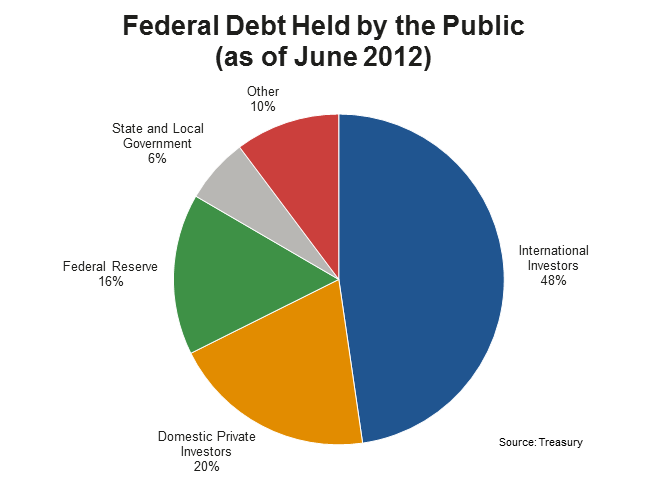
Source: www.nationalpriorities.org

Were the Federal Reserve to be a publicly owned central bank, quantitative easing would have an entirely different dynamics: the government rather than the Fed (acting on behalf of Wall Street) would be calling the shots. Under a publicly owned central banking arrangement, two trillion dollars worth of public debt could be cancelled, thereby creating conditions for the funding of social programs.

The result of these macroeconomic reforms has been mass unemployment. The American people —including the middle class— have been impoverished by the Wall Street establishment, which ultimately decides on debt default and the statutory ceiling placed on the public debt.

Under pressure from Wall Street and the Federal Reserve, the choices of the US government are limited to the following options:

State programs can either be downsized, phased out or transferred out of the public purse to the private corporate sector, implying in all cases the layoff of tens of thousands of public employees.

No major reforms of the structure of indebtedness are contemplated by the US Congress, which could meaningfully change the government’s relationship to the Federal Reserve and its Wall Street handlers. The creditors ultimately decide.

What is contemplated are marginal modifications of the status quo including legislation to push the debt limit to December 31st 2014.

This token arrangement would temporarily increase the federal government’s borrowing ability through the issuing of Treasury bills and government bonds by about one trillion dollars. Under this scheme, however, the powers of the Wall Street Banks and the New York Federal Reserve would not only be maintained they would be reinforced.

The objective is to develop a proxy State under the helm of the financial establishment. Both the Executive as well as the US Congress are to remain under the control of Wall Street.

The Privatization of the American State?

The inevitable scenario established in the wake of the 2008 crisis is fiscal collapse, leading to:

the possible phasing out and/or curtailment of social programs, the privatization of large sectors of public sector activity.

The fiscal ceiling having now been reached, possibly with a deadline, the government is being pressured by its Wall Street handlers —who control decision-making in the US Congress— to curtail and downsize social programs as well as initiate the transfer of public assets and institutions into the hands of private corporations. There is also a movement to cut as well as privatize Social Security and Medicare.

The privatization of public monuments, museums, national parks, the post office, etc. has been raised in recent media reports as a possible “solution” to the debt crisis. But let us not be misled: the process of acquisition of federal public property including infrastructure and State institutions is likely to go much further.

The public sector is up for grabs. Wall Street will eventually go on a buying spree picking up State owned assets at `rock bottom prices.

Ironically, the money transferred by the US government to Wall Street under the bailouts in 2008-2009 can now be used by Wall Street to buy out state property and assets. What this means is that the federal government not only finances its own indebtedness, it is also financing the privatization program (at tax payers expense), leading to the demise of federal government programs.

This process of privatization of the State is nothing new, it has been applied in developing countries under the helm of the IMF whereby state corporations are auctioned off and transferred into the hands of foreign corporations. It has also been applied in Eastern Europe as well more recently in several countries of the European Union

The proceeds of the privatization program are channeled to the State Treasury to meet outstanding debt obligations. In Brazil in the 1990s, important state assets in mining and forestry were purchased by Citi Group, which was Brazil’s largest foreign creditor bank. Ironically, the proceeds of the privatization of the assets purchased by Citi Group were channeled back to Citi Group in the form of debt servicing

Existing state programs are transferred to private corporations either through outright sale of state assets or through outsourcing of government services to the private sector.

Large numbers of government employees are laid off as a result of restructuring. Government services are now sold to the public at a much higher price.

The takeover of State assets in America is well under way largely at the municipal and state level. We recall Orange county which went bankrupt in 1994, Jefferson County, Alabama which filed for Chapter 9 bankruptcy in 2011, and more recently Detroit in 2013. In these and other county/municipal bankruptcies, public assets, lands and infrastructure are sold off to private investors. Across the US, more than 100 municipalities are facing bankruptcy:

All over the United States, politicians are selling off key pieces of infrastructure to foreign investors and big Wall Street banks like Goldman Sachs are helping them do it. State and local governments across the country that are drowning in debt and that are desperate for cash are increasingly turning to the “privatization” of public assets as the solution to their problems. Pieces of infrastructure that taxpayers have already paid for such as highways, water treatment plants, libraries, parking meters, airports and power plants are being auctioned off to the highest bidder. Most of the time what happens is that the state or local government receives a huge lump sum of cash up front for a long-term lease (usually 75 years or longer) and the foreign investors come in and soak as much revenue out of the piece of infrastructure that they possibly can. The losers in these deals are almost always the taxpayers. Pieces of America are literally being auctioned off just to help state and local governments minimize their debt problems for a year or two, but the consequences of these deals will be felt for decades. (Michael Snyder, American Dream, July 6, 2011)

The bankruptcies of local level governments immediately backlash on pension funds:

In California, the Orange County Employees Retirement System is estimated to have a 10 billion dollar unfunded pension liability….

How in the world can a single county be facing a 10 billion dollar hole?

The state of Illinois is facing an unfunded pension liability of more than 77 billion dollars. Considering the fact that the state of Illinois is flat broke and on the verge of default, it is inevitable that a lot of those pension obligations will never be paid.

… Pension consultant Girard Miller told California’s Little Hoover Commission that state and local government bodies in the state of California have $325 billion in combined unfunded pension liabilities.

That comes to about $22,000 for every single working adult in the state of California. (See Vanishing Pensions: All Over America Old Age Pensions Are Being Slashed or Eliminated, Global Research, March 14, 2012)

The privatization of federal State assets on a significant scale as well as the take over and privatization of public services is the next stage of this socially devastating economic restructuring process.

Speculative Onslaught

There is another related agenda, which will be the object of a forthcoming article.

The uncertainty underlying the government shutdown and debt default is the object of a wave of speculative activity on major markets.

Wall Street financial institutions not only exert a decisive influence in the formulation of the Administration’s fiscal and monetary agenda, they also control the movement of currency markets, commodity and stock markets through large scale operations in derivative trade.

Most of the key actors in the US Congress and the Senate involved in the shutdown debate are controlled by powerful corporate lobby groups including, of course, Wall Street. The latter are those which ultimately decide on the outcome. They are not only in a position to influence the results of the Congressional process, they also have foreknowledge of the nature and timing of key decisions.

Those who determine the government’s debt policy, namely the Wall Street creditors, also have “inside information” or prior knowledge of the chronology and outcome of the government shutdown impasse. will make billions of dollars in windfall profits

While Wall Street is instrumental in triggering the debt ceiling impasse, major financial institutions will also be placing their bets in large scale speculative transactions.

Michel Chossudovsky is an award-winning author, Professor of Economics (emeritus) at the University of Ottawa, Founder and Director of the Centre for Research on Globalization (CRG), Montreal and Editor of the globalresearch.ca website. He is the author of The Globalization of Poverty and The New World Order (2003) and America’s “War on Terrorism”(2005). His most recent book is entitled Towards a World War III Scenario: The Dangers of Nuclear War (2011). He is also a contributor to the Encyclopaedia Britannica. His writings have been published in more than twenty languages. He can be reached at [email protected]

Copyright: Global Research

US-Afghan talks overshadowed by arrest

0

US-Afghan talks have been overshadowed by reports suggesting that the US forces have arrested a Taliban commander, who was already in the custody of the Afghan government.

US Secretary of State John Kerry is now in Afghanistan to negotiate with Afghan President Hamid Karzai a security pact, which could determine how many US troops stay in the Asian country after 2014.

President Karzai said on Saturday that the two sides have reached a partial deal but acknowledged that they have still remained divided on the issue of jurisdiction for US troops.

Kerry said a security pact with Afghanistan cannot be signed unless the issue of immunity for US troops is resolved.

President Karzai also said that the US has accepted his condition that its forces halt the airstrikes and night raids on the homes of Afghan civilians.

The deadly strikes have been a main source of friction between the two governments and have increased anti-American sentiment among Afghans.

The partial deal was overshadowed on Saturday after the Afghan government said the US had seized a senior Pakistani Taliban leader, Latif Mehsud, from Afghan intelligence agents attempting to recruit him, according to The Guardian.

A US State Department spokeswoman, Marie Harf, said on Friday that US forces captured Mehsud, a commander of a militant group. The group had taken responsibility for the attempted 2010 bombing of Times Square in New York, as well as many attacks within Pakistan, the spokesman said.

Harf did not say when Mehsud was arrested or where he was being held. But a spokesman for President Karzai told The Washington Post that Mehsud had been taken by the US forces from a government convoy in the east of the country. “The Americans forcibly removed him and took him to Bagram,” the spokesman said.

ARA/ARA

Copyright: Press TV

Alitalia gets lifeline to keep flying

0

Italy™s cash-strapped national flag carrier, Alitalia, has averted bankruptcy after it secured a 500 million-euro rescue package from shareholders, banks and the state-owned postal service, Press TV reports.

On Friday, Italy™s postal company Poste Italiane SpA agreed to provide up to 75 million euros for Alitalia, while banks Intesa Sanpaolo and Unicredit said they would guarantee to inject up to 100 million euros.

The two banks will also contribute a 100 million-euro bridge-to-equity loan to meet Alitalia™s immediate needs.

A further 200 million euros will be provided in the form of new and existing credit lines.

œIt is important that in the coming days Alitalia™s major shareholder, Air France which owns 25 percent of the company, buys its share of the subscribed capital; otherwise, our national carrier goes into the hands of the banks,” Antonella Baccaro from the Italian-language newspaper Corriere della Sera told Press TV.

Alitalia shareholders will meet on October 14 to approve the rescue package.

Alitalia lost 294 million euros in the first half of the year, compared with a 201 million loss in the first half of 2012. Net debt was 946 million euros at the end of June.

œMy colleagues are living in a situation that we hadn™t experienced a few years ago. When Alitalia went bankrupt (in 2008) then many lost their jobs. This situation hangs over like the Sword of Damocles as our future is extremely uncertain,” an Alitalia pilot said on condition of anonymity.

Alitalia has focused mostly on domestic routes since a group of Italian businessmen re-launched a slimmed-down airline in 2009 after Air France withdrew its acquisition offer.

It is said that Alitalia, which last turned a profit in 2002, should focus on longer-range flights toward the Middle East, Asia and South America to return to profitability.

œThe success of any operation to salvage Alitalia depends on government implementation of serious managerial and industrial policies. The airline went into bankruptcy in 2008, and the new management has been making one mistake. By do so, it has weakened the company, and today we are struggling,” Andrea Cavola USB Transport Union said.

MP/NN

Copyright: Press TV

Soros-connected Vote-counting Firm Expands in U.S.

0

A Spanish vote-tabulation firm with ties to billionaire globalist George Soros is purchasing software to give it greater power over the voting in U.S. elections.

In a press release under a Barcelona and Tampa, Florida dateline, Scytl announced:

Scytl’s end-to-end election modernization solution covers the full election cycle (Pre-election, Election Day and Post-election), providing electoral bodies the most secure, transparent, auditable and accessible solution in the marketplace and allows Scytl to offer personalized election modernization roadmaps to their customers combining both traditional and online voting solutions as needed.

In order to consolidate such beginning-to-end control, Scytl has purchased software from a trio of organizations within the gravitational pull of planet Soros.

Again, from the press release:

Scytl, the worldwide leader in secure online voting and election modernization, continues receiving electoral and industry expert recognition for its end-to-end election modernization technology and electoral roadmap implementation approach from organizations such as IDC, Ovum and ACEEEO.

Regarding the benefit of its cooperation with Ovum, Scytl writes:

“We believe Scytl’s wide variety of offerings, investment into certifications, and emphasis on security, auditing, and testing position the company as a dominant provider in election modernization,” says Nishant Shah, Research Analyst at Ovum and author of the On the Radar: Scytl report.

Shah’s biographical sketch on the Ovum website is worth reading in light of his influence on the machines that count votes in American elections.

Before joining Ovum, Nishant’s work spanned organizational strategy, project management, sustainability, and business development. This included facilitating large-scale public-private partnerships in international health for Ambassador Richard Holbrooke and his Global Business Coalition….

That snippet contains several red flags. First, there is Shah’s facilitation of “large-scale public-private partnerships” or PPPs.

A PPP is often defined as “a contract between a public sector authority and a private party, in which the private party provides a public service or project and assumes substantial financial, technical and operational risk in the project.” As part of this scheme, a private company is given control over some public function typically provided by government. It is a tactic very much in vogue in internationalist circles and is considered an effective way to sneak the influence and the control of the UN in the back door.

Regardless of the rhetoric, the true purpose of PPPs is to consolidate government and private corporations, giving them joint control over public entities. The result is the elimination of local sovereignty and the insidious replacement of county election commissions with a board of directors of a company whose mission statement calls for the creation of an executive governing body that is neither fish nor fowl, but is obliged to enforce international treaties and regulations written by the apparatchiks at the UN.

Given the UN’s role in promoting PPPs, it is likely that those administering these centralized partnerships will come from a coterie of managers accustomed to looking to the international body or federal agencies for guidance, if recent initiatives such as Agenda 21 are any example.

As envisioned by the UN and the internationalists in the U.S. government, PPPs will slyly seize control of elections, transferring authority for this vital expression of republican government from local and state boards to pseudo-private agencies made up of a mish-mash of federal agents and bureaucratic overseers adhering to global government regulations.

The second warning bell that sounds in the Shah biography is his affiliation with the GlobalBusiness Coalition.

George Soros is the “founding supporter” of Global Business Coalition.

There is yet another Shah-Soros connection.

Later in Shah’s Ovum bio, his work with the Acumen Fund in Pakistan is noted. Soros’s daughter, Andrea, serves on the board of this organization. She also sits on the board of her father’s Open Society Foundation.

Following the dotted lines connecting the Open Society Foundation to Scytl and on to Soros, is a bit of a challenge, but one worth accepting. In an article published on World Net Daily, Aaron Klein ably guides readers from strand to strand in this web of influence.

Scytl purchased the software division of Gov2U, described as a non-profit organization dedicated to developing and promoting the use of technology in the fields of governance and democracy.

A Scytl press release said: “Gov2U created its software division in 2004 and, since then, it has developed a wide array of innovative award-winning eDemocracy solutions that have been implemented in multiple countries across Europe, Africa and America at the local, regional and federal government levels.”

The Spain-based company says the “main purpose of these tools is to engage citizens in participatory processes through the use of online and offline platforms, bringing more transparency and legitimacy to decision-making processes.”

Gov4U is currently partnered with Soros’ Open Society to support and develop a group called the Declaration on Parliamentary Openness.

The group runs a website, OpeningParliament.org, which says it is a forum “intended to help connect the world’s civic organizations engaged in monitoring, supporting and opening up their countries’ parliaments and legislative institutions.”

Gov4U, meanwhile, has eight partners of its own listed on its website, including the Soros-funded and partnered National Democratic Institute, or NDI.

Aside from receiving financial support for Soros, NDI has co-hosted scores of events along with Soros’ Open Society. The two groups work closely together.

NDI and the Open Society, for example, worked together to push for electoral and legislative reform in Romania.

NDI boasts that with Open Society Institute funds it conducted a political leadership training series for Romanian activists to “bring tangible improvements to their communities.”

NDI describes itself as a nonprofit, nonpartisan, nongovernmental organization working to establish and strengthen political and civic organizations, safeguard elections and promote citizen participation, openness and accountability in government.

NDI previously stated it was founded to draw on the traditions of the U.S. Democratic Party.

WND found that NDI is also listed as the only U.S.-associated organization of Socialists International, the world’s largest socialist umbrella group.

NDI was originally created by the federally funded National Endowment for Democracy, or NED, which itself founded joint NDI projects with the Open Society. Another NDI financial backer is the United States Agency for International Development, USAID.

It is disturbing to discover that not only is Scytl found in the Soros sphere, but it has demonstrable connections to international socialism, the U.S. Democratic Party, and the United Nations, as well.

Taken alone, these unsettling associations might make voters question their electoral board’s contracting with Scytl to administer elections in the United States. When viewed in context of the spread of Scytl’s support of vote counting, however, the picture takes on a darker aspect.

For example, the state of Florida was using Scytl to tabulate election results, but later rescinded the contract after uncovering evidence of significant risks in the methods the Barcelona-based company was employing.

According to the report issued by the Florida Department of State:

Our findings identified vulnerabilities that, in the worst case, could result in (i) voters being unable to cast votes, (ii) an election result that does not accurately reflect the will of the voters, or (iii) disclosure of confidential information, such as the votes cast by a voter.

Then in 2010, the Scytl system in use in Washington, D.C. was hacked. As part of an effort to determine the reliability of the devices, the D.C. Board of Elections & Ethics reportedly “encouraged outside parties to hack and find flaws in its new online balloting system.” Answering the challenge, students from the University of Michigan successfully violated the site and programmed it to play the University of Michigan fight song every time a vote was cast.

Why should this alarm Americans who don’t live in those jurisdictions? Chiefly because during the midterm elections in November 2010, Scytl was contracted by 14 states to “modernize” their voting apparatuses.

Scytl is set to deploy its software in 900 U.S. jurisdictions. The firm already handles the balloting for members of the U.S. military and their families living overseas.

During that election cycle (midterm 2010) the following states used Scytl’s technology in tabulating votes: New York, Texas, Washington, California, Florida, Alabama, Missouri, Indiana, Kansas, Mississippi, New Mexico, Nebraska, West Virginia, and Washington, D.C.

Furthermore, Voter Action, an election integrity advocacy group, filed a complaint with the U.S. Election Assistance Commission in April 2010 alleging that the use of Scytl’s systems in the voting process “raises national security concerns.”

“Foreign governments may also seek to undermine the national security interests of the United States, either directly or through other organizations,” the complaint claimed.

In support of this last assertion, the complaint reveals that Scytl was formed in 2001 as the result of work done by a research group at the Universitat Autonoma de Barcelona, work which was financed in large part by the Spanish government’s Ministry of Science and Technology.

Such associations are certainly worth examining very closely before control of our elections is handed over to Scytl. Especially in light of Scytl’s practice of downloading the votes from each precinct where its devices are in use to a company-owned server where they will be stored. Once the votes are collected, counted, and collated by Scytl and saved on its own proprietary servers, it would be nearly impossible to track any discrepancies between the numbers it reports and the actually vote tallies as taken at the local polling places.

Finally, although it certainly doesn’t crow about its strong ties to George Soros and international socialism, Scytl boldly declares that its services “power 90% of binding elections….”

The list of its current “partners” is enough to give pause to citizens in these states and justify a demand that local election boards disclose how much control over the voting process they’ve surrendered to Scytl.

The following states are listed as current customers on the Scytl website:

Alaska

Arkansas

Kentucky

North Carolina

Arizona

Mississippi

Virginia

West Virginia

Florida

Alabama

New York

and the city of Washington, D.C.

Joe A. Wolverton, II, J.D. is a correspondent for The New American and travels frequently nationwide speaking on topics of nullification, the NDAA, and the surveillance state. He is the host of The New American Review radio show that is simulcast on YouTube every Monday. Follow him on Twitter @TNAJoeWolverton and he can be reached at
This email address is being protected from spambots. You need JavaScript enabled to view it.

Copyright: The New American

The Banks: Serial Offenders

0
Newspaper accounts anticipate that JP Morgan Chase, the huge banking and  financial services company, is close to an agreement with the Department of Justice over charges brought against the company for its mortgage bond policies leading up to the 2008 economic collapse. JP Morgan Chase hopes to avoid legal proceedings by agreeing to settle the matter for around $11 billion with the caveat, of course, that they are admitting no guilt.
Just over a week ago, the same firm agreed to another settlement of just a bit less than a billion dollars over the trading fiasco dubbed “the Whale.”
In addition, JP Morgan Chase has paid out settlements of $1.8 billion for mortgage-foreclosure practices over the last year.
In the same time frame, the company conceded nearly half a billion dollars for the charge of energy market manipulation. Add another $300 million for claims lodged against mortgage-backed securities.
And we mustn’t forget the nearly quarter-of-a-billion settlement against allegations of muni-bond manipulation in 2011.
With these six likely settlements in three years alone totaling about $15 billion in charges over questionable practices, one might conclude that JP Morgan Chase was a serial violator.
It might make one angry that JP Morgan Chase executives receive no penalty– indeed continue to receive large bonuses– despite these violations.
It might make one angrier still to scrutinize the long list of earlier settlements and penalties incurred by the firm, including for intimate involvement with the criminally corrupted firms of Enron and WorldCom. One might further mention JP’s derivative scam that nearly drove Alabama’s largest county into bankruptcy, a maneuver that pressured a three-quarter-billion-dollar settlement.
Further outrage might spring from the company’s record fine paid to the United Kingdom’s Financial Service Authority in 2010.
Certainly JP Morgan Chase’s admission in January of 2011 that it systematically overcharged thousands of overseas military personnel on their mortgages would prompt the ire of many.
And then there is the matter of our government rewarding what appears to be a criminal enterprise with $25 billion in TARP funds to guarantee its managers didn’t run the corporate ship aground on the shoals of the 2008 economic crisis! A helping hand to a criminal syndicate.
Understandably, some have suggested that “too big to fail” should be construed as “too big to jail.”
But JP Morgan Chase, like other big time criminal gangs, is quick to throw its associates under the bus to avoid prosecution. The mega-bank has postured as the victim of its own mortgage originators while offering to cooperate with federal prosecutors and deflect attention from its own role. A recent report by investigative reporter, Rich Lord, has shed light on this practice in Western Pennsylvania (Indicted Attorney points a finger at JPMorgan, Pittsburgh Post-Gazette, 10-6-13). To the surprise of no one but, perhaps, Federal prosecutors, documents have surfaced that prove JP Morgan’s foreknowledge of mortgage fraud. Meanwhile, JP has bought immunity by claiming victimhood!
In a brazen statement of contempt for justice, Attorney General Eric Holder excuses banker criminality because “…if you do bring a criminal charge, it will have a negative impact on the national economy, perhaps even the world economy.”
 
Will “…have a negative impact…?
Has Holder conveniently forgotten that banking industry practices nearly crushed the global economy five years ago?
Maybe the generous contributions that the financial industry makes to both political parties better explains this blind spot in the criminal justice system. Maybe the incentives spread thickly among the Washington legislators by bank lobbyists account for the apparent immunity. Certainly the charming, boyish grin of JP Morgan Chase CEO Jamie Dimon seems ever welcome in the halls and chambers of government.
It would be unfair to JP Morgan Chase to not note that the other mega-banks are equally criminal in their practices. Just in the last two weeks, CitiBank has incurred a $30 million fine and reached a $395 million settlement, while New York is suing Wells Fargo.
In its entirety, the pattern of mega-bank irresponsibility and criminality is breathtaking. Even more shocking is the realization that these institutions are not above the law, but actually ownthe law!
To give some perspective, the welfare system in the US– known since its New Deal inception in1935 as Aid to Families and Dependent Children– was deemed too expensive, wasteful, and unnecessary by the Clinton Administration and its Gingrich-led Republican legislative rivals in 1996. Accordingly, they dramatically cut a program that provided a floor to the living standards of over 12 million people, 8.4 million of whom were children. In 1996, the program cost a little over $20 billion (under $30 billion in 2012 dollars).
The fines and settlements made by JP Morgan Chase over the last 3 years alone would have paid for over half of the total annual cost budgeted for welfare before its radical surgery at the hands of the bi-partisan government!
Add in the fines and settlement costs of the other serial criminals of the financial sector and we could likely fund a robust welfare system today.
Surely, this is a world turned upside down, a world devoid of compassion for the poor and the needy and blind to the corruption of the rich and powerful.
With Reagan-era ideologues finding happy, well paying jobs with think tanks, big media, and universities, the drum beat of “welfare reform” swept the US in the late eighties and early nineties. They blamed welfare for increasing unemployment, creating dependency, unmarried mothers, and violent crime. The symbol of welfare abuse was the unmarried African American mother of young children living off food stamps and a welfare check. Popular media amplified and exaggerated this image.
And the liberals?
They mounted a tepid campaign of measures to shrink the welfare roles, a campaign that prominent observers like Arthur Schlesinger Junior labeled Reagan-emulating “me-tooism”. He denounced the Democrats as Republican “fellow-travelers.” Thus, it should be no surprise that “welfare as we knew it” was gone by 1996.
With no one to speak for her, it was so easy to demonize a young mother and her innocent children. The cowardly, spiteful courtiers of our ruling class won the one-sided battle to cast millions of this nation’s most disadvantaged into greater insecurity.
But Jamie Dimon and his banker cohorts needn’t fear the self-righteousness or the indignation of those executive and legislative child abusers who found it so easy to undercut the welfare of children. Their multi-billion-dollar criminality goes unpunished and will go unpunished by the Administration and the two-party legislators who govern our lives. They continue to blatantly rob and prey on us with impunity, knowing that a tolerable spanking is the most they will ever face.
Today, those same legislators of both parties are looking to cut other elements of the social safety net. And the game is the same as it was twenty years ago: the Republicans raise unfounded, irrational fears (in this case, debt, bankruptcy, economic chaos) and the Democrats offer a feeble defense and make an eager “compromise.” Yes, they are coming after our Social Security, Medicare, and Medicaid.
In the short run, we have to raise hell before they make their grand “compromise.” But in the long run, we have to find and vote for real peoples’ candidates and not corporate Democrats. You’ll recognize them when they campaign to put the bankers in jail and nationalize the banks!
Zoltan Zigedy
zoltanzigedy@gmail.com

A New Dad Asks: If Male Violence Is the Biggest Threat to Women, How Do I Raise a Kind Son?

0

My wife and I brought home Rhodes, our first child, four months ago. Here’s what I remember most about those first weeks: the smell of his skin and breath as he slept on my chest in our bed—small, warm, and fragile, like an egg. I breathed in the scent of the newest life I’d ever encountered as he slept.

He wasn’t undersized, but still I marveled at how tiny these newest of humans come. We, the most dominating creatures on Earth, start out so helpless and red and beautiful. I knew, as he lay curled against my heart, that I would do anything to protect him, love him, and bring him up right in the world.

Last month, four men in India were sentenced to death for a rape and murder of such brutality it can scarcely be believed. The week prior, four Vanderbilt University football players were charged with raping an unconscious woman (much like last year’s events in Steubenville, Ohio). And during the previous spring, just before Rhodes was born, Ariel Castro was arrested in Cleveland for imprisoning three women—kidnapped as young girls—in his house for ten years.

These and similar stories constantly fill our network news, cable opinion shows, newspapers, social media, blogs… It’s nearly impossible to avoid stories of violence, rape, and domination. Living rightly is hard enough on your own, and now I must raise a son to do so in a world that is, in part, characterized by men’s violence against women.

Louis CK sums it up best: “There is no greater threat to women than men. We are the number one threat to women. Globally and historically, we’re the number one cause of injury and mayhem to women.” And I worry that he’s right.

Now that I am a father, this question constantly sits before me: How do I raise a son of compassion and dignity? A man who respects women?

Boy or girl?

Early on during our pregnancy, my wife and I discussed whether we preferred to raise a boy or a girl. It was completely beyond our control, but the conversation stuck with me: boy or girl? We’ve created a world of great beauty as well as great terror. Would I rather send a young man into it, or a young woman?

As I awaited our child, my awareness of news about sexual violence reached new heights, and influenced how I thought about raising a boy or a girl.

A girl, my early thinking followed, could be protected. I worried about her safety, but I thought I could shelter her from the particular threats made against young women.

But a boy, that really scared me. Boys are the particular threat to young women. If we had a boy, we would have to raise a man. And what kind of man would he be?

I have difficulty imagining my infant son as anything other than the innocent person he is today. My assumption is this: I’ll be a good dad and he’ll be a good boy. But I cannot see the future. I love him and want him to love others, to be kind, to be aware of his actions, and to treat people with respect. I want him to learn from the men who have chosen these things instead of power and abuse.

Men as Peacemakers

“It’s endemic.”

That’s Ed Heisler, executive director of Men as Peacemakers, speaking about thestatistics on sexual violence and domestic abuse.

“It is the social air that youth are breathing as they’re growing up,” he told me. “The media, the athletic environment, the jeans, the adults who market the jeans, the parents, the teachers that we have in school, the religious leaders—all create an environment that normalizes the domination and the control of women.” He chose the right word: endemic. “It’s been that way for some time and will remain that way until something in the social environment changes.”

Men as Peacemakers was founded in Duluth, Minn., after the community was rocked by a series of murders committed by men in the 1990s. When citizens gathered to discuss addressing violence in their city, most of them were women. This concerned some of the men in the community, who convened a retreat with 55 men from the area to discuss their roles and responsibilities when it came to alleviating violence. One of the initiatives born of the meeting was Men as Peacemakers, whose mission is to teach men and boys that there are alternatives to violence, and that violence is unacceptable.

I had called Heisler with an honest question: How do I raise my son to be a man who will do his part, too, to change the social environment that subjugates women?

Men as Peacemakers attempts to counter this environment by embedding its role models and mentors throughout the community. For example, The Best Party Model, a program in coordination with with College of St. Scholastica, attempts to reshape the party culture in America to one that is safe and equitable for women. They do this by placing mentors in schools, colleges, youth organizations, and other places where young people can have honest conversations about sexuality and partying. And it turns out that language and conversation have a lot to do with shaping young men’s attitudes toward women.

I mentioned an anecdote from this year’s Electronic Entertainment Expo. During Microsoft’s demo for the new Xbox One, the male player and emcee gave a virtual gaming beatdown to a female player before a live audience, telling her, “Just let it happen. It’ll be over soon.”

In a culture where dominance and abusive rhetoric are socially permitted (video gaming), this is dominating language—and the language we use matters. Language can both empower and objectify. (Just compare the results of “college women” to that of “college girls” in a Google Image search, and you get the point).

The Champions Initiative, another Men as Peacemakers initiative, pairs college athletes with youth and works directly with athletic associations and coaches to ensure that the prevention of violence against women is part of these associations’ missions.

Since the Steubenville rape trial has focused an eye on sports culture and sexual violence, Heisler believes this outreach is critical. He uses the Steubenville case in a guided imagery exercise that asks boys to “think about that young man from Steubenville as a little boy” and to consider what his environment looks and sounds like: “Somehow that kid learned what his sense of humor was or that women were objects for men’s pleasure—things that don’t matter, you can pee on them, use them, do whatever you want with them and it doesn’t matter. That was not the way he was born.”

So perhaps men are the worst thing that ever happens to women, but we are not born that way. We learn it. Even well-intentioned, responsible young men are capable of making terrible decisions if they are not taught, prepared, and encouraged to do otherwise.

So I asked Heisler directly: You’re talking to a new dad. What’s the most important, fundamental advice you can give to make sure that the children we’re raising are not going to add to this human rights problem?

His answer? Create a wholly new environment for young men:

“New dads have an opportunity and responsibility to very proactively think about how to shape and provide an environment for that young person, [one] that is going to role model and display and set expectations for equality and dignity and respect between men and women.”

This means not just being a model in how we treat mothers, partners, and strangers in public, but also in how we think about our homes and the spaces we inhabit.

“We’re trying to create a world where dads—men—are taking it a step further and really thinking about how they creatively shape an environment that promotes gender equity and respect for women,” Heisler told me. “We have a tide pushing in the opposite direction. It takes every effort to create an environment that will stick with our young people.”

Turning the Tide

A few days later, I had a beer with Todd Bratulich and Luke Freeman. After all the research on violence and domination, I wanted to unwind. Todd is a youth pastor at First Covenant, an urban Minneapolis community church; Luke, a high school teacher. More importantly, both, like me, have young sons.

We talked about how to be good men who love our partners and families and friends, and who want to make a warm and welcoming environment for our sons to grow into. We all felt good about our commitment to these issues, thinking we were doing our part—we weren’t party to the culture of violence against women.

Then, sensing our self-satisfaction, Luke said: “We pat ourselves on the back because we find exceptions in ourselves, only to go on and enjoy our privilege.”

And I realized, I hadn’t really done my part after all. Not yet. Treating my wife with love and kindness is vital, of course. But it also is only the minimum.

We must be active, creative, and purposeful in extending this behavior to every moment of our lives if we are to become peacemakers, to push against the tide and create the space needed to raise sons with empathy and compassion.

We three dads raised our glasses to the challenge, and went home to our sons.

Copyright: Truth Out

Video Released: Edward Snowden at Sam Adams Award Ceremony

0
The website WikiLeaks released on Friday the first video to be seen of NSA whistleblower Edward Snowden since he was granted asylum in Russia.

The videos from October 9, 2013 show Snowden receiving the Integrity Award from the Sam Adams Associates for Integrity in Intelligence, presented by a group of fellow U.S. government whistleblowers in Moscow.

“If we can’t understand the policies and programs of our government we can’t grant our consent in regulating them,” Snowden said at the ceremony in regards to the NSA’s dragnet surveillance policies.

“It’s a sort of dragnet mass surveillance that puts entire populations under a sort of eye that sees everything, even when it’s not needed,” he said.

“People all over the world are realizing that these programs don’t make us more safe, they hurt our economy, they hurt our country, they limit our ability to speak and think and live and be creative, to have relationships, to associate freely.”

Former ex-CIA analyst Ray McGovern present Snowden with the award, stating

We are confident that others with similar moral fiber will follow his example in illuminating dark corners and exposing crimes that put our civil rights as free citizens in jeopardy.

Also present at the ceremony was WikiLeaks journalist Sarah Harrison who took Snowden from Hong Kong to Moscow and obtained his asylum, Thomas Drake (NSA whistleblower), Jesselyn Raddack (DoJ whistleblower) and Coleen Rowley (FBI whistleblower).

Watch below:

_______________________

This work is licensed under a Creative Commons Attribution-Share Alike 3.0 License

Copyright: Common Dreams

In Oval Office Meeting, Malala Yousafzai Tells Obama to End Drone Strikes in Pakistan

0

President Barack Obama, First Lady Michelle Obama, and their daughter Malia meet with Malala Yousafzai, the young Pakistani schoolgirl who was shot in the head by the Taliban a year ago, in the Oval Office, Oct. 11, 2013. PETE SOUZA — Official White House photoMalala Yousafzai, the sixteen-year-old Pakistani girl who survived a gunshot to the head by members of the Taliban for speaking out on women’s right to education, told President Barack Obama in an Oval Office meeting on Friday that he should stop drone strikes in countries such as Pakistan.

In a statement released after the meeting, Yousafzai said that she told Obama that she is concerned about the effect of U.S. drone strikes in her country—a portion of the conversation that was omitted from White House statements so far.

“I [expressed] my concerns that drone attacks are fueling terrorism,” Yousafzai said in a statement released by the Associated Press. “Innocent victims are killed in these acts, and they lead to resentment among the Pakistani people. If we refocus efforts on education it will make a big impact.”

Yousafzai—the youngest ever nominee for the Nobel Peace Prize—was invited to the White House “for her inspiring and passionate work on behalf of girls education in Pakistan,” according to a White House statement.

Yousafzai also recently called on the U.S. and U.K. governments to end military attacks in Afghanistan and Pakistan in an interview with BBC.

“The best way to solve problems and to fight against war is through dialogue,” she told BBC. “That’s not an issue for me, that’s the job of the government… and that’s also the job of America.”

Yousafzai was awarded a prestigious international human rights award—the Sakharov Prize for Freedom of Thought—on Thursday, but did not win the Nobel Peace Prize, as was announced on Friday.

_______________________

This work is licensed under a Creative Commons Attribution-Share Alike 3.0 License

Copyright: Common Dreams

Senate stalls bi-partisan debt ceiling deal to end government shutdown

0


Published time: October 12, 2013 19:02

Senate Majority Leader Harry Reid, D-Nevada (2nd L) prepares to make a statement with US senators Chuck Schumer (L), D-New York, Patty Murray (2nd-R), D-Washington and Dick Durbin, D-Illinios, during a press conference on Capitol Hill about the debt ceiling in Washington, DC, October 12, 2013. (AFP Photo / Jim Watson)

With only five days left to a possible default, there is yet no unity in the US senate with Republicans and Democrats rejecting each other’s proposal to end the 12-day-old government shutdown.

On Saturday the focus of efforts to end the shutdown shifted to
the Senate, where the two sides held negotiations in a bid to
resolve the stalemate. However, the talks yielded no agreement.

The US Senate Republicans rejected a Democratic plan to raise the
debt ceiling through 2014 without making any cuts or changes to
Obamacare. Voting 53 against and 45 in favor, Republicans, who
want the extension to be accompanied by spending cuts, blocked
the bill, which needed at least 60 votes to overcome the
objections.

The move was followed by Senate Democratic leaders’ opposition to
Republican proposal to end the fiscal stalemate.

Rejecting an offer by Sen. Susan Collins, R-Maine, to end the
budget impasse, Democrats argued that her offer asks for too much
in return for too little, the POLITICO cited senators and aides.

The so-called Collins plan, which has bipartisan support, offered
a six-month extension of government funding and an increase in
the government’s borrowing limit through January. It was also
calling for a two-year delay on Obamacare’s medical device tax as
well requiring income verification for Americans seeking
subsidies for President Barack Obama’s Affordable Care Act.

Democrats say a new medical device tax that would raise $30
billion over 10 years for the President’s healthcare law.

After discussing the plan with the President Friday, Collins said
Obama called the proposal “constructive”, but she, at the
same time, did not “want to give the impression that he
endorsed it.”


Speaking to reporters after the vote, US Senate Democrat leader
Harry Reid said he would like negotiations with Republican
leaders to result in a deal by Monday.

The White House said the Senate rejection of the debt plan was
unfortunate and urged Congress to find a solution to reopen the
government and raise the debt ceiling.


“Congress must do its job and raise the debt limit to pay the
bills we have incurred and avoid default,”
said White House
press secretary Jay Carney.

Without action by Congress, the United States could default on
its bond payments by Thursday, for the first time in country’s
history.

Copyright: RT

Karzai seeks guarantees for US deal

0

Afghan pres. seeks guarantees for US security pact

US Secretary of State John Kerry (L) gives a press conference on October 12, 2013 with Afghan President Hamid Karzai at the Presidential Palace in Kabul.

Afghan President Hamid Karzai has ruled out signing a security deal with the United States until disagreements over sovereignty issues, night raids and civilian causalities are resolved.

Speaking at a joint press conference with the US Secretary of State John Kerry, Karzai said they still remain divided on the immunity for foreign and US soldiers included in the Bilateral Security Agreement.

Karzai also said that Kerry had accepted his condition that US forces will stop air strikes and nighttime raids on the homes of Afghan civilians.

The issue has been a main source of friction between the two administrations as civilians mostly fall victim to the deadly attacks.

Kabul and Washington are at odds over US demands for the right to conduct unilateral military operations, and over how the US would pledge to protect Afghanistan.

Washington is pushing for the pact to be signed by the end of this month. The deal allows the US to keep its forces and bases in Afghanistan on a permanent basis.

The developments come after President Karzai told British media that he is not ready to sign the deal as long as it does not suit Afghanistan’s interests and purposes.

The recent remarks by the Afghan president have once again dashed American hopes that the pact can be quickly finalized.

The collapse of a similar agreement with Iraq in 2011 led to the US pulling all its troops out of the country.

The developments also come as several Afghan political parties have recently heaped scorn on US-led forces for committing unforgivable crimes against Afghan women and children since invading the country in 2001.

The Islamic Movement of Afghanistan Party and several other political factions have released a statement warning that things will get worse should the US sets up its bases in Afghanistan.

Thousands of Afghan civilians, including a large number of women and children, have been killed during night raids by foreign forces and CIA-run assassination drone strikes.

The United States wants to keep thousands of troops in Afghanistan, but if no agreement is signed, all American troops would have to leave by December 31, 2014.

JR/SS

Copyright: Press TV

13 killed in Iraq car bomb

0

Iraqis inspect the aftermath of an attack in Baghdad’s eastern al-Jadidah district, on October 7, 2013.

At least 13 people have been killed and 32 others injured after a car bomb exploded in Iraq™s northern city of Samarra.

The blast took place in a crowded street on Saturday as people were shopping for Eid al-Adha, the Feast of Sacrifice, holiday.

Officials said the dead included seven women and a six-year-old child.

Iraq has been the scene of numerous bombings and shootings over the past few months. Most of the attacks have targeted crowded places, such as mosques, markets, and cafes.

According to Iraqi medical sources, more than 270 people have been killed in violent acts since the beginning of this month.

On Friday, three people were killed and 11 others wounded in a bomb blast in the town of Tuz Khormato, located 88 kilometers south of Kirkuk.

A similar incident also killed three people and injured nine in the southeastern Baghdad suburb of Nahrwan.

On Thursday, violence across Iraq claimed 21 lives and left many injured.

On Wednesday, ten people were killed and nine others wounded in separate instances of violence across the country.

According to the United Nations, a total of 1,057 Iraqis, including 928 civilians, were killed and another 2,326 were wounded in terrorist attacks throughout the country in July — the deadliest month since 2008.

UN figures also showed that almost 1,000 people were killed and more than 2,000 were wounded in violence in Iraq in September.

Iraq™s Interior Ministry has said that militants have launched an open war in Iraq and they want to push the Arab country into chaos.

SAB/SS

Copyright: Press TV

Report: Security Breakdown In America’s Nuclear Command Centers: “Not Taking the Job Seriously Enough”

0
nuclear-detonation


Last month a high level source speaking with Infowars revealed insider details of a nuclear weapons transfer within the domestic United States that was executed without an official directive or paper trail. One expert noted that such re-positioning of nuclear warheads doesn’t happen unless they “plan on using them.”

Curiously, just a day later, Senator Lindsey Graham warned that a failure to attack Syria could lead to a nuclear weapon being detonated in South Carolina. It was a notion that raised eye brows in mainstream media, but more so throughout alternative media circles, which suggested that the sequence of events were indicative of a false flag attack.

Yesterday, we learned that a senior member of U.S. nuclear command and head of the Air Force’s nuclear arsenal was relieved of his command. This has prompted questions about what is going on in the secret nuclear control centers around the country and it’s raising concerns about the security of America’s nuclear weapons.

Now, a report from the Associated Press goes further down the rabbit hole.

Together, the Carey and Giardina dismissals add a new dimension to a set of serious problems facing the military’s nuclear force.

The ICBM segment in particular has had several recent setbacks, including a failed safety and security inspection at a base in Montana in August, followed by the firing of the colonel there in charge of security forces. In May, The Associated Press revealed that 17 Minuteman 3 missile launch control officers at Minot Air Force Base, N.D., had been taken off duty in a reflection of what one officer there called “rot” inside the ICBM force.

In an inspection that the Air Force publicly termed a “success,” the AP disclosed that launch crews at Minot scored the equivalent of a “D” grade on missile operations. In June the officer in charge of training and proficiency of Minot’s missile crews was fired.

The sidelined launch officers were “not taking the job seriously enough,” causing their bosses to worry that they failed to understand what it takes to “stay up to speed” on nuclear missile operations, the Air Force chief of staff, Gen. Mark Welsh, told Congress in May. What it boiled down to, he said, was a lack of “proper attitude.”

Were the recent firings of top military brass a result of indiscretions and alcohol induced misbehavior as the official narrative would have us believe, or could a more sinister plot be developing?

Is it possible that nuclear war heads were, in fact, re-positioned by rogue elements within the ICBM nuclear command group without proper authorization?

And would these senior command terminations have occurred had the story about these weapons not been made public?

It’s all speculation at this point, but what we do know is that the U.S. government under the Obama Administration has been operating under a heavy veil of secrecy that has taken unprecedented steps to identify and prosecute whistle blowers and security leakers, making it difficult for the truth to make it to the public.

The fact that the military graded Air Force missile operations with a “D” should give us pause. That’s a gaping hole in our national security and one that could be capitalized on by those who would do us harm.

Thus, at this point, nothing is outside the realm of possibility, the least of which is the notion that a rogue element operating within the government apparatus may be planning a manufactured crisis on U.S. soil.

Related: Nuclear Disaster Preparedness

H/T BJ

Please Spread The Word And Share This Post


Author:
Mac Slavo
Views:
Read by 105 people
Date: October 12th, 2013
Website: www.SHTFplan.com


Copyright Information: Copyright SHTFplan and Mac Slavo. This content may be freely reproduced in full or in part in digital form with full attribution to the author and a link to www.shtfplan.com. Please contact us for permission to reproduce this content in other media formats.

Copyright: SHTF Plan

China praises Iran goodwill in N-issue

0

Chinese State Councilor Yang Jiechi has praised Iran™s goodwill and constructive approach and continued cooperation towards the settlement of the dispute over Tehran™s nuclear energy program.

He also stressed the need for the peaceful settlement of the issue, expressing his country™s opposition to sanctions against Iran.

The top Chinese official made the remarks during a meeting with Iran™s Deputy Foreign Minister Morteza Sarmadi in Beijing on Saturday.

Yang said that it was China™s policy to maintain high-level friendly relations with Iran.

The visiting Iranian official, for his part, stressed Iran™s interactive approach with world countries and expressed hope that the fresh round of nuclear talks between Iran and the six world powers would be held in a cooperative and win-win atmosphere in order to find a solution to settle problems.

He also said that Iran pursued a policy of consolidating high-level relations with China, adding that it was a foreign policy priority for Iran™s to cooperate with China to help peace in Asia and the world.

Sarmadi also held a separate meeting with his Chinese counterpart Zhang Yesui, during which the two officials welcomed the new climate ahead of upcoming nuclear talks between Iran and the opposite side. They also discussed Tehran-Beijing cooperation.

The Iranian official™s visit to China comes ahead of the upcoming talks between Iran and the five permanent members of the UN Security Council plus Germany on Tehran™s nuclear energy program.

The two sides have agreed to meet in the Swiss city of Geneva on October 15 and 16 for a fresh round of talks. Tehran says it is ready for œserious” and œpurposeful” negotiations over its nuclear energy program and has called on the other side to show seriousness in talks.

Iran also says that it is ready to allay Western concerns over its nuclear energy program in a œwin-win manner,” but it also expects the other party to lift its illegal sanctions against the Iranian nation.

The United States, Israel and some of their allies have repeatedly accused Iran of pursuing non-civilian objectives in its nuclear energy program, with the US and European Union using the claim as an excuse to impose illegal sanctions against Tehran.

Iran categorically rejects the allegation, arguing that as a committed signatory to the Non-Proliferation Treaty (NPT) and a member of the International Atomic Energy Agency (IAEA), it has the right to use nuclear technology for peaceful purposes.

AR/HGH

Copyright: Press TV

Red Cross to start first UK food aid

0

The Red Cross is to start first Britain food aid since the Second World War.

The Red Cross is to collect and distribute food aid in Britain this winter for the first time since the Second World War to help growing number of Britons in need.

British Red Cross will send volunteers to supermarkets in the UK on the last weekend in November to ask shoppers to donate items which are planned to be distributed among food banks through the charity Fareshare, The Independent reported.

Juliet Mountford, the Red Cross head of UK Service Development, said the charity™s intervention was because of “strong evidence of an increased need for support on food poverty issues”.

This comes as the Red Cross said on Thursday that the financial crisis in Europe has left 43 million of its citizens with insufficient food to eat, calling it the worst humanitarian crisis over a half century.

A report by the Geneva-based charity showed that some 120 million Europeans face the risk of poverty and many continue to suffer in countries that are in the process of recovering financially.

Earlier in May, figures from the Trussell Trust, the largest food bank provider in the UK, showed that more than 500,000 Britons needed emergency food aid last year.

The charity Citizens Advice also said there has been an “alarming” 78 percent increase in the number of food bank inquiries across Britain during the six months to August.

SSM/HE

Copyright: Press TV

Iran to send second monkey into space

0

Iran sent the first monkey into space aboard an indigenous bio-capsule, code-named Pishgam (Pioneer), on January 28.

Deputy Head of Iran Space Agency (ISA) Hamid Fazeli says the Islamic Republic plans to send another indigenous bio-capsule with a live monkey onboard into space.

Fazeli said on Saturday that preparation for sending another monkey into space is complete and the living organism can be sent by the end of next month.

On January 28, the Islamic Republic of Iran sent a monkey into space aboard an indigenous bio-capsule, code-named Pishgam (Pioneer), as a prelude to sending humans on space missions.

The Iranian official added that the Islamic Republic plans to send other species into space during the next stages of the project.

œIran will send the second monkey … on board a liquid-fuel carrier,” Fazeli said.

Fazeli said in September that Iran plans to launch Tadbir (Prudence), Sharifsat and Nahid satellites into orbit by the end of the current Iranian year (ending March 20, 2014).

Iran launched its first indigenous satellite, Omid (Hope), in 2009. The country also sent its first bio-capsule containing living creatures into the space in February 2010, using the indigenous Kavoshgar-3 (Explorer-3) carrier.

In June 2011, Iran put the 15.3-kilogram Rasad (Observation) orbiter in space. Rasad’s mission was to take images of the Earth and transmit them along with telemetry information to the ground stations.

Iran also launched Navid-e Elm-o Sanat (Harbinger of Science and Industry), another indigenous satellite, into the orbit on February 3, 2012.

Iran is one of the 24 founding members of the UN Committee on the Peaceful Uses of Outer Space, which was set up in 1959.

MYA/HGH

Copyright: Press TV

Captain Phillips: Well-made Film Based on Real-life Drama

0

Captain Phillips is a well-made drama about the real-life events that played themselves out on global television back in April of 2009. The audience already knows the outline of what happened before walking into the theater:

Captain Richard Phillips of Underhill, Vermont, finds that his 17,000-ton cargo ship, the Maersk-Alabama out of Norfolk, Virginia, is highjacked by four AK-47-wielding pirates who have sailed out from the Somali coast on a tiny speedboat skiff. The unarmed merchant ship is unable to outrun the speedboat, and the ship’s water cannons cannot prevent the four teenage pirates from boarding.

The captain and two of the crew are taken hostage in the bridge as the crew hides out from the pirates under the deck. But not all goes well for the pirates, as the remaining crew overpowers one of the pirates, seizing his gun and taking him hostage. A trade is arranged — Phillips and his men for the Somali hostage, Abduwali Muse — but Muse and the other three pirates escape aboard a lifeboat with Phillips as a hostage.

After a two-day standoff, on April 12, 2009 Navy SEALs kill three of the hostages, capture Muse, and rescue an unharmed Phillips.

The movie doesn’t really shed any fascinating new details, but the story is tightly directed and focused upon the struggle of Phillips to retain control of his ship and stay alive in captivity. It’s a story worth being told. Tom Hanks puts in a solid performance as Captain Phillips, despite a forced Vermont accent, alongside a spectacular cast. Somali-born Barkhad Abdi is remarkable in his debut acting performance as Musa, repeatedly telling the Irish-American Phillips in broken English, “Irish, don’t worry. Everything going to be okay.”

The movie is based upon Phillips’ book, A Captain’s Duty, released in 2011. Phillips has publicly stated that he liked the movie, but told Agence France Press after a screening that actually being in captivity was “much worse.”

Perhaps the best lesson to be learned is not in the movie itself. The Maersk-Alabama was attacked four more times by Somali pirates within the next two-and-a-half years after Phillips’ captivity. But after the Phillips incident, the company had armed the ship with a security team that successfully fought off the pirates without casualties every time.

The incident marked the high-water point for Somali piracy, as navies across the world — from Malaysia to South Korea to the EU — have struck back at the pirates. While Musa ended up with a 33-year prison sentence for piracy — the first criminal conviction for that charge in a century — other Somalis have since also been convicted of piracy. Indeed, just days before the release of the film, U.S. Navy SEALs raided a Somali town in a strike against the pirates.

Phillips is actually being sued by some of his former crew members for sailing too close to the Somali coast when there had been an international warning of the danger of pirates.

“We live in a litigious society and everyone’s welcome to their own views,” Phillips told Agence France Press of the lawsuit.

Copyright: The New American

Report: Security Breakdown In America’s Nuclear Command Centers: “Not Taking the Job Seriously Enough”

0

nuclear-detonation

Last month a high level source speaking with Infowars revealed insider details of a nuclear weapons transfer within the domestic United States that was executed without an official directive or paper trail. One expert noted that such re-positioning of nuclear warheads doesn’t happen unless they “plan on using them.”

Curiously, just a day later, Senator Lindsey Graham warned that a failure to attack Syria could lead to a nuclear weapon being detonated in South Carolina. It was a notion that raised eye brows in mainstream media, but more so throughout alternative media circles, which suggested that the sequence of events were indicative of a false flag attack.

Yesterday, we learned that a senior member of U.S. nuclear command and head of the Air Force’s nuclear arsenal was relieved of his command. This has prompted questions about what is going on in the secret nuclear control centers around the country and it’s raising concerns about the security of America’s nuclear weapons.

Now, a report from the Associated Press goes further down the rabbit hole.

Together, the Carey and Giardina dismissals add a new dimension to a set of serious problems facing the military’s nuclear force.

The ICBM segment in particular has had several recent setbacks, including a failed safety and security inspection at a base in Montana in August, followed by the firing of the colonel there in charge of security forces. In May, The Associated Press revealed that 17 Minuteman 3 missile launch control officers at Minot Air Force Base, N.D., had been taken off duty in a reflection of what one officer there called “rot” inside the ICBM force.

In an inspection that the Air Force publicly termed a “success,” the AP disclosed that launch crews at Minot scored the equivalent of a “D” grade on missile operations. In June the officer in charge of training and proficiency of Minot’s missile crews was fired.

The sidelined launch officers were “not taking the job seriously enough,” causing their bosses to worry that they failed to understand what it takes to “stay up to speed” on nuclear missile operations, the Air Force chief of staff, Gen. Mark Welsh, told Congress in May. What it boiled down to, he said, was a lack of “proper attitude.”

Were the recent firings of top military brass a result of indiscretions and alcohol induced misbehavior as the official narrative would have us believe, or could a more sinister plot be developing?

Is it possible that nuclear war heads were, in fact, re-positioned by rogue elements within the ICBM nuclear command group without proper authorization?

And would these senior command terminations have occurred had the story about these weapons not been made public?

It’s all speculation at this point, but what we do know is that the U.S. government under the Obama Administration has been operating under a heavy veil of secrecy that has taken unprecedented steps to identify and prosecute whistle blowers and security leakers, making it difficult for the truth to make it to the public.

The fact that the military graded Air Force missile operations with a “D” should give us pause. That’s a gaping hole in our national security and one that could be capitalized on by those who would do us harm.

Thus, at this point, nothing is outside the realm of possibility, the least of which is the notion that a rogue element operating within the government apparatus may be planning a manufactured crisis on U.S. soil.

Related: Nuclear Disaster Preparedness

H/T BJ

Global banks: US default disastrous

0

US Treasury Secretary Jack Lew says the US government will default on its loans on Oct. 17.

Leaders of some of the world™s largest banks said on Saturday that they don™t know exactly what would happen if the United States defaults on its debt – but they are sure it would be disastrous.

Congress is spending the weekend trying to figure out how to get around an impasse over raising the government™s $16.7 trillion borrowing limit and how to re-open the government, but as of Saturday afternoon it remained unclear how a deal would be struck.

œIn my opinion we will not default,” JPMorgan CEO Jamie Dimon said during a panel discussion at the annual meeting of the Institute of International Finance, a bank trade group, in Washington. œI think any responsible person I know including in government knows that. I think it would ripple across the global economy in ways you couldn™t possibly understand.”

The Treasury Department has warned that Congress must lift the debt ceiling by Oct. 17 when the US is slated to exhaust its borrowing authority.

Other leading bankers at the IIF event joined in warning about the consequences of Washington not reaching a deal.

œIt would be utterly catastrophic,” said Deutsche Bank Co-Chair Anshu Jain, stressing the importance of the US dollar in international finance. œThis would be a rapidly spreading fatal disease.”

Jain said suggestions that the consequences of a default would be œtiny” are false.

While Dimon expressed optimism Saturday that a deal will be reached, JPMorgan and other large financial institutions have begun taking precautions. For instance, JPMorgan told investors this week that its money market funds no longer own Treasury securities that mature or have scheduled coupon payments from Oct. 16 to Nov. 6.

JPMorgan manages $6 billion to $7 billion in Social Security, veteran™s benefits and other U.S. payments every week to clients who could be at risk due to a default, Dimon said.

If the borrowing limit is not increased, Dimon said he didn™t know when exactly the trouble would start, but that it would soon threaten money market funds, which are considered a safe place for investors of all sizes to park their money.

Dimon said the U.S. and global economies are improving and pleaded with lawmakers not to spark another global recession.

œPlease let™s not shoot ourselves in the foot,” Dimon said. œIt™s a risk that shouldn™t be taken.” POLITICO

AHT/HJ

Copyright: Press TV

Congress harming large portions of US

0

An investigative journalist and author in Florida criticizes Congress for inflicting œharm to large portions of the country,” a fact that has pushed its approval rating to an all-time low.

Recent public opinion polls highlight the depth of negative sentiment towards Congress.

An Associated Press-GfK survey released Wednesday found that just 5 percent of the public approves of the job their representatives are doing in Congress, while 83 percent disapprove. Eleven percent said they neither approved nor disapproved.

œThere™s not a whole lot of faith in the Congress right now,” Wayne Madesn told Press TV on Saturday.

œCongress has now actually caused harm to large portions of the country, all sorts of services are now being impacted,” Madesn said, referring to a government shutdown that began October 1 as Congress and the White House failed to agree on a budget to fund the government.

œThere™s also the threat with the failure to reach the debt ceiling agreement, that Social Security checks would stop, Medicare payments would stop and this has been a real shock across the board.”

A recent Gallup poll has shown that only 18 percent of Americans are satisfied with the way the nation is being governed, which is the lowest government satisfaction rating in the organization™s history of asking the question since 1971.

The findings are the latest in a series of reports highlighting the negative impact of the US government shutdown on Americans™ attitude.

œCongress actually went out of its way to harm the public,” Madsen said.

AHT/HJ

Copyright: Press TV

India Must Rename Cyclone Phailin and Call Attention to Global Warming

0

http://www.truthdig.com/report/item/india_must_rename_cyclone_phailin_and_call_attention_to_global_20131012/

Posted on Oct 12, 2013

By Subhankar Banerjee, Common Dreams

This piece first appeared at Common Dreams.

Last month I wrote two articles (here, here), gave an interview to The Real News Network (here), and an interview to Uprising Radio (here) about the devastating floods in Colorado. With Boulder as its epicenter, the floods damaged more than 2,000 squares miles along the Colorado Front Range—from Colorado Springs to Fort Collins. Ten people were killed, nearly 18,000 homes were damaged or destroyed, hundreds of miles of road were washed out, and thousands of oil and gas wells flooded resulting in environmental contamination from toxic fracking fluids and nearly 40,000 gallons of spilled oil. Boulder got nearly its annual average rainfall in just five days, and it happened at a wrong time—September, not July/August, when rain usually falls in the desert southwest.

My main contribution was to raise the noise to the level the corporate media had failed miserably to in its reporting of the Colorado floods. Not a single journalist had raised the question on corporate TV: Did global warming play a part in causing or intensifying the Colorado floods?

Bamboozled by the lure of technology, humans have become deeply amnesic. We forget a tragedy soon after the corporate media stops reporting on a particular catastrophe. In a globally warmed Earth, however, before amnesia sets in, the next assault arrives.

Friday morning I woke up to the news of super cyclone Phailin in the Bay of Bengal that would make landfall Saturday in the east coast of India. “Odisha and Andhra Pradesh braced for the “very severe” cyclone [Phailin] that was expected to hit the east coast with winds gusting up to 220 kmph [136 mph] Saturday evening, as lakhs [1 lakh=100,000] of people were being evacuated to safer places and the military remained on standby,” The Hindu reported.

I had lived in the American southwest for eleven years, and I was born and grew up in Bengal. So, the recent Colorado floods and the super cyclone in the Bay of Bengal are personal.

There are already many news articles on the India cyclone available: The Hindu here, Times of India here, India Today here, BBC here, Washington Post here. I won’t go into the details; instead, I’ll focus on two things: naming and blaming.

Apparently Phailin was named by Thailand and it means sapphire in Thai. What nonsense. Some humans do desire the precious stone, but no one, I’d think, is desiring Phailin. India should rename this meaningless obfuscation and call attention to global warming immediately.

There was also some confusion about whether this is a ‘cyclone’ or a ‘super cyclone’. On Thursday the India Meteorological Department had “indicated that the wind speed would be limited to 185 kmph.” But now the forecast is at 220 kmph, and the US Navy has indicated that the “wind speed will be above 240 kmph.” So before the cyclone made landfall, it would turn into a deadly super cyclone—yet another example of an extreme weather event.

The India Today has posted a very useful article “What is a super cyclone?” The article gives an excellent explanation of the 1999 Odisha super cyclone, also known as Cyclone 05B. “It struck the coast of Odisha with a height of [ocean water] 26 feet (8 meters). Approximately 275,000 homes were destroyed leaving 1.67 million people homeless. Another 19.5 million people were affected by the super cyclone to some degree. A total of 9,803 people officially died from the storm. Though it is believed that 15,000 people died,” the India Today reports. The article also mentions how the rescue operation proceeded. By placing this article in the context of the impending super cyclone in the exact same landscape, journalists in India are doing a better job than those who reported the Colorado floods last month. But it could be better, it needs to better, and an explicit connection to Global Warming needs to be made.

India Today explained: “Tropical cyclones typically form over large bodies of relatively warm water. They derive their energy from the evaporation of water from the ocean surface, which ultimately recondenses into clouds and rain when moist air rises and cools to saturation.” There is our clue—connection of the impending super cyclone with global warming. All the articles I have come across on the impending Bay of Bengal cyclone, however, avoided using the phrase “global warming.”

The anthropogenic global warming caused by accumulation of greenhouse gases is making the oceans warmer, which in turn is causing more frequent and more intense cyclones/hurricanes and floods.

The UN IPCC Fifth Assessment Report’s (AR5) first part, the Summary for Policymakers (SPM), was released two weeks ago. More than a 1,000 scientists from all over the world contributed to the report and the team worked for six years. The SPM was approved by 190 nations. All that means that the IPCC AR5 is a conservative estimate of global warming. The reality will likely be worse than what the IPCC predicts.

Having said all that, the IPCC reports states: “Ocean warming dominates the increase in energy stored in the climate system, accounting for more than 90% of the energy accumulated between 1971 and 2010 (high confidence). It is virtually certain that the upper ocean (0?700 m) warmed from 1971 to 2010…”

The India-based Dr. Rajendra Pachauri has been the chairperson of IPCC since 2002. The organization was awarded the Nobel Peace Prize in 2007. I’d urge Dr. Pachauri to go on TV and explain the anthropogenic warming of oceans and its relevance to the impending super cyclone in the Bay of Bengal that will undoubtedly bring massive deaths—to humans and nonhuman species—and devastation.

India must rename Phailin and connect the impending super cyclone to global warming.

Subhankar Banerjee is a photographer, writer, and activist. Over the past decade he has worked for the conservation of ecoculturally significant areas of the Arctic, and to raise awareness about indigenous human rights and climate change. He founded ClimateStoryTellers.org, and is editor of the anthology Arctic Voices: Resistance at the Tipping Point. He was recently Director’s Visitor at the Institute for Advanced Study in Princeton, Distinguished Visiting Professor at Fordham University in New York. He received the Distinguished Alumnus Award from New Mexico State University, and the Cultural Freedom Award from the Lannan Foundation.

Cooperative Institute for Research in the Atmosphere

Copyright: TruthDig

Yemen protesters call for independence

0

Thousands of people have taken to the streets in southern Yemen to renew calls for the establishment of an independent state.

The separatist protesters from across the south gathered at Parade Square in the city of Aden on Saturday, that is also the anniversary of the 1967 independence of former South Yemen.

The protesters waved flags of former South Yemen and carried banners with pro-independence slogans.

They also denounced the ongoing national talks aimed at drawing up a new constitution and preparing for elections.

“No to dialogue, yes to independence and liberation,” and “Our demand is independence,” the protesters chanted.

Majed al-Shuwaibi, a member of the Southern Movement, said October 12 is a significant day, as the southerners “celebrate the anniversary of the October revolution … which will continue for the re-establishment of the state.”

North and south Yemen unified in 1990 after the southern government collapsed. But four years later, the south tried to broke away and this led to a civil war. The conflict ended with northern troops taking control of the south after winning the war.

The Southern Movement gained strength during mass demonstrations which forced former Yemeni president, Ali Abdullah Saleh, to step down in February 2012.

The secessionist movement calls for autonomy or the complete independence of the south. Southerner residents complain that they have been economically and politically marginalized by the central government.

SAB/SS

Copyright: Press TV

Anti-Monsanto Activism

Anti-Monsanto Activism
by Stephen Lendman
Monsanto perhaps is the world’s most hated corporation. Considering the competition, it’s not easy taking top honors.
GMO foods and ingredients are toxic. They’re unsafe to eat. They’re hazardous to human health. They should be banned. Monsanto’s the leading producer. 
GMOs poison people for profit. Independent studies explain. Agribusiness giants want all animal and vegetable life forms patented. 
They want worldwide food control. Getting it means everything produced for human consumption won’t be safe to eat. Last May, tens of thousands of people marched against Monsanto. 
They did so in dozens of countries worldwide. They want consumer protections enacted. They want safe food to eat. 
They want governments assuring it. They want GMO foods and ingredients labeled. Ideally they want them banned.
Former Monsanto executives run the Food and Drug Administration (FDA). An obvious conflict of interest exists.
Independent FDA scientists warned repeatedly. GMO foods and ingredients have harmful side effects. They compromise human health.
Sheep, buffalo and goats in India died after grazing on Bt cotton plants. Mice eating GMO corn had fewer, smaller babies.
Over half the newborns of mother rats fed GMO soy died in three weeks. Testicle cells of mice and rats on GMO soy change significantly.
Third generation GMO soy-fed hamsters can’t reproduce. Rodents fed GMO corn and soy showed harmful immune system responses and signs of toxicity.
After GMO soy was introduced in Britain, allergies increased by 50%. Stomach linings of rats fed GMO potatoes showed excessive cell growth. Doing so risks cancer.
Animals fed GMO foods showed organ lesions, altered liver and pancreas cells, changed enzyme levels, and other disturbing mutations.
New drugs require safety evaluations. GMO foods undergo no human clinical trials. The only published human feeding experiment was disturbing.
It showed consumed GMO genetic material continues functioning intestinally. Doing so risks super diseases. They’re resistant to antibiotics.
If the gene creating GMO corn Bt-toxin transfers, intestinal bacteria could become living pesticide factories.
Recent studies show GMO corn damages liver and kidneys. Monsanto’s Roundup herbicide causes birth defects. GMO soy consumption risks sterility.
Everyone deserves safe foods and ingredients. October 12 is “March Against Monsanto” day. Millions in over 50 countries are participating.
An MAM press release states:
Millions once again are marching.  They’re “calling for the permanent boycott of Genetically Modified Organisms (GMOs) and other harmful agro-chemicals.” 
“Currently, marches will occur on six continents, in 52 countries, with events in over 400 cities.” 
“In the US, solidarity marches are slated (for) 47 states.” MAM lists global events.
US ones are ongoing in dozens of large and small cities nationwide. So are Canadian marches. Get out and join one.
Tami Monroe Canal founded MAM. She did so to protect her two daughters, saying:
“Monsanto’s predatory business and corporate agricultural practices threatens their generation’s health, fertility and longevity.” 
“MAM supports a sustainable food production system. We must act now to stop GMOs and harmful pesticides.”
GMO foods and ingredients harm human health. Longterm, independent, peer-reviewed studies weren’t conducted before introducing them for human and animal consumption.
In America, Monsanto executives control FDA and EPA policy. Millions were spent obstructing labeling attempts.
Adverse research results are suppressed. Monsanto Protection Act legislation circumvents judicial decisions. 
If courts rule GMOs unsafe, Monsanto’s free to ignore them. So is the Secretary of Agriculture. 
The law permits “continued cultivation, commercialization, and other specifically enumerated activities.” It does so regardless of potential harm to human health.
Scientifically established risks include (but aren’t limited to) organ damage, sterility, infant mortality, birth defects, auto-immune conditions, allergies and susceptibility to cancer.
Despite partially or entirely banning GMOs in 10 European countries, Japan and elsewhere, factory farm animals globally consume them.
Biotechnology isn’t the answer to world hunger. GMOs cause soil infertility, mono-cropping, loss of biodiversity, habitat destruction, and beehives collapsing.
(1) GMOs “failed to deliver promised benefits.”
(2) They pose escalating farm problems.
(3) They’re responsible for extensive transgenic contamination.
(4) They’re unsafe to eat.
(5) “GM food raises serious safety concerns.”
(6) “Dangerous gene products are incorporated into crops.”
(7) “Terminator crops spread male sterility.”
(8) “Broad-spectrum herbicides (are) highly toxic to humans and other species.”
(9) “Genetic engineering creates super-viruses.”
(10) “Transgenic DNA in food” ends up in soil bacteria and human intestines.
(11) Transgenic DNA is linked to cancer.
(12) The “CaMV 35S promoter (is prone to) horizontal gene transfer and recombination.”
(13) Misrepresentation and scientific evidence suppression defines agribusiness practice.
A 2013 “Ban GMOs Now” report states:
GMO proliferation “needs to be reversed as quickly as possible, particularly as GM agriculture is failing on all counts.” 
“That can only be achieved by a ban on GMOs, an action already taken by countries and local communities around the world.” 
“We need to join forces with them, to put an end to the GM corporate empire.”
GMO agriculture assures disaster. People deserve safe foods and ingredients. 
“Future generations will not forgive us if we do not stop the GM takeover now.” Compelling evidence explains why.
A Final Comment
The World Food Prize is called “the foremost international award recognizing achievements of individuals who have advanced human development by improving the quality, quantity or availability of food in the world.”
It “emphasizes the importance of a nutritious and sustainable food supply for all people.” 
It “honor(s) those who have worked successfully for this goal.”
Three 2013 recipients were chosen. They include Monsanto executive vice president Robert Fraley, biotech giant Syngenta founder Mary Dell Chilton, and European Federation of Biotechnology president Marc Van Montagu.”
Entrepreneur John Ruan sponsored the World Food Prize. His son (John III) succeeded him as chairman. Former State Department official Kenneth M. Quinn serves as president.
Perhaps they believe “nutritious and sustainable food” doesn’t have to be safe. Maybe they think poisoning people for profit is OK.
Stephen Lendman lives in Chicago. He can be reached at lendmanstephen@sbcglobal.net. 
His new book is titled “Banker Occupation: Waging Financial War on Humanity.”
http://www.claritypress.com/LendmanII.html
Visit his blog site at sjlendman.blogspot.com. 
Listen to cutting-edge discussions with distinguished guests on the Progressive Radio News Hour on the Progressive Radio Network.
It airs Fridays at 10AM US Central time and Saturdays and Sundays at noon. All programs are archived for easy listening.
http://www.progressiveradionetwork.com/the-progressive-news-hour

Anti-Monsanto Activism

0

Anti-Monsanto Activism
by Stephen Lendman
Monsanto perhaps is the world’s most hated corporation. Considering the competition, it’s not easy taking top honors.
GMO foods and ingredients are toxic. They’re unsafe to eat. They’re hazardous to human health. They should be banned. Monsanto’s the leading producer.
GMOs poison people for profit. Independent studies explain. Agribusiness giants want all animal and vegetable life forms patented.
They want worldwide food control. Getting it means everything produced for human consumption won’t be safe to eat. Last May, tens of thousands of people marched against Monsanto.
They did so in dozens of countries worldwide. They want consumer protections enacted. They want safe food to eat.
They want governments assuring it. They want GMO foods and ingredients labeled. Ideally they want them banned.
Former Monsanto executives run the Food and Drug Administration (FDA). An obvious conflict of interest exists.
Independent FDA scientists warned repeatedly. GMO foods and ingredients have harmful side effects. They compromise human health.
Sheep, buffalo and goats in India died after grazing on Bt cotton plants. Mice eating GMO corn had fewer, smaller babies.
Over half the newborns of mother rats fed GMO soy died in three weeks. Testicle cells of mice and rats on GMO soy change significantly.
Third generation GMO soy-fed hamsters can’t reproduce. Rodents fed GMO corn and soy showed harmful immune system responses and signs of toxicity.
After GMO soy was introduced in Britain, allergies increased by 50%. Stomach linings of rats fed GMO potatoes showed excessive cell growth. Doing so risks cancer.
Animals fed GMO foods showed organ lesions, altered liver and pancreas cells, changed enzyme levels, and other disturbing mutations.
New drugs require safety evaluations. GMO foods undergo no human clinical trials. The only published human feeding experiment was disturbing.
It showed consumed GMO genetic material continues functioning intestinally. Doing so risks super diseases. They’re resistant to antibiotics.
If the gene creating GMO corn Bt-toxin transfers, intestinal bacteria could become living pesticide factories.
Recent studies show GMO corn damages liver and kidneys. Monsanto’s Roundup herbicide causes birth defects. GMO soy consumption risks sterility.
Everyone deserves safe foods and ingredients. October 12 is “March Against Monsanto” day. Millions in over 50 countries are participating.
An MAM press release states:
Millions once again are marching. They’re “calling for the permanent boycott of Genetically Modified Organisms (GMOs) and other harmful agro-chemicals.”
“Currently, marches will occur on six continents, in 52 countries, with events in over 400 cities.”
“In the US, solidarity marches are slated (for) 47 states.” MAM lists global events.
US ones are ongoing in dozens of large and small cities nationwide. So are Canadian marches. Get out and join one.
Tami Monroe Canal founded MAM. She did so to protect her two daughters, saying:
“Monsanto’s predatory business and corporate agricultural practices threatens their generation’s health, fertility and longevity.”
“MAM supports a sustainable food production system. We must act now to stop GMOs and harmful pesticides.”
GMO foods and ingredients harm human health. Longterm, independent, peer-reviewed studies weren’t conducted before introducing them for human and animal consumption.
In America, Monsanto executives control FDA and EPA policy. Millions were spent obstructing labeling attempts.
Adverse research results are suppressed. Monsanto Protection Act legislation circumvents judicial decisions.
If courts rule GMOs unsafe, Monsanto’s free to ignore them. So is the Secretary of Agriculture.
The law permits “continued cultivation, commercialization, and other specifically enumerated activities.” It does so regardless of potential harm to human health.
Scientifically established risks include (but aren’t limited to) organ damage, sterility, infant mortality, birth defects, auto-immune conditions, allergies and susceptibility to cancer.
Despite partially or entirely banning GMOs in 10 European countries, Japan and elsewhere, factory farm animals globally consume them.
Biotechnology isn’t the answer to world hunger. GMOs cause soil infertility, mono-cropping, loss of biodiversity, habitat destruction, and beehives collapsing.
(1) GMOs “failed to deliver promised benefits.”
(2) They pose escalating farm problems.
(3) They’re responsible for extensive transgenic contamination.
(4) They’re unsafe to eat.
(5) “GM food raises serious safety concerns.”
(6) “Dangerous gene products are incorporated into crops.”
(7) “Terminator crops spread male sterility.”
(8) “Broad-spectrum herbicides (are) highly toxic to humans and other species.”
(9) “Genetic engineering creates super-viruses.”
(10) “Transgenic DNA in food” ends up in soil bacteria and human intestines.
(11) Transgenic DNA is linked to cancer.
(12) The “CaMV 35S promoter (is prone to) horizontal gene transfer and recombination.”
(13) Misrepresentation and scientific evidence suppression defines agribusiness practice.
A 2013 “Ban GMOs Now” report states:
GMO proliferation “needs to be reversed as quickly as possible, particularly as GM agriculture is failing on all counts.”
“That can only be achieved by a ban on GMOs, an action already taken by countries and local communities around the world.”
“We need to join forces with them, to put an end to the GM corporate empire.”
GMO agriculture assures disaster. People deserve safe foods and ingredients.
“Future generations will not forgive us if we do not stop the GM takeover now.” Compelling evidence explains why.
A Final Comment
The World Food Prize is called “the foremost international award recognizing achievements of individuals who have advanced human development by improving the quality, quantity or availability of food in the world.”
It “emphasizes the importance of a nutritious and sustainable food supply for all people.”
It “honor(s) those who have worked successfully for this goal.”
Three 2013 recipients were chosen. They include Monsanto executive vice president Robert Fraley, biotech giant Syngenta founder Mary Dell Chilton, and European Federation of Biotechnology president Marc Van Montagu.”
Entrepreneur John Ruan sponsored the World Food Prize. His son (John III) succeeded him as chairman. Former State Department official Kenneth M. Quinn serves as president.
Perhaps they believe “nutritious and sustainable food” doesn’t have to be safe. Maybe they think poisoning people for profit is OK.
Stephen Lendman lives in Chicago. He can be reached at lendmanstephen@sbcglobal.net.
His new book is titled “Banker Occupation: Waging Financial War on Humanity.”
http://www.claritypress.com/LendmanII.html
Visit his blog site at sjlendman.blogspot.com.
Listen to cutting-edge discussions with distinguished guests on the Progressive Radio News Hour on the Progressive Radio Network.
It airs Fridays at 10AM US Central time and Saturdays and Sundays at noon. All programs are archived for easy listening.
http://www.progressiveradionetwork.com/the-progressive-news-hour

Copyright: Stephen Lendman

Senate GOP blocks debt limit bill

0

Senate Republicans block a bid by Senate Majority Leader Harry Reid (D-Nev.) to extend the nation™s borrowing authority until after the 2014 midterm elections.

In a 53-45 vote on Saturday, the Senate failed to win the 60 votes required to increase the debt limit. The bill would hike the federal debt by an estimated $1.1 trillion.

The United States will run out of cash to meet its financial obligations on October 17.

HJ/HJ

Copyright: Press TV

March Against Monsanto Kicks of Worldwide in Second Round

0

March against Monsanto in Denver, Colorado, October 12, 2013 (Photo via Twitter /astro yogini o/ @NautilusCarly) Mass demonstrations against the biotech industry kicked off worldwide Saturday in the second “March Against Monsanto” in 6 months.

Demonstrations are scheduled in 52 countries and over 500 cities to call for a boycott of genetically modified organisms (GMOs), harmful agro-chemicals, and a return to food sovereignty for small scale and independent food producers and consumers.

Photos, live-streams and tweets are pouring in across the social media sphere from rallies across the world.

The first “March Against Monsanto” took place last May and drew up to two million people.

See below for live twitter updates as they happen throughout the day.

Food justice expert and activist Vandana Shiva, who is marching with protesters today in London in correlation with her “Food Freedom Fornight” series of food justice actions, published a video message for March Against Monsanto marchers:

March Against Monsanto outside Parliament in London, October 12, 2013 (Photo via Twitter / astro yogini o/ @NautilusCarly)

_______________________

This work is licensed under a Creative Commons Attribution-Share Alike 3.0 License

Copyright: Common Dreams

Ex-EDL chief sorry for scaring Muslims

0

Picture shows Ex-EDL chief Tommy Robinson being arrested for public order offences in central London in November 2010.

Former leader of the English Defence League (EDL) has apologized for spreading fear among British Muslims during the time he served in the far-right group.

In an interview with The Guardian on Friday, Tommy Robinson said he was œsorry” for creating a culture of “us and them”, frightening the UK™s Muslim community and issuing race-led comments.

Robinson, who quit the fascist group this week, also vowed to cooperate with police to help them identify and investigate dangerous racist EDL members.

He claimed earlier that he was leaving the group because it has become too extreme.

However, the 30-year-old from Luton, whose real name is Stephen Yaxley-Lennon, is reported to be facing various criminal charges as far as his racist activities with the group are concerned.

EDL members are expected to march in the British northern city of Bradford on Saturday, October 12. The rally was planned long before Robinson announced his departure from the far-right group.

But Bradford MPs George Galloway and Gerry Sutcliffe called on West Yorkshire™s Police Commissioner and Chief Constable to ban the march.

SSM/HE

Copyright: Press TV

‘UNSC must end Takfiri crimes in Syria’

0

An international lawyer says the UN Security Council (UNSC) must take measures to put an end to the crimes that Takfiri and terrorist groups are committing in Syria, Press TV reports.

Referring to the Human Rights Watch (HRW) report about Takfiri groups crimes in Syria, Franklin Lamb said on Friday that, œIt is time for accountability and a major, major Security Council action to put an end to this.”

Lamb added that the UNSC can order Turkey to seal its borders and enforce an arms embargo against Takfiri and terrorist groups in Syria.

œ…of the five permanent members who could veto it? could possibly object to this plan, to arms embargo as we see this type of crime? This was no heat of battle, this was a calculated, dedicated planned slaughter. Nothing less than slaughter took place and we know who did it.”

In a report released on October 11, the HRW presented evidence that anti-Syria terrorist groups carried out the killings and the hostage-taking in their several-day operation that began around Alawite villages in Latakia on August 4.

According to the report, most of the killings apparently took place on the first day of the offensive. In some cases, the extremists executed or gunned down entire families. A vast majority of the hostages are also women and children.

The human rights organization further said the acts of violence œrise to the level of war crimes and crimes against humanity,” calling on the UN Security Council to immediately take such cases to the International Criminal Court (ICC).

œThere is responsibility with the organizers, with the funders, with the recruiters and with those who turn a blind eye to what is going on, on their territory. They are arguably, equally culpable because they abet and they facilitate these kind of crimes,” Lamb said.

Since the outbreak of the turmoil in Syria in March 2011, several video clips have been released showing the grisly crimes perpetrated by foreign-sponsored terrorists against innocent civilians in the country.

According to the United Nations, more than 100,000 people have been killed and millions of others displaced in the violence.

MYA/HGH

Copyright: Press TV

Azeris protest Aliyev re-election

0

A man attends an opposition rally in Azerbaijan capital, Baku, on October 12, 2013.

Some 6,000 people have rallied in Azerbaijan capital, Baku, in protest to the re-election of President Ilham Aliyev in a vote criticized by international observers.

The rally of opposition supporters was held at a football stadium on the outskirts of Baku on Saturday.

The protesters demanded that the election be annulled and President Aliyev resign.

Aliyev won a third five-year term in office with some 85 percent of the vote on October 9 election. He hailed his landslide victory as a “triumph of democracy.”

The 51-year-old President came to power ten years ago after the death of his father, Heydar, who had ruled Azerbaijan for ten years.

He changed the constitution in a referendum in 2009, through which term limits for presidents were abolished and he could rule for life.

The rally was led by Jamil Hasanli, Aliyev™s main challenger and opposition candidate who received around 5.5 percent of the vote.

“Dictators who have stolen power have no place in Azerbaijan — Ilham Aliyev must go and he will go,” Hasanli told a cheering crowd, adding, “The results of the election must be cancelled and a new vote held.”

Although Azeri authorities had approved the rally, police reportedly beat and detained several protesters.

On Thursday, observers from the Organization for Security and Cooperation in Europe (OSCE) said the election was marred by significant problems and shortcomings.

œThe limitations placed on the fundamental freedoms of assembly, association, and expression, the lack of a level playing field, the allegations of intimidation all came in the lead-up to an election day that our observers found to be seriously flawed,” said Tana de Zulueta, the head of the OSCE Office for Democratic Institutions and Human Rights.

SAB/SS

Copyright: Press TV

US nuclear force facing serious problems

0

The US military™s nuclear force faces a set of serious problems.

The US military™s nuclear force faces a set of serious problems amid recent firing of two high-ranking nuclear commanders for alleged bad behavior, according to a new report.

A series of missteps in US nuclear bases spell trouble for a nuclear force doubted by some for its relevance, the Associated Press reported on Friday.

The recent setbacks include a failed safety and security inspection at a base in Montana in August, followed by the firing of the colonel there in charge of security forces, the report said.

In May, 17 Minuteman 3 missile launch control officers at Minot Air Force Base, N.D., had been taken off duty over what one officer called “rot” inside the ICBM force.

The AP disclosed that launch crews at Minot scored the equivalent of a “D” grade on missile operations. The officer in charge of training and proficiency of Minot’s missile crews was fired in June.

The fired nuclear launch officers were “not taking the job seriously enough,” making their bosses concerned that they did not understand what it takes to “stay up to speed” on nuclear missile operations, the Air Force chief of staff, Gen. Mark Welsh, told Congress in May. What it boiled down to, he said, was a lack of “proper attitude.”

Capping the problems facing the US nuclear force, a two-star US general in charge of the Air Force’s nuclear intercontinental missiles was fired on Friday due to personal misbehavior.

Maj. Gen. Michael Carey was removed from command of the 20th Air Force, which is responsible for maintaining a total of 450 intercontinental ballistic missiles (ICBMs) at three bases across the US.

On Wednesday, Vice Admiral Tim Giardina, deputy commander at US Strategic Command, which oversees all nuclear war-fighting forces, was also fired for illegal gambling activities.

AHT/HJ

Copyright: Press TV

Cut in Egyptian Aid Linked to White House Ties to Muslim Brotherhood?

0

Despite earlier commitments from the White House and a bipartisan bloc of congressmen, the Obama administration is postponing the transfer of billions of dollars and advanced weaponry to Egypt.

Of course, the reversal on the part of the Obama administration by no means signals a shift away from an interventionist policy in foreign affairs to a non-interventionist policy — where the United States ceases its engagement in nation building and meddling in foreign quarrels and begins minding its own business. Nor does it mean that the administration suddenly “discovered” that there is no authorization for foreign aid in the U.S. Constittution.

So why the reversal on the part of the Obama administration?

According to Jen Psaki, a State Department spokeswoman, the United States “will continue to hold the delivery of certain large-scale military systems and cash assistance to the government pending credible progress toward an inclusive, democratically elected civilian government through free and fair elections.”

The statement issued by the State Department announcing the delay mentioned the lack of “credible progress” toward free elections as a contributing factor.

A bloody crackdown by the military on supporters of Mohamed Morsi following his ouster prompted a review of the planned shipment.

Among the weapons being withheld from Cairo, there are a dozen F-16s; about that many AH-64 Apache helicopters; four M-1/A-1 tank kits; and an undisclosed number of Harpoon missiles.

Perhaps the reneging has less to do with Egypt’s lack of electoral fair play and more to do with President Obama’s desire to punish the currently ruling regime for ousting his friends in the Muslim Brotherhood from the positions of power.

Writing for Human Events in 2011, Robert Spencer reveals a few of President Obama’s links to the Muslim Brotherhood.

President Obama, Spencer writes:

made sure to invite Brotherhood leaders to attend his notorious speech to the Islamic world in Cairo, Egypt, in June 4, 2009. Starting in the earliest days of his administration, he showed an intense desire to establish friendly ties with Brotherhood-linked organizations—despite the Brotherhood’s stated goal of “eliminating and destroying Western civilization from within.”

Obama first reached out to the Brotherhood when he chose the leader of a Muslim Brotherhood-linked group that had been named an unindicted co-conspirator in a Hamas terror funding case to give a prayer during his inauguration ceremonies. Ingrid Mattson, then-president of the Islamic Society of North America (ISNA), offered this prayer at the National Cathedral on Obama’s Inauguration Day—despite the fact that the ISNA has admitted its ties to the Brotherhood. The previous summer, federal prosecutors rejected a request from the ISNA to remove its unindicted co-conspirator status.

Obama didn’t ask Mattson to explain the ISNA’s links to the Muslim Brotherhood and Hamas. On the contrary: He sent his senior adviser, Valerie Jarrett, to be the keynote speaker at the ISNA’s national convention in 2009.

Even worse, in April 2009, Obama appointed Arif Alikhan, the deputy mayor of Los Angeles, as assistant secretary for policy development at the Department of Homeland Security. Just two weeks before he received this appointment, Alikhan (who once called the jihad terror group Hezbollah a “liberation movement”) participated in a fund-raiser for the Muslim Public Affairs Council (MPAC).

Like the ISNA, MPAC has links to the Muslim Brotherhood. In a book titled In Fraternity: A Message to Muslims in America, co-author Hassan Hathout, a former MPAC president, is identified as “a close disciple of the late Hassan al-Banna of Egypt. “The MPAC-linked magazine The Minaret spoke of Hathout’s closeness to al-Banna in a 1997 article: “My father would tell me that Hassan Hathout was a companion of Hassan al-Banna. … Hassan Hathout would speak of al-Banna with such love and adoration; he would speak of a relationship not guided by politics or law but by a basic sense of human decency.”

The late al-Banna, of course, was the founder of the Muslim Brotherhood.

Apart from those ties, Spencer chronicles the ties between members of the Obama administration and the Muslim Brotherhood:

The Muslim Brotherhood is a pro-Sharia group. Obama’s chief adviser on Islamic affairs, Dalia Mogahed, is a pro-Sharia Muslim. In their Gallup survey published under the hubristic title “Who Speaks for Islam? What A Billion Muslims Really Think,” Mogahed and Saudi-funded dhimmi, or non-Muslim, pseudo-academic John Esposito cooked their data to increase the number of Muslim “moderates,” counting as “moderate” Muslims who wanted Sharia rule, hated America, supported jihad-martyrdom suicide bombing, and opposed equality of rights for women. Mogahed also defended Sharia on a British TV show.

Last month, The New American listed similar links to the group present in the White House:

Links between the Obama administration and the Muslim Brotherhood may not come as a complete surprise. InvestigativeProject.org reports, “Six American Islamist activists who work with the Obama administration are Muslim Brotherhood operatives who enjoy strong influence over U.S. policy.”

Front Page Magazine identified the six operatives:

Arif Alikhan — assistant secretary for policy development for the U.S. Department of Homeland Security.

Mohammed Elibiary — homeland security advisor.

Rashad Hussain — special envoy to the Organization of the Islamic Conference (OIC).

Salam al-Marayati — Obama advisor, founder of Muslim Public Affairs Council and its current executive director.

Imam Mohamed Magid — Obama’s sharia czar, Islamic Society of North America.

Eboo Patel — advisory council on Faith-Based Neighborhood Partnerships.

And, perhaps the gun with the most smoke was uncovered in the cache of documents discovered by the Egyptian military after running Morsi out of town. Reportedly, this “treasure trove” revealed financial links between the Obama administration and the Muslim Brotherhood.

According to that report, “one such document is a list of Muslim Brotherhood officials receiving secret bribes in U.S. currency, paid out by the U.S. consulate, amounting to millions of dollars.”

Of course, these accusations are nearly impossible to substantiate given the provenance of some of them and the president’s power to quash the others.

What is now undeniable, however, is that when the Muslim Brotherhood held the reins in Egypt, the president promised billions in aid and an advanced arsenal of American arms. When they were sent packing, the pipeline dried up.

Joe A. Wolverton, II, J.D. is a correspondent for The New American and travels frequently nationwide speaking on topics of nullification, the NDAA, and the surveillance state. He is the host of The New American Review radio show that is simulcast on YouTube every Monday. Follow him on Twitter @TNAJoeWolverton and he can be reached at
This email address is being protected from spambots. You need JavaScript enabled to view it.

Copyright: The New American

French farmer suicides hit record high

0

A French farmer brings his sheep to Paris to demand a better deal in world trade negotiations. (File photo)

A new report says the rate of suicide among farmers in France has reached the level of one every two days, with financial pressures as well as social isolation among the possible causes of the trend.

According to a report published by the French Institute for Public Health Surveillance (InVS) on Thursday, a total of 485 farmers — 417 men and 68 women — took their own lives from 2007 to 2009.

The report, which was commissioned by France Ministry of Agriculture in 2011, also found that French male farmers are far more likely to commit suicide than the general population, and the suicide rate among them is 20 percent higher than the rest of the people.

Suicides were particularly high among cattle farmers aged between 45 and 64, and the rate stood 47 percent above the national average.

The InVS study has partly blamed soaring financial pressure on French farmers in recent years for the high suicide rate among them.

œThe excess of suicide mortalities … could be partly associated with the tough financial constraints, linked to the economic crisis, faced by the agricultural sector since 2007,” it pointed out.

According to figures from France™s National Institute for Statistics and Economic Studies, revenues from the agriculture industry plunged by 23.6 percent between 2007 and 2008 and a further 35.3 percent between 2008 and 2009.

On Thursday, French Agriculture Minister Stéphane Le Foll promised “determined action” to improve rural incomes.

Meanwhile, Dominique Barrau, general-secretary of France™s biggest farmers™ union, the FNSEA, holds social isolation of French farmers accountable for the high suicide rate among them.

œThis can mean farmers often have no one with which to share the psychological burden of any problems they may face. When difficulties emerge, when problems accumulate, do we have the habit of talking about it?” he stated.

France™s Ministry of Agriculture plans to launch a national helpline where farmers can call to share their problems and seek psychological support.

MP/SS

Copyright: Press TV

Financial Big Guns Aim at Fossil Fuels

0

http://www.truthdig.com/report/item/financial_big_guns_aim_at_fossil_fuels_20131012/

Posted on Oct 12, 2013

By Kieran Cooke, Climate News Network

This piece first appeared at Climate News Network.

LONDON—The multi-billion-dollar global fossil fuel industry might be getting just a little bit worried.

In recent days, some of the biggest guns in the world of finance have all had the industry in their sights, calling for a cut back on fossil fuel subsidies and the fast-tracking of carbon trading schemes, or for the wider application of taxes on carbon.

Jim Yong Kim, head of the World Bank, and Christine Lagarde, managing director of the International Monetary Fund (IMF), held a joint news conference in which they stressed that climate change must be the main priority of both institutions.

“It is important that our two institutions always have climate change, environmental issues and price setting at the forefront of our agenda,” Lagarde said. “We have got to think about it every day.”

Establishing a proper price for carbon and removing energy subsidies were the IMF’s priorities, Lagarde said. “If you do it the right way, you can put subsidies where they are needed.”

Jim Yong Kim said the priorities for the World Bank were to invest in sustainable energy for all, well-designed cities, and what he called smart agriculture. He said cutting fossil fuel subsidies was often “politically difficult”, but there were encouraging signs around the world from the implementation of carbon taxes.

Angel Gurria, the head of the Organisation for Economic Co-operation and Development (OECD), joined in the chorus, saying governments must take immediate action aimed at pricing carbon and abolishing fossil fuel subsidies.

“According to the latest International Energy Agency [IEA] estimates, subsidies to fossil fuel consumers in developing and emerging economies totalled US$ 523bn in 2011,” Gurria said.

“In many countries, these subsidies are used as a substitute for poverty relief. That is understandable, since energy is one of the fundamental basic human necessities.

“But such subsidies are generally poorly targeted, and instead end up being captured overwhelmingly by better-off households who can afford larger cars and houses that consume more energy. These subsidies are bad for the economy, bad for the environment, and also bad in terms of social justice.”

Meanwhile, a report by a group of academics at Oxford University has warned the fossil fuel industry that it could not afford to ignore a growing high-profile campaign urging investors to withdraw their cash from companies involved with fossil fuels.

Others point out that if meaningful action is to be taken on climate change, the bulk of fossil fuel company assets have to stay in the ground. This means that industry conglomerates are grossly overvalued and a carbon bubble is likely to burst in the near future.

The World Bank and a number of other financial institutions announced earlier this year that they were scaling back or stopping altogether funding for new coal-fired power projects. The US administration also said it would stop investing in coal projects overseas.

But it’s unlikely that the fossil fuel industry will be heading for the bunkers any time soon.

The World Bank still provides multi-million-dollar funding for fossil fuel projects. The US might have stopped funding coal projects overseas, but its coal exports are booming like never before. And in Britain there were calls this week for the abolition of subsidies – not for fossil fuels but for the renewable energy industry. – Climate News Network

acameronhuff (CC BY 2.0)

Copyright: TruthDig

Shutdown Debate: Both Sides are Still Talking

0
Government shutdown.

House Minority Whip Steny Hoyer (D-Md.) speaks to reporters after a meeting with President Barack Obama at the White House in Washington, Oct. 9, 2013. (Photo: Doug Mills / The New York Times)Washington, DC — Cautious optimism crept through the Capitol Friday as Senate Republicans expressed confidence that Congress can work out a deal with the White House to end the partial government shutdown and raise the nation’s debt ceiling.

At the White House, Press Secretary Jay Carney said that there had been constructive talks but that President Barack Obama opposes tying budget negotiations to a six-week lifting of the debt ceiling, as House Republicans have proposed.

Such a deal “would put us right back where we are today in just six weeks, on the verge of Thanksgiving and the obviously important shopping season leading up to the holidays,” Carney said

Carney briefed reporters after the markets had closed and Obama’s meeting with Senate Republicans and his phone call with House Speaker John Boehner. He said that the president was encouraged by the “recognition” by “some Republicans” that the shutdown and a threat of default would be bad for the economy.

“Those realizations have helped create an environment where it at least looks like there’s a possibility of making some progress here,” Carney said.

Senate Republicans returned from their meeting at the White House saying that they see the outlines of a deal taking shape. However, they warned that the partial shutdown, into its 12th day Saturday, would likely last several days longer.

Most attention focused on the House of Representatives. In their phone call, Obama and Boehner agreed that all parties should keep talking, and Appropriations Committee Chairman Harold Rogers, R-Ky., said confidently that White House and congressional staffs were talking.

A key flashpoint appeared to be the length of any deal, with the White House saying it would accept a short- term compromise only with no strings attached. Some senators who attended the meeting described it as a wide-ranging discussion rather than a detailed negotiation.

“It wasn’t a negotiation, wasn’t a tit-for-tat. It wasn’t anything like that,” said Sen. Bob Corker, R-Tenn. “It was a fairly high-level, good conversation.”

Sen. Susan Collins, R-Maine, who briefed Obama on her plan to end the shutdown and the debt ceiling battle, called Friday’s session “constructive but inconclusive.” Senate Minority Leader Mitch McConnell, R-Ky., called the meeting useful, adding, “There are currently a number of different discussions going on to get a solution on a bipartisan basis.”

Collins’ plan would provide government funding for six months; repeal a medical device tax that helps pay for Obama’s Affordable Care Act; and give federal agencies increased flexibility in dealing with automatic spending cuts, known as sequestration.

Collins said that Obama felt there were some elements of her plan that “we could work on,” but she added that “he certainly did not endorse it.”

The White House has opposed including the medical device tax in a debt ceiling deal, but Carney said Friday that the president was “willing to look at any proposal.” He noted that the White House believes if the provision was eliminated it would increase the deficit.

“That is something that would greatly concern him,” Carney said.

The Senate is expected to try on Saturday to take up a 14-month debt ceiling extension pushed by Majority Leader Harry Reid, D-Nev. Sixty votes are needed to cut off debate, and Democrats control 54 seats, so it’s unclear if Reid can get enough votes.

Meanwhile, over in the House, Republican lawmakers waited – and waited – for a clear path forward to emerge. No one was able to provide much detail. But with polls giving their party some of the worst ratings in its history, House Republicans leaders bent a bit Friday, as they appeared to agree to reopen the government as part of their deal.

House Republican leaders were mulling over a vote on their plan, and that could happen Saturday.

But there has been some resistance from the diehard conservatives who make up a sizable chunk of the 232-member Republican caucus. Rep. Tim Huelskamp, R-Kan., warned that the reported leadership offer was an “abandonment of party principles.”

“For any of my colleagues pushing such a deal,” Huelskamp said, “it would seriously jeopardize their future chances of becoming elected leadership in the House.”

Texas Republican Sen. Ted Cruz, who has led the charge to repeal the Affordable Care Act, struck a defiant tone in an address to the Family Research Council’s Value Voters Summit, where he pledged to continue his efforts.

“None of us know what’s going to happen on this Obamacare fight right now,” Cruz said to applause. “In my view, the House of Representatives needs to keep doing what’s it’s been doing, which is standing strong.”

Copyright: Truth Out

Malnutrition kills over 360 kids in Niger

0

A mother looks after her malnourished child in Niger. (File photo)

A United Nations report says over 360 children under the age of five have died of malnutrition in the West African nation of Niger during first nine months of this year.

The UN Office for the Coordination of Humanitarian Affairs in Niamey said the young children died between January and September this year in Zinder region.

œAccording to the last epidemiological report on the situation in Zinder, there were 79,087 cases of acute severe malnutrition in children under the age of five, of which 362 had died between January 1 and September 23,” said a report published by the UN regional office.

This populated and impoverished region of Niger is regularly hit by consecutive severe food crises due to drought, affecting women and children particularly. However, malnutrition, mild or acute, is present in all eight regions of Niger, a poor desert state that is frequently faced with food crises.

The deaths are the latest caused by the malnutrition crisis in Niger and elsewhere in Africa, with poverty being the main reason behind the crisis.

Malnutrition continues to take more lives in Africa, with children still being the main victims of the lack of essential food.

According to UNICEF, malnutrition is largely caused by the absence of essential nutrients for children, delaying development and weakening the immune system against ordinary childhood illnesses.

This situation has continued unabated, despite warnings by charity groups and their demand for further donations to help resolve the problem. Several charity groups have also urged world powers to take action, instead of making mere commitments to eradicate poverty.

JR/SS

Copyright: Press TV

UK’s MoD criticized over unspent funds

0

Britain’s Ministry of Defence has been criticized over £2bn unspent funds.

Britain’s Ministry of Defence (MoD) has faced criticisms from senior military figures following reports of nearly £2 billion underspend in the department’s 2012-13 budget at a time when thousands of staff are being made redundant.

Military bosses accused British Defence Secretary Philip Hammond of failing to manage the defence budget properly after it emerged that the MoD had failed to spend all the money it was allocated, The Daily Telegraph reported.

The MoD’s accounts show that the department spent only £37.7‰billion of its £39.5 billion budget in 2012-13.

A senior officer said Hammond is leading an “overzealous” austerity drive which is forcing unnecessary cuts to the country™s armed forces.

œHe [Hammond] is far too cautious when it comes to taking tough decisions on vital equipment programmes, with the result that the money simply doesn™t get spent. As a result the MoD has been made to look incompetent,” the source added.

The British government is cutting the defence budget by 8 percent over four years, with the Army losing 20,000 posts and the Royal Navy and Royal Air Force losing another 10,000.

Recently, it was reported that the British Army will be forced to declare another 3,000 troopers as redundant in January amid the government™s failure to control the timing and scale of job losses.

Earlier in September, a group of British Conservative MPs also warned against the government™s plans to axe a fifth of the Army™s full-time soldiers and replace them with reservists.

SSM/HE

Copyright: Press TV

‘Anti-Iran bans harm global economy’

0

The Iranian minister of economic affairs and finance says unilateral sanctions against Tehran™s oil and financial sectors harm world™s fragile economy.

Iran™s Minister of Economic Affairs and Finance Ali Tayyeb-Nia says unilateral sanctions against Tehran™s oil and financial sectors have posed a serious challenge to world™s fragile economy.

œUnilateral economic sanctions imposed against Iran, particularly in oil and gas fields, have posed a serious challenge to world™s fragile economy,” Tayyeb-Nia said Saturday at the annual meetings of the World Bank and the International Monetary Fund (IMF) in Washington in the US.

While the sanctions against Iran have created instability and lack of transparency in markets, the embargoes have also left a narrow possibility for equal and general access to the essential products, the minister added.

The United States, Israel and some of their allies have repeatedly accused Iran of pursuing non-civilian objectives in its nuclear energy program, with the US and European Union using the claim as an excuse to impose illegal sanctions against Tehran.

Iran categorically rejects the allegation, arguing that as a committed signatory to the Non-Proliferation Treaty (NPT) and a member of the International Atomic Energy Agency (IAEA), it has the right to use nuclear technology for peaceful purposes.

In addition, the IAEA has conducted numerous inspections of Iran’s nuclear facilities but has never found any evidence showing that Iran’s civilian nuclear program has been diverted to nuclear weapons production.

AR/HGH

Copyright: Press TV

Top Ten Downtowns — Three Jeers for the Toilet!

0

No, the big surprise is not that Detroit made it into the top ten. In spite of what one’s perceptions may be due to multiple personality media spin, this is a uniquely American city with some of the greatest architecture and general history within US borders. However, what is surprising is that the Eastern Bloc of the United States, the Beltway, came in at number two in spite of the fact that D.C. has no relevant history (that isn’t steeped in idolization of government), no inspiring architecture, and no anything. The description supporting the choice is a hoot.

Due to its lack of skyscrapers, few people consider central Washington when they envision America’s best downtowns. But height isn’t everything, and D.C. more than makes up for it by having a downtown that is both vibrant and clean. Many of the United States’ most important buildings are contained within its limits, including the White House, the Washington Monument, and the Lincoln Memorial. Downtown Washington has office space that rivals New York and Chicago, along with a spill-over residential vibrancy that is perhaps only equaled by Philadelphia.  In addition, it has the National Mall and the Potomac in its front yard, and it is largely bereft of the highways that slice apart all too many downtowns.

Yes, The Toilet – the deification of the state – is #2, and it beats out such amazing downtowns as Detroit, Chicago, Philadelphia, and Boston. The most depressing place ever. You couldn’t attract me to this dungeon by tripling my salary. Personally, my two favorites are my hometown, Detroit, and glorious Chicago. Cities that lack vintage history, such as Miami and Seattle, don’t appeal to me beyond a visitation.

griswold

Corner of Griswold and Grand River in Detroit.
Photo by Karen DeCoster

Grenada’s IMF Sunday School

0

As the International Monetary Fund shares initial proposals for Grenada’s debt restructuring during the Washington DC meetings this week, the Caribbean island could gain a reputation for more than nutmeg, calypso, beaches and the 2012 gold medal sprinter Kirani James.

Because Grenada is listening to the nation’s religious leaders, it may become famous for a debt resolution deal that includes the participation of its citizens, protects the most vulnerable from austerity programmes and keeps current employment on the island intact.

Part of what could make possible protecting jobs and the island’s social safety net is curbing corporate and professional tax avoidance in Grenada.

The most interesting part of what propelled this debt deal is that the churches of this tiny island have staked a place at the negotiating table. On this island nation of 100,000 people, where most people on the street are debating any debt deal, religious institutions have taught or served a significant portion of the island’s government leaders.

As in so many parts of the world, often religious groups are the primary social service providers and in the case of Grenada they’ve earned the people’s respect.

Before Grenada defaulted on some of its debt this past March, the Conference of Churches in Grenada had called for a biblical Jubilee or national debt cancellation. The island’s various religious bodies didn’t stop there, and they strategically inserted themselves in the government and IMF discussions.

In fact, from almost every pulpit across Spice Isle last week, pastors and ministers asked for the faithful to pray for their national religious leaders who would meet for two days of discussions with the government, its parliamentary leadership, and an observer from the IMF. The Churches invited their own international partners and experts to support them in their discussions on Grenada’s debt deal.

The religious leaders, themselves long astute in Sunday School lessons on human dignity, became experts in the concepts and terminology that economists and lawyers utilise when negotiating debt restructuring. The meeting was opened by the head of the Conference of Churches in Grenada where participants heard what may be the first prayer on poverty that included the word “debt restructuring.”

For a place that is perhaps wrongly faulted for a Mayberry carefree attitude, one stands in awe when you see how savvy the religious leaders are. They know any reforms they move forward that protect people in Grenada could mean better IMF deals for millions of other poor people around the world who are always the most affected when a country restructures its debt.

In their discussions, the Conference of Churches set and discussed their expectations with their government and the IMF to judge the success of both the actual debt restructuring and transparency in the process. Here they are:

  • The IMF should publicly recommend an upfront debt stock reduction of at least two-thirds in line with suggestions made in recent IMF staff papers and other analyses
  • The Grenadian government should continue its spirit of openness. When the government of Grenada receives IMF proposals for debt restructuring it should share those documents with the broadest possible public constituencies for discussion and to seek national consensus before Grenada signs
  • Grenada should seek an impartial financial assessment in addition to the IMF assessment
  • Any deal should be comprehensive and include all external creditors to prevent holdout creditors from exploiting Grenada’s economic recovery or targeting public services for collection
  • There must be accountable and transparent processes for the citizens of Grenada to monitor future lending and borrowing of their government
  • Current employment and social protections for the poor and vulnerable should be maintained in any IMF supported agreement

Since the global financial crisis moved more than 70 million people, mostly women and children, into extreme poverty, it does not seem like the IMF has learned its lessons on austerity promotion. Perhaps, the tiny Grenada IMF Sunday School will shift how future debt restructurings take place and whether or not there are necessary protections for the poor in place.

Copyright: Truth Out

Plan B and Beyond: Local Struggles for Reproductive Freedom

0

It’s not just about abortion anymore, and the Supreme Court isn’t the focal point. Obstacles to women’s reproductive health choices are surfacing in pharmacies, state legislatures, city councils and even medical schools.

On this edition, from Albuquerque to Portland to New York City, focusing locally is a strategy that’s gaining popularity amongst abortion opponents, as local institutions create restrictions that prevent women from exercising their choices, even with the law on their side.

Special thanks to The Media Consortium; their grant from the Quixote Foundation allowed us to participate with ten media outlets in the Reproductive Justice Pilot Project. Thanks also the Association of Alternative News media, Bitch Magazine, and the Santa Fe Reporter.

Copyright: Truth Out

On the News With Thom Hartmann: The GOP Has Its Lowest Approval Rating in History, and More

0

Jim Javinsky in for Thom Hartmann here – on the news…

You need to know this. On Thursday, President Obama stood strong against House Republicans. After a meeting with Republicans, the president rejected the House’s offer to raise the debt limit for six weeks without ending the government shutdown. According to a statement released by the White House, “The President’s goal remains to ensure we pay the bills we’ve incurred, reopen the government, and get back to the business of growing the economy, creating jobs, and strengthening the middle class.” And, the majority of Americans want the same things. A new NBC /Wall Street Journal poll shows that, by a 22 point margin, Americans blame the Republican Party for the government shutdown. That poll also found the GOP has its lowest approval rating in history. Only 24 percent of those surveyed said they had a favorable view of the Republican Party, and only 21 percent said the same of the Tea Party. Overall, the majority of Americans want Republicans to give up their list of ransom demands and get our government back to work. Even the GOP establishment, including everyone from moderate Republicans to the Koch brothers, have turned against the Tea Party hostage takers. Negotiations will continue between President Obama and the Republican leadership, and the Senate is already working on a plan to fund the government and raise the debt limit. One way or another, it appears that this economic standoff may soon be coming to an end.

In screwed news… Indiana’s Attorney General has filed a lawsuit to keep people from getting healthcare. The suit challenges the authority of the IRS to provide subsidies for residents who sign up for Obamacare. According to Attorney General Greg Zoeller, the Affordable Care Act doesn’t allow people who are using federal insurance exchanges to qualify for subsidies, and he believes that local government employers can’t be penalized for not providing health coverage. He’s essentially trying to use a “states’ rights” argument to undercut the new healthcare law. And, if his plan works, it could be a major blow to Obamacare’s goal of providing health coverage to the uninsured. Republican lawmakers all around our nation have tried every plan imaginable to destroy, defund, and undercut the president’s healthcare law, but most of their efforts have failed. Hopefully, this latest attempt to attack the president – at the expense of the uninsured – is also unsuccessful.

In the best of the rest of the news…

This year’s Nobel Peace Prize goes to…. the Organization for the Prohibition of Chemical Weapons. The group is being acknowledged for dispatching experts to identify, secure, and destroy Syria’s dangerous chemical weapons. The organization is fairly small, and operates on a tight budget, but that didn’t stop them from deploying into the heart of an ongoing civil war to protect the world – and the Syrian people – from further chemical weapons attacks. OPCW’s director general said, “Chemical weapons are horrible things and they must never be used, and that contributes not just to disarmament, but to strengthening the humanity within us.” The group still has a lot of work to eliminate these dangerous weapons in Syria, and they continue to call for the United States and Russia to destroy their arsenals. Both nations committed to doing so by last year, but have yet to abolish their chemical weapons. The OPCW’s director said, “It has always been our position, that quintessentially we work for peace. Not just for peace, we work to strengthen humanitarian norms.” And, they are finally being recognized for their amazing work.

In the wake of historic, deadly flooding in Colorado, one water-conservation expert says we could benefit from these extreme weather events. Rives Taylor, a member of the Houston Mayor’s Water Conservation Task Force, says we must start designing our cities to withstand flooding, and collect and store flood water for future use. Mr. Taylor said he understands that after destructive flooding, it’s our natural instinct to want to get rid of the water as quickly as possible. But, he says, we’re essentially throwing away this valuable resource in a time of water shortages. The conservation expert said, “We need to balance our demand for water – being smart with our water – with what we do when we get rain. We need to rethink our partnership with stewardship of water.” He suggests incorporating more plants and less concrete into city planning, and design neighborhoods in a way that gives flood water a place to go. With a little preparation, and a little thought, he says that storm waters could be viewed as “good…for the landscape, which in turn, keeps our cities cool and sequesters the carbon dioxide that’s likely causing the problem in the first place.”

And finally… Are you mad at your Congress person? Would you like to have a few words with your representative? Well, now one online company is suggesting ways to make it easier for you to express your frustration. Their top suggestion – “have a drink first.” That’s right, the website DrunkDialCongress.org says, “Whether you are a furloughed worker, being forced to work for free, or just fed up with those on Capitol Hill, call and yell at a random member of Congress.” The site even offers some helpful suggestions, like rant ideas and cocktail recipes. The site’s founder Scott Goodstein said that users will call congressional representatives at random, but he believes it’s House Republicans “in particular [who] deserve to be screamed at.” Good work Mr. Goodstein.

And that’s the way it is today – Friday, October 11, 2013. I’m Jim Javinsky in for Thom Hartmann – on the news.

Copyright: Truth Out

The Tea Party Republicans’ Biggest Mistake: Confusing Government with Our System of Government

0

Representative Mo Brooks, Republican of Alabama and a fierce critic of the Affordable Care Act, has just changed his tune. He now says: “My primary focus is on minimizing risk of insolvency and bankruptcy. There are many paths you can take to get there. Socialized medicine is just one of the component parts of our debt and deficits that put us at financial risk.”

Translated: House Republicans are under intense pressure. A new Gallup poll shows the Republican Party now viewed favorably by only 28% of Americans, down from 38% in September. That’s the lowest favorable rating measured for either party since Gallup began asking this question in 1992. The Democratic Party is viewed favorably by 43%, down four percentage points from last month.

So Republicans are desperately looking for a way of getting out of the hole they’ve dug for themselves — and the President has given them one. He told them that if they agree to temporarily fund the government and raise the debt ceiling without holding as ransom the Affordable Care Act or anything else, negotiations can begin on reducing the overall budget deficit.

What’s the lesson here? The radicals who tried to hijack America didn’t understand one very basic thing. While most Americans don’t like big government, Americans revere our system of government. That’s why even though a majority disapprove of the Affordable Care Act, a majority also disapprove of Republican tactics for repealing or delaying it.

Government itself has never been popular in America except during palpable crises such as war or deep depression. The nation was founded in a revolution against an abusive government — that was what the original Tea Party was all about — and that distrust is in our genes. The Constitution reflects it. Which is why it’s hard for government to do anything very easily. (I’ve never been as frustrated as when I was secretary of labor — continuously running into the realities of separation of power, checks and balances, and the endless complications of federal, state, and local levels of authority. But frustration goes with the job.)

No one likes big government. If you’re on the left, you worry about the military-industrial-congressional complex that’s spending zillions of dollars creating new weapons of mass destruction, spying on Americans, and killing innocents abroad. And you don’t like government interfering in your sex life, telling you how and when you can have an abortion, whom you can marry. If you’re on the right, you worry about taxes and regulations stifling innovation, out-of-control bureaucrats infringing on your freedom, and government deficits as far as the eye can see.

So when Tea Party Republicans, bankrolled by a handful of billionaires, began calling the Affordable Care Act a “wholesale takeover of American health care,” many Americans were inclined to believe them. Health care is such a huge and complicated system, affecting us and our families so intimately, that our inherent distrust of government makes us instinctively wary. It’s no accident we’re still the only advanced nation not to have universal health care. FDR decided against adding it to his plan for Social Security because he didn’t want to jeopardize the rest of the program; subsequent presidents never got close, at least until Obama.

The best argument for the Affordable Care Act is that our current healthcare system is so dysfunctional — the most expensive in the world with the least healthy outcomes (highest infant mortality, shortest life spans, worst rates of chronic disease) of any advanced nation — that we had no choice but to try to fix it. Even so, it’s a typical American fix: It’s still based on private health providers and private insurers. All government does is subsidize the poor, require insurers to take in people with pre-existing health problems, and pay for it by requiring everyone to be insured.

The Tea Party Republicans’ mistake was to assume that Americans’ distrust of big government, and, by extension, the Affordable Care Act, would allow them to ride roughshod over the process we have for making laws.

Their double-barreled threat to shut down the government and cause the United States to default on its obligations if the Affordable Care Act isn’t repealed or at least delayed is a direct assault on our system of government: If even unpopular laws can be gutted by a majority in one house of Congress holding the rest of government hostage, there’s no end to it. No law on the books will be safe. (Their retort that Congress holds the “purse strings” and can therefore decide to de-fund what it dislikes is bunk; appropriation bills have to be agreed to by both houses and signed into law by the president, like any other legislation.)

While most of us distrust government, we’re indelibly proud of our system of government. We like to think it’s just about the best system in the world. We don’t much like politicians but we canonize the Founding Fathers, the Framers of the Constitution. And we revere the fading parchment on which the Constitution is written. When we pledge allegiance to the United States we bind ourselves to that system of government. Anyone who seeks to overthrow or undermine that system is deemed a traitor.

And that’s exactly what some Tea Partiers have begun sounding like — traitors to the system, radicals for whom the end they seek justifies whatever means they think necessary to achieve it. As such, they began losing support even among Americans who had bought their view of the Affordable Care Act.

So they’ve had to back down, and soon, hopefully, we can move to the next stage — negotiating over the size of government. That should be stronger ground for the Tea Partiers. But the President, Democrats, and any moderate Republican who dares show his face can still gain ground by framing the question properly: The size of government isn’t the real issue. It’s who government is for. The best way to reduce future budget deficits is to ensure it’s for all of us and not just a privileged few.

That means revenues should be raised from the wealthy, who have never been wealthier — limiting their deductions and tax credits, closing loopholes like “carried interest,” and taxing financial transactions. Spending should be cut by ending corporate welfare — terminating tax subsidies to oil and gas, ballooning payments to agribusiness, sweetheart deals for military contractors, and the “too big to fail” subsidy for Wall Street’s biggest banks. Future health-care costs should be contained by using the government’s bargaining leverage over providers (through Medicare, Medicaid, and the Affordable Care Act) to force a shift from fee-for-service to payments-for-healthy-outcomes. And we should spend more on high-quality education and infrastructure for everyone.

Americans distrust big government, and always will. There’s ample reason — especially given the huge sums now bankrolling politicians, coming from a relative handful of billionaires, big corporations, and Wall Street. But we love our system of government. That’s what must be strengthened.

By using tactics perceived to violate that system, the Tea Partiers have overplayed their hand. If they don’t stop their recklessness, they’ll be out of the game.

Copyright: Truth Out

All of the Possible Outcomes of the Debt Ceiling Fight Explained

0

With the government shutdown continuing and less than a week to avert default on U.S. debt, we stand at a critical juncture. It’s conceivable that by Oct. 17 we could be facing the biggest financial meltdown since the Great Depression. Or, just maybe, reason will triumph, and Republicans in the House will accede to a hike of the debt ceiling, putting an end to the shutdown, averting a financial crisis and allowing the slow-but-steady recovery to continue.

It’s easy to overstate the consequences of political fights — heck, Republicans have been putting on a clinic of late with regard to Obamacare — but the outcome of this one could well determine the economy for the next five years or so. Here’s a look at the possible scenarios we’re facing:

Best-Case Scenario: A Punt

Let’s face it: Republicans are probably not going to do the smart thing at this point and just pass a clean Continuing Resolution and debt ceiling hike. The GOP went out on a limb in a very big way by triggering the shutdown, and now thanks to the sunk cost fallacy, they are unwilling to back away and cut their losses. Rep. Marlin Stutzman, R-Ind., framed the GOP position neatly when he said: “We have to get something out of this. And I don’t know what that even is.”

The problem is that the Obama Administration has been absolutely unwilling to give the GOP an inch, and it’s easy to see why. If every debt ceiling and budget fight becomes a hostage situation, America loses. Republicans may scoff, but this could be just as bad for them as the Democrats; Four years from now, Ted Cruz could be president and facing a recalcitrant Democratic Senate, which is demanding an assault weapons ban in exchange for simply passing a budget.

Moreover, Democrats are frankly unwilling to compromise further than they already have. As Speaker John Boehner, R-Ohio, has essentially admitted, there was a deal in place for Republicans to pass a clean Continuing Resolution at sequester funding levels, significantly lower than Democrats would have preferred. Republicans then walked away from this compromise in order to try to stop the Affordable Care Act. Needless to say, Democrats are not very interested in helping Republicans walk away from a mess of their own creation with even a hint of a fig leaf.

So how does this get resolved? Well, the best-case scenario is probably that Republicans agree to pass a very short-term Continuing Resolution and debt ceiling hike. Democrats have signaled that they would vote for a two-month debt ceiling hike in order to avert the present crisis, and then agree to discuss the budget with Republicans.

This would give the Republicans a potential out, and the tiniest of victories; That is, they could win the concession that Democrats would talk with them about the budget and entitlements. They probably would even be able to win a repeal of the medical device tax, which a number of Democrats oppose due to parochial interests. Then, in December, when nobody is looking, Republicans could quietly pass a longer debt ceiling hike and continuing resolution.

This is dysfunctional and requires a lot of kabuki and winks and nods, but it’s probably the best-case scenario right now. It would avert the immediate crisis, get the government opened back up, allow the Republicans to withdraw with a shred of dignity and allow Democrats to stand firm. The problem is that a significant number of conservatives won’t go for it.

Middle-Ground Scenario: Continued Chaos, but No Disaster

A number of House Republicans and a handful of Senate Republicans are dead-set against dealing with the Democrats, unless Democrats essentially cede control of government to them. These Republicans, egged on by the rightest of the right wing, continue to call on Republicans to refuse to compromise and threaten a fight against any who dare to stray.

That said, the potential consequences of failing to hike the debt ceiling are catastrophic, and for the most part, Republicans know it. Oh, sure, there’s the occasional fool like Rep. Ted Yoho, R-Fla., who thinks the U.S. unilaterally defaulting on its debt would somehow stabilize world markets — a move akin to stabilizing your finances by refusing to pay your mortgage — but for the most part, grown-ups in the GOP recognize that failure to pass a debt ceiling hike would be disastrous.

While it may not be ideal, it’s possible that Republicans will decide to pass a clean debt ceiling hike whether or not an agreement is reached on the government shutdown. Of course, this would still leave all the attendant problems of the government shutdown in place, but at the very least, the economy would not completely melt down before Halloween.

Of course, if Republicans weren’t a bunch of Yohos, they probably would have done this already, which means our worst-case scenario is frighteningly likely.

Worst-Case Scenario: The Second Great Depression

The absolute worst-case scenario would be for Republicans to fall prey to their intra-party squabbling and fail to raise the debt ceiling.

What would the consequences of this be? Well, nobody really knows. The U.S. debt is 16 trillion dollars, about 20 percent of the world’s annual GDP. Granted, failure to increase the debt ceiling wouldn’t bring all $16 trillion due all at once, but it would call into question the value of all of it. If the U.S. isn’t going to pay off Bond A, why would they pay off Bond B?

In short, anyone who holds U.S. bonds would have to worry that those bonds might not be worth anything. We’re already seeing the market react to this possibility: The rates on short-term treasury bills have almost tripled in the last week, a sign that investors are backing out of the debt market.

This doesn’t just affect rich people with money in T-bills. In a very real sense, everyone in the U.S. has money in treasury bills. The Social Security Trust Fund, for example, holds $2.7 trillion in U.S. bonds. Default could result in delayed or simply missed payments for Social Security recipients, Medicare and Medicaid recipients, and U.S. troops. Moreover, simply paying interest out of revenues — something the Treasury Department would have no choice but to do — would immediately cut government expenditures by as much as 40 percent.

This would be a complete disaster, obviously. Which is why even in the absence of a debt ceiling hike, the Obama Administration would probably be forced to act. Of course, that brings its own problems.

Alternate Scenario: The 14th Amendment Gambit

In the event that Congress chooses not to raise the debt ceiling, President Obama would have three choices. The first would be to let the American and global economies melt down. This obviously is not going to be his first choice. The second option is to give in to Republican demands and delay the Affordable Care Act, which he has repeatedly said he will not do. So what’s left?

Well, Obama could simply order the Treasury Department to ignore the debt ceiling. He could take the almost whimsical step of minting the quadrillion-dollar platinum coin, or he could rely on the 14th Amendment to the Constitution, which includes a clause saying, “The validity of the public debt of the United States, authorized by law, including debts incurred for payment of pensions and bounties for services in suppressing insurrection or rebellion, shall not be questioned.” That would be a rather tortured reading of the amendment; The language was meant to indicate that the U.S. government would pay its debts, but not those incurred by the Confederate States of America. For that reason, Obama has shied away from saying he would invoke it.

Still, given a choice between true default and a legally dodgy workaround, Obama might have no choice but to choose the latter, and that would leave him in a precarious situation. Republicans have been itching to impeach Obama since roughly January 21, 2009. If Obama invoked the 14th Amendment to stave off destruction, Republicans could accuse him of breaking the law and finally get their chance to impeach him.

Of course, Obama wouldn’t be convicted by the Senate, nor the public at large. Republicans would be impeaching the President for the crime of trying to save the country from the destruction they caused. But of course, if Republicans had any political sense, we wouldn’t be in this situation.

Copyright: Truth Out

The Pentagon’s Italian Job

0

The Pentagon has spent the last two decades plowing hundreds of millions of tax dollars into military bases in Italy, turning the country into an increasingly important center for U.S. military power. Especially since the start of the Global War on Terror in 2001, the military has been shifting its European center of gravity south from Germany, where the overwhelming majority of U.S. forces in the region have been stationed since the end of World War II. In the process, the Pentagon has turned the Italian peninsula into a launching pad for future wars in Africa, the Middle East, and beyond.

At bases in Naples, Aviano, Sicily, Pisa, and Vicenza, among others, the military has spent more than $2 billion on construction alone since the end of the Cold War—and that figure doesn’t include billions more on classified construction projects and everyday operating and personnel costs. While the number of troops in Germany has fallen from 250,000 when the Soviet Union collapsed to about 50,000 today, the roughly 13,000 U.S. troops (plus 16,000 family members) stationed in Italy match the numbers at the height of the Cold War. That, in turn, means that the percentage of U.S. forces in Europe based in Italy has tripled since 1991 from around 5 percent to more than 15 percent.

Last month, I had a chance to visit the newest U.S. base in Italy, a three-month-old garrison in Vicenza, near Venice. Home to a rapid reaction intervention force, the 173rd Infantry Brigade Combat Team (Airborne), and the Army’s component of the U.S. Africa Command (AFRICOM), the base extends for a mile, north to south, dwarfing everything else in the small city. In fact, at over 145 acres, the base is almost exactly the size of Washington’s National Mall or the equivalent of around 110 American football fields. The price tag for the base and related construction in a city that already hosted at least sixinstallations: upwards of $600 million since fiscal year 2007.

There are still more bases, and so more U.S. military spending, in Germany than in any other foreign country (save, until recently, Afghanistan). Nonetheless, Italy has grown increasingly important as the Pentagon works to change the make-up of its global collection of 800 or more bases abroad, generally shifting its basing focus south and east from Europe’s center. Base expert Alexander Cooley explains: “U.S. defense officials acknowledge that Italy’s strategic positioning on the Mediterranean and near North Africa, the Italian military’s antiterrorism doctrine, as well as the country’s favorable political disposition toward U.S. forces are important factors in the Pentagon’s decision to retain” a large base and troop presence there. About the only people who have been paying attention to this build-up are the Italians in local opposition movements like those in Vicenza who are concerned that their city will become a platform for future U.S. wars.

Base Building

Most tourists think of Italy as the land of Renaissance art, Roman antiquities, and of course great pizza, pasta, and wine. Few think of it as a land of U.S. bases. But Italy’s 59 Pentagon-identified “base sites” top that of any country except Germany (179), Japan (103), Afghanistan (100 and declining), and South Korea (89).

Publicly, U.S. officials say there are no U.S. military bases in Italy. They insist that our garrisons, with all their infrastructure, equipment, and weaponry, are simply guests on what officially remain “Italian” bases designated for NATO use. Of course, everyone knows that this is largely a legal nicety.

No one visiting the new base in Vicenza could doubt that it’s a U.S. installation all the way. The garrison occupies a former Italian air force base called Dal Molin. (In late 2011, Italian officials rebranded it “Caserma Del Din,” evidently to try to shed memories of the massive opposition the base has generated.) From the outside, it might be mistaken for a giant hospital complex or a university campus. Thirty one box-like peach-and-cream-colored buildings with light red rooftops dominate the horizon with only the foothills of the Southern Alps as a backdrop. A chain link fence topped by razor wire surrounds the perimeter, with green mesh screens obscuring views into the base.

If you manage to get inside, however, you find two barracks for up to 600 soldiers each. (Off base, the Army is contracting to lease up to 240 newly built homes in surrounding communities.) Two six-floor parking garages that can hold 850 vehicles, and a series of large office complexes, some small training areas, including an indoor shooting range still under construction, as well as a gym with a heated swimming pool, a “Warrior Zone” entertainment center, a small PX, an Italian-style café, and a large dining facility. These amenities are actually rather modest for a large U.S. base. Most of the newly built or upgraded housing, schools, medical facilities, shopping, and other amenities for soldiers and their families are across town on Viale della Pace (Peace Boulevard) at the Caserma Ederle base and at the nearby Villaggio della Pace (Peace Village).

A Pentagon Spending Spree

Beyond Vicenza, the military has been spending mightily to upgrade its Italian bases. Until the early 1990s, the U.S. air base at Aviano, northeast of Vicenza, was a small site known as “Sleepy Hollow.” Beginning with the transfer of F-16s from Spain in 1992, the Air Force turned it into a major staging area for every significant wartime operation since the first Gulf War. In the process, it has spent at least $610 million on more than 300 construction projects (Washington convinced NATO to provide more than half these funds, and Italy ceded 210 acres of land for free.) Beyond these “Aviano 2000” projects, the Air Force has spent an additional $115 million on construction since fiscal year 2004.

Not to be outdone, the Navy laid out more than $300 million beginning in 1996 to construct a major new operations base at the Naples airport. Nearby, it has a 30-year lease on an estimated $400 million “support site” that looks like a big-box shopping mall surrounded by expansive, well-manicured lawns. (The base is located in the Neapolitan mafia’s heartland and was built by a company that has been linked to the Camorra.) In 2005, the Navy moved its European headquarters from London to Naples as it shifted its attention from the North Atlantic to Africa, the Middle East, and the Black Sea. With the creation of AFRICOM, whose main headquarters remain in Germany, Naples is now home to a combined U.S. Naval Forces Europe-U.S. Naval Forces Africa. Tellingly, its website prominently displays the time in Naples, Djibouti, Liberia, and Bulgaria.

Meanwhile, Sicily has become increasingly significant in the Global War on Terror era, as the Pentagon has been turning it into a major node of U.S. military operations for Africa, which is less than 100 miles away across the Mediterranean. Since fiscal year 2001, the Pentagon has spent more on construction at the Sigonella Naval Air Station—almost $300 million—than at any Italian base other than Vicenza. Now the second busiest naval air station in Europe, Sigonella was first used to launch Global Hawk surveillance drones in 2002. In 2008, U.S. and Italian officials signed a secret agreement formally permitting the basing of drones there. Since then, the Pentagon has put out at least $31 million to build a Global Hawk maintenance and operations complex. The drones provide the foundation for NATO’s $1.7 billion Alliance Ground Surveillance system, which gives NATO surveillance capabilities as far as10,000 miles from Sigonella.

Beginning in 2003, “Joint Task Force Aztec Silence” has used P-3 surveillance planes based at Sigonella to monitor insurgent groups in North and West Africa. And since 2011, AFRICOM has deployed a task force of around 180 marines and two aircraft to the base to provide counterterrorism training to African military personnel in Botswana, Liberia, Djibouti, Burundi, Uganda, Tanzania, Kenya, Tunisia, and Senegal.

Sigonella also hosts one of three Global Broadcast Service satellite communications facilities and will soon be home to a NATO Joint Intelligence, Surveillance & Reconnaissance deployment base and a data analysis and training center. In June, a U.S. Senate subcommittee recommended moving special operations forces and CV-22 Ospreys from Britain to Sicily, since “Sigonella has become a key launch pad for missions related to Libya, and given the ongoing turmoil in that nation as well as the emergence of terrorist training activities in northern Africa.” In nearby Niscemi, the Navy hopes to build an ultra high frequency satellite communications installation, despite growing opposition from Sicilians and other Italians concerned about the effects of the station and its electromagnetic radiation on humans and a surrounding nature reserve.

Amid the build-up, the Pentagon has actually closed some bases in Italy as well, including those in Comiso, Brindisi, and La Maddalena. While the Army has cut some personnel at Camp Darby, a massive underground weapons and equipment storage installation along Tuscany’s coast, the base remains a critical logistics and pre-positioning center enabling the global deployment of troops, weapons, and supplies from Italy by sea. Since fiscal year 2005, it’s seen almost $60 million in new construction.

And what are all these bases doing in Italy? Here’s the way one U.S. military official in Italy (who asked not to be named) explained the matter to me: “I’m sorry, Italy, but this is not the Cold War. They’re not here to defend Vicenza from a [Soviet] attack. They’re here because we agreed they need to be here to do other things, whether that’s the Middle East or the Balkans or Africa.”

Location, Location, Location

Bases in Italy have played an increasingly important role in the Pentagon’s global garrisoning strategy in no small part because of the country’s place on the map. During the Cold War, West Germany was the heart of U.S. and NATO defenses in Europe because of its positioning along the most likely routes of any Soviet attack into Western Europe. Once the Cold War ended, Germany’s geographic significance declined markedly. In fact, U.S. bases and troops at Europe’s heart looked increasingly hemmed in by their geography, with U.S. ground forces there facing longer deployment times outside the continent and the Air Force needing to gain overflight rights from neighboring countries to get almost anywhere.

Troops based in Italy, by contrast, have direct access to the international waters and airspace of the Mediterranean. This allows them to deploy rapidly by sea or air. As Assistant Secretary of the Army Keith Eastin told Congress in 2006, positioning the 173rd Airborne Brigade at Dal Molin “strategically positions the unit south of the Alps with ready access to international airspace for rapid deployment and forced entry/early entry operations.”

And we’ve seen the Pentagon take advantage of Italy’s location since the 1990s, when Aviano Air Base played an important role in the first Gulf War and in U.S. and NATO interventions in the Balkans (a short hop across the Adriatic Sea from Italy). The Bush administration, in turn, made bases in Italy some of its “enduring” European outposts in its global garrisoning shift south and east from Germany. In the Obama years, a growing military involvement in Africa has made Italy an even more attractive basing option.

“Sufficient Operational Flexibility”

Beyond its location, U.S. officials love Italy because, as the same military official told me, it’s a “country that offers sufficient operational flexibility.” In other words, it provides the freedom to do what you want with minimal restrictions and hassle.

Especially in comparison to Germany, Italy offers this flexibility for reasons that reflect a broader move away from basing in two of the world’s wealthiest and most powerful nations, Germany and Japan, toward basing in relatively poorer and less powerful ones. In addition to offering lower operating costs, such hosts are generally more susceptible to Washington’s political and economic pressure. They also tend to sign “status of forces agreements”—which govern the presence of U.S. troops and bases abroad—that are less restrictive for the U.S. military. Such agreements often offer more permissive settings when it comes to environmental and labor regulations or give the Pentagon more freedom to pursue unilateral military action with minimal host country consultation.

While hardly one of the world’s weaker nations, Italy is the second most heavily indebted country in Europe, and its economic and political power pales in comparison to Germany’s. Not surprisingly, then, as that Pentagon official in Italy pointed out to me, the status of forces agreement with Germany is long and detailed, while the foundational agreement with Italy remains the short (and still classified) 1954 Bilateral Infrastructure Agreement. Germans also tend to be rather exacting when it comes to following rules, while the Italians, he said, “are more interpretive of guidance.”

War + Bases = $

The freedom with which the U.S. military used its Italian bases in the Iraq War is a case in point. As a start, the Italian government allowed U.S. forces to employ them even though their use for a war pursued outside the context of NATO may violate the terms of the 1954 basing agreement. A classified May 2003 cable sent by U.S. Ambassador to Italy Melvin Sembler and released by WikiLeaks shows that Prime Minister Silvio Berlusconi’s government gave the Pentagon “virtually everything” it wanted. “We got what we asked for,” wrote Sembler, “on base access, transit, and overflights, ensuring that forces… could flow smoothly through Italy to get to the fight.”

For its part, Italy appears to have benefited directly from this cooperation. (Some say that shifting bases from Germany to Italy was also meant as a way to punish Germany for its lack of support for the Iraq War.) According to a 2010 report from Jane’s Sentinel Security Assessment, “Italy’s role in the war in Iraq, providing 3,000 troops to the U.S.-led effort, opened up Iraqi reconstruction contracts to Italian firms, as well as cementing relations between the two allies.” Its role in the Afghan War surely offered similar benefits. Such opportunities came amid deepening economic troubles, and at a moment when the Italian government was turning to arms production as a major way to revive its economy. According to Jane’s, Italian weapons manufacturers like Finmeccanica have aggressively tried to enter the U.S. and other markets. In 2009, Italian arms exports were up more than 60 percent.

In October 2008, the two countries renewed a Reciprocal Defense Procurement Memorandum of Understanding (a “most favored nation” agreement for military sales). It has been suggested that the Italian government may have turned Dal Molin over to the U.S. military—for free—in part to ensure itself a prominent role in the production of “the most expensive weapon ever built,” the F-35 fighter jet, among other military deals. Another glowing 2009 cable, this time from the Rome embassy’s Chargé d’Affaires Elizabeth Dibble, called the countries’ military cooperation “an enduring partnership.” It noted pointedly how Finmeccanica (which is 30 percent state-owned) “sold USD 2.3 billion in defense equipment to the U.S. in 2008 [and] has a strong stake in the solidity of the U.S.-Italy relationship.”

Of course, there’s another relevant factor in the Pentagon’s Italian build-up. For the same reasons American tourists flock to the country, U.S. troops have long enjoyed la dolce vita there. In addition to the comfortable living on suburban-style bases, around 40,000 military visitors a year from across Europe and beyond come to Camp Darby’s military resort and “American beach” on the Italian Riviera, making the country even more attractive.

The Costs of the Pentagon’s Pivots

Italy is not about to take Germany’s place as the foundation of U.S. military power in Europe. Germany has long been deeply integrated into the U.S. military system, and military planners have designed it to stay that way. In fact, remember how the Pentagon convinced Congress to hand over $600 million for a new base and related construction in Vicenza? The Pentagon’s justification for the new base was the Army’s need to bring troops from Germany to Vicenza to consolidate the 173rd brigade in one place.

And then, last March, one week after getting access to the first completed building at Dal Molin and with construction nearly finished, the Army announced that it wouldn’t be consolidating the brigade after all. One-third of the brigade would remain in Germany. At a time when budget cuts, unemployment, and economic stagnation for all but the wealthiest have left vast unmet needs in communities around the United States, for our $600 million investment, a mere 1,000 troops will move to Vicenza.

Even with those troops staying in Germany, Italy is fast becoming one of several new pivot points for U.S. warmaking powers globally. While much attention has been focused on President Obama’s “Asia pivot,” the Pentagon is concentrating its forces at bases that represent a series of pivots in places like Djibouti on the horn of Africa and Diego Garcia in the Indian Ocean, Bahrain and Qatar in the Persian Gulf, Bulgaria and Romania in Eastern Europe, Australia, Guam, and Hawai’i in the Pacific, and Honduras in Central America.

Our bases in Italy are making it easier to pursue new wars and military interventions in conflicts about which we know little, from Africa to the Middle East. Unless we question why we still have bases in Italy and dozens more countries like it worldwide—as, encouragingly, growing numbers of politicians, journalists, and others are doing—those bases will help lead us, in the name of American “security,” down a path of perpetual violence, perpetual war, and perpetual insecurity.

Copyright: Truth Out

Snowden receives Sam Adams Award

0

Former National Security Agency intelligence analyst Edward Snowden has received the Sam Adams Award for Integrity in Intelligence for leaking classified documents on the US government™s massive spying programs.

Since 2002, an association of retired CIA officers has been giving the award to people who take a stand for truth. The award is named after a former CIA analyst who exposed the US military™s wrongdoings during the Vietnam War.

Snowden, who resides in an unknown location in Russia, told four former US government agents-turned-whistleblowers at a secret dinner this week that he was glad his actions have had an impact.

He said he has no regrets for disclosing government secrets despite having to live his life on the run.

The dinner Wednesday evening marked Snowden’s first public appearance since being granted temporary asylum in Russia on August 1, as he fled criminal prosecution in the United States.

“He made his decision and didn’t hesitate for a second when we asked if he would do it again, and he prepared it well enough so I think he takes a measure of satisfaction that he didn’t end up like Bradley Manning,” said former CIA agent Ray McGovern who visited Snowden in Russia, referring to the former US soldier recently sentenced to 35 years in prison for leaking classified documents.

In addition to McGovern, the meeting was attended by former NSA executive Thomas Andrews Drake and former FBI agent Coleen Rowley, Jesselyn Radack of the Government Accountability Project, and UK WikiLeaks activist Sarah Harrison.

McGovern said the whistleblowers had contacted anti-secrecy group WikiLeaks two months ago and told it they would like to meet Snowden in person to give him the Sam Adams Award.

Snowden rocked the US government earlier this year by revealing to the news media hundreds of thousands of top secret documents that detail aspects of several surveillance programs targeting American citizens, foreign nationals, foreign governments and offices. He obtained the files while working for the NSA as a tech specialist.

HJ/HJ

Copyright: Press TV

Iran rejects spying claim against citizen

0

Iran™s Embassy in Azerbaijan has dismissed as unfounded an Azeri court™s espionage accusations against an Iranian national.

Seyyed Mohammad Ayatollahi, an official with the Iranian Embassy, criticized the ruling and expressed hope that the appeals court would overturn the verdict.

œThe Baku Court on Grave Crimes should address such cases in the presence of an authorized lawyer and the representative of the Iranian Embassy,” Ayatollahi said on Saturday.

The Iranian official added that the Islamic Republic considers protecting this Iranian national as its duty and will pursue the matter.

On Friday, the Baku Court on Grave Crimes sentenced Iranian national Bahram Feyzi to 15 years in prison on charges of espionage.

MYA/HGH

Copyright: Press TV

‘Pak army capable of ending militancy’

0

Pakistan army fully capable of curbing Taliban: Gen. Kayani

Pakistan’s army chief, General Ashfaq Pervez Kayani says the country’s powerful military is capable of effectively using force against the Taliban.

General Kayani also dismissed speculations that the failure of counter-militancy operations has forced the military to go for dialogue with the militant groups operating across the violence-wracked country.

œThis is far from being a truth,” the military chief said while addressing a passing out parade of cadets at a military academy on Saturday.

He pointed to the successful 2009 military operations in the northwestern valley of Swat, which was cleansed of terrorists within four months.

General Kayani noted that although the military supports peace talks, it is capable of effectively using force against anti-state Taliban militants as œa last resort.”

œThe military will be more than happy if a solution to the problem is found through dialogue,” he said, adding that the use of force would be the last option.

The army chief stated that terrorists would not be allowed to take advantage of the military™s support for the political process, which has been initiated by Premier Nawaz Sharif.

Sharif has been an advocate of peace talks with the pro-Taliban militants since his election campaign, which ended in his May victory.

Sartaj Aziz, chief adviser to Premier Sharif on national security, had recently said that Islamabad was still keen on talks with the militants despite the ongoing violent attacks.

The developments come after Sharif called for peace talks with the pro-Taliban militant groups in a televised speech in mid-August.

œI would like to take a step forward and invite those elements for dialogue who have unfortunately taken the path of extremism,” Sharif said, adding, œLike every Pakistani, I want to put an end to this bloodshed as soon as possible, whether this is done through mutual understanding at the negotiating table or the use of fully-fledged state force.”

The Tehrik-e Taliban Pakistan (TTP) has said the Islamabad government must release militant prisoners and withdraw troops from the group’s tribal sanctuary ahead of any sustainable peace agreement.

General Kayani has repeatedly said the militants cannot œcoerce” Islamabad into accepting their terms in the government-initiated peace process.

The militants in Pakistan have carried out numerous attacks against security forces as well as civilians, and managed to spread their influence in various regions of the country, despite frequent offensives by the Pakistani Army.

Thousands of Pakistanis have lost their lives in bombings and other militant attacks since 2001 when Pakistan entered an alliance with the United States on the so-called war against terrorism.

JR/SS

Copyright: Press TV

2013 Nobel winner fails to defy US power

0

The Organization for the Prohibition of Chemical Weapons fails to challenge the US and Israel over their well-documented stockpiles.

The 2013 Nobel Peace Prize was awarded on Friday to the Organization for the Prohibition of Chemical Weapons, the group that is in charge of enforcing the 1997 Chemical Weapons Convention worldwide and is currently working to dismantle Syria™s chemical weapons stockpile per the ultimatum given by the United States.

While the group has worked for two decades to dismantle the world’s collections of chemical weapons, several critics have hesitated to praise the decision.

Current weakness in OPCW leadership, argues leading Middle East scholar Stephen Zunes, lies in its failure to challenge countries such as the U.S., Israel, and Egypt over their well-documented stockpiles.

This weakness, Zunes argues, is a direct result of the Bush administration’s role in pushing out former OPCW leader Jose Bustani, who pressed for the inspection of U.S. chemical weapons facilities “with the same vigor it did for other countries” and pressed “to get Saddam Hussein™s Iraq to sign the Chemical Weapons Convention and open their facilities to surprise inspections [that] would undermine U.S. claims that Iraq was still developing them.”

The current OPCW, Zunes argues, “has been far weaker and more averse to challenging great power prerogatives, as indicated by the fact that they are currently in the process of eliminating Syria™s chemical weapons arsenal while the vast stockpiles belonging to U.S. allies Israel and Egypt remain intact.”

Adding a caveat, Zunes noted, “Nevertheless, the fact that the OPCW exists made it possible to avoid a U.S. attack on Syria and the likely disastrous consequences that would have resulted.”

Similarly, Fredrik Heffermehl, author of The Nobel Peace Prize: What Nobel Really Wanted, said:

œThis is a halfhearted step in the right direction. The Nobel Committee is correct in stating that disarmament figures prominently in Alfred Nobel´s testament, but why does it always hide that what Nobel wished to support was a great plan for how to create a durable peace? Nobel™s vision was to abolish not only certain weapons, like the chemical, but all weapons in all countries. Demilitarize international relations – not only civilize war but abolish it.”

Other nominees for this year’s peace prize included Malala Yousafzai, 16-year-old education activist who survived a gunshot by the Taliban, NSA whistleblower Edward Snowden, and US Army whistleblower Chelsea Manning, among many others.

Following 2009’s “unwarranted award to Barack Obama,” as commentator Richard Silverstein writes, “the Nobel Committee has shown its increasing irrelevance by not picking someone like Chelsea Manning or Edward Snowden. It seems to want to stay away from controversy, but how else could you really push for peace?”

HJ/HJ

Copyright: Press TV

Russia to receive 30 new fighter jets

0

The Russian Defense Ministry has announced that the country™s major aircraft manufacturer, Sukhoi Company, will deliver a total of 30 twin-seat Sukhoi Su-34 (Fullback) fighter bombers to the Russian Air Force by the end of 2014.

œThe current [2013] year plan on the delivery of 14 [Su-34] aircraft under the state defense order will be fulfilled, and the plant has promised to deliver another 16 fighter bombers next year,” the ministry said in a statement on Friday.

On Thursday, Russian Deputy Defense Minister Yuri Borisov visited the Komsomolsk-on-Amur Aircraft Production Association — a giant plant in Russia manufacturing warplanes and part of the Sukhoi Company.

He examined the facilities of the plant, which builds Sukhoi Su-27 (Flanker), Sukhoi Su-30 (Flanker-C), Sukhoi Su-35 as well as Sukhoi PAK FA fighter aircraft, and repairs and modernizes Sukhoi Su-33 (Flanker-D) all-weather carrier-based fighter jet.

The Sukhoi Su-34 is intended to replace the ageing twin-engined two-seater fighter jet Sukhoi Su-24 (Fencer), which was developed during the Soviet Union and is in service with the Russian Air Force and Navy.

The Sukhoi Su-34, a two-seat derivative of the Sukhoi Su-27 air defence fighter, can carry a payload of up to 8,000 kilograms of ordnance, intended to include the latest Russian precision-guided weapons, over 4,000 kilometers (2,485 miles).

The Russian Air Force is due to get a total of 124 Su-34 fighter jets by 2020 under two contracts with the Sukhoi Company.

According to official data, 29 Su-34 fighter aircraft have been delivered to the Russian military so far.

MP/SS

Copyright: Press TV

Britons to face ‘eat or heat’ dilemma

0

An expert says millions of Britons will be forced to face “eat or heat” dilemma in winter.

Millions of Britons are expected to be forced to choose between œeating and heating” this winter as energy prices rise by up to ten percent, a financial expert has warned.

Martin Lewis, of the Moneysavingexpert website, said the energy price hike means it is heat or eat for many people across the UK in the coming winter months.

Energy giant SSE announced on Thursday that it would be hiking electricity and gas prices by 8.2 percent next month.

The company said its average annual dual fuel energy bill would increase by £106 to £1,380 a year.

SSE™s price rise is expected to affect some 4.4 million household electricity customers and 2.9 million gas users in Britain.

Other members of the UK™s Big Six suppliers, including Scottish Power, Centrica, EDF, E.ON and npower, are also expected to follow suit.

œMany households are facing a daily battle to try to make their frozen incomes cover mounting energy, food and travel costs. Further increases will push people into poverty,” said Citizens Advice chief executive Gillian Guy.

Earlier in September, Britain’s biggest energy giant British Gas said it was planning a price hike of up to 8 percent, in a move that could raise family energy bills by £100 a year.

The average dual fuel bill was also expected to increase to a record of nearly £1,450 in the case of energy tariffs™ hike by the UK’s biggest provider.

SSM/HE

Copyright: Press TV

Iran official in China to talk N-program

0

Iranian Foreign Minister Mohammad Javad Zarif (C) sits along with other foreign ministers from the six world powers in New York, Sept. 26, 2013.

Iran™s Deputy Foreign Minister Morteza Sarmadi is in China to hold talks with high-ranking Chinese officials on Tehran™s nuclear energy program.

The Iranian official is scheduled to meet and hold talks with Chinese officials on bilateral relations as well.

The Iranian official™s visit to China comes ahead of the upcoming talks between Iran and the five permanent members of the UN Security Council plus Germany on Tehran™s nuclear energy program.

Iran and the six major world powers –Russia, China, France, Britain, and the US — plus Germany have held several rounds of talks on a range of issues, mainly Tehran™s civilian nuclear work. The two sides have agreed to meet in the Swiss city of Geneva on October 15 and 16 for a fresh round of talks.

Iranian Foreign Minister Mohammad Javad Zarif will head the Iranian delegation, but sources close to the Iranian team revealed that Zarif will be present in the negotiations only if other parties are represented by their foreign ministers.

Tehran says it is ready for œserious” and œpurposeful” negotiations over its nuclear energy program and has called on the other side to show seriousness in talks.

Iran also says that it is ready to allay Western concerns over its nuclear energy program in a œwin-win manner,” but it also expects the other party to lift its illegal sanctions against the Iranian nation.

The United States, Israel and some of their allies have repeatedly accused Iran of pursuing non-civilian objectives in its nuclear energy program, with the US and European Union using the claim as an excuse to impose illegal sanctions against Tehran.

Iran categorically rejects the allegation, arguing that as a committed signatory to the Non-Proliferation Treaty (NPT) and a member of the International Atomic Energy Agency (IAEA), it has the right to use nuclear technology for peaceful purposes.

AR/HGH

Copyright: Press TV

Iran nuclear program peaceful: India FM

0

Salman Khurshid is appointed as India’s new foreign minister. (File photo)

Indian Foreign Minister Salman Khurshid has rejected the baseless allegation that there may be a military dimension to Iran™s nuclear energy program.

œI was convinced in all my interaction with Iran that Iran was not determined to make nuclear weapons,” Khurshid said in an interview with Russia Today on Friday.

Khurshid noted that in Iran™s nuclear talks with the West œ…it was important for them [Iranians] that their position and identity be seen and sense of dignity shown and that proper conversation with Iran was possible….”

The Indian foreign minister also expressed support for Iran™s right to utilize nuclear energy for peaceful purposes under the Non-Proliferation Treaty (NPT).

œ…whatever the Non-Proliferation Treaty allows them [Iranians] under the IAEA dispensation … with peaceful uses of nuclear energy is something that they are entirely entitled to,” he said.

Responding to a question on the prospect of the resumption of ties between Iran and the US, the Indian foreign minister also expressed hope that œthe initial signs of what™s being described as a thaw and outreach, signals of positive movement forward, can be taken to a logical conclusion.”

In the first direct communication between an Iranian and a US president since Iran™s Islamic Revolution of 1979, Iranian President Hassan Rouhani received a call from his US counterpart Barack Obama on September 27 shortly before leaving New York, where he attended the 68th session of UN General Assembly.

The landmark conversation between the two presidents mainly focused on the Iranian nuclear energy program.

The United States, Israel and some of their allies have repeatedly accused Iran of pursuing non-civilian objectives in its nuclear energy program.

Iran categorically rejects the allegation, arguing that as a signatory to the Non-Proliferation Treaty (NPT) and a member of the International Atomic Energy Agency (IAEA), it has the right to use nuclear technology for peaceful purposes.

PG/HGH

Copyright: Press TV

Secret US court ruling on NSA ‘bad step’

0

A former CIA officer says the secret US court that governs surveillance activities has taken a œbad step” by ruling that the National Security Agency can continue its secret collection of phone records of all American citizens.

œObviously this is a bad step because Congress has been talking about restricting what the NSA can actually do and now we have the courts going ahead and sending the opposite signal that it™s alright for the NSA to continue to do what it™s doing,” Philip Giraldi told Press TV on Saturday.

œThe problem is here that the court in this case, the FISA court, and the NSA are working together to collect information that in three months time, depending on Congress getting its act together, might be illegal,” Giraldi said.

A spokesman for Director of National Intelligence James Clapper publicly announced the court™s ruling on Friday.

“DNI Clapper has decided to declassify and disclose publicly that the government filed an application with the Foreign Intelligence Surveillance Court seeking renewal of the authority to collect telephony metadata in bulk, and that the court renewed that authority,” Clapper’s spokesman Shawn Turner said.

The ruling authorizes the surveillance program for only limited periods of time and the government has to submit new requests for re-authorization every several months.

According to the ruling, the NSA can collect records, including phone numbers, call times and call durations, on all phone calls made in the US.

The secret court™s decision comes as several revelations made so far by former NSA contractor Edward Snowden show how the US spy agency is conducting various controversial surveillance programs.

AHT/HJ

Copyright: Press TV

Learn History with Philip Zelikow! (video)

0

As Philip Zelikow prepares to teach an online history course, we peel back the layers of propaganda from the former Executive Director of the 9/11 Commission. From cover up to predictive programming, we examine the ways that Zelikow helped to shape (and write) the history he’s now teaching.

CLICK HERE for the mp3 audio of this podcast.

Documentation

The Modern World: Global History since 1760 with Philip Zelikow
Time Reference: 00:15
Philip Zelikow official biography
Time Reference: 03:13
The Modern World: Global History since 1760
Time Reference: 04:34
David Ray Griffin debunks the 9/11 Commission
Time Reference: 07:24
Zelikow Completes Outline of Final Report before Staff Start Writing It
Time Reference: 12:23
The Uncensored History of the 9/11 Commision by Philip Shenon
Time Reference: 14:51
Problem Reaction Solution (Music Video)
Time Reference: 18:37
Episode 047 — Problem Reaction Solution
Time Reference: 19:37
Philip Zelikow: September 11 Secret Mastermind!
Time Reference: 20:38
Catastrophic Terrorism: Tackling the New Danger
Time Reference: 23:01
9/11 Was An Inside Job Music Video
Time Reference: 09:44

ee

Black Sites, Designer Babies, FDA Shutdown — New World Next Week

0

Welcome to http://NewWorldNextWeek.com — the video series from Corbett Report and Media Monarchy that covers some of the most important developments in open source intelligence news. This week:

Story #1: Obama Swaps ‘Black Sites’ for ‘Justice at Sea’
http://ur1.ca/fv6zw
Did Obama Swap ‘Black’ Detention Sites For Ships?
http://ur1.ca/fv6zz
The Disappearing, Reappearing Terrorist
http://ur1.ca/fv702
Developing: Gunmen Seize Libyan Prime Minister in Raid
http://ur1.ca/fv703

Story #2: 23andMe Receives Patent To Create Designer Babies, Denies Plans To Do So
http://ur1.ca/fv706
Google Reportedly Investing Hundreds of Millions Into Its New Life Extension Company, Calico
http://ur1.ca/fv707

Story #3: Shutdown Ends Food Inspections in US, Leaving 90% of U.S. Seafood Imports Unchecked
http://ur1.ca/fv708
Bees and Seeds Festival – A World Food Day Celebration
http://ur1.ca/fv70c
Organizer/Activist Tiffany Ayers on Portland’s Bees And Seeds Event on World Food Day October 12
http://ur1.ca/fv70d

Visit http://NewWorldNextWeek.com to get previous episodes in various formats to download, burn and share. And as always, stay up-to-date by subscribing to the feeds from Corbett Report http://ur1.ca/39obd and Media Monarchy http://ur1.ca/kuec Thank you.

Previous Episode: Silk Road Shutdown, Fukushima Fast Food, Exercise Pills
http://ur1.ca/fv70e

Solution to the “Shutdown”: The Fed Could Simply Cancel $2 Trillion of Government Debt

3
pm-gov_debt_v-624

Bipartisan Proposal Would Take Pressure Off the Budget Crisis

Congressman Alan Grayson and former congressman Ron Paul are two of the fiercest warriors against an out-of-control Federal Reserve.

Paul has campaigned to dissolve the Fed for 35 years, and wrote an entire book called “End the Fed“. Grayson has repeatedly slammed the Fed, and absolutely demolished it … to its face. Paul and Grayson also co-sponsored a bill to audit the Federal Reserve. (Their desire to rein in the Fed is supported by numerous top economists.)

So when the two of them support a Fed-related solution to the “government shutdown” crisis, I listen.

Congressman Grayson writes today:

A simple solution to the impasse is as follows: Federal Reserve Chairman Ben Bernanke should simply cancel the Treasury debt that it owns. The government can just forgive the government’s debt.

This wouldn’t solve the debt problem entirely. The Federal Reserve doesn’t own all U.S. government debt; it owns only roughly $2 trillion of it. (Well $2,076,927,000,000.00, as of last Wednesday, but who’s counting?)

NPR has a helpful graphic showing the various holders of U.S. government debt, including the Fed:

Source: NPR

Congressman Grayson continues:

Yet canceling this debt would give the government substantial room under the debt ceiling to manage its finances. It would end the debt ceiling standoff in Congress, and it would prevent a default.

The debt held on the balance sheet of the Federal Reserve can be canceled without any significant consequence, because it is a bookkeeping artifact corresponding to the money supply. In essence, the government owes this money to itself. If I owe money to myself, I can cancel that debt at will and without consequence, essentially taking it out of my left pocket and putting it in my right pocket.

Last year, the Federal Reserve declared a “profit” of roughly $91 billion, much of which came from interest payments from the U.S. Treasury. The Federal Reserve then quickly remitted nearly all of this profit right back to the U.S. Treasury.

The Federal Reserve does this every year. Reducing or eliminating this unearned “profit” actually will provide a more realistic view of federal finances.

Grayson gives credit to Paul for coming up with the idea:

I am a Democrat, and known as a progressive. But this idea was put forward a few years ago not by me, or by a member of my party, but by Republican Representative Ron Paul.

He thinks, as do I, that the Federal Reserve‘s dramatic expansion of its balance sheet is simply a way of financing the government by printing money. The Fed isn’t really “buying” Treasury bonds, it is just letting the government finance its deficit by adding to the money supply.

***

While canceling the Treasury debt held on the Federal Reserve balance sheet might be considered unorthodox, it is no more unorthodox than the quantitative easing that has added much of this debt to the Fed’s balance sheet.

Indeed, quantitative easing – the radical program the Fed has engaged in for years, which doesn’t help the economy, benefits the the super-elite and hurts the little guy, and more than offsets any savings from budget cuts in other areas – is largely performed through buying U.S. debt … $45 billion each month.

Grayson concludes:

In any event, preventing a financial meltdown, with its attendant risks of interest rate and price spikes as well as staggering employment losses, is certainly central to the Federal Reserve‘s mandate of ensuring price stability, maximum employment and moderate, long-term interest rates.

Bernanke could alleviate the debt ceiling crisis simply by canceling the debt held on the Fed’s balance sheet.

Copyright: Global Research

Syrian army retakes 40 villages

0

Foreign-backed militants fire a homemade canon on the front lines of Syria’s northeastern city of Deir ez-Zor on October 2, 2013.

Syrian army forces have opened a road linking Hama to Aleppo and have regained the full control of about 40 villages.

The government forces made advances on Saturday following fierce fighting against foreign-backed militant in the region.

The Arab country™s army soldiers also took over Talfita and al-Joroud villages near the capital, Damascus.

The Syrian military said it gunned down a large number of Takfiri militants during the clean-up operation.

The military also pushed out militants from the strategic village of Abu Jarin in the south of Aleppo after heavy clashes.

The government troops have recently conducted successful clean-up operations across the country, inflicting heavy losses on the militants.

On October 3, army troops captured the strategic town of Khanaser in the northern Aleppo Province after heavy clashes with militants.

On October 6, the government forces also reopened a key road near Khanaser that links the central heartland with Aleppo after flushing out armed men in the area.

The route had been closed since August because of heavy fighting in the area.

Syria has been gripped by deadly unrest since 2011. Reports indicate that the Western powers and their regional allies — especially Qatar, Saudi Arabia, and Turkey — are supporting the militants operating inside the country.

According to the United Nations, more than 100,000 people have been killed and millions of others displaced in the violence.

On October 11, the UN children™s agency said over one million kids are among 2.1 million refugees who have fled to Jordan, Iraq, Lebanon and Turkey since the outbreak of the turmoil in Syria more than two years ago.

UNICEF added that child refugees face the risk of exploitation in the neighboring countries.

SAB/SS

Copyright: Press TV

African leaders open summit on ICC ties

0

African heads of state have taken part in a summit meeting on relations with the International Criminal Court (ICC) in the Ethiopian capital city of Addis Ababa.

The summit kicked off on Saturday, with the African leaders urging the international body not to prosecute the continent™s incumbent heads of state.

They also called on the ICC to defer the trials of presidents of Kenya and Sudan.

Kenyan and Sudanese presidents face charges at The Hague-based court, and African leaders have long complained that the court treats them unfairly.

Head of African Union™s Executive Council Dlamini Zuma said the UN Security Council and the ICC should urgently delay the proceedings against the elected leadership of Kenya.

œThe UN security council and the ICC should work with us to enable the elected leadership of Kenya to fulfill their constitutional obligations by urgently considering deferment of the ICC proceedings against the president and vice president of Kenya,” Zuma said.

Ethiopian Foreign Minister Tedros Adhanom Ghebreyesus told reporters that œsitting heads of state and government should not be prosecuted while in office and we have resolved to speak with one voice to make sure that our concerns are heard loud and clear.”

Kenya™s Deputy President William Ruto is also on trial on charges of crimes against humanity.

Ruto along with Kenyan President Ohuru Kenyatta are accused of orchestrating post-election violence in 2007, which claimed around 1,200 lives.

Altogether, eight African leaders are currently under investigation by the ICC.

The African Union has long advocated the fostering of democratic rule in the continent, but has often fallen short with a number of long-serving leaders still clinging to power.

YH/SS

Copyright: Press TV

US denies lawyer for abducted al-Libi

0

Federal Defenders have expressed concerns about the legality of al-Liby™s detention

A federal judge refused on Friday to allow a court-appointed attorney to represent Abu Anas al-Libi, a Libyan man who was abducted by US military forces in Tripoli on October 5.

The refusal came after some US defense lawyers from the Federal Defenders of New York demanded to be allowed to represent al-Libi, arguing there is no legal basis for holding him œoffshore” on a navy vessel.

However, US District Judge Lewis Kaplan claimed it was premature because the Libyan man has not apparently been formally arrested.

“The government denies that any federal criminal arrest has taken place, and there is no evidence to the contrary,” wrote Kaplan.

Kaplan also said even if an arrest is made, the appropriate time to assign counsel would depend on the first court appearance.

Al-Libi was abducted over his alleged involvement in the 1998 twin bombings of US embassies in Kenya and Tanzania and is believed to be held in military custody and interrogated on board a navy ship, the USS Antonio, in the Mediterranean.

According to a law enforcement source, authorities in New York have not indicated when or if he might be brought to the US.

Kaplan said that the Federal Defenders have expressed concerns about the legality of the man™s detention but added that the matter is outside his jurisdiction.

Officials say al-Libi has not been Mirandized, and is facing open-ended interrogation on the ship without access to a lawyer.

Even US Secretary of State John Kerry last week defended al-Libi™s abduction as œlegal” and œappropriate.”

Dr. Randy Short, an American human rights activist, who talked Thursday to Press TV on the arrest of al-Libi, said œI am just intrigued that the same government that funded al-Qaeda to destroy Libya” and œthe same government [that] funds and supports al-Qaeda which is fighting and killing people in Lebanon and in Syria now goes back retroactively and attack someone who may have even been in their service”.

AT/ISH

Copyright: Press TV

Healthy adults not need Vitamin D pills

0

A new study, carried out at the University of Auckland, suggests that vitamin D supplements do not have beneficial effects on the bone mineral density in healthy older people.

Researchers found that taking vitamin D supplements do not improve the bone mineral density in all adults.

Bone mineral density is a measure of bone strength and measures the amount of bone mineral present at different sites in the body.

The measure is often considered as an indicator for the risk of osteoporosis, which can lead to an increased risk of fracture.

The research team analyzed the results after observing 23 various studies among nearly 4000 healthy adults with an average age of 59, according to the findings published in The Lancet.

The study unveils that use of vitamin D pills can ward off osteoporosis only in those older people who have the vitamin deficiency.

“Our data suggest that the targeting of low-dose vitamin D supplements only to individuals who are likely to be deficient could free up substantial resources that could be better used elsewhere in health care,” said the study leader professor Ian Reid of the University of Auckland in New Zealand.

The results indicate that most healthy adults do not need vitamin D supplements, he emphasized.

Vitamin D can be supplied from sunlight on the skin, but it is also found in certain foods like oily fish, cheese, eggs and breakfast cereals.

The experts also warn that taking too much vitamin D in the form of supplements can be harmful because calcium can build up and damage the kidneys.

They also say, however, supplementation to prevent osteoporosis in healthy older people is not warranted, œmaintenance of vitamin D stores in the elderly combined with sufficient dietary calcium consumption remains an effective approach for prevention of hip fractures.”

FGP/FGP

Copyright: Press TV

‘Shells cause casualties in Damascus’

0

The handout picture shows a burnt car in the central Abu Rummaneh neighbourhood of the Syrian capital Damascus in front of the Dar al-Salaam school on October 12, 2013.

Two mortar rounds fired by terrorists have caused casualties and damage in the central Abu Rummaneh neighbourhood of the Syrian capital, Damascus, state news agency SANA says.

“Two mortar shells fired by terrorists landed in front of the Dar Al-Salaam school in Nejma Square in Damascus,” the agency reported on Saturday.

The report added that a child was killed and 11 people injured in the attack.

The foreign-backed militants often target central neighborhoods of Damascus by firing mortar rounds from their rear bases on the outskirts of the capital.

Four mortar shells fired by foreign-backed militants on Thursday hit Jaramana near the Syrian capital, killing at least 11 people and injuring 23 others.

On Wednesday, two mortar rounds landed on Syria’s central bank in Sabaa Bahrat Square of the capital.

A week earlier, a woman was killed when a mortar round hit the Iraqi consulate in Damascus.

Syria has been gripped by deadly unrest since 2011. Reports indicate that the Western powers and their regional allies — especially Qatar, Saudi Arabia, and Turkey — are supporting the militants operating inside the country.

According to the United Nations, more than 100,000 people have been killed and millions of others displaced in the violence.

DB/HN

Copyright: Press TV

Arafat poisoned to death: Journal

0

A report by one of the world™s leading medical journals has supported earlier findings that Yasser Arafat, the late leader of the Palestine Liberation Organization, was poisoned to death nearly a decade ago.

According to British journal the Lancet, Arafat was poisoned with the radioactive element polonium 210.

The journal published a peer review of last year™s research by Swiss scientists, who have been researching the suspicious circumstances surrounding Arafat™s death.

The earlier work œfound high levels of the highly radioactive element in blood, urine, and saliva stains” on Arafat™s œclothes and toothbrush,” according to a report on Al Jazeera.

In July 2012, experts at Lausanne University, Switzerland, said they had evidence Arafat might have been poisoned with polonium.

The investigation into Arafat™s mysterious death led to the exhumation of his body in November 2012 for further testing.

The decision to exhume Arafat™s body was made after French prosecutors opened a murder probe into his death in August 2012 following the discovery of high levels of polonium on his personal belongings.

Arafat died in 2004 at the age of 75 in a Paris military hospital.

The analysis at the time was that he had a rare blood disorder.

YH/HN/HJL

Copyright: Press TV

‘Saudi-Israelia after Syria destruction’

0

A Middle East expert says the Israeli regime and Saudi Arabia have formed a hard-line faction of the neo-conservatives aimed at destroying Syria to serve Tel Aviv™s interests, Press TV reports.

œThey (Israelis and the Saudis) have been virtually merging into one country of Saudi-Israelia and the hard-line faction of neo-conservatives here in the US that want to destroy Syria for Israel, turn it into three small balkanized little states and go through Syria in an attack on Iran,” Kevin Barrett said.

He added that Western media keep silent about the violence and carnage in Syria while the Western governments are actually arming and supplying the so-called insurgents to commit their share.

The commentator said that the Western governments are allying themselves with al-Qaeda, adding they were complicit in the murder of the US Ambassador to Libya Christopher Stevens over a year ago.

Last year, clashes broke out at the US consulate in Libya™s Benghazi after a group of people held a demonstration to protest against a blasphemous movie that insults Prophet Muhammad (PBUH) and depicts Islam as an oppressive religion.

US Ambassador to Libya Christopher Stevens and three staff members of the US consulate were killed during the clashes at the mission building. According to a US official, at least five other Americans were also wounded in the scuffles.

Barrett said it was a œterrible mistake” by everyone involved to create a civil war in Syria.

œThe only party that is really going to benefit from this is the Israelis who have managed to smash a large and coherent country on the borders they are occupying. Now the Israelis are never going to have to worry about giving back the Golan Heights of Syria, it is fully destroyed. That is the end game of this Syrian civil war,” the analyst pointed out.

Human Rights Watch (HRW) released a report on Friday saying the Takfiri militants in Syria killed 190 civilians and held over 200 others hostage in the country™s western province of Latakia in August alone.

The 105-page report was compiled based upon on-site investigation and interviews with 35 people, including the survivors of the attacks.

According to the report, in some cases, the extremists executed or gunned down entire families. A vast majority of the hostages are also women and children.

Since the outbreak of the turmoil in Syria in March 2011, several video clips have been released showing the grisly crimes perpetrated by the foreign-sponsored terrorists against innocent civilians in the country.

A very large number of the militants in the Arab country are reportedly foreign nationals.

SF/NN

Copyright: Press TV

Secret US court, unrestrained by privacy concerns, confirms NSA surveillance powers

0
A US federal court tasked with monitoring spy agencies confirmed the NSA’s authority for bulk collection of phone metadata. The extension of the agency’s digital spying revealed by Edward Snowden has triggered a major debate on privacy.

The National Security Agency is believed to have requested
authorization from the Foreign Intelligence Surveillance Court
(FISC) for a dragnet data collection roughly every six months
since 2006. The practice was first made public after a June
publication in the Guardian, based on classified documents leaked
by Snowden, a former NSA contractor.

Public outrage over what many consider a gross violation of
privacy does not seem to have changed the mind of the judges
sitting on the secret court. The latest NSA request to confirm
its authority was granted, the office of James Clapper, Director
of National Intelligence, revealed Friday.

“DNI Clapper has decided to declassify and disclose publicly
that the government filed an application with the Foreign
Intelligence Surveillance Court seeking renewal of the authority
to collect telephony metadata in bulk, and that the court renewed
that authority,”
Clapper spokesman Shawn Turner said. This
disclosure is “consistent with his prior declassification
decision and in light of the significant and continuing public
interest in the telephony metadata collection program.”

Last month the FISC also declassified a court opinion authorizing
the bulk metadata collection. The court said the NSA’s
counterterrorism mission justified the collection and is subject
to less limitation than investigations of ordinary crimes,
because the agency needs to prevent future terrorist attacks
planned by perpetrators, who may be unknown.

The ruling drew criticism from privacy groups, who said it gave
the NSA too much leeway and was not in line with the US
Constitution or the Foreign Intelligence Surveillance Act.

Edward Snowden (3rd R) alongside UK WikiLeaks journalist Sarah Harrison (2nd R) and the US whistleblowers (L to R) Coleen Rowley (FBI), Thomas Drake (NSA), Jesselyn Raddack (DoJ) and Ray McGovern (CIA). (Photo by Sunshinepress/Getty Images)

Clapper earlier voiced a rare opinion of restrained approval of
Snowden’s actions, saying his leaks have generated a much needed
debate about surveillance.

“As loathe as I am to give any credit for what’s happened
here, which is egregious…”
he said, “I think it’s clear
that some of the conversations that this has generated, some of
the debate… actually probably needed to happen.”

“If there’s a good side to this, maybe that’s it,” Clapper
said.

US intelligence officials have generally referred to Snowden as a
traitor or a criminal who compromised US national security.

The public outcry in the wake of Snowden’s revelations made the
Obama administration pledge to conduct an overhaul of the US spy
programs and provide more transparency, supervision and
safeguards into collection of digital data. But the government
maintains the NSA is not overstepping its authority and isn’t
breaking US laws.

The US is currently seeking to prosecute Snowden on espionage
charges over his leaks. The whistleblower remains a fugitive from
US law and in August was granted temporary, one-year asylum in
Russia.

Copyright: RT

‘US stuck in broken political system’

0

The American public see themselves bereft of any hope for choosing a new political faction other than the existing failed bipartisan system, a political analyst writes on Press TV website.

œWe have a broken political system in America. That in itself does not bring on the end times. But when you add in the only two choices that most of the public seems to consider for themselves, total apathy or intense partisan politics … you have legal grounds for claiming a depression disability because our elites have us totally boxed in,” Jim W. Dean wrote in a Saturday article.

The analyst argued that as long as both the Democrats and Republicans rely on the financial support of the banksters and other lobbyists, including the APAC (the American Israel Public Affairs Committee), rather than on the people™s trust, the œfighting back efforts” during elections will merely harm the people themselves and leave the politicians unscathed.

Dean questioned the credibility of the American democratic system and argued that in the US œyou have freedom of choice for two options where you want neither one, and there is no door number three.”

He noted that the American public will only see the prospect of a third option, only if they avoid œbeing suckered into playing the divide and conquer game that our elites have rigged up for us … and love to play because they always win.”

A new Gallup poll shows that 60 percent of Americans say the country needs a third major party because the Democratic and Republican parties do such a poor job of representing the American people.

Since the government shutdown began at the beginning of this month, opinions about both parties have become more negative, Gallup said.

The current shutdown began on Oct. 1, and resulted from Congress’ failure to agree on a resolution to fund federal government operations.

Meanwhile, the US is facing the threat of a default on its debt, which has deepened concerns among global leaders and financial markets around the world.

The International Monetary Fund warned on Thursday that a failure of the US to resolve its debt ceiling problem threatens the security of investments and risks financial instability.

ASH/NN

Copyright: Press TV

Afghans oppose US security deal

0

Afghans have expressed strong opposition to a potential deal on the US troops™ future in Afghanistan, calling for the foreign forces™ withdrawal as soon as possible, Press TV reports.

Afghan President Hamid Karzai met US Secretary of State John Kerry in the capital, Kabul, on Friday.

Kerry arrived in the Afghan capital for urgent security talks as an end of October deadline looms for completing the deal, which would allow US troops to remain in Afghanistan beyond 2014.

The two are due to continue the talks on Saturday.

Karzai said earlier this month that he was ready to walk away from the negotiations on the Bilateral Security Agreement (BSA). However, Washington has repeatedly pressed for the deal to be signed by the end of October.

The Afghan president has denounced Washington™s demands as unreasonable, saying he is in no hurry to sign the agreement with the United States.

Afghan politicians have reacted negatively to the potential signing of agreement.

Afghanistan™s former Prime Minister Ahmad Shah Ahmadzai told Press TV that the deal is œthe direct continuation” of the Asian country™s œoccupation” and œwar.”

Most Afghans are also closely following the talks between Kerry and Karzai as they want to know how their president would protect Afghanistan™s sovereignty.

œForeign troops are here for their own interests. Their presence has not helped us at all and if they stay here, violence will not end,” said an Afghan.

Afghan people blame the foreign troops for killing innocent civilians during their nighttime raids. They want their own forces to take the lead to provide the country™s security.

œWe want our own police and army to defend our country against the militants. American forces should go home,” said another Afghan citizen.

Karzai has demanded American guarantees against future foreign intervention and is also opposed to US demands for any post-2014 mandate to conduct unilateral counterterrorism and counterinsurgency operations in Afghanistan.

The United States wants to keep as many as 10,000 troops in Afghanistan, but if no agreement is signed, all American troops would have to leave by December 31, 2014.

MR/HN/HJL

Copyright: Press TV

Maldives pres. withdraws from polls

0

Maldivian President Mohamed Waheed has decided to withdraw from fresh presidential elections after the annulment of the results of the first vote.

“President Waheed has decided not to contest in the re-run of the Presidential elections scheduled for October 19,” Masood Imad, the spokesman for the government, said on Saturday.

The first round of the voting was held on September 7, in which former President Mohamed Nasheed won 45.45 percent of the ballot; however he fell short of the 50 percent needed for absolute victory.

The Supreme Court of the Maldives annulled the results of the first round of presidential elections and the Maldives suspended the run-off voting that was scheduled to take place on September 28.

The second round had been expected to help end the country™s political turmoil sparked after the ouster of President Mohamed Nasheed, who was toppled 20 months ago amid a mutiny by police. He came to power in 2008 in the Maldives™ first free elections.

Judge Ahmed Abdulla Didi, who voted for annulling the elections, said a police report shows that some 5,623 ineligible voters have taken part in the election, including under-age voters, some who were dead.

Thousands of supporters of the Nasheed Maldivian Democratic Party (MDP) welcomed the court™s announcement of the new vote.

“Do not worry. Now we have the election in our hands. We wanted an election date. Now we will not even have to go for a second round,” MDP legislator Mohamed Nazim said.

IA/HN

Copyright: Press TV

UK actions key to thaw in Iran ties: MP

0

Iran and Britain can reopen their embassies in London and Tehran, respectively, if the British government engages in constructive interaction with Iran, an Iranian MP says.

œIf the British government respects the rights of the Iranian nation, engages in constructive interaction with us and corrects its past mistakes, [we] can even move toward reopening of the two countries™ embassies,” said Ebrahim Agha Mohammadi, a member of the Majlis (Iranian parliament) Foreign Policy and National Security Commission.

However, Agha Mohammadi warned that œmischief” and œmeddling” in Iran™s internal affairs will lead to even œmore severe” reaction by Tehran.

Back in November 2011, Iranian MPs voted to downgrade diplomatic ties with Britain to the level of charge d™affaires in response to its sanctions on the Central Bank of Iran, over Iran™s nuclear energy program.

Three days later, Britain closed its embassy in Tehran and asked Iran™s diplomatic staff to leave London within 48 hours.

Iranian Foreign Ministry Spokesman Marzieh Afkham announced last week that Iran and Britain have agreed to appoint non-resident charges d™affaires as a first step towards reopening of embassies.

Her announcement followed a statement to the same effect by the British Foreign Office.

œThe Majlis ratification for downgrading of Iran-Britain ties was [made] because of Britain™s interference in Iran™s internal affairs,” Agha Mohammadi added.

He also expressed hopes that the British government rectifies its mistakes and proves œby actions” that it is not going to meddle in Iran™s affairs.

AMR/HE

Copyright: Press TV

Iran Navy ‘to repel any aggression’

0

Iran™s Navy will repel any aggression: Cmdr.

Iran™s Navy Commander Rear Admiral Habibollah Sayyari says Iran is the most secure country in the region, stressing that Iranian naval forces will respond to any act of aggression against its territorial waters.

œThis strategic [Iranian naval] force enjoys high capabilities and will give a response to any country launching aggression against Iran™s waters,” Sayyari said on Saturday.

He stressed the importance of establishing security in the high seas, adding that Iran™s naval forces œpride themselves on ensuring security” for the country™s merchant vessels in international waters.

œAs a strategic force, the Islamic Republic of Iran™s Navy maintains its presence beyond sea borders,” the Iranian commander stated.

Sayyari said that Iranian warships are currently patrolling the Red Sea and the Bab el-Mandeb strait.

In recent years, Iran™s Navy has been increasing its presence in international waters to protect naval routes and provide security for merchant vessels and tankers.

The Islamic Republic has repeatedly asserted that its overseas naval presence is meant to convey a message of peace and friendship to regional countries.

In line with international efforts against piracy, the Navy has also been conducting patrols in the pirate-infested Gulf of Aden since November 2008 in order to safeguard merchant containers and oil tankers owned or leased by Iran or other countries.

SF/NN/HJL

Copyright: Press TV

India issues Cyclone Phailin alert

0

India has issued a red alert as Cyclone Phailin, the strongest cyclone in a decade, heads toward its east coast.

On Saturday, the Indian Meteorological Department issued a so-called “red message,” warning over the cyclone, saying the storm will have winds up to 220 km/h (136mph).

Indian officials said the storm is expected to make landfall near the city of Gopalpur (Orissa state), causing “extensive damage” to the buildings in the area.

“No-one will be allowed to stay in mud and thatched houses in the coastal areas,” said Orissa’s Disaster Management Minister Surya Narayan Patra.

Reports say, over 200,000 people in India are being evacuated as the cyclone roars through the Bay of Bengal towards the east coast.

œThe storm has the potential to cause huge damage,” said L.S. Rathore, director-general of the India Meteorological Department, adding, œWe don™t contemplate it will further intensify. It will remain as a very severe cyclonic storm.”

Phailin, which means œsapphire” in Thai, has been categorized as a “super cyclone” by London-based Tropical Storm Risk.

The Army and the Indian Red Cross Society have put their teams on standby in Orissa and Andhra Pradesh states, as well as the Andaman and Nicobar islands .

In 1999, a storm hit the same coastal area and killed more than 8,000 people.

The cyclones that form frequently over the Bay of Bengal bring widespread destruction and flooding to India’s southern and eastern coasts.

IA/HN

Copyright: Press TV

N Korea warns US of retaliation

0

Nuclear-powered supercarrier USS George Washington arrives at a port of South Korean navy in Busan, about 420 km (261 miles) southeast of Seoul October 4, 2013.

North Korea has urged the US to stop its various military drills, warning the country of ˜retaliatory strikes™ if Washington commits ˜provocative acts.™

The North’s National Defense Commission (NDC), chaired by leader Kim Jong-Un, said in a statement released on Saturday that Washington must remove its policy of hostility against Pyongyang if it seeks peace on both the Korean Peninsula and the œUS mainland.”

A spokesman of the NDC was quoted as saying in the statement carried by Pyongyang’s Korean Central News Agency (KCNA), œ(The United States) must bear it in mind that reckless provocative acts would meet our retaliatory strikes and lead to an all-out war of justice for a final showdown with the United States.”

The statement added that North Korea stresses again that the US must œwithdraw various measures aimed to isolate and strangulate us. Dependent upon this are… peace and security, not only on the Korean Peninsula but the US mainland as well.”

The remarks come after the US launched a two-day joint naval drill on Thursday with South Korea and Japan off the southern coast of the peninsula.

The nuclear-powered aircraft carrier USS George Washington, guided-missile ships, anti-submarine helicopters as well as early warning aircraft were involved in the military exercise.

North Korea slammed the three-nation naval drill on Friday and threatened to œbury in the sea” the American aircraft carrier.

Meanwhile, the NDS statement noted that œThe denuclearization of the Korean Peninsula is an inalterable policy goal of the DPRK (the Democratic People’s Republic of Korea) government,” but added the US should also totally remove its nuclear threats against Pyongyang.

The six-party talks, involving North Korea, China, Japan, Russia, South Korea and the United States, stalled in 2009 when Pyongyang walked out in protest against a new round of UN sanctions over a nuclear test.

North Korea says it is developing a nuclear arsenal in an effort to protect itself from the US military, which occasionally deploys nuclear-powered warships and aircraft which are able to carry atomic weapons.

MR/HN

Copyright: Press TV

US shutdown taking bigger toll on women

0

Working moms are going to be put in a bind the longer the shutdown lasts.

The government shutdown, which has lasted for nearly two weeks and could stretch on as many as six more, is a budget fight that is currently being negotiated solely by men. It™s possible that the gender imbalance is one of the factors that™s preventing lawmakers from being able to strike a deal, as analyses have shown that men are more likely to take risks and less likely to concede in negotiations.

However, even though the current budget crisis was created by men and continues to be sustained by men, that™s not the population feeling most of the pain resulting from it. Keeping the government closed is actually having a disproportionate effect on women.

This type of uneven gender dynamic is most evident in the instances when men work to legislate women™s reproductive health – an element that was present in the shutdown fight, too, as Republicans proposed rolling back women™s access to birth control under Obamacare in exchange for keeping the government funded. But male lawmakers make decisions that end up mainly affecting women in other areas, too, as clearly illustrated in the current stand-off. Here are six examples of the way the government shutdown is disproportionately harming the women who aren™t making decisions about it:

1. Federal workers™ pay

Women make up an estimated 43 percent of the federal workplace – but they™re disproportionately represented in the types of clerical jobs that are likely to get furloughed. Women who work for the federal government still tend to be overrepresented in administrative, human resource, and assistant-level jobs, and compared to men, they™re more likely to be bringing home smaller paychecks in the first place. There have been concerns that the workers who are currently furloughed may not receive back pay.

2. Nutrition for low-income mothers and infants

The Special Supplemental Nutrition Program for Women, Infants and Children (WIC) hasn™t gotten any federal money since the government shut down October 1. Nearly 9 million low-income mothers and their children around the country rely on the program to afford food and formula. At first, all states except for North Carolina were providing benefits, and the state has since reversed course and will join the rest. But that will only last so long. Some states may only be able to cover the benefits for a few weeks or so. If the government remains shut into November, as Republicans are now proposing, some states may halt benefits to some of their neediest residents.

3. Rape kits

If the government shutdown stretches on into November, it could eventually halt rape kits in Washington, DC. It™s just one of the many ways that the shutdown disproportionately impacts the nation™s capital, whose budget is under federal control. The two groups responsible for rape kits in DC anticipate running out of local and federal funds after this month. Rape kit processing is already notoriously sluggish across the country, an issue that can make navigating the court system even more difficult for victims of sexual assault – particularly since forensic evidence of rape quickly degrades.

4. College sexual assault investigations

The federal investigations into US colleges™ notoriously problematic sexual assault policies have been put on hold during the shutdown. When students or staff allege that their university is breaking federal law by under-reporting rapes or dissuading victims from coming forward, the case is handled by the US Department of Education™s Office for Civil Rights. But those cases aren™t considered to be essential during the shutdown, so they™re all on hold until the government re-opens. That means federal officials aren™t in contact with the college students who filed formal complaints, and can™t conduct follow-up visits for the universities whose cases have recently been settled.

5. Domestic violence programs

Programs that offer shelter and support services to victims of domestic violence aren™t able to draw down any of their federal funding so long as the government remains closed. While some have other sources of funding to fall back on, others, particularly small, rural programs, could quickly face the possibility of shutting down their operations. Some are considering layoffs. Most have already faced severely reduced government funding, with 80 percent reporting a drop last year. Programs had already warned that the budget cuts from sequestration could lead to more homicides of women who are denied services.

6. Child care and head start

Working moms are going to be put in a bind the longer the shutdown lasts. Twenty-three Head Start programs across the country were expecting federal money in October, and without it some have faced the need to close classrooms. More than 7,000 children in six states lost access, but since then wealthy philanthropists have offered the national organization enough money to keep it open for now. But the longer the shutdown lasts, more programs will face the same challenge. When a classroom shuts down, not only does a child lose access to preschool, but some parents are forced to quit their jobs because they have nowhere to leave their kids. The same problem will face working mothers if child care subsidies dry up during the shutdown. All federal money has been cut off since last Tuesday, and while states should have prior year funding to fall back on to cover the costs in the meantime, those funds may have been depleted by sequestration, a drop in welfare funding, and the ending of stimulus money.

AT/ISH

Copyright: Press TV

Iran urges powers to respect UNSC laws

0

The Iranian Mission to the United Nations has called on the world powers to avoid violating the legal frameworks of the UN Security Council (UNSC).

Speaking at the United Nations General Assembly Sixth Committee, Hossein Qaribi, a member of the Iranian mission, underscored the importance of protecting the credibility of the UNSC, adding, œThe big powers, too, should abide by the law and not use the Security Council as a tool.”

œMoreover, all of the council™s decisions should be adopted based on the international law and the provisions of the [UN] Charter, including the principles and objectives of the UN Charter,” he added.

Qaribi argued that unilateral extra-territorial legislations against other countries run counter to the law and constitute the use of force in international relations.

The Iranian diplomat slammed some existing ideas about the legitimacy of threat and use of force, calling for a collective effort to promote the key principles of the UN that oppose such approaches.

ASH/NN/HJL

Copyright: Press TV

US abducts Taliban leader from Afghans

0

Afghan government officials say US military forces œforcibly” snatched a senior Pakistani Taliban leader out of the hands of Afghan intelligence agents.

The Afghan government was hoping that Latif Mehsud, a top commander in Tehrik-i-Taliban Pakistan (TTP), could act as an intermediary in peace talks with the Taliban, however, US forces forcibly seized him from the custody of Afghanistan™s National Directorate of Security (NDS) as he was being taken to a headquarters for talks.

œThe Americans forcibly removed him and took him to Bagram,” said a spokesperson for Afghan President Hamid Karzai in an interview with The Washington Post.

Meanwhile, US Department of State confirmed that Mehsud was seized by US forces but did not give any details about the operation.

“I can confirm that US forces did capture… terrorist leader Latif Mehsud in a military operation,” said US State Department deputy spokeswoman Marie Harf.

Mehsud™s forcible seizure by US forces is expected to further strain the relationship between Washington and Kabul as US Secretary of State John Kerry is seeking to persuade Karzai to sign a bilateral security deal allowing US forces to stay in Afghanistan beyond 2014.

Kerry arrived in Kabul on an unannounced visit Friday for urgent security talks as an end of October deadline looms for completing the pact.

Washington wants a deal by the end of October but the discussions have stalled over Karzai’s demand for American guarantees against future foreign intervention.

Kabul is also opposed to US demands for any post-2014 force to be able to conduct counterterrorism and counterinsurgency operations in Afghanistan.

œThe United States and its allies, NATO, continue to demand even after signing the BSA [Bilateral Security Agreement] they will have the freedom to attack our people, our villages,” Karzai said Monday. œThe Afghan people will never allow it.”

ISH/ISH

Copyright: Press TV

Iran raps UNSC for overstepping powers

0

Iran™s Deputy Ambassador to the UN Gholam Hossein Dehqani has lashed out at the Security Council for making inroads into the authority of the General Assembly.

œThe Non-Aligned Movement (NAM) reiterates its concern over the continuing encroachment by the Security Council on the functions and powers of the General Assembly and those of the Economic and Social Council through addressing issues which fall within the competence of the latter organs,” Dehqani said on Friday.

He made the remarks in an address to the Sixth Committee of the 68th Session of the United Nations General Assembly on behalf of the NAM member states.

He added that the NAM countries are also worried about the attempts to œenter areas of norm-setting and establishing definitions which fall within the purview of the General Assembly.”

œThe Non-Aligned Movement reaffirms that the reform of the organization should be carried out in accordance with the principles and procedures established by the Charter of the United Nations and preserve the legal framework of this constitutional instrument,” Dehqani stated.

He noted that NAM believes the UN is a œcentral and indispensable” forum to address issues pertaining to international cooperation, economic development and social progress, peace and security, human rights and the rule of law, based on dialog, cooperation and consensus-building among states.

The movement attaches great importance to strengthening the UN role and recognizes the efforts to develop its full potential, the Iranian envoy said.

œImportant elements in the United Nations™ reform process are the democratization of its principal organs and respect for the General Assembly™s role and authority, including questions related to international peace and security,” Dehqani added.

He stated that the sanctions imposed by the Security Council on Iran over its nuclear energy program still remain an issue of serious concern to the NAM states, adding that the movement believes that the imposition of bans should be considered a last resort.

œSanctions may be imposed only when there exists a threat to international peace and security or an act of aggression, in accordance with the [UN] Charter. They are not applicable as a preventive measure in any and all instances of violation of international law, norms or standards,” the Iranian diplomat pointed out.

He stressed the importance of clearly defining the objectives of sanctions œbased on tenable legal grounds” and said bans should be imposed for œa specified timeframe.”

Dehqani emphasized that NAM fully supports all efforts to resolve disputes among states peacefully and based on the provisions of international law and the UN Charter.

SF/NN/HJL

Copyright: Press TV

Iran to host Latin America cultural week

0

The second edition of Latin American cultural festival, displaying Venezuelan traditions, is slated to be held in Tehran™s Arasbaran Cultural Center.

Organized by the Embassy of Venezuela in Tehran, various programs are scheduled to be presented at the event.

The country™s works of art, Venezuelan cuisine, photos of the Native Americans™ battle against European colonialism and photos of tourist attractions in Venezuela will be showcased at the exhibition.

Several Venezuelan theater troupes have also been invited to perform plays at the main hall of the center.

A major Venezuelan music band known as ˜Bituaya™ will also perform several pieces on Latin American resistance at the celebration.

The celebration will be held to commemorate the Day of Indigenous Resistance of Venezuela.

The day is celebrated annually on October 12 to mark Venezuela™s national battle for self-determination, unity and cultural and human diversity.

Iran previously hosted the first Venezuelan cultural festival in an attempt to introduce the culture and traditions of this Latin American country to Iranians.

Venezuelan Ambassador to Tehran Amenhotep Zambrano along with several other officials from both countries attended the ceremony held in July, 2013.

The second edition of Venezuela cultural festival in Tehran is set to be held from October 14 to 18, 2013.

FGP/FGP

Copyright: Press TV

Tunisia demo supports Syria govt.

0

Tunisia capital demo supports Syria govt.

Tunisians have staged a demonstration in the capital Tunis to support the Syrian government and denounce the Israeli regime, Press TV reports.

The protesters, including students, labor union members, and politicians on Friday also threw their support behind the Syrian Army in its fight against foreign-backed militants in the country.

Protesters also denounced the interference of Tunisian authorities in the internal affairs of Damascus.

They called for resumption of ties between Damascus and Tunis and the return of the Syrian ambassador to the North African country.

œWe are demonstrating to support the Syrian people, government and brave army who™re well aware of foreign political and military conspiracies. We also are calling for resumption of diplomatic ties between Tunisia and Syria,” unionist Nafti Houla told Press TV.

Protesters also burned the Israeli flag and denounced the normalization of ties between certain Arab countries and the Tel Aviv regime.

Tunisians also accused foreign powers of financing and arming the militants fighting in Syria.

Since the beginning of the unrest in Syria, Tunisian people have sided with the Syrian army and people.

Observers say the support is growing more than ever as the army has made considerable progress in the battle against the foreign-backed militants across the country.

Syria has been gripped by deadly unrest since 2011. Reports indicate that the Western powers and their regional allies — especially Qatar, Saudi Arabia, and Turkey — are supporting the militants operating inside the country.

According to the United Nations, more than 100,000 people have been killed and millions of others displaced in the violence.

DB/HN

Copyright: Press TV

UK terrorism powers too intrusive: MPs

0

British MPs have described the police counter-terror powers to detain travelers and seize electronic data as too broad and potentially unlawful.

The Parliamentary Joint Committee on Human Rights said in a report on Friday that the œintrusive powers” that allow officers detain and search travelers™ electronic devices at ports and airports should be restricted.

The powers authorize the security agencies to put people in custody for up to six hours at border points without any justifiable reasons and download their electronic data.

œ[The committee] calls for a reasonable suspicion threshold to be introduced for the more intrusive powers such as detention, searching and copying the contents of personal electronic devices like mobile phones and laptops, and taking biometric samples,” the report said.

The committee added the current counter-terrorism powers raise a number of œsignificant human rights compatibility concerns” as they allow detention and questioning œwithout reasonable suspicion” .

The committee added legal frameworks are needed to distinguish between the stop and search powers and the more intrusive ones including detention and examination of personal data on electronic devices, which are œtoo wide”.

œMost people would be shocked to know that the police have such extensive powers which could be exercised in relation to anyone, whether suspicious or not,” committee chairman Hywel Francis said.

“We make the simple recommendation that the more intrusive powers should only be available where the police have formed a reasonable suspicion that the traveller may be somebody who is involved in terrorism,” Francis added.

The committee also referred to the recent events that raised concerns about the broadness of the powers.

Back in August, partner of a journalist who was in contact with US whistleblower Edward Snowden and published his leaks, was detained for hours at Heathrow Airport in London while officers ploughed through his mobile phone, laptop and memory sticks.

The incident was censured as an attempt by the authorities to prevent reporting on the highly-embarrassing leaks by Snowden.

AMR/HE

Copyright: Press TV

LA police train dogs to bite minorities

0

A police dog in Watertown, Massachusetts.

A new report on the Los Angeles Sheriff Department Canine Special Detail finds that the number of minority individuals bitten by police dogs has dramatically increased between 2004 to 2012. In a department already plagued by accusations of racial targeting, 100 percent of dog bite victims in the first six months of 2013 were blacks and Latinos.

In the past nine years, the minority-heavy, urban areas of Century, City of Industry, Compton, Lakewood, and South LA/Lennox, experienced more dog bites than 21 other agencies or stations combined.

One of the more troubling aspects of the report found that police canines cause injuries at far higher rates than other weapons, such as batons, tear gas, and guns. The pressure from a dog bite is equivalent to œa car tire running over a body part,” as one federal judge put it.

Dog bites are not the only police tactic blacks and Latinos in Los Angeles have to fear. The LASD has racked up a lengthy racial profiling record. The Department of Justice found that the LASD systematically singles out blacks and Latinos for stops, seizures, and excessive force at higher rates than other races.

LASD officers regularly target immigrants without legal authority. A class-action lawsuit against the department charged the LASD was holding thousands of immigrants in jail cells for longer than the legal maximum of 48 hours. Detained immigrants were also not allowed to post bail even after a court allowed it. In 2011, the sheriff™s department illegally detained nearly 20,000 people on immigration holds for an average of three weeks longer than inmates without immigration holds.

Los Angeles™ African American community has also seen excessive violence from the sheriff™s department. Last year, officers shot an 18-year-old African American teen while he was handcuffed, and then later tried to cover up the killing. Around the same time, officers stomped on a young black woman™s genitals before forcing her into the backseat of a police vehicle. The woman later died, leaving behind two young children.

Bruce Chase, the lieutenant in charge of the canine unit, insists that the department has and will continue to reduce its percentage of dog bites. Still, the LASD has been entrenched in police-sanctioned canine brutality since the 1980s. At the time, police called black youths œdog biscuits.” ThinkProgress.org

AT/ISH

Copyright: Press TV

‘Egyptians back democratic institutions’

0

Egyptians support democratic institutions, through which the people and the future governments can thrive, a spokesman for the Muslim Brotherhood in Egypt writes on his facebook page.

Ahmed Aref, who is under arrest, wrote on the page on Friday that following the revolution that toppled the corrupt government of former dictator Hosni Mubarak, the Egyptian nation would not accept any government but a democratically-elected one, the Ikhwan online site reported.

Aref was arrested by Egypt’s security forces in the capital Cairo on August 22.

He added that the democratic institutions should be established through holding healthy and free elections.

The remarks come as the Egyptian government has decided to proceed with the dissolution of the Muslim Brotherhood as a legally-registered non-governmental organization (NGO).

On September 2, the judicial advisory panel, set up by the country™s military-backed government, accused the Brotherhood of operating outside the law and recommended its termination.

In March, the Muslim Brotherhood registered itself as an NGO following a court decision on the legal status of the group.

The Brotherhood was founded in 1928 following the collapse of the Ottoman Empire, but was banned by the country™s military rulers in 1954.

The situation in Egypt remains tense months after the country™s first democratically-elected president was ousted by the military.

Egypt has been experiencing unrelenting violence since July 3, when the army ousted Mohammed Morsi™s government, suspended the constitution, and dissolved the parliament. It also appointed the head of the Supreme Constitutional Court, Adly Mahmoud Mansour, as the new interim president.

The government of Mansour has launched a bloody crackdown on Morsi supporters ever since his ouster and arrested more than 2,000 Brotherhood members, including Badie, who was detained on August 20.

About 1,000 people were killed in a week of clashes between Morsi supporters and security forces after police dispersed their protest camps in a fatal crackdown on August 14.

On Friday, some 2,000 pro-Morsi protesters held rallies outside Cairo’s presidential palace, carrying posters of the former leader.

A similar demonstration was held in Egypt™s coastal city of Alexandria, with police firing tear gas to disperse Muslim Brotherhood supporters as they clashed with counter protesters.

YH/HN

Copyright: Press TV

‘Sanctions harmed Iran environment’

0

Director of Iran’s Department of the Environment Masoumeh Ebtekar says the US-led sanctions against Iran have inflicted irreparable damage on the country™s environment

œThese sanctions have affected all aspects of the people™s lives, and unfortunately they have had an adverse effect on the environment as well” Ebtekar said in a Saturday interview.

She described the environmental ramifications of the embargoes as œirreparable” and noted that following the efforts by environmental activists, the US lifted its bans on services meant for the environment and wildlife.

œWe are examining and preparing a report on the negative environmental repercussions of these sanctions,” the Iranian vice president pointed out.

On September 10, the US eased some of its sanctions on humanitarian activities in Iran and athletic exchanges between Americans and Iranians.

The move announced by the US Treasury Department allows non-profit groups focused on disaster relief, wildlife conservation, human rights and similar programs to enter and work with Iran without having to apply for special permission.

It also allows Iranian and US athletes to pay for sports exchanges and matches between the two countries without a special application.

In July, the Treasury Department lifted some sanctions on a number of medical devices that can be exported to Iran without special permission.

The US, Israel, and some of their allies have repeatedly accused Iran of pursuing non-civilian objectives in its nuclear energy program, with the US and the European Union using the unfounded allegation as a pretext to impose illegal sanctions on Iran.

Tehran rejects the allegations, arguing that as a committed signatory to the nuclear Non-Proliferation Treaty and a member of the International Atomic Energy Agency, it has the right to use nuclear technology for peaceful purposes.

ASH/NN

Copyright: Press TV

‘Waters near Africa becoming cemetery‘

0

People stand next to coffins of victims in a hanger of Lampedusa airport on October 5, 2013 after a boat with migrants sank, killing more than 300 people.

Maltese Prime Minister Joseph Muscat says European waters near Africa are changing into a cemetery.

œRight now politicians are thinking about tightening or loosening migration rules. In our case our main concern is these people at sea,” Muscat said on Friday.

œAs things stand we are building a cemetery within our Mediterranean Sea.”

According to the premier, at least 27 migrants died after the boat turned over on Friday about 100 kilometers (60 miles) south of Lampedusa and 110 kilometers (68 miles) from Malta. Italy and Malta both launched a rescue operation.

Italian news agency Ansa said around 50 bodies, including women and children, were pulled from the waters.

Also on Friday, a boat accident near the northern coast of Egypt left at least 12 migrants dead.

The deadly incidents on Friday came after a boat carrying some 500 migrants sank off Lampedusa on October 3. More than 300 people died in the tragedy.

Muscat also complained that œfrom the European side we have heard only talk, empty talk really.”

œWe feel abandoned by Europe. I don’t know how many more people need to die at sea before something gets done. We will make sure our voice is heard during the next European Council. Rules need to change, whether they are tighter or looser is not the issue, the fact is that this thing is broken and it needs to be fixed,” the Maltese prime minister said.

The recent deaths prompted calls for the European Union to intensify its patrols of the southern Mediterranean Sea in an attempt to prevent future tragedies.

The President of the European Commission Jose Manuel Barroso together with Italy™s Prime Minister Enrico Letta visited Lampedusa on October 9, where Barroso was jeered by local residents who blamed EU and Italian politicians for the fatal incident.

MR/HN

Copyright: Press TV

Typhoon Nari kills 8 in Philippines

0

At least eight people, including a police officer, have lost their lives in the Philippines after Typhoon Nari battered the northern parts of the country.

The typhoon hit the Asian country early on Saturday, leaving over two million people without electricity and damaging many buildings.

“The wind picked up very quickly, very dramatically. We had the wind coming right off the ocean for four hours, very strong, typhoon-force winds,” AFP quoted a freelance journalist as saying.

According to the National Disaster Risk Reduction and Management Council, an officer awaiting deployment to rescue victims was killed by the typhoon.

Other victims of the typhoon are a person in Candaba town, three people in Nueva Ecija province, and two children and an elderly person in the province of Bulacan.

The Philippines gets about 20 major storms or typhoons each year that hit mainly during the rainy season between June and October.

In September, deadly landslides triggered by torrential monsoon rains killed 20 people in northwestern Philippines.

In December 2012, Typhoon Bopha left at least 902 people dead mostly on the southern island of Mindanao.Bopha was the 16th storm that has struck the country in the year.

In 2011, Typhoon Washi killed more than 1,500 people in the southern Philippines.

IA/HN

Copyright: Press TV

ReThink9/11: Revealing Truths, Dispelling Lies

0

ReThink 9/11: Revealing Truths, Dispelling Lies
by Stephen Lendman
ReThink911 is a new 9/11 truth initiative. More on it below.
9/11 is the Big Lie of our time. Truth is its mortal enemy. Revealing it is vitally important. Spreading it lets many others know.
Growing numbers of architects, engineers, physicists, pilots, former military and intelligence officers, and other members of the public reject the official 9/11 myth.
They do so for good reason. It’s a bald-faced lie. It’s by far the most harmful one in modern times. Wars on humanity followed. They continue unabated. They risk the unthinkable. WW III is possible.
In 10 books, numerous articles and lectures, David Ray Griffin provided exhaustive evidence too important to ignore. He revealed truths. He dispelled lies. He did so courageously.
So have Architects & Engineers for 9/11 Truth (AE911Truth). It’s a non-profit, non-partisan organization.
It’s “dedicated to exposing the falsehoods and to revealing facts abut the complete destruction of all three World Trade Center high-rises on September 11, 2001.”
It substitutes “scientific facts and forensic evidence” for “misinformation and disinformation.”
It “educat(es) and motivat(es) thousands of architects and engineers as well as the public at large.”
It aims for “mainstream media coverage” of the Big Lie of our time.
It calls for “a truly open and independent investigation…in the pursuit of justice.”
On September 11, 2010, AE911Truth founder Richard Gage said:
“The people of New York need to see the light – that a third WTC skyscraper not hit by any plane was destroyed on September 11th.”
“They have been deceived about what happened on that terrible day.”
“We are shining the spotlight, literally, on the fact that the official story of what happened at Ground Zero simply cannot be true and that a truly independent new investigation is needed both as a matter of national security and as the key to justice for the victims of the Twin Towers.”
Griffin, Scholars for 9/11 Truth founder James Fetzer, AE911Truth, and others provided clear evidence.
It shows World Trade Center (WTC) buildings 1 (North Tower), 2 (South Tower), and 7 (the separate 47-story high-rise) weren’t destroyed by jets, fires, or “crazed Arabs.”
State-sponsored controlled demolitions bear full responsibility. Coverup and denial prevents truth and full disclosure from being revealed publicly.
Media scoundrels substitute lies for truth. Search engines are complicit. On October 5, Elizabeth Woodworth headlined “Search Engine Manipulation: Google and YouTube Suppress Controversial 9/11 Truth?”
Doing so begs the question. If best evidence truths weren’t so compelling, why else would such extraordinary coverup and denial efforts persist?
Given growing public skepticism about the official 9/11 story, “keeping the lid on a public debate for over 12 years has been nothing short of miraculous,” said Woodworth.
Google and YouTube are very much involved. They’re part of the problem. They suppressed a Russia Today (RT) program titled “The Truthseeker: 9/11 and Operation Gladio (E23).”
It began going viral. Within three days of release, 131,000 viewers saw it.
A MOXNEWS copy titled “Russia Today News Declares 9/11 An Inside Job False Flag Attack!” got over 80,000 views in days.
Other uploads got more. Early viewing totaled over 250,000 people. Google and YouTube pulled the plug.
Their search engines failed to locate the above videos. Doing so shows their complicity in suppressing vital truths everyone needs to know.
Woodworth’s article is important. It needs to be carefully read. It needs to be passed on to others. Everyone needs to know. 9/11 truth is vital.
Woodworth was clear and unequivocal saying:
Her “essay is offered to all citizens who believe the government should be investigated when state crimes against democracy are suspected.”
“It is further offered to all who pay taxes for government care, protection, and the guarantee of constitutional freedoms – and in particular to citizens who may have encountered chilling indications of covert state interference in their lives.”
Woodworth is involved in a separate initiative. It’s called Consensus 9/11. It’s extremely important. It seeks compelling truths. It dispels official lies.
It does so through “best evidence” proof. It does it because it matters. It publishes regular updates. It’s compiled overwhelming 9/11 truths too important to ignore.
Exposing the Big Lie of our time is vital. ReThink911 is involved. It’s a public awareness campaign.
On September 1, AE911Truth launched it. A coalition of organizations support it.
It aims to raise “public awareness by introducing viewers to the destruction of World Trade Center Building 7 and informing the public that over 2,000 architects and engineers have signed a petition calling for a new investigation into the destruction of Building 7 and the Twin Towers.”
In September, it ran ads or billboards in major US, Canadian, UK and Australian cities.
They included New York, Washington, Boston, Chicago, Los Angeles, San Francisco, San Diego, Dallas, Toronto, Ottawa, Vancouver, London and Sydney.
“Did you know a 3rd tower fell on 9/11,” they asked? Enough funds were raised to maintain a 54-foot-tall billboard at 47th St. and 7th Ave. in New York’s Time Square.
On October 8, Global Research headlined “Rethink911: Confront the Lies of the Mainstream Media.”
“Over the next five days,” ReThink911 supporters worldwide will flood five major New York newspapers with a tsunami of emails.
They include The New York Times, the Daily News, the New York Post, Village Voice and Newsday.
“Join this media blitz campaign…” Tell New York major print media publications there’s been “a giant ReThink911 billboard in Times Square since September 3rd.”
It’s too important to ignore. Only half the US public know about WTC Building 7’s collapse. Major media ignore this and other vital 9/11 truths.
ReThink911 and other organizations want them revealed. Growing support can help do so. It’s vital. Email The New York times at:
CC or BCC NYCmedia@ae911truth.org. Doing so enables keeping an updated progress tally.
Instructions to reach the other four major New York publications will follow. Contact information is available online.
Flood them with emails and/or letters. Do it because it matters. Tell others to do it. Demand they report 9/11 truth.
ReThink911 seeks additional funding for a January 2014 campaign. It hopes to reach everyone in New York, Washington and Toronto:
  • 800 New York taxi top ads = 100% market saturation
  • so do 375 Washington taxi top ads and
  • 825 Toronto subway posters
Other targeted messages include “information-packed door blockers” and 30-second YouTube ads (unless blocked or denied) “targeting those most likely to become ReThink911 supporters…”
The campaign hopes to build a multi-million online base.
ReThink911 Visionary Circle donors are sought. For $10,000, they receive an 8x6x4 foot Vancouver transit shelter poster.
Donations in any amount can be made by check or money order made payable to AE911Truth. Note on the memo line “ReThink911,” and the city the funds are intended for.
Mail donations to:
AE911Truth: ReThink911
2342 Shattuck Ave., Suite 189
Berkeley, CA 94704
Phone: (510) 292-4710
Fax: (925) 938-1489
Support local 9/11 truth campaigns. Join nationwide ones. Urge others to do it.
Dispel the Big Lie of our time! Do it because it matters! Do it because it’s the right thing to do!
Stephen Lendman lives in Chicago. He can be reached at lendmanstephen@sbcglobal.net.
His new book is titled “Banker Occupation: Waging Financial War on Humanity.”
http://www.claritypress.com/LendmanII.html
Visit his blog site at sjlendman.blogspot.com.
Listen to cutting-edge discussions with distinguished guests on the Progressive Radio News Hour on the Progressive Radio Network.
It airs Fridays at 10AM US Central time and Saturdays and Sundays at noon. All programs are archived for easy listening.
http://www.progressiveradionetwork.com/the-progressive-news-hour

Copyright: Stephen Lendman

Nobel Hypocrisy Repeats

0

Nobel Hypocrisy Repeats
by Stephen Lendman
Nobel Committee members broke their own rules. Peace Prize nominations “may be submitted by any person who meets the nominat(ing) criteria.”
Candidates eligible to win “are those persons or organizations nominated by qualified individuals.”
Nominations “must be postmarked no later than February 1 each year. Nominations postmarked and received after this date are included in the following year’s discussions.”
On October 11, Nobel Committee members awarded the Organization for the Prohibition of Chemical Weapons (OPCW) its 2013 Peace Prize.
It reflects its involvement in destroying Syria’s chemical weapons. It’s unclear when OPCW was nominated. It was well beyond the February 1 deadlined.
The organization has done little so far in Syria to deserve honoring. Its mandate has nothing to do with restoring peace.
Doing so requires Obama calling off his dogs. It requires ending support for thousands of imported cutthroat killers. It demands ceasing what Washington intends to continue.
On October 1, OPCW’s advance team arrived in Damascus. Additional inspectors followed.
They’ve barely begun their work. They’re tasked with destroying Syrian chemical weapons. Months are needed to do so.
Since conflict erupted in early 2011, Russia has done more by far than any other nation or organization pursuing peace.
President Vladimir Putin and Foreign Minister Sergey Lavrov deserve full credit. They were ignored. They were bypassed. They weren’t considered. More on them below.
Nobel tradition is long and inglorious. War criminals often win. Peace advocates are spurned. It’s longstanding policy. It’s no surprise.
Bradley Manning was passed over. So was Edward Snowden. Worthy candidates have little chance. Shame and hypocrisy define longstanding Nobel policy.
On October 11, its Committee members said they “decided that the Nobel Peace Prize for 2013 is to be awarded to the Organization for the Prohibition of Chemical Weapons (OPCW) for its extensive efforts to eliminate chemical weapons.”
Hopefully they’ll accomplish their mission as planned. They’ve barely begun. They’ve done little so far.
They face tough challenges. They’re operating in a war zone. Western-enlisted death squads may disrupt them.
They possess chemical weapons. They’ve used them multiple times. Their stockpile won’t be destroyed.
OPCW is mandated to eliminate Syria’s chemical weapons. Doing so won’t address what insurgents hold.
“(T)hrough inspections, destruction and by other means,” the OPCW wants all chemical weapons eliminated, said Nobel Committee members.
America maintains a huge stockpile. Israel has its own. It refuses to become a Chemical Weapons Convention (CWC) signatory.
It’s nuclear armed and dangerous. It hasn’t signed the Nuclear Non-Proliferation Treaty (NPT) or Biological Weapons Convention (BWC). Its policy is CBW ambiguity.
America maintains the world’s largest WMD arsenal. It uses it preemptively. It uses banned weapons in all its wars. So does Israel.
OPCW is silent. So are Nobel Committee members. Their rhetoric belies their policy. Chemical weapons are “taboo under international law,” they said.
“Recent events in Syria, where chemical weapons have again been put to use, have underlined the need to enhance the efforts to do away with such weapons.”
“Disarmament figures prominently in Alfred Nobel’s will. The Norwegian Nobel Committee has through numerous prizes underlined the need to do away with nuclear weapons.”
“By means of the present award to the OPCW, the Committee is seeking to contribute to the elimination of chemical weapons.”
Alfred Nobel invented dynamite. He was a wealthy armaments maker. He was a war profiteer.
Late in life he reinvented himself. He tried remaking his image. He did so by establishing awards in his name.
They given annually for “outstanding contributions” in physics, chemistry, literature, physiology or medicine, economics and “peace.”
Almost anyone can be nominated. Hitler, Mussolini, Stalin and GW Bush had their names submitted.
They weren’t chosen. Mahatma Gandhi was nominated four times. Peace champion Kathy Kelly was three times.
Both were eminently deserving. Kelly still is. Neither worthy candidate won.
Chemical Weapons Convention (CWC) provisions prohibit development, production, stockpiling and use of chemical weapons.
CWC signatories must eliminate what they possess. OPCW is mandated to help doing so worldwide. Its work includes:
(1) Demilitarization: assuring the destruction of all chemical weapons, precursors, and facilities used to produce them.
(2) Non-Proliferation: ensuring against proliferation of toxic chemicals and their precursors.
(3) Assistance and Protection: Member States able to protect their populations pledge to help others that can’t.
(4) International Cooperation: ensuring chemicals are used for peaceful, not destructive purposes.
(5) Universality: promoting adherence to Chemical Weapons Convention provisions.
(6) National Implementation: establishing National Authorities to assure State Parties meet their CWC obligations.
OPCW Member States must destroy all CWs they possess. They must eliminate any left in other countries. They must destroy all CW production facilities.
OPCW is mandated to help. It does so by inspecting Member States declared CW sites. It’s required to monitor CW destruction.
Given the hazards they present, “flexibility” defines how its done. Great care must be taken to avoid doing more harm than good.
As explained above, Nobel Committee members repeated longstanding policy. They passed over worthy nominees. Bradley Manning was bypassed three times.
Edward Snowden’s name was submitted too late for 2013. Separately he was nominated for 2014.
So was Vladimir Putin. Given how Nobel Committee members ignored their own rules, they deserved 2013 consideration.
In nominating Bradley Manning this year, Birgitta Jonsdottir said in part:
“We have the great honour of nominating Private First Class Bradley Manning for the 2013 Nobel Peace Prize.”
“Manning is a soldier in the United States army who stands accused of releasing hundreds of thousands of documents to the whistleblower website WikiLeaks.”
“The leaked documents pointed to a long history of corruption, war crimes, and a lack of respect for the sovereignty of other democratic nations by the United States government in international dealings.”
He endured months of excruciating solitary confinement. He was declared guilty by accusation. He was unfairly tried. He was wrongfully convicted on 20 of 22 charges.
He was sentenced to 35 years imprisonment. It’s for doing the right thing. It’s by far the longest ever punishment for leaking sensitive information.
He disclosed what everyone needs to know. He exposed US crimes of war and against humanity.
Swedish Sociology Professor Stefan Svallfors nominated Snowden. He praised his “heroic effort at great personal cost.”
He showed “individuals can stand up for fundamental rights and freedoms.”
His nominating letter said in part:
“Edward Snowden has – in a heroic effort at great personal cost – revealed the existence and extent of the surveillance, the US government devotes electronic communications worldwide.”
“By putting light on this monitoring program – conducted in contravention of national laws and international agreements – Edward Snowden has helped to make the world a little bit better and safer.”
“Through his personal efforts, he has also shown that individuals can stand up for fundamental rights and freedoms.”
“(I) is very rare that individual citizens have the insight of their personal responsibility and courage Edward Snowden showed in his revelation of the American surveillance program.”
“For this reason, he is a highly (deserving) candidate.”
Honoring him shows a “willingness to stand up in defense of civil liberties and human rights, even when such a defense (would) be viewed with disfavour by the world’s dominant military power.”
Separately, the Union Populaire Republicaine submitted its own 2014 Snowden/Julian Assange nomination. It did so saying:
They “significantly and peacefully worked in favour of human rights respects, of freedom of information and freedom of communication secrecy at a global level, and that this deed makes them eligible for the Nobel Peace Prize.”
A previous article discussed Putin’s Nobel Peace Prize nomination. He and Foreign Minister Sergey Lavrov collaborated honorably.
They deserve full recognition for their efforts. They deplore war. They’ve gone all out for peaceful conflict resolution.
They’ve done so throughout months of conflict. They want things resolve diplomatically.
They persist courageously. They do so against long odds. Washington and complicit allies obstruct them.
Doing so assures continuing conflict. It denies peace. OPCW’s efforts in Syria won’t change things.
Peacemaking initiatives deserve honoring. Maybe someday. Not now. Perhaps never by an organization believing war is peace.
A Final Comment
Francis Boyle called honoring OPCW “a sick joke and a demented fraud.”
“The United States is in gross and material breach of its solemn obligation to dismantle all chemical weapons by about April 2012 , with no further extensions permitted for any reason.”
OPCW “has not said one word in public to denounce the USG for this, but meekly rolled over and played dead.”
Unmentioned was Norway’s NATO involvement. It’s one of 28 North Atlantic Alliance member states. It’s one of its 12 original members.
On October 20, 2011, a White House Office of the Press Secretary statement praised Norway for its close US ties.
Doing so cited “common heritage, values, ideals and interests.” Defense and security cooperation were stressed.
Norway deplores peace. It contributed to Obama’s imperial war on Libya. It deployed F-16s during early conflict months. It’s involved in Afghanistan.
It’s not waging war on Syria so far. It’s no guarantee it won’t be ahead. NATO countries are mandated to support partners’ warmaking efforts if called on.
Article 4 of their charter calls for members to “consult together whenever, in the opinion of any of them, the territorial integrity, political independence, or security of any” is threatened.
Article 5 considers a (real, manufactured or otherwise manipulated) armed attack against one or more members, an assault against all. It calls for collective self-defense.
NATO is very much involved in Obama’s war on Syria. Complicit allies include Britain, France and Turkey.
Israel is a Mediterranean Dialogue partner. It struck Syria multiples times before. It did so by air and cross-border ground attacks.
It directly aids insurgent forces. It supplies weapons and medical care for wounded fighters.
Eliminating all weapons of mass destruction is vital. Targeting aggressor countries matter most. None threaten humanity more than America and Israel.
Peace champions deserve honoring. Nobel Committee members spurn them repeatedly. Doing so reveals their true agenda.
They support war, not peace. They’re part of the problem, not the solution. Annual awards reflect longstanding Nobel hypocrisy.
Stephen Lendman lives in Chicago. He can be reached at lendmanstephen@sbcglobal.net.
His new book is titled “Banker Occupation: Waging Financial War on Humanity.”
http://www.claritypress.com/LendmanII.html
Visit his blog site at sjlendman.blogspot.com.
Listen to cutting-edge discussions with distinguished guests on the Progressive Radio News Hour on the Progressive Radio Network.
It airs Fridays at 10AM US Central time and Saturdays and Sundays at noon. All programs are archived for easy listening.
http://www.progressiveradionetwork.com/the-progressive-news-hour
http://www.dailycensored.com/nobel-hypocrisy-repeats/

Copyright: Stephen Lendman

France vows ‘tough’ stance on Iran

0

French President Francois Hollande has pledged to take a œtough” stance on Iran over the country™s nuclear energy program.

In a Friday telephone conversation with Israeli Prime Minister Benjamin Netanyahu, Hollande stressed that France will continue its œtough” position against Tehran until it witnesses that Iranian President Hassan Rouhani™s moderate tone translates into œactions,” the Elysee Palace said.

According to an Israeli diplomat speaking on condition of anonymity, the Israeli premier and the French president discussed Iran™s upcoming negotiations with six world powers during their phone conversation.

The phone call came a day after Netanyahu™s interview with the French television channel France 24, in which the Israeli premier urged Paris to be tough on Tehran.

Iran and the six major world powers – Russia, China, France, Britain, and the US – plus Germany have held several rounds of talks. The two sides have agreed to meet in Geneva on October 15 and 16 for a fresh round of talks.

Tehran says it is ready for œserious” and œpurposeful” negotiations over its nuclear energy program and has called on the other side to show seriousness in the talks.

Iran also says that it is ready to allay Western concerns over its nuclear energy program in a œwin-win manner.”

The United States, Israel and some of their allies have repeatedly accused Iran of pursuing non-civilian objectives in its nuclear energy program.

Iran categorically rejects the allegation, arguing that as a signatory to the Non-Proliferation Treaty (NPT) and a member of the International Atomic Energy Agency (IAEA), it has the right to use nuclear technology for peaceful purposes.

ASH/NN/HJL

Copyright: Press TV

Nobel Hypocrisy Repeats

Nobel Hypocrisy Repeats
by Stephen Lendman
Nobel Committee members broke their own rules. Peace Prize nominations “may be submitted by any person who meets the nominat(ing) criteria.”
Candidates eligible to win “are those persons or organizations nominated by qualified individuals.”
Nominations “must be postmarked no later than February 1 each year. Nominations postmarked and received after this date are included in the following year’s discussions.”
On October 11, Nobel Committee members awarded the Organization for the Prohibition of Chemical Weapons (OPCW) its 2013 Peace Prize.
It reflects its involvement in destroying Syria’s chemical weapons. It’s unclear when OPCW was nominated. It was well beyond the February 1 deadlined. 
The organization has done little so far in Syria to deserve honoring. Its mandate has nothing to do with restoring peace. 
Doing so requires Obama calling off his dogs. It requires ending support for thousands of imported cutthroat killers. It demands ceasing what Washington intends to continue.
On October 1, OPCW’s advance team arrived in Damascus. Additional inspectors followed. 
They’ve barely begun their work. They’re tasked with destroying Syrian chemical weapons. Months are needed to do so.
Since conflict erupted in early 2011, Russia has done more by far than any other nation or organization pursuing peace. 
President Vladimir Putin and Foreign Minister Sergey Lavrov deserve full credit. They were ignored. They were bypassed. They weren’t considered. More on them below.
Nobel tradition is long and inglorious. War criminals often win. Peace advocates are spurned. It’s longstanding policy. It’s no surprise. 
Bradley Manning was passed over. So was Edward Snowden. Worthy candidates have little chance. Shame and hypocrisy define longstanding Nobel policy.
On October 11, its Committee members said they “decided that the Nobel Peace Prize for 2013 is to be awarded to the Organization for the Prohibition of Chemical Weapons (OPCW) for its extensive efforts to eliminate chemical weapons.”
Hopefully they’ll accomplish their mission as planned. They’ve barely begun. They’ve done little so far. 
They face tough challenges. They’re operating in a war zone. Western-enlisted death squads may disrupt them. 
They possess chemical weapons. They’ve used them multiple times. Their stockpile won’t be destroyed. 
OPCW is mandated to eliminate Syria’s chemical weapons. Doing so won’t address what insurgents hold.
“(T)hrough inspections, destruction and by other means,” the OPCW wants all chemical weapons eliminated, said Nobel Committee members.
America maintains a huge stockpile. Israel has its own. It refuses to become a Chemical Weapons Convention (CWC) signatory. 
It’s nuclear armed and dangerous. It hasn’t signed the Nuclear Non-Proliferation Treaty (NPT) or Biological Weapons Convention (BWC). Its policy is CBW ambiguity.
America maintains the world’s largest WMD arsenal. It uses it preemptively. It uses banned weapons in all its wars. So does Israel.
OPCW is silent. So are Nobel Committee members. Their rhetoric belies their policy. Chemical weapons are “taboo under international law,” they said.
“Recent events in Syria, where chemical weapons have again been put to use, have underlined the need to enhance the efforts to do away with such weapons.”
“Disarmament figures prominently in Alfred Nobel’s will. The Norwegian Nobel Committee has through numerous prizes underlined the need to do away with nuclear weapons.” 
“By means of the present award to the OPCW, the Committee is seeking to contribute to the elimination of chemical weapons.”
Alfred Nobel invented dynamite. He was a wealthy armaments maker. He was a war profiteer.
Late in life he reinvented himself. He tried remaking his image. He did so by establishing awards in his name.
They given annually for “outstanding contributions” in physics, chemistry, literature, physiology or medicine, economics and “peace.”
Almost anyone can be nominated. Hitler, Mussolini, Stalin and GW Bush had their names submitted. 
They weren’t chosen. Mahatma Gandhi was nominated four times. Peace champion Kathy Kelly was three times.
Both were eminently deserving. Kelly still is. Neither worthy candidate won.
Chemical Weapons Convention (CWC) provisions prohibit development, production, stockpiling and use of chemical weapons.
CWC signatories must eliminate what they possess. OPCW is mandated to help doing so worldwide. Its work includes:
(1) Demilitarization: assuring the destruction of all chemical weapons, precursors, and facilities used to produce them.
(2) Non-Proliferation: ensuring against proliferation of toxic chemicals and their precursors.
(3) Assistance and Protection: Member States able to protect their populations pledge to help others that can’t.
(4) International Cooperation: ensuring chemicals are used for peaceful, not destructive purposes.
(5) Universality: promoting adherence to Chemical Weapons Convention provisions.
(6) National Implementation: establishing National Authorities to assure State Parties meet their CWC obligations.
OPCW Member States must destroy all CWs they possess. They must eliminate any left in other countries. They must destroy all CW production facilities.
OPCW is mandated to help. It does so by inspecting Member States declared CW sites. It’s required to monitor CW destruction.
Given the hazards they present, “flexibility” defines how its done. Great care must be taken to avoid doing more harm than good.
As explained above, Nobel Committee members repeated longstanding policy. They passed over worthy nominees. Bradley Manning was bypassed three times. 
Edward Snowden’s name was submitted too late for 2013. Separately he was nominated for 2014. 
So was Vladimir Putin. Given how Nobel Committee members ignored their own rules, they deserved 2013 consideration.
In nominating Bradley Manning this year, Birgitta Jonsdottir said in part:
“We have the great honour of nominating Private First Class Bradley Manning for the 2013 Nobel Peace Prize.”
“Manning is a soldier in the United States army who stands accused of releasing hundreds of thousands of documents to the whistleblower website WikiLeaks.” 
“The leaked documents pointed to a long history of corruption, war crimes, and a lack of respect for the sovereignty of other democratic nations by the United States government in international dealings.”
He endured months of excruciating solitary confinement. He was declared guilty by accusation. He was unfairly tried. He was wrongfully convicted on 20 of 22 charges.
He was sentenced to 35 years imprisonment. It’s for doing the right thing. It’s by far the longest ever punishment for leaking sensitive information. 
He disclosed what everyone needs to know. He exposed US crimes of war and against humanity.
Swedish Sociology Professor Stefan Svallfors nominated Snowden. He praised his “heroic effort at great personal cost.”
He showed “individuals can stand up for fundamental rights and freedoms.”
His nominating letter said in part:
“Edward Snowden has – in a heroic effort at great personal cost – revealed the existence and extent of the surveillance, the US government devotes electronic communications worldwide.” 
“By putting light on this monitoring program – conducted in contravention of national laws and international agreements – Edward Snowden has helped to make the world a little bit better and safer.”
“Through his personal efforts, he has also shown that individuals can stand up for fundamental rights and freedoms.”
“(I) is very rare that individual citizens have the insight of their personal responsibility and courage Edward Snowden showed in his revelation of the American surveillance program.” 
“For this reason, he is a highly (deserving) candidate.” 
Honoring him shows a “willingness to stand up in defense of civil liberties and human rights, even when such a defense (would) be viewed with disfavour by the world’s dominant military power.”
Separately, the Union Populaire Republicaine submitted its own 2014 Snowden/Julian Assange nomination. It did so saying:
They “significantly and peacefully worked in favour of human rights respects, of freedom of information and freedom of communication secrecy at a global level, and that this deed makes them eligible for the Nobel Peace Prize.”
A previous article discussed Putin’s Nobel Peace Prize nomination. He and Foreign Minister Sergey Lavrov collaborated honorably. 
They deserve full recognition for their efforts. They deplore war. They’ve gone all out for peaceful conflict resolution. 
They’ve done so throughout months of conflict. They want things resolve diplomatically.
They persist courageously. They do so against long odds. Washington and complicit allies obstruct them. 
Doing so assures continuing conflict. It denies peace. OPCW’s efforts in Syria won’t change things. 
Peacemaking initiatives deserve honoring. Maybe someday. Not now. Perhaps never by an organization believing war is peace.
A Final Comment
Francis Boyle called honoring OPCW “a sick joke and a demented fraud.” 
“The United States is in gross and material breach of its solemn obligation to dismantle all chemical weapons by about April 2012 , with no further extensions permitted for any reason.” 
OPCW “has not said one word in public to denounce the USG for this, but meekly rolled over and played dead.”
Unmentioned was Norway’s NATO involvement. It’s one of 28 North Atlantic Alliance member states. It’s one of its 12 original members.
On October 20, 2011, a White House Office of the Press Secretary statement praised Norway for its close US ties.
Doing so cited “common heritage, values, ideals and interests.” Defense and security cooperation were stressed.
Norway deplores peace. It contributed to Obama’s imperial war on Libya. It deployed F-16s during early conflict months. It’s involved in Afghanistan. 
It’s not waging war on Syria so far. It’s no guarantee it won’t be ahead. NATO countries are mandated to support partners’ warmaking efforts if called on.
Article 4 of their charter calls for members to “consult together whenever, in the opinion of any of them, the territorial integrity, political independence, or security of any” is threatened.
Article 5 considers a (real, manufactured or otherwise manipulated) armed attack against one or more members, an assault against all. It calls for collective self-defense.
NATO is very much involved in Obama’s war on Syria. Complicit allies include Britain, France and Turkey. 
Israel is a Mediterranean Dialogue partner. It struck Syria multiples times before. It did so by air and cross-border ground attacks. 
It directly aids insurgent forces. It supplies weapons and medical care for wounded fighters.
Eliminating all weapons of mass destruction is vital. Targeting aggressor countries matter most. None threaten humanity more than America and Israel.
Peace champions deserve honoring. Nobel Committee members spurn them repeatedly. Doing so reveals their true agenda. 
They support war, not peace. They’re part of the problem, not the solution. Annual awards reflect longstanding Nobel hypocrisy.
Stephen Lendman lives in Chicago. He can be reached at lendmanstephen@sbcglobal.net. 
His new book is titled “Banker Occupation: Waging Financial War on Humanity.”
http://www.claritypress.com/LendmanII.html
Visit his blog site at sjlendman.blogspot.com. 
Listen to cutting-edge discussions with distinguished guests on the Progressive Radio News Hour on the Progressive Radio Network.
It airs Fridays at 10AM US Central time and Saturdays and Sundays at noon. All programs are archived for easy listening.
http://www.progressiveradionetwork.com/the-progressive-news-hour
http://www.dailycensored.com/nobel-hypocrisy-repeats/

ReThink9/11: Revealing Truths, Dispelling Lies

ReThink 9/11: Revealing Truths, Dispelling Lies
by Stephen Lendman
ReThink911 is a new 9/11 truth initiative. More on it below.
9/11 is the Big Lie of our time. Truth is its mortal enemy. Revealing it is vitally important. Spreading it lets many others know. 
Growing numbers of architects, engineers, physicists, pilots, former military and intelligence officers, and other members of the public reject the official 9/11 myth.
They do so for good reason. It’s a bald-faced lie. It’s by far the most harmful one in modern times. Wars on humanity followed. They continue unabated. They risk the unthinkable. WW III is possible.
In 10 books, numerous articles and lectures, David Ray Griffin provided exhaustive evidence too important to ignore. He revealed truths. He dispelled lies. He did so courageously. 
So have Architects & Engineers for 9/11 Truth (AE911Truth). It’s a non-profit, non-partisan organization. 
It’s “dedicated to exposing the falsehoods and to revealing facts abut the complete destruction of all three World Trade Center high-rises on September 11, 2001.”
It substitutes “scientific facts and forensic evidence” for “misinformation and disinformation.”
It “educat(es) and motivat(es) thousands of architects and engineers as well as the public at large.”
It aims for “mainstream media coverage” of the Big Lie of our time.
It calls for “a truly open and independent investigation…in the pursuit of justice.”
On September 11, 2010, AE911Truth founder Richard Gage said:
“The people of New York need to see the light – that a third WTC skyscraper not hit by any plane was destroyed on September 11th.” 
“They have been deceived about what happened on that terrible day.” 
“We are shining the spotlight, literally, on the fact that the official story of what happened at Ground Zero simply cannot be true and that a truly independent new investigation is needed both as a matter of national security and as the key to justice for the victims of the Twin Towers.”
Griffin, Scholars for 9/11 Truth founder James Fetzer, AE911Truth, and others provided clear evidence. 
It shows World Trade Center (WTC)  buildings 1 (North Tower), 2 (South Tower), and 7 (the separate 47-story high-rise) weren’t destroyed by jets, fires, or “crazed Arabs.”
State-sponsored controlled demolitions bear full responsibility. Coverup and denial prevents truth and full disclosure from being revealed publicly.
Media scoundrels substitute lies for truth. Search engines are complicit. On October 5, Elizabeth Woodworth headlined “Search Engine Manipulation: Google and YouTube Suppress Controversial 9/11 Truth?”
Doing so begs the question. If best evidence truths weren’t so compelling, why else would such extraordinary coverup and denial efforts persist?
Given growing public skepticism about the official 9/11 story, “keeping the lid on a public debate for over 12 years has been nothing short of miraculous,” said Woodworth.
Google and YouTube are very much involved. They’re part of the problem. They suppressed a Russia Today (RT) program titled “The Truthseeker: 9/11 and Operation Gladio (E23).”
It began going viral. Within three days of release, 131,000 viewers saw it. 
A MOXNEWS copy titled “Russia Today News Declares 9/11 An Inside Job False Flag Attack!” got over 80,000 views in days.
Other uploads got more. Early viewing totaled over 250,000 people. Google and YouTube pulled the plug. 
Their search engines failed to locate the above videos. Doing so shows their complicity in suppressing vital truths everyone needs to know.
Woodworth’s article is important. It needs to be carefully read. It needs to be passed on to others. Everyone needs to know. 9/11 truth is vital.
Woodworth was clear and unequivocal saying:
Her “essay is offered to all citizens who believe the government should be investigated when state crimes against democracy are suspected.”
“It is further offered to all who pay taxes for government care, protection, and the guarantee of constitutional freedoms – and in particular to citizens who may have encountered chilling indications of covert state interference in their lives.”
Woodworth is involved in a separate initiative. It’s called Consensus 9/11. It’s extremely important. It seeks compelling truths. It dispels official lies. 
It does so through “best evidence” proof. It does it because it matters. It publishes regular updates. It’s compiled overwhelming 9/11 truths too important to ignore.
Exposing the Big Lie of our time is vital. ReThink911 is involved. It’s a public awareness campaign.
On September 1, AE911Truth launched it. A coalition of organizations support it. 
It aims to raise “public awareness by introducing viewers to the destruction of World Trade Center Building 7 and informing the public that over 2,000 architects and engineers have signed a petition calling for a new investigation into the destruction of Building 7 and the Twin Towers.”
In September, it ran ads or billboards in major US, Canadian, UK and Australian cities.
They included New York, Washington, Boston, Chicago, Los Angeles, San Francisco, San Diego, Dallas, Toronto, Ottawa, Vancouver, London and Sydney.
“Did you know a 3rd tower fell on 9/11,” they asked? Enough funds were raised to maintain a 54-foot-tall billboard at 47th St. and 7th Ave. in New York’s Time Square.
On October 8, Global Research headlined “Rethink911: Confront the Lies of the Mainstream Media.”
“Over the next five days,” ReThink911 supporters worldwide will flood five major New York newspapers with a tsunami of emails.
They include The New York Times, the Daily News, the New York Post, Village Voice and Newsday.
“Join this media blitz campaign…” Tell New York major print media publications there’s been “a giant ReThink911 billboard in Times Square since September 3rd.”
It’s too important to ignore. Only half the US public know about WTC Building 7’s collapse. Major media ignore this and other vital 9/11 truths. 
ReThink911 and other organizations want them revealed. Growing support can help do so. It’s vital. Email The New York times at:
CC or BCC NYCmedia@ae911truth.org. Doing so enables keeping an updated progress tally.
Instructions to reach the other four major New York publications will follow. Contact information is available online. 
Flood them with emails and/or letters. Do it because it matters. Tell others to do it. Demand they report 9/11 truth.
ReThink911 seeks additional funding for a January 2014 campaign. It hopes to reach everyone in New York, Washington and Toronto:
  • 800 New York taxi top ads = 100% market saturation
  • so do 375 Washington taxi top ads and
  • 825 Toronto subway posters
Other targeted messages include “information-packed door blockers” and 30-second YouTube ads (unless blocked or denied) “targeting those most likely to become ReThink911 supporters…”
The campaign hopes to build a multi-million online base.
ReThink911 Visionary Circle donors are sought. For $10,000, they receive an 8x6x4 foot Vancouver transit shelter poster.
Donations in any amount can be made by check or money order made payable to AE911Truth. Note on the memo line  “ReThink911,” and the city the funds are intended for.
Mail donations to:
AE911Truth: ReThink911
2342 Shattuck Ave., Suite 189
Berkeley, CA 94704
Phone: (510) 292-4710
Fax: (925) 938-1489
Support local 9/11 truth campaigns. Join nationwide ones. Urge others to do it. 
Dispel the Big Lie of our time! Do it because it matters! Do it because it’s the right thing to do!
Stephen Lendman lives in Chicago. He can be reached at lendmanstephen@sbcglobal.net. 
His new book is titled “Banker Occupation: Waging Financial War on Humanity.”
http://www.claritypress.com/LendmanII.html
Visit his blog site at sjlendman.blogspot.com. 
Listen to cutting-edge discussions with distinguished guests on the Progressive Radio News Hour on the Progressive Radio Network.
It airs Fridays at 10AM US Central time and Saturdays and Sundays at noon. All programs are archived for easy listening.
http://www.progressiveradionetwork.com/the-progressive-news-hour

Cashing In on Catastrophe: How to Stop the Climate Crisis Profiteers

0

Photo Credit: Shutterstock.com / yotrak

October 8, 2013
|

Like this article?

Join our email list:

Stay up to date with the latest headlines via email.

The recent Intergovernmental Panel on Climate Change (IPCC) report, the most authoritative scientific study on our climate to date, confirmed what we all knew: that global warming is happening, yet we continue to pump carbon into the air regardless. For a short spell, the report prompted some hand-wringing over society’s failure to heed scientists’ warnings. Very few commentators, however, pointed to the dangerous possibility that the failure of political and business leaders may be due to calculation rather than cowardice.

Could it be that rather than burying their heads in the sands, some of our leaders are maintaining the pretense of tackling climate change while actually focused on how to manage its impact in their own interests?

The evidence that, behind the political platitudes, the policy focus is shifting from tackling the causes to controlling the impacts of climate change is becoming more visible. In fact, the final conclusions of the IPCC report ended up at the last minute including a paragraph that suggested geoengineering could offset temperature increases. While the report pointed to some potential “side effects,” it nevertheless opened a door to countries that want to avoid any action that constrain their extractive industries and that are seeking to further meddle with our atmosphere regardless of the risks and human and environmental costs.

As Neth Daño of the watchdog group ETC noted, “The report doesn’t discuss solar power or electric cars; it doesn’t discuss public transport, carbon markets or any other actual or potential policy response to the climate crisis, so why have the authors chosen to devote the concluding paragraph to this highly speculative and dangerous technofix?”

Corporations, particularly those with ties to the fossil fuel industry, have long looked to half-baked or unproven technologies, like carbon capture, in order to justify continued exploitation of gas and oil reserves. Increasingly, they are also seeking salvation in technological solutions for the climate crisis that will result from their criminal intransigence. Rex Tillerson, CEO of oil giant ExxonMobil famously dismissed the need to act to stop climate change saying in 2012 that, “Changes to weather patterns that move crop production areas around—we’ll adapt to that. It’s an engineering problem, and it has engineering solutions.” His comments were recently echoed by Owen Patterson, UK’s energy minister, who dismissed the dangers of climate change, saying it could be advantageous as it would allow the UK to grow new crops.

The growing emphasis on technological fixes or blithe suggestions about the positive benefits of a globally unstable climate have been paralleled by increased state investment in the military to control any “side effects” of climate change. The two trends are on the surface contradictory: one believes climate change can be fixed and prevented by technological wizardry; the other that it will happen but needs to be controlled. Nevertheless they combine around the idea that climate change needs to be managed in the interests of the powerful, no matter the consequences for everyone else.

In 2007, the Pentagon released a report that warned of the “age of consequences” in which “altruism and generosity would likely be blunted.” A similar EU report released a year later talked of climate change as a “threat multiplier” that “threatens to overburden states and regions which are already fragile and conflict prone.” It warned that this would lead to “political and security risks that directly affect European interests.” These security-based strategies have been further developed in recent years along with an unparalleled expansion of surveillance, as we have seen thanks to Edward Snowden’s revelations.

The language of military and corporate strategists is usually couched in terms of security. But the focus of their in-depth reports on the threats of climate change to trade routes and competition for resources in the Arctic and energy supplies reveal that the concern of most military strategists is not how to protect vulnerable citizens from climate change, but rather how rich countries and their privileged classes can continue to control critical resources of food, energy and water. Turning climate change impacts into a matter of security for the few entrenches the injustice intrinsic to the climate crisis—that those who played the least role in causing it will feel its impact the most.

Copyright: AlterNet

Many Mexican Deportees from the U.S. Cross Into a World of Swindlers, Drug Lords and Violence

0

CIUDAD JUAREZ, MEXICO – FEB 27: Federal policemen waits for orders on February 27, 2009, in the violence-ridden border city of Ciudad Juarez, Mexico.
Photo Credit: Shutterstock.com/Frontpage

October 9, 2013
|

Like this article?

Join our email list:

Stay up to date with the latest headlines via email.

The following is an excerpt from the new book The Beast: Riding the Rails and Dodging Narcos on the Migrant Trail by Óscar Martínez ( Verso Books, 2013):

El Paso del Norte International Bridge, better known as the Santa Fe Bridge, spits out dozens of deported Mexicans. It’s a busy day. Every Friday at five o’clock in the afternoon, airplanes from all over the United States land in El Paso, Juárez’s sister city. Undocumented migrants are unloaded from these planes and driven down to the bridge that circumvents the border wall. They emerge disoriented, with a plastic bag in hand that holds a copy of the papers ordering them out of the country. Some hardly speak Spanish and use Spanglish to ask how to reach their hometown, which they may hardly remember. Some have no family in Mexico at all.

“Seventeen years over there,” says one young man, turning, stupefied, to look down Juárez Avenue.

There’s an immense difference between one side of the bridge and the other.

Grupo Beta agents offer the deported men and women transportation. A volunteer driver suggests going to a shelter run by Dominican friars. I can tell that for a few of them, it’s hard to take those first few steps away from the Santa Fe Bridge. They stare into the distance, into their home country. A few, however, dressed like cholos, plow forward with confidence, swaggering in their bright sneakers and loose pants, decked out with earrings and huge, swinging chains. The few sporting gray pants and a gray sweatshirt have just been let out of prison for serious felonies, such as attempted murder. Others are in field laborers’ garb, thick long-sleeved button-down shirts and cotton pants. These guys have been caught in the act of trying to cross, and it’s rare that they’re younger than forty. The minority group is made up of over-fifties who came to the United States in the 1980s or early 90s, when there wasn’t yet a wall. When Juárez wasn’t what it is.

Some 6,000 Mexicans are deported every month by the El Paso customs office. On Friday evenings it looks like a school parking lot at the end of the day, with people rushing out the doors or waiting for their ride.

Currency exchange dealers mob the freshly deported migrants, hollering their offers. They circle the migrants as if they were tourists at a market, knowing that any money they have left from el otro lado, the other side, needs to be changed into pesos. Rodrigo, one of these dealers, dresses in orange, just like the Grupo Beta agents, to try to confuse migrants who are looking for advice. The three young women who work for him, wearing tiny shorts and shirts that show off their dark legs and belly buttons, take migrants by the arm and walk them to the exchange house.

“We only charge you three percent, we do it to help more than anything else,” Rodrigo lies as he pockets eight percent as tariff.

Still, on this street, options have to be measured by their degree of evil; the corner shop keeps thirty of every hundred dollars. But the technique there is more sophisticated. The fat woman responsible for luring migrants in tries to convince them that it’s the only place to get pesos. “They’re all swindlers who bribe the authorities,” Rodrigo complains, suspiciously eyeing the shop. The owner, a tall skinny man with gray hair and an enormous, hawkish nose mounted on his gaunt face, films us with a small video camera.

Copyright: AlterNet

Why Are Americans So Hung Up About Sex? New TV Series Explores Our Nookie Anxiety

0

October 10, 2013
|

Like this article?

Join our email list:

Stay up to date with the latest headlines via email.

Getting it on in America has never been simple.

We got saddled with the strict Puritan heritage, branded into the mind of every high school student in Nathaniel Hawthorne’s grim portrait of the consequences of extramarital sex, The Scarlet Letter. The Puritans threatened anyone getting busy outside of marriage with hellfire, but even they weren’t as bad as the Roman Catholics of the time, who thought sex of any kind was sinful.

By the time the Victorian era rolled around, Puritan restrictions began to buckle as our friend Mr. Vulcanized Rubber Condom hit the scene, and a Viennese doctor named Freud looked at his neurotic patients and wondered if nookie might be the root of the trouble. The Roaring Twenties brought shockingly short skirts and sultry dances, but when the Great Depression struck, some blamed the calamity on all the sexytime of the previous decade. Things quickly buttoned back up: Hollywood got the prudish Hays Code, and sex retreated in shame.

But all was not lost. A new breed of social researcher would fight to pry sexuality back out of the closet. Promoting the radical idea that human sex deserved serious study, Alfred Kinsey and his team interviewed thousands of Americans about their bedroom activities in the 1930s and ’40s, producing Sexual Behavior in the Human Male in 1948 and Sexual Behavior in the Human Female in 1953. The research was greeted with high dudgeon when it revealed, among other things, that over a third of all males had had a sexual encounter with a dude and that over a quarter of wives cheated.

Fertility specialist William H. Masters, a church-going Episcopalian and a registered Republican, picked up where Kinsey left off. Kinsey was more of a data guy, whereas Masters was a clinician who wanted to treat patients who came to his office suffering from sexual ills. Masters helped banish many of the taboos and fears that were behind all kinds of sexual failure and was rewarded with an enviable obituary in the New York Times: he was described as the person who “revolutionized the way sex is studied, taught and enjoyed in America.”

A new series on Showtime, ” Masters of Sex” (premiered September 29), based on the book Masters of Sex: The Life and Times of William Masters and Virginia Johnson, the Couple Who Taught America How to Love, follows the great researcher and his partner in sex investigation, former nightclub singer Virginia Johnson, as they struggle to answer a deceptively simple question: “What happens to the body during sex?”

Along the way, tough questions about sex—how it relates to love, marriage, gender, childrearing, and work—provide not only intellectual fodder but tension in the increasingly close relationship between Masters, portrayed by Michael Sheen, and Johnson, played by Lizzy Caplan, who had an affair and eventually wed.

The men in the story come off rather badly, ranging from arrogant jerks to fantastically clueless. While studying copulation at a brothel, Masters beclowns himself when he asks a prostitute who would ever want to fake an orgasm. She looks at him disbelievingly and replies, “Anyone with a twat.”

Make a note of that.

The women are there to explain what time it is: Johnson teaches the doctor why all that stuff they teach ladies in good housekeeping courses is more or less a load of crap. “I think women often confuse love with sexual attraction,” reflects Johnson, “but sex can be perfectly good on its own.” If the introduction of a camera-equipped glass dildo named Ulysses is any indication, there will be lots to learn and contemplate in future episodes.

Copyright: AlterNet

How Racism Drives the Zeal to Destroy Iran and Maintain Global Hegemony

0

Photo Credit: Shutterstock.com

October 10, 2013
|

Like this article?

Join our email list:

Stay up to date with the latest headlines via email.

In 1920, the American historian Theodore Lothrop Stoddard published his famous work ” The Rising Tide of Colour Against White World Supremacy“. The book is notable today for its frank discussion of the central role that racism played in geopolitics; especially in the context of the Western imperial project in Asia and Africa. In it Stoddard wrote:

“The brown world, like the yellow world, is today in acute reaction against white supremacy … when faced by non-white opposition, white men have in the past instinctively tended to close their ranks against the common foe …. Future generations have a right to demand of us that they shall be born white in a white man’s land.”

While we rightly recoil today from the crude racial categorisations espoused by Stoddard, during his time, such views were extremely popular and were openly echoed at the highest echelons of political power. President Woodrow Wilson argued to his cabinet in 1917 that the United States must ” keep the white race strong against the yellow” and that “white civilisation and its domination of the planet rested largely on our ability to keep this country intact”.

Going further, President Theodore Roosevelt openly discussed the benefits of ” the expansion of the peoples of white, European, blood during the past four centuries” and stated that in his view: “democracy needs no more complete vindication for its existence than the fact that it has kept for the white race the best portion of the new world’s surface”.

That such men were committed military imperialists flowed naturally from their worldview; one in which the races of the world were organised into a clear hierarchy and where it was their prerogative to brutally subjugate all others.

While it has become impolitic to publicly express the same views today, contemporary events suggest that just beneath the surface the same impulses motivate many supposedly rational advocates of military action against “the brown world” in our own era.

Of Persian snake charmers

Where Roosevelt and Wilson inflicted the brunt of their violence on the peoples of Asia and on the “coloured” populations of their own nation, their modern heirs have in recent years directed their own state violence overwhelmingly against the peoples and nations of the Middle East.

The neoconservative hawks who were the architects of Iraq’s destruction – apparently unfazed by their ghoulish record in this regard – have in recent years set their sights on the nation of Iran as their next target. To this end, crippling sanctions – designed to literally ” take the food out of the Iranian peoples’ mouths” – have been implemented in an effort to inflict maximum suffering on the civilian population and to generate favourable conditions for another war. Disregard for the basic humanity of the many Iranians who will die in the course of such policies is a necessary accomplice to this project.

However, in recent weeks it would seem that a major setback has occurred to the neoconservative plan for another US war. A new Iranian government – conciliatory in its tone where its predecessor was shamelessly provocative – has come to power with the stated intention of reaching peaceful detente with the United States. Such a development necessarily makes the possibility of war more remote, and, to the chagrin of the neoconservatives, these overtures appear to have been cautiously welcomed by the administration of President Barack Obama.

With their prized new war seemingly snatched from their grasp, it has been remarkable to watch the vast tantrum of anger and indignation among some hawks, in which the same racist beliefs which characterised past imperialism have bubbled back to the surface with remarkable speed.

Copyright: AlterNet

4 Reasons Right-Wing Christians Salivate for the End Times

0

October 11, 2013
|

Like this article?

Join our email list:

Stay up to date with the latest headlines via email.

While there’s much about the Christian right that’s difficult for the rest of us to understand, the preoccupation with the “end times” is close to the top of the list. The situation in Syria seems to be having the odd effect of amplifying this already strange tendency of fundamentalist Christians to cast around looking for evidence that they will be witness to the apocalypse. One-third of Americans believes that the Syrian conflict portends the end of the world.

What makes this even weirder is how many of them want this to be true. While speaking to Jan Markell on the radio show, “Understanding the Times,” Rep. Michele Bachmann predicted that the conflict in Syria was a sign that the world was going to end, because the President was arming rebels in that country: “This happened and as of today the United States is willingly, knowingly, intentionally sending arms to terrorists, now what this says to me, I’m a believer in Jesus Christ, as I look at the end times scripture, this says to me that the leaf is on the fig tree and we are to understand the signs of the times, which is your ministry, we are to understand where we are in God’s end times history.”

While she didn’t come out and say it, the implication was crystal clear to the audience: President Obama is the Antichrist and his actions are going to kickstart the final battle between good and evil that will bring the end of the world. While most of us would be alarmed if we thought we were facing down the apocalypse and a worldwide war that will kill millions, Bachmann can’t wait: “Rather than seeing this as a negative, we need to rejoice, Maranatha Come Lord Jesus, His day is at hand.”

Bachmann isn’t alone in this belief that the end of days is something to be desired. Three out of four evangelicals believe Christ will return soon. This is, of course, mostly wishful thinking—they believe they’re seeing the end of the world because they want to see the end of the world. Why would anyone want that, when the Bible they believe in predicts it will be mass murder, hellfire, and every grotesque thing imaginable? Here are some reasons.

1. They don’t think they’ll be around for the worst of it. Modern American fundamentalist Christians believe in something that has never before been part of Christian tradition: the Rapture. The idea is that the true believers will be whisked away into heaven before the ugly parts of the end times begin. The idea was invented in the 19th century but only took off in the late 20th century because of pop culture products like the Left Behind series. As Christian writer and critic of evangelical culture Fred Clark explained, it’s an “escapist fantasy” and a way to avoid having to consider the possibility that they may die.

Christian writers don’t really hide that this is what’s going on with end times hope. As blogger Nathan Jones said, “It is an amazing hope to have because we can know that as terrible as it is getting out there, believers in Christ don’t have much longer to worry about it.”

2. The end of the world would mean they get to have the last word. One thing that’s indisputable is that if the apocalypse does come and it unspools as Christians predicted, they will have won the argument! As Doug Weaver, a professor of religion at Baylor, explained to the Washington Post, “I think history will tell you that end time predictions increase when people are being persecuted or feel persecuted.”

Copyright: AlterNet

Edward Snowden Honored By Intelligence Veterans: He ‘Put His Life at Risk’ to ‘Expose Turnkey Tyranny’

0

NSA whistleblower Edward Snowden in Hong Kong.
Photo Credit: Laura Poitras / Praxis Films

October 11, 2013
|

Like this article?

Join our email list:

Stay up to date with the latest headlines via email.

National Security Agency whistleblower Edward Snowden, from his asylum in Russia, accepted an award on Wednesday from a group of former U.S. intelligence officials expressing support for his decision to divulge secrets about the NSA’s electronic surveillance of Americans and people around the globe.

The award, named in honor of the late CIA analyst Sam Adams, was presented to Snowden at a ceremony in Moscow by previous recipients of the award bestowed by the Sam Adams Associates for Integrity in Intelligence (SAAII). The presenters included former FBI agent Coleen Rowley, former NSA official Thomas Drake, and former Justice Department official Jesselyn Radack, now with the Government Accountability Project. (Former CIA analyst Ray McGovern also took part.)

Snowden received the traditional Sam Adams Corner-Brighteneer Candlestick Holder, in symbolic recognition of his courage in shining light into dark places. Besides the presentation of the award, several hours were spent in informal conversation during which there was a wide consensus that, under present circumstances, Russia seemed the safest place for Snowden to be and that it was fortunate that Russia had rebuffed pressure to violate international law by turning him away.

Snowden showed himself not only to be in good health, but also in good spirits, and very much on top of world events, including the attacks on him personally. Shaking his head in disbelief, he acknowledged that he was aware that former NSA and CIA Director Michael Hayden, together with House Intelligence Committee Chair Mike Rogers, had hinted recently that he (Snowden) be put on the infamous “Kill List” for assassination.

In brief remarks from his visitors, Snowden was reassured — first and foremost — that he need no longer be worried that nothing significant would happen as a result of his decision to risk his future by revealing documentary proof that the U.S. government was playing fast and loose with the Constitutional rights of Americans.

Even amid the government shutdown, Establishment Washington and the normally docile “mainstream media” have not been able to deflect attention from the intrusive eavesdropping that makes a mockery of the Fourth Amendment. Even Congress is showing signs of awaking from its torpor.

In the somnolent Senate, a few hardy souls have gone so far as to express displeasure at having been lied to by Director of National Intelligence James Clapper and NSA Director Keith Alexander — Clapper having formally apologized for telling the Senate Intelligence Committee eavesdropping-related things that were, in his words, “clearly erroneous” and Alexander having told now-discredited whoppers about the effectiveness of NSA’s intrusive and unconstitutional methods in combating terrorism.

Coleen Rowley, the first winner of the Sam Adams Award (2002), cited some little-known history to remind Snowden that he is in good company as a whistleblower — and not only because of previous Sam Adams honorees. She noted that in 1773, Benjamin Franklin leaked confidential information by releasing letters written by then-Lt. Governor of Massachusetts Thomas Hutchinson to Thomas Whatley, an assistant to the British Prime Minister.

The letters suggested that it was impossible for the colonists to enjoy the same rights as subjects living in England and that “an abridgement of what are called English liberties” might be necessary. The content of the letters was so damaging to the British government that Benjamin Franklin was dismissed as colonial Postmaster General and had to endure an hour-long censure from British Solicitor General Alexander Wedderburn.

Who’s the Traitor?

Like Edward Snowden, Franklin was called a traitor for whistleblowing the truth about what the government was doing. As Franklin’s biographer H.W. Brands wrote: “For an hour and a half [Wedderburn] hurled invective at Franklin, branding him a liar, a thief, an outcast from the company of all honest men, an ingrate. … So slanderous was Wedderburn’s diatribe that no London paper would print it.”

Copyright: AlterNet

Obama’s Attacks on Journalists are Worst Since Nixon

0

October 11, 2013
|

Like this article?

Join our email list:

Stay up to date with the latest headlines via email.

It’s hardly news that the Obama administration is intensely and, in many respects, unprecedentedly hostile toward the news-gathering process. Even the most Obama-friendly journals have warned of what they call “Obama’s war on whistleblowers”. James Goodale, the former general counsel of the New York Times during its epic fights with the Nixon administration, recently observed that “President Obama wants to criminalize the reporting of national security information” and added: “President Obama will surely pass President Richard Nixon as the worst president ever on issues of national security and press freedom.”

Still, a new report released today by the highly respected Committee to Protect Journalists – its first-ever on press freedoms in the US – powerfully underscores just how extreme is the threat to press freedom posed by this administration. Written by former Washington Post executive editor Leonard Downie, Jr., the report offers a comprehensive survey of the multiple ways that the Obama presidency has ushered in a paralyzing climate of fear for journalists and sources alike, one that severely threatens the news-gathering process.

The first sentence: “In the Obama administration’s Washington, government officials are increasingly afraid to talk to the press.” Among the most shameful aspects of the Obama record:

Six government employees, plus two contractors including Edward Snowden, have been subjects of felony criminal prosecutions since 2009 under the 1917 Espionage Act, accused of leaking classified information to the press—compared with a total of three such prosecutions in all previous U.S. administrations. Still more criminal investigations into leaks are under way. Reporters’ phone logs and e-mails were secretly subpoenaed and seized by the Justice Department in two of the investigations, and a Fox News reporter was accused in an affidavit for one of those subpoenas of being ‘an aider, abettor and/or conspirator’ of an indicted leak defendant, exposing him to possible prosecution for doing his job as a journalist. In another leak case, a New York Times reporter has been ordered to testify against a defendant or go to jail.”

It goes on to detail how NSA revelations have made journalists and source petrified even to speak with one another for fear they are being surveilled:

‘I worry now about calling somebody because the contact can be found out through a check of phone records or e-mails,’ said veteran national security journalist R. Jeffrey Smith of the Center for Public Integrity, an influential nonprofit government accountability news organization in Washington. ‘It leaves a digital trail that makes it easier for the government to monitor those contacts,’ he said.”

It quotes New York Times national security reporter Scott Shane as saying that sources are “scared to death.” It quotes New York Times reporter David Sanger as saying that “this is the most closed, control freak administration I’ve ever covered.” And it notes that New York Times public editor Margaret Sullivan previously wrote that “it’s turning out to be the administration of unprecedented secrecy and unprecedented attacks on a free press.”

Based on all this, Downie himself concludes:

The administration’s war on leaks and other efforts to control information are the most aggressive I’ve seen since the Nixon administration, when I was one of the editors involved in The Washington Post’s investigation of Watergate. The 30 experienced Washington journalists at a variety of news organizations whom I interviewed for this report could not remember any precedent.”

And this pernicious dynamic extends far beyond national security: “Ellen Weiss, Washington bureau chief for E.W. Scripps newspapers and stations, said ‘the Obama administration is far worse than the Bush administration’ in trying to thwart accountability reporting about government agencies.” It identifies at least a dozen other long-time journalists making similar observations.

Copyright: AlterNet

DIY Hash Oil Is a Risky Trend Causing Explosions And Deadly Burn Wounds

0

Photo Credit: Shutterstock.com/ChameleonsEye

October 11, 2013
|

Like this article?

Join our email list:

Stay up to date with the latest headlines via email.

A 29-year-old man in Santa Cruz, California was badly burned on Wednesday afternoon when his attempt to make hash oil in the bathroom of his Walk Circle home went up in flames. The explosion also scorched two nearby dogs.

Hash oil—a.k.a. red oil, black oil, Indian oil, honey oil, Afghani and cherry leb—is a sticky, brown and carroty colored goo extracted from cannabis as a resin. Because it is a condensed extract of the plant’s oils, it is higher in potency than regular marijuana and its psychoactive effects tend to last longer. But making it is a delicate process that involves an extractor device and some highly flammable butane gas.

Santa Cruz Police Department officers told the San Francisco Chronicle they “found a large quantity of marijuana and more than a dozen butane canisters in the bathroom,” of the Walk Circle home.

According to the Santa Cruz Sentinel, “The man was transported to a Santa Clara County trauma center after the 1:20 p.m. explosion and was in critical condition Wednesday night.”

This week’s was the second hash-oil-related accident to occur in ten days in the small, coastal and pot-tolerant City of Santa Cruz. The earlier incident happened in the storage room of an apartment complex at 707 Third St., Santa Cruz on Sept. 29 and sent three men to the hospital with severe burns.

The risky business of homemade hash oil appears to be increasingly in vogue throughout the country, and in the greater San Francisco Bay Area in particular, as recent years have brought a slew of similar blasts.

The Chronicle article notes an incident in Livermore last year that resulted in a murder charge when a man and woman were critically burned in a hash oil explosion, and their third companion was killed. (The defendants ended up accepting plea deals resulting in lesser charges.)

The federal Emergency Management Agency (FEMA) issued a warning in February to police and fire departments nationwide to alert them to the hash oil trend, and resulting explosions. The warning notes that the blasts might be “misidentified as pipe bombs or methamphetamine lab explosions” because of the tubular instrument used in the extraction process.

A quick Google search of “hash oil” will bring up pages and pages of how-to articles explaining the “ easy,” DIY hash oil extraction process.

Santa Rosa police Sgt. Chad Heiser is head of the department’s narcotics unit, which has investigated multiple hash oil explosions. He told the Chronicle:

“It’s easy to get the ingredients, and the process itself is not a difficult process,” Heiser said. “People think it’s easy to do, and they try it and learn, sometimes the hard way, that it’s a pretty dangerous process.”

Steve Clark, deputy chief of the Santa Cruz Police Department, said home hash oil making has become noticeably more popular.

“[W]hat I think is going on here is there’s almost a playful attitude around it, like, ‘I can handle it,’ ” he told the Chronicle. “They’re finding that, well, you really can’t handle it. They don’t fully appreciate the dangers behind it.”

April M. Short is an associate editor at AlterNet.

Copyright: AlterNet

Will Obama Abandon Tens of Millions of Seniors to Get a Budget Deal with Right-Wing Republicans?

0

Photo Credit: Photo by Shutterstock

October 11, 2013
|

Like this article?

Join our email list:

Stay up to date with the latest headlines via email.

The next few days may be the most perilous for ordinary Americans in Obama’s presidency, as the White House is looking for a deal with far-right Republicans that takes Obamacare off the budget-cutting table, reopens the federal government and raises its debt ceiling.

As the government shutdown continues, Democrats have seen their approval ratings soar, prompting pollsters to say that the GOP will be punished in the next federal election. But what’s shaping up 13 months from now is less important than what will shape up in the next 13 or so days. That’s because the White House’s openness to revive “grand bargain” talks with GOP radicals over future funding for entitlements like Social Security and Medicare, and more tax cuts for the wealthy, can only end badly for the middle- and working-class Americans.

“If we went into serious negotiations, then I think that could be taken in short order,” Rep. Tom Cole, R-OK and House Appropriations Committee member, said Friday, after negotiating Thursday night with other House GOP leaders at the White House over ending the shutdown and debt stalement.

The problem that Democrats face is that the agenda of the House’s slightly less-extreme Republicans is not new. It is still so far to the right that a deal could imperil programs that Democrats have built over decades, starting with the cornerstone of the 1930s New Deal, Social Security, and continuing in the 1960s War on Poverty, with Medicare, or health care for seniors. Fully funding retirement security programs is needed more than ever today, as near-retirees owe an average of $102,000 on home loans and $18,000 on credit cards, according to Social Security Administration statistics.

Polls continuously find that the vast majority of Americans, regardless of political party, do not want entitlements like Social Security or Medicare cut. But these big-ticket items have consistently been in right-wingers’ budget-cutting crosshairs, where they are falsely but deliberately blamed for outsized roles in creating the federal debt—instead of George W. Bush-era tax cuts and a war of choice in Iraq. The hard right, now driving the federal shutdown, has been laboring for years to end America’s social welfare programs. That attitude is part of why the right hates Obamacare, as it is seen as expanding that legacy.

It appears that the GOP’s price for reopening government and raising the debt limit is for Obama to “seriously consider,” as Cole said, an array of policy options targeting these needed and popular entitlements. This menu would include the unbalanced Simpson-Bowles plan of cutting retirement benefits while lowering federal income tax rates, especially in the top brackets. Or, as Obama has said, possibly changing the inflation formula that calculates Social Security increases, which would hurt the majority of seniors who have no retirement plans or little lifetime savings.

The apparent revived interest in a “grand bargain” over the federal budget and tax cuts isn’t taking place on a level playing field, because the starting line is so far to the right.

The Republicans driving the shutdown are nowhere near the political 50-yard-line. The mainstream media coverage of would-be dealmakers is filled with revisionist history or worse, historical amnesia. Republicans who a year ago were seen as being out-of-touch—such as 2012 Vice Presidential nominee Paul Ryan—are today touted as “adults” that the White House can deal with. That’s how The New York Times portrayed Ryan, glossing over his slash-and-burn agenda that voters rejected in the 2012 presidential election.

There’s a real danger that the Republican extremists will move from their 5 yard line to their 15 yard line and stop there, bellowing that they have compromised while demanding cuts to safety nets, and then Obama would look intransigent if he keeps saying no.

Copyright: AlterNet

The Victory of Malala Yousafzai

0

Photo Credit: Wikimedia Commons

October 11, 2013
|

Like this article?

Join our email list:

Stay up to date with the latest headlines via email.

She didn’t win a Nobel Peace Prize on Friday morning. That honor instead went to the Organisation for the Prohibition of Chemical Weapons. But the great success of Malala Yousafzai’s 16 years of living isn’t necessarily the sort of thing they hand out awards for anyway. It’s that she made it to 16 at all.

The Pakistani teen, the youngest-ever Nobel Peace Prize nominee, began her career in activism in 2009 at age 11, blogging anonymously about her life under the Taliban. And when the Taliban began blowing up schools and forbidding girls from going to class, she kept on writing. She grew more outspoken and identifiable in her work, appearing in interviews. She began receiving death threats. And then, a year ago, she was shot in the head by a masked gunman while riding home from school with a group of other girls.

But even a bullet couldn’t silence her. She was taken to England to recover. In the year since her attack, she has healed from her wounds, and she has bloomed into an even fiercer champion of education for girls. She launched the Malala Fund to fight for the rights of the “600 million adolescent girls in the developing world.” She produced the book “I Am Malala” to tell her story. She’s spoken before the UN. She was a runner-up for Time’s Person of the Year.

And through it all, she remains an active target. Taliban spokesman Shahidullah Shahid told The Associated Press recently, “If we found her again, then we would definitely try to kill her. We will feel proud upon her death.” But when Jon Stewart asked her earlier this week what she’d say if the Taliban approached her again, she left him speechless when she replied, “I would tell him how important education is and that I would even want education for your children as well. That’s what I want to tell you, now do what you want.” She has refused to give in to threats and intimidation; she’s shown the world that nothing scares terrorists like an educated girl.

From her Malala Fund’s official Twitter account Friday, Yousafzai offered “Congratulations @OPCW on winning the #Nobelpeaceprize and your wonderful work for humanity” and she said she was “Honoured to have been nominated.” A year ago she was in a hospital fighting for her life. Today she’s a leader of a global movement. Someday, she says, she’d like to be Prime Minister of Pakistan. And if she likes prizes, she’s got prizes. She’s won the Amnesty International Ambassador of Conscience Award. Just this week she was awarded the EU’s top human rights award, the Sakharov Prize for Freedom of Thought. But she didn’t get shot so she could pick up accolades. She got shot because she was saying things the Taliban didn’t like. That she is still here and still saying them is her immense achievement. To go on living, in spite of the odds, is a victory every day. To be heard in the world is a towering triumph. Writing in the Guardian Thursday, Dhiya Kuriakose speculated about the Nobel system and said, “Prizes should be handed out at the finish line.” And the victory of Malala Yousafzai is that she’s just getting started.

Mary Elizabeth Williams is a staff writer for Salon and the author of “Gimme Shelter: My Three Years Searching for the American Dream.” Follow her on Twitter: @embeedub.

Copyright: AlterNet

US court extends spying on phone calls

0

The Foreign Intelligence Surveillance Court in the US has ruled that the National Security Agency can continue its secret collection of phone records of all American citizens.

The secret court ruling was announced late Friday by the Office of James Clapper who is the Director of National Intelligence.

“DNI Clapper has decided to declassify and disclose publicly that the government filed an application with the Foreign Intelligence Surveillance Court seeking renewal of the authority to collect telephony metadata in bulk, and that the court renewed that authority,” Clapper’s spokesman Shawn Turner said.

The ruling authorizes the surveillance program for only limited periods of time and the government has to submit new requests for re-authorization every several months.

According to the ruling, the NSA can collect records, including phone numbers, call times and call durations, on all phone calls made in the US.

Sen. Patrick Leahy (D-Vermont), who is working on legislation that would ban the NSA from conducting data collection, said œit is clear that transparency alone is not enough”.

œThere is growing bipartisan consensus that the law itself needs to be changed in order to restrict the ability of the government to collect the phone records of millions of law-abiding Americans,” he noted.

The secret court™s decision comes as several revelations made so far by former NSA contractor Edward Snowden show how the US spy agency is conducting various controversial surveillance programs.

Snowden has released documents over the past few months which depict a troubling picture of the super spy agency that has sought and won far-reaching surveillance powers to run complex domestic data collection without anyone having full technical understanding of the efforts.

Court documents have also shown that the NSA violated privacy rules for years with improper surveillance practices.

The spying programs by the NSA began after the Sept. 11, 2001 attacks under authority claimed by the executive branch.

AT/ISH

Copyright: Press TV

Iran urges trust building in N-talks

0

Iran™s Majlis Speaker Ali Larijani says the forthcoming negotiations between Tehran and six major world powers on the Islamic Republic™s nuclear energy program should aim to build trust in order to yield results.

œThe negotiations will lead to positive results if they are aimed at building confidence based on international regulations,” Larijani told reporters in Tehran on Friday upon his arrival from a three-nation European tour.

He expressed hope that the five permanent members of the UN Security Council and Germany would show œseriousness and wisdom” in the upcoming nuclear talks with Iran.

The top Iranian parliamentarian urged parties to the talks to abide by international regulations and pursue the negotiations within a œspecific framework.”

Iran and the five permanent members of the UN Security Council – Russia, China, France, Britain and the US – plus Germany will hold a fresh round of talks in Geneva, Switzerland, on October 15 and 16.

Iran™s Foreign Minister Mohammad Javad Zarif sat down with his counterparts from the six countries at the United Nations headquarters in New York on September 26.

On October 1, the Iranian foreign minister said the dispute over Iran™s nuclear energy program can be resolved quickly, noting, however, that the Islamic Republic will not retreat from its rights to peaceful nuclear technology.

Larijani further said that during his visit to Geneva, he held talks with Serbian, Croatian and Swiss officials on the latest developments in the Middle East, particularly in Afghanistan and Syria.

He noted that the three countries see eye to eye with Iran on the necessity of a political settlement of the crisis in Syria while dismissing a military approach.

Syria has been gripped by unrest since 2011.

SF/NN/HJL

Copyright: Press TV

Isfahan Children’s Filmfest wraps up

0

Isfahan Intl. Children™s film festival 2013 names winners

The 27th International Film Festival for Children and Young Adults has named the winners during a closing ceremony held in the Iranian historical city of Isfahan.

Iranian Minister of Culture and Islamic Guidance Ali Jannati and the head of Iran’s Cinema Organization Hojatollah Ayoubi along with a number of cineastes attended the closing gala held on Friday, October 11, 2013.

Amir Shahab Razavian™s 2012 screen creation titled Time Travel took this year™s UNICEF Special Award.

A large group of Iranian and international cineastes and children flocked to the year™s festival in Isfahan.

Some 75 films from 40 countries were screened in two main sections of the international cinema and international animation.

Iran™s Farabi Cinematic Foundation International Department Director Amir Esfandiari, the Documentary and Experimental Film Center (DEFC) Director Shafi Aqamohammadian, Iranian filmmaker Ebrahim Forouzesh, the actress Vishka Asayesh and the animation artist Bahram Azimi were among the members of the jury panel.

The main slogan of the 27th International festival of films for children and young adults in Isfahan was “defending the rights of children involved in war”.

Japan honored the festival with its peace symbol known as ˜Paper Cranes (Origami Cranes)™ in the memory of Japanese victim of war Sadako Sasaki.

Sadako Sasaki was one of the Japanese child victims of war, diagnosed with leukemia at the age of 11 due to result of the radiation from the atomic bomb in Hiroshima when she was two.

According to the traditional Japanese belief, the paper crane is a symbol of luck; based on the belief, Sadako spent her time in a nursing home creating origami cranes in hope of making a thousand of them to be granted a wish.

While Sadako made only 644 cranes in seeking her wish of living, she met her death in October, 1955. After Sadako™s tragedy, the paper crane was popularized as a peace symbol.

“We have brought one of the papers cranes Sadako made with her own hands. This is the fourth paper crane we present to a foreign country. We would like to tell the world that Sadako™s greatest wish was peace.” says Sadako Sasaki™s nephew, Yuji Sasaki in Isfahan festival.

With hundreds of thousands of innocent children involved in wars and military conflicts in countries such as Palestine, Syria, and many African countries, the children™s film festival supported the rights of children.

Together with Japan, Iran was also the victim of war and hundreds of children were brutally killed or injured in the border city of Sardasht during Iraq-Iran war in 1980s.

This year™s Festival of Films for Children and Young Adults took place from October 6 through October 11, 2013.

FGP/FGP

Copyright: Press TV

Beirut attacks suspect killed in Syria

0

A Lebanese man suspected of involvement in the deadly car bomb attacks in Beirut™s southern suburbs has been killed in a rocket attack inside Syria.

Omar al-Atrash along with his two entourages Ziad al-Atrash and Samer Houjairi were killed on Friday when a rocket hit their car in the area of Nehmat on the Lebanese-Syrian border.

“A delegation from Arsal rushed to the site to recover the bodies and lay them to rest,” the state-run National News Agency reported.

Al-Atrash has been accused of involvement in the car bomb attacks that rocked Bir el-Abed and Roueiss neighbourhoods in southern Beirut in August.

The deadly explosions killed at least 22 people and wounded 325 others.

Atrash has been also blamed for planning two rocket attacks in May in the Beirut southern suburb of Shiyah that wounded four people.

In July, Caretaker Defense Minister Fayez Ghosn said Atrash was behind an attack on an army checkpoint in Arsal that killed three soldiers. Breidi was also suspected of involvement.

DB/HN

Copyright: Press TV

Snowden leaks major blow to UK intel.

0

Ex spy: Snowden leaks catastrophic for UK intel.

A former British spy chief says the leaked details of illegal spying by the Government Communication Headquarters have been the “most catastrophic loss to British intelligence ever”.

The former GCHQ director David Omand said the leaks by US whistleblower Edward Snowden and published by The Guardian were even worse than the Cambridge spy ring™s in the 1950™s.

“You have to distinguish between the original whistleblowing intent to get a debate going, which is a responsible thing to do, and the stealing of 58,000 top-secret British security documents and who knows how many American documents, which is seriously, seriously damaging,” Omand told The Times.

“It’s the most catastrophic loss to British intelligence ever, much worse than Burgess and Maclean in the 1950s,” he added.

Snowden began disclosing information jointly collected by the GCQH and its American counterpart the National Security Agency (NSA) back in May.

He said their Tempora and Prism operations could have targeted almost anyone acros the world ranging from the most senior politicians to the ordinary people.

This comes as The Guardian has recently pledged to continue publishing Snowden leaks after the security services raided the paper™s headquarters and destroyed all Snowden files back in August.

AMR/HE

Copyright: Press TV

2 Afghan policemen killed in attack

0

An Afghan policeman inspects the site of a car bomb attack (file photo).

Two Afghan policemen have been killed and eight others injured in a suicide attack targeting a police headquarters in east Afghanistan.

The attack took place on Saturday, when the suicide bomber hit an explosives-laden car into the police department in Jalalabad, the capital of in Nangarhar Province.

œThe bomber drove the car into the gates of the police headquarters in Jalalabad city,” Ahmad Zia Abdulzai, spokesman for the Nangarhar provincial governor said.

œWe have two policemen martyred, eight others including a traffic officer were wounded in the attack and they have been taken to the hospital. The bomber is dead,” the Afghan official said.

There was no immediate claim of responsibility for the attack, but the Taliban militants often carry out such attacks.

Jalalabad is a regular target of attacks by the militants in Afghanistan. The city has seen a series of attacks during the past year.

Earlier in August, suicide bombers targeted the Indian consulate in Jalalabad, killing at least 12 people.

The United States and its allies invaded Afghanistan in October 2001 as part of the so-called war on terror. The offensive removed the Taliban from power, but after nearly 12 years, the foreign troops have still not been able to establish security in the country.

Foreign forces are scheduled to withdraw from Afghanistan and hand over security to the Afghan government forces by the end of 2014.

The US, however, intends to keep some forces in Afghanistan for œtraining and counter-terrorism operations.”

YH/HN

Copyright: Press TV

US lawmaker: McCain backed al-Qaeda

0

A Republican member of the US House of Representatives has said Sen. John McCain (R-Arizona) œsupported al-Qaeda” in Syria.

During a speech at the annual Values Voters Summit in Washington, Rep. Louie Gohmert (R-Texas) severely criticized McCain for supporting former Libyan dictator Muammar Gaddafi, former Egyptian dictator Hosni Mubarak, and the al-Qaeda-linked militants in Syria.

Gohmert™s criticism was in response to remarks made by McCain in an interview with Fox News where he described Republicans™ efforts to defund President Obama™s signature Affordable Care Act, also known as Obamacare, amid a US government shutdown as œa fool™s errand.”

œWhen it comes to the shutdown that’s going on, I heard just before I came some senator from Arizona, uh, a guy that liked Gaddafi before he wanted to bomb him, a guy that liked Mubarak before he wanted him out, a guy that’s been to Syria and supported al-Qaeda and rebels, but he was saying today the shutdown has been a fool’s errand,” Gohmert said.

Earlier this year, McCain, who is a staunch advocate of US military strikes on Syria, met with militant leaders in the Middle Eastern country.

The Republican senator has even dismissed as œnot true” a study by the Foreign Policy magazine that asserts al-Qaeda-affiliated œextremists” increasingly make up the opposition forces in Syria.

œGroups on the more extreme end of the spectrum, particularly those affiliated with al Qaeda, have proven remarkably adept at spreading their military resources across large swathes of territory, joining battles at the pivotal moment, and exploiting their superior organizational structures to establish political control and influence over territory,” read a report published by Foreign Policy in September.

A few days after the report was published, however, McCain told an audience at The Council on Foreign Relations that it was œnot true, not true!”

ISH/ISH

Copyright: Press TV

China denounces US Philippines support

0

US Secretary of State John Kerry attends the 8th East Asia Summit, at the 23rd Summit of the Association of Southeast Asian Nations in Bandar Seri Begawan on October 10, 2013.

China has denounced US Secretary of State John Kerry™s support for the Philippines™ stance in a maritime dispute between Beijing and Manila.

The Philippines drew China™s ire after launching an arbitration case with the UN in a bid to challenge the legal validity of Beijing™s claims over the South China Sea.

Kerry said at the East Asia Summit in Brunei that all claimants œcan engage in arbitration and other means of peaceful negotiation.”

On Friday, Chinese Foreign Ministry spokeswoman Hua Chunying said in reaction to Kerry’s remarks that œnon-parties to the dispute should respect the efforts by relevant parties involved to peacefully solve the dispute through direct and friendly negotiation … instead of doing things that could harm regional peace and stability.”

Hua further said that the South China Sea has been a calm and tranquil area œso if some country really wants to safeguard peace and stability in the South China Sea, it should stop stirring up waves.”

China and the Philippines have had recurring standoffs over the disputed territories of the South China Sea, amid US calls for stronger military alliances and more troop presence in the Asia-Pacific region.

Brunei, Malaysia, Taiwan and Vietnam also have declared their claims to parts of the South China Sea.

China has time and again criticized the Philippines for refusing to stop the territorial dispute and seeking to expand US military presence in the region.

Meanwhile, Manila has sought the help of an international legal team to fight its arbitration case under the United Nations’ Convention on the Law of the Sea.

However, Hua stressed that Beijing will not accept the Philippines’ request for international arbitration, saying, China’s stance on the issue will not change as it is œentirely justified by international law.”

œChina has been advocating and devoted to peacefully solving disputes over territorial and maritime rights and interests with direct claimants through bilateral and friendly negotiation.”

Analysts have warned that the Philippines risks losing part of its sovereignty by agreeing to expand the US military presence in the country, while Washington is sending a signal to the region that it supports the Philippines™ claims on the South China Sea dispute.

MR/

Copyright: Press TV

Sit-in protests ‘aggression in Syria’

0

Hundreds of people in South Africa protest against the US-led imperialist aggression in Syria on October 11, 2013.

Hundreds of people in South Africa have staged a sit-in outside the US embassy in Pretoria to protest against the US-led “imperialist aggression in Syria.”

The protest was organized by the “Coalition Against Imperialist Aggression in Syria,” which consists of South African political parties, trade unions and civil society organizations, including the Congress of South African Trade Unions (COSATU) and the South African Communist Party (SACP) on Friday.

“We are demanding an immediate end of the … war in Syria and the continuous beating of war drums by the USA and other imperialist countries,” said Bongani Masuku, International Relations Secretary of the COSATU.

The protesters, holding anti-war placards and shouting anti-US slogans, also called for peace, justice and democracy for all in the world.

The aim of the sit-in was to “condemn the USA-led and Israeli supported imperialist aggression, war-mongering, killings, human rights abuses and plunder, particularly in Syria as well as in the broader Middle East,” Masuku said.

Later in tha day, the COSATU also issued a statement and condemned the war in Syria.

“The war in Syria is fuelled and in the interest of imperialism and those allied to it for their own narrow, selfish profit interests at the expense of the peace-loving people,” said the statement.

The United States threatened a military strike against Syria under the pretext that the Syrian government was behind a fatal chemical attack on the outskirts of Damascus on August 2. Damascus categorically rejected the allegation.

However, the UN Security Council approved a resolution on September 27 supporting a Russia-US deal to destroy Syria™s chemical weapons by mid-2014. The deal was reached after Moscow offered Syria to place its chemical weapons arsenal under international supervision and Damascus accepted the proposal.

The first members of OPCW-UN inspectors have started their mission to oversee the elimination.

On October 9, OPCW Director General Ahmet Uzumcu praised Syria™s cooperation with the team of inspectors, saying, œThe cooperation has been quite constructive and I would say the Syrian authorities have been cooperative.”

Syria has been gripped by deadly unrest since 2011. Reports indicate that the Western powers and their regional allies — especially Qatar, Saudi Arabia, and Turkey — are supporting the militants operating inside the country.

According to the United Nations, more than 100,000 people have been killed and millions of others displaced in the violence.

IA/HN

Copyright: Press TV

Rights body condemns Bahrain violations

0

The secretary general of the Lebanon-based International Organization for Human Rights has condemned human rights violations in Bahrain.

Haitham Abu Saeed on Friday censured the Bahraini regime for using its judiciary for political objectives.

He said the deeds committed by detained anti-government activists were of a political nature, and not criminal.

Abu Saeed also condemned the arrest of prominent Bahraini activist Khalil al-Marzouq, who is also the deputy secretary general of the main opposition party, al-Wefaq.

Abu Saeed went on to say that political prisoners must be immediately released, without further delay.

On Thursday, a court in Bahrain sentenced 18 anti-regime activists to between five and seven years in prison after convicting them of allegedly attacking a police station in a Shia village near Manama last November.

The verdict brought to 122 the number of pro-democracy demonstrators sentenced to lengthy jail terms in Bahrain.

On Monday, nine anti-regime activists were also to life in prison after being convicted of being allegedly involved in an attack in November 2011 in Manama.

Four of the defendants, who were present at the court, had previously said that they were subjected to torture and mistreatment in solitary confinement.

Five other defendants, tried in absentia, were handed additional 10-year jail terms for failing to hand themselves in.

Since mid-February 2011, thousands of pro-democracy protesters have staged numerous demonstrations in the streets of Bahrain, calling for the Al Khalifa royal family to relinquish power.

On March 14, 2011, troops from Saudi Arabia and the United Arab Emirates invaded the country to assist the Bahraini government in its crackdown on the peaceful protesters.

According to local sources, scores of people have been killed and hundreds arrested.

Physicians for Human Rights says doctors and nurses have been detained, tortured, or disappeared because they have “evidence of atrocities committed by the authorities, security forces, and riot police” in the crackdown on anti-government protesters.

DB/HN/HJL

Copyright: Press TV

US ship detained by Venezuela

0

The Venezuelan navy detained a US-operated ship when it entered its territorial waters without authorization.

The Venezuelan navy detained US-operated ship Teknik Perdana when it entered its territorial waters without authorization, Guyana™s government announced on Friday.

The ship belongs to Texas-based Anadarko Petroleum Corp. and was looking for oil in the Venezuelan waters area under a contract it has been granted by the company.

The ship, which sails under a Panamanian flag and is owned by Singaporean marine surveying company, had at least five US citizens onboard. It was detained in waters disputed by neighboring South American countries.

The vessel was stopped by a Venezuelan navy vessel and was ordered to sail under escort to Margarita Island in Venezuela, according to a statement issued by the Guyanese Foreign Ministry.

“It was then clear that the vessel and its crew were not only being escorted out of Guyana’s waters, but were under arrest,” the ministry said. “These actions by the Venezuelan naval vessel are unprecedented in Guyana Venezuela relations.”

However, the Venezuelan Foreign Ministry quickly issued a statement demanding an official explanation from the Guyana officials.

“Venezuela expresses its deepest concerns over the manner in which foreign vessels authorized by the government of Guyana enter Venezuelan territorial waters and exclusive economic area,” the statement read.

“We reiterate that the Bolivarian National Navy would never encroach on the territory of a fraternal nation,” it adds.

In addition, Venezuelan oil minister Rafael Ramirez said his country was obliged to act should a ship enter its territorial waters without authorization. “We will jealously defend our country and our sovereignty,” he said at a news conference in Caracas.

AT/ISH

Copyright: Press TV