NSA Pwns World of Warcraft & Nerds Out on Porn | Big Brother Watch

0

Abby Martin goes over the latest NSA revelations which outline how the agency has spied on online gamers in the World of Warcraft and Second Life, calling out how taxpayer dollars are squandered in these fruitless counter terrorism efforts.

LIKE Breaking the Set @ http://fb.me/BreakingTheSet
FOLLOW Abby Martin @ http://twitter.com/AbbyMartin

The post NSA Pwns World of Warcraft & Nerds Out on Porn | Big Brother Watch appeared first on disinformation.

Source: Disinfo

Useful Idiots 2013

0

Charles Burris
lewrockwell.com
December 10, 2013

During the years of the 1930′s Popular Front, the Communist International directed the Soviet intelligence-led world-wide agitprop campaign of Communists and fellow travelers of the Left against fascism, while covertly the intelligence services of Nazi Germany and the Soviet Union were secretly cooperating in various sinister endeavors. (See Stephen Koch, Double Lives: Spies and Writers in the Secret Soviet War of Ideas Against the West, The Free Press/Macmillian, Inc., 1994; republished as Double Lives: Stalin, Willi Muzenberg and the Seduction of the Intellectuals, Enigma Books, 2004).

Professor Koch meticulously details the manipulation by the Soviets’ master propagandist Willi Munzenberg of thousands of European and American progressives in the inner-war period of the 1920s and 1930s by his vast publishing network and interlocking front organizations under the covert direction of the Communist International (Comintern) and the Soviet secret services of the NKVD and the GRU. He particularly concentrates upon the intellectual elite that fell under Munzenberg’s sway in this cultural war against the West. This includes such persons as Ernest Hemingway, John Steinbeck, Andre’ Malraux, Andre’ Gide, Pablo Picasso, Dorothy Parker, George Grosz, Lincoln Steffens, John Dos Passos, Bertolt Brecht, Lillian Hellman, Dashiell Hammett and Sidney and Beatrice Webb.

Those in the leadership of the Comintern apparat had a name for those naïve fools who fell for their disinformation propaganda – “useful idiots.”

As this article demonstrates that there are still celebrity “useful idiots” among us.

At the Nelson Mandela Memorial Service President Obama praised Mandela as “the last great liberator of the 20th century” and urged the world to continue his life’s work for justice and equality. What exactly did he mean by this?

Here is photo of Winnie Mandela, Nelson Mandela, and long-time leader of the South African Communist Party Joe Slovo at an African National Congress rally, 1990. All three are shown engaged in the raised clenched fist salute which for a century has been the salute of Communists. In the background is the hammer and sickle symbol appearing on a red star. This has been the symbol of the international Communist movement since 1917, and was featured on the flags of the Soviet Union, the People’s Republic of China, and Communist parties throughout the world.

Inspired by Communist Fidel Castro’s 26th of July Movement in the Cuban Revolution, and Soviet premier Nikita Khrushchev’s call for “wars of national liberation,” in 1961 Mandela co-founded Umkhonto we Sizwe (“Spear of the Nation”, abbreviated MK) with Sisulu and the Communist Joe Slovo. Becoming chairman of the militant group, he gained ideas from illegal literature on guerilla warfare by Mao and Che Guevara. Officially separate from the ANC, in later years MK became the group’s armed wing. Most early MK members were white Communists; after hiding in Communist Wolfie Kodesh’s flat in Berea, Mandela moved to the Communist-owned Liliesleaf Farm in Rivonia, there joined by Raymond Mhlaba, Slovo and Bernstein, who put together the MK constitution.

Watch this brief YouTube video, Nelson Mandela kill Whites, where Mandela is shown with fellow MK members singing an anthem about killing whites while raising their fists in the Communist salute. After his death, the Communist Party and the ANC confirmed that Mandela was a covert member of the Central Executive Committee of the South African Communist Party at the time he was arrested as a terrorist in 1962.

From the December 5, 2013 statement of South African Communist Party deputy general secretary Solly Mapaila:

“At his arrest in August 1962, Nelson Mandela was not only a member of the then underground South African Communist Party, but was also a member of our party’s central committee. To us as South African communists, Cde Mandela shall forever symbolize the monumental contribution of the SACP in our liberation struggle,” the party said in a statement reacting to Mandela’s death.

“The contribution of communists in the struggle to achieve the South African freedom has very few parallels in the history of our country. After his release from prison in 1990, Cde Madiba became a great and close friend of the communists till his last days.”

This was the real legacy of Nelson Mandela.

This article was posted: Tuesday, December 10, 2013 at 1:40 pm


Source: Infowars

Nuclear War Could Mean ‘Extinction of the Human Race’

A war using even a small percentage of the world’s nuclear weapons threatens the lives of two billion people, a new report warns.

“A nuclear war using only a fraction of existing arsenals would produce massive casualties on a global scale–far more than we had previously believed,” said Dr. Ira Helfand. (Photo: jonathan mcintosh/cc/flickr) The findings in the report issued by International Physicians for Prevention of Nuclear War (IPPNW) and Physicians for Social Responsibility (PSR) are based on studies by climate scientists that show how nuclear war would alter the climate and agriculture, thereby threatening one quarter of the world’s population with famine.

Nuclear Famine: Two Billion People at Risk? offers an updated edition to the groups’ April of 2012 report, which the groups say “may have seriously underestimated the consequences of a limited nuclear war.”

“A nuclear war using only a fraction of existing arsenals would produce massive casualties on a global scale–far more than we had previously believed,” Dr. Ira Helfand, the report’s author and IPPNW co-president, said in a statement.

As their previous report showed, years after even a limited nuclear war, production of corn in the U.S. and China’s middle season rice production would severely decline, and fears over dwindling food supplies would lead to hoarding and increases in food prices, creating further food insecurity for those already reliant on food imports.

The updated report adds that Chinese winter wheat production would plummet if such a war broke out. Based on information from new studies combining reductions in wheat, corn and rice, this new edition doubles the number of people they expect to be threatened by nuclear-war induced famine to over two billion.

“The prospect of a decade of widespread hunger and intense social and economic instability in the world’s largest country has immense implications for the entire global community, as does the possibility that the huge declines in Chinese wheat production will be matched by similar declines in other wheat producing countries,” Helfand stated.

The crops would be impacted, the report explains, citing previous studies, because of the black carbon particles that would be released, causing widespread changes like cooling temperatures, decreased precipitation and decline in solar radiation.

In this scenario of famine, epidemics of infectious diseases would be likely, the report states, and could lead to armed conflict. From the report:

Within nations where famine is widespread, there would almost certainly be food riots, and competition for limited food resources might well exacerbate ethnic and regional animosities. Among nations, armed conflict would be a very real possibility as states dependent on imports attempted to maintain access to food supplies.

While a limited nuclear war would bring dire circumstances, the impacts if the world’s biggest nuclear arms holders were involved would be even worse. “With a large war between the United States and Russia, we are talking about the possible –not certain, but possible–extinction of the human race,” Helfand told Agence-France Presse.

“In order to eliminate this threat, we must eliminate nuclear weapons,” Helfand stated. (Photo: MAPWcommunications/cc/flickr)“In this kind of war, biologically there are going to be people surviving somewhere on the planet but the chaos that would result from this will dwarf anything we’ve ever seen,” Helfand told the news agency.

As Helfand writes, the data cited in the report “raises a giant red flag about the threat to humanity posed.”

Yet, as Dr. Peter Wilk, former national executive director of PSR writes in an op-ed today, the “threat is of our own creation.”

As a joint statement by 124 states delivered to the United Nations General Assembly in October stated: “It is in the interest of the very survival of humanity that nuclear weapons are never used again, under any circumstances.”

“Countries around the world–those who are nuclear-armed and those who are not–must work together to eliminate the threat and consequences of nuclear war,” Helfand said.

“In order to eliminate this threat, we must eliminate nuclear weapons.”

_________________

This work is licensed under a Creative Commons Attribution-Share Alike 3.0 License.

Source: Common Dreams

Watch: Obama, Raul Castro, Maya Angelou Honor Nelson Mandela As Tens of Thousands Gather at Memorial

0

Nearly 100 heads of state traveled to South Africa for the memorial.


Tens of thousands gathered at the FNP Stadium in Soweto near Johannesburg today for a memorial to honor Nelson Mandela, who died last week at the age of 95. Nearly 100 heads of state traveled to South Africa for the memorial, including President Obama and Cuban President Raúl Castro. Mandela’s body will then lie in state for three days at the Union Buildings in Pretoria, where he was sworn in as president in 1994. He will be buried on Sunday in Qunu, his ancestral home. We begin our coverage of the memorial with President Obama’s address. “It took a man like Madiba to free not just the prisoner, but the jailer as well,” Obama said. “While I will always fall short of Madiba’s example, he makes me want to be a better man.”

At today’s memorial for Nelson Mandela in Johannesburg, Brazilian President Dilma Rousseff was among the foreign leaders to honor the former South African president and anti-apartheid leader. “He also was a source of inspiration for similar struggles in Brazil and across South America,” Rousseff said. “His fight reached way beyond his nation’s border and inspired young men and women to fight for independence and social justice.”

Cuban President Raúl Castro was among the speakers at today’s memorial to Nelson Mandela. In an unprecedented exchange, President Obama shook Castro’s hand as he made his way to speak at the podium. “Let us pay tribute to Nelson Mandela,” Castro said. “The ultimate symbol of dignity and unwavering dedication to the revolutionary struggle, to freedom and justice, a prophet of unity, peace and reconciliation. As Mandela’s life teaches us, only the concerted effort of all nations will empower humanity to respond to the enormous challenges that today threatens its very existence.” We also air a video clip of the 1991 meeting between Mandela and Fidel Castro in Cuba.

Former archbishop of Cape Town and Nobel Peace Prize-winner Desmond Tutu attended today’s memorial for Nelson Mandela, but did not speak. But he led a lively tribute Monday evening to honor his close friend. After the fall of apartheid, Tutu headed the country’s Truth and Reconciliation Commission. He is now 82 years old. The intimate gathering where Tutu spoke in Johannesburg was hosted by the Nelson Mandela Foundation.

African Union Commission Chairwoman Nkosazana Dlamini-Zuma, the first woman to lead the organization, spoke at the memorial service for Nelson Mandela. She is a former anti-apartheid activist who served as South Africa’s minister of health from 1994 to 1999 under President Mandela. She recalled how Mandela was part of a broader Pan-African struggle for independence. “Wherever he went on our continent, doors were opened, he got military training, and he got support for the struggle,” she said.We end our special coverage of the Nelson Mandela memorial with a video message delivered by the renowned poet and author Dr. Maya Angelou in his memory. They first met in 1962 before he was imprisoned. “Yes, Mandela’s day is done,” Angelou said. “Yet we, his inheritors, will open the gates wider for reconciliation. And we will respond generously to the cries of blacks and whites, Asians, Hispanics, the poor who live piteously on the floor of our pla

net.”

Related Stories

Source: Alternet

“The Stuka” — How The Fed Manipulates You Into Believing What It Wants You To Believe

0

W. Ben Hunt
RINF Alternative News

Up to the walls of Jericho
With sword drawn in his hand
Go blow them horns, cried Joshua
The battle is in my hands

— “Joshua Fit the Battle of Jericho”, traditional African-American spiritual

At the outset of World War II, the German Luftwaffe attached an ear-splitting siren — the Jericho Trumpet — to the Junker Ju-87 dive-bomber, commonly called the Stuka. Dive-bombers are wonderful tactical aircraft if you have control of the skies, highly effective against tanks, vehicles of all sorts, even smaller ships, but they simply don’t carry enough ordnance to be a strategic weapon. They can certainly help you win a battle, but they’re unlikely to help you win a war. By attaching the Jericho Trumpet, however, the Stuka became a psychological weapon as much as a physical weapon, striking fear in a much wider swath than the actual bombs. During the early Blitzkrieg days of the war, the Stuka had exactly this sort of strategic effect, crushing the morale of the Polish army in particular.

Because it was a propeller-driven siren, the Jericho Trumpet actually made the Stuka a less effective dive-bomber, slowing its air speed and making it an easier target to hit. This was a trade-off that the German High Command was happy to make so long as the Stuka maintained its mystique as a terrifying harbinger of death from above, but that mystique was shattered once the Royal Air Force started shooting them down by the dozens in the Battle of Britain. By the end of 1940 the Stuka was almost entirely redeployed from the Western Front to the East, and those planes that remained had their sirens removed. As Churchill famously said of the RAF, “never was so much owed by so many to so few,” and it’s the psychological dimension of this victory that is so striking to me. I don’t think it’s a coincidence that the military tides of World War II shifted in the West at exactly the same moment that the Luftwaffe took off the Jericho Trumpet and the Stuka lost its mojo.

Today the financial media — and the WSJ’s Jon Hilsenrath in particular — is the Fed’s Jericho Trumpet. Unlike the Luftwaffe, the Fed is not trying to inspire terror, but they are similarly trying to turn a powerful tactical weapon into a strategic weapon through psychological means. The Fed is now embracing the use of communication as a policy tool in a totally separate manner from whatever concrete actions the communication is ostensibly about, and they use Hilsenrath (and a few others) as a modern-day Joshua to blow the horn. The Fed is now playing the Common Knowledge game openly and directly, making public statements through their media intermediaries to tell you how ALL market participants perceive reality, even though in fact NO market participant has a clear view of reality. In the Common Knowledge game — whether it’s the Island of the Green-Eyed Tribe that modern game theorists write about, the Newspaper Beauty Contest that Keynes wrote about in the 1930’s, or the Emperor’s New Clothes that Hans Christian Andersen wrote about in the 1830’s — the strong public statement of what “everyone knows” creates a reality where it is rational behavior for everyone to act as if they, too, see this reality … even if they privately don’t see it at all.

Here’s the money quote from Hilsenrath’s article last Friday after the November jobs report, titled (self-referentially enough) “Hilsenrath’s Five Takeaways on What the Jobs Report Means for the Fed”:

MARKETS BELIEVE TAPERING ISN’T TIGHTENING: Markets are positioned more to the Fed’s liking today than they were in September, when it put off reducing, or “tapering,” the monthly bond purchases. Most notably, the Fed’s message is sinking in that a wind down of the program won’t mean it’s in a hurry to raise short-term interest rates. Futures markets place a very low probability on Fed rate increases before 2015, in contrast to September, when fed funds futures markets indicated rate increases were expected by the end of 2014. The Fed has been trying to drive home the idea that “tapering is not tightening” for months and is likely to feel comforted that investors believe it as a pullback gets serious consideration.

In truth, the shift in the implied futures market expectations of short-term rate hikes from late 2014 into early 2015 says nothing about what “The Market” believes about tapering. It says a lot about the enormous effort that the Fed is putting into its forward guidance on rates, as a communications policy replacement for its prior reliance on forward guidance and linkage of unemployment rates and QE (a mistake that I wrote extensively about at the time and is now universally seen as a policy error). The Fed, through Hilsenrath, is trying to tell you how you should think about tapering. Not by giving you a substantive argument, but simply by announcing to you in a very authoritative voice what everyone else thinks about tapering.

Hey, don’t worry about tapering. No one else is worried about tapering. You are totally out of step with all the smart people if you’re worried about tapering. It’s duration of ZIRP that matters, not QE. Don’t you know that? Everyone else knows that. Maybe you’re just not very smart if you can’t see that, too. Can you see it now? Ah, good.

This is game-playing in an almost pure form. It’s smart and it’s effective. The siren from above is starting to wail: if you react negatively in your investment decisions to tapering, you are Fighting the Fed.

The bombs are going to drop — increased forward guidance on rates and decreased direct bond purchases — but these policies in and of themselves are just tactical. What’s really at stake is the strategic meaning of these policies, the belief system that takes hold (or doesn’t) around the power of the Fed to create market outcomes.
Over the next three or four months we’re going to see quite a battle for the hearts and minds of investors, with both “sides” employing the Narrative of Don’t Fight the Fed. On the one hand you will have the Fed, with their Jericho Trumpet of Hilsenrath et al shrieking at you a new interpretation of the Narrative: ZIRP is the source of the Fed’s power, not QE, so tapering is no big deal. On the other hand you also have the Fed, but the Fed of the past several years and the way it has trained the market to believe that the portfolio rebalancing effect … i.e., the behavioral impact of QE that Bernanke has directly credited with driving up the stock market … is what really matters. And if that’s your reality, then tapering is a big deal, indeed. I’ll be monitoring all this closely at Epsilon Theory in the weeks ahead.

Importantly, this psychological battle is taking place entirely within the larger Narrative of Central Bank Omnipotence. If the QE meme wins the day and tapering ends up hitting the markets hard … well, it’s Fed balance sheet operations that determine market outcomes. If the ZIRP meme wins the day and tapering is a non-event … well, it’s Fed forward guidance on rates that determines market outcomes. Either way, it’s a Fed-centric universe. Forever and ever, amen.

zerohedge.com

Obama and Kerry Drop Talk of Palestinian State for ‘State Institutions’ and ‘Transition’

0

Secretary of State John Kerry said Saturday that Palestinian citizens of Israel are a “demographic threat” to the Jewish state, and the West Bank Palestinian population deserves “state institutions” of its own. This was the secretary’s first indication that Palestinian statehood is not on the table in the current round of peace talks, as he carefully avoided any promise of immediate Palestinian sovereignty.

“After waiting so long for statehood, the Palestinian people deserve effective state institutions,” said Secretary Kerry. “Israel and Jordan must know that they will have a reliable and responsible neighbor – not a failed state – living between them,”he continued.

U.S. Secretary of State John Kerry delivers remarks at the Brookings Institution’s 10th annual Saban Forum, ‘Power Shifts: U.S.-Israel Relations in a Dynamic Middle East,’ in Washington, D.C., on December 7, 2013. (Photo: State Department)

The remarks were made over the weekend at the Saban Forum in Washington DC, along with a conversation from President Barack Obama, Israeli Foreign Minister Avigdor Lieberman and a closing address from Israeli Prime Minister Benjamin Netanyahu.

With little known about the inner workings of the nine-month-track of direct peace talks between Israeli and Palestinian leaders, Secretary Kerry’s comments on “state institutions” provides some daylight between speculative and probable outcomes. “It will take time to train, build, equip, and test Palestinian institutions to ensure that they’re capable of protecting Palestinian citizens,” he said, continuing, “Their primary responsibility is that – and also of preventing their territory from being used for attacks on Israel.”

In his harshest description to date of Palestinian ethnicity, Sec. Kerry also said Palestinian citizens of Israel are a “demographic time bomb” that threaten Israel’s “future as a democratic, Jewish state,” adding “that today’s status quo will not be tomorrow’s or the future’s.” He went on to support separating the two populations, and demanding the Palestinians recognize Israel as a Jewish state a condition that is “the only way” to achieve peace.

“The only way to secure Israel’s long-term future and security will be achieved through direct negotiations that separate Palestinians and Israelis, resolve the refugee situation, end all claims, and establish an independent, viable Palestinian state, and achieve recognition of Israel as the homeland of the Jewish people,” said Sec. Kerry.

Prior to Sec. Kerry’s remarks the expectation was that negotiations over core issues (borders, Jerusalem, refugees, and water) would lead to a proposal of a Palestinian state. Whether or not that state would then be viable, is the question of critics to the U.S.-brokered deal. But it doesn’t take an analyst or a psychologist to note statehood seems unlikely. The Israeli team have made their redlines clear: no division of Jerusalem along the ’49 armistice border, and no refugee right of return. Speaking the day before, Lieberman reiterated these positions, adding, “I don’t see any occupation” when a questioner asked him about the Israeli Oscar nominated documentary film The Gatekeepers.

“Do you think the occupation is really eroding the fiber of Israeli society,” asked Meena Ahmad, who said the conditions in the West Bank “was the corruption of the soul of Israel.” Lieberman responded that the term “occupation” was a “prejudicial, biased approach to the problem,” adding, “to speak about the occupation is not to understand the history.”

Ahmad’s was the only serious question in the forum. Former White House Middle East adviser and aide Dennis Ross inquired about the Saudi Initiative, which Lieberman flatly rejected because of “the right of return.” Haaretz senior columnist and author of My Promised Land Ari Shavit congratulated the foreign minister on his acquittal for charges of corruption, at which point Lieberman made the dig, “Don’t believe the Israeli press, only the American press.” And the moderator, theWashington Post‘s David Ignatius, asked about Iran and potential Israeli isolation, to which Lieberman said, “we are one, small Jewish state and around us is 57 Islamic states.”

Saban Forum 2013: A Conversation with Israeli Foreign Minister Avigdor Lieberman, moderated by David Ignatius, Columnist, The Washington Post. (Photo: Ralph Alswang)

Lieberman’s Friday talk came as his first appearance in the U.S. following a one-year hiatus while he was under investigation for fraud. Since re-gaining his post, the foreign minister has been hailed as a new, softer Lieberman. While once associated with draconian loyalty oaths and explicitly calling for the ethnic cleaning of Palestinian citizens of Israel (not to mention a scandal over battering a 12 year old classmate of his son, and a resume that includes night club bouncer and airport baggage handler), at the Saban Forum he reaffirmed his most controversial positions, albeit in a lighter tone.

“Not transfer, but exchange,” said Lieberman. He continued that he hoped to secure the “exchange of lands and peoples,” a euphemism for stripping the 1.6 million Palestinian citizens of Israel of their passport and re-designating them as residents of the West Bank.

Even though Lieberman was amongst a crowd of Washington and Israeli officials familiar with his anti-Arab diatribes, audible gasps could be heard throughout the room when he called to expel Palestinian citizens of Israel. A diplomat from the Russian embassy seated next to me even choked. Another moment of discontent between the plated-dinner audience and Lieberman passed when the foreign minister made a forlorn pun at Sen. Joe Lieberman. Otherwise the foreign minister was amongst allies.

Lieberman also compared Iran to Nazi Germany, stating that the government called Jewish-Israelis “pigs and dogs,” and that rhetoric was tantamount to “Nazi style accusations” that are “more serious than all the movies in Hollywood.”

Speaking Saturday morning, President Obama followed Lieberman’s discussion with a conversation moderated by media mogual Haim Saban (who helped found the Saban Center at Brookings). Saban is a pro-Israel “Influencer” and army funder who has already announced his support for Hilary Clinton in 2016 and is busy fundraising for the Democratic party. The California-based billionaire hosted the president last month for a backyard fundraiser at $16,200 a seat for 120 guests, and is credited for personally persuading Obama to take positions more dedicated to Israel.

“We put in place an unprecedented regime of sanctions that has crippled Iran’s economy, cut their oil revenues by more than half, have put enormous pressure on their currency,” said President Obama who spoke not about Israeli-Palestinian relations, but made a case for a six-month partial lifting of sanctions on Iran in exchange for a commitment to retract the country’s nuclear program. Obama boasted that the nuclear deal would unlock 7 billion in frozen revenue, but overall applied U.S. sanctions costs Iran around ten times that amount every year—and those sanctions would remain in tact.

The President’s limited remarks on Israeli-Palestinian relations pointed to the Kerry-brokered talks producing sanitized Palestinian quasi-autonomy with formal statehood off the table.

“The Palestinians have to also recognize that there is going to be a transition period where the Israeli people cannot expect a replica of Gaza in the West Bank.”

Closing the Saban Forum on Sunday morning, Israeli Prime Minister gave a 30-minute address stating, “Israel and the U.S have formed the ‘indispensable alliance,’” an upgrade from the “special relationship”. He described any headway with the Palestinians during this round of peace talks as “meaningless” so long as Iran remained capable of producing a nuclear weapon. “I don’t think I can overstate the Iranian danger,” he said, continuing that Israel is “threatened like no other country on earth.”

Netanyahu then praised Obama for unprecedented support of Israel, but acknowledged the two have differences over the role of a “superpower and a regional superpower,” suggesting Israel supports a U.S. threat of military force in Iran, rather than diplomatic measures.

Originally Netanyahu was scheduled for a conversation with Charlie Rose. However to much surprise, the format was changed and the prime minister delivered a speech and did not take questions. The Brookings Institution said Rose was removed from the program at the instance of the prime minister’s office. However spokesman for Netanyahu Mark Regev said “not true,” his office “never scheduled any such interview” with Rose.

Last year’s Saban Forum included a conversation with former Palestinian Authority Prime Minister Salam Fayyad. This year no Palestinian speakers participated. Then Secretary of State Hilary Clinton also gave an address advocating “a comprehensive peace between Israel and all Palestinians, led by their legitimate representative, the Palestinian Authority,” reflecting a subtle change in U.S. policy to regard the Palestinian Authority, and not the Palestinian Liberation Organization as the “sole and legitimate representative of the Palestinian people.”

The Saban Forum is “already [having its] 10th anniversary,” said Sec. Kerry over the weekend. “This has become really the premier venue for U.S.-Israel public dialogue.”

Source: Global Research

A year after Newtown, WH OKs $100M for mental health

0

Dave Boyer
Washington Times
December 10, 2013

Marking the one-year anniversary of the Sandy Hook school massacre, the White House will announce a $100 million initiative Tuesday to increase access to mental-health services.

Vice President Joseph R. Biden will meet at the White House with families who lost relatives in the shooting in Newtown, Conn., a White House official said. Mental-health advocates also will attend the meeting.

The funding will come from the Department of Health and Human Services and the Department of Agriculture. HHS will spend $50 million to help community health centers establish or expand behavior health services for people with mental illness or addiction.

This article was posted: Tuesday, December 10, 2013 at 1:07 pm


Source: Infowars

Drone hacker turns drones into zombies

Serial hacker Samy Kamkar has released all the hardware and software specifications that hobbyists need to build an aerial drone that seeks out other drones in the air, hacks them, and turns them into a conscripted army of unmanned vehicles under the attacker’s control.

Dubbed SkyJack, the contraption uses a radio-controlled Parrot AR.Drone quadcopter carrying a Raspberry Pi circuit board, a small battery, and two wireless transmitters. The devices run a combination of custom software and off-the-shelf applications that seek out wireless signals of nearby Parrot drones, hijack the wireless connections used to control them, and commandeer the victims’ flight-control and camera systems. SkyJack will also run on land-based Linux devices and hack drones within radio range. At least 500,000 Parrot drones have been sold since the model was introduced in 2010.

Kamkar is the creator of the infamous Samy worm, a complex piece of JavaScript that knocked MySpace out of commission in 2005 when the exploit added more than one million MySpace friends to Kamkar’s account. Kamkar was later convicted for the stunt. He has since devoted his skills to legal hacks, including development of the “evercookie,” a highly persistent browser cookie with troubling privacy implications. He has also researched location data stored by Android devices.

Read more

Obama’s IRS Nominee Promises to Restore Faith in Taxation Enforcement Agency

0

Obama and Senate work together to save government’s confiscatory agency

Kurt Nimmo
Infowars.com
December 10, 2013

Obama has selected John Koskinen to head up the scandal-ridden Internal Revenue Service. Koskinen, who warms a seat on the board of American Capital and has experience running a government soccer foundation, told the Senate Finance Committee today he will restore faith in the IRS.

“In every area of the IRS, taxpayers need to be confident that they will be treated fairly no matter what their backgrounds or their affiliations,” Koskinen said. “Public trust is the IRS’ most important and valuable asset.”

Acting IRS boss Danny Werfel gets grilled: Government desperate to get its major confiscatory agency out of the crosshairs.

Trust is not an asset for the IRS. Fear is. Most Americans dutifully submit bureaucratic paperwork on April 15 out of fear, not a sense of obligation or duty to government.

Since Obama was chosen to read a teleprompter and robosign legislation for the global elite, the IRS has been increasingly put to the test as a political weapon. It was used in the past by other presidents to persecute political opponents, but the agency was switched into overdrive after the appointment of Barry Obama, the CIA groomed front man for the ruling elite.

Due to partisan politics and revelations of over-the-top targeting of tea party organizations by the agency, acting IRS Commissioner Steven Miller was forced to step down in May after the Treasury Inspector General for tax administration released an audit accusing the agency of illegally targeting political groups opposed to Obama. Obama’s handpicked temp, Danny Werfel, will step aside if Mr. Koskinen gets the nod.

It looks like Koskinen is a shoo-in. The chairman of the Finance Committee, Montana Senator Max Baucus, and Utah Senator Orrin Hatch, who is top dog on the committee, said they back the bankster minion Koskinen. It looks like he will be ushered in with no serious opposition and will rule the IRS for the next five years.

Koskinen said he will work with the committee to resolve any issues regarding the targeting of tea party and conservative groups, according to the Washington Times. Since Koskinen is an Obama political pick, however, it is not clear what sort of reform will occur at the agency.

This article was posted: Tuesday, December 10, 2013 at 12:24 pm


Source: Infowars

NATO’s War on Syria Just Got Dirtier

1

West scrambles to cover up Syria false flag revelations as Pulitzer Prize-winner & Syria’s Electronic Army expose all.

Tony Cartalucci
RINF Alternative News

Pulitzer Prize-winning journalist Seymour Hersh, who had warned as early as 2007 of US-Israeli-Saudi plans to use Al Qaeda as proxies to overthrow the Syrian government, has published another groundbreaking report titled, “Whose Sarin?” In it, Hersh states (emphasis added):

Barack Obama did not tell the whole story this autumn when he tried to make the case that Bashar al-Assad was responsible for the chemical weapons attack near Damascus on 21 August. In some instances, he omitted important intelligence, and in others he presented assumptions as facts. Most significant, he failed to acknowledge something known to the US intelligence community: that the Syrian army is not the only party in the country’s civil war with access to sarin, the nerve agent that a UN study concluded — without assessing responsibility — had been used in the rocket attack. In the months before the attack, the American intelligence agencies produced a series of highly classified reports, culminating in a formal Operations Order — a planning document that precedes a ground invasion — citing evidence that the al-Nusra Front, a jihadi group affiliated with al-Qaida, had mastered the mechanics of creating sarin and was capable of manufacturing it in quantity. When the attack occurred al-Nusra should have been a suspect, but the administration cherry-picked intelligence to justify a strike against Assad.

The lengthy report goes on in detail, covering the manner in which Western leaders intentionally manipulated or even outright fabricated intelligence to justify military intervention in Syria — eerily similar to the lies told to justify the invasion and occupation of Iraq, and the escalation of the war in Vietnam after the Gulf of Tonkin incident.

Image: The Syrian Arab Army is decisively winning the the war through conventional means and would only invite the one possible method of changing that, foreign invention, through the use of chemical weapons. Commonsense, the evidence, and even the liars who would say otherwise, all point to NATO-backed terrorists as the culprits behind chemical weapon use in Syria’s ongoing conflict.

….

The report also reveals that Al Nusra, Al Qaeda’s Syrian franchise, was identified by US intelligence agencies long ago for possessing chemical weapons. These are the same terrorists Hersh warned about in his 2007 article titled, “The Redirection: Is the Administration’s new policy benefiting our enemies in the war on terrorism?” which prophetically stated (emphasis added):

“To undermine Iran, which is predominantly Shiite, the Bush Administration has decided, in effect, to reconfigure its priorities in the Middle East. In Lebanon, the Administration has coöperated with Saudi Arabia’s government, which is Sunni, in clandestine operations that are intended to weaken Hezbollah, the Shiite organization that is backed by Iran. The U.S. has also taken part in clandestine operations aimed at Iran and its ally Syria. A by-product of these activities has been the bolstering of Sunni extremist groups that espouse a militant vision of Islam and are hostile to America and sympathetic to Al Qaeda.”

Hersh has now warned the public of both a conspiracy by the West to use terrorists to overthrow the sovereign government of Syria (which has unfolded exactly as was predicted years ago), as well as their use of chemical weapons. He has also exposed the systematic manner in which the West has lied about the August 21, 2013 gas attack in Damascus.

As Hersh summed up his latest report, he asked a fundamental question those still insisting the Syrian government was behind the attack have failed to answer:

The administration’s distortion of the facts surrounding the sarin attack raises an unavoidable question: do we have the whole story of Obama’s willingness to walk away from his ‘red line’ threat to bomb Syria? He had claimed to have an iron-clad case but suddenly agreed to take the issue to Congress, and later to accept Assad’s offer to relinquish his chemical weapons. It appears possible that at some point he was directly confronted with contradictory information: evidence strong enough to persuade him to cancel his attack plan, and take the criticism sure to come from Republicans.

The West abandoned its plans for military intervention in Syria because the world rejected its narrative, and despite assurances that the West had air tight intelligence, after many months still, the lid is tightly closed. It is clear that the West desired military intervention in the worst way, and had it possessed real intelligence linking the attacks to the Syrian government, it surely would have revealed it. As Hersh points out, they never had such evidence to begin with and depended entirely on their ability to sell yet another pack of lies to the public.

Armchair “Experts” to the Rescue

But even with the West’s capitulation in Syria, and months passing without a shred of credible evidence produced, hacks among Western media continue to perpetuate the original narrative. Among these are of course corporate-financier funded think-tanks and propaganda fronts like the Brookings Institution, Foreign Policy Magazine, the Foundation for the Defense of Democracies (FDD), and establishment papers like the Guardian. In the middle of it all is couch-potato self-proclaimed weapons expert, Eliot Higgins, a representation of the West’s propaganda 2.0 campaign.

UK-based Higgins lost his job and now spends his days combing social media sites for “evidence” he then analyzes and reports on. The Western media, with its propagandists expelled from Syria and many of its “sources” in Syria exposed in humiliating attempts to fabricate and manipulate evidence, quickly picked Higgins up and elevated his armchair blogging to “expert analysis.” Since then, Higgins has joined the already discredited “Syrian Observatory for Human Rights” another UK-based individual, as the basis upon which the West’s Syrian narrative spins.

The Guardian’s Brian Whitaker, who has maintained a particularly suspicious proximity to Higgins and his work, recently published a startling condemnation of venerated Pulitizer Prize-winning journalist, Seymour Hersh. In a hit piece titled, “Investigating chemical weapons in Syria – Seymour Hersh and Brown Moses go head to head,” “Brown Moses” referring to Eliot Higgins’ alias, Whitaker claims:

In the blue corner, Seymour Hersh, one of America’s most famous and highly paid investigative reporters. In the red corner,

Eliot Higgins, who sits at home in an English provincial town trawling the internet and tweets and blogs about his findings under the screen name Brown Moses.

On Sunday, in a 5,000-word article for the London Review of Books, Hersh suggested Syrian rebels, rather than the regime, could have been responsible for the chemical weapons attacks near Damascus on August 21.

On Monday, Higgins responded on the Foreign Policy website, demolishing the core of Hersh’s argument in a mere 1,700 words.

While seeking to re-ignite the “whodunnit” debate about chemical weapons, Hersh’s article unwittingly revealed a lot about the changing nature of investigative journalism. Hersh is old-school. He operates in a world of hush-hush contacts — often-anonymous well-placed sources passing snippets of information around which he constructs an article that challenges received wisdom.

The Hersh style of journalism certainly has a place, but in the age of the internet it’s a diminishing one — as the web-based work of Higgins and others continually shows.

Whitaker is desperately attempting to keep the wheels on the establishment’s new propaganda 2.0 vehicle — manipulating social media, much the way Hersh describes intelligence being manipulated, to create any outcome necessary to bolster a predetermined narrative.

What he doesn’t address is the fact that Higgins’ work almost entirely depends on videos posted online by people he does not know, who may be misrepresenting who they are, what they are posting, and their motivations for doing so — such is the nature of anonymity on the web and why this evidence alone is useless outside of a larger geopolitical context.

Both Whitaker and Higgins, who maintain that the Syrian government was behind the attacks, fail to address another glaring reality. A false flag attack is designed to look like the work of one’s enemy. In other words, terrorists in Syria would use equipment, uniforms, weapons, and tactics that would pin the crime on the Syrian government. All Higgins has proved, thus far, is that the superficial details of the operation made for a convincing false flag attack.

Claims the Militants Can’t Produce or Properly Handle Chemical Weapons are False

Whitaker hails Higgins’ Foreign Policy piece arrogantly titled, “Sy Hersh’s Chemical Misfire,” but in reality, all Higgins does is point out specifics of the attack, some of which are confirmed, some of which are implied — all of which could either have been the work of the government or militants. The question Higgins fails to answer is what motivation would the government have had to carry out the attacks with the UN based just miles away and with government forces already decisively winning the war with conventional weapons? The only possible scenario that would lead to the Syrian government losing this conflict now would be foreign military intervention — and the best way to make that happen would be by using chemical weapons.

Toward the end of Higgin’s piece, he, like his friends at the Guardian, attempt to claim Al Nusra, contrary to Hersh’s report, are most likely not capable of producing sarin. He states (emphasis added):

I asked chemical weapons specialist Dan Kaszeta for his opinion on that. He compared the possibility of Jabhat al-Nusra using chemical weapons to another terrorist attack involving sarin: the 1996 gassing of the Tokyo subway by the Aum Shinrikyo cult.

“The 1994 to 1996 Japanese experience tells us that even a very large and sophisticated effort comprising many millions of dollars, a dedicated large facility, and a lot of skilled labor results only in liters of sarin, not tons,” Kaszeta said. “Even if the Aug. 21 attack is limited to the eight Volcano rockets that we seem to be talking about, we’re looking at an industrial effort two orders of magnitude larger than the Aum Shinrikyo effort. This is a nontrivial and very costly undertaking, and I highly doubt whether any of the possible nonstate actors involved here have the factory to have produced it. Where is this factory? Where is the waste stream? Where are the dozens of skilled people – not just one al Qaeda member – needed to produce this amount of material?”

Of course, to call Al Nusra a nonstate actor is not entirely truthful. Al Nusra and other extremist networks inside of Syria have had the US, Saudi Arabia, and Israel’s backing since at least as early as 2007. Since 2011, Qatar and Turkey have also played immense roles in supporting Al Nusra — with NATO-member Turkey providing them sanctuary and even logistical support. Higgins and his “expert” ask where the factories, waste streams, and skilled people are — the answer is most likely somewhere within one of the many axis nations supporting Al Nusra. They certainly have the capacity to both manufacturer the gas and transport it into Syria — or conversely — provide Al Nusra with the supplies and personal to do it inside of Syria.

Higgins and his “expert’s” attempt to make Al Nusra sound like cave dwelling simpletons running on a shoestring budget, when even the US State Department admitted by 2012 that the terrorist organization was operating at a national level, carrying out hundreds of attacks across the country. In an attempt to cover up the growing influence the Western-backing of Al Qaeda was creating within Syria, tales of vast “Twitter donations” were spun to explain how Al Nusra was expanding faster than so-called moderates who were receiving billions of dollars in equipment, training, vehicles, and weapons by the West and its regional allies. In reality, that torrent of cash and supplies was going intentionally into the hands of Al Nusra and other extremist groups.

Clearly, if anyone in Syria, beside the government, was going to produce and deploy chemical weapons, it would be Al Nusra.

Higgins, Whitaker, and other journalists have also maintained the West’s official narrative that not only are they sure the government did it because the “evidence” suggests so and because the militants do not possess chemical weapons, but also because the militants fighting the government don’t possess the training to carry out the attacks. Higgins has done a masterful job proving that all the militants would need is a flatbed truck and a metal tube to launch the ordinance implicated in the attacks. As far as training in handling chemical weapons, CNN itself revealed the United States had long since taken care of that.

CNN’s December 2012 report titled, “Sources: U.S. helping underwrite Syrian rebel training on securing chemical weapons,” stated that:

The United States and some European allies are using defense contractors to train Syrian rebels on how to secure chemical weapons stockpiles in Syria, a senior U.S. official and several senior diplomats told CNN Sunday.

The training, which is taking place in Jordan and Turkey, involves how to monitor and secure stockpiles and handle weapons sites and materials, according to the sources. Some of the contractors are on the ground in Syria working with the rebels to monitor some of the sites, according to one of the officials.

Syrian Electronic Army E-Mails Exposes A Deceitful, Depraved Western Media

While perhaps Higgins and company missed that CNN report, it is now revealed that at least Higgins, and several other journalists were told by an American contractor on the ground inside of Syria, that militants had gained access to chemical weapons and more importantly, were planning to use them in a false flag attack — this months before the August 21 attack in Damascus.

The Syrian Electronic Army (SEA) has released e-mails this week between American contractor Matthew Van Dyke and members of the Western media, including Higgins. The e-mails indicated that militants had chemical weapons and were planning to use them in an attack to frame the Syrian government — serving as impetus for wider foreign intervention. SEA’s emails have been confirmed by Higgins himself in a series of self-incriminating tweets where he goes, point-by-point, attempting to provide explanations for the damning revelations.

Image: It’s true — but… The back-peddling Eliot Higgins aka Brown Moses may just be presiding over his early retirement as an establishment propagandist — thanks not to some Western NGO dealing in transparency, but the Syrian Electronic Army, listed by the FBI as “terrorists.”

….

The e-mails reveal multiple correspondences regarding chemical weapons falling into the hands of terrorists aimed at using them in a false flag operation, Higgins’ and Van Dyke’s mutual “benefactor” located in Virginia, “near DC” (Langley, Virginia?), and job offers for Higgins from NGOs and a defense contractor involving “open source intelligence,” the new buzzword used by Higgins and Whitaker in regards to the new form of propaganda they both participate in.

Being a Propagandist is Lucrative

The e-mails illustrate prior knowledge of chemical weapons falling into the hands of terrorists who fully planned on using them in a false flag operation. Higgins and others had this information, and now, have Seymour Hersh’s report as well, yet they still pose the argument that the militants had neither the ability nor the means to carry out the attacks. In fact, it appears that the Western media and underlings like Higgins went out of their way specifically to discredit the notion from even being considered. In other words, a concerted cover-up.

The e-mails above, and others in the large cache also reveal the possible motivation for these lies. So-called journalists and researchers peddling the West’s narrative appear to have a wide range of lucrative offers presented to them, as well as funding for them to continue doing the work they are already involved in. This of course is only the case so long as their narratives mesh with the institutions, corporations, and individuals cutting the checks.

Why would Higgins even mention the possibility of a false flag attack, when all that would do is alienate him from the establishment he is so eagerly trying to be a part of? His recent piece in Foreign Policy and the Guardian’s ceaseless promotion of his work are favors that demand reciprocation — in the form of toeing the line and selling a narrative Higgins and others know is deceitful.

That Higgins, the Guardian, and Foreign Policy are prepared to throw veteran journalist Seymour Hersh under the bus to protect their interests, gives us a look into the depths of depravity within which this “new” media Whitaker celebrates, operate.

Worst of all for the West, is that the transparency and accountability they claim to uphold, had to be kept in check by the SEA – an organization wanted by the FBI as “terrorists.” We would be led to believe by the likes of Whitaker, Higgins, and Van Dyke that the Syrian government and their supporters are the villains, but in their own words and actions we see the truth.

….

Note:

The full extent of SEA’s leaked e-mails exposes Van Dyke and the journalists he associates with as utterly depraved, deceitful, unprincipled individuals each driven by untethered greed and narcissism. The e-mails also reveal that “aid ships” are used to bring in weapons and foreign fighters, that the Syrians are almost entirely behind the government and that the so-called revolution was “fake.” Van Dyke is exposed as having conspired to kill a man and his entire family over a trivial personal dispute and much, much more. Readers are encouraged to comb through the archives, and to follow SEA on Twitter @Official_SEA16.

Land Destroyer

More Misleading Official Employment Statistics – Paul Craig Roberts

0

The payroll jobs report for November from the Bureau of Labor Statistics says that the US economy created 203,000 jobs in November. As it takes about 130,000 new jobs each month to keep up with population growth, if the payroll report is correct, then most of the new jobs would have been used up keeping the unemployment rate constant for the growth in the population of working age persons, and about 70,000 of the jobs would have slightly reduced the rate of unemployment. Yet, the unemployment rate (U3) fell from 7.3 to 7.0, which is too much for the job gain. It seems that the numbers and the news reports are not conveying correct information.

As the payroll jobs and unemployment rate reports are released together and are usually covered in the same press report, it is natural to assume that the reports come from the same data. However, the unemployment rate is calculated from the household survey, not from payroll jobs, so there is no statistical relationship between the number of new payroll jobs and the change in the rate of unemployment.

It is doubtful that the differences in the two data sets can be meaningfully resolved. Consider only the definitional differences. The payroll survey counts a person holding two jobs as if it were two employed persons, while the household survey counts a person holding two jobs as one job. Also the two surveys treated furloughed government workers during the shutdown differently. They were unemployed according to the household survey and employed according to the payroll survey.

To delve into the meaning of the numbers produced by the two surveys, keep in mind that payroll jobs can increase simply because the birth-death model used to estimate the numbers of unreported business shutdowns and startups can underestimate the former and overestimate the latter.

The unemployment rate can decline simply because the definition of the work force excludes discouraged workers. Thus, an increase in the number of discouraged workers can lower the measured rate of unemployment.

Before reviewing this, let’s first assume that the story of 203,000 new payroll jobs in November is correct. Where does the BLS say these jobs are? Are these the long-missing New Economy jobs that we were promised in exchange for giving China our well-paid manufacturing jobs and giving India our well-paid professional service jobs?

Unfortunately, no.

According to BLS, the jobs are mainly the same lowly-paid, part-time, nontradable domestic service jobs that I have been reporting for a decade or longer.

BLS reports that 17,000 jobs are in construction. On the surface this looks like some slight pickup in housing, but less than 5,000 of the jobs are in residential and nonresidential construction. The bulk of the claimed jobs are in “specialty trade contractors.” Specialty trade contractors are involved in repairs, alterations, and maintenance, but some of the work pertains to site preparation for new construction.

The BLS also claims 27,000 jobs in manufacturing. What precisely is being manufactured? Apparently, very little. The manufacturing jobs are spread over about 23 categories.

The manufacture of wood products gained 600 jobs. (Keep in mind that we are talking about a population over 300,000,000, and a participating work force of approximately 155,000,000.) Nonmetallic mineral products experienced, according to the BLS, 2,000 new jobs. Machinery gained 300 new jobs. Computer and electronic products gained 500 new jobs. Electrical equipment and appliances gained 600 jobs. Transportation equipment gained 4,900 jobs. Furniture manufacture gained 2,100 jobs (apparently to fill the foreclosed unoccupied houses). Food manufacturing gained 7,800 jobs. Petroleum and coal products gained 1,600 jobs, chemicals gained 2,200 jobs, and plastics and rubber products gained 1,300 jobs.You can review the remaining categories on the BLS site.

Most the rest of the 203,000 jobs—152,000—were in lowly paid domestic nontradable services (nontradable means that the jobs do not produce a service that can be exported), such as retail trade with 22,300 jobs, transportation and warehousing with 30,500 jobs, temporary help services with 16,400 jobs, ambulatory health care services with 26,300 jobs, home health care services with 11,800 jobs, and the old reliable waitresses and bartenders with 17,900 jobs.

This is the jobs profile of the American super economy. It is the profile of India 30 or 40 years ago.

Are even these lowly paid part-time domestic jobs really there? Perhaps not. According to statistician John Williams (shadowstats.com), the government shutdown and reopening, the birth-death model, and concurrent-seasonal-adjustment problems can result in misstated jobs.

The unemployment rate is affected by not counting discouraged workers who cannot find employment. No discouraged unemployed worker and no person forced to work in a part-time job because he cannot find full-time employment is counted in the 7.0 unemployment rate (U3).

To be included in the U3 unemployment rate, an unemployed person has to have looked for a job in the past four weeks. Those who have looked for a job until they are blue in the face and have given up looking are not counted in the U3 rate. In November any unemployed workers, discouraged by the absence of jobs, who ceased to look for employment were dropped from the labor force that U3 considers to be the base for the measure of unemployment. Thus, if unemployed workers move into the discouraged category, the rate of unemployment falls even if not a single person finds a job.

The government has a second unemployment rate, U6, about which little is heard. This rate counts workers who have been discouraged for less than one year. This unemployment rate is 13.2 %, almost double the reported rate.

In other words, the U3 measure of unemployment can decline for two different reasons: the economy can create more employment opportunities or people become discouraged and stop looking for jobs. Discouraged workers move into the U6 category where they are counted as unemployed until they have been discouraged for more than one year when they are no longer officially considered to be part of the labor force. The U6 unemployment rate can rise as short-term discouraged workers are dropped out of the U3 measure and moved into the U6 measure, and the U6 rate can fall when the workers become long-term discouraged and are officially removed from the labor force.

Think about this for a minute. The BLS admits that the US unemployment rate that includes people who have been discouraged about finding a job for less than one year is 13.2%. The official line is that the US economy has been enjoying a recovery since June 2009. How is there a recovery when 13.2% of the population is unemployed?

This question becomes even more pointed when the long-term—more than one year—discouraged workers who cannot find a job are included in the measure of unemployment. The US government does not provide such a measure. However, John Williams (shadowstats.com) does. His estimate produces a 23.2% rate of US unemployment. An increase in the number of long-term discouraged workers is consistent with the drop in the US labor force participation rate from 66% in December 2007 to 63% in November 2013.

There is no such thing as a recovery with 23.2% unemployment.

So, if there is no economic recovery, why are stock and bond prices so high, at all-time records? The answer is simple. The Federal Reserve is printing $1,000 billion new dollars annually and the newly created money is going into the bond and stock markets, driving them to high bubble levels.

So here sits the US economy with substantial unemployment, with massive trade and budget deficits that are taxing the US dollar’s credibility, with the labor force participation rate declining because there are no jobs to be found, and we are enjoying economic recovery with bond and stock prices at historic highs.

If this isn’t enough of a puzzle, consider the official second estimate of third quarter GDP growth. According to this estimate, the US economy expanded at a 3.6% rate in the third quarter; yet official U6 unemployment is 13.2%.

And if you believe the government, there is no inflation either. Yes, I know, your grocery bills go up each month.

Keep in mind that many of the new November payroll jobs could reflect seasonal hiring gearing up for the Christmas sales season. Remember, the payroll survey counts one person with two part-time jobs as two jobs.

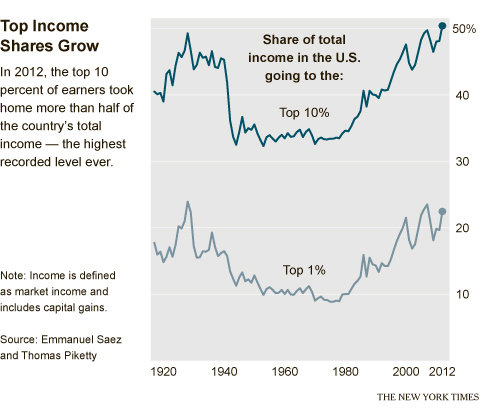
Economic recovery requires a growth in real median family income and/or an increase in consumer debt, and, except for a rise in student loan debt, there is no sign of either.

US real median household income has declined from $56,189 in 2007 to $51,371 in 2012, a decline of $4,818 or 8.6%. http://www.deptofnumbers.com/income/us/

US real per capita income has declined from $29,554 in 2007 to $27,319 in 2012, a drop of $2,235 or 7.5%.

How do consumers take on more debt in order to finance their consumption when their real incomes are falling? The growth in consumer credit outstanding is due to student loan growth.

I have not seen the establishment’s explanation of how recovery can occur without growth in real purchasing power either from rising real incomes or rising consumer indebtedness.

According to the Bureau of Labor Statistics, there are 1,277,000 fewer seasonally adjusted payroll jobs in November 2013 than in December 2007.

How it is possible for the economy to have been in recovery since June 2009 (according to the National Bureau of Economic Research) and there are 1,277,000 fewer jobs today than existed six years ago prior to the recession?

How has real Gross Domestic Product recovered when jobs and real consumer incomes have not?

These are among the many questions that go unasked and unanswered.

Statistician John Williams says that the economic recovery is a statistical illusion created by deflating nominal GDP with an understated measure of inflation.

About Dr. Paul Craig RobertsPaul Craig Roberts was Assistant Secretary of the Treasury for Economic Policy and associate editor of the Wall Street Journal. He was columnist for Business Week, Scripps Howard News Service, and Creators Syndicate. He has had many university appointments. His internet columns have attracted a worldwide following. His latest book, The Failure of Laissez Faire Capitalism and Economic Dissolution of the West is now available.

The post More Misleading Official Employment Statistics – Paul Craig Roberts appeared first on PaulCraigRoberts.org.

Watch: Cop Shoves His Dog Into Surrendering Suspect’s Car Window — Dog Mauls Suspect

6

Alex Kane
RINF Alternative News

A North Carolina cop was cleared of all wrongdoing by a grand jury yesterday–even after a video showed him pushing a K-9 unit dog into a suspect’s car. The dog then mauled the suspect, who had to get stitches on his face and shoulders.

As Gawker’s Adam Weinstein notes, the incident occurred on Halloween. Johnnie Williams blew past a DWI checkpoint, causing the police to chase him. Officer Stafford Brister hit Williams head-on with his police car. Then, after Williams threw up his hands in a surrender gesture, Brister threw his police dog into the car. “Sometimes the job we do is not pretty,” the chief of the Wilmington, North Carolina police department told WECT.

Other police officers had to pull the dog off Williams before the animal could do any more damage. Brister, who faced a misdemeanor count of assault, was put on leave with pay. An internal review continues while Brister remains on leave with pay.

But the grand jury thinks Brister is innocent. Williams was convicted, though, on a number of charges.

Mondoweiss

Rice grown near crippled Fukushima nuclear plant served to govt officials

Covers are installed for a spent fuel removal operation at Japan’s Fukushima Dai-ichi nuclear plant’s unit 4 reactor building (R), in Okuma town in Fukushima prefecture on June 12, 2013. (AFP Photo)

Rice from fields in the Fukushima prefecture, evacuated after the worst nuclear disaster in Japan, will be served to government officials for 9 days in a bid to demonstrate the safety of the country’s most-beloved crop, a local broadcaster reported.

The rice cultivated in several decontaminated fields in the Yamakiya District in Kawamata Town and Iitate Village, two areas designated as evacuation zones after the March 2011 nuclear catastrophe, will be served in a government office in Tokyo from Monday.

Over half a ton (540 kilograms) of rice will be part of a test to prove the effectiveness of the decontamination process. Officials from the Fukushima prefecture have given assurances that the rice contains no radioactive substances.

The rice balls tasted especially good after the great effort put into cultivating the crop, said Senior Vice Environment Minister Shinji Inoue on Monday. Parliamentary Vice Environment Minister Tomoko Ukishima also joined the tasting.

A farmer from Kawamata Town told NHK that he will continue to cultivate the rice now that he knows it tastes good. Because the zone was evacuated after the nuclear crisis, he said that he had traveled from his temporary home to the paddy fields to tend the crops.

Some 160,000 people escaped the vicinity of the Fukushima Daiichi nuclear plant after an earthquake in March 2011 triggered a tsunami that hit Japan’s coast, damaging the plant’s three nuclear reactors. The catastrophe that hit Fukushima became the world’s worst nuclear disaster since Chernobyl.

Several months after the accident at the power plant in November 2011, samples of rice grown in Onami town in Fukushima Prefecture showed radioactive contamination above the safety limit. The grain contained caesium — a radioactive isotope — that was measured at 630 becquerels per kilogram, while the government-set safety limit is 500 becquerels.

The rice from Onami, situated 57 kilometers northwest of the stricken nuclear power plant, was banned and shipments of the product were restricted in November 2011.

Yamakiya District in Kawamata Town and Iitate Village, the areas from which the decontaminated rice is currently being served to officials, are located some 40 to 50 kilometers northwest of the stricken plant.

RT
With permission

‘Struggle Is My Life’: Mandela’s Personal and Political Lives were Indivisible

0

South African leader and international icon Nelson Mandela has died at age 95 at his Johannesburg home after struggling with health problems.

‘A giant for justice’, ‘a father of the nation’, ‘a hero of our time’ – world leaders have praised Nelson Mandela, reacting to the news of his death.

Danny Schechter, documentary filmmaker and author of ‘Madiba A-Z. The many faces of Nelson Mandela’, got to know the historic figure in person.

For more information, see:
http://www.globalresearch.ca/remembering-nelson-mandela-1918-2014-he-is-…

Source: Global Research

Human Rights Day 2013

0

In 1950, the UN proclaimed December 10 Human Rights Day. It did so to affirm the importance of the Universal Declaration of Human Rights (UDHR).

Eleanor Roosevelt chaired the UDHR drafting committee. Seventeen other political, cultural and religious figures joined her. She said:

“We must show by our behavior that we believe in equality and justice and that our religion teaches faith and love and charity to our fellow men.”

“Here is where each of us has a job to do that must be done at home, because we can lose the battle on the soil of the United States just as surely as we can lose it in any one of the countries of the world.”

In September 1948, its first draft was completed. Over 50 member states were involved.

On December 10, 1948, UN Resolution 217 A (III) adopted UNHR. No members dissented. Eight abstained. Despite emerging Cold War tensions, common ground was found.

UNHR’s 30 articles pledged “to promote respect for (fundamental human) rights and freedoms…both among the peoples of Member States themselves and among the peoples of territories under their jurisdiction.”

It called “the inherent dignity (and) equal and inalienable rights of all members of the human family the foundation of freedom, justice and peace in the world.”

World War II atrocities inspired UNHR. The UN Charter’s Preamble vowed never again. “(S)av(ing) succeeding generations from the scourge of war” was prioritized.

So was “reaffirm(ing) faith in fundamental human rights,” “assur(ing) (respect for) justice and international law,” and “promot(ing) social progress and better standards of life in larger freedom.”

Since 1945, the UN failed dismally on all counts. Multiple global wars persist. Rule of law principles don’t matter. Human rights are consistently ignored. Democracy is more illusion than reality.

UN Secretary-General Ban Ki-moon is a US-installed imperial stooge. Disingenuously he said “let us intensify our efforts to fulfill our collective responsibility to promote and protects the rights and dignity of all people everywhere.”

Throughout his tenure, he irresponsibly spurned them. He ignores what he’s mandated to uphold. He one-sidedly backs wealth and power interests. Popular ones went begging on his watch. They still do.

He’s done nothing to help long-suffering Palestinians. He turns a blind eye to horrific Israeli human rights violations. He does so consistently. He does it repeatedly.

He shames the high office he holds. He’s in league with rogue powers. So are other senior UN officials.

On December 6, 2011, Haaretz editors headlined “Human rights in Israel are in jeopardy,” saying:

“Israel ratified the Universal Declaration of Human Rights.” It spurns them consistently. It pays lip service to what it abhors. It shows in how occupied Palestinians are treated.

Israel’s longstanding Human Rights Record is deplorable. On December 9, the Jerusalem Post headlined “ACRI annual report slams human rights problem with Israeli Arabs, migrants.”

Ahead of Human Rights Day, the Association for Civil Rights in Israel (ACRI) reviewed major 2013 trends.

They reflect horrific treatment of “weaker sectors of society, discrimination against Israeli Arabs, (as well as) African migrants and” nonviolent protesters.

Violations include “rolling back subsidies for young children and the elderly, cutting off the supply of water to people who could not afford timely payments and the elimination of public housing.”

Racist attacks increased. Workplace discrimination is widespread. Knesset legislation institutionalized repressive practices.

High Court rulings were circumvented. Ruling authorities consistently ignore them. Arab citizens and African migrants endure horrific abuses.

ACRI CEO Hagai Elad said:

“The annual report is a reminder of how much more work there is to do to improve the defense of the rights of the sons and daughters of Israel.”

“(W)ith our joint efforts, we hold in our hands the power to change the situation, not only to be those who raise (attention) to harming rights, but also to be the generators of change.”

Elad also said “(o)ccupation will never be consistent with human rights.” It reflects the worst of racist repression.

Militarized occupation is ruthless. On December 9, Addameer headlined “International Human Rights Day…Palestinian People’s Suffering Continues.”

This year “coincides with” Oslo’s 20th anniversary. Palestinians got nothing in return for renouncing armed struggle.

Settler numbers tripled from 200,000 in September 1993 to well over 600,000 now. Israel wants permanent occupation legitimacy.

Sovereign Palestinian freedom is denied. Peace in our time is more illusion than reality.

“…Human Rights comes this year while the human rights situation in the occupied Palestinian territory (oPt) is continuously deteriorating, and the principles of the Universal Declaration of Human Rights, the rules international human rights law derived from it, and international humanitarian law are violated,” said Addameer.

“This year may be considered the worst at the level of the catastrophic deterioration of the Palestinian human rights situation resulting from” virtually daily Israeli crimes against humanity.

They include multiple daily home invasions, mass arrests, abusing young children like adults, targeted assassinations, kidnappings, torture, land theft, violent ethnic cleansing, calling Palestinian self-defense terrorism, and committing slow-motion genocide against 1.7 million Gazans.

World leaders able to make a difference turn a blind eye.

“Today, it is disgraceful that Palestinians have (to keep) struggl(ing) for freedom and self-determination (and must beg) for their rights to life, food, health care and living conditions that preserve their dignity, while their natural right to freedom and enjoyment of all civil and political rights as well as their cultural, social and economic rights continue to be denied,” said Addameer.

The Palestinian Center for Human Rights (PCHR) addressed this year’s Human Rights Day commemoration.

It comes when Occupied Palestinian conditions keep deteriorating. Israel consistently violates core international humanitarian law principles.

It controls about 60% of stolen Palestinian land. Militarized occupation is ruthless. Palestinians are increasingly isolated in ghettoized bantustans.

Ethnic cleansing continues daily. International protection is entirely absent. Palestinians aren’t sure each day if they’ll see another.

Palestine is an isolated prison. Besieged Gaza is the world’s largest open-air one. An entire population is being suffocated out of existence.

Palestinians endure virtually every type human rights abuse imaginable. They endure it multiple times daily. They endure it horrifically.

They sustain what no people anywhere should have to suffer. They do it isolated on their own virtually out of sight and mind. At the same time, sham peace talks continue.

Israeli-style peace is none at all. It’s ruthless militarized occupation. It masquerades as self-defense.

Israeli historian Ilan Pappe believes Palestinians “don’t have the luxury to wait” for Israel to change. It’s been hardline for 65 years. It’s more ruthless than ever now.

It’s “more chauvinistic, ethnocentric (and) intransigent,” said Pappe. Peaceful conflict resolution remains a distant hope. It’s a present day illusion.

Waiting for Israel to change exacts an enormous price. Ignoring Israeli crimes assures increasing them. Stopping what’s ongoing more than ever is urgent.

A “powerful model of (outside) pressure” is needed, said Pappe. It won’t come from leaders able to make a difference. It’s up to civil society. Initiatives like BDS are important.

Much more is needed. Sustaining it is vital. So is increasing it. Doing it globally. Attracting growing numbers of Jews. Including Israelis for long denied justice.

It’s not easy. It takes time. Sunshine is the best disinfectant. The more the better. Big Truths repeated enough attract growing numbers of adherents.

Doing so represent steps one and two for change. The power of overwhelming popular sentiment works.

Politicians most want reelection. Spurning constituent wishes risks defeat. Pappe believes reality on the ground in Palestine reflects a one-state solution, not two.

“Five minutes on the ground shows you that the one state is already there,” he says.

“It’s a non-democratic apartheid regime.” It’s vital to change it. “You need to think about how to change the relations between the communities, how to affect the power structure in place.”

How to transform an Israeli apartheid state into one nation with equal rights for all its people matters most. No other solution works.

On Human Rights Day 2013, that message should resonate. It’s a core issue to support.

It’s perhaps the best chance for conflict resolution. Maybe the only one. Continuing decades of repression assures none.

Stephen Lendman lives in Chicago. He can be reached at lendmanstephen@sbcglobal.net.

His new book is titled “Banker Occupation: Waging Financial War on Humanity.”

http://www.claritypress.com/LendmanII.html

Visit his blog site at sjlendman.blogspot.com.

Listen to cutting-edge discussions with distinguished guests on the Progressive Radio News Hour on the Progressive Radio Network.

It airs Fridays at 10AM US Central time and Saturdays and Sundays at noon. All programs are archived for easy listening.

http://www.progressiveradionetwork.com/the-progressive-news-hour

http://www.dailycensored.com/peace-without-occupation/

Stunning Hypocrisy: Obama Slams Leaders Who “Do Not Tolerate Dissent From Their Own People”

0

Obama needs to take a look in the mirror

Paul Joseph Watson
Infowars.com
December 10, 2013

During a memorial service for Nelson Mandela in Johannesburg today, President Barack Obama challenged leaders who supported Mandela’s struggle for freedom but “do not tolerate dissent from their own people,” a stunning piece of hypocrisy given that the Obama administration has aggressively pursued dissenters at every turn, from punitive targeting of Tea Party groups via the IRS to the unprecedented prosecution of whistleblowers.

“There are too many people who happily embrace Madiba’s legacy of racial reconciliation, but passionately resist even modest reforms that would challenge chronic poverty and growing inequality. There are too many leaders who claim solidarity with Madiba’s struggle for freedom, but do not tolerate dissent from their own people,” stated Obama.

This is quite rich coming from someone whose administration has overseen, according to Time Magazine, “a record as the most aggressive prosecutor of alleged government leakers in U.S. history.”

This war on whistleblowers has resulted in reporters like James Risen being threatened with jail time unless they reveal their sources, while the Obama administration has charged more whistleblowers under the Espionage Act than all past presidents combined.

Obama’s Department of Justice also illegally spied on the Associated Press and Fox News in its pursuit of alleged leakers (in other words “dissenters” trying to expose government corruption).

Conservative political groups who dissented against Obama’s policies have also found themselves in the crosshairs. Earlier this year it was revealed that the IRS had targeted political groups applying for tax-exempt status based on their names or political persuasion.

“IRS documents show the agency flagged political groups based on the content of their literature, raising concerns specifically about “anti-Obama rhetoric,” inflammatory language and “emotional” statements made by non-profits seeking tax-exempt status,” reported USA Today.

Not only have Tea Party groups been targeted by the IRS, but prominent critics of Obamacare have also found themselves on the receiving end of audits shortly after speaking out against the Affordable Care Act.

Less than two weeks after appearing on Fox News to relate how he was unable to afford a drastic rise in health care premiums thanks to Obamacare (and basically acknowledging that he would rather leave the money to his family and die), cancer victim Bill Elliott was informed that he would be facing an IRS audit.

After seeing his appearance on Fox News, Chicago insurance broker and ObamaCare critic C. Steven Tucker helped Elliot obtain assistance and Elliot publicly thanked him for doing so. Shortly after, Tucker received a letter from the IRS telling him that he would be audited in 2014.

When Obama criticizes other leaders for not tolerating dissent from their own people, he should take a look in the mirror.

Obama has presided over an administration that has been nothing but intolerant of dissent at every level, deliberately targeting prominent critics of his policies and his prosecution of national security issues – tactics that have created a chilling effect by intimidating other whistleblowers and dissenters from publicly airing their concerns.

Facebook @ https://www.facebook.com/paul.j.watson.71
FOLLOW Paul Joseph Watson @ https://twitter.com/PrisonPlanet

*********************

Paul Joseph Watson is the editor and writer for Infowars.com and Prison Planet.com. He is the author of Order Out Of Chaos. Watson is also a host for Infowars Nightly News.

This article was posted: Tuesday, December 10, 2013 at 11:32 am

Tags:


Source: Infowars

Patriot Act Author: Congress Are “Cheerleaders” For NSA

3

Calls Feinstein bill “a joke”

Steve Watson

Rep. James Sensenbrenner Jr., the man who authored the original PATRIOT Act of 2001, says that the House and Senate Intelligence committees, which are supposed to operate as oversight watchdogs of government spy agencies, have become “cheerleaders” for the NSA.

In an interview with The Hill, Sensenbrenner chided the leaders of the committees, Rep. Mike Rogers (R-Mich.) and Sen. Dianne Feinstein (D-Calif.), saying that “Instead of putting the brakes on overreaches, they’ve been stepping on the gas,”

Sensenbrenner also said that the legislation proposed by Feinstein to restrict the NSA is “a joke,” and that it pales in comparison to his own bill, which now has 107 co-sponsors.

Feinstein’s view is essentially “if you like your NSA, you can keep it.” the 18 term Wisconsin Republican noted.

Sensenbrenner has also called for the firing and prosecution of Director of National Intelligence James Clapper, after he lied to Congress about the NSA’s spying program.

Unlike his own legislation, which would ensure an end to bulk collection of communications data, Feinstein and Rogers’ bill essentially rubber stamps the mass spying program, while making meaningless “transparency” reforms.

“There is no limit – apparently, according to the NSA – on what they can collect. And that has got to be stopped,” he said during the interview, pinning further blame squarely on the Judiciary Committee, which paved the way in 2006 for the NSA to gain secret approval from the Foreign Intelligence Surveillance Court to use provision 215 of the Patriot Act to collect records on all U.S. phone calls.

“I don’t think the oversight was vigorously done by the Judiciary Committee,” Sensenbrenner said. “When I was running the Judiciary Committee, it was being vigorously done.”

While Sensenbrenner’s legislation would no doubt do more to rein in the NSA than the Feinstein bill, his opinion of whistleblower Edward Snowden outlines the fact that his ultimate goal is not to further empower the American people against government surveillance.

“He’s a criminal,” Sensenbrenner says of Snowden. “I believe that the Russians, in showing good faith, ought to return him to face the music.” he told reporters.

–––––––––––––––––––––-

Steve Watson is the London based writer and editor for Alex Jones’ Infowars.com, and Prisonplanet.com. He has a Masters Degree in International Relations from the School of Politics at The University of Nottingham, and a Bachelor Of Arts Degree in Literature and Creative Writing from Nottingham Trent University.

With permission
Source: Infowars

Obamacare could force THOUSANDS of volunteer fire departments to close

David Martosko

Volunteer fire departments were not exempted from Obamacare. Credit: Lee Cannon via Flickr

Volunteer fire departments all across the U.S. could find themselves out of money and unable to operate unless Congress or the Obama Administration exempts them from the Affordable Care Act.

‘I thought the kinks were worked out of Obamacare at the first of the month,’ Central Florida volunteer firefighter Carl Fabrizi told Sunshine State News.

‘Man, oh, man, this could potentially destroy some real good companies in Florida.’

The U.S. Department of Labor takes the term ‘volunteer’ literally, but the IRS says volunteer firefighters are technically employees if they’re on the job more than 30 hours per week, making them subject to Obamacare’s employee-mandate rules.

Read more

Karzai: U.S. Acting Like a Colonial Power

0

Associated Press
December 10, 2013

The mountains of Afghanistan seen from the back of a CH-47D Chinook helicopter. Credit: U.S. Army

Afghanistan President Hamid Karzai lashed out at the United States, accusing it of making threats in the dispute over an agreement to keep U.S. troops in the country beyond 2014.

In an interview published Tuesday by the French daily Le Monde, Karzai says the U.S. is “absolutely” acting like a colonial power in its attempts to force him to sign the bilateral security agreement by the end of this year. The paper quoted him as saying: “The threats they are making, `We won’t pay salaries, we’ll drive you into a civil war.’ These are threats.”

Washington and NATO officials say the pact is critical to the plan to keep thousands of forces in Afghanistan after 2014 for a training and counterterrorism mission.

This article was posted: Tuesday, December 10, 2013 at 11:21 am


Source: Infowars

EPA says taking over private property will benefit the economy

2

Michael Bastasch

Can the EPA run your property better than you? The Environmental Protection Agency says that its proposal to extend its regulatory powers over wetlands and waterways would produce economic benefits.

Republican lawmakers warn that the agency is trying to extend its power to regulate private property.

The EPA’s rule would redefine the term “waters of the United States” to include all “tributaries, regardless of size and flow, and all lakes, ponds and wetlands within a floodplain” reports E&E News. Other bodies of water, “such as geographically isolated wetlands, would have to be shown on a case-by-case basis to have a significant chemical, physical or biological effect on larger waterways downstream – a major point of concern for environmental groups” E&E added.

Read more

Chinese scientists upbeat on development of invisibility cloak

0

Stephen Chen
South China Morning Post
December 10, 2013

A woman laughs as she pushes a trolley past artist Liu Bolin during his demonstration to blend in with the vegetables on the shelves at a supermarket in Beijing, November 10, 2011. / Business Insider

Mainland scientists are increasingly confident of developing the world’s first invisibility cloak, using technology to hide objects from view and make them “disappear”.

The central government has funded at least 40 research teams over the past three years to develop the idea, which until now has largely been the stuff of science fiction and fantasy novels like the Harry Potter series.

The technology would have obvious military uses such as developing stealth aircraft, but Beijing believes the research could lead to wider technological breakthroughs with broader uses, scientists involved in the research said. The teams involved include researchers at Tsinghua University and the Chinese Academy of Sciences.

This article was posted: Tuesday, December 10, 2013 at 11:41 am


Source: Infowars

Hagel Threatens Pakistan: Stop Drone Protests, Or US Will Stop Aid

U.S. Defense Secretary Chuck Hagel threatened Pakistani heads of state on Monday with cutting off up to $1.6 billion in aid if the country’s mass protests against U.S. drone strikes continue, Pentagon officials said, according to The New York Times.

The warning came after nonviolent blockades in protest of U.S. drone strikes in Pakistan forced the United States to halt ground transport of NATO military supplies from Afghanistan via Pakistan last week, as Common Dreams previously reported.

A statement from Pakistan’s foreign ministry reported by Reuters says Pakistani Prime Minister Nawaz Sharif on Monday “conveyed Pakistan’s deep concern over continuing U.S. drone strikes, stressing that drone strikes were counterproductive to our efforts to combat terrorism and extremism on an enduring basis.”

Yet Pentagon officials said Sharif gave his assurances that he would end the blockade and ensure safe passage of military equipment, The New York Times reports.

The Express Tribune reports that last week Sharif ordered police to devise a strategy for shutting down the protests if the opposition party refuses to disband them.

The opposition part, Pakistan Tehreek-e-Insaaf (PTI), and coalition forces have vowed to continue the protests until the U.S. drone strikes end in Pakistan.

In October, the Obama administration gave $1.6 billion in annual aid to Pakistan amid growing public anger over the deadly strikes.

The Pakistani defense ministry claims that 2,160 militants and 67 civilians have been killed in over 300 U.S. drone strikes. Residents of the communities that fall under attack, however, say far more civilians are dying, and Pakistani officials do not provide the names, or access to the bodies, of those killed, IPS reports. The Bureau of Investigative Journalism estimates that between 416-951 Pakistani civilians have been killed in U.S. drone strikes since 2004, including 168 to 200 children.

_____________________

This work is licensed under a Creative Commons Attribution-Share Alike 3.0 License.

Source: Common Dreams

US-Russia nuke war to end human race

0

There are more than 17,000 nuclear warheads which have been ignored since the Cold War ended in 1991.

American nuclear scientist Ira Helfand has warned that a nuclear war between the United States and Russia could lead to the extinction of the human race.

“With a large war between the United States and Russia, we are talking about the possible — not certain, but possible — extinction of the human race,” Helfand, the co-president of International Physicians for the Prevention of Nuclear War, said in a study.

“In this kind of war, biologically there are going to be people surviving somewhere on the planet but the chaos that would result from this will dwarf anything we’ve ever seen,” he added.

There are currently more than 17,000 nuclear warheads which have been ignored since the Cold War ended in 1991, according to the study.

Helfand said modern nuclear weapons are far more powerful than the US bombs used against Japan in 1945.

Nine countries are believed to possess nuclear weapons, with Russia and the United States holding the vast majority of them. Israel is the Middle East’s sole possessor of nuclear weapons.

In 2009, Washington pledged to work toward the abolition of its nuclear weapons, but said it would keep them so long as others keep theirs.

AGB/AGB

Source: Press TV

“Nobody is Safe”: Foreign Forces Need to Stop Fueling Violence in Syria

0

Syria has been marred by civil war by over two years. In August, videos emerged which showed alleged use of chemical weapons on civilians outside Damascus.

Critics of President Bashar al-Assad claimed the videos proved the administration was behind the sarin gas attack, and led US President Barack Obama to push for intervention in the country before backing away from the threats when Assad agreed to hand over all his chemical weapons stockpiles.

RT’s Meghan Lopez speaks with Mother Agnes-Mariam de la Croix, founder of the James the Mutilated Monastery in Syria, who says that the videos show the chemical weapons were used by Syrian rebels, not the Assad administration.

Poll Finds ‘Major Breakthrough’ for Marijuana Legalization in CA

For the first time, the majority of voters in California are backing full legalization of marijuana, marking what many are calling a “breakthrough for marijuana advocates” and a clear repudiation of the War on Drugs and the zero-tolerance policy that has driven local and national drug enforcement for years.

According to a Field Poll, which for decades has been tracking Golden State residents’ opinions of marijuana, 55 percent of respondents have indicated clear support for legalization.

Forty-seven percent said they would support the legalization of marijuana with controls “similar to those of alcohol” while eight percent said they would support allowing anyone to purchase it.

The nonpartisan pollsters note that the latest poll indicates a “huge reversal of public sentiment toward marijuana” with just 31 percent favoring strict enforcement of existing laws or passing tougher sanctions, compared with 75 percent of poll respondents in 1969.

Following the lead of Colorado and Washington state residents, who last November voted to legalize marijuana, the group California Cannabis Hemp Initiative 2014 is collecting signatures for an initiative to be placed on the state ballot next fall.

Fifty-six percent of the Field Poll respondents said they would be “inclined” to vote yes on the proposed legislation, which would legalize all uses for hemp and cannabis–the plant from which marijuana is derived–and set a standard for intoxication similar to those for alcohol.

“I don’t think it’s any worse than alcohol,” Janice Holland, Kern County resident and poll respondent, told the Sacramento Bee. “So I think at a certain point people have the ability […] to make decisions about whether or not you want to get high.”

_____________________

This work is licensed under a Creative Commons Attribution-Share Alike 3.0 License.

Source: Common Dreams

MAY THE ODDS EVER BE IN YOUR FAVOR – HOPE & DEFIANCE

0

In the 1st installment of this article — May the Odds Ever Be in Your Favor — The Reaping, I addressed how wealth inequality created by men rigging the system and utilizing media propaganda ultimately leads to rebellion. In Part 2, I will show how hope and defiance can ignite the flame of liberty in the minds of men. Edward Snowden has ignited that flame.

A Lot of Hope is Dangerous

President Snow: Seneca… why do you think we have a winner?

Seneca Crane: [frowns] What do you mean?

President Snow: I mean, why do we have a winner? I mean, if we just wanted to intimidate the districts, why not round up twenty-four at random and execute them all at once? It would be a lot faster. [Seneca just stares, confused]

President Snow: Hope.

Seneca Crane: Hope?

President Snow: Hope. It is the only thing stronger than fear. A little hope is effective. A lot of hope is dangerous. Spark is fine, as long as it’s contained.

Seneca Crane: So…?

President Snow: So, contain it.

President Snow and his chief propagandist, Seneca Crane, have a discussion that could be taking place between president Obama and chairman Bernanke today. Hope is a funny thing. If the ruling class removes all hope, then the masses begin to feel they have nothing to lose and revolution becomes a foregone conclusion. For the elites of Panem, hope is used as a method of control. President Snow understood the danger of allowing the downtrodden multitudes too much hope. The Hunger Games allows one child to survive out of 24. The districts are forced to remember the iron grip of the Capitol every year, while rooting for an unlikely hollow victory of one child surviving.

The parents of children in the districts hope their children aren’t chosen. They hope they’ll scrounge up enough food to survive another day. They hope they don’t get killed in a mine explosion. They hope the peacekeepers don’t break down their doors and imprison them for illegal hunting. They hope they can endure another week. Snow knows that as long as they have only a faint hope to maintain their subsistence level lifestyle, they are unlikely to rebel. Seeing a sixteen year old girl openly defying the Capitol and awakening a spirit of humanity and courage in the subjugated masses is a huge threat to the ruling class.

Katniss Everdeen ignited the flash of hope in the districts when she befriended a young girl from District 11 named Rue. The contestants are supposed to kill each other, but Katniss protects the young girl. When Rue is killed, Katniss decorates her body with flowers as a means of memorializing Rue, which the television audience in the districts views as defying the Capitol. As she walks away from Rue’s memorial and back into the fight, she turns to the cameras and gives a three finger salute. The three fingered salute of District 12, a gesture rarely used, means thanks, admiration, and good-bye to a loved one. Her message to the people watching is they have a common enemy. They don’t have to fight each other because a tyrannical government commands them to do so. Once the beaten down and subjugated masses began to understand the other districts were not the true enemy, the flame of liberty was kindled.

Katniss had experienced an act of kindness and mercy earlier in the novel when she had reached the end of her rope and had failed to scavenge any food for her helpless mother and sister after her father’s death in a mine explosion. Her thoughts were dark and dire.

“I couldn’t go home. Because at home was my mother with her dead eyes and my little sister, with her hollow cheeks and cracked lips. I couldn’t walk into that room with the smoky fire from the damp branches I had scavenged at the edge of the woods after the coal had run out, my hands empty of any hope.”

In the world of District 12 bread signifies hope. Food symbolizes hope as freedom from hunger. When Peeta sees Katniss and her anguish, he shows compassion for her. He purposely burns some bread from his parents’ bakery and throws the bread to Katniss, who is huddled outside in the rain. Later on, as Katniss thinks about the meaning of this interaction with Peeta, she says,

“To this day, I can never shake the connection between this boy, Peeta Mellark, and the bread that gave me hope.”

One of the key undercurrents of the Hunger Game trilogy is what happens in a world where all hope seems to be lost. Through small acts of kindness, like providing a few loaves of bread or honoring a departed contestant, hope can be sparked, and a spark can turn into a flame, a “girl on fire.” In this way, Katniss comes to embody the hope of a better future, a liberated and free Panem. When an authoritarian regime can no longer keep the populace sedated with bread and circuses, they turn to oppression and force.

With 47 million people wallowing in poverty and real median household income lower than it was in 1999 a pallor of hopelessness has descended upon our land. Banking and corporate interests have captured the economic, financial and political systems to such an extent the people no longer have any say in how this country is governed. The people are given a choice of flavors in what passes for elections by the corporate interests that choose the candidates. Once a politician attains office and does what they are instructed by the financial interests that fund their campaigns, they become rich and powerful. This is why 90% of incumbents are re-elected despite Congress having a 12% approval rating in polls.

The last 13 years has confirmed the country is run by one party, as the Republican figurehead rolled out new trillion dollar entitlement programs, fought undeclared wars, created an Orwellian organization to spy on Americans, and drove deficits to staggering levels. Now the current Democrat figurehead has rolled out a disastrous new trillion dollar entitlement program, continues to fight undeclared wars, drones innocent people in foreign countries, secretly collects data on every American, and has driven deficits to epic heights.

The Crisis began in 2008 with the Wall Street created worldwide financial implosion, spurred by the greatest control fraud in history. The bankers and politicians have implemented “solutions” that have further enriched the kleptocratic parasite class, while impoverishing savers, seniors, and the working middle class who played by the rules. The temperament of the country has continued to darken and societal trust is imploding, just as Strauss & Howe predicted in 2007.

“As the Crisis catalyzes, these fears will rush to the surface, jagged and exposed. Distrustful of some things, individuals will feel that their survival requires them to distrust more things. This behavior could cascade into a sudden downward spiral, an implosion of societal trust.” –The Fourth Turning

When a tyrannical privileged class has taken their greed and avarice too far, reaped the remaining spoils of a declining empire and the exploited hordes begin to grow restless, the oligarchs will always utilize their mercenaries to retain control and keep the multitudes cowering and fearful. Even though the financial elite have been harvesting the riches of our bountiful land for decades, it only started to become apparent to a few aware critical thinkers in the late 1990’s. It is no coincidence the War on Terror has been used as an excuse to pass the Patriot Act, unleash the NSA to gather every piece of electronic data generated by all American citizens, militarize local law enforcement agencies, conduct military “training exercises” in major cities, roll out drones to monitor the activities of the people, subject citizens to degrading body searches in airports and train stations, install surveillance cameras throughout the land to monitor our every move, use Bernaysian propaganda techniques and create fake terrorist plots to keep the masses trembling and terrified.

The ruling class leeches lost their blood sucking grip on the financial markets in 2000 and again in 2008. As the common people have lost their trust in the financial and political leaders and their propaganda techniques wear thin, truncheons, guns and a vast treasure trove of weapons and surveillance equipment are being prepared for use against the people.

The Party put forth an unknown hope and change teleprompter flim-flam man in 2008 in a last ditch attempt to sooth the masses and allow the fat cats to continue feasting, with the periodic purging in the vomitorium when their gullets were stuffed. The proof of a single ruling party has never been clearer, as a supposedly liberal populist democrat has fallen into line and followed the orders of the Financial Industrial Complex, Military Industrial Complex, and Sickcare Industrial Complex by not prosecuting one criminal banker, letting Wall Street write the 800 page Dodd Frank bill, ramping up our wars in the Middle East while spending more on Defense than Bush, and gladly allowing the insurance and drug industry to write the 1,000 page Obamacare abortion of a law. At the same time he has taken the Orwellian surveillance state to levels that would have been considered criminal and impeachable in 1990. The two heads of the ruling party play their parts to keep the masses distracted, believing voting actually matters, while fighting the wrong enemy.

The parallels between the Hunger Games novels and our current situation are innumerable. But the dehumanization of a society is the most significant analogy between the dystopian culture of Panem and the greed and materialism of our late stage declining empire. It will not be war, plague or famine that sets the stage for our collapse. A moral sickness has engulfed the soul of our civilization, spread by the dark forces of wickedness occupying the throne of power on Wall Street, Washington DC, and in the boardrooms of mega-corporations across the land.

“It neither kills outright nor inflicts apparent physical harm, yet the extent of its destructive toll is already greater than that of any war, plague, famine, or natural calamity on record – and its potential damage to the quality of human life and the fabric of civilized society is beyond calculation. For that reason this sickness of the soul might well be called the ‘Fifth Horseman of the Apocalypse’. Its more conventional name, of course, is dehumanization.” – Ashley Montagu

The financial elite have used the power of mass media propaganda and jurisdiction over the public educational system to turn accountable thinking citizens into irresponsible irrational consumers. The ultra-rich men, constituting the invisible government described by Edward Bernanys, have used their control of the currency and monetary system to create a plantation society of enslaved debtors who have been trained like monkeys to consume when they are not facebooking, twittering or twerking. This dehumanization is in full display on Thanksgiving/Black Friday as the corporate fascists stir the masses into a frenzied materialistic orgy of pandemonium for cheap electronics produced by slaves in China, doing jobs formerly performed by Americans. Corporate profits have reached all-time record highs as the Ivy League MBA CEOs have used global wage arbitrage to de-Americanize their work force, convinced the lowly wilfully ignorant American serfs to spend money they no longer have on crap they certainly don’t need, and paid themselves billions in bonuses for successfully destroying the former middle class by the book.

The Party has utilized the cudgel of Federal Reserve created inflation to fleece the math challenged masses for the last 100 years. The modern day financial mad scientists use inflation, consumerism, debt, and media propaganda to keep the rats in their grand experiment running faster and faster around the maze, seeking an ever dwindling hunk of cheese. The rats are trapped in this experiment and have not the time, energy, resolve or enough cheese to escape. The rats will never breakout and their progeny are born into the maze, also with no hope of getting out alive. The mad scientists periodically reorient the maze, adjust the stimuli to elicit new behavior, and increase or decrease the rewards as they deem appropriate. Through their control of the financial, political and media centers, the ruling class not only manipulates society, they convince the rats they are really free and not confined in a maze, with no possibility of escape. The ruling class has succeeded in capturing the system to such an extent that they are syphoning off the income of the nation at a rate only seen prior to the Great Depression.

The real median household income of the bottom 90% is lower than it was in 1968, as inflation has destroyed the purchasing power of the proletariat. While wages have stagnated due to mega-corporations off-shoring American jobs for the sake of quarterly profits and stock price performance, the price of middle class essentials like food, energy, shelter, tuition and medical care have skyrocketed. The demented American nobility have disregarded centuries of history with regards to inequality borne of corruption and unfettered greed. When mild deflation reigns, as it did for most of the 19th century, goods and trade are plentiful, prosperity is ample and broadly spread to the working classes. When banker created inflation causes prices to rise, trade plummets, living standards deteriorate, and extreme wealth inequality accelerates. Once poverty reaches a tipping point, unrest and discontent lead to revolution and rebellion.

It is not a coincidence the rebellion in the Hunger Games begins in the two poorest districts. District 12 is inhabited by mostly white people in the Appalachia region of the former United States. District 11 is inhabited by mostly black people in the Southern region of the former United States. The symbolism of black people picking crops and being publicly whipped if they steal any of the food for their own survival is reflective of the plantation economy we have today. Miners getting killed in mine explosions due to unsafe conditions are reflective of the corporate greed that permeates our culture. The masters of this human tragedy attempt to keep the plebs in one district angry and mistrustful of the plebs in the other districts so they don’t focus on the real enemy. It has worked for decades, but as the workers see their lots in life descend to bare subsistence levels they have nothing to lose by resisting and rebelling. The privileged ruling plutocrats have the power to lessen the burden on the slaves, diminishing the chances of revolution, but in their sociopathic gluttonous hunger for ever more riches and supremacy they seal their fate of ultimate destruction, as John Kenneth Galbraith aptly described.

“People of privilege will always risk their complete destruction rather than surrender any material part of their advantage.”

A simple act of human kindness by a young girl is what ignited a rebellion in Panem. The power of hope and courage, once unleashed, can overwhelm the wickedness of evil men. But, those men will not be defeated without an epic struggle requiring much sacrifice, suffering, death and destruction. Katniss did not realize the impact she had until on her victory tour when during her speech an old man gives her the three finger salute, leading the crowd to follow his lead and defy the peacekeepers. She had inspired the oppressed to resist their bondage.

In the most disturbing scene of the movie, the old man is grabbed by the police thugs, dragged to the podium and shot in the head, while the other thugs beat and pummel the crowd into submission. Shades of the OWS beatings by the NYPD are clear.

This is how an Orwellian surveillance state reacts to the discontent caused by the appalling treatment of their subjects. Every district is kept under the thumb of the ironically named peacekeepers. They enforce the dictatorial mandates of the Capitol at the point of a gun and threats of imprisonment, or public beatings. The technologically advanced Capitol uses surveillance cameras and spy aircraft to monitor the districts and enforce their dictates. Since the passage of the paradoxically named Patriot Act, the American surveillance state has been perfected to a level that would impress Orwell.

With the NSA gathering every piece of electronic data generated by every citizen, surveillance cameras monitoring our every movement in major cities, spy drones patrolling the skies, fascists attempting to disarm the public, and police state thugs roaming the countryside enforcing the dictates of the oligarchy, we’ve descended into authoritarian rule. The Constitution is no longer a valid document. The President is free to send boys to their death in foreign countries without the approval of Congress. He is free to ignore laws and use executive orders to implement his agenda. Any doubt regarding whether we are still free was obliterated by the police state crushing of the OWS protests and more recently the door to door illegal searches conducted by heavily armed American “peacekeeper” thugs in Watertown, Massachusetts searching for a wounded 17 year old kid.

The courageous actions of Katniss in the Hunger Games ignited a rebellion and the ultimate demise of President Snow and his evil empire. Edward Snowden’s audaciously brilliant take down of the NSA and Obama’s growing surveillance empire has awakened a slumbering public and hopefully kindled the flame of freedom in enough patriots to instigate the revolution which will drive the next stage of this Fourth Turning.

“The risk of catastrophe will be very high. The nation could erupt into insurrection or civil violence, crack up geographically, or succumb to authoritarian rule. If there is a war, it is likely to be one of maximum risk and effort — in other words, a total war. Every Fourth Turning has registered an upward ratchet in the technology of destruction, and in mankind’s willingness to use it.” — Strauss & Howe –The Fourth Turning

Defiance — Catching Fire

“At some point, you have to stop running and turn around and face whoever wants you dead. The hard thing is finding the courage to do it.” – Katniss Everdeen — Catching Fire

“The great fear that I have regarding the outcome for America of these disclosures is that nothing will change. [People] won’t be willing to take the risks necessary to stand up and fight to change things… And in the months ahead, the years ahead, it’s only going to get worse. [The NSA will] say that… because of the crisis, the dangers that we face in the world, some new and unpredicted threat, we need more authority, we need more power, and there will be nothing the people can do at that point to oppose it. And it will be turnkey tyranny.” — Edward Snowden

Now we get to the most important theme of the Hunger Games trilogy and a theme that will drive the regeneracy stage of this Fourth Turning — Defiance. There can be no change unless someone has the courage to make a stand. Generational archetypes will need to play their assigned roles, just as they did in the Hunger Games novels. The Boomers should be seeking a new vision of a better future; Gen-X should be seeking realism and implementable solutions; and the Millennials should be seeking the power to change the course of a terribly misguided country.

It will not take a majority to prevail during this Fourth Turning, just an inspired courageous minority willing to sacrifice themselves for the greater good. Suzanne Collins may not have meant to place her characters into their proper generational roles, but they played their parts as would be expected during a Crisis. Plutarch Heavensbee, a 50 something Prophet Generation visionary, is the leader of the rebellion who exploits the power and courage of Katniss Everdeen, from the Hero Generation, to inspire and lead the rebellion. Haymitch Abernathy, the 40 year old drunk from the Nomad Generation, is the brains behind the plan to spur rebellion and defeat the Capitol. He made it his purpose in life to protect and support the young heroes who were required to do the heavy lifting during the Crisis.

The theme of defiance and its ability to undermine an evil, yet fragile, authoritarian regime is portrayed through the symbol of the mockingjay in the novels. The mockingjay is a surveillance state blunder, accidently fashioned by the hubristic Capitol. After the first rebellion, the Capitol left the jabberjays, a bird they created to spy on the districts and relay whole conversations to the Capitol, in the wilderness to die off. Instead, the jabberjays mated with mockingbirds and a species called the mockingjay was born. The mockingjay was a signal of weakness in the armor of the Capitol.Mockingjays had the talent of being able to relay any song or tune they hear to any species. Katniss’ father used to love to sing songs in the woods while hunting and loved to hear the mockingjays repeat his tune back to him. Katniss and Rue used the mockingjays to communicate during the Games. Mockingjays were a hardy resilient species that could survive in the harshest of environments.

The mockingjay becomes a symbol of defiance, rebellion and hope among the districts. Before the Games, a friend of Katniss’ from school gave her a gold mockingjay pin as a token from home. The television audience sees the pin on Katniss’ clothes during the Games. After the Games, the symbolism of the mockingjay becomes a rallying point for the subjugated masses in the districts. As the rebellion gathers steam, the rebelling districts use the mockingjay symbol as a primary method of communication. The rebels bake the bird symbol into breads, crackers, and other things that could easily be eaten or hidden quickly. The mockingjay becomes sign of resistance, a sign of uprising, and a sign of hope. The brush fires of rebellion are glimpsed by Katniss during the victory tour and celebration before the 75th anniversary Games. Plutarch Heavensbee, supposedly a high level Capitol apparatchik, attempted to win Katniss’ trust by showing her his watch, which viewed in the right position you could see the symbol of the rebellion – the mockingjay.

The defiance of a young girl versus the façade of an all-powerful state, through her humanity, the mockingjay symbol, and the willingness to eat poison berries as the ultimate act of rebellion against the rulers of the game, is the defining motif of our time.

“The bird, the pin, the song, the berries, the watch, the cracker, the dress that burst into flames. I am the mockingjay. The one that survived despite the Capitol’s plans. The symbol of the rebellion.” — Katniss Everdeen — Catching Fire

What is not immediately apparent to the vassals of a totalitarian regime is the internal rot, infighting among the lieutenants, and superficial level of support among the citizenry. A government racked by corruption, dependent upon financial gimmickry and massive levels of debt to give the appearance of solvency, only able to preserve domination through brutal police state thug tactics, monitoring its subjects with intrusive surveillance machines, and led by sociopathic paranoid egomaniacal men, is sickly and rotting on the inside. President Snow spitting up blood throughout the novels is symbolic of this disease. Like a gigantic 224 year old oak tree that appears imposing, robust and indestructible, but has been decaying within, a strategically placed lightning strike or sudden gust of wind is capable of toppling the once mighty tree.

Sometimes all it takes is for one person of good conscience, with the courage to accept the consequences of revealing the truth, to strike down the mighty oak and ignite brush fires of freedom in the minds of men. Edward Snowden is that person.

“I can’t in good conscience allow the US government to destroy privacy, internet freedom and basic liberties for people around the world with this massive surveillance machine they’re secretly building. I do not want to live in a world where everything I do and say is recorded. That is not something I am willing to support or live under. Everyone everywhere now understands how bad things have gotten – and they’re talking about it. They have the power to decide for themselves whether they are willing to sacrifice their privacy to the surveillance state.” — Edward Snowden

In the Hunger Games trilogy Katniss Everdeen created a problem for President Snow when she pulled out the poisonous berries and foiled the game being orchestrated by the cruel sovereigns of Panem. She refused to be a pawn in their game. She had the courageousness of spirit to illustrate to the suppressed citizens in the locked down prison-like districts that she was not owned and enslaved by the state. She was a human being who deserved to be treated with respect, not like an animal or a specimen in their malicious man made game.

“I want to do something, right here, right now, to shame them, to make them accountable, to show the Capitol that whatever they do or force us to do there is a part of every tribute they can’t own. That Rue was more than a piece in their Games. And so am I.” — Katniss Everdeen — The Hunger Games

Edward Snowden has created a problem for President Obama, his surveillance state apparatus, and the banking cabal that pull the strings in this empire of consumerism, by revealing the dirty secrets of a paranoid tyrannical ruling party. We are late in the game and pleading ignorance regarding how technology is being used by evil men for evil purposes is inexcusable. Snowden refused to remain a pawn in the NSA game and decided his fellow citizens needed to be warned about the dangers of an omniscient, secretive, malevolent state whose powers were unchecked and whose motives were geared towards oppression and coercion. He was a brilliant young cog within the government machinery, making good money, with a bright future if he conformed and obeyed, but he chose to be free. A free man can’t be bought, controlled or conquered. Edward Snowden decided someone needed to make a stand and that someone was him.

“Secrecy is the keystone to all tyranny. Not force, but secrecy and censorship. When any government or church for that matter, undertakes to say to its subjects, “This you may not read, this you must not know,” the end result is tyranny and oppression, no matter how holy the motives. Mighty little force is needed to control a man who has been hoodwinked in this fashion; contrariwise, no amount of force can control a free man, whose mind is free. No, not the rack nor the atomic bomb, not anything. You can’t conquer a free man; the most you can do is kill him.”– Robert Heinlein

The explosive disclosures of government criminality, mass spying, cover-ups, lying to Congress by government apparatchiks, and conclusive evidence of a surveillance state completely out of control confirmed another truth for those not captured by the red/blue party propaganda. Snowden was declared a traitor by Obama, Romney, Schumer, McCain, Pelosi, Boehner, Reid, McConnell, Feinstein, Rove, and of course, the blood thirsty, hate spewing, dark-lord of the neo-cons — Dick Cheney. The immediate and united venomous response from the slimy politician snakes should have removed all doubt there is really one ruling party and the rest of us are nothing but pawns in their game. We live in a corporate fascist warfare/welfare surveillance state run by ultra-wealthy unelected men with evil intentions.

“We’ve slipped away from a true republic. Now we’re slipping into a fascist system where it’s a combination of government, big business and authoritarian rule, and the suppression of the individual rights of each and every American citizen. When it comes to any significant differences on foreign policy, economic intervention, the Federal Reserve, a strong executive branch, a welfarism mixed with corporatism, both parties are very much alike. The major arguments in hotly contested presidential races are mostly for public consumption to convince the people they actually have a choice.” — Ron Paul

Snowden’s response to the murdering thug Cheney calling him a traitor makes me proud to call him a hero and a patriot, on par with George Washington, Samuel Adams, and Thomas Paine.

“Being called a traitor by Dick Cheney is the highest honor you can give to an American.” — Edward Snowden

Obama and the Party are continuously being made fools of by a 30 year old Millennial, as he periodically releases information damaging to the government’s surveillance efforts on the American people and foreign leaders. Each revelation further erodes the trust people and countries once had in the moral leadership of the United States. Snowden is our mockingjay, a creature the NSA never intended to create. The predator drone happy Obama would like nothing better than to have Snowden eliminated, but he is faced with the same dilemma as President Snow in the fictional world of Panem, captured in this dialogue:

President Snow: I have a problem, Miss Everdeen. A problem that began the moment you pulled out those poisonous berries in the arena. If a girl from District Twelve of all places can defy the Capitol and walk away unharmed, what is to stop them from doing the same?

Katniss Everdeen: It must be very fragile, if a handful of berries can bring it down.

If the mighty American empire can be embarrassed by a sole young patriot, proving to the world they are in decline financially, morally, and militarily, it must be very fragile. Snowden’s revelations did not immediately spark rebellion, but an attitude of defiance is gaining traction, as the mood in the country darkens like the sky before a blizzard whose full fury will strike with a vengeance lasting for several years. Since our entry into this Fourth Turning in 2008 there have been sparks of rebellion (OWS & the original Tea Party movement) but they were immediately subverted, discredited and crushed by the Party and their propaganda media machines. The attitude of defiance can be seen in the rise of Bitcoin, citizens buying physical gold and silver despite the Federal Reserve/Wall Street efforts to discredit it, the efforts of hackers like Anonymous to disrupt the corporate fascist state, the tireless efforts of websites like Zero Hedge, Washington’s Blog, Charles Hugh Smith, and Mike Krieger to uncover the truth, and the relentless pursuit of liberty and freedom by Ron Paul and his army of patriots. It is time for more leaders and heroes to step up and act.

“I had been looking for leaders, but I realized that leadership is about being the first to act. I understand that I will be made to suffer for my actions, and that the return of this information to the public marks my end.” — Edward Snowden

Despite the monetary manipulations of the Federal Reserve arm of the Party, supported by the propaganda efforts of the corporate media arm of the Party, the extreme level of criminally induced wealth inequality will ultimately result in a second far worse financial crash that will topple this teetering edifice of corruption. The violent stage of this Crisis will then erupt.

“But as the Crisis mood congeals, people will come to the jarring realization that they have grown helplessly dependent on a teetering edifice of anonymous transactions and paper guarantees. Many Americans won’t know where their savings are, who their employer is, what their pension is, or how their government works. The era will have left the financial world arbitraged and tentacled: Debtors won’t know who holds their notes, homeowners who owns their mortgages, and shareholders who runs their equities — and vice versa.” — The Fourth Turning — Strauss & Howe

The first American Fourth Turning was a rebellion against a foreign empire. The second American Fourth Turning was an internal rebellion that killed 700,000 young men. The third American Fourth Turning resulted in a foreign conflict that resulted in the deaths of 65 million people. Do these once every 80 year turnings alternate between external and internal conflict? If so, we are on the verge of events that will tear the fabric of this nation apart. The debt, civic decay, and heinousness of those in power will lead to the disintegration of our existing social order and sheer chaos, as forces battle for the soul of the nation. What it is replaced by is unknown at this time. It could be something far worse, or it could be a rekindling of our nation’s founding heritage of liberty, freedom and civic duty.

Linear thinking old timers are likely to scoff at the notion that some trilogy of novels for teenagers could capture the mood of the time in a way that explains how the people of this country will respond to the current worsening Crisis. I’m sure the works of Steinbeck and Tolkien were scoffed at during the last Fourth Turning. History is cyclical and we’ve returned to a time where leaders step forward to lead and brave heroes step forward to fight. The future of the country hangs in the balance.

“The original American patriots were those individuals brave enough to resist with force the oppressive power of King George. I accept the definition of patriotism as that effort to resist oppressive state power. The true patriot is motivated by a sense of responsibility and out of self-interest for himself, his family, and the future of his country to resist government abuse of power. He rejects the notion that patriotism means obedience to the state.” – Ron Paul

Do you reject the notion that patriotism means obedience to the state? Know your enemy.

“Remember who the real enemy is.” – Haymitch Abernathy — Catching Fire

MAY THE ODDS EVER BE IN YOUR FAVOR – HOPE & DEFIANCE was originally published on Washington's Blog

Bailout of GM cost US taxpayers $10.5bn

0

The US government ended up losing $10.5 billion on the General Motors bailout.

Taxpayers lost a whopping $10.5 billion on the federal government bailout of General Motors – but officials insisted another course of action would have been even worse.

After selling its remaining shares of the Detroit-based automaker Monday, the US Department of the Treasury said it had recouped $39 billion of the $49.5 billion it spent to save the failing company at the height of the financial crisis five years ago.

If the government hadn’t come to the rescue, more than 1 million jobs would have disappeared, and the economy could have plunged even further – from a recession into a depression, US Treasury Secretary Jacob Lew said.

“The economic stakes were high, and President Obama understood that inaction was not an option,” Lew said. “His decision to commit additional support to GM while requiring them to fundamentally restructure their business was tough, but it was right.”

Lew said Obama’s decision to continue the bailout of GM – which was started under President George W. Bush in late 2008 – helped prevent a collapse of the entire auto industry.

The government began selling shares once GM went public again in November 2010, and the pace rose steadily this year as the stock rose more than 40%.

Last month, the government said it expected to sell the remaining 2% stake by the end of the year. NY Daily News

AGB/AGB

With permission
Source: Press TV

Legacies: Michael Hourigan and the International Criminal Tribunal for Rwanda

0

Australian lawyer and U.N. war crimes investigator Michael Hourigan was given the task of investigating the assassination of the Rwandan and Burundian presidents by shooting their plane out of the sky over Kigali on April 6, 1994. His evidence that Gen. Paul Kagame had ordered the assassinations was suppressed. Hourigan’s death this week went unnoted by the press.

Transcript

As Michael Hourigan said, the International Criminal Tribunal is a victor’s court.

KPFA Evening News Anchor: Australian lawyer and former U.N. war crimes investigator Michael Hourigan died of a heart attack in Australia this week. Hourigan is known for the depositions he submitted to the International Criminal Tribunal for Rwanda in which he said that the tribunal had tasked him with investigating the assassination of the Rwandan and Burundian presidents with a missile that shot their plane out of the sky as they flew home to Kigali after signing a peace agreement to end the four year war between the Rwandan Army and the army that invaded across the Ugandan border, led by Gen. Paul Kagame, between 1990 and 1994.

Hourigan said that he had submitted firsthand witness testimony that Kagame ordered the assassinations but that his report had been suppressed by the tribunal’s chief prosecutor, Louise Arbour. KPFA’s Ann Garrison spoke to Montreal writer and publisher Robin Philpot, the author of “Rwanda and the New Scramble for Africa, from Tragedy to Useful Imperial Fiction,” about Hourigan’s death.

KPFA/Ann Garrison: Robin Philpot, I’m going to play about a minute of Micheael Hourigan’s 2008 interview with CIUT-Ontario host Phil Taylor, and it was very difficult to decide which minute to play, because every word says so much, but I decided on this because it counters the unending ethnic conflict narrative that dominates public discourse about the past 20 years of war in Rwanda and then the Democratic Republic of the Congo.

Michael Hourigan

Michael Hourigan: That Rwandan story is such a can of worms. You’ve got massive numbers of civilians being killed. You’ve got the U.N. being incompetent and malfeasant and not discharging its duties properly and people being slaughtered on its watch. You’ve got various nations, superpowers, standing back, like a chessboard, trying to move to places on that chessboard because they want to get access to resources in Congo. You’ve got, at the same time, a genuine world community who just doesn’t understand what’s going on, can’t understand why this bloodbath is happening, trying to force all these various players to do things.

And so, I realize now when I look back on it, it was sort of World Politics 101 for me. When I went to Rwanda, I went there really starry-eyed and thought, “Look, we’ve been given a job to do: We’ll tell the truth.” And I can tell you with the greatest confidence and great disappointment that, after my two years there, I’ve totally lost any love affair with the U.N.

We didn’t discover the truth; we were actively thwarted and worked against. And now, years later, they’ve probably spent probably close on $300 million; they’ve only prosecuted people they’ve been told to prosecute. You know, some of the main offenders responsible for some of the biggest crimes have been left untouched. And all the while now, the European and North American powers are plundering that region’s resources, with millions still dying in Congo.

Hourigan said that he had submitted firsthand witness testimony that Kagame ordered the assassinations but that his report had been suppressed by the tribunal’s chief prosecutor, Louise Arbour.

KPFA: OK, now, Robin, what would you like to add to help us understand why this matters?

Robin Philpot: Well, Michael Hourigan wanted to find the truth. What he did find is the truth and particularly about probably the second most important event in this war you’ve talked about: the first one being the invasion in October 1990, the second one the shooting down of the presidential plane on the 6th of April. And he did find the truth about it. He was asked to do so by the tribunal, and they seemed very interested in what his results were until somebody came and told Louise Arbour, “You’ve got to stop that, and you’ve got to gag that man and send him walking,” basically, which is what they did.

Plane carrying Rwandan, Burundian presidents before missile attack 040694 courtesy Wikimedia Commons

Shortly before 8:20 p.m. local time (6:20 p.m. UTC) on April 6, 1994, the Rwandan presidential jet, a Dassault Falcon, circled once around Kigali International Airport before coming in for the final approach in clear skies. A surface-to-air missile struck one of the wings before a second missile hit its tail. The plane erupted into flames in mid-air before crashing into the garden of the presidential palace, exploding on impact, killing both the Rwandan and Burundian presidents. – Photo courtesy Wikimedia Commons

And as we come close to the 20th anniversary of that assassination, Michael Hourigan’s testimony is so valuable, so important.

What it does is help us understand the way that the RPF took power. They had started moving the day that the plane was shot down and Michael Hourigan, his investigation done under the auspices of the United Nations, came to this conclusion, had very convincing evidence, and then was told to shut up.

KPFA: Do you assign any significance to the failure of the press to report his death, even though he died several days before Mandela’s death took over the headlines?

Robin Philpot: Well, it is absolutely surprising. I learned about it on Facebook. Michael was a friend, a Facebook friend as they say, and it was his brother who came on and said he had passed away. And other than that, I searched the Internet for stories about it, but nobody seemed to want to report it, so it is up to us. It is up to us.

KPFA: That was Montreal-based writer and publisher Robin Philpot on the death and the legacy of Australian lawyer and U.N. investigator Michael Hourigan. Philpot’s book, “Rwanda and the New Scramble for Africa, from Tragedy to Useful Imperial Fiction,” can be ordered from Baraka Books.com.

The complete audio archive of Michael Hourigan’s 2008 interview with CIUT-Ontario host Phil Taylor can be found on the website of the Taylor Report, Taylor-Report.com*.

For Pacifica, KPFA and Afrobeat Radio, I’m Ann Garrison

Oakland writer Ann Garrison writes for the San Francisco Bay View, Global Research, Colored Opinions, Black Star News and her own website, Ann Garrison, and produces for AfrobeatRadio on WBAI-NYC, KPFA Evening News and her own YouTube Channel, AnnieGetYourGang. She can be reached at [email protected]. This story first appeared on her website. If you want to see Ann Garrison’s independent reporting continue, please contribute on her website at anngarrison.com.

Source: Global Research

Six-year-old boy accused of sexual harassment for kissing girl

Olivia Wilmsen

A typical first grade classroom the United States. Credit: Stilfehler via Wikimedia

A Cañon City school six-year-old boy has been accused of sexual harassment and the school suspended him for kissing a girl on the cheek and hand.

A child psychologist said the tough treatment could have negative consequences. She said the kissing is normal behavior for children of that age.

Lincoln School of Science and Technology is home to young growing minds from Kindergarten to 5th grade. Six-year-old Hunter Yelton is one of them suspended two days for kissing a girl once on the hand and another time on the cheek.

Watch here

A Response to Our Socialist Worker Critics

0

We want to thank Counterpunch for giving us the space one month ago to put forward our Theory and Practice of Idealism in Trotskyism and the ISO . We have already received a number of responses that we are eager to reply to. Among them are an invitation to rejoin the ISO from the current and former Bay Area District Organizers, and a denial of undemocratic practices and harassment by two Steering Committee members, one of them the editor of Socialist Worker.

Shortly after these responses were published Shaun Joseph, one of the comrades who inspired us to write our critique took the ISO leadership at their word and rejoined the Cambridge branch in Boston. What follows is the text of a letter sent to the comrades in Boston who readmitted Shaun.

Dear comrades of the Boston district,

This letter is to repeat and reaffirm what Ahmed S., representing the ISO Steering Committee, communicated to members of the Dorchester and Cambridge branch committees last weekend: Shaun J. is not a member of the ISO at this time. The decision to rejoin the ISO is not his alone, and is subject to approval by members of the entire Boston district, the regional organizer and the national organization, as represented by the Steering Committee.

Shaun resigned from the organization on August 29th communication with Shaun, members of the ISO Steering Committee—via telephone, email and in person—expressed their concern about Shaun’s resignation and discussed the possibility of reintegrating him into the activity of the ISO, quite clearly stating that he would be welcome back into the organization once the issues sharply dividing the

Boston district were resolved.

Instead, on October 1, Shaun used his blog to publicize a petition by a number of ISO comrades to “reinstate” him. This was a nonstarter, since Shaun was not expelled from the ISO. As he noted in the email announcing his resignation to Boston comrades: “You’re of course aware of my analysis of the district’s problems, which I still think has some insight; but it seems to me that you will do a better job finding your way without my presence in the group’s internal life.” He continued: “I’m not interested in undermining the ISO or leaving in some splashy way that would hurt it. I will try to be fair-minded when I explain why I left. I intend to continue paying dues to the organization. Maybe someday I will rejoin, if you’ll have me, but obviously it’s impossible to say.”

Further, Shaun’s publication of ISO internal documents online, along with his public endorsement of attacks on the ISO by hostile ex-members, seems to us precisely to be “leaving in some splashy way that would hurt” the ISO, which Shaun had assured comrades that he would not do. These actions only increased tensions between Shaun and the majority of Boston comrades.

The Boston district held a meeting of more than five hours to discuss these matters on our desire to resolve the crisis around Shaun. Boston comrades, including members of the Cambridge branch committee, arrived at a general consensus that it would be unwise for Shaun to rejoin without the issues being resolved.

Therefore, the decision by the Cambridge branch committee to readmit Shaun without any discussion with the rest of the Boston district, the regional organizer or the national leadership, is contrary to the practice and democratic norms of the ISO. Moreover, in our opinion, this is a deliberate provocation on their part. To what aim is as yet unclear. The Cambridge branch committee, by insisting that Shaun be present at a scheduled Boston district meeting on November 16th, made Shaun the center of, at which all the issues were aired. At this meeting, Ahmed publicly affirmed debate, effectively ensuring that the planned discussion of ISO perspectives never took place.

If the Cambridge branch committee had informed the rest of the Boston district or the national organization of their and Shaun’s desire for him to rejoin, the outcome would have been quite different. We have been operating on the assumption that these comrades are acting in good faith to the organization. We no longer believe that to be the case. We urge the members of the Cambridge branch who have taken this path to reconsider their flouting of the rest of the organization.

The result of their recent actions has been further damage to a district already in crisis from disputes involving Shaun over the past several months. For these reasons, the Steering Committee once again states our position to the Boston District ISO that Shaun J. is not a member of the ISO, and therefore cannot be involved in members-only meetings, events, and discussions. The Steering Committee met and is unanimous in its views on this issue.

ISO Steering Committee

The Boston members replied with this letter:

Comrades:

We are strongly opposed to the Steering Committee’s characterization of the crisis in Boston and the method by which they have chosen to intervene in the ongoing conversations in the district. What Ahmed relayed to us on Saturday was a stark departure from what the SC had been arguing publicly, formally, and in print regarding Shaun’s membership up to that point–that because ”Shaun’s resignation on September 3 was his own decision, the question of his reinstatement should be up to him” (IB#3, Oct. 6, 2013). In conversations with the former Harvard branch committee (Neil P., Amanda H.G., and Sarah B.) and with Shaun J., Ahmed reiterated his desire that Shaun J. be reintegrated through the Cambridge branch before Convention 2014. He made a similar argument in our “emergency” district meeting on October 6.

In the letter, the SC argues that the Boston district came to a “consensus” after this emergency meeting. There was no such consensus. People discussed the crisis in the district which, it is important to note, extends far beyond Shaun. The elected leadership in Boston has admitted, and publicly argued, as much. The general “consensus” afterwards was that resolving the district crisis would be a long term project–this, we feel, was the general sentiment of the meeting (were we to identify one). Furthermore, the overall characterization of the meeting is inaccurate. While certain members of the leadership asserted that the meeting was “a step forward,” a number of members left feeling confused, demoralized, and otherwise frustrated.

The conditions under which Shaun left the organization have completely disappeared from the conversation. We have argued, and still argue, that Shaun was forced out of the organization, as a result of leading members of the Boston district insinuating, publicly, that Shaun was sexist and racist. The regional organizer has acknowledged this, stating in a district meeting that Shaun was owed an apology. That apology has not come. Alpana M. has stated that she regretted vilifying Shaun “on Facebook,” but neither she nor any other member of the leadership have apologized for the content of their attacks.

We have yet to hear a political motivation for why it would be necessary for the Steering Committee, regional organizer, and entire district to vote in favor of Shaun’s membership before he rejoins. Individuals apply for membership to branches. This is not a bureaucratic maneuver–these are the rules. If the national leadership decides that there should be extra conditions for Shaun’s membership, that needs to be explicitly stated and should be politically motivated. Before last Thursday it was not communicated to the Cambridge branch, and it still has not been politically motivated, despite the Cambridge BC directly asking Ahmed about it at a meeting last weekend. We see this as an infringement upon the democratic practices of the organization, and the norms at present.

The Steering Committee is barring Shaun from membership and, furthermore, is attempting to thoroughly discredit us in the process. The question, though, is why. In the letter, they argue, “Shaun’s publication of ISO internal documents online, along with his public endorsement of attacks on the ISO by hostile ex-members, seems to us precisely to be ‘leaving in some splashy way that would hurt,’ the ISO, which Shaun had assured comrades that he would not do. These actions only increased tensions between Shaun and the majority of Boston comrades.” Here, it seems that the SC offers a glimpse into the real motives behind the barrier to Shaun’s membership. The barrier is not Shaun’s strained or tense relationship with various members of the district, but his ongoing engagement with comrades throughout the country who have sought to weigh in on national debates, and offer critiques of the organization.

The SC claims that “the result of [our] recent actions has been further damage to a district already in crisis from disputes involving Shaun over the past several months.” In fact, the district has been in crisis for much longer than that–a crisis that Shaun attempted to identify and analyze eleven months ago in the face of a district leadership that refused to recognize it. The intervention of the regional organizer, and now the Steering Committee, has made the crisis worse and militated against a political solution, effectively scapegoating Shaun for all the problems–and legitimating the way that Shaun was run out of the group.

The SC references in the letter a meeting that several of us had with Ahmed last weekend. We think it is important to describe the tenor of that meeting. Overall, we are appalled by the way in which Ahmed conducted himself in the meeting. Ahmed began the meeting by asking why Shaun was even there. Apparently Alpana, who set up the meeting, had not conveyed to Ahmed that she herself had invited Shaun to the meeting. Since half of the district committee and the Cambridge branch committee considered Shaun a member, and we were meeting to discuss Shaun’s membership, we agreed with Alpana that it seemed obvious that Shaun should have been part of that meeting. During the discussion, Ahmed threatened Shaun, saying, “I’ve been doing this a long time, and I’ll be doing it long after you’re gone.”

Ahmed refused to answer our political questions about the SC being involved in the question of Shaun’s membership, and he characterized Amanda HG and Sarah B as being “led into a cul-de-sac which would lead [them] out of the organization” by Shaun. In response, Sarah B asked him to clarify his meaning, and also voiced her concern that this was an insulting claim, insinuating that the two female branch members were being brainwashed or otherwise manipulated by Shaun. In response to Sarah’s question, Ahmed became enraged. What resulted can only be described as a 3 minute long, incomprehensible tirade directed primarily at Sarah.

This is behavior that is beneath any member of the organization–much less a representative of the Steering Committee.

We defend our actions in engaging Shaun and readmitting him to the ISO.

Amanda HG, Neil P, Sarah B, Yuval S

What this exchange makes clear is that not only are those of us who have criticized the ISO not welcome back as members, those who support us being readmitted as members are threatened with expulsion. The SW articles were clearly written with the sole intention of discrediting the ISO’s critics and continuing the pretense that that ISO is a democratic organization where debate can be had openly.

The article from the two Steering Committee members went out of its way to claim that the practices of the ISO can in no way be compared to those that precipitated the crisis in the British SWP, while in the next breath they signed off on the above letter. This kind of dishonest nonsense is exactly what has led to the SWP crisis (and similar crises with other revolutionary organizations) and needs to be exposed if the left has any hope of being rebuilt on a sounder foundation.

Since then, many of the people raising these criticism in the ISO have gone on to form a faction called the ISO Renewal Faction. We do not agree with everything this faction puts forward, nor are they in agreement with everything we wrote in our assessment of Trotskyism, the Transition Program or the ISO’s tailing the CTU strike, but we believe the comrades have taken an important step toward trying to clarify political differences within the organization. Though the ISO now claims to be open to factions (despite saying to us that the “ISO does not tolerate factions” when we raised our disagreements two years ago), the faction has been met with nothing but suspicion and hostility from the leadership since its formation. Not surprising, but again, this policy of speaking out of two sides of your mouth (usually referred to as just plain old lying) MUST end if the revolutionary left is going to rebuild itself.

We appreciate the many other more serious and thoughtful responses we have gotten and hope the CounterPunch editors will be generous enough to give us the space for an equally thoughtful and serious reply. As one of our thoughtful critics pointed out there are now many more revolutionary socialists outside organizations than in them and it has heartened us greatly that our last posting has begun to bring some of them together.

ROGER DYER was a member from 2000 to 2011, in the San Francisco Bay Area, branch committee, convener and district committee member, district organizer for immigrants rights, active in local anti-war and immigrants rights movements, and delegate to National Conventions.

RACHEL MORGAN joined the ISO in 2006 (until 2011), after 4 years in a sister organization in Australia, where she was on branch committees and the National Committee. In the Bay Area, she was active in the local anti-war movement, and led nationally in the campus anti-war network. She was a member of branch committee, convener, district committee member and delegate to National Convention.

ADRIENNE JOHNSTONE was a member of the ISO from 1994 until 1995 (in New York) and from 2002 until 2011 (in San Francisco), branch committee, branch convenor, district labor organizer, district committee, National Committee member, National Convention delegate, candidate for president of United Educators San Francisco with Educators for a Democratic Union, organizer for the March 4 walk out against budget cuts, contributor toEducation and Capitalism: Struggles for Learning and Liberation (Haymarket Books)

CHRISTINE DAROSA was a member from 2003 to 2011 in San Francisco. She was a contributing writer for Socialist Worker, and participated in the production of Haymarket’s Meaning of Marxism, Trotsky’s History of the Russian Revolution, and a contributor to Changemakers 101. She was active in LGBT rights work, as well as many local initiatives. She was a member of branch committees, and delegate to National Conventions.

ANDY LIBSON was a member of the ISO from 1999 to 2011. In the San Francisco Bay Area, branch committee, convenor and district committee member. Founding member of Educators for a Democratic Union and Vice-Presidential Candidate for EDU in recent election for leadership in United Educators for San Francisco.

BRIAN BELKNAP was a member of the ISO from 1986 to 2010.

Source: Counterpunch

Gay Catholic School Teacher Fired For Getting Marriage License Application

0

The educator was told that his marriage license violates his teaching contract.


A Catholic high school teacher in Pennsylvania was fired after he applied for a marriage license in nearby New Jersey. MSNBC reports that the teacher, Michael Griffin, was told that his marriage license violates his teaching contract at the Holy Ghost Preparatory School in Bensalem, PA.

The decision to apply for a marriage license “contradicts the terms of his teaching contract at our school, which requires all faculty and staff to follow the teachings of the Church as a condition of their employment,” the school said in a statement. “In discussion with Mr. Griffin, he acknowledged that he was aware of this provision in his contract, yet he said that he intended to go ahead with the ceremony.” The Teacher’s Code of Conduct for the school states that they expect teachers to “uphold lifestyles” that were “compatible” with what the Catholic Church teaches.

Griffin, who appeared on MSNBC’s The Last Word last night, taught Spanish and French at the Catholic school for 12 years. In a Facebook post, Griffin said he was “hurt, saddened, betrayed and except for this post, am at a loss for words.” He said that while he knew about the terms of the contract, his relationship with his partner was known to the school.

The decision is legal under Pennsylvania state law, which does not have a anti-discrimination provisions for discrimination based on sexual orientation. House Democrats are pushing for a national anti-discrimination employment law that would protect the LGBT community. The Senate passed a version in November.

Related Stories

Source: Alternet

How Big Agribusiness is Trying to Muzzle the Animal Rights Activists Who Infiltrate Their Factory Farms

0

“Ag-gag” laws have been passed that prohibit things like taking a farm job undercover.

Alex Kane
RINF Alternative News

For years, animal rights activists have secretly taken on jobs at factory farms to expose the awful conditions animals live in. While the infiltrations still go on today, big agribusiness is trying to crush activists’ ability to go inside their farms.

Rolling Stone’s Paul Solotaroff has a deep, investigativepiece about the animal rights activists who go into the hellish farms where animals are beaten and tortured before being slaughtered for food.

One focus of his piece is on the activists who work for the Humane Society of the United States, which has been responsible for exposing many abuses in the farming industry. Two years ago, one activist called Sarah–not her real name–infiltrated Wyoming Premium Farms, where the dozen or so workers tended to 1,000 pigs each. Employees would quit the company routinely. Morale was low, and workers took it out on pigs.

“The workers were so stressed that they beat the sows during the weaning process and moved ’em back to the breeding barn,” Sarah told the Rolling Stone. “Some moms would resist and these guys would just pounce, three or four kicking and punching a sow at once. My first day there, I saw a sow break her leg trying to get back to her young. They shoved her into an alley and left her for a week before someone put a bolt in her head.” She taped the abuses. Eventually, nine workers were charged with animal cruelty and lost their jobs. Five were placed on probation. But the most important part of Sarah’s case was linking the Wyoming farm to Tyson Foods, a big, well-known firm. They owned a company that did business with the farm, and then said they were cutting ties with Premium Farms.

Agribusiness giants now want to halt the ability of activists to infiltrate places like Premium Farms. In three states, so-called “ag-gag” laws have been passed that prohibit things like taking a farm job undercover; apply for such a job without disclosing you’re a journalist or activist; or holding evidence for more than two days without turning it over to the government. Federal and state laws are notoriously weak when it comes to protecting animals in factory farms, and the Humane Society is doing the work that federal regulators should be doing. But the “ag-gag” laws would stop animal rights activists’ work in their tracks.

Big agricultural firms are pushing for these laws as a way to battle animal rights measures like those passed in California in 2008. They may have lost in California, but they’re spending big in other states to pass “ag-gag” laws.

“They say we’re out to end hunting, we’re out to end farming, we’re here to make people wear hemp shoes,” said Wayne Pacelle, the CEO of the Humane Society. “Well, no, we’re not PETA or Mercy for Animals, but we do stand up for livestock — the 8 billion chickens raised in filthy cages, the tens of millions of pigs in tiny crates. Somebody has to speak out for them.”

Mondoweiss

“Big Brother is Watching You” — Cover Your Webcam, the NSA Can Turn it on Without You Knowing

4

We noted in June that the single most important thing you can do to protect yourself from government spying is to realize that the NSA can turn on your cellphone or laptop’s videocamera and microphone without you knowing. And see this.

Now that even the Washington Post reported that your webcam can be remotely activated and you won’t even know it’s on, awareness of this vulnerability has gone viral.

To give you an idea of how mainstream this concern is going, Mashable’s Lance Ulanoff made a short video to show you how to use a post-it to block your webcam (duct tape works, but leaves a sticky mess on your laptop if you ever want to take it off to start using your webcam):

With permission
Washington’s Blog

Education’s Ongoing Crackup

1

Globally, the bad news regarding America’s ability to successfully operate in an increasingly competitive and interconnected world economy is that 15-year-olds in the U.S. slipped further down in their rankings on international achievement tests recently administered by the Organization for Economic Cooperation and Development.

Every three years, the Program for International Student Assessment, commonly known as PISA, tests students from 65 countries and several locales that produce 80 percent of the world’s economic output.

In math performance, American students in the latest testing slipped six places in the international ranking, from 25th place to 31st place since 2009. In science and reading performance since 2009, American students dropped four and ten places, respectively, from 20th to 24th in science and from 11th place to 21st place in reading.

Only 9 percent of 15-year-olds in the U.S. scored in the top two levels of proficiency in math, compared with 40 percent in Singapore and 17 percent in Poland and Germany.

The good news for American taxpayers is that an analysis of the test results shows a strong correlation between test scores and student punctuality and attendance and a weak correlation between class size and test scores.

So rather than hiking property taxes in order to hire more teachers and cut class sizes, what we need to do first to beat Russia (they scored slightly above us) and Poland (they just pulled ahead of us) is bounce our drowsy buggers out of bed on time and get them on the road with an industrious and agreeable mindset, like the kids in Singapore, Hong Kong, South Korea and Japan (they’re at the top of the list in the achievement rankings).

We should also stop the “everyone gets a trophy” idea which basically and illogically says that no one wins but everyone is a winner just for showing up.

What that egalitarian pipe dream and flawed logic has produced is an oversupply of cocky non-performers who don’t even bother to show up. Or if they’re a cut above the no-shows, they think it’s totally okay to show up late to pick up their punctuality awards.

“For decades, the prevailing wisdom in education was that high self-esteem would lead to high achievement,” reports Michael Chandler, education columnist at the Washington Post. “The theory led to an avalanche of daily affirmations and award ceremonies – but few, if any, academic gains.”

Getting causation backwards, the common sense idea that high performance would produce high self-esteem was replaced by the notion that high levels of self-esteem would produce high achievement.
The result is that “American students’ self-esteem outstripped their achievement, which fell compared to their international peers,” reports Chandler. “U.S. eighth-graders did worse in math than their peers in countries like Singapore and South Korea, but felt better about themselves and their ability in math.”

Similarly, American students took first place in self-judged mathematical ability in a comparative study of eight countries, but took last place in actual math competency. Korean students, in contrast, ranked themselves last in self-judged mathematical skills and took first place in actual math performance.

It is, obviously and unfortunately, not hard to find that same disastrous combination of self-judged high ability and sheer incompetency at the highest levels of the federal government, both at home and abroad, whether it’s with the planning and operation of the war in Iraq or with the development, mislabeling and roll out of the Patient Protection and Affordable Care Act.

Ralph R. Reiland is an associate professor of economics at Robert Morris University in Pittsburgh.

With permission
Source: The New American

Colombia Develops New Strategy Against the Left

0

It is becoming increasingly clear that right-wing elements in Colombia no longer need to slaughter leftist politicians on the grand scale of years past in order to preserve their hold on power. The right’s latest response to emerging democratic advances in Colombia has been to simply banish leftist politicians from office. Just this week, Inspector General Alejandro Ordoñez ordered that the left-leaning mayor of Bogotá, Gustavo Petro, be removed from office and prohibited from participating in politics for 15 years. Petro is not the first Colombian leftist to be banished from politics by Ordoñez; three years ago, he banned former senator Piedad Córdoba from holding office for 18 years.

Ordoñez ruled that Petro’s failed attempt to de-privatize the city’s garbage collection system by replacing private contractors with public sector jobs violated the country’s constitution. Petro was not removed from office due to corruption or the manner in which he bungled the transition from private to public sector, but because his decision to replace private contractors violated the free market economic doctrine demanded by conservatives. As Ordoñez stated in his ruling, Petro was fired for “violating constitutional principles of commercial competition and freedom.”

Petro, a former M-19 guerrilla, made his name as a popular senator who waged an anti-corruption campaign against the right and was highly critical of the administration of former president Alvaro Uribe. He was elected mayor of Bogotá in 2011 and was viewed as a potential future candidate for president.

For his part, Ordoñez is a close ally of former president Uribe and was appointed inspector general while Uribe was in power. The inspector general is responsible for ensuring that elected officials adhere to the constitution; possessing the authority to remove public officials from office if they are deemed to have violated the
constitution. But in recent years it has become increasingly evident under Ordoñez exactly how much power the inspector general wields. Further troubling is the perception that many of Ordoñoz’s decisions have been ideologically motivated.

In 2010, Ordoñez banished leftist senator Córdoba from public office for 18 years. Córdoba had been authorized by the government to negotiate with the Revolutionary Armed Forces of Colombia (FARC) to gain the release of captives held by the guerrilla group. Córdoba was an advocate of peace talks with the rebels and a harsh critic of the Uribe government’s security policies and related human rights abuses by the military. Ordoñez ruled that the senator “exceeded her functions as well as the authorization she was given by the government to negotiate a humanitarian exchange,” alleging that her public statements promoted the FARC’s cause. And so her political career was effectively over.

Last year, Ordoñez waded in to the “false-positives” scandal that dominated Uribe’s final year as president. At the time, there were 1,274 active investigations into the extra-judicial assassinations of 1,386 civilians by the Colombian military during Uribe’s term in office. But the inspector general’s revision of the legal interpretation of what constituted a “false-positive” effectively dismissed 782 of the investigations by deeming them to be “deaths in combat” and moving jurisdiction for them from civilian courts to military courts.

Ordoñez has further exhibited his conservative views by publicly supporting Uribe’s efforts to change the constitution to run for a third term as president back in 2010, denouncing the current peace talks between the government and the FARC, and criticizing efforts to legalize abortion and gay marriage.

The order to remove Petro as mayor of Bogotá and his banishment from politics for 15 years is just the latest in a series of ideologically-motivated actions by Ordoñez that have targeted high-profile leftist politicians while he has openly supported the right-wing Uribe and hindered efforts to prosecute military personnel for gross violations of human rights. Two decades ago, leftist presidential candidates were assassinated to prevent them from winning elections; today, the Colombian right simply prohibits them from running for public office.

Garry Leech is an independent journalist and author of numerous books including Capitalism: A Structural Genocide (Zed Books, 2012); Beyond Bogota: Diary of a Drug War Journalist in Colombia (Beacon Press, 2009); and Crude Interventions: The United States Oil and the New World Disorder (Zed Books, 2006). He is also a lecturer in the Department of Political Science at Cape Breton University.

Source: Counterpunch

America’s Gulag: Obama Sentences Political Prisoner Lynne Stewart to Death

0

Lynne’s crime was compassion. She was imprisoned for doing the right thing. She did it honestly, admirably and courageously.

She did it defending some of America’s most disadvantaged for 30 years. Previous articles explained.

She’s dying. She has Stage Four cancer. She was given 12 months to live. She qualifies in all respects for compassionate release.

Federal Bureau of Prisons (BOP) authorities denied her. Doing so reflects official Obama administration policy. In Lynne’s words, BOP “stonewall(ed) since August.”

“They know (she’s) fully qualified.” Over 40,000 supporters “signed on to force (BOP) to do the right thing which is to let (her) go home to (her) family and receive the advanced care in New York City, (her) home.”

“Yet they refuse to act. I must say it is entirely within the range of their politics and their cruelty to hold the political prisoners until we have days to live before releasing us,” Lynne stressed.

Indeed so! Longtime political prisoners Herman Wallace and Marilyn Buck were treated this way. On October 1, Wallace was released. On October 3, he died. He was too ill to be saved.

Buck called prisons warehouses to “disappear the unacceptable to deprive their captives of their liberties, their human agency, and to punish (and) stigmatize prisoners through moralistic denunciations and indictment based on bad genes – skin color (ethnicity, or other characteristics) as a crime.”

Many thousands of prisoners aren’t incarcerated because they’re criminals, she said.

They’re locked in cages for their activism and beliefs, she stressed. For advocating peace, not war.

For resisting injustice. For defending freedom, equality and other democratic values. For struggling courageously for beneficial change.

On July 15, 2010, BOP authorities released Buck. On August 3, she died. She served 25 years of an 80 year sentence.

Her crime was opposing racial injustice and US imperialism. In 2009, she was diagnosed with uterine sarcoma.

With proper timely treatment she might have lived. Obama prison authorities wanted her dead.

They kept her imprisoned long enough to kill her. They’re treating Lynne the same way.

She’s one of thousands of wrongfully incarcerated political prisoners. They’re confined in US gulag hell.

It’s bar far the world’s largest. It’s the shame of the nation. It reflects the worst of unconscionable ruthlessness. It’s the American way.

Around 2.4 million prisoners languish in federal and state facilities, local jails, Indian, juvenile, and military ones, US territories, and separate Immigration and Customs Enforcement (ICE) detention facilities.

Many are imprisoned for supporting right over wrong. The Free Dictionary call political prisoners people “imprisoned for holding or advocating dissenting political views for holding, advocating, expressing, or acting in accord with particular political beliefs.”

In the 1960s, Amnesty International (AI) coined the term “prisoner of conscience.”

It denotes anyone incarcerated for their race, religion, ethnicity, language, sexual orientation, beliefs, or lifestyle.

Incarceration is an instrument of social control. Prisoners are denied all rights. They languish under cruel and inhumane conditions. Some die. Others fade slowly.

Many endure punishing years of isolation. Proper medical care is denied. Abuse is commonplace. Perfunctory parole hearings are a travesty of justice.

A November ACLU report is titled “A Living Death: Life Without Parole for Nonviolent Offenses.”

“Ever wonder what could land you in prison for the rest of your life,” asked ACLU?

For thousands it was “shoplifting a few cameras from Wal-Mart, stealing a $159 jacket, or serving as a middleman in the sale of $10 of marijuana.”

Children young as 13 get life sentences without parole for nonviolent crimes, invented ones, or dissenting political beliefs.

“People convicted of their first offense will be permanently denied a second chance,” said ACLU.

“Many young Black and low-income men and women will be locked up until they die. And taxpayers will spend billions to keep them behind bars.”

Dissenting advocacy is considered terrorism. ACLU’s report focused on extreme sentences for minor property and drug-related crimes.

America’s criminal injustice system “reached absurd, tragic and costly heights,” it said.

Locking nonviolent people in cages longterm reflects sentencing them to death slowly. Imprisoning children this way is unconscionable.

So is incarcerating people for their political beliefs and advocacy. ACLU calls life imprisonment without parole (LWOP) “the harshest imaginable punishment.”

Any hope for freedom is denied. LWOP is “grotesquely” unconscionable. It “offends the principle that all people have the right to be treated with humanity and respect for their inherent dignity.”

ACLU documented thousands of ruined lives. Families suffer with loved ones behind bars. Wives are separated from husbands, husbands from wives, children from fathers or mothers, extended families from one of their cherished members.

America spends billions of dollars annually keeping people locked in cages. Decades ago, historian Arnold Toynbee said:

“America is today the leader of a world-wide anti-revolutionary movement in the defence of vested interests.”

“She now stands for what Rome stood for: Rome consistently supported the rich against the poor…and since the poor, so far, have always and everywhere been far more numerous than the rich, Rome’s policy made for inequality, for injustice, and for the least happiness of the greatest number.”

Criminal injustice defines US policy. It’s morally and ethically reprehensible.

America spends more on prisons than education. In the last two decades, prison spending increased around 570%. Education funding grew only one-third.

One year in prison costs more than Harvard’s annual tuition. America has 5% of the world’s population. It incarcerates 25% of world prisoners.

Many thousands are held for their political beliefs and advocacy. HL Menchen once said:

“The most dangerous man to any government (is someone) who is able to think things out for himself, without regard to the prevailing superstitions and taboos.”

“Almost inevitably he comes to the conclusion that the government he lives under is dishonest, insane, and intolerable.”

Attorney/activist Stan Willis said earlier:

“The United States is very, very concerned when its citizens begin to raise (uncomfortable) questions.”

America “prefers to posture itself, including the Obama administration, as the leader of the free world and that they don’t have any human rights violations, and they certainly don’t have any political prisoners, and we have to dispel that notion in the international community.”

US officials want this issue hidden from public view. It preaches democracy at home and abroad.

It practices injustice writ large. It locks thousands in cages unconscionably. It does so for political reasons.

It sentences them to slow death. It violates constitutional law doing so. The Eighth Amendment prohibits “cruel and unusual punishments.”

The First Amendment guarantees free speech. Democratic principles include equal justice under law.

In Griffin v. Illinois (1956), the Supreme Court said “there can be no equal justice where the kind of trial a man gets depends on the amount of money he has.” Nor when core constitutional rights are denied.

Everyone is entitled to constitutional protections. Too few get it. Thousands are denied it for their political beliefs and advocacy. They’re imprisoned for doing the right thing.

Judicial unfairness is US official policy. Guilty by accusation is standard practice. Constitutional scholar Thomas Emerson (1908 – 1981) once said:

The FBI is an instrument of repression. It “jeopardizes the whole system of free expression which is the cornerstone of our society (raising) the specter of a police state.”

“In essence, the FBI conceives of itself as an instrument to prevent radical social change in America. The Bureau’s view of its function leads it beyond data collection into political warfare.”

It protects privilege from beneficial social, political and economic change. Criminal injustice in America denies fundamental constitutional rights.

Society’s most vulnerable are harmed most. So is anyone for dissenting political views and advocacy.

Howard Zinn called dissent “the highest form of patriotism. (It) means being true to the principles for which your country is supposed to stand,” he said.

“(T)he right to dissent is one of those principles. And if we’re exercising that right, (it’s) patriotic.”

“One of the greatest mistakes (about) patriotism (is thinking it) means support(ing) your (government right or wrong).”

“(W)hen governments become destructive (of life, liberty and equality), it is the right of the people to alter or abolish (it).”

Michael Tigar is Washington College of Law Professor Emeritus. He’s a constitutional law expert. He’s one of America’s most respected defense attorneys.

He’s written extensively on litigation, trial practice, criminal law, capital punishment, and the role of criminal defense attorneys. He represented Lynne. He did so at the district court level.

He called it a “great honor” to do it. He represented her struggle for freedom and justice. “The entire legal profession ought to be standing up and shouting about (her) case,” he said.

He called charges against her “an attack on the First Amendment right of free speech, free press and petition.”

Lynne was targeted for “speaking and helping others to speak.” Doing so was fundamentally unconstitutional.

So-called evidence against her “was gathered by wholesale invasion of private conversations, private attorney-client meetings, and private faxes, letters and emails. I have never seen such an abusive use of government power,” said Tigar.

Convicting Lynne was chilling. It warned other defense attorneys. It intimidated them. Representing clients prosecutors want convicted is dangerous. Doing so leaves them vulnerable going forward.

US police state laws are menacing. Anyone can be targeted for supporting right over wrong. America is unfit to live in.

Thousands of political prisoners reflect its harshness. Justice is a four-letter word. It’s systematically denied.

His new book is titled “Banker Occupation: Waging Financial War on Humanity.”

Visit his blog site at sjlendman.blogspot.com.

Listen to cutting-edge discussions with distinguished guests on the Progressive Radio News Hour on the Progressive Radio Network.

It airs Fridays at 10AM US Central time and Saturdays and Sundays at noon. All programs are archived for easy listening.

Source: Global Research

Authors call for ‘digital bill of rights’

0

BBC
December 10, 2013

Hundreds of authors from around the world have written to the United Nations urging it to create an international bill of digital rights.

More than 500 writers signed the open letter condemning the scale of state surveillance following recent leaks about UK and US Government activities.

Ian McEwan, Tom Stoppard and Will Self are among the British signatories.

“To maintain any validity, our democratic rights must apply in virtual as in real space,” the letter says.

This article was posted: Tuesday, December 10, 2013 at 10:35 am


Source: Infowars

Paul Walker Conspiracy: Illuminati or Drug Cartel Responsible?

0

Paul Walker. Photo: Andre Luis (CC)

Is there no limit the the dastardliness of the Illuminati? Latest conspiracy theory about their supposed nefarious activities via The Inquistr:

Paul Walker conspiracy theories are attempting to link Family Guy’s Brian the dog, Illuminati, and drug cartels in an awkward way of explaining the death of the Fast & Furious 7 star.

As previously reported by The Inquisitr, the death of Brian the dog led to conspiracy theories stating Seth MacFarlane might try and quit Family Guy.

One story going around has Paul Walker being killed by the Illuminati, a group that supposedly controls the world from the shadows. Why would they do this? Like many celebs, including Tim Tebow, Walker had been working with typhoon relief efforts in the Philippines. Supposedly the Illuminati was trying to poison medicine going to the country with “birth control” that would neuter the population and Walker found out about it. How did they kill him? Theories range from brakes to a sabotaged fuel line all the way up to a missile fired from an unmanned drone.

Another conspiracy theory focuses on Walker’s friend, Roger Rodas, and almost sounds like a plot from a Fast & Furious movie. The idea is that since Rodas spent a lot of time in Central America he could have been approached by drug cartels wanting him to do money laundering through one of Rodas’ charities. So in this case the car crash was rigged in some fashion to target Rodas and Paul Walker got caught in the crossfire.

But none of those ideas were as weird as the conspiracy theories attempting to link Paul Walker and Brian the dog.

[continues at The Inquistr]

The post Paul Walker Conspiracy: Illuminati or Drug Cartel Responsible? appeared first on disinformation.

Source: Disinfo

The Hollywoodization of the Heartland

0

With the annual awards meeting of New York Film Critics Online (NYFCO) on Sunday, December 8th, I feel like I am cramming for a final exam made all the more daunting by my failure to have done any homework the entire year. In my case, the homework was the Hollywood movies that my colleagues cover methodically while I am off tracking down obscure neorealist fiction films from the global semi-periphery or snarling Marxist documentaries. My job is made easier by the buckets of screeners the studios begin sending me as a member of NYFCO in mid-November, most of which I hurl into the garbage can after 15 minutes or so. This year the discards include “Bling Ring” and “Spring Breakers”, which now that I think about it might have come in under the five-minute mark. In fact I might have hit “eject” on “Spring Breakers” during the opening credits.

Perhaps as a function of the grim economic reality, the studios have put their muscle behind two films that depart from the sort of vacuous escapism that most moviegoers dote on. They are “Out of the Furnace” that opens this week at better movie theaters everywhere and “Nebraska” that has been around for a few weeks. While the reviews for “Out of the Furnace” have been mixed (64 percent “fresh” on Rotten Tomatoes, where my reviews appear), “Nebraska” is right up there with other Oscar contenders, registering a 91 percent “fresh” on Rotten Tomatoes.

Critics generally view the two films as being cut from the same cloth as John Steinbeck or Woody Guthrie. A.O. Scott of the N.Y. Times describes “Nebraska” as depicting “a small-town America that is fading, aging and on the verge of giving up…blighted by envy, suspicion and a general failure of good will. Hard times are part of the picture, and so are hard people.”

Meanwhile, Manohla Dargis, A.O. Scott’s colleague at the N.Y. Times, describes “Out of the Furnace” as just the kind of movie an unrepentant Marxist would stand on line for:

In movies, the working class often serves as a sacrificial emblem of the failure of the American dream, one that these days is often embellished with lovingly photographed decay and an elegiac air. Set in a corroded stretch of the Rust Belt, “Out of the Furnace” ups the ante with a story of two blue-collar brothers — a steel mill welder and a former soldier — who are as totemic as the figures immortalized in a Works Progress Administration mural.

Let me now proceed to explain why both of these films, with their phony sincerity oozing from their pores like a Hallmark mother’s day card, will get a “rotten” rating from me on Rotten Tomatoes.

“Nebraska” is a road movie featuring Bruce Dern as Woody Grant, who is supposedly suffering from the early stages of Alzheimers. The symptoms are not forgetting where you live or losing track of your finances but becoming convinced that you have won a million dollars based on one of those Publisher Clearing House Sweepstakes letters. This might make help the plot move forward but it is highly unlikely in medical terms. I say that not as a physician but as a layman who has spent a fair amount of time with people suffering from dementia.

Each day Woody goes out from his home in Billings, Montana and begins walking toward Lincoln, Nebraska where the sweepstakes office is located in order to collect his prize. Since dementia has cost him his driver’s license, the only way to get there is on foot. And each day the cops pick him up and return him home. In order to humor him and possibly bond with a man who has kept him at arm’s length for their entire life, Woody’s son David decides to drive him to Lincoln. Will Forte plays David, a perfect casting choice since Forte was a regular on Saturday Night Live from 2002-2010, a show that perfected the art of making ordinary people look comically grotesque.

Despite the fact that screenwriter Bob Nelson hails from Nebraska, the perspective reminds me very much of a classic SNL skit that capitalizes on the feelings of superiority a New Yorker might feel toward a hapless rube living in small town America. It is indeed the image of America captured in the New Yorker magazine cartoon that shows a map of the United States in which everything grows vanishingly small once you get past the western border of Pennsylvania.

David Grant is depicted as a rather ordinary, middle-aged man somewhat adrift in life who works as a stereo salesman in a Best Buy type store. Everybody else, except his brother Ross who is a TV newsman after the fashion of Ron Burgundy, is a barely conscious cretin with gargoyle features. I have no idea what happened to Bob Nelson growing up in Nebraska but his movie strikes me as revenge for the people who kept him from his true mission, making it in Hollywood and going to A-list parties.

The sensibility at work reminds me very much of the Coen brothers’ “A Serious Man”, a film that treated Twin Cities Jews as disgustingly crass and far beneath the much more developed and cosmopolitan Hollywood geniuses who were lucky enough to escape from this milieu with their brains intact.

On their way east toward Lincoln, Woody and David stop off in Hawthorne, Nebraska to say hello to Woody’s brother. This is where most of the action—such as it is—takes place. Life at the brother’s house can be described as pure rural idiocy, to use the term found in Marx’s Communist Manifesto but without its subtle dialectical understanding. Everybody in Hawthorne is some kind of idiot, believing that Woody has won the lottery no matter how many times that David explains to them that his dad is suffering from a delusion. Normal people would first of all understand that there is no reason to drive hundreds of miles to collect a prize of a million dollars but the rubes in Hawthorne are obviously not normal. They are mainly interested in drinking beer and watching football games, staring vacantly at the television set.

David’s cousins, two obese middle-aged men who live at home with their parents, are crudely drawn caricatures of Midwest life, without any of the slightly redeeming Coen brother’s comic touch (best displayed in Fargo). They are in a state of delayed adolescence, capable only of talking about cars. When David tells them that it has taken a couple of days to get from Billings to Hawthorne, they chortle about it as if it is a sign of sexual inadequacy. They could have gotten there in half the time since their cars are bigger and badder. At the dinner table, we learn that one of the brothers has spent time in prison for sexual assault, an offense not as serious as rape their mother assures David.

But they are not nearly as grotesque as Woody’s wife Kate who has joined them in Hawthorne along with Ross for a family reunion. Despite being in her mid-70s and brought up as a Catholic, just about every word out of Kate’s mouth has to do with sex. She goes on and on about “getting laid” and pulls up her skirt at the gravesite of a high school boyfriend who chose another woman over her. “You see, that’s what you were missing”, she cries out. I imagine that many smart sophisticates in New York or San Francisco will find this vastly amusing. I only cringed.

“Out of the Furnace” is a star vehicle for Christian Bale and Casey Affleck who play Russell Baze and Rodney Baze Jr., two brothers living in Braddock, Pennsylvania—part of the economically depressed Mon Valley. Despite the fact that industry has disappeared entirely from the steel belt near Pittsburgh, Bale is depicted as a welder. In real life, someone in Braddock would be more likely working in a Burger King or maybe on a sculpture, as we shall soon see.

Casey Affleck’s character is a heavily tattooed Iraq war veteran who refuses to work in a factory like his brother. He makes his living in unlicensed bare-knuckle boxing matches of the sort featured in Jean-Claude Van Damme movies. In fact, despite the attempts of some critics to portray this film as the latest masterpiece about the American soul in troubled times, it has more in common with such Van Damme classics like “Kickboxer” or “Double Impact”.

Maybe if director Scott Cooper had gone whole hog to make a B-movie, I’d find this mess more acceptable. Instead, it has arty pretensions most of which seem inspired by Michael Cimino’s “Deer Hunter” set in exactly the same type of Mon Valley steel town and featuring war veterans, in that case Vietnam. It even has the same scene with Bale having a deer in his rifle’s scope but failing to pull the trigger, just like Robert De Niro in Cimino’s film.

Okay, here’s a spoiler alert. If anybody at this point wants to waste 12 dollars or so on this film, then read no further. Those who prefer snarling Marxist documentaries, let’s continue.

Midway through the film, Casey Affleck’s character persuades a local petty criminal named John Petty (Willem Dafoe) to line him up a fight in Ramapo Mountains in New Jersey, a modern-day equivalent of one of those outlaw hangouts in a cowboy movie called Vulture’s Gulch. It is filled with ornery cusses, but none worse than Curtis DeGroat, a drug dealer and bare-knuckles fight promoter played by Woody Harrelson. DeGroat is pure evil, a character who would have been played by Jack Palance or Richard Widmark in years past. When John Petty and Rodney Baze Jr. are leaving the Ramapo Mountains back to Braddock after a fight in which Affleck has taken a dive, DeGroat and his henchmen corner them on a country road and shoot both to death. When Russell Baze finds out that his brother has been killed, he plots revenge against Curtis DeGroat.

Now I, unlike most people who go to see this movie, know a bit more about the Ramapo’s than most people, having seen and reviewed a documentary called “Mann versus Ford” that recounts the struggle of Lenape Indians in the Ramapough Mountains (the same as Ramapo) against Ford Motor. In the 1950s trucks loaded with toxic waste such as paint residue would dump them into the water supplies of the Lenape Indians who lived in the area they refer to as the Ramapough Mountains. Like Indians in Ecuador or North Dakota, they were victims of powerful corporations. And, as it turns out, the most common name among the Lenapes is DeGroat.

In March 2010, there was an article about the Ramapough Mountain Indians in the New Yorker magazine, once again reminding its civilized and cosmopolitan readers that there are some ugly people out there:

“Mountain people” is a euphemism for what locals used to call “Jackson Whites”—a racial slur that the referents equate with the word “nigger.” They call themselves Ramapough Mountain Indians, or the Ramapough Lenape Nation, using an old Dutch spelling for the name of the river that cuts through the Hudson and North Jersey Highlands, although suburban whites tend to think of them as racially indeterminate clansfolk.

And getting back to today’s Braddock, there’s little in common with the way it is portrayed in “Out of the Furnace”. If you take a close look at Russell Baze’s neck, you will see the tattoo of a number there: “15104”. That’s the zip code for Braddock, the same one that Mayor John Fetterman has on his arm.

Fetterman has been trying for a number of years to turn Braddock into a haven for artists looking for cheap loft rentals, just as happening in Detroit now. This has antagonized the largely African-American population of the town that feels left out of this gentrification experiment. They were far more interested in preserving the local hospital, a struggle that Braddock long-time resident Tony Buba has documented in “We are Alive! The Fight to Save Braddock Hospital”. That is a film that is much more honest about American social reality than “Out of the Furnace”. For more on Tony Buba and Braddock, go here.

Louis Proyect blogs at http://louisproyect.org and is the moderator of the Marxism mailing list. In his spare time, he reviews films for CounterPunch.

Source: Counterpunch

One-Man Show: What Happens If Senator Bernie Sanders Runs for The Presidency?

0

If no one is addressing the central issues of our time in the run up to 2016, US Senator Bernie Sanders says that he may run for US president. “Obviously if I did not think I had a reasonable chance to win I wouldn’t run,” he recently told Politico. On the other hand, if other candidates aren’t talking enough about the issues that matter to him – he mentioned mainly domestic questions, including the collapse of the middle class, growing wealth and income inequality, growth in poverty, and what he calls “global warming” — the 72-year-old career politician says, “well, then maybe I have to do it.”

Conveniently, a run in 2016 would not require Sanders to surrender his Senate seat. He isn’t up for reelection until 2018.

This isn’t Sanders’ first long-shot run, nor his first campaign against a woman seeking high office. In 2016 his opponent may well be Hillary Clinton. Although Sanders has effectively ruled out a race against first-term Massachusetts Senator Elizabeth Warren, the former First Lady and Secretary of State gets no such pass.

He may even enter the Democratic primaries to do it, his first ever entry into a major party race after decades of denouncing them. “It’s not my intention to be some kind of spoiler and play the role of just draining votes away to allow my voice to be heard,” he explained. “And there are ways that you can do that, whether one runs as an independent, whether one runs within the Democratic primary system.”

To understand how this could turn out, it’s useful to look back at his 1986 run for Vermont governor. Whether that race – against the state’s first female chief executive – was ever winnable is hard to say. Nevertheless, after two terms as Burlington mayor Sanders went up against Madeleine May Kunin, an attractive Swiss immigrant who had come to the state with her brother in 1957 and carved out a niche in state politics as a strong chairperson of the House Appropriations Committee.

In 1978 Kunin defeated Peter Smith, Vermont’s Republican version of Robert Redford, to become lieutenant governor. After four years in the shadow of Republican Governor Richard she challenged him but lost in a 1982 gubernatorial run. However, Kunin excelled at setting goals and building a personal organization. In the 1984 race, with Snelling temporarily retired, she squeaked into office and finally cracked the state’s glass ceiling.

A moderate Democrat, Kunin favored social programs but fiscal conservatism. Though criticized as equivocal on feminist and labor issues, she nevertheless used her success to bring more women into state government and prove, as Sanders had in Burlington, that being “different” did not mean she wasn’t competent. When it came to keeping the state in sound financial shape or protecting water quality, Kunin could be as strict as Snelling.

On the other hand, she shied away from raising the minimum wage or demanding that corporations give notice before closing down plants. She wanted the Vermont Yankee Nuclear Power Plant to be safe but didn’t think it should be shut down “overnight.”

“If you ask her where she stands,” said Sanders during his campaign, “she’d say, in the middle of the Democratic Party. She’s never said she’d do anything. The confusion lies in the fact that many people are excited because she’s the first woman governor. But after that there ain’t much.”

Kunin wasn’t much more kind. “I think he has messianic tendencies,” she told James Ridgeway, who covered the campaign for The Village Voice. “That’s not uncommon in politicians. But it does mean he dismisses everyone else’s alternative solutions…His approach is always to tear down… A lot of what he says in rhetoric and undoable… He has to create a distinction between us, and to do that he has to push me more to the right, where I really don’t think I am. I don’t think it’s fair. He’s not running against evil, you know.”

The third player in this drama, Peter Smith, had some kind words for Kunin. “She’s a good person,” he said. “She’s got some commitment.” But he also said that she was a case of “vision without substance.” In Sanders, Smith saw passion, confusion and noise. “If Bernie were as gutsy and honest as he says he is, he’d run as a Socialist. He is a socialist! That’s why he went to Nicaragua.”

Journalist Peter Freyne conferred nicknames on all three in his popular weekly column – Queen Madeleine, Preppie Peter and Lord Bernie – apt descriptions of Vermont’s emerging political royalty. Each was a political star with a proven popular base. But Sanders’ early boast that he was “running to win” had to be revised by his campaign organizers. A July poll put the Lord at a mere 11 percent statewide, while the Queen had 53, well outdistancing Preppie.

By October the Sanders campaign, if not the candidate himself, had lowered its sights to a respectable 20 percent. Within his campaign organization feelings were frayed and hopes disappointed. It had not become the grassroots uprising they expected. More than a few activists and contributors who had helped in previous campaigns felt it was the wrong race at the wrong time. Others wanted Sanders to focus on Burlington and consolidate the local movement.

Ellen David-Friedman, who managed the campaign for several months, compared Bernie to Jesse Jackson “in terms of focusing more on a candidacy and less on an organization.” She supported him but questioned his resistance to accountability.

Anarchist thinker Murray Bookchin, who lived in Burlington, was more blunt. “Bernie’s running a one-man show,” he charged. “The only justification for a socialist campaign at this point is to try to educate people, and Sanders isn’t doing that at all. Instead, he’s running on the preposterous notion that he can get elected as governor this year.”

At this point much the same thing could be said about Sanders’ presidential plans.

In 2004, Ralph Nader, 74 years old at the time and running for president for the fifth time, argued that if he did not step in the Republican and Democratic candidates wouldn’t move their platforms toward talking about his issues – corporate control, livable wages and consumer protection. But that didn’t happen. Rather than pushing Kerry to the left, Nader’s run that year prompted Democrats to push back.

In the end, Nader didn’t get the chance to participate in the presidential debates and had no visible impact on the campaign. Even though he was on the ballot in 34 states — a high bar that Sanders will have difficulty matching — Nader received less than half a million votes, a mere 0.4 percent. Four years earlier, his personal best was close to three million votes.

Like Nader in 2004, Sanders ran on a substantive platform in 1986: less reliance on the property tax, a more progressive income and corporate tax system, lower utility bills, a higher minimum wage and phasing out Vermont Yankee. But neither his program nor speaking gifts were enough to overcome the obstacles. His opponents could vastly outspend him and his own ranks were split.

Combining forces with US Senator Patrick Leahy, Governor Kunin staged an impressive get-out-the-vote effort, the most sophisticated voter identification program in state history. Expect Leahy and other prominent Democrats to stick with just about anyone over Sanders in 2016. In 1986, unemployment in Vermont was at a record low and there was no state deficit, so Kunin also had economics of her side. On Election Day she didn’t crack the 50 percent mark. But she left her opponents well behind.

Sanders came away with 15 percent, considerably less than he predicted. What he had done, however, was to plant his flag as an independent force. It wasn’t simply the size of the vote that impressed people, but the fact that much of it came from farm communities and conservative hill towns, usually Republican strongholds. In fact, Sanders won his highest percentage in the conservative Northeast Kingdom.

Stalwart left-leaning supporters did learn some tough lessons. Sanders’ unilateral decision-making and failure to build trust among his allies made fundraising and organizing difficult. His natural constituencies – the independent Left, progressive Democrats, union workers and low income groups – were generally unenthusiastic. Even members of his own coalition were guarded. Support from women’s groups and labor was limited.

To be sure, Sanders was a serious presence in the race, exerting a leftward pressure on discussions. Yet the campaign also accentuated the strains developing in the state’s left-liberal alliance. As David-Friedman said afterward, Sanders for Governor “did not ignite, but neither was it ignored.”

By the end of the 1980s, the idea that Vermont’s Left might one day “take over” the state was no longer some far-fetched fantasy. However, it was not actually the Left, it was Sanders who had positioned himself for victory. Party loyalty had been dropping for more than a decade. Up to 40 percent of state voters considered themselves independents. Many people crossed party lines to vote for the most likeable, trustworthy or competent person in a race.

Sanders profited from these shifting realities of electoral life. Like many successful politicians, he had become an institution, able to command respect and votes without tying himself to any concrete program or organization. For almost any other leftist the run against Kunin would have been a disaster. But Sanders managed to pull a decent vote without solid organizational support. No progressive candidate for governor broke his record until Anthony Pollina, also running as an Independent, challenged Republican incumbent Jim Douglas 22 years later.

For Rainbow Coalition activists who stuck with Sanders, the 1986 governor’s race was a trying experience that demonstrated his preference for winning votes over organizing a movement. But that did not prevent him from returning two years later. Without party backing he raised about $300,000, dominated the debate, eclipsed Democrat Paul Poirier, and came within 3 percent of winning. Although Republican Peter Smith took that race, Sanders returned two years later and defeated him.

Once in Congress, Sanders remained there for more than two decades. In Vermont, a Progressive Party was formed, largely without his support, but has lost power in Burlington in recent years. It’s most prominent politicians need the Democratic Party’s endorsement to win legislative seats.

Throughout the 1980s, Sanders frequently handed Democrats demoralizing defeats. But the real challenge that faced Vermont Democrats was never a statewide Progressive party, but rather a permanent campaign machine. For all Sanders’ talk about the need for an alternative to the two-party system, he did little except make himself the de facto head of whatever emerged.

Source: Global Research

U.S.-led Pacific trade pact (TPP) misses 2013 deadline for agreement

0

AFP
December 10, 2013

Talks on forming a huge US-led Pacific free trade area will resume next month after the 12 prospective members Tuesday gave up on meeting Washington’s year-end deadline for a deal.

US Trade Representative Michael Froman and his counterparts said they made “substantial progress” after four days of talks in Singapore on the proposed Trans-Pacific Partnership (TPP) but failed to resolve all issues.

“We have decided to continue our intensive work in the coming weeks toward such an agreement,” Froman said, reading a joint statement by the trade ministers.

This article was posted: Tuesday, December 10, 2013 at 10:23 am


Source: Infowars

Nobel winner declares boycott of top science journals

0

Ian Sample
The Guardian
December 10, 2013

Randy Schekman (Wikimedia Commons)

Leading academic journals are distorting the scientific process and represent a “tyranny” that must be broken, according to a Nobel prize winner who has declared a boycott on the publications.

Randy Schekman, a US biologist who won the Nobel prize in physiology or medicine this year and receives his prize in Stockholm on Tuesday, said his lab would no longer send research papers to the top-tier journals, Nature, Cell and Science.

Schekman said pressure to publish in “luxury” journals encouraged researchers to cut corners and pursue trendy fields of science instead of doing more important work. The problem was exacerbated, he said, by editors who were not active scientists but professionals who favoured studies that were likely to make a splash.

This article was posted: Tuesday, December 10, 2013 at 10:26 am


Source: Infowars

Bloomberg to Force Flu Vaccines for All NYC Children

0

RELATED:Do vaccines cause autism?
Mother blames flu shot for death of teenage son

Colin Campbell and Jill Colvin
Politicker
December 10, 2013

Michael Bloomberg has been mayor of New York City since 2001. Credit: Rubenstein via Wikimedia

Autism advocates are set to protest tomorrow against a quiet effort by Mayor Michael Bloomberg’s administration to require annual flu vaccinations for all New York City schoolchildren.

On Wednesday, with just three weeks to go until he leaves office, Mr. Bloomberg’s controversial Board of Health is set to vote on new rules that would force children as young as six months old to be immunized each year before December 31 if they attend licensed day care or pre-school programs.

“Young children have a high risk of developing severe complications from influenza. One-third of children under five in New York City do not receive an annual influenza vaccination, even though the vaccine safely and effectively protects them against influenza illness,” the Health Department said in a statement. “This mandate will help protect the health of young children, while reducing the spread of influenza in New York City.”

These must-watch videos below cover the dangers of vaccines and why is it so critical to reject Bloomberg’s demands:

This article was posted: Tuesday, December 10, 2013 at 10:22 am


Source: Infowars

The Media and Mandela

0

I

Nelson Mandela is dead, and the media pullulates with blazing adulation. Much of it is justified: we must, after all, extol Madiba’s courageous opposition to a barbarous system, and to the barbarous philosophy that maintained it in existence. He fought discrimination of the basest kind, and for that we must admire him. Moreover, in enduring nearly three decades of wrongful imprisonment, Mandela displayed reserves of strength and humility that few of us could ever hope to match.

But there is something amiss in the coverage of his death, in the fact that encomiums flow from men who have not a speck of his revolutionary virtue. Such men belong to Establishments that, only a few years before his release, viewed Mandela as just another black terrorist. Such Establishments refused to condemn apartheid South Africa, and even remained friendly with it: the United States had barely dismantled its own system of apartness, while Israel continues to oppress another indigenous people in a similar fashion. Why have these Establishments appeared to change their tune?

II

One glance at Mandela’s presidency yields the answer. Just before he emerged from prison, Mandela averred that the African National Congress — of which he was a part — had an unshakeable commitment to nationalising a whole slew of industries. In 1996, as president, he bluntly reversed that averment: ‘Privatisation is the fundamental policy of the ANC’. Indeed, Mandela set in motion a program of mass privatisation that, to this day, rolls on.

‘Black economic empowerment is a goal we fully support and encourage,’ Mandela had said in 1990. Such empowerment arrived for a small and corrupt bourgeoisie, but the majority of black South Africans continued to languish in ever-deepening poverty. Millions continued to be ravaged by AIDS and preventable disease and malnutrition. Meanwhile, whites, with whom most wealth remained, saw their average household income sharply rise.

Furthermore, under Mandela, various industries were deregulated, corporation tax was reduced and unemployment climbed. Most of this economic putrefaction is traceable to the Growth, Employment and Redistribution strategy (GEAR), which was devised by white financial elites, and which, despite its name, elicited no growth.

It quickly becomes apparent that Mandela, during his presidency, was little more than a neoliberal patsy, willingly pinioned by western and World Bank tentacles. ‘Just call me a Thatcherite,’ his vice-president and successor Mbeki had said, as if to confirm the point. Of course, the seeds of all this were sown well before Mandela took office, as John Pilger and others have established. The ANC met secretly with the apartheid regime, which, finding itself in a spot of bother, essentially co-opted black leaders. Mandela was the most prominent. Thus when racial apartheid officially fell, South Africa was able to assume a veneer of democracy. But of course, wealth and power had not changed hands at all. The so-called Rainbow Nation remains one of the most unequal societies on Earth.

If Mandela had really pursued economic fairness, he would not be venerated. Such a pursuit would, after all, have necessitated at least a partial repudiation of rampant corporate capitalism. In fact, Mandela embraced the principles of neoliberalism and thereby betrayed most black South Africans. And so we can say with confidence that he is venerated by the prevailing order precisely because he did not, in the end, dare to threaten it. Those that do — from Chávez to Chomsky to Snowden to Castro — are looked upon by the Establishment with rather less religious ecstasy.

III

We must remember, though, that once upon a time, Mandela would indisputably have belonged to their number. For very many years, he and others battled bravely against the brutal subjugation of black South Africa. For years, they fruitlessly traversed every diplomatic road in search of peace and justice. Their reasonable demands are contained in the ANC’s Freedom Charter for all to see. But pamphlets and peaceful demonstrations yielded nothing. Strikes and civil disobedience altered nothing. Such forms of protest were regularly met with violence — with state terrorism. And so, in the heat of horrors like Sharpeville, Mandela and others were forced to forge the Spear of the Nation: Umkhonto we Sizwe. The military wing of the ANC embarked on a righteous campaign of sabotage, and Mandela was one of its architects. What else could they do? ‘The time comes in the life of any nation when there remain only two choices — submit or fight. That time has now come to South Africa.’ So declared Umkhonto’s manifesto in 1961. It went on: ‘We shall not submit and we have no choice but to hit back by all means in our power in defence of our people, our future, and our freedom.’ All of a sudden, black South Africans were galvanised; hope had come again.

It is this Mandela who threatened to topple the status quo, and unsurprisingly, it is this Mandela who was branded a terrorist. But it is also this Mandela whose actions and whose character are now receiving universal obeisance. This is pernicious because it ignores and implicitly legitimates what Pilger rightly called his tarnished legacy. Furthermore, it allows our leaders to create the illusion that they endorse or possess some of the young Mandela’s moral and revolutionary ardour. How maddening it was, for instance, to see Obama lament Mandela’s wrongful imprisonment, when Obama himself presides over Guantánamo, and a thoroughly broken and racist penal system!

IV

We may end with something of an analogy. Imagine, if you will, a leopard. This leopard was once strong and impressive, but also endangered, for rapacious poachers were in the business of despoiling his environment. Eventually, in righteous anger, the leopard bit one of his despoilers. Rather than kill him, the poachers caged him. Later, they defanged and domesticated him, and claimed his continued existence as evidence of their humanity. All the while, they never desisted from destroying his home and its residents. Now that the leopard is dead, the poachers brush away their tears, and make a kaross of his skin, and take turns to wear it. In doing so, they hope to convince the world that they, qua poachers, have the leopard’s original, virtuous qualities. But many refuse to be fooled by such an absurdly silly display, and many have had it reaffirmed to them that a leopard can indeed change its spots.

Analogies have their limits, of course, but the point still stands. Nelson Mandela is simply a symbol. He has been stripped of his sword and sanitised. Like innumerable others, he has been completely absorbed by the enormous swelling pustule of global corporate capitalism, with the aim of feigning democratic credentials that in fact barely exist.

Sanjeev Braich can be reached at: sanjeevbraich@hotmail.com.

Source: Counterpunch

The Syrian Guns of August

0

Remember the thumping of Obama’s war drums for a US attack on Syria last August and September, including his spokesmen’s absurd invocations of Kosovo as a precedent for a limited cruise missile strike on Syria? The trigger for hyping that war fever was a sarin gas attack in Eastern Ghouta, a Damascus suburb, on August 21. Obama was quick to blame Syrian President Bashar al-Assad for crossing Obama’s bizarre Netanyahu-esque “red line.”

The charge never made sense. Assad was beginning to win the civil war, and a chemical attack was not needed militarily. Moreover, such an attack would generate worldwide animosity and contribute to the further isolation of Assad. So, Assad seemed to have far more to lose than to gain by launching such an attack. Of course people do stupid things in war, so a chemical attack by Assad on his own people was not out of question, and that uncertainty coupled with the drumbeat made the American masses vulnerable to a con.

On the other hand, the Syrian rebels, particularly the Jihadi fighters, were beginning to lose the war, and they needed outside help. Also, their donors were dragging their feet on supporting them, especially supplying them with lethal weapons. Therefore, the Jihadis stood to gain in terms of favorable public relations caused by a chemical attack, if the attack could be pinned on Assad. Finally, videos and pictures of the attack flooded the internet immediately after the attack, almost as if an orchestra was playing.

In short, even without invoking the Mossad, the chemical attack always had the strong odor, if not the certainty, of a classic false flag operation.

Perhaps it was the shaky foundation underpinning Obama’s war threats that caused the war fever to fizzle so quickly; but it was Russian President Vladimir Putin’s 11 September 2013 NYT op-ed that pulled the rug out from under Obama’s case for another American-led, pro-Israel war in the Middle East. Of course, given America’s sound-byte mentality, the crisis was immediately forgotten in the chaos of the government shutdown and the growing hysteria over the implications of Iran’s peace offensive.

Now Seymour Hersh has produced a stunning analysis of the intelligence information available to President Obama last August, when he was threatening to attack Syria. Hersh is one of the world’s great investigative reporters — e.g., He exposed the My Lai Massacre in Vietnam and much of the Abu Graib scandal in Iraq, among other things. In his latest analysis, Hersh lays out in excruciating detail what Obama knew and when he knew it. He paints a portrait of deception and delusion in Versailles on the Potomac that has become all too familiar since the Gulf of Tonkin Resolution, but especially since the lead up to the war in Kosovo.

Using sources in an intelligence community, angered by being manipulated again by politicians intent on war, Hersh demonstrates, inter alia, how Obama’s case for war was a mixture of (1) cherry picked intelligence data that omitted pertinent countervailing information, (2) assumptions posing as facts, (3) why satellite/ground sensor coverage in August was sufficient to conclude Assad probably did not launch the attack, and (4) most importantly, the failure to acknowledge contemporaneous intelligence revealing the rebels also had the capacity to assemble chemical weapons and launch the attack. To appreciate the full persuasiveness of Hersh’s stunning report, you must read it for yourself.

Not surprisingly, the Washington Post and the New Yorker declined to publish his 5500 word tube steak, so Hersh had it published in the prestigious London Review of Books.

Bear in mind, the Syrian faux crisis may have passed, but war mongering against the Muslim world is not over — Iran is still in the crosshairs. Israel is working its traps in Congress and on K Street to queer the peace deal, by “encouraging” its wholly owned subsidiaries to assemble the votes needed to intensify the sanctions, even though Iran is moving toward an accommodation. Obama, who claims to be promoting the deal, is again wringing his hands, Hamlet-like, damping expectations, now saying the chances for a deal with Iran are 50% at most.

The Syrian Guns of August are now ancient history to the attention-deficit, trigger-happy cognoscenti inhabiting the Washington echo chamber. But the deeper warning implicit in Hersh’s essay is that, sooner or later, the reckless disregard for truth and sanity that is now part of America’s political DNA – e.g., the mixing of boogered intelligence and crackpot red lines — is going to spin out of control and land our country in a really serious war we cannot win.

Next June 28 will be the 100 year anniversary of the day when one teenage Serbian terrorist in Sarajevo triggered a chain of unstoppable “red line” crossings and faulty intelligence appreciations that ended up destroying the European order. We are still living with its unresolved consequences, especially in the Balkans and the Middle East. It is an ironic time to have such a disaster-seeking grand-strategic decision cycle in Versailles on the Potomac.

To paraphrase Prince Bismarck, God may eventually tire of protecting fools, drunkards, and the United States of America.

Franklin “Chuck” Spinney is a former military analyst for the Pentagon and a contributor to Hopeless: Barack Obama and the Politics of Illusion, published by AK Press. He be reached at chuck_spinney@mac.com

Source: Counterpunch

In Solidarity: Irish Workers and Apartheid in South Africa

0

On July 19th, 1984, Dunnes Stores worker Mary Manning refused to check out a customer’s South African fruit (Outspan). Her union, IDATU (the Irish Distributive & Administrative Union), had directed their members not to handle goods from South Africa.

She was given five minutes to change her mind and when she refused, she was suspended on the spot.[1]


“Most of the workers at Dunnes in Henry Street went on strike that day, and eight of them joined Mary Manning and Karen Gearon thereafter. They would stay on strike for the next two and a half years, surviving on strike pay of £21 a week, returning to work only after the Irish government prohibited the sale of South African fruit and vegetables in Irish stores.”[2]

This selfless action by Irish workers in 1984 led to extraordinary events as support for their actions grew despite fierce racist reaction by some individuals. Karen Gearon and Mary Manning were invited to meet Desmond Tutu in London and Gearon testified in front of the United Nations Special Committee Against Apartheid. Then things really hotted up when the girls were invited by Tutu to visit South Africa.

Photo: Caoimhghin Ó Croidheáin

““Myself and eight of the strikers flew to South Africa and weren’t allowed in,” says Brendan Archbold, the IDATU official in charge of the strike. “We were held at the airport and weren’t allowed contact our families for over 24 hours.” They were put on the next plane back home. The furore over their disappearance captured the public imagination. “It definitely changed the tide,” says Gearon.”[3]

http://gaelart.net/dunnestores3web.jpg
Photo: Caoimhghin Ó Croidheáin

At the time, myself and many others would join the strike on Saturdays, the busiest day of the week for Dunne’s Stores. I was in my last year in art college and decided to base one of my final show prints on the strike.

http://gaelart.net/dunnestores2web.jpg
Photo: Caoimhghin Ó Croidheáin

While taking photos of the offending oranges and grapefruit I was stopped by the management who threatened to take my film on the basis that I was ‘stealing their display designs’. The finished print can be seen below.

http://gaelart.net/fruitweb.jpg
‘Fresh Ideas About Fruit’, Silkscreen print by Caoimhghin Ó Croidheáin (1985)

The strike would last nearly 3 years before the Irish government banned South African goods from being sold in Ireland.

Their story entered the popular imagination as the Dunnes Stores strikers had songs written about them by Christy Moore (‘Dunnes Stores'[4]) and Ewan MacColl (‘Ten Young Women and One Young Man’).

Several months after being freed from prison in February 1990, Nelson Mandela met with some of the strikers when he visited Dublin and told them that their stand helped keep him going during his imprisonment.

http://gaelart.net/mandela.jpg
http://www.irishtimes.com/news/social-affairs/call-for-dunnes-strikers-to-attend-mandela-funeral-1.1620897

Cathryn O’Reilly, from Finglas, one of the Dunnes Stores strikers, presenting Nelson Mandela with a Robert Ballagh print calling for the release of the Birmingham Six in 1990. Photograph: Frank Miller

In 2008 the workers strike action was commemorated with an official plaque in central Dublin.

http://gaelart.net/dunnesstoresplaqueweb.jpg

Plaque to the Dunnes Stores Strikers, outside Dunnes’s Stores, Henry Street, Dublin (Source: Gavin Brown)
http://nonstopagainstapartheid.wordpress.com/2012/09/20/postcard-from-dublin-reconnecting-the-dunnes-stores-strikers/

The eleven Dunnes Stores workers from Henry Street were:

Mary Manning, Cathryn O’Reilly, Karen Gearon, Theresa Mooney, Vonnie Munroe, Sandra Griffin, Alma Russell, Michelle Gavin, Liz Deasy, Dorothy Dooley and Tommy Davis. They were later joined by Brendan Barron who worked in the Crumlin branch of Dunnes Stores. [5]

Notes

[1] http://www.sundayworld.com/top-stories/news/dunnes-strike-woman-hails-mandela

[2] http://www.broadsheet.ie/2013/12/06/the-dunnes-stores-strikers/
[3] http://cake1983.wordpress.com/2010/05/20/strike/

[4] http://www.lyricsmode.com/lyrics/c/christy_moore/dunnes_stores.html

[5] http://www.rte.ie/tv50/essays/cathrynoreilly.html

Caoimhghin Ó Croidheáin (@cocroidheain) is a prominent Irish artist who has exhibited widely around Ireland. His work consists of paintings based on cityscapes of Dublin, Irish history and geopolitical themes (http://gaelart.net/). His blog of critical writing based on cinema, art and politics along with research on a database of Realist and Social Realist art from around the world can be viewed country by country at http://gaelart.blogspot.ie/.

Source: Global Research

Our shame: Canada supported apartheid South Africa

0

It’s enough to make one who knows even a little history gag.

The death of Nelson Mandela has led to an outpouring of vapid commentary about Canada’s supposed role in defeating South African Apartheid. “Canada helped lead international fight against Apartheid”, noted a Toronto Star headline while a National Post piece declared, “Canada’s stance against apartheid helped bring freedom to South Africa.”

Notwithstanding this self-congratulatory revisionism, Canada mostly supported apartheid in South Africa. First, by providing it with a model. South Africa patterned its policy towards Blacks after Canadian policy towards First Nations. Ambiguous Champion explains, “South African officials regularly came to Canada to examine reserves set aside for First Nations, following colleagues who had studied residential schools in earlier parts of the century.”

Canada also supported South African apartheid through a duplicitous policy of publicly opposing the country’s racist system yet continuing to do business as usual with this former British Dominion. It’s true that in 1961 John Diefenbaker’s Conservative government called for South Africa to be expelled from the British Commonwealth. But this position was not a moral rebuke of apartheid. “Nothing has been more constant in Diefenbaker’s approach than his search for a tolerable way of averting South Africa’s withdrawal,” commented an External Affairs official at the 1961 Commonwealth meeting where South Africa left the organization. Diefenbaker pushed for South Africa’s exclusion in an attempt to save the Commonwealth. The former British colonies – notably in South Asia and Africa – threatened to leave the Commonwealth if South Africa stayed. This would have been the death of the British Empire’s Commonwealth. Diefenbaker’s lack of principled opposition to apartheid helps explain his refusal to cancel the 1932 Canada-South Africa trade agreement.

Sentenced to life in prison in 1964, Mandela, joined 1,500 black political activists languishing in South African jails. In June 1964 NDP leader Tommy Douglas told the House of Commons: “Nelson Mandela and seven of his associates have been found guilty of contravening the apartheid laws … [I] ask the Prime Minister if he will make vigorous representation to the government of South Africa urging that they exercise clemency in this case”? Lester Pearson responded that the “eight defendants … have been found guilty on charges of sabotage and conspiracy … While the matter is still sub judice [before the courts] it would, I believe, be improper for the government to make any public statement on the verdict or on the possible sentences.” This author found no follow up comment by Pearson regarding Mandela.

Widely viewed as a progressive internationalist, Pierre Trudeau’s government (1968-1984) sympathized with the apartheid regime not the black liberation movement or nascent Canadian solidarity groups. Throughout Trudeau’s time in office, Canadian companies were heavily invested in South Africa, enjoying the benefits of cheap black labour. In October 1982 the Trudeau government delivered 4.91 percent of the votes that enabled Western powers to gain a slim 51.9 percent majority in support of South Africa’s application for a billion-dollar IMF credit. Sixty-eight IMF members opposed the loan as did 121 countries in a nonbinding vote at the U.N. General Assembly. Five IMF executive directors said South Africa did not meet the standards of conditionality imposed on other borrowers. The Canadian minister of finance justified support for the IMF loan claiming that “the IMF must be careful … not to be accused of meddling in the internal affairs of sovereign states.” A few months later, Ottawa opposed IMF funding for Vietnam because of its occupation of Cambodia (largely to stop the Khmer Rouge’s killing).

Officially, the Trudeau government supported the international arms embargo against South Africa. But his government mostly failed to enforce it. As late as 1978 Canadian-government financed weapons continued to make their way to South Africa. Canadair (at the time a Crown company) sold the apartheid regime amphibious water bombers, which according to the manufacturer, were useful “particularly in internal troop-lift operations.” (The official buyer was the South African forestry department.) In the early 1970s the Montréal Gazette discovered that the RCMP trained South African police in “some sort of liaison or intelligence gathering” instruction.

Supporters of apartheid would say anything to slow opposition to this cruel system. At a 1977 Commonwealth meeting, Trudeau dodged press questions on post-Soweto South Africa suggesting that Idi Amin’s brutal regime in Uganda should be discussed along with southern Africa. For its part, the Globe and Mail argued in 1982 that “disinvestment would be unwittingly an ally of apartheid” since foreign investment brought progressive ideas.

After decades of protest by Canadian unions, churches, students and others, Brian Mulroney’s Conservative government finally implemented economic sanctions on South Africa in 1986. The Conservatives only moved after numerous other countries had already done so. “The record clearly shows”, notes Ambiguous Champion, “that the Canadian government followed rather than led the sanctions campaign.” Unlike Canada, countries such as Norway, Denmark New Zealand, Brazil and Argentina also cut off diplomatic ties to South Africa. Even U.S. sanctions, due to an activist Congress, were tougher than those implemented by Ottawa.

From October 1986 to September 1993, the period in which economic sanctions were in effect, Canada’s two-way trade with South Africa totaled $1.6 billion – 44 percent of the comparable period before sanctions (1979-1985). Canadian imports from South Africa averaged $122 million a year during the sanctions period.

Canada did business with the apartheid regime and opposed the liberation movements. Ottawa’s relationship with the African National Congress (ANC) was initially one of hostility and then ambivalence.

Canada failed to recognize the ANC until July 1984 and then worked to moderate their direction. In an August 1987 letter to the Toronto Star, Foreign Affairs Minister Joe Clark explained the government’s thinking: “Canada has been able to develop a relationship of trust with the … African National Congress that it is hoped has helped to strengthen the hand of black moderates.”

With apartheid’s end on the horizon, Ottawa wanted to guarantee that an ANC government would follow pro-capitalist policy, contrary to the wishes of many of its supporters. The man in charge of External Affairs’ South African Taskforce said that Ottawa wanted an early IMF planning mission to the country to ensure that the post-apartheid government would “get things right” from the start. One author noted: “The Canadian state has entered fully in the drive to open South Africa to global forces and to promote the interests of the private sector.”

Ottawa’s policy towards apartheid South Africa was controversial among Canadians. There was an active solidarity movement that opposed Canadian support for the racist regime and to the extent that Canadian politicians played a role in challenging South African apartheid it was largely due to their efforts.

As Bedouin villages are destroyed, so too are hopes for Palestinian peace deal

0

The National — 10 December 2013

As United States envoys shuttle back and forth in search of a peace formula to end the Israeli-Palestinian conflict, a matter supposedly settled decades ago is smouldering back into life.

In what was billed as a “day of rage” last month, thousands of Palestinians took to the streets to protest against a plan to uproot tens of thousands of Bedouin from their ancestral lands inside Israel, in the Negev.

The clashes were the worst between Israeli police and the country’s large Palestinian minority since the outbreak of the second intifada 13 years ago, with police using batons, stun grenades, water cannon and arrests to deter future protests.

Things are only likely to get more heated. The so-called Prawer Plan, being hurried through parliament, will authorise the destruction of more than 30 Bedouin villages, forcibly relocating the inhabitants to deprived, overcrowded townships. Built decades ago, these urban reservations languish at the bottom of every social and economic index.

Bedouin leaders, who were ignored in the plan’s drafting, say they will oppose it to the bitter end. The villages, though treated as illegal by the state, are the last places where the Bedouin cling to their land and a traditional pastoral life.

But the Israeli government is equally insistent that the Bedouin must be “concentrated” — a revealing term employed by Benny Begin, a former minister who helped to formulate the plan. In the place of the villages, a handful of Jewish towns will be erected.

The stakes are high, not least because Israel views this battle as a continuation of the 1948 war that established a Jewish state on the ruins of Palestine.

Avigdor Lieberman, the foreign minister, argued last week that the fight over the Negev proves “nothing has changed since the days of the tower and stockade” — a reference to heavily fortified outposts the Zionists aggressively built in the 1930s to evict Palestinians from the land they had farmed for centuries.

These outposts later became land-hungry farming communities that gave the Jewish state its territorial backbone.

Mr Lieberman’s view reflects that of the government: “We are fighting for the lands of the Jewish people, against those who intentionally try to rob and seize them.”

The labelling of the Bedouin as “squatters” and “trespassers” reveals much about the intractability of the wider conflict — and why the Americans have no hope of ending it as long as they seek solutions that address only the injustices caused by the occupation that began in 1967.

In truth, both Israel and the Palestinians understand that the war of 1948 never really finished.

Suhad Bishara, a lawyer specialising in Israeli land issues, has called the Prawer Plan a “second nakba”, in reference to the catastrophic events of 1948 that stripped the Palestinians of their homeland.

Israel, meanwhile, continues to conceive of its 1.5 million Palestinian citizens — however peaceable — as just as alien and threatening to its interests as the Palestinians in the occupied territories. The roots of the Prawer Plan can be traced to one of Zionism’s earliest principles: “Judaisation”. There are cities across Israel, including Upper Nazareth, Karmiel and Migdal Haemek, founded as Judaisation communities next to large Palestinian populations with the official goal of “making the land Jewish”.

Judaisation’s faulty premise, in the pre-state years, was the fantasy that Palestine was “a land without a people for a people without a land”. Its sinister flip side was the cheery injunction to Zionism’s pioneers to “make the desert bloom”, chiefly by driving out Palestinians.

Nowadays, the term “Judaisation”, with its unpleasant overtones, has been discarded in favour of “development”.

There is even a minister for “developing the Negev and the Galilee” — Israel’s two areas with large concentrations of Palestinians. But officials are interested only in Jewish development.

Last week, in the wake of the clashes, the Israeli Haaretz daily published leaked documents showing that the World Zionist Organisation — an unofficial arm of the government — has been quietly reviving the Judaisation programme in the Galilee.

In an effort to bring another 100,000 Jews to the region, several new towns are to be built, for Jews only, dispersed as widely as possible in contravention of Israel’s own national master plan, which requires denser building inside existing communities to protect scarce land resources.

All this generosity towards Israel’s Jewish population is at the expense of the country’s Palestinian citizens. They have not been allowed a single new community since Israel’s founding more than six decades ago. And the new Jewish towns, as Arab mayors complained last week, are being built intentionally to box them in.

For officials, the renewed Judaisation drive is about asserting “Israeli sovereignty” and “strengthening our hold” over the Galilee, as if the current inhabitants — Israeli citizens who are Palestinian — were a group of hostile foreigners. Haaretz more honestly characterised the policy as “racism”.

Judaisation casts the conflict between Israelis and Palestinians in zero-sum terms, and thereby makes it unresolvable. In considering its Palestinian citizens, Israel speaks not of integration, or even assimilation, but of their enduring status as a “fifth column” and the Jewish state’s “Achilles heel”.

That is because, were principles of justice and equality ever to be enforced, Palestinians in Israel could serve as a gateway by which millions of exiled Palestinians might find their way back home.

With the policy of Judaisation revoked, the Palestinian minority could end the conflict without violence simply by pulling down the scaffolding of racist laws that have blocked any return for the Palestinians since their expulsion 65 years ago.

This is why Israeli prime minister Benjamin Netanyahu demands as part of the current peace negotiations that the Palestinians sanctify the Judaisation principle by recognising Israel as a Jewish state. It is also why the talks are doomed to failure.

Media more stressful for some than witnessing Boston bombs

0

Akshat Rathi

Those who experience a terrorist attack firsthand are prone to suffer from acute stress. That much is obvious. But does living that experience repeatedly through the media’s coverage of the event cause even more stress?

This is the question Roxane Cohen Silver of the University of California Irvine and her colleagues have asked in the aftermath of the Boston Marathon bombing. And the answer seems to be that those who followed media coverage for long enough did indeed have a greater chance of suffering from symptoms of high acute stress, sometimes even more than those who were present at the site.

The April 2013 bombing was the first major terrorist attack in the US since September 2001. The changed nature of traditional media and the introduction of social media in the intervening period presented an opportunity for researchers to understand how people cope depending on their exposure to such events.

This article was posted: Tuesday, December 10, 2013 at 10:12 am


Source: Infowars

Yemen: Chaos, Conflict and Revolution

0

Yemen. The very name of this country brings many thoughts to one’s mind. It happens to be one of the oldest centres of civilization in the region, and is currently the second largest country in the Arabian Peninsula. If that does not impress you, Yemen is also the only state in the Arabian Peninsula to have a purely republican form of government, and was the first country in the region to grant voting rights to women.

A nice resume, indeed! Sadly, of late Yemen has not made it to the papers for the right reasons. As harsh as it may sound, present-day Yemen is far from perfect.

Some Historical Context

Yemeni unification occurred back in 1990 when North Yemen (officially Yemen Arab Republic) was united with South Yemen (PDR of Yemen). What seemed to be a peaceful unification later on led to an atmosphere of civil war and the quest for power-grab ensued – you know how it goes!

While there were signs of insurgency in late 1990s and early 2000s, the actual ‘revolution’ happened in 2011. In fact, the Yemeni Revolution almost coincided with the Arab Spring mass protests. The initial issues that the Revolution focused on included unemployment, dismal economy and corruption.

Things soon went downhill and certain protests led to violent clashes between the activists and the police. Under domestic and international pressure, a joint government was established, with the intention of drafting a new constitution and conducting both presidential and parliamentary elections by 2014.

As expected, insurgency did not perish. Yemen today stands divided between various groups (who in turn are divided between Sunni and Shi’ite sects), both violent and peaceful, as well as pro-government factions. Add to it the fact that USA does not know how to keep its drones and bombs away from civilians, and you will get a fair idea about the chaotic situation that Yemen is currently experiencing.

The Current Situation

So, will elections be conducted next year in Yemen? The chances seem bleak. What makes matters worse is the fact that unless elections are held on time (in 2014, as promised), the very essence of the revolution dies. Yemenis might be forced to take to the streets again and push for democratic reforms. Whether or not their protests yield any merit is a debatable question, but rest assured, insurgents will waste zero time in hijacking the revolution and pushing for their violent agenda.

Make no mistake about it: back in 2011, the Yemeni Revolution provided a ray of hope. It hinted towards a possible change that Yemen might finally be able to eliminate the elitist handcuffs and proceed towards growth and prosperity of its people. When the erstwhile President, Ali Abdullah Saleh, was sidelined, numerous protestors all over Yemen had a reason to rejoice.

Yet, that reason seems to be fading as we speak. Saleh’s replacement, the interim President Mansour Hadi, is anything but a revolutionary. Of course, this does not mean that his tenure as the transitional President has been disappointing, but Hadi does not have many happy things to talk about either.

The major point of contention is the near-failure of the Conference of National Reconciliation (henceforth abbreviated as CNR). The goal of the CNR was to discover common grounds of agreement between all sections of the Yemeni masses, in order to successfully implement a new constitution and proceed towards the 2014 elections. However, as CNR learned the hard way, speedy resolution and elimination of sectarian, political and ethnic differences are not child’s play. Naturally, this gives the Saleh supporters something to talk about — the CNR is on the verge of failure and thus, the previous regime under Saleh was probably not a bad one.

To make things worse, the delegates from the southern part of Yemen have decided that leaving the CNR was a smart thing to do. Why? Because when everything is falling apart, separatism sounds tastier than ever before.

As of now, the situation in Yemen is way different from the Yemeni Revolution of 2011. Back then, both North and South stood together in their fight against corruption and inefficient governance. Sadly, the collective vision endorsed by the Revolution of 2011 never transformed into political victory because even after the elimination of Saleh, things failed to progress as planned.

The international community too has failed to play a proper role in the Yemeni crisis. At best, by siding with either Saleh or Hadi, foreign powers have only killed the vigour of the Revolution.

What Now?

The situation might be better than what it used to be in days before the unification. Nonetheless, Yemen is currently standing on the edge of a cliff. If things continue to go downhill from here, the unification of 1990, achieved by bringing together the northern and southern parts of the country, might be in serious jeopardy. To make matters uglier, both the North and South are marred by internal divisions and disagreements of their own.

The divisions within Yemen are growing at a rapid pace. At this junction, if the interim President Hadi leaves or is removed, Yemen might be torn apart by a vicious power struggle. Even worse, if he manages to extend his term in office, political unrest might deepen and further segregate the North and South.

A third alternative might be that the erstwhile regime of Saleh might come back, possibly as an entity capable of uniting the Yemeni people and saving the country from disintegration. While this might save Yemen from another civil war, it will also sterilize everything that the Revolution of 2011 stood for.

Yemen is one of the world’s poorest countries, and the Yemenis are aware of this fact. Even in the midst of such chaos and astute poverty, the spirit of the Revolution is still going strong, albeit the frenzy and euphoria seems to be dying. Considering the fact that the interim government is being a silent witness to rising instability in the country, Yemenis might soon be compelled to re-kindle the Revolution and push for democracy and transparency all over again.

Sufyan bin Uzayr is the author of “Sufism: A Brief History”. He writes for several print and online publications, and regularly blogs about issues of contemporary relevance at Political Periscope. You can also connect with him using Facebook or Google+.

Source: Counterpunch

Mandela: the Man Who Kept the Darkness at Bay

0

They were fearful days in 1992 and 1993. Nelson Mandela was free but not elected. Apartheid had been scrapped, the 8pm bullhorn telling blacks to get off the urban streets had been silenced, but civil war seemed a real possibility. Guns were on the streets. At the Star newspaper where I worked in Johannesburg, an empty desk suggested not someone pulling a “sickie” but a probable victim of violence. Before mobile phones were ubiquitous, if someone was missing from work, it was presumed that they had been mugged or worse. There was a procedure. Colleagues and the HR department would ring friends to check. Then hospitals. Then the police.

Violence was random and common. A taxi driver, dropping me off at Saeur street where the Star newspaper was located, pulled out a gun as some black pedestrians were crossing the road. He shouted insults at them as they crossed. But the days when blacks were simply intimidated were thankfully drawing to a close. They too had guns, and pointed them at the driver. This was lunchtime, broad daylight. I begged and pleaded with the driver to put his weapon down. Almost reluctantly, he did and drove off from the lights.

From my window desk, I saw three people killed in four attempted bank robberies over a period of two years. Journalists going to a popular watering hole, about 15 meters across the road form the office, required an armed escort. The extreme right wing group, the so-called the Afrikaner Resistance Movement, known as the AWB, had support among the the military top brass. Rumors of military action against the “betraying” de Klerk government were constant, often dotted with rugby parlance. “Kick-off is on Monday, I heard from a friend.” “No, it’s planned for Wednesday, they are waiting for the air force to come onside.”

The black community was also deeply divided, with militant Zulus in Natal taking up arms against the African National Congress.

The tectonic political plates were shifting against each other.

I rented a house in Orange Grove. All the other houses on the street had been broken into. Walking with my partner on day, I saw a man across the street.

“Look,” I said, “he has a shirt just like mine.”

“Tom, let’s talk,” my partner said.

Apparently, when I was working nights, Niamh, my partner, was assisting the local black community. Giving them clothes, tea and food. We had no weapons in our house, not even a phone. We found out later that instructions had been given not to touch the house of the woman “who gave out clothes”.

Then Chris Hani was shot on Saturday, April 10, 1993. It one of those days when the glorious weather seemed to mock the concerns of mere mortals. Surely something this grotesque could not happen on such a day. Hani was the leader of the Umkhonto we Sizwe, Spear of the Nation, the armed wing of the African National Congress . He was young and charismatic. Extremely approachable. The ANC had its head office in Shell House, around the corner from the Star. Their leaders would often come in, Hani among them, and talk to journalists. Often they would go out for drinks with the journalists to a nearby pub with their security guards. No need for armed escorts. Hani was spoken of as a future president. On that April morning, a Polish immigrant assassinated him, but an Afrikaner woman helped police capture him.

The afternoon and early evening of that terrible Saturday, South Africa seemed destined for civil war. The normally busy streets of Johannesburg were quiet. People were subdued. News reports said that Mandela would make a televised address to the nation. It already seemed to late to save the day. As I drove into work, the office blocks of central Johannesburg appeared on the horizon, resembling a graph. A policeman pulled me over at a security check. As I rolled down the window, he leaned in and said my tires were bald and I had to change them. I was driving a battered Mazda, hired from a company called “Rent a Wreck”.

I replied, that today of all days, surely, bald tires did not really matter.

He smiled in agreement. It was a moment of brief respite from the tension.

“Go well,” he said in a heavy Transvaal accent. “But watch out for disturbances. We know there is fighting on the road up ahead.”

When I arrived, the journalists in the Star were huddled together. Some were distraught. A senior editor told us to prepare for the worst and suggested we should go home and get our affairs in order. But the words Mandela spoke that night on TV helped haul the country back from the abyss.

“Tonight I am reaching out to every single South African, black and white, from the very depths of my being. A white man, full of prejudice and hate, came to our country and committed a deed so foul that our whole nation now teeters on the brink of disaster. A white woman, of Afrikaner origin, risked her life so that we may know, and bring to justice, this assassin. The cold-blooded murder of Chris Hani has sent shock waves throughout the country and the world. … Now is the time for all South Africans to stand together against those who, from any quarter, wish to destroy what Chris Hani gave his life for – the freedom of all of us.”

Those words, precious words, gave South Africa time. Just over a year later, South Africa elected an ANC government.

Some months after the TV address, I had the honor of meeting Mandela, briefly. Irish journalist Maggie O’Kane was giving a speech at Witwatersrand University. One of the bravest and most insightful journalists of her generation, her reports from Sarajevo captured the torment of the former Yugoslavia as it disintegrated. Now she was addressing an audience at Johannesburg’s top university, a bastion of Afrikaner education. The comparisons were obvious. South Africa too seemed close to breaking up. After she spoke, Mandela,who had just turned 75, got up to speak, praised her work and highlighted the challenges facing his country. Then in a moment of spontaneity, the audience sang Happy Birthday. Afterwards, he mingled, chatting, laughing, giving hope. People patiently queued to shake his hand, to be in his graceful presence. His security detail were nervous, eyeing everyone, ready to intervene at the slightest hint of trouble. We shook hands. I tried to say how much I admired him, to thank him. But my words came gushing out. I made little sense. As the crowd pressed ever closer, his minders were growing visibly edgy. He was still shaking hands as his armed, strapping guards ushered the man who kept darkness at bay into the Johannesburg night.

Tom Clifford is a journalist. In the early 1990s, he was working at the Star newspaper in Johannesburg.

Source: Counterpunch

Canadian Conservatives’ Cyber-Bullying Bill – A Pretext for Expanding Police Surveillance

0

Under legislation now before parliament, Canada’s Conservative government is seeking to greatly expand the state’s power to spy on Canadians’ use of the Internet, including authorizing warrantless investigations of Internet activity.

Entitled the Protecting Canadians from Online Crime Act, Bill C-13 was presented by Justice Minister Peter Mackay as a measure to combat online harassment, so-called cyberbullying, when he tabled it in the House of Commons in late November. The issue of cyberbullying has received widespread coverage in Canada’s corporate media in the wake of the tragic suicides of teenagers Rehtaeh Parsons and Amanda Todd, both of whom were victims of cruel Internet harassment. The sustained media furor surrounding the girls’ deaths has fed directly into the push by the ruling class to increase the surveillance powers of the state.

Exploiting the public grief and anger over these tragedies, the Conservatives have crafted an omnibus bill that under the cover of fighting cyberbullying greatly expands police powers to search and seize personal Internet data. Measures that sanction warrantless searches and water-down the criteria for obtaining warrants are wedged between clauses that impose severe penalties for sharing “intimate” images of an individual over the Internet without that person’s consent, including prison terms of up to five years.

The Conservatives have repeatedly used omnibus bills to impose regressive measures, burying cuts to unemployment benefits, the gutting of environmental regulations, and sweeping attacks on federal workers’ pensions and rights to bargain and strike within massive budget bills.

The duplicitous manner in which the Conservatives are proceeding with their ostensible anti-cyberbullying legislation is entirely in keeping with its anti-democratic content.

Bill C-13 expands police powers in two distinct ways.

First, it introduces a lower threshold for the issuing of warrants authorizing the police to force telecommunications companies and Internet Service Providers (ISPs) to hand over personal information and data or force them to be retained for future police perusal.

Law enforcement agencies will only have to vow to the courts that they have a “reasonable suspicion” someone is complicit in a crime or intent on committing one to obtain a warrant. Traditionally, police have been held to a much more demanding standard than mere “suspicion”—the standard of “reasonable and probable grounds.”

In lowering the threshold for police searches of Internet use, the Conservative government is flouting a recent Supreme Court decision that argued that to empower the police to conduct searches on the basis of “suspicion” would imperil citizens’ privacy rights: “In most cases, the state’s interest in detecting and preventing crime begins to prevail over the individual’s interest in being left alone at the point where credibly-based probability replaces suspicion.”

Second and even more sinisterly, Bill C-13 will allow police and other law enforcement agencies to request telecom companies and ISPs to voluntarily disclose Canadians’ online information and communications. And to do so even outside the scope of a criminal investigation. The Canadian Criminal Code currently forbids such requests.

Moreover, Bill C-13 will provide companies that fulfill such voluntary police requests with full immunity from criminal or civil penalties for complying. In other words, they are to be granted protection for participating in police fishing expeditions and spying.

Explains Ottawa criminal lawyer Michael Spratt, “In essence the police will be able to ask companies to turn over data on anyone, at any time, for any reason.” Moreover, “the bill leaves no legal incentive for companies to be cautious in the dissemination of data—and no recourse for individuals whose privacy is compromised.

“This unregulated and expansive police power would result in more fishing expeditions … Given the recent allegations of government complicity in domestic spying,” continues Spratt, “an expansion of police power to collect personal data under C-13 should be viewed with the utmost suspicion.”

Canada’s telecommunications industry, it need be added, is dominated by a handful of giant corporations whose owners and executives share the right-wing political outlook of Canada’s elite—an elite that is fearful of social discontent and, as such, has repeatedly supported attacks on democratic rights, whether it be the criminalization of strikes and social struggles or the overturning of basic democratic juridical principles like an accused’s right to know the case against them.

However, were a company to balk at police requests for “voluntary” disclosures, especially from Canada’s powerful and rapidly expanding national security apparatus, the state and government would have huge leverage to force compliance through the their tight legislative and regulatory control over the industry.

Willingness and the technical capacity to hand over client information and communications to law enforcement agencies have been a prerequisite for doing business in the Canadian telecommunications industry for nearly two decades. A report published in the Globe and Mail in September outlines the Solicitor General’s Enforcement Standards (SGES), an accord that explicitly instructs mobile phone service companies to cooperate with law enforcement requests, including in the deciphering of encrypted communications. The SGES also mandates them to have the technical capacity to retrieve information about earlier communications of persons of interests to police and to transmit to police authorities almost instantaneously their current communications.

Until the Globe report, the SGES was entirely unknown to the Canadian public. Interviews with representatives of major telecommunications firms made clear that their only reservation with a proposed expansion of the SGES to include Internet communications was the increased costs that would be associated with it.

Bill C-13 resurrects the most egregious elements of Bill C-30, a previous Conservative attempt to expand police powers over the Internet and which was packaged as an instrument for combating child pornographers.

That bill would have amended the Criminal Code so as to empower the police to compel Internet companies to give them clients’ personal data without a warrant. It was widely opposed by the general public as well as by civil liberties organizations and quietly withdrawn by the Conservatives last February.

Bill C-13 provides instead for voluntary disclosures from Internet companies, which, when combined with full legal immunity for those who comply, effectively resurrects the police power to obtain data without recourse to a warrant.

Because of the centrality of the Internet in people’s lives, access to data about their Internet use would provide police agencies with vast information about their work, personal and social networks, finances and political beliefs and activities. This would enable the state to quickly assemble a detailed portrait of working-class and other dissident movements.

In the face of criticism of the new Conservative bill, Justice Minister MacKay has outright lied, asserting that the police “must still obtain a warrant. There is no warrantless access.”

In making this claim, MacKay referred to the Personal Information and Electronic Documents Act (PIPEDA), a privacy law for the private-sector that entitles a company to voluntarily disclose client data to law enforcement agencies that possess “lawful authority” to make such requests. However, the “authority” cited in PIPEDA is not defined as a warrant, court order, or any legally-recognized court document, thus fully sanctioning warrantless data requests.

Lies and cover-ups are standard operating procedure for the Conservatives and indeed the entire political establishment, especially when it concerns the mass spying programs of government intelligence agencies.

When it was revealed last June that the Communications Security Establishment Canada (CSEC), the Canadian counterpart and partner of the US National Security Agency (NSA) was mining the metadata of Canadians electronic communications, MacKay, the Defence Minister at the time, repeatedly insisted that CSEC’s activities were not directed at Canadians and did not violate core constitutional rights.

These statements were founded upon a spurious definition of what constitutes a constitutionally protected private communication. CSEC and Canada’s government, under the Liberals who first authorized CSEC’s metadata mining and now the Conservatives, maintain that metadata is not integral to Canadians’ communications (merely the “envelope) and therefore “fair game” to be spied upon,

The opposition New Democratic Party (NDP) and Liberals have tabled a motion to split Bill C-13, separating the cyberbullying and surveillance clauses. At the same time, both of these big-business parties continue to remain all but totally silent on CSEC’s activities—its role in the illegal activities being carried out by the NSA worldwide and its spying on Canadians electronic communications (phone calls, text messages, e-mail, Internet activity, etc.). Instead they have devoted months haranguing the Conservatives over the petty Senate expense-spending scandal.

Source: Global Research

The FBI’s drone ambitions date back to the 1990s

0

Jacob Kastrenakes
The Verge
December 10, 2013

The FBI began experimenting with drones in 1995, but didn’t view them as a viable option for video surveillance until a full decade later.

The FBI began experimenting with drones in 1995, but didn’t view them as a viable option for video surveillance until a full decade later. Since then, however, the agency appears to have slowly but steadily moved forward in building its drone program. Now, details of that program have been revealed in a series of recently released documents sent to Citizens for Responsibility and Ethics in Washington (CREW), an advocacy group that issued a Freedom of Information Act request in June. Though CREW was interested in learning what company provided the FBI’s drones and where the purchases’ funding came from, that information is largely redacted. Even so, the documents do reveal quite a bit about the program’s development, including how the FBI has been using drones and what it plans to do with them in the future.

The documents show that the FBI’s first operational drone deployment was in October, 2006. Drone use was “limited over the next four years,” the documents read, noting that funding issues and compliance with Federal Aviation Administration (FAA) regulations were major limiting factors. While the FBI’s Technical Response Unit oversaw its drone program at first, the program was transferred to its Video Surveillance Unit in 2009, at which point drone “inventory and missions began to increase.” The documents suggest that this wasn’t so much a matter of the new unit utilizing them more, but that agents began to better understand what drones were capable of.

This article was posted: Tuesday, December 10, 2013 at 9:59 am


Source: Infowars

Reagan Advisor: Market Valuation Has Lost Every Anchor to the Real World

0

Zero Hedge
December 10, 2013

The current malaise of news, data, and spin is “meaningless,” David Stockman tells Bloomberg’s Tom Keene, adding that markets are exhibiting “the kind of speculative froth you get at the top of a cycle where valuation loses any anchor in the real world; from earnings or the prospects of the economy.”

As he argued before, “owning stocks here is very dangerous,” and despite Keene’s best efforts to denigrate Stockman’s “of course it’s a bubble,” perspective; the former inside-man exposes the hard mathematical truths of valuations, performance, and reality in this brief clip. Who is to blame – The Fed or Wall Street? “It is a question of who has taken whom hostage,” Stockman concludes ominously, “it’s a co-dependency… it’s very dangerous.”

“Wall street demands that the Fed keeps dishing out the liquidity, keeps dishing out the monetary heroin…

They have a hissy fit if the chairman of the Fed even suggested they might begin to taper four years into a recovery.

So – it’s a codependency.

It’s a very dangerous thing. “

This article was posted: Tuesday, December 10, 2013 at 9:54 am


Source: Infowars

My Misdemeanors for Mandela

0

So he’s gone. I learnt the news from an Arabic station on my crackly transistor radio in a cheap hotel bedroom in Tangier on Friday morning. I don’t speak Arabic, but hearing his name repeated so many times, I put two and two together, and realized that the President of South Africa, Nelson Mandela, had finally popped his clogs at the age of 94.

I didn’t feel much in the way of sadness. As far as I can see Mandela sold out to the white capitalists and simply continued where the apartheid government left off, increasing the poverty and oppression of the majority of black people, who, now free only to vote and not carry ID cards, remain landless, underfed, houseless and under- employed, with an abysmal state of healthcare and education. What happened to that promise to his ANC supporters, enshrined in The Freedom Charter that:

“The national wealth of our country, the heritage of South Africans, shall be restored to the people; the mineral wealth beneath the soil; the banks and monopoly industries shall be transferred to the ownership of the people as a whole; all other industries and trade shall be controlled to assist the well-being of the people”?

Well, it’s too late for Mandela to apologize now, and I suppose we can use him as a good example of the proverb: “All Power Corrupts”, but there was a time when I was a great fan back in the early eighties when he was still in prison, and I raised my voice with those demanding his release and for the overthrow of the obscene apartheid regime in South Africa.

I was working as a cleaner, squatting in Brixton in South London at the time, an area with a large black population. In my early thirties, only recently politically awake as an Anarchist, I joined protests, rallies, and demonstrations for causes which I believed in. One was the City of London Anti-Apartheid Group’s highly-visible picket outside the South African Embassy in Trafalgar Square on Friday evenings, where picketers carrying placards and banners leafleted and petitioned passers-by, made impromptu speeches on a megaphone or sang South African freedom songs. I used to cycle into town, have a can of beer in Trafalgar Square (alcohol was forbidden on the picket line) and then go and join the group of about 50 or so people behind the police cordon in front of the embassy for a couple of hours, learning and joining in the chants at the top of my voice:

“ISOLATE APARTHEID! SANCTIONS NOW!”

“FREE NELSON MANDELA!”

“AMANDLA! NGAWETHU!” (“POWER TO THE PEOPLE!”)

There was a great sense of togetherness and hope amongst the protestors, even though the idea of the release of Mandela and the end of apartheid seemed like an impossible dream at the time. Police would allow protestors to come forward to put flowers in the iron grating on the embassy doors at the end of the picket. One evening I brought a single sunflower from my garden and added it to the other tributary blossoms, but as I sank another beer in the square after the picketers had dispersed, I watched the duty officers laughingly collect the flowers in bouquets and drive off with them in their van, probably to decorate their police station! I vowed next time to bring nettles not flowers.

Sometimes protestors would be arrested for obstruction and arrested. Other picketers would learn the address of the police station to which the arrestee was taken and march off in a group to picket outside until his/her release. One evening when this happened I decided to go on a graffiti crawl instead of joining the others. I went around nearby Leicester Square with a felt-tip pen scrawling “Abolish Apartheid!” on posters and walls, and ended up in front of Saint Martin’s in the Field, the church next to the South African Embassy, where a notice advertising times of services, with a lot of extra white space caught my eye. I climbed up on the railing and wrote “THIS CHURCH SAYS NO TO APARTHEID!” When I stepped down I found myself between two policemen who asked on what grounds I had written the message.

“The vicar said I could,” I lied. The officers escorted me to the nearby vicarage, where, through verbal communication on the door tannoy, they ascertained that the vicar had certainly NOT given me permission to write on the church notice. I was taken to a local police station and held for a couple of hours in a cell before being released following the vicar’s decision not to press vandalism charges. I went to visit the vicar the next day and was allowed into his office when I explained who I was. He was annoyed at what I had done, he said, no matter how well-intentioned. I told him that he should write the message himself if he was a true devotee of Christ, and all so-called Christians should speak out against the apartheid system. I was shown out.

One day I decided to bomb South Africa House. After chaining my bike in a safe place I approached Trafalgar Square with a pounding heart. Luckily at that moment there were no police in front of the embassy. I reached into my bag and took out my missiles. They were in an egg box. In fact they were eggs. I had emptied the shells of their original content in my kitchen sink at home and filled them with red paint, taping the holes on the top. I took them out one by one, all six, and flung them with all my might at the high white walls of the building, watching them smash and the scarlet trickle down like blood, before scarpering off pretty sharpish.

“Talk about being caught red-handed!” I chuckled to myself as I wiped off the paint from my palms with spirit cleaner, very glad that I hadn’t.

Talking of palms, and the case of pressing them, in April 1986 the anti-apartheid picket outside South Africa House became a Non-Stop one, so there always protestors there. I attended whenever I could. One sunny afternoon a black limousine drove up and stopped at the curbside. Out stepped Senator Reverend Jesse Jackson and a troop of his cohorts with handshakes and congratulations for all the astonished picketers before stepping back into the car and rolling off in the traffic!

I did some research into British companies with shares in South Africa (a lot) and made a big sandwich board advertising the names, which I wore at the picket and outside supermarkets, urging people to boycott the products.

One evening while on the way with a fellow squatter to a meeting at Brixton Town Hall we passed a large street poster advertising tea. Recognizing the company as a heavy investor in South Africa I paused to scrawl “THIS COMPANY SUPPORTS APARTHEID” in big letters. No sooner had I finished than a police car pulled up to the curb and arrested me and my friend Richard. We were driven to the local cop shop and held for several hours in separate cells before being released and ordered to appear in court the next morning. Ironically, the meeting we had been going to attend at the Town Hall was about over-heavy police presence in Brixton.

On trial before a trio of magistrates, the case was quickly dropped after my outraged response to the ludicrous claim by the arresting officer that I had written “SUPPORT APARTHEID” on the poster. I left the courtroom with my fist raised and a defiant “FREE NELSON MANDELA!” to the disgruntled justices.

I left the country soon after that to live and work in Istanbul. Twenty seven years have passed since then, and yet during that time the impossible dream came true. Not only was Nelson Mandela freed from prison, but he went on to become the President of the country. How wow is that?

And yet, as we watch the elite of the political world arrive to pay homage to the man at his funeral, as well as recognizing his importance as a symbol of resistance during his long imprisonment we should also question his legacy as post-apartheid South Africa’s first President. Mandela’s and the ANC’s sworn promise to the “poorest of the poor” to eradicate poverty is far from fulfilled. Nationalization of the mines and heights of the economy as envisaged by the Freedom charter was abandoned. A wealth tax on the super-rich to fund developmental projects was set aside, and domestic and international corporations, enriched by apartheid, were excused from any financial reparations. Full equality – social and economic – does not exist, and control of the country’s wealth remains in the hands of a few.

In the words of Patrick C., one of the non-stop picketers of South Africa House from the late eighties:

“I already had my doubts about Mandela, sadly confirmed when he became President in 1994 and helped to turn South Africa into one of the most ideologically neoliberal countries in the world, so impoverishing and dispossessing the South African working class even more than under apartheid. … He was a political prisoner on Robben Island for over 25 years, surviving concentration camp-like conditions, he was a great symbolic, charismatic leader of a dispossessed people. All this only makes the ANC’s betrayal after 1994 and Mandela’s turning a blind eye even more shameful.”

Rest in Peace, Nelson Mandela, but let us not over-rate and over praise him as though he were some sort of Messiah. It wasn’t he who abolished apartheid. The system was overthrown by its rulers because it was no longer sustainable to run it. Instead of brainwashing children to focus on hero figures let them be taught to be independent and critical thinkers, and to learn that it never wise to put individuals in positions of supreme power. That way corruption lies.

Let the words of the ANC chant not be an unfulfilled dream.

“AMANDLA! NGAWETHU!”

“POWER TO THE PEOPLE!”

Michael Dickinson can be contacted at his website: http://yabanji.tripod.com/

Source: Counterpunch

The Ayn Rand-Worshipping Sears CEO That Blew Up His Multibillion Dollar Empire

0

The invisible hand waves goodbye to America’s most delusional CEO.


Once upon a time, hedge fund manager Eddie Lampert was living a Wall Street fairy tale. His fairy godmother was Ayn Rand, the dashing diva of free-market ideology whose quirky economic notions would transform him into a glamorous business hero.

For a while, it seemed to work like a charm. Pundits called him the “Steve Jobs of the investment world.” The new Warren Buffett. By 2006 he was flying high, the richest man in Connecticut, managing over $15 billion thorough his hedge fund, ESL Investments.

Stoked by his Wall Street success, Lampert plunged headlong into the retail world. Undaunted by his lack of industry experience and hailed a genius, Lampert boldly pushed to merge Kmart and Sears with a layoff and cost-cutting strategy that would, he promised, send profits into the stratosphere. Meanwhile the hotshot threw cash around like an oil sheikh, buying a $40 million pad in Florida’s Biscayne Bay, a record even for that star-studded county.

Fast-forward to 2013: The fairy tale has become a nightmare.

Lampert is now known as one of the worst CEOs in America — the man who flushed Sears down the toilet with his demented management style and harebrained approach to retail. Sears stock is tanking. His hedge fun is down 40 percent, and the business press has turned from praising Lampert’s genius to watching gleefully as his ship sinks. Investors are running from “Crazy Eddie” like the plague.

That’s what happens when Ayn Rand is the basis for your business plan.

Crazy Eddie has been one of America’s most vocal advocates of discredited free-market economics, so obsessed with Ayn Rand he could rattle off memorized passages of her novels. As Mina Kimes explained in a fascinating profile in Bloomberg Businessweek, Lampert took the myth that humans perform best when acting selfishly as gospel, pitting Sears company managers against each other in a kind of Lord of the Flies death match. This, he believed, would cause them to act rationally and boost performance.

If you think that sounds batshit crazy, congratulations. You understand more than most of America’s business school graduates.

Instead of enhancing Sears’ bottom line, the heads of various divisions began to undermine each other and fight tooth and claw for the profits of their individual fiefdoms at the expense of the overall brand. By this time Crazy Eddie was completely in thrall to his own bloated ego, and fancied he could bend underlings to his will by putting them through humiliating rituals, like annual conference calls in which unit managers were forced to bow and scrape for money and resources. But the chaos only grew.

Lampert took to hiding behind a pen name and spying on and goading employees through an internal social network. He became obsessed with technology, wasting resources on developing apps as Sears’ physical stores became dilapidated and filthy. Instead of investing in workers and developing useful products, he sold off valuable real estate, shuttered stores, and engineered stock buybacks in order to manipulate stock prices and line his own pockets.

Eddie’s crazy didn’t stop there. As a Wall Street creature fantastically out of touch with the kind of ordinary folks who shop at Sears, he inserted his love of luxury into the mix, trying to sell Rolex watches and $4,400 designer handbags through America’s iconic budget-friendly brand.

As his company was descending into Randian mayhem, Lampert continued to cheerfully inform stockholders that his revolutionary ideas would soon produce earth-shattering results. Reality: Sears has lost half its value in five years. Since 2010, Sears has closed more than half of its stores. Sears Holdings is financially distressed and Lampert’s own hedge fund has reduced its stake in the company. The Sears store in Oakland, California, open for business with boarded-up windows, has even been cited for urban blight.

Truth be told, hedge fund honchos have had little to fear from royally screwing companies. Bank accounts fattened at the expense of workers and other stakeholders, they go on their merry way to mess up something else. But the epic incompetence of guys like Lampert may be dispelling the myth that financiers are the smartest guys in the room. Research suggests that not only do hedge fund managers typically understand squat about running a company, they’re often not much good at beating the stock market, either. A recent Bloomberg article points out that in 2013, hedge funds returned 7.1 percent. That doesn’t sound so bad, until you consider that if you had just stuck your money in the Standard & Poor’s 500 Index you would have seen returns of 29.1 percent. Big difference!

While Lampert was caught up in Randian delusions of crass materialism and cut-throat capitalism, he failed to realize that a business is an experience as much communal as it is individual. Employees are not just competitive beings — they benefit from cooperating with each other and perform better when they are respected, rather than beaten down and driven by fear.

Slowly but surely, Ayn Rand’s economic theories are being discarded because they simply don’t add up in the real world. Even Rand acolyte Paul Ryan (R-Wis) is now distancing himself, calling his well-documented enthusiasm an “urban legend.”

Lampert created a business model predicated on the notion that the invisible hand of the market would magically drive stellar results. With his belief in economic fairy tales, he managed to kill the goose that laid his own golden egg.

Looks like the invisible hand just waved goodbye to Eddie Lampert.

Related Stories

Source: Alternet

Obama, Kerry ‘on board’ over Iran deal

0

An American philosopher says US President Barack Obama and Secretary of State John Kerry would be able to stand against anti-Iran senators who are seeking to impose new sanctions on Iran.

�œI am cautiously optimistic that because Obama and Kerry and even Senator Feinstein appear to be on board that the countermeasures that are going to be pursued by senators like Cantor and Menendez are ultimately not going to prevail,” James Fetzer told Press TV on Tuesday.

�œI�™m encouraged by the fact that Senator Diane Feinstein has expressed her support for diplomacy and for the negotiations to move forward with Iran. It of course would be historic and extremely important to bring stability to the Middle East it has been absent for decades,” he added.

A number of US senators and congressmen have attacked the November nuclear agreement between Iran and six major powers.

Skeptical lawmakers are trying to introduce new sanctions against Iran despite the six-month interim deal.

President Obama is dispatching two of his top diplomats to Capitol Hill to convince lawmakers not to impose fresh sanctions against Iran.

On Tuesday, Kerry is set to testify before the House Foreign Relations Committee which is filled with Republicans who disapprove of the Geneva accord.

Under Secretary Wendy Sherman will also brief congressional hawks on Thursday.

�œThe fact that some senators are going to move for stronger sanctions even in anticipation of the old not working out is not surprising,” Fetzer said.

�œ[Israeli Prime Minister] Benjamin Netanyahu and his Zionist allies are terribly worried that they�™re going to lose the last semblance of rational for attacking Iran, which has never been justifiable,” he said.

AGB/AGB

Source: Press TV

Christmas Books

0

As Christmas approaches, the shopping mall can become a shopping maul. One of the ways of buying gifts for family and friends, without becoming part of a mob scene in the stores, is to shop on the Internet. However, for many kinds of gifts, you want to be able to see it directly, and perhaps handle it, before you part with your hard-earned cash for it.

One gift for which that is unnecessary is a book. Books are ideal Christmas presents from the standpoint of saving wear and tear on the buyer.

There are the traditional coffee table books, featuring marvelous photographs by Ansel Adams or the moving human scenes in the paintings of Norman Rockwell, both of which are very appropriate books for the holiday season. But there are also more serious, or even grim, books that some people will appreciate as they read them in the new year.

One of these latter kinds of books is the recently published Why We Won’t Talk Honestly About Race by Harry Stein. It is a bracing dose of truth, on a subject where sugarcoated lies have become the norm.

This book says publicly what many people say only privately, whether about affirmative action, Barack Obama or the ongoing obscenity of gross television shows about paternity tests, to determine the father of children born to women whose lifestyle makes it anybody’s guess who has fathered their children.

Hopeful signs from the past and the present are also covered, along with honest and insightful people like Bill Cosby and Shelby Steele. But the abuse to which such people have been subjected is a sobering reminder that it is still a struggle to confront racial issues.

A very different book, but one with the same goal of getting at reality, despite society’s prevailing fog of rhetoric, is Choosing the Right College. For both students and their parents, this book can be enormously valuable. It is by far the best college guide, for both its honesty and its insights.

Unlike other college guides, Choosing the Right College is judgmental. For example, it says that Boston College has a “Terrific political science department” and its graduates in “finance have a fast track to jobs in big Boston firms” but “Education and sociology departments are mediocre hotbeds of radical activism.”

That kind of information not only helps when deciding which college to attend, it also helps in choosing which courses to seek out and which to avoid after you have enrolled. Too many colleges have a narrow and intolerant politicized atmosphere, with professors giving low grades to students who do not go along with the leftist vision.

Barnard College is described as having “doctrinaire leftism” that “pervades every nook and cranny of campus.” But MIT is credited with a politically “diverse or neutral” environment where the students “are too busy for activism.”

Unlike most other colleges, Hillsdale College still has “single-sex dorms, with firm visitation rules” and a “very extensive well-taught core curriculum.” It also has “almost unanimous political conservatism” that may not be for everyone. Nor is its isolated location “in a very cold part of the country.”

In short, the 900-plus pages of Choosing the Right College lay out in plain English the pluses and minuses of colleges and universities across the country, calling a spade a spade. They report, you decide what is right for you.

With so many people already speculating as to who might be the “front runner” for the Republican nomination for president in 2016, Wisconsin governor Scott Walker’s new book, Unintimidated, may be especially worth reading. It shows a man of real depth, and with an impressive track record that ought to overshadow the rhetoric of others, especially among the Washington Republicans.

Unlike the Washington Republicans, Governor Walker has been tested and has come through with flying colors. His ending the labor unions’ sacred cow status in Wisconsin, in spite of union thuggery in the capitol and death threats to himself, his wife and his children, tells us what kind of man he is.

Merry Christmas to all.

Thomas Sowell is a senior fellow at the Hoover Institution, Stanford University, Stanford, CA 94305. His website is www.tsowell.com. To find out more about Thomas Sowell and read features by other Creators Syndicate columnists and cartoonists, visit the Creators Syndicate Web page at www.creators.com.

COPYRIGHT 2013 CREATORS.COM

Source: The New American

Cover Your Webcam With a Post-It Note

0

Protect Yourself from Big Brother

We noted in June that the single most important thing you can do to protect yourself from government spying is to realize that the NSA can turn on your cellphone or laptop’s videocamera and microphone without you knowing. And see this.

Now that even the Washington Post reported that your webcam can be remotely activated and you won’t even know it’s on, awareness of this vulnerability has gone viral.

To give you an idea of how mainstream this concern is going, Mashable’s Lance Ulanoff made a short video to show you how to use a post-it to block your webcam (duct tape works, but leaves a sticky mess on your laptop if you ever want to take it off to start using your webcam):

Cover Your Webcam With a Post-It Note was originally published on Washington's Blog

One-Man Show: What Happens If Bernie Runs?

0
If no one is addressing the central issues of our time in the run up to 2016, US Senator Bernie Sanders says that he may run for US president. “Obviously if I did not think I had a reasonable chance to win I wouldn’t run,” he recently told Politico. On the other hand, if other candidates aren’t talking enough about the issues that matter to him — he mentioned mainly domestic issues, including the collapse of the middle class, growing wealth and income inequality, growth in poverty, and what he calls “global warming” — the 72-year-old career politician says, “well, then maybe I have to do it.”
Conveniently, a run in 2016 would not require Sanders to surrender his Senate seat. He isn’t up for reelection until 2018.

This isn’t Sanders’ first long-shot run, nor his first campaign against a woman seeking high office. In 2016 his opponent may well be Hillary Clinton. Although Sanders has effectively ruled out a race against first-term Massachusetts Senator Elizabeth Warren, the former First Lady and Secretary of State gets no such pass.

He may even enter the Democratic primaries to do it, his first ever entry into a major party race after decades of denouncing them. “It’s not my intention to be some kind of spoiler and play the role of just draining votes away to allow my voice to be heard,” he explained. “And there are ways that you can do that, whether one runs as an independent, whether one runs within the Democratic primary system.”
To understand how this could turn out, it’s useful to look back at his 1986 run for Vermont governor. Whether that race — against the state’s first female chief executive — was ever winnable is hard to say. Nevertheless, after two terms as Burlington mayor Sanders went up against Madeleine May Kunin, an attractive Swiss immigrant who had come to the state with her brother in 1957 and carved out a niche in state politics as a strong chairperson of the House Appropriations Committee.
In 1978 Kunin defeated Peter Smith, Vermont’s Republican version of Robert Redford, to become lieutenant governor. After four years in the shadow of Republican Governor Richard she challenged him but lost in a 1982 gubernatorial run. However, Kunin excelled at setting goals and building a personal organization. In the 1984 race, with Snelling temporarily retired, she squeaked into office and finally cracked the state’s glass ceiling.
A moderate Democrat, Kunin favored social programs but fiscal conservatism. Though criticized as equivocal on feminist and labor issues, she nevertheless used her success to bring more women into state government and prove, as Sanders had in Burlington, that being “different” did not mean she wasn’t competent. When it came to keeping the state in sound financial shape or protecting water quality, Kunin could be as strict as Snelling.
On the other hand, she shied away from raising the minimum wage or demanding that corporations give notice before closing down plants. She wanted the Vermont Yankee Nuclear Power Plant to be safe but didn’t think it should be shut down “overnight.”
“If you ask her where she stands,” said Sanders during his campaign, “she’d say, in the middle of the Democratic Party. She’s never said she’d do anything. The confusion lies in the fact that many people are excited because she’s the first woman governor. But after that there ain’t much.”
Kunin wasn’t much more kind. “I think he has messianic tendencies,” she told James Ridgeway, who covered the campaign for The Village Voice. “That’s not uncommon in politicians. But it does mean he dismisses everyone else’s alternative solutions…His approach is always to tear down… A lot of what he says in rhetoric and undoable… He has to create a distinction between us, and to do that he has to push me more to the right, where I really don’t think I am. I don’t think it’s fair. He’s not running against evil, you know.”
The third player in this drama, Peter Smith, had some kind words for Kunin. “She’s a good person,” he said. “She’s got some commitment.” But he also said that she was a case of “vision without substance.” In Sanders, Smith saw passion, confusion and noise. “If Bernie were as gutsy and honest as he says he is, he’d run as a Socialist. He is a socialist! That’s why he went to Nicaragua.”
Journalist Peter Freyne conferred nicknames on all three in his popular weekly column — Queen Madeleine, Preppie Peter and Lord Bernie — apt descriptions of Vermont’s emerging political royalty. Each was a political star with a proven popular base. But Sanders’ early boast that he was “running to win” had to be revised by his campaign organizers. A July poll put the Lord at a mere 11 percent statewide, while the Queen had 53, well outdistancing Preppie.
By October the Sanders campaign, if not the candidate himself, had lowered its sights to a respectable 20 percent. Within his campaign organization feelings were frayed and hopes disappointed. It had not become the grassroots uprising they expected. More than a few activists and contributors who had helped in previous campaigns felt it was the wrong race at the wrong time. Others wanted Sanders to focus on Burlington and consolidate the local movement.
Ellen David-Friedman, who managed the campaign for several months, compared Bernie to Jesse Jackson “in terms of focusing more on a candidacy and less on an organization.” She supported him but questioned his resistance to accountability. 
Anarchist thinker Murray Bookchin, who lived in Burlington, was more blunt. “Bernie’s running a one-man show,” he charged. “The only justification for a socialist campaign at this point is to try to educate people, and Sanders isn’t doing that at all. Instead, he’s running on the preposterous notion that he can get elected as governor this year.”
At this point much the same thing could be said about Sanders’ presidential plans.
In 2004, Ralph Nader, 74 years old at the time and running for president for the fifth time, argued that if he did not step in the Republican and Democratic candidates wouldn’t move their platforms toward talking about his issues — corporate control, livable wages and consumer protection. But that didn’t happen. Rather than pushing Kerry to the left, Nader’s run that year prompted Democrats to push back.
In the end, Nader didn’t get the chance to participate in the presidential debates and had no visible impact on the campaign. Even though he was on the ballot in 34 states — a high bar that Sanders will have difficulty matching — Nader received less than half a million votes, a mere 0.4 percent. Four years earlier, his personal best was close to three million votes. 
Like Nader in 2004, Sanders ran on a substantive platform in 1986: less reliance on the property tax, a more progressive income and corporate tax system, lower utility bills, a higher minimum wage and phasing out Vermont Yankee. But neither his program nor speaking gifts were enough to overcome the obstacles. His opponents could vastly outspend him and his own ranks were split.
Combining forces with US Senator Patrick Leahy, Governor Kunin staged an impressive get-out-the-vote effort, the most sophisticated voter identification program in state history. Expect Leahy and other prominent Democrats to stick with just about anyone over Sanders in 2016. In 1986, unemployment in Vermont was at a record low and there was no state deficit, so Kunin also had economics of her side. On Election Day she didn’t crack the 50 percent mark. But she left her opponents well behind.
Sanders came away with 15 percent, considerably less than he predicted. What he had done, however, was to plant his flag as an independent force. It wasn’t simply the size of the vote that impressed people, but the fact that much of it came from farm communities and conservative hill towns, usually Republican strongholds. In fact, Sanders won his highest percentage in the conservative Northeast Kingdom.
Stalwart left-leaning supporters did learn some tough lessons. Sanders’ unilateral decision-making and failure to build trust among his allies made fundraising and organizing difficult. His natural constituencies — the independent Left, progressive Democrats, union workers and low income groups — were generally unenthusiastic. Even members of his own coalition were guarded. Support from women’s groups and labor was limited.
To be sure, Sanders was a serious presence in the race, exerting a leftward pressure on discussions. Yet the campaign also accentuated the strains developing in the state’s left-liberal alliance. As David-Friedman said afterward, Sanders for Governor “did not ignite, but neither was it ignored.”
By the end of the 1980s, the idea that Vermont’s Left might one day “take over” the state was no longer some far-fetched fantasy. However, it was not actually the Left, it was Sanders who had positioned himself for victory. Party loyalty had been dropping for more than a decade. Up to 40 percent of state voters considered themselves independents. Many people crossed party lines to vote for the most likeable, trustworthy or competent person in a race.
Sanders profited from these shifting realities of electoral life. Like many successful politicians, he had become an institution, able to command respect and votes without tying himself to any concrete program or organization. For almost any other leftist the run against Kunin would have been a disaster. But Sanders managed to pull a decent vote without solid organizational support. No progressive candidate for governor broke his record until Anthony Pollina, also running as an Independent, challenged Republican incumbent Jim Douglas 22 years later.
For Rainbow Coalition activists who stuck with Sanders, the 1986 governor’s race was a trying experience that demonstrated his preference for winning votes over organizing a movement. But that did not prevent him from returning two years later. Without party backing he raised about $300,000 to run for congress, dominated the debate, eclipsed Democrat Paul Poirier, and came within 3 percent of winning. Although Republican Peter Smith took that race, Sanders returned two years later and defeated him. 
Once in Congress, Sanders remained there for more than two decades. In Vermont, a Progressive Party was formed, largely without his support, but has lost power in Burlington in recent years. It’s most prominent politicians need the Democratic Party’s endorsement to win legislative seats.
Throughout the 1980s, Sanders frequently handed Democrats demoralizing defeats. But the real challenge that faced Vermont Democrats was never a statewide Progressive party, but rather a permanent campaign machine. For all Sanders’ talk about the need for an alternative to the two-party system, he did little except make himself the de facto head of whatever emerged.

BOMBSHELL!! Obama Administration Lied About Syria Chemical Attacks (AMTV Video)

0

By Susan Duclos


Alternative Media TV’s Christopher Greene brings the bombshell news and confirmation by Pulitzer prize winning journalist Seymour Hersh, who states that Barack Obama and Secretary of State John Kerry lied through their teeth about the Syria chemical attacks and their assertion that the Assad government was responsible. In fact, Alternative Media produced visual evidence, via videos of the Obama backed Syrian rebels conducting those very attacks, while the MSM covered for Obama at every opportunity, completely complicit in his lies by perpetuating them.


Remember, Obama used these outright, bold-faced lies to attempt to convince the American public and the US congress to sanction a military attack against the Syrian leadership in an attempt to remove it.


More from Greene below.


Cross posted at Before It’s News

How To See What Gov’t Agency Is Spying On You (Video)

2

WereAreChange is joined by Alex Heid of HackMiami.org and FederalJack.com, who is a security consultant, to inform everyone how to determine what government agency is spying on your cell phones’ unique IP address.


Amazingly, using his own Android phone, going through his settings and status he finds out who his phone is “talking to,” so to speak and looks it up to determine his phone is talking to DINSO, Ministry of Defence in the United Kingdom.


Watch, learn, and use the knowledge to be aware of who is spying on your cell phone.


10 Climate Myths Busted In 60 Seconds (Video)

0

By Susan Duclos


Via the Corbett Report video and website, 10 climate myths busted in just 60 seconds. The website has the links to the narrators myth-busting, which includes – Earth is warming, this year was the hottest year ever, 97% of scientists agree on global warming, sea levels are rising, hurricanes are increasing, polar bears, climategate was hype and it was debunked, Models project a temperature increase of over 2 degrees in this century, Weather is not climate and last but not least, Climate denial is a well-funded conspiracy.


Cross posted at Before It’s News

Snowden Doc: Canada Set Up Spy Posts for NSA

0

At the behest of the U.S. National Security Agency, Canada engaged in global spying operations, including setting up spy posts, CBC News reports.

A new leak provided by Edward Snowden further reveals the cozy relationship between the U.S. NSA and Canada’s CSEC. (Photo: Susan Melkisethia/cc/flickr) The collaborative efforts of the two nations’ spy agencies covered surveillance in “approximately 20 high-priority countries.”

The NSA’s Canadian counterpart, the Communications Security Establishment Canada (CSEC), “offers resources for advanced collection, processing and analysis, and has opened covert sites at the request of NSA,” CBC reports the NSA document as stating.

The newest surveillance revelation made possible by Edward Snowden shows “co-operative efforts” between the CSEC and NSA that go beyond those of the “Five Eyes” (Canada, the U.S,, the UK, Australia and New Zealnd) partnership.

NSA and CSEC operatives not only shared information but worked inside each other’s agency. “Co-operative efforts include the exchange of liaison officers and integrees,” the document states.

CBC adds that the leaked document, dated April 2013, reveals that

the NSA also supplies much of the computer hardware and software CSEC uses for encryption, decoding and other state-of-the-art essentials of electronic spying needed for “collection, processing and analytic efforts.”

In return, the NSA acknowledges that its Canadian counterpart provides the partnership with its own “cryptographic products, cryptanalysis, technology and software.”

Finally, the U.S. agency says CSEC has increased its investment in research and development projects “of mutual interest.”

Previous reporting based on Snowden leaks also showed collaborative efforts between the NSA and CSEC, including surveillance during the 2010 G8 and G20 summits in Toronto, as well as “economic espionage” on oil and gas companies in Brazil.

___________________

This work is licensed under a Creative Commons Attribution-Share Alike 3.0 License.

Source: Common Dreams

Private Sector Shrinking, Public Sector Growing in Most States

0

Despite the Obama administration’s claims of economic growth, the truth is that in most states the private sector is shrinking and the public sector is expanding as a proportion of the workforce. In fact, say researchers Keith Hall and Robert Greene, since the beginning of the Great Recession, the private sector has shed jobs in almost every state, while the increase in taxpayer-funded employment has been masked by the use of contractors rather than outright employees.

“In 2012,” Hall and Greene wrote in a recent report for George Mason University’s Mercatus Center, “public-sector employment made up more than 16 percent of the U.S. labor market.” That in itself is bad enough; but as the men observed, “Direct government employment fails to capture the full impact of government spending on state labor markets.”

To determine that “full impact,” Hall and Greene estimated the number of jobs in each state that are funded by federal contract dollars and added them to the number of actual public employees in that state. When they did that, they found that public-sector employment grew by almost 3.5 million jobs to a national average of 19.2 percent of the workforce. In other words, nearly one-fifth of all workers in the United States are employed either directly or indirectly by government.

The percentages, of course, vary from state to state. In some states, such as Delaware and Oregon, federal contract-funded private-sector jobs make up just 0.7 percent of the workforce. Indeed, “in more than half of the states, less than 2 percent of the labor market is employed by jobs funded by federal contract dollars,” noted Hall and Greene. In others, however, contractors account for a significant portion of the workforce: 7.7 percent in New Mexico and Maryland and 10.7 percent in Virginia. (Virginia and Maryland are in the ambit of Washington, D.C., so it’s not surprising that they get large numbers of federal contracts.)

When government jobs and federal contract jobs are combined, the picture becomes even more frightening. Only one state, Rhode Island, has less than 15 percent of its labor force collecting wages from taxpayers. Twenty-three states’ government-employment rates are 20 percent or more, and seven have rates topping 25 percent — ranging from 25.3 percent in Alabama to a whopping 31.9 percent in New Mexico, with Virginia, Alaska, Mississippi, Maryland, and Wyoming in between.

It hardly comes as a shock, therefore, that the private sector is suffering under the burden of paying for all these publicly funded employees, many of whom earn far more in wages and benefits than their private-sector counterparts. From their research, Hall and Green concluded that a full 41 of 50 states experienced reductions in private-sector jobs between 2007, the onset of the recession, and 2012. Only eight states experienced growth in private-sector employment during that time period, and of those, just three saw increases of more than two percent. One state’s (Oklahoma) private-sector employment did not change.

The three states that fared the best are North Dakota, with private-sector growth of 24.6 percent; Alaska, with growth of 6.7 percent; and Texas, with growth of 5.6 percent. North Dakota’s impressive showing is “largely due to a boom in oil production brought about by hydraulic fracturing,” wrote the online Daily Caller, which also pointed out that Texas “is often touted as one of the best states for business.” According to Forbes, the Lone Star State “is the only state that ranks in the top five for both current economic climate and growth prospects (it ranks first and second respectively).”

The five states that lost the most private-sector jobs are Idaho (6.4 percent), Alabama (6.9 percent), Florida (8.3 percent), Arizona (9.7 percent), and Nevada (13.1 percent).

With numbers like these, it’s clear that for all the talk of lower unemployment plus jobs supposedly saved by federal bailouts and created by stimulus spending, the private sector simply is not doing well.

“Our findings show that for many states, the impact of the recession and slow recovery on the private sector has been more severe than the official economic data indicates,” Hall told the Daily Caller.

ObamaCare, which greatly increases the cost of labor (already the single largest component of most companies’ expenditures), isn’t exactly helping to propel a recovery, either. Add to that mounting federal debt, unsustainable entitlement spending, “quantitative easing,” and other government policies that place America’s economic future in jeopardy, and it isn’t hard to figure out why the private sector is not just stalled but, in most states, receding.

Precisely this sort of “regime uncertainty” under the New Deal helped prolong the Great Depression, argued economist Robert Higgs, and only a massive reduction in federal spending after World War II finally spurred recovery. Having tried the same types of policies that failed 80 years ago and achieved the same results, isn’t it about time to give the same proven solution a chance?

Source: The New American

Italian Riot Police Remove Helmets, Join Anti-EU Protesters

0

Remarkable video shows cops in display of solidarity with fellow countrymen

Paul Joseph Watson
Infowars.com
December 10, 2013

A remarkable video shows Italian riot police removing their helmets in solidarity with anti-EU demonstrators in Turin who are protesting against the state of the economy, the single currency and fuel prices.

The demonstrators are an eclectic amalgamation of Italians, from truckers to students. The origin of the protests stems from the ‘Pitchfork Movement’, which began as a group of Sicilian farmers pushing for government reforms but grew into a nationwide revolt against banks, the Italian tax collection agency Equitalia, the European Union, and the Socialist-backed minority government, which is moving to privatize higher education.

“Many share the protesters’ anger and at one point police officers in Turin took off their helmets, in a show of solidarity,” reports Euronews.

“We farmers are on the streets to say ‘Enough!’ to the state, the government, the unions. We just can’t manage anymore,” Giorgio Bissoli, spokesman for the Azione Rurale protest group in the Veneto region told Canale 5 television, adding, “Our main priority is that they all have to go!”

Discontent over fuel prices, globalization and the European Union’s draconian austerity measures are also expected to lead to a huge anti-EU backlash in next year’s European parliamentary elections.

According to a flyer being handed out by the protesters, they represent, “the unemployed, casual workers, pensioners, workers in every sector, students, mothers and fathers,” who see it as their duty “to throw out the criminals who hold power.”

The movement doesn’t appear to have any partisan political identity and represents a populist uprising against policies that have devastated Italy’s economy.

Italian youth unemployment is over 40 per cent as the country remains embroiled in a deep recession. A staggering 134 retail outlets in Italy are closed every day and business failures are up 10 per cent since last year alone.

Facebook @ https://www.facebook.com/paul.j.watson.71
FOLLOW Paul Joseph Watson @ https://twitter.com/PrisonPlanet

*********************

Paul Joseph Watson is the editor and writer for Infowars.com and Prison Planet.com. He is the author of Order Out Of Chaos. Watson is also a host for Infowars Nightly News.

This article was posted: Tuesday, December 10, 2013 at 8:29 am

Tags:


Source: Infowars

China, Russia ‘moving away’ from dollar

0

The United States is experiencing an �œeconomic collapse” because major powers like China and Russia have decided not to use US dollar in trade, a political analyst says.

�œThe American economy is just beginning to collapse. China, Russia and many other countries are moving away from using the US dollar in trade,” Linh Dinh said in an interview with Press TV on Tuesday.

�œSo when the US dollar loses its status as reserve currency, life will get much harder here. But coming months will show how desperate this situation is, so the lies will be even more insulting to people who have to suffer daily in this situation,” he added.

The analyst criticized American news media for not telling the truth about the economic situation.

�œThe lying media put out news that the so-called recovery is picking up speed. The new lie is that the unemployment rate is down to 7 percent, but this is pure nonsense. In fact, only 47 percent of American adults have full time jobs, and 40 percent of US workers make less than $20,000 a year,” he said.

�œMany people make so little, they must rely on food stamps to buy groceries. Many go to church pantries. I know a family of four, with two jobs, who must do this. The father, with a full time job, must also sell blood occasionally,” Linh Dinh explained.

He also compared Americans�™ income with their monthly spending.

�œEven as the big banks receive bailouts and make record profits, they pay their bank tellers only $12 an hour, before tax, and a minimum wage worker only makes a ridiculous $8 an hour. Some even less. Meanwhile, prices go up, especially for food, rent and gas, but the inflation figure is also a lie,” he said.

He noted that the US government �œkeeps on lying to deceive foreigners and the rich Americans who buy stocks. If there was a recovery, 47 million Americans wouldn�™t be on food stamps, a record high, and 1.2 million American public school children wouldn�™t be homeless.”

�œThere are tent cities in every state now. Within a hundred miles of where I am, there are several tent cities where people live in the freezing cold and defecate into a bucket. Does that sound like life in the so-called greatest country on earth?” he asked.

�œMeanwhile, the richest Americans become even richer, and this is all thanks to a government that serves only the richest, while masking over their failures and betrayal of ordinary Americans by lying about it, daily,” he concluded.

AGB/AGB

Source: Press TV

Will Digital Currency Replace the US Dollar? Wall Street Strategy to Make Bitcoin the Global Currency?

0

Matthias Chang
RINF Alternative News

Bitcoin — The Potential Monsanto of Digital Currency?

Its ultimate objective is to control, control of the “alternative currency” when the Petro-Dollar collapses. Bitcoin is “GMO Money”!

In my last article posted on 22nd November, 2013 to the website, www.futurefastforward.com entitled ―Bitcoin — The Flipside Of Bernanke‘s Digital Money ‗Printed / Created‘ Out Of Thin Air‖, I promised to write a more detailed account of Bitcoin after you, the readers have embarked on your own research and revert to me on your findings. Let us now compare our respective research.
From my research, I have come to the following conclusions.

The Premise for Bitcoin

Bitcoin started quietly, almost a non-event, but lately (especially in 2013) it has been aggressively promoted by Mainstream media, but more importantly by some very important and powerful financial elites.

This ought to alert anyone who is concerned about the state of the dying global fiat money system.

To me, this is the irrefutable admission by the financial powers that there has been in place a strategic plan for the replacement of the US dollar as the global reserve currency and a restructuring of the global fiat (paper) money system with a global fiat (digital) money system — Bitcoin.

It is also important to note that just as the US dollar (the lynch-pin of the fiat monetary system) is being buttressed (―backed‖) by oil (energy) giving rise to the Petro-Dollars, the new global monetary system based on Bitcoin is likewise buttressed by ―energy.

In my book, “The Shadow Money-lenders and the Global Financial Tsunami” which is a compilation of all my email ―Red Alerts‖ which I had sent out to friends all over the world from 2006 to early 2008, I had warned of the impending collapse of the fiat money system in 2007. I had also warned of the intense currency wars that would follow. This has all come to pass.

The introduction of Bitcoin is another admission that the financial powers are also considering the replacement of the FED as well as the central banks of the developed economies (i.e. ECB, BOE, BOJ etc.) sometime in the future and substitute the control by central banks with super-super computers networking the global economy controlled by a handful of techno-corporations and behind this front, the power of the 0.01 per cent financial elites. Let me assure you that this is no conspiracy theory.

The template may or may not follow Monsanto‘s control of the global food-chain via the control of seeds, the ―currency of the food-chain‖. It is sufficient to bear in mind that what is necessary is to control the technology that creates Bitcoin, the ―monetary seed‖ for the new financial system.

Bitcoin is the latest financial weapon of the global financial elites in the present intense currency war and will be used by the financial elites aligned with the Western Axis to compete against the gold—backed currencies of countries led by China and Russia! The Western Axis powers hope to triumph over the powers of the gold-backed currencies through the global internet matrix. But, I have my doubts.

The Strategy to Make Bitcoin the Global Currency

To replace the present fiat monetary system, the global financial elites have employed the following strategies:

ï‚· To demonise Gold and depress the true value of gold;

ï‚· To promote Bitcoin as the ultimate alternative currency by price manipulation; and

ï‚· Energy (oil, gas & computer power) to back Bitcoin.

In the first phase of this grand strategy, the Controllers of Bitcoin have decided to focus on the markets of the developed world. This is common sense as the technological infrastructure is already in place in the developed world.

In this phase, the Controllers would by-pass the global banking institutions and will focus on the existing alternative payment systems widely used in internet marketing such as PayPal, E-Bay, MoneyGram etc. This is because, Bitcoin can only survive and grow in the internet environment as it is a technology-based currency. Bitcoin cannot be used in the same way as fiat paper money is used. It is not a “cash” currency. It is digital!

This makes sense because in our daily lives, more and more transactions are being facilitated through the internet, our mobile phone, credit cards etc. Paper money is used less and less.

In the Second phase, and after assuming total or near total control of all internet markets, only Bitcoin would be accepted as ―legal tender‖ for payment of goods and services. No Bitcoin, no sales for goods and services! The Controllers would not need any laws to compel full compliance as in the present case with fiat paper money when laws must be enacted to compel acceptance of paper money as ―legal tender‖ in full discharge of all debts!

In the final phase, it is my belief that banks will be transformed from their present form and structure to be inter-alia ―Bitcoin Exchanges or Clearing House‖. This is one of the items in the Controllers‘ Wish List.

This is indeed a very elegant structure and it will surely appeal to all reformers who are against central banks, the present structure of global banking institutions and paper fiat money. The call to end government / Central Bank control of money would no doubt be greeted with enthusiasm and relief given the present policies of the FED and other central banks enriching Wall Street and the 0.01 per cent of the global population.

The debasing of global currencies is being carried out with the approval and connivance of the global financial elites as a prelude to the use of Bitcoin because the present financial architecture can no longer be sustained. The debt-based fiat money system is so toxic that it is beyond repair.

A Utopia of Equality or Jumping from the Frying Pan to the Fire?

A good starting point in this discussion is to know about the origins of the internet since Bitcoin can only survive and grow in such an environment (I am merely simplifying the discussion to avoid unnecessary technical jargon).

Let me quote Wikipedia:

The history of the Internet began with the development of electronic computers in the 1950s. The public was first introduced to the concepts that would lead to the Internet when a message was sent over the ARPANet from computer science Professor Leonard Kleinrock’s laboratory at University of California, Los Angeles (UCLA), after the second piece of network equipment was installed at Stanford Research Institute (SRI). Packet sitched networks such as ARPANET, Mark I at NPL in the UK, CYCLADES, Merit Network, Tymnet, and Telenet, were developed in the late 1960s and early 1970s using a variety of protocols. The ARPANET in particular led to the development of protocols for internetworking, in which multiple separate networks could be joined together into a network of networks.

ARPANet:

The Advanced Research Projects Agency Network (ARPANET) was one of the world’s first operational packet switching networks, the first network to implement TCP/IP, and the progenitor of what was to become the global Internet. The network was initially funded by the Advanced Research Projects

Agency (ARPA, later DARPA) within the U.S. Department of Defense for use by its projects at universities and research laboratories in the US. The packet switching of the ARPANET, together with TCP/IP, would form the backbone of how the Internet works. The packet switching was based on concepts and designs by American engineer Paul Baran, British scientist Donald Davies[ and Lawrence Roberts of the Lincoln Laboratory. The TCP/IP communication protocols were developed for ARPANET by computer scientists Robert Kahn and Vinton Cerf.

Should we be really surprised by Edward Snowden‘s exposé that NSA in conjunction with other intelligence establishments have total control of all communications through the internet, smart phones etc.?

What about some of Bitcoin‘s technologies?

Are they also based on intelligence establishments‘ technologies?

You Bet!

One of the technologies is derived from the US Intelligence establishment – the objective is to ensure that communication between operatives would remain anonymous.

The program that ―hides user identities‖ is TOR, developed by the US Naval Research laboratory and endorsed by Senator Hillary Clinton (Schuman’s former co-Senator from the state of New York) as ―an important tool for freedom of expression around the world‖. Indeed, the TOR Project claims that over 80% of its funding in 2012 came directly from the U.S Government [Source: Tor Project Annual Report 2012]

Therefore, it is contended that by using this particular technology, transactions between two persons using Bitcoin would also be anonymous! This assumes that the inventor of the technology would not be able to access such transactions and discover the identity of the users. Founders of Facebook, Google, Yahoo, Skype etc. are promoting Bitcoin. And these companies have all been used by the NSA to gather your personal details.

The Controllers of Bitcoin are marketing Bitcoin as the latest development of Edison’s Dollars, the financial proposal of the great inventor Thomas Edison who during the 1920s depression opposed the Federal Reserve‘s control of the US dollar and introduced a new concept to help farmers get interest free financing for their harvest. It was a commodity-based ―currency.

According to Edison: ―

…the relative value of the earth‘s produce appears to be constant, a money unit representing basic commodities and nothing else would be equally constant, that…and further, since the relative value of the earth‘s produce is constant there is no reason why the farmer should not finance himself, as the gold miner does, simply by turning his output into money directly.‖ (Source: New York Times, 1922.)

Thomas Edison wanted to reduce the power of the FED. Instead of centralising power in the hands of the FED, Edison wanted to decentralise the control of money across 36 commodities and 12 warehouses that stores these commodities so as to enable interest free financing for the farmers.

Therefore, comparing Edison‘s dollars to Bitcoin is like comparing chalk and cheese!

To hoodwink the public about the history of Edison‘s dollars, the Controllers refer to three economists that supposedly laid the basis for Bitcoin and how they would get rid of the FED —1) Irving Fisher, 2) John Maynard Keynes and 3) Dr. Milton Friedman. The mouthpiece of this historical revisionism is none other than Michael Robinson, a Pulitzer Prize nominated financial journalist, as well as an adviser to some venture capital funds.

Yet, these three economists are ardent supporters of fiat money and the FED.

Therefore, the theoretical foundation for Bitcoin is in fact the fiat money system as we know it today.

What the Controllers are advocating and as I have been saying for so long, is the replacement of one kind of fiat money (paper fiat money) with another kind of fiat money (digital fiat money)!

If the Controllers are following the teachings of the abovementioned three economists, there cannot be any other conclusions.

Michael Robinson attributed Dr. Milton Friedman as saying, “We don’t need the FED. Replace the FED with a computer… that would print a specified number of paper dollars, same number month after month, week after week, year after year…”

So, here we have the great idea allegedly from Dr. Milton Friedman, replacing the FED with a computer. It begs the questions, ―Who controls the computer?‖ Surely, if a specified number of paper dollars are to be printed, month after month, week after week, year after year what is there to prevent the Controller of the computer to change the number of paper money to be printed and the frequency of the printing? After all, the Bitcoin system is such that no one knows who actually controls the system.

It has been said that the original amount of Bitcoins that has been ―mined‖ (i.e. created by the computer) is only 21,000,000 (21 million). This is to convey the impression that Bitcoin is limited and cannot be created out of thin air. The Controllers must take us for fools, as there is absolutely no difference between Bernanke creating digital money out of thin air by a click of a computer mouse and Bitcoin being created likewise by a click or several clicks of a computer mouse.

Then comes the sales pitch. If you ―invest‖ (buy) Bitcoins early (or has bought them in 2009) you would be very rich now, as the price of Bitcoin has skyrocketed to over US$1,000. And the price could go as high as US$100,000. This is a Ponzi scheme. The inner circle or ―founders‖ who created the initial amount of Bitcoins (not more than 21 million Bitcoins, valued at US$1 per coin) would have made a killing in the Bitcoin market.

There is absolutely no difference to Bernanke‘s FED launching QE 1, QE2, Twist, QE3 which benefited in the first instance the fat cats of Wall Street (who paid themselves huge bonuses amounting US$Billions) before the money starts trickling down to the masses. And when the money reaches Joe Six-Packs, the purchasing power of the paper money or the FED‘s digital money would have depreciated sharply.

The FED‘s monetary base up till 2008 was a mere US$800 billion + or — 5 per cent. It was somewhat limited (like the 21 million Bitcoins). Then the FED and Wall Street got greedy and it is now over US$ 3 trillion! Source; Money & Markets

Up to the time of the Lehman Brothers bankruptcy the FED’s monetary base stood at $849.8 billion. As at October 30, 2013 it has risen to a whopping $3,607.7 billion. That’s an expansion of $2,757.8 billion – over $2.7 trillion. This $2.7 trillion expansion has all taken place within just six years and one month. And it is continuing at the pace of US$85 Billion per month. Source: US Federal Reserve Bank

It would be very naïve for anyone to think that the private corporations that controls Bitcoin, having made US$ Billions in less than a year would not aspire to make US$ Trillions by ―mining‖ (i.e. creating) more Bitcoins, no different from the FED‘s QE programs. Better still the Controllers do not even have to account to anyone for any additional amount of Bitcoins thus created as no one would be wiser.

Bitcoin supposedly backed by “Energy”

The Founders and Controllers of Bitcoin say that Bitcoin is ―backed by energy‖ in that in the future scenario, all energy consumption would have to be paid by Bitcoin. This sales pitch is no surprise to me as energy (oil and gas) keeps the global economy humming — we need energy to drive our cars, light up our buildings, keep our homes warm and cozy during winter, to cook our food etc. And since Petro-dollar is no longer in fashion it would surprise no one that the Seven Sisters (i.e. the seven largest oil companies in the world led by Exxon) would want a big slice of the pie, more so when it is ―Made in the USA‖!

So Petro-Dollar is replaced by Bitcoin!

Guess who are also very eager about Bitcoin?

To name a few — Warren Buffet (the insiders‘ insider), Bill Gates (―It‘s a techno tour de force.‖) and Eric Schmidt, Chairman of Google (It‘s changing society‖). These three and the other members of the 0.01 per cent have already cornered the Bitcoin Ponzi scheme. If you are one of the late-comers, you are one of hundreds of thousands being led to the slaughter house.

Do you for a moment think that these guys would change the FED for a computer if they are not in control?

Conclusions

Given the above scenario, it is my belief that the next global war would be fought in Cyberspace — a cyber war that would destroy economies by paralysing the financial system, specifically the payment system.

However, I am placing my bets on a Gold-Backed Monetary System for when the Bitcoin Ponzi scheme is exposed people will scramble for gold and gold-backed currencies.

Just imagine watching your computer digits VAPORISED BEFORE YOUR EYES and there is nothing you can do about it.

All your transactions are anonymous. The only evidence that you have Bitcoins is in your ―Bitcoin computer ledger‖ or your ―Bitcoin wallet‖. It is not in a vault. The money trail is wiped out. Who do you complain to since the reason you went into Bitcoin is to maintain your anonymity, your privacy and as the promoters of Bitcoin keep touting — to escape from the taxman?

Come back to reality!

Don‘t believe the hype from Mainstream media such as:

Forbes — “The currency of a US$10 trillion global market. Mankind is better for it.”
Time Magazine — “Governments couldn’t debase it. Banks couldn’t blow it. Perfect money!”
Fox Business — “May become the world’s payment method.”
MasterCard has jumped on the bandwagon — “Desperate times call for desperate measures.”

They know that the petro-dollar is dying and soon would be dead. They need a quick replacement. Uncle Sam does not have gold. Next best alternative, and the sales pitch — virtual gold!
When people such as Lisa Shield, VP of the Council for Foreign Relations are pitching for Bitcoin, you know that the elites of the N.W.O. are really desperate.

The writing is on the wall.

Petro-dollar is being replaced!

The US$ as the global reserve currency is dying!

It has been contended by some analysts that the future global currency war would be between Bitcoin versus Gold-backed currencies. I have my doubts, but make no mistakes the next war will be a war for currency supremacy.

Countries of the developing world like Malaysia with little or no gold reserves would be devastated.

There is still time to accumulate gold, but not much.

Whatever the future scenario, we better be prepared for it.

Future Fast Forward

Activists Make a Last Ditch Effort to Block Bloomberg’s Forcible Flu Shot for Kids

0

vax

Michael Bloomberg may be nearly finished with his term as the mayor of New York City, but he is pushing his “health” mandates until the very last minute.  When he isn’t busy peddling gun control, he’s threatening parents with the choice of injecting their kids with poison or the loss of childcare options.

Bloomberg’s dystopic Board of Health is voting on Wednesday to establish new laws that force parents of children as young as 6 months of age to have the flu vaccine.  If children are not vaccinated against the flu by December 31 of each year, they won’t be allowed to attend schools or licensed daycare facilities.

“Young children have a high risk of developing severe complications from influenza. One-third of children under five in New York City do not receive an annual influenza vaccination, even though the vaccine safely and effectively protects them against influenza illness,” the Health Department said in a statement. “This mandate will help protect the health of young children, while reducing the spread of influenza in New York City.”

The Board is stocked with mayoral appointees and controversial initiatives—from smoking bans to regulations on soda cup sizes—have sailed through with little opposition. (source)

Although the mandate is expected to pass, a small but vocal group of activists intend to protest until the very last second. John Gilmore, the executive director of the Autism Action Network, is helping to organize tomorrow’s protest.

“The Bloomberg administration is wildly exaggerating the benefit of the flu shot and we think they are wildly underestimating the risks involved with it.

“There are risks associated with every medical procedure,” he said, citing allergic reactions, toxic mercury used as a preservative and questions as to whether the Board’s move is legal given state government jurisdictions.

And though he doesn’t expect the Board’s vote to go his way, he hopes the rally will get Mayor-elect Bill de Blasio’s attention, potentially opening the door for a reversal once he takes office in January.

“This is basically to put the mayor-elect [on alert], make him aware that this is an issue that he’s going to have to deal with it. It’s not going to go away,” said Mr. Gilmore said, criticizing the way the Bloomberg administration has pushed the rules through. “He is kind of doing this in a stealth fashion. He just proposed this about 6 weeks ago. I don’t think there was any announcement.”  (source)

You can learn more about the protest against this mandate HERE.

The rule, if passed, will mean that any child without a doctor’s note or religious dispensation will be forced to be injected, or will not be able to attend school.  In this time of economic hardship, parents can’t afford to lose their daycare and miss work, so they are forced to comply to this blackmail, whether they believe this is the best choice for their child or not.  Their very livelihood is being held hostage by Bloomberg and his Board of Health.

Flu shots mean big money to the pharmacies, to the doctors, and to the drug companies.  The frenzy with which the flu shot is promoted is directly proportionate to the profit margin, but those lining their pockets fail to mention that you could be paying them to give you and your family a lethal injection.

What the propagandists and flu shot proponents fail to mention are the horror stories — like the fact that 23 senior citizens (in that touted high-risk-must-get-a-shot group) just DIED from the same flu shots that are given at local pharmacies, with no accountability, no prescription necessary, and no check up from the doctor.

Package inserts for flu vaccines show a multitude of side effects, including death, and yet they are marketed the same as over-the-counter drugs with no prescription needed.

Why?

Because in the United States vaccines enjoy complete immunity from lawsuits in the market place. If you are injured or die from a vaccine, you or your family cannot sue the manufacturer of the vaccine. This law enacted by Congress, was upheld by the U.S. Supreme Court in 2011.

Therefore, they are marketed with the same marketing techniques as any other high-profit product. With the baby boomer generation moving into their senior years, today’s seniors are seen as an especially lucrative market. (source)

There are better ways to avoid the flu than risking your life with untested ingredients.  Learn about 25 natural alternatives to the flu shot HERE.

Bloomberg’s tenure as mayor can’t end soon enough.  Hopefully his predecessor will overturn the numerous “health” mandates made by the billionaire politician, but it won’t be in time to help the parents who have already grudging complied to have their children vaccinated at the risk losing childcare services.

Can Smoking Marijuana Cause Enlarged Breasts In Men?

0

The next drug-related hysteria? Via CNN, a plastic surgeon claims that his field’s experts link pot smoking with gynecomastia, or, as the professionals term it, man boobs:

For now, if you have moobs, it’s probably best to put out that joint. Gynecomastia, otherwise known as man boobs (or moobs for short), is a condition that affects approximately 33% to 41% of men between the ages of 25 and 45.

Gynecomastia is caused by a hormone imbalance between testosterone and estrogen. Animal studies have shown that exposure to the active ingredient in marijuana can result in a decrease in testosterone levels, a reduction of testicular size, and abnormalities in the form and function of sperm.

So can smoking pot really give you man boobs? Probably. Although the association between marijuana and gynecomastia hasn’t been conclusively proven, it appears very plausible. The majority of plastic surgeons I’ve consulted with routinely inquire with their gynecomastia patients about cannabis use and recommend they stop smoking immediately.

The post Can Smoking Marijuana Cause Enlarged Breasts In Men? appeared first on disinformation.

Source: Disinfo

Russia’s Role in the World: Gauging Moscow’s Active Foreign Policy

0

Last month, the Russian government had high level talks with the Japanese, South Korean, Vietnamese, Egyptian and Serb governments, which indicate actual and potential gains, without seeming to lose anything. At present, the Russian view on Syria appears to have prevailed over the desire to out-rightly see Syrian President Bashar Assad leave office – a matter that is said to have contributed to Saudi discontent with the Obama administration. The Russian-Israeli relationship is civilly interacted, with agreement and some disagreement. Chinese-Russian relations do not seem to have taken a noticeable downslide. Russian-Finnish trade has increased (partly), as a result of European Union (EU) limits. In Russia’s “near abroad” and with Ukraine especially in mind, the Kremlin has been rather ironically accused of bullying, along the lines of a reactionary imperial power.

United States (US) officialdom and some prominent Americans outside of government have expressed mixed views about Russia. Two of the more upbeat opinions came from America’s Ambassador to Russia, Michael McFaul and former US President Bill Clinton. In what can be seen as an effort to diffuse differences between the US and Russian governments, McFaul pointedly said (at a November 26 gathering in Russia) that Washington and Moscow have more common interests than differences. (Israeli Prime Minister Benjamin Netanyahu similarly described his country’s relations with Russia during his visit to Moscow last month.) This past September 25 on CNN, Clinton stated that Russian President Vladimir Putin is someone who has kept his word. Clinton went on to laud Russia’s potential to further advance itself. The aforementioned segment with Clinton, came two weeks after Putin’s New York Times Op-Ed piece, which drew many posted online comments below that article, in support of his overall perspective – in contrast to the response from some American media and political elites.

During the CNN segment, Clinton spoke negatively of Russia’s pre-Soviet foreign policy, in a way which suggests that thinking is still noticeably evident in the Kremlin. Terms emanating from the pre-Soviet period like “big stick diplomacy” and “colonialism”, have been attributed to other powers, at a time which saw a lesser number of independent nations. Pre-Soviet Russia included numerous instances of cooperation with Western nations. In relative and accurate terms, the disagreements between pre-Soviet Russia and the West should be carefully worded and measured. Western nations have often not been uniform in views. This situation has included serious conflicts among Western nations. As one case in point, Russia’s opposition to Napoleon led France included an alliance between Russia and some Western states.

In the CNN feature, Clinton said it is imprudent to give the American government a hard time in the Middle East and how riding an anti-American horse has limits, that do not help Russia’s domestic situation. No mention was given to Russia being among the first, if not the first of nations, to formally express condolences to the US, following the 9/11 terrorist attack and the valid qualms which the Kremlin has with some Western advocated positions.

Clinton characterized Russia having Iran and Hezbollah in Syria. This characterization is somewhat on par with suggesting that the American government’s preference for the Syrian rebels has a coordinated relationship with Al Qaeda – a group opposed by Iran and the Syrian government. There is good reason to doubt that Iranian and Hezbollah activity in Syria is very much coordinated (if at all) with the Kremlin.

Shortly before and since the September CNN interview with Clinton, Syria has not been as discussed a topic in the US. This change comes as the good (armed anti-Syrian government opposition) versus evil (Syrian government) image has been marred by simplistic inaccuracy, coupled with a limited American public support for US military action in Syria. The Russian government has acknowledged the Syrian government bearing some blame in its war against armed opponents, along with favoring an internationally mediated dialogue between the warring parties and a reasoned second guessing on the outcome of Assad suddenly being overthrown.

Awhile back, former US National Security Adviser, Zbigniew Brzezinski, said that Russia would eventually gravitate towards the West, out of a fear of China. The concern over China is something which is discussed among American foreign policy elites. This discussion has included the prospect of other countries becoming greatly opposed to Beijing. For now, there is limited appeal for actively opposing China. This point is noted in C. Raja Mohan’s November 23 Observer Research Foundation commentary “Getting Real With Vietnam“. In this piece, Mohan states: “Even as it seeks to balance Chinese power, Hanoi is stepping up its engagement with China. Hanoi’s realists have no desire to invite a needless military confrontation with China and understand the complex dynamics of a multipolar world.”

In his own words (Preview) , Brzezinski has made clear that he views Russia as being somewhat of a geopolitical also ran, having key elements with a self inflated image of Russia’s actual standing – meshed with other Russians holding an opposite opinion. In turn, it can be reasonably surmised that Brzezinski’s open-mindedness is at times contradicted by his perhaps not completely letting go of some past disagreements and misunderstandings vis-à-vis Russia.

Russia is neither on the verge of taking over the world, nor making a last ditch geopolitical effort at greatness before crumbling. On this last point, the challenges facing Russia should (for accuracy sake) take into consideration the problems which other countries face and Russia’s history of coming back against difficult odds. The post-Cold War geopolitical situation is one of varied complexities. Keep in mind that Brzezinski sees a not so distant future of declined American global clout (a scenario which has been argued as already being evident), albeit with a remaining influential stature. Brzezinski anticipates a world with no hyper-superpower, successfully carrying on as it pleases – something that has been present for much of history.

Ukraine in the Present

A considerable deal has been written about a duel of sorts between Russia and the West over Ukraine. Overall, English language mass media sources have been prone to favoring the opinion that the “pressure” being put on Ukraine is a negative one way street from Russia. Deemphasized, is commentary which either makes the case for the Customs Union (involving Russia and some other former Soviet republics) and /or critically assessing what the EU can practically offer Ukraine. Concerning the Ukrainian government’s suspension of signing onto the EU Association Agreement, Nikolas Gvosdev’s November 26 National Interest piece “Ukraine: Why Yanukovych Said No to Europe“, Anatoly Medetsky’s November 29 Moscow Times article “Economic Logic Pushed Ukraine to Russia“, Nicolai Petro’s December 3 New York Times Op-Ed piece “How the EU Pushed Ukraine East” and Anthony Salvia’s December 6 American Institute in Ukraine commentary “Yanukovuch is Right to Insist On a Fair Deal For Ukraine“, are among the opinion pieces that go beyond the facile Russian bullying charge and the EU as a logical choice.

When she was American Secretary of State, Hillary Clinton advocated an opposition to the Customs Union, because (in her opinion) it marks an attempt to recreate the Soviet Union. Earlier, Brzezinski expressed the thought of lessoning Russian-Ukrainian ties to limit Russian power. There are significant differences between the makeup of the Soviet Union and Customs Union, which make Clinton’s comment on the subject appear shortsighted. Brzezinski’s take on Russia and Ukraine seems based on old school thinking, that is not in sync with the present.

In answer to H Clinton, the Customs Union has no uniform foreign policy, unlike the Soviet Union. As one case in point, Russia is the only Customs Union member recognizing South Ossetian and Abkhaz independence. In response to Brzezinski, English dominated Britain includes Scotland, Wales and Northern Ireland. Hong Kong is an affiliated part of China. The Customs Union in its current and projected future form is formatted more loosely than the British and Chinese examples. It is therefore erroneous to suggest that closer Russian-Ukrainian ties are a negative blast to the past.

The likelihood of Ukraine joining the EU as a full fledged member anytime soon, if ever, remains in doubt – as that organization has some struggling issues. Meantime, other nations need to find a practical way to better enhance themselves. A recent poll indicates a near split of Ukrainian public opinion, over choosing between either the Customs Union or EU. This finding supports the observation that Ukraine’s younger generation (ages 18-39) show a greater enthusiasm for the EU than the older population. There is a tendency among many younger folks to be idealistically driven into positions, which downplay a practical reasoning for taking another stance. Given the EU limits and the interrelatedness between Russia and Ukraine, it is not inconceivable that pro-EU enthusiasm might eventually wane in Ukraine.

In some circles, much hoopla is made of Russia supposedly not coming to terms with Ukrainian independence. In point of fact, post-Soviet Russia recognizes Ukraine’s internationally recognized independence and Soviet drawn boundaries – an act that has not created such a nationalist uproar in Russia.

The Russian government recognizes Ukraine’s right to forge closer ties to the EU. That recognition does not preclude Russia from restructuring its trade relationship with Ukraine. Unlike the EU, the Russian and Ukrainian governments support three way (Russian, Ukrainian and EU) talks to reach mutually agreeable terms.

Covering Ukraine’s Past to Conform With Current Preferences

Relative to Ukraine, the negative image of Russia has been quite evident within English language mass media. Robert Coalson’s December 4 Radio Free Europe/Radio Liberty article “Ukraine’s East-West Dilemma Evokes Century-Old Memories“, serves as one example, with others to boot.

In Coalson’s piece, reference is made to Ukraine having been part of the (Polish dominated) Polish-Lithuanian Commonwealth, before becoming affiliated with the Russian Empire. Omitted, is mention of the prior Rus period, which concerns the entity that modern day Russia, Ukraine and Belarus are descended from. For obvious historical and cultural reasons, these three nations commemorate the Rus era, much unlike Poland and Lithuania. Over the course of time, many of the ancestors of present day Ukraine came to view Poland as an occupier. The Russian-Ukrainian literary figure Nicolai Gogol’s historical novel “Taras Bulba”, relates to that sentiment.

Coalson’s article includes the faulty claim that Poland fought on the Ukrainian side during the Russian Civil War. More accurately put, Polish leader Josef Pilsudski was interested in a pro-Polish Ukrainian state, which only comprised former Russian Empire territory. He found a Ukrainian ally in Symon Petliura, whose position in Ukraine was weak. At the time, there were people in former Russian Empire Ukraine, who either supported the Whites or Reds, or were leaning in an indifferent direction. While opposing each other, the Whites and Reds supported some form of Russian-Ukrainian togetherness. At this point in history, the desire for a separate Ukrainian state did not reach the level it now has.

Petliura’s weak base resulted in him forging an alliance with Pilsudski, which included an acceptance that all of Galicia would be a part of Poland. In turn, the Galician Ukrainians (by and large) agreed to come under the command of the White Russians. Unlike Polish leader Pilsudski, the White Russians did not put stringent conditions on the Galician Ukrainians.

These articles of mine provide a different perspective from Coalson’s piece: “The Russo-Polish History Coverage and Some Related Matters“, Russia Blog, October 28, 2009 and “Pavlo Skoropadsky and the Course of Russian-Ukrainian Relations“, Eurasia Review, May 22, 2011

Lavrov as an Ogre and Some Tangential Points

In Susan Glasser’s Foreignpolicy.com article of this past April 29 “Mr. No“, an unnamed official from a prior US presidency is quoted calling Lavrov a “complete asshole”. Among English language mass media elites like Glasser, such a characterization does not seem to be used when describing Lavrov’s Western peers, who do not appear to be less of an “asshole” (whether “complete” or otherwise) than Lavrov. In sync with Glasser’s use of an anonymous source, I will add that this thought includes several off record personal experiences, from several individuals, as well as how things look from a distance.

Several months after that piece, Glasser’s husband, Peter Baker, came out with a November 5 Foreignpolicy.com piece “The Seduction of George Bush“, which refers to Lavrov as being “hardline”. Over the years, Lavrov has come across as a frank individual, who listens and answers back comments directed at him. He has unequivocally spoken out against the controversial comments that the now former Iranian President Mahmoud Ahmadinejad said about Jews and the Holocaust, in addition to acknowledging that the Syrian government is not blameless in its war against insurgents.

There is a significant difference in how Lavrov is depicted to his Polish counterpart Radek Sikorski. Not so long ago, Carnegie Moscow Center Director Dmitri Trenin, praised Sikorski as a pragmatist.

Circa the pre-internet period for much of the 1990s, I recall a National Review article by Sikorski, which described a train ride conversation he had with a Russian woman. At one point, she asks why he (Sikorski) hates us (Russians)? Sikorski’s answer did not deny the basis of the question. Rather, he said that Russians have not come to accept the past faults of Russia. In other instances, Sikorski has noted Poland’s period under Russian Empire rule (with other parts of Poland under German and Habsburg rule) and Soviet domination.

When the shoe was on the other foot (so to speak), the Polish domination of Rus related territory included some unpleasant experiences for the subjugated. Rhetorically put, how is the general Polish awareness of this aspect? Has there been any sugar coated deflective spin on that score?

Around the time of the first wave of post-Cold War NATO expansion, I recall Arizona Senator John McCain (in a PBS NewsHour segment) say that it has been centuries since Poland dominated Russia, unlike Poland’s historically more recent time under Russian domination. He is not alone in giving such a limited historical overview. Besides that period of Polish domination of Russia brought up by McCain, there:

– were the tens of thousands of Poles who joined Napoleon in his attack on Russia in 1812

– a Polish Machiavellian land grab attempt of some (stress some) territory, inhabited mostly by people with more of an allegiance to Russia than Poland during the Russian Civil War

– the fatal Polish prison conditions for tens of thousands of captured Red Army personnel, at the time of the Soviet-Polish War.

I am favorably acquainted with people of Polish, Russian, Russian-Polish and other backgrounds, who readily acknowledge that historical wrongs were done by Russia and Poland. This recognition includes some respectful differences of opinion and the desire to see improved Russian-Polish relations.

Collective stereotyping as exhibited in Sikorski’s pre-internet era train ride story, is an example of an undiplomatically immoderate intellect. In the ensuing years, I have not seen any comments from him which match that expression. People have been known to amend their views at varying points in their life.

I agreeably note Sikorski’s comments about how many Russians suffered under Soviet rule. Post-Soviet Russian administrations acknowledge this matter, in what looks to be an ongoing process of Russia at large coming to grips with its past – a dynamic evident with what other nations throughout the world face with their respective history. May Russian-Polish relations dramatically improve.

In more recent times Sikorski has:

– irked Lithuanian officials, with his comment about Lithuania’s capital Vilnius, which was part of Poland between the two world wars

– likened the Russian-German gas pipeline arrangement to a modern Molotov-Ribbentrop agreement

– referred to contemporary Russia having a 19th century foreign policy approach.

On the other hand, in a November 23 RT segment, John Laughland attributes an imperial mindset among present day Poles.

I am fully aware that Sikorski has an explanation for the referenced comments he has made as a high ranking Polish official. Western mass media and political elites tend to show a greater understanding of his position and some others, when contrasted to the perspective of Russian officials.

Michael Averko is a New York based independent foreign policy analyst and media critic.

Source: Global Research

A Stark Look at the Death Penalty

0

Share this infographic on your site!