Erdogan justifies Syrian copter downing

0

Turkish Prime Minister Recep Tayyip Erdogan has justified the downing of a Syrian helicopter by military, describing it as ˜necessary.™

“The Turkish Armed Forces did what’s necessary,” Erdogan told a press conference on Tuesday, defending the military’s downing of the helicopter.

He went on to say that the Turkish government has briefed the army on the military rules of engagement toward Damascus and authorized its military “in certain areas.”

“We have publicized that those rules will be invoked in such circumstances like border violations,” Erdogan said.

On Monday, Deputy Prime Minister Bulent Arinc told reporters that a Syrian MI-17 helicopter was downed over the southern province of Hatay after it strayed two kilometers into Turkish airspace.

The Syrian army confirmed the downing of the helicopter in a televised statement on Tuesday, saying, the helicopter was “targeted directly by Turkish warplanes.”

The statement further described Turkey™s move in downing the helicopter as œhasty,” adding that the Erdogan government is trying to escalate tensions with such a move.

“Given that the helicopter was on its way back and that it was not on a combat mission, the hasty Turkish reaction is proof of the true intentions of Erdogan’s government towards Syria, which are to create tension and escalate the situation at the border between the two countries,” it added.

The statement also noted that the military helicopter was “lost… while it was on a reconnaissance mission to monitor the infiltration of terrorists via the Turkish border.”

The shooting happened almost a year after the Syrian air force shot down a Turkish warplane after it entered Syria’s airspace. The plane fell in Syrian waters and near the village of Um al-Touyour.

Ankara, however, insisted at the time that the plane had entered Syrian airspace but quickly left when warned, and was shot down in international airspace several minutes later.

Following this incident in June 2012, the Turkish government changed its military rules of engagement towards Syria. From that time on, every military element that approaches the Turkish border from Syria would be considered as a threat.

IA/PR

Copyright: Press TV

الهجمات ضد سورية… ظل لحرب ٢٠٠٦

0

الأربعاء 22-2-2012

.لسنوات و سورية هدف لمخططات البنتاغون ، و يعود ذلك بشكل كبير إلى موقعها الجيو- استراتيجي في الشرق الأوسط

و عملية محاصرة الجمهورية العربية السورية بدأت مع الاتهامات المبكرة المتعلقة بالتطوير المزعوم لأسلحة دمار شامل. و منذ عام 2003 و حتى 2004 و جورج دبليو بوش يدرس استخدام هذا الأمر كذريعة لغزو سورية بعد سقوط بغداد ، على اعتبار أنه المرحلة الثالثة من الحرب العالمية ضد الإرهاب. هذه الحجج فتحت الطريق فيما بعد لاتهام سورية بالتدخل في العراق إضافة إلى دور دمشق المزعوم في اغتيال الحريري في لبنان عام 2005.‏

في عام 2007 تطورت هذه المزاعم المتنوعة تجاه الاتهام بدعم فتح الإسلام قرب مدينة طرابلس اللبنانية إضافة إلى الادعاءات بأن دمشق و بدعم من طهران و بيونغ يانغ متورطة في برنامج سلاح نووي سري، الذي زعم بأنه جزء من محور الانتشار النووي السوري الإيراني الكوري الشمالي . و الآن في 2011- 2012 يتم اللعب بورقة (مسؤولية الحماية الإنسانية).‏

الطريق إلى دمشق يمر عبر بيروت، و خارطة الطريق التي وضعتها واشنطن ضد سورية كانت دائماً تضم لبنان كقاعدة انطلاق متعددة الجوانب. و في الواقع، أرادت واشنطن و حلفاؤها إرسال قوات اليونيفيل ، و معظمهم من جنود الناتو، إلى لبنان ليتمركزوا على الحدود اللبنانية السورية عام 2006 ، و مع شعورها بالتهديد تنبهت دمشق إلى أن حدودها مع لبنان يجب أن تغلق، غير أن الفكرة أهملت.‏

لقد كانت سورية الهدف الرئيسي في هجمات إسرائيل على لبنان عام 2006، فالتغيير الحكومي في دمشق كان الغاية الأساسية . و هزيمة تل أبيب في لبنان على يد حزب الله و حلفائه جنبت سوريه هجوما و منعت حربا إقليمية أوسع تضم الناتو و إيران.‏

و بعد أحداث 2006 في لبنان بادرت واشنطن بالحوار الدبلوماسي مع سوريه. و هذه المحاولات استمرت حتى 2011 و هدفها فصل سوريه عن إيران و جبهة المقاومة أو محور المقاومة . و خلال العلاقات الدبلوماسية ، و التي سعت لإبعاد واشنطن عن دمشق، قام توم لانتوس، مسؤول لجنة الشؤون الخارجية في مجلس النواب الأميركي ، بزيارة دمشق و نبه الحكومة السورية إلى ضرورة الانضمام إلى صفوف السعودية و الولايات المتحدة ضد إيران.‏

و هدد لانتوس سورية ،بينما كان يحاول إظهار المودة، بأن سنوات قليلة تفصل عن الحقيقة الجيوسياسية و هي أن المسلمين ، لا إيران تحت حكم محمود أحمدي نجاد ، من سيسيطرون على المنطقة ، و أنه من صالح دمشق أن تعلم في أي طرف ستكون.‏

لقد حدد عام 2007 لأجل هجوم إسرائيل ثانية على لبنان، غير أن هذا لم يحدث. و لكن الحقيقة المؤكدة هو أن الأحاديث كانت تدور حول حرب موجهة ضد سورية أيضا. و أدركت كل من واشنطن و تل أبيب بأنهما ما عاد بإمكانهما شن حربين منفصلتين ضد سورية و إيران. فدمشق و طهران لا يمكن أن تقاتلا بشكل منفصل عن بعضهما البعض. فالحرب ضد سورية تعني حرباً ضد إيران و العكس صحيح.‏

و بالنظر عبر التسلسل الزمني للأحداث و كل التواريخ المهمة, سيظهر أن واشنطن كنت تخطط في الأصل لحرب مع إيران في نهاية 2007 أو في 2008. و هذا واضح من كل التصريحات من الجانبين في عام 2007 المتعلقة بالاستعدادات للحرب. و هذا يتناسب تقريبا مع التسلسل الزمني للتدريبات العسكرية الأميركية و التصريحات الرسمية و شائعات الحرب و تصريح الجنرال ويلسي كلارك التاريخي عام 2001، في أعقاب غزو أفغانستان، القائل إن سورية متضمنة في قائمة دول الغزو العسكري الأميركي على أساس خارطة الطريق العسكرية ذات السنوات الخمس. غير أن هزيمة إسرائيل في لبنان أفسدت التسلسل الزمني لخارطة الطريق العسكرية التي وضعها البنتاغون.‏

في عام 2007 و مع حديث كل الأطراف عن اشتعال حرب إقليمية ، كانت واشنطن و حلفاؤها قد بدؤوا حربهم. ففي هذه الفترة بدأت حروب الظل و زعزعة الاستقرار ضد لبنان و سورية و إيران, فقد أمر جورج بوش الابن ببداية حرب الظل التي تضم مزيجا من الثورات الملونة و الهجمات السرية.‏

في لبنان انبثق فتح الإسلام في الشمال ، بتصدير من الولايات المتحدة و السعودية الأردن و مصر و تحالف 14 آذار بقيادة الحريري لأجل محاربة حزب الله و حلفائه في لبنان. و بالتوازي مع ذلك ، كانت تشن أيضا ًحرب تجسس مكثفة ضد الحزب و حلفائه.‏

و في ايران كثفت منظمة جند الله(أسست عام 2003) هجمات في إقليمي سيستان و بالوشيستان مستخدمة أفغانستان و باكستان كمنصة انطلاق. و تكثف أيضا العمل على تأسيس محكمة خاصة بلبنان وأضحت عاملا في كواليس القتال الداخلي اللبناني عام 2008 بين معسكري حزب الله والحريري.‏

و مع فشلها بشن حرب عام 2007 و 2008 كانت تل أبيب في طريقها لتجديد الحوار مع دمشق. و ضمن إطار تعميق العلاقات السورية التركية، عملت أنقره على تسهيل محادثات غير مباشرة بين دمشق و تل أبيب. غير أن العقبة كانت تكمن في سياسة سوريه الخارجية و انتمائها إلى محور المقاومة.‏

و ثانية في عام 2008 عرقلت الأحداث في لبنان أجندة واشنطن. فتحت ستار حكومة السنيورة كان معسكر الحريري يعمل بشكل منظم لإضعاف حزب الله بما يتماشى و مصالح واشنطن و تل أبيب. و كان الحريري و حلفاؤه قد منحوا أصلا دعما ضمنيا لإسرائيل خلال القصف الجوي على لبنان عام 2006 مع الأمل بالقضاء على حزب الله نتيجة للحرب. و الجهود التي بذلها معسكر الحريري لإزالة شبكة الاتصال الإيرانية التابعة لحزب الله كانت تهدف لشل الحزب لوجستيا و تكتيكيا. و في النهاية أدى التوتر المتزايد بين الجانبين اللبنانيين حول القضية إلى اندلاع قتال في أيار 2008.‏

و في المعركة الداخلية في لبنان عام 2008 حقق حزب الله نصرا تكتيكيا على الأرض و نصرا سياسيا له و لحلفائه في اتفاق الدوحة. فقد هزم حزب الله الجيش الخاص الذي بناه معسكر الحريري، و احتفظ بشبكة اتصالاته، و فاز بحق النقض في حكومة الوحدة الوطنية اللبنانية الجديدة.‏

و بينما عمل كل من حزب الله و معسكر الحريري على التقليل من أهمية القتال الذي وقع بينهما في 2008، كان هناك مخاطر أخرى، إذ إن حربا سرية محمومة تشمل عملاء استخبارات من الأردن و دول الناتو و دول مجلس التعاون الخليجي كانت تدور في بيروت و حولها.و قد تمكن حزب الله بشكل فعال من تعقب هذه القوى. و فيما بعد علق مسؤولون أميركيون و إسرائيليون على هذه الأحداث بشكل مبهم و وصفوها بـ (نكسة رئيسية) و بأنها (دمرت سنوات من العمل في لبنان).‏

و استخدام لبنان من قبل المعادين لسورية كسلاح سياسي لإضعاف الأخيرة جيو- استراتيجيا ( وفق طلب ريتشارد بيرل و المحافظين الجدد الآخرين في ورقة السياسة الإسرائيلية) و صل إلى نقطة جمود حقيقية. فغادر وليد جنبلاط و حزبه (التقدمي الاشتراكي) تحالف الرابع عشر من آذار و أجبر الحريري على التراجع عن اتهاماته ضد سورية حول مقتل أبيه عام 2005. بل و ذهب إلى التصريح لصحيفة الشرق الأوسط، الناطقة بلسان رعاياه من آل سعود ، بأن ادعاءاته ضد دمشق كانت تحركها السياسة ، فقال: (لقد كان هذا اتهاما سياسيا و انتهى).‏

و انسحاب الولايات المتحدة من العراق جعل إخراج سورية من مدار إيران أمرا ضروريا لتل أبيب و واشنطن. في عام 2011 تم التخلي عن الدبلوماسية لصالح (تغيير النظام). و بدأ العمل الأساسي لأجل هذا عام 2010 بعد قمة في دمشق جمعت الرئيسين أحمدي نجاد و بشار الأسد و سماحة السيد حسن نصر الله، حينها أدركت واشنطن عبثية جهودها الدبلوماسية لإقصاء سوريه عن إيران.‏

و مع تضاؤل الأبعاد السياسية للبنان كمنصة انطلاق ضد سورية بعد انتصار حزب الله عام 2008، و الانتخابات البرلمانية اللبنانية عام 2009، و أخيرا خروج الحريري من رئاسة الوزراء عام 2011. لم تتخل واشنطن و حلفاؤها عن الاستفادة من الأبعاد اللوجستية للبنان كقاعدة لزعزعة استقرار سورية.إذ إن مجموعة من قوات الأمن الداخلي في لبنان، الواقعة بشكل غير رسمي تحت سيطرة معسكر الحريري، كانت تجهز لاستخدام لبنان كصرة أسلحة لأجل ما يسمى بالجيش السوري الحر و قوات أخرى منذ أواخر عام 2010 و حتى منتصف 2011.‏

و كان هناك أيضا المزيد من الدفع الشيطاني تجاه منح صبغة طائفية للأحداث في سوريه. و أصبح التحالف السوري الإيراني موضع تساؤل على أرضية أن إيران غير عربية و ذات غالبية شيعية و سورية ذات غالبية سنية. و كانت هذه بروبوغندا مجرده, و بالعودة للمنطق ليس بإمكان أولئك الذين دفعوا بشكل قذر تجاه هذا النقاش تبرير التحالف بين السعودية و قطر و الأردن و مجلس التعاون الخليجي من جهة و تركيا و الناتو و الولايات المتحدة من جهة أخرى ، و وفقا لنفس المعايير، الأخيرون دول غير عربية ،و باستثناء تركيا، غير مسلمة . و مع ذلك لا يطبق هذا المعيار البغيض عند التطرق إلى العلاقات الخارجية.‏

و وفقاً للمعايير الجيو سياسية ، يمكن القول إن دعم الناتو و مجلس التعاون الخليجي للتمرد المسلح في الجمهورية العربية السورية ما هو سوى محاولة لتحقيق ما فشلت حرب إسرائيل عام 2006 في تحقيقه، و هو استسلام دمشق. فباستخدام الحدود السورية مع لبنان و الأردن و تركيا و العراق يتم دعم و تزويد المجموعات المسلحة. و من بين المقاتلين الغرباء أعضاء من فتح الإسلام من لبنان و أعضاء من مجموعة النهضة ، و التي مولت بشكل أساسي من الولايات المتحدة عندما أسست عام 2005 و دخلت سورية عبر الأنبار العراقية.‏

Copyright: Global Research

US income flat but at ‘a bad level’

0

The US household income did not rise in 2012 and poverty failed to fall, according to new data from the Census Bureau.

The figures show that the income of the median American household this year, adjusted for inflation, is no higher than it was for the equivalent household in the late 1980s. But experts warn that the poverty rate in the country is too high.

œEverything™s on hold, but at a bad level,” Ron Haskins of the Brookings Institution said as reported by the New York Times. œThe poverty and income numbers are a metaphor for the entire economy,” he said.

According to the Times, incomes have stagnated or worse for more than a decade for all but the most highly educated and affluent Americans.

The census report found that median household income, adjusted for inflation, was $51,017 in 2012, down about 9 percent from an inflation-adjusted peak of $56,080 in 1999, mostly as a result of the Great Recession. Most Americans have had no gains since the economy hit bottom in 2009.

The report said the economic recovery has largely failed to reach the poor and the middle class while corporate profits have increased.

According to the Census Bureau data, income gains have accrued, since the recession officially ended in 2009, almost entirely to the top 5 percent of earners – households making more than about $191,000 a year. However, those in the bottom 80 percent of the income distribution are generally making considerably less than they had been, hit by high rates of unemployment and nonexistent wage growth, the bureau found.

A new study by the Internal Revenue Service has shown that the income gap between the richest 1 percent in the United States and the rest of the American people reached its widest point in 2012 since 1928. The wealthiest 10 percent collected 48.2 percent of the total earnings in 2012, according to the study.

The official US unemployment rate now hovers around 7.3 percent. But some economists believe the true rate is much higher – more than 20 percent.

ARA/ARA

Copyright: Press TV

US colleges train students in drone warfare as job opportunities beckon

0


Published time: September 18, 2013 03:45

A Predator drone operated by U.S. Office of Air and Marine (OAM) (AFP Photo / John Moore)

A growing number of US universities now offer degree programs for students hoping to study the military technology of the future: drones. Flying an unmanned aerial device is now a viable career in a world of growing surveillance and fewer job options.

Embry-Riddle Aeronautical University in Daytona Beach, Florida
became the first American university to offer postgraduate
education in drone warfare this autumn, opening a program that
promises students job security right after school – when many of
their friends could be moving back in with their parents.

Drones are most often in the headlines for eliminating suspected
terrorists in Yemen and regions between Afghanistan and Pakistan,
and more controversially for inadvertently killing civilians in
those countries. But the technology has also become increasingly
popular with police patrolling international borders,
environmentalists studying oceanic regions, and meteorologists
observing hurricane patterns.

Students who complete the six-month training program at
Embry-Riddle will graduate with a master’s degree and job
prospects offering a starting salary of US$150,000 a year.

“We’re trying to prepare our students so they’re ready to
operate at the highest levels
,” Dan Maccharella, department
chair of aeronautical sciences at Embry-Riddle, told AP. “It’s
going to take off like a rocket. We had students go through the
program as fast as they could to get out there
.”

Other schools, while not offering a master’s program, do offer
drone training classes. Drone pilots can earn anywhere between
$50,000 and $120,000 a year, said Jeb Bailey, who trained at
Northwestern Michigan College. He told The Daily that for a
student who is approaching graduation and swimming in college
loans, the job often comes down to simple math.

“The idea of going to Afghanistan and paying off all my loans
– that’s very attractive
,” Bailey said. “In an airlines
career path you don’t expect to make a whole lot until you’ve
been in the industry 20 years
.”

A spokesman for Unmanned Applications Institute
International, an aerial technology advocacy group, said the
“pilotless aircraft industry” is expected to create more than
23,000 American jobs over the next 15 years.

Congress and the Federal Aviation Administration (FAA) have yet
to approve laws that would allow private drones to fly freely
over American soil – but if and when they do, drones proponents
say the job market will explode.

“I didn’t get into flying airplanes to do this, but I fell
into it because it was lucrative
,” John Bounds, a 2006
graduate of Embry-Riddle who now serves as a flight instructor,
told AP. “The salary this experience offered was competitive
with what I could make as a pilot with 15 years of
experience
.”

Copyright: RT

US lawmakers call for review of Washington Navy Yard suspect’s security clearance

0


Published time: September 18, 2013 03:26

A member of the military arrives for work at the front gate of the Washington Naval Yard September 17, 2013 in Washington, DC. (AFP Photo / Mark Wilson)

US lawmakers are demanding a review of how the suspected shooter in Monday’s attack on the Washington Navy Yard maintained a security clearance despite numerous violent incidents and run-ins with the law.

Aaron Alexis, the suspected gunman who allegedly
killed 12 people before being shot dead by police,
received a security clearance five years ago, helping him obtain
his most recent job with The Experts Inc – an information
technology company that hired him to work on the Navy Marine
Corps intranet.

US Senators Claire McCaskill and Jon Tester will send a letter to
the inspector general of the Office of Personnel Management
(OPM), seeking answers surrounding the suspect’s background check
that led to the clearance.

OPM handles oversight of most federal background checks.

“I want to know who conducted his [Alexis’] background
investigation, if that investigation was done by contractors, and
if it was subject to the same systemic problems we’ve seen with
other background checks in the recent past,”
McCaskill said
in a statement to Reuters on Tuesday.

The senators want to know “how Mr. Alexis’ background
investigations addressed his pattern of misconduct, including his
reported arrests on charges relating to firearms in 2004 and
2010”
and a previous disorderly conduct charge.

“In general, background security clearance investigations
include information about an individual’s criminal history,
including criminal records, and that information would be passed
on to the adjudicating agency,”
Mert Miller, associate
director of federal investigative services at OPM, said in a
statement.

Sen. Tester said that Monday’s shooting may draw attention to
legislation he sponsored which is aimed at strengthening security clearances after NSA
contractor Edward Snowden leaked classified documents to news
outlets revealing the National Security Agency’s mass spying
programs.

The legislation would give the OPM inspector general more funding
and power to audit background check procedures and punish anyone
found to have falsified background reports.

“This isn’t going to stop if we don’t start taking some
proactive policy measures,”
Tester told Reuters. “It looks
as if the background checks are less thorough; it looks like
corners are being cut with Snowden and now Alexis.”

The shooting incident has prompted US Secretary of Defense Chuck
Hagel to seek a report on American military installations around
the world. A senior Pentagon official said that Hagel will work
with senior officials to create a process for a review, which may
be formally announced as early as Wednesday, The Hill newspaper
reported.

Alexis’ initial background check came about as part of his
service in the US Navy Reserve from May 2007 to January 2011.

OPM conducted the check in August 2007 and deemed him eligible to
handle “secret” material in March 2008. A defense official
said Alexis’ vetting included local police checks and a credit
check.

This background check came after Alexis was arrested in Seattle
in 2004 for shooting out the tires of a vehicle in what he later
described to police as an anger-fueled “blackout,” AP
reported.

The “secret” clearance that he was granted lasts 10 years
and was in effect during two other incidents.

In 2008, Alexis was cited for disorderly conduct in Georgia when
he was kicked out of a nightclub for damaging property. In 2010,
he was arrested for discharging a firearm in his apartment
building, but was later released when police determined the gun
fired accidentally while being cleaned.

He was honorably discharged from the US Navy Reserve in 2011,
despite at least eight misconduct charges.

The Experts Inc. said the company used an outside service to
perform a background check on Alexis upon his hiring, which only
turned up a minor traffic violation.

Alexis had been treated since August by the Veterans
Administration for mental illness, AP reported.

According to a report which was filed in August by Newport police
and sent to the Rhode Island Naval Station, Alexis was involved
in an argument with another individual prior to boarding a flight
originating in Virginia. Alexis later said he believed the
individual had sent three other people to follow and harass him,
AP reported. Alexis said he heard voices speaking to him through
a wall at a hotel in Rhode Island, leading him to change hotels
twice. However, the voices still followed him and Alexis feared
they would harm him.

According to the police report, Alexis believed the individuals
trailing him were using “some sort of microwave machine”
to emit vibrations through the ceiling, penetrating his body and
preventing him from falling asleep.

Copyright: RT

‘Charred body of Austrian gunman found’

0

Austrian army soldiers in an armored vehicle arrive near the villages of Grosspriel and Kollapriel, Austria, September 17, 2013.

Austrian police says it has found the charred body of a gunman, who killed three police officers and a paramedic, before barricading himself at his home.

Police spokesman Roland Scherscher told reporters the body was discovered by SWAT teams on early Wednesday after extinguishing a fire in a smoke-filled hidden basement on the farm grounds the suspect had holed up in.

The 55-year-old gunman had apparently set himself on fire after a five-hour stand-off with the police in a farm building near Melk, a town 70 kilometers (40 miles) west of Vienna.

One officer, whose car had been hijacked by the suspect, was among the dead and was found in a shed on the gunman’s property in Grosspriel.

On Tuesday, police had attempted to stop the man for alleged poaching charges near Annaberg, approximately 100 kilometers (60 miles) west of Vienna, but he fled, a media report said.

The man then drove his car into a ditch where he shot one police commando in the neck and then a paramedic who had come to the officer™s assistance.

The suspect then fled on foot, but soon came across a police car and two officers. He killed one of the men and hijacked the car. The third officer was later found dead in the car on the suspect’s property.

Local residents said the well known poacher had a history of hassling police and licensed hunters, often leaving the heads of dead animals on roads.

PG/MHB/AS

Copyright: Press TV

‘Syrian enemies won’t give up on war’

0

Investigative journalist Pepe Escobar says Syria™s enemies will not stop pushing for a war, warning that the CIA-trained militants have already entered into the country.

Escobar, who works with the Hong Kong-based Asia Times Online newspaper, made the remarks during an interview with Press TV on Tuesday.

On Monday, the United Nations issued a report by UN investigators, which said sarin nerve agent was used in an attack that allegedly killed hundreds of people in the suburbs of Damascus last month. The UN team’s mandate did not include assigning blame for the attack.

UN Secretary General Ban Ki-moon condemned the use of chemical weapons in Syria as “a war crime” and demanded that the perpetrators of the deadly attack be brought to justice.

Escobar said that the United States, France and Britain œwant a Chapter 7 UN Security Council resolution which has the inbuilt possibility of launching a war against Syria in case of noncompliance, and they do not specify what kind of noncompliance would that be.”

œIn fact, they want… an Iraqi-style Chapter 7 inbuilt possibility of an attack resolution. It won™t pass the UN Security Council. We already know that. Russia and China will veto it, and the Americans, the French and the British, they know it. So probably, it is going to be a two-step resolution,” he added.

œThe only possibility to have a resolution now is to have a non-binding resolution. Later on if there is a false-flag, if the inspectors are attacked by the rebels, for instance, sniper fire, it already happened before, then everybody goes back to the UN Security Council and probably there will be a second resolution,” Escobar noted.

Since March 2011, Russia and China have vetoed three UN Security Council resolutions proposed by European states threatening military action and sanctions against Damascus.

Escobar also said that Qatari special forces and Israelis are on the ground in Syria and that Saudi Arabia and Turkey are providing logistical support to the militants.

œThe people who are being trained in Jordan by the CIA, they already crossed the border, they are already near Damascus and the so-called non-lethal weaponizing, according to the Obama administration, it has already started,” he stated.

œSo, the weapons are flowing and the rebels are being reconstituted all over, from the Jordanian-Syrian border to the Turkish-Syrian border and to the outskirts of Damascus as well. These people who want war, they won™t give up. It is simple as that,” Escobar concluded.

A recent British defense study shows that about 100,000 foreign-backed militants, fragmented into 1,000 groups, are fighting in Syria against the government and people.

The extracts of the study by defense consultancy IHS Jane’s were published on Monday.

The analysis also said that a large number of extremists from foreign countries are also active in Syria.

Syria has been gripped by deadly unrest since March 2011. According to reports, the Western powers and their regional allies — especially Qatar, Saudi Arabia, and Turkey — are supporting the militants operating inside Syria.

According to the UN, more than 100,000 people have been killed and a total of 7.8 million of others displaced due to the violence.

GJH/MHB/AS

Copyright: Press TV

Caught: CNN Claims Navy Yard Shooter Had ‘AR-15 Shotgun’

0
cnntitle

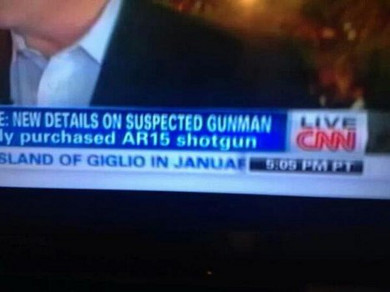
CNN caught pushing untrue claims that Navy Yard shooter Aaron Alexis utilized an ‘AR-15 shotgun’

Mikael Thalen
Storyleak
September 17, 2013

After initial reports about an AR-15 rifle being used in the Navy Yard shooting were retracted Monday, CNN went on to continuously claim that the shooter’s shotgun was actually an “AR-15 shotgun.”

While the facts of Monday’s horrific shooting were still coming in, political pundits wasted no time in exploiting the tragedy by immediately claiming an AR-15 rifle was responsible. Several media figures including CNN’s Piers Morgan began their usual calls for a ban on the rifle despite the fact that it is involved in less than 2.5% of murders and used responsibly by millions of Americans. After reports revealed that a shotgun was the primary weapon, CNN continued its demonization campaign by deceitfully labeling the shotgun as an “AR-15 shotgun.”

The report comes after Anthony Gucciardi revealed that top voted CNN comments were already calling for a complete gun ban following the Navy Yard shooting.

The caption not only presents a mythical weapon, but also claims this weapon was legally purchased by Alexis. In fact, it was the shotgun that was legally purchased and an AR15 is thought to of been rented and returned prior to the incident, details that seem unimportant to CNN’s producers. Other inaccuracies regarding the incident including the capability of the non-existent AR15 continue to be pushed by the media as well.

Throughout the incident gun control advocates have continued to make bizarre claims in order to justify continued tragedies in disarmament zones. Monday evening, Democratic Congresswoman Eleanor Holmes Norton went on to claim that Washington D.C. is the “safest city in the United States” despite the staunch reality that it is actually one of the most dangerous big cities in the country.

CNN and other media outlet’s attempts to push gun control based on emotion, not fact, has only increased the public’s disillusionment with the corporate media. Information such as the establishment’s admission of a 49 percent drop in gun homicide since 1993 is seemingly irrelevant to the gun debate according to CNN and others. Other pertinent information such as the 1993 law passed by former President Clinton that forbids military personnel from being armed on military bases has also been swept under the rug.

This article was posted: Tuesday, September 17, 2013 at 8:46 pm

Tags: , , ,


<!– this is where we need to show the related articles

–>

Copyright: Infowars

Treat Myanmar Muslims well: Dalai Lama

0

The Dalai Lama has called on Myanmar monks to act according to Buddhist principles against Muslims in the country.

“Those Burmese monks, please, when they develop some kind of anger towards Muslim brothers and sisters, please, remember the Buddhist faith,” the Buddhist leader said at a press conference held after an annual human rights conference in the Czech capital Prague on Tuesday.

“I am sure… that would protect those Muslim brothers and sisters who are becoming victims,” he said.

Also on Tuesday, Aung San Suu Kyi, the chairperson of the country™s National League for Democracy, said Myanmar™s constitution should change.

“The ethnic problem will not be solved by this present constitution, which does not meet the aspirations of the ethnic nationalities,” Suu Kyi said.

About 800,000 Rohingya Muslims in the western state of Rakhine are deprived of citizenship rights due to the policy of discrimination that has denied them the right of citizenship and made them vulnerable to acts of violence and persecution, expulsion, and displacement.

The Myanmar government has so far refused to extricate the stateless Rohingyas from their citizenship limbo, despite international pressure to give them a legal status.

Rohingya Muslims have faced torture, neglect, and repression in Myanmar for many years.

Hundreds of Rohingyas are believed to have been killed and thousands displaced in recent attacks by extremists who call themselves Buddhists.

The extremists frequently attack Rohingyas and have set fire to their homes in several villages in Rakhine. Myanmar army forces allegedly provided the fanatics containers of petrol for torching the houses of Muslim villagers, who were then forced to flee.

Myanmar™s government has been accused of failing to protect the Muslim minority. Rohingyas are said to be Muslim descendants of Persian, Turkish, Bengali, and Pathan origin, who migrated to Myanmar as early as the 8th century.

Amnesty International and Human Rights Watch have issued separate statements, calling on Myanmar to take action to protect the Rohingya Muslim population against extremists.

NT/MHB/AS

Copyright: Press TV

Two years after Occupy Wall Street: Poverty persists and economic inequality grows

0


Published time: September 18, 2013 01:37

Occupy Wall Street protesters march from the United Nations building to Bryant Park on September 17, 2013 in New York City. (AFP Photo / Andrew Burton)

Thousands of Occupy protesters demonstrated in New York City to mark the second anniversary of the movement on Tuesday, just as new figures show that poverty remains steady and the so-called “one percent” have only grown wealthier.

Small groups of protesters marched near Zuccotti Park, the
birthplace of the movement in 2011, while others marched through
Washington Square Park and other areas of Manhattan.

At least 1,000 protesters were seen moving from the United
Nations building to the headquarters of JP Morgan Chase bank, one
of the Occupy movement’s prime targets.

Occupy Wall Street protesters wearing masks made out of enlarged dollar bills act in a short skit in Times Square on September 17, 2013 in New York City. (AFP Photo / Andrew Burton)

“We’re still out here fighting for economic justice. The
bankers still have all the power
,” protester Linnea Paton
told AP. “They’ve brought our government and we need a
people’s movement to do that, and the movement is still
here
.”

The initial movement that pitted the top one percent of
wealthiest Americans against the other 99 percent quickly spread
from New York across the US, and was emulated around the world.

Occupy Wall Street participants take part in a protest to mark the movement's second anniversary in New York, September 17, 2013. (AFP Photo / Emmanuel Dunand)

New York’s Occupy movement evaporated after Mayor Michael
Bloomberg dispatched the New York Police Department to destroy
the Zuccotti Park encampment in November 2011. But the
demonstrators returned in the aftermath of Hurricane Sandy,
helping with rebuilding efforts and volunteering at makeshift
food distribution centers.

Occupy has most recently supported the ongoing Fast Food
protests, helping workers from major corporations like McDonalds
and Wendy’s rally for fair wages and safer work conditions.

“Lifting wages will help bring more economic justice to
workers and improve their quality of life and living
standards
,” Occupy wrote in a recent statement. “This will
be the beginning of an independent and grass roots campaign to
bring awareness to the plight of fast food and low wage workers
in a city where half of its residents live near or below
poverty
.”

 A man is arrested for allegedly blocking traffic during an Occupy Wall Street march from the United Nations building to Bryant Park on September 17, 2013 in New York City. (AFP Photo / Andrew Burton)

On the same day as Occupy Wall Street’s second birthday, the US
Census Bureau published its report on income, poverty, and health
insurance coverage in the US. The results indicate that while the
Occupy movement was correct in its claims of inequality, the
cause still has a difficult path ahead.

“Median household incomes in the United States in 2012 was
$51,017, not statistically different in real terms from the 2011
median of $51,100. This followed two consecutive annual
declines
,” the report stated.

“The nation’s official poverty rate in 2012 was 15 percent,
which represents 46.5 million people living at or below the
poverty line. This marked the second consecutive year that
neither the official poverty rate nor the number of people in
poverty were statistically different from the previous year’s
estimates. The 2012 poverty rate was 2.5 percentage points higher
than in 2007, the year before the economic downturn
.”

An Occupy Wall Street participant draws a sidewalk chalk drawing during a protest to mark the movement's second anniversary in New York, September 17, 2013. (AFP Photo / Emmanuel Dunand)

Meanwhile, research produced by economists at the University of
California-Berkeley, the Paris School of Economics, and Oxford
University has revealed that the richest one percent of the US
population received almost one-fifth of household income in 2012,
breaking the previous record set all the way back in 1928.

Similar figures were recently issued by the Pew Research Center
in April, analyzing the period between 2009 and 2011. That study
suggested that only the top seven percent of American households
experienced an increase in their net worth during those
years.

Still, skeptics wonder who is in control of the movement – the
same problem that plagued the group in 2011.

A number of subgroups have sprouted, each with different – if
related – causes, including Alternative Banking Working Group of
Occupy Wall Street, Families of Police Violence, Money Wars
Performers, Occupy Staten Island, and Occupy Wall Street
Zapatistas.

“We’re here to celebrate two years: We’re still here, still
fighting, still strong
,” demonstrator Sumumba Sobukwe told a
number of protesters gathered in New York City Tuesday. “And
we’re still Occupy
.”

A protester affiliated with Occupy Wall Street demonstrates at Zuccotti Park near the New York Stock Exchange on the second anniversary of the movement on September 17, 2013 in New York City. (AFP Photo / Spencer Platt)

Copyright: RT

Syria gives Russia proof on militants’ CW

0

Russian Deputy Foreign Minister Sergei Ryabkov meets Syrian Foreign Minister Walid al-Muallem in Damascus on September 17, 2013.

Syria has handed over to Russia evidence proving that foreign-backed militants were behind a recent chemical weapons attack in the suburbs of Damascus, a senior Russian Foreign Ministry official says.

œThis evidence must be analyzed,” Russian Deputy Foreign Minister Sergei Ryabkov said, after receiving the evidence from Syrian Foreign Minister Walid al-Muallem on Tuesday.

On Monday, the United Nations issued a report by UN investigators which said sarin nerve agent was used in the Damascus suburbs attack, without indicating who launched the attack.

Earlier on Tuesday, Russian Foreign Minister Sergei Lavrov said that the report on the August 21 chemical weapons attack, which allegedly killed hundreds of people, had produced no evidence that Syrian troops carried out the attack and that Russia believed the foreign-backed militants were behind it.

Lavrov stated that the UN report proved that chemical weapons had been used, but it failed to answer a number of questions Moscow had asked such as whether the weapons were produced in a factory or they were homemade.

“We have very serious grounds to believe that this was a provocation,” Lavrov said.

The United States, France, Britain and the foreign-sponsored militants blamed the Syrian government for the attack near Damascus.

The Assad government has vehemently denied the accusations, saying the attack was carried out by the militants themselves as a false-flag operation.

On September 10, Muallem said Damascus is ready to implement a Russian proposal to place its chemical weapons arsenal under international control.

The Russian government proposed the initiative during a meeting between Lavrov and Muallem in Moscow on September 9.

In response, US President Barack Obama asked Congress to delay a vote on authorizing military action against Syria in order to give the Russian proposal a chance to play out.

PG/MHB/AS

Copyright: Press TV

Stop US lethal aid to Syrian rebels

0

Syrian rebel fighters are seen during an exchange of fire with army troops, unseen, in Idlib, Syria.

Now that public pressure has foiled US plans to bomb Syria, the next urgent step is to build public pressure for stopping the deluge of weapons into that country.

Top officials in Washington are happy that American œlethal aid” has begun to flow into Syria, and they act as though such arms shipments are unstoppable. In a similar way, just a few short weeks ago, they-and the conventional wisdom-insisted that US missile strikes on Syria were imminent and inevitable.

But public opinion, when activated, can screw up the best-laid plans of war-makers. And political conditions are now ripe for cutting off the flow of weaponry to Syria-again giving new meaning to the adage that œwhen the people lead, the leaders will follow.”

Contrary to what many assume, the latest polls show that a large majority of Americans are opposed to the US government sending weapons to Syria. For instance, in a CNN/ORC survey taken September 6-8, a whopping 85 percent of people nationwide answered œnot either side” when asked whether the United States œshould take the side of the Syrian government, or take the side of the Syrian rebels, or not take either side.”

A recent ABC News/Washington Post Poll-asking œDo you support or oppose the United States and its allies supplying weapons to the Syrian rebels?”-found that 70 percent œoppose.”

The results of the new polling could hardly be clearer. The vast majority of Americans are opposed to the US government doing what it™s doing-sending weapons into Syria to fuel the flames of a horrific war.

Collectively-in much the same way people upended the conventional wisdom that President Obama was sure to fulfill his announced desire to launch missiles at Syria-we have a real chance to put a stopper in the pipelines bringing weapons and other military supplies to Syria. We must, again, challenge the calculus in Congress and disempower the war-crazed leaderships of both parties.

This is no longer just an idea-it™s now a nationwide campaign. The launch came on Monday (September 16). That day, more than 15,000 people sent emails to their senators and representative in Congress urging them to stop the shipments of weapons to Syria.

Those emails told lawmakers: œAs a constituent, I urge you to halt all ˜lethal aid™ in the Syrian conflict. The last thing Syria needs is more weapons, ammunition and other military supplies. The US government and allies should stop sending lethal aid to rebels in Syria, while working for a reciprocal cutoff of all military assistance to the Syrian government by Russia and Iran.”

This RootsAction.org campaign has begun in hopes that many other groups and individuals will take it up-demanding an end to supplying weapons for the Syria conflagration. As nationwide polling numbers show, most of the public already agrees with us. What remains is for a wide array of political activists to galvanize that agreement into a powerful political force, so we can overwhelm Congress on the weapons-to-Syria issue as just occurred on the bomb-Syria issue.

The United States has now joined with Turkey, Saudi Arabia, Qatar and other allies-directly supplying weaponry to an array of fighters against the Syrian government. That aid supplements the longtime US role in helping several countries to airlift weapons and other military equipment to rebel forces.

œThe CIA has begun delivering weapons to rebels in Syria,” the Washington Post reported last week. Those shipments have combined with œseparate deliveries by the State Department of vehicles and other gear-a flow of material that marks a major escalation of the US role in Syria™s civil war.”

But as the RootsAction appeal points out, œRecent days have shown that diplomacy is possible to avert even more catastrophic events in Syria. Contrary to scoffers, Russia and the United States could help to quash the war flames instead of fueling them with more gasoline. By halting its own shipments of weapons into Syria and exerting pressure on its allies to do the same, the United States could induce Russia and its ally Iran to stop supplying the Syrian government with weapons-and to work for a ceasefire.”

Now, with a big opening in US politics, this is crucial work toward peace in Syria. Let™s get it done.

AT/HJ

Copyright: Press TV

NSA’s phone data collection is legal, does not violate privacy – FISA court

0


Published time: September 18, 2013 00:34

Reuters / Andrew Winning

The National Security Agency’s indiscriminate collection of daily telephone data does not invade Americans’ privacy and is lawful despite being authorized by a secret court, a US surveillance court ruled.

The court’s opinion, dated August 29 and made public Tuesday,
stated that the court was aware of the disclosures made by former
NSA contractor Edward Snowden but reaffirmed that the
controversial data collection program falls within the parameters
of the law. Judge Claire Eagan of the US Foreign Intelligence
Surveillance Court (also known as the FISA court), the same court
that ruled the NSA may carry out the data collection, wrote the
opinion.

“The court concludes that there are facts showing reasonable
grounds to believe that the records sought are relevant to
authorized investigations
,” Eagan stated. She is one of 11
judges serving on the panel.

“This court is mindful that this matter comes before it at a
time when unprecedented disclosures have been made about this and
other highly sensitive programs designed to obtain foreign
intelligence information and carry out counter-terrorism
investigations
,” she continued in a veiled reference to
Snowden.

The Guardian newspaper first published the existence of the phone
data collection program in June. The revelations are reportedly
the first of thousands of pages that are still in the process of
being released to the public.

The program in question stores “metadata,” including numbers
called, as well as the time and length of calls dating back as
far as seven years. US officials claim the metadata harvesting
excludes the names of the callers and the content of the
interaction.

Reuters / Pawel Kopczynski

Earlier this week, FISA court Judge Dennis F. Saylor ordered the
White House to declassify more of the surveillance court’s
decisions, specifically under Section 215 of the Patriot Act,
which grants the government broad powers to monitor American
citizens. The ruling comes in response to a suit filed by the
American Civil Liberties Union, and calls on the White house to
release the decisions by October 4.

“The unauthorized disclosure in June 2013 of a Section
215 order, and government statements in response to that
disclosure, have endangered considerable public interest and
debate about Section 215
,” Saylor wrote. “Publication of
FISC opinions relating to this opinion would contribute to an
informed debate
.”

The only phone company known to be turning over data to the NSA
is Verizon, although internet companies including Facebook,
Google, and Microsoft are legally required to supply data as
well.

Each of the 11 judges, and another three who sit on FISA’s Court
of Review, are required each year to disclose their income and
financial investments. In the years since the phone collection
was authorized, multiple judges have admitted to owning stock in
the very telecommunications giant that the government extracts
data from.

Judge Thomas F. Hogan, appointed to the FISA court in 2009,
disclosed between $15,000 and $50,000 in stock with both AT&T
and Verizon. At least two other judges admitted similar
investments.

Copyright: RT

‘Boko Haram kills 40 Nigerian soldiers’

0

At least 40 Nigerian soldiers have been killed and 65 others gone missing after clashes with suspected members of the Boko Haram militant group, a report says.

The clashes took place along the Baga-Maiduguri road in the northwest of the country on Friday, according to the report published by The Associated Press on Tuesday.

An investigation has been launched to find out the cause of the operational failure, which led to the heavy casualties on the army™s side.

The commanding officer of the unit which carried out the operation was dismissed from his post.

Initially, the soldiers were supposed to have aerial support in the attack, but the plan was cancelled at the final minutes by an unnamed top official, forcing the troops to deal with an ambush on their own.

œDue to lack of communication, the troops ran into the terrorists without knowing that the aerial bombardment had been cancelled and they were caught unaware,” said a source on condition of anonymity.

On Sunday, four Boko Haram militants were killed by vigilantes of the Civilian Joint Task Force in the town of Mubi in the eastern state of Adamawa.

Boko Haram — whose name means œWestern education is forbidden” — says its goal is to overthrow the Nigerian government.

The group has claimed responsibility for a number of deadly gun and bomb attacks in various parts of Nigeria since 2009.

Over the past four years, violence in the north of Africa™s most populous country has claimed the lives of 3,600 people, including killings by the security forces.

NT/MHB/AS

Copyright: Press TV

Texas reignites debate over evolution, climate-change science in textbooks

0


Published time: September 18, 2013 00:17

Crowd shot at ‘StandUp4Science’ rally, Texas on September 17, 2013 (Image from twitter user@the_FiftyOne)

The decade-plus battle in Texas on whether to teach lessons on evolution and climate change flared up again Tuesday, as advocates on both sides pled their case in a debate on proposed high school biology textbooks.

The State Board of Education held a public hearing to consider
seven textbooks that have the potential to be used throughout the
state through 2022. If the books are printed for Texas, the
publishers are likely to mass-produce them, prompting other
states purchase the same reading material.

Dozens of science experts, parents, and activists testified
before the board at the crowded hearing in Austin for the right
to opine on proposed materials in the science books – as well as
books on math and technology – for the state’s public school
students, which total over five million. State law allows school
districts to pick textbooks and e-readers from a board-sanctioned
selection.

The board, which consists of 10 Republicans and five Democrats,
will vote on textbook selections in November.

“I ask you not to let Texas once again become a national
embarrassment,”
said Ron Wetherington, an anthropology
professor at Southern Methodist University, according to AP.

Publishers originally offered 15 science textbooks to the state,
but volunteer reviewers – some picked by current or former Board
members – found that eight of them fell short of state curriculum
standards. Textbook companies will be allowed to alter the
language of each edition before the board’s November vote, as
long as the copy is available to peruse online.

The social conservative bloc on the board, weakened in recent
years, has fought for textbooks to teach “all sides” of
evolution, while leaving room for
creationism. They’ve also pressed for skepticism in teaching
climate change.

Former board chair, dentist, and Young Earth Creationist Don
McLeroy, who lost a re-election bid in 2010, told his former
colleagues to “strike a final blow to the teaching of
evolution”
and support biblical teachings in whatever
decision they make.

“What we see in the world around us supports what the Bible
says but what we see in these books supports what the Bible says
too,”
McLeroy said, according to AP.

He went on to say the proposed texts “have no evidence that
supports evolution.”
Though when asked what evolutionary
evidence was included, he said: “It’s weak. Let the students
see how weak it is.”

According to the San Antonio Current, McLeroy, who was appointed
the board’s chair by Gov. Rick Perry in 2007, said he had been
waiting four years to speak his mind on textbook standards and
was “excited” to finally be given the chance.

Rallies ahead of the hearing included 200 or so activists, many
wearing “Stand up For Science” t-shirts and holding signs
with messages including “Your kids deserve the truth” and
“Public schools, not Sunday schools.”

Copyright: RT

Is Capitalism to Blame for the Syrian War Drive?

0

Obama’s push for war in Syria seemed so deeply irrational, so crazed, that many people naturally asked, “Why is this happening?” And “who” wants it to happen? Few Americans actually believed that Nobel Peace Prizing winning Obama suddenly wanted to bomb Syria because “Assad gassed his own people” (especially when zero evidence was given to prove this).

Many commentators have correctly stated that geopolitics is a main motivation for Obama wanting to bomb Syria, acting as a gateway to Iran. Other commentators have also correctly discussed the specific economic (capitalistic) interests as a war motive. And others still have, again correctly, focused on the importance of Israel as a factor towards pushing for war in Syria and eventually Iran. All three answers are correct, and have an inter-dependence that is complicated and difficult to quantify, since much of the truth is hidden from public view.

Problems arise in analysis, however, when one of these issues is separated from the broader context, as was done in a recent article by Jean Bricmont and Diana Johnstone. Their article, “The People Against the 800 Pound Gorilla,” focuses on the importance of the U.S. Israeli lobby – “the 800 Pound Gorilla” – and their push for war, while minimizing or dismissing other crucial economic and political motives.

The article makes many excellent points, especially how the Israeli lobby in the U.S., American Israel Public Affairs Committee (AIPAC), is fanatically pushing for war against Syria. Congress is also trying to be politically immune from ANY discussion about AIPAC activities, lest accusations of “anti-Semite” are indiscriminately flung at them.

The problem with the article, however, is that the authors elevate the Israeli gorilla to a weight class it doesn’t belong in; and in so doing the authors are forced to minimize the size of several other giant gorillas, whose combined weight overshadows the Israeli chimp.

One of the giant gorillas that the authors seek to shrink is the U.S. capitalist class. The following passage summarizes the author’s main point:

“People who think that capitalists want wars to make profits should spend time observing the board of directors of any big corporation: capitalists need stability, not chaos, and the recent wars only bring more chaos.”

This is, of course, true for many if not most U.S. corporations. The authors are also correct when they argue that the average writer who uses a capitalist-centered analysis to explain war wrongly “…sees capitalism as a unified actor issuing orders to obedient politicians on the basis of careful calculations.” The authors are correct that this type of clunky analysis lacks nuance and should be rejected.

But the authors also fail to give capitalism the nuance it deserves; they construct a capitalistic straw man so arid it spontaneously combusts. For example, the authors limit the definition of capitalism to a sector-specific basis, mentioning specific types of capitalists that are blamed for pushing war and dismissing them as lesser gorillas than the Israeli lobby.

In naming corporate names the authors make some good points, but somehow skip over the 1,600 pound gorilla in the room – the big banks, the motor force of capitalism in the U.S. The authors might respond to this criticism by saying the banks were purposely omitted because they do not “directly benefit” from war and are, therefore, not at the forefront of advocating it.

This would be false. As the dominant corporate sector in U.S. capitalism, the banks are also the most internationalist in scope; the recent second quarter profits of U.S. banks were $42.2 billion (!), most of this money was made in overseas investing using cheap Federal Reserve printed dollars.

When there are overseas barriers to these types of profits, such as currency controls and other restrictions on foreign investment – as exist in Syria, Iran, and China – these nations are viewed as “enemies” by the banks who cheerlead their destruction. A submissive nation with an “open” economy is very good for the profits of U.S. corporations, and submissiveness is best taught by fear, i.e., the threat of military intervention.

Of course, the banks don’t act alone, but lead a pro-war coalition of corporations, such as the lesser gorillas the authors mention, like weapons manufacturers, the giant construction companies that “rebuild” a bombed nation, oil companies, and a gaggle of other companies – and there are many – who directly benefit from war profiteering. All of this is not to mention the fact that every U.S. multinational corporation has a stake in ensuring that their business is operating in a secure environment, with minimal chance of being nationalized by the host country. Corporations lobby via coalitions and through think tanks and other associations more effectively than they do as individual corporate sectors.

Thus, the U.S. pro-war coalition pushes U.S. foreign policy towards war, particularly against U.S.-capitalist hostile countries, with the AIPAC tail eagerly wagging behind – but not wagging the dog itself. It is this coalition of mega-corporations that the neoconservatives and other elite think tanks speak for when they endlessly discuss how to best project U.S. military power abroad.

These strategists – such as the Project For a New American Century – are the “vanguard” of American capitalism, and their geopolitical outlook is firmly rooted in the economic interests of the corporations that most benefit from overseas investing. This fanatic drive to maintain and expand the U.S. global empire of military bases – which help keep submissive nations in line – is a core ingredient to making the massive profits that are the motor force of U.S. capitalism.

Thus, this more abstract concept of “empire” was yet another 800 pound gorilla missing from the authors’ analysis, intertwined as it is to corporations whose interests are being expressed. And although the authors are correct when they say that U.S. capitalists would rather dominate foreign markets through the normal processes of trade, this peaceful kind of market domination has become more difficult as the U.S. has declined economically in relation to emerging economies like China, India, Brazil, etc. The U.S. military is consequently relied on to keep alliances together and opponents submissive, in addition to its more mundane function of keeping trade routes open and safe. This is why any empire in its declining phase – like the U.S. – is especially dangerous, as it logically falls back on its sharpest tool – bombing – no matter how “illogical” these bombings may appear.

The international game of geopolitics mirrors the corporate competition for international markets; with each country the U.S. dominates politically – through war – U.S. corporations are able to profit through being the primary lender, the primary military salesman, while also winning the tastiest natural resources “concessions,” and the biggest infrastructural contracts to build public works, not to mention many other privileges.

The authors also prematurely dismiss the role oil plays in U.S. foreign policy. It is not the individual oil companies that matter so much – as the authors suggest – but the role oil plays in broader geopolitics and as the motor of the U.S economy. Monopolizing this prized resource allows the U.S. massive deficit spending (war spending) via the “petro-dollar” trade, while ensuring that rival nations will be intimidated by the possibility of having the oil valve turned off. This is why the Middle East continues to be the prime objective for U.S. foreign policy. Of course, the giant oil corporations themselves play no small role in this process.

The authors also incorrectly minimize the ape of the military industrial complex (MIC), by arguing that the drawn-out military disasters of Afghanistan and Iraq have made the MIC gun shy, since “stupid wars” (as Obama put it) bring negative attention to the killing industry.

Yes, the military and its corporate parasites get better PR when “dumb wars” are avoided, but this superficial analysis ignores the “successful” bombing of Libya. It’s also not true, as the authors suggest, that the MIC only needs “the threat of war” – not actual war – to keep its profits high. Like any corporation, if the warehouses are full of inventory (bombs, in this case), then no new orders are needed, which of course drives down production and consequently profits.

To avoid the bad PR that “boots on the ground” brings, Obama has instead opted for illegal drone attacks, and Libya-style shock-and-awe bombing campaigns. Since a “no-boots-on-the-ground” policy makes classical regime change impossible, the U.S. foreign policy hawks seem to be shifting back to a balkanization policy (bomb and fragment) since the U.S. cannot tolerate strong independent nations anywhere which defend their own interests, though especially in the Middle East (Johnstone’s excellent book on the U.S.-NATO destruction of Yugoslavia, titled Fools Crusade, is a must-read on this policy). A country may be independent and strong – like Turkey and Israel – only if the nations are firmly welded behind U.S. economic and foreign policy.

Of course, the Israeli lobby, AIPAC, deserves a special place in any analysis of U.S. foreign policy in the Middle East, and the authors deserve credit for taking to task those who ignore this gorilla. But this primate expresses its power best as part of a coalition of pro-war powerhouses, not independently.

It’s true that AIPAC also has an independent power of politically influential lobbyists, with a limitless pocketbook – the nation of Israel –with which it can enact promises (bribes) of all kinds. And it’s true that Israel has a special place in U.S. geopolitics, essentially acting as a giant military base for U.S. foreign policy in the oil rich region.

But the bigger picture is that the infamous AIPAC lobbyists are connected in myriad ways to the banking industry, weapons manufacturers and other giant corporations, and therefore should be viewed as an important member of the pro-war coalition led by the big banks.

Ultimately, however, the U.S. empire existed before the nation of Israel was even born, and would continue if Israel no longer existed. Obama’s administration is not full of AIPAC lobbyists, but wealthy bankers.

The authors Bricmont and Johnstone deserve credit for bravely exposing the role of AIPAC in pushing the Syrian war drive, but by overstating AIPAC’s influence – while ignoring the power of the big banks and others – the real motive for war in U.S. foreign policy is shielded, protecting the super rich Americans who relentlessly warmonger for profit, and who are much more dangerous than the horde of lobbyists Israel sends into Congress.


The Greatest Debt Crisis The World Has Ever Seen Is Coming

0
U.S. National Debt 2013

The largest mountain of debt in the history of the world just continues to grow even larger, and everyone knows that this colossal debt spiral is not going to end well. But we all keep playing along because nobody wants the party to end. Right now, there is an unprecedented ocean of red ink covering the planet. Globally, governments have never been in so much debt, corporations have never been in so much debt and consumers have never been in so much debt. But every time someone suggests that this is a problem and that we should at least try to get debt levels to settle down a bit, people start screaming that “austerity” will hurt the global economy. And of course it will. But we can’t continue to live way, way above our means indefinitely. Well, we can try, but at some point this entire house of cards is going to come crashing down and we are going to be facing the greatest economic crisis the world has ever seen.

It is kind of like watching a slow-motion train wreck that you have no chance of possibly stopping that you know will end up killing lots of innocent people. This debt crisis is going to end up destroying the global financial system, but there is not a thing that you or I can do to prevent it from happening. The unprecedented debt binge that we are witnessing right now is going to continue until someday we hit a brick wall of financial disaster. We can yell and we can scream, but it isn’t going to stop what is happening.

As the Telegraph recently noted, even the Bank for International Settlements is warning that debt levels are way too high. According to the BIS, total public and private debt levels are now 30 percent higher than they were in 2008…

“This looks like to me like 2007 all over again, but even worse,” said William White, the BIS’s former chief economist, famous for flagging the wild behavior in the debt markets before the global storm hit in 2008.

“All the previous imbalances are still there. Total public and private debt levels are 30pc higher as a share of GDP in the advanced economies than they were then, and we have added a whole new problem with bubbles in emerging markets that are ending in a boom-bust cycle,” said Mr White, now chairman of the OECD’s Economic Development and Review Committee.

The BIS can see the disaster coming, but even they have no chance of preventing it.

For the rest of this article, I am going to focus on government debt, but please keep in mind that corporate debt and consumer debt are also totally out of control globally. It would be very hard to overstate the nightmare that we are facing.

But of course national governments are the biggest offenders when it comes to debt…

Asia

Japan now has a debt to GDP ratio of more than 211 percent, and as Simon Black of the Sovereign Man blog recently detailed, they are rapidly heading toward a national financial meltdown…

Looking purely at the numbers, Japan’s medium-term fundamentals are among the bleakest in the world.

Total government debt amounts to over 200% of the country’s entire GDP– a figure so large that the Japanese government spends 51.5% of the 43 trillion yen ($430 billion) they collect in tax revenue just to pay interest!

Perhaps even more astounding is that ‘primary balance expenses,’ i.e. normal government expenditures, totaled 70.3 trillion yen, or 163% of tax revenue.

The only way they’ve managed to stay afloat is by issuing more debt, which makes the problem even worse. In fact, 46% of the 2013 budget is being financed by debt.

These guys are running out of rope. And fast.

China is facing a different sort of a problem. In that nation, the growth of private domestic debt is wildly out of control.

According to a recent World Bank report, private domestic debt in China has grown from 9 trillion dollars in 2008 to 23 trillion dollars today.

There is no way that is sustainable, and at some point that massive bubble is going to burst.

Europe

Even though some European nations have supposedly implemented “austerity measures” in recent years, debt levels continue to rise rapidly. The following are some numbers that were recently released which show that government debt to GDP ratios for some of the most financially troubled nations in Europe are absolutely soaring…

  • Euroarea: 92.2%, up from 88.2% a year ago
  • Greece: 160.5%, up from 136.5% a year ago
  • Italy: 130.3%; up from 123.8% a year ago
  • Portugal: 127.2%, up from 112.3% a year ago
  • Ireland: 125.1%, up from 106.8% a year ago
  • Spain: 88.2%, up from 73.0% a year ago
  • Netherlands: 72.0%, up from 66.7% a year ago

Anyone that tells you that the crisis in Europe is “over” is lying to you. The debt crisis is getting worse, not better.

The United States

The biggest mountain of debt of all can be found in the United States.

30 years ago, the national debt was a little bit above a trillion dollars.

Today, it is rapidly approaching 17 trillion dollars.

At this point, the U.S. already has more government debt per capita than Greece, Portugal, Italy, Ireland or Spain. And since Barack Obama entered the White House, the debt to GDP level has soared to unprecedented heights…

Sadly, this is just the beginning.

One reason for this is that the U.S. is facing some tremendous demographic challenges in the years ahead.

In other words, our population is getting older.

It is being projected that the number of Americans on Social Security will rise from 57 million today to more than 100 million in 25 years.

How in the world are we possibly going to pay for that?

Already, we are very heavily dependent on foreigners to pay our bills.

According to the U.S. Treasury, foreigners hold approximately 5.6 trillion dollars of our debt at this point.

China and Russia account for about one-fourth of that total. Right now, China owns approximately 1.275 trillion dollars of our debt, and Russia owns approximately 138 billion dollars of our debt.

So what would happen if we went to war with Syria and they decided to quit borrowing from us and they started dumping our debt instead?

That is a very good question.

And actually, according to Zero Hedge foreigners have already started to dump a little bit of our debt…

Today’s TIC data showed something disturbing: for the fourth month in a row, foreigners were net sellers of US Treasury paper in July, as total foreign holdings declined from $5.600 trillion to $5.590 trillion which represents 49% of total marketable debt (including the debt owned by the Fed of course). In other words, since peaking at $5.724 trillion in March, foreign-held debt has declined by $134 trillion, at a time when yields have surged on fears the Fed’s tapering of its own purchases of bonds will mean less Fed frontrunning opportunities.

We certainly cannot afford for that to continue, because we desperately need other nations to finance our reckless spending.

Our debt is wildly out of control, and the only way we can keep the entire system from collapsing is to go into even more debt.

As I noted recently, if the U.S. national debt was reduced to a stack of one dollar bills it would circle the earth at the equator 45 times.

That is a whole lot of money.

But most Americans do not consider it to be a problem because disaster has not struck yet.

Unfortunately, they simply don’t understand how quickly an exponential problem can overwhelm you. I think that the following illustration from Simon Black is particularly helpful…

Let’s say you’re at a party in a small apartment that’s about 500 square feet in size. Then suddenly, at 11pm, a pipe bursts, starting a trickle into the living room.

Aside from the petty annoyance, would you feel like you were in danger? Probably not. This is a linear problem– the rate at which the water is leaking is more or less constant, so the guests can keep partying through the night without worry.

But let’s assume that it’s an exponential leak.

At first, there’s just one drop of water. But each minute, the rate doubles. So by 11:01pm, there’s 2 drops. By 11:02, 4 drops. And so forth.

By 11:27pm, there’s only six inches of standing water. Yet by 11:31pm, just four minutes later, the entire room is under nearly 8 feet of water. And the party’s over.

For nearly half an hour, it all seemed safe and manageable. People had all the time in the world to leave, right up until the bitter end. 11:27, 11:28, 11:29. Then it all went from benign to deadly in a matter of minutes.

By the time that our politicians and the talking heads on the mainstream media admit that we have a debt emergency on our hands, it will probably be far, far too late.

The greatest debt crisis the world has ever seen is coming, and there is nothing that anyone can do to stop it.

But you can take measures to get prepared for it.

Please get prepared while you still can.

About the author: Michael T. Snyder is a former Washington D.C. attorney who now publishes The Truth. His new thriller entitled “The Beginning Of The End” is now available on Amazon.com.

Michael T. Snyder's Shocking New Novel About The Future Of America

Copyright: The Truth Wins

The Greatest Debt Crisis The World Has Ever Seen Is Coming

0

U.S. National Debt 2013

The largest mountain of debt in the history of the world just continues to grow even larger, and everyone knows that this colossal debt spiral is not going to end well. But we all keep playing along because nobody wants the party to end. Right now, there is an unprecedented ocean of red ink covering the planet. Globally, governments have never been in so much debt, corporations have never been in so much debt and consumers have never been in so much debt. But every time someone suggests that this is a problem and that we should at least try to get debt levels to settle down a bit, people start screaming that “austerity” will hurt the global economy. And of course it will. But we can’t continue to live way, way above our means indefinitely. Well, we can try, but at some point this entire house of cards is going to come crashing down and we are going to be facing the greatest economic crisis the world has ever seen.

It is kind of like watching a slow-motion train wreck that you have no chance of possibly stopping that you know will end up killing lots of innocent people. This debt crisis is going to end up destroying the global financial system, but there is not a thing that you or I can do to prevent it from happening. The unprecedented debt binge that we are witnessing right now is going to continue until someday we hit a brick wall of financial disaster. We can yell and we can scream, but it isn’t going to stop what is happening.

As the Telegraph recently noted, even the Bank for International Settlements is warning that debt levels are way too high. According to the BIS, total public and private debt levels are now 30 percent higher than they were in 2008…

“This looks like to me like 2007 all over again, but even worse,” said William White, the BIS’s former chief economist, famous for flagging the wild behavior in the debt markets before the global storm hit in 2008.

“All the previous imbalances are still there. Total public and private debt levels are 30pc higher as a share of GDP in the advanced economies than they were then, and we have added a whole new problem with bubbles in emerging markets that are ending in a boom-bust cycle,” said Mr White, now chairman of the OECD’s Economic Development and Review Committee.

The BIS can see the disaster coming, but even they have no chance of preventing it.

For the rest of this article, I am going to focus on government debt, but please keep in mind that corporate debt and consumer debt are also totally out of control globally. It would be very hard to overstate the nightmare that we are facing.

But of course national governments are the biggest offenders when it comes to debt…

Asia

Japan now has a debt to GDP ratio of more than 211 percent, and as Simon Black of the Sovereign Man blog recently detailed, they are rapidly heading toward a national financial meltdown…

Looking purely at the numbers, Japan’s medium-term fundamentals are among the bleakest in the world.

Total government debt amounts to over 200% of the country’s entire GDP— a figure so large that the Japanese government spends 51.5% of the 43 trillion yen ($430 billion) they collect in tax revenue just to pay interest!

Perhaps even more astounding is that ‘primary balance expenses,’ i.e. normal government expenditures, totaled 70.3 trillion yen, or 163% of tax revenue.

The only way they’ve managed to stay afloat is by issuing more debt, which makes the problem even worse. In fact, 46% of the 2013 budget is being financed by debt.

These guys are running out of rope. And fast.

China is facing a different sort of a problem. In that nation, the growth of private domestic debt is wildly out of control.

According to a recent World Bank report, private domestic debt in China has grown from 9 trillion dollars in 2008 to 23 trillion dollars today.

There is no way that is sustainable, and at some point that massive bubble is going to burst.

Europe

Even though some European nations have supposedly implemented “austerity measures” in recent years, debt levels continue to rise rapidly. The following are some numbers that were recently released which show that government debt to GDP ratios for some of the most financially troubled nations in Europe are absolutely soaring…

  • Euroarea: 92.2%, up from 88.2% a year ago
  • Greece: 160.5%, up from 136.5% a year ago
  • Italy: 130.3%; up from 123.8% a year ago
  • Portugal: 127.2%, up from 112.3% a year ago
  • Ireland: 125.1%, up from 106.8% a year ago
  • Spain: 88.2%, up from 73.0% a year ago
  • Netherlands: 72.0%, up from 66.7% a year ago

Anyone that tells you that the crisis in Europe is “over” is lying to you. The debt crisis is getting worse, not better.

The United States

The biggest mountain of debt of all can be found in the United States.

30 years ago, the national debt was a little bit above a trillion dollars.

Today, it is rapidly approaching 17 trillion dollars.

At this point, the U.S. already has more government debt per capita than Greece, Portugal, Italy, Ireland or Spain. And since Barack Obama entered the White House, the debt to GDP level has soared to unprecedented heights…

National Debt As A Percentage Of GDP

Sadly, this is just the beginning.

One reason for this is that the U.S. is facing some tremendous demographic challenges in the years ahead.

In other words, our population is getting older.

It is being projected that the number of Americans on Social Security will rise from 57 million today to more than 100 million in 25 years.

How in the world are we possibly going to pay for that?

Already, we are very heavily dependent on foreigners to pay our bills.

According to the U.S. Treasury, foreigners hold approximately 5.6 trillion dollars of our debt at this point.

China and Russia account for about one-fourth of that total. Right now, China owns approximately 1.275 trillion dollars of our debt, and Russia owns approximately 138 billion dollars of our debt.

So what would happen if we went to war with Syria and they decided to quit borrowing from us and they started dumping our debt instead?

That is a very good question.

And actually, according to Zero Hedge foreigners have already started to dump a little bit of our debt…

Today’s TIC data showed something disturbing: for the fourth month in a row, foreigners were net sellers of US Treasury paper in July, as total foreign holdings declined from $5.600 trillion to $5.590 trillion which represents 49% of total marketable debt (including the debt owned by the Fed of course). In other words, since peaking at $5.724 trillion in March, foreign-held debt has declined by $134 trillion, at a time when yields have surged on fears the Fed’s tapering of its own purchases of bonds will mean less Fed frontrunning opportunities.

We certainly cannot afford for that to continue, because we desperately need other nations to finance our reckless spending.

Our debt is wildly out of control, and the only way we can keep the entire system from collapsing is to go into even more debt.

As I noted recently, if the U.S. national debt was reduced to a stack of one dollar bills it would circle the earth at the equator 45 times.

That is a whole lot of money.

But most Americans do not consider it to be a problem because disaster has not struck yet.

Unfortunately, they simply don’t understand how quickly an exponential problem can overwhelm you. I think that the following illustration from Simon Black is particularly helpful…

Let’s say you’re at a party in a small apartment that’s about 500 square feet in size. Then suddenly, at 11pm, a pipe bursts, starting a trickle into the living room.

Aside from the petty annoyance, would you feel like you were in danger? Probably not. This is a linear problem— the rate at which the water is leaking is more or less constant, so the guests can keep partying through the night without worry.

But let’s assume that it’s an exponential leak.

At first, there’s just one drop of water. But each minute, the rate doubles. So by 11:01pm, there’s 2 drops. By 11:02, 4 drops. And so forth.

By 11:27pm, there’s only six inches of standing water. Yet by 11:31pm, just four minutes later, the entire room is under nearly 8 feet of water. And the party’s over.

For nearly half an hour, it all seemed safe and manageable. People had all the time in the world to leave, right up until the bitter end. 11:27, 11:28, 11:29. Then it all went from benign to deadly in a matter of minutes.

By the time that our politicians and the talking heads on the mainstream media admit that we have a debt emergency on our hands, it will probably be far, far too late.

The greatest debt crisis the world has ever seen is coming, and there is nothing that anyone can do to stop it.

But you can take measures to get prepared for it.

Please get prepared while you still can.

About the author: Michael T. Snyder is a former Washington D.C. attorney who now publishes The Truth. His new thriller entitled “The Beginning Of The End” is now available on Amazon.com.

Michael T. Snyder's Shocking New Novel About The Future Of America

Felons had access to US military sites

0

Police arriving at a shooting scene at the Washington Navy yard where a gunman killed 12 people on Monday

A draft Pentagon inspector general report found 52 convicted felons received routine, unauthorized access to military facilities.

The inspector general posted the report on its website on Tuesday under pressure from lawmakers, one day after 12 people were killed by a gunman at the Navy Yard in Washington, D.C.

The report found that the felons had received unauthorized access to military facilities for 62 to 1,035 days, œplacing military personnel, dependents, civilians, and installations at an increased security risk.”

It concluded that some of the problems in security were the result of Navy cost-cutting efforts and criticized the Navy for not providing the resources necessary for proper background checks of contractors.

The Navy did not œfollow federal credentialing standards and DOD contractor vetting requirements and did not provide 7 of the 10 installations visited the appropriate resources and capabilities to conduct required contractor background checks,” the report concluded.

The report redacted the names of the installations, but congressional aides said one of the 10 was the Navy Yard.

Police have identified the shooter at the Navy Yard as Aaron Alexis, who worked as a contractor at the facility.

However, The Associated Press reported that Alexis was not vetted through the process reviewed by the inspector general.

While some have speculated that automatic spending cuts known as the sequester could have been to blame for security problems, a congressional aide said that the Navy™s cost-cutting mentioned in the report was in order to grapple with the $487 billion, 10-year Pentagon budget reductions from the 2011 Budget Control Act, and not the sequester.

Lawmakers are questioning why Alexis, who reportedly had a troubled past and an arrest record, was able to get a clearance to the Navy Yard.

Defense Secretary Chuck Hagel ordered a review of security procedures at US military bases across the globe in the wake of the shooting, according to a senior Pentagon official.

House Armed Services Committee Chairman Buck McKeon (R-Calif.) said the report found the Navy had œcritical flaws” in controlling access to military installations for nongovernment personnel, including contractors.

œWhile the timing of the delivery of this report was coincidental, I believe it to be relevant to physical security on military installations and to the committee’s hearing tomorrow on the impact of defense cuts,” McKeon said in a statement.

The inspector general investigated a background check system for contractors who were not eligible for a Common Access Card, the most common type of identification for military bases.

The report found that the convicted felons received access to bases because Eid Passport, the company that conducted the background checks, did not identify the felony convictions in initial public records checks.

It found that the seven Navy installations granted access to contractor employees œwithout vetting employee identities” through the National Crime Information Center (NCIC) database and the Terrorist Screening Database.

In addition, nine of 10 Navy installations allowed temporary access for 28 days to contractors enrolled in the program prior to completing a background check.

Rep. Mike Turner (R-Ohio) sent Navy Secretary Ray Mabus a letter Tuesday calling on the Navy to immediately put in place the report’s recommendations.

“While there may not be a direct link between the result of this report and the horrific loss of life, I am deeply concerned about the current security situation at Navy facilities,” Turner said in a statement. The Hill

AT/HJ

Copyright: Press TV

Syria car bombing kills 7, injures 20

0

At least seven people have been killed and 20 more injured in a car bomb attack on the Syrian side of the main Bab al-Hawa border crossing with Turkey.

The attack took place on Tuesday at a roadblock manned by foreign-backed extremists at the entrance of the militant-held crossing, the Turkish news agency Dogan reported.

The injured were taken to hospitals in Turkey.

The Turkish Foreign Ministry said it had no information about the incident yet.

A recent British defense study shows that about 100,000 foreign-backed militants, fragmented into 1,000 groups, are fighting in Syria against the government and people.

The extracts of the study by defense consultancy IHS Jane’s were published on Monday.

The analysis also said that a large number of extremists from foreign countries are also active in Syria.

Syria has been gripped by deadly unrest since March 2011. According to reports, the Western powers and their regional allies — especially Qatar, Saudi Arabia, and Turkey — are supporting the militants operating inside Syria.

According to the United Nations, more than 100,000 people have been killed and a total of 7.8 million of others displaced due to the violence.

GJH/MHB/AS

Copyright: Press TV

No One Survives on Prepper Island

0

This informative article has been contributed by Holly Deyo of DareToPrepare.com. You can keep up to date with news, views, videos, and exclusive reports at StanDeyo.com.

No man is an island … This remains true whether you grow 10 hands, have a billion bucks or the luck of the Irish. Sooner or later people realize that no man – or woman – can do everything by himself. One of the best resources you’ll ever have is the friends and neighbors around you.

CASE #1

While living in northern Colorado, close friends bought mountain property to get even further away to a peaceful rural area. He really wanted to be out in the ‘back of beyond’. They found the perfect property: mountain location, 375 acres of prime meadowland with 12 streams originating on the property that run year round. Tons of wild game; deer, mountain lions, geese and turkey roam freely, and enough pine trees to keep them in firewood till the end of days. Their mountain view from The Flatirons is unstoppable – clear down to the Twin Sisters in Longmont, CO.

For two years, this friend’s husband badgered, cajoled, begged the previous owners to sell and frankly, he beat them into the ground with persistence. The owners in their 70′s worried that medical help was an hour and a half away – on a good day. In winter, traversing those unpaved sludgy roads would have been impossible. It soon became apparent that just the two of them living so far from ‘civilization’ with no neighbors close by, was literally life-threatening. So they sold. With this peaceful, exquisite land in their possession, our friends were on the way to realizing their dream.

It took a couple of years for them to complete their 10,000 sq. ft. home (above – residence from the outside and on the left is their kitchen). Every amenity was incorporated into this architectural feat, which won log cabin home of the year in 2007. You’d think they had the world by its tail. Less than 5 years later, their home went on the market for $10M. They too, realized that no one can go it alone, no matter how much $$ you have.

CASE #2

Another friend acquired remote property in Montana. He is a hard-core prepper and found land he deemed to be the perfect retreat. Designs were drawn and construction commenced on the bugout, but he soon realized just how difficult this plan was to implement. Because he wanted to keep the location ‘invisible and quiet’ (AS IF there is such a thing), without roads, everything had to be choppered in. Since Montana is so far north, construction windows are short compared to Colorado where it churns year round. For him, everything was hurry, hurry hurry. During winter, the only access to this property was by snowmobile. In summer, it required ATVs. A couple years into the project and still only part way to this retreat’s completion, he gave up. His wife rightly complained it was too remote, too difficult and not near choice restaurants and the high end shopping she was accustomed to.

These are not one-off stories.

CASE # – MANY!

We’ve watched people totter off to Australia, New Zealand, Honduras, Mexico, Canada and other distant destinations, but they are still confronted by problems. Most have returned to America, disillusioned and poorer, but experience-richer for the first-hand lesson. They looked elsewhere for an answer when it’s right beneath their noses. Folks may not all experience the same challenges, but they can be just as head-scratching. So while there is no perfectly safe place, there are certainly smarter alternatives. Regardless of where you live there is a great resource right in front of you – your neighbors, your friends, your community.

BUILDING COMMUNITY RIGHT WHERE YOU ARE

Not once will you ever find an interview or an article nor in my books where I’ve advocated people should wander off into the never-never to do solo preps. Nearly two decades later this is still our firm belief. In fact, from 1997 – 2001, I wrote a weekly newsletter, Building Community.

There are some in the prep field – ones that are considered experts – that do recommend striking out alone and setting up shop far from everyone. Odds are they will find out the hard way this is not clever planning. You need more than a handful of people to pick up the slack if illness or injury strikes. It takes effort and time to make the land supply all of your food and water needs. Nothing beats first-hand experience for handling livestock. We had our turn at both steers and sheep. People think you throw a little hay and water at the animals and nature manages the rest. Not so.

It takes a LOT of time and money to get a property fully self-sufficient where you can close the doors for a year and not need anything from anyone. When Stan and I lived in Australia, it took us two years of doing nothing else to ready those 10 acres plus a lot of sweat and $$. Two dams stocked with fish complete with recirculation for aeration, alt. power, two wells, water catchment and water storage, firefighting equipment, full underground food storage, livestock and gardens, plus all the supplies required to keep life somewhat normal. To do this today on an individual basis, is nearly impossible. People work more, earn less and have even less time remaining to get it done. In short, you need others.

YOU WON’T ALL BE SIAMESE TWINS

When we moved to Pueblo County, Colorado in 2001, it was an area that I vaguely knew about, but certainly not a place I would have chosen to live. Before moving to Australia, I’d lived in a future up-and-coming small Colorado town, but back then it couldn’t even support a decent restaurant. Most start-up gourmet establishments didn’t last a year. For clothes shopping, it required a trip to Denver or Ft. Collins. Twenty-five years ago, we all looked down our arrogant noses at those who lived in “Pugh Town” – the nasty name we quietly applied to that area of southern Colorado – some 3 hours distant. The city of Pueblo was a former steel mill town until it went bust in the mid-80′s and (heaven forbid) Russia now owns this facility. However, it no longer is ‘stink’ town. The air is fresh and clear and there’s not a Commie in sight. While this county has a lot of liberals and blue collar workers, last week Blue Dog Dems also voted to throw out two anti-gun senators that chose to ignore their constituents’ wishes.

When we moved here, we were about the 6th house in this immediate vacinity of unincorporated homes and are still the only one on our short street. Time passed and neighbors built around us on previously virgin land. During this dozen years, we’ve made deep friendships with a group of 10 folks that we see at least monthly at dinner parties and get togethers, and often daily for this or that. Some are retired, some still work long hours. All own firearms – liberal or not. Some are professionals and some are trades people. One or two are progressives, most are independents, and conservatives make up the rest. Some talk and do preps while others are too frightened to consider it. Most are Christian, but some still haven’t found their answers. A few are natives, most are transplants.

You won’t always be on the same page with neighbors for everything, but variety is not only beneficial, it’s to be expected unless you’re Siamese twins. However, in this diverse group, over time, one thing we have in common is watching each other’s back. We’ve been to weddings, funerals, birthdays, kids’ graduations and at each other’s house with dinner when one is sick. This is a precious commodity you can’t buy or steal. It is something to be cultivated and treasured.

Within our group, we form a whole. No one person can be or buy everything. No one person can know it all or do it all. In this sense, it really will take a village to survive. Among the 10, two are specialists in the medical field, one is an engineer, others fit into the slots of scientist, former school teacher, active detective, great organizer, mechanic, accountant, DIYer, builder, writer, welder, seamstress, general repairman. Nearly all of us garden and cook – even the men – except for one whose cooking makes dog food look great. Most of the women are pragmatic and logical, squashing the old stereotype that women are neither. Most of us are Boomers so we’ve been around the block a few times without the blinders. Beyond this group of 10, others are close by that are similarly minded. This further broadens both the resources, skills and knowledge base. So this is by no means a commune or a group of cookie cutter personalities. It is a blending of talent.

Regardless of what brought us together, each knows that we can’t – nor do we want to – go it alone. We don’t talk prep stuff at every get together. Most of the time we just enjoy the fun. Over the years we understand each other’s skills as they are used frequently routinely whether it’s medical care, gardening, hunting, repairing, building, fishing, improvising. Without constantly belaboring the point, we know how neighbors have prepared and where their strengths lie and vice versa.

GETTING STARTED

One question we’re often asked, is how do we get our own group started? Some folks put flyers in mailboxes announcing a prep meeting. You may feel most comfortable having this meeting in a church or other public building if you don’t know everyone. Using this approach, it gets your toe wet for meeting people, but it’s likely hit or miss if they’re strangers. Interested parties may or may not show up as these days people are more reluctant to show their cards to neighbors they barely know, even if government can write book about you. However, this quickly locates dialed in preppers, but it might also scare off others that would attend if given a chance to be introduced slowly.

Some folks invite neighbors over for drinks and hors d’oeuvres or picnics or block parties and just casually mention either current events, the flaky economy or ‘what-if’ scenarios just to get the conversation going.

If you see a neighbor outside mowing or playing with the dog, drop over for a chat and look for an opening.

Some folks meet at prepper’s clubs and meet-up groups.

There are lots of ways to get groups going. The best advice we can share is to assess your neighbors, if you know them, and plow forward – gently. You have to make a start somewhere. Some will be lost causes for this. If they’re further down the prep road, chances are they’ll be receptive straight away. If they don’t know you well, they might be suspicious of your intentions. Only time will build trust.

For folks that seem fearful, it might require an informal gathering and dropping a hint here and there to see which ones pick up the thread. Patience is really helpful in situations like these, but time is something that is fast running out. Regardless, of your personal situation, there is no place called Prepper Island and your best survival recourse is the people – friends and neighbors around you and your pooled skills, talents and resources.

Holly Drennan Deyo is the author of three books: bestseller Dare To Prepare (5th Ed.), Prudent Places USA (4th Ed.)and Garden Gold (2nd Ed.) Please visit she and her husband’s websites: standeyo.com for the latest in current events and their FREE Preparedness site: DareToPrepare.com.

Copyright: SHTF Plan

People Are Dying in Iraq by the Hundreds

0

http://www.truthdig.com/report/item/people_are_dying_in_iraq_by_the_hundreds_20130917/

Posted on Sep 17, 2013

Multiple attacks in Iraq on Tuesday claimed dozens of lives as that country’s internal conflict heats up. The U.N. says 1,861 people were killed by violence in July and August.

Reuters has a sampling of Tuesday’s mayhem:

Gunmen ambushed a minibus carrying soldiers and policemen on the way to join units in the northern city of Mosul, shooting dead eight of them in a town 50 km south of the city.

In the capital, a series of car bombs exploded in Shi’ite neighborhoods in southern and eastern districts, killing at least 15 people, police and medical sources said.

With the Syrian civil war drawing the world’s attention, the persistent suffering in neighboring Iraq has gotten less ink. As President Obama and Congress contemplate military strikes against Damascus, they should be reminded of the lingering consequences of past misadventures.

—Posted by Peter Z. Scheer

Shutterstock photo of Iraq on a map.

Copyright: TruthDig

الأمير بندر، هل هو وراء الهجمات الكيماوية في سورية؟

0

ليس لأي من مزاعم الولايات المتحدة بشأن ما حدث في سورية أي معنى. إننا مدعوون إلى الاعتقاد بقصة غير منطقية، في حين انه من المرجح أكثر ان تكون إسرائيل والمملكة العربية السعودية، هما من سمح لإدارة أوباما بتهديد سورية بالحرب.

تقرير المخابرات بخصوص سورية، الذي أعدته إدارة أوباما، ليس سوى إعادة لما حدث في العراق. “أمور كثيرة ليست مذكورة بوضوح” في وثيقة من أربع صفحات، حسب ريتشارد غوثري، المدير السابق لمشروع حول الحروب الكيميائية والبيولوجية، أجراه المعهد الدولي لأبحاث السلام في ستوكهولم. واحدة مما يسمى وثائق الإثبات ستكون اعتراضا مزعوما لاتصالات الحكومة السورية، ولكن لم يقدم أي تسجيل، كدليل.

وينطبق هذا على خطابات إدارة أوباما، التي تفعل أي شيء، ما عدا إثبات ما حدث فعلا بشكل لا يقبل الدحض. لم يتم تأكيد أي شيء قطعا في تقرير المخابرات. لهذه الوثيقة الرسمية كل مظاهر الأطروحة السطحية التي ينجزها طالب كلية أو جامعة، ويحررها شخص يتلاعب بالكلمات بدلا من خبير متمكن.

يدور التقرير حول نفسه، يعتمد على شبكات اجتماعية لا يسميها، وعلى ثرثرات كأدلة ومعطيات. ودون شفافية، يؤكد أن “هناك تقارير من الطاقم الطبي الدولي والسوري، وفيديوهات، وشهادات، وآلاف التقارير الواردة من وسائل الإعلام الاجتماعية من اثني عشر مكانا مختلفا على الأقل في منطقة دمشق، وتقارير صحفيين وتقارير من منظمات غير حكومية”.

الرهان قوي في أن هذه المصادر غير المذكورة الاسم ليست في الواقع سوى: المتمردين الممولين دوليا، الإعلام الإسرائيلي، الإعلام السعودي، والمرصد السوري لحقوق الإنسان (الذي يضم بين صفوفه أولئك الذين يناضلون إلى جانب المتمردين، ويعتبرون أن المملكة العربية السعودية هي نموذج للديمقراطية)، وأيضا منظمة أطباء بلا حدود غير الحكومية. إنها المصادر نفسها التي دعمت التمرد منذ البداية، وعملت على انجاح تغيير النظام، والتدخل العسكري في سورية.

الأكثر، أن واحدا من مصادر الاستخبارات واعتراض المكالمات الهاتفية الرئيسية المراد له أن يكون دليل ثبوت ليس سوى: إسرائيل، البلد المشهور باستخدامه التلاعب وتزوير الأدلة.

ويزعم التقرير المخابراتي الأمريكي أيضا علمه بمخططات هجوم بالأسلحة الكيميائية، أياما عدة قبل حدوثه. خبير في الأسلحة الكيميائية، جان باسكال زاندرز، مكلف رئيسي بالبحث في معهد دراسات الأمن التابع للاتحاد الأروبي طرح السؤال التالي: لماذا إذن لم تنبه حكومة الولايات المتحدة العالم كله الى خطر وشيك بهجوم كيماوي؟

مؤامرة سعودية – إسرائيلية؟

للقوات المناهضة للحكومة، المقاتلة في سورية، والمدعومة أمريكيا، ارتباط واضح مع الأسلحة الكيميائية، ومع ذلك لا يقول اوباما شيئا.

ورغم كل الاتهامات التي ساقتها القوات المناهضة للحكومة، بأن الجيش السوري شن هجوما بالأسلحة الكيماوية على مدينة حمص في عيد الميلاد، فقد ذكرت “سي.أن.أن” CNN في ديسمبر 2012 أن الجيش الأمريكي درب مقاتلين مناهضين للحكومة على التأمين والتعامل مع الأسلحة الكيميائية. وبحملهم اسم Destructive Wind Chemical Battalion، هدد المتمردون حتى باستخدام غاز الأعصاب وبثوا فيديو قتل أرانب، وقالوا إن هذا قد يكون مصير سورية المنتظر.

وحسب صحيفة لوفيغارو الفرنسية، فإن لواءين من المقاتلين المناهضين للحكومة، دربتهم وكالة المخابرات المركزية الامريكية، الإسرائيليون، والسعوديون، والأردنيون، يكونان قد عبرا الحدود إلى سورية عبر المملكة الأردنية الهاشمية يومي 17 و19 أوت-أغسطس 2013 للقيام بهجومات. لا شك في ان الولايات المتحدة قد استثمرت بكثافة في تدريب اللواءين المناهضين للحكومة. إذا حدث ذلك فعلا، فقد يتمكن المرء من أن يتكهن بأن هزيمتهم كانت إشارة لهجوم كيماوي في دمشق، أي الخطة “ب”، إن جاز التعبير.

سؤال يطرح نفسه: كيف توصل هؤلاء المقاتلون إلى أسلحة كيميائية؟ قرائن عدة تشير إلى المملكة العربية السعودية. وحسب الجريدة البريطانية “اندبندنت”، فإن الأمير بندر من المملكة العربية السعودية كان أول من “نبه الحلفاء الغربيين إلى لجوء مزعوم للنظام السوري إلى استخدام السارين في فبراير عام 2013″. واعتقلت تركية مناضلين سوريين على أراضيها كان بحوزتهم غاز السارين الذي استخدمه هؤلاء الإرهابيون في سورية نفسها. في 22 جويلية-تموز، قام المتمردون أيضا بهجومخان العسل وقتل كل الشهود لإخفاء فعلتهم.

في تقرير موقع باسم “يحيى عبابنة” ساهم فيه ”دايل غافلاك، هناك شهادات اناس يقولون إن “بعض المتمردين استلموا أسلحة كيميائية عبر رئيس الاستخبارات السعودية، الأمير بندر بن سلطان، وإنهم مسؤولون عن شن هجمات الغاز”.

يساهم تقرير “مانت براس نيوز” إلى حد كبير في هذه القصة، مناقضا ادعاءات حكومة الولايات المتحدة. هناك متمردة اُستشهد بها وروابط حقائق تورط بوضوح المملكة العربية السعودية. قالت إن أولئك الذين زودوهم بالسلاح “لم يوضحوا مجالات استخدام هذه الأسلحة أو كيفية استعمالها”، وأنهم لا يعرفون “أنها أسلحة كيميائية”. وأضافت: “عندما يقدم الأمير بندر تلك الأسلحة إلى الشعب، عليه أن يقدمها أولا إلى أولئك الذين يعرفون كيفية ومجال استعمالها”.

ويبرز التقرير ارتباطا سعوديا آخر: “عبد المنعم قال إن ابنه قتل رفقة اثني عشر متمردا آخر في نفق قرب خزان الأسلحة التي قدمها مقاتل سعودي، واسمه أبو عائشة، كان يدير كتيبة من المقاتلين. الأب وصف السلاح بأنه “هيكل أنبوبي” في حين شبهه آخرون بـ”قارورة غاز ضخمة”.

وهكذا، قد يبدو أن السعوديين سهلوا هجوما كيماويا، بينما أخفى الإسرائيليون نيتهم في إشعال حرب معممة، أو على الأقل تسهيل حملة قصف دمشق. لقد ساعدت إسرائيل والمملكة العربية السعودية إدارة أوباما في تهديد سورية بالحرب.

أوباما يسعى إلى تغيير ميزان القوى في سورية

الخطاب الوعظي الآتي من واشنطن مجرد سيرك، وهو حقير. إن مكر الحكومة الأمريكية لا حدود له. إنه يدين الجيش السوري بأنه استخدم قنابل التشظية، في حين أن الولايات المتحدة تبيعها إلى السعودية بشكل مكثف.

إذا كان مفتشو الأمم المتحدة قد قدموا إلى سورية، فلأن حكومة دمشق دعتهم، في المقام الأول. لقد أبلغت الحكومة السورية الأمم المتحدة منذ أسابيع أن ميليشيات مناهضة للحكومة حاولت استخدام الأسلحة الكيميائية بعد أن سيطرت على مصنع للكلور شرق حلب. وكوقاية، عمد الجيش السوري إلى تركيز جميع أسلحته الكيميائية في منشآت محمية جيدا بحيث لا سبيل للقوات المناهضة للحكومة اليها.

بيد أن المتمردين شنوا هجوما بالأسلحة الكيماوية ضد القوات الحكومية السورية في خان العسل يوم 19 مارس 2013. لقد حاول المتمردون ومؤيدوهم الأجانب، ومنهم حكومة الولايات المتحدة -مشوهين الحقيقة تماما- أن يحملوا الحكومة السورية مسؤولة الهجمات الكيماوية.. ادعاءات دحضتها في شهر ماي محققة الأمم المتحدة، كارلا ديل بونتي، بعد عمل تحقيقي مكثف.

وبخصوص الهجوم المزعوم الذي حدث شهر أوت-أغسطس، كذبت إدارة أوباما وتناقضت عدة أيام. قال متحدثوها إن آثار الأسلحة الكيميائية لا يمكن محوها لكن الحكومة السورية نجحت في مسح هذه الأدلة التي لا يمكن محوها.. كما زعمت أيضا أنها تريد تحقيقا في حين تدعي أنها تملك كل الأجوبة بالفعل.

إن المزاعم القائلة بأن الحكومة السورية قد استخدمت الأسلحة الكيميائية في ضواحي الغوطة تتحدى كل منطق: لماذا تلجأ الحكومة السورية، دون سبب، إلى استخدام الأسلحة الكيميائية في منطقة تحت سيطرتها؟ لماذا قد تضرب هكذا في الأرجل (بضعف)، مانحة الولايات المتحدة وحلفاءها ذريعة للتدخل؟ وماذا عن اختيار ذاك التاريخ للقيام بذلك؟ تريد إدارة أوباما أن تجعلنا نصدق أن الحكومة السورية قد اختارت اليوم نفسه الذي يصل فيه مفتشو الأمم المتحدة إلى دمشق. وحتى هيئة الإذاعة البريطانية اعترفت أن هذا يبدو غريبا جدا. وقد كتب محرر في شؤون الشرق الأوسط، جيريمي براون، هو الآخر، أن من العجيب أن تستخدم الحكومة السورية مثل هذه الأسلحة خلال زيارة مفتشي الأمم المتحدة، وفي وقت يقود فيه الجيش الهجوم في منطقة دمشق.

تتهم الولايات المتحدة الحكومة السورية باستخدام الأسلحة الكيميائية، لكن المتحدثين باسم الولايات المتحدة لديهم تقليد عريق في اللجوء إلى الكذب لشن حروب ضد دول أخرى. انه أسلوب الولايات المتحدة من فيتنام إلى يوغوسلافيا، ومن العراق إلى ليبيا.

ليست سوريا هي من يتصرف ضد المجتمع الدولي، بل دعاة الحرب في واشنطن، بما في ذلك إدارة أوباما.

إن واشنطن تهدد بمهاجمة سورية، في محاولة منها لإطالة أمد القتال فيها. كما تريد حكومة الولايات المتحدة أيضا تلعب دورا أكثر أهمية في أي مفاوضات مستقبلية، مبقية ميزان القوى بين الحكومة السورية وحلفاء الولايات المتحدة: المتمردين المناهضين للحكومة، للتأكد من ارتجاج الجيش السوري، ولوضع حد للهجومات المنتصرة التي يحققها الجيش ضد التمرد. وإن كانت الولايات المتحدة تريد إضعاف دمشق لصالح المتمردين، فمن المؤكد أنها تريد في أسوأ الحالات توجيه ضربة كبيرة للحكومة السورية قبل التفاوض النهائي.

ترجمة: خالدة مختار بوريجي | مركز عرين للمعلومات

الكاتب : مهدي داريوس نازيمروايا. عالم اجتماع. مؤلف حاصل على جائزة دولية و محلل جيوسياسي. مؤلف “عولمة الناتو” بحث مشترك في مركز دراسات العولمة و عضو في اللجنة العلمية لجيوبوليتيكا، مجلة محكمة للعلوم الجيوسياسية في ايطاليا. يعتبر كذلك من أكثر الصحفيين نزاهة في العالم.

Copyright: Global Research

Occupy protestors mark anniversary

0

Hundreds of Occupy Wall Street protestors staged a rally near the New York Stock Exchange on Tuesday to mark the second anniversary of their movement.

The protestors marched in the streets near Zuccotti Park Tuesday Morning and some others walked to Washington Square Park in the afternoon.

“We’re still out here fighting for economic justice. The bankers still have all the power,” protester Linnea Paton said. “They’ve bought our government and we need a people’s movement to do that, and the movement is still here.”

The movement™s website had earlier said that events would include a “Solidarity Action for Fast Food Workers,” a “Global Solidarity March against the Trans Pacific Partnership,” and a rally at Washington Square Park.

The movement, according to organizers, had a new objective and that was to call for a small tax on Wall Street financial transactions.

The legislation, dubbed the œRobin Hood Tax” would impose a levy of 0.5 percent on Wall Street trades, Reuters reported.

During the protests, police arrested three people for wearing masks at the downtown march which attracted a group of approximately 100 activists.

The Occupy movement began on September 17, 2011, when protesters began camping in Zuccotti Park.

It sought to alleviate social and economic inequality, corporate greed and the influence of financial corporations on government policies.

The movement successfully turned the attention of US politicians and people around the world to corporate corruption and Washington™s policies which, according to activists, disproportionately benefit a minority and undermine the majority of the American public.

AT/HJ

Copyright: Press TV

Navy Yard Shooting: This Time It Hits Home

0

http://www.truthdig.com/report/item/navy_yard_shooting_this_time_it_hits_home_20130917/

Posted on Sep 16, 2013

By Eugene Robinson

WASHINGTON—Washington was under siege on Monday, with SWAT teams racing through the streets and military helicopters circling overhead. Not immediately threatened, however, was the complacency that allows our elected officials to argue endlessly about the threats we face rather than work together to lessen them.

“We are confronting yet another mass shooting,” President Obama said at midday, “and today it happened on a military installation in our nation’s capital.”

A few miles away at the historic Washington Navy Yard, authorities were just beginning to assess the carnage left by a gunman—or perhaps gunmen—who sprayed the halls of the Naval Sea Systems Command with semi-automatic weapons fire. Police at one point put the number of fatalities at 13, but the tally of dead and wounded kept changing throughout the afternoon.

Was this an act of terrorism, similar to the Fort Hood shootings or the Boston bombings? That theory advanced and receded during the day, amid conflicting reports of multiple assailants and speculation about possible motives.

Since no possibility could be quickly ruled out, all the old arguments about the nature of the “war on terror” were deemed in order. Obama’s supporters praise him for killing Osama bin Laden and smashing al-Qaeda to bits. Critics say that decentralized terrorism and “self-radicalized” individuals constitute an increasing menace. Both positions are more often used to score political points than to seek solutions.

Or was the Navy Yard rampage “just” another senseless multiple shooting, like so many others? During his presidency, Obama has mourned the victims and consoled the survivors of Fort Hood, Tucson, Aurora and Newtown. There was a weariness in his voice as he spoke of Navy personnel who had served bravely overseas yet “today … faced the unimaginable violence that they wouldn’t have expected here at home.”

The one confirmed shooter—who died on the scene—was reportedly carrying at least three firearms. Following the unimaginable horror of Newtown, in which 20 children were slaughtered, Obama could not even convince Congress to mandate universal background checks for gun purchases, let alone take stronger measures to keep powerful weapons out of unstable hands.

Opponents of gun control argue that instead of infringing Second Amendment rights, we should focus on the fact that most, if not all, of these mass shooters are psychologically disturbed. But many of the officials who take this view are simultaneously trying their best to repeal Obamacare, which will provide access to mental health services to millions of Americans who are now uninsured.

So what difference did it really make what motivated Monday’s shooting? Beyond tightening security at military bases, what is our sclerotic political system capable of doing to prevent the next slaughter of innocents?

The shocking events in Washington eclipsed what otherwise would have been headline news from New York: U.N. Secretary-General Ban Ki-moon released a report providing “clear and convincing” evidence that chemical weapons were indeed used in Syria.

The report did not seek to ascribe blame. But it described the trajectory of rockets carrying nerve gas that were fired into a Damascus suburb on Aug. 21, and this data strongly indicates the projectiles were fired by forces loyal to dictator Bashar al-Assad. If ever there was doubt, none remains: Assad used poison gas to kill more than 1,400 civilians.

In a rare display of consensus, House Speaker John Boehner, R-Ohio, and Senate Majority Leader Harry Reid, D-Nev., both favor passage of a resolution giving Obama the authority to launch a punitive strike against Assad. But neither congressional leader is able to convince his rank-and-file members to back military action.

Failing to decide, however, is a decision. The multiple conflicts that intersect in Syria—Assad versus rebels, Shiites versus Sunnis, Iran versus Saudi Arabia—have the potential to reshape the Middle East in ways that clearly will have an impact on U.S. national security. Whatever we do or decline to do, we will live with the consequences.

We don’t want to get involved in Syria. We don’t want to honestly assess where we are in the “war on terror.” We don’t want to deal with gun control. All these issues are fraught with political danger. Much safer for our intrepid elected officials to stake out their positions and yell at the other side, knowing the words will bounce off harmlessly. No progress made, no political damage done.

But the world doesn’t stop just because Washington does. Sometimes the issues our officials want to ignore hit tragically close to home.

Eugene Robinson’s e-mail address is eugenerobinson(at)washpost.com.

© 2013, Washington Post Writers Group

Copyright: TruthDig

U.S. Must Accept Russian-Delivered Syria

0

http://www.truthdig.com/report/item/us_must_accept_russian-delivered_syria_20130917/

Posted on Sep 17, 2013

By William Pfaff

The Washington debates about the Syrian chemical weapons, and whether there is an Obama “Plan B” by which the United States may yet bomb Syria, seem deaf to what really happened last week.

Russia delivered Syria, its ally, to international negotiations concerning those weapons and their renunciation. This has possibly opened the door to some way to resolve the Syrian civil war. Moscow is now responsible for what its client, Syria, does. All the more is President Putin required to deliver a cooperative President Bashar al-Assad if Moscow continues to insist that the U.S. renounce military action, even if Syria fails to fulfill the obligations which it has accepted.

This means Syria must produce the list of locations where its chemical weapons are stored so that the United Nations and the inspectors of the Hague-based Organization for the Prohibition of Chemical Weapons can locate, seize and neutralize Syria’s stocks of chemical munitions. If Mr. Assad fails to do so, Russia is responsible and must take action to ensure that Syria fulfills the responsibilities that it undertook when it signed the international convention banning chemical weapons.

Syria has subjected itself to international law in this matter. That is highly significant. Washington doesn’t seem to understand the importance of Assad’s submission to international law. The U.S. has itself become so indifferent, and even so defiant of international law, that it fails to grasp that the rest of the world wants to see the Assad government submit to it—and the U.S. (and Israel) do so as well.

The American administration, however, is acting as though Syria has surrendered to the demands of John Kerry and Barack Obama, and is accountable to Washington and not to international law or the U.N., or even to its Russian ally and guarantor.

Washington is acting as if the U.S. has the right to administer punishment if Syria fails to do what Washington wants. What right? Not a legal right without a Security Council resolution. To attack on its own, as regional hegemon? That’s the way Washington has been behaving in the Middle East. The results have not been a great success.

Washington acts as though the Russians have no important role yet to play in this affair. They actually have played the capital role, and Washington should be grateful and attempt to extend this kind of mutually supportive international cooperation into the future. Does no one in Washington grasp this? The new Geneva conference planned at the end of this month may offer the key to a solution of the Iranian as well as the Syrian problems. Or do American politicians really want eventually to go to war with Iran because of its unproven threat to Israel, despite the risk of any attack’s spilling over into something much bigger?

I think not. I think the polls of the American electorate on Syrian intervention have made it plainer than plain what American citizens think about still more wars in the Middle East, or anyplace else. I think the Congress has also made clear that it is tired of constitutionally dubious wars waged on the whim of presidents.

President Putin must see to it that Syria conforms to its promised identification of where the chemical munitions are located and hands them over to the international community. He must do this if he wishes Russia to continue to occupy the role of a responsible international peacemaker.

Washington’s official and unofficial hawks must also use their influence with the Syrian rebel groups, who need to recognize that this chemical warfare incident—whether government-inspired or a rebel false-flag operation, as the Russians and some others still think—is likely to prove fatal to their cause. Their cause has been internationalized and now belongs on a conference table in Geneva, as does the supposed Iranian nuclear threat.

As I have written before in this space, Iranian possession of a nuclear weapon has no utility whatever other than to create an apparent balance of terror between Iran and Israel. The Israelis know that. The gross exaggeration of their supposed danger is simply an effort to get the U.S. to destroy Iran as a major power in the Middle East, as it did with Saddam’s Iraq, thus sparing nuclear Israel the effort and the dishonor.

The United States has acquired the very bad habit of thinking that ultimately it (with Israel) is the strategic owner of the Middle East. This has lasted for a half century. The truth is that the Middle East (and Israel) have owned the U.S. for 50 years—to the misfortune of both.

Visit William Pfaff’s Web site for more on his latest book, “The Irony of Manifest Destiny: The Tragedy of America’s Foreign Policy” (Walker & Co., $25), at www.williampfaff.com.

© 2013 Tribune Media Services, Inc.

Shutterstock photo of Syrian rebel flag.

Copyright: TruthDig

Damascus mortar attack kills 5

0

Militants in Syria prepare to fire a homemade rocket. (file photo)

At least five people, including two children, have been killed and dozens injured in a mortar attack in the Syrian capital Damascus.

Police said the mortar shells struck the neighborhoods of Amara, Qassa and Abassiyeen on Tuesday, Syria™s official news agency SANA reported.

“Two mortar shells fell on the commercial shops in Bab al-Salam in al-Qassa, leading to the martyrdom of five citizens and the injury of 30 others,” a police official said.

The shells also hit a church and homes near the commercial center, wounding 30 more, among them two children.

A recent British defense study shows that about 100,000 foreign-backed militants, fragmented into 1,000 groups, are fighting in Syria against the government and people.

The extracts of the study by defense consultancy IHS Jane’s were published on Monday.

IHS Jane’s estimates that some 10,000 militants are fighting for groups affiliated with al-Qaeda such as al-Nusra Front and the rest fight for different militant groups.

The analysis also said that a large number of extremists from foreign countries are also active in Syria.

Syria has been gripped by deadly unrest since March 2011. According to reports, the Western powers and their regional allies — especially Qatar, Saudi Arabia, and Turkey — are supporting the militants operating inside Syria.

According to the UN, more than 100,000 people have been killed and a total of 7.8 million of others displaced due to the violence.

GJH/MHB/AS

Copyright: Press TV

‘Afghan forces clash with militants’

0

Fierce clashes have erupted between Afghan security forces and militant bombers in the Afghan capital Kabul, a report says.

According to the report by the website of Afghan newspaper Khama Press on Tuesday, forces of Afghan National Directorate of Security (NDS) launched an operation against bombers in Charahi Qambar area of the capital.

An NDS official speaking on condition of anonymity said the bombers were plotting an attack against the funeral ceremony of former Afghan President Burhanuddin Rabbani.

General Mohammad Daud Amin, the deputy security chief of Kabul, said several Afghan security forces were injured in the course of the operation.

The officials did not disclose any further information regarding the operation or its potential casualties.

Rabbani, who was serving as the head of Afghanistan’s Peace Council, was killed on September 20, 2011 during a meeting with Taliban militants at his house in Kabul.

A militant, who had reportedly hidden explosives in his turban, blew himself up during the meeting.

The increasing number of casualties in Afghanistan has caused widespread anger against the United States and other NATO member states, undermining public support for the Afghan war.

The US invaded Afghanistan in October 2001 under the pretext of combating terrorism. The offensive removed the Taliban from power, but insecurity continues to rise across the country despite the presence of thousands of US-led soldiers.

NT/MHB/AS

Copyright: Press TV

Larry Summers: Goldman Sacked

0

Joseph Stiglitz couldn’t believe his ears. Here they were in the White House, with President Bill Clinton asking the chiefs of the US Treasury for guidance on the life and death of America’s economy, when the Deputy Secretary of the Treasury Larry Summers turns to his boss, Secretary Robert Rubin, and says, “What would Goldman think of that?”

Huh?

Then, at another meeting, Summers said it again: What would Goldman think?

A shocked Stiglitz, then Chairman of the President’s Council of Economic Advisors, told me he’d turned to Summers, and asked if Summers thought it appropriate to decide US economic policy based on “what Goldman thought.” As opposed to say, the facts, or say, the needs of the American public, you know, all that stuff that we heard in Cabinet meetings on The West Wing.

Summers looked at Stiglitz like Stiglitz was some kind of naive fool who’d read too many civics books.

R.I.P. Larry Summers

On Sunday afternoon, facing a revolt by his own party’s senators, Obama dumped Larry as likely replacement for Ben Bernanke as Chairman of the Federal Reserve Board.

Until news came that Summers’ torch had been snuffed, I was going to write another column about Larry, the Typhoid Mary of Economics. (My first, in The Guardian, 15 years ago, warned that “Summers is, in fact, a colony of aliens sent to Earth to turn humans into a cheap source of protein.”)

But the fact that Obama even tried to shove Summers down the planet’s throat tells us more about Obama than Summers—and whom Obama works for. Hint: You aren’t one of them.

All these Cabinet discussions back in the 1990s requiring the blessing of Goldman Sachs revolved around the Rubin-Summers idea of ending regulation of the US banking system. To free the US economy, Summers argued, all you’d have to do is allow commercial banks to bet government-guaranteed savings on new “derivatives products,” let banks sell high-risk sub-prime mortgage securities and cut their reserves against losses.

What could possibly go wrong?

Stiglitz, who would go on to win the Nobel Prize in Economics, tried to tell them exactly what would go wrong. But when he tried, he was replaced and exiled.
Summers did more than ask Rubin to channel the spirit of Goldman: Summers secretly called and met with Goldman’s new CEO at the time, Jon Corzine, to plan out the planet’s financial deregulation. I’m not guessing: I have the confidential memo to Summers reminding him to call Corzine.

[For the complete story of that memo and a copy of it, read “The Confidential Memo at the Heart of the Global Financial Crisis”.]

Summers, as Treasury official, can call any banker he damn well pleases. But not secretly. And absolutely not to scheme over details of policies that could make a bank billions. And Goldman did make billions on those plans.

Example: Goldman and clients pocketed $4 billion on the collapse of “synthetic collateralized debt obligations”—flim-flam feathers sold to suckers and dimwits i.e. the bankers at RBS. (See Did Fabrice Tourre Really Create The Global Financial Crisis?)

Goldman also cashed in big on the implosion of Greece’s debt via secret derivatives trades permitted by Summers’ decriminalization of such cross-border financial gaming.

The collapse of the euro-zone and the US mortgage market caused by Bankers Gone Wild was made possible only by Treasury Secretary Summers lobbying for the Commodities Futures Modernization Act which banned regulators from controlling the 100,000% increase in derivatives assets, especially super-risky “naked” credit-default swaps.

The CMFA was the financial equivalent of a fire department banning smoke alarms.

Summers took over the Treasury’s reins from Rubin who’d left to become director of a strange new financial behemoth: The combine of Citibank with and an investment bank, Travelers. The new bank beast went bankrupt and required $50 billion in bail-out funds. (Goldman did not require any bail-out funds–but took $10 billion anyway.)

Other banks-turned-casinos followed Citi into insolvency. Most got bail-outs … and got Larry Summers–or, at least, Larry’s lips for “consulting” or for gold-plated speaking gigs.

Derivatives trader D.E. Shaw paid Summers $5 million for a couple of years of “part-time” work. This added to payments from Citigroup, Goldman and other finance houses, raising the net worth of this once penurious professor to more than $31 million.

Foreclosure fills the Golden Sacks

When Summers left Treasury in 2000, The New York Times reports that a grateful Rubin got Summers the post of President of Harvard University—from which Summers was fired. He gambled away over half a billion dollars of the university’s endowment on those crazy derivatives he’d legalized. (Given Summers’ almost pathological inability to understand finance, it was most odd that, while President of the university, he suggested that humans with vaginas aren’t very good with numbers.)

In 2009, Summers, Daddy of the Deregulation Disaster, returned to the Cabinet in triumph. Barack Obama crowned him “Economics Tsar,” allowing Summers to run the Treasury without having to be questioned by Congress in a formal confirmation hearing.

As Economics Tsar in Obama’s first term, did Summers redeem himself?

Not a chance.

In 2008, both Democrat Hillary Clinton and Republican John McCain called for using the $300 billion remaining in the “bail-out’ fund for a foreclosure-blocking program identical to the one Franklin Roosevelt had used to pull the US out of the Great Depression. But Tsar Larry would have none of it, although banks had been given $400 billion from the same fund.

Indeed, on the advice of Summers and his wee assistant, Treasury Secretary Tim Geithner, Obama spent only $7 billon of the $300 billion available to save US homeowners.

What would Goldman think?

As noted, Goldman and clients pocketed billions as a result of Obama’s abandonment of 3.9 million families whose homes were repossessed during his first term. While American homeowners were drowning, Tsar Summers torpedoed their lifeboat: a plan to prevent foreclosures by forcing banks to write-off the overcharges in predatory sub-prime mortgages. Notably, Summers’ action (and Obama’s inaction) saved Citibank billions.

Loan Shark Larry

The deregulation disaster machinery is not done with mangling Americans. While not-for-profit credit unions, lenders of last resort for working people and the poor in the US, have been under legal and political attack, a new kind of banking operation has bubbled out of the minds of the grifters looking for a way to make loan-sharking legit.

One new outfit, for example, called “Lending Club,” has figured out a way to collect fees for arranging loans charging as much as 29%. Lending Club claims it cannot and should not be regulated by the Federal Reserve or other banking police. The recent addition to its Board of Directors: Larry Summers.

If you want to know why Obama would choose such a grifter and gamer to head the Fed, you have to ask, Who picked Obama? Ten years ago, Barry Obama was a nothing, a State Senator from the South Side of Chicago.

But then, he got lucky. A local bank, Superior, was shut down by regulators for mortgage shenanigans ripping off Black folk. The bank’s Chairwoman, Penny Pritzker was so angry at regulators, she decided to eliminate them: and that required a new President.

The billionaires connected Obama to Jamie Dimon of J.P. Morgan, but most importantly to Robert Rubin, former Treasury Secretary, but most important, former CEO of Goldman Sachs and mentor of Larry Summers. Without Rubin’s blessing and overwhelming fundraising power, Obama would still be arguing over zoning on Halsted Street.

Rubin picked Obama and Obama picks whom Rubin picks for him.

Because, in the end, Obama knows he must choose a Fed chief based on the answer to one question: What would Goldman think?

Copyright: Global Research

‘Unleashed and Unaccountable’: FBI’s Post-9/11 Abuse of Power

0

(Image: ACLU)The FBI has abused its ever-widening post-9/11 powers to target immigrants, minorities, and political dissidents through secret surveillance and infiltration programs that trample constitutional rights and run roughshod over principles of fairness and justice, the ACLU finds in a breaking report released Tuesday.

Entitled “Unleashed and Unaccountable: The FBI’s Unchecked Abuse of Authority (pdf),” this comprehensive report traces the explosion in the FBI’s surveillance authority and reach over the past 12 years and tracks systemic violations of First and Fourth Amendment protections. As the NSA spying scandal continues to ricochet across the globe, the study paints an in-depth picture of how a political climate of permissiveness led to FBI abuse and overreach.

In the aftermath of the 9/11 attack, Congress—backed by the Department of Justice and the White House—have expanded the Bureau’s authority to survey and investigate Americans, invoking the threat of terrorism to pass legislation from the Patriot Act in 2001 to the FISA Amendments Act in 2008. In conjunction with these political developments, the FBI has revised its own internal guidelines and claimed the right, according to the report, to investigate and spy on U.S. people without reasonable suspicion.

What have these expanding authorities meant in practice?

The report outlines a litany of abuses over the past 12 years, including a racial mapping program, in which FBI officials gathered demographic information on people in the U.S. and mapped communities according to their racial and ethnic composition. Abuses also included warrant-less wiretaps, as well as FBI accessing of private information from financial, telecommunications, and credit companies with no judicial approval. As recently exposed by NSA whistleblower Edward Snowden, the FBI also tracked phone calls, invoking the Patriot Act.

The ACLU report shows that the Bureau targeted protesters and religious groups with “aggressive tactics that infringe on their free speech, religion and associational rights.” The Bureau has abused no-fly lists to recruit informants and unjustly targeted Chinese and Russian communities, Spanish-speaking populations, and communities of color in the United States.

Authors of the report slammed a Bureau that has been shrouded in secrecy and sheltered from public debate and criticism. “Courts have been reticent to challenge government secrecy demands and, despite years of debate in Congress regarding the proper scope of domestic surveillance, it took unauthorized leaks by a whistleblower to finally reveal the government’s secret interpretations of these laws and the Orwellian scope of its domestic surveillance programs,” the report reads.

The authors offer a list of 15 reforms to reign in the FBI’s power and curtail well-documented and numerous constitutional violations. “The list of abuses is long and demonstrates that Congress must do a top-to-bottom review of FBI policies and practices to identify and curtail any activities that are unconstitutional or easily misused,” said Hina Shamsi, director of the ACLU’s National Security Project.

“The time for wholesale reform has come.”

_____________________

This work is licensed under a Creative Commons Attribution-Share Alike 3.0 License

Copyright: Common Dreams

French debt to hit nearly €2 trillion

0

France’s public debt will reach nearly two trillion euros by 2014, despite President Francois Hollande’s plan to cut spending, a new report says.

The report by Le Figaro daily on Tuesday, said the French government plans to announce next week that the debt will reach ‚1.95 trillion by the end of 2014, or 95.1 percent of the country™s Gross Domestic Product (GDP), which is higher than previous government estimates.

Public sector debt, including central government, welfare and local authority debt, stood at 90.2 percent of GDP at the end of last year. The French government had been counting on public debt to peak in 2014 at 94.3 percent of GDP.

In an interview with France 2 television about the report, Finance Minister Pierre Moscovici admitted that the debt would “reach a maximum and then start to fall.”

Moscovici blamed the country™s high debt figure on Hollande’s conservative predecessor Nicolas Sarkozy, saying the debt was already running at more than 90 percent of GDP when the current Socialist government took over in 2012.

However, the new figure amounts to a rise of more than ‚120 billion in public debt over two years, according to the report.

European Union rules require public debt to be no more than 60 percent of GDP or falling towards this ratio.

Last Wednesday, Moscovici said that France™s public deficit this year would reach 4.1 percent of the French gross domestic product (GDP), missing the target it agreed with the European Union for 2013.

The European Commission in May granted France two more years to bring its public deficit back under the EU ceiling of 3.0 percent of GDP.

The commission said that the eurozone™s second-largest economy should slash its public deficit from 4.8 percent of GDP in 2012 to 3.9 percent in 2013 and then 3.6 percent in 2014.

France is struggling to revive its economy and tackle rising unemployment, which has risen to above three million in the second quarter of 2013.

In an attempt to lower the country™s huge debt load, the French government has increased taxes and implemented several reforms and spending cuts. However, the measures have proven unproductive since the financial crisis in the eurozone has not been resolved and the euro area is still bogged down in recession.

PG/MHB/AS

Copyright: Press TV

‘Israel should be forced to destroy WMD’

0

Syrian Deputy Foreign Minister Faisal Mekdad calls on the international community to put pressure on Israel to destroy its weapons of mass destruction, Press TV reports.

Mekdad made the remarks during an interview with Press TV on Tuesday.

He added that Damascus will firmly respond to any Israeli aggression against Syria, but will not use chemical weapons against the regime in Tel Aviv.

Mekdad also said that Damascus welcomes a Russian initiative to place Syrian chemical weapons arsenal under international control, a move that has frustrated US efforts to launch a military offensive against the Arab country.

The Syrian official also accused neighboring Turkey of fuelling tensions in the Middle East region in order to serve the interests of Israel and the United states.

The war rhetoric against Syria intensified after foreign-backed opposition forces accused the government of President Bashar al-Assad of launching a chemical attack on militant strongholds in the suburbs of Damascus on August 21.

Damascus has vehemently denied the accusations, saying the attack was carried out by the militants themselves as a false-flag operation.

On September 10, Syrian Foreign Minister Walid al-Muallem said Damascus is ready to implement a Russian proposal to place its chemical weapons arsenal under international control.

The Russian government proposed the initiative during a meeting between Russian Foreign Minister Sergei Lavrov and Muallem in Moscow on September 9.

“We want to join the convention on the prohibition of chemical weapons. We are ready to observe our obligations in accordance with that convention, including providing all information about these weapons,” Muallem said.

In response, US President Barack Obama asked Congress to delay a vote on authorizing military action against Syria in order to give the Russian proposal a chance to play out.

GJH/MHB/AS

Copyright: Press TV

The BRICS “Independent Internet”. In Defiance of the “US-Centric Internet”

1
The President of Brazil, Dilma Rousseff announces publicly the creation of a world internet system INDEPENDENT from US and Britain ( the “US-centric internet”).

Not many understand that, while the immediate trigger for the decision (coupled with the cancellation of a summit with the US president) was the revelations on NSA spying, the reason why Rousseff can take such a historic step is that the alternative infrastructure (the BRICS cable from Vladivostock, Russia to Shantou, China to Chennai, India to Cape Town, South Africa to Fortaleza, Brazil) is being built and it’s, actually, in its final phase of implementation. No amount of provocation and attempted “Springs” destabilizations & Color Revolution in the Middle East, Russia or Brazil can stop this process. The huge submerged part of the BRICS plan is not yet visible to the quasi totality of the public. Nonetheless it is very real and extremely effective. So real that international investors are now jumping with both feet on this unprecedented real economy opportunity. The change… has already happened.

Brazil plans to divorce itself from the U.S.-centric Internet over Washington’s widespread online spying, a move that many experts fear will be a potentially dangerous first step toward politically fracturing a global network built with minimal interference by governments.

President Dilma Rousseff has ordered a series of measures aimed at greater Brazilian online independence and security following revelations that the U.S. National Security Agency intercepted her communications, hacked into the state-owned Petrobras oil company’s network and spied on Brazilians who entrusted their personal data to U.S. tech companies such as Facebook and Google.

BRICS Cable!

http://www.bricscable.com/(see video)

BRICS Cable… a 34 000 km, 2 fibre pair, 12.8 Tbit/s capacity, fibre optic cable system

  • For any global investor, there is no crisis — there is plenty of growth. It’s just not in the old world
  • BRICS is ~45% of the worlds population and ~25% of the world’s GDP
  • BRICS together create an economy the size of Italy every year… that’s the 8th largest economy in the world
  • The BRICS presents profound opportunities in global geopolitics and comm
  • Links Russia, China, India, South Africa, Brazil — the BRICS economies — and the United States.
  • Interconnect with regional and other continental cable systems in Asia, Africa and South America for improved global coverage
  • Immediate access to 21 African countries and give those African countries access to the BRICS economies.
  • Projected ready for service date is mid to second half of 2015.

See also

Brazil plans to go offline from US-centric internet

Brazil Looks To Break From US-centric Internet

Disclaimer: The contents of this article are of sole responsibility of the author(s). The Centre for Research on Globalization will not be responsible for any inaccurate or incorrect statement in this article. The Center of Research on Globalization grants permission to cross-post original Global Research articles on community internet sites as long as the text & title are not modified. The source and the author’s copyright must be displayed. For publication of Global Research articles in print or other forms including commercial internet sites, contact: [email protected]

www.globalresearch.ca contains copyrighted material the use of which has not always been specifically authorized by the copyright owner. We are making such material available to our readers under the provisions of “fair use” in an effort to advance a better understanding of political, economic and social issues. The material on this site is distributed without profit to those who have expressed a prior interest in receiving it for research and educational purposes. If you wish to use copyrighted material for purposes other than “fair use” you must request permission from the
copyright owner.

For media inquiries: [email protected]

Copyright: Global Research

NSA contracted French cyber-firm for hacking help

0


Published time: September 17, 2013 21:53

AFP Photo / Jim Watson

The latest revelation regarding the National Security Agency doesn’t come courtesy of Edward Snowden. A Freedom of Information Act request has confirmed the NSA contracted a French company that makes its money by hacking into computers.

It’s no secret that the United States government relies on an
arsenal of tactics to gather intelligence and wage operations
against its adversaries, but a FOIA request filed by Muckrock’s
Heather Akers-Healy has confirmed that the list of Uncle Sam’s
business partners include Vupen, a French-based security company
that specializes in selling secret codes used to crack into
computers.

Muckrock published on Monday a copy of a contract between the NSA
and Vupen in which the US government is shown to have ordered a
one-year subscription to the firm’s “binary analysis and exploits
service” last September.

That service, according to the Vupen website, is sold only to
government entities, law enforcement agencies and computer
response teams in select countries, and provides clients with
access to so-called zero-day exploits: newly-discovered security
vulnerabilities that the products’ manufacturers have yet to
discover and, therefore, have had zero days to patch-up.

“Major software vendors such as Microsoft and Adobe usually
take 6 to 9 months to release a security patch for a critical
vulnerability affecting their products, and this long delay
between the discovery of a vulnerability and the release of a
patch creates a window of exposure during which criminals
can rediscover a previously reported but unpatched vulnerability,
and target any organization running the vulnerable software
,”
Vupen says elsewhere on their website.

Last year, Vupen researchers successfully cracked Google’s Chrome
browser, but declined to show developers how they did so — even
for an impressive cash bounty.

“We wouldn’t share this with Google for even $1
million
,” Vupen CEO Chaouki Bekrar told Forbes’ Andy
Greenberg of the Chrome hack in 2012. “We don’t want to give
them any knowledge that can help them in fixing this exploit or
other similar exploits. We want to keep this for our
customers
.”

And why the NSA and other clients may benefit from being privy to
these vulnerabilities, knowing how to exploit security holes in
adversarial systems is a crucial component to any government’s
offensive cyber-operations.

Last month, the Washington Post published excerpts from the
previously secretive “black budget,” a closely guarded ledger listing the
funding requests made by America’s intelligence community
provided by NSA leaker Edward Snowden. According to that
document, a substantial goal of the US in fiscal year 2013 was to
use a portion of $52.6 billion in secretive funding towards
improving offensive cyber-operations.

The portion of the contract obtained by Muckrock where the cost
of the subscription is listed has been redacted, but a Vupen
hacker who spoke to Greenberg last year said deals in the
five-figures wasn’t uncommon.

“People seem surprised to discover that major government
agencies are acquiring Vupen’s vulnerability intelligence
,”
Bekrar wrote in an email to Information Week’s Matthew Schwartz
after the NSA contract with his signature was published.
“There is no news here, governments need to leverage the most
detailed and advanced vulnerability research to protect their
infrastructures and citizens against adversaries
.”

Critics of Vupen and its competitors see government-waged
cyber-operations in a different light, however. Christopher
Soghoian of the American Civil Liberties Union’s Speech, Privacy
and Technology Project has spoken outright against companies that
sell exploits and have equated the computer codes being sold for
big money as a new sort of underground arms trade fueling an
international, online battle. To Greenberg last year, Soghoian
described Vupen as a “modern-day merchant of death”
selling “the bullets for cyberwar,” and upon publishing of
the NSA contract called the company a “cyber weapon
merchant
.”

Copyright: RT

The City on the Hill: American Exceptionalism and Redemptive Violence

0

“…we must consider that we shall be as a City upon a Hill, the eyes of all people upon us; so that if we shall deal falsely with our God in this work we have undertaken and so cause him to withdraw his present help from us, we shall be made a story and a byword through the world, we shall open the mouths of enemies to speak evil of the ways of God and all professors for Gods sake; we shall shame the faces of many of God’s worthy servants, and cause their prayers to be turned into curses upon us till we be consumed out of the good land whither we are going.” John Winthrop 1630

From the moment Winthrop wrote that sermon to encourage the Puritans setting off in the Arbella 10 years after the Mayflower with its Pilgrim Fathers, it was inevitable that what became the United States should see itself as ‘exceptional’, a nation above and beyond any other, above all others in its ‘moral’ righteousness, and beyond the laws and sanctions that govern other peoples. Escaping from a Europe ruled through ‘divine right’ by monarchs, they took upon themselves the divine right to claim the new land as their own, a land they thought of as the “vast and unpeopled countries of America, which are fruitful and fit for living. There are only savages and brutish men, just like wild beasts”.

Part of this mission (always tainted by a hint of white supremacism) was to ‘improve’ the wilderness and civilise the savage, and there was never any recognition that they had set up camp in a land already governed by several Native American nations. As John Tirnan writes in The Death of Others, “The ‘errand into the wilderness’, the divine covenant to spread the word of God to the heathen, was not merely missionary, but military. The exceptionalism of the new colonists thus embraced a warrior ethos very soon upon its encounter with the indigenous tribes.”

As the settlers moved outwards from the Eastern seaboard the myth/belief grew that the frontier had to be ‘conquered and tamed’ and the savages ‘civilised’ by waging war (always of course a ‘defensive’ war) on them. For the Puritan mind this was total war. Only in this way could they create a world that was occupied by none but God’s people. And out of this mindset grew something really odd – redemptive violence. Only by visiting violence upon the other would you be doing God’s work, and thus redeem your soul, or indeed the nation’s soul.

Most people find this concept not just hard to understand, but quite horribly twisted in its logic. How can an individual or a society achieve spiritual redemption by visiting violence upon another? Yet one has only to look at the Westerns and war films Hollywood produces to see how deeply this is embedded in the American psyche. The hero always resorts to violence, to using a gun to sort out a problem. And at the end he gets the girl or rides off into the sunset, or both. The message is clear: blazing guns always save the troubled community, the rancher under threat from cattle rustlers, or the tight little army unit fighting behind enemy lines. The ‘bad men’ always get killed; the guns always produce a happy ending for the violently righteous. Violence, in other words, is always justified and it always rewards you with a happy ending. And once the West was won, the frontier simply spread outwards across the world and the redemptive violence went with it.

The violence is justified because America is always ‘acting for the best’, invading with the intention of ‘bringing freedom and democracy’ until finally, as the AP correspondent Peter Arnett reported from Vietnam: “A US major said today, “It became necessary to destroy the town to save it”. He was talking about the decision to bomb and shell the town of Ben Treregardless of civilian casualties, to rout the Vietcong.” That countless people across the world do not want America’s freedom or their deomocracy is not up for discussion. Nor do they want governments foisted upon them. They’ve found out the hard way that elections do not guarrantee democracy.

Nor is America a democracy. It is an oligarchy. The rulers of this promised land were, and despite Obama, still are rich white men. Hailed as a land of opportunity, the US has never been that kind to its powerless poor. Look at how the small farmers, leaving their land to fight in the American Revolution, were rewarded – returning home to face debt, stolen land and bank foreclosures. Look at the current poverty levels. Nor can you reach the political heights without money or if you are other than Republican or Democrat. Americans will never get the chance to vote in a politically independent president. And while they export their violence, Americans themselves live in a violent society, however much they refuse to see it. American Christians, who give so much to charitable works, are also in favour of execution when so many other, lesser, countries have got rid of the death penalty. The country that prides itself on ‘liberty’ has proportionately more of its population behind bars than any other country in the world. And, with their love of guns and their ‘right to bear arms’, the total firearm death toll in 2010 was a staggering 31,672.

There are two things that have become blindingly obvious to even the least politically-informed observer of the US position over Syria, the first being the ‘exceptionalism’ of the US in demanding that Syria obeys the international laws that the US itself ignores. Obama claims that President Assad ‘crossed a red line’ by using chemical weapons in the ongoing conflict, though absolute proof that it was the Syrian government that was responsible is not forthcoming, while assertions and accusations abound. Not a word is spoken about the American arsenal of chemical weapons; the fact that it has also used them (such as in the 2004 assaults on Fallujah in Iraq; the fact that it has passed a law preventing UN inspection of its weapons. How many ‘red lines’ has the US crossed that remain unpunished, while it insists that Syria is punished with missile strikes?

The second thing is that military action rather than real diplomacy is the American knee-jerk response to any perceived threat. The diplomacy is often along the lines of playground bullying: do as we say or else… I say ‘perceived’ threat because the US appears to view the whole of the world apart from itself as a threat, one that has to be dealt with by redemptive violence. And, if the past few years are anything to go by, America can only feel secure by attacking those ‘threats’.

Americans go on believing they are ‘exceptional’ not just because it is a comfortable and comforting belief to hold about oneself but because the majority of Americans have no experience of any society other than their own. Recent State statistics show that, out of a population of 316,663,000, under 40% hold valid passports. According to one survey 54% have never travelled outside the US, 41per cent of travelers who have never been abroad feel that everything worth visiting is in the U.S. and 22% have never left their own state. And of course, the only way many Americans get to travel outside their borders is with the military, but you don’t get to see much of the real side of any country when you’re busy with regime change, invasion and missile strikes.

And how can you appreciate another’s culture in the country you’ve just trashed, particularly when you blame the overthrown ‘regime’ for the ruined infrastructure, thus reinforcing your view that here is a place that needs ‘civilising’? Under these circumstances Americans are often unable to make any true comparisons between themselves and others and, just as many ordinary Americans believe that Americans invented just about everything or were the ones at the heart of every major historical event (which means that most of history is a closed book to them; it just didn’t happen) they are unable to accept that other nations may be more democratic or more moral than they are.

Their own history is selective, and much of the more embarrassing moments get ‘forgotten’ or rewritten.

I remember attending a Junior High school in Connecticut when I was 13. We were studying the 1812-14 war when the US declared war on Britain and attempted to annexe Canada, promising, as ever, ‘emancipation from tyranny and oppression’ – a minor episode in the grand tally of US wars and invasions, and certainly fairly unimportant where the British were concerned, being rather involved with Napoleon at the time.

My school’s history textbook had a page or two about the outrageous, unforgivable behaviour of the British in attacking Washington, burning down the White House and various other state buildings. At the bottom were a tiny asterisk and an even smaller footnote saying this was in retaliation after the Americans invaded what is now Toronto and destroyed the Governor’s residence. Obviously the textbook had been written by an historian who had some standards of honesty. But few 13-year-olds would ever trouble to read footnotes and learn the lesson they offer.

The myth of the frontier full of savages lives on. The paranoia, the view that people from other countries are somehow ‘alien’ affects the smallest things. I remember being in Crete before it got taken over by tourism, when the island grew everything from the kind of crops we grow in Britain through to subtropical fruit. It was a self-sufficient cornu copia of wonderful fresh food, but the American airbase at Malia imported everything down to the least lettuce to feed its personnel. A weird form of exceptionalism. And a cause of deep feelings of insult and resentment among the Cretans.

Obama’s address to the nation on Syria was full of the ‘exceptional’ nature of the US, the (self-appointed) global policeman, fighting to make itself secure against the (non-existent) threat of Assad. “The burdens of leadership are often heavy,” he said, “but the world’s a better place because we have borne them….” No. The burdens have lain heavy, not on the shoulders of the self-appointed leaders, but on all those who have suffered under the violence of an America busily trying to redeem itself. That it has killed countless millions in its quest has gone unpunished – thus far, at least.

How many of the proud citizens of the City on the Hill have taken on board the chilling final words of Winthrop’s sermon – ‘we shall shame the faces of many of God’s worthy servants, and cause their prayers to be turned into curses upon us till we be consumed out of the good land whither we are going‘?

Copyright: Global Research

Multiple factors behind US murder rate

0

Kevin Zeese, executive director of Voters for Peace, says there are several factors in the high murder rate in the US including the poor health care system.

Zeese pointed to Monday™s shooting to death of 13 people at the Washington Navy Yard by an insane man and said œwe had a person with a history of anger management, control problems; probably some mental illness and we don™t provide enough services in that regard.”

œSo it™s much easy for him to get a gun than it would be for him to get mental health support,” he noted.

Aaron Alexis, the killer in the Monday shooting, had been suffering a host of serious mental problems, including paranoia and a sleep disorder, and had been hearing voices in his head. During the past decade, he had been arrested at least three times by civilian authorities, twice for weapons violations.

Zeese said œWe have a problem in our healthcare system that does not provide people with the services they need and we have problems in our management of weapons and that we do not regulate them well.”

In addition, the United States œis a country with a very big wealth divide and people are struggling in the middle class and are sinking into a lower class,” he said, noting œpeople are frustrated and struggling.”

The US murder rate is higher than almost all other developed countries, official figures showed on Monday.

According to the Federal Bureau of Investigation, violent crime went up by 0.7 percent in 2012 from the previous year, while property crime dropped by 0.9 percent.

According to an interactive project between slate.com and the anonymous creator of the Twitter feed @GunDeaths, the US media have reported nearly 8,140 gun deaths across the US since the deadly shooting in Newtown, Connecticut last December.

However, slate.com says the actual number of deaths as of September 16, is roughly 24,480, over three times more than the numbers reported in the media.

AT/HJ

Copyright: Press TV

New Census Figures on Poverty Show ‘Crisis of Democracy’

0

Amid “renewed assaults” on vital social programs, a new report from the U.S. Census Bureau shows little improvement in the rate of poverty and rate of those with health insurance coverage.

Picking up a food box at a community center. (Photo: Billy Brown/cc/flickr) According to the agency’s annual report on poverty, health coverage and income, 46.5 million people lived at or near poverty level (15%), while 48 million people (15.4%) had no health coverage in 2012.

The figures show little change from the previous year, the report states.

“The Census Bureau’s annual poverty report gives us new data to describe what are essentially the same grim conditions for poor and low-income Americans,” Stephen Pimpare, author of A People’s History of Poverty in America, said in a statement.

And, he continues, it comes at a time when vital services that alleviate poverty are on the chopping block.

“The continuing crises of poverty, homelessness, inequality and insecurity ensnaring an ever-larger share of the population is a crisis of democracy — the American economy and political system have become utterly unresponsive to our most basic needs. And this year’s report comes at a time when many are actively seeking to make it worse, with the right ramping up renewed assaults on those very social programs — Food Stamps (SNAP), disability insurance (SSDI), and unemployment insurance (UI) — that, however imperfectly, radically reduced poverty from what it would otherwise be,” Pimpare, who is also adjunct associate professor of social work at Columbia University and the City University of New York, added.

Echoing Pimpare, Jennifer Jones Austin, Executive Director of the Federation of Protestant Welfare Agencies, said in a statement that “Despite the high level of need, the federal government continues to cut vital services and assistance designed to help the most vulnerable among us.”

Cuts have hit “meals for homebound seniors, vocational training programs for those who’ve lost their jobs, food for low income families, the list goes on,” Jones Austin stated.

Yet Pimpare says that reducing poverty “is actually fairly easy,” noting that “Lots of other rich democracies have demonstrated that.”

“Poverty is not a policy problem, it’s a political problem. It’s a problem of power. We should use the census report to talk about what to do about that.”

______________________

This work is licensed under a Creative Commons Attribution-Share Alike 3.0 License

Copyright: Common Dreams

Israel amassing WMD due to US backing

1

Joel Kovel, American writer, says that Israel is going unpunished for stockpiling weapons of mass destruction (WMD) as it is supported by the United States.

Israel exerts control œover the United States security apparatus so that they have what we call impunity and in a sense they can get away with anything,” Kovel told Press TV on Tuesday.

œThey have actual backing of a super power who itself declares itself above the law and above any strength in the use of military force,” he added.

Israelis officials have recently insisted on keeping WMD unless all countries in the world agree to sign permanent peace deals with them.

Former Defense Minister Amir Peretz said that Syria™s agreement to eradicate its chemical arsenal had nothing to do with Israel, saying everyone trusts Israel as a œdemocratic, responsible regime.”

Israel has repeatedly refused to sign the Nuclear Non-Proliferation Treaty and the recent ban on cluster munitions.

Israel reportedly has between 200 and 400 atomic warheads, but under its policy of so-called nuclear ambiguity, it has never denied nor confirmed its possession of the weapons of mass destruction.

AT/HJ

Copyright: Press TV

The Killing of Osama bin Laden was an “American Hoax”

0

By readers’ request, this is a reposting of a translation of a Pakistani National TV interview with an eyewitness to the alleged SEAL Team Six attack that allegedly killed Osama bin Laden. I made the translation available two years ago in an article prior to the creation of this website.

Before you believe “your” government’s lies about Syria, remember “your” government’s lies about Saddam Hussein’s “weapons of mass destruction.” Remember Washington’s lies about the Gulf of Tonkin that unleashed the Vietnam war. Remember the lies about Gaddafi and Libya. Remember the lies about 9/11, the lies about the murders of JFK, Robert Kennedy, and Martin Luther King. Remember the Northwoods Project that the Joint Chiefs of Staff wanted President John F. Kennedy to embrace.

The Northwoods project called for shooting down US airliners, shooting down people on the streets of Miami and Washington, D.C., and strafing Cuban refugee boats in order to blame Castro and build public support for regime change in Cuba. http://en.wikipedia.org/wiki/Operation_Northwoods

Sound familiar? Sound like regime change in Iraq, Libya, Syria?

The top secret Operation Northwoods plot against Cuba and the American people was officially released and is available online, as are numerous histories of the proposal by the US Joint Chiefs of Staff to kill Americans in order to create support for invading Cuba. Keep this established fact in mind before you again repeat the gullible and reassuring statement: “our government wouldn’t kill its own people.”

Try to find any of Washington’s agendas about which the government spoke truthfully. The US government is so enamored of its secret agendas that Washington never speaks truth. Keep in mind that Washington’s 12 years of wars, which have doubled the US national debt and left the federal government without the means to help the rising number of Americans whose jobs have been given to foreigners and whose homes are foreclosed, have their origin in 9/11, the investigation of which was prevented by the White House. After resisting for one year the pressure from 9/11 family members for an investigation, the White House created a political panel to listen to the government’s line and to write it down in the 9/11 Commission Report.

The Obama regime has shown no interest in investigating how the most powerful national security state of all time, a Stasi police state that spies on the entire world, could be defeated by a few Saudi Arabians, who had no support from any government or any intelligence service, or why instead of a real investigation, the Bush White House chose an orchestrated cover-up.

The US government’s claim to have killed bin Laden has a zero probability of being true. According to Pakistani eye witnesses to the attack on the alleged Osama bin Laden compound in Pakistan, the Obama regime’s claim is simply more theater, more lies.

In this interview from Pakistani National TV you can learn about your government’s lies about killing Osama bin Laden.

Pakistan TV Report Contradicts US Claim of Bin Laden’s Death — Paul Craig Roberts

http://www.globalresearch.ca/pakistan-tv-report-contradicts-us-claim-of-bin-laden-s-death/25915

August 6, 2011

In my article, “Creating Evidence Where There Is None,” http://www.paulcraigroberts.org/2011/08/05/creating-evidence-where-there-is-none/ about the alleged killing of Osama bin Laden by a commando team of US Seals in Abbottabad, Pakistan, I reported a Pakistani National TV interview with Muhammad Bashir, who lives next door to the alleged ”compound” of Osama bin Laden.

I described the story that Bashir gave of the ”attack” and its enormous difference from the story told by the US government. In Bashir’s account, every member of the landing party and anyone brought from the house died when the helicopter exploded on lift-off. I wrote that a qualified person could easily provide a translation of the interview, but that no American print or TV news organization had reported or investigated the interview of Muhammad Bashir by Pakistani National TV..

An attorney with a British Master of Laws degree in international law and diplomacy, who was born in Pakistan, provided the translation below. He writes: ”I have no problem with being identified as the translator, but would prefer to remain anonymous. “

The translator provides these definitions and clarifications:

  • ”Gulley” is generally referred (in Urdu) to a sidewalk or pavement. Also for the space between two houses.
  • “kanal“ is a traditional unit of land area, so that one kanal equals exactly 605 square yards or 1/8 Acre; this is equivalent to about 505. 857 square meters.
  • Muhammad Bashir refers to himself as ”We”. This is common respectable language for the self; to use the plural term instead of singular. The English language equivalent would be the ”Royal, We”.
  • Urdu is the national language and lingua franca of Pakistan.

The translator:

I have translated the entire text of the video.

I have tried my best to keep words in a chronological order, but in some cases this is not possible, as in translation words must be replaced in reverse order to make sense! However, I have had to put a few words in brackets to clarify meaning. If you want to ask about any section—please supply time stamp and I will supply a contextual text.

Video Transcript:

welcome back!—Muhammad Bashir, Abotabad Area, Bilal Town resident, Looks like an ordinary person, but he is no ordinary person! Muhammad Bashir, lives in Abotabad’s, Bilal Town Opposite Bin Laden’s House.

Night of 2nd May Muhammad Bashir was on the roof of his house, whereupon, the entire OBL, American operation was seen with his own eyes.

Last night, when our team was in Abotabad, Bilal Town, near OBL house, Muhammad Bashir approached me and said that:

“Sister, I want to tell you something that is a great burden on my heart and conscience”—Listen to what he said:

00: 59 Muhammad Bashir: I. . today. . . would like to comment about todays Abotabad operation events, until now, what I am about to say, no person has said.

01: 08: Reporter: But, Muhammad Bashir sahib appeared frightened. While speaking to me, Muhammad Bashir sahib phoned his relative; leader, M. E. A. of Jamaat-e-islami, Abotabad, Abdul Razaq Abaasi on the phone.

01: 21: reporter: Tell me your name and where do you live?

Muhammad Bashir: —One minute, first I need to speak to him. . . I am going to give an interview, a complete interview. Shall I give a complete interview or half?

Reporter: Complete!—complete!

Muhammad Bashir: I first need to phone him, I need to speak to him

Reporter: I could of. . .

01: 39: Reporter: Muhammad Bashir sahib, on that night’s events of the American operation, that took place, he expressed such comments about circumstances that have never been expressed before, therefore, we checked his ID card, his place of residence and we can confirm that he definitely lives there and we also approached senior politicians and asked about him, after hearing his comments, we were amazed—now you watch what he said.

01: 57: Muhammad Bashir: The events that happened are thus; we were awake, we were not asleep.

02: 00: Muhammad Bashir: a Helicopter came, and circled and dropped some people there.

02: 07: Muhammad Bashir: in that house. . . where they are saying, Osama lives here; on that house’s roof, they dropped people, after that, the helicopter returned and went back.

02: 16: Reporter: How many people were they?

02: 18: Muhammad Bashir: They were ten, twelve people

02: 20: Muhammad Bashir: After that it left and for approximately 20 minutes, there behind us, on those mountains, it kept going around, the top of the mountains.

02: 27: After 20 minutes, it returned. When it returned, at that time there were TWO more helicopters arrived. One came from the West and one came from the North. When it approached for landing, after that. . .

At this point; Video cut and resumed:

02: 41: Muhammad Bashir: that helicopter, there was an explosion within it and there was fire within it, immediately, we

came out and arrived there. When we arrived, the helicopter was on fire, it was burning. After that, about twenty minutes later the Army arrived, the police arrived. They moved all of us back. . .

03: 04: Muhammad Bashir: . . . and all the people inside it, all of them. . . we think; if Osama was inside it, or inside this house—then who took him to the Americans?

03: 16: Muhammad Bashir: Because America. . . the helicopters that America is saying; IT carried out the operation. If America did this operation and it’s army came and it’s helicopter came, then that helicopter that came from the American’s, within that, all the people that came, those people with the explosion were finished, got destroyed!

03: 35: Muhammad Bashir: Within it, there was fire, those people, all of them died!

03: 39: and if Osama was there, they would have put him in the helicopter. Obviously, if the helicopter caught fire, Osama could have died there. If their own people were gone, (dead) so could have Osama. After that, the fallen helicopter was destroyed after this, how can Osama be, with them in America? this is a strange thing!

Video cut & resumes

03: 59: Muhammad Bashir: They are saying we killed Osama here. After that, they picked him up and took him away.

04: 04: Muhammad Bashir: PICKED HIM UP AND TOOK HIM AWAY—how did they do this? This, what we are thinking!

04: 07: Muhammad Bashir: The Americans’ helicopter that came, that fell here and got destroyed!

04: 09: Reporter: There was only ONE helicopter?

04: 11: Muhammad Bashir: ONE helicopter landed down here, the second helicopter came from above and went towards Mansera.

It did not land. No second helicopter landed!

04: 20: Only ONE helicopter, that first dropped it’s passengers, the SAME returned to pick the people and there was an explosion within it.

04: 27: Reporter: People were inside it?

04: 29: Muhammad Bashir: People were inside it!

04: 30: Reporter: How do you know this?

04: 32: Muhammad Bashir: These people, we seen them all

04: 34: Reporter: In the helicopter. . . you saw dead people?

04: 36: Muhammad Bashir: We saw dead people!

04: 38: Reporter: How many people?

04: 39: Muhammad Bashir: This, we could not count, within the compound there was fire.

04: 43: Muhammad Bashir: and we. . . the gate was open, we entered the gate, at that time the Army had not arrived.

04: 48: Muhammad Bashir: Police had not arrived. Some people from the agencies, were present, but they did not prevent anybody, they kept entering, every person was looking , now, nobody is saying, but everyone from the mohalla (neighbourhood) and all the people present from the mohalla arrived first. We saw the gate open, we entered inside, saw the burning helicopter, the people inside were dead. After that everything was lifted. Now, there is nothing there!

05: 16: Reporter: How many dead bodies did you see?

05: 18: Muhammad Bashir: Look, you cannot count, the dead bodies were in pieces everything else was broken pieces, some here, some there, some broken, some half, some like this.

05: 27: Reporter: Tell me fully—what happened?

06: 30: Reporter: Tell me the full events

05: 31: Muhammad Bashir: I told you, this is. . .

05: 32: Reporter: You did not. . . I cannot believe this, that’s why.

05: 36: Muhammad Bashir: Look, what I have said—that’s it!

Video Cut!

05: 39: Reporter: When you saw the American craft, (Helicopter) what did you think, why they came here?

05: 42: Muhammad Bashir: We thought. . . this is it. . . why did they came? we thought why did they come? maybe. . we. . . did not

expect them to do anything, we thought maybe our Army is arriving at some centre and the army people were sleeping,

there was no explosions or events taking place, nothing was happening, everybody was sleeping, for 20 minutes or so. . .

06: 05: Reporter: The craft landed in front of your house, how did you feel about this?

06: 08: Muhammad Bashir: I thought. . just. . . understand. . . imagine. . we thought we’re dead!

Video cut:

06: 13: Reporter: But, how did the Americans return?

06: 16: Muhammad Bashir: This is what I am saying; their Craft came and the helicopter was destroyed, HOW, could they return?

06: 22: Reporter: Tell me this; you say, that you saw the dead bodies yourself. . . .

06: 25: Muhammad Bashir: one more thing, Madam, may I tell you; The people who were dropped from the craft, That walkway . . . that . . where our gates are. . . they banged them hard. . . and shouted. . . don’t come out. . . don’t do this, don’t do that, if you come

out you will be shot. . we will do this, we will do that, all the people who were dropped, all of them spoke Pashtu

(Afgahni Language)—Pakhtun!

06: 49: Reporter: Who were these people?

06: 49: Muhammad Bashir: This I do not know! Those who were dropped from the craft (helicopter), those people.

06: 54: Reporter: This, somebody else told me—that they spoke Pashtu.

06: 57: Muhammad Bashir: They WERE Pashtun! we do not know if they were working for the Americans, we do not know if they were working for Pakistan, we do not know if they were army people or civilian, what people, BUT they SPOKE PASHTU!

07: 07: Reporter: You said you heard they were asking for Osama?

07: 09: Muhammad Bashir: No, they didn’t ask me about Osama, they just said, do not come out, if you come out from your house, we will shoot you!

07: 16: Reporter: Were these Pakistani people?

Muhammad Bashir: who?

07: 18: Reporter: The ones who were saying that if you come out, we will shoot you.

07: 20: Muhammad Bashir: They said that in Pashtu!

07: 22: Reporter: so did they. . were you coming out. . . exactly where were you, where was you standing when this happened?

07: 26: Muhammad Bashir: Inside the house, on top of the roof, I was not in the house, just on top of the (flat)roof

07: 29: Reporter: from Above the roof these people in the helicopter. . .

07: 30: Muhammad Bashir: I was on the roof, sitting, no, lying down, on the roof,lying and watching this and what was happening

07: 37: Reporter: Fear, was you not afraid? did you not think to phone someone?

07: 40: Muhammad Bashir: From the house, They were calling me from downstairs, the children were calling me, come down, come down, and I told them stop making noise! go into your rooms, I am watching what is happening. Afterwards, I found

out about this, that, Osama was killed here!

07: 53: Reporter: How did you get inside? (the compound)

Muhammad Bashir: where?

Reporter: when there was fire.

Muhammad Bashir: the gate was open, when there was fire, the gate was open.

08: 02: Reporter: The house gate was open?

08: 03: Muhammad Bashir: The outer gate, the big gate, was open.

08: 06: Reporter: You came from upstairs to downstairs?

08: 08: Muhammad Bashir: I came down, from my own house into the gulley, I didn’t go alone inside the other house, 200 other people went inside! Everybody saw it!

08: 15: Reporter: All 200 saw the dead bodies?

08: 17: Muhammad Bashir: Everybody saw this. Whoever went inside they saw everything!

08: 20: Reporting: the events at that time that are in your mind, please express them.

08: 28: Muhammad Bashir: I have told you this and this, in my mind, this is what I have seen, when we were there, when we entered the gate, When the helicopter exploded, it scattered everywhere, one piece fell over there, one fell here, one here, a lot of pieces fell in the gulley outside, they reached up to the gulley and our house and also some pieces managed to reach onto my roof. so, the area of the open space there (in front of the house) is about four Kanal in size. It is a very large compound. You cannot see all of it from one location. Four Kanal is a big area, only in a small area you could possibly see everything. There I saw some people, in broken pieces, someone’s leg, someone’s arm, someone’s torso, someone’s head. Beside this, I did not see intensely, who are they, how are they, because I thought that one of our own craft had fallen and the people within it were our own people. Because they spoke Pashtu they could be pakistani.

09: 35: Muhammad Bashir: but language does not necessarily mean. . by speaking it. . . the American language could be spoken, the agents can speak all sorts of languages. It could be that it is the American army and they could speak Pashtu and the people would think that it is our own people.

09: 54: Reporter: Seeing the dead bodies—did you not feel fear?

09: 57: Muhammad Bashir: But we were thinking about ourselves at the time, but seeing the dead bodies who felt frightened?

10: 00: Reporter: When you went inside, what did you do after that, how did you come out?

10: 02: Muhammad Bashir: we came out, our Army reached there, when the army arrived, they moved all the people back. Move aside, move aside! So we moved aside. Then they closed the area down.

10: 13: Reporter: did Rais see this?

Muhammad Bashir: What?

Reporter: where was your cousin?

10: 18: Muhammad Bashir: My cousin was at that time in the house.

10: 20: Reporter: Did he go with you?

10: 21: Muhammad Bashir: He was with me, but I did not notice when he was picked up.

10: 28: Reporter: Has he returned yet?

10: 29: Muhammad Bashir: Yes, he has returned. They picked him up and took him away.

10: 32: Reporter: What is he saying?

10: 34: Muhammad Bashir: I have not met him yet, he is at home they will not let him come out, we are not allowed to visit him, they will not let him come out. We have not met.

10: 40: Reporter: You was not able find out, but since when have you been allowed out.

10: 45: Muhammad Bashir: I did not go home, by going home. . .

Reporter: You have seen the fire you have seen the bodies how long did you stay there?

Muhammad Bashir: approximately, after five or six minutes, I left and came out. . five, six minute. . what happened . . . . the reason we left, was that after we entered, there was another small explosion, I do not know if the engine fail and

there was another fire, it was a small explosion, after this explosion all the people ran out.

11: 06: Muhammad Bashir: when we went out, nobody let us go back in again.

11: 11: Reporter: Besides you, why is nobody else saying these things? why are you alone in this?

11: 16: Muhammad Bashir: Look, what we have seen, that is what we are saying and we are speaking for this reason that, we are sad that such humble and nice people of our town, that has never seen such events, no fighting, no arguments, no animosity, No murders, such nice people of ours in this town and they have been branded as terrorists.

11: 43: Reporter: Tell me; two helicopters came, lifted and took the rest of the people?

11: 46: Muhammad Bashir: No—they did not take the rest of the people, because they did not even land, One came from the West and it left towards the North, the one that came from the North, left towards the South. They did not land!

12: 00: Studio Reporter: these events that we showed you from Abotabad, there are many more things that we discovered about the compound where OBL was staying, there were vegetables planted there, what kind of vegetables, the person who grows the vegetables is the cousin of this person (Muhammad Bashir), whose interview we have shown. An extraordinary thing that he has said and he has sworn repeatedly on the veracity of his statement. this is from his own account and upon this account do view this. Yesterday we found out and it has been confirmed that there were two Ashfaq’s who lived there (in the compound): Mr Arshad and Mr Tariq who went shopping locally and used to buy international brands, the items they found in the house, dry dates, dried meat and things like this, this person who you saw in the interview in his house there was food from OBL’s house, he was given Kaabli Pillau (Rice) and such items were presented to him, There the view of local mosque people, what they think of OBL all these things we will present to you in an exclusive program an important newsbeat, todays time is finishing, do write to us at newsbeat@samaa. tv where you can get other information as well and you can join us at newsbeat with Fareeha Idrees thats my favourite bit, do write to us, the time is up now, By your permission to leave, take care of yourself, In Allah’s care.

13: 20: Reporter: I am now at standing in front of Abdullah Bin Zubair Mosque, this is the same mosque that is within walking distance from OBL’s house. Are you saying that if people found out that OBL was living here, would they be happy?

1st man: Possibly, people could be happy.

2nd man: He wasn’t living here, but he was a Muslim, he believed in Allah.

End of translation

Anyone fluent in Urdu who wishes to dispute the translation should do so.

I asked the translator if he might contact the Pakistani news organization and inquire if the reporters had further investigated Bashir’s story. He replied that he could do so, but exactly 24 hours later ”for some unknown reason” the news organization started to discredit Bashir by connecting ”him to his cousin, who is accused of receiving foodstuffs from the household of OBL. “

Bashir’s cousin is the person who, according to the reporter (see 12:00 time line) had a vegetable garden inside the wall of the alleged bin Laden compound. Is it likely that with a hunted and dangerous person hiding within, locals would be permitted to have vegetable gardens inside the compound? The cousin’s vegetable garden obviously had to be redefined as “receiving foodstuffs from OBL. “

The translator offers his view on the 13:20 timeline:

“The final seconds of the video clip contain random people to generate and show some kind of sympathy with OBL in the district.

“It would be very difficult to find people in Pakistan who sympathize with OBL or the Taliban. The only people who do sympathize are the poor illiterate people who do not know about the religion and can easily be convinced of a distorted version of Islam.

“Therefore, the closing part of the video contains, out of context expressions:

“1st man: Possibly, people could be happy. (Meaning it is possible that SOME people could be happy. )

2nd man: He wasn’t living here, but he was a Muslim, he believed in Allah. (Meaning; he claimed to be Muslim, so he must have believed in Allah. )

“Therefore, it seems that although initially, the TV station was overjoyed with this interview, they changed their tune, twenty four hours later. (for some unknown reason.)“

Readers can arrive at their own conclusions. It seems clear that under intense pressure and serious threats from the US government, the Pakistani government fell in line with the US government’s claim that a commando raid had killed bin Laden, and that the TV news organization got the message to get in line also.

It is likely that the many witnesses who observed the dead from the helicopter crash have been warned to keep quiet. However, a news organization, should one be so inclined, could certainly interview Bashir and the 200 others who saw the dead bodies. A good reporter, perhaps accompanied by trained psychologists, would be able to tell if people were lying out of fear and encourage some to speak anonymously.

I am confident that no news organization believes that it could confront such an important US national myth in this way. The killing of bin Laden satisfies the emotional need for revenge and justice. In the least, a news organization that challenged the government’s story would be cut off from all government sources and be denounced by politicians and a large percentage of the gullible US population as an anti-American terrorist-serving organization. They could even be arrested for giving aid and comfort to the enemy. In America today, truth-tellers are the last thing the government and much of the brainwashed public wants to here.

OBL’s death will remain one of those many ”truths” that rest on nothing but the government’s word.

***

UPDATE September 2013: When is the last time the US government told the truth about anything? Despite an unbroken history of lies, the word of the US government still carries weight, especially with gullible Americans.

The link in my original article to the interview with Bashir has been taken down. This might be the original Pakistani National TV interview:

In another interview the BBC interviewed 50 residents of Abbottabad. The residents said that it was impossible that Osama bin Laden lived in their midst without their knowledge. The person who lives next door to the alleged “bin Laden compound” said that the resident shown in the American photo was not bin Laden, but his neighbor whom he knew well. The Pakistanis say the killing of bin Laden is an American hoax. http://www.youtube.com/watch?v=kWcDDSg9O7c (Preview)

The Obama regime’s story of the murder of bin Laden is nonsensical. The fact that the regime would tell such a preposterous story indicates that Washington regards the American and international public as gullible morons, people lacking any ability to discern the truth of what they are officially told.

Who can believe that the “terror mastermind,” the head of what is said to be the most dangerous terrorist organization in the world, would be left alone, unguarded and unarmed, with only two women to protect him? Who can believe that such a defenseless person with such essential information for Washington’s war on terror would simply be shot on sight by US Navy SEALs? Why would Washington waste such an archive of information?

Why would Washington forego the triumph of parading their captive before the world and confronting him in a courtroom with his crimes?

Why would Washington dump the body secretly into the sea without even having photographic evidence to back the story? Why would Washington tell such a preposterous story for which it can supply no evidence whatsoever?

Why would Obama, faced with a reelection campaign, forego the patriotic publicity of a White House ceremony at which he pins medals on the

victorious SEALs? What politician would forego such an opportunity?

Do you really believe that the SEALs’ identity had to be protected in order to keep them safe from terrorists, or that Obama would let his reelection take a backseat to such a consideration?

No politician would handle the capture of Osama bin Laden in such a politically wasteful way. Can you imagine a politician throwing away such marvelous opportunities for PR events? Can you imagine an intelligence service destroying such a valuable source of information without interrogating Osama bin Laden?

Now consider this: The Obama regime claims to have given bin Laden a

proper Muslim burial at sea from an aircraft carrier, the Carl Vinson, named after a U.S. Representative from Georgia who served in the House for more than 50 years and is known as “the father of the two-ocean Navy.”

The aircraft carrier has approximately 6,000 personnel. From emails that sailors sent home to family and friends, none witnessed the sea burial of bin Laden.

When the story of the emails got out, Washington quickly announced that bin Laden’s burial was conducted in secret and that no one but a few officers were involved.

Think about this for a minute. First of all, here again is a massive victory over the forces of terrorism being kept from sailors whose moral it would have raised. Why keep a moral-boosting victory over terrorist evil from

the crew of a deployed warship? What was achieved by the secrecy?

Why give up the photography of such an important American victory that could so well stimulate patriots’ worship of Obama? It makes no sense whatsoever.

Second, do you really believe that an at-sea burial can be conducted on a ship with 6,000 personnel with watches being kept, with sailors on deck performing a variety of necessary functions, and no one saw? I mean, really! 6,000 people on one ship, and no one saw? Were they all lockedin their bunks?

Now consider the fate of SEAL Team 6, whose members allegedly murdered Osama bin Laden in Abbottabad. Shortly after the alleged hit on bin Laden, SEAL team 6 was wiped out in Afghanistan. The Obama regime claims that a helicopter carrying the SEAL team was shot down by the Taliban.

Just as the Bush regime’s story of 9/11 ran into opposition from the 9/11 families, the Obama regime’s story of the SEALs’ demise ran into opposition from SEAL families who studied the documents that comprised the Obama regime’s account. I don’t remember if I wrote about the SEAL families’ challenge to the government’s story, but I did some interviews about the families’ disbelief. The interviews or some of them would be posted on my website, such as http://www.paulcraigroberts.org/2013/07/28/obamas-seal-team-6-coverup-explosive-paul-craig-roberts-interview/

The SEAL team families noticed that normal deployment operational procedures were not followed, that the entire SEAL team was loaded on a 50-year old Vietnam war era helicopter and not dispersed as required on their normal modern attack helicopters, and that a variety of other procedures devised to protect such expensively trained special forces were not followed. SEAL team members, according to parents, had written home expressing concerns about their safety. One told his father he had made a will. According to parents, the SEALs themselves sensed that they were in danger from internal forces, not from the external enemy.

Of course, there is no proof. The criminal Obama regime will not indict itself. But, just as the Carl Vinson sailors did not witness any at-sea burial of Osama bin Laden, the members of the SEAL team were asking each other, ”who was on the mission that got bin Laden?”

As it turned out, none were. Fearful of the emails that would follow the SEAL team’s discovery that no one was on the mission, the team was eliminated.

Yes, I know, Hollywood made a movie of the heroic SEAL team’s exploit in murdering an unguarded, unarmed “Terror Mastermind.” An alleged SEAL wrote a book describing the “victory” of eliminating, prior to interrogation, the source of all terrorist plots, leaving the Americans in the total dark. The movie and book are likely nothing but organized propaganda to support the government’s lie.

Considering the gullibility of Americans, little doubt that the movie and book were successful. It plays to the emotions of uninformed and unaware Americans that they have won. They are equally happy when their favorite football team defeats the rival. The happiest days experienced by a generation is when Auburn defeats Alabama or vice versa, or Georgia Tech defeats Georgia or vice versa. Americans are addicted to winning, and they remember these victories forever. Little else is important to them. Obama told them that they had defeated Osama bin Laden, who had died ten years before of terminal illnesses prior to his staged murder in a propaganda event, and that is all that is important to Americans. They won. “We beat bin Laden!” And Obama won. Despite his sell-out of his every constituency and his transparent lies, Obama won reelection.

Obama is an anomaly. He is a warmonger who won the Nobel Peace Prize.

Keep in mind that prior to the Obama regime’s announcement that the indispensable, exceptional country had killed bin Laden, Obama’s standing was so low that the Democrats were discussing running a candidate against him for the Democratic presidential nomination.

By faking an American victory over the demonized bogyman, Obama dispensed with threats to his reelection.

Thus, with Osama bin Laden, we have a man who only died twice.

Copyright: Global Research

Efforts to blame Assad baseless: Russia

0

Russia says certain Western states are making baseless efforts to blame the government of Syrian President Bashar al-Assad for a chemical weapons attack that allegedly killed hundreds of people in the suburbs of Damascus last month.

Russian Foreign Ministry spokesman Alexander Lukashevich made the remarks in a statement on Tuesday, a day after the United Nations issued a report by UN investigators which said sarin nerve agent was used in the Damascus suburbs attack, without indicating who launched the attack.

Lukashevich said that the Western attempts to blame the Assad government for the attack are œsimplistic and groundless”.

Earlier in the day, Russian Foreign Minister Sergei Lavrov said that the report on the August 21 chemical weapons attack had produced no evidence that Syrian troops carried out the attack and that Russia believed foreign-backed militants were behind it.

Lavrov made the statement during a joint news conference with French Foreign Minister Laurent Fabius in Moscow.

The Russian foreign minister stated that the UN report proved that chemical weapons had been used, but it failed to answer a number of questions Moscow had asked such as whether the weapons were produced in a factory or they were homemade.

“We have very serious grounds to believe that this was a provocation,” Lavrov said.

He said that there had been “many provocations” by the militants fighting against the Syrian government and people. “They were all aimed, over the last two years, at provoking foreign intervention.”

Lavrov added, “We want the events of August 21 to be investigated dispassionately, objectively and professionally.”

The United States, France, Britain and the foreign-sponsored militants blamed the Syrian government for the attack near Damascus.

The Assad government has vehemently denied the accusations, saying the attack was carried out by the militants themselves as a false-flag operation.

On September 10, Syrian Foreign Minister Walid al-Muallem said Damascus is ready to implement a Russian proposal to place its chemical weapons arsenal under international control.

The Russian government proposed the initiative during a meeting between Lavrov and Muallem in Moscow on September 9.

“We want to join the convention on the prohibition of chemical weapons. We are ready to observe our obligations in accordance with that convention, including providing all information about these weapons,” Muallem said.

In response, US President Barack Obama asked Congress to delay a vote on authorizing military action against Syria in order to give the Russian proposal a chance to play out.

GJH/MHB/AS

Copyright: Press TV

Sugar is ‘addictive and the most dangerous drug of the times’

0
Bruno Waterfield

Telegraph.co.uk

Soft drinks should carry tobacco-style warnings that sugar is highly addictive and dangerous, a senior Dutch health official has warned.

Paul van der Velpen, the head of Amsterdam’s health service, the Dutch capital city where the sale of cannabis is legalised, wants to see sugar tightly regulated.

“Just like alcohol and tobacco, sugar is actually a drug. There is an important role for government. The use of sugar should be discouraged. And users should be made aware of the dangers,” he wrote on an official public health website.

“This may seem exaggerated and far-fetched, but sugar is the most dangerous drug of the times and can still be easily acquired everywhere.”

Read more

‘Venezuela prison clashes leave 16 dead’

0

At least 16 people have been killed in Venezuela in clashes between inmates of a prison, a non-governmental organization says.

On Tuesday, Humberto Prado, the director of the Venezuelan Prison Observatory (OVP), said the clashes took place in the Maracaibo prison in the northwestern state of Zulia on Monday, AFP reported.

Venezuelan Prison Minister Iris Varela confirmed the death toll later, saying, “Fifteen people were killed here, and there was one person, the 16th, who was also killed but in another area. (His death) was not part of the internal battle that was going on at the time, but also a product of violence.”

The OVP and local news media published horrific details of the conditions of the bodies, caused by the violence that lasted several hours inside the prison.

“Some of the prisoners were dismembered,” said Prado, adding that some others had been decapitated.

According to some reports, the clashes were caused by rival gangs vying to control the prison.

On January 26, the Venezuelan prison minister announced the closure of the Uribana prison in the northern city of Barquisimeto after clashes left at least 61 people dead a day earlier.

In 2012, 591 inmates died in 34 jails throughout the country and 1,132 were injured, while 560 deaths were reported in 2011 along with and 1,457 injured, according to the OVP.

NT/MHB/AS

Copyright: Press TV

Brazil’s pres. cancels Washington visit

0

US President Barack Obama (R) and Brazilian President Dilma Rousseff speak during a meeting at the Oval Office in the White House, Washington, DC. (file photo)

Brazilian President Dilma Rousseff has cancelled her state visit to Washington over recent revelations that the United States spied on Brazil.

“The two presidents decided to postpone the state visit since the outcome of this visit should not be conditioned on an issue which for Brazil has not been satisfactorily resolved,” Rousseff’s office said in a statement on Tuesday.

The announcement came after Rousseff discussed the espionage row with the US President Barack Obama in a telephone call on Monday.

The decision reflected escalating tensions between the two countries, following the publication of documents leaked by whistleblower and former National Security Agency (NSA) contractor Edward Snowden in July, exposing US spying on Brazilian companies and individuals for a decade.

“The illegal interceptions of communications and data of citizens, companies and members of the Brazilian government represent a serious act which violates national sovereignty and is incompatible with democratic coexistence between friendly countries,” the statement noted.

Rousseff was scheduled to visit the White House in late October to meet President Barack Obama and discuss a possible four-billion-dollar jet fighter deal, cooperation on oil and biofuels technology between the two biggest economies in the Americas, as well as other commercial projects. No new date has been announced for the meeting.

Meanwhile in Washington, White House spokesman Jay Carney, said “I think it’s because the relationship is so important and because it has so many facets that the president agrees with this decision they made together to postpone the visit.”

In July, Brazil™s O Globo newspaper said the NSA has been spying on Brazilian companies and individuals for a decade.

The newspaper reported on July 7 that the NSA had collected data on billions of telephone and email conversations in the country.

The report said that information released by Edward Snowden reveals that the number of telephone and email messages logged by the NSA in the 10-year period was near to the 2.3 billion captured in the US during the same period.

Snowden, a former CIA employee, leaked two top secret US government spying programs under which the NSA and the Federal Bureau of Investigation (FBI) are eavesdropping on millions of American and European phone records and the Internet data from major Internet companies such as Facebook, Yahoo, Google, Apple, and Microsoft.

The NSA scandal took even broader dimensions when Snowden revealed information about its espionage activities targeting friendly countries.

PG/MHB/AS

Copyright: Press TV

5 Ways to Take Action Against the Deadly Companies Profiting from an Excess Junk Food Ingredient

0
If you buy packaged snack foods, chances are you’re doing your part to destroy rainforests half a world away and contributing to the death of orangutans.

According to a report by the Rainforest Action Network (RAN), nearly half of all food found in grocery stores contains palm oil, the majority of which is directly linked to rainforest deforestation, child labor, slave labor, climate pollution and other atrocities. Millions of acres of rainforest habitat in Indonesia and Malaysia are destroyed to plant giant industrial palm oil plantations in response to increasing market demands. RAN calls these destructive palm oil products “conflict palm oil.”

Only an estimated 60,600 orangutans exist on earth today, and they are on a rapid path to extinction due to palm oil plantations’ obliteration of their rainforest habitat.

Laurel Sutherlin of RAN is heading a new campaign to combat conflict palm oil production.

“We could see orangutans go extinct as a species in our lifetimes,” he says. “If that happens, to save a few pennies per package on junk food, it would just be a tragedy that would be hard to stomach.”

While some responsible palm oil plantations do exist, international producers and food marketers like Cargill–one of the largest US suppliers–lump all of the palm oil into one mass shipment so that companies cannot delineate between conflict and non-conflict palm oil.

Sutherlin says there is no way for companies to verify that the palm oil they’re using is not conflict oil as there is no traceability or transparency in the supply chain.

As a result, conflict palm oil is added to chocolate, turned into fry oil, and slipped into a plethora of snacks you would never suspect, from chips to cookies to ice cream.

Conflict palm oil is also slipped into everything from personal care products and biofuels to laundry detergent and lipstick. However, after assessing the palm oil trade in a global context RAN decided to focus their campaign on snack foods. They concluded that by targeting just 20 of the largest snack food conglomerates that use palm oil products, it would be possible to sway the entire global market away from conflict palm oil trading. They dubbed those companies the “Snack Food 20.”

As a group, the Snack Food 20 grosses more than $432 billion in revenue annually, and sells its products in dozens of countries in addition to the U.S., including southeast Asia, India, China, Japan, and Europe.

“Each of these companies is a multibillion-dollar corporation,” Sutherlin says. “Together they really do have the leverage on the market to make demands. They have the power to change the way palm oil is produced.”

Most of the Snack Food 20 conglomerate companies, as well as the multitude of brands they own, are common household names:

  • Campbell Soup Company
  • ConAgra Foods Inc.
  • Dunkin Brands
  • General Mills, Inc.
  • Grupo Bimbo
  • H.J. Heinz Company
  • Hillshire Brands Company
  • Hormel Foods Corp.
  • KelloggCompany
  • Kraft Foods Group
  • Krispy Kreme Doughnuts
  • Mars, Inc.
  • Mondelez International, Inc.
  • Nestlé
  • Nissin Food Holdings
  • PepsiCo
  • The Hershey Company
  • The JM Smucker Company
  • Unilever

RAN is asking that the Snack Food 20 go to their international traders and demand they eliminate conflict palm oil from the supply chain.

Instead of a boycott campaign, at least for now, Rainforest Action Network is running a “pressure” campaign focused on getting consumers to take action and push the Snack Food 20 to change their ways. Sutherlin says part of that decision is due to the staggering number of household products and foods that contain palm oil.

“It’s almost unobtainable at this point to run an effective campaign that would be about boycotting,” he says. “[Palm oil is] so widespread that it would be a little arbitrary to focus on, say, Cup O’ Noodles soup, or, say, ice cream or chocolate bars, or cookies, or crackers. It’s so pervasive and the problem is so systemic and so large-scale.”

RAN has reached out to each member of the Snack Food 20. Sutherlin says most have responded in one way or another, and a handful have even sat down to speak with RAN. Another handful, he says, contacted RAN just to dismiss them and claim they’ve “got this covered.” Others haven’t responded at all.

Sutherlin says RAN remains in the process of identifying the “leaders and laggers,” so they’re hesitant to call out specific companies as the worst or best responders.

“When that process is able to work itself out more clearly we’ll definitely be focusing our campaign on really shaming the individual companies that are not leaving [conflict palm oil],” he says.

For now, RAN is organizing a series of efforts aimed to garner grassroots public pressure.

Food companies are sensitive to consumer feedback and public image, so Sutherlin thinks a widespread campaign with a critical mass will force a shift.

“These companies very much don’t want to have their brands associated with child labor and extinction,” he says.

Here are five ways individuals can put the pressure on the Snack Food 20 and move the global market away from conflict palm oil:

1. Raise Awareness With Warning Stickers

For people who want to do more than send an email or join a petition, RAN has started a national effort called the Palm Oil Action Team. As part of one of the team’s actions, RAN will send you stickers that say “Warning, This snack food may contain orangutan extinction.” Place those stickers on Snack Food 20 products in your local grocery store and raise some grassroots awareness.

2. Download App that Helps You Boycott Palm Oil

The El Paso Zoo developed an App called the “ Palm Oil Guide and Scanner.” Scan the barcode on any given product in the grocery store, and the app will tell you whether or not palm oil is an ingredient. Boycott made simple.

3. Join ‘The Power Is In Your Palm’ Campaign

Since there are only 60,600 orangutans left in the wild–in Sumatra and Borneo–RAN is trying to get one person per orangutan to call on the Snack Food 20 to cut conflict palm oil. For this photo petition campaign, titled “ The Power Is In Your Palm,” RAN is asking that 60,600 people take a picture of their outstretched hand with a hashtag written on their palm that says “in your palm.” Upload the photo to the webpage, which will be up in one week, and once all 60,600 images are collected RAN will send them to the offices of the Snack Food 20 CEOs.

4. Email, Call and Petition the Companies

Picking up the phone or sending a letter is one of the most effective ways to pressure the executives in charge of these companies. You can sign up on Rainforest Action Network’s email action list, or do some research yourself–made easy via the RAN website–and start sending emails and making phone calls to the higher-ups in charge of the Snack Food 20.

5. Tweet and Facebook “at” and “about” (@, #) each individual company and brand.

Sutherlin says the Snack Food 20 are “scanning news about their brands, and looking at social media feeds. “If enough people tweet to them and about them and [participate in] other ways we’re offering for them to get involved, the companies will listen.”

Copyright: AlterNet

Justice in America: The Pelican Bay Prison Hunger Strike, Lynne Stewart, Ramsey Muñiz, Assata Shakur

0

In California the ‘Pelican Bay’ prisoners’ hunger strike was suspended Sept. 5th by the prisoners without gaining all its objectives. Among these were the end of long term solitary confinement and group punishments. The movement breaks new ground with its statement of solidarity and no violence between warring gangs and racial groups. This third hunger strike since July 1, 2011 resumed July 8th 2013, with 100,000 California prisoners participating and over 40 at its final week when 10 prisoners per day were collapsing or in need of medical attention.

From the Prisoner Hunger Strike Coalition statement: …

our peaceful protest of resistance to our continuous subjection to decades of systemic state sanctioned torture via the system’s solitary confinement units is far from over. With the public beginning to understand the despair of those in solitary confinement, the prison system as a warehouse for the poor, that more Americans are forced into prison, the political power of a united prisoners movement grows. Society’s refusal of the inhumane conditions of solitary confinement moves forward. While some prisoners have been held in solitary for decades, the U.N. Special Rapporteur on torture says the limit is 15 days.

An attorney known for extending human rights to the poor, Lynne Stewart, was jailed by the Justice Department on a technical error in protocol for representing her client. She remains imprisoned at the Federal Medical Center Carswell Prison, under a ten year sentence, in the final stages of terminal cancer. A request to President Obama, Attorney General Holder, Prisons Director Samuels, for her “compassionate release” has found neither compassion nor release.

The sentencing judge has encouraged any motion by the Bureau of Prisons for compassion. Among groups supporting Lynne Stewart’s defence are the National Lawyers Guild, the Center for Constitutional Rights, the Islamic Human Rights Commission (London), and Lawyers Rights Watch Canada, which wrote Holder and Samuels on July 23rd informing them of their obligations to Lynne Stewart under international law. This was followed by a stronger letter to Holder and Samuels on August 14, 2013, from Lawyers Rights Watch lawyers, the UN Human Rights Commission’s Special Rapporteur on the independence of judges and lawyers, and the Special Rapporteur on Torture: “Re: International law duty to release Lynne Stewart for medical treatment at Memorial Sloan-Kettering Cancer Center.” A month later there is no reply.

Another attorney with strong roots in community, Ramsey Muñiz was in the early Seventies a rising star of the Mexicano Civil Rights movement in Texas. After he ran for Governor of Texas in 1972 then again in 1974, with the “La Raza Unida” party, the Party was destroyed and Muniz taken out of politics. The pattern of minority group community group control is familiar from police and government policies toward the Black Panther movement. There is evidence of ‘targeting’ and fabricated drug related charges. Muñiz was convicted of a narcotics charge after a client of the legal firm he worked for asked Muñiz to park his car for him (The client was answerable to the government for drug offences). Now after twenty years in prison (3 in solitary) on charges he continues to deny, Muñiz is seventy and remains loyal to his community. The National Legal Defense Team for Ramsey Muñiz notes that at sentencing, a previous conviction (for conspiring to possess and distribute marijuana) was interpreted as two crimes to apply the “three strikes law” with life in prison and no parole. The team has written U.S. President Obama asking a commutation of sentence. Muñiz’s wife has asked people for help in a YouTube video at https://www.youtube.com/watch?v=AqoM8Klmn5s , ”Ramsey Muniz Plea of Innocence”.

A call is in progress for demos in Washington D.C. and other cities, November 2nd to celebrate “National Assata Shakur Liberation Day,” as a holiday marking the ongoing freedom of Assata Shakur. Also requested: the 2 million dollar bounty offered for information-leading-to her arrest be lifted, her asylum in Cuba be respected under guarantees of international law, her name be removed from the FBI’s “Top Ten Most Wanted Terrorists” list, and that all the political prisoners be freed. Many of the long term U.S. political prisoners were objects of COINTELPRO actions in the Sixties and Seventies, when community organizers were criminalized and targeted for police murder (On Sept. 11th the mayor of Chicago publicly apologized for some twenty years of police torturing African Americans). Assata Shakur, listed by the FBI as Joanne Chesimard, escaped from a U.S. prison in 1979 with the help of friends. Her account of her shooting by New Jersey police, her understanding of the killing of Zayd Malik Shakur and the false charges against her, is available in “An Open Letter from Assata.” The letter begins “My name is Assata Shakur, and I am a 20th century escaped slave…”

Now the FBI and New Jersey Police offers of exorbitant bounties are like the bounties offered for escaped slaves before the Civil War. Of her companions suspected of freeing her, imprisoned Marilyn Buck was denied prompt treatment for cancer and died on her ‘presumptive parole’ release in 2010; Sundiata Acoli has been in prison since 1973 despite eligibility for parole; these years later Dr. Mutulu Shakur remains in prison; Sekou Odinga remains in prison; Kuwasi Balagoon died in prison of Aids-related illness, 1986. These people were devoted to improving their communities. The people have already paid the master’s price for her freedom many times over.

Copyright: Global Research

Navy Shooter Taking “Mass Murder Suicide Pills”?

0
forthoodshooter

Ben Swann
Infowars.com
Sept. 17, 2013

The story is a long way from coming into focus. The little we do know about Monday’s tragic mass shooting at a Navy Yard in Washington, D.C. is stirring a national debate.

First, here’s the back-story. It was September 16th, around 8:20 A.M. when 34 year-old Aaron Alexis opened fire inside a Navy facility. According to the FBI, he was a contract employee who had legitimate access to the Navy Yard and used a valid pass.

Alexis reportedly killed 12 people ranging in age from 46 to 73. Alexis was killed by police in a gun battle. He reportedly entered the facility with a shotgun purchased legally at a local gun shop.

This shooting is the worst at a U.S. military installation since the 2009 shooting at Fort Hood, Texas in which Major Nadal Hasan opened fire, killing 13 people and wounding 39 others. The shooting in the Ft. Hood case was religiously motivated.

Religion, however, does not seem to be a motivating factor in the Navy Yard shooting. As we are learning more about Alexis, reports indicate that he was a Buddhist and according to Bloomberg News, had been discharged from the Navy Reserves.

“Alexis was discharged from the Navy Reserves because of a ‘pattern of misconduct’ during his service years that included the 2010 Texas arrest, even though the charges were later dropped, according to a Navy official who asked not to be identified discussing personnel matters.”

Almost predictably, the national debate has turned to gun control once again. But are the media and the public missing something crucial here? Story after story being written about Aaron Alexis indicate there were mental issues.

According to the Associated Press: “(Alexis) had been suffering a host of serious mental issues, including paranoia and a sleep disorder. He also had been hearing voices in his head, the officials said.”

In addition, CBS in Washington D.C. is reporting that since August, Alexis had been treated by the Veterans Administration for his mental problems.

The question therefore must be asked… HOW was Aaron Alexis being treated for those problems? In January, when radio host Alex Jones had his blowup with CNN’s Piers Morgan after the Sandy Hook school shooting, Jones shouted about something called “mass murder suicide pills.” The next day, that term was one of the top trending terms on Google.

Read more or watch more videos at BenSwann.com

This article was posted: Tuesday, September 17, 2013 at 2:42 pm

Tags: , ,


<!– this is where we need to show the related articles

–>

Copyright: Infowars

Letter to an Unknown Whistleblower, How the Security State’s Mania for Secrecy Will Create You

0

Dear Whistleblower,

I don’t know who you are or what you do or how old you may be. I just know that you exist somewhere in our future as surely as does tomorrow or next year. You may be young and computer-savvy or a career federal employee well along in years. You might be someone who entered government service filled with idealism or who signed on to “the bureaucracy” just to make a living. You may be a libertarian, a closet left-winger, or as mainstream and down-the-center as it’s possible to be.

I don’t know much, but I know one thing that you may not yet know yourself. I know that you’re there. I know that, just as Edward Snowden and Bradley (now Chelsea) Manning did, you will, for reasons of your own, feel compelled to take radical action, to put yourself in danger. When the time comes, you will know that this is what you must do, that this is why you find yourself where you are, and then you’re going to tell us plenty that has been kept from us about how our government really operates. You are going to shock us to the core.

And how exactly do I know this? Because despite our striking inability to predict the future, it’s a no-brainer that the national security state is already building you into its labyrinthine systems. In the urge of its officials to control all of us and every situation, in their mania for all-encompassing secrecy, in their classification not just of the millions of documents they generate, but essentially all their operations as “secret” or “top secret,” in their all-encompassing urge to shut off the most essential workings of the government from the eyes of its citizenry, in their escalating urge to punish anyone who would bring their secret activities to light, in their urge to see or read or listen in on or peer into the lives of you (every “you” on the planet), in their urge to build a global surveillance state and a military that will dominate everything in or out of its path, in their urge to drop bombs on Pakistan and fire missiles at Syria, in their urge to be able to assassinate just about anyone just about anywhere robotically, they are birthing you.

In every action, a reaction. So they say, no?

Give our national security managers credit, though: they may prove to be the master builders of the early twenty-first century. Their ambitions have been breathtaking and their ability to commandeer staggering amounts of our taxpayer dollars to pay for those projects hardly less so. Their monuments to themselves, their version of pyramids and ziggurats — like the vast data storage center the National Security Agency is building for almost $2 billion in Bluffdale, Utah, to keep a yottabyte of private information about all of us, or the new post-9/11 headquarters the National Geospatial-Intelligence Agency built, again for almost $2 billion, so that its 16,000 employees could monitor our system of satellites monitoring every square inch of the planet — are in their own way unique. In their urge to control everything, to see everything from your Facebook chatter to the emails of the Brazilian president, they are creating a system built to blowback, and not just from the outside or distant lands.

Chalmers Johnson, who took “blowback,” an obscure term of CIA tradecraft, and embedded it in our everyday language, would have instantly recognized what they’re doing: creating a blowback machine whose “unintended consequences” (another term of his) are guaranteed, like the effects of the Snowden revelations, to stun us all in a myriad of ways.

They have built their system so elaborately, so expansively, and their ambitions have been so grandiose that they have had no choice but to embed you in their developing global security state, deep in the entrails of their secret world — tens of thousands of possible you’s, in fact. You’s galore, all of whom see some part, some corner, of the world that is curtained off from the rest of us. And because they have built using the power of tomorrow, they have created a situation in which the prospective whistleblower, the leaker of tomorrow, has access not just to a few pieces of paper but to files beyond imagination. They, not you, have prepared the way for future mass document dumps, for staggering releases, of a sort that once upon time in a far more modest system based largely on paper would have been inconceivable.

They have, that is, paved the way for everything that you are one day guaranteed to do. They have created the means by which their mania for secrecy will repeatedly come a cropper. They have created you.

Worse yet (for them), they have created a world populated with tens of thousands of people, often young, often nomadic in job terms, and often with remarkable computer skills who have access to parts of their vast system, to unknown numbers of secret programs and documents, and the many things from phone calls to emails to credit card transactions to social media interactions to biometric data that they so helpfully store away.

And it doesn’t matter what they, in their post-Snowden panic, may do to try to prevent you from accessing their system. None of the new rules and programsthey are installing to prevent the next Edward Snowden or Bradley Manning from collecting anything right down to the national security equivalent of the kitchen sink will stop you. After all, you may even be one of the ones they have chosen to install those safeguards, to put those measures in place. You may be one of the ones they have specially trained in the intricacies and failsafe mechanisms of their system.

And here’s the uncanny thing about you: just doing what comes naturally, you will overcome any measures they try to install and make a mockery of any measures or training programs theyput in place to help your co-workers spot you. Almost by definition, they won’t be able to find you until it’s too late. You’ll dispay none of the traits that someone about to betray their world should exhibit. And no wonder, since you’ll be one of the many recognizable cogs in their machinery until almost the moment — already too late in the game for them — when you aren’t.

You are, in that sense, the perfect double agent. Until you, in essence, become a spy for the American people, for the old democratic system in which government was the people’s property and those we elect were supposed to let us know what they were doing in our name, you aren’t just masquerading as one of them, you are.

I have no way of knowing what will first strike you as wrong. I just know that something will. It might be very specific and close at hand — something amiss you see in the program you’re working on, some outrageous expenditure of money or set of lies about what an agency or outfit is doing, or some act or set of acts that you, in growing up, had been taught were un-American. The possibilities are legion. After all, the national security system that they’ve built and engorged with taxpayer dollars, using fear and the excuse of American “safety,” has dispatched armies, and special ops outfits, and dronesall over the world to commit mayhem and increase global instability, to kill civilians, wipe out wedding parties, kidnap and torture the innocent, assassinate by robot, and so on.

Or maybe it all just sneaks up on you, the wrongness of it. Maybe, even if you’re too young to remember the totalitarian states of the previous century, something about the urge of our national security managers to create total systems of control, trump the law, and do as they please in the name of their need for knowledge will simply get under your skin. You’ll know that this isn’t the way it was supposed to be.

At some point, it will just creep you out, and even though until that moment you didn’t know it, you’ll be ready. They won’t be able to avoid you. They won’t be able to eliminate you. They won’t even be able to find you. You are, after all, part of their landscape, like the grass on the hillside or the steps to a house.

Even now, they are undoubtedly giving you tips on how to blowback on them. As the latest articles about the National Security Agency tell us, they have begun excusing their sins by claiming that the system they have created is now beyond even their understanding or control, so what hope do they have of understanding or controlling you? They have out-built even themselves.

Manning and Snowden were the first harbingers of the new world of whistleblowing. Snowden learned from Manning and other whistleblowers who preceded him and were persecuted by the state. You will learn from all of them. Each of them was a small tornado-like version of the blowback machine they are still in the process of creating. Each changed how the world looks America and how many of us look at ourselves. Each put in place some small part of the foundation for a world in which such a blowback machine would not be the creation of choice for those with the money and power to build monuments to themselves. Each was a raging embarrassment, a dent in the amour-propre of the national security state. Each was an insult to its ability to control much of anything, including itself.

Those running the government and many of those who write about you in the mainstream will revile you. You will be denounced as a traitor, a defector, a criminal, and your acts called treasonous, even if you’re one of the last hopes of the American republic. Right now, those like you are sure to be prosecuted, jailed, or chased implacably across the planet. But this won’t last forever. Someday, your country will recognize what you did — first of all for yourself, for your own sense of what’s decent and right in this world, and then for us — as the acts of an upright and even heroic American.

In the meantime, just remember: the national security state is a giant blowback machine and you, whoever you are, will be part of the answer, the remedy, to it.

Sincerely,

Tom Engelhardt
TomDispatch.com

Copyright: Truth Out

Murky Clues from UN’s Syria Report

0

The focus of the Syrian crisis has shifted to diplomatic moves for eliminating the government’s chemical weapons stockpile, but the whodunit over the Aug. 21 gas attack outside Damascus remains to be solved after a UN report offered a murky account of what happened.

A United Nations field report about the Aug. 21 chemical weapons assault in Syria suggests a more limited area of attack than an earlier U.S. government report claimed and reveals that some inspected sites showed signs of possible manipulation of evidence.

Though the mainstream U.S. news media and some non-governmental organizations highlighted the UN findings that tended to bolster the U.S. government’s case against the Syrian government, a close reading of the 38-page report reveals contradictions to that conclusion.

For instance, the UN inspectors found surprisingly little evidence of Sarin gas at the first neighborhood that they visited on Aug. 26, Moadamiyah, south of Damascus. Of the 13 environmental samples collected that day, none tested positive for chemical weapons and the two laboratories used by the inspectors had conflicting results regarding chemical residue that can be left behind by degraded Sarin.

By contrast, tests for Sarin were more clearly positive from samples taken two and three days later – on Aug. 28-29 – in the eastern suburban area of Zamalka/Ein Tarma. There, Lab One found Sarin in 11 of 17 samples and Lab Two found Sarin in all 17 samples.

Though the UN report concludes that Sarin was present in Moadamiyah – despite the failure to identify actual chemical-warfare agents – the report does not explain why the Aug. 26 samples in Moadamiyah would test so negatively when the Aug. 28-29 samples in Zamalka/Ein Tarma would test much more positively.

One would have thought that the earlier samples would test more strongly than later samples after two or three more days of exposure to sun and other elements. An obvious explanation would be that the release of Sarin was concentrated in the eastern suburb and that the spotty residue detected in the south came from other factors, such as false positives for secondary chemicals especially from Lab Two.

If the Aug. 21 attack centered on Zamalka/Ein Tarma as the UN results suggest, that could indicate a much less expansive use of chemical weapons than a U.S. government white paper claimed. The alleged breadth of the attack served as a primary argument for blaming the Syrian government given its greater military capabilities than the rebels.

That point was driven home by President Barack Obama in his nationally televised address on Sept. 10 when he asserted that 11 neighborhoods had come under chemical bombardment on Aug. 21. [See Consortiumnews.com’s “Obama Still Withholds Syria Evidence.”]

However, even the U.S. “Government Assessment” on the attack, issued on Aug. 30, suggested that the initial reports of about a dozen targets around Damascus may have been exaggerated. A footnote contained in a White House-released mapof the supposed locations of the attack read:

“Reports of chemical attacks originating from some locations may reflect the movement of patients exposed in one neighborhood to field hospitals and medical facilities in the surrounding area. They may also reflect confusion and panic triggered by the ongoing artillery and rocket barrage, and reports of chemical use in other neighborhoods.”

In other words, victims from one location could have rushed to clinics in other neighborhoods, creating the impression of a more widespread attack than actually occurred. That possibility would seem to be underscored by the divergent findings of the UN inspectors when they took soil and other environmental samples from the southern and eastern areas and got strikingly different results.

Reliant on Rebels

The UN inspectors also revealed how dependent they were on Syrian rebels for access to the areas of the alleged chemical attacks and to witnesses, with one rebel commander even asked to take “custody” of the UN inspection.

“An elaborate information exchange took place between UNOJSR [the UN team] and key representatives of the opposition. The information gathered through these exchanges would be used to formulate an action plan for the upcoming visit, which became very critical to the success of the mission,” the UN report said.

“A leader of the local opposition forces who was deemed prominent in the area to be visited by the Mission, was identified and requested to take ‘custody’ of the Mission. The point of contact within the opposition was used to ensure the security and movement of the Mission, to facilitate the access to the most critical cases/witnesses to be interviewed and sampled by the Mission and to control patients and crowd in order for the Mission to focus on its main activities.”

While at the suspected attack sites, the inspectors also detected signs that evidence had apparently been “moved” and “possibly manipulated.” Regarding the Moadamiyah area, the UN reported noted, “Fragments [of rockets] and other possible evidence have clearly been handled/moved prior to the arrival of the investigative team.”

In the Zamalka/Ein Tarma neighborhood, where a crudely made missile apparently delivered the poison gas, the inspectors stated that “the locations have been well traveled by other individuals prior to the arrival of the Mission. … During the time spent at these locations, individuals arrived carrying other suspected munitions indicating that such potential evidence is being moved and possibly manipulated.”

The UN inspectors did not draw any conclusion from their research as to whether Syrian government forces or the rebels were responsible for the hundreds of civilian deaths that resulted from the apparent use of Sarin gas. However, major U.S. news outlets, including the New York Times and the Washington Post, concluded that the findings implicated the Syrian government.

Those accounts cited weapons “experts” as asserting that the type of missiles used and the supposed sophistication of the Sarin were beyond the known capabilities of the rebels. The articles also said the rough calculations by the UN inspectors of the likely missile trajectories suggested that the launches occurred in government-controlled areas with the missiles landing in areas where the rebels dominate.

These mainstream U.S. news reports did not cite the cautionary comments contained in the UN report about possible tampering with evidence, nor did they take into account the conflicting lab results in Moadamiyah compared with Zamalka/Ein Tarma. [For more on rebel capabilities, see Consortiumnews.com’s “Do Syrian Rebels Have Sarin?“]

Conventional Wisdom

Though the U.S. conventional wisdom seems to be solidifying around Syrian government guilt, there still remain troubling questions.

One is why would the Syrian regime – having invited UN inspectors in on Aug. 18 to inspect suspected chemical attack sites elsewhere in Syria, cases that the government blamed on the rebels – then launch a major chemical-weapons attack around Damascus, knowing that such an assault would divert the UN’s attention and invite U.S. military intervention, something sought by the rebels, not the government.

Granted, during bitter warfare, military units can undertake outrageous actions without consideration of the consequences. Think, for example, of U.S. soldiers abusing Iraqi detainees at the Abu Ghraib prison or U.S. soldiers desecrating Korans in Afghanistan. But the Syrian government would seem to have had a lot to lose and little to gain by ordering a widespread chemical-weapons attack just as UN inspectors were arriving.

The refusal of the U.S. government to release any verifiable evidence to establish the Syrian regime’s guilt is another curious element of this mystery. If the U.S. evidence – supposedly including intercepts of Syrian government communications – was conclusive enough to justify military strikes, why couldn’t at least some of it be shared with the American people?

Why did President Obama leave out one of the key pieces of supposed proof from the Aug. 30 “Government Assessment” when he gave his Sept. 10 speech, the claim that a “senior” Syrian official had been overheard admitting guilt? Instead, Obama simply stated, with unaccustomed vagueness, that Syrian officials had “reviewed results of the attack,” phrasing that suggests neither innocence nor guilt?

In past cases like this, the decision to drop high-profile allegations from later presentations has been an indication that they are no longer trusted. For instance, in a 2003 speech to the UN Security Council, Secretary of State Colin Powell refused to repeat President George W. Bush’s assertion about Iraq trying to obtain uranium from Africa because U.S. intelligence had repudiated the claim, though that retreat was not spelled out to the American people.

And, where does the U.S. intelligence community stand on these allegations? It’s curious that the Aug. 30 white paper was issued by the White House press office as a “Government Assessment,” when such a report would normally come from the Director of National Intelligence and be labeled an assessment of the U.S. intelligence agencies. A traditional assessment would also include footnotes indicating where there were differences of opinion about the data.

I was told by one intelligence source on Monday night that there continues to be skepticism among intelligence analysts about the White House claims and conclusions being drawn from the UN report. So, as U.S. pundits and pols cite the UN report as confirming Syrian government guilt, the remaining skeptics might still want to press the Obama administration to release the evidence that it claims to possess – if it really wants to solve the mystery.

Investigative reporter Robert Parry broke many of the Iran-Contra stories for The Associated Press and Newsweek in the 1980s. You can buy his new book, America’s Stolen Narrative, either in print here or as an e-book (from Amazon and barnesandnoble.com). For a limited time, you also can order Robert Parry’s trilogy on the Bush Family and its connections to various right-wing operatives for only $34. The trilogy includesAmerica’s Stolen Narrative. For details on this offer, click here.

Copyright: Global Research

Navy Shooter Taking “Mass Murder Suicide Pills”?

0
forthoodshooter

Ben Swann
Infowars.com
Sept. 17, 2013

The story is a long way from coming into focus. The little we do know about Monday’s tragic mass shooting at a Navy Yard in Washington, D.C. is stirring a national debate.

First, here’s the back-story. It was September 16th, around 8:20 A.M. when 34 year-old Aaron Alexis opened fire inside a Navy facility. According to the FBI, he was a contract employee who had legitimate access to the Navy Yard and used a valid pass.

Alexis reportedly killed 12 people ranging in age from 46 to 73. Alexis was killed by police in a gun battle. He reportedly entered the facility with a shotgun purchased legally at a local gun shop.

This shooting is the worst at a U.S. military installation since the 2009 shooting at Fort Hood, Texas in which Major Nadal Hasan opened fire, killing 13 people and wounding 39 others. The shooting in the Ft. Hood case was religiously motivated.

Religion, however, does not seem to be a motivating factor in the Navy Yard shooting. As we are learning more about Alexis, reports indicate that he was a Buddhist and according to Bloomberg News, had been discharged from the Navy Reserves.

“Alexis was discharged from the Navy Reserves because of a ‘pattern of misconduct’ during his service years that included the 2010 Texas arrest, even though the charges were later dropped, according to a Navy official who asked not to be identified discussing personnel matters.”

Almost predictably, the national debate has turned to gun control once again. But are the media and the public missing something crucial here? Story after story being written about Aaron Alexis indicate there were mental issues.

According to the Associated Press: “(Alexis) had been suffering a host of serious mental issues, including paranoia and a sleep disorder. He also had been hearing voices in his head, the officials said.”

In addition, CBS in Washington D.C. is reporting that since August, Alexis had been treated by the Veterans Administration for his mental problems.

The question therefore must be asked… HOW was Aaron Alexis being treated for those problems? In January, when radio host Alex Jones had his blowup with CNN’s Piers Morgan after the Sandy Hook school shooting, Jones shouted about something called “mass murder suicide pills.” The next day, that term was one of the top trending terms on Google.

Read more or watch more videos at BenSwann.com

This article was posted: Tuesday, September 17, 2013 at 2:42 pm

Tags: , ,


<!– this is where we need to show the related articles

–>

Copyright: Infowars

Letter to an Unknown Whistleblower, How the Security State’s Mania for Secrecy Will Create You

0

Dear Whistleblower,

I don’t know who you are or what you do or how old you may be. I just know that you exist somewhere in our future as surely as does tomorrow or next year. You may be young and computer-savvy or a career federal employee well along in years. You might be someone who entered government service filled with idealism or who signed on to “the bureaucracy” just to make a living. You may be a libertarian, a closet left-winger, or as mainstream and down-the-center as it’s possible to be.

I don’t know much, but I know one thing that you may not yet know yourself. I know that you’re there. I know that, just as Edward Snowden and Bradley (now Chelsea) Manning did, you will, for reasons of your own, feel compelled to take radical action, to put yourself in danger. When the time comes, you will know that this is what you must do, that this is why you find yourself where you are, and then you’re going to tell us plenty that has been kept from us about how our government really operates. You are going to shock us to the core.

And how exactly do I know this? Because despite our striking inability to predict the future, it’s a no-brainer that the national security state is already building you into its labyrinthine systems. In the urge of its officials to control all of us and every situation, in their mania for all-encompassing secrecy, in their classification not just of the millions of documents they generate, but essentially all their operations as “secret” or “top secret,” in their all-encompassing urge to shut off the most essential workings of the government from the eyes of its citizenry, in their escalating urge to punish anyone who would bring their secret activities to light, in their urge to see or read or listen in on or peer into the lives of you (every “you” on the planet), in their urge to build a global surveillance state and a military that will dominate everything in or out of its path, in their urge to drop bombs on Pakistan and fire missiles at Syria, in their urge to be able to assassinate just about anyone just about anywhere robotically, they are birthing you.

In every action, a reaction. So they say, no?

Give our national security managers credit, though: they may prove to be the master builders of the early twenty-first century. Their ambitions have been breathtaking and their ability to commandeer staggering amounts of our taxpayer dollars to pay for those projects hardly less so. Their monuments to themselves, their version of pyramids and ziggurats — like the vast data storage center the National Security Agency is building for almost $2 billion in Bluffdale, Utah, to keep a yottabyte of private information about all of us, or the new post-9/11 headquarters the National Geospatial-Intelligence Agency built, again for almost $2 billion, so that its 16,000 employees could monitor our system of satellites monitoring every square inch of the planet — are in their own way unique. In their urge to control everything, to see everything from your Facebook chatter to the emails of the Brazilian president, they are creating a system built to blowback, and not just from the outside or distant lands.

Chalmers Johnson, who took “blowback,” an obscure term of CIA tradecraft, and embedded it in our everyday language, would have instantly recognized what they’re doing: creating a blowback machine whose “unintended consequences” (another term of his) are guaranteed, like the effects of the Snowden revelations, to stun us all in a myriad of ways.

They have built their system so elaborately, so expansively, and their ambitions have been so grandiose that they have had no choice but to embed you in their developing global security state, deep in the entrails of their secret world — tens of thousands of possible you’s, in fact. You’s galore, all of whom see some part, some corner, of the world that is curtained off from the rest of us. And because they have built using the power of tomorrow, they have created a situation in which the prospective whistleblower, the leaker of tomorrow, has access not just to a few pieces of paper but to files beyond imagination. They, not you, have prepared the way for future mass document dumps, for staggering releases, of a sort that once upon time in a far more modest system based largely on paper would have been inconceivable.

They have, that is, paved the way for everything that you are one day guaranteed to do. They have created the means by which their mania for secrecy will repeatedly come a cropper. They have created you.

Worse yet (for them), they have created a world populated with tens of thousands of people, often young, often nomadic in job terms, and often with remarkable computer skills who have access to parts of their vast system, to unknown numbers of secret programs and documents, and the many things from phone calls to emails to credit card transactions to social media interactions to biometric data that they so helpfully store away.

And it doesn’t matter what they, in their post-Snowden panic, may do to try to prevent you from accessing their system. None of the new rules and programsthey are installing to prevent the next Edward Snowden or Bradley Manning from collecting anything right down to the national security equivalent of the kitchen sink will stop you. After all, you may even be one of the ones they have chosen to install those safeguards, to put those measures in place. You may be one of the ones they have specially trained in the intricacies and failsafe mechanisms of their system.

And here’s the uncanny thing about you: just doing what comes naturally, you will overcome any measures they try to install and make a mockery of any measures or training programs theyput in place to help your co-workers spot you. Almost by definition, they won’t be able to find you until it’s too late. You’ll dispay none of the traits that someone about to betray their world should exhibit. And no wonder, since you’ll be one of the many recognizable cogs in their machinery until almost the moment — already too late in the game for them — when you aren’t.

You are, in that sense, the perfect double agent. Until you, in essence, become a spy for the American people, for the old democratic system in which government was the people’s property and those we elect were supposed to let us know what they were doing in our name, you aren’t just masquerading as one of them, you are.

I have no way of knowing what will first strike you as wrong. I just know that something will. It might be very specific and close at hand — something amiss you see in the program you’re working on, some outrageous expenditure of money or set of lies about what an agency or outfit is doing, or some act or set of acts that you, in growing up, had been taught were un-American. The possibilities are legion. After all, the national security system that they’ve built and engorged with taxpayer dollars, using fear and the excuse of American “safety,” has dispatched armies, and special ops outfits, and dronesall over the world to commit mayhem and increase global instability, to kill civilians, wipe out wedding parties, kidnap and torture the innocent, assassinate by robot, and so on.

Or maybe it all just sneaks up on you, the wrongness of it. Maybe, even if you’re too young to remember the totalitarian states of the previous century, something about the urge of our national security managers to create total systems of control, trump the law, and do as they please in the name of their need for knowledge will simply get under your skin. You’ll know that this isn’t the way it was supposed to be.

At some point, it will just creep you out, and even though until that moment you didn’t know it, you’ll be ready. They won’t be able to avoid you. They won’t be able to eliminate you. They won’t even be able to find you. You are, after all, part of their landscape, like the grass on the hillside or the steps to a house.

Even now, they are undoubtedly giving you tips on how to blowback on them. As the latest articles about the National Security Agency tell us, they have begun excusing their sins by claiming that the system they have created is now beyond even their understanding or control, so what hope do they have of understanding or controlling you? They have out-built even themselves.

Manning and Snowden were the first harbingers of the new world of whistleblowing. Snowden learned from Manning and other whistleblowers who preceded him and were persecuted by the state. You will learn from all of them. Each of them was a small tornado-like version of the blowback machine they are still in the process of creating. Each changed how the world looks America and how many of us look at ourselves. Each put in place some small part of the foundation for a world in which such a blowback machine would not be the creation of choice for those with the money and power to build monuments to themselves. Each was a raging embarrassment, a dent in the amour-propre of the national security state. Each was an insult to its ability to control much of anything, including itself.

Those running the government and many of those who write about you in the mainstream will revile you. You will be denounced as a traitor, a defector, a criminal, and your acts called treasonous, even if you’re one of the last hopes of the American republic. Right now, those like you are sure to be prosecuted, jailed, or chased implacably across the planet. But this won’t last forever. Someday, your country will recognize what you did — first of all for yourself, for your own sense of what’s decent and right in this world, and then for us — as the acts of an upright and even heroic American.

In the meantime, just remember: the national security state is a giant blowback machine and you, whoever you are, will be part of the answer, the remedy, to it.

Sincerely,

Tom Engelhardt
TomDispatch.com

Copyright: Truth Out

Judge Dismisses Part of Legal Challenge to N.D. Abortion Law

0

A federal judge has dismissed a legal challenge to North Dakota’s historic legislation that bans abortions on pre-born babies suffering from genetic abnormalities such as Down Syndrome. The law, signed in March by Governor Jack Dalrymple, also bans sex-selection abortions, and prohibits all abortions after about the sixth week of pregnancy — when a fetal heartbeat can be detected.

The Fargo, North Dakota-based Red River Women’s Clinic, the state’s sole abortion provider, filed the suit in June to have the new law blocked. U.S. District Judge Daniel Hovland granted the clinic’s request to drop the part of the suit challenging the gender and genetic defects abortion ban, after clinic officials conceded that they don’t perform such abortions anyway. That portion of the lawsuit was dismissed without prejudice, so the clinic may revive the challenge later.

The clinic, which filed the suit with the help of the New York-based Center for Reproductive Rights, will continue to try to have the six-week abortion ban overturned, arguing that it represents a hardship on women in North Dakota trying to abort their babies. “The passage of this law is nothing short of a frontal assault on the U.S. Constitution, 40 years of Supreme Court precedent, and the health and fundamental rights of women,” said the Center for Reproductive Rights’ Nancy Northrup when the bill was passed in March.

Some analysts believe that the clinic opted to drop the other parts of the lawsuit because there was little chance they would succeed, but the six-week abortion ban may have a better chance of being overturned. In fact, Judge Hovland himself blocked the ban in July and called it “clearly invalid and unconstitutional.”

Still, dismissal of the portion of the lawsuit challenging the ban on sex-selection or genetic abnormality abortions should be seen as a victory, for now. LifeNews.com noted that when Dalrymple signed the bill into law, North Dakota became the fifth state to ban sex-selection abortions, and the first to prohibit the procedure based on genetic defects such as Down Syndrome. “When diagnosed before birth, such genetic abnormalities prompt couples to have abortions 90 percent of the time,” the pro-life website pointed out.

Among the pro-life leaders who commended North Dakota for protecting the unborn was Dr. Charmaine Yoest of Americans United for Life, who made special note of the genetic defects and sex-selection abortion bans. “A civil society does not discriminate against people — born and unborn — for their sex or for disability,” said Yoest in a statement. “We should be celebrating diversity, not destroying it.”

North Dakota recorded a total of 1,247 abortions in 2011, and the Planned Parenthood-aligned Guttmacher Institute projected that more than 75 percent of all abortions would disappear in the state if the law were fully enforced.

Tom Freier, executive director of North Dakota Family Alliance, applauded the judge’s ruling, saying that it affirmed his state’s pro-life culture. “We really believe this is the will of the people,” Freier told Focus on the Family’s CitizenLink.com. “The legislature passed the measure overwhelmingly. The people understood that we don’t want any abortions, especially those based on gender selection or any abnormality.”

Copyright: The New American

Graham Calls Again for War Resolution Against Iran

0

With a U.S. military strike against Syria appearing less likely, Sen. Lindsey Graham (R-S.C.) is renewing his call for a resolution authorizing the president to wage war on Iran over that nation’s nuclear program.

“I’m going to get a bipartisan coalition together,” Graham (shown on left) said on Mike Huckabee’s Fox News program Sunday. “We’re going to put together a use-of-force resolution, allowing our country to use military force … to stop the Iranian nuclear program…. I’m going to need your help, Mike, and the help of Americans and friends of Israel.”

Graham is once again sounding the alarm over Iran’s nuclear development program, which Iran has said is for peaceful uses of nuclear power, including nuclear energy and the use of nuclear isotopes for medical purposes. Graham and others have concluded that the program is for the development of a nuclear bomb that Iran is likely to use against Israel. Graham’s announcement on Huckabee’s program is in keeping with a promise he made this summer before a cheering crowd at a gathering of Christians United for Israel.

“If nothing changes in Iran, come September, October, I will present a resolution that will authorize the use of military force to prevent Iran from developing a nuclear bomb,” Graham said at the July 23rd event “The only way to convince Iran to halt their nuclear program is to make it clear that we will take it out,” Graham said, echoing comments he made a week earlier when he called the war authorization “the last card to play in a very dangerous situation.”

The National Intelligence Estimate made by all 16 of the U.S. Intelligence agencies reported in 2007 and again in 2011 there was no evidence that Iran had made a decision to convert its nuclear development efforts into a weapons program. Iran’s new president, Hassan Rouhani, was elected on a pledge to get U.S. sanctions lifted and to end Iran’s isolation. The nation’s supreme authority, Ayatollah Ali Khamenei, has issued a fatwa against an Iranian nuclear weapon. Yet Graham has repeated his call for a military attack on Iran over and over for at least the past three years. On September 20, 2010, Graham acknowledged that such an attack might well open a “Pandora’s box” of unforeseen and unintended consequences, but added: “If you allow Iran to get a nuclear weapon, you’ve emptied Pandora’s box. I’d rather open up Pandora’s box than empty it.” In November of that year, he predicted that if President Obama should decide to get “tough with Iran beyond sanctions” he would enjoy “a lot of Republican support for the idea that we cannot let Iran develop a nuclear weapon.” At the same time, Graham made it clear that he would not be satisfied with a limited attack on Iran’s nuclear facilities. The bombing campaign he envisioned would be far more extensive.

“Instead of a surgical strike on their nuclear infrastructure,” he said, “I think we’re to the point now that you have to really neuter the regime’s ability to wage war against us and our allies. And that’s a different military scenario. It’s not a ground invasion but it certainly destroys the ability of the regime to strike back.”

President Obama’s planned meeting with Iran’s Rouhani at the United Nations will likely not sit well with Graham, who announced nearly a year ago, on October 21, 2012, that “the time for talking [with Iran] is over.”

The effort to smash Iran’s ability to wage war by an intensive aerial bombardment might please Iran’s enemies in Israel and its neighbors in Saudi Arabia, as well as the neocon warhawks in Washington, but the sight of more dead civilians, including women and children, buried as “collateral damage” under U.S. bombs would no doubt inflame anti-American sentiment in the Near and Middle East, destabilize shaky markets, and spark a dramatic rise in oil prices that have begun to drop since the Russian-brokered agreement between the United States and Syria over Bashar al-Assad’s chemical weapons reduced the likelihood of military confrontation with Syria. What’s more, the resolution Graham calls for would be, as columnist Pat Buchanan has pointed out, a “preemptive surrender” of Congress’s power to declare war by granting the president a “blank check” to wage war against Iran at the time and under the conditions of his own determination.

“That Vladimir Putin is going to Tehran, and Obama to the U.N. to meet Rouhani is good news,” Buchanan wrote. “Better news would be that Congressional anti-interventionists were meeting Graham’s war resolution with one of their own, reaffirming that, as of today, Obama has no authority to launch any preemptive or presidential war on Iran.”

Copyright: The New American

ObamaCare Requires Doctors to Ask About Patients’ Sex History

0

As ObamaCare moves closer to full implementation, glaring privacy concerns are coming to light, as new rules, regulations, and penalties invade Americans’ personal lives. The latest controversy to haunt President Obama’s healthcare reform law is a requirement that physicians ask intimate questions about patients’ sexual history.

“Are you sexually active? If so, with one partner, multiple partners or same-sex partners?” These are only a few of the questions that doctors will be forced to ask patients, says New York cardiologist Dr. Adam Budzikowski. And the type of professional service Americans may seek is of no consequence; indeed, even cardiologists will be required to ask patients about their social history and other potentially sensitive information.

“This is nasty business,” says Dr. Budzikowski. These mandated inquiries are “insensitive, stupid and very intrusive.” He added that he couldn’t think of any reason why a cardiologist or many other physicians would need such information to perform a competent examination of a patient.

While Americans often disclose sensitive information to their doctors, largely thanks to doctor-patient confidentiality, government intervention in the matter makes it completely different, critics say. “The president’s ‘reforms’ aim to turn doctors into government agents, pressuring them financially to ask questions they consider inappropriate and unnecessary, and to violate their Hippocratic Oath to keep patients’ records confidential,” writes New York Post columnist Betsy McCaughey. “Embarrassing though it may be, you confide things to a doctor you wouldn’t tell anyone else. But this is entirely different.”

Physicians who refuse to comply with the electronic health-records rules will forgo incentive payments, and effective 2015, they will be hit with financial penalties from Medicare and Medicaid; the federal government has already paid out more than $12.7 billion for these incentives.

Lack of confidentiality is of great concern to Americans who do not want their medical records documented in a system that could be so widely accessible. While proponents of electronic medical records tout the “enormous benefits” of the system, one click of the mouse can transmit every piece of information (including social history) in a patient’s health record.

Professor and nephrologist Richard Amerling says Americans’ medical records should be “a story created by you and your doctor solely for your treatment and benefit.” But the government is turning it “into an interrogation, and the data will not be confidential.”

This social-history “interrogation” also includes questions about whether patients have ever used drugs, along with a host of others that patients might be uncomfortable answering. ObamaCare’s collection of personal information has certainly drawn ire from privacy advocates, who were especially vocal after an employee of Minnesota’s new ObamaCare exchange inadvertently leaked sensitive data by e-mail.

The error occurred last Thursday when a staffer transmitted an e-mail file containing the names, Social Security numbers, and other personal information for more than 2,400 insurance agents to one broker’s office. When the miscue was identified, the exchange notified the broker, Jim Koester, advising him on how to delete the file from the company’s computer hard drives.

Koester acknowledged that he complied, but was greatly disturbed by the data leak. “The more I thought about it, the more troubled I was,” he said. “What if this had fallen into the wrong hands? It’s scary. If this is happening now, how can clients of MNsure [Minnesota Health Insurance Exchange] be confident their data is safe?”

Responding to the error, Rep. Pat Meehan (R-Pa.), who heads the House Homeland Security subcommittee on cybersecurity, requested a delay of ObamaCare’s data hub. “ObamaCare’s data hub hasn’t even gone live yet, and already there are massive data breaches,” Meehan noted in a statement Friday. “What more has to happen to convince this administration that the data hub is not ready for prime time?”

If that’s not enough, con-artists are already taking advantage of the general confusion about the healthcare law, with scammers masquerading as government representatives duping consumers into providing personal information over the phone. According to a recent article by ABC News,

Hackers of all stripes are licking their chops in anticipation of a treasure trove of high value information ripe for the picking. The burning question: Are the data conduits secure? And what’s at stake if your information is stolen? Best case: your financial well-being, if new accounts are opened in your name. Worst case: your life, if medical treatment is obtained in your name and your medical files are co-mingled — leading to incorrect diagnosis and treatment.

The federal government spent $67 million to hire “navigators” — who would help educate consumers and dispel myths about the program — to help enroll potential ObamaCare applicants. Of course, privacy advocates are concerned that navigators will have access to sensitive personal data, including Social Security numbers, without sufficient training and oversight to prevent theft or data errors.

Last month, 13 attorneys general expressed this very concern in a letter to Health and Human Services Secretary Kathleen Sebelius, writing, “As it now stands, it is inevitable that HHS’s vague ‘standards’ will result in improperly screened or inadequately trained personnel.”

On a more catastrophic scale is the concern of a program-wide data leak. Think government-security safeguards are enough to protect your medical records? Ask Edward Snowden.

Copyright: The New American

Two “Non-Partisan” Groups Push for More Taxes to Reduce National Debt

0

Two government reports issued in the last few days show that despite higher tax revenues, thanks to the tax increases signed into law by the president earlier this year, deficits are still sky-high and the national debt continues its inexorable climb into the stratosphere.

Although the deficit for the first 11 months of the 2013 fiscal year was down slightly compared to last year at this time, real progress toward a balanced budget remains elusive. Through August the federal government spent $3.2 trillion while tax revenues rose by $285 billion, to $2.5 trillion, leaving a deficit of $755 billion. According to the Treasury Department, this is the highest level of revenues the government has collected in any of the last 16 years, with one exception (2007). The increased revenues came from the law that increased the top income tax rate from 35 to 39.6 percent, the top tax rate on dividends and capital gains from 15 to 20 percent, and the phasing out of some personal exemptions and deductions for those earning $250,000 a year or more.

Despite the huge increase in revenues, however, the national debt continues to climb, according to the Congressional Budget Office (CBO). The debt is now 73 percent of the nation’s gross domestic output of goods and services — the highest in history (except for a brief period during World War II) and twice what it was just six years ago. The CBO estimates that unless “significant changes” are made to tax and spending policies, the national debt will soon exceed 100 percent and could go to 200 percent if the current sequester is repealed.

One of many failed attempts to rein in government spending was the effort by former Senator Alan Simpson and the former director of the Small Business Administration (SBA) in the Clinton administration Erskine Bowles, who headed up the National Commission on Fiscal Responsibility and Reform (NCFRR) back in 2010. That commission was created by executive order from the White House and wound up deadlocked in December 2010 when only 11 of its 18 members could agree on the strategy to close the deficit and reduce the national debt.

For a time there was much public discussion, and much heated pushback, about the strategies proposed to accomplish the task. Originally touted as a way to reduce the deficit by $4 trillion over the next 10 years, reform Social Security, and simplify the tax code, it was revealed as just another tax increase all dressed up to look like a reduction in government spending. Revenues would rise from 14.9 percent of GDP in 2010 to 19.3 percent in 2015, and would reach 21 percent by 2035.

As one of those on the commission who opposed the plan, Senator Dave Camp (R-Mich.) concluded:

I cannot support the [commission’s] proposal…. By broadening the base and lowering [tax] rates, the proposal would impose higher taxes to cover higher [government] spending. These tax increases would impact the economic growth we need to create jobs in this country.

A spokesman for Americans for Tax Reform (ATR) put it more bluntly: “The Simpson-Bowles plan is a $5 trillion net tax hike [during] the first full decade of its implementation.”

Although the NCFRR proposal never saw the light of day, a slightly modified version did make it to the floor of the House in March of 2012, where it was soundly beaten by a vote of 382 to 38.

Since then the dynamic duo, Simpson and Bowles, have founded two tax-raising entities that also initially appear to reduce government spending and deficits and the national debt painlessly: the Moment of Truth Project and the Campaign to Fix the Debt. Both are designed to enlist public support for higher taxes.

A close look at the Campaign to Fix the Debt reveals an extraordinary lack of transparency about its real agenda. It begins by reiterating the report from the CBO: “Today [the national] debt is more than 70 percent of our economy [and] is set to rise even after the economy recovers from the recent downturn. The debt is on track to exceed 100 percent of the economy over the next decade and exceed 200 percent by the 2040s.”

After reviewing the consequences of such massive increases, Fix the Debt proposes its plan, noting that it must first “stabilize” the national debt as a share of the economy and then put it on “a clear downward path.” Such a plan “can reverse all of the negative economic and generational consequences of [this] elevated and rising debt.”

The first giveaway as to what’s afoot is revealed: “A credible plan could help strengthen the recovery by improving confidence and reducing uncertainty, even if savings don’t start until after the recovery.” Translation: Deficits must increase first before they can be allowed to decrease.

The agenda is further exposed under the “core principles” espoused by Fix the Debt: “The plan should … include comprehensive and pro-growth tax reform, which broadens the base, lowers rates, raises revenues, and reduces the deficit.” (Emphasis added.)

All of this must be uncovered at its website. For public relations purposes, however, Fix the Debt is much more opaque. With the help of the Christian Science Monitor, the group offers “4 ways you can influence the debt debate” including signing their petition.

The petition is a rehash of the failed Simpson-Bowles fiasco from 2010:

The United States needs a comprehensive plan;

The U.S. debt is over $16 trillion and growing;

Fixing the debt must be phased in gradually to protect the fragile economic recovery;

Rigid ideologies must be put aside;

A solution will require some sacrifice from all Americans; and

The solution must address all parts of the budget.

In other words, tax increases must be part of closing the deficit and reducing the national debt. Ideology, presumably such as following the Constitution, must be put aside for the greater good of the greater number, no doubt. All parts of the budget, including the revenue side, must be addressed, and everyone will have to sacrifice.

This is the mantra of those who have put the taxpayer at such risk over the years. A brief look at the people behind Fix the Debt reveals statists and big-spending liberals who would love nothing more than to increase taxes still further to fund their welfare state. Behind the scenes at Fix the Debt, for example, are former Senator Judd Gregg (R-N.H.), with a Freedom Index rating of 61 (out of 100); former Pennsylvania Governor Ed Rendell, who served as the general chair of the Democratic National Committee during the 2000 president election; New York City Mayor Michael Bloomberg, known as the “nanny mayor” and one of the deep pockets behind the anti-gun movement; Senator Kent Conrad (D-N.D.), with a Freedom Index rating of a dismal 21; former Senator Pete Domenici (R-N.M.) with an FI of 52; former representative Vic Fazio (D-Calif.), who served as the vice chair of the Democratic Caucus in the House for five years; Michael Peterson, president of the Peter G. Peterson Foundation, who was active in both the Clinton and Dukakis presidential campaigns; Steven Rattner, who manages Michael Bloomberg’s personal and philanthropic assets; Alice Rivlin, former director of the Office of Management and Budget in the Clinton administration; Antonio Villaraigosa, former mayor of Los Angeles and chairman of the 2012 Democratic National Convention; former liberal Senator Tim Wirth (D-Colo.), who served as president of the United Nations Foundation; and Robert Zoellick, former vice chairman at Goldman Sachs and former president of the World Bank.

Let’s face it. Fix the Debt is simply a front group for big-spending liberals and statists who wish to appear to be interested in cutting government spending, reducing the deficit, and reining in the national debt. Happily, in the years since the failure of Simpson-Bowles and the start of the Moment of Truth Project and the Campaign to Fix the Debt, fewer than 400,000 uninformed individuals have signed the petition. Despite the big push, the message from them appears to be falling on deaf ears.

A graduate of Cornell University and a former investment advisor, Bob is a regular contributor to The New American magazine and blogs frequently at www.LightFromTheRight.com, primarily on economics and politics. He can be reached at
This email address is being protected from spambots. You need JavaScript enabled to view it.

Copyright: The New American

11 Million Users Abandon Facebook

0
Photo: Sebastien Wiertz via Flickr

Users vacate Facebook over serious privacy concerns

Julie Wilson
Infowars.com
September 17, 2013

A new report by the Daily Mail reveals Facebook users are abandoning the social media giant at an unprecedented rate over privacy concerns.

Photo: Sebastien Wiertz via Flickr

New research shows Facebook has lost a total of eleven million users, nine million in the US and two million in Britain. Researchers at the University of Vienna analyzed 600 users and found they quit for the following reasons:

Privacy concerns – 48.3 percent
General dissatisfaction – 13.5 percent
Shallow conversations – 12.6 percent
Fear of becoming addicted – 6 percent

Studies show the majority of users that quit the site were older males.

Facebook, among other tech giants, have been repeatedly under scrutiny for their lack of user privacy, including turning over thousands of user’s info to the government. In August, Infowars revealed Facebook submitted information on approximately 38,000 users in 74 countries during the first half of 2013.

Over half of the requests originated from inside of the United States. Tech giants are unable to reveal absolute numbers on how many requests they’ve submitted to because the government prohibits them from doing so. However, companies like Google, Microsoft, Facebook and Yahoo have formed a unique alliance and are fighting back.

The tech alliance is putting pressure on the Foreign Intelligence Surveillance (FISA) court by filing motions asking to publicly disclose more details about secret national intelligence requests, instead of just releasing approximations.

“We believe there is more information that the public deserves to know, and that would help foster an informed debate about whether government security programs adequately balance privacy interests when attempting to keep the public safe,” said Facebook’s general counsel Colin Stretch.

“Editor of the journal Cyberpsychology, Behaviour and Social Networking which published the findings, said: ‘Given high profile stories such as WikiLeaks and the recent NSA surveillance reports, individual citizens are becoming increasingly more wary of cyber-related privacy concerns,’” reported Mail Online.

Facebook has also been under close examination for their recently updated “Statement of Rights and Responsibilities” policy which states users’ profile data including their profile picture, name and personal information “could show up as part of a Facebook ad their friends may see on the site,” according to a report by Mashable.

Even more controversy surrounded the social media giant when they announced the update of the “Tag Suggest” feature, which would allow facial recognition technology “to speed up the process of ‘tagging’ friends and acquaintances who appear in photos posed on the network,” reported Reuters.

As you can see, users’ concerns over privacy, or lack thereof, are certainly substantiated. However, if your information isn’t being collected through Facebook, NSA’s spy program, PRISM, is sure to scoop up your info in some other way, most likely through email or cellular data.

This article was posted: Tuesday, September 17, 2013 at 2:25 pm

Tags: , ,


<!– this is where we need to show the related articles

–>

Copyright: Infowars

US: Russia ignoring facts on Syria

0

The United States says Russia is œswimming against the tide” by ignoring œfacts” about the use of chemical weapons in Syria.

The US and its allies have blamed the Syrian government for a chemical attack near Damascus on August 21, Russia, however, maintains that the foreign-backed militants staged the attack to incriminate President Bashar al-Assad.

Russian Foreign Minister Sergei Lavrov said Tuesday that Moscow believes the incident was a “provocation.”

“He’s swimming against the tide of international public opinion, but more importantly, the facts,” State Department spokeswoman Jennifer Psaki said Tuesday, referring to Lavrov.

The UN report, “confirms unequivocally that chemical weapons, including the nerve agent sarin, were used in Syria. We all know that. But based on our preliminary view of information contained in the report, several crucial details confirmed the Assad regime’s guilt in carrying out this attack,” Psaki said.

HJ/HJ

Copyright: Press TV

The Left Pushes Back

0
President Ronald Reagan and first lady Nancy Reagan at a victory celebration in Los Angeles, November 16, 1984. When President Barack Obama took office, he wanted to apply past presidential triumphs and failures, like those of Ronald Reagan, to his own projects. (Paul Hosefros/The New York Times).

President Ronald Reagan and first lady Nancy Reagan at a victory celebration in Los Angeles, November 16, 1984. When President Barack Obama took office, he wanted to apply past presidential triumphs and failures, like those of Ronald Reagan, to his own projects. (Paul Hosefros/The New York Times).

We’re witnessing a 3-act play in America, and it’s called “The Great Rejection of the Reagan Revolution.”

For more than 30 years, we’ve witnessed failed policy after failed policy, executed by both Democrats and Republicans, which have done nothing to help working class Americans, and everything to increase the power of corporate America and of the wealthy elite.

As result, Americans have figured out the truth behind the Reagan Revolution: Whether practiced by Republicans or Democrats, the Reagan Revolution is one giant scam.

In Act One of “The Great Rejection of the Reagan Revolution,” we’ve seen the rejection of Reagan-inspired Grenada-like Bush-era policies of pre-emptive strikes, and just about every aspect of the so-called “Bush doctrine.”

A decade of violence, bloodshed and death in Iraq and Afghanistan have helped to wake us up, and caused us to question the “shoot first ask questions later” policies of the Bush administration, that were directly responsible for the loss of thousands of American lives.

Over the past few weeks, the lessons learned from the Bush era have played out in the Syria crisis.

Rather than go into another armed conflict behind questionable intelligence and heated rhetoric, the American people have overwhelmingly spoken out against military involvement in Syria, opting instead for a non-violent diplomatic solution.

When it comes to foreign policy and the potential for armed conflicts, the American people said loud and clear that Reagan-era policies are not the way.

In Act Two of “The Great Rejection of the Reagan Revolution,” Americans have rejected the Reagan Revolution policy of “deregulating the gangsters” that have allowed Wall Street big banks to grow out of control, and that caused the financial collapse of 2008.

Americans have said no to Reaganomics policies like the Gramm-Leach-Bliley Act and Commodities Futures Modernization Act, both of which were signed by President Clinton.

During the last few months of the Clinton presidency, Phil Gramm’s Commodities Futures Modernization Act became law.

It allowed banks for the first time to participate in commodities markets, and to create their own completely unregulated commodities markets that had never before existed.

In November of 1999, just months before the Commodities Futures Modernization Act became law, the Gramm-Leach-Bliley Act became the law of the land.

Gramm-Leach-Bliley gutted the Glass-Steagall Act of 1933, by removing barriers in the banking business that had previously prevented traditional checking and savings commercial banks from acting as stock-brokering investments banks and vice versa.

Because Reagan stopped enforcing the Sherman Anti-Trust Act, when Gramm-Leach-Bliley Act was passed, commercial banks were allowed to merge with investment banks to form the massive “too big to fail” banks that dominate Wall Street today and that have dealt near death-blows to our economy.

To close out Act Two of this play, Americans rejected both of these Reaganomics mainstays, and also repudiated one of their principal cheerleaders, Larry Summers.

Summers withdrew from the running to be the next Secretary of the Treasury on Sunday, after realizing that there was no way that Americans were going to endorse more failed Reaganomics policies.

With Act One and Act Two of “The Great Rejection of the Reagan Revolution” on the books, now we’ll hopefully see Act Three: The repudiation of so-called “global free trade” deals – like NAFTA, CAFTA, and the WTO (supported by President Clinton).

Right now, the Trans-Pacific Partnership or TPP, another one of those so-called free trade deals, is in the works.

The TPP, which is being discussed behind closed doors between the United States and a group of Pacific nations, is being written in secrete by giant transnational corporations.

According to Public Citizen, the TPP would offshore millions of American jobs, allow corporations to attack environmental and safety regulations, and effectively ban “Buy America” policies that are crucial for rebuilding our economy.

And negotiations on the TPP are so secretive that even members of Congress don’t have information on it, which makes it all the more dangerous that when the TPP reaches Congress, it’s likely that it will be fast-tracked.

Back in 1974, President Nixon hatched a plan called “Fast Track.”

Fast Track does away with key checks and balances insured by the Constitution, skirts Congressional review and amendments, and lets the President directly submit legislation for a vote.

It also gives the executive branch the power to force votes within 60-90 days of submitting the implementing legislation to Congress, and overrides normal voting rules by limiting debate and banning amendments.

If the TPP is allowed to reach the floor of Congress, and is indeed “fast-tracked,” it will become the latest tool of global corporations to screw over America and destroy the middle-class.

Hopefully Act 3 of this 3-act play will be a final rejection of the Reagan Revolution, with a resounding defeat of the TPP.

Then we can begin undoing the damage of 32 years of the Reagan Revolution and begin putting America back together again.

Copyright: Truth Out

On the News With Thom Hartmann: Twelve People Killed in Mass Shooting at Navy Yard Complex, and More

0

In today’s On the News segment: On Monday, 12 people were killed in a mass shooting at a Navy Yard complex in our nation’s capital, and at least 8 others were injured; the National Security Agency has been spying on credit card transactions under the guise of catching terrorists; British mining company Anglo American is abandoning Alaska’s Pebble Mine; and more.

TRANSCRIPT

Thom Hartmann here – on the news…

You need to know this. On Monday, 12 people were killed in a mass shooting in our nation’s capital, and at least 8 others were injured. Within minutes of the first shots, hundreds of police and naval officers surrounded the Naval Sea Systems Command headquarters, and police shot and killed the lone gunman. Law enforcement officials said that the shooter, Aaron Alexis, was a former Navy reservist, and had been working for a military subcontractor. Officials believe he entered the Navy Yard complex using his access as a contractor, and immediately began firing on civilian employees. As of Tuesday morning, no apparent motive has been announced, and officials were still investigating the shooting. The tragedy was the deadliest day in Washington, DC in more than 30 years, and it was a somber reminder of other recent mass shootings, like Sandy Hook. During and after Monday’s horrific events, the chief medical officer of nearby Medstar Hospital, Dr. Janis Orlowski, provided updates on the status of many shooting victims. In one of yesterday’s news conferences, Dr. Orlowski shared an emotional plea with the nation, and said we must address the ongoing gun violence in our country. Dr. Orlowski said, “There’s something evil in our society that we as Americans have to work to try and eradicate. I would like you to put my trauma center out of business. I really world. I would like to not be an expert on gunshots. Let’s get rid of this.” In a perfect summary of how many feel about countless gun deaths, Dr. Orlowski said, “This is not America. This is not Washington, D.C. This is not good.” There are no answers that can explain this type of senseless violence, but perhaps we will finally learn from this tragedy, and start asking the right questions. How many lives must be lost before we’re willing to stop these shootings?

In screwed news… The NSA is monitoring your spending habits. According to a new report from CNET News, the National Security Agency has been spying on credit card transactions under the guise of catching terrorists. NSA officials claim that the spy agency is only collecting information from international transactions, but even members of the intelligence community have expressed doubts. Documents leaked by whistleblower Edward Snowden have revealed that the “Follow the Money” division of the NSA has been collecting data from companies like Visa, and storing it in yet another massive database. Just like the phone and computer data snooping, it is quite possible that our personal data has been swept up in the NSA’s collection. Of course, NSA officials defended the program, and a Visa spokesperson said the company only responds to subpoenas or valid, legal requests. But, considering that those requests could have been issued by the secret FISA Court, the NSA’s so-called denial does little to assure the public that our purchase habits aren’t being spied on.

In the best of the rest of the news…

The NSA may not be happy with Edward Snowden, but they’re not the only ones with an opinion. On Monday, the European Parliment announced that Snowden is one of seven nominees for the top human rights award in the EU – the 2013 Sakharov Prize for Freedom of Thought. Members of the EU’s Green Party nominated the whistleblower for the award, which has previously been given to human rights icons like Nelson Mandela. And, the European Parliament isn’t alone in singing Snowden’s praises. Here in the US, a FISA judge just praised Snowden’s disclosure, saying that the documents he released started an important debate about government spying. Last Friday, FISA Judge Dennis Saylor ruled that the ACLU and other civil liberties organizations have a right to hear how the FISA Court justifies the authorization of government surveillance. Judge Saylor wrote that publishing the Court’s opinion “would contribute to an informed debate,” and “publication would also assure citizens of the integrity of this court’s proceedings.”

British mining company Anglo American is abandoning Alaska’s Pebble Mine. The EPA recently announced their desire to block the mine entirely, so, Anglo American said the financial risk is no longer worth the reward. CEO Mark Cutifani said, “Despite our belief that Pebble [beach] is a deposit of rare magnitude and quality, we have taken the decision to withdraw.” Opponents of the Pebble Beach Mine say that extracting rare copper deposits will destroy the pristine environment, and have a disastrous impact on one the world’s strongest run of wild salmon. And, this announcement could be a victory for the environment. Anglo American’s departure means that the remaining company, Northern Dynasty, may be unable to move forward with mining alone. Sean McGee, a spokesman for Northern Dynasty, said, “In my view, it is unlikely this project will go forward to construction and operations with Northern Dynasty as the sole owner.” And, it’s unlikely that a company will purchase Anglo American’s share of the project with the EPA threatening to block the mine. For now, it appears Pebble Beach may be saved.

And finally… Recently, Sonia Cadman and Andrew Mattle were standing at the alter to exchange vows on their special day. However, their ring bearer had other plans. As a present to her husband -to-be, Sonia arranged for a beautiful barn owl named Darcy to swoop down from the rafters, and deliver their wedding bands to the best man. But, when the owl’s handlers released her, Darcy flew to the top of the church, wedding bands and all, and settled in for an hour-long snooze. Thankfully, the Reverend in charge of the ceremony prepared for such an event, and pulled out a pair of back up rings to continue the service. Darcy’s owners, who train birds to perform such tasks, said she probably felt a little too comfortable in the old chapel. Her handler said, “[She] presumably said ‘I’m a barn owl, [and] this is like a barn’.”

And that’s the way it is today – Tuesday, September 17, 2013. I’m Thom Hartmann – on the news.

Copyright: Truth Out

FBI Power Since Sept 11th ‘Unleashed and Unaccountable’: Report

0

(Image: ACLU)The FBI has abused its ever-widening post-9/11 powers to target immigrants, minorities, and political dissidents through secret surveillance and infiltration programs that trample constitutional rights and run roughshod over principles of fairness and justice, the ACLU finds in a breaking report released Tuesday.

Entitled, “Unleashed and Unaccountable: The FBI’s Unchecked Abuse of Authority (pdf),” this comprehensive report traces the explosion in the FBI’s surveillance authority and reach over the past 12 years and tracks systemic violations of First and Fourth Amendment protections. As the NSA spying scandal continues to ricochet across the globe, the study paints an in-depth picture of how a climate of permissiveness by the federal law enforcement agency led to U.S. government abuse and overreach.

In the aftermath of the 9/11 attack, Congress—backed by the Department of Justice and the White House—have expanded the bureau’s authority to survey and investigate Americans, invoking the threat of terrorism to pass legislation from the Patriot Act in 2001 to the FISA Amendments Act in 2008. In conjunction with these political developments, the FBI has revised its own internal guidelines and claimed the right, according to the report, to investigate and spy on U.S. people without reasonable suspicion.

“Rather than aiding its terrorism prevention efforts, the FBI’s expanded investigative and intelligence powers have overwhelmed agents with a flood of irrelevant information and false alarms,” said Michael German, senior policy counsel at the ACLU’s Washington Legislative Office. “Instead of funding these ineffective and suspicionless intelligence collection programs, Congress should examine whether American communities could be made safer overall by spending that money to help state and local police solve violent crime.”

What have these expanding authorities meant in practice?

The report outlines a litany of abuses over the past 12 years, including a racial mapping program, in which FBI officials gathered demographic information on people in the U.S. and mapped communities according to their racial and ethnic composition. Abuses also included warrant-less wiretaps, as well as FBI accessing of private information from financial, telecommunications, and credit companies with no judicial approval. As recently exposed by NSA whistleblower Edward Snowden, the FBI also tracked phone calls, invoking the Patriot Act.

The ACLU report shows that the bureau targeted protesters and religious groups with “aggressive tactics that infringe on their free speech, religion and associational rights.” The bureau has abused no-fly lists to recruit informants and unjustly targeted Chinese-, Russian-, Spanish-speaking, and other minority communities in the United States.

Authors of the report slammed a bureau that has been shrouded in secrecy and sheltered from public debate and criticism. “Courts have been reticent to challenge government secrecy demands and, despite years of debate in Congress regarding the proper scope of domestic surveillance, it took unauthorized leaks by a whistleblower to finally reveal the government’s secret interpretations of these laws and the Orwellian scope of its domestic surveillance programs,” the report reads.

The authors offer a list of 15 reforms to reign in the FBI’s power and curtail well-documented and numerous constitutional violations. “The list of abuses is long and demonstrates that Congress must do a top-to-bottom review of FBI policies and practices to identify and curtail any activities that are unconstitutional or easily misused,” said Hina Shamsi, director of the ACLU’s National Security Project.

“The time for wholesale reform has come.”

_____________________

This work is licensed under a Creative Commons Attribution-Share Alike 3.0 License

Copyright: Common Dreams

Obamacare The Game: ‘You’re Either Broke, Or You’re Dead’

0
Obamacare The Game Playing Board.

“Being taxed out of existence has never been so much fun!”

Adan Salazar
Infowars.com
Sept. 17, 2013

As implementation of the Obamacare nightmare grows near, a couple of clever Kentucky entrepreneurs plan to ride the wave of public confusion, skepticism and backlash all the way to the bank.

Obamacare The Game Playing Board.

“Obamacare The Game is a satire of the Patient Protection and Affordable Care Act. The game highlights the law’s taxes and penalties,” the game’s creators explain on their Kickstarter page.

“This game demonstrates in a fun, educational way how the middle class may be affected over the next few years,” one of the game’s creator Jack LeFeber says, facetiously wondering what could possibly go wrong when $1.7 trillion is extracted from the private sector.

The game’s motto, “You’re either broke or you’re dead,” is a scarily accurate assessment of the incoming socialist healthcare law and is stamped on the center of the game board. A press release sub-headline also illustrates the utter burden an additional tax will place on all Americans, stating, “Everybody Has To Play. Nobody Ever Wins.”

LeFeber explains the game works a lot like the real Obamacare will. “Everyone must begin on the ‘Buy insurance’ corner where you must purchase health insurance or pay a penalty. Every time a player lands or passes ‘Buy insurance’ you must renew the policy or pay the penalty.”

The game also functions as an educational tool, underscoring actual provisos from the convoluted healthcare mandate, which the creators say might cause “an aneurysm” for anyone who actually tries to read and understand it.

For instance, when players land on tiles marked “Obamacare,” they must draw penalty cards and pay those penalties. “The penalty cards highlight the actual taxes and penalties of Obamacare and reference specific sections of the law. Of course there are also funny exaggerated penalties.”

“Being taxed out of existence has never been so much fun!” Lefeber exclaims.

As the games will be made in America, the company contracted to build the game “will be taxed and troubled like any other small business in America,” Lefeber’s press release states.

“Obamacare The Game” should be ready in time Christmas if the duo’s Kickstarter campaign can generate the $12,500 they need. As of writing, backers have pledged over $1,700.

While the board game is a hilarious take on the healthcare law, the reality of the mandate is much less funny. The bill’s employer mandate – which forces companies to provide health insurance for employees who work more than 30 hours – is currently being contested by panicked lobbyists for franchise owners like McDonald’s and Dunkin Donuts.

Americans who work less than thirty hours will also likely struggle to meet the individual mandate, which requires all citizens purchase insurance.

This past weekend, we also learned that Obamacare will force doctors to ask patients invasive questions regarding their sex lives.

Below is the ObamaCare episode of the YouTube show Conrad the Constitution.

(H/T: CNS News)

This article was posted: Tuesday, September 17, 2013 at 2:01 pm

Tags:


<!– this is where we need to show the related articles

–>

Copyright: Infowars

If KXL Opponents ‘Draw The Line,’ Will Obama Dare to Cross?

0

In a coordinated day of action this Saturday, people in the U.S. will gather in their own communities nationwide to deliver what they hope will be a dramatic final public salvo in their multi-year campaign aimed at forcing President Obama to reject the proposed Keystone XL pipeline.

The fight against the project remains the main focus of the climate advocacy group 350.org—which is spearheading the “Draw The Line” protests—and thousands of their supporters have signed up to “protect their communities from climate change and show President Obama that there is no turning back—to keep his climate promises” by rejecting the pipeline that would transport the world’s “dirtiest fuel” from Alberta, Canada to the U.S. Gulf coast.

Though it remains uncertain when Obama might make a final decision, according to 350.org co-founder Bill McKibben, the president’s recent rhetoric on climate change indicates that he will not approve the project.

“The president said this summer that if Keystone would significantly increase carbon emissions then he would block it,” said McKibben in an interview with Politico published on Tuesday. “If he follows that standard in good faith, he can’t support the pipeline. The science and economics of it are completely clear. If he does what he says he’ll do, he won’t approve it. And if he doesn’t approve it, it’ll be a good deal. It’ll be the first time a world leader said a major project would not happen because of climate change. … If he does approve it, then I’m afraid, on this issue, it’ll be clear he talks small action.”

Despite welcoming Obama’s recent rhetoric, however, climate activists are not yet prepared to declare victory over the pipeline fight. As McKibben signaled in a recent email to supporters, even if “the endgame on KeystoneXL” might be fast approaching, opponents will have their “fingers crossed” and “fists clenched” during the final weeks or months before an official announcement by the White House.

In preparation for Saturday, 350.org has been promoting this single Facebook event page to which more than 40,000 people have already RSVP’d.

“The idea is simple,” said Duncan Meisel, an online organizer for 350.org, explaining the social media approach. “We’ll use our collective reach as a network to invite as many of our friends to one Facebook Event with information about the day of action, and in the process reach tens of thousands of our friends as we prepare to take to the streets to stop Keystone XL and the tar sands.”

The group also created this online organizers guide to help local groups plan and execute events and released this video to engage and energize potential participants:

Not organized in isolation, however, the day is being co-sponsored by a bounty of other environmental and social justice organizations, including Friends of the Earth, Bold Nebraska, Sierra Club, Better Futures Project, Credo Action, the Energy Action Coalition, Oil Change International, Rainforest Action Network. the Tar Sands Blockade, and others.

____________________________________________________________

This work is licensed under a Creative Commons Attribution-Share Alike 3.0 License

Copyright: Common Dreams

The “Indispensable Nation” Threatens Another War Against Children

0

“I wonder now how the foreign policies of the United States would look if we wiped out the national boundaries of the world, at least in our minds, and thought of all children everywhere as our own. Then we could never drop an atomic bomb on Hiroshima, or napalm on Vietnam, or wage war anywhere, because wars, especially in our time, are always wars against children, indeed our children.” (Howard Zinn, 1922-2010.)

Oh dear. It’s the Hitler thing again. Considering the barely imaginable oceans of dollars US war departments spend on selling their newest illegal, manufactured war of aggression, they certainly spend little on wordsmiths. In the UK the literacy level of the military has been lowered to seven years old. The juvenile limitation has clearly spread to their US allies massacre-marketing teams.

In justifying the blitz on the population of the former Yugoslavia in 1999, President Bill Clinton, comparing President Slobodan Milosevic to Hitler, said: “What if someone had listened to Winston Churchill and stood up to Hitler earlier? How many lives would have been saved … how many American lives might have been saved?”

In December 2002 on the eve of a NATO summit, George W. Bush addressed students and: “ … compared the challenge of the Iraqi President to the Nazi invasion of Czechoslovakia in 1938, which led to World War II.

“We face … perils we’ve never seen before. They’re just as dangerous as those perils that your fathers and mothers and grandfathers and grandmothers faced.”

And in words near identical to those being currently showered towards Syria’s President Assad, he demanded that Saddam: “declare completely and truthfully his arsenal of terror”, and threatened serious consequences if he failed to meet the December 8 deadline to disclose his weapons of mass destruction.

“Deception this time will not be tolerated; delay and defiance will invite the severest of consequences”, Mr Bush told the students. (i)

Saddam Hussein’s Administration, of course, delivered a 12,000-plus page document on what was no longer possessed to the UN weapons Inspectors in New York, which was instantly stolen by the US delegation to the UN, near decimated and never heard of again.(ii) The subsequent destruction of Iraq is history. Syria needs to be very careful indeed.

For Libya”s Colonel Gaddafi, it was a defecting Minister, Mustapha Abdeljalil who pulled the Hitler card (his alleged Western airline ticket funders must have taught him well) who told Sweden’s Expressen. “Gaddafi’s time is up. He is going to go like Hitler, he is going to commit suicide”, the Hitler comparison was enthusiastically picked up across the world’s mainstream media.

However he did add that Gaddafi would to make good on his pledge to die on Libyan soil rather than opt for exile. As vowed by Saddam Hussein, and as has pledged President Assad. A courage their detractors – baying from the safety of thousands of miles from the killing fields they ferment – fail to exhibit.

On 2nd September, Secretary of State John Kerry compared President Assad to both Hitler and Saddam Hussein. By 7th September, speaking in Paris, apparently emboldened by a “may be”, “sort of”, “perhaps”, backing from President Hollande, Kerry lost the plot, describing Syria as: ‘ “our Munich moment”, comparing possible military intervention to the 1938 Munich Agreement, which ceded control of part of Czechoslovakia to Nazi Germany.’ (BBC, 7th September.)

Did any of his perhaps year seven level advisers inform him that Syria’s population is just 22.4 million, over a third – 33.9% – are aged just 0-14 and that the median age 22.7.

At the time of the attack on Iraq, America’s last imperial Middle East slaughter, broadly half the population of then just 27 million was under fifteen or sixteen, figures vary.

When they moved on to Africa and Libya, they also attacked a country where nearly a third of the miniscule population of just five and a half million, was 0-14 and the median age was 24.7. In context, the population of the global bully on the block is 315 million, with a median age of 37 – old enough to know better.

Did Kerry think up the farcical Munich nonsense all on his own? Or perhaps he is trying to out-do his assassination addicted predecessor Hillary Clinton who laughed as she said of Quaddafi’s appalling, US-NATO-implicated lynching: “We came, we saw, he died.”

According to a detailed article (iii) Kerry does have killer credentials. During his time in Vietnam as a Swift boat operative :

“Day after day, night after night, the Swift boats plied the waters, harassing and often killing villagers, fishermen and farmers. In this program, aimed at intimidating the peasants into submission, Kerry was notoriously zealous. One of his fellow lieutenants, James R. Wasser, described him admiringly: ‘Kerry was an extremely aggressive officer and so was I. I liked that he took the fight to the enemy … not afraid to spill blood for his country.’ “

In an incident involving the: “kidnapping of two villagers (one of them a young woman) from their hut, they’d seen four people in a sampan and promptly killed them. The two prisoners were ‘body-snatched’ as part of a regular schedule of such seizures, the victims would be taken to (a detention centre holding 30,000 people) for interrogation and torture.” Shades of Abu Ghraib.

“Kerry’s term … for such outings – and there were many in his brief time in Vietnam – is ‘accidental atrocities’.”

In “Operation Sea Lords”, patrolling the canals and streams off the Mekong Delta:

“The basic plan: “was to terrorize the peasants … the entire area … was a free fire zone, meaning the Americans could shoot at will and count anyone they killed as (the enemy.)”

In America’s assaults on the international community, by land, waterway, missile or drone, nothing changes.

Further, in 1970 the Senate reported: “The US has dumped on Vietnam a quantity of toxic chemical (dioxin) amounting to six pounds per head of population” in ‘Operation Hades’, the source of what Vietnamese doctors call a “cycle of foetal catastrophe”, resulting in ongoing generations of children with monstrous deformities. In the manual of sick names for US “Operations”, “Hades” must come high in obscenity ratings.

Between 1962 and 1971 the U.S. Military Dumped 20 Million Gallons of Chemicals on Vietnam, Laos and Cambodia.(iv) According to the Mines Advisory Group, Laos (population at the time less than 3 million) was bombed with 3 million tons of chemicals and ordnance. Over a million tons a head.

For eight years of this chemical carnage (1969-1977) Henry Kissinger, the man now “mentoring” John Kerry on Syria’s alleged chemical weapons, was National Security Advisor and Secretary of State. Even the usually restrained (London) Independent commented on: “ … a 90-year-old ‘war criminal’ helping to frame” the Syria policy of the Obama administration. (13th September.) In the circumstances, “to frame” should surely be regarded in the criminal context, ie., to set up someone for a crime they did not commit.

In context, in “ … several serious studies of Syria’s weapons program, have been done over the past few years by American and other experts. As a study published by the European Union’s non-proliferation consortium in July 2012, concluded, ‘Syria’s chemical weapons are not tactical or battlefield weapons, but rather a strategic deterrence against Israel’s conventional superiority and its nuclear weapons arsenal.’ “(v)

Further: “A newly-discovered document of the U.S. Central Intelligence Agency revealed on Monday by Foreign Policy magazine shows that the U.S. agency had decisive evidence dating back to at least the 1980s that Israel had a stockpile of chemical and biological weapons.”

Israel has: “never ratified the Chemical Weapons Convention. Israel has never opened its nuclear facility or its chemical weapons stockpile to international inspections.”(vi)

Moreover, the Conservative Center for Arms Control and Proliferation has issued its 2013 report on Global Nuclear Weapons Inventory. It relies on US intelligence for its report on Israel because Israel uses the identical “don’t confirm, don’t deny” policy the US denounced with menaces, when Syria used it:

“Israel’s policy of opacity regarding its nuclear program means that it has never revealed any details of its nuclear program, or even acknowledged that it possesses nuclear weapons.

U.S. intelligence believes that Israel possesses an estimated stockpile of 80 nuclear warheads. However, they are believed to possess sufficient fissile material to increase that total to 200, should they desire.”

It also counts Israel and Egypt as the only military allies of the US among “A relatively small number of countries … still suspected of harboring offensive biological and chemical weapons programs at various stages of development.”

The Center also ignores the delays in eliminating US stockpiles and its opposition to inspections.(vii) The United States is cited as having 5,449 metric tons in its chemical weapons arsenal, which due to the acute hazards of disposal, will not have the relevant disposal facilities in place until 2021.(Japan Times, 12th September 2013.).

Of Syria of course, it is demanded that their alleged stocks are disposed of in just months, whilst a ruthless and vicious insurgency rages – funded by the demanders – or face an Iraq, Libya or Balkans type decimation.

Also, according to a Russian Report, the US is “undertaking research on smallpox, which is prohibited by the World Health Organization” and is accused of undertaking biological weapons research, in possible contravention of Article 1 of the Biological and Toxin Weapons Convention.(viii)

Double standards rule supreme.

Kerry , of course, talked of the need for “credible” and “quick” investigations of Chemical Weapons in Syria. The inspectors went to just one site, hopelessly time limited by being pulled out early. The arm twisting can only be imagined. We have been here before. As Scott Ritter, former lead weapons inspector in Iraq commented of the December 1998 Iraq bombings, justified by more lies and false pretext: “The U.S. has perverted the U.N. weapons process by using it as a tool to justify military actions, falsely so. … The U.S. was using the inspection process as a trigger for war.” (NBC Today show, December 17, 1998.)

Syria has surely noted that: “The U.S. team includes officials who worked on inspection and removal of unconventional weapons from Libya after 2003 and in Iraq after the first Gulf War.” Both were disarmed. Both became destroyed sitting ducks.

Remembering the theft of Iraq’s accounting of their weapons, or non weapons, Syria’s UN delegation will surely need no reminder to make the handing over of theirs very public – and retain plenty of copies.

Ironically, in December 2003, Syria tabled a UN Security Council Resolution calling for a biological and chemical weapons free Middle East. When the US threatened to veto it, it was consigned to the trash bin.

Oh, the hypocrisy. As Stephen Zunes has written in an aptly entitled article, The US and Chemical Weapons: No Leg to Stand On: “ U.S. policy regarding chemical weapons has been so inconsistent and politicized that the United States is in no position to take leadership in response to any use of such weaponry by Syria.”(x)

Notes

i.http://rense.com/general32/asd.htm

ii.http://baltimorechronicle.com/media_ommisions_jan03.shtml

iii.http://www.counterpunch.org/2013/07/26/what-john-kerry-really-did-in-vietnam/

iv.http://www.globalresearch.ca/ten-chemical-weapons-attacks-washington-doesnt-want-you-to-talk-about/5348230

v.http://www.huffingtonpost.com/barry-lando/question-why-did-syria-wa_b_3886424.html

vihttp://www.imemc.org/article/66095

vii.http://armscontrolcenter.org/issues/nuclearweapons/articles/fact_sheet_globa.l_nuclear_weapons_inventories_in_2012/

viii.http://www.armscontrol.org/factsheets/cbwprolif

ix.http://www.mail.com/int/news/us/2328190-kerry-set-to-test-russia- syria-weapons.html#.1258-stage-hero1-8

x.http://fpif.org/the_us_and_chemical_weapons_no_leg_to_stand_on/

Copyright: Global Research

Drug-resistant bacteria: 23,000 deaths a year in US and getting worse

0


Published time: September 17, 2013 18:40

CRE – 600 out of 9,000 patients die a year (Image from cdc.gov)

A lack of new antibiotics, coupled with over-prescription of existing ones, is making many formerly routine diseases untreatable, according to a new report published by the US Centers for Disease Control and Prevention (CDC).

At least two million people in the US are infected each year –
and 23,000 of those die – from bacteria that does not respond to
treatment by usual or any antibiotics, claims the Antibiotic
Resistance Threats in the United States 2013 report.

“We are approaching a cliff. If we don’t take steps to slow or
stop drug resistance, we will fall back to a time when simple
infections killed people,”
said Michael Bell, Deputy Director
of CDC’s Division of Healthcare Quality Promotion, and one of the
report’s authors.

Among the diseases the report labeled an ‘Urgent threat’ are
C.difficile, a form of severe diarrhea that kills 14,000 people
per year, and gonorrhea, as nearly a third of the 800,000
estimated annual infections are with strains that do not respond
to at least some antibiotics.

The most terrifying perhaps is Carbapenem-resistant
Enterobacteriaceae (CRE), a relatively new and rare but deadly
infection that cannot be tackled by “drugs of last resort”
(medicines that are purposely reserved for treatment courses when
all else has failed).

Out of an estimated 9,000 cases of CRE each year, 600 people die.

The report says that by far the most important reason for the
proliferation of drug-resistant bacteria is the incorrect
prescription of antibiotics by doctors and improper use by
patients.

Half of all antibiotic prescriptions in the US are unnecessary –
a precaution, or a result of misdiagnosis or ignorance about the
ability of the drug to treat a certain disease. A course of a
drug weeds out certain types of bacteria, but leaves a minority
untouched. The surviving bacteria then multiply, creating a new
strain of the disease that is no longer susceptible to that
medicine. The problem is made worse when patients stop their
antibiotics course too early – often as soon as they feel better
– as the remaining microorganisms then have a better chance of
escaping.

“Every time antibiotics are used in any setting, bacteria
evolve by developing resistance and that process can happen with
alarming speed. These drugs are a precious, limited
resource—the more we use antibiotics today, the less likely we
are to have effective antibiotics tomorrow,”
said Steve
Solomon, Director of the CDC’s Office of Antimicrobial
Resistance.

MRSA (Image from cdc.gov)

Another breeding ground for superbugs is livestock farms – the
destination of up to 80 percent of all antibiotics – where
animals are routinely prescribed drugs, mostly as a preventative
measure and to make sure they grow as large as possible. The
strains produced in those circumstances are then passed on to
humans, creating additional danger.

Estimating the exact number of people who have been infected and
died from a drug-resistant bacteria is by nature an imprecise
activity.

But the authors say they are not scaremongering.


“This is a bare minimum, a very conservative estimate,”
said
CDC Director Thomas R. Friedman, noting that the authors have
tried to separate cases when the drug-resistant infection was
directly responsible for death, as opposed to a contributing
factor.

“The actual number of infections and the actual number of
deaths are certainly higher,”
states the report.

One of the problems of drug-resistance is the relative scarcity
of new antibiotics. Until the current ones stop working in
sufficient numbers, pharmaceutical companies have little
incentive to develop them for currently curable diseases. The
report urges the government to invest more money in antibiotics
as a matter of national importance, though several programs are
already in place.

Turberculosis (Image from cdc.gov)


But even if US doctors and companies take every measure
available, there is only so much they can do in a globalized
world.

In countries such as China and Russia, where antibiotics are
freely available over-the-counter and are consumed by an order of
magnitude more often than in the United States, drug-resistant
strains are emerging at a much faster rate (and involve diseases
like tuberculosis that are already more deadly). And these
strains are sure to spread throughout the globe.

“We’re facing a catastrophe,” said Helen Boucher, a Tufts
University expert and spokeswoman for the Infectious Diseases
Society of America.

Copyright: RT

Chomsky: “The Mafia Doctrine” or the Crucial Issue for the US in Syria Is Credibility

2
On September 10, 2013, President Barack Obama postponed the nonbinding congressional vote on whether to authorize the use of military force against Syria. Obama acceded to the diplomatic efforts, outlined by Russia, to secure and destroy the chemical weapons arsenal of the Assad regime.

Against the backdrop of Obama’s failure to mobilize the international community as well as international and US domestic public opinion behind a military assault on Syria, the Russian proposal, immediately accepted by Assad, provides the Obama administration with a way to avert strategic disaster.

However, Obama made it explicit that the US military will “maintain their current posture – to be in a position to respond if diplomacy fails.” The threat of force in international relations is a flagrant violation of the UN Charter.

The officially presented reason for the US threat of military action against Syria is the alleged use of chemical weapons against civilians by the Assad regime. Thus far, credible evidence supporting this claim has not been presented. Also, US condemnation and outrage over the use of chemical weapons by Assad seems rather peculiar, given Washington’s history of systematic practice of large-scale chemical warfare against civilians.

During the Vietnam War, the US dropped nearly 80 million liters of toxic chemicals on Vietnam. Roughly 50 percent of these chemicals consisted of Agent Orange, which contains “perhaps the most toxic molecule ever synthesized by man,” in the words of Arthur Galston, Professor Emeritus at Yale University.

It is estimated that US chemical warfare, authorized by John F. Kennedy in 1961, killed or maimed 400,000 Vietnamese and caused birth defects to 150,000 to 500,000 children. Between 2 million and 5 million Vietnamese were exposed directly to Agent Orange. In 1977, when asked to comment on whether the US has a moral responsibility to help rebuild Vietnam after the war, then then-President Jimmy Carter maintained, that “the destruction was mutual” and that the US should not “apologize,” “castigate” itself or “assume the status of culpability.”

In Afghanistan and Iraq, the US military used white phosphorous and depleted uranium. In Iraqi Fallujah, which was assaulted by the US Marines in 2004, the increased rates of cancer, leukemia and infant mortality are reported to be higher than among survivors of the atomic bombs that were dropped on Hiroshima and Nagasaki during World War II.

When looking at this track record, it seems reasonable to conclude that the reasons for the US military threats against Syria are unlikely to be principled US opposition to the use of chemical weapons against civilians. Buried beneath lofty rhetoric of humanitarianism and responsibility to protect is, primarily, concern for the credibility of US diktat.

Dr. Hans Blix, former director general of the International Atomic Energy Agency (IAEA), commenting on the reasons for US military threats against Syria, emphasizes that “the credibility of the US presidential threats is the heavier element. Key point – not so much highlighted – is the threat to Iran of US action.”

Blix served as the head of the IAEA from 1981 to 1997. He was also the executive chairman of the UN Monitoring, Verification and Inspection Commission in Iraq between 2000 and 2003.

“A punitive action in Syria would be a signal to Iran that the US would shoot at Iran, too, and not undertaking a punitive action in Syria would – in the US view – send the signal that US threats are empty,” Blix asserts.

Noam Chomsky, institute professor and professor emeritus at MIT, argues similarly that it has been widely conceded that the crucial issue for the US in Syria is “credibility.”

“Others must understand that when the Master of the World pronounces an edict, they must obey, or else. It is one of the major principles of international affairs, with many variants.”

“It’s sometimes called ‘the domino theory,’ ” Chomsky continues. “If one place gets out of control, others will get the message and follow, and the whole system of domination will erode. I have sometimes called it ‘the Mafia Doctrine.’ ”

“When the Godfather gives an order, no disobedience can be tolerated, even some minor storekeeper who fails to pay pennies in protection money, or ‘the rot will spread,’ in the terminology of high-level US government planners,” Chomsky elaborates. “A great deal of imperial history falls under this doctrine. In this case, Obama declared that use of chemical weapons is Verboten.”

Blix compares the US readiness to ignore UN inspections in Syria to the US dismissal of the UN investigations, led by Blix himself, to find weapons of mass destruction in Iraq in 2003. Blix is deeply troubled by the “shocking arrogance” of the US in its “readiness to also ignore the Security Council and act as a self-appointed world police.”

Blix underlines that “the world did not appoint the US or any other state to ensure the reaction. It created the UN and the Security Council to be the central organ for action. The ban on the use of force in Article 2:4 and 51 of the UN Charter is another red line drawn by the world community. Erosion of these principles through Kosovo, Iraq 2003 and now perhaps Syria would be grave,” Blix concludes.

Marjorie Cohn, professor of law at Thomas Jefferson School of Law, elaborates on these grave consequences. “A Western military attack will serve to further weaken the United Nations and international law. It would also reinforce the view of many around the world that the United States is once again asserting illegal unilateralism based on the double standard of ‘American exceptionalism,’ in which the US elevates it own perceived ‘national security interests’ above international law, yet expects other countries to abide by international law.”

In case of a US attack, Cohn continues, “the consequences are unpredictable, but many civilians will likely be killed and the number of refugees – already more than one million – will increase. The infrastructure of Syria will be devastated and sectarian slaughter will intensify.” Cohn asserts, “A Western military attack could also disrupt the fragile peace in Lebanon and lead to a regional war.”

Chomsky likewise maintains that a military attack will probably have severe immediate consequences and raise the confrontation to a higher level of violence. “For the region, it is likely to induce Iran to proceed to develop nuclear weapons, as a deterrent against a threatening rogue state that is ready to use force at will, without regard to international law or opinion.”

Now Let’s Stop Lethal Aid to Syria

Copyright: Truth Out

Antibiotic-Resistant ‘Superbugs’ Pose Urgent Threat to Public Health: CDC

0

Superbugs (Photo: ALAMY)Drug-resistant “superbugs” have become an urgent public health concern, the Centers for Disease Control and Prevention warned on Monday, echoing years of research by groups such has Food & Water Watch who warn that the overuse of antibiotics on industrial farms leads to drug-resistant infections.

According to the new CDC report, at least two million Americans now fall ill from antibiotic-resistant bacteria every year and at least 23,000 subsequently die.

“For organism after organism, we’re seeing this steady increase in resistance rates,” the CDC’s director, Dr. Thomas Frieden, told Reuters in a telephone interview. “We don’t have new drugs about to come out of the pipeline. If and when we get new drugs, unless we do a better job of protecting them, we’ll lose those, also.”

As the CDC reports, the overuse of antibiotics on both humans and farm animals is the “most important factor leading to antibiotic resistance around the world.” CDC writes:

Antibiotics are among the most commonly prescribed drugs used in human medicine. However, up to 50% of all the antibiotics prescribed for people are not needed or are not optimally effective as prescribed. Antibiotics are also commonly used in food animals to prevent, control, and treat disease, and to promote the growth of food-producing animals.

This overuse allows the targeted bacteria to eventually build resistance to those drugs. When humans are exposed to those bacterias, antibiotics are less likely to combat infection. As the report states, “much of antibiotic use in animals is unnecessary and inappropriate and makes everyone less safe.”

“The use of antibiotics for promoting [farm animal] growth is not necessary, and the practice should be phased out,” the report continues.

“This is scary stuff, and we want people to know about it,” said Dr. Steve Solomon, the director of the CDC’s Office of Antimicrobial Resistance.

“The link between sub-therapeutic use in food animals and antibiotic-resistance in humans is clear, and we must follow through on the Center’s recommendations to stop the misuse of antibiotics in farm animals,” Wenonah Hauter, executive director of Food & Water Watch, stated Monday following the release of the report.

“Right now, 80 percent of the antibiotics used in the U.S. are used for industrial agriculture, and most of these drugs are routinely fed to animals to make them grow faster and compensate for filthy conditions,” said Hauter. “This is done to help the meat industry execute on its highly consolidated business model for profit. And the American public pays through antibiotic-resistant infections.”

“This CDC report should be a wake-up call for our decision makers,” she added. “For decades, the Food & Drug Administration has failed to regulate this industry’s use of antibiotics. That’s why Congress must now pass legislation (the Preservation of Antibiotics for Medical Treatment Act in the House and the Prevention of Antibiotic Resistance Act in the Senate) that would stop the abuse of medically important antibiotics on factory farms.”

_______________________

This work is licensed under a Creative Commons Attribution-Share Alike 3.0 License

Copyright: Common Dreams

Gunmen kill officer northwest of Cairo

0

File photo shows Egyptian army personnel guard a road in North Sinai.

An Egyptian military officer has been killed and three soldiers wounded in a shooting incident in northeast of the capital city of Cairo, security sources say.

The incident occurred on Tuesday when gunmen opened fire on an army vehicle in the Nile Delta province of Sharkia.

The attack raised concerns that an ongoing insurgency in the Sinai Peninsula is spilling beyond the lawless region, which has become a safe haven for militants using the region as a base for terror activities.

In recent months, the remote desert region has been the scene of growing violence and militant attacks on security forces.

Militants groups have stepped up their attacks on members of Egyptian security forces since the army™s ouster of President Mohamed Morsi on July 3.

The surge in violence prompted Cairo to launch a major offensive against the militants and send thousands of troops backed by tanks and heavy equipment into the region.

MRS/PR

Copyright: Press TV

Iran grabs bronze in freestyle wrestling

0

Iranian freestyle wrestler Masoud Esmailpour has claimed the bronze medal in the men™s 60-kilogram category at the 2013 Senior World Wrestling Championships in Hungary.

On Tuesday, the 25-year-old Iranian sportsman, who had triumphed over his Azerbaijani, Polish and US rivals in his marches to the final bout, was defeated by Bekhan Goygereev of Russia in the semifinals at Budapest Sports Arena.

Esmailpour downed Artur Arakelyan from Armenia in the category’s last encounter to win the bronze.

The gold medal went to Russian athlete Bekhan Goygereev and Bulgarian wrestler Vladimir Dubov took the silver.

On Monday, Iranian freestyle wrestlers snatched two gold medals at the world wrestling championships.

Reza Yazdani won the gold medal in the men™s 96-kg category after he defeated his Azerbaijani opponent Khetag Gazyumov.

Earlier in the day, Iran earned its first gold medal in the world championships when freestyle champion Hassan Rahimi overwhelmed India™s Amit Kumar in the final match of the men’s 55-kg category.

The 2013 Senior World Wrestling Championships opened in the Hungarian capital city of Budapest on September 16, and will wrap up on September 22.

Budapest Sports Arena hosts the competitions in the three styles: Greco-Roman, men™s freestyle, and women™s freestyle.

MP/KA

Copyright: Press TV

Former US Attorney General: US Sanctions are Genocidal

0
Abby Martin speaks with former US Attorney General, Ramsey Clark, discussing Iraq before the first Gulf War, his opinions on Syria, why he legally represented Saddam Hussein, and how US sanctions have a far greater negative effect on people than on the regimes of the countries these sanctions target.

http://www.youtube.com/watch?feature=player_embedded&v=WW3XZaBUtEs

Copyright: Global Research

Syria: Fabricating Chemical Lies. Who is Behind the East Ghouta Attacks?

0

Following the release of the UN Mission Report regarding the Chemical Attacks of August 21 in East Ghouta , Secretary General Ban Ki Moon insinuated without overtly pointing his finger at the Syrian government:

”This is the most significant confirmed use of chemical weapons against civilians since Saddam Hussein used them in Halabja in 1988. The international community has pledged to prevent any such horror from recurring, yet it has happened again…. “

(What Ban Ki Moon does not mention is that the Halabja 1988 attack was supported by the CIA as confirmed by the release of previously classified documents).

The Introductory note to the UN Mission Report affirms that:

The Secretary-General condemns in the strongest possible terms the use of chemical weapons and believes that this act is a war crime and grave violation of the 1925 Protocol for the Prohibition of the Use in War of Asphyxiating, Poisonous or Other Gases, and of Bacteriological Methods of Warfare and other relevant rules of customary international law.

The international community has a moral responsibility to hold accountable those responsible and for ensuring that chemical weapons can never re-emerge as an instrument of warfare.

UN Secretary_General_Report_of_CW_Investigation. New York, September 16, 2013

Nowhere in the UN Mission’s report is there any mention of who was behind the chemical attacks.

Visibly the UN Mission was instructed not to make any statements in this regard, despite the fact that the rebels had chemical weapons in their possession.

The UN Mission were fully aware that crimes against humanity had been committed and that the Al Qaeda rebels supported by the US were in possession of chemical weapons.

According to CNN, the rebels had been trained in the use of chemical weapons by Western military advisers. An earlier UN mission had confirmed that the rebels were in possession of sarin gas.

Visibly, the Mission had been instructed to “shut up”. According to UN Secretary General Ban ki Moon: “It is for others to pursue this matter further to determine responsibility. We will all have our own thoughts on this.”

While UN Secretary General Ban Ki Moon did not confirm who was responsible for the chemical attacks, the Western media went into high gear, accusing the government of Bashar al Assad.

According to US ambassador to the United Nations Samantha Powers “the technical details make clear that only the regime could have carried out this chemical weapons attack”.The Other Report: “The Chemical Attacks in East Ghouta Used to Justify a Military Intervention in Syria”.

Russia’s minister of Foreign Affairs responded:

“We want objective professional assessment of the events of 21 of August. We have serious grounds to believe this was a provocation… But the truth needs to be established and this will be a test of the future work of the Security Council.”

A day before the release of the UN Mission Report, the preliminary Report of The International Support Team for Mussalaha in Syria (ISTEAMS) entitled The Chemical Attacks in East Ghouta Used to Justify a Military Intervention in Syria.

Under the helm of Mother Agnes Mariam. the ISTEAMS Team based in Genevaas been working under the auspices of the International Institute for Peace, Justice and Human Rights. It has also collaborated with the UN Human Rights Commission, to which many of its findings were submitted.

In a bitter irony, this detailed report –which documents the deaths of innocent children in East Ghouta– has neither been been acknowledged by the Western media nor by the member governments of the United Nations Security Council. (preliminary ISTEAMS report).

This ISTEAMS Report reveals how the lives of innocent children were used as part of what was visibly a staged event:

“From the moment when some families of abducted children contacted us to inform us that they recognized the children among those who are presented in the videos as victims of the Chemical Attacks of East Ghouta, we decided to examine the videos thoroughly. …

Our first concern was the fate of the children we see in the footages. Those angels are always alone in the hands of adult males that seem to be elements of armed gangs. The children that trespassed remain without their families and unidentified all the way until they are wrapped in the white shrouds of the burial. Moreover our study highlights without any doubt that their little bodies were manipulated and disposed with theatrical arrangements to figure in the screening.

If the studied footages were edited and published to exhibit pieces of evidence to accuse the Syrian State of perpetrating the chemical attacks on East Ghouta, our discoveries incriminate the editors and actors of forged facts through a lethal manipulation of unidentified children. …

Thus we want to raise awareness toward the humanitarian case of this criminal use of children in the political propaganda of the East Ghouta Chemical Weapons Attack

We present this work to distinguished Spiritual Leaders, Heads of State, Members of Parliament Humanitarian actors and to any person who has heart for truth and justice and seeks to due accountability for evil deeds.“

To read the full report in pdf click here (large pdf slow download)

While the ISTEAMS Report does not establish who was behind the mass killings of innocent children, it confirms that the videos released on August 21 including those presented on September 5 to the US Senate Foreign Relations Committee had been deliberately manipulated, that the bodies of dead children had been moved from one location to another in a staged event.

Photographs of dead children in Egypt from the Rabiha Al Adawiha massacre in Cairo were used.

The bodies of the same children appear in different pictures pertaining to different locations: the same children in different cities, suggesting that the pictures were part of a setup: “the same children disposed in another room in another city”

The ISTEAMS study demonstrates the following: the East Ghouda tragedy was a carefully planned staged event involving the US sponsored “opposition rebel forces”.

These videos were used as supportive evidence by the US Senate Committee on Foreign Relations in the drafting of its resolution in favor of punitive strikes directed against Syria. (Senate Committee on Foreign Relations Resolution 2021 on Syria, September 5, 2013). A key member of that Committee is Senator John McCain who is known to have had contacts with leaders of the Al Qaeda affiliated rebels.

The Senate Committee Resolution 2021 (referring to the videos) points to “clear and compelling evidence”. In the words of John Kerry in his statement before the Senate Committee: “The images [in the videos] of that day are sickening. And in my view, the world cannot ignore the inhumanity and the horror of this act.”

But those images were part of a diabolical operation which consisted in triggering atrocities including the killing of innocent children, and then using the filmed footages of these atrocities for propaganda purposes.

Who was behind this criminal project?

Read and circulate the ISTEAMS Report. Forward this article. Reveal the truth. Break the political consensus in favor of war.

Copyright: Global Research

UK govt. deplored for developing drones

0

British protesters slam govt. for developing war machines

A protest gathering has been held in Wales at the entrance to Parc Aberporth, where the UK™s army is developing its ˜remote killing machines™ or drones.

The gathering organized by ˜Drones Network Cymru™ and several other campaigns groups was held as a wake-up call for the British government to live up to its international obligations and lower its contribution to the worldwide war machines, which kill indiscriminately.

The impacts drones have had on civilian population in the Occupied Palestinian Territories were highlighted by a representative of the Palestine Solidarity Campaign.

Movingly, others read out the names of some of the hundreds of children already deliberately killed by drone attacks in Afghanistan, Pakistan, Iraq, Libya and now in Syria.

The then London government established Parc Aberporth in 2003-4 as a testing site for drones, at a cost to the taxpayer of over £21 million.

Initially, it promised to create at least 1,000 jobs, but the site managed to employ only 50 people with three quarters of the business units left empty.

Military drone manufacturers are seeking to find civilian usages for remote sensing drones in a bid to make more profits. This includes the use of drones for domestic surveillance.

MOL/HE

Copyright: Press TV

Security at Navy Yard weak, surveillance expert says

0

James Rosen
McClatchy Newspapers
Sept. 17, 2013

The Washington Navy Yard, a former shipyard where Monday’s fatal shootings occurred, has a history of weak security with past reports citing poor entrance controls, video dead spots, inadequate lighting, malfunctioning alarms and other problems.

Building 197, which houses the Naval Sea Systems Command headquarters on the 65-acre campus along the Anacostia River, was the main site of the gunfire that claimed 13 lives, including that of the killer identified by police as Aaron Alexis, 34, of Fort Worth, Texas.

James Atkinson, a former military intelligence officer who now heads Granite Island Group in Gloucester, Mass., said the Navy hired his surveillance security firm in 2009 to test newly installed electronic security gates and other access controls inside Building 197.

Read more

This article was posted: Tuesday, September 17, 2013 at 11:54 am

Tags:


<!– this is where we need to show the related articles

–>

Copyright: Infowars

Aaron Alexis Fueled By The Establishment’s Race War

0
Credit: laffy4k via Flickr

Evidence emerges that alleged shooter was motivated by ‘racial discrimination’ among media race baiting

Anthony Gucciardi
Infowars.com
September 17, 2013

New information on the history and motivations of Aaron Alexis, the Navy Yard shooter who took the lives of 12 individuals, reveals that Alexis was fueled by what he felt was ‘racial discrimination’ during his top secret level job.

Credit: laffy4k via Flickr

The news not only ties in with the fact that the mega media and establishment have created a neo race war through the race baiting of the Trayvon Martin case and others (as top rappers agree), but also the prediction that such race baiting tactics would continue to generate racially charged violence on a major scale. And we’ve already seen this time and time again, with criminals admitting that their killings were ‘for Trayvon’ and the overall war against an entire race.

In an excerpt from the exclusive Telegraph article on Alexis’ video game habits and history, we read:

“He also felt racially discriminated against, and believed he had been financially “screwed” over a contracting job in Japan at the end of last year, friends said.”

In the past we have seen cases that highlight this race war propagated by the mainstream media race baiting coverage. Cases like the one in Senatobia, Miss., where three black men abducted a white man as he was jogging alongside a road and asked him “Do you know who Trayvon Martin was?” before brutally beating him. Cases like the one that unfolded on the very same day in Baltimore, Md., where a group of black youths chased a Hispanic man around a park before beating him while yelling “This is for Trayvon.”

And there are countless other cases that have been documented on a major scale. Is Aaron Alexis’ case another event that was fueled by race baiting and an artificial race war? It reminds me of the ‘meaningless’ killing of Chris Lane, where the official story was that the three killers were just ‘bored’ so they decided to end Lane’s life. After investigating, I found that the motivation was in fact a gang initiation — something that was later confirmed by the evidence.

Now what’s amazing here is that I am entirely against racism, and I am against a race war, yet just talking about the media race baiting is now ‘racist’. The fact is, however, is that it’s essential that we highlight how we are being thrown into this artificial race war on a major scale. Kit Daniels breaks it down in his article on the subject that is rather useful in digging up the roots of the subject:

“In a magnitude perhaps not seen since the Reconstruction Era, America is currently being hit with an unprecedented wave of racially-motivated violence as media pundits promote racial division rather than equality.

Using the “divide and conquer” technique as outlined in Niccolò Machiavelli’s 16th century treatise The Art of War, media “talking heads” are attempting to push Americans back into tribalism by promoting superficial racial divisions in order to distract us from the constant erosion of our rights.

This technique was used successfully by Spanish conquistadors in conquering tens of thousands of Aztecs and Incans with only a few dozen men.”

Was the Aaron Alexis Navy Yard shooting a result of the race baiting tactics of the mainstream media that prominent black icons are now speaking out against?

—–

Anthony Gucciardi is the creator of Storyleak, accomplished writer, producer, and contributor to Infowars.com.

This article was posted: Tuesday, September 17, 2013 at 12:07 pm

Tags: ,


<!– this is where we need to show the related articles

–>

Copyright: Infowars

15 Year Old JAILED for Simulating Shooting With iPhone App

0

Crude augmented reality game lands boy with charges of “terrorizing” classmates

Steve Watson
Infowars.com
Sept 17, 2013

In an incident pre-dating yesterday’s Navy Yard shooting, a student in Louisiana was arrested and charged with “terrorizing” for simulating shooting classmates using an iPhone app.

As ridiculous as that sounds, it is true. As reported by ABC affiliate WGNO news an unnamed 15 year old student was booked and jailed after uploading footage to YouTube from an augmented reality iPhone app called “The Real Strike”.

The app crudely simulates a first person shooter game, using the phone’s camera to capture real footage. It is noteworthy given that yesterday’s shooter, Aaron Alexis, was reportedly obsessed with first person shooting games.

Major Malcolm Wolfe of the Terrebonne Sheriff’s Department told reporters “You can’t ignore it.”

“He said it was a result of him being frustrated and tired of being bullied. He said that he had no intentions of hurting anybody. We have to take all threats seriously and we have no way of knowing that without investigating and getting to the bottom of it.” the officer stated.

“We don’t know at what time that game becomes reality.” Wolfe added, noting that the video the student made has been removed from YouTube.

The student’s parents told the Sherriff’s office that their son does not have access to any real firearms. Yet, in addition to a charge of “terrorizing”, the student was also charged with interference of the operation of a school.

“With all the school shootings we’ve had in the United States, it’s just not a very good game to be playing at this time,” Wolfe suggested.

Louisiana law describes “terrorizing” as “the intentional communication of information that the commission of a crime of violence is imminent or in progress or that a circumstance dangerous to human life exists or is about to exist, with the intent of causing members of the general public to be in sustained fear for their safety; or causing evacuation of a building, a public structure, or a facility of transportation; or causing other serious disruption to the general public.”

The crime carries a punishment of a fine up to fifteen thousand dollars, or imprisonment with or without hard labor for not more than fifteen years, or both.

There is no evidence in the case to suggest that any building was evacuated, or that anyone was in fear for their life. Indeed, they were probably unaware of what the student was even doing, other than pointing a phone at them and going “pow”, as this example of the app indicates:

This incident serves as yet another blatant overreaction to children playing with anything that even remotely resembles a gun. Following last year’s Sandy Hook tragedy, we documented a spate of similar incidents involving bubble guns, lego guns and even food bitten into the shape of a gun.

Expect to see another deluge of incidents like these in the wake of another shooting that could have easily been prevented had responsible citizens not been disarmed and known to be utterly defenseless by the shooter.

—————————————————————-

Steve Watson is the London based writer and editor for Alex Jones’ Infowars.com, and Prisonplanet.com. He has a Masters Degree in International Relations from the School of Politics at The University of Nottingham, and a Bachelor Of Arts Degree in Literature and Creative Writing from Nottingham Trent University.

This article was posted: Tuesday, September 17, 2013 at 12:51 pm

Tags:


<!– this is where we need to show the related articles

–>

Copyright: Infowars

In the War on Drugs, Crime and Terror, We Are All Now Potential SWAT Team Targets

2
The Economist writes of Rise of the Warrior Cop:

Mr Balko manages to avoid the clichés of both right and left, and provokes genuine outrage at the misuse of state power in its most brutal and unaccountable form: heavily armed police raiding the homes of unarmed, non-violent suspects on the flimsiest of pretexts, and behaving more like an occupying army in hostile territory than guardians of public safety. “Rise of the Warrior Cop”, Mr Balko’s interesting first book, explains what policies led to the militarization of America’s police. To his credit, he focuses his outrage not on the police themselves, but on politicians and the phony, wasteful drug war they created.

Law enforcement in the US has been partaking of mission creep for decades, resulting in policing becoming a battlefield on which we all reside.

Truthout talked with Radley Balko about how the friendly police officer walking the streets evolved into the warrior cop.

Mark Karlin: The emergence of the SWAT team in the past few decades has come, in some ways, to symbolize the militarization of local police. How did the SWAT team emerge as a standard component of most police forces?

Radley Balko: It’s really due to several policies implemented over the last 35 or so years. The first is a program started during the Regan administration that instructed the Pentagon to start making surplus military equipment available to domestic police agencies, for free, or basically for the cost of shipping. Literally millions of pieces of equipment designed for use on the battlefield have since been given to local agencies for use on American streets. The program was expanded then finally formalized with a new office and budget in a defense authorization bill passed by Congress in 1997.

So these agencies were getting all this military gear, and the logical next step was to use it to form a SWAT team. Reagan and subsequent administrations also encouraged cooperation between the military and domestic police when it comes to training, sharing intelligence and information and even teaming up for some interdiction efforts.

Finally, you have a series of anti-drug grants that then reward police agencies for prioritizing drug raids over other forms of policing. So you now have your SWAT team, and you can either keep it in reserve for one of the emergency sorts of situations for which SWAT teams were intended or you can start sending your SWAT team out on drug raids, which could actually generate revenue for your police department.

Mark Karlin: How have the political declarations from various White Houses of a war on crime, a war on drugs and a war on terror, for example, come to symbolize in language police forces becoming legalized paramilitary units in some situations?

Radley Balko: I think rhetoric is very important. For one, declaring war on drugs, crime, etc. conditions the public to be ready to give up some essential rights in order to win the war, as often happens during war. But it also of course has an effect on police, who have come to see themselves as soldiers on a battlefield instead of peace officers.

The war rhetoric has also been accompanied by efforts to dehumanize drug offenders. One Nixon official called them “vermin.” William Bennett once floated the idea of public beheading of drug dealers. Daryl Gates once equated drug use with treason. When you tell the public that drug offenders are less than human, the public is more tolerant of treating them that way.

Mark Karlin: What is your response to a police chief who says that I have all this new technology and it can protect my men and women from bad guys, why shouldn’t I use it?

Radley Balko: Police officers assume a certain amount of risk when they sign up for the job. That’s part of being a cop. (Although, to be honest, policing is as safe today as it was in the early 1960s. You’re more likely to be murdered just living in many large cities than while working as a cop.) We should protect police officers to the extent that we can, but not to the point where doing so means violating the rights – or transferring some of that risk onto – the people they serve.

I would also argue that using dynamic, forced-entry tactics to serve search warrants on people suspected of consensual crimes is actually more dangerous than, say, waiting for your suspect to leave the house or apprehending him during a traffic stop. You’re creating violence and confrontation. SWAT teams were once used to save lives when a violent person had put them at risk. Today, they’re primarily used in a way that puts lives at risk.

Mark Karlin: How have the police become enforcers who suppress political dissent?

Radley Balko: I wouldn’t phrase it exactly that way. I think politicians and public officials have chosen to use police in this manner. But I think the general thrust of your question is correct. The police response to protest today is to expect confrontation and to keep protesters as far away as possible from the conference or meeting their protesting. Where cities once assumed protesters would be peaceful, but perhaps kept the riot teams nearby in case things turned violent, today, the riot cops in full robo-gear are the first response. The sad thing is, if both police and protesters go into an event expecting confrontation, it’s probably going to happen. But it doesn’t need to be that way.

Mark Karlin: Various laws have given the police actual monetary incentives to seize property – as in the case of suspected drug dealers, and I emphasize the word suspected. Don’t police forces have financial incentives to become more military in nature?

Radley Balko: Yes, I think so. In addition to the anti-drug grants I mentioned earlier, you now have DHS grants going out to police agencies across the country to buy yet more military gear. You have the civil forfeiture policies you mentioned, where police can seize your property, keep the proceeds and never even charge you with a crime, much less wait for a conviction. And civil forfeiture is overwhelmingly used in drug investigations.

Mark Karlin: Decades ago, the police officer in cities and towns used to walk a beat. Now, the average citizen has no contact with a police officer unless there is a problem of some sort or police action. Does this lack of contact create a lack of respect between police and the public?

Radley Balko: I think it contributes to the “us vs. them” mentality we see in too many police agencies today. If a cop’s only interaction with the citizens on his beat is when there’s a problem or when he’s confronting someone, that’s going to create a lot of animosity on both sides. It also creates a pretty miserable workday for the cop. Imagine a job where your only interactions with other people over the course of the day were negative. It wouldn’t take long for that to begin to have an effect on your state of mind.

Contrast that to community policing, where cops walk beats, attend community and neighborhood meetings and work to become a part of the communities they serve. They have a stake. So when it does come time to use force, they’re seen by the community as one of their own who is using force to protect them, not an outside or occupying force that has been imposed upon them.

Mark Karlin: Are many particularly urban police forces tools of elected officials who have a political agenda?

Radley Balko: I don’t know that I can really answer that question. I think policing in general is where it is today because of demagoguery by elected officials at all levels of government. But I don’t know that it’s any worse in urban areas. There are a lot of nasty county sheriffs and small-town police chiefs, too.

Mark Karlin: What do you say to defenders of disproportionate police overreach? Are you sympathetic to Ben Franklin’s much-quoted statement, “They who can give up essential liberty to obtain a little temporary safety deserve neither liberty nor safety.”

Radley Balko: I’d imagine that the people who disagree with me wouldn’t consider the police tactics they support “disproportionate.” Oddly enough, in some ways, police are more professional today than they’ve been in the past. Rogue cops are more likely to be held accountable (although you could certainly argue that it still doesn’t happen enough). Today you have civilian review boards and internal affairs departments. The point I try to make in the book is that the amount of force that is allowed, even encouraged, as official policy is much greater today than it has been in the past. Today, we see SWAT teams and SWAT-like tactics used for increasingly less-serious crimes. As I mentioned, overwhelming force is often today the first reaction to protest. In some jurisdictions, all search warrants are now served with SWAT teams, regardless of the crime. We’re also seeing SWAT teams even used to enforce regulatory law or to send a political message.

Mark Karlin: With the emergence of Fusion Centers in the wake of 9/11 – and the growing cooperation between the Pentagon, the intelligence services and local police – are you concerned that law enforcement may become even more aligned with the military and federal priorites?

Radley Balko: I think there’s definitely reason for concern. Remember, immediately after 9/11, the federal government started running commercials claiming that casual drug users were supporting terrorism. So they wasted no time capitalizing on the fear and outrage over the attacks and trying to transfer all of that to support for a more aggressive drug war. A few years ago, I believe it was The Atlantic that did a review of how the “sneak and peak” warrants authorized under the Patriot Act were actually being used. The overwhelming majority were being used in drug investigations. Those DHS grants are supposed to be used to fight terrorism, but they’re going to some fairly unlikely terrorism targets, like Fargo or Tuscaloosa. Once they have the gear, they’re of course going to use it. So it gets used in more routine, everyday police work.

I think we can expect to see more of this. With the DHS grants especially, that money is going to purchase new equipment, as opposed to the surplus gear agencies have been getting through the Pentagon. This has given rise to a cottage industry of companies who build this stuff in exchange for those checks. A new industry means a new lobbying voice. So you now have a police-industrial complex, which will try like hell to make sure this all continues and grows.

Mark Karlin: You are a libertarian who has worked at the Cato Institute and Reason magazine. Is concern over the warrior cop one of those crossover issues that libertarians and progressives should unite in working on?

Radley Balko: Absolutely. The reaction to the book all across the political spectrum has been really encouraging. Not just among libertarians and progressives but also from conservatives. One of the points I make in the book is that in the 1990s, it was mostly the right that was worried about police militarization, with Rub Ridge, Waco, the Elian Gonzalez raid, etc. And it was the left that was mostly defending these police actions – or at least dismissing conservatives’ concerns. But when police started cracking down on Occupy protests, the left was up in arms, and it was the right dismissing them and defending the police actions. Given the overwhelmingly positive reception the book has received from both right and left, perhaps both sides are starting to realize when you defend the disproportionate use of force because you don’t like the people the force is being used against, you make it easier for the government to use the same sort of force on you and your allies in the future. I hope that’s the case. I think there’s room here for work from libertarians, progressives and limited-government conservatives.

To learn more about how American police are adopting and using military tactics, get Rise Of The Warrior Cop: The Militarization of America’s Police Forces with a contribution of $35 or more to Truthout. Become informed and support corporate-free journalism at the same time. Click here for the book.

If you are in the Chicago area on Wednesday, September 18, 2013, join Balko and a panel discussion of increasingly battlefield-style police action at 6 PM at Roosevelt University. Please RSVP and learn more by clicking here. The event is cosponsored by Truthout.

Copyright: Truth Out

Successes, Challenges and Next Steps for Occupy

0

Glenn Halog / Flickr)’ width=”637″ height=”423″>(Photo: Glenn Halog / Flickr).

The Occupy movement has been the defining social movement of my generation, bringing the recent wave of globally networked uprisings for democracy and equality to the heart of capitalism and corporate control in the US. Through its audacious successes and frustrating shortcomings, Occupy fired a warning shot across the bows of Wall Street, signaling the beginning of a period of transformation of the United States that will rebuild democracy to turn us away from the path of economic and ecological destruction and build the new world that is not just an ideal but a necessity for our collective survival.

The Occupy movement created a center of gravity for the left that brought together a variety of political forces ranging from anarchists to progressives to libertarians. Despite the eviction in plazas around the country, a powerful network of individuals and organizations was activated. Many of them have continued to work together toward the goals born out of the Occupy movement, either in other movements or in spinoff projects like Occupy Homes, Strike Debt and Occupy Sandy.

Unions, community organizations and faith-based organizations played a significant role in supporting the movement as it grew from a scrappy upstart to a national behemoth. The contagious courage of the Occupy movement inspired unions and other groups to take a more militant stance and rethink their approach to organizing and their relationship to the Democratic Party as they continue to struggle with shrinking membership and unchecked attacks from the corporations seeking to eliminate any institutions that stand between them and unbridled profit.

The cross-movement relationships and experience forged by courageous high-risk acts of nonviolent civil disobedience by a new generation of leaders in the Occupy movement will be invaluable as new uprisings take off in the US and around the world. With things getting only better for the rich and worse for the poor, it’s not a question of if – but when – the next historic shift in the tectonic plates of global capitalism will take place.

Challenges to Success

I contend there are three key factors to the Occupy movement’s failure to produce a sustained revolutionary mass movement capable of solving the injustices it so effectively brought to light: coordinated state repression at a national level, a failure to effectively incorporate racial analysis and leadership by people of color who have been hit hardest by the economic crisis into Occupy, and the fundamentally undemocratic nature of the OWS general assembly model.

State Repression

The movement’s decline can most directly be attributed to the nationally coordinated crackdown by the Department of Homeland Security under the direction of the Obama administration as camps were cleared around the country. Once again, the Democratic Party exposed itself as a party that serves the interests of Wall Street and the financial elite over the increasingly impoverished people that elected them.

Official documents show the FBI was considering plans to assassinate leaders of the Occupy movement with suppressed sniper rifle fire, and extensive infiltration and spying was occurring in groups across the country. In some cases, infiltrators went so far as to instigate illegal activity so as to discredit the movement and bring severe charges against individuals who arguably would not have taken such actions without being prodded by agents of the state.

Race and the Occupy Movement

While the slogan “we are the 99%” provided a clear unifying message of class consciousness, many participants in the Occupy movement failed to recognize the historic role of white supremacy, patriarchy and colonialism in shaping the power dynamics that exist in the US context.

As a result of its rhetoric and inaccessible culture, the Occupy movement often failed to resonate with communities of color or address in concrete ways the immediate struggles of their communities: from police brutality to mass incarceration to immigration reform to access to affordable housing and quality education.

If we are to deconstruct capitalism, having leadership and a base that reflects the frontline communities most impacted by inequality is essential to expose the racist exploitation necessary to uphold such an unjust system and to tap into the underdeveloped political power of racial and ethnic groups that will outnumber whites in the US by 2050.

The General Assembly

The general assemblies, meant to be a utopian and egalitarian decision-making process free from the contradictions of hierarchy, were without a doubt, the most dysfunctional and frustrating function of the Occupy movement. Most utilized a 90 percent modified consensus process, where if less than 90 percent of the group approved of a decision it would be rejected. This cumbersome process led to daily meetings that often lasted four hours and struggled to make even the most benign of decisions. Thus, from the beginning, we were stuck with a fatally flawed process that undermined many of our goals.

This inefficient and confusing method of decision-making made the movement incredibly inaccessible to those who could not afford to spend four hours a day at the general assembly, especially low-income and working people, parents and communities of color, the very constituencies most affected by the issues raised by the Occupy movement.

A Leaderless Movement

The Occupy movement was born as a critique of the social order and raised fundamental questions of democracy, corruption and movement structure. As a result, at times it erred on the side of being reactionary, alienating potential participants. It claimed to be leaderless and often responded with hostility toward those who showed initiative.

A movement that hopes to take on the wealthiest and most powerful forces in the history of the world must be as uncompromising with its objectives as it is pragmatic with its tactics. The tendencies toward purism within the Occupy movement do not serve its goals of changing the balance of power between the haves and the have-nots.

Unfortunately, people who have felt powerless their entire lives often find it easier to tear down the people and organizations within arm’s reach than to work together against the seemingly infinite power of multinational corporations.

We were right to be skeptical of the Democratic Party and the danger of co-optation. A cautious approach to the systems that the financial elite have learned to control and wield to their ends should be a starting point for anyone seeking to fundamentally change them. We were right to recognize the dangers of the nonprofit industrial complex and the way that funding sources have been used to control social movements while limiting their demands and potential.

This does not mean, however, that we should never under any circumstances work with nonprofits or Democrats to advance our objectives. Nor does it mean we should reject all forms of leadership or organization that involve hierarchy or delegation of authority. In fact, every major social movement in US history had leadership and disciplined organizational structure that helped them identify and work toward their objectives.

The Way Forward

At its core, the Occupy movement was a struggle to restore democracy to a society dominated by corporate control. Wealth inequality and the domination of economic, political and social systems by the super rich are unavoidable results of capitalism.

True democracy is incompatible with capitalism. When communities are able to authentically make their voices heard and wield power to have their fundamental human needs met, a system that relies on one group profiting at the expense of another will be deconstructed. The kind of democracy that is necessary to transform our society requires more than simply electing a representative every four years – it enables all members of society to participate in meaningful decision-making that improves their quality of life.

By building and strengthening spaces where people can exercise direct democracy to exert control over their communities we can create a counterweight to corporate control and start to rebuild the social fabric with which we can build a movement to change the balance of power in the US.

One need look no further than to our neighbors in South America to see illuminating examples of what an evolution in democracy could look like in practice.

In Brazil, the Movimento dos Trabalhadores Rurais Sem Terra, or landless workers movement, has won land titles for 350,000 landless worker families by occupying vacant land across the country and using participatory democracy to run self-sustaining camps where farmers work the land to provide for their communities. There are currently 180,000 families occupying land to demand it be turned over and 1.5 million members across the country.

In Venezuela, consejos comunales or community councils bring together groups of 200-300 families in neighborhoods across the country to make decisions about their communities. If they decide to build a school, fix the roads, or start a business, the government grants the funds to complete the project as decided by the people who live there. These participatory spaces are funded to the tune of more than $1 billion per year, giving the poorest of the poor meaningful decision-making opportunities.

Democratic militant labor unions, neighborhood and community organizations and liberation theology based religious organizations have united in both countries to build an independent political force accountable to their movements that has taken power at all levels of government, including the presidency.

In doing so, Brazil and Venezuela have cut poverty in half, rewritten their constitutions to defend human rights and institutionalize participatory democracy and improved access to quality housing, education, jobs and social services.

While neither country is perfect or without contradictions, their democratic mass movements have begun and will continue to deepen a process of transforming their countries into truly democratic nations that defend their people instead of corporate interests.

Conclusion

Never have so few had so much while so many have so little. Never has our planet faced such grave threats to our collective survival. Yet we’ve never have had access to such advanced communications technology instantly uniting movements, from Egypt to the US, with real solutions to the problems resulting from global capitalism. We’re not alone. Our movements can and must lead the way forward to a new world based on values that promote healthy and equitable communities, averting the converging economic and ecological crises.

We must unite the natural enemies of global capitalism while we grow and strengthen movement-oriented democratic institutions to engage these groups and invest in their leadership and political education. In doing so, we will prepare to maximize the next inevitable high tide of movement activity while sustaining long-term transformational organizing.

Maybe the Occupy movement was meant to exist only as a critique and not to become the vehicle that would answer the questions it raised, like a tremor warning of the impending seismic shift in the tectonic plates of global capitalism. It’s up to each of us who believe in the hope of a generation born on plazas across the country to rebuild an authentic participatory democracy in our neighborhoods, our workplaces, our places of worship, our schools and our government. In doing so, we will deconstruct corporate control of society and build the movement necessary to fight for and win a new world controlled by our communities that is just, equitable and free. The fate of the planet quite literally depends on it.

Copyright: Truth Out

Snowden in Top Running for Prestigious EU Human Rights Award

0
NSA whistleblower Edward Snowden (Photo: Flickr Creative Commons/Pan African News Wire File Photos)Former National Security Agency contractor turned whistleblower Edward Snowden is in top running for the Sakharov Prize, a prestigious human rights award, handed out by the European Parliament and whose past recipients include Nelson Mandela and Aung San Suu Kyi.

Snowden, currently living in Russia with temporary asylum status, was nominated for the honor by the European Green Party.

“Edward Snowden has risked his freedom to help us protect ours and he deserves to be honored for shedding light on the systematic infringements of civil liberties by U.S. and European secret services,” declared Rebecca Harms and Dany Cohn-Bendit, leaders of the left-leaning Greens, in a statement reported by Reuters.

Snowden is a former NSA contractor who revealed thousands of documents exposing a series of secret U.S. surveillance programs which exposed a global network by which the U.S. intelligence apparatus–sometimes in collaboration with allied agencies in the U.K., Israel, and elsewhere–is collecting and monitoring vast troves of online and telephonic data from people in the U.S. and across the globe.

Despite the Obama administration’s efforts to capture Snowden and charge him under the Espionage Act for his disclosures, Snowden has faced a flood of international support, including a nomination for the Nobel Peace Prize and receipt of the prestigious German whistleblower prize.

___________________________________________

This work is licensed under a Creative Commons Attribution-Share Alike 3.0 License

Copyright: Common Dreams

Nina Davuluri Is America’s Future

0

September 17, 2013
|

Like this article?

Join our email list:

Stay up to date with the latest headlines via email.

Nina Davuluri is the first Indian-American to hold the title of Miss America and it should be something for all Americans to celebrate. Her story, after all, is one of the more optimistic news about immigration in recent times. Alas, it’s a victory marred by waves of racist backlash in social media. Davuluri is called a “terrorist,” and derogatory references to convenient stores – “Miss 7-11” — and Muslims are mentioned. But the biggest complain? Miss America should be more “American.”

Perhaps what the haters resent is that immigration and diversity have irrevocably changed who is an American these days. The U.S. demographic is shifting toward a reality where non-white groups are emerging as majorities, undermining what we traditionally held as majority vs. minority, mainstream vs. ethnic. By 2050, demographers tell us, whites will be under 50 percent while minorities will reach 54 percent, an astonishing shift.

But diversity is nothing new. What is new is at the dawn of the 21st century, many of us have finally overcame our xenophobia, our fear and distrust of “the other” to embrace and celebrate our complexity in an epic and historic way.

After all, we elected Barack Obama, the first black U.S. president, and his is a global biography — Muslim father from Kenya, white mother, raised in Hawaii and Indonesia with a half-sister who is part Indonesian and married to a Chinese, half-siblings and a grandmother in Kenya and relatives in Kansas. Obama, arguably the most well known figure of the 21st century, has opened the door wide to that growing public space in which other Americans can celebrate their own diversity and claim their own centrality. Obama gives all of us license to embrace our various inheritances and still call ourselves Americans.

In San Francisco, where I live, the year 2050 has already arrived. Ed Lee, San Francisco’s mayor, is Chinese American. The population is so diverse here that no one group constitutes more than 50 percent, and more than 100 languages are spoken on any given day. It’s a city where the Chinese New Year parade is followed by the St. Patrick’s Day parade, followed by the Carnival Parade, followed by the Cinco de Mayo parade, and followed by the Gay Pride parade. In my mind’s eye, they crisscross and stretch into one another, amalgamating toward a hopeful future shimmering at the horizon.

Indeed, whatever happens in San Francisco doesn’t stay in San Francisco. Already we see signs of this demographic shift everywhere: Arab Americans as a major voting block in Dearborn, Michigan, Cambodians as an emerging voting bloc in Lowell, Massachusetts, Vietnamese a major voting block in Houston and Orange county, California. All the while Cuban Americans dominate Miami’s politics, while Chinese Americans play a central role in San Francisco’s politics, and so on.

In Louisiana, there’s even an Indian American governor. And now, and it’s about time, an Indian American has become Miss America.

To her credit, Davuluri, who plans to become a cardiologist, shrugged off the haters. “I have to rise above that,” she said according to AP. “I always viewed myself as first and foremost American.”

“I’m so happy this organization has embraced diversity,” she added. “I’m thankful there are children watching at home who can finally relate to a new Miss America.”

Lance Morrow, Time magazine essayist, once noted that, “the interpretation of America has always been a species of self-discovery.” Every generation needs to redefine and articulate what its American identity means. Every generation needs to fight to claim it for themselves. To do so, they need a sense of openness, an acceptance that identity is not fixed in stone but open-ended and, just as important, inclusive.

Copyright: AlterNet

‘Unleashed and unaccountable’ – ACLU condemns FBI in new report

0


Published time: September 17, 2013 17:08

A report published on Tuesday by the American Civil Liberties Union urges the Obama administration to reform the Federal Bureau of Investigation following years of documented instances in which the FBI has abused its authority.

In thousands of words spanning a 60-plus page report titled
“Unleashed and Unaccountable: The FBI’s Unchecked Abuse of
Authority,“ the ACLU this week condemns the agency,
particularly in the years following the September 11, 2001
terrorist attacks.

The ACLU argues that since the attacks of 9/11, the federal
government has time and time again allowed the FBI to broaden its
law enforcement powers, often without sufficient oversight. As a
result, they write, the FBI has been transformed into
“a domestic intelligence and law enforcement
agency of unprecedented power and international
reach.”

Despite reform enacted in the wake of the infamous
years J. Edgar Hoover spent as FBI director, the ACLU says that
the agency has “subverted internal and external oversight”
in recent time, in turn allowing for gross abuse, often impacting
the civil liberties of Americans as a result.

In a plea for change, the ACLU accuses the FBI of
“
squelching whistleblowers, imposing and
enforcing unnecessary secrecy and actively misleading Congress
and the American people
” since 9/11, and
says the agency has “
regularly overstepped
the law, infringing on Americans’ constitutional rights while
overzealously pursuing its domestic security
mission
.”

Items highlighted by the ACLU in the report include
the secretive surveillance powers the agency has inherited
through the PATRIOT Act, its power to open investigations of
Americans without proof of a crime, racial and religious
profiling and the targeting of people exercising their First
Amendment-protected rights, such as journalists and political
activists.

Published on
the anniversary of the signing of the US Constitution, the ACLU
urges President Barack Obama and his administration “to conduct a
comprehensive examination of the FBI’s policies and practices to
identify and curtail any activities that are unnecessary,
ineffective or misused,” especially before the newly appointed
director of the agency, James Comey, can subvert any further the
policies enacted by his predecessor, James Mueller, who ran the
FBI from before 9/11 up until only this month.

Should the executive and legislative branches not
consider reform, the ACLU writes, “FBI officials and certain
members of Congress will undoubtedly demand that the new director
stay the course, no matter how disastrous it may be for American
civil liberties and privacy rights
.”

“The list of abuses is long and demonstrates that
Congress must do a top-to-bottom review of FBI politics and
practices to identify and curtail any activities that are
unconstitutional or easily misused
,” Hina Shamsi, director of
the ACLU’s National Security Project, said in a statement
accompanying the report. “The time for wholesale reform has
come
.”

Copyright: RT

Convoy to D.C. — Truckers To Shut Down America in October

0
hammerdown

Last year the American Truckers Association prepared a report for Congress highlighting the susceptibility of the nation’s just-in-time delivery system, the majority of which is made possible by the transport and delivery of freight. In the event of a catastrophic disaster such as a war that drives fuel prices through the roof or even a natural disaster such as a solar flare that renders electronic trucks inoperable, there would be a “a swift and devastating impact on the food, healthcare, transportation, waste removal, retail, manufacturing, and financial sectors,” according to the report.

The backbone of commerce in the United States are the truck drivers who spend long hours on the road ensuring our very survival as a modern society.

But with fuel prices continuing to rise, wages dropping, jobs becoming harder to find, and rampant corruption in Washington D.C. furthering the country’s economic death spiral, America’s truck drivers, like the majority of our fellow citizens, are fed up.

Between October 11th and 13th they have called for a general strike, asking truck drivers around the country to refuse to haul freight, a move that could carry with it a significant impact on the American economy.

The protest calls for truckers to make their way to Washington D.C. in a massive convoy in an effort to call attention to, among other things, the Benghazi cover-up, the recent attack which killed 25 members of Seal Team 6, ever rising fuel prices, and claims that President Obama has engaged in treasonous crimes.

Moreover, they’ve requested that the American people join them in solidarity by not shopping or engaging in any economic activity that benefits the government or their corporate interests.

The American people are sick and tired of the corruption that is destroying America! We therefore declare a GENERAL STRIKE on the weekend of October 11-13, 2013! Truck drivers will not haul freight! Americans can strike in solidarity with truck drivers!

…

Breaker 1 9 calling on all Trucker to shut America down for three days October 11-13. The American people are bleeding out with no relief in sight, It is time to change the NEWS. Let us show our elected officials that we are 100% fed up with corruption and the blatant disregard of the Constitution that they swore to defend.

Bob tail it hammer down to the bull$hit city with flags flying high.

…

My fellow Patriot this effort is to support the truckers in a major shut down of America ion a 3 day strike October 11th thru 13th.

Obamacare will be in effect and most people will be ready to take action. No commerce on those days stock up on items that you will need. No banking no shopping no money transactions. It does not matter If a million or 50 roll through DC in this effort. Congress will listen to We The People. Which is remove Obama from office for crimes of treason and misdemeanors. We want Congressional hearing on Benghazi and Seal Team 6. Louis Learner put in jail. No amnesty, remove all Muslims in our government that do not uphold the Constitution. Remove Eric Holder from office for crimes against the people and the Constitution. Last but not least is Fuel prices.

Via: The Truckers to Shutdown America Facebook Page

The protest comes on the heels of a massive biker rally held in Washington D.C., and other grass roots efforts to hold the government to account for various Constitutional transgressions including everything from stripping Americans of their right to bear arms, to forced health care mandates soon to be implemented across the country (with exemptions for members of Congress and corporations with insider access, of course).

Calls of accountability have grown louder over the years from all political sides, starting most notably with the Tea Party movement and progressing to Occupy Wall Street.

The corruption and need for real change in America’s government has transcended political lines.

If the hundreds of thousands of truckers across America who keep our delivery systems running efficiently were to join together and stop hauling freight for even a week, the impact would be devastating and could not be ignored.

There’d be no food on the shelves, no fuel at our gas stations, and no medical supplies at our pharmacies and hospitals.

Congress and the President, who would like nothing more than to be perceived as our saviors and benefactors, would have no choice but to address the concerns of freight haulers, because the American people would feel the effects of the protest directly. And, chances are they’d be in the streets protesting themselves because of lack of access to essential goods they can’t live without.

We may often feel as if we, as individuals, have no power against the mighty United States government, but as Karl Denninger points out, we have much more power than we think.

If we get just 10% of America on board the entire game changes.

Especially when the business world — and government — realize that the next one is Black Friday weekend.

Just 10% of Americans can change the course of history, much like they did during the Revolutionary War.

Whether it happens in October, during Black Friday sales this November, or at some point in the future, this seemingly untenable situation is coming to a head.

Robert Kennedy may have said it best:

A revolution is coming — a revolution which will be peaceful if we are wise enough; compassionate if we care enough; successful if we are fortunate enough — But a revolution which is coming whether we will it or not. We can affect its character; we cannot alter its inevitability.

Robert Kennedy
Senate Floor
May 9, 1966

The snowball in America continues to roll down the hill, gaining speed and mass.

Copyright: SHTF Plan

‘Iran will never stop uranium enrichment’

0

File photo shows an Iranian technician at Natanz enrichment facility.

A senior Iranian lawmaker has ruled out the possibility of any cessation in Iran™s uranium enrichment activities, saying the measure is the country™s inalienable right.

œWhat is necessary for the Islamic Republic is that enrichment, as an undeniable national right, will be never stopped,” Chairman of Iran Majlis National Security and Foreign Policy Committee Alaeddin Boroujerdi said on Tuesday.

The Iranian lawmaker pointed to the West™s unilateral embargoes against Iran over its nuclear energy program and noted, œThe sanctions were imposed illegally and under the US pressure. Therefore, the precondition for confidence-building is the lifting of sanctions.”

He argued that since Iran™s enrichment right has been recognized under the Non-Proliferation Treaty (NPT), œwhatever the West has done so far is illegal.”

The United States, Israel and some of their allies falsely claim that Iran is pursuing non-civilian objectives in its nuclear energy program, with the US and the European Union using the unfounded allegation as a pretext to impose illegal sanctions on Iran.

Tehran strongly rejects the claim against its nuclear energy program, maintaining that as a committed signatory to the NPT and a member of the International Atomic Energy Agency it has the right to use nuclear technology for peaceful purposes.

ASH/KA/SS

Copyright: Press TV

Former Bahraini MP summoned to court

0

File photo shows anti-government protests in Bahrain.

The office of Bahrain™s public prosecutor has summoned a top Shia al-Wefaq Party leader to court over his recent anti-government remarks.

Former MP Khalil Marzouk was summoned to court on Tuesday, reportedly for œinciting violence” during a speech he made last week.

“He is accused of encouraging youth to engage in violence and trying to topple the regime,” former MP Ali Alaswad said.

Reports said that Marzouk was referred to the public prosecutor after being summoned by police to the Al-Budyia station, located in the west of Manama.

Al-Wefaq condemned the act by Bahraini authorities in a statement on Tuesday, calling it œa clear attack on political activism in Bahrain.”

Marzouk served as deputy speaker in the country™s 40-member parliament before a walkout was staged in 2011 by 18 members of Al-Wefaq in protest against the violent crackdown on anti-government demonstrators.

This comes a day after Bahrainis held demonstrations to condemn threats to deport Ayatollah Hossein Nejati. Bahrain recently revoked the senior cleric™s citizenship.

On September 15, Human Rights Watch said in a report that Bahraini security forces regularly œdetain children” with no reason and subject them to œill-treatment” that may amount to torture.

œRounding up kids, throwing them in jail and beating and threatening them is no way for a country to treat its children,” Joe Stork, the HRW™s Middle East and North Africa director said.

The Bahraini uprising began in mid-February 2011.

Protesters initially called for political reform and a constitutional monarchy, a demand that later changed to an outright call for the ouster of the ruling Al Khalifa family following its brutal crackdown on popular protests.

On September 9, UN High Commissioner for Human Rights Navi Pillay told the UN Human Rights Council (HRC) that she was frustrated with reports of human rights violations in Bahrain.

SZH/PR

Copyright: Press TV

Israel urges more pressure on Iran

0

Israeli Prime Minister Benjamin Netanyahu uses a cartoon diagram of a bomb while delivering his address to the UN General Assembly meeting, September 27, 2012.

Israeli Prime Minister Benjamin Netanyahu has repeated his call for the exertion of tougher international pressure on Iran over its nuclear energy program.

Netanyahu told a meeting of Israeli ministers on Tuesday that halting Iran™s nuclear energy program tops his agenda during his upcoming visit to the US in late September.

Netanyahu is scheduled to hold a meeting with US President Barack Obama on September 30 and deliver a speech at the UN General Assembly.

The Israeli premier urged the international community to throw its weight behind three demands: preventing Iran from enriching uranium, removing Iran™s enriched uranium reserves, and closing the Fordow nuclear facility in central Iran.

œUntil … these measures are achieved, the pressure on Iran must be increased and not relaxed, and certainly not eased,” Netanyahu said.

The Israeli prime minister argued that all diplomatic efforts aimed at resolving Tehran™s nuclear issue must be accompanied by a œcredible military threat.”

The US, Israel and some of their allies accuse Iran of pursuing non-civilian objectives in its nuclear energy program with the Israeli regime repeatedly threatening to attack Iran’s nuclear facilities based on the unsubstantiated allegation.

Iran argues that as a committed signatory to the Non-Proliferation Treaty (NPT) and a member of the International Atomic Energy Agency, it has every right to use nuclear technology for peaceful purposes, promising a crushing response to any act of aggression against it.

Unlike Iran, Israel, which is widely believed to possess between 200 to 400 nuclear warheads, is a non-signatory to the NPT and continues to defy international calls to join the treaty.

During his speech to the UN General Assembly on September 27, 2012, Netanyahu made baseless allegations against Iran and drew red lines for Iran™s nuclear energy program, claiming that Tehran would acquire military nuclear capability by the summer of 2013.

On Wednesday, Leader of the Islamic Revolution Ayatollah Seyyed Ali Khamenei reiterated Iran™s opposition to the possession of nuclear weapons based on the beliefs of the Iranian nation.

œWe are against nuclear weapons not because of the US or others, but because of our beliefs,” the Leader said, adding, œWhen we say no one should have nuclear weapons, we definitely do not pursue it ourselves either.”

ASH/KA/SS

Copyright: Press TV

Brazil to bypass US-centric internet

0

Brazil has announced plans to bypass the US-centric internet amid revelations that Washington conducts spy operations on web communications.

Brazilian President Dilma Rousseff announced the country™s measures to boost the Brazil™s independence and security on the World Wide Web, including storing data locally and bypassing internet traffic that goes through the United States.

Rousseff said plans are in the works to lay underwater fiber optic cable directly to Europe and all the South American nations in order to create a network free of US eavesdropping. This is while most of Brazil’s global internet traffic passes through the US.

The president also announced that she will push for new international rules of privacy and security in hardware and software during the meeting at the UN General Assembly later this month.

The country™s postal service also plans to create an encrypted e-mail service that would serve as an alternative to Gmail and Yahoo, two companies being monitored by the NSA.

Experts said the move may herald the first step toward a global network free from US monopoly and its illegal surveillance of global communications.

The development comes following the publication of documents leaked by whistleblower and former NSA contractor Edward Snowden in July, exposing US spying on Brazilian companies and individuals for a decade.

Snowden, a former CIA employee, leaked two top secret US government spying programs under which the NSA and the Federal Bureau of Investigation (FBI) are eavesdropping on millions of American and European phone records and the Internet data from major Internet companies such as Face book, Yahoo, Google, Apple, and Microsoft.

The NSA scandal took even broader dimensions when Snowden revealed information about its espionage activities targeting friendly countries.

GMA/PR

Copyright: Press TV

Militants vow fight against Pakistan

0

Pro-Taliban militants vow to continue fight against Islamabad govt.

Pro-Taliban militants stand guard in an area of northwestern Pakistan (file photo)

Pro-Taliban militants say they will continue their war against the Islamabad government until it releases militant prisoners and withdraws troops from the group’s tribal sanctuary.

The remarks come after senior pro-Taliban leaders gathered to draft a formal response to a recent offer of peace talks by the Islamabad government. The meeting of the militant leaders was held in an unspecified location in the northwestern tribal region of Pakistan.

œWar is continuing, it was started by the government and they will have to stop it,” Shahidullah Shahid, the main spokesman for the Tehreek-i-Taliban Pakistan (TTP), told media outlets from an undisclosed location on Tuesday.

The reaction by the militant group also comes a day after Pakistan’s army chief, General Ashfaq Pervez Kayani, said militants cannot œcoerce” Islamabad into accepting their terms in the government-initiated peace process.

Kayani said that terrorists would not be allowed to take advantage of the military™s support for the political process, which has been initiated by Premier Nawaz Sharif.

The developments come after- Pakistani political leaders gathered for cross-party talks on how to tackle growing insecurity during new President Mamnoon Hussain’s swearing-in ceremony last Monday.

Premier Sharif has been an advocate of peace talks with the pro-Taliban militants since his election campaign, which ended in his May victory.

A pro-Taliban spokesman reportedly said in May that the militants might agree on a truce if Sharif and his party showed seriousness in holding the peace talks.

However, pro-Taliban militants retracted the May posturing after a US terror drone killed their deputy chief, Wali-ur-Rahman Mehsud. The government offer to engage the militants in the peace talks is nevertheless in place.

The militants in Pakistan have carried out numerous attacks against security forces as well as civilians, and managed to spread their influence in various regions of the country, despite frequent offensives by the Pakistani Army.

JR/PR

Copyright: Press TV

32 killed,40 injured in Iraq attacks

0

Over 30 people are killed in attacks in Iraq. (File photo)

At least 32 people have been killed and dozen others wounded in a fresh wave of deadly attacks in Iraq, medics say.

In the capital, Baghdad, at least 16 people were killed in a number of blasts, on Tuesday.

In the western city of Fallujah, another eight people were killed after three bombs went off at a police station.

Moreover, gunmen opened fire on a police vehicle, killing six officers near the northern Iraqi city of Mosul.

Two others, including a soldier in Mosul and a provincial official in Baghdad, were also killed in earlier attacks.

Reports say the attacks included at least five car bomb explosions in the country.

On September 15, some 60 people lost their lives and scores more were injured in a series of car bombings and other attacks across the country.

Reports say more than 4,200 people have been killed in Iraq so far this year.

According to the United Nations, 1,057 Iraqis, including 928 civilians, were killed and another 2,326 were wounded in terrorist attacks throughout the country in July — the deadliest month since 2008.

The UN also said more than 800 people were killed across Iraq in various acts of terrorism in the month of August.

The Iraqi government says al-Qaeda-linked groups and members of the outlawed Ba™ath party are behind the surge in terrorist attacks in the country.

SZH/PR

Copyright: Press TV

Aaron Alexis treated for ‘mental illness’

0

The gunman, who killed 12 people at the Washington Navy Yard, had been exhibiting symptoms of mental illness since at least his early 20s, an American official says.

œHe had complained of hearing voices and ringing of the ears,” the law enforcement official, who spoke on the condition of anonymity, was quoted as saying by The New York Times on Tuesday.

Aaron Alexis had been suffering a host of serious mental problems, including paranoia and a sleep disorder, and had been hearing voices in his head.

The former Navy reservist had been treated since August by Veterans Affairs.

The shooter on Monday opened fire at the Navy complex in Washington D.C., killing 12 people and injuring eight others before he was killed in a gun battle with police.

American officials said that the motives of the shooting are not yet known.

The mass shooting was the deadliest on a military installation in the United States since the attack at Fort Hood, Texas, in 2009.

During the past decade, Alexis had been arrested at least three times by civilian authorities, twice for weapons violations.

While in the Navy, Alexis had a history of misconduct, including instances of not following orders and disappearing from duty without permission.

The 34-year-old Alexis joined the Navy in 2007 and he was kicked out of the military in 2011 as a result of a gun arrest in Fort Worth, Texas, according to US officials.

AGB/AGB

Copyright: Press TV

What is the Obama-backed Free Syrian Army?

0

As weapons and supplies funded by U.S. taxpayers pour into Syria in a bid to help Western-backed Islamist rebels take down the Assad regime, the Obama administration and its apologists continue to insist that the aid is meant to bolster “moderate” or even “secular” opposition fighters. Among the most frequent entities mentioned as worthy of U.S. government support is the so-called Free Syrian Army — an Islamist-dominated outfit overseen by a Syrian military defector that helps distribute military weaponry and other goods provided by the Obama administration, Western governments, and a coalition of Islamist dictators hoping to unseat their secular counterpart in Damascus.

The outfit’s main selling point appears to be that, as opposed to the more effective fighting forces in Syria, the Free Syrian Army is not technically al-Qaeda. But what is the Free Syrian Army, really? No two analysts have the same answer. To some, the Free Syrian Army is the group that sent a spokesperson to tell the world that it was preparing an ethnic cleansing program targeting Shia Muslims and Alawites. Among warmongers, especially American “neocons” such as Sen. John McCain (R-Ariz.) and the Obama administration, the FSA is touted as a heroic organization that should be propped up even more heavily than it is — even after McCain’s “moderate” FSA rebels turned out to be kidnappers. To others, the “army” is really an “army in name only.”

Virtually everyone agrees, however, that it is dominated by Islamists, including the Muslim Brotherhood and various other hardline Salafist groups known for violently seeking sharia law and strict enforcement of their interpretation of Islamic doctrine. In December of 2012, Reuters, among numerous other establishment sources, reported that the Free Syrian Army had chosen a leader for its new “Islamist-dominated command.” At a meeting in Turkey attended by hundreds of rebel leaders, Western officials, and representatives of Gulf Arab autocracies, a new 30-member “Supreme Military Council” packed with Muslim radicals was selected.

Despite official Western claims about the Free Syrian Army, even Reuters admitted that the make-up of the outfit was dominated by Islamists. “The unified command includes many with ties to the Muslim Brotherhood and to Salafists, who follow a puritanical interpretation of Islam,” the news service reported. Incredibly, the supposed “army” was widely touted in the establishment press and among Western officials as the “moderate” alternative simply because known al-Qaeda fronts were not invited to participate in the meeting. Shortly after the selection of leaders, the Syrian branch of the Muslim Brotherhood demanded that the “international community” immediately “fulfill its obligations” and provide more weapons to the FSA.

To whom exactly would the weapons be provided, though, and for what purpose? The answer to that question also depends on who is asked. The Free Syrian Army claims to have units loosely under its command all across Syria, painting its fighters as military defectors and armed protesters merely seeking a “democratic” future without Assad. Whenever atrocities are reported, the FSA usually tries to disassociate itself with the perpetrators. According to a recent report by NBC News about extremism within the supposedly “moderate” rebel alliance seeking U.S. weapons, however, it is difficult to determine where the FSA’s sympathies lie, mostly because it is actually just an “army in name only.”

“It is made up of hundreds of small units, some secular, some religious — whether mainstream or radical,” the NBC article noted, contradicting other reports in establishment media outlets like the New York Times that point out that there really is no such thing as a “secular” fighting force among the Syrian rebellion. “Others are family gangs, or simply criminals.” Unnamed American officials commenting for the article offered some insight into how the administration could claim that the rebellion is mostly composed of “moderates”: Only rebels fighting directly under al-Qaeda command are counted as “extremists.”

“Most of the groups battling against Assad are composed of Islamist fighters, but only a small minority could accurately be characterized as extremist,” alleged one of the anonymous U.S. officials quoted in the report. Another unnamed source, described as “a senior military official,” however, contradicted those claims. When the definition of radical Islamist is expanded beyond simply membership in al-Qaeda or one of its powerful affiliates fighting in Syria, the numbers are “way higher than that,” the military official said. The Pentagon, meanwhile, estimates that “extreme Islamist groups” now constitute “more than 50 percent” of rebel forces, the source noted, adding that “it’s growing by the day.”

The NBC article also essentially admits that, as one analyst put it, the Free Syrian Army is really a “myth” while its supposed commander, Brig. Gen. Salim Idris, is a “general of nothing.” “Idris acts more as a chairman of the board than a battlefield commander, offering advice and money to other groups that he feels are benefiting the cause,” NBC reported. “But he and his [largely Islamist] senior aides don’t do much vetting of groups or individuals wanting to join the fight, being focused more on winning than on developing a litmus test for membership. Those decisions are typically made by local commanders, say numerous rebel fighters interviewed by NBC News.”

Journalist Daniel Greenfield, whose reporting focuses on radical Islam, commented on the admissions and pointed out that there is no Free Syrian Army in any real sense. “It’s an umbrella for providing Western aid to a front group run by the Muslim Brotherhood,” he observed. “Idris is basically a politician. He isn’t running the war. Putting him out in front of a lot of Salafist commanders is a scam. They’re the ones running the war. Not him. He’s just another politician funneling money and weapons from the Saudis, the Turks, Qataris and us.” Greenfield also blasted the “funny moderate math” employed by the Obama administration to downplay the overwhelming role of extremists in the Syrian rebellion.

Meanwhile, despite claims of moderation by Western supporters, self-styled Free Syrian Army fighters and groups have been implicated in more than a few atrocities — many of which, such as executing captured prisoners without due process, constitute clear war crimes. Most recently, the FSA worked with the al-Qaeda affiliated al-Nusra front and the jihadist Ahrar al-Sham group to seize control of the ancient Christian town of Maaloula — one of the few remaining places on Earth where Aramaic, the language of Christ, is still spoken. As reported by The New American and numerous other media outlets, including among the establishment, Christian villagers there said they were ordered to convert to Islam or die. Others were simply slaughtered, in keeping with a developing pattern.

Before that, a spokesman for the Sunni-dominated Free Syrian Army went on Turkish television in May and openly threatened that rebel forces would exterminate Shia Muslims. According to a report in Bloomberg about the statements, FSA “Colonel” Abdel-Hamid Zakaria said the minority communities would be “wiped off the map” in response to advances made by Assad’s forces. “It’s going to be an open, sectarian, bloody war to the end,” the spokesman said in May as U.S. lawmakers were working to restrain Obama’s lawless support for the opposition.

In 2012, meanwhile, the Australian Associated Press reported on FSA war crimes near the border with Iraq documented by Iraqi officials. According to Iraq’s deputy interior minister, Adnan al-Assadi, Iraqi border guards witnessed numerous atrocities when Free Syrian Army forces seized control of border checkpoints. Among the worst: a Syrian lieutenant colonel was detained by FSA fighters, who proceeded to cut off their prisoner’s arms and legs. “Then they executed 22 Syrian soldiers in front of the eyes of Iraqi soldiers,” al-Assadi was quoted as saying.

While the truth remains murky amid dueling propaganda efforts by the Assad regime and rebel forces, critics of the Obama administration’s support for the FSA and other rebel forces continue to sound the alarm bells. Aside from the fact that the administration has no constitutional authority to unilaterally choose sides in a foreign civil war, analysts also say it is simply a bad idea, even if there are genuinely good people fighting among the FSA to remove Syria’s ruthless autocrat.

In Libya, for example, with unconstitutional U.S. weapons deliveries and air support, Islamists and self-styled al-Qaeda leaders already seized control of a shattered nation and murdered a U.S. ambassador and other Americans. Deliberately handing Syria over to extremists using U.S. taxpayer funds would almost certainly lead to even greater disasters — especially for the increasingly embattled Christian and Shia minorities. Thanks to the Obama administration’s brazen support for the rebellion, the responsibility for the bloody fruits of Syria’s civil war will be at least partly shouldered by the American people.

Photo of Free Syrian Army fighters: AP Images

Alex Newman, a foreign correspondent for The New American, is normally based in Europe. He can be reached at
This email address is being protected from spambots. You need JavaScript enabled to view it.
.

Related articles:

Rebel Atrocities in Syria Escalate, Sparking Alarm Over Obama Plan

Syrian Rebels Massacre Christian Village

Syrian Rebel Alliance Openly Threatens Ethnic Cleansing

President Breaks Arms Export Laws to Send Shipments to Syrian “Rebels”

UN Report Accuses Both Sides in Syria of War Crimes

Proponent of U.S. Help for “Moderate” Syrian Rebels Fired for Lying About Ph.D.

As Syria War Plan Loses Steam, Bid to Empower UN Court Grows

Kucinich: Strike on Syria Makes U.S. “Al-Qaeda Air Force”

Syrian Rebel Leader Filmed Eating Soldier’s Body Organs

Copyright: The New American

Brazil’s President Rousseff Cancels US Visit Over NSA Spying

0

Developing…

The banner from the “Fantastico” news show in Brazil which detailed how the U.S. NSA spied on Brazilian president Dilma Rousseff in order “to access the entire communications network of the president and her staff, including telephone, Internet and social network exchanges.” (Image: Fantasico/O Globo) Brazil’s President Dilma Rousseff has canceled her trip to the U.S. over NSA spying, O Globo reports on Tuesday.

Signs had emerged earlier this month that Rousseff would cancel the state visit scheduled for October 23, including a statement from one unnamed Brazilian official who said, “This is a major, major crisis …. There needs to be an apology. It needs to be public. Without that, it’s basically impossible for her to go to Washington in October.”

Rousseff had a 20-minute phone conversation with President Obama on Monday to discuss the revelations that the NSA had spied on Latin American citizens including the presidents of Brazil and Mexico, but Rousseff was unsatisfied with Obama’s explanations for the surveillance.

______________________

This work is licensed under a Creative Commons Attribution-Share Alike 3.0 License

Copyright: Common Dreams

Party infighting threatens UK coalition

0

British ministers remain divided over coalition govt. survival

Britain™s coalition ministers are logged in an in-fighting over whether the first UK™s coalition government since the World War II could survive until the next general elections in 2015.

Vince Cable, the business secretary, had suggested that there was a œhighly sensitive” possibility that the Conservative-Liberal Democrat coalition could break up before the next election. He had also introduced personal œred lines” which if violated it would end up his career as a coalition cabinet member.

Cable™s remarks drew fierce backlash from his co-party member, senior Treasury minister Danny Alexander, who stressed the Lib Dems™ commitment to the coalition.

In talks to ITV’s Daybreak on Tuesday morning, Alexander said the party was completely committed to seeing the coalition through.

“We are proving our track record in government and we are going to stay in the coalition government right up until the election in 2015,” he said. “I read his [Cable’s] remarks and he didn’t say that the coalition would split earlier, he was asked questions about what was possible; and what I’m saying to you is it is our intention as the leadership of this party to make sure that this coalition lasts right to the election in 2015.”

Cable™s comments were also denounced by Sir Nick Harvey, a former coalition defence minister, who said there was no chance of an early split.

“The idea we would stage some tactical bust-up six months before an election is ridiculous,” he told BBC News.

On Monday, Liberal Democrat members voted to endorse the leadership™s spending cuts plans as well as tax rises to partially contain the deficit after the next election.

MOL/

Copyright: Press TV

No UN meeting between Rouhani, Obama

0

Chairman of Iran Majlis National Security and Foreign Policy Committee Alaeddin Boroujerdi

A top Iranian lawmaker says President Hassan Rouhani and his US counterpart, Barack Obama, have no plan to meet on the sidelines of the UN General Assembly session next week.

Chairman of Iran Majlis National Security and Foreign Policy Committee Alaeddin Boroujerdi said on Tuesday that the US push for direct talks with Iran does not comply with its continued hostility toward the Islamic Republic.

œThe Americans and Obama in particular are eager to engage in talks with the Islamic Republic of Iran, and are trying to seize any chance in order to achieve this objective,” he added.

The lawmaker stated that Obama™s message to the Iranian people on the occasion of the Persian New Year in March and his congratulatory message to Rouhani on his election win are two clear examples of US attempts to reestablish ties with Iran.

He further noted that the main problem between Tehran and Washington lies in the untrustworthiness of US officials.

œHostile policies adopted by US officials towards the Islamic Republic of Iran, [including] repeated threats, US sanctions, inciting Europe to impose sanctions and contribute to the adoption of anti-Iran resolutions by the UN Security Council are only some American policies which prove that the US administration can by no means be trusted,” Boroujerdi said.

The Iranian legislator stressed that the US strong desire for direct talks with Iran will not be satisfied as long as Washington continues its animosity towards Tehran, advising US politicians to change their approach towards the Islamic Republic.

British newspaper The Guardian reported on Sunday that an exchange of letters between Obama and Rouhani œhas set the stage for a possible meeting.”

President Obama in an interview with ABC on Sunday said he had contacted his Iranian counterpart via letters.

MP/KA/SS

Copyright: Press TV

51% Favor Government Shutdown Until Congress Cuts Health Care Funding

Most voters willing to risk fed shutdown until Democrats and Republicans agree on ways to cut the budget. / via Wikimedia Commons

President Obama yesterday criticized congressional Republicans for insisting on spending cuts in any budget deal that continues government operations past October 1, saying they risk “economic chaos.” Most voters agree a federal government shutdown would be bad for the economy, but they’re willing to risk one until Democrats and Republicans in Congress agree on ways to cut the budget, including cuts in funding for the new national health care law.

Just 20% of Likely U.S. Voters believe a partial shutdown of the federal government would be good for economy, according to a new Rasmussen Reports national telephone survey. Fifty-six percent (56%) say such a shutdown would be bad for the economy, even though payments for things like Social Security, Medicare and unemployment would continue. Sixteen percent (16%) think it would have no impact. (To see survey question wording, click here.)

But 58% favor a federal budget that cuts spending, while only 16% prefer one that increases spending. Twenty-one percent (21%) support a budget that keeps spending levels about the same.

Read more

Washington Navy Yard security weakened through cost-saving measures – report

0


Published time: September 17, 2013 16:37

A US Navy officer departs the front gate of the Washington Naval Yard September 17, 2013 in Washington, DC (AFP Photo / Jim Watson)

With questions emerging about how Aaron Alexis, who killed 12 people at the DС Navy Yard, was overlooked by the access restriction system, it appears that the Navy had security lapses as it was trying to reduce costs.

“As a result, at least 52 convicted felons received routine
unauthorized installation access, placing military personnel at
increased security risk,”
TIME reported, citing federal
official, who had access to a soon-to-be-released report by the
Department of Defense Inspector General.

The audit, intended to determine if “the Navy Commercial
Access Control System [NCACS] is mitigating access-control risks
to Navy installations,”
began in September 2012. The
results were expected sometime in September and now ironically
coincide with the attack which left 12 people dead and another
eight injured.

It was reported that Alexis had a secret clearance and a common
access card (CAC).

Alexis’s security clearance was updated in July and approved by
military personnel. He had a government access security card that
would have allowed him entry into the Navy Yard and other
military facilities.

The full version of the report is expected to be released
“shortly,” a spokeswoman for the Inspector General’s
office told TIME.

At the same time, regardless of the official report, McClatchy
Washington Bureau reporter James Rosen found out that the
Washington Navy Yard has had a history of major security lapses.
Previous reports cited poor entrance controls, video dead spots,
inadequate lighting, malfunctioning alarms and other problems.

The article cites James Atkinson, a former military intelligence
officer who now heads Granite Island Group in Gloucester, Mass.
According to Atkinson, the Navy hired his surveillance security
firm in 2009 to test newly installed electronic security gates
and other access controls inside Building 197, which houses the
Naval Sea Systems Command headquarters.

One the tests by Atkinson’s firm revealed that a tamper sensor
was not working because of a design defect, doors could be jammed
open with pieces of cardboard, “crisscrossed” video
cameras were pointed at one another. The facility had too few
cameras and bad lighting at night.

“The security there is extraordinarily poor,” Atkinson
told McClatchy Washington Bureau. “They need more cameras,
better door security, better lighting. The access controls were
appalling. The Washington Navy Yard has security that is below
the level of security you see at Harvard or MIT (the
Massachusetts Institute of Technology) or Boston University or
any other major campus.”

The report also cites an employee, who asked not to be
identified, complaining about weak security checks at the
facility.

“They’ll check your badge and they’ll check your car to make
sure it has a Naval District of Washington current sticker, but
you can drive through the base with a bazooka in your trunk and
they wouldn’t know,”
the employee said. “You can drive in
with a ham sandwich, a banana and a pistol in your lunch bag, and
they don’t check.”

Meanwhile, while US authorities are still trying to piece
together exactly who Aaron Alexis was, it appears that since
August he had been undergoing treatment by the Veterans
Administration for serious mental illness. He had apparently been “hearing
voices”
, suffered from paranoia and a sleep disorder, AP
reported citing its sources.

He had run-ins with the law over shooting incidents in 2004 and
2010 in Fort Worth and Seattle and had been arrested at least
twice in the past. He was honorably discharged from the US Navy
reserve in 2011 despite a pattern of misconduct, Reuters
reported.

Copyright: RT

News Flash for Piers Morgan: AR-15 Not Used In Navy Yard Massacre

0

Kurt Nimmo
Infowars.com
September 17, 2013

The credibility of the anti-Second Amendment agenda pushed by CNN and the New York Daily News has taken a serious blow with the revelation today that the alleged shooter at the Navy Yard in Washington did not use an AR-15.

Piers Morgan, the Brit blowhard staunchly opposed to the Second Amendment and the idea that Americans have a natural right to self defense, targeted the popular semi-automatic weapon on his CNN show last night.

Mike Lupica, writing from the anti-gun Mecca of America, New York City, insisted Aaron Alexis had an “assault weapon,” shorthand for the popular semi-automatic rifle.

This time the shooter is reported to be a Navy reservist named Aaron Alexis and when he is shot dead by law enforcement, taken out before he can put a gun to his own head the way Lanza did, he has his light, handy assault weapon with him, and a semiautomatic pistol, and a shotgun.

We shouldn’t expect CNN and The New York Daily News, a newspaper owned by Obama speechwriter Mortimer Zuckerman, to be objective.

Chomping at the bit defines the anti-Second Amendment crowd and the faux pas on the AR-15 rumor underscores how shameless they are in exploiting tragedies to push their anti-liberty agenda on the rest of us.

This article was posted: Tuesday, September 17, 2013 at 11:22 am

Tags: , ,


<!– this is where we need to show the related articles

–>

Copyright: Infowars

Watch: Christian Prophet Claims She Healed Massive Satan-Induced Tumor

0
“Respected Prophet” Cindy Jacobs recently posted a new video in her on-going “Ten Minute Prayer School” series in which she recounted how she once not only regrew an entire cheek bone of a woman injured in a car accident but also healed herself of a massive tumor cause by Satan.

In the first instance, Jacobs was preaching when she called out to someone in the audience whose face had been deformed in an accident; when Jacobs had her rub her hand over the injury, her entire cheek bone was miraculously regrown.

Later, Jacobs recounted how she had once had “a grapefruit size tumor” that had been caused because “Satan had wounded me as a woman.” The spiritual pain eventually grew into a tumor, but once she was able to forgive those who were responsible “I got totally healed”:

WATCH VIDEO

Copyright: AlterNet

The Politics of Peace in Korea

0
WWIII Scenario

Brian Becker of the ANSWER Coalition addresses the Foreign Correspondents’ Club of Japan on August 1, 2013.

In this speech, he outlines how the politics of Washington, D.C. dictate what happens on the Korean peninsula, and how the American people must place pressure on their government to end this disruptive influence.

Copyright: Global Research

Egypt detains Brotherhood spokesman

0

Egyptian police have arrested a spokesman for the Muslim Brotherhood (MB) as part of the army-backed government™s unrelenting crackdown on the movement.

Gehad el-Haddad was detained in Cairo on Tuesday to become the latest MB member to be jailed since the July 3 coup, which removed President Mohamed Morsi from power.

An arrest warrant had been issued earlier for Haddad, who was active on social networks, but he had managed to escape arrest for weeks.

He was finally arrested in an apartment in the capital™s Nasr City neighborhood along with other pro-Morsi figures including the former governor of Qalyubia Province, Hossam Abu Bakr.

More than 2,000 members of the Brotherhood have been arrested since Morsi’s ouster, among them the movement™s supreme leader, Mohamed Badie.

On Tuesday, Egyptian authorities ordered freezing of the assets belonging to Badie and two of his deputies as well as three other senior MB leaders.

On August 14, hundreds of people were killed when the military-backed interim government attacked two pro-Morsi protest camps in Cairo, including in Nasr City.

The bloodshed sparked international condemnation and prompted world bodies to call for an independent investigation into the violence.

About 1,000 people died in a week of violence between Morsi supporters and security forces following the mid-August massacre.

Despite the bloody crackdown of pro-Morsi protests, his supporters continue to hold protest to demand the reinstatement of the country™s first democratically elected president.

MRS/PR

Copyright: Press TV

5 nabbed over policewoman murder

0

Relatives and colleagues attend the funeral of Lieutenant Nigar in Helmand on September 17, 2013.

At least five terror suspects have been arrested in Afghanistan for their alleged involvement in the recent killing of a top female police officer.

A spokesman for the regional police in Afghanistan’s southern province of Helmand said on Tuesday that the five are suspects in the murder of Lieutenant Nigar.

Arrests come after female Afghan police officer Nigar died of injuries sustained in an attack in the volatile province. The officer was walking near police headquarters in Lashkar Gah on Sunday, when she came under an attack by gunmen riding a motorcycle.

No group has yet claimed responsibility for the fatal assault, but Kabul often blames the Taliban militants for attacks against government forces.

Afghan President Hamid Karzai has strongly condemned the terrorist attack and ordered an investigation into the killing.

Nigar served as a sub-inspector in the police criminal investigation department in Helmand Province. She became the highest-ranking female police officer in the volatile province after her predecessor at that rank – Islam Bibi – was murdered in July.

Several prominent Afghan women have been attacked or kidnapped over the past few years.

Unidentified gunmen abducted a female member of the Afghan parliament Fariba Ahmadi Kakar along with her children in the province of Ghazni in August.

In 2008, Lieutenant Colonel Malalai Kakar, the head of Kandahar™s department of crimes against women, was killed by Taliban militants.

The incidents of violence against women come as the security situation continues to deteriorate across the war-ravaged country.

The United States and its allies invaded Afghanistan in 2001 under the pretext of combating terrorism. While the war removed the Taliban from power, insecurity continues to be high across the country.

JR/PR

Copyright: Press TV

The U.S. Constitution Needs You

0
Simply put, every day is supposed to be Constitution Day.

On Constitution Day, a reminder that the supreme law of the land requires citizens’ participation in order to remain strong

Andrew Guthrie Ferguson
The Atlantic
Sept. 17, 2013

Simply put, every day is supposed to be Constitution Day.

According to federal law, September 17th is Constitution Day – a day that all federally financed educational and governmental institutions must teach about the Constitution.

When is the last time “We the People” read the Constitution—all 4400 words? How much do we “citizens” know about its original history, the need for a Bill of Rights, or the impact of the Fourteenth Amendment? And, perhaps most importantly, what is the document’s influence on our daily lives? If you are like most people, the answers are likely disheartening, as is evidenced by embarrassing test results about civic knowledge and a general ignorance that borders on constitutional illiteracy.

This constitutional illiteracy, and the apathy it seems to indicate, is odd, because the United States Constitution defines our national identity. In fact, this document’s pride of place in our cultural heritage is part of what makes the country unique: Constitutional values, and not race, ethnicity, or religion bind us together as a nation. We are “Americans” because of a shared belief system, and that belief system begins with those first, inspiring words etched in the Constitution.

Read more

This article was posted: Tuesday, September 17, 2013 at 10:45 am

Tags:


<!– this is where we need to show the related articles

–>

Copyright: Infowars

Syria: nearly half rebel fighters are jihadists or hardline Islamists, says IHS Jane’s report

0

Ben Farmer and Ruth Sherlock
telegraph.co.uk
September 16, 2013

Opposition forces battling Bashar al-Assad’s regime in Syria now number around 100,000 fighters, but after more than two years of fighting they are fragmented into as many as 1,000 bands.

The new study by IHS Jane’s, a defence consultancy, estimates there are around 10,000 jihadists – who would include foreign fighters – fighting for powerful factions linked to al-Qaeda.

Another 30,000 to 35,000 are hardline Islamists who share much of the outlook of the jihadists, but are focused purely on the Syrian war rather than a wider international struggle.

Read more

This article was posted: Tuesday, September 17, 2013 at 10:45 am

Tags: , ,


<!– this is where we need to show the related articles

–>

Copyright: Infowars

S. FL Doctor Uses New Technology To “Re-Grow” Man’s Finger

0

CBS Miami
Sept. 17, 2013

It’s being called a medical marvel. A south Florida doctor used a unique procedure to actually grow back a man’s finger that a horse bit off.

According to Dr. Eugenio Rodriguez, Paul Halpern, 33, arrived in Delray Beach with his finger in a zip lock bag. The insurance company wanted the rest of the finger amputated. However, a doctor wanted to try a unique procedure.

“This one right here, my index finger,” said Halpern.

Read more

This article was posted: Tuesday, September 17, 2013 at 10:55 am

Tags:


<!– this is where we need to show the related articles

–>

Copyright: Infowars

Memo to Washington: The Occupy Movement Lives

1

Today, September 17, marks the second anniversary of the Occupy movement. When that movement is mentioned at all in Washington, which is rarely, the tone is dismissive. It didn’t have coherent goals, someone may say. The movement needed an electoral strategy, someone else will add. No wonder it didn’t last.

That’s getting it backwards. The Occupy movement wasn’t the foundation for change; it was the reflection of a deeper desire for it. It was the effect, not the cause, and it won’t disappear because of the wishful thinking of a few.

Occupy was the product of a deep-seated yearning for economic justice, equality of opportunity, and a return to the kind of economy that lifted people out of poverty and spawned a large and prosperous middle class. It was the fruit of widespread and intense anger at Wall Street and corporate America, and against those in the political class who helped them hijack the economy.

If you don’t believe that last part, just ask Larry Summers.

The (Real) Revolution Is Not a Tea Party

It’s not surprising that Republicans don’t understand. The Tea Party was their well-funded project to channel populist anger, and it led to the clueless spectacle of information-starved Americans marching to eliminate their own Social Security and Medicare. But the Tea Party has become a Frankenstein’s monster that threatens its creators in the GOP establishment.

The Republicans’ mistake was spiritual and moral. They chose to channel public rage, and only rage, without reaching out to people’s idealism as well. They acted out of self-interest and therefore, perhaps inevitably, triggered only selfish instincts. Now they can’t control the anger they’ve spawned.

As the old, supposedly Chinese adage goes: He who rides the tiger cannot dismount. The GOP is stuck with its Tea Party, making it all but impossible for them to govern – even on behalf of its wealthy paymasters.

(Not) Dancing With the Ones Who Brought Them

The White House, on the other hand, should’ve known better. It, and the party which it leads, were stuck in the polling doldrums before Occupy came along. President Obama and party leaders were trying to sell the economic foolishness of Simpson-Bowles austerity and the polling-booth poison of Social Security cuts until Occupy came along. The excitement spawned by the movement, along with the new economic vocabulary it generated, gave them a new direction and new momentum.

They were smart enough to seize it all – the moment, the movement, and the language. They rode that wave of economic populism into electoral victory, recapturing the White House and the Senate and winning 1.4 million more votes for the House of Representatives than Republicans did. (The Republicans kept the House anyway, thanks to gerrymandering.)

But the administration drifted after the election, diluting the message of economic populism and failing to deliver either bold economic proposals or aggressive enforcement against criminal Wall Street banks.

Then, in a gesture of stunning tone-deafness, the White House began floating the idea of nominating Summers to head the Federal Reserve. That sent exactly the wrong message to the American people, and to the Democratic base in particular.

The Trouble With Larry

Summers symbolized the wrongheaded thinking, indifference to public suffering, and greedy revolving-door cynicism of the triangulating and economically right-leaning Clinton Democrats. He was almost a caricature of the government bureaucrat as self-centered insider. And he was a leader in the fight to implement the failed notions of deregulation and bank consolidation which led to the financial crisis of 2008.

A series of progressive groups, including our own Campaign for America’s Future, quickly mobilized against the Summers nomination. A core contingent of progressive senators on the Senate Banking Committee publicly declared they would not vote to confirm him. The commentariat exploded with criticisms of the choice. More than 350 economists signed a letter of opposition and supported Fed vice chair Janet Yellen instead.

This weekend Summers acknowledged that he didn’t have the votes, withdrawing his name from consideration.

What the Public Wants

None of this should have been a surprise. Anybody who was paying attention to the public mood would know that it was as hostile to Wall Street as ever. A new Reuters/Ipsos poll shows that, by a margin of two to one, Americans believe it was the wrong decision to bail out the banks. Twice as many people want the big banks broken up as those who oppose such a move.

And in a telling statistic for the White House, more than half of those polled want the government to do more to prosecute bankers for their wrongdoing.

Polls also show that Americans overwhelmingly want Social Security benefits increased, despite bipartisan Washington talk of cutting them, and that jobs and the economy are the public’s highest priority.

The White House has improved its public communication on the economy somewhat, especially with the president’s renewed emphasis on jobs and the middle class. But the rhetoric hasn’t been matched with equally bold proposals.

Nor have the president and other Democrats explained what we now know: That the stimulus should have been larger (thanks in large part to Summers, it wasn’t). That we’ve cut spending, and the federal deficit, too quickly. And that Republicans have obstructed the kind of government spending the economy needs and the public wants.

The Worst-Timed Victory Lap Ever?

This week the administration is reacting to another anniversary. It’s been five years since the economic crisis began. Unfortunately, the White House hasn’t gotten the message yet. Its report on the government response to the 2008 crisis, issued this week, consists almost entirely of triumphal pronouncements that will ring false to millions of suffering Americans. There is only one small paragraph in the entire 49-page document devoted to the theme of “there is still work to do.”

For 22 million Americans in need of full-time work, for the 90 percent of Americans frozen out of our post-crisis “recovery,” the only work that really matters is the work still to be done. They’ll need more than celebratory words to get their lives back, and more than a paragraph’s worth of attention from our nation’s leaders.

Presidential economic advisor Gene Sperling struck a welcome combative tone on a phone call with reporters Sunday regarding Republican plans to use the debt ceiling limit as the opportunity for more fiscal hostage-taking.

“The president is not going to negotiate over whether we should be paying our bills,” said Sperling. “No (one) should ever consider it an acceptable form of debate … to threaten the default of the government of the United States for the first time, specifically to get their way on a budget or policy issue.”

That aggressive posture is overdue, and the change in tone is welcome. But this kind of fire has been absent from both Sperling’s comments and the president’s regarding the unfinished work of restoring the American economy.

What Voters Want

The President’s poll numbers are slipping again, falling to lows not seen since the Occupy movement came along to give him a new political life. Only 45 percent of the electorate like the way he’s handling the economy, according to a new NBC News/Wall Street Journal poll, while 51 percent disapprove.

More than 80 percent of voters disapprove of Congress, according to the same poll. Follow Occupy’s rhetoric and you win approval from most voters. Follow the Tea Party’s and you’re all but universally despised.

So, which movement is closer to the pulse of the American people?

Read the Memo

The White House hasn’t learned the lesson of the Occupy movement: The American people want an economy that works for everyone. The public understands that the “1 percent” have been diverting our nation’s wealth from the “99 percent” – both terms that Occupy placed in the national lexicon. And people know that too little has been done to redress the imbalance.

The desire for change still walks this land. It can be seen in the impromptu strikes and actions taken by fast-food workers and Walmart employees. It can be found in New York City’s repudiation of Michael Bloomberg’s elitist economic policies and its embrace of economist populist Bill De Blasio. And as we write these words, Democratic ex-banker Bill Daley is withdrawing from the Illinois governor’s race after being hammered by the Republican incumbent over his Wall Street ties.

The people want a president and a party that will represent the 99 percent, not the 1 percent who write campaign checks and give them cushy post-government jobs. Larry Summers’ failure was the latest memo to our leaders in Washington from the people of the United States, and here’s what it said:

If you won’t fight for us, we’ll find somebody who will.

Copyright: Truth Out

Andrew Bacevich on “Breach of Trust: How Americans Failed Their Soldiers and Their Country”

0

In his new book, “Breach of Trust: How Americans Failed Their Soldiers and Their Country,” Andrew Bacevich looks at the growing gulf between America’s soldiers and the society that sends them off to war. Bacevich served in the U.S. Army for 23 years and retired at the rank of colonel. He is now a professor of history and international relations at Boston University. His son, Andrew, died in the Iraq War. “Now that the war in Iraq has ended,” Bacevich writes, “Americans might ponder the question of what the loss of several thousand soldiers there signifies. I have grappled with that question myself, not altogether successfully.”

TRANSCRIPT

This is a rush transcript. Copy may not be in its final form.

Amy Goodman : As we continue our conversation with military historian, Vietnam veteran Andrew Bacevich, Professor of History and International Relations at Boston University. He has written a number of books on U.S. military and foreign policy. Just out is, “Breach of Trust: How Americans Failed Their Soldiers and Their Country.” It’s very good to have you with us to talk about this. One of the things you talk about is why the world’s best military is not winning wars. Why?

Andrew Bacevich: Well, I think, let me answer the question by putting it in a historical context. We have forgotten this, we Americans have forgotten this, but the basis of our military system going back to the American Revolution was the citizen soldier, the tradition of the citizen soldier, rooted in the notion that as citizens, we have an obligation to come to the country’s defense when the country is in jeopardy. And it is citizen soldiers who preserved the union, citizen soldiers who won World War II. The citizen soldier tradition collapsed, quite frankly, for all kind of understandable reasons, with the Vietnam War. That catastrophe.

Amy Goodman: That you were a part of.

Andrew Bacevich: Yes, at least served in. After the war, we abandoned that tradition. Richard Nixon ratified that abandonment by ending the draft and creating what we call the all volunteer force, which is really a professional army. Now the professional army offers many advantages. It is a well-trained, it’s well disciplined, but the record says it really doesn’t win wars, in particular has not one wars since 9/11. Our excellent, in many respects, military knows how to start wars, but doesn’t know how to end them. So the story, the military history of the post-9/11 era, is a story of protracted wars ending in unsatisfactory ways that cost enormous amounts of money and lives and end up probably reducing America’s standing in the world. So, the argument of the book is, we need to jettison this system based on a professional military, we need to revive the military system based on the tradition of the citizen soldier.

Amy Goodman: How have mercenaries, how have private contractors, military contractors affected the…?

Andrew Bacevich: Well, our — put simply, we’ve got too few warriors, too much war. When the George W. Bush administration launched the wars in Afghanistan and Iraq, expecting that they would be short wars, won quickly and easily, and miscalculated, we ended up with protracted wars and not enough soldiers to get the job done. And the Bush administration basically filled back cap by inviting in huge numbers of private contractors, which had the effect of course — war has always been, to some degree, for some people, a profit-making enterprise. In our time, it has become far to greater extent a profit-making enterprise, and an enterprise that invites corruption.

Amy Goodman: You lost your son in Iraq. He went to war, like you did. You went to Vietnam. Did that change your thinking?

Andrew Bacevich: Well, it has long been a rule of mine not to want to talk about private matters, but I don’t think so. Well, I mean, of course it does. We are all affected by personal loss and personal tragedy, but my skepticism about this military system and its shortcomings certainly preexisted my son’s death.

Amy Goodman: You talk about needing a national service in this country. What do you mean?

Andrew Bacevich: Well, if one would agree that reviving the citizen soldier is a good idea then you say why, and I always get, then you must be in favor of the draft and I say, well, I’m not necessarily in favor of a draft, if only because I don’t think a draft is politically feasible. But, I do think it would be a good idea for us as citizens to have a conversation about implementing a program of national service. Now that differs from the draft in this sense. A program of national service is one that says, all 18-year-olds, basically kids as they come out of high school, all 18-year-olds owe a period of service to country or community. Some of them serving in the military, others serving in a variety of other capacities, whether we’re talking Teach for America, Peace Corps, protecting the environment — there would be a myriad of opportunities.

Amy Goodman: There’s a lot to do in Colorado right now.

Andrew Bacevich: There’s a lot to do in Colorado. From my point of view, a program of national service would close the gap between the military and society, which I think opens the door to a misuse of our military, and simultaneously, could enrich the reigning concept of citizenship, suggesting that citizenship is not simply about prerogatives, it is about obligations and responsibilities. And I think that arguably, that would be good for the country as a whole.

Amy Goodman: Andrew Bacevich, I want to thank you for being back with us, Andrew Bacevich’s new book is called, “Breach of Trust: How Americans Failed Their Soldiers and Their Country.” Professor Bacevich teaches history and international relations at Boston University; a retired Colonel and Vietnam War veteran. We thank you for being with us.

Andrew Bacevich: Thank you very much.

Amy Goodman: This is Democracy Now! When we come back, Professor Angela Davis talks about her home town, Birmingham, Alabama, on this 50th anniversary of the bombing of the Birmingham church that killed four little girls.

Copyright: Truth Out

The Financial Armageddon Looting Machine: Looming Mass Destruction from Derivatives

0

Increased regulation and low interest rates are driving lending from the regulated commercial banking system into the unregulated shadow banking system. The shadow banks, although free of government regulation, are propped up by a hidden government guarantee in the form of safe harbor status under the 2005 Bankruptcy Reform Act pushed through by Wall Street. The result is to create perverse incentives for the financial system to self-destruct.

Five years after the financial collapse precipitated by the Lehman Brothers bankruptcy on September 15, 2008, the risk of another full-blown financial panic is still looming large, despite the Dodd Frank legislation designed to contain it. As noted in a recent Reuters article, the risk has just moved into the shadows:

[B]anks are pulling back their balance sheets from the fringes of the credit markets, with more and more risk being driven to unregulated lenders that comprise the $60 trillion “shadow-banking” sector.

Increased regulation and low interest rates have made lending to homeowners and small businesses less attractive than before 2008. The easy subprime scams of yesteryear are no more. The void is being filled by the shadow banking system. Shadow banking comes in many forms, but the big money today is in repos and derivatives. The notional (or hypothetical) value of the derivatives market has been estimated to be as high as $1.2 quadrillion, or twenty times the GDP of all the countries of the world combined.

According to Hervé Hannoun, Deputy General Manager of the Bank for International Settlements, investment banks as well as commercial banks may conduct much of their business in the shadow banking system (SBS), although most are not generally classed as SBS institutions themselves. At least one financial regulatory expert has said that regulated banking organizations are the largest shadow banks.

The Hidden Government Guarantee that Props Up the Shadow Banking System

According to Dutch economist Enrico Perotti, banks are able to fund their loans much more cheaply than any other industry because they offer “liquidity on demand.” The promise that the depositor can get his money out at any time is made credible by government-backed deposit insurance and access to central bank funding. But what guarantee underwrites the shadow banks? Why would financial institutions feel confident lending cheaply in the shadow market, when it is not protected by deposit insurance or government bailouts?

Perotti says that liquidity-on-demand is guaranteed in the SBS through another, lesser-known form of government guarantee: “safe harbor” status in bankruptcy. Repos and derivatives, the stock in trade of shadow banks, have “superpriority” over all other claims. Perotti writes:

Security pledging grants access to cheap funding thanks to the steady expansion in the EU and US of “safe harbor status”. Also called bankruptcy privileges, this ensures lenders secured on financial collateral immediate access to their pledged securities. . . .

Safe harbor status grants the privilege of being excluded from mandatory stay, and basically all other restrictions. Safe harbor lenders, which at present include repos and derivative margins, can immediately repossess and resell pledged collateral.

This gives repos and derivatives extraordinary super-priority over all other claims, including tax and wage claims, deposits, real secured credit and insurance claims. Critically, it ensures immediacy (liquidity) for their holders. Unfortunately, it does so by undermining orderly liquidation.

When orderly liquidation is undermined, there is a rush to get the collateral, which can actually propel the debtor into bankruptcy.

The amendment to the Bankruptcy Reform Act of 2005 that created this favored status for repos and derivatives was pushed through by the banking lobby with few questions asked. In a December 2011 article titled “Plan B – How to Loot Nations and Their Banks Legally,” documentary film-maker David Malone wrote:

This amendment which was touted as necessary to reduce systemic risk in financial bankruptcies . . . allowed a whole range of far riskier assets to be used . . . . The size of the repo market hugely increased and riskier assets were gladly accepted as collateral because traders saw that if the person they had lent to went down they could get [their] money back before anyone else and no one could stop them.

Burning Down the Barn to Get the Insurance

Safe harbor status creates the sort of perverse incentives that make derivatives “financial weapons of mass destruction,” as Warren Buffett famously branded them. It is the equivalent of burning down the barn to collect the insurance. Says Malone:

All other creditors – bond holders – risk losing some of their money in a bankruptcy. So they have a reason to want to avoid bankruptcy of a trading partner. Not so the repo and derivatives partners. They would now be best served by looting the company – perfectly legally – as soon as trouble seemed likely. In fact the repo and derivatives traders could push a bank that owed them money over into bankruptcy when it most suited them as creditors. When, for example, they might be in need of a bit of cash themselves to meet a few pressing creditors of their own.

The collapse of . . . Bear Stearns, Lehman Brothers and AIG were all directly because repo and derivatives partners of those institutions suddenly stopped trading and ‘looted’ them instead.

The global credit collapse was triggered, it seems, not by wild subprime lending but by the rush to grab collateral by players with congressionally-approved safe harbor status for their repos and derivatives.

Bear Stearns and Lehman Brothers were strictly investment banks, but now we have giant depository banks gambling in derivatives as well; and with the repeal of the Glass-Steagall Act that separated depository and investment banking, they are allowed to commingle their deposits and investments. The risk to the depositors was made glaringly obvious when MF Global went bankrupt in October 2011. Malone wrote:

When MF Global went down it did so because its repo, derivative and hypothecation partners essentially foreclosed on it. And when they did so they then ‘looted’ the company. And because of the co-mingling of clients money in the hypothecation deals the ‘looters’ also seized clients money as well. . . JPMorgan allegedly has MF Global money while other people’s lawyers can only argue about it.

MF Global was followed by the Cyprus “bail-in” – the confiscation of depositor funds to recapitalize the country’s failed banks. This was followed by the coordinated appearance of bail-in templates worldwide, mandated by the Financial Stability Board, the global banking regulator in Switzerland.

The Auto-Destruct Trip Wire on the Banking System

Bail-in policies are being necessitated by the fact that governments are balking at further bank bailouts. In the US, the Dodd-Frank Act (Section 716) now bans taxpayer bailouts of most speculative derivative activities. That means the next time we have a Lehman-style event, the banking system could simply collapse into a black hole of derivative looting. Malone writes:

. . . The bankruptcy laws allow a mechanism for banks to disembowel each other. The strongest lend to the weaker and loot them when the moment of crisis approaches. The plan allows the biggest banks, those who happen to be burdened with massive holdings of dodgy euro area bonds, to leap out of the bond crisis and instead profit from a bankruptcy which might otherwise have killed them. All that is required is to know the import of the bankruptcy law and do as much repo, hypothecation and derivative trading with the weaker banks as you can.

. . . I think this means that some of the biggest banks, themselves, have already constructed and greatly enlarged a now truly massive trip wired auto-destruct on the banking system.

The weaker banks may be the victims, but it is we the people who will wind up holding the bag. Malone observes:

For the last four years who has been putting money in to the banks? And who has become a massive bond holder in all the banks? We have. First via our national banks and now via the Fed, ECB and various tax payer funded bail out funds. We are the bond holders who would be shafted by the Plan B looting. We would be the people waiting in line for the money the banks would have already made off with. . . .

. . . [T]he banks have created a financial Armageddon looting machine. Their Plan B is a mechanism to loot not just the more vulnerable banks in weaker nations, but those nations themselves. And the looting will not take months, not even days. It could happen in hours if not minutes.

Crisis and Opportunity: Building a Better Mousetrap

There is no way to regulate away this sort of risk. If both the conventional banking system and the shadow banking system are being maintained by government guarantees, then we the people are bearing the risk. We should be directing where the credit goes and collecting the interest. Banking and the creation of money-as-credit need to be made public utilities, owned by the public and having a mandate to serve the public. Public banks do not engage in derivatives.

Today, virtually the entire circulating money supply (M1, M2 and M3) consists of privately-created “bank credit” – money created on the books of banks in the form of loans. If this private credit system implodes, we will be without a money supply. One option would be to return to the system of government-issued money that was devised by the American colonists, revived by Abraham Lincoln during the Civil War, and used by other countries at various times and places around the world. Another option would be a system of publicly-owned state banks on the model of the Bank of North Dakota, leveraging the capital of the state backed by the revenues of the into public bank credit for the use of the local economy.

Change happens historically in times of crisis, and we may be there again today.

Ellen Brown is an attorney, president of the Public Banking Institute, and author of twelve books including the best-selling Web of Debt. In The Public Bank Solution, her latest book, she explores successful public banking models historically and globally. Her websites are http://WebofDebt.com, http://PublicBankSolution.com, and http://PublicBankingInstitute.org.

Copyright: Global Research

Officer shot unarmed man 10 times, police say

0

AZ Central
September 17, 2013

Investigators say an unarmed man was shot 10 times by a Charlotte police officer.

Police said Monday that officer Randall Kerrick fired 12 times at 24-year-old Jonathan A. Ferrell early Saturday while responding to a breaking and entering call. Ten of the bullets hit the former Florida A&M University football player.

Officers say Ferrell had been in a car wreck and sought help at a nearby house. A woman called authorities when she didn’t recognize the man.

Read More

This article was posted: Tuesday, September 17, 2013 at 10:39 am

Tags:


<!– this is where we need to show the related articles

–>

Copyright: Infowars

Israel fears Iran-Lebanon-Syria axis

0

Israel™s Ambassador to the United Stated Michael Oren says the alliance of Iran, Syria and Lebanon poses the greatest danger to Tel Aviv, adding that Israel prefers al-Qaeda-affiliated operatives to Iranian-backed groups.

“The initial message about the Syria issue was that we always wanted [President] Bashar Assad to go, we always preferred the bad guys who weren’t backed by Iran to the bad guys who were backed by Iran,” the Israeli daily Jerusalem Post quoted Oren as saying.

Oren said Israel was willing to see the overthrow of Assad government before the outbreak of its crisis in March 2011.

He added that the removal of Assad from power would œweaken the alliance” between Iran and the Lebanese resistance movement, Hezbollah.

“The greatest danger to Israel is by the strategic arc that extends from Tehran, to Damascus to Beirut. And we saw the Assad regime as the keystone in that arc,” Oren said.

This is the reason that Israel has wanted Assad to go, either before or after the outbreak of the unrest in Syria, Oren said.

Israel™s hostility toward Lebanon has increased after Hezbollah defeated Tel Aviv in two wars in 2000 and 2006.

Tel Aviv launched two wars on Lebanon in 2000 and 2006. About 1,200 Lebanese, most of them civilians, were killed in the 33-Day War of 2006.

On both occasions, however, Hezbollah fighters defeated the Israeli forces and Tel Aviv was forced to retreat without achieving any of its objectives.

SF/KA/SS

Copyright: Press TV

Could Russia-U.S. Deal on Syria Chemical Weapons Lead to a Non-Imperial, New Internationalism?

0

The United States, France and Britain have agreed to seek a “strong and robust” U.N. resolution that sets precise and binding deadlines on removal of chemical weapons in Syria. The announcement comes two days after the United States and Russia brokered a deal for Syria to surrender its full chemical weapons arsenal by mid-2014. We speak to The Nation’s Katrina vanden Heuvel, who has covered Russia for years, and Boston University professor Andrew Bacevich, author of “Breach of Trust: How Americans Failed Their Soldiers and Their Country.”

TRANSCRIPT

This is a rush transcript. Copy may not be in its final form.

Amy Goodman : The United States, France, and Britain have agreed to seek a “strong and robust” U.N. resolution that sets precise and binding deadlines on removing chemical weapons in Syria. The announcement comes two days after the U.S. and Russia brokered a deal on Syria to remove or destroy its full chemical weapons arsenal by mid-2014. Under the agreement, Syria must also provide a full inventory of its chemical weapons within one week and destroyed equipment for producing chemical weapons and filling munitions with poison gas by November. On Saturday, U.S. Secretary of State, John Kerry, and his Russian counterpart Sergey Lavrov announced the deal at a joint news conference they came after three days of talks in Geneva, Switzerland.

John Kerry : We are committed to try to work together, beginning with this initiative on the chemical weapons in hopes that those efforts could pay off and bring peace and stability to a war-torn part of the world. And I think we would both agree that we had a constructive conversation regarding that, but those conversations are continuing and both of us want to get back to them now.

Sergey Lavrov : We’re here, basically, to discuss the issue of chemical weapons in Syria now that the Assad government joined the Chemical Weapons Convention. We have to engage our professionals together with the Chemical Weapons Prohibition Organization as we agreed with the United Nations to design a road which would make sure this issue is resolved quickly, professionally, as soon as practical.

Amy Goodman : The Syrian government has welcomed the agreement and the U.N. confirmed on Saturday it had received all documents necessary for the country to join the Chemical Weapons Convention, which it will do starting mid-October. Meanwhile, Syria’s opposition, the Syrian National Coalition has rejected the Geneva chemical weapons deal claiming it will only embolden the Syrian government to escalate its military offensive. On Sunday, Secretary of State, John Kerry, reiterated the use of unilateral American military force was still on the table if Syria fails to follow through.

John Kerry : Now this will only be as effective as its implementation will be. And president Obama has made it clear that to accomplish that, the threat of force remains. The threat of force is real, and the Assad regime and all those taking part need to understand that president Obama and the United States are committed to achieve this goal.

Amy Goodman : Well, for more we’re joined now by two guests, Katrina vanden Heuvel, editor and publisher of the nation. She blogs at thenation.com and is a columnist also for the washingtonpost.com . Katrina vanden Heuvel has reported on Russia for decades and recently cowrote an article called, ” Syria: The Alternative to War .” And we are joined by Andrew Bacevich; Professor of History and International Relations at Boston University, military historian, and Vietnam veteran who’s written several books, most recently, “Breach of Trust: How Americans Failed Their Soldiers and Their Country.” We welcome you both. Katrina, let’s begin with you. Take us back. A lot has happened over the last few days. How did this happen, this agreement between the United States and Russia?

Katrina Vanden Heuvel: Well, first of all, it is good to see the drumbeat of diplomacy and not the drumbeat of war, because I’d argue in the post-Cold War world period we’ve seen too much and too quick a resort to military force and not diplomacy. I think we are hearing different stories and there’s a need for more reporting on how this proposal actually emerged. I have been reading a a little in the Russian press. Foreign Minister Lavrov had an interview in a newspaper — sorry, on a TV. channel called Vyesti. There’s a lot of talk about how Putin and president Obama, almost more than a year ago in Mexico, in Los Cabos, began to discuss this proposal. Then of course is the G20 meeting in St. Petersburg a few weeks ago. So, it has been on the table. I think this idea that Secretary of State Kerry made a gaffe is not plausible.

I think there has been real discussion of this, and you saw in those images of Secretary of State Kerry and Foreign Minister Lavrov, someone sitting in between them, was a very interesting man named is Lakhdar Brahimi, who is the UN Arab League Envoy to Syria to resolve the conflict. And this Geneva peace process has been going on. So, I think what has been too often ignored in the media here because there is so much attention to the leader Putin, we often don’t hear him in the denigration of Putin, is that Russia also has a vital interest in finding a way to resolve politically the conflict in Syria because they don’t want to see chemical weapons awash in the Middle East, they don’t want to see extremists spreading beyond Syria’s borders and they see the Arab awakening and a very different light. So, I think finally you see national security interests aligned and I think it is a critical, possibly critical turning point in international relationships to see a revival of a much-needed U.S.-Russian cooperative relationship that has been lost in the last decade.

Amy Goodman : Of course the gaffe, or the not gaffe, that you’re referring of John Kerry’s was when he went on the air and when a reporter asked him what could Syria do to avoid a U.S. military strike.

Katrina Vanden Heuvel: Right, and I mean the idea of putting chemical weapons, Syria’s chemical weapons under international control and beginning the dismantling and destruction of those chemical weapons, is a far more effective deterrent than might have been these limited military strikes that the U.S. was proposing. So, clearly, I think this has been discussed. In fact, there was a piece of legislation in Congress, strangely, from Senator Manchin — Senators Manchin and Heitkamp on the eve of what might have been the debate in Congress on the road to authorization of military strikes. Similar to this, which was to give Assad 45 days to agree to sign the Chemical Weapons Convention and destroy and dismantle his weapons. But this was a far more effective one because it also, and Professor Bacevich could speak more to this, but, I think it is very important that it could also revive the role and legitimacy of the United Nations, which as an institution is too often dismissed in this country, but I think it still plays a vital role in matters of war and peace if we want to avoid military conflicts. And a U.S.-Russian relation — a more productive U.S.-Russian relationship is key to that as well.

Amy Goodman : It’s interesting, President Obama was invoking international law, which many would say it’s a good thing to do, to justify U.S. military strike, but now it is being used —

Katrina Vanden Heuvel: Now it’s being used — I mean, he was using international law in some ways to violate international law in this talk of how enforcing the norms against chemical weapons. There are other ways. And now it is being used — and there will be disputes along the road. I mean, the idea of moving toward some of this process of documenting the stockpiled materials, dismantling by mid-2014? Those who know far more about this process understand how aggressively quick that is. The United States and Russia still haven’t fully complied with the Chemical Weapons Convention. They still have chemical weapons. However, Sergey Lavrov is an interesting figure because he was the Russian Ambassador to the United Nations during the Iraq process. He has worked closely with key weapons inspectors like Charles Duelfer, Hans Blix, he follows this and I think it will be key to put together an inspection team that understands the need to move. And we need to test Russia’s resolve, too. So this idea that, oh, this is so dangerous because Russia is a rogue actor, which you hear in the sort of anti-Russian pro-war lobbies in this country; let’s test Russia’s resolve. This is a moment to put Putin and Russia’s credibility on the line in terms of moving toward this and let’s see the U.S. and how it can move forward. The one dispute that we will see emerge, and both Lavrov and Kerry have tried to allied it, is the issue of article 7 in the U.N. Charter, and whether — what kind of force that might mean if there is noncompliance. It could well mean just sanctions. It does not mean military strikes.

Amy Goodman: Vice President Joe Biden said Sunday that national interests drove Russian President Vladimir Putin to propose the Syrian disarmament agreement that has averted U.S. strikes, at least for now.

Joseph Biden : When the President went to the G8 after a long discussion that happened before he got in the helicopter — he is the one who raised with Putin, why don’t we jointly, why don’t we jointly, why don’t we jointly, since it is not in either one of our interests to allow this largest stockpile in the world to go unattended, why don’t we jointly move to the United Nations and jointly secure it and destroy it? A lot of cynics were of the view Putin would not respond, but he did. But he did respond, not because he is a good guy, because this is a naked self interest, the naked self interest of Russia to see these weapons not fall in anyone’s hands.

Amy Goodman: Professor Bacevich, that was Vice President Biden in Iowa, on Sunday. The self-interest of both countries, as opposed to relying on their good intentions?

Andrew Bacevich: Well, rightly so. I have to say, I think I’m a little less optimistic than Katrina is about this leading to some larger benefit. I mean, let’s assume, and it is only an assumption, that the deal is actually going to work out, and that the Syrians will comply. The Syrian government is not a puppet to the Russians, they have their own interests. But, let’s assume that the chemical weapons deal actually pans out and this very ambitious schedule, by next year, can be met, that really doesn’t get to the crucial issue. Assad used chemical weapons because he is in the midst of fighting a brutal and bloody civil war. This does not resolve the Civil War. In some respects, I think that the focus — shifting the focus to chemical weapons, and this promising development, causes us to take our eye off the ball. The civil war is going to continue. And quite frankly, I would expect that the hawks in our country will pocket the chemical weapons deal and then begin to beat the war drums again, insisting that the United States can’t stand by and allow Assad to continue to wage war against his own people. So I think that there is a lot more to the story that is going to develop.

Katrina Vanden Heuvel: There is the hope in this emerging U.S.-Russian relationship that has come out of what is been a Cold War period of moving toward the reviving the Geneva peace process and a political settlement to resolve the Civil War. I agree with you that if it ends just even at this very ambitious chemical weapons proposal and compliance component, it doesn’t deal with the underlying problems. But, to deal with the underlying problems, you have to resolve some of the relationship problem between the United States and Russia.

Andrew Bacevich: But we — I myself, at least, have no understanding of what kind of dialogue has been going on between Syria and Russia on this matter. If I put myself in Assad’s shoes, Putin wants me to play along with this, to cooperate and destroy my chemical weapons. Seems to me, Assad would say, well, what do I get? If I were Assad, I would be asking for continued Russian support in terms of conventional weapons to enable me to continue the civil war. And of course, even as the United States is claiming a diplomatic triumph, we are increasing our effort to support the militants. So, again, this is a good thing, avoiding a U.S. military strike is a good thing. But, I’m not persuaded that it is going to be the turning point that most of the reporting to suggests it might be.

Katrina Vanden Heuvel: I’m certainly not an optimist when it comes to U.S.- Russian relations. I’m skeptical, but I do believe that we haven’t seen anything like this in over a decade and there’s a real possibility. Russia, by the way, has not — they fulfilled the existing military contracts, but they have not supplied these anti-air — the aircraft. I think the peace conference process that could emerge from this could grapple with some of the issues you’re talking about. I definitely think we already see attacks on this agreement. You knew it was a pretty good agreement with Senator McCain and Senator Graham jumped five minutes afterwards to say, this isn’t going to work, this is appeasement. There is a ferocious anti-Russian pro-war lobby in this country. But, as Ronald Reagan once said about Mikhail Gorbachev, I wouldn’t say trust, but verify. But, I would say test, test, test. And in that testing of Russia, will also be testing of its relationship with Assad and testing our relationship with the rebels, which could well break the possibility of a peace agreement.

Amy Goodman: I mean, doesn’t the U.S. also have some leverage on the side of the rebels? The U.S. — the major force behind many of the rebels is Saudi Arabia

Katrina Vanden Heuvel: That’s right.

Amy Goodman: And the former Saudi Ambassador to the United States, Bandar. He has been pressing the U.S. to get militarily involved as U.S. presses Russia to press Syria. Can’t the U.S. turn this around and press Saudi Arabia?

Andrew Bacevich: Could, I think. But, there was an interesting report in today’s New York Times about the militants and the militant reaction to this, and they think they’ve been hung out to dry. I mean, to resolve the core issue between Assad and the militants presumes that on both sides, there is a willingness to seek some sort of settlement, to cut a deal, and I don’t claim any expertise in what the militants are all about, but I have seen no evidence that they are willing to negotiate with us Assad. They want him gone. They want this regime removed.

Katrina Vanden Heuvel: I think just geopolitically stepping back for a moment, one element of the revived U.S.-Russian cooperative relationship, if it holds, is also Iran. I mean, you have to engage Russia in resolving Iran. And this could be the precursor toward something that is not military. It could be. So, I think that in addition, something you have written about, Professor Bacevich, Russia, we forget, president Putin was the first to call President George W. Bush after 9/11 and offer Russian assistance, he permitted U.S. military bases in Central Asia, Russia has assisted the U.S. with transit in and out of Afghanistan as the U.S. extricates itself from Afghanistan, that relationship becomes important. So, there are various points where I think you keep that together and then you work out — I think Russia probably in some ways would like to get rid of Assad. The regime change politics of the U.S. in the last decade has been one of the sticking points, major sticking points in the way Putin views U.S. policies in the world. As I said earlier, the media in this country in this last week after Putin’s op-ed in the New York Times, it’s been like horse race coverage, right? Putin has poked Obama in the eye. I mean, gimme a break. These are matters of war and peace, and the idea of who’s up who’s down — and you could even see Kerry and Lavrov and Biden trying to finesse that. Because, that is not what is needed at this moment. What is needed is substantive discussion of substantive issues and not who’s up who’s down.

Amy Goodman: There’s also a new president of Iran, right? And he, Hassan Rouhani, will be speaking the same day, next week, at the United Nations as president Obama and has signaled he wants something new, a new approach to the United States. But, is this so much Russia bailing out the U.S. out, as it is people in the United States — I won’t even say the peace movement, because it’s less formal than that; the overwhelming number of Americans who said no to war and Obama needed a way out. I mean, I think back to Iraq 10 years ago, and all of the countries who had their plans proposed, they were just pooh-poohed and the corporate media would always not even report them. So, this is taking one of those plans presented because Obama saw the wall he faced, Republican and Democrat — in fact, many, many Democrats, Professor Bacevich.

Andrew Bacevich: Katrina knows Russian politics so much better than I do, but certainly in the media, Putin is portrayed as sort of this thuggish figure who’s bearing his chest literally. But, I think he’s also and incredibly shrewd politician, and he recognized that the opportunity was available to throw President Obama a lifeline when the president found himself really in an utterly exposed position with virtually no international support, very little domestic support. Putin throws him the lifeline to allow the President to back away from this threat to use force and in so doing, Putin now elevates himself on the world stage into being a significant statesman.

Katrina Vanden Heuvel: Putin is neither a democratic nor a virtuous leader, but he is a geopolitical tactician. My husband, Stephen Cohen, has a piece at thenation.com today called ” Demonizing Putin Endangers U.S. Security ,” and I think is worth looking at, because our media is so hung up on these images of Putin on horseback and that he’s a KGB thug. And I think you make a very good point, Amy, and I didn’t bring it up because it was U.S.-Russia relations, but there’s so much talk about the use of force and how that was the credibility issue that moved us here. There was also the democracy threat. There was the democracy of people standing up — one would hope a more — an antiwar movement, but war weary Americans for reasons Professor Bacevich has documented in his book. So across the board you had a sense in this country, people — people, wise, not the elite, people say no to war.

There was also, I think, a very important moment in Britain when the Parliament voted not to join the United States. That special relationship has defined the U.S. going to war into military action, certainly in Iraq. Poodle, Tony Blair was a critical element of that. I will say that, at The Nation we are very proud our former nation intern who heads the Labor Party, Edward Miliband, for having understood the poisoning of the well of Iraq was one that the British people also understood. So, I hope, as during Iraq, there was talks of the other superpower, those millions in the streets, that this is a moment — and again, Professor Bacevich could speak to this, because he’s been writing about it, it seems to me it’s a moment for an opening for new foreign-policy a new national security. Now you will accuse me of being hopeful, because there’s a deep state in this country, and we see it in the surveillance state, but there is a sense among American people, it seems to me, not of isolationism, but of a new internationalism that is not defined by military strikes, by drones, certainly not by land wars anymore. And to seize that non-imperial, democratic narrative of a new national foreign policy seems key.

Andrew Bacevich: You are optimistic and hopeful, and I would like to share that, but what we need to see then is somebody on the national stage who will champion that cause. Who is the influential member of the Senate or somewhere in our political elite who is going to stand up and say, yes, this is the crusade I’m going to lead? I just don’t see that figure.

Katrina Vanden Heuvel: I agree. On the other hand I do believe that so much of the change in our country has come from social movements, and in social movements, and then social movements finding inside the political system, someone who will be pushed and moved and speak and articulate those ideas. And I agree with you, we need that, because, certainly, I do think we have seen a rebuke of the kind of the neo-imperial, the neo-liberal foreign policy in this last period, but it is powerful bipartisans.

Andrew Bacevich: Sadly, that person who was supposed to be that champion was Barack Obama. He was supposed to be the agent of change. I voted for the guy twice, but he has proven to be a disappointment, and quite frankly, almost, sort of out of his depth in trying to deal with these international issues.

Katrina Vanden Heuvel: I do think credit should be given. To appoint — he needed a lifeline, so going to Congress was also that in a way.

Andrew Bacevich: Yes, it was.

Katrina Vanden Heuvel: And by the way, we should have a president who goes to Congress to seek declarations of war by the Constitution.

Andrew Bacevich: Yes, we should.

Katrina Vanden Heuvel: On the other hand, he was nimble, he was nimble it seems to me, in seizing this moment. And, you know, we have had presidents who have just hunkered down because of credibility. Because, as you well know inside the Beltway, how do people measure credibility? Boldness often means just…

Andrew Bacevich: Go bomb somebody.

Katrina Vanden Heuvel: Go bomb somebody, and we need to redefine credibility.

Amy Goodman: Well, I want to thank you, Katrina vanden Heuvel; Editor and Publisher of The Nation magazine. Professor Bacevich, I would like ask you to stay after break to talk about “Breach of Trust” your new book, and then we’re going to hear from Angela Davis on this 50th anniversary of the bombing of the Birmingham Church.

Copyright: Truth Out

Florida Police Jail Man For Protesting Red Light Cameras

0

Mark E. Schmidter
BantheCams.org
September 17, 2013

Police in Apopka, Florida arrested a man on Saturday morning for distributing a petition that would put the issue of ending red light camera use to a public vote. Mark E. Schmidter, a 66-year-old commercial roofing contractor, stood on the side of the road waiting for the light to turn red at the corner of East Main Street and South Park Avenue. Once traffic came to a stop, he would walk in between cars and distribute a double-sided sheet of paper. One side had a petition form that residents could fill out and a message urging participation in Wednesday’s city council meeting. The other side provided information on why cameras should not be used (view flyer http://www.thenewspaper.com/rlc/docs/2013/apopkaflyer.jpg).

“Red light cameras are all about money — not safety,” the flyer said in large type. “Governments choose tax money over safety of motorists.”

Officer Robert Campbell watched what was going on and used the public address system on his squad car to order Schmidter to stop. Schmidter says he was not able to understand what was said on the loudspeaker. Officer Campbell described the scene in his arrest report.

Read More

This article was posted: Tuesday, September 17, 2013 at 10:29 am

Tags:


<!– this is where we need to show the related articles

–>

Copyright: Infowars

A Trumped-Up War on Welfare

0

You’re the top 1 percent. You pocket one out of every five dollars of the nation’s income — more than double your slice of that pie in 1976. You want even more, but the masses are catching on. What do you do?

You get your minions to attack the bottom 1 percent to distract the 98 percent in the middle.

That’s why the Cato Institute recently launched a woefully contrived “study” that reached the pre-ordained conclusion that welfare pays more than work — minimum wage work that is. Forbes, a leading business publication that calls itself a “capitalist tool,” proclaimed “On Labor Day 2013, Welfare Pays More Than Minimum-Wage Work In 35 States.”

Cato is a libertarian think tank funded and dominated by the multi-billionaire brothers Charles and David Koch.

Forbes of course trotted out the obligatory “compassionate” lines about how welfare creates the wrong incentives and “mires people in permanent poverty.” But the intended take-away was how the “national welfare championship” went to Hawaii, which according to Cato’s calculations lavishes up to $60,590 in annual welfare benefits on certain households.

Wow! $60,590 for being on welfare? Not really. The actual benefit package Cato conjures for Hawaii totals less than $30,000 in most other states. Hawaii’s exorbitant cost of living, 65 percent higher than the national average, explains the difference.

Who are those freeloaders to whom Forbes and Cato refer?

The neediest of the neediest of the needy, that’s who. If you round up, they’d be the bottom one percent of the population. But they’re more likely the bottom .01 percent. They may not even exist at all. Forbes fails to mention this reality and the Cato Institute makes you work hard to figure it out.

You see, to become one of Cato’s champion freeloaders, you need to be a mother of two minor children receiving seven different forms of benefits. Let’s call it the “Cato benefit package.”

It’s either extremely hard or impossible to qualify for this bundle of benefits. If the father of your children is paying any child support, you’re out. You also must be pregnant or have a child under age 5 to qualify for the Women, Infants and Children program, or “WIC,” one of the benefits Cato included in its package.

Cato also includes $23,798 per year in housing assistance in this jackpot, but the waiting list for housing assistance in Hawaii is between two and five years long. By the time you reach the top of the list, you likely no longer will qualify for another benefit, Temporary Assistance for Needy Families (TANF) because it’s, well, temporary. And if your youngest child has passed her fifth birthday before you get housing help, your WIC benefits will have stopped as well.

How many Hawaiian mothers actually fit the profile of Cato’s demonized welfare beneficiary, the one raking in the equivalent of $30,000 in other states? Cato and Forbes don’t say. Chances are there are either few or none.

According to the Center on Budget and Policy Priorities, the Hawaiian families with children receiving housing assistance number 6,800, including two-parent households, one-child households, and single fathers. So figure perhaps 4,000 Hawaiian mothers of two children receive housing assistance. And how many of those 4,000 moms qualify for all six of the other benefits in the Cato package? Quite possibly zero, but almost certainly fewer than 1,000. Hawaii’s adult population, by the way, is about 1 million.

Do the mercenaries for the top 1 percenters promoting the war on welfare recipients know they’re attacking the neediest 1 percent of Americans? Of course. But their goal isn’t to highlight a welfare crisis that doesn’t exist. It’s to distract from the horrific inequality crisis that pervades our society.

If Cato and other champions of the 1 percent can direct our anger towards those mythical welfare freeloaders living large on our tax dollars, our anger over inequality may subside. So too will the pressure on politicians to do something about it.

Copyright: Truth Out

Thousands of Canadian Scientists Protest ‘Death of Science-Based Policy’

1
Scientists rally on Parliament Hill in Ottawa on Monday, September 16, 2013 (The Canadian Press/Sean Kilpatrick)Thousands of scientists gathered in cities across Canada on Monday to protest the ongoing “muzzling” of the scientific community by the conservative-led government along with drastic cuts to research funding.

“What do we want? Evidence-based decision-making!” chanted protesters on Parliament Hill in Ottawa.

“I believe that the muzzling of science represents a government that is willfully blind.”

Protesting scientists could be found in their lab coats in 18 cities across the country, as part of a series of “Stand Up for Science” rallies organized by the Ottawa-based science advocacy group Evidence for Democracy.

Since the conservative government took power in 2006, federal funding for research has deteriorated, as has science-based policy making and public accessibility to scientific research and findings, the group charges. The government has notably reduced public science projects in public health and the environment.

“The great strength of science is its openness to scrutiny, to examination and self-correction,” David Suzuki, environmental author, told a crowd of more than 200 in Vancouver. Suzuki said scientific research is needed for public and scientific awareness around issues such as the Northern Gateway pipeline, GMOs, and other environmental and public health concerns – sectors of research that are being gutted by the current administration.

“Science, not politics or corporations, provides by far the best assessment of the way the world works, and the information that we need to decide how we must act,” Suzuki said.

“I believe that the muzzling of science represents a government that is willfully blind.”

Canada’s National Research Council’s decreased research publication by 80 per cent between 2006 and 2012, According to Ottawa Citizen.

“Stephen Harper’s shutting down of scientists – of firing them, or of muzzling the ones he hasn’t fired – is for us an approach that goes completely against the nature of a Parliament where things have to be debated openly,” said New Democrat Leader Tom Mulcair.

“They want us to put aside what we’re doing and shift our efforts towards industry and to force us to do that they shift their money towards earmarked projects,” Bela Joos, a University of Ottawa physics professor, told the Ottawa Citizen.

“The facts do not change just because the Harper government has chosen ignorance over evidence and ideology over honesty,” added Jeremy Kerr, a biology professor at the University of Ottawa.Scientists rally on Parliament Hill in Ottawa on Monday, September 16, 2013 (The Canadian Press/Sean Kilpatrick)

_______________________

This work is licensed under a Creative Commons Attribution-Share Alike 3.0 License

Copyright: Common Dreams

“Terrorism Is Part of Our History”: Angela Davis on ’63 Church Bombing, Growing Up in “Bombingham”

0

Sunday marked the 50th anniversary of the bombing of the Sixteenth Street Baptist Church in Birmingham, Alabama, a watershed moment in the civil rights movement. On Sept. 15, 1963, a dynamite blast planted by the Ku Klux Klan killed four young girls in the church — Denise McNair, age 11, and Carole Robertson, Cynthia Wesley and Addie Mae Collins, all 14 years old. Twenty other people were injured. No one was arrested for the bombings for 14 years. We hear an address by world-renowned author, activist and scholar Angela Davis, professor emerita at University of California, Santa Cruz. She spoke last night in Oakland, California, at an event organized by the Civil Rights and Restorative Justice Project at Northeastern University School of Law.

TRANSCRIPT

This is a rush transcript. Copy may not be in its final form.

Amy Goodman : Sunday marked the 50th anniversary of the bombing of the 16th Street Baptist Church in Birmingham, Alabama, a watershed moment in the civil rights movement. On September 15, 1963, a dynamite blast planted by the Ku Klux Klan killed four little girls in the church Denise McNair was 11 years old, Carole Robertson, Cynthia Wesley and Addie Mae Collins were all 14. Twenty other people were injured. No one was arrested for the bombings for 14 years.

We turn now to world renowned author, activist, scholar Angela Davis, Professor emeritus at University of California, Santa Cruz. She spoke last night in Oakland, California, at an event organized by the Civil Rights and Restorative Justice Project at Northeastern University School of Law.

Angela Davis : And remembering and paying tribute to this tragic event, let us not pretend that we are simultaneously celebrating the end of racist violence, and the triumph of democracy. Let us also not labor under the illusion that this church bombing was an anomaly. We know that Robert Chambliss, who was eventually convicted of carrying out the bombing, along with three others, we know that he had been responsible for bombing black homes and churches over so many years. As a matter of fact, during the eight years prior to the church bombing, there had been 21 bombings in Birmingham. This man’s nickname was “Dynamite Bob”. He was known in white communities, you know, talking about terrorism. And I want to emphasize the importance of understanding how much terrorism, racist terrorism, has shaped the history of this country. And there are lessons we need to learn from that.

But I’ve often pointed out that some of my very earliest childhood memories, are the sounds of dynamite exploding. Homes across the street from where I grew up were bombed when they were purchased by black people who were moving into a neighborhood that had been zoned for whites. So many bombings took place in the neighborhood where I grew up. And we know now that Chambliss was probably responsible. That the neighborhood came to be called “Dynamite Hill”. And of course as you know, the city of Birmingham was known as “Bombingham”. In fact on September 4, 1963, less than two weeks before the 16th Street church bombing, the home of the leading civil rights attorney in Birmingham, Arthur Shores was bombed. And that house was right down the street from our house.

You’ve also heard that from Margaret that on the day of the 16th Street Baptist Church bombing, two other black youth were killed. Johnny Robinson and Virgil Weir. Bombings continued to plague black communities in Birmingham after September 15, and everyone, including the FBI, knew who was behind them. But Robert “Dynamite Bob” Chambliss was simply charged with the possession of dynamite. And J Edgar Hoover refused to reveal the evidence that the FBI had gathered against the perpetrators so that there was no trial during that period.

Now I’m not arguing that justice would have necessarily prevailed had Robert Chambliss and the others, Thomas Blanton, Bobby Cherry and Herman Cash had been immediately tried and tried and convicted, although, since that was the only way we had to deal with such transgressions, they should have been tried and convicted. But true justice is about transformation. Justice is about changing the relations that link us together. And as you’ve heard, the Civil Rights and Restorative Justice Project attempts to forge justice in a much deeper sense than is possible within the existing criminal justice system.

A broader way of thinking about justice in the case of the Birmingham bombing would require, first of all, a fuller understanding of the event and its historical context, and would require us to ask questions about the way our lives today bear the historical imprint of that era. What I fear is that many of the 50th anniversary observances, and there are many as Margaret pointed out, many that have taken place, many to come, that many of them are just to close the book on the racist violence of the civil rights era so that we can embalm that violence and transform it into something to be gazed at through the conventional lens of the museum.

Maybe there is something to be learned from the way that Birmingham Civil Rights Institute frames that bombing. As opposed to regular museum exhibit, and if any of you have ever visited the Civil Rights Institute, you know that it is an absolutely incredible museum with amazing exhibits. But for the church bombing, there is simply a window. There is a window through which one can see the church, meditate on its history, and see it as it changes and transforms. Remembering that this was the site of one of the most vicious terror attacks this country has witnessed.

If you have ever visited Birmingham and the museum, you will also know that across 6th Avenue from the museum and kitty corner from the church is the Kelly Ingram Park, where demonstrations that were organized in the 16th Street Baptist Church were staged. It was the home base for the Children’s Crusade. And how many of us remember that it was young children, 11, 12, 13, 14 years old, some as young as 9 or 10, who faced police dogs and faced high-power water hoses and went to jail for our sake? And so there is deep symbolism in the fact that these four young girls’ lives were consumed by that bombing. It was children who were urging us to imagine a future that would be a future of equality and justice.

It’s important that we resist the temptation of abstraction. How easy it is to think about four innocent young black girls whose lives were violently taken away by white supremacists. And I’m not suggesting that this did not happen. Of course it did. What I’m saying is that it was a lot more complicated. And if we don’t attempt to understand the complexity of this historical event, then we will certainly not be capable of comprehending that violence, that racist violence, and its connections with sexist violence or homophobic and xenophobic violence, which continues to erupt in our lives today. Resisting the temptation of historical abstraction requires us to realize that this was not an extraordinary event that erupted one Sunday morning 50 years ago in otherwise peaceful city. As I pointed out, violence was very much the norm.

When I was growing up, Bull Connor, Eugene Bull Connor, was the commissioner of public safety. And of course his notoriety is linked to the way in which he used those high-power water hoses and dogs against the children and because of the KKK violence, against the Freedom Riders in Birmingham, and violence, in which the police whom Bull Connor controlled did not intervene. But I remember hearing when I was growing up, I remember growing up hearing when black people moved into previously white neighborhoods, Bull Connor would announce that there would be bloodshed. And indeed, there would be a bombing or a house would be burned.

As much talk as there has been about terrorism over the last decade, I have not heard one official acknowledgment of the terrorism that prevailed in places like Birmingham. Terrorism is a part of our history. It is not something that is alien. And, by the way, no one ever suggested that we plant dynamite in white communities as a response to that terrorism. So I guess I would say, why do we need to respond with devastating violence in Iraq and Afghanistan and Syria?

It is also not widely known that black people arm themselves. This is a story that has been excised from the official record of the “freedom movement”. And interestingly, Condoleezza Rice has described her minister father, this was recently in an interview with Al Sharpton. She described her minister father as being a leader of an armed patrol of black men in her neighborhood. And as she pointed out, no one was ever shot. Guns may have been fired to scare the Klu Klux Klan away, they may, have been, she says they may have been fired in the air, but no one was ever shot. No one was ever hurt. And I wonder why she didn’t learn this lesson about ways to respond to terrorism, you know which she could’ve used during her tenure as Secretary of State. And I should say I was happy to see that this morning Melissa Harris Perry called her out on this after showing clips of her interview with Al Sharpton.

But my father was also a member of an armed patrol in our neighborhood. Black people had guns, but only because we had no other choice. Black people had to arm themselves after the 1877 Hayes Tilden compromise in which the Republican Rutherford Hayes was handed the presidency under the condition, remember, the Republicans were supposed to be the good guys in those days, OK, under the condition that he would draw all federal troops from the south. And so black people were effectively informed that they were on their own from then on, from 1877 on. This is the period that witnessed the emergence of official structures of white supremacy that did not begin to come down until the resistance of the mid-20th century freedom movement.

Just as sediments of slavery are still with us, most dramatically represented by the country’s incarceration practices and by the racism of the death penalty. The vestiges of an era where racist violence was the norm and was condoned by officials from local governments to Washington are still haunting us. We know the names of young black and brown people who have been killed by the police or by vigilantes. We know the names of Trayvon Martin in Florida, of Haditha Pendleton in Chicago who was killed shortly after having participated in the second Obama inauguration. And then of course, here in Oakland, we know the name of Oscar Grant, Oscar Grant. And I can say, that no matter how long an individual perpetrator is sent to prison in any of these cases and any others, no one can say that justice has been done. Because we know that the roots of racist violence, the roots of the violence that claimed their lives are so tightly woven into our country’s social fabric that an eye for an eye will not do it. An eye for an eye will not do it.

Amy Goodman : Author, activist, scholar, Angela Davis. She grew up in Birmingham, Alabama, knew two of the girls killed in the 16th Street Baptist Church bombing 50 years ago Sunday. She spoke in Oakland Sunday night at an event organized by the Civil Rights and Restorative Justice Project, in Northeastern School of Law.

Copyright: Truth Out

IRGC to unveil new indigenous drone

0

Iran unveiled its latest indigenous reconnaissance and combat drone, Hamaseh (Epic), on May 9, 2013.

A senior Iranian military commander says the Islamic Revolution Guards Corps (IRGC) will be unveiling a domestically designed and built combat drone in the near future.

Commander of the IRGC’s Aerospace Division Brigadier General Amir Ali Hajizadeh said on Monday that the drone will be displayed in late September when Iran marks Sacred Defense Week, which commemorates the braveries of the Iranian soldiers who fought in the 1980-1988 Iraqi imposed war.

He further noted that the new unmanned aerial vehicle (UAV) is armed with domestically developed bombs and missiles.

Hajizadeh also referred to self-sufficiency and indigenization of all necessary military equipment as major achievements of the IRGC’s Aerospace Division, stressing that the IRGC enjoys a wide array of equipment that are mostly being manufactured at home.

He highlighted œshort-, medium-, and long-range missiles as well as solid-fuel and liquid-fuel rockets” as national achievements.

On May 9, Iran unveiled an indigenous reconnaissance and combat drone, dubbed Hamaseh (Epic).

Iran unveiled its first domestically manufactured long-range combat drone, the Karrar (Striker), on August 23, 2010. It reportedly has a range of 1,000 kilometers (620 miles) and can carry two 115-kilogram bombs or precision-guided munitions weighing 227 kilograms.

The first Iranian medium-altitude long-endurance UAV, the Shahed-129 (Witness-129), was unveiled in September 2012, which is capable of carrying out combat and reconnaissance missions for 24 hours.

In recent years, Iran has made great achievements in its defense sector and has attained self-sufficiency in producing essential military equipment and systems.

Tehran has repeatedly assured other nations that its military might poses no threat to other countries since the Islamic Republic™s defense doctrine is based entirely on deterrence.

MP/KA/SS

Copyright: Press TV

Washington and Israel Conspire to Oust Assad

0

On September 15, Syrian Information Minister Omran al-Zoubi said his government “views with great seriousness the Russian-US deal.”

It intends to observe it to the letter, he stressed. It’s “committing itself to whatever comes from the UN. We accept the Russian plan to get rid of our chemical weapons.”

“In fact, we’ve started preparing our list. We are already documenting our papers, and we have started to do our job.”

“We don’t waste time. For 40 years, Syria has always been trusted once it has committed itself.” Syria will “absolutely” grant UN inspectors access to storage sites.

It “respects and honors what (the agreement) says. We take (it) very seriously.”

It doesn’t matter. Obama’s committed to regime change. So is Israel. Both countries want Syrian sovereignty destroyed. They want pro-Western puppet governance replacing it. They want Iran isolated. They want Shah era harshness restored.

Plans remain unchanged. Implementing them is delayed. John Kerry warned:

“Make no mistake. We have taken no options off the table.” The US/Russian deal “will only be as effective as its implementation will be, and President Obama has made it clear that to accomplish that, the threat of force remains.”

“The threat of force is real.” Destroying Syria’s chemical weapons “set(s) a marker for the standard of behavior to Iran and with respect to North Korea.”

Netanyahu thanked Kerry’s efforts “to rid Syria of its chemical weapons.”

He ignored his own country’s formidable nuclear, chemical and biological weapons arsenal saying so. He was silent about the enormous threat it poses.

Syria threatens no one. Israel and America threaten humanity. According to Netanyahu:

“The Syrian regime must be stripped of all its chemical weapons, and that would make our entire region a lot safer.”

“The world needs to ensure that radical regimes don’t have weapons of mass destruction because as we’ve learned once again in Syria, if rogue regimes have weapons of mass destruction, they will use them.”

“The determination the international community shows regarding Syria will have a direct impact on the Syrian regime’s patron, Iran.”

“Iran must understand the consequences of its continual defiance of the international community, by its pursuit towards nuclear weapons.”

“What the past few days have shown is something that I have been saying for quite some time, that if diplomacy has any chance to work, it must be coupled with a credible military threat. What is true of Syria is true of Iran, and, by the way, vice versa.”

French President Francois Hollande made similar comments. He wants a Security Council resolution passed. “We can vote on (it) before the end of the week,” he said.

“It must include the threat of sanctions. We can now seriously think of a diplomatic solution, but the military option must remain. Otherwise there is nothing to stop Syria.”

Like Washington and Israel, he wants Assad ousted. He said he always favored that outcome. On Monday, he and French Foreign Minister Laurent Fabius met with Kerry in Paris.

UK Foreign Minister William Hague and Turkish Foreign Minister Ahmet Davutoglu joined them. Kerry met separately with Saudi Foreign Minister Saud al-Faisal. Belligerent strategy going forward was discussed.

Former Obama Middle East official Dennis Ross urges air strikes. He wants “a vote on the Hill” avoided.

“To have the diplomatic initiative fail and not carry out strikes would certainly make it hard to convince anyone that our words mean anything,” he said.

Former Obama Deputy Assistant Defense Secretary for the Middle East Colin Kahl said a “credible threat of military force needs to be left on the table.”

He urged contingent congressional authorization for it if Syria reneges. Senate and House hawks want military force.

On September 14, Senators John McCain (R. AZ) and Lindsey Graham (R. SC) issued a joint press release, saying:

“What concerns us most is that our friends and enemies will take the same lessons from this agreement – they see it as an act of provocative weakness on America’s part.”

“We cannot imagine a worse signal to send to Iran as it continues its push for a nuclear weapon.”

“Without a UN Security Council Resolution under Chapter 7 authority, which threatens the use of force for non-compliance by the Assad regime, this framework agreement is meaningless.”

“Assad will use the months and months afforded to him to delay and deceive the world using every trick in Saddam Hussein’s playbook.”

“It requires a willful suspension of disbelief to see this agreement as anything other than the start of a diplomatic blind alley, and the Obama Administration is being led into it by Bashar Assad and Vladimir Putin.”

“What’s worse, this agreement does nothing to resolve the real problem in Syria, which is the underlying conflict that has killed 110,000 people, driven millions from their homes, destabilized our friends and allies in the region, emboldened Iran and its terrorist proxies, and become a safe haven for thousands of Al-Qaeda affiliated extremists.”

“Is the message of this agreement that Assad is now our negotiating partner, and that he can go on slaughtering innocent civilians and destabilizing the Middle East using every tool of warfare, so long as he does not use chemical weapons?”

“That is morally and strategically indefensible.”

“The only way this underlying conflict can be brought to a decent end is by significantly increasing our support to moderate opposition forces in Syria.”

“We must strengthen their ability to degrade Assad’s military advantage, change the momentum on the battlefield, and thereby create real conditions for a negotiated end to the conflict.”

On September 15, the UN News Centre headlined “Ban receives report from team probing possible chemical weapons use in Syria, will brief Security Council on findings.”

On Monday, he did so in closed-door session. He’ll also brief General Assembly members. On Tuesday, the report will be posted on the UN Office for Disarmament Affairs’ web site:http://www.un.org/disarmament.

On Sunday, Russian State Duma (lower house) international affairs committee head Alexei Pushkov twittered:

“The agreement on Syria should not create any illusions: it has not hampered the US military strike (and) does not mean refusal from a ‘regime change’ in Syria.”

Going forward, he said, the US/Russian deal prevents insurgents from blaming Assad for chemical weapons use. “Now it will be clear that only they could have done this,” he stressed.

He expressed concerns that implementing the agreement may stall. Only general principles were stipulated. Moscow and Washington may disagree on key issues. It happened many times before.

Most important is the threat of force. Russia categorically opposes it. According to Pushkov:

“(W)ill the US treat this Syria chemical disarmament deal with Russia as a basis for further cooperation, or will Moscow and Washington once again disagree in their views of the issue, and Washington will pursue its previous goal – to topple the Assad’s government by all means.”

At the same time, destroying Syria’s chemical weapons won’t be simple to accomplish. Former commander of British forces in Afghanistan Richard Kemp said:

“I think it’s extremely difficult to do something like this during an active conflict, during a war.”

(I)t’ll take a very large amount of time, with a significant amount of military protection, so that the inspectors can be as safe as they can be.”

“That aspect will present huge challenges. Which country, first of all, will provide the scientists who will take these risks and the military forces to back them up? It’s a very dangerous situation.”

“(T)o get verification in this kind of situation, I would say, is impossible. It would be very easy for President Assad to hide or remove out of the country significant quantities of chemical weapons.”

“What we might end up seeing is a token show of disarmament. I don’t think it is realistically feasible.”

Assad’s strengthened by greater international support, Kemp added. Iran also gains. America’s deterrence “appears to be degraded and Iran’s position is obviously strengthened (by) closer relations with Russia” and China.

This spells bad news for Israel, he said. It’s “the only reliable power in the region.” It’s the one “the world can count on to intervene if the situation gets too dangerous.”

America and Britain “demonstrated their complete lack of resolve” to intervene when “needed,” he said.

He ignored how many previous times they used false flag incidents to do so. Odds strongly favor another going forward. Reports suggest one coming on Israel.

Congressional support to act would be overwhelming. Strong anti-war public sentiment wouldn’t help. Odds favor this type scenario ahead. It’s longstanding US practice.

Obama wants Assad replaced. He’ll do whatever it takes to oust him. Advancing America’s imperium matters most.

Unchallenged global dominance is sought. War is Washington’s option of choice. It’s always been since efforts began expanding America “from sea to shining sea.”

Stephen Lendman lives in Chicago. He can be reached at [email protected].

His new book is titled “Banker Occupation: Waging Financial War on Humanity.”

http://www.claritypress.com/LendmanII.html

Visit his blog site at sjlendman.blogspot.com.

Listen to cutting-edge discussions with distinguished guests on the Progressive Radio News Hour on the Progressive Radio Network.

It airs Fridays at 10AM US Central time and Saturdays and Sundays at noon. All programs are archived for easy listening.

http://www.progressiveradionetwork.com/the-progressive-news-hour

Copyright: Global Research

FBI increasing power horrible: Sabrosky

0

US Marine Corps veteran Dr. Alan Sabrosky has said that the increasing power of the Federal Bureau of Investigation (FBI) is œhorrible.”

He made the remarks when asked about a critical report by the American Civil Liberties Union that urged the Obama administration and Congress to rein in the increasing power of the FBI.

According to the ACLU report, the powers of the FBI have expanded too dramatically over the past 12 years, transforming the agency into a œsecret domestic intelligence agency.”

œThe civil liberties and civil rights of Americans have been grossly compromised as a result of this process,” he said in a phone interview with Press TV on Tuesday.

œWith my history and my background, it was to me extremely tragic that over the past decade or so, the great enemy of the American people and the better things this country has stood for in its history has become the elected and unelected governments in Washington and is what I believe,” Sabrosky added.

The report also said œthese domestic intelligence gathering operations has crippled constitutional oversight mechanisms.”

œCourts have been reticent to challenge government secrecy demands and, despite years of debate in Congress.‰.‰. it took unauthorized leaks by a whistleblower to finally reveal the government™s secret interpretation of these laws and the Orwellian scope of its domestic surveillance programs,” the report says.

The ACLU report compiles examples of the changes of law and policy since the Sept. 11, 2001, attacks on the United States, which the group says œunleashed the FBI from its traditional restraints and opened the door to abuse.”

AGB/AGB

Copyright: Press TV

FEMA Grounds Private Drones That Were Helping To Map Boulder Floods, Threatens To Arrest Operators

0
 FEMA ordered the drones grounded or it would have people from Falcon UAV arrested. / via Falcon-uav.com

from the heckuva-job dept

Mike Masnick
TechDirt
Sept. 17, 2013

FEMA ordered the drones grounded or it would have people from Falcon UAV arrested. / via Falcon-uav.com

As you may have heard, Boulder, Colorado has been hit by massive flooding over the past week, and it’s been something of a mess. A local company, Falcon UAV, makers of special drones which are built for the government, approved by the FAA, and specialize in using GPS and cameras to generate highly accurate maps, started helping to map the damage with those drones. It was basically making very useful, near real-time maps showing the floods. You’d think that would be useful to, say, FEMA, the Federal Emergency Management Agency in charge of helping to coordinate the response to the floods. Instead, FEMA ordered the drones grounded or it would have people from Falcon UAV arrested. Once again, this isn’t just some guy with a toy quadcopter trying to take photos. These are drones designed for this sort of thing. As the company explains, this grounding made little sense, and possibly held back relief efforts.

Early Saturday morning Falcon UAV was heading up to Lyons to complete a damage assessment mapping flight when we received a call from our Boulder EOC point of contact who notified us that FEMA had taken over operations and our request to fly drones was not only denied but more specifically we were told by FEMA that anyone flying drones would be arrested. Not being one to bow to federal bureaucrats we still went up to Lyons to do a site survey for how we can conduct a mission in the near future to provide an adequate damage assessment to this storm ravaged community.

While we were up there we noticed that Civil Air Patrol and private aircraft were authorized to fly over the small town tucked into the base of Rockies. Unfortunately due to the high terrain around Lyons and large turn radius of manned aircraft they were flying well out of a useful visual range and didn’t employ cameras or live video feed to support the recovery effort. Meanwhile we were grounded on the Lyons high school football field with two Falcons that could have mapped the entire town in less than 30 minutes with another few hours to process the data providing a near real time map of the entire town.

[…] We are very disappointed in FEMAs response to actively prevent the use of UAVs and drone technology when these services were offered for free and at a time when manned helicopters could be used for more critical missions such as evacuations and high mountain search and rescues in inaccessible communities.

Sure, you can understand why federal officials would be initially careful about what was happening, but Falcon UAV had already been working with local Boulder County officials to do this effort, and it was clear that what its drones were doing was helpful. Shutting it down with no explanation and threatening to arrest the operators just seems like FEMA shoving people around because it can.

This article was posted: Tuesday, September 17, 2013 at 10:20 am

Tags: ,


<!– this is where we need to show the related articles

–>

Copyright: Infowars

‘Sovereign citizen’ pays fines with 70,000 pennies

0

Gannet News Service
Sept. 17, 2013

“As far as I’m concerned, they are stealing this money from me,” Sanders said. “If they want it, this is how they are going to get it.” / via Wikimedia Commons

Fourteen months and about 70,000 pennies later, James Sanders has finally paid off a pair of citations he received last summer in Clinton County.

After more than a year of unsuccessfully fighting the charges filed against him on Aug. 10, 2012, for speeding and refusing to identify himself to police, Sanders made the trip from his Mulberry home to the Clinton County Courthouse to pay his $702 fine.

But the most difficult part of paying the fine wasn’t coping with the impact it might have on his budget. It was figuring out how to carry it from the car to the courthouse.

Read more

This article was posted: Tuesday, September 17, 2013 at 10:02 am

Tags: ,


<!– this is where we need to show the related articles

–>

Copyright: Infowars

D.C. Democrat: Navy Yard Shooting Due to “Guns Loose in Society”

0

D.C.’s strict gun laws didn’t prevent massacre.

Kurt Nimmo
Infowars.com
September 17, 2013

Rep. Eleanor Holmes Norton, a non-voting delegate representing the gun-free zone of the District of Columbia, told CNN the Navy Yard shooting was possible because of the Second Amendment.

“There is no indication this was a terrorist event,” she said. “But I hope we all understand that with all these guns loose in the society, it doesn’t take a terrorist to do what was done here today.”

By “loose,” Ms. Holmes Norton undoubtedly meant legal, as stipulated by the Second Amendment of the U.S. Constitution.

In D.C., all firearms must be registered with the police and conform to a number of government regulations, including the completion of a firearms training course conducted by a state-certified firearms instructor or a certified military firearms instructor. Firearms must be re-registered every three years.

Simply carrying a handgun, rifle, or shotgun in the District is prohibited, except for a person holding a valid registration to carry a firearm in his home or place of business. It is illegal to carry a loaded or accessible firearm in a vehicle and ammunition cannot be stored in the glove compartment or console. Open and concealed carry are strictly illegal.

So-called assault weapons are banned, as are “large capacity” magazines. It is illegal to sell a gun to a person who is not “of sound mind” or has been adjudicated by government to be an alcoholic.

Defense free zones proliferate. They include schools, universities, day care centers, public swimming pools, youth centers, video arcades, and many other places. Carrying a firearm in a so-called gun free zone results in imprisonment.

In District of Columbia v. Heller, the Supreme Court ruled that the District’s draconian anti-gun laws violate the Second Amendment. Despite this ruling, the city still requires firearm registration, so-called assault weapons remain illegal, and open and concealed carry are criminal offenses.

This article was posted: Tuesday, September 17, 2013 at 10:17 am

Tags: , ,


<!– this is where we need to show the related articles

–>

Copyright: Infowars

A New Raw Deal: Corporations to Profit While Workers, Planet Pay the Price

0

A school in Papua New Guinea. “Services” refers to an extremely broad array of sectors, including education, water and energy provision, health, banking, construction, retail and much more. (Credit: Catherine Wilson/IPS)WASHINGTON – Nearly 350 international civil society organisations are urging countries taking part in new negotiations towards an agreement on “trade in services” to abandon the effort, warning that the accord would negatively impact on universal access to and national regulation of public services.

Trade representatives of nearly 50 countries, led by the United States and the members of the European Union, have since last year been engaged in initial discussions on a framework for what is being called the Trade in Services Agreement (TISA). This week, officials meeting in Geneva are marking the beginning of the substantive next phase of talks, with governments now offering their views on individual aspects of any eventual agreement.

“This is not something that will level the playing field for developing economies.” — Deborah James of CEPR

On Monday, 341 national and international organisations, representing hundreds of millions of members, warned that the TISA framework threatens to undermine essential services around the globe. They also worry that the negotiations are pushing anti-regulatory stances that in part led to the recent international financial crisis.

“The TISA negotiations largely follow the corporate agenda of using ‘trade’ agreements to bind countries to an agenda of extreme liberalisation and deregulation in order to ensure greater corporate profits at the expense of workers, farmers, consumers and the environment,” an open letter from the groups, addressed to trade ministers both involved in the TISA negotiations and those not participating, states.

“The world is still recovering from the greatest global economic downturn in nearly a century, facilitated by the extreme deregulation of the financial services industry. It is clear that strong public oversight over services is necessary to ensure that the public interest is prioritised over private profit.”

The groups say the TISA would “move our countries in precisely the wrong direction”. Those supporting the new open letter’s call for a halt to negotiations represent a broad array of pro-poor and development concerns, including labour, water, health and education advocacy groups.

“We have seen no support for this agreement coming the labour, environment, safe communities or consumer side of things,” Deborah James, director of international programmes at the Center for Economic and Policy Research (CEPR), a think tank here, told IPS.

“When you have nobody from that side offering any support whatsoever, you know you have a problem. Instead, this is about taking up the market-access agenda of the richest corporations.“

90 percent of sectors

Of particular concern to critics is the breadth of the talks’ framework. In this case, “services” refers to an extremely broad array of sectors, including education, water and energy provision, health, banking, construction, retail and much more.

Further, unlike previous global trade-in-services agreements, which allowed countries to decide which services they wanted to include and liberalise, initial indications suggest that the TISA would cover nearly all sectors.

Sources within some of the negotiating countries say this could mean 90 percent of all services, according to Public Services International (PSI), a trade-union federation in over 140 countries. That means nearly all aspects of a society’s economy could suddenly be required to be deregulated and opened to foreign competition.

“We believe this deal is about transferring public services into the hands of private and foreign corporations motivated only by profit,” PSI General Secretary Rosa Pavanelli said Monday.

“This will undermine people’s rights and affordable access to vital public services such as healthcare, water and sanitation, energy, education, social services and pensions, and exploit common goods and natural resources.”

Further, it appears likely that clauses will be included that would prohibit any further national-level regulation in those sectors. Critics say that such a “standstill” mechanism would be anti-democratic.

“Strong regulation of and oversight over both public and private services is critical for democracy,” Monday’s open letter states.

“Democracy is eroded when decision-making about important sectors … [is transferred] to unaccountable ‘trade’ negotiators who have shown a clear proclivity for curtailing regulation and prioritising corporate profits.”

Under a grouping formally known as the Really Good Friends of Services, countries currently taking part in the TISA talks are Australia, Canada, Chile, Colombia, Costa Rica, Hong Kong, Iceland, Israel, Japan, Mexico, New Zealand, Norway, Panama, Pakistan, Peru, South Korea, Switzerland, Taiwan, Turkey, the United States, as well as the members of the European Union. Lichtenstein and Paraguay also look set to join the talks.

Competitive advantage

The TISA discussions could have particularly negative ramifications for developing economies, potentially exacerbating existing disparities rather than ameliorating them.

“Services is almost always something that advanced economies have a competitive advantage in, wherein most advanced economies are looking to gain access to each others’ and developing markets,” CEPR’s James, an organiser of Monday’s open letter, says.

“This is not something that will level the playing field for developing economies or give them more access to world trade for development purposes – there is no ‘trade for development’ model at work here. This is purely about enriching corporations that advocate for greater access.”

She points out that the make-up of those countries currently negotiating towards a TISA highlight this discrepancy. The vast majority of these countries are members of the Organisation for Economic Cooperation and Development (OECD), the Paris-based grouping of rich countries.

On the other hand, just eight governments currently in the TISA talks represent developing economies, and James says even these tend to skew along established ideological lines.

“Look at the countries from Latin America, for instance – Colombia, Chile, Panama, Peru, these are all countries that already have free trade agreements with the United States,” she says.

“On the other hand, where are the Brazils or Argentinas – the countries that are looking at more regional integration strategies, doing more to rebalance their economies away from export-led growth, looking at more domestic and social spending as a way to grow their economies? None of those are participating.”

While timeframes are always complicated when applied to large-scale trade talks, the organisers of the current TISA discussions are hoping to show substantial progress by the end of this year, when a WTO summit takes place in Indonesia. Thereafter, they suggest that a final agreement could come together as soon as next year.

© 2013 IPS North America

Copyright: Common Dreams

He Was a Buddhist? 5 Things You Should Know About Aaron Alexis, the Man Who Killed 12 at the D.C. Navy Yard

1
Washington, D.C. is still reeling from the worst attack on a military base since the Fort Hood shootings in 2009, but attention is now turning to the perpetrator of the attack. 12 people were killed and dozens were injured yesterday by 34-year-old Aaron Alexis.

Alexis, who opened fire from a building overlooking the cafeteria at the Navy Yard in D.C., was killed after engaging in a firefight with police. It was unclear whether he killed himself or was shot by police, though.

Law enforcement authorities are still investigating why Alexis would have turned his guns on innocent people. Here’s what we know already about the man behind the latest mass shooting.

1. Prior Arrests

Aaron Alexis was no stranger to law enforcement. He had been arrested twice before.

In 2004, Alexis was booked by Seattle police on charges of “malicious mischief.” The reason? He shot out the tires of a car owned by construction workers. According to the Seattle Police, Alexis had been staring at construction workers at a site near where he was staying. Angry at the parking situation near his home, Alexis shot out the tires of a Honda. Alexis told law enforcement authorities that it was an anger-fueled “blackout” and that he couldn’t remember firing his gun until an hour after he did so.

And in 2010, Alexis was arrested in Texas for discharging his gun. He told police he did so accidentally; no charges were filed. But the gun incident came after he confronted an upstairs neighbor in a parking lot about making too much noise.

2. Alexis Was a Contractor

The 34-year-old worked for a subsidiary of Hewlett Packard called The Experts, an information technology and telecommunications company. The business is contracted by the Navy to work on its Intranet network (a term meaning a collection of private computer networks within one organization). He was reportedly upset about a payment dispute with his employer.

His ID badge as a contractor allowed him access to the Navy Yard base.

3. Alexis Was a Vet

Alexis’ connections to the Navy don’t stop at his contracting. Prior to being hired by The Experts, Alexis served in the naval forces. He enlisted in 2007 in New York, and served four years.

He was discharged from the Navy a year after the shooting incident in Texas in 2010. The Navy said the discharge came about because of a “pattern of misbehavior.”

4. Mental Issues

Alexis suffered from anger management problems associated with PTSD, his father told Seattle police in 2004. Alexis had also told police that he was in New York on 9/11 and participated in the rescue effort, and that the events disturbed him.

“He said he was hearing voices, he was detached from reality at certain points. He had sought treatment a number of times at a number of places and he was also frustrated there. He claimed he wasn’t getting his full VA benefits,” former FBI assistant director and CBS correspondent John Miller reports.

5. Buddhism

Alexis was a practicing Buddhist. He was deeply into Thai and Buddhist culture, and learned Thai while working at a Thai restaurant.

He worshipped at Buddhist temple in Fort Worth, Texas. Monks there told the Los Angeles Times they were shocked that he was behind the D.C. killings.

“He was a very devoted Buddhist,” said the wife of someone who knew Alexis. “Buddhism teaches forgiveness, not grudges. That’s why we’re so shocked.”

Copyright: AlterNet

Hungary approves constitutional changes

0

Hungary™s parliament has approved changes to the country™s constitution amid EU threats of legal action against Budapest.

On Monday, lawmakers approved constitutional amendments which were earlier initiated by Prime Minister Viktor Orban’s government, in a move to give more autonomy to political media campaigns ahead of next year™s election.

The amendments will remove prior restrictions on political campaigns and allow parties to advertise in both state-funded and private media ahead of parliamentary and European Parliament elections next year.

The government must also withdraw taxes aimed at curtailing expenses brought on by the international court rulings.

This is while the European Commission threatened to proceed with legal action, saying the constitutional changes could run against EU norms and the principle of the rule of law.

The EU, the United States, Germany and human rights groups have accused Orban’s government of manipulating the constitution to limit the powers of Hungary’s top court and weaken democracy.

However, Orban earlier warned that the country has fallen under attack because his policies threaten the interests of foreign business lobbies.

On March 15, the prime minister compared parallels between the policies of German Chancellor Angela Merkel and the Nazi invasion of his country in 1944 during the course of World War II.

In January, the EU pressured Orban to keep Hungary™s budget deficit below 3 percent of gross domestic product (GDP) in 2013, and thus Orban has introduced measures to avoid cuts in EU aid.

Critics in Brussels argue that Hungary is sliding into a dictatorship, and state that the country should be expelled from the EU.

GMA/PR

Copyright: Press TV

NYT Editor Calls Out Paper for Ignoring NSA, Israel Revelations

0

New York Times public editor Margaret Sullivan on Monday publicly challenged her paper’s decision to ignore last week’s revelations that the National Security Agency openly shares unfiltered raw data intelligence files with the Israeli government. The New York times building (Photo: REUTERS)

The story, which was based on classified documents revealed by NSA whistleblower Edward Snowden and reported by Glenn Greenwald, Laura Poitras and Ewen MacAskill in the Guardian, was completely omitted from the world-renowned New York Times, despite being covered by the Los Angeles Times, USA Today, and The Washington Post.

In an open statement published Monday in the New York Times Public Editor’s Journal, Sullivan explains that, by late last week, she had already received a deluge of complaints from readers who wanted to know why the story was completely missing, charging the omission threatens the credibility of the paper. When the weekend passed with still no mention, she decided on Monday to raise the issue with managing editor, Dean Baquet, she explains.

Sullivan received the following response:

“I didn’t think it was a significant or surprising story,” he said. “I think the more energy we put into chasing the small ones, the less time we have to break our own. Not to mention cover the turmoil in Syria.”

So, I asked him, by e-mail, was this essentially a question of reporting resources? After all, The Times could have published an article written by a wire service, like Reuters or The Associated Press.

“I’d say resources and news judgment,” he responded.

Sullivan openly declares that, in her view, the findings of a secret intelligence sharing agreement with Israel, is in fact newsworthy, and the New York Times had an obligation to report it.

“I disagree, however, with Mr. Baquet’s conclusion on this one,” she writes. “I find it to be a significant development and something that Times readers should not have to chase around the Web to find out about. They should be able to read it in The Times.”

_____________________

This work is licensed under a Creative Commons Attribution-Share Alike 3.0 License

Copyright: Common Dreams

Obama waives ban on arming terrorists to allow aid to Syrian opposition

0

Joel Gehrke
Washington Examiner
Sept. 17, 2013

President Obama waived a provision of federal law designed to prevent the supply of arms to terrorist groups to clear the way for the U.S. to provide military assistance to “vetted” opposition groups fighting Syrian dictator Bashar Assad.

Some elements of the Syrian opposition are associated with radical Islamic terrorist groups, including al Qaeda, which was responsible for the Sept. 11 attacks in New York, Washington, D.C., and Shanksville, Pa., in 2001. Assad’s regime is backed by Iran and Hezbollah.

The president, citing his authority under the Arms Export Control Act, announced today that he would “waive the prohibitions in sections 40 and 40A of the AECA related to such a transaction.”

Read more

This article was posted: Tuesday, September 17, 2013 at 9:54 am

Tags: ,


<!– this is where we need to show the related articles

–>

Copyright: Infowars

The Economy, Labour and the 2015 Canadian Election

0

With the formation Unifor, a “new kind of union” and the country’s largest private sector union, there is at least a chance that the long slumber of the labour movement is over. An organization that big, with a radically new mandate, cannot help but influence developments elsewhere in the movement. The largely complacent leadership of other large unions will ether be inspired by Unifor’s approach, or be forced to recognize that change is in the offing – which might just mean their replacement.

One key part of that mandate is the idea of community chapters, consisting of any workers who want to join and focused not just on the workplace but on the community. While dramatic membership declines in the private sector union world is clearly a motivating factor in Unifor’s founding, a core part of the response to the crisis is to up the ante regarding social unionism – that tradition of unions engaging in the social and political life of the country.

One of the strongest motivating factors behind Unifor, and a wide variety of other initiatives being undertaken, is the desire to rid the country of the Harper government in 2015. If that is indeed a key objective – and it must be – then perhaps the most important element of this social unionism needs to be to focus as much attention on the economy as possible, to engage the media, the public and political parties in a broad discussion about the catastrophic economic policies of the Harper government.

There are two good reasons for this suggested focus. First, the economy simply isn’t working for working people and hasn’t been for almost thirty years. Wage (and salary) earners have suffered enormously since the so-called free trade deal with the US. Incomes have been literally flat since even before manufacturing jobs began to disappear. A high-wage, value-added economy focused on building resilience and addressing climate change could turn things around over time.

There is a second reason for Unifor and labour in general to focus on the economy. It is Stephen Harper’s only card heading into the 2015 election. It is stunning that Harper still gets the highest polling marks for economic management given what his policies have done. But that is exactly why he has spent over $100 million of taxpayers’ money drilling “Canada’s Economic Action Plan” deep into people’s consciousness. Even people living in or facing poverty have been brainwashed into accepting this absurdist conclusion.

Take away Harper’s advantage on the economy and he has virtually nothing to replace it to get elected. His agenda is one of dismantling, not building. He is unlikeable. The senate scandal has hurt him badly. People do not trust him.

In fact, Harper doesn’t actually have what would conventionally be called an economic policy. With the exception of three areas of the economy – military spending, the resource sector and real estate – Harper is an economic libertarian who would rather jump off a bridge than implement an industrial strategy. Maximizing the extraction of resources (mostly oil and gas) promoting a permanent war economy, and manipulating real estate. That’s it. If you aren’t a part of any of these sectors, then consider yourself and your employer on your own.

Harper is extremely vulnerable in all three of these areas. On resources, especially the tar sands, the Dutch disease is real. Despite desperate efforts by right-wing think tanks and other Harper stooges to deny it, the billions invested in the tar sands have affected manufacturing. While its effects have moderated with the recent decline of the dollar the hell-bent-for-leather development of the tar sands distorts the economy and the allocation of capital.

In 2006 Harper immediately upon his first mandate started shifting billions into new weapons systems. His 2008 Canada First Defence Strategy revealed a staggering $500 billion military expansion over 20 years – a build up that includes stealth fighters, tanks, drones, military satellites and ships. Part of this strategy is to create a huge military manufacturing base to supply weapons to the world. Aside from the repugnant moral implications of selling stuff designed exclusively to kill people and destroy things, this is one of the worst way to create jobs. A US study revealed that a billion dollars spent by government on the military created 11,200 jobs compared to 16,600 for clean energy and 26,700 for educational services. One reason for the disparity is that a large percentage of military spending is spent outside the country while virtually every education dollar is spent here.

Harper’s principle Action Plan for the economy is praying that the real estate sector doesn’t implode. But implode it will and it could come before the 2015 election. Seventeen percent of mortgage holders will be in default of their loans if interest rates rise just 1.5%. While Harper and his finance sidekick Jim Flaherty continue to take credit for “cooling down” the market it was Flaherty who set it on fire in the first place with 40 year, no down payment mortgages. Relying on this sector is tantamount to playing high stakes poker – and no one wins forever. Moreover, promoting this sector is what has driven millions of Canadians into record levels of housing debt – once again, distorting the economy.

A revitalized labour movement needs to challenge all these policies but it has a unique role to play in exposing another set of policies implemented by both the Liberals and Conservatives: so-called labour flexibility. It is this bundle of policies that account for much of the gross income inequality (now matching that which existed in 1928) and the labour movement seems to have long since quit addressing them. It is time to get back to defending all working people – and the Unifor model has great potential for doing just that. Labour standards, minimum wage rate, welfare, EI, pension erosion, and the threat of three more corporate rights agreements about to be signed should all be on the agenda.

Dramatic cuts to EI and social assistance since the mied-1990s has severely weakened the bargaining power of individual workers. Labour standards are now rarely, if ever, enforced by business-friendly governments. Maybe Unifor should re-start the fight for the 40 hour week – a thing of the past for over half of Canadian workers. Gutted EI and welfare means workers are obliged to put up with intolerable working conditions and abusive bosses. Perhaps Unifor’s community chapters could picket particularly nasty employers – while at the same time taking up the cause of ending poverty in Canada by demanding that the minimum wage meet the standard of a living wage and that EI and social assistance be restored to their former levels.

Unifor says it will spend $50 million over 5 years to organize more workers into unions. That’s an amazing perhaps unprecedented commitment. Combined with a public campaign to promote high paying jobs and an appropriate industrial strategy such a drive could have a real impact. But as unions already know, the impact of Liberal and Conservative economic policies has been the loss of such jobs and their replacement with low-paying, part-time, temporary jobs in the service sector (Canada has the second highest proportion of low-paying jobs in the industrialized world – behind only the US). These are the positions that are the hardest to bring under the conventional collective bargaining umbrella.

If unions don’t address the economic policy front in their struggle for a more equal society, they will be faced with trying to organize workers in ever more low paying jobs. I wonder if taking $10 million of that $50 million and educating/mobilizing Canadians for a high-wage economy might make the $40 million remaining more effective.

Perhaps the toughest task facing a revitalized labour movement is changing the political culture regarding the role of unions. While many workers, especially young ones, want to join a union too many others have been sucked into the race to the bottom mentality – attacking public sector workers along the lines of “I don’t have job security or a pension, why should they?” Labour has to work overtime on reversing this self destructive mind-set.

Workers don’t need to be told they’re being screwed. They know that.

They need to know who is doing it to them. A sustained, highly public, well-financed campaign could help accomplish that – and create line-ups at the union door.

MURRAY DOBBIN, now living in Powell River, BC has been a journalist, broadcaster, author and social activist for over forty years. He now writes a bi-weekly column for the on-line journals the Tyee and rabble.ca. He can be reached at murraydobbin@shaw.ca

Copyright: Counterpunch

Humanitarian Murder

0

This past Sunday night on “60 Minutes” John Miller of CBS News said, “I’ve spoken with intelligence analysts who have said an uncomfortable thing that has a ring of truth, which is: the longer this war in Syria goes on, in some sense the better off we are.”

Now, why would that be uncomfortable, do you suppose? Could it be because encouraging huge numbers of violent deaths of human beings seems sociopathic?

The discomfort that Miller at least claims to feel is the gauge of our moral progress, I suppose, since June 23, 1941, when Harry Truman said, “If we see that Germany is winning, we ought to help Russia, and if Russia is winning we ought to help Germany, and that way let them kill as many as possible.”

On Monday, Time magazine’s Aryn Baker published an article under the headline “Syria’s Rebels Turn on One Another, and That’s Not a Bad Thing.” Baker’s point wasn’t that more would die this way, but that this would allow the U.S. to escalate the war (which of course would mean more dying).

Remember that President Obama’s reason for wanting to attack Syria is to “confront actions that are violating our common humanity.” How is it that support for mass killing rarely seems to violate our common humanity if it’s that other 96 percent of humanity getting killed, and especially if it’s this 4 percent doing it? Why is the excuse to kill more people always that people are being killed, while we never starve people to prevent them from starving or rape people to protect them from rape?

The uncomfortable “60 Minutes” interviewer addressed his remarks to a former CIA officer who replied by disagreeing. He claimed to want the war to end. But how would he end it? By arming and aiding one side, just enough and not too much — which would supposedly result in peace negotiations, albeit with a risk of major escalation. While nobody ever works to extend peace in order to generate war, people are constantly investing in war in the name of peace.

As this man may be very well aware, arming one side in this war will encourage that side’s viciousness and encourage the other side to arm itself further as well. But suppose it were actually true that you could deescalate a war by escalating a war. Why are the large number of people who would be killed in the process unworthy of consideration?

We’ve seen lawyers tell Congressional committees that killing people with drones is either murder or perfectly fine, depending on whether Obama’s secret memos say the killings are part of a war. But why is killing people acceptable in a war? We’ve just watched public pressure deny Obama missile strikes on Syria. Those strikes were optional. Had they happened that would have been a choice, not an inevitability. What of the immorality involved?

The best news is that we’re beginning to feel uncomfortable.

David Swanson is author of War is a Lie. He lives in Virginia.

Copyright: Counterpunch

4 Ways to Share the Season’s Harvest (and Make Friends Doing It)

0

1. Guerrilla Grafters

Like many cities, San Francisco planted thousands of ornamental trees along its streets that flower but don’t bear fruit. When Tara Hui tried to plant a fruit-producing tree on the city-owned parking strip outside her home, the city objected even though she promised to harvest the fruit and keep the ground clear underneath the tree. Determined to prove that fruit growing on public land is a public benefit, 41-year-old Hui started (illegally) grafting branches of fruit-producing tree varieties onto their sterile counterparts. The idea caught on, and Guerilla Grafters was born.

The group’s anonymous members have grafted apricots, nectarines, apples, cherries, pears, and plums onto about 50 public trees. Each grafted tree has a committed guerilla caretaker who collects fallen fruit. The trees are now in their second year and bearing fruit for anyone to take, sharing nature’s bounty and furthering the group’s tongue-in-cheek mission of “undoing civilization, one branch at a time.”

2. Neighborhood Fruit

Neighborhoodfruit.com connects homeowners whose trees produce more than they can use with people who are willing to harvest free fruit. Owners register their trees on the website’s database, which can be searched according to tree location, type, and what’s in season. Harvesters sign waivers to protect landowners from liability and arrange convenient times to pick fruit or collect boxes of produce. The website has more than 10,000 trees registered nationwide, and users add more daily.

3. Glean it Forward

Food Forward in Southern California practices “fruitanthropy,” organizing volunteers to harvest surplus farm produce for donation. According to the National Resources Defense Council, a quarter of food produced on American farms is discarded at harvest: aesthetically “imperfect” produce doesn’t go to market, and farmers overplant to buffer the effects of weather and fluctuating prices.

CropMobster is another organization that addresses waste by inviting farms to offer donations and advertise gleaning events and clearance deals on food fresh from the field. The amounts of food saved are impressive. Volunteers organized through CropMobster gleaned 1,000 pounds of kale from California’s Bloomfield Farms in just one day.

4. Grow a Row, Give a Row

Summer and fall can be a time of overabundance in the garden, when the chard, zucchini, green beans, and tomatoes all ripen at once. Most gardeners give their surplus produce to friends and neighbors, but some go a step further and supply local food banks, soup kitchens, and sheltered housing with free, fresh, often organically grown fruit and vegetables.

Some gardeners create an intentional abundance to share. Gardeners who “grow a row to give a row” plant a little more than they expect they’ll need for their own household, and combine their efforts with gardening neighbors to collect produce and make regular donations throughout the season. Community efforts can produce significant volume. The owners of two-acre Maris Farm in upstate New York grow food for people who often don’t have access to fresh produce. With the help of volunteers, many from local Hamilton College, they harvest enough to donate half their crop every year—900 lbs in 2012.

Copyright: Truth Out

How the People Pushed Back on Syria – and Won (for Now)

0

asterix611 / Flickr)’ width=”637″ height=”424″>NO US BOMBING OF SYRIA / Hands Off Syria / No War – Protest march from Times Square to Union Square, Manhattan NYC, September 7, 2013. (Photo: asterix611 / Flickr).

“People want peace so much that one of these days government had better get out of their way and let them have it.” – President Dwight D. Eisenhower

Just two weeks ago, the United States stood at the brink of yet another war. President Obama was announcing plans to order U.S. military strikes on Syria, with consequences that no one could predict.

Historians may look back at this as a moment when the people finally got the peace they demanded.

Then things shifted. In an extraordinarily short time, the people petitioned, called their representatives in Congress, held rallies, and used social media to demand a nonviolent approach to the crisis. The march toward war slowed.

During Tuesday night’s address to the nation, President Obama said his administration will work with close allies, and with Russia and Syria, toward a diplomatic solution: pushing a resolution through the United Nations Security Council requiring the Syrian government to give up its chemical weapons. He also said the United States will give U.N. weapons inspectors a chance to report their findings on the chemical weapons attack of August 21.

If these diplomatic efforts to dismantle Syria’s chemical weapons stockpiles are successful, historians may look back at this as a moment when the people finally got the peace they demanded.

How did we step back from the brink?

On August 29, the British Parliament rejected a motion to authorize an assault on Syria, and Prime Minister David Cameron accepted the vote—even though he was not required to do so by law. The leading member of Parliament from the Labour Party, Ed Milliband, said he’d acted “for the people of Britain,” who “want us to learn the lessons of Iraq.”

In the United States, MoveOn.org—which usually supports President Obama—launched a campaign asking him to seek an alternative to military strikes in Syria.

“We have seen the rushed march to war before,” Anna Galland, executive director of MoveOn.org civil action, said in a statement. “We cannot allow it again. Congress, and the nation, should not be forced into a binary debate over strikes or nothing.”

Other groups joined in, such as VoteVets.org, the Progressive Change Campaign Committee, and US Action/True Majority. Meanwhile, Rep. Scott Rigell of Virginia and House Majority Leader John Boehner, both Republicans, circulated letters requesting that Congress be consulted prior to any military strikes. One hundred sixteen house members—both Republicans and Democrats—signed on.

And Obama listened. It’s hard to say if he agreed to consult Congress prior to attacking because he felt the pressure, because he was getting cold feet about going to war, or because the War Powers Resolution—a federal law passed after the end of the Vietnam War, requires congressional approval for beginning a war. But on August 31, he announced he would turn to the U.S. Congress for authorization of military strikes.

To many ordinary Americans, it felt like a racing freight train had suddenly been brought to a halt. The pause gave the public a chance to weigh in, and they showed up in force. Members of Congress reported an avalanche of calls and emails from constituents, almost all opposing military involvement. Many have questioned the usefulness of contacting members of Congress in recent years, as Washington, D.C., has become something of a corporate controlled bubble.

But this time, the message got through. As of September 9, the House was leaning heavily against authorizing military strikes, with only 42 out of 416 favoring or leaning towards a “yes” vote, according to a tally by Think Progress.

And public opinion polls show support for military involvement continues to drop; a new WSJ/NBC News survey shows that just a third of Americans support military intervention. Forty-seven percent say an attack is not in our national interest, up from 33 percent who said that a month ago (before the chemical attack took place).

Support among Republicans dropped especially steeply; today just 19 percent say a strike on Syria would be in the national interest.

While Congress was debating and fielding calls from constituents, military strikes were on hold. Then, Secretary of State John Kerry opened the door to diplomacy, saying that if Syria were to dispose of its chemical weapons cache, military action could be averted. That idea was quickly embraced by Russia and Syria. The agreement that’s currently being hashed out may turn out to be the breakthrough that allows the United States to back down from a potentially catastrophic military incursion.

The multiple benefits of ending war

Chemical weapons are, of course, just one part of the Syrian conflict. The violence there continues; millions have been displaced, tens of thousands are dead, and thousands more are under threat of injury or death. And the conflict still may spread to involve more of the region.

To make this temporary reprieve into real peace, the diplomacy must build on this tenuous opening. Once the chemical weapons issue is settled, a peace conference should come next, sponsored by the U.N. Security Council and involving not only Syria and the various opposition forces, but those countries and organizations actively supporting all sides of the conflict.

Successful diplomacy will help those within Syria seeking a lawful and peaceful transition beyond the conflict. And the effect will spill out beyond Syria and beyond the Middle East. Effective resolution of international conflicts within the rule of law—under the auspices of the international institutions designed for that purpose—will build the confidence and the capacities we’ll need to solve the next set of conflicts without war.

Doing so will generate all sorts of spin-off effects. Peaceful and lawful diplomacy has far fewer secrets to keep, so it removes much of the justification for a centralized security state, NSA wiretaps, secret surveillance, and other threats to our freedom.

And the peace dividend we get when we stay clear of war allows us to invest in solving the profound problems that confront all our societies, including poverty, inequality, and the climate crisis.

This is clearly what the American people and the people of the world are saying they want, and, for once, they seem to be getting it.

Copyright: Truth Out

16 Iraqis killed in Iran bus crash

0

File photo shows the wreckage of a bus which crashed in a deadly incident in the Iranian western province of Lorestan on September 17, while carrying dozens of Iraqi pilgrims.

Sixteen Iraqi pilgrims have been killed and twenty others wounded in a deadly bus crash in Iran™s western province of Lorestan.

The accident occurred on the road connecting the central city of Arak to the western city of Boroujerd in Lorestan Province on Tuesday at 2:40 am local time (2210 GMT) on Monday after the driver fell asleep at the wheel.

According to local medical sources, four of the injured are in critical conditions.

Thirteen of the victims lost their lives instantly and three others died en route to hospital.

All the passengers were Iraqi citizens. The driver and his assistant have survived the accident.

Police have opened an investigation into the incident.

Iraqi Shia Muslims often travel to Iran for pilgrimage to holy sites across the country.

The incident comes not long after the September 9 head-on collision between two buses which left 44 people dead near Tehran.

The last week bus crash was Iran™s most serious road accident in years.

ASH/KA/SS

Copyright: Press TV

Iran, Oman sign defense MoU

0

Iran’s Defense Minister Hossein Dehqan shakes hands with Oman™s Minister Responsible for Defense Sayyid Badr bin Saud Al Busaidiat in Tehran on September 17, 2013.

Iranian and Omani defense ministers have inked a memorandum of understanding to strengthen military cooperation between the two countries.

The MoU was signed by Iran’s Defense Minister Brigadier General Hossein Dehqan and Oman™s Minister Responsible for Defense Sayyid Badr bin Saud Al Busaidiat in Tehran on Tuesday at the end of their official talks.

According to the agreement, the Armed Forces of Iran and Oman would boost cooperation in the fields of education, sports, and culture.

Under the agreement, Iran and Oman will work together in tackling drug and human trafficking.

The Omani defense minister arrived in Iran on Monday at the head of a high-ranking delegation.

Al Busaidi held talks with Iran™s President Hassan Rouhani earlier on Tuesday and discussed ways to expand Tehran-Muscat relations.

SF/KA

Copyright: Press TV

DC Rampage False Flag For Gun Control?!?

0

MaKaElectric
Planet.Infowars.com
Sept. 17, 2013

Besides the 13 people who were killed, eight people were injured in Monday morning’s shooting at the Washington Navy Yard, Washington Mayor Vincent Gray told reporters Monday night. Three of those were injured by gunfire, and the others had other types of injuries, such as contusions and chest pain. Earlier Monday night, Navy Vice Adm. William D. French said 14 people were injured. The 13 dead include suspect Aaron Alexis.

http://www.youtube.com/watch?v=rpVrLxHIl8I

Read more

CIA Employee Who Refused to Sign Non-Disclosure on Benghazi Suspended

0

Adam Kredo
Free Beacon
September 17, 2013

A CIA employee who refused to sign a non-disclosure agreement barring him from discussing the Sept. 11, 2012 terrorist attack in Benghazi, Libya, has been suspended as a result and forced to hire legal counsel, according to a top House lawmaker.

Rep. Frank Wolf (R., Va.) revealed at an event on Monday that his office was anonymously informed about the CIA employee, who is purportedly facing an internal backlash after refusing to sign a legal document barring him from publicly or privately discussing events surrounding the Benghazi attack.

The revelation comes about a month after several media outlets reported that CIA employees with knowledge of the terror attack had been forced to sign non-disclosure agreements (NDA) and submit to regular polygraph tests.

Read More

Do College Professors Deserve a Living Wage?

0
hoeller

When running for reelection last year, Vice President Joseph Biden specifically singled out professors as one of the major reasons for the skyrocketing cost of college tuition: “Salaries for college professors have escalated significantly,” he said. Last month President Obama released his plan to hold down the costs of tuition and make college more affordable, which would certainly make it more difficult to raise faculty salaries.

Both President Obama and Vice President Biden should be experts on professors’ salaries. Obama was a nontenure track “senior lecturer” of Constitutional Law at the University of Chicago prior to his serving in the Senate and Biden’s wife Jill is an Associate Professor at Northern Virginia Community College.

Yet Obama and Biden have completely neglected the huge income disparity on college campuses between the comparatively well off tenure-track faculty, such as Jill Biden who earns $82,000 annually, and the deplorable situation of the nontenure-track faculty, whose plight is so bad that last year the Chronicle of Higher Education ran a story entitled, “From Graduate School to Welfare: The Ph.D Now Comes with Food Stamps.”

Indeed, one million college professors now teach off the tenure-track with poverty-level wages that have long-rivaled Wal-Mart and MacDonald’s workers. With the recent clamor for higher wages for unskilled labor, should our nation’s highly skilled “contingent” professors also receive the minimum wage for each and every hour they work, and time and a half for overtime?

In Clawson v. Grays Harbor Community College District (2003), the Washington state supreme court ruled unanimously that they should not, even though in Washington the average part-timer in the community colleges teaches halftime and earns $17,400 a year, or about one-fifth of Professor Biden’s annual salary.

Why did the state Supreme Court rule against the adjuncts? Because the colleges had argued they were “professionals” who had control of their hours and working conditions, and were therefore exempt from Washington’s Minimum Wage Act. The colleges may call them “professionals,” but do not in fact treat them as such.

According to the American Association of University Professors, there are now one million—three of every four–professors teaching off the tenure-track. Unlike their tenured counterparts–who have professional salaries, great benefits, summers off, sabbaticals, private offices and lifetime job protection in the form of tenure—these “contingent” faculty have none of these things, and little hope of ever obtaining them.

Could unions help? Actually, these terrible conditions exist even in unionized colleges where the teachers unions (NEA, AFT, and AAUP) routinely negotiate inequitable contracts that force these insecure part-time workers into the same unions with the tenured faculty, who often serve as their supervisors, interviewing them, hiring them, assigning them classes, and firing them. Adjuncts who have spoken out against the two-tier system have faced retaliation, sometimes initiated by union leaders.

Workers in bargaining units are supposed to share a community of interests and not conflicts of interest. Yet there are conflicts between the two tracks at every level. Tenure-track faculty, for example, are routinely allowed to teach overtime while “part-time” faculty are forbidden to teach “full-time,” with their workloads capped significantly below 100%.

But it’s not just the adjunct faculty who suffer. Several studies have shown that the nontenure-track faculty are superior teachers. In Off-Track Profs: Nontenure-Tenured Teachers in Higher Education (MIT Press, 2009), John Cross and Edie Goldenberg conducted a twelve year study of student evaluations at ten elite research universities; they concluded that “Nontenure-track instructors usually (but not always) obtain higher scores than other types of instructors.”

In “Are Tenure Track Professors Better Teachers?” (September, 2013) David Figlio, Morton Shapiro, and Kevin Soter studied students at Northwestern University and confirmed the findings reported in Off-Track Profs, “We find consistent evidence that students learn relatively more from non-tenure line professors in introductory courses.”

Obamacare has led to the loss of health insurance for thousands of adjuncts since it requires employers of fifty or more to offer health insurance to employees who work 30 or more hours. Virginia Gov. Bob McDonnell has order all state agencies, including colleges and universities, to limit all part-time workers to 29 hours a week.

Nearly sixty years after the U.S. Supreme Court struck down the so-called “separate but equal” doctrine in our public K-12 schools (Brown v. Board of Education), our college campuses are more segregated than ever—with massive income inequality and discrimination among the faculty worthy of the name “apartheid.”

How can college professors teach equality and a respect for diversity when they refuse to practice it in their own ranks? The two-track system is not a merit system; it is a caste system. Should the U.S. spend billions each year on a higher education system dedicated to offering better opportunities, jobs, and salaries for all of our citizens—except those who teach in the colleges and universities that make such opportunities possible?

Keith Hoeller has taught philosophy in the Washington state community colleges for 25 years. He is the editor of Equality for Contingent Faculty: Overcoming the Two-Tier System, Vanderbilt University Press (forthcoming, January, 2014).

Copyright: Counterpunch

Greek doctors join anti-layoff strikes

0

Striking teachers hold anti austerity banners while protesting in Thessaloniki on September 16, 2013.

Public hospital doctors in Greece have embarked on a three-day walkout in a show of protest against greater layoffs demanded by foreign lenders in the debt-stricken country.

On Tuesday, Greek doctors and nurses have joined the latest wave of strikes by thousands of teachers, lawyers and civil servants who are protesting at the government™s plan to implement more lay-offs and forced redeployments.

Doctors are protesting against the government™s plan to merge public hospitals, with the aim of reforming their professions.

The two-day civil service walkout is expected to affect public services across the country, including shutdowns of schools, hospitals and selected transport systems.

On Monday, riot police clashed with demonstrators who had taken to the streets in the capital, Athens, to protest against public sector layoffs and forced transfers in the austerity-hit nation.

Protesters started the five-day strike against the government move to place thousands of public sector workers in a self-styled mobility scheme.

As part of the general restructuring of the public sector, Athens must place 25,000 workers in the mobility scheme by the end of the year.

The government must also meet a mandatory dismissal of 15,000 public sector employees in 2013-14.

Greece has witnessed three years of austerity policies imposed by the government in a bid to win bailout loans from international creditors, including the European Central Bank, the International Monetary Fund and the European Commission.

The country was severely hit by recession in 2008 due to fiscal mismanagement resulting in tax rises and spending cuts.

Meanwhile, Greece™s unemployment rate stands at more than double the eurozone’s average reading of 12.1 percent. Nearly one in four Greeks are unemployed.

GMA/PR

Copyright: Press TV

Sen. Levin: Senate Vote on 2014 NDAA May Be Delayed

0

Owing to its preoccupation with the situation in Syria and the impending “shutdown” of the government, it appears that Congress won’t turn its attention to passing the National Defense Authorization Act (NDAA) for Fiscal Year 2014 until later in the year. That may be a very good thing.

A story published in The Hill reports that Senate Armed Services Committee Chairman Carl Levin (D-Mich.) said Wednesday that this year’s iteration of the defense spending bill will probably not come up before the current fiscal year ends on September 30. “It’ll be another cliffhanger, probably,” Levin said, as reported by The Hill. “It will probably end up closer to the end of the session than I’d like.”

Although for over half a century the NDAA has been the vehicle for doling out the hundreds of millions of dollars in the Defense Department budget, the last few versions of the bill have created controversy over the significant attacks on fundamental freedoms contained in key provisions.

While the future of the measure in the Senate remains up in the air, the House of Representatives passed the bill on June 14 by a vote of 315-108.

Several amendments to the defense spending legislation were proposed, many of which were approved either by voice vote or en bloc. The first method of voting requires no report on how individual members voted, while the second method aggregates amendments, allowing them to be voted on in groups.

A few of the amendments represent significant improvements to the NDAA of 2012 and 2013. The acts passed for those years infamously permitted the president to deploy U.S. military troops to apprehend and indefinitely detain any American he alone believed to be aiding enemies of the state.

While the 2014 iteration doesn’t go far enough in pushing the federal beast back inside its constitutional cage, there are at least a few congressmen willing to try to crack the whip and restore constitutional separation of powers and shore up a few of the fundamental liberties suspended by the NDAA of the past two years.

First, there is the amendment offered by Representative Trey Radel (R-Fla.). Radel’s amendment requires the Department of Defense to submit to the Congress a report every year containing: (1) the names of any U.S. citizens subject to military detention, (2) the legal justification for their continued detention, and (3) the steps the Executive Branch is taking to either provide them some judicial process or release them. It requires that an unclassified version of the report be made available, and in addition, that the report must be made available to all members of Congress.

Radel’s amendment was passed by voice vote.

Next, an amendment offered by Representative Bob Goodlatte (R-Va.) would require the federal government, in habeas proceedings for U.S. citizens apprehended in the United States pursuant to the Authorization for the Use of Military Force (AUMF), to prove by “clear and convincing evidence” that the citizen is an unprivileged enemy combatant and there is not presumption that the government’s evidence is accurate and authentic.

The House approved the Goodlatte amendment by a vote of 214-211.

Finally, an amendment by Representative Paul Broun (R-Ga.) forbids the Department of Defense from killing a citizen of the United States by a drone attack unless that person is actively engaged in combat against the United States.

This trio of amendments represents a laudable attempt to restrain the power of the executive. As constitutionalists and civil libertarians are aware, recent occupants of the Oval Office have usurped sweeping unconstitutional powers, including the authority to target Americans for indefinite detention, to withhold from them rights that have been recognized as unalienable since before the Magna Carta, and to kill American citizens who have been charged with no crime and been given no opportunity to defend themselves from the accusations that qualified them for summary assassination.

In 2014, the more things change, the more they stay the same. Members of Congress — mostly Republican members — have united in firm defense of the president’s unconstitutional power to apprehend and indefinitely detain Americans.

There are very few more powerful reminders that there is no party in Washington, D.C., that is committed to faithfully adhering to the oath of office or to the upholding of the manifold God-given rights that are guaranteed by the Constitution.

Finally, there is in the NDAA for 2014 a frightening fusion of the federal government’s constant surveillance of innocent Americans and the assistance it will give to justifying the indefinite detention of anyone labeled an enemy of the regime.

Section 1061 of the 2014 NDAA approved by the House expands on the scope of surveillance established by the Patriot Act and the AUMF. Sec. 1061(a) authorizes the secretary of defense to “establish a center to be known as the ‘Conflict Records Research Center.’” According to the current text of the NDAA, the center would be tasked with compiling a “digital research database including translations and to facilitate research and analysis of records captured from countries, organizations, and individuals, now or once hostile to the United States.”

In order to accomplish the center’s purpose, the secretary of defense will create an information exchange in cooperation with the director of national intelligence.

Key to the functioning of this information exchange will be the collection of “captured records.” Section 1061(g)(1) defines a captured record as “a document, audio file, video file, or other material captured during combat operations from countries, organizations, or individuals, now or once hostile to the United States.”

When read in conjunction with the provision of the AUMF that left the War on Terror open-ended and previous NDAAs’ classification of the United States as a battleground in that unconstitutional war, you’ve got a powerful combination that can knock out the entire Bill of Rights.

Finally, when all the foregoing is couched within the context of the revelations regarding the dragnet surveillance programs of the NSA, it becomes evident that anyone’s phone records, e-mail messages, browsing history, text messages, and social media posts could qualify as “captured records.”

After being seized by the NSA (or some other federal surveillance apparatus), the materials would be processed by the Conflict Records Research Center created by this bill. This center’s massive database of electronic information and its collaboration with the NSA converts the United States into a constantly monitored holding cell and all its citizens and residents into suspects. All, of course, in the name of security.

It is not certain, of course, that these pernicious provisions will make it into the final version of the bill debated in the Senate. There will be a conference report, and the more malevolent parts of the legislation will likely receive more attention as time for a vote approaches.

Besides, the recent success of voters in persuading the Senate that they will not stomach the legislature’s sanctioning of another war of aggression may augur well for also gutting the NDAA.

The delay in deliberation anticipated by Senator Levin leaves a gap wide enough for the will of the American people to be communicated to Congress. Americans must make it known that they are weary not only of war, but of the constant assault on the Constitution spearheaded by the very government created to protect it.

Photo is of a Guantanamo Bay prisoner being escorted

Joe A. Wolverton, II, J.D. is a correspondent for The New American and travels frequently nationwide speaking on topics of nullification, the NDAA, and the surveillance state. He can be reached at
This email address is being protected from spambots. You need JavaScript enabled to view it.

Copyright: The New American

Chinese State-Owned Company Purchases Smithfield Foods

0

On September 6, the U.S. Committee on Foreign Investment approved a deal valued at approximately $7.1 billion allowing China’s Shuanghui International Holdings Ltd (Shuanghui Group) to officially take ownership of Smithfield, Virginia-based Smithfield Foods Inc., the world’s largest pork producer. Shanghui had already purchased all of Smithfield’s stock back in May for approximately $4.72 billion. “The deal, which would be the biggest purchase of a U.S. company by a Chinese firm, still needs shareholder approval at a special meeting scheduled for September 24,” according to Reuters. Shanghui announced that Smithfield would be listed on the Hong Kong Stock Exchange after the takeover was complete.

One thing that Reuters and other Western media fail to mention is that Shuanghui International Holdings is controlled by the Communist Party of China.

In various English language sources geared to readers in the West, Shuanghui International Holdings is presented as a private corporation. For example, a photograph from the Associated Press of a pork processing plant owned by Shuanghui in Luoche, China, has this caption: “Shuanghui’s bid for Smithfield Foods Ltd. represents a big step up on the global stage for Chinese entrepreneurs who are emerging from the shadow of state-owned corporate giants.” This caption suggests that Shuanghui is one a few enterprises in China that is not owned by the state, or Chinese government, enabling the reader to conclude that Shuanghui is a private enterprise.

In another example, the regular English version of the Wikipedia page for Shuanghui lists the company’s type as “Private with public subsidiary.” The Chinese language version of Shuanghui’s Wikipedia page (in Mandarin characters), however, says the opposite. The Chinese zh.wikipedia page for Shuanghui identifies the company type “國有企業,” which is translated into “State-owned enterprises” by Bing, Microsoft’s search engine and online translator.

Additionally, the English en.wikipedia page for Shuanghui lists the company as having been founded in 1958. Anyone with a basic public school education of world history will recall that 1958 was the year the Great Leap Forward was first initiated by the Communist Party of China, which at the time was under the closed and totalitarian control of Mao Tse-tung. Under “History” the first sentence of the English wiki for Shuanghui reads, “Shuanghui was set up by the local Luohe City Government in 1958 as a single processing plant.” In 1958 there were absolutely no traces of private or free enterprise in mainland Communist China, especially in the local city governments. This basic historical fact should be more than enough to raise a red flag.

Both the English and Mandarin Wikipedia pages for Shuanghui identify the company’s leader as chairman Wan Long or “萬隆,” which being retranslated into English gives you the alternate spelling of “Bandung” but is the same person. Apparently, Shuanghui has two completely different company websites: one in Mandarin for Chinese readers and one for international visitors in English.

Translated into English, the official Mandarin website for Shuanghui provides a biography of Wan Long (spelled “Bandung”) that identifies him as a member of the Communist Party of China, a former solider in the Army (PLA, the People’s Liberation Army), and representative to the Ninth and Tenth National People’s Congress, which is the unicameral legislative body (or parliament) of the People’s Republic of China. In the official international version of the company website, Wan Long’s biography, which is much smaller than the Mandarin online version, conveniently omits any mention of his membership in the Communist Party, service in the PLA military, and terms as a representative to the National People’s Congress.

A simple Google Image search of the Chinese characters “萬隆” (Wan Long’s name in Mandarin) quickly generates a photo of Wan Long raising his left arm in a clenched fist, which is the international symbol for socialism and communism. Wan Long is seen doing this while standing in front of his factory plant employees in Louche, China, who also are giving the same communist salute.

Upon further research, it turns out that this photo of Wan Long’s clenched-fist gesture is credited to the following Chinese website: www.wenming.cn. This is the official website for the Central Spiritual Civilization Steering Committee (also referred to the “the Central Committee of Civilization”) of the Communist Party of China. The purpose of this committee — one of the many such groups under the Communist Party of China Central Committee — is that of ministry of propaganda for the Communist Party of China within mainland China.

So former two-term government representative and Chinese Communist Party member Wan Long is now the new owner of the first American business to fall prey to the control of the Communist Party of China.

As the U.S. and China proceed to work out a bilateral investment treaty which would enable more Chinese state-owned enterprises to openly purchase American companies, this acquisition of Smithfield Foods by Shuanghui serves as a preview of what could eventually be the norm.

Photo of workers at a pork processing plant in Central China owned by Shanghui Group: AP Images

Copyright: The New American

President Breaks Arms Export Laws to Send Shipments to Syrian “Rebels”

1

The motto of the Obama administration seems to be, “He who rules the waves may waive the rules.”

According to a story published by The Hill, “President Obama has waived federal regulations on U.S. arms sales to begin supplying anti-chemical weapons equipment to rebel forces in Syria.”

Under applicable (until now) provisions of the Arms Export Control Act, the president may not authorize shipment of any item included in the U.S. Munitions List.

Paragraphs (a)-(c) of Category XIV specifically outlaw exporting “chemical agents” or “equipment for dissemination, detection, and identification of, and defense against” those agents.

Furthermore, Section 121.7(e) names “nerve agents, gases, and aerosols” under the definition of the chemical agents that the government may not export.

In America in 2013, the law, it seems, is whatever President Obama says it is.

In fact, The Hill reports that National Security Council spokeswoman Caitlin Hayden said that the statutes forbidding these exports now no longer apply to “”international organizations … [and] select vetted members of the Syrian opposition, including the Supreme Military Council.”

“This action is part of longstanding and ongoing efforts to provide life-saving chemical weapons-related assistance to people in need in Syria,” Hayden added, as stated in the article.

Readers will notice that the Arms Export Control Act does not contain such an exemption. In fact, the law explicitly purports to prevent the president from making such unilateral decisions, especially as it pertains to chemical weapons and defenses to their use.

Despite breaking the law, flouting the separation of powers, and sending forbidden chemical agent defenses to known agents of al-Qaeda, the president’s actions will make it very difficult for international regulators “to track and contain those weapons stockpiles.”

This is precisely the point made recently by Senator Rand Paul (R-Ky.). Appearing on Fox News Sunday, Paul said that the situation in Syria “is more likely to be unstabler” if the United States continues to intervene in the country’s civil war.

Perhaps the most troubling aspect of the administration’s intent to break the law in order to send chemical agent defenses to our “allies” in Syria (a group whose leadership counts with many members of the same organization that allegedly carried out the terrorist attacks of September 11, 2001) is that the shipment will violate another law, the National Defense Authorization Act (NDAA). It is already apparent that for this illegal act the president will, again, not be held accountable.

According to the applicable (until now) provisions of the NDAA, anyone suspected of providing material support to al-Qaeda, the Taliban, or associated forces is subject to indefinite detention in military custody.

On several occasions now, President Obama and hundreds of federal lawmakers have approved shipments of weapons and money to the so-called Syrian resistance. The evidence of al-Qaeda’s presence in this force is overwhelming.

The zeitgeist prevalent since the opening of the Obama epoch of the Pax Americana is to pass laws that do not apply to the lawmakers (ObamaCare and the NDAA) and to flout laws that ostensibly are obstacles to the establishment of an empire.

Unfortunately, President Obama has determined that he “cannot wait” on Congress to act and he will autocratically authorize the export of biological weapons defenses to Syrian “rebels.”

It’s not as if it isn’t expected, however. As has been known for at least a week now, the Central Intelligence Agency (CIA) has been supplying military weaponry to the anti-Assad forces fighting in Syria.

The Washington Post reported on September 11 that the shipments are “limited to light weapons and other munitions that can be tracked.” However, in a related report, CBS News expands the list of materiel being trafficked to Syria by agents of American intelligence:

The agency has also arranged for the Syrian opposition to receive anti-tank weaponry like rocket-propelled grenades through a third party, presumably one of the Gulf countries that has been arming the rebels, a senior U.S. intelligence official and two former intelligence officials said Thursday. They spoke on condition of anonymity because they were not authorized to discuss the classified program publicly.

The Obama administration’s sending of military-grade weapons to a group with irrefutable ties to known terrorists brings up a very revealing question.

Why are para-military organizations teeming with terrorists permitted to own firearms (and to have those weapons paid for and provided by the federal government), but Americans whose very Bill of Rights protects such ownership are having that very right eviscerated day by day by the very same government?

As with so many similar inexplicable inconsistencies, the president has no answer.

Perhaps now that the government is about to “run out of money,” President Obama and the CIA can save the American people a little money by combining their illegal shipments of weapons and weapons defenses.

Joe A. Wolverton, II, J.D. is a correspondent for The New American and travels frequently nationwide speaking on topics of nullification, the NDAA, and the surveillance state. He can be reached at
This email address is being protected from spambots. You need JavaScript enabled to view it.

Copyright: The New American

Federal Judge Dismisses Atheists’ Lawsuit Against “In God We Trust”

0

A federal judge in New York State has dismissed a lawsuit filed by a group of atheists demanding that “In God We Trust” be removed from the America’s currency. In his September 9 decision, Judge Harold Baer, Jr. ruled that the presence of the national motto on coins and paper money had not created a “substantial burden” on the atheists and humanists involved in the suit, who included members of the New York City Atheists and the Freedom From Religion Foundation.

“While Plaintiffs may be inconvenienced or offended by the appearance of the motto on currency,” wrote Baer, “these burdens are a far cry from the coercion, penalty, or denial of benefits required under the ‘substantial burden’ standard.”

The case, Newdow, et al., v. U.S. Treasury, was initiated by atheist Rosalyn Newdow, whose son Michael filed a high-profile 2002 lawsuit against the federal government charging that the phrase “under God” in the Pledge of Allegiance was a violation of the First Amendment’s supposed “separation of church and state,” and injurious to his atheist daughter, who was exposed to the religious wording during the Pledge’s regular recital at her school. The case dragged on for two years before the U.S. Supreme Court dismissed it in 2004 on procedural grounds.

Atheists have complained about the existence of “In God We Trust” on currency since it was added in 1955, a year after President Eisenhower signed legislation adding the phrase “under God” to the Pledge.

Baer noted that in the federal judiciary’s extensive history of hearing cases on the constitutionality of the national motto, judges have considered whether its presence on currency tends to advance religion and whether it represents a excessive government entanglement with religion. “The Supreme Court has repeatedly assumed the motto’s secular purpose and effect, and all circuit courts that have considered this issue — namely the Ninth, Fifth, Tenth, and D.C. Circuit — have found no constitutional violation in the motto’s inclusion on currency,” Baer wrote. He added that every circuit court “that has considered the issue found no Establishment Clause violation in the motto’s placement on currency, finding ceremonial or secular purposes and no religious effect or endorsement.”

The American Center for Law and Justice (ACLJ) provided an amicus brief in the case in defense of the national motto, pointing out that the wording “simply echoes the principle found in the Declaration of Independence that our freedoms come from God and not the state. The national motto was adopted for the express purpose of reaffirming America’s unique understanding of this truth…. The Establishment Clause was never intended as a guarantee that a person will not be exposed to religion or religious symbols on public property, and the Supreme Court has rejected previous attempts to eradicate all symbols of this country’s religious heritage from the public’s view.”

Jay Sekulow, the ACLJ’s Chief counsel, called Baer’s ruling “welcomed and well-reasoned. Time after time, flawed legal challenges like this one are brought by atheists. And time after time, the courts soundly reject their attempts to change the historical and cultural landscape of America. In our amicus brief on behalf of members of Congress and nearly 90,000 Americans, we argued that the national motto poses no constitutional violations and must be dismissed. We’re extremely pleased that the court did just that.”

Copyright: The New American

Exposing the Invisible Empire

0

This is the world we accept if we continue to avert our eyes. And it promises to get much worse.

– Barrett Brown, The Guardian, Jul 2, 2013

The United States has a growing crop of political dissidents. While it may be less conspicuous than other powers in doing so – China and Russia, to take but two examples – that should hardly be surprising. When the empire gets shoddy and insecure, it will react with consternation at those who expose its links, its paranoia, its premises.

Indeed, the dedicated and somewhat obsessive Barrett Brown has truly riled officialdom, having been indicted since 2012 for allegedly trafficking in stolen identification information and aggravated identity theft (12 felony counts), threatening FBI Special Agent Robert Smith (3 felony counts), and concealing evidence (2 felony counts). Federal prosecutors via the U.S. District Court for the Northern District of Texas in Dallas were happy to file charges that, if shown, will land Brown in the nick for over a century.

In July, Brown would write about that “cyber-intelligence complex and its useful idiots”. Penning his views for The Guardian (July 2), he spoke about “that unprecedented conglomeration of state, military and corporate interests that together exercise growing power over the flow of information.” This was less a matter of the busy spooks than absentee scrutineers living in denial before the “invisible empire”. Take, for instance, that professional defender of American values Thomas L. Friedman, who felt that the exposure brigade of surveillance programs was “behaving as if 9/11 never happened” (New York Times, Jun 11).

In fact, Friedman steadfastly fantasies about another 9/11, the engrossing nightmare that justifies the random and near ritualistic violations of privacy Brown excoriates. It is with feint irony that such worries are held precisely because Friedman values “our open society”. May it be monitored vigilantly to prevent the lids from shutting.

The latest development in this narrative of pro-surveillance disease is the gagging order granted on September 4 preventing Brown, his attorneys, and the prosecution from discussing the case with the media. Discussions on finances and matters of public record are exempt from the ruling.

This provides another delicious irony in the league of Friedman’s open society dream: the prosecution were concerned that Brown’s right to a fair trial would be violated by favourable publicity for his plight. Brown, via the testimony of an unimaginatively named Agent Smith, became an animating Svengali, or at the very least a masterful puppeteer “controlling” the media from his facilities. And so, the wheels of absurdity turn once more.

Geoffrey King of the Committee to Protect Journalists is particularly concerned about the charges connected with setting up the hyperlink to a chat room Brown supposedly set up to “crowdsource information about the intelligence contracting industry.” This move on the part of the prosecution “represents a troubling turn in an already troubling case for press freedom – a case that could criminalize the routine journalistic practice of linking to documents publicly available on the Internet, which would seem to be protected by the First Amendment”.

The reasoning of the prosecution is disturbing in so far as it presumes that a journalist can be held criminally liable for merely linking a publicly available file that might contain sensitive material irrespective of whether they played a role in obtaining it. This was the case when hackers of Stratfor published credit card information from the firm, information which Brown purposely linked in discussions. This shines a light on yet another government effort to stifle the operations of the Web.

An editorial by WikiLeaks (Sep 16) makes it clear the reach of Brown’s reportage. “He is being prosecuted for critical reporting on the growing surveillance state, for being an outspoken supporter of WikiLeaks and Chelsea Manning, and for being a reporter who spent periods of time embedded with Anonymous.” His work at ProjectPM involved casting an eye over emails hacked from the intelligence contractor and cybersecurity firm HBGary Federal. For years, Brown has dug into the noxious soil of a security establishment that has become self-replicating and gargantuan.

The victim of this state sanctioned gang assault is not merely Brown but the First Amendment and the journalist’s pursuit. While the Obama administration worships the holies of transparent government, it dirties the sepulchre of disclosure. When individuals like “Cobra Commander” Brown, as he likes to term himself, fall silent, states of power rejoice. How important then to realise that a hissing Brown is far better than a quiet one.

Binoy Kampmark was a Commonwealth Scholar at Selwyn College, Cambridge. He lectures at RMIT University, Melbourne. He ran for the Australian Senate with Julian Assange for the WikiLeaks Party. Email: bkampmark@gmail.com

Copyright: Counterpunch

America’s Rich Are Getting Richer Even Faster Than You Thought

The future just keeps getting brighter for Americans with unique specialties.

Randy Stearns has one such specialty: “home-tech integration.” Stearns helps people install and maintain high-tech gadgets. But we’re not talking “geek squad” and hooking up home networks here. We’re talking rich people – and electronic toys that can cost more than houses.

Randy Stearns offers “24/7 white glove” service for clients who typically pay between $150,000 and $450,000 per project. These affluents get plenty for their money. Call Randy and you, too, could end up with a home monitoring system that sends out alerts whenever your wine cellar temperature rises too high.

Annual sales in luxury home-tech integration, Stearns estimates, are going to nearly double – to $3.7 billion – by 2016. He may be underestimating his potential market. America’s rich, two top economists revealed last week, are actually getting richer faster than almost anyone thought possible.

Last year, report Emmanuel Saez from the University of California Berkeley and Thomas Piketty from the Paris School of Economics, the incomes of America’s top 1 percent – families that took home over $393,941 – shot up just under 20 percent over the year before. America’s really rich, families in the top 0.01 percent, saw their incomes soar by over 32 percent.

The just over 16,000 families that make up our top 0.01 percent finished up last year averaging $30,785,699 in income each.

And the rest of America? The incomes of the nation’s bottom 99 percent rose all of 1 percent last year. Since 2009, bottom 99 percent incomes have barely bumped up at all, just 0.4 percent on average, after taking inflation into account.

Emmanuel Saez has a stat that puts the matter even more starkly. America’s top 1 percent, he notes, has “captured 95 percent” of all income gains over the first three years of the recovery. Overall, since 1993, top 1 percenters have grabbed “just over two-thirds” of total family income growth.

This massive surge at the top has – no surprise – significantly hiked the share of national income that’s flowing into the pockets of America’s most comfortable.

For most of the middle of the 20th century, America’s most affluent 1 percent took in less than $1 of every $10 in national income. In some of these years, the top 1 percent share even dipped under 9 percent.

Those days now come across as almost mythic ancient history. In 2007, the year before the Great Recession hit, the share of the nation’s income the top 1 percent claimed hit 23.5 percent, or nearly $1 out of every $4.

This top 1 percent share did dip with the Great Recession, down to 18.1 percent in 2009. But the “recovery” – for the rich – has since then been almost total. Last year, the top 1 percent income share jumped back to 22.5 percent.

We have come, as a nation, almost full circle back to the deeply unequal America of the late 1920s. That America’s deep economic divides ushered in the Great Depression of the 1930s.

We finally ended the Great Depression, Berkeley’s Saez points out, by nurturing a set of institutions that narrowed the gaps between America’s wealthiest and everyone else.

The two most fundamental of these institutions: a vibrant labor movement that established new social norms about fair pay and a steeply progressive tax system that subjected the nation’s wealthy to tax rates that topped 90 percent on income over $400,000.

These two institutions have both withered over recent decades, and the Great Recession hasn’t yet done much to reverse that withering.

Copyright: AlterNet

‘Israel chemical arms, cause of concern’

0

Iran has reiterated its opposition to chemical weapons, saying Israel™s stockpile of chemical arms and weapons of mass destruction remains a source of grave concern.

œAs we have repeatedly announced, the Islamic Republic of Iran has been a victim of chemical weapons and has always expressed its opposition to weapons of mass destruction and chemical weapons,” Iran™s Foreign Ministry Spokeswoman Marzieh Afkham told reporters in her weekly press conference on Tuesday.

She described as a œpositive step” the decision by the Syrian government to join the Chemical Weapons Convention (CWC).

œConcerns still remain over refusal of other countries, including the Zionist regime [of Israel], to join [the convention] and strategies must be directed in a way to allay these concerns,” Afkham added.

Israel reportedly maintains between 200 and 400 atomic warheads, but under its policy of so-called nuclear ambiguity, it has never denied nor confirmed its possession of the weapons of mass destruction.

The Iranian spokesperson also expressed concerns over armed Syrian opposition™s possession of chemical weapons, saying evidence suggests that œterrorists and Takfiri groups” possess chemical weapons in Syria.

On September 11, Syrian Foreign Minister Walid al-Muallem said the country wants to join the Chemical Weapons Convention following a Russian proposal to Damascus to place its chemical weapons under international control.

Following Muallem™s remarks, US President Barack Obama, whose administration has been intensively campaigning for strikes on Syria, suggested that the planned strikes could be averted if the Syrian œgesture” is œreal.” He also asked the Congress to delay a scheduled vote on the strike against Syria.

Afkham further said that the world public opinion welcomes any initiative to avert a war, urging all countries to take steps responsibly in this regard.

She dismissed reports about Iran™s military presence in Syria, emphasizing that the Islamic Republic is making its utmost to prevent a war through interaction with all international bodies and opponents of war.

Afkham reaffirmed Iran™s call for political solution to the Syria crisis, adding that the Islamic Republic is ready to dispatch humanitarian aid to the crisis-stricken country.

The war rhetoric against Syria gained momentum on August 21, when the militants operating inside the country and the foreign-backed Syria opposition claimed that over a thousand people had been killed in a government chemical attack on militant strongholds on the outskirts of Damascus.

Damascus has repeatedly said the deadly attack was a false-flag operation carried out by the Takfiri groups in a bid to draw in foreign military intervention.

SF/KA/SS

Copyright: Press TV

Egypt freezes MB leaders assets

0

Supporters of ousted President Mohamed Morsi protest near Rabaa Adawiya Mosque after Friday prayers in Cairo, Egypt. (File photo)

An Egyptian court has ordered freezing of the assets belonging to the top Muslim Brotherhood leaders as the country™s army-backed government steps up its clampdown on the movement.

The court on Tuesday ordered sanctions against MB™s supreme leader Mohamed Badie, his two deputies Khairat al-Shater and Rashad Bayoumi, as well as Salafi leader Hazem Abu Ismail and preacher Safwat Higazi, AFP reported.

The five are currently in prison awaiting trial on charges of inciting violence and the murder of protesters opposed to deposed President Mohamed Morsi.

Around 15 politicians have already had their assets frozen as part of a crackdown on the Muslim Brotherhood and its supporters, which escalated after protests against the military™s ouster of Morsi on July 3 flared across Egypt.

On August 14, police and troops attacked two large pro-Morsi protest camps in an operation that killed hundreds.

The massacre sparked international condemnation and prompted world bodies to call for an independent investigation into the violence.

The massacre was yet followed by a week of violence between Morsi supporters and security forces that claimed the lives of 1,000 people.

But the crackdown has failed to stop protests by demonstrators demanding the reinstatement of the country™s first democratically elected president.

MRS/PR

Copyright: Press TV

Government Hands More Than $1 Trillion to Wealthy While Deficit Is $642 Billion

While our government is laying off hundreds and hundreds of thousands and cutting services in the name of cutting deficits, a new report exposes that taxpayers are handing more than $1 trillion a year to the wealthiest.

DC Focused On Deficits Not Jobs

Instead of focusing on jobs, Congress and the White House obsess on how to cut the budget -— the things We the People do to make our lives and economy better. While the “sequester” has already cost 900,000 jobs – 1.6 million thru 2014 – Republicans are threatening to shut down the government and force the country to default on its debt as leverage to force even more cuts.

Republican Speaker of the House John Boehner has repeatedly said the country is “broke.” For example, “We’re broke, broke going on bankrupt,” Boehner said Feb. 28, 2011. Here he is saying it on Dec. 11, 2012, “Let’s be honest. We’re broke.”

So we have to cut and cut and cut, even though the cuts are costing millions of jobs and damaging the economy and the prospects for our country and peoples’ future, because supposedly “we’re broke.”

New Report: More Than $1 Trillion Per Years Handed To Wealthiest

But a report out today from the National Priorities Project (NPP) shows that the country is handing more than $1 trillion to the already-wealthy.

That’s right, the government is cutting services and laying off hundreds upon hundreds of thousands in the name of cutting deficits, while handing more than $1 trillion a year to the wealthiest. The rest of us pay taxes and suffer cuts in jobs and services to make up this lost money.

According to the report, lots of 1%ers will pay no taxes at all this year, while the country cuts jobs and services in the name of cutting the deficit.

“Ten major tax breaks that together total more than $750 billion in tax savings in 2013 are tilted heavily in favor of the top income earners; according to the Congressional Budget Office, 17% of the benefits from these major tax breaks go to the top 1% of households. In fact, according to the Tax Policy Center, nearly 1.2 million taxpayers in the top 1% will owe no income tax at all in 2013, thanks in large part to tax breaks that help them reduce their tax liability down to zero.”

Two of the key findings in the report tell the story:

  • Corporate tax breaks will total $108 billion in FY2013 — more than 1.5 times what the U.S. government spends on education funding. Between 2007 and 2013, the revenue lost from U.S. corporations deferring taxes on income earned abroad rose 200%, going from $14 billion to $42 billion.
  • All tax breaks for individuals will exceed $1 trillion this year, with about 17% of the biggest individual tax breaks going to the top 1% of earners. In fact, many individual tax breaks disproportionately benefit wealthy households.

The country’s budget shortfall is not from “entitlements” (things We the People are entitled to as citizens in a prosperous democracy) and “government spending” (the things We the People do to make our lives and economy better). The deficit is down to $640 billion while $1 trillion in tax breaks goes to the 1%. (Actually mostly the 1% of the 1%.)

Click through to read the entire NPP report, and here for a visualization of the impact.

Deficit Talk Is A Rigged Discussion

So why is the country terrified that budget deficits are going to eat us alive? Why don’t people know that the deficit is already down more than 50% from the levels Bush left behind and is falling at the fastest rate since the end of World War II? Why are Republicans able to get away threatening to shut the government and force the country into default in their drive to cut spending on the things that make our lives better?

The reason is that there is a massively-funded PR campaign underway to convince people of these things. Fix The Debt, for example, has pumped at least $60 million into a PR campaign to convince people that we have a deficit emergency and must therefore cut back on the things government does. Wall Street billionaire Pete Peterson has pledged $1 billion toward the same end. These are just two sources of the massively-funded campaign to convince people that the government should be cut back, instead of hiring people to fix the infrastructure, instead of having universal health care, etc.

And those are just two examples. How many headlines like these has the public seen? Budget deficit reaching point of no return, 20 Must-See Charts On America’s Disastrous Level Of Government Spending, Budget, Deficit, Debt Disaster, Deficits Must Be Curbed or It’s Disaster For Economy: Study and on and on and on.

And now we learn that the government is handing more than $1 trillion to the 1% and their corporations, while the deficit in only $640 billion and falling.

A Corruption Spiral

We are witnessing here a corruption spiral. This is big money using money to influence the government to give them even more money. And they then use that more money to influence the government even more to give them even more more money. And they then use that more money to influence the government even more more to give them even more more more money. And they then use that more more money to influence the government even more more more to give them even more more more more money. And then …

What Can We Do About This?

This is about the powerful predatory pigs feeding at the trough and taking it out on the weak. It has to stop.

How do we stop the corruption spiral that is eating our economy, our jobs and the things We the People do to make our lives better? We must get the money out of politics – and out of the national discussion. Money is not “speech.” In a democracy each person having an equal say is “speech.”

Corporate money is supposed to be used to run the corporation, period. Corporations use their money to drive the purposes of the corporation. So corporations by definition cannot use their money without the expectation of getting something in return. Even the use of corporate money to fund a Little League team is for the purpose of advertising and “brand development.” So giving money to a politician is done with the expectation of getting a tax break, a contract, a patent or some other form of advantage over competitors or otherwise increasing its profits. According to the law giving anything of value to any public official with the intent of influencing that official is bribery. It is not speech to give money to a politician, it is bribery. It is corruption.

By the same token, corporations giving their money to lobbying operations is done with the same intent. It is done to influence politicians or use front groups to drive support to politicians (a thing of value) to get them to do something that financially rewards that corporation.

And of course those with the most money are able to have the most influence. Which brings them more money. Which brings them more influence. This increased influence brings them more money, which brings them more influence. This increased influence brings them more money, which brings them more influence. This increased influence brings them more money, which brings them more influence. This increased influence brings them more money, which brings them more influence. This increased influence brings them more money, which brings them more influence. This increased influence brings them more money, which brings them more influence.

Again, a corruption spiral that eats our economy, jobs and democracy.

Corporate money must be banned from politics or otherwise influencing policy. Corporate money should be used to operate the corporation, period.

So how do we stop the influence of the billionaires? We just learned that the Koch brothers ran a group that pumped almost a quarter of a billion dollars into the last election (that we know of). Aside from that, according to the Sunlight Foundation, the 1% of the 1% funded a huge share of the election all by themselves.

The answer here is of course limiting the amounts individuals can put into campaigns and banning efforts to influence elections outside of campaigns themselves. This includes a complete crackdown on the use of special-tax-status organizations in election activities, front groups, etc.

These steps will at least be a start, and will give democracy a bit of breathing room. Then We the People might be able to figure out where to go from there.

Copyright: Truth Out

Alexis a Buddhist with a bad temper

0

Reuven Fenton, Rebecca Harshbarger and Carl Campanile
NY Post
September 17, 2013

Aaron Alexis was a practicing Buddhist but was hardly Zen — he had a hair-trigger temper that landed him behind bars several times. The Navy vet, who gunned down 12 people in Washington, DC, Monday, before being killed, was busted for incidents such as shooting another man’s truck tires and firing a round into a neighbor’s apartment. The New York native blamed the first incident on the stress of being near Ground Zero on 9/11.
Modal Trigger

Born and raised in Queens, Alexis lived on 77th Road in Kew Gardens Hills. He attended Hillcrest HS and bounced around Brooklyn, Staten Island and Harlem. In 2000, he obtained a rifle permit from the NYPD to shoot at local firing ranges, sources said. Alexis, 34, spent nearly four years in the Navy from May 2007 until 2011.

He was stationed at the Naval Air Station in Forth Worth, Texas, as a petty officer third class before he was given a general discharge after a “pattern of misconduct,” military records show. Despite the trouble, he was awarded the Global War on Terrorism Service Medal and the National Defense Service Medal. Alexis stayed in the Fort Worth area, in the city of White Settlement,and worked as a waiter in a Thai restaurant called the Happy Bowl. He spoke Thai and lived for a short time in a bungalow near a local Buddhist temple.

Read More

This article was posted: Tuesday, September 17, 2013 at 9:12 am

Tags:


<!– this is where we need to show the related articles

–>

Copyright: Infowars

AP Published Story Day Before Navy Yard Shootings! (Debunked)

0

Paul Joseph Watson
Infowars.com
September 17, 2013

Did the Associated Press accidentially publish intricate details of the Navy Yard shooting the day before it happened, therefore proving some kind of conspiracy? No, it was a time stamp error.

These kind of disinfo rabbit holes only serve to distract us from the real issues, such as SSRI drugs, video games and the gun control debate.

This article was posted: Tuesday, September 17, 2013 at 9:14 am

Tags:


<!– this is where we need to show the related articles

–>

Copyright: Infowars

Pynchon Takes Manhattan

0
9781594204234B.JPG

Thomas Pynchon has written a love letter to Manhattan in his latest opus, Bleeding Edge. Set in 2001, in the months approaching September 11, the book follows the adventures of Maxine Tarnow, a decertified free-lance fraud investigator, as she navigates the labyrinthine financial shenanigans of a certain Gabriel Ice, billionaire CEO of hashslingrz.com, one of the very few survivors of the Silicon Alley dot-com bust of April, 2000. Maxine lives on the Upper West Side, has two precocious sons in a private elementary school, and an ice-cream obsessed corn-fed midwestern gentile ex-husband slipping back into her life. She packs a Beretta and is a certified member of Yentas With Attitude. The book is partially a celebration of the classic secular New York Jew. Maxine’s circle of friends and associates is as diverse as any other New Yorker’s, but Pynchon is really celebrating the Upper West Side Jew, here, and in a very big way.

The book’s title derives from contemporary tech jargon: “bleeding edge” software is defined as high-risk software with no apparent practical application. A lot of the action revolves around an environment hidden in the Deep Web called “DeepArcher”, which certainly fits the definition. DeepArcher is not a game. No one seems to know exactly what it is, and it’s big.

“…DeepArcher’s roots reach back to an anonymous remailer, developed from Finnish technology from the penet.fi days and looking forward to various onion-type forwarding procedures nascent at the time… What remailers do is pass packets on from one node to the next with only enough information to tell each link in the chain where the next one is, no more. DeepArcher goes a step further and forgets where it’s been, immediately, forever…”

This is unquestionably Pynchon’s most sober novel. Anyone who was in Manhattan at the time will recognize the characters, and the landscape is perfectly drawn. Aside from DeepArcher (which may be haunted) and a truly disturbing subplot referencing Preston Nichols’ outrageous assertions of time travel experiments at the Air Force base in Montauk, Long Island, there is barely a whiff of surrealism here. Pynchon’s depiction of Long Island is appropriately perverse in a David Lynch sort of way, and his easygoing contempt for the Upper East Side (embodied by no less than Bernie Madoff) provides a rare glimpse into the deeper parochialism of the New Yorker mindset. A healthy detestation of the Upper East Side is as much a hallmark of the true New Yorker as hating the Red Sox.

When Pynchon announced back in January that he was writing a novel set in New York in the months approaching 911, two things immediately stood out: he has never “announced” that he was writing anything before, and HOLY SHIT THOMAS PYNCHON IS DOING A 911 NOVEL! The undisputed King of conspiracy literature is taking on the greatest and most fecund conspiratorial event since the JFK assassination. He doesn’t disappoint, either. The financial transactions being conducted by Gabriel Ice and his intermediaries (some of whom are pursuing agendas quite entirely their own) dovetail and intersect with elements associated with the event, the highly suspicious volume of put options on the airlines involved the week before the event are revealed in an offhand way, and there is a veritable logjam of Mossad activity in the days leading up to the event, only to disappear like snow on a river in the wake of the attack.

Coming up on the attack itself, Pynchon delivers what may be the most elegant and poignant run-on sentence ever written. No one else could possibly do this:

“Faces already under silent assault, as if by something ahead, some Y2K of the workweek that no one is quite imagining, the crowds drifting slowly out into the little legendary streets, the highs beginning to dissipate, out before the casting off of veils before the luminosities of dawn, a sea of T-shirts nobody’s reading, a clamor of messages nobody’s getting, as if it’s the true text history of nights in the Alley, outcries to be attended to and not be lost, the 3:00 AM kozmo deliveries to code sessions and all-night shredding parties, the bedfellows who came and went, the bands in the clubs, the songs whose hooks still wait to ambush an idle hour, the day jobs with meetings about meetings and bosses without clue, the unreal strings of zeros, the business models changing one minute to the next, the start-up parties every night of the week and more on Thursdays than you could keep track of, which of these faces so claimed by the time, the epoch whose end they’ve been celebrating all night — which of them can see ahead, among the microclimates of binary, tracking earthwide through dark fiber and twisted pairs and nowadays wirelessly through spaces private and public, anywhere among cybersweatshop needles flashing and never still, in that unquiet vastly stitched and unstitched tapestry they have all at some time sat growing crippled in the service of — to the shape of the day imminent, a procedure waiting execution, about to be revealed, a search result with no instructions on how to look for it?”

His description of the City in the wake of the attack is wholly accurate, the way it folded in on itself and pulled together for consolation. The book resolves itself with a number of deft twists, by no means are all questions answered, and it closes gently and on a wistful note, as Maxine experiences a major life passage.

If you were there, this book will get to you. If you weren’t, it’ll give you as good a taste as you are ever likely to get.

ALAN CABAL lives in Mountain View, California. He can be reached at al_cabal@yahoo.com

Copyright: Counterpunch

Bill Moyers: Let Us Now Praise Common Sense

0

asterix611 / Flickr )’ width=”637″ height=”424″>NO US BOMBING OF SYRIA / Hands Off Syria / No War – Protest march from Times Square to Union Square, Manhattan NYC, September 7, 2013. (Photo: asterix611 / Flickr).

On this week’s Moyers & Company, Bill Moyers says that the White House, Congress and the punditry of the Beltway may ultimately be grateful to a public that weighed in on a potential military strike in Syria – that the collective common sense of everyday people became a force so powerful it could not be ignored.

BILL MOYERS: Welcome. Let us now praise common sense. Once again a president was about to plunge us into the darkest waters of foreign policy where the ruling principle becomes: “When in doubt, bomb someone.” Strategists in the White House, militarists in the think tanks, the powerful pro-Israel lobby AIPAC, and arm-chair warriors of all stripes — neo-conservatives and liberal humanitarians alike — were all telling Barack Obama to strike Syria, no matter the absence of any law or treaty to justify it, no matter the chaos to follow. Do it, they said, to show you can, or what’s a super power for?

But they hadn’t reckoned on public opinion. The people said no! Not this time. Not after more than ten years of soldiers coming home broken in body, screaming nightmares in their brains, their families devastated. Not when our politics is an egregious fraud, unable to accomplish anything except enable the rich, while everyday people struggle to make ends meet. Jeannette Baskin, who lives on Staten Island not far from the Statue of Liberty, who describes herself as neither Republican nor Democrat, told the New York Times: “We invest all this money in foreign countries and fixing their problems, and this country is falling apart.”

Don’t think these people callous — those pictures of children gassed in Syria sicken them. But there are limits to military power when religious rivalries and secular passions come armed with blowtorches. A retired educator named Alice Ridinger in Hanover, Pennsylvania, spoke for multitudes when she also told the Times that while she finds the use of chemical weapons “terrible.” She fears the deeper involvement that could follow a military strike. “I don’t think that would be the end of it,” she said. Truth is, no one knows what would happen once the missiles fly. Not the White House or Pentagon; not the CIA or NSA; not even the all-seeing oracles of cable television, the editorial writers of The Wall Street Journal, or the seers of such influential publications as The Economist – hawkish now on Syria despite having been wrong on Iraq.

In time, the White House, Congress, and the punditry could all be grateful to a suddenly attentive and stubborn public. They may have been spared a folly, thanks to this collective common sense that became so palpable it was a force in its own right. Now politics and diplomacy have a chance. Perhaps only a slight chance — the “Washington Post” reports that the CIA has just begun delivering weapons to rebels in Syria — deepening America’s stake in the civil war. But we can’t know if politics and diplomacy work unless we give them a try. Meanwhile, give a cheer for common sense.

Copyright: Truth Out

Dozen injured in Syria bomb attack

0

The site of car bomb explosion in Damascus, Syria. (File photo)

A car bomb explosion at an area near a border crossing between Syria and Turkey has left about a dozen people injured, reports say.

According to the so-called Syrian Observatory for Human Rights, the explosion took place at the main entrance to the Bab al-Hawa border crossing with neighboring Turkey, on Tuesday.

“A car bomb hit the main gateway to the Bab al-Hawa border crossing with Turkey,” the Britain-based group said.

The crossing located in Syria™s northwestern Idlib Province has been under the control of foreign-backed militants since last year.

Local reports say the blast has caused a number of injuries.

A blast also rocked the same crossing back in February, killing a number of people.

Syria has been gripped by deadly unrest since 2011.

According to reports, the Western powers and their regional allies — especially Qatar, Saudi Arabia, and Turkey — are supporting the militants operating inside Syria fighting the government of Bashar al-Assad.

The United Nations also said more than 100,000 people have been killed and millions displaced due to the violence.

SZH/PR

Copyright: Press TV

Alexis a Buddhist with a bad temper

0

Reuven Fenton, Rebecca Harshbarger and Carl Campanile
NY Post
September 17, 2013

Aaron Alexis was a practicing Buddhist but was hardly Zen — he had a hair-trigger temper that landed him behind bars several times. The Navy vet, who gunned down 12 people in Washington, DC, Monday, before being killed, was busted for incidents such as shooting another man’s truck tires and firing a round into a neighbor’s apartment. The New York native blamed the first incident on the stress of being near Ground Zero on 9/11.
Modal Trigger

Born and raised in Queens, Alexis lived on 77th Road in Kew Gardens Hills. He attended Hillcrest HS and bounced around Brooklyn, Staten Island and Harlem. In 2000, he obtained a rifle permit from the NYPD to shoot at local firing ranges, sources said. Alexis, 34, spent nearly four years in the Navy from May 2007 until 2011.

He was stationed at the Naval Air Station in Forth Worth, Texas, as a petty officer third class before he was given a general discharge after a “pattern of misconduct,” military records show. Despite the trouble, he was awarded the Global War on Terrorism Service Medal and the National Defense Service Medal. Alexis stayed in the Fort Worth area, in the city of White Settlement,and worked as a waiter in a Thai restaurant called the Happy Bowl. He spoke Thai and lived for a short time in a bungalow near a local Buddhist temple.

Read More

This article was posted: Tuesday, September 17, 2013 at 9:12 am

Tags:


<!– this is where we need to show the related articles

–>

Copyright: Infowars

Pynchon Takes Manhattan

0
9781594204234B.JPG

Thomas Pynchon has written a love letter to Manhattan in his latest opus, Bleeding Edge. Set in 2001, in the months approaching September 11, the book follows the adventures of Maxine Tarnow, a decertified free-lance fraud investigator, as she navigates the labyrinthine financial shenanigans of a certain Gabriel Ice, billionaire CEO of hashslingrz.com, one of the very few survivors of the Silicon Alley dot-com bust of April, 2000. Maxine lives on the Upper West Side, has two precocious sons in a private elementary school, and an ice-cream obsessed corn-fed midwestern gentile ex-husband slipping back into her life. She packs a Beretta and is a certified member of Yentas With Attitude. The book is partially a celebration of the classic secular New York Jew. Maxine’s circle of friends and associates is as diverse as any other New Yorker’s, but Pynchon is really celebrating the Upper West Side Jew, here, and in a very big way.

The book’s title derives from contemporary tech jargon: “bleeding edge” software is defined as high-risk software with no apparent practical application. A lot of the action revolves around an environment hidden in the Deep Web called “DeepArcher”, which certainly fits the definition. DeepArcher is not a game. No one seems to know exactly what it is, and it’s big.

“…DeepArcher’s roots reach back to an anonymous remailer, developed from Finnish technology from the penet.fi days and looking forward to various onion-type forwarding procedures nascent at the time… What remailers do is pass packets on from one node to the next with only enough information to tell each link in the chain where the next one is, no more. DeepArcher goes a step further and forgets where it’s been, immediately, forever…”

This is unquestionably Pynchon’s most sober novel. Anyone who was in Manhattan at the time will recognize the characters, and the landscape is perfectly drawn. Aside from DeepArcher (which may be haunted) and a truly disturbing subplot referencing Preston Nichols’ outrageous assertions of time travel experiments at the Air Force base in Montauk, Long Island, there is barely a whiff of surrealism here. Pynchon’s depiction of Long Island is appropriately perverse in a David Lynch sort of way, and his easygoing contempt for the Upper East Side (embodied by no less than Bernie Madoff) provides a rare glimpse into the deeper parochialism of the New Yorker mindset. A healthy detestation of the Upper East Side is as much a hallmark of the true New Yorker as hating the Red Sox.

When Pynchon announced back in January that he was writing a novel set in New York in the months approaching 911, two things immediately stood out: he has never “announced” that he was writing anything before, and HOLY SHIT THOMAS PYNCHON IS DOING A 911 NOVEL! The undisputed King of conspiracy literature is taking on the greatest and most fecund conspiratorial event since the JFK assassination. He doesn’t disappoint, either. The financial transactions being conducted by Gabriel Ice and his intermediaries (some of whom are pursuing agendas quite entirely their own) dovetail and intersect with elements associated with the event, the highly suspicious volume of put options on the airlines involved the week before the event are revealed in an offhand way, and there is a veritable logjam of Mossad activity in the days leading up to the event, only to disappear like snow on a river in the wake of the attack.

Coming up on the attack itself, Pynchon delivers what may be the most elegant and poignant run-on sentence ever written. No one else could possibly do this:

“Faces already under silent assault, as if by something ahead, some Y2K of the workweek that no one is quite imagining, the crowds drifting slowly out into the little legendary streets, the highs beginning to dissipate, out before the casting off of veils before the luminosities of dawn, a sea of T-shirts nobody’s reading, a clamor of messages nobody’s getting, as if it’s the true text history of nights in the Alley, outcries to be attended to and not be lost, the 3:00 AM kozmo deliveries to code sessions and all-night shredding parties, the bedfellows who came and went, the bands in the clubs, the songs whose hooks still wait to ambush an idle hour, the day jobs with meetings about meetings and bosses without clue, the unreal strings of zeros, the business models changing one minute to the next, the start-up parties every night of the week and more on Thursdays than you could keep track of, which of these faces so claimed by the time, the epoch whose end they’ve been celebrating all night — which of them can see ahead, among the microclimates of binary, tracking earthwide through dark fiber and twisted pairs and nowadays wirelessly through spaces private and public, anywhere among cybersweatshop needles flashing and never still, in that unquiet vastly stitched and unstitched tapestry they have all at some time sat growing crippled in the service of — to the shape of the day imminent, a procedure waiting execution, about to be revealed, a search result with no instructions on how to look for it?”

His description of the City in the wake of the attack is wholly accurate, the way it folded in on itself and pulled together for consolation. The book resolves itself with a number of deft twists, by no means are all questions answered, and it closes gently and on a wistful note, as Maxine experiences a major life passage.

If you were there, this book will get to you. If you weren’t, it’ll give you as good a taste as you are ever likely to get.

ALAN CABAL lives in Mountain View, California. He can be reached at al_cabal@yahoo.com

Copyright: Counterpunch

Act Erratically and the Police Will Shoot You

0

That is precisely what happened to two men, in two different states, over the past weekend.

Officer Shoots Unarmed Man Fatally in North Carolina

Early on Saturday morning, 24-year-old Jonathan Ferrell, a former Florida A & M football player, was shot and killed by Officer Randall Kerrick of the Charlotte-Mecklenburg Police Department in North Carolina, says the Charlotte Observer. After being a car crash severe enough that he apparently had to crawl out the back window, Ferrell walked about a half-mile to the nearest residence.

When the owner of the house saw Ferrell, who is African-American, she called “police because she thought he was trying to rob her,” the Charlotte Observer reports. Officers who arrived at the scene said that Ferrell was acting “aggressively.” After one officer unsuccessfully fired a taser, Ferrell “continued to run toward them.” Kerrick fired several times at Ferrell, who was pronounced dead at the scene.

Two Bystanders Shot By Police Pursuing Unarmed Man

On Saturday night in New York City’s Times Square, police also fired at an unarmed African-American man, says the Guardian. Two bystanders, including a woman using a walker, were wounded as people ran for cover.

The man has been identified as 35-year-old Glenn Broadnax of Brooklyn. His behavior on Saturday night was erratic, according to the New York Times:

Witnesses and officials said that Mr. Broadnax had been darting in front of cars at 42nd Street and Eighth Avenue starting about 9:30 p.m. At one point, he appeared to have been hit and knocked to the ground by a taxi, [Kerri-Ann] Nesbeth [a bystander] said. She said Mr. Broadnax then picked himself up again.

“He was very disoriented,” she said. “It’s almost like he didn’t realize what had happened. He started to walk toward the taxi as though he was going to confront the driver.”

At that moment, she said, a police officer intervened and tried unsuccessfully to move Mr. Broadnax out of the intersection.

Broadnax “reached into his pocket as if grabbing a weapon” as officers approached; two officers fired three shots, says the Guardian. With bystanders shouting at the officers not to shoot Broadnax, police tasered him and took him into custody.

Now in stable condition at Bellevue Hospital, Broadnax told authorities that “I had a mission to kill myself.” He had previously served at least four years in prison for robbery and had been arrested a number of other times. While some authorities have said that he appeared “emotionally disturbed,” police said that he does not have a history of mental illness. Broadnax has been charged with “menacing, obstructing governmental administration, riot, criminal possession of a controlled substance, resisting arrest and disorderly conduct.”

Use of Excessive Force

North Carolina police officer Kerrick has been charged with voluntary manslaughter and is now in custody. According to Charlotte-Mecklenburg police Chief Rodney Monroe, Kerrick’s “shooting of Mr. Ferrell was excessive” and the police’s “investigation has shown that Officer Kerrick did not have a lawful right to discharge his weapon during this encounter.”

The two New York Police Department officers involving in the shooting of the two bystanders in Times Square are both “relatively new to the department,” according to commissioner Raymond W. Kelly. Both have been placed on administrative duty while the NYPD investigates.

Outrage about the police and accusations that they were “reckless and sloppy” has been circulating on the Internet and for good reason. As ThinkProgress comments about the shooting of Ferrell,

While the FBI keeps detailed information on the numbers and types of crimes that are committed throughout the United States, there is no comprehensive tracking mechanism for police shootings. FBI spokespeople have said there is no mandate for them to keep such statistics and that it would take an act of Congress in order to establish a database. Congress, so far, has refused to ask for one.

Such a mechanism is needed. Both Ferrell and Broadnax were African-American; would police have used their guns if they had not been?

The shootings of Ferrell and of the two bystanders in New York City were certainly “excessive.” While the mental health history of both Ferrell and Broadnax is unclear, cuts in mental health services have meant that police have increasingly been summoned to deal with people displaying “erratic behaviors.” Law enforcement officers need far more training about how to assist such individuals. Unusual behaviors and even aggression can be a sign of distress but not a reason to pull the trigger on an unarmed person in search of help.

Copyright: Truth Out

The Armageddon Looting Machine: The Looming Mass Destruction from Derivatives

0

Increased regulation and low interest rates are driving lending from the regulated commercial banking system into the unregulated shadow banking system. The shadow banks, although free of government regulation, are propped up by a hidden government guarantee in the form of safe harbor status under the 2005 Bankruptcy Reform Act pushed through by Wall Street. The result is to create perverse incentives for the financial system to self-destruct.

Five years after the financial collapse precipitated by the Lehman Brothers bankruptcy on September 15, 2008, the risk of another full-blown financial panic is still looming large, despite the Dodd Frank legislation designed to contain it. As noted in a recent Reuters article, the risk has just moved into the shadows:

[B]anks are pulling back their balance sheets from the fringes of the credit markets, with more and more risk being driven to unregulated lenders that comprise the $60 trillion “shadow-banking” sector.

Increased regulation and low interest rates have made lending to homeowners and small businesses less attractive than before 2008. The easy subprime scams of yesteryear are no more. The void is being filled by the shadow banking system. Shadow banking comes in many forms, but the big money today is in repos and derivatives. The notional (or hypothetical) value of the derivatives market has been estimated to be as high as $1.2 quadrillion, or twenty times the GDP of all the countries of the world combined.

According to Hervé Hannoun, Deputy General Manager of the Bank for International Settlements, investment banks as well as commercial banks may conduct much of their business in the shadow banking system (SBS), although most are not generally classed as SBS institutions themselves. At least one financial regulatory expert has said that regulated banking organizations are the largest shadow banks.

The Hidden Government Guarantee that Props Up the Shadow Banking System

According to Dutch economist Enrico Perotti, banks are able to fund their loans much more cheaply than any other industry because they offer “liquidity on demand.” The promise that the depositor can get his money out at any time is made credible by government-backed deposit insurance and access to central bank funding.  But what guarantee underwrites the shadow banks? Why would financial institutions feel confident lending cheaply in the shadow market, when it is not protected by deposit insurance or government bailouts?

Perotti says that liquidity-on-demand is guaranteed in the SBS through another, lesser-known form of government guarantee: “safe harbor” status in bankruptcy. Repos and derivatives, the stock in trade of shadow banks, have “superpriority” over all other claims. Perotti writes:

Security pledging grants access to cheap funding thanks to the steady expansion in the EU and US of “safe harbor status”. Also called bankruptcy privileges, this ensures lenders secured on financial collateral immediate access to their pledged securities. . . .

Safe harbor status grants the privilege of being excluded from mandatory stay, and basically all other restrictions. Safe harbor lenders, which at present include repos and derivative margins, can immediately repossess and resell pledged collateral.

This gives repos and derivatives extraordinary super-priority over all other claims, including tax and wage claims, deposits, real secured credit and insurance claims. Critically, it ensures immediacy (liquidity) for their holders. Unfortunately, it does so by undermining orderly liquidation.

When orderly liquidation is undermined, there is a rush to get the collateral, which can actually propel the debtor into bankruptcy.

The amendment to the Bankruptcy Reform Act of 2005 that created this favored status for repos and derivatives was pushed through by the banking lobby with few questions asked. In a December 2011 article titled “Plan B — How to Loot Nations and Their Banks Legally,” documentary film-maker David Malone wrote:

This amendment which was touted as necessary to reduce systemic risk in financial bankruptcies . . . allowed a whole range of far riskier assets to be used . . . . The size of the repo market hugely increased and riskier assets were gladly accepted as collateral because traders saw that if the person they had lent to went down they could get [their] money back before anyone else and no one could stop them.

Burning Down the Barn to Get the Insurance

Safe harbor status creates the sort of perverse incentives that make derivatives “financial weapons of mass destruction,” as Warren Buffett famously branded them. It is the equivalent of burning down the barn to collect the insurance. Says Malone:

All other creditors — bond holders — risk losing some of their money in a bankruptcy. So they have a reason to want to avoid bankruptcy of a trading partner. Not so the repo and derivatives partners. They would now be best served by looting the company — perfectly legally — as soon as trouble seemed likely. In fact the repo and derivatives traders could push a bank that owed them money over into bankruptcy when it most suited them as creditors. When, for example, they might be in need of a bit of cash themselves to meet a few pressing creditors of their own.

The collapse of . . . Bear Stearns, Lehman Brothers and AIG were all directly because repo and derivatives partners of those institutions suddenly stopped trading and ‘looted’ them instead.

The global credit collapse was triggered, it seems, not by wild subprime lending but by the rush to grab collateral by players with congressionally-approved safe harbor status for their repos and derivatives.

Bear Stearns and Lehman Brothers were strictly investment banks, but now we have giant depository banks gambling in derivatives as well; and with the repeal of the Glass-Steagall Act that separated depository and investment banking, they are allowed to commingle their deposits and investments. The risk to the depositors was made glaringly obvious when MF Global went bankrupt in October 2011. Malone wrote:

When MF Global went down it did so because its repo, derivative and hypothecation partners essentially foreclosed on it. And when they did so they then ‘looted’ the company. And because of the co-mingling of clients money in the hypothecation deals the ‘looters’ also seized clients money as well. . . JPMorgan allegedly has MF Global money while other people’s lawyers can only argue about it.

MF Global was followed by the Cyprus “bail-in” — the confiscation of depositor funds to recapitalize the country’s failed banks. This was followed by the coordinated appearance of bail-in templates worldwide, mandated by the Financial Stability Board, the global banking regulator in Switzerland.

The Auto-Destruct Trip Wire on the Banking System

Bail-in policies are being necessitated by the fact that governments are balking at further bank bailouts. In the US, the Dodd-Frank Act (Section 716) now bans taxpayer bailouts of most speculative derivative activities. That means the next time we have a Lehman-style event, the banking system could simply collapse into a black hole of derivative looting. Malone writes:

. . . The bankruptcy laws allow a mechanism for banks to disembowel each other. The strongest lend to the weaker and loot them when the moment of crisis approaches. The plan allows the biggest banks, those who happen to be burdened with massive holdings of dodgy euro area bonds, to leap out of the bond crisis and instead profit from a bankruptcy which might otherwise have killed them. All that is required is to know the import of the bankruptcy law and do as much repo, hypothecation and derivative trading with the weaker banks as you can.

. . . I think this means that some of the biggest banks, themselves, have already constructed and greatly enlarged a now truly massive trip wired auto-destruct on the banking system.

The weaker banks may be the victims, but it is we the people who will wind up holding the bag. Malone observes:

For the last four years who has been putting money in to the banks? And who has become a massive bond holder in all the banks? We have. First via our national banks and now via the Fed, ECB and various tax payer funded bail out funds. We are the bond holders who would be shafted by the Plan B looting. We would be the people waiting in line for the money the banks would have already made off with. . . .

. . . [T]he banks have created a financial Armageddon looting machine. Their Plan B is a mechanism to loot not just the more vulnerable banks in weaker nations, but those nations themselves. And the looting will not take months, not even days. It could happen in hours if not minutes.

Crisis and Opportunity: Building a Better Mousetrap

There is no way to regulate away this sort of risk. If both the conventional banking system and the shadow banking system are being maintained by government guarantees, then we the people are bearing the risk. We should be directing where the credit goes and collecting the interest. Banking and the creation of money-as-credit need to be made public utilities, owned by the public and having a mandate to serve the public. Public banks do not engage in derivatives.

Today, virtually the entire circulating money supply (M1, M2 and M3) consists of privately-created “bank credit” — money created on the books of banks in the form of loans. If this private credit system implodes, we will be without a money supply. One option would be to return to the system of government-issued money that was devised by the American colonists, revived by Abraham Lincoln during the Civil War, and used by other countries at various times and places around the world. Another option would be a system of publicly-owned state banks on the model of the Bank of North Dakota, leveraging the capital of the state backed by the revenues of the state into public bank credit for the use of the local economy.

Change happens historically in times of crisis, and we may be there again today.

_______________

Ellen Brown is an attorney, president of the Public Banking Institute, and author of twelve books including the best-selling Web of Debt. In The Public Bank Solution, her latest book, she explores successful public banking models historically and globally. Her websites are http://WebofDebt.com, http://PublicBankSolution.com, and http://PublicBankingInstitute.org.

‘Syria resolution will not allow force’

0

Russian Foreign Minister Sergei Lavrov (R) and his French counterpart Laurent Fabius

Russian Foreign Minister Sergei Lavrov says the resolution that the United Nations Security Council (UNSC) is to adopt on Syria will not refer to Chapter 7 of the UN Charter, regulating the use of military force against Damascus.

The foreign minister made the remarks during a conference after a meeting held with his French counterpart Laurent Fabius in the Russian capital, Moscow.

œThe resolution of the Security Council, which will approve the decision of the Organization for the Prohibition of Chemical Weapons (OPCW) executive council, will not be over Chapter 7. We said it distinctly in Geneva and the document that we agreed on says no single word about it,” Lavrov said.

Lavrov™s statement comes days after Moscow and Washington agreed on a Russian-proposed deal to place Syria™s stockpile of chemical weapons under international supervision. Damascus immediately accepted the plan.

The Russian minister added that the resolution would control the implementation of decisions taken by the OPCW.

Hundreds of people were killed and scores of others injured in the chemical attack which took place on August 21 in the suburbs of Damascus.

The militants operating inside Syria and the foreign-backed Syrian opposition claimed that the deadly attack was carried out by the army.

The US and its allies quickly called for military action against Damascus.

The Syrian government rejected the accusations, saying it was a false-flag operation carried out by Takfiri groups in a bid to draw in foreign military intervention.

Meanwhile a recent UN report says there was “clear and convincing evidence that surface-to-surface rockets containing the nerve agent sarin were used in Ein Tarma, Moadamiyah and Amalaka in the Ghouta area of Damascus.”

SZH/PR

Copyright: Press TV

Child Trafficking and Adoption in Haiti

0

UNICEF estimates that approximately 300,000 Haitian children are restavèk (child slaves) and that 3,000 children are trafficked out of Haiti each year. However, these figures are widely considered conservative both because there are no serious studies to date on this subject and because the very definitional basis of trafficking needs to be rigorously redefined in order to more precisely represent the reality of children whose lives are bartered, traded and sold under the guise of various legal and illegal institutions.

Before the earthquake of 2010, UNICEF estimates that 400,000 children (approximately one of ten children) were living in an orphanage. While most of these children were not orphans (ie. the word “orphan” in Haiti is mostly a misnomer as most children in these places are abandoned), many were abandoned by their families in the desire to have their child raised outside of extreme poverty, often with the hopes of their child being adopted and raised in a rich Western nation. This attitude is not uncommon in Haiti and there is an increase, not a decrease, in the number of children being dropped off at orphanages, children’s hospitals, and churches as this comportment has become a social trend amongst this country’s most disenfranchised. Tangentially, there is a grey space surrounding inter-country adoption which avoids addressing the necessary moral dilemma of creating economic enterprises wholly based upon an ethos of “adopting out of poverty” and likewise which does not confront the problematic relationship between the comparatively wealthy, first-world adopting parent and the poor Haitian family unable to afford their child. Currently, such discussions are not being addressed by either international legal bodies or specialists in the area of international adoption.

Haiti approves approximately 1,500 adoptions per year and many of these adoptions take place through American and Canadian adoption agencies which charge fees beginning at $30,000 USD. Likewise, there are local Haitian adoption agencies which require adoptive parents to support their child while awaiting the completion of the adoption process (often $200 USD per month in a country where most people live on less than $1 per day) with the total fees often amounting to $25,000 USD. Such fees are estimated to bring in $20 million each year calling into question both the ethics of buying human life as well as the parallel polemics of “conflict of interest” as most every agency works with specific lawyers, notaries, social workers and other facilitators whom are all paid through the adoption agency. As such, there is no external control of these adoptions and the organization which ostensibly oversees all orphanages and adoptions within Haiti, the IBESR (Institut du Bien Etre Social et de Recherches), has reported to have absolutely no idea as to how many “orphanages” there are in the country. With such a lack of knowledge of and control over these orphanages, it is understandable how corruption and private financing leads to a blurring of the lines between economic assistance and purchase.

Correlatively, there is a slippage of the term “orphan” which lends a certain authenticity to the situation of the human life represented: “orphan” connotes a credibility of need due to the absence of parents. By employing the term “abandoned child” or “center for abandoned children” the myth of the Haitian orphan would not only be dispelled, but the employment of a language that more accurately describes the current social reality for many Haitian children would function to inform the international community of the social conditions behind all these Haitian children that are today largely believed to be orphans. Hence, it is essential to understand both Americans’ and Haitians’ notions of the “orphan”, the “orphanage” and the “abandoned child.”

Over the past three decades there has been a deepening social crisis in Haiti regarding the co-optation of children for various exchanges, specifically that of adoption and restavèk. Though adoption and child slavery might seem like diametrically opposed cultural practices, they often operate in tandem with one legitimating the practice of the other (ie. adoptions are legitimated because some perceive them as saving a child from slavery) or one covering up the other (ie. adoptions are often exchanges of children for the sole purpose of child sexual exploitation and/or child labor). What is also important to understand the relational dynamics between these two practices is how the seemingly innocuous practice of international adoption has fed a larger system of economic exchange between richer Western subjects and poor Haitians whereby the material exchanged is a human life, regardless of the underlying emotional and moral issues buttressing contemporary practices of adoption. More directly, there is a clear analogous correspondence between the surrender of one’s child to another (albeit richer) Haitian in the more traditional system of child slavery, restavèk, and the contemporary measures of international adoption which actually do replicate this same social and economic ethos: that of saving the child from an uncertain future, resuscitating the child’s life through a now foreign other. While it might be uncomfortable to examine these stark similarities, it cannot be overstated that any study of child trafficking in Haiti would be remiss for not examining the social parallels present between a parent seeking the economic “salvation” of a child through restavèk and through international adoption.

Similarly, the relationship between various traditions (sic institutions) which “take over” parenthood due to economic poverty and the creation of “surplus value” based on the economic exchange of human life must be examined in relationship to child trafficking. This surplus value, while it is often measured in monetary terms (ie. high adoption fees which are legitimated by claiming to include psychological evaluations, home studies, legal and transport fees), cannot only be exacted economically as there is also the symbolic value that is attached to adopting a child and giving up a child for adoption in Haiti and in the United States. For instance, many Haitians who voluntarily give up their children believe that their children will necessarily return to them at the age of eighteen. These parents simply do not regard their giving up their child for adoption as a permanent status, but instead, many regard this practice as a “prêt”, a loan. There is in the minds of a great number of Haitians who abandon their children to allow them to be adopted a firm belief that their child will become economically enriched and one day return to help out the originating family that made their ultimate sacrifice. Equally, there is often the attitude among Westerners adopting children out of poverty that theirs is an act of selflessness and there is a conscious elision of this posture within the bodies of jurisprudence and social psychology which directly effect adoptions. There is a comprehensible need to address directly the larger moral quagmire created by a cultural practice which makes acceptable an ethos of adopting children out of “pity” or “benevolence,” rather than out of love.

Contiguous to this question is how the larger developmental politics of international aid by foreign governments and NGOs, together with the widespread and growing practice of international adoption and sponsorship, lends to an unhealthy relationship of economic and psychological dependence on a macro-political and social level and likewise on the micro-political scale of the parent who often believes that it is the role of these outside bodies to help them raise their children. By creating a market of adoption in such a milieu of international aid and charity, it is not difficult to comprehend how this structure aliments the widespread attitudes held by Haitians that foreigners are better equipped (sic economically) to raise their child. There is a tautological relationship thus created between these two structures: on the one hand, the “need” or desire for children by Western families feeds the “voluntary” abandonment and illegal co-optations of children in Haiti in the well understood relationship of supply and demand; on the other, Western subjects are fed images of starving, neglected and “orphaned” children and consequently the Western subject creates economic ties of symbolic parenthood through “sponsorship” (thus receiving their annual hand-drawn sketches to hang on their refrigerator) and often undertakes the expensive process of international adoption under full approval of the Hague Convention and national adoption laws. This entire scene of the able Westerner who can sponsor and/or adopt a Haitian child takes place within the theatre of commonly accepted social and institutional “norms” that simply does not question the ethics intrinsic to these acts of “charity” and exchange and which likewise turn a blind eye to the reciprocal relationship that such attitudes and practices might impose upon the society which “willingly” gives up its children. Hence the relationship of charity to international adoption functions very much as a social and economic surrogate of the parent in the absence of a national state mandate and social assistance. Poverty thus becomes doubly exploited through the exchange of the child through both legal and illegal structures: first, at its origins within the social reality of the poor family and secondly, on the symbolic and transnational level of adoption where the richer family is paradoxically “awarded” a child by the mere relational value of wealth and circumstance. Tangentially, parenthood is perilously becoming an institution that no longer is related to the somatic, the social structure of family, or emotions of love; now, parenthood is becoming a transnational fabrication being decided by default where economic wealth determines rights to parenthood and the paradoxical basis for such constructions are perverted as much by the Western constructions of entitlement as the Haitian attitudes towards wealth.

Biopolitics is a central facet of international adoption which is implicitly present within the search of Western subjects who adopt children outside of their own national territory. Since the 1980s, sex education, birth control and access to abortion have reduced the rate of unwanted births in the West resulting in fewer babies to adopt domestically. There are even countries such as Italy and Canada for whom immigration is vital to these countries’ economic stability due to the otherwise dwindling population; thus adoption is not only needed, it is often facilitated by the state. Likewise the notion of family has also changed such that today same-sex couples and single adults are turning to adoption, not to mention the problems of fertility facing richer nations. The response to the problems of reproduction, the decrease of available children to adopt domestically and the concomitant measures taken by governments to encourage transnational adoption has resulted in a bio-political project in the West which creates and institutionalizes orphanages in developing countries and directs the global flows of children from the developing world to Western shores. I am extending the theoretical concept of biopolitics to the actions and policies of orphanages in Haiti and international adoption institutions within the West. According to Giorgio Agamben (1998) and Michel Foucault (1997) control over life is the core of biopolitics. While Foucault focuses on the state’s concern with the biological surveillance and control over populations (ie. disease control, sanitation, education), Agamben modifies this notion of biopower, slightly expanding Foucault’s definition to include the control of populations through what Agamben calls “bare life.” Borrowing from Aristotle, Agamben characterizes biopower as law which maintains the power to define the simple fact of living, “bare life” (zoē), of its citizens. Agamben demonstrates how this simple fact of living is actually excluded from law since the end of political discourse is not “bare life.” Opposing “bare life” to “politically qualified life” (bios) Agamben maintains that “qualified life” is the focus of the modern state in its drive to create competing articulations of “life according to the good.” In this way, Agamben proposes that “bare life” is a simple, unqualified fact of living included within the discourse of politics through its very exclusion. Demonstrating that the power of law is to actively separate political beings (citizens) from “bare life” (bodies), Agamben maintains that there is an inclusive exclusion at the level of life itself which is often called into action during a “state of exception”. Thus the subject of “bare life” remains conterminously absorbed by the law and yet rests outside it since the ultimate goal of the state is ultimately to transform “bare life” into “good life”. In this way, law creates a field of inclusive exclusion which allows for certain humans to be treated differently–even as non-humans–in their exclusion, while their inclusion is implicated through their transformation from “bare life” to “political subject”.

Taking this concept of biopower from Agamben and applying it to the paradigm of legalized adoptions, we could read the political being (the citizen) as the adopting Western subject for whom jurisprudence demands that the subject obey certain laws regarding domestic adoption. But, shift the scene of adoption away from the domestic space of legality and social scrutiny and another order is revealed: the third world child who is rendered “bare life”. International adoption is the state of exception and the law creates an exceptional case for this form of adoption: the adopted body is separated from the domestic social order, certain laws are suspended and other rewritten on an exceptional international order, and the “bare life” of this child is co-opted through legal discourse set upon an international theatre of bringing this “bare life” into the “good life”. Though the “bare life” of the abandoned child falls outside the official political discourse of transnational adoption, its “bare life” is nonetheless implicit through its exclusion in law. The very exclusion in legal discourses of the child adopted from the developing world hinges upon the delegitimization this “bare life” in its geo-political space, the confused and disordered third-world. It is then that the law recuperates and fully legitimizes this life through her eventual adoption into the first world. The “bare life” is rendered legitimate as “good life” only at the point of its inclusion as a political being–its body and the body of her family excised from the scene of legal discourse. These “bare life” subjects simply do not exist as subjects within the law and as such the “bare life” of the child hinges upon the transformative power that the combined forces of professed wealth, democracy and social order abroad offer her as she is ushered into the “good life” of the Western family. The biopolitics of international adoption can therefore be seen as managing crisis and combating poverty while conterminously promoting humanitarianism through which the “bare life” of the child is pushed into the past (along with that of her poor family) in order to embrace the “good life” she is afforded in the future.

The very nature of international adoption implicitly engages the ethos of biopolitics—namely the appropriation of human life from one nation to another through the formalized implementation of legal discourse which simply converts the practice of somatic appropriation and importation into law. The legal discourse which renders legitimate the attainment of the “good life” is buttressed by the various cultural practices which couch international adoption as “good will”, such as those private and public foundations that claim to “save” children through adoption and monetary, long-distance sponsorship and as well the media which pushes images of the third-world other as a subject entirely incapable of caring for herself. The neo-colonial implications of biopolitics are unavoidable and the attitudes both in Haiti and in the West are reflective of these constructed relationships which portend to save or to be saved. The biopolitics of family creation through adoption are rarely discussed amongst legal and psychological experts in the fields of adoption and social welfare and the dangerous underbelly of adoption biopolitics is implicit throughout Haiti’s growing number of orphanages.

One can simply not examine the practices of child trafficking without conterminously studying the very cultural and legal institutions which serve as the paradigmatic basis behind the illegal act of trafficking (ie. that the child will have a better life, that he will be fed and clothed, that she will receive an education). Likewise, one cannot study child trafficking without examining the residual effects of legalized practices such as international adoption whose fees reify these children in creating jobs and institutions based on the appropriation of human life. When discussing child trafficking, it is imperative that the legal aspects are scrutinized as much as the overtly illegal activities in order to fully understand what might actually be a similarity in spirit amongst all these licit and illicit operations of child exchange.

One cultural aspect that must be directly addressed is how there is often present—even within the overtly illegal activities of child trafficking—a moral imperative of helping children to attain the “good life.” The mother who abandons her child at the church, the father who sells his son to the orphanage, the parents who send their daughter to the country as restavèk, the adoption agency which organizes adoptions in Haiti, and those who traffic restavèk to the countryside all believe on some level–just like the lawyer in Toronto who adopted her child from Haiti–that they are helping these children escape a life of poverty. In short, the biopolitics of legal adoption should necessarily be as central to any discussion of child trafficking as the more overtly illegal practices of human trafficking and restavèk simply because what drives, in part, the illegal trafficking of children and the continued practice of restavèk is the combined and complementary forces of two types of exchange value of human life: monetary value which deems the child exchangeable at a specific price and ethical value which posits subjectivity through the transformative power of the subject from “bare life” to “good life.” In the end, it must be asked if there is a cultural belief being created from all sides of these exchanges of human life, as indicated from current reports, that the ends justify the means in this collective aspiration for granting children a “good life.”

Julian Vigo is a scholar, film-maker and human rights consultant. She can be reached at: julian.vigo@gmail.com

Copyright: Counterpunch

Slick, the Chumps and the Bars: How the Free Market Is Sucking the Middle Class Dry

0

OK, by this time you’ve read enough articles written by liberal and mainstream economists about how the middle class is being squeezed by the free market, how workers’ jobs are being outsourced and lost to automation, and how the disparity in wealth between the super rich and everyone else has reached epic proportions. You’ve also read the counter arguments proposed by die-hard libertarians and Ayn Rand acolytes who maintain that all of society’s ills stem from Big Government.

It’s been my experience that in order to truly understand a problem, you need to either live through it yourself, or understand it on a level that resonates with your own personal experience. So with this in mind, let’s analyze our current economic situation vis-à-vis a simple example that cuts through all the arguments and charts and statistics and gets to the heart of the matter.

Here’s the setup: Ten guys (or gals) are old friends who have been playing poker every Friday night for decades. Each one brings $100 to the game. Over the decades, every time they play, each player either wins a little or loses a little.

On the way home from the game, each player stops in his local bar, has a beer and a sandwich, and spends $20. As a result, the owners of ten bars count on making money every Friday night from their steady poker player patrons. It’s been that way for decades and the bar owners have become friends with their regular customers.

Everybody is happy. Then one day one of the players (we’ll call him Slick) serendipitously bumps into a professional poker player who shows him a foolproof trick to stack the odds in his favor and beat the average player at poker every time.

Although he is not convinced it will work, Slick takes his inside knowledge to the next game, and sure enough, he wins all the money ($900) from his fellow players (we’ll call them the Chumps). On the way home that night, instead of spending his usual $20 dollars at his local bar, Slick celebrates his good fortune and goes to a more upscale bar and spends $100. Then he goes home and stashes the remaining $800 under his mattress.

His fellow poker players, unfortunately, have lost all their money, so not only do they have less money to spend in the general economy for the next week, but they forgo their beer and sandwiches at their local bars and go directly home. Thus all nine of the bar owners don’t make any money on their regulars for that night.

Although Slick feels a little guilty at scamming his fellow players, greed gets the better of him, and he uses the same technique at their next game and rakes in another $900 as the Chumps lose all their money. Once again, Slick goes to the upscale bar after the game, drops a C-note, and stashes another $800 under his mattress when he gets home. And once again the Chumps spend less money in the general economy and skip their weekly beer and sandwiches at their local bars.

The third week produces the same outcome. By this time, the Chumps are pissed off and tapped out. Moreover, they can’t believe Slick is so lucky that he has won all their money three weeks in a row. When they accuse him of somehow rigging the game, Slick feigns innocence and says they’re just poor sports.

Now let’s freeze frame it here for a moment. In real life, the Chumps would either stop playing poker with Slick or beat the hell out of him and take their money back.

But this is a hypothetical situation and a metaphor for where we are right now in our economy. If you haven’t already guessed, Slick represents the upper one percent of the population that controls Wall Street and Corporate America. The Chumps represent the middle class, and the bar owners represent the general economy.

So, throughout the years, when all the players at the poker game were either winning or losing a little, the wealth was spread around and everyone prospered. But once Slick rigged the game in his favor, everyone else-with the exception of the upscale bar owner-lost out.

In addition, since Slick won cash and stashed the money under his mattress, he paid no tax on his winnings; plus he took his three weeks’ worth of winnings ($2,400) out of circulation in the general economy.

This represents how the super rich and large corporations in our country today stash their cash in places like the Cayman Islands to the tune of trillions of dollars-yes, trillions! And to make matters worse, they get away with paying little or no tax on it.

Thus the problem with our economy today is quite simple: The upper one percent has sucked the middle class dry while they have stashed their money offshore and left the general economy in a depressed state. And as long as the super rich and the corporate elite pay off the politicians to rig the tax code and economic policies so they can keep winning this rigged game, nothing will change.

Unfortunately, unlike the example of the nine losing poker players, American citizens cannot stop playing the game of free market capitalism or force the upper once percent to give them their money back.

As a result, average Americans are stuck in a depressed economy with high unemployment, declining wages, and an enormous income gap between rich and poor that will continue to produce a lower standard of living for years to come.

Progressives like Ralph Nader and Bernie Sanders have been railing about this problem for decades. So has yours truly. Unfortunately, the members of the mainstream news media, who are employed by the same super rich individuals and corporations that write the tax code and create the economic policies, are not only downplaying the rigged game, but currently repeating the free market mantra that the only way to balance our budget and improve our economy is through austerity, i.e., to cut entitlements like Social Security, Medicare, and Medicaid.

This is basically the same policy the Europeans have been pursuing for the past several years, and as we now know, it hasn’t worked. In fact, they are currently in the process of re-evaluating and changing it.

Nevertheless, Republicans in Congress are still adamant about cutting entitlements and not raising taxes on the rich, even in light of recent studies that have debunked the idea that austerity is the best way to balance the budget and create economic growth.

Anyone with half a brain knew this all along, of course. Unfortunately, many middle-class Americans bought into the free market scam under Ronald Reagan and went along with the idea until recently. Now, at long last, they’re waking up from their somnambulistic trance and beginning to realize they’ve been played for chumps all these years, just like the nine poker players in my hypothetical example.

Better late than never, of course. But will they be able to do anything about it? The Occupy movement was a good start, and it highlighted the country’s economic inequities and social problems. But it didn’t have the power to break the symbiotic relationship between our corrupt elected officials and the upper one percent.

In addition, although President Obama always talks a good game, he has done very little to confront the upper one percent in any substantive way. In fact, when you have Eric Holder, his craven attorney general, come out and declare that Big Banks are not only too big too fail, but too big to prosecute, all hope is lost. We’ve crossed the line from plutocracy to outright fascism.

The result is that average Americans are angry, bewildered, and depressed, but they don’t know what to do. How can they fight back? Signing petitions and attending rallies so far has done little to change the power structure in Washington. And sadly, many citizens have given up and are simply becoming inured to subsisting at a lower standard of living and working harder for less money, just like the horse in Orwell’s Animal Farm.

Is there any hope? Not in the short term. But don’t forget, all empires, especially those governed by a ruling class rife with greed and corruption and indifference to its own citizens, eventually fall of their own weight.

And the American Empire is no exception. The only question is how long will it take to tumble?

Copyright: Truth Out

Austrian gunman kills 3, takes hostage

0

Policemen block a road near Grosspriel, some 65 kilometers west of Vienna, where a man entrenched himself with a hostage in a farmhouse on September 17, 2013.

An armed man has shot dead two law enforcement officers and a paramedic before barricading himself and a police hostage at his farmhouse in Austria, media reports say.

On Tuesday morning, the area surrounding a farm at Kollapriel near Melk, Austria, remained cordoned off and surrounded by large numbers of SWAT police as they strategized a finale to the showdown.

The gunman and police exchanged shots several times during the standoff, reported the Austria Press Agency.

A further report said the gunman remained inside the farm, possibly with his children and a police hostage. Another media report stated that the poacher had hand grenades.

œThe suspect fled in his car to his house. That is where he is currently located. It is surrounded by police,” the interior ministry said in a statement, adding that only two police officers and a paramedic had been œhit by bullets” and that a police officer was œmissing.”

On Monday, police had attempted to stop the man in his vehicle near Annaberg, approximately 100 kilometers (60 miles) west of Vienna, but he fled, a media report said.

Another report added that the man then drove his car into a ditch where he shot one police commando in the neck and then a paramedic who had come to the officer™s assistance.

Afterwards, the gunman shot dead a second police officer at a roadblock, while taking another law enforcement agent prisoner and stealing a police car where he then drove to his farmhouse.

Local residents said the well known poacher had a history of hassling police and licensed hunters, often leaving the heads of dead animals on roads.

GMA/PR

Copyright: Press TV

Financial Terrorism

0

The Lehman Brothers default on September 15, 2008, was the biggest incident of financial terrorism in US history. When Secretary of the Treasury Henry Paulson and Fed chairman Ben Bernanke convened an emergency meeting with leading members the US Congress and their aides on September 18, 2008, they had already developed a “break the glass” strategy for extorting $700 billion dollars from US government to make up for the losses on trillions of dollars of toxic “subprime” assets that were at the center of Wall Street’s massive predatory lending swindle. The plan was to precipitate a financial catastrophe so immense that elected officials would comply with Wall Street’s demands as presented by former Goldman Sachs CEO, Paulson. To that end, Bernanke warned the congressional assembly that if they refused to meet their extortionist demands of $700 billion no-strings-attached bailout, that “We may not have an economy on Monday”. This was clearly a lie that was intended to coerce congress. As it happens, the so called Troubled Asset Relief Program or TARP was not implemented for a full month later (October 14th). The economy was still intact although the markets and Bernanke’s friends on Wall Street had suffered severe losses.

Naturally, this analysis veers from the specious narrative presented in the MSM, which characterizes the behavior of Paulson and Bernanke as selfless and even “heroic”. Nothing could be further from the truth. The two men deliberately blew up the century-old investment bank to blackmail congress and to provide emergency assistance to the many broken and insolvent banks and financial institutions who were at the end of their rope. Bernanke himself alluded to the dismal condition of the country’s biggest lenders in testimony to the Financial Crisis Inquiry Commission in 2011. Here’s what he said:

“As a scholar of the Great Depression, I honestly believe that September and October of 2008 was the worst financial crisis in global history, including the Great Depression. If you look at the firms that came under pressure in that period . . . only one . . . was not at serious risk of failure. . . . So out of maybe the 13, 13 of the most important financial institutions in the United States, 12 were at risk of failure within a period of a week or two.”

They were all broke, according to Bernanke. All, except one. Even worse, “12 were at risk of failure within a period of a week or two”, so something had to be done fast, which is why both men were committed to creating a big enough implosion to scare congress in compliance.

Keep in mind, none of this was secret. It had been more than a year since the French bank BNP Paribas stopped redemptions on hard-to-price mortgage backed assets which were steadily losing value. That sent up red flags on Wall Street and in markets across the globe. PIMCO’s former managing director, Paul McCulley gives a good account of what happened on that day in a speech he delivered at the 19th Annual Hyman Minsky Conference on the State of the U.S. and World Economies. Here’s an excerpt from McCulley’s speech:

“If you have to pick a day for the Minsky Moment, it was August 9. (2007) And, actually, it didn’t happen here in the United States. It happened in France, when Paribas Bank (BNP) said that it could not value the toxic mortgage assets in three of its off-balance sheet vehicles, and that, therefore, the liability holders, who thought they could get out at any time, were frozen. I remember the day like my son’s birthday. And that happens every year. Because the unraveling started on that day. In fact, it was later that month that I actually coined the term “Shadow Banking System” at the Fed’s annual symposium in Jackson Hole.

“It was only my second year there. And I was in awe, and mainly listened for most of the three days. At the end….I stood up and (paraphrasing) said, ‘What’s going on is really simple. We’re having a run on the Shadow Banking System and the only question is how intensely it will self-feed as its assets and liabilities are put back onto the balance sheet of the conventional banking system.’” (Paul McCulley, 19th Annual Hyman Minsky Conference on the State of the U.S. and World Economies)

August 9, 2007. Game over. From that point on, the price of mortgage-backed assets continued to slide wiping out trillions of dollars of value and plunging most of Wall Street’s banks deep into the red. This is why the Fed started doling out liquidity to everyone through its discount window whether they were regulated or not, because they had to stanch the bleeding and stop the de facto run on the shadow banking system. Despite the Fed’s efforts, 12 of the 13 biggest financial institutions in the country were dead broke and “at risk of failure within a period of a week or two.” This is why Paulson and Bernanke decided to throw Lehman overboard, because it was the only way they felt they could win support from Congress for the $700 billion bailout. Oddly, the New York Times financial scribe, Joe Nocera, seems to think that Paulson and Bernanke should be applauded for their initiative. Here’s a clip from an article by Nocera in 2009, a year after the Lehman crashed.

“In the months between Bear Stearns and Lehman Brothers, Mr. Paulson and Mr. Bernanke had approached Congressional leaders about the need to pass legislation that would give them a handful of additional tools to help them deal with a larger crisis, should one ensue. But they quickly realized there was simply no political will to get anything done. After Lehman, however, Mr. Paulson and Mr. Bernanke were able to persuade Congress to pass a bill that gave the Treasury Department $700 billion in potential bailout money — which Mr. Paulson then used to shore up the system, and help ease the crisis. Even then, it wasn’t easy; it took two tries in the House to pass the legislation. Without the crisis prompted by the Lehman default, it would have been impossible to pass a bill like that. That is one reason the Lehman default turned out to be a good thing.” (Lehman Had to Die So Global Finance Could Live”, NYT)

So the Lehman default was a “good thing” because it paved the way for TARP? There’s no question where Nocera’s loyalties lie, is there?

But what is Nocera saying? He’s saying that Paulson had no chance of getting congress to submit to his absurd demands unless they were threatened with a full-system meltdown, a crisis on a scale of 9-11. That speaks to the motive behind Paulson’s actions. Here’s more from Nocera:

“Almost everyone I’ve ever spoken to in Hank Paulson’s old Treasury Department agrees that without the immediate panic caused by the Lehman default, the government would never have agreed to make the loans needed to save A.I.G., a company it knew very little about. In effect, the Lehman bankruptcy caused the government to panic, which in turn caused it to save the firm it really had to save to prevent catastrophe. In retrospect, if you had to choose one firm to throw under the bus to save everyone else, you would choose Lehman.” (Lehman Had to Die So Global Finance Could Live”, NYT)

Yes, Joe, the ”Lehman bankruptcy caused the government to panic”, because it was designed to make them panic. It’s called terrorism, financial terrorism.

Nocera is being deliberately misleading here. “The government never agreed “to make the loans to A.I.G.” How could they? AIG collapsed the day after Lehman blew up, long before the TARP was approved. The Fed authorized the Federal Reserve Bank of New York to lend up to $85 billion to the AIG under Section 13(3) of the Federal Reserve Act. In other words, the Fed invoked emergency powers under some obscure clause (“unusual and exigent”) in their charter, to pull out all the stops and save AIG from the chopping block. But they refused to do the same for Lehman a day earlier. Why?

And why was Lehman denied access to the Fed’s Discount Window even though the facility was explicitly designed for struggling banks like Lehman.. And why was Lehman was blocked from becoming a bank holding company, even though Morgan Stanley and Goldman Sachs were allowed to make that same change just six days later. And why were the short sellers were allowed to devour Lehman with impunity driving down the value of its stock down by 75% in a week, but were banned 4 days later when they took aim at G-Sax and Morgan Stanley. Get a load of this pretentious statement from the SEC banning short selling on September 19, 2008:

“SEC Halts Short Selling of Financial Stocks to Protect Investors and Markets

Washington, D.C., Sept. 19, 2008 — The Securities and Exchange Commission, acting in concert with the U.K. Financial Services Authority, took temporary emergency action to prohibit short selling in financial companies to protect the integrity and quality of the securities market and strengthen investor confidence. The U.K. FSA took similar action yesterdayThe Commission’s action will apply to the securities of 799 financial companies. The action is immediately effective.

SEC Chairman Christopher Cox said, “The Commission is committed to using every weapon in its arsenal to combat market manipulation that threatens investors and capital markets. The emergency order temporarily banning short selling of financial stocks will restore equilibrium to markets. This action, which would not be necessary in a well-functioning market, is temporary in nature and part of the comprehensive set of steps being taken by the Federal Reserve, the Treasury, and the Congress.”

That ought to give you a lot of confidence in our regulatory agencies, eh? Four days after the Lehman faced the firing squad, everyone else gets a pardon. Nice. No politics in that decision!

Of course, there was an offer to buy Lehman’s by Barclay’s, but that mysteriously fell apart at the 11th hour when UK regulators refused to approve the deal. Think about that for a minute. We are asked to belief that “unnamed” UK regulators put the kibosh on a deal that would have kept the stock market crashing and mitigated the financial crisis which according to the Dallas Federal Reserve cost upwards of $14 trillion. Do you find that a little hard to believe? I do.

The deal fell apart, because Paulson torpedoed it, that’s why. Just like the deal with Bank of America (and Lehman) fell apart. In fact, BoA CEO Ken Lewis wouldn’t even answer (Lehman CEO) Dick Fuld’s phone calls on the weekend of the bankruptcy. Why? Because the fix was already in, that’s why. Paulson wanted his own 9-11, and he got it.

Paulson has defended his decision to let Lehman fail saying that neither he nor Bernanke had the legal authority to save Lehman even though they had bailed out Bear Stearns just months earlier under similar conditions. Even though they bailed out AIG the NEXT DAY under similar conditions (under trumped up emergency powers) Even though according to the New York Times The Treasury had $50 billion exchange stabilization fund which could have been used in a pinch. Even though the Fed was throwing around money like a madman, dumping trillions into their lending facilities and committing $330 billion in swap lines with Bank of Canada, Bank of England, Bank of Japan, Danmarks Nationalbank, ECB, Norges Bank, Reserve Bank of Australia, Sveriges Riksbank, and Swiss National Bank Swap lines outstanding now total $620 billion.

Can you believe it? The Fed was doling out money hand over fist to foreign banks while pretending they didn’t have the authority to save Lehman! What a freaking joke. And, as we said earlier, the Fed used its emergency powers –which it conferred on itself, by the way– to bail out AIG the very next day. (Still, none of the recent recaps of the Lehman incident in the MSM have challenged Paulson’s claim that he didn’t have the legal authority.)

Now take a look at this excerpt from a recent interview in Bloomberg with Paulson:

“I remember waking up very early the morning of Sept. 15 in New York and looking out the window at all the people on the street walking to work….. their lives were about to change in very profound ways.

Lehman intensified the crisis — it was a symptom, not the cause. I don’t subscribe to the “domino theory” when it comes to Lehman. My former colleague, Ed Lazear, had a line that’s more apt: The crisis was like a giant popcorn popper, and it had been heating these kernels for a year as the crisis went on. Lehman might have been the first to pop, but we knew that weekend that Merrill Lynch and AIG were going to pop next, and many others in the U.S. and Europe were not far behind.”

Okay, so Paulson confirms our theory that the banks were broke. Good. Here’s more from Paulson:

“That week was like no other week I’ve ever had. We were dealing with multiple problems — the need to prevent the failure of AIG, the likely impending failure of other financial institutions, the need to prevent the implosion of money-market funds, and the need to go to Congress to request emergency authorities.

We had been working all week on how to request what we needed from Congress. At the heart of it was the ability to buy illiquid assets from financial institutions. We were talking in terms of hundreds of billions of dollars.”

It was Thursday evening, Sept. 18, when Ben Bernanke and I met with the congressional leaders. So far many of them had not seen the financial crisis. It hadn’t rippled through to their constituents. Ben and I painted a picture of a financial system which was frozen. Banks weren’t lending to each other. Credit wasn’t flowing normally.” (Bloomberg)

This is where it gets interesting. The day before Lehman collapsed, that is, Sunday, September 14, the International Swaps and Derivatives Association (ISDA) offered an exceptional trading session to allow market participants to offset positions in various derivatives on the condition of a Lehman bankruptcy later that day.” (Wikipedia)

Pretty convenient, eh? So a lot of the banks who would have suffered catastrophic losses by counterparty deals gone south, were able to hedge their bets the day before the volcano blew. Doesn’t sound like the people in charge had already decided how the deal was going to go down?

Indeed. And what about Paulson’s claim that “Ben and I painted a picture of a financial system which was frozen. Banks weren’t lending to each other. Credit wasn’t flowing normally.”

Yeah, it was frozen, because Bernanke was freezing it…deliberately! The Fed chairman began to drain billions of dollars of liquidity from the system to increase the stress in interbank lending and push Libor higher. (Some of the economics blogs were monitoring this fiasco closely at the time wondering what the hell Bernanke was doing.) Bernanke and Paulson were exacerbating the crisis to put pressure on congress. And as far as the trouble in the commercial paper market. According to economist Dean Baker “If the commercial paper market were to shut down, most corporations would lack the ability to meet payroll or pay their bills”. The funny thing is, the Fed had the ability to fix the problem even before TARP was approved, in fact, Bernanke was using the liquidity squeeze in commercial paper and in the money markets to pour more gas on the fire so that congress would cave in. Baker sums up Bernanke’s deceptive role in an article titled “Ben Bernanke; Wall Street’s Servant”:

”Bernanke deliberately misled Congress to help pass the Troubled Asset Relief Program (TARP). He told them that the commercial paper market was shutting down, raising the prospect that most of corporate America would be unable to get the short-term credit needed to meet its payroll and pay other bills. Bernanke neglected to mention that he could singlehandedly keep the commercial paper market operating by setting up a special Fed lending facility for this purpose. He announced the establishment of a lending facility to buy commercial paper the weekend after Congress approved TARP.” (“Ben Bernanke; Wall Street’s Servant”, Dean Baker, Industry News.org)

Baker makes a pretty damning accusation here, but is he right, was Bernanke really exacerbating the troubles in the commercial paper market to twist congress’s arm?

A quick check of the St Louis Fed’s “Financial Crisis Timeline” tells us everything we need to know. On October 3, 2008, Congress passed the Emergency Economic Stabilization Act which established the $700 billion Troubled Asset Relief Program (TARP). Four days later (October 7, 2008) the Fed announced the creation of the Commercial Paper Funding Facility (CPFF), “which will provide a liquidity backstop to U.S. issuers of commercial paper…”.Two weeks after that, (October 21, 2008) Bernanke launched the Money Market Investor Funding Facility (MMIFF) to purchase “U.S. dollar-denominated certificates of deposit and commercial paper” which will relieve the stress lingering in the money markets.

Looks like Baker is right after all; it was a stunt designed to blackmail congress. Bernanke used the problems in the commercial paper and money markets to intensify the crisis and force Congress to sign over the loot. Then– as soon as TARP passed–he dialed down the pressure and backstopped the entire financial system with an estimated $14 trillion in loans and other commitments. If that isn’t financial terrorism, then what is it?

MIKE WHITNEY lives in Washington state. He is a contributor to Hopeless: Barack Obama and the Politics of Illusion (AK Press). Hopeless is also available in a Kindle edition. Whitney’s story on declining wages for working class Americans appears in the June issue of CounterPunch magazine. He can be reached at fergiewhitney@msn.com.

Copyright: Counterpunch

Muslim veils ban sparks outrage in UK

0

A British government™s decision to consider whether prevent Muslim women and girls from wearing veils public places has sparked renewed outrage among the UK Muslim community.

The idea to consider the ban was first floated by Home Office Minister Jeremy Browne.

The Liberal Democrat minister claimed that imposing a ban may be necessary to ensure that girls in Muslim communities enjoy freedom of choice.

œWe should be very cautious about imposing religious conformity on a society which has always valued freedom of expression,” he told The Daily Telegraph.

œBut there is genuine debate about whether girls should feel a compulsion to wear a veil when society deems children to be unable to express personal choices about other areas like buying alcohol, smoking or getting married,” Browne said.

“That would apply to Christian minorities in the Middle East just as much as religious minorities here in Britain,” he added.

Browne™s comments were dismissed as ˜disgusting™ by the chief executive of the Ramadhan Foundation, a group that works with young Muslims in the UK.

“This is another example of the double standards that are applied to Muslims in our country by some politicians,” Mohammed Shafiq said.

“Whatever one’s religion they should be free to practice it according to their own choices and any attempt by the government to ban Muslim women will be strongly resisted by the Muslim community”, he warned.

Earlier, a leading British college has been forced to reverse a decision on banning Muslim face-veils after thousands of people signed a petition urging the college to lift the ban.

The development came, when the Birmingham Metropolitan College announced that all students are prohibited from veils, caps, hats and hoodies while on the premises.

However, the announcement was received by angry reactions from Muslim students. They complained that the decision was discriminatory and put their personal freedoms in jeopardy.

NUS Black Students’ Campaign set up the online petition, which was signed by 9,000 students, and together with angry protests forced the college’s principal Dr Christine Braddock to remove the ban, which had been in place for eight years.

A 17-year-old girl who started the protest told the Birmingham Mail the veil ban was embarrasing.

œIt upsets me that we are being discriminated against. I don™t think my niqab prevents me from studying or communicating with anyone – I™ve never had any problems in the city before,” said the teenager, who didn’t want to be named.

œThey haven™t provided us with another alternative. We said we would happily show the men at security our faces so they could check them against our IDs, but they won™t let us,” said another student at the college, 17-year-old Imaani Ali.

This all comes as the guidelines from the Department for Education clearly says œunder the Equality Act 2010, schools must not discriminate against, harass or victimise pupils because of their: sex; race; disability; religion or belief.”

Meanwhile, a British Prime Minister™s spokesman said last week that David Cameron would be in favor of banning Muslim veils in schools, where his own kids attend.

From among European countries, France, which is home to Europe™s largest Muslim population, first took the initiative to push for such anti-Muslim laws. Now, Britain is following suit.

MOL/HE

Copyright: Press TV

No rush for US security deal: Karzai

0

Afghan President Hamid Karzai says his government is in no rush to sign with the United States a security deal that allows Washington to set up permanent military bases in the war-ravaged country beyond the 2014 withdrawal deadline.

President Karzai told a conference in Kabul on Tuesday that the deal could be signed by his successor after next April’s election for a new head of state.

The remarks by the Afghan president have once again dashed American hopes that a pact can be quickly finalized.

In May, President Karzai said his government was ready to let the US set up nine bases across Afghanistan after most foreign troops withdraw in 2014.

However, the Afghan government has recently sought explanation from Washington about the ongoing US-led controversial peace talks with the Taliban militants in Qatar. The Kabul government has also suspended strategic talks with Washington to discuss the nature of US presence after beyond 2014.

President Karzai has announced that his government will not join any US negotiations with the Taliban unless the talks are led by the Afghans.

The Islamic Movement of Afghanistan Party and several other political factions have recently released a statement warning that things will get worse should the US sets up its bases in Afghanistan.

The parties also heaped scorn on the US-led forces for committing unforgivable crimes against Afghan women and children since invading the country in 2001.

Thousands of Afghan civilians, including a large number of women and children, have been killed during night raids by foreign forces and CIA-run assassination drone strikes.

The increasing number of casualties in Afghanistan has caused widespread anger against the US and other NATO member states, undermining public support for the Afghan war.

Civilian casualties have long been a source of friction between the Afghan government and US-led foreign forces, and have dramatically increased anti-US sentiments in Afghanistan.

JR/PR

Copyright: Press TV

USDA Seeks to Expand Pilot Program Which Leaves Meat Contaminated With Fecal Matter

0

via Shutterstock )’ width=”400″ height=”283″>(Image: via Shutterstock).Half of the USDA inspectors in industrial meat plants will be replaced with inpectors employed by the very same companies whose meats they are inspecting if plans by the US Department of Agriculture are allowed to go forward.

Is there poop in your pork and poultry? It’s a serious question.

The US Department of Agriculture (USDA) has plans to expand a privatized meat inspection model that has been in place for 14 years at five hog plants in the United States and which has been found to fail time and time again at preventing contamination of meat – with fecal matter.

The program, known as the Hazard Analysis and Critical Control Point-Based Inspection Models Project – or HIMP – has been in place since the late 1990s and its expansion would replace almost half the USDA Food Safety Service inspectors in industrial meat plants with inspectors employed by those very same companies. It would reportedly speed up production lines by as much as 20 percent.

But a recent article in The Washington Post, reports that three out of the five pilot HIMP plants were among the 10 worst health and safety violators in the country, according to a spring report by the USDA inspector general.

“The USDA all along has been saying that these pilots will prove that removing government inspectors and turning over [their] the responsibilities to the company employees will enhance food safety when, in essence, the exact opposite has occurred,” said Tony Corbo, who directs the food program at nonprofit Food & Water Watch.

Although the HIMP pilot program is still in a preliminary stage, the Agriculture Department has given a green light to Australia, Canada and New Zealand to use this experimental, privatized model of food inspection in meat plants whose products are for export to the United States, even though the foreign plants operating under processes considered equivalent to the HIMP program have experienced an epidemic of contamination-related problems within the past two years, including a Canadian plant which had to recall more than 8.8 million pounds of beef product fouled with E. coli.

Corbo told Truthout that, in a letter to Agriculture Secretary Tom Vilsack, a coalition of consumer groups are formally requesting the USDA halt the HIMP pilot projects and revoke the determination the department has made with foreign countries, which allows them to use similar meat inspection processes.

“In the other countries, it’s going to be a little more complicated [to stop the pilot programs] because the USDA has already given their blessing, unless they re-evaluate the equivalency,” he said.

According to Corbo, poultry companies like Tyson Foods began pushing for the privatized model in the 1990s, under the Clinton administration, and self-selected their company plants for these privatized pilot programs. Currently, 20 poultry plants in the United States are using a similar pilot program to HIMP, and the USDA’s Food Safety and Inspection Service (FSIS) announced in January of 2012 that it would expand the program across all poultry plants in the country.

The meat industry continues to support the HIMP program, as well as similar privatized pilot programs operating within pork and poultry plants around the country despite the many problems plaguing these pilot plants. Tom Super, vice president of communications with the National Chicken Council said the HIMP program doesn’t fail to prevent contamination because the cases of contaminated meat found by the inspector general at the HIMP pork plants did not actually leave the plant. The meat found to be contaminated with fecal matter was still caught by health inspectors at the end of the processing line, but federal officials told The Washington Post that the contamination was found much too late in the inspection process.

“In essence, the inspectors did their jobs, the public was protected and no recalls or foodborne illness outbreaks were linked to any of these plants,” Super told Truthout in an email.

He also asserted that the average positive rate for salmonella contamination in HIMP pilot plants is 20 percent lower than the average positive rate of contamination in nonpilot plants. His data is drawn from a 2011 FSIS evaluation of chicken slaughter establishments participating in the HIMP program.

But according to reports from the Government Accountability Office (GAO) and the inspector general, there just isn’t enough data to support whether or not HIMP improves food safety.

In fact, the GAO report found that the “FSIS’ conclusion about the pilot project was based, in part, on comparisons of data that were not designed to be comparable.” Additionally, the data FSIS and Super cite is outdated, according to the GAO assessment:

Moreover, data from the last 2 years analyzed did not show a significantly lower prevalence of salmonella for plants participating in the pilot project. According to FSIS officials, FSIS did not collect data to demonstrate the relative effectiveness of plants participating and not participating in any of the pilot projects. Instead, the agency analyzed data for a variety of inspection activities performed in all plants (regardless of a plant’s inspection system) to ensure their compliance with regulatory requirements.

Super also cited data from the Bureau of Labor and Statistics showing the poultry industry has had a 74 percent decrease in its worker injury and illness rates since 1994. But again, there just may not be enough data to fully back up the industry’s claims.

Food & Water Watch has teamed up with other consumer advocate groups to pressure USDA to examine the worker safety aspect of increased line speeds at pilot plants, but Corbo says the USDA has thus far been resistant to look at the rates of carpal tunnel syndrome among employees at HIMP plants.

The FSIS did not respond to Truthout’s request for comment.

“They’re going to increase the line speed, in those plants, to 175 birds-a-minute for chicken plants. There’s only going to be one USDA inspector left on that line, so you tell me how a USDA inspector is supposed to look at three birds every second to determine whether there’s visible fecal contamination on that bird,” Corbo said.

“What they’re essentially doing here is replacing inspection with chemical treatments that they think are going to deal with contamination, with E. coli or salmonella. So the companies are going to be using more chemicals to try to sanitize the meat that we eat instead of having real inspection.”

Copyright: Truth Out

Has tide turned against the warmongers?

0

Will the history books record these past couple of weeks as the point when the tide finally turned against our interventionist foreign policy?

We began September with the Obama Administration on the verge of launching Tomahawk missiles at Syria. The missiles were needed, the administration claimed, to punish the Syrian government for using poison gas on its own people. There were reports that in addition to missiles, the administration was planning airstrikes and possibly even more military action against Syria. The talks of a punishing “shot across the bow” to send a message to the Syrian government also escalated, as some discussed the need to degrade the Syrian military to help change the regime. They refused to rule out a US ground invasion of Syria.

Secretary of State John Kerry even invoked an old bogeymen that had worked so many times before. Assad was another Hitler, we were told, and failure to attack would equate to another Neville Chamberlain-like appeasement.

The administration released its evidence to back up the claim that the Syrian government was behind the gassing, and the president asked Congress to authorize him to use force against Syria. Polls showed that the American people had very little interest in getting involved in another war in the Middle East, and as the administration presented no solid evidence for its claim, public support eroded further. The media, as usual, was pushing war propaganda.

Then something incredible happened. It started in the British parliament, with a vote against participating in a US-led attack on Syria. The UK had always reliably backed the US when it came to war overseas, and the vote was a shock. Though the House and Senate leadership lined up behind the president’s decision to attack Syria, the people did not. Support among the rank and file members of the Senate and House began to evaporate, as thousands of Americans contacted their representatives to express outrage over the president’s plan. The vote looked to be lost in the House and uncertain in the Senate. Then even Senators began to feel the anger of the American people, and it looked like a devastating and historic loss for the president was coming.

The administration and its pro-war allies could not bear to lose a vote in Congress that would have likely shut the door completely on a US attack, so they called off the vote. At least for now. It would have been far better to have had the president’s request for war authorization debated and voted down in the House and Senate, but even without a no vote it is clear that a major shift has taken place. A Russian proposal to secure and dismantle the Syrian government’s chemical weapons was inspired, it seems, by John Kerry’s accidental suggestion that such a move could avert a US strike. Though the details have yet to be fully worked out, it seems the Russia plan, agreed to by the Syrian government, gives us hope that a US attack will be avoided.

The American people have spoken out against war. Many more are now asking what I have been asking for quite some time: why is it always our business when there is civil strife somewhere overseas? Why do we always have to be the ones to solve the world’s problems? It is a sea change and I am very encouraged. We have had a great victory for the cause of peace and liberty and let’s hope we can further build on it.

AGB/AGB

Copyright: Press TV

Syrian army makes more advances

0

Syrian army soldiers celebrate after clearing a neighborhood in Damascus of militants. (File photo)

The Syrian army has gained control of the town of Shaba™a on the suburbs of the capital, Damascus, as it continues its fight against foreign-backed militants, Press TV reports.

The Syrian army announced that it has taken full control of the town after days of fighting with militants in the area.

The announcement comes days after the Syrian army said it has made more gains in the country™s largest city of Aleppo as they clashed with militants in Noor al-Deen al-Zanki.

They have also seized a strategic mountain area in Idlib Province, the report stated.

Since last week, the soldiers have gained control of the Barzeh district near the capital and the Christian town of Malula.

Syria has been gripped by deadly unrest since 2011.

According to reports, the Western powers and their regional allies — especially Qatar, Saudi Arabia, and Turkey — are supporting militants operating inside Syria fighting to overthrow the government of Bashar al-Assad.

According to the United Nations, more than 100,000 people have been killed and millions displaced due to the violence.

The UN refugee agency also said some 4.2 million people have been displaced inside Syria since the beginning of the conflict in the Arab country.

SZH/PR

Copyright: Press TV

Zimbabwe to pursue indigenization drive

0

Zimbabwean President Robert Mugabe says his government will continue to press foreign firms to surrender the majority of their shares to local partners.

“The indigenization program is to be pursued with renewed vigor,” Mugabe said on Tuesday, opening a new session of parliament after the July elections.

He said the new parliament will amend laws in accordance with the country’s new constitution adopted in a referendum in March, to eradicate corruption and implement pro-poor development strategies.

The veteran president stressed the government will œmainstream the indigenization and empowerment program” in a bid to promote Zimbabweans to “significant stakeholders and not mere bystanders to the running of the national economy.”

First put into effect in 2010, the indigenization law requires foreign companies to give 51 percent shares to Zimbabwean partners. The law has so far been applied to mines with retailers next in line.

Critics voice concern that the law will scare away foreign investors from the poor African country, which remains grappling by massive unemployment and astronomical inflation rates under crippling Western sanctions

Since 2002, sanctions have been imposed on Zimbabwe by the European Union and several Western countries under the pretext of a violation of human rights during presidential elections that saw Mugabe succeed.

Mugabe, who has been in power since 1980 and won another five-year term in general elections on July 31, said his government was ready to œwork with even those who before were at odds with us.”

He, however, did not fail to call for œthe immediate and unconditional removal of sanctions imposed by some arrogant Western countries.”

MRS/PR

Copyright: Press TV

Surveillance Lies and Compromised Justice

0

Bill Kunstler charged that most Vermonters in the US District Court where Kristina Berster was scheduled for trial had been “irreparably prejudiced by publicity identifying her as a suspected West German terrorist,” announced a UPI report on Sept. 19, 1978.

As a result Kunstler had asked federal Judge Albert Coffrin to dismiss the case against the 28-year-old defendant, who was facing eight counts for attempting to enter the United States illegally in July. And to buttress his claim of prejudicial pretrial publicity, added UPI, “Kunstler put Burlington journalist Greg Guma on the stand to testify that newspapers, television and radio stations in Chittenden County consistently have identified Miss Berster as a member of a terrrorist gang.”

By the time the trial officially began I could also report — when not on the stand as a defense motion witness — that the security force at the federal building was ready for a siege. US Marshals, security specialists and assorted agents roamed the five floors of the downtown building with walkie-talkies. Packages and handbags weren’t permitted into the courtroom, and no one except the lawyers could speak with the now-famous defendant.

After a week of jury selection the air was thick with intrigue. US Attorney William Gray insisted that he was merely prosecuting a simple border case, but one in which the bail was set at $500,000. Kunstler shot back that the issues were far from simple and the FBI was very much involved.

The legendary lawyer had taken the case pro bono within a few weeks of Berster’s arrest. Known for defending political dissidents, he saw it as a significant battle: a defendant seeking political asylum from a country that had been indicting even “radical” lawyers. “This case goes far beyond Kristina Berster,” Kunstler said. “I am very concerned with West Germany’s treatment of so-called terrorists and the so-called left wing lawyers who defend them.”

By late September he and other attorneys, along with headquarters for the Berster Defense Committee, were installed in the Maple Street home I shared with friends. There we underwent a quick course in courtroom dynamics and Kunstler’s blend of legal jujitsu and theatrics. So compelling were the issues, and so high the stakes, that I began to devote most of my time to the case.

In response I was laid off. Rather than welcoming “insider” coverage of the state’s hottest story, Vanguard Press Editor Jim Martin rejected it. Fortunately, I was able to file daily for a national radio audience via WBAI and the Pacifica network.

Perhaps it was a case of late-blooming naivete, but I wasn’t much focused at first on the possible consequences. Thus, I didn’t fully consider how the Justice Department and intelligence community might react to growing support for the defendant. In fact, when the US attorney claimed that no local surveillance had been initiated, I actually leaned toward believing him.

Three years later we found out that he had been less than candid.

From Berster’s first appearance in court, it turns out, the FBI conducted an intensive covert investigation of her allies and supporters. The operation’s code name was TERCROSS; the tactics included stake outs and surreptitious photography (at the very least), along with follow up long after the trial ended. FBI documents subsequently obtained by members of the Defense Committee showed that the case provided a pretext to continue and extend surveillance of the local left, which had begun years before. After exposure just the official line changed: TERCROSS had been launched, revised the Bureau, to trace links between Vermont activists and “foreign terrorists.”

Among other things, those Freedom of Information Act (FOIA) documents revealed that the US Attorney personally approved surveillance during the trial, as long as it was handled discreetly “and without detection.” According to the FBI’s analysts, it was necessary because some of Kristina’s supporters may have known her prior to her arrival from Europe. One memo indicated that the FBI told the US Marshall and local police about a possible link between the Defense Committee and “terrorist activity in the United States.”

TERCROSS was later merged with another project, GILROB, the label for a years old bank robbery investigation. Gray was advised “that special agents from Boston division would be traveling to Burlington for the purpose of observing and possibly photographing Kristina Berster supporters present at the trial.” Maybe he was under pressure. In any case, he voiced no reservations and merely urged secrecy.

During the trial we had no proof that surveillance was underway. All Kunstler could do was ask to subpoena FBI Director Webster, a maneuver that didn’t impress the judge. After eight days in court just to reach the point of the opening statements, Judge Coffrin was impatient. He looked not at the lawyers but at the clock.

“Something happened before July 20,” Kunstler blustered. He was talking about the media campaign launched with Webster’s press conference. “The FBI was up to something,” he charged. “If the jury found out that the FBI pursued this case on the basis of an agreement with a foreign government, they could acquit the defendant.”

The normally calm prosecutor was equally adamant. Gray reminded the judge that Kunstler often used the FBI as a “whipping boy.” He had successfully made a similar argument to prevent West German experts and US lawyers from testifying about conditions in Germany. “If selective prosecution is tried before this jury, then Assistant US Attorney O’Neill and I would have to testify,” Gray argued. “Really, the FBI has no significance on the issues involved.”

Kunstler took another tack. “Mr. Gray says this is like all other cases,” he reminded. “He made this a jury issue in his opening statement. We have the right to rebut, and we need to determine what went on. Who did Webster talk to, and what did the Germans want?”

“It was my decision to prosecute,” Gray protested.

Kunster shot back, “Your honor, this may have been beyond Mr. Gray’s control.”

But Coffrin wasn’t swayed. After a lunch break he denied Kunstler’s subpoena request without explanation.

Greg Guma’s new book, Dons of Time, will be published in October by Fomite Press. Coming up in this story, the “terrrorist” tells her tale, the government strikes back.

Copyright: Global Research

D.C. “Hawks” Rip Syria Weapons Agreement

0

Many of the foreign policy hawks in and around Washington appear to be lamenting the fact that the diplomatic breakthrough in the crisis over Syria’s chemical weapons has at least postponed the Obama administration’s planned military attack on that country over the government’s alleged use of chemical weapons against the rebel forces seeking to overthrow the regime of Bashar al-Assad. Critics of the agreement reached on the inspection of the weapons sites and destruction of the arsenal say it is a win for Assad and for Russian President Vladimir Putin, who brokered the deal reached Saturday with U.S. Secretary of State John Kerry, following three days of talks in Geneva. But it is a defeat for the United States, they say.

“I do think Putin’s playing chess and we’re playing tick-tack-toe,” Rep. Mike Rogers (shown), the Alabama Republican who chairs the House Intelligence Committee, said on CNN’s State of the Union Sunday. “Think about where he is and what he wanted out of Syria. He got everything he wanted, including taking away the president’s advantage of a guaranteed or at least a credible military strike.”

Also speaking on CNN Sunday, former speaker of the house and 2012 Republican presidential hopeful Newt Gingrich warned of what he called a dramatic increase of Russian influence in the Middle East. “We’re relying on the Russians,” Gingrich said. “We’re now following from behind, not leading from behind. This is not a good long-term position.”

Former U.S. Ambassador to the United Nations John Bolton lost no time in denouncing the accord, telling Fox News on Saturday that the agreement “will die a death by a thousand cuts.” Assad is required to make his initial declaration on the weapons and their location on Friday, September 20, Bolton noted, predicting: “It’ll slip a few days, or maybe a few more. Maybe the first declaration won’t be full and complete, and it’ll have to be amended. And, then, it’ll have to be amended again. You can see the impact of this as time goes on, and I think that’s exactly what the strategy is.”

Bolton accused Obama of squandering the support he might have had for a military strike against the Damascus regime by not going ahead with his threat of reprisal for the chemical attack, which has been reported to have caused the death of more than 1,400 people, including more than 400 children. “I don’t think the president himself wants to use force,” Bolton said. “Now, he will never have to — and he himself said, the longer time goes by from the August 21 use of chemical weapons, the harder it would be to generate the emotion necessary to get the support for the use of force.”

Polls have consistently shown substantial majorities of Americans oppose U.S. military strikes against Syria less than a year after the United States ended its combat role in a nearly nine-year war in Iraq and is still bogged down in a 12-year war in Afghanistan. Some Republicans and Democrats, however, have called for Obama to take action in accord with the “red line” that he announced in August 2012 would be crossed if Syria began making use of its stockpile of chemical weapons. In the midst of heated debate in the nation’s capital and on media outlets over whether Obama as commander-in-chief has authority to take military action on his own, the president asked Congress for a resolution authorizing the use of military force. The Senate Foreign Relations Committee voted 10-7 in favor of a resolution authorizing such force, but neither the full Senate nor House has acted on the measure.

The phrase “unintended consequences” has been heard often in recent weeks as a warning of what might result from U.S. intervention in Syria’s 2-1/2-year-old civil war that has resulted in the deaths of more than 100,000. Obama has said that ousting Assad from power would not be the aim of a strike in reprisal over the use of chemical weapons, but others voiced a desire to, as Sen. John McCain (R-Ariz.) put it, “change the momentum on the battlefield in Syria” in favor of the rebel forces. Keeping Assad in power is a goal of the Russian government, Rogers said.

“He wanted Assad there,” Rogers said of Putin. “He gets to keep his warm water port. He gets to keep his military contracts. And he gives breathing space to both Hezbollah, which is fighting on behalf of Assad, and Assad. And he creates a problem for us with al-Qaeda operating in the [Middle] East. This was a big win for him.”

But both the United States and Russia might have greater problems with al-Qaeda if the Assad regime is topped by the insurgents, Putin has warned. In an op ed article in the New York Times last week, the Russian president argued:

The United States State Department has designated Al-Nusra Front and the Islamic State of Iraq and the Levant, fighting with the opposition, as terrorist organizations.

Mercenaries from Arab countries fighting there, and hundreds of militants from Western countries and even Russia, are an issue of deep concern. Might they not return to our countries with experience acquired in Syria? After all, after fighting in Libya, extremists moved on to Mali. This threatens us all.

The push for military intervention in Syria did not begin with the reports last month of a chemical weapons attack on the anti-government forces. During a Senate Armed Services Committee hearing in July, Sen. McCain was clearly frustrated with Joint Chiefs of Staff Chairman Martin Dempsey’s reluctance to divulge what advice he had given President Obama about efforts to help the insurgents. A week later, Gen. Dempsey outlined the military options in a letter to the committee and warned:

We must anticipate and be prepared for the unintended consequences of our action. Should the regime’ s institutions collapse in the absence of a viable opposition, we could inadvertently empower extremists or unleash the very chemical weapons we seek to control.

I know that the decision to use force is not one that any of us takes lightly. It is no less than an act of war. As we weigh our options, we should be able to conclude with some confidence that the use of force will move us toward the intended outcome…. Deeper involvement is hard to avoid.

Like “unintended consequences,” the phrase “deeper involvement” has an ominous ring to it in light of America’s experience in Iraq and Afghanistan and the history of more than a decade of U.S. troops fighting and dying in what turned out to be a losing effort in South Vietnam. Nonetheless, Dempsey told the Senate Foreign Relations Committee earlier this month that if an order is issued to attack, the military stands ready to carry it out.

“The military resources in place can remain in place and when you ask us to strike, we will make the strikes effective,” he said.

That did not appear to satisfy McCain, who remains dissatisfied with Dempsey as chairman of the Joint Chiefs and has threatened to put a hold on confirmation of his appointment to another term. “I really don’t pay a lot of attention to General Dempsey anymore,” the Arizona senator told the online The Daily Beast. “With me he just doesn’t have any credibility. That’s all.”

Copyright: The New American

Constitution Day 2013: 226 Years; Will We Make It to 227?

0

On this day, 226 years ago, 39 of the original 55 delegates to the Constitutional Convention signed the document they’d been debating during the summer of 1787.

These men represented many vocations and many political philosophies. Although they often disagreed on fundamental matters of how to establish a perpetual republican form of government, there was not a single man among them — no matter how ardent a nationalist or advocate of a powerful central government — who would have remained a day at that august gathering had they known that the government they were creating would have become the most serious threat to the liberty it was meant to protect.

Reports are filed daily of the manifold ways that the federal government exceeds its enumerated powers, willfully depriving Americans of the fundamental rights it was explicitly forbidden from approaching.

There is not a single amendment among those included in the Bill of Rights that is not under assault by the federal authority established by the Constitution.

ObamaCare, the singularly most unconstitutional piece of legislation passed in a generation, mandates not only that every American purchase an approved health insurance policy regardless of will or ability, but it forces private enterprise to fund contraceptive services regardless of religious opposition to such measures. This is an open and hostile violation of the First Amendment’s prohibition on laws restricting the free exercise of religion.

The federal government’s efforts to abolish the right to keep and bear arms as protected by the Second Amendment are well publicized. Using tragedies as pretexts for tyranny, the Obama administration has declared that “we cannot wait” on Congress to curtail this right that ultimately may guarantee the continuing enjoyment of the others. To that end, the president has issued dozens of executive orders usurping powers not given him in the Constitution.

As for the Fourth Amendment, these past few months could be called the summer of surveillance. At least, it was the summer where so much of the surveillance that has been carried on for years was brought to light through the leaking of a trove of sensitive National Security Agency (NSA) documents describing the breadth and depth of the unwarranted, unconstitutional monitoring of Americans and others.

In fact, the intelligence community is so disdainful of the Constitution and the restraints on its power propounded in it that it admits that millions of those whose personal data and record of electronic communications have been seized are innocent and not connected in any demonstrable way with any criminal activity.

It is now beyond dispute — and again, it is notably not disputed — that every e-mail, every social media post, every text message, and every phone call is potentially within the power of the NSA to search and seize. This is the rub, as the Fourth Amendment explicitly forbids such behavior by the federal government in absence of a qualifying warrant based on probable cause and describing precisely the things to be searched.

With his signing on December 31, 2011 of the National Defense Authorization Act (NDAA), President Obama effectively repealed the Fifth and Sixth Amendments.

Anyone suspected by the president of posing a threat to national security can be apprehended by the military and sentenced to an indefinite imprisonment without the due process of law required by the Fifth Amendment.

Those same prisoners will be denied the right to assistance of counsel as protected by the Sixth Amendment. Or, as Senator Lindsey Graham (R-S.C.) screamed from the Senate floor, “Sit down, shut up … you don’t get a lawyer!” No charges, no judge, no jury, no opportunity to answer those charges and no access to an attorney trained to defend your rights.

Americans anxious to return our Republic to the rule of law and the Constitution need to know that with the cooperation of the Congress, the NDAA ordains the president judge, jury, and executioner.

And execute he has. To date, at least three American citizens have been assassinated on the order of the president by way of missiles fired from U.S.-controlled drones.

Regardless of the reprehensible acts purportedly committed by these victims (one of whom was a 16-year-old boy who made the mistake of being related to someone whose name came up on the president’s infamous kill list), they should never have been killed by the federal government without first being afforded the due process described above and made inviolate by the Fifth Amendment.

The Seventh Amendment protects the right to a trial by jury, a right so basic that it has been included in the list of Anglo-American civil liberties for nearly 1,000 years. What was once believed to be an unassailable endowment of Providence is now treated by Congresses, courts, and presidents as a privilege that can be revoked or restricted at their will and on any whim.

Finally, the Ninth and 10th Amendments are regarded by the federal government as relics of a time when states were sovereign and when the Constitution’s limitations on power actually mattered.

Across several decades, states allowed themselves to be bribed by the federal behemoth into abdicating their role of “bulwarks of freedom” and being relegated into nothing more substantial than administrative units of the federal government.

This arrangement is the very “great madness” that James Madison believed state legislators and their constituents would never permit. Madison knew that if such a condition were to come to pass it would be the portent of a “gathering storm” that would rain despotism on the heads of citizens of this once free Republic.

To their credit, a small, but significant cadre of state lawmakers have proposed and occasionally passed bills declaring this or that unconstitutional act of the federal government to be “null, void, and of no legal effect” within the sovereign borders of their state. Nullification is the “rightful remedy” to the growth of the tyrannical tumor that is the all-powerful federal government and the accompanying centralization of all power.

Perhaps most pernicious of the wrecking ball variety demolition of the Constitution is the fact that the mandates, penalties, and punishments that are central to two of the most unconstitutional acts passed in recent history — ObamaCare and the NDAA — do not apply to the men and women who imposed them on the American people.

Congress, for example, is exempt from most of ObamaCare’s economically eviscerating provisions. The president and Congress are likewise not held accountable for approving millions of dollars and shipments of weapons to known agents of al-Qaeda working within the Syrian resistance. This substantial support of a named enemy of the United States violates Section 1021 of the NDAA and should result in the indefinite detention of President Obama and of every lawmaker who voted in favor of the respective bills.

Despite the length of the federal government’s rap sheet, there is still time for the people to hold our government accountable for its crimes against the Constitution. The recommended approach is three-pronged: First, find and elect wise and good people to represent us in Washington, D.C. We, the people, must be duly diligent and vote for those who will adhere to the oath to protect the Constitution they would swear to as elected representatives.

The second tactic is to take power away from the federal government and restore it to the states and to the people. Electing courageous state legislators and governors would go a long way toward accomplishing this goal, but the repeal of the 17th Amendment would accelerate the process.

Finally, all unconstitutional acts passed by Congress and signed by the president (any Congress and any president) should be nullified by state governments and repealed by the current corps of congressmen. ObamaCare, the NDAA, the IRS, and the Federal Reserve should all be marked for immediate dissolution.

When and if we, the people, remember and reclaim the power that is inherent in us, then and only then will we be worthy of the legacy of liberty bequeathed to us that long, hot summer 226 years ago today.

Joe A. Wolverton, II, J.D. is a correspondent for The New American and travels frequently nationwide speaking on topics of nullification, the NDAA, and the surveillance state. He can be reached at
This email address is being protected from spambots. You need JavaScript enabled to view it.

Copyright: The New American

The Cuban Five Case at 15 Years

0

In the 1990s during a resurgent wave of terrorism inside Cuba, five Cuban intelligence agents infiltrated Cuban-exile groups in Miami seeking to uncover planned attacks that the U.S. government was doing little to prevent in line with its half century of hostility toward the Cuban revolution.

The five agents were arrested on Sept. 12, 1998; they were tried in Miami, convicted of crimes related to espionage and given harsh sentences, including Gerardo Hernandez getting double life plus 15 years. Despite questions about prejudice at their trials and international appeals for their release, four of the men remain in prison.

In June, René González, the one member of the Cuban Five who finished his sentence and returned to Cuba, has launched an international Yellow Ribbon campaign for his four colleagues. Cubans have covered the island with yellow ribbons in response and displays of yellow ribbons have now spread to support groups in the United States.

During protests and vigils last Thursday, to mark the 15th year of the Cuban Five’s arrest, their supporters gathered in Washington near the White House. With all court appeals now exhausted, and few other legal paths to follow, their Attorney Jose Pertierra said, “It is time to ask Obama to find a solution and send them back home.”

The case of the Cuban Five reflects the profound hypocrisy of the U.S. “war on terror,” which has sent armies to faraway lands to battle al-Qaeda and its allies and has dispatched lethal drones to hunt down and kill suspected Islamic militants. But the same government has ignored the presence of well-known Cuban terrorists who live comfortably in Miami.

Then, when the Cuban government sought to obtain information about planned terror attacks by sending intelligence agents to Miami, those agents were aggressively prosecuted and severely punished, even as Cuban-exile terrorists are treated as heroes by U.S. politicians, including members of the Bush family. [See Consortiumnews.com’s “Enduring Terror Double Standards.”]

The obvious double standard has generated outrage from people around the world, including in the United States. Perhaps the best-known and outspoken supporter of the movement to free the Cuban intelligence agents is actor Danny Glover, who spoke with Dennis J Bernstein en route to the protests in Washington D.C. last week.

DB: Why are you engaged in this case?

DG: The case itself expresses the crux of what the dilemma is with Cuba, which is the U.S.’s inability or unwillingness to honor or respect Cuban sovereignty, the Cuban state, and the Cuban people’s will. The case represents all of that. This is 50 years of failed policy.

This war on terror goes as far back as 1998 and the Cubans were certainly at work with the U.S., the FBI and other agencies to curb the terrorist activity that had gone on for years. Cuban exiles organized, conducted or orchestrated attacks on Cuban people, including the explosion of the jetliner that killed children and the Olympic fencing team over 20 years ago. The Cubans have offered as much cooperation as possible to end the terror. Part of the cooperation was to provide the FBI and other agencies vital information as it was uncovered.

The Cubans infiltrated a group that was planning attacks and had carried out attacks against the Cuban people. One person who died from these attacks was an Italian citizen. The Cuban situation provides us with an opportunity to not only deal with the complexities of the legal situation, but also to address the historic relationship with Cuba. Hopefully it is a relationship that will bring about another way of honoring Cuban sovereignty, self-reliance and independence.

Saul Landau, who just passed away, was such a giant. His wonderful documentary about who the real terrorists are, is another tool we use. Gerardo Hernandez has the longest sentence, of double life and 15 years. …

DB: You’ve been visiting him. Can we hear about those visits?

DG: I can’t recall a more remarkable man than Gerardo. His commitment to protecting his nation comes first. His incredible political sensibility came into this maximum security prison in Victorville, which has transformed relationships so that even the hardened criminals have come to respect him. He shouldn’t be in a maximum security prison. It is a reflection of how mean spirited this process has been.

It is clear that this is a man who would be at the forefront of work on behalf of transforming the relationship between the U.S. and his own country. His infiltration of the terrorist group in Miami was part of that. Creating a situation where we have a just relationship with Cuba is vital. Every country in Latin America has some kind of working relationship with Cuba. It is only the U.S. that doesn’t. All other countries honor Cuban sovereignty, which is the choice of the Cuban people to govern themselves as they see fit. The only country that doesn’t respect Cuban sovereignty is the U.S.

DB: Many Third World countries depend on Cuba for training doctors and creating a medical structure that wouldn’t exist if it weren’t for the Cubans.

DG: The Cubans exemplify the morality of the code that doctors take. They operate in countries around the world, often in situations where they are welcome by some groups and not welcome by others. They go to places that doctors from other nations generally don’t go. Cuban doctors go where there is an absence of health care, like Zambia, rural areas of Venezuela and Brazil. That’s where Cuban doctors go. So they have had an enormous impact on establishing an infrastructure and an idea of health care as a right and not a privilege. Wherever they go, they establish that as a foundation – health care is a right, and not a privilege.

DB: The Cubans represent one of the few counties in this world that has managed to resist the U.S. hegemony. They took a stand against terrible things that happened in their region. The U.S. seems to have it out for them.

DG: My other love is a place called Haiti, and I often look at their struggle in the same way. The Haitian revolution, and the victory of the Haitian slave revolt was unacceptable, and the Haitians are paying for that right now. The Cuban revolution of 1959 was unacceptable to the powers that be and the Cuban people continue to pay for that. What we need is the release of a certain energy, so that in our deepest place, we ourselves would want to honor and respect the energy of these two countries.

DB: What would you want people to do about the case of the Cuban Five?

DG: Continue to mobilize, put this in the public light. We need to get this issue in front of the American people. It has gone around the world. The final action is up to Obama himself. They have exhausted all legal remedies for Geraldo. It is vital to keep pushing forward to resolve the issue and at the same time move towards a just relationship with Cuba and the Cuban people.

Copyright: Truth Out

Next Step for Peace in Syria – Stop the “Lethal Aid”

0

Now that public pressure has foiled U.S. plans to bomb Syria, the next urgent step is to build public pressure for stopping the deluge of weapons into that country.

Top officials in Washington are happy that American “lethal aid” has begun to flow into Syria, and they act as though such arms shipments are unstoppable. In a similar way, just a few short weeks ago, they — and the conventional wisdom — insisted that U.S. missile strikes on Syria were imminent and inevitable.

But public opinion, when activated, can screw up the best-laid plans of war-makers. And political conditions are now ripe for cutting off the flow of weaponry to Syria — again giving new meaning to the adage that “when the people lead, the leaders will follow.”

Contrary to what many assume, the latest polls show that a large majority of Americans are opposed to the U.S. government sending weapons to Syria. For instance, in a CNN/ORC survey taken September 6-8, a whopping 85 percent of people nationwide answered “not either side” when asked whether the United States “should take the side of the Syrian government, or take the side of the Syrian rebels, or not take either side.”

A recent ABC News/Washington Post Poll — asking “Do you support or oppose the United States and its allies supplying weapons to the Syrian rebels?” — found that 70 percent “oppose.”

The results of the new polling could hardly be clearer. The vast majority of Americans are opposed to the U.S. government doing what it’s doing — sending weapons into Syria to fuel the flames of a horrific war.

Collectively — in much the same way people upended the conventional wisdom that President Obama was sure to fulfill his announced desire to launch missiles at Syria — we have a real chance to put a stopper in the pipelines bringing weapons and other military supplies to Syria. We must, again, challenge the calculus in Congress and disempower the war-crazed leaderships of both parties.

This is no longer just an idea — it’s now a nationwide campaign. The launch came on Monday (September 16). That day, more than 15,000 people sent emails to their senators and representative in Congress urging them to stop the shipments of weapons to Syria.

Those emails told lawmakers: “As a constituent, I urge you to halt all ‘lethal aid’ in the Syrian conflict. The last thing Syria needs is more weapons, ammunition and other military supplies. The U.S. government and allies should stop sending lethal aid to rebels in Syria, while working for a reciprocal cutoff of all military assistance to the Syrian government by Russia and Iran.”

(If you’d like to send that message to your senators and representative, as well as to President Obama, click here.)

This RootsAction.org campaign has begun in hopes that many other groups and individuals will take it up — demanding an end to supplying weapons for the Syria conflagration. As nationwide polling numbers show, most of the public already agrees with us. What remains is for a wide array of political activists to galvanize that agreement into a powerful political force, so we can overwhelm Congress on the weapons-to-Syria issue as just occurred on the bomb-Syria issue.

The United States has now joined with Turkey, Saudi Arabia, Qatar and other allies – directly supplying weaponry to an array of fighters against the Syrian government. That aid supplements the longtime U.S. role in helping several countries to airlift weapons and other military equipment to rebel forces.

“The CIA has begun delivering weapons to rebels in Syria,” the Washington Post reported last week. Those shipments have combined with “separate deliveries by the State Department of vehicles and other gear — a flow of material that marks a major escalation of the U.S. role in Syria’s civil war.”

But as the RootsAction appeal points out, “Recent days have shown that diplomacy is possible to avert even more catastrophic events in Syria. Contrary to scoffers, Russia and the United States could help to quash the war flames instead of fueling them with more gasoline. By halting its own shipments of weapons into Syria and exerting pressure on its allies to do the same, the United States could induce Russia and its ally Iran to stop supplying the Syrian government with weapons – and to work for a ceasefire.”

Now, with a big opening in U.S. politics, this is crucial work toward peace in Syria. Let’s get it done.

Norman Solomon is co-founder of RootsAction.org and founding director of the Institute for Public Accuracy. His books include “War Made Easy: How Presidents and Pundits Keep Spinning Us to Death.” Information about the documentary based on the book is at www.WarMadeEasyTheMovie.org.

Copyright: Global Research

YouTube disables Press TV again

1

Video-sharing site YouTube has disabled Press TV™s account for the fourth time in less than two months, blatantly violating the alternative channel™s right to free speech.

œThis is the fourth time since July 25 that YouTube disables our account without any explanation,” said Press TV newsroom director, Hamid Reza Emadi. œThey™re violating our right to freedom of expression under all international norms.”

YouTube™s move to disable Press TV™s latest account comes as new evidence has emerged indicating the global Zionist lobby™s instrumental role in the video-sharing site™s decision to block the channel.

It should be noted that when an account is disabled, the user will not be able to upload any new videos while previous videos are still available.

An article on The New York Times links the ban on Press TV to two consecutive complaints made by the Anti-Defamation League, the global arm of Zionist propaganda.

œThe same Zionists that have tried their best in recent months to drag America into a war on Syria were also behind banning Press TV on YouTube,” Emadi said.

œThe United States has been held hostage to Zionist lobbies for a long time; American media are control by the Zionists and even American tax-payer money is being used to fund Israel™s atrocities against the defenseless Palestinian children,” he added, stressing that YouTube must be held accountable for its biased approach towards Press TV.

The author of The New York Times article was unable to get an official reaction from the YouTube Team just as Press TV™s repeated attempts to seek an explanation from the video-sharing site has been met with a meaningful silence up until the publication of this piece.

Copyright: Press TV

Did The Rebels Use Chemical Weapons: The UN Report and the Evidence

0

The long-awaited UN report on the usage of chemical weapons in Syria has been released.

While the White House[1] and the New York Times[2] have already taken the report and argued that it helps their argument that Assad used chemical weapons, it may be more prudent to look at what the UN report states and how the possibility remains that the Syrian rebels could have used chemical weapons.

In the report, the UN stated the following: “Information about the delivery systems used was essential for the investigation. Indeed, several surface to surface rockets capable of delivering significant chemical payloads were identified and recorded at the investigated sites.”[3]

The main questions that need to be asked are:

1. Did the Syrian rebels have sarin gas?

2. Did the Syrian rebels have access to surface to surface missiles before August 21, 2013?

In regards to the sarin gas, the Syrian rebels did in fact have sarin gas before the day of the incident. Just this past May, it was reported that according to the UN“Testimony from victims strongly suggests it was the rebels, not the Syrian government, that used Sarin nerve gas.”[4]

In regards to the surface to surface missiles, in August that “the Free Syrian Army – as well as the Al-Qaeda affiliated al-Nusra Front and other groups – have also been using increasingly potent captured artillery. This has included Grad surface-to-surface rockets analysts say were vital to the Islamist-led push into Latakia.”[5] (emphasis added)

This is further expounded upon in a report by the Middle East Media Research Institute released in July which stated that “antiaircraft, antitank, and surface-to-surface weapons are in the hands of both the Free Syrian Army (FSA), which is considered relatively moderate, and the local and global Islamist forces.”[6] (emphasis added)

This evidence reveals that it is possible for the rebels to have launched the chemical weapons attack.

We need to keep in mind that the US and its allies have yet to present any evidence whatsoever that the Assad government used chemical weapons. We also need to remember that “the report left the key question of who launched the attack unanswered.”[7]

Notes

[1] Steve Holland, “White House says U.N. report on Syria’s chemical weapons bolsters U.S. argument,” Reuters, September 16, 2013 (http://www.reuters.com/article/2013/09/16/us-syria-crisis-usa-obama-idUSBRE98F0ZG20130916)

Copyright: Global Research

Frackademia: The People & Money Behind the EDF Methane Emissions Study

0

The long-awaited Environmental Defense Fund (EDF)-sponsored hydraulic fracturing (“fracking”) fugitive methane emissions study is finally out. Unfortunately, it’s another case of “frackademia” or industry-funded ‘science’ dressed up to look like objective academic analysis.

(Reuters)

If reliable, the study – published in the prestigious Proceedings of the National Academy of Sciences and titled, “Measurements of methane emissions at natural gas production sites in the United States” – would have severely reduced concerns about methane emissions from fracked gas.

The report concludes .42% of fracked gas – based on samples taken from 190 production sites – is emitted into the air at the well pad. This is a full 2%-4% lower than well pad emissions estimated by Cornell University professors Robert Howarth and Anthony Ingraffea in their ground-breaking April 2011 study now simply known as the “Cornell Study.”

A peek behind the curtain show the study’s results – described as “unprecedented” by EDF – may have something to do with the broad spectrum of industry-friendly backers of the report which include several major oil and gas companies, individuals and foundations fully committed to promoting the production and use of fracked gas in the U.S.

One of the report’s co-authors currently works as a consultant for the oil and gas industry, while another formerly worked as a petroleum engineer before entering academia.

The study will likely be paraded as “definitive” by Big Oil, its front groups and the media in the days and weeks to come.

A DeSmogBlog exclusive investigation reveals the study actually stands to make its pro-gas funders a fortune in what amounts to industry-favorable data meant to justify shale gas in the public mind as a “bridge fuel” – EDF’s stance on gas – now and into the future.

Cornell’s Howarth Reacts

Howarth has issued a press statement unpacking the long-anticipated study, beginning by explaining a key caveat (emphases mine).

“First, this study is based only on evaluation of sites and times chosen by industry,”Howarth stated.

“The Environmental Defense Fund over the past year has repeatedly stated that only by working with industry could they and the Allen et al. team have access necessary to make their measurements. So this study must be viewed as a best-case scenario.”

Howarth next explains industry cooperation – while a nice sales pitch – isn’t necessary to “get the goods.”

“[M]any other scientists have proven over the past 2 years that you can measure methane emissions from gas development without industry cooperation, for instance by using aircraft to fly over operations,” he said.

“Many studies have now been published, and many more presented at national scientific meetings, on methane emissions using techniques which capture the emissions at regional scales and do not require industry permission to sample…All of these studies are reporting upstream [well pad] emission estimates…10- to 20-fold higher than those reported in this new paper.”

Why the vastly better results on methane emissions?

“How can we explain this huge discrepancy?” Howarth asked. “[Industry does] it better when they know they are being carefully watched. When measurements are made at sites the industry chooses and at times the industry allows, emissions are lower than the norm.”

Lastly, Howarth points out that unlike his April 2011 study, this study didn’t do a lifecycle analysis, limiting the data set to fracked well sites.

“Finally, methane emission from upstream at the well sites is only part of the problem,” he commented. “Methane is also emitted as gas moves to consumers, and again new studies are indicating these emissions may be even larger than the 1.4 to 3.6% of lifetime well production.”

EDF announced this is just the first of a series of 16 articles to come on the climate impacts of shale gas production at various stages of its lifecycle.

People and Money Behind the Study

Without getting to into the minutiae of the study’s science, it’s key to dig into what at face-value seems like minutiae – when examined in piecemeal fashion and not as an aggregate – about the people and money behind the study.

Study sponsors listed in the ‘Acknowledgments’ section of the report include Anadarko Petroleum, BG Group, Chevron, Encana, Talisman and ExxonMobil subsidiary XTO Energy in addition to EDF. These are the obvious “frackademia” culprits raising red flags regarding the study’s findings.

But that only scratches the surface.

Others listed as key funders include – but are not limited to – Fiona and Stanley Druckenmiller, the Robertson Foundation and Tom Steyer. All have key connections to fracking and pro-industry stances that tell an important tale about the study and its findings.

Druckenmillers: EDF, Bloomberg, “Clean Heat”

Stanley Druckenmiller – a well-known New York City-based hedge fund manager – serves as a member of EDF’s Board of Trustees. His wife Fiona serves on the Board of Directors of the Bloomberg Family Foundation.

In August 2012, New York City Mayor Michael Bloomberg gave EDF a 3-year $6 million grant“to minimize the environmental impacts of natural gas operations through hydraulic fracturing.”

Michael Bloomberg; Photo Credit: Wikimedia Commons

“The funding will support EDF’s strategy of securing strong rules and developing industry best practices in the 14 states with 85 percent of the country’s unconventional gas reserves,” EDF spelled out in a press release.

Before the studies’ findings even came out – or for that matter, before the studies even began – Mayor Bloomberg explained the rationale behind the studies in a less than objective manner. This came on the day after he endorsed fracking in New York’s portion of the Marcellus Shalebasin.

“Here’s the truth on natural gas. The environmentalists who oppose all fracking are wrong, and the drillers who claim that regulation will kill the industry are wrong,” he told EDF. “What we need to do is make sure that the gas is extracted carefully and in the right places, and that has to be done through strong, responsible regulation.”

Under Bloomberg’s watch, New York City is in the process of moving from oil to gas for heating, popularly referred to as the “NYC Clean Heat” initiative, a recipient of a $100 million grant from Bloomberg. The gas will be obtained predominantly via fracking in the Marcellus Shale basin.

EDF serves as a lead sponsor of the “Clean Heat” initiative and its website was registered in April 2011 by the EDF itself.

The genesis of “NYC Clean Heat” centered around the release of a December 2009 report published by EDF and the Urban Green Council titled, “The bottom of the barrel: How the Dirtiest Heating Oil Pollutes Our Air and Harms Our Health.” One of Urban Green Council’s key sponsors is Bloomberg L.P.

Though co-published by EDF and Urban Green Council, the report was actually written byM.J. Bradley & Associates, according to the Acknowledgements.

M.J. Bradley & Associates’ clients include the American Clean Skies Foundation (a Chesapeake Energy front group), Dominion (owner of the recently-approved Lusby, Maryland-based liquefied natural gas export facility), EDF and the Natural Resources Defense Council.

Steyer, Paulson, Bloomberg: Backing Fracking

Another key study funder of the study was Tom Steyer. Referred to by Bill McKibben in the Rolling Stone as “Daddy Greenbucks,” he’s best known these days for his activism fending off the northern half of Transcanada’s Keystone XL tar sands pipeline.

Tom Steyer; Photo Credit: Wikimedia Commons

Before leaving to work full time as an alternative energy investor, Democratic Party super-PAC donor and climate change activist, Steyer ran a multi-billion hedge fund called Farallon Capital Management.

Steyer began his career as a colleague of both Robert Rubin and Henry “Hank” Paulson, former U.S. Secretaries the Treasury under Presidents Bill Clinton and George W. Bush, respectively.

“In 1983, after finishing business school, Tom returned to New York and worked in the risk-arbitrage division of Goldman Sachs under Robert Rubin, Clinton’s future Treasury Secretary,”explained a recent piece appearing in The New Yorker of the relationship between Steyer and former Goldman CEO Rubin.

At the time, Paulson was leading Goldman Sachs’ Midwest Region Investment Banking group.

Henry “Hank” Paulson; Photo Credit: Wikimedia Commons

Steyer, Bloomberg, Paulson, Rubin and former U.S. Secretary of State under Ronald Reagan George Shultz have reunited to form a climate change initiative whose details will be revealed in October, according to The New Yorker.

In a January 2012 op-ed appearing in The Wall Street Journal co-written by Steyer and Center for American Progress chairman John Podesta – now serving as Steyer’s aide – they both offer a full-throttled endorsement of fracking while avoiding use of the term.

“Under President Obama’s leadership, we appear to be at the beginning of a domestic gas and oil boom,” they wrote. “This can free us from our addiction to foreign-sourced barrels, particularly if we utilize our dramatically larger and cheaper natural gas reserves.”

Perhaps alluding to the forthcoming EDF study, Steyer and Podesta say that if the questions are answered positively, shale gas can serve as a game-changer.

“There are critical environmental questions associated with developing these resources, particularly concerning methane leakage and water contamination,” they wrote.

“Yet as long as we ensure high regulatory standards and stay away from the riskiest and most polluting of these activities, we can safely assemble a collection of lower-carbon, affordable and abundant domestic-energy assets that will dramatically improve our economy and our environment.”

Via his TomKat Trust named after him and his wife Kat Taylor, Steyer is also a major funder of the ClimateWorks Foundation.

ClimateWorks got off the ground in 2007 by authoring a key report titled, “Design to Win: Philanthropy’s Role in the Fight Against Global Warming.” Among other things, the report calls for converting coal-fired power plants to gas-fired power plants, a de facto endorsement of the then forthcoming U.S. fracking boom.

Will the Steyer, Bloomberg, Paulson and Rubin climate initiative promote fracking as a “bridge fuel”? Time will tell: October’s just a few weeks away.

Here’s To You, Mr. Robertson

Another key funder of the study is the Robertson Foundation, overseen and endowed by famous hedge fund manager and EDF Board of Trustees member Julian Robertson.

Formerly the manager of the hedge fund Tiger Management, Robertson now serves as a Senior Advisor for a hedge fund focusing on midstream energy asset investments: Tiger Infrastructure Partners.

Emil Henry serves as the Managing Director and Managing Partner of Tiger Infrastructure Partners. Henry was the Assistant Secretary of the U.S. Treasury from 2005-2007, reporting to Henry Paulson as his superior.

Emil Henry; Photo Credit: Wikimedia Commons

Launching in 2009, Tiger Infrastructure Partners signed a key partnership with Kiewit Corporation in June 2012 to develop midstream shale gas assets, mainly gathering systems, pipelines and processing plants.

Tiger – under the deal – is set to spend up to half a billion bucks in captial to develop Kiewit’s assets, with seed money coming from Julian Robertson and the Ziff family fortune.

“[They] are counting on continued demand for new natural gas and gas liquids and ways to transport them as energy explorers develop new drilling areas,” explained The Wall Street Journal. “The Tiger-Kiewit pact aims to build the pipelines and processing plants for explorers in those new drilling fields.”

Kiewit has helped build numerous key midstream and downstream shale gas industry assets, including Maryland’s recently-approved Dominion Cove Point LNG export terminal, Oregon’s proposed Jordan Cove LNG export facility, the massive Bakken Shale-based Tioga Gas Plant, Central Gathering Plant-72 in Texas, Mewbourne Gas Plant in Colorado; and Wyoming’s Lost Cabin Gas Plant, Opal Gas Plant and Riley Ridge Gas Processing Plant.

The Tiger-Kiewit partnership officially goes by the name TKT Midstream Partners.

Erik Ludtke – TKT Midstream’s Senior Vice President of Corporate Development – formerly served in executive-level positions both at BG Group and Talisman, both of whom served as sponsors of the EDF study.

“Our focus is delivering producers’ hydrocarbons to market,” TKT bluntly explains in its mission statement.

“Our capabilities include gathering, processing, treating, and transporting hydrocarbons and handling and treating of flowback and produced water. Our unique ability to design, engineer, build, own, and operate midstream assets makes us a one-stop-shop for producers.”

The Ziffs and Fracking

While Julian Robertson served as one key seed donor to TKT Midstream, so too did the Ziff family, most famous as owners of Ziff Davis Media.

The Ziffs provided seed funding for the goliath Och-Ziff Capital Management Group hedge fund overseen by Daniel Och and also own Ziff Brothers Investments and its subsidiaries.

Daniel Och; Photo Credit: Wikimedia Commons

Och-Ziff teamed up with Schlumberger to lease the drilling rights to 85,800 acres in 2007 and 2008 on tribal land located in North Dakota’s Bakken Shale basin, paying $14 million for the acreage.

“Less than two years later, the Och-Ziff group sold the rights for $949 million,” reported The Wall Street Journal of the incredible return on the group’s initial investment.

The “Frackademics”

The study didn’t become “frackademia” simply because of heavy-handed investors: two of the study’s co-authors also have career ties to Big Oil, with one of them still working as an industry consultant.

A. Daniel Hill

Enter: Texas A&M’s A. Daniel Hill. A Noble Energy Chair in Petroleum Engineering, Hill spent five years as an Advanced Research Engineer with Marathon Oil Company before beginning his career in academia, according to his Texas A&M profile.

Daniel Hill; Photo Credit: Texas A&M

Jennifer Miskimins

Colorado School of Mines professor Jennifer Miskimins also has a career steeped in “frackademia,” beginning it as a Production Engineer, Production Supervisor, and Reservoir Engineer for Marathon Oil Company.

Jennifer Miskimins; Photo Credit: Colorado School of Mines

On top of her gig at the School of Mines, Miskimins also works as a Senior Consulting Engineer for Barree & Associates, self-described as “a petroleum engineering firm based in Lakewood, Colorado…offer[ing] consulting services for companies worldwide, specializing in stimulation and well performance optimization.”

Barree’s website hosts three industry-written “Gasland” communiqués and another bashing the FRAC Act, which would mandate the gas industry disclose the chemicals it injects into the ground during the fracking process. Its clients include Anadarko, Chevron, Encana, Shell, Talisman (five of the nine sponsors of the EDF study), along with Marathon Oil, Noble Energy, EOG Resources, ConocoPhillips and BP.

Miskimins also serves as Director of Colorado School of Mines’ Fracturing, Acidizing, Stimulation (FAST) Consortium and all 31 publications listed on FAST’s website were co-written by Miskimins.

Describing its mission as “practical research in the area of oil and gas well stimulation” and providing an “opportunity for graduate students to work on industry-sponsored projects,”FAST’s member company sponsors include Anadarko, BG Group, Encana, and Shell (four of the nine industry sponsors of the EDF study), as well as Barre, BP, ConocoPhillips, Devon, EOG Resources, Marathon Oil, Schlumberger and Halliburton (which helped dream up the “Halliburton Loophole” trade secret exemptions for fracking chemical fluid disclosure in the Energy Policy Act of 2005, the rationale behind the FRAC Act to begin with).

Maintaining a busy schedule, Miskimins also runs Colorado School of Mines’ Unconventional Natural Gas and Oil Institute.

“As a domestic energy source, natural gas is abundant but ‘locked up’ in these unconventional reservoirs that we’re just now beginning to really understand,” Miskimins told EnergyWire in 2009. “As a ‘bridge’ fuel to alternative energies down the road, we need to further our understanding of maximizing recovery from these types of reservoirs.”

In March 2012, the Institute secured a $2 million grant – $1 million apiece – from ExxonMobil and General Electric, which it now shares with University of Texas-Austin and Pennsylvania State University, both of which had professors who co-authored the EDF study.

GE and ExxonMobil doled out the funding “to develop programs to provide regulators and policymakers access to the latest shale resource technology and best practices.”

ExxonMobil – in turn – promoted the model bill for fracking chemical fluid disclosure arising from President Obama’s industry-stacked U.S. Department of Energy Fracking Subcommittee. EDF had a representative on that Subcommittee: Executive Director Fred Krupp.

The model bill exists as a direct response to complaints by citizens about lack of industry fracking chemical fluid transparency due to the “Halliburton Loophole.”

First passing in Texas in June 2011, it eventually became a Council of State Governments model bill and then an American Legislative Exchange Council model bill pushed by the company’s lobbyists at each of the two groups’ fall 2011 annual meetings.

Coming full circle then, Miskimins also formerly served on the Technical Advisory Boardfor Realm Energy International Corporation, purchased for $139 million by San Leon Energy in 2011.

“San Leon’s Board of Directors said that it made the move in part to create a more focused shale acreage position in Poland’s Baltic Basin,” noted an August 2011 press release. “In addition, the board said that it might gain even more access to shale if Realm’s applications for licenses in France and Spain are accepted.”

In December 2009, Realm signed a partnering agreement with Halliburton to “continue the evaluation of high potential shale deposits throughout Europe and select emerging countries.”

“Realm Energy is now moving into an operational phase with our European leasehold and will contract with Halliburton to leverage its extensive shale-development knowledge, gained from Halliburton’s significant presence in the North American market,” Realm Energy Chairman Craig Steinke said in a 2011 press release.

San Leon owns over 23 million acres of shale assets in Poland, Albania, Morocco, Spain, Ireland, France, Italy, Romania, Slovakia and Germany combined. Its current focus centers around Poland, Albania, Ireland and Morocco and it describes itself as “Europe’s leading shale gas company by acreage.”

One of San Leon’s Partners – Talisman – was also a sponsor of the EDF study. In July, San Leon purchased the totality of Talisman’s Polish acreage.

Through San Leon bought out Realm, it still maintains a close relationship with Halliburton,signing a Memorandum of Understanding in April 2013 to “develop a strategic relationship to jointly explore and develop the…unconventional gas potential in San Leon’s Wschowa, Gora, and Rawicz Concessions in Poland.”

Greenpeace USA, Food & Water Watch React

EDF believes the research – whose methodology is listed in-full online – will speak for itself, justifying the full development of U.S. shale gas assets going forward.

“The scientific talent leading these studies, the partnership with industry and access to their facilities, and the diverse research methods used, gives us the confidence that when the project concludes in late 2014, we’ll be able to greatly increase our understanding of the climate impacts of switching to natural gas from other fossil fuels, through this unprecedented collective research effort,” EDF Chief Scientist Steve Hamburg said in a press statement.

EDF explicitly states the study’s findings – despite key funders profiting directly from the shale gas boom – will inform policymakers’ next steps on shale gas.

“The study’s measurements will help inform policymakers, researchers and industry, providing information about some of the sources of methane emissions from the production of natural gas and better inform and advance national and international scientific and policy discussions with respect to natural gas development and use,” EDF notes in their press release on the study’s launch.

Greenpeace USA’s Executive Director Philip Radford unpacked a worst-case scenario of how the report will be used by Big Oil in the coming days, weeks and months.

“At worst, it will be used as PR by the natural gas industry to promote their pollution,” he wrote on The Huffington Post. “In fact, methane is 105 times more powerful than carbon pollution as a global warming pollutant, so figuring out its real climate impacts has very real consequences for us going forward.”

Food and Water Watch was even more harsh in its assessment of the state of play.

“This industry-sponsored ‘study’ is more spin than science,” Wenonah Hauter, Executive Director of Food & Water Watch said in a press statement. “The Environmental Defense Fund is running interference for the industry, and the result will be more drilling and fracking around the world.

© 2013 DeSmogBlog.com

‘Iran seeks peace in Strait of Hormuz’

0

Iran wants peace in Strait of Hormuz: Pres. Rouhani

Iran President Hassan Rouhani (R) meets with Oman’s Minister Responsible for Defense Sayyid Badr bin Saud Al Busaidi in Tehran on September 17, 2013.

Iran President Hassan Rouhani has reaffirmed the Islamic Republic™s determination to maintain peace in the strategic Strait of Hormuz.

œThe Islamic Republic of Iran has always wanted the Strait of Hormuz to be the strait of peace, friendship and fraternity,” Rouhani said in a meeting with Oman™s Minister Responsible for Defense Sayyid Badr bin Saud Al Busaidi in Tehran on Tuesday.

The Strait of Hormuz is a narrow shipping channel that leads in and out of the Persian Gulf between Iran and Oman.

The Iranian chief executive pointed to the long-standing friendly relations between Iran and Oman, and called for the expansion of mutual cooperation in all areas, particularly in the defense sector.

Rouhani gave a œpositive” assessment of the late August visit to Tehran by Oman™s Sultan Qaboos bin Said Al Said, saying, œWith regard to the promotion of cooperation and relations with other states, the Islamic Republic of Iran gives special priority to its neighbors, particularly to the state of Oman.”

Sultan Qaboos led a high-ranking delegation to Tehran during his three-day official visit which started on August 25.

The Omani defense minister, for his part, hailed the positive and constructive process of defense cooperation between the two neighboring countries and expressed confidence that Tehran-Muscat ties will grow in all areas.

Leading a high-ranking delegation, Sayyid Badr bin Saud Al Busaidi arrived in Iran on Monday.

ASH/KA/SS

Copyright: Press TV

Minimum Wage Madness

0

Political crusades for raising the minimum wage are back again. Advocates of minimum wage laws often give themselves credit for being more “compassionate” towards “the poor.” But they seldom bother to check what are the actual consequences of such laws.

One of the simplest and most fundamental economic principles is that people tend to buy more when the price is lower and less when the price is higher. Yet advocates of minimum wage laws seem to think that the government can raise the price of labor without reducing the amount of labor that will be hired.

When you turn from economic principles to hard facts, the case against minimum wage laws is even stronger. Countries with minimum wage laws almost invariably have higher rates of unemployment than countries without minimum wage laws.

Most nations today have minimum wage laws, but they have not always had them. Unemployment rates have been very much lower in places and times when there were no minimum wage laws.

Switzerland is one of the few modern nations without a minimum wage law. In 2003, The Economist magazine reported: “Switzerland’s unemployment neared a five-year high of 3.9 percent in February.” In February of this year, Switzerland’s unemployment rate was 3.1 percent. A recent issue of The Economist showed Switzerland’s unemployment rate as 2.1 percent.

Most Americans today have never seen unemployment rates that low. However, there was a time when there was no federal minimum wage law in the United States. The last time was during the Coolidge administration, when the annual unemployment rate got as low as 1.8 percent. When Hong Kong was a British colony, it had no minimum wage law. In 1991 its unemployment rate was under 2 percent.

As for being “compassionate” toward “the poor,” this assumes that there is some enduring class of Americans who are poor in some meaningful sense, and that there is something compassionate about reducing their chances of getting a job.

Most Americans living below the government-set poverty line have a washer and/or a dryer, as well as a computer. More than 80 percent have air conditioning. More than 80 percent also have both a landline and a cell phone. Nearly all have television and a refrigerator. Most Americans living below the official poverty line also own a motor vehicle and have more living space than the average European — not Europeans in poverty, the average European.

Why then are they called “poor”? Because government bureaucrats create the official definition of poverty, and they do so in ways that provide a political rationale for the welfare state — and, not incidentally, for the bureaucrats’ own jobs.

Most people in the lower income brackets are not an enduring class. Most working people in the bottom 20 percent in income at a given time do not stay there over time. More of them end up in the top 20 percent than remain behind in the bottom 20 percent.

There is nothing mysterious about the fact that most people start off in entry level jobs that pay much less than they will earn after they get some work experience. But, when minimum wage levels are set without regard to their initial productivity, young people are disproportionately unemployed — priced out of jobs.

In European welfare states where minimum wages, and mandated job benefits to be paid for by employers, are more generous than in the United States, unemployment rates for younger workers are often 20 percent or higher, even when there is no recession.

Unemployed young people lose not only the pay they could have earned but, at least equally important, the work experience that would enable them to earn higher rates of pay later on.

Minorities, like young people, can also be priced out of jobs. In the United States, the last year in which the black unemployment rate was lower than the white unemployment rate — 1930 — was also the last year when there was no federal minimum wage law. Inflation in the 1940s raised the pay of even unskilled workers above the minimum wage set in 1938. Economically, it was the same as if there were no minimum wage law by the late 1940s.

In 1948 the unemployment rate of black 16-year-old and 17-year-old males was 9.4 percent. This was a fraction of what it would become in even the most prosperous years from 1958 on, as the minimum wage was raised repeatedly to keep up with inflation.

Some “compassion” for “the poor”!

Thomas Sowell is a senior fellow at the Hoover Institution, Stanford University, Stanford, CA 94305. His website is www.tsowell.com. To find out more about Thomas Sowell and read features by other Creators Syndicate columnists and cartoonists, visit the Creators Syndicate Web page at www.creators.com.

COPYRIGHT 2013 CREATORS.COM

Copyright: The New American

Navy Yard rampage ‘not unusual’ in US

1

The shooting incident at the Washington Navy Yard that left 13 people including the shooter dead is not œunusual” in the United States, an analyst says.

œThis type of violence is not unusual. What is the cause of it? Well, one of the causes of course should be economic crisis. There is a cultural crisis as well, where people feel alienated from the country and traditions that they came from,” Bill Jones from Executive Intelligence Review told Press TV on Tuesday.

Former Navy reservist Aaron Alexis killed 12 people and wounded eight others at the Navy Yard complex in Washington, DC on Monday.

American officials said that the motives of the shooting are not yet known.

œIt™s still not exactly clear as to what the motives were for the person who… went to the Navy Yard, who was a consultant. It looks as if it™s another one of these things with a disgruntled employee,” Jones said.

œThere may have been political motives behind it. However, it came from what we can tell now that there was a problem he had individually with the Navy in his time there and he was taking out in this manner,” he added.

The 34-year-old Alexis joined the Navy in 2007 and he was kicked out of the military in 2011 as a result of a gun arrest in Fort Worth, Texas, according to US officials.

Alexis had been hired by a private contractor to do a project at the Navy Yard and had a security clearance and a valid military identification card, known as a common access card, which allows unfettered access into most facilities.

President Barack Obama promised “whoever carried out this cowardly act is held responsible.”

“We are confronting yet another mass shooting, and today it happened at another military installation, in our nation’s capital,” Obama said.

AGB/AGB

Copyright: Press TV

Washington navy yard gunman ‘obsessed with violent video games’

0

Nick Allen
London Telegraph
September 17, 2013

The Washington Navy Yard gunman Aaron Alexis played violent video games including Call of Duty for up to 16 hours at a time and friends believe it could have pushed him towards becoming a mass murderer.

Image: Aaron Alexis

Alexis, 34, who was shot dead on Monday after killing 13 people at Washington’s Navy Yard, also carried a .45 handgun tucked in his trousers with no holster “everywhere he went” because he believed people would try to steal his belongings.

He also felt racially discriminated against, and believed he had been financially “screwed” over a contracting job in Japan at the end of last year, friends said.

The addiction to violent video games and guns was at odds with his devout commitment to Buddhism, which saw Alexis spending half the day every Sunday meditating at the Wat Busayadhammvanaram temple in Fort Worth, Texas over a period of several years. He also spent a month in Thailand in April, The Daily Telegraph can disclose.

Full story here.

This article was posted: Tuesday, September 17, 2013 at 7:31 am

Tags:


<!– this is where we need to show the related articles

–>

Copyright: Infowars

Five Lies Invented to Spin UN Report on Syrian Chemical Weapons Attack

0

A barrage of suspiciously worded headlines attempt to link in the mind of unobservant readers the UN’s “confirmation” of chemical weapons use in Syria and Western claims that it was the Syrian government who used them. Additionally, the US, British, and French governments have quickly assembled a list of fabrications designed to spin the UN report to bolster their still-unsubstantiated accusations against the Syrian government.

The UN report did not attribute blame for the attack, as that was not part of its remit.

However, that did not stop UK Foreign Secretary William Hague who claimed:

From the wealth of technical detail in the report — including on the scale of the attack, the consistency of sample test results from separate laboratories, witness statements, and information on the munitions used and their trajectories — it is abundantly clear that the Syrian regime is the only party that could have been responsible.

And US ambassador to the UN Samantha Power who stated:

The technical details of the UN report make clear that only the regime could have carried out this large-scale chemical weapons attack.

French Foreign Minister Laurent Fabius is also quoted as saying:

When you look at the findings carefully, the quantities of toxic gas used, the complexity of the mixes, the nature, and the trajectory of the carriers, it leaves absolutely no doubt as to the origin of the attack.

The Washington Post went one step further, and perhaps foolishly, laid out a detailed explanation of each fabrication the West is using to spin the latest UN report. In an article titled, “The U.N. chemical weapons report is pretty damning for Assad,” 5 points are made and explained as to why the UN report “points” to the Syrian government.

1. Chemical weapons were delivered with munitions not used by rebels: This claim includes referencing “Syria watcher” Eliot Higgins also known as “Brown Moses,” a UK-based armchair observer of the Syrian crisis who has been documenting weapons used throughout the conflict on his blog.

While Higgins explains these particularly larger diameter rockets (140mm and 330mm) have not been seen (by him) in the hands of terrorists operating within and along Syria’s borders, older posts of his show rockets similar in construction and operation, but smaller, most certainly in the hands of the militants.

The Washington Post contends that somehow these larger rockets require “technology” the militants have no access to. This is categorically false. A rocket is launched from a simple tube, and the only additional technology terrorists may have required for the larger rockets would have been a truck to mount them on. For an armed front fielding stolen tanks, finding trucks to mount large metal tubes upon would seem a rather elementary task — especially to carry out a staged attack that would justify foreign intervention and salvage their faltering offensive.

2. The sarin was fired from a regime-controlled area: The Washington Post contends that:

The report concludes that the shells came from the northwest of the targeted neighborhood. That area was and is controlled by Syrian regime forces and is awfully close to a Syrian military base. If the shells had been fired by Syrian rebels, they likely would have come from the rebel-held southeast.

What the Washington Post fails to mention is the “limitations” the UN team itself put on the credibility of their findings. On page 18 of the report (22 of the .pdf), the UN states [emphasis added]:

The time necessary to conduct a detailed survey of both locations as well as take samples was very limited. The sites have been well travelled by other individuals both before and during the investigation. Fragments and other possible evidence have clearly been handled/moved prior to the arrival of the investigation team.

It should also be noted that militants still controlled the area after the alleged attack and up to and including during the investigation by UN personnel. Any tampering or planting of evidence would have been carried out by “opposition” members — and surely the Syrian government would not point rockets in directions that would implicate themselves.

3. Chemical analysis suggests sarin likely came from controlled supply: The Washington Post claims:

The U.N. investigators analyzed 30 samples, which they found contained not just sarin but also “relevant chemicals, such as stabilizers.” That suggests that the chemical weapons were taken from a controlled storage environment, where they could have been processed for use by troops trained in their use.

Only, any staged attack would also need to utilize stabilized chemical weapons and personnel trained in their use. From stockpiles looted in Libya, to chemical arms covertly transferred from the US, UK, or Israel, through Saudi Arabia or Qatar, there is no short supply of possible sources.

Regarding “rebels” lacking the necessary training to handle chemical weapons — US policy has seen to it that not only did they receive the necessary training, but Western defense contractors specializing in chemical warfare are reported to be on the ground with militants inside Syria. CNN reported in their 2012 article, “Sources: U.S. helping underwrite Syrian rebel training on securing chemical weapons,” that:

The United States and some European allies are using defense contractors to train Syrian rebels on how to secure chemical weapons stockpiles in Syria, a senior U.S. official and several senior diplomats told CNN Sunday.

The training, which is taking place in Jordan and Turkey, involves how to monitor and secure stockpiles and handle weapons sites and materials, according to the sources. Some of the contractors are on the ground in Syria working with the rebels to monitor some of the sites, according to one of the officials.

4. Cyrillic characters on the sides of the shells: The Washington Post claims:

The Russian lettering on the artillery rounds strongly suggests they were Russian-manufactured. Russia is a major supplier of arms to the Syrian government, of course, but more to the point they are not a direct or indirect supplier of arms to the rebels.

The Washington Post’s logic fails even at face value. Terrorists operating inside of Syria also possess rifles and even tanks of Russian origin — stolen or acquired through a large network of illicit arms constructed by NATO and its regional allies to perpetuate the conflict.

Additionally, had the attacks been staged by terrorists or their Western backers, particularly attacks whose fallout sought to elicit such a profound geopolitical shift in the West’s favor, it would be assumed some time would be invested in making them appear to have originated from the Syrian government. The use of chemical weapons on a militant location by the militants themselves would constitute a “false flag” attack, which by definition would require some sort of incriminating markings or evidence to accompany the weapons used in the barrage.

5. The UN Secretary General’s comments on the report: The Washington Post itself admits the tenuous nature of this final point, stating:

“This is perhaps the most circumstantial case at all, but it’s difficult to ignore the apparent subtext in Secretary General Ban Ki-moon’s news conference discussing the report…”

That the Washington Post, and the interests driving its editorial board, could not even produce 5 reasonably convincing arguments as to why the UN report somehow implicates the Syrian government casts doubt on claims regarding the “wealth of technical detail” pointing in President Bashar al-Assad’s direction.

The UN report confirms that chemical weapons were used, a point that was not contended by either side of the conflict, before or after the UN investigation began. What the West is attempting to now do, is retrench its narrative behind the report and once again create a baseless justification for continued belligerence against Syria, both covert and as a matter of official foreign policy.

Copyright: Global Research

Proposed Global Accord Called a Disaster for Public Services

0

A school in Papua New Guinea. “Services” refers to an extremely broad array of sectors, including education, water and energy provision, health, banking, construction, retail and much more. (Credit: Catherine Wilson/IPS)WASHINGTON – Nearly 350 international civil society organisations are urging countries taking part in new negotiations towards an agreement on “trade in services” to abandon the effort, warning that the accord would negatively impact on universal access to and national regulation of public services.

Trade representatives of nearly 50 countries, led by the United States and the members of the European Union, have since last year been engaged in initial discussions on a framework for what is being called the Trade in Services Agreement (TISA). This week, officials meeting in Geneva are marking the beginning of the substantive next phase of talks, with governments now offering their views on individual aspects of any eventual agreement.

“This is not something that will level the playing field for developing economies.” — Deborah James of CEPR

On Monday, 341 national and international organisations, representing hundreds of millions of members, warned that the TISA framework threatens to undermine essential services around the globe. They also worry that the negotiations are pushing anti-regulatory stances that in part led to the recent international financial crisis.

“The TISA negotiations largely follow the corporate agenda of using ‘trade’ agreements to bind countries to an agenda of extreme liberalisation and deregulation in order to ensure greater corporate profits at the expense of workers, farmers, consumers and the environment,” an open letter from the groups, addressed to trade ministers both involved in the TISA negotiations and those not participating, states.

“The world is still recovering from the greatest global economic downturn in nearly a century, facilitated by the extreme deregulation of the financial services industry. It is clear that strong public oversight over services is necessary to ensure that the public interest is prioritised over private profit.”

The groups say the TISA would “move our countries in precisely the wrong direction”. Those supporting the new open letter’s call for a halt to negotiations represent a broad array of pro-poor and development concerns, including labour, water, health and education advocacy groups.

“We have seen no support for this agreement coming the labour, environment, safe communities or consumer side of things,” Deborah James, director of international programmes at the Center for Economic and Policy Research (CEPR), a think tank here, told IPS.

“When you have nobody from that side offering any support whatsoever, you know you have a problem. Instead, this is about taking up the market-access agenda of the richest corporations.“

90 percent of sectors

Of particular concern to critics is the breadth of the talks’ framework. In this case, “services” refers to an extremely broad array of sectors, including education, water and energy provision, health, banking, construction, retail and much more.

Further, unlike previous global trade-in-services agreements, which allowed countries to decide which services they wanted to include and liberalise, initial indications suggest that the TISA would cover nearly all sectors.

Sources within some of the negotiating countries say this could mean 90 percent of all services, according to Public Services International (PSI), a trade-union federation in over 140 countries. That means nearly all aspects of a society’s economy could suddenly be required to be deregulated and opened to foreign competition.

“We believe this deal is about transferring public services into the hands of private and foreign corporations motivated only by profit,” PSI General Secretary Rosa Pavanelli said Monday.

“This will undermine people’s rights and affordable access to vital public services such as healthcare, water and sanitation, energy, education, social services and pensions, and exploit common goods and natural resources.”

Further, it appears likely that clauses will be included that would prohibit any further national-level regulation in those sectors. Critics say that such a “standstill” mechanism would be anti-democratic.

“Strong regulation of and oversight over both public and private services is critical for democracy,” Monday’s open letter states.

“Democracy is eroded when decision-making about important sectors … [is transferred] to unaccountable ‘trade’ negotiators who have shown a clear proclivity for curtailing regulation and prioritising corporate profits.”

Under a grouping formally known as the Really Good Friends of Services, countries currently taking part in the TISA talks are Australia, Canada, Chile, Colombia, Costa Rica, Hong Kong, Iceland, Israel, Japan, Mexico, New Zealand, Norway, Panama, Pakistan, Peru, South Korea, Switzerland, Taiwan, Turkey, the United States, as well as the members of the European Union. Lichtenstein and Paraguay also look set to join the talks.

Competitive advantage

The TISA discussions could have particularly negative ramifications for developing economies, potentially exacerbating existing disparities rather than ameliorating them.

“Services is almost always something that advanced economies have a competitive advantage in, wherein most advanced economies are looking to gain access to each others’ and developing markets,” CEPR’s James, an organiser of Monday’s open letter, says.

“This is not something that will level the playing field for developing economies or give them more access to world trade for development purposes – there is no ‘trade for development’ model at work here. This is purely about enriching corporations that advocate for greater access.”

She points out that the make-up of those countries currently negotiating towards a TISA highlight this discrepancy. The vast majority of these countries are members of the Organisation for Economic Cooperation and Development (OECD), the Paris-based grouping of rich countries.

On the other hand, just eight governments currently in the TISA talks represent developing economies, and James says even these tend to skew along established ideological lines.

“Look at the countries from Latin America, for instance – Colombia, Chile, Panama, Peru, these are all countries that already have free trade agreements with the United States,” she says.

“On the other hand, where are the Brazils or Argentinas – the countries that are looking at more regional integration strategies, doing more to rebalance their economies away from export-led growth, looking at more domestic and social spending as a way to grow their economies? None of those are participating.”

While timeframes are always complicated when applied to large-scale trade talks, the organisers of the current TISA discussions are hoping to show substantial progress by the end of this year, when a WTO summit takes place in Indonesia. Thereafter, they suggest that a final agreement could come together as soon as next year.

© 2013 IPS North America

Copyright: Common Dreams

Colarado’s Oil and Gas Infrastructure Drowning in Climate-Driven Floodwaters

0

A gas drilling facility underwater in Colorado. (Photo: East Boulder County United)According to reports, massive flooding across Colorado over the last week is wreaking havoc with the state’s oil and gas infrastructure as cresting rivers and heavy rainfall submerged drilling and storage facilities, allowing the release of fuel and toxic chemicals.

The human toll of the floods— including widespread damage to roads, bridges, and communities—has dominated headlines, but as Grist’s John Upton has documented, the impact on the state’s fracking and oil infrastructure has gone widely ignored by media outlets.

As Upton reports:

Fracking infrastructure has been inundated and its toxic contents have spilled out. Pipelines that transport fossil fuels are sagging and snapping under pressure. Tanks that store chemicals and polluted water are being overwhelmed and toppling over. Oil and gas wells are flooding.

The industry has shut down operations in all of the major flood zones, but they say making accurate assessments about the extent of the damage, or the kinds of chemicals that may have been released will be impossible until the waters fall and proper inspections can be done.

According to the Denver Business Journal:

Once the floodwaters recede, state regulators and the energy companies are expected to tackle the question of environmental contamination from the flood as well as remediation, Mike King, the executive director of the Colorado Department of Natural Resources, said Monday.

“The events of the last four or five days have been very astounding and the ramifications, the loss of life and property across Colorado, is staggering,” King said.

“This is not going to be fixed overnight and the impacts and ramifications will linger for a long time,” he said.

But as Gary Wockner, director of the Clean Water Action and Clean Water Fund in Colorado, told The Coloradoan, the delay is a key part of the problem. The industry, with so much of its drilling operations occurring within designated floodplains, has no way to prevent these disasters from occurring. Wockner, according to the newspaper, “would like to see new floodplain regulations passed restricting oil and gas development in floodplains — namely, pushing oil and gas development farther from the banks” of vital rivers and streams. Beyond that, he would like the gas industry to disclose the contents of the fracking chemicals they use and demands better emergency measures in the event of future disasters.

The damage to the fossil fuel industry across the state strikes a terrifying irony for those commenting on the relationship between global warming and the kind of flooding Colorado is seeing. With climate change experts saying the flood is a 500- or thousand-year event, they point out that the industry is not immune from the destruction its activities help generate.

As Upton writes:

Might the fracking industry have worsened Colorado’s floods by contributing to climate change, then spilled its toxic chemicals into those floodwaters? That would be a cruel double-punch.

________________________________________________________

This work is licensed under a Creative Commons Attribution-Share Alike 3.0 License

Copyright: Common Dreams

Three-year-old boy shot to death in US

0

A Michigan City, Ind., man is being held on reckless homicide charges after his girlfriend’s 3-year-old son was shot to death Sunday during a game gone awry, authorities said.

Zachariah Grisham, 24, has been charged with neglect of a dependent and reckless homicide in the death of Lance Wilson, according to a release from the LaPorte County Sheriff’s Office. Following a probable cause hearing today, Grisham was ordered held in lieu of $100,000 bail, according to a news release.

Michigan City police were called to the boy’s home on Farmington Drive in the Terrace Acres Mobile Home Park about 3:30 p.m. local time on Sunday, and found Lance shot to death, according to the release. The boy was found in the home, shot in the head, said LaPorte County Prosecuting Attorney Robert Szilagyi, citing information from the probable cause hearing.

Police asked sheriff’s investigators to help, and the boyfriend was taken into custody.

Investigators found that Lance and Grisham had been playing a game, with the boy using his hand to pretend to shoot Grisham, and during the game, Grisham took out a handgun and, thinking it was not loaded, pulled the trigger, Szilagyi said. The boy was shot in the head, he said.

The boy™s mother and other children, possibly distant relatives, were inside the home when the shooting occurred, police said.

Grisham had been living with the boy and his mother at the mobile home park, police said.

Grisham is scheduled to appear again in court on Thursday. Chicago Tribune

AGB/AGB

Copyright: Press TV

TEPCO Releases Typhoon Water Into Ocean, Says It Was Safe

0

Zero Hedge
September 17, 2013

The always-truthful and ever-trustworthy Tokyo Electric Power Co. has released a statement that says “Typhoon Man-Yi caused no major damage at Fukushima.” That’s great news – if it’s true – but the follow-up to that is perhaps a little more concerning. As Kyodo News reports, TEPCO has released the excess rainwater, that has collected between the barriers around radioactive storage tanks, into the ocean. We are reassured though, as officials stated that the level of radioactive substances in the accumulated rainwater was below allowable limits at 30 becquerels per liter (except The Tokyo Times reports some was emitting 170,000 becquerals per liter). All good then…

Via Kyodo News,

Tokyo Electric Power Co. said Monday it has released rainwater that accumulated during a typhoon between barriers around storage tanks at the crippled Fukushima Daiichi nuclear power plant complex to prevent the water overflowing.

The plant operator said it has decided to pump the water into the ocean after finding that the level of radioactive substances in it was below the allowable limit for release into the sea.

TEPCO, fearing that heavy rain caused by Typhoon Man-yi could raise the water level and cause flooding, opened the barriers and released the water mainly through drainage ditches.

but The Tokyo Times has a little more color:

The utility said the rainwater was discharged from barriers at seven locations and contained strontium 90, which can cause bone cancer if ingested. The beta radiation given off by the strontium did not exceed the government’s limit of 30 becquerels per liter, it said.

Tepco said the radiation level of the water overall, including strontium 90, which accounted for about half of the beta ray emissions, maxed out at 24 becquerels per liter.

In areas where water samples were highly toxic, however, Tepco took a different approach and transferred it elsewhere through makeshift pumps. One of those areas contained rainwater that was emitting 170,000 becquerels per liter, far higher than allowed.

This article was posted: Tuesday, September 17, 2013 at 6:18 am

Tags: ,


<!– this is where we need to show the related articles

–>

Copyright: Infowars

Nation Of Sickos: Should We Be Concerned About The Moral Collapse Of America?

0

Michael Snyder
American Dream
September 17, 2013

How bad does it have to get before we admit that America is an absolute cesspool of filth and wickedness? The horrific Navy Yard shooting that took place on Monday is yet another reminder that the thin veneer of civilization that we all take for granted is rapidly disappearing. At this point, nobody is fully safe anywhere in the United States at any time. Sadly, the Navy Yard shooting was far from an isolated incident. Every day, there are news reports that detail some of the most heinous crimes that you could possibly imagine. In this article, you are going to read about incredibly disturbing things that sickos have done to animals, young children and elderly Americans. The goal is not to entertain you. Rather, I hope to spark a discussion about the moral collapse of America. The United States has become a nation of perverts, sickos and psychopaths, and we need to ask ourselves some very honest questions about why this is happening. No matter what other solutions we may come up with politically and economically, this country is not going to have any kind of a future unless we are able to address the moral decay that is rotting the foundations of this nation at an absolutely astounding pace.

Just recently, a beautiful little kitten named Hope was found near a dumpster in suburban Detroit. According to the Huffington Post, experts believe that someone viciously tortured this precious little cat and set it on fire…

“We opened up the carrier and stood in complete shock,” said Laura Zain, founder of the nonprofit. “It was the worst thing I’ve ever seen in 25 years of doing this. I’ve never seen something so sadistic, ever.”

Emaciated, feverish, with pale gums and covered with fleas, Hope’s worst problem was deep, severe burns on her back, sides and ears.

“She absolutely was set on fire,” Zain said.

The veterinarian confirmed that Hope had been tortured and set on fire.

How sick and twisted do you have to be to do something like that?

There are other sickos out there that want to do absolutely nightmarish things to our children.

For example, just check out what one man in the Boston area planned to do…

A Boston-area man, who was planning to kidnap children, lock them in a basement dungeon, rape and eat them, should be imprisoned for at least 27 years, federal authorities said in court documents filed this week.

Geoffrey Portway pleaded guilty in May to distribution and possession of child pornography and solicitation to commit a crime of violence, according to court documents. He is scheduled to be sentenced on September 17.

“Portway has pled guilty to some of the most vile and heinous crimes known to our society,” federal prosecutors wrote in a sentencing recommendation.

I am normally not squeamish when it comes to describing the evil that is overtaking our society, but what this monster was planning to do to children is so horrific that I cannot even include it in this article.

If you would like to read the rest of the CNN article, you can find it right here.

Are you convinced that we are a nation of sickos yet?

If not, perhaps reading what happened to a 93-year-old woman in Nebraskawill persuade you…

In July, 93-year-old native Nebraskan Louise Sollowin was brutally murdered in the home she lived in for more than 70 years. She was beaten and raped, allegedly by a 19-year-old illegal immigrant from Mexico.

The following is how a local Iowa paper described the crime…

After being arrested Sergio, through an interpreter, reportedly admitted to beating and raping Louise. He said he had been drinking heavily and was “angry with women.” He stated he had been working as a roofer. The autopsy report listed “blunt force trauma, broken cheekbones, head injuries, broken teeth, broken ribs and a broken nose.” Sergio had never met the grandmother prior to the attack. The police report stated there was blood on “walls, floor, ceiling and bed.”

How far gone do you have to be to treat a 93-year-old woman that way?

Unfortunately, a lot of the time our only “help” comes from the police, and often they are some of the sickest ones of all. In California, police officers routinely take injured dogs and cats out to the shooting range and shoot them…

Animal lovers are questioning a policy where Merced Police officers take injured animals out to the police shooting range to kill them.

The penal code has been on the books for decades. Some officers say it’s the most humane thing you can do, while others call it barbaric.

Officers use deadly force to save the lives of others, but what about shooting severely injured dogs or cats found on the street?

And of course some of the worst sickos of all are walking the halls of power in Washington. I have written dozens of articles about the corruption of our politicians, and now those same politicians want to start a war with Syria and use the U.S. military to help murderous jihadists that are loyal to al-Qaeda take over Syria.

The brutality of these so-called “rebels” knows no limits. Just check out the following example from the Daily Mail…

The sword rests briefly on his neck as a blindfolded man kneels under a clear blue sky.

Moments later, the executioner raises his right arm, slashes downwards and the prisoner is dead.

The whole barbaric episode is watched by a crowd of jeering men, many of them armed.

And sitting on a low wall only a few feet from where the wretched captive died so violently is a line of young boys.

They were still there as the dead man’s head was dumped on his body.

This is who Barack Obama wants us to be allied with?

This is who Barack Obama is sending weapons to right now?

As I noted the other day, these psychotic predators are ruthlessly murdering Christians, using chemical weapons and dismembering little girls.

But none of that bothers Barack Obama.

In fact, it has been announced that we are going to be giving even more help to these human monsters…

The US, UK and France have agreed to bolster Syrian rebels by providing more help, press Syria into delivering on its promise to hand over chemical weapons and seek an end to the conflict, which would involve ousting of President Bashar Assad.

It is hard to find words to describe how foolish that is.

But this is what is happening to our society. We celebrate sin and we have almost lost all sense of what right and wrong are.

For instance, do you remember that disgusting performance that Miley Cyrus put on at the video music awards a while back?

Well, now ticket sales for her events are soaring. Everyone wants to see her.

Fortunately, there are at least a few people out there that were willing to stand up and speak out against what they saw that evening. The following are a few examples from some of the complaints that were sent to the federal government…

* “My family was horrified by this performance.”

* “She should be banned from all TV performances in the future!”

* Cyrus was “acting like a devil flicking that tongue as deamons do.”

* Cyrus engaged in “implied sexual acts with bears.”

* “The scars on our childrens minds cannot be easily erased.”

* Woman’s 10-year-old girl “was compelled to bury her head under the covers.”

* “Good heavens! I’m certainly no prude, but even I was shocked.”

* Cyrus appeared “under the influence of drugs or alcohol.”

* “Just disgusting and almost made me want to puke.”

* “As an educator I have to stand up and say, ‘Enough is enough.’”

But of course those comments represent the “lunatic religious fringe”, right?

Because these days America has no problem with performers such as Miley Cyrus.

In fact, we celebrate them.

Unfortunately, the truth is that Miley Cyrus is simply a reflection of what is happening to our families and to our society as a whole.

At this point, the family in America is in the worst shape that it ever has been before. The following are just a few statistics that show this…

-More than half of the women under the age of 30 that are giving birth in America today are unmarried.

-For couples that have children that are just “living together”, two-thirds of them split up by the time they have a child turn 10 years of age.

-At this point, approximately one out of every three children in the United States lives in a home without a father.

For much more on this, please see my previous article entitled “27 Facts That Prove That The Family In America Is In The Worst Shape Ever“.

But of course not everyone is a sicko.

There are still some people out there that are trying to do the right thing.

Just consider the following recent example from the Boston area…

A homeless man turned in a backpack with $2,400 in cash, $39,500 in travelers checks and a passport that he found at South Bay Mall in Dorchester.

Boston Police officers at South Bay Mall were flagged down by the man in front of the TJ Maxx Store.

The man said he found a black backpack that contained a large sum of money and a passport in the front of the store.

So what do you think?

Is there hope for America?

Please feel free to share what you think by posting a comment below…

This article was posted: Tuesday, September 17, 2013 at 6:17 am

Tags:


<!– this is where we need to show the related articles

–>

Copyright: Infowars

Iran marks Imam Reza’s birthday

0

Shia Muslims in Iran are celebrating the birthday of Imam Reza (AS), the eighth successor in the Household of the Prophet Mohammad (PBUH), with special ceremonies held nationwide, especially in the holy city of Mashhad where the Imam is laid to rest.

Large crowds of Shia Muslims from across Iran and many parts of the world, particularly from neighboring countries, have travelled to Mashhad to visit the holy shrine and pay homage to the highly revered Imam, who lived from 765 to 818.

According to a Press TV correspondent, well over a million pilgrims have gathered in and around the massive complex holding the tomb of Imam Reza (AS) praying and engaging in celebratory activities on the merry occasion.

This is while Iranians in cities and towns all over the nation have been holding ceremonies in mosques, community centers and even street corners by chanting religious verses, and serving variety of sweets and soft drinks.

Most Iranian media outlets are also in a celebratory mood, intermittently interrupting the regular programs to broadcast images of the Imam™s holy shrine and celebrations underway in Mashhad and other cities.

MFB/KA

Copyright: Press TV

UN Investigating 14 Different Chemical Weapons Attacks In Syria

0

Washington’s Blog
September 17, 2013

The UN weapons inspection team reported today that sarin was used in the Ghouta region of Syria on August 21st.

The team’s report implies that the Syrian government carried out the attacks.

But another UN agency previously hinted that rebels used chemical weapons earlier in the year. Specifically, Carla Del Ponte – a member of the U.N. Commission of Inquiry on Syria – said that there is strong evidence that the rebels used chemical weapons earlier this year, but that there is not evidence that the government used such weapons:

Turkish state newspaper Zaman reported earlier this year (Google translation):

The Turkish General Directorate of Security … seized 2 kg of sarin gas in the city of Adana in the early hours of yesterday morning. The chemical weapons were in the possession of Al Nusra terrorists believed to have been heading for Syria.

Update.

Haaretz reported on March 24th, “Jihadists, not Assad, apparently behind reported chemical attack in Syria“.

And see this.

Indeed, the UN is investigating 14 chemical weapons attacks in Syria. As Reuters notes:

U.N. war crimes investigators know of 14 potential chemical attacks in Syria since they began monitoring Syrian human rights abuses in September 2011, the team’s chairman said on Monday.

“We are investigating 14 alleged cases of chemical weapons or chemical agent use. But we have not established the responsibility or the nature of the materials that were used,” Paulo Pinheiro, chairman of the U.N. Commission of Inquiry on Syria told a news conference.

***

While the weapons inspectors may confirm the use of a chemical weapon, it is up to the Commission of Inquiry to try to find out who was responsible and bring them to justice.

Without having access to the country, they gather information from witness testimony and try to verify and crosscheck reports from inside Syria.

“I think that the report from the special experts on the use of chemical weapons will be a big step for us, forward in our investigation,” Del Ponte said.

“But for sure we must enter Syria, to have a proper, judicial, formal investigation on that and to know exactly who was using chemical weapons.”

The use of chemical weapons is a war crime. But given that the rebels may have used chemical weapons – and the U.S., Britain and Israel have repeatedly violated the Chemical Weapons Convention – a negotiated solution to the Syrian crisis is better than war … even if the government is ultimately found to have carried out the August 21st attack.

This article was posted: Tuesday, September 17, 2013 at 6:15 am

Tags: ,


<!– this is where we need to show the related articles

–>

Copyright: Infowars

The Percentage Of Americans That Consider Themselves To Be “Lower Class” Is At An All-Time High

0

Michael Snyder
Economic Collapse
September 17, 2013

Do you consider yourself to be “lower class”? Most Americans wouldn’t dream of thinking that way. Even at the toughest times of my own life, I always considered myself to be “middle class”. Traditionally, the vast majority of Americans have described themselves as either “middle class” or “working class”, but now we are witnessing a huge shift. According to survey results that were just released, the percentage of Americans that identify themselves as “lower class” is now at an all-time high. It is still only 8.4 percent of the country, but the fact that this number is rapidly growing shows that something is changing on a very fundamental level. In America today, less people than ever believe that they have the opportunity to make a better life for themselves, and according to a brand new Gallup poll that was just released, 20 percent of all Americans did not have enough money to buy food that they or their families needed at some point over the past year. We have 47 million people on food stamps and we have more than 100 million Americans enrolled in at least one welfare program, and that does not even count Social Security or Medicare. We have gone from a “land of opportunity” to a land where tens of millions of people are being crushed by the system.

When I mentioned above that “less people then ever believe that they have the opportunity to make a better life for themselves”, perhaps you doubted that statement.

And I wish that it was not true.

But according to the Los Angeles Times, that is exactly what one new survey shows…

Last year, less than 55% of Americans agreed that “people like me and my family have a good chance of improving our standard of living,” the lowest level since the General Social Survey first asked the question in 1987.

And even those that are “educated” are becoming more pessimistic…

From 2002 to 2012, the “lower class” among Americans with one to four years of college more than doubled – from 2.6% to 5.8%.

So what about you?

Would you describe yourself as “lower class”?

Not that there is anything wrong with that. It can be very hard to be optimistic about your economic situation when you are trapped in poverty and everyone around you is trapped in poverty.

Even as Barack Obama boldly proclaims that we are in the midst of an “economic recovery”, poverty continues to grow. In New Jersey, poverty hit a 52-year high in 2011, and when the final numbers for 2012 come out it is anticipated that they will be even worse…

Poverty in New Jersey continued to grow even as the national recession lifted, reaching a 52-year high in 2011, according to a report released today. The annual survey by Legal Services of New Jersey found 24.7 percent of the state’s population – 2.1 million residents – was considered poor in 2011. That’s a jump of more than 80,000 people – nearly 1 percent higher than the previous year and 3.8 percent more than pre-recession levels. ”This is not just a one-year or five-year or 10-year variation,” said Melville D. Miller Jr., the president of LSNJ, which gives free legal help to low-income residents in civil cases. “This is the worst that it’s been since the 1960 Census.” And it may get worse: The report warned Census figures for 2012 to be released this month may be higher.

There are two Americas today. In the “good America”, stock values are soaring and almost everyone has a job. People from that America openly wonder why everyone is so concerned about the economy.

In the “bad America”, unemployment is rampant and poverty is everywhere. At this point, low income households have an unemployment rate that is over 21 percent, and there is not much help on the horizon.

In the old days, if the wealthy wanted to get wealthier, they needed the rest of us to run their businesses and work in their factories.

But today, they have figured out that they can make much larger profits by replacing us with computers, robots and machines. They have also figured out that they can ship millions of our jobs to the other side of the planet where it is legal to pay slave labor wages with no benefits.

This is putting a huge squeeze on average American workers. For most Americans, the only thing that they have to offer in the marketplace is their labor. Unfortunately, that labor is not valued as much as it used to be.

Yes, the elite still need us to do service jobs for them. Those are not easily replaced by technology or shipped overseas. So they still need us to cut their hair and flip their burgers.

But without a doubt we have a structural problem with unemployment. As the Brookings Institution recently discovered, it would take 8 million more jobs before we could say that we have “recovered” from the last recession…

Last month, the unemployment rate fell to 7.3% from 8.1% a year ago. That might signal progress, but the share of workers with jobs was 58.6%; it has remained close to that for several years. The unemployment rate is inherently flawed and isn’t the best measure of economic progress; it counts only those with jobs or actively looking for work.

And in a frustratingly slow economic recovery that has discouraged countless workers, it risks ignoring these missing workers – an estimated 6 million, according to the Brookings Institution’s Hamilton Project.

The Washington-based think tank has come up with what it calls the “jobs gap,” or the number of jobs it would take to offset the effects of the Great Recession. Factoring in the millions of jobs lost during the Great Recession and the number of jobs needed to absorb new workers, the nation needs 8.3 million jobs to fully recover from the recession.

And of course the quality of our jobs continues to decline as well. In America today, only 47 percent of adults have a full-time job, and one out of every ten jobs is now filled by a temp agency.

Unfortunately, thanks to Obamacare this trend is going to get a lot worse. Millions more Americans are going to be forced into part-time employment. For example, just check out what Trader Joe’s is doing…

Trader Joe’s, the grocer once lauded for providing health care coverage to its part-time workers, is about to push those employees off its plan.

According to a memo obtained by the Huffington Post, the company will stop covering employees who work less than 30 hours per week.

The change is set for the start of 2014. Instead of insurance, workers instead will get a check for $500 in January.

“Depending on income you may earn outside of Trader Joe’s, we believe that with the $500 from Trader Joe’s and the tax credits available under the [Affordable Care Act (ACA)], many of you should be able to obtain health care coverage at very little if any net cost to you,” said Trader Joe CEO Dan Bane in the memo.

I wish that there was better news to report, but we have to be very honest about where we are at as a nation.

In order for there to be a thriving “middle class”, there needs to be lots of middle class jobs.

Sadly, the number of breadwinner jobs that the middle class depends upon is shrinking.

Unless a miracle happens, the percentage of Americans that consider themselves to be “lower class” is probably going to continue to grow.

So how would you solve this problem?

Please feel free to share your ideas by posting a comment below…

5 Lies Invented to Spin UN Report on Syrian Chemical Weapons Attack

0

As predicted days before the UN’s Syrian chemical weapons report was made public, the West has begun spinning the findings to bolster their faltering narrative regarding alleged chemical weapon attacks on August 21, 2013 in eastern Damascus, Syria. The goal of course, is to continue demonizing the Syrian government while simultaneously sabotaging a recent Syrian-Russian deal to have Syria’s chemical weapon stockpiles verified and disarmed by independent observers.

Image: 107mm rocket shells frequently used by terrorists operating within and along Syria’s borders. They are similar in configuration and function to those identified by the UN at sites investigated after the alleged August 21, 2013 Damascus, Syria chemical weapons attack, only smaller.

….

A barrage of suspiciously worded headlines attempt to link in the mind of unobservant readers the UN’s “confirmation” of chemical weapons use in Syria and Western claims that it was the Syrian government who used them. Additionally, the US, British, and French governments have quickly assembled a list of fabrications designed to spin the UN report to bolster their still-unsubstantiated accusations against the Syrian government.

The UN report did not attribute blame for the attack, as that was not part of its remit.

However, that did not stop UK Foreign Secretary William Hague who claimed:

From the wealth of technical detail in the report – including on the scale of the attack, the consistency of sample test results from separate laboratories, witness statements, and information on the munitions used and their trajectories – it is abundantly clear that the Syrian regime is the only party that could have been responsible.

And US ambassador to the UN Samantha Power who stated:

The technical details of the UN report make clear that only the regime could have carried out this large-scale chemical weapons attack.

French Foreign Minister Laurent Fabius is also quoted as saying:

When you look at the findings carefully, the quantities of toxic gas used, the complexity of the mixes, the nature, and the trajectory of the carriers, it leaves absolutely no doubt as to the origin of the attack.

The Washington Post went one step further, and perhaps foolishly, laid out a detailed explanation of each fabrication the West is using to spin the latest UN report. In an article titled, “The U.N. chemical weapons report is pretty damning for Assad,” 5 points are made and explained as to why the UN report “points” to the Syrian government.

1. Chemical weapons were delivered with munitions not used by rebels: This claim includes referencing “Syria watcher” Eliot Higgins also known as “Brown Moses,” a UK-based armchair observer of the Syrian crisis who has been documenting weapons used throughout the conflict on his blog.

While Higgins explains these particularly larger diameter rockets (140mm and 330mm) have not been seen (by him) in the hands of terrorists operating within and along Syria’s borders, older posts of his show rockets similar in construction and operation, but smaller, most certainly in the hands of the militants.

The Washington Post contends that somehow these larger rockets require “technology” the militants have no access to. This is categorically false. A rocket is launched from a simple tube, and the only additional technology terrorists may have required for the larger rockets would have been a truck to mount them on. For an armed front fielding stolen tanks, finding trucks to mount large metal tubes upon would seem a rather elementary task – especially to carry out a staged attack that would justify foreign intervention and salvage their faltering offensive.

2. The sarin was fired from a regime-controlled area: The Washington Post contends that:

The report concludes that the shells came from the northwest of the targeted neighborhood. That area was and is controlled by Syrian regime forces and is awfully close to a Syrian military base. If the shells had been fired by Syrian rebels, they likely would have come from the rebel-held southeast.

What the Washington Post fails to mention are the “limitations” the UN team itself put on the credibility of their findings. On page 18 of the report (22 of the .pdf), the UN states [emphasis added]:

The time necessary to conduct a detailed survey of both locations as well as take samples was very limited. The sites have been well travelled by other individuals both before and during the investigation. Fragments and other possible evidence have clearly been handled/moved prior to the arrival of the investigation team.

It should also be noted that militants still controlled the area after the alleged attack and up to and including during the investigation by UN personnel. Any tampering or planting of evidence would have been carried out by “opposition” members – and surely the Syrian government would not point rockets in directions that would implicate themselves.

3. Chemical analysis suggests sarin likely came from controlled supply: The Washington Post claims:

The U.N. investigators analyzed 30 samples, which they found contained not just sarin but also “relevant chemicals, such as stabilizers.” That suggests that the chemical weapons were taken from a controlled storage environment, where they could have been processed for use by troops trained in their use.

Only, any staged attack would also need to utilize stabilized chemical weapons and personnel trained in their use. From stockpiles looted in Libya, to chemical arms covertly transferred from the US, UK, or Israel, through Saudi Arabia or Qatar, there is no short supply of possible sources.

Regarding “rebels” lacking the necessary training to handle chemical weapons – US policy has seen to it that not only did they receive the necessary training, but Western defense contractors specializing in chemical warfare are reported to be on the ground with militants inside Syria. CNN reported in their 2012 article, “Sources: U.S. helping underwrite Syrian rebel training on securing chemical weapons,” that:

The United States and some European allies are using defense contractors to train Syrian rebels on how to secure chemical weapons stockpiles in Syria, a senior U.S. official and several senior diplomats told CNN Sunday.

The training, which is taking place in Jordan and Turkey, involves how to monitor and secure stockpiles and handle weapons sites and materials, according to the sources. Some of the contractors are on the ground in Syria working with the rebels to monitor some of the sites, according to one of the officials.

4. Cyrillic characters on the sides of the shells: The Washington Post claims:

The Russian lettering on the artillery rounds strongly suggests they were Russian-manufactured. Russia is a major supplier of arms to the Syrian government, of course, but more to the point they are not a direct or indirect supplier of arms to the rebels.

The Washington Post’s logic fails even at face value. Terrorists operating inside of Syria also possess rifles and even tanks of Russian origin – stolen or acquired through a large network of illicit arms constructed by NATO and its regional allies to perpetuate the conflict.

Additionally, had the attacks been staged by terrorists or their Western backers, particularly attacks whose fallout sought to elicit such a profound geopolitical shift in the West’s favor, it would be assumed some time would be invested in making them appear to have originated from the Syrian government. The use of chemical weapons on a militant location by the militants themselves would constitute a “false flag” attack, which by definition would require some sort of incriminating markings or evidence to accompany the weapons used in the barrage.

5. The UN Secretary General’s comments on the report: The Washington Post itself admits the tenuous nature of this final point, stating:

“This is perhaps the most circumstantial case at all, but it’s difficult to ignore the apparent subtext in Secretary General Ban Ki-moon’s news conference discussing the report…”

That the Washington Post, and the interests driving its editorial board, could not even produce 5 reasonably convincing arguments as to why the UN report somehow implicates the Syrian government casts doubt on claims regarding the “wealth of technical detail” pointing in President Bashar al-Assad’s direction.

The UN report confirms that chemical weapons were used, a point that was not contended by either side of the conflict, before or after the UN investigation began. What the West is attempting to now do, is retrench its narrative behind the report and once again create a baseless justification for continued belligerence against Syria, both covert and as a matter of official foreign policy.

Copyright: Infowars

The coming plague will not be stopped by drugs: CDC now admits era of antibiotics at an end as bacteria out-wit drug companies

2

Mike Adams
Natural News
September 17, 2013

In a breakthrough moment of truth for the CDC, the agency now openly admits that prescription antibiotics have led to a catastrophic rise in superbugs, causing the death of at least 23,000 Americans each year (an estimate even the CDC calls “conservative”).

This is the conclusion of the CDC’s new Threat Report 2013, a document that for the first time quantifies the number of fatalities happening in America due to antibiotic-resistant superbugs.

What’s truly astonishing about this report is that it admits, in effect, that modern medicine is a failure when it comes to infectious disease. The whole approach of fighting bugs with isolated chemicals was doomed to fail from the start, of course, since Mother Nature adapts to chemical threats far more quickly than drug companies can roll out new chemicals.

Sadly, the very approach of using an isolated chemical to combat disease is rooted in a 1950′s mentality that has nearly reached its endpoint in the history of medicine. The CDC all but admits this now, saying the era of antibiotics is nearing its end. “If we are not careful, we will soon be in a post-antibiotic era” — Dr. Tom Frieden, director of the CDC.

The admission should send alarm bells ringing across the medical establishment. Because what it really means is the day isn’t too far off when doctors and hospitals can no longer offer treatments for common infections.

The rise of alternative medicine… again!

Western doctors, of course, are wildly ignorant of far more effective ways to treat infections. Because of the profit interests in patented antibiotic chemicals, doctors have never been taught how to use herbal antibiotics to which there is virtually no resistance whatsoever.

Doctors have also never been informed of the powerful antibiotic properties of silver, copper, aloe vera gel, garlic (and sulfur compounds), Chinese medicine herbs and many other bacteria-fighting substances from the natural world.

As a result, the day is soon coming when doctors will send patients home to die, not knowing that real cures for their infections already exist and are readily available from the world of natural medicine. That’s the real cost of the failure of western medicine: countless numbers of victims will suffer and die due to the incredible ignorance of doctors and their foolish reliance on a system of chemicals that has failed humankind.

Our epitaph [as a species] may well read: “They died of a peculiar strain of reductionism, complicated by a sudden attack of elitism, even though there were ready natural cures close at hand.” – Gary Paul Nabhan, author, Cultures of Habitat

Here at Natural News, I estimate that due to the disastrous failure of antibiotics combined with the widespread suppression of human immune function (due to drugs, heavy metals, environmental chemicals and more), superbug deaths will quickly accelerate, reaching 100,000 deaths per year by 2020, nearly rivaling the number of Americans already killed each year by FDA-approved prescription medications.

The top three superbug threats

According to the CDC, the top three superbug threats right now are:

– Carbapenem-resistant Enterobacteriaceae or CRE (9,000 annual infections, 600 annual deaths)

– Antibiotic-resistant gonorrhea (246,000 infections per year, now only one drug left to treat it)

– Clostridium difficile (250,000 infections per year, 14,000 deaths)

In all, these three superbugs combined with others cause 23,000 total deaths per year in the United States alone, says the CDC.

The CDC, predictably, also says part of the solution is to get more people vaccinated. This makes no sense whatsoever as vaccines only make immune systems weaker while doing nothing to prevent infections of superbugs.

On the positive side, the CDC did say that antibiotic use should be curbed in agriculture (meaning fed to animals for meat production). In truth, more antibiotics are used each year in agriculture than in humans.

CDC still clings to futile hope of failed drug model

Despite having the ability to now see the problem at hand, the CDC still desperately clings to the futile hope that “yet another chemical” will be developed that solves the superbug problem.

This is an exercise in insanity, as you might have guessed, because whatever new chemical the drug companies come up with – and they’ve mostly stopped even bothering with new research into antibiotics – will quickly be rendered useless by microbiological adaptations.

The inconvenient truth about all this is that the CDC will never solve this problem with the same kind of thinking that caused the problem. The never-ending chase for more chemicals is futile. Patented drugs will never conquer drug-resistant bacteria, period. It doesn’t matter how many federal subsidies are dumped into drug research.

So what will work, then? For starters, probiotics offer a solid defense against drug-resistant gut bacteria. So the first thing everyone should be doing to shield themselves from deadly infections is to consume probiotics on a regular basis.

Secondly, antibiotics themselves create an “intestinal wasteland” that’s ripe for infection with deadly drug-resistant strains. So the very use of antibiotics in a patient is something that needs to be far more comprehensively taught to doctors and explained to patients so that the real risks of antibiotics are more widely understood (and avoided).

Ultimately, the use of antibiotics needs to be sharply limited. There are still cases in which limited, targeted use of antibiotics is a real lifesaver, but the widespread abuse of antibiotics is what has led our medical system to the brink of collapse when it comes to deadly superbugs.

Superbugs and superweeds

Thanks to the widespread use of glyphosate with GMOs in agriculture, farms are now suffering from runaway “superweeds” that pose many of the same problems as superbug infections in humans.

Both problems are caused by the widespread abuse of isolated chemicals, sold by profiteering corporations with complete disregard for the long-term consequences of their products.

Both problems are almost universally swept under the rug by the corporations that gave rise to the problems in the first place.

And both problems are promised to be solved with “yet more chemicals” that overcome the resistance to the previous round of chemicals.

There’s a fatal problem with this: each round of chemicals needs to be substantially more toxic than the last round, causing a “spiral of chemical toxicity” that will only lead human civilization to its own destruction.

Even right now, we are very close to the rise of a highly infectious superbug that is resistant to all known antibiotics. Once unleashed, such a superbug could sweet through the population and cause the death of over a billion people across the planet. In such a scenario, the entire system of western medicine has zero tools to deal with it. There is no vaccine, no drug and no FDA-approved treatment that will even touch it.

Familiarize yourself with these systemic herbal antibiotics

Survivors of the inevitable superbug pandemic will be those who turn to Mother Nature and natural remedies. That why I recommend every person reading this pick up at least one book on herbal antibiotics and keep it on your shelf in case of an emergency outbreak.

The most comprehensive book on this subject that I’ve yet found is called Herbal Antibiotics, 2nd Edition: Natural Alternatives for Treating Drug-resistant Bacteria. I highly recommend this book. It is meticulously researched and comprehensive in its coverage of the subject. It is also quite technical, so be prepared for that if you’re not used to reading technical papers or books.

In the coming superbug plague, the drug companies will be useless. Your doctor will be useless. Hospitals will be disease-infested death traps. The CDC will be paralyzed with bureaucracy and hopelessly stuck in the era of chemical medicine. Only people who possess the nearly-lost knowledge of natural plant-based antibiotics will have any real chance of surviving such an outbreak if they become infected.

If you have net yet heard the plant name Cryptolepis, you need to familiarize yourself with it. This is a systemic antibiotic with a multitude of uses and physiological actions. Others include Sida, Alchornea and Artemisia (wordwood). Learn these herbs and learn how they work in the human body. Your life may depend on it, and once the superbug plague spreads, these plants may be worth more, ounce for ounce, than gold.

In fact, I was thinking it would be a phenomenal product to offer to the world: a collection of antibiotic plant seeds along with instructions for their cultivation and use. If anyone reading this has such a product to offer, feel free to contact us. Perhaps we can distribute or retail your product to get it into the hands of a large number of people who can keep these plants thriving while the era of synthetic chemical medicine collapses into history.

Sources for this article include:
http://www.cdc.gov/drugresistance/threat-rep…

Was Navy Yard Killer on Anti-Depressant Meds?

1

SSRI drugs linked with multitude of mass shooting cases

Paul Joseph Watson

Image: Aaron Alexis

Several indications suggest that Navy Yard killer Aaron Alexis may have been taking psychiatric drugs, bringing into focus once again the clear connection between anti-depressants and mass shootings.

With the motive behind yesterday’s tragic rampage still unknown, speculation has centered around Alexis’ personal life.

According to his father, Alexis suffered from post-traumatic stress disorder as a result of his harrowing experiences during his involvement in rescue operations on 9/11.

SSRI (selective serotonin reuptake inhibitor) drugs are the most common form of treatment for PTSD, with Paroxetine being one of the most prescribed medications for this purpose. Paroxetine was also listed as the number 3 top violence-causing drug by the Institute for Safe Medication Practices (ISMP).

The study, which is based on FDA figures, reveals that antidepressants Pristiq (desvenlafaxine), Paxil (paroxetine) and Prozac (fluoxetine), all appear in the list of the top ten violence-causing drugs.

We also know that Alexis “blacked out” during a violent confrontation in 2004 when he shot out the tires of vehicles belonging to construction workers parked next to his home. Black outs are also a common side effect of SSRI drugs.

We’ve also learned that Alexis had “anger management” issues. SSRI drugs including Paroxetine, Prozac and Zoloft are also routinely prescribed to treat anger issues.

These circumstances indicate that Alexis was almost certainly taking SSRI drugs at some point over the last decade, although whether he was on them during yesterday’s deadly shooting remains to be seen.

Anti-depressant drugs, or SSRI’s, have been linked with numerous mass shootings in recent history.

Earlier this year it emerged that Aurora shooter James Holmes was taking “sertraline, a generic version of Zoloft used to treat depression, panic disorder and obsessive-compulsive disorder and Clonazepam, usually prescribed to treat anxiety and panic attacks,” according to the L.A. Times.

Zoloft is the same psychotropic drug that Columbine killer Eric Harris was taking before his rampage.

The connection between Zoloft and violent outbursts is well documented. Countless studies identify Zoloft as being responsible for more than 1,000 suicides and hundreds of episodes of mania and aggression.

As CCHR documents, psychiatric drugs have been involved in at least 31 different school shootings and other massacres over the last 25 years. In addition to Holmes and Harris, mass shooters who were on SSRI drugs include;

– Kip Kinkel
– Christopher Pittman
– Elizabeth Bush
– Jason Hoffman
– Shawn Cooper
– T.J. Solomon
– Seung-Hui Cho

America’s addiction to psychotropic drugs is out of control and growing every year.

According to a London Guardian report, “(subscriptions) for benzodiazepines — the class of anti-anxiety drugs including Xanax, Valium, Ativan, and Klonopin — have gone up 17% since 2006 to 94m annually, New York magazine notes. Generic Xanax, which goes by the name alprazolam, has become 23% more popular in that same timeframe “making it the most prescribed psycho-pharmaceutical drug and the 11th-most prescribed overall, with 46m prescriptions written in 2010.”

Harvard-trained psychiatrist and former full-time consultant at the National Institute of Mental Health Dr. Peter R. Breggin has testified in approximately 100 trials since 1976 about the clear connection between psychiatric drugs and outbursts of violence. Breggin asserts that there is a definite “causal relationship between antidepressant drugs and the production of suicide, violence, mania and other behavioral abnormalities.”

However, in the aftermath of every mass shooting, the establishment media routinely blames the massacre on guns, despite gun-related homicides showing a 49% decrease since 1993, and pays little or no attention to how SSRI drugs are fueling unnecessary violence.

Copyright: Infowars

Iran not after nuclear weapons: Leader

0

Leader of the Islamic Revolution Ayatollah Seyyed Ali Khamenei has reiterated Iran™s opposition to the possession of nuclear weapons based on the beliefs of the Iranian nation.

œWe are against nuclear weapons not because of the US or other countries, but because of our beliefs,” Ayatollah Khamenei said in a Tuesday meeting with the commanders and officials of the Islamic Revolution Guards Corps (IRGC).

œAnd when we say no one should have nuclear weapons, we definitely do not pursue it ourselves either,” the Leader said, noting that Iran’s opponents pursue other motives in the dispute over Iran’s nuclear energy program.

To be continued.

MYA/HJL

Copyright: Press TV

‘Greeks cannot suffer more austerity’

0

Greece’s Foreign Minister Evangelos Venizelos has warned that the Greek population cannot suffer more austerity cuts, amid discussions of an additional third bailout package.

Venizelos™ remarks came during an interview with Italian news agency ANSA published on Tuesday.

“We cannot think about new cuts to pensions and wages. From 2010 to 2012, Greek incomes have fallen by over 35 per cent, something that is unique and unacceptable during peace times,” said Venizelos.

Since 2010, Greece has received two bailouts amounting to 250 billion euros (USD 350 billion) in international loans, however, the country™s economy is still struggling.

Last month, both Greek and German officials admitted that an additional third bailout package at the amount of around 10 billion euros would be necessary in order to plug any funding shortfall over 2014-2016.

Venizelos also called for more help from European partners and said, œWe cannot accept to have governments with decision powers and other states who are forced to comply to avoid bankruptcy or disasters for the economy and the banks.”

“We need new forms of solidarity, new forms of redistribution within the eurozone,” he added.

The foreign minister™s remarks came as tens of thousands of Greeks began five-day strikes on September 16 against forced transfers and dismissals of thousands of public workers.

The government plans to transfer 25,000 public workers by the end of this year to a labor pool, where workers will receive reduced wages until they are relocated to another post or laid off.

In addition to the forced transfers, another 15,000 public workers are to be fired by the end of 2014.

The government’s moves are part of an overhaul of the public sector demanded by the troika of international lenders — the European Union (EU), the European Central Bank, and the International Monetary Fund — to release financial aid to the country.

The country is suffering its sixth year of recession with public debt standing at 160 percent of its gross national product as well as a staggering 27.9 percent of Greeks unemployed.

CAH/

Copyright: Press TV

NY Occupy activists to mark anniversary

0

Occupy Wall Street protesters during a march in New York on Oct. 11, 2011

Occupy Wall Street activists in New York City are to gather in lower Manhattan on Tuesday to mark the second anniversary of their movement against social and economic inequality in the US.

The Occupy Wall Street Movement began on September 17, 2011, when protesters began camping in Zuccotti Park near the New York Stock Exchange.

The movement successfully turned the attention of US politicians and people around the world to corporate greed and corruption in the US and the influence of large corporations on the US government which disproportionately benefits a minority and undermines the majority of the American society.

The Occupy movement soon turned into a national movement across the United States and federal agents began to spy on the protesters.

FBI documents obtained through Freedom of Information Act requests showed that the US government considered the peaceful movement to be a terrorist threat.

In the internal documents, the bureau referred to the Occupy movement protests as a œcriminal activity” and œdomestic terrorism.”

Other documents released earlier this year also showed that the US Department of Homeland Security produced daily briefings on œpeaceful activist demonstrations” at the height of the Occupy movement protests.

In November, 2011, police in New York cleared the Occupy Wall Street camp from Zuccotti Park and evicted the peaceful protesters.

Occupy protesters are expected to mark the second anniversary of their movement Tuesday by convening in lower Manhattan in the morning for a day of marches and rallies.

ISH/ARA

Copyright: Press TV

Philippines, US to start joint drills

0

The Philippines and the United States are to start joint military drills near the disputed South China Sea waters.

The joint Philippines-US Amphibious Landing Exercise (Phiblex) is slated to begin on September 18 at a naval base in Zmabale Province in the western coast of Luzon island.

Some 2,300 American and Filipino marines are to take part in the annual military exercise, which will last three weeks.

The drills came as the allies are laying the groundwork for expanding the presence of US forces in the Philippines, a move which could fuel the current tensions with China.

Tensions between the Philippines and China started on April 8, 2012 following a naval standoff between the two countries in the South China Sea over the region™s shoal, which both sides claim as their territory.

China has time and again criticized the Philippines for refusing to stop the territorial dispute and seeking to expand US military presence in the region.

MM/HN/HJL

Copyright: Press TV

5 killed in US-led strikes in Afghanistan

0

Afghan villagers stand at a house which was hit by a NATO airstrike in Logar province on June 6, 2012.

At least five people have been killed in airstrikes carried out by US-led forces in Afghanistan™s Helmand and Wardak provinces, Press TV reports.

A US-led drone attack killed at least four people in the western province of Helmand, local officials said in a statement on Tuesday.

Meanwhile, another person lost his life in a similar air attack in central province of Maidan Wardak.

According to local officials, the victims were all Taliban militants.

On September 15, the US airstrike killed six people in the Jaghatu district in Wardak.

Similar attack killed 22 people in northeastern province of Kunar on September 14.

Hundreds of civilians have been killed in the US-led airstrikes and ground operations in various parts of Afghanistan over the past years.

The US claims that its operations target militants, but local officials and witnesses maintain that civilians have been the main victims of the attacks.

Civilian casualties have long been a source of friction between the Afghan government and US-led forces, and have dramatically increased anti-US sentiments in the war-torn country.

The United States and its allies invaded Afghanistan in October 2001 as part of Washington™s so-called war on terror.

The offensive removed the Taliban from power, but insecurity continues to rise across the country, despite the presence of thousands of US-led troops.

FKO/AZA/SAB/HN

Copyright: Press TV

UK min. warns of coalition collapse

0

A senior British Liberal Democrat has warned their power-sharing deal with the Conservatives could end before the 2015 general election.

Business Secretary Vince Cable said at the Independent fringe meeting of Lib Dems annual party conference in Glasgow that it is œcertainly possible” for the coalition to break down, while suggesting he himself could resign if the government crosses his personal œred lines”.

Cable described Conservatives™ show of hostility to benefits claimants and immigrants this year as œdog-whistle politics”, repeating his scathing attack on the party during his speech at the conference on Monday.

œIt™s happened in the last few months and that needed a political response,” Cable said.

œWe will talk about fairness, that™s the language we will be using about tax and corporate reform. It™s about the things we have stopped the Tories doing,” he added, warning Lib Dems should keep their distance from both Conservatives and Labour before the 2015 poll.

AMR/HE

Copyright: Press TV

Russia to boost Mediterranean force

0

Russia plans to further boost its naval force in the Mediterranean Sea by deploying another warship to its existing fleet in the region by the end of September.

According to Russia™s Black Sea Fleet command, the large landing ship Yamal is set to depart from Ukrainian port of Sevastopol by the end of the month to join the existing ten Russian military vessels in the Mediterranean waters, ITAR-TASS News Agency reported Monday.

The ten Russian warships already in the Mediterranean region are listed as large landing ships Aleksandr Shabalin, Admiral Nevelskoy, Peresvet, Novocherkassk, Minsk and Nikolay Fylchenkov; large anti-submarine ship Admiral Panteleyev; escort vessel Neustrashimy; guard patrol ship Smetlivy and guided-missile cruiser Moskva.

Russia initiated its military build-up in the Mediterranean in 2012, establishing a steady naval presence in the eastern part of the Mediterranean Sea, near Syria, since last December.

The mounting pressure around Syria has seen naval forces both friendly and hostile to Damascus building up off the country™s coastline.

The report cites Russia™s Black Sea Fleet Information Chief Captain Vyacheslav Trukhachev as saying that Yamal™s crew has completed preparatory measures for its relocation to the Mediterranean Sea.

œAs part of the preparatory period, the ship has performed several drive outs, which included target practice on sea and land,” Trukhachev is further quoted as saying.

Yamal has been in service since 1988 and is designed for landing operations and the transportation of military personnel and cargo. It is capable of carrying up to 250 troops and ten tanks.

In addition to the Russian naval force in the Mediterranean Sea, there are two US aircraft carriers, Nimitz and Harry S. Truman; two guided-missile cruisers, Gettysburg and San Jacinto, as well as a number of other American warships deployed in the area.

French Navy frigate Chevalier Paul, specializing in anti-missile capabilities, is also in the Mediterranean waters.

The development comes amid persisting military threats against Syria by the US and its Western and regional allies despite a recent pledge by Damascus to join the Chemical Weapons Convention.

The Syrian government says its chemical weapons arsenal merely serve as a deterrent against a variety of Israeli Weapons of Mass Destruction (WMD), including nuclear, chemical and biological arms.

Moreover, Israeli regime™s stockpiles of WMD have come under particular scrutiny following the US-Russian recent agreement for the identification and destruction of Syrian chemical weapons.

Syria™s Ambassador to the UN Bashar al-Ja™afari said on September 12 that the œmain danger of WMD is the Israeli nuclear arsenal.”

MFB/HSN

Copyright: Press TV

Israel forces shoot Palestinian to death

0

Palestinian protesters throw stones towards Israeli troops during clashes near the West Bank city of Nablus on December 21, 2012.

A Palestinian boy has died of his injuries in a hospital shortly after being shot by Israeli forces in the Jenin refugee camp in the occupied West Bank.

Islam Al-Tubasi, 19, was shot on Tuesday during clashes between Palestinians and Israeli troops who stormed the refugee camp.

According to witnesses, the Israeli troops raided a house belong to Al-Tubasi family amid gunfire and seriously injured Islam.

The Israeli forces then transferred him to an Israeli hospital, where he died of injuries.

One more Palestinian was also injured in the incident.

Witnesses also said that Israeli forces raided several houses in the camp and made some arrests before leaving.

It was the fourth deadly attack Israel conducted in Palestinian-controlled areas in West Bank since July.

The Israeli military often raids Palestinian houses in the West Bank to arrest activists and civilians, mostly without any charges.

On August 31, a Palestinian teenager, Karim Sobhi Abu Sbeih, died of wounds he had sustained during an attack by Israeli troops on the Jenin camp.

On August 26, Israeli troops shot dead three Palestinians in the Qalandiya refugee camp in the West Bank and wounded dozens of residents mostly by live rounds. The shooting occurred after dozens of Israeli troops attacked the refugee camp, north of East al-Quds (Jerusalem), to arrest a former Palestinian political prisoner.

SAB/HN

Copyright: Press TV

The origins of US police state

0

JaQuan LaPierre, 22, was riding a bicycle down a sidewalk Sept. 5 when he noticed a squad car pulling up beside him. It was 8:30 on a hot Thursday night at the intersection of Bond Street and Jackson Avenue here in Elizabeth, N.J. LaPierre had 10 glass vials of crack cocaine-probably what the cops were hoping to find-and he hastily swallowed them. He halted and faced the two officers who emerged from the cruiser.

œWe are tired of you niggers,” he remembers one of the officers saying. œWe™re tired of all this shooting and robberies and violence. And we are going to make you an example.”

He was thrown spread-eagle onto the patrol car.

œWhat I bein™ arrested for?” LaPierre asked.

A small crowd gathered.

œWhy you harassin™ him?” someone asked the cops. œHe ain™t resisting. Why you doin™ this?”

One of the officers went through LaPierre™s pockets and took his keys and $246 in cash. LaPierre kept asking why he was being arrested. He was pepper-sprayed in the face. One officer threw him onto the street, and, while he was handcuffed, the two cops kicked and beat him.

œWhat you beatin™ my nephew for?” his uncle, Antoine, said to the cops.

œIt was so hot on my face,” LaPierre said of the pepper spray when we met a few days ago. œI was gasping for air.”

More police arrived. They pushed back onlookers, including the uncle. LaPierre was gagging and choking. He was dragged across the asphalt. By the time the beating was over, blood was coming out of his mouth. He was unconscious. The assault was caught on a camera, even though when the police saw they were being recorded they pointed a flashlight beam into the lens.

The only visible crimes LaPierre had committed was riding a bicycle on a sidewalk and failing to wear a safety helmet.

Police abuse is routine in Elizabeth, as it is in poor urban areas across the country. This incident did not make news. But it illustrated that if you are a poor person of color in the United States you know what most of us are about to find out-we have no civil liberties left. Police, who arrest some 13 million people a year, 1.6 million on drug charges-half of those for marijuana counts-carry out random searches and sweeps with no probable cause. They take DNA samples from many of those they arrest, even some eventually found to be innocent, to build a nationwide database. They confiscate cash, cars, homes and other possessions based on allegations of illegal drug activity and direct the proceeds into police budgets. And in the last three decades the United States has constructed the world™s largest prison system, populated with 2.2 million inmates.

As in most police states, cops serve as judge and jury on city streets-œa long step down the totalitarian path,” in the words that U.S. Supreme Court Justice William O. Douglas wrote in 1968 when he decried expanding police powers. And police departments are bolstered by an internal surveillance and security apparatus that has eradicated privacy and dwarfed the intrusion into personal lives by police states of the past, including East Germany.

Under a series of Supreme Court rulings we have lost the rights to protect ourselves from random searches, home invasions, warrantless wiretapping and eavesdropping and physical abuse. Police units in poor neighborhoods function as armed gangs. The pressure to meet departmental arrest quotas-the prerequisite for lavish federal aid in the œwar on drugs”-results in police routinely seizing people at will and charging them with a laundry list of crimes, often without just cause. Because many of these crimes carry long mandatory sentences it is easy to intimidate defendants into œpleading out” on lesser offenses. The police and the defendants know that the collapsed court system, in which the poor get only a few minutes with a public attorney, means there is little chance the abused can challenge the system. And there is also a large pool of willing informants who, to reduce their own sentences, will tell a court anything demanded of them by the police.

The tyranny of law enforcement in poor communities is a window into our emerging police state. These thuggish tactics are now being used against activists and dissidents. And as the nation unravels, as social unrest spreads, the naked face of police repression will become commonplace. Totalitarian systems always seek license to engage in this kind of behavior by first targeting a demonized minority. Such systems demand that the police, to combat the œlawlessness” of the demonized minority, be, in essence, emancipated from the constraints of the law. The unrestricted and arbitrary subjugation of one despised group, stripped of equality before the law, conditions the police to employ these tactics against the wider society. œLaws that are not equal for all revert to rights and privileges, something contradictory to the very nature of nation-states,” Hannah Arendt wrote in œThe Origins of Totalitarianism.” œThe clearer the proof of their inability to treat stateless people as legal persons and the greater the extension of arbitrary rule by police decree, the more difficult it is for states to resist the temptation to deprive all citizens of legal status and rule them with an omnipotent police.”

Once you are branded a felon, as Michelle Alexander points out in her book œThe New Jim Crow,” you are œbarred from public housing by law, discriminated against by private landlords, ineligible for food stamps, forced to ˜check the box™ indicating a felony conviction on employment applications for nearly every job, and denied licenses for a wide range of professions.” And this is for people who might have had only a small quantity of drugs, perhaps a few ounces of marijuana. There are 6 million people who because of felony convictions are permanently shut out from mainstream society. They are second-class citizens, outcasts. The war on drugs-aided by hundreds of millions of federal dollars along with federal donations of high-velocity weapons, helicopters, command vehicles and SWAT team military training-has become the template for future social control. Poor people of color know the truth. They were the first victims. The rest of us are about to find it out.

LaPierre was taken unconscious to a hospital. He woke up with both hands handcuffed to a gurney. He was vomiting blood. Two of the glass vials, each worth $10 on the street, came up with his vomit. The police, ecstatic, had the drugs they had hoped to find when they stopped him.

œIt™s over for you,” he heard an officer say. œYou™re goin™ down.”

œYou spittin™ at an officer?” one of the cops said laughingly. œYour boys are not here to protect you now, are they?”

LaPierre could not see. He heard the officers discussing the charges and making sure the official story was coherent. One officer, inexplicably, yanked out some of LaPierre™s hair, braided in cornrows, and stuffed the hair into the handcuffed man™s pants œon my private parts.”

œTrying to disarm an officer,” he heard one say as they tallied the charges. œPossession. Resisting arrest. Starting a riot.” By the time he was transferred out of the hospital five days later there would be nine charges and a $35,000 bail.

œDuring the last couple of days the police have been telling people in the neighborhood that if they go to court to testify about the beating of JaQuan they will be arrested and go to jail too,” Myrtice Bell, LaPierre™s grandmother, told me.

LaPierre, who was on probation for allegedly resisting arrest during another routine stop, a charge he says was false, and who has a pending charge of being in a vehicle with other men in which an illegal weapon was found by police, appears destined to be swallowed into the vast prison system. He will become, if he is railroaded into prison, one more person among the more than 2 million behind bars in the U.S. His experience, and the experience of others in poverty-stricken communities, should terrify us. Our failure to defend the rights of the poor in the name of law and order, our demonization of young black men, our acceptance that they can be stripped of the power to protect themselves from police abuse or find equality before the law, mean that their fate will soon become ours.

ISH/ARA

Copyright: Press TV

Flash floods in US killed at least 8

0

An 83-year-old man swept away when the ground beneath him gave way near a creek Monday became the eighth fatality of Colorado’s heavy rains, authorities said.

An Idaho Springs police spokesman said the unidentified man’s body was recovered from Clear Creek about 3 miles downstream from where he went into the water.

The Denver Post reported the state Emergency Management Office said there were three other deaths in Boulder County, two in El Paso County and two missing and presumed dead in Larimer County.

The body of another unidentified victim was recovered by authorities from the West Fork of Sand Creek in Colorado Springs Monday.

The Post said by Monday afternoon there were still 183 people unaccounted for in Boulder County and 260 in Larimer County.

State emergency management officials estimated nearly 17,500 homes had been damaged and 1,500 destroyed along a 200-mile stretch of Colorado’s Front Range.

Nearly 12,000 people were evacuated from their homes.

The floods also left 15 Colorado National Guard members and other emergency workers stranded on high ground near Lyons Monday. They had been evacuating residents Sunday night but were forced to abandon their mission when floodwaters began to rise, CNN reported.

A U.S. Army helicopter was able to rescue the residents and some of the troops and emergency workers before the weather became impassible.

The confirmed or presumed dead also included an 80-year-old woman and a 60-year-old woman who disappeared in raging floodwaters, a Larimer County Sheriff’s Department spokesman in Fort Collins said.

The older woman “was injured and couldn’t get out of her home,” John Schulz said. “When people came back to help her, the house was gone.”

The younger woman’s home was also swept away in the same area, police said.

President Barack Obama ordered Federal Emergency Management Agency Administrator Craig Fugate to travel to Colorado Monday to “ensure the federal government is closely coordinating with the state and local response,” the White House said Sunday.

Obama called Colorado Gov. John Hickenlooper to get an update on the situation and express his concern for residents affected by the historic flooding the National Weather Service called “biblical.”

Rain and thick clouds grounded emergency aircraft that had been rescuing people, officials said.

“There’s a heavy, heavy fog, and rain is coming down hard,” the Post quoted Boulder County Emergency Management spokesman Andrew Barth as saying. “Standing water is rising because the ground is saturated.”

Authorities across the flooded areas warned infrastructure, including new roads, would not be completed for many months.

More than 4,000 customers were without gas in Boulder County alone.

The flooding started a week ago as a slow-moving cold front stalled, clashing with warm humid monsoonal air from the south. The situation intensified Wednesday and Thursday. Boulder County was worst hit, with some 18 inches of rain recorded by Sunday. UPI

ISH/ARA

Copyright: Press TV

China urges dialogue over Iran N-issue

0

Chairman of China™s Atomic Energy Authority Ma Xingrui has called for a diplomatic solution to the impasse over Iran™s nuclear energy program.

In a statement issued to the General Conference of the International Atomic Energy Agency (IAEA) in Vienna on Monday, Ma said the impasse should be resolved through dialogue under the framework of the IAEA.

Ma, who is also the head of China™s delegation to the UN nuclear agency™s General conference, said in his statement that the IAEA œshall maintain its objective and fair position and play a constructive role in promoting the diplomatic settlement of relevant issues.”

Iran and the IAEA are slated to hold another round of talks over Tehran™s nuclear energy program on September 27 in the Austrian capital, Vienna.

On September 9, IAEA Director General Yukiya Amano said the agency œremains committed to working constructively with Iran, under the country’s new government, to resolve outstanding issues by diplomatic means.”

Iranian President Hassan Rouhani stated on September 13 that Tehran has always respected international regulations in its nuclear energy program, stressing, œIran wants nothing beyond what is defined in the Non-Proliferation Treaty (NPT) regarding the nuclear [rights] of countries.”

The IAEA has conducted numerous inspections of Iran™s nuclear facilities but has never found any evidence showing that the Iranian nuclear energy program has been diverted toward military objectives, a claim made by the United States and some of its allies.

MYA/HSN

Copyright: Press TV

UK finally opens Mark Duggan inquest

0

Britain has finally launched a long-expected inquiry into the death of Mark Duggan, a 29-year-old black man whose murder by the London police triggered the massive 2011 summer unrest across England.

The police in the northern London district of Tottenham stopped the minicab carrying Duggan on August 4, 2011, shooting the father-of-four dead.

Officers claimed they shot him on suspicion of planning an attack and in a shootout saying that he was in possession of a handgun, which was never found.

The incident triggered the worst social unrest Britain faced in a generation, unleashing street protests, fighting with the police and arson attacks across England.

Duggan™s brother Shaun Hall wrote in an article for The Guardian on Monday, September 16, that they had several meetings with the Independent Police Complaints Commission over the past two years but they had œjust been fobbed off”, left completely in the dark as they were just after the shooting.

œIf Mark had been killed by anyone other than a police officer we would be much further down the road by now of knowing what happened,” he said.

He noted that they have only heard the rumors that the IPCC has led an inquiry and has already œexonerated” involved officers, œYet the IPCC did not interview those police officers”.

œSince Mark was killed we have lost faith in the police, the judiciary and the IPCC. We never expected it to be easy to find out the truth about what happened to Mark but we also never expected it to be this difficult, and we never imagined it would take more than two years,” he added.

AMR/HE

Copyright: Press TV

Polls shows euroscepticism on rise

0

A new poll shows euroscepticism is on the rise.

A newly-released poll has showed euroscepticism is on the rise among four of the big European Union members: Germany, France, Italy and Spain.

The opinion poll was conducted by the Ifop and published by the French daily La Croix on Tuesday.

When questioned if EU membership is a bad thing, 37 percent of Spaniards agreed compared to 26 percent in June 2012.

The level also rose in the three other countries to 43 percent in France from 38 percent, 44 percent in Germany from 36 percent and 45 percent in Italy from 39 percent.

According to the survey, there is a growing number of citizens in Germany, Spain and Italy who want to see their country pull out of the eurozone while in France, there was a slight decrease to 33 percent of French people wishing to leave the euro common currency.

In addition, the poll revealed that more than half of those surveyed in France, Spain and Italy could see its country™s economy experience the same kind of problems as the Greek, which has suffered six years of recession and has had the need of two international bailouts.

The figure increased to 58 percent among those surveyed in Italy, 56 percent in Spain and 54 percent in France. While in Germany, 31 percent had the same view.

Ifop conducted the survey from late August to early September by questioning 1,000 people in each of the four countries.

Europe plunged into financial crisis in early 2008. The worsening debt crisis has forced the EU governments to adopt harsh austerity measures and tough economic reforms, which have triggered incidents of social unrest and massive protests in many European countries.

CAH/HN

Copyright: Press TV

Ipsos poll finds distrust of polls in US

0

A new poll shows that nearly two-thirds of Americans do not trust polls and media in the United States.

The poll, which was jointly conducted the French polling institute IPsos and the US company Data Management, shows that about 62 percent of Americans lack any trust in their country™s polling companies and news media.

More than 40 percent also said they do not trust results published by survey centers.

The open or secret links between the centers and political parties or influential lobby groups, such as Israeli lobbyists, have been cited as one of the reasons behind this mistrust.

About 1011 US citizens took part in this survey which was conducted through the phone between 4 and 6 September.

Last September, a Gallup poll showed that Americans’ distrust in the media hit a new high, with 60% saying they had little or no trust in the mass media to report the news fully, accurately, and fairly.

Distrust was up from the past few years, when Americans were already more negative about the media than they had been in years prior to 2004.

ARA/ARA

Copyright: Press TV

US drone raids kill 1 in Afghanistan

0

At least one person has been killed in US-led drone attacks in Afghanistan™s eastern province of Wardak.

Five other people have aslo been kiled in another US-led airstrike in the war-torn country. No details have been released yet on the location of the latter attck.

MM/HJL

Copyright: Press TV

Yes, we can: Obama waives anti-terrorism provisions to arm Syrian rebels

0


Published time: September 17, 2013 08:15

US President Barack Obama (AFP Photo / Jewel Samad)

The Obama administration waived provisions of a federal law which ban the supply of weapons and money to terrorists. The move is opening doors to supplying Syrian opposition with protection from chemical weapons.

The Arms Export Control Act (AECA) allows the US president to
waive provisions in Sections 40 and 40A, which forbid providing
munitions, credit and licenses to countries supporting acts of
terrorism. But those prohibitions can be waived “if the
President determines that the transaction is essential to the
national security interests of the United States.”

President Barrack Obama ordered such a waiver for supplying
chemical weapons-related assistance to “select vetted members” of
Syrian opposition forces, the administration announced on Monday.

The announcement came after a UN report, which confirmed that
sarin gas was indeed used in Syria on August 21, but didn’t point
to either the Syrian army or the rebel forces as the
culprits.

US ambassador to the UN Samantha Power said she was convinced
that details of the report “make clear that only the regime
could have carried out this large-scale chemical weapons
attack.”

But Power’s counterpart from Russia Vitaly Churkin said the
report has no “airtight proof or conclusions” pointing to
the Assad government and that it allows “everyone to draw
their own conclusions, hopefully professional and not affected by
political pressure.”

The US plan to provide chemical weapons-related assistance to
Syrian opposition was in the works before the August attack a
senior administration official said as cited by NBC News. Under
the AEC rules, it will take at least 15 days before any of the
materials can be officially shipped to Syria.

AFP Photo / Jim Lopez

The Syrian opposition groups are increasingly dominated by
radical Islamists, many of them foreign fighters who, the UN
says, are involved in numerous crimes committed in Syria.
According to estimates of defense consultancy IHS Jane’s,
more than a half of the forces fighting to
topple President Bashar Assad government are jihadists. The US
explicitly listed Al-Nusra Front, a powerful Al-Qaeda-linked part
of the Syrian opposition, as a terrorist organization.

Still, US politicians believe national intelligence community can
ensure that the military assistance goes to the right hands.

“Our intelligence agencies, I think, have a very good handle
on who to support and who not to support,”
Senator Bob Corker
said on CBS on Sunday. “And there’s going to be mistakes. We
understand some people are going to get arms that should not be
getting arms. But we still should be doing everything we can to
support the free Syrian opposition.”

The US, France and UK announced their intention to provide more
help to the Syrian opposition after a Monday meeting of foreign
ministers in Paris. US Secretary of State said the US pursuits a
political solution of the Syrian crisis, which would deliver a
future Syria without Bashar Assad.

The US in the past provided non-lethal aid to the Syrian
opposition, like vehicles, night goggles and body armor. CIA also
reportedly helped countries like Saudi Arabia and Qatar to
smuggle weapons to the rebels.

Damascus denied any responsibility for the August sarin attack.
But it agreed to dismantle its chemical weapons stockpile after a
call from Russia. The move put on hold US plan to use military
force against Syria in retaliation for the alleged use of
chemical weapons.

Copyright: RT

Americans back US-Russia deal: Poll

0

A new poll has revealed that the American people still oppose US military action against Syria as they overwhelmingly support the diplomatic agreement between the US and Russia over Syria™s chemical weapons.

A new Washington Post-ABC News poll, which began Thursday and concluded on Sunday, showed that about 80 percent of Americans support an agreement reached Saturday between US Secretary of State John Kerry and Russian Foreign Minister Sergei Lavrov on a framework for Syria to verify it is eliminating all its chemical weapons.

The results from the poll also showed that the administration of President Barack Obama faces strong public opposition in its call for military strikes against Syria.

According to the survey, 61 percent of Americans are against any US plans for military action against the Middle Eastern country.

This comes as the US, Britain, and France have threatened the government of Syrian President Bashar al-Assad with the use of force if it fails to stick to the recent deal.

The three Western veto holders of the United Nations Security Council called for a tough UN resolution with binding deadlines after Kerry briefed top diplomats from France and Britain in Paris on Monday on the deal he reached with Lavrov two days earlier.

Lavrov said Monday that any calls for swift UN action against Syria shows a œlack of understanding” of the recent deal and warned that threatening Damascus with military force and UN resolutions could wreck peace talks aimed at resolving the crisis in the Arab country.

Kerry also held a private meeting with his Turkish counterpart and had lunch with Saudi Foreign Minister Saud al-Faisal during his visit to Paris on Monday.

Kerry™s visit to Paris came one day after he met with Israeli Prime Minister Benjamin Netanyahu in al-Quds in order to assure Washington™s staunch ally in the Middle East that the deal would be capable of removing Syria™s chemical weapons.

The Obama administration has accused the Syrian government of using chemical weapons in an attack near capital Damascus on August 21.

Damascus has categorically rejected the allegations and even Obama™s top aide, White House chief of staff Denis McDonough, admitted that Washington™s claims were based on a œcommon-sense test” not any œirrefutable” evidence.

Meanwhile, according to a classified document from the US intelligence community™s National Ground Intelligence Center obtained by WND, the US military knew that foreign-backed militants in Syria had sarin gas and used it in an attack on civilians and Syrian government forces last March.

Based on the leaked document, former director of the US Congressional Task Force on Terrorism and Unconventional Warfare Yossef Bodansky argues that the chemical attack of August 21 near Damascus was perpetrated by the militants to provoke a US military intervention in Syria.

ISH/ARA

Copyright: Press TV

Zarif to travel to US for UN meeting

0

Iran™s Foreign Minister Mohammad Javad Zarif (shown) served at Iran™s UN Mission from 2002 to 2007. (File photo)

Iran™s Foreign Minister Mohammad Javad Zarif is scheduled to leave Tehran for New York City on Tuesday to attend the 68th Session of the United Nations General Assembly.

The General Assembly meeting will open at the UN headquarters in New York on Tuesday.

Iran™s President Hassan Rouhani will also travel to New York on September 22 to attend the meeting of the UN General Assembly, where he is scheduled to deliver a speech on September 24.

Zarif said on September 4 that Rouhani will also deliver a speech to a nuclear disarmament conference in New York as well as to a meeting of the foreign ministers of the Non-Aligned Movement (NAM) member states.

Iran currently holds the rotating presidency of the NAM.

While the Iranian foreign minister had served at Iran™s UN Mission from 2002 to 2007, it will be President Rouhani™s first visit to the US to attend the UN event.

MYA/HSN/HJL

Copyright: Press TV

Ugandan teachers go on strike

0

Ugandan teachers go on strike to protest govt. failure to raise pay

Ugandan teachers have gone on a strike all across the country to show their protest against the government™s failure to meet their demands of 20 percent pay rise, Press TV reports.

“We are not going to class from today (Monday) and that™s the position of all teachers across the country,” secretary-general of the Uganda National Teachers™ Union (UNATU), James Tweheyo said on Monday.

According to the UNATU, the Ugandan government had earlier vowed to increase teachers™ salaries in three phases beginning with a 15 percent last fiscal year, 20 percent during this fiscal year and another 15 percent in the next year.

However, the ruling government failed to fulfil the 20 percent pay rise of the current fiscal year, saying the country™s national treasury is unable to meet the teachers™ demands due to Western donors™ last year aid cut, following corruption allegations.

The Uganda National Teachers™ Union also accused the government of breaching the earlier agreement on 20 percent pay rise this year, saying the teachers would keep on strike until their demands are met by the government.

Uganda™s education sector is known as the lowest state sectors, with 160,000 teachers being among the worst paid public laborers in the East African country.

This is while the country™s national assembly has pledged to take necessary measures to provide the demanded pay increase for the teachers.

“There are consultations going on right now at the ministerial level … but it™s not possible to meet that demand now,” the spokesman of the government Ofwono Opondo said.

MM/HN

Copyright: Press TV

Labor’s Days in La La Land

0

As AFL-CIO leaders packed up to leave Los Angeles last Wednesday, they basked in the glow of favorable media coverage of their five-day convention. The meeting concluded, per usual, with fulsome delegate praise for President Rich Trumka’s carefully scripted chairing and bold personal leadership.

But these accolades were apparently not enough. Writers Guild of America-East president Michael Winship claimed he had just witnessed the “the most radical restructuring of labor since the AFL and CIO merged nearly sixty years ago.” Cribbing from Labor Notes’ own 30-year old slogan, another national union president told The New York Times that the federation had finally “put some movement back in the labor movement.” Washington Post columnist Harold Meyerson agreed that AFL-CIO had made an important “strategic shift” in how it intends “to advance workers’ interests.”

Feedback was also quite positive from the hundreds of invited guests from worker centers, labor support coalitions, public policy groups, student, feminist, and community organizations, and “social change” foundations—present in larger numbers than ever before.

These enthusiastic “solidarity partners”—from constituencies younger and more diverse than the delegate body–got to make “action session” presentations, hold press conferences and side rallies, and network with unions and foundation funders. Sometimes, rank-and-filers from “Alt-labor” groups even got airtime on the main stage, for moving celebrations of their difficult organizing work among fellow immigrants.

Who wouldn’t like to believe that a more exciting convention format prefigures a major turning point for labor? Unfortunately, greater inclusiveness, closer ties with non-labor allies, and the adoption of pleasingly progressive resolutions only begin to address the real organizing challenges facing labor, whether “alt” or traditional.

Missing from the festivities last week in L.A. was much-needed focus on successful strategies for defending and revitalizing labor’s existing membership base.

Workers who already belong to unions are under attack, on the job, at the bargaining table, and in the political arena everywhere. So the convention’s heavy emphasis on conventional political strategies and new forms of “growth” –through diluted forms of “membership”– hardly seem “transformative” enough to meet the challenges of the day.

Déjà vu all over again?

The proceedings did have a progressive buzz and grassroots sheen not seen since “New Voice” candidate John Sweeney won the federation’s first contested presidential election in a century, in 1995. Sweeney’s team, which included former UMW leader Trumka, pledged to promote new organizing and political initiatives, community-labor alliances, and anti-globalization efforts, while expanding the role of women, immigrants, and people of color. Yet, as former AFL headquarters insider Bill Fletcher reported in his book, Solidarity Divided, these reform efforts ran out of steam by 1998. A decade after Sweeney’s election, his stalled agenda became frustrating to several leading affiliates, including the Service Employees International Union (SEIU), his own union.

In 2005, SEIU, the Teamsters, and five others bolted the Church of New Voice in 2005 for a Change-to-Win storefront, just down the street, that seemed to have livelier music. In recent years, three of those defectors have returned to their original AFL-CIO pews, one-by-one. The largest of them, United Food and Commercial Workers (UFCW), was just re-baptized as a federation affiliate last week in LA. UFCW’s 70-year old president Joe Hanson, dutifully expressed confidence that his new pastor, Brother Trumka, would “fight like hell to fix the Affordable Care Act,” an act of Congress (not God) now much afflicting its own faithful labor supporters.

Alt-Labor Uber Alles

Pushing 80 today, Sweeney didn’t officially retire until 2009. On his way out, he tossed the keys to “The Man from Nemacolin,” as Trumka dubbed himself in a vanity film about his life screened at the AFL-CIO convention in Pittsburgh that year. With a mustachioed, more-energetic 64-year old at the helm—and two under-45 staffers on his new leadership team–last week’s convention proceeded to recycle New Voice ideas almost twenty-years old. Delegates and guests again embraced the need for community-labor coalition-building, greater independence in politics, and, of course, more members—preferably in the millions.

It was taken as a given in L.A. that these additional working Americans can’t be recruited into traditional bargaining units. The “new thinking” is that labor can boost its membership stats—and political clout—through closer structural ties to the Sierra Club, NAACP, National Council of La Raza, or MomsRising. This would enable the house of labor to count as “members” people on their mailing lists too.

The other method is to count, as “new members,” anyone ever solicited on their doorstep, by a canvasser from the AFL-CIO’s own, soon-to-be-expanded Alt-labor vehicle, known as Working America. This outfit, set-up originally for political action purposes, now claims 3.2 million “members.” Very few pay dues or have any workplace connection to each other. Yet, the federation spends more than $10 million a year on Working America, which is also subsidized by national and local union donations.

To keep convention messaging on track, AFL headquarters helpfully prepared “general talking points.” The most frequently heard refrain was, “This convention will be the most innovative and diverse in history. It’s an exciting time as we open our doors and engage with allies and the non-union community as never before.” Unfortunately for federation spin-doctors, some avatars of the AFL’s more traditional labor organizations didn’t stay on message and their political influence was still much felt behind the scenes.
The Old Boyo Network

In an interview with Josh Eidelson from The Nation, Fire Fighters president Harold Schaitberger sounded the alarm about the AFL-CIO becoming “the American Federation of Progressive and Liberal Organizations.” Schaitberger said he didn’t want the AFL to be just “an extension of one ideological part of our society” because “our responsibility is to represent workers’ interests on workers’ issues.”
Harold’s colleagues in the always “non-ideological” building trades have a long history of such progphobia. But, as the convention debate revealed last Wednesday, they fumbled the ball in 2009-10, on the very critical “workers’ issue” known as health care reform. With the AFL-CIO’s active support, the Obama Administration came up with an Affordable Care Act that now threatens to put labor-backed Taft-Hartley trust funds, covering 20 million people, at a fatal disadvantage and possibly out of business altogether. (See this.)

On Sept. 11, delegates finally got a chance to discuss Resolution 54, which calls for fixing the ACA so all forms of union-negotiated health coverage don’t end up being “regressed to the mean,” as one Congressional staffer described the impact of Obamacare, in a meeting with UNITE-HERE.

Take an Alt-Laborer To Lunch?

The labor oratory on Resolution 54 ranged from the overly deferential (to Obama) to the downright fearful and apocalyptic. IFPTE president Gregg Junemann, Maine AFL-CIO leader Matt Schlobohm, and RN Kathryn Donahue, from the California Nurses Association, all made the point that labor’s ultimate solution is Medicare-for-all, not job-based private insurance coverage. Only UNITE-HERE’s D Taylor injected any organizing perspective into the debate; he called for union member mobilization to confront the politicians responsible for the current mess.

One speaker on Resolution 54 was able to say, “We told you so.” Terry O’Sullivan’s Laborers International Union of North America (LIUNA) saw enough trouble coming its way, in the form of the ACA, to break ranks with the rest Change to Win (CTW) and the AFL-CIO when both were cheering for Obamacare. Now, he warned, “it’s going to be a big frickin’ deal if our members lose their health insurance!”

At the convention, President O’Sullivan spent much time ranting, to the press, about labor’s betrayal by environmentalists, who have earned “solidarity partner” status despite their opposition to the Keystone XL pipeline project backed by LIUNA. Nevertheless, Terry is still scheduled to get a big award from Jobs with Justice/American Rights at Work for LIUNA’s work with day laborers. His own union awarded him total compensation of $621,388 last year, so let’s hope Terry took a lot of Alt-laborers to lunch at his own expense! (Base salary for the LIUNA president was $454,225 in 2012; he also received $16,832 in reimbursements for official business and $150, 331 in other forms of income.)

Amid O’Sullivan’s colorful fulmination about Sierra Club back-stabbing and the back-firing of ACA, he did make one worthwhile observation. “We came here to talk about a new movement,” he said. “But let’s not forget about the old movement.”

Going Where Need is Greatest?

Back in June, when Trumka was addressing the Labor Research and Action Network (LRAN) in Washington, D.C., he made his own preferred focus quite explicit. ”The labor movement needs to be not where we’ve been but where workers are most in need,” he told a LRAN conference at Georgetown Law School. At the same meeting, a Cornell professor circulated a paper which implied that labor’s shift in focus might be OK because existing union members weren’t really that needy anymore. According to this campus expert, “the labor movement is stronger than it looks…and most unions are doing an effective job at the bargaining table”—a truly astounding claim given management’s quite successful, non-stop drive for give-backs in both the private and public sector.

Most in Trumka’s Alt-labor-oriented audience welcomed his remarks as another sign of labor’s creative rethinking of “what it means for working people to have a collective voice and real power…outside of traditional collective bargaining.” At the convention last week, this de-emphasis on the workplace problems of current dues-payers was reflected in what workshops were offered and/or rejected. You could learn about the pressing occupational health and safety needs of workers in Bangladesh but there was no equivalent brainstorming about building more union safety committees in the U.S. or the COSH movement here. Fighting give-backs, dealing with technological change, organizing and winning strikes, mobilizing members on the job, creating a “stewards’ army”—face-to-face (as opposed to on-line)—none of these topics got much attention in the AFL’s “action session” line up.

Labor’s biggest and most transformative public sector struggle since the 2011 “Wisconsin Uprising” was allotted a single presenter on the one panel about contract campaigning. (There were 45 workshops in all.) Chicago Teachers Union (CTU) organizer Matt Luskin recounted how CTU reformers rebuilt their local union, as a precursor to taking on Mayor Rahm Emmanuel, with strong community support, in the second largest strike in the last two years. The moderator of this panel, a retired AFL-CIO headquarters staffer, seemed to miss Luskin’s message, however. He expressed the hope that greater militancy among existing union members might be inspired by low-wage worker strikes –when it’s the CTU model of organizational change, rooted in union democracy and reform, that’s far more relevant to other unionized teachers (and union members generally), than Fight For Fifteen or Our Walmart activity.

As dissident academic Stanley Aronowitz noted several months ago, “Organized labor is still more than 15 million strong. ‘New’ labor movement? Why not seek reform of the existing unions?” But that topic is verboten at any AFL-CIO convention. There, affiliates like the American Federation of Teachers worry that the success of militant locals like CTU might breed more local or national-level leadership challenges of the sort that brought real change to the UMW and Teamsters in the 1970s and 1990s respectively.

Minority Union Reality Check

U.S. unions aren’t going to meet the challenges they face by further abandoning the workplace terrain still occupied by their own members. The very embarrassing post-convention rebuff received by Trumka and the building trades at their Sept. 15 White House meeting about Obamacare calls for the widest possible membership mobilization response. (See business press gloating about it here. )Gay rights activists and DREAM Act campaigners have shown how to get this administration’s attention, but it’s not clear that organized labor is up to that task. The same AFL-CIO media relations operation that was going full-blast for five days in Los Angeles—and six months before that–suddenly fell silent last Friday, issuing only a meek “no comment” after top Administration officials dismissed labor’s health care reform concerns.

Finally, dumbing down the very concept of “membership,” Working America-style, is not a “strategic shift” by the AFL-CIO; it’s a shell game that has little to do with serious long-term efforts to build workplace organization in the absence of employer recognition and bargaining rights. One example of those struggles is the decade long “minority union” campaign at T-Mobile. In a convention plenary report and later “action session” presentation, fired T-Mobile worker Josh Coleman and Communications Workers of America (CWA) president Larry Cohen provided a much-needed reality check on the AFL’s recent hype about “non-traditional” forms of organizing.

As Cohen and Coleman acknowledged, building and sustaining TU, a voluntary membership organization of T-Mobile workers, has not been easy. The effort has received strong support from ver.di, CWA’s “solidarity partner” in Germany, which represents 100,000 workers at T-Mobile’s parent company. Yet, even with active involvement of many CWA locals and their member-organizers, it has taken ten years of work to recruit 1,000 TU supporters in a union-eligible workforce of 20,000 or more. Only fifteen T-Mobile workers in Connecticut have been able to win contract protection so far. But workplace education, cross-border networking, direct action, publicity, legal complaints, and community support have produced other non-contract gains.

For similar union-building candor, plus equally valuable information sharing about organizing, bargaining, and strikes in sessions more geared to real action, I strongly recommend attendance at Labor Notes’ own upcoming international conference. It’s not a meeting place that’s going to change the world of labor all by itself either. But the workplace perspective so MIA from the AFL convention will be on far greater display in Chicago next April 4-6. Alt-laborers and “old union movement” members alike will find common ground there, that’s far more solid than the official terra firma in La La Land last week.

Steve Early is a labor journalist, lawyer, and retired national staff member of the Communications Workers of America. He was involved, for many years, in bargaining with manufacturing and telecom firms in New England. He is the author, most recently, of Save Our Unions: Dispatches From A Movement in Distress, forthcoming from Monthly Review Press in November. He can be reached at Lsupport@aol.com.

Copyright: Counterpunch

Egypt: In the Eye of the Storm

0
cheering the protesters

They say thousands of people died during and after the 3 July 2013 coup d’ état in Egypt. Semi-official and conservative counts speak of 1,600 victims.

Once again people are disappearing; they are dying. During the protests, snipers have been positioned on the roofs of tall buildings in Cairo and Alexandria. Fear is everywhere.

In the entire region, a big crackdown is underway. Western allies are arresting and murdering the opposition: in Egypt, Turkey, Bahrain, and Saudi Arabia…

It is widely believed, at least among those who are still in resistance, that President Morsi, the leader of the Muslim Brotherhood, betrayed the revolution. Then, while popular protests were shaking Cairo, Suez, Alexandria and other parts of the country, the Egyptian military ‘intervened’, performing what was described in the West as ‘bloodless coup’.

At that time, some people rejoiced, even the poor, but only for an extremely short time. Killings began almost immediately, and the tanks took up positions all over the country.

Not only that, the military did not intend to bring the revolution back to a socialist (or to at least some socially-oriented) track – it soon became evident that it began moving the country back, essentially and rapidly, towards the Mubarak regime.

It is of little wonder, as the Egyptian military has been enjoying huge financial and ideological support from the West, for years and decades.

***

This time I spent one week with members of the Egyptian opposition, mainly with the Revolutionary Socialist Organization. I also visited some rallies of the Muslim Brotherhood in Alexandria, one during which, two people lost their lives.

This is clearly an unsettling moment for the country. Just about anything could happen at any moment. Brutal crackdowns from the armed forces are becoming almost a daily routine. Hundreds of people die, each given week.

But the Egyptian people are strong and determined. They are not always ideologically ready (a result of many decades of brainwashing by Mubarak’s regime), but they at least realize that they are poor, cheated, and exploited. Many slum-dwellers, who first supported the military coup, are now turning against the rule of the armed forces. People want, they are demanding, social justice.

In our recent conversation, Noam Chomsky declared that Egypt and other countries in the region are where Latin America was just a few years ago.

In the past, Egypt was moving on a patriotic and socialist path, but the foreign imperialist forces have derailed it.

Now, once again, there is a chance that the process interrupted decades ago, could return. But the regime and its institutions will clearly not go away overnight, or without a brutal fight.

In the end, true revolution may return, and it may triumph. But thousands of Egyptians may have to die in the process, fighting for a better world.

Cheering the protesters.

Homeless at Tahrir Square in Cairo.

faces of the Muslim Brotherhood in Alexandria

Faces of the Muslim Brotherhood in Alexandria.

endless military institutions

Endless military institutions.

Egyptian wedding during the national  upheaval

Egyptian wedding during the national upheaval.

destroyed building next to Cairo wall

Destroyed building next to Cairo wall.

Cairo street scene

Cairo street scene.

burned down government building in Cairo

Burned down government building in Cairo.

and then they go and die

“..and then they go and die.”

metal rod and the Muslim Brotherhood tough guys in Alexandria

Metal rod and the Muslim Brotherhood tough guys in Alexandria.

middle class dwellings by local standards

Middle class dwellings by local standards.

Muslim Brotherhood in Alexandria - and they go!

Muslim Brotherhood in Alexandria – and they go!

near Tahrir Square

Near Tahrir Square.

omni-present military

Omni-present military.

outdoor dining

Dining outside.

peaceful city_

A peaceful city?

Recruiting new young members to Revolutionary Socialist Org

Recruiting new young members to Revolutionary Socialist Organization.

street control in Cairo... these days

Street control in Cairo… these days.

that Cairo Wall,  protecting US Embassy

Cairo wall, protecting US Embassy.

young people protesting disappearance of an activist

Young people protesting disappearance of an activist.

what are they affraid of_

What are they afraid of?

Wassim Wagdy one of the leaders of Revolutionary Socialist Org

Wassim Wagdy one of the leaders of Revolutionary Socialist Organization.

walls protecting government buildings

Walls protecting government buildings.

two opposition figures

Two opposition figures.

tough boy from the Muslim Brotherhood

Tough boy from the Muslim Brotherhood.

this used to be metro station

This used to be metro station.

they want Morsi back

They want Morsi back.

the Muslim Brotherhood riot in Alexandria

The Muslim Brotherhood riot in Alexandria.

that day,  two people died...

That day, two people died…

Andre Vltchek is a novelist, filmmaker and investigative journalist. He covered wars and conflicts in dozens of countries. His discussion with Noam Chomsky On Western Terrorism is now going to print. His critically acclaimed political novel Point of No Return is now re-edited and available. Oceania is his book on Western imperialism in South Pacific. His provocative book about post-Suharto Indonesia and market-fundamentalist model is called “Indonesia – The Archipelago of Fear”. He just completed feature documentary “Rwanda Gambit” about Rwandan history and the plunder of DR Congo. After living for many years in Latin America and Oceania, Vltchek presently resides and works in East Asia and Africa. He can be reached through his website or his Twitter.

Copyright: Counterpunch

Inside Frackadamia’s Latest Assault on Science

0

The long-awaited Environmental Defense Fund (EDF)-sponsored hydraulic fracturing (“fracking”) fugitive methane emissions study is finally out. Unfortunately, it’s another case of “frackademia” or industry-funded ‘science’ dressed up to look like objective academic analysis.

If reliable, the study – published in the prestigious Proceedings of the National Academy of Sciences and titled, “Measurements of methane emissions at natural gas production sites in the United States” – would have severely reduced concerns about methane emissions from fracked gas.

The report concludes .42% of fracked gas – based on samples taken from 190 production sites – is emitted into the air at the well pad. This is a full 2%-4% lower than well pad emissions estimated by Cornell University professors Robert Howarth and Anthony Ingraffea in their ground-breaking April 2011 study now simply known as the “Cornell Study.”

A peek behind the curtain show the study’s results – described as “unprecedented” by EDF – may have something to do with the broad spectrum of industry-friendly backers of the report which include several major oil and gas companies, individuals and foundations fully committed to promoting the production and use of fracked gas in the U.S.

One of the report’s co-authors currently works as a consultant for the oil and gas industry, while another formerly worked as a petroleum engineer before entering academia.

The study will likely be paraded as “definitive” by Big Oil, its front groups and the media in the days and weeks to come.

A DeSmogBlog exclusive investigation reveals the study actually stands to make its pro-gas funders a fortune in what amounts to industry-favorable data meant to justify shale gas in the public mind as a “bridge fuel” – EDF’s stance on gas – now and into the future.

Cornell’s Howarth Reacts

Howarth has issued a press statement unpacking the long-anticipated study, beginning by explaining a key caveat (emphases mine).

“First, this study is based only on evaluation of sites and times chosen by industry,” Howarth stated.

“The Environmental Defense Fund over the past year has repeatedly stated that only by working with industry could they and the Allen et al. team have access necessary to make their measurements. So this study must be viewed as a best-case scenario.”

Howarth next explains industry cooperation – while a nice sales pitch – isn’t necessary to “get the goods.”

“[M]any other scientists have proven over the past 2 years that you can measure methane emissions from gas development without industry cooperation, for instance by using aircraft to fly over operations,” he said.

“Many studies have now been published, and many more presented at national scientific meetings, on methane emissions using techniques which capture the emissions at regional scales and do not require industry permission to sample…All of these studies are reporting upstream [well pad] emission estimates…10- to 20-fold higher than those reported in this new paper.”

Why the vastly better results on methane emissions?

“How can we explain this huge discrepancy?” Howarth asked. “[Industry does] it better when they know they are being carefully watched. When measurements are made at sites the industry chooses and at times the industry allows, emissions are lower than the norm.”

Lastly, Howarth points out that unlike his April 2011 study, this study didn’t do a lifecycle analysis, limiting the data set to fracked well sites.

“Finally, methane emission from upstream at the well sites is only part of the problem,” he commented. “Methane is also emitted as gas moves to consumers, and again new studies are indicating these emissions may be even larger than the 1.4 to 3.6% of lifetime well production.”

EDF announced this is just the first of a series of 16 articles to come on the climate impacts of shale gas production at various stages of its lifecycle.

People and Money Behind the Study

Without getting to into the minutiae of the study’s science, it’s key to dig into what at face-value seems like minutiae – when examined in piecemeal fashion and not as an aggregate – about the people and money behind the study.

Study sponsors listed in the ‘Acknowledgments’ section of the report include Anadarko Petroleum, BG Group, Chevron, Encana, Talisman and ExxonMobil subsidiary XTO Energy in addition to EDF. These are the obvious “frackademia” culprits raising red flags regarding the study’s findings.

But that only scratches the surface.

Others listed as key funders include – but are not limited to – Fiona and Stanley Druckenmiller, the Robertson Foundation and Tom Steyer. All have key connections to fracking and pro-industry stances that tell an important tale about the study and its findings.

Druckenmillers: EDF, Bloomberg, “Clean Heat”

Stanley Druckenmiller – a well-known New York City-based hedge fund manager – serves as a member of EDF’s Board of Trustees. His wife Fiona serves on the Board of Directors of the Bloomberg Family Foundation.

In August 2012, New York City Mayor Michael Bloomberg gave EDF a 3-year $6 million grant ”to minimize the environmental impacts of natural gas operations through hydraulic fracturing.”

Michael Bloomberg; Photo Credit: Wikimedia Commons

“The funding will support EDF’s strategy of securing strong rules and developing industry best practices in the 14 states with 85 percent of the country’s unconventional gas reserves,” EDF spelled out in a press release.

Before the studies’ findings even came out – or for that matter, before the studies even began – Mayor Bloomberg explained the rationale behind the studies in a less than objective manner. This came on the day after he endorsed fracking in New York’s portion of the Marcellus Shale basin.

“Here’s the truth on natural gas. The environmentalists who oppose all fracking are wrong, and the drillers who claim that regulation will kill the industry are wrong,”he told EDF. “What we need to do is make sure that the gas is extracted carefully and in the right places, and that has to be done through strong, responsible regulation.”

Under Bloomberg’s watch, New York City is in the process of moving from oil to gas for heating, popularly referred to as the “NYC Clean Heat” initiative, a recipient of a $100 million grant from Bloomberg. The gas will be obtained predominantly via fracking in the Marcellus Shale basin.

EDF serves as a lead sponsor of the “Clean Heat” initiative and its website was registered in April 2011 by the EDF itself.

The genesis of “NYC Clean Heat” centered around the release of a December 2009 report published by EDF and the Urban Green Council titled, “The bottom of the barrel: How the Dirtiest Heating Oil Pollutes Our Air and Harms Our Health.” One of Urban Green Council’s key sponsors is Bloomberg L.P.

Though co-published by EDF and Urban Green Council, the report was actually written by M.J. Bradley & Associates, according to the Acknowledgements.

M.J. Bradley & Associates’ clients include the American Clean Skies Foundation (a Chesapeake Energy front group), Dominion (owner of the recently-approved Lusby, Maryland-based liquefied natural gas export facility), EDF and the Natural Resources Defense Council.

Steyer, Paulson, Bloomberg: Backing Fracking

Another key study funder of the study was Tom Steyer. Referred to by Bill McKibben in the Rolling Stone as “Daddy Greenbucks,” he’s best known these days for his activism fending off the northern half of Transcanada’s Keystone XL tar sands pipeline.

Before leaving to work full time as an alternative energy investor, Democratic Party super-PAC donor and climate change activist, Steyer ran a multi-billion hedge fund called Farallon Capital Management.

Steyer began his career as a colleague of both Robert Rubin and Henry “Hank” Paulson, former U.S. Secretaries the Treasury under Presidents Bill Clinton and George W. Bush, respectively.

“In 1983, after finishing business school, Tom returned to New York and worked in the risk-arbitrage division of Goldman Sachs under Robert Rubin, Clinton’s future Treasury Secretary,” explained a recent piece appearing in The New Yorker of the relationship between Steyer and former Goldman CEO Rubin.

At the time, Paulson was leading Goldman Sachs’ Midwest Region Investment Banking group.

Steyer, Bloomberg, Paulson, Rubin and former U.S. Secretary of State under Ronald Reagan George Shultz have reunited to form a climate change initiative whose details will be revealed in October, according to The New Yorker.

In a January 2012 op-ed appearing in The Wall Street Journal co-written by Steyer and Center for American Progress chairman John Podesta – now serving as Steyer’s aide – they both offer a full-throttled endorsement of fracking while avoiding use of the term.

“Under President Obama’s leadership, we appear to be at the beginning of a domestic gas and oil boom,” they wrote. “This can free us from our addiction to foreign-sourced barrels, particularly if we utilize our dramatically larger and cheaper natural gas reserves.”

Perhaps alluding to the forthcoming EDF study, Steyer and Podesta say that if the questions are answered positively, shale gas can serve as a game-changer.

“There are critical environmental questions associated with developing these resources, particularly concerning methane leakage and water contamination,” they wrote.

“Yet as long as we ensure high regulatory standards and stay away from the riskiest and most polluting of these activities, we can safely assemble a collection of lower-carbon, affordable and abundant domestic-energy assets that will dramatically improve our economy and our environment.”

Via his TomKat Trust named after him and his wife Kat Taylor, Steyer is also a major funder of the ClimateWorks Foundation.

ClimateWorks got off the ground in 2007 by authoring a key report titled, “Design to Win: Philanthropy’s Role in the Fight Against Global Warming.” Among other things, the report calls for converting coal-fired power plants to gas-fired power plants, a de facto endorsement of the then forthcoming U.S. fracking boom.

Will the Steyer, Bloomberg, Paulson and Rubin climate initiative promote fracking as a “bridge fuel”? Time will tell: October’s just a few weeks away.

Here’s To You, Mr. Robertson

Another key funder of the study is the Robertson Foundation, overseen and endowed by famous hedge fund manager and EDF Board of Trustees member Julian Robertson.

Formerly the manager of the hedge fund Tiger Management, Robertson now serves as a Senior Advisor for a hedge fund focusing on midstream energy asset investments: Tiger Infrastructure Partners.

Emil Henry serves as the Managing Director and Managing Partner of Tiger Infrastructure Partners. Henry was the Assistant Secretary of the U.S. Treasury from 2005-2007, reporting to Henry Paulson as his superior.

Launching in 2009, Tiger Infrastructure Partners signed a key partnership with Kiewit Corporation in June 2012 to develop midstream shale gas assets, mainly gathering systems, pipelines and processing plants.

Tiger – under the deal – is set to spend up to half a billion bucks in captial to develop Kiewit’s assets, with seed money coming from Julian Robertson and the Ziff family fortune.

“[They] are counting on continued demand for new natural gas and gas liquids and ways to transport them as energy explorers develop new drilling areas,”explained The Wall Street Journal. “The Tiger-Kiewit pact aims to build the pipelines and processing plants for explorers in those new drilling fields.”

Kiewit has helped build numerous key midstream and downstream shale gas industry assets, including Maryland’s recently-approved Dominion Cove Point LNG export terminal, Oregon’s proposed Jordan Cove LNG export facility, the massiveBakken Shale-based Tioga Gas Plant, Central Gathering Plant-72 in Texas,Mewbourne Gas Plant in Colorado; and Wyoming’s Lost Cabin Gas Plant, Opal Gas Plant and Riley Ridge Gas Processing Plant.

The Tiger-Kiewit partnership officially goes by the name TKT Midstream Partners.

Erik Ludtke – TKT Midstream’s Senior Vice President of Corporate Development – formerly served in executive-level positions both at BG Group and Talisman, both of whom served as sponsors of the EDF study.

“Our focus is delivering producers’ hydrocarbons to market,” TKT bluntly explains in its mission statement.

“Our capabilities include gathering, processing, treating, and transporting hydrocarbons and handling and treating of flowback and produced water. Our unique ability to design, engineer, build, own, and operate midstream assets makes us a one-stop-shop for producers.”

The Ziffs and Fracking

While Julian Robertson served as one key seed donor to TKT Midstream, so too did the Ziff family, most famous as owners of Ziff Davis Media.

The Ziffs provided seed funding for the goliath Och-Ziff Capital Management Grouphedge fund overseen by Daniel Och and also own Ziff Brothers Investments and its subsidiaries.

Och-Ziff teamed up with Schlumberger to lease the drilling rights to 85,800 acres in 2007 and 2008 on tribal land located in North Dakota’s Bakken Shale basin, paying $14 million for the acreage.

“Less than two years later, the Och-Ziff group sold the rights for $949 million,” reported The Wall Street Journal of the incredible return on the group’s initial investment.

The “Frackademics”

The study didn’t become “frackademia” simply because of heavy-handed investors: two of the study’s co-authors also have career ties to Big Oil, with one of them still working as an industry consultant.

A. Daniel Hill

Enter: Texas A&M’s A. Daniel Hill. A Noble Energy Chair in Petroleum Engineering, Hill spent five years as an Advanced Research Engineer with Marathon Oil Company before beginning his career in academia, according to his Texas A&M profile.

Jennifer Miskimins

Colorado School of Mines professor Jennifer Miskimins also has a career steeped in “frackademia,” beginning it as a Production Engineer, Production Supervisor, and Reservoir Engineer for Marathon Oil Company.

On top of her gig at the School of Mines, Miskimins also works as a Senior Consulting Engineer for Barree & Associates, self-described as “a petroleum engineering firm based in Lakewood, Colorado…offer[ing] consulting services for companies worldwide, specializing in stimulation and well performance optimization.”

Barree’s website hosts three industry-written ”Gasland” communiqués and another bashing the FRAC Act, which would mandate the gas industry disclose the chemicals it injects into the ground during the fracking process. Its clients include Anadarko, Chevron, Encana, Shell, Talisman (five of the nine sponsors of the EDF study), along with Marathon Oil, Noble Energy, EOG Resources, ConocoPhillips and BP.

Miskimins also serves as Director of Colorado School of Mines’ Fracturing, Acidizing, Stimulation (FAST) Consortium and all 31 publications listed on FAST’s website were co-written by Miskimins.

Describing its mission as “practical research in the area of oil and gas well stimulation” and providing an “opportunity for graduate students to work on industry-sponsored projects,” FAST’s member company sponsors include Anadarko, BG Group, Encana, and Shell (four of the nine industry sponsors of the EDF study), as well as Barre, BP, ConocoPhillips, Devon, EOG Resources, Marathon Oil, Schlumberger and Halliburton (which helped dream up the “Halliburton Loophole” trade secret exemptions for fracking chemical fluid disclosure in the Energy Policy Act of 2005, the rationale behind the FRAC Act to begin with).

Maintaining a busy schedule, Miskimins also runs Colorado School of Mines’ Unconventional Natural Gas and Oil Institute.

“As a domestic energy source, natural gas is abundant but ‘locked up’ in these unconventional reservoirs that we’re just now beginning to really understand,”Miskimins told EnergyWire in 2009. “As a ‘bridge’ fuel to alternative energies down the road, we need to further our understanding of maximizing recovery from these types of reservoirs.”

In March 2012, the Institute secured a $2 million grant – $1 million apiece – from ExxonMobil and General Electric, which it now shares with University of Texas-Austin and Pennsylvania State University, both of which had professors who co-authored the EDF study.

GE and ExxonMobil doled out the funding ”to develop programs to provide regulators and policymakers access to the latest shale resource technology and best practices.”

ExxonMobil – in turn – promoted the model bill for fracking chemical fluid disclosurearising from President Obama’s industry-stacked U.S. Department of Energy Fracking Subcommittee. EDF had a representative on that Subcommittee: Executive Director Fred Krupp.

The model bill exists as a direct response to complaints by citizens about lack of industry fracking chemical fluid transparency due to the “Halliburton Loophole.”

First passing in Texas in June 2011, it eventually became a Council of State Governments model bill and then an American Legislative Exchange Council model bill pushed by the company’s lobbyists at each of the two groups’ fall 2011 annual meetings.

Coming full circle then, Miskimins also formerly served on the Technical Advisory Board for Realm Energy International Corporation, purchased for $139 million by San Leon Energy in 2011.

“San Leon’s Board of Directors said that it made the move in part to create a more focused shale acreage position in Poland’s Baltic Basin,” noted an August 2011 press release. “In addition, the board said that it might gain even more access to shale if Realm’s applications for licenses in France and Spain are accepted.”

In December 2009, Realm signed a partnering agreement with Halliburton to “continue the evaluation of high potential shale deposits throughout Europe and select emerging countries.”

“Realm Energy is now moving into an operational phase with our European leasehold and will contract with Halliburton to leverage its extensive shale-development knowledge, gained from Halliburton’s significant presence in the North American market,” Realm Energy Chairman Craig Steinke said in a 2011 press release.

San Leon owns over 23 million acres of shale assets in Poland, Albania, Morocco, Spain, Ireland, France, Italy, Romania, Slovakia and Germany combined. Its current focus centers around Poland, Albania, Ireland and Morocco and it describes itself as “Europe’s leading shale gas company by acreage.”

One of San Leon’s Partners – Talisman – was also a sponsor of the EDF study. In July, San Leon purchased the totality of Talisman’s Polish acreage.

Through San Leon bought out Realm, it still maintains a close relationship with Halliburton, signing a Memorandum of Understanding in April 2013 to “develop a strategic relationship to jointly explore and develop the…unconventional gas potential in San Leon’s Wschowa, Gora, and Rawicz Concessions in Poland.”

Greenpeace USA, Food & Water Watch React

EDF believes the research – whose methodology is listed in-full online – will speak for itself, justifying the full development of U.S. shale gas assets going forward.

“The scientific talent leading these studies, the partnership with industry and access to their facilities, and the diverse research methods used, gives us the confidence that when the project concludes in late 2014, we’ll be able to greatly increase our understanding of the climate impacts of switching to natural gas from other fossil fuels, through this unprecedented collective research effort,” EDF Chief Scientist Steve Hamburg said in a press statement.

EDF explicitly states the study’s findings – despite key funders profiting directly from the shale gas boom – will inform policymakers’ next steps on shale gas.

“The study’s measurements will help inform policymakers, researchers and industry, providing information about some of the sources of methane emissions from the production of natural gas and better inform and advance national and international scientific and policy discussions with respect to natural gas development and use,” EDF notes in their press release on the study’s launch.

Greenpeace USA‘s Executive Director Philip Radford unpacked a worst-case scenario of how the report will be used by Big Oil in the coming days, weeks and months.

“At worst, it will be used as PR by the natural gas industry to promote their pollution,” he wrote on The Huffington Post. ”In fact, methane is 105 times more powerful than carbon pollution as a global warming pollutant, so figuring out its real climate impacts has very real consequences for us going forward.”

Food and Water Watch was even more harsh in its assessment of the state of play.

“This industry-sponsored ‘study’ is more spin than science,” Wenonah Hauter, Executive Director of Food & Water Watch said in a press statement. “The Environmental Defense Fund is running interference for the industry, and the result will be more drilling and fracking around the world.

Steve Horn is a Madison, WI-based freelance investigative journalist and Research Fellow at DeSmogBlog, where this piece first appeared.

Copyright: Counterpunch

UK anti-war activists continue push

0

Leading British anti-war group the Stop the War Coalition has called for continued campaigns to œkeep up the pressure against an attack on Syria”.

Stop the War founding member Chris Nineham said the group is organizing the œbiggest possible” anti-war contingent in the Trades Union Congress™s mass demonstration to defend the National Health Service (NHS) in Manchester on September 29.

Nineham also called for locally-organized public meetings across Britain by opponents of a strike on Syria, in cooperation with the Stop the War or separately, to show the depth of opposition to a military adventurism.

He added US President Barack Obama was forced to shelve plans for an immediate attack on Syria under huge public pressure and for fear of humiliation in case of a no vote to the attack in the US Congress.

Nineham said the fear struck Obama after British MPs humiliated Prime Minister David Cameron by rejecting his plans for a military action against Syria, and that came thanks to public protests.

œWhatever their rhetoric, it is clear to the world that Cameron’s plans were blocked because of public opinion and Obama blinked because of potential defeat in Congress,” Nineham said.

œBut the threat of an attack remains. Obama and [US Secretry of State John] Kerry are still talking about regime change and the US announced for the first time last week it was openly arming the rebels. Negotiations with Russia and Syria can break down at any time,” he further warned.

The Stop the War has been part of the campaign against an attack on Syria since the US and its allies intensified their drumbeat of war based on claims of a chemical attack in the Middle Eastern country on August 21.

The group is holding an emergency public meeting named œNo War on Syria” in London today and another public meeting titled œStop the attack on Syria – No more western interventions” in Lewisham on Thursday.

AMR/HE

Copyright: Press TV

Costa Concordia ship set upright

0

The wreck of Italy’s Costa Concordia cruise ship near the harbour of Giglio Porto on September 15, 2013

Engineers in Italy have successfully managed to lift upright the wrecked Costa Concordia cruise ship off the Italian island of Giglio.

The salvage operation began on Monday and took over 19 hours to hoist it upright.

The 290-metre-long ship slammed into a reef off the island on January 13, 2012 after the captain brought the ship too close to the coast.

The reef sliced a 70-meter-long gash in the hull. Seawater rushed in, causing the ship to rapidly lean to one side until it capsized, then drifted to a rocky stretch of seabed just outside the island’s tiny port.

Some 32 people were killed in the incident. Survivors have described a delayed and confused evacuation. The bodies of two victims were never found, but they were declared dead after a long search.

The ship had 4,229 passengers and crew, and was on a week-long Mediterranean cruise.

Salvage workers used metal boxes filled with water to tip the ship back to normal. Over fifty enormous chains and winches were also used to break the 114,000-gross tonnage ship free of the reef.

Some USD 798 million have so far been spent on the operation and is predicted to cost over a billion dollar by the end.

Five crew members have been convicted of manslaughter over the incident and Captain Francesco Schettino, who is known as œCaptain Coward”, is on trial accused of manslaughter and abandoning the ship.

SAB/HN

Copyright: Press TV

Eliminating Nuclear Weapons

0

he apparent employment of chemical weapons in Syria should remind us that, while weapons of mass destruction exist, there is a serious danger that they will be used.

That danger is highlighted by an article in the September/October 2013 issue of the Bulletin of the Atomic Scientists. Written by two leading nuclear weapons specialists, Hans Kristensen and Robert Norris of the Federation of American Scientists, the article provides important information about nuclear weapons that should alarm everyone concerned about the future of the planet.

At present, the article reports, more than 17,000 nuclear warheads remain in the possession of nine nations (the United States, Russia, Britain, France, China, Israel, India, Pakistan, and North Korea). Over 90 percent of that inventory consists of U.S. and Russian warheads. These weapons, of course, are incredibly destructive, and almost all of them can massacre populations far more effectively than did the atomic bomb that obliterated the city of Hiroshima. Indeed, a single one of these weapons can slaughter hundreds of thousands of people.

Although U.S., Russian, British, and French stockpiles of nuclear weapons have been declining since the end of the Cold War, those of the five other nuclear nations have been growing. Consequently, as Kristensen and Norris observe, with the possible exception of North Korea, all of these countries “have sufficient numbers of warheads and delivery systems to inflict enormous destruction over significant ranges with catastrophic humanitarian and climatic consequences in their regions and beyond.”

Furthermore, many of these deadly weapons stand ready for almost instant use. As the authors state, “roughly 1,800 U.S. and Russian warheads are on high alert atop long-range ballistic missiles that are ready to launch 5 to 15 minutes after receiving an order.”

But surely these terrible weapons are being phased out, aren’t they? After all, the major nuclear powers, plus most nations, have formally committed themselves to building a nuclear weapons-free world. And it is certainly true that the number of nuclear weapons on the world scene has dropped very significantly from the roughly 70,000 that existed in 1986.

Even so, there are numerous signs that the nuclear disarmament momentum is slowing. Not only have nuclear disarmament negotiations between the United States (with 7,700 nuclear warheads) and Russia (with 8,500 nuclear warheads) apparently run aground, but none of the nuclear powers seems to take the rhetoric about a nuclear weapons-free world seriously. Kristensen and Norris note: “All the nations with nuclear weapons continue to modernize or upgrade their nuclear arsenals, and nuclear weapons remain integral to their conception of national security.”

For example, the United States is modifying its existing nuclear warheads while planning production of warheads with new designs. Russia is phasing out its Soviet-era missiles and submarines and deploying newer missiles, as well as additional warheads on its missiles. France is deploying new nuclear missiles on its fighter-bombers and submarines. China is upgrading its missile force, while India and Pakistan are locked in a race to deploy new types of nuclear weapons. Although Israel is the most secretive of the nuclear powers, rumors are afloat that it is equipping some of its submarines with nuclear-capable cruise missiles. North Korea reportedly lacks operational nuclear weapons, but its hungry citizens can take heart that it is working to remedy this deficiency.

In addition, of course, it is quite possible, in the future, that other nations will develop nuclear weapons, terrorists will obtain such weapons from national stockpiles, or existing nuclear weapons will be exploded or launched accidentally.

In these very dangerous circumstances, surely the safest course of action would be to have the international community agree on a treaty requiring the destruction of all existing stocks of nuclear weapons and a ban on their future production. Nuclear disarmament discussions along these and other lines have recently been concluded by a UN Open Ended Working Group, and will be continued in late September by a UN High Level Meeting and later this fall by the UN General Assembly First Committee.

But, to judge from past government behavior, it does not seem likely that disarmament discussions among government officials will get very far without substantial public pressure upon them to cope with the nuclear weapons menace. And it is a menace — one at least as dangerous to the future of world civilization as the existence of chemical weapons. So pressing world leaders for action on nuclear disarmament seems thoroughly appropriate.

The alternative is to throw up our hands and wait, while power-hungry governments continue to toy with their nuclear weaponry and, ultimately, produce a catastrophe of immense proportions.

Dr. Lawrence Wittner (http://lawrenceswittner.com) is Professor of History emeritus at SUNY/Albany and writes for PeaceVoice. His latest book is “What’s Going On at UAardvark?” – a satire on the corporatization of higher education.]

Copyright: Counterpunch

EU urged to resist Israeli, US requests

0

File photo shows a settlement construction site in East al-Quds (Jerusalem).

Fifteen former high-ranking EU officials and politicians have urged the Union not to give in to Israeli and US requests to modify new rules on funding projects in settlements built on Palestinian territories.

In a letter sent on Monday to EU Foreign Relations Chief Catherine Ashton and to the 28 EU foreign ministers, the dignitaries said the Israeli regime™s claims that the rules would harm peace negotiations are untrue.

The authors of the letter include four former EU foreign relations chiefs: Javier Solana, Benita Ferrero-Waldner, Hans van den Broek and Frans Andriessen.

The dignitaries also said that the guidelines are the least effort that the EU can do œto prevent its taxpayers™ money from being used to support activities in settlements.”

The group also pointed out that the rules helped to give the Palestinians the confidence to resume the talks.

“Their strict application serves to re-iterate that the EU does not recognize and will not support settlements and other illegal facts on the ground … which threaten to make a negotiated solution to the Israeli-Palestinian conflict impossible,” read the letter.

It continued, “A delay or suspension of the guidelines … would undermine the negotiations by alienating the Palestinians and by reinforcing Israel™s intransigence,” and added, œIt would [also] damage the EU™s credibility and erode its vital foundations as a law-based community.”

The letter comes, as there have been calls by the Israeli regime and the US to cancel or delay the new European Commission guidelines published in July, which bans all 28-member states from using any EU funds for projects in Israel™s illegal settlements.

In addition, from 2014 all bilateral contracts must include a clause stating that East Jerusalem al-Quds, the Gaza Strip, the West Bank and Golan Heights are not a part of Israel.

The Israeli regime has abandon its aim to abolish the rules, however, it says it will not join EU projects, such as Horizon 2020, unless the Union sets up agreements which do not force Tel Aviv to acknowledge the borders recognized by the EU and the United Nations.

Other authors of the letter include former Spanish foreign minister and EU special envoy on the peace process Miguel Moratinos, France™s ex-foreign minister, Hubert Vedrine, UK™s ex-Ambassador to the UN, Jeremy Greenstock, as well as eight other dignitaries.

CAH/HN

Copyright: Press TV

Our Cheap Snack Food Habits Are Killing the Orangutangs — Time to Stop

0

Photo Credit: Shutterstock.com/ Claudia Otte

September 15, 2013
|

Like this article?

Join our email list:

Stay up to date with the latest headlines via email.

If you buy packaged snack foods, chances are you’re doing your part to destroy rainforests half a world away and contributing to the death of orangutans.

According to a report by the Rainforest Action Network (RAN), nearly half of all food found in grocery stores contains palm oil, the majority of which is directly linked to rainforest deforestation, child labor, slave labor, climate pollution and other atrocities. Millions of acres of rainforest habitat in Indonesia and Malaysia are destroyed to plant giant industrial palm oil plantations in response to increasing market demands. RAN calls these destructive palm oil products “conflict palm oil.”

Only an estimated 60,600 orangutans exist on earth today, and they are on a rapid path to extinction due to palm oil plantations’ obliteration of their rainforest habitat.

Laurel Sutherlin of RAN is heading a new campaign to combat conflict palm oil production.

“We could see orangutans go extinct as a species in our lifetimes,” he says. “If that happens, to save a few pennies per package on junk food, it would just be a tragedy that would be hard to stomach.”

While some responsible palm oil plantations do exist, international producers and food marketers like Cargill—one of the largest US suppliers—lump all of the palm oil into one mass shipment so that companies cannot delineate between conflict and non-conflict palm oil.

Sutherlin says there is no way for companies to verify that the palm oil they’re using is not conflict oil as there is no traceability or transparency in the supply chain.

As a result, conflict palm oil is added to chocolate, turned into fry oil, and slipped into a plethora of snacks you would never suspect, from chips to cookies to ice cream.

Conflict palm oil is also slipped into everything from personal care products and biofuels to laundry detergent and lipstick. However, after assessing the palm oil trade in a global context RAN decided to focus their campaign on snack foods. They concluded that by targeting just 20 of the largest snack food conglomerates that use palm oil products, it would be possible to sway the entire global market away from conflict palm oil trading. They dubbed those companies the “Snack Food 20.”

As a group, the Snack Food 20 grosses more than $432 billion in revenue annually, and sells its products in dozens of countries in addition to the U.S., including southeast Asia, India, China, Japan, and Europe.

“Each of these companies is a multibillion-dollar corporation,” Sutherlin says. “Together they really do have the leverage on the market to make demands. They have the power to change the way palm oil is produced.”

Most of the Snack Food 20 conglomerate companies, as well as the multitude of brands they own, are common household names:

  • Campbell Soup Company
  • ConAgra Foods Inc.
  • Dunkin Brands
  • General Mills, Inc.
  • Grupo Bimbo
  • H.J. Heinz Company
  • Hillshire Brands Company
  • Hormel Foods Corp.
  • KelloggCompany
  • Kraft Foods Group
  • Krispy Kreme Doughnuts
  • Mars, Inc.
  • Mondelez International, Inc.
  • Nestlé
  • Nissin Food Holdings
  • PepsiCo
  • The Hershey Company
  • The JM Smucker Company
  • Unilever

RAN is asking that the Snack Food 20 go to their international traders and demand they eliminate conflict palm oil from the supply chain.

Instead of a boycott campaign, at least for now, Rainforest Action Network is running a “pressure” campaign focused on getting consumers to take action and push the Snack Food 20 to change their ways. Sutherlin says part of that decision is due to the staggering number of household products and foods that contain palm oil.

“It’s almost unobtainable at this point to run an effective campaign that would be about boycotting,” he says. “[Palm oil is] so widespread that it would be a little arbitrary to focus on, say, Cup O’ Noodles soup, or, say, ice cream or chocolate bars, or cookies, or crackers. It’s so pervasive and the problem is so systemic and so large-scale.”

RAN has reached out to each member of the Snack Food 20. Sutherlin says most have responded in one way or another, and a handful have even sat down to speak with RAN. Another handful, he says, contacted RAN just to dismiss them and claim they’ve “got this covered.” Others haven’t responded at all.

Sutherlin says RAN remains in the process of identifying the “leaders and laggers,” so they’re hesitant to call out specific companies as the worst or best responders.

“When that process is able to work itself out more clearly we’ll definitely be focusing our campaign on really shaming the individual companies that are not leaving [conflict palm oil],” he says.

For now, RAN is organizing a series of efforts aimed to garner grassroots public pressure.

Food companies are sensitive to consumer feedback and public image, so Sutherlin thinks a widespread campaign with a critical mass will force a shift.

“These companies very much don’t want to have their brands associated with child labor and extinction,” he says.

Here are five ways individuals can put the pressure on the Snack Food 20 and move the global market away from conflict palm oil:

1. Raise Awareness With Warning Stickers

For people who want to do more than send an email or join a petition, RAN has started a national effort called the Palm Oil Action Team. As part of one of the team’s actions, RAN will send you stickers that say “Warning, This snack food may contain orangutan extinction.” Place those stickers on Snack Food 20 products in your local grocery store and raise some grassroots awareness.

2. Download App that Helps You Boycott Palm Oil

The El Paso Zoo developed an App called the “ Palm Oil Guide and Scanner.” Scan the barcode on any given product in the grocery store, and the app will tell you whether or not palm oil is an ingredient. Boycott made simple.

3. Join ‘The Power Is In Your Palm’ Campaign

Since there are only 60,600 orangutans left in the wild—in Sumatra and Borneo—RAN is trying to get one person per orangutan to call on the Snack Food 20 to cut conflict palm oil. For this photo petition campaign, titled “ The Power Is In Your Palm,” RAN is asking that 60,600 people take a picture of their outstretched hand with a hashtag written on their palm that says “in your palm.” Upload the photo to the webpage, which will be up in one week, and once all 60,600 images are collected RAN will send them to the offices of the Snack Food 20 CEOs.

4. Email, Call and Petition the Companies

Picking up the phone or sending a letter is one of the most effective ways to pressure the executives in charge of these companies. You can sign up on Rainforest Action Network’s email action list, or do some research yourself—made easy via the RAN website—and start sending emails and making phone calls to the higher-ups in charge of the Snack Food 20.

5. Tweet and Facebook “at” and “about” (@, #) each individual company and brand.

Sutherlin says the Snack Food 20 are “scanning news about their brands, and looking at social media feeds. “If enough people tweet to them and about them and [participate in] other ways we’re offering for them to get involved, the companies will listen.”

Copyright: AlterNet

An Inside Look at How NYT’s Ownership Meddled with Coverage to Push Their Pet Projects

0

September 15, 2013
|

Like this article?

Join our email list:

Stay up to date with the latest headlines via email.

When Amazon founder and CEO Jeff Bezos purchased the Washington Post last month, many wondered if and how the newspaper’s coverage would change. Would ownership by a right-libertarian billionaire significantly change how the paper covered, for example, tax policy? Will the paper start critically covering the for-profit education empire Kaplan, the booming business run by its outgoing owner Don Graham?

A study by Daniel Chomsky, a political scientist at Temple University (and nephew of linguist and political scholar Noam Chomsky), sheds some light on how ownership can interfere in media coverage to pursue their own interests, wealth and social status.

Chomsky looked at memos written by Arthur Hays Sulzberger, who served as the publisher of the New York Times between 1935 and 1961, to the paper’s managing editor, Turner Catledge. Focusing on a six-year period starting in 1956, Chomsky examined hundreds of “blue notes”—memos Sulzberger sent to Catledge mostly on blue paper—to see how they impacted news decisions. The file Chomsky studied contained 415 of these blue notes, at a rate of about 60 a year. Although the notes are not the only way Sulzberger communicated to Times staff, they provide tangible evidence of editorial intervention. Catledge would frequently internalize Sulzberger’s complaints, and then relay them to reporters as coming from “a reader.”

As one example of how the correspondences actually changed coverage, Sulzberger complained of coverage of a civil rights bill, leading Catledge to respond the next day: “You were absolutely right about the confused nature of our summary on the civil rights bill in yesterday’s paper. I hope you liked the one we had today. It was a direct result of your suggestions.”

Chomsky categorizes 38% (156) of Sulzberger’s memos as containing some sort of suggestion. He finds that while many of these suggestions received no written response from Catledge, they often resulted in changes in the paper. For example, in December of 1956, Sulzberger asked for coverage of “shocking” Egyptian treatment of French and British soldiers. This sentiment was then reflected in the news coverage of the paper. Chomsky estimates that of 136 suggestions meant to directly appear in news stories, at least 108, 79%, ended up being directly addressed in the paper.

Catledge described his views on the impact of a media outlet’s publisher in his 1971 memoir. ‘‘In the newspaper business you don’t loosely snub your publisher’s pet projects,” he wrote. “Catledge seemed extraordinarily deferential to the owner’s requests,” writes Chomsky. “Of the 107 cases in which a record of a response exists in the file, the editor undertook serious efforts to satisfy the publisher in 105 of them.”

On a handful of occasions, editors at the Times resisted a request from Sulzberger. The publisher asked his editors to run a story on a friend who was organizing a charity event and received resistance from Catledge, the news department, and Sunday editor Lester Markel. Yet the story went on to run anyway, exactly on the date Sulzberger had requested. In another instance, Sulzberger was successful in getting a “profile, two news stories, and a picture” of Madame Chiang Kai-Shek, whom a friend of his—the ambassador to Taiwan—was pleading for positive coverage of.

“Sulzberger never suggested a single story dealing with ordinary workers. Unions entered Sulzberger’s consciousness and his blue notes only as threats to society,” notes Chomsky.

Foreign policy was also a prime interest of Sulzberger’s. He insisted (with partial success) that Tass not be called the Soviet “news agency” but rather the “propaganda agency”; he reminded staff under him to “Please don’t forget about my memo relative to our helping [Cuban dictator Fulgencio] Batista.” Sulzberger was also active in promoting coverage critical of Israel, such as praising coverage of a story about the Israeli government removing a child from an Israeli-Arab couple.

Copyright: AlterNet

The Brief, Remarkable Life of the Genius Who Transformed the Internet

0

Photo Credit: Da Capo Press

September 16, 2013
|

Like this article?

Join our email list:

Stay up to date with the latest headlines via email.

The following are excerpts from No Better Time: The Brief, Remarkable Life of Danny Lewin, the Genius who Transformed the Internet, ( Da Capo Press, 2013):

Everyone at Akamai knew that if they had one shot in life, they were looking right at it. If they stayed in the game, kept up the pace and trounced the competition, they could become the next dot-com dream. And they could become rich—absurdly rich. The speculative bubble was still on the rise, fueled by a steady influx of Internet IPOs with no revenue or profits and market values in the millions. Amazon.com, the Internet bookseller, had not reported a profitable quarter since its IPO in May 1997, but in the first week of trading in the new year, its share price soared by nearly fifty percent.

Although they’d spent the better part of two years building Akamai, [Tom] Leighton and [Danny] Lewin still harbored similar, long-term life plans of a quiet, cerebral career in academia. Suddenly, though, they were at the helm of a breakout company moving at a breakneck pace.

Lewin told The Jerusalem Report, “It’s frightening. I have this company of one hundred ten people, headed by one of the biggest businessmen around with lots of money in the bank, and I’m just a graduate student.”

For the professor and the student, it was a swift, unlikely journey from ivory tower obscurity to breakout star of the boom. But Leighton and Lewin were in it together, and the experience only cemented a friendship that began with an awe-struck student in pursuit of a preeminent professor. They were not just business partners; they were best friends….

Lewin quickly assumed the role of Akamai’s rallying force: the indomitable, often fanatical chief technologist who approached his leadership with the intensity and determination of an army captain. Unable to contain his physical prowess, even in an office setting, Lewin rarely sat still. When he became excited or upset, he strode boldly up and down the rows of cubicles, swinging his large arms and reaching out at employees to tap them on the head, offer up a high-five, or encircle them in a hug. Sometimes his antics were sophomoric; he played office pranks, like tossing pieces of candy at people across the boardroom table and duct-taping a colleague to his desk chair. When he was mad, everyone knew. Not because he was mean, but because he so often put on theatrical displays of anger like slamming his head against the wall, putting someone in a head lock, or shouting out an exaggerated threat to the competition (a favorite was “We’ll rip their hearts out!”).

Beneath the histrionics, however, Lewin also possessed business savvy. Much of it came from his experience in the Israeli army, a place where he learned to function well as part of a team under even the most trying circumstances. “We all knew that when Danny [laid] down a certain direction, we were supposed to follow it, even if the timeline was incredibly short or challenging,” said Jeff Young, director of corporate communications for Akamai. “You wanted to get it done. You’d think about how much work it was going to be, but then you’d think about the fact that Danny hadn’t slept in three days and figure, if he hasn’t slept, the least I can do is work harder…You just had this feeling that, if you could just follow this guy, you were going to be set.”

Lewin was also candid about the fact that he still had a lot to learn. “He had the wisdom to know that he didn’t know everything,” said Laura Malo, longtime executive assistant at Akamai and the company’s third female employee. “As the business grew, rapidly, there was a lot of interaction with big CEOs of companies and Danny would have to meet with these people, so he learned over time to sort of calm down and listen to them and sort of wait for a response before really making his point.” Malo added: “But then, when he would come [out] of the meetings, he’d whisper something like, ‘We’re gonna kill ’em!’”

Copyright: AlterNet

13 Dead in DC Navy Yard Rampage

0


A US Navy commander told Monday how he saw a co-worker shot in the head just a few feet from him, during mass shooting on a Washington base that left at least 13 people dead.

Navy officer Tim Jirus told reporters the man from the Washington Navy Yard’s maintenance department was felled by gunshots as workers scrambled out of buildings following reports of a shooter on the rampage.

Jirus told CNN he had evacuated workers in his department after hearing what sounded like “muffled shots” from a different part of the base.

“It sounded like a cap gun going off. A small caliber, if anything. Then about a minute or two after that, somebody was running through the hallway saying ‘Hey, everybody, get out of the building,'” Jirus said. “I wanted to get everybody out of the building. We walked out.”

While struggling to understand what was going on, a man from the base’s maintenance department spoke to Jirus.

“He walked up and told me he heard there was a shooter in our building. We were just standing here maybe three feet away having a conversation and we heard two more gunshots and he went down. That’s when I ran,” Jirus said.

“I’m fairly certain he was dead because he was shot in the head,” he added. “It’s traumatic. I don’t feel lucky he got hit instead of me but I feel lucky to be here.”

Another witness told NBC News how she saw the gunman silently open fire on her and co-workers — but miss.

“We’re lucky he was far enough away he was a bad shot,” Terrie Durham said.

Durham, a civilian employee, said she was evacuating her third floor office when she saw the gunman standing about 40 yards away at the opposite end of a hallway.

“He was a tall man, appeared to have dark skin, looked like he was in some kind of uniform and he had a rifle,” Durham told NBC.

“And he aimed at us and shot but missed, thank God.”

One of Durham’s co-workers, Todd Brundivge, said the gunman had acted with a chilling detachment.

“No words. He raised the gun and started firing,” he told NBC. “He said nothing.”

US authorities said Monday another gunman may have been involved in the attack. One shooter was believed to be dead at the scene while two more male suspects wearing military-style uniforms may still be at large, police said. One of those men was later eliminated as a suspect.

Jirus meanwhile said personnel at the base are required to have key cards to access the building but visitors were required to check in with security.

“It will be interesting to see as this develops, who the shooter is, how he got in, those type of questions answered,” he said.

Another witness, Patricia Ward, said she had just paid for breakfast at the base’s cafeteria when the carnage erupted.

“I was waiting for my friend to pay when we heard the gun shot. It was three gun shots straight in a row — ‘pow, pow, pow’. Three seconds later i was ‘pow, pow, pow, pow’ so like a total of seven gunshots,” Ward said. “We just started running.”

Ward said workers at the base were not required to pass through metal detectors to get into the facility.

“You have to scan your badge, there is no metal detector,” she said.

The shootings sent the US capital onto a state of maximum alert, with the immediate vicinity surrounding the Navy Yard locked down for several blocks in all directions.

Residents of the neighborhood were told to stay inside while authorities set up checkpoints at various intersections as the sky buzzed with with helicopters overhead.

Several schools were placed on lockdown while at the US Senate business was adjourned out of an “abundance of caution.”

Copyright: AlterNet

5 Things You Should Know About Colorado’s ‘1,000 Year Flood’ (with Jaw-Dropping Photos)

0

A condensate tank from an oil/gas well site floating in floodwaters in Weld County, Colorado.
Photo Credit: Carl Erickson

September 16, 2013
|

Like this article?

Join our email list:

Stay up to date with the latest headlines via email.

Colorado’s Front Range has been ravaged by heavy rain and flooding since last week, with 15 counties now impacted: Boulder, El Paso, Larimer, Adams, Arapahoe, Broomfield, Clear Creek, Denver, Fremont, Jefferson, Logan, Morgan, Pueblo, Washington, and Weld counties. Updates on the number of fatalities and missing is being updated but the latest reports are four confirmed dead and two presumed dead. More than 11,000 people have been evacuated and many thousands more are waiting for help.

Here’s what else you should know.

1. It’s really, really, big.

Rainfall totals across impacted counties vary, but there’s been enough precipitation that the event is being called a 1,000-year flood. Andrew Freedman writes for Climate Connection that the “average yearly rainfall in Boulder is 20.68 inches.” A map of rainfall in the Denver Post shows that from Monday, September 9 to Sunday, September 15, over 15 inches of rain has fallen in the Boulder area.

It’s possible that when all the numbers come in, that areas like Boulder will have more rain in a week than they usually record in a year.

2. History of flooding.

Cally Carswell wrote for High Country News that “the Front Range has always been flood prone.” She writes:

According to the Boulder Area Sustainability Information Network (BASIN), when it comes to flooding, “the Boulder Creek drainage is considered among the most hazardous in the entire western United States.” The city sits smack at the mouth of Boulder Canyon, and because its floodplain is so developed, the risks to human safety and property are especially high here.

Fort Collins experienced a devastating flood in 1997 that dumped 10 inches of rain in a matter of hours, killing five people and causing hundreds of millions of dollars in damages.

The rainfall and flooding has impacted more areas than Boulder and Fort Collins that are immediately downhill from the steep slopes of the Rockies. It’s believed that a 200-mile swath from north to south has been impacted, with flooding in communities in the flatlands east of the mountains, too.

3. The hand of climate change?

While it is too soon to tell what role climate change may have played in this particular flooding event, it’s important to look at it in the context of global patterns. As Freedman writes for Climate Connection:

An increase in the frequency and intensity of extreme precipitation events is expected to take place even though annual precipitation amounts are projected to decrease in the Southwest. Colorado sits right along the dividing line between the areas where average annual precipitation is expected to increase, and the region that is expected to become drier as a result of climate change. That may translate into more frequent, sharp swings between drought and flood, as has recently been the case. Last year, after all, was Colorado’s second-driest on record, with the warmest spring and warmest summer on record, leading to an intense drought that is only just easing.

4. It’s all connected.

The amount of precipitation isn’t the only climate change-related impact that should be considered; there are other contributing factors that may be making this massive flood event even more dangerous. Subhankar Banerjee writes for ClimateStoryTellers about the connection between climate change, forest health, wildfires, and floods:

In the last decade and a half Colorado (and its neighbor New Mexico) has gone through three major assaults—massive tree deaths, massive wildfires, and now massive floods—each in turn has been called “the worst natural disaster” the region has seen. Each in turn has also made the next one worse—millions of dead trees made the wildfires worse, and we are now learning that the wildfires are making the floods worse.

Copyright: AlterNet

The Most Depressing Discovery About the Brain, Ever

0

September 16, 2013
|

Like this article?

Join our email list:

Stay up to date with the latest headlines via email.

Yale law school professor Dan Kahan’s new research paper is called “Motivated Numeracy and Enlightened Self-Government,” but for me a better title is the headline on science writer Chris Mooney’s piece about it in Grist: “Science Confirms: Politics Wrecks Your Ability to Do Math.”

Kahan conducted some ingenious experiments about the impact of political passion on people’s ability to think clearly. His conclusion, in Mooney’s words: partisanship “can even undermine our very basic reasoning skills…. [People] who are otherwise very good at math may totally flunk a problem that they would otherwise probably be able to solve, simply because giving the right answer goes against their political beliefs.”

In other words, say goodnight to the dream that education, journalism, scientific evidence, media literacy or reason can provide the tools and information that people need in order to make good decisions. It turns out that in the public realm, a lack of information isn’t the real problem. The hurdle is how our minds work, no matter how smart we think we are. We want to believe we’re rational, but reason turns out to be the ex post facto way we rationalize what our emotions already want to believe.

For years my go-to source for downer studies of how our hard-wiring makes democracy hopeless has been Brendan Nyhan, an assistant professor of government at Dartmouth.

Nyan and his collaborators have been running experiments trying to answer this terrifying question about American voters: Do facts matter?

The answer, basically, is no. When people are misinformed, giving them facts to correct those errors only makes them cling to their beliefs more tenaciously.

  • People who thought WMDs were found in Iraq believed that misinformation even more strongly when they were shown a news story correcting it.
  • People who thought George W. Bush banned all stem cell research kept thinking he did that even after they were shown an article saying that only some federally funded stem cell work was stopped.
  • People who said the economy was the most important issue to them, and who disapproved of Obama’s economic record, were shown a graph of nonfarm employment over the prior year – a rising line, adding about a million jobs. They were asked whether the number of people with jobs had gone up, down or stayed about the same. Many, looking straight at the graph, said down.
  • But if, before they were shown the graph, they were asked to write a few sentences about an experience that made them feel good about themselves, a significant number of them changed their minds about the economy. If you spend a few minutes affirming your self-worth, you’re more likely to say that the number of jobs increased.

In Kahan’s experiment, some people were asked to interpret a table of numbers about whether a skin cream reduced rashes, and some people were asked to interpret a different table – containing the same numbers – about whether a law banning private citizens from carrying concealed handguns reduced crime. Kahan found that when the numbers in the table conflicted with people’s positions on gun control, they couldn’t do the math right, though they could when the subject was skin cream. The bleakest finding was that the more advanced that people’s math skills were, the more likely it was that their political views, whether liberal or conservative, made them less able to solve the math problem.

I hate what this implies – not only about gun control, but also about other contentious issues, like climate change. I’m not completely ready to give up on the idea that disputes over facts can be resolved by evidence, but you have to admit that things aren’t looking so good for a reason. I keep hoping that one more photo of an iceberg the size of Manhattan calving off of Greenland, one more stretch of record-breaking heat and drought and fires, one more graph of how atmospheric carbon dioxide has risen in the past century, will do the trick. But what these studies of how our minds work suggest is that the political judgments we’ve already made are impervious to facts that contradict us.

Copyright: AlterNet

The Complications of Gender and Booze: Men Drink Much More Than Women, But Still Enjoy Sexist Privileges

0

September 16, 2013
|

Like this article?

Join our email list:

Stay up to date with the latest headlines via email.

I like to drink. I usually have a glass of wine (or two) with dinner, or to unwind after a long day. I like a good bourbon, an interesting amaro, a creative cocktail. Most of my favorite hangouts are bars. I drink to celebrate and to socialize. I even work for a vermouth company. Drinking, for me, is one of life’s fundamental pleasures. So I was fascinated by Ann Dowsett Johnston’s “Drink: The Intimate Relationship Between Women and Alcohol,” a combination alcoholism memoir and investigation into the female world of boozing. Dowsett Johnston uses her own dawning realization that she has an alcohol problem to look at female alcoholics, and what she believes to be an under-recognized epidemic of women drinking to excess. She’s correct that female alcoholism doesn’t get the public health and media recognition it deserves, and that female problem drinkers face a different set of challenges and circumstances than men. She’s correct that the alcoholic gender gap is closing.

The overarching problem with women and alcohol, though, doesn’t seem to be an epidemic of female alcoholism. The problem is a drinking culture that increasingly looks like American food culture: prioritizing excess over enjoyment, mass-marketing cheap processed products, blaming consumers for the bad outcomes of products pushed on them by large companies, and promoting over-consumption as a substitute for pleasure. And it’s a sexist culture that wrings its collective hands over female “bad behavior” and uses the specter of sexual assault to keep women fearful, while simultaneously applauding recklessness and aggression in men.

Dowsett Johnston is Canadian and focuses many of her interviews on Canadian women, but she’s right that more women in the United States are problem drinkers than ever before. That said, “more women than ever before” doesn’t translate into “as many women as men.” Men still drink much more in volume and more often than women, and are more likely to be binge drinkers and alcoholics. Nearly half of American men — 42 percent — have at least three drinks per day. Only one in five women drink that much. Of course, women tend to weigh less than men, and our bodies metabolize alcohol differently, meaning that on average, it takes fewer drinks to get us drunk. But only about half of Americans are even regular drinkers, and 35 percent don’t drink at all. As far as epidemics go, I’m not sure women drinking heavily is one of them.

That said, alcoholism is a real problem, accounting for 2.5 million deaths annually across the globe. Even where alcoholism doesn’t kill, it damages — alcohol abuse has a litany of potential consequences, including cirrhosis of the liver, early death, increased risk of suicide, alcoholic hepatitis, gastrointestinal problems, increased vulnerability to other addictions, and a long list of others. The problems stemming from alcohol abuse shouldn’t be whitewashed or downplayed, and much of the conversation and imaging of alcoholism revolves around men. That Dowsett Johnston is trying to turn our collective gaze toward women is commendable.

But the lines between use, abuse and addiction are not always totally clear, and there’s a marked lack of nuance (not to mention honesty) in discussions of alcohol use. Admit to having three or four drinks on one particular night, and some who have been through the hell of alcoholism will insist that you have A Problem. Push back against frat boy drinking culture and you’re a Puritan. Recognize that nearly all of us will get a little too liquored up a handful of times in our lives and, if you’re a woman, expect someone to wag their finger at you and insist that by getting drunk you’re going to get yourself raped.

Copyright: AlterNet

Surprise — Young Mothers Are Some of the Biggest Consumers of Energy Drinks

0

September 16, 2013
|

Like this article?

Join our email list:

Stay up to date with the latest headlines via email.

ure, balancing diapers while also balancing a finance portfolio is pretty extreme, in and of itself. But we all know the true measure of XTREME: daily energy-drink consumption. And, well, moms just might be the most XTREME of all.

According to a recent Nielsen report, young busy moms are now competing against teenage males as the largest consumers of energy drinks. Their purchasing index is greater than “young transitionals” and “independent singles,” and their habit, the report says, is to slurp one down as a “quick afternoon ‘pick-me-up’ before the kids come home from school.” And who can blame them? Four in 10 working mothers with children under the age of 18 report that they always feel rushed, while 86 percent of mothers surveyed say that they experience daily stress. If energy drinks market themselves as the solution to a haggard day, why not go for it? Or at least, go for it in secret: The majority of mothers surveyed drink their energy drinks on the sly, “concealed in the pantry.”

Still, no energy drinks, as the report notes, have been created that moms will drink proudly in the open. A quick Google search of “women, energy drinks” shows it’s not for a lack of trying. There’s Go Girl, Pink, Damzl Fuel, and Her. There’s COUGAR, which besides being “great for hair, skin, and nails” promises to maintain hormone levels and increase “her natural libido.” And if COUGAR is not for you, but you still want to burn 100 calories by “just sitting pretty,” you can always gulp down a Perfectly Petite.While most energy drinks come with a hyper-masculine image, a few companies are adapting for their growing audience. 5-hour ENERGY, for example, has promoted a pink-lemonade flavor with sales that go toward the Avon Foundation Breast Cancer Crusade. Amp advertises itself as the boost you need for “your kid’s after-school recital.” Nielsen credits Monster Energy’s Zero Ultra as advertising to women through “feminine design elements,” which, I guess, is referring to the fact the can is white instead of black? So you know, very womanly.

So it appears that energy drinks are trying to tap into that million-dollar mom market, but they just haven’t been able to without relying on stereotypical advertising and the color pink. Which is not surprising, as stereotypes and energy drinks are no stranger to each other.

Feeding into gender stereotypes is already the marketing strategy of most energy drinks (scratch that—most products), so it’s unsurprising that these are sold to women as elixirs of beauty. But wouldn’t a universally appealing neutral design be the best economic solution to tapping in to both male and female markets? Red Bull appears to be the only brand remotely going for this approach, and it’s currently number one in sales. There did appear to be some hope for demographic awareness when Coca-Cola announced its new energy drink called “Mother,” but no. Mother is not for mothers; it’s, as the name clearly suggests, designed for young men “with attitude.”

Sarah Sloat is an editorial fellow with Pacific Standard. She was previously selected as an intern for the Sara Miller McCune Endowed Internship and Public Service Program and has studied abroad in both Argentina and the U.K. Sarah has recently graduated from the University of California-Santa Barbara with a degree in Global and International Studies.

Copyright: AlterNet

Why Obama Should Stop Congratulating Himself on America’s Economic Progress

0

September 16, 2013
|

Like this article?

Join our email list:

Stay up to date with the latest headlines via email.

The president’s economic initiatives – food stamps, manufacturing, infrastructure, raising the debt ceiling, appointing a new chairman of the Federal Reserve – have mostly ended in either neglect or shambles. After five years, the Obama Administration’s stated intentions to improve the fortunes of the middle class, boost manufacturing, reduce income inequality, and promote the recovery of the economy have come up severely short.

Despite this, the president believes he is negotiating his economic agenda with Congress from a position of strength, and almost every speech includes some self-congratulatory note about how far the economy has come.

Most recently, when answering the withdrawal letter of Larry Summers, the former Treasury Secretary and Harvard president who was an unofficially named candidate for chairman of the Federal Reserve, the president claimed that Summers was instrumental to turning the current economy into what the rest of us must have missed: a world of butterflies and unicorns:

Larry was a critical member of my team as we faced down the worst economic crisis since the Great Depression, and it was in no small part because of his expertise, wisdom, and leadership that we wrestled the economy back to growth and made the kind of progress we are seeing today.

The kind of progress we are seeing today? The mind boggles: what progress is that?

Here’s the litany of failure: the president has not pushed through any major stimulus bill since 2009, and most of that was pork-barrel junk. Manufacturing is weak and weakening; the employment gap between the rich and the poor is the widest on record; the economic recovery is actually more like an extended stagnation with 12 million people unemployed; the housing “recovery” will be stalled as long as incomes are low and house prices are high; and quantitative easing as a stimulus, while a heroic independent effort by the Federal Reserve, is past its due date and is no longer improving the country’s fortunes beyond the stock market.

Shall we continue? We don’t have a food stamp bill even though 49 million Americans lack regular access to food. Goldman Sachs analysts have said the sequester is taking a toll on stubbornly growing unemployment: “since sequestration took effect in March, federal job losses have been somewhat more pronounced,” they wrote last week; and another debt ceiling controversy – the third of Obama’s presidency – looms in only a few weeks with the potential to hurt what meager economic growth we can still cling to.

The president could not be more wrong or misleading in the way in which he presents our economic progress. One can perfectly understand economist Dean Baker’s horror when he realized, back in August, that Obama’s economic team believes it is doing a good job.

It’s time to end the delusion that this White House has accomplished even a fraction of what it should be doing to help the economy. It should have been focusing all its efforts on employment, perhaps by boosting job-retraining programs, providing tax incentives for employers or supporting a comprehensive infrastructure effort. Instead, the administration is falling victim to political distractions and lack of follow-through and wasting its meager political capital on the wrong fights.

The latest example is the debacle around Larry Summers. The week leading up to his exit was a rough one, as no fewer than three important senators – Jeff Merkley, Sherrod Brown and Jon Tester – openly stated that they would not vote for Summers when his name came in front of the Senate Banking Committee. Another member of the committee, Elizabeth Warren, was opposed to Summers as well, and two other senators – Dianne Feinstein and Dick Durbin – signed a letter begging Obama to choose someone else.

Copyright: AlterNet

Occupy’s 2nd Anniversary: Let’s Never Forget That We’re the Majority, 99 to 1

0

September 16, 2013
|

Like this article?

Join our email list:

Stay up to date with the latest headlines via email.

It’s been two years since years of hard work, dedication and frustration finally erupted into mass protests that swept across the globe on an unprecedented scale, and briefly awakened the propagandized masses. Our unjust economic system and the corrupt forces on Wall Street and in Washington were exposed in grand fashion. For once, the people became too powerful to ignore. We finally crashed through the corporate gates of the colossus mainstream media. We penetrated the very leviathan that had divided, isolated and enslaved us. Those robotic, teleprompter reading, paid off propagandist talking heads had no choice, they finally had to acknowledge us. A contagious sense of empowerment, legitimate community and true freedom rose up from the ashes. An inspiring people-powered uprising had begun. Then, all too quickly, the burst of life, freedom and reality that momentarily flashed in and out of people’s living rooms and throughout cities everywhere, was extinguished by brutal police state force.

The famed 99% meme that the movement blazed into mainstream consciousness still lives on in the mass mind, like a festering infected thorn in the side of Goliath. As that mysterious and mystical being once said, “You can’t kill an idea.” As for the movement, it is presently a chasm of unfulfilled potential, temporarily infiltrated and infested with saboteurs, tamed by the forces of centralization and co-option, fractured by factionalism and ego-driven agendas. Yet, it still glimmers on the periphery, just over the horizon. Beneath the calm surface, there is a vast ecosystem of latent energy ready to erupt once again.

You can slow down decentralized movements, but as long as repressive conditions persist, you cannot stop them. By their nature, decentralized movements toward freedom ebb and flow like waves, shape-shifting and growing increasingly effective in achieving their goals, while weeding out and exposing saboteurs, egos and shortsighted agendas along the way. Decentralized movements are forces much bigger than anyone can wrap their hands around and control; like trying to grasp flowing water or control the mighty seas. These are lessons the Anonymous Gods have reminded us of. They are poetic lessons, while centralizing forces have been off on a fool’s errand, the autonomous actions that built this movement are once again self-organizing and organically evolving, imaginal cells ready to take flight and unleash another wave of action, a tsunami of freedom.

Exactly when it will wash ashore again, nobody knows. You can feel it building though; you can sense it, it’s in the air. All we need to do is align with it and find our role within it. We’ve had two more years to plan, gain wisdom, adapt and evolve, having learned significantly from the previous experience. The first time around, we planted the seeds of empowerment and transformation. Beyond that, however, we just charged in without an exit strategy, like Bush into Iraq. This time around, we have extensive plans and various exit strategies. Now, even our plans have plans. All we need is a spark, in the right place, at the right time, and the whole movement will be reignited.

The Downward Spiral Continues

The repressive conditions that inspired the movement in the first place, have become even more repressive. If you take a good look around, you will see “what’s goin’ down.” The downward spiral that the 99% have been on continues at quickened pace. The latest economic data shows that the income gap between the top 1% and the 99% has just hit an all-time high. Since 2009, the top 1% has taken in 95% of all income gains. To make matters even worse, the Too Big To Fail / Jail banks are bigger than ever. In fact, the five biggest banks are a stunning 30% bigger now than they were at the height of the crisis. They’re growing like radiated dinosaurs in the days after the meteor hit. Amazing what buying off politicians, getting away with trillions of dollars in fraud and a never-ending supply of free money from the Federal Reserve can do for ya. Go figure.

Copyright: AlterNet

‘Bahrain forces detain, ill-treat children’

0

Young Bahraini boys shout slogans towards riot police a demonstration against the death of

Human Rights Watch (HRW) says Bahraini security forces regularly œdetain children” with no reason and subject them to œill-treatment” that may amount to torture.

The rights organization said in a report on Sunday that information received from victims, family members and local human rights activists showed children are often being held in detention for long periods and subjected to beatings and threats of torture, like adult detainees.

œRounding up kids, throwing them in jail and beating and threatening them is no way for a country to treat its children,” Joe Stork, HRW™s Middle East and North Africa director said.

The human rights group in the Persian Gulf kingdom had informed HRW about the arrest of children suspected of being involved in anti-regime protests.

The Bahrain Youth Society for Human Rights says it has recorded 22 incidents in which children were detained since August 21.

œThe Bahraini authorities need to look into these allegations and immediately call a halt to any arbitrary arrests and mistreatment of children,” Stork also said.

The Bahraini uprising began in mid-February 2011.

Bahrainis primarily called for political reform and a constitutional monarchy, a demand that later changed to an outright call for the ouster of the ruling Al Khalifa family following its brutal crackdown on popular protests.

On September 9, UN High Commissioner for Human Rights Navi Pillay told the UN Human Rights Council (HRC) that she was frustrated with reports of human rights violations in Bahrain.

She called on Manama œto fully comply with its international human rights commitments, including respect for the rights to freedoms of expression, peaceful assembly, and association.”

SAB/HN

Copyright: Press TV

UK Lib Dems revolt against bedroom tax

0

Members of the British Liberal Democrat party have overwhelmingly denounced the so-called bedroom tax as unfair, demanding a review of the policy from their leader and Deputy Prime Minister Nick Clegg.

The newly-introduced policy-piece imposes a levy and cuts housing benefits for families with spare rooms.

The mass condemnation is a huge embarrassment to Clegg as it came at the Lid Dems annual party conference, normally seen as a hub of party unity rather than rebellion.

The party members also called for a review of the levy during Lib Dems autumn conference in Glasgow, saying changes should be introduced to reduce the impact of bedroom tax on the disabled, elderly and children.

“I call it the ‘bedroom tax’, and I’ll be voting against them,” MP and former Lib Dem leader Charles Kennedy told the BBC, in response to an email by party leadership to members to call the levy œspare room subsidy” as it is œnot a tax”.

“I didn’t support it in the Commons, and I’m not going to support it here. And our party in Scotland has expressed its opposition to it,” Kennedy added.

AMR/HE

Copyright: Press TV

The People Win as Lawrence Summers Trades Power For Wealth

0

http://www.truthdig.com/report/item/the_people_win_as_lawrence_summers_trades_power_for_wealth_20130916/

Posted on Sep 16, 2013

By Robert Scheer

Poor Lawrence Summers, he doesn’t get to be chairman of the Federal Reserve, aka the czar of the world’s economic order. It would have been the penultimate reward for a career advanced by a string of stunning failures, but this time around some key senators needed to confirm the president’s likely choice had the gumption to say they would not be fooled again.

Summers, who led the wrecking crew destroying the sensible regulation of the banking industry when he served as President Clinton’s Treasury secretary, was inexplicably picked by President Obama as his top adviser on salvaging an economy that Summers had done so much to destroy. First off, Summers undermined the ever prescient Brooksley Born, head of the Commodity Futures Trading Commission, who had warned in a “concept release” that the trading in unregulated derivatives during the first five years of the Clinton administration was spiraling dangerously out of control. Not so, Summers said in Senate testimony on July 30,1998, attacking Born:

“In our view, the Release has cast the shadow of regulatory uncertainty over an otherwise thriving market—raising risks for the stability and competitiveness of American derivative trading. We believe that it is quite important that the doubts be eliminated.”

Eliminated they were, when Summers engineered Congress’ passage of the Commodity Futures Modernization Act that Clinton signed into law, banning any and all government regulation of the over the counter derivatives market including the credit default swaps and collateralized debt obligations trading in housing mortgages that caused the greatest economic crisis since the Great Depression.

Summers’ defense of banning regulation by any government agency and through the application of any existing law was: “First, the parties to these kind of contracts are largely sophisticated financial institutions that would appear to be eminently capable of protecting themselves from fraud and counterparty insolvencies and most of which are already subject to basic safety and soundness regulation under existing banking and securities laws. … Second, given the nature of the underlying assets involved—namely supplies of financial exchange and other financial interests—there would seem to be little scope for market manipulation. …”

Consider the astounding stupidity, or is it mendacity, of that statement and ponder why candidate and then President Obama picked Summers as his key economic adviser. The answer is that Summers had the confidence of Wall Street, where he was “earning” $8 million from consulting and speaking fees when he was recruited into the Obama campaign. It helped in making Obama the preferred choice of Wall Street contributors in the 2008 election campaign.

Despite his occasionally populist rhetoric, Obama proved highly solicitous of Wall Street interests at the expense of Main Street, and under the guidance of Summers, the Bush strategy of bailing out Wall Street continued under Obama. The result of that betrayal of the public interest was marked last week in the release of two landmark reports on the true consequences of that bailout strategy.

In a key study of income inequality, economists at Berkeley and Oxford concluded that by 2012, when Obama was being re-elected, the richest 1 percent had skimmed off an astounding 95 percent of the gains in income since the official end of the recession in 2009. Thanks to the government program that bailed out the richest while sacrificing the rest, the top 1 percent acquired the biggest share of income since 1928, the previous high point of American income inequality.

In short, the government bailout program begun by Bush and continued by Obama under Summers’ guidance made the financial industry culprits whole, while abandoning the rest of America. Yet the “Costs and Consequences of the 2007-09 Financial Crisis,” according to a report last week from the Dallas Federal Reserve, is upward of $14 trillion, or the equivalent of $120,000 for every U.S. household. Between the third quarter of 2007 and the first quarter of 2009, thanks to the collapse of the derivatives market that Summers had assured the Senate was immune to “fraud and counterparty insolvencies,” U.S. household worth, according to the Dallas Fed, “plunged $16 trillion or 24 percent. …”

When all factors are considered, the Dallas Fed concluded that the “total cost of the crisis easily exceeds the value of the nation’s output for an entire year.” The Dallas Fed warns that the economy may never return to its previously robust growth curve.

The taxpayer funding for the banksters was not repaid, as their propaganda suggests, but instead was stolen from programs needed to improve the well-being of the citizenry. “Government funds allocated to fighting the effects of the crisis,” the Dallas Fed report argued, “couldn’t be spent on other items such as infrastructure and education that enhances the nation’s capital stock—its productive capacity.”

As for Summers’ future, not to worry; after he left the Clinton administration and before signing up with the Obama White House, he admits to having added upward of $31 million to his wealth. Last week, with his Fed nomination still open, he had to pull back from one of his lucrative Citigroup speaking gigs, but now he is back in play. For Lawrence Summers, it should be remembered, “No Shame, No Gain.”

AP/J. Scott Applewhite

Copyright: TruthDig

Rwandan PRF takes lead in parl. polls

0

Rwandan president™s PRF takes lead in parl. elections

President Paul Kagame casting his vote in Rwanda™s parliamentary elections on Sep 16, 2013.

Vote counting is underway in Rwanda™s parliamentary elections, with President Paul Kagame™s party taking the lead.

Rwandans cast their ballots in the country™s parliamentary polls on Monday. According to the polling stations, turnout was quite high, with some 6 million people eligible to vote.

The initial tally in Rwanda™s capital, Kigali has put President Kagame™s Rwandan Patriotic Front (PRF) into the lead by a wide margin.

Out of the 80 seats in the central African country™s parliament, 53 are directly elected; while 27 others are saved for women, the youth and the disabled, who are to be chosen indirectly by local and national councils on Tuesday and Wednesday.

The RPF, with currently having 42 out of the 53 directly elected seats, is challenging with other small parties in the polls- the Liberals, Social Democrats and the PS-Imberakuri.

The three parties are combating for a small number of seats in the Parliament by winning at least five percent of the vote.

The RPF party took power in Rwanda after it toppled the Democratic Forces for the Liberation of Rwanda (FDLR) rebel group who conducted the 1994 genocide in the central African country.

The FDLR, operating across the border in Democratic Republic of Congo (DRC), has carried out numerous terrorist attacks against the Rwandans, as well as the governmental personnel.

On September 12, a large explosion rocked a busy area in the capital Kigali, killing at least six people.

The ruling government of Rwanda put the blame on the opposition affiliated with the FDLR rebel group. This is while the FDLR leaders made any comments neither on the incident nor on the government™s claim.

MM/HN

Copyright: Press TV

‘US media silent on Israeli WMDs’

0

An American journalist has slammed US media silence on the maintenance of massive amounts of Weapons of Mass Destruction (WMD) by the Israeli regime and the US while merely pointing to Syria™s possession of such arms.

œAmerica and Israel, both of them, maintain formidable nuclear, chemical and biological weapons arsenals. Not a word is said about this,” said Chicago-based author and radio host Stephen Lendman during a Press TV interview.

Describing the anti-Syria publicity within the US as œcomplete disingenuousness,” Lendman said that œSyria threatens no one… and it has never used chemical weapons against its own people; the claim that it does is completely fabricated and Israel is a major threat; America is a major threat.”

He then charged that the mainstream US media outlets œliterally turn truth on its head,” saying that they have vilified a country [Syria] that has come under attack, as well as Russia, which has made major efforts to avert a œcatastrophic” war.

The American journalist also pointed to recent remarks by the Israeli Prime Minister Benjamin Netanyahu on the Syrian crisis and blasted his suggestion that œthe real target [of foreign-backed militancy in Syria] is Iran.”

Lendman further emphasized that the only way to halt American anti-Syria measures œis by overwhelming activist public opinion.”

œWe saw protests across America raging against the possibility of a war on Syria; we have letters, tweets, emails, correspondence, telephone calls going to Congressmen and Senators maybe up to 100 to 1 opposing a war,” he said.

œWe™ve had 12 years of non-stop war after 9/11,” he added, noting that œpeople are fed up… they want jobs, they want the economy growing; they want America™s resources spent to grow America not destroying and killing and ravaging other countries.”

Syria™s Ambassador to the UN Bashar al-Ja™afari said on September 12 that the œmain danger of WMD is the Israeli nuclear arsenal.”

The Tel Aviv regime also possesses chemical weapons but œnobody is speaking about that,” the Syrian envoy added.

The United States and Russia recently agreed on the details of a plan that would identify and purge Syrian chemical weapons. Syria had earlier announced its readiness to join the international convention that bans chemical weapons.

The Syrian envoy further described his country™s chemical weapons as œa mere deterrence against the Israeli nuclear arsenal” and other WMDs, referring to a declassified CIA report on Israel™s chemical weapons program.

During a speech on Sunday before talks with US Secretary of State John Kerry, Israeli Prime Minister Benjamin Netanyahu said that œin any case, Israel must be poised and ready to defend itself, by itself, against any threat – and this capability and readiness are more important now than ever.”

MFB/HSN

Copyright: Press TV

Canadians protest scientists restriction

0

Canadians call on govt. to stop restricting scientists

File photo shows Canadians protesting government’s moves which have restricted scientists to communicate about their research publically.

Canadians have staged protests nationwide, calling on Prime Minister Stephen Harper™s government to stop barring scientists from speaking about their research and to end cutbacks in research.

The œStand Up for Science” rallies were held in 17 cities, including Ottawa, Vancouver and Halifax on Monday. The event was organized by the non-profit science advocacy group Evidence for Democracy.

Advocates say the moves taken by the federal government in recent years have resulted in researchers being muzzled, not having the ability to communicate their research to the public.

œIt has gotten so bad that our information commissioner here has launched an investigation into six government departments, including the Department of Fisheries and Oceans, Environment Canada, and the National Research Council,” said parliamentarian Kennedy Stewart from the New Democratic Party.

He added, œIt really is a dark time for science in Canada.”

The group also pointed out that a significant number of researchers have lost federally funded positions.

œSince 2011, there have been 4,000 scientists and researchers who have lost their jobs,” said Stewart and added, œConsidering we only have about 36,000 researchers employed by the federal government in Canada, that™s a lot, to lose 10 percent in two years.”

In addition, advocates say the government has cut federal funding by six percent since 2006 for science and technology investment with research areas relevant to climate and the environment being the hardest hit.

Stewart described the government™s moves as hostile towards the research areas of environmental science and climate change research and added that findings from those areas could negatively impact the financial development of tar sand projects in the province of Alberta.

On the same day of the rallies, Stewart introduced a motion to Parliament, calling on Harper™s government to protect researchers™ right to speak without political interference.

The motion states that government officials should not prevent scientists from responding to media requests in a timely or accurate manner and should be barred from directing federal scientists to suppress or alter their findings.

CAH/HN

Copyright: Press TV

US Navy Yard shooter described as ‘nice’, but with anger issues

0


Published time: September 17, 2013 05:59

Police walk in the Washington Navy Yard after a shooting in Washington on September 16, 2013 (Reuters / Joshua Roberts)

The life of Aaron Alexis, the man who went on a killing spree at the Washington Navy Yard on Monday, has been described as a “study of contrasts,” from being heralded for his heroism on September 11, to having numerous run-ins with the law.

US authorities are still trying to piece together exactly who
Aaron Alexis was, and what drove him to gun down 12 people in
cold blood and injure another eight. However, they already have a
rough sketch of the cold-blooded killer.

Despite friends and neighbors describing Alexis as “nice,”
his father once told detectives in Seattle his son had “anger
management problems related to post-traumatic stress brought on
by the terrorist attacks of September 11, 2001,”
AP reported.
He also complained about the Navy and being a “victim of
discrimination.”

Aaron Alexis (AFP Photo / Fort Worth Police Department)

While many expressed initial fears that the incident was somehow
connected to Islamic terrorism, the reality came as a shock.
Alexis, a 34-year-old information technology specialist and
former Navy reservist from 2007 to early 2011, was also a convert
to Buddhism who grew up in New York City.

Although Alexis had run-ins with the law over shooting incidents
in 2004 and 2010 in Fort Worth and Seattle, and was portrayed in
police reports as “seething with anger,” it does not seem
the Navy had any misgivings about working with him. He reportedly
had ‘secret’ clearance at the Navy Yard.

“He did have a secret clearance. And he did have a CAC [common
access card],”
Thomas Hoshko, CEO of The Experts Inc, told
Reuters. Hoshko explained that the contracting company was
helping service the Navy Marine Corps Intranet as a subcontractor
for HP Enterprise Services, a subsidiary of Hewlett-Packard Co.

Alexis had previously worked in Japan for The Experts from
September 2012 to January 2013. The company is described on its
website as being a “global provider of IT, engineering,
telecom and business process solutions…supporting the war
fighter abroad and domestic policy at home.”

US officials are also trying to piece together how the shooter
managed to breach security at the Navy Yard armed, witnesses say,
with an AR-15 assault rifle and a shotgun. Alexis was even able
to wrestle a handgun from a police officer at the scene,
according to two federal law enforcement officials who spoke on
condition of anonymity because they were not authorized to
discuss the investigation, CNN reported.

Mondays’ shooting comes less than a month after a military panel
recommended the death sentence for US military Army Major Nidal
Malik Hasan, who killed 13 and injured 30 others at the Fort Hood
military base in Texas on November 5, 2009.

Policemen string police tape outside the Brooklyn residence Cathleen Alexis, mother of suspected Washington Navy Yard shooter Aaron Alexis, in New York September 16, 2013 (Reuters / Andrew Kelly)

Copyright: RT

ACLU calls on Obama to rein in FBI

0

The ACLU calls for an end to the FBI’s abuse of authority.

The American Civil Liberties Union is calling on the administration of President Barack Obama and US lawmakers to rein in the growing power of the Federal Bureau of Investigation.

Warning that the FBI is turning into a œsecret domestic intelligence agency,” the non-profit organization advocating individual rights called Monday for an end to œthe FBI™s unchecked abuse of authority.”

œSince 9/11, the FBI has once again transformed itself into a domestic intelligence agency with the unprecedented power to peer into the lives of ordinary Americans and secretly amass data about people not suspected of any wrongdoing,” said the ACLU in a statement.

On Tuesday, the ACLU is to publish a critical 63-page report which will document the FBI™s expanded powers after 9/11, their impact on Americans™ civil liberties, and the bureau™s consistent abuse of those powers by evading oversight.

The report lists some examples of such abuses like the FBI™s spying on protesters and religious groups using œaggressive tactics that infringe on their free speech, religion and associational rights.”

The ACLU also urges in the report the US attorney general to conduct a comprehensive review of the FBI™s programs as it criticizes US courts for refusing to œchallenge government secrecy demands.”

The secrecy surrounding the US government™s spying practices came to light, the civil liberties group argues, only after whistleblower Edward Snowden blew the lid on œthe Orwellian scope of” Washington™s œdomestic surveillance programs.”

Documents disclosed by Snowden has shed some light on the scope and scale of US spying programs which showed how US spy agencies collected data on American™s phone records and the Internet communications of all people around the world and even conducted cyber-attacks and hacked into the computer systems of other countries™ diplomatic missions.

ISH/ARA

Copyright: Press TV

Iran’s Salehi, UN’s Amano hold talks

0

Head of the Atomic Energy Organization of Iran (AEOI) Ali Akbar Salehi has held talks with the UN nuclear chief, Yukiya Amano.

Salehi on Monday described his talks with the director general of the International Atomic Energy Agency (IAEA) as constructive.

The meeting took place on the sidelines of the 57th IAEA General Conference in the Austrian capital, Vienna.

The head of the AEOI expressed hope that the remaining issues regarding the Islamic Republic™s nuclear program would be resolved during the upcoming round of talks between the Iranian and IAEA officials, which will be held on September 27 in Vienna.

Salehi arrived in the Austrian capital on Sunday to attend the IAEA conference, which began on Monday.

The United States and some of its allies have repeatedly accused Iran of pursuing non-civilian objectives in its nuclear energy program.

Iran rejects the allegation, arguing that as a committed signatory to the Non-Proliferation Treaty (NPT) and a member of the IAEA, it has the right to use nuclear technology for peaceful purposes.

In addition, the IAEA has conducted numerous inspections of Iran’s nuclear facilities but has never found any evidence showing that the Iranian nuclear program has been diverted toward non-civilian objectives.

MYA/HSN/HJL

Copyright: Press TV

Sri Lankan SEP holds meeting in Jaffna–No to war against Syria

0

By
Rohantha De Silva

17 September 2013

As a central feature of its campaign for the Northern Provincial Council elections to be held on September 21, the Socialist Equality Party (SEP) and the International Youth and Students for Social Equality (IYSSE) in Sri Lanka held a public meeting in Jaffna last Sunday to oppose the US war against Syria. Workers, youth and housewives attended this important meeting in the war-ravaged Northern Province.

The SEP/IYSSE is also holding a public meeting on the same issue this evening in Colombo. These meetings are a part of the international campaign launched by the International Committee of the Fourth International (ICFI) and the World Socialist Web Site (WSWS) to build a global antiwar movement based on the working class.

The Jaffna meeting was chaired by Paramu Thirugnanasambanthar, who heads the slate of SEP candidates in the Jaffna district. Explaining the political significance of the SEP campaign, Thirugnanasambanthar said: “The SEP is the only party raising the war issue in this election. That is because we are the only movement based on the international working class.”

Thirugnanasambanthar said: “Some people have asked why we raise the explosion of militarism by US imperialism to the centre of our campaign, even though there are serious issues facing the masses in northern Sri Lanka.” The speaker explained that there was no local or national solution to the problems faced by the Tamil masses in the north. He pointed out that the Colombo government was only holding the northern provincial council elections because of pressure from India and US, who were not concerned about the democratic rights of Tamils, but were worried by President Mahinda Rajapakse’s tilt toward China. Thirugnanasambanthar commented: “The political situation in Jaffna is decided not just in Colombo, but mainly in Washington, London and New Delhi.”

The speaker warned of the far-reaching and catastrophic impact of a Syrian war. A US attack on Syria could draw Russia and Iran into the war, turning it into a regional war and possibly a third world war. “With nuclear weapons, this will be disastrous,” Thirugnanasambanthar said.

The speaker explained that the Tamil capitalist parties were lined up with Washington. “All the Tamil parties are silent about the US war drive on Syria because they support it,” he stated. “They are appealing for a similar intervention here too.”

Referring to the 30-year communal war that ended with the defeat of the separatist Liberation Tigers of Tamil Eelam (LTTE) in 2009, Thirugnanasambanthar commented: “The Sri Lankan government was able to conduct the war against the Tamil masses with disastrous consequences only because of the support of the Western powers, especially Washington. Now, the TNA is lining up with those Western powers in the name of bringing a solution to the problems of Tamil masses.”

The speaker explained that that only answer to the issues confronting the Tamil masses, including communal oppression, is the unified struggle of the international working class on the basis of a socialist program. Thirugnanasambanthar said: “Tamil nationalism has only produced a disaster for the masses. Tamil workers should unite with their Sinhala brothers and sisters and also with workers in India, US and Europe to fight against their common enemy, capitalism.”

SEP political committee member M. Thevarajah explained that the Obama administration had temporarily postponed a military attack against Syria, only in order to prepare another pretext to justify the war, which is opposed by the majority of the population in the US and around the world.

“US imperialism is preparing for war against Syria not because Syria’s Assad regime supposedly used chemical weapons against the Syrian people but because of Washington’s strategic interests, in particular its drive for control of the oil-rich Middle East to overcome its economic decline,” Thevarajah said. He pointed out that pseudo-left parties all over the world that nominally opposed the US war against Iraq in 2003 were now lining up with American imperialism under the pretext of defending human rights.

The final speaker, SEP political committee member Panini Wijesiriwardane, compared the present world situation to that before World War II. In the same way that Hitler invaded Poland after falsely accusing the Polish army of attacking German troops, Washington was using the lie that the Assad regime used chemical weapons to justify a war on Syria. Just as Hitler and German militarism arose from the crisis of German capitalism, the eruption of US militarism today was a product of the moribund state of US and world capitalism.

Emphasising the urgent need to resolve the crisis of working class leadership, Wijesiriwardane concluded by urging members of the audience to join the SEP and fight to build it as the mass party of the working class.

Several questions were raised during the discussion period. A Tamil nationalist sought to justify that perspective, asking what the socialists had done “all these years” for the Tamil masses. In response, Thevarajah discussed some of the lessons of the fight for Marxism in the South Asian region and established that only Marxists have consistently defended the democratic rights of the Tamil masses.

Thevarajah pointed out that only the Trotskyist Bolshevik Leninist Party of India opposed the so-called 1948 independence of Sri Lanka, which laid the basis for racial discrimination against the Tamil masses, which later developed into the civil war. The SEP and its predecessor, the Revolutionary Communist League (RCL), continuously fought for the withdrawal of Sri Lankan troops from the north and east, and for not a single cent or man to be provided for the war.

Wijesiriwardane recounted the vicious reaction of both the Colombo government and the LTTE to the principled struggle of the RCL/SEP. The LTTE detained several SEP members from northern Sri Lanka, including Thirugnanasambanthar, in 1998 and they were released only after a vigorous international defence campaign by the ICFI and WSWS. The Rajapakse government was responsible for the disappearance of SEP member N. Wimaleswaran in Kayts in 2007 and the killing of SEP supporter S. Mariyadas in eastern Sri Lanka in 2006.

One person who heard the speeches on the public address system decided to come into the meeting because of the way speakers analysed the Syrian crisis and advanced the idea of uniting the Tamil and Sinhala working masses. Another audience member commented: “I worked in Kuwait during the first Gulf war. I experienced how the Americans behave. They want to get hold of the whole Middle East and its oil. The accusation against Syria of using chemical weapons is just a pretext to get into that country.”


‘
];
var html = htmlArray.join(”);
var pCount = $(‘#content’).children(‘p’).length;
var position = Math.floor(pCount*0.1);
$(‘#content’).children(‘p’).eq(position).before(html);
$(‘#inline-appeal’).children(‘form’).children(‘.more-options’).children(‘a’).click(function() {
$(‘#inline-appeal’).children(‘.initially-hidden’).show();
$(this).parent().hide();
return false;
});
}
}

function appendBottomAppeal() {
var excludes = [ ‘lect-a20’ ];
var url = document.location.href;
var filename = url.substring(url.lastIndexOf(“/”) + 1, url.length);
if (!$(‘#content’).is(‘.width72,.category’) && excludes.indexOf(filename.substr(0,8)) == -1) {
var htmlArray = [
‘

‘
];
var html = htmlArray.join(”);
if ($(‘#article-tools’).length > 0) {
$(‘#article-tools’).before(html);
} else {
$(‘#content’).append(html);
}
$(‘#inline-appeal’).children(‘form’).children(‘.more-options’).children(‘a’).click(function() {
$(‘#inline-appeal’).children(‘.initially-hidden’).show();
$(this).parent().hide();
return false;
});
}
}
$(document).ready(function(){
appendInlineAppeal();
//appendBottomAppeal();
});

Copyright: World Socialist Web Site

Bahrainis rally to support cleric

0

People in Bahrain have held a fresh anti-regime demonstration south of the capital Manama to condemn the regime™s threats to send a senior cleric into exile.

The demonstration was held on the island of Sitra on Monday in response to the Al Khalifa regime™s threats to deport Ayatollah Hossein Nejati, who is Grand Ayatollah Ali Sistani’s representative in Bahrain.

The protest turned violent after Saudi-backed Bahraini security forces fired tear gas to disperse the demonstrators.

Manama has recently revoked the citizenship of Ayatollah Nejati and his family members as well as 31 other Bahrainis in a move that has been widely described as unconstitutional.

The Bahraini regime began pressures on Ayatollah Nejati after some of the country™s distinguished religious scholars met him to pledge their allegiance.

Tension has heightened in the tiny Persian Gulf country over the past few days following the killing of Mohammed Abdul Jalil Yousif, a young activist, by the regime forces last week.

According to activists, the 20-year-old was run over by a vehicle belonging to the security forces.

The Bahraini uprising began in mid-February 2011.

Bahrainis primarily called for political reform and a constitutional monarchy, a demand that later changed to an outright call for the ouster of the ruling Al Khalifa family following its brutal crackdown on popular protests.

SAB/HN/HJL

Copyright: Press TV

Rand Paul backs ex-felons voting right

0

Sen. Rand Paul

A Key US Republican senator has started a campaign to reform felon disenfranchisement laws both in Washington D.C. and Kentucky.

Speaking at a local event in Louisville Monday, stalwart conservative Sen. Rand Paul (R-KY) argued that felons who have served their sentences should get their voting rights restored.

Paul noted that one of every three adult African-American men are convicted felons.

His push to reform the laws could eventually affect nearly six million American citizens, disproportionately minorities, who are prohibited from voting.

People living in a dozen states, including Washington D.C. and Kentucky, who have committed a felony and gotten sent to prison don™t get their voting rights back after completing their sentence.

Paul™s reform appears to be popular in Kentucky. A poll this year found state residents supporting the idea by a 51-38 margin, according to The Washington Post.

Paul also proposed reclassifying felonies like drug possession and non-payment of child support into misdemeanors, a move that would prevent huge swaths of people from having their voting rights threatened in the first place.

The Kentucky senator is said to be preparing for a possible 2016 presidential bid.

Observers say his recent decision is an effort to broaden his party™s appeal to minorities.

Paul opposed the Civil Rights Act of 1964, when he run for the Senate, claiming that allowing whites-only lunch counters to thrive is the œhard part about believing in freedom.”

Ex-felons in Alabama, Arizona, Delaware, Florida, Iowa, Mississippi, Nebraska, Nevada, Tennessee, Virginia, and Wyoming can also permanently lose their right to vote.

ARA/ARA

Copyright: Press TV

UK, US, France: Assad forces used CW

0

Britain, the US and France have rushed to point the finger at Syrian government forces after a United Nations report confirmed the use of sarin nerve agent near the Syrian capital in an attack on August 21.

“On the basis of the evidence obtained during the investigation of the Ghouta incident, the conclusion is that chemical weapons have been used in the ongoing conflict between the parties in the Syrian Arab Republic, also against civilians, including children, on a relatively large scale,” said the report by chief U.N. investigator Ake Sellstrom of Sweden.

The UN investigators™ report does not say who has used the poisonous gas in the five examined locations near Damascus.

However, London, Washington and Paris insist on their long-held accusations that Syrian government forces have used the agent.

British UN ambassador Mark Lyall Grant cited payload and purity of the sarin agent used in the attacks as the evidence behind London™s accusations against the Syrian government.

Lyall Grant said the rocket samples examined had a payload of 350 liters and the œquality of the sarin was superior” to those used by Iraq against Iran in the 1980™s and by terrorists in an attack on a Tokyo subway station in 1995, making it impossible for the foreign-backed militants to hav used them.

“This does not point to a cottage industry chemical” Lyall Grant said.

This is while, the UN has earlier announced that the terrorists have seized all kinds of weapons from military depots across Syria during more than two years of war.

UN Secretary General Ban Ki Moon has not confirmed that the technical details implicate Syrian government forces in the attack, either.

Meanwhile, Russian UN envoy Vitaly Churkin stressed there is no scientific evidence showing government forces were responsible for the incident.

In reaction to the report, British Foreign Secretary William Hague also pointed the finger at the Assad government and called for a UN Security Council resolution to ensure Syria complies with the recent Russia-US agreement on its chemical weapons œin full”.

Under the agreement, Syria should submit a full list of its chemical weapons by the end of the week, put them under international inspectors™ watch by November, and destroy or ship out the stockpile by mid-2014.

AMR/HE

Copyright: Press TV

‘Israel, Turkey, KSA must turn in CWs’

0

US Secretary of State John Kerry (L) and Russian Foreign Minister Sergei Lavrov address a press conference in Geneva, Switzerland, September 12, 2013, after agreeing on a deal on Syrian chemical weapons.

An Iranian lawmaker says the Israeli regime, Saudi Arabia and Turkey must also turn over their chemical weapons, as Syria has agreed to, if a US-Russia deal on Syrian chemical arms is to be implemented.

Spokesman for Iran™s Majlis Committee on National Security and Foreign Policy Hossein Naqavi Hosseini made the remark on Monday, adding that the US demand from the Syrian government to hand over its chemical arms while also intending to take military action against the Middle Eastern country is illogical and contrary to international norms.

US President Barack Obama had said in 2012 that Washington™s œred line” on Syria would be the use of chemical weapons or their transfer to other parties.

One year later, on August 21, the militants operating inside Syria and its foreign-backed opposition claimed that the Syrian government had carried out a chemical attack on suburban Damascus, killing over a thousand people.

Damascus categorically rejected the accusation.

Nevertheless, the unsubstantiated claim prompted the US to start repositioning military assets in the Mediterranean Sea near Syria. Repeated threats were also issued by the US against the crisis-hit country, alarming the world that a new US war could be just around the corner.

However, events seemed to take a different course when Syria nodded to a Russian proposal to put its chemical weapons under international control.

Later, following three days of intense talks in Geneva, Switzerland, US Secretary of State John Kerry and Russian Foreign Minister Sergei Lavrov agreed on the details of a plan that would identify and purge Syrian chemical weapons. Syria had earlier announced its readiness to join the international convention that bans chemical weapons.

Naqavi Hosseini called for a US pledge of not attacking Syria, describing such a guarantee as key to the implementation of the plan for the Syrian chemical weapons to be put under international supervision.

This plan should not be implemented unless the US guarantees that it will not engage in an attack against the people and government of Syria, Naqavi Hosseini said.

The United States will experience a worse situation than what it went through in Vietnam in case it does engage in a military offensive against Syria, he added.

Syria™s Ambassador to the UN Bashar al-Ja™afari said on September 12 that the œmain danger of WMD is the Israeli nuclear arsenal.”

The Tel Aviv regime also possesses chemical weapons but œnobody is speaking about that,” the Syrian envoy added.

Ja™afari said Syria™s chemical weapons served as œa mere deterrence against the Israeli nuclear arsenal” and other WMDs, referring to a declassified CIA report on Israel™s chemical weapons program.

Russian President Vladimir Putin has also said that the Syrian chemical arms were intended for deterrence purposes against Israeli nukes.

MFB/HSN/HJL

Copyright: Press TV

Up to 150 million in Europe threatened with poverty

0

By
Stefan Steinberg

17 September 2013

In a report released September 12, the Oxfam aid agency warns that the poverty trap in Europe, which already encompasses more than 120 million people, could swell by an additional 25 million if austerity policies continue.

The report, A cautionary tale: Europe‘s bitter crisis of austerity and inequality, notes: “The European Union is in a bitter crisis of unemployment and inequality that is driving economic instability and social despair,” adding that “One in two working families has been directly affected by the loss of jobs or reduction of working hours.”

The report continues: “Already by the end of last year, more than 24 percent of Europe’s population, 121 million people, were living at risk of poverty. We predict that number could rise by up to 25 million by 2025 unless austerity policies are scrapped and an alternative course set.”

The report compares the austerity policies introduced by the European Union (EU) and IMF in the wake of the Lehman Brothers crash in 2008 to “a medicine that sought to cure the disease by killing the patient.”

The Oxfam report then goes on to identify the manner in which austerity policies have resulted in a massive redistribution of wealth within the past five years. The wealthiest layers of the European elite and finance world have been able to profit mightily from the same crisis that has cast tens of millions into poverty.

“Greece, Ireland, Italy, Portugal, Spain and the UK—countries that have pursued budget cuts most aggressively—are soon reaching the rank of most unequal countries in the world”, the report declares. According to Natalia Alonso, the head of Oxfam’s EU office: “The gap between rich and poor in the UK and Spain could soon become the same as in South Sudan or Paraguay”.

The effect of austerity policies has been to devastate the economies of many countries across the continent, in particular those situated in southern Europe. A separate study states that the relative share of southern Europe in the global economy will halve to about 6 percent by 2018 compared to around 12 percent in 1980.

Parallel to the process of soaring profits for the banks and stock markets, the wages and purchasing power of working families in Europe have been slashed.

During the period 2010-2012, real wages in the UK and Portugal fell by more than 3.2 percent, with the real value of wages in the UK back to the level recorded in 2003. Italy, Spain, and Ireland also recorded decreases in real wages over this period, with Greece occupying first place with an average fall in real wages of more than 10 percent.

The corollary of such an onslaught on incomes and jobs has been a dramatic increase in child poverty and also the spread of poverty to those in work who fail to earn enough to cover their basic living costs.

One of the most revealing indicators of the growth of poverty in Europe is the decline in new births. The growth of mass unemployment and the attack on wages in Europe has been accompanied by the decimation of public spending programmes and the abolition of many of the welfare and health care benefits, including those for young families and children, established in the postwar period. Couples are increasingly fearful of their prospects for the future, and the birth rate in Europe is plummeting.

At the end of August, the EU Eurostat office published a report predicting a so-called baby recession in Europe. The report featured graphs showing a pronounced decline in the birth rate across Europe since the onset of austerity policies.

According to the latest figures from the Greek Health Ministry, the birth rate in Greece has fallen by more than 10 percent since the start of the debt crisis in 2009. It currently stands at about 1.3 children per woman and is continuing to decline. It is estimated that that a birth rate of around 2 children is necessary to sustain a steady population and economic growth.

Additional studies released last week confirmed the trend towards recession across the continent. Figures published last Friday reveal the number of people out of work in the euro zone went up 1 percent in the second quarter of this year compared to the first three months, while EU-level unemployment rose 0.5 percent. Separate statistics indicate that industrial production across both the euro zone and EU is continuing to fall.

While warning of a massive explosion of poverty, the Oxfam report makes clear that the touted aim of the EU’s austerity programmes—to reduce the indebtedness of national states—are having the opposite effect. Imploding economies, mass unemployment and shrinking tax revenues combined with the high rates of interest to repay EU and IMF loans have led to a ballooning of national debt in many countries. Greek debt levels are expected to reach 180 percent of GDP by the end of this year, and are hovering around 120 percent in Italy and Portugal. Last week, officials announced that Spanish debt had reached an all-time record level.

At its end, the Oxfam document puts forward a series of proposals, including investment in jobs and a fairer tax system, which it claims could reverse the trend towards growing poverty.

Similar proposals have been raised on numerous occasions by NGOs and trade-union-affiliated organisations in recent years and have all ended up in the waste-paper bin of EU bureaucrats in Brussels and Berlin. The European elites have no intention of reversing the social counterrevolution that has proved so profitable for their constituency—the rich and super-rich.

The Oxfam report was released one day before a two-day meeting of European finance ministers in Vilnius. The assembled ministers devoted no time at their meeting to the plight of the tens of millions living in poverty in Europe. Instead, they discussed new mechanisms to protect the banks and finance community in the event of a renewed crisis.


‘
];
var html = htmlArray.join(”);
var pCount = $(‘#content’).children(‘p’).length;
var position = Math.floor(pCount*0.1);
$(‘#content’).children(‘p’).eq(position).before(html);
$(‘#inline-appeal’).children(‘form’).children(‘.more-options’).children(‘a’).click(function() {
$(‘#inline-appeal’).children(‘.initially-hidden’).show();
$(this).parent().hide();
return false;
});
}
}

function appendBottomAppeal() {
var excludes = [ ‘lect-a20’ ];
var url = document.location.href;
var filename = url.substring(url.lastIndexOf(“/”) + 1, url.length);
if (!$(‘#content’).is(‘.width72,.category’) && excludes.indexOf(filename.substr(0,8)) == -1) {
var htmlArray = [
‘

‘
];
var html = htmlArray.join(”);
if ($(‘#article-tools’).length > 0) {
$(‘#article-tools’).before(html);
} else {
$(‘#content’).append(html);
}
$(‘#inline-appeal’).children(‘form’).children(‘.more-options’).children(‘a’).click(function() {
$(‘#inline-appeal’).children(‘.initially-hidden’).show();
$(this).parent().hide();
return false;
});
}
}
$(document).ready(function(){
appendInlineAppeal();
//appendBottomAppeal();
});

Copyright: World Socialist Web Site

US, UK and France stress threat of force against Syria

0

By
Bill Van Auken

17 September 2013

The US and its two key allies, Britain and France, stressed Monday that there has to be a threat of military attack against Syria if the government of President Bashar al-Assad fails to adhere strictly to the demands contained in a chemical weapons agreement reached Saturday between US Secretary of State John Kerry and Russian Foreign Minister Sergei Lavrov.

The bellicose rhetoric from the meeting in Paris between Kerry, French Foreign Minister Laurent Fabius and British Foreign Minister William Hague underscored sharp differences with Russia, which warned that the threats from the West could undermine any chance of a negotiated end to Syria’s two-and-a-half-year-old civil war.

“If Assad fails in time to abide by the terms of this framework, make no mistake, we are all agreed — and that includes Russia — that there will be consequences,” Kerry said. Kerry claimed that Russia had indicated its support for a Security Council resolution that would invoke Chapter VII of the UN charter, which authorizes the use of military force, if Syria failed to comply.

The message from the meeting in Paris echoed threats made over the weekend by both US President Barack Obama and French President Francois Hollande, whose government was the only one in the world to commit to joining the US in its planned aggression against Syria.

“If diplomacy fails, the United States remains prepared to act,” Obama warned in a television interview on Sunday.

In an address delivered the same day, French President Hollande declared, “The military option must remain; otherwise there will be no pressure.”

A US war fleet remains deployed in the eastern Mediterranean poised for striking Syria. The Pentagon has announced that it will remain in place indefinitely.

After a rapid buildup to war last month—using as a pretext the unsubstantiated claim that the Assad government was responsible for an August 21 chemical weapons attack near Damascus—Washington’s plans for a unilateral and illegal attack on Syria were upended by the mass popular hostility to war both in the United States and internationally. Reeling from the British Parliament’s unprecedented vote on August 29 to reject a resolution backing military action, Obama turned to the US Congress for an Authorization of the Use of Military Force (AUMF) resolution.

Here too, the opposition of the American people to another Middle East war based upon lies stymied the US president’s plans. Members of Congress confronting constituents who in their overwhelming majority demanded no war in Syria found it too dangerous to support the AUMF, and Obama faced the humiliating and unprecedented prospect of being denied Congressional approval for launching a war.

It was under these conditions that the administration stumbled into the negotiations with Russia on a proposal for the chemical disarmament of the Syrian regime. While the agreement reached in Geneva on Saturday has apparently postponed an immediate attack on Syria, the threats emerging from Washington and its allies suggest that the disarmament process—the so-called path to diplomacy—could rapidly lead to a major war.

Weapons experts have warned that the breakneck timetable imposed by the US-Russian deal, which demands the destruction of all Syria’s chemical weapons by the middle of next year, is practically impossible under any conditions, much less those of a civil war prevailing in Syria.

The three Western powers also seized upon the United Nations weapons inspectors’ report on the August 21 incident released Monday by UN Secretary General Ban ki-Moon as further fodder for war propaganda.

The report, French Foreign Minister Fabius claimed, “leaves no doubt on the origin of the attack,” while the US ambassador to the United Nations, Samantha Powers said that the details of the report “make clear that only the regime could have carried” it out.

In fact, the report did no such thing. It ascribed no blame, concluding that “chemical weapons have been used in the ongoing conflict between the parties in the Syrian Arab Republic,” based on medical evidence, interviews with survivors and recovery of a rocket containing traces of sarin.

A separate body, the UN Commission of Inquiry on Syria, is preparing to investigate some 14 alleged chemical weapons attack from the standpoint of determining who was responsible. The Syrian regime has charged that its own soldiers as well as civilians have been killed by chemical munitions used by the CIA-backed militias fighting to topple the Assad regime.

One of the senior members of the UN commission, Carla Del Ponte, a former chief prosecutor in two UN war crimes tribunals, revealed last May that evidence pointed to the use of chemical weapons, including sarin, by the so-called rebels.

And last week, Turkish prosecutors presented an indictment against a Syrian member of the Al Qaeda-affiliated Al Nusra Front and his Turkish accomplices charging them with attempting to procure chemicals in Turkey for the manufacture of sarin gas.

The threat of US aggression against Syria was never driven by concern over chemical weapons—that was merely a pretext. Washington’s real aim is regime change in Syria as a means of furthering US hegemony over the Middle East and preparing an even wider war against Iran, which it sees as its principal regional rival.

To those ends, the US and its allies meeting in Paris vowed to step up their support for the “rebels,” a collection of some 1,000 separate militias and death squads dominated by Al Qaeda and other Islamist elements. Together with Saudi Arabia, Qatar and Turkey, the US and its NATO allies have poured billions of dollars’ worth of weapons and funding into Syria, stoking a bloody civil war that has claimed over 100,000 lives. According to the Syrian Observatory for Human Rights, Syrian troops and pro-Assad militias account for over 40 percent of these casualties.

On the same day that the chemical weapons inspectors’ report was released, the United Nations committee on Libyan sanctions also came out with a report to the Security Council that found “an increasing number of reported cases of trafficking of arms and ammunition from Libya to the Syrian Arab Republic by sea and air,” in the wake of the US-NATO war for regime change that ended in the murder of Colonel Muammar Gaddafi.

This arms pipeline, financed by Qatar and coordinated by the CIA—which established a large secret station in the Libyan city of Benghazi that was attacked by Islamist militants last year—has been a source of large amounts of advanced weaponry for the anti-Assad militias.

Last week, it was reported that the CIA, which had organized the provision of arms bought by Saudi Arabia and Qatar, is now directly arming the “rebels.”

Russian Foreign Minister Lavrov dismissed Kerry’s claim that Russia was in sync with the West on the use of military force against Syria. “Yes, our American colleagues would very much like there to be a Chapter VII resolution,” he said. “But the final declaration, the final document that we approved and which has the guiding principles for how we proceed and for our mutual obligations, makes no mention of it.”

“If for someone it is more important to constantly threaten … that is another path to wrecking completely the chances of calling the Geneva 2 conference,” Lavrov added, referring to the proposed conference for negotiating a political settlement of Syria’s civil war.

The reality is that Washington has no interest in convening such a conference under conditions in which the “rebels” are suffering mounting defeats and are, according to multiple reports, in a state of disintegration. Rather, it wants to change the facts on the ground, through an increased flow of weapons and, despite the present postponement, direct military intervention.

In addition to prolonging the Syrian bloodbath, this predatory policy poses the threat of igniting a regional war that could draw in neighboring countries, as well as Iran and Russia.

Please enable JavaScript to view the comments powered by Disqus.
<!– blog comments powered by Disqus –>


‘
];
var html = htmlArray.join(”);
var pCount = $(‘#content’).children(‘p’).length;
var position = Math.floor(pCount*0.1);
$(‘#content’).children(‘p’).eq(position).before(html);
$(‘#inline-appeal’).children(‘form’).children(‘.more-options’).children(‘a’).click(function() {
$(‘#inline-appeal’).children(‘.initially-hidden’).show();
$(this).parent().hide();
return false;
});
}
}

function appendBottomAppeal() {
var excludes = [ ‘lect-a20’ ];
var url = document.location.href;
var filename = url.substring(url.lastIndexOf(“/”) + 1, url.length);
if (!$(‘#content’).is(‘.width72,.category’) && excludes.indexOf(filename.substr(0,8)) == -1) {
var htmlArray = [
‘

‘
];
var html = htmlArray.join(”);
if ($(‘#article-tools’).length > 0) {
$(‘#article-tools’).before(html);
} else {
$(‘#content’).append(html);
}
$(‘#inline-appeal’).children(‘form’).children(‘.more-options’).children(‘a’).click(function() {
$(‘#inline-appeal’).children(‘.initially-hidden’).show();
$(this).parent().hide();
return false;
});
}
}
$(document).ready(function(){
appendInlineAppeal();
//appendBottomAppeal();
});

Copyright: World Socialist Web Site

Steep rise in UK workers on low pay

0

By
Barry Mason

17 September 2013

Responding to the increase in the use of food banks in Britain, Education Secretary Michael Gove blamed the families involved for poor financial management.

Some half million people are now using food banks according to charities. When asked to account for their growth, Gove blamed the poor. Some families faced “considerable pressures” that “are often the result of decisions that they have taken which mean they are not best able to manage their finances”, he said.

Only days before his ignorant remarks, the Resolution Foundation issued its latest report, “Low Pay Britain 2013”. It makes clear that the growth in food banks is directly linked to the austerity measures of the Conservative-led coalition, aimed at driving down welfare and wages.

Among its findings is growing evidence of a two-tier workforce. The report notes: “The jobs market has thus become more polarised, with new jobs increasingly falling into two distinct camps: high-skilled and high-paying or low-skilled and low-paying”. It continues, “While the top has continued to move away from the middle, the gap between the bottom and the middle … has remained relatively constant…” This phenomenon has given rise to the so-called “squeezed middle.”

The number of workers earning less than a “living wage” had jumped from 3.4 million in 2009 to 4.8 million in 2012. The living wage, as opposed to the minimum wage of £6.31 an hour for those over the age of 21, is that considered to meet the basic needs of a reasonable standard of living. According to the Living Wage Foundation, the current figures for a living wage are still a relatively miserly £8.55 an hour in the London area and £7.45 outside London—£342 and £298 per week for a 40 hour week.

One-fifth of workers are classed as low paid—defined as those earning less than two-thirds of gross median hourly pay, or £7.44 an hour.

A senior economist at the Resolution Foundation, Matthew Whittaker, explained, “This is a jobs market where many workers are stuck in low-paid, low-skilled jobs, overwhelmingly in the service economy and often part-time or temporary. Younger workers, women and those living outside London are most at risk.”

An expression of the increasing inequality of earned income is given by the median salary figure. The report notes, “the median salary in Britain is now estimated to stand at around £21,300 some £3,300 lower than at its peak in 2005-06. And according to these projections, the picture shows no sign of recovering in the medium-term. By the end of the forecast period in 2017-18, the median pay is set to amount to £21,000, still significantly lower than the level recorded at the turn of the century.”

The number of workers turning to self-employment as a response to job losses has been rising, but they have not been exempt from enduring low pay. The report notes that “the typical incomes associated with self-employment have been falling, suggesting that many of those moving into this category might also be considered to be part of the bottom tier of Britain’s labour market … the median annual income reported by self-employed workers fell by £4,000 (or 28 percent) between 2001-02 and 2010-11. Again the trend appeared to accelerate post 2008, with a 15 percent decline in evidence between 2007-08 and 2010-11.”

The result of these developments is the rising exploitation of workers as wages fall. Wages fell behind productivity even before the financial crash of 2008. The decline in manufacturing, a “reduced demand for middle-skilled and middle-paying jobs”, combined with “a growing focus on shareholder returns” has increased income inequality, and not only in the UK.

“As a result of these trends … low and middle earners in particular, failed to share equally in the gains from economic growth in the period before the crash”, the reports states. “It is a trend that is in evidence in a number of advanced economies, with the apparent ‘decoupling’ of productivity growth from wage growth appearing more or less established…”

Another indication of this growing inequality is highlighted by research by One Society. In recent research, it calculated that if the minimum wage, which was introduced in 1999, had risen in step with the pay of FTSE 100 directors, the minimum pay figure today would be around £19 an hour rather than the current £6 plus change.

The hourly wage rate does not give a clear picture of low pay. Under-employment is a major factor in the rise in poverty. According to the Guardian, in 1975 the 1.1 million part-time workers made up just 30 percent of the low paid population. That has more than doubled today to 2.9 million part-time workers classed as low-paid, making up nearly 60 percent of the total of low-paid workers.

The article concluded: “Whole sectors of the British economy are now dominated by low-paying jobs. In hotels and restaurants 68 percent of workers now earn less than the living wage. In retail the figure is 39 percent. In 2007 the figures were 59 percent and 33 percent respectively.”

The Resolution Foundation report explained that since the financial crisis of 2008, an increasing number of those entering or returning to the job market are doing so on a part-time and temporary basis as well as being low-paid. The report notes that “the concern now is that the change will be locked-in during recovery.”

The entire purpose of the government’s austerity measures—which are supported by Labour—is precisely to “lock-in” the decline in wages and conditions, so as to establish a “new normal.”

A key mechanism for doing this is the growth in zero-hour contracts, now estimated to account for some 5.5 million workers in Britain. Those on zero-hour contracts are only paid for the hours they are required—which can literally be as low as zero hours in a week—and do not receive sickness or holiday pay.

Previous research by the Resolution Foundation found that workers on such contracts are typically paid £6 an hour less than other workers—earning on average £9 an hour, compared to £15 for other workers.

Zero-hour contracts are especially prevalent in the health service—including among temporary doctors, in supply teaching and other vital sectors.

Most of those on the contracts are aged between 18 and 24 years of age, and the numbers in this age range employed on this basis has more than doubled since 2008.


‘
];
var html = htmlArray.join(”);
var pCount = $(‘#content’).children(‘p’).length;
var position = Math.floor(pCount*0.1);
$(‘#content’).children(‘p’).eq(position).before(html);
$(‘#inline-appeal’).children(‘form’).children(‘.more-options’).children(‘a’).click(function() {
$(‘#inline-appeal’).children(‘.initially-hidden’).show();
$(this).parent().hide();
return false;
});
}
}

function appendBottomAppeal() {
var excludes = [ ‘lect-a20’ ];
var url = document.location.href;
var filename = url.substring(url.lastIndexOf(“/”) + 1, url.length);
if (!$(‘#content’).is(‘.width72,.category’) && excludes.indexOf(filename.substr(0,8)) == -1) {
var htmlArray = [
‘

‘
];
var html = htmlArray.join(”);
if ($(‘#article-tools’).length > 0) {
$(‘#article-tools’).before(html);
} else {
$(‘#content’).append(html);
}
$(‘#inline-appeal’).children(‘form’).children(‘.more-options’).children(‘a’).click(function() {
$(‘#inline-appeal’).children(‘.initially-hidden’).show();
$(this).parent().hide();
return false;
});
}
}
$(document).ready(function(){
appendInlineAppeal();
//appendBottomAppeal();
});

Copyright: World Socialist Web Site

Shooting rampage at Washington DC naval base

0

By
Nick Barrickman

17 September 2013

In the latest eruption of mass violence in the United States, a dozen people were shot dead and at least 14 others injured Monday morning when a gunman opened fire on military and civilian employees at the Washington Navy Yard, located in southeast Washington DC, just a few miles from the White House and capitol building.

Police killed the alleged gunman—identified as a military contractor—in a shootout, bringing the total number of fatalities to 13. This is the largest loss of life in a single incident in the American capital in over 30 years.

The attack occurred at a building housing the Naval Sea Systems Command for the US Navy, which is responsible for building, buying and maintaining naval ships and equipment. There are 3,000 employees at the location, which was locked down while police SWAT teams and other uniformed personnel swept the building.

There were initial reports of multiple gunmen throughout the day, but by the evening officials said it was likely the act of a lone perpetrator. Late into the day, however, DC police said there was one other possible suspect, described as wearing a military-style uniform.

Police identified the dead suspect as 34-year-old Aaron Alexis, a civilian information technology contractor for the Navy from Fort Worth, Texas. According to reports, Alexis had served for four years—from 2007 to 2011—in the Navy Reserve until being discharged for “a pattern of misbehavior,” which officials refused to detail.

Alexis reached the rank of Aviation Electrician’s Mate 3rd Class and was decorated with the National Defense Service Medal and the Global War on Terrorism Service Medal, a Navy official told Reuters. Family members reported that he had been sent overseas while in the armed services.

Officials said it was unclear whether Alexis was working at the Washington Navy Yard in a civilian capacity at the time of the incident. They also said it was not known how the alleged gunman brought weapons into the building. While military personnel are generally banned from carrying weapons on military installations, it has been reported those with credentials are not routinely checked.

According to several media accounts, Alexis had earlier encounters with police. The most recent was in 2010, when Fort Worth police arrested him for discharging a firearm within city limits. Misdemeanor charges were dropped after investigators accepted his story that the weapon had gone off accidentally while Alexis was cleaning it.

Reuters reported that Alexis had also been arrested in Seattle in 2004 for shooting out a construction worker’s car tires in an anger-fueled “blackout” triggered by perceived “disrespect,” according to the Seattle Police Department. Alexis told detectives “he was present during the tragic events of September 11th, 2001, and how those events had disturbed him,” according to a police report.

Employees at the Navy Yard were given orders to “shelter in place,” as authorities also shut down streets and bridges in the vicinity. Admiral Jonathan W. Greenert, chief of naval operations and a member of the Joint Chiefs of Staff was reportedly evacuated along with his family from his residence on base upon the initial shots being fired.

The shooting rampage sent shockwaves throughout Washington DC. Federal buildings in the Washington area were immediately placed on alert, with increased police presence at all locations. Flights were briefly halted at Reagan National Airport, and as many as ten DC public and charter schools were placed on lockdown. An announcement by the Senate Sergeant-at-Arms informed employees at the US Capitol building that “out of an abundance of caution,” the legislative headquarters of Congress would be shut down, with no one allowed to enter or leave the premises.

This was the worst attack at a US military installation since US Army Major Nidal Hasan opened fire killing 13 soldiers and wounding 31 others at Fort Hood, Texas, in 2009. Hasan said he acted in retaliation for US wars in Muslim countries. In August, he was convicted and sentenced to death by a military jury.

Speaking of the regularity of mass killings in America, Janis Orlowski, the chief medical officer at MedStar Washington Hospital Center, where several of the victims from the Navy Yard were admitted, commented, “There’s something evil in our society … when we have these multiple shootings, these multiple injuries. I would like you to put my trauma center out of business,” she added.

After decades of mass shootings—from Columbine to Newtown, Connecticut—President Obama responded yesterday with routine platitudes. “We are confronting yet another mass shooting, and today it happened at another military installation, in our nation’s capital,” said President Barack Obama in a brief statement.

The president proclaimed the victims of the shooting to be “patriots” who “know the dangers of serving abroad” and faced “unimaginable violence they wouldn’t have expected at home.”

In fact, the endless military violence perpetrated by Obama and his predecessors is having its inevitable repercussions in America, as hundreds of thousands of soldiers return home after being physically and psychologically damaged from the wars carried out by the US government.

A recent study released by the American Medical Association (AMA) showed that since 2005, suicides within the US military have skyrocketed. The report tracks the increase of such fatalities as being up from 10.3 to 11.3 per 100,000 in the base year to being over 16.3 per 100,000 just three years later. The increased rate of depression, suicide, and other forms of mental breakdown has been directly attributed to increased deployments for troops into combat zones.


‘
];
var html = htmlArray.join(”);
var pCount = $(‘#content’).children(‘p’).length;
var position = Math.floor(pCount*0.1);
$(‘#content’).children(‘p’).eq(position).before(html);
$(‘#inline-appeal’).children(‘form’).children(‘.more-options’).children(‘a’).click(function() {
$(‘#inline-appeal’).children(‘.initially-hidden’).show();
$(this).parent().hide();
return false;
});
}
}

function appendBottomAppeal() {
var excludes = [ ‘lect-a20’ ];
var url = document.location.href;
var filename = url.substring(url.lastIndexOf(“/”) + 1, url.length);
if (!$(‘#content’).is(‘.width72,.category’) && excludes.indexOf(filename.substr(0,8)) == -1) {
var htmlArray = [
‘

‘
];
var html = htmlArray.join(”);
if ($(‘#article-tools’).length > 0) {
$(‘#article-tools’).before(html);
} else {
$(‘#content’).append(html);
}
$(‘#inline-appeal’).children(‘form’).children(‘.more-options’).children(‘a’).click(function() {
$(‘#inline-appeal’).children(‘.initially-hidden’).show();
$(this).parent().hide();
return false;
});
}
}
$(document).ready(function(){
appendInlineAppeal();
//appendBottomAppeal();
});

Copyright: World Socialist Web Site

Seven confirmed dead in Colorado flooding

0

By
Charles Abelard

17 September 2013

Seven people have been confirmed dead in flooding following a week of torrential downpours along the eastern slopes of the Rocky Mountains in Colorado, the Boulder County Office of Emergency Management reported Monday. Nearly 400 people remain unaccounted for in Larimer County, in north-central Colorado, with many believed to be still stranded in areas cut off by floodwaters, and without access to phone or Internet service.

In Larimer County alone, among the hardest hit areas, an estimated 1,500 homes have been destroyed and another 4,500 damaged, according to preliminary estimates by county authorities. The foothill communities of Larimer and Boulder suffered the worst of the floodwaters, which streamed down mountainsides through canyons to the populated areas below.

Rescue teams spread out across flood-ravaged areas in Colorado as the weather began to clear Sunday night and Monday. The rains are expected to subside as the upper-level low-pressure area weakens and drier air moves into the region. Clear skies will return soon, which will surely be a relief for the beleaguered residents of the area. There may still be heavy showers, but they are moving out of the area that has been hardest hit so far.

As the skies begin to clear and the rains subside, the real work of assessment and cleanup will soon begin. Meanwhile, a cool front has moved into the Central United States, and is expected to stall there. Rain is expected in Kansas, Oklahoma, Missouri, and Arkansas as the front interacts with moist air moving up from the South.

Astounding amounts of rain fell over Colorado in the past week. The Weather Channel reports that Boulder received 14.62 inches of rain from Monday afternoon, September 9, to Thursday afternoon, September 12. Eldorado Springs over the same period received 14.60 inches. Aurora, between noon on Wednesday and Thursday night, received 11.88 inches, and Colorado Springs, 9.08 inches between Wednesday afternoon and Friday morning.

In the city of Boulder, from September 9 through noon on September 13, 14.32 inches of rain fell—including 9.08 inches on September 12 alone. The latter number doubled the previous record rainfall for a single calendar day, 4.80 inches, recorded on July 31, 1919, according to the Western Regional Climate Center.

Although the return of blue skies will be a welcome development, it does not mean the flooding is over or that the missing have been accounted for. In Longmont, just east of the Front Range, 15 National Guard and emergency workers were attempting to evacuate local residents when they were also trapped by rising floodwaters. They spent the night on high ground and were still stuck there on Monday, unable to help others until they can be rescued, or until the flood recedes enough for them to drive out.

US Army helicopters have been airlifting stranded civilians out when the weather allows them to fly. They have spent much of their time grounded, but clearing weather over the next few days should allow an increase in the number of flights.

Even though the bad weather hampered rescue operations, the Army and the Colorado and Wyoming National Guard had still managed to rescue over 700 people by air and ground as of Saturday night. By late Sunday that number had risen to more than 2,100 people and 50 pets. One of the rescue operations involved 78 children who had gotten stranded while on a field trip.

The floods have washed out many roads. Repairs in Boulder County alone will require an estimated $150 million to repair 100 to 150 miles of roadway and 20 to 30 bridges. County Transportation Director George Gerstle said that this amounts to 10 to 15 times the annual budget.

With flooding always come sewer problems and informal water rationing. Some towns have ordered citizens to limit water use and not to flush toilets to avoid sewer backups. In Firestone, two of the city’s three water supply lines were destroyed in the flooding. So far there are no reports of water-borne illnesses.

As in previous disasters, the government is pledging that it will leave no stone unturned in its efforts to make victims whole again. President Obama signed a major disaster declaration for Colorado on Monday, and ordered a paltry $5 million in federal aid for Boulder County. US Transportation Secretary Anthony Foxx apparently insisted to Colorado Governor John Hickenlooper that the money “was just the beginning” of federal assistance. It remains to be seen how much aid will materialize, and whether insurance companies will make timely compensation for flood damage, or if they cover it at all.

A matter of concern for area residents is that Colorado has many oil and gas wells and related surface equipment and facilities: active drilling rigs, pipelines and pipeline pumping stations, storage tanks, processing and refining plants, etc. There is concern among activist groups that the media covering the flooding is simply ignoring the growing number of reports of ruptured tanks, tanks floating downstream in floodwaters, swamped oil wells, and so on.

The Boulder News quoted anti-fracking activist Cliff Willmeng, who spent two days documenting such inundated and damaged sites. “It’s clear that the density of the oil and gas activity there did not respect where the water would go,” Willmeng said. “What we immediately need to know is what is leaking and we need a full detailed report of what that is. This is washing across agricultural land and into the waterways. Now we have to discuss what type of exposure the human population is going to have to suffer through.”

The oil and gas industry claims that wells are “shut in” in anticipation of unusual weather events, that the industry prepares and drills for such events, and that 24-hour command centers are set up to monitor wells and mitigate hazards. Even so, environmental damage from leaking oil pipelines occurs regularly in the best of weather, and there is no assurance that every oil and gas company in operation is equally assiduous in taking such preventive measures.


‘
];
var html = htmlArray.join(”);
var pCount = $(‘#content’).children(‘p’).length;
var position = Math.floor(pCount*0.1);
$(‘#content’).children(‘p’).eq(position).before(html);
$(‘#inline-appeal’).children(‘form’).children(‘.more-options’).children(‘a’).click(function() {
$(‘#inline-appeal’).children(‘.initially-hidden’).show();
$(this).parent().hide();
return false;
});
}
}

function appendBottomAppeal() {
var excludes = [ ‘lect-a20’ ];
var url = document.location.href;
var filename = url.substring(url.lastIndexOf(“/”) + 1, url.length);
if (!$(‘#content’).is(‘.width72,.category’) && excludes.indexOf(filename.substr(0,8)) == -1) {
var htmlArray = [
‘

‘
];
var html = htmlArray.join(”);
if ($(‘#article-tools’).length > 0) {
$(‘#article-tools’).before(html);
} else {
$(‘#content’).append(html);
}
$(‘#inline-appeal’).children(‘form’).children(‘.more-options’).children(‘a’).click(function() {
$(‘#inline-appeal’).children(‘.initially-hidden’).show();
$(this).parent().hide();
return false;
});
}
}
$(document).ready(function(){
appendInlineAppeal();
//appendBottomAppeal();
});

Copyright: World Socialist Web Site

Released Italian journalist recounts crimes of US-backed Syrian opposition

0

By
Alex Lantier

17 September 2013

Domenico Quirico, a journalist for Italy’s La Stampa newspaper who was held 152 days by US-backed Syrian opposition forces, recounted his captivity in an editorial this weekend in La Stampa and in the British Guardian. Though he initially supported opposition forces, Quirico now confirms widespread reports of the criminal character of the opposition.

Quirico was captured after traveling to cover opposition groups fighting in the strategic city of Qusayr on April 8, together with Belgian teacher Pierre Piccinin. He reports that they were captured in another apparently false-flag operation by opposition forces posing as Syrian police.

He writes, “We were stopped by two pick-up trucks full of masked men. They made us get out, took us to a house and beat us up, claiming to be police officers working for the regime. In the following days, we discovered that they were fervent Islamists who prayed five times a day to their God in solemn tones. On the Friday, they listened to the sermon of a preacher urging jihad against Bashar al-Assad. The decisive proof came when we were bombarded from the air. It was clear we were being held by rebel forces.”

Quirico and Piccinin were initially held by a militia led by a fighter nicknamed Abu Omar, and then transferred to various other Islamist militias. They complained of receiving poor food and repeated beatings, and Quirico was twice subjected to mock executions.

All of this was done, as Quirico points out, by groups enjoying the backing of Washington and its European allies. He writes, “Abu Omar gave an Islamic gloss to the criminal activities of his band and had links with Al Farouq, the group that then took control of us. Al Farouq is a well-known brigade of the Syrian revolution, part of the Syrian National Council, and its representatives have held meetings with European governments.”

Above all, Quirico paints a devastating portrait of the criminal activities of the different Islamist militias in whose custody he and Piccinin were kept. He writes, “The West trusts them, but I learned to my cost that we are talking about a new and disturbing phenomenon in the revolt: the emergence of a group of Somali-style bandits who use an Islamic veneer and the context of the revolution to control pieces of territory, extort money from the population, kidnap people, and generally fill their boots.”

In captivity, Quirico and Piccinin were a political embarrassment not only for the Islamist forces who captured them, but also for Western governments, who were pursuing a criminal policy in Syria. While they were in opposition custody, the United States and its allies tried to start a war with Syria, claiming it was needed to protect the pro-democratic Syrian opposition from Syrian president Bashar al-Assad’s forces and Assad’s alleged use of chemical weapons.

The reports of these two journalists, though initially friendly to the Syrian opposition, show that these pretenses were all cynical lies designed to allow Washington and its allies to begin a criminal war of aggression against Syria allied with Al Qaeda-linked forces.

Quirico’s remarks constitute confirmation from a pro-opposition source of the widespread reports that the Syrian opposition forces largely consist of bandits pillaging schools, bakeries and pharmaceutical factories, and other key facilities.

For his part, Piccinin has charged that opposition forces carried out the August 21 Ghouta chemical attack that Washington blamed on the Syrian regime in order to provide a false pretext for war (see “Belgian academic blames Syrian poison gas attacks on US-backed opposition”).

A recent study by the well-known British defense consultancy, HIS Jane’s, confirms that the opposition consists overwhelmingly of violent, far-right Islamist forces. Advance press reports indicate that Jane’s estimates the overall strength of the opposition at 100,000 men, divided into approximately 1,000 bands.

Of these, approximately 10,000 are fighting for militias directly linked to Al Qaeda, such as the Al Nusra Front and the Islamic State in Iraq and the Levant (ISIL). These forces lead much of the fighting and control much of the oil and grain resources of opposition-held parts of northern Syria.

Many of these fighters are foreign jihadists assembled by the CIA and allied intelligence agencies from countries around the world, according to a recent report by UN official Paulo Pinheiro. He said, “Across northern Syria, there has been an upsurge in crimes and abuses committed by extremist anti-government armed groups, along with an influx of foreign fighters. Entire brigades are now made up from fighters who have crossed into Syria, with Al Muhajireen being one of the most active.”

According to Jane’s, another 35,000 opposition fighters share Al Qaeda’s outlook, while Jane’s classifies another 30,000 fighters as part of allegedly more “moderate” Islamist groups. However, the “moderate” category apparently includes such bloody Islamist bandits as the Al Farouq Brigades.

Charles Lister, who put together the Jane’s report, told the Daily Telegraph: “The idea that it is mostly secular groups leading the opposition is just not borne out.”


‘
];
var html = htmlArray.join(”);
var pCount = $(‘#content’).children(‘p’).length;
var position = Math.floor(pCount*0.1);
$(‘#content’).children(‘p’).eq(position).before(html);
$(‘#inline-appeal’).children(‘form’).children(‘.more-options’).children(‘a’).click(function() {
$(‘#inline-appeal’).children(‘.initially-hidden’).show();
$(this).parent().hide();
return false;
});
}
}

function appendBottomAppeal() {
var excludes = [ ‘lect-a20’ ];
var url = document.location.href;
var filename = url.substring(url.lastIndexOf(“/”) + 1, url.length);
if (!$(‘#content’).is(‘.width72,.category’) && excludes.indexOf(filename.substr(0,8)) == -1) {
var htmlArray = [
‘

‘
];
var html = htmlArray.join(”);
if ($(‘#article-tools’).length > 0) {
$(‘#article-tools’).before(html);
} else {
$(‘#content’).append(html);
}
$(‘#inline-appeal’).children(‘form’).children(‘.more-options’).children(‘a’).click(function() {
$(‘#inline-appeal’).children(‘.initially-hidden’).show();
$(this).parent().hide();
return false;
});
}
}
$(document).ready(function(){
appendInlineAppeal();
//appendBottomAppeal();
});

Copyright: World Socialist Web Site

On fifth anniversary of Wall Street crash, Obama tries the Big Lie technique

1

17 September 2013

On Monday, US President Barack Obama marked the fifth anniversary of the Wall Street crash of September 15, 2008 with a White House speech that only underscored the unbridgeable chasm that separates the entire political establishment from the broad mass of working people.

Even as he spoke, the stock market was soaring to new highs on the news that Obama’s expected choice to succeed Ben Bernanke as chairman of the Federal Reserve, Lawrence Summers, had removed himself from consideration because of opposition from Wall Street.

Forbes magazine reported that the wealth of the 400 richest Americans had climbed to $2 trillion, a jump from $1.7 trillion in 2012.

With corporate profits at record highs, CEO pay once again hitting the tens and hundreds of millions, and the concentration of wealth the greatest since 1928, Obama boasted of the great success of his economic policies in restoring “security and opportunity for the middle class.”

With breathtaking cynicism–and contempt for the intelligence of the American people–Obama presented himself as single-mindedly focused on “my number one priority since the day I took office”: fighting for the so-called “middle class.” (There is, according to the mythology of the American ruling class, no working class in the United States, even though America is the most economically unequal of all industrialized countries).

Employing the technique of the Big Lie, Obama described his response to the financial crisis as follows: “We put people back to work repairing roads and bridges, to keep teachers in our classrooms, our first responders on the streets. We helped responsible homeowners modify their mortgages so that more of them could keep their homes. We helped jumpstart the flow of credit to help more small businesses keep their doors open. We saved the American auto industry… we took on a broken health care system … We put in place tough new rules on big banks … And what all this means is we’ve cleared away the rubble from the financial crisis and we’ve begun to lay a new foundation for economic growth and prosperity.”

No. The Obama administration categorically rejected any program of public works to hire the unemployed and refused to aid bankrupt state and local governments, resulting in the layoff of hundreds of thousands of teachers, firefighters and other public employees. As a result, mass unemployment is a permanent fixture, and the labor force participation rate is the lowest in 35 years. Moreover, the vast majority of new jobs created under Obama–still 2 million below the total before the crisis–are low-wage and part-time.

The administration refused to halt home foreclosures or force banks to reduce loan principals, allowing the banks to throw millions of families out onto the street.

While continuing and vastly expanding the bank bailout begun under Bush, Obama refused to impose any conditions on the money stolen from taxpayers, allowing the bankers to use government funds to speculate rather than provide loans to small businesses. The result was a wave of small business failures that continues to the present.

Obama forced General Motors and Chrysler into bankruptcy in order to impose plant closures, tens of thousands of layoffs, cuts in workers’ benefits, and a 50 percent pay cut for new-hires. The wage-cutting in the auto industry was the signal for an assault on wages and benefits in every sector of the economy, public as well as private.

Obama passed a health care overhaul devoted to cutting costs for corporations and the government by rationing health services, drugs, medical tests and procedures on a class basis. Millions of workers will see their coverage slashed while the health care giants and insurance companies enjoy windfall profits.

The Dodd-Frank financial “reform” bill passed in 2010 is a joke. A compendium of half measures meant to provide a fig leaf of reform while leaving the existing financial system intact, it largely remains a dead letter. Provisions such as the “Volcker Rule,” which would restrict–but not end–the legal ability of banks to speculate on their own accounts with depositors’ money, have not been enacted because of opposition from Wall Street.

Not a single leading bank executive has been criminally prosecuted, let alone jailed, for rampant fraud and criminality both before and after the 2008 crash. Over the past five years, bank scandals have proliferated–Libor-rigging, foreclosure fraud, concealing speculative losses, drug money laundering–with no serious consequences for the criminals. Not only have the biggest banks not been broken up, they have been allowed to grow even bigger and strengthen their grip on all aspects of economic and political life.

As for the “new foundation for growth and prosperity,” the offloading of the bad debts of the banks to the government and the massive money printing by the Federal Reserve to subsidize Wall Street have created the conditions for a financial crash of even greater proportions than the debacle of 2008.

The bankrupting of governments has, meanwhile, been used, in the US and around the world, to justify the launching of an historic assault on social programs and the jobs and living standards of the working class. Obama has spearheaded a social counterrevolution, utilizing the economic crisis to turn the wheel of history back to levels of exploitation and poverty last seen 100 years ago.

The centerpiece of this assault in the US is the bankruptcy of Detroit, backed by the White House, which is being used to destroy the pensions and health benefits of city workers, privatize and slash city services, and sell off public assets, from the water department to the Detroit Institute of Arts. Detroit will set a precedent for cities across the country and internationally.

In his speech, Obama made passing reference to the further growth of social inequality during his tenure, noting that “the top one percent of Americans took home twenty percent of the nation’s income last year, while the average worker isn’t seeing a raise at all.” Typically, however, he spoke as though he was an innocent bystander and the further enrichment of the financial aristocracy had nothing to do with himself or his own policies.

In reality, the single-minded focus of Obama’s domestic agenda from day one has been to enable the ruling class to recover its losses from the crash and exploit the crisis to amass even greater wealth. Even as he sought in his speech to blame congressional Republicans for obstructing his supposed campaign in behalf of the middle class, Obama signaled that he intended to intensify his attack on social programs for workers and grant new windfalls to big business.

Boasting that deficits were falling at the fastest rate since the end of World War II, he said, “there’s not a government agency or program out there that still can’t be streamlined … So I do believe we should cut out programs that we don’t need.”

He reiterated his support for “reforms” to Medicare and Social Security, including raising the retirement age for Medicare, introducing a form of means testing, and cutting cost-of-living raises for Social Security beneficiaries. At the same time, he repeated his support for a massive cut in corporate taxes.

Obama’s speech will not fool the vast majority of workers, whose anger is increasingly focusing on the White House and the former candidate of “hope” and “change.” This opposition must be mobilized on the basis of a clear, independent, socialist political program, which starts from the need to build a political movement in opposition to the entire political establishment and the capitalist system it defends.

Barry Grey

Copyright: World Socialist Web Site

Obama renews military threat against Iran

0

By
Peter Symonds

17 September 2013

Even as he put plans for strikes on Syria temporarily on hold, US President Barack Obama on Sunday renewed his military threat against Iran and made clear that he regards the Iranian regime as the chief obstacle to US interests in the Middle East.

Speaking as the US-Russia deal to dismantle Syria’s stockpile of chemical weapons was being finalised, Obama told ABC News: “I think what the Iranians understand is that the nuclear issue is a far larger issue for us than the chemical weapons issue, that the threat … against Israel that a nuclear Iran poses is much closer to our core interests.”

Just as Obama is prepared to go to war against Syria on the basis of lies about chemical weapons, so his administration has mounted an economic blockade against Iran on the basis of unsubstantiated claims that it is seeking nuclear weapons. Harsh economic sanctions over the past two years have been accompanied by a steady US military build-up in the Persian Gulf and repeated threats of war against Tehran.

Having backed off, for now, an attack on Syria, Obama warned that Iran “shouldn’t draw a lesson that we haven’t struck [Syria] to think that we won’t strike Iran.”

Obama’s comments were, in part, designed to deflect criticism from the Israeli government that the US deal with Russia over Syria’s chemical weapons had eased the pressure on Iran. Obama dispatched Secretary of State John Kerry to Israel to reassure Prime Minister Benjamin Netanyahu that the US remained committed to the use of force against Iran.

After meeting with Kerry, Netanyahu declared: “Iran must understand the consequences of its continued defiance of the international community by its pursuit toward nuclear weapons.” He insisted that any diplomatic moves toward Iran had to be “coupled with a credible military threat.”

In an interview with the Financial Times yesterday, Israeli intelligence minister Yuval Steinitz explicitly criticised the Obama administration for failing to make “credible enough” its threat of force against Iran. “It should be like Syria: ‘We are going to attack you unless you give up your nuclear weapons program,’” he said, adding that US measures had to be “more credible and more concrete, with some timetable, some time limits.”

Steinitz was also critical of US efforts to open a dialogue with Iran’s new president, Hassan Rouhani, who won the June election. Rouhani has indicated a willingness to open negotiations over the country’s nuclear program. Echoing previous remarks by Netanyahu, Steinitz declared that Rouhani was fooling the world with his “smiling campaign.”

During Sunday’s ABC News interview, Obama confirmed that his administration had taken tentative diplomatic steps to open a dialogue with Rouhani. Far from indicating an easing of tensions, however, Obama’s comments foreshadowed greater military menaces against Iran. “My view is that if you have both a credible threat of force, combined with a rigorous diplomatic effort, that, in fact you can … strike a deal,” he declared.

In fact, Obama only drew back from the brink of attacking Syria when it became apparent that the US Congress, faced with overwhelming popular opposition, would not pass his war resolution. The White House remains committed to regime change in Syria, which is part of its preparation for military confrontation with Iran. The moves toward a US-Iran dialogue take place within this context.

According to the Los Angeles Times, Obama and Rouhani exchanged private letters, including on Syria, following Rouhani’s installation as president last month. Oman’s Sultan Qaboos bin Said and senior UN official Jeffrey Feltman, formerly a US assistant secretary of state under Obama, reportedly acted as go-betweens.

Rouhani is due in New York later this week to attend the UN General Assembly, where a possible meeting with Obama has been mooted. British Foreign Secretary William Hague has already indicated that he will meet his Iranian counterpart—Foreign Minister Mohammed Javad Zarif. Meetings between Iranian and other European officials have also been foreshadowed.

Rouhani won the June election with the backing of key figures from the so-called reformist faction of the Iranian regime—former presidents Akbar Hashemi Rafsanjani and Mohammed Khatemi. His efforts to open up talks with the US are in line with their advocacy of a rapprochement with Washington in order to open Iran up to desperately needed foreign investment.

For Rouhani to proceed, however, indicates the tacit support of Iran’s Supreme Leader Ayatollah Ali Khamenei, who has the ultimate say over the country’s foreign and defence policies, including its nuclear programs. Sections of the Iranian ruling class are clearly desperate for a way out of the economic disaster produced by the crippling sanctions imposed by the US and its allies that have led to rising social tensions within Iran.

The Central Bank of Iran confirmed earlier this month that the country’s economy shrank by 5.4 percent in the Iranian calendar year ending March 20. The bank also announced that inflation for the year to August 22 had reached 39 percent. Other estimates put the figure far higher, especially for basic food items and consumer goods. The official unemployment rate, also regarded as grossly understated, was 12.4 percent in July and 24.2 percent for those aged under 30.

Without an easing of US-led sanctions, the economic crisis in Iran will only deepen. As has been the case in previous international negotiations, however, Obama will use any talks with Rouhani to extract concessions from the Iranian regime, while offering little or nothing in return. At the same time, Washington will maintain and even heighten the “credible threat of force” against Iran, further destabilising the entire region.

The primary US aim in Iran is not to dismantle the country’s nuclear programs, but to change the regime in Tehran in line with American ambitions to dominate the energy-rich regions of the Middle East and Central Asia.


‘
];
var html = htmlArray.join(”);
var pCount = $(‘#content’).children(‘p’).length;
var position = Math.floor(pCount*0.1);
$(‘#content’).children(‘p’).eq(position).before(html);
$(‘#inline-appeal’).children(‘form’).children(‘.more-options’).children(‘a’).click(function() {
$(‘#inline-appeal’).children(‘.initially-hidden’).show();
$(this).parent().hide();
return false;
});
}
}

function appendBottomAppeal() {
var excludes = [ ‘lect-a20’ ];
var url = document.location.href;
var filename = url.substring(url.lastIndexOf(“/”) + 1, url.length);
if (!$(‘#content’).is(‘.width72,.category’) && excludes.indexOf(filename.substr(0,8)) == -1) {
var htmlArray = [
‘

‘
];
var html = htmlArray.join(”);
if ($(‘#article-tools’).length > 0) {
$(‘#article-tools’).before(html);
} else {
$(‘#content’).append(html);
}
$(‘#inline-appeal’).children(‘form’).children(‘.more-options’).children(‘a’).click(function() {
$(‘#inline-appeal’).children(‘.initially-hidden’).show();
$(this).parent().hide();
return false;
});
}
}
$(document).ready(function(){
appendInlineAppeal();
//appendBottomAppeal();
});

Copyright: World Socialist Web Site

New York City police wound two bystanders in Times Square shooting incident

1

By
Philip Guelpa

17 September 2013

In the latest example of wanton disregard for public safety by the New York Police Department (NYPD), two bystanders were shot near Times Square in Manhattan as officers fired their weapons at a 35-year-old man who was wandering in traffic. Reports indicate that the man appeared to be mentally impaired and may have intentionally been attempting to be struck by a vehicle. Some witnesses indicate that he had actually been hit several times.

The incident took place at approximately 10:00 p.m. on Saturday in the vicinity of the Port Authority Bus Terminal, an area typically crowded with travelers and tourists. Police allege that the man, who had not threatened anyone but was merely disrupting vehicular traffic, appeared to reach for a weapon when police approached and then mimicked shooting at them with his hand. Two officers then opened fire despite the fact that a crowd had gathered.

The shots missed the man, later identified as Glenn Broadnax, but struck two women. One was hit below the knee, fracturing her tibia and fibula, and the other in the buttocks. Both were taken to the hospital.

The man was quickly subdued by use of a Taser. No weapon was found. The police have yet to indicate whether they consider the shooting to have been “justified”.

Comments posted on Twitter and YouTube videos indicate a strong negative reaction by the crowd to the shooting, with the police described as reckless and lunatics. Eyewitnesses report that they saw no weapon and question why the police opened fire.

The bus terminal and surrounding area have long been frequented by the homeless, many of whom are mentally ill. The fact that a man was observed behaving strangely in this vicinity should have been a surprise to no one, least of all the police. Broadnax, who was described after an examination at Bellevue Hospital as “an emotionally disturbed person,” has been charged with a raft of offences including menacing, obstructing governmental administration, riot, criminal possession of a controlled substance, resisting arrest and disorderly conduct.

Officially, police guidelines instruct officers to avoid unnecessarily endangering the public, but give wide discretion. Over the last few years numerous incidents have taken place involving the uncontrolled use of force by the NYPD, which have led to endangerment, injury and death.

In August of last year, police injured nine innocent people with gunfire while pursuing a man in crowded streets near the Empire State Building. The man, who had been involved in the shooting of a coworker and was ultimately killed by police, was merely walking away and did not threaten anyone on the street. (See “New York police kill gunman, wound nine bystanders in midtown Manhattan”)

A few weeks earlier, police shot and killed a mentally deranged man on Seventh Avenue, again in the midst of a crowd. (See “Slaughter on Seventh Avenue”)

The NYPD has defended all of these actions.

Similar incidents have been reported and many more are likely unreported. (See “Spate of police shootings coincides with deepening social crisis in New York”)

The NYPD routinely fires on unarmed workers and youth. Eighteen-year-old year old Ramarley Graham was killed in the Bronx in February 2012 when undercover NYPD narcotics officers, suspecting that he had drugs in his possession, followed him home, battered down his door and shot the unarmed youth in the bathroom of his family’s apartment.

The violent shootings of defenseless suspects, as with the reckless behavior of the police in the latest incident, are a social reflex in response to the growing tensions in the city. The extreme economic inequality, unemployment, deterioration of health care and education are creating a powder keg in which any incident may initiate an explosion.

The shooting over the weekend is a part of a part of a larger pattern that includes the notorious stop-and-frisk program, which cultivates the shoot first and ask questions later attitude. It emanates from the highest levels of the city establishment and encourages a feeling of impunity and detachment by the police from the population. This attitude is intended to prepare the police for their role of suppressing coming social struggles.

Copyright: World Socialist Web Site

Satan’s Seat: Obama The Antichrist And The Abomination Of Desolation

0

When Barack Obama was at the Mile High Stadium, in Denver CO, accepting the DNC nomination for President in 2008, he had them build a replica of the Altar of Zeus at Pergamos from which he accepted the nomination.

This past June, Obama once again appeared on the Altar of Zeus at the Brandenberg Gate when he visited Germany and gave a speech to a small crowd (most of whom actually had to be paid to attend.)

In this episode of The Truth Is Viral, author Steve Fletcher talks about how Obama’s affinity for portraying himself as a god (ever notice the halos around his head when he appears on magazine covers?), repeated visits to the Altar of Zeus, and other recent events point to Barack Obama being the Antichrist; including the Abomination of Desolation he says occurred when Obama set foot in the birthplace of Christ in Bethlehem (Obama was pretty rude if you watch the video of his visit.)

From Fletcher’s blog:

Here is just a handful of the compiled evidence to show Obama to be the Antichrist.

1. Obama made a COVENANT WITH MANY when he received the Nobel Peace Prize on October 9, 2009. This was not a prize, but a pre-payment on a promise to bring the peace they had been waiting for. He has broken the covenant just as Daniel 9:27 explains. He is a traitor, he is not a man of peace. Now, exactly 3.5 years later as the Bible predicts, they want their peace prize back.

2. The Abomination of Desolation according to Daniel and Jesus has been fulfilled, and is fully documented. Matt 24:15. This documentation shows confirmation on three levels.
a. The details of the Abomination event itself.
b. Confirmation from the timelines of Daniel going back to 1947 and the Order to Restore Jerusalem.
c. Characteristics of the Antichrist that are fulfilled in astounding fashion by Barack Obama.

3. This is a supporting video that if you have not seen you need to take the time to see it. The evidence is astronomical. THE SON OF PERDITION: BARACK HUSSEIN OBAMA https://www.youtube.com/watch?v=NdUkLtwl_hI

With everything that is happening in our world today, with all the signs we are seeing fulfilled every day of the closeness of Christ’s return, and right now WW3 about to break out in the Middle East… are you on fire for the Lord Jesus Christ, is your lamp full and are you ready for Christ’s Return? 

What is happening now is just one more sign that indeed all things are coming together at once, the END TIME IS NOW, AND RAPTURE AND JUDGMENT ARE IMMINENT.

According to Fletcher, one of the major events to transpire proving that Barack Obama is the Antichrist was the Abomination of Desolation, which Fletcher claims took place on March 22nd 2013 when Barack Obama stood in the birthplace of Jesus Christ in Bethlehem.

The Abomination of Desolation is the last prophetic event that needs to be fulfilled before the Second Coming of Christ (there are no prerequisite events for the Rapture, which is a completely separate event), and Fletcher’s most recent research claims that Comet Ison is the “Sign of the coming of the Son of Man,” and that the Rapture is imminent.

Steve is careful not to set a date for the Rapture, only claiming that the comet is the “sign of His coming,” and that before the comet fades from view Christ will Rapture the faithful. Hopefully he will grant The Truth Is Viral another interview to talk about that.

In any case, please Lord, come soon and rescue us from the evil that has defiled your creation and murdered your children.

God bless and protect us all as we fight to save lives and win souls for Jesus Christ in these last days,
Bobby

Former NSA director: Fair to say US militarized the internet

0


Published time: September 17, 2013 03:34

Michael Hayden, former director of the National Security Agency (NSA) (Mark Wilson/Getty Images/AFP)

Gmail is the preferred online-email service of “terrorists” and the US “could be fairly charged with the militarization of the World Wide Web,” former NSA and CIA director Michael Hayden said Sunday.

Speaking at a forum on “the tension between security and
liberty”
at a church in downtown Washington, Hayden defended
the legal rationale — Section 702 of the Foreign Surveillance
Intelligence Act (FISA) — for the PRISM program that allows the
National Security Agency access into the servers of major tech
companies like Google.

Of Google, Hayden said, “Gmail is the preferred Internet
service provider of terrorists worldwide,”
though Gmail is an
online service. Hayden added, “I don’t think you’re going to
see that in a Google commercial, but it’s free, it’s ubiquitous,
so of course it is.”

In defending mass surveillance programs exposed by former NSA
contractor Edward Snowden, Hayden said the US “could be fairly
charged with the militarization of the World Wide Web.”

Documents released by Snowden to The Washington Post showed
the extent of the government’s elite hacking unit, Tailored
Access Operations (TAO), an aspect of the NSA that collects
intelligence by hacking into foreign targets’ computers,
confiscating data and monitoring communique. In addition, the
documents proved the US government routinely hacks into foreign
computers around the world, especially targets in China.

Hayden dismissed a question about whether the US is setting a
damaging precedent with its aggressive spying operation by
pointing to the internet’s US origins.

“We built it here, and it was quintessentially American,”
he said, adding that much of web traffic goes through American
servers and that the government routinely monitors that
communication, as verified by the Snowden revelations.

Should the internet last for centuries, Hayden said it may be the
United States’ legacy, “the way the Romans are remembered for
their roads.”

Hayden, former head of the world’s largest intelligence and
spying outfit, also expressed disgust for online anonymity.

“The problem I have with the internet is that it’s
anonymous,”
he said, though adding the issue of anonymity was
contentious during the Arab Spring movement when the US helped
protect the identities of some activists.

“We have a very difficult time with this,” Hayden said.
“Is our vision of the World Wide Web the global digital
commons — at this point you should see butterflies flying here
and soft background meadow-like music — or a global free fire
zone?”

Copyright: RT

Lethal brain amoeba found in US drinking water supply for first time

0


Published time: September 17, 2013 02:53

Naegleria fowleri lifecycle stages (Image from Wikipedia.org)

A deadly brain amoeba that has killed two children this year has been found in a drinking water supply, a first in the US, authorities said Monday.

The heat-loving Naegleria fowleri has been found in the water
supply system of St. Bernard Parish, southeast of New Orleans,
according to tests by the Centers for Disease Control and
Prevention (CDC).

The N. fowleri parasite killed a 4-year-old boy in Mississippi
and a 12-year-old Miami-area boy in separate incidents earlier
this year. A 12-year-old Arkansas girl, Kali Hardig, survived an
infection after undergoing an experimental treatment.

“We have never seen Naegleria colonizing a treated water
supply before,”
Dr. Michael Beach, head of water safety at
the CDC, told NBC News. “From a US perspective this is a
unique situation.”

N. fowleri isn’t harmful to a human — even if drank or bathed in
— unless accessed through the nose, where it can attach to
nerves that carry olfactory signals to the brain. The amoeba then
reproduces, causing brain swelling and almost sure death.

N. fowleri is found in warm, freshwater lakes, swimming areas and
hot springs, among other spots. A water system like St.
Bernard’s, which comes from the Mississippi River, can usually
deter the amoeba with routine disinfection, usually chlorination.

“The key to this is understanding that this amoeba is kind of
a heat-loving bug,”
Beach said. “If water temperatures
start going up, you really need to be extremely careful about
maintaining the disinfectant. The farther you go from a plant,
the more likely you are for the disinfectant levels to get
low.”

N. fowleri has only been reported in about 130 people in the US
since 1962. Surviving is extremely rare; Hardig is only the third
person known to have survived infection.

The Louisiana health department said the St. Bernard Parish
system is being flushed and decontaminated, a weeks-long process
according to officials.


“They have shocked the water, so to speak,” department
spokesman Ken Pastorick said. “What has caused the problem
here is low chlorination.”

Copyright: RT

Crazed “Black Out” Navy Yard Shooter Suspect Alexis Had Secret Government Clearance

0
Aaron Alexis.

Kurt Nimmo
Infowars.com
September 16, 2013

Aaron Alexis.

The suspected Navy Yard gunman shot dead by cops earlier today had a secret government clearance despite the fact he was arrested in Seattle in 2004 after shooting out the tires of a car during an angry “blackout.”

According to a police report, Aaron Alexis didn’t remember the incident until about an hour later.

Alexis was also arrested in 2010 for shooting into a neighbor’s apartment in Fort Worth, Texas. He had previously confronted the neighbor for making too much noise. The woman said she believed the shooting was intentional.

Despite these incidents, the alleged shooter was permitted a secret government clearance and was hired as a civilian contractor with a military-issued ID card.

“He did have a secret clearance. And he did have a CAC (common access card),” Thomas Hoshko, CEO of The Experts Inc, a company servicing the Navy Marine Corps Intranet as a subcontractor, told Reuters.

“We had just recently re-hired him. Another background investigation was re-run and cleared through the defense security service in July 2013,” Hoshko said.

Hoshko said Alexis’ “secret” security clearance dated back to 2007, several years after the Seattle incident.

It is not explained how the former Navy reservist received a secret defense security clearance after the 2010 shooting incident.

This article was posted: Monday, September 16, 2013 at 9:17 pm

Tags:


<!– this is where we need to show the related articles

–>

Copyright: Infowars

Larry Summers: Goldman Sacked

0

By Greg Palast for Reader Supported News

Joseph Stiglitz couldn’t believe his ears. Here they were in the White House, with President Bill Clinton asking the chiefs of the US Treasury for guidance on the life and death of America’s economy, when the Deputy Secretary of the Treasury Larry Summers turns to his boss, Secretary Robert Rubin, and says, “What would Goldman think of that?”

Huh?

Then, at another meeting, Summers said it again: What would Goldman think?A shocked Stiglitz, then Chairman of the President’s Council of Economic Advisors, told me he’d turned to Summers, and asked if Summers thought it appropriate to decide US economic policy based on “what Goldman thought.” As opposed to say, the facts, or say, the needs of the American public, you know, all that stuff that we heard in Cabinet meetings on The West Wing.

Summers looked at Stiglitz like Stiglitz was some kind of naive fool who’d read too many civics books.


R.I.P. Larry Summers

On Sunday afternoon, facing a revolt by his own party’s senators, Obama dumped Larry as likely replacement for Ben Bernanke as Chairman of the Federal Reserve Board.

Until news came that Summers’ torch had been snuffed, I was going to write another column about Larry, the Typhoid Mary of Economics. (My first, in The Guardian, 15 years ago, warned that “Summers is, in fact, a colony of aliens sent to Earth to turn humans into a cheap source of protein.”)

But the fact that Obama even tried to shove Summers down the planet’s throat tells us more about Obama than Summers–and whom Obama works for. Hint: You aren’t one of them.

All these Cabinet discussions back in the 1990s requiring the blessing of Goldman Sachs revolved around the Rubin-Summers idea of ending regulation of the US banking system. To free the US economy, Summers argued, all you’d have to do is allow commercial banks to bet government-guaranteed savings on new “derivatives products,” let banks sell high-risk sub-prime mortgage securities and cut their reserves against losses.


What could possibly go wrong?

Stiglitz, who would go on to win the Nobel Prize in Economics, tried to tell them exactly what would go wrong. But when he tried, he was replaced and exiled.

Summers did more than ask Rubin to channel the spirit of Goldman: Summers secretly called and met with Goldman’s new CEO at the time, Jon Corzine, to plan out the planet’s financial deregulation. I’m not guessing: I have the confidential memo to Summers reminding him to call Corzine.

[For the complete story of that memo and a copy of it, read “The Confidential Memo at the Heart of the Global Financial Crisis“.]

Summers, as Treasury official, can call any banker he damn well pleases. But not secretly. And absolutely not to scheme over details of policies that could make a bank billions. And Goldman did make billions on those plans.

Example: Goldman and clients pocketed $4 billion on the collapse of “synthetic collateralized debt obligations”–flim-flam feathers sold to suckers and dimwits i.e. the bankers at RBS. (See Did Fabrice Tourre Really Create The Global Financial Crisis?)

Goldman also cashed in big on the implosion of Greece’s debt via secret derivatives trades permitted by Summers’ decriminalization of such cross-border financial gaming.

The collapse of the euro-zone and the US mortgage market caused by Bankers Gone Wild was made possible only by Treasury Secretary Summers lobbying for the Commodities Futures Modernization Act which banned regulators from controlling the 100,000% increase in derivatives assets, especially super-risky “naked” credit-default swaps.

The CMFA was the financial equivalent of a fire department banning smoke alarms.

Summers took over the Treasury’s reins from Rubin who’d left to become director of a strange new financial behemoth: The combine of Citibank with and an investment bank, Travelers. The new bank beast went bankrupt and required $50 billion in bail-out funds. (Goldman did not require any bail-out funds—but took $10 billion anyway.)

Other banks-turned-casinos followed Citi into insolvency. Most got bail-outs … and got Larry Summers—or, at least, Larry’s lips for “consulting” or for gold-plated speaking gigs.

Derivatives trader D.E. Shaw paid Summers $5 million for a couple of years of “part-time” work. This added to payments from Citigroup, Goldman and other finance houses, raising the net worth of this once penurious professor to more than $31 million.


Foreclosure fills the Golden Sacks

When Summers left Treasury in 2000, The New York Times reports that a grateful Rubin got Summers the post of President of Harvard University–from which Summers was fired. He gambled away over half a billion dollars of the university’s endowment on those crazy derivatives he’d legalized. (Given Summers’ almost pathological inability to understand finance, it was most odd that, while President of the university, he suggested that humans with vaginas aren’t very good with numbers.)

In 2009, Summers, Daddy of the Deregulation Disaster, returned to the Cabinet in triumph. Barack Obama crowned him “Economics Tsar,” allowing Summers to run the Treasury without having to be questioned by Congress in a formal confirmation hearing.

As Economics Tsar in Obama’s first term, did Summers redeem himself?

Not a chance.

In 2008, both Democrat Hillary Clinton and Republican John McCain called for using the $300 billion remaining in the “bail-out’ fund for a foreclosure-blocking program identical to the one Franklin Roosevelt had used to pull the US out of the Great Depression. But Tsar Larry would have none of it, although banks had been given $400 billion from the same fund.

Indeed, on the advice of Summers and his wee assistant, Treasury Secretary Tim Geithner, Obama spent only $7 billon of the $300 billion available to save US homeowners.


What would Goldman think?

As noted, Goldman and clients pocketed billions as a result of Obama’s abandonment of 3.9 million families whose homes were repossessed during his first term. While American homeowners were drowning, Tsar Summers torpedoed their lifeboat: a plan to prevent foreclosures by forcing banks to write-off the overcharges in predatory sub-prime mortgages. Notably, Summers’ action (and Obama’s inaction) saved Citibank billions.


Loan Shark Larry

The deregulation disaster machinery is not done with mangling Americans. While not-for-profit credit unions, lenders of last resort for working people and the poor in the US, have been under legal and political attack, a new kind of banking operation has bubbled out of the minds of the grifters looking for a way to make loan-sharking legit.

One new outfit, for example, called “Lending Club,” has figured out a way to collect fees for arranging loans charging as much as 29%. Lending Club claims it cannot and should not be regulated by the Federal Reserve or other banking police.  The recent addition to its Board of Directors: Larry Summers.

If you want to know why Obama would choose such a grifter and gamer to head the Fed, you have to ask, Who picked Obama? Ten years ago, Barry Obama was a nothing, a State Senator from the South Side of Chicago.

But then, he got lucky. A local bank, Superior, was shut down by regulators for mortgage shenanigans ripping off Black folk. The bank’s Chairwoman, Penny Pritzker was so angry at regulators, she decided to eliminate them: and that required a new President.

The billionaires connected Obama to Jamie Dimon of J.P. Morgan, but most importantly to Robert Rubin, former Treasury Secretary, but most important, former CEO of Goldman Sachs and mentor of Larry Summers. Without Rubin’s blessing and overwhelming fundraising power, Obama would still be arguing over zoning on Halsted Street.

Rubin picked Obama and Obama picks whom Rubin picks for him.

Because, in the end, Obama knows he must choose a Fed chief based on the answer to one question: What would Goldman think?

* * * * * * * *

Special thanks to expert Lori Wallach of Public Citizen without whom our investigation could not have begun.

For the complete story of the investigation of Larry Summers, the “End Game” memo and the finance crisis, see Palast’s highly acclaimed book Vultures’ Picnic.
Get a signed hardbound copy and support our work with a tax-deductible contribution of $50.

Also visit the Palast Investigative Fund’s store or simply make a tax-deductible contribution to keep our work alive!

Greg Palast is also the author of the New York Times bestsellers, Billionaires & Ballot Bandits, The Best Democracy Money Can Buy and Armed Madhouse.

Subscribe to Palast’s Newsletter and podcasts.
Follow Palast on Facebook and Twitter.

www.GregPalast.com

ShareThis

World must ‘resist US interventions’

0

Former US Attorney General Ramsey Clark has called on the international community to stand up against Washington™s interventionist policies.

œThe UN is the only peacekeeper on earth; it involves the voices of all the people. All of our interventions have been failures for the people of the countries we intervened in,” Clark told Press TV.

œUS interventions is for wrongful proposes and impermissible and has to be resisted,” he said.

Clark was attending a conference in Lebanon™s capital, Beirut to show his support for the Syrian people and his opposition to US military intervention in Syria.

Amid political tensions in the region, religious leaders, politicians and activists from various parts of the world gathered in Beirut to support the resistance front and express their opposition to the US military intervention in Syria.

Clark also denounced possible US military action in the Arab country and US military interventions in other countries.

During the conference, analysts expressed optimism about the future of Syria. They believe the Syrian government can benefit from a US-Russia agreement.

The United States and Russia agreed to put Syria™s chemical weapons under international control. The agreement has for now cooled off the war rhetoric in the region.

The administration of President Barack Obama has accused the Syrian government of using chemical weapons in an attack near capital Damascus on August 21.

Damascus has categorically rejected the allegations and even Obama™s top aide, White House chief of staff Denis McDonough, has admitted that Washington™s claims are based on a œcommon-sense test” not any œirrefutable” evidence.

AHT/AGB

Copyright: Press TV

Feinstein Exploits Navy Yard Shooting to Renew Call to Disarm Mr. and Mrs. America

0
mrmrsamerica

Zeroes in on unconfirmed report shooter had an AR-15

Kurt Nimmo
Infowars.com
September 16, 2013

California Democrat Senator Dianne Feinstein has exploited another mass shooting to call for destroying the Second Amendment and disarming law-abiding Americans.

“When will enough be enough?” Feinstein said in a statement Monday evening following the Navy Yard shooting in Washington, D.C.

“Congress must stop shirking its responsibility and resume a thoughtful debate on gun violence in this country,” she said. “We must do more to stop this endless loss of life.”

“I mourn those killed today at the Navy Yard in Washington and send my thoughts and prayers to those families grieving the loss of loved ones,.”

She exploited unconfirmed reporters that the alleged shooter used a popular semi-automatic rifle Democrats and their gun-grabbing comrades have consistently demonized as an assault weapon.

“There are reports the killer was armed with an AR-15, a shotgun and a semiautomatic pistol when he stormed an American military installation in the nation’s capital and took at least 12 innocent lives,” Feinstein said.

“This is one more event to add to the litany of massacres that occur when a deranged person or grievance killer is able to obtain multiple weapons — including a military-style assault rifle — and kill many people in a short amount of time.”

She once again called on Congress to disarm the American people and dismember the Bill of Rights following a monumental failure earlier this year to push anti-gun legislation through the Senate.

In 1995, Feinstein lamented the failure of an earlier effort to take out the Second Amendment. “If I could have gotten 51 votes in the Senate of the United States for an outright ban, picking up every one of them,” she told 60 Minutes. “Mr. and Mrs. America, turn ‘em all in, I would have done it. I could not do that. The votes weren’t here.”

This article was posted: Monday, September 16, 2013 at 8:43 pm

Tags: , ,


<!– this is where we need to show the related articles

–>

Copyright: Infowars

‘Keep political drive off UN Syria report’

0

Russia says that political agenda should not drive the process of examining the UN report on the August 21 chemical weapons attack in Syria.

œAs people examine it (the UN report), everyone can draw their own conclusion, but I hope that won™t be driven by political motives,” Russian Ambassador to the United Nations Vitaly Churkin said on Monday.

He also called for a serious and professional handling of the report, saying, œWe want everyone to … look at it with eyes of experts.”

œThe report is diligent but very technical. It avoids categorical judgments and inferences, and it needs to be studied,” he added.

The Russian ambassador to the UN made the comments after a team of UN inspectors reported that chemical weapons had been deployed œon a relatively large scale” in the Syria conflict.

The report, which was presented to the UN Security Council by chief UN chemical weapons investigator Ake Sellstrom on Monday, said there was “clear and convincing evidence that surface-to-surface rockets containing the nerve agent sarin were used in Ein Tarma, Moadamiyah and Amalaka in the Ghouta area of Damascus.”

UN Secretary-General Ban Ki-moon condemned the use of chemical weapons in Syria as “a war crime” and demanded the perpetrators of the deadly attack be brought to justice.

œThe report makes for chilling reading,” Ban told a news conference after he delivered the report to the Security Council.

The UN team’s mandate did not include assigning blame for the attack.

Hundreds of people were killed and scores of others were injured in the chemical attack which took place in the suburbs of Damascus.

The militants operating inside Syria and the foreign-backed Syrian opposition claimed that the deadly attack was carried out by the army.

Damascus, however, has strongly denied the accusation, saying it was a false-flag operation carried out by Takfiri groups in a bid to draw in foreign military intervention.

Following the chemical attack, the US called for punitive military action against Damascus. The Syrian government averted possible US aggression by accepting a Russian plan to put its chemical arsenal under international control and then have them destroyed.

IA/AB/AS

Copyright: Press TV

‘Iran must play role in Syria settlement’

0

Russian Foreign Minister Sergei Lavrov says Iran must be involved in the search for a settlement of the Syrian conflict.

Speaking at a press conference after talks with his Egyptian counterpart Nabil Fahmy in Moscow on Monday, Lavrov welcomed the proposals for setting up the so-called Muslim Quartet of negotiators, comprised of Iran, Egypt, Turkey ,and Saudi Arabia, the Interfax news agency reported.

“I understand Saudi Arabia has somewhat distanced itself from this initiative shortly after it was launched. However, it is our deep conviction that it is critical-if the Syrian conflict is to be settled in a way that would make it stable and if it is to have a positive impact on the developments in the region, and not vice versa-it would be important to unite the efforts of the countries we have named: Egypt, as a major Arab nation, and Turkey and Iran, as major Muslim, but not Arab countries, playing major roles in the region,” Lavrov said.

He added, “It is my deep conviction that all of these countries, including Egypt, must be involved in efforts to forge a settlement.”

“Without their position taken into account, without due attention given to their concerns, it would be difficult to forge a sustainable solution. Therefore, we welcome all of these countries’ participation in the Geneva II conference, including Egypt,” the senior Russian diplomat pointed out.

Russia has frequently voiced its eagerness for Iran™s presence in the upcoming Geneva II conference on the ongoing crisis in Syria.

On August 12, Russian Deputy Foreign Minister Gennady Gatilov said that Russia hopes to negotiate Iran’s participation in the international conference with the United States.

On July 5, Gatilov said that Moscow believes that representatives of all Syrian parties, as well as neighboring countries and Iran, should attend the upcoming Geneva talks on the Syrian crisis.

On June 5, the Russian Foreign Ministry renewed Moscow™s call for Iran to be invited to the Geneva II talks.

œThis is a matter of principle because the composition of the conference should be balanced,” Russian Deputy Foreign Minister Mikhail Bogdanov said.

Bogdanov acknowledged Washington™s opposition to inviting Iran to the peace conference but insisted that Iran™s absence in the Geneva I talks last summer “was a mistake and it should not be repeated.”

On May 28, Lavrov emphasized the necessity of Iran™s attendance at the upcoming talks in Geneva. œThe issue of Iran is key for us. Iran, without question, is one of the most important nations,” he said.

Syria has been gripped by deadly turmoil since 2011.

According to the United Nations, more than 100,000 people have been killed and millions of others displaced in the violence.

Reports indicate that Western powers and their regional allies — especially Qatar, Saudi Arabia, and Turkey — are supporting the militants operating inside the country.

MP/AB/AS

Copyright: Press TV

Malala awarded Amnesty highest honor

0

Pakistani activist Malala Yousafzai attends the United Nations Youth Assembly at UN headquarters in New York on July 12, 2013.

Young Pakistani activist Malala Yousafzai, who was shot in the head by the Taliban last year for promoting education for girls and women, has received Amnesty International™s highest honor.

Malala will share the 2013 Ambassador of Conscience Award with American singer and human rights activist Harry Belafonte, the London-based NGO announced on Tuesday, AFP reported.

The award, which recognizes “individuals who have promoted and enhanced the cause of human rights through their life and by example,” will be handed out on Tuesday in Dublin, Ireland.

“Our two new ambassadors of conscience are different from each other in many ways, but they share a dedication to the fight for human rights everywhere and for all,” said Salil Shetty, the secretary general of Amnesty International.

“Harry and Malala are truly Ambassadors of Conscience, speaking up for universal rights, justice and human dignity and inspiring others to follow their example,” Shetty added.

Malala said she was honored to receive the award.

œI am truly honored to receive this award and would like to take the opportunity to remind everyone that there are many millions of children like me across the world who fight every single day for their right to go to school. I hope that by working together we will one day realize our dream of education for every child, in every corner of the world,” The 16-year-old said.

On October 9, 2012, Malala was shot by Tehrik-i-Taliban Pakistan (TTP) militants in the town of Mingora for speaking out against the fanatics and promoting education for girls and women in her home region, the Swat Valley of Khyber Pakhtunkhwa province.

A day after she was shot, a bullet which hit Malala™s skull was removed by surgeons in Peshawar. She was later transferred to a military hospital in Rawalpindi for more specialist treatment.

On October 15, Malala was flown to Britain for specialist care at the Queen Elizabeth Hospital in Birmingham after Pakistani doctors said she needed treatment for a damaged skull and œintensive neuro-rehabilitation.”

She underwent successful surgery on her skull and ear in a five-hour operation at the Queen Elizabeth hospital in Birmingham on February 2, and left the hospital on February 7 after her medical team decided she was well enough to be discharged.

Surgeons replaced part of Malala™s skull with a titanium plate and inserted a cochlear implant in her left ear to restore her hearing.

In December 2012, Pakistan and UNESCO unveiled the Malala Plan, which aims to get all the girls in the world into school by the end of 2015.

MN/AB/AS

Copyright: Press TV

Report says rich Americans get richer

0

Amid unprecedented income inequality in the United States, a new report released Monday shows that the richest Americans are getting richer.

According to Forbes, the 400 richest people in the US posted a combined net worth of $2 trillion in 2013, up from $1.7 trillion a year ago.

The combined net worth of $2 trillion is the highest ever recorded by Forbes, reflecting the widening inequality between the exceptionally wealthy and the rest of the country.

The latest figure is more than the combined net worth of the bottom half of all Americans.

The average net worth of a Forbes 400 member this year is a staggering $5 billion, the highest to date, up from $4.2 billion last year.

The net worth for America™s wealthiest people has risen in the years after the financial crisis, while many American adults are still struggling financially with lower incomes and unemployment.

According to a recent analysis of Internal Revenue Service data, the top 1 percent of US earners collected 19.3 percent of household income in 2012, their largest share going back a century.

A recent Pew Research Center survey found that more than half of US adults, or 54 percent, said they feel their household incomes have “hardly recovered at all” since the recession.

The Pew survey also showed that the public sees government policies as having mostly benefited large corporations and wealthy people, while doing little or nothing to help poor and working class Americans.

In September 2011, an angry uprising led to the creation of the Occupy movement. The movement created the concept of the 99 percent of working class people against the 1 percent of highest income earners.

AHT/AGB

Copyright: Press TV

6 reasons for another US financial crisis

0

Five years after the fall of Lehman Brothers and the worst financial crisis since 1929, one thing seems certain: another meltdown of the financial system seems inevitable.

Why? Because we still haven’t fixed many of the problems that led to the last crisis.

Here are six reasons another financial disaster is so likely:

1. The Shadow Banking System is Still Gigantic

A systemic cause of the financial crisis was the dramatic rise of an array of lightly regulated financial entities with huge and complex balance sheets composed of volatile assets and risky debt-from insurance companies like AIG to hedge funds to private equity firms. Much of this system remains intact five years after the crisis, and is still relatively unregulated. According to Deloitte’s Shadow Banking Index, some $9 trillion was pumping through the Shadow Banking System last year in form of repurchase agreements, money market mutual funds, mortgage-backed securities, and collateralized debt obligations. That’s way down from the Wild West days of 2007, but still much greater than a decade ago.

2. Banks Are Bigger Than Ever

Another reason for the crisis was the sheer size of banks, a scale greatly amplified by risky leverage, and the concentration of the banking sector. When the huge bets made by these banks went bad, the entire financial system was put at risk. Yet today, as a result of banking consolidation during the crisis and a lack of regulation, the surviving banks are even bigger than before: JP Morgan, Bank of America, and Wells Fargo are all larger than they were before the crisis. Proposals to break up large banks, and re-institute Glass-Steagall, have gone nowhere-despite even being embraced by the likes of former Citigroup chair Sanford Weill.

3. Banks Are Still Reckless

Think the financial crisis cured banks of their appetite for risk? Think again. JP Morgan’s multi-billion losses in the London Whale episode show that the appetite for big risks in search of big profits remains alive and well on Wall Street. And risk management, constantly touted by Jamie Dimon as the crowning achievement of JP Morgan, remains wholly inadequate given the size and complexity of trading operations. The meltdown of MF Global is an equally telling episode: Jon Corzine put that entire firm and all its shareholders at risk through bets on overseas currencies that could have yielded massive profits, but instead brought total disaster. Meanwhile, the Volcker Rule-which would limit certain risky investments by banks-languishes as multiple federal agencies try to agree on a common draft and rules that should force banks to keep adequate capital reserves and avoid becoming over-leveraged do not go far enough.

4. Derivatives Remain Under-Regulated

Risky derivatives were centrally implicated in the financial crisis and Dodd-Frank has imposed new rules around what Warren Buffett famously called “financial weapons of mass destruction.” Starting in June, the Commodity Futures Trading Commission has required many US derivatives transactions to be conducted through centralized clearinghouses, but so far the rules have only been implemented for interest rate and credit derivatives. And it’s not clear how much these clearinghouses will stop outsized risk taking and US firms can still engage in plenty of hijinks with derivatives overseas, outside the purview of US regulators. Rules for transparent trading have not yet gone into effect and they include loopholes that could weaken their effects on the markets. Finally, while data on derivatives transactions are being collected, it is unclear when it will be made consistent and meaningfully available so that the regulators can monitor derivatives markets properly.

5. Nobody Was Punished for the Last Crisis

Despite a vast array of financial abuses and trillions of dollars in lost wealth, not a single high-level executive of any financial firm faced accountability in the form of criminal charges and prison time. At least after the last meltdown, involving Enron and Worldcom, some of the top miscreants actually went to jail. Not this time. And that reduces deterrence of future wrongdoing.

6. Government Regulators Are Still Outgunned

Regulating some of the wealthiest and most powerful business entities in the world is not easy under any circumstances. But it’s especially hard when government oversight agencies don’t have the resources they need to do their job. The Securities and Exchange Commission and the Commodities Futures Trading Commission have faced a multi-pronged assault over recent years. The powers of these agencies have been battered by budget cuts in Congress (and now through the sequester), legal challenges to new rules, and a blizzard of lobbying-often by ex-officials from these very same agencies. The fact that so many rules required by Dodd-Frank remain un-implemented is telling evidence of the weakness of these agencies and the pushback they have faced to financial reform.

To be sure, some good things have happened over the past five years, particularly the creation the Consumer Financial Protection Bureau. Yet many of the most dangerous features of a casino-like financial system remain in place.

AHT/AGB

Copyright: Press TV

Video Evidence Of Miraculous Healing; Reading Online Prayers Blesses Cancer Victim

0

This episode of The Truth Is Viral is brought to you from the hospital where Publisher Bobby Powell’s wife DeLynn is being treated for a massive blood clot related to her treatment for Stage IV Colo-rectal and Liver cancer that caused her left arm to swell tremendously.

Exactly one month ago, Bobby told his viewers that his wife had asked him not to go to the protest in Washington D.C. scheduled for 9/9/13 because she had a “bad feeling.” After prayerful consideration Bobby decided to do what his wife wanted, which happened to coincide with what God impressed on his heart, and stay home with her. It’s a good thing he did, because DeLynn was admitted to the hospital on Sunday the 8th, when Bobby would have been in Washington D.C.

As DeLynn was reading some of the thousands of prayers that viewers of The Truth Is Viral have left for her on Facebook and other venues, prayers asking Father to heal her, a miracle occurred that astonished them both.

FEMA grounds drones helping authorities map Colorado flood areas

0


Published time: September 17, 2013 00:13

Still from YouTube video/FalconUAV

Federal emergency officials demanded a Colorado company working with authorities ground its hand-launched drones helping to assess flood damage around Boulder.

Working with the Boulder County Emergency Operations Center
(EOC), Falcon UAV voluntarily sent its aircraft last week on
damage assessment mapping flights around the towns of Longmont
and Lyons, northeast of flood-ravaged Boulder.

The company’s fixed-wing unmanned aerial vehicles (UAVs) were used in areas where manned aircraft was
unable to reach because of foul weather. For instance,
helicopters were unable to fly Sunday due to heavy rains,
according to CNN.

Falcon UAV’s craft can stay aloft for one hour at a time and uses
GPS and cameras to generate maps from 300 to 1,500 feet.

Despite having permits from the Federal Aviation Administration
(FAA) to fly in some parts of Colorado, Falcon was told Saturday
by Boulder EOC to cease flights based on operational takeover by
the Federal Emergency Management Agency (FEMA).

FEMA not only forbade any unauthorized drone flights, but said
anyone attempting to fly an UAV in the area was subject to
arrest.

An aerial view of vehicles submerged in flood waters along the South Platte River near Greenley, Colorado September 14, 2013. (Reuters/John Wark)

“Not being one to bow to federal bureaucrats we still went up
to Lyons to do a site survey for how we can conduct a mission in
the near future to provide an adequate damage assessment to this
storm ravaged community,”
according to a statement posted on
Falcon UAV’s website.

The company explained private planes and Civil Air Patrol were
allowed to maintain flights, yet due to the “large turn radius
of manned aircraft they were flying well out of a useful visual
range and didn’t employ cameras or live video feed to support the
recovery effort. Meanwhile we were grounded on the Lyons high
school football field with two Falcons that could have mapped the
entire town in less than 30 minutes with another few hours to
process the data providing a near real time map of the entire
town.”

FEMA has not responded to requests for comment, according to IEEE
Spectrum.

Falcon UAV said it still hopes drones can assist with the area’s
recovery from flooding that has left four dead and thousands
waiting for evacuation.

“We are very disappointed in FEMA’s response to actively
prevent the use of UAVs and drone technology when these services
were offered for free and at a time when manned helicopters could
be used for more critical missions such as evacuations and high
mountain search and rescues in inaccessible
communities,”
the company wrote.

Copyright: RT

Iran wrestlers win 2 golds in world bouts

0

Iranian freestyle wrestlers have snatched two gold medals at the 2013 Senior World Wrestling Championships in Hungary following convincing victories over their rivals.

On Monday, Reza Yazdani won the gold medal in the men™s 96-kg category after he defeated his Azerbaijani opponent at Budapest Sports Arena.

The 29-year-old Iranian athlete, who had overcome his Belarusian, Canadian, Georgian, and Ukrainian rivals in his marches to the final bout, downed Khetag Gazyumov from Azerbaijan in the category’s last encounter.

Yazdani, who was defeated 2-0 in the first two minutes, closed the second two minutes of the competition at 4-2 to claim the gold.

The bronze medal was shared by Anzor Boltukaev of Russia and Pavlo Oliinyk of Ukraine

Earlier in the day, Iran earned its first gold medal in the world championships when freestyle champion Hassan Rahimi overwhelmed India™s Amit Kumar in the final match of the men’s 55-kg category.

The bronze went to Turkish athlete Sezar Akgul and Russian wrestler Nariman Israpilov.

The wrestler™s gold medal in the men’s 55-kg weight class marks the first after 42 years of the national Iranian freestyle wrestling team™s participation in world championships.

The 2013 Senior World Wrestling Championships opened in the Hungarian capital city of Budapest on September 16, and will wrap up on September 22.

Budapest Sports Arena hosts the competitions in the three styles: Greco-Roman, men™s freestyle, and women™s freestyle.

MP/AB/AS

Copyright: Press TV

NSA spying on international payments

0

The US National Security Agency (NSA) widely monitors international payments and financial transactions, the latest revelations about the agency’s deep invasion of privacy show.

According to documents obtained from American whistleblower Edward Snowden by German magazine Der Spiegel, the NSA has set up its own financial database to track money flows through a “tailored access operations” division.

The documents show that the spying by NSA is conducted by a branch called “Follow the Money.” The collected information then flows into the NSA’s own financial databank, called “Tracfin,” which in 2011 contained 180 million records.

The NSA also targets the transactions of customers of large credit card companies like VISA for surveillance.

SWIFT, a network used by thousands of banks to send transaction information securely, was also named as a NSA target, according to the documents.

A US judge on the Foreign Intelligence Surveillance Court on Friday called on the Obama administration to consider disclosing to the public the court™s classified opinions on NSA data collections.

Court documents have shown that the NSA violated privacy rules for years with improper surveillance practices.

The documents released over the past few months reveal a troubling picture of a super spy agency that has sought and won far-reaching surveillance powers to run complex domestic data collection without anyone having full technical understanding of the efforts.

The privacy violations were first revealed by Snowden in June. He leaked confidential information that showed the NSA collects data of phone records and Internet communication of American citizens.

AHT/AGB

Copyright: Press TV

Cruz takes heat from pro-immigration Democrats

0

El Paso Times
Sept. 16, 2013

A border congressman last week said that Texas Sen. Ted Cruz’s demands for “100 percent operational” control of the border are expensive and unrealistic.

The congressman said that if Cruz had an office somewhere along Texas’ 1,200-mile southern border, he’d understand the issues along it better.

“I think you need to have a listening post in a place like El Paso, which has been deemed the safest city in the United States for two or three years in a row,” said Rep. Pete Gallego, a Democrat whose massive 23rd Congressional district comprises a third of the entire U.S.-Mexico border.

Read more

This article was posted: Monday, September 16, 2013 at 6:24 pm

Tags: , ,


<!– this is where we need to show the related articles

–>

Copyright: Infowars

8 Jet Skis Crossed U.S.-Mexico Border in Recent Weeks

0
 A Jet Ski pulled from the water near the mouth of the Tijuana River in Imperial Beach after an incident in May. Photo credit: U.S. Border Patrol

Khari Johnson
Imperial Beach Patch
Sept. 16, 2013

A Jet Ski pulled from the water near the mouth of the Tijuana River in Imperial Beach after an incident in May. Photo credit: U.S. Border Patrol

A number of Jet Skis have illegally crossed the U.S.-Mexico border since late August to drop off immigrants in Imperial Beach or Coronado , according to Paul Carr with the U.S. Border Patrol.

The most recent incident occurred Friday around 6 a.m. A witness said they saw the Jet Ski land in surf off Seacoast Drive south of Imperial Beach Boulevard, discard wet clothes and switch into dry clothes.

• Sept. 13, 2 taken into custody near Seacoast Drive south of Imperial Beach Boulevard
• Sept. 6, 2 taken into custody near Seacoast Drive south of Imperial Beach Boulevard
• Aug. 31, 2 taken into custody on Silver Strand
• Aug. 30, 6 taken into custody on Silver Strand
• Aug. 28, 2 taken into custody at mouth of Tijuana River in Imperial Beach
• Aug. 27, 2 taken into custody near Imperial Beach Pier

Read more

This article was posted: Monday, September 16, 2013 at 6:22 pm

Tags:


<!– this is where we need to show the related articles

–>

Copyright: Infowars

‘Syria CW scene possibly manipulated’

0

UN inspectors who investigated the August 21 chemical weapons attack in Syria say that suspicious individuals have traveled to the attack sites before the UN team.

On Monday, the inspectors reported that chemical weapons had been deployed œon a relatively large scale” in the Syria conflict.

The report, which was presented to the UN Security Council by chief UN chemical weapons investigator Ake Sellstrom, said there was “clear and convincing evidence that surface-to-surface rockets containing the nerve agent sarin were used in Ein Tarma, Moadamiyah and Amalaka in the Ghouta area of Damascus.”

The team reported that while it was at the Ghouta attack site, “individuals arrived carrying other suspected munitions, indicating that such potential evidence is being moved and possibly manipulated.”

The report did not elaborate on who the individuals were; however, the areas were under the control of foreign-backed militants.

UN Secretary-General Ban Ki-moon condemned the use of chemical weapons in Syria as “a war crime” and demanded the perpetrators of the deadly attack be brought to justice.

The UN report on the attack confirmed “unequivocally and objectively” that chemical weapons were used, the UN chief said in a briefing to the UN Security Council on Monday.

œThe report makes for chilling reading,” Ban told a news conference after he delivered the report to the Security Council.

The UN team’s mandate did not include assigning blame for the attack.

Hundreds of people were killed and scores of others were injured in the chemical attack which took place in the suburbs of Damascus.

The militants operating inside Syria and the foreign-backed Syrian opposition claimed that the deadly attack was carried out by the army.

Damascus, however, has strongly denied the accusation, saying it was a false-flag operation carried out by Takfiri groups in a bid to draw in foreign military intervention.

Following the chemical attack, the US called for punitive military action against Damascus. The Syrian government averted possible US aggression by accepting a Russian plan to put its chemical arsenal under international control and then have them destroyed.

MN/AB/AS

Copyright: Press TV

CBP to buy hundreds of Colt M4 rifles for training and duty

0
CBP to purchase 209 Colt M4 A1 and 160 Colt M4 LE rifles

Jacob Goodwin
Government Security News
Sept. 16, 2013

CBP to purchase 209 Colt M4 A1 and 160 Colt M4 LE rifles

CBP is planning to purchase 209 Colt M4 A1and 160 Colt M4 LE rifles from Colt Defense, LLC, of Hartford, CT, which it says is the only “responsible source” that can supply these specific weapons.

“The Colt M4 is currently the primary long arm (duty rifle) for CBP, as such all long arm training, tactics ammunition and accessories in the CBP inventory are based upon the Colt M4,” says a “justification and approval” document issued by the agency on September 11.

The rifles will be used for both training and duty use, says the notice.

Read more

This article was posted: Monday, September 16, 2013 at 6:12 pm

Tags:


<!– this is where we need to show the related articles

–>

Copyright: Infowars

NASA to Investigate Tropical Storm Humberto: Atlantic’s Second “Zombie Tropical Storm”

0

NASA.gov
Sept. 16, 2013

This GOES-East image from Sept. 16 shows Tropical Storm Humberto, the Atlantic Ocean’s second “zombie storm” of the year, spinning in the eastern Atlantic. Image Credit: NASA GOES Project

Humberto is the second “zombie” tropical storm of the Atlantic Ocean season. That is, it’s the second tropical storm that degenerated into a remnant low pressure area only to make a comeback as a tropical storm. NASA’s HS3 hurricane mission sent an unmanned Global Hawk Aircraft out to the eastern Atlantic to investigate Humberto on Sept. 16.

On Sunday, Sept. 15, Humberto weakened to a remnant low pressure area when it hit an area of strong wind shear. The wind shear eased and Humberto regained tropical storm strength on Sept. 16, making it the second “zombie” storm in the Atlantic Ocean basin this year. The first was Tropical Storm Gabrielle that fell apart and re-formed in early September in the western Atlantic.

NASA’s GOES Project at the NASA Goddard Space Flight Center uses the data gathered by NOAA’s GOES series of satellites and makes them into images and animations. On Sept. 16 an image was created that showed Humberto had regained form as a tropical storm.

At 11 a.m. EDT/1500 UTC, re-born Tropical Storm Humberto had maximum sustained winds near 40 mph/65 kph. The National Hurricane Center expects slow strengthening over the next couple of days. It was centered near latitude 27.2 north and longitude 43.2 west, about 1,200 miles/1,930 km southwest of the Azores Islands. Humberto is moving toward the west-northwest near 8 mph/13 kph and is expected to move northwest and then the north-northwest

NASA’s Global Hawk 872 unmanned aircraft took off at 10:42 a.m. EDT from Runway 22 at NASA’s Wallops Flight Facility, Wallops Island, Va., Sept. 16 to investigate the zombie storm. NASA 872 will disperse dropsondes throughout Humberto and gather data on the environment of the storm as it did on Sept. 5 with Gabrielle, the first zombie storm of the season.

Global Hawk aircraft are well-suited for hurricane investigations because they can fly for as long as 28 hours and over-fly hurricanes at altitudes greater than 60,000 feet (18.3 km).

HS3 is a mission that brings together several NASA centers with federal and university partners to investigate the processes that underlie hurricane formation and intensity change in the Atlantic Ocean basin. Among those factors, HS3 will address the controversial role of the hot, dry and dusty Saharan Air Layer in tropical storm formation and intensification and the extent to which deep convection in the inner-core region of storms is a key driver of intensity change. The HS3 mission will operate between Aug. 20 and Sept. 23.

This article was posted: Monday, September 16, 2013 at 6:03 pm

Tags: ,


<!– this is where we need to show the related articles

–>

Copyright: Infowars

PAKISTANI NATIONAL TV REVEALS THAT OBAMA’S CLAIM TO HAVE KILLED OSAMA BIN LADEN IS “AN AMERICAN HOAX.” – Paul Craig Roberts

0

PAKISTANI NATIONAL TV REVEALS THAT OBAMA’S CLAIM TO HAVE KILLED OSAMA BIN LADEN IS “AN AMERICAN HOAX.”

By readers’ request, this is a reposting of a translation of a Pakistani National TV interview with an eyewitness to the alleged SEAL Team Six attack that allegedly killed Osama bin Laden. I made the translation available two years ago in an article prior to the creation of this website.

Before you believe “your” government’s lies about Syria, remember “your” government’s lies about Saddam Hussein’s “weapons of mass destruction.” Remember Washington’s lies about the Gulf of Tonkin that unleashed the Vietnam war. Remember the lies about Gaddafi and Libya. Remember the lies about 9/11, the lies about the murders of JFK, Robert Kennedy, and Martin Luther King. Remember the Northwoods Project that the Joint Chiefs of Staff wanted President John F. Kennedy to embrace.

The Northwoods project called for shooting down US airliners, shooting down people on the streets of Miami and Washington, D.C., and strafing Cuban refugee boats in order to blame Castro and build public support for regime change in Cuba. http://en.wikipedia.org/wiki/Operation_Northwoods

Sound familiar? Sound like regime change in Iraq, Libya, Syria?

The top secret Operation Northwoods plot against Cuba and the American people was officially released and is available online, as are numerous histories of the proposal by the US Joint Chiefs of Staff to kill Americans in order to create support for invading Cuba. Keep this established fact in mind before you again repeat the gullible and reassuring statement: “our government wouldn’t kill its own people.”

Try to find any of Washington’s agendas about which the government spoke truthfully. The US government is so enamored of its secret agendas that Washington never speaks truth. Keep in mind that Washington’s 12 years of wars, which have doubled the US national debt and left the federal government without the means to help the rising number of Americans whose jobs have been given to foreigners and whose homes are foreclosed, have their origin in 9/11, the investigation of which was prevented by the White House.

After resisting for one year the pressure from 9/11 family members for an investigation, the White House created a political panel to listen to the government’s line and to write it down in the 9/11 Commission Report, a report promptly disavowed by both co-chairmen of the commission and the chief legal advisor, all of whom described the 9/11 commission as “set up to fail.”

The Obama regime has shown no interest in investigating how the most powerful national security state of all time, a Stasi police state that spies on the entire world, could be defeated by a few Saudi Arabians, who had no support from any government or any intelligence service, or why instead of a real investigation, the Bush White House chose an orchestrated cover-up.

The US government’s claim to have killed bin Laden has a zero probability of being true. According to Pakistani eye witnesses to the attack on the alleged Osama bin Laden compound in Pakistan, the Obama regime’s claim is simply more theater, more lies.

In this interview from Pakistani National TV you can learn about your government’s lies about killing Osama bin Laden.

Pakistan TV Report Contradicts US Claim of Bin Laden’s Death — Paul Craig Roberts
http://www.globalresearch.ca/pakistan-tv-report-contradicts-us-claim-of-bin-laden-s-death/25915
August 6, 2011

In my article, “Creating Evidence Where There Is None,” http://www.paulcraigroberts.org/2011/08/05/creating-evidence-where-there-is-none/ about the alleged killing of Osama bin Laden by a commando team of US Seals in Abbottabad, Pakistan, I reported a Pakistani National TV interview with Muhammad Bashir, who lives next door to the alleged ”compound” of Osama bin Laden. I described the story that Bashir gave of the ”attack” and its enormous difference from the story told by the US government. In Bashir’s account, every member of the landing party and anyone brought from the house died when the helicopter exploded on lift-off. I wrote that a qualified person could easily provide a translation of the interview, but that no American print or TV news organization had reported or investigated the interview of Muhammad Bashir by Pakistani National TV.

An attorney with a British Master of Laws degree in international law and diplomacy, who was born in Pakistan, provided the translation below. He writes: ”I have no problem with being identified as the translator, but would prefer to remain anonymous.”

The translator provides these definitions and clarifications:

”Gulley” is generally referred (in Urdu) to a sidewalk or pavem
ent. Also for the space between two houses.

“kanal” is a traditional unit of land area, so that one kanal equals exactly 605 square yards or 1/8 Acre; this is equivalent to about 505. 857 square meters.

Muhammad Bashir refers to himself as ”We”. This is common respectable language for the self; to use the plural term instead of singular. The English language equivalent would be the ”Royal, We”.

Urdu is the national language and lingua franca of Pakistan.
The translator:

I have translated the entire text of the video.

I have tried my best to keep words in a chronological order, but in some cases this is not possible, as in translation words must be replaced in reverse order to make sense! However, I have had to put a few words in brackets to clarify meaning. If you want to ask about any section—please supply time stamp and I will supply a contextual text.

Video Transcript:

Welcome back!—Muhammad Bashir, Abotabad Area, Bilal Town resident, Looks like an ordinary person, but he is no ordinary person! Muhammad Bashir, lives in Abotabad’s, Bilal Town Opposite Bin Laden’s House.

Night of 2nd May Muhammad Bashir was on the roof of his house, whereupon, the entire OBL, American operation was seen with his own eyes.
Last night, when our team was in Abotabad, Bilal Town, near OBL house, Muhammad Bashir approached me and said that:

“Sister, I want to tell you something that is a great burden on my heart and conscience”—Listen to what he said:

00: 59 Muhammad Bashir: I. . today. . . would like to comment about todays Abotabad operation events, until now, what I am about to say, no person has said.

01: 08: Reporter: But, Muhammad Bashir sahib appeared frightened. While speaking to me, Muhammad Bashir sahib phoned his relative; leader, M. E. A. of Jamaat-e-islami, Abotabad, Abdul Razaq Abaasi on the phone.

01: 21: reporter: Tell me your name and where do you live?

Muhammad Bashir: —One minute, first I need to speak to him. . . I am going to give an interview, a complete interview. Shall I give a complete interview or half?
Reporter: Complete!—complete!

Muhammad Bashir: I first need to phone him, I need to speak to him
Reporter: I could of. . .

01: 39: Reporter: Muhammad Bashir sahib, on that night’s events of the American operation, that took place, he expressed such comments about circumstances that have never been expressed before, therefore, we checked his ID card, his place of residence and we can confirm that he definitely lives there and we also approached senior politicians and asked about him, after hearing his comments, we were amazed—now you watch what he said.

01: 57: Muhammad Bashir: The events that happened are thus; we were awake, we were not asleep.

02: 00: Muhammad Bashir: a Helicopter came, and circled and dropped some people there.

02: 07: Muhammad Bashir: in that house. . . where they are saying, Osama lives here; on that house’s roof, they dropped people, after that, the helicopter returned and went back.

02: 16: Reporter: How many people were they?

02: 18: Muhammad Bashir: They were ten, twelve people

02: 20: Muhammad Bashir: After that it left and for approximately 20 minutes, there behind us, on those mountains, it kept going around, the top of the mountains.

02: 27: After 20 minutes, it returned. When it returned, at that time there were TWO more helicopters arrived. One came from the West and one came from the North. When it approached for landing, after that. . .
At this point; Video cut and resumed:

02: 41: Muhammad Bashir: that helicopter, there was an explosion within it and there was fire within it, immediately, we came out and arrived there. When we arrived, the helicopter was on fire, it was burning. After that, about twenty minutes later the Army arrived, the police arrived. They moved all of us back. . .

03: 04: Muhammad Bashir: . . . and all the people inside it, all of them. . . we think; if Osama was inside it, or inside this house—then who took him to the Americans?

03: 16: Muhammad Bashir: Because America. . . the helicopters that America is saying; IT carried out the operation. If America did this operation and it’s army came and it’s helicopter came, then that helicopter that came from the American’s, within that, all the people that came, those people with the explosion were finished, got destroyed!

03: 35: Muhammad Bashir: Within it, there was fire, those people, all of them died!

03: 39: and if Osama was there, they would have put him in the helicopter. Obviously, if the helicopter caught fire, Osama could have died there. If their own people were gone, (dead) so could have Osama. After that, the fallen helicopter was destroyed after this, how can Osama be, with them in America? this is a strange thing!
Video cut & resumes

03: 59: Muhammad Bashir: They are saying we killed Osama here. After that, they picked him up and took him away.

04: 04: Muhammad Bashir: PICKED HIM UP AND TOOK HIM AWAY—how did they do this? This, what we are thinking!

04: 07: Muhammad Bashir: The Americans’ helicopter that came, that fell here and got destroyed!

04: 09: Reporter: There was only ONE helicopter?

04: 11: Muhammad Bashir: ONE helicopter landed down here, the second helicopter came from above and went towards Mansera.

It did not land. No second helicopter landed!

04: 20: Only ONE helicopter, that first dropped it’s passengers, the SAME returned to pick the people and there was an explosion within it.

04: 27: Reporter: People were inside it?

04: 29: Muhammad Bashir: People were inside it!

04: 30: Reporter: How do you know this?

04: 32: Muhammad Bashir: These people, we seen them all.

04: 34: Reporter: In the helicopter. . . you saw dead people?
04: 36: Muhammad Bashir: We saw dead people!

04: 38: Reporter: How many people?

04:39: Muhammad Bashir: This, we could not count, within the compound there was fire.

04: 43: Muhammad Bashir: and we. . . the gate was open, we entered the gate, at that time the Army had not arrived.

04: 48: Muhammad Bashir: Police had not arrived. Some people from the agencies, were present, but they did not prevent anybody, they kept entering, every person was looking , now, nobody is saying, but everyone from the mohalla (neighbourhood) and all the people present from the mohalla arrived first. We saw the gate open, we entered inside, saw the burning helicopter, the people inside were dead. After that everything was lifted. Now, there is nothing there!

05: 16: Reporter: How many dead bodies did you see?

05: 18: Muhammad Bashir: Look, you cannot count, the dead bodies were in pieces everything else was broken pieces, some here, some there, some broken, some half, some like this.

05: 27: Reporter: Tell me fully—what happened?

06: 30: Reporter: Tell me the full events

05: 31: Muhammad Bashir: I told you, this is. .
.
05: 32: Reporter: You did not. . . I cannot believe this, that’s why.

05: 36: Muhammad Bashir: Look, what I have said—that’s it!
Video Cut!

05: 39: Reporter: When you saw the American craft, (Helicopter) what did you think, why they came here?

05: 42: Muhammad Bashir: We thought. . . this is it. . . why did they came? we thought why did they come? maybe. . we. . . did not expect them to do anything, we thought maybe our Army is arriving at some centre and the army people were sleeping, there was no explosions or events taking place, nothing was happening, everybody was sleeping, for 20 minutes or so. . .

06: 05: Reporter: The craft landed in front of your house, how did you feel about this?

06: 08: Muhammad Bashir: I thought. . just. . . understand. . . imagine. . we thought we’re dead!

Video cut:

06: 13: Reporter: But, how did the Americans return?

06: 16: Muhammad Bashir: This is what I am saying; their Craft came and the helicopter was destroyed, HOW, could they return?

06: 22: Reporter: Tell me this; you say, that you saw the dead bodies yourself. . . .

06: 25: Muhammad Bashir: one more thing, Madam, may I tell you; The people who were dropped from the craft, That walkway . . . that . . where our gates are. . . they banged them hard. . . and shouted. . . don’t come out. . . don’t do this, don’t do that, if you come out you will be shot. . we will do this, we will do that, all the people who were dropped, all of them spoke Pashtu
(Afgahni Language)—Pakhtun!

06: 49: Reporter: Who were these people?

06: 49: Muhammad Bashir: This I do not know! Those who were dropped from the craft (helicopter), those people.

06: 54: Reporter: This, somebody else told me—that they spoke Pashtu.

06: 57: Muhammad Bashir: They WERE Pashtun! we do not know if they were working for the Americans, we do not know if they were working for Pakistan, we do not know if they were army people or civilian, what people, BUT they SPOKE PASHTU!

07: 07: Reporter: You said you heard they were asking for Osama?

07: 09: Muhammad Bashir: No, they didn’t ask me about Osama, they just said, do not come out, if you come out from your house, we will shoot you!

07: 16: Reporter: Were these Pakistani people?

Muhammad Bashir: who?

07: 18: Reporter: The ones who were saying that if you come out, we will shoot you.

07: 20: Muhammad Bashir: They said that in Pashtu!

07: 22: Reporter: so did they. . were you coming out. . . exactly where were you, where was you standing when this happened?

07: 26: Muhammad Bashir: Inside the house, on top of the roof, I was not in the house, just on top of the (flat)roof

07: 29: Reporter: from Above the roof these people in the helicopter. . .

07: 30: Muhammad Bashir: I was on the roof, lying down, on the roof,lying and watching this and what was happening

07: 37: Reporter: Fear, was you not afraid? did you not think to phone someone?

07: 40: Muhammad Bashir: From the house, They were calling me from downstairs, the children were calling me, come down, come down, and I told them stop making noise! go into your rooms, I am watching what is happening. Afterwards, I found out about this, that, Osama was killed here!

07: 53: Reporter: How did you get inside? (the compound)

Muhammad Bashir: where?

Reporter: when there was fire.

Muhammad Bashir: the gate was open, when there was fire, the gate was open.

08: 02: Reporter: The house gate was open?

08: 03: Muhammad Bashir: The outer gate, the big gate, was open.

08: 06: Reporter: You came from upstairs to downstairs?

08: 08: Muhammad Bashir: I came down, from my own house into the gulley, I didn’t go alone inside the other house, 200 other people went inside! Everybody saw it!
08: 15: Reporter: All 200 saw the dead bodies?

08: 17: Muhammad Bashir: Everybody saw this. Whoever went inside they saw everything!

08: 20: Reporting: the events at that time that are in your mind, please express them.

08: 28: Muhammad Bashir: I have told you this and this, in my mind, this is what I have seen, when we were there, when we entered the gate, When the helicopter exploded, it scattered everywhere, one piece fell over there, one fell here, one here, a lot of pieces fell in the gulley outside, they reached up to the gulley and our house and also some pieces managed to reach onto my roof. so, the area of the open space there (in front of the house) is about four Kanal in size. It is a very large compound. You cannot see all of it from one location. Four Kanal is a big area, only in a small area you could possibly see everything. There I saw some people, in broken pieces, someone’s leg, someone’s arm, someone’s torso, someone’s head. Beside this, I did not see intensely, who are they, how are they, because I thought that one of our own craft had fallen and the people within it were our own people. Because they spoke Pashtu they could be pakistani.

09: 35: Muhammad Bashir: but language does not necessarily mean. . by speaking it. . . the American language could be spoken, the agents can speak all sorts of languages. It could be that it is the American army and they could speak Pashtu and the people would think that it is our own people.

09: 54: Reporter: Seeing the dead bodies—did you not feel fear?

09: 57: Muhammad Bashir: But we were thinking about ourselves at the time, but seeing the dead bodies who felt frightened?

10: 00: Reporter: When you went inside, what did you do after that, how did you come out?

10: 02: Muhammad Bashir: we came out, our Army reached there, when the army arrived, they moved all the people back. Move aside, move aside! So we moved aside. Then they closed the area down.

10: 13: Reporter: did Rais see this?

Muhammad Bashir: What?

Reporter: where was your cousin?

10: 18: Muhammad Bashir: My cousin was at that time in the house.

10: 20: Reporter: Did he go with you?

10: 21: Muhammad Bashir: He was with me, but I did not notice when he was picked up.
10: 28: Reporter: Has he returned yet?

10: 29: Muhammad Bashir: Yes, he has returned. They picked him up and took him away.

10: 32: Reporter: What is he saying?

10: 34: Muhammad Bashir: I have not met him yet, he is at home they will not let him come out, we are not allowed to visit him, they will not let him come out. We have not met.

10: 40: Reporter: You was not able find out, but since when have you been allowed out.

10: 45: Muhammad Bashir: I did not go home, by going home. . .

Reporter: You have seen the fire you have seen the bodies how long did you stay there?

Muhammad Bashir: approximately, after five or six minutes, I left and came out. . five, six minute. . what happened . . . . the reason we left, was that after we entered, there was another small explosion, I do not know if the engine fail and there was another fire, it was a small explosion, after this explosion all the people ran out.

11: 06: Muhammad Bashir: when we went out, nobody let us go back in again.

11: 11: Reporter: Besides you, why is nobody else saying these things? why are you alone in this?

11: 16: Muhammad Bashir: Look, what we have seen, that is what we are saying and we are speaking for this reason that, we are sad that such humble and nice people of our town, that has never seen such events, no fighting, no arguments, no animosity, No murders, such nice people of ours in this town and they have been branded as terrorists.

11: 43: Reporter: Tell me; two helicopters came, lifted and took the rest of the people?

11: 46: Muhammad Bashir: No—they did not take the rest of the people, because they did not even land, One came from the West and it left towards the North, the one that came from the North, left towards the South. They did not land!

12: 00: Studio Reporter: these events that we showed you from Abotabad, there are many more things that we discovered about the compound where OBL was staying, there were vegetables planted there, what kind of vegetables, the person who grows the vegetables is the cousin of this person (Muhammad Bashir), whose interview we have shown. An extraordinary thing that he has said and he has sworn repeatedly on the veracity of his statement. this is from his own account and upon this account do view this. Yesterday we found out and it has been confirmed that there were two Ashfaq’s who lived there (in the compound): Mr Arshad and Mr Tariq who went shopping locally and used to buy international brands, the items they found in the house, dry dates, dried meat and things like this, this person who you saw in the interview in his house there was food from OBL’s house, he was given Kaabli Pillau (Rice) and such items were presented to him, There the view of local mosque people, what they think of OBL all these things we will present to you in an exclusive program an important newsbeat, todays time is finishing, do write to us at newsbeat@samaa. tv where you can get other information as well and you can join us at newsbeat with Fareeha Idrees thats my favourite bit, do write to us, the time is up now, By your permission to leave, take care of yourself, In Allah’s care.

13: 20: Reporter: I am now at standing in front of Abdullah Bin Zubair Mosque, this is the same mosque that is within walking distance from OBL’s house. Are you saying that if people found out that OBL was living here, would they be happy?

1st man: Possibly, people could be happy.

2nd man: He wasn’t living here, but he was a Muslim, he believed in Allah.

End of translation

Anyone fluent in Urdu who wishes to dispute the translation should do so.
I asked the translator if he might contact the Pakistani news organization and inquire if the reporters had further investigated Bashir’s story. He replied that he could do so, but exactly 24 hours later ”for some unknown reason” the news organization started to discredit Bashir by connecting ”him to his cousin, who is accused of receiving foodstuffs from the household of OBL.”

Bashir’s cousin is the person who, according to the reporter (see 12:00 time line) had a vegetable garden inside the wall of the alleged bin Laden compound. Is it likely that with a hunted and dangerous person hiding within, locals would be permitted to have vegetable gardens inside the compound? The cousin’s vegetable garden obviously had to be redefined as ”receiving foodstuffs from OBL.”

The translator offers his view on the 13:20 timeline:

“The final seconds of the video clip contain random people to generate and show some kind of sympathy with OBL in the district.

“It would be very difficult to find people in Pakistan who sympathize with OBL or the Taliban. The only people who do sympathize are the poor illiterate people who do not know about the religion and can easily be convinced of a distorted version of Islam.
“Therefore, the closing part of the video contains, out of context expressions:
“1st man: Possibly, people could be happy. (Meaning it is possible that SOME people could be happy.)

2nd man: He wasn’t living here, but he was a Muslim, he believed in Allah. (Meaning; he claimed to be Muslim, so he must have believed in Allah.)

“Therefore, it seems that although initially, the TV station was overjoyed with this interview, they changed their tune, twenty four hours later. (for some unknown reason.)”
Readers can arrive at their own conclusions. It seems clear that under intense pressure and serious threats from the US government, the Pakistani government fell in line with the US government’s claim that a commando raid had killed bin Laden, and that the TV news organization got the message to get in line also.

It is likely that the many witnesses who observed the dead from the helicopter crash have been warned to keep quiet. However, a news organization, should one be so inclined, could certainly interview Bashir and the 200 others who saw the dead bodies. A good reporter, perhaps accompanied by trained psychologists, would be able to tell if people were lying out of fear and encourage some to speak anonymously.

I am confident that no news organization believes that it could confront such an important US national myth in this way. The killing of bin Laden satisfies the emotional need for revenge and justice. In the least, a news organization that challenged the government’s story would be cut off from all government sources and be denounced by politicians and a large percentage of the gullible US population as an anti-American terrorist-serving organization. They could even be arrested for giving aid and comfort to the enemy. In America today, truth-tellers are the last thing the government and much of the brainwashed public wants to here.

OBL’s death will remain one of those many ”truths” that rest on nothing but the government’s word.
* * *
UPDATE September 2013: When is the last time the US government told the truth about anything? Despite an unbroken history of lies, the word of the US government still carries weight, especially with gullible Americans.

The link in my original article to the interview with Bashir has been taken down. This might be the original Pakistani National TV interview:
http://www.youtube.com/watch?v=7NxGdProW-k

In another interview the BBC interviewed 50 residents of Abbottabad. The residents said that it was impossible that Osama bin Laden lived in their midst without their knowledge. The person who lives next door to the alleged “bin Laden compound” said that the resident shown in the American photo was not bin Laden, but his neighbor whom he knew well. The Pakistanis say the killing of bin Laden is an American hoax. http://www.youtube.com/watch?v=kWcDDSg9O7c

The Obama regime’s story of the murder of bin Laden is nonsensical. The fact that the regime would tell such a preposterous story indicates that Washington regards the American and international public as gullible morons, people lacking any ability to discern the truth of what they are officially told.

Who can believe that the “terror mastermind,” the head of what is said to be the most dangerous terrorist organization in the world, would be left alone, unguarded and unarmed, with only two women to protect him? Who can believe that such a defenseless person with such essential information for Washington’s war on terror would simply be shot on sight by US Navy SEALs? Why would Washington waste such an archive of information?

Why would Washington forego the triumph of parading their captive before the world and confronting him in a courtroom with his crimes?

Why would Washington dump the body secretly into the sea without even having photographic evidence to back the story? Why would Washington tell such a preposterous story for which it can supply no evidence whatsoever?

Why would Obama, faced with a reelection campaign, forego the patriotic publicity of a White House ceremony at which he pins medals on the victorious SEALs? What politician would forego such an opportunity?

Do you really believe that the SEALs’ identity had to be protected in order to keep them safe from terrorists, or that Obama would let his reelection take a backseat to such a consideration?

No politician would handle the capture of Osama bin Laden in such a politically wasteful way. Can you imagine a politician throwing away such marvelous opportunities for PR events? Can you imagine an intelligence service destroying such a valuable source of information without interrogating Osama bin Laden?

Now consider this: The Obama regime claims to have given bin Laden a proper Muslim burial at sea from an aircraft carrier, the Carl Vinson, named after a U.S. Representative from Georgia who served in the House for more than 50 years and is known as “the father of the two-ocean Navy.” The aircraft carrier has approximately 6,000 personnel. From emails that sailors sent home to family and friends, none witnessed the sea burial of bin Laden.

When the story of the emails got out, Washington quickly announced that bin Laden’s burial was conducted in secret and that no one but a few officers were involved.

Think about this for a minute. First of all, here again is a massive victory over the forces of terrorism being kept from sailors whose moral it would have raised. Why keep a moral-boosting victory over terrorist evil from the crew of a deployed warship? What was achieved by the secrecy?

Why give up the photography of such an important American victory that could so well stimulate patriots’ worship of Obama? It makes no sense whatsoever.

Second, do you really believe that an at-sea burial can be conducted on a ship with 6,000 personnel with watches being kept, with sailors on deck performing a variety of necessary functions, and no one saw? I mean, really! 6,000 people on one ship, and no one saw? Were they all locked in their bunks?

Now consider the fate of SEAL Team 6, whose members allegedly murdered Osama bin Laden in Abbottabad. Shortly after the alleged hit on bin Laden, SEAL team 6 was wiped out in Afghanistan. The Obama regime claims that a helicopter carrying the SEAL team was shot down by the Taliban.

Just as the Bush regime’s story of 9/11 ran into opposition from the 9/11 families, the Obama regime’s story of the SEALs’ demise ran into opposition from SEAL families who studied the documents that comprised the Obama regime’s account. I don’t remember if I wrote about the SEAL families’ challenge to the government’s story, but I did some interviews about the families’ disbelief. The interviews or some of them would be posted on my website, such as http://www.paulcraigroberts.org/2013/07/28/obamas-seal-team-6-coverup-explosive-paul-craig-roberts-interview/

The SEAL team families noticed that normal deployment operational procedures were not followed, that the entire SEAL team was loaded on a 50-year old Vietnam war era helicopter and not dispersed as required on their normal modern attack helicopters, and that a variety of other procedures devised to protect such expensively trained special forces were not followed. SEAL team members, according to parents, had written home expressing concerns about their safety. One told his father he had made a will. According to parents, the SEALs themselves sensed that they were in danger from internal forces, not from the external enemy.

Of course, there is no proof. The criminal Obama regime will not indict itself. But, just as the Carl Vinson sailors did not witness any at-sea burial of Osama bin Laden, the members of the SEAL team were asking each other, ”who was on the mission that got bin Laden?”

As it turned out, none were. Fearful of the emails that would follow the SEAL team’s discovery that no one was on the mission, the team was eliminated.

Yes, I know, Hollywood made a movie of the heroic SEAL team’s exploit in murdering an unguarded, unarmed “Terror Mastermind.” An alleged SEAL wrote a book describing the “victory” of eliminating, prior to interrogation, the source of all terrorist plots, leaving the Americans in the total dark. The movie and book are likely nothing but organized propaganda to support the government’s lie.

Considering the gullibility of Americans, little doubt that the movie and book were successful. It plays to the emotions of uninformed and unaware Americans that they have won. They are equally happy when their favorite football team defeats the rival. The happiest days experienced by a generation is when Auburn defeats Alabama or vice versa, or Georgia Tech defeats Georgia or vice versa. Americans are addicted to winning, and they remember these victories forever. Little else is important to them. Obama told them that they had defeated Osama bin Laden, who had died ten years before of terminal illnesses prior to his staged murder in a propaganda event, and that is all that is important to Americans. They won. “We beat bin Laden!” And Obama won. Despite his sell-out of his every constituency and his transparent lies, Obama won reelection.

Obama is an anomaly. He is a warmonger who won the Nobel Peace Prize.

Keep in mind that prior to the Obama regime’s announcement that the indispensable, exceptional country had killed bin Laden, Obama’s standing was so low that the Democrats were discussing running a candidate against him for the Democratic presidential nomination.

By faking an American victory over the demonized bogyman, Obama
dispensed with threats to his reelection.

Thus, with Osama bin Laden, we have a man who only died twice.

The post PAKISTANI NATIONAL TV REVEALS THAT OBAMA’S CLAIM TO HAVE KILLED OSAMA BIN LADEN IS “AN AMERICAN HOAX.” — Paul Craig Roberts appeared first on PaulCraigRoberts.org.

Copyright: Paul Craig Roberts

PAKISTANI NATIONAL TV REVEALS THAT OBAMA’S CLAIM TO HAVE KILLED OSAMA BIN LADEN IS “AN AMERICAN HOAX.” – Paul Craig Roberts

PAKISTANI NATIONAL TV REVEALS THAT OBAMA’S CLAIM TO HAVE KILLED OSAMA BIN LADEN IS “AN AMERICAN HOAX.”

By readers’ request, this is a reposting of a translation of a Pakistani National TV interview with an eyewitness to the alleged SEAL Team Six attack that allegedly killed Osama bin Laden. I made the translation available two years ago in an article prior to the creation of this website.

Before you believe “your” government’s lies about Syria, remember “your” government’s lies about Saddam Hussein’s “weapons of mass destruction.” Remember Washington’s lies about the Gulf of Tonkin that unleashed the Vietnam war. Remember the lies about Gaddafi and Libya. Remember the lies about 9/11, the lies about the murders of JFK, Robert Kennedy, and Martin Luther King. Remember the Northwoods Project that the Joint Chiefs of Staff wanted President John F. Kennedy to embrace.

The Northwoods project called for shooting down US airliners, shooting down people on the streets of Miami and Washington, D.C., and strafing Cuban refugee boats in order to blame Castro and build public support for regime change in Cuba. http://en.wikipedia.org/wiki/Operation_Northwoods

Sound familiar? Sound like regime change in Iraq, Libya, Syria?

The top secret Operation Northwoods plot against Cuba and the American people was officially released and is available online, as are numerous histories of the proposal by the US Joint Chiefs of Staff to kill Americans in order to create support for invading Cuba. Keep this established fact in mind before you again repeat the gullible and reassuring statement: “our government wouldn’t kill its own people.”

Try to find any of Washington’s agendas about which the government spoke truthfully. The US government is so enamored of its secret agendas that Washington never speaks truth. Keep in mind that Washington’s 12 years of wars, which have doubled the US national debt and left the federal government without the means to help the rising number of Americans whose jobs have been given to foreigners and whose homes are foreclosed, have their origin in 9/11, the investigation of which was prevented by the White House.

After resisting for one year the pressure from 9/11 family members for an investigation, the White House created a political panel to listen to the government’s line and to write it down in the 9/11 Commission Report, a report promptly disavowed by both co-chairmen of the commission and the chief legal advisor, all of whom described the 9/11 commission as “set up to fail.”

The Obama regime has shown no interest in investigating how the most powerful national security state of all time, a Stasi police state that spies on the entire world, could be defeated by a few Saudi Arabians, who had no support from any government or any intelligence service, or why instead of a real investigation, the Bush White House chose an orchestrated cover-up.

The US government’s claim to have killed bin Laden has a zero probability of being true. According to Pakistani eye witnesses to the attack on the alleged Osama bin Laden compound in Pakistan, the Obama regime’s claim is simply more theater, more lies.

In this interview from Pakistani National TV you can learn about your government’s lies about killing Osama bin Laden.

Pakistan TV Report Contradicts US Claim of Bin Laden’s Death — Paul Craig Roberts
http://www.globalresearch.ca/pakistan-tv-report-contradicts-us-claim-of-bin-laden-s-death/25915
August 6, 2011

In my article, “Creating Evidence Where There Is None,” http://www.paulcraigroberts.org/2011/08/05/creating-evidence-where-there-is-none/ about the alleged killing of Osama bin Laden by a commando team of US Seals in Abbottabad, Pakistan, I reported a Pakistani National TV interview with Muhammad Bashir, who lives next door to the alleged ”compound” of Osama bin Laden. I described the story that Bashir gave of the ”attack” and its enormous difference from the story told by the US government. In Bashir’s account, every member of the landing party and anyone brought from the house died when the helicopter exploded on lift-off. I wrote that a qualified person could easily provide a translation of the interview, but that no American print or TV news organization had reported or investigated the interview of Muhammad Bashir by Pakistani National TV.

An attorney with a British Master of Laws degree in international law and diplomacy, who was born in Pakistan, provided the translation below. He writes: ”I have no problem with being identified as the translator, but would prefer to remain anonymous.”

The translator provides these definitions and clarifications:

 ”Gulley” is generally referred (in Urdu) to a sidewalk or pavement. Also for the space between two houses.

“kanal” is a traditional unit of land area, so that one kanal equals exactly 605 square yards or 1/8 Acre; this is equivalent to about 505. 857 square meters.

Muhammad Bashir refers to himself as ”We”. This is common respectable language for the self; to use the plural term instead of singular. The English language equivalent would be the ”Royal, We”.

Urdu is the national language and lingua franca of Pakistan.
The translator:

I have translated the entire text of the video. 

I have tried my best to keep words in a chronological order, but in some cases this is not possible, as in translation words must be replaced in reverse order to make sense! However, I have had to put a few words in brackets to clarify meaning. If you want to ask about any section–please supply time stamp and I will supply a contextual text.  

Video Transcript:  

Welcome back!–Muhammad Bashir, Abotabad Area, Bilal Town resident, Looks like an ordinary person, but he is no ordinary person! Muhammad Bashir, lives in Abotabad’s, Bilal Town Opposite Bin Laden’s House. 

Night of 2nd May Muhammad Bashir was on the roof of his house, whereupon, the entire OBL, American operation was seen with his own eyes.
Last night, when our team was in Abotabad, Bilal Town, near OBL house, Muhammad Bashir approached me and said that:

“Sister, I want to tell you something that is a great burden on my heart and conscience”–Listen to what he said:  

00: 59 Muhammad Bashir: I. . today. . . would like to comment about todays Abotabad operation events, until now, what I am about to say, no person has said.

01: 08: Reporter: But, Muhammad Bashir sahib appeared frightened. While speaking to me, Muhammad Bashir sahib phoned his relative; leader, M. E. A. of Jamaat-e-islami, Abotabad, Abdul Razaq Abaasi on the phone.

01: 21: reporter: Tell me your name and where do you live?

Muhammad Bashir: –One minute, first I need to speak to him. . . I am going to give an interview, a complete interview. Shall I give a complete interview or half?
Reporter: Complete!–complete!

Muhammad Bashir: I first need to phone him, I need to speak to him
Reporter: I could of. . .

01: 39: Reporter: Muhammad Bashir sahib, on that night’s events of the American operation, that took place, he expressed such comments about circumstances that have never been expressed before, therefore, we checked his ID card, his place of residence and we can confirm that he definitely lives there and we also approached senior politicians and asked about him, after hearing his comments, we were amazed–now you watch what he said.

01: 57: Muhammad Bashir: The events that happened are thus; we were awake, we were not asleep.

02: 00: Muhammad Bashir: a Helicopter came, and circled and dropped some people there.

02: 07: Muhammad Bashir: in that house. . . where they are saying, Osama lives here; on that house’s roof, they dropped people, after that, the helicopter returned and went back.

02: 16: Reporter: How many people were they?

02: 18: Muhammad Bashir: They were ten, twelve people

02: 20: Muhammad Bashir: After that it left and for approximately 20 minutes, there behind us, on those mountains, it kept going around, the top of the mountains.

02: 27: After 20 minutes, it returned. When it returned, at that time there were TWO more helicopters arrived. One came from the West and one came from the North. When it approached for landing, after that. . .
At this point; Video cut and resumed:

02: 41: Muhammad Bashir: that helicopter, there was an explosion within it and there was fire within it, immediately, we came out and arrived there. When we arrived, the helicopter was on fire, it was burning. After that, about twenty minutes later the Army arrived, the police arrived. They moved all of us back. . .

03: 04: Muhammad Bashir: . . . and all the people inside it, all of them. . . we think; if Osama was inside it, or inside this house–then who took him to the Americans?

03: 16: Muhammad Bashir: Because America. . . the helicopters that America is saying; IT carried out the operation. If America did this operation and it’s army came and it’s helicopter came, then that helicopter that came from the American’s, within that, all the people that came, those people with the explosion were finished, got destroyed!

03: 35: Muhammad Bashir: Within it, there was fire, those people, all of them died!

03: 39: and if Osama was there, they would have put him in the helicopter. Obviously, if the helicopter caught fire, Osama could have died there. If their own people were gone, (dead) so could have Osama. After that, the fallen helicopter was destroyed after this, how can Osama be, with them in America? this is a strange thing!
Video cut & resumes

03: 59: Muhammad Bashir: They are saying we killed Osama here. After that, they picked him up and took him away.

04: 04: Muhammad Bashir: PICKED HIM UP AND TOOK HIM AWAY–how did they do this? This, what we are thinking!

04: 07: Muhammad Bashir: The Americans’ helicopter that came, that fell here and got destroyed!

04: 09: Reporter: There was only ONE helicopter?

04: 11: Muhammad Bashir: ONE helicopter landed down here, the second helicopter came from above and went towards Mansera.

It did not land. No second helicopter landed!

04: 20: Only ONE helicopter, that first dropped it’s passengers, the SAME returned to pick the people and there was an explosion within it.

04: 27: Reporter: People were inside it?

04: 29: Muhammad Bashir: People were inside it!

04: 30: Reporter: How do you know this?

04: 32: Muhammad Bashir: These people, we seen them all.

04: 34: Reporter: In the helicopter. . . you saw dead people?
04: 36: Muhammad Bashir: We saw dead people!

04: 38: Reporter: How many people?

04:39: Muhammad Bashir: This, we could not count, within the compound there was fire.

04: 43: Muhammad Bashir: and we. . . the gate was open, we entered the gate, at that time the Army had not arrived.

04: 48: Muhammad Bashir: Police had not arrived. Some people from the agencies, were present, but they did not prevent anybody, they kept entering, every person was looking , now, nobody is saying, but everyone from the mohalla (neighbourhood) and all the people present from the mohalla arrived first. We saw the gate open, we entered inside, saw the burning helicopter, the people inside were dead. After that everything was lifted. Now, there is nothing there!

05: 16: Reporter: How many dead bodies did you see?

05: 18: Muhammad Bashir: Look, you cannot count, the dead bodies were in pieces everything else was broken pieces, some here, some there, some broken, some half, some like this.

05: 27: Reporter: Tell me fully–what happened?

06: 30: Reporter: Tell me the full events

05: 31: Muhammad Bashir: I told you, this is. .
.
05: 32: Reporter: You did not. . . I cannot believe this, that’s why.

05: 36: Muhammad Bashir: Look, what I have said–that’s it!
Video Cut!

05: 39: Reporter: When you saw the American craft, (Helicopter) what did you think, why they came here?

05: 42: Muhammad Bashir: We thought. . . this is it. . . why did they came? we thought why did they come? maybe. . we. . . did not expect them to do anything, we thought maybe our Army is arriving at some centre and the army people were sleeping, there was no explosions or events taking place, nothing was happening, everybody was sleeping, for 20 minutes or so. . .

06: 05: Reporter: The craft landed in front of your house, how did you feel about this?

06: 08: Muhammad Bashir: I thought. . just. . . understand. . . imagine. . we thought we’re dead!

Video cut:

06: 13: Reporter: But, how did the Americans return?

06: 16: Muhammad Bashir: This is what I am saying; their Craft came and the helicopter was destroyed, HOW, could they return?

06: 22: Reporter: Tell me this; you say, that you saw the dead bodies yourself. . . .

06: 25: Muhammad Bashir: one more thing, Madam, may I tell you; The people who were dropped from the craft, That walkway . . . that . . where our gates are. . . they banged them hard. . . and shouted. . . don’t come out. . . don’t do this, don’t do that, if you come out you will be shot. . we will do this, we will do that, all the people who were dropped, all of them spoke Pashtu
(Afgahni Language)–Pakhtun!

06: 49: Reporter: Who were these people?

06: 49: Muhammad Bashir: This I do not know! Those who were dropped from the craft (helicopter), those people.

06: 54: Reporter: This, somebody else told me–that they spoke Pashtu.

06: 57: Muhammad Bashir: They WERE Pashtun! we do not know if they were working for the Americans, we do not know if they were working for Pakistan, we do not know if they were army people or civilian, what people, BUT they SPOKE PASHTU!

07: 07: Reporter: You said you heard they were asking for Osama?

07: 09: Muhammad Bashir: No, they didn’t ask me about Osama, they just said, do not come out, if you come out from your house, we will shoot you!

07: 16: Reporter: Were these Pakistani people?

Muhammad Bashir: who?

07: 18: Reporter: The ones who were saying that if you come out, we will shoot you.

07: 20: Muhammad Bashir: They said that in Pashtu!

07: 22: Reporter: so did they. . were you coming out. . . exactly where were you, where was you standing when this happened?

07: 26: Muhammad Bashir: Inside the house, on top of the roof, I was not in the house, just on top of the (flat)roof

07: 29: Reporter: from Above the roof these people in the helicopter. . .

07: 30: Muhammad Bashir: I was on the roof, lying down, on the roof,lying and watching this and what was happening

07: 37: Reporter: Fear, was you not afraid? did you not think to phone someone?

07: 40: Muhammad Bashir: From the house, They were calling me from downstairs, the children were calling me, come down, come down, and I told them stop making noise! go into your rooms, I am watching what is happening. Afterwards, I found out about this, that, Osama was killed here!

07: 53: Reporter: How did you get inside? (the compound)

Muhammad Bashir: where?

Reporter: when there was fire.

Muhammad Bashir: the gate was open, when there was fire, the gate was open.

08: 02: Reporter: The house gate was open?

08: 03: Muhammad Bashir: The outer gate, the big gate, was open.

08: 06: Reporter: You came from upstairs to downstairs?

08: 08: Muhammad Bashir: I came down, from my own house into the gulley, I didn’t go alone inside the other house, 200 other people went inside! Everybody saw it!
08: 15: Reporter: All 200 saw the dead bodies?

08: 17: Muhammad Bashir: Everybody saw this. Whoever went inside they saw everything!

08: 20: Reporting: the events at that time that are in your mind, please express them.

08: 28: Muhammad Bashir: I have told you this and this, in my mind, this is what I have seen, when we were there, when we entered the gate, When the helicopter exploded, it scattered everywhere, one piece fell over there, one fell here, one here, a lot of pieces fell in the gulley outside, they reached up to the gulley and our house and also some pieces managed to reach onto my roof. so, the area of the open space there (in front of the house) is about four Kanal in size. It is a very large compound. You cannot see all of it from one location. Four Kanal is a big area, only in a small area you could possibly see everything. There I saw some people, in broken pieces, someone’s leg, someone’s arm, someone’s torso, someone’s head. Beside this, I did not see intensely, who are they, how are they, because I thought that one of our own craft had fallen and the people within it were our own people. Because they spoke Pashtu they could be pakistani.

09: 35: Muhammad Bashir: but language does not necessarily mean. . by speaking it. . . the American language could be spoken, the agents can speak all sorts of languages. It could be that it is the American army and they could speak Pashtu and the people would think that it is our own people.

09: 54: Reporter: Seeing the dead bodies–did you not feel fear?

09: 57: Muhammad Bashir: But we were thinking about ourselves at the time, but seeing the dead bodies who felt frightened?

10: 00: Reporter: When you went inside, what did you do after that, how did you come out?

10: 02: Muhammad Bashir: we came out, our Army reached there, when the army arrived, they moved all the people back. Move aside, move aside! So we moved aside. Then they closed the area down.

10: 13: Reporter: did Rais see this?

Muhammad Bashir: What?

Reporter: where was your cousin?

10: 18: Muhammad Bashir: My cousin was at that time in the house.

10: 20: Reporter: Did he go with you?

10: 21: Muhammad Bashir: He was with me, but I did not notice when he was picked up.
10: 28: Reporter: Has he returned yet?

10: 29: Muhammad Bashir: Yes, he has returned. They picked him up and took him away.

10: 32: Reporter: What is he saying?

10: 34: Muhammad Bashir: I have not met him yet, he is at home they will not let him come out, we are not allowed to visit him, they will not let him come out. We have not met.

10: 40: Reporter: You was not able find out, but since when have you been allowed out.

10: 45: Muhammad Bashir: I did not go home, by going home. . .

Reporter: You have seen the fire you have seen the bodies how long did you stay there?

Muhammad Bashir: approximately, after five or six minutes, I left and came out. . five, six minute. . what happened . . . . the reason we left, was that after we entered, there was another small explosion, I do not know if the engine fail and there was another fire, it was a small explosion, after this explosion all the people ran out.

11: 06: Muhammad Bashir: when we went out, nobody let us go back in again.

11: 11: Reporter: Besides you, why is nobody else saying these things? why are you alone in this?

11: 16: Muhammad Bashir: Look, what we have seen, that is what we are saying and we are speaking for this reason that, we are sad that such humble and nice people of our town, that has never seen such events, no fighting, no arguments, no animosity, No murders, such nice people of ours in this town and they have been branded as terrorists.

11: 43: Reporter: Tell me; two helicopters came, lifted and took the rest of the people?

11: 46: Muhammad Bashir: No–they did not take the rest of the people, because they did not even land, One came from the West and it left towards the North, the one that came from the North, left towards the South. They did not land!

12: 00: Studio Reporter: these events that we showed you from Abotabad, there are many more things that we discovered about the compound where OBL was staying, there were vegetables planted there, what kind of vegetables, the person who grows the vegetables is the cousin of this person (Muhammad Bashir), whose interview we have shown. An extraordinary thing that he has said and he has sworn repeatedly on the veracity of his statement. this is from his own account and upon this account do view this. Yesterday we found out and it has been confirmed that there were two Ashfaq’s who lived there (in the compound): Mr Arshad and Mr Tariq who went shopping locally and used to buy international brands, the items they found in the house, dry dates, dried meat and things like this, this person who you saw in the interview in his house there was food from OBL’s house, he was given Kaabli Pillau (Rice) and such items were presented to him, There the view of local mosque people, what they think of OBL all these things we will present to you in an exclusive program an important newsbeat, todays time is finishing, do write to us at newsbeat@samaa. tv where you can get other information as well and you can join us at newsbeat with Fareeha Idrees thats my favourite bit, do write to us, the time is up now, By your permission to leave, take care of yourself, In Allah’s care.

13: 20: Reporter: I am now at standing in front of Abdullah Bin Zubair Mosque, this is the same mosque that is within walking distance from OBL’s house. Are you saying that if people found out that OBL was living here, would they be happy?

1st man: Possibly, people could be happy.

2nd man: He wasn’t living here, but he was a Muslim, he believed in Allah.

End of translation

Anyone fluent in Urdu who wishes to dispute the translation should do so.
I asked the translator if he might contact the Pakistani news organization and inquire if the reporters had further investigated Bashir’s story. He replied that he could do so, but exactly 24 hours later ”for some unknown reason” the news organization started to discredit Bashir by connecting ”him to his cousin, who is accused of receiving foodstuffs from the household of OBL.”

Bashir’s cousin is the person who, according to the reporter (see 12:00 time line) had a vegetable garden inside the wall of the alleged bin Laden compound. Is it likely that with a hunted and dangerous person hiding within, locals would be permitted to have vegetable gardens inside the compound? The cousin’s vegetable garden obviously had to be redefined as ”receiving foodstuffs from OBL.”

The translator offers his view on the 13:20 timeline:

“The final seconds of the video clip contain random people to generate and show some kind of sympathy with OBL in the district.  

“It would be very difficult to find people in Pakistan who sympathize with OBL or the Taliban. The only people who do sympathize are the poor illiterate people who do not know about the religion and can easily be convinced of a distorted version of Islam.
“Therefore, the closing part of the video contains, out of context expressions:
“1st man: Possibly, people could be happy. (Meaning it is possible that SOME people could be happy.)

2nd man: He wasn’t living here, but he was a Muslim, he believed in Allah. (Meaning; he claimed to be Muslim, so he must have believed in Allah.)

“Therefore, it seems that although initially, the TV station was overjoyed with this interview, they changed their tune, twenty four hours later. (for some unknown reason.)”
Readers can arrive at their own conclusions. It seems clear that under intense pressure and serious threats from the US government, the Pakistani government fell in line with the US government’s claim that a commando raid had killed bin Laden, and that the TV news organization got the message to get in line also.

It is likely that the many witnesses who observed the dead from the helicopter crash have been warned to keep quiet. However, a news organization, should one be so inclined, could certainly interview Bashir and the 200 others who saw the dead bodies. A good reporter, perhaps accompanied by trained psychologists, would be able to tell if people were lying out of fear and encourage some to speak anonymously.

I am confident that no news organization believes that it could confront such an important US national myth in this way. The killing of bin Laden satisfies the emotional need for revenge and justice. In the least, a news organization that challenged the government’s story would be cut off from all government sources and be denounced by politicians and a large percentage of the gullible US population as an anti-American terrorist-serving organization. They could even be arrested for giving aid and comfort to the enemy. In America today, truth-tellers are the last thing the government and much of the brainwashed public wants to here.

OBL’s death will remain one of those many ”truths” that rest on nothing but the government’s word.
* * *
UPDATE September 2013: When is the last time the US government told the truth about anything? Despite an unbroken history of lies, the word of the US government still carries weight, especially with gullible Americans.

The link in my original article to the interview with Bashir has been taken down. This might be the original Pakistani National TV interview:
http://www.youtube.com/watch?v=7NxGdProW-k

In another interview the BBC interviewed 50 residents of Abbottabad. The residents said that it was impossible that Osama bin Laden lived in their midst without their knowledge. The person who lives next door to the alleged “bin Laden compound” said that the resident shown in the American photo was not bin Laden, but his neighbor whom he knew well. The Pakistanis say the killing of bin Laden is an American hoax. http://www.youtube.com/watch?v=kWcDDSg9O7c

The Obama regime’s story of the murder of bin Laden is nonsensical. The fact that the regime would tell such a preposterous story indicates that Washington regards the American and international public as gullible morons, people lacking any ability to discern the truth of what they are officially told.

Who can believe that the “terror mastermind,” the head of what is said to be the most dangerous terrorist organization in the world, would be left alone, unguarded and unarmed, with only two women to protect him? Who can believe that such a defenseless person with such essential information for Washington’s war on terror would simply be shot on sight by US Navy SEALs? Why would Washington waste such an archive of information?

Why would Washington forego the triumph of parading their captive before the world and confronting him in a courtroom with his crimes?

Why would Washington dump the body secretly into the sea without even having photographic evidence to back the story? Why would Washington tell such a preposterous story for which it can supply no evidence whatsoever?

Why would Obama, faced with a reelection campaign, forego the patriotic publicity of a White House ceremony at which he pins medals on the victorious SEALs? What politician would forego such an opportunity?

Do you really believe that the SEALs’ identity had to be protected in order to keep them safe from terrorists, or that Obama would let his reelection take a backseat to such a consideration?

No politician would handle the capture of Osama bin Laden in such a politically wasteful way. Can you imagine a politician throwing away such marvelous opportunities for PR events? Can you imagine an intelligence service destroying such a valuable source of information without interrogating Osama bin Laden?

Now consider this: The Obama regime claims to have given bin Laden a proper Muslim burial at sea from an aircraft carrier, the Carl Vinson, named after a U.S. Representative from Georgia who served in the House for more than 50 years and is known as “the father of the two-ocean Navy.” The aircraft carrier has approximately 6,000 personnel. From emails that sailors sent home to family and friends, none witnessed the sea burial of bin Laden.

When the story of the emails got out, Washington quickly announced that bin Laden’s burial was conducted in secret and that no one but a few officers were involved.

Think about this for a minute. First of all, here again is a massive victory over the forces of terrorism being kept from sailors whose moral it would have raised. Why keep a moral-boosting victory over terrorist evil from the crew of a deployed warship? What was achieved by the secrecy?

Why give up the photography of such an important American victory that could so well stimulate patriots’ worship of Obama? It makes no sense whatsoever.

Second, do you really believe that an at-sea burial can be conducted on a ship with 6,000 personnel with watches being kept, with sailors on deck performing a variety of necessary functions, and no one saw? I mean, really! 6,000 people on one ship, and no one saw? Were they all locked in their bunks?

Now consider the fate of SEAL Team 6, whose members allegedly murdered Osama bin Laden in Abbottabad. Shortly after the alleged hit on bin Laden, SEAL team 6 was wiped out in Afghanistan. The Obama regime claims that a helicopter carrying the SEAL team was shot down by the Taliban.

Just as the Bush regime’s story of 9/11 ran into opposition from the 9/11 families, the Obama regime’s story of the SEALs’ demise ran into opposition from SEAL families who studied the documents that comprised the Obama regime’s account. I don’t remember if I wrote about the SEAL families’ challenge to the government’s story, but I did some interviews about the families’ disbelief. The interviews or some of them would be posted on my website, such as http://www.paulcraigroberts.org/2013/07/28/obamas-seal-team-6-coverup-explosive-paul-craig-roberts-interview/

The SEAL team families noticed that normal deployment operational procedures were not followed, that the entire SEAL team was loaded on a 50-year old Vietnam war era helicopter and not dispersed as required on their normal modern attack helicopters, and that a variety of other procedures devised to protect such expensively trained special forces were not followed. SEAL team members, according to parents, had written home expressing concerns about their safety. One told his father he had made a will. According to parents, the SEALs themselves sensed that they were in danger from internal forces, not from the external enemy.

Of course, there is no proof. The criminal Obama regime will not indict itself. But, just as the Carl Vinson sailors did not witness any at-sea burial of Osama bin Laden, the members of the SEAL team were asking each other, ”who was on the mission that got bin Laden?”

As it turned out, none were. Fearful of the emails that would follow the SEAL team’s discovery that no one was on the mission, the team was eliminated.

Yes, I know, Hollywood made a movie of the heroic SEAL team’s exploit in murdering an unguarded, unarmed “Terror Mastermind.” An alleged SEAL wrote a book describing the “victory” of eliminating, prior to interrogation, the source of all terrorist plots, leaving the Americans in the total dark. The movie and book are likely nothing but organized propaganda to support the government’s lie.

Considering the gullibility of Americans, little doubt that the movie and book were successful. It plays to the emotions of uninformed and unaware Americans that they have won. They are equally happy when their favorite football team defeats the rival. The happiest days experienced by a generation is when Auburn defeats Alabama or vice versa, or Georgia Tech defeats Georgia or vice versa. Americans are addicted to winning, and they remember these victories forever. Little else is important to them. Obama told them that they had defeated Osama bin Laden, who had died ten years before of terminal illnesses prior to his staged murder in a propaganda event, and that is all that is important to Americans. They won. “We beat bin Laden!” And Obama won. Despite his sell-out of his every constituency and his transparent lies, Obama won reelection.

Obama is an anomaly. He is a warmonger who won the Nobel Peace Prize.

Keep in mind that prior to the Obama regime’s announcement that the indispensable, exceptional country had killed bin Laden, Obama’s standing was so low that the Democrats were discussing running a candidate against him for the Democratic presidential nomination.

By faking an American victory over the demonized bogyman, Obama
dispensed with threats to his reelection.

Thus, with Osama bin Laden, we have a man who only died twice.

About Dr. Paul Craig Roberts

Paul Craig Roberts was Assistant Secretary of the Treasury for Economic Policy and associate editor of the Wall Street Journal. He was columnist for Business Week, Scripps Howard News Service, and Creators Syndicate. He has had many university appointments. His internet columns have attracted a worldwide following. His latest book, The Failure of Laissez Faire Capitalism and Economic Dissolution of the West is now available.

The post PAKISTANI NATIONAL TV REVEALS THAT OBAMA’S CLAIM TO HAVE KILLED OSAMA BIN LADEN IS “AN AMERICAN HOAX.” — Paul Craig Roberts appeared first on PaulCraigRoberts.org.

Obamacare: Americans Will Be Forced to Disclose Details About Sex Life

0
Photo: intenteffect via Flickr

Obamacare mirrors Australia’s mandatory sex questionnaires

Julie Wilson

Infowars.com
September 16, 2013

The horrors of Obamacare continue as new reports reveal Americans will have their privacy violated on an unprecedented level when doctors will be forced to ask patients intrusive questions about their sex life.

Photo: intenteffect via Flickr

Apparently Obama’s idea of healthcare reform is to know everything about everyone, including how many sexual partners you’ve had and who those sex partners are.

Sound familiar? Well it might if you caught Infowars’ June report detailing an invasive mandatory survey Australians are required to complete if selected (which is done at random).

The Australian Bureau of Statistics (ABS) has been conducting surveys on its citizens demanding to know exactly what Obamacare wants to know, the who, what, when and where about your sex life.

The ABS survey was initially designed to collect information on economical issues such as employment statistics, but has slowly transitioned into prying into the sex lives of Aussies. If they refuse, they face steep fines and even jail time.

Doctors and hospitals that refuse to carry out Obamacare’s sex questions, can be met with penalties, including financial penalties from Medicare and Medicaid. According the NY Post, the “Department of Health and Human Services has already paid out over $12.7 billion for these incentives.”

One New York cardiologist called it “nasty business,” admitting he couldn’t think of a reason a cardiologist would need to know such information.

Obamacare of course is only for peasants. Elitists, such as members of Congress, will be exempt from the healthcare reform. When Sen. David Vitter, R-La., demanded a floor vote to end this exemption, members of Congress turned on him, attempting to discredit him by bringing up his 2007 prostitution scandal.

“Several Democrat senators asked staff to draft legislation that would deny federal health subsidies to anyone who votes for the Vitter plan, even if Vitter’s plan doesn’t become law,” reported Politico.

That right there illustrates how horrible even members of Congress expect the implementation of Obamacare to be.

The legislation, which opens for enrollment in just 15 days, has Americans frightened, angry and confused. To start, those who are supposed to benefit the most from the plan (those who are unemployed) are unaware of what the new plan entails, and many doubt they’ll even use it!

A new poll conducted by the Wall Street Journal and NBC shows 76 percent of uninsured “didn’t understand the law and how it would affect them.” Just 32 percent of uninsured believed they were “’fairly’ or ‘very’ likely to use the exchanges.”

Outrage over the unpopular healthcare reform is expected to rise as implementation begins. Increased premiums, physician restrictions and less privacy is sure to leave Americans feeling trapped inside a healthcare plan that no one wants.

This article was posted: Monday, September 16, 2013 at 5:28 pm

Tags: , ,


<!– this is where we need to show the related articles

–>

Copyright: Infowars

Drug-resistant ‘superbugs’ deemed urgent threats, CDC says

0

Reuters
Sept. 16, 2013

Antibiotic-resistant gonorrhea, a diarrhea-causing superbug and a class of fast-growing killer bacteria dubbed a “nightmare” were classified as urgent public-health threats in the United States on Monday.

According to a new report by the U.S. Centers for Disease Control and Prevention (CDC), at least 2 million people in the United States develop serious bacterial infections that are resistant to one or more types of antibiotics each year, and at least 23,000 die from the infections.

“For organism after organism, we’re seeing this steady increase in resistance rates,” Dr Thomas Frieden, director of the CDC, said in a telephone interview. “We don’t have new drugs about to come out of the pipeline. If and when we get new drugs, unless we do a better job of protecting them, we’ll lose those, also.”

Read more

This article was posted: Monday, September 16, 2013 at 5:40 pm

Tags:


<!– this is where we need to show the related articles

–>

Copyright: Infowars

Gaza students protest Rafah closure

0

A Hamas policeman (R) standing in Rafah in the southern Gaza Strip on the border with Egypt, on July 5, 2013, talks to an Egyptian soldier standing in the Egyptian side of the border.

Dozens of students in the Gaza Strip have staged a demonstration outside the closed gate of Rafah crossing with Egypt, demanding the reopening of the gateway.

On Monday, the students gathered at the crossing, carrying Palestinian and Egyptian flags which read, “I want to exercise my right in education” and “open Rafah crossing.”

On September 11, Egyptian authorities shut down Rafah following deadly bomb attacks in the restive Sinai Peninsula. Eleven people, including seven civilians, were killed and 17 others injured in two car bomb attacks targeting the headquarters of Egyptian security forces in northern Sinai.

On Sunday, Barakat al-Farra, the Palestinian ambassador to Egypt, said, “There are Egyptian assurances that the crossing will reopen soon,” adding that traveling will remain restricted to humanitarian cases, holders of foreign passports, and students “until the situation in Sinai improves.”

The Rafah crossing is Gaza™s sole gateway to the outside world as many people in the blockaded Palestinian coastal enclave avoid traveling through the Israeli-controlled Erez crossing in northern Gaza.

Egyptian military has tightened the restriction in Rafah and created hardships for Gazans in the aftermath of former Egyptian President Mohamed Morsi’s ouster.

The Israeli regime imposed a land, aerial, and naval blockade on Gaza in June 2007 after the democratically-elected Palestinian resistance movement, Hamas, took over the administration of the territory.

IA/AB/AS

Copyright: Press TV

Alleged US Navy Yard shooter identified

0

US law enforcement officials have identified the dead gunman, who killed twelve people and injured at least a dozen others at the Washington Navy Yard.

The gunman, Aaron Alexis, was among the 13 dead and police are searching for a second possible attacker who may have been disguised in a military-style uniform, police said on Monday.

The 34-year-old Alexis joined the Navy in 2007 and was kicked out of the military in 2011 as a result of a gun arrest in Fort Worth, Texas, according to US officials.

Dozens of police and emergency vehicles surrounded the Navy complex in Washington, which is about a mile south of the US Capitol and three miles from the White House.

Alexis was discovered with an AR-15 assault rifle and a shotgun with him.

Meanwhile, President Barack Obama was briefed on the shooting and then talked about it at the start of an economic speech.

“We are confronting yet another mass shooting, and today it happened at another military installation, in our nation’s capital,” Obama said.

“It targeted our military and civilian personnel, men and women who were going to work, doing their job protecting all of us. They are patriots and they know the dangers of serving abroad,” Obama said. “But today they faced the unimaginable violence that they won’t have expected here at home.”

President Obama also promised “whoever carried out this cowardly act is held responsible.”

The US president had vowed to enact “sensible” gun control measures after a gunman shot dead 20 school children and six adults at an elementary school in Connecticut last December.

The incident has brought parts of Washington D.C. to a standstill as authorities assessed the situation. Nine public schools were placed on lockdowns this morning.

AHT/AGB

Copyright: Press TV

Syria confirms helicopter downing

0

The Syrian army has confirmed that Turkish warplanes have shot down a Syrian military helicopter.

Syria said early on Tuesday that Turkey was “hasty” in shooting down helicopter after it entered Turkish airspace, adding that Prime Minister Tayyip Erdogan’s government is trying to escalate tensions with such a move

IA/AS

Copyright: Press TV

Iran, S Korea ink capital markets pact

0

Chairman of the Central Securities Depository of Iran (CSDI) Hamed Soltaninejad (R) and Chairman of the Korea Securities Depository (KSD) Kyung Dong Kim shake hands after signing a memorandum of understanding in Tehran on September 16, 2013.

The Islamic Republic of Iran and South Korea have signed a memorandum of understanding (MoU) to further cement trade ties and facilitate interaction between their capital markets.

Central Securities Depository of Iran (CSDI) Chairman Hamed Soltaninejad and Korea Securities Depository (KSD) Chairman Kyung Dong Kim penned the agreement during a ceremony in Tehran on Monday.

According to the agreement, Iranian and South Korean depositories will be able to buy and sell long-term debt- or equity-backed securities in each other™s capital markets.

The MoU also aims to boost business cooperation between Iran and South Korea in the fields of training, consultation, human resources development, and information exchange.

In January, South Korean President Park Geun-hye hailed her country™s longstanding relations with Iran, stressing that Seoul attaches great significance to the expansion of ties with Tehran in all fields.

During a meeting with Iranian Ambassador to Seoul Ahmad Ma™soumifar, Park described the Islamic Republic as one of South Korea™s major commercial partners in the Middle East.

Ma™soumifar, for his part, said relations between Iran and South Korea over the past half century have always been œfriendly and constructive.”

MP/AB/AS

Copyright: Press TV

Deadly fungal disease may spread in US

0

The Pacific Northwest – a region known for stunning natural vistas and a love of outdoor recreation – is also home to a deadly fungal disease that’s spread through the air, according to public health officials.

The cryptococcus gattii fungus is rare, but spreading, researchers say in a new report published in Emerging Infectious Diseases.

As of June, only 171 sicknesses caused by the cryptococcus gattii (c. gattii) fungus have been reported to the US Centers for Disease Control and Prevention since 2004, according to NBC News.

In the Pacific Northwest region of Canada, it has sickened at least 338 individuals since 1999, health officials told NBC News.

Since 2010, 34 people have died as a result of c. gattii in Canada and six in the United States, NBC News reports.

At least 100 of the 171 American cases have been confined to Oregon and Washington, but North Carolina, Rhode Island, New Mexico, Michigan, Georgia and Montana have also reported cases, according to this most recent study.

In Florida, an otherwise healthy man contracted the infection, even though he had not traveled to endemic areas, researchers said. Outside of North America, tropic and sub-tropic regions have endemic rates of c. gattii.

The CDC doesn’t consider c. gattii to be a massive public health threat, and there is currently no means of preventing on occurrence of the disease, but it does want to raise awareness of it.

Severe infections are characterized by deadly lung and brain infections, according to NBC News. Infection from c. gattii is characterized by trouble breathing, pneumonia and possibly meningitis, researchers wrote in this most recent study. Some patients have also reported aches and pain throughout their body. These symptoms could help explain some American cases of meningitis that have not been attributed to c. gattii, researchers believe. weather.com

AGB/AGB

Copyright: Press TV

If Police Can’t Identify a Masked Officer, How Can The Public?

0

Infowars.com
September 16, 2013

At a local public safety fair in Austin, Infowars Nightly News reporter Jakari Jackson asks Austin police officers about the masked Austin SWAT team member who confined him to his own home.

This article was posted: Monday, September 16, 2013 at 4:30 pm

Tags: ,


<!– this is where we need to show the related articles

–>

Copyright: Infowars

Euro-Zone Wages Lag Inflation

0

Alex Brittain
Wall Street Journal
September 16, 2013

Workers in some of the euro zone’s hardest-hit economies suffered steep falls in pay in real terms in the second quarter, as earnings growth across the 17-nation currency bloc sank to a near three-year low.

Official data Monday laid bare the euro zone’s painful, drawn-out process of rebalancing, as its weaker members—lacking the ability to devalue their currency—endure high rates of unemployment and stagnant or falling wages in a bid to become more competitive.

Officials hope the result will be healthier economies in the south that export more and consume and borrow less, as well as higher rates of consumption in the north. That would help resolve a long-standing imbalance in the euro zone, seen by many as an underlying cause for the fiscal crisis that has threatened the bloc’s existence.

Read more

This article was posted: Monday, September 16, 2013 at 4:38 pm

Tags: ,


<!– this is where we need to show the related articles

–>

Copyright: Infowars

As world watches Syria, Egypt launches major campaign against jihadists in Sinai

0

Paul Alster
Fox News
September 16, 2013

While the eyes of the world are on Syria, Egypt’s military is routing jihadists from the vast and lawless Sinai Peninsula — and, according to some regional observers, showing the U.S. how to conduct a war on terrorists.

Under orders from Gen. Abdel Fattah al-Sisi, the military leader governing Egypt since the Muslim Brotherhood’s Mohammed Morsi was ousted, the Egyptian military is stepping up the fight against the growing coalition of Muslim Brotherhood, Al Qaeda and other radical Muslims gathering in the massive desert peninsula. Although the jihadist activity in the Sinai could be as big a threat to regional stability as the civil war in Syria, Sisi’s effort to confront terrorism at his doorstep comes without endorsement from the Obama administration, which has denounced the military takeover in Egypt.

“I am more than sure that the Muslim Brotherhood and its leadership in Egypt were actually encouraged by the Americans — and not just in Egypt,” Mordechai Kedar, a highly respected analyst of Islamic groups, and a former Israeli military intelligence officer, told FoxNews.com. “The State Department sympathized with the Muslim Brotherhood because they wanted Islamists to love America. They will do anything in order to look nice in the eyes of these Islamists.”

Read more

This article was posted: Monday, September 16, 2013 at 4:18 pm

Tags: , ,


<!– this is where we need to show the related articles

–>

Copyright: Infowars

‘Syria CW elimination won’t please US’

0

Member of Iran Majlis National Security and Foreign Policy Committee Evaz Heidarpour

An Iranian legislator says Washington will not be satisfied with the elimination of Syria’s chemical weapons stockpiles, describing the US-Russia deal on destroying the Arab country’s chemical arsenal as œnon-binding.”

On Monday, a member of Iran Majlis National Security and Foreign Policy Committee Evaz Heidarpour said US officials kept making threats of military actions against Iran and other Muslim countries, like Syria, in the aftermath of the 9/11 attacks, but never put such threats into play.

œFollowing wars in Afghanistan and Iraq and the heavy losses inflicted there, the US opted not to attack other countries. Therefore, the US threats of a war against Syria are nothing but political bluff,” he pointed out.

The Iranian lawmaker further noted that US agreement to negotiations and the Geneva 2 conference in order to work out a political solution to the Syrian crisis attest to the fact that Washington has suffered another heavy defeat from the resistance front in Syria.

œThe US policy is not restricted to the disarmament of the Syrian chemical weapons, and Americans are seeking to assess all aspects of Syria™s military might…,” Heidarpour commented.

He said Western colonial powers have long restored to threats of military actions against other countries in order to pursue their interests, terming US threats of a war against Syria as a lot of hot air.

Russia and the US agreed on Saturday in Geneva on a deal to eliminate Syria™s stockpile of chemical weapons by mid-2014.

Based on the agreement, Damascus has one week to hand over the details of its chemical weapons to international inspectors. Syria has already accepted the proposal, which was initially put forward by Russia as a way to head off Washington™s possible use of force against Damascus.

Washington and Moscow have also agreed to adopt a UN Security Council resolution backed up by the threat of unspecified sanctions in the event of Syria’s noncompliance.

Russia, however, has said that it will block any move to write an explicit authorization for the use of military force into the resolution.

The war rhetoric against Syria gained momentum on August 21, when the militants operating inside the country and the foreign-backed Syria opposition claimed that over a thousand people had been killed in a government chemical attack on militant strongholds on the outskirts of Damascus.

Damascus has repeatedly said the deadly attack was a false-flag operation carried out by the Takfiri groups in a bid to draw in foreign military intervention.

MP/AB/AS

Copyright: Press TV

Questions Surround Fatal Police Shooting

0

Ely Portillo
WCNC Charlotte
September 16, 2013

A Charlotte-Mecklenburg police officer who was charged Saturday with voluntary manslaughter in the fatal shooting of an unarmed man has been released on $50,000 bond, according to a sheriff’s office spokesperson.

Officer Randall Kerrick, 27, was released late Saturday night and has a first appearance court hearing scheduled for Tuesday, according to the Mecklenburg County Clerk of Court.

It was the first time in more than three decades that a CMPD officer has been charged in an on-duty shooting.

Read more

How A Meteorologist Reads The Weather On Exoplanets

0

Veronique Greenwood and Valerie Ross
Popsci
September 16, 2013

In recent years, scientists have discovered thousands of planets orbiting distant stars.

Caltech astronomer Heather Knutson spends her days figuring out what a cosmic traveler might need for the trip.

She is, in essence, the first exoplanet meteorologist, determining the local temperature, weather, and even composition of the atmosphere. To study exoplanet meteorology, Knutson analyzes the infrared brightness of the surface of the exoplanet.

Read more

This article was posted: Monday, September 16, 2013 at 4:08 pm

Tags: ,


<!– this is where we need to show the related articles

–>

Copyright: Infowars

Homeowner shoots burglar in North Austin

0

My Fox Austin
Sept. 16, 2013

A home is burglarized in North Austin Sunday afternoon but it didn’t end very well for the burglar.

It happened on Colony North Drive.

Austin Police say 2 suspects attempted to break into the house in broad daylight around lunchtime.

Unfortunately for them, the homeowner was home and shot one of them.

Read more

This article was posted: Monday, September 16, 2013 at 3:54 pm

Tags: ,


<!– this is where we need to show the related articles

–>

Copyright: Infowars

LGBT Concerns, NBC-MSNBC And The 2014 Sochi Winter Olympics

0

This article is written in part as an update to my article of this past March 6 “Overview Of The 2014 Sochi Winter Olympics“. Relative to the upcoming winter Olympiad, that piece addresses the issues pertaining to feasibility, terrorism, corruption, human rights, environment and the Circassians. Since then, a June enacted nationwide Russian Article 6.13.1 law on restricting the communication of homosexual content to minors, has drawn a considerable degree of commentary, regarding the 2014 Sochi winter Olympics.

The Russian government maintains that the law’s intention is not meant to encourage discrimination against the LGBT (lesbian, gay, bisexual and transgender) community. (In less popular usage, there is the termed LGBTQ, which has faced opposition among some LGBT activists over the categorized use of “queer”.) Critics of Article 6.13.1 include the opinion that the broadly stated wording of the law serves to encourage rather than discourage discrimination. There will likely be an increased scrutiny of how Russia’s LGBT community is treated.

When compared to its level of support in Russia, Article 6.13.1 is not as popular a move from the overall perspective of Western countries. It has been emphasized that Russia at large has a socially conservative outlook on the LGBT subject. There are other ways of supporting that position, in a manner (different from Article 6.13.1) which would not be seen as provocative.

Without the law in question, the local municipalities could decide on whether to approve gay pride parades along major roadways, with the public education authorities influencing what is formally taught to minors. (To a noticeable degree, these circumstances existed before Article 6.13.1.) In turn, LGBT activists could civilly make the case on why the wording in something like Article 6.13.1 is unnecessarily divisive. That nationwide law is not needed to aggressively prosecute homosexual as well as heterosexual pedophilia via legal means. The non-existence of Article 6.13.1 would have probably decreased the negative coverage that Russia has been receiving on the LGBT topic.

Concerning the subject of the LGBT community in Russia, several English language articles have appeared, which place a different emphasis from what has been typically highlighted in Western mass media. A few of them immediately come to mind. Dmitry Babich’s July 30 Voice of Russia commentary “Olympic Stick: Can Washington Wield It Against Russia?” notes an openly pro-LGBT advocacy in Russia, running counter to the image of an underground movement. Patrick Buchanan’s August 13 article “Post Versus Putin – Whose Side Are You On?” and Aaron Wolf’s Chronicles Magazine piece “Nazi Russians And ‘Basic Morality’“, take issue with likening present day Russia with Nazi Germany.

The Motivation Behind The NBC-MSNBC Coverage

Following the enactment of Article 6.13.1, it was suggested that NBC (the television network with the Olympic broadcasting rights in the United States), should make it a point to spend time on covering the opposition to that law. Unofficially, NBC’s cable television news affiliate MSNBC has done this in a way which suggests a desired policy of accommodating the anti-Russian government legislation activism, for the purpose of lessoning any disagreement with NBC covering the Sochi winter Olympics. This stance meshes with the view favoring no boycott of the Sochi winter Olympics, while staunchly opposing Article 6.13.1.

Among the three major American 24/7 television news networks, MSNBC has spent the most time on the LGBT subject in Russia, with CNN coming in a clear second over Fox News. Part of this aspect might have to do with the overall slants of these networks. (Fox News is the more socially conservative of the three, with CNN having a perhaps less liberal lean than MSNBC.)

MSNBC host Lawrence O’Donnell has stood out among the hosts at MSNBC in criticizing Article 6.13.1. To a lessor degree, MSNBC hosts Rachel Maddow and Chris Hayes have covered this subject as well.

Organized Sports And The LGBT Community

On O’Donnell’s August 6 show “The Last Word”, retired American Olympic diving legend Greg Louganis made it a point to say that the Olympics are about different cultures exchanging their ideals – adding that he comes from a society of free speech. He also hails from a nation where there are some periodically exhibited mass media inaccuracies. Louganis apparently did not always feel so free to reveal his gay orientation, as evidenced by the years he remained silent on that aspect. Upon further querying, Louganis would probably (if not already) acknowledge this last point, along with the opinion that LGBT concerns in the United States are by no means settled, even with recent advancements.

In media, academia and the arts, there seems to be a longer established understanding of LGBT sentiment, unlike some other fields, including sports, which relates to Louganis and the Olympics. This observation is partly underscored by the lower number of openly gay upper echelon athletes. An August 16 Radio Free Europe/Radio Liberty article “As Gay Athletes Prepare To Take A Stand In Sochi, The Question Is How To Do It“, named only two gay winter Olympic athletes. In the National Football League, Major League Baseball, National Basketball Association and National Hockey League, I do not recall any past or present actively playing player ”come out of the closet”. A limited number did so in retirement.

This past National Basketball Association (NBA) season, Jason Collins became the first non-retired player in that league to reveal being gay. He acknowledged this when he was not actively playing. To date, Collins has not been signed by any NBA team – something that is universally considered as unrelated to his revealed sexual orientation.

The NBA and others in the United States have generally lauded Collins’ acknowledgement. ESPN analyst Chris Broussard and Golden State Warriors coach Mark Jackson were not as charitable. The expressed disagreement with these two NBA personalities was nowhere near as condemnatory as the feedback to what Russian pole vaulting great Yelena Isinbayeva said on the LGBT subject. Numerous media reports left out this excerpt from what she initially stated: “We are against publicity but we are not of course about every choice of every single person. it’s their life, it’s their choice, it’s their feelings, but we’re just against the publicity in our country and I support that.” Hence, Isinbayeva’s follow-up was not so much a change of her opinion (as claimed by some) as a regret of an evident language barrier and incomplete overview of what she first said.

Same Sex Kissing In Different Cultures

On his August 8 show, O’Donnell posed the hypothetical instance of what might happen if a gay American athlete decided to kiss his spouse at Sochi, with the cameras rolling. In the history of the Olympics, when has a known married gay Olympian been seen kissing his spouse? Besides Johnny Weir, who are the other potential gay American winter Olympians – married or single?

Shortly after O’Donnell’s aforementioned scenario of same sex kissing in Sochi, much hoopla was erroneously raised at the awards ceremony for the women’s 4 by 400 meter relay at last month’s International Amateur Athletic Federation (IAAF) World Championships in Moscow. Some of those unfamiliar with Russian cultural norms, jumped to the wrong conclusion that the kissing Russian female athletes on the award podium were sending a political message. There was no noticeable look of astonishment in the stands by the mostly Russian crowd. No one in that country sought punitive action against the four women.

Before world wide audiences, Soviet female athletes engaged in same sex kissing, during a period when the Soviet Union officially viewed homosexuality as abnormal. In the Soviet Union, I recall seeing two heterosexual men kissing in a very open public setting with no response of stunned indignation. The folks seeing this same sex kissing could not know for sure the sexual orientation of the two men – a family member and his happily married friend. Soviet leader Leonid Brezhnev engaged in same sex lip kissing.

As a youngster, my American upbringing was initially miffed at seeing this behavior. My parents informed me of a different culture and custom. Thereafter, I was no longer surprised to see this manner at gatherings involving my family and their Russian expat friends. Upon my noting this experience, a Russian friend added that in Russia, it is not so out of the ordinary to see girls/women walking about, with their hands and arms around each other’s waist.

Mixing Politics With Sports

O’Donnell is aghast at the International Olympic Committee (IOC) for trying to keep politics out of the Olympics as much as possible. As a Russian government instituted law, Article 6.13.1 falls under a political matter. The IOC has expressed the ideal that the Olympics should primarily focus on the events and athletes, with the backdrop of their national identity. Allowing folks to express themselves on varying subjects, results in a free for all of promoting numerous agendas.

O’Donnell expressed sympathy for what John Carols and Tommie Smith did at the 1980 summer Olympics in Mexico City. During the playing of the American national anthem at the awards ceremony, honoring their athletic achievement, these two athletes gave a clench fisted black power salute to express solidarity with the American civil rights movement. They were then expelled from the Olympiad (but not stripped of their medals). Likewise, Serb swimmer Milorad Cavic was suspended from the 2008 European Aquatics Championships for wearing a “Kosovo is Serbia” t-shirt at the awarding of his first place performance.

One can sympathize with the American civil rights movement and the mainstream Serb position on Kosovo, while not necessarily believing that these subjects should be highlighted at the awards ceremonies at major international sporting events. Some might take issue with likening the Carlos-Smith expression with Cavic’s. Such a stance leads to determining which political advocacy is more legitimate. Within reason, the IOC does not seem enthused about getting into the business of judging these kind of subjects.

Histrionics

It was no surprise to see O’Donnell uncritically laud the neoconservative leaning gay journalist James Kirchick’s August 21 stunt on RT. The following day, Kirchick was treated as a very welcomed guest on O’Donnell’s show. RT responded to that segment with an August 23 commentary “Meet The True Journalists: James Kirchick And Lawrence O’Donnell“.

Going into his RT appearance via a Stockholm studio, Kirchick calculatingly went contrary to the subject that he was invited to speak about. The involved RT staff gave him plenty of time before appropriately cutting him off. O’Donnell does not come across as someone who would be more tolerant in a situation where a guest rudely hijacks the intended topic of his show.

Someone who can be categorized as part of the American neoconservative-neoliberal leaning punditcracy privately communicated the view that “Jamie was wonderful” in what he did on RT. I responded by adding wonderful, as in wonderfully crank like for a certain slant, which in Kirchick’s example lacked basic civility.

Professional wrestling has been classified as “sports entertainment“, in contrast to a “sport” as has been generally defined. Likewise, the category of “news entertainment” over ”news” has validity.

Concluding Thoughts

Russia is by no means alone in exhibiting a limited tolerance of LGBT concerns. In English language mass media, this point has been raised in an incomplete way. Up to a point, it is understandable why a high profile country like Russia will get more attention that many other nations. This facet does not completely explain the negatively inaccurate and hypocritical coverage against that country. In contrast to how some other countries are treated, Russia bashing seems to be more popular. There is a lack of constructively critical pro-Russian advocacy in English language mass media, coupled with a lingering, although decreased Cold War attitude.

On Chris Hayes’ August 14 MSNBC show “All In”, actor/playwright Harvey Fierstein passionately stated that LGBT activism should focus attention on where it is needed. Earlier, O’Donnell’s August 9 show had a segment which targeted other parts of central/eastern Europe besides Russia, for an intolerance towards the LGBT community. The non-Russian condemnation was limited. For example, there was no mention made of European Union member Lithuania’s 2009 implemented law on restricting the communication of homosexual content to minors. On a more recent note, Lithuania is considering further measures that run counter to LGBT preferences. Following the recent G-20 meeting in St. Petersburg, American President Barack Obama stopped off in the Lithuanian capital Vilnius. He did not say anything about the LGBT situation in Lithuania. Some other countries with a less tolerant attitude attitude than Lithuania and other central/eastern European nations were not mentioned on O’Donnell’s aforementioned August 9 show.

Bangladesh is a country where clothing is manufactured and sold en mass in the United States and other nations. Put mildly, that country has a noticeably less tolerant attitudes towards the LGBT community than Russia. Where is the mass media outrage? Is there an economic interest at play, having to do with not rocking the boat against a country where cheap labor has benefitted American and other foreign big business interests?

Along with Bangladesh, a number of other countries including Qatar and Saudi Arabia have worse records than Russia on LGBT tolerance. Qatar based Al Jazeera has highlighted the LGBT issue in Russia. Upon a quick review, I was not able to see any Al Jazeera coverage of LGBT concerns in Qatar. An August 29, Al Jazeera America telecast featured a piece on the opposition to same sex marriage in an American state. Rather ironically, that segment was followed by a news item about Qatar having a satellite in outer space. That country is scheduled to host soccer’s 2022 World Cup.

In historical terms, the not too distant past reveals a dramatic change in how the LGBT community is viewed. In the 1970s, I attended a socially liberal Long Island public school district. At the time, the sex education taught there at the junior and senior high school levels did not include homosexuality, without any protest. The American government led boycott of the 1980 Moscw summer Olympics did not include protesting the official Soviet view that characterized homosexuality as an illness. A historian acquaintance reminded me that the American Psychiatric Association (until 1973), American Psychological Association (until 1975) and the World health Organization (until 1990) held a similar view. It was not long ago, that some American states had laws against homosexuality. Homosexuality has been decriminalized in post-Soviet Russia.

The increased acceptance of the LGBT community has not ended the violence and discrimination it has faced in the Unites States and elsewhere. Last month, Mark Chapman of the Kremlin Stooge blog brought up a crime story which has received little, if any major headline news coverage in local New York area and American national media (include MSNBC and CNN). In a discussion following his August 16 article “The Sucking Sound of Receding Credibility: MSNBC’s Chris Hayes Drops The Ball“, Chapman said:

“Returning for a moment to topic, hate crime case opened in New York for the <em title="http://www.theguardian.com/world/2013/aug/23/new-york-hate-crime-transgender-woman-killed
CTRL + Click to follow link”>murder of a transgender woman
. She was apparently punched in the face. That must have been some punch.

Defenders will say, ah, yes, but in the United States these things are punished, while they are not even reported in anti-gay Russia. That so? Show me your evidence of widespread anti-gay hate crimes in Moscow. This is the 68th incident this year in New York, up from 54 last year, and we’re only a bit over halfway through the year. Just off the top of my head, I’d say the strict measures the U.S. authorities take are not much of a deterrent against what looks like a building wave of anti-gay hate crimes. No Olympics for you New York.”

****

Since the enactment of Article 6.13.1, Russia has hosted two international sporting events (the World University Games and the IAAF World Championships), without any report of abuse against LGBT athletes or spectators. In comparison to these two sports events, the winter Olympics receives greater attention, thereby making it a more attractive event for advocacy promotion. At Sochi, the Russian authorities might be tested in a situation of provoking activism in opposition to Article 6.13.1. In this scenario, many will not take kindly to either a heavy handed Russian counter response and/or a blatant attempt to focus the interest away from the athletic competition.

Michael Averko is a New York based independent foreign policy analyst and media critic.

Copyright: Global Research

UN urges accountability on Syria CW use

0

United Nations Secretary-General Ban Ki-moon has condemned the use of chemical weapons in last month™s attack in Syria and demanded the perpetrators of the deadly attack be brought to justice.

“This is a war crime and a grave violation of the 1925 Protocol and other rules of customary international law. I trust all can join me in condemning this despicable crime,” Ban said in a briefing to the UN Security Council on Monday.

“The international community has a responsibility to hold the perpetrators accountable and to ensure that chemical weapons never re-emerge as an instrument of warfare,” he said.

A UN report on the August 21 attack confirmed “unequivocally and objectively” that chemical weapons were used, the UN chief noted.

The report by chief UN chemical weapons investigator Ake Sellstrom, which was presented to the UN Security Council on Monday, said there was “clear and convincing evidence that surface-to-surface rockets containing the nerve agent sarin were used” in that attack.

The UN team’s mandate did not include assigning blame for the attack.

Hundreds of people were killed and scores of others were injured in the chemical attack which took place in the suburbs of the Syrian capital Damascus.

It is “the most significant confirmed use of chemical weapons against civilians since Saddam Hussein used them in Halabja in 1988,” Ban said.

The militants operating inside Syria and the foreign-backed Syrian opposition claimed that the deadly attack was carried out by the army.

Damascus, however, has strongly denied the accusation, saying it was a false-flag operation carried out by Takfiri groups in a bid to draw in foreign military intervention.

Following the chemical attack, the US called for punitive military action against Damascus. The Syrian government averted possible US aggression by accepting a Russian plan to put its chemical arsenal under international control and then have them destroyed.

MN/AB/AS

Copyright: Press TV

Internet Explodes: Who is Alleged Shooter Aaron Alexis?

0
alexis

Infowars.com
Sept. 16, 2013

The web is swelling with speculation and rumors that one of the Washington D.C. Navy Yard shooters was a defense contractor from Fort Worth, Texas.

Several reports state the shooters gained access to the Navy Yard by stealing someone’s military ID, but there are also rumors Aaron Alexis was a former Navy employee stationed at the Naval Air Station Joint Reserve Base in Fort Worth.

His LinkedIn account, however, is now defunct and is unable to be recovered through Google’s cache function or the Internet Archive tool.

Here are some photos of what may or may not be Alexis circulating on forums and websites like EveryJoe.com, although it has not been confirmed that he was the actual shooter.

alexis5

The following 2010 mugshot is purported to be Alexis:

busted2

This article was posted: Monday, September 16, 2013 at 3:37 pm

Tags:


<!– this is where we need to show the related articles

–>

Copyright: Infowars

Syria: Diplomacy and the Ongoing Danger of a U.S. Attack

0

Developments concerning Syria continue to move very quickly. On Saturday, September 14, U.S. Secretary of State John Kerry and Russian Foreign Minister Sergey Lavrov announced their governments had reached an agreement to eliminate Syria’s chemical weapons.

It reportedly called for the Syrian government to disclose its chemical weapons stockpile within a week, and for international inspectors to be on the ground in Syria by November to enforce the agreement.

This comes less than a week after President Barack Obama was openly preparing for a military assault on Syria and following a week of intense political and diplomatic struggle on the international stage and within the U.S. ruling class—as well as widespread opposition to war among the people.

The agreement is being spun as, and might mean, the threat of a U.S. military strike has receded—at least for the time being. (The U.S., Russia, and other world powers may also be struggling out other, broader plans concerning Syria and the Middle East behind the scenes.) At the same time, the rulers of the U.S. and their media are working to set terms where at any moment they can declare that the Syrians or other parties are not living up to whatever the U.S. says has been agreed on, and the U.S. could launch a military strike justified with claims that they had gone the last mile in diplomacy first.

This latest turn toward an internationally imposed “diplomatic” approach to the horrific crisis in Syria was greeted by many progressives with a sigh of relief, labeling it a rejection of war in favor of diplomacy. William Rivers Pitt, Truthout: “It is a refreshing change of pace to see diplomacy at work after so many years of bomb first and ask questions later…” Or Robert Naiman, also on Truthout: “With War Off the Table, It’s Time for Syria Cease-Fire, Negotiations and Talking to Iran.” Then a joint statement by Jesse Jackson and Phyllis Bennis: “From War to Peace: Forceful Diplomacy, Not Military Force in Syria.” (Common Dreams and elsewhere)

This is NOT what’s happening. Whatever agreements are being hammered out by that cabal of rival imperialist states, big powers, and other reactionary regimes otherwise known as the United Nations or the “international community” are being done to suit their interests, not those of humanity. So fairy tales and delusions about turning from “war to peace,” and the wonders of “diplomacy at work” aren’t hopeful—they’re harmful! The only thing they will disarm—politically and ideologically—are those people who are influenced by them, obscuring reality and weakening resistance.

First, events—which have been unfolding very rapidly—could bring the “military option” front and center again, and Obama has made clear that military action is still “on the table”—with or without UN authorization.

Second, what is taking place is not a step toward eliminating horrific weapons of mass destruction. What’s taking place is that the tyrannical, murderous regime of a small, oppressed country is being forced under threat of bombardment to partially disarm by reactionary powers with far, far, far greater arsenals of death and destruction—including nuclear weapons that are qualitatively more savage and dangerous than chemical weapons—precisely in order to preserve their monopoly over these weapons of cataclysmic death and destruction.

Third, the Obama team may be calculating that because it lacks any good or easy options in Syria, striking this deal can be to its advantage, including because by appearing to “give peace a chance” it can build greater support for a possible military assault later if that is deemed necessary.

Fourth, as all this—and decades of history—shows, U.S. diplomacy, negotiations, and arms inspections—like military actions—are all about imperialism, nothing else. They don’t represent an attempt to arrive at a “fair” or “just” resolution of conflicts or to abolish weapons of mass destruction. Conducting diplomacy, and seeking various negotiated agreements, including at times around arms inspections and disarmament, are all part of the “tool kit” the U.S. employs to carry out and advance its global interests and strategy for domination and control. Nor do these means represent a repudiation of military violence—just the opposite. These efforts are based on, backed up, and enforced by the threat or use of military force—and they can murder just as many people as wars can!

In light of the agreement for the “international community” to supervise the destruction of Syria’s chemical weapons, it’s important to learn from the experience of U.S. and UN “diplomacy” and “arms inspections” in Iraq from 1990 to 2003. This is a case study in what imperialist diplomacy, agreements, and “arms control” are really all about—and what they mean for the people!

In 1990, draconian economic sanctions were imposed on Iraq, supposedly simply to force it to withdraw from Kuwait, which Iraq had invaded in August.

In April 1991, following 43 days of massive bombardment, the U.S.-led coalition forced Iraq, then under Saddam Hussein, to agree to UN Resolution 687, forcing it to reveal and destroy its nuclear, chemical, and biological weapons programs, and to submit to extremely intrusive international inspections to verify compliance.

Iraq‘s alleged failure to fully comply with UN Resolution 687 and fully cooperate with UN weapons inspectors were the primary rationalizations for 12 murderous years of U.S.-imposed economic sanctions and near-war with Iraq. In 2002-2003, these charges morphed into the Bush regime’s primary justification for preemptive war.

In fact, within six months of the end of the 1991 Gulf War, Iraqi weapons programs were being discovered and destroyed. Iraq may have destroyed all its weapons of mass destruction by the early 1990s, according to a high-level defector, and certainly by the late 1990s. In October 1998, the International Atomic Energy Agency certified that Iraq had provided it with a “full, final, and complete” account of its nuclear weapons programs, and that the agency had found no evidence of any prohibited nuclear activities since October 1997.

A year later, the UN Security Council’s disarmament panel concluded, “Although important elements still have to be resolved, the bulk of Iraq’s proscribed weapons programmes has been eliminated.” In 2001, President Clinton’s Defense Secretary William Cohen told the incoming Bush administration that “Saddam Hussein’s forces are in a state where he cannot pose a threat to his neighbors at this point. We have been successful, through the sanctions regime, to really shut off most of the revenue that will be going to build his—rebuild his military.”

This is why the U.S. found no weapons of mass destruction in Iraq—repeat zero, nada—when they conquered Iraq in 2003 even though U.S. inspectors scoured the country for months. In other words, Iraq had been telling the truth about weapons of mass destruction. The U.S. had been lying. The U.S. wasn’t just lying before the 2003 war—it had been lying for the whole decade of the 1990s about Iraqi weapons of mass destruction. This was no “intelligence failure”—these were deliberate, conscious, carefully crafted LIES!

This should have meant that sanctions were lifted. UN Resolution 687 stated that upon “completion” of its disarmament obligations, sanctions “shall have no further force or effect.” But sanctions were never lifted, even when inspections showed that Iraq had disarmed.

Instead, during those years, members of the United Nations Special Commission (UNSCOM) charged with carrying out weapons inspections (37 percent of whom were U.S. personnel) also spied on Iraq—including planting covert, high tech listening devices to monitor Iraqi government and military communications, including Saddam Hussein’s movements. This intelligence was used in a June 1996 attempted coup, and in a December 1998 attempt to assassinate Hussein with cruise missile strikes.

Richard Butler, the head of UNSCOM in 1997-98, talked with President Bill Clinton’s National Security Advisor Sandy Berger on a daily basis. Butler even cleared his reports with the U.S. UNSCOM inspectors when they conducted surprise inspections (violating protocols worked out with Iraq) aimed at provoking confrontations, which were then seized upon by the U.S. to claim Iraq was not complying with inspections. This was part of a constant drumbeat of pre-2001 propaganda that Hussein was cheating on inspections, not upholding his promises, etc., etc., all of which was used to justify war.

Why did the U.S. refuse to acknowledge Iraqi cooperation and disarmament? Why did it refuse to lift sanctions, but instead use arms inspections as a means to attack Hussein’s regime? Because imperialist objectives guided what the U.S. did in Iraq, not international law or UN resolutions. And those imperialist objectives included weakening Iraq as a regional power and overthrowing Saddam Hussein as part of maintaining U.S. regional dominance—not simply stripping Iraq of weapons of mass destruction. The U.S. maintained sanctions because it hoped to make life so miserable for the population that Iraqis would rise up (preferably via a military coup) and topple the Hussein regime—shoring up U.S. regional control and demonstrating its power in the process.

This also meant protecting critical cornerstones of U.S.-Middle East predominance—Israel and Egypt. Israel has nuclear, chemical, and biological weapons. Egypt has chemical weapons. Yet neither country was criticized, sanctioned, or compelled to give up its weapons of mass destruction even though Resolution 687 claimed that disarming Iraq was part of creating a “nuclear-weapons-free zone in the region” and ridding it of all weapons of mass destruction.

“A Legitimized Act of Mass Slaughter”

What was the result of a decade of sanctions following the horrific U.S. bombing of 1991?

I visited Iraq shortly after the 1991 war was over to report for Revolution and make the documentary short film, Iraq—War Against the People. Dr. Ameed Hamid, director of Iraq’s Red Crescent Society, told me in June 1991, “Since the war, Iraqi children have been exposed to biological warfare, massive biological warfare. When you destroy the infrastructure of a country, sewage with all its germs will flow into the streets; you stop pure water from reaching the children; you give them malnutrition; you prevent medicines from reaching the country. So it’s an excellent environment for death and disease.”

A 1999 survey by UNICEF and Iraq’s Ministry of Health found that the rate of infant mortality among children under five living in south and central Iraq (where 85 percent of the population lives) had risen from 56 per 1,000 live births in 1984-1989 to 131 between 1994-1999—and was continuing to rise over time. UNICEF’s estimate of the staggering death toll: 500,000 or more.

Thus, Iraqi children under five were dying at more than twice the rate they were before the 1991 Gulf War. That’s roughly 5,000 Iraqi children under five dying each month thanks to U.S. actions: a World Trade Center catastrophe and more every 30 days.

Fairfield University Professor Joy Gordon summed up that U.S. policymakers had turned UN sanctions into “a legitimized act of mass slaughter.” In 2002, the Iraqi government stated that 1.7 million children had died from disease or malnutrition since the imposition of sanctions in August 1990.

In 1996, U.S. Ambassador to the UN and soon-to-be Secretary of State Madeleine Albright made it clear that U.S. officials were well aware of the toll in Iraqi lives U.S. actions had taken, and they had no real qualms about it. During a CBS 60 Minutes interview, host Leslie Stahl asked her about the impact of sanctions: “We have heard that half a million Iraqi children have died. I mean, that’s more children than died in Hiroshima. And—and you know, is the price worth it?” Albright’s answer: “I think this is a very hard choice, but the price—we think the price is worth it.”

Larry Everest is a correspondent for Revolution newspaper, where this article first appeared, and author of Oil, Power & Empire: Iraq and the U.S. Global Agenda (Common Courage 2004). He can be reached at [email protected]

Copyright: Global Research

Brazil urges UNSC to end Syria arms flow

0

Brazil has urged the United Nations Security Council to order an immediate end to the inflow of arms into Syria from abroad.

“It is urgent to immediately stop the flow of arms from the outside…,” Brazilian Foreign Minister Luiz Alberto Figueiredo said on Monday, adding, “Undoubtedly we would like the Security Council to agree on ending this arms flow.”

He further condemned dispatching arms to Syria, saying, “This arms inflow aggravates the humanitarian tragedy.”

Censuring any use of chemical weapons, Brazil’s chief diplomat stressed Brasilia™s support for a deal reached by Washington and Moscow on Syria’s chemical weapons arsenal.

“The use of chemical weapons is a dreadful and inadmissible act,” Figueiredo said.

US Secretary of State John Kerry and Russian Foreign Minister Sergei Lavrov clinched a deal on September 7 over Syria™s chemical weapons following three days of talks in Geneva.

The talks in Geneva came following a proposal by Russia to Syria that the latter put its chemical weapons under international control. Syrian Foreign Minister Walid Al-Muallem said on September 9 that his country œwelcomes” the Russian offer, which was prompted by an apparently off-the-cuff comment by US Secretary of State John Kerry.

Brazil™s foreign minister also voiced opposition to any possible military intervention in Syria and called for a political solution to the crisis in the Middle Eastern country.

“There is no military solution to the Syria conflict (…) It is time to invest in diplomacy to seek a durable peace,” he said.

The recent war rhetoric against Syria first gained momentum on August 21, when the militants operating inside the Arab country and the foreign-backed Syrian opposition claimed that over a thousand people had been killed in a government chemical attack on militant strongholds on the outskirts of Damascus.

The Syrian government categorically rejected the allegation, saying the militants carried out the attack to provoke foreign military intervention.

IA/AB/AS

Copyright: Press TV

South Korean Workers Again Head North to Kaesong

0

Hundreds of South Korean supervisory workers once again crossed the border between the two Koreas on September 16, to resume work at the Kaesong Industrial Complex (shown), a joint venture located just six miles north of the Demilitarized Zone.

Located within a special administrative region established by North Korea, the park allows South Korean companies to employ low-wage North Korean workers, supervised by South Korean management. Despite the ongoing tensions between the two Koreas, North Korea accedes to this arrangement because it provides the North with a steady supply of foreign currency. The 53,000 Northern workers’ wages are paid directly to the North Korean government.

The 123 South Korea-based manufacturers who have set up facilities in Kaesong, such as BK Electronics Co., which sells parts to electronics products manufacturers such as Samsung, and Sunghwa Trading Co., which makes socks and underwear for Calvin Klein, H&M, and Old Navy, see the facility as a way to remain competitive with low-wage Chinese factories. The economic advantages to both sides are enough for the two Koreas, which are more often than not at each others’ throats over political differences, to cooperate in this venture.

The Wall Street Journal reported that the two adversaries formulated an agreement last week to reopen the Kaesong park, an indication that the two Koreas are once again cooperating following a heated verbal exchange between Pyongyang and Seoul following the North’s third nuclear weapons test in February.

However, the immediate cause of the shutdown that followed in April was Pyongyang’s determination to make a statement protesting the annual military drills between Seoul and Washington, as well as its perceived insults against North Korea’s leadership.

The Journal quoted Bae Hae-dong, president of Taesung Group Co. and former chairman of the Kaesong Industrial Council that represents the interests of South Korean companies in the complex, who said that South Korean companies were committed to staying at the complex, despite the long shutdown that closed operations for more than four months.

“There’s nowhere else to go for a small- or medium-sized company like us,” said Bae. “Labor costs are just too high in the South.”

An AP report quoted another South Korean industrial manager’s views on the reopening of the Kaesong complex, Sung Hyun-sang, president of Mansun Corporation, an apparel manufacturer. “I feel good about the park’s resumption, but I also have a heavy heart,” said Sung. “We’ve suffered too much damage.”

Mansun lost about 7 billion won ($6.4 million) because of the shutdown at its Kaesong factory.

AP reported that the resumption of operations at Kaesong is an indication that tensions between the North and South have eased. The report noted: “The two Koreas plan to hold a reunion of families separated by the Korean War next week for the first time in three years, and are pushing to hold talks on resuming lucrative tours to a scenic North Korean mountain.”

A report from MSN.com quoted a South Korean textile company manager with a plant at Kaesong who viewed the resumption of production with caution. “Honestly, I still feel a bit nervous because you never know whether the North will change its mind in the future,” the manager told AFP.

“Who knows if a crisis like this won’t happen again?”

Tensions in the Korean Peninsula date back to the aftermath of World War II, when the land was divided at the 1945 Potsdam Conference (attended by Soviet dictator Joseph Stalin, British Prime Ministers Winston Churchill and Clement Atlee, and President Harry Truman) without consulting the Koreans, which was a violation of the 1943 Cairo Conference (attended by Roosevelt, Churchill, and Chinese leader Chiang Kai-shek) at which a statement had been adopted declaring that “in due course Korea shall become free and independent.”

During the UN-controlled “police action” that occurred from 1950-1953, General Douglas MacArthur, the commander of the international forces aiding South Korea, was denied authorization to pursue a strategy for victory and was relieved of his command by President Truman, following the reading of his famous letter on the floor of the House of Representatives that ended, “There is no substitute for victory.”

With fighting bogged down along the 38th Parallel, a cease-fire armistice agreement was signed on July 27, 1953. Though the agreement ended the fighting, the war was never officially ended, and tensions between the North and South have continued ever since. The United States maintains 28,500 soldiers, sailors, airmen, and Marines in South Korea, as a deterrent to Northern aggression. This, of course, presents the risk of having the United States drawn into another war in Korea, should tensions between the North and South escalate.

Copyright: The New American