Fukushima’s Legacy: “Shut Down All Nuclear Power Plants!”

0

Google Hangout with one of the most articulate and passionate advocates of citizen action to remedy the nuclear and environmental crises: Dr Helen Caldicott.

Got any questions about our planet’s nuclear future, chances of Fukushima issue being tackled and pros and cons of the nuclear energy?

Come and ask Helen Caldicott, who the Smithsonian calls one of the most influential women of the 20th century, at a Google+ Hangout.

http://www.youtube.com/watch?v=0OGaxY-3rQk

In one of her recent articles on RT.com, Helen Caldicott wrote:

“As I contemplate the future at Fukushima, it seems that the escape of radiation is virtually unstoppable. The levels of radiation in buildings 1, 2 and 3 are now so high that no human can enter or get close to the molten cores. It will therefore be impossible to remove these cores for hundreds of years if ever.”

She believes that one of the steps Japanese government should take to prevent worst case consequences is to cancel the 2020 Olympics in Tokyo.

Source: Global Research

Syria has Changed: Today, Nobody Doubts that These crimes Were the Work of Mercenaries and Jihadists

0

The media coverage of the war in Syria examines only military, diplomatic and humanitarian action. It ignores profound transformation. However, one does not survive a sea of violence without changing profoundly. From Damascus, where he has lived for two years, Thierry Meyssan describes this evolution.

While in Damascus, the Special Envoy of the Secretaries General of the Arab League and the UN, Lakhdar Brahimi, presented “his” draft peace conference project, Geneva 2. A conference whose objective would be to end the “civil war”. This terminology rehashes the analysis of one side against another, of those who argue that this conflict is a logical continuation of the “Arab Spring” against those who argue that it has been manufactured, fueled and manipulated from the outside.

For Westerners and the majority of the National Coalition, Syria is experiencing a revolution. Its people have supposedly risen up against a dictatorship and aspire to live in a democracy like the United States. However, this view is contradicted by the Gulf Cooperation Council, the Syrian National Council and the Free Syrian Army. For them, the problem is not one of freedom, but the personality of Bashar al-Assad. They would be willing to keep the same institutions if the President agreed to step aside for one of his vice-presidents. However, this version is in turn contradicted by the fighters on the ground, for whom the problem is not the personality of the president, but the tolerance that he stands for. Their goal is to establish a Wahhabi system where religious minorities would be subdued or destroyed, and where the Constitution would be replaced by Sharia law.

At first, when snipers were killing people, it was said that it was the regime gunmen who were trying to impose fear. When cars exploded, it was said it was a false flag attack by the secret services. When a massive attack killed members of the Security Council, Assad was accused of having eliminated his rivals. Today, nobody doubts that these crimes were the work of jihadists and they continue to commit more.

In the beginning, there was emergency law. From 1963 on, demonstrations were banned. Only a trickle of foreign journalists was allowed entry and their activities were closely monitored. Today, emergency law has been lifted. There are still few demonstrations because of the fear of terrorist attacks. Numerous are the foreign journalists in Damascus. They move freely without any supervision. Yet most continue to report that the country is a horrible dictatorship. They are allowed to go on in hopes that they will tire of lying when their governments cease to preach the “overthrow of the regime.”

Initially, Syrians did not watch national television channels. They considered these to be propaganda and their preferred source was Al- Jazeera. On live TV, they followed the exploits of the “revolution” and the crimes of the “dictatorship”. But with time, they found themselves confronted directly with events. They saw for themselves the atrocities of the peudo-revolutionaries and they often owed their survival solely to the national army. Today, people watch national television much more, and especially Al- Mayadeen, a Lebanese-Iraqi channel that recovered the audience of Al Jazeera in the Arab world and who is developing an openly nationalist point of view.

At first, the armed opposition claimed to be multi-denominational. People from religious minorities supported it. Then came the Islamic Courts sentencing to death and slitting the throats of the “bad” Sunni “traitors” to their community, the Alawites and Shiites, tortured in public, and Christians expelled from their homes. Today everyone understands that one is always a heretic when one is judged by “the pure ones”, the Takfirists.

While intellectuals argue that Syria was destroyed and needs to be redefined, people know what it is and are often willing to die for it. Ten years ago, every family had a teenager they were trying to exempt from military service. Only the poor were considering a career in the armed forces. Today, many young people enrol in the army and their elders join the popular militias. They all defend eternal Syria where various religious communities live side by side and they all venerate the same God when they have one.

During the conflict, many Syrians themselves evolved. At first they mostly watched events from the sidelines, most declaring not seeing themselves in any camp. After two and a half years of terrible suffering, everyone who remained in the country had to choose to survive. War is but an attempt by the colonial powers to blow on the embers of obscurantism to incinerate civilization.

For myself, having known Syria for a decade and having lived in Damascus for two years, I realize how much the country has changed. Ten years ago, each spoke in a low voice of the problems he had encountered with mukhabarats poking their noses into everything and anything. In this country, of which the Golan is occupied by Israel, the Secret Service had indeed acquired extravagant power. Yet they saw and knew nothing of the preparations for war, of the tunnels that were dug and of the weapons that were imported. Today, a large number of corrupt officials have fled abroad, the mukhabarats have refocused on their mission of homeland defense about which only the jihadists have to complain.

Ten years ago, the Ba’ath Party was constitutionally leader of the nation. It alone was allowed to field candidates in elections, but it was already no longer a mass party. Institutions were gradually moving away from the citizens. Today, it’s hard to keep track of the birth of political parties as they are so numerous. Anyone can run for office and win. Only the “democratic” opposition from Paris and Istanbul have decided to boycott rather than lose.

Ten years ago, one did not talk politics in cafes but only at home and only with people you knew. Today, everyone is talking about politics everywhere in government-controlled areas and never in areas controlled by armed opposition groups.

Where is the dictatorship? Where is the democracy ?

The war is also a class conflict. The rich, who have assets abroad, left when Damascus was attacked. They loved their country, but especially wished to protect their lives and property.

The bourgeois were terrified. They paid “revolutionary” taxes when insurgents demanded, and asserted state support when the army questioned them. Worried, they awaited the departure of President Assad which [[Al-Jazeera announced as imminent. They only lost their anxiety when the United States abandoned plans to bomb the country. Today, they think only of redeeming themselves by supporting the associations of families of martyrs.

The little people knew from the beginning where things were at. There were those who saw the war as a means to take revenge for their economic conditions, and those who wanted to defend freedom of conscience and free public services.

The United States and Israel, France and the United Kingdom, Turkey, Qatar and Saudi Arabia who waged the secret war and who lost, did not anticipate this result: to survive, Syria has liberated its energies and regained its freedom.

If the Geneva Conference 2 stands, the great powers will decide nothing there. The next government will not be the result of a diplomatic arrangement. The only power of the conference will be to propose a solution which can be applied only after it has been ratified by a popular referendum.

This war has bled Syria, half of its cities and infrastructure were destroyed to satisfy the appetites and fantasies of Western and Gulf powers. If something positive emerges from Geneva 2, it will be the financing of the reconstruction by those who have made the country suffer.

Thierry Meyssan

Translation
Roger Lagassé

Source
Al-Watan (Syrie)

Source: Global Research

Dutch to Int’l Court: Russia ‘Violating Human Rights’ of Arctic 30

0

(Photo: Greenpeace)Accusing Russia of “violating human rights,” Dutch representatives appeared before the International Tribunal for the Law of the Sea (ITLOS) Wednesday to ask that the court demand the release of the Greenpeace Arctic 30.

Russia, whose coastguard detained the 30 activists following their September protest on a Russian Arctic drilling platform, declined to attend the hearing.

“The argument of the Netherlands is that in international waters, ships have the right to freedom of navigation and so this means they may not be boarded, inspected, detained or arrested except with the permission of the flag state,” Greenpeace international general counsel Jasper Teulings told Reuters.

Russia is currently holding the protesters on the charge of hooliganism, which carries up to seven years in jail. This sentence was reduced from the initial charge of piracy, though supporters of the Arctic 30 deem both charges excessive for what was deemed a peaceful protest.

According to reports of the hearing, Dutch government representative Liesbeth Lijnzaad said Russia had “violated the human rights” detaining them for seven weeks “without grounds.”

As the “flag state” of the Greenpeace ship Arctic Sunrise, which carried the protesters, the Netherlands is taking the legal steps necessary to gain release of the ship and the Arctic 30.

In a statement released Wednesday, Greenpeace International said they were “confident that the Tribunal will take appropriate account of the fundamental rights of the Arctic 30, and the impact of their detention on those rights, in reaching its eventual decision.”

The Dutch hope the tribunal will rule by mid-November, securing the provisional release of the 30 activists.

The ITLOS is an independent judicial body established to resolve maritime disputes, particularly the interpretation and application of the United Nations Convention on the Law of the Sea (UNCLOS), of which both the Netherlands and Russia are signatories.

Of the Russian Federation’s decision to abstain from the hearing, Greenpeace said that although they are not “formally obliged to participate in the hearing,” they are, however, “under an obligation to comply with any ruling which the Tribunal may make.”

Also Wednesday, UK Prime Minister David Cameron released a statement calling for “prompt, fair and proportionate action” by the Russian judicial system.

_____________________

This work is licensed under a Creative Commons Attribution-Share Alike 3.0 License.

Source: Common Dreams

Leaked Dcoument Reveals Plot to destabilize Venezuelan Goverment: “US Embassy Officials Encouraging Acts of Sabotage”

3

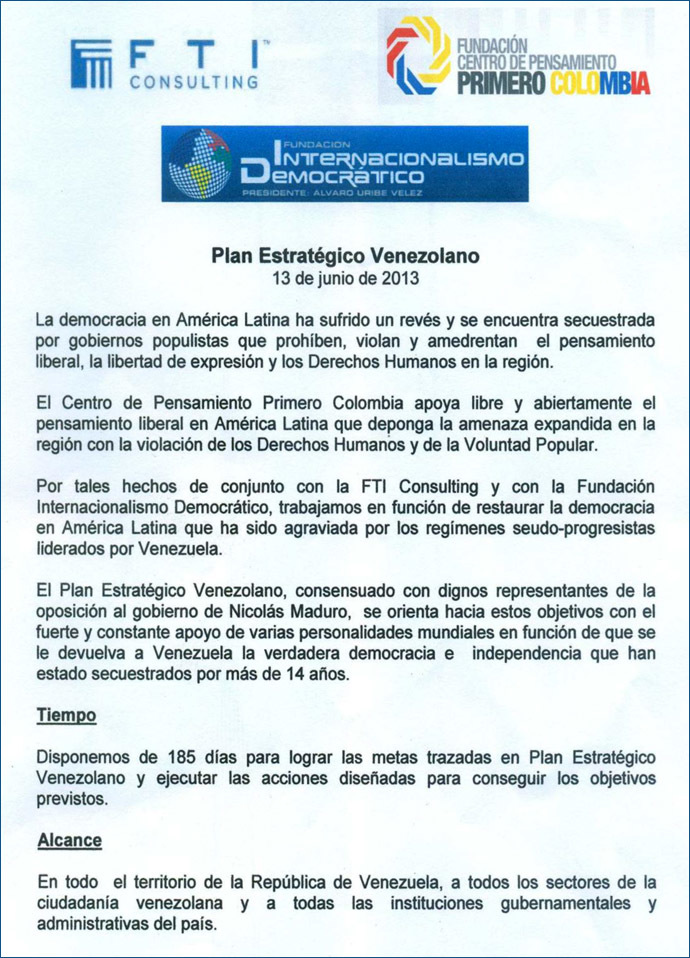
Leaked documents have revealed evidence of a plot to destabilize Venezuela and undermine the rule of leftist President Nicolas Maduro. The papers appear to substantiate Caracas’ claims of outside attempts to cripple the country through internal sabotage.

Documents obtained by a contributor to RT’s Spanish channel, Eva Golinger, detail a structured plan to erode the stability of Venezuela with a view to “returning real democracy and independence that have been hijacked for more than 14 years.”

The plans are allegedly the product of a conference between American company FTI Consulting and two right-wing Colombian groups affiliated with former President Alvaro Uribe in the Colombian city of Cucuta in June of this year.

Venezuelan President Nicolas Maduro (Reuters/Jorge Silva)

Former President Uribe was an outspoken critic of former Venezuelan President Hugo Chavez, referring to him openly on Twitter as a “dictator” and an “assassin.”

The three groups propose an initiative they name “The Venezuelan Strategic Plan” and list the ways in which they can disrupt all facets of Venezuelan society in the run-up to December’s regional elections.

“The suggested aims in the plan are especially geared towards the municipal elections on December 8,” writes the document. In the elections the Venezuelan population will choose 335 mayors, 2,435 municipal councilors, 69 local indigenous representatives, 2 mayors and 20 district councils.

The document is broken down into bullet points, which deal with how to maximize the impact on “all sectors of the Venezuelan population.”

The strategies to be employed include: “creating crisis on the streets, facilitating the intervention of North America and NATO forces with the Colombian army,” power cuts, food shortages, support and financing of the political opposition.

The document writes that violence should also be encouraged and “whenever possible lead to deaths and injuries.” It also gives special mention to Venezuelan opposition figure Henrique Capriles who lost in the presidential elections at the beginning of the year, advising support of his political campaign.

Over the last couple of months, Venezuelan state media has reported on shortages of a number of basic products, including sugar, milk, oil, butter and flour. Moreover, there have been a number of reports of large quantities of these basic good being confiscated from warehouses belonging to businessmen linked to the opposition and smugglers crossing the border to Colombia.

In August, Venezuelan authorities intercepted between 50 and 60 tons of basic goods in the state of Tachira which borders with Colombia.

President Nicolas Maduro has blamed many of these cases on attempts by foreign powers to meddle in Venezuelan affairs with a view to destabilizing the country. In October, Maduro expelled three top American diplomats from Venezuela, alleging they were plotting with the opposition to orchestrate mass power cuts.

“We detected a group of US embassy officials dedicated to meeting the far right, and to financing and encouraging acts of sabotage against the electrical system and Venezuela’s economy,” Maduro said in a televised speech.

The US Embassy denied such a plot existed and any “involvement in any type of conspiracy to destabilize the Venezuela government.”

Maduro was named as successor by former President Hugo Chavez who died of cancer on March 5 this year. When Maduro assumed the presidency in April he swore to carry on the legacy of Chavez and adopted the same fiery anti-American rhetoric as his predecessor.

Source: Global Research

Probe into Afghan deaths ‘welcome call’

0

An American Middle East expert says the call for an investigation into the deaths of 18 people allegedly killed by US forces in Afghanistan is �œwelcome”.

On Wednesday, Rolling Stone magazine reported that US forces were implicated in the torture and murder of innocent civilians in Nerkh district, Wardak province in late 2012 and early 2013

�œThe Rolling Stone article is a welcome call for increased scrutiny of these civilian killings”, said American author and Middle East expert William Beeman in a phone interview with Press TV on Wednesday.

Human Rights Watch has called on the US government to investigate thoroughly and impartially the deaths of the Afghan civilians.

In November 2012, many local residents claimed they were connected to operations by a new US Special Forces unit in the district, known as ODA 3124.

�œThe United States has been dealing with killing of civilians in Afghanistan for the entire length of the Afghan conflict,” Beeman said.

He also pointed out that the US has many soldiers �œthat are too young and too inexperienced to actually be in combat situations.”

�œThey also are heavily stressed because some of them have been on several tours of duty, many, many more than had taken place in any conflict,” the professor of anthropology at The University of Minnesota said.

�œWe already have tried several soldiers here in the United States for the killing of Afghan citizens in stressful situations where they just kind of go crazy and take their guns to killing women and children,” he added.

American officials denied US involvement to several media outlets after the human remains in Nerkh began to be unearthed in April.

Afghan President Hamid Karzai called for American forces to leave Wardak after protests about the abuses erupted in the province. The forces withdrew from Nerkh in April.

Generally, the US is slow to convict its troops of war crimes and when a punishment is imposed for such crimes, it usually takes the form of life in prison or house arrest.

In August, a US soldier who murdered 16 Afghan civilians in a shooting spree last year, Staff Sgt. Robert Bales, was sentenced to life in prison.

Meanwhile, Washington is insisting that any US troops left in Afghanistan after the 2014 withdrawal of foreign forces from the country must enjoy legal immunity from Afghan courts.

AN/ISH

Source: Press TV

Oliver Stone: Zapruder Film Was Altered

0

JFK 50th Anniversary: Director amazed that anyone still believes Oswald acted alone

Paul Joseph Watson
Infowars.com
November 6, 2013

With the 50th anniversary of the assassination of JFK approaching later this month, three-time Academy Award-winning director Oliver Stone says that the Zapruder film was tampered with.

Appearing on Democracy Now, Stone said that the infamous Zupruder footage, which shows Kennedy being shot in the head from the front, was altered after it was seized by the CIA and the Secret Service.

“It was altered a bit I think – there’s a lot of evidence to that effect,” said Stone, who directed the 1991 blockbuster JFK.

In another interview with Huffington Post Live, Stone repeated the claim that the tape had been tampered with.

The Zapruder film wasn’t aired on network television until 1975, nearly 13 years after the assassination.

Although there were numerous eyewitnesses to the JFK assassination itself, many of them died under mysterious circumstances.

Between the winters of 1963 and 1967, 15 JFK assassination witnesses who’d been interviewed by the Warren Commission, Dallas Police, or the FBI died prematurely and in bizarre ways.

When an actuary calculated the odds of this occurring naturally, it came out at one hundred thousand trillion to one (100,000,000,000,000,000 to 1).

Expressing his amazement that some people still deny that there was a wider conspiracy behind the assassination of JFK, Stone explained how it was impossible for Kennedy to have been shot from only one direction.

“You see him essentially get a hit from the front, when he gets the hit from the front which is the 4th or the 5th or the 6th shot, he goes back and to the left, that’s the basic evidence,” said Stone, adding that many eyewitnesses at the hospital saw “a massive exit wound to the rear of his skull” but that the autopsy was manipulated because the doctors in charge had being ordered to patch up the back of Kennedy’s head by the military to hide the evidence.

Stone also touched upon the so-called “magic bullet” theory, presented by the Warren Commission, which attempted to explain how a single bullet could have caused seven different wounds in two people.

“It’s a farce and they got away with it because it’s a lot of mumbo jumbo,” said Stone, asserting that at least five shots were made. According to the official narrative, Le Harvey Oswald only took three shots from the Texas Book Depository.

In addition, expert marksmen who have attempted to replicate Oswald’s shot, at a moving target through a tree, have failed to do so.

“Two teams of FBI experts tried to do it, plus CBS I believe and various other organizations, have tried to simulate that shooting in less than six seconds – it’s not possible,” said Stone, adding that there had to be at least one shooter from the front.

Facebook @ https://www.facebook.com/paul.j.watson.71
FOLLOW Paul Joseph Watson @ https://twitter.com/PrisonPlanet

*********************

Paul Joseph Watson is the editor and writer for Infowars.com and Prison Planet.com. He is the author of Order Out Of Chaos. Watson is also a host for Infowars Nightly News.

This article was posted: Wednesday, November 6, 2013 at 2:59 pm

Tags:


Source: Infowars

Report: Feminine Care Products Awash in Harmful Chemicals

0

Common feminine care products used by millions of women are laced with hazardous chemicals including carcinogens, toxins and endocrine disruptors, a new report reveals.

A new report details the hazardous chemicals lurking in products like tampons. (Photo: Aaron Fulkerson/cc/flickr) Entitled Chem Fatale, the report released Wednesday from Women’s Voices for the Earth (WVE), an organization advocating “a toxic-free future for all,” highlights how current regulations covering the $3 billion industry are putting public health in jeopardy, and provides increasing evidence of the ubiquity of toxins in our everyday lives.

“The chemicals used in these products are a real concern given the inevitable exposure to sensitive and absorptive vulvar and vaginal tissue,” stated Dr. Ami Zota, a professor of occupational and environmental health at George Washington University, in a media release.

Among the products the report scrutinized are tampons and menstrual pads—products the report says are used by 70-85 percent of women.

Using them exposes women to pesticide residues, dioxins and furans, unknown fragrance chemicals and allergens. Potential hazards of exposure to them include reproductive harm, cancer and endocrine disruption.

According to the report,

Tampons and pads are regulated by the Food & Drug Administration (FDA) as medical devices. Unlike cosmetics, medical devices lack any government requirement to disclose ingredients to the consumer. This makes it nearly impossible for consumers to avoid chemicals of concern found in these products.

Other feminine care products the report highlights are washes, douches, sprays and wipes, and, while they are used by a smaller percentage of women overall, the report found that they were used in considerably higher percentages by Latinas and Black women, increasing these women’s exposure to toxins like formaldehyde-releasing preservatives and parabens.

“We know that many of the most dangerous products that are found to cause chronic diseases also target women of color. The reality is knowledge isn’t enough—Latinas who already have health disparities, also face financial, economic, and geographic barriers to accessing safe alternatives,” said Cristina Aguilar, Interim Executive Director of Colorado Organization for Latina Opportunity and Reproductive Rights.

“This report highlights how much more we need to know about the potential impact of feminine care product use on black women’s health,” added Ogonnaya Dotson-Newman, Director of Environmental Health for WE ACT for Environmental Justice.

Accompanying the report is a Hall of Shame which lists some common brand name feminine products and the chemicals of concern they contain.

WVE calls for companies to use greater transparency in the ingredients used in these products and eliminate toxic chemicals from them.

_______________________

This work is licensed under a Creative Commons Attribution-Share Alike 3.0 License.

Source: Common Dreams

Big Brother’s Loyal Sister: How Dianne Feinstein Is Betraying Civil Liberties

0

Diane Feinstein

Ever since the first big revelations about the National Security Agency five months ago, Dianne Feinstein has been in overdrive to defend the surveillance state. As chair of the Senate Intelligence Committee, she generates an abundance of fog, weasel words, anti-whistleblower slander and bogus notions of reform — while methodically stabbing civil liberties in the back.

Feinstein’s powerful service to Big Brother, reaching new heights in recent months, is just getting started. She’s hard at work to muddy all the waters of public discourse she can — striving to protect the NSA from real legislative remedies while serving as a key political enabler for President Obama’s shameless abuse of the First, Fourth and Fifth Amendments.

Last Sunday, on CBS, when Feinstein told “Face the Nation” viewers that Edward Snowden has done “enormous disservice to our country,” it was one of her more restrained smears. In June, when Snowden first went public as a whistleblower, Feinstein quickly declared that he had committed “an act of treason.” Since then, she has refused to tone down the claim. “I stand by it,” she told The Hill on Oct. 29.

Days ago, taking it from the top of the NSA’s main talking points, Feinstein led off a San Francisco Chronicle op-ed piece with 9/11 fear-mongering. “The Sept. 11, 2001, attack on the United States was highly organized and sophisticated and designed to strike at the heart of the American economy and government,” she wrote, and quickly added: “We know that terrorists remain determined to kill Americans and our allies.”

From there, Senator Feinstein praised the NSA’s “call-records program” and then insisted: “This is not a surveillance program.” (Paging Mr. Orwell.)

Feinstein’s essay — touting her new bill, the “FISA Improvements Act,” which she just pushed through the Senate Intelligence Committee — claimed that the legislation will “bridge the gap between preventing terrorism and protecting civil liberties.” But as Electronic Frontier Foundation activist Trevor Timm writes, the bill actually “codifies some of the NSA’s worst practices, would be a huge setback for everyone’s privacy, and it would permanently entrench the NSA’s collection of every phone record held by U.S. telecoms.”

California’s senior senator is good at tactical maneuvers that blow media smoke. In late October — while continuing to defend the NSA’s planetary dragnet on emails and phone calls — Feinstein voiced concern “that certain surveillance activities have been in effect for more than a decade and that the Senate Intelligence Committee wasn’t satisfactorily informed.” Spinning the myth that congressional oversight of the NSA really exists, she added: “Therefore, our oversight needs to be strengthened and increased.”

As usual, Feinstein’s verbal gymnastics were in sync with choreography from the Obama White House. The “certain surveillance activities” that she has begun to criticize are the NSA’s efforts targeting the phones of German Chancellor Angela Merkel and other allied foreign leaders. Feinstein mildly chided Obama for ostensibly not being aware of the eavesdropping on Merkel’s cell phone (“That is a big problem”), but she was merely snipping at a few threads of the NSA’s vast global spying — while, like the administration as a whole, reaffirming support for the vast fabric of the agency’s surveillance programs.

The White House is now signaling policy changes in response to the uproar about monitoring Merkel’s phone, the New York Times reported on Nov. 5, but “President Obama and his top advisers have concluded that there is no workable alternative to the bulk collection of huge quantities of ‘metadata,’ including records of all telephone calls made inside the United States.” Feinstein is on the same page: eager to fine tune and continue mass surveillance.

With fanfare that foreshadows a drawn-out onslaught of hype, Feinstein has announced that the Senate Intelligence Committee will hold hearings on NSA surveillance. “Her committee is now making preparations for a major investigative undertaking, which is expected to take at least several months,” the Wall Street Journal reports. When the show is over, “The report that results from the probe will be classified.”

With Dianne Feinstein’s hand on the gavel, you can expect plenty of fake inquiries to pantomime actual oversight. She has shown a clear commitment to deep-sixing vital information about the surveillance state, in a never-ending quest for the uninformed consent of the governed. “From out of the gate, we know that her entire approach is to make those hearings into a tragic farce,” I said during an interview on C-SPAN Radio last week. “Her entire approach to this issue has been to do damage control for the NSA…. She is an apologist and a flack for the surveillance state, she is aligned with the Obama White House with that agenda, and we at the grassroots must push back against that kind of a politics.”

_____________________________________

Norman Solomon is co-founder of RootsAction.org and founding director of the Institute for Public Accuracy. His books include “War Made Easy: How Presidents and Pundits Keep Spinning Us to Death.” Information about the documentary based on the book is at www.WarMadeEasyTheMovie.org.

The post Big Brother’s Loyal Sister: How Dianne Feinstein Is Betraying Civil Liberties appeared first on disinformation.

Source: Disinfo

Netherlands Asks UN Tribunal to Force Russia to Release Greenpeace Crew

0

Liesbeth Lijnzaad, an aide to the Netherlands’ Ministry of Foreign Affairs, testified today before the judges at the International Tribunal for the Law of the Sea in Hamburg, Germany, asking the tribunal to order the release of a Greenpeace ship and 30 of its crew members detained by Russia. Lijnzaad requested that the UN body grant an interim order to safeguard the crew’s “rights of liberty and security.”

“They have been held for almost six weeks now,” said Lijnzaad, adding that Russian arguments to keep them are “evidently unfounded.”

The tribunal adjudicates maritime disputes under the 1982 United Nations Convention on the Law of the Sea, to which both Russia and the Netherlands are party.

The Greenpeace ship, Arctic Sunrise, which sails under a Dutch flag, was seized by the Russian Coast Guard in international waters north of the Russian city of Murmansk on September 18. On that day, the crew of the ship circled the Prirazlomnaya oil rig constructed in the Pechora Sea by Russia’s Gazprom energy company, and three of the ship’s crew members attempted to board the platform.

In response, the Russian Coast Guard seized the activists and had the ship towed to the port of Murmansk. Though the ship’s crew initially was accused of piracy, even Russian President Vladimir Putin said the activists were obviously “not pirates,” and the charges were reduced to “hooliganism.”

“We are very grateful to the Dutch government for bringing this case and to the tribunal for considering it,” Jasper Teulings, the international general counsel for the Dutch-based Greenpeace organization, was quoted as saying by al Jazeera.

“The argument of the Netherlands is that in international waters, ships have the right to freedom of navigation and so this means they may not be boarded, inspected, detained or arrested except with the permission of the flag state. There are exceptions to this, but they are limited,” Teulings added.

Al Jazeera reported that Russian Prime Minister Dmitry Medvedev, in a statement last week, reiterated his government’s position that Greenpeace posed a threat to the security of Russian workers and the environment by disturbing work at the platform.

On November 6, other Greenpeace activists sailed a motorboat on the Moscow River past the Kremlin holding yellow flags which read, “Free the Arctic 30,” a reference to the 30 Arctic Sunrise crew members being detained, reported the Moscow Times.

The Times noted that last month the Russian Foreign Ministry refused to recognize the Law of the Sea tribunal’s authority and declared that Russia will proceed with plans to prosecute the activists. As a result, Russia did not participate in Wednesday’s hearing, even though one of the 21 judges on the tribunal is Russian.

“This is a big problem, but we have to start the proceedings, even without the participation of Russia,” tribunal chairman Shunji Yanai observed.

A report from Russia’s RT news network back on October 23 quoted from the Russian Foreign Ministry statement that it would not participate in the tribunal:

The Russian side has informed the Netherlands and the International Tribunal for the Law of the Sea that it does not accept the arbitration procedure in the Arctic Sunrise case, and is not planning to take part in the hearing.

RT noted that Russia pointed out that back in 1997, when it ratified the United Nations Convention on the Law of the Sea, it refused to acknowledge the settlement procedures, which result in mandatory decisions in disputes over sovereign rights and jurisdictions.

“That is exactly the kind of jurisdiction that we are exercising in the Arctic Sunrise case,” said the ministry. “Greenpeace’s activists violated Russian law in an exclusive economic zone and continental shelf when staging their protest against the Prirazlomnaya oil rig,” RT further paraphrased the statement.

A November 6 report from Russia’s RIA Novosti cited a statement from Greenpeace’s Twitter feed saying that it was the first time in the history of the Law of the Sea tribunal that a country involved in the trial had failed to attend.

RIA Novasti also quoted from the Russian Foreign Ministry’s statement that the country does not have to participate in disputes that concern “sovereign rights” and “jurisdiction.”

Unlike Russia, the United States has never signed the United Nations Convention on the Law of the Sea, making it one of the few non-land-locked countries to decline — the others being Eritrea, Israel, Peru, Turkey, and Venezuela. The last time the treaty was even considered by the U.S. Senate, on July 16, 2012, 34 Republican senators indicated their intention to vote against ratification of the treaty if it came to a vote. Since a positive vote by at least 67 senators is required to ratify a treaty, the vote was indefinitely delayed.

One reason for the difficulty faced by the Law of the Sea Treaty (LOST) supporters to gain any traction in the Senate has been the continued educational campaigns warning against the convention’s threat to national sovereignty waged by constitutionalist activist groups, such as The John Birch Society (with which The New American is affiliated).

As one example of The John Birch Society’s activism against LOST, the society posted this statement on its website, headlined, “Obama, Clinton, Senate Poised to Give the UN Control of Everything About the Oceans by Ratifying the Law of the Sea Treaty (LOST),” which quoted a statement made to honor the UN document “25th Anniversary of the United Nations Convention on the Law of the Sea” published on Oct. 17, 2007:

The United Nations Convention on the Law of the Sea … is perhaps one of the most significant but less recognized 20th century accomplishments in the arena of international law…. Its scope is vast: it covers all ocean space, with all its uses, including navigation and overflight; all uses of all its resources, living and non-living, on the high seas, on the ocean floor and beneath, on the continental shelf and in the territorial seas; the protection of the marine environment; and basic law and order…. The Convention is widely recognised by the international community as the legal framework within which all activities in the oceans and the seas must be carried out.

The JBS commentary that followed noted:

If you read the quote carefully, you’ll see that the UN Division for Ocean Affairs and the Law of the Sea which administers LOST would have authority over everything, everything, over, on, and under the oceans and seas of the world. Ratification of LOST would be a very large step toward world government. And, remember under the UN division that administers LOST, our nation wouldn’t have veto power like we do in the UN Security Council. We’d have just one vote among 150 or more votes. Just as the League of Nations ultimately fell apart without the United States, let’s stay out of the UN’s LOST regime, thus denying its legitimacy.

Whether Russia’s actions against the Greenpeace activists were excessive or not does not change the fact that LOST presents an ongoing threat to the sovereignty of every nation that accedes to it. Those who cherish U.S. sovereignty and do not wish to surrender control of U.S. waters to the UN Division for Ocean Affairs and the Law of the Sea must resist all efforts to subject the United States to the dictates of this body.

Source: The New American

Does Saying ‘New World Order’ Make You a Terrorist?

4

Infowars.com

Mainstream news outlets are blaming Alex Jones and Infowars for the TSA shooting that took place at LAX last Friday due to an alleged manifesto, which shooting suspect Paul Ciancia supposedly carried with him, citing New World Order “conspiracy theories.”

From the Associated Press:

The FBI got a warrant Monday to search Ciancia’s cellphone for materials reflecting his “views on the legitimacy or activities of the United States government, including the existence of a plot to impose a New World Order,” according to court documents.

However, Alex Jones and Infowars were not the ones who gave a name to the idea which promotes one-world global governance.

Numerous prominent politicians and world leaders were embracing the “shadowy subculture” of New World Order and one-world government “conspiracies” long before Infowars was weathering flimsy accusations. Will they too be blamed for the LAX shooting?

Don’t just take our word for it; most quotes are substantiated with links to original sources.

Vice President Joe Biden

“The ‘affirmative task’ before us is to create a New World Order.”
— speech Import Export Bank, April 5, 2013

“How I Learned to Love the New World Order”
— article by Sen. Joseph R. Biden, Jr. Wall Street Journal, April 1992

President George Bush Sr.


“What is at stake is more than one small country, it is a big idea – a new world order where diverse nations are drawn together in common cause to achieve the universal aspirations of mankind: peace and security, freedom and the rule of law. Such is a world worthy of our struggle, and worthy of our children’s future…

“We will succeed in the Gulf. And when we do, the world community will have sent an enduring warning to any dictator or despot, present or future, who contemplates outlaw aggression. The world can therefore seize this opportunity to fufill the long-held promise of a new world order — where brutality will go unrewarded, and aggression will meet collective resistance.”
— State of the Union Address, January 29, 1991

“Ultimately, our objective is to welcome the Soviet Union back into the world order… Perhaps the world order of the future will truly be a family of nations.”
– Commencement Address at Texas A&M University, May 12, 1989

“Out of these troubled times, our fifth objective – a new world order — can emerge: a new era – freer from the threat of terror, stronger in the pursuit of justice, and more secure in the quest for peace. An era in which the nations of the world, East and West, North and South, can prosper and live in harmony…

“At this very moment, they serve together with Arabs, Europeans, Asians, and Africans in defense of principle and the dream of a new world order.”
– Address Before a Joint Session of the Congress on the Persian Gulf Crisis and the Federal Budget Deficit, titled “Toward a New World Order,” September 11, 1990

“We have before us the opportunity to forge, for ourselves and for future generations, a New World Order. A world where the rule of law, not the law of the jungle, governs the conduct of nations. When we are successful—and we will be—we have a real chance at this New World Order. An order in which a credible United Nations can use its peacekeeping role to fulfill the promise and vision of the UN’s founders.”
— Bush speech from the Oval office, January 16, 1991

“My vision of a new world order foresees a United Nations with a revitalized peacekeeping function.”
– Remarks and a Question-and-Answer Session at a Meeting of the Economic Club in New York, New York, February 6, 1991

clintonnwoPresident William Clinton

“Rarely have Americans lived through so much change, in so many ways, in so short a time. Quietly, but with gathering force, the ground has shifted beneath our feet as we have moved into an Information Age, a global economy, a truly new world.”
– State of the Union Address, January 27, 1998

President Richard Nixon
nixnow

“…but our common interest and our common hopes, the interests that each of us has to maintain our independence and the security of our peoples, and the hope that each of us has to build a new world order.”
— Toast made to Chinese leaders during visit to Hangzhou, China, February 1972

“The developing coherence of Asian regional thinking is reflected in a disposition to consider problems and loyalties in regional terms, and to evolve regional approaches to development needs and to the evolution of a new world order.”
– Asia After Viet Nam, Foreign Affairs, October 1967

Vice President Nelson Rockefeller

“The United Nations,” he told an audience at Harvard University, “has not been able—nor can it be able—to shape a New World Order which events so compellingly demand.”

Arthur M. Schlesinger, Jr., special assistant to John F. Kennedy

“We are not going to achieve a new world order without paying for it in blood as well as in words and money.”
– “Back to the Womb? Isolationism’s Renewed Threat,” Foreign Affairs, July/August 1995

Richard Gardner, CFR member

“In short, the ‘house of world order‘ will have to be built from the bottom up rather than from the top down. It will look like a great “booming, buzzing confusion,” to use William James’ famous description of reality, but an end run around national sovereignty, eroding it piece by piece, will accomplish much more than the old-fashioned frontal assault.
– The Hard Road to World Order, Foreign Affairs, April 1974

Nicholas Murray Butler, president of Columbia University

“The old world order changed when this war-storm broke. The old international order passed away as suddenly, as unexpectedly, and as completely as if it had been wiped out by a gigantic flood, by a great tempest, or by a volcanic eruption. The old world order died with the setting of that day’s sun and a new world order is being born while I speak, with birth-pangs so terrible that it seems almost incredible that life could come out of such fearful suffering and such overwhelming sorrow.”
– speech to the Union League of Philadelphia (28 November 1915), printed in A World in Ferment, Interpretations of the War for a New World (1918)

Saul Alinsky, author, mentor of Hillary Clinton and Barack Obama

“We must believe that it is the darkest before the dawn of a beautiful new world. We will see it when we believe it.”
– Rules for Radicals, pg. 196

gorbyMikhail Gorbachev, President of Soviet Union

“We are moving toward a new world order, the world of communism. We shall never turn off that road.”
— 1987

“Further world progress is now possible only through the search for a consensus of all mankind, in movement toward a new world order.”
– 43rd U.N. General Assembly Session, December 7, 1988

Fidel Castro, President of Cuba

“We want a new world order based on justice, equality and peace to replace
the unfair and unequal system that prevails today…”
– 34th UN General Assembly, October 12, 1979

kissingernwoHenry Kissinger, National Security Advisor and former Secretary of State

“My country’s history, Mr. President, tells us that it is possible to fashion unity while cherishing diversity, that common action is possible despite the variety of races, interests, and beliefs we see here in this chamber. Progress and peace and justice are attainable. So we say to all peoples and governments: Let us fashion together a new world order.”
– address before the General Assembly of the United Nations, October 1975, supposedly printed in A Dangerous Place (1980) by Daniel Patrick Moynihan

“America will have to learn that world order depends on a structure that participants support because they helped bring it about. If progress is made on these enterprises, 2009 will mark the beginning of a new world order.”
– “An end of hubris,” The Economist, Nov. 19, 2008

David Rockefellerrockefeller

“This present window of opportunity, during which a truly peaceful and interdependent world order might be built, will not be open for too long – We are on the verge of a global transformation. Already there are powerful forces at work that threaten to destroy all of our hopes and efforts.”
– speech given at Business Council for the United Nations (BCUN), 1995

“Some even believe we (the Rockefeller family) are part of a secret cabal working against the best interests of the United States, characterizing my family and me as ‘internationalists’ and of conspiring with others around the world to build a more integrated global political and economic structure — one world, if you will. If that’s the charge, I stand guilty, and I am proud of it.”
– Memoirs, 2002

Georgia Rep. Larry P. MacDonald, killed in Korean Air Lines 007, 1983

“…the drive of the Rockefellers and their allies is to create a one-world government combining supercapitalism and Communism under the same tent, all under their control… Do I mean a conspiracy? Yes, I do. I am convinced there is such a plot, international in scope, generations old in planning, incredibly evil in intent.”
– Introduction to “The Rockefeller File,” by Gary Allen

Curtis Dall, Franklin Delano Roosevelt’s son-in-law

“Obviously, the real objectives of One-World Government leaders and their ever-close bankers, are most devious. They have now acquired full control of the money and credit machinery of the United States of America, via the creation and establishment of the privately owned Federal Reserve Bank.”
– as quoted in his book, “My Exploited Father-in-Law”

Source: Infowars

Rookie Preppers: 8 Mistakes To Avoid

0

This article has been generously contributed by Tess Pennington of Ready Nutrition. After joining the Dallas chapter of the American Red Cross in 1999 Tess worked as an Armed Forces Emergency Services Center specialist and is well versed in emergency and disaster management & response.

As some of you know, I’ve been prepping for a several years now. Believe me when I say that I have probably made every prepping mistake in the book. It’s time I admit to these mistakes and begin using them as learning experiences for those of you who are beginning their preparedness efforts.

8 Rookie Mistakes

Don’t Panic

Take a deep breath, sit down and make an emergency plan. Decide what emergency you are preparing for and what supplies you will need. Try and stay within a certain emergency time frame and work your way up to larger scale emergencies. For example, begin planning for a 72 hour emergency and work your way up to a short term emergency and later, a larger scale or long term emergency.

Take your time and properly plan how you are going to open up your budget so that you can attain these emergency items. Cutting out the extraneous spending in your budget can free up a lot of extra cash. The money saved can be used toward your future preparedness items. Make the choice of using the new found preparedness money or save it for a more expensive prep. Either way, you will accumulate a little at a time and not break the budget.

Personal Experience – One mistake I remember (and am still paying for) was when my husband and I decided to get a short term food supply. We hadn’t really researched what it takes to maintain our family’s health during a short term emergency so we impulsively went out and bought $200 in canned goods. Needless to say that we are still living off of that canned good investment. Looking back, we could have used that $200 in a more constructive manner.

Don’t always believe the experts.

Listen to what the experts say, but make the decision that is best for your family and your needs. Some expert advice is driven by what makes them the most money or what other experts are saying at the time. Make a list of what items you are looking for and research those items (include reading the customer reviews).

Personal Experience – An expert was telling everyone that they should have a certain brand of hiking boots. Well, I went out and bought them because “the expert” said I should. Because I didn’t research the boots (and the specs about the boot), after purchasing it; I made the realization that they were way too heavy for me. Luckily, I was able to return the boots and get my money back. After I researched and read customer reviews, I went out and invested in a different pair of hiking boots that were perfect for what I needed.

Don’t buy cheap preps.

Trying to save money here and there is great, but when you are investing in survival gear, you want to make sure the investment is worth the money spent. Begin looking at your purchase as an investment for your future. You want that product to last and perform its desired function with minimal hassle. And you want to be able to depend on that product to see you through an emergency. On another note, whatever items or tools you buy, make sure you use it. If you invest money and buy an item that you do not know how to use, it’s useless.

Personal Experience – I wanted to save a few bucks and bought a basic sleeping bag that didn’t have any bells or whistles. Later on down the line, I realized the sleeping bag was way too bulky, weighed too much for a bug out situation and had no capacity to really keep someone warm. I ended up investing in an ultralight backpack that keeps me toasty when I need it the most and is feather light. Although I made a mistake with the first sleeping bag, I am using it as a back up, so the investment was not a complete loss. Other items I have found that are worth spending extra money on are good toothbrushes, survival tools, water filtration systems and survival knives.

Buy preps that are multi purpose.

You want to make the most out of your preparedness investment so do some extra research and find preparedness items that have multiple functions.

Personal Experience – I have found a lot of items that have multi uses, so listing them would be an entire article in itself. However, here are few suggestions that would help serve a multitude of functions. Rope, for instance, is a great multi use prep. It can be used for hanging or securing emergency shelters, used as a laundry line or for hauling. Other multi-function items are a good knife, multi tool, and emergency foods, such as salt, baking soda, and vinegar.

Buy foods you and your family normally eat.

This is one of the biggest mistakes that preppers make. You want to use the food that you store. To get the most out of your food investment, develop good storage habits. Further, it’s a good rule of thumb to purchase foods and items that will be used within their allotted time span, so check the expiration date!

Personal Experience – I came across some cans of seafood medley at my local grocery store and thought how great it would be to use it in an emergency situation. I was so excited about this canned seafood because it was high in protein and vitamins, so I ended up buying 4 cans of this stuff. Needless to say that after opening 1 of the cans up for a dinner… my family (and myself included) pushed our plates aside and decided to eat cereal instead. I donated the remaining cans to a food bank.

Eat what you store.

In an article I wrote about storing food, I stated, “Storing food is a continual process of using, rotating and reloading. If a short term food supply is bought, the food must be used and more food purchased to resupply the storage shelf. Thinking of the food supply as a small store where the foods in the front have the shortest expiration date and the ones in the back have the longest. The food storage area should be checked every six months to make sure that appropriate food items are rotated. ”

Personal Experience – I can’t tell you how many times I have had to throw away unopened food because I didn’t use it within its expiration date. Using and rotating your food supply takes some getting used to. Many think that the stored food is for emergencies only. And it is, but it should also be there for you when you need it. It’s your own personal convenience store. When you use an item, buy a new one at the store and replace it on your shelf.

Have back ups for your back ups.

This is a golden rule for preppers. You never know when one of your preps will break or jam up on you. Having extra items gives you peace of mind because you are not solely dependent on one item for survival.

Personal Experience – When we were researching water filtration systems, we ended up buying a katadyn water filter (A solid investment in my opinion). However, we began thinking about the use and effectiveness of the filter after mulitiple uses. We decided that solely depending on one item to give up potable water was not wise. We not only bought extra filters for our katadyn, but also invested in micro-pur tablets (chlorine dioxide tablets), and chlorine granuals to make sure that all areas were covered.

Get your friends and family on board.

In an emergency situation, you will need help from others. It would be unrealistic to think differently. Talking with friends and family about being prepared is a great way to awaken the need for their personal preparedness efforts and help you find more “like minded” individuals. Help guide them and give them advise on how to begin.

Personal Experience – We all have stories of people thinking we are “kooky” because we prepare for short or long term emergencies, and I am no different. I have learned to take the opinions of others in stride, but I have talked with some family and friends who see the need to prepare and have started doing so. My largest accomplishment thus far has been helping my sister become more prepared. I have peace of mind knowing most of my immediate family is prepared – at least for a short term emergency.

There will be some friends and family members who are not going to be on board no matter how much you try and talk to them. There will be some who will be on board and will listen to what you have to say. Hopefully, after you share your experiences and first time mistakes, they will listen and learn from you.

What are some prepping mistakes you have made?


Tess Pennington is the author of The Prepper’s Cookbook: 300 Recipes to Turn Your Emergency Food into Nutritious, Delicious, Life-Saving Meals. When a catastrophic collapse cripples society, grocery store shelves will empty within days. But if you follow this book’s plan for stocking, organizing and maintaining a proper emergency food supply, your family will have plenty to eat for weeks, months or even years. Visit her web site at ReadyNutrition.com.

Source: SHTF Plan

Romanian Scientists Invent Artificial Blood

0

Presumably to be enjoyed along with your artificial sweetener and decaff coffee, from Transylvania comes synthetic substitute blood, Medical Daily reports:

Researchers from the Transylvanian city of Romania called Cluj-Napoca announced the first-ever artificial blood that could be used without fearing life-threatening side effects of prior models.

The new artificial blood relies not on hemoglobin, like typical artificial bloods, but hemerythrin — a protein extracted from sea worms that is then mixed with water and salts. Doctors can use the artificial blood to reduce infection rates during blood donation, and to supply lost stores in patients for several hours or even up to a day, researcher Dr. Radu Silaghi-Dumitrescu says.

The research team was confident the artificial blood could find its way to clinical trials on humans within the next year or two. Silaghi-Dumitrescu claims the breakthrough could lead to “instant blood” that would come in portable containers and turn into artificial blood just with the addition of water.

The post Romanian Scientists Invent Artificial Blood appeared first on disinformation.

Source: Disinfo

Tom Hayden on Bill de Blasio’s Win: A Harbinger of a New Populist Left in America?

0

Bold stances on inequality and overzealous policing propelled a progressive victory. If he holds true, can De Blasio shift the national debate?


The overwhelming support of New York City voters for Bill de Blasio is the latest sign of the shift towards a new populist left in America. De Blasio owes his unexpected tailwind to campaigning on issues considered by insiders to be too polarizing for winning politics.

One is De Blasio’s promise to redress the “tale of two cities” inequalities among New Yorkers, an issue forced into mainstream discourse by the 2011 Occupy Wall Street movement – not by New York Democratsaligned with Wall Street. The other is De Blasio’s pledge to sharply curb police stop-and-frisk policies directed against young people of color – aggressive tactics favored by a majority of white voters and overwhelmingly criticized by African Americans, Latinos and Asian-American voters.

Despite its Democratic voter majority, New York in recent decades has been the political stronghold of the plutocratic Mayor Michael Bloombergand, before him, the abrasive law-and-order Mayor Rudolph Giuliani – both Republicans with national, even global, reach. Democrats have lacked a progressive voice on the national stage of American politics often provided by the New York mayor’s office – until now.

De Blasio will have a mandate for economic and social reform backed by a newly-elected 51-member city council, the most progressive in years. As Juan Gonzáles of Pacifica’s DemocracyNow! put it:

I can’t think of a time like this when so many progressives have been elected at once.

With American politics polarized between the Obama center and the thriving Tea Party, the only opening for the left is through state and local federalism serving as “laboratories of reform”, to paraphrase former Justice Louis Brandeis. After the Gilded Age and the Great Crash of the 1920s, New York Mayor Fiorello LaGuardia (1934-47) and legislators like Robert Wagner created the first pillars of the New Deal before it become the national platform of the Democrats. They successfully fought not only Wall Street bankers, but a virulent and racist American right.

De Blasio is positioned to similarly shift the nation’s dialogue, policies and priorities in a progressive direction – assuming he delivers on his campaign pledges. Since the financial crisis of 2008, the federal government has passed a loophole-ridden Dodd-Frank reform law, which failed even to regulate the trillions floating in the derivatives industry. Wall Street investors have been richly rewarded since then, while middle-class incomes stagnate and the numbers of poor Americans reach the highest in 50 years. A report last week from the respected American Community Survey noted:

No other major American city has such income inequality when it comes to rich and poor when it comes to New York.

Among De Blasio’s first challenges will be prodding Governor Andrew Cuomo and the state legislature in Albany to permit local tax increases to fund universal pre-kindergarten in New York City. Cuomo and most pundits say the De Blasio proposal is going nowhere, but seasoned reporters like Gonzales are not so sure. “It’s hard but doable. I’m not sure that Albany will resist the home rule message from a new mayor with a large mandate.”

De Blasio has direct power over New York City’s $70bn budget and re-zoning policies, which, under Bloomberg, showered favors on a real estate industry bent on competing with London and Hong Kong at the expense of residential neighborhoods. An early test for De Blasio will be the Midtown East re-zoning project left unfinished by Bloomberg, which would erect Empire State Building skyscrapers from the East River to downtown. De Blasio wants to “fix” the proposal, while community groups are 100% opposed, saying they would be left in permanent shadows.

De Blasio also can tackle income inequality by signing the living wage ordinance on city contracts, or by preventing Wall Street developers getting special city abatements – measures that Bloomberg vetoed. De Blasio didn’t flinch on the issue when confronted in closed meetings with developers during the campaign.

When De Blasio first raised his opposition to the police stop-and-frisk policies, according to Vincent Warren of the Center for Constitutional Rights, the candidate began rising in the polls against other contenders in the Democratic primary. The stop-and-frisk policy, a variation of racial profiling against black and brown young people, is generally supported by white and worried New Yorkers and overwhelmingly opposed by communities of color.

De Blasio and his African-American wife have a teenager, named Dante, whose Afro style even caught the attention of President Obama. As Dante leafleted with his father at subway turnstiles, emotional memories of the murdered Florida teenager Trayvon Martin were palpable, if rarely mentioned.

New York under Mayor Giuliani fanned then popular American policies of mass incarceration towards youngsters who resembled Dante de Blasio. From 2008 to 2012, the NYPD stopped nearly 2.9 million New Yorkers, a majority of them young, about 85% black or brown. On average, 88% of those stopped were completely innocent of any crime or misdemeanor.

When a federal appeals court halted a judicial order ordering detailed changes in the NYPD last week, De Blasio expressed “extreme disappointment” and pledged to move forward on police reform from day one. How he will do so is procedurally muddled for the moment, but there is little doubt that another staple of the Bloomberg era is ready for the dustbin.

Will De Blasio adhere to his promises? He is, after all, a mainstream Democratic party operative and policy wonk who once managed Hillary Clinton’s centrist campaign for the US Senate. Decades ago, he was deeply involved in the Nicaragua Solidarity Movement against Ronald Reagan’s illegal contra war. De Blasio seemed nervous when this past association surfaced earlier in the campaign. But the Republicans could gain no traction on the issue.

It is reassuring that De Blasio has roots in past social movements instead of the usual pedigrees for a political career. If he has veered back to his lefty roots, it is enabled by a popular anger among voters. This anger was fanned by the growing gap between the haves and have-nots, reinforced by heavy-handed policing, in a city whose power brokers are addicted to opulence.

The media widely acknowledges that Occupy Wall Street “changed the conversation” in America. De Blasio won’t represent the 99%, but a healthy majority will do. From Wednesday, Bill de Blasio will have the largest megaphone of any conversation-changer on the national scene.

Related Stories

Source: Alternet

Op-Ed: Things that have people questioning the LAX shooting

0

Alex Allen
Digital Journal
November 6, 2013

LAX police aim their weapons during an active shooter drill conducted weeks before the Nov 1 shooting.

There are several questions being raised by various individuals and groups regarding the official narrative of the LAX shooting. And not all of the skepticism is grounded in crackpot paranoia.

The term “false flag” is thrown around quite a bit these days. It seem as though there’s always a reason to suspect that any large event these days could have been staged or planned out by someone behind the scenes in the criminal factions of our increasingly shady corporate-controlled government. And it’s not crazy to suggest that so-called “false flags” are real. Not only have they been executed under tyrannical regimes (like when Adolf Hitler burned down the Reichstag in order to place the blame on the Communists and roll out Martial Law) but they have also been planned and executed by shady and criminal elements within the United States government. In March of 1962, for example, President John F. Kennedy was presented with “Operation Northwoods,” a series of proposals that called for the CIA and others to commit acts of terrorism in U.S. cities and blame it on Cuba.

So knowing the fact that false flags do exist, even within our own government, wouldn’t it be wise to analyze a situation that seems a little suspicious? That’s exactly what I hope to do in this article with regards to the LAX shooting. So below I’ve written out a list of some of the major details of this shooting that have some people scratching their heads.

1.) Prior Training for the Exact Same Scenario – As reported by Digital Journalist Elliott Freeman late last week, the LAX police allegedly prepared for a shooting at an airport just a few days prior to the actual shooting. LAX Police Chief Patrick Gannon is even quoted as saying, “We practiced to this not more than 3 weeks ago. We took every one of our patrol officers and a couple hundred officers from the Los Angeles Police Department and we practiced the exact scenario we played out today.”

2.) Narrative Attacks Political Enemies – In order to have a false flag, you have to have someone to blame it on; and who better than your political enemies? As I pointed out in my last op-ed yesterday, government white papers prove that they are labeling Libertarians, constitutionalists, gun owners, conservatives, and radical liberals as terrorists, extremists, and criminals. Following the shooting, investigators have allegedly discovered that the shooter was not only anti-government and anti-TSA but also mentioned “fiat currency” and the New World Order in his notes.

3.) Alleged Shooter Unable to Speak – The Guardian reported yesterday that, due to being wounded so badly, the alleged shooter was unable to speak with investigators and answer their questions, leaving them to form their own conclusions and piece things together themselves. How convenient.

4.) The Shooter’s Name – This one may be a little far-fetched but it’s certainly worth pointing out. Many people are interested by the fact that the alleged shooter’s last name spells out CIA-n-CIA. You can even hear a TV news reporter in this clip spelling it out, saying “CIA” twice. Some people believe that this is a joke to subconsciously suggest that the shooter was a CIA operative or that the whole thing was staged by the CIA. (Again, this one’s a little far fetched but it is interesting.)

So after piecing all of these things together, we may not have on official conclusion as to whether or not this was a false flag staged event. But it’s certainly clear to see why some people are questioning the official narrative.

Alex is calling for everyone to reassert the right to free speech through participation in a new contest. We’re asking for satire or comedy pieces, serious or investigative reports or research criticism on the suppression of the First Amendment by the Transportation Security Administration and/or the National Security Agency.

This article was posted: Wednesday, November 6, 2013 at 2:12 pm

Tags: , ,


Source: Infowars

FBI Spied On Antiwar.com for 6 Years

0

Spencer Ackerman
theguardian.com
October 6, 2013

The FBI monitored a prominent anti-war website for years, in part because agents mistakenly believed it had threatened to hack the bureau’s own site.

Internal documents show that the FBI’s monitoring of antiwar.com, a news and commentary website critical of US foreign policy, was sparked in significant measure by a judgment that it had threatened to “hack the FBI website” and involved a formal assessment of the “threat” the site posed to US national security.

But antiwar.com never threatened to hack the FBI website. Heavily redacted FBI documents, obtained through the Freedom of Information Act and shared with the Guardian, show that Eric Garris, the site’s managing editor, passed along to the bureau a threat he received against his own website.

This article was posted: Wednesday, November 6, 2013 at 2:03 pm

Tags: ,


Source: Infowars

Widow: Forensic Evidence Confirms ‘Political Assassination’ of Yasser Arafat

2

The findings of a forensic examination of Yasser Arafat’s exhumed body were obtained by Al-Jazeera on Wednesday and in Paris the widow of the former Palestinian leader, Suha Arafat, says the results clearly show that her husband did not die of natural causes, but was murdered.

Suha Arafat poses near a portrait of her late husband and Palestinian leader Yasser Arafat before watching the wreath laying ceremony after her husband’s exhumation in the West Bank city of Ramallah. (Credit: REUTERS/Darrin Zammit Lupi) “We are revealing a real crime, a political assassination,” Suha told Reuters in Paris after being given the autopsy results from the forensic team that included Swiss, Russian, and French specialists. Arafat, who died under mysterious circumstances in 2004, had his body exhumed from its resting place in Ramallah in 2012 after reports and some evidence surfaced that the Palestine Liberation Organization (PLO) leader had, indeed, been poisoned.

“This has confirmed all our doubts,” she continued. “It is scientifically proved that he didn’t die a natural death and we have scientific proof that this man was killed.”

Neither Arafat’s widow or the forensic report made any claim about who may be responsible for the alleged murder, though Suha acknowledged he had many powerful enemies.

Al-Jazeera reports:

A 108-page report (PDF) by the University Centre of Legal Medicine in Lausanne, which was obtained exclusively by Al Jazeera, found unnaturally high levels of polonium in Arafat’s ribs and pelvis, and in soil stained with his decaying organs.

The Swiss scientists, along with French and Russian teams, obtained the samples last November after his body was exhumed from a mausoleum in Ramallah in the occupied West Bank.

Dave Barclay, a renowned U.K. forensic scientist and retired detective, told Al Jazeera that with these results he was wholly convinced that Arafat was murdered.

“Yasser Arafat died of polonium poisoning,” he said. “We found the smoking gun that caused his death. What we don’t know is who’s holding the gun at the time.”

“The level of polonium in Yasser Arafat’s rib…is about 900 milibecquerels,” Barclay said. “That is either 18 or 36 times the average, depending on the literature.”

______________________________________________

This work is licensed under a Creative Commons Attribution-Share Alike 3.0 License.

Source: Common Dreams

Trashing Our Culture With Trash

0

A long-growing garbage field much larger than Texas is creeping toward the United States’ west coast, and parts of it will increasingly make landfall for quite a long time.

And one can’t help but think that it has come to the right place.

A new book by writer Charlotte Hays entitled When Did White Trash Become the New Normal? will be released this week, and, paraphrasing historian Arnold Toynbee, it issues a serious warning: “Society crumbles when it takes cues from the underclass.”

The author goes on to write in a New York Post article on the subject:

When Snooki, whose talents include getting sloppy drunk and throwing up on camera, made Barbara Walters’ “Ten Most Fascinating People” list a few years back, one could only ask: Was Octomom not available?

Last year, “Here Comes Honey Boo Boo,” which features a cornucopia of social ills, was TLC’s highest-rated show, attracting more cable viewers than the Republican National Convention, which had the misfortune to share the time slot with the charmers from Georgia. The show’s matriarch, June Shannon, has four daughters by four men, one of whose names she can’t recall.

It wasn’t always like this. Speaking of days most can’t recall, Janet Shaw Crouse writes at American Thinker, “The ultimate wedding gift when I got married … was silver serving ware; now those tarnished treasures can be bought for cheap prices in thrift stores, because nobody wants to spend the time polishing silver bowls, creamers, or pitchers and, for today’s generation, the idea of actually serving tea from a silver tea service or setting a table with multiple choices of eating utensils is laughable.” Sort of like Little Lord Fauntleroy, Frances Hodgson Burnett’s quaint, diminutive storybook earl-to-be who paraded around Brooklyn dressed like a little English gentleman.

Except that it wasn’t just fiction. In the late 19th and early 20th centuries, children would sometimes be dressed in fancy suits so that they’d look like little adults — who themselves actually dressed like adults. What do we see today? Perhaps an old fellow with jowl breakdown, crows’ feet, gray hair — and an earring and tattoo. Whereas grown-ups were once truly grown up and kids wanted to be grown up, too, we now see adults emulating children.

The Fauntleroy phenomenon wasn’t restricted to the wealthy, either. As Hays writes, “Not being White Trash wasn’t a matter of money. It was purely behavioral.” Thus did the early part of the 1900s see criminals such as Mafiosi don their expensive suits and shun those who weren’t up to snuff, considering them bums. The desire to avoid trash status cut across racial lines, too, and it was common in that time period to see black folks in Harlem dressed to the nines. People looked up to the cultured, not down to the crass.

This brings me to one area where I’d take issue with Hays: It isn’t just white trash setting the standard, but also, as Thomas Sowell called them, “black rednecks.” And how much daylight lies between the two is debatable. Explaining the origin of his terminology, Sowell said that the “black” speech pattern tendentiously called “Ebonics” is simply poor redneck English; it can be traced back 500 years to England, he pointed out, and even back then such people were known as rednecks and crackers.

However you define it, the tragic reality is that we’re taking our lead from society’s most degraded elements. Consider how the now-mainstream baggy pants style originated in prison, where inmates’ trousers would sag because belts were disallowed. And tattoos — once known as tramp stamps — are now stamps designating membership in the cool pool. Why, I’ve even seen old ladies and “upper class” young people who seem compelled to get them, though the relatively cultured (and, boy, that is relative nowadays) often try to ensure they’re barely visible.

Not surprisingly, our language has come to reflect our appearance. It isn’t just that people don’t know how to use it anymore, but cursing has become mainstream; I even see so-called conservative journalists casually use words such as a** and dumb***, obediently following the lead of trend-setting liberals. More vulgar terms such as the f-word are still generally presented with asterisks, but give it time.

Of course, for saying this I’ll be branded a walking, talking version of silverware. As one reader wrote after I complained of vulgarity, “We’re not all Little Lord Fauntleroys out here.” But maybe we should be. As Arnold Toynbee said, it’s up to the elites to save civilization. And if I’ll be flamed for being a keeper of the flame, or thought arrogant for thinking I am such, all I can say is that it’s getting both easier and harder to be elite all the time — but also more necessary.

And what really drives this trashing of our culture? Frankfurt School communist Willi Munzenberg once said that he wanted “to organise the intellectuals and use them to make Western Civilisation stink. [Because] [o]nly then, after they have corrupted all its values and made life impossible, can we impose the dictatorship of the proletariat.” But whoever motivated these “intellectuals,” the result is obvious: a rejection of authentic intellectualism. As Hays writes in her Post piece:

We modern philistines tell ourselves that rejecting the customs and conventions of a stuffy, old elite will release creativity and bring about a renaissance. Nothing could be further from the truth. According to Toynbee, self-expression replaces creativity when disintegrating societies look downward.

Aspiration is replaced by complacency. Shame vanishes. Any criticism becomes “haters gonna hate,” or the White Trash motto: “It don’t make no difference.”

Of course it doesn’t seem to, when you’re consumed by our characteristic cultural disease: relativism. “Hey, yo, who’s to say what’s higher or lower culture? Heck, there ain’t no higher and lower, dontcha’ know? There’s only what feels good and what don’t.”

I wonder how good the collapse of civilization will feel, Cletus.

Comedian Jeff Foxworthy is famous for jokes such as, “If you stare at an orange juice container because it says, ‘Concentrate,’ you might be a redneck” and “If your parents met at a family reunion, you might be a redneck.” But, increasingly, we can say that if you enjoy modern American culture, you might be a redneck.

And that’s no laughing matter.

Source: The New American

Living Wage Backers Declare Victory in SeaTac as Hourly Minimum Set at $15

0

Sterling Harders, with the SEIU, center with glasses, celebrates at the Bull Pen Pub in SeaTac at the announcement that Proposition 1 is ahead 54 percent to 46 percent after the first round of ballots were counted on election night Nov. 5. (Photo: Ellen M. Banner/The Seattle Times via AP)Voters in the Seattle suburb of SeaTac, Washington took on rising wealth inequalities at the ballot box Tuesday, likely passing a living wage measure that will boost the minimum wage of over 6,000 workers to $15 an hour.

“This shows that folks are fed up with the way the economy works and want to resolve it on a local level,” said Stefan Moritz of Unite Here Local 8 in SeaTac in an interview with Common Dreams.

The measure—known as Proposition 1—will apply to workers in travel-related industries, including airport, hotel, car rental, parking lot workers—among them employees at the the airport McDonald’s, Burger King, Wendy’s, and Starbucks.

However, the minimum wage boost will exclude workers for small businesses, and unionized shops will have the option of overriding the minimum wage through a collective bargaining agreement. Yet, backers say the bill will raise standards for all workers.

The $15 minimum wage marks the second-highest in the United States and more than double the federal minimum wage, which is set at $7.25 an hour. This working-class town of 27,000 already had the state’s hourly minimum wage of $9.19.

The measure had an eight-point lead Tuesday night, with more votes expected to be tallied in coming days. While opponents have not yet conceded defeat, living wage backers insist their lead is too great to beat.

It is backed by a diverse coalition of worker and faith organizations, as well as Ethiopian, Filipino, and Somali community groups.

Proposition 1 passed despite vigorous opposition from big business and think tanks backed by the Koch brothers, in a town where the airport brings in heavy profits yet 31 percent of children live in poverty. It survived a lawsuit by Alaska Airlines and the Washington Restaurant Association in an attempt to prevent the proposition from going on the ballot.

The apparent victory is accompanied by an overwhelming win in New Jersey that brings the state’s minimum wage from $7.25 to $8.25 an hour and guarantees in the state constitution that future increases will be tied to inflation.

“What the vote does is show that the public is fed up with waiting for someone else to fix the economy,” siad Moritz. “This victory shows there is a movement building to bring real change for workers in this country.”

_____________________

This work is licensed under a Creative Commons Attribution-Share Alike 3.0 License.

Source: Common Dreams

Arafat’s Widow: Forensic Evidence Confirms “A Political Assassination”

0

The findings of a forensic examination of Yasar Arafat’s exhumed body were obtained by Al-Jazeera on Wednesday and in Paris the widow of the former Palestinian leader, Suha Arafat, says the results clearly show that her husband did not die of natural causes, but was murdered.

Suha Arafat poses near a portrait of her late husband and Palestinian leader Yasser Arafat before watching the wreath laying ceremony after her husband’s exhumation in the West Bank city of Ramallah. (Credit: REUTERS/Darrin Zammit Lupi) “We are revealing a real crime, a political assassination,” Suha told Reuters in Paris after being given the autopsy results from the forensic team that included Swiss, Russian, and French specialists. Arafat, who died under mysterious circumstances in 2004, had his body exhumed from its resting place in Ramallah in 2012 after reports and some evidence surfaced that the Palestine Liberation Organization (PLO) leader had, indeed, been poisoned.

“This has confirmed all our doubts,” she continued. “It is scientifically proved that he didn’t die a natural death and we have scientific proof that this man was killed.”

Neither Arafat’s widow or the forensic report made any claim about who may be responsible for the alleged murder, though Suha acknowledged he had many powerful enemies.

Al-Jazeera reports:

A 108-page report (PDF) by the University Centre of Legal Medicine in Lausanne, which was obtained exclusively by Al Jazeera, found unnaturally high levels of polonium in Arafat’s ribs and pelvis, and in soil stained with his decaying organs.

The Swiss scientists, along with French and Russian teams, obtained the samples last November after his body was exhumed from a mausoleum in Ramallah in the occupied West Bank.

Dave Barclay, a renowned U.K. forensic scientist and retired detective, told Al Jazeera that with these results he was wholly convinced that Arafat was murdered.

“Yasser Arafat died of polonium poisoning,” he said. “We found the smoking gun that caused his death. What we don’t know is who’s holding the gun at the time.”

“The level of polonium in Yasser Arafat’s rib…is about 900 milibecquerels,” Barclay said. “That is either 18 or 36 times the average, depending on the literature.”

______________________________________________

This work is licensed under a Creative Commons Attribution-Share Alike 3.0 License.

Source: Common Dreams

Elephants That Witness Culling Remain Psychologically Scarred for Decades

0

As you’re probably aware, elephants are extremely intelligent creatures that develop deep social bonds within their herds. Researchers looking into the effects of herd culls have identified signs of PTSD among the calves who survive.

Via Discover Magazine:

Wildlife officials in South Africa have used culling to manage elephant populations since the 1960s. The environmental benefit is clear: too many of these huge, hungry animals could quickly eat, trample and uproot the vegetation in a fenced nature reserve. To prevent such habitat destruction, managers have historically rounded up the big beasts with a helicopter and had professional hunters on the ground kill some adults. The young elephants are then shipped to other parks.

Previous studies have shown that young elephants that live through such events grew up with a version of PTSD, delaying their development and making them unusually scared or aggressive. The elephants in this study had experienced even more extreme distress, however, as one of the researchers, Joyce Poole, told National Geographic,

“These calves watched as their mothers and other family members were killed and butchered. Because the people in charge of culls didn’t understand the long-term implications, didn’t understand they were dealing with intelligent, highly social animals, they, for convenience, tied the calves to their dead mothers while the butchering took place.”

Keep reading.

The post Elephants That Witness Culling Remain Psychologically Scarred for Decades appeared first on disinformation.

Source: Disinfo

Obama-linked firm received ‘unauthorized’ $100,000 contract for Michelle Obama’s anti-obesity effort

0

dailycaller.com
November 6, 2013

The marketing firm that created first lady Michelle Obama’s “Let’s Move” anti-obesity campaign’s logo, slogan and web design has close ties to the Obama administration and was paid $100,000 in an “unauthorized” no-bid contract, according to internal documents.

The 44 pages of documents — obtained through a Freedom of Information Act (FIOA) request by the conservative government accountability group Judicial Watch — reveal that federal officials are looking into the Let’s Move contract with Shepardson, Stern & Kaminsky (SS+K) as an “unauthorized commitment.”

According to Judicial Watch, the contract violated federal contracting laws.

This article was posted: Wednesday, November 6, 2013 at 1:13 pm

Tags: ,


Source: Infowars

The Pantry Primer: Maintaining the One Year Stockpile

0

Maintaining the One Year Stockpile

After 3 months of careful budgeting, shopping, food preservation, repackaging, and stockpiling, we now have a one year food supply. This doesn’t mean that we don’t have to shop for a year, but it does mean that we have a cushion against disaster, whether it be personal, regional, financial, or natural. It gives us the freedom to wait out price spikes and purchase items on sale or in bulk. It means fewer trips to the store (and less temptation to go off-budget). It means that when scanning new recipes I nearly always have the ingredients on hand to make the delicious goodies that I find.

Once you’ve built your pantry, you have to develop a plan to maintain it. You don’t want to end up back at square one a year from now!

Using your stockpiled items

First of all, you bought this food to eat.  While some items might be stored for many years in case of a dire, long-term emergency, most of these foods should be rotated into your kitchen and replaced as needed.

  • When you store your foods, always place the oldest items with the closest expiry dates at the front.  Place newly purchased items at the back.
  • Before your grocery shopping trips, check your pantry first.  Do you have home-canned goods that need to be eaten?  Is there a bag of pasta that is nearing expiration?  Work those into your menu plan before shopping.
  • Speaking of menu planning, decide ahead of time what you plan to serve that week. You may discover that you actually need very few items, freeing up your budget for sale purchases that replenish your stockpile.
  • When your stockpile is properly maintained, your weekly purchases should only be for fresh produce and dairy products.  The remainder of your budget can go to make large buys of sale items with which to replenish your pantry. Use your stockpile for the basics like pasta, meat, baking supplies, and soups.

Maintaining your one-year pantry

Once you’ve created your pantry, it is important to maintain it. You don’t want to deplete your food stockpile without a plan to replenish it.  Although items that you purchase seasonally will drop throughout the year, you need to maintain a certain level of pantry basics.

  • Keep a running inventory.  If you don’t know what you have, you don’t know what you need. I created an Excel document on my computer for this. Some people keep a clipboard in the pantry with a printed list that they update when they take items for kitchen use.
  • When staple items drop to a certain point, begin looking for a good deal.
  • Stockpile seasonally.  During harvest season, focus on preserving fresh fruits and vegetables for later in the year.  In the winter spend your money on grain items and pantry basics purchased in large quantities. In the fall, make bulk meat purchases, like a half cow or half pig.
  • Track the sales cycles throughout the year in order to purchase staples when they are at the lowest prices. There is a very distinct and predictable pattern to these good buys. For example, baking supplies nearly always go on sale just before Christmas, canned goods drop in February, etc.  Learn more about annual sales cycles HERE.
  • Keep a price book to help you track the cost of various items in your area.  This will help you to know whether a deal is as good as it is promoted to be.  Stockpile shopping, when done right, can save you a fortune in annual food costs.
  • Pay attention to your repackaging practices.  Your purchases are only as fresh as your storage methods.  (Go HERE for a refresher course on food storage best practices.) There’s nothing worse than grabbing something from your stockpile, only to find that it is stale or full of bugs.  If your foods are not stored properly, your money has gone to waste.

Expand your stockpile beyond food

You don’t have to limit your stockpile to all things edible.  You can apply your stockpile principle to save money on many other items.  Here are a few examples of other stockpiles that we keep in our home.

  • Shower gel
  • Soap
  • Laundry products
  • Shampoo and conditioner
  • Disposable razors
  • Band-aids and other First Aid supplies
  • Dish soap
  • Feminine hygiene items
  • Toilet paper
  • Cosmetics
  • Coconut oil
  • Peroxide
  • Rubbing alcohol
  • Hand sanitizer
  • Bleach
  • White vinegar
  • Cleaning supplies
  • Garbage bags
  • Kitty litter (for emergency sanitation)
  • Pet food
  • Flea and tick medication for pets
  • Tea tree oil

In case you missed them, here are the other articles in this series:

The Pantry Primer: How to Build a One Year Food Supply in Three Months

The Pantry Primer: Grocery Outlet Victory

The Pantry Primer: Meal Planning While You’re Building Your Stockpile

The Pantry Primer: Getting Started

The Pantry Primer: Building Your Pantry on a Budget with Home Canning

The Pantry Primer: Adding Larger Purchases to Your Stockpile

The Pantry Primer: 12 Strategies to Build the Ultimate Pantry

The Pantry Primer: Building Your Protein Stockpile

The Pantry Primer: Stocking Your Supply of Fruits and Vegetables

The Pantry Primer: Stockpiling the Basics for Scratch Cooking

The Pantry Primer: Stockpiling Grains

Talk Nation Radio: Ann Jones on How the Wounded Return

0

https://soundcloud.com/davidcnswanson/talk-nation-radio-ann-jones-on

Ann Jones discusses her new book, They Were Soldiers: How the Wounded Return from America’s Wars — The Untold Story.  Jones is an independent journalist and photographer and the author of 8 books, contributor to 15 others, and author of countless articles.  Her work has been translated into 10 languages.  She now lives in Norway.

Total run time: 29:00

Host: David Swanson.
Producer: David Swanson.
Music by Duke Ellington.

Download from Archive or LetsTryDemocracy.

Pacifica stations can also download from AudioPort.

Syndicated by Pacifica Network.

Please encourage your local radio stations to carry this program every week!

Please embed the SoundCloud audio on your own website!

Past Talk Nation Radio shows are all available free and complete at
http://davidswanson.org/talknationradio

read more

The Past as Prelude: Nazi Disarmament and the U.S. Gun Grab

0

“I have but one lamp by which my feet are guided, and that is the lamp of experience. I know of no way of judging of the future but by the past.”

— Patrick Henry, March 23, 1775

A soon-to-be-released book by Stephen P. Halbrook uses newly discovered secret documents from German archives, diaries, and newspapers from the time of the Weimar Republic and the Third Reich to demonstrate how civilian disarmament can be accomplished by “legal” methods.

In Gun Control and the Third Reich, Halbrook, a research fellow with the Independent Institute who has argued and won three constitutional law cases before the U.S. Supreme Court, “covers the [historic] periods of the Weimar Republic and the Third Reich leading up to World War II. The book then presents a panorama of pertinent events during World War II regarding the effects of the disarming policies. As Americans’ right to bear arms becomes increasingly challenged, it is a caution to all who debate these issues.”

Using his reading of what he calls an heretofore “hidden history,” Halbrook presents in a scholarly manner the story of how Hitler’s Nazi Germany used gun control legislation and executive orders “to disarm and repress its enemies and consolidate its power.”

As this reporter heard globalists admit while on assignment at the Arms Trade Treaty conference at UN headquarters in New York City in March, the Second Amendment is the last and greatest obstacle in the road that leads to civilian disarmament and the consolidation of exclusive control over guns and ammunition in the hands of government.

The Second Amendment to the Constitution declares, “A well regulated Militia being necessary to the security of a free State, the right of the people to keep and bear Arms shall not be infringed.” This right historically has been the right that protects all others. An armed populace is recognized as the most significant ally of liberty in its conflict with tyranny.

Like Patrick Henry, George Washington learned to rely on experience. Washington’s experience in the American War for Independence taught him the value of an armed populace in the shaking off of the chains of despotism. Washington said:

A free people ought not only to be armed and disciplined, but they should have sufficient arms and ammunition to maintain a status of independence from any who might attempt to abuse them, which would include their own government.

Not surprisingly, Adolf Hitler had a different take. The mastermind of the Third Reich said, “The most foolish mistake we could possibly make would be to allow the subject races to possess arms. History shows that all conquerors who have allowed their subject races to carry arms have prepared their own downfall by so doing.”

As Halbrook’s forthcoming book (and his recent interviews promoting it) demonstrates, a review of the gun control laws passed in Germany before and during Hitler’s reign of terror might serve as a cautionary tale for Americans of the 21st century.

If there are similarities between German disarmament laws that cleared the way for the seizure of absolute power by the Nazi party and contemporary American gun control proposals, they will become apparent to the reader, regardless of personal prejudices or predetermined outcome.

First, in 1919 (about nine years before the rise of the National Socialists), the German post-World War I government passed the Verordnung des Rates der Volksbeauftragen über Waffenbesitz (Regulations of the Council of the People’s Delegates on Weapons Possession). A reaction to the increasing presence of communists in Germany, this gun control law mandated, “All firearms, as well as all kinds of firearms ammunition, are to be surrendered immediately.” Anyone who was found in possession of a gun or ammunition could be punished by up to five years of imprisonment and a fine of 100,000 marks.

As agents of the German military enforced this law throughout Germany, in order to accelerate the seizure of all weapons and ammunition, the decision was made to install what might be called in modern political parlance a “Disarmament Czar.” Call for a gun control czar.

On August 7, 1920, the German government passed the Gesetz über die Entwaffnung der Bevölkerung (Law on the Disarmament of the People). This law created the office of Reichskommissar for Disarmament of the Civil Population. This official was tasked with making a list of “military weapons” that were subject to immediate seizure.

Perhaps the most frightening and foreboding provision of the law was that requiring all citizens with knowledge of anyone hoarding ammunition or who owned outlawed weapons to turn in to the Reichskommissar the names of these people. Neighbors spying on neighbors.

The next step in the complete disarmament of Germany prior to Hitler’s wresting of absolute power was the passage in 1928 of the Gesetz über Schußwaffen und Munition (Law on Firearms and Ammunition). This law required licensing of anyone who manufactured, assembled, or repaired firearms and ammunition. This included private citizens who reloaded their own rounds. Trade and sale of arms and ammunition was also forbidden without a license, including at gun shows and competitive shooting events.

The license to own a weapon provided for in the 1928 law was called a Waffenschein. This carry license was issued at the will of the government, and an applicant was required to show that his “reliability [was] not in doubt” and that he had a particular need for a firearm. Psychological testing for a gun license.

Further, this law placed caps on the types and numbers of weapons and ammunition that could be owned, even by those with licenses. Persons who owned more than five guns or more than 100 rounds of ammunition would have to seek a special license for such an “arsenal.” Caps on ammunition.

Progressive? The disarmament of the population certainly did progress rapidly. As Halbrook wrote in an extraordinarily thorough article published in 2000 in the Arizona Journal of International and Comparative Law:

Within a decade, Germany had gone from a brutal firearms seizure policy which, in times of unrest, entailed selective yet immediate execution for mere possession of a firearm, to a modern, comprehensive gun control law. Passed by a liberal republic, this law ensured that the police had records of all firearms acquisitions (or at least all lawful ones) and that the keeping and bearing of arms were subject to police approval. This firearms control regime was quite useful to the new government that came to power a half decade later.

On March 23, 1933, the Reichstag (German parliament) passed, by a vote of 441 to 94, a measure called the Enabling Act permitting Hitler to make laws without consulting the Reichstag. The president issuing decrees without consulting Congress.

Finally, within a week of assuming autocratic control of the lawmaking power in Germany, Hitler issued the following order regarding gun ownership:

The units of the national revolution, SA, SS, and Stahlhelm, offer every German man with a good reputation the opportunity to join their ranks for the fight. Therefore, whoever does not belong to one of these named units and nevertheless keeps his weapon without authorization or even hides it, must be viewed as an enemy of the national government and will be held responsible without hesitation and with the utmost severity.

And, in case there were any doubts about the seriousness of the severity, a newspaper entry announcing the edict informed citizens: “If we find military weapons or ammunition after 31 March 1933, we will be forced to proceed ruthlessly.”

This brief, irrefutable recitation of the “progress” of German gun control laws and executive orders seems to illuminate a more than incidental similarity between them and similar policies in the United States of the 20th and 21st centuries.

What does Halbrook say was the ultimate purpose and result of Hitler’s gun-grabbing laws and orders? In the new book, he writes:

By 1938, the Nazis had deprived Jews of the rights of citizenship and were ratcheting up measures to strip them of their assets — including the means to defend themselves. The horrific consequences have names etched in our consciousness: “The Night of Broken Glass” (Kristallnacht) and the Holocaust.

Joe A. Wolverton, II, J.D. is a correspondent for The New American and travels frequently nationwide speaking on topics of nullification, the NDAA, and the surveillance state. He is the host of The New American Review radio show that is simulcast on YouTube every Monday. Follow him on Twitter @TNAJoeWolverton and he can be reached at This email address is being protected from spambots. You need JavaScript enabled to view it.

Source: The New American

Sen. Roger Wicker Reintroduces Pro-Tenth Amendment Bill

0

As the federal government works tirelessly to reduce state governments to nothing more than administrative units of the central authority, there are a handful of lawmakers who understand the proper limited role of the federal government and are working to decentralize power and restore states to their proper preeminence.

Senator Roger Wicker (R-Miss.), shown, has introduced the “Restoring the 10th Amendment Act.” The bill, which Wicker has offered in every congressional session since 2010, would enable states to dispute federal regulations and executive orders.

“Small businesses, families, and individuals around the country are right to be frustrated with the growing size of their government,” Wicker said. “My bill stresses the need for constitutional checks and balances on executive power and gives states and the American people a tool to challenge federal overreach.”

The “Restoring the 10th Amendment Act,” S. 1632, makes any rule proposed by federal agencies or the president subject to constitutional challenge if state officials determine that it infringes on the 10th Amendment.

“I remain committed to limiting the size and scope of the federal government. Enacting this legislation would be a step toward greater accountability and limited federal power,” Wicker said.

Although the latest text of Wicker’s bill is not yet published, his office told The New American that it would be nearly identical to the version proposed in the last Congress. That brief bill declared:

The 10th article of amendment to the Constitution of the United States (hereinafter in this section referred to as the “10th Amendment”), ratified on December 15, 1791, states, “The powers not delegated to the United States by the Constitution, nor prohibited by it to the States, are reserved to the States respectively, or to the people.”

(2) The 10th Amendment expressly limits the powers of the Federal Government to those delegated by the Constitution and reaffirms and protects the freedom of the States to exercise those that are not.

(3) The 10th Amendment reflects the opposition of the Founding Fathers to a Federal Government with expansive powers; their intention for the powers of the States to act as a check on those of the Federal Government; and their concern that the Federal Government would attempt to usurp powers intended to remain with the States.

(4) James Madison, in The Federalist No. 45, wrote, “The powers delegated by the proposed Constitution to the Federal Government are few and defined. Those which are to remain in the State governments are numerous and indefinite.”

(5) The Supreme Court, in United States v. Sprague, 282 U.S. 716 (1931), noted, “The Tenth Amendment was intended to confirm the understanding of the people at the time the Constitution was adopted, that powers not granted to the United States were reserved to the States or to the people.”

(6) The Supreme Court, in Fry v. United States, 421 U.S. 542 (1975), also noted, “The Amendment expressly declares the constitutional policy that Congress may not exercise power in a fashion that impairs the States’ integrity or their ability to function effectively in a federal system.”

(7) The Executive Departments and Agencies of the Federal Government often promulgate regulations contrary to the spirit and letter of the 10th Amendment.

(8) The 10th Amendment assures that the people of the United States of America and each sovereign State in the Union of States, now have, and have always had, rights the Federal Government may not usurp.

(9) It is the responsibility of Congress to safeguard the 10th Amendment and to recognize that it is as vital and valuable today as on the date of its ratification.

While Wicker’s efforts are to be praised and supported, the bill is redundant as a matter of constitutional law.

As the states have become servants, they may yet regain their proper role as masters. In this there is hope, in fact.

The states, through the exercise of the 10th Amendment and their residual sovereignty not expressly delegated to the federal government in the Constitution, may stop enforcement of every unconstitutional law and regulation at the state borders by enacting state statutes nullifying, for instance, the healthcare law and criminalizing state participation in administering or executing the unconstitutional provisions thereof.

Again, though Wicker’s bill is a step in the right direction, it is not the only method. In fact, although some have characterized his proposal as a nullification bill, it is not exactly so as under applicable provisions of S. 1632, states would be granted special standing to challenge onerous regulations and acts in federal court. There is another, more powerful weapon in the fight against federal encroachment on state prerogatives.

Nullification is the “rightful remedy” and is a much more constitutionally sound method of checking federal usurpation and is quicker and less complicated than an attempt to have a law repealed by Congress or overturned by a future federal bench more respectful of the Constitution. That said, there is no reason that concerned citizens should not use every weapon in the constitutional arsenal, including working to convince Congress to repeal any offensive act.

The 10th Amendment explicitly reserves powers to the states and the people (whether this means that some set of powers is retained by the people and were never ceded to the states is unclear and irrelevant to this analysis). The language of the 10th Amendment would be redundant were the states surrendering by way of ratification all their sovereign powers to the general government they created.

There would be nothing left to reserve if everything was given away in the first place. Furthermore, if the states are not the parties whose contract created the general government, does the 10th Amendment mean they are some sort of third-party beneficiary of the agreement? If this was the intent of the Framers, why didn’t they say so? Furthermore, if the states are the third-party beneficiaries of the constitutional contract, who are the promisor and the promisee? There is no answer because a question so asinine never occurred to the Framers.

To better understand this aspect of the relationship of state to federal government, the analogy of a homeowners’ association is helpful.

Often, a number of homeowners in a neighborhood will come together to improve the security, safety, and prosperity of the neighborhood by forming a homeowners association (HOA). The neighbors will draw up a covenant and grant to the HOA certain enumerated powers. Typically, the HOA will be authorized to pass rules restricting the parking of cars on the street, the length of a lawn, the color a house in the group can be painted, and how tall a home can be built, for example. Let’s assume that our imaginary HOA has a covenant granting oversight of just those few areas to an HOA council. Present and future homeowners are made aware of the covenant and they are bound to conform to its mandates.

Imagine if one day the HOA council passes a resolution mandating that every resident of the neighborhood purchase a Toyota — a green Toyota Camry, to be precise. Inspectors hired by the HOA council are sent out to watch every house, check every garage, and verify every vehicle registration to make sure the edict is obeyed.

Would the homeowners be required to heed this resolution? Additionally, who would have the right to decide if adoption of the car mandate was within the power of the HOA? The homeowners, of course!

Do you think the homeowners would recognize the right of the HOA council to decide the legitimacy of its car mandate? When property owners began complaining about the obvious overreach at the next general meeting of the HOA council, do you think they would be assuaged by the council’s reassurance that the dictate was perfectly within its covenant authority?

What would happen if the council then insisted on the purchase and ratified its own ruling? Can you imagine a single homeowner who would accede to that sort of ordinance insanity?

Unless the states nullify each and every unconstitutional federal act, every time one is enacted, without exception and without apology, then they are no better than the homeowner in our analogy who goes out and buys a green Camry.

Until the time comes that state legislatures begin to understand and apply the powers they posses to check the federal onslaught, Wicker’s bill serves an important role as a necessary half step toward the restoration of federalism.

As of press time, Senator Wicker’s leglslation has nine cosponsors: Senators Thad Cochran (R-Miss.), Chuck Grassley (R-Iowa), Johnny Isakson (R-Ga.), Jeff Sessions (R-Ala.), Pat Roberts (R-Kan.), John Thune (R-S.D.), Jim Inhofe (R-Okla.), James Risch (R-Idaho), and Mike Crapo (R-Idaho).

Joe A. Wolverton, II, J.D. is a correspondent for The New American and travels frequently nationwide speaking on topics of nullification, the NDAA, and the surveillance state. He is the host of The New American Review radio show that is simulcast on YouTube every Monday. Follow him on Twitter @TNAJoeWolverton and he can be reached at This email address is being protected from spambots. You need JavaScript enabled to view it.

Source: The New American

Protesters Light ‘Bonfire of Austerity’ Across UK

0

Photo via Twitter / People’s Assembly / ‏@pplsassembly The flames burned bright on “Bonfire Night” in London and dozens of other UK cities as protesters gathered once again to protest ongoing austerity measures in the country.

Demonstrators in Parliament Square carried signs that read “no cuts,” “corporate greed does not make democracy,” and “cut war not welfare,” as part of an anti-austerity demonstration organized by the People’s Assembly Against Austerity.

At one point the crowds marched to the middle of Westminster Bridge and lit a “Bonfire of Austerity,” burning energy bills in defiance of rising energy costs.

“The big six energy companies are effectively holding consumers across the country to ransom,” said Owen Jones of the People’s Assembly, citing failed action on part of UK lawmakers. “It’s going to drive nine million people into fuel poverty, it’s going to kill elderly people.”

“Cameron’s self-defeating austerity is still sucking the life out of places like London – but there’s a growing movement fighting back,” reads a statement issued by the People’s Assembly.

Police in riot gear clashed with protesters in Parliament Square as well as in front of Buckingham Palace, where protesters lit a bonfire yards away from the palace gates, The Guardian reports.

Similar gatherings took place in up to 40 UK cities, including Manchester, Newcastle, and Nottingham. Many of the demonstrations were organized in coordination with what was coined the Million Mask March, called by the hacktivist group Anonymous, which reportedly took place in over 400 cities across the the world including Washington DC, Vancouver, Tel Aviv, Dublin, Paris, Chicago and Sydney.

Jones continued in a People’s Assembly statement ahead of the march:

The Tories are building a Britain of food banks, legal loan sharks and zero hour contract workers. Millions languish on social housing waiting lists. In years to come, many of us will be asked what we did to stop this horror show. That’s why it’s time to tap into our country’s proud tradition of protest and civil disobedience, and make loud and clear our demand for an alternative to the failure of austerity.”

“Bonfire Night” in the UK, also known as Guy Fawkes Night, is typically a commemoration of Fawkes’ failed effort to blow up the British Parliament in 1605. Many have recently turned the yearly celebration into a night of protest in opposition to corrupt government policies.

_______________________

This work is licensed under a Creative Commons Attribution-Share Alike 3.0 License.

Source: Common Dreams

High Court Takes up Challenge to Prayer at Government Meetings

0

The U.S. Supreme Court will take up a case November 6 challenging prayer uttered during local government meetings, and conservative Christian leaders say the High Court’s ruling could have a far-reaching impact on religious expression in America.

In 2007 the atheist group Americans United for the Separation of Church and State sued the community of Greece, New York, on behalf of two residents over the city’s tradition of offering mostly Christian prayers at the beginning of its regular government meetings. From 1999 to 2007, reported The New American, “every monthly government meeting in Greece was opened with a Christian invocation. But in 2007 two city residents, Susan Galloway and Linda Stephens, complained about the trend, prompting the town to invite a Wiccan priest, a Baha’i representative, and a Jewish man to offer the prayers. Nonetheless, at eight of the 12 meetings Christians offered the invocation.”

In the original suit a judge ruled in favor of the city, finding that it had not intentionally excluded non-Christian faiths in prayers at government meetings. But in May 2012, a three-judge panel for the U.S. Court of Appeals for the Second Circuit overturned the lower court ruling, finding that the process city officials used for selecting clergy for the monthly prayers effectively ensured that the prayers would be Christian. The court ruled that although a majority of the congregations in Greece were Christian, the city could have found a way to include non-Christian invocations.

Alliance Defending Freedom (ADF), the conservative legal advocacy group which represented the community of Greece in the case, appealed the ruling and in May of this year the U.S. Supreme Court agreed to hear the case. On November 6 the justices are scheduled to hear oral arguments in the case, the first time the High Court has considered a government prayer case since 1983, when it ruled that an opening prayer at government meetings is part of the nation’s fabric and not a violation of the First Amendment.

“Community members should have the freedom to pray without being censored,” commented ADF Senior Counsel David Cortman. “Opening meetings with prayer is a cherished freedom that the authors of the Constitution practiced. Americans shouldn’t be forced to forfeit this freedom just to appease someone who claims to be offended by hearing a prayer.”

The ADF noted that in August the Court received 26 friend-of-the-court briefs in support of prayer before public government meetings, including, the group said, “support from the U.S. Department of Justice, attorneys general representing half the states in the union, numerous senators and members of Congress, and a wide array of constitutional scholars, theologians, counties and municipalities, religious liberty groups, and others.”

Said ADF Senior Counsel Brett Harvey: “The Supreme Court has already ruled that prayer is an unbroken American tradition that is perfectly constitutional. Nothing has changed, so we expect the court will wish to uphold this truth.”

Predictably, Americans United for the Separation of Church and State argued that such prayers are inappropriate and should be banned by the High Court. “Americans United believes that citizens should have the right to participate in local government without being pressured to take part in sectarian prayers,” said the atheist group’s legal director Ayesha Kahn. “We hope the high court agrees.”

Among the briefs filed in favor of prayer was one written by Ken Klukowski of the Family Research Council on behalf of 85 members of Congress who expressed their support for the city of Greece, New York. Klukowski predicted that if the High Court rules in favor of Greece, the decision could represent one of the most significant victories for religious liberty over the past fifty years. “It is our hope that the town of Greece will prevail before the U.S. Supreme Court in this case, and a victory for them will be a victory for all Americans of faith and for the Constitution itself,” said Klukowski. “Given that the Court has looked approvingly on legislative prayer dating to the Founding, it is likely that the Court will not only affirm prayer, but significantly strengthen the religious liberty rights of Americans in public life and the public square.”

Another conservative legal advocacy group, Liberty Counsel, filed an amicus brief in support of the city of Greece, asking the Court to overturn its so-called “Lemon” test and adopt a new evaluation which would provide that if a religious observance is in line with historical tradition and does not force participation, then it would be considered a permissible acknowledgment of religion.

“The ‘Lemon’ test, which the Supreme Court invented, has caused confusion for decades and is not consistent with the First Amendment,” said Liberty Counsel Chairman Matt Staver. “It is past time to abandon that judge-made rule and return to the actual words and intent of the First Amendment.”

Staver noted that the High Court’s continuing reliance on the “Lemon” test “has meant that the Establishment Clause, designed to prevent federal establishments of religion, has morphed into a weapon aimed at eliminating all vestiges of public religious expression. Regarding the matter of prayer before public deliberative bodies, this is an easy question when the words and intent of the First Amendment control. The same Congress that approved the First Amendment voted to pay a chaplain to open every session with prayer. Under a real First Amendment analysis, this is a no-brainer.”

In a November 5 Washington Post op-ed, Alliance Defending Freedom’s Alan Sears and Joseph Infranco recalled that religious coercion, which the plaintiffs in the Greece case charge, “was a great concern to the Founders, and rightly so. But their view of coercion was true coercion, in which people were ordered to act (or refrain from acting) in violation of their conscience.”

Sears and Infranco noted that for the Founding Fathers, “coercion looked more like the current health care dispute in which the government is compelling family businesses to provide insurance coverage for abortion-inducing drugs regardless of those families’ deeply held religious beliefs. That’s coercion. As to how the Founders viewed legislative prayer, there can be no question; they considered it a desired accommodation of religion, and not coercion.”

Unlike the Founders, the ADF pair noted, the plaintiffs in the present case “claim personal offense over hearing anyone pray. In so claiming, they have trivialized ‘coercion’ to a shadow of its meaning, rendering it instead as their personal distaste over hearing others pray. Under such a standard, virtually no religious accommodation survives, and the eggshell-thin sensitivities of the most easily offended prevail. And this, of course, is their philosophical objective.”

By contrast, they concluded, the Founding Fathers “looked for a diversity of opinions and beliefs and had the wisdom to know that accommodating religion and morality were, in Washington’s words, ‘indispensable supports’ to democracy. In belief and practice, they rejected paltry personal complaints like ‘offense’ and instead respected their differences. We may have a larger circle of beliefs today, but we would do well to follow their example.”

Photo of U.S. Supreme Court building

Source: The New American

Koch Brothers Secretly Funding Anti-Choice Movement

0

Tax documents reveal the billionaire conservatives’ real agenda: a full-fledged “war on women.”


Inquiries into the tax records of two major so-called “free market” organizations linked to the Koch brothers have revealed that the right-wing billionaires have poured millions of dollars into the movement to ban abortions and deny contraceptive access to women, Raw Story at Raw Story.

Related Stories

Source: Alternet

Record-breaking Greenhouse Gas Levels in Atmosphere: ‘Time is Not On Our Side’

0

Smog over Los Angeles. (Photo: Steven.buss/ cc/ Flickr)The amount of heat-trapping greenhouse gases in our atmosphere reached a record high in 2012, according to the World Meteorological Organization (WMO), continuing an upward and accelerating trend which, according to report authors, spells “devastating consequences” for the future of the planet.

According to WMO’s annual Greenhouse Gas Bulletin, between 1990 and 2012 our atmosphere underwent a 32% increase in ‘radiative forcing,’ the warming effect on our climate, with carbon dioxide—”mainly from fossil fuel-related emissions”—accounting for 80% of this increase.

These observations, according to WMO Secretary-General Michel Jarraud, “highlight yet again how heat-trapping gases from human activities have upset the natural balance of our atmosphere and are a major contribution to climate change.”

“Time is not on our side,” Jarraud added, indicating the perils ahead if the trend is not halted or emissions reduced.

The Bulletin writes:

[O]n the global scale, the amount of CO2 in the atmosphere reached 393.1 parts per million in 2012, or 141% of the pre-industrial level of 278 parts per million. The amount of CO2 in the atmosphere increased 2.2 parts per million from 2011 to 2012, which is above the average 2.02 parts per million per year for the past 10 years, showing an accelerating trend.

The Greenhouse Gas Bulletin reports on concentrations of greenhouse gases such as carbon dioxide (CO2), methane (CH4) and nitrous oxide (N2O) that remain in the atmosphere after a percentage of the gases are absorbed into the biosphere and oceans.

In addition to the dramatic increase in atmospheric CO2, atmospheric methane reached a new high of about 1819 parts per billion (ppb) in 2012, or 260% of the pre-industrial level, due to increased emissions from human activities. Sixty percent of atmospheric methane comes from activities such as cattle breeding, rice agriculture, fossil fuel exploitation, landfills and biomass burning.

The report also found that the atmospheric concentration of nitrous oxide in 2012 was about 325.1 parts per billion, which is 0.9 parts per billion above the previous year and 120% of the pre-industrial level. Forty percent of atmospheric nitrous oxide comes from human activities such as biomass burning, fertilizer use, and various industrial processes.

Nitrous oxide, which is related to the destruction of the stratospheric ozone layer, has an impact on the climate 298 times greater than equal emissions of carbon dioxide over a 100-year period.

Citing the Intergovernmental Panel on Climate Change’s (IPCC) latest Assessment Report, Jarraud notes that if we continue with ‘business as usual,’ global average temperatures may rise as much as 4.6 degrees higher than pre-industrial levels by the end of the century. “This would have devastating consequences,” he notes.

“Our climate is changing, our weather is more extreme, ice sheets and glaciers are melting and sea levels are rising,” adds Mr. Jarraud. “Limiting climate change will require large and sustained reductions of greenhouse gas emissions. We need to act now, otherwise we will jeopardize the future of our children, grandchildren and many future generations.”

(Image: WMO)

_____________________

This work is licensed under a Creative Commons Attribution-Share Alike 3.0 License.

Source: Common Dreams

HOW AMERICA LEARNED TO PLAY GOD

0


HOW AMERICA LEARNED TO PLAY GOD

The Aftermath of 9/11: America’s Second Great Transformation and the Emergence of a Brave New World


John Chuckman

I call America’s pattern of behavior since 9/11 a “great transformation” because it involves revolutionary changes for the country and, unavoidably, the entire world. In its internal affairs, America has effectively weakened the protections of the Bill of Rights and instituted many of the practices of police states — all under the insidious rationale of “protection from terrorists,” a subject heading which incapacitates the courts and serves to draw a great dark cloak over matters vital to all. Secrecy, always a favorite tool of cowardly politicians, now has assumed an enormous, central position in America. Spying, both on your own people and on those abroad, has become pervasive.

America has increased spending on military and intelligence to levels dangerously high both for the stability of the world and the future integrity of its own society. These resource-wasting establishments also will entangle any state in all sorts of costly unanticipated difficulties over time. Foreign policy has shifted to adopt the once-laughable, malevolent fantasies of the Neocons as official America policy, including an unapologetic and unprincipled use of America’s military strength around the world and a savage effort to remake the entire Middle East to its own liking, ignoring the region’s acute problems and treating the hopes of tens of millions for better lives as so much collateral damage from a bombing run.

These massive changes add to a social and governing structure which already had grown far away from the people, a structure which in many ways resembles that of pre-revolutionary, 18th century France, a state ruled by and for a class of landed aristocrats, a class of church aristocrats, and a ruling family and its armies. In contemporary America, the great hierarchies are the Pentagon, a web of sixteen intelligence agencies, and the great corporations with their immensely wealthy owners.

America’s first great transformation was the Civil War, a war which was not about slavery as is commonly believed and generally taught in public schools but about the division of powers between states and the federal government, affecting the very economic and political structure of the nation. The United States under the original Constitution was a very different place than we have come to know it. The Civil War reduced authorities of the states, demolished many formidable internal barriers to trade and to federal political power, and elevated the federal government from a mere debating forum between states into a powerful central authority. The Civil War transformed, too, the United States into a world-class industrial nation and military power which would in coming decades embark on new colonial wars and adventures. The Civil War made possible the growth of mighty national industries and the coming Age of Robber Barons and was a necessary precursor to the changes now underway.

For a good deal of time, America grew a healthy middle class, and for a brief golden era even industrial workers in America prospered remarkably. Political rights and freedoms tended to expand with that growth. But real per capita income of middle to lower-middle class Americans has dropped for many years now, a result in great part of globalization and new competitors coming up in the world. That has been a major impetus for social change as American middle class families attempt to hold their positions with incomes from two careers and lower costs in a seemingly infinite sprawl of cheap hinterland suburbs. And for years now, the American establishment has made the keenest political issue of taxes, but an issue only in the sense of by just how much to lower them, most particularly those affecting the wealthy.

To some extent a fortress-like mentality had taken hold of the middle class for years as they saw themselves on their way to work passing parts of rotting cities – doors always locked on their tank-like SUVs and vans – struggling to raise their position in the world by fending off taxes as much as possible, and, even, in a growing number of instances, living in “gated communities” out of fear of crime spreading from rotted cities. I think that kind of prevailing mentality helps greatly for accepting America’s new, more oppressive measures.

One might think the United States would have learned from the country it now copies closely: Israel has had a paralyzing web of secret police, border restrictions, secret prisons, and a massive military establishment for 65 years, yet it has never enjoyed genuine peace and lives in a chilling, unpleasant relationship with all of its neighbors. The average Israeli too does not enjoy a great life in an economically-inefficient society (whose interests, moreover, are heavily tilted towards those of its privileged groups), and then there’s that “great mob of Arabs out there” regarded in much the same way America regards its poor blacks. And were it not for immense subsidies and special favors keeping Israel afloat, that security state likely would collapse under the weight of its economic inefficiency. When any state puts absolute security above everything else, much of what it achieves is not worth having. Stalin perhaps provides history’s bleakest, most extreme example of running an absolute security state.

Of course, security, as understood by what Stalin called “wreckers of the revolution” and what Israel and the United States call “terrorism,” is not the complete reason for secret prisons and building walls and networks and police forces and spy systems. Those with great power and wealth and special interests have always had an instinctive impulse to control their environment, including the other people who inhabit it. Vast guarded estates and fences and bodyguards and summary justice for those trespassing have always been features of life for the great and powerful, and the same impulses exist for powerful organizations within a state, especially militarized states. Close control over behavior unacceptable to an establishment – including behavior that is merely different or dissident or embarrassing or slightly shady or emotionally off-balance or politically threatening – is at the heart of the matter. A gigantic network has been created in the United States which will detect, track, and file away information on these behaviors in perpetuity. The potential for blackmail and intimidation of political opponents or NGO leaders or writers or the press is enormous. While this may not be the case at first, over time, can you think of any apparatus that has gone unused by those with power, any apparatus which has not been abused? We should not forget that as recently as the 1960s, the FBI was actively trying to get Martin Luther King to commit suicide with anonymous letters threatening to reveal secret recordings. America is, after all, a country that has used atomic weapons, twice, and both times on civilian targets.

America is now also doing something no other country is in a position to do: it is exploiting the dollar’s privileged position as the world’s reserve currency to pay for much of its gigantic waste through massive future devaluation of an asset held by millions around the world. Unconscionable? Arrogant? Bullying? Those words I think are fairly applied to the changes. It may be no consolation for those being steamrolled by America that its behavior is unavoidably weakening its position in the world, but that is a fact. The bullying will prevail for a time, but it does speed the day when world leadership shifts to new hands, not necessarily to any single country like China but possibly to a consortium of rapidly-growing large states — India, Russia, Brazil, and China – with interests of their own.

It is no wonder that the conspiracy-oriented regard 9/11 as some kind of black operation used to shift the direction of the country towards a brave new world. The only conspiracy I see in the events around 9/11, though, are the American government’s refusal to explain to its own people what happened while exploiting events to its benefit, doing things it likely long has wanted to do. It is covering up both the incompetence and destructiveness of the operations of its own intelligence and military establishments as well as the deadly stupidity of some of its foreign policies, policies which seem fixed in amber through the tireless work of special interests. Dishonesty now has become a hallmark of American government. Those with power feel no obligation to explain to the people they nominally serve what happened in almost any event of genuine importance, and a long-term practice has only become more intense and pervasive.

America’s press, still sometimes is heard patting itself on the back as the “fourth estate” protecting peoples’ interests and handing out meaningless journalism awards to itself, actually works as a silent partner with government, never once investigating the genuinely important stuff. A merged, corporate press has no interest in investigating a corporate government, indeed it depends on government agencies for the leaks and interviews and data access which make it appear as though it is investigating and reporting day-in, day-out. It often provides the security agencies with cover for their overseas operations, it frequently has hired them, sometimes unwittingly, onto its staff, and it provides an outlet for the agencies’ disinformation, again sometimes unwittingly. And of course the corporate advertising which sustains the press puts the scrutiny of many corporate matters out of bounds, including many cozy and anti-democratic relationships with government and its major agencies.

Just as there is a natural cycle in the life of great industries — the scores of early American car manufacturers are now reduced to a few functioning as an oligopoly, an historical pattern repeated in industry after industry  — there appears to be a life cycle for a government organized like that of the United States. The duopoly which runs the American government consists of two parties which differ in almost no particulars except some social issues, but even that difference is rather a sham because the American government no longer has any interest in social issues. It is concerned overwhelmingly with representing and furthering the interests of the nation’s three great power centers of the military-industrial-intelligence complex. Social issues now are soap-box stuff for street-corner politicians and members of NGOs.

But in any case, all players in this political duopoly, no matter to which office they may be elected, know they can never challenge the immense authority and virtual omnipresence of America’s military, intelligence, corporate hierarchies and special interests like the Israel Lobby, powerful anti-democratic institutions which literally shape the space America’s politicians must inhabit.

Americans today quite simply could not vote in an informed manner if they wanted to do so (and many are not interested in voting at all, as we shall see): they are completely in the dark as to what happens inside their government, both its operations within the country and in international affairs. No one knows the full extent of spending on intelligence, nor do they know what dark programs are underway. No one knows the full extent of spending on the military, nor do they know to what questionable tasks it is being put around the world. No one knows the immense extent and complexity of lobbying and special interests in the American government. And of course no one is privy to the planning and operations of the great corporations, nor do they know anything of the dealings and financing arrangements between those corporations (or the wealthy individuals who own and run them) and the people’s supposed representatives, who all must spend a substantial part of their time just raising money for the next election (the average American Senator is said to spend two-thirds of his or her time doing just that).

Americans’ votes in elections have become to a remarkable extent meaningless, although an elaborate political stage play keeps the appearance of meaning and keeps those interested in politics involved and entertained. Almost certainly as a result of sensing how little their votes count, Americans often simply do not vote and do so in increasing numbers. The further down the political totem pole you go from the presidential elections which generate the most noise owing to the obscene amounts of money spent on marketing and advertising, the greater is this truth. Maybe 60% vote for president, a minority vote in other national elections, and a tiny fraction vote in state and local elections.

For those who cherish rights and values won since the Enlightenment, it is a disheartening prospect we face. A nasty bully, armed to the teeth and endowed with a profound sense of entitlement and scant regard for the other 95% of humanity, casts a long shadow over the entire planet. Not so terrifying a figure as a Stalin or a Hitler, he is frightening enough, and his insincere words about rights and values and fairness fool many as he proceeds to do just as he pleases, including killing any individual on the planet he decides in secret to be an opponent. It is indeed a brave new world, not Shakespeare’s and something far grimmer than Huxley’s.


Living Wage Victory in Seattle Suburb as Minimum Wage Set at $15 an Hour

0

Sterling Harders, with the SEIU, center with glasses, celebrates at the Bull Pen Pub in SeaTac at the announcement that Proposition 1 is ahead 54 percent to 46 percent after the first round of ballots were counted on election night Nov. 5. (Photo: Ellen M. Banner/The Seattle Times via AP)Voters in the Seattle suburb of SeaTac, Washington took on rising wealth inequalities at the ballot box Tuesday, likely passing a living wage measure that will boost the minimum wage of over 6,000 workers to $15 an hour.

“This shows that folks are fed up with the way the economy works and want to resolve it on a local level,” said Stefan Moritz of Unite Here Local 8 in SeaTac in an interview with Common Dreams.

The measure—known as Proposition 1—wage boost will apply to workers in travel-related industries, including airport, hotel, car rental, parking lot workers—among them employees at the the airport McDonald’s, Burger King, Wendy’s, and Starbucks.

However, the minimum wage boost will exclude workers for small businesses, and unionized shops will have the option of overriding the minimum wage through a collective bargaining agreement. Yet, backers say the bill will raise standards for all workers.

The $15 minimum wage marks the second-highest in the United States and more than double the federal minimum wage, which is set at $7.25 an hour. This working-class town of 27,000 already had the state’s hourly minimum wage of $9.19.

The measure had an eight-point lead Tuesday night, with more votes expected to be tallied in coming days. While opponents have not yet conceded defeat, living wage backers insist their lead is too great to beat.

It is backed by a diverse coalition of worker and faith organizations, as well as Ethiopian, Filipino, and Somali community groups.

Proposition 1 passed despite vigorous opposition from big business and think tanks backed by the Koch brothers, in a town where the airport brings in heavy profits yet 31 percent of children live in poverty. It survived a lawsuit by Alaska Airlines and the Washington Restaurant Association in an attempt to prevent the proposition from going on the ballot.

The apparent victory is accompanied by an overwhelming win in New Jersey that brings the state’s minimum wage from $7.25 to $8.25 an hour and guarantees in the state constitution that future increases will be tied to inflation.

“What the vote does is show that the public is fed up with waiting for someone else to fix the economy,” siad Moritz. “This victory shows there is a movement building to bring real change for workers in this country.”

_____________________

This work is licensed under a Creative Commons Attribution-Share Alike 3.0 License.

Source: Common Dreams

Sebelius: Possible for convicted felons to become Obamacare navigators [VIDEO]

0

Alexis Levinson
Daily Caller
November 6, 2013

Health and Human Services Sec. Kathleen Sebelius acknowledged Wednesday that it would be possible for a convicted felon to become an Obamacare navigator — one of the workers responsible for helping people deal with the ins and outs of the healthcare law.

“Isn’t it true there is no federal requirement for navigators to undergo a criminal background check, even though they will receive personal information from the individuals they help to sign-up up for the Affordable Care Act?” asked Texas Republican Sen. John Cornyn at a Senate Finance Committee hearing at which Sebelius was testifying.

“That is true,” Sebelius replied. “States could have an additional background check and other features, but it is not part of the federal requirement.”

RELATED: Door-To-Door Identity Theft Likely Under Obamacare

This article was posted: Wednesday, November 6, 2013 at 12:29 pm

Tags:


Source: Infowars

Obama’s Unprecedented Purge of the U.S. Military

0

Kurt Nimmo
Infowars.com
November 6, 2013

Obama is traitorously attempting to emasculate the U.S. military by conducting a purge of the top ranks, according to retired Army Maj. Gen. Patrick Brady.

“There is no doubt he (Obama) is intent on emasculating the military and will fire anyone who disagrees with him,” Brady told WorldNetDaily last week.

Disagreeing on issues such as “homosexuals, women in foxholes, the Obama sequester” will result in early retirement. In the past year alone nine generals have been purged from the Pentagon’s ranks. “They are purging everyone” a source told WND.

“Over the past three years, it is unprecedented for the number of four-star generals to be relieved of duty, and not necessarily relieved for cause,” retired Army Lt. Gen. William G. “Jerry” Boykin told F. Michael Maloof. “I believe there is a purging of the military,” he added. “The problem is worse than we have ever seen.”

Boykin also cited reports indicating 197 military officers had been removed by the Obama administration over the last five years.

Boykin pointed to the early retirement of Gen. Stanley A. McChrystal, who criticized the Obama administration. McChrystal was forced to retire after an article penned by freelance journalist Michael Hastings appeared in Rolling Stone. Hastings later died under mysterious circumstances.

The greatest purge in U.S. military history has delivered a decisive blow to morale and poses a dangerous weakness to the readiness of troops, warned the U.S. Army’s Chief of Staff, Gen. Raymond Odierno, last month.

Currently there are only two Army brigades — between 7,000 to 10,000 troops — that are rated as combat-ready, less than one-third required for national security requirements, the General explained. “Right now we have in the Army two brigades that are trained. That’s it. Two,” Odierno said in October.

Litmus Test for Firing On American Citizens

In January of this year 2009 Nobel Peace Prize nominee Jim Garrow told Alex Jones and Infowars he was informed by a top military veteran that the Obama administration’s “litmus test” for new military leaders hinges on if they will obey orders to fire on U.S. citizens.

“I have just been informed by a former senior military leader that Obama is using a new ‘litmus test’ in determining who will stay and who must go in his military leaders,” Garrow wrote on his Facebook page. “The new litmus test of leadership in the military is if they will fire on US citizens or not. Those who will not are being removed.”

During the Clinton administration in the mid-1990s, similar accusations were made after a survey was given to U.S. Marines at the 29 Palms Marine Corps base in California. The survey allegedly asked the soldiers if they would “fire upon U.S. citizens who refuse or resist confiscation of firearms banned by the United States government.”

Stalin and Hitler Conducted Political Purges of the Military

Obama’s military purge brings to mind Stalin’s purge between October 1940 and February 1942 of the Red Army. This purge is part of a larger Soviet historiography that saw the imprisonment and execution of more than 20,000,000 political enemies by the Soviet secret police and the NKVD.

Stalin and the NKVD were also responsible for purging the Polish military in 1940 and executing around 22,000 officers. Known as the Katyn massacre, the purge was blamed on Nazi Germany by Stalin. The Russian government denied it was responsible for the atrocity until 1990.

Other infamous military purges include Hitler’s Night of the Long Knives in 1934. In addition to purging the street fighting SA faction of the German military after Hitler consolidated power, resulting in murder of Ernst Röhm and the SA leadership, the operation included liquidating the so-called left-wing Strasserist faction of the Nazi Party and the wholesale execution of Nazi opponents.

This article was posted: Wednesday, November 6, 2013 at 12:17 pm

Tags:


Source: Infowars

Backwards Society: Sombrero Halloween Costume Branded Offensive While 9/11 Attack Costume Wins Award

Dressing as Mexicans and Native Americans is racist while depicting mass killing and destruction will win you first prize

Steve Watson

Two stories today regarding Halloween fancy dress costumes sum up the state of degradation our society is collapsing into.

While a university guild in Birmingham, England, banned students from wearing sombreros, saying they are racist, two other students were awarded a prize for dressing up as the Twin Towers being destroyed on 9/11.

The Telegraph reports that The University of Birmingham guild of students banned several items of clothing in a “crack down” on “discriminatory behaviour”. According to the report, many were turned away from the Halloween ball for dressing as Mexicans.
Poppy Wilkinson and Dave Charles of Birmingham University's Guild of Students

Above: The costume considered to be deeply racist.

“We were dressed as Mexicans which involved only a sombrero and a poncho and potentially a drawn on tache,” one student said. “I’m not sure why it’s deemed racist nor why the ‘anti-facism officer’ needs any involvement. Would I be offended if someone came as an Englishman?” he added.

Others in the same city were turned away from nightclubs for being “racist” by dressing as fictional characters from films, and as the Native American from the pop group The Village People.

The response has been described by students as a “stupid” and “lazy” “catch-all policy”.

A representative for the student’s guild defended the crack down, stating “After speaking with other officers, dressing up as Mexicans would not be okay since it could be seen as imitation of a culture and relate to a stereotype about the race of that particular ethnicity group, even if the intention is by no means harmful at all.”

Fury: Amber Langford, left, and Annie Collinge, right, won a fancy dress contest while dressed as the Twin Towers

Above: This costume passed the decency test and won these girls first prize

Meanwhile, two students in Chester, England, just a few miles north were award a £150 ($240) best fancy dress prize and commended by orgainsers at a nightclub for dressing up as the smoking twin towers, depicting the 9/11 attacks.

The Telegraph reports that the two girls costumes included planes crashing into the New York skyscrapers, burning US flags, and tiny model people jumping to their deaths.

One of the girls couldn’t resist taking a “selfie” and posting it to Twitter.

The two have since apologised, stating “The idea was to depict a modern-day horror that happened in our lifetime and was not intended as a joke.”

The report states that others at the same party were dressed as the deceased serial pedophile Jimmy Savile. Indeed, the manager of the night club used this as justification for the 9/11 costumes being acceptable.

One angry resident complaining to the club on it’s Facebook page stated “Where can the line be drawn? I might dress up as Hitler next year, or a depiction of a gas chamber with loads of dead Jews coming out of it, or something resembling the bomb dropped on Hiroshima in 1945, killing over 66,000 people.”

“To find a depiction of people dying and falling from the buildings funny, and to reward it with money, for me is an absolute disgrace and completely disrespectful on every level.” the commenter added.

The University of Chester and Chester Students’ Union also denounced the students’ actions, stating : “We utterly condemn the appalling photos.”

These two incidents highlight the fact that a vast swathe of young people are parading around completely unaware or confused as to why their actions range from morally repugnant to deeply offensive. Yet this is hardly surprising given that an army of thought police and politically correct nazis are enforcing idiotic and sanctimonious notions upon them, including the suggestion that wearing a hat means they are deeply racist.

Source: Infowars

Democracy Loses Out as Big Money Overwhelms Grassroots Campaigns

1

In two referendums battles that took place on opposite sides of the country on Tuesday, the power of big money campaigns funded by out-of-state corporate interests once again revealed itself by overwhelming grassroots campaigns trying to champion a local common good.

From Maine, where a small town tried to thwart a pipeline company from building a tar sands export terminal, to Washington state, where a broad coalition of consumer advocates and food safety groups called for labeling of genetically modified foods—both campaigns won and maintained the support of the local population… until the corporate money started pouring in.

Local backers of Washington’s bid to pass the GMO labeling law, known as I-522, were defeated by corporate interests that spared no expense in the final weeks to overcome the strong support the measure had received since the campaign began. As the Seattle Post Intelligencer reports:

The No on 522 campaign, at $22 million, was the most lavish initiative effort — and likely the most brazen — in the history of Washington state. It saw an unprecedented laundering of campaign contributions. Supporters raised a little less than $8 million, a big enough war chest, but were overwhelmed.

Though the ballot initiative supporters once maintained a 3-to-1 edge over the anti-labeling side, that deluge of money—most of it used to purchase expensive television ads leading up to Election Day—was able to turn the tide. In the end, though some ballots remain to be counted, the measure went down to defeat by an approximate margin of 55 percent to 45 percent.

As Jill Richardson, an expert on food and agricultural policy, explained Wednesday in the aftermath: “Shortly before voters got to weigh in on Initiative 522, polls pointed to a tight race but the consumer-friendly measure still looked like it might pass.” Then, shortly before before Election Day, opposition forces “ponied up nearly $5 million for last-minute ad buys,” delivering a win to corporate giants like Monsanto, DuPont, Dow, Bayer, BASF and industry lobbyists at the Grocery Manufacturers Association.

In Maine, where a local zoning ordinance designed to prevent the possible construction of a tar sands pipeline terminal on the waterfront of South Portland, another grassroots campaign, represented by a citizens group called Protect South Portland, was overwhelmed by record funding supplied by some of the world’s largest fossil fuel companies. As in Washington, the money came in strong and heavy in the final, but crucial, weeks of the campaign.

As the local Portland Press Herald reports, the Waterfront Protection Ordinance (or WPO) was defeated by only a slim margin in which 51 percent voted against, while 49 percent came out in favor. That difference was less than 200 votes in total, however, in a local ballot fight that saw the oil industry pour over hundreds of thousands of dollars into the coffers of those trying to defeat the effort.

The oil industry was represented locally by the Save Our Working Waterfront campaign which drew most of its backing from the Maine Energy Marketers Association (or MEMA) and oil giants Citgo, Irving, and the American Petroleum Institute.

As the Bangor Daily News reports:

The campaign received large amounts of media exposure, as it pitted a citizens group against a campaign funded primarily by petroleum industry groups.

MEMA far outraised Protect South Portland, whose largest single contributor was the Natural Resources Council of Maine. When cash, in-kind contributions and loans are calculated into the equation, MEMA raised nearly $600,000 in support, far outpacing Protect South Portland, which raised roughly $42,000, according to financial disclosure forms filed with the city clerk’s office. The imbalance prompted the ordinance’s local advocates to decry the influence of “out-of-state oil interests.”

As Protect South Portland organizer Robert Sellin told Common Dreams ahead of Election Day, the local spending by the oil industry was “completely over the top.”

“Clearly they have all the money,” Sellin said of the oil industry’s outsized involvement in the local fight. “We are talking about some of the wealthiest corporations in the world. They do not want a community to stand up for itself. They are going to do everything they can to squash our initiative and discourage other jurisdictions.”

______________________________________

This work is licensed under a Creative Commons Attribution-Share Alike 3.0 License.

Source: Common Dreams

Al Gore: NSA spying ‘unacceptable’

0

Former Vice President Al Gore slammed the National Security Agency tactics revealed by Edward Snowden as �œoutrageous” and �œcompletely unacceptable” at a speaking event in Canada.

Speaking at a lecture at McGill University on Tuesday, Gore predicted that lawmakers would scale back the surveillance programs, according to The Canadian Press.

�œI think they will have to pull this back,” Gore said in response to a question. �œI think you will see a reining in.”

He called the programs unconstitutional and unwise.

�œ[Snowden] has revealed evidence of what appears to be crimes against the Constitution of the United States,” Gore said, saying the programs have gone to �œabsurd” levels.

Citing a CIA scholar, Gore said, �œWhen you are looking for a needle in a haystack, it�™s not always wise to pile more hay on the haystack.” POLITICO

AGB/HJ

Source: Press TV

Torture Permanently Damages Perception of Pain

0

A study of Israeli soldiers captured and tortured during the 1973 Yom Kippur war revealed that their perception of pain has been changed permanently.

Via NeuroScience News:

Forty years later, research by Prof. Ruth Defrin of the Department of Physical Therapy in the Sackler Faculty of Medicine at Tel Aviv University shows that the ex-prisoners of war (POWs), continue to suffer from dysfunctional pain perception and regulation, likely as a result of their torture. The study — conducted in collaboration with Prof. Zahava Solomon and Prof. Karni Ginzburg of TAU’s Bob Shapell School of Social Work and Prof. Mario Mikulincer of the School of Psychology at the Interdisciplinary Center, Herzliya — was published in the European Journal of Pain.

“The human body’s pain system can either inhibit or excite pain. It’s two sides of the same coin,” says Prof. Defrin. “Usually, when it does more of one, it does less of the other. But in Israeli ex-POWs, torture appears to have caused dysfunction in both directions. Our findings emphasize that tissue damage can have long-term systemic effects and needs to be treated immediately.”

Keep reading.

The post Torture Permanently Damages Perception of Pain appeared first on disinformation.

Source: Disinfo

Masked Activists Stand Against Tyranny

0

Infowars.com
November 6, 2013

Long before V For Vendetta, the Guy Fawkes mask was a symbol against tyranny.

People around the world congregated on the 5th of November to remind their respective governments that the people don’t fear the powers that be.

This article was posted: Wednesday, November 6, 2013 at 12:07 pm

Tags: ,


Source: Infowars

US urged to probe killings of 18 Afghans

0

Human Rights Watch has called on the US government to investigate thoroughly and impartially the deaths of 18 people allegedly killed by American forces in Afghanistan.

�œThe Nerkh incidents should be investigated rigorously, impartially, and transparently,” Andrea Prasow, senior counterterrorism counsel and advocate at Human Rights Watch, said on Wednesday.

�œWhile it is clear that crimes occurred, US authorities need to establish what exactly happened and who is responsible,” Prasow added.

Rolling Stone magazine earlier on Wednesday reported that US forces were implicated in the killings in Nerkh district, Wardak province in late 2012 and early 2013.

In November 2012, many local residents claimed they were connected to operations by a new US Special Forces unit in the district, known as ODA 3124.

In February, the body of a man named Nasratullah was found in Nerkh with his throat slit. His family said that US forces had earlier arrested him.

Meanwhile, Afghan President Hamid Karzai called for American forces to leave Wardak after protests about the abuses erupted in the province. The forces withdrew from Nerkh in April.

According to Afghan government accounts, after the incident a shepherd located human remains near the team�™s former base perimeter, prompting villagers to dig in the area. Human remains were found in five other locations near the base.

Afghan authorities, using clothing and possessions found at the sites, identified the remains as belonging to 10 Afghan men from Nerkh district, who had earlier been taken into custody by US forces.

Afghan government documents showed at least 8 other men had been killed in operations linked to the US team – a total of 18 deaths.

American officials denied US involvement to several media outlets after the human remains in Nerkh began to be unearthed in April.

�œThe US government needs to follow through with real evidence-gathering to uncover the truth, and bring to justice all those who are responsible for crimes,” Prasow said.

AGB/HJ

Source: Press TV

Drones from the Other Side

0

Imagine you awake to the sound of a machine noisily buzzing over your house, and another machine nearby in the sky, and another.  These machines and others like them have been around for months.  They never leave.  While you live in the United States, the machines belong to the government of Pakistan.  The machines are unmanned drones armed with missiles.  Every once in a while they blow up a house or a car or a couple of kids playing soccer or a grandmother walking to the store, sometimes a McDonald’s or a shopping center.

Imagine that you’ve learned to live with this.  The popularity of homeschooling has skyrocketed, as nobody wants to send their kids outside.  Telecommuting is now the norm for those able to maintain employment.  But there’s no getting used to the change.  Your kids wake up screaming and refuse to sleep.  Your rage makes you physically ill.  Antidepressants are on everybody’s shopping lists, but shopping is a life-and-death proposition.  Canada is facing an immigration crisis.  So is Mexico.

Now, Pakistan claims to be targeting evil criminals with surgical precision.  And some in the U.S. government go along with this.  But others object.  The U.S. Supreme Court declares the drone deaths to be murder or war — murder being illegal under U.S. law, and war being illegal under the U.N. Charter via Article VI of the U.S. Constitution. 

The U.S. Congress insists that criminals must be indicted and prosecuted, that negotiations with hostile groups cannot succeed while drones tear the negotiators limb from limb, and that Pakistan has no right to put its robots in our skies no matter what its good intentions.  Statements agreeing with this opposition to the drones are signed by everybody who’s anybody.  Popular demonstrations against the drones, and — bravely — in the face of the drones, dwarf anything seen before.  In fact, the world joins in, and people protest Pakistan’s murder spree all over the globe.  Human rights groups in various countries denounce it as criminal.  The Pakistani prime minister reportedly checks off men, women, and children to kill on a list at regular Tuesday meetings.  He’s burned in effigy across the United States.

But Pakistani human rights groups take a different tack.  In their view, some of the drone murders in the United States are illegal and some are not.  It depends on the knowledge and intentions of the Pakistani officials — did they know those kids were just playing soccer or did they believe their soccer ball was an imminent threat to the nation of Pakistan?  Was blowing up those kids necessary, discrete, and proportionate?  Were they militants or civilians?  Was blowing them up part of an armed conflict or an act of law enforcement, and what type of armed conflict or what law was being enforced?  Pakistan, these groups argue, must not blow people up without identifying them, without verifying that they cannot be captured, and without taking care not to kill too many civilians in the process.  Further, Pakistan must reveal the details of its legal reasoning and decision making, so that the process has transparency.  Indeed, Pakistan must begin running its proposed drone killings by a judge who must sign off on them — a Pakistani judge, but a judge nonetheless.

The Pakistani human rights groups are not made up of evil people.  They very much mean well.  They want to reduce the number of Americans killed by drones.  And they are not permitted to declare all drone killing illegal, because these killings might be part of a war, and these groups have adopted as a matter of strict principle the position that wars must never be opposed, only tactics within wars.  They believe this makes them “objective” and “credible,” and it certainly does do that with certain people.  These Pakistani human rights groups are not pulling the trigger, they’re trying to stop it being pulled as often.  Lumping them together with the Pakistani military would be Bushian (with us or against us) thinking.  But it’s harder to see that from under the drones here in the United States with the kids wailing and Uncle Joe’s brains still staining the side of the Pizza Hut, than it would be perhaps in Pakistan or at the United Nations Headquarters in Islamabad.

From here in the United States, the cries are for justice.  Many want the prime minister of Pakistan prosecuted for murder. Many are beginning to view the absence of such legal justice as grounds for violence.  I’m growing worried over what my neighbors and even myself might unleash on the rest of the world.  I’m beginning to fall in love with the feeling of hatred.

##

Read more about drones.

Watch the Wounds of Waziristan video.

Do a die-in like this one.

Watch this video of an event on drones and militarization at NYU.

Watch this video of drone survivors visiting Congress.

Watch Unmanned: America’s Drone Wars.

Sign the petition at BanWeaponizedDrones.org

Get your city or state to oppose drones.

Ask your Congress member and senators to introduce legislation banning weaponized drones.  Ask state legislators to do same.

Ask the ICC to prosecute drone murders.

Join in anti-drone actions everywhere.

November 9 at CIA Headquarters, join in the First Anniversary of Monthly Protests of Drone Murders at the CIA.

Come to the Drone Summit in Washington DC, November 16-17

The day before the Summit, November 15th, join us for a march from the White House to the headquarters of drone maker General Atomics. After the Summit, on November 18th, we will lobby members of Congress to push for legislation regulating the use of killer drones and domestic spy drones.

Every Tuesday: Stop the Killing

March 14-16, 2014, Santa Barbara, Global Network’s 22nd Annual Conference

June 6-9, 2014, Sarajevo Peace Event

July 26-27, 2014, Third National UNAC Conference, Purchase, NY

July 28, 2014, 100 Years Since Launch of War to End All Wars That Created More Wars

August 27, 2014, 86 Years Since Signing of the Kellogg Briand Pact

Small Actions, Big Movements: the Continuum of Nonviolence – International Conference of WRI co-hosted by Ceasefire Campaign 4 Jul 2014 – 8 Jul 2014, Cape Town, South Africa

read more

Anonymous demonstrators clash with police outside Buckingham Palace

0

The Guardian
November 6, 2013

Hundreds of masked Anonymous protesters descended on Buckingham Palace and Parliament Square in London as part of a worldwide march against austerity cuts.

A fire was started just yards from the gates of the royal palace and fireworks were reportedly thrown as protesters threw glass bottles during clashes with police on Tuesday night.

Nelson’s Column in Trafalgar Square and the Victoria Memorial near the palace were damaged during the demonstrations.

A fire was started near the Victoria Memorial, where at least one man and woman were seen being taken away by officers. Fireworks were also reportedly thrown towards the palace.

Eleven people were arrested, Scotland Yard said, nine for public order offences and two for criminal damage. Officers in riot gear tried to shepherd the crowd, which was part of a pre-arranged Anonymous Million Mask March.

Similar events were staged in cities in Japan, Australia and New Zealand in opposition to austerity cuts, corruption and an increase in state surveillance.

The Green MP Caroline Lucas said on Twitter she had joined the protest against austerity outside parliament earlier in the day, while the comedian Russell Brand was also pictured at demonstrations near Downing Street.

Ceylan Hassan, 24, a university graduate, who was among the protesters in London, said: “They started shouting ‘move back, move back’, but we had nowhere to go. The police started pushing us, screaming ‘move back, move back’.

“There was a fire on the right hand side of the monument and people started throwing things.”

Protesters were moved back away from Buckingham Palace as the atmosphere grew tense. Some of those involved in the march were seen ripping barriers from the side of the road.

Sean Roesner, 21, a self-employed computer programmer, travelled to the protest with his brother and friend from King’s Lynn, Norfolk. He said: “We turned up and the protest was at Buckingham Palace. When we arrived people were firing fireworks at the palace. It was funny. I didn’t have any but I would have fired some if I had.

“I joined Anonymous because I was arrested under the Computer Misuse Act. I spent eight months on police bail last year and had done nothing wrong. We are here to stand up for what we believe in, to make the world a better place.”

Roesner said his friend had been among a group of people encircled by the police on the Mall.

With Illinois Set to OK Gay Marriage, ‘March to Equality Turning Into a Stampede’

0

Illinois is set to become the 15th state to legalize same-sex marriage.

Photo: Jason Tester Guerrilla Futures/cc/flickr On Tuesday, state lawmakers gave final approval to the bill for marriage equality with the House approving the measure in a 61-54 vote and then sending it to the Senate for its final approval.

During debate in the House, lawmaker Jehan Gordon-Booth stated, “I am voting for marriage equality today because it is the right thing to do. I know enhancing the civil rights of others does not diminish the civil rights of anyone in this room or anyone in this state.”

The bill now heads to Gov. Pat Quinn, who has said he will sign it. Applauding the House vote, Quinn stated, “Today the Illinois House put our state on the right side of history.”

“With the Illinois bill’s passage today, the march towards equality is turning into a stampede,” stated James Esseks, Director of the LGBT Project of the ACLU.

“One year ago, there were six states with marriage equality and now with Illinois there are fifteen. Once this bill is signed into law, over thirty-seven percent of the American population will live in states with the freedom to marry for all loving and committed couples. All families deserve the protection and security that only marriage provides and our fight to extend those protections to families in the remaining 35 states will continue,” Esseks stated.

After the bill receives Quinn’s signature, same-sex couples can enjoy marriage equality starting in June.

_________________

This work is licensed under a Creative Commons Attribution-Share Alike 3.0 License.

Source: Common Dreams

US in ‘lockstep’ with Israeli policy

0

As US Secretary of State John Kerry urges resumption of talks between Israel and Palestine, American analyst and author Stephen Lendman says Washington is �œin lockstep with the Israeli policy” which runs counter to peace.

�œAmerica is absolutely, 100 percent, in lockstep with the Israeli policy,” Lendman said in an interview with Press TV on Wednesday.

Kerry arrived in the occupied Palestinian territories on Tuesday to encourage Israelis and Palestinians to resume talks. The top diplomat will meet Israeli Prime Minister Benjamin Netanyahu and acting chief of the Palestinian Authority Mahmoud Abbas separately during his trip.

“I can promise you that America will stand by the side of Israel every step of the way. It should rededicate every [effort] to the possibility of a just, appropriate and fair peace, which protects the security of Israel, guarantees that Israel’s security will be protected,” Kerry said during a ceremony shortly after his arrival.

Lendman dismissed the initiative as one-sided. �œThere is no chance whatsoever that the �˜peace talks�™ going on now will do anything for the Palestinians.”

�œThere have been multiple rounds of so-called peace talks between Israel and Palestine since the 1970s but all of them have proven futile,” he noted.

The current round of talks, launched in July, quickly ran into trouble with Israel announcing plans to move forward with thousands of new settler homes, a large percentage of them in east al-Quds (Jerusalem).

�œThere is nothing complicated about having peace between Israel and Palestine. But Israel absolutely does not want it, America does not want it and that�™s the reason there�™s never been a peace negotiated of any credibility,” Lendman said.

HJ/HJ

Source: Press TV

Serial LIAR: Video Of Obama Blatantly Lying 36 Times

0

Steve Watson

A video put together by The Washington Free Beacon reveals how the president lied over and over again from 2009 to the present day, giving false reassurances regarding the health care plans of Americans.

“If you like your insurance, you can keep your insurance.” Obama stated again and again and again, in the same monosyllabic tone that clearly put many to sleep.

The clip even includes footage from Fox news, broadcast just five weeks ago, where the president states that under Obamacare “you don’t have to do anything” if you already have insurance.

As we have noted, as millions of Americans are having their policies cancelled because they do not meet requirements of the new law, the White House is STILL running a campaign telling people that Obamacare means they will never lose their healthcare plans.

“If you tell a big enough lie and tell it frequently enough, it will be believed.”


Source: Infowars

Why It’s Ludicrous—Despite What the Pundits Say—to Call Christie a Moderate

0

Listen up media: He may not be a tea partier, but Chris Christie is no centrist.


In the wake of his landslide reelection to the governorship of New Jersey, Chris Christie has got to be feeling good — or as he’d be more likely to put it, he’s got to be feeling damngood. Not only did “The Governor,” as his campaign portentously called him, manage to secure a second term, but he did it by an almost comically large margin. With men, women, whites, blacks, latinos, asians — across the board, Christie matched or surpassed the levels of support a generic Republican would otherwise have received. One wonders, in fact, if anyone in the state of New Jersey knows what Christie’s Democratic challenger, Barbara Buono, even looks like. Without the aid of Google, I sure wouldn’t.

Compare Christie’s landslide to another Republican running to be governor of his state, Virginia’s Attorney General Ken Cuccinelli, and the list of reasons for “The Governor” to smile grows longer. Unlike Cuccinelli, Christie managed to transcend his party’s national image and overcome the stigma of being a Republican in a deep-blue state like New Jersey. And unlike Cuccinelli, no one associates Chris Christie with the now seriously unpopular Tea Party, or sees the New Jersey governor as a chief architect of the Republican Party’s so-called War on Women. In a nutshell: Chris Christie, unlike Cuccinelli, doesn’t have to waste his time disassociating himself from Ted Cruz.

Now, in the coming days, weeks, and indeed years, a lot of pundits are going to look at Christie’s feat and conclude that he’s some kind of moderate. How else could he win in New Jersey? Nurturing that impression is certainly part of the reason why Christie’s team decided to run up the score, waging a vigorous reelection campaign despite the fact that Christie’s triumph was never in doubt. Yet while it’s true that Christie has at times shown an admirable willingness to buck the most extreme elements of his party’s base, it’d be going too far — much too far — to call the man a moderate.

What Christie is extremely good at is implementing what my colleague Blake Zeffpreviously described as the GOP’s “blue-state playbook.” It’s pretty simple, really. To stay alive in these politically hazardous environs, blue-state Republicans make a show of breaking with the rest of their party — on issues that may be prominent in terms of media attention, but are actually of secondary or tertiary importance from a policy perspective. So, for example, you get the once omnipresent images of Christie walking side-by-side with President Obama in the wake of Hurricane Sandy’s devastation; or you get Christie’s decision to drop a clearly doomed appeal to a judge’s ruling ushering in gay marriage in his state.

In both instances, Christie ticks off just enough conservatives for it to get noticed (Matt Drudge, for example, is not a fan) but not so many as to actually, materially damage his position within the broader conservative movement. On the real, bedrock issues for modern conservatism — low taxes on the wealthy, cuts to public services and attacks on the workers who help provide them, and opposition to women’s reproductive health — Christie is about as conservative as they come. The smart Republicans know this, and give him a pass for those other few breaks with orthodoxy, not unlike how many Democrats once gave Barack Obama a pass for his once-squishy stance on gun safety, or his cagey answers on class-based affirmative action.

Indeed, as Real Clear Politics’ Sean Trende recently argued, Christie is “easily the most conservative politician elected to statewide office in New Jersey in the past 60 years, and possibly longer.” Trende continued:

The normal Republican blueprint in the Northeast is to run as a center-right candidate on fiscal matters and center-left — if not left — on social issues (remember, Christine Todd Whitman opposed a ban on partial-birth abortions). On fiscal matters, Christie has been pretty hawkish, taking on the state’s teachers’ unions, overseeing cuts in spending and lowering taxes. Even on social issues, he has been fairly conservative, especially by Northeastern standards — he’s pro-life, against gay marriage (though he does support civil unions), and he even cut state funding for Planned Parenthood. This is an unusually conservative overall profile for a successful Republican politician in the region, much less for one of the most successful Republican politicians there in a generation.

Trende’s not the only one to notice Christie’s conservatism, either. In fact, one of the most vocal proponents of the Christie-as-conservative analysis is none other than The Governor himself. When asked on Tuesday by CNN’s Jake Tapper whether he considers himself a conservative or a moderate, Christie replied, ”I’m a conservative, and I’ve governed as a conservative in this state.” On that score, at least, The Governor and I are in complete agreement.

Related Stories

Source: Alternet

Top Scientist: Another Fukushima Quake Would Mean US Evacuation, ‘Bye Bye Japan’

0

Award winning scientist David Suzuki has gone on record in a public talk posted online just days ago in saying that in the event of another seven or above earthquake, which he says has about a 95% chance of occurring over the next three years, it would mean a complete evacuation of North America and ‘bye bye Japan’.

“I have seen a paper which says that if in fact the fourth plant goes under in an earthquake and those rods are exposed, it’s bye bye Japan and everybody on the west coast of North America should evacuate,” he said.

As a recipient of 16 significant academic awards and a host of the popular CBC Television program entitled ‘The Nature of Things’, Suzuki was a headline speaker at the ”Letting in the Light” scientific symposium that was focused around water ecology at the University of Alberta. But instead of simply discussing marine or freshwater ecosystems, Suzuki began issuing a very serious warning regarding the future of Fukushima and its overall predicted consequences for the entire planet.

Specifically speaking to the nature of Fukushima’s ticking time bomb, Suzuki began the breakdown of the plant’s numerous threats with stating the very real concept that Fukushima is perhaps the largest threat to both humanity and the planet that we face in the immediate future.

“Fukushima is the most terrifying situation I can imagine,” he said before delving into the issue. ”Three out of the four plants were destroyed in the earthquake and in the tsunami. The fourth one has been so badly damaged that the fear is, if there’s another earthquake of a seven or above that, that building will go and then all hell breaks loose… And the probability of a seven or above earthquake in the next three years is over 95 per cent.”

And it’s that 95% chance of another seven or above earthquake within the next three years that signals a complete red alert scenario. But, as right as Suzuki is on this entire issue, he is also forgetting of another threat — TEPCO’s mission to launch their cleanup operation of the Fukushima site. Specifically, their move to begin the extraction of fuel rods from the fourth reactor at the plant as early as the middle of this month. It is here where we also see yet another looming danger in regards to the cleanup process that is expected to ultimately take decades: the possibility of two rods colliding and generating a massive release of radiation as a result.

Experts like Dr Helen Caldicott have spoken to the media on this subject in the past, stating that:

“Two rods could touch each other in this process which has been done before and there could be a fission reaction and a very large release of radiation.”

Ultimately, the fact of the matter is that the Fukushima plant is teetering on the equivalent of nuclear life support, and the notoriously incompetent plant operators at TEPCO are about to go in and perform surgery. In the event that Suzuki is right, and another earthquake hits within the next three years before TEPCO is able to perform a cleanup (which may very well be even more dangerous) and leads to a complete meltdown, it would absolutely lead to a radioactive disaster internationally — well beyond the United States.

But don’t count on your government health bodies to inform you of the risk, or even tell you how you can better prepare yourself. Instead, they will likely once again start shutting off their radiation counters and raising the allowable limits of radiation in the food supply. For now, it is up to us to prepare ourselves and our family — making an effort also to also spread the word and call on the public to demand action be taken in Fukushima under the guidance of top independent scientists.

The post Top Scientist: Another Fukushima Quake Would Mean US Evacuation, ‘Bye Bye Japan’ appeared first on Storyleak.

Source: Storyleak

Bombing food stamps, feeding bombs

0

Beginning Nov. 1, food stamp cutbacks mean $36 per month less for a family of four.

Public �˜servants�™ like Wisconsin Republican Paul Ryan and Democratic former President Bill Clinton point to the failure of poverty programs to end poverty, and then slash those program budgets or abolish them altogether. Clinton�™s actions did away with Aid to Families with Dependent Children in a fell swoop he dubbed �œwelfare reform.”

Meanwhile, the chronic test failure of anti-missile rockets never results in budget cuts, but is called reason enough for more funding. The latest miss by the �œmissile defense” project occurred July 5 over the Pacific, adding to a near perfect record of total flops or faked hits. The rocket business is one welfare program that is never declared fraudulent or wasteful except by scientists, honest think tanks and military watchdog groups.

Today a lot of Republicans claim the food stamp program – officially the Supplemental Nutrition Assistance Program or SNAP – is rife with fraud. They say �œIneligible people get food stamps!” So Congress dogs the poor who may not vote and don�™t donate to campaigns, while doling out $billions to missile contractors Lockheed, Martin, Boeing, TRW and Raytheon, etc. in exchange for $millions in re-election cash.

So the House adopted a farm bill in July that for the first time since 1973 eliminates food stamps. A Senate bill approved in May cut about $4.5 billion from the program, mainly by altering eligibility rules.

The percentage of our population that uses food stamps went up from 8.7 in 2007 to 15.2 in 2012. This near doubling is partly the result of the Great Recession, high unemployment, and the fact that Republicans have made deep cuts in unemployment benefits.

The House action will eliminate about 5.1 million people from SNAP, according to a report by the Health Impact Project. Almost half a million people who get food stamps but still do not get enough to eat (the average SNAP amount is $134 a month) would lose their eligibility for the stamps. The HIP study found that food stamps cuts will not just affect the ability of low-income people to feed themselves, but would also increase poverty.

Failed and redundant weapons getting $billions

Independent analysts like MIT Prof. of Science, Technology and International Security Theodore Postol argue that �œballistic missile defense” can�™t work – interceptor missiles can never distinguish real incoming weapons from swarms of decoys – and should be cancelled. Postol charged in a March 2000 letter to Pres. Clinton that the program�™s officers were �œmost likely attempting to illegally use the security and classification system to hide waste, fraud and abuse,” that included faked test results. British PM Margaret Thatcher told Ronald Reagan 30 years ago, �œI am a chemist. I know it won�™t work.”

Still, spending for BMD over three decades totals about $200 billion – $130 billion by 2000, according to the Center for Strategic & Budget Assessments – and about $10 billion every year since then. Last March, President Obama announced another $1 billion in funding to add 14 new �œinterceptor” missile pads to the 26 already deployed in Fort Greely, Alaska.

Let them eat jet fighters

Even more insulting are the weapons programs unwanted by the Pentagon that get funded again and again. Military brass have said that the new Joint-Strike fighter jet bomber (or F-35) and additional upgrades to the M1 Abrams tank are unnecessary. The 6,000 completed M1 upgrades are enough, says DoD. Baltimore Sun blogger Terry Munson reported Aug. 17 that zeroing the Abrams rehab program would save $3.5 billion.

Pentagon chiefs have called a lot of costly systems unneeded and unaffordable.

Josh Sweigart in the Dayton Daily News reported last year that the military had proposed cost cutting that would save at least $487 billion over 10 years. The Pentagon suggested canceling: 1) the Global Hawk drone – whose purpose is served by the U2 – saving $2.5 billion by 2017; 2) the C-27J Spartan transport aircraft, saving $400 million by 2017; 3) 5,000 jobs from the Air National Guard – and slashing $300 million from its budget; and 4) plans for an East Coast missile defense battery that Gen. Martin Dempsey, chairman of the Joint Chiefs of Staff, had called unnecessary – saving $3.6 billion by 2017.

The same Congressional budget cutters who call for �œsmall” government have insured that useless military boondoggles in their districts stay big-even while providing fewer jobs per $billion spent than any other sector of expenditure. As Munson said, �œIf we used some of that money to feed hungry children and educate those who need it most … Congressional reps might be compelled to find support among real voters and not just corporations seeking government handouts.”

AGB/HJ

Source: Press TV

The vaccine mafia and its jury of thugs: your rulers

0

I’ve written several articles on this subject. As vaccine supporters, enthusiasts, liars, and poisoners keep showing up, I’m sure I’ll write several more.


Here’s the drill. If a parent believes her child has developed autism as the result of a vaccine(s), she must enter the maze of the US government compensation system. Why? Because she can no longer go to court and sue the vaccine manufacturer directly. That’s out.


The manufacturers and the federal government have conspired to erect a wall against those lawsuits, to protect the manufacturers from high-priced judgments.


The government maze the parent enters and suffers through is called the Vaccine Injury Compensation Program (VICP). It’s a nightmare.


The parent has to prove, to the satisfaction of government vaccine stooges, that her child indeed developed autism, and that the cause was a vaccine.


But you see, autism is a disorder that reads like a complicated menu in a restaurant, because there is no confirmed diagnostic test for it. The menu is a combination of behaviors.


So the parent has to convince a doctor that her child fits into that category, that autism category. If she can’t do it, she loses.


Here is an analogy. You buy a new car in a showroom. You drive it off the lot, and as soon you get it out on the highway, you notice that the brakes don’t work. You’re moving at 65mph and you can’t stop the car.


The traffic ahead of you slows down, and you crash into the back of a truck. You crack a few ribs, suffer a severe concussion, break a leg, and you have permanent nerve damage.


You sue the car manufacturer.


But in court (this is fiction), the manufacturer argues that car crashes lead, in some cases, to a disorder called Automobile Stress Reaction Syndrome (ASRS). In order to win your case, you have to prove you developed ASRS as a result of the crash.


ASRS is defined by a series of behavioral markers. A doctor has examined you and determined you are not a victim of ASRS. Therefore, your case is lost before it begins.


But in court, you say, “I broke my leg and cracked three ribs. I had a concussion. I have nerve damage.”


The judge shakes his head and says, “No dice. The manufacturer is only compelled to pay you compensation if you have ASRS. The suit is dismissed.”


That’s the way the autism compensation game is played. Autism and several other neurological disorders, if diagnosed in your child, could gain you a victory in the government VICP court. Maybe.


But simply pointing out that, after vaccination with substances that contained admitted poisons (mercury, formaldehyde, etc.), your child completely withdrew from the world…that general description means nothing.


If it turns out that what your child is exhibiting doesn’t quite fit into the complex menu of the disorder called autism, you didn’t navigate the maze successfully, so you’re kicked out.


The government says, “There is no proof that vaccines cause autism.” Translation: “not every child who suffers damage from vaccines fits our definition.”


The federal government wants to override the states, which still permit parents to refuse vaccinations for their children on religious, philosophical, and medical grounds.


If the federal government and compliant states win that battle, the circle will be closed. All parents, at the point of a gun, threatened with the potential loss of their children to Child Protective Services, will stand by and watch their children being injected with poisons.


And then when horrendous consequences follow, in the overwhelming number of cases there will be no compensation.


In my article, “Vaccine damage, hidden truth: not on the evening news,” I examine the probable numbers of significant adverse reactions to vaccines in the US. There are no official figures. Barbara Loe Fisher, head of the National Vaccine Information Center, a private group, makes a strong case for at least 120,000 a year, with the distinct possibility of as many as 1.2 million.


So we’re not talking about “a very few cases,” as the government claims.


We’re talking about the massive destruction of lives.


In the most litigious country in the world, you can’t sue a vaccine manufacturer for harm. You can sue everyone else from a garbage collector to a diamond merchant to a football league to an investment broker to a worm farmer to a plastic-bag company, but you can’t sue a vaccine manufacturer. The government won’t let you.


What is the government doing in the medical business, in the first place? They take your tax money and they fund the largest research facility in the world, the National Institutes of Health. The NIH decides what areas to explore and what areas to ignore.


If a lone doctor in Michigan comes up with a revolutionary treatment for cancer, NIH decides whether to look into it. They decide how to look into it. They decide whether it will threaten the trillion-dollar cancer treatment business. They decide whether to take on a study that, when twisted by their own minions, will discredit the lone doctor.


Government science, like everything else the government does, is political. It steals money from you to make political decisions.


So, when the pharmaceutical companies it favors are facing potential lawsuits from 120,000 or 1.2 million people who have been injured by vaccines, it rules against you. You can’t sue. You can only appeal to the government to compensate you.


Compensate you? The government? For a medical injury? In what universe does that make any sense?


Do you walk, hand in hand, into the office of an airline and ask them to pay you money because your son’s bicycle was defective and he crashed in to a tree?


Do you ask for money from a company that makes applesauce because faulty wiring caused your house to burn down?


Of course, some people say, “We ask the government to compensate us for a vaccine injury because the government’s job is to protect us and help us and make sure we’re all right.”


No, that was your Daddy and your Mommy, when you were young.


And even then…did you ask them for a raise in your allowance because the neighbor’s dog bit you?


Stripping away the “share and care” mask from the government and pharmaceutical companies, this is what we have: they know a tsunami is waiting for Pharma in courtrooms.


If private citizens are allowed to sue vaccine manufacturers for harm, juries of other private citizens will award billions and billions in damages.


That’s because juries are “stupid and sentimental and can’t understand science and are easily swayed and absolutely don’t deserve to have their voices heard.”


Instead, make people who want compensation appeal their cases before really intelligent medical experts. That’ll show them. Put those citizens into a labyrinth of lies and obfuscations and red tape and, while they and their children are suffering, run them through a psychological meat grinder. Spit them out with a pittance or with nothing.


Yes, that sounds like justice. Yes. That’s the answer.


Concealing the corrupt and failed and harmful and dangerous practice of vaccination, propagandists and media idiots and government spokespeople have drowned the American population, for more than a century, with assurances and demands about “public health.”


Now, at this late date, the illusion sets up this way: “No, it couldn’t be. They couldn’t have been deceiving us all this time. No. Absolutely not. Because if they have been deceiving us all this time with so many lies, what can we believe? Reality Itself would begin to crumble. And we can’t have that.”


Exactly. That’s the game they’re playing. They build it (reality), and you come. Because in their absence and the absence of what they have built, there would be nothing. Unless you…built something yourself. Unless we build something different.


Unless we fight and maintain the right to claim exemptions and opt out of vaccination. Unless millions of people wake up and opt out, and opt for health. Building health.


Not through poisons injected into the body.


Jon Rappoport

The author of two explosive collections, THE MATRIX REVEALED and EXIT FROM THE MATRIX, Jon was a candidate for a US Congressional seat in the 29th District of California. Nominated for a Pulitzer Prize, he has worked as an investigative reporter for 30 years, writing articles on politics, medicine, and health for CBS Healthwatch, LA Weekly, Spin Magazine, Stern, and other newspapers and magazines in the US and Europe. Jon has delivered lectures and seminars on global politics, health, logic, and creative power to audiences around the world. You can sign up for his free emails at www.nomorefakenews.com


Filed under: Uncategorized

DHS Publicly Denies Preparation for Riots, Civil Unrest

Flip-flop: While admitting equipment and armed guards are for “civil disturbances,” federal agency claims otherwise

Paul Joseph Watson

The Department of Homeland Security has denied that it is preparing for domestic unrest despite the purchase of riot gear and the hiring of armed guards which the federal agency freely admits are for “riot control situations” and “civil disturbances”.

Image: Wikimedia Commons.

Responding to an inquiry by the International Business Times regarding the recent purchase of riot control equipment, pepper spray launchers, pepper spray projectiles, as well as the hiring of armed guards to protect government buildings, the DHS dismissed reports (primarily from Infowars) that such activity was related to preparations for domestic disorder.

“These reports are false. The referenced Federal Protective Service (FPS) acquisition request for Protective Security Officers will replace an existing contract due to expire November 2014, which provides security and screening within federal facilities throughout upstate New York,” DHS spokesman S.Y. Lee said in the statement. “This routine acquisition planning is not in response to, or anticipation of, any potential situation.”

However, that’s the opposite of what the solicitation that accompanied the hiring of the armed guards actually stated. Indeed, two of the ‘potential situations’ listed by the DHS itself as to why they were hiring armed guards to protect government buildings were “public demonstration(s)” and “civil disturbances”.

Lee also told the IBT that Homeland Security’s recent purchase of pepper spray launchers and pepper spray projectiles was for “training purposes” only, adding, “The reports about the Department of Homeland Security preparing for any extraordinary situation or domestic unrest are unequivocally false.”

If the pepper spray projectiles were for training purposes only, then why did the federal agency purchase 120,000 live projectiles in addition to 117,000 training projectiles?

Furthermore, when the federal agency purchased riot gear back in June, the DHS itself again admitted that the equipment was for “riot control situations.”

Why is the DHS denying in public media statements what it freely admits within the pages of its own contract solicitations?

Whether America is set to be hit by domestic unrest or not, the fact is that Homeland Security is preparing for that outcome. That’s not Infowars.com making such a claim – the DHS itself admits it in their own documents.

These questions were not asked by the International Business Times’ Connor Adams Sheets, who also characterized the DHS’ bid to “quash dissent, monitor public events, and infiltrate peaceful protest groups,” as a “conspiracy theory,” despite the fact that the federal agency has admittedly spied on and infiltrated peaceful advocacy groups since at least 2006, according to the ACLU.

The issue of why the DHS is now hiring an armed domestic security force in Minnesota and Wisconsin which is required to have a “Top Secret” security clearance was also not explored.

Just as with the DHS’ ammunition buying controversy, which again in this piece is erroneously dismissed as bulk buying to save money, an explanation we debunked months ago, the mainstream media seems to think that potential government malfeasance can easily be dismissed by merely reprinting the glib statements of government officials without any scrutiny whatsoever.


Source: Infowars

VIDEO: Jon Stewart Rips Into Fox News for ‘Lying Like Motherf#ckers’ About Obamacare

0

Yes, Obama is partly to blame for ‘Affordable Horror Story’ but Fox News for spreading ‘total bullsh@t’ misinformation


On last night’s Daily Show, Jon Stewart first mocked President Barack Obama for his dishonest rhetoric regarding his health care act, specifically the promise that people could keep their plans and their doctors, “period” (usually, Stewart points out, speeches don’t include reading the punctuation). Then Stewart let loose on Fox News for its unending stream of lies about the Affordable Care Act.

“Yes, the president has been somewhat dishonest about the promise of his health care program. But here’s the weird part: his opponents have been lying like motherf*ckers about its effects,” The Daily Showhost said on Monday night.

Fox News has made ridiculous claims like people will go to prison if they don’t sign up, and conservatives like Dr. Ben Carson have likened Obamacare to slavery. Such over-the-top rhetoric seems unneccessary given the real-life difficulties the roll-out has encountered.

“My guess is, you’re gonna be able to find some people who do not benefit from this law and some people who are actually burdened by this law. But don’t pretend that the old system was Cocoon,” Stewart said ,referring to the movie where old people meet friendly aliens who enable them to never die.

Watch Stewart tear into Fox News

Related Stories

Source: Alternet

The People Would Be Just As Noisy…

0

“The people have spoken, but it will take a while to determine exactly what they said”

– Bill Clinton

Comedian Russell Brand has initiated a debate in the UK about whether it’s worth voting. A significant stir was made on Her Majesty’s BBC when he called for a revolution and told the interviewer it’s not worth voting: “Why pretend? Why be complicit in this ridiculous illusion?”.

The Guardian newspaper carries an opinion piece from him, which Disinfonaughts might like to make an evaluation of: RUSSELL BRAND WE DESERVE MORE FROM OUR DEMOCRATIC SYSTEM.

From my point of view he seems sincere. Perhaps I’m sympathetic because he appears so well versed in the subcultures which Disinfo has faithfully served since the days of Netscape (ask your Grandad). Or maybe it’s that he’s talking in a manner which suggests he’s been paying close attention to his influences, the most prominent of which is a personal favorite of mine, reptilian conspiracy theory espousing ex-TV presenter David Icke.

However, so off message have Brand’s outbursts become that even members of the UK’s comedy establishment are taking issue with him. Revolution “ends in death camps, gulags, repression and murder” fumes Oxbridge graduate and BBC star, Robert Webb, in a critique posted as an open letter to, The New Statesman, a “left leaning” political magazine Brand guest edited the previous week.

In fact Webb claims he was so horrified by Brand’s irresponsible message to ‘the kids’ that he’s joined the UK’s Labour party. Webb’s concerns, that to deny yourself the vote is to deny yourself a voice, are in my opinion alike to his decision to join the establishment and their political “left wing” The Labour Party: misplaced and out of date. The idea Brand is about to lead a violent revolution in Britain is more than a little absurd, proof that taking a comedian too seriously rarely pays off. However, even if he did, the nightmare scenario Webb describes is informed by the conditions of the past and ignores the new realities of our present and possible future.

Previously revolutions have been co-opted by the following mechanism:

someone with enough thugs on their side and a knack for mass communication steps up onto a soapbox and tells the people what the people want.

Thanks to the internet, this may no longer be possible because “the people” have a voice and need no one to speak for them. The technology I’m using is the closest we’ve ever had to a collective voice. The beauty of it is that unlike any previous manifestation in history you can use it to tell me, from your perspective, whether I’m wrong, or right, or almost there. As long as internet articles without comments sections look incomplete and search engines continue to provide a thousand different possible answers to a single question we’re on reasonably safe ground. The push for free expression online continues and if we all keep our nerve in the face of the authorities and their desperate attempts to silence us a new form of democratic engagement starts to look almost inevitable. Brand appears to acknowledge this in his Guardian piece, “I don’t need to come with ideas, we can all participate. I’m happy to be a part of the conversation”. Perhaps what’s starting to look inevitable in our future is what I’d term, for want of a better phrase, a “wiki-revolution”.

The fact of the matter is this, had the internet existed during the French Revolution the likes of Robespierre would never have prospered. Powerful counter narratives to his speeches would’ve appeared the moment his thoughts were impressed upon the world wide web. This is true of all the revolutions that have been betrayed by articulate demagogues and charlatans over the last few hundred years. If you claim your authority as a “voice of the people” you will require a standard of proof not previously available and in the long run I suspect that few will have the audacity to adopt such a pose. Those following developments in Egypt and the so-called Arab Spring are likely to have interesting perspectives on this.

Ironically this democratising force behind the communications era is one of the problems driving the zeitgeist Brand is a symptom of. The UK’s political establishment has, over the last fifty years or so, been able to pass a number of laws, in accordance with a wider agenda, without any apparent popular democratic support. For example, the European Union, which Britain is now part of, was never voted for by the general public, the most they signed up for was a trading agreement. The abolition of the death penalty was not supported by a majority of the British public, nor do a majority of Brits believe in man made global warming or have ever articulated support for anti-smoking laws. We were never asked about bank bail outs, the war in Iraq had over a million people on the streets marching against it. The list goes on and on. “The business of Government” in the UK ignores the will of the people as a matter of routine and few believe otherwise.

Regardless of whether or not you agree with the agenda they’ve been following, or like the changes to your life that have been handed down by our political masters, one thing it’s hard to pretend is that the will of the people is reflected by these so-called leaders of men. This is because the political elites still live in a world where they think they can stand on a soapbox and tell ‘the people’ what ‘the people’ want. That world has vanished now and as a mode of control the technique is as absurd as me telling a grown adult to behave themselves or Santa won’t give them any Xmas presents.

If we all collude and collaborate together we can design a new system that makes the current one obsolete. The reality is there are alternatives. That is the terrifying truth that the media, government and big business work so hard to conceal. Even the outlet that printed this will tomorrow print a couple of columns saying what a naïve wanker I am, or try to find ways that I’ve fucked up. Well I am naïve and I have fucked up but I tell you something else. I believe in change. I don’t mind getting my hands dirty because my hands are dirty already. I don’t mind giving my life to this because I’m only alive because of the compassion and love of others. Men and women strong enough to defy this system and live according to higher laws. This is a journey we can all go on together, all of us. We can include everyone and fear no one. A system that serves the planet and the people. I’d vote for that.

LINK TO BRAND’S GUARDIAN ARTICLE HERE

In short it doesn’t matter if you agree with Brand’s statist orthodox-left tendencies, the sentiment driving him forward is coming from our subculture and as a result it’s one I believe the establishment will not be able to control.

Nick Margerrison.

The post The People Would Be Just As Noisy… appeared first on disinformation.

Source: Disinfo

Garbage ‘Island’ Headed Toward California, 3 Times The Size Of Britain (Videos)

1
There is a “rubbish island” three times the size of Britain making a beeline for California, consisting of debris from the 2011 tsunami that hit Japan after a major earthquake. The videos and image below shows this garbage “island” and this brings up two separate yet related issues.

First, the dying, mutated, radiation stricken sea life, and very few publicly pointing out the damage this garbage island is doing to them while researchers claim the die’offs are “unexplained.”

Secondly, if this debris is making it to the west coast of the US by floating along the currents, just imagine how much of the radiation has already hit the coast.


Cross posted at Before It’s News

Saudis hell bent on stalling Syria solution

0

presstv.ir
November 6, 2013

Saudi Arabia is “hell bent” on disrupting any peaceful solution to the deadly crisis plaguing Syria, a political commentator tells Press TV.

In an interview with Press TV on Tuesday, Lawrence Freeman, with the Executive Intelligence Review, described the Al Saud regime’s all-out support for the Takfiri groups operating in Syria as the “main obstacle” to a political solution to the turmoil gripping the Arab state.

“The Saudis…are hell bent on preventing a solution knowing full well that if we don’t find a solution…this will escalate to greater war and chaos in the region,” said Freeman, adding, “they’re an enemy of mankind for stalling, stopping and trying to sabotage peaceful solutions to the Syrian crisis.”

The United States has allowed Riyadh to continue fueling the “outside intervention” in Syria by funding and arming the extremists operating against the government of President Bashar al-Assad, the analyst noted.

Saudi Arabia has been a major supplier of weapons and funds to foreign-backed militants fighting against the Syrian government since the outbreak of violence in the country in March 2011.

On November 4, Syrian Information Minister Omran al-Zoubi said Saudi Arabia is responsible for the death and destruction throughout the Islamic world today, including in Syria, calling on Riyadh to stop its policy of sponsoring terrorism in regional states.

Zoubi made the remarks as US Secretary of State John Kerry visited Riyadh to soothe the Al Saud regime’s outrage at what it sees Washington’s weak commitment to regime change in Syria, especially after the US administration dropped threats of a military strike against the country.

Freeman further said, “We don’t want another regime change in Syria that causes more catastrophe, chaos and war. So we ought to shut the Saudis down, give them a rough time.”

He added that the Syrian nation should decide about its own future free from interference “by the outside forces of Saudi Arabia or even the United States.”

This article was posted: Wednesday, November 6, 2013 at 10:20 am

Tags: , ,


Source: Infowars

Canada’s Drift Toward Authoritarian Rule

0

Stephen Harper and his governing, Conservative Party hierarchy were hoping that the brawl they have picked with Canada’s appointed Senate would be wrapped up in time for the party’s two-day national convention in Calgary this past weekend. That would allow them to more easily play up the great news of yet another destructive, globalization/investment treaty*—the one they want to sign with Europe–as well as their ambitious plans to expand fossil fuel extraction and burning in this era of global warming.

Alas, not only did their timetable falter, but Harper’s aggressive defense of his use of Senate patronage and his rough turn against some of his advisers and Senate appointees is backfiring. He has cast himself increasingly as a deceptive autocrat who readily turns on even his closest associates, leave alone appointed senators, when his political image or survival is at stake.

The Senate scandal broke in late 2012 over revelations of the expenses claimed by senators for housing and travel. Four senators were deemed by a Senate investigation committee to have made improper claims for housing and related travel. The committee said some of the travel claims were even falsified. Senator Mike Duffy is in the eye of the storm; he was told to repay $90,000 in housing expenses for a cottage he owns in Prince Edward Island and falsely claims as his primary residence.

According to Senate rules, a senator may be reimbursed for costs of a primary residence if he or she lives outside of the Ottawa region. The rule is there for senators who require a secondary residence in Ottawa in order to perform senatorial duties. But the non-Ottawa residence must be a primary one, and it must be located in the province that he/she is deemed to represent. Senate appointments are based on the notion that senators represent the interests of the province where they reside and from which they are appointed. Naturally, it is expected that they live in the province they supposedly represent.

The chief of staff, the PMO and the blossoming scandal

Four senators named by the investigation committee contested its conclusions. Three of them were appointed by Prime Minister Harper in 2009. Initially, Harper defended their claims of innocence. But as more of the facts of their cases became known in early 2013, he took his distance. Soon, the prime minister’s office wanted the revelations to ‘go away’ as quickly and smoothly as possible.

The blossoming of the scandal is immediately rooted in the PMO’s efforts to pay money to cover the expenses owed by Senator Mike Duffy—a little more than $100,000. Along the way, the whole silencing operation went off the rails. The problem was that the three Tory senators never accepted responsibility for their actions. They chose to not easily be dismissed by the prime minister who appointed them. Matters sharpened last month when Harper decided to press the Senate for a vote to indefinitely suspend the three appointees that had come to cause him so much embarrassment.

The expense side of the scandal deepened considerably as a result of Duffy’s statement (text here) on October 28 to the special session of the Senate convened to vote on the suspensions. Duffy’s lawyer then made subsequent revelations.

Protected from libel action by the rules of Parliament, Duffy suggested that Harper lied to Parliament and to the Canadian people when he said that his chief of staff, Nigel Wright, acted on his own initiative to make the Conservatives’ ‘Duffy problem’ go away. Last spring, Duffy said, Prime Minister Harper demanded that he pay back the $90,000 that the Senate committee said he owed. But Duffy said he didn’t have the money, and in any event, he wasn’t happy with conceding guilt in the matter. So Harper’s chief of staff cut a personal cheque to Duffy for the $90,000 the Senate wanted repaid.

Duffy’s lawyer recently revealed that the Conservative Party agreed at the time to cover the $13,560 in legal fees that Duffy had racked up in defending himself before the Senate committee.

Duffy’s October 28 speech to the Senate revealed the heretofore unknown circumstances of the $90,000 reimbursement by Wright, namely, that Harper ordered him to ‘pay back the money’ he owed and put an end to the controversy.

What was subsequently revealed was the payout by Wright. He quickly resigned when that came out, in May. Harper said at the time that Wright had suffered a temporary lapse of judgment in making the payout and should pay for his transgression. He paid tribute to Wright, saying he had taken the honorable course of resigning. But last Tuesday in the House of Commons, as the questions mount of what Harper knew of the payout, and when, he turned on his former chief of staff, casting him as a wheeler-dealer lacking in morals and hardly better than the three discredited senators that he, Harper, wants to suspend indefinitely for abusing the taxpayers’ purse.

Last week was also when Harper introduced the narrative that Wright did not resign—he was “dismissed”.

In a sign of new troubles for Harper with his own party, several prominent Conservatives have distanced themselves from the ruthless turn against Wright. Cabinet ministers Jason Kenney and Peter Mackay as well as other prominent Tories have come out in strong defense of his reputation.

Harper’s efforts to deflect the expense scandals surrounding all three of the senators he appointed in 2009—Duffy, Pamela Wallin and Patrick Brazeau–have ensnared him in a swamp of deception and lies. He stands exposed as a deceiver and manipulator–for many, even, as an outright liar. He says he never tried to cover up the reimbursement to Duffy for his false housing and travel expense claims. But Duffy’s convincing account of the matter delivered to the aforementioned session of the Senate as well as other documentary records that have emerged say otherwise. And it’s still not clear if the now painfully drawn-out effort by Harper and the Tory brass to suspend the three senators will pass in a Senate vote. Several Conservative senators have said they will vote no.

Nigel Wright, the Karl Rove-type former chief of staff and a rising neo-conservative star, is now reportedly doing voluntary penance in an Ottawa soup kitchen and has so far kept a stony silence. Toronto Star columnist Chantal Hébert has recently speculated that Wright could destroy Harper’s reputation in an instant if he were to go public with details that would contradict Harper’s increasingly contradictory narrative. But blind loyalty runs deep among at least some of the neo-conservatives.

As we saw at the Tory convention this past weekend, the Conservative Party hierarchy has become more deeply enmeshed in the controversy. The original idea that was discussed there was to have the party pay off all of Duffy’s expenses. But the directors of the party fund used for such purposes balked when they learned that the amount would not be $32,000, as initially reported to them, but $90,000. Graciously, the fund did agree at the time to cover Duffy’s legal expenses.

Anachronistic Senate and authoritarian rule

Harper’s problems with the Senate go well beyond the immediate circumstances that have landed him in hot water. The institution is an undemocratic anachronism that is increasingly alienated from a public now schooled in the revelations of the courageous whistleblowers of Wikileaks and Edward Snowden. Many Canadians, probably most, increasingly recoil from the ugly face of capitalist rule which the whistleblowers have exposed. Canadians expect accountability and transparency from government. The image of a Senate filled with patronage appointments (sometimes of losing candidates in federal elections) and in which senators load up on dubious expense claims is increasingly repellent.

Harper once railed against the appointed Senate, musing about ‘reforms’ such as making it an elected body. A wing of his party is deeply committed to nostrums of Senate reform. Yet once in power, he seamlessly continued the long Liberal Party tradition of patronage appointments. Worse for him, he played loose with the constitutional tradition that senators are there to represent the interests of the provinces and should be appointed accordingly, including that they reside in their respective province. This is the precise origin of the Duffy-Wallin-Brazeau expense scandal.

More specifically, the scandal coincides with growing opposition to the increasingly authoritarian practices of federal governments in Canada. They have dramatically cut social spending on housing, education and other services. Under the Conservatives, more and more power has been concentrated in the office of the prime minister. For many, Harper cuts a particularly unattractive figure as autocrat. Also, the Tories have institutionalized the practice of using ‘omnibus’ legislation to push through sweeping attacks on democratic rights, environmental protection, social services and a host of other government programs that many Canadians hold dearly.

The Conservative convention in Calgary revealed an increasingly restless right wing among his party membership. It is unhappy with the social policy leash on which Harper has kept it since the party was first being elected in 2006. Harper wants the most unpopular of his reactionary ideology and social policy to be brought forward at a time of his choosing, not that of his right wing base. This convention passed resolutions in favour of restricting a woman’s right to choose abortion, further outlawing assisted suicide, and sweeping attacks on the salaries and benefits of public service workers and the right of their unions to function free of government harassment, including how they fund themselves. Harper does not disagree with all this. But he is deeply aware that it is out of step with a large body of the Canadian population.

The loosening of Harper’s grip on his office is likely prompting his right wing base to tug harder on their leash, which will only increase the party’s headaches and public image challenges.

Harper is far from down and out for the count. He has several options up his sleeve to deal with his mess in the Senate, including convening a national referendum in favour of an elected senate. That would reposition him nicely as a Senate ‘reformer’. He could even propose outright abolition of the body, though that seems unlikely given its long and important tradition as an outlet for patronage. Jason Kenney, for one, told CTV’s Question Period on Nov 4 that he opposes abolition.

A factor working in Harper’s favour is the tepid opposition he faces in Parliament. The Liberals are the king of Senate patronage and have nothing by way of ‘Senate reform’ to offer. The NDP has long voiced the notion of Senate abolition, but it does little to campaign and educate on the issue. Its position could easily be undercut by a referendum for an elected body. One can just imagine Harper on the referendum campaign trail–‘The NDP says it doesn’t like an appointed senate. They should join me in creating an elected one; if they don’t they are hypocrites.’

What’s more, the NDP is keeping a studied silence on Harper’s rough (and unconstitutional) proposal to suspend without salary or benefits the three appointees that have given him such headaches. His proposal would deny them their supplemental medical benefits, among other measures.

On the two fundamental policy issues that Harper is likely to trumpet in the next federal election—globalized trade and investment deals, and increased fossil fuel extraction—the Liberals and NDP are in agreement with much of it. Both support the ‘Energy East’ tar sands pipeline proposal, the oxymoronic notion of ‘safe’ oil by rail transport, and creation of a huge, liquefied natural gas industry in British Columbia.

The Liberals share the Conservative government’s enthusiasm for the troubled Keystone XL tar sands pipeline. They want a tar sands pipeline to the BC coast (though recognize that Northern Gateway is “the wrong location”). Leaders of the BC NDP repudiated their leader earlier this year when he voiced opposition during the provincial election campaign to the other, for now less controversial, tar sands pipeline—Kinder Morgan’s Trans Mountain.

So there remains much political renewal to be done in Canada if democracy, the political left and all those being targeted by the Harper Conservatives–women, unions, First Nations, young people—are to emerge strengthened by all we’ve learned of the Senate imbroglio.

Here is a timeline of the Senate expense scandal and fallout in Canada.

Roger Annis is a writer in Vancouver BC. He publishes a website featuring his writings and those of others at ‘A Socialist in Canada’. This article first appeared in the Vancouver Observer; it is slightly revised.

Source: Counterpunch

US uses North Korea to encircle China

0

The United States is using the perceived threat of North Korea�™s ballistic missile to encircle China with missiles and military bases, a political analyst says.

�œThis threat is not real. The United States is using the North Korean bogeyman to stay militarily relevant in the region,” Vietnamese-American author Linh Dinh said in a phone interview with Press TV on Wednesday.

�œIts primary aim is to contain China, to encircle China with its missiles based in allied countries. Further, any military tension helps to sell American weapons, since the US is by far the world�™s biggest arms dealer,” he added.

He made the remarks after the commander of the US Pacific Command, Adm. Samuel Locklear, said on Tuesday the United States is prepared to counter North Korea�™s intercontinental ballistic missile threat.

Dinh said that North Korea has no incentive to send an intercontinental ballistic missile to the United States as it would mean a �œnational suicide” for Pyongyang.

�œThe idea that North Korea would suddenly send a missile to Los Angeles or Seattle, for example, is ridiculous, for it has no incentive to do that,” he said.

�œAs soon as it does that, it would be committing national suicide and be completely destroyed in retaliation,” the analyst said. �œFurther, a North Korean missile would be blown up en route anyway.”

He also noted that the US is using North Korea for �œpropaganda purposes.”

�œThe United States is in such bad shape economically, however, that many Americans are already tired of hearing about North Korea or the �˜Asia Pivot�™. They have much more urgent issues to take care of, such as putting food on their own table,” Dinh concluded.

AGB/HJ

Source: Press TV

The student loan bubble is starting to burst

0

John Carney
CNBC
November 6, 2013

The largest bank in the United States will stop making student loans in a few weeks.

JPMorgan Chase has sent a memorandum to colleges notifying them that the bank will stop making new student loans in October, according to Reuters.

The official reason is quite bland.

“We just don’t see this as a market that we can significantly grow,” Thasunda Duckett tells Reuters. Duckett is the chief executive for auto and student loans at Chase, which means she’s basically delivering the news that a large part of her business is getting closed down.

This article was posted: Wednesday, November 6, 2013 at 9:57 am

Tags: ,


Source: Infowars

Latin American drone use on the rise and unregulated — report

0

RT
November 6, 2013

The Brazilian air force purchased Hermes 450 drones, shown here, from Israeli arms manufacturer Elbit Systems, the company announced in January 2011. (AFP Photo / Elbit Systems)

At least 14 Latin American and Caribbean countries have used or purchased drones, an Argentine human rights lawyer said Friday. With the exception of Brazil, none of the countries have laws regulating the domestic use of drones.

Drone use in Latin America was brought before the Inter-American Commission on Human Rights on Friday, McClatchy reported. One speaker before the commission was Santiago Canton, an Argentine human rights lawyer, who said that the list of Latin American countries that have deployed or purchased drones is substantial and growing. Other countries, he said, have hosted US drones.

Brazil is the only country of the 14 with laws guiding domestic use, meaning that in most other cases, drones are controlled by military forces and not civilian leaders.

Brazil has the highest number of drones in the region, both made domestically and internationally, Canton said. GlobalPost reported in January that Brazil “spent $350 million for 14 Israeli drones in 2010 to monitor Amazon rainforest and border regions.” Other news outlets have reported that Brazil has used drones to monitor drug trafficking and for agricultural reasons, and have considered using them to monitor crime in Rio de Janeiro favelas, or shanty towns.

Brazil has also helped Bolivia watch coca-producing areas with unmanned aerial vehicles. Bolivia’s air force also deploys drones.

Mexico, Panama, and Trinidad and Tobago have also used them to monitor drug traffickers, Canton said, and drones have been used in Mexico City to surveil demonstrations.

Canton said that Argentina and Chile have developed their own drone technology for surveillance use. El Sol reported a year ago that Chile was on track to add to its fleet soon.

“The Chilean government announced that it will begin manufacturing drones, embarking on the next ‘generation of drones.’ It plans to have 18 unmanned aircraft operational for the Chilean Air Force by March 2014.” El Sol also reported that Chile purchased aircraft from Israel – one of the world’s leaders in drone technology – in 2010.

Chile has also acquired Iranian drones for border concerns, Canton said.

Colombia has used them to monitor the Revolutionary Armed Forces of Colombia (FARC) and for drug trafficking surveillance and intelligence gathering, the lawyer said.

He said that Peru also monitors guerillas, as the country watches the Apurimac area where the Sendero Luminoso operate.

“The Ecuadorean army has purchased them and is using its own technology to develop them and use them on its border with Colombia,” he said.

Belize and Costa Rica, meanwhile, use drones for conservation aims. The Uruguayan army has drones as well, he said, and El Salvador has purchased drones from Israel.

Various news outlets have also reported on surveillance drone use in Venezuela and joint ventures with the US in the Dominican Republic.

Some of these countries and others have also hosted US drones.

“US drones have been used in The Bahamas, Colombia, Jamaica, Dominican Republic, El Salvador, Haiti, Panama, Aruba and Curacao,” Canton said.

Canton was formerly the commission’s executive secretary and is now the director of RFK Partners for Human Rights in Washington.

He said the lack of civilian control of drones, as well as their uses to curb free speech, is cause for concern in many countries.

“We see the chilling effect that this can have on societies…When people want to have public demonstrations, drones can have a chilling effect and can intimidate people from doing this.”

This article was posted: Wednesday, November 6, 2013 at 10:00 am

Tags: ,


Source: Infowars

CIA Has ‘Acquired A Taste’ For Killing People With Drones; Won’t Give It Up

from the that-seems-problematic dept

Mike Masnick
TechDirt
November 6, 2013

MQ-1L Predator UAV armed with AGM-114 Hellfire missiles

The US’s use of drones is nothing if not controversial, and the overall secrecy around the program – including the belief that it can be used against Americans as well – has worried an awful lot of people. Even those in the administration who support the program apparently are uncomfortable with it implicitly, as the Obama administration had drawn up a whole bunch of rules that would limit drone killing… which they wanted to put in place in case Romeny won the election. But, when Obama won, they abandoned the idea. In other words, the position of the administration is basically, “trust us with these drone killing programs… but no one else.” Under significant pressure about all of this, the President finally announced in May that the drone killing program would be moved from the CIA to the Defense Department, where it would have more oversight (slightly) and limits.

Except, as Foreign Policy is now reporting, that isn’t actually happening and may never happen. The main reason appears to be fairly simple: the CIA loves killing people with these drones, and people in the Defense Department are kind of uncomfortable with doing so. So, the CIA wants to keep control, and the Defense Department doesn’t want it.

The U.S. official said that while the platforms and the capabilities are common to either the Agency or the Pentagon, there remain distinctly different approaches to “finding, fixing and finishing” terrorist targets. The two organizations also use different approaches to producing the “intelligence feeds” upon which drone operations rely. Perhaps more importantly, after years of conducting drone strikes, the CIA has developed an expertise and a taste for them. The DOD’s appetite to take over that mission may not run very deep.

Yes, the CIA has developed a taste for killing people from the skies with drones controlled from far away. It’s like a sport.

Remember when the US banned assassinations by the CIA? Yeah. Weren’t those the days?

Bitcoin Comes Under Senate Scrutiny

Ryan Tracy
Wall Street Journal
November 6, 2013

Bitcoin is about to get some time in the Capitol Hill spotlight.

A pair of Senate committees will hold hearings on the policy issues raised by virtual currencies in the coming weeks, according to Senate aides, a development that comes amid growing attention from government regulators to digital forms of money.

Bitcoin, a currency that is essentially a computer code and is not backed by any government, has seen its value surge this year because of interest from retailers and investors. But government agencies have also stepped up their oversight of the loosely regulated currency amid fears it could be used to facilitate criminal activity.

The two Senate hearings — the first to focus on bitcoin — are likely to examine how regulators are responding to the new forms of payment, the aides said. Potential points of discussion include how financial-industry regulators will watch over investment in the new currencies and how virtual currencies might impede tax collection or facilitate trade in illegal products out of the sight of law enforcement.

Read more

Why the US Lags Other Advanced Economies in Women’s Employment

0

Most Americans think of the U.S. as a leader among industrialized nations in providing economic opportunities for women. But this perception is based on the great progress women made in the 1970s and 1980s. Progress slowed in the 1990s, and stalled completely in recent years. As other wealthy nations implemented policies that support working families — providing paid leaves for workers and investing in child care, for instance — women in these countries made great strides. In many instances, they have caught up to and surpassed women in the U.S. in terms of labor force participation and employment.

The U.S. was among the leading countries in terms of women’s labor force participation for most of the 20th century. After a slow but steady increase over the first three-quarters of that century, women’s participation picked up speed and accelerated in the mid-1970s. The increase was most dramatic for women aged 25 to 44, whose labor force participation rate rose from 47 percent in 1970 to 76 percent in 2000.The ‘Pill’ clearly played an important role, as it gave women control over the timing and number of children they have. But so did government policies that broke down barriers and opened up opportunities for women. Most important in this respect were the 1963 Equal Pay Act, the 1964 Civil Rights Act, and the 1972 Title IX Education Amendments which mandated equal opportunity for women in pay, employment and education. The squeeze on working families that lack the flexibility to easily meet family needs has brought home the reality of the huge increase in woman’s hours of paid work. Annual hours of work for the typical woman rose from 925 hours a year in 1979 to 1,829 hours in 2007 (before the recession) and 1,664 hours in 2012. For the typical mother, annual hours of paid employment increased from 600 in 1979 to 1,596 hours in 2007 and 1,560 today.

What is rarely noticed, however, is that most of this increase in participation, employment and hours occurred in the 1970s and 1980s. By 1990, 74 percent of women 25 to 54 years of age — the prime time for both paid employment and motherhood — were in the labor force. In 2012, more than 20 years later, women’s labor force participation was only slightly higher at just over 75 percent after peaking in 2000 at almost 77 percent. Hours of work followed a similar pattern. For the typical woman, hours of paid work had already increased to 1,530 a year by 1989 and peaked at 1,820 hours in 2000; for the typical mother, annual hours doubled to 1,200 by 1989 and peaked at 1,600 in 2000.

In 1990, the U.S. ranked sixth among advanced industrialized nations in the participation of women aged 25 to 54 in the labor market. But while U.S. women’s labor force participation rate stagnated after 1990, other advanced industrialized economies experienced marked increases in women’s participation in the labor market. In 2010, the U.S. had fallen to 17th out of 22 such countries.

The share of women 25 to 54 years of age who are employed tells a similar story. This ratio peaked in 2000 at 74.2 percent before falling to 72.5 percent in 2007 and 69.2 percent in the second quarter of 2013 — behind even the employment rate of women in Japan, which reached 70.6 percent in that quarter! Today, the U.S. lags behind not only the Nordic countries but most other advanced industrialized English-speaking nations (Australia, Canada, New Zealand and the U.K.) and the major continental countries (Austria, Belgium, France, Germany, the Netherlands, and Switzerland).

New research by Francine Blau and Lawrence Kahn points to the lack of family-friendly policies as part of the explanation. As these researchers note, “Unlike the United States, most other economically advanced nations have enacted an array of policies designed to facilitate women’s participation in the labor force, and such policies have on average expanded over the last 20 years relative to the United States”.

Women’s employment increased rapidly in the 1970s and 1980s facilitated by laws intended to guarantee them equal opportunity in wages, hiring and advancement and schooling. However, the laws governing the wage-and-hours regulatory system and the social insurance infrastructure put in place in the 1930s have not been updated to reflect the economic realities of today’s workers — specifically the dual role that most employees play as workers and caregivers. This lack of adaption may be behind the plateau in the labor force participation rates of women and mothers since 1990.

It’s past time to update the Fair Labor Standards and Social Security Acts for the 21st century. Today’s workers need a minimum number of paid sick days in addition to a meaningful minimum wage. In addition to protections against unwanted overtime hours, they need the right to request a change in their hours of work or schedule without fear of reprisal. Social Security provides income to workers too old to work; it should be expanded to provide family and medical leave insurance when a child is born or adopted or a worker or close family member experiences a serious health problem.

Despite the constraints under which they must function, women make a major contribution both to their families’ standard of living and to America’s GDP. Updating employment standards to reduce these constraints would benefit both working families and the economy.

Eileen Appelbaum is a senior economist at the Center for Economic and Policy Research.

This article originally appeared on Huffington Post.

Source: Counterpunch

Pro-Nuke Scientists Should Go to Fukushima

0

The four scientists who have advocated more nuclear power as a solution to global warming should go to Fukushima. Atomic energy is a failed technology and the radiation now constantly gushing from that stricken site is already harming us all.

The Tokyo Electric Power Company is incapable of handling this worsening crisis. The Japanese government must turn the site over to a global task force of the world’s best scientists and engineers, The moving of hot fuel rods from the Unit Four fuel pool, scheduled to start soon, may be the most dangerous engineering task ever undertaken.

Renewable energy, along with increased efficiency, is more than ready to power our entire planet safely, cheaply and cleanly. It’s being shown in Germany and elsewhere that a mix of solar, wind, bio-fuels, tidal, geothermal, ocean thermal and other forms of renewables can provide the base-load power needed to run our advanced society.

No technology but nuclear is capable of inflicting upon us all the horrifying catastrophe now unfolding at Fukushima.

Instead of wasting our time and insulting our intelligence by advocating still MORE nuclear reactors, these scientists should lend their alleged expertise to do whatever they possibly can to contain the harm being done at Fukushima. To do less is grotesquely irresponsible.

Harvey Wasserman edits www.nukefree.org and wrote Solartopia! Our Green-Powered Earth. With Moveon.org he and others are presenting petitions to the United Nations with more than 150,000 signatures calling for a global takeover of the situation at Fukushima.

Source: Counterpunch

John Kerry Honors Military Dictatorship and Totalitarian Monarchy as Examples of Progress Toward Democracy

0

What John Kerry did this week in Egypt and Saudi Arabia is nothing short of despicable. He, and the president who appointed him, managed to honor both a vicious military dictatorship and a totalitarian medieval monarchy as examples of progress toward a more democratic Middle East, as if neither stood in contradiction to professed U.S. objectives for the region.

“Egyptians Following Right Path, Kerry Says,” read the New York Times headline Sunday trumpeting the secretary of state’s homage to ruthless military dictators who the very next day were scheduled to stage a show trial of Egypt’s first democratically elected president.

This was all part of a “road map” to democracy “being carried out to the best of our perception,” Kerry intoned, apparently embracing the calumny that the destruction of representative government in Egypt was always the American plan.

Kerry’s perception did not extend to the court farce the next day when Egypt’s duly elected president, Mohamed Morsi, held incommunicado for four months and denied access to his lawyers, was put on trial on accusations of causing violence among protesters in the streets, violence that paled in comparison to the deliberate killing of civilians by an Egyptian military trained and financed by the government Kerry represents.

Indeed, the Obama administration has refused to categorize the Egyptian military’s overthrow of the Morsi government as a coup, for fear that would automatically trigger the legal requirement of a cutoff of most of the $1.5 billion in annual aid to the Egyptian military. Kerry was at great pains to assure Egyptian reporters that even the temporary hold on some weapons that the U.S. had implemented was not intended to penalize the Egyptian military for destroying Egypt’s experiment in democracy.

“It is not a punishment,” Kerry said. “It’s a reflection of policy in the United States under our law.” Drat that law that says we should not be rewarding military dictators who jail freely elected presidents.

At the moment Morsi was denouncing “this criminal military coup” from his courtroom cage, Kerry was off in Saudi Arabia paying tribute to “a true relationship between friends (that) is based on sincerity, candor and frankness, rather than mere courtesy.” But not so frank that Kerry would answer questions concerning the recent protest by Saudi women attempting to obtain the right to drive a car. Certainly never so frank as to get to the bottom of why this great U.S. ally funded the most virulent anti-American Islamic fanatics throughout the world; was one of only three nations to recognize the Taliban-run government of Afghanistan when it harbored al-Qaida as it directed terrorist attacks aimed at the United States; and was home country of 15 of the 19 hijackers who attacked America on 9/11 as well as bin Laden, their leader.

If there is logic to the U.S. position, it clearly has nothing to do with the stated goals of American policy to prevent terrorist attacks on the U.S. while somehow advancing human rights as a means of creating a more stable, peaceful world. Were that this government’s objective, Kerry would not have traveled to Saudi Arabia to assure the monarchy that the U.S. still favors the Saudi-financed opposition in Syria that includes a considerable contingent of fighters the American intelligence agencies have labeled as Islamic terrorists. Nor would he now embrace a deeply corrupt military oligarchy in Egypt that can continue to enjoy the perks of its disproportionate power only by denying political freedom to the people of Egypt.

There is nothing new in this ugly embrace of the dark side of Mideast life. Cynicism of purpose and contempt for the well-being of most of the region’s inhabitants have underscored centuries of Western imperial intrusion, and the current U.S. example is of that pattern. Indeed, the backdrop issue driving the current drama, the role of Iran, has its origins in past Western machinations when the U.S. overthrew Mohammad Mossadegh, the last freely elected leader of Iran, when he was threatening to nationalize Western oil interests.

In Saudi Arabia, Kerry said that President Obama had dispatched him to assure the monarchy that the United States remained committed to protect the Royal Kingdom against external threats. That presumed threat refers to Iran, and Kerry is out to assuage Saudi, Egyptian and, most important, Israeli fears that peace might break out between Iran and the United States. Sadly Israel, which long has cultivated an image as providing the only democratic presence in the region, favored the coup in Iran, as it has this year in Egypt, preferring the security of totalitarian regimes to those that might be more responsive to popular sentiment, including support for the human rights of occupied Palestinians.

The problem with this all too familiar game is that it has consequences that at some point will spiral out of control. The entire region desperately needs modernization for its stability or the eruptions of violence that have affected the world will become ever more commonplace. But modernization without representation is a contradiction all too long apparent in this most tempestuous region. That is the sad consequence of the imprisonment of Morsi, who was elected with more than 50 percent of the vote of Egyptians, and the U.S. acceptance of the military that ousted him along with the Saudi royalty who detest everything that is post feudal in the country’s culture.

John Kerry, despite his democratic pretense, has sent a message to the disenfranchised of the Muslim world that the call for representative democracy on the part of the United States is nothing more than a public relations gimmick.

Source: Global Research

JFK Conspiracy Fact #15: Cronkite and Others Lied About Assassination

0

Walter Cronkite, called “the most trusted man in America” during his tenure as CBS Evening News anchor, was quite untrustworthy when it came to uncovering the truth about the biggest news story of the 20th century–the assassination of President Kennedy. Yeah, I’ve seen the video of his “choked-up” reporting of JFK’s death on Nov. 22, 1963, but what I remember most is his 1967 CBS documentary which supported and praised the Warren Commission’s work. The Warren Report has since been exposed as a 26-volume pack of lies, but Walter went to his grave defending it. This indefensible lapse in journalistic integrity and fortitude was no accident. Walter was either ordered, or strongly “encouraged,” to mislead Americans by his boss, William Paley.

Regular readers of this blog are familiar with Operation Mockingbird, the CIA’s subversion of the free press in America. Frank Wisner, who ran the project in the 1940s and 1950s for the Agency, once famously said that the American media was like his own “…personal Wurlitzer; I can play any tune I want on it and America will follow along.” In the 1970s, CIA director William Colby admitted, “The CIA owns assets at every major media outlet in America–TV networks, newspapers, publishing houses, and magazines.” In a 1977 Rolling Stone article, Carl Bernstein estimated that there were hundreds, perhaps thousands, of CIA-friendly assets at all the major TV networks, newspapers and periodicals in America. William Paley, president of CBS, had an especially cozy relationship with the CIA. It began in the 1950s when Allen Dulles was head of the Agency. Dulles and Paley became close friends, and Dulles convinced Paley to broadcast CIA-approved stories, employ CIA “journalists,” and provide cover for covert agents on assignment. CBS even provided film clips of stories on foreign nations and their leaders. Many times these clips were not broadcast unless the CIA gave its approval.

The apparatus, then, was in place for the CIA to prevent an honest investigation of its murder of the 35th president of the United States. The Washington Post, the New York Times, Time/Life, ABC, NBC, and CBS all attacked those who dared to criticize the official version of events, and publicized propaganda and false information about how and why JFK was murdered. CBS, in particular, led the charge with Cronkite and Dan Rather out front, heading off any real investigative journalism. Paley ruled over his reporters and his news network with an iron fist. NO way was he going to take on the CIA.

So I say, Walter, you may have been an avuncular sort who played to the camera, but you got the most important story of your lifetime wrong. Because of that, you aided and abetted the falsification of 20th century American history…and for that you will forever be disgraced as a journalist. This November when Cronkite’s reporting of November 22, 1963, is re-broadcast, and tributes to him come gushing from the mouths of the uninformed, I will get nauseous.

Bombing Food Stamps; Feeding Bombs

0

Beginning Nov. 1, food stamp cutbacks mean $36 per month less for a family of four.

Public ‘servants’ like Wisconsin Republican Paul Ryan and Democratic former President Bill Clinton point to the failure of poverty programs to end poverty, and then slash those program budgets or abolish them altogether. Clinton’s actions did away with Aid to Families with Dependent Children in a fell swoop he dubbed “welfare reform.”

Meanwhile, the chronic test failure of anti-missile rockets never results in budget cuts, but is called reason enough for more funding. The latest miss by the “missile defense” project occurred July 5 over the Pacific, adding to a near perfect record of total flops or faked hits. The rocket business is one welfare program that is never declared fraudulent or wasteful except by scientists, honest think tanks and military watchdog groups.

Today a lot of Republicans claim the food stamp program — officially the Supplemental Nutrition Assistance Program or SNAP — is rife with fraud. They say “Ineligible people get food stamps!” So Congress dogs the poor who may not vote and don’t donate to campaigns, while doling out $billions to missile contractors Lockheed, Martin, Boeing, TRW and Raytheon, etc. in exchange for $millions in re-election cash.

So the House adopted a farm bill in July that for the first time since 1973 eliminates food stamps A Senate bill approved in May cut about $4.5 billion from the program, mainly by altering eligibility rules.

The percentage of our population that uses food stamps went up from 8.7 in 2007 to 15.2 in 2012. This near doubling is partly the result of the Great Recession, high unemployment, and the fact that Republicans have made deep cuts in unemployment benefits.

The House action will eliminate about 5.1 million people from SNAP, according to a report by the Health Impact Project. Almost half a million people who get food stamps but still do not get enough to eat (the average SNAP amount is $134 a month) would lose their eligibility for the stamps. The HIP study found that food stamps cuts will not just affect the ability of low-income people to feed themselves, but would also increase poverty.

Failed and redundant weapons getting $billions

Independent analysts like MIT Prof. of Science, Technology and International Security Theodore Postol argue that “ballistic missile defense” can’t work — interceptor missiles can never distinguish real incoming weapons from swarms of decoys — and should be cancelled. Postol charged in a March 2000 letter to Pres. Clinton that the program’s officers were “most likely attempting to illegally use the security and classification system to hide waste, fraud and abuse,” that included faked test results. British PM Margaret Thatcher told Ronald Reagan 30 years ago, “I am a chemist. I know it won’t work.”

Still, spending for BMD over three decades totals about $200 billion — $130 billion by 2000, according to the Center for Strategic & Budget Assessments — and about $10 billion every year since then. Last March, President Obama announced another $1 billion in funding to add 14 new “interceptor” missile pads to the 26 already deployed in Fort Greely, Alaska.

Let them eat fighter jets

Even more insulting are the weapons programs unwanted by the Pentagon that get funded again and again. Military brass have said that the new Joint-Strike fighter jet bomber (or F-35) and additional upgrades to the M1 Abrams tank are unnecessary. The 6,000 completed M1 upgrades are enough, says DoD. Baltimore Sun blogger Terry Munson reported Aug. 17 that zeroing the Abrams rehab program would save $3.5 billion.

Pentagon chiefs have called a lot of costly systems unneeded and unaffordable.

Josh Sweigart in the Dayton Daily News reported last year that the military had proposed cost cutting that would save at least $487 billion over 10 years. The Pentagon suggested canceling: 1) the Global Hawk drone — whose purpose is served by the U2 — saving $2.5 billion by 2017; 2) the C-27J Spartan transport aircraft, saving $400 million by 2017; 3) 5,000 jobs from the Air National Guard — and slashing $300 million from its budget; and 4) plans for an East Coast missile defense battery that Gen. Martin Dempsey, chairman of the Joint Chiefs of Staff, had called unnecessary — saving $3.6 billion by 2017.

The same Congressional budget cutters who call for “small” government have insured that useless military boondoggles in their districts stay big—even while providing fewer jobs per $billion spent than any other sector of expenditure. As Munson said, “If we used some of that money to feed hungry children and educate those who need it most … Congressional reps might be compelled to find support among real voters and not just corporations seeking government handouts.”

John LaForge is co-director of Nukewatch—a nuclear watchdog and environmental justice group in Wisconsin—and edits their quarterly newsletter.

Source: Counterpunch

Is Homeland Security Building a Mercenary Unit? DHS to Hire “Top Secret” Domestic Security Force

0

The Department of Homeland Security is to spend $19 million dollars on a private security force in Wisconsin and Minnesota, an armed unit that must have a “Top Secret” security clearance according to an official solicitation.

According to a solicitation posted on the Federal Business Opportunities website, the Federal Protective Service, a sub-agency of the DHS, intends to hire “armed Protective Security Officer (PSO) services at various locations throughout the states of Minnesota and Wisconsin.”

“The project will have a requirement for the contractor to have a Top Secret facility clearance by the start of performance,” states the FPS notice.

Unlike previous solicitations, which normally detail how the guards will be deployed to protect government buildings, the document does not divulge what role the armed security force will undertake.

The fact that the contractors being hired must have a “Top Secret” security clearance clearly suggests that the DHS is not merely seeking to hire armed guards, but Blackwater-style mercenaries who will be engaged in some kind of clandestine activity.

The notion of an armed security force operating domestically under a “Top Secret” designation, something normally reserved for foreign spying and military operations, underscores how the DHS increasingly treats America like some kind of occupied territory.

The hiring of private mercenaries with Top Secret clearances also suggests the DHS may be planning on using the contractors as cutouts who will be involved in a variety of different operations outside the purview of public and Congressional scrutiny.

For some, the idea of an ever-expanding federal government turning to a private security force with a “Top Secret” clearance will stir memories of Barack Obama’s pre-election promise to build “a civilian national security force that’s just as powerful, just as strong, just as well-funded (as the US military).”

The DHS’ purchase of over 1.6 billion rounds of ammunition over the course of the last 12 months has also prompted concerns that the feds are gearing up for trouble.

As we previously reported, the federal agency has spent large sums of money in recent weeks hiring large numbers of armed guards to protect government buildings, a development some have connected to the likelihood of civil unrest in America which could arise from food shortages linked to welfare cuts.

Fox News’ Neil Cavuto suggested that the Department of Homeland Security’s recent $80 million dollar outlay on armed guards to protect government buildings in upstate New York was related to potential food stamp riots.

The federal agency is also seeking to acquire 723,000 hours of armed guard services to protect government buildings in Arkansas and other areas.

The DHS also recently purchased half a million dollars worth of fully automatic pepper spray launchers and projectiles that are designed to be used during riot control situations.

Paul Joseph Watson is the editor and writer for Infowars.com and Prison Planet.com. He is the author of Order Out Of Chaos. Watson is also a host for Infowars Nightly News.

Facebook @ https://www.facebook.com/paul.j.watson.71
FOLLOW Paul Joseph Watson @ https://twitter.com/PrisonPlanet

Source: Global Research

Processed foods contain healthier ingredients in foreign markets than they do in US

0

Ethan A. Huff
Natural News
November 6, 2013

It is bad enough that many processed foods currently on the market today still contain artificial dyes, chemical stabilizers and preservatives, refined sugars and various other toxic, yet FDA-approved, ingredients. But a recent investigation by FoodBabe.com reveals a shocking double standard within the food industry: processed foods created for the American market are often far worse nutritionally than those created for foreign markets, despite claims by the food industry that there are simply no acceptable or safe alternatives to their current U.S. product formulations.

Many popular processed foods, such as Kraft Macaroni & Cheese, Ritz Crackers, McDonald’s French fries and Pizza Hut Garlic Cheese Bread, to name just a few, are intentionally formulated much differently here in the U.S. than they are elsewhere. Foreign varieties of these and many other processed foods are generally healthier, contain fewer or no toxic additives and are all-around more appealing from a health standpoint than their American counterparts.

Kraft, McDonald’s, Quaker and many other popular food brands are feeding Americans questionable ingredients

Take Kraft Macaroni & Cheese, for instance. The American version of this popular processed food product contains a laundry list of unhealthy ingredients, including enriched flour, artificial cheese flavors, chemical preservatives and synthetic, petroleum-based dyes like Yellow 5, which has been linked to triggering behavioral problems in children. The U.K. version, on the other hand, known as “Cheesey Pasta,” contains simple ingredients like durum wheat semolina, which is much healthier than refined flour, real cheese and natural colors derived from paprika and beta carotene.

You can view a shocking comparison of the two ingredient lists, courtesy of FoodBabe.com, here.

The same goes for McDonald’s French fries, which in the U.S. are loaded with hydrogenated oils, synthetic flavoring agents and dangerous chemical preservatives like TBHQ and dimethylpolysiloxane — this anti-foaming agent, as we previously reported, is a key ingredient in children’s Silly Putty. In the U.K., however, McDonald’s French fries contain only natural potatoes, salt, a little bit of sugar and non-hydrogenated vegetable oil.

The ingredient list comparison for McDonald’s French fries in the U.K. versus the U.S. is available here: http://foodbabe.com.

What about Quaker Oats breakfast cereal? Surely this popular “healthy” food item is limited to simple oats and fruit, right? Wrong. In the U.S., Quaker Oats strawberry flavor oatmeal cereal contains poisonous additives like partially hydrogenated soybean oil, artificial strawberry flavor, Red 40, a slew of chemical preservatives and even more artificial flavoring agents. The U.K. version of this same product, on the other hand, contains no hydrogenated oils, no fake strawberry flavor and actual freeze-dried strawberry pieces.

You can compare the ingredient lists for Quaker Oats cereal yourself here: http://foodbabe.com.

“Using banned ingredients that other countries have determined unsafe for human consumption has become a pandemic in this country,” explains Food Babe, noting that her investigation led to feelings of “outrage, unfairness, disbelief, and ultimately grief.”

“The U.S. food corporations are unnecessarily feeding us chemicals — while leaving out almost all questionable ingredients in our friends’ products overseas,” she writes.

If you care about your health, stop buying processed foods
Why, exactly, is the American food industry doing this? It is difficult to say. But the proof is literally in the pudding that Americans are being intentionally targeted with toxic food products by major food corporations that continue to provide cleaner, safer and healthier alternatives of these same products to people living in other countries.

“The point is the food industry has already formulated safer, better products, but they are voluntarily only selling inferior version of these products here in America,” adds Food Babe. “The evidence of this runs the gamut from fast food places to boxed cake mix to cereal to candy and even oatmeal — you can’t escape it.”

Be sure to read the entire FoodBabe.com report about the dangers of American processed foods, which contain ingredients banned in most other countries, here: http://foodbabe.com.

Sources for this article include:

http://www.examiner.com

http://foodbabe.com

http://www.naturalnews.com

http://science.naturalnews.com

This article was posted: Wednesday, November 6, 2013 at 9:34 am

Tags: , ,


Source: Infowars

Number of Americans on food stamps has doubled in just 10 years

J.D. Heyes
Natural News
November 6, 2013

The pace of transformation of America from a productive, pull-up-your-boots society to one hooked on government handouts is quickening, as new data indicates an explosion of growth in a program once considered a short-term fix for people temporarily down on their luck.

According to government figures, enrollment in the Supplemental Nutrition Assistance Program, otherwise known as SNAP, has more than doubled in 10 years — and rose even during times of good economic growth.

U.S. researchers said that SNAP enrollment has doubled to 47 million in a decade, but for the first time, enrollment in the program even expanded during periods of economic growth.

As reported by UPI:

During the 2003-07 expansion, the SNAP case load, – in a break with historic trends – rose 24 percent, the Center for Retirement Research at Boston College reported. CRC economists Matt Rutledge and April Yanyuan Wu said one reason is a change in the longstanding correlation between poverty and the unemployment rate.

Does the program even work as advertised?

At one time, poverty in the U.S. would fall as the jobless rate declined, which led to a resultant reduction in food stamp program enrollment. But the researchers say poverty did not decline as the economy grew in the mid-2000s, and the SNAP enrollment figures have continued to climb in the years following the Great Recession of 2007-08.

The economic researchers said the assumption had always been that a strong labor market would curb the need for food stamps. However, this new trend now suggests that rising employment might not be enough any longer.

According to UPI, Feeding America, a non-profit group, says 76 percent of households using SNAP benefits included a child, someone who is considered elderly or a disabled person. These households receive 83 percent of all SNAP benefits — paid to households with a gross income not in excess of 130 percent of the poverty line established by the federal government.

“The majority of SNAP households have income well below the maximum – 83 percent have gross income at or below 100 percent of the poverty guideline, $19,530 for a family of three in 2013. These households receive about 91 percent of all benefits,”UPI reported, quoting figures from Feeding America.

That said, clearly there is much abuse that has been associated with the SNAP program, including — but not limited to — the selling of SNAP benefits via online forums like Craigslist and at local retailers who “buy” electronic benefits cards for a fraction of the amount for which they are redeemable. The retailer gets the card and redeems it with the federal government; the card seller gets a cash payment from the retailer.

Ripe for abuse

A recently published study by the CATO Institute found that the SNAP program was not only the fastest-growing federal entitlement program, but one of the most abused.

Scholar Michael D. Tanner, a CATO senior fellow and author of the report, wrote:

The Supplemental Nutrition Assistance Program (SNAP), the food assistance program formerly known as food stamps, has become America’s fastest growing social welfare program. As recently as 2000, just 17 million Americans participated in the program at a cost of less than $18 billion. Today, roughly 48 million Americans receive SNAP benefits, costing taxpayers more than $78 billion per year. Yet according to the U.S. Department of Agriculture (USDA), nearly 18 million American households remain “food insecure.”

This many households living in hunger has raised significant questions about whether the growth of SNAP has been justified and whether it successfully addresses hunger in America. The evidence suggests that much of the increase was due not to the economy but to deliberate policy choices by both federal and state governments, which loosened eligibility standards and actively sought new participants.

He called SNAP a “deeply troubled program.”

Source:

http://www.breitbart.com

http://www.cato.org

http://www.naturalnews.com

Lord Monckton: Feeling impeachment in the air

0

Infowars.com
November 6, 2013

From WND:

I call Hawaiigate the central ground of impeachment for two reasons. First, the dishonesty is shameless and in your face. Mr Obama’s advisers, once they realized the “birth certificate” was as bogus as a $3 bill, knew that if they simply went on pretending that $3 bills are legal tender the hard-left-dominated news media would carefully and continuously look the other way, pausing occasionally to sneer at anyone who pointed out that, in this constitutionally crucial respect, the “president” has no clothes.
Read more at http://www.wnd.com/2013/11/feeling-impeachment-in-the-air/#PKs1YFCpwEbLq1B8.99

This article was posted: Wednesday, November 6, 2013 at 9:33 am

Tags:


Source: Infowars

Elections deliver bump for pot legalization

0

Natasha Lennard
salon.com
November 6, 2013

On balance, Tuesday’s elections brought good news for the national fight to legalize marijuana and end the ludicrous War on Drugs. Portland, Maine became the first East Coast city to legalize recreational pot in a largely symbolic referendum (the city is still beholden to federal and state laws that deem the drug illegal). Legalization advocates celebrated the result, however, suggesting it may be the first step towards state legalization, following the footsteps of Colorado and Washington.

In what could prove an historic announcement (depending on its practical application), the Justice Department in August bowed to states’ decisions to self-determine the legal status of marijuana. The federal government, Deputy Attorney General James Cole stated in a memo, would not interfere with state level legalization decisions so long as tight controls are put in place to ensure minors are kept away from the substance and out-of-state trafficking deterred.

In line with this, legalization efforts have carried attendant measures to ensure that pot, when legalized, is heavily controlled and taxed. Voters in Colorado Tuesday, for example, approving a huge 25 percent tax on marijuana, paving the way for retail sales to begin next year. The tax, which is expected to add approximately $50 per ounce to the price of street marijuana, includes a 15 percent excise tax which will go towards school construction and a 10 percent sales tax, which will go towards funding pot policy enforcement.

This article was posted: Wednesday, November 6, 2013 at 9:42 am

Tags:


Source: Infowars

Saudis Fight a Losing Battle Against Change

0

The ongoing aggressive Saudi policy for a militarized “regime change” in Syria is more an expression of internal vulnerability, trying hopelessly to avert change outside their borders lest change sweeps inside, than being a positive show of leadership and power, but Syrian developments are proving by the day that the Saudis are fighting a lost battle against change.

Riyadh is fighting several preemptive battles outside its borders in its immediate proximity in a disparate attempt to prevent an historic regional tide of change from changing the country’s pre-medieval system of governance and social life.

Surrounded by a turbulent changing regional and international environment, the Saudi Arabian rulers seem worried as hell that their system is facing an historical existential test for the survival of which they are unwisely blundering in foreign policy to alienate friends, win more enemies, exacerbate old animosities and trying counterproductively to promote their unmarketable way of life as the only way they know to survive, instead of reforming to adapt to modern irreversible changes that are sweeping throughout their surroundings and the world like a tsunami of an irresistible fate.

Change is inevitable and if they insist on resisting it they will be shooting themselves in the legs and fighting back a lost battle, which might delay change for a while, but cannot stop it from flooding their outdated feudal type of family governance, where more than seven thousand royal princes spread over the country like a spider’s net of rulers who dominate every aspect of the political, administrative, security, military, economic and social life.

True, there is the oil factor underlying the aggressive Saudi regional policies, especially vis-à-vis Iran and Iraq, which is covered up by trumpeting the not so unrealistic threat of sectarian Shiism, Iranian regional hegemony and Iran’s nuclear threat lest they endanger the Saudi similar sectarian Wahhabi theology and political prominence in the region where the United States has been the only real hēgemōn since the Saudi family came to power in the Arabian peninsula some one hundred years ago.

For a country where petroleum exports account for some 90 percent of revenue, the prospect of lifting the sanctions imposed by the United States and Europe on Iran and empowering Iraq to carry on with its public plans to increase its oil production to equal or exceed the Saudi level in a few years would bring into oil market very strong competitors who in no time would end the Saudi dominance amid “a continuous decline” in international demand for oil (Billionaire Prince Alwaleed bin Talal, news.sky.com, July 29, 2013), dwindling US demand for Saudi oil (read Gal Luft and Anne Korin in foreignaffairs.com on Oct. 15, 2013) and the emergence of China as number one importer of oil in the world last September.

Comparison is noteworthy here; Israel likewise has been trumpeting a hypothetical Iranian threat of a non-existent nuclear military program to cover Israel’s own proven nuclear weapons and its real reason for warmongering against Iran, namely to preempt the emergence of a regional competitor in nuclear and defense technology who would compete with Israel’s most lucrative industries in the same Asian, African and South American markets.

True also that there is the political factor of the growing Saudi feeling of an American betrayal and that the US security umbrella is no more a source of relief after President Barak Obama declared an end to a decade of war. Quoted by the jewishpress.com on last Oct. 25, Brooking Institution expert Mike Doran, writing in London’s Telegraph about “The Saudi – American Rupture,” had this to say: “I know of no analogous period. I’ve never seen so many disagreements on so many key fronts all at once. And I’ve never seen such a willingness on the part of the Saudis to publicly express their frustration.”

Nonetheless, as proved by the US Secretary of State John Kerry’s visit to Riyadh on Monday, after about a century old bilateral strategic ties, the ruling Saudis have no other option but to continue risking their survival on US untrustworthy guarantees for their security and to take the advice of “Ergo” in its Feb. report last year, titled “The Waning Era of Saudi Oil Dominance,” that Saudi Arabia “must strive not to alienate the United States,” unless they decide to adapt to change internally and change their foreign policy to adapt to the regional changes as well as to the emerging multi-polar world.

In his obvious attempt to contain the Saudi “frustration,” “to make certain the Saudi-US relationship is on track” and will remain “strategic” and “enduring,” despite the “solid” disagreements, Kerry during his visit to Riyadh went as far as to let down the equality of women as a universal standard enshrined in his country’s constitution when he said that “it’s up to Saudi Arabia to make its own decision” and that this issue “is best left to the Saudi Arabian people.”

The Real Threat of Ideas

However, it is not only the oil and political factors or the sectarian or military threats that are motivating the aggressive Saudi regional policies, but the preempting of the real threat of the ideas and thoughts of change, regardless of whether they come from a rival conservative (Iran) or moderate (Syria) sect or trend of Islam or from the liberal modernity.

It is true also that the Iranian pronounced “Vilayat-e Faqih” leadership of the Shiites outside Iran threatens to encourage the large Shiite minority sitting on the oil fields in the east of the country, or the Shiite majority in neighboring Bahrain, or the large minority of the Zaidi Houthis in northern Yemen just across the southern border of the kingdom, to follow the example of Hezbullah of their Shiite brethren in southern Lebanon in seeking the military and political support of Iran in their decades long struggle to end social, political and economic marginalization; hence the Saudi military intervention in Bahrain.

But the real threat is much more serious than merely inciting minorities inside or beside the country to rebel and revolt. The underlying main message coming out of Iran transcends sects and minorities.

The cornerstone of the Islamic revolution which late Imam Grand Ayatollah Khomeini led and swept away the more powerful and pro-American hereditary rule of the Shah of Iran was the central idea in his book, “Vilayat–e Faqih” (The Islamic Government: Governance of the Jurist), that there is no hereditary government in Islam.

“Anyone who has some general awareness of the beliefs and ordinances of Islam” would ”unhesitatingly give his assent to the principle of the governance of the faqih as soon as he encounters it,” the late Iranian leader wrote.

Although it is public knowledge that there is no priesthood in Islam, the “elected” government reports to the “male” faqih who is “elected” from a pool of religious hierarchical elite in a somewhat Islamic copy of the Catholic process of electing the Vatican pope.

The Iranian electoral message is a clear threat to the hereditary “royal” court of the Saudi ruling family to whom a similar religious Wahhabi “priesthood” report instead vice versa like in Iran.

This same elected – versus – hereditary argument explains the Saudi U-turn against the Muslim Brotherhood (MB) whom the Saudi royals had nurtured financially and politically, and still nurturing in Syria, against Pan-Arabism and communism until the end of the last millennium. For ideological reasons, the MB has a very longstanding opposition to hereditary monarchies.

As long as the MB was not in power and targeting only Pan-Arab and left – oriented “republican” Arab ruling regimes and political movements, the Saudis perceived no MB threat, but when the so – called “Arab Spring” brought them to power in Tunisia, Egypt and Yemen in alliance with their ruling MB brethren in Turkey, their threat became more realistic than hypothetical, to the extent that Saudis risked public disagreements with both their US and Turkish longstanding allies over their removal from power in Egypt, a Saudi – Egypt disagreement over Syria as well as the Saudi – Turkey war by their respective proxies among the armed gangs who are fighting the Syrian government.

However, the burgeoning liberal pluralistic modernity as is unfolding in the “republics” of Egypt, Tunisia, Libya, Algeria, Yemen, Iraq, Lebanon and Syria as well as in the “monarchies” of Morocco, Jordan and Kuwait represents a more challenging threat to the Saudi hereditary monarchy and the pre-medieval closed society it hopelessly rules to maintain as such for as long as possible.

Legitimacy Questioned

For this purpose, Saudis succeeded in posturing as the leaders of the counterrevolution fighting both the rival Islamic and the liberal challenges in a lost battle to reverse the irreversible course of history.

Adding to the Saudi vulnerabilities, both challenges are weighing in heavily on the legitimacy of the ruling family whose title to the throne of Saudi Arabia is de facto, not de jure.

Voices that are marginal but loudly heard nonetheless are demanding the Islamic holy places in Mecca and Madina be declared a Vatican – like status free for the Hajj for all Muslim believers because the Saudis have no legitimate title from the Sharia to be their guardians and because they have politicized the Islamic ritual as manifested by banning the Syrians from the Hajj for political reasons.

Resorting to their abundance of petrodollar wealth accumulated from their depleting oil resources could buy mercenaries disguised as Islamic “Jihadists” for the cause of their brand of Islam to confiscate legitimate popular expressions of political and economic grievances in Syria and elsewhere, could bribe their people as well as their Bahraini and Omani brethren out of any integration with the popular protests known as the “Arab Spring” and could abort popular revolts in surrounding Arab countries, but only for a while. Change is inevitable both inside and around the country.

Their only hope for survival ironically lies in following in the footsteps of their bitter foe in Syria, where President Basher al-Assad wisely chose “to lead” the change and reform.

Still better, they could make a U-turn in their regional policy to limit their political isolation in the region by reviving the trilateral axis with Egypt and Syria, which stabilized the region and established a solid basis for a minimum defensive Arab solidarity vis-à-vis Israel since the kingdom joined both countries in their war to liberate their Israeli – occupied lands in 1973; in such a scenario, Iran would be an added value and not “the enemy” as pronounced by Riyadh now.

The alternative is waiting for change to come sooner or later to the Saudi doorsteps; it’s a matter of time only.

Nicola Nasser is a veteran Arab journalist based in Birzeit, West Bank of the Israeli-occupied Palestinian territories. He can be reached at: nassernicola@ymail.com

Source: Counterpunch

Big Brother’s Loyal Sister

1

Ever since the first big revelations about the National Security Agency five months ago, Dianne Feinstein has been in overdrive to defend the surveillance state. As chair of the Senate Intelligence Committee, she generates an abundance of fog, weasel words, anti-whistleblower slander and bogus notions of reform — while methodically stabbing civil liberties in the back.

Feinstein’s powerful service to Big Brother, reaching new heights in recent months, is just getting started. She’s hard at work to muddy all the waters of public discourse she can — striving to protect the NSA from real legislative remedies while serving as a key political enabler for President Obama’s shameless abuse of the First, Fourth and Fifth Amendments.

Last Sunday, on CBS, when Feinstein told “Face the Nation” viewers that Edward Snowden has done “enormous disservice to our country,” it was one of her more restrained smears. In June, when Snowden first went public as a whistleblower, Feinstein quickly declared that he had committed “an act of treason.” Since then, she has refused to tone down the claim. “I stand by it,” she told The Hill on Oct. 29.

Days ago, taking it from the top of the NSA’s main talking points, Feinstein led off a San Francisco Chronicle op-ed piece with 9/11 fear-mongering. “The Sept. 11, 2001, attack on the United States was highly organized and sophisticated and designed to strike at the heart of the American economy and government,” she wrote, and quickly added: “We know that terrorists remain determined to kill Americans and our allies.”

From there, Senator Feinstein praised the NSA’s “call-records program” and then insisted: “This is not a surveillance program.” (Paging Mr. Orwell.)

Feinstein’s essay — touting her new bill, the “FISA Improvements Act,” which she just pushed through the Senate Intelligence Committee — claimed that the legislation will “bridge the gap between preventing terrorism and protecting civil liberties.” But as Electronic Frontier Foundation activist Trevor Timm writes, the bill actually “codifies some of the NSA’s worst practices, would be a huge setback for everyone’s privacy, and it would permanently entrench the NSA’s collection of every phone record held by U.S. telecoms.”

California’s senior senator is good at tactical maneuvers that blow media smoke. In late October — while continuing to defend the NSA’s planetary dragnet on emails and phone calls — Feinstein voiced concern “that certain surveillance activities have been in effect for more than a decade and that the Senate Intelligence Committee wasn’t satisfactorily informed.” Spinning the myth that congressional oversight of the NSA really exists, she added: “Therefore, our oversight needs to be strengthened and increased.”

As usual, Feinstein’s verbal gymnastics were in sync with choreography from the Obama White House. The “certain surveillance activities” that she has begun to criticize are the NSA’s efforts targeting the phones of German Chancellor Angela Merkel and other allied foreign leaders. Feinstein mildly chided Obama for ostensibly not being aware of the eavesdropping on Merkel’s cell phone (“That is a big problem”), but she was merely snipping at a few threads of the NSA’s vast global spying — while, like the administration as a whole, reaffirming support for the vast fabric of the agency’s surveillance programs.

The White House is now signaling policy changes in response to the uproar about monitoring Merkel’s phone, the New York Times reported on Nov. 5, but “President Obama and his top advisers have concluded that there is no workable alternative to the bulk collection of huge quantities of ‘metadata,’ including records of all telephone calls made inside the United States.” Feinstein is on the same page: eager to fine tune and continue mass surveillance.

With fanfare that foreshadows a drawn-out onslaught of hype, Feinstein has announced that the Senate Intelligence Committee will hold hearings on NSA surveillance. “Her committee is now making preparations for a major investigative undertaking, which is expected to take at least several months,” the Wall Street Journal reports. When the show is over, “The report that results from the probe will be classified.”

With Dianne Feinstein’s hand on the gavel, you can expect plenty of fake inquiries to pantomime actual oversight. She has shown a clear commitment to deep-sixing vital information about the surveillance state, in a never-ending quest for the uninformed consent of the governed. “From out of the gate, we know that her entire approach is to make those hearings into a tragic farce,” I said during an interview on C-SPAN Radio last week. “Her entire approach to this issue has been to do damage control for the NSA…. She is an apologist and a flack for the surveillance state, she is aligned with the Obama White House with that agenda, and we at the grassroots must push back against that kind of a politics.”

Norman Solomon is co-founder of RootsAction.org and founding director of the Institute for Public Accuracy. His books include “War Made Easy: How Presidents and Pundits Keep Spinning Us to Death.” Information about the documentary based on the book is at www.WarMadeEasyTheMovie.org.

Source: Counterpunch

Australia’s Secret War on Aboriginal People

14

The corridors of the Australian parliament are so white you squint. The sound is hushed; the smell is floor polish. The wooden floors shine so virtuously they reflect the cartoon portraits of prime ministers and rows of Aboriginal paintings, suspended on white walls, their blood and tears invisible.

The parliament stands in Barton, a suburb of Canberra named after the first prime minister of Australia, Edmund Barton, who drew up the White Australia Policy in 1901. “The doctrine of the equality of man,” said Barton, “was never intended to apply” to those not British and white-skinned.

Barton’s concern was the Chinese, known as the Yellow Peril; he made no mention of the oldest, most enduring human presence on earth: the first Australians. They did not exist. Their sophisticated care of a harsh land was of no interest. Their epic resistance did not happen. Of those who fought the British invaders of Australia, the Sydney Monitor reported in 1838: “It was resolved to exterminate the whole race of blacks in that quarter.” Today, the survivors are a shaming national secret.

The town of Wilcannia, in New South Wales, is twice distinguished. It is a winner of a national Tidy Town award and its indigenous people have one of the lowest recorded life expectancies. They are usually dead by the age of 35. The Cuban government runs a literacy programme for them, as they do among the poorest of Africa. According to the Credit Suisse Global Wealth report, Australia is the richest place on earth.

Politicians in Canberra are among the wealthiest citizens. Their self-endowment is legendary. Last year, the then minister for indigenous affairs, Jenny Macklin, refurbished her office at a cost to the taxpayer of $331,144.

Macklin recently claimed that, in government, she had made a “huge difference”. This is true. During her tenure, the number of Aboriginal people living in slums increased by almost a third, and more than half the money spent on indigenous housing was pocketed by white contractors and a bureaucracy for which she was largely responsible. A typical, dilapidated house in an outback indigenous community must accommodate as many as 25 people. Families, the elderly and the disabled wait years for sanitation that works.

In 2009, Professor James Anaya, the respected UN Rapporteur on the rights of indigenous people, described as racist a “state of emergency” that stripped indigenous communities of their tenuous rights and services on the pretext that pedophile gangs were present in “unthinkable” numbers – a claim dismissed as false by police and the Australian Crime Commission.

The then opposition spokesman on indigenous affairs, Tony Abbott, told Anaya to “get a life” and not “just listen to the old victim brigade.” Abbott is now the prime minister of Australia.

I drove into the red heart of central Australia and asked Dr. Janelle Trees about the “old victim brigade”. A GP whose indigenous patients live within a few miles of $1,000-a-night resorts serving Uluru (Ayers Rock), she said, “There is asbestos in Aboriginal homes, and when somebody gets a fibre of asbestos in their lungs and develops mesothelioma, [the government] doesn’t care. When the kids have chronic infections and end up adding to these incredible statistics of indigenous people dying of renal disease, and vulnerable to world record rates of rheumatic heart disease, nothing is done. I ask myself: why not? Malnutrition is common. I wanted to give a patient an anti-inflammatory for an infection that would have been preventable if living conditions were better, but I couldn’t treat her because she didn’t have enough food to eat and couldn’t ingest the tablets. I feel sometimes as if I’m dealing with similar conditions as the English working class at the beginning of the industrial revolution.”

In Canberra, in ministerial offices displaying yet more first-nation art, I was told repeatedly how “proud” politicians were of what “we have done for indigenous Australians”. When I asked Warren Snowdon — the minister for indigenous health in the Labor government recently replaced by Abbott’s conservative coalition — why after almost a quarter of a century representing the poorest, sickest Australians, he had not come up with a solution, he said, “What a stupid question. What a puerile question.”

At the end of Anzac Parade in Canberra rises the Australian National War Memorial, which historian Henry Reynolds calls “the sacred centre of white nationalism”. I was refused permission to film in this great public place. I had made the mistake of expressing an interest in the frontier wars in which black Australians fought the British invasion without guns but with ingenuity and courage – the epitome of the “Anzac tradition”. Yet, in a country littered with cenotaphs not one officially commemorates those who fell resisting “one of the greatest appropriations of land in world history”, wrote Reynolds in his landmark book Forgotten War. More first Australians were killed than Native Americans on the American frontier and Maoris in New Zealand. The state of Queensland was a slaughterhouse. An entire people became prisoners of war in their own country, with settlers calling for their extinction. The cattle industry prospered using indigenous men virtually as slave labour. The mining industry today makes profits of a billion dollars a week on indigenous land.

Suppressing these truths, while venerating Australia’s servile role in the colonial wars of Britain and the US, has almost cult status in Canberra today. Reynolds and the few who question it have been smeared with abuse. Australia’s unique first people are its Intermenschen. As you enter the National War Memorial, indigenous faces are depicted as stone gargoyles alongside kangaroos, reptiles, birds and other “native wildlife”.

When I began filming this secret Australia 30 years ago, a global campaign was under way to end apartheid in South Africa. Having reported from South Africa, I was struck by the similarity of white supremacy and the compliance and defensiveness of liberals. Yet no international opprobrium, no boycotts, disturbed the surface of “lucky” Australia. Watch security guards expel Aboriginal people from shopping malls in Alice Springs; drive the short distance from the suburban barbies of Cromwell Terrace to Whitegate camp, where the tin shacks have no reliable power and water. This is apartheid, or what Reynolds calls, “the whispering in our hearts”.

John Pilger’s film, Utopia, about Australia, is released in cinemas on 15 November and broadcast on ITV in December. It is released in Australia in January.

www.johnpilger.com

Source: Counterpunch

Ignoring U.S. Abuse and Violations: Human Rights Watch’s Hypocrisy Over U.N. Human Rights Council

0

Today sees the publication of a new report by a coalition of human rights NGOs, as publicised by Human Rights Watch Executive Director Ken Roth on Twitter.

The release opens by saying that ‘The international community should ensure that States responsible for gross human rights violations and that fail to protect human rights defenders or cooperate with the UN are not elected to the UN’s top human rights body’.

It goes on to say that ‘Failure by Council members to take effective measures to address violations of human rights for which they are responsible, particularly of a gross or systematic nature, or to fully cooperate with the Council and its mechanisms undermines the ability of the Council to promote and protect human rights ‘, and then specifically references states like ‘Russia, China and Saudi Arabia’ as examples.

But couldn’t these things – gross human rights violations, failure to protect human rights defenders, and failure to address systematic human rights abuses – all apply to the United States of America?

1. Gross Human Rights Violations

Is not the continuing and long term detention of 46 people without charge or trial in Guantanamo Bay, including their force feeding, a ‘gross human rights violation’? Amnesty International certainly think so, saying last month that the camp has become ‘emblematic of the gross human rights abuses perpetrated by the U.S. Government’. The Obama administration, incidentally, has tried to codify indefinite detention without charge or trialinto U.S. law. (See also: Drones)

2. Failure to protect human rights defenders

It is beyond any reasonable doubt that Chelsea Manning, the U.S. Army Private who provided the now infamous trove of U.S. diplomatic cables and combat videos to Wikileaks, did so because she was deeply concerned about what those cables and videos demonstrated about the nature of the wars in Iraq and Afghanistan. Among other things, they exposed the (at best) indiscriminate killing of civilians, and the complicity with torturecarried out by the Iraqi security forces. It is fair to say, then, that Manning was motivated by a desire to defend human rights by exposing her own governments human rights abuses. Have the U.S. subsequently defended her? Emphatically, no. What they did instead is subject her to months of cruel and unusual punishment, and then jail her for 35 years.

3. Failure to take effective measures to address violations of human rights

It is, once again, beyond any reasonable doubt that the Bush administration systematically tortured as a matter of policy. The memos exposing these policies are in the public domain, and Bush has proudly admitted to it. The response of the Obama administration has been to grant the perpatrators retrospective immunity from prosecution, in itself a crime.

So a review of the publically available evidence, from mainstream sources – evidence which HRW itself is aware of and has publicised on occasions – demonstrates that in recent years the U.S. has indeed been guilty of these things the report condemns: gross human rights violations, failure to protect human rights defenders, and failure address to systematic human rights abuses.

You would think, then, that the U.S. would be a prime candidate to be kept off the U.N. Human Rights Council, given that they meet the criteria. Human Rights Watch, though, apparently beg to differ.

In October 2011, for example – long after Manning had abeen arrested, the long term detention without trial had been exposed, and the impunity for torturers cemented – Peggy Hicks, global advocacy director at Human Rights Watch, was arguing to the Tom Lantos Human Rights Commission that ‘Human Rights Watch welcomed the decision by the United States to seek a seat on the UN Human Rights Council’.

She goes on to say that ‘we were optimistic that US engagement would have a positive impact at the Human Rights Council’, and then argues that ‘the US has shown that its involvement at the HRC can be a game-changer, and we have empirical evidence that US work at the Council is making a difference for human rights victims and defenders across the globe’.

That is, not only were they refraining from calling for the U.S. to be prevented from joining the Human Rights Council, they were actively praising and defending the U.S. decision to do so. This pro-U.S. membership position does seem like a clear contradiction of Human Rights Watch’s current stance that they would like states responsible for human rights violations, failure to protect human rights defenders, and failure to hold people to account for human rights abuses kept off the Human Rights Council.

It might be worth keeping an eye out to see if that position changes, and they do indeed start to campaign for the U.S. to be kept off the council, given their gruesome and continuing track record.

That’s probably just another example of the way in which Human Rights Watch (and other mainstream human rights NGOs) tend to go much easier on the crimes of Official Bad Guys like ‘Russia, China’ than they do on the crimes of Official Good Guys like the U.S..

Rights abusers must be kept off the Council . . . unless those abusers are our mates.

Source: Global Research

The Mapuche’s Struggle for the Land

0

In the aftermath of the inspiring popular uprising in Argentina at the end of 2001 and the battles that blocked neoliberalism in Bolivia from 2003-2005, the Left came to power in governments across South America—most notably in Argentina, Venezuela, Brazil, and Bolivia—in a series of electoral upsets that were quickly hailed as revolutions. In hindsight, these victories prove to be less than convincing. The new revolutionary governments institutionalized social movements, turning them into mere appendages, they continued cutting down the rainforests and displacing indigenous peoples in the name of progress, they supported free trade agreements, used paramilitary or police forces against student demonstrators, expanded the exploitation of gas, oil, and coal, and imprisoned dissidents. Business as usual.

The cynicism of these new governments should not have come as a surprise. True revolutions do not happen overnight, and they are not delivered by politicians. The kind of transformation that ends exploitation, misery, and the destruction of the environment, and that allows people to organize their own lives and fulfill their needs in freedom and dignity comes about in an altogether different kind of way.

Outside of the media spotlight and the halls of power, the Mapuche are creating just such a transformation.

The Mapuche are an indigenous people of South America whose territory—Wallmapu—extends to both sides of the Andes. After the Spanish invaders arrived in the 1500s, the Mapuche won a series of wars against their would-be colonizers. Unlike their hierarchical neighbors, the Inca, the Mapuche organized horizontally, and their capacity for self-defense was so renowned that Wallmapu became known to Europeans as “The Spanish Graveyard.”

Wallmapu was not conquered until the 1880s—around the same time the US government was exterminating the last of the Great Plains warriors who had refused to accept life in the concentration camps. In a surprise attack, the states of Chile and Argentina invaded and divided up the Mapuche territories.

But the Mapuche continued to resist. Communities fought to stay together through the first wave of invasion and dispossession. They preserved their language, religion, food culture, and medicinal knowledge. They held on to whatever land they could, though they were often reduced to working as peons for the big landlords that had usurped their territory. In the 1970s, the progressive Allende government had consolidated a great quantity of public land and was preparing to dole it out as individual plots to poor Chileans. This would have eased the poverty of the urban poor, but it might also have spelled the end of the Mapuche and their collective system, in which land is not a commodity but the inheritance of the entire community.

When the rightwing Pinochet took over in a US-backed coup in 1973, he gave all those lands to international forestry companies, and Wallmapu was covered in a monoculture desert of identical pines and eucalyptus, exotic trees that depleted the water table, damaged the soil, and replaced the native species that were the basis for Mapuche medicine, silvaculture, and religion.

The Mapuche made up a large part of the socialist guerrilla groups that fought against the dictatorship and the stage-managed transition to democracy, but many came to feel that the socialists were just using them, that they too ascribed to a Western notion of progress which relegated the Mapuche to history’s dustbin.

In the ’90s they began marking out a separate path for their struggle, and in the ’00s that struggle began to take on the form we see today: direct action to recover their land.

The Mapuche struggle, like any other, is heterogeneous. It also has its NGOs, political parties, and cautious reformers. But the common view is that the Mapuche struggle is taking place in the rural communities, and what’s happening in the countryside looks nothing like politics as usual.

Land, in the Mapuche struggle, is a transcendent concept. It is not simply a plot of terra firma demarcated by a set of boundaries, as it is in the liberal Enlightenment thinking that constitutes the earth-hating religion of the West. Land is a living, inalienable thing that serves as the basis for the community’s existence.

Accordingly, their struggle for the land is not a campaign to win property titles so they can farm it, sell it, or build a hotel on it, however they please. It is a war between two different worldviews, a battle to restore their traditional relationship with the land in opposition to all the invisible structures of Western society that in the name of liberty make free life impossible.

Within this struggle, there is no alienation between means and ends, and no separation between political, economic, and cultural solutions. How could we possibly expect a system based on political hierarchy to bring economic equality? Or a system based on commodification to allow cultural self-determination?

As a Mapuche community wins back land, it removes it from the logic of commercial production and reconnects it to a web of living beings. Often, this means planting quinoa and potatoes or grazing livestock, as they have for thousands of years, so the community can feed itself without reliance on a market economy to which they have always been expendable. Another common transformation is the removal of commercial timber plantations and reintroduction of native species. This helps the local environment to heal, and also brings back the plants the Mapuche use for their medicine and ceremonies. Mapuche in resistance construct their own houses and are taking steps to generate their own electricity on the local scale, free from the destructive effects of hydroelectric dams and coal-fired power plants (megaprojects that the Chilean state, with the cavalier environmental racism we might expect, has often built on Mapuche lands).

Land, within this logic, is not just a single item from a list of humanitarian issues, placed somewhere below “human rights” and above, say, “reproductive health.” It is everything. It is the hub that connects to every other aspect of existence. Human rights, in contrast, is an empty concept that has been used to strip alienated individuals of every last resource they might use to provide themselves a dignified subsistence, in exchange for a pittance of symbolic freedoms and immaterial guarantees.

Most Mapuche I know are highly critical of the much acclaimed Constitutional process in Bolivia that has taken unprecedented steps to guarantee the rights of indigenous people. Those rights, in the end, are just words on paper. The same government programs exist to ensure that people think of themselves as Bolivian first and indigenous (Quechua, Aymara, etc.) second, because a government without loyalty is nothing. And the same market structures exist to force everyone to sell their land, their culture and their time to tourists, mining companies, agribusiness, just to be able to eat and have a roof over their heads. No political party, no matter how progressive, will block those structures, because a government without investors is a coup waiting to happen.

The one thing that the new Bolivian Constitution will not guarantee to the millions of indigenous people under its authority is the one thing that could make a difference: land.

That’s why the Mapuche in struggle are not demanding anything, they are taking it.

In the last decade, a growing number of Mapuche communities have come together and determined to win back the lands that belonged to them at the time of the Chilean and Argentinian invasion. They use protest, economic sabotage, and blockades to recover their territory acre by acre. In practice, this means a variety of tactics. Planting crops on contested land, ruining timber plantations so harvesting the trees is no longer economically viable, setting fire to logging equipment or the buildings of wealthy landlords, holding religious ceremonies on the land to renew the strength of the community, pushing police out of the communities, blockading highways and stopping commerce.

Clearly, this kind of struggle comes with consequences. Mapuche fighting on the Argentinian side of the border that has been drawn through their territory have had to deal with paramilitaries and brutal police assaults, especially once they began taking on the exploitation of their land by oil giant Chevron. On the Chilean side, the struggle is more intense, with many more communities in the process of recovering their land.

Since 1990, the Chilean state has desperately tried to portray itself as a democracy, while pursuing the exact same neoliberal policies the Pinochet regime was installed to inaugurate. The 2010 documentary The Chicago Conspiracy does an excellent job demonstrating the cynicism and brutality inherent in this balancing act, but nowhere does it become more clear than in the repression of the Mapuche struggle.

Police surveillance and harassment are a constant reality in Mapuche communities. In 2008 police shot Mapuche teenager Matias Catrileo in the back with an uzi during a protest. In 2009, they killed another active community member, Jaime Mendoza Collio. On August 6 of this year, Rodrigo Melinao Licán was found dead in a ditch from multiple bullet wounds. Eight days later, another Mapuche community member was gravely injured after a run-in with a landowner. Just this past October 14, the representative of a logging company ran over a community leader from Newen Mapu, in the Alto Bío Bío region.

When trigger-happy police shot one of their own in a violent raid on the community of Wente Winkul Mapu in April, 2012, they needed a scapegoat, so they arrested one especially active community member, Daniel Melinao, when he was on his way to give a talk about police repression in Mapuche communities at the university in Concepción.

In 2010, 38 Mapuche active in their communities who were being framed on terrorism charges cleared themselves only after an internationally supported hunger strike that went on for more than 80 days.

Dissatisfied with these results, prosecutors cooked up a new case, bringing many of the same people back to trial for a highway blockade that happened in 2009. Although no one was hurt in the blockade, prosecutors charged the defendants with terrorism (perhaps taking a cue from the United States, which had already started to use terrorism enhancements for harmless acts of economic sabotage). They were acquitted this past August, due to a total lack of evidence connecting them with the blockade.

One defendant in both these trials, Jose Queipul, is from the community of Temucuicui, which has been particularly successful in recovering its traditional lands from the ranchers and logging companies that currently occupy them. Just a summary of half a year in the life of this community paints a picture of horror, trauma, and cruel repression. In late May, police invaded the community, burned down several houses that community members had built a year earlier, stole valuable agricultural tools, and shot tear gas at people.

In August, police harassed community members on their way to the city of Temuco to attend the trial.

On October 10, police invaded again. This time, they brutally arrested several community members, including a minor, and beat and tortured them at the police station. They bulldozed people’s houses, killed livestock, destroyed fences and irrigation works, terrorized children, stole more tools—tools the people rely on for their daily subsistence and can scarcely afford to replace—and to top it off, they bulldozed a wider path into the village to make it easier for them to come in next time.

Dozens of people in the community face criminal charges. They usually beat the charges for lack of evidence, but each new accusation means new legal fees, transportation costs to get to the city, and time away from the community, away from the fields, away from the struggle.

The fact that even terrorism charges usually end in acquittal indicates that Chile probably has a more independent judiciary than the United States, where dozens of people spend decades in prison on politically motivated charges, people like Mumia abu-Jamal, Leonard Peltier, Eric McDavid, and Marie Mason, or Herman Wallace who died last October 4 after 40 years in solitary confinement for a crime he did not commit.

But Chile, desperate to project the image of a country governed by due process, can repress the Mapuche with a combination of old-fashioned brutality out of the public eye, and a constant barrage of charges designed to exhaust and impoverish any community that takes a stand. Even with a relative absence of convictions on false charges, the effect is to discourage other communities from rising up. Such a tactic can only work if the state can also offer a positive incentive. This is where NGOs and charities come in, imposing the logic of progress and development to “help” those who agree not to help themselves. Communities that do not take back their lands get charity projects. Communities that are in the process of taking their lands back do not.

But every development project that sells itself as a step forward against poverty only deepens the dependence of the recipients. The effects are generally to increase reliance on large-scale infrastructure or the money economy, and never to allow real autonomy and self-sufficiency.

For Mapuche communities in resistance, bettering their circumstances means implementing their own solutions at a local level, it means being able to feed themselves directly, independent of the price of bread or whatever cash crop they are supposed to grow, it means healthy land, clean air and water, traditional medicine and nature-based religion.

But according to the logic of development, someone who works eighty hours a week to be able to afford half the things they need is technically richer than someone who meets all their own needs outside of a money economy. Poverty statistics focus single-mindedly on income in dollars. According to the economists, someone who doubles their income but has to buy four times as many things that they used to get for free, is less impoverished. The development that economists boast of has been the destruction of subsistence and the imposition of precarity and dependence. With this kind of development in mind, the Chilean government is demolishing “informal” housing and building huge subsidized apartment blocks. What greater joy can there be than building your own house and living in it without having to pay anyone, and what greater misery than having to move into a tiny apartment that you have to work a job to maintain? This is considered progress in the war on poverty.

Chile is also an international model of reforestation. Logging companies, World Bank statistics, and major environmental NGOs alike proclaim the comforting statistics of millions of acres of “reforested” land. But the people who live there know that a monoculture of invasive trees planted in rows and treated with chemicals is not a forest. And even a national park with a few native species is not a step in the right direction if people are not allowed to practice traditional forms of subsistence within it.

Progress, whether in the neoliberal paradigm or the progressive one, still means genocide, alienation, and total colonization. Its implicit violence makes it an offer we can’t refuse. The Chilean state, in its brutal dealings with the Mapuche quest for independence, demonstrates that anything that does not fall in lockstep with Progress will be prosecuted as terrorism.

True revolutions have always been heretical, and anti-terrorism is nothing if not the witch-hunt of our day. Chile prosecutes people who are getting their land back, and transforming the very concepts of land and freedom, as terrorists, while the cops who have killed Mapuche youth walk free.

The Mapuche struggle reveals a way of looking at land and freedom that totally upsets the dominant worldview. In their conception of land and their practice of direct action, means and ends find harmony, problems of political exclusion, economic alienation, and cultural commodification meet with a unified solution, and questions of health, spirituality, education, housing, food security, and environment blend and become indistinguishable.

The severe consequences and obstacles faced by the Mapuche reveal another truth about revolution. It does not happen overnight, and it does not fall from the sky (or other high places). Revolution is never easy. This awareness has been painfully lacking among the glowing spectators of the popular movements in Venezuela, Bolivia, Brazil, and Argentina, or the so-called Color Revolutions of the former Soviet Bloc, among participants and critics alike of the Occupy movement, and commentators to the Arab Spring who thought that everything was over once the dictators fell.

The Mapuche struggle arises out of its own particular history and landscape. The rest of us can neither join it nor imitate it. But we can undermine the impunity with which governments, businesses, and charities attempt to bulldoze it beneath the joint discourses of Progress and Terrorism. We can question our relationship to the structures and worldviews that continue to try to erase or colonize the Mapuche and other indigenous peoples closer to home. And we might reexamine the very place we consider to be home, the political structures and narratives that have been imposed on it, and the histories of peoples who once had a different kind of relationship with it. We might think about our relationship with the land, with anyone who might have been dispossessed of that land, and what a real revolution, in those circumstances, might look like.

John Severino has travelled extensively in South America and organizes solidarity for social movements there. His writings can be found onchileboliviawalmapu.wordpress.com

Source: Counterpunch

An Introduction to Gladio B — James Corbett on Breaking The Set

0

James Corbett of The Corbett Report joins Abby Martin of Breaking The Set to discuss “Gladio B,” the continuation of the clandestine NATO program, Operation Gladio. We talk about the history of Gladio and the transition of the program into a campaign to fund and foment Islamic terrorism in the Central Asia/Caucasus region. For more information, please consult the “Gladio B” video series from earlier this year available from CorbettReport.com and BoilingFrogsPost.com.

Man Subjected to Increasingly Invasive Series of Cavity Searches After Traffic Stop

0

According to the police, David Eckhert failed to come to a complete stop at a stop sign. What happened next sounds like something an ass-obsessed Kafka would write…

Via Lowering the Bar:

Do NOT Clench Your Buttocks in Deming, New Mexico

Why not, you ask? Because it may be interpreted as probable cause to conduct an anal-cavity search.

Or six.

According to this KOB News report, police in Deming, New Mexico, and some doctors they convinced to help them, conducted no fewer than six manual searches of David Eckert’s anus in the hours after they stopped him on January 2. (His crime: allegedly failing to come to a complete stop at a stop sign.) The officers asked Eckert to get out of the car. The lawsuit alleges that after he did so, the officers noted that he “appeared to be clenching his buttocks,” and interpreted this as “probable cause to suspect that Eckert was hiding narcotics in his anal cavity.”

Things get much, much worse. Keep reading.

The post Man Subjected to Increasingly Invasive Series of Cavity Searches After Traffic Stop appeared first on disinformation.

Source: Disinfo

Germany Rejects Asylum for Snowden

0

Kurt Nimmo
Infowars.com
November 6, 2013

Despite the fact more than 50 German public figures have called for the country to give whistleblower Edward Snowden asylum, the German government believes there is no reason to do so. German officialdom says Snowden is not suffering from political persecution.

“There is no reason to offer asylum to Edward Snowden. He is not a person under political persecution,” German Interior Minister Hans-Peter Friedrich said in a statement published by the daily Münchner Merkur. “Apart from that, Snowden could only apply for asylum in Germany if he was already in the country,” he added.

Snowden is currently staying in Russia.

The Germans say they have looked into Snowden’s case but see nothing of merit there. “At that time, the Foreign Office and Federal Ministry of the Interior came to the mutual decision that the conditions for admission had not been fulfilled,” Friedrich said.

Foreign Minister Guido Westerwelle told Spiegel Online it is more important not to ruffle the feathers of the U.S. government.

“There is a feasible, legal way to bring Snowden to Germany while protecting him from extradition to the Americans,” Bernd Riexinger, the head of the German Left Party, told the daily Mitteldeutsche Zeitung. “But this government is apparently lacking the political will.” He would like to see the German Parliament pass a resolution forcing the government to offer Snowden asylum.

Germany continues to give deference to the United States despite the fact the NSA was caught bugging German Chancellor Angela Merkel’s phone.

“The transatlantic alliance remains of the utmost importance for Germans,” said Steffen Seibert, a German government spokesman. “Hardly any country has benefited from this partnership, this friendship, as Germany has. It is of the utmost importance. We will act in the spirit of the alliance. This is what we have done in the past and this will guide all of the chancellor’s decisions in the future.”

This article was posted: Wednesday, November 6, 2013 at 8:37 am

Tags: , , ,


Source: Infowars

Cops Too Busy to Respond to Woman Shot to Death by Boyfriend

1

IULIA FILIP
courthousenews.com
November 6, 2013

Editor’s note: The police cannot protect you and have said as much. Never give up your Second Amendment right to self defense.

Utica police officials were “too busy” to respond to pleas from a woman whose abusive ex-boyfriend shot her to death in front of their 4-year-old daughter, the victim’s mother claims in court.

Barbara McGregor sued Utica, the Utica Police Department and police Officer Elizabeth Shanley, in Federal Court, on behalf of her late daughter Kylie Ann Turczyn.

Turczyn died at the hands of her estranged boyfriend, Thomas Anderson, in June 2012. Anderson, then 27, shot her in her family’s home outside Utica, then killed himself. When troopers arrived, they found Turczyn, 23, suffering from multiple gunshot wounds. She was pronounced dead at a Utica hospital, according to media reports.

“On June 22, 2012, the decedent’s estranged boyfriend and father of her daughter,

Thomas Anderson, broke into her house carrying a gun,” the complaint states. “Kylie’s sister Amanda Henkle and niece G. managed to escape and Kylie barricaded herself in the bathroom. Anderson shot Turzyn repeatedly with a 9 mm rifle while she cowered in the bathroom, killing her in front of their four-year-old daughter, G.T. Anderson then turned the gun on himself and killed himself.

Read more

No Criminal Charges for Hedge Fund SAC Capital — Fined $1.2 Billion for “Pervasive and Unprecedented” Insider Trading

4

US prosecutors announced Monday that hedge fund group SAC Capital would plead guilty to five counts of insider trading violations in the largest such settlement in US history. SAC will pay $1.2 billion—half in fines and half in profit forfeiture—on top of an earlier $616 million settlement with the Securities and Exchange Commission (SEC).

According to an indictment filed in July, the $15 billion hedge fund committed wire and securities fraud and traded on non-public information from 1999 to 2010 “on a scale without known precedent”. This systematic criminality resulted in “hundreds of millions” of dollars in gains for the firm.

The settlement does not include any criminal charges against Steven A. Cohen, who owns and manages the hedge fund. Cohen, whose net worth recently topped out at $9.4 billion, will be left with over $7 billion.

Although prosecutors stressed that the settlement does not provide any “individual with immunity from prosecution,” Cohen is unlikely to face charges. The Wall Street Journal reported, “Prosecutors, despite having long had Mr. Cohen in their sights, won’t charge him personally with any crime unless new evidence surfaces, according to people familiar with the probe.”

As a result of the settlement, SAC “will no longer accept outside investor funds and will shut down operations as an investment adviser,” according to US attorneys. Instead, the company will be confined largely to managing Cohen’s personal fortune. It will also be put on a five-year probation period during which it will be required to “employ appropriate compliance measures to identify and prevent insider trading.”

The $1.2 billion settlement amounts to less than the $1.3 billion Cohen personally made last year. The vast majority of Cohen’s personal fortune, amassed through what prosecutors said was “pervasive and unprecedented institutional misconduct” will remain untouched.

Prosecutors said that the company’s insider trading violations were “committed by numerous employees, occurring over the span of more than a decade, and involving the securities of more than 20 publicly-traded companies across multiple sectors of the economy.” They added that, “the systematic insider trading engaged in by SAC… was the predictable and foreseeable result of multiple institutional failures.”

In a statement, SAC brushed off any claim that the company was deliberately conducting insider trading, presenting itself as insufficiently vigilant over a handful of rogue traders. “We take responsibility for the handful of men who pleaded guilty,” SAC wrote in a statement, adding that “these wrongdoers do not represent the 3,000 honest men and women who have worked at the firm during the past 21 years. Even one person crossing the line into illegal behavior is too many and we greatly regret this conduct occurred.”

The hedge fund was known for generating average annual returns of over 30 percent—far higher than its competitors. The government’s investigations into the activities of SAC make clear that these massive earnings were generated largely on the basis of fraud and illegal insider trading.

The settlement arises out of a years-long investigation of SAC by the Federal Bureau of Investigation and the Manhattan US attorney’s office in connection with which a number of the hedge fund’s employees have been charged. Six of the eight SAC employees indicted so far have pled guilty to criminal charges. A number of these employees have cooperated with the prosecution in exchange for lighter penalties.

Despite SAC’s guilty plea, the Wall Street Journal reported that Goldman Sachs, Morgan Stanley, and JPMorgan will continue to do business with the company.

Steven A. Cohen is notorious for his lavish lifestyle and vast art collection. In May, Cohen, who is worth $8.3 billion, bought a $60 million ocean-side house in East Hampton, on Long Island, down the street from another house he owns. That same month, newspapers reported that Cohen had purchased Picasso’s painting “Le Rêve” for $155 million in one of the most expensive private art acquisitions in history.

SAC’s guilty plea has given prosecutors and politicians the opportunity to issue empty declarations that Wall Street criminality will not be tolerated. As Preet Bharara, the US Attorney responsible for the case said Monday, “No institution should rest easy in the belief that it is too big to jail. That is a moral hazard that a just society can ill afford.”

Nothing could be further from the truth. To this day, no executive responsible for the 2008 financial crash has been criminally charged, much less gone to jail. Cohen is the prime example of this. Even though SAC engaged in “pervasive and unprecedented” criminality, Cohen is allowed to keep the vast majority of his wealth.

SAC’s insider trading activities were particularly egregious — earning returns conspicuously higher than its competitors — but they are simply a more acute form of the cheating, stealing, and criminality that characterize the day-to-day activities of Wall Street.

The SAC settlement is a further expression of the attitude of the US government, and the Obama administration in particular, to Wall Street criminality. When a financial crime becomes to egregious to ignore, the government charges a few low-level traders and agrees to impose fines amounting to a fraction of institution’s ill-gotten gains, while shielding top executives from criminal prosecution.

Source: Global Research

British Man Dies Mysteriously After Opening “Pandora’s Box”

0

A case of death by mythology? Via the News & Star:

Mystery surrounds the death of a 37-year-old man who collapsed after opening ‘Pandora’s box’. Jason Airey was found slumped unconscious by his parents in the bedroom of their Carlisle home in May this year. A box bearing the words ‘Pandora’s box’ was beside him.

An inquest into his death heard how no drugs were found in his system and the box – which bore the inscription in red letters – contained unused synthetic cannabis.

Coroner Robert Chapman said a post mortem showed Jason’s heart had stopped beating, causing his organs to fail – but they would probably never know why. “We don’t really know what caused his heart to stop.”

The post British Man Dies Mysteriously After Opening “Pandora’s Box” appeared first on disinformation.

Source: Disinfo

Criminal Health Care Industry: US Government Exempts New Health Exchanges from Anti-Fraud Standards

0

In an October 30 letter, Secretary of Health and Human Services (HHS) Kathleen Sebelius revealed that the Obama administration has determined that programs created by the Affordable Care Act (ACA) are not federal health care plans. This decision, which flies in the face of common sense, exempts the Qualified Health Plans (QHPs) and state-based and federally facilitated Marketplaces from laws banning kickbacks and various forms of semi-legal fraud perpetrated by pharmaceutical companies and other interested parties.

As the New York Times wrote November 4, “The surprise decision, disclosed last week, exempts subsidized health insurance from a law that bans rebates, kickbacks, bribes and certain other financial arrangements in federal health programs, stripping law enforcement of a powerful tool used to fight fraud in other health care programs, like Medicare.”

The Wall Street Journal pointed out that the anti-kickback rules “went into force in 1991 and broadly bar companies from making payments to beneficiaries or other firms to induce business paid for by Medicare and other federal programs. That could range from paying rebates to Medicare beneficiaries for buying specific drugs to paying physicians to refer their patients to a specific imaging facility.”

Sebelius’s letter was a reply to an August 6 inquiry from Rep. Jim McDermott, Democrat from Washington, asking whether the government’s role in subsidizing individuals to purchase health insurance in the exchanges meant that the latter “qualify as federal health programs.”

The HHS secretary responded that her department did not consider the new programs to be such, a conclusion “based upon a careful review of the definition of ‘Federal health care program’ and an assessment of each program” of the Affordable Care Act “and consultation with the Department of Justice.”

Permit us to be skeptical.

When is a “federal health care plan” not a “federal health care plan”? When it stands in the way of certain giant corporations, already awash in profits, raking in even more.

Contrary to Sebelius’s claim, it is quite likely, as certain commentators have suggested, that the decision to exempt the ACA was made in 2009 as part of the deal reached with the pharmaceutical giants ensuring their support for Obama’s health care “reform.”

The exemption is important to these latter firms in particular. As the Wall Street Journal noted November 3, the ruling is a “significant win” for the leading drug makers.

The pharmaceutical firms have been engaged in a campaign against lower-cost generic drugs for decades. One of the means they have hit upon to advance that effort is the issuance of prescription drug coupons handed out to consumers. The coupons temptingly subsidize co-pays on expensive brand-name drugs and steer patients away from therapeutically equivalent generic drugs.

A June 2012 article in the Journal of the American Medical Association(JAMA) reported, for example, that Pfizer subsidizes the average co-pay for the anti-cholesterol drug Lipitor, decreasing its cost from $30 a month to $4. The generic equivalent simvastatin costs $10. As Kaiser Health News summarized the situation: “It’s a great deal for the patient, but not the insurer. According to the JAMA article, the insurer pays $18 a month for simvastatin and $137 a month for Lipitor,” more than seven times the cost. Of course, this “great deal” turns out to be the opposite, when the insurer passes on this additional cost to the consumer in the form of increased premiums.

In a useful interview conducted in September by RxObserver.com, Washington lawyer Kevin G. McAnaney, former chief of the Industry Guidance Branch, Office of Counsel to the HHS Inspector General, explains how a co-pay coupon comes within the anti-kickback statute:

“A copayment subsidy by a health care entity, whether by actual payment of the copayment or by waiving the copayment, is a classic kickback scheme: the subsidy is a payment to the enrollee to use the entity’s product or service. The federal government has repeatedly stated that Medicare copayment subsidies (other than those based on financial hardship) can violate the anti-kickback statute.” Violation of the statute is a felony punishable by up to five years in prison.

(McAnaney, incidentally, assumed in September that the ACA would be included in the anti-fraud regulations, observing that “The term ‘federal health care program’ is defined in the anti-kickback statute and would appear to cover the subsidized insurance plans in the exchanges.”)

The government’s definition of the drug coupons, when it comes to Medicare and other federal health care plans, as a form of fraud or bribery, and their resulting ban, costs the pharmaceutical companies billions of dollars a year. And it only stands to reason that they would apply considerable pressure on the Obama administration to exempt the plans and programs under ACA, where a new pool of tens of millions of consumers is involved, from such regulations. And not without success, as Sebelius’s decision indicates.

As noted above, the Wall Street Journal reported the happiness of the pharmaceutical firms at the news of Sebelius’s letter: “Drug makers had been anxiously awaiting word whether they could extend their copayment programs. GlaxoSmithKline PLC … said the ruling ‘appears to be good news for patients, and may provide important assistance for those who need help affording medicines under exchange plans.’ The Pharmaceutical Research and Manufacturers of America, the industry’s trade group, said it welcomed the HHS’s determination.” The headline of one Journal piece was relatively candid, “Kickbacks From Drug Makers Given All-Clear on Health Exchanges.”

Sebelius’s letter provides further confirmation of the fact that the ACA has nothing to do with improving the health care system or providing decent care for the uninsured. It is a measure aimed at lowering costs on governments and corporations, on the one hand, and funneling billions of dollars in profits to pharmaceutical firms and other major companies, on the other.

The decision to exempt the exchanges brought into being by the ACA from the anti-corruption rules is more telling than Sebelius can possibly realize. It points a finger at the essentially criminal character of the for-profit health care industry in America.

Source: Global Research

CIA, not Pentagon, to run drone war

1

The US Central Intelligence Agency (CIA) will keep running Washington�™s drone war, despite a previously announced plan to shift the controversial program to the Pentagon to increase transparency, according to a report.

In the face of mounting concern and criticism, the White House said in May that it would start shifting drone operations from the CIA to the Department of Defense supposedly to be more transparent about the targeted killing program.

But now the so-called �œmigration” of those operations has stalled, and it is unlikely to happen anytime soon, Foreign Policy has learned.

In a major foreign policy speech at the National Defense University on May 23, President Barack Obama defended the use of drones as legal and effective but he promised “transparency and debate on this issue.”

The transfer of the targeted killings from a shadowy spy agency to a seemingly more transparent department was part of a classified Presidential Policy Guidance on the matter issued at the time of Obama�™s speech.

However, the distinct operational and cultural differences between the Pentagon and CIA and the bureaucratic politics surrounding the transfer have made the process particularly complex.

“The physics of making this happen quickly are remarkably difficult,” a US official told FP on condition of anonymity. “The goal remains the same, but the reality has set in.”

Another official acknowledged that the administration is concerned the transfer could disrupt drone strikes, the hallmark of President Obama�™s counterterrorism policy.

“While we work jointly towards this transition, we also want to ensure that we maintain capabilities.”

The US military operates its own drone operations and has launched hundreds of lethal strikes in Iraq and Afghanistan. But the CIA is more “agile,” as a former official put it, and is able to send drones into places where combat forces cannot go.

Another area of concern, officials argue, is that the military in charge of the targeted killings would open a Pandora�™s Box of legal problems for the administration.

While the CIA has a long record of running the lethal operations in shadow, the military, by law, is not allowed to conduct strikes outside a declared war zone.

The US says drone strikes primarily target militants, but casualty figures show that civilians, including women and children, are often the victims of the attacks.

HJ/HJ

Source: Press TV

Fukushima Falsified Cancer Reports Exposed (Video)

0

By Susan Duclos

Doctors and surgeons are speaking out publicly about the cancer cases coming out “faster than expected” from the Fukushima nuclear plant and the radiation that has inundated the surrounding areas after the 2011 earthquake and tsunami caused the nuclear plant in Japan to meltdown.

Marc Molitor, journalist with Belgisher TV (Belgium): A certain member within UNSCEAR told me that the report was written to play down the consequences of the Fukushima nuclear accident. Moreover, he also said that the members pretend not to learn the lesson from Chernobyl. There was seemingly a discussion on it.

In turn this has forced the maninstream media to finally acknowledge the cover-up that has been perpetuated by the highest levels of government and are now reporting that the UN has been falsifying reports as well.


Cross posted at Before It’s News

Christie Makes Sure Dems Win in Virginia

0

Kurt Nimmo
Infowaars.com
November 6, 2013

Republican in name only, re-elected New Jersey Gov. Chris Christie, refused to campaign for fellow Republican gubernatorial candidate Ken Cuccinelli in Virginia. But then Christie is Obama’s buddy and has given him plenty of advice on his sputtering healthcare at gunpoint mandate.

This article was posted: Wednesday, November 6, 2013 at 7:35 am

Tags:


Source: Infowars

In the US, Less Food for the Most Hungry

Yvonne Shields is the community chef at Broadway Community, Inc., a soup kitchen in Morningside Heights, New York. (Credit: Vadim Lavrusik/cc by 2.0)WASHINGTON – Deep cuts in food aid for poor people in the United States are poised to bring higher demands on charities and food pantries across the country that provide food to families in need – and which are already overstretched.

“How are people going to feed their families?” Earle Eldridge, a volunteer at St. Anthony Catholic Church’s food pantry in Washington, told IPS on Monday. “We’re becoming a country where the government cuts such essential things as food, and we don’t know how people are going to survive.”

“They’re just worried to death that they’re not going to be able to feed their families.” — food pantry volunteer Earle Eldridge

The nearly 50 million U.S. citizens who currently rely on government food aid are set to see a substantial decrease in their assistance as part of a federal cut that came into effect on Nov. 1.

According to recent statistics, some 14 percent of U.S. households are currently dependent on food assistance, widely known as food stamps or formally as the Supplemental Nutrition Assistance Programme (SNAP).

The federal cuts come at an already difficult time for millions of people in the United States, many of whom are still struggling to recover from the recent economic crisis.

“Ever since the beginning of the recession, people have been coming to us because they’re not making the money they were supposed to be making,” Elaine Schaller, another volunteer at the church, told IPS. “But lower incomes also mean fewer donations, and that is quite problematic as we rely on donations for most of our distributions.”

Indeed, the depressed economic situation currently affecting the country exposes the larger and indirect implications of the cuts. As people have less money, they’re also less likely to make donations to distribution centres, which means food pantries are likely to be even tighter in the months to come, Schaller says.

The Nov. 1 cuts are happening as part of the 2009 American Recovery and Reinvestment Act (ARRA) – commonly known as the “stimulus package” – that aimed at boosting the national economy, including through a temporary expansion of the food stamp programme.

Since then, the ARRA has provided over 45 billion dollars in food assistance funding, or did until Friday, when several related provisions expired.

Further, while the ARRA cuts will take away as much as five billion dollars from the food stamp programme, duelling legislation is currently being debated in Congress that could further subtract an additional 40 billion dollars from the programme over the next 10 years.

“We’ve talked about this issue with the families coming to us, and they’re just worried to death that they’re not going to be able to feed their families,” Eldridge says.

Advocates say that the situation was already critical before the Friday cuts. Slow economic growth in the aftermath of the recession, and a recent government 16-day shutdown that left thousands of families with no income, has only contributed to an increased demand on food donors.

According to U.S. Department of Agriculture statistics, in as many as 37 U.S. states, food stamp demand went up between 2012 and 2013, with states such as Illinois and Wyoming seeing the highest percentage increase. But even in those states where demand did not go up in the past year, the aggregate amount of households that rely on food stamps is still high.

At 21 percent, Mississippi has the largest proportion of its population currently depending on food stamps – nearly 630,000 people. Oregon, Tennessee and West Virginia are next, where people relying on food stamps are at around 20 percent of the total state populations.

In West Virginia, one of the states that will be most affected by the cuts, SNAP benefits went down from nearly 42 million dollars in September to a little less than 39 million, a West Virginia Department of Health and Human Resources (DHHR) spokesperson told IPS. The nearly three-million-dollar cut for November will affect almost 300,000 people in the eastern state.

States that see their SNAP funds decreased often have no alternative funding to replace the loss.

“Clients were notified of this change via mail for [the] decrease effective November. Workers were provided tools to educate recipients of this decrease in advance,” the DHHR spokesperson told IPS. However, West Virginia is not going to supplement this loss with other funds and is not currently aware of any plans to support other donor organisations such as food pantries.

Other states are likely to face similar situations.

All are involved

Days before the Nov. 1 ARRA expiration, Al Franken, a Senator from Minnesota, joined 38 other lawmakers in organising a letter calling for Congress to stop the new SNAP cuts that is currently under legislative scrutiny.

“I met with farmers and farm leaders from across Minnesota who want us to ensure that we don’t hurt children, seniors, and families in Minnesota and across the country by slashing SNAP funding,” Sen. Franken said in a statement on Oct. 28.

The 39 senators write that the SNAP programme “is our nation’s first line of defense against hunger [and it] plays a critical role at a stressful time in the life of families [as it] allows struggling families to put groceries on their tables when they face financial troubles.”

The senators urge Congress to approve a bill that will not include those changes that are designed to raise new barriers to participation in the programme.

In the meantime, advocates can do little but wait.

“I really hope that bipartisanship will eventually make people in this town realise what they should do,” Earle Eldridge, the church volunteer says. “All I can do is pray.”

© 2013 IPS North America

Source: Common Dreams

N Korea missile hitting US alerts officials

0

North Korea displayed what it said was the new KN-08 missile during a military parade in April 2012.

The commander of the US Pacific Command says the United States is prepared to counter North Korea�™s intercontinental ballistic missile that can hit his country.

“Whether they [ballistic missiles] are real or not, or whether they have the capability or not, North Korean regime wants us to think they do and so we plan for that,” Adm. Samuel Locklear said on Tuesday.

North Korea unveiled its road mobile KN-08 missile during a military parade in Pyongyang in April 2012. However, some experts believe they are not real missiles.

The KN-08 missile is capable of hitting the United States as it can reach about 6,000 miles, which puts Los Angeles in range.

Markus Schiller, an expert in the North Korean military, said that it was “totally impossible” for the KN-08 to be operational without tests.

However, another analysis by the Johns Hopkins University’s US-Korea Institute said the missiles could be real.

“Elegant or not,” those missiles in the parade show an ability to assemble components and technologies to produce missiles with theoretical ranges of 5,500 kilometers (3,400 miles) to more than 11,000 km.

“Almost all of the configurations examined would be able to deliver a light, first-generation nuclear warhead at least as far as Seattle,” according to the analysis.

The 18-meter-long KN-08 can be readied for a launch in a short time and fired from various sites via a movable pad, making a preemptive strike difficult.

The United States and North Korea have been at loggerheads for decades. The tensions mounted over Pyongyang�™s missile tests during the past months.

Some experts believe that the Obama administration is escalating tensions on the peninsula to step up its military role in the region and encircle China.

AGB/HJ

Source: Press TV

Democrat Win in Virginia Signals New Attack On Second Amendment

0

Kurt Nimmo
Infowars.com
November 6, 2013

Democrat Terry McAuliffe’s win for governor of Virginia was bolstered big-time by the anti-Second Amendment crowd led by billionaire Nanny Mike Bloomberg and his Independent USA PAC. The pressure group is led by the current poster child for gun-grabbers, former Rep. Gabrielle Giffords, the Arizona Democrat shot in the head during a campaign event in Tucson two years ago.

Bloomberg’s organization threw in half a million dollars to make sure McAuliffe won the race. Bloomberg personally spent $3 million in the state to inundate voters with mailers and television ads attacking Kenneth Cuccinelli, McAuliffe’s Republican opponent.

MSNBC portrayed Cuccinelli as a puppet of the NRA and the “gun lobby,” code for political groups that support the Second Amendment.

The network places huge emphasis on the state and McAuliffe’s narrow win. “McAuliffe’s spurning of the N.R.A. and his victory may very well represent a long awaited shift in the way gun-politics are played in purple states,” writes Trymaine Lee for MSNBC, the network founded by Microsoft and defense contractor General Electric. “Democrats in southern and Midwestern states often tip-toe around the gun issue, wary of turning off middle-of-the-road voters who nonetheless support strong gun rights.”

MSNBC insists it is the “cultural tone-deafness” of Republicans that led to the defeat and it is supercharging a renewed effort to outlaw the Second Amendment following the defeat of gun legislation in Congress earlier this year. Long-time gun-grabber Senator Dianne Feinstein, a California Democrat, renewed her pledge to deny Second Amendment rights to Americans following the LAX shooting last week.

“Would I do a bill? Sure I’d do a bill. I believe this down deep in my soul,” Feinstein told CBS’ “Face the Nation” on Sunday.

“I think there’s a hammerlock on the Congress by the gun owners and gun people, and it doesn’t matter,” she said.

The Democrat win in Virginia is largely about a concerted effort to loosen that “hammerlock” and reintroduce legislation that will pave the way for the eventual disarmament of the American people.

This article was posted: Wednesday, November 6, 2013 at 7:09 am

Tags: ,


Source: Infowars

Medical, Military, and Ethics Experts Say Health Professionals Designed and Participated in Cruel, Inhumane, and Degrading Treatment and Torture of Detainees

0

The documentary “Doctors of the Dark Side” revealed the issues highlighted in the report.

The Institute on Medicine as a Profession’s press release, below, summarizes the report “Ethics Abandoned: Medical Professionalism and Detainee Abuse in the War on Terror“ that is causing a massive stir in the media. Let’s hope it ends up affecting policy…

New York, NY — An independent panel of military, ethics, medical, public health, and legal experts today charged that U.S. military and intelligence agencies directed doctors and psychologists working in U.S. military detention centers to violate standard ethical principles and medical standards to avoid infliction of harm. The Task Force on Preserving Medical Professionalism in National Security Detention Centers (see attached) concludes that since September 11, 2001, the Department of Defense (DoD) and CIA improperly demanded that U.S. military and intelligence agency health professionals collaborate in intelligence gathering and security practices in a way that inflicted severe harm on detainees in U.S. custody.

These practices included “designing, participating in, and enabling torture and cruel, inhumane and degrading treatment” of detainees, according to the report. Although the DoD has taken steps to address some of these practices in recent years, including instituting a committee to review medical ethics concerns at Guantanamo Bay Prison, the Task Force says the changed roles for health professionals and anemic ethical standards adopted within the military remain in place.

“The American public has a right to know that the covenant with its physicians to follow professional ethical expectations is firm regardless of where they serve,” said Task Force member Dr. Gerald Thomson, Professor of Medicine Emeritus at Columbia University. “It’s clear that in the name of national security the military trumped that covenant, and physicians were transformed into agents of the military and performed acts that were contrary to medical ethics and practice. We have a responsibility to make sure this never happens again.”

The Task Force report, supported by the Institute on Medicine as a Profession and the Open Society Foundations, calls on the DoD and CIA to follow medical professional standards of conduct to enable doctors and psychologists to adhere to their ethical principles so that in the future they be used to heal, not injure, detainees they encounter. The Task Force also urges professional medical associations and the American Psychological Association to strengthen ethical standards related to interrogation and detention of detainees.

The report, Ethics Abandoned: Medical Professionalism and Detainee Abuse in the War on Terror, is based on two years of review of records in the public domain by a 19-member task force. The report details how DoD and CIA policies institutionalized a variety of interventions by military and intelligence agency doctors and psychologists that breach ethical standards to promote well-being and avoid harm. These interventions included:

• Involvement in abusive interrogation; consulting on conditions of confinement to increase the disorientation and anxiety of detainees;
• Using medical information for interrogation purposes; and
• Force-feeding of hunger strikers.

In addition, the group says that DoD policies and practices impeded the ability to provide detainees with appropriate medical care and to report abuses against detainees under recognized international standards. The report explains how agencies facilitated these practices by adopting rules for military health personnel that substantially deviate from ethical standards traditionally applied to civilian medical personnel.

Shining a Spotlight on Ethical Breaches
According to the Task Force, the DoD specifically:

• Excused violations of ethical standards by inappropriately characterizing health professionals engaged in interrogation as “safety officers,” masking one of their key functions;
• Implemented rules that permitted medical and psychological information obtained by health professionals to be used in interrogations;
• Required physicians and nurses to forgo their independent medical judgment and counseling roles, as well as to force-feed competent detainees engaged in hunger strikes even though this is forbidden by the World Medical Association and the American Medical Association;
• Improperly designated licensed health professionals to use their professional skills to interrogate detainees as military combatants, a status incompatible with licensing; and
• Failed to uphold recommendations by the Army Surgeon General to adopt international standards for medical reporting of abuse against detainees.

The group also says that the CIA’s Office of Medical Services played a critical role in reviewing and approving forms of torture, including waterboarding, as well as in advising the Department of Justice that “enhanced interrogation” methods, such as extended sleep deprivation and waterboarding that are recognized as forms of torture, were medically acceptable. CIA medical personnel were present during administration of waterboarding, says the Task Force. The CIA no longer has detainees in its custody, according to official statements.

“Putting on a uniform does not and should not abrogate the fundamental principles of medical professionalism,” said IMAP President David Rothman. “‘Do no harm’ and ‘put patient interest first’ must apply to all physicians regardless of where they practice.”

Changes Don’t Go Far Enough
Despite steps by the DoD to improve treatment of detainees, the Task Force says the agency “continues to follow policies that undermine standards of professional conduct” for interrogation, hunger strikes, and reporting abuse. This includes: issuing protocols requiring doctors and nurses to participate in the force-feeding of detainees, including forced extensive bodily restraints for up to two hours twice a day; enabling interrogators access to medical and psychological information about detainees for exploitation by interrogators; and permitting clinical care for detainees to suffer from the inability or failure of clinicians to address causes of detainee distress from torture.

“Abuse of detainees, and health professional participation in this practice, is not behind us as a country,” said Task Force member Leonard Rubenstein, a legal scholar at the Center for Human Rights and Public Health at The Johns Hopkins Bloomberg School of Public Health and the Berman Institute of Bioethics. “Force-feeding by physicians in violation of ethical standards is illustrative of a much broader legacy in which medical professionalism has been undermined.”

The Task Force recommends a full investigation of medical practices in detention facilities and public release of the Senate Intelligence Committee’s review of CIA practices. It also calls for promulgation of rules that harmonize medical and psychological practices with ethical prohibitions on participation in interrogation, use of medical records for interrogation, force feeding, and abuse reporting. Among its other recommendations:

• Require military medical training programs, including pre-deployment training, to include human rights and professional ethical principles regarding treatment of detainees;
• Urge professional medical associations to strengthen their ethical standards around interrogation and detention of detainees and take proactive steps to foster compliance (This includes disciplining members who have breached standards of professional conduct and supporting state laws strengthening the authority of licensing boards to discipline health professionals who engage in torture); and
• Require states to make it explicit that health professionals who support interrogation and participate in torture or cruel, inhumane or degrading treatment be disciplined.

“We now know that medical personnel were co-opted in ways that undermined their professionalism,” said Open Society Foundations President Emeritus Aryeh Neier. “By shining a light on misconduct, we hope to remind physicians of their ethical responsibilities.”

Task Force Members:

Scott A. Allen, MD, FACP
University of California, Riverside

George J. Annas, JD, MPH
Boston University

Karen Brudney, MD
Columbia University

Richard N. Gottfried, JD
New York State Assembly

Vincent Iacopino, MD, PhD
Physicians for Human Rights

Allen S. Keller, MD
New York University

Robert S. Lawrence, MD
Johns Hopkins University

Steven H. Miles, MD
University of Minnesota

Aryeh Neier
Open Society Foundations

Deborah Alejandra Popowski, JD
Harvard University

Steven Reisner, PhD
Coalition for an Ethical Psychology

Hernán Reyes, MD, FMH Ob/Gyn
International Committee of the Red Cross

David J. Rothman, PhD
Columbia University

Leonard S. Rubenstein, JD
Johns Hopkins University

Steven S. Sharfstein, MD, MPA
Sheppard Pratt Health Systems

Albert J. Shimkus, Jr.
U.S. Naval War College

Eric Stover
University of California, Berkeley

Gerald E. Thomson, MD
Columbia University

Frederick E. Turton, MD, MBA, MACP
Emory University

Brig. Gen. (Ret.) Stephen N. Xenakis, MD
United States Army

The post Medical, Military, and Ethics Experts Say Health Professionals Designed and Participated in Cruel, Inhumane, and Degrading Treatment and Torture of Detainees appeared first on disinformation.

Source: Disinfo

US drone strikes ‘outrage to morality’

0

US drone attacks in rural Pakistan and Afghanistan are �œan outrage to global morality” and international law, says Rick Rozoff, manager of the organization Stop NATO International.

Rozoff says popular opposition is growing against drone attacks in those countries. �œWhat we�™ve seen is a popular opposition rising amongst particularly in those areas of Pakistan and to a lesser extent in Afghanistan affected by the drone strikes,” he told Press TV on Tuesday.

In these areas, �œpopular organizations, political parties, community groups, religious leaders and others have united to demand an end to deadly US drone attacks,” he added.

Rozoff said that drones �œby their very nature result in so-called collateral damage that is killing, the murder indeed, of innocent civilians on both sides of the border.”

�œThe US which is perpetrating these crimes is of course accountable to no one but itself,” he noted.

�œSomebody at a base, in say the state of Nevada, that pushes a button and launches a missile that strikes a village and results in the killing and maiming of dozens or scores of innocent Pakistani and Afghan civilians is of course never held accountable for that.”

Rozoff described this as �œan act of political expediency and cowardice on behalf of the United States, to appear to be addressing the so-called global war on terrorism by firing missiles into villages and rural Pakistan as opposed to really addressing the real issues.”

The US says the CIA-run drone strikes primarily kill Taliban militants who threaten the US-led international forces in neighboring Afghanistan, although casualty figures show that civilians including women and children are often the victims of the attacks.

AT/HJ

Source: Press TV

NATO Prepares for War with Russia? Operation “Steadfast Jazz” and the Perpetual Cold War

1

On Saturday, November 2nd, NATO launched a major military training exercise, its largest since 2006. Considering the magnitude of this exercise and its temporal and geographic setting, it is clear that Exercise Steadfast Jazz represents the continued unraveling of NATO-Russian relations and the perpetuation of a Cold War which never truly ended.

The week-long exercise is being held in the Baltic states of Estonia, Latvia, and Lithuania, as well as Poland, with the participation of all 28 NATO member countries and other non-NATO countries. It encompasses air, land, maritime, and special forces components, and will involve 6,000 troops. According to NATO Secretary General Anders Fogh Rasmussen, “The purpose of this exercise is to make sure that our rapid-reaction force, the NATO Response Force, is ready to defend any ally, deploy anywhere and deal with any threat.” [1] The Response Force, he says, “is the spearhead of NATO. Every year, we test it, to make sure that it is sharp and ready for use.” [2] The exercise revolves around a “fictitious scenario in a fictitious country,” but it is not a stretch to say that the exercise simulates a Russian invasion of Poland.

With the expected withdrawal of NATO forces from Afghanistan in 2014, the alliance is floundering for a new raison d’etre. According to NATO, “As the operational tempo is expected to decrease after the combat mission in Afghanistan is completed at the end of 2014, NATO will step up training to maintain readiness and interoperability.” Thus, recent exercises such as Steadfast Jazz which showcase NATO’s Response Force are occurring under the premise of a permanent collective security alliance being necessary. While the merits of such an alliance can be debated to no end, Steadfast Jazz and other similar exercises show that NATO unduly views modern-day Russia as a serious security threat.

As NATO continues its eastward expansion, drawing in new allies and partners which were previously Soviet republics or members of the Warsaw Pact, Russia has become understandably wary. With this expansion has also come the development of the Western allies’ missile defense shield, which would afford it a first-strike capability against potential adversaries such as Russia. Russia had in recent years worked to develop cooperation with NATO in the area of missile defense, but on Sunday gave up and dissolved the working group responsible for this cooperation. [3] It is in this context that Russia feels its western flank is slowly being encroached upon. Add to this the fact that the United States and its NATO allies are still holding out the possibility of unjustifiable military intervention in Syria and Iran, close Russian allies to its south. Geopolitical chess pieces are being deftly maneuvered as NATO seeks the strategic upper hand across Eurasia.

In the words of Russian Deputy Defense Minister Anatoly Antonov, “These drills are in the spirit of the Cold War.” [4] The last thing the world needs is for two nuclear-armed powers to fall more deeply into a period of hostile bipolarity, but military exercises such as Steadfast Jazz only serve to engender mutual suspicion and create such an unpleasant scenario.

Bryce White is an independent geopolitical analyst and student of political science residing in San Diego, and writes at warandbryce.wordpress.com.

Notes

Source: Global Research

Saudis Fight a Lost Battle against Change

0

The ongoing aggressive Saudi policy for a militarized “regime change” in Syria is more an expression of internal vulnerability, trying hopelessly to avert change outside their borders lest change sweeps inside, than being a positive show of leadership and power, but Syrian developments are proving by the day that the Saudis are fighting a lost battle against change.

Riyadh is fighting several preemptive battles outside its borders in its immediate proximity in a disparate attempt to prevent an historic regional tide of change from changing the country’s pre-medieval system of governance and social life.

Surrounded by a turbulent changing regional and international environment, the Saudi Arabian rulers seem worried as hell that their system is facing an historical existential test for the survival of which they are unwisely blundering in foreign policy to alienate friends, win more enemies, exacerbate old animosities and trying counterproductively to promote their unmarketable way of life as the only way they know to survive, instead of reforming to adapt to modern irreversible changes that are sweeping throughout their surroundings and the world like a tsunami of an irresistible fate.

Change is inevitable and if they insist on resisting it they will be shooting themselves in the legs and fighting back a lost battle, which might delay change for a while, but cannot stop it from flooding their outdated feudal type of family governance, where more than seven thousand royal princes spread over the country like a spider’s net of rulers who dominate every aspect of the political, administrative, security, military, economic and social life.

True, there is the oil factor underlying the aggressive Saudi regional policies, especially vis-à-vis Iran and Iraq, which is covered up by trumpeting the not so unrealistic threat of sectarian Shiism, Iranian regional hegemony and Iran’s nuclear threat lest they endanger the Saudi similar sectarian Wahhabi theology and political prominence in the region where the United States has been the only real hēgemōn since the Saudi family came to power in the Arabian peninsula some one hundred years ago.

For a country where petroleum exports account for some 90 percent of revenue, the prospect of lifting the sanctions imposed by the United States and Europe on Iran and empowering Iraq to carry on with its public plans to increase its oil production to equal or exceed the Saudi level in a few years would bring into oil market very strong competitors who in no time would end the Saudi dominance amid “a continuous decline” in international demand for oil (Billionaire Prince Alwaleed bin Talal, news.sky.com, July 29, 2013), dwindling US demand for Saudi oil (read Gal Luft and Anne Korin in foreignaffairs.com on Oct. 15, 2013) and the emergence of China as number one importer of oil in the world last September.

Comparison is noteworthy here; Israel likewise has been trumpeting a hypothetical Iranian threat of a non-existent nuclear military program to cover Israel’s own proven nuclear weapons and its real reason for warmongering against Iran, namely to preempt the emergence of a regional competitor in nuclear and defense technology who would compete with Israel’s most lucrative industries in the same Asian, African and South American markets.

True also that there is the political factor of the growing Saudi feeling of an American betrayal and that the US security umbrella is no more a source of relief after President Barak Obama declared an end to a decade of war. Quoted by the jewishpress.com on last Oct. 25, Brooking Institution expert Mike Doran, writing in London ‘s Telegraph about “The Saudi – American Rupture,” had this to say: “I know of no analogous period. I’ve never seen so many disagreements on so many key fronts all at once. And I’ve never seen such a willingness on the part of the Saudis to publicly express their frustration.”

Nonetheless, as proved by the US Secretary of State John Kerry’s visit to Riyadh on Monday, after about a century old bilateral strategic ties, the ruling Saudis have no other option but to continue risking their survival on US untrustworthy guarantees for their security and to take the advice of “Ergo” in its Feb. report last year, titled “The Waning Era of Saudi Oil Dominance,” that Saudi Arabia “must strive not to alienate the United States,” unless they decide to adapt to change internally and change their foreign policy to adapt to the regional changes as well as to the emerging multi-polar world.

In his obvious attempt to contain the Saudi “frustration,” “to make certain the Saudi-US relationship is on track” and will remain “strategic” and “enduring,” despite the “solid” disagreements, Kerry during his visit to Riyadh went as far as to let down the equality of women as a universal standard enshrined in his country’s constitution when he said that “it’s up to Saudi Arabia to make its own decision” and that this issue “is best left to the Saudi Arabian people.”

The Real Threat of Ideas

However, it is not only the oil and political factors or the sectarian or military threats that are motivating the aggressive Saudi regional policies, but the preempting of the real threat of the ideas and thoughts of change, regardless of whether they come from a rival conservative (Iran) or moderate (Syria) sect or trend of Islam or from the liberal modernity.

It is true also that the Iranian pronounced “Vilayat-e Faqih” leadership of the Shiites outside Iran threatens to encourage the large Shiite minority sitting on the oil fields in the east of the country, or the Shiite majority in neighboring Bahrain, or the large minority of the Zaidi Houthis in northern Yemen just across the southern border of the kingdom, to follow the example of Hezbullah of their Shiite brethren in southern Lebanon in seeking the military and political support of Iran in their decades long struggle to end social, political and economic marginalization; hence the Saudi military intervention in Bahrain.

But the real threat is much more serious than merely inciting minorities inside or beside the country to rebel and revolt. The underlying main message coming out of Iran transcends sects and minorities.

The cornerstone of the Islamic revolution which late Imam Grand Ayatollah Khomeini led and swept away the more powerful and pro-American hereditary rule of the Shah of Iran was the central idea in his book, “Vilayat-e Faqih” (The Islamic Government: Governance of the Jurist), that there is no hereditary government in Islam.

“Anyone who has some general awareness of the beliefs and ordinances of Islam” would ”unhesitatingly give his assent to the principle of the governance of the faqih as soon as he encounters it,” the late Iranian leader wrote.

Although it is public knowledge that there is no priesthood in Islam, the “elected” government reports to the “male” faqih who is “elected” from a pool of religious hierarchical elite in a somewhat Islamic copy of the Catholic process of electing the Vatican pope.

The Iranian electoral message is a clear threat to the hereditary “royal” court of the Saudi ruling family to whom a similar religious Wahhabi “priesthood” report instead vice versa like in Iran.

This same elected – versus – hereditary argument explains the Saudi U-turn against the Muslim Brotherhood (MB) whom the Saudi royals had nurtured financially and politically, and still nurturing in Syria , against Pan-Arabism and communism until the end of the last millennium. For ideological reasons, the MB has a very longstanding opposition to hereditary monarchies.

As long as the MB was not in power and targeting only Pan-Arab and left – oriented “republican” Arab ruling regimes and political movements, the Saudis perceived no MB threat, but when the so – called “Arab Spring” brought them to power in Tunisia, Egypt and Yemen in alliance with their ruling MB brethren in Turkey, their threat became more realistic than hypothetical, to the extent that Saudis risked public disagreements with both their US and Turkish longstanding allies over their removal from power in Egypt, a Saudi – Egypt disagreement over Syria as well as the Saudi – Turkey war by their respective proxies among the armed gangs who are fighting the Syrian government.

However, the burgeoning liberal pluralistic modernity as is unfolding in the “republics” of Egypt, Tunisia, Libya, Algeria, Yemen, Iraq, Lebanon and Syria as well as in the “monarchies” of Morocco, Jordan and Kuwait represents a more challenging threat to the Saudi hereditary monarchy and the pre-medieval closed society it hopelessly rules to maintain as such for as long as possible.

Legitimacy Questioned

For this purpose, Saudis succeeded in posturing as the leaders of the counterrevolution fighting both the rival Islamic and the liberal challenges in a lost battle to reverse the irreversible course of history.

Adding to the Saudi vulnerabilities, both challenges are weighing in heavily on the legitimacy of the ruling family whose title to the throne of Saudi Arabia is de facto, not de jure.

Voices that are marginal but loudly heard nonetheless are demanding the Islamic holy places in Mecca and Madina be declared a Vatican – like status free for the Hajj for all Muslim believers because the Saudis have no legitimate title from the Sharia to be their guardians and because they have politicized the Islamic ritual as manifested by banning the Syrians from the Hajj for political reasons.

Resorting to their abundance of petrodollar wealth accumulated from their depleting oil resources could buy mercenaries disguised as Islamic “Jihadists” for the cause of their brand of Islam to confiscate legitimate popular expressions of political and economic grievances in Syria and elsewhere, could bribe their people as well as their Bahraini and Omani brethren out of any integration with the popular protests known as the “Arab Spring” and could abort popular revolts in surrounding Arab countries, but only for a while. Change is inevitable both inside and around the country.

Their only hope for survival ironically lies in following in the footsteps of their bitter foe in Syria , where President Basher al-Assad wisely chose “to lead” the change and reform.

Still better, they could make a U-turn in their regional policy to limit their political isolation in the region by reviving the trilateral axis with Egypt and Syria, which stabilized the region and established a solid basis for a minimum defensive Arab solidarity vis-à-vis Israel since the kingdom joined both countries in their war to liberate their Israeli – occupied lands in 1973; in such a scenario, Iran would be an added value and not “the enemy” as pronounced by Riyadh now.

The alternative is waiting for change to come sooner or later to the Saudi doorsteps; it’s a matter of time only.

Nicola Nasser is a veteran Arab journalist based in Birzeit, West Bank of the Israeli-occupied Palestinian territories. [email protected]

Source: Global Research

Texas-Sized Island of Japanese Debris to Hit the West Coast of North America

0

All At Once?

We’ve been reporting for years that huge quantities of debris from the Japanese tsunami would hit the West Coast of North America. And see this.

The Independent reports:

An enormous floating island of debris from Japan’s 2011 tsunami is drifting towards the coast of America, bringing with it over one million tonnes of junk that would cover an area the size of Texas.

The most concentrated stretch – dubbed the “toxic monster” by Fox News – is currently around 1,700 miles off the coast, sitting between Hawaii and California, but several million tonnes of additional debris remains scattered across the Pacific.

If the rubbish were to continue to fuse, the combined area of the floating junkyard would be greater than that of the United States, and could theoretically weigh up to five million tonnes.

***

The latest statistics come from a report last week by the US Department of Commerce’s National Oceanic and Atmospheric Administration. The NOAA commissioned the report in an effort to predict exactly when and where the giant floating junkyard would make landfall.

***

Some of the debris may have already crossed the Atlantic, however, with reports of Japanese fishing vessels washing up on the shores of Canada as long ago as winter 2011. If that proves to be the case, the levels of toxic junk already littering US beaches is likely to be high.

The Mirror notes:

Scientists have already discovered debris on the west coast but their latest findings suggest California is expected to be hit with a deluge all at once.

Maybe … but ocean currents are difficult to model over such long distances. As the Independent points out:

The results suggest the movement of the debris remains wildly unpredictable, with experts forecasting the bulk of the rubbish could wash-up anywhere between Alaska and Hawaii at any point in the next few years.

Some of the debris could be radioactive.

Disclaimer: The contents of this article are of sole responsibility of the author(s). The Centre for Research on Globalization will not be responsible for any inaccurate or incorrect statement in this article. The Center of Research on Globalization grants permission to cross-post original Global Research articles on community internet sites as long as the text & title are not modified. The source and the author’s copyright must be displayed. For publication of Global Research articles in print or other forms including commercial internet sites, contact: [email protected]

www.globalresearch.ca contains copyrighted material the use of which has not always been specifically authorized by the copyright owner. We are making such material available to our readers under the provisions of “fair use” in an effort to advance a better understanding of political, economic and social issues. The material on this site is distributed without profit to those who have expressed a prior interest in receiving it for research and educational purposes. If you wish to use copyrighted material for purposes other than “fair use” you must request permission from the
copyright owner.

For media inquiries: [email protected]

Source: Global Research

After the Evictions The U.S. Occupy Movement Struggling at the Front Lines of the Crisis

0

by Robert Ogman

Three years after the financial meltdown of 2008, the U.S. Occupy movement opened the possibility for a left regroupment against resurgent neoliberalism. Yet the forceful eviction from the squares just two months after the movement emerged, cut short the development of such a constituting power, of a historic bloc of the “99%.”

Suddenly dispossessed of the “spatial centers of its hegemonic apparatus,” it was robbed of its basis for “(counter)hegemonic practices and functions.”[1] As Jan Rehmann explains, it lost the space for the convergence and democratic, integrative practices of the diverse social forces and individuals (both organized sections of the Left, labour, social justice groups, etc.). Nor did it now have a place for its expressive practices of communal life and political education. Gone too was the space for deliberation and collaborative decision-making, as well as for developing relationships of solidarity.

The repression disrupted the nascent mosaic-left,[2] that had began to be constructed out of the fragmented Left and progressive forces. Yet, like the mobilizations abroad, Occupy did not immediately disappear, but rather regrouped in community and labour struggles at the local and trans-local levels, fighting on the front lines of the crisis, from which it in many ways initially emerged.

Since the evictions, multiple initiatives were formed to carry forward the struggles: The “Occupy Our Homes” network combats foreclosures; campaigns to support workers’ struggles against precaritization; projects push for debt relief; and “Occupy Sandy” provided grassroots relief for victims of Hurricane Sandy, neglected by a hollowed out federal safety net. All of these post-eviction projects intervene into the broken circuits of a precarious social reproduction.

But these new projects also bring new challenges with them. Occupy had already been struggling to negotiate the tension between horizontal and vertical coordination, between strategies of rupture and those of political reform, between autonomous activity and coalition-work, and between struggles situated in civil society and those within the state. But now Occupy has a new dynamic to negotiate. How will it on the one hand, repair the broken circuits of social reproduction, while simultaneously forging a political opposition to transform the societal foundations underpinning them?

With these questions, I looked at the movement’s interventions into four specific areas.

Occupy Labour

The highpoint of the Occupy-Labour collaboration was Occupy Oakland’s (OO) “general strike” to shut down the city’s port, involving sections of organized labour, and directly supporting ILWU port workers against layoffs and management’s anti-union efforts. Yet, this success could not be repeated, as the link could not be maintained between expressions of collective anger (following the eviction of OO) on the one hand, and base-building and outreach beyond the movement’s immediate circles on the other.[3]

But in Chicago, active participation amongst socialist organizers and labour rank and file in the Occupy movement, did produce a cross fertilization that strengthened both sides, both the Occupy movement, and labour-community mobilizations. While unionized nurses defied police repression in the Occupy encampments, Occupy participants joined demonstrations against labour flexibilization, urban austerity, and school privatization organized by established civil society groups. And in New York City as well, “99 Pickets” worked with immigrant employees, and occupied their workplace, to defeat management’s anti-union measures.

Yet, scaling up has been a challenge. This was the case with the “99% Spring,” which emerged in April 2012 as a coalition of dozens of labour and community groups, seeking to reassert an oppositional position in the crisis and advance a broad social justice agenda. They organized popular education sessions for nearly 100,000 people about inequality, offered trainings in civil disobedience, and took action against foreclosures and in support of local workers’ struggles. They also held country-wide actions, disrupting corporate shareholder meetings of companies which have profited from foreclosures, student loan debt, wage suppression, public austerity, and ecological destruction.

Yet, there was no organic condensation of forces with Occupy. The 99 Spring’s scandalization of class polarization, and identification of popular-class interests, and its grassroots action targeting key crisis-winners, encountered the ambiguity of the Occupy movement, incapable of negotiating the tension between autonomy and coalition. Some Occupy members saw the potential to link the movement’s largely white, middle-class, student base with the predominantly working-class, people of color communities involved in the grassroots social justice organizations. And they hoped to “anchor [Occupy’s] mass public action” with “communities on the frontlines of [the] economic, political, and ecological crisis,” and to construct a plural, left-progressive bloc.[4]

Yet others feared participation of the liberal NGO, Move On, would mean Occupy’s “cooptation” by a “Democratic Party front group,” its integration into Obama’s re-election campaign and the restabilization of the status quo.[5] And still others avoided the challenge altogether, recognizing Occupy’s influence on labour and civil society groups (ie. pulling them to the left: “Occupy co-opted Move On”), by uncritically embracing unity, embracing an uncritical absorption into an amorphous “movement,” and by obscuring the task of strategic participation in broad coalitions.

Paradoxically, it was Occupy’s lack of a functioning autonomous structure, that prevented it from negotiating the tension between independent action and coalition. As a result, much of its membership was absorbed back into other movements, and it could not make a collective, democratic decision across the movement, for how to engage with other progressive social forces, and how to maintain its call for deep social change. It could not collectively identify coalition partners with whom it could develop common goals and strategies, nor identify opponents with whom collaboration would harm the movement. Nor could it develop a “revolutionary Realpolitik” (Rosa Luxemburg), which would address everyday concerns, while developing strategies for social transformation.

Instead of a condensation of social forces into a plural left-progressive bloc, the Occupy-labour collaborations have contributed to the diffusion of a left-progressive spirit in both the positive and negative sense. On the one hand, it has inspired a new wave of labour mobilization, from the Chicago teachers’ strike to the country-wide low-wage sector upsurge amongst Walmart and fast food workers, now strengthening campaigns for living wages. Yet, while individual Occupy groups support these struggles, there has not been the formation of stable Occupy-labour coalitions beyond the local level and mostly informal networks.

Occupy Homes

The ongoing foreclosure wave became another site of intervention, both during Occupy’s encampment-phase, yet more intensively following the evictions. In December 2011, a country-wide day of action under the banner “Occupy Our Homes,” inspired multi-city actions, where civil disobedience was used to physically obstruct foreclosures and evictions, demonstrations and “occupations” of banks and mortgage lenders were held, and squats of vacant homes were opened by homeless people to provide shelter and to scandalize the for-profit housing market.

Within these struggles, direct opposition to unlawful seizures brought forth a call for an immediate moratorium on all foreclosures, at times heightening the demand for social rights to housing. All positions are present within the movement, creating a cacophony of pragmatic and transformative demands.

While the initiative has not reached the mobilization level of the Spanish anti-eviction movement abroad, it is nonetheless rooted in the effected communities as a defensive struggle against the passive acceptance of capitalism’s destructive tendencies. This is because the crisis of social reproduction has met the crisis of political representation, meaning that those threatened to lose the very roofs over their heads, are also defenseless in this situation, as neither the established political institutions nor the weakened advocacy social support networks (including labour) come to their aid. In this situation, threatened homeowners are literally requesting Occupy’s help, to stand in the way of eviction and police. And in multiple cases, the movement has responded affirmatively, which has elevated it to a position of leadership – at least in the symbolic sense – in a grassroots defensive battle against neoliberal crisis management.

While defending dozens of homeowners from dispossession through mortgage refinancing and principals reductions, Occupy Our Homes struggles to scale up. Occupy Minneapolis seeks to go beyond these limitations. First, they link single struggles into neighborhood resistance through the “Foreclosure and Eviction Free Zone.” Second, these struggles are connected to immediate, general, and long-term political demands (mortgage refinancing, a moratorium on foreclosures, and housing rights). And third, the civil society struggles and political demands are enhanced with a political interventionist strategy in the local state, without forfeiting the movement’s autonomy.

They are trying to shift the political consensus behind a moratorium by using the contradictions within the state, for example, by challenging the mayor’s passive support for evictions with the city council’s majority opposition to them. And they try to establish a “de facto” moratorium on the ground, by securing at least passive support from some state institutions, by calling on municipal government and police to refrain from interfering in contested foreclosures.[6]

Occupy Our Homes has thereby shifted the broader political consensus around mortgage debt relief. The Federal Reserve issued a white paper, calling for principals reductions for homeowners, but this has fallen on deaf ears in Washington,[7] so that other state actors are now taking the initiative. Leading the fight is the working-class city of Richmond, California, whose major, supported by a strong progressive alliance, is threatening mortgage lenders to reduce principal balances on mortgages, or have them seized through the city’s “eminent domain” laws, and then refinanced at reduced rates.[8] A handful of other cities are also considering this regulatory reform, that would shift the financial losses of the over-accumulation crisis away from the “99%,” and onto the profitable mortgage lenders.

Hence, Occupy has inspired a counter-neoliberal mobilization transgressing the state/civil society divide, mobilizing grassroots opposition and organizing direct action against the crisis. But it has also developed strategies of state intervention, and inspired new struggles of state actors, who seek to turn elements of the state apparatus toward defending the interests of the “99%”.

Occupy Debt

Struggles against student and consumer debt became a central focus of the movement from its beginnings. Yet, while the movement shows the impressive capacity to mobilize dissent and effect public debate, it has not been able to translate this into political achievements. This is largely due to the failure to constructively negotiate the tension between struggles situated within the state and those in “civil society,” as well as their relation to concrete forms of mutual aid and solidarity. The result has been a polarization into three distinct initiatives, each leading in different directions.

The Occupy Student Debt Campaign (OSDC) began building an autonomous debtors’ movement, aimed at using collective action of debt refusal to push for widespread debt cancellation and free public education. A second approach, by Occupy Colleges/Occupy Student Debt (OC/OSD) employs state interventionist practices, seeking to build alliances with progressive policy makers and to support congressional debt relief bills. A third project, organized by Strike Debt!, focuses on concrete material solidarity, helping to alleviate debtors of their material burdens, through purchasing their debt and voiding the contracts.

The OSDC sought to challenge deeply embedded social fragmentation, and targeted the system of debt financed education and the power of the lender industry.[9] They sought to unite people for collective action with a million strong debt strike. Yet, while correctly identifying the nascent sources of power of debtors within the processes of financialized capitalism, the campaign was plagued by voluntarism.[10]

They focused exclusively on disrupting the passive consensus of borrowers to “debt servitude,” by building group solidarity through the rejection of the feelings of moral guilt. This however obscured the coercive structures underpinning debtors’ subordination, that is, the risk of financial ruin as result of default.

“

Without linking collective action with forms of collective protection and defense – as labour and tenant unions do – mass debt refusal was impossible as it further endangered borrowers, rather than strengthening their capacity for collective action. ”

It was therefore no surprise that the campaign collapsed after securing only 2,000 “pledges of refusal.” Without linking collective action with forms of collective protection and defense – as labour and tenant unions do – mass debt refusal was impossible as it further endangered borrowers, rather than strengthening their capacity for collective action. Hence, efforts to counter individualization at the ideological level were set back by the campaign’s failure to address individualization at the material level, as the legal-individual, personally responsible for contract agreements made in his or her name.[11]

The debt strike was rejected by other sections of the movement, for example by Occupy Colleges (OC) and the Occupy Student Debt group[12] (OSD), who criticized its failure to guard against default.

If OSDC “solved” the tension between parliamentary and extra-parliamentary action by heroizing “resistance,” and decoupling it from the coercive basis of hegemony, OSD/OC simply inverted this relationship. Instead of a radical break, they pushed debt relief as an alternative economic recovery, yet pinned it to a narrowly conceived state-interventionist strategy nearly entirely divorced from extra-parliamentary relations of power.

As a result, their petition to the White House for debt cancellation was simply integrated into Obama’s own cosmetic modifications, only moderately reducing the financial burden upon student debtors,[13] and thereby helping to realign the (potentially oppositional) youth base behind the President. Although substantial reforms would require a shift in the relation of forces both inside and outside of the state, OSD/OC explicitly rejected the role disruptive collective action amongst debtors might play toward these ends.

The third initiative is Strike Debt!’s[14] (SD) “Rolling Jubilee.” The project’s strength lay in its effort to work against social fragmentation, by lining student borrowers with consumers burdened by credit card and medical debt, mortgage debtors, and the working poor, suffering under exorbitant payday loans. SD therefore seeks to repeat Occupy’s original success in condensing the differentially impacted popular and subaltern classes. Refocusing on the commonality across the differences, they assert that “debt is the tie that binds the 99%.” Yet, the group has not had the political reverberation they had once hoped for. The “Rolling Jubilee” uses crowd-sourced funds to purchase consumer debt on the secondary debt market, and then void the contracts, cancelling the borrowers’ obligations toward repayment. The debt purchases are framed as acts of “abolition,” but aside from the very limited nature of this mutual aid project, it also lacks the component of social convergence which animated the original occupations, and some of the other post-eviction campaigns.

The major limitation of the project however, has been its self-limitation to a do-it-yourself strategy. While mutual aid projects are critical to social movements, and toward inculcating the values of a solidaristic society and culture, the project was framed as in a limited form of a “bailout of the people by the people.” It attempts the impossible: to solve the crisis of social reproduction through voluntary associations in civil society. By avoiding the state altogether, it has been criticized for contributing to neoliberalization, and the state’s continued retreat from the responsibilities of generalized social protection. But sufficient social redress and material redistribution require more than the voluntary contributions of people’s disposable incomes – they necessitate coercive measures to re-appropriate the concentrated wealth of the “1%,” whether in the form of tax reform, wage hikes, workplace occupations, and the like, and more fundamentally through the democratization of the economy.

All three of these projects have advanced the debtors movement, but are trapped within singular logics. The dynamics between constructing an independent social power of debtors, of intervening on the terrain of the state, and of developing forms of mutual aid and solidarity, have divided off into distinct projects, fulfilled by an unproductive division of labour. The debtors’ movement hasn’t been able to develop the nascent power of debtors and has had little lasting social or political impact; state-interventionist attempts have been reincorporated into only moderate reform agendas; and contrary to the belief that struggles “outside the state” can not be incorporated into capitalism, the direct material relief of the “Rolling Jubilee” is trapped as a micro project of mutual aid that furthers the neoliberal roll-back of the welfare state. It is unlikely that these threads will congeal into an integral strategy. They appear to be stuck in an unproductive and confrontational division of labour. But, so long as the student debt crisis persists, it is likely that a new wave of mobilization will come.

Occupy Sandy

Occupy Sandy emerged as a rapid network of hurricane relief, mobilizing thousands of volunteers to fill the void left by the lax response of the federal emergency relief agencies and professional charity organizations. It generated $1.3-million of donation; it established a network of “hubs” and “distribution centers” for solidarity and redistribution of goods and services; it built connections with affected populations and common mutual aid projects. They distributed donated goods, repaired houses damaged by the flooding, and identified needs amongst public housing projects, cut off from public view.

Here, they entered into the broken circuits of societal reproduction, by developing networks of direct solidarity, publicly scandalized the uneven impact of the storm on the urban population, with drastic negative social and material effects on low-income, and largely Black and Latino neighborhoods. They challenged the debt-based recovery model, the displacement of public housing residents, and called for the empowerment of the local communities in a democratic recovery process.

Occupy Sandy was widely praised in the media, by public officials, and from the affected populations. And it became the liaison delivering goods from state institutions and charity organizations to the affected populations. Yet, this sudden and unexpected leadership position bestowed onto the movement deluded some sections of the movement into thinking its self-organized projects were sufficient for the task of relief. As a result, a self-congratulatory, “We got this!,” became their slogan.

However, other movement participants recognized the grave limitations of a do-it-yourself relief project, and sought to connect relief with protest, linking Occupy with affected populations and social justice organizations for an alternative recovery mobilization. And affected residents also criticized Occupy’s self-delusion, and its willingness to trade in its political capital. Public housing residents told Occupy activists, “I’m tired of the free blankets. If you can’t get no officials down here, I got to go to City Hall and keep screaming.”[15]

The movement organized demonstrations bringing together broad community organizations but their shift toward political action was too little and too late. The thousands of volunteers who rushed to the movement in the first weeks, delivering material aid, stayed away from the “people’s recovery summit” which brought together dozens of community, labour and environmental organizations. The new Occupy relief workers did not join efforts to call for an alternative recovery process. Out of the rubble has emerged the Alliance for a Just Rebuilding (AJR), with an impressive coalition of groups. Yet Occupy Sandy failed to maintain its initial mobilizational capacity, and to connect its mutual aid projects to forms of political intervention. The AJR is now carrying the baton, but has received neither the media attention nor the popular support that Occupy Sandy originally generated.

While the movement’s network form helped mobilize thousands of new people to the movement, it couldn’t pivot toward, or connect mutual aid work with, political action. As a result, the movement has reached a plateau, and is no longer leading counter-neoliberal struggles in the same way it had in its heyday.

Conclusion

Two years after the movement first emerged, it is now clear that Occupy has not united the “99%” into a new, stable historical bloc, to overcome the crisis of neoliberal hegemony. Yet, it has contributed enormously to such a possibility in the future. It has helped to turn mass dissent into mobilization, and converged diverse social forces into temporary alignments. It has also dispersed a popular class approach, helping elevate other struggles to new levels. While the movement still exists, it is no longer leading the counter-neoliberal mobilization which it helped initiate, but rather tailing behind it like a zombie Occupy chasing a zombie neoliberalism. Whether it returns to the scene, providing a renewed capacity to condense the diverse social forces into a plural left-progressive bloc, with the desire for social transformation, remains to be seen. •

Robert Ogman studied social theory at The New School in New York and was active in the alter-globalization movement in the United States. Today he lives in Berlin and researches social movements in Germany and the USA. In his PhD, he is analyzing new forms of crisis governance and neoliberalization. He can be reached at [email protected].

* This text will be published in the December edition of LuXemburg, and is a summary of a longer study that will be published by the Rosa Luxemburg Foundation.

* Thank you to Jan Rehmann for his helpful comments, and to Mario Candeias and the Rosa Luxemburg Foundation’s Institut für Gesellschaftsanalyse for their support.

2. The term “mosaic Left” was coined by Hans-Jürgen Urban, “Die Mosaik-Linke. Vom Aufbruch der Gewerkschaften zur Erneuerung der Bewegung,” in: Blätter für deutsche und internationale Politik, No. 5 (2009): 71-78.

3. See Barbara Epstein, “Occupy Oakland: The Question of Violence,” in Leo Panitch, Greg Albo, Vivek Chibber (eds.) The Question of Strategy. Socialist Register 2013. Merlin: London.

6. “Minneapolis Community Declares Foreclosure and Eviction Free Zone,” occupy.com (8/19/2013).

10. On this nascent power, and the possibility of harnessing it in struggles without falling into voluntarism, see Dick Bryan and Michael Rafferty, “Deriving Capital’s (and Labour’s) Future” in Leo Panitch, Greg Albo, and Vivek Chibber (eds.) The Crisis This Time. Socialist Register 2011. Merlin: London: 196-224.

11. On the materiality of individualization, rooted in the mode of production and the legal system of the state, see Nicos Poulantzas, State, Power, Socialism Verso: London/New York: 63-69.

12. Not to be confused with the “Occupy Student Debt Campaign” behind the debt strike.

Source: Global Research

US Favors Military Rule in Egypt

0

Abayomi Azikiwe, editor of the Pan-African Newswire from Detroit, has joined Press TV’s Debate to discuss the trial of Egypt’s first democratically elected president.

What follows is a rough transcription of the interview.

Press TV: Mr. Azikiwe, would you say that what happened in Egypt was not a coup d’état and would you not agree with the statement being made by Mohamed Morsi that he is the constitutional president of the country still?

Azikiwe: In my opinion it was a coup d’état that took place on July 3 earlier this year. It was not the people who were demonstrating against Morsi’s policies that was a decisive factor in the termination of his [tenure in] office. It was the military and the security forces which stormed his office, which refused to take his orders, which took him into custody.

It was they which has held him in detention now for over four months, against his will and also we have seen the deaths of hundreds of people, some Muslim Brotherhood supporters say thousands of supporters of President Morsi, and at this point there is no due process for the president or members of the Muslim Brotherhood and the organization itself has been banned.

So I do not see how anyone observing the situation in Egypt could say that it was not a coup d’état.

Press TV: Mr. Azikiwe, before we run out of time, let us look at the role that the international community on Egypt, right now, is playing.

We are seeing very different positions being voiced from the United States. What do you think the role of the US could be? We are not even sure if the US is completely backing the military-led government.

Azikiwe: We believe that the United States is backing the military government. Secretary of State John Kerry was just in Cairo, over the weekend, and he said that the suspension of aid by the United States to Egypt was a temporary measure and that not all the aids had been suspended.

He mentioned several categories of assistance but they said that they were going to maintain relations with Egypt and that aid was only one aspect of relations between the United States and Egypt.

So the US, in effect, coming to Egypt on the eve of this trial that is going on right now – which is a show trail – in effect is supporting what the military is doing in Egypt but it makes sense from the standpoint of the three-decades-long relationship between the US intelligence, military as well as the Egyptian army.

Press TV: Would you say Mr. Azikiwe that the United States is right now, then, backing the military and all that the military is doing?

Some people are saying that the United States is actually very concerned now about the fact that the military is getting a bit suppressive and is acting in a way that it is not getting the backing of the public.

Azikiwe: They realized that there is going to be continuing unrest inside of the country. Today they have 20,000 police and military forces on the streets to prevent demonstrations, but there are still clashes that are going on in various parts of the country.

Therefore, the United States is concerned about maintaining the stability in Egypt but they will prefer to deal with this military-backed government rather than dealing with the democratic system in Egypt, which they may not be in full and total control of.

Source: Global Research

Syria Analysts, Impartial? Not likely. Think Tank Commentators Posing as Objective Scholars

0

As is evident with the vast majority of coverage on the Middle East, the analysis used to bolster media narratives on Syria is predominantly derived from paid “think-tank” commentators posing as objective scholars. To the discerning reader, this dynamic of the mass media relying on dubiously attached “analysts” is in itself nothing new.

In an op-ed titled “The Sham Terrorist Expert Industry” journalist Glenn Greenwald offers a compelling in-depth critique of the dominant clique of highly ideological “analysts” pervasive within the realm of US national security and foreign policy media. This “clique” – whose primary objectives are to propagate policies of the states or corporations that created the institutions they work for – has extended into the majority of western “analysis” on the Middle East, not least in regard to the Syrian conflict. Indeed, in many cases the analysts and supposed experts covering Syria are employed by the very same dominant institutions (WINEP, et al), and sit in the very same offices, as the frauds in Greenwald’s aforementioned article. The common talking points provided by this band of charlatans generally fall in line with the current of demonizing Muslim nations in general, in order to “other” the primary targets of western aggression; overblowing the threat of “Islamic terror” in the west to bolster the governing class’ “need” for oppressive National Security laws, solely designed to encroach upon the publics civil liberties and curtail the possibility of domestic dissent to the ruling systems; while advancing whatever bolsters US/Israeli geopolitical interests at any given time.

Yet, during the course of the Syrian conflict, this corporate analysis industry has exhibited an about-turn of discourse, and in stark contrast to the usually anti-Islamic propaganda utilised to bolster fabricated domestic “threats”; the “tailored analysis” of militia in Syria has been in the majority of a favourable approach. More often than not, such favourable analyses regarding opposition militants has been proven to be entirely false. Furthermore, in some instances, it has become blatantly obvious that said think-tanks have gone to great lengths to mitigate the fundamentalist ideologies rife within the ranks and leadership of Syrian “rebel” forces.

The much publicised fraud Liz O’Bagy, offers perhaps the prime example of the war-lobby’s propaganda apparatus and its pervasive attempts to build support for the Syrian insurgency under patently absurd “secular freedom fighter” narratives. O’Bagy was formerly employed by the Neo-Conservative lobbying group posing as an objective conflict-analysis center called The Institute for the Study of War. A think-tank whose board of directors reads like a whos-who of past and present US military establishment. Moreover, the ISW’s main donors and “clients”, ie: those that ultimately determine the organisations output, are the biggest military contractors on Earth. It is these same “interests” that represent the direct financial beneficiaries of a possible US-led (overt) war on Syria. Regardless of the ISW’s ties to the military industry; O’Bagy was regularly paraded in western media as an impartial expert on Syria; it was only once her fraudulent doctorate claims were exposed that any scrutiny was placed upon OBagy or the outfit she worked for. Since then, the ISW continues to be portrayed as an objective source of analysis whilst O’Bagy has become the scapegoat for the whole sordid affair. Any serious investigation of the mendacious agenda at the ISW, and the State Department funded rebel-lobbying group the “Syrian Emergency Task Force” (SETF) has conveniently been forgotten.

In relation, and as evidenced in a detailed report by the Public Accountability Initiative, the military and corporate ties held by prominent commentators pushing for war on Syria became particularly blatant during the immediate aftermath of the alleged chemical weapons attacks. One such commentator, Stephen Hadley, a former national security adviser to George W. Bush, made a series of high-profile media appearances advocating US military strikes on Syria. On almost every occasion, the fact Hadley served as a director of Raytheon Corp. – the producer of the tomahawk missiles being prepared for use in a “strike” on Syria – and would therefore financially benefit from the imminent use of such weaponry, was totally omitted; giving the viewer the false impression of Hadley as an objective and experienced “National Security” expert.

Regularly quoted analysts providing sound-bites and “insight” regarding the Syrian insurgency in western media have invariably been employees of “think-tanks” with dubious ties to the military and corporate establishments of the west and Israel. This vested interest within analysis ostensibly portrayed as objective is not only prevalent in the higher echelons of the commentariat, nor is it explicit to coverage of critical junctures during the conflict. Rather, it is endemic throughout such analysis and feeds down to lesser-known beneficiaries: manipulable low-level employees and young interns keen to “get ahead” in the realm of “National Security” agitprop. In turn, think-tanks providing analyses that lend credibility to a desired corporate media narrative are promoted and given exposure, regardless of how many times such analysis is proven wrong – or worse still, intentionally misleading.

The Washington institute for Near East Policy (WINEP, founded by AIPAC members including Martin Indyk, now of the monolithic US think-tank the Brookings institution) is arguably the most prominent example of the organised propaganda ubiquitous in western media coverage of the Middle East. Its board of directors exhibits a long history of US establishment Neo-Conservatives and Zionists alike. Described by Columbia University’s Professor of Arab studies Rashid Khalidi as the “most important Zionist propaganda tool in the United States”; WINEP employs a plethora of devout Zionists, US establishment figures, and promoters of the apartheid state with the specific intention of flooding US foreign policy discourse with a pro-Israeli bias. Stephen Walt and John Mearsheimers’ groundbreaking book: “The Israel Lobby and US foreign policy” gives a detailed account of WINEP’s methodology: “Although WINEP plays down its links to Israel and claims that it provides a ‘balanced and realistic’ perspective on Middle East issues, this is not the case. In fact, WINEP is funded and run by individuals who are deeply committed to advancing Israel’s agenda … Many of its personnel are genuine scholars or experienced former officials, but they are hardly neutral observers on most Middle East issues and there is little diversity of views within WINEP’s ranks.”

Accordingly, WINEP has been at the forefront of providing biased and skewed analysis that forms much of western media’s talking points on Syria. The self-described “Hezbollah expert” Matt Levitt (who has incidentally never spoken to a member of Hezbollah), lacking any credible evidence, has consistently exaggerated Hezbollah’s participation in the Syrian conflict. In similar vein, WINEP analyst Andrew J. Tabler has been published in western media relentlessly and has consistently advocated further US military intervention. It becomes once again evident that, in the context of Syria, WINEP’s general “analysis” has been built in order to bolster governing narratives required to undertake US/Israeli objectives, whether that analysis is sound, or not, is entirely irrelevant.

The oft-referenced Syria analyst Charles Lister, of IHS Janes’ “Terrorism and Insurgency Center” provides one such example of the corporate end of the spectrum. Lister is prominently touted in western media as an objective, informed source of analysis on rebel groups in Syria. Indeed, his twitter feed and sporadic articles give the impression he spends much of his time studying “rebel” groups in Syria for a benevolent and impartial “terrorism center”. However, contrary to this perception, Lister’s employer, IHS, describes itself as a “global information company… shaping todays business landscape” and promotes itself as “one of the leading global providers of critical technical information, decision support tools and related services to customers in the energy, defense, aerospace, construction and automotive industries,”. Again, and in accordance with the ISW’s military roll-call of directors; IHS Janes board of directors and investors reads like a who’s-who of western corporate special interest of past and present – from Goldman Sachs to Citigroup. To give this elite public relations company, its employees, and its offspring of “tailored information” the credence of objectivity is tantamount to blind stupidity. In line with the uniform analysis, Lister was a leading proponent of the “secular, democratic revolutionary” narrative, which he still upholds to this day. Although his analysis has become less anachronistic and he acknowledges the extremist ideologies and dominance within the rebels; Lister still refuses to abandon the fantasy of a “nationalist” uprising. This disingenuous western-promoted line of a nationalist and democratic militant insurgency morphing into an extremist-led war simply doesn’t stand up to serious scrutiny.

An example of the manipulable intern is provided by the analyst Aymenn AJ Tamimi, who has become a prominent source for media on the extreme factions in Syria. Concentrating on coverage of Da’wah and civilian “outreach” that Al Qaeda operatives Jabhat al-Nusra and the Islamic State of Iraq and al-Sham (ISIS) so kindly provide for the people of Syria, Tamimi primarily writes lengthy reports detailing ISIS’ efforts to learn from their mistakes in Iraq, and how ISIS are now determined to win “hearts and minds” through social programs and so forth. His analysis has consistently highlighted the small instances of ISIS success at avoiding alienating the Syrian communities which they invade and dominate. Furthermore, while providing a knowledgable, and what seems well-sourced overview of ISIS et al, from a supposed objective point of view, there is a distinct aversion to the many well publicised and brutal crimes the ISIS commit. For example; it seems odd that Tamimi, an oft-quoted expert on ISIS no-less, made no effort to analyse the Latakia massacres and mass-kidnappings that occurred in early August 2013. Indeed, any negative reflection of this whole event – led by ISIS no less – is almost entirely omitted from Tamimi’s analysis and impressive body of work. In comparison to his coverage of ISIS Da’wah, or “outreach” as he labels it, his coverage of ISIS crimes and atrocities is minimal. Moreover, Tamimi has relied on anonymous “ISIS sources” to form the backbone of much of his work; often resulting in a favourable or bias interpretation of events.

Tamimi is listed as “Shillman Ginsburg fellow” at the Middle East Forum (MEF), which for all intents and purposes is an outright Zionist/Neo-Conservative think-tank with a stated mission of “promot[ing] American interests in the Middle East and protect[ing] Western values from Middle Eastern threats.” Further, the MEF outlines those “American interests” as being: “fighting radical Islam; working for Palestinian acceptance of Israel; robustly asserting U.S. interests vis-à-vis Saudi Arabia; developing strategies to deal with Iraq and contain Iran; and monitoring the advance of Islamism in Turkey. Domestically, the Forum combats lawful Islamism; protects the freedom of public speech of anti-Islamist authors, activists, and publishers; and works to improve Middle East studies in North America.” (emphasis added)

Upon reading the MEF’s mission statement, it again seems counterproductive for an overtly Islamophobic propaganda outlet allowing its fellowship interns enough freedom to portray ISIS and their affiliates in a favourable fashion. The MEF is affiliated to none other than raging Zionist/NeoCon Daniel Pipes, who has consistently called for heavier US military involvement in Syria. In April 2013 upon (falsely) assuming the “rebels” were winning the fight, Pipes demanded that an about turn was necessary and the US should actively support Bashar al-Assad in order to “guide enemies to stalemate by helping whichever side is losing, so as to prolong their conflict.” Pipes’ proposal, coincidentally of course, precisely reflects the “optimal scenario” of the Israeli military establishment. Again, it strikes as odd then, that an analyst who spends the majority of his time studying radical Islamic groups in Syria in such a favourable light gains fellowship at an institution led by Zionist/Neoconservative Islamophobes.

These are but a few examples of a vast and sophisticated propaganda apparatus; built and paid for by global military and corporate institutions to consume the media discourse with preferential analysis and commentary. The “tailored analysis” required to sanitize the image of the “rebels” in Syria has required the western/Israeli think-tank industry to engage in a lengthy period of cognitive dissonance.

There is a simple explanation for Zionists and NeoCons promoting and sanitizing Islamic extremists in Syria: the paymasters of Western/Israeli dominated think-tanks promoted in mass media hold a similar objective to that of the paymasters of the brainwashed extremists and criminals engaged in an insurgency being portrayed as a struggle for democracy; that common objective being the overthrow of the Syrian government and the subsequent destruction of the Syrian state. It has become an almost mainstream fact that Israel and Saudi Arabia – the latter being by far the largest supporter of the Salafi/Jihadi militia in Syria, nay, on earth – share many common objectives in the region; their mutual conflict and hostility toward the Resistance bloc, led by Iran, providing the fundamental platform for the increasingly close relationship between Riyadh and Tel Aviv.

The “Redirectional” policies of the United States, Israel, and Saudi Arabia – designed to mitigate opposition to their regional dominance and bolster radical Sunni fundamentalist ideologues in order to attack their mutual enemy: the Resistance bloc of Iran, Syria, and Hezbollah – erroneously labelled “the Shi’ite crescent” – has made unlikely analytical bedfellows. Quite literally, apologists and propagandists of Zionists, Neo-Conservatives, liberal interventionists, and Al Qaeda no less, have all found common ground on Syria. Accordingly, this alliance has manifested itself in the uniform commentary provided by corporate public relations firms that dominate analysis within mass media.

Phil Greaves is a UK based writer/analyst, focusing on UK/US Foreign Policy and conflict analysis in the Middle East post WWII. http://notthemsmdotcom.wordpress.com/

Source: Global Research

We Are Heading For The Greatest Doctor Shortage In American History

0

Michael Snyder
The American Dream
November 6, 2013

The United States already has an emerging shortage of doctors, and thanks to Obamacare that shortage is about to become much, much worse. Right now, the U.S. has close to a million doctors, and about half of them are over the age of 50. Many of them are beginning to wonder if practicing medicine is worth it anymore. In some specialties, treating Medicaid and Medicare patients pays so little that many doctors are now turning them away. Other doctors are charging their regular patients enormous amounts in order to make up for the money that they are losing on Medicaid and Medicare patients. And of course the paperwork and the red tape imposed on doctors by the health insurance companies and the federal government gets worse with each passing year. Some doctors actually spend more time filling out paperwork and dealing with red tape than they do seeing patients. On top of everything else, there is the constant and never-ending threat of being sued by predatory lawyers and losing everything. The giant malpractice insurance premiums that many doctors have to pay are an extreme financial burden on many practices. When you add it all together, it really is not surprising to learn that large numbers of doctors all over the nation are being driven into bankruptcy. Unfortunately, Obamacare is going to make all of the problems that I have just discussed even worse. This is going to result in much longer waits to see a doctor, and the level of health care in this country is going to go down substantially.

Most Americans don’t realize that we already have a shortage of doctors in this country. According to CBS News, right now there is “a shortage of 20,000 doctors nationwide”.

But that isn’t too bad. We could get by with that.

Unfortunately, at the moment close to half of all doctors in the United States are over the age of 50. And thanks to Obamacare and other changes in the health care industry, many of them are fed up and would like to retire.

And this comes at a time when our population is rapidly aging and our nation will need more doctors than ever.

According to CBS News, it is now being projected that we will need an additional52,000 primary care physicians by the year 2025.

Please note that the statistic I just mentioned is just for primary care physicians. Overall, the American Association of Medical Colleges has projected that we will experience a shortage of more than 150,000 doctors over the next 15 years.

And all of the numbers above assume that we will not see mass doctor retirements due to Obamacare.

Unfortunately, a whole host of polls and surveys of doctors in recent years indicate that is exactly what we might end up seeing. One of these surveys was discussed in a recent Washington Times article…

A Physicians Foundation biennial survey of 13,000 doctors found that 60 percent would choose to retire today if they could. This is up from 45 percent when the survey was done in 2008, two years before the law was enacted.

At the moment, there are about 960,000 doctors in the United States.

So what would happen if 200,000 of them suddenly decided to leave the medical profession?

That is a frightening thing to think about.

And a lot of doctors are also indicating that they have absolutely no plans to take any Obamacare patients. For instance, a recent survey of New York doctors found that those that are currently signing up for Obamacare may have a very, very hard time finding doctor…

New York doctors are treating ObamaCare like the plague, a new survey reveals.

A poll conducted by the New York State Medical Society finds that 44 percent of MDs said they are not participating in the nation’s new health-care plan.

Another 33 percent say they’re still not sure whether to become ObamaCare providers.

Only 23 percent of the 409 physicians queried said they’re taking patients who signed up through health exchanges.

We are entering a time when the U.S. medical industry is experiencing a massive transition. Gone are the days of the friendly family doctor that would care for you and your children from the cradle to the grave. Those old school physicians are slowly but surely leaving the profession. One notable example of this was recently chronicled by the Chicago Tribune…

It’s not often that a doctor attracts national attention for charging too little. But that is exactly what happened to one small-town Illinois physician who is hanging up his stethoscope after almost 60 years of practicing medicine.

Against the contentious debate over health care reform, Dr. Russell Dohner achieved notoriety for charging just $5 per office visit — a fee that’s remained unchanged since the 1970s and is roughly the equivalent of a large latte today.

Once upon a time, doctors and patients enjoyed a very special relationship in this country.

But now that has all changed. Today, the federal government, state governments, health insurance companies, pharmaceutical companies, health administrators and a whole host of others have gotten between doctor and patient, and it is ruining the industry.

So what is the solution?

How will America deal with the coming doctor shortage?

Well, apparently Obama thinks that making Americans pay much more for health coverage will work. After all, if our out-of-pocket costs go up, won’t we be less likely to seek medical help?

One 60-year-old registered nurse that has been fighting cancer for six years was absolutely horrified when she learned that her current policy was being canceled and that she would be forced to purchase a much more expensive one…

I’m a 60-year-old registered nurse with an individual Blue Cross Blue Shield of Michigan (BC/BS) PPO policy. I have been battling cancer for 6 years. I recently received a letter from Blue Cross Blue Shield stating that my existing policy is being canceled as of Dec. 31 because it doesn’t cover certain benefits required under Obamacare. I was devastated. Next, I was bewildered as I was told repeatedly by President Obama that I COULD KEEP MY POLICY! What happened to that promise? In addition, I’ve been with the same plan for over 6 years. Why shouldn’t I be “grandfathered?”

It turns out that her out-of-pocket costs for health care are going to be going up somewhere between $4,500-$6,500 per year…

After a sleepless night, I learned that I could choose from a Gold, Silver, or Bronze plan (HMO or PPO) being offered by Blue Cross Blue Shield. As my doctor doesn’t accept HMO plans, my best choice would probably be the Bronze or Gold PPO. However, my premiums and out-of-pocket costs are INCREASING $4,500-$6,500 per year. What happened to saving $2,500 per year as purported by the current administration? Also, these rates include a 10-percent federal tax … so much for “no new taxes!”

And a lot of other Americans are discovering that the high deductibles under Obamacare are going to make going to the doctor an extremely expensive proposition. The following is from a recent American Thinker article…

In a recent conversation, a good buddy enraged by his new private insurance premiums and $5,800-per-year deductible said something that struck me as undoubtedly prophetic.

“I’d literally need to be dying before I would start paying this ridiculous deductible for routine care.”

Under ObamaCare, those who work for a living incur massive premium and deductible increases to subsidize those that cannot or will not provide their own insurance. In the universe of ObamaCare, unless you are among the privileged dependency class that enjoys free health care, gone are the days when cautionary calls can be made to the doctor because a child has a stomachache or bad cough, because such calls will cost you five hundred bucks or so.

So maybe we won’t have such a huge doctor shortage after all since most Americans won’t be able to afford to go see a doctor anyway.

And the number of Americans going out of the country for medical care will certainly increase as well. According to Deloitte Consulting, a whopping 875,000 Americans were “medical tourists” in 2010. As Obamacare is fully implemented, it is inevitable that we will see that number soar well over a million.

Is this how we will get back to equilibrium? By making health care so expensive that nobody can even afford it?

Please feel free to share what you think about all of this by posting a comment below…

This article was posted: Wednesday, November 6, 2013 at 5:51 am

Tags: , ,


Source: Infowars

Putin Proposes Using Smart Cameras to Identify Immigrants

0

RIA Novosti
November 6, 2013

Russian President Vladimir Putin proposed on Tuesday that the government use smart cameras to identify immigrants.

He said such technology would be able to help the Federal Migration Service keep track of the many migrant workers from former Soviet states who can enter the country without a visa.

The president made the proposal after meeting with the head of a startup company that is using smart cameras to identify people’s faces and vehicles for secure access to bank machines and parking areas.

Public discontent over rising numbers of foreign workers has heated up in recent months, and in Moscow thousands of migrants have been detained in police raids.

Moscow’s entire police force was temporarily put on alert during massive anti-migrant protests last month after an Azerbaijani migrant allegedly killed a 25-year-old Russian.

Hours after the protests, police detained more than 1,200 migrants in a raid on a local vegetable warehouse.

This article was posted: Wednesday, November 6, 2013 at 5:50 am

Tags: ,


Source: Infowars

New York City elects socialist mayor, because why not?

0

Will Rahn
Daily Caller
November 6, 2013

Bill de Blasio will be the next mayor of the nation’s largest and most important city.

He will be the first Democratic mayor of New York City since 1993, when Rudy Giuliani defeated David Dinkins amid high crime rates and racial strife. De Blasio worked in Dinkins’ City Hall, and prior to that volunteered with the radical socialist Sandinista movement in Nicaragua.

At age 26, de Blasio “went to Nicaragua to help distribute food and medicine in the middle of a war between left and right. But he returned with something else entirely: a vision of the possibilities of an unfettered leftist government,” according to the New York Times.

De Blasio, who currently holds the largely symbolic position of “public advocate,” will now have the chance to put that vision in action. He campaigned far to the left of his opponents in the Democratic primary, promising to roll back education reforms opposed by teachers unions and raise the city’s already high taxes.

Full article here

This article was posted: Wednesday, November 6, 2013 at 5:53 am

Tags:


Source: Infowars

Families Threatened With Police “Monitoring” Over Transgender Complaints

1

Parents & daughters face retribution for expressing concerns about boy using female bathroom at Colorado high school

Paul Joseph Watson

Parents who complained over a boy who identifies as transgender being allowed to use the same public bathroom as their daughters at a Colorado high school have been threatened with police “monitoring” of their social media discussions.

As we reported last month, parents of daughters attending Florence High School said they were threatened with hate crimes charges when they complained on behalf of their daughters over a boy who identifies as transgender being allowed to use the female bathroom.

According to the Pacific Justice Institute, a conservative civil liberties organization, the school is now threatening families that their social media conversations about the issue are being monitored by police.

Parents and students involved in the case spoke out in an emotional video released by PJI, who also claim that the supposedly “tolerant” LBGT community has bombarded them with hate mail for representing parents.

“In a twist of irony, school officials who have been under fire for disregarding student privacy rights are now warning complaining families that law enforcement will be monitoring social media discussions about their concerns,” states a PJI press release, which also highlights how the school has failed to address threats by the athletics department to kick girls out of sports teams as retribution for complaining about the bathroom controversy.

“Since we first broke this story, it has been shocking to see the lengths to which school officials and LGBT activists have gone to suppress the truth,” stated Brad Dacus, president of Pacific Justice Institute. “We have now received a large and growing stack of hate mail from supposedly tolerant LGBT supporters, most of which is based on unquestioning faith in school officials who have proved to be untrustworthy. It is increasingly apparent that school officials and LGBT activists are on an all-out mission to discredit our clients rather than deal with the serious problems they have identified with a biologically teenage boy sharing bathrooms with their teenage daughters. These new developments only stiffen our resolve and renew our focus to seek a balanced solution that honors the rights and needs of all students.”

Leftist media outlets initially reacted to the controversy by claiming the issue was a false story “advanced by right-wing Christian media.” Their source for debunking the story was the school’s Superintendent Rhonda Vendetti, hardly a non-bias authority given that she is personally embroiled in the spat with parents.

The Transadvocate also claimed that the story was based on a complaint from a single parent, which as the video above illustrates is clearly not the case.

Although Colorado’s treatment of transgender school children is determined by policy, California became the first U.S. state to mandate by law the right of girls and boys to choose which bathroom they would use regardless of their gender back in August when Democratic Gov. Jerry Brown signed AB 1266, otherwise known as the ‘Transgender Bathroom Bill’. The law takes effect on January 1st.

The Pacific Justice Institute is circulating a petition that would force state officials to put the bill up for a referendum. If the group collects 500,000 signatures from Californians before November 10, the Bathroom Bill will be temporarily suspended until it is voted on at the next State general election in November of 2014.


Source: Infowars

GMO labeling initiative 522 seems to have failed, proving once again that corporate money can buy food secrecy

0

Mike Adams
Natural News
November 6, 2013

As of this writing, Washington state I-522 looks to have narrowly failed at the ballot box. This link shows election results county by county.

At 11:00pm last night, the “no” votes were winning by approximately 55% to 44%. Mail-in votes reportedly have not been counted yet, but unless a radical change appears in the final votes, I-522 will go down in history as yet another example of corporate money buying out the voters through a campaign of lies and deception.

The Grocery Manufacturers of America and most of the big-name food companies proved in this campaign that they are willing to operate a criminal conspiracy to cheat, lie and intentionally misinform voters. At stake is their continued way of doing business: SECRECY coupled with consumer ignorance.

In an honest election, I-522 would have easily passed

The last thing these companies want is for consumers to realize they’re buying poison. That’s why they plowed tens of millions of dollars into their disinfo campaign, hoping they could trick enough voters into not understanding what they were voting for. In an honest election that wasn’t primarily determined by money, I-522 would pass in a landslide, but in this election, much like Prop 37, corporate money allowed these companies to essentially buy their way to a ballot box victory that keeps consumers ignorant.

The Yes on 522 campaign ran a valiant campaign, and had voters not been deceived by the corporate-funded opposition, the ballot measure would have unquestionably passed. No person in their right mind would want LESS transparency on what’s in the foods we buy and consume. Every intelligent person, if allowed due consideration on the subject, will naturally conclude that the right to know what’s in our food is a fundamental human right.

The failure of 522 also shows that democracy itself doesn’t work when a tidal wave of corporate money is allowed to influence election outcomes. And that’s the way nearly all elections work, isn’t it? So even though we can all talk about the idealistic goal of “the People” being in charge of legislation, in reality the corporations have now seized so much power in America that even when the informed masses want to codify fundamental human rights into law, it cannot be readily achieved.

GMO labeling will never be won with money

After back-to-back failures of Prop 37 and I-522, I think it’s time we all realized we will never win this issue with money. As much as we all gave money to this campaign (and Dr. Bronner’s gave the most, I believe), the junk food manufacturers of this nation were able to spend almost twenty times more.

Selling the public toxic beverages and junk foods made with cheap “junk” ingredients is highly profitable, of course, so these companies have hundreds of millions of dollars to throw around like caged gorillas flinging excrement.

If we hope to ever see GMO labeling mandated in any state in America, victory is going to have to be achieved through “guerilla activism” methods that go far outside the box of “spending money on ads.”

I’m not criticizing the 522 campaign directors, by the way. They did a fantastic job. But the playbook they are working from is based on rules of conventional campaigning, not guerilla campaigning.

It’s much like the American colonists in the War of Independence who realized they would be slaughtered if they did battle with the occupying British by adhering to rigid formations. Man for man (and dollar for dollar), you can’t beat the establishment. What you need to invoke is asymmetrical warfare tactics such as guerilla warfare where colonists would hide in the bushes and ambush high-ranking British officers, thereby cutting off the leadership and causing disarray among the enemy ranks.

Don’t misunderstand my metaphor here: I am not suggesting anyone actually ambush and kill CEOs of junk food companies. This is merely an illustration of the fact that going head to head (dollar for dollar) with Pepsico, Coca-Cola and Monsanto is never going to result in victory for GMO labeling activists.

There are far more clever ways to multiply your efforts and make the actions of one person more impactful than millions of dollars in expenditures by the opposition.

Take off the kid gloves and go for the throat

We also have to realize that the GMO labeling opposition will never play by the rules. They routinely engage in dirty tricks and even criminal behavior in order to achieve their goals at any cost. I am not suggesting that we stoop to their level and start breaking the law to achieve victory, but we do have to take a far more aggressive stance that directly accuses the opposition of mass deception, mass poisoning and causing a potential ecological disaster.

See, the problem with the campaigns for GMO labeling so far is that they are too polite. They are run by nice people who play by nice rules. Those are great people to have as friends and neighbors, but they are not the kind of scrapping, no-holds-barred warriors that are needed to defeat such as slithering, slippery enemy.

The opposition to GMO labeling is a cabal of mafia-style criminal rogues who continue to achieve their dark victories by breaking all the rules and playing dirty. To beat them at that game, you have to take off the kid gloves and go for their throats.

If anybody in the GMO labeling activism world wants to know how to do that, contact me so we can set up a face-to-face meeting. In the mean time, know that I am already working on an asymmetrical P.R. warfare strategy that will be unleashed next year right here on Natural News.

Because the real story here — and I’m not going to fully explain this until later — is that the very weapons needed to defeat these evil corporations are sitting right there on the shelves of every grocery store across America. They have handed us the tools of their own defeat.

This will all be explained in more detail on January 7, 2014 as part of my upcoming breakthrough food science announcement.

This article was posted: Wednesday, November 6, 2013 at 5:49 am

Tags: ,


Source: Infowars

Coordinated IED blasts strike outside China Communist Party provincial HQ

0

RT
November 6, 2013

At least one person has been killed and eight wounded after a series of improvised devices exploded outside an office building of a provincial headquarters of the Communist Party of China in Taiyuan.

Seven explosions occurred at around 07:40 local time near the Shanxi Provincial Committee of the Communist Party of China, South China Morning Post reports.

One person has been killed and eight wounded and two cars damaged in the blasts, according to official reports.

The explosive devices were planted in roadside flowerbeds, according to CCTV, which added over 20 vehicles were damaged by the explosions including the passing buses.

Ball bearings likely embedded within an improvised explosive device (IED) were found at the scene, Xinhua reports.

Taiyuan is the largest city in the northern Shanxi province, with 4 million residents, located about 250 miles northeast of Beijing.

Last week, the Chinese government pointed to Islamists after an attack in central Beijing near Tiananmen Square that left five dead.

This article was posted: Wednesday, November 6, 2013 at 5:45 am


Source: Infowars

Why socialism can be nothing else than ‘real’; Lessons from ‘really existing socialism’ — Part I.

0

There is widespread consensus today, right and left of the political spectrum, that ‘really existing socialism’ in the Soviet Union and Central and Eastern Europe was a proven historical failure to construct society on the basis of collective property and common access to resources produced in a society. In this guest post, Sabina Stanfrom the Transnational Labour Project in Oslo critically questions this understanding and asks what the real lessons from ‘really existing socialism’ are for the understanding of today’s capitalism.

Proofs of this now commonsensical truth of socialism’s historical failure come from many quarters. The first and most obvious proof that these regimes led to economic, social and political bankruptcy is simply that they fell – sometimes, like in Romania, following widespread popular contestation. Socialist state companies were notoriously inefficient, technologically backward, and produced insufficient capital and consumer goods, leading to ‘economies of shortage’ in the former soviet space. Besides, these regimes were also inherently violent, resting on the partial interest of the proletariat and its dictatorship, manifested in the violent suppression and persecution of members of other social classes (bourgeoisie, but also intellectuals and peasants). Moreover, far from abolishing social inequalities through class struggle, socialist regimes produced their own inequalities, namely between the high party and state nomenklatura, benefitting from special access to goods and outside mobility, and normal citizens, lacking in both basic goods and freedom of movement. Finally, are these regimes not proven wrong by the irrepressible urge their populations displayed towards participating in the ‘Western’ consumer paradise? Did they not just long to dump socialism and embrace capitalism in order to eat more bananas, chewing gum and Coca Cola?
Good as they may be as backdrop for the heroic bildungsroman of liberated Eastern Europeans, these depictions serve more to justify what has come after ‘really existing socialism’ than to really attend to its understanding. At least part of the events or processes invoked by these assertions occurred or were evaluated post-factum when socialist regimes were no more: the fall of socialism itself, the consumerist urge in post-socialist CEE, the post-socialist re-evaluation as trauma of the socialist experience of intellectuals and members of the old bourgeoisie, the post-socialist devaluation of state companies and their subsequent bankruptcy, etc. Well, well, that may be so, but what? Does it matter to understand ‘really existing socialism’ now that it is irremediably gone and nobody decent seems to seriously envisage going back to it? What, one could wonder, would this socialism be good for anything else than serve as a reservoir of oddities for contemporary screen dramas and comedies?

By arguing that really existing socialism is still ‘good to think with’, I am not saying that all was good with it, or that it was paradise on earth. But I do propose that imagining ways to overcome capitalism cannot do without understanding the intricacies of this particular, very real brand of socialism. Making really existing socialism a gross, but highly transparent version of hell helped to deflate critiques of capitalism and impose its neoliberal version to an unprecedented scale after 1989. It also helped even in recent, and more contesting times, when anti-globalisation movements were all too often accused of ‘offering no viable alternative’. This is, of course, because voices advocating for alternatives to capitalism were not deemed ‘viable’ by mainstream media, but also because many left-wing thinkers and activists were reluctant to look in a constructive manner at really existing socialisms. This reluctance contributed to legitimise, by silence, the tight symbolic link that came to be made after 1989 between the capitalist paradise and the socialist hell. The re-evaluation of really existing capitalism seems therefore to be difficult without a scrupulous, but honest re-evaluation of really existing socialism.

Granted, the visibility and acceptability of alternatives seem to be connected more to power relations than to actual knowledge. Really existing socialism was, in the geo-political power game of the Cold War, an alternative as viable as its existence in a dozen countries, among several million people and across several million square kilometres can get. But its threat went beyond population and territorial coverage or the military power of the URSSR into offering a living example of how societies could be organized around collective ownership. So maybe knowledge of how this example worked and what it meant for those who lived through it could also be useful in imagining other, future alternatives to contemporary capitalism?
I will bring here a few elements on how we could start to think anew of really existing socialism, mostly by trying to unpack some of the current oppositions used in thinking about the socialist-capitalist dyad. In order to make the story more readable, I will use the term ‘socialism’ as a shortcut for ‘really existing socialism’. I will also concentrate on CEE socialism and particularly on Romanian socialism, as these are the cases that I know best. I will start by addressing in the first part some of the oppositions used in thinking about how socialist economies were organised. The second part will deal with some of the premises used in thinking about the social consequences of these economies.
Static vs. dynamic, closed vs. open economies
Most of the times that socialism is invoked these days by journalists, politicians and even academics, it is done so in a totalizing, unifying way. ‘Socialism’ was bad, and did a list of bad things that contemporary market, capitalist economies would not do (see a summary of such a list above in the second paragraph). But was there one, the same and only socialism that existed, so that we could say that one, the same and only socialism did all the bad things?
The first fallacy in this kind of approach is to think that, while capitalism is inherently dynamic, socialism, by contrast, was a static entity equal to itself during the almost half a century of its existence in Central and Eastern Europe. Socialism seems thus to have crystalized into an ice bloc that has not melted away even almost half a century after its official demise: even now, many analysts explain post-socialist transformations in terms of ‘socialist legacies’ rather than the neo-liberal order instituted after 1989. By contrast, 24 years into the socialist period it was agreed that socialism was solidly instituted with few voices, even among socialist apparatchiks, invoking ‘bourgeois legacies’.
Socialism, like capitalism, has, however, a history. It passed from the political repression and economic restructuring of the late 1940s and 1950s, to the period of industrialization, growth and opening of the 1960s and 1970s, plunging afterwards into crisis during the 1980s. ‘Socialism’ is therefore not equal to itself, but had several periods that were quite distinctive on a macroeconomic level and on the level of its population’s daily life. Social mobility, for example, passed from very high levels in the first period to more modest ones in the second, finally stabilizing in the third, while consumer goods shortages went from very high levels immediately after the second World War, to rather low ones in the 1960s and 1970s, only to increase again during the 80s .
Ok, its critics would say, maybe socialism changed over time, but it still inherently produced some bad things that capitalist societies are shielded from. And here we have the second fallacy – that of thinking that socialism developed like cucumbers in a greenhouse in isolation from any outside forces. As the saying goes, socialism led to closed economies, whereas capitalism to open ones. Socialist countries were not, however, isolated in a tightly knit, autarchic bloc, but were enmeshed in the larger world economy. Competition and antagonism, but also cooperation between the two blocs played a role in various proportions during the half a century of socialist experiments in the East. Anti-bourgeois political persecution in the East at the end of the 1940s and beginning of the 1950s was mirrored by anti-communist persecution in the USA during the same period. Political surveillance in the East during the 80s was mirrored by political surveillance in the West during the same period.
Most importantly, most CEE countries became members of the IMF at the beginning of the 1970s and started to indebt themselves in order to buy technology and continue industrialisation. This also made them particularly vulnerable, in terms of energy and financing costs, to the world crises of 1973 and 1982. Ironically, de-modernisation in Romania during the 1980s, a result of its president’s resolution to pay off the country’s international debt, was paralleled in the same period by de-industrialisation in the West. East and West, lost generations came to the fore. Only that in the East, much more was to be lost after socialism was gone.
Plan vs. Market
One of the most current accusations against socialism is that it relied on the Plan rather than the Market to regulate its economy and allocate resources in society. Planning, as the story goes, led to an irrational allocation of resources, as it resulted in ‘soft budget constraints’, hoarding by state company managers to prevent supply shortages, overstating of their companies’ input needs, and finally a generalised ‘economy of shortage’. The market in capitalist economies allows, by contrast, a rational allocation of resources because it provides hard budget constraints, clear sanctions to those who overestimate their supply and demand needs, incentives for efficiency and finally an abundance of goods.

The plan and the market have not been, however, so neatly distributed on the two sides of the socialist/capitalist divide. Socialist economies generated important segments of informal and black market exchanges to smooth out scarcity in the formal sector of their economies. On the other side, planning was adopted by western countries as a tool to attend to the larger involvement of the state in their economies and societies after the Second World War. Most ironically, planning rose to new heights during the last decades of neoliberal capitalism. The reconfiguration of the public sector through “new public management” imported from the private sector indicates that the use of the market as a principle of regulation (which was what NPM was all about) actually translated into the implementation of a Plan involving objectives, indicators, competitive benchmarking, rankings and classifications. Admittedly, unlike the socialist Plan, the managerial Plan aims to reduce the size and importance of public institutions and to change their mode of operation by giving more space to the private sector. But, under this plan, while public institutions are submitted to the constraints of cost-benefit calculations, their partners in the private sector are provided with a guaranteed and risk-free outlet in the public sector. So much so for the hard budget constraints of the capitalist private sector…

But soft budget constraints in capitalist economies, including the advanced ones, affect more than just private companies in public-private partnerships. Many sectors in western economies, such as private research and development in the areas of defence and pharmaceuticals, or, in the USA, agriculture and information and communication technologies, receive strong state support and thus benefit from significantly lower budget constraints than their non-western competitors. And some business practices across sectors also serve the same purpose. Budget constraints can be manipulated, for example, by “transfer pricing” through which TNC move their profits to countries with lower tax rates, or by price manipulations by some large companies through input stocking or product dumping. Ironically, easy targets of neo-liberal demands to end state support, it is now post-socialist state enterprises and public sector units around the world which embody the ideal of the capitalist company disciplined by strong budget and demand constraints.

Fukushima Trial Run Begins Dangerous Reactor 4 Clean-Up

0

Spent fuel pool in the unit 4 reactor building on October 15, 2013. (AFP Photo/Jiji press)Preparations to begin the potentially catastrophic decommissioning of the crippled Reactor 4 at the Fukushima nuclear power plant will begin this week with a test run.

The test, which could push back the beginning stages of fuel rod removal by two weeks, includes moving a “protective fuel cask” into and out of the No. 4 storage pool with a crane—before attempts are made to move the spent fuel rods, the Japan Times reports.

Japan’s Nuclear Regulation Authority gave the final go-ahead last week for TEPCO to begin the decommissioning process, the entirety of which watchdogs say could take decades.

The most dangerous step in the process will include the removal of the 1300 “bent, damaged and embrittled” spent fuel rods from the unstable Unit 4 pool. The fuel rod removal, which has never been done before on this scale, could take up to one year, and has been described by anti-nuclear expert and activist Harvey Wasserman as “humankind’s most dangerous moment since the Cuban Missile Crisis.”

While the fuel removal at reactor 4 presents possible dangers, there is also urgency to complete the task. Natural disasters such as earthquakes remain a major threat to the stability the damaged building, and should it be damaged further before it is decommissioned, there could be a global catastrophe, many experts have warned.

This week’s practice run comes per the request of the Japan Nuclear Energy Safety Organization, a government-affiliated nuclear safety agency.

According to Japan Daily, the agency also urged plant operator TEPCO to have the test evaluated by a group of Japanese and overseas experts recommended by the International Research Institute for Nuclear Decommissioning, “a Tokyo-based organization founded by Japanese government agencies, nuclear facility manufacturers and electric power companies.”

However, pressure has been mounting on the Japanese Government and TEPCO to allow an international task force made up of nuclear experts, who are independent of the nuclear power industry, to monitor and assist throughout the entirety of the highly hazardous decommissioning process.

This coming Thursday, Moveon.org and affiliated organizations are presenting a petition of over 150,000 signatures to UN Secretary-General Ban Ki-Moon and Barack Obama, asking for global intervention at Fukushima. The campaign, organized by Wasserman, argues TEPCO does not have the capability to safely go it alone.

TEPCO president Naomi Hirose agreed last week to accept the help of the United States Department of Energy with the fuel rod removal process.

_______________________

This work is licensed under a Creative Commons Attribution-Share Alike 3.0 License.

Source: Common Dreams

First Nations to Resume Blockade in Canadian Fracking Fight

0

A Royal Proclamation day feast brought out over 300 to the anti-fracking blockade in Rexton, New Brunswick in early October. [Photo: Miles Howe]Elsipogtog First Nations members are heading back to the streets in New Brunswick this week to defend their land from a gas drilling company seeking to re-start exploratory fracking operations in the region.

The new wave of local anti-drilling resistance will resume an ongoing battle between the community members who faced a paramilitary-style onslaught by police last month that sparked international outcry and a wave of solidarity protests.

“This is an issue of human rights and access to clean drinking water, and it’s fundamentally about sovereignty and self-determination.” –Clayton Thomas-Muller, Idle No More

The renewed protest follows a recent announcement by New Brunswick’s premiere that SWN Resources Canada, a subsidiary of the Houston-based Southwestern Energy Company, will resume shale gas exploration in First Nations territory after it was halted by blockades and protests.

Elsipogtog members announced Monday they will join with local residents and other First Nations communities—including the Mi’kmaq people—to “light a sacred fire” and stage a protest to stop SWN from fracking.

“SWN is violating our treaty rights. We are here to save our water and land, and to protect our animals and people. There will be no fracking at all,” said Louis Jerome, a Mi’kmaq sun dancer, in a statement. “We are putting a sacred fire here, and it must be respected. We are still here, and we’re not backing down.”

“The people of Elsipogtog along with local people have a very strong resolve and will be there as long as they need to be to keep the threat of fracking from destroying their water,” said Clayton Thomas-Muller, a campaigner with Idle No More, in an interview with Common Dreams.

Community members previously blocked a road near the town of Rexton in rural New Brunswick to stop energy companies from conducting shale gas exploration on their land without their consent.

In early October, the government imposed a temporary injunction on the New Brunswick protest, bowing to pressure from SWN.

Claiming the authority of the injunction, over 100 Royal Canadian Mounted Police launched a paramilitary-style assault on the blockade in late October, bringing rifles and attack dogs and arresting 40 people.

First Nations communities and activists across Canada and the world launched a wave of actions in solidarity in response to the attack.

“Within 24 hours of the paramilitary assault on the nonviolent blockade by the fed police, Idle No More and other networks organized over 100 solidarity actions in over half a dozen countries,” said Thomas-Muller.

Days later, a Canadian judge overruled the injunction on the protests. Yet the federal and provincial governments continue to allow SWN to move forward fracking plans on indigenous lands, in what First Nation campaigners say is a violation of federal laws protecting the sovereignty of their communities.

“This is an issue of human rights and access to clean drinking water, and it’s fundamentally about sovereignty and self-determination,” said Thomas-Muller. “Support for the Elsipogtog and their actions to reclaim lands in their territory is something that is powerful and united from coast to coast and around the world.”

_____________________

This work is licensed under a Creative Commons Attribution-Share Alike 3.0 License.

Source: Common Dreams

High Finance, Geopolitical Leverage and the Rise of the New World Order

0

World domination is a topic that is frequently dramatized across a variety of genres. From action cartoons to epic movies, the plot of a power hungry madman or clique of madmen bent on absolute control has provided the foundation for dynamic plots that have captivated various people. No other person has masterfully spun such personalities and plots than history itself. While everybody is familiar with megalomaniacal leaders like the fascist Adolf Hitler and strongman Soviet leader Joseph Stalin, few realize the pivotal and directing role of high level western corporate-financier interests, or “globalist”, insiders acting backstage throughout some of the most grotesque portions of history.

This clique of insiders operates at the apex of world finance and politics and emanates from the Wall Street/London center of power. One crucial and undeniable tool that they have leveraged to further their influence and interests of domination was the rise of international communism and the cover of leftist ideology, which often works strangely with “neo-liberal reforms” (as will be noted regarding Thailand) to mask what was in many cases a corporate-fascist driven agenda. At its core, however, this is neither a capitalist nor a communist “conspiracy” because such ideologies by themselves are merely tools of leverage to hammer together a structure of control depending on the hands that use them.

Not All Socialists Are Created Equal: Hugo Chavez vs. Thaksin Shinawatra

While leftist ideology is cited in this essay as one of the historical tools used by high finance to centralize wealth and power into hands they can control and manipulate for their benefit, let it be known that many in leftist circles are NOT such pawns. I consider leftists, along with well-intentioned and anti-imperialist rightists, my allies in forming a broad and united political front against neo-imperialism and globalization. Regardless of what political ideology one gravitates to, it is increasingly necessary for people to realize that they are part of a bigger reality. We must realize that in order to defeat a collective enemy that uses any political tool it can when necessary, we as good people must collectively join together with knowledge of the true power-brokers and their tools regardless of political ideologies exploited by media pundits to divide us. We must also realize that not all who call themselves leftists and who mislead the masses with lofty and progressive rhetoric are truly leftist.

Leftists must realize this in order to not be deceived by Trojan horses of corporatism and imperialism, such as Barack Obama. Rightists must realize this in order to not be played off against legitimate leftists who could serve as pragmatic allies but are in many cases being institutionalized by the system to support one continuous agenda.

On the international relations scene, it is increasingly necessary to distinguish friend from foe and also the glaring hypocrisy of the establishment in demonizing a particular man who went against the system while defending a man holding similar ideological tools simply because the other man was a tool of the system; this is clearly noted in the comparison between Hugo Chavez of Venezuela and Thaksin Shinawatra of Thailand.

Hugo Chavez, an iconic leftist used progressive and liberal populist ideology to develop his country into a self-sufficient entity outside the grid of western neo-imperialism. He also opposed western geopolitical meddling and propaganda with regards to Libya, Syria, Iraq, and other incidents. Chavez arrayed the summation of his nations’ resources, both human and capital, in opposition to the plans of a western corporate-financier “new world order”. While rightists may criticize Chavez’s ideology, it cannot be denied that Chavez ignited a broad, participatory grassroots democracy in Venezuela. Investment was made into educating and empowering the marginalized masses and for the first time, lower class people were actively dialoging and familiarizing themselves with the political process and the Venezuelan constitution. As a supporter of many of the solutions Tony Cartalucci outlines about empowering the people through education, initiative, and self-sufficiency, this is something I must praise. Because Chavez is a polarizing leader ideologically, I’ll let the individual reader interpret Chavez as they will but the following geopolitical reality is undeniable and apolitical; it is something that must be realized as immutable truth regardless of one’s ideology.

Chavez, being an independent leftist, was a target of the “globalist” establishment for going against their system. While the media leverages what is broadcasts as the failings of his “radical populism and socialism” this same media is entirely disingenuous in supporting and DEFENDING the very same policies when leveraged for their interests in Thailand by Thaksin Shinawatra. Contrary to Chavez, Thaksin used similar populist techniques and socialist tools to build a political support base and leverage him into power but then systematically attempted to integrate Thailand within western corporatist interests. Thaksin, before and DURING his term as Prime Minister from 2001 to 2006, had ties to western corporate-fascist interests including the notorious Council on Foreign Relations and the Carlyle group, working as an advisor. He was interconnected with the elite of such circles including James Baker of Baker Botts (CFR) and tried to perpetuate their economic interests in Thailand at the expense of the King’s “self-sufficiency economy” model and the people’s economic interests. Many of his corporate backers would later lobby for him after his ousting from power in 2006, the day after giving a “progress-report” in front of the globalist Council on Foreign Relations. He additionally had ties to the Bush family and a whole host of compromised and disingenuous individuals. This was manifested even when he would become a criminal fugitive from his country as Tony Cartalucci, who is based in Thailand, notes:

“Since the 2006 coup that toppled his regime, Thaksin has been represented by US corporate-financier elites via their lobbying firms including, Kenneth Adelman of the Edelman PR firm (Freedom House, International Crisis Group, PNAC), James Baker of Baker Botts (CFR), Robert Blackwill of Barbour Griffith & Rogers (CFR), Kobre & Kim, and currently Robert Amsterdam of Amsterdam & Peroff (Chatham House).”

“To say that Thaksin Shinawatra and his “red shirts” have foreign backing would be a profound understatement.”

“Thaksin’s proxy political party maintains the “red shirt” mobs which in turn are supported by several NGOs including the National Endowment for Democracy funded “Prachatai,” an “independent media organization” that coordinates the “red shirt” propaganda efforts. Prachatai was recently nominated for the Deutsche Welle Blog Awards by the “Neo-Con” infested Freedom House, upon which former Thaksin lobbyist Kenneth Adelman sits as a member on the board of directors.”

Thaksin would subsequently and in exile lead a political front in Thailand called the “Red Shirts” or the “United from for Democracy Against Dictatorship” (UDD) who publically operated as a leftist movement. The “Red Siam Manifesto” detailed the ideological talking points of their movement written by Giles Ungpakorn, a self-confessed “Marxist” among the rank-and-file red shirt intelligentsia. Maoist and outright communist elements were pervasive in the movement as point out multiple times by Tony Cartalucci and this served as an ideological backbone to mobilize Thailand’s marginalized peasant masses in an exploitative and unsustainable manner which, unlike Chavez, would serve western interests to the detriment of the country but hypocritical western blessings. The threat this movement poses to Thailand’s sovereign political and economic networks and the “red shirts’” overall position in the geopolitical reordering of Asia by the west against China is noted in “Warning Signs Over Old Siam.”

What made Thaksin so bad, other than his murderous “war on drugs” that saw over 2,500 people extra-judicially killed, most that had nothing to do with the drug trade, or his autocratic tendencies to limit opposition? Chief of his crimes was the attempt to institute a US-Thailand Free-Trade Agreement (FTA) in cooperation with the US-ASEAN Business Council and with the full support of its corporate-fascist overlords, specifically, “3M, war profiteering Bechtel, Boeing, Cargill, Citigroup, General Electric, IBM, the notorious Monsanto…banking houses Goldman Sachs and JP Morgan, Lockheed Martin, Raytheon, Chevron, Exxon, BP, Glaxo Smith Kline, Merck, Northrop Grumman, Monsanto’s GMO doppelganger Syngenta, as well as Phillip Morris.” These same interests, through the US-ASEAN Business Council, would host the leaders of the Red Shirts in April of 2011 during a Washington D.C. visit at a time in which Thaksin was attempting to mobilize his people back into power with his sister as a proxy. In “CONFIRMED: Thailand’s “Pro-Democracy” Movement Working for US”, the real power brokers behind this western front are thoroughly exposed.

The implications that the FTA agreement would have had on Thailand’s sovereignty, both politically and economically, would have been catastrophic as noted by Professor Aziz Choudry, PhD who points out various criticisms of the FTA agreement including its secretive planning and attempt to bypass Thailand’s parliament. The FTA, if it had succeeded, would have usurped Thailand’s food sovereignty, opening its markets to plunder and monopolization by the likes of Monsanto and Syngenta, both who are upon the US-ASEAN Business Council. It would also have disrupted Thailand’s medical sovereignty to “big-pharma interests” who would have opposed the Thai government’s subsidizes on drugs and the production of highly effective generic drugs as opposed to the monopolistic production by western pharmaceutical corporations driven to control markets and not cure people. As Dr. Choudry notes in one example:

“[Thailand produces] cheap reliable generic drugs including one of the cheapest anti-retroviral drugs in the world, GPO-VIR, which the government hopes will reach 70,000 people this year who otherwise would not afford treatment. Under the FTA, Thais can wave goodbye to hopes of accessible treatment.”

Thaksin and his tools actually have the audacity to consider themselves a “people’s power” movement while in reality they are another angle of western corporatism and neo-imperialism and later an attempt of fomenting a “color revolution” in Thailand not unlike the western-engineered Arab Spring. This is but a minor part of the sovereignty erosion and usurpation that Thaksin’s plans would have wrought. Thais pride themselves in being the only nation in Southeast Asia to avoid physical occupation and colonization by western powers and are very defensive about maintaining their economic and political sovereignty which the US-Thailand FTA was openly seeking to destroy not through free, voluntary exchange but through a deliberate evisceration of their economic self-sufficiency.

Political Shadows and Illusions

It is rather ironic that many “free trade” agreements end up supporting not genuine free trade through voluntary exchange but an unbalanced trade arrangement done to the benefit of western corporations and not a mutual benefit to collaborative, individual enterprises. It is for this reason that many libertarians, even Ron Paul, have spoken out against free-trade agreements like NAFTA. The purpose of free-trade is to keep nations interdependent, bolstering corporate interests and profits at the expense of national sovereignty, self-sufficiency, and the empowering of the masses through the means of technology and education.

The follies of populism are noted in the threat they pose to Thailand’s infrastructure and sustainability. Rather than investing in much-needed mass transportation and failing educational institutions, Thaksin’s sister and current proxy PM Yingluk Shinawatra has invested efforts into a ” first-time car buyer tax rebate scheme” encouraging MORE cars and had by November of 2012 subsidized 300,000 new vehicles, adding to Thailand’s already abysmally congested and polluted streets. The money invested into this venture could have been more than sufficient in expanding Thailand’s mass-transportation but instead, the “30 million Thai baht” in revenue lost in the subsidizing will go not into a financial “blackhole” but into the gleeful hands of the car manufactures behind Shinawatra’s foreign support base. Other members of the US-ASEAN Business Council like Exxon, BP, Ford and GM are undoubtedly pleased with this modified form of wealth redistribution from Thailand’s state coffers and into the Fortune-500, money LOST and not invested by Thais and for pragmatic Thai enterprise and solutions to everyday problems, like mass-transit for traffic. Handouts are more convenient for Shinawatra’s political machine.

The administration is even subsidizing free tablet computers for first grades where they would probably be misused, stolen, and rendered pointless as Tony Cartalucci points out instead of investing in Information Technology and engineering to empower the society to be innovative and self-sufficient electronically. Thailand’s “rice buy-back program” has become a colossal failure along with the rest of “Thaksinomics” and ultimately the people are losing out because of their ruling establishment using populism to both build a support base and then transfer state revenue into unsustainable, non-pragmatic, temporary fixings. Yet amidst the failure, somehow, the SAME pundits who point the finger at Chavez’s failures on mainstream media ended up PRAISING Thailand’s populist failure such as Stanley Weiss. The difference? Chavez worked AGAINST Wall Street and London’s “new world order”; Thaksin worked FOR it.

Keep this glaring hypocrisy and the role of ideologies as tools of a false left/right division when moving forward in analysis of the global elite’s agenda. Also, keep in mind the fact that as a tool for social and wealth control, “Bankers Love Socialism” as Dr. Anthony Sutton’s brilliant books and lecture on the topic demonstrates; let it be known again that not all who have used socialism as leaders are assets of the imperialists and many have used it in resilient opposition to it. From Dr. Carroll Quigley’s detailed and professional assessment of the “globalist” reality in the book “Tragedy and Hope” to the condensed “None Dare Call it Conspiracy” (free PDF here) by Gary Allen, let it be known that there is a dominant corporate elite, operating from high finance and often using leftism, among other tools, as a means of control. They do this to create “captive markets” within their orbit and, as Dr. Sutton explains, and prevent rival and independent “free-enterprise economies”, similar to Thailand’s current entrepreneurial market which western interests are attempting to undermine with a Free-Trade Agreement perpetuated by a “leftist” cover.

While Gary Allen’s book may overestimate the role of communism, which is not surprising considering that it was published during the 1970s under a different political environment, he nevertheless offers many insightful and undeniable facts on cases where communism was definitely used by western financiers. In context to Quigley’s more detailed and professional book, a transparent reality emerges for the researcher. It is this transparent reality that must be noted as the prequel to modern-day neo-imperialism. Gary Allen’s book will be cited below with page numbers noted in parenthesis according the page numbers found in the PDF linked to above; the information may vary from page numbers in published copies of the book.

The Bankers and the “Reds”

What must be understood most significantly regarding the rise of the 20th century world communist movement are the preceding historical realities and who the dominant financial forces were. When people think of Communism, they immediately equate it with the likes of Karl Marx and Frederick Engels who wrote the Communist Manifesto and Soviet leaders like Vladimir Lenin and Joseph Stalin. While those were the actors on stage, the real masters of communism were the average communist proletariat’s supposed mortal enemies, the echelons of high finance including the Rockefeller, JP Morgan, and the Kuhn, Leob and Co. financial circles who were the driving forces behind Bolshevik financing (Allen 17, 55). Communism’s rise is best understood by noting its financiers’ corresponding actions in the west as well as a basic understanding of international finance and banking.

International banking thrives on the financing of governments in the same manner in which local banks finance individuals. Governments tend to spend more money than they procure through taxes, requiring them to borrow from international, cosmopolitan bankers. These bankers are, by their nature, close to the government and along with their orbits of financial interests, they exploit governments in order to centralize for themselves power and guarantee themselves a monopoly, the opposite of free-market capitalism. The bankers take out collateral on their loans by ensuring the government dictates policies according to their own interests and also, as history has demonstrated, maintaining connections with respective governments’ enemies in order to keep a balance of power in their favor (29).

Preeminent in this was the expansive Rothschild banking dynasty that began in Frankfurt, Germany, founded by Mayer Amschel Rothschild who lived from 1743 to 1812. The dynasty and its successive generations became incredibly wealthy by financing different European governments to fight against each other, sponsoring both sides of conflicts that would usually end in a balance of power around the House of Rothschild in France, England, or Austria. The Rothschilds would balance power in a manner in which they could manipulate political events through their financing in the case war broke out (30). They solidified their international grasp by interlocking with other banking fronts. JP Morgan is documented by many, including the former head of the House Banking Committee, Congressman Louis McFadden, as the chief American agent for the Rothschilds (33).

As a prelude to the rise of Communism, its western financiers had engineered a virtual coup in the United States through their creation of the Federal Reserve banking system. This was created under the pretext of preventing economic panics, especially after the artificial Panic of 1907 that was admittedly induced by JP Morgan’s rumors about the “insolvency of the Knickerbocker Banker and the Trust Company of America” (33). The Panic would be leveraged by individuals like Nelson Aldrich, Morgan’s “mouth” on the Senate floor, to introduce measures for a Senate bill to establish a central bank.

However, the corporate interests propagating this would be revealed and the bill killed only to have the bill reintroduced under a leftist, progressive cover. It has been documented by people such as Dr. Gabriel Kolko in The Triumph of Conservatism that the banking and related corporate interests had infiltrated the leftist parties in America and Europe because the ideologies could be used to centralize power in the government and the government then controlled to the interest of the bankers. The rightist circles were already seen as being overtly tied to the corporate fronts but the leftist facade would ultimately make way for the establishment of the Federal Reserve in 1913 under Woodrow Wilson which was legitimized as helping to prevent economic crashes but in reality, setting the stage for crashes to be “scientifically created” (34-38, 41).

The Federal Reserve would manipulate the money supply and interest rates to direct the economy as it willed. Congressman Wright Patman, former chairman of the House Banking Committee, would describe it as an uncontrolled, uncoordinated “second government” (39). It would provide the greatest benefit to corporate-fiancier insiders aware of its intentions and directions who could then make millions off the markets through their foresighted investments. The majority of the U.S.’s debt is owned by private institutions connected with the Federal Reserve and their networks of international bankers in the U.S.; the nature of the Federal Reserve’s financiers was to promote debt and the national debt increased under Woodrow Wilson by 800 percent after the creation of the Federal Reserve and its elastic money supply (46). The Great Depression and a plethora of other recessions would be deliberately engineered by the Federal Reserve to cut off competition to the Wall Street/London central bankers’ interests and bring in desired legislation in the wake of the crash. Montagu Norman of the Bank of England would have a hand in engineering the Great Depression by meeting with Secretary of the Treasury Andrew Mellon in February 1929, right before the Federal Reserve would reverse its easy-money policy of the 1920s and manipulate the economy into a crash. Montagu Norman made no secret of his desire that the “that the Hegemony of World Finance should reign supreme over everyone, everywhere, as one whole super-national control mechanism”(41-44).

In order to pay off the government’s debt and the corresponding interest to the Federal Reserve, the same financial networks, including Nelson Aldrich, would push in the Senate for a progressive income tax, marketed to the masses as a class tax (44). In reality, those who supported such a tax tended to be from the upper echelons of society including the Rockefeller and Carnegie foundations which have been found to have direct ties of funding to the world socialist movement and communism by the Congressional Reece Committee. Morgan interests would also be heavily involved through men like Aldrich. The income tax would serve as a means to both pay interest into the hands of the corporatist elite, a wealth distribution from the middle class into the hands of the “1%” similar to how populism in Thailand under Shinawatra established a distribution of wealth into the hands of corporate-financier interests. It would also cut off competition to international mega-financiers, by circumventing the free market system, making it difficult for competitors to amass capital, and therefore establishing a virtual monopoly of corporate hegemony (46-48).

In addition to the Morgan interests, the Rockefellers, Kuhn, Loeb, Co., and their international banking connections with the Warburg banking family from Germany and the Rothschilds also promoted the progressive income tax (49). The Warburgs were among the conspirators of the Federal Reserve with Paul and Felix Warburg establishing their presence in the U.S. while Max Warburg would play a role in Germany, especially with the financing of the Bolsheviks, along with American Jacob Schiff, also in the Warburg and the Kuhn, Loeb, and Co. orbit. The elites pushing the progressive income tax would build “escape hatches” for their wealth by directing their money into offshore accounts and tax-free foundations like the Rockefeller Foundation, responsible for connections to communism as a political tool of control (48). It should be no surprise that two of the ten planks for communizing a society include a central bank and a progressive income tax. Communism is a pseudo-economic system made to cater for the hegemonic designs and wealth of the bankers and crony finance capitalism, distinct from voluntary exchange capitalism and national capitalism that put the interests of a nation’s enterprisers and economic development first and not cosmopolitan corporate elite.

The same interests who helped set a prelude to their world domination by hijacking the U.S. economy and setting the stage for communism as a tool would begin their actions in Russia during the midst of World War I (WWI) which was itself an illegitimate conflict. WWI was divided along banking interests; open admissions were made after the war of immense propaganda and demonization of Germany to justify U.S. intervention on behalf of Morgan investments in England. Woodrow Wilson was controlled by his “alter ego” Colonel Edward Mandel House who wrote a book called Phillip Dru: Administrator talking about establishing a world socialist government as envisioned by Marx, that is, global banking-corporate hegemony under a leftist, progressive cover (63). House was instrumental in both the creation of the Federal Reserve and U.S. involvement in WWI. WWI was meant to serve as a gateway to a global government, which was foiled by the U.S. Senate’s unwillingness to join the League of Nations. However, the stage was set up for the Bolsheviks would rise from the midst and the later engineered World War II environment would lead to the United Nations, itself controlled by the same interests (49-50).

During the WWI, Lenin was in Switzerland while Trotsky was in New York (Sutton “Wall Street and the Bolshevik Revolution”). The Czar Nicholas II had abdicated in March 1917; Prince Lvov then tried to establish a government patterned after the U.S. only to give way to the Kerensky regime that would grant amnesty to exiled communists, paving the way for the November 1917 Bolshevik Revolution. Max Warburg in Germany would finance Lenin to overtake the government in Russia including Lenin’s trip across Europe to Petrograd, Russia with the tune of up to $6,000,000 while Lord Alfred Milner, a British Rothschild agent, would contribute $5,000,000. Jacob Schiff, one of the Federal Reserve founders connected with Kuhn, Loeb, and Co. would also contribute aid under the cover of “Jewish war relief” which was later found to be a business investment of $10 million (Allen 53-56). Woodrow Wilson would issue the passport for Trotsky, under the influence of “Colonel” House, and oversaw his safe passage into Europe after being detained by Canada (Sutton “Wall Street and the Bolshevik Revolution”). Bolshevik Communism was not imposed by the will of the oppressed masses but was rather a trickle-down oppression instituted by these western financiers.

It is true that in the technicalities of the Communist revolutionary movement, there would be factionalism and a split across various interests, especially among the foot-soldiers of the revolution. One prime example of this is that throughout the multi-faceted history of the Soviet Union, inter-party rivalries existed such as that which was witnessed after the post-Stalin era. During this era, there were stories of conspiracies against the party leadership coupled with a “clash of issues and personalities” (McClosky 162-163). Even in the midst of the Bolshevik Revolution and during the post-revolutionary 1920s, dissent among different ideological groups was present. One example was the 1920s conflict between the Bolsheviks and the more moderate Mensheviks which disputed with regards to the philosophy of the nature and timing of revolution, theories about party organization, morality, and tactics (48-54). Nevertheless, the pinnacle of the “revolutionary” communist movements always intersected with western mega-financial circles that were providing the leverage for such movements in order to bolster their own power; communism was merely a glove that they wore to do so. This is not too different from the fact that even though factionalism and division exists in the “post-Arab Spring” Middle East, it is still western corporate-financiers pulling the strings.

Even more critically important is the transfer of business and technology to the Soviets by the same interests. The pre-Soviet Czarist economy is often portrayed as backwards but in reality, they had a highly extensive manufacturing capability and even produced an airplane bigger in wingspan than a Boeing 747 (Sutton “Wall Street and the Bolshevik Revolution”). The Soviets would build no independent plants and infrastructure of their own. According to the authoritative Dr. Anthony Sutton, every manufacturing plant in the Soviet Union was built by Rockefeller, Ford, and Morgan-allied interests (Sutton “The Best Enemies Money Can Buy”). Even in the midst of the Bolshevik Revolution, Chase Manhattan Bank, a merger of the Rockefellers’ Chase Bank and the Warburgs’ Manhattan Bank, would finance a Red Cross mission to Russia to aid the Soviets. It was directed by William Bois Thomson of Chase Manhattan Bank and of the Federal Reserve System (Sutton “Wall Street and the Bolshevik Revolution”). Lenin and later Stalin’s Five Year Plans would be financed through these outlets as well including Rockefeller and Kuhn, Loeb, and Co. connections (Allen 80).

Rockefeller’s Standard Oil Company of New Jersey would build a refinery in Soviet Russia and establish a $75,009,000 deal with the Bolsheviks in 1927 (79). Chase Manhattan Bank would be instrumental in founding the American-Russian Chamber of Commerce to serve western banking interests in 1922. It was also involved in selling the Bolsheviks American bonds as revealed by Congressman Louis McFadden. Negotiations between Chase and Russian banks would go beyond the financing of raw materials and would even deal with machinery and U.S. cotton exports along with an entire mapped out program including plethora of “non-strategic items” that would further Soviet manufacturing and weapons capability (80-84).

The transfer of technology and money to the Soviets would be pursued in almost identical means throughout presidential administrations from Franklin D. Roosevelt to Richard Nixon which is not surprising as they were all in the hands of the Federal Reserve interests and later the Council on Foreign Relations (CFR). The CFR was established by the same figureheads and for the purpose of global hegemony; it served as a “school for statesmen” (67). Dr. Carroll Quigley, an insider on this and a personal mentor to Bill Clinton, admits to this as being an agenda of domination in finance and politics by mega-corporate interests and audaciously approves of this plan as being good for humanity. He even wrote a 1,300 page book, “Tragedy and Hope”, detailing the technicalities of this plan (10-12). The Council on Foreign Relations still survives to this day along with other corporate-financier think-tanks like the Brookings Institute, the International Crisis Group, and Chatham House, perpetuating western corporate-financier hegemony.

According to Dr. Anthony Sutton, critical to Soviet military capability was the transfer of western technology to the Soviets. The Ford Motor Company played a role in this, financing the Goki Plant in Russia, which produced much of the Soviet war technology including armored vehicles used in Vietnam against Americans demonstrating again that “war is a racket” (Sutton “The Best Enemies Money Can Buy”). These western banking and corporate interests would also arrange for the transfer of western technology to the Soviet Union and even overseeing the Soviet capability to direct their missiles. These same interests, including Max Warburg, would also pour money into Hitler’s war machine.

The Modern-Day Reality

The global elite’s ambition was (and still is by different but similar means) global conquest, an international order built to their liking. They use conflicts and international manipulation such as the rise of Communism and Nazism as geopolitical leverages to advance themselves economically and politically on the world stage, compounding their wealth and co-opting national governments with the ultimate intention of a global government that would preferably be “corporate-fascist” under the façade and techniques of socialism (Sutton “The Best Enemies Money Can Buy”). They are continually active today, though with different political “gloves” that arose after the fall of communism but through the same command centers like the Council on Foreign Relations. Their mission is to target potential rivalries and replace them with proxies, using whatever political tool available to divide and control.

This “globalist” system is now is a mechanism that propagates itself in a more disingenuous manner where human rights are leveraged, nationalist governments are targeted and overthrown, and an imperial administrative network, funded by the global oligarchy, is instituted to manage targeted regions’ affairs. This is run through groups like the National Endowment for Democracy and George Soros’ Open Society Institute which have been active in the so-called “Arab Spring” in a geopolitical gambit similar to the rise of Communism in the fact that corporate interests dominate and shape the playing field for their hegemony. We must realize the continuity of the interests behind the rise of communism in history and their present, continuous agenda to divide opposition and control our futures.

It is through this that we must recognize the controlled nature of both political parties and how each side is propped up only in accordance with designs of global hegemony. After all, Woodrow Wilson’s handler, Colonel House, admitted this in his book, Phillip Dru: Administrator. He approvingly spoke of a global socialist (i.e. corporate-fascist in socialist “clothing”) government, which is not surprising considering him being a mouthpiece of Wall Street and London. Under the establishment of the Council on Foreign Relations, the political foot-soldiers for this “conspiracy”, a word Colonel House himself used to describe this agenda, from across political parties would be gathered together under an umbrella where in essence, there would be no difference at the apex of the political parties with who is coordinating world affairs (Allen 37-38). This was seen clearly in the 1960s where Richard Nixon, supposedly a “conservative”, was leveraged into office by the “liberal” Nelson Rockefeller and did more to institute liberal techniques of government control to control wealth according to the “1%” structure over the economy than the previous “liberal” (i.e. authoritarian) Democratic administrations he had denounced. This ultimately would funnel control to the New York Wall Street oligarchs in the Rockefeller, Morgan, and Rothschild circles. Henry Kissinger and many of Nixon’s advisors were direct Council on Foreign Relations members with a certified record of using leftist ideology to control the economy on behalf of banking interests (85-89).

The Real Revolution

The volatile century of the 1900s has much to teach humanity in the drama of human tragedy and deceitful megalomaniacs. While Communism and Nazism take center stage, the greatest evil was that coordinating them from behind the scenes, the corporate and international banking interests. From the prelude to and direct financing of the Bolshevik Revolution, to the transfer of western technology to the Soviet Union and the controlled nature of both political parties, we see a singular agenda marching forward. We need a real revolution. On this, Tony Cartalucci offers us:

“They need us, we don’t need them. That’s the big secret. We get our freedom back as soon as we take back our responsibilities for food, water, security, the monetary system, power, and manufacturing; that is independence. Independence is freedom, freedom is independence. We’ll never be free as long as we depend on the Fortune 500 for our survival.”

“Fixing these problems unfolding overseas starts with fixing the problems in our own backyards. Boycott the globalists, cut off their support, undermine their system, and they lose their ability to commit these atrocities. That will be a real revolution and it can start today. Not burning cities and masked rebels waving flags, but communities no longer dependent and fueling a corrupt system we all know must come to an end.”

Sam Muhho is a student of history and an advocate of anti-imperialism and anti-globalism. He can be reached at [email protected] and runs the Facebook page “Globalist Watch” at facebook.com/gwatch1776 in order to explain the reality at play in global affairs.

Source: Global Research

Snowden: A Manifesto for the Truth

0

by Edward Snowden

This article by Edward Snowden was published Sunday in Der Spiegel.

In a very short time, the world has learned much about unaccountable secret agencies and about sometimes illegal surveillance programs. Sometimes the agencies even deliberately try to hide their surveillance of high officials or the public. While the NSA and GCHQ seem to be the worst offenders – this is what the currently available documents suggest – we must not forget that mass surveillance is a global problem in need of global solutions.

Such programs are not only a threat to privacy, they also threaten freedom of speech and open societies. The existence of spy technology should not determine policy. We have a moral duty to ensure that our laws and values limit monitoring programs and protect human rights.

Society can only understand and control these problems through an open, respectful and informed debate. At first, some governments feeling embarrassed by the revelations of mass surveillance initiated an unprecedented campaign of persecution to supress this debate. They intimidated journalists and criminalized publishing the truth. At this point, the public was not yet able to evaluate the benefits of the revelations. They relied on their governments to decide correctly.

Today we know that this was a mistake and that such action does not serve the public interest. The debate which they wanted to prevent will now take place in countries around the world. And instead of doing harm, the societal benefits of this new public knowledge is now clear, since reforms are now proposed in the form of increased oversight and new legislation.

Citizens have to fight suppression of information on matters of vital public importance. To tell the truth is not a crime.

Translated by Martin Eriksson. This text was written by Edward Snowden on November 1, 2013 in Moscow. It was sent to SPIEGEL staff over an encrypted channel.

Disclaimer: The contents of this article are of sole responsibility of the author(s). The Centre for Research on Globalization will not be responsible for any inaccurate or incorrect statement in this article. The Center of Research on Globalization grants permission to cross-post original Global Research articles on community internet sites as long as the text & title are not modified. The source and the author’s copyright must be displayed. For publication of Global Research articles in print or other forms including commercial internet sites, contact: [email protected]

www.globalresearch.ca contains copyrighted material the use of which has not always been specifically authorized by the copyright owner. We are making such material available to our readers under the provisions of “fair use” in an effort to advance a better understanding of political, economic and social issues. The material on this site is distributed without profit to those who have expressed a prior interest in receiving it for research and educational purposes. If you wish to use copyrighted material for purposes other than “fair use” you must request permission from the
copyright owner.

For media inquiries: [email protected]

Source: Global Research

To Murder Peace with Drones. Assassinations Executed from Remote Computer Keyboards

0

On November 1, 2013, the CIA murdered Pakistani Taliban leader Hakimullah Mehsudand his entourage in a drone attack. A barrage of missiles left the bodies of the victims beyond recognition. The US government and broad swaths of the American populace celebrated.

This latest assassination is among the most blatant examples of the reality of US foreign policy. Pure criminal mass murder. Pure gangster violence on a global scale. Assassinations, executed with relish from remote computer keyboards. Routine drone murder.This is the present and future of imperial warfare.

What lays bare the criminal intent behind this diabolical and cowardly CIA act is that it destroyed a peace negotiation between the Pakistani government and the Pakistani Taliban that may have been on course to succeed. Peace poses a threat to the Anglo-American empire’s plans for perpetual war and chaos across the region. Peace threatens an agenda of regime changes, conquest, and oil and narcotics-related “business”.

The empire has no interest in peace on any piece of geography that it has targeted, unless this “peace” leaves the empire’s chosen assets in absolute control.

The Taliban is one of the many militant Islamic fronts that have been utilized for decades as both ally and foe by the Anglo-American powers. In this case, the Tehreek-e-Taliban finds itself on the “foe” side of the CIA’s list. Hakimullah Mehsud—who masterminded a 2009 attack on a CIA substation in Khost province in retribution for the CIA drone assassination of another Taliban leader, BeitullahMehsud—had a $5 million bounty on his head. The CIA loves military-intelligence “terrorist” cut-outs, until the day these militants fail to obey.

This cold-blooded killing has sparked international outrage and condemnation, and furious protests in Pakistan. No amount of falsehoods from Barack Obama or John Kerry can obscure the fact that murder is US foreign policy. They will violate the sovereignty of any nation to commit these atrocities.

Meanwhile within US borders, a dumbed-down populace, permanently afflicted with the 9/11 big lie, and brainwashed with a steady diet of pro-CIA and pro-war entertainment, is celebrating in infantile fashion how “we took out another bad guy”.

Mehsud’s successors are being chosen. The CIA, more powerful than it has ever been, will return to its keyboards and get them too.

Another low point in human history has been reached. And it is not over.

Source: Global Research

Solar Radiation Management, Geoengineering and Chemtrails

0

The Fifth Assessment Report of the Intergovernmental Panel on Climate Change (IPCC) warns that, despite global side effects and long-term consequences, geoengineering techniques involving solar radiation management (SRM) should be maintained:

“If SRM were terminated for any reason, there is high confidence that global surface temperatures would rise very rapidly to values consistent with the greenhouse gas forcing.” [emphasis in original]

“Climate Change 2013: The Physical Science Basis,” (referred to as “AR5”) supercedes the former report published in 2007. [1] The IPCC’s first Assessment Report was published in 1990.

The discussion in the Summary for Policymakers and in the body of AR5 commends solar radiation management over carbon dioxide removal methods, which are limited in their efficacy on a global scale, yet admits that neither are ideal, and that both geoengineering techniques will have long-term consequences.

“While the entire community of academia still pretends not to know about the ongoing reality of global geoengineering,” comments Dane Wigington at Geoengineering Watch, “the simple fact that they are now discussing geoengineering in the latest IPCC report indicates that the veil is beginning to lift.” [2]

Solar radiation management comprises various techniques aimed at reflecting or diverting solar radiation back into space, essentially increasing the planet’s albedo (reflectivity). Many geoengineers, along with the IPCC, prefer solar radiation management methods to carbon dioxide removal as a climate fix, given the planet’s complex carbon feedback loops, and the much cheaper and quicker method of spraying our skies with albedo-enhancing particles.

“Block the sun but continue to spew billions of tons of carbon dioxide into the atmosphere,” is how Eli Kintisch characterizes SRM in his 2010 book, Hack the Planet. [3] In a world run by sanity, we would forego fossil fuels for free and abundant solar energy, coupled with Tesla’s development of free electricity, to meet the world’s energy needs, without destroying our nest by extracting and burning fossil fuels.

Solar radiation management has “three essential characteristics,” notes the International Risk Governance Council (IRGC). “It is cheap, fast and imperfect,” [4] Citing geoengineering activist, David Keith, the IRGC explains that by injecting 13,000 tons of sulphate aerosol into the stratosphere on a daily basis, they would offset the radiative effects of a doubling of atmospheric CO2 concentrations. This compares to having to remove “225 million tons per day of CO2 from the atmosphere for 25 years.”

Were reason to prevail, we would capture solar energy, not block it; we would shun fossil fuels, not wage ecocidal wars to seize remaining supplies. In today’s world, however, policymakers have diverted billions of dollars into blocking the sun. Efficient systems cost around $10 billion a year, “well within the budgets of most countries,” notes the IRGC.

In addition to warning policymakers in its Summary that chemtrails must continue, the IPCC also denies that such programs exist. Buried within Chapter 7, the IPCC simply states, “SRM methods are unimplemented and untested.”

It’s an odd statement, given the warning that to stop SRM would heat the planet. Plus, the IPCC admits in AR5:

“New and improved observational aerosol datasets have emerged since AR4. A number of field experiments have taken place.”

One of the programs listed, the Intercontinental Chemical Transport Experiment, covered the Northern Hemisphere, measuring aerosols originating in Asia and crossing the Pacific into North America, then continuing across the continent, across the Atlantic Ocean and into Europe. Headed by the International Global Atmospheric Chemistry Project, these flights ran in 2004 and 2006, and reportedly numbered less than four dozen.

Another “experiment,” the European Aerosol Cloud Climate and Air Quality Interactions project, started in January 2007 and ended in December 2010 – running for a full four years, and included Africa.

In addition to the joint regional projects, several nations also perform similar field trials within their own borders. India admits to running SRM programs for over ten years.

Surely, field trials move way beyond “experiments” when they cover continents and cross oceans and are performed over a period of years.

Another inconsistency in AR5 is its discussion of persistent contrails. Despite the dire warning in the Summary urging policymakers to continue with their solar radiation management programs lest the planet’s surface cooks, the body of AR5 sees persistent contrails as responsible for only a very slight increase in radiative forcing (where solar energy is radiated back into space).

Overall, the IPCC has “medium confidence” that these persistent contrails and their induced cirrus clouds do not change surface temperatures on the planet. This contradicts what scientists found during the 3-day grounding of all US planes after 9/11 (except those scooting Saudis out of the country). Ground temperatures increased 2-3 ºC during the absence of contrails, persistent or not.

Source: Global Research

Toxic World Exposing Hundreds of Millions to Deadly Chemicals: Report

0

Fires are set to wires and other electronics to release valuable cooper and other materials. The fires blacken the landscape, releasing toxic fumes. (Photo: Blacksmith Institute/Flickr)The rise of computers, advanced electronics and large-scale manufacturing systems have serious down sides that much of the developed world and the beneficiaries of those technologies have proven eager to ignore.

And on Monday, highlighting the ten worst places in the world for industrial pollution, a new report claims that more than 200 million people living in low- and middle-income countries are having their health dramatically impacted by their exposure to dangerous levels of toxic materials.

According to the report, produced by the U.S.-based Blacksmith Institute and Green Cross Switzerland in Europe, the new list of the top ten polluted places shows that a range of pollution sources and industrial contaminants—including hexavalent chromium from tanneries and heavy metals released from smelting operations—continue to plague populations already suffering from poverty and poor health systems.

“In this year’s report, we cite some of the most polluted places we’ve encountered. But it is important to point out that the problem is really much larger than these ten sites,” says Richard Fuller, president of Blacksmith Institute. “We estimate that the health of more than 200 million people is at risk from pollution in the developing world.”

As the report shows, the world’s ten most polluted places include:

Agbogbloshie, Ghana
Chernobyl, Ukraine
Citarum River, Indonesia
Dzershinsk, Russia
Hazaribagh, Bangladesh
Kabwe, Zambia
Kalimantan, Indonesia
Matanza Riachuelo, Argentina
Niger River Delta, Nigeria
Norilsk, Russia

The groups released a similar report in 2007 and though many of the same areas remained on their top ten list, they were joined by an unfortunate number of newly polluted areas that have succumbed to the perils of electronic manufacturing and the growing quantities of e-waste produced by the digital revolution.

As Agence France-Presse reports:

West Africa’s second largest processing area for the world’s swelling piles of electronic waste, at Agbogbloshie in Ghana’s capital Accra was among new additions.

Each year, Ghana imports around 215,000 tonnes of secondhand consumer electronics, mainly from Western Europe — a number that is expected to double by 2020, according to the report.

The main health concern linked to e-waste processing in Ghana is the burning of sheathed cables to recover the copper inside, the report said, pointing out that the cables can contain a range of heavy metals, including lead.

Soil samples from around Agbogbloshie have shown concentrations of that toxic metal that are 45 times more than accepted levels, the report said.

“E-waste is really going to be a challenge. It’s growing exponentially. Everybody wants a computer, a laptop, the modern devices, so I think we’re seeing the tip of the iceberg,” Blacksmith research director Jack Caravanos told reporters in a conference call.

Read the full report, The Top Ten Toxic Threats: Cleanup, Progress, and Ongoing Challenges, here.

____________________________________________

This work is licensed under a Creative Commons Attribution-Share Alike 3.0 License.

Source: Common Dreams

‘Howard Zinn Read-In’ Celebrates Power of ‘Dangerous’ Education

0

Image via November 5th Howard Zinn Read-In Facebook pageIn organizing a Howard Zinn read-in at Purdue University, students have cultivated what is described as an “imaginative and defiant response to the corporate attack on our students and our schools.”

Controversy flared the summer when the Associated Press revealed that Mitch Daniels, former Indiana Governor and now Purdue University president, attempted to censor Howard Zinn’s classic A People’s History of the United States from Indiana classrooms. As Zinn Education Project co-director Bill Bigelow told Common Dreams, “When Governor Mitch Daniels attempted to prevent teachers and teacher educators from using Howard Zinn’s A People’s History of the United States, this was an attack on academic freedom and on students’ right to learn a fuller, more honest history than is found in their textbooks.”

“[A People’s History of the United States] is dangerous because it presents a perspective that ordinary people can change the world, which is the main secret that the richest 1% and their political advocates cannot allow young people to find out.” –Jesse Hagopian, high school history teacher

But Daniels’ efforts to censor the classic work already backfired, instead sparking a surge in public interest in the late historian’s work just a month after Daniels’ ‘Zinn witch-hunt‘ was revealed.

The censorship controversy also provided the impetus for the Howard Zinn read-in taking place at Purdue on Tuesday.

As event organizers explain:

‘The Zinn Read-in Committee’ envisions the event to be a commemoration of academic freedom and a declaration of anti-censorship.

The event will also symbolize the ongoing fightback in the United States against the privatization of public education, attacks on teachers and teachers unions, and the need for real democracy in both schools and curriculum. Zinn’s A People’s History of the United States is an important text for understanding the history of underrepresented populations; the fight for the right to teach this history is never separate from the fight to improve the material lives of students, teachers, minorities and workers around the world.

“As the event organizers point out,” Bigelow continued, “Daniels’ attempted censorship is part of larger corporate school reform efforts to undermine public schools along with any teaching that helps students question inequality and injustice. The Zinn Read-In is an imaginative and defiant response to the corporate attack on our students and our schools.”

Speakers at the Purdue read-in include historian, labor activist and author Staughton Lynd; peace activist Ann Wright; Anthony Arnove, editor, with Zinn, of Voices of a People’s History of the United States; and Jesse Hagopian, a history teacher at Seattle’s Garfield High School, where he helped lead the MAP test boycott that gained national attention.

“Former Indiana Governor Mitch Daniels believed that Howard Zinn’s book A People’s History of the United States was a dangerous text for students to read and should be removed from every classroom in the state,” Hagopian told Common Dreams in a statement. “Daniels is right about one thing, A People’s History is dangerous.”

“It’s dangerous because it presents a perspective that ordinary people can change the world, which is the main secret that the richest 1% and their political advocates cannot allow young people to find out in an age where wealth inequality is destroying our society,” Hagopian stated.

In addition to the event at Purdue, solidarity read-ins are taking place at 9 other campuses across the nation including the University of Chicago, Stony Brook University, New York, and Indiana University.

Organizers will be live streaming the event, which begins at 6PM ET, at www.wearemany.org, and live discussions on Twitter will be using the hashtag #ReadZinn.

____________________

This work is licensed under a Creative Commons Attribution-Share Alike 3.0 License.

Source: Common Dreams

EEUU: ¿Latino? Entonces, deportado (II)

0

Ivette y José tienen 28 años. Ella limpia casas y él es albañil. Tienen dos niñas: una de 3 y otra de 5 años. Hace unos diez años se trasladaron a New Mexico, Estados Unidos, desde Ciudad Juárez y Cuahutemóc. Su casa es una “traila” o sea un trailer-vivienda alquilado en el South Valley de la ciudad de Albuquerque.

Hace un año y medio su vida familiar fue truncada por el ICE (Immigration and Customs Enforcement o Servicio de Inmigración y Control de Aduanas de Estados Unidos), organismo más conocido como “La Migra”. La palabra ICE significa en inglés: hielo. Uno de los grupos cumbieros más famosos de la ciudad de Los Ángeles, La Santa Cecilia, compuso una especie de himno al inmigrante con el hielo que el organismo federal trae a las familias latinas.

José no bailaba la cumbia el día que fue detenido por el ICE. A primera hora del día se presentaba a trabajar para una compañía de construcción que hacía tiempo lo contrataba para trabajos especiales. El organismo de control de las fronteras patrullaba la ciudad y los lugares de trabajo y, en la caza de inmigrantes, se apostó al inicio de la jornada laboral en uno de los sectores de producción que más emplea inmigrantes: las empresas constructoras.

La familia de José y, en particular, sus dos pequeñas hijas sufren las mayores consecuencias de la deportación de su padre. Sin conceder un ápice a los derechos de la niñez, los agentes del Servicio de Inmigración deportan a adultos, padres y madres, dejando sus hijos sin el mínimo reaseguro de protección. La deportación de José implicó que su esposa Ivette tuviera que sostener sola su familia y que se afectara profundamente el bienestar de las pequeñas. “Hice de todo para sacar a mis niñas adelante; vendí cuadros, rifas. Limpio casas y así sigo”, nos dice Ivette. La solidaridad de sus amigos, las redes comunitarias y, en especial, involucrarse en una organización no gubernamental como “El Centro de Igualdad y Derechos” le permitió comenzar a hacerse visible -para sí misma, en primer lugar- y, ahora, como líder comunitaria: “con miedo pero con voz”, como ella misma dice.

Aún siguen sin develarse claramente los efectos cuantitativos y cualitativos de las deportaciones en las familias de inmigrantes latinos en las que conviven diferentes status de residencia: hijos nacidos en Estados Unidos con todos los derechos, otros nacidos en su país de origen pero que ingresaron a EEUU muy pequeños, y padres con diferentes estatus de residencia. Se sabe que cuando al menos uno de los progenitories se encuentra en el país sin residencia legal y en peligro de deportación, toda la familia se retrae y aún los derechos que podrían ejercer, no los reclaman por miedo a que su familiar sea localizado y deportado (Brabeck K. – Xu Q., “The impact of detention and deportation on Latino immigrant and families”, Faculty Publications, Rhode Island College, 2010).

Mientras se retoman las discusiones para reparar un sistema de inmigración quebrado, la administración de Obama exhibe un espeluznante récord de deportaciones, o “removals”, como el ICE prefiere denominarlas oficialmente. Según cifras oficiales, entre los años 2007 y 2012 se deportaron 2.206.175 personas (Fte: www.ice.gov). El eufemismo de definir a las deportaciones como “removals” en realidad, resuena con un sentido ideológico más profundo: durante el apartheid en Sudáfrica, el desplazamiento forzoso de una comunidad por razones políticas o sociales se denominaban, en inglés, como removals.

Las deportaciones se producen en un goteo invisible sin tregua. En cinco años representan una población equivalente a la ciudad de Houston, una de las más importantes del país. Sin lugar a dudas, las deportaciones más cruentas de la historia contemporánea son los traslados de judíos, homosexuales, gitanos y toda persona que se cruzara en el paso de la “limpieza” racial que los nazis pretendían realizar durante la Segunda Guerra Mundial. Si estuviéramos en los tiempos en que los nazis deportaban por tren a poblaciones enteras a campos de exterminio, hoy se vería un interminable tren con 7.200 vagones de carga de ganado, transportando –en vez de judíos- más de dos millones de latinos, mayoría mexicanos (89%) y guatemaltecos, salvadoreños, hondureños, cubanos, brasileños, entre otros (Office of Immigration Statistics, 2008).

El caso de José se suma a las estadísticas de otro récord. El estado de New Mexico -que no sólo se caracteriza por tener a los niños más pobres- es el campeón de las deportaciones por expulsar más rápidamente y “eficazmente” a sus inmigrantes. De cada 10 personas detenidas en New Mexico por el ICE, 9 son deportadas, según un reciente reporte de Transactional Records Access Clearinghouse (TRAC, Syracuse University).

La “remoción” de personas y más aún, la detención en cárceles privadas sigue representando uno de los negocios más escandalosos de la historia. Contratos millonarios alimentan centros de detención privados cuya principal necesidad es mantener sus camas ocupadas. Su materia prima es “materia humana” provista mayoritariamente por los inmigrantes ya que son fáciles de apresar y tienen menos derechos que un criminal. Desde el año 2001 hasta el año pasado, el promedio de detenciones diario incrementó en más del 50%: de 20.429 a 32.953 personas, según un reporte del Congressional Research Service (CRS, Immigration-Related Detention, 2012, www.fas.org). Del mismo modo, se incrementaron los lugares-cama en las cárceles y el precio de las mismas subió a 116 dólares diarios por cama ocupada. Es un negocio que requiere una “clientela cautiva”, en el sentido más estricto del término, porque debe completar un cupo de ocupación para obtener las regalías federales.

Con las detenciones y deportaciones, el viaje de vuelta a los países de origen es parte de un viaje de múltiples y repetidas traumatizaciones para las familias de inmigrantes y, en especial, para los niños convirtiendo su viaje a la vida, en una odisea de pérdidas.

Cristina Baccin

Foto : Getty Images/Chip Somodevilla

Cristina Baccin : Periodista – Fue Decana de la Facultad de Ciencias Sociales, UNICEN (Prov. Buenos Aires, Argentina), Profesora e Investigadora en Comunicación Social en Argentina (Univ. Nac. de La Plata, Universidad Nacional del Centro de Bs. As., entre otras) y España (Univ. Pont. de Salamanca). Mail: [email protected]

Source: Global Research

EEUU: Patrón que roba a peón, ¿cien años de perdón?

0

Cuando Fernanda Rangel y su amiga Jazmín entraron al supermercado Albertson sintieron ese “olor a limpio” que reconocieron casi como propio. Habían trabajado duro durante dos días para dejarlo reluciente. Algunos dicen que cuando un lugar huele a lavandina o vinagre blanco es porque algún latino o latina allí estuvo fregando. Orgullosas de su trabajo, Fernanda y Jazmín (nombre ficticio) fueron a la Oficina de Recursos Humanos a retirar su pago, aunque con cierta duda: no sabían claramente cuánto les pagarían por hora. Les habían dicho que debido a que el pago sería en efectivo, no se les requeriría ningún documento en particular. Sin embargo, a la hora de cobrar, el empleado les dijo que no podía pagarles su trabajo porque ellas no tenían una tarjeta de Seguro Social, el principal documento para acreditar la estancia como inmigrante autorizado por el gobierno de Estados Unidos.

Fernanda y su amiga recorrieron un largo camino desde su pueblo natal en México hasta la oficina de la Procuradoría General del Estado de New Mexico donde testimoniaron sobre el robo de salarios a los trabajadores en una conferencia de prensa (Abq, 22/8/2013). Jovencitas ellas, con un hijo pequeño cada una, llegaron a la “tierra soñada” hace unos 8 años. Una de ellas, es mamá soltera y único sostén familiar (como casi el 15% de los hogares latinos). (Fte: “Mind the gap: Unemployment, income, and earnings for Hispanics and non-Hispanic Whites in and before the Great Recession“, G. Bradley, NMVoices for Children, 8/2012)

Estas mujeres presentan características comunes a la mayoría de las víctimas de robo de salario: son inmigrantes; trabajan en actividades que no requieren especialización como peón o jornalero; su salario está entre los más bajos de la escala laboral; su fluidez en el idioma inglés es limitada; y como mujeres, son las más victimizadas.

El robo por parte de los patrones asume diversas modalidades tales como no pagar horas extras, forzar a los trabajadores a realizar horas extras, pagar sumas inferiores al salario mínimo estipulado o denegar el último pago. Además, casi siempre el delito de robar salario suele venir (mal) acompañado de abusos verbales y/o físicos (Fte:“Mexican Immigrants and wage theft in New Mexico”, A. Schrank-J. Garrick, UNM, 2013).

En New Mexico, uno de los estados más pobres del país, los sectores de la economía que más aprovechan de mano de obra disfrazada son principalmente la construcción (peones de albañil), los servicios de mantenimiento y limpieza (camareras, sirvientas, mucamas, jardineros, obreros de maestranza), y la agricultura en particular en la recolección del chile, principal producción de la región. (Fte:“The state of working New Mexico 2013”, G. Bradley, NMVoices for Children, 5/2013)

En el caso de este estado del suroeste estadounidense, a pesar de que la fuerza laboral inmigrante le aportó 6.4 billones de dólares anuales al Producto Bruto Interno (y que su aporte sería aún mayor si aquéllos trabajadores sin residencia regularizada fueran autorizados a trabajar legalmente), la inercia gubernamental continúa cerrando los ojos ante el robo de salarios a través de una llamativa tendencia a la inacción, una intrincada burocracia y la inaccesibilidad a sus servicios. (Fte: “The consequences of legalization versus mass deportation in New Mexico”, R. Hinojosa-Ojeda, Center for American Progress, 8/2012).

La situación de Fernanda y Jazmín se enmarca en una dominante negación para los trabajadores latinos, “con papeles” o “sin papeles”, del derecho humano que dicta que a igual trabajo corresponde igual salario, “sin discriminación alguna”(Art. 23, Declaración Universal de los Derechos Humanos). En el país, los latinos siguen ganando salarios inferiores a otros grupos étnicos. Durante la última Gran Recesión 2007-2009 fueron severamente afectados en comparación a la dominante población blanca o anglosajona. Durante dicho período, según la AFL-CIO (siglas en inglés de la Federación Estadounidense del Trabajo y Congreso de Organizaciones Industriales) la tasa de desempleo fue de 12,2% entre los latinos en comparación a la población blanca (8,7%) (Fte: “Labor Day Report on Latinos”, AFL-CIO, 2013).

Mientras el debate por una reforma migratoria sigue transitando por los rieles de un tren fantasma en la Casa Blanca, el aprovechamiento de la vulnerabilidad de los inmigrantes continúa cobrando víctimas. No es algo nuevo en la historia de las migraciones. Explotados por sus propios compatriotas, por el país anfitrión, por los países de tránsito o por traficantes internacionales de trabajadores, los inmigrantes recorren un sendero de múltiples victimizaciones.

Organizaciones no gubernamentales como Somos Un Pueblo Unido, New Mexico Faith Coalition for Immigrant Justice, Centro de Igualdad y Derechos, entre otras, asumen el espacio de la denuncia, el asesoramiento legal y el reclamo. Los sindicatos, organizaciones que por su naturaleza deberían ocuparse de la protección de los trabajadores, brillan por su ausencia. Representan una cáscara vaciada por las diferentes políticas de quiebre de las negociaciones colectivas con la falaz argumentación de que la libre oferta y demanda regula el trabajo. Durante la celebración del Día del Trabajo (2 de septiembre), hasta la Conferencia de Obispos Católicos de Estados Unidos salió a reclamar por el protagonismo sindical en esta problemática: “Los sindicatos, como todas las instituciones humanas, son imperfectas y tienen que continuar reformándose para mantenerse enfocados en los asuntos importantes de los salarios suficientes para vivir y beneficios apropiados, aumentar el salario mínimo, detener el robo de salarios, defender las condiciones de trabajo seguras y saludables y otros asuntos que promueven el bien común.” (Labor Day Statement, Bishop S. E. Blaire of Stockton, 2/9/2013)

Estados Unidos ha desarrollado una “epidemia de robo de salario”. Según el Economic Policy Institute, cada año, la cantidad de dinero robado por los empleadores a sus empleados es mayor al total de dinero obtenido por los ladrones de bancos, gasolineras y tiendas en el país (“The ‘Paycheck Protection’ Racket.Tilting the political playing field toward corporate power and away from working Americans”, G. Lafer, EPI, 4/2013).

Y las oficinas de gobierno se prestan al juego. En el caso de estados profundamente conservadores en cuanto a política migratoria como Arizona, los agentes federales realizan redadas en lugares de trabajo con la excusa de indagar fraudes financieros presumiendo que se roban salarios y, por ende, se evaden impuestos. Pero las inspecciones a mano armada estilo Rambo del Servicio de Inmigración y Control de Aduanas (ICE, sigla en inglés), terminan en la detención de los trabajadores estafados y no de los empresarios, como por ejemplo la reciente redada en un negocio de lavado de autos en Phoenix que resultó en más de 200 inmigrantes detenidos, mayoritariamente peones de limpieza. ¿Y el patrón? Sigue en su casa. (New York Times, “Carwash managers held in immigrations raids”, 20/8/2013)

En otros casos como New Mexico, gobernado también por mayoría republicana, las instancias gubernamentales cierran los ojos y hacen el juego a través de la negligencia, la indiferencia y la falta de proactividad en la protección de los trabajadores. A la hora de hacer un reclamo, ofrece un laberinto con múltiples ventanillas. Y, a pesar de que la principal población afectada habla otros idiomas (principalmente, el español), la información respecto a derechos laborales, si está disponible, se presenta en inglés.

El camino de Fernanda y Jazmín hacia la búsqueda de justicia aún requiere largos zancos, mucha lavandina y, en especial, un paso gigante hacia la visibilidad latina. Porque, por ahora, en Estados Unidos: patrón que roba a peón cuenta con cien años de perdón.

Cristina BACCIN

Foto : “Wage Theft”, Crime & Justice, n.1, Interfaith Worker Justice

Cristina BACCIN: Escribe desde ESTADOS UNIDOS. Periodista. Fue Decana de la Facultad de Ciencias Sociales, UNICEN (Buenos Aires, Argentina), Profesora e Investigadora en Comunicación Social en Argentina (Univ. Nac. de La Plata, Universidad Nacional del Centro de Bs. As., entre otras) y España (Univ. Pont. de Salamanca). E-mail: [email protected]

Cristina Baccin © Septiembre 2013

Source: Global Research

The Obamacare Website is Down for “Extended Maintenance”: Obama Administration knew Insurance Companies would Drop Millions of Americans

0

The US HealthCare.gov insurance exchange was taken down overnight on Saturday for “extended maintenance,” as the web site for the Affordable Care Act continues to be plagued by outages and other technical problems. For much of the weekend, applications, enrollment tools and the “data hub” were not available to people seeking to view plans and enroll in what is known as Obamacare.

The web site rollout has been a disaster since its launch on October 1. According to documents released by the House Oversight and Government Reform Committee, only six enrollments were logged in HealthCare.gov’s first 24 hours, and only 248 had signed up in the first three days. The White House has still not released any figures, with Health and Human Services Committee Secretary Kathleen Sebelius telling a House panel last week that she had no confidence in the data generated by the federal exchange system.

Emerging details of the health care legislation are demonstrating on a daily basis the pro-corporate character of the Obama administration’s signature “reform.” In particular, Barack Obama’s pledge, “If you like your health plan, you can keep it,” is being exposed as a fraud as millions of consumers who buy their insurance coverage on the individual market continue to receive cancellation letters from their current insurers because their existing policies do not meet standards mandated by the law.

According to sources with close connections to the ACA who spoke to NBC News, 50 to 75 percent of the 14 million consumers who buy their insurance individually can expect to receive these cancellation letters, with one expert putting the figure as high as 80 percent.

Many people losing their coverage are finding that new policies, offered either through their current insurers or through Obamacare, carry substantially larger premiums and higher out-of-pocket costs.

Most affected will be many middle class individuals and families whose incomes are high enough not to qualify for government subsidies, but not high enough to be able to afford the significant increase in costs. They will see costs rise hundreds of dollars a month for similar or poorer plans.

Lower income Americans are supposed to receive subsidies, in the form of tax rebates, but these will be enough to cover only the most minimal plans, which include very high co-pays and limited coverage.

These developments have not come as a surprise to the White House. ACA regulations from June 2010, less than three months after the health care overhaul’s passage, included an estimate that “40 to 67 percent” of individual customers would not be able to keep their coverage, and that the figure might be higher.

In a speech last week in Boston, the president sidestepped the issue in an attempt to cover over the fact that the administration has been lying to the American people, stating: “For the vast majority of people who have health insurance that works, you can keep it.”

The insurance companies’ cancellation of these individual policies is not the result of a technical anomaly of the ACA, but goes to the very heart of Obamacare. From the beginning, the legislation has been crafted with the main aim of cutting health care spending while boosting the profits of the private insurers and corporations.

Insurers are dropping customers because the ACA requires that plans include a set of 10 “essential services,” such as maternity care, preventive care and prescription drug coverage. But the ACA has no requirement that insurance companies foot the bill for covering these services under their policies, the result being that insurers are jacking up prices. There is also no meaningful oversight on how high these premium costs can go, and consumers will see costs escalate in the coming years.

Robert Laszewski, an insurance industry consultant, told the Washington Post that the ACA has resulted in an estimated 30 to 50 percent increase in baseline costs for insurers. Because insurers must offer “essential services,” and also cannot discriminate due to preexisting conditions, they will inevitably pass these costs on to customers.

While placing these conditions on insurance plans, the ACA only strengthens the domination of the private insurance companies over the health care market. The added plus for the insurance companies is that the law requires people to obtain coverage or pay a penalty, providing them with millions of new cash-paying customers.

As the fallout continues over the technical debacle at HealthCare.gov, new information about the development of the ACA site since the passage of the health care bill in March 2010 demonstrates the calculations surrounding its construction. The insurance marketplace project was first led by a new unit of the Department of Health and Human Services (HHS), under Secretary Sebelius, and then moved in early 2011 to the Centers for Medicare and Medicaid Services (CMS).

One of the main reasons for keeping the project at CMS was the fact that the ACA provided no money for the development of a federal exchange, only for those at the state level, and Obama wanted to head off Republican efforts to block funding.

When growing numbers of states indicated they would not build their own sites, but would rely on the federal one, the White House would not allow this fact to be included in technical specifications for the site, despite the fact that additional states would make construction of HealthCare.gov more complex. This decision, according to a former official who spoke to the Post, was motivated by fear that Republicans would denounce the site as a federal takeover of the health care system.

Both before and after the implementation of the health care overhaul, Obama administration officials have been adamant in their insistence that the program is “market-drive,” i.e., that it is subordinate to the profit interests of the insurance and health care companies.

At the end of meetings reviewing progress of the ACA web site throughout its development, Obama reportedly always ended them with the comment: “All of that is well and good, but if the web site doesn’t work, nothing else matters.” But on August 17, little more than six weeks before the launch, CGI Federal, which had been awarded the main $93.7 million contract for the project, sent an email to CMS staffers that indicated the exchange was only 55 percent complete.

Whether or not the Obama administration’s proclamations that it was taken by surprise that HealthCare.gov was not ready can be taken as good coin, the truth is that the urgency to launch the site was not driven by a desire to get a quality product to market that would provide high-quality health care coverage to the American people.

Aside from Obama’s cynical political considerations in defending his main domestic initiative, at its most fundamental level, the health care overhaul is driven by a bipartisan agenda to slash health care spending and impose a greater share of the burden onto the backs of ordinary Americans, while boosting the bottom line of the health care industry and corporations.

Source: Global Research

The End of American Power? Washington has Lost All Credibility

0

The Leader of Iran’s Islamic Revolution says the United States has lost its political and military power and turned into a country grappling with its biggest economic and financial problems. He was addressing a group of school and university students on the occasion of Student Day in Iran.

Ayatollah Seyyed Ali Khamenei said the U-S is suffering from political problems and divisions which led to the recent shutdown of the federal government. The leader noted that Iran’s current economic hardships pale in comparison with those of the US administration. He said US officials made projections some 11 years ago about having 14-thousand billion dollars in extra revenues by 2011 or 2012, and that now, in practice, they are suffering from a huge 17-thousand billion dollar deficit. He added that this alone shows America’s true economic situation and the inaccuracy of their official calculations.

Ayatollah Khamenei also made mention of deep divisions among Washington’s allies, saying that the U-S has failed to convince even its closest partners like France or Britain to back its decision on launching a strike against Syria.

For more on this issue, PressTV speaks with political analyst Paul Craig Roberts.

Source: Global Research

The Brutal Past and Present are Another Country in Secret Australia

0

The corridors of the Australian parliament are so white you squint. The sound is hushed; the smell is floor polish. The wooden floors shine so virtuously they reflect the cartoon portraits of prime ministers and rows of Aboriginal paintings, suspended on white walls, their blood and tears invisible.

The parliament stands in Barton, a suburb of Canberra named after the first prime minister of Australia, Edmund Barton, who drew up the White Australia Policy in 1901. “The doctrine of the equality of man,” said Barton, “was never intended to apply” to those not British and white-skinned.

Barton’s concern was the Chinese, known as the Yellow Peril; he made no mention of the oldest, most enduring human presence on earth: the first Australians. They did not exist. Their sophisticated care of a harsh land was of no interest. Their epic resistance did not happen. Of those who fought the British invaders of Australia, the Sydney Monitor reported in 1838: “It was resolved to exterminate the whole race of blacks in that quarter.” Today, the survivors are a shaming national secret.

The town of Wilcannia, in New South Wales, is twice distinguished. It is a winner of a national Tidy Town award and its indigenous people have one of the lowest recorded life expectancies. They are usually dead by the age of 35. The Cuban government runs a literacy programme for them, as they do among the poorest of Africa. According to the Credit Suisse Global Wealth report, Australia is the richest place on earth.

Politicians in Canberra are among the wealthiest citizens. Their self-endowment is legendary. Last year, the then minister for indigenous affairs, Jenny Macklin, refurbished her office at a cost to the taxpayer of $331,144.

Macklin recently claimed that, in government, she had made a “huge difference”. This is true. During her tenure, the number of Aboriginal people living in slums increased by almost a third, and more than half the money spent on indigenous housing was pocketed by white contractors and a bureaucracy for which she was largely responsible. A typical, dilapidated house in an outback indigenous community must accommodate as many as 25 people. Families, the elderly and the disabled wait years for sanitation that works.

In 2009, Professor James Anaya, the respected UN Rapporteur on the rights of indigenous people, described as racist a “state of emergency” that stripped indigenous communities of their tenuous rights and services on the pretext that pedophile gangs were present in “unthinkable” numbers – a claim dismissed as false by police and the Australian Crime Commission.

The then opposition spokesman on indigenous affairs, Tony Abbott, told Anaya to “get a life” and not “just listen to the old victim brigade.” Abbott is now the prime minister of Australia.

I drove into the red heart of central Australia and asked Dr. Janelle Trees about the “old victim brigade”. A GP whose indigenous patients live within a few miles of $1,000-a-night resorts serving Uluru (Ayers Rock), she said, “There is asbestos in Aboriginal homes, and when somebody gets a fibre of asbestos in their lungs and develops mesothelioma, [the government] doesn’t care. When the kids have chronic infections and end up adding to these incredible statistics of indigenous people dying of renal disease, and vulnerable to world record rates of rheumatic heart disease, nothing is done. I ask myself: why not? Malnutrition is common. I wanted to give a patient an anti-inflammatory for an infection that would have been preventable if living conditions were better, but I couldn’t treat her because she didn’t have enough food to eat and couldn’t ingest the tablets. I feel sometimes as if I’m dealing with similar conditions as the English working class at the beginning of the industrial revolution.”

In Canberra, in ministerial offices displaying yet more first-nation art, I was told repeatedly how “proud” politicians were of what “we have done for indigenous Australians”. When I asked Warren Snowdon — the minister for indigenous health in the Labor government recently replaced by Abbott’s conservative coalition — why after almost a quarter of a century representing the poorest, sickest Australians, he had not come up with a solution, he said, “What a stupid question. What a puerile question.”

At the end of Anzac Parade in Canberra rises the Australian National War Memorial, which historian Henry Reynolds calls “the sacred centre of white nationalism”. I was refused permission to film in this great public place. I had made the mistake of expressing an interest in the frontier wars in which black Australians fought the British invasion without guns but with ingenuity and courage – the epitome of the “Anzac tradition”. Yet, in a country littered with cenotaphs not one officially commemorates those who fell resisting “one of the greatest appropriations of land in world history”, wrote Reynolds in his landmark book Forgotten War. More first Australians were killed than Native Americans on the American frontier and Maoris in New Zealand. The state of Queensland was a slaughterhouse. An entire people became prisoners of war in their own country, with settlers calling for their extinction. The cattle industry prospered using indigenous men virtually as slave labour. The mining industry today makes profits of a billion dollars a week on indigenous land.

Suppressing these truths, while venerating Australia’s servile role in the colonial wars of Britain and the US, has almost cult status in Canberra today. Reynolds and the few who question it have been smeared with abuse. Australia’s unique first people are its Intermenschen. As you enter the National War Memorial, indigenous faces are depicted as stone gargoyles alongside kangaroos, reptiles, birds and other “native wildlife”.

When I began filming this secret Australia 30 years ago, a global campaign was under way to end apartheid in South Africa. Having reported from South Africa, I was struck by the similarity of white supremacy and the compliance and defensiveness of liberals. Yet no international opprobrium, no boycotts, disturbed the surface of “lucky” Australia. Watch security guards expel Aboriginal people from shopping malls in Alice Springs; drive the short distance from the suburban barbies of Cromwell Terrace to Whitegate camp, where the tin shacks have no reliable power and water. This is apartheid, or what Reynolds calls, “the whispering in our hearts”.

John Pilger‘s film, Utopia, about Australia, is released in cinemas on 15 November and broadcast on ITV in December. It is released in Australia in January. Click here to watch the trailer (external link).

Source: Global Research

TSA agents urged to be armed

0

The LAX shooting resulted in the death of one TSA agent and left two others wounded.

The union that represents Transportation Security Administration workers on Tuesday said some TSA agents at airports should be armed.

David Borer, the general counsel for the American Federation of Government Employees, said arming TSA agents is the only way to protect them from incidents like last week’s shooting at the Los Angeles International Airport.

“Our officers are verbally assaulted everyday; they’re physically assaulted far too often, and they need better protection at those checkpoints,” Borer said during an interview with Federal News Radio.

“That’s why we’re advocating for a new class of officer who is trained as a law enforcement officer, has a weapon, has arrest authority and so forth to protect those checkpoints.”

The LAX shooting resulted in the death of one TSA agent and left two others wounded. The killing marked the first time a TSA agent had died in the line of duty.

Borer said Tuesday that the union’s position on arming TSA agents going forward reflected how the agency’s workers felt after the Los Angeles shooting.

“It’s partly what members are telling us, and that is this latest incident is horrifying and extreme, but it’s part of a larger problem,” he said.

Critics have often accused TSA agents of violating the privacy rights of airline passengers with their security techniques, including pat-downs.

Borer blamed the anger that TSA agents face on “the right-wing media and certain members of Congress.”

“Because of all of the vilification and hatred heaped upon both the agency and our officers … people show up at the airport every day angry before they even meet a TSO officer,” he said.

Borer said that despite the perception that surrounds TSA employees, the agency’s workers are currently ill-prepared to respond to an incident like Friday’s shooting.

“That’s a big misconception out there,” he said. “[TSA agents] are trained to screen bags and screen passengers and detect a threat to air travel, but they are not trained law enforcement officers. They don’t have law enforcement authority. When an incident begins like this, they’re just in harm’s way. They don’t have any ability. In fact, it’s against policy for them to respond to any sort of violent incident.” The Hill

AT/HJ

Source: Press TV

‘Million Mask March’ held in US

0

Demonstrators, including supporters of the Anonymous movement, are holding a rally at the White House to protest various US government activities including spying on Americans by the National Security Agency.

The demonstration, part of a Million Mask March, is held in protest against corrupt governments and corporations in front of the White House in Washington, DC. Similar rallies are held around the world.

American protesters were chanting �œNo justice, No Peace” and �œObama come out, we got something to talk about.”

US Park Police arrested at least one protestor during the protest. The arrest was made just outside the White House.

The organizers of the global march say they are protesting against the rule of greedy corporations and corrupt governments around the world.

Organizers have set up pages on social media networks in the United States, Britain, Mexico, Italy, Ireland, Canada, Serbia, and many other countries.

In the US, event organizers planned to meet up at the Washington Monument at the National Mall and rally towards Lafayette Park. According to the group�™s Facebook page, over 17,000 people said they would take part in the event.

The rally brought together people who support Anonymous, WikiLeaks, the Pirate Party, the Occupy movement and other groups seeking social justice.

Tweets are pouring in about what is happening at the rally. Occupied Air@Occupied_Air 2h says �œ1st arrests happening at White House demonstration.”

Anonymous@YourAnonCentral says �œAnons continue to engage in White House civil disobedience, undeterred by provocation of arrest.” And Anonymous@Anonycast 1h tweets said, �œAnonymous has completely taken over Pennsylvania Ave.”

DB/HJ/DB

Source: Press TV

US seeks to ‘cover up’ torture

0

As a new independent report sheds more light on mistreatment of inmates at prisons run by the Pentagon and CIA, Washington is trying to keep the widespread abuse a secret, an activist says.

�œNo one is being held responsible because they will try to cover it up, but it�™s important for us to expose that,” Darnell Stephen Summers, a Vietnam War veteran, told Press TV on Tuesday.

A report released by the Taskforce on Preserving Medical Professionalism in National Security Detention Centers, shows that doctors and nurses who worked under US military orders were complicit in torture and abuse of detainees at prisons run by the Pentagon and CIA.

�œThis situation has existed in the United States for over a hundred years and it seems it will continue,” Stephen stated.

�œThe history speaks for itself, they�™ve done it before, they�™re doing it now, and if they are not stopped they�™ll, in all likelihood, do it again,” he added.

He noted people who have been imprisoned to US secret prisons as well as Guantanamo detention facility �œhave stated categorically that they were mistreated and tortured and doctors were present.”

According to the report, healthcare personnel tasked with monitoring the health of prisoners helped design, and participated in �œtorture and cruel, inhumane and degrading treatment” of the detainees.

The study said the Defense Department and the CIA �œcollaborate in intelligence gathering and security practices in a way that inflicted severe harm on detainees in US custody.”

AT/HJ

Source: Press TV

US voters want change, not ‘centrism’

0

Poll after poll has reported that Americans want higher taxes for the wealthy and corporations.

�œTo a hammer,” the old saying says, �œeverything looks like a nail.” And to the Beltway insiders who push corporate-friendly �œbipartisanship,” every election proves that voters really want to be governed by an amalgam of elites from both parties.

For some reason they call that �œcentrism,” even though it leads to policies which voters in both parties typically dislike. Forget it. Let�™s anticipate their arguments and look past them – at the world as it is, not as they would have us believe it is.

It�™s Election Day 2013. Get ready for the spin.

Sneak Preview

Unless something surprising happens, Terry McAuliffe will win Virginia�™s governor�™s race, Bill De Blasio will become New York City�™s mayor, and Governor Chris Christie will win an easy reelection in New Jersey.

Here�™s another prediction: De Blasio�™s victory will be dismissed by most pundits, while Christie�™s and especially McAuliffe�™s will be touted as a vindication of �œcentrist” politics. We�™ll hear new calls for something called �œbipartisanship,” a term applied to policies which are opposed by most of the electorate but have the support of corporate-backed officials from both parties. �œBipartisan” policies include unpopular cuts to Medicare and Social Security, a reluctance to invest in jobs and growth, and unseemly and harmful tax breaks for corporations.

Once again we�™ll hear that Democrats must return to the �œthird way” Clinton-style corporate centrism of years gone by. We�™ll be told that voters have rejected progressive and populist politics, and that anyone who thinks otherwise is �œliving in the past.”

Actually, it�™s the third way-ers who are living in the past. The old triangulating Democratic Party won its victories in the 1990s, when our economy, our society, and our prospects for the future were very different.

Let�™s look at those races without the distorting filter of an insular insider�™s bias.

Virginia�™s Choice

Terry McAuliffe was not chosen by the voters of Virginia. He was anointed by party leaders in Washington, showered with money, and foisted upon the voters of that commonwealth. Those voters were not given a choice between his brand of insider politics and a truly populist candidate.

McAuliffe isn�™t projected to win because Virginians have embraced his ethos of Beltway-insider collaboration. He�™s projected to win for one simple reason: he�™s not Ken Cuccinelli. Cuccinelli, McAuliffe�™s Republican opponent, has self-destructed rather impressively in this campaign. Why? Because he embodies the new Republican Party. Apparently voters, especially female ones, don�™t care for that very much.

We don�™t have enough room here to catalog all of Cuccinelli�™s misdeeds. Here are a few highlights: He paralyzed Virginia�™s budget talks as Attorney General in an attempt to defund Planned Parenthood. He tried to ban common forms of birth control, including the pill. He personally donated thousands of dollars to some of those �œcrisis pregnancy centers” that lie to women in a vulnerable time.

Cuccinelli�™s anti-women behavior may have earned him the title of Republican Party Id. If so, that will have to do, since he�™s not likely to win the title of �œGovernor.” It turns out that most voters agree with Sen. Elizabeth Warren, who said she was �œsick of debating the social issues like it�™s 1913, not 2013.”

That doesn�™t mean Virginia voters are buying what Terry McAuliffe is selling. They have a negative opinion of both Cuccinelli and McAuliffe. The good news for McAuliffe, such as it is, is that he�™s less disliked than his opponent. His latest rating was 42% favorable versus 45% unfavorable, which is less negative than that of the deeply disliked Mr. Cuccinelli.

That�™s hardly what George W. Bush used to call �œa mandate to govern.”

A Helluva Town

That won�™t stop the spinmeisters from telling us that the Virginia election points the way to �œa new Democratic strategy aimed at the center,” or some such phrase. They�™ll tell us to ignore a progressive populist�™s overwhelming victory in New York City, and will insist that Virginia�™s results are a sign that voters want a �œcentrist,” corporatist Democratic Party.

The opposite is true: New York City, not Virginia, is the real test case. It was in the Democratic primary there that voters were given a choice between a truly �œbipartisan” candidate, Christine Quinn, and the genuinely populist and progressive Bill de Blasio. De Blasio prevailed and is now about to soar to a decisive victory against the Republican in the general election.

The insiders will insist that New York City elections can tell us nothing about future trends, because it�™s an atypical population. But there are large urban centers in every swing state in America. Statewide and nationwide races are won and lost every election year because of factors like turnout and margins of victory within large cities.

New York City tried the insiders�™ kind of bipartisanship. In fact, it hasn�™t elected a Democratic mayor in 20 years. Now, after two decades of Republican-flavored centrism, they are rejecting the �œcentrist” agenda in favor of genuine progressive populism.

Boss

They�™ll also tell us that Chris Christie�™s reelection in New Jersey is a win for �œbipartisanship.” But there�™s a simpler explanation for his victory.

Anybody who�™s followed his career knows that Chris Christie doesn�™t win by �œreaching across the aisle,” unless he does it with one hand in a fist and the other wrapped around a dollar bill.

Chris Christie will win because he�™s an extraordinarily gifted politician. He�™ll also win because he uses the powers of the governor�™s office to reward his friends and punish his enemies.

Christie�™s blend of clubhouse dealmaking and tough-guy charisma wasn�™t invented by the Democratic Leadership Committee. It dates back a lot further than that. He�™s an old-style political boss, and he�™s very good at it.

Progressive Ideas Win

Barack Obama won the presidency in 2008 by rejecting old-style triangulating Democratic politics. He embraced it after his election, however, and the Democrats went down to defeat the 2010 congressional elections. Obama positioned himself as a centrist in 2011 in early 2012, until plunging poll numbers convinced him to pivot back toward the populist policies Washington associates with �œthe left.”

He was re-elected as a result.

Poll after poll has reported that Americans want more done on jobs. They want higher taxes for the wealthy and corporations. They want more educational opportunity, more social mobility, and more confidence in their economic future. These are policy planks that win.

What�™s more, the voting population is changing. Even the deep Southern states are seeing growth in the numbers of unmarried women, young people, Hispanics, and African Americans on the voting rolls. These groups have come to be known as the �œRising American Electorate.”

Democrat vs. Democrat

This is not the United States of the 1990s. The politics of that bygone era don�™t work anymore.

The Republican Party is, not to put too fine a point on it, going insane. That�™s an opportunity for Democrats. Will their party run with an uninspiring and unpopular �œcentrist” agenda, and pray that their opponents will always be as incompetent as Cuccinelli? Or will they build an agenda for the future, based on the world – and the electorate – as it exists today and will be tomorrow?

There�™s something else Democrats should remember – something which was proved by Barack Obama�™s upset victory in 2008, something that was demonstrated by the victories of Elizabeth Warren in Massachusetts, Sherrod Brown in Ohio, and Jeff Merkley in Oregon.

To paraphrase another old saying: In a race between a Democrat and a Democrat, the Democrat wins every time.

AT/HJ

Source: Press TV

US planning for N Korea missile threat

0

Two North Korean soldiers stand guard in front of the Unha-3 rocket at Tangachai -ri space center on April 8, 2012.

The commander of US forces in the Pacific has said he is considering the possibility that North Korea has an intercontinental ballistic missile that can strike the United States.

“Whether they are real or not, or whether they have the capability or not, (the) North Korean regime wants us to think they do and so we plan for that” to protect the US, Adm. Samuel Locklear told reporters on Tuesday.

Locklear said North Korea wants the world to know it is capable of launching such a missile so the US needs to take the threat seriously.

According to two weapons experts, apparently North Korea is getting closer to developing an intercontinental ballistic missile which could carry a nuclear warhead to the US.

The missiles which were photographed during a military parade in Pyongyang in July seemed more genuine than those photographed in April 2012, which were rejected as fakes.

�œLast year�™s mock-ups were crude; the sorts of things engineers put together when they aren�™t sure exactly how all the parts will fit together in three dimensions and want to try out various possibilities,” Jeffrey Lewis and John Schilling wrote on 38 North, a blog run by the US-Korea Institute at Johns Hopkins University�™s School of Advanced International Studies.

Locklear said North Korea poses the greatest threat to the area within his military command, stretching from waters off the west coast of the US to the western border of India.

North Korea has conducted a nuclear test, launched a long-range rocket into space and displayed its road mobile KN-08 missile at a military parade during the past 18 months.

It has also urged the US to stop its military drills, warning the country of �œretaliatory strikes” if Washington commits �œprovocative acts.”

Washington must remove its policy of hostility against Pyongyang if it seeks peace on both the Korean Peninsula and the �œUS mainland”, North Korea has warned.

AT/HJ

Source: Press TV

New Mexico police force anal probe

0

Police and doctors probe a New Mexico man�™s anus and subjected him to multiple humiliating medical procedures.

A man who says he was pulled over by police in southern New Mexico for failure to make a complete stop at a stop sign was hauled to a hospital and forced to undergo anal probes and forced defecation in a police search for drugs, according to reporting by KOB 4.

David Eckert says he was exiting a Wal-Mart parking lot when he was stopped by Deming police for the alleged violation. They then determined that he was clenching his buttocks, and used that as a basis for probable cause that he was hiding drugs. While detaining Eckert, police obtained a warrant from a judge for an anal cavity search. Eckert says in a lawsuit that he was first taken to the hospital in Deming, but doctors said the search would be unethical and refused to perform it. Police then took Eckert to Gila Regional Medical Center, where they proceeded to perform a number of procedures without Eckert�™s consent.

Starting with an x-ray of Eckert�™s cavity, and proceeding to several anal probes, an enema, and forced defecation, the doctors found no drugs with one procedure after another, according to medical records obtained by KOB 4. Nonetheless, they continued with the search over Eckert�™s objections. In the final procedure, doctors sedated him and performed a colonoscopy.

The invasive search is remarkably similar to another that was recently invalidated by a federal appeals court. The U.S. Court of Appeals for the Sixth Circuit held in its August decision that the involuntary anal probe requested by police who stopped a man for expired tags was �œone of the greatest dignitary intrusions that could flow from a medical procedure,” �œdegrading,” and a clear Fourth Amendment violation. In that case, however, it appears that officers did not first obtain a search warrant.

In his lawsuit, Eckert challenges the issuance of a search warrant, and also argues that the search violated its scope. The warrant, he argues, was only valid in Luna County and police took him to a hospital elsewhere, and the warrant expired at 10 p.m., while the colonoscopy was initiated at 1 a.m.

Dening Police Chief told KOB 4 only, �œWe follow the law in every aspect and we follow policies and protocols that we have in place.” He referred reporters to his attorneys, who declined to comment.

In another recent incident of bodily cavity searches, Texas police searched three women�™s vaginas for marijuana in what also started as a traffic stop. Think Progress

ARA/ARA

Source: Press TV

Democrat McAuliffe wins in Virginia

0

Virginia gubernatorial candidate Democrat Terry McAuliffe (L) shakes hands with Republican candidate Attorney General Ken Cuccinelli at the end of the Fairfax County Chamber of Commerce debate Wednesday, Sept. 25, 2013, in McLean, Va.

Democrat Terry McAuliffe, a businessman and a longtime fund-raiser and ally of Bill and Hillary Rodham Clinton, won the Virginia governor�™s race Tuesday.

He narrowly defeated Kenneth T. Cuccinelli II, the state�™s conservative attorney general. McAuliffe gained around 2 percent more votes.

After the election, the former national chairman of the Democratic Party vowed to be �œa governor for all Virginians.”

�œI understand emotions are raw – I get it,” McAuliffe said. �œI will be governor of all Virginians. I will work with both sides,” McAuliffe told a group of supporters.

McAuliffe, 56, ran as a social liberal and an economic moderate focused on job creation while his rival, Cuccinelli, 45, ran as a hard-line social conservative and aimed his campaign almost exclusively at the Tea Party wing of his party.

McAuliffe mostly benefited from African-American voters in this election as President Obama did last year. African-Americans accounted for one in five voters, according to exit polls conducted by Edison Research. The top issue for voters was the economy, cited by 45 percent in exit polls.

Cuccinelli appeared before supporters in a Richmond hotel ballroom after the election saying that he was �œdisappointed” but �œimmensely proud of the campaign we ran.”

The Republican called the election a referendum on President Obama�™s Affordable Care Act, widely known as Obamacare, saying that the campaign was close even though McAuliffe had a massive fundraising advantage.

�œDespite being outspent by an unprecedented $15 million,” he said, �œthis race came down to the wire because of Obamacare. That message will go out across America tonight.”

Republicans argue that McAuliffe used the Democrat’s financial advantage to pay for a barrage of negative ads saying his rival would restrict abortion and take away women’s access to healthcare.

ARA/ARA

Source: Press TV

Split result in US off-year elections

0

By Patrick Martin
6 November 2013

Off-year elections were held in two US states and numerous cities Tuesday, with the two big business parties splitting the two governorships at stake.

Republican Governor Chris Christie won reelection easily in New Jersey, defeating his Democratic opponent, State Senator Barbara Buono, by 58 percent to 41 percent. The national Democratic Party had effectively conceded the race months ago, and did not spend a dime on the New Jersey contest.

Dozens of local Democratic mayors endorsed Christie, particularly embracing his attacks on school teachers and other public employees. The state Democratic Party machine was mainly concerned with retaining control of the state legislature, which has collaborated closely with Christie’s program of tax cuts for the wealthy and job and benefit cuts for state workers.

Preliminary reports indicated that voter turnout fell below the previous record low set in 2009, when Christie defeated incumbent Democrat Jon Corzine. Some 2.3 million voted in 2009, but it appeared that the total vote in 2013 might fall short of the two million mark.

While the television networks hailed Christie’s victory as a landslide that positioned him for a presidential race in 2016, exit polls of those who voted Tuesday showed Christie would lose New Jersey in a presidential election.

Far from being an endorsement of his right-wing program, Christie’s victory was largely by default, because the Democrats agree with him. Significantly, the voters who reelected Christie also adopted an amendment to the state constitution raising the minimum wage from $7.25 to $8.25 an hour and indexing it to inflation going forward, insuring future increases. The amendment was vociferously opposed by corporate interests and the Christie administration.

In Virginia, Terry McAuliffe, former chairman of the Democratic National Committee and a top fundraiser for Bill and Hillary Clinton, narrowly won the governor’s race, defeating Republican Ken Cuccinelli, the state’s attorney general. A Libertarian candidate received nearly 7 percent of the vote, taken largely from the Republicans, far more than Cuccinelli’s margin of defeat.

Cucinnelli led in the reported vote until more than 80 percent of the ballots had been tabulated. McAuliffe first took the lead nearly three hours after the polls closed, when final returns from heavily Democratic areas in northern Virginia and Norfolk were reported. His eventual margin was 47.4 percent to 46 percent, with barely 30,000 votes separating the two candidates.

Despite the intensity of the campaigning and the vast sums expended—more than $55 million for the two gubernatorial candidates alone—voter turnout was just over 2.1 million, compared to 2 million votes cast in the previous statewide election in 2009.

McAuliffe carried the Northern Virginia suburbs of Washington DC by a wide margin, as well as the Norfolk metropolitan area in the southeastern part of the state. He won the city of Richmond, the state capital, and its suburbs as well. Cucinnelli swept the rural agricultural and mining counties in the south and southwest of the state.

Democrat Ralph Northam easily defeated Republican E. W. Jackson, a fanatically right-wing Baptist preacher, in the race for lieutenant governor. Democratic and Republican candidates for attorney general, the other statewide office, were virtually deadlocked with 96 percent of the vote counted.

McAuliffe was an unpopular figure with no previous record in political office, a failed candidate who was defeated for the Democratic nomination for governor four years, and was linked to a series of corrupt and seedy business dealings. But the Democratic Party establishment cleared the field for his nomination and mobilized considerable financial resources behind him.

Three factors accounted for McAuliffe’s victory: he benefitted from the impact of the federal shutdown on government workers in Northern Virginia and Norfolk; there was widespread public hostility to the ultra-right positions of Cuccinelli on social issues, including abortion, contraception and discrimination against gays; and McAuliffe raised and spent nearly twice as much money, using his connections in national business and Democratic Party circles to rake in more than $34 million.

Among the local government races, the most important was in New York City, where Bill de Blasio became the first Democrat to win the mayoralty in 20 years. His election follows 12 years of billionaire Republican turned independent Michael Bloomberg, and 8 years of former federal prosecutor Rudolf Giuliani.

De Blasio won the Democratic primary by running to the “left” of his main rivals, emphasizing the issue of economic inequality in a city that is home to more millionaires and more poor people than any other in America.

A former campaign manager for Hillary Clinton, with a long record in the Democratic Party and New York municipal government, de Blasio quickly made his peace with Wall Street after winning the Democratic nomination two months ago.

De Blasio actually outraised his Republican opponent, Joseph Lhota, a former deputy mayor, by 3-1, raking in $10 million in contributions—a clear demonstration that the financial interests were not frightened by his “progressive” rhetoric.

Lhota, who served under Bloomberg, lacked the $75 million that Bloomberg spent personally on his reelection campaign four years ago. He won only 27 percent of the vote, as de Blasio won in Manhattan, Brooklyn, Queens and the Bronx and among virtually all demographic groups, according to exit polls.

In Detroit, former hospital executive and Wayne County official Michael Duggan won the mayoralty over Wayne County Sheriff Bennie Napoleon. Both candidates were Democrats advocating right-wing austerity policies, including collaboration with the state-appointed emergency manager, Kevyn Orr.

Mayoral elections were also held in Boston, Atlanta, Minneapolis, Seattle, San Diego and dozens of other cities. In most cases the Democratic Party was favored to win or the contests were nominally non-partisan, pitting rival Democrats against each other, as in Detroit.

Please enable JavaScript to view the comments powered by Disqus.

Source: WSWS

Philippine political opposition deepens as Beijing-Manila relations sour

0

By Joseph Santolan
6 November 2013

In the wake of President Obama’s no-show at the Asian-Pacific Economic Conference (APEC) and the Association of South East Asian Nations (ASEAN) summits last month, political opposition to Philippine president Benigno Aquino is spreading in the Philippines.

A collection of rival bourgeois political figures have come together around a corruption scandal over Aquino’s alleged abuse of presidential “pork barrel” discretionary funds, the Disbursement Acceleration Program (DAP).

There are escalating concerns inside the ruling elite over the viability of Aquino’s policies. On the one hand, his role as the leading proxy of Washington’s aggressive moves in the South China Sea against Beijing is seen as both militarily and economically untenable. On the other, that Aquino is becoming a political spent force, which may prove incapable of containing mounting anger in the working class over burgeoning social inequality.

One of the initial signs of the rift between China and the Philippines came in the second month of the Aquino presidency, when a hostage crisis resulted in the death of eight tourists in Manila from Hong Kong. The deaths were widely perceived as being the result of gross incompetence on the part of Manila police and of mismanagement by Aquino himself.

On October 9, on the sidelines of the ASEAN summit, Aquino met briefly with Chinese premiere Li Keqiang. The Hong Kong-based South China Morning Post reported that Li “urged Philippine President Benigno Aquino to resolve the row over the Manila bus hostage crisis as soon as possible, taking the impasse to a new diplomatic level.”

Hong Kong has had a standing demand for three years that Aquino provides an official apology for the event, something that he has consistently refused to do.

On October 23, during the president’s annual meeting with the Foreign Correspondents Association of the Philippines (FOCAP), Aquino explicitly denied having spoken with Li regarding the Hong Kong hostage crisis during the ASEAN summit. Two days later, Chinese foreign ministry spokesperson Hua Chunying issued a statement describing Aquino’s words as “totally untrue.” The Philippine press then said that Beijing had called Aquino a “liar.”

The Aquino administration has repeatedly issued public statements that the Philippines will not apologize to Hong Kong for the events of August 2010. Threats of economic sanctions and a legislative ban on Philippine domestic workers have been proposed by politicians in Hong Kong. There are over 150,000 Filipino domestic workers currently employed in Hong Kong.

Former Philippine President Joseph Estrada, now mayor of the city of Manila, has offered to travel to Hong Kong to apologize for the 2010 incident. Estrada is one of the heads of the opposition political coalition, the United Nationalist Alliance.

Hong Kong officials have responded that their demand is not merely for a formal apology, but also compensation for the families of the victims and criminal charges filed against those whom they say botched the rescue operation. Estrada issued a statement that he is now trying to raise funds for the compensation from the “business community.”

On November 5, Hong Kong Chief Executive Leung Chun-ying issued an ultimatum: “Unless, within a month, there are concrete steps taken to resolve this issue, the government will take necessary actions to apply sanctions.” He suggested, however, that either Aquino or Estrada could meet this demand: “I urge the Philippines government and/or the Manila municipal government to quickly come up with a proposal to respond to the families of the deceased and the requests of the injured.”

On September 3, Philippine Defense Secretary Voltaire Gazmin held a press conference in which he announced that Beijing had quite recently placed over 30 concrete pilings in the Scarborough shoal, a portion of the South China Sea claimed by both the Philippines and China. He showed grainy aerial photos to substantiate this claim and stated that these concrete pilings were preparatory to Chinese construction in the disputed waters.

Gazmin testified about these developments to the Philippine House of Representatives, stating that the pilings would be used to build a Chinese garrison in the South China Sea.

On October 24, in the aftermath of the Obama no-show and with the emergence of an open political opposition to Aquino, various press outlets tied to opposition leaders broke a story that the concrete pilings had been placed in the Scarborough shoal not by Beijing and not recently, but rather by the US Navy for target practice several decades ago.

The Aquino administration retreated from its claim, acknowledging that the concrete pilings were “old,” although not admitting that they had been placed in the disputed waters by the United States.

Demands for Gazmin’s immediate resignation began to circulate in editorials and media discussions. Gazmin issued a statement that he was ready to resign if the president asked him to. Addressing a gathering of military leaders during ceremonies at the military headquarters in Camp Aguinaldo on Monday, Aquino stated that Gazmin should not believe the “rumors” about the demand for him to resign.

According to the Philippine Daily Inquirer, Aquino “devoted half his speech” to praising Gazmin, whom he described as the “rudder of our soldiers.”

The strong declaration of support for Gazmin before the assembled military top brass served a clear political purpose. Bourgeois opposition figures, in particular former Supreme Court Chief Justice Renato Puno, have stated that their push for a ballot initiative to end presidential pork barreling is designed to get the masses “off of the streets.” Should the initiative fail, they have warned, the military would be obliged to step in “to prevent blood from flowing in the streets.” This would take the form of a military coup that would set up an interim government.

By enthusiastically supporting Gazmin, Aquino is moving to preserve the loyalty of the military brass to his defense secretary and his government.

Gazmin addressed the question of a coup in a press briefing later in the day. “When you talk of destabilization, it’s a serious problem … You need manpower, the units, the commitment of the people. You need the belief of the people in you.” However, he added: “It’s more difficult for me [to prevent a coup] now because I am no longer a member of the AFP [Armed Forces of the Philippines] even if the AFP is under me.”

President Aquino took the rare step of issuing a live address to the nation on prime time television on October 30, defending himself against accusations and denouncing his detractors. In his 12-minute speech, he stated: “The issue here is theft. I am not a thief. I am the one who goes after thieves.”

Comparisons to American President Nixon’s “I am not a crook” speech filled the news and social media the next day.

Aquino has now stated that he will travel throughout the country to explain to the population the need for the Disbursement Acceleration Program (DAP). The crucial witness in the ongoing pork barrel corruption scandals, Janet Lim Napoles, alleged to be the mastermind in the mishandling of funds, is scheduled to appear for cross examination in the Philippine Senate on Thursday.

The bourgeois opposition, meanwhile, is to hold a congress to draft a ballot initiative for the elimination of all pork barrel discretionary funds on November 8 and 9 in Cebu City.

Source: WSWS

Iranians protest en masse against US aggression

0

In run-up to nuclear talks

By Keith Jones
6 November 2013

Hundreds of thousands of Iranians joined a demonstration in Tehran Monday to mark the 34th anniversary of the 1979 occupation of the United States embassy by students opposed to the US government’s decision to allow the deposed Shah—for decades the head of a savage Washington-backed dictatorship—to live in America.

The officially-sanctioned commemoration became the occasion for a show of strength by sections of the Islamic Republic’s clerical-bourgeois elite that are wary of the new government’s attempted rapprochement with the US.

With the blessing of the Supreme Leader of the Islamic Republic, Ayatollah Khamenei, President Hassan Rouhani’s administration has signaled its readiness to make major concessions to the US and its European Union allies in return for the removal of punishing economic sanctions.

In the first instance these concessions concern Iran’s civilian nuclear program, which the US and Israel have long alleged, without providing any evidence, is a cover for the development of nuclear weapons.

The Rouhani government has declared its eagerness to throw open Iran’s economy to US and European investment, including the possibility of accessing the country’s plentiful oil and natural gas reserves at concessionary rates. And it has indicated that, in return for the US renouncing its decades-long campaign to overthrow the Islamic Republic, Iran would be a willing partner of Washington in maintaining stability in the Middle East and Central Asia.

On the eve of Monday’s demonstration, Khamenei reiterated his support for Rouhani’s overtures to Washington. “No one,” he declared, “should consider our negotiators as compromisers. They are our children and children of the revolution [that toppled the Shah]. They have a difficult mission, and no one must weaken an official who is doing his job.”

While Iran’s Supreme Leader prescribed limits to any public show of concern about the Rouhani administration’s foreign policy, he declared that he was “not optimistic” that the negotiations with Washington would result in an agreement. Drawing attention to the continuing threats from the Obama administration and Israel of a military strike on Iran, Khamenei declared: “The Americans smile and express desire for negotiation; on the other hand, they immediately say that all options are on the table.”

According to numerous Iranian sources, including the Fars News Agency, Monday’s commemoration of what is officially known in Iran as the “National Day of Resistance Against Global Arrogance” was the biggest ever. In addition to the demonstration in Tehran, there were hundreds of smaller rallies in cities and towns across the country.

Important sections of the clerical-political elite and military-security establishments mobilized support for the November 4 commemoration as a means of serving notice to the Rouhani administration of their concerns. These have been accentuated by the secrecy that surrounds both the administration’s one-on-one discussions with Washington and the offer it made to the P-6 (the US, Britain, France, Russia, China and Germany) at last month’s talks in Geneva about Iran’s nuclear program.

The Basij, a pro-government volunteer militia, mobilized tens of thousands of its members. High school and university students were given the day off. But the large turnout was also a product of the deep-rooted popular anger over US imperialism’s neo-colonial subjugation of the Iranian people under the Shah and its unrelenting aggression since his overthrow in 1979. The sanctions imposed since 2010 have had a devastating impact, halving Iran’s oil exports, helping drive inflation to 40 percent and joblessness to 5 million, and depriving hundreds of thousands—especially cancer patients—of the medicine and treatments they urgently require.

In recent weeks, supporters of the Rouhani government indicated considerable nervousness about the efforts of their elite factional opponents to appeal to anti-US sentiment. Billboards that were meant to draw attention to US duplicity in its relations with Iran—one showed a US negotiator dressed in a suit and tie while wearing battle fatigues beneath the negotiating table—were taken down. Hashemi Rafsanjani, Rouhani’s political mentor and a former Iranian president who for more than two decades has advocated a rapprochement with US imperialism, led a public campaign for the Islamic Republic to rescind its populist-nationalist “Death to the US” rally cry.

Ultimately several of Rouhani’s ministers attended Monday’s demonstration, which culminated at the former US embassy in Tehran. Prominent anti-US “hardliners” insisted that the show of opposition to the US government was meant to support Rouhani and his administration in their dealings with Washington. Gholam-Ali Haddad Adel, a prominent Principalist, told Fars news agency: “This massive presence of the people in the demonstration strengthens the negotiation team. With this show of force our diplomats will carry out their tasks in a better way.”

Declarations by student organizations that participated in the rallies drew attention to the recent statements of Obama administration officials that Washington will not withdraw or even relax the sanctions against Iran until Tehran satisfies all its demands concerning the nuclear program.

The main speaker at the Tehran rally was Saeed Jalili. A former Iranian nuclear negotiator, Jalili finished a distant third in last June’s presidential election.

He defended the “Death to America” slogan, saying it incarnated opposition to great-power arrogance or Estekbar —a Koranic word revived by the regime as a substitute for the Farsi word for imperialism, which was viewed as problematic because of its Marxist connotations. “‘Death to America’,” said Jalili, “is death to the grandiosity and humiliation of nations… ‘Death to America’ is not against the American people; it is against the 1 percent that has oppressed not only all other nations, but also its own people.”

Pointing to the recent revelations of blanket US National Security Agency (NSA) spying, including from US diplomatic missions, Jalili noted that the students who occupied the US embassy in 1979, and took its American personnel hostage, termed it a “nest of spies.” Khamenei made a similar observation in his speech of the day before, saying, “Our youth called the US embassy the spying nest 30 years ago, and now other countries are coming to our position.”

With negotiations between Iran and the P-6 set to resume in Geneva for two days at the end of this week, the Obama administration has sought to reassure both its allies in the Middle East and the US Congress that its “diplomatic turn” represents no change in its drive to bring Iran to heel.

In an Israeli television interview broadcast Sunday night, Wendy Sherman, the US’s chief negotiator at the P-6 talks, declared: “We have not offered any sanctions relief on Iran, and we have not removed any sanctions.” Sherman pledged that Israel’s vehemently anti-Iranian government would be consulted on any deal with Tehran, “because Israel’s security is bedrock, and there is no closer security relationship than what we have with each other.”

US Secretary of State John Kerry travelled to Riyadh Monday, to pledge Washington’s steadfast support for the ultra-reactionary Saudi monarchy, which, like Israel, has long been pressing Washington to attack Iran because it fears Tehran’s growing influence in the region. Kerry anointed Saudi Arabia “the senior player” among Arab states, called it an “indispensable” US partner, and pledged continuing US support for the Saudi-armed, Islamacist-dominated forces seeking to overthrow the Syrian government, Iran’s closest regional ally.

The Obama administration has also been trying to placate a powerful faction of the political elite in Washington that wants to impose crippling new sanctions on Iran, including an outright ban on oil exports by 2015. While a number of Senators have reportedly agreed to a 60-day moratorium in exchange for an administration pledge not to remove any sanctions or allow Iran any access to its frozen assets during those 60 days, several Senate leaders declared themselves unconvinced.

Senate Foreign Relations Committee chairman, Democrat Robert Menendez, told the Jerusalem Post he had not heard “sufficient, substantive reasons to delay” acting on further sanctions past this week’s talks in Geneva .

The administration’s fear is that the immediate imposition of further sanctions would be such a flagrant show of bad faith that it would force the Iranian government to withdraw and cause other countries to waver, if not drop their support for the sanctions.

The differences in the Washington elite are, as the administration itself has been at pains to demonstrate, merely over tactics. All factions are determined to extort massive concessions from Iran and, if successful, would seek to exploit such concessions to impose regime change.

The US-Iranian “opening” could collapse even more abruptly than it began, raising the imminent danger of a war that could rapidly envelop the region, if not the world.

Source: WSWS

China and Japan hold rival military exercises

0

By John Chan
6 November 2013

Japan and China are heightening the danger of confrontation in the East China Sea. Japan is currently holding one of its largest-ever military exercises, in southwestern Japanese waters around Okinawa, following China’s biggest open sea naval drills, conducted in the same region. These exercises, staged not far from the bitterly disputed Diaoyu/Senkakus islands, have become the focal point for a war of words between Tokyo and Beijing, with each branding the other as a “threat” to international peace.

The exercises were held in the context of US President Barack Obama’s absence from key summits in Asia last month, due to the US government shutdown, which allowed Chinese leaders to bolster their diplomatic clout in the region. Washington then sought to restore the creditability of its diplomatic and military “pivot to Asia,” directed at undermining China’s growing role. The Obama administration sent an aircraft carrier battle group to the East and South China Seas to try to reassure allies such as Japan that they can count on the US military in the event of conflicts with China.

China responded by holding its largest ever naval drill with 100 naval vessels in the Yellow Sea, where the USS George Washington had held joint exercises with Japanese and South Korean warships. Following that drill, China’s navy held a ground-breaking exercise, called “Manoeuvre 5,” in which warships and submarines from China’s South, East and North Sea Fleets sailed through the so-called First Island Chain (a line drawn by the US naval strategists from Japan to Taiwan and the Philippines to contain China militarily), to hold war games in the Pacific from October 24 to November 1.

“Manoeuvre 5” is the first time that units from all three major Chinese fleets have converged for simulated conflict, passing simultaneously through the Bashi Channel, the Osumi Strait and the Miyako Strait. The Chinese defence ministry pointedly characterised the location of the exercise as “one of the most sensitive sea areas with the most potential conflicts,” adding: “The PLAN [Peoples Liberation Army Navy] must be prepared for any unexpected combat operation in such an area.”

Despite the danger of live fire drills, a Japanese destroyer provocatively entered the exercise zone on October 25 for three days, along with Japanese and US surveillance planes, to monitor the Chinese activity. Japan also scrambled jet fighters on three consecutive days in response to Chinese bombers and early-warning planes passing through the international airspace between the main Okinawan island and Miyako island, as part of the Chinese drills.

In an unusual move, the Chinese defence ministry, rather than the foreign ministry, lodged a protest to Japan last Thursday, over its “dangerous provocation” in disrupting the Chinese exercises.

The Chinese leadership under President Xi Jinping is seeking to present itself as a “strong” regime against a menacing Japan, in part to divert public attention from the devastating consequences of its pro-market economic policies to be announced at the Communist Party plenum this Friday. The regime’s nationalistic tabloid, the Global Times, issued an editorial last Wednesday with the headline: “No more talk between China and Japan, prepare for the worst for military conflict.”

The Chinese state media also headlined for two days last week the decommissioning of the first generation of the country’s highly secretive, nuclear missile submarines. It was the first detailed reporting on nuclear submarines in four decades. China’s newer Type-094 ballistic missile submarines have now entered service. These carry JL-2 nuclear missiles that can hit the US West Coast from the waters off China’s coast. Unlike the older Type-092 subs, which never conducted regular combat patrols, the new ones give Beijing a functional submarine-based nuclear arsenal for the first time.

The media coverage of the new nuclear submarine fleet—not marking any political or military anniversary—might well have been a warning to the Japanese government of Shinzo Abe about the consequences of war with China.

The Abe government, however, dialled up the tensions with Beijing. Deputy Chief Cabinet Secretary Katsunobu Kato not only rejected the Chinese protest over the alleged Japanese disruption of its exercises, but lodged a counter-protest. “We are paying close attention to the movements of the Chinese armed forces, including those of Chinese military vessels in seas around Japan,” Kato said.

Immediately after the Chinese drills, Japan launched its own major land, sea and air exercise with 34,000 troops, accompanied by six naval vessels and 350 warplanes. These are taking place from November 1 to 18, in a large maritime region just north of where the Chinese war games were conducted.

The exercise, involving 14 percent of Japan’s land forces and one fifth of its air force, is based on a scenario that the US might not come to Japan’s assistance in time of war. This is in line with a recent joint US-Japanese statement calling on Japan to shoulder “greater” responsibility in the US-Japan alliance. Washington is encouraging Japan to build up offensive military capabilities, despite the restrictions in the Japanese constitution on such weapons.

In a drill that clearly relates to the disputed Senkakus, Japanese troops, including core units that will form Abe’s planned marine forces, will practice amphibious landings on the uninhabited atoll of Okidaitojima, 400 kilometres southeast of Okinawa. The Japanese will also deploy Type-88 land-based anti-ship missiles during the exercise, possibly on islands near the sea passages used by Chinese warships as gateways to the Pacific. With a range of 180 kilometres, these truck-launched missiles could potentially blockade the Chinese navy in the event of war.

Abe is deeply concerned by the prospect of opposition in the working class to his agenda of reviving Japanese militarism, and the accompanying danger of war. Well aware of the sensitivity of the latest Japanese exercise, his government banned journalists from going to the region and instructed the Japanese media to report the event in the most minimal possible manner.

Last Tuesday, Japanese Defence Minister Onodera Itsunori accused China of having again “intruded” into the territorial waters of the Diaoyu/Senkaku Islands. Onodera said intrusions by Chinese Coast Guard ships “fall in the ‘grey zone’ [between] peacetime and an emergency situation.”

Rejecting Itsunori’s criticism, Chinese defence ministry spokesman Yang Yujun invoked the period leading up to World War II, declaring that Japan has “a precedent” for building up military power by telling lies and waging aggressive wars. Yang said Japan’s remarks “show its over-confidence, seeking to confront other countries and purposely challenge the post-World War II international order. How can such a country be accepted by neighbors and the international community, let alone play a leading role in Asia?”

Last week, Abe told the Wall Street Journal that Japan would “exert leadership not just on the economic front, but also in the field of security in the Asia-Pacific.” He warned China that if it sought to change the maritime status quote by force, “then it won’t be able to emerge peacefully” because Japan would “counter” China.

The belligerent exchanges between the two governments, backed by massive military exercises, are a warning sign that the US “pivot to Asia” has unleashed forces that are driving the world’s second and third largest economic powers towards conflict.

Source: WSWS

Ex-US official ‘accepts $2.3mn bribe’

0

In April, the FBI, the IRS and the district attorney�™s office served search warrants at four council members�™ homes.

US officials say Marcelo Co, a former Moreno Valley City Councilman, agreed Tuesday to plead guilty for taking a $2.3 million bribe from an undercover operative posing as a real estate broker.

NBC reported that Co had met with the undercover operative who was posing as a real estate broker in the fall of 2012 to discuss the sale of a 30-acre parcel that he owned, according to court documents.

Co told the broker that once he had control of the City Council he could change the zoning of the property, dramatically increasing the land value, the report said.

In April, the FBI, the IRS and the district attorney�™s office served search warrants at four council members�™ homes – Mayor Tom Owings, Councilwoman Victoria Baca, and Jesse Molina and Co.

Co resigned in August following unrelated charges of disability benefit fraud.

Co was paid up to $15,000 that were said to be used to finance the campaigns of individuals who would vote with him on land use issues, the report said citing officials.

�œWith the City Council election in November 2012, Co told the broker that he had the votes needed to alter the zoning of the property appraised at $710,000. Co proposed that the broker buy the property for $5.36 million, including a $2.36 million cash payment to Co,” the report said.

Co accepted the bribe on Jan. 30, 2013 after publicly filing to sell the land for only $3 million.

He is also facing a false tax return charge. Investigators say he failed to report more than $100,000 in income on 2010 tax return for his company, Qwik Pack Systems.

For both charges, the 64-year-old man faces up to 13 years in federal prison. His first appearance in court is expected early December.

ARA/ARA

Source: Press TV

Kerry urging Israeli-Palestinian talks

0

US Secretary of State John Kerry has travelled to the occupied Palestinian territories to encourage Israelis and Palestinians to resume their talks as Tel Aviv has recently moved to advance settlement construction on the territories.

The top US diplomat�™s meeting follows a stormy talk between Palestinian and Israeli negotiators in Jerusalem/al-Quds.

Israeli Prime Minister Benjamin Netanyahu wants Palestinian recognition of Israel as a Jewish state as a priority but borders and security top the agenda of the Palestinians, who want their state to include land captured by Israel in 1967.

Hundreds of thousands of Israelis currently live in settlements built on the occupied territories, with Israel still introducing new plans to expand the illegal construction.

Before Kerry’s visit, Israel announced plans to move forward with thousands of new settler homes, a large percentage of them in annexed Arab east Jerusalem/al-
Quds.

Kerry met Wednesday morning with Netanyahu. Later, he is set to travel to the West Bank town of Bethlehem to visit acting chief of the Palestinian Authority Mahmoud Abbas.

The Israeli-Palestinian talks, after being launched in July, quickly ran into trouble with no visible signs of progress. The negotiations are set to end in April. The current deadlock has raised speculation that the US may step up its involvement.

Kerry�™s visit to the occupied territories is part of his 10-day trip to the Middle East, Europe and North Africa. The US diplomat has already visited Egypt and Saudi Arabia in the region.

ARA/ARA

Source: Press TV

Why Obama Did Not Make War on Syria

0

To give Shamus Cooke some credit, he is the first pro-Assad leftie to acknowledge that the invasion of Syria bent on regime change did not occur, reminding me somewhat of a TV weatherman sheepishly admitting against a backdrop of blue skies and bright sunshine that a predicted hurricane had failed to materialize. If a meteorologist keeps making such mistakes on a consistent basis, he or she might lose their job. Those on the left have no such worries. In Cooke’s latest CounterPunch article titled “Obama’s New Middle East Strategy”, he states: “By agreeing to the Russian plan of eliminating Syria’s chemical weapons, Obama admitted humiliating defeat and signaled that the U.S. was abandoning the proxy war against the Syrian government…”

Now who in their right mind wouldn’t be happy that a hurricane was averted? Well, maybe those Syrian ingrates living in rocket-blasted tenements inside Syria or in refugee camps outside the country dealing with polio, starvation and bitter cold but they are expendable in the grand struggle against imperialism. After all, as comrade Stalin used to say, “You can’t make an omelet without breaking a few eggs.”

Since Obama is reported to have said that he is “good at killing people”, according to a new book on the 2012 campaign written by a couple of inside-the-beltway hacks, one wonders why he accepted a “humiliating defeat” on Syria. Never one to shy away from hyperbole, Cooke tells us that Obama faced “immense domestic and international opposition” and that his “last minute retreat was a historic blow to U.S. foreign policy, along the lines of the U.S. defeat in Vietnam.” Odd, it took nearly a decade of demonstrations involving a half-million at their peak and an American public tired of casualties numbering hundreds per week to finally dislodge imperialism from Indochina. But Obama backed off because why? The ANSWER coalition’s 200 strong protest at the army recruiting station in Times Square? Gee whiz, the ruling class is a lot more scared of us than I possibly could have imagined. Let’s work on seizing power, comrades, right after we stop those fracking bastards from polluting our water, the drone attacks on “terrorists” everywhere, and NSA snooping. We are so strong and they are so weak, after all. The sky’s the limit.

Bashar al-Assad remains popular with the “anti-imperialist” left no matter what. I imagine that if he began poisoning the wells of pro-FSA villages with arsenic, his defenders would find justification for that. Since that falls short of the “red line”, he is entitled to use any weapon of his choice, right? All’s fair in love and war. They don’t even seem particularly bothered that al-Assad has lavished praise on the Egyptian military for its coup against Morsi and its rapidly escalating drive to recreate the conditions of the Mubarak dictatorship. Cooke finds much more than a silver lining in the army’s crackdown. It is in fact a blow against imperialism.

The revolutionary mobilizations against U.S. ally Muhammad Morsi brought forth a military government that, according to its public statements and state media, is taking a staunchly anti-U.S. position. The many analysts who called Morsi’s ouster a “U.S. coup” should be re-thinking their position, as Morsi was profoundly more pro-U.S. than his replacement.

Interesting to see that everything is reduced to either being pro or anti-U.S. Cooke does not care one bit that the coup might be anti-Egypt, just as long as it is simultaneously anti-U.S. One can even say that the Egyptian dictatorship might end up completely on the side of the angels given what al-Sisi’s press adviser said recently: “The positive stance of President Vladimir Putin towards the June revolution was behind the rise in his popularity.” If Putin is keen on Bashar al-Assad, why wouldn’t he be keen on General al-Sisi as well? They are both on the front lines against sharia law and the hijab, the bane of the late Christopher Hitchens and Paul Berman. Not to be outdone, Secretary of State John Kerry just announced that the coup was the first step in moving Egypt toward democracy. With the U.S. and Russia seeing eye to eye on the Egyptian “revolution”, maybe there’s a chance for a new Popular Front with openings for socialists in the State Department a la Alger Hiss. That would be a good gig for Shamus Cooke.

Although people like Shamus Cooke, Phyllis Bennis, and Pepe Escobar, and groups like the PSL and the SEP, were warning about a Bush-style war on Syria for well over a year, a crescendo was reached after the Sarin gas attack in Ghouta on August 21. Obama was forced to take a tough stand verbally even though there was little likelihood of following through. The pro-Baathist left saw this as a showdown approximating the Gulf of Tonkin resolution, even viewing the massacre of enemies of the dictatorship as perpetrated by the rebels in a false flag operation like the Gulf of Tonkin attack on American warships. Alan Freeman, the Marxist economist who gallivants from conference to conference, warned: “The US state is trying to start World War III by mobilising a Europe-US coalition to retake the ground lost to an opposition which, by the admission of its own most prominent defector, commands the support of at most 4 million out of 24 million of the people of Syria.”

Unlike the semi-hysterical Western left, the Putin-controlled media had a sharper take on what was happening.

USA disavows all Syrian rebels.

Chairman of the Joint Chiefs of Staff General Martin Dempsey said that the Syrian rebels could not promote U.S. interests at this stage. The “Hawk” who recently proposed five options of Syrian intervention has surrendered. The statement marked the position of the military that do not recommend a direct U.S. involvement in the conflict in Syria.

So the Russians thought the U.S. had “surrendered” even before Obama began to talk tough. Of course, for some whatever Dempsey might say could be turned into its opposite. The World Socialist Website that has been ardently Baathist from the start of the Arab Spring wrote:

In a letter written to Congress in June in June, Gen. Martin Dempsey, chairman of the Joint Chiefs of Staff, proposed a scenario involving “stand-off strikes” which would target “high-value air defense, air, ground, missile and naval forces, as well as the supporting military facilities and command nodes… Stand-off air and missile systems could be used to strike hundreds of targets at a tempo of our choosing.

As is so often the case with these people, they only print what bolsters their argument—sometimes referred to as cherry-picking. Dempsey’s letter simply offered the politicians possible military measures but warned at the same time that should “the regime’s institutions collapse in the absence of a viable opposition, we could inadvertently empower extremists.” Considering the fact that the “anti-imperialist” left considers everybody and anybody picking up a gun against Bashar al-Assad to be an extremist with beards down to their toes, including the women, you have to wonder why they ever worried about “regime change” to begin with.

In trying to figure out what made Obama “surrender”, you are better off reading the N.Y. Times than a sectarian like Shamus Cooke. In a revealing article titled “Obama’s Uncertain Path Amid Syria Bloodshed” that appeared in the October 22nd N.Y. Times, we learn that Obama was “deeply ambivalent” about Syria from the start. Benjamin J. Rhodes, his deputy national security adviser told the N.Y. Times: “In the absence of any good options, people have lifted up military support for the opposition as a silver bullet, but it has to be seen as a tactic — not a strategy.” And if it was a tactic, it was only one to be weighed carefully and not adopted pell-mell like Bush’s decision to invade Iraq.

Even at the start of the revolt, when Bashar al-Assad was on the ropes, “Mr. Obama made it clear to his aides that he did not envision an American military intervention, even as public calls mounted that year for a no-fly zone to protect Syrian civilians from bombings.” Well, no matter. Even if this was obviously his intention, there were those who remain convinced that “another Iraq” was in the offing. Not a month went by without a warning that “regime change” was about to happen.

Cooke naturally chose the fervently pro-Baathist Global Research to reveal The Truth Behind the Coming “Regime Change” in Syria all the way back in January of 2012. Now, after nearly two years, he finally is forced to admit that there is a “new” White House policy on Syria and the Middle East. Of course, anybody with the most tenuous grasp on reality could have told him that there was nothing “new” about the policy. “Regime change” was like a mantra repeated daily to make the chanter feel like they were fighting imperialism. If you wrote enough articles in Global Research and mounted enough noisy but tiny protests in Times Square, you were guaranteed to tilt the balance in favor of the “progressive” and “secular” Baathist state.

Obama was supported in his “non-intervention” policy by Susan Rice who warned that “arming the rebels would draw the United States into a murky conflict that could consume the agenda of the president’s second term and would probably make little difference on the chaotic battlefield.” Is that the same Susan Rice who Vijay Prashad described as “the queen of the interventionist hawks”? Yes, it is. Unfortunately many of our smartest analysts forgot that the imperialists operate more on realpolitik than principle. Kissinger put it best when he said that the U.S. does not have permanent friends or enemies, only interests.

Speaking of which, isn’t that phone call between Obama and President Rouhani of the Islamic Republic of Iran redolent of Nixon’s trip to China? For the past two years at least, we have been told over and over again that “regime change” in Syria was merely prelude to one in Iran. Just a month ago, Cooke laid out this scenario:

It’s very possible that Obama is trying to provoke a strong reaction from Syria to give the U.S. public a “real” reason to escalate the war. Any attack on Syria also has the possibility of bringing Iran into the conflict, since Iran and Syria have a mutual defense pact. And this may be the ultimate goal: to provoke Iran into getting involved militarily, so that the U.S. would have a justification to expand the war into Iran, which has been in the U.S. crosshairs for years.

A week after Rouhani was elected, I told someone on Facebook who thought along the same lines as Cooke that a rapprochement with the new government might be possible, something he rejected out of hand. Now we hear from Cooke that Obama is making overtures to Rouhani because unlike Ahmadinejad he is open to Western investments in Iranian oil. Unfortunately, Cooke does not seem quite on top of developments in Iran. In drawing a contrast between the sell-out Rouhani and the uncompromising Ahmadinejad, he has ignored the facts on the ground as the Guardian reported on September 21st:

Iranian hardliners appear to have given their tacit support to president Hassan Rouhani as the moderate cleric prepares to travel to New York on what could be a critically important visit to the United Nations, which may include a historic meeting with his American counterpart.

Hawkish fundamentalists, including the elite Revolutionary Guards close to the supreme leader, Ayatollah Ali Khamenei, have refrained from demonstrating opposition to Rouhani’s new bid to pursue “constructive engagement” with the international community. This could include talks over Iran’s controversial nuclear programme and the Syrian conflict. The Iranian president is keen to show the world that he has a united country behind him.

Khamenei, long a fierce critic of the US, has thrown his weight behind Rouhani, apparently giving his blessing for direct talks between Rouhani and President Barack Obama, which could take place on the sidelines of the UN General Assembly this week. And Iran’s opposition activists and politicians, given new heart after Rouhani’s victory in June, appear to share support for the new president in his attempt to improve relations with the west.

There’s a problem in reducing politics to litmus tests as to which state is pro-U.S. or anti-U.S., a bad habit of the “anti-imperialist” wing of the left that has little interest in what Syrian or Iranian Marxists stand for. In my view, the most urgent task facing the left today is uniting socialists, not disgusting third world dictators like Qaddafi or al-Assad who are worshipped because Nicholas Kristof editorializes against them.

Recently, an Iranian comrade informed me about a new website called http://praxies.org that presents a Marxist analysis of Iran by Iranians. In their most recent article on sanctions they write:

Two years have passed since the intensification and diversification of sanctions against Iran; among which delimitation of Iran oil purchase, embargo on bank system and international financial transactions, sanctions against key industries such as petrochemicals, deterrence of imports of production raw materials and tools, and deterrence of specialty goods can be mentioned. Oil sanctions, decrease of Iran’s foreign income, and restriction of access to the income from oil sales have left the country with barter trades in order to import its staples; what practically puts Iran in the road to the tragic destiny Iraqi people faced by “Oil-for-Food Programme” after the first gulf war. Sanction on the central bank of Iran and boycott on currency transactions through SWIFT have resulted in 90 per cent disorder in foreign trade which led to expensiveness of consumer products and scarcity of some vital products including medications. Therefore, it can be said that the most conspicuous pressure dimension of the sanctions on public masses is manifested as scarceness and shortage of pharmaceutical items; to the extent that a significant number of patients who couldn’t afford to buy their medications form “illegal” markets have lost their lives. This fact per se symbolically reveals how economic sanctions are linked with gradual death of peoples.

Now we are clearly witnessing the direct and indirect impacts of sanctions on economic status and sustenance of laborers and the poors; on one hand, inflation growth has increased consumer products prices, and on the other hand, the domestic production level has decreased due to expensiveness/scarcity of raw materials and technical equipments. Consequently, the previous closedown or semi-closedown process of factories and workshops has intensified. The process has not only increased consumer products prices, but also played its role in increasing of unemployment rate and job insecurity. Furthermore, reduction of oil sales has caused reduction of government’s resource allocation and investment in economic projects, accompanied by a fall in foreign investments, in turn accelerated the unemployment rate and over-complications of employment status. Thus, sanctions have imposed growing advancement of the following: shrinkage of households’ food basket and epidemic of malnutrition, reduction of access to staple goods, rise of unemployment and further hardening of employment conditions, reduction of safety level in work environments, reduction of public health and medical care levels, etcetera; in a way that the pressure from these circumstance has driven the sustenance hardships to a the edge of crisis.

Read full http://praxies.org/?p=3019

I leave it to people like Shamus Cooke to build relationships with the Egyptian army, the blood-soaked Baathist tyranny, and the Kremlin. I, on the other hand, am looking to get closer to the people capable of writing such an analysis.

Louis Proyect blogs at http://louisproyect.org and is the moderator of the Marxism mailing list. In his spare time, he reviews films for CounterPunch.

Source: Counterpunch

NSA Spying: Get It All

0

NSA Spying: Get It All
by Stephen Lendman
NSA spies at home and abroad. Anything goes is policy. Obama exceeds what his predecessors began. NSA’s pre-9/11 incarnation was a shadow of today’s monster.
Privacy no longer exists. Advanced technology lets NSA go where no spy agency anywhere went before. It spies globally. It does so lawlessly. 
It does whatever it wants. It does so because it can. Out-of-control spying and freedom can’t co-exist. Continuing it assures its extinction. It’s already on life support. Full-blown tyranny threatens to replace it.
On Novoember 3, Der Spiegel published Edward Snowden’s “A Manifesto for the Truth.” In part, he said:
“(W)e must not forget that mass surveillance is a global problem in need of global solutions.”
“Such programs are not only a threat to privacy, they also threaten freedom of speech and open societies.” 
“The existence of spy technology should not determine policy. We have a moral duty to ensure that our laws and values limit monitoring programs and protect human rights.”
“(S)ome governments initiated an unprecedented campaign of persecution. They intimidated journalists and criminalized publishing the truth.”
“Citizens have to fight suppression of information on matters of vital public importance. To tell the truth is not a crime.”
Snowden remains America’s public enemy number one. Telling millions what they need to know made him a wanted man.
According to Senate Intelligence Committee chair Diane Feinstein:
“He’s done (an) enormous disservice to our country.” Clemency is out of the question. 
Dan Pfeiffer is Senior Advisor to the President for Strategy and Communications. Snowden faces espionage charges, he said. Clemency won’t be granted.
On November 2, London’s Observer headlined “Portrait of the NSA: no detail too small in quest for total surveillance.”
NSA claims spying protects America. Leaked documents prove otherwise.
Before Obama discussed issues with UN Secretary-General Ban Ki-moon last April in Washington, he “knew what (he) was going to talk about.” 
He knew “courtesy of the world’s biggest eavesdropping organization, the National Security Agency.”
One leaked Snowden document boasts about gaining “access to (Ban’s) talking points prior to meeting with POTUS.”
“The White House declined to comment on whether Obama had read the talking points in advance of the meeting.” NSA automatically sends information he needs to know.
Spying on UN officials violates international law. It doesn’t matter. It persists. NSA’s “top-secret” weekly global report calls it “operational highlight.”
It’s “incongruously” included with dissimilar covert spying operations. Communications relating to chemical weapons use in Syria and Mexico’s Los Zetas drug cartel are listed in the same section.
Doing so “points to a spy agency that has lost its sense of proportion,” said the Observer.
It’s consistent with thousands of other Snowden released documents. They reveal NSA’s dark side. It spies “indiscriminate(ly).”
Nothing too small is neglected. Get it all reflects policy. “Rivals, enemies, allies and friends – US citizens and ‘non-Americans’ – are all scooped up.”
NSA’s aim is total global surveillance. It calls planet earth the “digital battleground.”
It’s generously funded. Post-9/11, its budget at least doubled. Published figures may conceal much greater amounts provided. 
It’s headquartered in Fort Meade, MD. Other facilities operate in Georgia, Texas, Colorado, Hawaii and Utah. It employs around 35,000 staff at all levels.
“Its antennae can be found on the rooftops of 80 American embassies around the world.” It has outposts in Britain, Australia and Japan.
It operates elsewhere covertly. In one unnamed country, doing so breaches a treaty signed with its host. 
Agency staff conceal their identities. They pose as contractors. They carry fake business cards.
NSA’s remit is all-embracing. During the Cold War, mostly state institutions and officials connected to them were targeted.
Now it’s virtually everyone everywhere. NSA spies globally. It monitors friends and foes. It’s about control. 
It’s for political and economic advantage. It’s to be one up on foreign competitors. It’s for information used advantageously in trade, geopolitical, and military relations.
Domestic spying is longstanding. It’s got nothing to do with protecting national security. It’s institutionalized. It’s unconstitutional. It doesn’t matter. Nothing is done to stop it.
Obama lied claiming NSA’s remit is purely counterterrorism. “We do not have an interests in doing anything other than that,” he said.
NSA documents say around 35% of its resources go for so-called war on terror operations. It’s a sweeping, ill-defined characterization. It can include anyone for any reason or none at all. 
All NSA resources aim to further America’s global dominance agenda. 
It boasts about collecting information from “virtually every country.” Claims about foiling terrorist plots don’t wash. 
So-called bad guys committed no crimes. They were framed. They’re mostly victims of America’s war on Islam. Some are animal and environmental rights activists. Others oppose America’s imperial agenda.
NSA invents whatever plots it wishes, true or false. It does so to claim successes. It boasts despite no verifiable ones. It gets media scoundrels to claim otherwise.
It gets bigger budgets for more spying. It does enormous harm to millions of people. It twist truth about making America safer. It’s never been less safe.
It operates with virtually no oversight. It does whatever it wants, where and when. It spies domestically the same as overseas. It does so with or without required warrants. 
It violates international, constitutional and US statute laws. Congress and federal courts turn a blind eye.
Despite public anger over Snowden released documents and demands for reform, it’s likely to be too little at best to matter.
NSA isn’t likely to stop spying virtually everywhere. It won’t divert from going where no earlier incarnation or counterpart went before.
It spies on dozens of foreign leaders, the Pope and other Vatical officials. It spies on friends and foes alike.
One NSA document says “(t)he constant chance in the world provides fertile ground for discovering new targets, technologies and networks” able to intercept, monitor, store and analyze electronic communications.
It’s “(l)ucky for us,” said an agency official. NSA’s technological capabilities thrive in this type environment.
On November 1, London’s Guardian headlined “GCHQ and European spy agencies worked together on mass surveillance.”
NSA and GCHQ are especially close. Washington provides millions of dollars in secret funding. It expects plenty back in return. According to a strategy briefing, “GDHQ must pull its weight and must be seen to pull its weight.”
German, French, Spanish, Swedish and other European intelligence services work cooperatively with both agencies.
They’ve done so for years. Most likely longer than admitted. Bulk monitoring involves intercepting fiber optic cable communications. Major telecom and Internet companies cooperate.
“GCHQ played a leading role in advising its European counterparts how to work around national laws intended to restrict the surveillance power of intelligence agencies.”
Director of National Intelligence (DNI) head James Clapper told Congress that European intelligence agencies work cooperatively with NSA.
Expressed outrage is hypocritical, he said. “Some of this reminds me of the classic movie Casablanca: ‘My God, there’s gambling going on here.’ “
In 2008, Sweden passed legislation. It lets its intelligence agency monitor cross-border telecommunications and emails without court authorization.
German outrage was hypercritically over-the-top about monitoring Angela Merkel’s cell phone conversations.
GCHQ’s Tempora system intercepts and stores all optic fiber cable data passing through Britain. 
According to Snowden, its “full take” system is vast. “It snarfs everything in a rolling buffer to allow retroactive investigation without missing a single bit.”
“As a general rule, so long as you have any choice at all, you should never route through or peer with the UK under any circumstances,” he stressed.
German Internet experts said doing so is nearly impossible. Merkel had to know her cell phone and most other electronic communications were intercepted.
NSA and GCHQ have access to whatever they want. Germany’s Federal Intelligence Service (BND) uses its own state-of-the-art technology. According to GCHQ:
BND has “huge technological potential and good access to the heart of the internet – they are already seeing some bearers running at 40Gbps (gigabits per second) and 100Gbps.”
In 2012, GCHQ’s capability was only 10Gbps. It sought ways to match BND’s capability. It helped its counterpart bypass restrictive German laws. Documents revealed state:
“We have been assisting the BND (along with SIS – Secret Intelligence Service – and Security Service) in making the case for reform or reinterpretation of the very restrictive interception legislation in Germany.”
France’s General Directorate for External Security (DGSE) gets high marks. It’s “a highly motivated, technologically competent partner,” said GCHQ.
It “show(s) great willingness to engage on IP (Internet protocol) issues, and to work with GCHQ on a ‘cooperate and share’ basis.”
It helps break encryption. It’s “very keen to provide presentations on their work which included cipher detection in high-speed bearers.” 
GCHQ’s “challenge is to ensure that we have enough UK capability to support a longer term crypt relationship.”
Spain’s intelligence agency CNI (National Intelligence Center) provides “fresh opportunities” for cooperation. 
GCHQ has “a very capable counterpart in CNI, particularly in the field of Covert Internet Ops.”
Britain’s agency was delighted when Swedish legislation let its National Defense Radio Establishment (FRA) conduct Tempora-like operations.
GCHQ expects FRA expertise to develop rapidly. It provided advise and guidance. It stands ready to help further.
GCHQ maintains strong relations with two Dutch partners. They include external security service MIVD and internal AIVD.
By UK standards, they’re small. They’re technically competent. They’re motivated to advance their expertise.
They have legislative issues to resolve. GCHQ provides legal advice on how to circumvent Dutch law or get its parliament to change it.
Italy comes off worst. Inter-agency friction and legal limits constrict activities.
“GCHQ has had some CT (counter-terrorism) and internet-focused discussions with both the foreign intelligence agency (AISE) and the security service (AISI), but has found the Italian intelligence community to be fractured and unable/unwilling to cooperate with one another,” documents say.
Snowden documents show GCHQ is “Europe’s intelligence hub.” Its capabilities are state-of-the-art. It operates in a “legally permissive environment.”
It’s Europe’s fiber optic cable “gateway.” It’s closely linked to NSA. It’s “an indispensable bridge between America and Europe’s spies.”
London’s Mirror calls GCHQ Big Brother. NSA is called Big Daddy. Their combined capabilities and freedom to operate unrestrained leave no place to hide. 
Privacy no longer exists. Freedom is an endangered species. It’s a hair’s breadth from disappearing altogether.
Stephen Lendman lives in Chicago. He can be reached at lendmanstephen@sbcglobal.net. 
His new book is titled “Banker Occupation: Waging Financial War on Humanity.”
http://www.claritypress.com/LendmanII.html
Visit his blog site at sjlendman.blogspot.com. 
Listen to cutting-edge discussions with distinguished guests on the Progressive Radio News Hour on the Progressive Radio Network.
It airs Fridays at 10AM US Central time and Saturdays and Sundays at noon. All programs are archived for easy listening.
http://www.progressiveradionetwork.com/the-progressive-news-hour

Kerry in Cairo

0

Kerry in Cairo
by Stephen Lendman
On July 3, Egypt’s Supreme Council of the Armed Forces (SCAF) ousted President Mohamed Morsi. 
Doing so was an old-fashioned coup. It has no legitimacy. It doesn’t matter. Junta power replaced an elected government. Interim officials were appointed. 
A previous article asked when is a coup not one? When John Kerry says so. When he claims lawlessness restores democracy. Junta rule is polar opposite. 
It maintains hardline control. It tolerates no opposition. It killed hundreds since July. It did so in cold blood. It arrested thousands. It warns others not to resist. It reflects the worst of despotic rule. 
Not according to Kerry. He continues touring Middle East capitals. He included a Tuesday Poland stop. 
On Monday, he reassured Saudi King Abdullah and other Kingdom officials. Washington and Riyadh share common objectives. They do so on Syria, Iran and Egypt, he said.
Both sides downplayed reports of a major rift. Kerry’s need to offer reassurance shows it’s real.
On Sunday, he showed up in Cairo. On November 3, The New York Times headlined “Egyptians Following the Right Path, Kerry Says.”
His visit shows Washington supports despotism. It’s no surprise. America backs some of the world’s worst regimes. Saudi monarchal rule is brutal.
Human rights abuses persist. Arbitrary arrests are commonplace. Civil liberties don’t exist. Thousands of political prisoners language in Saudi’s gulag. Corruption is deep-seated. 
The Kingdom is a poster child for ruthlessness. State terror is official policy. Ordinary citizens have no rights. Democracy is verboten. 
Political parties and national elections are prohibited. State power rests solely with King Abdullah and Al Saud family members.
Junta power runs Egypt. It’s firmly entrenched. It tolerates no opposition. Kerry claimed coup leaders act responsibly. 
He won’t admit a coup occurred. “(T)here are indications” the regime intends to restore democracy, he claimed.
He arrived a day before Morsi’s trial. Egyptian scholar Michael Wahid Hanna called his visit “unbelievable timing.” He ignored Morsi’s detention. His presence showed support for junta power.
Morsi’s charged with inciting murder. Kerry said nothing about his kangaroo court trial. It began Monday. It was chaotic. 
Judge Ahmed Sabry Youssef banned cameras, recording equipment and telephones from the courtroom. 
Egyptian state media alone was allowed to control carefully selected audio and video clips.
Morsi justifiably denies judicial legitimacy. He refused to wear prison white garments. He came dressed in a suit with no tie. He was placed in a cage-like dock.
He’s representing himself. He addressed judges saying: 
“I am Dr. Mohamed Morsi. I am the president of the republic according to the Constitution of the state, and I am forcibly detained. You have no right to conduct a trial into presidential matters.” He warned them adding:
“This trial is illegitimate.” It’s being used as cover “for a standing military coup.” He called the coup ousting him criminal. He said “I am here involuntarily and through force.”
Co-defendants came dressed in white. They stood with backs to the bench. They gave a four-finger salute. It symbolizes anti-coup solidarity. 
Proceeding were initially scheduled for Tora prison. Interim officials ordered them moved to Cairo’s police academy. It’s a compound ringed with high walls and concertina wire.
It’s distant from neighborhoods expressing pro-Morsi sentiment. It’s harder for them protest in force.
Security forces kept them and journalists about a mile away from the police academy. Riot gear clad police stood ready to challenge anyone daring to come too close.
Dozens of lawyers applied for permits to attend Morsi’s trial. They demanded access to him and his co-defendants. 
They want alleged evidence revealed so they can review it. Most were denied entry to the proceedings. One lawyer yelled:
“There is not a single attorney for Mohamed Morsi. Go check with your commanders. We are the defense committee.” An officer responded saying “(t)hat’s not my problem. I need written authorization.”
Disruptions inside and outside court forced Judge Ahmed Sabry Youssef to postpone proceedings. They’ll resume on January 8. Morsi supporters shouted “Down with the military rule.”
He’s been held incommunicado in secret detention for four months. Monday was his first public appearance since July 3. He’s on trial with 14 other senior Muslim Brotherhood members.
They’re charged with inciting murder. They face possible capital punishment if convicted. For the first time in Egypt’s history, two former presidents are on trial at the same time.
Mubarak is widely detested. His 30 year rule was despotic. It was brutal. He’s responsible for hundreds of deaths. Thousands were wrongfully imprisoned and tortured on his watch. 
He allied with Washington’s rendition program. His most serious crimes were whitewashed. He’s on trial for failing to protect victims. His August conviction was overturned. He’s being retried. 
He was found not guilty of involvement in killing 2011 protesters. Charges of profiteering and corruption were dropped. 
His sons and six senior police officials were acquitted on charges of killing demonstrators. Lack of evidence was cited. 
In August, an Egyptian court ordered Mubarak released from detention. It ruled he could no longer be legally held. He was transferred to house arrest at a military hospital.
Compared to Morsi, he’s treated with kid gloves. He’s ill and aging. He may never serve more prison time.
Egyptians are split on Morsi. He was taken to Borj al Arab prison near Alexandria without explanation. Co-defendants are held in Cairo’s Tora prison.
Muslim Brotherhood supporters and others elected him. They want him freed. They want him reinstated in office.
IkhwanWeb is the official Muslim Brotherhood web site. It rejects Morsi’s ouster, detention and trial. 
On November 4, it published the Itehadia Martyrs Families Association (IMFA) first public statement. In part, it said:
“We reject the false trial of the legitimate President Mohamed Morsi on charges related to Itehadia Presidential Palace clashes (of December 5 and 6, 2012), especially as the legal complaints we made formally were clearly against the National Salvation Front leaders and thugs.” 
“These are the real murderers. They were never referred for trial or criminal prosecution. They include Hamdan Sabbahi, Amr Moussa and Wael Ibrashi.”
“We demand an end to the trial, a new independent investigation judge known for his integrity and non-involvement in the current conflict between coup authorities and supporters of the of constitutional legitimacy, and a fresh investigation of the case as a whole.”
“IMFA will begin a legal and peaceful popular struggle for retribution for the blood of the martyrs, reaffirming that the martyrs who died in Itehadia Palace events were Egyptian supporters of legitimacy who belonged to the Muslim Brotherhood, in addition to one journalist who was killed as he stood among them.”
“IMFA will further start a mass media campaign to restore the rights of the oppressed victims of the coup.”
During four months of detention, Morsi was denied legal representation. He refused to cooperate with interrogators. His trial is a political sham. It has no legitimacy.
Egyptians want real change. They hoped for the best when Mubarak was ousted. They elected Morsi to replace him.
They’re stuck with junta power rule. Coups don’t create democracy. Nor do politicized trials.
Thousands of military and police were deployed to suppress protesters challenging it. Roadblocks and other barriers cordoned off Tahrir Square.
In late September, pro-junta court Judge Mohamed al-Sayed ruled the Muslim Brotherhood (MB) and its NGO illegal. He banned them from “all activities (they) participate in and any organization derived from it.”
Interim government officials appointed a committee to manage MB assets. It’s charged with doing so until a final decree is issued.
Following the court ruling, police shut down MB’s Freedom and Justice party’s newspaper. Many of its members were arrested. Others remain in hiding.
Since Morsi’s ouster, mass killings and arrests followed. Unelected SCAF General Abdul Fatah al-Sisi is commander-in-chief, defense minister and deputy prime minister. 
He heads SCAF. He’s a US War College graduate. He maintains close Pentagon ties. He and other generals have final say.
They propose and veto legislation. They convene and adjourn parliament. They appointed interim officials. 
They serve at SCAF’s pleasure. It maintains full political, economic and military control. 
It decides when or if to suspend constitutional rights, institute martial law, enforce censorship, curtail anti-regime protests, marginalize opposition, as well as restrict assemblies and free movement.
It controls arrests and indefinite detentions. They persist with or without charges. Military tribunals replace civil ones. Extrajudicial police state harshness persists. 
Pro-Morsi supporters called for mass protests. On Monday, clashes broke out in Cairo and Alexandria. Security forces responded harshly. Eight deaths were reported. No charges were filed.
An intimidation campaign followed Morsi’s ouster. Thousands were arrested. One Morsi supporter spoke for others saying:
“It has gotten much more difficult (to protest) because anyone who wants to oppose the current regime gets (arrested) immediately.”
Brute force confronts regime opponents. A state of emergency continues. It’s hated. It’s unlikely to be lifted on expiration later this month.
Despotism substitutes for democracy. Rogue states operate this way. Kerry reassured SCAF. Washington offers full support. 
Obama’s in lockstep with despotism. He’s heading America down the same slippery slope.
Stephen Lendman lives in Chicago. He can be reached at lendmanstephen@sbcglobal.net. 
His new book is titled “Banker Occupation: Waging Financial War on Humanity.”
http://www.claritypress.com/LendmanII.html
Visit his blog site at sjlendman.blogspot.com. 
Listen to cutting-edge discussions with distinguished guests on the Progressive Radio News Hour on the Progressive Radio Network.
It airs Fridays at 10AM US Central time and Saturdays and Sundays at noon. All programs are archived for easy listening.
http://www.progressiveradionetwork.com/the-progressive-news-hour
http://www.dailycensored.com/kerry-cairo/

The Activist’s Handbook

0

Randy Shaw’s Activist’s Handbook is a book with legs. First published in the early 1990s, it has now been updated as a guide to “winning social change” in the new millennium. If you’re a long distance runner in any U.S. social movement–or trying to figure out how to become one–this is the training manual for you and your team.

The appearance of a second edition from University of California Press has given the Bay Area author and community organizer a chance to expand upon the case studies he utilized in the initial edition, adding sections about protest activity not yet stirring two decades ago. The eclectic mix of older and new material makes the information and advice that Shaw dispenses even more useful to organizers of all types. His latest Handbook examines “new strategies, tactics, issues, and grassroots campaigns, and revisits whether activists have learned from past mistakes.”

The ground covered includes fights for better housing and tenant rights, neighborhood preservation and safer cities, affordable higher education, fair treatment of immigrants and AIDS victims, “sweat-free” manufacturing, gay and lesbian rights. The author also analyzes, in very ecumenical fashion, many different arenas for political work, including state and local ballot initiatives, legislative lobbying, running for office, direct action, litigation, and media campaigns.

One particularly helpful thread is Shaw’s exploration of how modern-day insurgents are utilizing “social media and other new tools to achieve their goals, and how new media can be best connected to traditional organizing and ‘old media’ strategies.” His chapters on “Winning More Than Coverage” and “Maximizing the Power of Online Activism” provide a thoughtful survey of how the PR terrain for public interest work has been transformed from its “pre-Internet days,” creating “enormous opportunities and formidable challenges.” Shaw reminds readers that “new-media tools do not change the activist rule that ‘media coverage alone is not enough.’” He warns against too much tinkering with a “YouTube video that few swing voters will see” or over-reliance on websites “that fail as a communication and mobilization vehicle” while “old school campaign tactics” are being neglected in the meantime.

Tenderloin Roots

Shaw is a lawyer (one of the good ones) and co-founder of the Tenderloin Housing Clinic. Launched when he was a law student, the thirty-three year old THC is now San Francisco’s leading provider of permanent housing for homeless single adults. From a small store-front operation, that dispensed advice to tenants, the group has grown to a unionized (SEIU-represented) staff of nearly 250. THCers administer a range of innovative programs and services, while continuing to struggle against neighborhood gentrification and joust, when needed, with local politicians and real estate developers. Shaw also operates a lively on-line alternative news source and blog called Beyond Chron, which covers books, politics, culture, community organizing, and other subjects of interest to left-leaning residents of the Bay Area and beyond. (In the interests of full disclosure, I should note that I am a Beyond Chron contributor on labor topics.)

Drawing on his personal experience with THC-related campaigns, Shaw tallies up, in fairly candid fashion, the successes and setbacks of advocates for the homeless nationally and locally. He also devotes an entire chapter, with wider application, to the question of whether lawyers are “allies or obstacles to social change?” With a telling anecdote from early in his career, Shaw illustrates the sometimes problematic role of legal advisors–and union officials as well–in settings where direct action is in the offing:

“As the demonstration approached, I observed a renewed sense of vigor and excitement among the hotel tenants…I also learned that the legal- aid attorneys had called a tenants’ meeting for the night before the demonstration. Apparently, the hotel owner was once again appearing reasonable and was now interested in negotiating. The attorneys, who had kept their distance from the proposed demonstration, felt that holding the event would jeopardize the possibility of a negotiated settlement.”

Anyone who’s ever had the rug pulled out from under them and people they were organizing, in similar circumstances, will find the denouement of this story to be quite familiar. While lobbying successfully to cancel the street protest, legal aid staffers downplayed the fact “that the landlord had so far agreed to nothing,” plus had a history of “promising compromise, only to renege.” The cancellation of the planned demo, of course, proved deflating for the tenants. As Shaw observes, “they were again reduced to passive participation in the ongoing drama affecting their lives. They had lost a sense of personal empowerment and, more critically, a sense of unity.”

Throughout the new edition of his book, Shaw does a consistently good job of categorizing, in general, what works and what doesn’t and why. For example, in his dissection of the strengths and weaknesses of the “tactical activism” of Occupy Wall Street, he praises Occupiers, far and wide, for having “the audacity to launch a national debate about income inequality that still shapes public attitudes about the nation’s commitment to economic fairness and equal opportunity for all.” Yet, despite the enduring brilliance of Occupy’s framing of the problem (aka “the 1 percent versus the 99 percent”), the movement itself became bogged down, he believes, in a defensive crouch. “Occupy’s preoccupation with preserving its public encampments reflected its shift from a proactive approach.”

In Oakland, where OWS succeeded in promoting a “general strike” that brought 10,000 marchers into the streets in November, 2011, its organizational culture was not always sufficiently welcoming of non-fulltime activists. “A process that required people to attend meetings deep into the night did not work for those with family responsibilities or other work commitments, “Shaw notes. “In fact, it skewed decision-making to a small segment of ‘the 99 percent’ that had time to attend hours of outdoor meetings on work nights.”

DREAM Campaign Victory

One of the Handbook‘s most compelling new case studies involves the successful organizing by young immigrants after Congress failed to legalize the status those who came to the U.S. as children and ended up in college or seeking jobs, but still without papers. According to Shaw, proponents of the DREAM Act did not give up after broader immigration reform efforts stalled. Even when legislation to address their own precarious legal situation was thwarted in the lame-duck session of the still Democrat-controlled Congress in late 2010, they did not despair either. Instead, they escalated their direct action campaign, based on the calculation that they “could still achieve something close to the DREAM Act by appealing to someone who was depending on Latino votes to secure his re-election: President Obama.”

In June, 2012, DREAM Activists began to conduct sit-ins in Obama campaign offices in more than a dozen cities. Their goal was an executive order that would end the deportation threat for DREAMers, even though the risk of arrest greatly raised the stakes for those participating because they were now publicly revealing themselves to be undocumented. The “student activists willingness to adopt a ‘by all means necessary’ approach” had the desired effect on Obama. His administration unveiled a “Deferred Action for Childhood Arrivals” program that implemented much of the DREAM Act administratively. This new policy grants work permits and a two-year renewable right to stay in the country to an estimated one million “young undocumented immigrants who can now live openly and work in their chosen fields.”

According to Shaw, there is plenty of room for optimism about the future of grassroots organizing—and not just among audacious DREAMers. “Today’s activists feel more confident because the Internet has exposed a vast world of social change activism that traditional media gate-keepers once excluded.” He cites several examples of progress being made, even if the ultimate objective has yet to be achieved, under the Obama Administration at least. He believes the gay rights movement should take particular pride in going from “pushing Democratic presidential primary candidates to back state recognition of same sex ‘civil unions’ in 2004, to getting President Barack Obama to publicly endorse gay marriage only eight years later.” On the environmental front, “green activists transformed a ‘done deal’ to build the Keystone XL pipeline into a national grassroots campaign and a litmus test for the nation’s commitment to combating climate change.”

Shaw sums up the formula for “overcoming all obstacles” in any electoral season or under any national administration, Democrat or Republican, as follows: “Create proactive agendas, establish fear-and-loathing relationships with elected officials, seek coalitions with ideologically diverse constituencies when necessary, strive to align the media with the cause, and understand how to use direct action and the courts” Most important of all, he reminds his readers “that neither politicians nor political parties are the prime movers for progressive change.”

With that checklist for change, and a wealth of accompanying detail about individual campaigns, there are few modern-day iterations of Saul Alinsky’s Rules for Radicals more instructive than Randy Shaw’s Activist’s Handbook. if you haven’t read Alinsky, consult his book first, then Shaw’s, and then, in response to all those urgent organizational appeals filling up your e-mail in-box, go out and “get active!”

Steve Early worked for 27 years as an organizer and international representative for the Communications Workers of America. He is the author of The Civil Wars in U.S. Labor, from Haymarket Books, which chronicles past California healthcare union conflicts. He has a forthcoming book from Monthly Review Press titled, Save Our Unions: Dispatches from a Movement in Distress. A version of this article originally appeared at Working In These Times, October 10, 2013.

Source: Counterpunch

Non-Violent Offenders Fill Jails in Prison Nation’s Worst State: Louisiana

0

“One out of three black men in Louisiana” under prison system.


The United States is the world’s foremost prison nation—with the highest percentage of people behind bars—and Louisiana is its capital, with the most senseless mix of lengthy sentences for non-violent crimes, skyrocketing prison costs, and little evidence that its “lock ‘em up and forget ‘em” policies have reduced violence.

That’s the conclusion by a coalition of libertarian groups seeking sentencing reform in the state with highest incarceration rate—especially for non-violent drug offenses—who, along with Louisiana’s American Civil Liberties Union chapter, have launched a joint campaign to try to unwind one of America’s nastiest prison systems.

“When the Pelican Institute and the ACLU combine on a topic, comedians may lick their chops,” wrote James Varney, a New Orleans Times-Picayune columnist. “Or folks could conclude, ‘It’s time…’

Time is a curious word to use when describing how terrible Louisiana’s court system is. Despite some recent attempts to give judges some discretion in sentencing non-violent offenders, decades of mandatory sentencing laws—overwhelmingly snaring the state’s African-American population—add up to years in jail. According to a Mother Jones analysis, Blacks make up 33 percent of the population, but 76 percent of prisoners.

ACLU Executive Director Marjorie Esman told a recent sentencing forum that one-in-86 Louisiana adults are in prison—double the national average, Louisiana Weekly reported. “Esman said that one out of three black men in Louisiana are under some kind of correctional control… and the fact that Black men are more likely to go to jail for pot than white men.”

“As of December 31, 2012, there were approximately 242 inmates serving life sentences without the possibility of parole for non-violent drug and property crimes,” the “Smart on Sentencing, Smart on Crime” report from the Reason Foundation, Pelican Institute and Texas Public Policy Foundation said. “These laws have been disproportionately applied to non-violent crimes, nonviolent offenders now account for the majority of inmates and admissions to prison in the state.”

Elsewhere in the country, the Reason Foundation has promoted privatizing prisons. But their latest report emphasized that Louisiana was wasting tax dollars and not stopping the most serious crimes.

This has produced a number of unfortunate consequences, such as an increase in the state’s prison population from 21,007 in 1992 to 39,709 in 2011 and a $315 million increase in correction expenditures during the same time period, from $442.3 million (in 2011 dollars) in 1992 to $757.4 million in 2011. Meanwhile, there is little evidence that the laws have done anything to reduce Louisiana’s violent crime rate, which remains considerably above both the national average and the rates in its neighboring states. Today, Louisiana has the highest incarceration rate in the country, with 868 of every 100,000 of its citizens in prison.

What’s particularly eyebrow-raising is that “numerous violent crimes, such as negligent homocide, manslaughter, aggravated assault with a firearm, aggravated battery, simple rape and simple kidnapping carry no mandatory minimum at all,” Reason reported. In contrast, Louisiana law—especially drug laws—draw “essentially trivial lines between degrees of criminal activity that can result in dramatic differences in punishment.”

The report offers glaring examples. Possessing 199.9 grams of cocaine has a mandatory minimum sentence of five year of hard labor plus a $50,000 fine, while possessing 200 gram doubles the time at hard labor sentence and fine. Five years of hard labor and a $50,000 fine is also the penalty for “offenders convicted of growing or selling any amount of marijuana,” it notes.

The analysis goes on to describe how repeat offenders face complex sentencing formulas that add up to years, if not decades, spent in jail—often at hard labor.

“To see how this works, consider a defendant who is convicted of distributing or cultivating any amount of marijuana as a first offense. She will then be subject to serve a mandatory minimum sentence of five years of hard labor in prison. If within 10 years of release, she is convicted for the same offense, she will then be required to serve a mandatory minimum prison sentence of 15 years, which is one-half the maximum sentence prescribed for a first conviction. If within 10 years of release for this second conviction, she is again convicted of distributing or cultivating any amount of marijuana a third time as a habitual offender, she will be subject to serve a mandatory minimum sentence of 22.5 years of hard labor in prison, which is two-thirds the maximum sentence prescribed for a first conviction.”

Many of Louisiana’s drug laws date back to the early 1970s when then President Richard Nixon declared “war on drugs” and states responded by enacting harsh sentences, Reason noted. In Louisiana, the result of this legacy is predictable—jails filled with people who did not commit violent crimes but are treated as harshly as rapists and murderers.

“Between 1994 and 2011, violent offenders made up an average of only 17.3 percent of prison admissions in Louisiana; 37 percent of prison admissions were for drug offenses, and 33.6 percent for property offenses,” their report states. “Between 1994 and 1996, during which time the state experienced some of its highest violent crime rates, the average percentage for inmates admitted for violent crimes was 23 percent lower than those admitted for drug crimes, 18.4 percent lower than those admistted for property crimes, and 0.6 percent lower than inmates admitted for all other crimes.”

These statistics mean that Lousiana’s drug and property offenders keep getting caught and throw back into the prison system’s jaws. Reason interprets the state’s high rate of recidivism as a waste of taxpayer dollars—especially for non-violent drug crimes.

“With 50 percent of inmates returning to prison after five years, a violent crime rate well above its neighboring states, high corrections expenditures, and a majority of inmates incarcerated after nonviolent offenses, it makes one wonder whether Louisiana is effectively prioritizing its criminal justice expenditures,” they conclude.

Reason said it was “beyond the scope of this study” to analyze why Louisiana’s violent crime rates have risen and fallen. Beyond their high cost to taxpayers, its report never mentions race or poverty as factors in the state’s court system—although it has appeared at forums with the ACLU where those factors have been raised and discussed.

But it is not unreasonable to suggest that many of the state’s drug offenders are railroaded into jail, where they should never be in the first place, and then, after exiting with prison records, can’t find a decent job. Thus, they revert to dealing drugs—or theft, what the report calls property crime—to survive. There was anecdotal evidence of that pattern in Times-Picayune column.

The Pelican Insititute President Kevin Kane and ACLU’s Esman have been holding forums across the state to call for sentencing reforms. Last week, they were joined by Judge Fredericka Wicker, who heads a non-partisan Louisiana Sentencing Commission. In one sessions, the Times-Picayune reported that Esman asked “the audience who among them knew someone who at one time in their life possessed marijuana. Every hand in the room went up. When she extended her question to three times, the yes answer was again 100 percent.”

At that meeting, an ex-sheriff’s office employee, Republican state Representative Joseph Lopinto, told the paper’s columnist, “It’s not as if Louisiana’s jails are stuffed with guys who got pulled over three times and happened to have dime bags on the passenger seat. More common… is the burglar who got probation twice and, the third time arrested, also had marijuana and winds up getting multiple billed and facing a 30-year term.”

The Reason report noted that Louisiana’s Legislature has passed and their Republican governor has signed piecemeal sentencing reforms, reducing some mandatory terms and turning to probation and parole, but only under very strident conditions. What it has not done is repeal mandatory minimum sentences for non-violent drug offenses, reform its Habitual Offender Law that compounds jail terms, and also reform parole rules.

“Either of these changes would ensure that violent criminals continue to be punished for their crimes, while nonviolent offenders face sentences that are more proportionate,” they conclude. But those obvious steps will be difficult, the Times-Picayune notes, because “housing prisoners has become a key source of cash for politically powerful sheriffs, and elected officials fear the vulnerability attached to a soft on crime label.”

Indeed, the estimated 2013-2014 budget for Louisiana’s Department of Corrections (DOC) is $390,625,856. That nearly doubles when including all the police, prosecutors and public defenders. As the Pelican Institute’s Kane noted, the DOC pays $24.39 per diem to sheriffs to warehouse prisoners, compared to $11.25 a day for the DOC’s transitional work programs, or $15.39 for locally run transitional programs.

In other words, crime and punishment pays in Louisiana—not for prisoners, but for the jailers who keep them behind bars.

Related Stories

Source: Alternet

The Equine Sacrifice

0

The near inimitable Marx Brothers made a point of taking comedy to the races in 1937. Horse racing is central – as joke, as investment, as potential saviour for the doomed Standish Sanitarium. Footballers, billionaires and workers do the same thing, sans the comedy but more of the sanatorium. They go to the races, riding the crest of obscene, unearned success on the back of equine genius.

There is no getting away from the performing animal as show, toy, escape, distraction, or even, in some cases, deviancy. Money enters the equation, because it always tends to. The performance of an animal before loons, drunks and tarts is not something that is particularly new. Even prior to the creation of moneyed middle class twats came the Roman public, eager to see animals in contest with spear, shield and human sacrifice. Entertainment and the animal kingdom have always been dual aspects of human pursuit.

The Melbourne Cup, held on the first Tuesday of every November, has become a big fixture and fix, Australia’s narcotic escape from affluent and dull dispositions. In 1895, Mark Twain would write on his trip through Melbourne that there was nothing else like it, this “festival of people that has such a magnificent appeal to the whole nation.” It garners a global television audience of 700 million. It is the high point of an industry that employs 64,000 people in some capacity. What the equine lobby says usually goes.

This is raw capitalist excitement – the ownership of thoroughbreds, nimble running beasts, big performances, combined with the tart effect, the well dressed prats in ties with companions boasting fascinators eager to make a buck or facilitate a bonk as the champagne is guzzled. This is the primitive ritual in concert with the consumerist urge.

Some go as far as to call the enterprise glamorous, though it has never shaken off its almost crude dowdiness. Indeed, the animal protection group Animals Australia, opens up its description of animal cruelty in horse racing as calling the pursuit “perhaps the most glamorous image of so-called animal ‘sports’.” There is no talk about the industrial slaughter of animals, nothing to compare with the foreign trade in cattle.

Some horses are even worshipped. The latest in the pantheon of such equine fetishism is Black Caviar, a horse Australians speak about with a misguided, bubbling affection befitting distant relatives. The probably never to be equalled horse in the gush of horse race glamour remains Phar Lap, that curious beast whose disembodied body continues to enchant school children and baffle immigrants. (The Australian racing fraternity always wondered if their American cousins had purposely poisoned the beast near Menlo Park, California in 1932.)

Melbourne Cup horses are the equivalent of quadruped gladiators. Bill Finley, a New York Daily News reporter writing in June 1993, went so far as to remark that such horses are genetic mistakes, running too fast on frames that are too large “on legs that are far too small.” They must perform. If they do not, their value diminishes. They are fed a controlled diet that emphasises high concentrate grains over extended grazing, a regime that tends to produce bleeding ulcers. The racing process itself can lead to internal bleeding, notably in the lungs and windpipe. Drugs may also feature, given to horses to cope with inflammation (the use of corticosteroids) or to cope with bleeding in the lungs (Lasix).

When it reaches a certain point, there is no necessary incentive to spoil them with soft comforts and spatial idylls. Injured horses are simply destroyed, or as the euphemism goes, “put down”. A study in 2005 conducted by the University of Sydney for the First International Equitation Science Symposium found that almost 40 percent of racehorses leave the industry annually due to illness, injury, and simply not making the taxing grade. Destroyed horses tend to end up at knackeries, where they are slaughtered for pet met, or end up at horse abattoirs.

One such conspicuous example took place after this year’s race. The five-year-old Aga Khan-owned mare Verema, a particularly majestic beast, was one such animal who was not going to go into a convalescing nursing stable with the full luxuries. Dr. Brian Stewart, Racing Victoria’s head of veterinary equine and welfare (much like a quack who presides over injured gladiatorial warriors) spoke with “regret” that “Verema had to be euthanised after suffering a fracture to a right foreleg during the running of the Emirates Melbourne Cup” (Herald Sun, Nov 5). Such an accident was “unfortunate” and knowing which side his bread was buttered on, Stewart insisted that such accidents were infrequent in the world of horse racing.

Animal spectatorship demands a long line of worn meat and hearty sacrifice. On closer inspection, the racing industry is a blood bath, a vicious meat cleaver that takes its victims as they come. Jeff Dowsing (Guardian, Oct 31), citing known figures from animal welfare groups, claims that some 25,000 racehorses face the “dog meat” fate.

As the Australian comedian, Victor Hansen, suggested via the ever available Twitter: this is a race that not so much stops the nation, but stops the nation from looking after animals. An apt summary for the racing industry and its ardent backers.

Dr. Binoy Kampmark was a Commonwealth Scholar at Selwyn College, Cambridge. He lectures at RMIT University, Melbourne. Email: bkampmark@gmail.com

Source: Counterpunch

Inside the Psyche of the 1% — Many Actually Believe Their Ideology of Greed Makes for a Better World

If the 1% are to develop the same level of understanding of others that the 99% has, they will need to walk in their shoes.

Do the rich and super-rich tend to be psychopaths, devoid of guilt or shame? Are the 1% lacking in compassion? Does their endless accumulation of possessions actually bring them little to no happiness? To each of these, the answer is “yes”–but a very qualified “yes” with lots of subtleties. Even more important is what these issues suggest for building a society which does not ravage the last remnants of wilderness and rush headlong into a climate change tipping point.

Strange concepts of psychopathy

The word “psychopath” often elicits an image of a deranged murderer. Despite Alfred Hitchcock’s chair-gripping “Psycho,” stabbing victims in the shower is not a typical activity of psychopaths. They are more often con artists who end up in jail after cheating their victims. Classic definitions of psychopathy include features such as superficial charm, anti-social behavior, unreliability, lack of remorse or shame, above-average intelligence, absence of nervousness, and untruthfulness and insincerity. [1]

Most of those in the mental health industry sternly observe that a strict set of consistent rewards and consequences is the only treatment that works with psychopaths. But they admit that even this treatment might not work too well. Progressives may dismiss observations by psychologists because the field tends to explore a behavioral pattern as it exists in a certain Western culture at a given point in history and then imagine that it characterizes all people at all times. Psychology has a long tradition of bending to current race, gender and sexual orientation biases. Its class bias is reflected by the dominant portrayal of psychopathy.

Consider what William H. Reid, MD, from the Department of Psychiatry at the University of Texas Health Sciences Center in San Antonio writes about psychopaths:

I have no wish to dehumanize people when I say that those who purposely endanger others in our streets, parks, and schools, even our homes, are qualitatively different from the rest of us. I care less and less about why they’re not the same as the rest of us; the enemy is at our door…There is no (reasonable) ethic which requires that we treat him as other adults; indeed, to do so is foolish. [2]

Reid cautions his readers: “We must stop identifying with the chronic criminal, and stop allowing him to manipulate our misplaced guilt about treating him as he is: qualitatively different from the rest of us. [3]

The author insists that good people must have the stamina to do what is necessary to protect themselves from the psychopathic criminal:

…life is full of situations in which we need to do something distasteful…Most of us agree that we need to slaughter animals from time to time. We do it as humanely as possible, but we get it done…We also agree that some public health needs are important enough to require the suspension of some rights of people who have not been convicted of any crime…” [4]

Reid chides those who recoil at the thought of suspending rights: “While we have been interminably discussing this weighty issue, the psychopaths, who don’t trouble themselves with contemplations, have been gaining ground.” [5]

Where did these insights appear? Not in a transcript of a Rush Limbaugh interview. Not in an Ayn Rand novel. Not from someone fondly reminiscing of Ronald Reagan.

These words are excerpted from an essay in the scholarly volume Psychopathy: Anti-Social, Criminal and Violent Behavior. The text is predominantly a collection of reports and syntheses under academic headings of “Typologies,” “Etiology,” “Comorbidity” and “Treatment.” The portions quoted illustrate that intense hostility directed towards victims of the criminal justice system is within the acceptable continuum of published academic thought on psychopathy.

A demon with two horns

The words from Reid reflect what is called the “categorical view.” It maintains that the difference between “psychopaths” and “normals” is as clear-cut as the difference between left-handedness and right-handedness.

A contrasting perspective, with a large amount of research to back it up, is the “dimensional view.” It regards psychopathy and other “personality disorders” as exaggerated expressions of normal behavior. Just as we are all more or less compassionate, we all have the ability to be manipulative and deceitful. We act so when we think that circumstances warrant it.

Some people think circumstances warrant it a whole more than others do. “Pure” psychopaths are examined in case studies of flim-flam hustlers; they make the evening news; and they become topics of TV shows. But there are many more “marginal” psychopaths who score high on some aspects of the disorder but not on others.

The dimensional view also recognizes that psychopaths can be more or less successful. A fellow psychologist once told me that she feels that the psychopaths she sees in therapy are the less successful ones. While most psychopaths are a little more intelligent than average, she thought that successful psychopaths are much more intelligent and run corporations as well as the military, government, and educational and religious institutions.

The concept of “successful psychopath” is not new. An early text described “complex psychopaths” who were very intelligent and included unscrupulous politicians and businessmen. [6] By the 1970s it was more widely recognized that “this category includes some successful businessmen, politicians, administrators.” [7] In other words, the unsuccessful psychopath might go to jail for swindling dozens of people with home improvement scams while successful psychopaths might swindle millions with bank deals, get bailed out by friends in government, and never spend a day in jail.

Perhaps the most fascinating aspect of the medicalization of the disorder is how the psychiatric establishment departed from science in order to grant partial exemption from being characterized as psychopaths to the wealthy. According to the Diagnostic and Statistical Manual of the American Psychiatric Association, in order to receive a diagnosis of “anti-social personality disorder” (i.e., psychopathy) a person must exhibit at least 3 of 7 listed behavior patterns. These include “arrest,” “physical fights or assaults,” and “failure to sustain consistent work behavior.” [8] This means that those who can pay off cops (or never have charges pressed against them due to their social status), or pay someone else to commit violence on their behalf, or own companies instead of having to work for a living are all less likely to receive an official label of “psychopath.”

An increasing number of psychologists are becoming aware that traditional research was limited by the bias of only looking at people in jail. One wrote that subjects in psychopathy research “were usually institutionalized at the time of testing, and consequently our research may not accurately capture the internal structure and dynamics of the successful antisocial or psychopathic individual.” [9]

Support for the concept of successful and unsuccessful psychopaths is provided by the discovery that the “Psychopathic Personality Disorder” syndrome actually has two factors. [10] Statistical analyses have revealed an “emotional detachment” factor, which includes superficial charm and skill at manipulating others, as well as an “anti-social behavior” factor, which includes poor impulse control and the tendency to engage in activities that are illegal.

Multiple studies have confirmed that run-of-the-mill psychopaths (often studied while in jail) score particularly high on anti-social behavior while successful psychopaths score higher on emotional detachment factors. For example, Babiak [11] looked at “industrial psychopaths” and found that they scored higher on “emotional” factors than “deviant life style” factors. Functioning smoothly in the corporate world, they had a “charming façade” that allowed them to easily manipulate others.

In a study of “disordered personalities at work” other researchers [12] were able to give personality tests to business managers and chief executives. They contrasted their personality scores to psychiatric patients and “mentally disordered offenders.” Compared to the mental patients, the corporate executives showed greater “emotional” components of personality disorder and less “acting out” (such as aggressiveness).

The authors concluded that “participants drawn from the non-clinical population [i.e., business managers] had scores that merged indiscernibly with clinical distributions.” There were no clear-cut differences between “psychopaths” and “normals.” The most likely explanation of psychopathy is that, like any other personality dimension, it has a bell-shaped curve: a few people have almost none of the characteristics, most people have some characteristics of psychopathy, and a few people have a lot. The most visible outlets for people high on psychopathy scales are petty con artists and corporate conniving. Operating in different worlds, their psychopathy expresses itself in different ways.

Now that it is clear that a streak of psychopathy runs through the 1%, it would be worthwhile to go back to those who espouse that “there is no ethic which requires we treat him [the psychopath] as we treat other adults” and ask if that would apply to corporate psychopaths as well. Will editors of scholarly volumes seek out articles heaping abuse on the 1% with the same vigor with which they find articles despising prison inmates? Will academics proclaim that “public health needs” dictate that we suspend civil liberties of corporate executives even if they “have not been convicted of any crime?” Will professors compare the “needed treatment” of the 1% to the “necessary slaughter” of animals?

Since academics know very well where funding for their research comes from, my guess is that they will be a wee bit less harsh on the corporate class than the jailed burglar who provides no grant money. We can be confident that the Tea Party will not be proposing that, if corporate psychopaths who blast the tops off of mountains wreak a thousand times the havoc of petty thieves who steal copper wire from air conditioners, then their punishments should be 1000 times as great.

Yet, it is important not to overstate the evidence and suggest that every capitalist is a psychopath. Not all corporate executives score high on scales of psychopathy. This is likely because many actually believe their ideology of greed makes for a better world.

What causes human compassion?

Compassion reflects the opposite of psychopathy. When those with wealth and power plan to strangle social security, they never say they intend to hurt people, but rather they want to help them stand on their own. When corporations drive native people from forests, they tell us it is part of their grand scheme to stop climate change. Are we to believe that they are just as compassionate as everyone else…but that they reveal their compassion in their own way? There is now good evidence that there are, in fact, class differences in levels of compassion.

By definition, the rich and powerful have more material resources and spend more of their time telling others what to do. Those with fewer material resources get told what to do. As a result, the rich value independence and autonomy while those with less money think of themselves as more interdependent with others. [13] In other words, the rich prize the image of the “rugged individual” while the rest of us focus on what group we belong to.

How do people explain the extremely unequal distribution of wealth? Those with more money attribute it to “dispositional” causes–they believe that people get rich because their personality leads them to work harder and get what they deserve. Those with less money more often attribute inequality to “external” factors–people’s wealth is due largely to events beyond their control, such as being born into a rich family or having good breaks in life. [14]

People with fewer financial resources live in more threatening environments, whether from potential violence, being unable to pay medical bills, or fearing the possibility of being evicted from their homes. This means that social classes differ in the way that they view the world from an early age. Children from less financially secure homes respond to descriptions of threatening and ambiguous social scenarios with higher blood pressure and heart rate. [15] Adults with lower incomes are also more reactive to emotional situations than are those with more money.

This means that people with fewer financial resources are more attentive to others’ emotions. Since low income people are more sensitive to emotional signals, they might pay more attention to the needs of others and show more altruism in response to suffering.

This was the thinking behind research linking higher income to less compassion. In one study people either watched a neutral video or one depicting a child suffering from cancer. People with lower income had more change in their heart rate and reported feeling more compassion. But they did not rate other emotions as higher. Social class could be linked to compassion more than to any other emotion. [16]

In another study, people reported their emotions toward a partner when the two of them went through a hypothetical job interview. Lower income people perceived more distress in their partners and expressed more compassion toward them. Again, they did not report more intense feelings of other emotions. Nor did participants show more compassion toward people with the same income level as their own. [17]

Like most psychological research, these findings are limited by their use of university students. This makes it hard to conclude that their findings apply to those not in school. Of course, it is quite possible that effects would be even stronger in situations that are far more intense than the somewhat mild experiences that occur in psychological laboratories. A greater problem is interpreting psychological findings as showing absolute differences between groups rather than shades of grey.

It would not be accurate to claim that research proves that the 1% have no compassion while all of the 99% do. But it strongly implies that the 1% feel less compassion, whether watching a videotape of suffering or participating in a live social interaction. Also, lab studies are consistent with findings that people with fewer financial resources give a higher proportion of what they do have to charity. In economic game research, they give more to others. [18]

This line of research confirms that (1) people with fewer financial resources identify with a larger “in-group;” (2) “attention to and recognition of suffering is a prerequisite step before compassion can take place;” and (3) “moral emotion is not randomly distributed across social classes…” [19] Compassion toward the suffering of others is less likely among the 1%.

The happiness paradox

The endurance of the story of Scrooge reflects a deeply ingrained understanding that replacing compassion with a devotion to accumulating wealth will not bring fulfillment. But it is not that simple. What I call the “happiness paradox” flows from two consistent yet seemingly contradictory findings:

1. At a given point in time, higher income is positively associated with happiness; but,

2. Over time, per capita income can rise greatly with no rise in happiness.

Let’s look at the first of these. It is true that there is a positive correlation between income and happiness. People who make more money describe themselves as happier. But the diminishing returns of the happiness curve are profound. The greatest reason for the correlation is the huge jump in happiness as people move out of poverty into the world of survive-ability. At higher income levels, more money is associated with extremely small increases in happiness. In fact, moving from the ninth to the tenth (top) income category only increases happiness 0.02 point on a 10-point scale. [20]

Similar effects occur when comparing countries. Those living in rich countries are happier than those living in poor countries. Again, there are diminishing returns, due to the large effects of moving out of abject poverty. Once an income of $10,000 was reached during the 1990s, additional income did very little. [21] A 10% increase in income in a country with half the income of the US was associated with an increase in happiness of 0.0003 on a 10-point scale. [22]

While smaller increases in happiness occur with advances to successively higher income levels, even this effect is wiped out in comparisons across time. US per capita income has increased dramatically since WWII, while happiness has not changed or even decreased slightly. Between 1946 and 1991, real income rose from $11,000 to $27,000 (in 1996 dollars) but happiness was constant. [23] Another study found that from 1940 to 2000 people in the US earned three times as much with no increase in happiness. [24] The most spectacular growth in the capitalist world occurred in Japan, which saw a six-fold increase in per capita income from 1958 to 1991. Yet, there was no change in happiness. [25]

These portraits are all painted from people’s self-reports of how happy they are. Looking at happiness in a more “objective” way suggests that it could actually have decreased at the same time that material possessions were increasing. Presumably, people who are happy have fewer bouts of major depression. If increased income resulted in more happiness, then there should have been less depression among Americans who grew up during times of greater prosperity. Exactly the opposite occurred.

Compared to those born in 1925—1935, those born in 1945—1955 had twice the probability of a major depressive episode, and those born after 1955 had the highest rate of depression. [26] Suicide may be the most objective measure of happiness (or unhappiness). Data reveal that America’s economic growth spurt occurred simultaneous with a rise in the suicide rate of 7.6 per 100,000 in 1950 to 12.4 per 100,000 in 1990. [27]

Though it would be false to say that money cannot buy any happiness, it would be even worse to say that money can buy lots of happiness. Why then is having more money at a given point in time associated with more happiness (even if only slightly so) while increases in income over time fail to bring more happiness? It is largely because of class divisions and the obsession of capitalist culture with material objects.

When a generation of objects first comes into being (whether jewelry, cars or cell phones), only a few can afford them. The many who cannot buy them endure a fabricated emptiness. Over the next few decades (or years or months) the price of the object falls, ownership becomes commonplace, and a new fad is concocted to stimulate desire. Though the process predates capitalism by many centuries, it is the glorification of object possession in capitalist society that inflates it beyond reason.

Before the 1920s, give or take a decade or two, capitalism was producing largely for needs, with the luxury items of the rich being the exception. But as it became clear that it was possible to satisfy the basic necessities of the vast majority, the 1% began a brave new adventure into the world of manufactured needs and planned obsolescence. Products designed to go out of style or fall apart became more frequent until they became the norm following WWII. [28] Of course, people accepted this fetishism of things to a great or lesser degree–some Christians still thought that spirituality was more important than bowing to golden calves. One of the best known psychological critics of the emerging life style was Abraham Maslow, who coined the phrase “deficiency orientation” to explain those who wrap their lives around the illusion that happiness can be found in material goods. [29]

Sociologists wrote of “aspiration level theory,” “positional goods” and “status symbols” to describe the purchase of objects whose major value is to demonstrate that the owner possesses something that most others do not. Studies documented that people who prize material possessions are significantly less happy. [30]

Karl Marx wrote of the prime directive of capitalism being to “Accumulate, accumulate!” [31] Decades before the end of the twentieth century, capitalism had spread its pathological world view and created a new law of accumulation:

Manufactured Needs = Manufactured Unhappiness

It is well documented that possessions do not bring happiness; but, then, what does? Recent research has confirmed what philosophers have written and religions have preached for millennia. Happiness is associated with close personal relationships and control over essential parts of one’s life. [32] One study which interviewed college students found that those who were the most happy (1) spent more time with others and (2) reported more satisfying relationships. A society dominated by the 1%, however, pushes us in the opposite direction. In 1985, 75% of Americans reported having a close friend, but by 2004 that had fallen to 50%. [33]

One of the more interesting experimental studies had some participants do five favors for people in a single day. Weeks later, they still felt better than those who did not practice altruistic behavior. [34] Life might be less pleasant among those whose urge to get ahead makes them less compassionate and less likely to do unsolicited nice things for others.

The exponential addict

The 1% could easily find compassion getting in their way as their actions affect an increasing number of lives. Gaining enough wealth to move out of poverty makes a significant difference in the life satisfaction of a person who has little. Gaining the same amount of wealth has no effect on the happiness of the very rich. They must grab the wealth of many impoverished people in order to have a perceptible increase in happiness. As for a drug addict, the rush from an increase in material possessions of those who already have more than enough is merely a temporary fix.

Soon they will have to prevent even more from rising out of poverty if they are to get another short-term happiness rush. Whether the rush is from the actual possessions or the power that they manifest, it still won’t be enough. They must increase the rate of wealth accumulation that they push through their veins. If those with spectacular quantities of obscene wealth are to get their next high, they cannot merely snort enough happiness objects to prevent masses of people from rising out of poverty–they have to manipulate markets to grind an ever-increasing number into poverty.

The petty psychopath and the grand corporate psychopath seek happiness through the act of obtaining material possessions as much as having them. A major difference between them is that the grand psychopath has the ability to cause so much harm. Even more important, the amount of harm that corporate psychopaths cause grows at an exponential rate. Their financial schemes are no longer millions or billions, but now trillions. Not content to drive individual farmers off their land, they design trade deals that force entire countries to plow under the ability to feed their own people and replace it with cash crops to feed animals or produce biofuels.

Finding that the pollution of small communities generates insufficient funds, they blow off the tops of mountain ranges for coal, raze boreal forests for tar sands, attack aquatic ecosystems with deep sea drilling, and contaminate massive natural water systems by mining gold or fracking for gas. While the petty psychopath may become proficient enough to become a godfather, the grand psychopath is driven not merely to planetary destruction but to a frenetic increase in the rate of destruction at precisely the moment when the tipping point of climate change is most haunting.

A natural question might seem to follow: Would getting rid of the current batch of corporate psychopaths benefit the world greatly? Actually, no. It would do no good whatsoever because what psychologists call the “reward contingencies” of the corporate world would still exist. The fact that capitalism prizes accumulation of wealth by the few at the expense of the many would mean that, even if the worst corporate criminals disappeared, they would soon be replaced by marketplace clones.

Progressives should avoid using the same “categorical” model so adored by right wing theorists for its utility in hating the poor. A much better explanation for psychopathy among the 1% is that the corporate drive to put profits before all else encourages norms of manipulating people without compassion. The more readily corporate leaders succumb to this mind set, the more likely they will be to climb the ladder. As the corporate mentality dominates society, it reproduces its attitudes and expectations of behavior throughout every organization, institution and individual it touches.

In challenging what the market does to our souls, Alan Nasser said it so well:

A certain kind of society tends to produce a certain kind of person. More precisely, it discourages the development of certain human capacities and fosters the development of others. Aristotle, Rousseau, Marx and Dewey were the philosophers who were most illuminating on this. They argued that the postures required by successful functioning in a market economy tend to insinuate themselves into those areas of social intercourse which take place outside of the realm of the market proper. The result, they claimed, was that the arena for potentially altruistic and sympathetic behavior shrinks over time as society is gradually transformed into a huge marketplace. [35]

As mentioned, there are differences in compassion and types of psychopathy between high and low income people. But the differences are not large. Perhaps, even in the corporate board room, many feel the old norms of group loyalty. It is also possible that differences are small, not because of the unwillingness of corporate executives to be ultra-manipulative, but because capitalism pushes everyone toward a “use people” mode.

Thus, building a new society involves going beyond equalizing material wealth. It means changing the core nature of interpersonal relationships. This requires vastly reducing the emphasis on material possessions. Relationships of people to people can never flourish as long as relationships of people to objects reign supreme.

As long as society continues to be deeply divided between those who tell others what to do and those who get told, it will not be possible to establish the emotional sharing that is the basis of widespread altruism. If the 1% are to develop the same level of understanding of others that the 99% has, they will need to walk in their shoes. If they continue to be the ones who live their lives telling others what to do while the rest of us continue being told what to do, they will not develop levels of compassion typical of the 99%.

This means that in office jobs, they should be able to share the joys of typing letters rather than ordering others to type for them. If we decide mining is necessary, those who are now the 1% should get to know that work life. In work at home, they should not be excluded from washing toilets but should participate in the same human activities as the rest of society. Creating a world of universal compassion requires a world of shared experiences.

Sources

1. Cleckley, H. (1964). The mask of sanity. St. Louis: Mosby. As used by psychologists, the term “anti-social” does not refer to being a loner. It suggests actively violating norms of a group.

2. Reid, W.H. (1998). Antisocial character and behavior: Threats and solutions. In T. Millon, E. Simonsen, M. Birket-Smith, & R.D. Davis (Eds.), Psychopathy: Antisocial, Criminal, and Violent Behavior. New York: The Guilford Press, 115.

3. Ibid., 116.

4. Ibid., 114.

5. Ibid., 114.

6. Arieti, S. (1967). The intrapsychic self. New York: Basic Books.

7. Bursten, B. (1972). The manipulative personality. Archives of General Psychiatry, 6, 318—321.

8. American Psychiatric Association (1994). Diagnostic and Statistical Manual of Disorders — IV. Washington DC: American Psychiatric Association. pp 649—650

9. Meloy, J.R. & Gacano, C.B. (1998). The internal world of the psychopath. In Millon, et al, Psychopathy: Antisocial, criminal, and violent behavior. 96—97.

10. Harpur, T., Hakistian, A., & Hare, R. (1998). Factor structure of the Psychopathy Checklist. Journal of Consulting and Clinical Psychology, 56, 741—747. Harpur, T., Hare, R., & Hakistian, A. (1989). Two-factor conceptualization of psychopathy: Construct validity and assessment implications. Psychological Assessment, 1, 6—17.

11. Babiak, P. (1995). When psychopaths go to work: A case study of an industrial psychopath. Applied Psychology: An International Review, 44, 171—188. Babiak, P. (1996). Psychopathic manipulation in organizations: Pawns, patrons and patsies. In D. Cooke, A. Forth, J. Newman & R. Hare (Eds.), International Perspectives on Psychopathy, vol. 24 (pp. 12—17). Leicester: British Psychological Society.

12. Board, B.J. & Fritzon, K. (2005). Disordered personalities at work. Psychology, Crime & Law. 11, 17—32.

13. Stevens, N.M., Fryberg, S.A. & Markus, H.R. (2011). When choice does not equal freedom. Social Psychology and Personality Science. 2, 33—41. doi: 10.1177/1948550610378757. Stevens, N.M., Markus, H.R. & Townsend, S.S.M. (2007). Choice as an act of meaning: The case of social class. Journal of Personality and Social Psychology. 93, 814. doi: 10.1037/0022-3514.93.5.814.

14. Kraus, M.W., Piff, P., & Keltner, D. (2009). Social class, sense of control, and social explanation. Journal of Personality and Social Psychology, 97, 992—1004. Kraus, M.W., Côté, S. & Keltner, D. (2010). Social class, contextualism, and empathetic accuracy. Psychological Science, 21, 1716—1723.

15. Chen, E. & Matthews, K.A. (2001). Cognitive appraisal biases: An approach to understanding the relationship between socioeconomic status and cardiovascular reactivity in children. Annals of behavioral medicine, 23, 101—111.

16. Stellar, J.E., Manzo, V.M., Kraus, M.W. & Keltner, D. (2011). Class and compassion: Socioeconomic factors predict response to suffering. Emotion. doi 10.1037/a0026508, 4—6.

17. Ibid., 6—8.

18. Piff, P., Kraus, M.W., Côté, S., Cheng, B.H & Keltner, D. (2010). Having less, giving more: The influence of social class on prosocial behavior. Journal of Personality and Social Psychology, 99, 771—784.

19. Stellar et al, Class and compassion, 9.

20. Frey, B.S. & Stutzer, A. (2002). What can economists learn from happiness research? Journal of Economic Literature, 15, 402—435.

21. Ibid., 416.

22. Ibid., 418.

23. Ibid., 403.

24. Diener, E., & Seligman, M.E.P. (2004). Beyond money: Toward an economy of well-being. Psychological Science in the Public Interest, 5, 1—31.

25. Frey & Stutzer. What can economists learn from happiness research? 413.

26. Klerman, G. & Weissman, M. (1989). Continuities and discontinuities in anxiety disorders. In P. Williams & G. Wilkinson (Eds.), The scope of epidemiological psychiatry: Essays in honor of Michael Shepard (pp. 1725—2003). Florence, KY: Taylor & Francis/Routledge.

27.http://www.who.int/mental_health/media/unitstates.pdf

28. Kaplan, J. (May/June, 2008). The gospel of consumption: And the better future we left behind. Orion Magazine.http://www.orionmagazine.org/index.php/articles/article/2962

29. Maslow, A. H. (1970). Motivation and personality (2nd ed.). New York: Harper & Row.

30. Sirgy, J.M. (1997). Materialism and quality of life. Soc. Indicators Res. 43(3), 227—260.

31. Foster, J.B. (January, 2011). Capitalism and degrowth–An impossibility theorem. Monthly Review, 62(8). 26—33.

32. Azar, B. (November, 1996). Project explores landscape of midlife. APA Monitor, p. 26.

33. Vedantam, S. (June 23, 2006). Social isolation growing in the U.S. Washington Post. http://www.washingtonpost.com/wp-dyn/content/article/2006/06/22/AR2006062201763.html

34. Lyubomirsky, S., Sheldon, K.M. & Schkade, D. (2005). Pursuing happiness: The architecture of sustainable change. Review of General Psychology. 9, 111—131.

35. Nasser, A. (June 28, 2012).What the market does to our souls. http://www.counterpunch.org/2012/06/28/what-the-market-does-to-our-souls/

Don Fitz teaches Environmental Psychology at Washington University in St. Louis. He is editor of Synthesis/Regeneration: A Magazine of Green Social Thought and produces Green Time in conjunction with KNLC-TV.

Source: Alternet

Why You Should Make Friends With Bacteria…Especially In Your Food

Scientists have made several amazing discoveries about friendly bacteria and fermented foods that could be a boon for your health.

Florence Ogendi and her family have no refrigerator. They live in a tiny village in Kenya near Lake Victoria (and near Barack Obama’s step-grandmother, his Granny Sarah), but over 40 miles from the nearest city. They’ve got six dairy cows to provide them with milk and no refrigerator to keep milk fresh.

That’s not a problem. They place any excess milk in a hollowed-out gourd and let it sit for a few days at room temperature. Once it ferments, they drink it. “Gourd milk” is a delicacy and a treat. They also ferment millet to make a porridge called uji and a dish made with traditional Kenyan vegetables and milk. In the latter case, adding milk and fermenting the dish turns unpalatably bitter veggies into a delicious meal.

Sandor Katz, author of Wild Fermentation and The Art of Fermentation, is hardly surprised by Ogendi’s use of fermentation–the chemical breakdown of food by microorganisms like yeast or bacteria–in storing and preparing food.

“The context for fermentation in any kind of a society is that it’s a strategy for making the best use for the food resources they have available to them,” he says. “So they are using fermentation to create the magical sacred substance of alcohol, they are using fermentation to make a highly perishable food more stable. They are making something that is not so digestible more digestible. They are making something with a really plain flavor more flavorful. But in any kind of a geographic context, people–before they could name fermentation as fermentation–were just figuring out how to best work with the food resources they have available to them.”

Whereas, in many countries, fermenting foods at home is a normal part of cooking, that’s not so in the U.S. Katz disagrees that fermentation is newly sexy in America (“fermentation is always sexy,” he says), pointing out that Americans have always loved fermented foods like bread, wine, beer, coffee, cheese, and chocolate whether or not they realize the foods are fermented. But, he says, “there’s a new consciousness or awareness” of fermentation. Maybe you’re no more likely to drink beer or eat yogurt than you were a decade ago, but you might be more inclined to try making it yourself at home.

Even if you aren’t busy chopping cabbage to make your own sauerkraut, perhaps you consciously add fermented foods to your diet to obtain health benefits from them. After years of bombardment with antibacterial soaps, cleaners and hand sanitizers, bacteria have arrived in a new era where they are now celebrated by big names like author Michael Pollan, who declared, “Some of my best friends are germs.”

Pollan calls the 100 trillion or so bacteria in his own body “a vast, largely uncharted interior wilderness that scientists are just beginning to map.” The data is not all in yet. That said, there are plenty basic facts we already know, and scientists have made several amazing discoveries about friendly bacteria and fermented foods in recent years.

First of all, fermentation can make a food more digestible or nutritious. For example, grains naturally contain phytic acid, an “antinutrient” that blocks the absorption of nutrients. When Kenyans ferment millet or sorghum to make uji, they reduce the amount of phytic acid in the grains, and thus increase the availability of iron, manganese, and calcium. Closer to home, we find traditions of making sourdough bread and soaking oats overnight before making oatmeal, also methods of fermenting grains and breaking down phytic acid. Fermenting grains also increases protein quality and B vitamins.

Two other ideas to chew on are probiotics and prebiotics. Probiotics are foods or supplements consumed because they contain beneficial microbes. Therefore, fermented foods where the microbes are killed off (like bread) are not probiotics, but fermented foods with live cultures like yogurt and sauerkraut are. The benefits of probiotics are perhaps best summed up by the abstract of a 2006 Journal of Applied Microbiology article, which lists benefits as “(i) improving intestinal tract health; (ii) enhancing the immune system, synthesizing and enhancing the bioavailability of nutrients; (iii) reducing symptoms of lactose intolerance, decreasing the prevalence of allergy in susceptible individuals; and (iv) reducing risk of certain cancers.”

So that’s old news, right? It’s from 2006. But the next sentence states, “The mechanisms by which probiotics exert their effects are largely unknown.” In other words, probiotics are great, but we don’t actually know how they work. Or we didn’t in 2006, anyway. As Pollan details in his piece, and in his most recent book, Cooked, scientists are working to unravel the mysteries of our magical gut microbes and how the probiotics we eat impact them.

Prebiotics, on the other hand, are a simple idea. You eat foods that feed your gut bacteria. More specifically, prebiotics are carbohydrates your gut bacteria can digest but you can’t. They are found in healthy, whole foods you already (or should) eat. The example Pollan uses are compounds in breast milk that is not digestible for the newborn babies who drink it. Turns out, those compounds are meant to nourish the newborns’ gut bacteria and not the babies themselves.

No doubt you aren’t snacking on breast milk, but you can consume prebiotics too, because they are often found in fermented foods, like yogurt and kefir.

Like Pollan, Katz is eagerly following the latest scientific discoveries about how a healthy community of gut bacteria makes for a healthy human. “There’s such a huge amount of new information about microbial communities and all the ways in which bacteria are so, so important to us,” he says. “There’s lots of exciting new information about how so much our immune function, our immune responses involve the gut bacteria.

“Last year there was amazing new research demonstrating not yet in human beings but in mice that the regulation of serotonin is performed by gut bacteria. So all these aspects of physiology that we haven’t known about are tied into our bacteria. They are not a peripheral part of us. They are really a central part of us. And that’s really incredibly exciting. And until about 10 years ago we really didn’t have a way to study this. We knew about organisms that can be cultured, but there’s a limited number of organisms that can be cultured in a petri dish.”

Of course, nobody knew about microbiology when they first discovered how to make yogurt, beer, kimchi, or any other fermented creation. For most of history, fermentation was more like it is today in the Ogendi home in rural Kenya.

If you’re reading this in America, it’s likely that fermenting milk in a hollowed gourd isn’t what happens your kitchen. But, as Anne Mendelson says in Milk: The Surprising Story of Milk Through the Ages, “the usual American ways with milk and dairy products are only a narrow, anomalous sidetrack from something immensely larger, richer, and more ancient.” That is to say, throughout most of history, milk was consumed soured–fermented by friendly bacteria–simply because that’s what happens to milk if you leave it out at room temperature.

What’s more, historically, fermentation was not done by purchasing a tiny packet of freeze-dried cultures of a specific bacteria strain, sterilizing the milk with heat, and then introducing the cultures at the right temperature. Without microbiologists and laboratories to help out, one usually has only two choices: allow “wild fermentation” to occur spontaneously when microorganisms find the food on their own or introduce a bit of a mature batch of the fermented product (say, yogurt) into the next batch you wish to ferment.

The exception to these options is in the case of a few fermented foods like kombucha or kefir, in which the organisms responsible for fermentation have “evolved into macro physical forms that we can see and hold,” as Katz puts it. In the case of kefir, one keeps “kefir grains,” which are actually symbiotic communities of microorganisms that live together in a form that resembles a grain. Place kefir grains in milk, leave it out for about a day, and voila! You have kefir.

Katz makes fermentation exciting, accessible and easy with the recipes and instructions he provides in his books, and once one gives it a try, it’s obvious that his book titles were not chosen randomly. Wild Fermentation might sound like it’s just a catchy name, but–as noted above–it refers to allowing wild microbes to find your food and spontaneously turn it into the fermented creation you desire rather than introducing a single strain of bacteria that was cultured in a lab.

This may sound scary if you’re not used to letting food sit out and encouraging microbes to devour it before you do, and it’s true that fermentation can go horribly wrong. When it does, your nose will tell you so. Thus, the title of Katz’s more recent book, The Art of Fermentation. Yes, it’s an art. Follow the same recipe each time and you probably won’t get the same result each time. You’ll have to adapt and respond when temperatures change, because fermentation occurs faster in warmer weather.

If you want to add fermented foods to your diet, be a judicious shopper and choose foods like sour pickles, kimchi, sauerkraut, miso, or yogurt with live cultures, not ones that were sterilized to kill the cultures.

If you feel brave enough to try fermentation yourself, pick up one of Katz’s books or another book with recipes and instructions and give it a go. Talk to friends, family, maybe even your grandmother, to get tips. If your family emigrated from another country, you might find a recipe for a really exciting fermented food your relatives know how to make. Don’t be discouraged if it doesn’t go well the first time, although do look online or ask around to find out what you did wrong before trying again.

Source: Alternet

Drone Strike Victims Are Coming Out of the Shadows

0

New films, reports and media coverage are finally showing Americans a taste of how drones affect innocent civilians.


At each of the over 200 cities I’ve traveled to this past year with my book Drone Warfare: Killing by Remote Control, I ask the audience an easy question: Have they ever seen or heard from drone strike victims in the mainstream US press? Not one hand has ever gone up. This is an obvious indication that the media has failed to do its job of humanizing the civilian casualties that accompany President Obama’s deadly drone program.

This has started to change, with new films, reports and media coverage finally giving the American public a taste of the personal tragedies involved.

On October 29, the Rehman family—a father with his two children—came all the way from the Pakistani tribal territory of North Waziristan to the US Capitol to tell the heart-wrenching story of the death of the children’s beloved 67-year-old grandmother. And while the briefing, organized by Congressman Alan Grayson, was only attended by four other congresspeople, it was packed with media.

Watching the beautiful 9-year-old Nabila relate how her grandmother was blown to bits while outside picking okra softened the hearts of even the most hardened DC politicos. From the Congressmen to the translator to the media, tears flowed. Even the satirical journalist Dana Milbank, who normally pokes fun at everything and everyone in his Washington Post column,covered the family’s tragedy with genuine sympathy.

The visit by the Rehman family was timed for the release of the groundbreaking new documentary Unmanned: America’s Drone Wars by Robert Greenwald of Brave New Foundation. The emotion-packed film is filled with victims’ stories, including that of 16-year-old Tariq Aziz, a peace-loving, soccer-playing teenager obliterated three days after attending an anti-drone conference in Islamabad. Lawyers in the firm pose the critical question: If Tariq was a threat, why didn’t they capture him at the meeting and give him the right to a fair trial? Another just released documentary is Wounds of Waziristan, a well-crafted, 20-minute piece by Pakistani filmmaker Madiha Tahir that explains how drone attacks rip apart communities and terrorize entire populations.

Just as the visit and the films have put real faces on drone victims, a plethora of new reports by prestigious institutions—five in total—have exposed new dimensions of the drone wars.

On October 22, Human Rights Watch issued a report on drone strikes in Yemen andAmnesty International issued another on drone strikes in Pakistan. While not calling for an end to all drone strikes, the reports detail cases of civilian casualties and criticize the US government for considering itself above the rule of law and accountability. A third report,License to Kill, released by the Geneva-based group Al Karama, is much more damning of US policy. While Amnesty and Human Rights Watch say drones are lawful under certain circumstances and mainly push for transparency, Al Karama asserts that the US drone war is a clear violation of international law. It calls for an end to extrajudicial executions and targeted killings; complete reparations to victims; and a resolution by the UN Human Rights Council opposing the US practice of extrajudicial executions.

Adding to these well-researched reports by non-governmental organizations are two documents commissioned by the United Nations. One is by Christof Heyns, the UN’s special rapporteur on extrajudicial, summary or arbitrary executions. The other is by Ben Emmerson, the special rapporteur on human rights and counter-terrorism. Heyns warns that while drones may be more targeted than other weapons, they are easier to use and may “lower social barriers against the use of lethal force.” He said that a “drones only” approach risks ignoring peaceful approaches such as individual arrests and trial, negotiations and building alliances.

Emmerson said states have the obligation to capture terrorist suspects, when feasible, and should only use force as a last resort. He blasted the US lack of transparency, calling it the single greatest obstacle to an evaluation of the civilian impact of drone strikes. He said states must be transparent about the acquisition and use of drones, the legal basis and criteria for targeting, and their impact. “National security does not justify keeping secret the statistical and methodological data about the use of drones,” he claimed.

But perhaps more impactful than the UN reports themselves was the debate they engendered on the floor of the UN General Assembly. On October 26, for the first time ever, representatives from a broad swath of nations waited their turn to denounce the US drone policy. Venezuela called drones “flagrantly illegal” and said they were a form of “collective punishment.” Brazil pushed the UN rapporteurs to take an even stronger stand. China called drones a “blank space in international law” and insisted that nations “respect the principles of UN charters, the sovereignty of states and the legitimate rights of the citizens of all countries.”

The representative of Pakistan tried to put to rest press reports that the Pakistani government secretly approved of the strikes. He stated that drones put all Pakistanis at risk and radicalize more people, and called for “an immediate cessation of drone strikes within the territorial boundaries of Pakistan.” This was the same sentiment expressed by Pakistani Prime Minister Nawaz Sharif in his October 23 meeting with President Obama.

The US government is feeling the pressure. It has taken steps to reduce civilian casualties and has reduced the actual number of strikes, but certainly not eliminated them. In fact, there was a drone strike in Somalia on October 28 and another one in Pakistan on October 31 that killed Taliban leader Hakimullah Mahsoud, who was about to engage in peace talks with the Pakistan government.

While the reduction in the number of strikes is a partial victory, it cannot erase the hundreds of innocent lives lost over the years. Also, with the global proliferation of drones (thanks to the easing of restrictions on overseas sales and the introduction of domestic drones into US skies by September 2015), their usage will inevitably increase. A mobilized global community is the only force that can serve as a restraining factor.

It is also best way to honor the Rehman family and other victims. As 13-year-old Zubair Rehman testified, “I hope that by telling you about my village and death of my grandmother, I can convince you that drones are not the answer. I hope I can return home to tell my community that Americans listened and are trying to help us solve the many problems we face. And maybe, just maybe, America may soon stop the drones.”

Responding to this call is the Global Drone Summit November 16-17 in Washington DC, where hundreds of people from around the world will gather to strategize and to organize a global network. They will also announce campaigns to pressure the US government to release the legal memos justifying drone strikes, and create a compensation fund for civilian victims. Check here to register for the summit or watch the livestream.

Related Stories

Source: Alternet

Burning Man for Gun Nuts — Inside the Knob Creek Machine Gun Shoot

0

The rumble from the range is audible even at the far end of the event’s 900-table vendors hall.


It’s an odd feeling to get the upsell on instruction manuals related to domestic terrorism. The nice lady from the Illinois hamlet of Smithton would never describe her wares that way, but that’s what they are. The booklets were stacked in neat rows that wrapped around her four tables in the exhibitor’s hall at October’s Knob Creek Machine Gun Shoot, a biannual event just south of Louisville that looks and sounds a lot like a reenactment of the first days of the Siege of Stalingrad. Since 1979, the Shoot has drawn growing numbers of full-auto aficionados to the wooded hills of West Point, Ky. for holidays of high explosives, artillery and machine gun fire. Each April and October, bombs shake the earth and blacken the sky. Streams of bullets smack steel and rubber targets until they burst aflame. The rumble from the range is audible even at the far end of the event’s 900-table vendors hall, where I found myself one fine autumn morning perusing technical guides to building kitchen-table bombs and retro-engineering semi-automatic rifles into military-style machine guns.

Most of the many thousands of blueprints for sale at the Shoot — old Army manuals for M16 maintenance, recipes for homemade bullets of every conceivable caliber — can be described as ideologically neutral. The same cannot be said for those sold by the lady from Smithton (who refused to give her name, but let’s call her Blanche). Her stapled pamphlets each contained cryptic forewords about government mind-control and the need to “advance our culture.” For sale among them were spiral-bound copies of white-power manifestos and neo-fascist fantasy fiction, including a samizdat edition of The Turner Diaries, an influential skinhead classic by the neo-Nazi leader William Pierce. I was reading a page from the Diaries when Blanche returned with the change on my purchase of “Plastique Explosives: Composition C and Cyclonite Base With Various Plasticizing Agents.” With all the nonchalance of a barista mentioning a new latte, she delivered her pitch on fertilizer bombs.

“You know,” she said, “if you’re interested in plastics, you might like the one my son’s just putting out now.” I followed her nod toward a gangly teenager in braces arranging the display of a tract titled, “Kitchen Improvised Fertilizer Explosives.”

In certain extremist circles, there is a romance to this breed of bomb. The hero-martyr of The Turner Diaries, which I continued to hold in my hands, begins his “race war” by detonating truck bombs made from heating oil and ammonium nitrate fertilizer. Expository sections in The Turner Diaries explain the bomb-making process and may have inspired America’s most murderous fertilizer bomber, Timothy McVeigh. Sections of the Diaries were found in McVeigh’s getaway car after his 1995 attack on the Oklahoma City federal center. Three years after McVeigh’s truck bomb, the Texas Klansman who dragged James Byrd Jr. to death from the back of his pick-up truck reportedly got behind the wheel with the words, “We’re starting The Turner Diaries early.”

The boy cheerfully handed me a copy of “Fertilizer Explosives” and I put the Diaries down. He and his mother watched me as I flipped through the instructions for mixing acetone with powdered nitroglycerin, the itemized lists of detonation velocities and pressures, the grades given to various mixtures for their applicability in the three categories of Blasting, Demolitions, and Munitions. For smaller jobs, there was a two-page recipe for a smokeless powder that can be spooned into P.V.C. pipes for a “dynamite alternative with good shattering characteristics.” There were a few empty pages in the back for notes.

“Yeah, this is great,” I said. “But I’ve been spending a lot of money out there.” I extended a thumb in the direction of the range, where men, women, and children were lining up to pay $1.50 per bullet to unload ammo clips and belts at explosives-laden junkyard sedans and burned-out appliances.

“We’ll be here all weekend if you change your mind,” said Blanche. “Better to have these in paper. They’re watching you now on the Internet.”

Blanche placed my book on plastiques in a discreet brown paper bag and I strolled toward an exit under a weather-beaten Confederate battle flag. On the way out I passed the table of an Indiana-based online retailer of skinhead fashion. The business card on the table advertised “WWII German Memorabilia,” but there was little for the collector at Knob Creek. Its presentation mostly featured items that looked like they had just come from the factory: crisp swastika patches, reflective SS stickers, Wehrmacht Eagle t-shirts, hoodies with Panzerdivison and Afrikakorps insignia. Across the aisle from both the neo-Nazi gear and the Tim McVeigh bookstore, two women in pink t-shirts offered $10 off annual memberships to the NRA.

The Knob Creek Shoot is best understood as American gun culture’s Burning Man. Like the annual art and music festival in the Nevada desert, it has spawned a community that stretches across the country, even as the defining event keeps a regional heart and spirit. The same way “Burners” meet up locally throughout a calendar year anchored by the August pilgrimage to Black Rock, Nevada, “Knob Creekers” stay in touch between biannual shoots. They socialize online, meet up at gun ranges, and organize Knob Creek crews. Like Burning Man, the Shoot has been around long enough to become a multigenerational rite of passage. At the range reserved for small arms like Uzis and Mac-10s, it is common to see a father-son ritual of dads taking their boys to fire their first machine gun, a sort of ballistic bar mitzvah. The grass parking lots around Knob Creek are dotted with tents, canopies and clusters of folding NASCAR seats, around which friends fire up barbeque and tailgate to a nearby soundtrack of simulated war. Ask them why they come, often using vacation days to do so, and they’ll tell you, “it’s a hoot,” that it’s “all the stuff you want to do in your backyard but can’t,” and that it’s a chance to see old friends and “get your hands on the big guns.” Many are history buffs, often with a focus on the German military and its many pioneering machine guns. One attendee at October’s shoot strolled the grounds in an original 1950s East German 1st Lt. infantry uniform. When I asked him to identify his army and rank, he raised his chin and answered in a bad Colonel Klink accent.

The most obvious parallel between Knob Creek and Burning Man is the way both events culminate in a cathartic nighttime fire. Burning Man peaks with fireworks and a wooden effigy bonfire. The Shoot’s big finale begins at sundown on its second day, when downrange targets are larded with explosive charges and surrounded with brimming drums of diesel oil. After the setting of the sun and the singing of many patriotic songs, a firing line of machine guns and artillery pieces light up the night sky with a deafening and mesmerizing pyrotechnic barrage. It is, as the Knob Creek Shoot brochure boasts, a scene featuring “giant, explosive mushroom clouds like fireballs from Hell!” Thousands of tracer bullets crisscross the field and ricochet off their targets at what seem like improbable angles. Watching their pinball trajectories could be a lesson in the tragic geometry of urban gun violence, where cars, street signs, and fire hydrants often send bullets on new line paths far from their intended targets.

It should go without saying that Knob Creek isn’t the place to find discussion about the 30,000 Americans killed annually by gun violence. But it is surprisingly absent of any interest in gun policy at all, at least as commonly understood. On the surface, the Shoot is a cultural and recreational event, where the politics are at once everywhere and nowhere. Beneath the surface, if only barely, runs an ideological undercurrent that overlaps little with stuff of state and federal court decisions. The politics of Knob Creek are those of apocalypse and secession, not background checks and magazine-limits. The Shoot draws a range of gun folk, but they skew toward those looking ahead to the day when country roads are ruled by cars like the M60-mounted SUV with a skull hood ornament that drew universal admiration inside the vendor’s hall. As a group, Knob Creekers seem eager for the day when, to paraphrase one t-shirt I saw, “ammo is the new currency.”

The Knob Creek Gun Range, where “2nd Amendment Freedom” is “Served Extra Crispy,” has long been a hub of survivalist culture with a sharp neo-Confederate edge. This history is visible in the layers of faded political stickers on the cash register of the Knob Creek gun store where racks of assault rifles sit beneath Confederate flags and their state variations. This palimpsest of Kentucky fried paranoia chronicles a shifting cast of “Others”: from the global communist conspiracy, to Clinton and Janet Reno’s ATF, to the UN, to Islam and Aztlan, and back to the UN and a new Democratic president, who is seen as combining elements of every previous enemy. Knob Creek is just one of the more famous gun ranges that have made a good business in training its customers for a coming conflict imagined as an Invasion U.S.A. sequel directed by Ban Ki Moon. Knob Creek’s latest course offering is called “Zombies & Black Helicopters Reconsidered,” the zombies being thinly veiled stand-ins for UN blue helmets and liberal gun-grabbers.

The iconography and spirit of secession is alive year-round at Knob Creek, but it appears to gain new life during the biannual Shoots. When I arrived at the entrance on Friday morning, a middle-aged female volunteer greeted me with a free copy of a “rebel” newspaper called The First Freedom. The headline declared, “Knob Creek Gun Range Practices 2nd Amendment Rights.” Below it was an article asking, “Have You Considered Secession?” The 24-page broadsheet included articles on why “Normal Whites everywhere must do more than die with a smug smile,” and how the League of the South is fighting back against the immigration policies of the “ZOG” (Zionist Occupied Government). The issue also featured an essay penned by Henry Ford during his anti-Semitic period, entitled, “How the Jewish Song Trust Makes You Sing,” and a profile of Rochus Misch, Adolf Hitler’s bodyguard, who died recently while defiantly maintaining that his old boss “was no brute.” The First Freedom had made official arrangements with the Knob Creek management, and was the closest thing to an in-house newspaper during the shoot.

The fantasy of secession as found in the pages of the First Freedom may in part explain the glorification, and quasi-religious attention to maintenance, of the sorts of heavy weapons exhibited at Knob Creek. Should there be another war between the states, the only militia with a fighting chance, in theory, is the one armed with the .50 cal. sniper rifles, howitzers, belt-fed M-60s, mortars, heavy artillery, flame throwers, grenade launchers and privately owned attack helicopters. All of these can be appreciated and used for a price at Knob Creek.

Related Stories

Source: Alternet

A Full-Frontal Assault on Democracy in Europe and the United States

0

We are in the dark about treaty that would let rapacious companies subvert our laws, rights and national sovereignty.


Remember that referendum about whether we should create a single market with the United States? You know, the one that asked whether corporations should have the power to strike down our laws? No, I don’t either. Mind you, I spent 10 minutes looking for my watch the other day before I realised I was wearing it. Forgetting about the referendum is another sign of ageing. Because there must have been one, mustn’t there? After all that agonising over whether or not we should stay in the European Union, the government wouldn’t cede our sovereignty to some shadowy, undemocratic body without consulting us. Would it?

The purpose of the Transatlantic Trade and Investment Partnership is to remove the regulatory differences between the US and European nations. I mentioned it a couple of weeks ago. But I left out the most important issue: the remarkable ability it would grant big business to sue the living daylights out of governments which try to defend their citizens. It would allow a secretive panel of corporate lawyers to overrule the will of parliament and destroy our legal protections. Yet the defenders of our sovereignty say nothing.

The mechanism through which this is achieved is known as investor-state dispute settlement. It’s already being used in many parts of the world to kill regulations protecting people and the living planet.

The Australian government, after massive debates in and out of parliament, decided that cigarettes should be sold in plain packets, marked only with shocking health warnings. The decision was validated by the Australian supreme court. But, using a trade agreement Australia struck with Hong Kong, the tobacco company Philip Morris has asked an offshore tribunal to award it a vast sum in compensation for the loss of what it calls its intellectual property.

During its financial crisis, and in response to public anger over rocketing charges, Argentina imposed a freeze on people’s energy and water bills (does this sound familiar?). It was sued by the international utility companies whose vast bills had prompted the government to act. For this and other such crimes, it has been forced to pay out over a billion dollars in compensation. In El Salvador, local communities managed at great cost (three campaigners were murdered) to persuade the government to refuse permission for a vast gold mine which threatened to contaminate their water supplies. A victory for democracy? Not for long, perhaps. The Canadian company which sought to dig the mine is now suing El Salvador for $315m – for the loss of its anticipated future profits.

In Canada, the courts revoked two patents owned by the American drugs firm Eli Lilly, on the grounds that the company had not produced enough evidence that they had the beneficial effects it claimed. Eli Lilly is now suing the Canadian government for $500m, and demanding that Canada’s patent laws are changed.

These companies (along with hundreds of others) are using the investor-state dispute rules embedded in trade treaties signed by the countries they are suing. The rules are enforced by panels which have none of the safeguards we expect in our own courts. The hearings are held in secret. The judges are corporate lawyers, many of whom work for companies of the kind whose cases they hear. Citizens and communities affected by their decisions have no legal standing. There is no right of appeal on the merits of the case. Yet they can overthrow the sovereignty of parliaments and the rulings of supreme courts.

You don’t believe it? Here’s what one of the judges on these tribunals says about his work. “When I wake up at night and think about arbitration, it never ceases to amaze me that sovereign states have agreed to investment arbitration at all … Three private individuals are entrusted with the power to review, without any restriction or appeal procedure, all actions of the government, all decisions of the courts, and all laws and regulations emanating from parliament.”

There are no corresponding rights for citizens. We can’t use these tribunals to demand better protections from corporate greed. As the Democracy Centre says, this is “a privatised justice system for global corporations”.

Even if these suits don’t succeed, they can exert a powerful chilling effect on legislation. One Canadian government official, speaking about the rules introduced by the North American Free Trade Agreement, remarked: “I’ve seen the letters from the New York and DC law firms coming up to the Canadian government on virtually every new environmental regulation and proposition in the last five years. They involved dry-cleaning chemicals, pharmaceuticals, pesticides, patent law. Virtually all of the new initiatives were targeted and most of them never saw the light of day.” Democracy, as a meaningful proposition, is impossible under these circumstances.

This is the system to which we will be subject if the transatlantic treaty goes ahead. The US and the European commission, both of which have been captured by the corporations they are supposed to regulate, are pressing for investor-state dispute resolution to be included in the agreement.

The commission justifies this policy by claiming that domestic courts don’t offer corporations sufficient protection because they “might be biased or lack independence”. Which courts is it talking about? Those of the US? Its own member states? It doesn’t say. In fact it fails to produce a single concrete example demonstrating the need for a new, extrajudicial system. It is precisely because our courts are generally not biased or lacking independence that the corporations want to bypass them. The EC seeks to replace open, accountable, sovereign courts with a closed, corrupt system riddled with conflicts of interest and arbitrary powers.

Investor-state rules could be used to smash any attempt to save the NHS from corporate control, to re-regulate the banks, to curb the greed of the energy companies, to renationalise the railways, to leave fossil fuels in the ground. These rules shut down democratic alternatives. They outlaw leftwing politics.

This is why there has been no attempt by the UK government to inform us about this monstrous assault on democracy, let alone consult us. This is why the Conservatives who huff and puff about sovereignty are silent. Wake up, people we’re being shafted.

Related Stories

Source: Alternet

If You Are Black, Get Out: The Crisis of Statelessness in the Dominican Republic

0

The decision by the high court in the Dominican Republic to declare Dominicans who may have Haitian ancestry “not citizens” with a start date of birth of 1929 is simply appalling.


The decision by the high court in the Dominican Republic to declare anywhere from 250,000 to 400,000 Dominicans who may have Haitian ancestry “not citizens” with a start date of birth of 1929 is simply appalling.

For four generations Banesa Blemi’s family, descendants of Haitian immigrants, put down roots as low-wage sugar cane cutters in their adopted homeland, and came to consider themselves Dominicans.

Then, last month the country’s Constitutional Court issued a decision effectively denationalizing Blemi and her family, along with an estimated 250,000 fellow immigrants born after 1929.

“I have no country. What will become of me?” said Blemi, 27, standing with relatives outside the family’s wooden shack near La Romana, the heart of the Dominican Republic’s sugar cane industry and one of the Caribbean’s top tourist resorts.

“We are Dominicans – we have never been to Haiti. We were born and raised here. We don’t even speak Creole,” she said, referring to Haiti’s native tongue.

Many headlines of stories dealing with this travesty, simply call these people “Haitians” and few point to what is obvious—the role of racial markers and skin color.

Follow me below the fold for a closer look.

***

This one said it for me:

Columnist Reginald Dumas, writing for the Trinidad Express put it bluntly in the headline “If you are black, go back,” which I’ve amended to “get out,” since how can you go back to somewhere you have never been? Dumas does make that point in his article:

The Constitutional Court has widened the net: parents, grandparents and great-grandparents are now trapped, all the way back to 1929. Several hundred thousand persons in the DR have suddenly been rendered stateless: they are not citizens of the DR, they are not citizens of Haiti. But they are black. They must go back—to a country which most of them didn’t come from, and which they do not know. By all means work in the cane fields and on the coffee plantations and in the brothels of the DR. But go back, or move along; you are “in transit”.

Many readers here have ancestors—parents, grandparents and perhaps even great-grandparents who immigrated to the United States after 1929. They became citizens, and their children and grandchildren born here are now part of the tapestry of the U.S. Imagine what would happen if the U.S. Congress passed a law rescinding that citizenship currently based onjus soli, and demanded that all of you “go back to where you came from.”

This is just what is happening in our neighboring country of the Dominican Republic, where Dominicans who have some Haitian ancestry are now being forced into statelessness by the modification of jus soli, which is retroactive.

People without a country.

Stateless.

For Dominicans of Haitian descent, obtaining proof of citizenship—required for everything from education to employment to voting—has become a legal and bureaucratic impossibility.

A stateless person is not recognized as a citizen by any state. Citizenship enables you not only to vote, hold public office, and exit and enter a country freely, but also to obtain housing, health care, employment, and education. It is vital in order to live a decent human life. Stateless people are denied that right.

On the left we have spent years paying attention to the statelessness of Palestinians. Many of us have not spent a lot of time looking closer to home.

There has a been a history of challenges, including the manipulation of the “in transit” clause (which is not invoked for children born of U.S. parents, for example) and the issue wasbrought to the Inter-American Court of Human Rights.

In October 2005, the Inter-American Court of Human Rights based in Costa Rica, issued a landmark judgment, Yean and Bosico, which found that the Dominican Republic had denied citizenship on the basis of race, thereby rendering children of Haitian descent effectively stateless. The court gave the government until mid October 2006 to apologize, pay damages to the two children involved, publish the ruling, and implement measures to ensure equal access to birth certificates and school enrollment. The government has done nothing to comply and stated it is bound by the Supreme Court judgment that Haitians are in transit.

The ugly part of all of this is that “Haitianness” in the DR is most often related to dark skin color. The irony in this is that the majority of Dominicans have African ancestry, though there is a visible difference at times between hues of “brown” and dark chocolate, and Dominicans are raised to embrace and aspire to lighter skin complexions.

You are all familiar with the crisp tangy herb, used to garnish many a dish of food. We call it parsley. In Spanish it is “perejil.”

This herb name became the vehicle for death, in what has become known as “the Parsley Massacre” which took place in October of 1937, and which is now being commemorated after having been buried in history.

The shibboleth, in this case, cost the lives of between 20,000 and 30,000 people who were executed under the orders of the President of the Dominican Republic Rafael Trujillo (whose mother was half-Haitian).

One of my favorite poets, who was the former Poet Laureate of the United States, and of the Commonwealth of Virginia, tells the tale.

Parsley, by Rita Dove.

Michele Wucker from the World Policy Institute wrote about that period Dominican history and Hitler’s influence on Trujillo in “The River Massacre: The Real and Imagined Borders of Hispaniola“:

Hitler’s ideas gave Trujillo a racist and nationalist plan to distract Dominicans from their empty stomachs. Reminding Dominicans that they could not afford to feed foreigners too, Trujillo cracked down on migration from Haiti. But powerful American sugar cane plantation owners, who brought in Haitians to cut cane because, unlike Dominicans, they worked for practically nothing, forced him to make huge exceptions. He resorted to deporting Haitians and tightening border patrols, but the Haitians kept coming. On October 2, 1937, while Trujillo was drunk at a party in his honor not far from the Massacre River, he gave orders for the “solution” to the Haitian problem.

In the Book of Judges, forty thousand Ephraimites were killed at the River Jordan because their inability to pronounce “Shibboleth” identified them as foreigners. On the Dominican border, Trujillo’s men asked anyone with dark skin to identify the sprigs of parsley they held up. Haitians, whose Kreyol uses a wide, flat “R”, could not pronounce the trilled “R” in the Spanish word for parsley, “perejil.” Dominicans still refer to the massacre as El Corte, the cutting, alluding to the machetes the Dominican soldiers used so they could say the carnage was the work of peasants defending themselves; only the government could afford to kill with bullets. El Corte also suggested to the Haitians’ work of harvesting sugar cane (ironically, soldiers did not touch the Haitians who stayed on the Americans’ sugar plantations).

The ugly specter of race/racism and anti-Haitian attitudes in the DR, and its history, is being explored in both academia and by noted novelists like Haitian-American Edwidge Dandicat in her award-winning book, The Farming of Bones.

It is 1937 and Amabelle Désir, a young Haitian woman living in the Dominican Republic, has built herself a life as the servant and companion of the wife of a wealthy colonel. She and Sebastian, a cane worker, are deeply in love and plan to marry. But Amabelle’s world collapses when a wave of genocidal violence, driven by Dominican dictator Rafael Trujillo, leads to the slaughter of Haitian workers. Amabelle and Sebastian are separated, and she desperately flees the tide of violence for a Haiti she barely remembers.

Already acknowledged as a classic, this harrowing story of love and survival—from one of the most important voices of her generation—is an unforgettable memorial to the victims of the Parsley Massacre and a testimony to the power of human memory.

Dandicat has been active in the memorials that take place on the border, dubbed “the Border of Lights.” This year, a virtual vigil was held online.

Academic scholars are exploring the roots of racial antipathy and anti-Haitian sentiments in the DR as well, among them are Silvio Torres-Saillant, author of “The Tribulations of Blackness: Stages in Dominican Racial Identity.” Torres-Saillant is currently teaching at Syracuse University, and was the the first director of the CUNY Dominican Studies Institute. For a deeper understanding of “antihaitianismo“, Dr. Ernesto Sagás, currently associate professor of Ethnic Studies at Colorado State University, published Race and Politics in the Dominican Republic.

Kudos to our universities who are teaching journalism. Students from the Walter Cronkite School of Journalism at Arizona State University traveled to the border between the DR and Haiti in 2011 and produced this documentary.

They are led by Rick Rodriguez, the school’s Carnegie Professor of Journalism, and Jason Manning, director of Student Media.

The project is part of a depth reporting class taught by Rodriguez. Students spent the first part of the semester preparing for the trip by researching the issue of stateless people in the Dominican Republic, a subject Rodriguez called “timely and important,” in part because of a debate in the United States over the citizenship status of children born to undocumented immigrants.

The Dominican Republic revoked birthright citizenship last year. Previously, individuals born in the country were automatically considered citizens. The new law prevents individuals born to people residing in the country illegally from obtaining identification documents, limiting access to important services, such as education, health care and housing.

A majority of my Latino/a students at my university are of Dominican heritage. We struggle each semester with the complicated issues of race and ethnicity in the DR, which though listeddemographically as “mixed 73%, white 16%, black 11%.” Those who have been raised to think of themselves as “mixed” or mulatto attribute their brown skin color to being “indio” (Taino ancestry), most denying having African ancestry. They point to Haitians as “blacks,” and though most are several shades darker than I am, dub their skin color “dark-Indian.” We have very lively discussions about the Dominican obsession with hair-straightening, since kinky hair texture is one of the phenotypic markers of African ancestry.

Haitians are also linked to and stigmatized in the DR by the practice of Voudou, while Dominicans mask the same African diasporic practices under a different name. Anotherlegacy from Trujillo:

What many Dominicans are loath to admit is that they practice a form of voudou although even practitioners are hesitant to call it as much. They prefer Devocion de los Misterios or Las 21 Divisions, a reference to the twenty-one families of African-derived and creole spiritual entities that, in exchange for gifts, confer blessings, such as good health and protection. In reality, the practice shares much with Haitian voudou but the rejection of the voudou label reflects the Dominican resistance to identify with anything associated with Haitians. While the country’s anti-voudou history continues to affect how Dominicans see the practice and, by extension, Haitians, there is also a prominent practice within Dominican society. Martha Ellen Davis, a Santo Domingo-based anthropologist who has written widely on religion in the Dominican Republic, says the practice of 21 Divisions is increasing. “Why? Maybe because people are looking more for answers to real world problems, to every day problems,” she says.

What is being done and how can you help?

International refugee and relief agencies, like Amnesty International and Refugees International, have been raising a hue and cry about this for over a decade, and the response to the latest DR high court decision was swift.

UN urges Dominican Republic to ensure citizens of Haitian origin do not lose nationality

October 2013 – The United Nations human rights office today urged the Government of the Dominican Republic to take all necessary measures to ensure that citizens of Haitian origin are not deprived of their right to nationality in light of a recent court ruling.

Last week the country’s Constitutional Court ruled that the children of undocumented migrants who have been in the Dominican Republic and registered as Dominicans as far back as 1929, cannot have Dominican nationality as their parents are considered to be “in transit.”

“We are extremely concerned that a ruling of the Dominican Republic Constitutional Court may deprive tens of thousands of people of nationality, virtually all of them of Haitian descent, and have a very negative impact on their other rights,” Ravina Shamdasani, spokesperson for the Office of the High Commissioner for Human Rights (OHCHR), told reporters in Geneva.

She said the decision could have “disastrous” implications for people of Haitian descent in the Dominican Republic, leaving such individuals in a state of constitutional limbo and potentially leaving tens of thousands of them stateless and without access to basic services for which identity documents are required.

Groups in Haiti and the DR

There are petitions you can sign. Here’s another one.

You can voice your opinion to the president of the Dominican Republic, Danilo Medina.

info@presidencia.gob.do

You can also follow some of the organizations fighting against the ruling on Twitter: @CentroBono, @reconoci_do, @mudhalegal, @MOSCTHA, @CEDAIL, @CNDHrd, @haitisg

We know the U.S. State Department is aware of the situation. In 2010, International Women of Courage Award Winner, Solange Sonia Pierre, who sadly passed away in 2011, was honored for her work with the Movement for Dominican Women of Haitian Descent (MUDHA) by then Sec. of State Clinton.

Founded in 1983, MUDHA defends Haitian immigrants and their descendants living in Bateyes, with particular emphasis on children and women’s rights. MUDHA’s program areas include: preschool education and parent organizing, advocacy for policy reform, legal human rights defense, community health education and services, gender-equity building and environmental conservation.

The Ambassador to the Dominican Republic from the U.S. is Raul H. Yzaguirre.

The U.S. State Department point person on the situation in the DR is the Bureau of Population, Refugees, and Migration, Senior Policy Officer Nicole Shepardson.

You can contact the Congressional Black Caucus and the Congressional Hispanic Caucus.

Most importantly, you can spread the word to your social and political networks.

Related Stories

Source: Alternet

There Once Was a Time When the Super-Rich Needed a Middle Class to Be Successful — Not Any More

Times have changed — and the elites inhabit their own private economy.

America is falling apart – and this nation’s super-rich are to blame.

There was once a time in America when the super-rich needed you, and me, and working-class Americans to be successful.

They needed us for their roads, for their businesses, for their communications, for their transportation, as their customers, and for their overall success.

The super-rich rode on the same trains as us, and flew in the same planes as us. They went to our hospitals and learned at our schools.

Their success directly depended on us, and on the well-being of the nation, and they knew it.

But times have changed, and the super-rich of the 21st century no longer think that you and I are needed for their continued success.

And in some ways, they have given up on America, period.

As Paul Buchheit brilliantly points out over at AlterNet, “As they accumulate more and more wealth, the very rich have less need for society. At the same time, they’ve convinced themselves that they made it on their own, and that contributing to societal needs is unfair to them. There is ample evidence that this small group of takers is giving up on the country that made it possible for them to build huge fortune.”

Buchheit goes on to say that, “The rich have always needed the middle class to work in their factories and buy their products. With globalization this is no longer true… They don’t need our infrastructure for their yachts and helicopters and submarines. They pay for private schools for their kids, private security for their homes. They have private emergency rooms to avoid the health care hassle. All they need is an assortment of servants, who might be guest workers coming to America on H2B visas, willing to work for less than a middle-class American can afford”

Unfortunately, these millionaires and billionaires who have given up on America and on the working class are in control of the political process in this country.

They have brainwashed Republicans into thinking that the success of working-class Americans no longer matters for the future of this nation.

As a result, Republicans are no longer investing in things that have traditionally made America – and the working-class – successful.

Take America’s infrastructure for example – or lack thereof.

According to the American Society of Civil Engineers annual report card on America’s infrastructure, America’s infrastructure is a mess.

Our roads are falling apart, our transportations systems are in turmoil, and our energy and electrical systems are stuck back in the 1900’s.

A new graph released by investment research firm BCA shows why.

Non-defense related infrastructure spending was around $325 billion per year when George W. Bush stepped foot inside of the White House.

Today, it’s around $235 billion per year, a $90 billion drop in funding from when Bush took office.

Republicans, brainwashed by America’s super-rich, have repeatedly refused to fund comprehensive infrastructure spending bills, all in the name of austerity.

But cutting funding to the nation’s infrastructure isn’t the right way to address American’s debt or spending problems. And it certainly isn’t the right way to rebuild this nation.

As Cardiff Garcia over at The Financial Times points out, “It’s also likely that much of the investment that has been forgone in the name of fiscal consolidation will have to be made eventually anyways – only it will be made when rates are higher, exacerbating the long-term fiscal outlook rather than improving it. And as Think Progress points out, “continued underfunding in this arena over the coming years will cost businesses a trillion dollars in lost sales and cost the economy 3.5 million jobs.”

The Society of Civil Engineers says that it will take a staggering $3.6 trillion investment by 2020 – or $450 billion per year – to bring the American infrastructure into the 21st century, and to avoid risking a complete infrastructure collapse.

But the super-rich don’t care about how much funding is needed to save this country, as long as they have their private schools, private hospitals, private airports and private places.

The super-rich in this country are bleeding working-class Americans dry, while destroying the infrastructure of the nation that has done so much for their success.

No matter what Jamie Dimon, Charles Koch, or Shelly Adelson will tell you, America’s wealthy elite did not make their fortunes on their own.

Without a strong economy and infrastructure, America’s millionaires and billionaires would not be where they are today. It’s that simple.

So what can we do right now to rebuild America’s infrastructure and give a boost to the American economy?

First, it’s time to bring an end to globalization.

We need to be protecting American jobs, instead of letting the super-rich ship them overseas and build factories in China and third-world countries.

But more importantly, we need to roll-back the Reagan tax cuts, and make sure that America’s wealthy elite are paying their fair share to support our economy and infrastructure.

Right now, the burden for rebuilding America is on the backs of working-class Americans, and that’s just wrong.

It’s ridiculous that working-class Americans struggling to survive day-to-day are paying more in taxes than billionaire banksters and oil tycoons.

A lot has changed in America over the past 100 years or so but one thing remains the same: The success of the super-rich still depends on the success of you and me.

The super-rich still need us for their roads, for their businesses, for their communications, and for their transportation.

Our infrastructure may be crumbling, but there’s still time to get America back on the road to success.

We’re all in this together.

Source: Alternet

Chomsky: Why the Rest of the World No Longer Wants to be Like U.S.

2

Many countries in the world see the U.S. as the single greatest external threat to their societies.


During the latest episode of the Washington farce that has astonished a bemused world, a Chinese commentator wrote that if the United States cannot be a responsible member of the world system, perhaps the world should become “de-Americanized” — and separate itself from the rogue state that is the reigning military power but is losing credibility in other domains.

The Washington debacle’s immediate source was the sharp shift to the right among the political class. In the past, the U.S. has sometimes been described sardonically — but not inaccurately — as a one-party state: the business party, with two factions called Democrats and Republicans.

That is no longer true. The U.S. is still a one-party state, the business party. But it only has one faction: moderate Republicans, now called New Democrats (as the U.S. Congressional coalition styles itself).

There is still a Republican organization, but it long ago abandoned any pretense of being a normal parliamentary party. Conservative commentator Norman Ornstein of the American Enterprise Institute describes today’s Republicans as “a radical insurgency — ideologically extreme, scornful of facts and compromise, dismissive of the legitimacy of its political opposition”: a serious danger to the society.

The party is in lock-step service to the very rich and the corporate sector. Since votes cannot be obtained on that platform, the party has been compelled to mobilize sectors of the society that are extremist by world standards. Crazy is the new norm among Tea Party members and a host of others beyond the mainstream.

The Republican establishment and its business sponsors had expected to use them as a battering ram in the neoliberal assault against the population — to privatize, to deregulate and to limit government, while retaining those parts that serve wealth and power, like the military.

The Republican establishment has had some success, but now finds that it can no longer control its base, much to its dismay. The impact on American society thus becomes even more severe. A case in point: the virulent reaction against the Affordable Care Act and the near-shutdown of the government.

The Chinese commentator’s observation is not entirely novel. In 1999, political analyst Samuel P. Huntington warned that for much of the world, the U.S. is “becoming the rogue superpower,” seen as “the single greatest external threat to their societies.”

A few months into the Bush term, Robert Jervis, president of the American Political Science Association, warned that “In the eyes of much of the world, in fact, the prime rogue state today is the United States.” Both Huntington and Jervis warned that such a course is unwise. The consequences for the U.S. could be harmful.

In the latest issue of Foreign Affairs, the leading establishment journal, David Kaye reviews one aspect of Washington’s departure from the world: rejection of multilateral treaties “as if it were sport.”

He explains that some treaties are rejected outright, as when the U.S. Senate “voted against the Convention on the Rights of Persons with Disabilities in 2012 and the Comprehensive Nuclear-Test-Ban Treaty (CTBT) in 1999.”

Others are dismissed by inaction, including “such subjects as labor, economic and cultural rights, endangered species, pollution, armed conflict, peacekeeping, nuclear weapons, the law of the sea, and discrimination against women.”

Rejection of international obligations “has grown so entrenched,” Kaye writes, “that foreign governments no longer expect Washington’s ratification or its full participation in the institutions treaties create. The world is moving on; laws get made elsewhere, with limited (if any) American involvement.”

While not new, the practice has indeed become more entrenched in recent years, along with quiet acceptance at home of the doctrine that the U.S. has every right to act as a rogue state.

To take a typical example, a few weeks ago U.S. special operations forces snatched a suspect, Abu Anas al-Libi, from the streets of the Libyan capital Tripoli, bringing him to a naval vessel for interrogation without counsel or rights. U.S. Secretary of State John Kerry informed the press that the actions are legal because they comply with American law, eliciting no particular comment.

Principles are valid only if they are universal. Reactions would be a bit different, needless to say, if Cuban special forces kidnapped the prominent terrorist Luis Posada Carriles in Miami, bringing him to Cuba for interrogation and trial in accordance with Cuban law.

Such actions are restricted to rogue states. More accurately, to the one rogue state that is powerful enough to act with impunity: in recent years, to carry out aggression at will, to terrorize large regions of the world with drone attacks, and much else.

And to defy the world in other ways, for example by persisting in its embargo against Cuba despite the long-term opposition of the entire world, apart from Israel, which voted with its protector when the United Nations again condemned the embargo (188-2) in October.

Whatever the world may think, U.S. actions are legitimate because we say so. The principle was enunciated by the eminent statesman Dean Acheson in 1962, when he instructed the American Society of International Law that no legal issue arises when the United States responds to a challenge to its “power, position, and prestige.”

Cuba committed that crime when it beat back a U.S. invasion and then had the audacity to survive an assault designed to bring “the terrors of the earth” to Cuba, in the words of Kennedy adviser and historian Arthur Schlesinger.

When the U.S. gained independence, it sought to join the international community of the day. That is why the Declaration of Independence opens by expressing concern for the “decent respect to the opinions of mankind.”

A crucial element was evolution from a disorderly confederacy to a unified “treaty-worthy nation,” in diplomatic historian Eliga H. Gould’s phrase, that observed the conventions of the European order. By achieving this status, the new nation also gained the right to act as it wished internally.

It could thus proceed to rid itself of the indigenous population and to expand slavery, an institution so “odious” that it could not be tolerated in England, as the distinguished jurist William Murray, Earl of Mansfield, ruled in 1772. Evolving English law was a factor impelling the slave-owning society to escape its reach.

Becoming a treaty-worthy nation thus conferred multiple advantages: foreign recognition, and the freedom to act at home without interference. Hegemonic power offers the opportunity to become a rogue state, freely defying international law and norms, while facing increased resistance abroad and contributing to its own decline through self-inflicted wounds.

© 2013 Noam Chomsky — Distributed by The New York Times Syndicate

Related Stories

Source: Alternet

Ireland Has Been Attacked and Dominated by Outside Powers for Centuries — Now It’s the Banks

The oppressors have demanded austerity and more austerity from Ireland, forcing the public to pick up the tab for bills incurred by profligate private bankers.

The Irish have a long history of being tyrannized, exploited, and oppressed–from the forced conversion to Christianity in the Dark Ages, to slave trading of the natives in the 15th and 16th centuries, to the mid-nineteenth century “potato famine” that was really a holocaust. The British got Ireland’s food exports, while at least one million Irish died from starvation and related diseases, and another million or more emigrated.

Today, Ireland is under a different sort of tyranny, one imposed by the banks and the troika–the EU, ECB and IMF. The oppressors have demanded austerity and more austerity, forcing the public to pick up the tab for bills incurred by profligate private bankers.

The official unemployment rate is 13.5%–up from 5% in 2006–and this figure does not take into account the mass emigration of Ireland’s young people in search of better opportunities abroad. Job loss and a flood of foreclosures are leading to suicides. A raft of new taxes and charges has been sold as necessary to reduce the deficit, but they are simply a backdoor bailout of the banks.

At first, the Irish accepted the media explanation: these draconian measures were necessary to “balance the budget” and were in their best interests. But after five years of belt-tightening in which unemployment and living conditions have not improved, the people are slowly waking up. They are realizing that their assets are being grabbed simply to pay for the mistakes of the financial sector.

Five years of austerity has not restored confidence in Ireland’s banks. In fact the banks themselves are packing up and leaving. On October 31st, RTE.ie reported that Danske Bank Ireland was closing its personal and business banking, only days after ACCBank announced it was handing back its banking license; and Ulster Bank’s future in Ireland remains unclear.

The field is ripe for some publicly-owned banks. Banks that have a mandate to serve the people, return the profits to the people, and refrain from speculating. Banks guaranteed by the state because they are the state, without resort to bailouts or bail-ins. Banks that aren’t going anywhere, because they are locally owned by the people themselves.

The Folly of Absorbing the Gambling Losses of the Banks

Ireland was the first European country to watch its entire banking system fail. Unlike the Icelanders, who refused to bail out their bankrupt banks, in September 2008 the Irish government gave a blanket guarantee to all Irish banks, covering all their loans, deposits, bonds and other liabilities.

At the time, no one was aware of the huge scale of the banks’ liabilities, or just how far the Irish property market would fall.

Within two years, the state bank guarantee had bankrupted Ireland. The international money markets would no longer lend to the Irish government.

Before the bailout, the Irish budget was in surplus. By 2011, its deficit was 32% of the country’s GDP, the highest by far in the Eurozone. At that rate, bank losses would take every penny of Irish taxes for at least the next three years.

“This debt would probably be manageable,” wrote Morgan Kelly, Professor of Economics at University College Dublin, “had the Irish government not casually committed itself to absorb all the gambling losses of its banking system.”

To avoid collapse, the government had to sign up for an €85 billion bailout from the EU-IMF and enter a four year program of economic austerity, monitored every three months by an EU/IMF team sent to Dublin.

Public assets have also been put on the auction block. Assets currently under consideration include parts of Ireland’s power and gas companies and its 25% stake in the airline Aer Lingus.

At one time, Ireland could have followed the lead of Iceland and refused to bail out its bondholders or to bow to the demands for austerity. But that was before the Irish government used ECB money to pay off the foreign bondholders of Irish banks. Now its debt is to the troika, and the troika are tightening the screws. In September 2013, they demanded another 3.1 billion euro reduction in spending.

Some ministers, however, are resisting such cuts, which they say are politically undeliverable.

In The Irish Times on October 31, 2013, a former IMF official warnedthat the austerity imposed on Ireland is self-defeating. Ashoka Mody, former IMF chief of mission to Ireland, said it had become “orthodoxy that the only way to establish market credibility” was to pursue austerity policies. But five years of crisis and two recent years of no growth needed “deep thinking” on whether this was the right course of action. He said there was “not one single historical instance” where austerity policies have led to an exit from a heavy debt burden.

Austerity has not fixed Ireland’s debt problems. Belying the rosy picture painted by the media, in September 2013 Antonio Garcia Pascual, chief euro-zone economist at Barclays Investment Bank, warned that Ireland may soon need a second bailout.

According to John Spain, writing in Irish Central in September 2013:

The anger among ordinary Irish people about all this has been immense. . . . There has been great pressure here for answers. . . . Why is the ordinary Irish taxpayer left carrying the can for all the debts piled up by banks, developers and speculators? How come no one has been jailed for what happened? . . . [D]espite all the public anger, there has been no public inquiry into the disaster.

Bail-in by Super-tax or Economic Sovereignty?

In many ways, Ireland is ground zero for the austerity-driven asset grab now sweeping the world. All Eurozone countries are mired in debt. The problem is systemic.

In October 2013, an IMF report discussed balancing the books of the Eurozone governments through a super-tax of 10% on all households in the Eurozone with positive net wealth. That would mean the confiscation of 10% of private savings to feed the insatiable banking casino.

The authors said the proposal was only theoretical, but that it appeared to be “an efficient solution” for the debt problem. For a group of 15 European countries, the measure would bring the debt ratio to “acceptable” levels, i.e. comparable to levels before the 2008 crisis.

A review posted on Gold Silver Worlds observed:

[T]he report right away debunks the myth that politicians and main stream media try to sell, i.e. the crisis is contained and the positive economic outlook for 2014.

. . . Prepare yourself, the reality is that more bail-ins, confiscation and financial repression is coming, contrary to what the good news propaganda tries to tell.

A more sustainable solution was proposed by Dr Fadhel Kaboub, Assistant Professor of Economics at Denison University in Ohio. In a letter posted in The Financial Times titled “What the Eurozone Needs Is Functional Finance,” he wrote:

The eurozone’s obsession with “sound finance” is the root cause of today’s sovereign debt crisis. Austerity measures are not only incapable of solving the sovereign debt problem, but also a major obstacle to increasing aggregate demand in the eurozone. The Maastricht treaty’s “no bail-out, no exit, no default” clauses essentially amount to a joint economic suicide pact for the eurozone countries.

. . . Unfortunately, the likelihood of a swift political solution to amend the EU treaty is highly improbable. Therefore, the most likely and least painful scenario for [the insolvent countries] is an exit from the eurozone combined with partial default and devaluation of a new national currency. . . .

The takeaway lesson is that financial sovereignty and adequate policy co-ordination between fiscal and monetary authorities are the prerequisites for economic prosperity.

Standing Up to Goliath

Ireland could fix its budget problems by leaving the Eurozone, repudiating its blanket bank guarantee as “odious” (obtained by fraud and under duress), and issuing its own national currency. The currency could then be used to fund infrastructure and restore social services, putting the Irish back to work.

Short of leaving the Eurozone, Ireland could reduce its interest burden and expand local credit by forming publicly-owned banks, on the model of the Bank of North Dakota. The newly-formed Public Banking Forum of Ireland is pursuing that option. In Wales, which has also been exploited for its coal, mobilizing for a public bank is being organized by the Arian Cymru ‘BERW’ (Banking and Economic Regeneration Wales).

Irish writer Barry Fitzgerald, author of Building Cities of Gold, casts the challenge to his homeland in archetypal terms:

The Irish are mobilising and they are awakening. They hold the DNA memory of vastly ancient times, when all men and women obeyed the Golden rule of honouring themselves, one another and the planet. They recognize the value of this harmony as it relates to banking. They instantly intuit that public banking free from the soiled hands of usurious debt tyranny is part of the natural order.

In many ways they could lead the way in this unfolding, as their small country is so easily traversed to mobilise local communities. They possess vast potential renewable energy generation and indeed could easily use a combination of public banking and bond issuance backed by the people to gain energy independence in a very short time.

When the indomitable Irish spirit is awakened, organized and mobilized, the country could become the poster child not for austerity, but for economic prosperity through financial sovereignty.

Source: Alternet

Behind the Right’s Crazy Crusade to Make Women Pay More for Health Insurance

0

Equalizing premiums for men and women is common sense — unless you’re opposed to women’s freedom


In a sane world, when Rep. Renee Ellmers asked rhetorically last week “Has a man ever delivered a baby?” she would have been arguing not against, but for the Affordable Care Act’s requirement that men and women pay the same insurance premiums. After all, the special physical burdens borne solely by women to ensure the life and health of the next generation obviously benefit both genders, right? Healthy men today can thank their mothers for eating well and getting good prenatal care; likewise fathers are grateful to the mothers of their children for the same. (Michael Hiltzik runs down the case for sharing those costs publicly here.)

But no, Ellmers asked that question of Health and Human Services Secretary Kathleen Sebelius in order to rail against the ACA’s equal premium requirement. She thought it was a clever “gotcha” moment, designed to show the craziness of requiring all insurance policies to cover maternity care and contraception without a co-pay. (The doofuses at Breitbart agreed, declaring “Ellmers brings her A game.”) Amazingly, Ellmers chairs the House GOP’s “women’s policy committee” – so how could she be so tone-deaf in attacking the way the ACA helps that increasingly elusive GOP constituency, female voters?

Because the right-wing base of the modern Republican Party is dedicated to restoring men as the head of the household, and the nuclear, husband-headed family as the principle social unit. From Rick Santorum railing against contraception and preaching the nuclear family as the answer to poverty in last year’s GOP presidential primary, to Rafael Cruz Sr. telling an audience that “God commands us men to teach your wife, to teach your children—to be the spiritual leader of your family,” today’s right-wing Republicans are increasingly comfortable with open displays of old-time crackpot patriarchy. This week Sen. Ted Cruz Jr. courts the right-wing preachers of the South Carolina Renewal Project, which is thought to be a key stop on his way to the GOP nomination in that early-primary state.

Let’s face it: The only way charging women more for health insurance and healthcare makes sense is if they have a partner who either shares that burden or shoulders it entirely. As in … a husband. Then it’s clear that the male of the species is doing his part to keep the species healthy and reproducing itself. A woman who doesn’t have a husband to play that role? Well, there shouldn’t be women like that – and certainly if there are, they shouldn’t be having children anyway, or even having sex, so they don’t need maternity care or contraception.

That’s the only way I can explain the GOP’s willingness to openly endorse an enormous transfer of wealth from women back to men by not only advocating the repeal of the ACA but specifically railing against its equal-premium provisions. But don’t worry, gals: You’ll get that wealth back once you get yourself a man!

I got a glimpse of this mind-set from an otherwise open-minded Republican, former RNC chair Michael Steele, last year, when he argued against the ACA’s contraception without a co-pay provision on “Hardball.” As Steele told me:

The problem is that you have effectively absolved the male of any responsibility in the relationship with this woman, whether it’s a sexual nature or beyond that. It’s not just about giving women access to contraception. It’s about the responsible behavior that goes with that access. It’s nice for Barack Obama to tell women, ‘I got your back. Here, have a pill.’ Men have a responsibility here … It’s this other piece that doesn’t get talked about in terms of the responsibility of fathers, or potential fathers, in this relationship.

I tried to reassure Steele that men could continue to be responsible to the women in their lives, even if they got contraception without a co-pay, but he wasn’t having it. I saw the uneasiness with female autonomy that’s at the heart of modern Republicanism, even if Steele himself handles that anxiety better than folks on the far right.

The father of the man who led the crusade to shut down the government over Obamacare, Rafael Cruz Sr., is quite clear about his belief that women must be subservient to men. As David Corn revealed in Mother Jones, Cruz told an Irving, Texas, mega-church last year:

As God commands us men to teach your wife, to teach your children—to be the spiritual leader of your family—you’re acting as a priest. Now, unfortunately, unfortunately, in too many Christian homes, the role of the priest is assumed by the wife. Why? Because the man had abdicated his responsibility as priest to his family…So the wife has taken up that banner, but that’s not her responsibility. And if I’m stepping on toes, just say, ‘Ouch.’

Ouch. I’m waiting for mainstream reporters to ask Cruz whether he shares his father’s beliefs – including his claim that President Obama should “go back to Kenya.” Rafael Cruz is a leading surrogate for his son, and has played a core role in his political rise. I don’t think it’s unfair to ask how much their views overlap, especially as Cruz courts the extremists in the South Carolina Renewal Project.

Right now those extremists matter more to key GOP leaders than ordinary women do. But if Ken Cuccinelli loses the Virginia governor’s race to Democrat Terry McAuliffe, as polls indicate is likely, he’ll do so because of the women’s vote. Republicans can’t win women because they’re still fighting a culture war to restore men to their “rightful” place as the head of the family and society. They’re profoundly uncomfortable with women’s autonomy – and that makes women voters increasingly uncomfortable voting Republican. Making Renee Ellmers the face of the backlash won’t help.

But I don’t expect a Cuccinelli loss to sober up the GOP either. Already right-wingers are telling reporters that McAuliffe is winning because the stridently antiabortion lieutenant governor didn’t campaign hard enough on culture-war issues. Antiabortion activist Marjorie Dannenfelser, who leads the Susan B. Anthony List, told Politico that Cuccinelli bowed to a GOP establishment-mandated “jobs, economy, that’s all that matters script.” Dannenfelser says “that script didn’t work in the presidential with [Mitt] Romney, who is not viewed as conservative as Ken is, and it has been problematic in this gubernatorial race. Sometimes, when it gets to social policy, everyone gets in the fetal position on the Republican side.”

Democrats have to hope the GOP listens to Dannenfelser heading into the 2014 midterms.

Related Stories

Source: Alternet

TSA to Pre-Screen Air Travelers’ Tax Info, Property Records, Travel History

0

Owe money to the IRS? Having trouble making your mortgage payments? Ever been sued or been arrested?

Soon, the Transportation Security Administration (TSA) will know the answers to these questions before you pass through security, and they might affect whether you are cleared for travel.

In a recently published article, the New York Times reported:

The Transportation Security Administration is expanding its screening of passengers before they arrive at the airport by searching a wide array of government and private databases that can include records like car registrations and employment information.

The complete list of sources of personal data reviewed by the TSA also includes:

▪private employment information

▪vehicle registrations

▪travel history

▪property ownership records

▪physical characteristics

▪tax identification numbers

▪past travel itineraries

▪law enforcement information

▪“intelligence” information

▪passport numbers

▪frequent flier information

▪other “identifiers” linked to DHS databases

What does all of this have to do with “national security?” The New York Times writes that the “the agency says that the goal is to streamline the security procedures for millions of passengers who pose no risk.”

The TSA released the documents detailing the depth of this screening, but has refused to comment publicly.

Speaking under condition of anonymity, a TSA official told the New York Times “the main goal of the program was to identify low-risk travelers for lighter screening at airport security checkpoints, adapting methods similar to those used to flag suspicious people entering the United States.”

If the traveler is a member of an airline’s frequent flier program, the airline will be required to share the person’s travel history with the TSA.

Apparently, the protection of the “homeland” is not the true purpose of the intrusion; rather it is to persuade travelers to register with the TSA’s “PreCheck” program.

By enrolling in “PreCheck,” a person becomes a “trusted traveler.” In order to apply for “PreCheck,” a traveler must submit their biometric fingerprint for registration with an FBI database, submit to a criminal background check, and pay an $85 fee to the TSA for a five-year PreCheck membership. One story on “PreCheck” claims that the TSA may receive as much as $255 million from such fees in 2013.

Constitutionalists will readily recognize the “PreCheck” program for what it is: a means whereby the federal government not only violates the civil liberties protected by the Fourth Amendment, but that converts a right into a privilege, one revocable at the will of an unelected, unaccountable, unconstitutional agency of the federal behemoth.

The key violation of the Fourth Amendment is obvious. Everyone, regardless of probable cause or reasonable suspicion, is considered a suspect. This is contrary to the Fourth Amendment, which states that the right of the people “to be secure in their persons, houses, papers, and effects, against unreasonable searches and seizures, shall not be violated, and no warrants shall issue, but upon probable cause, supported by oath or affirmation, and particularly describing the place to be searched, and the persons or things to be seized.”

When questioned about the provenance of such a power, the TSA points to the Federal Register and regulations that have been enacted after the period of public comment has closed.

There is a fundamental problem with this explanation, however. Nothing in the Federal Register, no regulation promulgated under the color of law by the enormous federal bureaucracy, can have any legal effect if it violates the supreme law of the land — the Constitution.

The same holds true, in fact, for acts of Congress and orders issued by the president. Not one of them has any legal efficacy if it is contrary to the few and defined powers granted to the federal government in the Constitution.

Another unacceptable aspect of this massive intrusion into the personal lives of Americans is the universe of organizations that will have access to the data. As reported by the New York Times:

Much of this personal data is widely shared within the Department of Homeland Security and with other government agencies. Privacy notices for these databases note that the information may be shared with federal, state and local authorities; foreign governments; law enforcement and intelligence agencies — and in some cases, private companies for purposes unrelated to security or travel.

The federal government is not content to expose the private information of Americans within its own circle, but will now pass that data around to all those who could make use of it, including private companies for “purposes unrelated to security or travel.”

“The average person doesn’t understand how much intelligence-driven matching is going on and how this could be accessed for other purposes,” said Khaliah Barnes, a lawyer with the Electronic Privacy Information Center, as quoted in the New York Times article. “There’s no meaningful oversight, transparency or accountability.”

The solution lies with Congress. Congress created this monster, and it has the means to kill it. Although there have been a couple of attempts to curtail the creature, they have been thwarted by bipartisan support for perpetuating TSA’s authority as a means of “protecting the homeland.”

National security is a curtain behind which a cabal of wizards is making our civil liberties disappear.

The only true protection for our national security is by strictly adhering to the Constitution and the timeless principles of liberty that it enshrines. Any step away from that sure footing, and we edge ever closer to a precipice at the bottom of which is found the rubble of the republics of the past.

Each of these formerly free societies eventually devolved into totalitarian regimes where rights were the exclusive inventory of the state, to give and take according to its whim.

There is hope, however, for the United States to avoid falling off that historic cliff.

Any day, one of the 435 members of Congress could introduce a bill defunding the TSA and repealing the relevant provisions of the Aviation and Transportation Security Act that established the TSA.

Americans who are tired of the pat-downs, the unconscionable treatment of the young, old, infirm, and disabled at the hands of TSA agents, and the revelation that now any and all personal information will be collected and passed around must contact their representatives and demand that a stop be put to this abuse and that the TSA monster be put down.

Joe A. Wolverton, II, J.D. is a correspondent for The New American and travels frequently nationwide speaking on topics of nullification, the NDAA, and the surveillance state. He is the host of The New American Review radio show that is simulcast on YouTube every Monday. Follow him on Twitter @TNAJoeWolverton and he can be reached at This email address is being protected from spambots. You need JavaScript enabled to view it.

Source: The New American

Carbon Capture ‘Scheme’ Linked to Large Quakes: Report

0

A new study links the much-touted scheme of carbon capturing with a series of large earthquakes in central Texas.(Photo: Nimtsch/ Greenpeace)The practice of carbon capture and storage (CCS) is likely the cause of a series of recent large earthquakes, according a report released Monday by the Proceedings of the National Academy of Science.

The new research will likely bolster critics of CCS who have long argued that such engineering schemes present “significant risks” while perpetuating the burning of fossil fuels.

The study, Gas Injection may have Triggered Earthquakes in the Cogdell Oil Field, Texas, found a correlation in timing between a series of “magnitudes 3 and larger” quakes occurring between 2006 and 2011 and the injection of significant volumes of CO2 during that time, marking the first time that carbon storage has been linked to tremors of such severity.

These findings suggest the “significant risks [that] accompany large-scale carbon capture and storage as a strategy for managing climate change,” write report authors and seismologists Wei Gan of China University of Geosciences and Cliff Frohlich of the University of Texas-Austin.

Touted as a solution to the growing threat of carbon dioxide emissions, CCS—sometimes called carbon sequestration—pumps the industrial waste of operations like coal-fired power plants back underground in the name of mitigation. Environmental groups, however—including Greenpeace and Friends of the Earth—have long warned that CCS technology is a costly and ineffective “scheme” promoted by the coal industry and does nothing to effectively combat global warming.

The research initially sought to link the earthquakes to the practice of “waterflooding,” which is frequently employed to enhance crude oil production by injecting large amounts of water underground to move oil deposits into wells.

According to AFP, reporting on the study:

There were 18 earthquakes of magnitude 3 or higher from 2006-2012, including a 4.4 earthquake on September 11, 2011.

Of 93 quakes in the Cogdell area from March 2009 to December 2010, three during that time period were greater than magnitude 3.

Water injection could not have explained these quakes, which came after a period of 24 years in which no earthquakes were detected, the researchers said.

_____________________

This work is licensed under a Creative Commons Attribution-Share Alike 3.0 License.

Source: Common Dreams

Debunking Myth of Common Core Education as “State Led” (Video)

0

Facing a growing tsunami of opposition across the country, proponents of nationalizing K-12 schooling through the Obama administration-pushed Common Core education standards regularly claim that the educational “reform” scheme is “state-led.” After all, they are called “Common Core State Standards” (CCSS), and the federal government is prohibited by the Constitution and U.S. law from meddling in what students learn.

The reality, however, is that the deeply controversial standards were almost entirely the product of billionaires, the establishment, Obama administration machinations, and an assortment of front groups and trade associations funded by Bill Gates and the federal government. Some 45 states have quietly adopted Common Core — largely owing to taxpayer-funded bribes and waivers from other federal mandates handed out by the Obama administration.

Veteran educator Mary Black confronts the “state-led” Common Core myth head on.

In her latest short video about the national standards, part of an ongoing series produced by The New American, Black explains that state governments and citizens had virtually nothing to do with the development or rollout of the controversial scheme. Indeed, the claim that Common Core is a “state-led” effort is so easy to debunk, it is hard to believe that the well-funded backers of the standards continue pushing the notion — it represents nothing less than trying to play the American people for fools.

Still, as noted by Black, who has 40 years of teaching experience and now serves as the student development director for the online classical K-12 school FreedomProject Education, the “commonly held myth” that states were behind Common Core is often one of the very first claims made by its supporters. However: “Common Core is not state led,” she pointed out, before breaking down the facts about the forces that were really behind the standards.

“Its origins trace back to the National Governors Association, the Council of Chief State School Officers, and Achieve, Incorporated,” Black explains in the video. “The NGA and the CCSSO are trade organizations based in Washington, D.C. — they are not in the states. Even though you would presume from the name that the governors are deeply involved, that the chief state school officers are involved, they are really not; these are trade-based organizations.” On top of that, both of the outfits actually receive taxpayer funding from the federal government.

Those two non-governmental groups, meanwhile, have received well over $100 million combined over the last decade from the Bill and Melinda Gates foundation — also infamous for funding of Planned Parenthood, population control, technology to monitor students, United Nations-related causes, and more. According to records from the foundation, it has spent upwards of $150 million on developing and promoting Common Core, including massive grants to supposedly “conservative” organizations and labor unions. Even the Huffington Post, though, had to point out the obvious: “CCSS is not ‘state led.’ It is ‘Gates led.’”

Then there is Achieve, Inc., an education-related outfit responsible for creating the standards, founded by prominent members of the global government-promoting Council on Foreign Relations. In 2008, before Common Core was officially born, Achieve Chairman Emeritus Louis Gerstner, Jr. — also a Bilderberg summit attendee — summarized the overarching agenda in a column for the Wall Street Journal: “abolish all local school districts” and “establish a set of national standards for a core curriculum.” Of course, neither Achieve nor Gerstner represent “states,” and Achieve has received over $30 million in Gates money.

“Achieve, Inc. is a foundation — a front for these two trade organizations to kind of deflect the Washington-based away from them,” Black continued in the video, demolishing the easily debunked myth that the outfits responsible for the standards could credibly be said to represent state governments or citizens. “These groups wrote ‘benchmarking for success.’ The last part of ‘benchmarking for success’ called for a set of national standards.”

Next, Black covers some of the key federal players behind Common Core, including, of course, Obama administration Education Secretary Arne Duncan, whose U.S. Department of Education has been crucial to bribing and bullying state officials into accepting the standards. “At the press conference when it was released, Duncan threw his absolute, full-hearted support behind a set of national standards,” Black noted. Duncan has even been bragging to the UN and other organizations about his “reform” schemes.

In all, American taxpayers were forced to pay for tens of billions in “grants” aimed at coercing their state officials into accepting Common Core and related schemes. Much of the bribe money came through the so-called “stimulus” bill, creating a built-in incentive for state education officials and government-school employees to support the standards — especially because the unconstitutional bribes were marketed as a way to ensure that they could keep their jobs amid the economic crisis and supposedly declining budgets.

Perhaps even more incredible, despite “state-led” claims, most state officials had not even seen the final “Common Core” product before agreeing to impose it on the students of their states. “These national standards were created by the very groups that called for them,” Black pointed out, citing the NGA, the CCSSO, and Achieve. Of course, the federal government — beyond bribing states into accepting the scheme — has also played a key role in funding the national testing regime that goes along with Common Core.

“What needs to be understood when we discuss these is that it is unconstitutional for the federal government to supervise or direct — have anything to do with — the curriculum of any school,” Black continued. “Because of the high-stakes testing associated with Common Core — testing that I should say is being done by two federal consortiums, PARCC and SBAC, Smarter Balance — the curriculum is going to align itself with the standards, and teach to the standards, because of the accountability that is held by the teachers for teaching these and the students succeeding.”

So, while the federal government and various non-governmental outfits are deeply involved in the standards, state and local authorities have virtually no role outside of imposing them on an outraged public. “What’s missing in this picture is any local input from the school boards, from the parents, from the teachers, from the superintendents,” continued Black, who has been giving seminars and working to expose Common Core for months.

Most states, Black explained, have constitutions delegating the authority over curricula and standards to school districts and local school boards, with some providing for state authorities to make those decisions. Under Common Core, however, the standards are copyrighted, with the unaccountable trade groups holding total control over what is contained in them — and able to change them at any time. Neither state nor local officials — let alone parents — have any say in the matter.

“The federal government has further ties to it,” Black continued. “The testing is controlled by them. There’s going to be a pipeline from the state to the consortium to the federal government. We need to realize — and you may have to do a little digging — the fingerprints of the federal government, its support, and the support of such people as Bill Gates, who to date has funded his intentions to have national standards to the tune of over $150 million.”

In her previous video segment in the ongoing TNA series on Common Core, Black also addressed bogus claims that the surveillance and data-mining regime for students currently being erected across America was not linked to the standards. While many of the components are technically separate from the controversial standards — though certainly not all, especially student data vacuumed up via the national testing scheme that is an essential element of Common Core — the gathering of private information is intimately tied to Common Core in a variety of ways.

In essence, then, the two key claims advanced by Common Core proponents to downplay growing public concerns are easily shown to be false. The standards are not state led — not even close — and the data-mining is a crucial component of the broader “reform” agenda. Instead, this is a cooperative effort between Big Government, Big Business, the establishment, and some free-spending billionaires determined to control American education and gather gargantuan amounts of personal data on students.

The New American magazine has produced comprehensive reports on the standards and the data-mining, and TNA online is keeping up with the latest developments. Separately, Black and FreedomProject Education created an in-depth presentation about Common Core that is available through FPE or free online. In the end, education on the facts will be the key to exposing the lies and stopping the nationalization of schooling.

Watch Black’s latest TNA video addressing the “state-led” myth below:

Source: The New American

Election Day 2013: Results on Key Progressive Issues

0
Common Dreams
Breaking News & Views for the Progressive Community.
Independent, non-profit newscenter since 1997.

To inform. To inspire. To ignite change for the common good.

Source: Common Dreams

6 Months After Obama Promised to Divulge More on Drones, Here’s What We Still Don’t Know

0

A Scan Eagle unmanned aerial vehicle sits on the flight deck of the USS Gunston Hall in February 2012. (U.S. Navy photo by Seaman Lauren Randall/Released)Nearly six months ago, President Obama promised more transparency and tighter policies around targeted killings. In a speech , Obama vowed that the U.S. would only use force against a “continuing and imminent threat to the American people.” It would fire only when there was “near-certainty” civilians would not be killed or injured, and when capture was not feasible.

The number of drone strikes has dropped this year, but they’ve continued to make headlines. On Friday, a U.S. drone killed the head of the Pakistani Taliban . A few days earlier came the first drone strike in Somalia in nearly two years . How much has changed since the president’s speech?

We don’t know the U.S. count of civilian deaths

The administration says that it has a count of civilian deaths, and that there is a “wide gap” between U.S. and independent figures. But the administration won’t release its own figures.

Outside estimates of total civilian deaths since 2002 range from just over 200 to more than 1,000. The Pakistani government has given three different numbers: 400, 147, and 67.

McClatchy and the Washington Post obtained intelligence documents showing that for long stretches of time, the CIA estimated few or no civilian deaths. The documents also confirmed the use of signature strikes, in which the U.S. targets people without knowing their identity. The CIA categorized many of those killed as simply “other militants” or “foreign fighters.” The Post wrote that the agency sometimes designated “militants” with what seemed like circumstantial or vague evidence, such as “men who were ‘probably’ involved in cross-border attacks” in Afghanistan.

The administration reportedly curtailed signature strikes this year, though the new guidelines don’t necessarily preclude them. A White House factsheet released around Obama’s speech said that “it is not the case that all military-aged males in the vicinity of a target are deemed to be combatants.” It did not say that people must be identified. (In any case, the U.S. has not officially acknowledged the policy of signature strikes.)

Attorney General Eric Holder confirmed only that four Americans have been killed by drone strikes since 2009: Anwar al Awlaki and his sixteen-year-old son, Abdulrahman, Samir Khan, and Jude Kenan Mohammed. Holder said that only the elder Awlaki was “specifically targeted,” but did not explain how the others came to be killed.

Although Obama said that this disclosure was intended to “facilitate transparency and debate,” since then, the administration has not commented on specific allegations of civilian deaths.

We don’t know exactly who can be targeted

The list of groups that the military considers “associated forces” of Al Qaeda is classified. The administration has declared that it targets members of Al Qaeda in the Arabian Peninsula, and “elements” of Al Shabaab, but there are still questions about how the U.S. determines that an individual belonging to those groups is in fact a “continuing and imminent threat.” (After the terror alarm that led to the closing of U.S. embassies this summer, officials told the New York Times they had “expanded the scope of people [they] could go after” in Yemen.)

This ties into the debate over civilian casualties: The government would seem to consider some people legitimate targets that others don’t.

Amnesty International and Human Rights Watch conducted in-depth studies of particular strikes in Pakistan and Yemen, respectively. They include eyewitness reports of civilian deaths. (Most of the deaths investigated happened before the Obama administration’s new policies were announced, although the administration has not said when those guidelines went into effect.) The reports also raised questions of the legality of specific strikes, questioning whether the deaths were all unavoidable casualties of legitimate attacks.

It does not appear that the U.S. plans to expand strikes against Al Qaeda to other countries – officials have reportedly told Iraq, for example, it won’t send drones there. But the U.S. has established a surveillance drone base in Niger, and fed information from drones to French forces fighting in Mali.

We don’t know if the U.S. compensates civilian casualties

CIA director John Brennan suggested during his confirmation hearing that the U.S. made condolence payments to harmed families. But there is little evidence of it happening. U.S. Central Command told ProPublica that it had 33 pages related to condolence payments – but wouldn’t release any of them to us.

We don’t always know which strikes are American

While unnamed officials sometimes confirm that strikes came from U.S. drones, other attacks may be from Pakistani, Yemeni, or even Saudi planes.

(It’s also worth noting that the U.S. has also used cruise missiles and Special Forces raids. But the bulk of U.S. counterterrorism actions outside Afghanistan in recent years appear to rely on drones.)

We don’t know the precise legal rationale behind the strikes

Some members of Congress have seen the legal memos behind targeted killing of U.S. citizens. But lawmakers were not granted access to all memos on the program.

Other congressmen have introduced bills with more reporting requirements for targeted killings. (Proposals for a “drone court” for oversight have not gotten very far.)

It’s far from clear that any of that additional oversight would lead to public disclosure.

The government and the American Civil Liberties Union and the New York Times are still locked in court battles over requests for drone documents. While a judge has ruled the CIA can no longer assert the “fiction” that it can’t reveal if it has any interest in drones, the agency hasn’t been compelled to release any information yet. The government has also so far fought off disclosure of legal memos underpinning targeted killings.

And here are some things we’ve learned through leaks and independent reporting:

How the U.S. tracks targets: Documents provided by Edward Snowden to the Washington Post detailed the NSA’s “extensive involvement.” Lawyers in a terrorism-related case also uncovered reports that government surveillance of their client may have led to a drone strike in Somalia. The Atlantic published a detailed account of Yemen using a child to plant a tracking chip on a man who was killed in a U.S. strike.

What people in the countries affected think: The Pakistani government’s cooperation with at least some U.S. drone strikes – long an open secret – has now been well-documented. Public sentiment in the country is vividly anti-drone, even when violent Taliban commanders are killed, and politicians continue to denounce them as American interference. Limited polling in the region most affected by drones is contradictory, with some saying that at the very least, they prefer drones to the Pakistani military campaigns. Life in those areas is between a drone and a hard place: Residents told Amnesty International of the psychological toll from drones, and they also face reprisals from militants who accuse them of spying.

Yemen’s president continues to openly embrace U.S. strikes, though the public generally opposes them – particularly those strikes that hit lower-level fighters, or those whose affiliations with Al Qaeda aren’t clear. Foreign Policy recently detailed the aftermath of an August strike where two teenagers died. Their family disputes they had any link to terrorism.

The physical infrastructure: More of the network of drone bases across the world has been revealed – from the unmasking of a secret base in Saudi Arabia to the fact that drones had to be moved off the U.S. base in Djibouti, in the Horn of Africa, after crashes and fear of collision with passenger planes.

The CIA’s role: The administration had reportedly planned to scale back the CIA’s role in targeted killing, moving control of much of the drone program to the military. But the CIA reportedly still handles strikes in Pakistan and has a role in Yemen as well.

The history of the programs: Revelations continue to change our understanding of the contours of the drone war, but two books published this year offer comprehensive accounts – The Way of the Knife, by Mark Mazzetti of the New York Times, and Dirty Wars, by Jeremy Scahill.

This work is licensed under a Creative Commons Attribution-Share Alike 3.0 License.

Source: Common Dreams

Anti-Discrimination Bill Makes Historic Progress

0

The Senate moved forward on an anti-discrimination bill on Monday.

(Photo: Matt Baume/cc/flickr) Seven Republicans joined Democrats in a 61-30 historic vote to advance debate on the Employment Non-Discrimination Act (ENDA), which would prohibit discrimination against gay, lesbian, bisexual and transgender people in most workplaces.

It will be the first time the Senate takes up the issue since 1996.

Ian Thompson, an ACLU legislative representative, said in a statement that the vote marked the nation moving “one step closer to finally enshrining in law the basic principle that job applicants and employees should be judged on their professional credentials and the caliber of their work, and not be penalized because of who they are.”

“Unfortunately, in 29 states you can still be fired for who you are and who you love. That is just plain wrong,” said ENDA 2013’s main sponsor Jeff Merkley (D-Ore.) “This week, the Senate has an opportunity to right this wrong and stand for fairness and equality for all Americans. I urge my colleagues to put in place these commonsense protections for our LGBT friends and families.”

Some equal rights advocates, however, are saying the religious exemption amendment attached to the legislation will leave some workers without protection from discrimination.

GetEQUAL, an organization that advocates for full equality for LGBT Americans, stated:

The current religious exemptions can potentially harm our community by allowing religiously-affiliated institutions from schools to hospitals to have the legal permission to discriminate against LGBT workers. Even worse, it cements discrimination into law, and sets a backward precedent that affirms the second-class citizenship of LGBT Americans.

Though the Senate is expected to pass the legislation, the New York Times notes that

The Republican-controlled House was already signaling that the bill was going nowhere fast. Even before the Senate could act on Monday, Speaker John A. Boehner said through his spokesman that the bill “will increase frivolous litigation and cost American jobs, especially small business jobs.”

Senate Majority Leader Harry Reid shot back, saying, “Not only is Speaker’s Boehner’s claim that ENDA would hurt businesses untrue, it’s also callous. It fails to take into account the heartbreak and suffering – not to mention lost wages and productivity – that workplace discrimination causes each year.”

“Every employee deserves to be judged on the quality of his or her work instead of on their sexual orientation or gender identity,” said Reid.

____________________

This work is licensed under a Creative Commons Attribution-Share Alike 3.0 License.

Source: Common Dreams

US Border Patrol: We Will Continue to Kill People Who Throw Rocks

0

The U.S.-Mexico border in Naco, Ariz. (Photo: Joshua Lott/Reuters)The U.S. Border Patrol will continue to kill people who throw rocks, in defiance of a government-ordered review that urged a stop to this practice, the agency’s head told the Associated Press in an exclusive interview released Tuesday.

Border Patrol Chief Mike Fisher flatly rejected recommendations by the non-profit Police Executive Research Forum that the Border Patrol and its umbrella agency Customs and Border Protection halt the practice of responding to rock throwers and perceived assailants in vehicles by using deadly force.

The recommendations are “very restrictive,” charged Fisher. “We shouldn’t have carve-outs in our policy and say, except for this, except for that,“ he stated. “Just to say that you shouldn’t shoot at rock-throwers or vehicles for us, in our environment, was very problematic and could potentially put Border Patrol agents in danger.”

The recommendations were part of a government-commissioned review of Customs and Border Protection that began last year after congressional representatives became concerned over the killing of at least 20 people by CBP since 2010. This includes Anastasio Hernandez, who was unarmed when he was killed by a taser weapon at San Diego’s port of entry.

_____________________

This work is licensed under a Creative Commons Attribution-Share Alike 3.0 License.

Source: Common Dreams

‘Window of Opportunity’ to Curb Climate Change Quickly Closing: Report

0

(Reuters)The likelihood of limiting the world’s overall temperature to a 2-degree Celsius rise and avoiding the worst effects of climate change has become “ever more elusive” and will not be possible without immediate and drastic measures on a global scale, a new report by the United Nations Environmental Program warned Tuesday.

If countries stick to their current strategies, or lack thereof, for reducing greenhouse gases, levels will still be eight to 12 billion tons greater than suggested levels in 2020, according to UNEP’s Emissions Gap Report 2013, which incorporated 44 scientific groups across 17 countries and analyzed countries’ current pledges for emission cuts.

UNEP found in this year’s report that the “gap” between reduction pledges and the actual reductions suggested by climate experts is still widening.

“Achieving the 2-degree goal is with every year less possible. Emissions always rise, even though they need to sink sharply,” German Institute for International and Security Affairs researcher Oliver Geden told Agence France-Presse.

Current emissions reduction strategies will essentially “lock in” climate change and the carbon intensive energy economy that creates it, warned UN Under-Secretary General and UNEP Executive Director Achim Steiner.

“As the report highlights, delayed actions means a higher rate of climate change in the near term and likely more near-term climate impacts, as well as the continued use of carbon-intensive and energy-intensive infrastructure,” said Steiner. “This ‘lock-in’ would slow down the introduction of climate-friendly technologies and narrow the developmental choices that would place the global community on the path to a sustainable, green future.”

“The window of opportunity of trying to meet this two-degree target threshold is, in a sense, becoming ever-more elusive,” added Steiner.

And according to a recent report by the Intergovernmental Panel on Climate Change, the likely effects will be the decimation of human and earth systems, such as the global food and water supply.

Among the actions required to drastically reduce the gap, the group recommends “scaling up international cooperation initiatives in areas such as energy efficiency, fossil fuel subsidy reform and renewable energy,” which includes investing in renewable energy infrastructures in developing countries.

The report specifically emphasizes that large emissions reductions can be made in agriculture practices, which are currently responsible for 11 percent of global greenhouse gas emissions.

As the group states, such steps would include:

  • No-tillage practices (the elimination of ploughing by direct seeding under the mulch layer of the previous season’s crop.)
  • Improved nutrient and water management in rice production.
  • Agroforestry, which incorporates the planting of trees on farms and surrounding areas for carbon storage storage

The 2013 United Nations Climate Change Conference will be held in Warsaw, Poland next week from 11 to 22 November, where countries are expected to devise a new plan to cut global emissions. The plan would be signed by 2015 but will not go into effect until 2020.

_______________________

This work is licensed under a Creative Commons Attribution-Share Alike 3.0 License.

Source: Common Dreams

An Old “New” Program

0

Like so many things that seem new, ObamaCare is in many ways old wine in new bottles.

For example, when confronted with the fact that millions of Americans stand to lose their existing medical insurance, as a result of ObamaCare, defenders of ObamaCare say that this is true only when those people have “substandard” insurance.

Who decides what is “substandard”? What is older than the idea that some exalted elite know what is good for us better than we know ourselves? Obama uses the rhetoric of going “forward,” but he is in fact going backward to an age when despots told everybody what they had better do and better not do.

ObamaCare is old in yet another way. One of the fundamental reasons why private medical insurance has gotten so expensive is that politicians in state after state have mandated what this insurance must cover, regardless of what individuals want.

Insurance covering everything from baldness treatments to sex-change operations is a lot more expensive than insurance covering only major illnesses that can drain your life’s savings. Now these mandates have moved up from the state to the federal level.

Insurance is an institution for dealing with risks. It is a costly and counterproductive way to pay for things that are not risks — such as annual checkups, which are known in advance to occur every year.

Your annual checkup does not cost any less because it is covered by insurance. In fact it costs more, because the person who is insured must pay premiums that cover not only the cost of the checkup itself, but also the costs of insurance company paperwork.

If automobile insurance covered the cost of paying for your oil changes, would that make oil changes cheaper or more expensive? Obviously more expensive, since additional people would have to be paid to become involved in handling the transaction, instead of your simply paying directly out of your own pocket to the people who changed your oil.

Different people have different risks and different willingness to take care of risks themselves, instead of paying to have them transferred to an insurance company. But politicians in state after state have mandated what must be covered by insurance, regardless of what policy-holders and insurance companies might agree on if left free to make their own choices.

That has made it impossible to get less expensive insurance that covers only costly but rare medical problems.

Politicians love to play Santa Claus by handing out favors to voters, while depicting insurance companies as Scrooge when they raise insurance premiums to cover the costs of government mandates.

This kind of political game has been played for generations in other areas besides insurance.

Municipal transit used to be privately owned and run, but politicians would not allow the fares to be raised to a level that would cover costs. The net result was that private companies were driven out of business and local governments took over, saddling the taxpayers with the costs that fares don’t cover.

That is what “single payer” means in any context — a government monopoly that virtually guarantees worse service. Why would anyone want that for something as crucial as medical care?

One reason, of course, is the ever seductive illusion of something for nothing, an illusion spread by glib politicians, posing as saviors of the public against villains in the private sector.

Yet another way in which ObamaCare is an old political story is that it began as supposedly a way to deal with the problem of a segment of the population — those without health insurance.

But, instead of directly helping those particular people to get insurance, the “solution” was to expand the government’s power over everybody, including people who already had health insurance that they wanted to keep.

Since there has never been a society of human beings without at least some segment with some problem, this is a formula for a never-ending expansion of government power. Barack Obama, Nancy Pelosi, and Harry Reid are all on record as believing in a “single payer” system — that is, a government monopoly able to impose its own will on everybody. Even the current and future problems of ObamaCare can help them to reach that goal.

Thomas Sowell is a senior fellow at the Hoover Institution, Stanford University, Stanford, CA 94305. His website is www.tsowell.com. To find out more about Thomas Sowell and read features by other Creators Syndicate columnists and cartoonists, visit the Creators Syndicate Web page at www.creators.com.
COPYRIGHT 2013 CREATORS.COM

Source: The New American

Atlanta Mayor’s Spat With Street Vendors Goes National

0

A conservative journalist writing in the Atlanta Journal-Constitution (AJC) on Saturday, October 26, claimed that Atlanta’s mayor blatantly broke the law, and when a court demanded he uphold the law instead, he refused. The issue went national when the spat was picked up by the Wall Street Journal on Monday, the day before Atlanta voters were to go to the polls to reelect him.

It’s a perfect example of perfidy and hubris turning a local issue of little consequence into a national one.

Street vendors in Atlanta had for years been operating under a city council program allowing them to hawk their wares in various public locations, including the highly trafficked Five Points area, considered by Atlantans to be the very center of town, and Turner Field, home to the Atlanta Braves baseball team.

In 2009, the city council rewrote the rules, granting an exclusive contract for all public vending to a Chicago corporation, General Growth Properties (GGP), under which vendors would continue paying their $250 annual permit fee but in addition would be required to use only kiosks provided by GGP at an additional annual cost ranging from $6,000 to $20,000 a year.

The vendors went ballistic and sued the city, claiming that the new law was unconstitutional. In December 2012, Atlanta’s Fulton County Superior Court Judge Shawn Ellen LaGrua agreed with the vendors and vacated the law, leaving the previous law in place. The only trouble was that Mayor Kasim Reed didn’t see it that way. He claimed that LaGrua vacated both the offending program and the one that preceded it as well, leaving Atlanta with no law at all concerning vendors. And so he ordered his chief of police, George Turner, to start arresting vendors who showed up in their regular places, thinking they were allowed to work under the old law.

In July Judge LaGrua clarified her ruling to note that only the offending law from 2008 was illegal, not the one that preceded it. Reed and Turner refused to allow vendors to operate anyway, so in early October, LaGrua issued a “writ of mandamus” ordering Reed and Turner to start issuing vendor permits under the old law.

And still they refused.

In responding to the AJC article, Mayor Reed neatly avoided the issue, claiming that he and the council were working on a new agreement and implying that the vendors would simply have to be patient in the meantime. Wrote Reed:

We are solving a problem which was years in the making in less than a year. We are on target to fulfill that promise and are currently reviewing a new policy that includes best practice recommendations to address [vendor] appearance … saleable items, permissible locations and enforcement….

We are working to guarantee that, by December, we [will] launch a fair program that supports our commitment to fair competition and expanded small business opportunities.

Kyle Wingfield, the author of the AJC article that called out the mayor, explained his problem with such dissembling and misdirection expressed by Reed:

Where I disagree with Reed is the notion that he has the right to flout the law while he proposes changes. His actions will have cost these vendors an entire year of earning a living.

The Institute for Justice (IJ), a public interest law firm that represents the vendors, asked Judge LaGrua to issue contempt of court citations for both Reed and Turner. With that threat and its timing with Reed’s reelection campaign, the wheels at the city council began spinning. The new bill, scheduled for December, all of a sudden appeared at each city council member’s place at 1:00 p.m. on Monday, and within minutes the new vendors’ bill had passed and was signed into law. A city attorney representing Reed and Turner immediately announced:

Within the hour the Atlanta City Council has signed a vending ordinance, which was signed by the mayor this very afternoon and is law at this point.

With the passage of this ordinance we believe that it is moot that the mayor or Sheriff Turner cannot be in contempt of this court’s order….

We, of course, also assert that we were never in contempt of this order.

This claim of innocence was met by this statement from IJ’s lead attorney in the case: “We’re confident the mayor’s lawless actions merit a finding of contempt.”

Judge LaGrua is expected to rule on those contempt charges by the end of the week. The Institute for Justice will continue to press the matter, and the vendors have threatened to sue over the new bill just signed, claiming it also unconstitutionally restricts vendors’ freedom to work and earn a legal living.

If Reed had just followed the court’s ruling, if he had just accepted the simple fact that the old law was still in force, if he had just allowed common sense to rule, then the whole incident would have blown over. But, instead, Mayor Kasim Reed’s name is now nationally known as just one more example of a politician’s hubris and dissembling.

When President Obama was in Atlanta on October 29 to endorse Reed for reelection, he praised the mayor for his “fiscal stewardship of the city, investment in young people, commitment to public safety, and efforts to improve infrastructure and create well-paying jobs and business opportunities in the city and state for all Georgians.”

All Georgians except, of course, for those who vend.

A graduate of Cornell University and a former investment advisor, Bob is a regular contributor to The New American magazine and blogs frequently at www.LightFromTheRight.com, primarily on economics and politics. He can be reached at This email address is being protected from spambots. You need JavaScript enabled to view it.

Source: The New American

Romney: Instead of ObamaCare, I Would Require States Get Everyone Insured

0

It’s official: If former Massachusetts governor Mitt Romney had been elected president in 2012, ObamaCare would still be with us, albeit in slightly modified form. Last year’s Republican presidential nominee told NBC’s David Gregory that as president, he too would have demanded that all Americans have health insurance; but unlike President Barack Obama, he would have ordered the states, rather than the federal government, to figure out how to make that happen.

Gregory began the November 3 edition of Meet the Press with a clip from a recent speech in which Obama praised Romney for doing “the right thing on healthcare” when he signed the 2006 legislation mandating that all Bay Staters have insurance. That law, of course, became the prototype for ObamaCare. In crafting the federal law, the Obama administration even consulted some of Romney’s former advisors.

Gregory then asked Romney why he “reject[ed]” Obama’s “compliment” — a good question considering that while he was still running for president and ObamaCare hadn’t begun visibly imploding, Romney said he took it as a “compliment” that Obama had called him “the grandfather of ObamaCare.” Today, with Healthcare.gov barely functioning, insurance rates skyrocketing, and insurance policies being canceled left and right, Romney wants nothing to do with his “grandchild.”

“I think the president failed to learn the lessons that came from the experience of Massachusetts,” Romney said. “First of all, the Massachusetts experience was a state-run plan. The right way to deal with health care reform is not to have a one-size-fits-all plan that’s imposed on all the states, but recognizing the differences between different states’ populations, states should be able to craft their own plans to get all their citizens insured, and to make sure that preexisting conditions are covered.”

Romney also pointed out that Massachusetts “phased in the requirements” of its healthcare law over time to prevent major problems like the ones ObamaCare is experiencing, and he chastised Obama for telling Americans that they could keep their health insurance if they liked it. “I think that fundamental dishonesty has really put in peril the whole foundation of his second term,” he asserted.

Clearly, the fact that Obama was not forthright about his healthcare plan’s effects on people’s existing insurance policies was the main talking point Romney wanted to get across in this appearance. He kept returning to it every time Gregory tried to point out the similarities between Romneycare and ObamaCare.

Romney admitted that his healthcare law had cost many Bay State residents their insurance and suggested that Obama had to have known the same thing would happen under ObamaCare but kept it from the public — as indeed he did. He also confessed that “health insurance is more expensive in Massachusetts than anywhere else in the country” and attributed that, at least in part, to Romneycare — something he was loath to do prior to last November. “And you’re going to see, as a result of ObamaCare, premiums going up dramatically across the country,” he added. That, too, is already occurring.

Despite all these negatives — not to mention the fact that Romneycare has caused such high healthcare costs in Massachusetts that the state has imposed price controls on healthcare — Romney still stands by his law as the right plan for Massachusetts, and possibly for the rest of the country. For all his paeans to federalism, Romney has long said the Massachusetts law should be a “model for the nation.”

In 2007, as Gregory reminded him by playing the tape of his appearance, Romney said, “I think you’re going to find, when it’s all said and done, after all these states that are laboratories of democracy get their chance to try their own plans, that those who follow the path that we pursued will find it’s the best path, and we’ll end up with a nation that’s taken a mandate approach.”

“You don’t believe all the states should have adopted this, but you do believe that the entire nation should take a mandate approach,” Gregory said. “If it was good for Massachusetts, what’s so wrong with taking it national?”

The obvious answer, that a federal plan similar to Massachusetts’ is unconstitutional, did not escape Romney’s lips, but he did again say that “each state should be able … to put in place the plan that works best for them.”

This at least sounds like a man who understands that the federal government has no business dictating healthcare policy to the states. Based on his answer to a subsequent question, however, that is clearly not the case.

“What would you have done?” Gregory asked. “Had you become president — in my interview with you in the course of the campaign you said there were aspects of ObamaCare that you would want to keep, preexisting conditions, et cetera. What would you have done?”

“Well, I’m not president so I can’t be so clear minded as to tell you what I would have done,” Romney replied. “But my own plan was to say to each state, ‘You’ve got a requirement to move to a point where all your people are insured, and where you cover preexisting conditions. We’re going to give you flexibility from the federal government level to help you be able to do so.’”

In other words, a President Romney would have sought to replace ObamaCare with ObamaCare Lite: a law enshrining the same faulty premises and mandates as ObamaCare with a thin veneer of federalism. This, of course, is no more constitutional than ObamaCare, and its effects would be roughly the same. After all, as Romney pointed out, ObamaCare’s failings are the same as those of Romneycare; and by requiring states to enact some variant of Romneycare, he would have ensured that those failings were replicated in each state just as surely as Obama has.

Anyone voting for Romney last year in hopes of ridding the country of ObamaCare got snookered.

Photo of former Massachusetts Governor Mitt Romney: AP Images

Source: The New American

US government exempts new health exchanges from anti-fraud standards

0

By David Walsh
6 November 2013

In an October 30 letter, Secretary of Health and Human Services (HHS) Kathleen Sebelius revealed that the Obama administration has determined that programs created by the Affordable Care Act (ACA) are not federal health care plans. This decision, which flies in the face of common sense, exempts the Qualified Health Plans (QHPs) and state-based and federally facilitated Marketplaces from laws banning kickbacks and various forms of semi-legal fraud perpetrated by pharmaceutical companies and other interested parties.

As the New York Times wrote November 4, “The surprise decision, disclosed last week, exempts subsidized health insurance from a law that bans rebates, kickbacks, bribes and certain other financial arrangements in federal health programs, stripping law enforcement of a powerful tool used to fight fraud in other health care programs, like Medicare.”

The Wall Street Journal pointed out that the anti-kickback rules “went into force in 1991 and broadly bar companies from making payments to beneficiaries or other firms to induce business paid for by Medicare and other federal programs. That could range from paying rebates to Medicare beneficiaries for buying specific drugs to paying physicians to refer their patients to a specific imaging facility.”

Sebelius’s letter was a reply to an August 6 inquiry from Rep. Jim McDermott, Democrat from Washington, asking whether the government’s role in subsidizing individuals to purchase health insurance in the exchanges meant that the latter “qualify as federal health programs.”

The HHS secretary responded that her department did not consider the new programs to be such, a conclusion “based upon a careful review of the definition of ‘Federal health care program’ and an assessment of each program” of the Affordable Care Act “and consultation with the Department of Justice.”

Permit us to be skeptical.

When is a “federal health care plan” not a “federal health care plan”? When it stands in the way of certain giant corporations, already awash in profits, raking in even more.

Contrary to Sebelius’s claim, it is quite likely, as certain commentators have suggested, that the decision to exempt the ACA was made in 2009 as part of the deal reached with the pharmaceutical giants ensuring their support for Obama’s health care “reform.”

The exemption is important to these latter firms in particular. As the Wall Street Journal noted November 3, the ruling is a “significant win” for the leading drug makers.

The pharmaceutical firms have been engaged in a campaign against lower-cost generic drugs for decades. One of the means they have hit upon to advance that effort is the issuance of prescription drug coupons handed out to consumers. The coupons temptingly subsidize co-pays on expensive brand-name drugs and steer patients away from therapeutically equivalent generic drugs.

A June 2012 article in the Journal of the American Medical Association (JAMA) reported, for example, that Pfizer subsidizes the average co-pay for the anti-cholesterol drug Lipitor, decreasing its cost from $30 a month to $4. The generic equivalent simvastatin costs $10. As Kaiser Health News summarized the situation: “It’s a great deal for the patient, but not the insurer. According to the JAMA article, the insurer pays $18 a month for simvastatin and $137 a month for Lipitor,” more than seven times the cost. Of course, this “great deal” turns out to be the opposite, when the insurer passes on this additional cost to the consumer in the form of increased premiums.

In a useful interview conducted in September by RxObserver.com, Washington lawyer Kevin G. McAnaney, former chief of the Industry Guidance Branch, Office of Counsel to the HHS Inspector General, explains how a co-pay coupon comes within the anti-kickback statute:

“A copayment subsidy by a health care entity, whether by actual payment of the copayment or by waiving the copayment, is a classic kickback scheme: the subsidy is a payment to the enrollee to use the entity’s product or service. The federal government has repeatedly stated that Medicare copayment subsidies (other than those based on financial hardship) can violate the anti-kickback statute.” Violation of the statute is a felony punishable by up to five years in prison.

(McAnaney, incidentally, assumed in September that the ACA would be included in the anti-fraud regulations, observing that “The term ‘federal health care program’ is defined in the anti-kickback statute and would appear to cover the subsidized insurance plans in the exchanges.”)

The government’s definition of the drug coupons, when it comes to Medicare and other federal health care plans, as a form of fraud or bribery, and their resulting ban, costs the pharmaceutical companies billions of dollars a year. And it only stands to reason that they would apply considerable pressure on the Obama administration to exempt the plans and programs under ACA, where a new pool of tens of millions of consumers is involved, from such regulations. And not without success, as Sebelius’s decision indicates.

As noted above, the Wall Street Journal reported the happiness of the pharmaceutical firms at the news of Sebelius’s letter: “Drug makers had been anxiously awaiting word whether they could extend their copayment programs. GlaxoSmithKline PLC … said the ruling ‘appears to be good news for patients, and may provide important assistance for those who need help affording medicines under exchange plans.’ The Pharmaceutical Research and Manufacturers of America, the industry’s trade group, said it welcomed the HHS’s determination.” The headline of one Journal piece was relatively candid, “Kickbacks From Drug Makers Given All-Clear on Health Exchanges.”

Sebelius’s letter provides further confirmation of the fact that the ACA has nothing to do with improving the health care system or providing decent care for the uninsured. It is a measure aimed at lowering costs on governments and corporations, on the one hand, and funneling billions of dollars in profits to pharmaceutical firms and other major companies, on the other.

The decision to exempt the exchanges brought into being by the ACA from the anti-corruption rules is more telling than Sebelius can possibly realize. It points a finger at the essentially criminal character of the for-profit health care industry in America.

Please enable JavaScript to view the comments powered by Disqus.

Source: WSWS

SAC Capital fined less than one year’s earnings for “pervasive and unprecedented” insider trading

0

By Andre Damon
6 November 2013

US prosecutors announced Monday that hedge fund group SAC Capital would plead guilty to five counts of insider trading violations in the largest such settlement in US history. SAC will pay $1.2 billion—half in fines and half in profit forfeiture—on top of an earlier $616 million settlement with the Securities and Exchange Commission (SEC).

According to an indictment filed in July, the $15 billion hedge fund committed wire and securities fraud and traded on non-public information from 1999 to 2010 “on a scale without known precedent”. This systematic criminality resulted in “hundreds of millions” of dollars in gains for the firm.

The settlement does not include any criminal charges against Steven A. Cohen, who owns and manages the hedge fund. Cohen, whose net worth recently topped out at $9.4 billion, will be left with over $7 billion.

Although prosecutors stressed that the settlement does not provide any “individual with immunity from prosecution,” Cohen is unlikely to face charges. The Wall Street Journal reported, “Prosecutors, despite having long had Mr. Cohen in their sights, won’t charge him personally with any crime unless new evidence surfaces, according to people familiar with the probe.”

As a result of the settlement, SAC “will no longer accept outside investor funds and will shut down operations as an investment adviser,” according to US attorneys. Instead, the company will be confined largely to managing Cohen’s personal fortune. It will also be put on a five-year probation period during which it will be required to “employ appropriate compliance measures to identify and prevent insider trading.”

The $1.2 billion settlement amounts to less than the $1.3 billion Cohen personally made last year. The vast majority of Cohen’s personal fortune, amassed through what prosecutors said was “pervasive and unprecedented institutional misconduct” will remain untouched.

Prosecutors said that the company’s insider trading violations were “committed by numerous employees, occurring over the span of more than a decade, and involving the securities of more than 20 publicly-traded companies across multiple sectors of the economy.” They added that, “the systematic insider trading engaged in by SAC… was the predictable and foreseeable result of multiple institutional failures.”

In a statement, SAC brushed off any claim that the company was deliberately conducting insider trading, presenting itself as insufficiently vigilant over a handful of rogue traders. “We take responsibility for the handful of men who pleaded guilty,” SAC wrote in a statement, adding that “these wrongdoers do not represent the 3,000 honest men and women who have worked at the firm during the past 21 years. Even one person crossing the line into illegal behavior is too many and we greatly regret this conduct occurred.”

The hedge fund was known for generating average annual returns of over 30 percent—far higher than its competitors. The government’s investigations into the activities of SAC make clear that these massive earnings were generated largely on the basis of fraud and illegal insider trading.

The settlement arises out of a years-long investigation of SAC by the Federal Bureau of Investigation and the Manhattan US attorney’s office in connection with which a number of the hedge fund’s employees have been charged. Six of the eight SAC employees indicted so far have pled guilty to criminal charges. A number of these employees have cooperated with the prosecution in exchange for lighter penalties.

Despite SAC’s guilty plea, the Wall Street Journal reported that Goldman Sachs, Morgan Stanley, and JPMorgan will continue to do business with the company.

Steven A. Cohen is notorious for his lavish lifestyle and vast art collection. In May, Cohen, who is worth $8.3 billion, bought a $60 million ocean-side house in East Hampton, on Long Island, down the street from another house he owns. That same month, newspapers reported that Cohen had purchased Picasso’s painting “Le Rêve” for $155 million in one of the most expensive private art acquisitions in history.

SAC’s guilty plea has given prosecutors and politicians the opportunity to issue empty declarations that Wall Street criminality will not be tolerated. As Preet Bharara, the US Attorney responsible for the case said Monday, “No institution should rest easy in the belief that it is too big to jail. That is a moral hazard that a just society can ill afford.”

Nothing could be further from the truth. To this day, no executive responsible for the 2008 financial crash has been criminally charged, much less gone to jail. Cohen is the prime example of this. Even though SAC engaged in “pervasive and unprecedented” criminality, Cohen is allowed to keep the vast majority of his wealth.

SAC’s insider trading activities were particularly egregious — earning returns conspicuously higher than its competitors — but they are simply a more acute form of the cheating, stealing, and criminality that characterize the day-to-day activities of Wall Street.

The SAC settlement is a further expression of the attitude of the US government, and the Obama administration in particular, to Wall Street criminality. When a financial crime becomes to egregious to ignore, the government charges a few low-level traders and agrees to impose fines amounting to a fraction of institution’s ill-gotten gains, while shielding top executives from criminal prosecution.

Please enable JavaScript to view the comments powered by Disqus.

Source: WSWS

The NSA spy scandal and the attack on press freedom

0

6 November 2013

Recently released police documents on the August 18 arrest and questioning at London’s Heathrow airport of David Miranda, the domestic partner of journalist Glenn Greenwald, are a serious warning on the advanced stage of the decay of democracy in Britain and internationally.

They show that Miranda was held on blatantly trumped up terrorism charges, aiming to block reporting on the NSA spying scandal. While British, US, and European intelligence agencies have developed the mass electronic spying apparatus of a police state—as Greenwald and whistleblower Edward Snowden have revealed—the internal security forces have developed the legal and police apparatus of an authoritarian regime.

A document from the Metropolitan Police HQ at Scotland Yard, released as a result of a court action taken out by Miranda, states: “Intelligence indicates that Miranda is likely to be involved in espionage activity which has the potential to act against the interests of UK national security… Additionally the disclosure, or threat of disclosure, is designed to influence a government and is made for the purpose of promoting a political or ideological cause. This therefore falls within the definition of terrorism.”

Such remarks could easily be made by officials of any police-state dictatorship. Under such a broad definition, virtually any genuine reporting on the conduct of the state—which could embarrass or expose criminal behavior by state officials, and is written with distrust towards them—can be pursued as terrorism.

On October 11, Parliament’s Joint Committee on Human Rights (JCHR) endorsed Miranda’s detention, declaring: “Given the current nature of the threat from international terrorism… a statutory power to stop, question and search travellers at ports and airports, without reasonable suspicion is not inherently incompatible with the right to liberty … or the right to respect for private life.”

In fact, the Miranda case shows how the spread of police searches without reasonable cause has been used to facilitate attacks on basic democratic rights, including freedom of the press, as well as mass searches of people without any link to terrorism. Last year alone, a staggering 60,000 people were “stopped and examined” at UK airports under powers contained in the Terrorism Act of 2000.

The targeting of journalists has been accompanied by action against the Guardian newspaper and threats to charge it with endangering national security and treasonous conduct for having published the Snowden revelations.

The arrest of Miranda was preceded by a raid on the offices of the Guardian. Editor-in-Chief Alan Rusbridger told how “two GCHQ [Government Communications Headquarters] security experts” oversaw the destruction of hard drives as journalists used drills and grinders to smash memory chips containing encrypted files to avoid having them confiscated.

Cameron, supported by his Liberal Democrat Deputy Prime Minister Nick Clegg, demanded a parliamentary inquiry into the Guardian, which was backed immediately by the opposition Labour Party’s Keith Vaz who signed up his Home Affairs Committee for the proposed witch-hunt. He was followed by Hazel Blears, Labour’s representative on the Intelligence and Security Committee (ISC), who said the ISC would investigate whether the Guardian had “endangered national security.”

The new head of MI5 was one of several top intelligence personnel who said Snowden’s leaks were a “gift” to terrorists.

Tory back bencher Julian Smith was granted a Westminster Hall debate to make his claim that the Guardian should be prosecuted for aiding terrorism and endangering national security. Smith cited the Terrorism Act and the Official Secrets Act as laws under which the Guardian could be prosecuted, with the support of Julian Lewis, a member of the ISC and James Brokenshire, Minister for Security at the Home Office.

Last week Cameron threatened the media that they must show “social responsibility” when reporting leaks from the NSA and GCHQ, or he would be forced to use “injunctions or D Notices or the other tougher measures.”

A Defence Advisory Notice is a request, usually honoured, from government to newspapers to keep silent.

Cameron’s remarks were preceded by a resort to the unelected feudal Privy Council to steamroller the introduction of a form of statutory press regulation for the first time in 300 years, with a watchdog imposing a government-dictated code of conduct. Many websites, including the World Socialist Web Site, will be covered by the legislation—if they “contain news related material” or have more than one author.

The Terrorism Act 2000 is one of numerous Acts of Parliament, regulations, rules and Orders which collectively give the state extraordinary powers to curtail democratic rights—all supposedly enacted to combat terrorism. It is now being used against journalists, political activists, and newspapers in order to conceal massive state crimes such as mass surveillance of working people in Britain and internationally.

Nothing better demonstrates how far Britain and other NATO countries have already travelled on the road to dictatorship than the spread of such legislation.

From the 18th century, thanks to struggles stretching back to the Cromwellian revolution and beyond, culminated in the ending of pre-publication censorship in 1695. Britain historically prided itself as having the freest press in the world.

The Fourth Estate was accepted as having the special role as, in the words of Whig politician Thomas B. Macaulay, a “safeguard tantamount, and more than tantamount, to all the rest together” in holding the state and politicians to account.

This essential function was not determined by the character of this or that publication, many of which were as venal then as they are today, but by the public’s right to know. A free press provided an essential means of preventing the government from determining what is known.

“Mankind are not now to be told they shall not think, or they shall not read,” wrote Thomas Paine in “The Rights of Man” in 1791.

Today press freedom is viewed as an unacceptable threat by a capitalist oligarchy that is terrified of popular opposition to attacks on democratic rights and policies of obscene self-enrichment at the expense of the vast majority of the population. This underlies the present sustained attempt to deny working people their right to be informed of what is being done against them by government and its big business backers.

The imposition of press censorship and criminalising of reporting can be opposed only through the development of a mass movement of the working class in a struggle against the profit system and its political defenders. As Paine himself wrote, government attempts to curtail the publication of an author’s material would be “a sentence on the public, instead of the author, and would also be the most effectual mode of making or hastening revolution.”

Chris Marsden

Please enable JavaScript to view the comments powered by Disqus.

Source: WSWS

Obama administration pledges to continue illegal spying programs

0

By Joseph Kishore
6 November 2013

The Obama administration is responding to the latest series of exposures of the massive National Security Agency spying operations by insisting that all the programs will continue, while intensifying its campaign against NSA whistleblower Edward Snowden.

Leaks from Snowden over the past two weeks include the exposure of an intelligence apparatus aimed at collecting all significant electronic communications worldwide, the monitoring of dozens of heads of state using US embassies as NSA outposts and the secret theft of communications from Internet giants Yahoo and Google. These actions, which are illegal and unconstitutional, have provoked growing outrage internationally and a diplomatic crisis for the United States.

Referring to one program, which collects phone records, the New York Times wrote on Tuesday: “But for now, President Obama and his top advisers have concluded that there is no workable alternative to the bulk collection of huge quantities of ‘metadata,’ including records of all telephone calls made inside the United States.”

The Times cites NSA Deputy Director John Inglis as insisting, in testimony before Congress last week, that “it needs to be the whole haystack”—i.e., the NSA must have access to all telephone records. “It needs to be such that when you make a query you come away confident you have the whole answer.”

The telephone records program is only a small component of an all-consuming intelligence apparatus. A New York Times article over the weekend (“No Morsel Too Minuscule for All-Consuming NSA”), based on thousands of documents provided by Snowden to the Times and the Guardian, documents “an electronic omnivore of staggering capabilities, eavesdropping and hacking its way around the world to strip governments and other targets of their secrets, all the while enforcing the utmost secrecy about its own operations.”

“The NSA seems to be listening everywhere in the world,” the Times writes, “gathering every stray electron that might add, however minutely, to the United States government’s knowledge of the world… It sucks the contents from fiber-optics cables, sits on telephone switches and Internet hubs, digitally burglarizes laptops and plants bugs on smartphones around the globe…”

Among the activities documented by the newspaper are the collection of text messages from all over the world, the daily monitoring of the movements and communications of Iranian leader Ayatollah Khamenei and Venezuela government officials, and many other operations.

“The agency, using a combination of jawboning, stealth and legal force,” the Times writes, “has turned the nation’s Internet and telecommunications companies into collection partners, installing filters in their faculties, serving them with court orders, building back doors into their software and acquiring keys to break their encryption.”

In the media and political establishment, the fact that these programs are being operated in flagrant violation of international law and the Fourth Amendment prohibition of unreasonable searches and seizures is treated as a non-issue. So is the fact that the latest revelations directly contradict previous statements from Obama and other administration officials that the NSA does not monitor the phone conversations and emails of US citizens.

In an attempt to diffuse the crisis, the administration is proposing the most minor modifications to some programs, which barely rise to the level of a fig-leaf. One modification would limit the amount of time that the NSA keeps all telephone records in its own storage facilities to three, down from five years. Another would develop methods for the NSA to access the data on the servers of telephone companies directly, so that it would not have to store the information itself.

These proposals are being advanced as alternatives to a bill sponsored by Republican Congressman Jim Sensenbrenner, which would end the bulk phone records program. According to the Guardian, “The NSA has been lobbying hard to maintain the program, and appears to have secured the support of the White House and the majority of members of the House and Senate intelligence committees.”

With regard to overseas spying, including on heads of state, the US is seeking to reach some accommodation with the major European powers to ensure that the bulk of these operations continue, while heading off a major diplomatic crisis.

Sections of the German political establishment have raised the possibility of granting Snowden asylum, which would signify an unprecedented political schism between the US and post-war Germany. Top officials from both the Democratic and Republican parties, as well as a White House spokesman, have rejected out of hand proposals for granting Snowden clemency.

In Poland on Tuesday, ahead of meetings on a proposed Transatlantic Trade and Investment Partnership, US Secretary of State John Kerry said that it was necessary to strike “the right balance” on global spying. German officials are currently in Washington discussing proposals that would nominally limit spying on certain leaders, such as German Chancellor Angela Merkel, while the bulk data collection on the population as a whole—much of it carried out with the collaboration of European spy agencies—would continue.

On Monday, administration lawyers defended the spying programs in a public hearing of the so-called Privacy and Civil Liberties Oversight Board, an executive agency appointed by the president.

The acting general counsel at the Federal Bureau of Investigation, Patrick Kelley, told the board that the bulk telephone record program was necessary, and that without it “we’d be less agile, we’d be less informed, we’d be less focused…we’d be a lot less effective at preventing the attacks that the American people would want us to prevent.”

Claims that the collection of communications records on every individual is necessary to prevent terrorist attacks are made routinely without any evidence—and in the face of the fact that the most significant attack since September 11, the Boston Marathon bombings, was allegedly carried out by an individual who had been closely monitored by US intelligence agencies.

One official at the hearings called the idea of requiring warrants to access databases of phone records—a basic requirement of the US Constitution—a “novel approach.” Another compared the bulk collection of data to the “stop and frisk” policy of the New York City police, which has subjected hundreds of thousands of working class youth to arbitrary police searches, and was declared unconstitutional by a US district court judge earlier this year.

“It’s effectively the same standard as stop-and-frisk,” said NSA General Counsel Rajesh De, referring to the requirement that agency officials have a “reasonable and articulable suspicion” in order to justify searching the phone record database.

Regarding Snowden’s revelation that the NSA has obtained backdoor access to all communications data from Google and Yahoo—which would include the emails, chats and internet calls of millions of Americans—De did not deny the existence of these programs but said that they were not aimed at bypassing legal restrictions on the collection of data within the United States.

Summing up the position of the administration, Director of National Intelligence General Counsel Robert Litt said, “We are open to consideration of a variety of possible reforms to the program so long as they don’t eliminate its utility”—that is to say, so long as they have no impact on the powers of the intelligence agencies.

Please enable JavaScript to view the comments powered by Disqus.

Source: WSWS

NSA spying revelations exacerbate Australian-Indonesian tensions

0

By Peter Symonds
6 November 2013

The Indonesian government is threatening to wind back intelligence sharing with Australia and the United States after revelations last week, based on leaked documents provided by Edward Snowden, that their embassies in Jakarta were used as electronic listening posts for the US National Security Agency (NSA).

Indonesian Foreign Minister Marty Natalegawa directed his main fire against Canberra, declaring on Monday: “If Australia feels that there are ways of obtaining information other than the official one then one wonders where we are in terms of co-operation.” He warned of “a potentially damaging impact in terms of the trust and confidence between countries concerned.” He said Indonesia would join Brazil and Germany in sponsoring a UN General Assembly discussion on the issue.

The row erupted after Australian Prime Minister Tony Abbott made Indonesia the destination of his first official trip since taking office in September. Declaring that his foreign policy focus was Jakarta, not Geneva, Abbott sought to ally Indonesian concerns that his government’s use of the navy to turn back refugee boats would infringe on Indonesian sovereignty. (See: “Australian ‘border protection’ regime fuels dispute with Indonesia”)

Those diplomatic efforts are now in tatters. Natalegawa called into question intelligence sharing with Canberra on refugee boats heading to Australia, as well as on potential terrorist threats.

Last Thursday, the Fairfax media reported that the Australian Signals Directorate (ASD) gathered electronic data as part of an NSA program codenamed STATEROOM from Australian diplomatic missions throughout Asia, specifically naming Jakarta, Beijing, Kuala Lumpur, Bangkok, Hanoi, Dili and Port Moresby.

The Indonesian foreign ministry called in Australian ambassador Greg Moriarty on Friday to demand an explanation. Natalegawa, who was in the West Australian city of Perth for a regional conference, sought a personal explanation from Australian Foreign Minister Julie Bishop. Natalegawa pointedly asked the media: “If Australia was itself subjected to such an activity [would] you consider it as a friendly act or not?”

Indonesian presidential adviser Teuku Faizasyah told the Fairfax media last week: “If news that Australia conducts clandestine surveillance activities through its embassy in Jakarta is true, such activities are highly unacceptable.” He warned that such activities could damage relations and needed “to be clarified by the Australian side.”

On Monday, back in Jakarta, Natalegawa expressed his dissatisfaction with the explanations provided by Australia. “The kind of response that we’ve been obtaining or receiving is the more generic response that neither the government of Australia nor the United States is able to confirm or deny the practices reported in the various media,” he said.

Publicly Abbott and Bishop flatly refused to comment on the media exposures, saying that refusal to confirm or deny was standard procedure for “intelligence matters.” Abbott claimed last week that “every Australian official, at home and abroad, operates in accordance with the law”—a flagrantly false statement that will add fuel to the fire.

Fresh revelations published in the Guardian on Monday that the NSA and the ASD carried out extensive electronic surveillance of the 2007 UN climate change conference in Bali will further exacerbate tensions. Details were contained in a report from the joint US-Australian spy base at Pine Gap in central Australia, which cited the NSA’s success in revealing “previously unknown Indonesian communications networks” that would enable “increased collection in the event of a crisis [in Indonesia].”

Australian Foreign Minister Bishop yesterday dismissed suggestions of a rift in relations with Indonesia, declaring that she was looking forward to discussions with her Indonesian counterpart today at the Bali Democracy Forum.

The Australian media has mostly played down the significance of the spying revelations and the potential for damage to relations with Indonesia and other countries in the region. In a comment today, Greg Sheridan, the foreign editor for the Australian, followed the line from Washington—what is all the fuss about?

“It is ridiculous to imagine the Indonesian government is surprised by the news Australian intelligence agencies, in co-operation with US counterparts, intercept some of their phone calls and digital communications,” he wrote. “The truth is, every nation with the capability engages in signals intelligence collection.”

Whether it knew of the spying or not, the political problem for the Indonesian government is that the news provoked public outrage over the flagrant manner in which the NSA, assisted by Australian agencies, has spied not only on Indonesian officials, but the population as a whole. Documents leaked by Snowden have exposed electronic espionage on an industrial scale—a vast global operation aimed at “harvesting” and storing the data of tens of millions of people in the US and around the world.

Public anger over the spying operations has resulted in a spate of hacking attacks on Australian web sites. A group calling itself Anonymous Indonesia reportedly broke into at least 178 sites and used their home pages to send messages to the Australian government. “Stop all forms of tapping into Indonesia or we will make your Internet network destroyed (sic),” one read.

The Indonesian government’s protests to Canberra are clearly designed to contain the political repercussions, particularly in the lead-up to Indonesia’s presidential and parliamentary elections next year.

Despite Canberra’s attempts to downplay the issue, the Australian Financial Review reported that “diplomatic sources concede that the issue will damage trust between Australia and its regional partners” and this would require “ongoing, behind-the-scenes efforts to repair.” Intelligence sources told the newspaper they were “taking the issue extremely seriously and struggling to manage the fallout.”

While Indonesia has been the most vocal in its opposition, other countries in the region have registered protests. Malaysia summoned the heads of the US and Australian diplomatic missions in Kuala Lumpur on Saturday to demand an explanation. Malaysia’s foreign minister Anifah Aman met with his Australian counterpart in Perth to express “deep concern of such reports (of Australian spying activities), which have caused considerable anger amongst the Malaysian public.”

The Chinese foreign ministry declared that it was “extremely concerned” about the Australian and US spying and called for an “urgent clarification.” The statement called on foreign embassies to respect the Vienna Convention on diplomatic relations and other international treaties.

China’s response was relatively low-key but potentially the most damaging. China, which is Australia’s largest trading partner, has already expressed concerns over Australian limitations on Chinese investment. Just last week, Prime Minister Abbott flatly ruled out any involvement by China’s telecommunications giant, Huawei, in Australia’s new broadband network—on security grounds. The close involvement of Australian intelligence agencies in NSA spying, as part of the broader US military build-up in Asia against China, will only further alienate Beijing.

Please enable JavaScript to view the comments powered by Disqus.

Source: WSWS

Former Michigan state treasurer testifies in Detroit bankruptcy trial

0

By Thomas Gaist and Jerry White
6 November 2013

Former Michigan State Treasurer Andrew Dillon testified as the trial on Detroit’s eligibility for bankruptcy continued before US Judge Steven Rhodes on Tuesday.

From the time Republican Governor Rick Snyder appointed him treasurer in January 2011, Dillon, a Democrat and former investment banker, was the chief architect of the drive to throw Detroit into bankruptcy and gut the pensions of public sector workers.

Working closely with attorneys from bankruptcy firm Jones Day, Dillon helped draft the consent agreement with the city in April 2012, which imposed draconian concessions on municipal workers. He was a member of the various review teams, which recommended that Snyder declare a financial emergency in Detroit, paving the way for the March 2013 installation of Emergency Manager Kevyn Orr.

In his testimony Tuesday Dillon was visibly bothered by questions probing his relations with Jones Day and the premeditated character of the bankruptcy filing on July 19, 2013. He repeatedly declared “I don’t recall” during questioning. In the face of damning evidence to the contrary, he sought to maintain the fiction that the bankruptcy filing was always considered a “last resort” and not motivated by the desire to bypass state constitutional protections for public employee pensions.

Andy Dillon

Dillon embodies the sordid marriage of the political and financial interests behind the looting of Detroit. The son of a local judge, he served as a district court magistrate and aide to former US Senator Bill Bradley of New Jersey before earning a fortune as a venture capitalist. A vice president of General Electric Capital Corp.’s commercial finance division in the mid-1990s, he became president of an entity called Detroit Steel Company (DSC), which took over bankrupt McLouth Steel in 1996. He later worked as the managing director of Chicago private equity firm Wynnchurch Capital, which made billions for wealthy investors by stripping and flipping companies.

Dillon was elected to the Michigan House of Representatives in 2004 and became House Speaker when Democrats took over the majority in 2006. After a failed bid to win his party’s nomination for the 2010 gubernatorial race, he hitched himself to Snyder’s campaign and was rewarded when the Republican governor appointed him treasurer. Armed with the state’s undemocratic emergency manager law—which was quickly redrafted and signed by Snyder after being defeated by Michigan voters in November 2012—Dillon set out to restructure distressed municipalities and school districts just as he did steel, auto parts and other companies on behalf of big investors.

The role of handsomely paid financial and legal consultants from firms like Ernst & Young, Miller Buckfire and Jones, which worked closely with Dillon and other state officials, was on full display throughout Dillon’s testimony. Among the evidence presented Tuesday were email exchanges between Dillon, Orr, and other Jones Day attorneys conspiring to throw the city into bankruptcy as a means to steal the pensions.

An email dated June 7, 2013 from Orr stated that major cuts to accrued pension benefits would require filing for Chapter 9 bankruptcy.

In another email, dated July 10, 2013 and sent in response to Orr’s request to file for bankruptcy, Dillon outlined necessary changes in the language in Orr’s declaration, which were needed to create the façade that every alternative to bankruptcy had been exhausted.

“I, Andy Dillon,” he wrote, “don’t think we are making the case why we are giving up so soon to reach an out of court settlement. Looks premeditated.”

“I think we need to say facts got worse as we dug into the numbers, and I believe there is a state court option to get retirees into a class (we don’t acknowledge that) and why is that unpractical. We don’t even say they rejected the city’s proposal,” Dillon wrote. “I think we may want a take it or leave it demand before we pull this trigger. I agree with the recommendation but I don’t think we made the case. After the letter is revised, let’s work on the Gov’s response.”

Machiavellian may be an overused term but in the case of Dillon’s role in the bankruptcy it is appropriate. Dillon was clearly anticipating court challenges to the bankruptcy and sought to provide the pseudo-legal cover necessary for a judge to approve it.

Dillon also played a leading role in the selection process, which tapped Kevyn Orr to become emergency manager in March 2013. Dillon testified that he spoke with Snyder’s top advisor Richard Baird about Orr after meeting him in January and described the Jones Day partner as “impressive and someone we should consider.”

He was also central in the city’s decision to hire Orr’s law firm Jones Day as Detroit’s “chief restructuring counsel.” Asked by an attorney representing retirees if he was concerned about a conflict of interest given that Jones Day had already been retained by the state for months, Dillon said, “Not terribly.” He added that he had some concern the decision “could have the appearance of impropriety” and that is why he abstained from the vote on Jones Day, leaving it to his team to approve the hiring of the firm.

Dillon’s claim, touted throughout the mainstream press, that the alleged $3.5 billion pension shortfall was “relevant but not a driving factor” in the bankruptcy, is a ruse. In order to cover themselves politically and legally, Orr, Snyder and Dillon have insisted that the bankruptcy filing was necessitated by the financial crisis of the city.

The absurdity of his claim was revealed when Dillon—the former state treasurer—claimed at one point not to know that state revenue sharing has been steadily reduced to the city in the years preceding the bankruptcy. In fact, over the last decade, Detroit has lost more than $700 million due to such cuts by Snyder and his Democratic predecessor, a figure that is more than double the city’s current general fund deficit.

The decision to throw Detroit into bankruptcy was rooted in political, not economic imperatives. The testimony and documents presented as evidence since the trial began have made it clear that the main purpose of the Chapter 9 filing was to circumvent constitutional safeguards against the reduction of accrued pension benefits.

Dillon went as far as to instruct city officials in Detroit to reject a deal with a coalition of trade unions, which had agreed to impose massive wage and benefit concessions on their members. This was presumably because a new three-year collective bargaining agreement—which cut more than $100 million from the annual deficit—might prove to be an obstacle to justify throwing the city into bankruptcy. “I was not supportive of the agreements. I didn’t think they would work for the city,” he told union attorneys on Tuesday.

For their part, the unions, including the American Federation of State, County and Municipal Employees and the United Auto Workers, have insisted they were willing to make such concessions and even more. Union officials have also been the most adamant that Orr should have sold off city assets, including the masterpieces from the Detroit Institute of Arts, instead of declaring bankruptcy.

In his testimony Tuesday, Steven Kreisberg, director of collective bargaining for the AFSCME, the city’s largest union, acknowledged that a deal with the union last February granted the city the right to change pensions, including ending additional payments to accrued pensions and setting up a defined contribution retirement plan for current employees to replace the employer paid plan. He said the union did not believe this violated the state constitution.

Even more significant was the testimony of Michael Nicholson, the general counsel for the UAW International, who said UAW President Bob King encouraged him to offer Jones Day attorneys representing the city a plan to dump retiree health care benefits into a union-controlled Voluntary Employees Beneficiary Association, or VEBA fund, similar to the ones set up between the UAW and the Detroit Three automakers.

Nicholson said the UAW had a long relationship with Jones Day, in particular with the late Andy Kramer, who the UAW “greatly respected as a dealmaker par excellence .” The UAW and other unions had negotiated deals with Jones Day at the bankrupt auto parts firm Dana, tiremaker Continental, Rouge Steel and other companies that had resulted in “well-funded VEBAs,” he testified.

It was the union’s position, he said, that retirees have to individually consent to have their vested pensions being reduced.

“However, we live in a real world, and if we are convinced that there are risks inherent and those risks require we consider to make a deal to put our retirees in a better position in the long run,” he said, the unions “are authorized and can negotiate reductions.” But class actions suits by retirees, he said, were required to gain legal authority for the unions to negotiate such cuts on behalf of retired workers.

Nicholson said, “I told lawyers for Jones Day on July 11 that the UAW was willing to engage in class action to try to resolve the OPEB (Other Post-Employment Benefits) issue, and take leadership on this because we have done more of this than anyone in the country.”

Despite the union’s offer to join in the slashing of retiree health care and other benefits in return for the setting up of a VEBA, Orr refused to negotiate such a deal. “We told them we got this done quickly at GM, Ford and Chrysler,” Nicholson said, adding sorrowfully, “Orr never responded.”

Please enable JavaScript to view the comments powered by Disqus.

Source: WSWS

McAuliffe Wins in VA, Immediately Begins Campaigning for Clinton

0

Kurt Nimmo
Infowars.com
November 5, 2013

Fox News and NBC have declared Clintonista operative and former DNC boss Terry McAuliffe the winner of the Virginia governor’s race.

Democrats are jumping up and down and declaring the defeat of contender Ken Cuccinelli on Tuesday signals trouble for the tea party.

Virginia relies heavily on federal paychecks and contracts, so the defeat of small government advocate Ken Cuccinelli comes as no surprise.

Most of McAuliffe’s campaign money came from out of state, according to the nonpartisan National Institute on Money In State Politics, in Helena, Montana. The infusion of out-of-state money – the highest percentage for any gubernatorial race – demonstrates how critical Democrats considered the governorship win in Virginia.

Slate reports this evening that McAuliffe left his victory party early in order to campaign for Hillary Clinton’s 2016 presidential campaign.

This article was posted: Tuesday, November 5, 2013 at 9:22 pm

Tags:


Source: Infowars

Hermann Nitsch’s Blood Orgies

0

Aaron Levy talks to Austrian performance artist, composer, and painter Hermann Nitsch:

The post Hermann Nitsch’s Blood Orgies appeared first on disinformation.

Source: Disinfo

Obama Secret Service Agent: “It’s Worse Than People Know… and I’m Not Trying to Scare You Either”

0

(Pictured: Secret Service Agent Dan Bongino with President Obama)

You may have your suspicions about what’s going on behind closed doors at the White House.

But according to one of President Obama’s former body guards it’s much worse than we can even imagine.

Dan Bongino has protected numerous Presidents over his career, including President Obama. He has been within ear-shot of many a discussion in the Oval Office, but up until this administration has stayed out of the lime light. Apparently, however, this administration is abhorrent, that he could no longer keep quiet.

He’s so upset with what he witnessed that he is now running for Congress because he feels it’s the only way to take America back from the sycophants who have made every effort to enrich themselves with money and power at the expense of the American people.

How bad is it?

We’re in a lot of trouble.

The President sees government – and I think it’s because of his lack of experience and maybe community organizing in the past – as this shiny new toy.

For all the disagreements I had with Clinton, Carter and Bush there were always limits… there was that line you just didn’t cross… We cross it seemingly every day. We’re lost in the scandals…

The Jamie Dimon shakedown at Chase… the HHS scandal.. Kathleen Sebelius shaking down the health care industry for money… the IRS… it’s to the point where these scandals in and of themselves would be huge back-breaking scandals [but] are just lost in the scandal fog of this administration…

It’s worse than people know… and I’m not trying to scare you either.

This is coming from someone who has stood next to Presidents for his entire career.

The implications are absolutely terrifying, especially considering how bad the publicly known scandals already are. Can you imagine what’s happening outside the view of Americans?

This is not about Republican or Democrat, it’s about liberty, pure and simple, and this administration has done more to damage our individual rights than any that has come before it.

Bongino expresses this succinctly when discussing the NSA scandal and the administration’s use of the information acquired by government snoops all over the country.

You give the government information and it will be abused. It is not a matter of if it’ll be abused, it’s only a matter of when…

When the line between the personal self and the public self… when that line is determined by the government that keeps your information in a trove for release any time they need it, how are you free?

..the bottom line is, having worked inside the government, it will be abused. It is only a matter of time.

…

We are all doing something wrong. The catch is not “if” we’re doing something wrong. It is “are your private wrongs impacting on my civil liberties?” If not, the government has no business in your life… it’s a red herring…

If you’re not doing something wrong? The question is only whether your private wrongs that have no effect on anyone else become exposed for the government’s benefit.

…It’s only a matter of time before someone slaps an email on your desk fifteen years ago… and says ‘look what we got against you.’

Remember, when the key is held by someone else liberty means absolutely nothing. That personal and private self are being evaporated.

Make no mistake. They – and that especially includes this administration and/or agents acting under their directives and initiatives – will use everything they can against you when it suits them.

The prerogative has always been destroy anything or anyone who threatens the establishment. We’ve seen it time and again with this, as well as past, White House administrations and Congressional membership.

Now, more so than ever before, they will start targeting those who speak out against them and jeopardize their agenda.

Source: SHTF Plan

Scahill: Obama Killed 36 Women & Children With 1st Authorized Drone Strike! (Video)

0

By Susan Duclos

On November 4, 2013, MSNBC reported that Jeremy Scahill, in the new film “Dirty Wars” drops a huge bombshell on the Obama administration by reporting that a special operation in Afghanistan in 2010, left 5 civilians dead, two of them were pregnant women. In Yemen in 2009, Obama authorized a drone strike that wiped out an entire village and in Somalia a US kill list is being executed by warlords.

Obama’s first authorized drone strike in Yemen slaughter 36 women and children.

Watch the whole report.


Cross posted at Before It’s News

All Is Lost–And Who Was Doing the Thinking?

0
Warning: This article contains spoilers.

The film All Is Lost has been released to unanimously raving reviews. Critics are greatly satisfied with both the film itself and Mr. Redford’s performance, which is wonderful since he is the one and only actor in it. A seasoned gentleman leisurely crossing the Indian Ocean all by himself on an elegant sailboat faces a number of contretemps. Things go from bad to worse until he’s forced to abandon ship and board the lifeboat. More tribulations await him there.

It’s a good man-versus-the-elements yarn, and I found myself rooting for the mariner (we never get to know his name) because, as a fellow human being, I certainly wouldn’t like to be in his predicament. Having said that, my rooting for the mariner wasn’t nearly as wholehearted as it should have been, because a simple but essential detail kept nagging at me.

Years ago, while doing research for a novel of mine, Leeward & Windward, I studied a book by Don Biggs entitled Survival Afloat – How to Prevent Disasters on the Water – Or Survive if One Occurs, copyrighted in 1976 and published presumably then (there is no release date in my copy). In it I learnt about a castaway’s greatest friend—the EPIRB.

An EPIRB is an Emergency Position Indicating Radio Beacon. A relative novelty back in the 1970s, EPIRBs have become standard equipment for open-water sailing, not only for commercial and private vessels, but for their lifeboats, too. On the latter, they are normally activated automatically upon immersion. Since 1982, EPIRBs have been instrumental in the rescue of over 28,000 people in more than 7,000 distress situations.

Now, in All Is Lost we are shown a sailboat that seems fully accessorized; moreover, the mariner is (presumably) a well-off yachtsman who, by default, would be up to standard in his gear. Yet evidently neither his sailboat nor his lifeboat has en EPIRB, which represents, in one word, an impossibility.

So the question is, Is this a giant oversight or a deliberate omission on the side of the filmmakers? If it were an omission, it would be an insult to our intelligence; if it were an oversight, it would be an insult to theirs.

Mainstream critics didn’t notice this at all, and one wonders—why? All Is Lost is a film in which nautical details are virtually co-protagonists. We are shown the mariner trying to be resourceful and to come up with all sorts of expedients so as to face the various emergencies. Mainstream critics should have wondered if such details were spot on, or not. How? Even without reading handbooks such as Survival Afloat, they could have consulted nautically-themed websites and see what actual sailors had to say.

Instead they opted for singing the praises of the film and of Mr. Redford’s acting. They even made parallels with the writings of Melville, Conrad and Jack London, and one wonders if it’s been a long time since they’ve read their books or if they’ve read them at all. Mercifully I haven’t come across any reference to the Odyssey, the mother of all seafaring adventures, or to the Navigatio Brendani, the voyage of Saint Brendan, memorably reenacted by Tim Severin. The fact is, masterpieces about the sea have been written for centuries; it’s difficult to say something new, and it certainly doesn’t help if the work suffers from a more than major oversight or omission that mines its verisimilitude. In comparison Life of Pi, a book previously thought of as unfilmable, is a cinematic marvel.

As for the acting, I’d like to quote Tom Hanks. On October 7, as a guest on The Late Show with David Letterman, he was asked if the Somalis featured in Captain Philips were actors before they left their homeland. His reply: “No, but you know, look, Dave, show business has like a racket element to it… as long as you are not self-conscious about a camera looking at you and the fact that you are pretending to be somebody else, you can figure out the marks and the lights relatively quickly.” Indeed the performance of such newcomers as pirates was impressive.

So, the question is, Who’s doing the thinking on both fronts? What were the filmmakers thinking when they omitted not one but two EPIRBs from the plot? Were they just ignorant and didn’t find it necessary to hire a marine consultant—for a film in which nautical details are so vital? Or was the omission deliberate, and they were speculating on the viewers’ ignorance, not to mention the critics’? As for the mainstream critics, when dealing with a film that so heavily relies on nautical details, shouldn’t have they wondered whether they were accurate?

I suppose sometimes the intelligentsia needs someone to lionize. Mr. Redford, at 77 and the only actor in the film, was an ideal candidate. Unfortunately the filmmakers didn’t realize that it’s very improbable that such a mariner would have made it as far the Indian Ocean knowing so little about navigation and more in general about seamanship. Some of his reactions in emergency situations border on involuntary comedy. And then there is another factor: motivation, or lack thereof.

Odysseus had to return to Ithaca; Saint Brendan wanted to know what was on the other side of the ocean; Billy Bud was “impressed” into service; Humphrey van Weyden was rescued by the Sea-Wolf after the ferry he was on sank; in Conrad’s novels the sea is perceived as a metaphysical inexorability; All Is Lost‘s leisurely yachtsman, on the other hand, does not need to be crossing the Indian Ocean solo. He is a dilettante asking for trouble and, when trouble punctually arrives, for our empathy.

We are human, and empathizing comes naturally. But I for one would have empathized a lot more if the film had been verisimilar. Its central oversight—or omission—mines it at its core.

The Spanish explorer Alvar Núñez Cabeza de Vaca wrote in his book Naufragios (“Shipwrecks”): Y tanto puede la necesidad que nos hizo aventurar a ir de esta manera y meternos en una mar tan trabajosa y sin tener noticia de la arte del marear. (“And being so strong, necessity pushed us into this manner of adventure and plunged us into such a toilsome sea, in total ignorance of the art of seamanship.”) Apart from necessity, which our mariner totally lacks, the rest of the quotation seems to apply, and to his creators, too.

Guido Mina di Sospiro is co-author of the disinformation® book The Forbidden Book, co-authored with Joscelyn Godwin, and the recently published The Metaphysics Of Ping-Pong, published by Yellow Jersey Press, Random House, and long-listed for the William Hill Sports Book Award 2013.

The post All Is Lost—And Who Was Doing the Thinking? appeared first on disinformation.

Source: Disinfo

Obama Plans To Force Israel To Accept A Palestinian State With Jerusalem As The Capital

0

Palestinian State?

If Israel and the Palestinians do not agree on a “two state solution” by the end of this year, the Obama administration plans to propose its own solution and force it on the two sides in early 2014. For Obama, the goal is to have this agreement in place in time to influence the November 2014 mid-term elections. Unfortunately for Israel, the Palestinians have absolutely no incentive to move off of their current demands because Obama has been promising them a Palestinian state based on the pre-1967 borders with East Jerusalem as the capital since very early in his presidency. So the Palestinians have no motivation to negotiate in good faith since they already know that they are going to get what they want in the end anyway. Ultimately, Obama plans to force Israel to give up the West Bank, East Jerusalem and control over the Temple Mount in exchange for a “promise of peace” that is not even worth the paper that it will be printed on.

When it comes to Israel, the arrogance that Obama is displaying is absolutely appalling. For example, Obama made the following statement about Israel earlier this year…

“Israel doesn’t know what its own best interests are.”

Oh, but Obama does?

Not only does Obama believe that he knows what is best for Israel, he also plans to force them to do it.

According to IDF Radio, the U.S. government plans to submit “its own solution” and force the two sides to agree to it if negotiations do not produce an agreement by the end of this year…

The United States intends to try and force a peace agreement on Israel and the Palestinian Authority (PA), IDF Radio reported Monday.

The radio station says the US has informed Israel and the Palestinian Authority that if negotiations between them do not advance, Washington will propose its own solution, that will include a US position on every point that is in contention. In effect, according to the report, this will be an attempt to force the sides to agree on a solution formulated by the US.

It is important to note that IDF radio is actually run by the Israeli military. This would not have been broadcast if the Israeli government had not approved the story.

And the source for the story is actually the head of the left-wing Meretz party…

MK Zehava Galon (Meretz) was quoted as saying Monday that senior US officials told her the US offer would be presented in January of 2014. PA sources also cited January as the month in which the US intends to propose, or impose, its plan.

The US moves comes after three months of talks between the sides which have reportedly made very little headway.

The US plan reportedly is similar to the Clinton outline, offered by President Bill Clinton in late 2000, which is based on an Israeli retreat to 1949 Armistice lines, and some swaps of territory.

This report by IDF radio was also echoed by a report in the Jerusalem Post…

The head of the left-wing Meretz party, Zahava Gal-On, said Monday that the Obama administration is determined to achieve a major diplomatic breakthrough next year in the negotiations between Israel and the Palestinians, including arrangements for a final status agreement.

“There will be a new diplomatic program, based on the pre-1967 lines with agreed land swaps,” Gal-On said in a statement after meeting with Palestinian and American officials on Monday morning.

So why should the Palestinians negotiate?

All they have to do is wait until early next year and they are going to get what they want anyway.

Of course U.S. officials are issuing their typical denials. According to Reuters, U.S. Secretary of State John Kerry says that the U.S. does not plan to implement this kind of a plan “at this point in time”…

At a news conference in Riyadh on Monday, Kerry said there was no such plan “at this point in time”. He has spoken publicly of possible U.S. bridging proposals if no major progress is made.

But of course Kerry’s statement does not rule out that such a plan will be implemented early next year. And at this point it seems very clear that the current negotiations are going nowhere fast. The following is also from the Reuters report mentioned above…

Israeli and Palestinian officials said on Tuesday the three-month-old peace talks pressed on them by Washington are going nowhere, painting a grim picture for a visit this week by U.S. Secretary of State John Kerry.

For a long time, the Palestinians have been relying on the fact that the U.S. government has promised them that they will get a state based on pre-1967 borders. In fact, according to a Yahoo news article posted in July, a letter from Kerry guaranteeing this was what got the Palestinians back to the negotiating table in the first place…

Israel’s pre-1967 borders will be the basis of renewed peace talks between Palestine and Israel, according to a letter U.S. Secretary of State John Kerry gave to Palestinian President Mahmoud Abbas which guaranteed the stipulation.

After Abbas received the Kerry letter, he agreed to resume peace talks with Israel, two senior Palestinian officials said Saturday.

And the biggest stumbling block in the negotiations is the status of Jerusalem. The Palestinians are absolutely determined not to agree to any solution that does not give them control over East Jerusalem. Unfortunately, the Israelis are not nearly as united in their determination not to give it up. In fact, according to the Times of Israel, there is a tremendous amount of discord inside the Israeli negotiating team over what to do about Jerusalem…

Israel’s negotiating team in peace talks with the Palestinians is reportedly facing an internal disagreement on the issue of Jerusalem, with chief negotiator MK Tzipi Livni demonstrating a more flexible approach than that of lawyer Yitzhak Molcho, the special envoy appointed by Prime Minister Benjamin Netanyahu.

In the end, Obama plans to give control over East Jerusalem and the Temple Mount to the Palestinians. The following is from a WND article from earlier this year…

The Obama administration has quietly presented a plan in which the Palestinian Authority and Jordan will receive sovereignty over the Temple Mount while Israel will retain the land below the Western Wall, according to a senior PA negotiator speaking to WND.

And this is not something that Obama came up with recently. The truth is that Obama has been planning this since early on in his presidency. The following is from a WND article all the way back in 2009…

President Obama and his administration told Palestinian Authority President Mahmoud Abbas during a meeting last week the U.S. foresees the creation of a Palestinian state with Jerusalem as its capital, according to a top PA official speaking to WND.

“The American administration was very friendly to the position of the PA,” said Nimer Hamad, Abbas’ senior political adviser.

“Abu Mazen (Abbas) heard from Obama and his administration in a very categorical way that a Palestinian state with Jerusalem as its capital is in the American national and security interest,” Hamad said.

What Obama is trying to do is crystal clear, and Israel should immediately walk away from the negotiating table.

Ultimately, nothing good is going to come out of these negotiations anyway. Any “peace guarantee” that Israel receives will only be temporary.

Palestinian Authority Minister of Religious Affairs Mahmoud Al-Habbash made that abundantly clear during a recent sermon…

At the Friday Ramadan services, which were attended by Palestinian Authority President Mahmoud Abbas and broadcast on Palestinian television, Habbash explained to Muslim worshipers that Palestinian Authority officials “only through the wisdom of the leadership, conscious action, consideration, and walking the right path” are headed toward “achievement, exactly like the Prophet [Mohammad] did in the Treaty of Hudaybiyyah, even though some opposed it.”

Palestinian Media Watch — an Israeli research institution that translates anti-Israel broadcasts in the Palestinian media — explains that the Hudaybiyyah peace treaty of 628 A.D. refers to “a 10-year truce that Mohammad, Islam’s Prophet, made with the Quraish Tribe of Mecca. However, two years into the truce, Mohammad attacked and conquered Mecca.”

Are you starting to get the picture?

The Palestinians don’t plan to establish a real, lasting peace with Israel. In fact, according to one survey two-thirds of all Palestinians believe that the eventual goal of the Palestinians must be “to get back all the land for a Palestinian state.”

There is not going to be any solution to the “Jerusalem issue” any time soon even if a peace agreement is forced on Israel and the Palestinians. And this is precisely what the Bible said would happen in the last days. In Zechariah 12:3, we are warned that the city of Jerusalem will one day become a huge stumbling stone for the nations…

“And in that day will I make Jerusalem a burdensome stone for all people: all that burden themselves with it shall be cut in pieces, though all the people of the earth be gathered together against it.“

Is that not exactly what has happened?

The entire world is trying to figure out what to do with Jerusalem. It truly is a “burdensome stone”.

And the U.S. government should be very careful. That passage of Scripture also says that “all that burden themselves with it shall be cut in pieces”.

If the United States ends up forcing Israel to divide her land, will the U.S. also find itself divided and “cut in pieces”?

That is a very sobering question.

And it is also interesting to note that all of this is happening just as we are entering the blood red moon tetrad of 2014-2015.

Other blood red moon tetrads throughout history have signaled times of great distress for the Jewish people.

Will it be the same this time around?

About the author: Michael T. Snyder is a former Washington D.C. attorney who now publishes The Truth. His new thriller entitled “The Beginning Of The End” is now available on Amazon.com.

Michael T. Snyder's Shocking New Novel About The Future Of America

Nixon’s Dirty Trickster: LBJ Killed JFK | Interview with Roger Stone

0

Abby Martin speaks with former Nixon White House advisor and self-proclaimed ‘GOP Hitman’, Roger Stone, about his new book ‘The Man Who Killed Kennedy’ as well as his career behind the scenes of dirty politics.
LIKE Breaking the Set @ http://fb.me/BreakingTheSet
FOLLOW Abby Martin @ http://twitter.com/AbbyMartin

The post Nixon’s Dirty Trickster: LBJ Killed JFK | Interview with Roger Stone appeared first on disinformation.

Source: Disinfo

Officials in Zurich call ‘sex box’ drive-in a success

0

This is an example of giving up the ghost, addressing the elephant in the room, and turning a con into a pro.

via The Raw Story

Switzerland’s first sex drive-in, which opened two months ago in a bid to take prostitution off Zurich’s streets, has been a success, the city said Tuesday following an initial evaluation.

“After two months I can say that this guarded prostitution site is working,” Michael Herzig, director of social services for sex workers in the city, told reporters.

Zurich opened the fenced-in site, which is only accessible by car, in an industrial sector on the outskirts of town in August to move sex workers out of the city centre and provide them with a safer working environment.

The drive-in, approved by 52.6 percent of Zurich voters in a March 2012 referendum, has a track where the sex workers can show off their assets and negotiate a price, and nine so-called “sex boxes” where they and their clients can park and conclude the transaction.

Machines resembling parking metres have been installed, and the prostitutes are required to contribute 5.0 Swiss francs ($5.40, 4.05 euros) each night in taxes to help Zurich cover the cost of running the place.

Security guards are on hand to ensure there is only one man in each car coming in, as well alarm buttons in each “sex box”, on-site doctors and social workers.

“We did not have any major problems, such as with pimps, violence or the neighbourhood,” Herzig said.

He said he was surprised things had gone so smoothly.

An average of 14 sex workers had used the site each day since it opened, he said.

That is fewer than half the 30-odd who had been working on Sihlquai, in downtown Zurich, the city’s most notorious red-light street until prostitution was banned there in August.

But the figures do suggest prostitutes are embracing the new system, despite concerns the strictly controlled environment would scare away clients, he said.

Herzig said the tight control was key to its success, with the constant presence of municipal staff helping sex workers operate beyond the clutches of pimps.

He said similar schemes in other European cities had been hobbled by a lack of resources that saw pimps move in and take control.

The post Officials in Zurich call ‘sex box’ drive-in a success appeared first on disinformation.

Source: Disinfo

Obama’s 39% Gallup Rating Lowest Amid Health Care Fallout

0

John McCormick
Bloomberg
November 5, 2013

Obama signing legislation that is likely unconstitutional.

President Barack Obama’s rating in the daily Gallup poll has fallen to its lowest level since October 2011 as his administration continues to be tarnished by the rocky debut of his health-care program.

The Democrat’s approval rating stands at 39 percent in the survey, down since the start of October when the rollout of online health exchanges began. The last time his Gallup approval rating was at or above 50 percent was in late June.

“Obama had been able to ride out the shutdown pretty well and Republicans took the blame for that,” said David Redlawsk, a political science professor at Rutgers University in New Brunswick, New Jersey. “Unfortunately for him, Obama became the next focus amid the utter disaster that was the rollout of healthcare.gov.”

This article was posted: Tuesday, November 5, 2013 at 4:54 pm

Tags:


Source: Infowars

How the Houston Cop Who Killed an Unarmed, Disabled Man Was Found Innocent

0

Apparently Houston cops can kill and get away with it. This time it was a mentally ill double amputee with a pen.

via Texas Observer

Police misconduct in shootings is “very very difficult” to prove, FBI agent says.

On October 24, the Houston Police Department announced the results of its yearlong investigation into the shooting death of Brian Claunch, a mentally ill double amputee killed by an officer last September after refusing to drop a pen. HPD cleared the officer, Matthew Marin, of any wrongdoing.

That may not come as a surprise, since HPD hasn’t found a single police shooting unjustified in at least six years. Between 2007 and 2012, HPD officers fatally shot 109 people and injured another 111. All those shootings were found justified. (For the full story on HPD shootings and beatings, read the Observer investigation here.)

But some expected this case to be different. Claunch was wheelchair-bound and had one arm and one leg. He was definitely aggressive—officers were on the scene because Claunch was agitated, shouting threats and demanding soda and cigarettes—but he was also obviously disabled. HPD reports that Claunch backed an able-bodied officer into a corner and slashed at her with a shiny object, prompting her partner, Matthew Marin, to shoot him. But it’s difficult to visualize Claunch simultaneously moving effectively and posing a serious threat with one arm, even if he had been holding something more deadly than a ballpoint pen. Claunch was also known to be mentally ill; he lived at a small group home for men with mental illness. For all these reasons, some observers expected this shooting to be considered unacceptable.

And at first, it seemed like it would be. Houston’s police chief issued a statement two days later calling Claunch’s death “tragic” and announcing that he’d asked the FBI to investigate. CNN picked up the story, as did The Guardian and The Huffington Post. The Houston Chronicle issued a scathing editorial, stating plainly, “If an officer cannot deal with a mentally ill double amputee waving a silver pen without resorting to deadly violence, then he probably should not be a police officer.” It concluded, “HPD must explore serious reforms. Houston should accept nothing less.”

Yet serious reforms did not come, and Marin is still a police officer. This is despite the fact that Marin had an extensive rap sheet even before Claunch’s killing. It’s notoriously hard to punish an HPD officer (read the Observer‘s investigation of HPD’s discipline system here) but Marin racked up 18 disciplinary actions in just five years on the force. These included untruthfulness, misconduct, an at-fault accident, failure to report for duty, failure to complete training, improper police procedure three times and “conduct and behavior” twice. Internal Affairs also cleared Marin in an alleged assault in 2008, and it found no fault in his fatal shooting of a knife-wielding man in October 2009. That suspect had already killed a neighbor and injured his girlfriend when Marin shot him. After killing Claunch, Marin requested a transfer to HPD’s property room, where he remains.

Claunch, too, had a history. The owner of the group home where he lived said Claunch was aggressive but not necessarily violent. Claunch suffered from schizophrenia and bipolar disorder, heard voices and suffered brain damage in the train accident that took his left limbs. After repeated hospitalizations, Claunch became a ward of Harris County in 2003 and was placed in a guardianship program where he stabilized for a few years. But between 2006 and 2010, he stopped taking his medications and was in and out of jail on drug and trespassing charges. An HPD report from 2006 indicates Claunch became aggressive during a trespassing arrest and had to be subdued by a Taser.

Al Tribble, an FBI agent who investigated Claunch’s death, says that record makes a difference. “[If] you get somebody that’s a choir boy, that’s never had a problem in their life…and you’ve got all this force, there’s something wrong with that picture,” he says. “But someone that is prone to violence, that is violent, that’s written down… ‘Hey we had to use these methods to subdue him,’ the finding’s going to be that [the use of force] wasn’t cruel and unusual and it wasn’t excessive.”

The FBI investigation was one of three separate determinations made about Marin’s actions. A grand jury declined to indict Marin in June, HPD has now cleared him, and while the Justice Department has not announced closing the case, Tribble says the FBI’s findings have been sent and he expects no indictments.

CONTINUE READING

The post How the Houston Cop Who Killed an Unarmed, Disabled Man Was Found Innocent appeared first on disinformation.

Source: Disinfo

Well-Being in Euro Zone Has Suffered Since Crisis

0

Paul Hannon
The Wall Street Journal
November 5, 2013

The financial crisis and its aftermath have led to a decline in well-being for people across the developed world, but the impact has been more severe for those living in countries that share the euro than their counterparts in the U.S. or elsewhere, the Organization for Economic Cooperation and Development said Tuesday.

In terms of income, Americans weathered the crisis better than Europeans. U.S. real gross domestic product per capita—a broad measure of income—was almost back to its precrisis level at the end of 2012, and household disposable incomes—which includes benefits and payments provided by the state, as well as income from work and investments—were 2% above 2007 levels. However, in the euro zone, GDP per capita and household incomes were more than 4% lower. Within Europe, countries at the forefront of the euro zone’s fiscal and banking crises were hardest hit, with household disposable incomes in Greece down 10% in both 2010 and 2011.

The euro zone’s adoption of austerity as its main response to the crisis was the main reason for the gap with the U.S., since higher taxes and frozen benefit payments reduced disposable incomes.

This article was posted: Tuesday, November 5, 2013 at 3:41 pm

Tags: ,


Source: Infowars

Illinois: Robber with fake gun foiled by clerk with real one

0

Rosemary Regina Sobol and Carlos Sadovi
Chicago Tribune
November 5, 2013

Police say a robber tried to hold up an electronics store in West Rogers Park with a fake gun but was foiled when the clerk pulled a real gun from a safe and opened fire.

Lawrence Bradley, 25, and of the 15200 block of Evers Street in Dolton, was charged with armed robbery and aggravated battery, both of which are felonies, according to a police News Affairs statement. Bradley is scheduled to appear in court Wednesday.

The incident happened around 5:30 p.m. Monday when Bradley walked through the front door of the electronics shop in the 2900 block of West Devon Avenue and aimed the gun at the clerk and demanded money, police said.

This article was posted: Tuesday, November 5, 2013 at 3:32 pm

Tags: ,


Source: Infowars

Australian launches appeal against terrorism conviction

0

Helen Davidson
The Guardian
November 5, 2013

The legal team for David Hicks, the Australian tried and convicted for terrorism offences in Guantánamo Bay, has lodged an appeal in US courts to have his conviction quashed.

Court documents, submitted to the US court of military commission review and seen by Guardian Australia, base the appeal on several factors. They argue that the charge to which Hicks pleaded guilty – providing material support for terrorism – was not an offence at the time and was out of the jurisdiction of the military commission which convicted him; that Hicks was “erroneously advised” by the court and counsel that the act was a war crime; and that his guilty plea was “plainly involuntary” given he was subject to torture and abuse while detained.

Hicks pleaded guilty in March 2007. He had been caught by northern alliance forces in Afghanistan in 2001 and detained in Guantánamo Bay prison. In May 2007 he was sentenced to seven years – all but nine months of which was suspended. About two months after being sentenced, Hicks was transferred to Australia where he served his sentence until 29 December of that year. He remains under the suspended sentence.

This article was posted: Tuesday, November 5, 2013 at 3:35 pm

Tags: , , ,


Source: Infowars

Can We Make the Hardware Necessary for Artificial Intelligence?

9

“Logic is an organized way of going wrong with confidence” Robert Heinlein

This is my opinion of what might be, not What THE FUTURE!!! Will Be!

My POV is hardware driven, I do electronic design. I don’t present myself as “an authority” on Artificial Intelligence, much less “an authority” on sentient artificial intelligence, until they are Real Things, there is no such thing as an authority in that field. That said, if the hardware doesn’t exist to support sentient AI, doesn’t matter how wonderful the software is.

The following is why I’ve been saying in a number of places that I expect hardware to be able to run a synthetic consciousness in ~20 yrs, @2045singularity on Twitter asked me to clarify what I meant.

1. I assume that if the physical operations of a human brain can be simulated in real-time, programs that simulate human consciousness in real time can be part of that simulation. I think that assumption is implicit in the thinking of just about everyone who believes sentient AI possible.

2. Simulation speed is driven by the available semiconductor technology which determines how fast CPUs, DRAM, internal (within chip and motherboard interconnects) can be run.

3. A recent research paper says they can simulate the operation of a human brain at ~1/1500 speed using the resources of a massively parallel data center class computing system. (this is an oversimplification – but close enough for brief discussion, recommend reading the actual paper). Another paper from Google discussing their emulation of a portion of the visual cortex said that they expect to be able to simulate a full human visual cortex in 5 years. As I see it, that paper roughly confirms IBM’s number.

4. Therefore, to get a data-center size CPU network capable of simulating a human brain with consciousness, we need computing systems running ~1500x as fast as current systems do. One can’t do this by simply throwing 1500x as many computers at the problem, electrical power problems aside (ask the NSA about that), the software is going to be hard enough to write without throwing in the kind of massive latency problems implicit in terms of implementing interconnections at the millions of processors level scattered over a significant geographic area.

5. Moore’s Law says transistor count per chip doubles every two years – this is a rough proxy for processor, etc. speeds. 10 Moore’s Law doublings, i.e. 2 to the 10th power = 1024 … I’m guessing advances in networking tech might make 1500x processing speed increase possible. Otherwise, 11 Moore’s Law doublings = 22 years.

6. 20-22 years can therefore be seen as a rough minimum to get to a hardware platform capable of running synthetic consciousness IF Moore’s Law continues to hold true – it might not.

7. Moore’s Law is driven by making profit off multibillon dollar CPU fabs with lots of equipment replaced on a 2 year cycle driven largely by growing Windows OS code, not due to physical limits so far. But physical limits may end Moore’s Law computing power growth in the next 20 years. Though spintronics and/or graphene transistors and FRAM and other new types of memory will probably drive a few more Moore’s Law iterations. IOW, we might not get to the “magic” 1500x number. Can we get to sentient AI if we don’t? Good question.

8. It might be possible to write a workable AI or software which will self-evolve into human-equivalent synthetic consciousness using a fraction of the computing resources I estimate. However, I think if this is true, it will be a *large* fraction of those resources. As in not 1/100 or even 1/10, more like 1/2 or 1/4. So instead of 20-22 years, 1/4 means 16-18 years.

9. Just because we have the hardware necessary to run human-equivalent synthetic consciousness does not mean any person or group will be able to write a workable AI or software which will self-evolve into human-equivalent synthetic consciousness by then. Maybe that will happen concurrently with the evolution of the hardware, maybe it’ll take another 100 years.

The post Can We Make the Hardware Necessary for Artificial Intelligence? appeared first on disinformation.

Source: Disinfo

Sham Israeli/Palestinian Peace Talks Continue

0
Palestinians never had a legitimate peace partner. They have none now. Decades of talks went nowhere. Oslo was unconditional surrender.
So were Oslo II, Wye River, Camp David, Taba, Bush’s Road Map, Annapolis, and other negotiating rounds. Israel demands things its way. So does America. They’re all take and no give.
Peace is a convenient illusion. Israel and Washington remain hardline. Long suffering Palestinians are on their own. It’s always been this way. It’s no different now.
Peace talks are the greatest hoax in modern times. They were stillborn from inception. Palestinians are represented by longtime Israeli collaborators. They’re well rewarded for betrayal.
Palestine’s elected government is shut out. Coup d’etat governance replaced it. Occupation harshness persists.
Israel doesn’t negotiate. It demands. Palestinians have no say whatever. They’ve been brutalized for decades. They’re denied all rights. They’re virtual prisoners in their own land.
Last July, new talks began. Initial ones were held in Washington. The charade continues.
Major issues remain unresolved. They include a viable independent sovereign Palestine, ending Israel’s occupation, the right of return, settlements, borders, water, air and resource rights, and East Jerusalem as Palestine’s exclusive capital.
Two states once were possible. No longer. Israel controls over half the West Bank and much of East Jerusalem. More is added daily.
Israel prioritizes conflict and instability. It deplores peace. Promises made are broken. Israel’s government is its most hardline ever.
It’s racist. It’s vicious. It’s merciless. It’s militant. It’s dominated by right wing extremists. It’s one way. It’s not about to change.
Talks provide cover for stealing more Palestinian land. Ethnic cleansing persists. Life in Occupied Palestine reflects institutionalized colonization and apartheid. It’s much worse than South Africa’s version.
Israel wages war while talking peace. Daily violence persists. On November 4 alone, Israeli soldiers invaded Hebron, Abu Dis, and seven or more Palestinian villages.
They did so violently. They did without cause. Eight nonviolent Palestinian civilians were arrested. Two were shot and injured. Before dawn on Monday, two children were abducted.
Incidents like this continue daily. So does Gaza’s siege. Maintaining it is a war crime. Discussing it is off limits during talks.
They persist secretly. Reports hint they’re close to collapse. They were stillborn when begun. Expect Palestinians to be blamed when they fail.
It bears repeating. Israel and Washington deplore peace. They demand unconditional Palestinian surrender. John Kerry is Israel’s man at State.
His pro-Israeli Senate voting record was second to none. His support for Israel is one-sided. It’s unwavering. He’s committed to maintaining a special relationship.
He intends denying Palestinians justice. His rhetoric otherwise rings hollow. On November 4, Haaretz headlined “US to propose Israeli-Palestinian peace deal in January, senior MK tells Haaretz.”
Meretz chairwoman Zahava Gal-On said he and Netanyahu discussed it during a Rome meeting two weeks earlier.
Kerry is currently visiting Middle East capitals. He’s made numerous trips this year. He arrived in Israel Tuesday night. On Wednesday, he’s meeting with Netanyahu and Abbas.
“Gal-On said she was basing her information on conversations she has had in recent days with senior Palestinian, American and Arab officials,” said Haaretz.
Kerry hopes for “a diplomatic breakthrough,” said Gal-On. “The Americans want to move from coordinating between the two sides to a phase of active intervention.”
“This coming January, they will present a new diplomatic plan that will include all the core issues and will be based on the 1967 lines, with agreed-on land swaps.”
“The plan will include a gradual timetable for implementation and will also address the dimension of regional peace based on the Arab Peace Initiative.”
“It will also include an economic plan to invest billions in the Palestinian economy.”
Fact check
Expect no diplomatic breakthrough. Whatever Kerry proposes will be entirely one-sided. Crumbs offered Palestinians will be too little to matter.
Israeli settlement construction continues unabated. Dispossessing Palestinians facilitate it. Israel controls West Bank water and other resources. They’re systematically stolen.
Israel wants all valued Judea and Samaria land. It wants Jerusalem as its exclusive capital. It refuses to let diaspora Palestinians return. It won’t declare fixed borders. It want flexibility to expand them.
It wants Palestinian communities isolated. Kerry’s economic plan is fake. It pretends Israel and Palestine are equal partners. Claiming it is laughable on its face.
It’s about attracting private investment. It’s more neoliberal disaster. It’s exploitation writ large.
Palestinian inequality is institutionalized. Kerry wants more of the same. He wants greater exploitation than already.
His peace plan is unconditional surrender. It assures Israeli demands are met. It denies Palestinians a viable future. It leaves them on their own like always.
Since talks resumed in late July, 15 meetings were held. Nothing was resolved. Israel and Washington bear full responsibility.
So does Abbas for agreeing to fake talks in the first place. Israel never budged before. It shows no signs of doing so now.
Details of what Kerry has in mind aren’t known. Long suffering Palestinians can expect no justice.
During a Monday Knesset meeting, Netanyahu said he’ll accept no external dictates or pressure.
“I don’t see that there’s been any change in the Palestinian position since” Oslo, he said. He denied seeking an interim agreement.
“We are talking about exactly the opposite. We aspire to a permanent settlement – a fixed arrangement so that there won’t be any more demands down the road,” he said.
Any final agreement must assure Jerusalem “remains united and under Israeli sovereignty,” he added. Viable Palestinian sovereignty within fixed borders is off the table.
Reports suggest Kerry plans offering a bridge agreement. It’s one among other options considered. It’s like all the others. It’s entirely one-sided.
No legitimate Palestinian negotiator would accept it. Palestinians don’t have one. Abbas sold out in Oslo (1993).
Palestinians got nothing in return for renouncing armed struggle, recognizing Israel’s right to exist, and agreeing to leave major unresolved issues for later final status talks. They’re still waiting.
Occupation harshness continues. Peace remains a convenient illusion. Current talks won’t change things. They never did before. They won’t now.
Pretending otherwise ignores reality. Long suffering Palestinians deserve much better. Maybe some day. Not now.
A Final Comment
Rashid Khalidi is Columbia University Edward Said Professor of Modern Arab Studies. He directs Columbia’s School of International and Public Affairs. He’s editor of the Journal of Palestine Studies.
America is no honest broker, he explains. It never was. It’s not now. It pretends to be fair-minded. It’s polar opposite.
It colludes with Israel. It does so to prevent peace. It perpetuates conflict and violence. It blames Palestinians for Israeli crimes.
Khalidi explains why peace remains illusive. Decades of talks went nowhere, he said. They were “never designed to end occupation.” They prevent Palestinian self-determination.
They succeeded in institutionalizing total Israeli control. They created “obstacles” to peace. They “made a two-state solution virtually impossible.”
Longstanding one-sided US support for Israel made things much worse today than earlier. They’re “intractable.” America’s role is entirely “negative.”
Israel gets whatever it wants. Peace talks are a “charade.” They’re a “travesty.” They reflect “a grotesque Orwellian process.”
The phrase “peace process” is fake. “There is no peace.” Obama continues the shell game.
Khalidi taught at the University of Chicago when he was a law school professor. They knew each other. Khalidi had “very low expectations” of how he perform politically. “Those expectations have been fully realized,” he said.
Palestinian suffering persists. Obama’s collusion with Netanyahu permits it.
Stephen Lendman lives in Chicago. He can be reached at lendmanstephen@sbcglobal.net.
His new book is titled “Banker Occupation: Waging Financial War on Humanity.”
http://www.claritypress.com/LendmanII.html
Visit his blog site at sjlendman.blogspot.com.
Listen to cutting-edge discussions with distinguished guests on the Progressive Radio News Hour on the Progressive Radio Network.
It airs Fridays at 10AM US Central time and Saturdays and Sundays at noon. All programs are archived for easy listening.
http://www.progressiveradionetwork.com/the-progressive-news-hour

FBI Seeks Video Recognition Technology to Automatically ID Suspects

NextGov.com
November 5, 2013

The FBI is weighing the use of video recognition technology to quickly identify suspects, even if all the camera has captured is a perpetrator’s limp or fraying blue baseball cap.

Think of it as automated police lineups for the YouTube generation.

While investigators manually scoured video to identify the suspected Boston Marathon bombers, smart-video surveillance would scan crime scene footage against tapes of known people, places and objects to derive names and possible whereabouts.

According to procurement papers, the FBI hopes to view demonstrations of motion picture pattern-matching in December. The bureau has invited contractors to submit written project proposals by Nov. 13. Up to 30 vendors with promising systems then will be invited to present at FBI Headquarters on Dec. 11.

“The FBI is currently undertaking a major issue study of video and digital image processing and video/digital image analytic capabilities to identify current capabilities, assess gaps, and develop a roadmap for the FBI’s future video analytics architecture,” stated an Oct. 30 contracting notice.

The desired connect-the-dots abilities include computing the degree of similarity among pedestrians, graffiti designs, buildings in the background of photos, and other recurring images in videos and stills.

Increasingly, law enforcement is relying on sophisticated video capture at special events, as a consequence of the Boston bombings.

At Sunday’s New York City marathon, authorities deployed a camera network that could see nearly the entire route, in real-time, the New York Times reported. About 1,400 private-sector cameras also were at the ready, if necessary.

In April, the FBI surveyed vendors about available technologies that could archive video ingested from various government-owned and privately operated cameras.

And millions of static biometric markers of criminals — mugshots and irises, for example — are being collected for the same purpose, under a new $1 billion retrofit of the bureau’s old fingerprint-matching database.

It is very likely this “study was a result of the need to figure out how to analyze the ton of video that was submitted in the investigation of the Boston marathon bombing, where it took an army of analysts to sift through the video data to find the guys who looked suspicious or carried a backpack,” said Paul Wormeli, executive director emeritus of the Integrated Justice Information Systems Institute, a government-funded organization.

FBI officials said they are interested in technology that would automatically “cluster” or group the images — for example, programming a computer to cluster all media with the same t-shirt logo.


Source: Infowars

DHS to Hire “Top Secret” Domestic Security Force

Is the Department of Homeland Security building a mercenary unit?

Paul Joseph Watson

The Department of Homeland Security is to spend $19 million dollars on a private security force in Wisconsin and Minnesota, an armed unit that must have a “Top Secret” security clearance according to an official solicitation.

Image: Department of Homeland Security.

According to a solicitation posted on the Federal Business Opportunities website, the Federal Protective Service, a sub-agency of the DHS, intends to hire “armed Protective Security Officer (PSO) services at various locations throughout the states of Minnesota and Wisconsin.”

“The project will have a requirement for the contractor to have a Top Secret facility clearance by the start of performance,” states the FPS notice.

Unlike previous solicitations, which normally detail how the guards will be deployed to protect government buildings, the document does not divulge what role the armed security force will undertake.

The fact that the contractors being hired must have a “Top Secret” security clearance clearly suggests that the DHS is not merely seeking to hire armed guards, but Blackwater-style mercenaries who will be engaged in some kind of clandestine activity.

The notion of an armed security force operating domestically under a “Top Secret” designation, something normally reserved for foreign spying and military operations, underscores how the DHS increasingly treats America like some kind of occupied territory.

The hiring of private mercenaries with Top Secret clearances also suggests the DHS may be planning on using the contractors as cutouts who will be involved in a variety of different operations outside the purview of public and Congressional scrutiny.

For some, the idea of an ever-expanding federal government turning to a private security force with a “Top Secret” clearance will stir memories of Barack Obama’s pre-election promise to build “a civilian national security force that’s just as powerful, just as strong, just as well-funded (as the US military).”

The DHS’ purchase of over 1.6 billion rounds of ammunition over the course of the last 12 months has also prompted concerns that the feds are gearing up for trouble.

As we previously reported, the federal agency has spent large sums of money in recent weeks hiring large numbers of armed guards to protect government buildings, a development some have connected to the likelihood of civil unrest in America which could arise from food shortages linked to welfare cuts.

Fox News’ Neil Cavuto suggested that the Department of Homeland Security’s recent $80 million dollar outlay on armed guards to protect government buildings in upstate New York was related to potential food stamp riots.

The federal agency is also seeking to acquire 723,000 hours of armed guard services to protect government buildings in Arkansas and other areas.

The DHS also recently purchased half a million dollars worth of fully automatic pepper spray launchers and projectiles that are designed to be used during riot control situations.

Source: Infowars

TSA Sought Firing Range for Firearms Training Two Weeks Prior to LAX Shooting

0

Agency now has the resources to potentially arm airport screeners

Kit Daniels
Infowars.com
November 5, 2013

Two weeks prior to the LAX airport shooting on Friday, the Transportation Security Administration was searching for a firing range to conduct ongoing “firearms training” using an estimated half-million rounds of ammunition annually.

Federal agents conduct firearms training at a range in Georgia.

On Oct. 18, the TSA posted a solicitation on the FedBizOpps web site seeking “a firearms range to conduct mandatory quarterly qualifications and other firearms training” near Seattle, Washington.

“The range must be able to accommodate the following: 9mm, .40, .357 caliber, 12 gauge and 556 frangible ammunition,” the request states.

The solicitation also estimated that 500,000 rounds will be fired by TSA personnel at the range per year.

This isn’t the first time the TSA requested a firing range.

Back in July, the agency sought a firing range “within a 20 mile radius” of LaGuardia Airport in New York.

The solicitation for this range also estimated that nearly a half-million rounds will be shot annually for training purposes.

The TSA already arms federal air marshals as well as “armed security officers” employed or contracted by the agency who meet “qualifications established by TSA, in coordination with the Federal Air Marshal Service.”

Yet these solicitations and the Department of Homeland Security’s stockpile of two billion rounds of ammunition suggest that these firing ranges can be used to provide firearms training to TSA workers who are not yet armed.

Yesterday, a government employees union demanded that more TSA workers should be armed and even given arrest powers.

“The sad truth is that our TSA officers are subject to daily verbal assaults and far too frequent physical attacks,” Jeffrey David Cox Sr., president of the American Federation of Government Employees, said to the L.A. Times. “We feel a larger and more consistent armed presence in screening areas would be a positive step.”

If the TSA is moving to arm its screeners, the agency already has the training facilities and ammunition to do so.

This article was posted: Tuesday, November 5, 2013 at 1:51 pm

Tags: , ,


Source: Infowars

Obamacare price hikes hit ‘red states’ hardest

0

Maxim Lott
Fox News
November 5, 2013

Obama speaks on Obamacare in Boston. Credit: BU Interactive News via Flickr

Experiencing sticker-shock at the price of insurance on ObamaCare exchanges?

That’s more likely if you live in a “red state” that didn’t vote for Obama, according to price data compiled by the Heritage Foundation. In red states, premiums for 27-year-olds rose an average of 78% on ObamaCare exchanges, whereas in “blue states” that voted for Obama, premiums rose a smaller 50%.

Senate critics of ObamaCare say the difference is one way in which the bill is unfair.

This article was posted: Tuesday, November 5, 2013 at 2:36 pm

Tags: ,


Source: Infowars

Keeping Obama Safe from Million Mask Marchers

0

Infowars.com
November 5, 2013

One arrest at the #MillionMaskMarch outside the White House just happened now #anon #ows pic.twitter.com/VG0MxAqOc2

— Occupy Wall Street (@OccupyWallSt) November 5, 2013

This article was posted: Tuesday, November 5, 2013 at 11:27 am

Tags:


Source: Infowars

Feds Spent $29 Million on Prescription Drugs for 4,139 Illegal Aliens

Barbara Hollingsworth
CNS News
November 5, 2013

The Centers for Medicare and Medicaid Services (CMS) spent almost $29 million to cover Medicare Part D prescription drugs for 4,139 individuals “unlawfully present” in the U.S. and thus ineligible to receive federal health care benefits, according to an audit by Daniel Levinson, inspector general of the Department of Health & Human Services. (See Medicare prescription drugs.pdf)

CMS “inappropriately accepted 279,056 PDE [prescription drug event] records with unallowable gross drug costs totaling $28,990,718” between 2009 and 2011, Levinson reported. Total federal expenditures under Medicare Part D during that same two-year time period came to $227 billion.

Medicare Parts A and B cover hospitalization, skilled nursing care, doctor visits, and other medical services and supplies. The IG previously reported in January that CMS had also paid $91.6 million to health care providers to cover 2,600 ineligible illegal aliens.

The unallowable payments were made by CMS despite the Personal Responsibility and Work Opportunity Reconciliation Act of 1996, which prohibits illegal aliens from receiving federal health care benefits, and CMS’ own 2003 memo warning: “Make no payments for Medicare services furnished to an alien beneficiary who is not lawfully present in the United States.”

Medicare Part D is a voluntary program that requires individuals who are entitled to benefits under Part A or enrolled in Part B to opt in by filling out a form to enroll in a federally approved prescription drug plan that has a contract with CMS. Enrollee premiums cover about a quarter of the overall cost, with Medicare picking up the rest.

– See more at: http://www.cnsnews.com/news/article/barbara-hollingsworth/feds-spent-29-million-prescription-drugs-4139-illegal-aliens#sthash.a9kLAUbQ.dpuf

Read more

Feds Move to Pin LAX Shooting On Patriots

0

Kurt Nimmo
Infowars.com
November 5, 2013

The FBI will assume its traditional role as a political police force in the wake of the LAX shooting. On Monday night, the agency announced it is looking into the political beliefs of Paul Ciancia, the unemployed motorcycle mechanic who allegedly shot and killed a TSA agent last week.

Ciancia reportedly had a handwritten note with him denouncing the “New World Order,” the TSA, former Department of Homeland Security boss Janet Napolitano, and other government officials.

Presenting a search warrant for Ciancia’s cellphone on Monday, the FBI noted the alleged shooter’s “concerns about a New World Order.”

The resident expert on all things New World Order, the South Poverty Law Center and its spokesman, Mark Potok, have trotted out a politically charged definition of the New World Order that has been digested without comment by the establishment media.

“Ciancia’s language and references seemed to put him squarely in the conspiracy-minded world of the antigovernment ‘Patriot’ movement,” the SPLC told USA Today. “The New World Order refers to a longstanding conspiracy theory that today, in its most popular iteration, claims that global elites are plotting to form a socialistic ‘one-world government’ that would crush American freedoms. Often, the root of the alleged conspiracy is traced to the 1913 creation of the Federal Reserve and the adoption of fiat currency — paper money that is not backed by gold, as it was once was in the U.S.”

Meanwhile, the establishment media is playing its role. On November 4, ABC News ran a Diane Sawyer piece on the shooting that inexplicably inserted a short clip of Alex Jones talking about the TSA. The clip was not explained. Alex Jones’ name was present in a lower third on the screen and infowars.com was displayed at the top of the screen. The insertion is clearly a brazen effort to pin blame for the shooting on the patriot movement in general and Alex Jones in particular.

Meanwhile, the Associated Press inserted an out of context reference to Infowars.com in a report about the Ciancia family.

“In the Ciancia family’s neighborhood in New Jersey, stop signs at either end of the street were adorned with stickers advertising Infowars.com, a website that discusses many of the same anti-government ideas officials said Ciancia mentioned in a hand-written note found in his bag. There was no way to tell who put the stickers on the signs,” writes Geoff Mulvihill for the establishment news wire.

The FBI has functioned as a political police force since its inception. The agency’s predecessor at the Justice Department arrested and deported anarchists in 1919 under the direction of then Attorney General A. Mitchell Palmer. Beginning in the 1950s, the FBI began harassing and targeting the political enemies of the establishment under its COINTELPRO.

In September, the American Civil Liberties Union characterized the FBI as a “secret domestic intelligence agency” involved in violating the constitutional rights of Americans who disagree with the government.

—

Contact
kurt@infowars.com
Facebook: https://www.facebook.com/kurt.nimmo.1
Twitter: https://twitter.com/kurt_nimmo

This article was posted: Tuesday, November 5, 2013 at 10:40 am

Tags: ,


Source: Infowars

DNC Boss Wasserman Schultz: Nothing Obama Said About ACA “Was Not True”

0

Kurt Nimmo
Infowars.com
November 5, 2013

Democrats are desperately engaged in damage control mode after Obamacare was revealed to be little more than a scam cooked up with mega-insurance corporations to fleece the American people at gunpoint and it was discovered millions of Americans will lose their coverage.

Democratic National Committee boss Debbie Wasserman Schultz was trotted out on Tuesday to muddy the waters and empathically state that Obama was not lying when he said Americans would be allowed to keep their existing healthcare plans.

She insisted that only three percent of Americans would be screwed out of their plans. It remains to be seen if anybody will actually believe the Florida Democrat. She made the claim on MSNBC.

“Bottom line: of the 189 million Americans with private health insurance coverage, I estimate that if Obamacare is fully implemented, at least 129 million (68 percent) will not be able to keep their previous health care plan either because they already have lost or will lose that coverage by the end of 2014,” health care economist Christopher Conover told The Daily Caller on Monday.

“The problem is that he said it at least 24 times, most of which occurred after his own rule-writers had estimated that 49-80 percent of small employer plans would have lost their grandfather status by 2013, along with 34-64 percent of large employer plans. The same rule estimated that each year 40 to 67 percent of non-group plans not already grandfathered would lose their grandfather status. Given how extensively presidential statements — especially to a joint session of Congress — are vetted and fact-checked, it is pretty inconceivable that President Obama was not aware that he was engaged in some degree of truth-twisting.”

Ms. Wasserman Schultz would like reality to go away and stop spoiling the scam, but it won’t. Here’s the latest desperate move by the Obamanoids:

—
Contact
kurt@infowars.com
Facebook: https://www.facebook.com/kurt.nimmo.1
Twitter: https://twitter.com/kurt_nimmo

This article was posted: Tuesday, November 5, 2013 at 1:25 pm

Tags: ,


Source: Infowars

CIA Mission in Syria Almost Complete

0

Kurt Nimmo

CNN reports that the Islamic State of Iraq and Syria (ISIS), in other words al-Qaeda, has taken over northern Syria despite the efforts of the Syrian government to keep the terrorist gang at bay.

Omar Gharba, a Wahhabi cleric, destroys a statue of the Virgin Mary in Yakubiyah in Syria’s Idlib province after it was taken over by militants from the Islamic State in Iraq and the Levant. Photo: Syrian Christians in a Time of Conflict

“Al Qaeda has swept to power with the aim of imposing a strict Islamist ideology on Syrians across large swathes of Syria’s rebel-held north, according to a CNN survey of towns, activists and analysts that reveals an alarming increase in al Qaeda-linked control in just the past month.”

“ISIS is the strongest group in Northern Syria – 100% – and anyone who tells you anything else is lying,” states the Syrian Observatory for Human Rights, a one-man propaganda operation run by Rami Abdul Rahman.

Mr. Rahman, a disaffected Syrian, operates the official propaganda operation out of a semidetached red-brick house in Coventry, England, according to the New York Times. The disinfo op is allegedly funded by the European Union.

CNN comments on al-Qaeda’s version of Lebensraum and its effort to spread across Syria an austere brand of Islamic law identical to that of its financial sponsors, Wahhabi-dominated Saudi Arabia and the fossilized and corrupt Gulf monarchies:

The swift al Qaeda expansion poses a severe policy dilemma for the United States and its European allies who have long delayed their promised armed assistance to rebel groups as they struggled with fears that the weapons could end up in the hands of al Qaeda-backed extremists.

Observers say the delay has provided a vacuum in the often chaotic rebel ranks that the organized and fearless Islamists have moved to fill.

Many observers explain that the extent of ISIS’s discipline and resources – they are said to have considerable cash at their disposal – means that the other rebel groups operating in the north do not seek to confront them.

It is an established fact this “considerable cash” comes from Saudi Arabia and Qatar, but we shouldn’t expect CNN, a Pentagon propaganda and psychological warfare operation, to note the fact.

The United States government and its war propaganda outlets have feigned concern about the presence and growing dominance of al-Qaeda and spin-offs such as the brutal al-Nusra Front in Syria for some time now.

In fact, domination by al-Qaeda is the preferred outcome, as it was in Libya. The point of the CIA’s bogus “Arab Spring” is not to free emasculated Muslims, Arabs and (importantly) Persians from tyranny. It is the opposite.

The agenda calls for a number of new balkanized militant Sunni Wahhabist failed states (not much different than a refashioned Iraq) ruled over by sadistic psychopaths who will keep people cowering in fear as endless wars are waged against heretics and infidels.

For the globalists, it is important to keep the fires of the Sunni-Shia schism burning and thus “keep the barbarians from coming together,” as virtuoso globalist operative Zbigniew Brzezinski has instructed.


Source: Infowars

900,000 to lose health insurance in California as Obamacare disaster spreads

0

Ethan A. Huff
Natural News
November 5, 2013

“If you like your plan, you can keep it.” These famous words, which were literally stated by Usurper Obama dozens of times during his Affordable Care Act hawking days, have proven to be a blatantly bald-faced lie. As reported by SFGate, some 900,000 Californians are expected to lose their existing healthcare coverage come December 31, adding to the millions of others from other states who will also reportedly lose their plans.

Peter Lee, Executive Director of “Covered California,” California’s Obamacare health insurance exchange, recently told the editorial board of the San Fransisco Chronicle that the individual market for health insurance is “changing dramatically.” Lee admitted, though sheepishly and with his own heavy dose of glossy rhetoric, that Usurper Obama essentially lied about people being able to keep their coverage and that many people will have to choose new plans.

When asked if the nearly 1 million Californians losing their coverage will have to pay more under Obamacare, Lee ‘fessed up that “some individuals will pay more.” But he was unable to delineate who would have to pay more, and how much more they would have to pay. Instead, he quickly changed the subject to Obamacare’s other alleged improvements over private insurance, which are all presumably lies just like the “if you like your plan, you can keep it” nonsense.

Usurper Obama’s rhetoric “may have been an inarticulate way of describing what the realities are,” Lee is quoted as saying, in what may be the grossest political understatement of the year.

Obama officials admitted in 2010 that nearly one-third of Americans would lose coverage under Obamacare
Meanwhile, U.S. Health and Human Services (HHS) Secretary Kathleen Sebelius is taking the fall for the ongoing Obamacare nightmare. During a recent testimony before Congress, Sebelius told the listening crowd to blame her, not Obama, for all of Obamacare’s problems, which she openly admitted will only get worse. She actually referred to Obamacare’s “disruption of the existing health insurance market” as being “far broader than recent media coverage implied.”

But it gets worse. A recently unearthed report that was quietly filed in the Federal Register back in 2010 explains how the Obama administration knew all along that the illegal legislation would create massive chaos. In fact, the report explains that Obama officials were fully aware some three years ago that nearly one-third of all Americans would lose their coverage, which means that Usurper Obama has repeatedly lied under oath with his infamous statement about people keeping their existing coverage.

“It turns out that in an obscure report buried in a June 2010 edition of the Federal Register, administration officials predicted massive disruption of the private insurance market,” writes Avik Roy for Forbes. “As to the number of people facing cancellations, 51 percent of the employer-based market plus 53.5 percent of the non-group market (the middle of the administration’s range) amounts to 93 million Americans.”

So much for keeping your coverage if you like it. In reality, Obamacare will force tens of millions of Americans to either sacrifice their existing health coverage or pay far more for a rough equivalent. If ever there was a time to impeach the Usurper for his egregious offenses against the working and middle classes of America, this time is now.

“If private insurance was already unaffordable for many — which it was — then how could anyone with a brain imagine that adding layers of government bureaucracy, and subsidizing those who can’t afford insurance, could possibly do anything except cause premiums to go up drastically, and cause some insurers to drop out of providing individual coverage entirely?” asks one articulate commenter at SFGate.com.

Sources for this article include:

http://blog.sfgate.com

http://www.forbes.com

http://nymag.com

This article was posted: Tuesday, November 5, 2013 at 2:25 pm

Tags: ,


Source: Infowars

“Real” positive thinking

0

Swami Lego Ver explains the benefit of letting go of pessimistic fears.

via Anxiety Culture

Once upon a time, people performed ritual sacrifices in an attempt to avert natural disasters. Nowadays, the most popular ritual for avoiding disasters is to accumulate money. Our ancestors didn’t know when to stop spilling blood, as their gods never announced: “That’s enough”. Modern people can’t stop accumulating money for a similar reason.

A conviction (or suspicion) that the world is essentially hostile probably underlies this behaviour. In which case, no amount of sacrifice or money will remove the underlying sense of insecurity. No burglar-alarm can make you feel safe, if you believe the neighbourhood is dangerous enough to require it.

Feeling safe requires an alteration of your belief-system to remove the archaic “programming” concerning the hostile/dangerous “nature” of things. The gimmick is to do this without offending your sense of “reality” (which might be difficult if you live in a war zone). In other words, you experimentally “stretch” your beliefs further towards “optimism” than you might normally allow.

Pessimists need not find this distasteful. It doesn’t mean subscribing to rose-tinted stupidity. Cognitive dissonance can be avoided by viewing it as “nothing more” than a temporary experiment/gamble.

If letting go of pessimistic fears made us more susceptible to harm, we’d be in peril every time we went to sleep. There’s no cause for physiological unease: optimism never undermines the biological fight-or-flight response when the latter is needed.

Two obvious things help with the gamble: i) reasonably convincing evidence that the universe is not essentially hostile towards you – eg you still exist; ii) reasonably convincing evidence that no metaphysical entity wishes to punish you for your moral failings – eg you still exist despite your laziness, selfishness, unkind thoughts, perverted lusts, etc.

Keep reading.

The post “Real” positive thinking appeared first on disinformation.

Source: Disinfo

Fukushima: Appalling Silence Of Good People – Day 9 (Video)

0

By Susan Duclos

BeautifulGirlByDana continues with his relentless hammering on Day 9 of   that has been imposed on those most effected by the crippled Fukushima nuclear plant, the Japanese people.

More importantly, the silence from the rest of the world, that focuses on the global ramifications of the constant radiation leaking from the plant and the pouring of hundreds of tons of radioactive water into the Pacific ocean, yet sweeping the people, those being slowly and insidiously killed, under the rug by virtue of refusing to push Japan to allow their voices to be heard.

Their screams are being silenced.

Via the details, a quote from Benjamin Franklin “As we must account for every idle word, so must we account for every idle silence.”


Cross posted at Before It’s News


Escape From The Dollar – Mike Whitney Interviews Paul Craig Roberts

0

http://www.counterpunch.org/2013/11/05/an-interview-with-paul-craig-roberts/print

This copy is for your personal, non-commercial use only.

CounterPunch
NOVEMBER 05, 2013
Escape From The Dollar
An Interview with Paul Craig Roberts
by MIKE WHITNEY

Paul Craig Roberts thinks the Fed has backed itself into a corner. A rise in interest rates would strengthen the dollar, give the dollar new life as world reserve currency, and halt the movement into gold, but a rise in rates would collapse the bond and stock markets and reduce the value of derivatives on the banks’ balance sheets. I asked Dr. Roberts if the Fed would sacrifice the dollar in order to save the banks and what the effect would be on Washington’s power viv-a-vis the rest of the world. His answers to these questions suggest that Washington’s days of financial hegemony and world leadership are numbered.

Mike Whitney: Is the US dollar at risk of losing its position as reserve currency? How would this loss affect US leadership and other countries?

Paul Craig Roberts: In a way the dollar has already lost its reserve currency status, but this development has not yet been officially realized; nor has it hit the currency markets. Consider that the BRICS (Brazil, Russia, India, China, and South Africa) have announced their intention to abandon the use of the US dollar for the settlement of trade imbalances between themselves, instead settling their accounts in their own currencies. (There is now a website, the BRICSPOST, that reports on the developing relations between the five large countries.) There are also reports that Australia and China and Japan and China are going to settle their trade accounts without recourse to the dollar.

Different explanations are given. The BRICS imply that they are tired of US financial hegemony and have concerns about the dollar’s stability in view of Washington’s excessive issuance of new debt and new money to finance it. China, Australia, and Japan have cited the avoidance of transaction fees associated with exchanging their currencies first into US dollars and then into the other currencies. They say it is a cost-saving step to reduce transaction costs. This may be diplomatic cover for discarding the US dollar.

The October 2013 US government partial shutdown and (exaggerated) debt default threat resulted in the unprecedented currency swap agreements between the Chinese central bank and the European central bank and between the Chinese central bank and the Bank of England. The reason given for these currency swaps was necessary precaution against dollar disruption. In other words, US instability was seen as a threat to the international payments system. The dollar’s role of reserve currency is not compatible with the view that precautions must be taken against the dollar’s possible failure or disruption. China’s call for “a de-Americanized world” is a clear sign of growing impatience with Washington’s irresponsibility.

To summarize, there has been a change in attitudes toward the US dollar and acceptance of US financial hegemony. As the October deficit and debt ceiling crisis has not been resolved, merely moved to January/February, 2014, a repeat of the October impasse would further erode confidence in the dollar.

Regardless, most countries have come to the conclusion that not only has the US abused the reserve currency role, but also the power of Washington to impose its will and to act outside of law stems from its financial hegemony and that this financial power is more difficult to resist than Washington’s military power.

As the world, including US allies, made clear by standing up to Washington and blocking Washington’s military attack on Syria, Washington’s days of unchallenged hegemony are over. From China, Russia, Europe, and South America voices are rising against Washington’s lawlessness and recklessness. This changed attitude toward the US will break up the system of dollar imperialism.

Mike Whitney: How is the Federal Reserve’s Quantitative Easing impacting the dollar and financial instruments?

Paul Craig Roberts: The Federal Reserve’s policy of creating large amounts of new money in order to support the balance sheets of “banks too big to fail” and to finance continuing large budget deficits is another factor undermining the dollar’s reserve currency role. The liquidity that the Federal Reserve has pumped into the financial system has created enormous bubbles in bond and stock markets. US bond prices are so high as to be incompatible with the Federal Reserve’s balance sheet and massive creation of new dollars.

Moreover, central banks and some investors have realized that the Federal Reserve is locked into the policy of supporting bond prices. If the Federal Reserve ceases to support bond prices, interest rates will rise, the prices of debt-related derivatives on the banks’ balance sheets will fall, and the stock and bond markets would collapse. Therefore, a tapering off of quantitative easing risks a financial panic.

On the other hand, continuing the policy of supporting bond prices further erodes confidence in the US dollar. Vast amounts of dollars and dollar-denominated financial instruments are held all over the world. Holders of dollars are watching the Federal Reserve dilute their holdings by creating 1,000 billion new dollars per year. The natural result of this experience is to lighten up on dollar holdings and to look for different ways in which to hold reserves.

The Federal Reserve can print money with which to purchase bonds, but it cannot print foreign currencies with which to purchase dollars. As concerns over the dollar rise, the dollar’s exchange value will fall as more dollars are sold in currency markets. As the US is import-dependent, this will translate into higher domestic prices. Rising inflation will further spook dollar holders.

According to recent reports, China and Japan have together reduced their holdings of US Treasuries by some $40 billion. This is not a large sum compared to the size of the market, but it is a change from continuing accumulation. In the past, Washington has been able to count on China and Japan recycling their trade surpluses with the US into US Treasury debt. If foreign willingness to acquire Treasury debt declines and the federal budget deficit does not, the Federal Reserve would have to increase quantitative easing, thus putting even more pressure on the dollar.

In other words, in order to avoid an immediate crisis, the Federal Reserve has to continue a policy that will produce a crisis down the road. It is either a financial crisis now or a dollar crisis later.

Eventually, the Federal Reserve’s hand will be forced. As the dollar’s exchange value declines, so will the value of dollar-denominated financial instruments regardless of how many bonds the Federal Reserve purchases.

Mike Whitney: How is China likely to respond to America’s changing economic position?

Paul Craig Roberts: When I met with Chinese policymakers in 2006, I advised them that there was a limit to how long they could rely on the US consumer market as jobs offshoring was destroying it. I pointed out that China’s large population provided policymakers with the potential for an enormous economy. They replied that the one-child policy, which had been necessary in early years to keep population from outrunning social infrastructure, was blocking the development of a domestic consumer economy. As peasant farmers no longer could rely on multiple children for old age insurance, they hoarded their earnings in order to provide for their old age. Chinese policymakers said that they intended to develop a social security system that would give the population confidence to spend more of their earnings. I do not know to what extent China has moved in this direction.

Since 2006 the Chinese government has let the yuan appreciate 25% or 33%, depending on the choice of base. The increase in the currency’s exchange value has not hurt exports or the economy. Moreover, the US no longer manufactures many of the items for which it is dependent on China, and other developing countries do not have the combination of the technology that US corporations have given to China and China’s large excess supply of labor. So it is unlikely that China faces any threat to its development except for US policies designed to cut China off from resources, such as the new US military focus on the Pacific announced by the Obama regime.

China’s large dollar holdings are the consequence of the technological prowess that China acquired from Western corporations offshoring jobs to China. What is important to China is the technology and business know-how, which they have now acquired. The paper wealth represented by dollar holdings is not the important factor.

China could destabilize the US dollar by converting its holdings into dollar currency and dumping the dollars into the exchange markets. The Federal Reserve would not be able to arrange currency swaps with other countries large enough to buy up the dumped dollars, and the dollar’s exchange value would fall. Such an action could be a Chinese response to military encirclement by Washington.

In the absence of a confrontation, the Chinese government is more likely to gradually convert its dollars into gold, other currencies and real assets such as oil and mineral deposits and food businesses.

Quantitative easing is rapidly increasing the supply of dollars, but as other countries move to other arrangements for settling their trade imbalances, the demand for dollars is not rising with the supply. Thus, the dollar’s price must fall. Whether the fall is slow over time or sudden due to an unanticipated Black Swan event remains to be seen.

MIKE WHITNEY lives in Washington state. He is a contributor to Hopeless: Barack Obama and the Politics of Illusion (AK Press). Hopeless is also available in a Kindle edition. He can be reached at fergiewhitney@msn.com.

About Dr. Paul Craig Roberts

Paul Craig Roberts was Assistant Secretary of the Treasury for Economic Policy and associate editor of the Wall Street Journal. He was columnist for Business Week, Scripps Howard News Service, and Creators Syndicate. He has had many university appointments. His internet columns have attracted a worldwide following. His latest book, The Failure of Laissez Faire Capitalism and Economic Dissolution of the West is now available.

The post Escape From The Dollar — Mike Whitney Interviews Paul Craig Roberts appeared first on PaulCraigRoberts.org.

The Promise and Perils of Bill De Blasio If Elected Mayor of NYC: 9 Power Centers to Keep Your Eye On

0

Success won’t be easy, but if De Blasio plays it smart, he could keep fooling people all the way to a more humane inclusive NYC.


If all goes as predicted today, November 5, Bill de Blasio will be the new mayor-elect of NYC, and by landslide proportions. De Blasio’s achievement is an extraordinary one, and comes as a shock to many of the big-time establishment players who have exercised almost blanket control over New York politics for decades.
De Blasio’s election raises high expectations among his voters eager for a change in tone and priorities in the Big Apple. The high hopes apply as well to millions of people across the country hungry for a sign that progressive populism is alive and has a future in the face of the nation’s extraordinary march toward massive inequality. The wealth and earnings gap is clearly evident in NYC, but also across the nation where the levels of homelessness, people in poverty, and those living paycheck to paycheck number well over 100 million, and people are hurting in ways that defy comprehension.

As the first progressive NYC mayor since David Dinkins (’90-’93) de Blasio follows a combined 20 years of the pugnacious Rudy Giuliani, and the wealthiest guy in New York, Michael Bloomberg. The tall, lanky, mild-mannered, sometimes even goofy de Blasio is a very different kind of leader for NYC, and one who has clearly been underestimated. He maneuvered himself brilliantly in a campaign that stayed on message about his “Tale of Two Cities,” and stuck it to pretty much the gamut of political power in New York, from Bloomberg, to Governor Andrew Cuomo, and to the media—from the manipulative NY Times to the rancid NY Post.

When you throw in Ray Kelly and the stop-and-frisk crowd, the school privatizers, the real estate industry, and even all the hungry unions that didn’t support de Blasio in the primary, you can see just how much of a victory he has won, and how potentially treacherous the path to success might be.

What will happen in a de Blasio administration that launches in January is already a topic of high hopes and immense speculation. To state the obvious, success won’t be easy, but if de Blasio is as smart and savvy as his allies suggest, he could keep fooling people all the way to a more humane and inclusive New York City, showing that there is more than one way for the Big Apple to thrive.

To be sure, de Blasio begins with enormous goodwill from the rank and file, millions who want him to succeed and be a part of the city where they no longer feel left out. Whether the myriad fans and supporters can stick for the long haul and not be quickly annoyed when de Blasio doesn’t do everything and be everything they want him to be, will be a first test of hanging onto his constituency. This is crucial because a popular mayor is a big weapon in fighting the entrenched power centers, especially when everyone was pretty much against him in the primary.

One political insider who didn’t wanted to be identified because he has to work with all of the political players said that many don’t realize just how good de Blasio is at politics, how knowledgeable he is about the agencies and the workings of city government.

“I don’t think success is going to be that hard. True, it is a challenge for a mayor to fundamentally grapple with inequality, but he can do much, like build affordable housing, set a new tone, say some bold things early and act on them in a first 100 days with a willing city council. “

On the other hand, because of de Blasio’s striking success with a fundamentally critical message aimed at the very wealthy and the incumbent establishment, it is likely that some or most of the existing power centers will aggressively defend their turf, protect their interests, and try hard to ensure that a message of taxing the wealthy, reducing inequality, and taking away the free ride that private charter schools are getting, does not succeed.

That de Blasio has already sat down with the likes of media moguls Rupert Murdoch and Mort Zuckerman, bankers like Lloyd Blankfein, and many more movers and shakers, makes it likely that de Blasio knows he must represent everyone, and is in high listening mode. It seems already pretty clear to many in the establishment that de Blasio is not a wild-eyed radical, but rather a cautious, yet visionary pol, who believes in things and cares about people, but counts votes, and is likely to make sure he has built some consensus before moving forward.

Still, while lots will go right, a lot can go wrong, and many potential “frenemies” will be willing and able to pounce when the opportunities present themselves. Amidst the promise of de Blasio’svision is quite a list of potential perils Big Bill will have to navigate in order to succeed:

1. The Governor, Andrew Cuomo:The conventional wisdom is Andrew Cuomo (known as a consummate political infighter and deal-maker) and Bill de Blasio need each other. De Blasio worked for Cuomo at HUD in the Clinton administration. In terms of Cuomo’s presidential ambitions, should Hillary not run, a very good working relationship with the progressive darling mayor of New York would seem to be smart politics. When, and if, Cuomo runs for reelection he wants big numbers in New York City. Cuomo won’t want de Blasio to be the real progressive and have Cuomo seem the phony especially since presidential primaries are often won with progressive messages, and there is Elizabeth Warren sitting in the wings.

On the other hand, the striking success of de Blasio’s populist message flies in the face of Cuomo’s political world view—he follows the Clinton-Obama arc of what used to be called triangulation—corporate friendly to raise the big bucks, low taxes to signal austerity, and occasional progressive flourishes to suggest he is really a liberal.

As my insider source pointed out, Cuomo can make de Blasio’s most visible goal—preschool for NYC’s children—happen without raising taxes. It’s a big item—$450 million—but the NY state budget is $125 billion, and tax receipts are up. Such a deal would be a big win for both.

2. Mayor Michael Bloomberg: Bloomberg heads to the sidelines as de Blasio actually moves into Gracie Mansion, shunned as inadequate by the $26 billion man. The election showed how far Bloomberg’s influence had plummeted. Still, the richest man in NYC, with a 12-year legacy to protect, has the capacity to do enormous good for and a lot of mischief to the new guy. Bloomberg will have a hard time accepting that his positive legacy will have more to do with bike lanes, open spaces, public health, and livability and not with stop and frisk, or even his heavy-duty push (in concert with Obama) for private charter schools. Bloomberg, who has a penchant for funding everything he comes in contact with, and who will sit at the head of one of the world’s largest foundations, can take the high road and make NYC an even better place, or engage in ongoing political pique. Which will it be, Mr. Mayor?

3. The Media: It is hard to remember when the city dailies—the NY Times, NY Post and Daily News—were so strongly on the same side of an issue and so wrong. Not just wrong but essentially ignored. And since the primary, the NY Post has succumbed to schoolyard childishness virtually every day, often with multiple articles finding every which reason to paint de Blasio as a raging radical, a hypocrite, and of questionable competence. They even deployed a regular cartoon of the new almost mayor-elect with the moniker “Che de Blasio.”

Funny thing though, is that the more the Post ranted and raved, the bigger de Blasio’s lead grew over Joe Lhota, who became pretty much the forgotten man, even before the election took place. For most of the last weeks of the campaign de Blasio has been an astounding 40 or more points ahead of Lhota, the Koch brothers’ candidate, a well-funded, well-connected and even former Cuomo appointee as head of the Port Authority, who could get no traction. The Times, of course, went early for Christine Quinn, who was shellacked in the primary. Seems clear, the vaunted NY Times editorial clout is a ghost of what it was. Question for the Times: Will you do the mature thing and join in to help the new mayor do the right things? Or will you be a kneejerk thorn in his side?

4. Real Estate: De Blasio has some real estate cred. He has supported some unpopular development, particularly the Atlantic Yards, the huge controversial Brooklyn development that ushered in the Barclays Center, the superstar era of Jay Z., major concerts and the Brooklyn Nets. The developer was Bruce Ratner, who is super wealthy and powerful, but clearly on the liberal end of the big city developers (his brother is Michael Ratner the firebrand longtime head of the Center for Constitutional Rights, which fought stop-and-frisk for years).

Yet push will come to shove with the big real estate bucks when de Blasio has to deal with the Bloomberg philosophy of build as big and as fast as possible—all the more space for the super-rich from all over the world to come to town and throw down tens of millions of dollars for very high views. (The NY Times published what almost seemed like an Onion article about how all the super-rich just had to have an apartment up in the clouds or they wouldn’t be happy and satisfied, and it is up to the NY real estate industry to have a never-ending supply.)

Clearly de Blasio’s Tale of Two Cities theme would quickly come face to face with this Bloomberg worldview. The pressure on de Blasio is that the super-rich seem eager to spend chunks of their fortunes on real estate, which can mean more dough for the city. In fact these super-rich types often leave their investments uninhabited and pay no income or other taxes in New York, beyond real estate, making them perhaps a better target for de Blasio than the upper-middle-class types who earn around $500k and who pay a nice amount of taxes to the city already.

5. The Unions: A funny thing happened on the way to electing the most progressive candidate for mayor in 20 years. Most of the unions, in some serious tactical errors, supported the other candidates. De Blasio had some union support, and is particularly close with communication workers and their local leader Bob Master, and has long roots with the hospital workers: 1199. But many city employees have been stonewalled by Bloomberg in terms of raises, especially the teachers, who went for Bill Thompson. So while de Blasio will be sympathetic, he doesn’t owe much. That might be good, depending on what kinds of money he thinks he has to work with. But there also may be some cranky unions frustrated with their new hero.

6. Charter Schools: Mayor Bloomberg and many NYC corporate honchos are deeply invested in the private charters (and Rupert Murdoch and Joel Klein are lurking working to make dough on NY schools). The teachers’ union obviously is fighting this battle. And while de Blasio is flexible overall on what might work best for kids (his kids go to public schools), he is unlikely to cave on the co-location of private schools rent-free in public school buildings, a policy which is essentially indefensible. However, charter schools and a portion of their constituency have already marched across the Brooklyn Bridge to City Hall, and de Blasio wasn’t even there. This is a struggle to keep your eyes on.

7. Stop and Frisk: This issue is officially a mess, with Judge Shira Scheindlin thrown off the case by the appellate court, and the legal principles tackled by the court still to be resolved. Still de Blasio should get a big win on the unpopular issue by dropping the Bloomberg appeal, hiring a new police chief, and modifying the policy. Everyone knows that some stopping and frisking is needed, but not the wholesale profiling of hundreds of thousands of young people. It’s not necessary, it’s counter-productive to educating and finding jobs for the city’s youth, and it is racist, no matter the squealing from the Bloomberg administration. De Blasio will want to keep crime trending downward—remember, he is smart. But the belligerence of the NY Post on this issue and what Ray Kelly does next could mean there is another potential ongoing irritation for de Blasio.

8. The City Council: De Blasio, before he was elected Public Advocate, was a member of the City Council, and he knows how the body works as well as anyone. But in this instance, with a batch of newcomers elected with the support of the Working Families Party, the council will likely be more progressive than its new mayor, as might the new Public Advocate, Tish James and the Manhattan Borough president Gale Brewer. The council will give de Blasio support to do much of what he wants, but they may also give him a chance to draw the line and be the leader of the whole city who can say no when necessary. Sometimes the council may not be too happy with their new mayor. Still, the council is filled with some very smart people with creative approaches to city issues. Together, the council and de Blasio could make quite a team.

9. The Presidential Campaign in 2016: If all goes as predicted in the 2016 presidential race—i.e. Hillary Clinton runs, and there is no serious opposition—then de Blasio, as her former campaign manager and patron (she sponsored a fundraising event for him) sits pretty. But if Hillary doesn’t run, then 2016 becomes wide open, with the two most obvious candidates being Andrew Cuomo and Elizabeth Warren. Then Bill de Blasio will have the status, like Warren, of major symbol of national populist hope. Cuomo may be the centrist candidate, but he is the home state guy. That could be de Blasio’s opportunity for independence, or else good for some long-term leverage with Cuomo. And should Cuomo leave Albany, de Blasio just might be the natural person to want to be governor. It’s like a high-stakes chess game, where the thinking has to be several moves ahead to stay on top.

Related Stories

Source: Alternet

The Promise and Perils of Bill DeBlasio If Elected Mayor of NYC: 9 Power Centers to Keep Your Eye On

0

Success won’t be easy, but if DeBlasio plays it smart, he could keep fooling people all the way to a more humane inclusive NYC.


If all goes as predicted today, November 5, Bill DeBlasio will be the new mayor-elect of NYC, and by landslide proportions. DeBlasio’s achievement is an extraordinary one, and comes as a shock to many of the big-time establishment players who have exercised almost blanket control over New York politics for decades.
DeBlasio’s election raises high expectations among his voters eager for a change in tone and priorities in the Big Apple. The high hopes apply as well to millions of people across the country hungry for a sign that progressive populism is alive and has a future in the face of the nation’s extraordinary march toward massive inequality. The wealth and earnings gap is clearly evident in NYC, but also across the nation where the levels of homelessness, people in poverty, and those living paycheck to paycheck number well over 100 million, and people are hurting in ways that defy comprehension.

As the first progressive NYC mayor since David Dinkins (’90-’93) DeBlasio follows a combined 20 years of the pugnacious Rudy Giuliani, and the wealthiest guy in New York, Michael Bloomberg. The tall, lanky, mild-mannered, sometimes even goofy DeBlasio is a very different kind of leader for NYC, and one who has clearly been underestimated. He maneuvered himself brilliantly in a campaign that stayed on message about his “Tale of Two Cities,” and stuck it to pretty much the gamut of political power in New York, from Bloomberg, to Governor Andrew Cuomo, and to the media—from the manipulative NY Times to the rancid NY Post.

When you throw in Ray Kelly and the stop-and-frisk crowd, the school privatizers, the real estate industry, and even all the hungry unions that didn’t support Deblasio in the primary, you can see just how much of a victory he has won, and how potentially treacherous the path to success might be.

What will happen in a DeBlasio administration that launches in January is already a topic of high hopes and immense speculation. To state the obvious, success won’t be easy, but if DeBlasio is as smart and savvy as his allies suggest, he could keep fooling people all the way to a more humane and inclusive New York City, showing that there is more than one way for the Big Apple to thrive.

To be sure, Deblasio begins with enormous goodwill from the rank and file, millions who want him to succeed and be a part of the city where they no longer feel left out. Whether the myriad fans and supporters can stick for the long haul and not be quickly annoyed when DeBlasio doesn’t do everything and be everything they want him to be, will be a first test of hanging onto his constituency. This is crucial because a popular mayor is a big weapon in fighting the entrenched power centers, especially when everyone was pretty much against him in the primary.

One political insider who didn’t wanted to be identified because he has to work with all of the political players said that many don’t realize just how good DeBlasio is at politics, how knowledgeable he is about the agencies and the workings of city government.

“I don’t think success is going to be that hard. True, it is a challenge for a mayor to fundamentally grapple with inequality, but he can do much, like build affordable housing, set a new tone, say some bold things early and act on them in a first 100 days with a willing city council. “

On the other hand, because of DeBlasio’s striking success with a fundamentally critical message aimed at the very wealthy and the incumbent establishment, it is likely that some or most of the existing power centers will aggressively defend their turf, protect their interests, and try hard to ensure that a message of taxing the wealthy, reducing inequality, and taking away the free ride that private charter schools are getting, does not succeed.

That DeBlasio has already sat down with the likes of media moguls Rupert Murdoch and Mort Zuckerman, bankers like Lloyd Blankfein, and many more movers and shakers, makes it likely that DeBlasio knows he must represent everyone, and is in high listening mode. It seems already pretty clear to many in the establishment that DeBlasio is not a wild-eyed radical, but rather a cautious, yet visionary pol, who believes in things and cares about people, but counts votes, and is likely to make sure he has built some consensus before moving forward.

Still, while lots will go right, a lot can go wrong, and many potential “frenemies” will be willing and able to pounce when the opportunities present themselves. Amidst the promise of DeBlasio’s vision is quite a list of potential perils Big Bill will have to navigate in order to succeed:

1. The Governor, Andrew Cuomo:The conventional wisdom is Andrew Cuomo (known as a consummate political infighter and deal-maker) and Bill DeBlasio need each other. DeBlasio worked for Cuomo at HUD in the Clinton administration. In terms of Cuomo’s presidential ambitions, should Hillary not run, a very good working relationship with the progressive darling mayor of New York would seem to be smart politics. When, and if, Cuomo runs for reelection he wants big numbers in New York City. Cuomo won’t want DeBlasio to be the real progressive and have Cuomo seem the phony especially since presidential primaries are often won with progressive messages, and there is Elizabeth Warren sitting in the wings.

On the other hand, the striking success of DeBlasio’s populist message flies in the face of Cuomo’s political world view—he follows the Clinton-Obama arc of what used to be called triangulation—corporate friendly to raise the big bucks, low taxes to signal austerity, and occasional progressive flourishes to suggest he is really a liberal.

As my insider source pointed out, Cuomo can make DeBlasio’s most visible goal—preschool for NYC’s children—happen without raising taxes. It’s a big item—$450 million—but the NY state budget is $125 billion, and tax receipts are up. Such a deal would be a big win for both.

2. Mayor Michael Bloomberg: Bloomberg heads to the sidelines as DeBlasio actually moves into Gracie Mansion, shunned as inadequate by the $26 billion man. The election showed how far Bloomberg’s influence had plummeted. Still, the richest man in NYC, with a 12-year legacy to protect, has the capacity to do enormous good for and a lot of mischief to the new guy. Bloomberg will have a hard time accepting that his positive legacy will have more to do with bike lanes, open spaces, public health, and livability and not with stop and frisk, or even his heavy-duty push (in concert with Obama) for private charter schools. Bloomberg, who has a penchant for funding everything he comes in contact with, and who will sit at the head of one of the world’s largest foundations, can take the high road and make NYC an even better place, or engage in ongoing political pique. Which will it be, Mr. Mayor?

3. The Media: It is hard to remember when the city dailies—the NY Times, NY Post and Daily News—were so strongly on the same side of an issue and so wrong. Not just wrong but essentially ignored. And since the primary, the NY Post has succumbed to schoolyard childishness virtually every day, often with multiple articles finding every which reason to paint DeBlasio as a raging radical, a hypocrite, and of questionable competence. They even deployed a regular cartoon of the new almost mayor-elect with the moniker “Che DeBlasio.”

Funny thing though, is that the more the Post ranted and raved, the bigger DeBlasio’s lead grew over Joe Lhota, who became pretty much the forgotten man, even before the election took place. For most of the last weeks of the campaign DeBlasio has been an astounding 40 or more points ahead of Lhota, the Koch brothers’ candidate, a well-funded, well-connected and even former Cuomo appointee as head of the Port Authority, who could get no traction. The Times, of course, went early for Christine Quinn, who was shellacked in the primary. Seems clear, the vaunted NY Times editorial clout is a ghost of what it was. Question for the Times: Will you do the mature thing and join in to help the new mayor do the right things? Or will you be a kneejerk thorn in his side?

4. Real Estate: DeBlasio has some real estate cred. He has supported some unpopular development, particularly the Atlantic Yards, the huge controversial Brooklyn development that ushered in the Barclay Center, the superstar era of Jay Z., major concerts and the Brooklyn Nets. The developer was Bruce Ratner, who is super wealthy and powerful, but clearly on the liberal end of the big city developers (his brother is Michael Ratner the firebrand longtime head of the Center for Constitutional Rights, which fought stop-and-frisk for years).

Yet push will come to shove with the big real estate bucks when DeBlasio has to deal with the Bloomberg philosophy of build as big and as fast as possible—all the more space for the super-rich from all over the world to come to town and throw down tens of millions of dollars for very high views. (The NY Times published what almost seemed like an Onion article about how all the super-rich just had to have an apartment up in the clouds or they wouldn’t be happy and satisfied, and it is up to the NY real estate industry to have a never-ending supply.)

Clearly DeBlasio’s Tale of Two Cities theme would quickly come face to face with this Bloomberg worldview. The pressure on DeBlasio is that the super-rich seem eager to spend chunks of their fortunes on real estate, which can mean more dough for the city. In fact these super-rich types often leave their investments uninhabited and pay no income or other taxes in New York, beyond real estate, making them perhaps a better target for DeBlasio than the upper-middle-class types who earn around $500k and who pay a nice amount of taxes to the city already.

5. The Unions: A funny thing happened on the way to electing the most progressive candidate for mayor in 20 years. Most of the unions, in some serious tactical errors, supported the other candidates. DeBlasio had some union support, and is particularly close with communication workers and their local leader Bob Master, and has long roots with the hospital workers: 1199. But many city employees have been stonewalled by Bloomberg in terms of raises, especially the teachers, who went for Bill Thompson. So while DeBlasio will be sympathetic, he doesn’t owe much. That might be good, depending on what kinds of money he thinks he has to work with. But there also may be some cranky unions frustrated with their new hero.

6. Charter Schools: Mayor Bloomberg and many NYC corporate honchos are deeply invested in the private charters (and Rupert Murdoch and Joel Klein are lurking working to make dough on NY schools). The teachers’ union obviously is fighting this battle. And while DeBlasio is flexible overall on what might work best for kids (his kids go to public schools), he is unlikely to cave on the co-location of private schools rent-free in public school buildings, a policy which is essentially indefensible. However, charter schools and a portion of their constituency have already marched across the Brooklyn Bridge to City Hall, and DeBlasio wasn’t even there. This is a struggle to keep your eyes on.

7. Stop and Frisk: This issue is officially a mess, with Judge Shira Scheindlin thrown off the case by the appellate court, and the legal principles tackled by the court still to be resolved. Still DeBlasio should get a big win on the unpopular issue by dropping the Bloomberg appeal, hiring a new police chief, and modifying the policy. Everyone knows that some stopping and frisking is needed, but not the wholesale profiling of hundreds of thousands of young people. It’s not necessary, it’s counter-productive to educating and finding jobs for the city’s youth, and it is racist, no matter the squealing from the Bloomberg administration. DeBlasio will want to keep crime trending downward—remember, he is smart. But the belligerence of the NY Post on this issue and what Ray Kelly does next could mean there is another potential ongoing irritation for DeBlasio.

8. The City Council: DeBlasio, before he was elected Public Advocate, was a member of the City Council, and he knows how the body works as well as anyone. But in this instance, with a batch of newcomers elected with the support of the Working Family Party, the council will likely be more progressive than its new mayor, as might the new Public Advocate, Trish James and the Manhattan Borough president Gale Brewer. The council will give DeBlasio support to do much of what he wants, but they may also give him a chance to draw the line and be the leader of the whole city who can say no when necessary. Sometimes the council may not be too happy with their new mayor. Still, the council is filled with some very smart people with creative approaches to city issues. Together, the council and DeBlasio could make quite a team.

9. The Presidential Campaign in 2016: If all goes as predicted in the 2016 presidential race—i.e. Hillary Clinton runs, and there is no serious opposition—then DeBlasio, as her former campaign manager and patron (she sponsored a fundraising event for him) sits pretty. But if Hillary doesn’t run, then 2016 becomes wide open, with the two most obvious candidates being Andrew Cuomo and Elizabeth Warren. Then Bill DeBlasio will have the status, like Warren, of major symbol of national populist hope. Cuomo may be the centrist candidate, but he is the home state guy. That could be DeBlasio’s opportunity for independence, or else good for some long-term leverage with Cuomo. And should Cuomo leave Albany, DeBlasio just might be the natural person to want to be governor. It’s like a high-stakes chess game, where the thinking has to be several moves ahead to stay on top.

Related Stories

Source: Alternet

Police Subject Man to 8 Anal Searches After Minor Traffic Violation

0

A lawsuit alleges that David Eckert was forced to go through invasive and repeated searches of his anus by police and doctors.


A New Mexico man has filed a federal lawsuit over a traffic stop gone horribly wrong. The New Mexico-based news outlet KOB 4 investigates the story of David Eckert, who was forced to go through invasive and repeated searches of his anus by police and doctors, despite the fact that he had no drugs on him.

The nightmare began on January 2, 2013. New Mexico resident Eckert was driving out of a WalMart parking lot when he didn’t make a complete stop at a stop sign, and was pulled over. Law enforcement thought he was “clenching his buttocks,” and obtained a search warrant from a judge to search his anus for narcotics.

But Eckert’s lawyer is raising concerns about the validity of the search warrant, saying that it was broad and lacked probable cause. In addition, the medical room where Eckert was taken was outside the jurisdiction of the search warrant, making the searches performed on him illegally.

Police from Deming, New Mexico took Eckert to an emergency room to undergo the anal cavity search, but a doctor refused to perform it because it was “unethical,” according to the lawsuit. But a few hours later, doctors agreed to perform the search.

It wasn’t only one search. An x-ray of Eckert found no narcotics. Doctors performed a search of his anus with their fingers. Again, nothing was found. On three separate occasions, doctors inserted an “enema”–a device used to induce bowel movements–into Eckert, and he was forced to defecate. They x-rayed him again. Nothing was ever found.

Finally, and without the consent of Eckert, he was sedated and a colonoscopy was performed on him. No drugs were ever found throughout the invasive procedures.

“If the officers in Hidalgo County and the City of Deming are seeking warrants for anal cavity searches based on how they’re standing and the warrant allows doctors at the Gila Hospital of Horrors to go in and do enemas and colonoscopies without consent, then anyone can be seized and that’s why the public needs to know about this,” Eckert’s lawyer, Shannon Kennedy, told the news outlet.

Deming Police Chief defended the department’s actions in an interview with KOB 4. “We follow the law in every aspect and we follow policies and protocols that we have in place,” the chief, Brandon Gigante, said.

Now, Eckert is suing the the city of Deming and the police department.

“This is like something out of a science fiction film, anal probing by government officials and public employees,” his lawyer said.

Related Stories

Source: Alternet

Subconscious War and the Culture of Violence

0

via Films For Action

Subconscious War is a short documentary on media, reality, and the culture of violence, It covers the prophecies of Aldous Huxley and Neil Postman’s grim assessment of our Brave New World and relates these to our violence and the cultural influences that fosters it today.

The post Subconscious War and the Culture of Violence appeared first on disinformation.

Source: Disinfo

Jon Rappoport: advice to writers

0

Jon Rappoport: advice to writers

November 5, 2013

www.nomorefakenews.com

This has nothing to do with getting published or formatting stories for editors.

It’s about the process of writing, about how you think and create. It applies to journalism and short stories and novels and plays. It’s about what happens when you don’t try to fit into a mold.

What happens is: you’re writing what you want to. You’re moving in a number of different directions, because you’re deploying imagination.

Even in journalism, this happens, because there are many ways to present the same set of facts.

The advice is this: don’t pull back. Don’t try to stick a peg that has 16 sides and spikes and ornaments and asymmetrical grooves into a round hole.

Finding a cogent way to communicate comes later. If you start there, you cut yourself off at the knees. You squash your own adventure. You lose.

If you start out on road A and suddenly realize you want to make a sharp turn into a bumpy field, do it. Cross the field. You’ll see a winding path into the mountains. Take it. Half-way up, you’ll come upon a pristine lake. Jump in. Underwater, you’ll find a portal into a lost tunnel. Enter it and follow it all the way to a buried city…

If you opt for simplified boiled-down form right from the beginning, you’ll never know there was a lake and a tunnel and a buried city.

Here’s a story of mine. I print it to show you what can happen when you go where you want to. It may not reflect where you want to go, but it should give you some idea about leaving conventional symmetry and tiresome plot line and typical narrative flow in the dust.

Robots love simplified symmetry, harmony, perfect balance. They love it over and over and over.

We’re not robots.

Illusion Breakdown

-a short story-

by Jon Rappoport

Is history a thing that repeats itself, a cell that reproduces? Can we break out?

—A local scribe wrote about the outcast, the outsider:

Just like his father, they said, when he went over the hill and down into the mine, but when he came back up, his face shining, his bare arms clean, unblistered, untouched by the heat and the pain, they shrank away from him as if he had been cursed, and shunned him in the tavern and the marketplace and the church, and his family cast him out and he took up residence in an old half-burned cabin at the edge of town.

He went back down into the mine every morning, and he was never affected. His fellows avoided him.

This was all a great mystery, and a few of the men went to the priest and asked him about it. An old man who only seemed to come alive on Sundays, when he lit the candles and intoned the ceremony of sacrifice, he shrugged and said it was the way of the Test, and could not be interpreted.

The Test was obscure, it never spelled itself out, it never intruded in any visible fashion, or with signs.

The young outcast, living apart in his cabin, went down into the mine and brought up his share of the universal vapor every day, riven out of the rocks, and took it in his sealed buckets, as all men did, to the representative of the absentee owner in the shipping station, where foreign agents oversaw its transport, by train, to the pleasant happy villages all over the countryside of the former Earth colony—for many centuries now, independent.

The outcast sat outside at night, on the barren ground, and laughed like a fool. He ran on the hills in the deep darkness, as if he might take off and fly above the cottages and the cattle pastures.

He never questioned who he was or why he was here. When he slept, time dissolved and then he awoke fresh and with new energy.

Finally, the men planned an attack, because it was, they earnestly believed, warranted. How could they live alongside the young man?

He knew it was coming. On an evening, he went to his family home and spoke to his father and mother and his sister. They were silent before him. He said he was going to make a stand and they should ignore what was going to happen. They should simply go on. Then he left.

At his cabin, he built a small fire and brought dry grass and set it in the flames. He made a path of grass to his front door. The fire spread and it caught on the wood of two posts and climbed them and moved to the walls. Within a short time, the whole cabin was engulfed.

He heard the men approaching in the dark. He felt their anger and their madness.

When they emerged into the aura of the burning cabin, he stepped into the flames and ignited.

They shouted and screamed. They ran toward him. They stopped and watched as the fire consumed him.

Eventually, there was only smoke.

And he stepped through it, whole. Untouched.

They wanted to flee, they wanted to die. They were riveted in place.

He said: “Every day you go down. You chop and hammer at the sanctified rocks. You release the vapor of suffering, because it is the law. You deliver it in your buckets to the agents, and they send it to the happy villages and pour it into the air, and the people slowly shrink into a state of misery and sickness, because that, too, is the law, the faith. You believe it is part of the Test. Nothing can shake your belief. But now I’m here. I deny. I refute. I’m as you were, before you drove yourselves mad. Once, this was a colony, and then we gained our freedom and knew what it was to live. But the owner came, he had his men dig the mines, you went down, and slowly the plague took over. Remember?”

Silence.

The men fell on the ground in front of him, and with the eyes of supplicants, mutely asked for forgiveness.

“No,” he said. “I’m not your priest or some phantom.”

He walked away from them in the night.

All these years later, he is still gone.

No one has heard of him.

Now, they light candles and go to the spot of his immolation every Sunday and pray and leave offerings.

The church has crumbled, and the priest has died. This is the only place of worship.

The men go down into the mines every day. And bring up the vapor.

A few try to remember what they were before the great suffering.

Before they participated in the great poisoning.

—The legendary elements in what you’ve just heard, ladies and gentlemen of the court, are pure nonsense, of course. The written account, penned by a local scribe, was discovered by our field operatives. It’s in my training manual for the mission.

The mines are quite real, but they produce a rare mineral growth factor that obviates the need for developing costly hybridized crop variants.

The growth factor enables major increases in food output.

I came in low over the company town, locked in the “immolation” memorial, and incinerated it. Those were my orders.

The prosecution asserts that I illegally destroyed a heritage site, without my employer’s knowledge. This is patently absurd. Why would I travel all that way for such a purpose?

I’m a registered employee of Religion Inc. Churches, which as you know, maintains an exclusive contract with the Earth Council, for Sectors One through Seven. No other religious organizations are permitted to conduct business in that area.

Doesn’t it stand to reason that my employer issued the destruct order and I merely carried it out in good faith, in a perfectly legal fashion?

Mission orders are held at corporate headquarters, as are training manuals, for security reasons. So I can’t lay before you proof that I was on the books for this operation.

My employer has deniability. Because my attack on the memorial has caused a local uproar and a strike of the mine workers, Religion Churches Inc. has thrown me to the dogs. They hope to avoid negative publicity.

I’m not here to plead for mercy. I’m here requesting justice.

—Sir, the court requires, in cases of this nature, that the defendant provide evidence of work status. You have failed that standard. Religion Inc. Churches shows no record of your employment during the period in question. Therefore, we are compelled to consider you an independent operator.

You admit to the mission. You carried it out. The penalty is clear. Your accounts and assets will be stripped. Those funds will be used to defray, in part, the expense of sending you to the place where the crime was committed, where the people of that jurisdiction will determine your sentence.

—After much debate, we the assembly of the town, in these proceedings, make a unanimous ruling that you will be sent down, among us, into the mines for the remainder of your life. Your labor will never repay us for your sin, but at least we will make use of you for a good purpose. In this, we show mercy. It is not our bent to seek vengeance.

We believe that our absent prophet would concur. We attempt to understand his heart in all rulings.

—I have been going down and coming up for two years now. I watch others grow ill and die, and I feel myself growing weak. They do not seem to understand what they are doing and what effect it has on them. They are consumed by a sense of obligation to their legendary prophet, although judging by their Myth, I can hardly imagine why he would want any of them going into the mines.

Apparently they believe he was revealing and demonstrating a supernatural immunity to harm. They say the mine vapors are emanating from a fire in the center of their asteroid, and fire is a symbol of his immolation. On that basis, the vapors are holy.

I have seen and experienced the truth. There are no rare minerals in the mines. This has nothing to do with improvements in agriculture technology. This is a mysterious program to spread poison.

Twice a year, they permit me to transmit messages to my former employer asking for intervention and a supreme reconsideration. I have received no replies.

—every night when he comes up from the mine, guards take him to an office at the shipping station and lock him in for the night. He looks haggard, but he is quite handsome. I want him for myself.

None of the other eligible men please me. He has a force about him. This is what I need. His legend is much lower than that of our prophet, but it appeals to me. Both he and the prophet, in their own ways, wrought destruction.

We women know, even if our men do not, that destruction is our destiny. But rather than endure it in small doses, I would have it all at once. If they catch me with him, they will exile us to the ice caps. I am willing to take the chance.

—I’ve met a woman. She and I have been together. I believe she is pregnant. The trouble from this could be fatal for both of us and our unborn child.

—Years ago, they exiled my mother and father to the ice caps. But they kept me among them.

The absentee owner maintains and spreads the story that the mines are a source of minerals for food crops. But of course, this is false. The vapors are poison. My people have been suffering from their religious fantasy for untold generations.

There is no understanding it. But I can perform a feat that will challenge them. I can risk everything. I can stand in the center of the strongest underground vapors, breathe them in, and if I survive, I will become a miraculous figure to them, a prophet. And then I can tell them the truth.

—Ladies and gentlemen of the court, I am an employee of Religion Inc. Churches, despite what you have heard. Recently, a boy sacrificed himself in the mines of a distant asteroid, and the people of a company town built a crude pasture memorial in his name. This, of course, by the terms of the Colonization Directive, is illegal. No other religions are permitted to practice in that Sector.

So I was ordered to make a flight and incinerate the site. I did this. I carried out the mission. In the aftermath of local riots and protests, my employer decided to avoid negative publicity by casting full blame on me. They have labeled me a rogue operative. This is patently absurd. Why would I commit this act on my own?

It is apparently not the first time an immolation has occurred on the asteroid, although the record is obscure. And there is a spotty history of the region that alludes to a prior mission, launched by my employer, to incinerate the site of another memorial on the very same asteroid.

If there is a pattern of corporate crime, it needs to be investigated before you pass judgment on me.

—I am now working in the mines. I was shipped here so a local verdict could be rendered, and this is the outcome. I go down every day, with the townspeople, and bring up the poison vapor.

A woman has approached me in secret. She wants to have a child. She is quite deluded. She claims this child will have magical qualities.

Does it matter what she thinks? We are all desperate, and if we can find a little pleasure in our suffering, so be it.

—Years ago, my parents were exiled to the ice caps. The people of the town kept me here. There is probably nothing new under the Dome, but I have an idea.

I am now working in the local office of the absentee owner. I have never met him, but I am quick and bright, and I believe I can be promoted from this outpost to his home headquarters, wherever they are. Once there, I can discover the details of his business and expose them. If I am lucky, the news will spread out to the wider Sector and cause an uproar.

The other day, I came across a file that presented a clue.

It seems the absentee owner’s company, which undoubtedly operates under many names and subsidiaries, is licensed on Earth as Religion Inc. Churches.

They appear to hold a monopoly on worship in Sectors One through Seven. So perhaps my father was, in fact, working for them when he flew over and incinerated the pasture memorial.

But if Religion Inc. is also in charge of our mines, they are directing the operation to spread the poison vapor.

A religious monopoly; destruction; sickness; plague.

Is this what faith has come to mean?

Jon Rappoport

The author of two explosive collections, THE MATRIX REVEALED and EXIT FROM THE MATRIX, Jon was a candidate for a US Congressional seat in the 29th District of California. Nominated for a Pulitzer Prize, he has worked as an investigative reporter for 30 years, writing articles on politics, medicine, and health for CBS Healthwatch, LA Weekly, Spin Magazine, Stern, and other newspapers and magazines in the US and Europe. Jon has delivered lectures and seminars on global politics, health, logic, and creative power to audiences around the world. You can sign up for his free emails at www.nomorefakenews.com

Filed under: Energy & Imagination

Forensic Psychiatrist: Women Kill More Creatively Than Men

0

Elizabeth Bathory

Sigrun Rossmanith and Spiegel Online talk about gender roles and the underestimated shadow of women.

via Spiegel Online International

Women rarely commit murder, but forensic psychiatrist Sigrun Rossmanith has treated many female killers. She tells SPIEGEL ONLINE that women’s dark side is underestimated.

SPIEGEL ONLINE: Frau Rossmanith, in your book you pose the question of whether women make better murderers than men. Is that the case?

Rossmanith: They are certainly more creative than men. More inventive. Take the revenge incident that I describe in the book: An unfaithful wife from Asia passionately kisses her partner — and in doing so slips a cyanide capsule into his mouth, which he is forced to swallow. She combines an act of love with the murder. Would a man come up with such an idea?SPIEGEL ONLINE: Hard to say. Are women perhaps more creative with murder because they lack the physical strength for more heavy-handed violence?

Rossmanith: Naturally, they must compensate for a lack of physical strength. Often they render their victims defenseless in order to actually carry out the act. A frequently used tool is incidentally the knife, a distinctly European trait compared with the United States, where firearms are predominantly used. Naturally, one must also say that women rather rarely become killers. Men kill something like ten times more frequently than women.

SPIEGEL ONLINE: Is it true that when women kill, it’s almost always friends or relatives?

The post Forensic Psychiatrist: Women Kill More Creatively Than Men appeared first on disinformation.

Source: Disinfo

The War on Journalism

0

Podcast: Play in new window | Download

As long as there have been positions of power, there have been those courageous few willing to speak truth to power. And as long as there have been those willing to speak truth to power, there have been those trying to throw them in jail.

As the invention of the movable type printing press spread literacy to the masses and paved the way for newspapers, pamphlets, and broadsheets, the idea of the free press as a “fourth estate” began to take shape. This concept of news media as a vital check on institutional governmental power was taken to heart by America’s founding fathers, who took care to preserve freedom of speech, and the freedom of the press in particular, as a contitutionally-enshrined right in the First Amendment of the Bill of Rights.

…or so the story goes. In point of fact, tyrants have always strained against a truly free and independent press and it was less than a decade before the Federalists under President Adams began to eviscerate the First Amendment. In 1798 they passed the Alien and Sedition Acts, criminalizing “scandalous” or “malicious” criticism of the government. Under the laws, which lasted until their expiry in 1800 and 1801, over 20 newspaper editors were arrested and several imprisoned.

If this story tells us anything, it’s that the war on the free press is nothing new. But even given this “proud” American tradition, the overt threat to journalistic truthtellers in the US and around the world, even from within the ranks of journalism itself, is reaching a fever pitch. (see this and this and this and this)

As worrying as this attack on the free press is, more worrying still are the proposed political “solutions” to this problem. Among them is the so-called “Free Flow of Information Act,” spearheaded by Senator Diane Feinstein and approved by the Senate Judiciary committee in a bipartisan vote in September. This bill purports to “protect” journalists from having to reveal their confidential sources in federal court. In reality, it allows the government a back door for defining what does and does not constitute journalism, a disturbing precedent that is the first step down the slippery slope toward censorship of criticism from unrecognized and non-establishment media entities like the report you are currently watching.

Given the high stakes involved in defining “journalism” during this age of internet journalism and the explosion of alt media sources, it is no surprise that many in that alternative media are perceiving this as a direct attack on their ability to perform the task of countering official government propaganda.

Earlier this week, Michael Vail of alt media news websites StratRisks.com and BlackListedNews.com joined me to discuss this war on journalists and its ramifications.

The term “war on journalism” is an apt description of the current state of affairs because there is a war being waged on the public right now. It is a war for the hearts and minds of the population, and it is being waged by the bought-and-paid for government and the compliant repeaters in the corporate controlled dinosaur media that is bleeding readership and viewership as alternative entities increasingly dominate the information battlefield.

The metaphor is now so common that it is routinely employed by the power structure itself, who now readily admit that they are losing that information war.

The problems facing modern society are complex and manifold. They span the political, economic and social spheres, and together constitute a nearly overwhelming challenge to the creation of a just, peaceful and free society of the future. But of all these problems, the threat to journalism is one of the most fundamental, and one of the most fearsome. For if the very ability to voice opposition and criticize the increasingly tyrannical aims of a government out of control is removed from the people, what hope is there of ever achieving true change?

Family Sues New Jersey for Right to Put Their Child in Gay Conversion Therapy

0

A New Jersey couple is fighting to put their child in a discredited therapy to “cure” him of his sexual identity.


A New Jersey couple is suing their state over a law banning so-called gay conversion therapy, which they say is a violation of their free speech rights, freedom of religion and ability to parent their child “free from unconstitutional government interference,” which in this case means putting a 15-year-old high school student through a medically discredited pseudotherapy intended to “cure” him of his sexual and gender identity.

According to the complaint, the couple’s teenage son began “experiencing gender identity disorder when he was around nine years old,” at which point he started to see a social worker who “helped him tremendously” with his gender identity and “unwanted same-sex attraction.”

At the recommendation of this social worker, the family then contacted Ronald Newman, a member of the anti-gay Christian counseling group National Association for Research & Therapy of Homosexuality, but the state ban on the discredited practice prevented them from going forward with the counseling.

“John Doe has a sincerely held religious belief and conviction that homosexuality is wrong and immoral, and he wanted to address that value conflict because his unwanted same-sex attractions and gender confusion are contrary to the fundamental religious values that he holds,” according to the complaint.

The suit contends that the teenager has also struggled with depression and suicidal thoughts in the past, a sad and frightening fact since he doesn’t seem like he has the support necessary to seek the genuine help — including legitimate and medically credible therapy — that he needs anytime soon.

Beyond Ex-Gay, a community of survivors of “sexual orientation change efforts” who abandoned the practice and the anti-gay, anti-trans worldview that comes with it, surveyed its members to find the top ten reasons they entered ex-gay therapy in the first place, all of which, sadly, seem to be echoed in this case:

  • To be a better Christian.
  • I believed it was what God wanted me to do.
  • I feared I would be condemned by God.
  • The desire to fit in with everyone, to feel “normal.”
  • Cultural pressure to conform to heterosexuality.
  • Desire to please family and friends.
  • I feared I would go to hell for being gay.
  • Fear of losing family and friends.
  • Misinformation of what it meant to be gay.
  • Self-hatred & internalized homophobia.

Source: Alternet

Man Fails to Make Complete Stop at Stop Sign, Is Anally Searched 8 Times By Police and Doctors Looking for Drugs

0

A lawsuit alleges that David Eckert was forced to go through invasive and repeated searches of his anus by police and doctors.


A New Mexico man has filed a federal lawsuit over a traffic stop gone horribly wrong. The New Mexico-based news outlet KOB 4 investigates the story of David Eckert, who was forced to go through invasive and repeated searches of his anus by police and doctors, despite the fact that he had no drugs on him.

The nightmare began on January 2, 2013. New Mexico resident Eckert was driving out of a WalMart parking lot when he didn’t make a complete stop at a stop sign, and was pulled over. Law enforcement thought he was “clenching his buttocks,” and obtained a search warrant from a judge to search his anus for narcotics.

But Eckert’s lawyer is raising concerns about the validity of the search warrant, saying that it was broad and lacked probable cause. In addition, the medical room where Eckert was taken was outside the jurisdiction of the search warrant, making the searches performed on him illegally.

Police from Deming, New Mexico took Eckert to an emergency room to undergo the anal cavity search, but a doctor refused to perform it because it was “unethical,” according to the lawsuit. But a few hours later, doctors agreed to perform the search.

It wasn’t only one search. An x-ray of Eckert found no narcotics. Doctors performed a search of his anus with their fingers. Again, nothing was found. On three separate occasions, doctors inserted an “enema”–a device used to induce bowel movements–into Eckert, and he was forced to defecate. They x-rayed him again. Nothing was ever found.

Finally, and without the consent of Eckert, he was sedated and a colonoscopy was performed on him. No drugs were ever found throughout the invasive procedures.

“If the officers in Hidalgo County and the City of Deming are seeking warrants for anal cavity searches based on how they’re standing and the warrant allows doctors at the Gila Hospital of Horrors to go in and do enemas and colonoscopies without consent, then anyone can be seized and that’s why the public needs to know about this,” Eckert’s lawyer, Shannon Kennedy, told the news outlet.

Deming Police Chief defended the department’s actions in an interview with KOB 4. “We follow the law in every aspect and we follow policies and protocols that we have in place,” the chief, Brandon Gigante, said.

Now, Eckert is suing the the city of Deming and the police department.

“This is like something out of a science fiction film, anal probing by government officials and public employees,” his lawyer said.

Related Stories

Source: Alternet

Guy Fawkes Day: Why ‘V for Vendetta’ is More Important Than Ever

Did you remember, remember the Fifth of November, disinfonauts? Well just in case you forgot, that means it’s Guy Fawkes Day. Michael Shammas tells us why Guy Fawkes and its modern day movie iteration V for Vendetta is more important than ever, at PolicyMic:

Warning: major spoilers below

Every Nov. 5 for the past few years, I’ve sat back with a few friends to watch V for Vendetta. While ostensibly we did this to commemorate Guy Fawkes Day, which marks the anniversary of British revolutionary Guy Fawkes’s attempt to blow up the Parliament in 1605, we really did it because everyone else was doing it, and we were bored.

But this Nov. 5, I expect I’ll be a bit more alert when I watch V. Why? Because the movie’s lessons are more important now than ever before.

Originally a graphic novel by Alan Moore, V for Vendetta is set in a dystopian England where a revolutionary wearing a Guy Fawkes mask sets out to destroy a fascist party called Norsefire by convincing citizens to stand up and rule themselves.

The most important lesson that the movie teaches, is distilled by this scene, where V talks about how irrational fear has resulted in the sacrificing of liberty for security:

Additionally, this quote is a reminder of recent events:

“Where once you had the freedom to object, to think and speak as you saw fit, you now have censors and systems of surveillance coercing your conformity and soliciting your submission. How did this happen? Who’s to blame? Well, certainly there are those more responsible than others … but … truth be told, if you’re looking for the guilty, you need only look into a mirror. I know why you did it. I know you were afraid. Who wouldn’t be? War, terror, disease. There were a myriad of problems which conspired to corrupt your reason and rob you of your common sense. Fear got the best of you, and in your panic you turned to the now-High Chancellor … He promised you order, he promised you peace, and all he demanded in return was your silent, obedient consent.”

Because of fear, Americans – like the English citizens in V – are trading our precious liberty in for a false sense of security. Sept. 11 happened, and it was horrible, but instead of reacting with resolve, we reacted with fear. We passed the so-called “Patriot” Act, which implied that anyone who disagreed with this utter trampling of the Bill of Rights was a traitor, or worse. We held people in prison without respecting habeas corpus. And so on…

[continues at PolicyMic]

The post Guy Fawkes Day: Why ‘V for Vendetta’ is More Important Than Ever appeared first on disinformation.

Source: Disinfo

Russell Brand and the Need for Planetary Adjustment

0
Russell Brand’s recent political essay, viral BBC interview, and ongoing comedy tour – The Messiah Complex – raise important political and philosophical questions concerning, among other issues, the nature of justice, the importance of voting, and the need for radical, revolutionary change. These deserve serious consideration.

Since at least the time of the Athenian statesman Solon (c. 638 BC – 558 BC), whose reforms are credited with setting the historical stage for the emergence of democracy in ancient Athens, the concept of law has contained a crucial ambiguity. While the law is rightfully recognized as an instrument of Order – legitimizing and maintaining a status quo – it is not restricted to this function. Beyond this conservative function is its more vital dimension. In addition to its retentive, conservative aspect, Law has a protentive, metamorphic aspect. Law may even be likened, in this respect, to DNA; it not only clones, it mutates. For, along with maintaining Order, law (or, the spirit of the law) is also employed in pursuing that which disrupts Order (that is, Justice). This latter, law-nullifying aspect of Law is what allowed Solon to not only nullify the law of Draco – abolishing people’s debts, freeing debt-slaves, and constraining the power of Athens’ ancient oligarchy, according to Plutarch – but enabled a relatively egalitarian redistribution of the social world of the ancient Athenians as well. And while it is important to note that this egalitarianism did not extend to women, slaves, and other excluded people, and so exposes the limitations of Athenian democracy, it does not diminish this emancipatory aspect of the law. In many respects, law – as such – is constituted by this very contradiction. Unstable, it is forever adjusting (a term which, by the way, literally means toward the just). Unlike the dead letter of the law that Order appeals to for support and legitimacy, Justice, the spirit of the law, is the living, vital aspect of the law – the truth of the law as opposed to its mere semblance.

Among other things, this ambiguity of the law has a corollary in the contemporary French philosopher Jacques Ranciere’s concept of the political. According to Ranciere, like law, the political has two dimensions. On one hand it is the maintenance of Order – what he terms politics as police. On the other hand, corresponding to justice, is actual politics. Actual politics disrupts the Order maintained by the politics as police. As he defines it in his Disagreement, actual politics only arises when “the natural order of domination is interrupted by the institution of a part of those who have no part” (11). That is, politics proper only emerges with this disruption of Order by this striving toward an egalitarian redistribution of the social sphere – the adjustment toward the Just.

It is in this context that we should situate Russell Brand’s recent statements concerning politics and justice in general, and voting in particular. While many have criticized and mocked Brand for dismissing the practice of voting, it is paramount to recognize (that is, to cognize and to re-cognize) that, according to Ranciere’s formulation, of itself voting is not necessarily a political act at all. In general it is a function of politics as police – the maintenance of Order. Indeed, insofar as it signals one’s consent to be governed, voting is a largely acclamatory gesture – applauding a particular character in what is political theater more than actual politics. While voting is intrinsically problematic, however, this does not mean that it is necessarily or essentially anti-political in Ranciere’s sense. In theory, one could acclaim (and go beyond acclamation) an entirely new type of distribution of the world – a distribution of the world according to egalitarian priorities. Instead of the priorities and rules of the inertial Order busy dividing and conquering and distributing and consuming and desecrating the world, in theory voting could acclaim a Just distribution of the world – one that subordinates the dictates of profit to the actual well-being of the people and the environment – an adjustment that does not stabilize into some new inertial Order, but rather is stable only insofar as it continues to adjust.

Needless to say, the Republican Party and the Democratic Party, among the other institutions that represent and manifest the interests of the present Order, are existentially hostile to any meaningful adjustment; for such would involve a significant redistribution of the cultural and physical wealth of the world, produced thus far by humanity as a whole, from their control. In other words, in spite of all the sanctimonious blather regarding Democracy, no such thing exists. In this so-called “representative democracy” a very narrow slice of “interests” is in fact represented. And politics in any meaningful sense is in part dream, in part delusion.

Contrary to the repeated assertions of Jeremy Paxman, Russell Brand’s interlocutor, as well as countless others, we do not live in a democracy. We in fact live in a political arrangement more properly described as a plutocracy. Ploutos (wealth), not the demos (the people), is in charge. While this claim may not jibe with the hegemonic doxa, it is a matter of simple observation that one cannot even participate in a non-marginalized manner in the political theater unless one is backed – supported – by the rich. Before votes are ever counted, money determines the outcomes of elections. It acts as a gatekeeper. Excluded from ballots, and debates, third party candidates with millions of supporters are effectively barred from participating. Millions of supporters matter less than millions of dollars. Unless backed by the rich one cannot compete in campaigns that cost fortunes. And once in office, the constant need to raise funds ensures that those who deviate from the desires of the rich are cut off, and cut out.

This is not to say that a sufficiently popular political and social movement could not overcome these barriers. It is placing the proverbial cart before the horse, however, to suppose that such support could be achieved by the ballot. In order to overcome the institutional barriers to the political stage, a person – or group, or party – would have to possess an enormous amount of popular support in the first place. And even if some hypothetical candidate prevailed in some contest for some office, unless enough like-minded people occupied comparable positions, very little could be accomplished. To meaningfully change the design of the existing Order, the laws that function to maintain the Order and preclude the Just need to be changed or dissolved. All of which is to say, if a social movement were large enough to allow for an actual takeover of congress, such a movement would already enjoy a degree of support sufficient to force congress to step down without having to step into congress’ shoes – those shoes of the old Order – in the first place.

If, for example, a political movement enjoyed enough popular support to change the constitution (to include such mild, though necessary, alterations as a positive right to housing, education, a guaranteed universal income, health care, debt forgiveness, not to mention more radical, structural changes) – if such a movement had a measure of popular support sufficient to overcome the onerous hurdles placed before amending the constitution, why even bother? For the sake of tradition (i.e., the old Order)? Why not just write a new constitution altogether? Perhaps this is what Jesus of Nazareth meant when he reputedly said that he would not change a jot of law. Rather than changing the law of Order, he would leave it to rot. The actual law, the law of justice, is a different matter.
Notwithstanding the above, and in spite of the fact that it has received so much attention, it is important to consider the fact that Russell Brand’s main point was not “don’t vote.” In his New Statesman essay, and in his BBC interview with Jeremy Paxman, Brand’s position vis-a-vis voting was ancillary to his main argument: political change must be preceded by a change of consciousness; before an actual politics can even arise a recognition of not only the pure arbitrariness of the existing Order, but its concrete harmfulness and injustice, needs to take place. People must see the cold hard fact that poverty and profit – the infernal conditions of the slums of Kibera, outside Nairobi, not to mention the slums of the Bronx, and the decadent excess of plutocratic luxury – are two sides of the same coin. Each creates, and recreates, the other. Just as profit is not generated without a corresponding loss somewhere, wealth creates poverty and vice versa. Beyond the horrors inflicted by the inertial Order on billions throughout the world, there is also the fact that, in a world with finite resources, it is patently self-destructive to maintain a political-economy based on waste and exploitation. The net result of our collective work, our “economic production,” is a world that is being steadily deformed into toxic refuse. And, contrary to the reigning ideology, it does not have to be this way. Existing conditions are neither natural nor inevitable. Slums, poverty, war, third world as well as first world indentured servitude – these things are made by people, and as such can be unmade by people.

Among the many reactions to Brand’s argument for revolutionary change, a particularly pervasive one is that revolutions are dangerous and reap more harm than good. In advocating radical change, these people maintain, Russell Brand is little more than a dangerous fool. For example, in Russell Brand: Good Pundit, Bad Thinker, Parker Brown argues in The Atlantic that revolutions are generally accompanied by terrors, and that these terrors tend to leave people worse off. Citing multiple horrors, Brown argues that radical change is too dangerous to seriously consider. Best to forego such radicality. Aside from the esteemed historian Arno Mayer’s findings inThe Furies: Violence and Terror in the French and Russian Revolutions that, more often than not, the resistance to revolutionary change is what heightens violence, contrary to Brown’s contention, many revolutions do not experience any terror phase at all. Indeed, the US revolution is only one among many revolutions that experienced no revolutionary terror. Of course, one must not overlook the fact that after the US Constitution was ratified, and the ongoing terror of slavery was cemented into law (a body of law that also paved the way for the systematic removal and annihilation of the continent’s indigenous population), terror abounded. From this perspective, “reign of terror” takes on a decidedly different meaning.

It is a gruesome irony that Brown raises starvation as a key example of revolutionary harms, noting that during the Chinese Revolution hunger was so severe that the exhumation and consumption of corpses was widespread. Because, while horrific levels of starvation did occur in China, as well as in Stalin’s USSR, among other places, the spectacular nature of eating corpses should not blind us to the fact that, as these words are being written, extreme starvation is rampant throughout much of the world today – and this is caused, in large part, by the very neoliberal economic Order that people like Parker Brown defend. In Haiti, for instance, systemic famine is so severe that people regularly resort to eating dirt. And though malnutrition has been rising precipitously in Haiti in the years following the massive 2010 earthquake, it remains less severe than in Guatemala, and parts of Africa, among other places.
As Mark Twain wrote in A Connecticut Yankee in King Arthur’s Court, as bloody as the terror of the French Revolution, and other revolutions’ terrors, may have been, there is another terror whose horrors far surpass these. Of these two types of terror, one, like that which sprouted from the French Revolution, is short. Lasting months, it claims thousands of lives. The other type of terror is long. Lasting thousands of years, it enslaves and brutalizes and reaps the lives of hundreds of millions.
While both of these terrors are anathema to justice, Twain raises an urgent point – a point that is largely congruent with what Brand refers to when he writes of his trip to the slums of Nairobi. The long terror that Twain described is by no means over. Neither anomalous, nor an aberration, it is necessarily produced and reproduced along with the rest of our political-economy, and inextricable from the present Order.
While Russell Brand is by no means perfect, and among other things exhibits a considerable deal of disturbing behavior – rape jokes, and other forms of sexism that both stem from patriarchal privilege, and reproduce the existing patriarchal Order of domination – he is nevertheless entirely correct in pointing out both the need for what the ever-problematic philosopher Friedrich Nietzsche referred to as a “revaluation of all values,” and a radical deviation from the present, ecocidal Order. Though characterized as a sort of simpleton savant spouting the need for violent change, rather than advocating violence, Russell Brand may be more accurately characterized as agitating for the recognition of the need for an end to what the philosopher Walter Benjamin referred to as the systemic “law-preserving violence” of the present violent Order.
Without raising him to the status of anything above a fellow fallible human being, we ought to support Russell Brand’s call for replacing the political-economy cannibalizing the planet with an actual politics. While remaining critical of his shortcomings, and the power his celebrity visibility wields, we nevertheless ought to encourage and support the popularization of his call for a radically egalitarian redistribution of the cultural and physical wealth of the world.
Elliot Sperber is a writer, attorney, and contributor to hygiecracy.blogspot.com He lives in New York City, and can be reached atelliot.sperber@gmail.com and on twitter @elliot_sperber

Source: Counterpunch

Eyes on the Ice

0

There is no longer any doubt that the Earth is warming and that human activities are responsible. The “Fifth Assessment Report of the Intergovernmental Panel on Climate Change” (IPCC), released on 27 September in Stockholm, confirmed that scientific message. The IPCC stressed that only with drastic cuts in emissions can we avert the worst climate change impacts. Yet, from the media coverage, there seems little hope that the IPCC report will build a new political will actually to address this dire situation.

At the forefront of this environmental megatrend of climate change is the Arctic. Among the IPCC’s headline messages: Greenland’s ice sheet has been losing mass over the past two decades, and the Arctic sea ice cover is “very likely” to continue to shrink. The Arctic sea ice has already shrunk dramatically, both in thickness and in extent, hitting a record low in 2012, with only 24% of the Arctic Ocean surface covered with ice. This year’s satellite images did not show another record low at the end of the summer — just one more dot in the jagged downward slope. These “eyes on the ice” showed a large area of nearly open water close to the North Pole. The Arctic has moved into a new era, in which it is possible to think about the Arctic Ocean as a seasonally open sea filled with omens of rapid global climate change, but also, for some, with new commercial opportunities.

The first alerts of the dramatic impacts of climate change in the Arctic came in 2004, with the Arctic Climate Impact Assessment (ACIA). But the real jolt came in 2007 when the Arctic sea ice cover shrank to 29%, a record low at the time — nearly a quarter less ice than the previous record low, set in 2005, and 39% below the 1979-2000 average. This was an important moment, and not just because the sea ice decline went well beyond what most climate experts had anticipated — including the authors of the IPCC’s Fourth Assessment Report, released earlier that year. It also revealed a fundamental lack of knowledge about the twists and turns of climate change in relation to the dynamics of sea ice. At times the rate of change is slower, just as the atmosphere has warmed more slowly in the past few years. At other times, change is very fast and catches us by surprise.

The 2007 Arctic sea ice minimum was a stark reminder of the impacts of global climate change. It also put the Arctic in the political limelight, with attention to rich resources that would become available, new shipping possibilities and questions about sovereignty and rights in a part of the world that was previously seen as a periphery. Now the Arctic was cast as a frontier.

The next record low, in 2012, reaffirmed the trend: new predictions based on models have indicated that the Arctic Ocean could be almost ice-free in the summer within 30 years. A new Arctic geography has become visible, shown in photograph-like maps generated from satellite data. Projected on the maps are visions of new shipping routes: media stories have portrayed the Northeast Route, which connects Asia and Europe by way of the northern Russian coast, as the new Panama Canal, and the North Pole at the centre of this new world. In 2012 we also saw the deliberately spectacular voyage of the Chinese icebreaker Snow Dragon from Akureyri, Iceland, across the Arctic Ocean to Shanghai.

The fact that 2013 did not bring yet another Arctic sea ice minimum could have fed denials of the reality of global climate change and credibility of climate science. But the record sea ice lows in 2007 and 2012 appear also to have brought a shift in perception: continued melting is seen as a given, and so is the idea that the shrinking ice has major regional and global consequences. In that sense, Arctic climate change has become a meta–event of the evolving global climate (1).

Reporting on climate change — in the Arctic and beyond — remains robust even despite the lack of political action and the media’s variable attention. Analyses show that the shrinking Arctic sea ice has become a symbol for far-reaching global transformations in the environmental, social, political and economic spheres — a bellwether not only of climate change but of profound global change. It is emblematic of what some scientists call the “Anthropocene” — a geological era shaped by humankind (2).

With this change of perception in mind, we can use the lack of a new sea ice minimum in 2013 as an opportunity to reflect on the implications for our understanding of the world. So far, public understanding of polar sea ice is based to a large extent on the media’s representation of natural science studies of the ice itself and circumpolar “images” of the ice that have become available, thanks to international coordination of data-gathering. More recently, traditional indigenous knowledge about the sea ice has contributed to a more nuanced understanding of the ice from local perspectives, which highlight the role of the expanding and receding ice in the everyday lives and cultures of the north.

Historical perspectives and observations from contemporary media coverage show how the Arctic ice has been used by various actors to link previously unrelated activities — and also how narratives weave together the local and the global into one story. The reader may be taken on a visit to an Inuit village but the story is really about global climate change. Likewise, plans for new local commercial activities are set in a global geopolitical context.

But the dramatic change in the Arctic has not brought any strong political action to curb greenhouse gas emissions. Even in countries directly affected by Arctic change, political action is slow, sometimes close to non-existent. The emphasis is instead placed on adaptation and on new economic opportunities, including exploitation of offshore oil and gas. This raises doubts that additional scientific consensus, such as the findings presented in the new IPCC assessment, will change the political playing field. The non-response from Canada, which defines itself as an Arctic country, is a case in point, and not the only one.

If even the jolt from the 2007 sea ice minimum wasn’t enough to bring political action on emissions, we may need to look deeper into cultural perceptions of our future and our moral responsibility. The sea ice minimum brought attention to the indeterminate nature of our global future. A knee-jerk reaction to such uncertainty is to secure current interests as far as possible, and avoid fundamental change. We can strengthen adaptation efforts to avert the worst disasters and we can ensure we make the most of new opportunities, while assuming we still live in the same world as before.

An alternative is to start seriously to reflect on the new conditions brought on by the “Anthropocene” and the moral responsibility that these conditions entail. It is clear now that we cannot rely on planet Earth as a self-regulating system — a benign Gaia that will provide for us as we go about our daily life and business. To the extent that the Earth ever was a self-regulating system, we have tinkered with it. And, by our activities, we continue to push its capacity to return to something we perceive as normal.

We need knowledge of the world as it changes, in order to prepare, alter and adapt. But knowledge of natural sciences and of technology alone is not enough. The age of the “Anthropocene” is a forceful reminder that current changes are due to human action, and that we need to understand ourselves and our societies better. And that science and new technology are no use unless we employ them wisely. As the authors of the IPCC report note, what happens in the next several decades, and how fast the climate continues to change, depends on the choices we make.

With the growing connection between the global and local, we need more than ever to realise that we are a global society, and that we need to form a collective will and consensus. We also need better cooperation and dialogue between the different knowledge traditions of the humanities, social sciences and natural sciences in order to foster a deeper understanding of the Earth’s biophysical systems, and also of social context and our values and choices in a continuously shifting world.

Miyase Christensen is professor of Media and Communication Studies at Stockholm University, guest professor at KTH Royal Institute of Technology and visiting senior fellow at the London School of Economics.

Annika E Nilsson is senior research fellow at the Stockholm Environment Institute; Nina Wormbs is an associate professor and head of department at the Division of History of Science, Technology and the Environment, KTH Royal Institute of Technology, Sweden.

Notes.

(1) See Miyase Christensen, Annika E Nilsson and Nina Wormbs, Media and the Politics of Arctic Climate Change: When the Ice Breaks, Palgrave Macmillan, US, 2013.

(2) This notion has gained momentum from its introduction in around 2000. It is backed by data showing how the major geochemical cycles have changed and how human use of the environment has intensified in the past century, creating concern about greenhouse gases, nutrients, water, land use, etc.

This article appears in the excellent Le Monde Diplomatique, whose English language edition can be found at mondediplo.com. This full text appears by agreement with Le Monde Diplomatique. CounterPunch features two or three articles from LMD every month.

Source: Counterpunch

The Truth About ObamaCare

0

It’s not a government takeover of medicine. It’s the privatization of health care. If you took George H. W. Bush’s health plan and removed the label, you’d think it was Obamacare. If you thought a single-payer advocate would say these words, you’d be wrong. It was Republican lobbyist Tom Scully speaking to a room of fifty large Wall Street investors as quoted in a recent article by Wall Street-funded business journalist Adam Davidson,[1] in the New York Times Magazine.

Davidson continued, writing that Scully promised that millions would sign up for insurance, and that “the law was going to make some people very rich…With the…savvy investors could help underwrite innovative companies specifically designed to profit from the law,” while he still personally was “ambivalent about the Affordable Care Act.” [2] Davidson added that “billions could flow from Washington to Wall Street.” This seemed like a rich guy’s dream come true.

Stewart Alexander, Socialist Party USA’s presidential candidate for 2012 went even further, saying the law was the “corporate restructuring of the healthcare system in America, that the “the Supreme Court upheld the bad healthcare reform that will insure the profits of private healthcare companies,” and argued that “Obama’s policy was based on the original sin of allowing the pharmaceutical companies off the hook…This is no reform; it is just another corporate giveaway by the Obama administration.”[3] On reddit, one person argued when I implied that voting for Obamacare was a negative, it was just wrong.[4] This article will not only counter such views, but instead of just criticizing the law’s provisions one by one like Paul Craig Roberts has done,[5] the law will be put into context by explaining its history, and how it benefits some over others.

There is already some sense that this law was not meant for the people. Back in December 2009, Democratic politico and doctor Howard Dean declared on ABC’s Good Morning America that the law was a “bigger bailout for the insurance industry than AIG…A very small number of people are going to get any insurance at all, until 2014, if the bill works. This is an insurance company’s dream, this bill. This is the Washington scramble, and I think it’s ill-advised…[its] a whole bunch of bureaucracies and a lot of promises…at this point, the bill does more harm than good.”[6] Around the same time, came an article quoting an angry CEO of the powerful Business Roundtable, saying that “If these areas aren’t improved the reform effort will not work and we need something that works…At some point we will either know that these objectives can’t be met or can be met, and at that point we’ll make a decision.”[7] Only two months later, there was an article in The Hill noting that “any kind of government-run health insurance program would lead to higher costs for employers [according to] corporate executives.”[8]

All of these articles come from an report put out by investigative journalist David DeGraw, who wrote in February 2010 that the law was “drastically altered by Roundtable lobbyists representing interests like WellPoint, Aetna, Cigna, Pfizer, Eli Lilly and Johnson & Johnson…when it came to finishing the bill, Roundtable members began to walk away from the process. That’s the real reason why the reform bill has stalled. Obama will be meeting with the Roundtable on February 24th, in hopes of getting healthcare reform back on track.”[9] This is likely why a bunch of business groups are listed as “Opposing H.R.3590,” [10] Obamacare in 2009, but for the Health Care and Education Affordability Reconciliation Act of 2010, the amended version of the law, the American Medical Association and the Pharmaceutical Research & Manufacturers of America (PhRMA) are listed as supporters.[11] This is exactly why the Green Party USA wrote in a September 2009 press release that “as long as for-profit insurance continues to exist, access to health care remains secondary to corporate middle-man profits….now that he is President, he won’t challenge the power and profits of the insurance and pharmaceutical companies…He would improve access to health insurance and reduce the number of uninsured, but at a cost of $1 trillion over ten years…Obamacare will protect drug company profits by maintaining the Bush ban on bulk purchasing of prescription drugs…Obamacare means a giant taxpayer-funded life-support system for private for-profit corporations, while Americans spend more money for less access…[while] Insurance, pharmaceutical, and other big-business lobbies pumped millions of dollars into both Democratic and Republican campaigns in the last election to buy influence.”[12]

There is something even deeper. In May 2009 as noted in a little-known article in the New York Times notes that numerous groups say they will “join President Obama on Monday in announcing their commitment to a sharp reduction in the growth of national health spending” but the White House can’t enforce the commitment.[13] The original letter , signed by the Presidents of the Advanced Medical Technology Association, America’s Health Insurance Plans, American Hospital Association, the Pharmaceutical Research and Manufacturers of America, the president-elect of the American Medical Association and the Chair of SEIU Healthcare of the Service Employees International Union, notes that

“The times demand and the nation expects that we, as health care leaders, workwith you to reform the health care system…It is critical, however, that health reform also enhance quality, improve the overall health of the population, and reduce cost growth…To achieve all of these goals, we have joined together in an unprecedented effort, as private sector stakeholders…to offer concrete initiatives that will transform the health care system…As restructuring takes hold and the population’s health improves over the coming decade, we will do our part to achieve your Administration’s goal of decreasing by 1.5 percentage points the annual health care spending growth rate…We are committed to taking action in public-private partnership to create a more stable and sustainable health care system that will achieve billions in savings through…focusing on administrative simplification, standardization, and transparency that supports effective markets… Reducing over-use and under-use of health care… Encouraging coordinated care… Reducing the cost of doing business.” [14]

The article notes that these goals mirrors the ideas noted in a proposal made in December 2009 by “America’s Health Insurance Plans, the lobby for insurers like Aetna, Humana, UnitedHealth and WellPoint” which was brought to the attention of the Obama administration by “Dennis Rivera, coordinator of the health care campaign of the Service Employees International Union.” Then, there’s the words of business journalist and liberal pundit Ezra Klein, writing in May 2009 that this announcement means that “the entire medical industry [is] stepping forward and declaring themselves partners in Obama’s effort” and noted that “the fact that the White House is making a big deal of their support means it would be a big deal if they lost it.”[15]

This is only a small piece of the puzzle. In September 2009, an article by Huffington Post reporter Ryan Grim surfaced, noting that a memo “obtained by the Huffington Post confirms that the White House and the pharmaceutical lobby secretly agreed to [a] wide-ranging deal…[and] lists exactly what the White House gave up, and what it got in return. It says the White House agreed to oppose any congressional efforts to use the government’s leverage to bargain for lower drug prices or import drugs from Canada — and also agreed not to pursue Medicare rebates or shift some drugs from Medicare Part B to Medicare Part D, which would cost Big Pharma billions in reduced reimbursements. In exchange, the Pharmaceutical Researchers and Manufacturers Association (PhRMA) agreed to cut $80 billion in projected costs to taxpayers and senior citizens over ten years.”[16] The writer continued, quoting an anonymous lobbyist who “originally received it” who told Grim that the memo “is the PhRMA deal…It was the PhRMA deal…As far as the pharmaceutical industry, PhRMA and its member companies, yes, they say a deal is a deal. We’ll see what happens.”

On top of this, there is an article in the New York Times one month earlier, saying that “the drug industry has authorized its lobbyists to spend as much as $150 million on television commercials supporting President Obama’s health care overhaul…the industry lobbyists pressed the Obama administration for public reassurances that it had agreed to cap the industry’s additional costs at $80 billion…The drug industry has already contributed millions of dollars to advertising campaigns for the health care overhaul through the advocacy groups like Healthy Economies Now and Families USA. It has spent about $1 million on similar advertisements under its own name.” [17] This connects to a wonderful piece by journalist and former columnist for The Guardian, Glenn Greenwald in December 2012 about one of the architects of the bill, Elizabeth Flower. Greenwald writes that the key legislator for the law was

“the Democratic Chairman of the Senate Finance Committee, Max Baucus, whose committee took the lead in drafting the legislation…the architect of that legislation was Elizabeth Folwer, his chief health policy counsel…Fowler…actually drafted it…before joining Baucus’ office as the point person for the health care bill, Fowler was the Vice President for Public Policy and External Affairs…at WellPoint, the nation’s largest health insurance provider… the bill’s mandate that everyone purchase the products of the private health insurance industry, unaccompanied by any public alternative, was a huge gift to that industry…when the Obama White House needed someone to oversee implementation of Obamacare after the bill passed, it chose . . . Liz Fowler…[She] is once again passing through the deeply corrupting revolving door as she leaves the Obama administration to return to the loving and lucrative arms of the private health care industry…[with a position at Johnson & Johnson]…[At the same time] PhRMA was one of the most aggressive supporters – and most lavish beneficiaries – of the health care bill drafted by Fowler.” [18]

Former Goldman Sachs employee and journalist Nomi Prins wrote about the law as well, on Nation of Change, writing in November 2012 that “the PPACA does nothing to restructure the health insurance industry, anymore than the Dodd-Frank Act restructures the banking industry…They are merging, consolidating, eliminating competitors, and controlling their domain. They are manufacturing power…After the Supreme Court upheld the PPACA, a spate of mergers rippled through the managed health care realm, to ostensibly cope with smaller profit margins and ‘compliance costs.’ …And if you’re keeping score – billion[s] of dollars are flowing from insurance companies – NOT to reduce premiums to patients and NOT to reimburse doctors and NOT to enhance the quality of care, but to simply expand nationally and globally…It’s not an imaginary government takeover anyone should fear; but a very real, here-and-now insurance company takeover, to which no one in Washington is paying attention.” [19]

This isn’t all. An article in the December 2009 edition of Harper’s magazine notes interestingly that since the healthcare industry has so much power over the regulatory process, and has given more to Democrats than Republicans which caused Obama to present a deal that will “save” the insurance industry which would “collapse if the government allowed real competition.” [20] Giving some background, the author, Luke Mitchell, writes that “the insurers themselves have always favored the central elements of the Democratic plan,” with the Health Insurance Association of America (now America’s Health Insurance Plans or AHIP) announcing at the time when Hillary Clinton was formulating the Clinton healthcare plan in 1992 that “insurers would agree to sell insurance to everyone…if the government required every American to buy that insurance, and used tax dollars to subsidize those who could not afford to do so,” similar to what the insurance companies said in December 2009, announcing that they would agree to “sell their undifferentiated commodity to all people, no matter how sick, if the government agreed to require all people, no matter how healthy, to buy their undifferentiated commodity.” As a result, Mitchell concludes that “the Democratic plan looks to be a huge windfall for the insurance companies…[and] the drug companies” which is probably why the insurance executives were very angry at the Obama administration for having a defective website, since it would infringe on their profits. [21]

The corporate nature of the bill has come up other places as well. Marshall Auerback of the Roosevelt Institute wrote in March 2010 that Obamacare “entrenches the centrality of private health insurance companies and contain no serious proposals to limit costs…[while] largely promot[ing]…the status quo by pulling more people into an expensive health care system that is managed and funded by private insurers with no countervailing government option.”[22] Over two years later, in December 2012, Bill Moyers and Michael Winship had an article published on Salon magazine which said that “after Obamacare passed, Senator Baucus himself, one of the biggest recipients in Congress of campaign cash from the health care industry, boasted that the architect of the legislation was none other than Liz Fowler. The health care industry was very pleased, too…the Senate and the White House cut deals that protected the interests of the health care industry, especially insurers and the pharmaceutical companies. Lobbyists beat back such popular proposals…and a requirement that drug companies negotiate the prices they charge.” [23]

Even Elisabeth Benjamin, Vice president of Health Care Initiatives and supporter of the law said that it wouldn’t cover all of the uninsured on Democracy Now! [24] Then, there was a rare time on TV on that horrible show with lots of shouting, CNN’s Crossfire, with Republican former business executive Carly Fiornia commenting to one of the hosts “Amazingly, I agree with absolutely everything Mr. Nader had to say in terms of the problems with this healthcare law” and most importantly, she said “…lets go back to a comment Mr. Nader made. This law was written with big insurance companies with big [drug companies]. Exactly right.” [25] This means that she agreed with consumer advocate Ralph Nader said earlier in the show: “even when it’s fully implemented, there will be about 25 million people not covered. Second, it doesn’t control cost of hospitals, drug companies, doctor practices because it’s the same fee-for-service process. Third, it’s enormously complex to administer…right from the beginning, Obama dumped the public option, which was government insurance to hold the private insurers in these exchanges feet to the fire. And right from the beginning, he was conceding to the big drug companies and big insurance companies.”

Let us not be taken in for fools. Obamacare is not for our benefit, as it keeps the insurance company profiteers in business, and makes them strong. The public option in and of itself is a deception (and a ploy) with Robert Knutter saying that: “once the White House made this deal with the insurance companies, the public option was never going to be anything more than a fig leaf” and Yves Smith writing that “the Administration signaled very clearly it that the public option was a mere trading chip [falsely calling it] the “public option”…an incredibly lame name, not the sort you’d ever use if you were serious about rallying public support.” [26]

On another note, there is the interesting news that corporatist John Boehner was going behind the scenes to preserve thousands of dollars of health insurance subsidies for members of Congress and Capitol Hill aides. [27] Additionally, the pre-existing condition program has ended.[28] One of the major authors of the bill, Max Baucus, has said that unless the program is implemented correctly, then it will be a “train wreck.” [29] As Margaret Flowers wrote on Black Agenda Report that “…the ACA will increase the number of people who have inadequate insurance which requires high out-of-pocket costs and does not cover all necessary services…[and that] the ACA has significantly lowered the bar for what is considered to be adequate health insurance coverage.” [30]

Let us all remember what Andy Piascik wrote in The Indypendent in June 2012 and push for it to be a reality: “…Momentum for a single payer system is far from dead, however. Like all efforts for social justice, the push for single payer received a tremendous infusion of energy from the Occupy Wall Street phenomenon. Occupy has shone much-needed light on who it is that really owns this country. If that light continues to grow brighter, real health care reforms – not to mention many other necessary changes – are still a possibility.” [31]

Burkely Hermann is an activist who writes numerous blogs to educate the populace about international, local and national issues. He tries to mimic the idea of Thomas Paine’s Common Sense to appeal to the common people and pushes for nonviolent direct action.

Notes.

[1] http://shameproject.com/report/adam-davidson-corrupt-wall-street-booster/

[2] http://www.nytimes.com/2013/11/03/magazine/the-president-wants-you-to-get-rich-on-obamacare.html?pagewanted=all&_r=0

[3] http://www.indybay.org/newsitems/2012/06/29/18716571.php

[4] http://www.reddit.com/r/alltheleft/comments/1on10k/a_progressive_surge_of_deceptive_hope/cctlws5

[5] http://www.counterpunch.org/2013/02/05/obamacare-a-deception/ At the same time, let us not forget that “tax credits and Medicaid that are the key to expanding healthcare access to the poor, will be subject to the Hyde Amendment, which prohibits their use for abortion” as noted on Salon. So much for a president caring about women’s reproductive rights!

[6] http://abcnews.go.com/GMA/HealthCare/howard-dean-health-care-bill-bigger-bailout-insurance/story?id=9349392&singlePage=true

[7] http://dyn.politico.com/printstory.cfm?uuid=800AD390-18FE-70B2-A82C95068798BE30

[8] http://thehill.com/homenews/house/65161-anxious-ceos-criticize-any-public-insurance-option

[9] http://ampedstatus.com/full-report-the-economic-elite-vs-the-people-of-the-united-states-of-america/#elite

[10] http://www.opencongress.org/bill/hr3590-111/bill_positions

[11] http://www.opencongress.org/bill/111-h4872

[12] http://www.gp.org/press/pr-national.php?ID=249

[13] http://www.nytimes.com/2009/05/11/health/policy/11drug.html

[14] http://graphics8.nytimes.com/packages/pdf/politics/20090511_HealthGroups_Letter.pdf

[15] http://prospect.org/article/health-care-industry-obamas-side-obama-health-care-industrys-side

[16] http://www.huffingtonpost.com/2009/08/13/internal-memo-confirms-bi_n_258285.html

[17] http://www.nytimes.com/2009/08/09/health/policy/09lobby.html

[18] http://www.theguardian.com/commentisfree/2012/dec/05/obamacare-fowler-lobbyist-industry1

[19] http://www.nationofchange.org/reader/31971

[20] http://harpers.org/archive/2009/12/understanding-obamacare/?single=1

[21] http://nymag.com/daily/intelligencer/2013/10/tech-surge-planned-to-fix-obamacare-website.html?mid=twitter_nymag

[22] www.kevinmd.com/blog/2011/03/health-insurance-companies-happy-affordable-care-act.html

[23] http://www.salon.com/2012/12/13/obamacare_brought_to_you_by_johnson_johnson/

[24] http://www.democracynow.org/2013/9/27/decoding_obamacare_a_guide_to_new

[25] For Fiornia 3:14-3:36 and 4:29-4:35, and for Nader 1:36-1:52 and 2:25-2:37 of this video: http://www.youtube.com/watch?feature=player_embedded&v=RKgCkit3uK4

[26] http://www.nakedcapitalism.com/2009/12/dc-for-sale-health-care-and-financial-services-as-case-studies.html

[27] http://www.politico.com/story/2013/10/john-boehner-hill-obamacare-subsidies-97634.html

[28] http://www.forbes.com/sites/gracemarieturner/2013/04/10/a-temporaray-insurance-program-foretells-exploding-obamacare-costs/

[29] http://www.politifact.com/wisconsin/article/2013/aug/06/context-obamacare-train-wreck/

[30] http://blackagendareport.com/content/beyond-spin-some-facts-about-affordable-care-act

[31] http://www.indypendent.org/2012/06/05/obamacare-and-bogus-healthcare-debate

Source: Counterpunch

The End of Roundup?

0

It isn’t often that a scientific paper is published that has the potential to turn the world upside down but that is the case for the paper with the informative but baroque title: “Glyphosates’ Suppression of Cytochrome P450 Enzymes and Amino Acid Biosynthesis by the Gut Microbiome: Pathways to Modern Diseases by Anthony Sempsel and Stephanie Seneff It is available on the web at: http://www.mdpi.com/1099-4300/15/4/1416

In this paper the authors Sempsel and Seneff detail biological mechanisms through which glyphosate may be contributing to a plague of biblical proportions. Glyphosate is, of course, the
active ingredient in Roundup, the herbicide that is used on 80% of the genetically modified crops grown in the United States.

Roundup ready corn and soy are routinely dowsed with Roundup to kill off any weeds that may have infested the plantings. The fact that evolution is creating super weeds that are no longer killed by Roundup is a familiar story but it is not the subject of Sempsel and Seneff’s paper. Instead they describe ways in which exposure to glyphosate can contribute to Obesity, Autism, Alzheimer’s disease , Parkinson’s disease, and digestive issues to name just a few of the diseases that have seen epidemic increase in the years since GMOs were introduced. How is it possible that glyphosate might be the causative agent in these epidemics when since its introduction it has been touted as safe?

The argument made by Monsanto is that glyphosate kills plants by targeting a biochemical pathway that is crucial for plants but absent in animals. It is called the Shikimate pathway and it is important for the synthesis of the aromatic amino acids phenylalanine, tryptophan, and tyrosine. What Sempsel and Seneff point out is that this pathway is present in the gut bacteria and so glyphosate acts as an antibiotic, killing off the beneficial bacteria that perform many essential
biological tasks. It turns out that we are none of us the rugged individuals of Republican lore. Foreign cells (bacteria) outnumber our own cells by a factor of 10 to 1 and it is more accurate to think of a human being as a communist (gasp) society of mutually dependent creatures than an isolated collection of human cells.

The diseases I’ve mentioned like Autism and Alzheimer’s are only imperfectly understood and you might wonder how Sempsel and Seneff can make the connection between glyphosate and these diseases given this difficulty.

The answer is that although these diseases are not completely understood they have been the subject of much scientific study. Each of the diseases is associated with a host of biological markers — measurable disruptions in the biochemistry that correlate well with the presence of the disease.

Sempsel and Seneff have done an exhaustive search of the literature to identify these markers (the paper has about 300 references) and much of the original research involves looking for mechanisms that would account for the markers through the action of glyphosate. This is the heart of the
paper and it is also the part that will be hardest for the non specialist to evaluate. Because of the huge sums of money that are tied up in the Roundup project it will be very hard to separate the signal from the noise in the controversy that their paper is bound to stir up.

Already the authors have been attacked on the web for not having the right credentials to be making believable pronouncements on complex matters of biochemistry. Foolish ad hominum arguments like this one can be dismissed out of hand but there does remain the serious matter of trying to separate Sempsel and Seneff’s work from the efforts of the numerous cranks and charlatans that infest the web.

Fortunately, the web also comes to the rescue. You can see Stephanie Seneff give
a lecture on this material here.

She is manifestly not a crank. You learn that she got interested in this subject because she had a concern about the autism epidemic (in 1970 just 1 in 10000 children was diagnosed with autism and the figure has since climbed to 1 in 50) and felt that she could make a contribution to understanding what was going on. She has the dedication to immerse herself in the scientific literature and the brilliance to be able to think biologically about what she was reading.

I would like to say a few words about this last point since in microcosm it is also the difference between industrial agriculture and organic farming. It has been known for many years that deposits of fat and cholesterol on the arterial walls leads to hardening of the arteries and heart disease. The mechanical prescription to deal with this is straightforward. Reduce the amount of cholesterol and fat in the diet and the raw material for the buildup on the arterial walls will be reduced.

A tremendous amount of harm is done because cholesterol and fat turn out to be biologically essential. The biological way of thinking about this is to recognize that the body never does things without a good reason. The deposits of fat and cholesterol must be solving a problem for the body or it would not be taking extreme measures like depositing the fat and cholesterol in arteries near the heart. If one identifies the problem that the body is solving by making these deposits then one can treat this problem and the body will no longer need to make the deposits.

And here’s the rub. To identify the problem that the body solves requires an intimate knowledge of biochemistry. Stephanie Seneff is really good at this sort of reasoning as you can see by going to her
homepage and reading any of her essays, http://people.csail.mit.edu/seneff/

In particular if you root around you can find her thoughts on this matter of the hardening of the arteries (I am not telling you where you can find this since I want you to look around her site). Another pair of papers you can find on her site, offer extensive compilations of epidemeological evidence connecting glyphosate to a host of diseases and biochemical disasters that are too long to summarize effectively.

It is well understood that correlation is not causation but if you can look at the graphs in these papersf and not think something is going on “you are a better man than I am, Gunga Din”.

How does this relate to organic farming? Well, if pests attack a crop the mechanical response if to kill the pest and try to reduce collateral damage. The biological way of thinking about this is to recognize that a crop which has been around for thousands of years must have ways to protect itself from pests. If the pest is succeeding something must be weakening the plant and the trick is to restore the health of the plant. In systems that are as complicated as soil and plants this is more of an art than a science and the lack of a prescriptive formulation is doubtless one of the reasons that organic agriculture is not universally adopted. Sempsel and Seneff’s paper is an illustration of what is probably an iron law of unintended consequences. Interventions in nature on the basis of a mechanical understanding will *always* result in disaster.

In a rational world the magnitude of the disaster that can be attributed to the use of Roundup would get it banned from the store shelves immediately. In a world where money and power are the deciding factors it will take longer for Roundup to end up on the trash heap of history.

In the meantime the advice of Professor Seneff to eat organic is good but sadly as documented in the recent movie “A Place at the Table” quite a few people in our society cannot even afford to eat the
cheap lousy food that is available in our markets. They will be the guinea pigs to establish
the toxic effects of glyphosate for years to come.

John Palmer is a retired math professor from the University of Arizona.

Source: Counterpunch

Daniel Daniel Domscheit-Berg’s Big Brother Bundle

0

Reagan’s relaxation of media ownership rules in the 80s not only caused a massive loss of jobs, it seems, but distorted the flow of information that essential to democracy. Corporate news media is in it to make money and to help those who have it — not inform citizens.

So what can we do about it? The Internet and citizen journalism has been seen by many as the way to fill the media vacuum, but it’s still a challenge getting critical perspectives out there. VODO’s Big Brother Bundle is one promising attempt. Combining serious critical documentaries like Shadows of Liberty and Secrecy, which looks at the case for and against keeping secrets in the context of the “war on terrror”, with graphic novels and even games, VODO is aiming to take the debate around privacy mainstream.

Having known Daniel Domscheit Berg through old friends at The Pirate Bay, VODO asked the ex-spokesperson of Wikileaks to help them curate this collection of media. “I tried to focus on perspectives that would help us see a pattern in the noise,” Daniel says. “There is so much information coming out now with these latest Snowden leaks, it seems the important question is: how do we make sense of it all?”

How does corporate media work to control political agendas, asks Shadows of Liberty (2012), one of the documentaries currently available in the Bundle. The film, from Director Jean-Philippe Tremblay, offers an important insight into news under the media in the military-industrial complex. Simply put, many stories a lot of us would consider essential never get told. FBI whistle blowers are ignored; domestic military disasters and undercover operations are hushed-up; corporate scandals are suppressed.

There’s a varied selection of voices and genres on offer, from the hopeful comic/graphic novel Subatomic (by Patrick Neighly, co-author of the disinformation book Anarchy For The Masses: The Disinformation Guide to the Invisibles) to the doomy horror apocalypse of Harlan Ellison’s game I Have No Mouth, And I Must Scream. Shadows of Liberty ends with a call to action to protect the Internet – seeing it as among the last forms of media where information still flows free. VODO’s Big Brother Bundle seems to suggest that with a little creativity, that could really still be true.

[The pay-what-you-want Big Brother Bundle is available from VODO for a further 14 days: http://vodo.net/bigbrother.]

The post Daniel Daniel Domscheit-Berg’s Big Brother Bundle appeared first on disinformation.

Source: Disinfo

State Law Breakers

0

I just read that the parents of an autistic high school student arrested in a drug sting operation in Temecula, California last December have filed suit against the school district. The parents were “initially happy their son had made his first and only friend last year at school,” but became suspicious when his “school friend” kept making excuses for not coming over. The “friend,” actually Riverside County Sheriff’s Deputy Daniel Zipperstein, “pressured their lonely and vulnerable son with more than 60 text messages over about three weeks into buying half a joint from a homeless man.”

The very existence of “sting operations,” by which law enforcement personnel solicit illegal activity — in other words, perform acts which are illegal on their faces in the course of their official duties — speaks volumes about the nature of the state and its laws. When the first professional police forces were created in London and New York in the early 19th century, they were regarded as simply hired functionaries who got paid to perform the same “posse comitatus” functions (preserved in the archaic practice of “citizen’s arrest”) within the competency of all citizens. The proposition that professional police be granted special status over and above that of their fellow citizens would never have been tolerated.

I’ve never understood the logic by which someone in uniform can commit an act that’s defined as illegal by statute, in the course of a sting operation, without themselves breaking the law. If it’s illegal for a citizen to offer drugs or sexual acts for sale, or to solicit their sale from others, how is it legal for a cop to offer to buy or sell drugs from a citizen?

The answer, of course, is that the state cannot operate on the same logic as its citizens. I once told a coworker that, when it came to drug and sex work sting operations, cops should be subject to the same anti-solicitation laws they’re enforcing on us. Her response: “But then how would they catch people who do that stuff?”

Good question. Obviously, they couldn’t. The state simply can’t function unless it gives its own functionaries, with a wink and a nudge, an exemption from the laws that everyone else is supposed to obey.

The state couldn’t enforce laws against drugs, sex work, or any other consensual activity if it were literally bound by laws like the due process guarantees in the Bill of Rights. Imagine how the Drug War would fare if the Fourth Amendment were enforced literally, without any of the “reasonable expectation of privacy” or “probable cause” or “good faith” lacunae the courts have read into it — if cops actually had to have a warrant specifying the place and what they were looking for before they could set foot on your property? Imagine if civil forfeiture were treated as a violation of the Fifth Amendment, and the state couldn’t take your possessions without first charging you with a crime and persuading a jury to convict you. Under those terms, it wouldn’t matter if the substantive restrictions on drugs were as harsh as those in Singapore — they would be dead letters in practice because they were unenforceable.

Civil forfeiture was first introduced in the revenue collecting arms of government, because it was understood from the beginning that a literal interpretation of the common law prohibition on seizure of property without due process of law would render the tax laws unenforceable. Going through the ordinary criminal law process to collect from tax evaders would cost more than the revenue was worth.

Civil forfeiture by an administrative law body, based on a preponderance of the evidence, was originally a form of prerogative law in England. Prerogative courts like Star Chamber derived their procedural rules from the Roman civil law, as it was codified under Justinian. The proliferation of prerogative courts under the Stuarts was among the things that led to both Charles I and James II losing their thrones. But even after the accession of William and Mary, it was understood that customs and revenue were an exception to the common law’s “universal” due process requirements.

It was customs officials, operating under Admiralty law, who rubbed American colonials the wrong way and helped bring on the American Revolution. But even after the ratification of the Constitution and Bill of Rights, it was quickly established in case law that the prohibition against seizing property without a jury trial didn’t apply to customs and revenue — because it couldn’t.

So in the end, it doesn’t matter what the law says, or even how it explicitly restrains the state on paper. If government needs an unwritten exemption from the law to do what it wants, It will get it.

Kevin Carson is a senior fellow of the Center for a Stateless Society (c4ss.org) and holds the Center’s Karl Hess Chair in Social Theory.

Source: Counterpunch

Lawsuit: Police And Doctors Conduct Illegal Cavity Search, Colonoscopy On Innocent Man

10

A Southern New Mexico man has filed a federal lawsuit against the City of Deming and several Deming Police Officers after a January police stop turned into a complete nightmare.

According to the lawsuit, David Eckert was pulled over by Deming police January 2 after failing to make a complete stop at a stop sign outside a Wal-Mart parking lot. After ordering Eckert out of his vehicle, police began insisting that Eckert was clenching his buttocks, claiming the action was probable cause to suspect illegal drugs were hidden inside his anal cavity.

During an interview with KOB 4 Eyewitness News, Eckert’s attorney, Shannon Kennedy, said law enforcement then successfully obtained a cavity search warrant after contacting a local judge. Police then drove to a local hospital where a doctor refused to carry out the search, telling police the task was “unethical.” Despite the warrant only covering Luna County, Police illegally drove Eckert to Silver City’s Gila Regional Medical Center in Grant County, where he soon underwent what many would consider outright torture.

Medical records released to KOB 4 News revealed in graphic detail just how far police and doctors went, reminiscent of something one would expect to hear from Abu Ghraib prison.

Being held against his will, doctors x-rayed Eckert’s abdominal cavity, only to have the results find absolutely nothing. Incredibly, Deming police were not satisfied.

Doctors were then ordered to examine and penetrate Eckert’s anus with their fingers, searching deep inside Eckert’s body without his permission, only to find nothing. Unbelievably, doctors then proceeded to penetrate Eckert’s anus a second time, again finding absolutely nothing.

Clearly innocent after undergoing procedures usually reserved for maximum security prisoners, Eckert was then forced by doctors and police to receive an enema. Doctors filled Eckert’s anal cavity with large amounts of water, forcing Eckert to defecate as doctors picked through his fecal matter, only to find nothing.

Disgustingly, Eckert was subjected to a second enema, yet again defecating all over the floor as police looked on. Yet again, doctors came up empty handed

The torture continued as police ordered a third enema, again producing absolutely no drugs whatsoever.

Eckert was then thrown back under the x-ray machine, blasted with radiation for a second time, only to have the same result, no drugs detected inside Eckert’s body.

Likely exhausted at this point, Eckert’s ordeal was far from over. Not finding any drugs, doctors then decided to take Eckert to the operating table where he would be sedated against his will and prepared for surgery. Doctors then proceeded to carry out a colonoscopy, shoving a camera deep into Eckert, reaching as far as his large intestines. To no surprise, Eckert was not concealing any drugs inside his body.

Despite the warrant being invalid due to the location change, police went one step further by carrying out the search past the warrant’s 10 p.m. time limit, spending 14 hours with Eckert. According to medical records, Eckert’s colonoscopy did not even begin until 1 a.m.

“If the officers in Hidalgo County and the City of Deming are seeking warrants for anal cavity searches based on how they’re standing and the warrant allows doctors at the Gila Hospital of Horrors to go in and do enemas and colonoscopies without consent, then anyone can be seized and that’s why the public needs to know about this,” Kennedy told KOB 4 News.

Eckert’s lawsuit not only lists the City of Deming but Deming Police Officers Robert Chavez and Bobby Orosco. Others include Officer Hernandez as well as Hidalgo County Deputies Robert Rodriguez, Patrick Green and David Arredondo.

“This is like something out of a science fiction film, anal probing by government officials and public employees,” Kennedy said.

Eckert’s situation represents an incredibly dangerous trend among government agencies. Late last year, two Texas women were forced to undergo roadside body cavity searches during a routine traffic stop. According to a lawsuit later filed, the anus and vagina of both women was touched with the same latex gloves, never changed between searches.

In early 2011 while going through a Dallas TSA security checkpoint, Susie Castillo, who became Miss USA in 2003, was singled out for an extensive pat-down by an older female TSA employee, According to Castillo, the TSA employee touched Castillo’s vagina 4 times, an experience she had never once before had at any other airport.

The post Lawsuit: Police And Doctors Conduct Illegal Cavity Search, Colonoscopy On Innocent Man appeared first on Storyleak.

Source: Storyleak

Interview 770 — Radio Liberty: Market Psychology

0

This week on Radio Liberty, James and Dr. Stan discuss the fundamental psychology that drives people’s perceptions of the market and what is possible in the world of finance and economics. We also take your calls on a range of issues, including the Chinese-US feud, Obamacare, and much more.

The Censorship That Dare Not Speak Its Name

0

This is a subtly revised set of remarks given at “The Point is to Change It” conference on November 1, 2013 at the University of San Francisco. The event was co-sponsored by Project Censored.

The panel on which I participated was organized by Project Censored Director Mickey Huff to address the contrast between the radical journalistic activity practiced by Project Censored and the decade-old US media reform movement that has sought to initiate broader policy changes at the federal level. In previous years PC has been excluded from media reform events, likely because of its research and criticism of foundation-funded progressive-left media and the censorial practices they impose on themselves and their peers.

The feedback from conference-goers to the panel’s observations was predictable. For example, “9/11 Truth has no facts. Look at how it relies on Alex Jones and Loose Change. Let’s move on.” [Read: I shall not be identified with amateurs and fanatics. Or, Why risk being perceived as politically incorrect.] And, “It is impossible to be radical without a vigorous critique of capitalism.” [Read: Extreme historical myopia is sometimes practical and necessary. Or, 9/11 is a career-ender.]

I appreciate Project Censored’s invitation to participate in the event and its continued endeavors to spread the word on the fundamental relationship between mass media and the broader political economy.

-JFT

What does it mean to be radical? What is radical intellectual activity? It involves identifying, examining, and publicizing the root causes of major problems in the body politic that hinder the full realization of each individual’s human capacities.

What are the possible areas where such inquiry may take shape? The “News Clusters” that Project Censored has been using in its recent yearbooks provide a rough outline: the economy, war, health and the environment, the viability of the commons (as evidenced by Iceland), and civil liberties and freedom of expression, because without the ability to be able to express ourselves we cannot demonstrate our freedom and contest wrongdoing.

Around the time I was born Noam Chomsky wrote “The Responsibility of Intellectuals,” suggesting that radical intellectual activity along these lines is necessary if we are to survive as a species. “It is the responsibility of intellectuals to speak truth and expose lies,” Chomsky asserted.[1]

Aside from Chomsky’s abandonment of this principal in terms of questioning deep events, the mid-to-late 1960s was a far different world from the one we inhabit today. In contrast to the 1960s, there is now a fast-emerging police state, the loss of Constitutional protections, a “war on terror” we are told will be without end, and huge economic disparities. And so any such responsibility is much greater than it was then because the stakes are much higher.

Scholars with institutional backing have some security from which to operate along these lines. Apart from the support afforded through an academic position, the greatest hindrance to carrying out radical intellectual activity involves the question of money and resources.

With this in mind there is a tendency for progressive-left media to inordinately rely on funding from tax-free foundations, with attendant consequences for their output. This is no better illustrated than in John Pilger’s first-hand account in Project Censored’s most recent volume. In 2011 Pilger’s The War You Don’t See became “the film you don’t see” courtesy of the Lannan Foundation pulling the rug out from underneath Pilger as he was about to embark on a US tour promoting the work.

What is at least as disheartening here is how many figures that once stood by Pilger and his work, such as Amy Goodman and Chris Hedges, turned their backs on him as he sought to better understand Lannan’s abrupt and inexplicable change of heart.[2]

Indeed, this instance illustrates the problems central to media that claim to be “radical” today: the immense power of such foundations is more than capable of exerting a stealth form of censorship and conformity that is close to impossible to accurately detect and gauge.

Further, the financial wherewithal of liberal foundations—Ford, Carnegie, Gates, Soros—far exceeds that of their conservative counterparts—Bradley, Olin, Scaife, Koch. What does that mean for the integrity of our information and opinion environments?

With these things in mind I waned to read a few observations made by Global Research editor and University of Ottawa Professor of Economics Michel Chossudovsky, who was unable to be on the panel this morning. His remarks are significant particularly in terms of charting the independent nature and trajectory of radical media today. Once you start receiving money from tax-free foundations,” Chossudovsky notes,

you lose your independence. We see it on the internet now. There are a number of internet [news] sites which look a little bit like the New York Times–the online version. They’re still doing good work but they’re becoming a little bit more politically correct.

So there’s a mainstream alternative media and then there’s an alternative media which I think is independent. There are not many, and that is the disturbing feature; many of the alternative media sites now are becoming corporatized. We want to avoid that. That’s they’re decision, but we have taken the decision that we do not seek any foundation funding which limits us from a budget point of view. It means that we [function] on a much more modest scale but we manage to be just as effective by doing that and we have the advantage of not being constrained to a particular perspective.[3]

How exactly does this dynamic play out in practical terms? Again, it is difficult to measure. Yet the FBI whistleblower Sibol Edmonds provides a clue. Edmonds notes how she received special guidance from foundation gatekeepers after she accepted money from a George Soros-financed foundation as she was assembling a body of like-minded government insiders and whistleblowers.

Very quickly I realized that this money–these carrots they were dangling before our nose[s]–came with a bunch of string attachments. Because as I was talking with these people form these foundations I was adding more whistleblowers.

And in one case one [individual] from Clinton’s previous administration joined the coalition who had blown the whistle on Al Gore and some narcotics-related case with the Drug Enforcement Agency. When I added this particular whistleblower–and he’s still there on our list–these foundation people came and they said, “Why are you adding the Clinton administration whistleblower? Right now we are focused on [the] Bush administration. This is [a] distraction. And you should just limit [things] all this current wrongdoing and don’t get in to all the Clinton stuff. Basically this is just one example of many examples.[4]

How perhaps does this dynamic play out at a more macro level? Two areas where there has not been enough serious intellectual activity and rigor of late is climate change and the crimes of 9/11, and it is truly amazing how so frequently the former is embraced by the left while the latter is dismissed—equally out of hand.

Think about it. The annual amount of foundation funding going toward publicizing forms of environmentalism is gargantuan.[5] There is, after all, a lot at stake: A new derivatives market, and setting up the “smart grid,” both of which lay the groundwork for heightened government surveillance and eventually enforced austerity.

Is there any money devoted to a 9/11 truth commission or the equivalent? None. Is it discussed? Nope. How’d it happen? Blowback. Why is there a “war on terror” at home and abroad? They’re protecting us from Al Qaeda.

9/11 is a root cause of a vast number of major problems in the body politic—war, the police state, the illicit drug trade, and on and on. At present, almost all roads lead back to it. What progressive outlets are discussing it? Global Research and Project Censored. How much foundation funding do they get? Practically none. Coincidence?

More than ever, the responsibility of intellectuals remains “speaking truth and exposing lies.” Yet as the foregoing suggests, in the post-9/11 era particularly, the radical intellectual quest for “truth” itself has now become a commodity capable of being bought, sold and thus censored by some of the most wealthy entities on the planet. These murky forces do not just find the examination of topics like 9/11 unseemly; they also share an active interest in keeping them perpetually unexamined and suppressed.

Notes

[1] Noam Chomsky, “The Responsibility of Intellectuals,” New York Review of Books, February 23, 1967.

[2] John Pilger, “Censorship That Dares Not Speak Its Name: The Strange Silencing of Liberal America,” in Mickey Huff and Andy Lee Roth with Project Censored (editors), Censored 2014: The Top Censored Stories and Media Analysis of 2012-2013, New York: Seven Stories Press, 2013, 287-296. See also “The War You Don’t See Pilger Film Banned By Lannan Foundation,” Information Clearing House, June 10, 2011.

[3] Devon DB, “Michel Chossudovsky on the Creation of Global Research,” GRTV, June 19, 2012.

[4] James Corbett, “The War on Whistleblowers: Sibol Edmonds on GRTV,” GRTV, October 11, 2011.

[5] James F. Tracy, “The Forces Behind Carbon-Centric Environmentalism,” MemoryHoleBlog, July 12, 2013.

A Short History of Populism in America

0

What is involved in such a disdainful rejection [of populism] is, I think, the dismissal of politics tout court.

– Ernesto Laclau

Populism is the exacerbated expression of the people’s place within democratic institutions, particularly at times when the political systems do not function properly, when tensions become too acute, when the channels for expressing discontent work badly, or when the political elites are perceived as breaking faith with those they represent.

– Meny and Surel

“Everyone is talking about populism, but no one can define it.” The opening sentence of Gellner’s introduction to the 1971 anthology Populism: Its National Characteristics remains more or less true today – in Laclau’s words, “A persistent feature of the literature on populism is its reluctance – or difficulty – in giving the concept any precise meaning”.1 As a result, anyone can be a populist. Rush Limbaugh drinks $300 bottles of wine and vacations in the south of France, and he’s a populist. The Koch brothers are two of the ten richest Americans, and they’re populists. Rand Paul is a goldbug, and he’s a populist. The requirements are easy to meet: you just have to be angry, anti-intellectual, bigoted, demagogic, and right wing. (You know who else was a populist? Hitler.) And as I’ve found, all good liberals, Democrats, radicals, and political scientists steer clear of populism.

The received definition (or non-definition) of Populism does not square with what I know about the American Populists, American Populist-like movements and political leaders since that time, or American political history in general, and in my opinion it has had a severely negative effect on American politics and on the Democratic Party since 1948 or so. So I will begin by writing not about the history of Populism, or the history of populism, but the history of the term “populism”.

As common nouns the words “populism” and “populist”came into use rather late, almost always in a polemical context, and social science’s appropriation of this weakly-defined term (generalized from several very dissimilar political movements) was also tendentious and polemical. “Populism”, whatever else it may or not be, is the unthought Other of social science and of the administrative politics dominant in much of the developed world. Most definitions of populism hold that populists define themselves in opposition to the elitist Other, but since elitists also define their work in opposition to the populist’s folk understanding of their lives, it’s a chicken-and-egg problem.

I.

The 1920 Oxford English Dictionary and the 1988 Webster’s Unabridged take “populism” and “populist” to refer specifically to the American Populist Party of the 1890s (and the slightly-earlier Russian Narodniks). These two groups were similar mostly in name: the Narodniks were revolutionary socialist urban intellectuals who tried unsuccessfully to instigate a peasant uprising, whereas the American Populists were farmers and countryfolk (but not peasants) who worked within the electoral system and merely asked for adjustments to the capitalist system, albeit rather large ones. (The German word Volkisch also can be be translated “populist”, but this does not mean, for example, that the American opulists were Volkisch in the continental sense).

To my knowledge the first uses of the term “populist” in the generic sense (rather than as a word designating the historical Populists and Narodniks) came in 1934-5 in two articles in the New York Times used the term to describe Father Coughlin, Huey Long, and Upton Sinclair (who was actually a Socialist). The generic use of the term finally appeared in the Second Edition of the OED, citing a highly-pejorative 1958 reference by Walter Laqueur highlighting populist antisemitism – as well as a rather more sympathetic 1969 use of the term in the book Student Power edited by one Alexander Cockburn.

The generic term made its entry into social science after World War Two, and the classical definitions of the term are to be found in Hofstadter’s The Age of Reform (1955) and Gellner and Ionescu’s Populism: Its National Characteristics (1969), which includes a contribution from Hofstadter. Hofstadter’s revisionist portrait of the Populists has itself required massive revision, but this interpretation is still canonical in political science and within the Democratic Party. Gellner’s anthology, which tries to generalizes the term historically and geographically, has had a comparable influence at the higher academic levels, and by now populism is defined primarily in terms of nationalism, sexism, bigotry, and anti-intellectualism – albeit usually with a pro forma concession that populists often do express real grievances of real people. Supposedly populist national leaders included Peron, Vargas, Sukarno, Nkrumah (and perhaps even Castro!) in the third world, all of them anti-American, and European populists included Poujade, Haider, and many others. As the debate proceeded, particularly when Europe was in question, Vienna’s late 19th century mayor Karl Lueger came to be taken as another prototypical populist: Lueger did many good things, but was also an antisemite much admired by Hitler. (The “politics of the stammtisch” – or pub — mentioned by Mudde was Lueger’s specialty). This is a very big tent, as many have noted: Narodniks, American Populists, proto-Nazis, third world national leaders, and European malcontents were all lumped together. Populists can be working class or middle class, urban or rural, conservative or radical, militarist or isolationist, pious or secular, left or right, national or local, and almost anything else. It’s like pornography: “I can’t define it, but I know it when I see it”.2

III.

The post-WWII debate about populism took place during an embattled period of transition. America’s anti-fascist war liberalism was being replaced by anti-Communist war liberalism, and many people had to purge their resumes or be purged themselves. In the aftermath of Hitler and under the shadow of Stalin, many radicals and liberals inclined to pessimism, in particular pessimism about majoritarian politics, while positively working to develop an anti-majoritarian, elitist form of Democratic liberalism on the model of technocratic war liberalism and urban machine politics. The intellectual founders of this new politics were mostly social scientists, and many of them were tempted by the siren of value-free anti-ideology and flew that flag, but at the distance of half a century they can clearly be seen to be engagé ideologues. Important figures included Daniel Bell, Edward Shils, Seymour Martin Lipset, Arthur Schlesinger, John Kenneth Galbraith, Chester Bowles, Reinhold Niebuhr, Richard Hofstadter, and Walter Lippmann (the father of them all, and also the father of the neoliberal Mont Pelerin Society). Some of these men had ties with the “New York Intellectuals” and with such emigres as Hannah Arendt and Theodor Adorno and (more distantly) Hayek, von Mises, Leo Strauss, and their coteries. Hofstadter was the American history expert of the group and was most responsible for the negative view of the Populists and the pejorative definition of “populism” which have been dominant (in a rather simplified and dogmatic forms less nuanced than Hofstadter’s) in the Democratic Party and the American intelligentsia since then.3

The embattled context colored Hofstadter’s writing. To Hofstadter, populism was Joe McCarthy destroying the careers of people like himself. Populism was Hitler. Populism was lynch mobs. Populism was the Union Party running against Roosevelt in 1936, and the progressives who withdrew support from Roosevelt after Roosevelt’s 1937 austerity budget and the court-packing plan. Populism was the isolationists who failed to support American involvement in WWII, even though Hofstadter himself had dabbled in isolationism. Populism was the Progressive Party refusing to support Truman. Hofstadter’s populism wasn’t really about the Populist Party, much less the Narodniks, but about the terrible Crowd, Mob, or Mass which was feared both by conservative and by liberal theorists of the time (and which was blamed for Hitler)

Hofstadter adored Adlai Stevenson, above all when Stevenson described himself as a conservative, and Hofstadter’s political dream was an elitist, semi-technocratic anti-majoritarian party led by intellectuals on the model of what he thought the “wet” British Conservative party to be – a gentlemanly party without agitators, dissidents, and other such inconveniences. And by and large, some version of his view became canonical, both in the intellectual world and in the Democratic Party.3

After the 1948 election the Democrats no longer fought big business: “Liberals are not afraid of bigness” and “A rising tide lifts all boats” were the slogans. Rather than supporting labor, the Democrats mediated between their labor friends and their corporate friends, and when necessary they busted the unions. All opposition to military adventures was rejected by the Democrats as isolationist or pinko. The Democrats had already conducted their own purge of the American sympathizers of America’s former Eastasian ally when McCarthy came along, and while not all Democrats supported Joe McCarthy the way the Kennedys did, Democratic opposition was feeble and late. In many respects the neocons and the neoliberals were already there in 1948.

IV

After 1948 or thereabouts populism has primarily been defined as “anti-elitism” — often simply as a demagogic political style or as an inarticulate political mood. However, both the Narodniks and the American Populists defined themselves in terms of class and power and had concrete political goals, not just opposition to a sinister elite, and despite some of the rhetoric of these two groups, I doubt that that the contemporary definition of “populism” applies to them at all. The concocted “populist” label, an artifact of post-WWII politics, was applied backwards in history by Hofstadter and others, to serve as the underpinning for their justification of the antipopular postwar, post-New-Deal Democratic party as it had developed between 1937 and 1948; and after that it was easy enough to fit in various European and international groups not in conformity with the postwar brand of liberalism / socialism.

The postwar transformation of the Democratic Party was part and parcel of the technocratic transformation both of government and the university, and a concommitant development was a technocratic-academic-cultural voting demographic. During WWII the university’s role mushroomed – even literary critics and anthropologists were able to get on the gravy train. All during the 20th century the political role of the university had been increasing, and even though the New Deal was driven politically to a considerable degree by populist / radical pressure, and (along with the urban machines and the white supremacist bosses) Roosevelt relied heavily on his technocratic brain trust Coming out of the war, the US had a new political-managerial-scientific-academic elite — both an integral part of the government and a voting demographic.

Hofstadter and his friends belonged to this elite, and “populism” was its most feared enemy. The various, often mutually-incompatible definitions of populism, and the disparate examples scavenged from history, all are intelligible once you ask who the enemies of the “populists” were. Populists are the Other of the liberal / left intelligentsia, and all populists are guilty of all of the crimes of any populist. (Leninists are as anti-populist as liberals, and Hofstadter , an ex-pinko, was able to retrofit many of the Communist anti-populist slurs for liberal use).

Or to put it in more contemporary terms, populists are the Other of the dominated fraction of the the dominant class: the intellectuals and the political-managerial-scientific-academic elite. Populists are the less-educated mass of the poor and middling (lower middle) classes – the people without taste, class, and style – or more simply, the majority. Even today a certain proportion of the intelligentsia have plebian backgrounds (though this is less true by the year). Anyone who has made the jump can remember the hazing period at the start of introductory classes, when the student finds out that everything that he knows (and everything anyone in his reference group knows) is wrong.To be admitted into the elite, you have to believe three impossible things before breakfast, and those who fail to do this are squeezed out, usually in an especially humiliating fashion. In PolSci 101 you learn that “By the people, for the people, and of the people” is pure disastrous nonsense. The “counterfactual assumptions” of Ecpon 101 are too many to count, but since there’s a lot of money in econ, Students eagerly play along. Examples can be multiplied from other disciplines.

Distancing the student from his own experience and from his origins is not incidental to education, but one education’s main purposes. Bourdieu speaks of expressing the “particular existence” in a “misrecognizable form” at an “objective [neutralizing] distance from necessity and from those trapped within it”. Academic “political ‘alienation’….like the aesthetic ‘alienation’, can neutralize the immediate presence, the urgency and the functions of the object.” Even secondary schooling “by at least slightly initiating its pupils into legitimate culture and its values, introduces a break with the popular world view.” (Distinction, pp. 54, 55, 446, 447).

So The People and the intelligentsia are at war, and it wasn’t The People who started it. When Hofstadter cites the Jacksonian Davy Crockett (“This college system went into practice to draw a line of demarcation between the two classes of society – it separated the children of the rich from the children of the poor”) he almost could be citing Bourdieu.

V.

I got interested in Populism / populism around 2002 when I found out how aggressively anti-populist many Democrats were – both party pros and the more educated rank and file. I started reading the literature on populism and the Populists and came to feel that the Populists had been misrepresented. Up until that point I had taken some degree of populism as being a defining trait of the Democratic Party, but as I found out, this is hardly true at all except opportunistically during campaigns (and, I may say, locally in Minnesota). Meanwhile, Republican populism was all over the place – someone who only watched TV might end up thinking that the typical Republican was a construction worker, cowboy, or plumber. I summed up the initial phase of my investigation with the phrase “Republican populism is fake, but democratic elitism is real”, and I still think that this characterization is accurate.

The anti-populism of the Democratic machine is not mysterious: the Democratic Party has chosen to rely on media-heavy campaigns requiring massive fundraising from plutocrats in finance, Hollywood, and elsewhere. (Needless to say, the Democratic pros get a tasty cut of this fundraising). I ended up concluding that this was not recent, however, and that the roots of neoliberal, neocon, “centrist” Democratic Party go all the way back to the 1940s, and furthermore, that a major Democratic voting demographic was, in fact, highly educated elitists. (Almost 10% of the American electorate has a postgraduate degree, most of them Democrats).

My concern is not for the future of the Democratic Party. It’s quite possible that the present pluralist, neoliberal, neocon alliance of big money, the educated elite, and the various sorts of minorities might be victorious in the future, especially if the Tea Party succeeds in destructing the Republican Party. My concern is with the consequences of the continued domination of big money and antipopular ideology. We are very close to the situation in 1890 and before, when two plutocratic parties fought out elections on the basis of cultural differences which were politically rather irrelevant – Northern Protestants and Southern blacks vs. Southern whites and Northern ethnics). During this period the average American, especially in the West, had no representation, and that’s where Populism came from. And that’s where we are today. 4

As might be guessed, I favor a more populist Democratic Party, and a return to the “us against them” / “poor against rich” political strategy.5 Whether this is possible I do not know. A big chunk of the Democratic Party would just as soon be socially-liberal Republicans, if such a thing were possible, and these Democrats are horrified by the possibility of white trash populism (as they see it). At the same time, a big chunk of the target “poor” demographic (though not as big a chunk as people think) has been recruited into conservative bigotry, and an even bigger chunk is apolitical and demoralized; and a big chunk of the not-yet-poor seem to have decided to ride things out while everyone else gets screwed – neoliberalism is good at backloading problems and putting the pain into the future. (But no, the Tea Party is not made up of the white trash poor. They tend to be middle class and even educated).

Whether anyone knows it or not, since 2008 we have been in the longest and deepest recession (in terms of unemployment) since 1937, and tens of millions have lost their homes and/or their retirement savings. The major players are using these present problems as a pretext for the restructuring the American class system on the 19th century model, with an uneducated, disenfranchised, servile, impoverished working class. This should be a time for pitchforks, but the political response has been feeble. The Democratic Party in its present antipopular form, and any left party as antipopular as most leftists seem to be, could hardly respond effectively to a crisis of this type.

And indeed, they haven’t.

John Emerson lives in Portland, Oregon. He can be reached at: John Emerson emersonj@gmail.com.

FOOTNOTES

1. Attempts to define populism have been made since by Canovan (1981, 1984, and 2005), Taggart (2000), Mény and Surel (2002), and Mudde (2004) – though some of these authors virtually concede defeat. Deiwiks (2009) claims that Mudde’s definition (cited below) has settled the question, but not everyone would agree. The non-Freudian parts of Laclau’s On Populist Reason (Verso, 2005) are fairly good, but Mouffe’s “The ‘End of Politics’ and the Challenge of Right-Wing Populism” is better (pp. 50-71 in Panizza’s Populism and the Mirror of Democracy, Verso,2005). See also Žižek, “Against the Populist Temptation”: http://www.lacan.com/zizpopulism.htm. (My longer bibliography, mostly dedicated to American Populism, is at http://trollblog.wordpress.com/956-2/).

2. It was around this time that people stopped talking about class and power, sometimes even claiming that these terms were obsolete, speaking instead in terms of elites, status, style, culture, or ethnicity: high, middle, and low brow, masscult, midcult, and highcult. U and non-U. The “Great Compression” brought about by the New Deal (in response to populist agitations) and by war liberalism indeed did reduce inequality; and this bothered people, because many in the new middle class had very poor taste.

The roots of identity politics and “cultural liberalism” can be found here, organized like machine politics to play the various subcultures off against one another, the way the bosses played off the Poles, the Jews, the Italians, and the Irish against one another (or, as far as that goes, the way the Austro Hungarian elites pluralistically played off the Germans, the Hungarians, the Poles, the Italians, the Czechs, the Croats, the Slovaks, the Ruthenians, the Romanians, the Slovenes, the Serbs, and the Jews against one another).

3. Hofstadter and the others were simultaneously scholars and Democrats. Their scholarly positions were more nuanced than my summaries show. I have not found, however, that the PolSci 101 sorts who dominate the Democratic Party have given Hofstadter et. al. a reading even as nuanced as mine.

4. Though I have not cited him earlier, my view of party politics comes from Walter Karp’s Indispensable Enemies.

5. It should be unnecessary to say that since I do not accept the expansive current definition of populism, I am not proposing a politics modeled on the politics, e.g., of Karl Lueger, Juan Peron, or Adolf Hitler. I do believe that it is legitimate to speak of “populism” if you mean the American Populist Party and its successors – the Nonpartisan League in North Dakota, the Minnesota Farmer Labor Party, various freelancing politicians in both parties, and even the Wisconsin Progressives and the Debs Socialists.

BIBLIOGRAPHY

Deiwiks, Christa, Populism, Living Reviews in Democracy, June, 2009. http://democracy.livingreviews.org/index.php/lrd/article/view/lrd-2009-3/11

Emerson, John, http://trollblog.wordpress.com/956-2/).

Gellner, Ernest, and Ionescu, Ghija (eds.), Populism: Its National Characteristics, Weidenfeld and Nicholson, 1959.

Hofstadter, Richard, The Age of Reform, Knopf, 1955. `

Karp, Walter, Indispensable Enemies,

Laclau, Ernesto, On Populist Reason, 2005, Verso.

Lasch, Christopher, The New Radicalism in America, Vintage, 1965.

Lasch, Christopher, The Agony of the American Left, Vintage, 1966.

Lippmann, Public Opinion,

Mény, Yves, and Surel, Yves (eds.), Democracy and the Populist Challenge, Palgrave, 2002.

Mouffe, Chantal, “The ‘End of Politics” and the Challenge of Right-Wing Populism”, in Panizza (below), pp. 50-71.

Mudde, Cas, “The Populist Zeitgeist”, Government and Opposition, vol. 39 #4, August 2004, pp. 542-563. http://onlinelibrary.wiley.com/doi/10.1111/j.1477-7053.2004.00135.x/full

Panizza, Francisco, Populism and the Mirror of Democracy, Verso,2005.

Rogin, Michael Paul, The Intellectuals and McCarthy: The Radical Specter, MIT, 1967.

Zizek, Slavo, “Against the Populist Temptation”, http://www.lacan.com/zizpopulism.htm.

Source: Counterpunch

Obama’s Disastrous, Bumbling Middle East Policy Is Making a Huge Mess of Things

Meanwhile, Washington is also flailing in its policy toward Egypt, where the Obama administration has been singularly hapless. In a rare feat, it has managed to anger and alienate every conceivable faction in that politically divided country. In July, when Egypt’s military ousted President Mohammad Morsi and violently clamped down on the Muslim Brotherhood, the Obama administration made itself look ridiculous to Egyptians (and to the rest of the Middle East) by refusing to call what happened a coup d’état, since under U.S. law that would have meant suspending aid to the Egyptian military.

As it happened, however, American aid figured little in the calculations of Egypt’s new military leaders. The reason was simple enough: Saudi Arabia and the Arab states of the Persian Gulf, bitter opponents of the Morsi government, applauded the coup and poured at least $12 billion in cash into the country’s near-empty coffers. In the end, making no one happy, the administration tried to split the difference: Obama declared that he would suspend the delivery of some big-ticket military items like Apache attack helicopters, Harpoon missiles, M1-A1 tank parts, and F-16 fighter planes, but let other aid to the military continue, including counterterrorism assistance and the sale of border security items. Such a split decision only served to underscore the administration’s lack of leverage in Cairo. Meanwhile, there arereports that Egypt’s new rulers may turn to Russia for arms in open defiance of a horrified Washington’s wishes.

Saudi and Israeli Punching Bag

The most surprising defection from the pro-American coalition in the Middle East is, however, Saudi Arabia. In part, that kingdom’s erratic behavior may result from a growing awareness among its ultraconservative, kleptocratic princelings that they face an increasingly uncertain future. Christopher Davidson’s new book, After the Sheikhs: The Coming Collapse of the Gulf Monarchies, outlines the many pressures building on the country.

One significant cause of instability, claims Davidson, is the “existence of substantial Western military bases on the Arabian Peninsula, [which are considered] an affront to Islam and to national sovereignty.” For decades, such an American military presence in the region provided a security blanket for the Saudi royals, making the country a virtual U.S. protectorate. Now, amid the turmoil that has followed the war in Iraq, the Arab Spring, and the rise of an assertive Iran, Saudi Arabia isn’t sure which way to turn, or whether the United States is friend or foe.

Since 2003, the Saudi rulers have found themselves increasingly unhappy with American policy. Riyadh, the area’s chief Sunni power, was apoplectic when the United States toppled Iraq’s Sunni leader Saddam Hussein and allowed Iran to vastly increase its influence in Baghdad. In 2011, the Saudi royal family blamed Washington for not doing more to prevent the collapse of the conservative and pro-Saudi Mubarak government in Egypt.

Now, the Saudis are on the verge of a complete break over Washington’s policies toward Syria and Iran. As the chief backers of the rebels in Syria, they were dismayed when Obama chose not to bomb military sites around Damascus. Because it views Iran through the lens of a regional Sunni-Shiite struggle for dominance, it is no less dismayed by the possible emergence of a U.S.-Iran accord from renewed negotiations over that country’s nuclear program.

To express its pique, its foreign minister abruptly canceled his address to the United Nations General Assembly in September, shocking U.N. members. Then, adding insult to injury, Saudi Arabia turned down a prestigious seat on the Security Council, a post for which it had long campaigned. “Upset at President Barack Obama’s policies on Iran and Syria,” reported Reuters, “members of Saudi Arabia’s ruling family are threatening a rift with the United States that could take the alliance between Washington and the kingdom to its lowest point in years.”

That news service quoted Saudi Arabia’s intelligence chief, Prince Bandar bin Sultan, as saying that his country was on the verge of a “major shift” in its relations with the U.S. Former head of Saudi intelligence Prince Turki al-Faisal lambasted America’s Syria policy this way: “The current charade of international control over Bashar’s chemical arsenal would be funny if it were not so blatantly perfidious. [It is] designed not only to give Mr. Obama an opportunity to back down [from military strikes], but also to help Assad to butcher his people.”

This is shocking stuff from America’s second most reliable ally in the region. As for reliable ally number one, Israeli Prime Minister Benjamin Netanyahu has visibly decided to be anything but a cooperative partner in the region, making Obama’s job more difficult at every turn. Since 2009, he has gleefully defied the American president, starting with his refusal to impose a freeze on illegal settlements in the occupied West Bank when specifically asked to do so by the president at the start of his first term. Meanwhile, most of the world has spent the past half-decade on tenterhooks over the possibility that his country might actually launch a much-threatened military strike on Iran’s nuclear facilities.

Since Hassan Rouhani was elected president of Iran and indicated his interest in reorienting policy to make a deal with the Western powers over its nuclear program, Israeli statements have become ever more shrill. In a Septemberspeech to the U.N. General Assembly, for instance, Netanyahu rolled out extreme rhetoric, claiming that Israel is “challenged by a nuclear-armed Iran that seeks our destruction.” This despite the fact that Iran possesses no nuclear weapons, has enriched not an ounce of uranium to weapons-grade level, and has probably not mastered the technology to manufacture a bomb. According to American intelligence reports, it has not yet even militarized its nuclear research.

Netanyahu’s speech was so full of hyperbole that observers concluded Israel was isolating itself from the rest of the world. “He was so anxious to make everything look as negative as possible he actually pushed the limits of credibility,” said Gary Sick, a former senior official in the Carter administration and an Iran expert. “He did himself harm by his exaggerations.”

Iran: Obama’s Ironic Beacon of Hope

Both Israel and Saudi Arabia are fearful that the Middle Eastern balance of power could be tipped against them if the United States and Iran are able to strike a deal. Seeking to throw the proverbial monkey wrench into the talks between Iran, the U.S., and the P5+1 powers (the permanent members of the U.N. security Council plus Germany), Israel has put forward a series of demands that go far beyond anything Iran would accept, or that the other countries would go along with. Before supporting the removal of international economic sanctions against Iran, Israel wants that country to suspend all enrichment of uranium, shut down its nuclear facilities, not be allowed any centrifuges to enrich uranium, abandon the heavy-water plant it is constructing to produce plutonium, permanently close its fortified underground installation at Fordo, and ship its stockpile of enriched uranium out of the country.

In contrast, it’s widely believed that the United States is ready to allow Iran to continue to enrich uranium, maintain some of its existing facilities, and retain a partial stockpile of enriched uranium for fuel under stricter and more intrusive inspection by the International Atomic Energy Agency.

Ironically, a U.S.-Iran détente is the one thing that could slow down or reverse the death spiral of American influence in the region. Iran, for instance, could be helpful in convincing President Assad of Syria to leave office in 2014, in advance of elections there, if radical Sunni Islamic organizations, including allies of al-Qaeda, are suppressed. Enormously influential in Afghanistan, Iran could also help stabilize that country after the departure of U.S. combat forces in 2014. And it could be enlisted to work alongside the United States and regional powers to stabilize Iraq.

More broadly, a U.S.-Iran entente might lead to a gradual de-escalation of the U.S. military presence in the Persian Gulf, including its huge naval forces, bases, and other facilities in Qatar, Bahrain, and Kuwait. It’s even conceivable that Iran could be persuaded to join other regional and global powers in seeking a just and lasting negotiated deal between Israel and the Palestinians. The United States and Iran have a number of common interests, including opposing al-Qaeda-style terrorism and cracking down on drug smuggling.

Of course, such a deal will be exceedingly difficult to nail down, if for no other reason than that the hardliners in both countries are determined to prevent it.

Right now, imagine the Obama administration as one of those vaudeville acts that keep a dozen plates spinning atop vibrating poles. At just this moment in the Middle East, those “plates” are tipping in every direction. There’s still time to prevent them all from crashing to the ground, but it would take a masterful effort from the White House — and it’s far from clear that anyone there is up to the task.

Bob Dreyfuss is an independent investigative journalist based in Cape May, New Jersey, specializing in politics and national security. He is a contributing editor at the Nation, and his blog appears daily at TheNation.com. In the past, he has written extensively for Rolling Stone, Mother Jones, the American Prospect, the New Republic, and many other magazines. He is the author ofDevil’s Game: How the United States Helped Unleash Fundamentalist Islam.

Follow TomDispatch on Twitter and join us on Facebook or Tumblr. Check out the newest Dispatch book, Nick Turse’s The Changing Face of Empire: Special Ops, Drones, Proxy Fighters, Secret Bases, and Cyberwarfare.

Copyright 2013 Bob Dreyfuss

Related Stories

Source: Alternet

The Right-Wing Conspiracy Theory That May Have Driven the LAX Shooter

1

Federal officials are looking into whether Paul Ciancia, accused of killing a TSA agent last week, is a right-wing conspiracy theorist.


Was the man who killed a federal agent at the Los Angeles airport last week a New World Order conspiracy theorist? That’s the question Federal Bureau of Investigation (FBI) agents are now looking into, according to an Associated Press report.

FBI officials got a warrant on Monday to search the cellphone of Paul Ciancia, the 23-year-old suspected shooter who killed a Transportation Security Agency (TSA) guard last week at LAX. The FBI is searchingfor material on Ciancia’s “views on the legitimacy or activities of the United States Government, including the existence of a plot to impose a New World Order.”

On November 1, Ciancia walked into LAX and tried to shoot TSA agents. He killed Gerardo I. Hernandez, a TSA screener. Two other people were injured.

A note that Ciancia carried with him ranted against the TSA, stating that the searches the agency carried out were in violation of the Constitution. He also railed against Janet Napolitano, the former head of the Department of Homeland Security, which oversees the TSA. The note also mentioned the “NWO,” the moniker for New World Order. That conspiracy theory, popular on the fringes of the right, claims “that global elites are plotting to form a socialistic ‘one-world government’ that would crush American freedoms,” according to the Southern Poverty Law Center.

Despite the fact that Ciancia had clear political beliefs and violently acted on them in a way that fits the government definition of “terrorism,” that word has been absent from discourse on his actions.Ciancia has not been charged with terrorism.

Source: Alternet

Lawsuit: Police Accuse Man Of Drug Possession, Force Doctors To Conduct Enemas, Colonoscopy

0

A Southern New Mexico man has filed a federal lawsuit against the City of Deming and several Deming Police Officers after a January police stop turned into a complete nightmare.

According to the lawsuit, David Eckert was pulled over by Deming police January 2 after failing to make a complete stop at a stop sign outside a Wal-Mart parking lot. After ordering Eckert out of his vehicle, police began insisting that Eckert was clenching his buttocks, claiming the action was probable cause to suspect illegal drugs were hidden inside his anal cavity.

During an interview with KOB 4 Eyewitness News, Eckert’s attorney, Shannon Kennedy, said law enforcement then successfully obtained a cavity search warrant after contacting a local judge. Police then drove to a local hospital where a doctor refused to carry out the search, telling police the task was “unethical.” Despite the warrant only covering Luna County, Police illegally drove Eckert to Silver City’s Gila Regional Medical Center in Grant County, where he soon underwent what many would consider outright torture.

Medical records released to KOB 4 News revealed in graphic detail just how far police and doctors went, reminiscent of something one would expect to hear from Abu Ghraib prison.

Being held against his will, doctors x-rayed Eckert’s abdominal cavity, only to have the results find absolutely nothing. Incredibly, Deming police were not satisfied.

Doctors were then ordered to examine and penetrate Eckert’s anus with their fingers, searching deep inside Eckert’s body without his permission, only to find nothing. Unbelievably, doctors then proceeded to penetrate Eckert’s anus a second time, again finding absolutely nothing.

Clearly innocent after undergoing procedures usually reserved for maximum security prisoners, Eckert was then forced by doctors and police to receive an enema. Doctors filled Eckert’s anal cavity with large amounts of water, forcing Eckert to defecate as doctors picked through his fecal matter, only to find nothing.

Disgustingly, Eckert was subjected to a second enema, yet again defecating all over the floor as police looked on. Yet again, doctors came up empty handed

The torture continued as police ordered a third enema, again producing absolutely no drugs whatsoever.

Eckert was then thrown back under the x-ray machine, blasted with radiation for a second time, only to have the same result, no drugs detected inside Eckert’s body.

Likely exhausted at this point, Eckert’s ordeal was far from over. Not finding any drugs, doctors then decided to take Eckert to the operating table where he would be sedated against his will and prepared for surgery. Doctors then proceeded to carry out a colonoscopy, shoving a camera deep into Eckert, reaching as far as his large intestines. To no surprise, Eckert was not concealing any drugs inside his body.

Despite the warrant being invalid due to the location change, police went one step further by carrying out the search past the warrant’s 10 p.m. time limit. According to medical records, Eckert’s colonoscopy did not even begin until 1 a.m.

“If the officers in Hidalgo County and the City of Deming are seeking warrants for anal cavity searches based on how they’re standing and the warrant allows doctors at the Gila Hospital of Horrors to go in and do enemas and colonoscopies without consent, then anyone can be seized and that’s why the public needs to know about this,” Kennedy told KOB 4 News.

Eckert’s lawsuit not only lists the City of Deming but Deming Police Officers Robert Chavez and Bobby Orosco. Others include Officer Hernandez as well as Hidalgo County Deputies Robert Rodriguez, Patrick Green and David Arredondo.

“This is like something out of a science fiction film, anal probing by government officials and public employees,” Kennedy said.

Eckert’s situation represents an incredibly dangerous trend among government agencies. Late last year, two Texas women were forced to undergo roadside body cavity searches during a routine traffic stop. According to a lawsuit later filed, the anus and vagina of both women was touched with the same latex gloves, never changed between searches.

In early 2011 while going through a Dallas TSA security checkpoint, Susie Castillo, who became Miss USA in 2003, was singled out for an extensive pat-down by an older female TSA employee, According to Castillo, the TSA employee touched Castillo’s vagina 4 times, an experience she had never once before had at any other airport.

The post Lawsuit: Police Accuse Man Of Drug Possession, Force Doctors To Conduct Enemas, Colonoscopy appeared first on Storyleak.

Source: Storyleak

Why Conservatives Are More Terrified of Sex Than Violence

0

There’s been plenty of outcry in the US over lesbian sex in Blue is the Warmest Colour. Brutality onscreen, however, is fine.


If you bothered to listen to the Parents Television Council, you would think that New York‘s tiny IFC Center was evil incarnate when the theatre decided not to enforce the NC-17 rating for the film Blue Is the Warmest Color. The Parents Television Council called the move “shocking” and fretted that this meant “minor children” would be allowed to view graphic sex scenes (because they’ll no doubt be camping on the street to see a three-hour French drama). Though its “stern warning” was not widely reported, it may very well have contributed to the film’s strong box office results thus far.

Everyone is entitled to their beliefs, but here’s where the fury of the Parents Television Council breaks down: these conservatives are so obsessed with sex, but seemingly care far less about violence.

While the Council was wailing about the possibility of a teenager seeing a lesbian film, agunman opened fire at Los Angeles airport, resulting in one death and a number of injuries. That might have been a moment for the PTC, which ranks violence after sex in its list of evils it seeks to regulate on the airwaves, to deplore the shooting and, perhaps, note that there is some credence to the calls for stricter gun control laws (or, at least, less violence on screen and in video games). Real-world violence, however, tends to have little resonance with cultural scolds. It is certainly not worth mentioning when there is cinematic sex to condemn.

The fact that Blue Is the Warmest Color is even rated NC-17 in the first place makes it yet another entry in the discussion, most recently illuminated by Kirby Dick in his documentary This Film Is Not Yet Rated, about the hypocrisy and arbitrariness of film ratings, particularly where sex is concerned.

Sex, female nudity, female enjoyment of sex, and especially female enjoyment of lesbian sex, tend to draw the strictest ratings. Violence, however, is given much more of a pass. Even gory violence will be rated R, whereas a women’s sexual pleasure is NC-17.

What’s so scary about sex and the female body? And why is it so much scarier than violence – including violence committed upon the female body?

Concerns regarding sex over violence are nothing new in western society. Sex was, of course, right up there with forbidden fruit. Perceived as instigated by a woman, it then cast women in later religious thought as particularly carnal, a danger that could invite the devil into society. In the Speculum Maius, an encyclopedia used during the Middle Ages, friar Vincent de Beauvais wrote of women’s frivolity, with their “monstrous headdresses” and particularly of the “lascivious and carnal provocation” of their clothing. Women were the “devil’s decoy”, capable of preventing men from achieving holiness.

One of the most famous sexual women in the Middle Ages is Chaucer’s Wife of Bath, who laments “Alas, alas, that ever love was sin”. While she is considered an example of healthy sexuality, her tale begins with a violent rape and ends with the rapist escaping punishment to instead enjoy a sexually fulfilling marriage. We never hear what happens to the rape victim, who likely ends up cast out of society.

Violence was, in fact, justified when aimed at women if they were said to be disobedient. That is, if they asserted some form of independence. While the bulk of victims of the early modern witch burnings were likely women past child-bearing age and thus no longer considered sexual, they were also living alone, ungoverned by male dominance. The witch hunts hinted that women who lived outside the social order deserved violent treatment.

Women’s sexuality has been the target of male study, suspicion, and regulation throughout millennia. Aristotelian philosophy classed women more as property, not individuals, and the idea of their having agency was anathema to a healthy society.

Violence, on the other hand, is a male purview. Men conducted war, carried weapons, meted out punishment. Duels were sanctioned as a means of effecting justice. It’s a historical “boys will be boys” mentality, justified for its ends. Through violence, one can create empires. Sex just replaces those who were lost along the way.

Bad enough that women’s lustfulness could lean men astray. Far worse when that lustfulness is shared with another woman.

The first TV show to depict a serious and erotic lesbian relationship, Buffy the Vampire Slayer, used the specter of witchcraft as a conduit of their romantic connection. The censors cracked down on their relationship – whereas Buffy featured frightening, intense violence, and a fair bit of heterosexual sex, the network was quick to tell creator Joss Whedon that it didn’t want to see any kissing between the lesbians. Terrifying violence was solid entertainment, an expression of romantic love between two young women might damage the children.

If conservative American adults would stop focusing on sex for a moment, they might see that what is really damaging children in the US is an excess of gun violence. The obsession with depictions of cinematic sexuality is a smokescreen for a real discussion of how to protect the most innocent among us.

Related Stories

Source: Alternet

Cybersyn, Salvador Allende’s Socialist Internet In 1970s Chile

0

Red Pepper on Cybersyn, an ingenious proto-internet largely unknown outside of a cult following:

The pioneering cybernetic planning work of the Chilean leader, his ministers and a British left-wing operations research scientist and management consultant named Stafford Beer was an ambitious, economy-wide experiment that has since been described as the ‘socialist internet’, an effort decades ahead of its time.

In 1970, Beer was hired to advise the government, and the scheme he plunged himself into was called Project Cybersyn, a ‘nervous system’ for the economy in which workers, community members and the government were to be connected together transmitting the resources they had on offer, their desires and needs via an interactive national communications network.

Although never completed, by the time General Augusto Pinochet overthrew the young administration in a US-backed coup, the advanced prototype of the system, which had been built in four months, involved a series of 500 telex machines distributed to firms connected to two government-operated mainframe computers and stretched the length of the narrow country and covered roughly between a quarter and half of the nationalised economy.

Factory output, raw material shipments and transport, high levels of absenteeism and other core economic data pinged about the country and to the capital, Santiago – a daily exchange of information between workers and their government, easily beating the six months on average for economic data to be processed in this way in most advanced countries.

The post Cybersyn, Salvador Allende’s Socialist Internet In 1970s Chile appeared first on disinformation.

Source: Disinfo

Good Morning America Depicts LAX Gunmen With Grenade Launching M16 Rifle

1

During Monday’s Good Morning America, a computer-generated animation of Los Angeles International Airport (LAX) shooting suspect Paul Ciancia was shown to be holding a military style M16 rifle, complete with a 40mm grenade launcher.

Despite pictures of the weapon on scene showing a Smith & Wesson M&P15 sporting rifle, producers at ABC were seemingly unable to portray the correct firearms for their Monday morning report.

As reported by Twitchy, viewers took to Twitter to point out ABC’s blatant misrepresentation of the facts:

WRONG. @GMA @ABC there was NO grenade launcher on #LaxShooting rifle as you depicted in this morning’s animation. http://t.co/K1xREHY7Is— Todd Schnitt (@toddschnitt) November 04, 2013

@toddschnitt @GMA @ABC lame stream media incorrectly reporting as usual—
JB Blubaugh (@alabamajb) November 04, 2013

@GMA aww man. The real pictures from the #LAX shooting didn’t have the grenade launcher in them…..unless you just made that part up.— TSMcK1000 (@TSMcK1000) November 04, 2013

Unsurprisingly, no public statement explaining details over the inaccurate animation has been made by ABC or Good Morning America. Similar to the faulty animation, the official narrative has also begun to disintegrate, with media talking points now contradicting eye-witness reports of a TSA employee carrying out the shooting.

Despite the normal knee-jerk reaction after most shootings, which always includes finding ways to restrict gun ownership among the citizenry, the media has instead began to demand that TSA agents, who quietly began training with firearms last July, be armed at all airports.

The media has also begun a campaign to demonize anyone connected to the word “patriot,” with a barrage of media outlets and political pundits linking anyone who questions such things as the federal reserve to dangerous violent extremism, due to an alleged note discovered at the scene.

Just last September following the Navy Yard shooting, CNN continued to label the shooter’s weapon a “AR-15 Shotgun,” after it was learned that the weapon was not an AR-15. Despite the weapon being a shotgun, multiple news outlets including MSNBC showed animation of Aaron Alexis holding an M16 rifle with a grenade launcher as well.

The post Good Morning America Depicts LAX Gunmen With Grenade Launching M16 Rifle appeared first on Storyleak.

Source: Storyleak

JFK Conspiracy Fact #16: Article Names Traitors in JFK Cabinet Who Plotted To Have Him Killed

0

I am re-printing below portions of an article posted recently on Op-Ed News (an online opinion mag to which I’ve contributed several times). It was written by Alen Salerian, MD, a Washington-based physician, author, and historian, who has been practicing psychiatry and psychopharmacology for 35 years. He is the former chief psychiatrist of the FBI’s mobile psychiatric unit. He has authored numerous articles on behavior, government integrity, neurobiology, psychiatry, and psychopharmacology in various publications.

The topic of the article posted below is the JFK assassination, and Dr. Salerian’s assertions and hypotheses are stunning. I thought I knew everything there was to know about the assassination, but Dr. Salerian has new evidence based on his reading of Robert McNamara’s book, In Retrospect, published a few years ago. In Retrospect was McNamara’s mea culpa for his sins committed as Defense Secretary under JFK and LBJ. Dr. Salerian contends McNamara is asking forgiveness not only for the colossal blunder of Vietnam, but also (in veiled, coded language) for the assassination of JFK. I have read McNamara’s book and found it to be much too little, much too late, to be an acceptable path to his redemption. But I was unable to make the same inferences that Salerian has. Salerian uses other source documents with which I am very familiar to build his case for a high-level coup d’etat, hatched by CIA operatives and traitors–McGeorge Bundy, Lyndon Johnson, and Robert McNamara among them–within the Kennedy administration…culminating in Dallas on Nov. 22, 1963. The lesson for me was this: beware of those in the JFK cabinet who stayed on to serve LBJ after the bullets flew in Dealey Plaza. Here’s the article:

“…he [McNamara] is the first modern statesman who openly acknowledges his errors and takes responsibility for them. This is a first in history and it is a very good thing for humanity.

“I want to bypass all the drama, all the phony diplomatic rhetoric, the thinly veiled transparency of obsessive minds and to leap over all the artificialities to embrace and celebrate McNamara’s unique gift to humanity.

“It is my hypothesis that Bundy, McNamara, Allen Dulles (the former head of the Central Intelligence Agency), General Curtis LeMay (Air Force chief of staff), Vice President Lyndon B. Johnson, and possibly a few others engineered a coup d’état to wage war in Vietnam. It is also my hypothesis that President Kennedy’s death was just the collateral damage of war and so was the disappearance of over a thousand people after the assassination.

“Why do common sense, reason, and statistics suggest that all the following pieces perfectly fit together for a complex design to make a coup d’état a success? They are all very rare or extraordinary firsts in history. For instance, the president, the vice president, and virtually the entire Cabinet were away from Washington on the day of the coup. The president was in Texas along with the vice president, and the Cabinet were on their way to Tokyo. By now, we know that the Secret Service was grossly negligent before, during, and after the ambush. We also know that all of the images of the president’s death captured by photos and videos are not authentic. The president’s autopsy at the Bethesda Naval Hospital is a sham, as are the X-rays and the autopsy photos. This is astonishing for Bethesda, the flagship of all the best the military can provide for medical care.

“On the day of the ambush, the phones in Washington, D.C., the press phones, and the Cabinet airplane communication all ceased to function. The only two people in Washington from the president’s team were Bundy and McNamara, and they happened to be the architects of the new war opposed by President Kennedy but endorsed by the new President, LBJ. Bundy and McNamara were at the Pentagon precisely at the time the presidential limousine approached Dealey Plaza.

“Both Bundy and McNamara lied about small details of the assassination repeatedly and unnecessarily, in some ways inviting special attention to their own behavior. McNamara said for 90 minutes he was not aware of the president’s assassination, although he was at the Pentagon, the epicenter of reaction to national emergencies. Strangely, he was chairing a routine budget meeting, which he did not interrupt. Even a month later when information emerged that several communication systems were sabotaged, McNamara never evinced curiosity about the origin of all these mishaps.

“None of these, of course, individually make McNamara or Bundy a suspect, yet collectively they click and suggest they were not random events. There are other more fundamental developments that can actually solve the puzzle. Most important, Kennedy had opposed the war in Vietnam and had issued specific orders through National Security Action Memorandum 263, dated November 21, 1963, to end the war. This was to begin with the withdrawal of ‘1,000 U.S. military personnel by the end of 1963.’ His orders were precise and unequivocal. But upon his death, not only were his orders reversed, but then the war expanded at an eventual cost of 58,000 American lives.

“President Kennedy was the author of NSAM 263 ending the war. The new President, Lyndon Johnson, authorized NSAM 273 overriding the intent of 263.

“If, despite the evidence, one might possibly be dubious of McNamara’s role, there can be little doubt of Bundy’s involvement. Bundy, according to Army General Maxwell Taylor, a trusted confidante of both John and Robert Kennedy, was the number one responsible party for the fiasco of the Bay of Pigs. On April 16, 1961, on D-day at 9:30 p.m., Bundy would cancel President Kennedy’s orders for air strikes against Cuban targets. Bundy’s reversal would be determined to be the most crucial error contributing to the debacle. At the end of the Cuban study group, General Taylor’s conclusion declared that Bundy’s blunder was the main cause of failure. Bundy himself would offer his resignation, which Kennedy declined.

“Bundy’s blunders–if that is how we wish to characterize them–would continue. He single-handedly managed to create an epochal cable on August 24, 1963, authorizing a coup against the leader of South Vietnam, President Ngo Dinh Diem. At first, the dispatch of the cable appeared to be a mere accident. Bundy pointed the finger at his young assistants Michael Forrestal and Roger Hilsman. Kennedy was furious, of course. ‘This shit must stop!’ he shouted at Forrestal. The young Bundy assistant took the brunt of Kennedy’s fury and offered his resignation. Once again, Kennedy declined. But the question is: how could Bundy, the nation’s top gun on national security, be unaware of such a pivotal message? How could a young national security aide, without the knowledge or approval of his boss, send a historical paradigm-shifting cable to authorize a covert coup d’état in Vietnam? Bundy’s response? It’s a bad idea, he said, to make major policy decisions on weekends.”

Follow me on Twitter @tpfleming
tpfleming@wordpress.com

An Interview with Paul Craig Roberts

0

Paul Craig Roberts thinks the Fed has backed itself into corner. A rise in interest rates would strengthen the dollar, give the dollar new life as world reserve currency, and halt the movement into gold, but a rise in rates would collapse the bond and stock markets and reduce the value of derivatives on the banks’ balance sheets. I asked Dr. Roberts if the Fed would sacrifice the dollar in order to save the banks and what the effect would be on Washington’s power viv-a-vis the rest of the world. His answers to these three questions suggest that Washington’s days of financial hegemony and world leadership are numbered.

Mike Whitney: Is the US dollar at risk of losing its position as reserve currency? How would this loss affect US leadership and other countries?

Paul Craig Roberts: In a way the dollar has already lost its reserve currency status, but this development has not yet been officially realized; nor has it hit the currency markets. Consider that the BRICS (Brazil, Russia, India, China, and South Africa) have announced their intention to abandon the use of the US dollar for the settlement of trade imbalances between themselves, instead settling their accounts in their own currencies. (There is now a website, the BRICSPOST, that reports on the developing relations between the five large countries.) There are also reports that Australia and China and Japan and China are going to settle their trade accounts without recourse to the dollar.

Different explanations are given. The BRICS imply that they are tired of US financial hegemony and have concerns about the dollar’s stability in view of Washington’s excessive issuance of new debt and new money to finance it. China, Australia, and Japan have cited the avoidance of transaction fees associated with exchanging their currencies first into US dollars and then into the other currencies. They say it is a cost-saving step to reduce transaction costs. This may be diplomatic cover for discarding the US dollar.

The October 2013 US government partial shutdown and (exaggerated) debt default threat resulted in the unprecedented currency swap agreements between the Chinese central bank and the European central bank and between the Chinese central bank and the Bank of England. The reason given for these currency swaps was necessary precaution against dollar disruption. In other words, US instability was seen as a threat to the international payments system. The dollar’s role of reserve currency is not compatible with the view that precautions must be taken against the dollar’s possible failure or disruption. China’s call for “a de-Americanized world” is a clear sign of growing impatience with Washington’s irresponsibility.

To summarize, there has been a change in attitudes toward the US dollar and acceptance of US financial hegemony. As the October deficit and debt ceiling crisis has not been resolved, merely moved to January/February, 2014, a repeat of the October impasse would further erode confidence in the dollar.

Regardless, most countries have come to the conclusion that not only has the US abused the reserve currency role, but also the power of Washington to impose its will and to act outside of law stems from its financial hegemony and that this financial power is more difficult to resist than Washington’s military power.

As the world, including US allies, made clear by standing up to Washington and blocking Washington’s military attack on Syria, Washington’s days of unchallenged hegemony are over. From China, Russia, Europe, and South America voices are rising against Washington’s lawlessness and recklessness. This changed attitude toward the US will break up the system of dollar imperialism.

Mike Whitney: How is the Federal Reserve’s Quantitative Easing impacting the dollar and financial instruments?

Paul Craig Roberts: The Federal Reserve’s policy of creating large amounts of new money in order to support the balance sheets of “banks too big to fail” and to finance continuing large budget deficits is another factor undermining the dollar’s reserve currency role. The liquidity that the Federal Reserve has pumped into the financial system has created enormous bubbles in bond and stock markets. US bond prices are so high as to be incompatible with the Federal Reserve’s balance sheet and massive creation of new dollars.

Moreover, central banks and some investors have realized that the Federal Reserve is locked into the policy of supporting bond prices. If the Federal Reserve ceases to support bond prices, interest rates will rise, the prices of debt-related derivatives on the banks’ balance sheets will fall, and the stock and bond markets would collapse. Therefore, a tapering off of quantitative easing risks a financial panic.

On the other hand, continuing the policy of supporting bond prices further erodes confidence in the US dollar. Vast amounts of dollars and dollar-denominated financial instruments are held all over the world. Holders of dollars are watching the Federal Reserve dilute their holdings by creating 1,000 billion new dollars per year. The natural result of this experience is to lighten up on dollar holdings and to look for different ways in which to hold reserves.

The Federal Reserve can print money with which to purchase bonds, but it cannot print foreign currencies with which to purchase dollars. As concerns over the dollar rise, the dollar’s exchange value will fall as more dollars are sold in currency markets. As the US is import-dependent, this will translate into higher domestic prices. Rising inflation will further spook dollar holders.

According to recent reports, China and Japan have together reduced their holdings of US Treasuries by some $40 billion. This is not a large sum compared to the size of the market, but it is a change from continuing accumulation. In the past, Washington has been able to count on China and Japan recycling their trade surpluses with the US into US Treasury debt. If foreign willingness to acquire Treasury debt declines and the federal budget deficit does not, the Federal Reserve would have to increase quantitative easing, thus putting even more pressure on the dollar.

In other words, in order to avoid an immediate crisis, the Federal Reserve has to continue a policy that will produce a crisis down the road. It is either a financial crisis now or a dollar crisis later.

Eventually, the Federal Reserve’s hand will be forced. As the dollar’s exchange value declines, so will the value of dollar-denominated financial instruments regardless of how many bonds the Federal Reserve purchases.

Mike Whitney: How is China likely to respond to America’s changing economic position?

Paul Craig Roberts: When I met with Chinese policymakers in 2006, I advised them that there was a limit to how long they could rely on the US consumer market as jobs offshoring was destroying it. I pointed out that China’s large population provided policymakers with the potential for an enormous economy. They replied that the one-child policy, which had been necessary in early years to keep population from outrunning social infrastructure, was blocking the development of a domestic consumer economy. As peasant farmers no longer could rely on multiple children for old age insurance, they hoarded their earnings in order to provide for their old age. Chinese policymakers said that they intended to develop a social security system that would give the population confidence to spend more of their earnings. I do not know to what extent China has moved in this direction.

Since 2006 the Chinese government has let the yuan appreciate 25% or 33%, depending on the choice of base. The increase in the currency’s exchange value has not hurt exports or the economy. Moreover, the US no longer manufactures many of the items for which it is dependent on China, and other developing countries do not have the combination of the technology that US corporations have given to China and China’s large excess supply of labor. So it is unlikely that China faces any threat to its development except for US policies designed to cut China off from resources, such as the new US military focus on the Pacific announced by the Obama regime.

China’s large dollar holdings are the consequence of the technological prowess that China acquired from Western corporations offshoring jobs to China. What is important to China is the technology and business know-how, which they have now acquired. The paper wealth represented by dollar holdings is not the important factor.

China could destabilize the US dollar by converting its holdings into dollar currency and dumping the dollars into the exchange markets. The Federal Reserve would not be able to arrange currency swaps with other countries large enough to buy up the dumped dollars, and the dollar’s exchange value would fall. Such an action could be a Chinese response to military encirclement by Washington.

In the absence of a confrontation, the Chinese government is more likely to gradually convert its dollars into gold, other currencies and real assets such as oil and mineral deposits and food businesses.

Quantitative easing is rapidly increasing the supply of dollars, but as other countries move to other arrangements for settling their trade imbalances, the demand for dollars is not rising with the supply. Thus, the dollar’s price must fall. Whether the fall is slow over time or sudden due to an unanticipated Black Swan event remains to be seen.

MIKE WHITNEY lives in Washington state. He is a contributor to Hopeless: Barack Obama and the Politics of Illusion (AK Press). Hopeless is also available in a Kindle edition. He can be reached at fergiewhitney@msn.com.

Source: Counterpunch

Unite Police States of America

3

“There are always risks in challenging excessive police power, but the risks of not challenging it are more dangerous, even fatal.”

-Hunter S. Thompson, Kingdom of Fear: Loathsome Secrets of a Star-Crossed Child in the Final Days of the American Century

No longer is it unusual to hear about incidents in which police shoot unarmed individuals first and ask questions later. What is unusual is our lack of outrage, the relative disinterest of our elected representatives, the media’s abysmal failure to ask questions and demand answers, and our growing acceptance of the status quo in the United Police States of America-a status quo in which “we the people” are powerless in the face of the heavy-handed tactics employed by the government and its armed agents.

However, as I document in my book A Government of Wolves: The Emerging American Police State, it’s all part of the larger police state continuum. Thus, with each tragic shooting that is shrugged off or covered up, each piece of legislation passed that criminalizes otherwise legal activities, every surveillance drone that takes to the skies, every phone call, email or text that is spied on, and every transaction that is monitored, the government’s stranglehold over our lives grows stronger.

We have been silent about too many things for too long, not the least of which is the deadly tendency on the part of police to resort to lethal force. However, as Martin Luther King Jr. reminded us, “There comes a time when silence is betrayal.”

For the sake of 13-year-old Andy Lopez, we can be silent no more. The Santa Rosa teen was shot dead after two sheriff’s deputies saw him carrying a toy BB gun in public. Lopez was about 20 feet away from the deputies, his back turned to them, when the officers took cover behind their car and ordered him to drop the “weapon.” When Lopez turned around, toy gun in his hand, one of the officers-a 24-year veteran of the force-shot him seven times. The time span between the deputies calling in a suspicious person sighting and shooting Lopez was a mere ten seconds. The young boy died at the scene. Clearly, no attempt was made to use less lethal force.

Rationalizing the shooting incident, Lt. Paul Henry of the Santa Rosa Police Department explained, “The deputy’s mindset was that he was fearful that he was going to be shot.” Yet as William Norman Grigg, a commentator for LewRockwell.com, points out, such a “preoccupation with ‘officer safety’ … leads to unnecessary police shootings. A peace officer is paid to assume certain risks, including those necessary to de-escalate a confrontation with someone believed to be a heavily armed suspect in a residential neighborhood. A ‘veteran’ deputy with the mindset of a peace officer would have taken more than a shaved fraction of a split-second to open fire on a small male individual readily identifiable as a junior high school student, who was carrying an object that is easily recognizable as a toy-at least to people who don’t see themselves as an army of occupation, and view the public as an undifferentiated mass of menace.”

Unfortunately, this police preoccupation with ensuring their own safety at all costs-a mindset that many older law enforcement officials find abhorrent in light of the more selfless code on which they were trained-is spreading like a plague among the ranks of police officers across the country, with tragic consequences for the innocent civilians unlucky enough to be in the wrong place at the wrong time. Yet the fatality rate of on-duty patrol officers is reportedly far lower than many other professions, including construction, logging, fishing, truck driving, and even trash collection. In fact, police officers have the same rate of dying on the job as do taxi drivers.

Nevertheless, according to the Bureau of Justice Statistics, 400 to 500 innocent people are killed by police officers every year. That does not include the number of unarmed individuals shot and injured by police simply because they felt threatened or feared for their safety. This is the danger of having a standing army (which is what police forces, increasingly made up of individuals with military backgrounds and/or training, have evolved into) that has been trained to view the citizenry as little more than potential suspects, combatants and insurgents.

Consider what happened in Cleveland, when two police officers mistook the sounds of a backfiring car for gunfire and immediately began pursuing the 1979 Chevrolet Malibu and its two occupants, a woman driver and a man in the passenger seat. Within 20 minutes, more than 60 police cars, some unmarked, and 115 officers had joined the pursuit, which ended in a full blown-out firefight in a middle school parking lot that saw 140 bullets fired in less than 30 seconds. Once the smoke cleared, it quickly became evident that not only had the officers been mistakenly firing at each other but the “suspects”-dead from countless bullet wounds-were unarmed. As the Plain Dealer reports:

Despite varying levels of experience, all 13 officers who fired their guns-and many who did not-told investigators they thought deadly force was needed to stop a violent encounter with two suspects who they believed were armed. “I’ve never been more afraid in my life,” said Officer Michael Brelo, who fired 49 shots that night. “I thought my partner and I were being shot and that we were going to be killed.”

Incredibly, no officers were injured in the shooting. Nor was any apparent effort made to resolve the situation using less lethal force. Sixty-three of the officers involved in the fatal shooting have since been suspended.

I doubt the police officers involved in this massacre are bad cops in the sense of being corrupt and on the take, or violent and abusive, or bloodthirsty and trigger happy. Nor are they any different from most of the cops who patrol communities large and small across the country. Just like you and me, these officers have spouses and children to care for, homes to maintain, bills to pay, and worries that keep them up at night. Like most of us, they strive to do their jobs as best as they know how, but that’s where the problem arises, because they have clearly been poorly trained in how to distinguish what is a real threat. They have also been indoctrinated into the mindset that they have a right to protect themselves at all cost and empowered to shoot first and ask questions later with a veritable arsenal of military artillery, much of which has been provided by the federal government.

These shootings are occurring with such frequency now that they are quickly forgotten, lost in the morass of similarly heartbreaking, tragic incidents. It was barely a month ago, for example, that police in Washington, DC, shot and killed 34-year-old Miriam Carey after she collided with a barrier leading to the White House, then fled when pursued by a phalanx of gun-wielding police and cop cars. Carey’s 1-year-old daughter was in the backseat. Seventeen gun shots later, Carey was dead and her toddler motherless. It was what is known as a “bad shoot.” As James Mulvaney, a professor of law and police science, explains: “A ‘good shoot’ in police lingo is one in which officers use deadly force to prevent a suspect from inflicting serious harm. A ‘bad shoot’ is one in which there might have been a nonlethal alternative.”

Even the suggestion that there are nonlethal alternatives is misleading. Nonlethal weapons such as tasers, stun guns, rubber pellets and the like, introduced with a government guarantee of safety for the public and adopted by police departments across the country purportedly because they would help restrain violent individuals, have resulted in police using them as weapons of compliance more often and with less restraint-even against women and children-and in some instances, even causing death.

These “nonlethal” weapons also enable police to aggress with the push of a button, making the potential for overblown confrontations over minor incidents that much more likely. Case in point: the fact that seven-months pregnant Malaika Brooks was tased three times for refusing to sign a speeding ticket, while Keith Cockrell was shot with a taser for jaywalking.

Researchers have discovered that dehumanizing weapons like guns or tasers, which do not require the aggressor (police) to make physical contact with his victim, are aggression-eliciting stimuli. One study found that simply showing an image of a gun to students caused them to clench their fists faster (a sign of aggressive effect) when presented with an aversive situation. If a simple handgun can noticeably increase violent behavior, one can only imagine what impact the $500 million dollars’ worth of weapons and armored vehicles (provided by the Pentagon to local police in states and municipalities across the country) have on already tense and potentially explosive situations.

So what is the answer?

How should we as a society respond when we hear about the Las Vegas police officer who shot an unarmed man at a convenience store whom he “thought” was a homicide suspect, or the Los Angeles cop who shot an unarmed man seen leaving a convenience store where an ATM had been robbed of $40 or the DC cops who killed a young mother in a hail of gunfire? As John Grant notes for Counterpunch: “The ignominious and unnecessary public killing of Miriam Carey should be a human marker that triggers our cultural meaning machine to honestly consider what’s wrong with the picture of a howling pack of cops shooting down a troubled young mother … like a dog.”

The current practice is to let the police deal with it themselves by suspending the officer involved with administrative pay, dragging out the investigation until the public forgets about the incident, and then eventually declaring the shooting incident justified based on the officer’s fear for his safety, and allowing him to go back to work as usual. Meanwhile, the epidemic of police violence continues to escalate while fear of the police increases and the police state, with all its surveillance gear and military weaponry, expands around us.

If ever there were a time to de-militarize and de-weaponize local police forces, it’s now. The same goes for scaling back on the mindset adopted by cops that they are the law and should be revered, feared and obeyed. As for the idea that citizens must be compliant or risk being treated like lawbreakers, that’s nothing more than authoritarianism with a badge. As Grant points out: “As the public killing of Miriam Carey should make clear, a significant part of the problem is cops and the pack mentality they too often resort to. These men and women are encouraged to see themselves on “the front line” protecting us, the people. They are pumped up with post-911 fears and adrenaline and, when it hits the fan, relentlessly determined to get their man or woman. A lot of reality can get lost in this process.”

In other words, it’s time for a reality check, for both the police and the citizens of this nation, and a good place to start is with the words of that gonzo journalist Hunter S. Thompson, who warned: “Coming of age in a fascist police state will not be a barrel of fun for anybody, much less for people like me, who are not inclined to suffer Nazis gladly and feel only contempt for the cowardly flag-suckers who would gladly give up their outdated freedom to live for the mess of pottage they have been conned into believing will be freedom from fear.”

ISH/ARA

Source: Press TV

Senate Legislation Legitimizes Lawless Surveillance

War is America’s national pastime. So is mass surveillance. Post-9/11, it escalated dramatically. It way exceeds the most lawless previous practices.
Privacy no longer exists. Big Brother watches everyone. It has complete access to our most personal information.
It reads our emails. It monitors our phone calls. It knows our medical and education histories. It knows our financial status and transactions.
It knows as much about our private lives as close family members. It knows with technological ease. It’s unrelated to national security. It’s for unchallenged control.
Constitutional rights don’t matter. The USA Patriot Act and follow-up legislation destroyed Bill of Rights protections.
Due process, habeas, free expression, association and protection from unreasonable searches and seizures are gravely compromised.
Police state justice replaced them. Bad as things are now expect worse ahead. Diktat power runs America.
Administrations, Congress and federal courts are complicit. They work cooperatively against the interests of ordinary people.
Obama wants lawless surveillance intensified. He wants nothing escaping NSA’s intrusive eye. He wants 15 other US spy agencies able to operate unrestrained.
He doesn’t give a damn about fundamental constitutional rights. Police state lawlessness is official US policy.
Snowden released documents show NSA has full access to everything transmitted through major domestic fiber optic cable networks. All our electronic communications are fair game.
Probable cause doesn’t matter. NSA spies without legally required warrants. Its motto get it all explains.
Diane Feinstein chairs the Senate Select Committee on Intelligence. The Washington Post calls her NSA’s top congressional defender. Spying protects America, she claims.
Her public life spans four decades. She’s a former San Francisco mayor. She once headed the city’s Board of Supervisors. She was its first female president.
In 1990, she lost her gubernatorial bid. In 1992, she became California’s junior senator. She’s currently in her fifth term.
She formerly chaired the Senate’s Rules Committee. At age 80, she’s the body’s oldest member. She’s one of its richest.
Her husband, Richard Blum, is president and CEO of Blum Capital Partners. It’s a Bay Area investment firm. Estimates of their combined net worth range up to $100 million.
She’s bought and paid for many times over. Her major contributors include financial giants, war profiteers, and media conglomerates like Disney and Time Warner.
In her capacity as Senate Intelligence Committee chair, she violates  the letter and spirit of its mandate, stating:
“The Committee was created by the Senate in 1976 to…provide vigilant legislative oversight over the intelligence activities of the United States to assure that such activities are in conformity with the Constitution and laws of the United States.”
On October 13, she headlined her Wall Street Journal op-ed “The NSA’s Watchfulness Protects America.”
She lied saying it’s “necessary and must be preserved if we are to prevent terrorist attacks.”
Throughout NSA’s entire history, it never once did so. Claims otherwise are false and misleading.
She said former CIA director George Tenet “painted a dire picture for” Senate Intelligence Committee members.
He did so in summer 2001. He claimed “the system was blinking red.” By late July, he said it couldn’t “get any worse.”
He lied both times. Feinstein repeated his lies. She highlighted a nonexistent Al Qaeda threat.
She omitted explaining Al Qaeda’s origination. It’s a CIA creation. It stems from enlisting mujahideen fighters against Soviet Russia in Afghanistan. Washington uses Al Qaeda strategically as both enemy and ally.
Feinstein highlighted other alleged national security threats. America has none except ones it invents. Feinstein didn’t explain. Why would she?
She reflects what’s wrong with America. She’s part of a lawless, corrupted system. She ignores rule of law principles mattering most.
Constitutional ones are too vital to spurn. Post-9/11 laws eviscerated them. Feinstein wants another nail in their coffin.
She justifies it based on fake threats. She’s got lots of likeminded congressional allies.
She’s in bed with powerful monied interests. She supports policies harming ordinary people. She’s always been that way.
As chair of the powerful Intelligence Committee, she takes full advantage. She’s duplicitous.
On the one hand, she said “we should increase transparency and privacy protections.”
On the other, she supports some of the worst NSA practices. On October 31, the Electronic Frontier Foundation (EFF) headlined “Sen. Dianne Feinstein’s New NSA Bill Will Codify and Extend Mass Surveillance of Americans.”
“Don’t be fooled,” said EFF. Her notion of reform is deform. Enacting her bill will be “a huge setback for everybody’s privacy.”
It’ll “permanently entrench the NSA’s collection of” everyone’s phone calls. Doing so is unconstitutional.
It doesn’t matter. It’s been ongoing since 9/11. Snowden connected important dots for millions. Americans overwhelmingly want mass surveillance stopped.
Feinstein wants it continued unimpeded. She wants NSA able “to collect the metadata of every phone call in the United States.”
It includes “who you call, who calls you, the time and length of the conversation, and under the government’s interpretation, potentially your location – and store it for five years.”
“This is not an NSA reform bill. It’s an NSA entrenchment bill.” It’s legislation letting the worst of what Americans want stopped continue.
Minor changes it proposes are too meaningless to matter. They provide cover for what’s wrong. They “paint a veneer of transparency over still deeply secret programs.”
Feinstein’s bill “does nothing to stop NSA from weakening entire encryption systems.” It “does nothing to stop them from hacking into the communications links of Google and Yahoo’s data centers.”
It “does nothing to reform the PRISM Internet surveillance program.”
“Ironically,” said EFF, legislation allegedly promoting transparency was “discussed and modified” secretly.
“Make no mistake,” EFF stressed, “this is not an NSA reform bill at all. (It) codifies one of the NSA’s most controversial surveillance programs.”
Her legislation is “disingenuous.” It’s duplicitous. It entrenches mass surveillance. It justifies it on false pretenses.
It heads America closer to full-blown tyranny. Don’t expect Feinstein to explain.
A Final Comment
Senator Ron Wyden (D. OR) is one of too few lawmakers expressing outrage. In May 2011 on the Senate floor, he said:
“I want to deliver a warning this afternoon: When the American people find out how their government has secretly interpreted the Patriot Act, they will be stunned and they will be angry.”
He referred to Section 215. It oversteps and then some. It’s language is vague and deceptive. It’s used to permit meta-data-mining.
It allows police state investigatory practices. Doing so pertains to alleged suspects. Real or contrived doesn’t matter. It authorizes government access to “any tangible item.”
It includes whatever Washington wants information on. Nothing is too personal to exclude. It doesn’t matter if it’s relevant or irrelevant. It bears repeating. NSA’s motto is get it all.
Section 215 is unconstitutional. It permits warrantless searches without probable cause. It violates First Amendment rights. It does so by mandating secrecy. It prohibits targeted subjects from telling others what’s happening to them.
It compromises free expression, assembly and association. It does so by authorizing the FBI to investigate anyone based on what they say, write, or do with regard to groups they belong to or associate with.
It violates Fourth and Fifth Amendment protections by not telling targeted subjects their privacy was compromised. It subverts fundamental freedoms for contrived, exaggerated, or nonexistent security reasons.
In July Wyden said:
“If we don’t take a unique moment in our constitutional history – in our political history – to fix a surveillance system (that’s) off the rails, I think we’ll regret it.”
Washington has all the lawful tools it needs, Wyden stresses. It can get “individual court orders” if needed. It can issue “administrative subpoenas.”
It can protect America without violating constitutional rights. Feinstein’s legislation does it and then some.
According to the ACLU, it expands mass surveillance. It does so by “legalizing the warrantless wiretapping of people known to be located in the US for 7 days where that surveillance began abroad.”
It legalizes targeting “US persons’ names or email addresses without probable cause, so long as it is for (an alleged) articulable foreign intelligence purposes.”
Virtually anything can be linked to foreign intelligence, true or false. Wyden warned about continuing business as usual.
On Capitol Hill, it’s advancing at flank speed. Freedom is dying at the same pace.
Stephen Lendman lives in Chicago. He can be reached at lendmanstephen@sbcglobal.net.
His new book is titled “Banker Occupation: Waging Financial War on Humanity.”
http://www.claritypress.com/LendmanII.html
Visit his blog site at sjlendman.blogspot.com.
Listen to cutting-edge discussions with distinguished guests on the Progressive Radio News Hour on the Progressive Radio Network.
It airs Fridays at 10AM US Central time and Saturdays and Sundays at noon. All programs are archived for easy listening.
http://www.progressiveradionetwork.com/the-progressive-news-hour
http://www.dailycensored.com/senate-legislation-legitimizes-lawless-surveillance/

Two Editorials Fall Short

0
It’s no surprise. Major media opinion at its best goes so far and no further. Sensitive red lines aren’t crossed.
News and information consumers are cheated. What’s most important to know isn’t reported. Sanitized content substitutes.
Haaretz is Israel’s oldest broadsheet. It was founded in 1918. It was the year WW I ended. Britain’s Mandate government sponsored it. In 1919, Zionist immigrants took control.
Initially it was called Hadashot Haaretz (News of the Land). Later it became Haaretz (The Land).
In 1937, Salman Schocken bought the paper. In 1939, his son Gershom became editor-in-chief. He remained so until death in 1990.
It’s published in Hebrew and English. It’s available online. It’s content is mixed. It includes responsible journalists like Amira Hass and Gideon Levy.
It gives op-ed space to Alan Dershowitz, ADL’s Abe Foxman, and other reprehensible figures. Its editorials go so far and no further.
On November 4, it headlined “Netanyahu’s distorted priorities.” It was a good start. It sounded promising. It covered important ground.
It stopped short. It didn’t go far enough. It excluded some of what Israelis most need to know.
It said “Netanyahu’s recent decisions show that he remains determined to perpetuate the distorted realities he followed in his previous term.”
His holy “trinity” includes “security, settlements and Heredim.” Haaretz explained them as follows:
  • maintaining fortress Israel “led by a tier of officers who enjoy growing and bloated financial benefits;
  • expanding settlements that “thwart the division of the land;” and
  • “cultivat(ing) a Haredi ‘society of learners,’ whose sons are exempt from military service and employment.”
Prioritizing “these sectors comes at the expense of the rest of the public.” It’s “forced to pay high taxes.” In return, it gets “dismal public services.”
Fact check
Israel, Britain and America are the most unequal developed countries. Rich elites enjoy disproportionate benefits. Most others are unjustly deprived.
Except for exempt groups like Haredim, military service is mandatory for young men and women. Israeli youths are indoctrinated to be warriors. It begins early in life.
Politics and militarism are wedded. Israel is a modern-day Sparta. Israel’s first Prime Minister David Ben-Gurion established the standard still followed today, saying:
“The whole nation (is) an army and the whole land (is a) front.”
Israel’s military exerts enormous influence. It recycles its commanders into high government positions.
They become mayors, other local officials, ministers and heads of state. Others serve as business executives or directors.
Military education begins in kindergarten, at home and on streets. Militarism is omnipresent in Israel.
Uniformed soldiers teach in classrooms. School walls are adorned with photos of military heroes.
Curricula, textbooks and other elements of daily life highlight militarism. Children are taught the importance of mobilizing for war.
Israel’s only enemies are ones it invents. Throughout its history, Israel lived by the sword. Nations doing it invariably die the same way. Haaretz didn’t explain.
It failed to disclose Israeli poverty, homelessness and hunger. It said nothing about settlements built on stolen Palestinian land.
Homes are lawlessly bulldozed. Residents are dispossessed. They’re ethnically cleansed. They’re left on their own sink or swim.
Kafkaesque control dominates Palestinian life. Millions of long-suffering Palestinians are prisoners in their own land. They’re held in bondage. They’re virtual hostages.
Over 2,500 military orders cover all aspects of their daily life. They include criminal, civil, political, economic, social, military and security issues. They reflect institutionalized racism.
Palestinians are viciously persecuted. They’re exploited. They’re denied virtually all rights. Haaretz didn’t explain.
“Israel deserves a different agenda, one that will guarantee its future as a democratic and prosperous country,” it said.
It includes a “peace agreement with the Palestinians, the integration of its Arab citizens and (responsible) civil investment(s).”
True enough. Much more is needed. Israeli democracy doesn’t exist. Elections exclude real choice. Hardliners run things.
Most Jews are denied equal rights. They have no say. Arab citizens are treated like fifth column threats.
They’re ruled by the tyranny of the majority. Their few Knesset members are treated like potted plants. They’re barely tolerated. They have no say on policy.
Change is “within reach,” said Haaretz editors. What’s lacking “is just leadership.” It “does not exist today in Israel.”
Indeed so. Haaretz editors stopped short of explaining why in detail most important for readers to know.
The New York Times isn’t America’s oldest broadsheet. The New Hampshire Gazette holds that distinction. It’s been published since 1756. Times editions began in 1851.
On November 3, Times editors headlined “Congress Can Help Iran,” saying:
“It is crucial that Congress work constructively with President Obama as he tries to lead the way in negotiating a nuclear agreement with Iran.”
“But some lawmakers are so suspicious of Iran and so blindly committed to more sanctions that they could sabotage the best opportunity in years for a peaceful resolution of an issue that has long blocked any fundamental improvement in relations between the two countries while complicating the prospects for stability in the Middle East.”
Fact check
Duplicity defines US policy. Iran’s been maliciously vilified for decades. November 4 marks the 34th anniversary of Student Day.
It’s when Iranians wanting change took over America’s embassy in 1979. It was a den of spies.
Documents showed they plotted to overthrow the newly established Islamic republic. Washington’s agenda remains unchanged.
It wants all sovereign independent governments toppled. It wants pro-Western puppet regimes replacing them.
Obama and most congressional members are in lockstep. Nuclear talks change nothing. Imposed sanctions are illegal.
They harm ordinary Iranians most. They violate international law doing so. Times editors didn’t explain.
They support regime change. They regurgitate lies. They stoke bogus fears. They do so about a nonexistent Iranian threat and need to confront it. They do so in editorials, op-eds and other commentaries.
“Concerns” they raise about Iran’s nuclear program don’t exist. It’s entirely peaceful. It fully complies with Nuclear Non-Proliferation Treaty (NPT) provisions.
Annual US intelligence assessment say it has no military component. IAEA inspections verify it.
Times editors don’t explain. “There are, of course, reasons for doubting Iran and its intentions,” they said.
They wrongfully claim “Tehran hid its nuclear program for nearly two decades and has pushed inexorably ahead to develop the expertise and technology necessary to produce a nuclear weapon.”
“If negotiations collapse, or Iran proves a faithless partner, fresh penalties can always be imposed later.”
Fact check
Iran’s nuclear program is the world’s most intensively monitored one. Doing so shows it’s entirely legitimate.
Punitive sanctions are illegal. They’re acts of war. They’re crimes against humanity.
Times editors support the worst of imperial US policies. They falsely claim Obama wants rapprochement.
They ignore his hardline agenda. They said nothing about his involvement in imposing sanctions. They’re silent about longstanding war plans.
They left unsaid what readers most need to know. It doesn’t surprise. It’s longstanding Times editorial policy. It bears repeating. With few exceptions, all the news fit to print isn’t fit to read.
Stephen Lendman lives in Chicago. He can be reached at lendmanstephen@sbcglobal.net.
His new book is titled “Banker Occupation: Waging Financial War on Humanity.”
http://www.claritypress.com/LendmanII.html
Visit his blog site at sjlendman.blogspot.com.
Listen to cutting-edge discussions with distinguished guests on the Progressive Radio News Hour on the Progressive Radio Network.
It airs Fridays at 10AM US Central time and Saturdays and Sundays at noon. All programs are archived for easy listening.
http://www.progressiveradionetwork.com/the-progressive-news-hour

3rd Reich Tourism for NeoNazis on the Rise

0

Sharkhunters International, run by a ‘nonpolitical’ Floridian, takes its members to see all the ‘glories’ of the Nazi era.

When Americans plan their vacations to foreign lands, they may think of some tropical paradise like Fiji. Or how about taking in some European castles? Perhaps a look at the splendors of China’s Forbidden City? But there are other options if you want to go international. In particular, what about a 10-day tour of southern Germany that hits all of Adolf Hitler’s favorite spots, like the famous Eagle’s Nest built by the führer’s private secretary, Martin Bormann, for his 50th birthday?If a pro-Hitler itinerary like that is to your liking, then a Sharkhunters International tour is for you. The Hernando, Fla.-based outfit, which you can join for a fee in return for certain benefits, fetishizes the Nazis and U-boat history, taking its travelers to the hidden gems of the Third Reich.

To advertise its southern Germany tour, Sharkhunters says: “Adolf Hitler really loved the Bavarian Alps and eventually, under the direction of Martin Bormann, an entire sicherheitsdienstzone (security zone) was constructed atop the Obersalzberg [a mountainside Nazi retreat near Berchtesgaden].” If you join the Sharkhunters tour, you get to see where Nazi high officials – Bormann, Hitler, Albert Speer (who was an architect who designed several prominent Nazi buildings), and others – “had nice homes built.” The tour also takes you to “the very tunnel where Hermann Göring, chief of the Luftwaffe and a high-ranking member of the Third Reich, hid his train filled with art treasures and who knows what else in preparation for his escape to Salzburg.” You’ll even get a look at Hitler’s favorite rock in the Obersee.

If Bavaria doesn’t suit your Hitlerian interests, there’s always the Sharkhunters tours to northern Germany. There, visitors get to take in such sights as the Wolf’s Lair, which was Hitler’s Eastern Front military headquarters, the place where the invasion of Russia was planned. And you get to see Nazi minister of propaganda Joseph Goebbels’ former home. Or maybe you would rather take a gander at what Argentina has in store for a Nazi-lover because, as the Sharkhunters website says, South America “had a love affair with the Third Reich.” That Sharkhunters trip will take you to the places where prominent Nazis supposedly hid out after the war.

Who, exactly, are these Sharkhunters?

Harry Cooper, now 70, started the group in 1983, professing a love of U-boats and World War II history, and it has been offering tours since 1987. It sells all kinds of Nazi-related memorabilia – like Hitler girlfriend Eva Braun’s home movies – and publishes a newsletter, KTB Magazine, that reports on submarine research. Today, the organization claims 7,700 members in 76 countries.

Cooper denies that Sharkhunters glorifies the Nazis or is driven by anti-Semitism. “We’re nonpolitical,” he insisted in an interview with the Intelligence Report, adding, without a trace of irony, that his best friend is Jewish. When asked why his tours and website are so focused on Nazi history from the Nazi point of view, Cooper said, “It’s a field that I’m interested in, the warfare.” He added, “Now if I was studying the history of the Romans, would you call me a Roman?”

But the evidence contradicts his claims.

Advertisements for Sharkhunters tours have run regularly in wildly pro-Nazi, anti-Semitic publications. Cooper has counted prominent neo-Nazis, leading anti-Semites, Holocaust deniers, foreign extremist leaders, and even unrepentant members of the Third Reich among his friends, associates and members. His advisory board includes a prominent former member of a leading American neo-Nazi group. He’s enjoyed a friendly dinner with neo-Nazi and former Klan leader David Duke, and spoken at a major Holocaust denial conference. Harry Cooper, the “nonpolitical” tour guide of Nazi Germany, even wears a ring emblazoned with a swastika.

Race Cars and Racists

Cooper’s biography on his website reads as if he’s angling for the title of “Most Interesting Man in the World,” like the bearded man in the Dos Equis beer commercial. It’s filled with an array of impressive-looking medals and honors, obscure and dubious-sounding though they may be.

His story, according to him, began when he joined the Air Force fresh out of high school, hoping to become a fighter pilot. After serving four years, he worked for large corporations. Then he became an accomplished racecar driver. In drag racing, Cooper claims to have set “a number of national records,” spent time in “Figure 8” racing, short-track stock car racing and “spending Sunday afternoons at 190 mph on the superspeedways.” He was an editor for Stock Car Racing Magazine, and had monthly columns in Australian Speedway News and an American racing magazine that is now out of business. For a short time, Cooper was a Chicago newscaster on “Motorsports International,” which covered stock car events.

Sometime in the early 1980s, he retired and moved onto a sailboat in the Bahamas, where he dreamed up the idea for Sharkhunters after hearing “rumors passed on by local inhabitants about U-Boats.” After that, Cooper joined the U.S. Coast Guard Auxiliary and started picking up some bizarre credentials. His bio lists him as being a commissar of the Soviet Union for the Peace of the Oceans (whatever that is), an honorary submarine officer of the Russian Navy and recipient of the “Grand Ulrichsberg badge.” It is unclear what that badge is, but Ulrichsberg, Austria, is where an always-controversial annual reunion is held for veterans of the Wehrmacht and Waffen SS. According to one media report, Cooper took 20 of his Sharkhunters members there in 2011, and a couple of them had drinks with former SS members after the event. Cooper also claims to have been named an ambassador to Ulrichsberg (he has taken Sharkhunters tour groups to Ulrichsberg more than once). Once, he says, he received a medal from the mayor of Redipuglia, Italy, after visiting the battlefield “where young Erwin Rommel earned his Pour l’Merit [Prussia’s highest order of merit].”

Cooper also touts his “Man of the Year 2011” award, issued by the American Biographical Institute (ABI), for “accomplishments in your field.” But that achievement may be a little less grand than it seems. The Raleigh, N.C.-based ABI is a vanity publisher that invites individuals to pay a fee to be included in its “Who’s Who” books. Its “awards” have been widely denounced as scams.

Great White Sharks

Despite his claim that Sharkhunters has nothing to do with anti-Semitism, Cooper isn’t shy about soliciting anti-Semites for his tours. Starting in the early 1990s, Sharkhunters events were advertised in publications like National Christian News, whose tagline was “Talmudism is Treason!” and whose publisher viewed Hitler as the savior of Christian Germans against a global Jewish conspiracy. In a 1994 ad there, Sharkhunters suggested that members could “re-live the history of the German U-boats” by sending their name and address to National Christian News so they could receive a discount for joining Sharkhunters.

GANPAC Brief, long run by the now-deceased former SS member Hans Schmidt, a Holocaust denier and naturalized American, is another venue where Sharkhunters’ wares were advertised (when the author of this piece signed up for Sharkhunters, she received a picture of Schmidt from his SS days). In 1991, the Brief plumped for a Sharkhunters convention. In 1995, the Brief advised that its readers should consider a “very unique opportunity” to travel with the Sharkhunters to Russia and Ukraine so that they can “visit places no average tourist would ever be permitted to see.” Cooper also ran ads in The Spotlight, like one in 1997 for his 10th anniversary convention. That tabloid was frequently anti-Semitic and run by longtime Holocaust denier Willis Carto, a close ally of Cooper’s to this day.

Sharkhunters has long celebrated several members with notorious extremist pasts. In 1993, Nazi fan and filmmaker Leni Reifenstahl, who is described as an “extraordinary woman!” on the website, signed on. Her most famous film was Triumph of the Will, a dramatically pro-Nazi propaganda film made at the 1934 Nazi Party congress in Nuremberg for which Hitler served as unofficial executive producer. Riefenstahl’s prominence in the Third Reich, along with her personal association withHitler, destroyed her film career following Germany’s defeat in World War II, after which she was arrested but eventually released without any charges. Those associations didn’t stop Cooper from repeatedly visiting Reifenstahl at her home in Munich and selling her memoirs.

Also a member was Leon DeGrelle, a Belgian who joined the SS and whom the Sharkhunter’s website says “met both Benito Mussolini and Adolf Hitler” as his pre-war anti-Communist activities were funded by these men. Sharkhunters doesn’t mention that DeGrelle was an ardent Nazi who said at one point that Hitler had told him, “If I had a son, I wish he’d resemble you.” DeGrelle was involved in extremist politics until he died in 1994. He was granted Spanish citizenship by the fascist Francisco Franco regime.

A lifetime member of Sharkhunters is Manfred Roeder, a prominent German Holocaust denier who forged ties with the far-right political scene in Germany and abroad, including the Ku Klux Klan. In 1980, the German Action Group, a neo-Nazi organization founded by Roeder, carried out attacks against buildings that housed foreign workers and asylum seekers. Roeder was classified as a terrorist by German legal authorities as a result of these activities. Cooper says on his website that he has visited Roeder’s home several times, and he provides the pictures to prove it. Other foreign members are former Hitler youth and German World War II veterans from different service branches, in particular U-boat commanders.

The Sharkhunters advisory board currently includes at least one notable extremist – Dr. Charles Ellis, for a long time a psychologist for the state of Alaska. Ellis was also for many years a prominent member of the National Alliance, the most important neo-Nazi group in America during the 1990s and early 2000s. He attended one of that group’s leadership conferences, which are open only to high-ranking members, in 2002. The Sharkhunters website has pictures of Ellis on a tour traipsing through Nazi tunnels in Southern Bavaria in 2009. Ellis has been on at least two German tours as well as one to Argentina, to which he brought his daughters.

Another pal of Cooper’s appears to be David Duke, the longtime Klansman and neo-Nazi who was once a Louisiana state senator. Duke joined up with the group in 2009 for the same tour Ellis took in Bavaria. A photo of Duke and Cooper having dinner together is on the site.

Cooper has a long history with Austrian extremist Jorg Haider, the late head of the Austrian Freedom Party and governor of the state of Carinthia. Haider has said that he met Cooper during a 1990 tour and they became “friends.” Haider was a controversial figure within Austria and abroad for comments that were widely condemned as praising Nazi policies and soldiers, some of which were made at Ulrichsberg in 2000. Haider, who also harbored anti-Muslim, anti-immigrant and anti-Semitic views, was killed in a car crash after leaving a gay bar in 2008. But that account does not sit well with Cooper. As is his conspiratorial wont, Cooper thinks there is a government plot behind the crash and that Haider actually may have been assassinated. According to various E-mails in 2012, Cooper circulated a secret report about the death to members of the Sharkhunters.

The group apparently also claims to have had some high-powered members who were very much part of the political mainstream. Cooper told the Report that former President Ronald Reagan was a member in the late 1980s. Other notables listed as members on the Sharkhunters site include the Texas billionaire and former presidential candidate H. Ross Perot, broadcaster Hugh Downs and CNN founder Ted Turner. Most likely, these men had no idea of Cooper’s Nazi interests but rather saw the group as a place to learn about the history of German U-boats.

‘Nazi Lover’?

Cooper’s extremist connections flatly contradict his claim to be apolitical. Many of his apparent opinions seem to do the very same thing.

In 1996, Cooper spoke at a conference put on by The Barnes Review, a leading Holocaust-denial publication named after Henry Elmer Barnes and run by Carto, who has been a Sharkhunters member since 1989. Cooper has served on that publication’s board of contributing editors since at least 2003. One of the Review’s most outlandish covers came the next year, in 2004, when a picture of Hitler was accompanied by the eyebrow-raising headline, “Hitler: Neglected Nobel Peace Prize Winner?”

At The Barnes Review conference, Cooper’s speech addressed whether Hitler and Bormann actually escaped the Berlin bunker in which Hitler and Eva Braun were said to have committed suicide in April 1945. Cooper is obsessed with the topic and has self-published a book about it. In a 2007 issue of the Review, he returned to this favorite topic, reporting on a letter he says was obtained by alleged Spanish spy Don Angel Alcazar de Velasco that claimed that Bormann drugged Hitler at the end of the war and the two then escaped to South America. His other contribution came in 2012, when the Review published a two-part article reprinting a declassified U.S. document Cooper had provided that details the interrogation of Herman Goering by American officials. The document reads like an apologia for Goering’s actions.

Cooper wears a ring that sports a death’s head with a rune on the left and a swastika on the right. The same ring is sold by pzg.biz, a Nazi memorabilia website that is linked to on the Sharkhunters website. And that kind of Nazi-love apparently runs in the family. Cooper told a reporter in 2011 that his wife believes that Nazi Reinhard Heydrich – who chaired the 1942 Wannsee Conference that finalized plans for the extermination of Europe’s Jews – was “the greatest guy.”

When pushed on his extremist connections, Cooper dissembled. He claimed, for example, that he just realized a year ago that he was on The Barnes Review board. That explanation doesn’t square, however, with his presence at the publication’s 2006 conference.

Despite all this, Cooper is sometimes able to share his views in mainstream venues. In July 2012, he gave two talks at the famed Adventurers Club in Chicago. A lifetime member of that private club, Cooper finds himself among illustrious ranks. The club was founded in 1911 by General W. Robert Foran, an Associated Press correspondent who was attached to Teddy Roosevelt’s big game expedition of 1909-1910. Other members have included adventurers Thor Heyerdahl and Sir Edmund Hilary.

What Cooper brought to the club was a speech on “How Adolf Hitler Escaped from the Bunker.” He gave the speech twice, over two sold-out nights, and by all accounts Cooper regaled his audience with this controversial topic. It wasn’t the first time he impressed the club. In the September 2008 club newsletter, a story on Cooper is titled, “The Real Indiana Jones?”

Cooper made other Nazi-related claims in Chicago. He argued that longtime Argentine First Lady Eva Peron offered Nazi fugitives –“wanted for so-called war crimes,” as he put it – safe haven in Argentina in exchange for gold. And that Adolf Eichmann, a key organizer of the Holocaust, was an unimportant low-level Nazi operative who was “thrown to the wolves” to protect more important targets.

Cooper was scheduled to take this show to the Los Angeles Adventurers Club, but that event was canceled. He claimed the club’s manager told him it was nixed due to “childish actions by their Board of Directors.” Another organization that has had it with Cooper is the uboat.net forum, where serious historians and aficionados trade information about submarines. The forum specifically bans posts about Sharkhunters because “these posts generally contain obnoxious remarks and are attempts to recruit new members.” A comment posted on the site offers a conclusion that many others would agree with: “They are a bunch of unsympathetic Nazi lovers.”

Source: Alternet

What Is It Going to Take for America to Turn into a Marijuana User’s Paradise?

0

Is full legalization a realistic prospect, or will we forever have a patchwork of state laws?


Imagine a country where any adult could use marijuana for medicine, reflection, or just because they enjoy getting high, without fear of harassment or prosecution by police and politicians. That vision is a long way from becoming reality in America, but the country has in recent years taken enormous strides toward more rational and sensible marijuana policy, with more progress still to come.

Still an open question is whether full legalization is ever a realistic prospect, or if we are looking at a situation where we forever have a patchwork of state laws along the spectrum from legal recreational use, to progressive medical marijuana policy, to restrictive medical to full criminalization like we have now.

The latest Gallup poll showed 58 percent of Americans in support of legalization, an all-time high, with only 39 percent opposing. This is a bellwether toward shifting attitudes and public acknowledgment that weed isn’t the demon spawn Nancy Reagan would have you believe. The sky hasn’t fallen after Washington and Colorado approved recreational use last year, and more states like California and Oregon could be poised to follow. Even former prohibitionists like Sanjay Gupta are publicly admitting the benefits of the drug.

It feels like only a matter of time before the federal government loosens its hysterical grip on marijuana, with its laissez-faire attitude toward Colorado and Washington a big first step.

“If public opinion continues to shift, I’d expect legalization at the national level, perhaps a decade from now,” said Mark Kleiman, a public policy professor at the UCLA School of Public Affairs who has written several books on drug policy and served as an adviser to a number of states for their medical and recreational policies.

However, even if the federal government were to drop marijuana from Schedule I of the Controlled Substances Act, or if Congress were to eliminate federal laws against possession entirely, states could and would still keep it illegal under their own laws. There’s no real avenue for a sweeping Supreme Court ruling that could do away with anti-pot laws across the land in the manner which the court had (but declined to exercise) the option to throw out the country’s gay marriage bans in one swoop.

As a result, the patchwork, state-by-state process is the only way forward for now, providing for incremental if unsatisfactory progress. Some of the more recent states to allow medical marijuana, particularly those that passed it through the legislature as opposed to the ballot process, have been among those with the most restrictive laws as lawmakers trail behind the population in grasping the benign nature of the drug. Maryland, which enacted a medical bill earlier this year, barely qualifies as a medical use state since people can only legally get pot through hospital studies. New Jersey approved a medical bill in 2010 but only just started dispensing to patients last December, some of whom have been arrested despite the bill. Illinois, which passed a medical law this summer, strictly controls all growth and use of the plant. The state’s medical legalization law does not include chronic pain on its list of symptoms eligible for a doctor’s recommendation, blocking countless patients who could benefit.

“Legislators are easily cowed by well-financed law enforcement and drug treatment lobbying groups who trump up Reefer Madness myths about the dangers of marijuana, when in fact it has a much safer profile than many prescription drugs on the market today,” said Dan Riffle, director of federal policies for the Marijuana Policy Project. “The end result is that you wind up with a law that treats medical marijuana as a far more dangerous drug than it is.”

As if to demonstrate the disconnect between the attitude of citizens and their legislators, New Hampshire lawmakers recently shot down a legalization bill despite the fact that 60 percent of adults in the state supported it, according to a recent poll.

Twenty-nine states still don’t allow medical use at all yet, although more could be joining the club soon. A number of states that allow ballot initiatives and haven’t yet legalized such as Idaho, Wyoming, North and South Dakota, Missouri and Arkansas, which voted down medical use by a narrow margin of 51-49 percent in November, could be among the next. Some lawmakers are hoping to leapfrog the medical regime entirely and jump straight to recreational use. In Pennsylvania a state senator has introduced legalizing legislation.

“I also think, as the public and elected officials continue to get a greater understanding of the fact that marijuana is a relatively benign substance, even laws enacted through the legislative process will become less restrictive,” Riffle said. He adds, “I suspect, long after the federal government acts, there will still be Oklahomas and Utahs where marijuana is illegal and punishable by criminal penalties.”

Colorado and Washington have already changed the landscape for what seems possible.

Richard J. Bonnie, a professor at the University of Virginia Law School who is the author of the book, Marijuana Conviction: A History of Marijuana Prohibition in the United States, said the legalization in those two states changed his outlook.

“Until November, 2012, I would have unequivocally endorsed [the] patchwork option, and I still think that is the most likely situation for the foreseeable future,” he said.

“I do think that the federal government will eventually get out of the way to allow local innovation,” Bonnie continued. “But that depends on whether Congress is able to agree on anything controversial.”

There is a precedent that might provide some insight for the federal government banning a popular drug, then eventually realizing it had overstepped its bounds. When alcohol prohibition was repealed in 1933, states still had the option to prosecute sale or consumption within their borders, and it wasn’t until more than three decades later in 1966 that every state had decriminalized alcohol, with Mississippi bringing up the rear. To this day, every state has unique laws about when and where alcohol can be purchased, and there are still dry counties sprinkled around the country, particularly among Southern states.

“I expect we are starting down a path very similar to the end of alcohol prohibition, when the federal government simply gets out of the way, and allows the states to implement whatever marijuana laws they want, from continuing the criminal prohibition, to decriminalization, to full legalization,” said Keith Stroup, founder and legal counsel for NORML. “Over time (likely a decade or more) most all states will enact some form of full legalization, although some may permit individual counties to continue to ban marijuana sales.”

It’s a long game, but one where, for now, common sense is slowly but surely gaining ground.

“For the foreseeable future, I do not foresee ‘legal everywhere,’” Bonnie said, “but that depends on what horizon you have in mind. I wouldn’t try to predict anything more than 20 years out.”

Related Stories

Source: Alternet

’12 Years a Slave’ Highlights America’s Shocking Record of Female Subjugation

Traces of an oppressive past still haunt women, especially African Americans in the rural South.

Women did not exist at the dawn of colonial America. That is to say, from a legal perspective, they had no existence apart from their husband’s. They mostly couldn’t own property. They couldn’t inherit. Their babies did not belong to them, and neither did their bodies. They were chattel, much like a cow or a utensil.

Some of the first white women to set foot in Virginia were placed on auction blocks and sold for tobacco. Men paid the London Company for these “tobacco brides” and walked away with a combination sexual partner/farm worker. Other colonial women –as many as 75 percent of the early Chesapeake white female population – came to America (sometimes through kidnapping) as indentured servants who performed rough work for masters who might prefer to see them die rather than pay them at the end of servitude. Indentured women could not marry, and were subject to sexual exploitation.

Some colonial women, particularly in New England, were executed as witches, while others were tortured through public whippings or even the “scold’s bridle,” an iron mask developed during medieval times which featured a spike that prevented the wearer from speaking (it was later incorporated into slavery). Native American women, whom white men perceived to be sexually available, were accordingly targeted for molestation and violence. In any conflict, rape was a strong possibility: During the Revolution, the Philadelphia City Council warned of British soldiers bent on raping wives and daughters.

The worst oppression of all was reserved for African women brought to the colonies on slave ships, where many suffered rape by sailors long before their arrival. On top of the gender and class biases already directed against women, they got hit with developing racial prejudice. The year 1662 turned their fate bitter for centuries to come when colonial slave law broke from English precedent and set forth that all children born to enslaved mothers would follow the condition of their mother regardless of paternity. This made the paternity of the women’s child legally irrelevant. Slavery could now pass from one generation to the next, and the de-emphasis on paternity threw open the door to rape. Breeding programs may have forced women to become pregnant by enslaved men, overseers, or slave owners.

As a country, we have not yet reckoned fully with this trauma. The experience of enslaved women has not drawn as much attention in the box office as that of their male counterparts, an exception being Beloved, based on Toni Morrison’s Pulitzer Prize-winning novel, which reveals the harrowing experience of motherhood under slavery.

The brutal separation of mothers from their children was something abolitionists could easily use to prick the consciences of Americans. But there were other horrors, just as ghastly, that could only be whispered about. 12 Years a Slave,a new film based on the narrative of Solomon Northup, a free black abducted into slavery in 1841, gives us a glimpse of them.

Through his story, we meet Patsey, a favorite on the Louisiana plantation of Edwin Epps who is petted and rewarded with delicacies for her high spirits and pleasing personality. The proud, ebony-skinned girl grows up into a strong and agile young woman, preternaturally skilled in picking cotton.

But everything goes wrong for Patsey, through no fault of her own. She attracts the lustful eye of her master, and with it, the jealous rage of her mistress. Between the two of them, they torment the girl to the point where she becomes a living shadow. In Northup’s biography, she sinks into depression, plagued with nightmares. In the film, her depression is dramatized as a desire for Pratt to end her life and thus her misery.

Pratt was the name given to Solomon Northup after he was lured from New York to Washington and then taken by kidnappers to Louisiana, possibly the most brutal scene of slavery in America. There, between innumerable whippings and near-fatal run-ins with his masters, he cut cane and picked cotton for a decade until he was rescued. 12 Years a Slave, a harrowing and unflinching look at life on a bayou plantation, is based on Northup’s account of the experience, written down David Wilson, a lawyer and New York state legislator.

The original narrative is a page-turner and presents Northup as an astute man who appreciates the complexity of human beings and the system that negatively impacted everyone involved, degrading the lives of the enslaved and the master alike. In Northup’s view, slavery contorted the characters of otherwise admirable human beings and fueled the harmful qualities of the worst. As Wilson interpreted his oral account, “There may be humane masters, as there certainly are inhuman ones–there may be slaves well-clothed, well-fed, and happy, as there surely are those half-clad, half-starved and miserable; nevertheless, the institution that tolerates such wrong and inhumanity as I have witnessed, is a cruel, unjust, and barbarous one.”

In the film version of 12 Years a Slave, the plantation mistress Mary Epps is bile and hatred incarnate. But Northup’s own narrative offers a more charitable – and psychologically nuanced – view of her, explaining that she was a woman of many excellent qualities who was unfortunately married to an abusive lout who could not, or would not, control his lewd instincts in the presence of a young black woman whom he viewed as his property. Unable to convince her husband either to cease his sexual pursuit of Patsey or sell her, Mary turns her anger upon her former favorite. Northup’s account shows how her anger turned to blinding rage:

“Mistress Epps was not naturally such an evil woman, after all. She was possessed of the devil, jealousy, it is true, but aside from that, there was much in her character to admire…She had been well educated at some institution this side the Mississippi; was beautiful, accomplished, and usually good-humored. She was kind to all of us but Patsey–frequently, in the absence of her husband, sending out to us some little dainty from her own table. In other situations–in a different society from that which exists on the shores of Bayou Boeuf, she would have been pronounced an elegant and fascinating woman. An ill wind it was that blew her into the arms of Epps.”

If it was an ill wind that blew Mary into the arms of Epps, it was a diabolical one that forced Patsey there. Aware of her value as a skilled worker and addicted to her sexually, Epps will never consent to give Patsey up, but his guilt and desire to please his wife causes him to alternate caresses with beatings.

In Northup’s account, Mary and Edwin Epps eventually became bonded in an “infernal jubilee over the girl’s miseries,” including an incident where, after a visit to a neighboring plantation where Epps suspects her of sexual involvement with the owner, Patsey is tied up naked and subjected to a near-fatal whipping, which Northup himself is forced to conduct. The depiction of this scene is among the most moving in the film: Northup is nearly torn apart by the tension between his compassion for the young woman and his knowledge that he must carry out his master’s orders.

Our last glimpse of Patsey in the film is a shot of her standing forlornly in the dust of the wagon that would carry Northup to freedom. There would be no freedom for her.

Narratives are tricky. There are sentimental-sounding passages in Northup’s account as rendered by Wilson that mirror other slave narratives of the time. Hollywood has its own exigencies, which include broad commercial appeal which can flatten nuance and add layers of unreality, like a scene in which a man en route to slavery with Northup is casually murdered and tossed overboard (the murder does not happen in Northup’s biography, and the economic value of the captive seems to make such a situation unlikely).

Period films can awaken audiences to the injustices of the past, but they can also deliver the illusory satisfaction that the brutality belongs to the history books. Hopefully that will not happen in this case, and viewers will leave the theater with a heightened sense of both past and present wrongs.

We may not know the precise accuracy of Patsey’s story as it has been translated through several voices, but it is not hard to imagine that slavery would give rise to stories like the one we are given. In some cases there might have been mutual feeling between an enslaved woman and her master, as we are told existed between Thomas Jefferson and Sally Hemings. But would an enslaved woman ever have the right to refuse an advance? Could she ever truly be seen as a partner? Jefferson left a record of his attitude toward enslaved women that is brutal in its calculation of economics and reproduction: “A woman who brings a child every two years is more profitable than the best man on the farm [for] what she produces is an addition to the capital, while his labor disappears in mere consumption.”

Did Patsey survive to have children? We’ll never know. Enslaved women sometimes used abortion and infanticide to undermine their oppressions. If she did have children who survived, it’s sobering to imagine where their descendants might be today if chance had kept them on Louisiana’s bayous.

For African Americans living in Louisiana, hunger rates are twice the national average, and the poverty rate is 45 percent. According to a study by the Center for American Progress, Louisiana is the worst place to be a woman in the nation. Women get paid 67 cents on the dollar compared to men, their jobs are more insecure, they hold fewer public offices, and they fare worse in health outcomes. Louisiana ranks ninth in the rate of women murdered by men.

Louisiana is one of the only states in the country that does not have its own minimum wage law. It is a state that relies on the service industry, and we can imagine a descendant of Patsey finding herself in a job–if she could even find a job at all– without health benefits or basic protections, like paid sick leave. Maybe she’s a domestic worker. Or perhaps she packs boxes at a Walmart factory. She would have to stay at work regardless of whether there were sick children at home. With high job insecurity, saying no to whatever her employer’s demands might be could easily lead to firing, so she works extra hours without overtime and tries to ignore it when her manager makes a pass.

Patsey’s descendant would face the fact that in Louisiana, her right to control her own body is constantly under assault. She would be forced to undergo an invasive and unnecessary ultrasound procedure before a doctor could perform an abortion–if she could even find a clinic.

In the very state where her foremother was tortured, deprived and violated, Pastey’s descendant would have a good chance of getting trapped in unrelenting poverty, health crises and humiliation.

If 12 Years a Slave can help us understand Patsey’s experience more fully, perhaps we’ll be more moved by the oppressions that still haunt the people in the land where lived.

Source: Alternet

‘AIPAC funds millionaires in Congress’

0

US politicians are not willing to get a clear picture of Americans’ priorities because multimillionaires in US Congress are funded by pro-Israeli lobbies like the American Israel Public Affairs Committee (AIPAC), says Allen Ronald, an American online columnist.

As the US government ran a deficit of $680 billion in the financial year that ended last month, the House of Representatives Armed Services Committee has proposed a nearly half a billion dollar increase in military aid to Israel in order to fund Israel’s development of two missile systems and to finance the purchase of extra batteries for 2014.

The proposed aid is in addition to the $3.1 billion in military assistance that Washington provides to the regime annually.

The proposal comes as the US government has recently cut $5 billion from its food assistance program, forcing nearly 48 million Americans to cut back on their food purchases.

“The economy is still in the doldrums and the American people are suffering and the majority of the American people are living very, very close to poverty,” Ronald said.

As the American people are “starting to get their priorities right,” US officials appear not to be “getting the same picture,” Ronald added. “And the main reason is because the Congress is composed of multimillionaires who are quite honestly … funded by AIPAC.”

“American people’s priority is that ‘we want to come out of this economic malaise that we’re in right now,’” Ronald noted. But the US government “has its own agenda, this is why we have things like this aid to Israel,” he added.

The disconnection between the American people and the US government, he pointed out, “is setting the stage for a social revolution.”

ISH/ARA

Source: Press TV

17% of uninsured visited Obamacare site

0

Only about 17 percent of the US uninsured have gone to the healthcare.gov website and only 20 percent of them have bought insurance, a new poll indicates.

The Commonwealth Fund survey was released Monday as the government announced the website will be down for maintenance every night, NBC News reported.

Social Science Research Solutions conducted the poll for the fund and explored respondents’ reasons for not purchasing policies. Almost half, 48 percent, said they were unsure they could afford available policies, 46 percent said they were trying to make up their minds between plans and 37 percent reported technical problems with the site getting in their way.

Only 21 percent of those who had gone on the site reported purchasing policies. Susan Collins, who was in charge of the polling, said there appeared to be few happy customers.

“Seventy percent of people who visited the marketplaces rated the experience as fair or poor,” Collins said in a telephone interview. “It is disappointing that people did have problems enrolling in health plans.”

The survey was conducted Oct. 9-27. The polling company interviewed 4,000 people, including 682 who were uninsured.

The margin of error is 4 percentage points. UPI

ISH/ARA

Source: Press TV

MSNBC Promotes Fracking

0

Three years into its “Lean Forward” re-branding campaign, MSNBC has given new meaning to the catchphrase, leaning forward into running branded content promoting hydraulic fracturing (“fracking).

Looking to beef up its web presence, MSNBC has brought “Lean Forward” online with a new and improved website, calling it a “Platform for the Lean Forward, progressive community.” A key part of funding that platform: running “native advertisements” for America’s Natural Gas Alliance and General Electric.

“General Electric and America’s Natural Gas Alliance are the site’s launch partners,” explained an October 30 MediaPost article.

“GE, the first native ad partner for msnbc.com, will collaborate with MSNBC to deliver a content series that highlights how the ‘Industrial Internet’ and ‘Brilliant Machines Innovation’ are reshaping our world. America’s Natural Gas Alliance will be featured in sponsored polls in the ‘Speak Out’ section of the site centered on natural gas facts.”

GE, former owner of NBC, of which MSNBC is one of its many tentacles, is fully invested in the fossil fuel industry, with assets in fracking, coal, offshore drilling, tar sands, and more. ANGA is the shale gas industry’s lobbying tour de force, both at the federal and state level.

Native advertising – also referred to as “branded content” or “native content” – is quickly replacing banner ads and pop-up ads as the go-to channel of reaching consumers for advertising executives.

“Native content is a digital advertising method in which the advertiser attempts to gain attention by providing content in the context of the user’s experience, matching both the form and function of the environment in which it is placed,” explained a recent MarketingWeek article.

If banner ads and pop-up ads are “overt ads,” then native ads are best described as “covert ads,” akin to the controversial “video news releases” for TV news.

“The tricky bit is to not get too focused on traditional marketing and advertising, to integrate the story so that it feels seamless. There has to be a narrative. It can’t just be putting advertising into the editorial mix because then it feels incongruous,” Matt Elek, Managing Director for VICE Magazine said in a recent interview with MarketingWeek.

“The point of native advertising is that it has to be content because if you end up in someone’s newsfeed and you’re advertising, then it can have the reverse effect of what’s intended, they’ll feel tricked into having blatant advertising messages merged in.”

Federal Trade Commission Hearing on Native Ads

It’s the “feels seamless” part of the native ads experience that has garnered the attention of the Federal Trade Commission (FTC).

“[T]he blurring line between editorial and advertising — native ads’ secret sauce — has raised concerns that consumers are being duped. That in turn has caught the eye of the U.S. government,” wrote Ad Age.

On December 4, the FTC will host its first ever workshop on native ads.

“Increasingly, advertisements that more closely resemble the content in which they are embedded are replacing banner advertisements – graphical images that typically are rectangular in shape – on publishers’ websites and mobile applications,” says an FTC press release announcing the workshop.

“The workshop will bring together publishing and advertising industry representatives, consumer advocates, academics, and government regulators to explore changes in how paid messages are presented to consumers and consumers’ recognition and understanding of these messages.”

Advertising industry executives have already expressed concerns rthat egulations could be in the works.

“Part of the fear is that the regulators may ultimately decide that all sponsored content should be labeled because that’s an easy black and white line,” Linda Goldstein, partner and chairwoman for the advertising, marketing and media division at the law firm Manatt, Phelps & Phillips said in a recent interview with The New York Times.

Fusing Advertising with Editorial Content

MSNBC is far from a lonely native advertising bystander, joined in the hustle by the likes of The Huffington Post, BuzzFeed, The New York Times, Associated Press and others.

A case in point: On September 10, Huffington Post Green ran a native ad article titled, “8 Cities Embracing Natural Gas” sponsored by ANGA.

“Natural gas fuels cleaner, more efficient power plants, along with fleet vehicles and cars,” the native ad reads. “At the same time, it feeds the growth of our economy by supporting manufacturing and creating jobs. More and more of our nation’s leaders are turning to this domestic energy source to cut pollution and increase efficiency.”

ANGA’s ads, as seen in the HuffPost example, will not address any of the myriad ecological harms acccompanying fracking.

BuzzFeed Founder and CEO Jonah Peretti – also a co-founder of The Huffington Post – said native ads will be the fuel that runs the machine at BuzzFeed for months and years to come in a memo to his staff posted on LinkedIn:

Part of being a great business, is being a ‘must buy’ for advertisers who have many options. This means giving advertisers the full advantage of our scale, our data, our creative team, our social and mobile reach, and our technology platform. As we do bigger partnerships, it is clear that we can offer brands programs that nobody else can match…And thanks to the amazing efforts of…our talented sales team, we have worked with 50 of the top 100 brands.

In the coming years we will expand BuzzFeed University to train brands and agencies in the ‘BuzzFeed way,’ we will launch a branded video studio in LA to compliment our creative team in NYC, we will grow our partnerships with Facebook and Twitter to expand buys beyond BuzzFeed, and we will develop our social homepages product to power social advertising across the web.

Critics believe the shift toward native ads blurs the line between news and advertising, public relations and propaganda, akin to what the Center for Media and Democracy calls “fake TV news” as applied to video news releases.

“In my mind, this is a perilously close line to blur between the previously sacrosanct distance between editorial and commercial interests,” MarketingWeek opinion writer Ronan Shields wrote in a recent article. “Plus the potential damage such a practice can inflict upon the editorial integrity (in marketing speak that’s brand equity)…is quite worrying.”

Steve Horn is a Madison, WI-based freelance investigative journalist and Research Fellow at DeSmogBlog, where this piece first appeared.

Source: Counterpunch

The NSA’s Invasion the Google and Yahoo Servers

0

What a week! Shortly after Secretary of State John Kerry admitted that maybe our government had gone “too far” in its surveillance programs, the Washington Post dropped another Edward Snowden bombshell demonstrating that it is going a whole lot farther than we knew.

If Kerry’s ersatz admission — couched in a defense of National Security Agency surveillance — provoked a collective yawn from many who follow these developments, the latest Snowden stuff snapped us to attention. The Post published an article detailing the NSA’s interception of information coming in and out of Google and Yahoo servers over non-public, internal network fibre optic lines. In December, 2012 alone, the program (revealingly called “MUSCULAR”) processed 181,280,466 Google and Yahoo records that included email, searches, videos and photos.

Up to now, the NSA has defended its actions by telling us it is combatting terrorism through the capture of data in a public space, the Internet, after obtaining court orders. This shows they were lying. MUSCULAR is the theft of about 25 percent of all Internet data from two of the most popular data handling companies with no court orders or advisories in complete defiance of the law and our rights. It is, quite simply, government gangsterism.

And it brings into focus the most important question: why? Because this isn’t about counter-terrorism, not with that many records and their surreptitious capture. This is about surveillance and analysis of the daily communications of an entire country and much of the world.

The technology of MUSCULAR, a program jointly carried on by the NSA and its British counterpart, isn’t hard to explain. Essentially, technologists at the spy agency have figured out a way to intercept data being exchanged among servers that store everything you do on Google and Yahoo.

Here’s the difference between this and other previously revealed spying programs. Your data travels over the Internet to get to those servers and be stored there. For others to see what data you’ve stored, it must travel out, again over the Internet. That’s legally protected data and the NSA (at least theoretically) needs a court order to remove it from those servers. The FISA court (the NSA’s blessing source) almost always rubber stamps NSA requests so it’s pretty easy to conduct that kind of data extraction but at least there is still a record of what the NSA is looking for and why and some grounds for taking legal action against it.

Muscular doesn’t go near the data as it’s travelling on the Internet or while it’s on those servers. Instead it intercepts data that’s already been stored and is travelling through non-public connections between each company’s many servers as the companies synchronize stored data or transfer it internally. Internet giants like Google transfer data among their servers constantly in networks of servers known as (you’ve heard it before) “clouds”. This constant transfer helps distribute server activity so that a sudden spike in requests for data on a particular server doesn’t crash it (called “load management”) or for maintenance, security and other reasons. To do this they use special fibre-optic wires that connect their various servers and are not publicly available.

The data transferred among these servers is typically encoded so nobody can read it without having the decoding keys. That’s a security measure. According to these reports, the NSA has figured out a way to de-code those formats, then captures the data being transferred by tapping into these internal connections and then, without anyone outside the NSA knowing it, decodes the stuff and analyses it to decide what, if anything, they want to do with it. If they decide to store it, they have several NSA storage centers that can easily handle it. They then allow the data to resume its journey. It all happens in micro-seconds.

This is typically called a “man in the middle interception” and it’s like tapping the wire between your computer and an external hard drive you use for storage — except multiplied hundreds of millions of times.

“I knew the NSA drawing was real from the smiley-face,” wrote Slate’s David Auerbach, referring to the Internet smile icon used in the leaked diagram and replicated above [2]. “Only an eager and myopic software engineer — seeing the interception of Google and Yahoo’s data as a challenge and game rather than as a security and political matter — would make such a light-hearted and self-satisfied gesture at the prospect of hacking into Google’s internal servers.”

Of course, it’s not a game. It is a highly sophisticated and intentionally intrusive method of data-gathering: spycraft at its most pernicious performed constantly on the email, photos, videos and other data posted by the people of this country (and many others).

NSA chief Keith Alexander was immediately dispatched to issue his predictable disclaimers: “It would be illegal for us to do that. So, I don’t know what the report is,” he told a cyber-security conference last week. [3] ”But I can tell you factually we do not have access to Google servers, Yahoo servers. We go through a court order.” Alexander has proven himself a master of evasion in the past but this was a doozy. This is about tapping wires not accessing servers.

Officials at both Google and Yahoo tried to put make-up on their black eyes through statements of outrage, calls for “restraint”, and assurance that they were not “advised” of a massive surveillance effort they would never have approved. But the point is that it’s happening and their PR-driven assurances to users that our data is safe mean absolutely nothing.

What a mess! In the space of two weeks, President Obama publicly states that he didn’t know the extent of the spying but will aggressively “look into it”. Secretary Kerry admits it may have gone too far but it’s all in a good cause. Alexander side-stepped comment on the real revelation and his National Security Advisor boss James Clapper seemed intent on avoiding the issue entirely be issuing another of his famous non-denial statements. In fact, the non-denials were bouncing like a bunch of ping-pong balls during an earthquake — colliding with each other in a nonsensical frenzy. That was coupled with the flow of rhetorical outrage emanating from many governments as Snowden information made clear that surveillance was being conducted on everything from Spanish citizens’ email accounts to the personal emails (and perhaps phone calls) of German chancellor Angela Merkel.

Obviously, data gathering of this scope isn’t about catching terrorists. That certainly could be part of the outcome but there’s no way you analyze over 183 million pieces of data in a month to identify crazies. Something else is going on.

Post reporter Bart Gellman, who broke the story, told PBS [4] that “…on its face I don’t see any evidence that they’re flouting the law here. They’re using it in ways that the companies and the public didn’t expect.” But that challenges logic. Going into a company’s internal systems to remove data without that company’s knowledge sure seems illegal. At the very least, it reflects a disturbing cynicism on the Administration’s part about the spirit of the law and what privacy laws tell our government about how it should relate to its citizens.

The question, however, isn’t whether this is legal but what the Obama Administration is trying to do with the definition of legality. The history of this Administration demonstrates that it’s preparing for some very troubled times and its preparations are obscenely repressive. With an economy that simply cannot return 25 million unemployed people to work, the massive retrenchment of people’s rights, the slashing of our social safety nets, a society ripped apart by the frantic hysteria of weekly domestic terrorism, an insane but growing extreme right-wing and a Congress that has no popular support and is no longer governing anyone, the eruption of massive protest and resistance in every corner of the society is no surprise. Nor does it take much vision to predict that things are going to get a whole lot hotter.

The politically powerful are involved in an intense debate about how to govern this society while the social contract it has used to govern in the past can’t be met. The debate rages but it’s clear that all sides are talking about a more restrictive society. The key to such repression is data capture. No matter how intense and widespread this repression turns out to be, they have the data they need to make all options possible including the crushing of protest movements. Do we trust them not to use the data that way?

In past contributions to these web pages, I’ve written that, while we are not in a police state, the government has constructed an apparatus capability of turning this country into one with a flip of its legal switch.

That’s the meaning of the MUSCULAR revelations. As far as data is concerned, everything is in place.

Alfredo Lopez writes about technology issues for This Can’t Be Happening!

Source: Counterpunch

Beware: Huge Media Companies Are Selling Corporate Ideology as the ‘New American Center’

0

Esquire and NBC News are pushing a new political demographic that just so happens to be in sync with the priorities of the 1 percent.


“IT’S OFFICIAL,” the box on my screen announced in capital letters. “YOU’RE ONE OF THE BLEEDING HEARTS.”

To examine the Esquire/NBC News “New American Center” is to enter a Beltway consultants’ dreamscape, a perceptual interspace where real Americans’ opinions dissolve and are replaced by a chimerical creature whose secret language is only understood by certain insider politicians, corporations and consultants.

That creature’s name is “The Center.”

The survey commissioned by these two news organizations tells us very little about American public opinion. But it tells us a great deal about the insular worlds in which certain journalists and consultants reside.

Pop Quiz

Although there were some interesting nuggets of data in the study, overall it was an ill-conceived venture whose main purpose seemed to be reinforcing a prevailing article of faith inside the Beltway: that there is an undiscovered “center” to American politics, and that finding it will spell success for savvy corporations, candidates and consultants.

I tried to review the poll’s methodology with an open mind. But we’re not told how the study identified the “American Center,” and its architects at the Benenson Strategy Group failed to respond to requests for information.

That organization’s founder, Joel Benenson, became something of a polling legend when he defied the hackneyed pseudo-wisdom of his former mentor Mark Penn and helped guide Barack Obama to an upset victory over Penn’s client in the 2008 primaries. It’s unfortunate, then, that this particular study is packed with the kind of zingy and vacant language for which Penn became notorious. It labels Americans on a left/right axis of Bleeding Hearts, Gospel Left, Minivan Mods, MBA Middle, Pickup Populists, #whateverman, Righteous Right, and Talk Radio Heads.

By comparison, Penn’s “soccer mom” lingo seems almost profound.

Reviewing the raw data only added to the confusion. Why, for example, did many of the raw-data entries list the leftmost category as “Young Libs” rather than “Bleeding Hearts”? We don’t know—and they’re not saying.

The Unhidden Persuaders

Esquire and NBC News don’t report this study so much as hype it. Disturbingly, these journalists use the same marketing language employed by the consultants who wrote the report. Esquire tells its readers that the “New American Center” is “passionate, persuadable, and very real.” NBC News informs visitors to its website that “the center is real, passionate and persuadable.” (The NBC News piece carries the byline of a “senior staff writer.” The Esquire piece is credited to “The Editors.”)

Meanwhile, over at the Benenson Strategy Group website, project leader Daniel Franklin is quoted as saying that “the Center is dynamic and persuadable”—there’s that word again—“creating an opportunity for politicians and businesses alike to reevaluate how they communicate and connect with the American public.” That sounds like a pitch for corporate clients. Benenson’s past and present clients include Toyota, major drug companies, Shell Oil, and Verizon.

Esquire, in particular, crosses the line into naked huckstering for both this survey and centrist ideology. All the “centrist” buzzwords and catchphrases are there: We’re told we must get past the “meaningless labels,” transcend our obsolete “culture war,” conquer the “extreme partisanship of Washington” (no particular party’s held responsible for that), and reconnect with “the actual national mood and values.”

The editors sneer at what they call the “hoary conventional wisdom” that “we as a people are now hopelessly polarized in our culture, our values, and our politics”—an odd stance when promoting a study which slices the public into separate (and rather clichéd) social divisions.

That, too, comes straight from the corporate-centrism playbook: before idealizing your mythical “center,” you must first compartmentalize and trivialize people of both the left and the right. Esquire even offers a “Warren/Cruz scale,” as if popular Massachusetts Sen. Elizabeth Warren, whose opinions on banking regulation and economic justice poll well with the general public, were somehow comparable to the far-right senator from Texas whose government shutdown crusade has caused a disastrous plunge in his party’s popularity. That isn’t social science or journalism, it’s propaganda.

The sense of marketing hype and political spin is only heightened by the fact we’re told that the Center is allegedly “persuadable,” but is also a majority. That’s right: we’re told that the “New American Center” constitutes 51% of the electorate. That sounds like a corporate-funded centrist’s dream—and a consultant’s meal ticket.

Don’t Ask, Don’t Tell

Sometimes the trick is in what you don’t ask.

We’re told that “a majority of those in the center agree with a mix of Republican and Democratic ideas.” But this survey’s respondents were only asked about Republican and Democratic ideas. Pollsters excluded a number of popular, nonpartisan ideas not yet embraced by either party.

A case in point: a recent poll from Lake Research reaffirmed numerous previous studies which found that a vast majority of Americans oppose cuts to Social Security and Medicare. The numbers were overwhelming: 82% of Republicans. 83% of Democrats. 78% of independents. Another survey by the National Academy of Social Insurance found that strong majorities of Americans, across the political spectrum want Social Security benefits increased, and would accept an increase in payroll taxes for themselves as well as the wealthy to pay for it.

But that idea isn’t supported by “centrist” leaders in either party right now, perhaps because it might require higher rates of taxation for the wealthy. Its absence from the public debate is a rebuke to our democratic process, and a sign of big-money corruption.

In short, there’s no basis for claiming that voters want the kind of “Republican/Democratic” hybrid the survey is pushing. The survey attempts to spin dissatisfaction with both parties into a yearning for a hybrid of both parties. Beltway insiders have made that leap of faith before, to disastrous effect. Republican Senator Alan Simpson and Democratic hedge funder Erskine Bowles were paired up to pitch budget cuts to the American people. But their proposal only won the support of a whopping 6% of the electorate when it was introduced. Other such “ecumenical” attempts met with similar failure.

Esquire’s War

The absence of entitlement questions is especially surprising considering Esquire‘s long record of concern-trolling on the subject. First there was its hokey “Esquire Deficit Commission,” which the magazine put together under centrist MSNBC Democrat Lawrence O’Donnell. Then there was the magazine’s widely discredited claim to have discovered “the real war on American youth.” (We reviewed both here.)

Esquire’s long-standing intergenerational hostility was evident in 2007, when consultant Heather Smith wrote in the magazine about her experience getting out the youth vote. Smith wrote that young voters “want to see campaigns and politicians or government address … jobs and the economy, health care, affording college, economic issues —things that Washington thinks of as the concerns of the middle-aged middle class.”

That’s a useful insight into the interests and goals which Americans share across the generations. But this was the subheading chosen by Esquire‘s editors: “Stop pandering to the geezers and stop ignoring young voters.”

Yet, for all its expressed concern about rapacious geezers, Esquire didn’t request a single question about Social Security. Maybe that’s because Esquire already knows what it thinks.

And maybe that’s why Esquire, in particular, went so far over the top in pushing style “centrism”—a push which begins with the editors’ first sentence and its sneering reference to Jim Hightower as “the legendary hellion populist out of Texas,” adding, in parentheses, “yes, such a beast once roamed the earth.”

In fact, the economic populism represented by Hightower (who is very much alive) can be partially found in a cohort the Esquire study labels “Pickup Populists.” But it’s de rigueur when giving a “centrist” pitch to contemptuously dismiss all that might be considered “left.”

Esquire‘s editors overhyped the study, too, making claims even the consultants don’t dare to assert. They even claim that studying their conception of the “Center” provide previously unseen insights about public opinion, adding that this is “precisely what we mean when we talk about the Center: what most Americans actually believe.”

What most Americans actually believe.

That’s quite a claim. And it’s presumably purely coincidental that this undiscovered majority is so sympathetic to the Esquireagenda.

Both Sides Now

The false ideology of Beltway-insiderism can also be found in this Esquire paragraph:

“To be sure that its findings were as far removed from the prevailing political interests as possible, the poll was designed and conducted in ecumenical fashion, by both the Benenson Strategy Group, President Obama’s pollster, and Neil Newhouse of Public Opinion Strategies, who conducted the polls for Governor Romney.”

The impartial observer might be more likely to conclude that hiring not one, but two pollsters for mainstream political candidates might be a way to ensure that its findings reflected “the prevailing political interests.”

But that’s corporate-centrist ideology in a nutshell: One politician is a partisan. Two politicians are the American people incarnate.

Neil Newhouse, the Romney pollster who seems to have been something of a silent partner in this enterprise, became known for two things during the 2012 election. He insisted that the Romney campaign “would not be dictated by fact-checkers” after it was criticized for deceptive advertising. He also insisted that Romney would win.

Newhouse is a top Republican consultant. Benenson has been described by GQ as is one of “the fifty most powerful people in DC,” a fact his company website proudly proclaims, alongside a similar accolade—if that’s the right word—from Newsweek. So this piece may merely reflect the biases of longtime insiders. The Benenson Group has done excellent work in the past. We certainly hope this doesn’t reflect its acquisitionby a multinational named WPP, whose websitesays that “WPP companies exist to help their clients compete successfully: in marketing strategy, advertising, every form of marketing communication and in monitoring progress.”

After all, polling is not advertising or “marketing communication.”

Raw

The raw data don’t easily lend themselves to this centrist interpretation. There’s no space here to go through all the issues, so let’s take just one: government regulation. Most Americans are ambivalent about it. The conservative American Enterprise Institute think-tank captured that ambivalence effectively in its 2011 reviewof public opinion on the subject.

The Pew Research Center found in 2012 that most Americans (63%) agree with the statement that “a free-market economy needs government regulation in order to best serve the public interest,” a figure that was essentially unchanged from its 62% level in 2009. But Pew also found that solid majorities believe that government regulation of business“usually does more harm than good” (a finding we would argue is the result of decades’ worth of marketing).

The Esquire/NBC News poll shows that 42% of respondents said they agreed with the statement that “financial reform should only be used to curb abuses, and shouldn’t interfere with banks’ and investors’ ability to make profits.”

That’s a slanted question. A “yes” does not necessarily mean Americans think the government is doing too much regulation, although there are times when Americans do think that. The operative word is still “ambivalence.” But Esquire‘s editors nevertheless state unequivocally that the “Center wants the Federal government…to go easy on regulation.”

Other phraseology is equally dicey. Esquiretells us, for example, that “the Center believes that the government should help only those who really need help.” What does that even mean? Who supports helping people who don’t need help? It’s like the old Henny Youngman joke about the Boy Scout who helped old ladies across the street “whether they wanted to cross the street or not.”

Even a “bleeding heart” like me wouldn’t go for that.

The Center and I

Which brings us back to my experience with the online test. Was I reallyon the leftmost periphery of American public opinion. And “un-persuadable” not worthy of attention? I have no problem being on the leftist vanguard, but in this case it seemed hard to believe. After all, those Lake Research findings showed that 82% of Republicans agreed with me on Social Security, just one of many policy areas in which my own economic views seem to reflect the mainstream. Others include taxing the wealthy, doing more to fight poverty, repairing our crumbling infrastructure, taxing corporations at a higher rate, and having the government do more to create jobs.

We don’t seem that different, the Center and I. “The Center doesn’t think of itself as the ‘center,’” we’re told. Same here.

“The Center doesn’t much like how things are going,” say the editors at Esquire. Well, I’m not too thrilled either.

The chimerical “Center” and I would both like to see guns brought under control, and neither of us is thrilled about the role religious institutions are playing in politics. When it comes to the right to choose, the right to choose partners, or the right to burn one down at the end of a hard work day, we pretty much feel the same way: it’s none of our business.

Off-Center

More credible polls suggest that a new economic consensus is forming in this country, one that isn’t very accommodating toward the ideology reflected in this survey. But this new “center” has been divided by social issues. It has been excluded from political decision-making by a Beltway worldview that ignores their needs and their preferences. It’s been stymied by the kind of clichéd thinking which slices up the American people into demographic groups like “Bleeding Hearts” or “Pickup Populists.”

There are nuggets of good data here. It’s helpful to be reminded that Americans are increasingly pessimistic about the future, although that’s not a new finding. It was interesting to see confirmation of a growing populism in the white working-class, and to be reminded that it has stayed aloof from Democrats over social issues. That’s not new information either, but it’s useful for activists and politicians.

It’s time to stop searching for a nonexistent center and start reflecting the needs of a very real majority instead. That majority is inadequately represented in Washington, which is a failure of our democracy. Rather than spin or justify that failure, it’s time for even the most insider-ish analysts and journalists to report the unvarnished truth. Even their clients will eventually thank them for it.

In the words of Esquire‘s editors, journalists and advisors “better be substantive” and “leave their hobbyhorses at home.” Sorry to say, this study fails on both counts.

If a “bleeding heart” won’t tell you, who will?

Related Stories

Source: Alternet

The Clock Is Ticking for a Generation of Children in the World’s Largest Permanent Refugee Camp

0

If Dadaab were actually counted as a city, it would be Kenya’s third or fourth most populous. Unfortunately, the fates of its inhabitants are largely ignored.


Whirling red dust clouds the outskirts of a massive temporary “city,” erected on scorching earth, that is now the size of Cleveland, Ohio. A patchwork of plastic bags—the roofs of people’s homes—stretches for miles and miles. This is Dadaab, the world’s largest permanent refugee camp.

Women, children, and the elderly, mostly from war-ravaged Somalia, have found their way to this desolate United Nations refugee camp by foot, in harrowing journeys that last several days. 500,000 people have passed through the gates of Dadaab, roughly 60 miles from the Somali border, not knowing that for most this place is a dead end. Yet these resilient souls make a life for themselves in impossible conditions.

If Dadaab were actually counted as a city, it would be Kenya’s third or fourth most populous. Yet it’s not counted; it doesn’t exist. It’s a liminal space, neither here nor there, and its inhabitants exist between worlds interminably. Some have lived in its confines for up to 24 years, since Somalia began to disintegrate. The UN and a smattering of NGOs do their best to provide Dadaab’s residents with basic services. Soccer games and a bustling market of smuggled goods create a simulacrum of normal life. But Dadaab is not normal.

Dadaab is a hotbed of crime, disease and increasingly, radicalism. As a result, Kenya will not recognize Dadaab’s inhabitants as citizens, even if they were born there, and wishes they would return to Somalia. Former president Mwai Kibaki stated his country’s position clearly at a 2012 conference: “Kenya can no longer continue carrying the burden.” As for Western nations, it’s simply easier to maintain the status quo than to find a solution. No leader will admit that for the people who grew up there, Dadaab is home.

If Dadaab were to close today, where would the refugees go? What kind of life awaits them in Somalia after years, even decades, of living in a Kenyan refugee camp? Could they assimilate into a Kenya that resents them? What will become of 500,000 people rotting in the middle of the desert? These are burning questions nobody seems to acknowledge. So the problem is swept under the rug and wished away. But it just gets worse.

For 30 years, Somalia, the main feeder for Dadaab, has devolved into a failed state. This is the legacy of Siad Barre, who ruled Somalia with an iron fist from 1969 to 1991, during which time he held the dubious distinction of support from both the Soviet Union and the United States. Each superpower alternated spending millions of dollars to bolster his oppressive regime according the geopolitics of the moment. Once the Cold War ended, however, support for Barre’s cruel dictatorship dried up. He quickly lost control, and the various clans comprising Somalia have fought over national resources on and off since his ouster. Thanks to a combination of Barre’s failed socialist policies, decades of violence and endemic corruption, an estimated 3.7 million Somalis are today in need of immediate assistance. Over 1.3 million people have been displaced, most of them settling in neighboring countries like Kenya and Ethiopia. At least 550,000 people have been killed since the beginning of the Somali civil war in 1991. As a country, Somalia is very sick, and the symptoms of its sickness contaminate its neighbors and the world at regular intervals.

On September 21, a group of Al-Shabaab militants—mostly Somali, though reports indicate that some suspects may be citizens of Norway or the United States—stormed Nairobi’s Westgate Mall, a symbol of East African prosperity. Sixty-one civilians, many of them women and children, were slaughtered as they enjoyed a relaxing afternoon of cooking classes and grocery shopping.

The Westgate attack was, for those of us familiar with the region, never a matter of if but of when. Nairobi is a mere three-hour plane ride to Dadaab. It is on the frontline of the conflict with Somalia. Yet behind the manicured walls of its upscale malls, you can easily slip into a pleasurable feeling of distance from the poverty around you that is silently encroaching upon your invulnerability. Nairobi’s posh hotels and glittering boutiques lilt you into a false sense of security and comfort. But its Western amenities are not an answer to the problems in the region; they are simply distractions from them.

The actions of Al-Shabaab are repugnant, but one needs to be careful in the aftermath of Westgate—just as at the height of Somali pirate attacks a few years back—to think clearly about the real forces behind this violence. In many ways, the Somali pirates are the twins of Al-Shabaab militants. Their ranks draw from the same crop of hungry young men: poor, uneducated kids who know they probably won’t live to see their 30th birthday and therefore wonder, Why not plunder a ship or blow up a mall?

In its heyday, Al-Shabaab offered food, security and a sense of belonging under the rubric of Jihad. In recent years, Al-Qaeda forces have infiltrated Al-Shabaab, but this does not refute the underlying fact that Al-Shabaab, like the pirates, uses the perceived wrong of foreign encroachment into Somalia territory to justify its actions.

The pirates asked the question, “What else can we do?” Al-Shabaab asks, “How else can we avenge?” Both feed off a narrative of despair. Only in a vacuum of hope does a nihilistic group like Al-Shabaab find its footing. Thus, in order to stop Al-Shabaab, we have to change the narrative, and the economic conditions, that fuel them.

Ironically, many of the victims at Westgate were poor or middle-class Kenyans. Yet the perception of the victim’s affluence, drawn from what Westgate signifies, is most important for the group. This attack was a gauntlet thrown down in a war between rich and poor in the region—a misguided rallying cry on behalf of the desperate.

Not all Somalis agree with Al-Shabaab. Most, whether they reside in their native country or Dadaab, are peaceful people who just want a chance to thrive. However, there have been reports that Al-Shabaab may be working out of Dadaab. If this were true, it would not be surprising, if only because vacuums of hope allow for radicalism to flourish. And Dadaab, alongside Somalia, is one of the world’s most hopeless places.

Great strides have been made in Somalia in recent years. Parts of Mogadishu are relatively secure again. Puntland and Somaliland, independent regions of the fractious nation, are working hard to provide its residents with reasons to hope, thanks in part to wealthy members of the Somali diaspora and to Western aid. But most of the world only hears about Somalia via sensational news stories about pirates and $100-million Hollywood thrillers like Captain Phillips. Network executives yawn at the notion of digging into the root cause of such violence—poverty—and Western governments invest little in long-term solutions for Dadaab and Somalia, even as they flaunt their power by throwing millions of dollars at attempts to prosecute high-profile pirates. Meanwhile, the clock is ticking for a generation of children who will know no other reality than the misery of the world’s largest permanent refugee camp.

Related Stories

Source: Alternet

The Surprising Truth About Wheat, Carbs, and Sugar — Your Brain’s Silent Killers

0

The new book “Grain Brain” explains how numerous neurological afflictions have a root cause of consuming too many carbs and too few healthy fats.


The following is an excerpt from the new book, GRAIN BRAIN: The Surprising Truth About Wheat, Carbs, and Sugar – Your Brain’s Silent Killers by Dr. David Perlmutter (Little, Brown and Co., 2013).

Imagine being transported back to the Paleolithic era of early humans who lived in caves and roamed the savannas tens of thousands of years ago. Pretend, for a moment, that language is not a barrier and you can communicate easily. You have the opportunity to tell them what the future is like.

From a cross-legged perch on a dirt floor in front of a warm fire, you start by describing the wonders of our high-tech world, with its planes, trains, and automobiles, city skyscrapers, computers, televisions, smart phones, and the information highway that is the Internet. Humans have already traveled to the moon and back. At some point, the conversation moves to other lifestyle topics and what it’s like to really live in the twenty-first century.

You dive into describing modern medicine with its stupendous array of drugs to treat problems and combat diseases and germs. Serious threats to survival are few and far between. Not many people need to worry about crouching tigers, famine, and pestilence. You explain what it’s like to shop at grocery stores and supermarkets, a totally foreign concept to these individuals. Food is plentiful, and you mention things like cheeseburgers, French fries, soda, pizza, bagels, bread, cinnamon rolls, pancakes, waffles, scones, pasta, cake, chips, crackers, cereal, ice cream, and candy. You can eat fruit all year long and access virtually any kind of food at the touch of a button or short drive away. Water and juice come in bottles for transportability.

Although you try to avoid brand names, it’s hard to resist because they have become such a part of life—Starbucks, Wonder Bread, Pepperidge Farm, Pillsbury, Lucky Charms, Skittles, Domino’s, Subway, McDonald’s, Gatorade, Haagen-Dazs, Cheerios, Yoplait, Cheez-It, Coke, Hershey’s, and Budweiser. The list goes on.

They are in awe, barely able to picture this future. Most of the features you chronicle are unfathomable; they can’t even visualize a fast-food restaurant or bread bar. The term “junk food” is impossible to put into words these people understand. Before you can even begin to mention some of the milestones that humans had to achieve over millennia, such as farming and herding, and later food manufacturing, they ask about the challenges modern people deal with. The obesity epidemic, which has gotten so much attention in your media lately, comes first to mind.

This isn’t an easy matter for their lean and toned bodies to grasp, and neither is your account of the chronic illnesses that pervade—heart disease, diabetes, depression, autoimmune disorders, cancer, and dementia. These are totally unfamiliar to them, and they ask a lot of questions. What is an “autoimmune disorder”? What causes “diabetes”? What is “dementia”? At this point you’re speaking a different language. In fact, as you give them a rundown of what kills most people in the future, doing your best to define each condition, you are met with looks of confusion and disbelief. You’ve painted a beautiful, exotic picture of the future in these people’s minds, but then you tear it down with causes of death that seem to be more frightening than dying from an infection or being eaten by a predator higher up on the food chain. The thought of living with a chronic condition that slowly and painfully leads to death sounds awful. And when you try to convince them that ongoing, degenerative disease is possibly the trade-off for potentially living much longer than they do, your prehistoric ancestors don’t buy it. And, soon enough, neither do you. Something seems wrong with this picture.

As a species, we are genetically and physiologically identical to these humans that lived before the dawn of agriculture. And we are the product of an optimal design—shaped by nature over thousands of generations. We may not call ourselves hunters and gatherers any more, but our bodies certainly behave as such from a biological perspective. In fact, genetically we are identical.

Now, let’s say that during your time travel back to the present day, you begin to ponder your experience with these ancestors. It’s easy to marvel at how far we’ve come from a purely technological standpoint, but it’s also a no brainer to consider the struggles that millions of your contemporary comrades suffer needlessly. You may even feel overwhelmed by the fact that preventable, non-communicable diseases account for more deaths worldwide today than all other diseases combined. This is tough to swallow. Indeed, we may be living longer than our ancient relatives, but that doesn’t make up for the fact we could be living much better—enjoying our lives sickness-free—especially during the second half of life when the risk of illness rises. While it’s true that we are living longer than previous generations, most of our gains are due to improvements in infant mortality and child health. In other words, we’ve gotten better at surviving the accidents and illnesses of childhood. We haven’t, unfortunately, gotten better at preventing and combating illnesses that strike us when we’re older. And while we can certainly make a case for having much more effective treatments now for many illnesses, that still doesn’t erase the fact that millions of people suffer needlessly from conditions that could have been avoided. When we applaud the average life expectancy in America today, we shouldn’t forget about quality of life.

When I was in medical school decades ago, my education revolved around diagnosing disease and knowing how to treat or, in some cases, cure each disease with a drug or other therapy. I learned how to understand symptoms and arrive at a solution that matched those symptoms. A lot has changed since then, because not only are we less likely to encounter easily treatable and curable illnesses, but we’ve come to understand many of our modern, chronic diseases through the lens of a common denominator: inflammation. So, rather than spotting infectious diseases and addressing sicknesses with known culprits, such as germs, viruses, or bacteria, today doctors are faced with myriad conditions that don’t have clear-cut answers. I can’t write a prescription to cure someone’s cancer, vanquish inexplicable pain, instantly reverse diabetes, or restore a brain that’s been washed away by Alzheimer’s disease. I can certainly try to mask or lessen symptoms and manage the body’s reactions, but there’s a big difference between treating an illness at its root and just keeping symptoms at bay. Now that one of my own kids is in medical school, I see how times have changed in teaching circles. Doctors in training are no longer taught just how to diagnose and treat; they are equipped with ways of thinking that help them to address today’s epidemics, many of which are rooted in inflammatory pathways run amok.

Before I get to the connection between inflammation and the brain, let’s consider what I think is arguably one of the most monumental discoveries of our era: the origin of brain disease is in many cases predominantly dietary. Although several factors play into the genesis and progression of brain disorders, to a large extent numerous neurological afflictions often reflect the mistake of consuming too many carbs and too few healthy fats. The best way to comprehend this truth is to consider the most dreaded neurological ailment of all—Alzheimer’s—and view it within the context of a type of diabetes triggered by diet alone. We all know that poor diet can lead to obesity and diabetes, but a busted brain?

ALZHEIMER’S DISEASE—TYPE-3 DIABETES?

Flash back to your moment with those hunters and gatherers. Their brains are not too different from yours. Both have evolved to seek out foods high in fat and sugar. After all, it’s a survival mechanism. The problem is that your hunting efforts end quickly because you live in the age of plenty, and you’re more likely to find processed fats and sugars. Your cavemen counterparts are likely to spend a long time searching, only to come across fat from animals and natural sugar from plants and berries if the season is right. So while your brain might operate similarly, your sources of nutrition are anything but. In fact, take a look at the following graphic that depicts the main differences between our diet and that of our forebears:

And what, exactly, does this difference in dietary habits have to do with how well we age and whether or not we suffer from a neurological disorder or disease?

Everything.

The studies describing Alzheimer’s as a third type of diabetes began to emerge in 2005,1 but the link between poor diet and Alzheimer’s has only recently been brought to light with newer studies showing how this can happen. These studies are both convincingly horrifying and empowering at the same time. To think we can prevent Alzheimer’s just by changing the food we eat is, well, astonishing. This has many implications for preventing not just Alzheimer’s disease but all other brain disorders, as you’ll soon discover in the upcoming chapters. But first, a brief tour on what diabetes and the brain have in common.

Evolutionarily, our bodies have designed a brilliant way to turn the fuel from food into energy for our cells to use. For almost the entire existence of our species, glucose—the body’s major source of energy for most cells—has been scarce. This pushed us to develop ways to store glucose and convert other things into it. The body can manufacture glucose from fat or protein if necessary through a process called gluconeogenesis. But this requires more energy than the conversion of starches and sugar into glucose, which is a more straightforward reaction.

The process by which our cells accept and utilize glucose is an elaborate one. The cells don’t just suck up glucose passing by them in the bloodstream. This vital sugar molecule has to be allowed into the cell by the hormone insulin, which is produced by the pancreas. Insulin, as you may already know, is one of the most important biological substances for cellular metabolism. Its job is to ferry glucose from the bloodstream into muscle, fat, and liver cells. Once there, it can be used as fuel. Normal, healthy cells have a high sensitivity to insulin. But when cells are constantly exposed to high levels of insulin as a result of a persistent intake of glucose (much of which is caused by an overconsumption of hyperprocessed foods filled with refined sugars that spike insulin levels beyond a healthy limit), our cells adapt by reducing the number of receptors on their surfaces to respond to insulin. In other words, our cells de-sensitize themselves to insulin, rendering a condition called insulin resistance, which allows them to ignore the insulin and fail to retrieve glucose from the blood. The pancreas then responds by pumping out more insulin. So higher levels of insulin become needed for sugar to go into the cells. This creates a cyclical problem that eventually culminates in type-2 diabetes. People with diabetes have high blood sugar because their body cannot transport sugar into cells where it can be safely stored for energy. And this sugar in the blood presents many problems—too many to mention. Like a shard of glass, the toxic sugar inflicts a lot of damage, leading to blindness, infections, nerve damage, heart disease, and yes, Alzheimer’s as well. Throughout this chain of events, inflammation runs rampant in the body.

To add insult to injury, I should also point out that insulin can be viewed as an accomplice to the events that unfold when blood sugar cannot be managed well. Unfortunately, insulin doesn’t just escort glucose into our cells. It’s also an anabolic hormone, meaning it stimulates growth, promotes fat formation and retention, and is a pro-inflammatory hormone. When insulin levels are high, other hormones can become adversely affected, either increased or decreased due to insulin’s domineering presence. This, in turn, plunges the body further into unhealthy patterns of chaos that cripple its ability to recover its normal metabolism.

Genetics are certainly involved in whether or not a person becomes diabetic, and genetics can also determine at what point the body’s diabetes switch gets turned on, once its cells can no longer tolerate the high blood sugar. For the record, type-1 diabetes is a separate disease thought to be an autoimmune disorder—accounting for only 5 percent of all cases. People with type-1 diabetes make little or no insulin because their immune system attacks and destroys the cells in the pancreas that produce insulin, so daily injections of this important hormone are needed to keep blood sugars balanced. Unlike type 2, which is usually diagnosed in adults after their bodies have been abused by too much glucose over time, type-1 diabetes is typically diagnosed in children and adolescents. And unlike type 2, which is reversible through diet and lifestyle changes, there is no cure for type 1. That said, it’s important to keep in mind that even though genes strongly influence the risk of developing type-1 diabetes, the environment can play a role, too. It has long been known that type 1 results from both genetic and environmental influences, but the rising incidence over the last several decades has led some researchers to conclude that environmental factors are increasingly involved in the development of type 1 and may be more important than genetic predisposition.

What we’re beginning to understand is that insulin resistance, as it relates to Alzheimer’s disease, sparks the formation of those infamous plaques that are present in diseased brains. These plaques are the build-up of an odd protein that essentially hijacks the brain and takes the place of normal brain cells. And the fact that we can associate low levels of insulin with brain disease is why talk of “type-3 diabetes” is starting to circulate among researchers. It’s all the more telling to note that obese people are at a much greater risk of impaired brain function, and that those with diabetes are at least twice as likely to develop Alzheimer’s disease.

This statement is not meant to imply that diabetes causes Alzheimer’s disease, only that they both share the same origin. They both spring from foods that force the body to develop biological pathways leading to dysfunction and, farther down the road, illness. While it’s true that someone with diabetes and another person with dementia may look and act differently, they have a lot more in common than we previously thought.

In the last decade, we’ve witnessed a parallel rise in the number of type-2 diabetes cases alongside obesity. Now, however, we’re starting to see a pattern among those with dementia, too, as the rate of Alzheimer’s disease increases in sync with type-2 diabetes. I don’t think this is an arbitrary observation. It’s a reality we all have to face as we shoulder the weight of soaring healthcare costs and an aging population. New estimates indicate that Alzheimer’s will likely affect 100 million people by 2050, a crippling number for our health care system that will dwarf our obesity epidemic. The prevalence of type-2 diabetes, which accounts for 90 to 95 percent of all diabetes cases in the US, has tripled in the past forty years.

No wonder the U.S. government is anxiously looking to researchers to improve the prognosis and avert this catastrophe. And in the next forty years, more than 115 million new cases of Alzheimer’s are expected globally, costing us more than $1 trillion dollars (in today’s dollars). According to the Centers for Disease Control and Prevention, 18.8 million Americans were diagnosed in 2010 with diabetes and another 7 million went undetected. Between 1995 and 2010, the number of diagnosed cases of diabetes jumped by 50 percent or more in 42 states, and by 100 percent or more in 18 states.

Excerpted from GRAIN BRAIN: The Surprising Truth About Wheat, Carbs, and Sugar – Your Brain’s Silent Killers Copyright © 2013 by Dr. David Perlmutter. All rights reserved. No part of this excerpt may be reproduced or printed without permission in writing from the publisher. Reprinted by arrangement with Little, Brown and Company.

Related Stories

Source: Alternet

Five Steps to Save America’s Incredible Shrinking Post Office

0

The American people created the post office. The American people can still save the post office. But we need to do something right now.


In July 2011 the United States Postal Service (USPS) management announced it would rapidly close 3600 local post offices and eventually as many as 15,000. And shutter half the nation’s mail processing centers.

A frenzy of grassroots activity erupted as citizens in hundreds of towns mobilized to save a treasured institution that plays a key and sometimes a defining role in their communities. Only when Congress appeared ready to impose a six month moratorium on closures and consolidations that December did USPS management agree to a voluntarily moratorium of the same length.

That moratorium ended in May 2012. Rather than proceed with closings, management embraced a devilishly clever new strategy. Instead of closing 3600 it would slash the hours of 13,000 post offices. That could be accomplished very quickly because reduction in hours, unlike outright closures, requires little if any justification while appeals are very limited.

Germany circa 1940 would have envied the efficiency of the USPS’s blitzkrieg against itself and America’s rural communities. By November 2013, almost 8,000 post offices already have seen hours whacked.

As required USPS held community meetings but they went not to listen but to dictate. As the web site Save The Post Office, the go to source of information about the ongoing assault on the post office observes, “The decision to reduce the hours was made almost a year ago and what the new hours will be comes as an announcement, not a matter for discussion. There’s no need for a lot of talk about the options because there aren’t any.”

When communities ask the postal service management for the data upon which it made the decision they are invariably rebuffed. Postal management considers it none of their business.

A reduction in hours doesn’t generate the same level of outrage as a closure but its impact on a community may, even in the short run, be almost as negative. The building remains open but its value to the community is dramatically diminished. Hours may be cut in half. A part time inexperienced non-career employee replaces a full time experienced career postmaster.

At a meeting in Great Capacon, West Virginia small business owners talked about how the abundant knowledge of the current postmaster, Rick Dunn, helped them cut costs and improve service. One resident offered another measure of Dunn’s value, relating how he had called in a wellness check on a senior he hadn’t seen in a few days. It turned out the man needed medical attention. Dunn may have saved his life.

A reduction in hours may set up a slippery slope to full closure because the postal service reviews the workload and revenues of individual post offices annually. As one resident in Greenwood, Virginia reasonably inquired, “How in the world can our revenue increase if they’re reducing the hours that our window can perform retail sales?”

A Public Institution Begins to Act Like a Private Business

The wholesale reduction in hours is only the latest attack in the war against the post office as a public institution The war began in 1970 when the United States Post Office Department was transferred out of government and became the United States Postal Service, an independent quasi public corporation, a hybrid invested by law with a public purpose but expected to act like a business. To spur business-like thinking, Congress eliminated almost all taxpayer subsidies.

Almost immediately the private began to take precedence over the public. The postal service management tried to close thousands of local post offices. In the mid 1970s Congress expressed its disapproval by imposing its first moratorium.

In 1976 the postal service introduced “workshare discounts” for companies that presorted first class mail, later extended to periodicals and standard mail. This saved companies money but outsourced post office jobs. According to a 2010 report from the Office of Inspector General, worksharing has come “to dominate the Postal Service’s business.” Today some 82 percent of mail is workshared. Private businesses receive $15 billion in discounts each year. As Save Our Post Office points out, that’s the equivalent of 180,000 jobs transferred to private sector. Or more accurately, about 200,000 middle class jobs replaced largely by private sector jobs with lower pay and fewer benefits.

Along the way, the postal service has dramatically reduced the skill and experience level of its work force. In 2012 alone the number of career employees fell by 45,000 while the number of non-career employees rose by 25,000.

Its zeal for internal cost cutting has often led the USPS to lose sight of its public purpose. When deciding whether to close a post office, for example, management only looks at internal savings (and often exaggerates these.) It doesn’t look at the additional costs imposed on the communities it serves, such as the increased out of pocket costs from having to drive hundreds and even thousands of miles more a year to more distant post offices. Nor is the even greater qualitative impact taken into account. The closure of a rural post office can eliminate what for many is the last remaining gathering place for people to connect and learn about local goings on.

When the USPS undertook to close 50 percent of all mail processing centers it predicted significant savings but ignored the even more significant costs to the community and the nation. In 2012 the closings led the postal service to lower its delivery time standards for first class mail delivery. For nearby communities the impact is even greater. The Bullard Banner News in Texas complains, “After the nearest USPS plant closed in June, the weekly paper’s route to local mailboxes now detours through a plant 120 miles away.” In Cape Girardeau, Missouri not only are newspapers late but water bills and thus shutoffs are up. Half the subscribers to some West Virginia newspapers aren’t receiving them on time.

USPS’s recent proposal to eliminate Saturday delivery constitutes the latest step in shrinking the once great postal service. Once again public outcry forced it to step back. But everyone knows the proposal is still on the table.

Many argue that in 2013 the post office is a vestigial organ, on oversized and increasingly obsolete behemoth. Certainly email and texting eroded the volume of first class mail, although the postal service still delivers almost 80 billion first class letters a year. Overlooked is that the online purchasing has dramatically increased the number of package deliveries.

The hundreds of billion of dollars the post office invested in constructing an infrastructure that connects to every business and resident gives the USPS a huge competitive advantage in package delivery. But the USPS is prohibited from extracting the full value from this advantage. It does charge Fedex and UPS to deliver their packages the last mile but much less than it would if it were a private business with the sole universal delivery network.

The postal service currently delivers package the last mile on about a third of Fedex’s ground shipments (Parcel Select). A UPS customer can return merchandise by dropping it in any mailbox or post office (Parcel Return). In 2012 the volume of Parcel Select and Parcel Return packages rose by almost 20 percent. The USPS share of small packaging shipping is about l4 percent, far below Fedex’s 34 percent or UPS 52 percent.

If the USPS were to close down its universal infrastructure, the private sector would not step in and recreate it. Mark Jamison, a former postmaster and consistent source of informed analysis at Save Our Post Office observes, “Absent a public infrastructure like the postal service network, it’s likely that both of these private sector firms (Fedex and UPS) would either refuse to serve many areas of the country or they would use their powers as an oligopoly to control prices.”

What Is To Be Done?

The post office does not have to disappear. Here are five steps toward reviving and strengthening this valuable public institution.

1. Declare an immediate 2-year moratorium on any further post office closings or reduction in hours. This will give the country time to catch its breath and implement steps 2 through 5.

2. Require that a genuine analysis of the costs to the community occurs before a closure or reduction in hours is implemented and the information be easily and transparently available to the communities targeted.

3. Create a genuine appeals process. Currently communities can appeal to the Postal Regulatory Commission, an agency within the USPS, but the process is cumbersome and only a very, very small percentage of appeals are successful. But the PRC cannot overturn a USPS recommendation but only send it back to the USPS for further review.

4. Approve the current USPS request for a 3-cent increase in the price of a first class stamp. This 5.7 percent increase would generate $2.3 billion, more than would likely be saved by reducing hours, closing post offices and mail processing centers combined. And the United States would still boast by far the lowest priced mail delivery of any developed country. When it comes to price increases we should compare the way the USPS monopoly of first class mail compares to the cable tv companies virtual monopoly of tv. Between 1995 and 2012 for example, cable prices rose by 176 percent while the price of a first class stamp rose by only 42 percent. If the current request is approved the price of a letter will still have risen by less than the rate of inflation while cable rates have increased by more than triple that rate.

5. Eliminate the 2006 Congressional requirement that USPS prefund 100 percent of retirement health benefits over 10 years at a cost of about $5.5 billion a year. No other public agency or private company does this. For more background on how this bizarre situation came about, see here. In brief, in 2003 the USPS discovered a $70 billion surplus in its pension fund. But under federal accounting, allowing the USPS to tap that surplus would increase the federal deficit. So Congress made the surplus disappear by requiring the USPS to prepay health benefits, an artificially imposed expense that has accounted for virtually the entire USPS deficit.

The American people created the post office. The American people can still save the post office. But we need to do something right now. Time is running out.

Related Stories

Source: Alternet

Chomsky: Don’t Be Distracted by One-State/Two-State ‘Debate’ on Israel — Something Much More Nefarious Is Going on

Israel is systematically expanding with US support.

In July 13, former Shin Bet chief Yuval Diskin issued a dire warning to the government of Israel: either it will reach some kind of two-state settlement or there will be a “shift to a nearly inevitable outcome of the one remaining reality — a state ‘from the sea to the river’.” The near inevitable outcome, “one state for two nations,” will pose “an immediate existential threat of the erasure of the identity of Israel as a Jewish and democratic state,” soon with a Palestinian-Arab majority.

On similar grounds, in the latest issue of Britain’s leading journal of international affairs, two prominent Middle East specialists, Clive Jones and Beverly Milton-Edwards, write that “if Israel wishes to be both Jewish and democratic,” it must embrace “the two-state solution.”

It is easy to cite many other examples, but unnecessary, because it is assumed almost universally that there are two options for cis-Jordan: either two states — Palestinian and Jewish-democratic — or one state “from the sea to the river.” Israeli commentators express concern about the “demographic problem”: too many Palestinians in a Jewish state. Many Palestinians and their advocates support the “one state solution,” anticipating a civil rights, anti-Apartheid struggle that will lead to secular democracy. Other analysts also consistently pose the options in similar terms.

The analysis is almost universal, but crucially flawed. There is a third option, namely, the option that Israel is pursuing with constant US support. And this third option is the only realistic alternative to the two-state settlement that is backed by an overwhelming international consensus.

It makes sense, in my opinion, to contemplate a future binational secular democracy in the former Palestine, from the sea to the river. For what it’s worth, that is what I have advocated for 70 years. But I stress: advocated. Advocacy, as distinct from mere proposal, requires sketching a path from here to there. The forms of true advocacy have changed with shifting circumstances. Since the mid-1970s, when Palestinian national rights became a salient issue, the only form of advocacy has been in stages, the first being the two-state settlement. No other path has been suggested that has even a remote chance of success. Proposing a binational (“one state”) settlement without moving on to advocacy in effect provides support for the third option, the realistic one.

The third option, taking shape before our eyes, is not obscure. Israel is systematically extending plans that were sketched and initiated shortly after the 1967 war, and institutionalized more fully with the access to power of Menahem Begin’s Likud a decade later.

The first step is to create what Yonatan Mendel calls “a disturbing new city” called “Jerusalem” but extending far beyond historic Jerusalem, incorporating dozens of Palestinian villages and surrounding lands, and furthermore, designated as a Jewish City and the capital of Israel. All of this is in direct violation of explicit Security Council orders. A corridor to the East of this new Greater Jerusalem incorporates the town of Ma’aleh Adumim, established in the 1970s but built primarily after the 1993 Oslo Accords, with lands reaching virtually to Jericho, thus effectively bisecting the West Bank. Corridors to the north incorporating the settler towns of Ariel and Kedumim further divide what is to remain under some degree of Palestinian control.

Meanwhile Israel is incorporating the territory on the Israeli side of the illegal “separation wall,” in reality an annexation wall, taking arable land and water resources and many villages, strangling the town of Qalqilya, and separating Palestinian villagers from their fields. In what Israel calls “the seam” between the wall and the border, close to 10 percent of the West Bank, anyone is permitted to enter, except Palestinians. Those who live in the region have to go through a highly intricate bureaucratic procedure to gain temporary entry. Exit, for example for medical care, is hampered in the same way. The result, predictably, has been severe disruption of Palestinian lives, and according to UN reports, a decrease of more than 80% in number of farmers who routinely cultivate their lands and a decline of 60% in yield of olive trees, among other harmful effects. The pretext for the wall was security, but that means security for illegal Jewish settlers; about 85 per cent of the wall runs through the occupied West Bank.

Israel is also taking over the Jordan Valley, thus fully imprisoning the cantons that remain. Huge infrastructure projects link settlers to Israel’s urban centers, ensuring that they will see no Palestinians. Following a traditional neocolonial model, a modern center remains for Palestinian elites, in Ramallah, while the remainder mostly languishes.

To complete the separation of Greater Jerusalem from remaining Palestinian cantons, Israel would have to take over the E1 region. So far that has been barred by Washington, and Israel has been compelled to resort to subterfuges, like building a police station. Obama is the first US president to have imposed no limits on Israeli actions. It remains to be seen whether he will permit Israel to take over E1, perhaps with expressions of discontent and a wink of the eye to make it clear that they are not seriously intended.

There are regular expulsions of Palestinians. In the Jordan Valley alone the Palestinian population has been reduced from 300,000 in 1967 to 60,000 today, and similar processes are underway elsewhere. Following the “dunam after dunam” policies that go back a century, each action is limited in scope so as not to arouse too much international attention, but with a cumulative effect and intent that are quite clear.

Furthermore, ever since the Oslo Accord declared that Gaza and the West Bank are an indivisible territorial unity, the US-Israel duo have been committed to separating the two regions. One significant effect is to ensure that any limited Palestinian entity will have no access to the outside world.

In the areas that Israel is taking over, the Palestinian population is small and scattered, and is being reduced further by regular expulsions. The result will be a Greater Israel with a substantial Jewish majority. Under the third option, there will be no “demographic problem” and no civil rights or anti-Apartheid struggle, nothing more than what already exists within Israel’s recognized borders, where the mantra “Jewish and democratic” is regularly intoned for the benefit of those who choose to believe, oblivious to the inherent contradiction, which is far more than merely symbolic.

Except in stages, the one-state option is an illusion. It has no international support, and there is no reason why Israel and its US sponsor would accept it, since they have a far preferable option, the one they are now implementing; with impunity, thanks to US power.

The US and Israel call for negotiations without preconditions. Commentary there and elsewhere in the West typically claims that the Palestinians are imposing such preconditions, hampering the “peace process.” In reality, the US-Israel insist upon crucial preconditions. The first is that negotiations must be mediated by the United States, which is not a neutral party but rather a participant in the conflict. It is as if one were to propose that Sunni-Shiite conflicts in Iraq be mediated by Iran. Authentic negotiations would be in the hands of some neutral state with a degree of international respect. The second precondition is that illegal settlement expansion must be allowed to continue, as it has done without a break during the 20 years of the Oslo Accord; predictably, given the terms of the Accord.

In the early years of the occupation the US joined the world in regarding the settlements as illegal, as confirmed by the UN Security Council and the International Court of Justice. Since Reagan, their status has been downgraded to “a barrier to peace.” Obama weakened the designation further, to “not helpful to peace,” with gentle admonitions that are easily dismissed. Obama’s extreme rejectionism did arouse some attention in February 2011, when he vetoed a Security Council resolution supporting official US policy, ending of settlement expansion.

As long as these preconditions remain in force, diplomacy is likely to remain at a standstill. With brief and rare exceptions, that has been true since January 1976, when the US vetoed a Security Council resolution, brought by Egypt, Jordan, and Syria, calling for a two-state settlement on the internationally recognized border, the Green Line, with guarantees for the security of all states within secure and recognized borders. That is essentially the international consensus that is by now universal, with the two usual exceptions — not just on Middle East issues, incidentally. The consensus has been modified to include “minor and mutual adjustments” on the Green Line, to borrow official US wording before it had broken with the rest of the world.

The same is true of the negotiations that may take place soon in Washington. Given the preconditions, they are unlikely to achieve anything more than to serve as a framework in which Israel can carry forward its project of taking over whatever it finds valuable in the West Bank and Syrian Golan Heights, annexed in violation of Security Council orders, while maintaining the siege of Gaza. And doing so throughout with the critical economic, military, diplomatic and ideological support of the state running the negotiations. One can of course hope for better, but it is hard to be optimistic.

Europe could play a role in advancing the hopes for a peaceful diplomatic settlement, if it were willing to pursue an independent path. The recent EU decision to exclude West Bank settlements from any future deals with Israel might be a step in this direction. US policies are also not graven in stone, though they have deep strategic, economic, and cultural roots. In the absence of such changes, there is every reason to expect that the picture from the river to the sea will conform to the third option. Palestinian rights and aspirations will be shelved, temporarily at least.

If the Israel-Palestine conflict is not resolved, a regional peace settlement is highly unlikely. That failure has far broader implications — in particular, for what US media call “the gravest threat to world peace,” echoing the pronouncements of President Obama and most of the political class: namely, Iran’s nuclear programs. The implications become clear when we consider the most obvious ways to deal with the alleged threat, and their fate. It is useful, first, to consider a few preliminary questions: Who regards the threat as of such cosmic significance? And what is the perceived threat?

Answers are straightforward. The threat is overwhelmingly a western obsession: the US and its allies. The non-aligned countries, most of the world, have vigorously supported Iran’s right, as a signer of the Non-proliferation Treaty, to enrich Uranium. In the Arab world, Iran is generally disliked, but not perceived as a threat; rather, it is the US and Israel that the population regards as a threat, by very large margins, as consistently shown by polls.

In western discourse, it is commonly claimed that the Arabs support the US position regarding Iran, but the reference is to the dictators, not the general population, who are considered an irrelevant annoyance under prevailing democratic doctrine. Also standard is reference to “the standoff between the international community and Iran,” to quote from the current scholarly literature. Here the phrase “international community” refers to the US and whoever happens to go along with it; in this case, a small minority of the international community, but many more if political stands are weighted by power.

What then is the perceived threat? An authoritative answer is given by US intelligence and the Pentagon in their regular reviews of global security. They conclude that Iran is not a military threat. It has low military expenditures even by the standards of the region, and limited capacity to deploy force. Its strategic doctrine is defensive, designed to resist attack. The intelligence community reports no evidence that Iran is developing nuclear weapons, but if it is, they conclude, that would be part of Iran’s deterrence strategy.

It is hard to think of a country in the world that needs a deterrent more than Iran. It has been tormented by the West without respite ever since its parliamentary regime was overthrown by a US-British military coup in 1953, first under the harsh and brutal regime of the Shah, then under murderous attack by Saddam Hussein, with western support. It was largely US intervention that induced Iran to capitulate; and shortly after, President George Bush I invited Iraqi nuclear engineers to the US for training in advanced weapons production, an extraordinary threat to Iran. Iraq soon became an enemy, but meanwhile Iran was subjected to harsh sanctions, intensifying under US initiative to the present. It constantly subjected to the threat of military attack by the US and Israel — in violation of the UN Charter, if anyone cares.

It is, however, understandable that the US-Israel would regard an Iranian deterrent as an intolerable threat. It would limit their ability to control the region, by violence if they choose, as they often have. That is the essence of the perceived Iranian threat.

That the clerical regime is a threat to its own people is hardly in doubt, though regrettably it is hardly alone in that regard. But it goes well beyond naiveté to believe that its internal repression is much of a concern to the great powers.

Whatever one thinks of the threat, are there ways to mitigate it? Quite a few, in fact. One of the most reasonable would be to move towards establishing a nuclear weapons-free zone in the region, as strongly advocated by the Non-aligned movement and particularly by the Arab states, and indeed most of the world. The US and its allies voice formal support, but have hardly been cooperative. That is once again clear right now. Under NPT authority, an international conference was to have been held in Finland last December to advance such plans. Israel refused to attend, but to the surprise of many, in early November Iran announced that it would take part, without conditions. The US then announced that the conference was cancelled, repeating Israel’s objections: that a conference is premature before regional security is established. The Arab states, Russia, and the European Parliament called for immediate renewal of the initiative, but of course little is possible without the US.

Details are murky. Little documentary evidence is available, and all of this has passed without inquiry. In particular, the US press has not inquired, or in fact even published a single word on the most reasonable and practical efforts to address what it reports as “the gravest threat to world peace.”

It is quite clear, however, that Arab states and others call for moves to eliminate weapons of mass destruction immediately, as a step towards regional security; while the US and Israel, in contrast, reverse the order, and demand regional security — meaning security for Israel — as a prerequisite to eliminating such weapons. In the not-very-remote background is the understanding that Israel has an advanced nuclear weapons system, alone in the region; and is alone in refusing to join the NPT, along with India and Pakistan, both of whom also benefit from US support for their nuclear arsenals.

The connection of Israel-Palestine conflict to the alleged Iranian threat is therefore clear. As long as the US and Israel persist in their rejectionist stance, blocking the international consensus on a two-state settlement, there will be no regional security arrangements, hence no moves towards a establishing a nuclear weapons-free zone and mitigating, perhaps ending, what the US and Israel claim to be the gravest threat to peace, at least to do so in the most obvious and far-reaching way.

It should be noted that along with Britain, the US has a special responsibility to devote its efforts to establishing a Middle East NWFZ. When attempting to provide a thin legal cover for their invasion of Iraq, the two aggressors appealed to UNSCR 687 of 1991, claiming that Saddam violated the demand to end his nuclear weapons programs. The Resolution also has another paragraph, calling for “steps towards the goal of establishing in the Middle East a zone free from weapons of mass destruction…”, obligating the US and UK even more than others to undertake this initiative seriously.

These comments naturally only scratch the surface, and leave out many urgent topics, among them the horrifying descent of Syria into suicide and ominous developments in Egypt, which are sure to have a regional impact. And indeed a lot more. This is how some of the core issues appear, to me at least.

Source: Alternet

Why Engagement Rings Are a Joke

0

‘A diamond is forever’ is genius marketing with no basis in relationship reality. My love isn’t proportional to a ring size.


Most of us are adult enough to know magic doesn’t exist. And yet we’re the same species that thinks fat rings are fairy-tale items which somehow “secure” another person’s love, one step away from a “happily ever after”.

They’re expensive, useless and, worse, are insulting to notions of actual love. As anyone who’s been in a serious long-term relationship knows, you don’t need geology to proclaim (let alone justify) said love.

Before you take me for a cheapskate who just doesn’t want to spend the money on a ring, let me explain a bit more. Many of us, especially men, have strapped our feet to the commercialised notions of what constitutesrelationships. We’ve turned into zombies, hungry for all things red and supposedly lovey dovey. We buy into the baffling displays of romance like the nauseating crimson heart-shaped horror show we call Valentine’s Day. Or the flowers and boxed chocolates we’re supposed to deliver on anniversaries to celebrate monogamous tolerance and the disbelief you haven’t murdered each other.

We speed through our finances and morals, enjoying the exhilaration of fitting in to societal expectation, as opposed to reflecting on whether our actions are warranted or justified. And our partners seem all too ready to go along with it.

Engagement rings – specifically expensive diamond ones – are often prime examples of this unthinking mindset. The problem isn’t the rings themselves, but the justifications – or the lack of justifications – behind their acquisition.

We mustn’t confuse engagement rings – given, usually to a woman, when a proposal is accepted – and wedding rings – given on wedding day. (Already, we should recognise how strange it is to need two different kinds of rings.)

Whatever the long history of engagement items – I’ve heard claims of it dating from ancient Egypt or Rome, for example – the focus on engagement rings should really start with De Beers, in the 20th century.

After large diamond mines were discovered here in South Africa around 1870, the mines’ major investors amalgamated their interests to form De Beers Consolidates Mines. They recognised that due to diamonds having little intrinsic value, they would need to create demand via (the illusion of) scarcity and pretend worth. So began one of the most successful marketing and public manipulation campaigns of the 20th century, originating from four words: “A diamond is forever“.

By convincing men their love for their future wife is directly proportional to the expense of the diamond ring, and convincing women to expect love in the form of shiny stone, De Beers and their marketers, NW Ayer, began a tradition so embedded we forget it’s a marketing ploy. Genius marketing, to be sure, but marketing nonetheless.

And guess what? The prices keep going up, as if we are really loving more and deeper these days. According to the XO Group Inc 2011 Engagement Engagement & Jewelry survey, the average engagement ring cost $5,200. If you think that’s bad, consider that nearly 12% of US couples spend more than $8,000 for an engagement ring. Of course, we should take such stats with some measure of scepticism, as Will Oremus highlights. Nonetheless, these are the prices at a time when the average American family earns less than it did in 1989.

The American bias of these stats shouldn’t negate the overall point: diamonds – and therefore diamond rings – are expensive and the demand was created artificially for an item that’s only property here is shininess (it decreases in value as soon as you walk out the store).

Any remotely logical person can see that spending several thousand on actually important items for a new couple like a place to live or putting money in an investment account will serve them far better in the future (and likely help with romantic and/or wedded bliss).

That engagement ring purchases tend to be for women – not by women – is also insulting to the cause of not viewing women as objects to be acquired. Consider that this is worthy of a headline in a respected US magazine at the beginning of this month: “Women Now Paying for Their Own Engagement Rings“.

Many people will say that engagement rings are symbolic of love and devotion. Ignoring that this idea is itself manufactured by the profiting businesses, it also gives an arbitrary definition of “symbol”: why can’t a beautiful home be a symbol? Why can’t long-term investments be a symbol? Indeed, would it not be more impressive to show off a house than a finger rock?

Tradition is another assertion when discussing almost anything to do with monogamy and marriage. But, like nature, tradition is a description not moral justification. Just because we’ve always done a particular action, doesn’t mean it’s always (or ever was) justified. Pointing to tradition means pointing to the mistreatment of different races and sexes, human sacrifices, and so on. Longevity, too, doesn’t give moral immunity, or automatic goodness, to anything.

Engagement rings aren’t even used to show one is married: they’re used before the wedding even occurs. Indeed, even helping avoid awkward social encounters isn’t aided, since there are other (and cheaper) ways of showing you’re “in a relationship” (not to mention just telling people trying to hit on you).

If you need a ring to prove your love, it’s not your lack of a ring that’s the problem.

Related Stories

Source: Alternet

Rand Paul’s Wacko Public Meltdown

0

The proven plagiarist trashes his “haters” and wishes he could challenge them to a duel.


ust when Sen. Ted Cruz’s self-promoting extremism seemed to create room for a far-right 2016 rival who wouldn’t scare children (and the donor class), Sen. Rand Paul is blowing his big chance.

Last week the New York Times reported that in the wake of Cruz’s implosion, Paul’s aides had taken to calling Cruz “the chief of the wacko birds,” using John McCain’s memorable epithet for the junior Texas senator. Paul himself, Jonathan Martin reported, “has quietly been reaching out to more establishment forces within the Republican Party, trying to prove to big donors and mainline Republican organizations that he is more than a Tea Party figure or a rerun of his father’s failed candidacies.” And establishment Republicans were beginning to use the word “grown” and “matured” to describe Paul.

That’s not the word they’re using today, on the heels of a crazy appearance on ABC’s “This Week” where he wished he could challenge the journalists who’ve accused him of plagiarism to a duel.

On the one hand, the revelation that he lifted material from several speeches as well as whole pages of his book from other sources, without attribution, isn’t necessarily a 2016 candidacy-ender. What’s most politically self-destructive is Paul’s bizarre reaction to the charges – which really aren’t “charges,” they’re fact. Instead of admitting he or someone on his staff made an error and promising to toughen his standards, he’s attacked Rachel Maddow, who found the first instance of plagiarism, repeatedly and personally.

“This is really about information and attacks coming from haters,” he told ABC’s Latino-focused network Fusion. “The person who’s leading this attack — she’s been spreading hate on me for about three years now.” Ew, “spreading hate on me,” that sounds kind of disgusting, Rachel – really?

And then, in a bizarre, likely candidacy-ending interview with ABC’s “This Week,” he began talking about a duel.

“Yes, there are times when [speeches] have been sloppy or not correct or we’ve made an error,” Paul said. “But the difference is, I take it as an insult and I will not lie down and say people can call me dishonest, misleading or misrepresenting. I have never intentionally done so.”

He went on: “And like I say, if, you know, if dueling were legal in Kentucky, if they keep it up, you know, it would be a duel challenge. But I can’t do that, because I can’t hold office in Kentucky then.”

“I think I’m being unfairly targeted by a bunch of hacks and haters.”

Paul’s assumption that normal people will hear his reference to fighting a duel and say, “Hell yeah!” betrays his permanent residency on the American fringe. He lives in a world where it’s always the 19th century south, and troubles are best handled with guns and guts, not government. Paul acts like nobody’s ever been either smart enough, or brave enough, to tell the plain truth – and once he does, common sense voters will recognize it and reward him. Instead, they recoil and go, “Huh?”

It reminds me of his first run-in with Rachel Maddow, in May 2010, when he told her he didn’t think the Civil Rights Act should apply to private businesses. He bobbed and he weaved but when Maddow asked point blank, “Do you think that a private business has the right to say ‘we don’t serve black people?’” He answered, “Yes,” and defended their “right” to discriminate as “freedom of speech.” (He also said he thought if he’d been alive back then, he’d have marched with Dr. Martin Luther King Jr.) That’s the interview that made Maddow a “hater,” in Paul’s view.

I saw the same thing in his under-covered response to the revelation that his aide Jack Hunter was a neo-confederate racist who’d written a column headlined “John Wilkes Booth was right,” defending the assassination of Abraham Lincoln. Paul, of course, came out against assassination – but then he went on to describe Lincoln the way neo-confederates do, as a tyrannical racist hypocrite who fought the Civil War not to end slavery but to consolidate Northern power. He thought he could get away with repudiating the most extreme expression of neo-confederate beliefs while validating their core. And that time, at least, he did.

There’s another problem with Paul’s over the top response to the plagiarism controversy: It suggests that he doesn’t understand the meaning of the term “plagiarism.” He has repeatedly insisted that he credited the original source of his speech material – the movie “Gattaca,” in one instance, and “Stand and Deliver” in another. But he does not seem to get that you can’t lift words directly from Wikipedia and claim them as your own – even though that’s something every sixth-grader knows.

Only a few days after Tailgunner Ted Cruz seemed to be facing a credible Tea Party rival, that rival is melting down. For his part, in the Times piece Cruz was said to be telling GOP donors that Paul can never be elected president “because he can never fully detach himself from the strident libertarianism of his father.” An even bigger problem: Rand Paul can never fully detach himself from himself.

Related Stories

Source: Alternet

The Promise and Perils of Bill DeBlasio Becoming the New Mayor of New York City: 10 Power Centers to Keep Your Eye on

0

Success won’t be easy, but if DeBlasio keeps playing it smart, he could keep fooling people all the way to a more humane inclusive NYC.


If all goes as is predicted this Tuesday, November 5th, Bill DeBlasio will be the new Mayor elect of NYC, and by landslide proportions. DeBlasio’s achievement is an extraordinary one, and comes as a shock to many of the big-time establishment players who have exercised almost blanket control over New York politics for decades.
DeBlasio’s election raises high expectations among his voters eager for a change in tone and priorities in the Big Apple. The high hopes apply as well to millions of people across the country hungry for a sign that progressive populism is alive and has a future in the face of the nation’s extraordinary march toward massive inequality. The wealth and earnings gap is clearly evident in NYC, but also across the nation where the levels of homelessness, people in poverty, and those living pay check to pay check number well over 100 million, and people are hurting in ways that defy comprehension.

As the first progressive NYC Mayor since David Dinkins (’90-’93) DeBlasio follows a combined 20 years of the pugnacious Rudy Guiliani and wealthiest guy in New York Michael Bloomberg. The tall, lanky, mild mannered, some times even goofy DeBlasio is a very different kind of leader for NYC, and one who has clearly been underestimated. He maneuvered himself brilliantly in a campaign that stayed on message about his “Tale of Two Cities,” and stuck it to pretty much the gamut of political power in New York – from Bloomberg, to Governor Andrew Cuomo, to the media – from the manipulative NY Times to the rancid NY Post. When you throw in Ray Kelly and the stop and frisk crowd, the school privatizers, the real estate industry, and even all the hungry unions that didn’t support Deblasio in the primary, you can see just how much of a victory he has won, and how potentially treacherous the path to success might be.

What will happen in a DeBlasio administration that launches in January is already a topic of high hopes and immense speculation. To state the obvious, success won’t be easy, but if DeBlasio is as smart and savvy as his allies suggest, he could keep fooling people all the way to a more humane inclusive New York City, showing that there is more than one way for the Big Apple to thrive.

To be sure Deblasio begins with enormous goodwill from the rank and file – millions who want him to succeed and be a part of the city where they no longer feel left out. Whether the myriad fans and supporters can stick for the long haul and not be quickly annoyed when DeBlasio doesn’t do everything and be everything they want him to be, will be a first test of hanging onto his constituency. This is crucial because a popular mayor is a big weapon in fighting the entrenched power centers, especially when everyone was pretty much against him in the primary.

One political insider who didn’t wanted to be identified because he has to work with all of the political players said that many don’t realize just how good DeBlasio is at politics, how knowledgeable he is about the agencies and the workings of City government. “I don’t think success is going to be that hard. True, it is a challenge for a Mayor to fundamentally grapple with inequality, but he can do much: like build affordable housing, set a new tone, say some bold things early and act on them in a first 100 days with a willing City Council. “

On the other hand, because of DeBlasio’s striking success with a fundamentally critical message aimed at the very wealthy and the incumbent establishment, it is likely that some or most of the existing power centers will aggressively defend their turf, protect their interests, and try hard to ensure that a message of taxing the wealthy, reducing inequality, and taking away the free ride that private charter schools are getting, does not succeed. That DeBlasio has already sat down with the likes of media moguls Rupert Murdoch and Mort Zuckerman, bankers like Lloyd Blankfein, and many more movers and shakers, makes it likely that DeBlasio knows he must represent everyone, and is in high listening mode. It seems already pretty clear to many in the establishment that DeBlasio is not a wild-eyed radical, but rather a cautious, yet visionary pol, who believes in things, cares about people, but counts votes, and is likely to make sure he has built some consensus before moving forward.

Still while lots will go right, a lot can go wrong, and many potential “frenemies” will be willing and able to pounce when the opportunities present themselves. Amidst the promise of DeBlasio’s vision is quite a list of potential perils that Big Bill will have to navigate in order to succeed:

The Governor, Andrew Cuomo: The conventional wisdom is Andrew Cuomo (known as a consummate political infighter and deal maker) and Bill DeBlasio need each other. DeBlasio, worked for Cuomo at HUD in the Clinton Administration. In terms of Cuomo’s presidential ambitions, should Hillary not run, a very good working relationship with the progressive darling Mayor of New York would seem to be smart politics. When, and if, Cuomo runs for reelection he wants big numbers in New York City. Cuomo won’t want DeBlasio to be the real progressive, and Cuomo seem the phony especially since presidential primaries are often won with progressive messages, and there is Elizabeth Warren sitting in the wings.

On the other hand, the striking success of DeBlasio’s populist message flies in the face of Cuomo’s political world view – he follows the Clinton-Obama arc of what used to be called triangulation – corporate friendly to raise the big bucks, low taxes to signal austerity, and occasional progressive flourishes to suggest he is really a liberal.

But as my insider source pointed out, Cuomo can make DeBlasio’s most visable goal – preschool for NYC’s children — happen without raising taxes. It’s a big item — $450 million — but the NY state budget is $125 billion, and tax receipts are up. Such a deal would be a big win for both.

Mayor Michael Bloomberg: Bloomberg heads to the sidelines as DeBlasio actually moves into Gracie Mansion, shunned as inadequate by the $26 billion dollar man. The election showed how far Bloomberg’s influence had plummeted. Still, the richest man in NYC, with a 12-year legacy to protect, has the capacity to do enormous good for — and a lot of mischief to the new guy. Bloomberg will have a hard time accepting that his positive legacy will have more to do with bike lanes, open spaces, public health, and livability and not with stop and frisk, or even his heavy duty push (in concert with Obama) for private charter schools. Bloomberg, who has a penchant for funding everything he comes in contact with, and who will sit at the head of one of the world’s largest foundations, can take the high road and make NYC an even better place, or engage in ongoing political pique. What will it be, Mr. Mayor?

The Media: It is hard to remember when the City dailies – The NY Times, NY Post and Daily News were so strongly on the same side of an issue and so wrong. Not just wrong but essentially ignored. And since the primary, the NY Post has succumbed into school yard childishness virtually every day, often with multiple articles finding every which reason to paint DeBlasio as a raging, radical, a hypocrite, and of questionable competence. They even deployed a regular cartoon of the new almost Mayor elect with the moniker “Che DeBlasio.” Funny thing though is that the more the Post ranted and raved, the bigger DeBlasio’s lead grew over Joe Lhota, who became pretty much the forgotten man, even before the election took place. For most of the last weeks of the campaign DeBlasio has been an astounding 40 or more points ahead, of Lhota, the Koch Brothers’ candidate – a well funded, well connected and even former Cuomo appointee as head of the Port Authority, who could get no traction. The Times of course went early for Christine Quinn, who was shellacked in the primary. Seems clear, the vaunted NY Times editorial clout is a ghost of what it was. Question for the Times: Will you do the mature thing and join in to help the new Mayor do the right things? Or will you be a knee jerk thorn in his side?

Real Estate: DeBlasio has some real estate cred. He has supported some unpopular development, particularly the Atlantic Yards, the huge controversial Brooklyn development, that ushered in the Barclay Center, the super star era of Jay Z., major concerts and the Brooklyn Nets. The developer was Bruce Ratner, who is super wealthy and powerful, but clearly on the liberal end of the big city developers (his brother is Michael Ratner the firebrand long time head of the Center for Constitutional Rights, which fought Stop and Frisk for years).

Yet push will come to shove with the big real estate bucks when DeBlasio has to deal with the Bloomberg philosophy of build as big and as fast as possible – all the more space for the super rich from all over the world to come into town and throw down tens of millions of dollars for very high views. (The NY Times published what almost seemed like an Onion article about how all the super rich just had to have an apartment up in the clouds or they wouldn’t be happy and satisfied, and it is up to the NY real estate industry to have a never ending supply). Clearly DeBlasio’s tale of Two Cities theme would quickly come face to face with this Bloomberg world view. The pressure on DeBlasio is that the super rich seem eager to spend chunks of their fortunes on real estate, which can mean more dough for the city. But in fact these super rich types often leave their investments uninhabited and pay no income or other taxes in New York, beyond real estate – making them perhaps a better target for DeBlasio than the upper middle class types who earn around $500k and who pay a nice amount of taxes to the City already.

The Unions: A funny thing happened on the way to electing the most progressive candidate for Mayor in 20 years. Most of the unions, in some serious tactical errors, supported the other candidates. DeBlasio had some union support, and is particularly close with Communication Workers and their local leader Bob Master, and has long roots with the Hospital Workers — 1199. But many city employees have been stonewalled by Bloomberg in terms of raises – especially the teachers —which went for Bill Thompson. So while DeBlasio will be sympathetic, he doesn’t owe much. That might be good, depending on what kinds of money he thinks he has to work with. But there also may be some cranky unions frustrated with their new hero.

Charter Schools: Mayor Bloomberg and many NYC corporate honchos are deeply invested in the private charters (and Rupert Murdoch and Joel Klein are lurking working to make dough on NY schools). The teachers’ union obviously is fighting this battle. And while DeBlasio is flexible overall on what might work best for kids – and his kids do go to public schools — he is unlikely to cave on the co-location of private schools rent free in public school buildings, a policy which is essentially indefensible. However, charter schools and a portion of their constituency have already marched across the Brooklyn Bridge on to City Hall, and DeBlasio wasn’t even there yet. This is a struggle to keep your eyes on.

Stop and Frisk: This issue is officially a mess, with Judge Shira Scheindlin thrown off of the case by the appellate court, and the legal principles tackled by the court still to be resolved. Still DeBlasio should get a big win on the unpopular issue by dropping the Bloomberg appeal, hiring a new police chief, and modifying the policy – everyone knows that some stopping and frisking is needed – but not the wholesale profiling of hundreds of thousands of young people. It’s not necessary, it’s counter productive to educating and finding jobs for the City’s youth, and incidentally it is racist — no matter the squealing from the Bloomberg administration. DeBlasio will want to keep crime trending downward – remember he is smart. But the belligerence of the NY Post on this issue and what Ray Kelly does next could mean there is another potential ongoing irritation for DeBlasio.

The City Council: Of course DeBlasio, before he was elected Public Advocate, was a member of the City Council, and knows how the body works as well as anyone. But in this instance, with a batch of newcomers elected with the support of the Working Family’s Party, the Council will likely be more progressive than its new Mayor, as might the new Public Advocate, Trish James and the Manhattan Borough President Gale Brewer. The Council will give DeBlasio support to do much of what he wants, but they may also give him a chance to draw the line and be the leader of the whole City who can say no when necessary. So sometimes the Council may not be too happy with their new Mayor. Still, the Council is filled with some very smart people with creative approaches to city issues, and together the Council and DeBlasio could make quite a team.

The Presidential Campaign in 2016 — The 2016 Presidential race, if all goes as now predicted — i.e. Hillary runs, and there is no serious opposition — then DeBlasio, as her former campaign manager, and patron (she sponsored a fund raising event for him) sits pretty. But if Hillary doesn’t run, then 2016 becomes wide open, with the two most obvious candidates being Andrew Cuomo and Elizabeth Warren. Then Biill DeBlasio will have the status, like Warren, of major symbol of national populist hope. Cuomo may be the centrist candidate, but he is the home state guy. That will could be DeBlasio’s opportunity for independence, or else good for some long-term leverage on Cuomo. And should Cuomo leave Albany, DeBlasio just might be the natural person to want to be governor. It’s like a high level chess game, where the thinking has to be several moves ahead to stay on top.

Related Stories

Source: Alternet

Election Day 2013: The Fate of the Tea Party, GMO Labeling and Other Issues At Stake

0

The next phase in the GOP’s civil war is poised to unfold.


Will the Tea Party’s fortunes continue their downward slide; will New York City elect a progressive as its next mayor; will Washington state require genetically modified foods to be labeled; and will New Jersey raise its minimum wage? These are among the top questions to be decided across the country in elections held today.

Election Day in November 2013 will be filled with trendsetting results and curiosities, as five states elect governors, 31 ballot measures go before voters in six states, and a handful of cities hold votes that will echo nationally.

In New York, voters are expected to elect a populist Democrat as mayor, Public Advocate Bill De Blasio.

Washington state voters may do what California voters failed to do last fall—pass a ballot measure requiring that genetically modified food be labeled. That initiative has prompted agribusiness and food giants from outside the state to spend multi-millions to scare voters into opposing it. Of the $22 million raised to defeat it, a mere $550 has come from Washington state residents, the Seattle Times reports.

In New Jersey, where Republican Gov. Chris Christie is expected to be re-elected, voters also are expected to override Christie’s veto of a bill raising the state minimum wage to $8.25 an hour, which should propel other minimum-wage increase campaigns in 2014.

In Colorado, the biggest question is not whether voters rally against a marijuana sales tax—where the vote-no side has been giving away joints—but whether to raise income taxes to generate $1 billion to repair public schools.

The most intriguing trend to watch concerns the fate of Tea Party Republicans. Will the GOP’s corporate-sponsored, business-minded establishment (or Democrat centrists fitting that bill) vanquish Tea Party upstarts is the question pundits are tracking. A mix of high- and low-profile races will be watched to determine that answer.

Virginia is one of five states with governors’ races. Its right-wing Republican Attorney General, Kenneth T. Cuccinelli II, faces Bill Clinton’s longtime top fundraiser, Democrat Terry McAuliffe, for governor. Virginia is a purple state, where the more populated—and government employee-filled—suburbs outside the District of Columbia lean blue, and rest of the state, from its coastal Navy yard cities to its rural mountains, lean red.

Cuccinelli was one of the first attorney generals to sue to overturn Obamacare. The GOP governor he seeks to replace did not expand Medicaid coverage under the law to provide healthcare to its uninsured poor. During the campaign, Cuccinelli has hammered away at Obamacare and other Tea Party themes, such as opposing gun control, and he’s mocked McAuliffe’s apparent Yankee accent. He’s been joined by many Republican presidential wannabes, including Florida Sen. Marco Rubio, Kentucky Sen. Rand Paul, and Wisconsin Gov. Scott Walker. His message hasn’t focused on jobs, however.

McAuliffe, in contrast, has focused on economic issues. He’s ahead in late polls, and was joined by President Obama and former President Clinton as the campaign closed. McAuliffe has pledged to expand Medicaid enrollment under Obamacare, saying Cuccinelli is an extremist who won’t reach across the aisle to resolve anything. Since a big slice of the D.C. press corps lives in Virginia, you can bet that many pundits will say this race’s likely outcome is another sign of the Tea Party’s shrinking influence.

A better test of the Tea Party’s fortunes will be in Alabama, where there is a special Republican Party primary runoff in Mobile for the only open congressional seat. Some of Washington’s big-money, big-business lobbies—the U.S. Chamber of Commerce and companies like AT&T and Caterpillar—have been sending in last-minute donations to Bradley Bryne, a former Republican officeholder and lawyer, who has taken a strong anti-Tea Party stance.

The Tea Party opponent, Dean Young, is a radical conservative businessman who’s been praising Texas Sen. Ted Cruz on the stump. He’s also said that homosexuality “always has been, always will be” wrong, that people “have the right to acknowledge God in schools and in the public square,” and has called for Obama’s impeachment. Young’s positions are emblematic of the blending of the Tea Party’s fervent anti-government messaging and the religious right’s moral agenda.

After the federal government reopened, there was much grumbling in corporate circles that Tea Party Republicans were unresponsive to the GOP’s business-minded donors. The Alabama GOP primary will be a clear beyond-the-beltway test of where the Republican Party is heading. The U.S. Chamber has also been working to recruit Republicans for 2014’s House primaries against Tea Party incumbents, theNew York Times has noted. But those elections aren’t until next year—hence the focus on Tuesday’s outcomes, especially in Mobile, Alabama, where polls show a tightening final stretch.

There are a number of local races in presidential bellwether states where the Koch brothers’ libertarian political operation, Americans for Prosperity, has been aggressively backing candidates with anti-tax messages, the Times reported. Citing races in Ohio and Iowa, the Times said that AFP was testing the political waters for 2014. Notably, other candidates in the races they profiled said they deeply resented the Kochs’ meddling.

Apart from Tuesday’s Tea Party elections, only a handful of the 31 ballot measures in six states are of national interest. Washington state’s GMO labeling initiative would probably spark a federal court challenge if passed. The food industry would claim, as it has in other lawsuits, that its First Amendment rights were being violated by “coerced speech,” its way of framing pro-consumer labeling requirements. The Colorado measure raising $950 million for public schools from a state income tax increase is significant, given Congress’ aversion to raising taxes for anything, whether safety nets or past debts.

Colorado’s proposed 15 percent excise and 10 percent sales tax on all marijuana sales is expected to pass. In New York, Proposal 1 would allow casino gambling statewide. In New Jersey, the minimum-wage increase measure will be seen as a positive sign for similar efforts in other states in 2014, such as Maryland and Massachusetts. New Jersey will also vote on a ballot measure to allow veterans’ groups to run gambling games to support their organizations.

Related Stories

Source: Alternet

Legacy of the Deadly Love Canal

0

At Love Canal in Niagara Falls, New York in 1978, it did not matter if you were liberal or conservative, there was no left or right or otherwise. Such political allegiances become trivial to a community under relentless attack from a silent, invisible violence. The violence came from 21,000 tons of dangerous toxic industrial waste buried underground by the Hooker Chemical Company (now known as Occidental Petroleum.) The city of Niagara Falls had purchased the land from the company in 1953 for just $1 and then built a school on the site.

Lois Gibbs lived in the residential neighborhood surrounding the school with her family when news of the contamination of the ground beneath their feet made local headlines. Her children had been suffering from an array of unexplained illnesses such as epilepsy, asthma and urinary tract infections. Other residents also suffered from an array of serious maladies. Birth defects and miscarriages were far too common. Gibbs organized her neighbors into what was known as the Love Canal Homeowners Association. Through their stalwart grassroots citizen action, the disturbing plight of Love Canal residents was brought to national attention. Over 800 families were relocated from the area by the federal government and later, the Superfund program was created, which, until 1995, required mass-polluting corporations to pay for the cleanup of large-scale waste sites like Love Canal. (Check out the film “A Fierce Green Fire” which chronicles this and other important environmental fights that have taken place over the past fifty years. Go to:afiercegreenfire.com for details.) Occidental later paid back $129 million in a settlement to the federal government to cover the clean up costs.

And while the Love Canal has become a tragic example of the horrifying effects of reckless corporate misbehavior, it also reminds us that such environmental damage and destruction can linger on for decades. After the Love Canal site was deemed “safe” by federal regulators, some people unfortunately have chosen to move back into the area.

A recent article in Newsweek by Alexander Nazaryan details the past and present state of the Love Canal neighborhood. He writes: “And yet Love Canal clamors for our attention, and concern, once again. Some of the people who came to live in Love Canal after the government spent some $400 million and 21 years to clean up the site — are claiming there is still poison in ground. Three lawsuits have been filed, with more on the way, claiming that ‘toxins are leaching out every day.’”

Noting a connection between the company hired to perform the latest research on the state of the Love Canal site and the culpable Occidental Chemical Corporation (they were contracted by a subsidiary of Occidental), Nazaryan writes: “Superfund was supposed to compel polluters to pay for cleanup (an edict that was weakened when the so-called “Superfund tax” on industry was allowed to expire in 1995). At Love Canal, it seems like the very people who ruined the land have once again been trusted with its care. That wasn’t how the program was supposed to work.”

At a news conference in Niagara Falls on October 22, Lois Gibbs proclaimed: “How dare they say this area can be safe? This area can never be safe.” She believes the entire site should be closed off forever, only to be used by researchers to learn more about these toxic wastes, their effects, and how they linger and permeate in the soil. In addition, she believes the state needs to take much more responsibility for the growing list of LoveCanal victims.

The push for corporations regulating themselves is a disturbingly familiar trend in our corporatized nation. Rejecting this flawed approach requires sustained, bold activism to ensure that the people are protected against the industries that cause criminal devastation and harm in the name of profit.

Thankfully, Lois Gibbs has not given up the fight. Far from it.

Building on her experience with the Love Canal, Lois Gibbs created the Center for Health, Environment and Justice (chej.org) in 1981 to help organize successfully hundreds of communities whose land and water has been poisoned by pollution and chemical wastes from callous corporations.

Some of CHEJ’s national victories include: a defacto moratorium on hazardous waste dump sites since 1982, the passage of the Federal Right-to-Know law which provides citizens information about hazardous toxic substances stored or disposed of in their communities, and McDonald’s ending its use of Styrofoam sandwich containers which can wreak havoc on the environment when burned or buried. CHEJ has raised awareness about the toxic plastic PVC and encouraged companies like Microsoft, Johnson and Johnson, Walmart, and Crabtree & Evelyn to stop using it in their packaging. They have also been on the ramparts in the campaign against harmful hydraulic fracturing (“fracking”) that is threatening communities across the country.

CHEJ works to fight back against the epidemic of environmental assaults that continually threaten rural communities all across America by recruiting and training new grassroots leaders, building coalitions and developing victorious campaigns.

Politicians of all stripes can promise “hope and change,” but real change will only come when more Americans decide to try their hand at civic action and start diligently watching over Congress, government agencies and corporations. Citizens need to speak up about injustices and misdeeds so that commercial and bureaucratic forces stop putting communities in danger. After all, what is more patriotic than preventing the poisoning and pillaging of your own country?

Lois Gibbs did not shrug her shoulders and say “I don’t have the time or what difference would it make?” when calamity struck her and her neighbors. She is a testament to the fact that an ordinary citizen can command enough leveraged power to launch social movements that significantly improve our communities. It’s easier than we think to start turning things around. We have to believe so and show up.

Many young Americans today are frozen with apathy regarding the state of our country, our politics, and their perceived powerlessness to make a difference. They need to study a little about the history of change. It all starts with a few people rising up. Thirty five years after Love Canal, let the work of Lois Gibbs and her neighbors serve as a reminder that collective citizen action is a powerful agent of change.

Ralph Nader is a consumer advocate, lawyer and author of Only the Super-Rich Can Save Us! He is a contributor to Hopeless: Barack Obama and the Politics of Illusion, published by AK Press. Hopeless is also available in a Kindle edition.

Source: Counterpunch

Let’s Flip the NSA’s Talents

0

President Obama finds himself under fire on two disparate fronts these days, both for the botched rollout of his signature health care program and for the secret spying on allied heads of state.
– Peter Baker, The New York Times

It’s one of those elegant solutions to a mix of problems where you wonder why no one thought of it before.

President Obama is under assault for two very tricky problems. The first is the so-far ineffective communication program for the Affordable Care Act, a key component to the administration’s goal to improve the delivery of health care to all Americans.

The second problem is that the National Security Agency has been listening very aggressively (and very competently) to the cell phone calls and emails of people like German Chancellor Angela Merkel. The NSA has been doing this to Merkel for the past 11 years, which includes the entire five years of the Obama presidency. Ms Merkel and others are now quite exercised and perturbed.

Thanks to the talented Edward Snowden we now know how effective the NSA has been in figuring out how to track and listen in on the phone calls and emails of world leaders, as well as ordinary Americans. Of course, we’re told, the NSA only monitor US calls if we dial a potential foreign al Qaeda agent. The NSA’s credibility is such that the reaction to that has been a resounding: “Yeh, sure!” Still, you have to admit, it’s pretty incredible what they are able to do. Personally, I’m still awed by landline telephones and that our voices somehow travel with hundreds of other voices over wire or clear cable as laser light. But even that’s like two Campbell soup cans and a wire when it comes to the marvels of the 21st century technological communication skills harnessed by the NSA.

The Obama administration and the NSA are now acting like kids pointing their stubby little fingers at each other. “Gee, I didn’t know that was going on,” the president said. “Oh yeh? Well, we told your people what we were doing. If they didn’t tell you, that’s your problem,” the nation’s spy chiefs replied.

Top spy James E. Clapper, the director of national intelligence, conceded the President of the United States could not know everything, although reports on the NSA would suggest General Clapper was trying to reach that goal himself. It’s important to understand that the 66-year-old leviathan Clapper oversees does not shift with the political winds every four or eight years. The leadership of the NSA (and the CIA and the Pentagon, for that matter) does not have to kiss American voter ass to get re-elected. They operate on an inexorably rising through-line that began with the super confidence of the immediate post-World War Two moment and the Cold War infused fear of losing that dominant top-dog feeling. Accordingly, our intelligence matrix has been able to grow steadily, mostly in secret, since the current National Security State was officially enacted in 1947 and the NSA was added to the intelligence-gathering mix in 1952.

“We’re talking about a huge enterprise here,” Clapper recently told a congressional hearing. Spy chiefs, of course, are notorious masters of understatement, and what he rules is actually much larger than “huge.” It’s mind-boggling. We poor citizen schmucks have only the minutest hint of what the hell it does – for us and to us.

So what to do about these problems?

The answer to both these problems — how to effectively disseminate health care information and how to check arrogant, excessive intelligence gathering — is actually hiding in plain sight. As my mom used to say: “If it was a bear it woulda bit ya.”

1) We need to order a moratorium on the use of the NSA’s impressive telephone, email and social-media snooping by its vast talent pool of 19-year-old nerd hackers. And …

2) Since these empowered nerd spies already have our numbers (so to speak) we need to legislate that they re-focus their talents to the Affordable Care Act’s communications program. Since these national security nerds have the can-do knowledge lacking in the Obamacare website, they should be utilized to link each and every American with the who, what, when, where and how of the various health care levels and programs that fit their specific needs.

The larger question hovering over this modest proposal is this: Why in America are we so amazingly effective in the GUNS department and so damn helpless when it comes to BUTTER?

I know. I know. I can hear all the complaints now. What about the Bill Of Rights? What about the spread of Sharia Law? What about the Magna Carta? Of course Sean Hannity and Senator Ted Cruz will see this as a nefarious conspiracy to undermine the fabric of America. And maybe they’re right.

We always need to recognize the lunatic fringe, something a better health care system can only help. But maybe they’re right and the symbolic fabric of America is worn and fraying at the edges. I would submit that maybe the world outcry we’re hearing against obsessive NSA surveillance suggests we’re afraid of losing something. Maybe we feel a need to keep all those other people in the world beyond the NSA security bubble off balance in order to preserve our glorious and great exceptional wonderfulness. Maybe we need an affordable shrink for this pre-existing condition of ours.

Maybe, just maybe, the time is ripe to change our worn old fabrics and drop them off at the thrift shop. Think about it. We could buy a whole new wardrobe and use our incredible resources (before they all end up in the private coffers of the Koch Brothers) to no longer, out of fear, snoop on other people but, out of the sense of a social contract, to improve the lives of ordinary working Americans in the primal area of health care. Right now we’re number 34 — right behind Cuba — in infant mortality. All developed nations in Europe are way ahead of us in this vital social contract.

While we’re at it, we also need to improve the education of young Americans so they are able to read and do math as well as the kids in China or India, two growing capitalist giants ready to eat our lunch. We could even improve our currently aging and crumbling infrastructure; and if improving it is too much to ask, we could simply agree to repair and maintain it before it collapses.

To echo FDR, all it takes is less fear itself. The point is to shift the system away from the fear of its own citizens and make it so those same citizens feel part of the system. That is, take the “huge” energy, talent and resources Clapper cited that permeates the National Security Agency and re-channel it to re-build a devastated middle class of citizens so people once again feel part of the economic engine of America. Where we seem to be headed is toward a culture based more and more on inheritance, luck and the most favored get-ahead tools in America, cheating and lying.

Instead of wasting so much of our time and resources on a massive, high-tech bureaucracy of underwear-sniffing J. Edgar Hoovers, we need a fresh approach.

But just wait a minute! Isn’t all this stuff pretty radical?

Of course it’s radical. It has to be, since the problem is so deeply entrenched the only way to solve it is with a radical shifting of priorities. But it’s wrong to see “radical” as necessarily unreasonable. It means paying attention and being serious for a change.

Actually, what I’m talking about would be patriotic. Those of us on the left would once again be able to proudly identify with the flag of the United States of America. Disgruntled nay-sayers would no longer have a leg to stand on. It would be hugs for America all around.

OK. OK. Let’s not get ahead of ourselves. There will be glitches. There’s always glitches. But the goal is to ironically ju-jitsu the NSA’s proven competence working the dark side into a constructive matrix in which citizens are able to work together for a change to overcome all the glitches — and not to exacerbate them. As the Cable Guy says: “Get ‘er done!”

Pundits like Bill O’Reilly, who likes to emphasise that he’s a “simple man,” will no doubt see this in apocalyptic terms, and O’Reilly will probably write a bestselling book called Killing Mister Potato Head.

But life in America will go on. And it will get better.

In closing, please send this modest chain letter to ten friends and five enemies. Tell them to put the NSA’s incredible talents to work for better Health Care in America. Your grandchildren will thank you.

JOHN GRANT is a member of ThisCantBeHappening!, the new independent three-time Project Censored Award-winning online alternative newspaper. His work, and that of colleagues DAVE LINDORFF, GARY LINDORFF, ALFREDO LOPEZ, LORI SPENCER, LINN WASHINGTON, JR. and CHARLES M. YOUNG, can be found at www.thiscantbehappening.net

Source: Counterpunch

Car service hack exposes credit info of nearly 1mn celebrities, politicians

0
Published time: November 05, 2013 07:02

AFP Photo / Spencer Platt

Hackers infiltrated software used by a limousine company that frequently transports politicians, star athletes, corporate bigwigs and even some well-known celebrities, representatives from a US internet security firm have said.

Corporate Car Online is a Town Car service based out of Kirkwood, Missouri. Cyber-security journalist Brian Krebs identified a file with the same name, ‘CorporateCarOnline’, stored on the same server on which stolen information from PR Newswire and Adobe Systems Inc. was saved, leading to the possibility that the same perpetrators were behind each of the three hacks.

The hack in question concerns the personal and financial information on Fortune 500 CEOs, and such superstars as Tom Hanks, LeBron James, and Green Bay Packers quarterback Aaron Rodgers. Along with the big names, the hack was especially fruitful because the firm appears to have lost over 850,000 credit card numbers, expiration dates, and the corresponding names and addresses. More than 241,000 of those numbers belong to, as Krebs reported, high or no-limit American Express cards, near gold on the black market.

“The privacy implications of this are very disturbing,” Alex Holden, chief information security officer at the Milwaukee-based Holden Security, told the Associated Press. “If we start mentioning the names, there might be widespread panic.”

Holden also said that he was concerned Corporate Car Online was acting too slowly and he himself had begun notifying some of the affected clients and law enforcement officials.

Krebs goes on to note that “any two-bit tabloid would have an absolute field day with this database. Simple text searches for certain words (‘sex,’ ‘puke,’ ‘arrest,’ ‘police,’ ‘smoking pot’) reveal dozens of records detailing misbehavior and all kinds of naughtiness by executives, celebrities and people you might otherwise expect to behave civilly.”

Instructions meant for the limo or car driver were included in many of the files. Donald trump, for instance, was picked up from the Wynn Hotel in Las Vegas, Nevada on February 12, 2007. The note stipulated: “Must be new car, clean and front seat must be clear.”

Michael D. Grimes, co-head of global technology investment banking for Morgan Stanley, hired a car on January 30, 2013: “Always wants ‘Michael David’ for name sign. Do not use last name! Always wants inside meet. VIP, co-head of worldwide technology.”

The FBI refused comment to multiple media outlets, yet Jonathan Mayer, a cyber-security fellow at the Center for International Security and Cooperation at Stanford University, told AP this latest hack proves again it may take only the smallest break in a firewall for hundreds of thousands of users to be affected.

“The point here is that you don’t have to be a big target to be at risk online anymore,” he said. “This is the new normal, and it underscores the need for improving the regulatory framework.”

Source: RT

Poll Reveals Majority Of Wash. State Voters Approve GMO Labeling Initiative

0

As people across the country eagerly await the results of Washington state’s GMO labeling initiative, several polls reveal the majority of the state’s voters plan to support I-522.

Close to 4,000 residents participated in an

In addition, an Elway Poll published by the Seattle Times last September found that 66 percent of voters from every demographic surveyed supported I-522. Interestingly, the strongest support came from voters with incomes over $100,000 at 54 percent.

National polls have shown time and time again that the vast majority of the American public approves of GMO labeling, with some polls showing ratings as high as 93 percent. Although Monsanto and their allies defeated California’s Proposition 37, the backlash against such groups has continued to become increasingly evident.

Following the discovery of unapproved genetically modified wheat found in an Oregon field earlier this year, Japan and South Korea temporarily cancelled major wheat orders from the US, causing wheat to fall by 8.25 cents per bushel on the Chicago Board Trade. Wheat growers in Kansas and Washington state immediately filed suit against Monsanto for damaging the wheat trade, although Monsanto denied any wrongdoing.

The March Against Monsanto, which saw over 2 million participants world-wide, pushed the issue further to the forefront, becoming a major contributor to Monsanto’s plummeting stock value. Other major factors such as alternative media and citizen activists helped bring down the second Monsanto Protection Act, an issue almost completely ignored by the mainstream media. The GMO debate has become so large that major news networks such as Fox News have now been forced to cover the topic to simply remain relevant.

Although the opposition group has slowly gained support, even in light of 34 donors illegally laundering millions in donation cash to protect their public images, the initiative has never fallen behind in the polls.

The results of I-522 will be announced Tuesday evening.

The post Poll Reveals Majority Of Wash. State Voters Approve GMO Labeling Initiative appeared first on Storyleak.

Source: Storyleak

US seeks to ‘neutralize’ Iran in Mideast

0

presstv.ir
November 4, 2013

Washington’s approach to nuclear negotiations with Iran is aimed at “neutralizing” the Islamic Republic as an opponent in the Middle East and keeping “US hegemony in dominance,” an analyst says.

“The goal is not to establish a peaceful mutually respectful relationship between Iran and the United States. The goal is to neutralize Iran as a political, military [and] diplomatic opponent in the Middle East and to allow US hegemony in dominance,” Phil Wilayto, editor of Virginia Defender Newspaper, told Press TV on Sunday.

Iran and the five permanent members of the UN Security Council – Britain, China, France, Russia and the US – plus Germany held two days of negotiations over Tehran’s nuclear energy program in Geneva, Switzerland, on October 15-16. The two sides have agreed to meet again in the Swiss city on November 7-8.

Wilayto said the Obama administration is “looking for some sort of diplomatic solution that would allow them to maintain their dominance but yet not commit them to a war or unnecessary military buildups” because “the United States is not in a position to take on a new conflict.”

While there are some tactical differences between the Obama administration and Congress regarding Iran, Wilayto said, “there is no real division” between the two over “the most fundamental question which is that the United States needs to, as much as possible, control the Middle East because it contains two thirds of the world’s known oil resources.”

Some members of Congress have been pushing for more sanctions against Iran, but the White House wants to see the outcome of the ongoing nuclear talks before signing off on more sanctions.

In a closed-door briefing last week, senior White House officials, including Vice President Joe Biden and Secretary of State John Kerry, urged the senators to hold off on a new package of sanctions on Tehran.

“There are some people in Congress who just do what they do because they get paid for it by lobbying groups,” Wilayto said.

The American Israel Public Affairs Committee (AIPAC), the most powerful Israeli lobby in the US, has recently sent a memo to members of Congress, insisting that Iran does not have the right to enrich uranium.

This article was posted: Monday, November 4, 2013 at 3:30 pm

Tags: ,


Print this page.


Source: Infowars

Snowden justifies NSA leaks

0

William Cummings
USA Today
November 4, 2013

The German magazine Der Spiegel published an open letter it says was written by former U.S. intelligence contractor Edward Snowden, in which Snowden said calls for changes in surveillance programs justify his decision to leak classified information.

“Citizens have to fight against the suppression of information about affairs of essential importance for the public,” Snowden said in the piece titled “A Manifesto for the Truth,” according to a translation by Reuters. “Those who speak the truth are not committing a crime.

“Instead of causing damage, the usefulness of the new public knowledge for society is now clear because reforms to politics, supervision and laws are being suggested,” he wrote.

This article was posted: Monday, November 4, 2013 at 3:45 pm

Tags: , , ,


Print this page.


Source: Infowars

Report: Iranian military commander killed in Syria

0

Associated Press
November 4, 2013

Iran’s semiofficial Mehr news agency says a commander in its powerful Revolutionary Guard has been killed in Syria.

The agency said Monday that Mohammad Jamali was killed by “terrorists” a few days ago but didn’t provide details.

Calling the commander a “martyr,” the agency said his funeral will be held in Kerman in southeastern Iran on Tuesday.

This article was posted: Monday, November 4, 2013 at 3:23 pm

Tags: ,


Print this page.


Source: Infowars

Police as Privileged Peeping Toms

3

Will Grigg
informationliberation.com
November 4, 2013

The police department in Puyallup, Washington has a practice and custom of ordering female DUI suspects to undress completely in a room subject to video surveillance. This isn’t a security measure, since the women had already been patted down for weapons. And the procedure is carried out even when the women aren’t being booked on charges.

One of the women forced to disrobe — a married mother of two – recalls being told that she had “to take everything off. Underwear, too. … I said, `It’s just underwear. What can I do in my underwear?’”

Seattle Attorney James Egan explains that he became aware of this practice a few years ago when he began reviewing evidence in DUI cases. Public record requests for surveillance videos indicated that this degrading and unnecessary procedure was commonplace.

The irony, Egan points out, is that the women subject to this mistreatment are “suspected of misdemeanors and taken to a facility where officers are committing felonies.”

Attorney Julie Kays, who is assisting Egan in a lawsuit filed on behalf of the victims, points out: “If this were any other person and had occurred outside the jail, we would call these people peeping Toms.”

Unfortunately, law enforcement long ago became essentially lawless.

Gold rises on dollar drop

0

Frank Tang and Jan Harvey
Reuters
November 4, 2013

Gold rose in quiet trade on Monday, lifted by a dollar drop and comments by a senior Fed official that the U.S. central bank should keep up its monetary stimulus.

Bullion investors looked toward U.S. jobs data later this week for trading cues. The precious metal was moving in a $10 range with less-than-average turnover due to a light schedule of
U.S. economic indicators on Monday, traders said.

Gold prices were supported after St. Louis Federal Reserve President James Bullard told CNBC television that the Fed should not rush a decision to scale back its asset purchase program
because of low inflation.

This article was posted: Monday, November 4, 2013 at 3:12 pm

Tags: , , ,


Print this page.


Source: Infowars

Everyone On Wall Street Is Buzzing About ‘Optimal Control’ – The Janet Yellen Approach To Monetary Policy

0

Matthew Boesler
businessinsider.com
November 4, 2013

Since mid-September, when former U.S. Treasury Secretary Larry Summers withdrew his name from consideration to replace Ben Bernanke as chairman of the Federal Reserve next year, market participants have become increasingly interested in the policy views of current Fed vice-chair Janet Yellen, who is now set to take the reins at the central bank when Bernanke’s term expires in January.

One item in particular has become the center of attention for those trying to figure out how a Yellen Fed will be different: the “optimal control” approach to monetary policymaking, as outlined by Yellen in a series of speeches last year.

Michael Feroli, chief U.S. economist at JPMorgan, sums up the idea succinctly in a recent report: “This approach starts with a forecast for the economy, and then solves a large-scale macroeconomic model to find the path of the funds rate that minimizes the deviation of inflation and unemployment from their respective targets.”

Read more

The United Nations’ Big Green Machine

0

In July 1999, I traveled to Paris to speak in defense of American property rights and against the growing eco-imperialism of the United Nations. As a member of the House Resources Committee, my immediate concern was a meeting of UNESCO’s World Heritage Committee (WHC), which was about to make a decision on whether or not Kakadu National Park in Australia should be listed as “in danger.”

In 1998 the World Heritage Committee of UNESCO (United Nations Educational, Scientific and Cultural Organization) voted to condemn the Australian government for allowing a uranium mine to operate near the park. An inspection team from the WHC had determined that the multi-billion dollar Jabiluka Mine had placed the park’s scenic and cultural values “under both ascertained and potential danger.” As a signatory of the World Heritage Convention of the United Nations, Australia has bound itself to protect UN-listed “World Heritage” sites and conform to UN Committee rulings on protecting those sites.

This case was particularly noteworthy in that it marked the first time that UNESCO had moved to put a site on the “in danger” list without being requested to do so by the signatory country involved. In fact, in this instance, it was doing so in spite of the vigorous opposition of Australia’s government.

The Committee gave the Australian government six months to mount a defense against the findings of the inspection team. In the end, the Committee voted in favor of the Australian government. It was not willing, apparently, to force an “in danger” designation on an unwilling government. However, this “victory” does not vindicate the claims of WHC champions who assure us that we have nothing to fear from “World Heritage” listings.

It is true that even if the WHC had voted against the mining operation, Australia could have simply ignored the ruling. The WHC has no authority or means to levy fines or impose sanctions. But the political reality is that few governments are willing to be tagged by the militant Green lobby and its powerful media allies as vicious enemies of Mother Earth. That can mean being subjected to a non-stop campaign of harassment and vilification, and possible defeat in the next election.

And what if the government is not averse to the “in danger” listing, but actually welcomes it? That is what happened here in 1995, when the Clinton administration brought in the UNESCO-WHC bureaucrats to close down a proposed gold mine on private property several miles from Yellowstone National Park, which is also listed as a World Heritage Site. The Clinton-Gore eco-extremists were worried that the Crown Butte Mining Company’s long-delayed and costly permit process was near completion. The company had complied with the myriad and convoluted state and federal environmental impact analyses and presented no threat to the park. It was poised to begin business and bring badly needed jobs to the region.

The Clinton-Gore radicals could not allow that to happen. Thus, Clinton’s Interior Secretary, Bruce Babbitt, was tasked with inviting a UNESCO inspection team to visit Yellowstone for the purpose of declaring it to be “in danger.” Mr. Babbitt, former head of the radical League of Conservation Voters, wasted no time in carrying out this directive. And the WHC people at UNESCO were only too happy to oblige, especially since the cost of the excursion was paid for by the U.S. taxpayers. As expected, the UN “scientists” had no difficulty in seeing great danger from the mine to the Site. Using the UNESCO pronouncement for cover, President Clinton issued an executive order stopping all new mining permits within a 19,000-acre area of federal land near Yellowstone.

But the UNESCO bureaucrats wanted to go even further, seeking to review all policies involving mining, timber, wildlife, and tourism within an area of nearly 18 million acres surrounding the park. They call that area the “Greater Yellowstone Ecosystem.” A quarter of that land area is privately owned. If the UNESCOcrats and federal ecocrats have their way, private property rights within that area will be eradicated, as it becomes a “biodiversity reserve.”

“Re-Wilding” the U.S.

The World Heritage Site program is one of the key elements of the global Wildlands Project, aimed at “re-wilding” half of the U.S. land area. That means pushing humans off the land and turning it “back to nature.” Dave Foreman, founder of the extremist Earth First! organization, enthusiastically describes the Wildlands Project as an attempt to “tie the North American continent into a single Biodiversity Preserve.” This is being done by first securing sites, such as those designated by UNESCO’s WHC as “core areas,” in which human activity is increasingly limited. Then these “fragile” ecosystems must be augmented with surrounding “buffer zones.” These continuously expanding areas are then to be connected with networks of “wildlife corridors.”

UNESCO’s World Heritage Convention and its similar Man and the Biosphere Program are centerpieces of the UN’s anti-human “Wilding” effort. Over 40 Biosphere Reserves and 20 World Heritage Sites have been declared in the U.S., covering more than 50 million acres. They include some of America’s most famous historical treasures and natural wonders. In addition to Yellowstone National Park, we’re supposed to consider ourselves honored to have other national parks, such as the Everglades, the Grand Canyon, and Yosemite all registered as World Heritage Sites. Not to mention Monticello and Independence Hall. Yes, Independence Hall! — a symbol of our national independence — is being converted into a token of globalist interdependence under the UN.

As Environment magazine explained in 1992, ratification of the World Heritage Convention “constitutes a unique precedent,” in that it “implies what might be called a voluntary limitation of sovereignty.” Moreover, the magazine noted, it implies a recognition that “other countries have, through the convention, an obligation — and therefore a right — toward these sites.” Yes, other countries, and the socialists running the UN, claim a “right” to these American (now “World Heritage”) sites.

This doesn’t mean, as some opponents of the WHC have erroneously concluded, that UNESCO now “owns and controls” these sites. The danger is more subtle than that. Working in collaboration with “green” government officials and eco-extremist groups, the UNESCO folks are helping effect policies that are gradually transforming these sites in ways that are detrimental to U.S. interests, to the environment, and to the U.S. citizens most directly affected. Much of the area covered by these programs is situated in the western states, where the federal government already owns and/or controls a very large percentage of the land base and has tremendous impact on the jobs and livelihood of the people who live there. However, the rights of all Americans are threatened by these programs and policies.

As important as the World Heritage Sites and Wildlands Project are, they are not the only threats to property rights emanating from the United Nations. Some people, undoubtedly, would take issue with my statement above characterizing the folks running the UN as socialists. However, no one familiar with the sorry record of the world body should find any difficulty with that description. When it comes to the issue of property rights, the UN is certainly socialist.

This fact is made evident in one of the UN’s primary documents concerning real property, the report of its 1976 Conference on Human Settlements (Habitat I), held in Vancouver. In typical Marxist prose, it declares: “Land, because of its unique nature and the crucial role it plays in human settlements, cannot be treated as an ordinary asset, controlled by individuals and subject to the pressures and inefficiencies of the market.”

Eroding Liberty’s Foundation

Most of the socialist proposals pouring out of the UN today do not call for the outright abolition of all private property. The collectivists who craft them are more clever than that. Nevertheless, that is where they are leading. They are using “green” fascism, actually, which relies on taxation and regulation, rather than overt expropriation, to destroy property rights. They are not so much directly challenging the right to own property per se, as they are making it increasingly difficult and onerous to do so. Holding title to the land is only one of the essential components of private property rights. Control of its use and disposition are equally important components. If a property becomes so heavily taxed and regulated that the burdens of ownership outweigh the benefits, then the owner “voluntarily” abandons it, or becomes a “willing seller” — usually selling to the government, of course, or to one of its eco-pirate collaborator groups.

A major problem with the dangers to property rights emanating from the United Nations is that the UN hand, if not entirely hidden, is not always evident. That is the main reason why the World Heritage/Man and the Biosphere programs have provoked such opposition, I believe; signs and plaques suddenly appeared at parks and monuments announcing that these are now UNESCO sites. If American farmers, ranchers, loggers, miners, hunters, fishermen, hikers, campers, recreationists, property owners, automobile owners, and energy users could see the hidden UN tags on all of the costly and onerous regulations and restrictions they must contend with, they would be astounded — and outraged.

Today we are facing a plethora of assaults with potentially great costs and devastating impacts. Ostensibly devised to deal with such global crises as “global warming,” “deforestation,” “endangered species,” and “loss of biodiversity,” UN treaties and agreements are forming the basis for policies and legislation that are ravaging our economy and assaulting our liberty. However, because these assaults are structured so as to be implemented piecemeal, their effects are only gradually felt, and the source of the offense only dimly perceived, if at all. The green subversives call this deceptive strategy their “soft law” approach.

Hilary French, a leading eco-strategist for the Worldwatch Institute, candidly explained this process in the Worldwatch study After the Earth Summit: The Future of Environmental Governance. Said French:

Paradoxically, one way to make environmental agreements more effective is in some cases to make them less enforceable — and therefore more palatable to the negotiators who may initially feel threatened by any loss of sovereignty. So-called “soft law” — declarations, resolutions, and action plans that nations do not need to formally ratify and are not legally binding — can help to create an international consensus, mobilize aid, and lay the groundwork for the negotiation of binding treaties later.

This process is what the Commission on Global Governance, a group of anointed one-world socialists (including the late Willy Brandt and Gro Harlem Brundtland), has referred to as “the hardening of so-called soft law.” Or, as New York Times writer William K. Stevens put it, the UN’s environmental agreements are often portrayed “as pitiful gutless creatures with no bite. But they have hidden teeth that will develop in the right circumstances.”

Yes, these instruments have teeth (or are rapidly developing them), and they are hungrily devouring our national sovereignty. President Clinton, Secretary of State Madeleine Albright, UN Secretary-General Kofi Annan, and others insist on using weasel-word definitions to conceal the fact that their environmental agenda represents a full-fledged attack on sovereignty. Hilary French is more forthright. “Nations,” French admits, “are in effect ceding portions of their sovereignty to the international community, and beginning to create a new system of international environmental governance as a means of solving otherwise-unmanageable problems.”

Other experts on both sides of the sovereignty debate agree with Ms. French. One who not only agrees with her on the fact that the transfer of sovereignty is taking place, but, like her, approves of and is assisting this transfer, is Louis Henkin, chief reporter for the Restatement of the Foreign Relations Law of the United States. In his influential Foreign Affairs and the Constitution (1996), Henkin approvingly compares the process underway to the unconstitutional delegation/usurpation process of the past several decades that has brought about the vast expansion of the federal government. “Early in the twentieth century,” Henkin writes, “Congress concluded that it can exercise its powers effectively only through administrative agencies and U.S. constitutional jurisprudence accommodated to that ‘fourth branch’ of government. At the end of the twentieth century, the political branches have found that they can achieve effective governance only through international agencies. Is there any reason why the Constitution cannot accommodate to that development?”

Is there any reason why Heaven cannot accommodate Lucifer, or why liberty cannot accommodate tyranny? Mr. Henkin’s statement and question are astounding, and the implications they raise even more so. The expansion of the federal regulatory-police state has been a tragic and dangerous development, vitiating many of the most vital constitutional checks and balances. The “fourth branch” of the federal government — combining legislative, executive, and judicial powers — fits precisely what James Madison condemned as “the very definition of tyranny.”

Like Louis Henkin, Karl Raustalia, writing in the Harvard Environmental Law Review, draws a parallel between the accretion of power in Washington and the international powergrab underway at the UN. “As international environmental law has expanded its substantive ambit in significant ways, it has concurrently expanded access and participation of private actors…,” says Raustalia. “In so doing, the international community has traveled a path taken by American administrative law many years earlier.”

Treaty Trap

The accumulation of power into the hands of world bodies, and especially into the hands of the UN, has been greatly abetted by vast new authority supposedly created through a profusion of international treaties and agreements. “In the first hundred years after the adoption of the Constitution, the United States ratified 277 treaties, and presidents made 265 executive agreements,” writes Cornell University Professor of Government Jeremy Rabkin in his timely study, Why Sovereignty Matters (1998). “Over the next century, the number of treaties had tripled, while the number of executive agreements multiplied more than twenty-five-fold. Between 1980 and 1992, another 4,510 executive agreements were concluded and only 218 further treaties.” Since 1992 a flood of additional treaties and agreements have ensued, many of them dealing with environmental matters.

This is frightening enough, but there are still worse things happening in the steadily evolving realm of what is called today “customary international law.” Many judges, academics, and political figures are claiming that this new form of law trumps all constitutional limitations on government power.

“Once ‘customary international law’ is seen as binding international law, a series of consequences plausibly follows,” warns Professor Rabkin. “Of course, that law will take precedence over contrary enactments of American state or local governments, just as any federal law would. Distinguished commentators also argue that since customary law has the same status as a treaty, it must take precedence over earlier federal statutes — just as a later treaty would supersede an earlier statute.”

Well, say these “experts,” we are merely following the American Founding Fathers, who, after all, expressed their reverence for the “law of nations.” It says so right there in the Constitution. As usual, we’re dealing with semantic subterfuge here.

Professor Rabkin exposes the deception. He writes: “First, where the traditional view saw the law of nations as resting on long-established custom (related, in turn, to basic laws of nature), the modern view sees international law as highly malleable, so that new doctrines of ‘law’ can be coaxed into existence in a very brief time. Second, the traditional law of nations was built on respect for sovereignty.”

Today’s revolutionary jurists even propose what they call “instant customary international law.” Instant custom? Yes, it’s an oxymoron, but that doesn’t faze these activists; it is too convenient and useful a tool and it is being accepted by courts and law schools that share their radical legal perspectives. They can conjure “customary international law” out of thin air, rather than wait on the slower processes involved in procuring treaties, agreements, and legislation.

How does this work? Rabkin explains: “Words spoken by diplomats at conferences are given much weight, and then the reconfiguring of those words by commentators is supposed to give more weight, and the repetition of the words by yet other commentators is thought to lend still more weight to contentions about the law. Soon there is a towering edifice of words, which is then treated as a secure marker of ‘customary international law.’”

Each new international treaty and agreement offers these “experts” new opportunities for conjuring still more fraudulent “law.” One of the eco-trophies to come out of the UN’s Earth Summit in Rio de Janeiro, Agenda 21, offers a veritable gold mine to these global social engineers. Agenda 21 is a massive blueprint for regimenting all life on Planet Earth — in the name of protecting the environment. Agenda 21: The Earth Summit Strategy to Save the Planet (EarthPress, 1993), one of the UN-approved editions of the program, makes this bold assertion:

Effective execution of Agenda 21 will require a profound reorientation of all human society, unlike anything the world has ever experienced — a major shift in the priorities of both governments and individuals and an unprecedented redeployment of human and financial resources. This shift will demand that a concern for the environmental consequences of every human action be integrated into individual and collective decision-making at every level.

With breathtaking hubris, the document continues:

There are specific actions which are intended to be undertaken by multinational corporations and entrepreneurs, by financial institutions and individual investors, by high-tech companies and indigenous people, by workers and labor unions, by farmers and consumers, by students and schools, by governments and legislators, by scientists, by women, by children — in short, by every person on Earth.

Agenda 21 continues with the same socialist ideology that imbued Habitat I. According to Agenda 21, “Land must be regarded primarily as a set of essential terrestrial ecosystems and only secondly as a source of resources.” New social systems must arise, it says, because “traditional systems have not been able to cope with the sheer scale of modern activities.” What’s more, “There must be new systems developed which have as their goal both the effective management of land resources and their socially-equitable use. An integrated and coherent approach to the planning and management of land resources is essential.” Yes, global central planning — by experts, of course.

Still another global UN attack on property rights and freedom is the so-called “Global Warming Treaty.” One of the newest proposals for implementing this monstrosity can be found in an article in the March/April 1998 issue of Foreign Affairs by Professor Richard N. Cooper of Harvard University. Entitled “Toward a Real Global Warming Treaty,” it argues that “a successful attack on global warming will only happen through mutually agreed-upon actions, such as a nationally collected tax on greenhouse gas emissions.”

Dr. Cooper notes that “the pervasive sources of greenhouse gas emissions — notably burning fossil fuels, cultivating wetlands, and raising cattle — imply that restraint will involve changes in behavior by hundreds of millions if not billions of people.” And taxation is the best way to accomplish this, he states.

He advocates starting with a tax on fossil fuels, but then says: “In principle, it would be possible to extend the idea of a common carbon tax to methane as well, covering wetland rice production, decomposable refuse, gas pipeline losses, and cattle raising. That more difficult step could be phased in later.”

“The revenue these taxes would raise is substantial,” says Cooper. How substantial? “An OECD [Organization for Economic Cooperation and Development] model suggests,” he says, “that a worldwide tax on 5.2 billion tons of global carbon emissions in 2020 would yield $750 billion in annual revenue.” That’s not exactly chump change. How does he expect to get such a tax passed? Cooper suggests that “passage of such a tax might be politically easier if coupled with the reduction of other taxes.”

Who would be the recipient of this new revenue windfall? Cooper suggests that it should go to “the international community,” as represented by, naturally, the United Nations.

“Caring for refugees and peacekeeping are only the most apparent” of the UN’s “collective obligations” that are growing increasingly expensive, Cooper declares. Then, he points out, there are our financial obligations to the developing countries to assist them in reducing emissions under the Rio convention.

Interestingly, Cooper acknowledges that there is no scientific consensus that the alleged threat of global warming even exists. Nevertheless, he is bullish on this idea of a massive, radical, global “greenhouse” tax. Obviously, these initiatives are about power, not concern for the environment. In fact, the closer one looks at the multitude of environmental initiatives promoted under the auspices of the UN, the more striking it is that they are, more than anything else, bald power grabs disguised as attempts to save the environment. That is a major reason why I have supported, and continue to support, efforts to withdraw U.S. participation in UN environmental programs and to terminate our membership in the United Nations.

Helen Chenoweth-Hage is the U.S. congressman for the 1st congressional district of Idaho.

Source: The New American

Many Healthcare Providers Not in ObamaCare Networks

0

No one denies that the Affordable Care Act (ACA), aka ObamaCare, has made health insurance more affordable for some, primarily those who have chronic conditions or are eligible for generous taxpayer subsidies. But all the insurance in the world is worthless if no one will accept it — a truism that Americans buying coverage on ObamaCare’s insurance exchanges may soon experience, much to their chagrin.

Insurance companies are finding themselves hamstrung by the healthcare law’s twin mandates of guaranteed issue (covering all applicants regardless of pre-existing conditions) and community rating (charging the same premiums to beneficiaries regardless of their risk). Both requirements virtually ensure that those with the greatest need for expensive, long-term care will buy coverage, but the community-rating mandate further discourages the healthy from buying coverage because their previously low rates will be forced to rise to meet the rates of the sick. Add to that the fact that the ACA forbids insurers to impose any limits on benefits, and it’s clear that payments will outstrip premiums in fairly short order if nothing is done to rein in costs.

Insurers, therefore, are doing their utmost to minimize their exposure now. One way they are doing that is by creating narrow networks of doctors and hospitals whose services they will reimburse. This means, of course, that many providers will be left out.

“That’s a big frustration to my clients who heard their President promise that if you like your doctor you can keep them,” New Hampshire insurance broker Thomas Harte told CNN. “Sure, you can keep them if you pay cash for their services. But if you want your new insurance to cover that doctor visit, forget it. You’re going to have to switch.”

Harte’s clients have plenty to worry about. According to the Concord Monitor, just one insurer, Anthem Blue Cross Blue Shield, is offering plans on the Granite State’s exchange, and it has contracted “with [only] 16 of the 26 acute general care hospitals in the state.” Concord Hospital was not among them, leaving residents of the state capital who buy coverage through Anthem with the option of paying expensive healthcare bills or driving to Manchester, the nearest in-network hospital.

“Can you imagine having to go 25 miles away to Manchester to get access to a health care provider that is covered by your insurance?” Harte asked. “Right now, Concord is one big black hole of health care for people buying these plans.”

New Hampshire isn’t the only state discovering the hollowness of President Barack Obama’s promises. “Maine’s health insurance marketplace includes a plan that excludes hundreds of doctors from six hospitals in the southern part of the state,” the Monitor reported. Services at two of New York City’s most prestigious hospitals, New York University Hospital and New York-Presbyterian Hospital, are covered by only three of the nine plans being offered on that state’s exchange, according to the New York Post. Los Angeles’ UCLA medical centers and Atlanta’s Emory University Hospital are also restricting the number of plans they will accept.

The narrow-network strategy is “a desperate attempt by the insurance companies to try to keep premiums down under ObamaCare,” Josh Archambault of the Foundation for Government Accountability told the Post. “The only way to do that is to cut the number of hospitals patients can … use.”

Naturally, those hospitals that charge the most for their services — often academic medical centers — are the ones most likely to be dropped. In fact, according to an analysis by Watchdog.org, nearly all of the 18 top hospitals in the country as ranked by U.S. News & World Report “are simply opting out of Obamacare.”

Chances are the individual plan you purchased outside Obamacare would allow you to go to these facilities. For example, fourth-ranked Cleveland Clinic accepts dozens of insurance plans if you buy one on your own. But go through Obamacare and you have just one choice: Medical Mutual of Ohio.

And that’s not because their exchanges don’t offer options. Both Ohio and California have a dozen insurance companies on their exchanges, yet two of the states’ premier hospitals — Cleveland Clinic and Cedars-Sinai Medical Center — have only one company in their respective networks.

A few, like No. 1-rated Johns Hopkins in Maryland, are mandated under state law to accept all insurance companies. Other than that, the hospital with the largest number of insurance companies is University Hospitals Case Medical Center in Cleveland with just four. Fully 11 of the 18 hospitals had just one or two carriers.

For consumers buying coverage on an exchange, it’s bad enough that they may not be able to continue seeing their current doctors or go to the nearest hospital for treatment. What’s worse, notes Watchdog.org, is that they — and their doctors — may not even know it until it comes time for them to be treated:

“In many cases, consumers are shopping blind when it comes to what doctors and hospitals are included in their Obamacare exchange plans,” said [Archambault]. “These patients will be in for a rude awakening once they need care, and get stuck with a big bill for going out-of-network without realizing it.”

All of this represents a larger problem with the Affordable Care Act, said Archambault, who has extensively studied the law.

“It reflects deeper issues in implementation,” he said. “Some hospitals and doctors don’t even know if they are in the network.”

Indeed, Steven Brotherton, president of the Texas Medical Association, told Watchdog.org that doctors in the Lone Star State “don’t know” which networks they are in and “can’t find out.” In fact, he added, “There are ways you can be on plans and not even realize it.”

Despite these obvious problems with the ACA and its implementation, the law still has its defenders. Among them is MIT economist Jonathan Gruber, one of the architects of both Massachusetts’ “Romneycare” and ObamaCare. Gruber told CNN that the exchanges will provide “better benefits” to consumers.

“Right now, in this insurance market, not only is it discriminatory, but the typical person with an individual-payer plan has a very weak insurance plan,” he said. “It’s not real insurance. We’re going to get rid of that — everyone will have guaranteed, real insurance.”

Those living in the real world, such as Brooklyn attorney Brooks White, may have a different opinion.

“If you don’t have a deep supply [of providers], you have nothing,” White, who is considering enrolling in the ObamaCare exchange next year, told the Post. “It’s a false promise.”

Source: The New American

Two Male West Point Grads “Marry” in Academy’s Cadet Chapel

0

Half a dozen years ago it would have been unthinkable, but on November 2, two men who graduated from West Point were “married” to each other at the U.S. Military Academy’s Cadet Chapel (shown) — the same sacred place of Christian worship that has held the funerals and memorial services of fallen soldiers and august military commanders.

The Associated Press reported that Larry Choate III, a 2009 West Point graduate, and Daniel Lennox, a 2007 graduate, married in a ceremony attended by some 20 family and friends. “Choate, 27, taught Sunday school at the U.S. Military Academy’s Cadet Chapel and said he always thought of it as the place he would get married if he could,” reported the AP.

“It’s maybe one more barrier that’s pushed over a little bit, or maybe one more glass ceiling that’s shattered that makes it easier for the next couple,” Choate quipped before the controversial ceremony. Neither of the men is currently active in military service.

In 2012, West Point officials allowed the academy’s first two same-sex ceremonies, when, within a two-week period, two women who had graduated from the academy married their lesbian partners, one at the Cadet Chapel and the other at the Old Cadet Chapel, which is located in West Point’s cemetery.

Ironically, the Cadet Prayer, which graces the Cadet Chapel, reads in part: “Endow us with courage that is born of loyalty to all that is noble and worthy, that scorns to compromise with vice and injustice and knows no fear when truth and right are in jeopardy. Guard us against flippancy and irreverence in the sacred things of life.”

In October 2011, barely two weeks after the end of “Don’t Ask, Don’t Tell,” which officially enforced the military’s 200-plus-year ban on homosexuals in military service, the Pentagon issued a policy update allowing military chaplains to officiate at same-sex wedding ceremonies. “A military chaplain may participate in or officiate any private ceremony, whether on or off a military installation, provided that the ceremony is not prohibited by applicable state and local law,” a memo on the Defense Department’s website explained. The memo added, however that “a chaplain is not required to participate in or officiate a private ceremony if doing so would be in variance with the tenets of his or her religion.”

In related news of the untoward, the U.S. Supreme Court building was the site of two homosexual pairing ceremonies in late October, when Supreme Court Justice Ruth Bader Ginsburg and retired Justice Sandra Day O’Connor both performed same-sex weddings in the High Court building.

According to an announcement in the New York Times, Ginsburg presided over an October 26 pairing ceremony in her own chambers between one of her former law students, Ralph Lee Pellecchio, 64, and James Carter Wernz, a 69-year-old New York physician.

On October 29 O’Connor presided over the second official Supreme Court homosexual marriage ceremony, which a High Court spokesperson said took place in the building’s lawyers’ lounge. One of the two men involved was Jeffrey Trammell, a former rector at William and Mary College in Williamsburg, Virginia, where O’Connor served as chancellor.

In August, shortly after the Supreme Court struck down a key portion of the federal Defense of Marriage Act, opening the way for full legalization of homosexual partnerships as equal to marriage, Ginsburg officiated at her first official homosexual pairing ceremony, between Michael Kaiser, president of the Kennedy Center for the Performing Arts in Washington, D.C., and Kaiser’s homosexual partner, identified as government economist John Roberts. The event took place at the Kennedy Center, where Ginsburg, an opera fan, has been a frequent guest.

In candid comments that clearly showed a strong bias in favor of same-sex “marriage,” Ginsburg told the Washington Post before the August ceremony that it would represent “one more statement that people who love each other and want to live together should be able to enjoy the blessings and the strife in the marriage relationship.”

LifeSiteNews.com recalled that in 1986 Justice O’Connor joined the Supreme Court majority to uphold a Georgia ban on homosexual behavior, siding with the opinion of Justice Byron White, who wrote that a constitutionally protected right to engage in homosexual behavior was “at best, facetious.”

But by 1996 O’Connor had conveniently switched sides in the debate, “joining Justice Anthony Kennedy and four liberal justices in ruling that Colorado could not constitutionally bar municipalities from passing homosexual anti-discrimination laws, giving homosexuals their first major Supreme Court victory,” reported LifeSite. “Then, in 2003, during Lawrence v. Texas, she sided with Kennedy again, ruling that Texas’ anti-sodomy law was unconstitutional.”

The ruling in that case invalidated bans on homosexual behavior in over a dozen states, effectively legalizing the once-criminal sexual practice nationwide.

Source: The New American

When Prisons Retaliate: Calif. Inmates Still Paying Price for Demanding Rights

0
Common Dreams
Breaking News & Views for the Progressive Community.
Independent, non-profit newscenter since 1997.

To inform. To inspire. To ignite change for the common good.

Source: Common Dreams

Edward Snowden Pens ‘A Manifesto for the Truth’

0
Common Dreams
Breaking News & Views for the Progressive Community.
Independent, non-profit newscenter since 1997.

To inform. To inspire. To ignite change for the common good.

Source: Common Dreams

Hawkish John Bolton Again Pushes for Israeli Strike on Iran

0

John Bolton is reiterating his calls for Israel to unleash a military strike against Iran, saying he doesn’t “think Israel has much time” to make that “fateful decision” and that ultimately it should “have done this years ago.”

John Bolton speaking at the 2013 International Students for Liberty Conference in Washington, D.C. (Photo: Gage Skidmore/cc/flickr) The former U.N. Ambassador and current senior fellow at the American Enterprise Institute made the comments in a WABC radio interview Sunday with the Israel-based Aaron Klein.

Bolton slammed the Obama administration’s policies towards what he called “Iran’s nuclear weapons program” as “utterly feckless,” and criticized the negotiations the U.S. has undertaken with Iran because they “will lead to a diplomatic victory for Iran.”

Foreign Policy In Focus columnist Conn Hallinan writes of those negotiations:

As the U.S. and its allies prepare for another round of negotiations with Iran over its nuclear program, powerful and wealthy opponents—from the halls of Congress to Middle East capitals—are maneuvering to torpedo them. At stake is the real possibility of a war with consequences infinitely greater than the 2003 invasion of Iraq.

When the U.S., Russia, China, France, Britain and Germany—the so-called “P5+1—sit down with Iran’s negotiators in Geneva on Nov. 7, those talks will be shadowed by an alliance of hawkish U.S. Congress members, an influential Israeli lobby, and a new regional alliance that upends traditional foes and friends in the Middle East.

The fact that the first round of talks on Oct.15 was hailed by Iran and the P5+1 as “positive” has energized opponents of the negotiations, who are moving to block any attempts at softening international sanctions against Teheran, while at the same time pressing for a military solution to the conflict.

Asked by Klein if, given the changing geopolitics, “it’s realistic to discuss the possibility of an Israeli strike against Iran,” Bolton said that it looks less likely because of the U.S. decision to enter in those negotiations.

“If there is anybody left in Israel who thinks that the United States will use military force against Iran’s program, they really need to seriously re-examine their basic values. It isn’t going to happen under the Obama administration. I’ll just say it again. It isn’t going to happen,” Bolton said.

Outlining his views in an op-ed published in the Guardian last month, Bolton wrote:

We have only two very unpleasant choices: either Iran gets nuclear weapons in the very near future, or pre-emptive military force, fully justified by well-established principles of self-defense, must break Iran’s control over the nuclear fuel cycle and prevent (or, at least, substantially delay) weaponization.

“Israel now faces the fateful decision whether it will allow Iran to get nuclear weapons thus constituting a true existential threat to Israel, or whether they will strike as the Israelis have done twice before against nuclear programs in the hands of hostile states,” Bolton told Klein.

“I don’t think Israel has much time. Frankly, I think they should have done this years ago because we all know intelligence is imperfect and Iran may have a much more developed capacity than we know about, perhaps in cooperation with North Korea. I think the signs across the region but especially for Israel are very dark at this moment. “

The urgency Bolton sees for Israel to strike Iran is one he’s repeated. This summer, he told The Jerusalem Post that “Israel should have attacked Iran yesterday,” and added, “I can understand why Israel wants [the U.S.] to take action, but the longer Israel waits for something that is not going to happen, the greater the danger Israel is in.”

While corporate media has repeatedly mentioned “Iran’s nuclear weapons program,” there is no proof that exists, and current Iranian President Hassan Rouhani has repeated statements by former president Mahmoud Ahmadinejad that their country does not have and is not developing nuclear weapons.

During the interview with Klein, Bolton also said that he is forming a super PAC to support and elect “more effective spokespeople for American national security in the House and the Senate.”

___________________

This work is licensed under a Creative Commons Attribution-Share Alike 3.0 License.

Source: Common Dreams

Alleged LAX gunman was on the hunt for TSA agents

0
Published time: November 04, 2013 19:35

Paul Anthony Ciancia.(Reuters / FBI)

The suspected gunman in a deadly shooting spree at the Los Angeles International Airport last week intended to die after killing at least one airport security official, a key lawmaker said on Sunday.

Paul Anthony Ciancia, the 23-year-old shooting suspect, also used his “suicide” note to point out deficiencies in airport security, according to Michael McCaul, the Republican chairman of the U.S. House Committee on Homeland Security, who read the note.

“It’s clearly one of those notes that reads, ‘I’m going to kill people and I don’t want to kill civilians,’ with the idea that he’s going to die at the end of this,” he said to CNN. McCaul added that the note “talks a lot about killing TSA agents, and he said, ‘If I just kill one, my mission is accomplished.'”

Ciancia is being charged with killing one Transportation Security Administration (TSA) officer and wounding two others at an international airport. If convicted, Ciancia could face the death penalty. According to NBC news, he has told law enforcement that he acted alone, and was dropped off at the airport by an unidentified roommate.

The LAX shooting marked the first time that a TSA officer has been killed on duty since agency was formed in the wake of the World Trade Center attacks on September 11, 2001.

Authorities say that after entering the airport, Ciancia used a semiautomatic .223-caliber to shoot TSA workers at a security checkpoint. Soon after beginning his assault, Ciancia was shot multiple times and wounded by airport police. He is currently in critical but stable condition.

In a criminal complaint filed on Saturday, investigators claim they found a handwritten note signed by Ciancia in his bag that was addressed to TSA officials. The note said that he wanted “to instill fear in your traitorous minds.” Whether or not this is the note McCaul was referring to in his comments remains unclear.

As McCaul put it, Ciancia wanted to prove how poor security at major airports actually is.

“The other thing he wanted to talk about was how easy it is to bring a gun into an airport and do something just like he did,” McCaul said concerning the note.

Since the assault on LAX, the TSA has indicated that it will consider changes to airport security operations around the country.

“We have been discussing what the policies and protocols have been to now,” TSA administrator John Pistole said to Reuters. “Obviously, this gives us great concern.”

Source: RT

One-third of DC covered by acoustic sensors

0
Published time: November 04, 2013 19:38

Washington D.C.(Reuters / Jason Reed)

Around 20 square miles within Washington, DC — or one-third of the nation’s capital — is monitored by acoustic sensors that help police officers identify crime scenes where gunshots may have been fired only seconds earlier.

The Washington Post reported extensively on the ShotSpotter crime-fighting surveillance tool over the weekend and how the city’s Metropolitan Police Department has invested millions of dollars into maintaining a network of sensors deployed across the District of Columbia.

The MPD prefers not to publish details about the operation, as revealing the locations of more than 300 ShotSpotter devices could lead criminals to purposely avoid certain locales and flock to others, or even vandalize the high-tech hubs used to transmit data from possible crime scenes to local facilities.

“It is a valuable tool that provides almost instantaneous alerts that allow officers to be dispatched quicker for the sound of gunshots,” Police Chief Cathy L. Lanier wrote in a statement to the Post. “It has also been instrumental in determining crime trends and establishing information in investigations.”

A gift of $2 million in federal grant money allowed DC to first install ShotSpotter sensors eight years ago, and the District has since invested another $3.5 million towards maintaining a tool that local law enforcement praises as a powerful crime fighting implement.

Eight years after first being installed across DC, the sensors continue to provide the MPD with a detailed outline of where throughout the city shots have been fired. Coupled with an expansive surveillance system that rivals other major metropolitan cities in the United States, ShotSpotter gives law enforcement the power to re-assemble the pieces of violent acts with accuracy that likely wouldn’t be otherwise possible.

As gunfights continue to plague some section of the nation’s capital, though, are ShotSpotters acting as an active deterrent, or simply allows police to put together the pieces of a puzzle after the fact?

According to the Post’s findings, the ShotSpotter system deployed across DC has clocked around 39,000 separate incidents of gunfire during the last eight years, or more than double the number of felony gun crimes reported otherwise to the police.

When all works as planned, a noise picked up more one or more of the sensors analyzes audio of a blast and, if thought to be a gunshot, police are notified in only 40 seconds’ time. The audio sensors are able to make sense of where the shot originated from, and software can pinpoint the exact location within only a few feet at times.

Lydia Barrett, a spokeswoman for ShotSpotter, told the Miami Herald recently that the company signs a contractual agreement with law enforcement clients assuring them that the system will pick up 80 percent of gunshots inside an outdoor coverage area, “But in nearly all of our cities the number is significantly higher than that.”

According to the Herald, ShotSpotter first came to South Florida in 2010 and has been adopted by a number of law enforcement agencies in the Sunshine State. Not all have the same type of praise as DC’s Chief Lanier, however, and in 2011 one agency announced plans to dismantle the half-a-million-dollar system after only a one-year pilot program.

“Based on some benefit analysis, we decided it just wasn’t cost-effective,” Al Lamberti, a spokesperson for the Broward County Sheriff’s Office in Southern Florida told the Sun-Sentinel two years ago.

In the case of nearby Miami Garden, Florida, law enforcement recently decided that they will use around $215,000 from its general fund to continue maintain its local ShotSpotter system, which costs upwards of $60,000 per square mile of coverage, according to the Herald. In the case of DC, however, the 20-or-so square miles covered by ShotSpotter aren’t prime examples of how the state-of-the-art surveillance tools are stopping crime. The Washington Post discovered a dozen gun homicides in DC that were never detected by ShotSpotter, suggesting the millions of dollars spent to maintain security in the nation’s capital might come at a price all too costly without the effectiveness to be expected.

So far ShotSpotter has been deployed in dozens of cities across the United States, although some towns have opted instead for similar surveillance devices that, while unable to triangulate the precise location of a gunshot, afford police all sorts of other powers. As RT reported previously, a number of cities across the US have recently adopted “smart” lampposts that illuminate streets and walkways while also providing authorities with an extra set of eyes and ears over civilians. Those lampposts, though functional, are also equipped with cameras, microphones, Wi-Fi internet and other amenities.

Source: RT

Corporate Behavior in Vermont: How Lockheed Martin Defrauds American Taxpayers

0

On October 2, 2009 Senator Bernie Sanders made one of his classic fiery speeches on the floor of the US Senate. This time Vermont’s independent socialist was taking on Lockheed Martin and other top military contractors for what he called “systemic, illegal, and fraudulent behavior, while receiving hundreds and hundreds of billions of dollars of taxpayer money.”

Among other crimes, Sanders mentioned how Lockheed had defrauded the government by fraudulently inflating the cost of several Air Force contracts, lied about the costs when negotiating contracts for the repairs on US warships, and submitted false invoices for payment on a multi-billion dollar contract connected to the Titan IV space launch vehicle program.

A month later, however, he was in a different mood when he hosted a delegation from Sandia National Laboratories. Sandia is managed for the Department of Energy by Sandia Inc., a wholly-owned Lockheed subsidiary. At Sanders’ invitation, the Sandia delegation was in Vermont to talk partnership and scout locations for a satellite lab. He had been working on the idea since 2008 when he visited Sandia headquarters in New Mexico.

In January 2010 he took the next major step – organizing a delegation of Vermonters. The group included Green Mountain Power CEO Mary Powell; Domenico Grasso, vice president for research at the University of Vermont; David Blittersdorf, co-founder of NRG Systems and CEO of Earth Turbines; and Scott Johnston, CEO of the Vermont Energy Investment Corporation, which runs Efficiency Vermont.

Despite concerns about Lockheed’s bad corporate behavior Sanders didn’t think that inviting Sandia to Burlington meant helping the corporation to get away with anything. Rather, he envisioned Vermont transformed “into a real-world lab for the entire nation” through a partnership. “We’re at the beginning of something that could be of extraordinary significance to Vermont and the rest of the country,” he promised.

When the project was publicly announced in December 2011, Sanders challenged the description of Lockheed as Sandia’s “parent company,’ and turned to Sandia Vice President Rick Stulen, who explained that “all national laboratories” are required to have “an oversight board provided by the private sector. So, Lockheed Martin does provide oversight, but all of the work is done by Sandia National Laboratories and we’re careful to put firewalls in place between the laboratory and Lockheed Martin.”

Gov. Peter Shumlin credited Sanders for bringing the new multi-million dollar Center for Energy Transformation and Innovation to the state. Vermont’s junior Senator was “like a dog with a bone” on the issue, recalled the governor at their joint press conference. The project, a partnership between Sandia National Laboratories, the University of Vermont, Green Mountain Power and Vermont businesses, would create “a revolution in the way we are using power,” Shumlin predicted.

To achieve that, the center has up to $15 million to accelerate energy efficiency, move toward renewable and localized sources of energy, and make Vermont “the first state to have near-universal smart meter installations,” Sanders explained. Sandia will invest $3 million a year, along with $1 million each from the Department of Energy and state coffers.

On Nov. 4, 2013 Sanders and Shumlin held another press event, this one in Williston with representatives of IBM, Sandia, and the US Department of Energy to launch a Vermont Photovoltaic Regional Test Center. The new center, one of only five in the country, will research ways to cut the cost of solar power and integrate solar energy into Vermont’s statewide smart grid.

For Sandia, having a Vermont presence provides “a way to understand all of the challenges that face all states,” Stulen explained in 2011. Vermont’s size makes it more possible “to get something done,” he said, revealing that considerable integration had already occurred with the university, private utilities and other stakeholders.

Vermont’s reputation for energy innovation also attracted $69.8 million in US Department of Energy funding to promote rapid statewide conversion to smart grid technology. This is being matched, according to Sanders, by another $69 million from Vermont utilities.

Flying High: How Lockheed Happened

Lockheed Martin is one of the top US government contractors, bringing in $36 billion in 2008. That’s roughly $260 per household, known in some parts of the country as the Lockheed Martin Tax. It is also a top US weapons contractor (about 80% of its revenue comes from the Pentagon), as well as high among Departments of Energy and Transportation contractors, and in the top five with the Department of State, NASA,and the Departments of Justice and Housing and Urban Development.

Beyond producing planes, subs and weapons systems it has supplied interrogators for the prison at Guantanamo Bay, trained police in Haiti, run a postal service in the Congo, and helped write the Afghan constitution. In the US, it has helped to scan mail, design and run the Census, process taxes for the IRS, provide biometric ID devices for the FBI, and played a role in building ships and communication equipment for the Coast Guard. Its more than 100,000 employees have a presence in 46 states.

Despite – or, maybe because of – its scope and size, however, Lockheed executives sometimes feel the need to violate rules. As a result, as Bernie Sanders often mentioned in speeches until a Sandia lab for Vermont took shape, it is also number one in contractor misconduct. Between 1995 and 2010 it engaged in at least 50 instances of misconduct and paid $577 million in fines and settlements.

In the mid-1990s then-Rep. Sanders objected to $91 million in bonuses for Lockheed-Martin executives after the defense contractor laid off 17,000 workers. Calling it “payoffs for layoffs” he succeeded in getting some of that money back.

The corporation has come a long way from its beginnings before the First World War. Two brothers, Allen Haines and Malcolm Loughead, formed their first aircraft company in 1916, after building a plane a few years earlier. When their charter service foundered, they turned to government work with plans for a “flying boat” known as the F-1. The Navy passed and the plane was used only for flight demonstrations, but the brothers managed to survive in business by marketing tourist flights.

A decade after the war they incorporated Lockheed Aircraft Corp. in Nevada. Its first plane, the Vega, made possible explorer George Wilkins’ first flight over the Arctic Circle. Due largely to the publicity surrounding that event Lockheed’s stock value rose fast enough at the end of the 1920s to make it an attractive takeover target. It soon became part of Detroit Aircraft, then touted as “the General Motors of the Air.” Detroit Aircraft went belly up within a few years, however, and Lockheed was purchased by a group of investors for only $40,000. By 1935 it was back in the black, bringing in more than $2 million in sales.

Even before World War II most of its planes were being built for the military, at home and abroad. Britain had purchased 1,700 by 1941. The scale of the UK deal, along with the 10,000 twin-engine fighter planes it subsequently sold to the US during the war, turned it into the largest company in the industry.

Although Lockheed also produced commercial airplanes – notably the Constellation, used by TWA and Pan Am – after WWII its bread and butter became fighter planes and patrol aircraft for the Air Force and Navy. It was simple math. Post-war military sales to the government averaged about ten times the sales to airlines.

Lockheed succeeded in part by equating its own interests with the national interest. During the Cold War the rationale wasn’t just competition with the Soviet Union but also building up the exciting aeronautics industry, keeping skilled personnel, and promoting jobs directly and through various vendors. All this required long-term planning and sustained government funding. The US had a global responsibility, argued Lockheed’s executives, and that meant rapid transport of people, food, energy and weapons.

The development of its C-5A Galaxy – a Vietnam-era, over-sized transport craft with a 223-foot wingspan – illustrates the company’s actual approach to partnership with the government. At first, they submitted low bids and talked about the national interest. By the time the project was close to delivery, however, the price was up by billions, plus a steady income for years to come supplying replacement parts –at open-ended prices. With the only real downside the risk of a small fine if they broke the rules, it was well worth the price.

The SEC later found that Lockheed and the Air Force concealed the overruns, and Lockheed executives sold off their own stocks while withholding information from shareholders. As Rep. Otis Pike recalled, the C-5A scandal illustrated Lockheed’s sales tactics. Once government buys in and the overruns begin, “they make up their hole by laying it on the spare parts. There’s not a damned thing the Air Force can do about it…Once they start buying equipment, they have to get their spare parts.”

As the industry evolved, adding missiles, exotic aircraft and space vehicles, Lockheed was at the forefront with its Polaris missile and high-tech spy planes for the CIA. The most famous was the U-2, a fast, high altitude aircraft that was top secret until one was shot down. The real important of the U-2 was that it revealed the exaggeration of Soviet military might. But few people were allowed to see what the U-2 photos actually proved. Instead military spending hit a new high to combat the alleged threat.

Beginning the 1990s Lockheed was a winner in the long-term effort to privatize government services. In 2000, it won a $43.8 million contract to run the Defense Civilian Personnel Data System, one of the largest human resources systems in the world. As a result, a major defense contractor consolidated all Department of Defense personnel systems, covering hiring and firing for about 750,000 civilian employees. This put the contractor at the cutting edge of Defense Department planning, and made it a key gatekeeper at the revolving door between the US military and private interests.

For the past decade Lockheed’s largest project has been the F-35 Joint Strike Fighter, the largest project in the history of military aviation. One Lockheed executive has called it “the Super Bowl” and the “program of the century.” Early plans called for the US and Britain to buy more than 3,000 planes.

The initial idea was to create a capable plane without the performance problems that had plagued earlier efforts. But as the R & D proceeded, various capabilities and requests collided. The Navy version turned out to be seriously overweight. National partners meanwhile quibbled over who should get what lucrative production work. One faction in the military publicly criticized the plane, especially the idea of its so-called “multi-role.”

Maintenance and support would carry a high price tag – $700 million over the lifetime of a plane. The engines reportedly ran so hot that they could melt the decks of aircraft carriers on vertical takeoff and fatigue the metal beneath.

On October 28, the Burlington City Council defeated two resolutions that would have opposed a proposal to base F-35s at the Burlington International Airport. The first was designed to block the F-35s from the Vermont Air National Guard facility at the airport. The second would have created “health and safety standards” applying to all planes.

The votes were the latest in a series by communities near the airport on whether to support bedding the planes in Vermont. In South Burlington, councilors earlier this year voted in favor of the F-35, reversing an earlier decision. In July, the Winooski City Council voted to oppose the basing plan.

Strange Bedfellows: Sandia and the Senator

Most of the revenue for Lockheed’s Sandia National Laboratory comes from maintaining nuclear weapons and assessing defense systems. Its primary headquarters is on Kirtland Air Force Base in Albuquerque, NM, and employed about 7,500 people. The other is in Livermore, CA, employing another 1,000. If the Pentagon ever decides to make the F-35 capable of dropping nuclear bombs, not an impossible development, Sandia is very likely where it will be made.

But not at the Vermont lab. Bernie Sanders has repeatedly pledged that Vermont’s facility will strictly avoid defense work. Instead, it will focus on energy technology and cyber-security issues, and examine “how to bring these technologies to bear and to use Vermont as a test bed,” explained Les Shephard, Sandia’s vice president for energy, resources and nonproliferation. To do that, Shephard added, the Vermont satellite lab will have access to Sandia resources to develop innovations that could, ideally, be spun off into new companies.

Some resulting enterprises might even be based in Vermont.

The state was appealing, according to Shephard, because it was already “a national leader” in energy efficiency. But it was also small enough to serve as a manageable site for a variety of experiments. At around $20 billion Vermont’s total GDP is less than half of what Lockheed makes in a year.

In addition to Vermont’s reputation for energy efficiency and “cooperative utilities,” Sandia also appreciates the region’s challenging climate. “We could develop, deploy and assess various types of technology in cold weather,” Shephard explained. “Our test facilities are in the bright skies of New Mexico, where we have over 300 days of sunshine.”

Another stated focus of the center is to ensure reliable service. That means “anticipating any cyber challenges that may be opened up, or vulnerabilities that may be opened up as we move to this new future,” Stulen said. “Sandia is very much in the forefront of cyber research.”

Joint efforts between Green Mountain Power and Sandia began at least two years ago. The long-term goal is to make Vermont “a national example of how to deploy smart grid technology across a state, along with renewable generation and really demonstrate that we can handle the security issues that come with that.” notes Mary Powell, Green Mountain Power’s CEO.

One of those issues is that having numerous interactive devices on two-way networks creates new risks. According to Kenneth van Meter, manager of energy and cyber services for Lockheed Martin, “By the end of 2015 we will have 440 million new hackable points on the grid. Nobody’s equipped to deal with that today.” Asked about cyber threats, Stulen has acknowledged that use of “more portals” creates more potential threats, but adds that “we think this is a manageable situation. In fact, the benefits far outweigh the risks.”

In the category of benefits, Stulen points to the potential for lower utilities bills by being able to monitor home energy use in detail. But security is also a focus. “We don’t see it as an overriding issue right now, but as a national laboratory our job is to anticipate the future,” he said.

“The federal government has invested $4 billion in smart grid technology,” Sanders notes, “and they want to know that we’re going to work out some of the problems as other states follow us. So Vermont, in a sense, becomes a resource for other states to learn how to do it, how to overcome problems that may arise.

“In many ways, we are a laboratory for the rest of this country in this area,” Sanders adds. To that end, an exchange program was launched between Sandia and the University of Vermont in 2011, with nine students and several faculty members working on smart grid-related project. The center also began offering short courses on smart grid modernization for Vermont utility staff and energy-tech company management.

Earlier the same year, however, a dispute erupted over a related development agreement between the City of Burlington and Lockheed Martin. After months of study and debate, the City Council adopted a community standards resolution, largely in response to public criticism of the deal with Lockheed signed by Progressive Mayor Bob Kiss.

Kiss vetoed the Council’s resolution. But three weeks later, Rob Fuller, a spokesman for Lockheed, said the deal was off. “While several projects showed promise initially and we have learned a tremendous amount from each other,” he wrote, “we were unable to develop a mutually beneficial implementation plan. Therefore Lockheed Martin has decided to conclude the current collaboration.”

It read like a Dear John, and a silent bow to public pressure.

Sensitive to local criticisms of Lockheed and the F-35, Sanders bristles at the description of the corporation as “a parent company” of Sandia, which was founded in 1949 and has roots in the development of the atomic bomb during World War II. The company’s website describes its work during that period as “ordnance engineering,” which involved turning the nuclear innovations of the Los Alamos and Lawrence Livermore labs into functioning weapons.

Revenue figures indicate that most of Sandia’s revenue continues to come from maintaining nuclear weapons and assessing defense systems. Its primary headquarters is on Kirtland Air Force Base in Albuquerque, NM, where about 7,500 people are employed. The other big lab is in Livermore, CA, employing another 1,000. Known in the past as a “national security lab,” Sandia’s 21st century mission has expanded to include “security of the smart grid.”

A statement by Sanders released at the 2011 press conference stressed that although the US has 17 national labs doing “cutting edge research,” none of them were located in New England. That was what he hoped to change after visiting Sandia’s New Mexico headquarters back in 2008.

“At the end of the day,” recalled Les Shephard, “he turned to the laboratory director and said, ‘I’d really like to have a set of capabilities like Sandia in New England — and very much so in Vermont.’ And that’s how it all evolved.”

“It occurred to me,” Sanders recalled later, “that we have the potential to establish a very strong and positive relationship with Sandia here in the State of Vermont.” His hope is to make the current thee-year arrangement “a long-term presence” between the lab, UVM, utilities and other businesses.

“This is a really exciting development for Vermont,” said Shumlin, calling the partnership “a huge opportunity and a huge accomplishment.”

Sanders added that “working with Sandia and their wide areas of knowledge – some of the best scientists in the country – we hope to take a state that is already a leader in some of these areas even further.” Lockheed’s past offenses didn’t come up.

Greg Guma has lived in Vermont since the 1960s and wrote The People’s Republic: Vermont and the Sanders Revolution. His new sci-fi novel, Dons of Time, was released in October.

Source: Global Research

Hard Times in Fukushima

0

by Antony Slodkowski and Mari Saito

Introduction by Paul Jobin

With the third anniversary of Fukushima’s triple meltdown approaching, stories of incompetence and corruption in the nuclear cleanup are rife. A team of Reuters’ reporters working in Japan has researched working conditions at Fukushima Daiichi and decontamination jobs outside the plant. Their findings are shocking.

Their report focuses on the testimony of three workers with different backgrounds: Hayashi Tetsuya, 41, whose case was publicized by actor and antinuclear lawmaker Yamamoto Tarô; a young man named Goshima who tangled with organized crime gangs; and an anonymous veteran worker introduced by labor activist Nakamura Mitsuo. Accompanying interviews with lawyer Minaguchi Yōsuke and the police make clear that whatever their public pronouncements, Tokyo Electric Power Co. and the government are doing little to stop illegal practices, such as the withholding of danger money by employers. Pay for some of the most dangerous jobs is not much better than the amount paid to convenience store workers. Worker morale is low and there are doubts that the cleanup is even effective.

The longer the cleanup goes on, the more the Fukushima Daiichi plant and the decontamination business seem to be falling in the hands of the construction industry and the yakuza. Wresting control back will not be easy.

Please see the full article, available here.

http://www.japanfocus.org/-Mari-Saito/4022#sthash.TSPWvAU2.dpuf

Source: Global Research

Fukushima: Japan’s Cut-Price Nuclear Cleanup: Human Error, Plummeting Morale and Worker Exodus 福島は割引清掃

0

TEPCO woes continue amid human error, plummeting morale and worker exodus

By Justin McCurry and David McNeill reporting from Fukushima

During a visit to Fukushima Daiichi in September, Abe Shinzo told workers: “the future of Japan rests on your shoulders. I am counting on you.”

The prime minister’s exhortation was directed at almost 6,000 technicians and engineers, truck drivers and builders who, almost three years after the plant suffered a triple meltdown, remain on the frontline of the world’s most hazardous industrial cleanup.

Yet as the challenges facing Fukushima Daiichi become clearer with every new radiation leak and mishap, the men responsible for cleaning up the plant are suffering from plummeting morale, health problems and deep anxiety about the future. Even now, at the start of a decommissioning operation that is expected to last four decades, the plant faces a shortage of workers qualified to manage the dangerous work that lies ahead, according to people with firsthand knowledge of the situation inside the facility.

The dangers faced by the nearly 900 employees of Tokyo Electric Power [Tepco] and some 5,000 workers hired by a network of contractors and sub-contractors were underlined in October when six men were doused with contaminated water at a desalination facility.  Their brush with danger was a sign that the cleanup is entering its most precarious stage since the March 2011 meltdown.

Commenting on the latest leak, the head of Japan’s nuclear regulator Tanaka Shunichi, told reporters: “Mistakes are often linked to morale. People usually don’t make silly, careless mistakes when they’re motivated and working in a positive environment. The lack of it, I think, may be related to the recent problems.”

Fukushima nuclear workers 201

The radiation spill was the latest in a string of serious water and radiation leaks that have raised questions about the state of mind of the workforce, and Tepco’s ability to continue the cleanup alone. According to sources with inside knowledge of the plant, the slew of bad news is sapping morale and causing anxiety, as the public and international community raise pressure on Japan to show demonstrable progress in cleaning up the world’s worst nuclear accident since Chernobyl.

“Very little has changed at Fukushima Daiichi in the past six months,” says Shigemura Jun, a lecturer in the psychiatry department of the National Defense Medical College who heads a team of psychologists that counsels Fukushima plant workers. “Tepco is doing its best to improve the situation, but you can see that the situation is severe.”

Shigemura is most concerned about the 70 percent of Tepco workers at Fukushima Daiichi who were also forced to evacuate their homes by the meltdown. They have yet to come to terms with the loss of their homes, and many are living apart from their families in makeshift accommodation near the plant.

Inside the Fukushima Daiichi plant, a makeshift sleeping area for onsite workers.

“They were traumatized by the tsunami and the reactor explosions, and had no idea how much they had been irradiated,” Shigemura says. “That was the acute effect, but now they are suffering from the chronic effects, such as depression, loss of motivation and issues with alcohol.”

Men such as Watanabe Kai(30), who was forced to flee his family home in March 2011, have never had psychological counseling and were immediately thrown back into the fight to save the Daiichi plant. Today, he monitors tanks full of highly toxic water for leaks. For a job with potentially serious consequences on his health, he is paid 15,000 yen a day.

Relatively little is known about the people who work at the Daiichi plant. Tepco severely rations interviews with its full-time staff. Contract workers such as Watanabe, employed by one of dozens of subcontractors, rarely talk to journalists because they fear for their jobs. Watanabe insists on a pseudonym for interviews.

Born and raised in the town of Okuma, a few miles from the plant, Watanabe’s family are nuclear refugees. His mother and father left the home he shared with them on March 12th and now live and work in Iwaki, 34 km south of the plant. He doesn’t believe they will ever return. Like Pripyat, the Ukrainian town evacuated after the 1986 Chernobyl disaster, Okuma is a nuclear ghost town.

Watanabe labored through the disaster at the Daiichi plant until he reached his annual limit for radiation exposure. He then cycled through the remaining jobs for nuclear workers in Fukushima, ending up with a decontamination crew, cleaning up the radiation that poisoned his home. The irony wasn’t lost on him but he says he bears no grudges. “We have to fix the mess we made.”

Anxiety over pay, conditions and personal health is compounded by uncertainty over the future of their embattled employer. Tepco is coming under mounting pressure to resolve the worsening water crisis at Fukushima Daiichi, which recently prompted the government to step in with half a billion dollars to help contain the buildup of toxic water.

Its ability to solve stem the water leaks by the time Tokyo hosts the Olympics in 2020 – as promised by Abe – could be hampered by a looming labor shortage. As Tepco cut costs and attempted to calm public anger over its handling of the crisis, it imposed a 20 percent pay cut for all employees in 2011. From a total workforce of 37,000, 1,286 people left the firm between April 2011 and June this year. Tepco did not hire any employees in fiscal 2012 and 2013.

Remarkably, despite his service to the Daiichi plant, Watanabe was made redundant earlier this year. Tepco no longer had money to pay subcontractors, he says. (Tepco declined to comment on this allegation.)

If it seems odd that the utility is running out of cash to clean up from the world’s worst nuclear disaster since Chernobyl, that’s because it is, says Watanabe. “Every penny the company spends in Fukushima is a loss. So the mentality is to save as much as possible, not to ensure good conditions and safety for workers.”

Tepco’s astonishing penny-pinching became evident during the summer of 2013, when the company revealed it was relying on a skeleton crew to monitor a huge plantation of 1,000-ton makeshift water tanks for leaks. Instead of installing gauges, engineers were checking 1,000 tanks visually by standing on top of them.

Japan’s nuclear regulator said the leak was serious enough to warrant level three on the International Nuclear and Radiological Event Scale (Fukushima and Chernobyl were level seven). More problematically for Japan, the revelation triggered a political furor just as Tokyo, 230km from the plant, made its final pitch to host the 2020 Olympics. In a controversial speech to the International Olympic Committee in Buenos Aires, Prime Minister Abe told the world to stop worrying. “Let me assure you the situation is under control,” he said, advising committee delegates to read “past the headlines and look at the facts”.

For Watanabe, the pledge was important. A few days later, he got a call from his subcontractor. Flush with new cash, Tepco was now hiring nearly 100 men to monitor those leaking tanks. The utility also promised to finally install gauges on about one-third of the most vulnerable water tanks, and build a giant artificial wall to stop contaminated groundwater from reaching the Pacific.

So Watanabe has a job again, for now. Some time soon, he will have absorbed 50 millisieverts of radiation – twice the annual recommended dose for nuclear workers, and then he will have to reconsider his options.

As a nuclear refugee, he gets free health treatment but no life insurance – he has been told that’s his responsibility. He is not married, and doubts he ever will be: “I would have to confess what I did, and what woman would accept it?” Eventually, he believes, Tepco and the government will run out of people to do what he does. “What will they do then?”

The utility plans to take on 331 new employees next April, according to Mayumi Yoshida, a Tepco spokeswoman. “[The employment] system will change so it will be easier for talented employees to gain promotion, and for unproductive employees to be demoted,” Yoshida said.

Even if, as many predict, Tepco’s balance sheet is in better shape this time next year, there is little it can do about the exodus of some workers. Tepco documents show that between March 2011 and July this year, 138 employees reached the 100-millisievert [mSv] threshold; another 331 had been exposed to between 75 mSv and 100 mSv, meaning their days at the plant are numbered. Those nearing their dose limit have reportedly been moved to other sites (like Watanabe) or asked to take time off, so they can return to work at Fukushima Daiichi at a later date. Others have left due to exhaustion and stress or to find work closer to their displaced relatives. “They are less motivated, “ says Shigemura, “and worried about continuing to work for a firm that might not exist in a decade from now.” Workers who have stayed on do so in the knowledge that they risk damaging their health through prolonged exposure to radiation and in accidents of the kind that occurred this week.

Earlier this year, Tepco said that 1,973 workers, including those employed by contractors and subcontractors, had estimated thyroid radiation doses in excess of 100 mSv, the level at which many physicians agree the risk of developing cancer begins to rise.

“These workers may show a tiny increased risk of cancer over their lifetimes,” says Gerry Thomas, professor of molecular pathology at Imperial College, London University.

“100 millisieverts is the dose we use as a cut-off to say we can see a significant effect on cancer rate in very large epidemiology studies. The numbers have to be large because the individual increase is minuscule. But, she added: “I would be far more worried about these workers smoking or feeling under stress due to the fear of what radiation might do to them. That is much more likely to have an effect on any one person’s health.”

But Ian Fairlie, a London-based independent consultant on radioactivity in the environment is among those who have challenged the view of 100 mSv as a reliable threshold. Citing studies of tens of thousands of Japanese A-Bomb survivors, Fairlie concluded in a blog post last year that “very good evidence exists showing radiation effects well below 100 mSv”.

In mid-October, UN experts said Japanese authorities may have underestimated radiation doses received by workers in the early days of the disaster by as much as 20 percent. The UN scientific committee on the effects of atomic radiation (Unscear) said tests on workers did not take into account some types of radiation. It voiced concern that workers had been tested for thyroid gland doses “after a significant delay”, and that doses from iodine-132 and -133, which have half-lives of two hours and 20 hours, had not been taken into account. If Unscear’s assessment is accurate, more Fukushima Daiichi workers would be eligible for free health checks.

While some experts have cautioned against reaching hasty conclusions about a possible rise in thyroid cancer among Fukushima Daiichi workers, there is little doubt that the punishing work they perform at the site is taking a toll on their health. A physician who visits Tepco employees at Fukushima Daiichi said he had observed symptoms of a stress-related condition associated with an imbalance between effort expended and the rewards that follow.

“I’m particularly worried about depression and alcoholism,” says Tanigawa Takeshi, a professor in the department of public health at Ehime University in western Japan. “I’ve seen high levels of physical distress and symptoms of post-traumatic stress disorder.”

Many of the casual laborers employed by subcontractors live in cheap accommodation in places such as Yumoto, a hot-spring resort south of the exclusion zone around the plant. The number of workers has declined in the past year amid complaints from hoteliers and inn-keepers about drink-fuelled fights. These days, more seem to prefer the bars and commercial sex establishments of nearby Onahama port.

A 42-year-old contract worker, who asked not be named, confirmed that alcohol abuse had become a problem among workers. “Lots of men I know drink heavily in the evening and come to work with the shakes the next day. I know of several who worked with hangovers during the summer and collapsed with heatstroke.”

“There isn’t much communication between workers. People want to look after number one. Newcomers are looked down on by their colleagues and some don’t really know how to do their jobs.”

Another worker, who spoke on condition of anonymity, said he had seen hung over colleagues collapse with heatstroke just minutes after beginning work.

The longer decommissioning continues, the harder it will become to find enough people with specialist knowledge to see it through, says Naka Yukiteru, a former General Electric employee who helped build some of Fukushima Daiichi’s reactors. “There aren’t enough trained people at Fukushima Daiichi, even now,” he says. “For Tepco, money is the top priority – nuclear technology and safety comes second and third. That is why the accident happened. The management insists on keeping the company going. They think about shareholders, bank lenders and the government, not the people of Fukushima.”

Naka, who now runs a firm in Iwaki that provides technical assistance to Tepco, said the lack of expertise afflicts the utility and general contractors with a pivotal role in the cleanup.

“Most of their employees have no experience of working in conditions like these, and all the time their exposure to radiation is increasing, Naka says. “I even suggested to Tepco that it bring in retired workers who are willing to help, but the management refused.”

“As someone who helped build the plant and was aware of the technology was still in its infancy, I feel partly responsible for what happened. That’s why I’m trying to help now.”

Tepco is coming under renewed pressure to accept more specialist help from overseas. In October, Abe Shinzo told an international science conference in Kyoto: “My country needs your knowledge and expertise.” But this apparent spirit of openness is unlikely to turn the decommissioning operation into a genuinely international affair, says Fairlie. “Japanese officials say they want help, but Tepco and the government are not in the business of saying, ‘This is serious, please come and help us.’”

Tepco’s unshakable belief in its ability to complete the decommissioning operation rules out any meaningful cooperation, even with Japanese government officials, said Yoshikawa Akihiro, a Tepco employee of 14 years who recently left the company. “Tepco has always wanted to do its own thing,” he said. “It doesn’t want the government stepping in and telling it what to do; it just wants the government’s money.”

Yoshikawa said the spirit of resilience his former colleagues felt in the aftermath of the accident had turned to despondency, forcing younger workers to leave and older ones to take early retirement.

“They felt like they were being bullied, even though they were putting their lives at risk,” he said.

“Tepco is spending its money fixing the technical problems, but it also needs people to carry out that work. I’m very worried about the labor shortage. If they don’t do something about it soon, the employment system at Fukushima Daiichi will collapse first, not the plant.

For the thousands of non-Tepco employees hired across Japan to perform backbreaking work for subcontractors, the lure of earning decent money in return for working close to lethal levels of radiation has proved an illusion. Once money for accommodation has been subtracted, laborers are typically left with a few thousand yen at the end of each day. In some cases, employers withhold danger money, which can amount to more than half of a worker’s daily wage, because, they say, they need the cash to keep the company in business.

“The real work at Fukushima Daiichi s being done by the general contractors, with the smaller companies picking up the crumbs,” Yoshikawa said. “They outbid each other for contracts and so end up with less money to pay workers. They have no choice but to hire cheap labor.

Conditions for Tepco workers living in J Village – a football training complex just south of Fukushima Daiichi – have only recently improved. For two years after the disaster, those living in prefabricated units at J Village had to walk hundreds of meters at night to use communal toilets. Tepco belatedly installed private toilets earlier this year after the firm’s incoming president, Hirose Naomi, heeded health experts’ warnings that the lack of facilities was compromising the workers’ health.

“Tepco’s headquarters has little idea of how the workers live,” said Tanigawa. “It is focused on the compensation problem and doesn’t want to be accused of only looking after its own when there are still evacuees who haven’t been compensated.”

But as concern grows over Tepco’s ability to address the myriad technical challenges facing Fukushima Daiichi – starting, next month, with the removal of 1,300 spent fuel assemblies from the top of reactor No. 4 – the unfolding human crisis is being largely ignored.

There is still no full-time mental health counseling available at the plant, said Shigemura, whose team of mental health professionals visits the plant about once a month to talk to workers and administer pharmacological treatments. “That amazes me,” he said.

“Tepco workers worry about their health, but also about whether Tepco will take care of them if they were to fall ill in the future. They put their lives and their health on the line, but in the years to come, they wonder if they will just be discarded.”

Justin McCurry is Japan and Korea correspondent for the Guardian and the Observer. He contributes to the Christian Science Monitor and the Lancet medical journal, and reports on Japan and Korea for France 24 TV.

David McNeill writes for The Independent, The Irish Times, The Economist and The Chronicle of Higher Education. He is the co-author of the 2012 book Strong in the Rain: Surviving Japan’s Tsunami, Earthquake and Fukushima Nuclear Disaster.

Copyright: The Asia-Pacific Journal, Vol. 11, Issue 43, No. 2, October 28, 2013.

Related article

• Paul Jobin, The Roadmap for Fukushima Daiichi and the Sacrifice of Japan’s Clean-up Workers

• Sawada Shoji, Scientists and Research on the Effects of Radiation Exposure: From Hiroshima to Fukushima

• David McNeill, Life and Death Choices: Radiation, children, and Japan’s future

• Kerstin Luckner and Alexandra Sakaki, Lessons from Fukushima: An Assessment of the Investigations of the Nuclear Disaster

• Sumi Hasegawa, Paul Jobin, An appeal for improving labour conditions of Fukushima Daiichi workers

• Anders Pape Møller and Timothy A. Mousseau, Uncomfortable Questions in the Wake of Nuclear Accidents at Fukushima and Chernobyl

• Iwata Wataru, Nadine Ribault and Thierry Ribault, Thyroid Cancer in Fukushima: Science Subverted in the Service of the State

• Gabrielle Hecht, Nuclear Janitors: Contract Workers at the Fukushima Reactors and Beyond

• Paul Jobin, Fukushima One Year On: Nuclear workers and citizens at risk

• David McNeill, Crippled Fukushima Nuclear Power Plant at One Year: Back in the Disaster Zone

• Cara O’Connell, Health and Safety Considerations: Fukushima Nuclear Power Plant Workers at Risk of Heat-Related Illness

• Matthew Penney, Nuclear Workers and Fukushima Residents at Risk: Cancer Expert on the Fukushima Situation

– See more at: http://www.japanfocus.org/-Justin-McCurry/4017#sthash.4GHMObSF.dpuf

Source: Global Research

Man locked up in jail for one month despite having video evidence of innocence

0
Published time: November 04, 2013 21:23

Reuters / Valentin Flauraud

A Pennsylvania security guard spent a month in jail for a crime he didn’t commit after local police ignored evidence proving he was innocent.

The charges have now been dropped, but only after the Allegheny County District Attorney’s Office reviewed the case. DeAndre Brown, 26, was arrested for allegedly robbing a local bakery while armed, and faced between five to 10 years in prison.

However, Brown, a security guard at the Homewood branch of the Carnegie Library, told police at the time of his arrest that he couldn’t have possibly committed the crime. He said he was attending a training session in Oakland, PA when the robbery occurred.

In addition to simply claiming he had an alibi, Brown also said he could provide security video footage of him arriving and leaving the training session, a sign-in sheet with his name on it, and a witness to verify his claim.

When Brown’s attorney, Patrick Nightingale, tried to submit this evidence to the case’s investigating officer at a preliminary hearing, the officer refused to listen. He would not take the witness’ name or phone number, either.

“I’m extremely disappointed the police officer investigating this matter completely ignored the alibi witness,” Nightingale said to the Pittsburgh Post-Gazette.

According to Nightingale, the only evidence connecting Brown to the crime was incorrect eyewitness identification by the bakery’s clerk. The clerk, however, told local WXPI Channel 11 News that he said Brown “might or might not be the one.”

Brown was jailed on September 16 and released to electronic monitoring on October 17. As Nightingale sees the situation, police only wasted time that could’ve been used to track down the real criminal.

“So now we know today the person who committed this armed robbery is still out there running around, and the city police blew six weeks on this,” Mr. Nightingale said. “It’s unfortunate my client had to sit in jail for weeks knowing he is an innocent man, but today justice has prevailed.”

As for Brown, his mother Yvonne thinks the most important thing is that he could finally go home.

“I’m just glad this thing is over,” she said.

Source: RT

Six Election Day Races to Watch

0

A tar sands showdown in a small in Maine, a battle to label genetically modified foods in Washington and a fracking fight in Colorado are some of the issues to watch on Election Day.

Common Dreams zooms in on six hotly-contested battles poised to set a course for progressive politics:

Fight against corporate food lobby to label GMO foods in Washington State

Washington State’s I-522 would require foods that have been genetically modified, or GMOs, to be labeled as such for retail purposes in the state.(Cornucopia Institute)

Following legal pressure from anti-GMO campaign groups such as Moms for Labeling and Yes on 1-522 and the Washington State Attorney General’s office, the pro-GMO trade group Grocery Manufacturers Association was forced to release a list of its high rolling donors who have financed the NO on I- 522 drive.

As was expected, major food corporations and GMO users such as PepsiCo, Nestle USA, The Coca-Cola Co. and General Mills, among many others, had secretly donated millions of dollars to the GMA campaign.

GMA spending made up $7 million of the $17 million dollar No on I-522 push.

A similar initiative in California, Proposition 37, lost on last year’s ballot due to a similar flood of campaign money from pro-GMO food companies.

The following is the ballot text:

Initiative Measure No. 522 concerns labeling of genetically-engineered foods.

This measure would require most raw agricultural commodities, processed foods, and seeds and seed stocks, if produced using genetic engineering as defined, to be labeled as genetically engineered when offered for retail sale.

Should this measure be enacted into law?
Yes [ ]
No [ ]

Tar Sands Showdown in South Portland, Maine

Environmentalists are facing off with the tar sands industry in a hotly contested election in the coastal Maine town of South Portland. At issue is the Waterfront Protection Ordinance, a land-use zoning ordinance up for referendum Tuesday that would prevent oil industry efforts to build a massive tar sands export facility at the waterfront of this town of 25,000.Photo Captian: Protect South Portland rallies in favor of the Waterfront Protection Ordinance (Photo: damp wood)

South Portland grassroots organizations are putting the ordinance to referendum in a proactive bid against industry plans to use a 70-year-old, 236-mile pipeline, currently employed to transport crude oil from freighters in the South Portland harbor to Montreal, to instead transport tar sands oil from Canada by reversing the flow of the pipeline. Under this industry scheme, tar sands oil would be distributed internationally by oil tankers and an ‘upgraded’ terminal in South Portland. The so-called upgrade would include two 70-foot smokestacks on the waterfront and storage tanks near local schools.

Big oil is throwing big money at the campaign, out-spending green groups six to one. “Oil industry spending is completely over the top,” said Robert Sellin, from the group Protect South Portland, in a previous interview with Common Dreams. “Clearly they have all the money. We are talking about some of the wealthiest corporations in the world. They do not want a community to stand up for itself.

The election is poised to have nation-wide ramifications as the dirty oil industry looks for other options for tar sands transport in the face of nation-wide opposition to Keystone XL.

Legalization of recreational marijuana across four U.S. cities

If passed, Question One on the ballot in Portland, Maine would make it legal for adults 21 and over to possess — but not purchase or sell — up to 2.5 ounces of marijuana.Marijuana plants growing in Seattle, Washington. (Ted S. Warren/AP)

“I think there’s national implications, keeping the momentum that Washington and Colorado started last November in ending marijuana prohibition,” said David Boyer, the Marijuana Policy Project’s political director in Maine. “This is just the next domino.”

Likewise, ballot proposals in three Michigan cities, Lansing, Jackson and Ferndale, would amend city charters to legalize the use or possession of up to one ounce of marijuana on private property by anyone 21 years or older.

Tim Beck, a the chairman of the Safer Michigan Coalition, an organization working with local groups to pass new marijuana laws, told Michigan Live that he is confident voters in the three cities will vote to decriminalize marijuana, and may lead to wider reaching state ballots in the future.

Earlier this month a national Gallup poll showed that, for the first time, the majority of Americans want to legalize marijuana.

With 58 percent support, the number of those favoring the drug has jumped a dramatic 10 percentage points since November 2012—with the momentum showing “no sign of abating,” Gallup notes.

Colorado’s Proposition AA: The Marijuana Tax

Now that marijuana has been legal in Colorado for a year, residents are grappling over exactly how much to tax it. Colorado’s Proposition AA, on the table for the Tuesday election, with hit marijuana with a 15 percent in excise tax, and 10 percent sales tax if passed. The taxes would pay for school construction and enforcement of marijuana law respectively.Photo Captian: (Photo: Coleen Danger/ Flickr)

Supporters of marijuana legalization fall on both sides of the issue. The ‘No’ campaign charges that the tax is excessive and will drive pot users back underground, and it is gaining support from some conservatives, including gubernatorial candidate Greg Brophy and former Senator John Andrews.

The ‘Yes’ side argues that, in order to build a national case for pot legalization, it is necessary to show the public just how socially beneficial this legalization can be. “Taxes are an opportunity for marijuana to show it can play a valuable role in the community,” said Joe Megyesy, spokesman for the campaign promoting the tax measure, in an interview with the Associated Press.

Polls indicate the proposition will pass.

Progressive de Blasio Poised to Win NYC Mayoral Race

The race to succeed billionaire Mayor Bloomberg pits heavily-favored Democrat Bill de Blasio against Republican Joe Lhota. (caption: Democratic candidate Bill de Blasio with his wife. Photo: Reuters/Brendan McDermid)

City Public Advocate de Blasio has campaigned on a “tale of two cities” narrative that focuses on the city’s inequality, has voiced strong opposition to stop-and-frisk policies and has promised to tax the city’s wealthiest to fund universal pre-kindergarten and after school programs.

Challenging the progressive is Lhota, Rudy Giuliani’s deputy mayor and former chairman of the Metropolitan Transportation Authority, who has defended stop-and-frisk, promised an increase in charter schools, a decrease in taxes, and has warned that crime would increase under de Blasio.

A de Blasio victory would mark the first Democratic mayor in the city in over 20 years.

Fracking Fight in Colorado Pits Big Energy Against Citizens and Environment

Anti-fracking opponents will have their eyes on four cities in Colorado–Boulder, Broomfield, Fort Collins and Lafayette–on Tuesday.(caption: Fracking opponents in Albany, New York. Photo: AP Photo/Mike Groll)

Voters in Lafayette will vote on a ban of the fossil fuel extraction method, while the other three cities have a five-year moratorium on their ballots.

The Denver-based Colorado Oil and Gas Association has poured money into the issue, spending 32 times what anti-fracking activists have spent.

“Can the richest and most powerful industry on the planet — which pollutes our air, water, land and neighborhoods — also buy and pollute our local democracy in Fort Collins?” asked Gary Wockner of Save the Poudre and Clean Water Action. “We’ll find out.”

_____________________

This work is licensed under a Creative Commons Attribution-Share Alike 3.0 License.

Source: Common Dreams

Media Reveals Own Bias, Ignorance After LAX Shooting

0

While the details and facts surrounding the reported shooting at the Los Angeles International Airport (LAX) continue to shift, the establishment media’s dangerous but easily predictable narrative is already in full swing. In essence, it goes like this: Anyone and everyone who harbors “anti-government” views, expresses opposition to what global leaders refer to as the “New World Order,” or advocates for honest money, is a potential terrorist in waiting. The demonization of vast swaths of the American public is now accelerating, but in the process, the establishment press is exposing itself as clueless, out-of-touch, or deliberately deceptive at worst.

Originally, the suspected shooter, 23-year-old Paul Ciancia, was reported to be an off-duty Transportation Security Administration agent by CBS News, the Los Angeles Times, and other media outlets, all of which cited supposed “federal law enforcement” sources. Witnesses told local media outlets that the shooter was dressed in a TSA outfit, too. Within hours, though, “unnamed federal law enforcement” sources started claiming that the suspect was actually an unemployed motorcycle mechanic who despised the TSA and was generally “anti-government.”

At least one government employee with the TSA was reported killed, and several people were said to have been injured, before the alleged shooter was shot multiple times and wounded by police. A few media reports also claimed the suspected shooter asked people at the airport whether they were TSA to help identify his targets. However, the purpose of doing something like that was not immediately clear — especially since the agency’s employees wear uniforms and would be easy to identify. The suspect is reportedly in custody at a hospital and unable to speak with officials owing to gunshot wounds.

Based on a supposed “note” the alleged shooter was carrying, though, he now appears to have been almost the perfect caricature of the lunatic, anti-government killer that the media and certain federal bureaucracies have desperately been seeking after every tragedy. The supposed document, if it exists, has not been released for reasons that are not entirely clear. However, based on anonymous “sources” cited by the press, a picture is emerging of the alleged “manifesto” suggesting that Ciancia — like the vast majority of Americans — was deeply upset about government and political developments.

According to various media reports, the supposed note decried the Department of Homeland Security, “fiat money,” the privately owned Federal Reserve, the “NWO,” and more. The suspect also reportedly wrote that he wanted to kill TSA agents and “pigs” — a dehumanizing term used by some anti-law enforcement types, usually young leftists, to belittle police officers by comparing them to swine. Some press accounts have also suggested that the supposed note contained “homophobic” and racist remarks, though others said he specifically vowed to kill government employees of any race. Ciancia, whose family reportedly said he may have been suicidal, also allegedly described himself as a “pissed-off patriot” in the note.

Without having seen the document, certain statist “media” outlets are already irresponsibly invoking the names of alternative-media barons Alex Jones and Glenn Beck, attempting to associate them with the alleged deranged killer. Indirectly, the press has also been insinuating that suspicion of lawless government, the national outcry surrounding routine TSA violations of the Fourth Amendment, and opposition to tyranny could all be indicators of potential terrorism — a longtime narrative peddled by certain federal bureaucracies and fringe non-profits with deep ties to Washington.

Another agenda that has become apparent in the establishment-press narrative so far includes a push to resurrect the Obama administration’s attacks on the Second Amendment. Claiming that the shooting revived a “debate” on gun control, countless media reports have been subtly suggesting that if only Americans would submit to more infringements on their rights, everybody would be safer. Separately, numerous media outlets and officials have hinted that there may be an upcoming effort to arm TSA agents, though opposition to such a scheme remains almost as stiff as resistance to more gun control.

According to the largely discredited Southern Poverty Law Center, a group cited by a deranged would-be mass-murderer who tried to gun down staff at the conservative-leaning Family Research Council last year, a “knowledgeable source with ranking law enforcement contacts” gave them the inside scoop about the suspect’s alleged note. The virulently statist, anti-Christian extremist group claimed its “source” revealed that Ciancia’s supposed screed also referred to former Homeland Security boss Janet Napolitano as a “bull dyke.”

“Ciancia’s language and references seemed to put him squarely in the conspiracy-minded world of the antigovernment ‘Patriot’ movement,” claimed the SPLC’s Mark Potok, referring to one of his outfit’s favorite boogeymen, including such dangerous groups as the Granny Warriors. “Hatewatch has no records of Ciancia and he is not known to have joined or participated in the activities of any radical groups. Reporters talking to his neighbors have not yet found any evidence of such participation or radical statements.”

The outfit’s “Hatewatch” blog post — like most of the press reports that have mentioned the term — goes on to claim, falsely, that “New World Order” refers to a “longstanding conspiracy theory.” In reality, the term does not refer to either a conspiracy or a theory, but to a phrase used regularly by top American officials and other global leaders. President George H.W. Bush, for example, used the term on multiple occasions to describe a world order in which an empowered United Nations would reign supreme (video here). President Clinton used it, too (video here), praising the idea. Even the media use the term.

Most recently, the ruthless Communist regime ruling mainland China called for a “New World Order” last month through its propaganda organs. The dictatorship’s vision for the “New World Order,” as described in its “media” outlets, includes submission to “international law” by “all” nations. “Furthermore, the authority of the United Nations in handling global hotspot issues has to be recognized,” it continued, echoing recent calls by UN boss Ban Ki-moon and agreements signed by the regimes ruling over Brazil, China, Russia, India, and South Africa (the so-called BRICS). “That means no one has the right to wage any form of military action against others without a UN mandate.”

The error-riddled SPLC post goes on to claim that the “alleged conspiracy” is often traced to the 1913 creation of the privately owned Federal Reserve System, which granted a monopoly on the supply of dollars to a banking cartel. It was not immediately clear who allegedly believed that the “New World Order” “conspiracy theory” traced back to 1913. The post also points to “the adoption of fiat currency,” which the SPLC’s Potok, a self-styled expert on “conspiracy theories,” incorrectly defines as paper money that is not backed by gold. In reality, “fiat” currency simply refers to currency that has value by government decree rather than any inherently valuable attributes.

Based on virtually every media report that described the supposed contents of the alleged hand-written note carried by the suspect, the establishment press has also, presumably inadvertently, put its own ignorance — or deception — on full display for the world to see. Of course, the alleged screed, if it exists, has been blown wildly out of proportion. However, if the press is going to harp on the as-of-yet-unreleased note, it should at least be honest, rather than trying to play the American people for fools by claiming, for example, that the “New World Order” is a “conspiracy theory” instead of a term used regularly by world leaders and even the media for generations to describe their vision for the planet.

Meanwhile, it is a fact that unhinged people believe all sorts of things, and as The New American pointed out when the SPLC and Planned Parenthood were cited by the deranged shooter in Washington, D.C., last year, a killer’s actions can only be legitimately blamed on the individual who perpetrated the crime. To argue otherwise would be like claiming, for instance, that everyone who supports ObamaCare is a potential murderer ready to rain hellfire missiles down on civilians (including U.S. citizens) without due process just because Obama routinely does so. Obviously, that is ridiculous. It is just as absurd to deceptively try to associate everyday Americans with Ciancia simply because he may hold some popular beliefs or be aware of certain facts.

On top of that, the not-so-subtle bias displayed in countless articles about the LAX shooting has also revealed how out-of-touch the establishment media is from mainstream America. Recent polls show that more than two thirds of Americans all across the political spectrum say that the federal government is “out of control” — almost seven out of 10 people believe that to be the case, in fact. The press, however, is fiendishly trying to create the impression that the more than 210 million Americans who think the feds have gone wild may be on the verge of going berserk and killing innocent people. That, too, is patently ridiculous.

Instead of buying into the outrageous narrative peddled by establishment media outlets and discredited organizations like the SPLC, Americans should speak out against unconstitutional abuses even louder. Whenever an innocent life is taken, that is a tragedy. However, trying to exploit tragedies to demonize millions of Americans or convince them to give up their rights is a travesty, too. It should not be tolerated by anyone who believes in personal responsibility — much less the liberty-minded people of the United States.

Photo of police at the scene of the alleged shooting at Los Angeles International Airport: AP Images

Alex Newman is a correspondent for The New American, covering economics, politics, and more. He can be reached at This email address is being protected from spambots. You need JavaScript enabled to view it. .

Related articles:

Impeachment Support Soars as Voters Say Feds “Out of Control”

After D.C. Shooting, SPLC, Planned Parenthood, and the Feds Under Fire

With Dollar Demise in Focus, Beijing Pushes “New World Order”

Terror War Expanding, Shifting to the Right

Profiling and Criminalizing Political Dissent

Real or Imagined? A Critical Review of the SPLC’s List of Conspiracies

Protecting Rights: Loyal Americans Targeted by the SPLC

Justice Dept. Memo Argues Killing Americans Overseas is Justified

Source: The New American

GCHQ intercepts Google, Yahoo cloud data hosted in Britain, feeds info to NSA

0
Published time: November 04, 2013 22:57

Satellite dishes are seen at GCHQ’s outpost at Bude, close to where trans-Atlantic fibre-optic cables come ashore in Cornwall, southwest England June 23, 2013.(Reuters / Kieran Doherty)

The National Security Agency is fed internal information from Google and Yahoo’s private networks by British counterpart GCHQ, which intercepts communications traveling between company data centers based in Britain.

Documents supplied by former NSA contractor Edward Snowden and reported by The Washington Post last Wednesday showed how the NSA and GCHQ work together to intercept private links that connect Google and Yahoo global data centers. On Monday, The Post added new background and details of a program known as “MUSCULAR” to its previous report to paint a more succinct picture of how the spy agencies access these supposedly protected data links.

For instance, The Post begins by pointing out the reaction to the previous story from NSA Director Keith Alexander, who said prior to reading the report that “I can tell you factually we do not have access to Google servers, Yahoo servers.” The Post points out that the previous story did not mention access to servers, but that the NSA intercepts information as it passes between private data centers through private fiber-optic cables.

Upon first comment on the report, Alexander also said, “We go through a court order. We issue that court order to them through the FBI,” a likely referral to the PRISM program. PRISM, first revealed in June, is known by Google and Yahoo – among other companies – and allows the NSA to compel them to turn over customer information legally through authorization of the Foreign Intelligence Surveillance Court (FISC).

But, again, this is not what The Post reported last week. GCHQ is responsible for gaining access to these internal information streams within British territory, thus allowing the NSA to avoid bothering with FISC authorization and other domestic guidelines.

In Monday’s follow-up, The Post likened the internet to an “international highway system that anyone can use,” and the companies’ data center links as a system of privately-owned highway, or thousands of miles of fiber-optic cable only used by those companies.

Security experts queried by The Post pointed to information found in the Snowden documents that show the NSA and GCHQ acquired unencrypted data that companies like Google and Yahoo would never allow out into the public internet, thus suggesting internal “cloud” access.

“This is not traffic you would encounter outside of Google’s internal network,” said one of the experts, who added that one slide in the document trove exhibited a data format “only used on and between Google machines. And, also as far as I know, Google doesn’t publish their binary RPC (remote procedure call) protocol, which is what this resembles.”

RPC is used when a data server must confirm that it is sharing with another. The author of the slide showing this information confirmed that the captured data was “internal server-to-server authentication,” The Post reported, which should not be seen outside of network systems, according to experts.

The NSA also developed Google-specific “protocol handlers” to weed out proprietary information it did and did not want to keep.

Bulk collection in the MUSCULAR program that is run by GCHQ and fed to the NSA is illegal in the United States. Thus, GCHQ heads the operation.

“Intercepting communications overseas has clear advantages for the NSA, with looser restrictions and less oversight. NSA documents about the effort refer directly to ‘full take,’ ‘bulk access’ and ‘high volume’ operations on Yahoo and Google networks. Such large-scale collection of Internet content would be illegal in the United States, but the operations take place overseas, where the NSA is allowed to presume that anyone using a foreign data link is a foreigner,” The Post reported last week.

Since the initial report, the NSA insisted it does not use executive authority vested in intelligence agencies to avoid the FISC to collect data.

“The Washington Post’s assertion that we use Executive Order 12333 collection to get around the limitations imposed by the Foreign Intelligence Surveillance Act and [FISA Amendments Act] 702 is not true,” an NSA spokesperson said last week. “The assertion that we collect vast quantities of U.S. persons’ data from this type of collection is also not true.”

NSA General Counsel Rajesh De added Thursday, “The implication, the insinuation, suggestion or the outright statement that an agency like NSA would use authority under Executive Order 12333 to evade, skirt or go around FISA is simply inaccurate.”

“There is no scandal about the lawfulness of NSA’s activities under current law,” he said.

Also on Thursday, the office of the Director of National Intelligence, General Counsel Robert S. Litt, said, “Everything that has been exposed [in the press] so far has been done within the law. We get court orders when we are required to, we minimize information about U.S. persons as we are required to, we collect intelligence for valid foreign intelligence purposes as we are required to.”

Source: RT

Snowden Slams U.S. NSA and British GCHQ for Uncontrolled Surveillance

0

In an open letter published on November 3 by the German news magazine Der Spiegel, whistleblower Edward Snowden accused the U.S. National Security Agency (NSA) and its British counterpart (GCHQ) of being among the “worst offenders” engaged in uncontrolled mass surveillance.

In his letter, entitled “A Manifesto for the Truth,” Snowden wrote: “The world has learned a lot in a short amount of time about irresponsibly operated security agencies and, at times, criminal surveillance programs. Sometimes the agencies try to avoid controls.”

Snowden, a former infrastructure analyst for the consulting firm Booz Allen Hamilton at an NSA facility in Hawaii, continued:

While the NSA and GCHQ (the British national security agency) appear to be the worst offenders — at least according to the documents that are currently public — we cannot forget that mass surveillance is a global problem and needs a global solution.

The letter, which Snowden transmitted to Der Spiegel over a secure network, was published in German and translated into English by CNN.

Der Spiegel published an article on October 28 headlined “Embassy Espionage: The NSA’s Secret Spy Hub in Berlin,” that alleged the following:

Research by SPIEGEL reporters in Berlin and Washington, talks with intelligence officials and the evaluation of internal documents of the US National Security Agency and other information, most of which comes from the archive of former NSA contractor Edward Snowden, lead to the conclusion that the US diplomatic mission in the German capital has not merely been promoting German-American friendship. On the contrary, it is a nest of espionage. From the roof of the embassy, a special unit of the CIA and NSA can apparently monitor a large part of cellphone communication in the government quarter. And there is evidence that agents based at Pariser Platz recently targeted the cellphone that [German Chancellor Angela] Merkel uses the most.

“Spying between friends, that’s just not done,” Merkel said at a European Unioin summit in Brussels on October 24. “Now trust has to be rebuilt.”

CNN noted that Snowden’s allegations have prompted some European countries to call for investigations and has also resulted in congressional hearings in the United States. In his letter, Snowden commented on what he sees as the effects of his revelations. “The debate they wanted to avoid is now taking place in countries around the world,” he wrote. “And instead of causing damage, the use of this new public knowledge is causing society to push for political reforms, oversight and new laws.”

Although Snowden named the United States and Britain as the “worst offenders” when it comes to uncontrolled surveillance, he noted that they are not the sole offenders, since “mass surveillance is a global problem and needs a global solution.”

Snowden first made contact with Glenn Greenwald of the British newspaper The Guardian in late 2012. Snowden communicated to Greenwald using encrypted e-mail to send his information exposing the NSA’s surveillance programs. In May 2013, Snowden left Hawaii for Hong Kong, where he remained while The Guardian published his information. The newspaper made his identity known in June 2013, at his request.

Hans-Christian Ströbele, a member of the German parliament, along with two German journalists, met with Snowden in Moscow on October 31 for almost three hours.

The New York Times reported that Ströbele went to Moscow to discuss whether Snowden would be willing — or even be permitted — to testify before a German parliamentary inquiry into the alleged Merkel eavesdropping. However, before Snowden could travel to Germany, major obstacles would have to be surmounted, including a guarantee that Germany would not extradite the whistleblower to the United States, where he is wanted for having leaked the secret NSA files.

Snowden wrote an appeal to U.S. officials in a letter brought back by Ströbele, asking them to stop treating him like a traitor and also asking for clemency. The Times quoted from his letter, in which he asserted that his leaks about U.S. intelligence activity at home and abroad, which he described as “systematic violations of law by my government that created a moral duty to act,” have had positive effects.

Yet, he wrote, “my government continues to treat dissent as defection, and seeks to criminalize political speech with felony charges that provide no defense.” “However,” he continued, “speaking the truth is not a crime. I am confident that with the support of the international community, the government of the United States will abandon this harmful behavior.”

RIA Novosti, the Russian news agency, cited a report from Russia’s Kommersant daily newspaper that said White House sources believe Snowden’s latest actions violate the terms of his asylum agreement stating that he must do noting detrimental to U.S. interests. However, Vladimir Putin’s spokesman Dmitry Peskov was quoted by the Kommersant: “No one will let him break the Russian president’s condition that he must not harm the US. But he is on Russian soil, having legally obtained temporary asylum, and therefore is free to meet with whomever he pleases.”

The Russian newspaper also reported that Snowden’s lawyer, Anatoly Kucherena, dismissed the possibility of his client traveling to Germany to testify before parliament because Snowden cannot leave Russian territory under the terms of his asylum status. However, the German government is prepared to send a delegation to Moscow in order to question Snowden over the allegations that the NSA spied on Merkel.

Related articles:

Snowden’s Father, Lawyer, Challenge Obama’s Claims

Snowden Says NSA Targets Journalists Critical of Government

Report of Snowden Seeking Ties to KGB Vets False, Lawyer Says

Source: The New American

Drones have come out of the shadows

0

At each of the over 200 cities I’ve traveled to this past year with my book Drone Warfare: Killing by Remote Control, I ask the audience an easy question: Have they ever seen or heard from drone strike victims in the mainstream US press? Not one hand has ever gone up.

This is an obvious indication that the media has failed to do its job of humanizing the civilian casualties that accompany President Obama’s deadly drone program.

This has started to change, with new films, reports and media coverage finally giving the American public a taste of the personal tragedies involved.

On October 29, the Rehman family-a father with his two children-came all the way from the Pakistani tribal territory of North Waziristan to the US Capitol to tell the heart-wrenching story of the death of the children’s beloved 67-year-old grandmother. And while the briefing, organized by Congressman Alan Grayson, was only attended by four other congress people, it was packed with media.

Watching the beautiful 9-year-old Nabila relate how her grandmother was blown to bits while outside picking okra softened the hearts of even the most hardened DC politicos. From the Congressmen to the translator to the media, tears flowed. Even the satirical journalist Dana Milbank, who normally pokes fun at everything and everyone in his Washington Post column, covered the family’s tragedy with genuine sympathy.

The visit by the Rehman family was timed for the release of the groundbreaking new documentary Unmanned: America’s Drone Wars by Robert Greenwald of Brave New Foundation. The emotion-packed film is filled with victims’ stories, including that of 16-year-old Tariq Aziz, a peace-loving, soccer-playing teenager obliterated three days after attending an anti-drone conference in Islamabad. Lawyers in the firm pose the critical question: If Tariq was a threat, why didn’t they capture him at the meeting and give him the right to a fair trial? Another just released documentary is Wounds of Waziristan, a well-crafted, 20-minute piece by Pakistani filmmaker Madiha Tahir that explains how drone attacks rip apart communities and terrorize entire populations.

Just as the visit and the films have put real faces on drone victims, a plethora of new reports by prestigious institutions-five in total-have exposed new dimensions of the drone wars.

On October 22, Human Rights Watch issued a report on drone strikes in Yemen and Amnesty International issued another on drone strikes in Pakistan. While not calling for an end to all drone strikes, the reports detail cases of civilian casualties and criticize the US government for considering itself above the rule of law and accountability. A third report, License to Kill, released by the Geneva-based group Al Karama, is much more damning of US policy. While Amnesty and Human Rights Watch say drones are lawful under certain circumstances and mainly push for transparency, Al Karama asserts that the US drone war is a clear violation of international law. It calls for an end to extrajudicial executions and targeted killings; complete reparations to victims; and a resolution by the UN Human Rights Council opposing the US practice of extrajudicial executions.

Adding to these well-researched reports by non-governmental organizations are two documents commissioned by the United Nations. One is by Christof Heyns, the UN’s special rapporteur on extrajudicial, summary or arbitrary executions. The other is by Ben Emmerson, the special rapporteur on human rights and counter-terrorism. Heyns warns that while drones may be more targeted than other weapons, they are easier to use and may “lower social barriers against the use of lethal force.” He said that a “drones only” approach risks ignoring peaceful approaches such as individual arrests and trial, negotiations and building alliances.

Emmerson said states have the obligation to capture terrorist suspects, when feasible, and should only use force as a last resort. He blasted the US lack of transparency, calling it the single greatest obstacle to an evaluation of the civilian impact of drone strikes. He said states must be transparent about the acquisition and use of drones, the legal basis and criteria for targeting, and their impact. “National security does not justify keeping secret the statistical and methodological data about the use of drones,” he claimed.

But perhaps more impactful than the UN reports themselves was the debate they engendered on the floor of the UN General Assembly. On October 26, for the first time ever, representatives from a broad swath of nations waited their turn to denounce the US drone policy. Venezuela called drones “flagrantly illegal” and said they were a form of “collective punishment.” Brazil pushed the UN rapporteurs to take an even stronger stand. China called drones a “blank space in international law” and insisted that nations “respect the principles of UN charters, the sovereignty of states and the legitimate rights of the citizens of all countries.”

The representative of Pakistan tried to put to rest press reports that the Pakistani government secretly approved of the strikes. He stated that drones put all Pakistanis at risk and radicalize more people, and called for “an immediate cessation of drone strikes within the territorial boundaries of Pakistan.” This was the same sentiment expressed by Pakistani Prime Minister Nawaz Sharif in his October 23 meeting with President Obama.

The US government is feeling the pressure. It has taken steps to reduce civilian casualties and has reduced the actual number of strikes, but certainly not eliminated them. In fact, there was a drone strike in Somalia on October 28 and another one in Pakistan on October 31 that killed Taliban leader Hakimullah Mahsoud, who was about to engage in peace talks with the Pakistan government.

While the reduction in the number of strikes is a partial victory, it cannot erase the hundreds of innocent lives lost over the years. Also, with the global proliferation of drones (thanks to the easing of restrictions on overseas sales and the introduction of domestic drones into US skies by September 2015), their usage will inevitably increase. A mobilized global community is the only force that can serve as a restraining factor.

It is also best way to honor the Rehman family and other victims. As 13-year-old Zubair Rehman testified, “I hope that by telling you about my village and death of my grandmother, I can convince you that drones are not the answer. I hope I can return home to tell my community that Americans listened and are trying to help us solve the many problems we face. And maybe, just maybe, America may soon stop the drones.”

Responding to this call is the Global Drone Summit November 16-17 in Washington DC, where hundreds of people from around the world will gather to strategize and to organize a global network. They will also announce campaigns to pressure the US government to release the legal memos justifying drone strikes, and create a compensation fund for civilian victims.

AGB/AGB

Source: Press TV

Tepco Tore Down the Natural Seawall Which Would Have Protected Fukushima from the Tsunami

0

Tsunami Wouldn’t Have Taken Out the Reactors If Tepco Had Left the Natural Seawall In Place

When Tokyo Electric Power Co. broke ground on the now defunct Fukushima Daiichi nuclear-power station 44 years ago, the utility made a fateful construction decision that raised the plant’s vulnerability to the tsunami that ultimately crippled its reactors.

In 1967, Tepco chopped 25 meters off the 35-meter natural seawall where the reactors were to be located, according to documents filed at the time with Japanese authorities. That little-noticed action was taken to make it easier to ferry equipment to the site and pump seawater to the reactors. It was also seen as an efficient way to build the complex atop the solid base of bedrock needed to better protect the plant from earthquakes.

But the razing of the cliff also placed the reactors five meters below the level of 14- to 15-meter tsunami hitting the plant March 11, triggering a major nuclear disaster resulting in the meltdown of three reactor cores.

***

At the time, a 35-meter seaside cliff running the length of the property was a prominent feature of the site.

But Tepco outlined its intention to clear away about two-thirds of the bluff in its official request for permission from the government to build its first nuclear plant, according to a copy of the application reviewed by The Wall Street Journal.

“While the tsunami countermeasures at Fukushima Daiichi were considered sufficient when the plant was constructed, the fact that those defenses were overwhelmed is something that we take very seriously,” said Kouichi Shiraga, a public-affairs official at Japan’s Nuclear and Industrial Safety Agency.

***

The destruction of that natural tsunami barrier at the Fukushima Daiichi site contrasts starkly with later decisions in the 1970s to build the nearby Fukushima Daini and Onagawa nuclear-power plants at higher elevations. Despite being rocked by the massive March earthquake, both of those plants’ reactors achieved “cold shutdowns” shortly after the tsunami struck and thereby avoided the damage wreaked upon the crippled Daiichi plant.

Both of those plants, located along the same coastline as Daiichi, survived primarily because they were built at higher elevations, on top of floodwalls that came with the landscape. As a result, the tsunami didn’t result in an extended loss of power at those plants, allowing their operators to quickly cool active reactors and avoid meltdowns.

Tepco’s 1966 application for permission to start construction at Daiichi … did review tsunami history in a three-page list of seismic activity dating from 1273. In that chart, Tepco does reference a tsunami of unspecified height that struck the immediate area of Daiichi in 1677. It destroyed 1,000 homes and killed 300 people.

The application cites typhoons as the bigger threat, noting an 8-meter-tall wave generated in 1960. “Most large waves in this coastal area are the product of strong winds and low pressure weather patterns, such as Typhoon No. 28 in February of 1960, which produced peak waves measured at 7.94 meters,” it stated.

A former senior Tepco executive involved in the decision-making says there were two main reasons for removing the cliff. First, a lower escarpment made it easier to deliver heavy equipment used in the plant, such as the reactor vessels, turbines and diesel generators, all of which were transported to the site by sea. Second, the design of the plant required seawater to keep the reactor cool, which was facilitated by a shorter distance to the ocean.

“It would have been a very difficult and major engineering task to lift all that equipment up over the cliff,” says Masatoshi Toyota, 88 years old, the former top Tepco executive who helped oversee the building of the reactors at Fukushima Daiichi. “For similar reasons, we figured it would have been a major endeavor to pump up seawater from a plateau 35 meters above sea level,” he said in a telephone interview.

***

“Of course there is no record of big tsunami damage there because there was a high cliff at the very same spot” to prevent it, said Mr. Oike, the seismologist on the investigation committee.

And Daiichi’s lower elevation contrasted with plants that were built in the following years along the same coast.

***

The Onagawa site, 60 miles north of Daiichi, was selected in large part because of its height beyond the reach of any recorded tsunami, according to a former executive at a Japanese manufacturer involved in the work.

Paul Gunter of Beyond Nuclear (who sent us the Wall Street Journal article) sums it up pretty well:

Source: Global Research

Regional War Scenario. NATO-US-Turkey War Games Off the Syrian Coastline

0

According to Turkish press reports, Turkey’s High Command will be hosting NATO’S Invitex military exercise in the Eastern Mediterranean in a clear act of provocation directed against Syria.

The Invitex-Eastern Mediterranean war games are scheduled from November 4 to 14. The official release by the TKS High Command suggests a war games scenario involving a regional war, under the assumption that the ongoing US-NATO-Israeli covert war on Syria could lead to military escalate. The countries which are considered to be a threat to Turkey and NATO are not mentioned.

According to the press dispatch of the Turkish Armed forces, various types of naval operations are envisaged. While the word “war” is not mentioned, the stated objective consists in the “handling of a regional crisis”, presumibly through military rather than diplomatic means.

The focus is intended “to enhance co-operation and mutual training between participant countries,” Reading between the lines this suggests enhanced military coordination directed against potential enemies including Syria and Iran.

“NATO, the U.S. Navy and the Turkish Navy-Air Force-Coast Guard platforms will participate in the exercise, a statement from Turkish Armed Forces (TSK) said Nov. 4.”(Hurriyet Daily News, Turkey)

According to the TKS communique, the participant units are:

NATO SNMG-2 (three frigates), U.S. Navy (one frigate), Turkish Navy (three frigates, two corvettes, four fast attack boats, three submarines, two oilers, two patrol boats, one landing ship, one tug boat, one maritime patrol aircraft, five helicopters, one amphibious team, one Naval WMD Destroy Team, Multi National Maritime Security Center of Excellence), Turkish Coast Guard (three Coast Guard Boats) and Turkish Air Force aircrafts. (Ibid)

Of significance, these war games overlap with bilateral military exercises between Turkey and Jordan which include the participation of special forces from both countries.

These bilateral Turkey-Jordan war games have not been reported upon. They are scheduled to end on November 9. These bilateral military exercises are intent upon enhancing military cooperation between the two countries, both of which are using special forces in the training and hosting of mercenaries.

Amply documented, Turkey and Jordan are supporting the influx of both mercenary and covert special forces including death squads into Syria, respectively on Syria’s Northern and Southern border.

Source: Global Research

Despite Eight Criminal-Civil Investigations of JPMorgan Chase, the Bank Remains a “Law Enforcement Partner” With the NYPD

0

Nothing reveals the incestuous, one-percent-mindset that New York City Mayor Michael Bloomberg and Police Commissioner Raymond Kelly have with Wall Street than the next to last photo at this link.

The photo shows an employee of U.S. Attorney General Eric Holder’s number one target for financial fraud investigations, JPMorgan Chase, working inside a high security spy center in Lower Manhattan to — wait for it — help the New York City Police Department catch crooks.

Police Commissioner Raymond Kelly Inside the Lower Manhattan Security Coordination Center (right)

While most law enforcement bodies around the U.S. would instantly weed out serial wrongdoers as job hires, Bloomberg and Kelly have created an art form out of joint policing ventures with Wall Street, operating both a rent-a-cop program with Wall Street as well as pumping at least $150 million of taxpayer money into the Lower Manhattan Security Coordination Center where Wall Street employees sit elbow to elbow with NYPD officers.

Under some Orwellian concept of citizen surveillance, the very Wall Street banks that proved they were a far greater threat to the United States than any foreign terrorist when they collapsed the Nation’s financial system in 2008, are part of a joint venture with the NYPD to use high-tech spy equipment to monitor the comings and goings of citizens in the streets of Manhattan – the majority of which, unlike Wall Street, are law abiding citizens.

Last week, JPMorgan Chase revealed in a filing with the Securities and Exchange Commission that it is under eight separate investigations by the U.S. Department of Justice. Some of the investigations involve potentially criminal matters ranging from allegations of hiring well-connected family members to get business in Asia; turning a blind eye to fraudulent transactions that Bernard Madoff ran through his business bank account at JPMorgan; rigging the Libor interest rate index; manipulating energy trading markets; gambling in London with insured deposits (London Whale episode); to improper credit derivatives and mortgage bond sales.

One of the most serious crimes for which JPMorgan is under investigation is the decades-long Ponzi scheme perpetrated by Bernard Madoff, which stole $17 billion in actual cash from thousands of investors while producing account statements showing the fictitious portfolios had grown to $64 billion. The fraud left hundreds of families destitute or forced to move in with children.

Outside of Madoff and his employees, no one had a better birds-eye view of this operation than JPMorgan Chase, the bank where Madoff held his business bank account for 22 years. According to lawsuits filed by the Trustee handling the Madoff recovery funds, Irving Picard, JPMorgan knew that Madoff was engaged in an investment advisory business for a broad array of customers but the Madoff bank account that JPMorgan Chase oversaw never showed a payment going to clear or process a stock trade.

But the most damaging detail revealed by Picard is that JPMorgan put its suspicions in writing, not to U.S. regulators as it was required to under law, but to the United Kingdom.

On October 28, 2008, JPMorgan Chase sent a “suspicious activity report” to the U.K.’s Serious Organized Crime Agency (SOCA). The document reads:

JPMorgan’s “concerns around Madoff Securities are based (1) on the investment performance achieved by its funds which is so consistently and significantly ahead of its peers, year-on-year, even in the prevailing market conditions, as to appear too good to be true – meaning that it probably is; and (2) the lack of transparency around Madoff Securities’ trading techniques, the implementation of its investment strategy, and the identity of its OTC option counterparties; and (3) its unwillingness to provide helpful information. As a result, JPMCB has sent out redemption notices in respect of one fund, and is preparing similar notices for two more funds.”

Less than two months before Madoff revealed his fraud to the world, JPMorgan Chase sent notices to redeem the $250 million it had invested with Madoff.

In the Fall of 2011, I filed two Freedom of Information Law requests with the NYPD seeking details on the rent-a-cop program and the Lower Manhattan Security Coordination Center.

The Freedom of Information Law in New York State says that “The people’s right to know the process of governmental decision-making and to review the documents and statistics leading to determinations is basic to our society. Access to such information should not be thwarted by shrouding it with the cloak of secrecy or confidentiality. The legislature therefore declares that government is the public’s business and that the public, individually and collectively and represented by a free press, should have access to the records of government in accordance with the provisions of this article…”

Despite the legislative mandate that the NYPD should respond in 5 business days or a period reasonable to the request, both of my requests received a written response stating it would take five months to answer — five months or 30 times longer than the legislative intent. To date, I have not received a sliver of paper responsive to my request.

If we want to understand why Wall Street believes it is above the law, look no further than the NYPD.

Source: Global Research

Obama broke 2012 campaign pledge

0
No Operation

The requested page was not found.
Please visit the PressTV homepage Here

© Copyright 2010 Press TV. All rights reserved.

Source: Press TV

Kerry discusses missile shield in Poland

0

US Secretary of State John Kerry is discussing Washington’s plans to base an American missile system in Europe during his visit to Poland.

Kerry arrived in Warsaw on Monday and greeted by US Ambassador to Poland Stephen Mull.

The United States plans to deploy dozens of SM-3 interceptors in Romania and Poland until 2018.

“Poland is an important part of the European Phased Adaptive Approach to the NATO missile defense, and we will deploy a missile defense site in Poland in the 2018 time frame,” State Department spokeswoman Jen Psaki said last week.

“Poland is the largest commercial partner of the United States in Central Europe, and the United States is one of the top sources of foreign investment in Poland,” she added.

The top US diplomat is expected to discuss troop pullouts from Afghanistan and ways of increasing bilateral economic cooperation when he is meeting with Polish officials.

On Tuesday, Kerry will meet with Prime Minister Donald Tusk and Foreign Minister Radoslaw Sikorski.

Kerry visited Egypt and Saudi Arabia before arriving in Poland and he is expected to travel to Israel next.

His trip is the first visit by a high-ranking American official to Europe since the spying scandal revelations against European leaders.

German Chancellor Angela Merkel and French President Francois Hollande were among leaders who had their phones tapped by the US National Security Agency, which is believed to have collected data on millions of Europe-based phone calls.

AGB/AGB

Source: Press TV

Shots fired inside New Jersey mall, police searching for gunman

0
Published time: November 05, 2013 03:00

Shots were fired Monday night at the Garden State Plaza mall in Paramus, New Jersey, according to several reports.

“According to a police source, the shooting began near the Nordstrom’s department store on the second level of the mall. At least eight shots have been fired; the gunman is believed to be wearing body armor,” Pix 11 reported.

Pix11 also reports stores are on lockdown and no injuries have been reported.

“Police and SWAT teams from surrounding areas, along with state police, are en route to the scene.”

The mall was closed at 9:30 pm as police swarmed the scene, according to NBC4.

“Witnesses told NBC 4 New York a man dressed in all black was carrying a rifle and started firing shots inside the mall.”

“Some people have been locked down inside stores. One person inside heard at least two bangs,” reports ABC7.

DETAILS TO FOLLOW

Source: RT

EPA Shutting Down Last-standing U.S. Primary Lead Smelter

0

The last standing primary lead smelter (shown) in the United States will be closing in December — thanks to the federal Environmental Protection Agency’s continuing war on American industry. While environmental militants may cheer the demise of the Doe Run Company smelter in Herculaneum, Missouri, as an ecological “victory,” the plant’s closure will have little-to-no positive environmental impact, while causing significant economic harm. The potential implications for individual liberty and national security could prove to be even more significant. Meanwhile, Congress continues to permit the EPA to wreak havoc on the American economy, with draconian regulations that have no basis in science and are causing incalculable harm. EPA regulations, for example, are closing hundreds of coal-fired electrical plants and are now targeting natural gas, which has been one of the few bright spots in our national economy, producing (together with unconventional oil production) 1.7 million jobs.

Once Doe Run’s Herculaneum smelter closes there will be no facility left in the United States to process lead ore. A dozen or so secondary smelters will remain to process recycled batteries and other products containing lead, but there is no reason to believe that the EPA’s ever-tightening noose will not eventually order them closed as well. The Herculaneum smelter, which has operated in the same location since 1892, began its shutdown in 2010, after the company concluded an agreement with the EPA.

Tammy Stankey, a public affairs spokesperson at the Doe Run Company, told The New American that the Herculanaum smelter, which once employed over 300, will continue to employ around 75 workers for some time in non-lead-smelting jobs.

Global Lead Demand Expected to Continue to Rise

While the EPA is closing the last U.S. lead smelting plant, the International Lead Association (ILA), reported in London on October 22 that the global demand for the base metal is expected to continue rising. The ILA reported:

According to the International Lead Zinc Study Group (ILZSG), global demand for lead is expected to increase 5 percent in 2013 and an additional 4.6 percent in 2014. Demand for lead in the U.S. is expected to increase by 7.6 percent in 2013, bolstered by both original equipment purchases of new vehicles and replacement purchases of lead-acid batteries.

Almost 90 percent of lead production in the United States is consumed in making storage batteries. The vast majority of those batteries are for automobiles, trucks, and other motor vehicles. However, many commercial and governmental institutions use large storage batteries for electrical generating facilities, computer centers, telecommunications, medical equipment, air traffic control towers, and more.

“Recent lead-acid battery optimism is reinforced,” says the ILA, “by the fact that other battery technologies have yet to reach the high recycling rate of lead-acid options. In the U.S., 98 percent of spent lead-acid batteries are collected and returned to permitted recyclers, which recycle both lead and plastic, keeping 2.4 million tons of batteries out of landfills.”

Lithium-ion batteries and nickel-metal hydride batteries have not lived up to their early hype and there is no viable replacement on the near horizon for the lead-acid batteries that are essential for the millions of cars now on the road and the millions more that will be rolling off production lines in coming years.

Hold on to you Lead

The second largest use of lead in the U.S., after storage batteries, is for ammunition. With ammunition already difficult to obtain and prices of ammo already skyrocketing, the Doe Run closure can only make matters worse.

Competing with automobiles and ammunition for a dwindling supply of available domestic lead are: ceramic glazes, shielding for X-rays and other radiation, concrete, electronics, glass lenses, paints and coating, paper, silverware and tableware, wire and cable insulation.

As might be expected, MSNBC’s Rachel Maddow Show saw concerns about the closure as an opportunity to ridicule “wacky uncle conspiracy theorists” who, according to MSNBC, see a gun-grab plot behind every federal action. However, as our many reports on the Obama administration’s actions in the Fast and Furious scandal involving gun-running by U.S. federal agencies to Mexico’s deadly drug cartels show (see here and here), the “conspiracy theorists” may not be so whacky after all.

It is likely, though, that the EPA’s environmental extremists view the hit to ammunition costs and availability imposed by the Doe Run closure as simply a serendipitous twofer, an incidental bonus they get for free, in addition to further hamstringing the manufacturing and natural resources industries of what remains of the private productive sector of America’s economy.

As usual, one of the main beneficiaries of this action will be the People’s Republic of China, which is the world’s largest producer of lead. If Congress allows the EPA’s lead standards to rule, the United States will become increasingly hostage to China for lead, as we have already become for rare earth elements.

From a purely environmental standpoint, this new global lead hegemony by the Beijing regime should be of major concern to the green activists who live by the mantra, “Think globally, act locally.” China, which may be the world’s worst environmental offender, can hardly be expected to do a better job than Doe Run in dealing with lead residues and contaminants in an ecologically responsible manner.

Related articles:

Obama EPA War on Coal to Shut 200+ Coal-Fired Plants, Devastate Economy

EPA Declares Human Breath (CO2) a Pollutant

Obama Eyes “Executive Orders” to Circumvent Congress

Coal: The Rock That Burns

Natural Gas — the Coming Shale Gale

Natural Gas — Yours for the Fracing

Sky-high Electric Bills Courtesy of Obama EPA’s War on Coal

Fracking Is OK, Says Buried Report From New York State’s Health Department

U.S. Hostage to China for Rare Earth Minerals

Just Freeze! EPA Says Burning Wood Is Bad, but so Is Natural Gas, Coal, Oil

The EPA’s Property Wrongs in America

Raw Milk Mandates

Bureaucrats “Giddy” With “Newly Minted Power”

Danger: Federal “Regulatory Cliff” Ahead

10,000 Commandments — The Hidden Tax

Specious Endangerment: Obama Awards Spotted Owls 9.6 Million Acres

Obama Using “Endangered” Species to Kill Economy, Push Extreme Agenda

Source: The New American

Shots fired at New Jersey shopping mall

0

Multiple shots were fired at the Westfield Garden State Plaza in New Jersey.

A shopping mall in the US state of New Jersey has been evacuated after an active shooter fired multiple gunshots inside the mall.

Shoppers inside the Westfield Garden State Plaza Mall reported calls after 9 p.m. local time on Monday and SWAT teams converged on the mall.

According to police sources, eight shots were fired and the gunman was wearing some sort of body armor.

“Multiple gunshots were heard. We believe it is one shooter. I know there is an active shooter near the Nordstrom area. The mall is being evacuated,” said Jeanne Baratta, Chief of Staff at Bergen County.

The police are searching for the gunman who was wearing a helmet and a mask while firing shots.

Gun violence in the US came under spotlight after a shooter killed 20 first-grade school children and six staff members using an assault rifle sold legally to his mother in a rampage at an elementary school in Newtown, Connecticut, on December 14, 2012.

Since the deadly shooting in Newtown, the US media have reported over 10,000 gun deaths in the country, according to an interactive project between slate.com and the anonymous creator of the Twitter feed @GunDeaths.

However, slate.com says the actual number of deaths as of November 5, is roughly 29,500, almost three times more than the numbers reported in the media.

A scientific study published by the American Journal of Medicine in September found that the rate of gun violence is positively correlated with gun ownership rates, supporting arguments put forth by many critics who blame the notoriously liberal gun control laws in the US for the high rate of gun violence in the country.

According to the Brady Campaign to Prevent Gun Violence, the current background check system in the US only applies to about 60 percent of gun sales, leaving 40 percent of sales, including online sales and purchases at gun shows, without a background check.

ISH/ARA

Source: Press TV

New Senate bill would add privacy, transparency requirements to domestic drone use

0
Published time: November 05, 2013 04:18

AFP Photo / Saul Loeb

Legislation introduced Monday in the US Senate aims to add privacy controls and public transparency mandates to existing legislation that will guide the use of drones by commercial and government entities in the United States.

The Drone Aircraft Privacy and Transparency Act, offered by Sen. Ed Markey (D-MA), would amend the Federal Aviation Administration Modernization and Reform Act to require law enforcement to obtain a warrant before using surveillance drones on US soil, except in cases of emergency.

The Federal Aviation Administration (FAA) is currently developing rules for domestic drone use by both private and public operators pursuant to the 2012 law. The agency is required to have the regulatory guidelines in place by 2015, though the FAA has already issued over 400 active drone certifications.

The new legislation would bar the FAA from offering drone permits unless the license application “includes a data collection statement that explains who will operate the drone, where the drone will be flown, what kind of data will be collected, how that data will be used, whether the information will be sold to third parties, and the period for which the information will be retained.”

Markey’s bill would also require law enforcement – including their contractors and subcontractors – to “include an additional data minimization statement that explains how they will minimize the collection and retention of data unrelated to the investigation of a crime.”

The bill would “require the FAA to create a publicly available website that lists all approved licenses and includes the data collection and data minimization statements, any data security breaches suffered by a licensee, and the times and locations of drone flights.”

Exceptions to the requirement that law enforcement get a warrant before drone surveillance use include situations when authorities believe there is imminent risk of death or serious physical injury, or when the US Department of Homeland Security has determined there is “credible” evidence of a terror attack.

The FAA estimates that 7,500 commercial drones will be possible in the US within five years. Aerospace industry research firm Teal Group believes global drone spending may hit $11.4 billion by 2022.

The Association for Unmanned Vehicle Systems International, the top unmanned aerial vehicle (UAV) trade group, estimates the drone industry could reach more than $80 billion in the US in the next decade.

Privacy, transparency, and civil liberties advocates hailed the legislation as valuable protection in an age of weaponized drone use overseas and surveillance use along America’s borders by US military and intelligence agencies.

“Domestic surveillance drones pose a serious threat to personal privacy and raise significant constitutional concerns that must be addressed before drones take flight,” the National Association of Criminal Defense Lawyers said in a statement, adding that the bill was a “first step towards transparency and accountability in future drone use.”

The rapid proliferation of drones – and a lagging regulatory framework – has sparked concern over how UAVs will be governed once their use goes beyond the federal government.

“Bills like the Drone Aircraft Privacy and Transparency Act of 2013 assure that Americans’ privacy won’t go extinct in the 21st century,” said Chris Calabrese of the American Civil Liberties Union. “It is vital that we have comprehensive rules in place so that new technologies like drones are used in a responsible manner by both companies and the government before they blanket the skies.”

Markey introduced similar legislation in late 2012 while a member of the US House of Representatives.

Source: RT

SAC to pay $1.2bn for insider trading

0

SAC Capital Advisors is the first large Wall Street firm in a generation to acknowledge its criminal conduct.

US federal prosecutors announced Monday that SAC Capital Advisors has agreed to plead guilty to insider trading violations and pay a record $1.2 billion penalty.

The giant hedge fund is the first large Wall Street firm in a generation to acknowledge its criminal conduct.

The government has also forced the company to terminate its business of managing money for outside investors, the New York Times reported.

Insider trading at SAC was “substantial, pervasive and on a scale without precedent in the history of hedge funds,” said Preet Bharara, the US attorney in Manhattan. His office has criminally charged eight former SAC employees; six have pleaded guilty.

According to the NY Times, despite lengthy investigations, federal authorities have not been able to build a case against SAC’s billionaire owner, Steven A. Cohen.

Cohen has said he has done nothing wrong and that he thinks the government intended to destroy him and his hedge fund.

SAC has been a top stock-trading client of major US banks including Goldman Sachs and JPMorgan Chase. It has paid the banks billions of dollars in commissions, according to the newspaper. The banks have also made profits extending loans to the hedge fund.

Cohen has also privately complained that he has to pay more than $1 billion out of his own pocket for the crimes of rogue employees, the NY Times said.

Cohen started SAC in 1992 managing $25 million. He reportedly earned $900 million a year in 2006 and 2007.

He lives across Long Island Sound in Greenwich, Conn., in a 36,000-square-foot home with an indoor pool and a two-hole golf course.

ARA/ARA

Source: Press TV

UAW bids to set up company union at Tennessee Volkswagen plant

0

By Jerry White
5 November 2013

The United Auto Workers is engaged in behind-the-scenes maneuvers with Volkswagen to get the German automaker to recognize the UAW at its two-year-old assembly plant in Chattanooga, Tennessee. The UAW hopes to do this without even a certification vote by the factory’s 1,600 workers, which it would claim to represent.

Having failed to win any such votes at European and Asian-owned car factories over the past three decades, the UAW is relying entirely on VW management to establish a “union” at the Chattanooga plant, which would in all respects be a wholly owned subsidiary of the company.

Working with its German metalworkers’ union IG Metall, the UAW has encouraged the automaker to establish a German-style “Works Council” at the Tennessee plant, which would consist of representatives of hourly and salaried workers. Such councils in Germany are required by law to represent the company, not workers and are prohibited from calling strikes.

Unfortunately for the UAW, US labor law prohibits the establishment of such company-dominated bodies without the presence of an ostensibly “independent union.” Otherwise such organizations would be considered company unions, which were outlawed under the National Labor Relations Act in 1935. The NLRA was passed in response to the mass upheavals of the Depression era, when tens of millions of workers fought for the right to organize unions, including the UAW, free from the interference of the corporations.

After decades of degeneration—which had its roots in the anti-communist purges by the union bureaucracy in the 1940s, the political subordination of the unions to the Democratic Party and American capitalism, and finally the fatal undermining of all nationally based labor organizations by the globalization of production—the UAW has come full circle by offering itself as a company union.

In his column in the Chattanooga Times Free Press earlier this year, UAW International Executive Board member and Region 8 Director Gary Casteel boasted that the UAW was bringing forth “the first new model of employee representation since passage of the NLRA of 1935: a model based on full employee participation, cooperation and collaboration.”

In fact, this is a return to company unionism. This was spelled out in the cards the UAW passed out to VW workers to sign up, which read in part:

“We, the employees of Volkswagen, are joining together to create the most successful Volkswagen Chattanooga facility possible. We recognize that our job security and our success as employees are bound up with the success of our company.

“We commend and embrace the Volkswagen philosophy of co-determination and aim to contribute to the production of the highest quality products, safe and efficient production methods, and the overall profitability of Volkswagen.

“We choose to be represented by the UAW because, by working together, we can make the Passat the #1 car in the United States.”

The UAW has claimed that more than half of the Chattanooga workers have signed such cards, which they claim are as legally binding as a certification vote. According to the Detroit Free Press, “[UAW President Bob] King said the union and the company now are discussing the best way to establish recognition. He is unsure whether the company will voluntarily recognize the union or if a certification vote will be necessary, but he said forcing a vote would be more divisive.”

Reuters has reported, however, that sources close to top executive board at VW said last month the board would ultimately insist on a formal vote by workers.

Bernd Osterloh, the head of VW’s global works council and an IG Metall member who serves as deputy chairman of the company’s supervisory board of directors, has sought to intimidate workers into recognizing the UAW. With VW now deciding whether to build a new seven passenger sports utility vehicle in Tennessee or Mexico, Osterloh told workers in a statement, “It would be good if the Chattanooga factory already had a works council because what’s also at stake at the moment is another model for our US factory.”

This prompted several workers last month to file a lawsuit with the National Labor Relations Board charging that VW officials were coercing them to join the UAW. While the National Right to Work Foundation is supporting the lawsuit for its own right-wing purposes the charges are essentially true.

VW has a long history of collaboration with IG Metall, the global works council and Osterloh in particular. For decades, the auto-making giant was considered the symbol of what was called the “German model of workers’ participation” and “co-determination” or Mitbestimmung, which involved the closest collaboration between the company, the trade unions, the works council and the Social Democratic Party.

This sordid relationship came to light in a 2005 court case, which revealed that the company in the course of two years paid out some €780,000 ($937,000) to works council members, including Osterloh’s predecessor Klaus Volkert, for unauthorised expenses like visits to brothels during trips around the world. (See: “The miserable end of the “Volkswagen model”)

Meanwhile, the works council imposed cost-cutting measures on VW workers used to tear up collective agreements throughout the entire industry. Before taking over chairmanship, Osterloh implemented the “5000 times 5,000” contract in 2001, in which VW hired 5,000 new workers who were paid by results instead of hours worked, received at least 20 percent lower pay and were subjected to more “flexible” work conditions. Osterloh also played a key role in stabbing Belgian VW workers in the back by offering more cost-cutting in Germany, leading to the layoff of thousands of workers at the company’s Brussels plant.

The UAW has long looked with envy to the company and state-sanctioned role of the unions and works councils in Germany. Having lost two-thirds of its membership since 1979, the UAW is looking to a “new model of labor relations” in order to revive its flow of dues income.

UAW President King’s pitch to foreign-based transnationals is that the UAW will provide them the same “success” as it has the Detroit automakers where labor costs have been reduced by nearly 30 percent the last six years and the factories are pumping cars out at a higher rate—with fewer workers than ever before. This year, GM, Ford and Chrysler are on the road to surpass their 2012 profits of $12.3 billion.

The UAW has rejected any struggle to improve the conditions of VW workers. On the contrary, the wages of VW workers—starting at $14.50 an hour and rising to $19.50 after three years—are already slightly higher than second tier workers at UAW-represented plants in Detroit.

Union executives are arguing against right-wing politicians, like Tennessee Senator Bob Corker who say recognition of the UAW will hurt VW. Casteel pledged that if the union and its new works council were recognized, it would help the company “increase their through-put, quality, efficiency and health and safety.”

Recognition of the UAW will not advance VW workers one iota, as claimed by the various pseudo-left bagmen for the UAW, such as the Labor Notes publication. On the contrary, it will entangle them in a labor-management-government conspiracy to exploit them even more.

Auto workers in Chattanooga and other transplants need organization. But the beginning of a struggle to unite the working class to defend the right to secure and decent paying jobs requires a clear sighted understanding of the collapse of the old trade unions in the US, Germany and around the world.

The revival of the workers’ movement requires a rejection of the pro-capitalist and nationalist outlook of the unions, their political subordination to the parties of big business and the development of a socialist political perspective to guide the international struggles of the working class.

Please enable JavaScript to view the comments powered by Disqus.

Source: WSWS

Obama administration knew insurance companies would drop millions of customers

0

By Kate Randall
5 November 2013

The US HealthCare.gov insurance exchange was taken down overnight on Saturday for “extended maintenance,” as the web site for the Affordable Care Act continues to be plagued by outages and other technical problems. For much of the weekend, applications, enrollment tools and the “data hub” were not available to people seeking to view plans and enroll in what is known as Obamacare.

The web site rollout has been a disaster since its launch on October 1. According to documents released by the House Oversight and Government Reform Committee, only six enrollments were logged in HealthCare.gov’s first 24 hours, and only 248 had signed up in the first three days. The White House has still not released any figures, with Health and Human Services Committee Secretary Kathleen Sebelius telling a House panel last week that she had no confidence in the data generated by the federal exchange system.

Emerging details of the health care legislation are demonstrating on a daily basis the pro-corporate character of the Obama administration’s signature “reform.” In particular, Barack Obama’s pledge, “If you like your health plan, you can keep it,” is being exposed as a fraud as millions of consumers who buy their insurance coverage on the individual market continue to receive cancellation letters from their current insurers because their existing policies do not meet standards mandated by the law.

According to sources with close connections to the ACA who spoke to NBC News, 50 to 75 percent of the 14 million consumers who buy their insurance individually can expect to receive these cancellation letters, with one expert putting the figure as high as 80 percent.

Many people losing their coverage are finding that new policies, offered either through their current insurers or through Obamacare, carry substantially larger premiums and higher out-of-pocket costs.

Most affected will be many middle class individuals and families whose incomes are high enough not to qualify for government subsidies, but not high enough to be able to afford the significant increase in costs. They will see costs rise hundreds of dollars a month for similar or poorer plans.

Lower income Americans are supposed to receive subsidies, in the form of tax rebates, but these will be enough to cover only the most minimal plans, which include very high co-pays and limited coverage.

These developments have not come as a surprise to the White House. ACA regulations from June 2010, less than three months after the health care overhaul’s passage, included an estimate that “40 to 67 percent” of individual customers would not be able to keep their coverage, and that the figure might be higher.

In a speech last week in Boston, the president sidestepped the issue in an attempt to cover over the fact that the administration has been lying to the American people, stating: “For the vast majority of people who have health insurance that works, you can keep it.”

The insurance companies’ cancellation of these individual policies is not the result of a technical anomaly of the ACA, but goes to the very heart of Obamacare. From the beginning, the legislation has been crafted with the main aim of cutting health care spending while boosting the profits of the private insurers and corporations.

Insurers are dropping customers because the ACA requires that plans include a set of 10 “essential services,” such as maternity care, preventive care and prescription drug coverage. But the ACA has no requirement that insurance companies foot the bill for covering these services under their policies, the result being that insurers are jacking up prices. There is also no meaningful oversight on how high these premium costs can go, and consumers will see costs escalate in the coming years.

Robert Laszewski, an insurance industry consultant, told the Washington Post that the ACA has resulted in an estimated 30 to 50 percent increase in baseline costs for insurers. Because insurers must offer “essential services,” and also cannot discriminate due to preexisting conditions, they will inevitably pass these costs on to customers.

While placing these conditions on insurance plans, the ACA only strengthens the domination of the private insurance companies over the health care market. The added plus for the insurance companies is that the law requires people to obtain coverage or pay a penalty, providing them with millions of new cash-paying customers.

As the fallout continues over the technical debacle at HealthCare.gov, new information about the development of the ACA site since the passage of the health care bill in March 2010 demonstrates the calculations surrounding its construction. The insurance marketplace project was first led by a new unit of the Department of Health and Human Services (HHS), under Secretary Sebelius, and then moved in early 2011 to the Centers for Medicare and Medicaid Services (CMS).

One of the main reasons for keeping the project at CMS was the fact that the ACA provided no money for the development of a federal exchange, only for those at the state level, and Obama wanted to head off Republican efforts to block funding.

When growing numbers of states indicated they would not build their own sites, but would rely on the federal one, the White House would not allow this fact to be included in technical specifications for the site, despite the fact that additional states would make construction of HealthCare.gov more complex. This decision, according to a former official who spoke to the Post, was motivated by fear that Republicans would denounce the site as a federal takeover of the health care system.

Both before and after the implementation of the health care overhaul, Obama administration officials have been adamant in their insistence that the program is “market-drive,” i.e., that it is subordinate to the profit interests of the insurance and health care companies.

At the end of meetings reviewing progress of the ACA web site throughout its development, Obama reportedly always ended them with the comment: “All of that is well and good, but if the web site doesn’t work, nothing else matters.” But on August 17, little more than six weeks before the launch, CGI Federal, which had been awarded the main $93.7 million contract for the project, sent an email to CMS staffers that indicated the exchange was only 55 percent complete.

Whether or not the Obama administration’s proclamations that it was taken by surprise that HealthCare.gov was not ready can be taken as good coin, the truth is that the urgency to launch the site was not driven by a desire to get a quality product to market that would provide high-quality health care coverage to the American people.

Aside from Obama’s cynical political considerations in defending his main domestic initiative, at its most fundamental level, the health care overhaul is driven by a bipartisan agenda to slash health care spending and impose a greater share of the burden onto the backs of ordinary Americans, while boosting the bottom line of the health care industry and corporations.

Please enable JavaScript to view the comments powered by Disqus.

Source: WSWS

New report condemns US medical professionals’ role in torture

0

By James Brewer
5 November 2013

Since September 11, 2001 medical professionals under the direction of the CIA and the US Department of Defense were ordered to disregard the core “do no harm” principles of medical ethics in their dealings with detainees held by the US in the so-called “war on terror.” Health professionals were required to engage in practices which included “designing, participating in, and enabling cruel, inhumane and degrading treatment” of prisoners.

A report released on Monday by a 20-member task force of physicians, lawyers and human rights experts charges that US military and intelligence forces “improperly demanded that U.S. military and intelligence agency health professionals collaborate in intelligence gathering and security practices in a way that inflicted severe harm on detainees in U.S. custody.”

The report, untitled “Ethics Abandoned: Medical Professionalism and Detainee Abuse in the War on Terror”, was the work of the Task Force on Preserving Medical Professionalism in National Security Detention Centers. In its announcement of the report, the Institute on Medicine as a Profession (IMAP), one of the supporting organizations, characterizes its findings as follows:

“The report details how DoD and CIA policies institutionalized a variety of interventions by military and intelligence agency doctors and psychologists that breach ethical standards to promote well-being and avoid harm. These interventions included:

  • Involvement in abusive interrogation; consulting on conditions of confinement to increase the disorientation and anxiety of detainees;
  • Using medical information for interrogation purposes; and
  • Force-feeding of hunger strikers.”

The Task Force was convened in 2010 by its funding organizations, IMAP and Open Society Foundation (OSF) “to examine what is known about the involvement of health professionals in infliction of torture or cruel, inhuman, or degrading treatment of detainees in U.S. custody and how such deviation from professional standards and ethically proper conduct occurred, including actions that were taken by the U.S. Department of Defense (DoD) and the CIA to direct this conduct.”

The task force is made up of 20 high-level medical professionals with vast collective experience in the fields of medicine, bioethics, psychiatry and law. It includes lecturers and professors at educational institutions such as Columbia University, Harvard Law School, Boston University, University of California, New York University School of Education and Johns Hopkins Bloomberg School of Health. It is significant that two of its members, Albert J. Shimkus, Jr. from the Naval War College, and Brigadier General (Ret.) Stephen N. Xenakis, MD, share military backgrounds.

The legally discredited arguments put forward by the Bush administration for “enhanced interrogation” of detainees have been justified and followed by the Obama administration as well.

The recent attempt by the Obama administration and the Defense Department to break a hunger strike by Guantánamo detainees by means of force-feeding was denounced by medical ethicists writing in the New England Journal of Medicine as “aggravated assault.” The article urged military doctors to mutiny against orders to participate in such feedings and called for the medical community to support them.

Concern for adherence to standards of treatment such as those established in the Geneva Conventions and the US Army field manual have been rejected by both the Bush and Obama administrations. The term “unlawful combatants” has been applied to any individual that is even suspected of having knowledge of terrorist activities.

The report details extensively the role of health professionals in the torture of US detainees. It cites 2002 testimony by the head of the CIA’s Counterterrorist Center, Cofer Black, that “After 9/11, the gloves came off.” This became the justification for the abandonment of medical ethics.

This is not the first report of the involvement of medical personnel in US torture (see “US doctors tied to torture at Guantanamo, Abu Ghraib”), but it is among the most significant and widely publicized.

The role of US medical personnel in torturing prisoners recalls the infamous practices of Nazi doctors on concentration camp inmates in World War II. A number of these doctors were tried and convicted at the Nuremberg war crimes trials in the war’s aftermath.

Ethics Abandoned, more than 200 pages, is worthy of intensive study. One of its chapters, called “Health professional accountability for acts of torture through state licensing and discipline,” strongly advocates the need for accountability in the medical profession. It argues that, if military intelligence can run roughshod over established mechanisms for enforcing ethical standards, a high price is paid. It says, “non-enforcement undermines professional standards, erodes public trust, and undercuts deterrence of future misconduct. Lack of consistent enforcement also compromises protection of health professionals who face institutional pressure to violate their ethical obligations.”

Yet, the report points out that in all known cases submitted to licensing and disciplinary boards—in Alabama, California, Georgia, Louisiana, New York, Ohio and Texas—where health professionals have been charged with complicity in abuse of detainees at Guantánamo and in secret CIA detention centers, none have been brought before a formal hearing.

A 2009 report, entitled, Aiding Torture, (see “CIA doctors, psychologists participated in torture of prisoners”) by Physicians for Human Rights (PHR), called for an independent investigation of medical personnel in the CIA interrogation program. It sought to determine how many doctors participated in torture, and on what scientific and medical basis they conducted their work.

PHR asserted at the time that “the extent to which American physicians and psychologists violated human rights and betrayed the ethical standards of their professions by designing, implementing, and legitimizing a worldwide torture program is greater than previously known.”

The new report issued a series of findings, among which is that the military and the CIA “required physicians, psychologists, and other health professionals to act contrary to their professional obligations. These obligations include refraining from harming individuals with whom they interact in their professional capacities, maintaining confidences, being transparent about their professional roles, and exercising independent professional judgment.”

Source: WSWS

German media, political parties debate granting Snowden asylum

0

By Peter Schwarz
5 November 2013

The issue of how to deal with former American intelligence contractor Edward Snowden has dominated media and political debate since his offer last week to testify in Germany, if the country grants him asylum.

The question of the basic democratic right of asylum plays an entirely subordinate role in this debate. Instead, the plight of Snowden is being manipulated for different policy objectives: in support of an aggressive German foreign policy, to strengthen the German secret services, and for manoeuvres in ongoing government coalition negotiations in Berlin.

This is despite the fact that Snowden clearly fulfills all the criteria for a political refugee who is entitled to the basic right to asylum. He has exposed criminal surveillance methods of the intelligence agencies of the United States and other countries because, as he writes in the recent issue of Der Spiegel, they are not only “a threat to privacy”, but also to “freedom of expression and open societies”.

As Snowden correctly noted, “some governments who felt embarrassed by the revelations of mass surveillance systems have initiated an unprecedented campaign of persecution aimed at suppressing this debate.”

The case for offering Snowden asylum is most forcefully argued by Heribert Prantl in the Süddeutsche Zeitung. He has called him a “classic case of a refugee,” calling for his “safe conduct and the written assurance that he will not be deported.” Prantl justifies this demand by saying, “Snowden’s actions may be illegal in the US, but what is really criminal are the circumstance and machinations he denounces.”

Two days later, Stefan Kornelius refuted Prantl’s argument in the same newspaper. The paper’s chief foreign correspondent said that the issue in the Snowden case is not democratic principles, but political interests.

Kornelius does not deny that Snowden “revealed the true dimensions of modern intelligence services.” However, he continues, “Before Germany makes a judgment about his future, it is important to weigh up interests, and consider the consequences for relations with the US.”

Snowden demanded from Germany “a political decision of enormous importance: With the United States or against it?” The answer, Kornelius writes, based “on all historical experience, on all security policy interests and on political common sense, is not difficult.”

In other words, the billion-fold violation of basic rights by the intelligence services must be accepted if it is in the political interest of the German state.

Kornelius’ argument reflects the attitude of the German government, which opposes asylum for Snowden, although it was Snowden who revealed the extent of US surveillance of the government in Berlin, including the bugging of the chancellor’s cell phone. “The transatlantic alliance remains of paramount importance for us Germans,” explained government spokesman Steffen Seibert.

Other commentators support asylum for Snowden or use the affair as an opportunity to argue for more German independence from the US and a more aggressive foreign policy.

In a long contribution for the weekly Die Zeit, Heinrich Wefing describes “what once was called the German-American friendship” as a “political mantra that has largely lost any real substance.” Blame lies less with the Americans than with the Germans themselves.

“Pacifism” and a “Not-with-us” attitude have, under Angela Merkel, “become almost second nature: Germany will not participate in military interventions, no matter where, no matter under what circumstances,” Wefing writes.

Wefing adds that Germany looks “to the United States with a sense of political, economic and moral superiority”. However, “Germany is not sovereign where things can be dirty, bloody and evil—in military affairs, in the intelligence community, in the fight against terror. There, it does not aspire to be sovereign. When it comes to killing and dying, rough stuff and dirty tricks, Germany likes to keep its distance, for historical reasons, but also because it is more convenient and morally less complicated.”

As a remedy Wefing recommends that Berlin “insist that the US also conclude an agreement with Germany against eavesdropping, as it has done with Britain or Australia,” and “better equip the German secret services.” In other words, Germany should join the so-called “Five Eyes” espionage alliance, whose activities Snowden has just exposed. Wefing writes that Germany must find “a path between vassalage and resentful anti-Americanism.”

A similar line, but with a more anti-American stance, is adopted by Left Party deputy chairman Sahra Wagenknecht. Writing in the paper Neues Deutschland, she proclaims: “A ‘Business as usual’ attitude in the German-American relationship is unacceptable. At stake are the security interests of Germany, not private matters for Merkel & Co.”

To defend “German security interests,” Wagenknecht calls for ending US-German intelligence, but notably does not call for disbanding the German intelligence agencies that monitor broad layers of the population. Other Left Party members have gone so far as to demand the expansion of the German intelligence agencies to defend German interests.

Left Party leader Bernd Riexinger has used the Snowden affair to once again agitate for a coalition government with the SPD and the Greens. He urged the parliament to “give the federal government a shove, and force it to decide in favor of asylum for Snowden”. In the Bundestag, he continued, there was a “320 to 311 majority for receiving Snowden. Three of the four parties are for it,” he claimed, i.e., the Social Democratic Party, the Greens and the Left Party.

In fact, the SPD does not support Germany accepting Snowden. They are merely using the issue as a lever in their current coalition negotiations but would never endanger the project of forming a grand coalition, nor Germany’s relations with Washington over Snowden.

SPD deputy Thomas Oppermann, who is being touted as a future interior or justice minister, made this clear. On the news program “Report from Berlin,” he did not exclude asylum or a residence permit for Snowden, but cited the requirement that “German-American relations remain intact.”

As for the Greens, they support the demand for asylum for Snowden in order to boost their oppositional credentials. During its period of power in a federal coalition with the SPD (1998 to 2005), the party played a key role in introducing anti-terror laws, which have formed the basis for the massive expansion of the intelligence apparatuses unmasked by Snowden.

For his part, former EU Industry Commissioner Guenter Verheugen (SPD) sees the Snowden affair as an opportunity to go on an economic offensive against the United States and challenge the dominant role of Internet companies like Google, Amazon and Microsoft. He calls for European alternatives politically and financially supported by the EU.

“It is not acceptable to permit the US to dominate this economically and culturally increasingly important area under conditions of increasingly fierce global competition,” he told Die Zeit. He then gave as an example the European aircraft manufacturer Airbus, which had been successfully established with state funding as a counterpart to the American Boeing company.

A European Internet campaign could also reboot the crisis-ridden German-French relationship, he said.

Not one of the cited commentators and politicians evinced any interest in defending democratic rights and principles. In the deepest crisis of capitalism since the 1930s, they all advocate the upgrading of state security apparatuses against domestic social opposition and Germany‘s economic rivals abroad.

Please enable JavaScript to view the comments powered by Disqus.

Source: WSWS

Australian spy agencies central to NSA’s “pivot to Asia”

0

5 November 2013

Revelations last week that Australian diplomatic missions throughout Asia function as electronic listening posts for the US National Security Agency (NSA) have exposed the extraordinary degree to which the Australian state apparatus is completely integrated into America’s vast, illegal global spying operations.

The Australian Signals Directorate (ASD) has established a string of covert facilities inside Australian diplomatic posts designed to harvest phone calls and electronic data, as part of an NSA program codenamed STATEROOM. The countries targeted include China, Indonesia, Thailand, Vietnam, Malaysia, East Timor and Papua New Guinea.

Australian electronic surveillance for the NSA has assumed a special importance following the Obama administration’s “pivot to Asia”—a comprehensive diplomatic offensive and military build-up throughout the Indo-Pacific region aimed at securing American predominance over its rival China. The NSA spy operations are seamlessly connected to US preparations for cyber-war and military conflict against China.

Just as the Pentagon is increasingly reliant on access to Australian military bases as part of its war planning against China, so ASD facilities are integral to the NSA’s surveillance throughout Asia. Australia is a partner in the US-led “Five Eyes” intelligence sharing alliance that also includes Britain, Canada and New Zealand. The ASD has plugged into the undersea cables that carry the huge quantities of electronic data between North America and Asia. Key spy bases such as the US-Australian Joint Defence Facility at Pine Gap near Alice Springs, not only gather information, including for drone attacks in Pakistan and Afghanistan, but are vital for military command and communications.

Australia’s centrality was underscored last week when Prime Minister Tony Abbott overruled senior ministers to uphold a ban on any involvement of the Chinese telecommunications giant Huawei in the country’s national broadband network (NBN). The decision to block Huawei on “security grounds,” originally taken by the previous Labor government on the advice of the Australian intelligence agencies, was driven by concerns that the NSA could not have the same easy access to Internet cables and equipment that it enjoys with American companies such as Cisco.

An Australian Financial Review (AFR) article last weekend candidly explained that the long-running battle over Huawei’s participation in the NBN was “a localised skirmish in a far wider and more complex conflict between the world’s two most powerful nations, China and the United States.” As part of that struggle, “Washington and Beijing [are] in a fight for control of the digital universe through which most human activity, and many military capabilities, are increasingly mediated.”

Turning to Australia’s pivotal importance, the AFR declared: “First, Australia stands as the last genuinely secure Anglo-Western redoubt in the Indo-Pacific, which military planners think will be a crucial staging base for US forces in any future conflict. A second driver was that US spymasters judge Australia to be their most vital intelligence sharing partner. More so than even the UK, which has, much to the United States’ irritation, integrated Huawei into their own NBN.”

As the US initiated the “pivot to Asia” from mid-2009, the Obama administration could not tolerate any deviation from the government of the country that was regarded as its vital base for operations against China in the Indo-Pacific. Australian Prime Minister Kevin Rudd was ousted in June 2010 in an overnight, inner-party coup by Labor and union factional bosses with close ties to the American embassy in Canberra. While Rudd fully supported the US-Australia alliance, he took diplomatic initiatives, without consulting Washington, aimed at easing US-China tensions, right at the point that Obama wanted to ramp up pressure on Beijing.

Rudd’s replacement, Julia Gillard, fully committed the Labor government to the US military build-up against China. Underlining Australia’s crucial role, President Obama chose to formally announce the “pivot” in the Australian parliament in November 2011. Gillard and Obama signed an agreement to station US Marines in Darwin and provide American forces with greater access to Australian bases. Just as significantly, a month after Obama’s visit, the Labor government, which had been holding talks with Huawei representatives, ruled out any, even minimal, NBN involvement by the Chinese corporation.

The entire political establishment is complicit in the integration of Australian intelligence agencies into the NSA global spy network. Except for a handful of articles, the media has maintained a virtual blackout on Edward Snowden’s revelations, both generally and those exposing Australian involvement. The Abbott Coalition government, like the previous Greens-backed minority Labor government, has stonewalled when faced with new exposures, refusing to comment on so-called security matters.

The pseudo-left organisations, such as Socialist Alternative and Socialist Alliance, have for the most part remained silent, or dismissed Snowden’s disclosures as insignificant. A rare article by Socialist Alternative yesterday entitled, “Australia’s role in NSA spying,” commented: “While outrageous, these revelations are not surprising.” The pseudo-lefts are part of the political establishment’s conspiracy of silence surrounding Australian integration into the US preparations for war against China.

The NSA’s surveillance operations are an essential component of the US military build-up throughout the Indo-Pacific region. Over the past decade, US imperialism has recklessly resorted to militarism and war in the Middle East and Central Asia, in a bid to offset its historic decline. Now as part of the pivot to Asia, the Obama administration is strengthening military alliances and strategic partnerships throughout the region and deliberately inflaming dangerous flashpoints such as the Korean peninsula and maritime disputes in the South China and East China Seas.

Since World War II, Australian imperialism has depended completely on US backing to prosecute its own neo-colonial interests in the Pacific. That is why the entire political establishment—the Liberal-National Coalition, the Labor Party and the Greens—has lined up behind the transformation of Australia into a base of operations for the US military and the NSA in any war against China.

Like their counterparts around the world, workers and youth in Australia have been outraged and angered by the NSA revelations, and are deeply concerned about the growing danger of war. Those sentiments must be directed in a political struggle against all the parties of the Australian establishment, including the pseudo-lefts. What is required is a unified socialist movement of the working class in Australia and throughout the globe, including China and the United States, to put an end to capitalism, which is the root cause of war.

Peter Symonds

Please enable JavaScript to view the comments powered by Disqus.

Source: WSWS

Amid protests, Egyptian court suspends trial of ousted President Mursi

0

By Bill Van Auken
5 November 2013

An Egyptian court was forced Monday to adjourn the trial of ousted Muslim Brotherhood President Mohamed Mursi, after he and his co-defendants repeatedly interrupted the proceedings by denouncing the trial as the illegitimate expression of a criminal military coup.

The opening of the trial marked the first public appearance of Mursi since he was overthrown by the military on July 3. Since then, he has been held incommunicado at a military base.

Outside the Police Academy complex, where the trial is being held, hundreds of Muslim Brotherhood supporters faced off with heavily armed riot police backed by armored vehicles deployed by the army. In a bid to limit the size of protests, the site of the trial had been switched only at midnight the night before from the Tora prison, on the outskirts of Cairo, to the sprawling police training facility about an hour and a half from the center of the Egyptian capital.

Some 20,000 military and police personnel were deployed to suppress any challenges to the trial. Protests also took place outside the High Court and the Supreme Constitutional Court in Cairo, and it was reported that employees at some government office buildings and students at private schools were told to stay home for fear of unrest.

Military roadblocks and barbed-wire barriers were thrown up around Cairo’s Tahrir Square to prevent crowds from gathering in the square, the symbolic center of protests since the popular upheavals that toppled the US-backed dictatorship of President Hosni Mubarak in February 2011.

In Alexandria, Egypt’s second city, there were clashes reported between Mursi supporters and opponents that left several people injured.

Mursi is being tried for incitement to murder in connection with killings outside the Ittihadiya presidential palace on December 12, 2012 during mass protests against his issuing of a decree immunizing himself against any appeals to the Egyptian courts—which were still dominated by holdovers from the Mubarak regime—and asserting quasi-dictatorial powers.

Significantly, Mursi and his co-defendants are being tried for incitement to murder, which carries a possible death penalty, while Mubarak, whose regime killed nearly 1,000 and wounded thousands more during the 2011 uprising, was prosecuted merely for failing to protect the victims. His conviction on this charge was thrown out last August, and he is now facing a re-trial that is to run concurrently with the prosecution of Mursi in the same Police Academy.

The military regime headed by Army chief Abdel Fattah al-Sisi that is trying Mursi and his 14 co-defendants for incitement to murder is itself responsible for massacres that claimed the lives of at least 1,300 opponents of the military coup, while leaving thousands more wounded.

In the wake of the July 3 coup, dozens of top leaders of the Muslim Brotherhood and thousands of its members have also been rounded up, and the organization, Egypt’s largest political party, has been outlawed.

The military intervened with its coup last July to pre-empt the mass upheavals that had brought millions into the streets against Mursi last summer.

This movement had been rekindled by the right-wing and authoritarian policies adopted by Mursi’s government, including its close alignment with US imperialist policy in the Middle East and its turn toward the International Monetary Fund and the implementation of free-market austerity policies. While overthrowing the Islamist ruling party was the coup’s immediate objective, its underlying aim was to intimidate and suppress the movement of the Egyptian working class. Militant opposition has continued to grow in the aftermath of Mubarak’s 2011 downfall.

Ferried to the police court in a helicopter, Mursi showed up at the trial in a dark suit, having refused to wear the white garb reserved for prisoners in the dock.

Asked to give his name at the start of the proceedings, Mursi, who was held with his co-defendants in a barred cage, replied: “I am Dr. Mohamed Mursi, the president of the republic. I am Egypt’s legitimate president. You have no right to conduct a trial into presidential matters.”

He continued interrupting the judge, declaring, “This is not a legitimate trial, this trial is part of the coup; the coup itself is a crime.”

His co-defendants chanted “Down with military rule,” while his supporters in the court room denounced the court and participated in scuffles with opponents of the Muslim Brotherhood.

As the courtroom descended into chaos, the judge ordered the trial adjourned until January. Mursi was removed to Burj al-Arab prison outside Alexandria, while his co-defendants were taken to Cairo’s Tora Prison.

This judicial farce underscored the politically sordid character of the official visit to Cairo staged just the day before by US Secretary of State John Kerry, who met with the chief of the ruling military junta, Gen. al-Sisi and other officials to assure them of Washington’s continued backing.

Officials of the Cairo junta told Al Ahram that they saw Kerry’s stance as a signal of Washington’s backing for the “irreversible end” of the Muslim Brotherhood—that is, for the campaign of bloody police-state repression that has followed the July 3 coup.

While assuring the junta leaders that Washington’s temporary suspension of the delivery of a few weapons systems in the wake of the coup was merely a formality required by Congress and not a “punishment” for overthrowing the elected president, Kerry mouthed a few platitudes about the need for the junta to avoid politically motivated arrests and provide fair trials for detainees.

But he made no mention whatsoever of the political trial of the ousted Egyptian president, set to begin only hours after his plane left Cairo. This silence was the clearest signal of continuing US support for the military crackdown.

Please enable JavaScript to view the comments powered by Disqus.

Source: WSWS

US sees no alternative for NSA spying

0

NSA Director Gen. Keith B. Alexander has told industry officials that developing the new technology would take at least three years.

Despite the recent US spying scandal and the pledges by the Obama administration to restraint Washington’s surveillance efforts, President Barack Obama and his top advisers have concluded that there is no alternative for now to the controversial National Security Agency’s programs.

The New York Times reports that the administration may hold the information the NSA has collected so far for three years instead of five, while it seeks new technologies that would permit it to search the records of telephone and Internet companies, rather than collect the data in bulk in government computers.

NSA Director Gen. Keith B. Alexander has told industry officials that developing the new technology would take at least three years. And President Obama has said nothing publicly about specific steps he is weighing in response to the disclosures of the NSA spying programs.

Edward J. Snowden, the former contractor of the agency, first revealed documents in June that the NSA is collecting phone calls data and email records of many Americans and foreign nationals.

In the latest revelation, Snowden has said that Washington also spied on phone calls of at least 35 world leaders, including those of heads of friendly states.

The Obama administration told allies that it is considering reining in a variety of NSA practices overseas. But the NY Times report says no practical step has yet been taken.

The report said Gen. Alexander and National Intelligence Director James R. Clapper Jr. have shown little willingness, in public testimony, to make major changes.

Despite growing pressure on the White House, it doesn’t seem that the administration’s pledges can quell the protests in Europe or assuage critics at home.

ARA/ARA

Source: Press TV

Do Daylight Savings Changes have Negative Health Effects?

We know that daylight saving time and its reversal in the fall changes our clocks. But does it change our body clocks and does it have negative effects upon our health?

This question is asked by many of us just about every time we have to put up with changing our clocks — putting them an hour forward in the spring and back an hour in the fall. Daylight saving time was instituted in the U.S. during World War I to save energy during wartime production. Today the dates have changed slightly but most of the Northern hemisphere adjusts their clocks forward in the spring and back in the fall without any clear understanding of its effects upon our health.

And most assume that daylight saving time saves energy but this is debatable — as the loss of evening light during the winter cancels any gains made during the summer.

But there is another more critical effect that these changes have upon us: They change our body biorhythms, including our production of cortisol and our production of melatonin.

The effect upon our cortisol levels was recently proven in a study by researchers from Australia’s Queen Elizabeth II Medical Center. The researchers analyzed  27 569 panels of blood cortisol taken during different seasons over a period of thirteen years. The researchers monitored the relationship between the cortisol levels and the season, and whether it was taken during daylight saving time or not.

Their exhaustive study found that cortisol levels indeed do change with the seasons. Cortisol increases 3% in the summer equinox and 4.5% in the fall, to a height of almost 9% increase during the winter solstice. The research indicates that as the sunrise is delayed, cortisol levels rise. The researchers said:

“For each hour later that the sun rose there was an almost 5% increase in median cortisol.”

The research also found that daylight savings time in itself also changed the morning peak of cortisol by an hour — meaning that the body clock did not effectively adjust to the hour daylight savings time.

Does daylight savings time affect sleep quality?

While a slight change in the body’s cortisol levels and the delay of peak levels by an hour due to daylight saving time doesn’t seem that critical, it seriously effects our sleep rhythms, and produces an increase in sleep disturbance.

And as numerous studies have also shown, sleep disturbances are linked to dementia, heart disease, automobile and workplace accidents and many other aspects of our lives.

This effect upon our sleep patterns was shown in a study by researchers from Germany’s Ludwig-Maximilian-University. The researchers conducted a survey of 55,000 people that allowed an understanding of sleep quality with relation to daylight savings time and the reverse in the fall.

The researchers found that while most people were able to adjust to the fall change, reversing daylight savings, they have a tough time adjusting to daylight savings time, and the result is poor quality sleep and sleep disturbances.

The researchers also conducted a second study that followed 50 subjects for eight weeks around daylight savings time and the reverse of the clock during the fall. They researchers studied their sleep quality and timed their sleep length during the two clock transition periods.

In this second study again the researchers found that the subjects did not adjust well to the daylight saving time change in the spring, though they adjusted better during the fall change.

This of course is to be expected, because during the daylight savings time change, the clock is advanced forward, and this forces a loss of an hour, a later sunrise and a later sunset — both of which rearranges our body clock to the negative. In the fall, this loss of an hour is gained back, allowing an earlier sunrise, which effects our cortisol levels positively.

The researchers summarized:

“Our data indicate that the human circadian system does not adjust to DST and that its seasonal adaptation to the changing photoperiods is disrupted by the introduction of summer time. This disruption may extend to other aspects of seasonal biology in humans.”

Multiple studies from Finland’s National Public Health Institute have also determined that daylight savings time disrupts sleep. In one study, ten healthy adult subjects were given special wrist activity clocks called accelerometers. This allowed the researchers to monitor the subjects’ rest-activity cycles for ten days during the transition period of daylight saving time.

This study was done for two consecutive years on the same people to confirm and calculate the results.

The research found that average sleep time was reduced by one hour and 14 minutes and average sleep efficiency went down by an average of 10%. This means of course that sleep disturbance went up by 10%, and the people lost an average of an hour and a quarter sleep due to the time change.

The same researchers conducted a study of 90 people between 20 and 40 years old between 2005 and 2006. Again they wore accelerometers. This study found that daylight saving time disrupted sleep by 54% during the fall transition and 37% during the spring transition. This was measured using motion during sleep and wakefulness — also called sleep fragmentation.

The researchers stated:

“Transitions out of and into daylight saving time enhance night-time restlessness and compromise the quality of sleep. They may thereby affect mood in a negative way and be a concern for individuals with mood disorder in particular.”

Other studies have showed similar results.

Learn how to adjust your body clock plus over 200 natural remedies to sleep better.

Why does daylight savings time continue despite proof that it increases sleep disturbance and reduces sleep time? And certainly there is the human cost — the confusion it creates, the cost in the massive efforts each year to adjust clocks back and forward.

Why? Something called stubbornness.

REFERENCES:

Hadlow NC, Brown S, Wardrop R, Henley D. The effects of season, daylight saving and time of sunrise on serum cortisol in a large population. Chronobiol Int. 2013 Oct 24.

Kantermann T, Juda M, Merrow M, Roenneberg T. The human circadian clock’s seasonal adjustment is disrupted by daylight saving time. Curr Biol. 2007 Nov 20;17(22):1996-2000.

Lahti TA, Leppämäki S, Lönnqvist J, Partonen T. Transition to daylight saving time reduces sleep duration plus sleep efficiency of the deprived sleep. Neurosci Lett. 2006 Oct 9;406(3):174-7.

Lahti TA, Leppämäki S, Lönnqvist J, Partonen T. Transitions into and out of daylight saving time compromise sleep and the rest-activity cycles. BMC Physiol. 2008 Feb 12;8:3. doi: 10.1186/1472-6793-8-3.

There’s No Denying That Civil War Was About Slavery

0

The leaders of my own state of Mississippi, among many others, declared in unambiguous language that preserving the institution of slavery was the reason behind secession.

Via Addicting Info:

Unfortunately for those who want to rewrite history, America was pretty good at record keeping, and this holds true even in the South during their “we wanna be our own country” phase. Revisionists and those they have tricked into believing untruths can argue all they want, but the states that seceded from the Union were very clear on why they did so. This might make that whole yearly Confederate History Month seem a bit more racist. (a BIT? – ed)

In reality, there were four states in the Confederacy who decided to write their own declarations of why they were seceding from the Union. Surely the racists of today would go back in time and tell them not to do this. After all, why leave a paper trail of racism? Oh well, too bad. Here you go!

Keep reading.

The post There’s No Denying That Civil War Was About Slavery appeared first on disinformation.

Source: Disinfo

We Are Close to The End: “The Con Job Is Up”

0

We’ve seen decades of manipulation in the monetary, financial and economic systems of this country. And while most people have fallen hook, line and sinker for the recovery narrative touted by the establishment, the reality is a stark contrast to what they’re being told.

As Jay Taylor notes, we must first admit we’ve been conned. Then we absolutely must take steps to protect ourselves from the geo-political disaster to come.

Of course the masses of people don’t get it… they don’t believe it. They’re content to take at face value what they’re told by the mainstream media…

What people really have to understand is that the manipulation is systemic… Just by being in the system and holding dollars you are being taken advantage of.

You need to get as much as possible outside of the system.

And one way to reduce the systemic risk is to trade those fiat dollars… which are really worthless… they have nothing of intrinsic value… they are really just a con game… They need to exchange those dollars for gold and silver, real estate, diamonds… I would say other things that have tangible value, that no matter what the currency does, you still have possession and ownership of those assets.

…

We are close to the end…

The point is, the con job is up… the dollar could collapse very, very quickly…

Once people lose confidence, it’s going to be too late. People need to be opting out of the system now, before everybody else figures out that the system is sick and is going down.

Jay Taylor provides some key insights into how the markets are being manipulated, what to expect in coming months and years, and how to diversify yourself before the masses realize what has happened and go into panic mode.

Watch the full interview from Future Money Trends:


(Watch at Future Money Trends)

Jay offers up some non-traditional ideas, including developing the one asset that may be your saving grace in a post-collapse world: life sustaining skills that can be bartered for goods and services when confidence in our current dollar-denominated mechanism of exchange is finally lost. Taylor understand the fundamental problems plaguing the global economy and monetary systems. He’s a strong proponent of tangible goods and he’s been investing in wealth preservation assets like physical gold and silver, real estate with productive capacity, and the people who actually produce something of value for human beings, such as farmers, inventors, and gold mining firms like Brazil Resources.

Moreover, he understands where all of this leads, and it’s a situation where traditional methods of income may well dry up:

What people need to do is to get outside of the system.

People with more average means need to develop a set of life sustaining skills, so that when the system breaks down…. and unfortunately I am absolutely sure the system will break down eventually and I’m afraid sooner rather than later… People are going to want to have skills that they can trade to barter, essentially, their services for other things that are necessary.

…

The economy is as sick as ever… The con artists are back in town… They’ve restored confidence to the system… It seems like, to people who want to drink the establishment’s Cool-Aid, that things are looking pretty good.

…You can’t trust them…

The fact of the matter is that when this goes down – and it will – tens of millions of Americans are going to be hit with a financial sledgehammer unlike they have ever felt before. There is no hope for the majority of these people. They don’t believe it can happen, you won’t convince them, and they are doing nothing to prepare and insulate themselves for when it does.

Those paying attention will, at the very least, have a basic level of protection that includes tangible assets – food, supplies, precious metals, and a skill-set that will help us thrive when others are left with no other option but to panic.

It will happen quickly; very quickly.

Be ready for when it does.

Source: SHTF Plan

Obama Told Aides He’s “Really Good At Killing People”

0

Obama takes pride in his work. Too bad it’s all the wrong kind of work. According to a new biography, the president told his aides that he’s good at killing people. Even if you agreed with his actions, telling the guy who tells the guy who tells the guy who pulls the trigger to deliver a payload of death from a drone flying high over a country thousands of miles away isn’t exactly an act of bravery.

Via Business Insider:

According to the new book “Double Down,” in which journalists Mark Halperin and John Heilemann chronicle the 2012 presidential election, President Barack Obama told his aides that he’s “really good at killing people” while discussing drone strikes.

Peter Hamby of The Washington Post noted the moment in his review of the book.

Keep reading.

The post Obama Told Aides He’s “Really Good At Killing People” appeared first on disinformation.

Source: Disinfo

TSA Union Wants Armed Guards

0

Just the thing these jumped-up mall cops need: firepower. (Speaking of that, every heard of The Mall Ninja?)

Via USA TODAY:

The union representing airport screeners for the Transportation Security Administration says Friday’s fatal shooting of an agent at Los Angeles International Airport highlights the need for armed security officers at every airport checkpoint.

“Every local airport has its own security arrangement with local police to some type of contract security force,” said J. David Cox Sr., president of the American Federation of Government Employees, which represents the screeners. “There is no standardization throughout the country. Every airport operates differently. Obviously at L.A. there were a fair number of local police officers there.

Keep reading.

The post TSA Union Wants Armed Guards appeared first on disinformation.

Source: Disinfo

Harry Belafonte Compares Koch Brothers to White Supremacists

0

Remarks made in final stretch of New York City mayor’s race


A half-century ago, Harry Belafonte sang about oppression and put Americans at ease. Today, the 86-year-old actor-entertainer speaks uncomfortable truths, even if his historic comparisons offend his targets.

On the final Sunday of New York City’s mayoral campaign, Belafonte attacked the billionaire right-wing Koch brothers during remarks at the First Corinthian Baptist Church, where he compared their political thuggery to the Klu Klux Klan as the Democratic candidate Bill de Blasio sat in the pews.

The remarks prompted a rare response by the Koch’s publicist criticizing Belafonte as “false and reprehensible.”

Meanwhile, de Blasio, who is expected to be elected mayor in Tuesday, brushed them off — not saying they were false, but just not said the best way.

“Already we have lost 14 states in this union to the most corrupt group of citizens I’ve ever known,” Belafonte said. “They make up the heart and the thinking in the minds of those who would belong to the Ku Klux Klan. They are white supremacists. They are men of evil. They have names. They are flooding our country with money.”

“They’ve come into to New York City,” Belafonte said. “They are beginning to buy their way into city politics. They are pouring money into Presbyterian Hospital to take over the medical care system. The Koch brothers, that’s their name. Their money is already sewn into the fabric of our daily system, and they must be stopped.”

Koch Industries spokesman Rob Tappan issued a statement hitting back, Politico reported on Monday.

“Mr. Belafonte’s comments are false and reprehensible,” he said. “His comments are divisive and destructive, and are indicative of the type of hateful rhetoric that leads to the breakdown of a civil and respectful society.”

He continued, “It is unfortunate that he and others choose to make such false comments about Charles Koch and David Koch, who have devoted their lives to advancing tolerance and a free society — where every individual is judged on his or her individual merits and they are free to make decisions about their lives.”

Just weeks ago, it was reported that the Koch brothers assembled and spent a $250 million war chest in the 2012 election, targeting the president, Obamacare, Democratic candidates and union organizing efforts.

After the service, De Blasio sought to distance from the remarks when reporters asked about them, according to various press accounts.

“I disagree with that characterization,” de Blasio said. “That was the wrong way to talk about them,” he said, according to Capital New York. When asked why he didn’t disavow the comment from the dais, he replied, “I’m here mentioning it with you guys. Next.”

Related Stories

Source: Alternet

King Tut’s Body Spontaneously Combusted

0

Holy Flaming Mummies, Batman! If “Burning Mummy” doesn’t become a stoner rock band name by next week I’m going to be very disappointed.

Via Raw Story:

Egyptologist Chris Nauton, the director of the Egypt Exploration Society, and a team of car crash investigators ran computer simulations that lend credence to the increasingly accepted theory that Tutankhamun was killed in a chariot accident. The simulations showed that the injuries scaling down one side of his body are consistent with a high-speed collision.

But it is the possibility of a botched mummification and its consequences that really interest Nauton.

“Despite all the attention Tut’s mummy has received over the years the full extent of its strange condition has largely been overlooked,” he said. “The charring and possibility that a botched mummification led the body spontaneously combusting shortly after burial was entirely unexpected, something of a revelation in fact.”

Keep reading.

The post King Tut’s Body Spontaneously Combusted appeared first on disinformation.

Source: Disinfo

Amnesty International Explains Why It Won’t Oppose All Drone Murders

0

I was on Margaret Flowers’ and Kevin Zeese’s Clearing the Fog Radio today ( http://clearingthefogradio.org ) together with Naureen Shah of Amnesty International.  The show ought to appear soon on iTunes here, and mixcloud here, and is already on UStream here although it seems to be missing the audio.  I had earlier published a critique of AI’s report on drones.

On this show, Shah explained that Amnesty International cannot oppose all drone strikes in an illegal war, because Amnesty International has never opposed a war, because doing so would make it look biased, and A.I. wants to appear to be an unbiased enforcer of the law.  But, of course, an illegal war is a violation of the law — usually of the U.N. Charter which most lawyers whom A.I. hangs out with recognize, never mind the Kellogg-Briand Pact which they don’t.

Refusing to recognize the UN Charter, in order to appear unbiased, is a twisted notion to begin with, but perhaps it had good intentions at one time.  However, now the U.N. special rapporteur finds that drones are making war the norm rather than the exception.  That’s a serious shifting of the ground, and might be good reason to reconsider the ongoing feasibility of a human rights group avoiding the existence of laws against war.

Shah also argued against banning weaponized drones on the grounds that they could be used legally.  That is, there could be a legal war (ignoring Kellogg-Briand) and during that legal war a drone could legally kill people in accordance with someone’s interpretation of necessity, discrimination, proportionality, intention, and so forth.  Shah contrasts this with chemical weapons, even though I could imagine a theoretical scenario in which a targeted murder in a closed space could use chemical weapons in plausible accord with all of the lawyerly notions of “legal war” other than the ban on chemical weapons.

Of course, practically speaking, weaponized drones are slaughtering and traumatizing innocent people and will do so as long as they’re used.  The notion of civilizing and legalizing atrocity-free war was ludicrous enough before the age of drone murder.  It’s beyond outrageous now.

read more

PA Food Bank Head Warns Demand Cannot be Met

0

SHTFplan Editor’s Note: The following article from Paul Joseph Watson of Infowars.com highlights the growing plight of millions of Americans. With the economy in shambles and decent jobs virtually non-existent, more and more people are being forced to depend on outside assistance to put food on their tables. This week the US government’s emergency food aid expired, leading to an average cut of about $36 for those currently on nutritional assistance. That number may not seem like much, but cumulatively it totals about $5 billion worth of aid, a massive number when you consider the amount of food that could be purchased with this amount.

In essence, $5 billion was literally just taken off the table, leaving many people scrambling to find their next meal. Now, food pantries across the country are struggling to keep up, and many have even warned of uprisings as a result of benefit cuts and ever-rising food costs. We’ll soon reach a breaking point, and it’ll happen when price inflation drives costs so high that people can no longer acquire the food they need to survive, or benefits get cut to such an extent that there simply isn’t enough on the EBT cards to go around. Once this happens, we can fully expect widespread protests, which will likely evolve into full-scale rioting and looting. If there’s one thing that will get even the most peaceful members of our society up in arms, it’s lack of food in their bellies. The trend has been clear for the last decade. The outcome, it seems, is inevitable.


By Paul Joseph Watson
Infowars.com

The head of the Pennsylvania’s largest food bank has warned that demand for groceries following a $5 billion dollar cut in the food stamp program cannot be met.

Joe Arthur of the Central Pennsylvania Food Bank “says the donor network for the food banks is already stretched too thin to quickly expand,” according to an Associated Press report.

From November 1st, $5 billion was wiped off the Supplemental Nutrition Assistance Program (SNAP) as a result of a planned stimulus withdrawal. Almost 50 million Americans who are supported by the program face an average loss of $36 dollars a month, which is a significant amount for those living near the poverty line.

Food pantry organizers will be “unable to plug the hole being left by a reduction in federal funding for food stamps,” which will leave families of four in Pennsylvania facing the prospect of 20 fewer meals per month, according to Arthur.

The Association of Arizona Food Banks sounds a similar warning, noting that the 5 per cent cut, although appearing minor on the surface, equates to about half a week’s budget for someone whose primary source of food is SNAP.

Spokesman Brian Simpson illustrated how the massive surge in demand for food was linked to the struggling economy.

Before the 2007 recession, the five food banks in his association were handing out an average of 69,000 emergency food boxes per month. Last month, 108,300 boxes were handed out, an increase of around 80 per cent.

The true impact of the cut will really be felt in the final week of November, when food stamp recipients will begin to run out of benefits.

According to Margaret Purvis, the CEO of the largest food bank in America, members of her Food Bank for New York City organization, are“panicking” over the decrease in benefits, fearing a rush of hungry Americans.

“We’re telling everyone to make sure that you are prepared for longer lines,” Purvis told NBC News.

Her comments were echoed by Jim Weill, president of the Food Research and Action Center, who stated, “It’s going to send people into a charitable system that’s already overwhelmed and screaming for help itself.”

Purvis also invoked the threat of riots caused by millions of Americans going hungry when she told Salon.com, “If you look across the world, riots always begin typically the same way: when people cannot afford to eat food.”

This has prompted some to speculate that the Department of Homeland Security is gearing up for potential unrest with its recent hiring of security guards to protect government buildings in New York, as well as the purchase of half a million dollars worth of fully automatic pepper spray launchers and projectiles that are designed to be used during riot control situations.

Facebook @ https://www.facebook.com/paul.j.watson.71
FOLLOW Paul Joseph Watson @ https://twitter.com/PrisonPlanet

*********************

Paul Joseph Watson is the editor and writer for Infowars.com and Prison Planet.com. He is the author of Order Out Of Chaos. Watson is also a host for Infowars Nightly News.

Source: SHTF Plan

Watch As The NYPD Attempts To Stop Skateboarders’ Annual Broadway Bomb

6

Via Network A, fascinating time-lapse footage of a barrage of NYPD officers’ humiliating helplessness against longboarders’ mass ride down the city:

The Broadway Bomb brings together more than 2,500 longboard skaters each year in New York City to push eight miles through Manhattan, from West 116th Street to the Charging Bull in the Financial District. Since it’s inception in 2000, the NYPD has tried to hamper the event by hassling skaters, blocking roads, and handing out tickets. This year the NYPD busted out the orange netting to try and corral the skaters. They failed miserably. It was so bad that someone set the folly to the music from Benny Hill and it couldn’t be more appropriate.

The post Watch As The NYPD Attempts To Stop Skateboarders’ Annual Broadway Bomb appeared first on disinformation.

Source: Disinfo

Israeli Apartheid Ruthlessness

2
Israel exceeds the worst of apartheid South Africa. Ninety-year-old Gush Shalom (Peace Bloc) founder, Uri Avnery, has many commendable attributes. Recognizing apartheid reality isn’t one of them. More on that below.
He supports peace between Israel and all Arab countries. He calls Gush Shalom “resolute,” “militant,” “radical,” and “consistent.” He wants Israeli occupation ended.
He endorses Palestinian self-determination inside pre-1967 Green Line borders. It represents 22% of historic Palestine. He’s for minor territorial exchanges based on mutual consent.
He wants Jerusalem established as the East and West capitals of two states. He opposes the inviolable right of all diaspora Palestinians to return. He wants annual quotas.
Establishing them violates international law. The Universal Declaration of Human Rights, Article 13 states:
“(1) Everyone has the right to freedom of movement and residence within the borders of each state.
(2) Everyone has the right to leave any country, including his own, and to return to his country.”
UN Resolution 181 called for an Independent Arab state by October 1, 1948. It said:
“(A)ll governments and peoples (were) to refrain from taking any action” to delay it.
The Security Council was asked to take all “necessary measures” to implement it.
Resolution 242 called for an end to Israel’s Six Day War and withdrawal of its armed forces from occupied territories.
Resolution 298 called territory acquired by military conquest inadmissible.
According to the Rome Statute of the International Criminal Court, apartheid reflects unconscionable acts “committed in the context of an institutionalized regime of systematic oppression and domination by one racial group over (another) or groups, and committed with the intention of maintaining that regime.”
Israel’s Law of Return applies only to Jews. It violates international law.
Palestine belongs to Palestinians. They’re willing to settle for 22% of their historic land. They’re entitled to it all. Perhaps Avnery never read international law. It’s inviolable.
He doesn’t understand apartheid. On October 26, he headlined “Taking Apartheid Apart.”
“Is Israel an apartheid state,” he asked? It’s that and much more. It’s an international crime. It’s far worse than what South African Blacks endured.
According to Avnery, “apartheid is often used purely for propaganda purposes.” It’s “rhetorical(ly) use(d) to denigrate one’s opponents.”
South Africa was based on “racial superiority,” he said. True enough. “Racism was its official creed.” Zionism isn’t racist, he claims. It “mix(es) nationalism and religion.”
Zionists claim anti-Semites are racist, he said. “On the whole, (Arabs) inside Israel (are) much like many national minorities in Europe or elsewhere.”
“They enjoy equality under the law, vote for parliament, are represented by very lively parties of their own, but in practice suffer discrimination in many areas. To call this apartheid would be grossly misleading.”
At age 90, perhaps Avnery is senile. His account of Arab life in Israel is polar opposite reality. Annual Association for Civil Rights in Israel (ACRI) reports assess conditions accurately.
Police state harshness targets Israeli Arabs. Their fundamental human and civil rights are denied. Tens of thousands of Bedouin citizens perhaps fare worst.
They’re systematically dispossessed. Their homes are demolished. They’re ethnically cleansed from their own land.
Those remaining are denied schools, healthcare, running water, electricity, paved road, postal service, and other vital services.
Fundamental rights of other Israeli Arabs don’t matter. Inflicting harshness is longstanding Israeli policy.
In Occupied Palestine, Israeli apartheid way exceeds South African cruel and inhumane punishment. Independent observers of both systems say so.
It includes murder, extermination, enslavement, torture, arbitrary arrests, illegal imprisonments, denial of the right to life and liberty, cruel, inhuman and degrading treatment, and other abusive acts imposed by Jews on Arabs.
Former UN Special Human Rights Rapporteur for Occupied Palestine, John Dugard, said:
“Israel is clearly in military occupation of the OPT (Occupied Palestinian Territories). At the same time, elements of the occupation constitute forms of colonialism and of apartheid, which are contrary to international law.”
Current UN Special Human Rights Rapporteur for Occupied Palestine, Richard Falk, said “Israel is guilty of the crime of apartheid in relation to the Palestine people should be taken with the utmost seriousness by all those who affirm human solidarity and care about making visible the long ordeal of a suffering and vulnerable people.”
Karine MacAllister wrote about the crime of apartheid, saying:
It “involves or necessitates the denial of the other; of their presence, rights and existence on the land and reconstruction of the past, namely that the land was empty before the advent of Zionist settlement, hence the movement’s slogan describing ‘a land without people for a people without land.’ “
Zionism’s essence is “a sophisticated legal, social, economic and political regime of racial discrimination that has led to colonialism and apartheid as well as the dispossession and displacement of the Palestinian people.”
Israeli apartheid separates indigenous Palestinians from their land and heritage. Doing so is lawless. According to Fourth Geneva’s Article 49:
“Individual or mass forcible transfers, as well as deportation of protected persons from occupied territory to the territory of the Occupying Power or to that of any other country, occupied or not, are prohibited, regardless of the motive.”
Nor shall “(t)he Occupying Power…deport or transfer parts of its own civilian population into the territory it occupies.”
The Convention on the Suppression and Punishment of the Crime of Apartheid (the Apartheid Convention) defines it as:
“similar policies and practices of racial segregation and discrimination as practiced in southern Africa (for) the purpose of establishing and maintaining domination by one racial group of persons over any other racial group of persons and systematically oppressing them.”
Apartheid is racism’s worst form. Israeli apartheid is worst of all. It mirrors what Nazi Germany did to Jews.
Avnery denies reality. South African apartheid pass laws segregated blacks from whites.
Their movements were restricted. Carrying pass books at all times was required. They had to show them on demand or face arrest.
South Africa’s law evolved from the 18th and 19th centuries. Entry into cities was restricted. Blacks were forcibly relocated.
Most were denied public amenities and many forms of employment. Pass books became apartheid’s most hated symbol.
Israel’s military occupation is far worse than South African repression. It’s a sophisticated form social, economic, political and racial discrimination.
It combines suffocating strangulation and slow-motion genocide. It incorporates and worst elements of colonialism and apartheid.
It includes repressive dispossession, displacement and state terrorism. It separates Palestinians from their land, heritage and culture.
It denies them fundamental human and civil rights. It treats them like subhumans. It wants their resistance crushed. Ideally it wants them eliminated altogether.
It does so through violence, intimidation, land theft, home demolitions, targeted assassinations, murder, mass arrests, torture, destruction of agricultural land and isolation.
Israel’s ID/permit system mirrors South African pass books. It requires all permanent residents and citizens over 16 to have color-coded ID cards. They’re called te’udat zehut.
They’re for West Bank and Gazan Palestinians, East Jerusalem ones, Israeli Arab citizens, and Jews solely to distinguish them from persecuted Arabs.
Palestinians are denied fundamental rights. They’re constricted on where they may live, work, move, or be allowed through West Bank checkpoints. Less restrictive permits are extremely hard to get.
Jews may come and go freely. Palestinians are treated worse than undesirable aliens.
ID cards and permits are part of Israel’s Kafkaesque matrix of control. Jews only communities, commercial and other areas exclude Arabs. Bypass roads are for them alone. Checkpoints, roadblocks, barriers, and other impediments control movements.
So do border crossings. Curfews are regularly imposed. Israel’s Separation Wall is stealing 12% of post-1967 Palestine.
It has nothing to do with security. It further ghettoizes Palestinian communities. It isolates them.
Gazans are besieged. Travel to and from the West Bank is nearly impossible. Rarely granted special permission is required to do so.
For most Palestinians, leaving or entering Israel freely is virtually impossible. So are ordinary activities most people take for granted.
About 2,500 military laws govern things. They cover virtually every aspect of daily life.
Permits are required to build, make home renovations, grow crops, open a factory or business, import equipment, export merchandise or crops, or conduct many other day-to-day activities. Freedom is a four-letter word. It’s nonexistent.
Bureaucratic harshness imposes enormous burdens. Palestinians are virtual prisoners on their own land. Comparing Israeli apartheid to South Africa’s is simple.
It’s far worse than what Blacks endured. It’s over 46 years old and counting. It shows no signs of ending.
Its worse than ever now. Institutionalized racism defines it. So does state terror ruthlessness.
Life under South African apartheid reflected cruel and unusual punishment. Israel upped the stakes to an unprecedented level.
It’s unrelenting. It’s unforgiving. It reflects longstanding ruthlessness writ large. Police states operate that way. Israel is one of the world’s worst.
Stephen Lendman lives in Chicago. He can be reached at lendmanstephen@sbcglobal.net.
His new book is titled “Banker Occupation: Waging Financial War on Humanity.”
http://www.claritypress.com/LendmanII.html
Visit his blog site at sjlendman.blogspot.com.
Listen to cutting-edge discussions with distinguished guests on the Progressive Radio News Hour on the Progressive Radio Network.
It airs Fridays at 10AM US Central time and Saturdays and Sundays at noon. All programs are archived for easy listening.
http://www.progressiveradionetwork.com/the-progressive-news-hour

Three Oklahoma Men Arrested After Accidental Shooting During Bigfoot Hunt

0

Sounds a little Squatchy to me.

Via HuffPo:

The Rogers County, Oklahoma Sheriff’s Department arrested three men after one of them was accidentally shot. Authorities are still searching for the gun used in the shooting.

According to Sheriff Scott Walton, the three men were hunting Bigfoot late Saturday night, when one of them was spooked by what he thought might be the legendary beast and fired his weapon, hitting his friend in the back.

“When you start off with an explanation like that, do you believe anything after that?” Sheriff Walton said.

The men immediately contacted 911 and met emergency responders on a nearby interstate. The wounded man is expected to survive.

Keep reading.

The post Three Oklahoma Men Arrested After Accidental Shooting During Bigfoot Hunt appeared first on disinformation.

Source: Disinfo

USA Has Plans for Hypersonic Robot Plane

When I was a kid I couldn’t wait for robots to be a part of daily life. Sadly, my childish dreams of a robot buddy a la R2D2 have long been replaced by the reality of globe-crossing semi-autonomous bringers of death. Check out Lockheed Martin’s newest entry into the world of robot death machines, a hypersonic drone that should be on schedule to be killing babies born today by the time they’re nearly adults.

Via BBC:

Lockheed Martin has begun work on a successor to the supersonic Blackbird SR-71 spy plane.

The unmanned SR-72 will use an engine that combines a turbine and a ramjet to reach its top speed of Mach 6 – about 3,600mph (5,800km/h).

Like its predecessor, the SR-72 will be designed for high-altitude surveillance but might also be fitted with weapons to strike targets.

Lockheed said the aircraft should be operational by 2030.

Jet engines

The SR-72 is being developed at Lockheed Martin’s Skunk Works R&D centre in California that designed and built the original Blackbird.

That aircraft first flew in 1964 and was a mainstay of US Air Force spying and surveillance work until 1998. It typically flew at altitudes of 24,000m (80,000ft) and could reach speeds of Mach 3.

In a blogpost about the SR-72, Lockheed Martin said the aircraft would operate at similar altitudes but would fly far faster. At Mach 6 the plane could travel the 3,500 miles (5,500km) from New York to London in less than an hour.

While spy satellites can photograph enemy territory, the relatively long time it takes for them to be moved to a new orbit so they pass over a target can limit their usefulness.

By contrast, wrote Lockheed Martin, the SR-72 “would be so fast, an adversary would have no time to react or hide”.

For the SR-72, Lockheed Martin is drawing on work done on the Falcon HTV-2 hypersonic technology vehicle. This is a test-bed for the futuristic technologies needed to support safe hypersonic flight and cope with the extreme conditions encountered by any object flying at such a speed.

For instance, on one test flight of the HTV-2, the aircraft hit a top speed of Mach 20 and its flight surfaces reached 1,927C (3,500F).

To reach Mach 6, the SR-72 will use an engine that acts like a normal jet turbine until speeds of Mach 3 are reached but which then operates like a ramjet to accelerate beyond that.

“Speed is the next aviation advancement to counter emerging threats in the next several decades,” said Brad Leland, Lockheed Martin’s hypersonic programme manager on the blog. “The technology would be a game-changer in theatre, similar to how stealth is changing the battlespace today.”

The post USA Has Plans for Hypersonic Robot Plane appeared first on disinformation.

Source: Disinfo

Fear at the Highest Levels: Gov Changes Navy Uniforms: “Too Closely Associated with Radical Groups”

The government of the United States has just provided clear evidence that they are absolutely terrified of the liberty-driven sentiment sweeping the country.

Following September 11th, the US Navy advised all of their special forces operatives in the Sea, Air and Land teams that their new uniforms would consist of a flag bearing 13 strips, the traditional rattlesnake of the Gadsden flag, and the words “Don’t Tread On Me.”

It’s purpose, says Michael Dorstewitz of Biz Pace Review, was to let America’s enemies know who they were dealing with when they faced a US Navy SEAL: “I’m an American warship – don’t tread on me.”

But now, amid the widespread outrage over government interference into the lives of Americans on every level, including our personal communications, individual health care choices, and our right to provide for our own safety and security, the Pentagon under orders from the Commander-In-Chief has decided it’s time to retire one of the longest standing symbols of the individual liberty that has for so long been the tenet of our free society.

On October 22nd of this year Naval commanders received the following email, ordering them to have their men remove the jack worn so proudly by members of our armed forces.

ALL:

WARCOM and GROUP TWO/ONE have pushed out the uniform policy for NWU III and any patches worn on the sleeve.

All personnel are only authorized to wear the matching “AOR” American Flag patch on the right shoulder. You are no longer authorized to wear the “Don’t Tread On Me” patch.

Again the only patch authorized for wear is the American flag on the right shoulder. Please pass the word to all.

Thanks.

Senior Enlisted Advisor
[Name Redacted]

Via Infowars.com

Though senior commanders refused to speak publicly about the changes, one SEAL stated what should be obvious:

Why would our leaders sell out our heritage? Why would they rob present and future sailors of our battle cry?

When a friend of mine asked his leadership the same question, he was told, “The Jack is too closely associated with radical groups.”

We must assume that this thought policeman embedded in the SEAL community is speaking of the Tea Party, whose flag (which also dates from the American Revolution) depicts a snake with the same defiant slogan as The Navy Jack.

This begs yet another question: Who defines “radical group”? The last time I checked, all military personnel are under oath to “support and defend the constitution against all enemies, foreign and domestic.” The Tea Party stands for constitutional rights and founding principles of civil liberties and limited government. Radical? Not unless you’re a leftist hell-bent on destroying the foundations of our country. Or as the President has stated as the objective of his presidency, “to fundamentally transform” America.

Via The Daily Caller

In 2009 the Missouri Information Analysis Center released an analysis of militias and revolutionary movements operating within the continental United States. It was dubbed the MIAC report, and detailed specific signs indicative of those who may have a proclivity towards domestic terrorism or rebellion.

The Gadsden flag, which closely mirrors the Navy Jack and shares the same motto, and which was also used during the American Revolutionary War, was identified as political paraphernalia often used by radical extremist groups in the United States.

The report called for law enforcement officials on the local, state and Federal level to be on the look-out for those displaying variations of the Gadsden flag, as well as bumper stickers supporting the U.S. Constitution and third-party candidates like Ron Paul.

What should be clear from the government’s latest move to wipe away any official association with the Gadsden rattlesnake and motto is that those supporting any movement not 100% in line with official narrative are to be considered potential terrorists.

In today’s America, supporting the wrong cause, wearing the wrong clothes, pasting the wrong bumper sticker on your car, or saying the wrong thing on the internet can very easily lead to you being added to one of the government’s many red lists and identifying you as an enemy of the state.

They may not be rounding people up just yet for their transgressions against the state, but orders can be given at anytime under the banner of Patriot Act and the National Defense Authorization Act to detain those who could pose a threat to the greater good.

Of course, things like that only happen in places like Hitler’s Nazi Germany and Stalin’s Russia.

This is America… Land of the Free.

Source: SHTF Plan

How Ayn Rand Ruined My Childhood

0

My dad saw objectivism as a logical philosophy to live by, but it tore my family apart.


My parents split up when I was 4. My father, a lawyer, wrote the divorce papers himself and included one specific rule: My mother was forbidden to raise my brother and me religiously. She agreed, dissolving Sunday church and Bible study with one swift signature. Mom didn’t mind; she was agnostic and knew we didn’t need religion to be good people. But a disdain for faith wasn’t the only reason he wrote God out of my childhood. There was simply no room in our household for both Jesus Christ and my father’s one true love: Ayn Rand.

You might be familiar with Rand from a high school reading assignment. Perhaps a Tea Partyer acquaintance name-dropped her in a debate on individual rights. Or maybe you’ve heard the film adaptation of her magnum opus “Atlas Shrugged” is due out April 15. In short, she is a Russian-born American novelist who championed her self-taught philosophy of objectivism through her many works of fiction. Conservatives are known to praise her for her support of laissez-faire economics and meritocracy. Liberals tend to criticize her for being too simplistic. I know her more intimately as the woman whose philosophy dictates my father’s every decision.

What is objectivism? If you’d asked me that question as a child, I could have trotted to the foyer of my father’s home and referenced a framed quote by Rand that hung there like a cross. It read: “My philosophy, in essence, is the concept of man as a heroic being, with his own happiness as the moral purpose of his life, with productive achievement as his noblest activity, and reason as his only absolute.” As a little kid I interpreted this to mean: Love yourself. Nowadays, Rand’s bit is best summed up by the rapper Drake, who sang: “Imma do me.”

Dad wasn’t always a Rand zealot. He was raised in a Catholic family and went to church every week. After he and my mother got married in 1982, they shopped around for a church. He was looking for something to live by, but he couldn’t find it in traditional organized religion.

Then he discovered objectivism. I don’t know exactly why he sparked to Rand. He claimed the philosophy appealed to him because it’s based solely on logic. It also conveniently quenched his lawyer’s thirst to always be right. It’s not uncommon for people to seek out belief systems, whether political or spiritual, that make them feel good about how they already live their lives. Ultimately, I suspect Dad was drawn to objectivism because, unlike so many altruistic faiths, it made him feel good about being selfish.


Needless to say, Dad’s newfound obsession with the individual didn’t pan out so well with the woman he married. He was always controlling, but he became even more so. In the end, my mother moved out, but objectivism stayed. My brother and I switched off living at each parent’s house once a week.

It was odd growing up, at least part-time, in an objectivist house. My father reserved long weekends to attend Ayn Rand Institute conferences held in Orange County, California. He would return with a tan and a pile of new reading material for my brother and me. While other kids my age were going to Bible study, I took evening classes from the institute via phone. (I half-listened while clicking through lolcat photos.)

Our objectivist education, however, was not confined to lectures and books. One time, at dinner, I complained that my brother was hogging all the food.

“He’s being selfish!” I whined to my father.

“Being selfish is a good thing,” he said. “To be selfless is to deny one’s self. To be selfish is to embrace the self, and accept your wants and needs.”

It was my dad’s classic response — a grandiose philosophical answer to a simple real-world problem. But who cared about logic? All I wanted was another serving of mashed potatoes.

Still, Rand’s philosophy was well-suited for the self-absorbed tween I was becoming. Her books were packed with riveting plot twists and sexy architects — easy reading as long as you skimmed over the occasional four-page, didactic rant. Around the time I began exploring Rand’s literature, my parents began an epic legal battle over child support. I felt isolated by the conflict and found solace in Rand’s message: You must rely on yourself for happiness.

Just as many use faith as a reason to continue during hard times, objectivism helped me stay strong throughout my parents’ legal battle. I got a part-time job, played field hockey, ran for student government and joined the yearbook staff. I argued with a Birkenstock-clad substitute teacher the day he showed Michael Moore’s classic underdog-bites-back documentary “Roger and Me” in government class. He looked at me in disbelief as I, a skinny blond girl with braces, insisted that General Motors CEO Roger Smith had every right to ruin the lives of Flint, Mich., citizens. On weekends I argued with my friends that global warming didn’t exist. I hoarded my accomplishments at school, convinced I’d earned them all on my own. Meanwhile, my mother quietly packed my lunch every day.

Soon, however, I began to question whether my father’s philosophical beliefs were simply a justification of his own needs. As soon as the legal drama erupted, he refused to pay for even the smallest things, declaring, “Your mother is suing me,” in defensive sound bites, as though it explained everything.

Can I buy new shoes? A couple bucks for the movies? Your mother is suing me.

Twenty dollars for a class field trip? Your mother is suing me.

From what I understood of his favorite capitalist champion, any form of altruism was evil. But how could that kind of blanket self-interest extend to his own children, the people he was legally and morally bound to take care of? What was I supposed to do, fend for myself?

The answer to my question came on an autumn weekend during my sophomore year in high school. I was hosting a Harry Potter-themed float party in our driveway, a normal ritual to prepare decorations for my high school quad the week of homecoming. As I was painting a cardboard owl, my father asked me to come inside the house. He and his new wife sat me down at the dinner table with grave faces.

“We were wondering if you would petition to be emancipated,” he said in his lawyer voice.

“What does that mean?” I asked, picking at the mauve paint on my hands. I later discovered that for most kids, declaring emancipation is an extreme measure — something you do if your parents are crack addicts or deadbeats.

“You would need to become financially independent,” he said. “You could work for me at my law firm and pay rent to live here.”

This was my moment of truth as an objectivist. If I believed in the glory of the individual, I would’ve signed the petition papers then and there. But as much as Rand’s novels had taught me to believe in meritocracy, they had not prepared me to go it alone financially and emotionally. I began to cry and refused.

Hardcore objectivists often criticize liberals for basing decisions on emotion, rather than reason. My father saw our family politics no differently. In his mind, it was reasonable to ask that I emancipate myself and work for a living. To me, it felt like he was asking me to sacrifice my childhood so he didn’t have to pay child support. To me, it felt like abandonment.

Nearly a year after that conversation, my parents’ legal battle came to an end. In Santa Clara County’s record room, the typical family law case occupies the space of a small manila folder. My parents’ case filled several shelves. A judge decided my father would have to pay my mother both what he owed in child support and her attorney fees — an amount that totaled about $120,000.

Dad’s only choice was to sell our house. I moved to Mom’s and saw him for the occasional restaurant lunch or family holiday. The distance between us grew wider when I went off to college. He’d call me every other month to play 20-minute catch-up before he had to rush back to work. More consistent, however, were his e-mails. Forwarded from the daily objectivist newsletter he subscribed to, each one had a title like “George W. Bush, Genius” or “Obama the Pathetic.” They continue to pile up in my in box, mostly unread. Every once in a while, I’ll click on one, hoping to find a “How are you?” or “What’s new?” to no avail. It’s a hopeless exercise. I learned long ago that an objectivist like my father simply doesn’t care to know.

Source: Alternet

Many Herbal Supplements Nothing But Rice and Weeds

If you’re looking to try an herbal supplement it looks like you’d be best off growing your own.

Via Newser:

Tests to determine what’s really in popular herbal supplements found a key ingredient is often missing: herbs. Researchers conducted DNA tests on 44 bottles of the remedies sold by 12 companies and found that around a third contained no trace at all of the healing herb they were supposed to contain, reports the New York Times. Instead, the supplements were made of powdered weeds or fillers like rice and soybean, which were used to dilute other supplements that did contain some of the plant listed on the label.

Some widely used remedies including St. John’s wort and echinacea were diluted or replaced with plants that had side effects including nausea and flatulence, or that could be deadly to people with nut allergies, the researchers found. Consumer advocates–and even groups representing the $5 billion-a-year supplement industry–say it’s time for tighter regulation. “If you had a child who was sick and 3 out of 10 penicillin pills were fake, everybody would be up in arms,” complains a researcher whose study last year uncovered similar levels of fakery. “But it’s OK to buy a supplement where 3 out of 10 pills are fake. I don’t understand it. Why does this industry get away with that?”

Welcome to the United Police States of America, Where Police Shoot First & Ask Questions Later

0

“There are always risks in challenging excessive police power, but the risks of not challenging it are more dangerous, even fatal.”–Hunter S. Thompson, Kingdom of Fear: Loathsome Secrets of a Star-Crossed Child in the Final Days of the American Century

No longer is it unusual to hear about incidents in which police shoot unarmed individuals first and ask questions later. What is unusual is our lack of outrage, the relative disinterest of our elected representatives, the media’s abysmal failure to ask questions and demand answers, and our growing acceptance of the status quo in the United Police States of America–a status quo in which “we the people” are powerless in the face of the heavy-handed tactics employed by the government and its armed agents.

However, as I document in my book A Government of Wolves: The Emerging American Police State, it’s all part of the larger police state continuum. Thus, with each tragic shooting that is shrugged off or covered up, each piece of legislation passed that criminalizes otherwise legal activities, every surveillance drone that takes to the skies, every phone call, email or text that is spied on, and every transaction that is monitored, the government’s stranglehold over our lives grows stronger.

We have been silent about too many things for too long, not the least of which is the deadly tendency on the part of police to resort to lethal force. However, as Martin Luther King Jr. reminded us, “There comes a time when silence is betrayal.”

For the sake of 13-year-old Andy Lopez, we can be silent no more. The Santa Rosa teen was shot dead after two sheriff’s deputies saw him carrying a toy BB gun in public. Lopez was about 20 feet away from the deputies, his back turned to them, when the officers took cover behind their car and ordered him to drop the “weapon.” When Lopez turned around, toy gun in his hand, one of the officers–a 24-year veteran of the force–shot him seven times. The time span between the deputies calling in a suspicious person sighting and shooting Lopez was a mere ten seconds. The young boy died at the scene. Clearly, no attempt was made to use less lethal force.

Rationalizing the shooting incident, Lt. Paul Henry of the Santa Rosa Police Department explained, “The deputy’s mindset was that he was fearful that he was going to be shot.” Yet as William Norman Grigg, a commentator for LewRockwell.com, points out, such a “preoccupation with ‘officer safety’ … leads to unnecessary police shootings. A peace officer is paid to assume certain risks, including those necessary to de-escalate a confrontation with someone believed to be a heavily armed suspect in a residential neighborhood. A ‘veteran’ deputy with the mindset of a peace officer would have taken more than a shaved fraction of a split-second to open fire on a small male individual readily identifiable as a junior high school student, who was carrying an object that is easily recognizable as a toy–at least to people who don’t see themselves as an army of occupation, and view the public as an undifferentiated mass of menace.”

Unfortunately, this police preoccupation with ensuring their own safety at all costs–a mindset that many older law enforcement officials find abhorrent in light of the more selfless code on which they were trained–is spreading like a plague among the ranks of police officers across the country, with tragic consequences for the innocent civilians unlucky enough to be in the wrong place at the wrong time. Yet the fatality rate of on-duty patrol officers is reportedly far lower than many other professions, including construction, logging, fishing, truck driving, and even trash collection. In fact, police officers have the same rate of dying on the job as do taxi drivers.

Nevertheless, according to the Bureau of Justice Statistics, 400 to 500 innocent people are killed by police officers every year. That does not include the number of unarmed individuals shot and injured by police simply because they felt threatened or feared for their safety. This is the danger of having a standing army (which is what police forces, increasingly made up of individuals with military backgrounds and/or training, have evolved into) that has been trained to view the citizenry as little more than potential suspects, combatants and insurgents.

Consider what happened in Cleveland, when two police officers mistook the sounds of a backfiring car for gunfire and immediately began pursuing the 1979 Chevrolet Malibu and its two occupants, a woman driver and a man in the passenger seat. Within 20 minutes, more than 60 police cars, some unmarked, and 115 officers had joined the pursuit, which ended in a full blown-out firefight in a middle school parking lot that saw 140 bullets fired in less than 30 seconds. Once the smoke cleared, it quickly became evident that not only had the officers been mistakenly firing at each other but the “suspects”–dead from countless bullet wounds–were unarmed. As the Plain Dealer reports:

Despite varying levels of experience, all 13 officers who fired their guns–and many who did not–told investigators they thought deadly force was needed to stop a violent encounter with two suspects who they believed were armed. “I’ve never been more afraid in my life,” said Officer Michael Brelo, who fired 49 shots that night. “I thought my partner and I were being shot and that we were going to be killed.”

Incredibly, no officers were injured in the shooting. Nor was any apparent effort made to resolve the situation using less lethal force. Sixty-three of the officers involved in the fatal shooting have since been suspended.

I doubt the police officers involved in this massacre are bad cops in the sense of being corrupt and on the take, or violent and abusive, or bloodthirsty and trigger happy. Nor are they any different from most of the cops who patrol communities large and small across the country. Just like you and me, these officers have spouses and children to care for, homes to maintain, bills to pay, and worries that keep them up at night. Like most of us, they strive to do their jobs as best as they know how, but that’s where the problem arises, because they have clearly been poorly trained in how to distinguish what is a real threat. They have also been indoctrinated into the mindset that they have a right to protect themselves at all cost and empowered to shoot first and ask questions later with a veritable arsenal of military artillery, much of which has been provided by the federal government.

These shootings are occurring with such frequency now that they are quickly forgotten, lost in the morass of similarly heartbreaking, tragic incidents. It was barely a month ago, for example, that police in Washington, DC, shot and killed 34-year-old Miriam Carey after she collided with a barrier leading to the White House, then fled when pursued by a phalanx of gun-wielding police and cop cars. Carey’s 1-year-old daughter was in the backseat. Seventeen gun shots later, Carey was dead and her toddler motherless. It was what is known as a “bad shoot.” As James Mulvaney, a professor of law and police science, explains: “A ‘good shoot’ in police lingo is one in which officers use deadly force to prevent a suspect from inflicting serious harm. A ‘bad shoot’ is one in which there might have been a nonlethal alternative.”

Even the suggestion that there are nonlethal alternatives is misleading. Nonlethal weapons such as tasers, stun guns, rubber pellets and the like, introduced with a government guarantee of safety for the public and adopted by police departments across the country purportedly because they would help restrain violent individuals, have resulted in police using them as weapons of compliance more often and with less restraint–even against women and children–and in some instances, even causing death.

These “nonlethal” weapons also enable police to aggress with the push of a button, making the potential for overblown confrontations over minor incidents that much more likely. Case in point: the fact that seven-months pregnant Malaika Brooks was tased three times for refusing to sign a speeding ticket, while Keith Cockrell was shot with a taser for jaywalking.

Researchers have discovered that dehumanizing weapons like guns or tasers, which do not require the aggressor (police) to make physical contact with his victim, are aggression-eliciting stimuli. One study found that simply showing an image of a gun to students caused them to clench their fists faster (a sign of aggressive effect) when presented with an aversive situation. If a simple handgun can noticeably increase violent behavior, one can only imagine what impact the $500 million dollars’ worth of weapons and armored vehicles (provided by the Pentagon to local police in states and municipalities across the country) have on already tense and potentially explosive situations.

So what is the answer?

How should we as a society respond when we hear about the Las Vegas police officer who shot an unarmed man at a convenience store whom he “thought” was a homicide suspect, or the Los Angeles cop who shot an unarmed man seen leaving a convenience store where an ATM had been robbed of $40 or the DC cops who killed a young mother in a hail of gunfire? As John Grant notes for Counterpunch: “The ignominious and unnecessary public killing of Miriam Carey should be a human marker that triggers our cultural meaning machine to honestly consider what’s wrong with the picture of a howling pack of cops shooting down a troubled young mother … like a dog.”

The current practice is to let the police deal with it themselves by suspending the officer involved with administrative pay, dragging out the investigation until the public forgets about the incident, and then eventually declaring the shooting incident justified based on the officer’s fear for his safety, and allowing him to go back to work as usual. Meanwhile, the epidemic of police violence continues to escalate while fear of the police increases and the police state, with all its surveillance gear and military weaponry, expands around us.

If ever there were a time to de-militarize and de-weaponize local police forces, it’s now. The same goes for scaling back on the mindset adopted by cops that they are the law and should be revered, feared and obeyed. As for the idea that citizens must be compliant or risk being treated like lawbreakers, that’s nothing more than authoritarianism with a badge. As Grant points out: “As the public killing of Miriam Carey should make clear, a significant part of the problem is cops and the pack mentality they too often resort to. These men and women are encouraged to see themselves on “the front line” protecting us, the people. They are pumped up with post-911 fears and adrenaline and, when it hits the fan, relentlessly determined to get their man or woman. A lot of reality can get lost in this process.”

In other words, it’s time for a reality check, for both the police and the citizens of this nation, and a good place to start is with the words of that gonzo journalist Hunter S. Thompson, who warned: “Coming of age in a fascist police state will not be a barrel of fun for anybody, much less for people like me, who are not inclined to suffer Nazis gladly and feel only contempt for the cowardly flag-suckers who would gladly give up their outdated freedom to live for the mess of pottage they have been conned into believing will be freedom from fear.”