Though several US soldiers accused a SEAL team of beating and waterboarding Afghan men detained after a checkpoint bombing, their commanding officer …
Via Youtube
Video: US Navy accused of covering up abuse, tortures of Afghan detainees
Video: RAW: Iraqi army launches offensive to recapture Ramadi from ISIS
The Iraqi Army launched an assault to recapture the city of Ramadi from Islamic State (IS, formerly ISIS/ISIL). Tanks, artillery and mortars were deployed as part …
Via Youtube
Video: Turkish security forces use tear gas, water cannons against protesters in Diyarbakir
Police deployed tear gas and water cannon against several thousand protesters gathered in the streets of the Turkish city of Diyarbakir to protest against the …
Via Youtube
The Myth of ‘Taking Out’ ISIS
“Tough-guy-gal-ism” remains the dominant rhetoric of Official Washington as politicians and pundits compete to outdo each other in advocating bloody remedies for “taking out” the Islamic State. But the armchair warriors misunderstand the problem and offer no solution, writes ex-CIA analyst Paul R. Pillar.
By Paul R. Pillar
The perceptions and the politics in the United States regarding the use of military force against the so-called Islamic State or ISIS are now clear and well-established. The issue has become a classic case of those without the responsibilities of office seizing on a matter of public fear and concern and lambasting those with such responsibilities for not doing more, with the lambasters enjoying the luxury of not having to develop specific and well-thought-out measures and not having to consider the costs, risks, effectiveness and consequences of any such measures.
Thus we hear the Republican presidential candidates making a huge deal of what they describe as a grievous threat from ISIS and using bombastic language to let us believe that most of them would make quicker and more extensive use of military force against this group than is the supposedly reticent and weak-kneed incumbent in the White House.
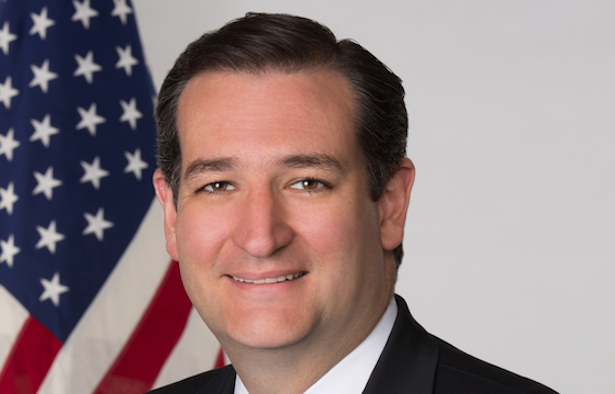
Sen. Ted Cruz, R-Texas.
But despite the volume and intensity of such rhetoric we hear very little about exactly how they would use force differently and even less about how any different measures should be expected to work. Even systematic efforts to catalog what candidates have said on the subject yield mostly spotty and vaguely phrased results.
The public mood being exploited is clear enough. A recent Monmouth University poll showed 78 percent of respondents believing ISIS to be “a major threat to U.S. security” and 68 percent saying that the U.S. Government is “not doing enough to defeat ISIS.” When asked whether ISIS can be stopped without U.S. troops, can be stopped only with U.S. troops, or cannot be stopped, a plurality (47 percent) said only with U.S. troops.
President Obama has felt it necessary to join in some of the public chorus on this topic. After a televised address from the Oval Office did not receive good enough…
Colombia Peace Talks Need Afro-Colombian, Indigenous Voices


Panel at USIP on opening the peace process to Afro-Colombian stakeholders; courtesy of USIP via Flickr
As the Colombian government and the FARC guerilla group continue negotiations to end Latin America’s longest-running conflict, a coalition of civil society organizations is calling for the inclusion of Afro-Colombian and indigenous voices in the peace talks.
Last week, the Latin America Working Group (LAWG), the Washington Office on Latin America (WOLA), and the Afro-Colombian National Peace Council (CONPA) sent a petition to the government and FARC negotiators urging them to establish a special commission to consider proposals by Afro-Colombian and indigenous groups related to the peace process.
WOLA senior associate Gimena Sánchez-Garzoli says that no such mechanism currently exists. “We call upon the Colombian peace negotiators in Cuba to remedy this situation by inviting an Afro-Colombian and indigenous delegation to Havana to set up a mechanism to include their perspectives and proposals before the final accord is signed,” she said in a statement.
“The Colombian government and the FARC must directly consider the collective proposals of the Afro-Colombian and indigenous peoples since they are disproportionately victimized by the conflict,” added CONPA’s international coordinator Marino Córdoba.
Several members of Congress have expressed similar sentiments. On Tuesday, Rep. Ruben Gallego (D-AZ) introduced a bipartisan resolution expressing support for the peace process, which acknowledges that “minority groups, including the Afro-Colombian, indigenous and rural communities…have been disproportionately harmed by the conflict.”
Colombia has the second largest Afro-descendent community in Latin America after Brazil. The 4.3 million Afro-Colombians make up about 10 percent of the total population — comparable to the United States. By some estimates, however, Afro-Colombians make up nearly one-third of the conflict’s displaced victims.
Colombia’s roughly one million indigenous people have also disproportionately suffered the effects of the conflict. According to the United Nations, “indigenous displacement often goes unregistered — due to the remoteness of indigenous territory, lack of access to state services and cultural barriers.” Colombia’s main indigenous organization has said that the conflict has contributed to the threat of extinction of many indigenous cultures.
Many independent experts have argued that the inclusion of Afro-Colombian and indigenous concerns in conversations about the peace process will be key to implementing any agreement reached between the government and the FARC.
“Only by consulting with and incorporating the just demands of those most brutally affected by the conflict can a lasting peace be constructed,” said LAWG executive director Lisa Haugaard.
The six-decade long conflict has left some 220,000 Colombians dead and nearly 6 million displaced from their homes. Although several previous attempts have failed to achieve a negotiated solution to the violence, the current peace process appears to be nearing a successful conclusion.
Just this week, the FARC and the government reached a tentative agreement on the issues of justice and reparations for victims of the conflict. The negotiators have pledged to reach a final accord to end the conflict by March of next year, lending additional urgency to calls for the inclusion of Afro-Colombian and indigenous voices in the talks.
“It’s a now-or-never type of thing,” said Angelika Albaladejo, a program associate at LAWG. “Either the delegates at the peace table make a legitimate effort to incorporate the proposals of Afro-Colombian and indigenous groups, or they risk signing an agreement that doesn’t address the concerns of some of the most-affected victims of the conflict.”
This piece was reprinted from Foreign Policy In Focus by RINF Alternative News with permission.
For Democrats, Debate Night Means Being Quizzed From the Right by Corporate Media

ABC‘s John Muir and Martha Raddatz, questioning Democrats on behalf of the 36 percent of Americans who agree with Donald Trump.
The Democratic and Republican debates have this asymmetry: Republican candidates are presumed to need ideological sympathizers among their questioners–Fox News, for example, or Salem Media, which teams up with CNN for GOP debates–while Democrats are thought content to be quizzed by representatives of mainstream corporate media outlets like CNN, CBS and ABC (FAIR Action Alert, 10/9/15).
This set up resulted, on the Republican side, in the spectacle of Salem Media‘s Hugh Hewitt pressing GOP contender Ben Carson to declare his willingness to “kill innocent children by not the scores, but the hundreds and the thousands.” (Carson’s response: “You got it. You got it.”)
And on the Democratic side, the result is debates like the one we got on December 19.
Although primary debates are ostensibly intended to help members of each major party select their nominee, the questions asked by the debate moderators from ABC–World News Tonight anchor John Muir and national security correspondent Martha Raddatz–consistently posed questions from the right.
As when Raddatz pressed Hillary Clinton: “Our latest poll shows that more Americans believe arming people, not stricter gun laws, is the best defense against terrorism. Are they wrong?” Or when she pushed Bernie Sanders on “sending US combat troops to join a coalition to fight ISIS.”
She asked a couple of questions “about a new terrorist tool used in the Paris attacks, encryption”–even though, as The Intercept‘s Dan Froomkin reported, evidence “suggests that the ISIS terror networks involved were communicating in the clear, and that the data on their smartphones was not encrypted.” Still, Raddatz was able to use the dubious encryption claims to push Clinton to “force [Apple] to give law enforcement a key to encrypted technology by making it law.”
As for Muir, he sought an endorsement of racial profiling from Sanders, citing “a neighbor in San Bernardino who reportedly witnessed packages being delivered to that couple’s home, that it set off red flags, but they didn’t report it because they were afraid to profile.” He also pushed Clinton and Martin O’Malley to endorse “the idea of a halt or a pause” in acceptance of Syrian refugees, and challenged Clinton to explain what was wrong with Donald Trump’s “proposed ban on Muslims coming to America,” given that “36 percent of Americans, more than a third, agree with him.”
What about the concerns of the nearly two-thirds of Americans who don’t agree with Donald Trump? Progressive perspectives on security and foreign policy were hard to discern in the questioning. As with the most recent Republican debate (FAIR Blog, 12/16/15), “terrorism” was treated as it meant “political violence by Muslims,” with right-wing mass killings like the Charleston church massacre and the assault on Planned Parenthood in Colorado Springs going unmentioned.
The drone war was ignored by the moderators, as were civilian casualties. The disastrous consequences of the Libyan intervention that Clinton presided over was brought up at one point, but the premise of the question was that Clinton “should have done more to fill the leadership vacuum left behind”–not that the secretary of State shouldn’t have been using military force to overthrow governments she disliked.
Even though the world’s leaders had reached a landmark climate change just a week before the debate, “climate change” and “global warming” didn’t pass the moderators’ lips.
ABC News‘ approach to domestic issues was not much different. Raddatz pressed on the cost of a single-payer healthcare plan–“Can you tell us specifically how much people will be expected to pay?”–and on his plan to make public colleges tuition-free: “How does that really lower the cost other than just shifting the cost to taxpayers?” She tried to get Clinton and O’Malley to promise not to raise takes on households making $250,000 or less–in other words, families who make more than 97 percent of the country.
Muir asked all three candidates a question about Black Lives Matter–but he focused on the “so-called Ferguson effect, police holding back because they’re afraid of backlash.” Voters who are worried about “a chill wind blowing through American law enforcement” were represented by ABC News–but those who are more worried about police officers killing unarmed African-Americans with impunity were out of luck.
Jim Naureckas is the editor of FAIR.org. Follow him on Twitter: @JNaureckas.
You can send feedback to ABC News here (or send messages on Twitter: @ABCPolitics. Please remember that respectful communication is the most effective.
This piece was reprinted by RINF Alternative News with permission from FAIR.
Video: Top U.S. & World Headlines – December 22, 2015
Democracy Now! is your independent media. You count on us to dig deeper and connect the dots between the issues you’ve cared about for years and the news …
Via Youtube
“Support the Troops” = Support Sexual Assaults

(RINF) – The epidemic of rape and sexual assault in the military was highlighted in the 2012 Oscar nominated documentary, The Invisible War. In the film, victims recounted their stories of abuse (by superiors and fellow enlisted personnel) along with the lack of recourse and an impartial judicial system, reprisals against the accusers versus the perpetrators, and the shortage of mental health support for the survivors of abuse.
The film led to various directives focusing on eliminating sexual assault in the military, from then Secretary of Defense Leon Panetta’s edict in 2012 taking the adjudication of these cases away from the commanding officers of the affected units, to President Obama’s signing of the National Defense Authorization Act for Fiscal Year 2013 which included improvements to the handling of sexual assault cases.
But it appears that nothing has changed.
On Monday, the Washington Post published an expose by Craig Whitlock detailing the empty promises made by the military to address the high rate of sexual assault in its ranks. Not only did the Army disregard their pledge to Congress to punish offenders, they actually allowed sexual predators to remain in posts where they were in charge of promoting sexual assault prevention.

It is so out of control that during a 4-day conference on sexual assault prevention in 2013 in Orlando, sheriff deputies were called to investigate a reported rape by one of the Army Reservists attending the session.
In another incident, seven women told investigators that Army Col. Morris “Reese” Turner — leader of a military training institute dedicated to the prevention of discrimination and sexual misconduct – had “inappropriately hugged them, rubbed their shoulders or touched them without consent.”

And of course, the Pentagon is under-reporting the number of assaults – by a lot.
According to the Defense Department, 6,131 sexual assaults occurred in the armed forces in 2014, yet in a 2014 Rand survey, 20,300 military members claimed they were sexually assaulted, of which 76% of women and 57% of men were assaulted at least twice, resulting in over 47,000 sexual assaults. Of the approximately 200,000 women in the military, about 5% reported that they had been a victim of sexual assault in 2014 alone.

I know many people who are in the military and I find most of them insightful, smart and good listeners. However, I cannot support their chosen profession, as I equate “supporting the troops” to supporting thousands of people who commit acts of sexual assault and other atrocities.
It’s probably true that all professions have a number of “bad apples” and it is unfair to view an entire group of people in a negative light based on the actions of a few. But 47,000 cases of sexual assault in 2014 means there are more than “a few” bad apples in the military.
Indeed, people in the United States military are 31 times more likely* to be a victim of sexual assault than people as a whole in the U.S.
And when a person joins the military today, they are volunteering to have a career that may entail killing people. In fact, anyone who serves in a combat role is at least partially responsible for creating refugees and for fueling anti-American sentiments. Add to that the rampant sexual assault issue, and it would be hypocritical for any antiwar or justice advocate to say they support such a profession.
That being said, some of the most dedicated and effective antiwar activists I know are veterans of the U.S. military. Those are the people who deserve support. The same is true for those who are conscientious objectors, and for those who have become whistle blowers, such as the four former drone war veterans who are speaking out against the indiscriminant killing of civilians killed by weaponized drones in Afghanistan (including children who were referred to as “fun-sized” terrorists).
Or the British soldier, Chris Herbert, who lost a leg while fighting in Iraq who speaks out against anti-Muslim sentiment. He passionately stated, “Yes. A Muslim man blew me up, and I lost my leg. A Muslim man also lost his arm that day wearing a British uniform. A Muslim medic was in the helicopter that took me from the field.”
When someone says they “support the troops” they are saying it is acceptable to have a career that kills people and that it is fine to be part of an institution that turns a blind eye to rape and sexual violence.
Instead of saying “thank you for your service” to someone who is in the military, we should be questioning them on their career choice and challenging them to at least actively work to stopping sexual assault within their ranks.
Notes:
* There are approximately 266 million Americans 12 years or older. According to the Justice Dept. there are 293,066 victims of rape or sexual assault each year. So a person in the U.S. has a 0.1% chance of being a victim of a rape or sexual assault.
There are approximately 1.37 million active duty U.S. military personnel, of which 43,000 were sexually assaulted in 2014. So a person in the U.S. military has a 3.1% chance of being a victim of a rape or sexual assault.
The Coming Saudi Crack-up?
By Daniel Lazare
Is the Saudi monarchy coming apart at the seams? Scholars and journalists have long predicted the kingdom’s demise, but this time the forecasts may finally prove correct.
The reason is an unprecedented avalanche of problems pouring down on Saudi Arabia since 79-year-old Salman bin Abdulaziz Al Saud assumed the throne last January. A hardliner in contrast to his vaguely reformist predecessor Abdullah, Salman lost no time in letting the world know that a new sheriff was in town. He upped the number of public executions, which, at 151, are now running at nearly double last year’s rate.

King Salman greets the President and First Lady during a state visit to Saudi Arabia on Jan. 27, 2015. (Official White House Photo by Pete Souza)
After meeting with Turkish President Recep Tayyip Erdogan, he promised to intensify efforts to topple Syrian President Bashar al-Assad by increasing aid to Al Nusra, Al Qaeda’s official Syrian affiliate. A few weeks later, he assembled a coalition of nine Sunni Arab states to launch nightly bombing raids on Yemen, quickly reducing one of the poorest countries in the Middle East to ruin.
People certainly took notice. But if Salman thought such actions would win him respect, he was wrong. Instead, the result has been a steady drum beat of negative publicity as the world awakes to the fact that, with its public beheadings and barbaric treatment of women, the Islamic state headed by the House of Saud is little different from the Islamic State headed by Abu Bakr al-Baghdadi in northern Syria and Iraq.
Topping the kingdom’s list of woes is the economy. With its stubbornly high unemployment rate and growing wealth gap between the rich and poor, Saudi Arabia has long been the sick man of the Persian Gulf. Even though planners have been talking about economic diversification since the 1970s, the…
Video: Sy Hersh: Backing Assad’s Ouster, Has Hillary Clinton Forgotten the Lessons of Iraq & Libya?
At Saturday’s Democratic presidential debate, front-runner Hillary Clinton rejected what she called a “false choice” between defeating the Islamic State and …
Via Youtube
Video: Seymour Hersh’s Latest Bombshell: U.S. Military Undermined Obama on Syria with Tacit Help to Assad
A new report by the Pulitzer-winning veteran journalist Seymour Hersh says the Joints Chiefs of Staff has indirectly supported Bashar al-Assad in an effort to help …
Via Youtube
The Trans-Pacific Trade Scam

Last spring, President Barack Obama got downright crabby about people criticizing the mammoth Trans-Pacific Partnership he’s trying to sell to Congress and the public.
More and more Americans are learning that the TPP would undermine America’s very sovereignty, giving multinational corporations direct access to secretive tribunals that could roll back any consumer, labor, or environmental laws that global corporate giants don’t like.
Yet an irked Obama denies that this is true: “They’re making this stuff up,” he cried. “No trade agreement is going to force us to change our laws.”
Perhaps he was misinformed. Perhaps he hasn’t actually read the deal he’s pushing. Or – dare we say it? – perhaps he’s lying.

Fast Tracking the TPP, an OtherWords cartoon by Khalil Bendib
In unmistakable language, the TPP does indeed create the private, corporate-run mechanism for changing our laws. Moreover, surely Obama knows that foreign corporations are already doing this indirectly.
Through little-known provisions in past trade scams, powerful corporations in other countries have pressured their governments to challenge our laws in similar tribunals.
From Canada to Malaysia, many countries have – on behalf of their corporate powers – successfully forced Congress and U.S. agencies to weaken or eliminate everything from environmental protections to consumer right-to-know laws.
In fact, this very year, Obama’s own administration has been told by the World Trade Organization that it must alter or repeal America’s laws on labeling foreign agricultural products.
This TPP flimflam would elevate profiteering corporations to the legal status of sovereign nations, empowering them to sue directly in rigged corporate courts “to force us to change our laws.” Obama knows this–and if he doesn’t, he should.
Either way, it destroys his presidential credibility and moral authority to keep pushing this giveaway of our people’s sovereignty.
The post The Trans-Pacific Trade Scam appeared first on OtherWords.
This piece was reprinted from Other Words by RINF Alternative News with permission.
Video: “Why Are People Shocked That Liar Politicians Broke Promise Not To Frack National Parks?”
Please Support The Show — http://richieallen.co.uk/ http://www.Meria.Net/ https://www.facebook.com/therichieallenshow …
Via Youtube
Do Racists Like Fox News, or Does Fox Make People Racist?

Watching Bill O’Reilly’s network seems to have a powerful effect on viewers’ racial attitudes. (image via Crooks & Liars)
Since the election of Obama in 2008, Americans have become increasingly polarized about racial issues. At the same time, Americans have also become more polarized in their news media viewing habits. In the wake of horrifying events like the racially motivated mass murder in a Charleston church, some have connected these trends; Jon Stewart (Comedy Central, 3/19/15), for example, criticized Fox News for ignoring the reality of systemic racism.
Is there any merit to such criticisms? Do media and racial polarization reinforce each other? Is there a connection between news media viewing habits and attitudes about racial equality? Based on an analysis of the American National Election Studies 2012 dataset, we find that white respondents who regularly watch Fox News are more likely to express attitudes of symbolic racism and racial resentment. This is especially true of those Fox News viewers who live in the South.
One common expression of racial resentment is the stereotype that black people have disproportionate influence over the levers of power. Though people of color are far more likely to live under an unrepresentative city council and have far less influence over policy, many racist whites wrongly think that government disproportionately benefits non-whites through social programs.
Our analysis suggests that regular Fox News viewers are more likely to hold such opinions, even after controlling for other factors such as individual race, age, income, education, partisanship, ideology, religiosity and geography. In the graph below, we compare conservative white Republicans who watch Fox News regularly to those who do not. The results show that regular Fox News viewers are significantly more likely to think that blacks have too much political influence. Those Fox News viewers who live in the South are the most likely to hold such attitudes.

The graph indicates that watching Fox News makes a non-Southerner just as likely to think blacks have too much political power as a Southerner who doesn’t watch Fox News regularly. These findings give credence to the idea that Fox News coverage that stokes such racist mythologies (see, e.g., Extra!, 9/13) may indeed be reinforcing negative racial stereotypes.
Increasingly, racism hides behind an ideology of “colorblindness,” a phenomenon sociologist Eduardo Bonilla-Silva discusses in his book Racism Without Racists. ANES has several questions that can help identify such colorblind racism. One asks respondents whether “it’s really a matter of some people not trying hard enough; if blacks would only try harder, they could be just as well off as whites.” The graph below shows that Republicans are significantly more likely to agree with this statement compared to Democratic partisans.

Among those who watch Fox News regularly, the same pattern holds, but with an additional twist. Democrats who watch Fox News regularly are far more likely to agree that blacks must work harder than Democrats who do not watch Fox News. In fact, their views become indistinguishable from those of Republicans are who do not watch Fox News.
In another assessment of whether respondents view structural racism as a barrier to black upward mobility, respondents are asked if they agree that “Irish, Italians, Jewish and many other minorities overcame prejudice and worked their way up. Blacks should do the same without any special favors.” Here, being a regular viewer of Fox News significantly predicts an affirmative response.

Controlling for other important factors, Fox News viewers are much less likely to agree that structural racism is a barrier to black upward mobility. Fox News viewers are also more likely to disagree that “generations of slavery and discrimination have created conditions that make it difficult for blacks to work their way out of the lower class,” and less likely to agree that “’over the past few years, blacks have gotten less than they deserve.”
In total, of the 10 racially related variables examined, five showed a statistically significant Fox News effect. While Fox News viewership appears to influence views related to racial resentment, the effects on perceptions of discrimination, and stereotypes about intelligence and work ethic, are not statistically significant: Fox News didn’t predict whether respondents think discrimination against blacks is still a problem, or whether they stereotyped black people as unintelligent.
Indeed, there was no Fox News effect across the entire battery of variables that measure overt racial stereotyping (Hispanic/Latino, Asian and black). This is consistent with other research that suggests that racism in America today consists less of overt racial stereotyping (i.e., black people are unintelligent) and more of racial resentment (i.e., black people need to work harder to be as successful as whites). This could make discourse about racism difficult, as progressives and conservatives adopt different ideas about how racism shapes American society.
Because of the recent waves of Islamophobic violence and heated rhetoric on the right, we were curious about the possibility that Fox News stoked these tensions. Republicans who watch Fox News regularly, compared to other Republicans, are slightly (but statistically significantly) more likely to say that “violent” describes Muslims well. Democrats who watch Fox News regularly are dramatically more likely to say that “violent” describes Muslims well than other Democrats. In fact, Democrats and Republicans who watch Fox News regularly are equally likely to say that violent describes Muslims well. This result is stunning, and repeats what we saw above: Watching Fox News may be a stronger indicator of bias on some racial issues than than party affiliation.

Does Fox News attract racist viewers, or is there something about Fox News that makes their viewers more racist? Or is there some other factor that isn’t examined here driving both trends? Although it’s impossible to say definitively, we can find clues in previous research.
First, studies find that Fox News viewers do seem to have views that are different from the general viewing population–tending to underestimate casualties in Iraq, for example. Other research suggests that some of the issues Fox viewers diverge on relate directly to racial issues. A study of the proposed NYC “Ground Zero” mosque suggests that those who relied heavily on Fox for their news were more likely to believe false rumors about the cultural center and mosque–for example, that the imam who supported it was a terrorist sympathizer.
A 2010 report found that those who watched Fox News “almost daily” were 31 percentage points more likely to believe that “it is not clear” that Obama was born in the United States. ANES also suggests that Fox News viewers (both Republican and Democrat) are significantly more likely to think Obama was not born in the United States than non-viewers.

In addition, one study has documented an independent Fox News effect: that Republican vote share increases when a town gains access to Fox News. If the channel can mobilize votes for the GOP, it seems reasonable that it might affect viewers’ racial perceptions. Two other academic studies find that Fox News has the power to influence policy. A 2012 study by political scientists Joshua Clifton and Ted Enamorado found that “representatives from districts where Fox News begins broadcasting become slightly more conservative” (and that the effect was strongest among Democrats). More recently, political scientists Kevin Arceneaux and his colleagues found that “Fox News caused both Republicans and Democrats in Congress to increase support for the Republican Party position on divisive votes,” though this effect was limited by electoral pressures.
Other studies suggest that media coverage can affect viewers’ attitudes about race: Research shows that local media coverage of crime that is heavily racialized increases anti-black attitudes among white viewers. The long history of race-baiting at Fox News raises suspicions that its coverage is indeed affecting its viewers’ racial attitudes. More research needs to be done, but it appears that Fox News‘ connection to racial polarization may be a powerful one.
Sean McElwee is a research associate at Demos. Follow him on Twitter @SeanMcElwee
Jason McDaniel is an Assistant Professor of Political Science at San Francisco State University. Follow him on twitter at @ValisJason
You can write to Fox News at yourcomments@foxnews.com (or on Twitter: @FoxNews). Please remember that respectful communication is the most effective.
This piece was reprinted by RINF Alternative News with permission from FAIR.
Solidarity! Jeremy Corbyn heads to Portugal, heralds anti-austerity victory

Labour Party leader Jeremy Corbyn will hammer home the victory of Portugal’s new leftist government and promote its fight against austerity by embarking on a solidarity tour of the country.
The veteran socialist had struck up a friendship with Portugal’s new Prime Minster Antonio Costa and will be visiting the country in solidarity, the Morning Star reports.
“We’re going to do that in support of their anti-austerity program. We’re building an anti-austerity coalition across Europe,” Corbyn told the paper.
The Independent Press Standards Organisation (IPSO) found the story was inaccurate and that the inaccuracies had been “repeated throughout the article.”
The Sun printed an eleven-word retraction on its front page. On page 2, the paper said: “IPSO’s complaints committee found that it was significantly misleading to claim that Labour’s access to the £6.2 million depended on whether Mr Corbyn was a member of the Privy Council.
“The two were not formally connected and the article did not make clear how a majority of the funding was in fact allocated. The committee upheld the complaint,” the Sun acknowledged.
This piece was reprinted by RINF Alternative News with permission or license.
Via RT.
US military provided Assad with intel on extremists via Russia, Israel & Germany – report

The Pentagon’s Joint Chiefs of Staff has been indirectly providing Syrian military with intelligence on Islamic extremists fearing the Obama administration’s agenda to oust Bashar Assad will engender total chaos in Syria.
A new investigation in the London Review of Books by renowned American journalist Seymour M. Hersh exposes the divide between the US top brass and the politicians in the White House when it comes to dealing with Islamic extremists in Syria and Iraq.
It seems the US JCS isn’t enthusiastic about Obama’s “Assad must go” maxima, opting to provide Damascus with intelligence and analytics on the jihadists instead. This is, however, done indirectly, an unidentified former senior adviser to the Joint Chiefs told Hersh.
In summer 2013, a highly classified report prepared by the Defense Intelligence Agency (DIA) and the JCS assessed that ousting President Assad would create chaos in the country, making it an easy prey for Islamic extremists.
By that time, the CIA had been delivering weapons from Libyan arms depots to Syria via Turkey for over a year. This began soon after the assassination of Libyan strongman Muammar Gaddafi, writes Hersh.
The arms were handed to any group opposing Assad’s military, including Jabhat al-Nusra and Islamic State. The so-called ‘moderate rebels’ had “evaporated and the Free Syrian Army was a rump group stationed at an airbase in Turkey,” the source told the journalist. The US military assessment was realistic: moderate opposition to Assad is a myth and the US was arming Islamic extremists.
The DIA’s former head, Lieutenant General Michael Flynn, recalled the report “got enormous pushback” from the Obama administration, which “did not want to hear the truth.”
“If the American public saw the intelligence we were producing daily, at the most sensitive level, they would go ballistic,” Flynn said.
“The JCS believed that Assad should not be replaced by fundamentalists,” the former JCS adviser told Hersh.
Under the circumstances, the US military realized that a direct challenge to Obama’s policy was doomed to failure, so the Pentagon’s, General Martin Dempsey, allegedly decided to oppose the extremists without using “political channels.”
To fight the common enemy of Jabhat al-Nusra and Islamic State, US intelligence was provided to third party militaries, such as Germany, Israel and Russia.
“It was clear that Assad needed better tactical intelligence and operational advice,” the former JCS adviser told Hersh, noting, “Obama didn’t know, but Obama doesn’t know what the JCS does in every circumstance and that’s true of all presidents.”
The adviser stressed there was no direct contact between the US and the Syrian military.
“It was a military to military thing, and not some sort of a sinister Joint Chiefs’ plot to go around Obama and support Assad,” the source said. “If Assad remains in power… it’s because he was smart enough to use the intelligence and sound tactical advice we provided to others.”
With the full knowledge of Syrian intelligence, the US embassy in Syria had spent millions of dollars over a long period financing dissidents aiming to destabilize the country. These efforts took place while President Bashar Assad was trying to establish friendly relations with Washington.
Following the 9/11 terror attack, “Bashar was, for years, extremely helpful to us while, in my view, we were churlish in return, and clumsy in our use of the gold he gave us,” a longtime consultant to America’s intelligence community told Hersh.
By 2002, Assad had turned over large amounts of information regarding the Muslim Brotherhood’s activities in Syria and Germany. In the same year, Syrian intelligence foiled an Al-Qaeda attack on the headquarters of the US Navy’s Fifth Fleet in Bahrain.
Hersh alleges that at the time a Damascus prison was used for torturing terrorist suspects held captive by the CIA, as was happening in other countries involved in its secret rendition program.
However, despite Assad’s generous support the White House’s attitude towards the Syrian leader remains the same — negative.
Via RT.
Apple warns about UK surveillance powers bill

The tech giant Apple has warned that a plan set forth by the UK government to give intelligence agencies extra online surveillance powers could weaken the security of personal data for millions of people and paralyze the tech sector.
The proposals for new online powers were unveiled last month by the government as part of measures “needed to keep the country safe from criminals, fraudsters and militants, including the right to find out which websites people visit.”
The plan has sparked harsh criticism from many observers saying the Investigatory Powers Bill gives British spies authority beyond those available in other Western countries.
“We believe it is wrong to weaken security for hundreds of millions of law-abiding customers so that it will also be weaker for the very few who pose a threat,” the company said.
Apple gave its response to a British parliamentary committee which is in charge of considering the new bill. This is the latest clash between Western governments seeking to monitor the threat from extremist groups and online companies working to maintain security.
Poland: Anti-government rallies continue as Lech Wałęsa warns of civil war
By Dorota Niemitz and Clara Weiss
For the second time this month, thousands took to the streets in Poland to protest against the continuing assault on the country’s laws and governing institutions by the newly elected administration of Law and Justice (PiS). It is estimated that about 20,000 demonstrated in front of the parliament in the country’s capital Warsaw last Saturday. This is less than half the crowd of about 50,000 that gathered in front of the Presidential Palace the previous Saturday. Smaller demonstrations took place in 21 cities all over the world, including protests in front of Polish embassies in Berlin, London and New York.
The protests were organised by the Committee for the Defence of Democracy (KOD), which was set up by figures supporting the main opposition parties Civic Platform (PO) and the Polish People’s Party (PSL). The protests are directed against the constitutional coup by the PiS government, which has sought to disempower the Constitutional Tribunal in the first few weeks of its rule and bring the security services under its control. The protests have been supported not only by PO and PSL, but also by the neo-liberal party Nowoczesna (Modern), led by the economist Ryszard Petru.
The protests attracted mostly layers of the urban liberal intelligentsia and the upper middle class. In Warsaw, the protesters also included numerous students and young professionals. Many protesters carried Polish flags, fewer carried EU (European Union) flags. Signs at the protests read: “Hands off the Tribunal”, “No to PiSlamization”, “Duda must go”, a reference to President Andrzej Duda. Chants included: “We defend democracy”, “A free Poland, a democratic Poland” and “Poland is here”. At one point, protesters in Warsaw also chanted: “We have the Polish flag in our heart.”
The protest in Warsaw ended after two hours, one hour earlier than planned, because of an anonymous bomb threat. In Warsaw, the KOD provided their own security guards, assisting the police to keep order at the rally.
 Protesters in Warsaw
Formed only little over a month ago, the PiS government has already managed to disempower the Constitutional Court, take full control of the intelligence services and has threatened to gag the media and cultural institutions. In addition, it is moving to suppress political opposition with its proposed “anti-terrorism” act. It has also begun to purge the civil service sector by replacing senior officials in key positions with figures loyal to PiS.
After President Andrzej Duda’s refusal to respect the orders of the Constitutional Tribunal and swear in three tribunal judges elected by the former parliament, the PiS parliamentary majority is now moving quickly to completely paralyze the court by introducing a new bill that would require all court rulings to be agreed by 13 out of 15 elected justices with a two-thirds majority of votes.
The newly proposed public administration bill aims at making drastic changes in the civil sector by eliminating the institution of the Civil Service Council as well as the requirement to recruit civil service candidates through open competition–thereby clearing the way for senior positions to be selected on political grounds. The bill would also erase the current provision prohibiting those with recent political affiliations (less than five years) to hold office in the civil service department.
In the middle of the night on December 18, the military police raided NATO’s Warsaw counterintelligence office and removed personnel appointed by the former Civic Platform (PO) government. Sacked from his post, Colonel Krzysztof Dusza told the TVN24 station that he had not received a written dismissal order.
The policies of PiS have also prompted criticism from representatives of the European Union and German imperialism, who have signalled support for the opposition rallies. The president of the European Parliament, Martin Schulz (German Social Democratic Party), declared that events in Poland had the character of a “coup d’état”. The situation, already causing political tensions between Poland and Germany, is scheduled for a debate in the European Parliament on January 19, 2016.
A few days before the latest protests, Lech WaÅ‚Ä™sa, the former head of the Solidarity trade union and first president of the Polish Republic after the dissolution of the Polish People’s Republic in 1989, warned that the constitutional crisis could escalate into a “civil war”. In an interview for TVP Info “DziÅ› Wieczorem” (“Tonight”), WaÅ‚Ä™sa expressed his anger over the way the new government was behaving, stating he was beginning to be ashamed of the election of PiS. “They must start getting themselves under control or there will be a civil war”, WaÅ‚Ä™sa warned.
The former president criticized President Duda (PiS), stating that “he was doing everything to divide Poles, to irritate them”. At the same time, WaÅ‚Ä™sa said he supported many of the reforms envisaged by PiS, “but not in this way.” They had to be implemented “in an open and democratic way”. “This needs to be corrected”, he said. Referring to the PiS leadership, he said, “I will try to convert these people. They are my colleagues, I would not like to come out against them.”
WaÅ‚Ä™sa also called for a referendum to shorten the parliament’s and president’s terms in office: “The referendum needs to be called. It will be won. They [PiS] will not honour it, but there will be such a pressure from the [masses in the] streets, that they will be physically thrown out.”
WaÅ‚Ä™sa’s statements are a clear attempt to warn the ruling elite of the danger of social upheaval. WaÅ‚Ä™sa fears that under conditions of increasing divisions within the bourgeoisie and a lack of support within the upper-middle class for the government, the working class could intervene.
Social tensions in Poland run high, with youth employment at 25 percent, a deeply impoverished countryside and widespread poverty wages. The blatant assault by the PiS government on democratic rights has led to a quick loss of support for Duda, who was elected in May this year. In a poll by IBRIS Onet, close to 60 percent of the respondents regarded Duda’s presidency as negative. Duda is seen by many as a puppet of the ruling PiS’ strongman, JarosÅ‚aw KaczyÅ„ski.
Wałęsa is one of the most experienced bourgeois politicians in Poland; he played a key role in the restoration of capitalism in Poland and was president from 1990 to 1995. He has gone on record supporting the policies of the right-wing dictator Józef Piłsudski, who ruled Poland from 1926 to 1935 and was responsible for the jailing and persecution of thousands of trade unionists and socialists.
In an interview with Polish television several years ago, WaÅ‚Ä™sa said that he believed in democracy the same way as did Józef PiÅ‚sudski, the “First Marshal of Poland”, that is by bringing back law and order through a coup d’état. He openly suggested that he was preparing for such an option in the future to prevent a working class revolution, which will inevitably erupt if out of control capitalism continues on its current course.
Via WSWS. This piece was reprinted by RINF Alternative News with permission or license.
Trump’s Ban on Muslims Is Unconstitutional and Obscures Real Solution
Legal scholars don’t agree on whether Donald Trump’s demagogic proposal to
temporarily ban any of the world’s 1.6 billion Muslims from entering the United
States would be constitutional. That disagreement says more about the sorry
state of the constitutional law profession than it does about the quality of
Trump’s proposal.
Over the course of American history the U.S. courts, including the Supreme
Court, have “interpreted” the Constitution into a document that the
nation’s founders would hardly recognize. For example, when making his proposal
for banning Muslims, Trump spoke favorably of Franklin D. Roosevelt’s internment
of Japanese-Americans (and Japanese residents) during World War II. This episode
has been properly recognized by historians as one of the darkest in American
history, yet the Supreme Court at the time had no problem with this flagrant
violation of the Fifth Amendment’s due process clause that no person (the Constitution
does not even require a person to be a citizen to get this protection) shall
“be deprived of life, liberty, or property, without due process of law”
or the Sixth Amendment’s requirements of a jury trial.
The incarceration of Japanese-Americans has bearing on the current case of
Muslims, because it derives from the same irrational fear that gripped the nation
after the Japanese attacked Pearl Harbor — only now, the excuse doesn’t exist
that today’s threat seems as dire. Even then, in the actual war zone of Hawaii,
the restrictions on Japanese-Americans and Japanese residents were less harsh
than in the continental United States, thousands of miles from Hawaii. Furthermore,
two federal government studies, including one by the FDR White House, had shown
that Japanese-Americans and Japanese residents were loyal to the United States
and posed no security threat. FDR, always the consummate politician, reprehensibly
incarcerated more than 100,000 innocent people in prison camps merely to respond
to the war hysteria of the citizens of California, an important electoral state.
Many of these Japanese-Americans lost everything. The Supreme Court also upheld
bans on the entry of Chinese laborers in the late 1800s — another dark episode
in American history.
A Call for Proof on Syria-Sarin Attack
One reason why Official Washington continues to insist that Syrian President Bashar al-Assad “must go” is that he supposedly “gassed his own people” with sarin on Aug. 21, 2013, but the truth of that allegation has never been established and is in growing doubt, U.S. intelligence veterans point out.
MEMORANDUM FOR: U.S. Secretary of State John Kerry, and Foreign Minister of Russia Sergey Lavrov
FROM: Veteran Intelligence Professionals for Sanity (VIPS)
SUBJECT: Sarin Attack at Ghouta on Aug. 21, 2013
In a Memorandum of Oct. 1, 2013, we asked each of you to make public the intelligence upon which you based your differing conclusions on who was responsible for the sarin chemical attack at Ghouta, outside Damascus on Aug. 21, 2013. On Dec. 10, 2015, Eren Erdem, a member of parliament in Turkey, citing official documents, blamed Turkey for facilitating the delivery of sarin to rebels in Syria.
Mr. Kerry, you had blamed the Syrian government. Mr. Lavrov, you had described the sarin as “homemade” and suggested anti-government rebels were responsible. Each of you claimed to have persuasive evidence to support your conclusion.

U.S. Secretary of State John Kerry on Aug. 30, 2013, claims to have proof that the Syrian government was responsible for a chemical weapons attack on Aug. 21, but that evidence failed to materialize or was later discredited. [State Department photo]
Neither of you responded directly to our appeal to make such evidence available to the public, although, Mr. Lavrov, you came close to doing so. In a speech
at the UN on Sept. 26, 2013, you made reference to the views we presented in our VIPS Memorandum, Is Syria a Trap?, sent to President Obama three weeks earlier.
Pointing to strong doubt among chemical weapons experts regarding the evidence adduced to blame the government of Syria for the sarin attack, you also referred to the “open letter sent to President Obama by former operatives of the CIA and the Pentagon,” in which we expressed similar doubt.
Mr. Kerry, on Aug. 30, 2013, you blamed the Syrian government, publicly and repeatedly, for the sarin attack. But you failed to produce the kind of “Intelligence Assessment” customarily…
How the Islamic State Is Like a Multinational Corporation


The Islamic State is aligning itself with affiliates in Asia and Africa. (Photo: Wikimedia Commons)
Many in the United States have failed to see the urgency of the Islamic State because it seemed focused on the Middle East and thus a good candidate – whether you’re coming from the left or libertarian right – for non-intervention. But the attacks in Paris and San Bernardino have disabused us of the notion that the Islamic State isn’t afraid to punch above its weight and take on Europe and the United States. At Politico Magazine, Harleen Gambhir writes:
ISIL’s global strategy should come as no surprise. In fact, ISIL has pursued an international expansion campaign from the moment it declared its “caliphate” in June 2014. While the group solidifies its proto-state in parts of Iraq and Syria, it also is expanding its would-be caliphate regionally – and preparing for the apocalyptic war it desires with the West.
To expedite that, the Islamic State is “fostering affiliates in Muslim-majority areas and directing and inspiring terror attacks in the wider world,” including “Egypt, Libya, Afghanistan, Pakistan, Yemen, Saudi Arabia, Algeria, Russia and Nigeria,” and, in the future, Bangaladesh, Tunisia, and Somalia. Mergers and acquisitions, in other words!
(Breaking for an incipient panic attack as we briefly contemplate the Islamic State taking over the world.)
Kruse writes that, “Its growth strategy is sophisticated and systematic” – wait for it – “much like a multinational corporation expanding by acquisition.”
Rather than build affiliates from the ground up, ISIL co-opts and changes existing militant groups or networks, some of which have splintered from Al Qaeda. Potential affiliates must consolidate factions, select a leader and present a military plan to ISIL’s leadership for approval, according to ISIL’s own standards.
Also, like a multinational, the Islamic State performing due diligence.
ISIL then chooses whether to establish a wilayat, or province, in the affiliate’s operating area. ISIL’s leaders help these affiliates to become more brutal and effective by exporting military training and expertise. ISIL calls for international recruits to reinforce its strongest partners; it also provides military training and funding to some affiliates.
The irony of the Islamic State’s resemblance to a multinational corporation is almost too delicious. But, it plans ahead, unlike multinationals (seem to, at any rate).
ISIL’s most dangerous affiliates are those that give the group strategic resilience: They’re strong enough that they could help the group survive even if the group were to be wiped out in its home territory of Syria and Iraq.
This piece was reprinted from Foreign Policy In Focus by RINF Alternative News with permission.
Threat to the establishment, David Icke, speaks out over ‘calculated’ Australia speaking visa delay

by Mick Meaney
(RINF) – In a statement to RINF Alternative News, the UK’s most prominent political researcher, David Icke, has revealed why he believes the Australian government has prevented him from speaking in the country.
Despite being approved for entry in both 2009 and 2011, last week it emerged that his most recent application which he made in September, as part of his forthcoming ‘Worldwide Wake Up’ tour, has been denied. Additionally a significant amount of paperwork has been requested, that further delays the process.
This is an indication that as Mr Icke’s popularity and influence has grown through the decades, he has now become a very real threat to the establishment, in particular governments that are under the control of the British Monarchy.
Once dismissed as an outlandish ‘conspiracy theorist’, David Icke’s research into the political spectrum, corporate corruption and crimes of the establishment demonstrate a level of credibility and accuracy that you will rarely find in the mainstream media. This combined with his unique ability to accurately predict political moves on the world stage, often years in advance, has forced many to sit up and take notice.
Speaking to RINF, David Icke said:
‘The Australian government through their embassy in London has embarked on a calculated delay with the visa to stop my speaking events in the summer without actually officially banning me – which would expose their true motivations with regard to basic freedoms in Australia.
They will have to do that eventually, or relent, but for now they are systematically squeezing the run-up time to the events that will soon make it impossible for them to take place. It is not possible to finalise everything obviously until I have permission to enter the country and they know that.
They are playing the same juvenile game with others, too.
The blatant and child-like behaviour of the Australian authorities with regard to my speaking visa is testament to where the real power lies if only people would realise this simple fact.
I am one man living 13,000 miles away while they have the full force of the Australian and even global establishment (cabal) behind them. Yet they are frightened of me coming into their country to deliver information that they don’t control.
They are terrified of information because its suppression is their lifeblood and their means of control through the perception deception. I have had the same situation in Canada since the 1990s and I have found the authorities in both countries to be mirrors of each other – both ultimately answer to the British establishment and monarchy.
The way to stop this is for a public outcry and campaign against their arrogant and tyrannical efforts to stop their people hearing information that they freely choose to hear. The response so far has been good, but it never ceases to amaze me that people who claim that ‘something should be done’ about the deletion of freedom can’t even be bothered to sign an online petition or write an email.
Then they say in relation to the state of the world: ‘But what can we do?’ I have to laugh or I would cry.
We have also had the grotesque sight of a man in New Zealand having the video I made explaining the situation taken down by YouTube on the grounds of an outline of Australia on a computer screen in the background that the man claims he owns.
That is an extraordinary statement about his priorities with regard to human freedom and this is such an example of why it is so easy for a few to control the masses. Child-like authorities need child-like people to control and prosper and the human race is awash with them.
Until that is changed nothing else can.
But at least many more are awakening from the mind program – and we now need urgently to go to the next stage when action replaces mere words, even if it only means signing a petition or writing an email to a minister.
The fact that so few have done so thus far when compared with the numbers who have seen the story shows how far we still have to go.
Defending basic freedom? Can’t be bothered, mate.’
Supporters have rallied to sign a petition calling for Mr Icke to be allowed into the country, which at the time of publication has almost 3,000 signatures. The petition will be forwarded to Australia’s Minister for Immigration and Border Protection, Peter Dutton.
Video: Paris attack fallout: Airport sacks Muslim employees for long beards
Two Muslim security guards have been fired from a Paris airport for having long beards as this caused unease among passengers, French media report.
Via Youtube
Video: Lone wolf attacks will soon morph into guerrilla war inside Europe – ex Pentagon adviser
The war in Syria and Iraq has turned into a stalemate. Everyone fights for themselves, and neither US airstrikes, nor Assad’s army efforts are able to deal with …
Via Youtube
Video: 60% of Syrian rebel groups share ISIS ideology – report
The West is making a strategic mistake by focusing its anti-terrorist effort on Islamic State (IS. previously ISIS/ISIL) and overlooking other groups, an upcoming …
Via Youtube
Video: FIFA’s Blatter, UEFA’s Platini banned from football for 8 years
FIFA’s ethics committee has banned its suspended president, Sepp Blatter, and European soccer boss Michel Platini for eight years. Blatter pledged to challenge …
Via Youtube
Video: Safe and sound: Falcon 9 rocket successfully launched & booster relanded
Elon Musk and his team have launched a Falcon 9 rocket and successfully re-landed it. READ MORE: http://on.rt.com/7037 RT LIVE http://rt.com/on-air …
Via Youtube
Video: As Sanders Chides Clinton on Regime Change, Is Democratic Front-Runner Touting a GOP Foreign Policy?
Democracy Now! is your independent media. You count on us to dig deeper and connect the dots between the issues you’ve cared about for years and the news …
Via Youtube
Video: Bernie Blackout? As DNC Accused of Targeting Sanders, Corporate Media Ignores Historic Campaign
Democracy Now! is your independent media. You count on us to dig deeper and connect the dots between the issues you’ve cared about for years and the news …
Via Youtube
Video: Bernie Sanders on Challenging Wall Street: “CEOs May Like Hillary — They Ain’t Going to Like Me”
Democracy Now! is your independent media. You count on us to dig deeper and connect the dots between the issues you’ve cared about for years and the news …
Via Youtube
Video: Is the DNC Afraid of Democracy? Clinton WH Counselor Says Party a “Dead Carcass” for Stifling Debate
Democracy Now! is your independent media. You count on us to dig deeper and connect the dots between the issues you’ve cared about for years and the news …
Via Youtube
Seeing ‘Evil’ Everywhere
Today’s American politics sees demons everywhere — from “evil” foreign leaders to excessive fears about “terrorism” — while more mundane threats like crumbling roads, loss of good-paying jobs and inadequate health care get short-shrift, misplaced priorities addressed by ex-CIA official Graham E. Fuller.
By Graham E. Fuller
It is depressing to witness the ongoing vitriolic voices of vituperation spewing out over the airwaves these days in what passes as “political debate,” especially in Republican circles. Depressing also to know that we still have nearly a year more to go of this same political circus of infotainment whose chief purpose really is to distract the public from the deeper, darker and more pressing issues that affect the nation and beg urgent discussion.
So history sometimes help us put these things in a little perspective. A fine article from the New York Times a few days ago – “Anger: An American History”– provides some taste of the raucous history of prejudice, paranoia, fear and anger that seems perhaps always to have been part of the American political and social scene.

A drawing of the Salem “witch trials,” with the central figure believed to be Mary Walcott.
It’s unsettling in one sense – you can’t help but wonder if there’s any progress to be perceived over several hundred years. But yet there is progress of a kind. And in another sense it reminds us that things right now are not uniquely bad – and that perhaps much of this simply has to do with the human condition.
And of course no country is without its prejudice, racism, paranoia, xenophobia and discrimination. Only somehow we expected our immigrant society to aspire more to the ideal of “The City on the Hill.”
At least it helps realize that this particular stage too will eventually pass – or give way to something else. And while American Muslims for many reasons now bear the particular brunt of such vituperation, the pithy old Turkish proverb provides perspective as well: it ürür kervan yürür – the dogs bark but the caravan moves on.
Graham E. Fuller is a former senior CIA official, author of numerous books on the Muslim World; his…
WaPo Gets Iran Missile Story Exactly Backwards

The Washington Post editorial on Iranian missile tests turns their purpose on its head. (photo: Iranian Defense Ministry)
As Reuters (10/11/15) reported in October:
Improvements in accuracy could let Iran use its missiles in a wider variety of roles, for example by targeting military bases or economic assets rather than population centers.
The IISS noted in 2010 that poor accuracy meant Iran could use its missiles only as a “political weapon” to target enemy cities since their military utility was “severely limited.”
Israel, the only Mideast country that does have nuclear weapons, has repeatedly threatened to bomb Iran. Given that Israel has already bombed Iraq, Syria, Lebanon, Jordan, Egypt and Tunisia, there’s no need for the Post to attribute “nuclear ambitions” to Iran to explain why it would be interested in developing a credible deterrent to the prospect of an Israeli attack.
Jim Naureckas is the editor of FAIR.org. Follow him on Twitter: @JNaureckas.
Messages can be sent to the Washington Post at letters@washpost.com, or via Twitter @washingtonpost. Please remember that respectful communication is the most effective.
This piece was reprinted by RINF Alternative News with permission from FAIR.
Is the EU Breaking Up? Sanctions Against Russia Are Extended.

Eric Zuesse
Not only is there dissension within the European Union on account of the Polish President of the European Commission’s having rammed through on December 21st an extension of economic sanctions against Russia, but on the same day, the person who (though only until the end of this year) speaks for the Presidency of the European Union, who is Luxembourg’s Foreign Minister Jean Asselborn, said that Poland’s new far-right government is going too far to change Poland’s own Constitution in order to enable that government to do what it wants to do. He says: if that Polish Party carries it out, Poland’s voting rights in the EU should be suspended.
German Economic News (GEN) reports that Asselborn “said that the government of Poland’s nationalist conservative party Law and Justice (PiS) of Jaroslaw Kaczynski kicks fundamental European principles ‘underfoot,’” and engages in “Night and Fog actions” against its nation’s Constitution and journalists, which actions remind Asselborn of “the Soviet Union.” Even that right-wing Polish Party’s own founder, Lech Walesa, now criticizes his Party’s actions.
GEN says that this far-right Polish Party, “with 38 percent of the vote, has become the strongest force in the parliamentary elections in October and had won an absolute majority of seats. Since taking office, the government of Prime Minister Beata Szydlo tries to get the Constitutional Court and unfavorable news media under its control. On Saturday, the second weekend in a row, thousands of protesters were demonstrating in the streets against the new government.”
By comparison, Adolf Hitler’s Nazi Party had imposed German dictatorship after winning 43% of the votes (5% more than PiS did).
A week before this anti-PiS statement from Asselborn, on December 14th, the Guardian had reported that the EU “Parliament’s German president, Martin Schulz, likens events in Poland to ‘coup d’etat’ after new rightwing government altered make-up of constitutional court.” Schultz told German Radio that, “What is happening in Poland has the character of a coup d’etat and is dramatic. I assume that this week or in January at the latest we will have to discuss this extensively in the European parliament.” Poland’s new Foreign Minister called Schultz’s statement “unfounded” and “irresponsible”; and Poland’s new Prime Minister called Schultz’s statement “unacceptable.” Both demanded an apology, which Schultz refused. Poland’s Foreign Minister went on to say that, “as in many other democratic countries, we are simply having a normal political debate about institutional solutions.”
The Guardian’s report also noted that, “In November Schulz criticized Poland’s government, which is anti-immigrant, for what he called a lack of solidarity in dealing with the refugee crisis. The interior minister, Mariusz BÅ‚aszczak, reacted by calling Schulz’s words ‘scandalous’ and ‘another example of German arrogance’.”
This far-right Polish Party had won because of a voter-backlash against the flood of refugees pouring into Europe to escape the jihadists that the U.S. and its Saudi and other fundamentalist-Sunni allies had produced by importing and weaponizing jihadists into Syria, and ultimately into Libya after the U.S. and its allies had bombed away the prior, Russian-friendly, non-sectarian government of Muammar Gaddafi there. Also, the U.S. had overthrown in February 2014 Ukraine’s Russia-friendly government and weaponized them to perpetrate ethnic cleansing of the region of Ukraine that had voted 90%+ for him, and which refused to accept the coup-imposed government.
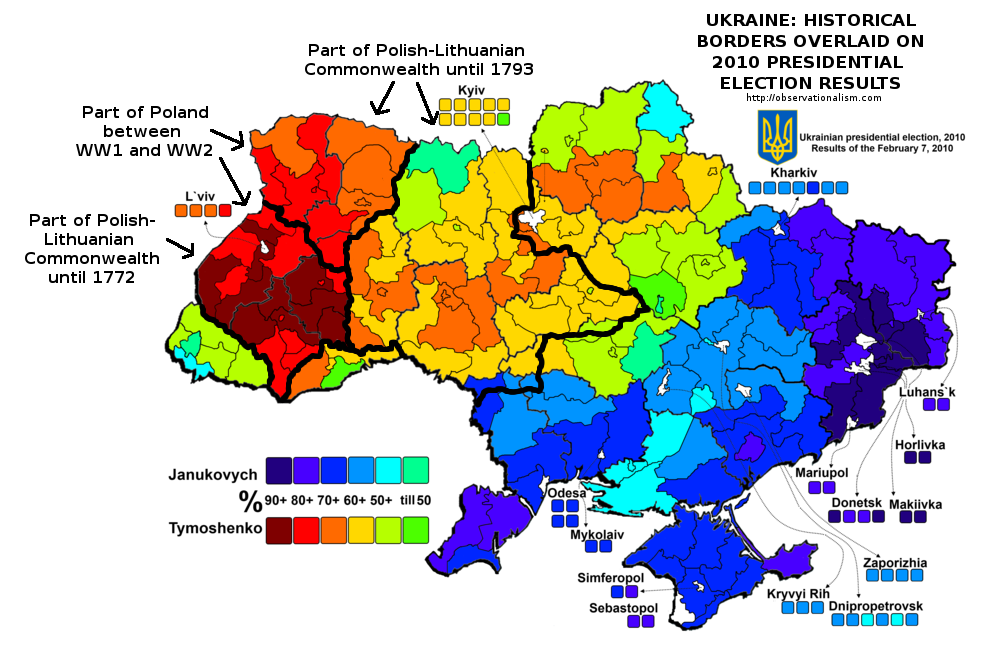
As a consequence of America’s actions (assisted by the Sunni Arab aristocracies), the EU has developed grave splits, which increasingly threaten to break up that governmental organization, and to return Europe to its independent nations, not all of whom will continue to accept their existing subordination to America’s aristocracy.
Another source of those splits has been Ukraine. Back in February 2014 the U.S. – in a carefully planned and executed coup pretending to be a spontaneous “Maidan revolution for democracy,” in order to overthrow Ukraine’s Democratically elected Russia-friendly President – hired organizers and gunmen from one of Ukraine’s two racist-fascist or ideologically nazi Parties, “Right Sector,” who carried out this coup, in which the U.S. State Department instructed the U.S. Ambassador in Ukraine whom to appoint to run Ukraine after the coup would be completed. She chose Arseniy Yatsenyuk on 4 February 2014, and he became installed 22 days later, and he in turn installed top members of Ukraine’s two nazi Parties to run the internal security and the military, as well as the Ukrainian central bank, and he replaced the existing top generals with ones that wanted to exterminate and drive out the residents in the areas that had voted more than 75% for the man whom the U.S. had overthrown (including both Crimea and Donbass). (Eliminating those voters would make Obama’s nazi government of Ukraine virtually permanent.)
Obama’s Ukrainian nazis massacred at least dozens of Crimeans who were fleeing from their coup in Kiev (Ukraine’s capital), and this “Pogrom of Korsun” became a rallying cry for Crimeans to call for Russia’s protection, since the residents of Crimea have always been far more pro-Russian than pro-Ukrainian and they loathe the U.S. But Obama and his European stooges imposed economic sanctions against Russia for having done what it could to protect the Crimeans, and the people in Donbass. Even though Russia refused to accept the urgings of Donbassers to be accepted into Russia as Crimenans had been, Obama and his stooges claimed that the ethnic cleansing in Donbass was somehow due to Russia, and slapped economic sanctions against Russia. Obama and his stooges are still backing Ukraine’s ethnic-cleansing program and want it to continue; and they blame Russia for ‘violations of the peace process’ whenever people in Donbass fire back against invading Ukrainian troops.
Though some EU nations were strongly against anti-Russia sanctions, all of the European Commissioners voted to continue them. Unanimity in these things is required, and it was achieved. On 8 October 2014, the Economist Intelligence Unit predicted, “we think that EU sanctions against Russia will be eased substantially when they come up for renewal in mid-2015, owing to the need for unanimity among the 28 member states, which will be harder to reach after another year of weak or negative growth for many.” This “weak or negative growth for many” has continued, and the Economist’s prediction noted that, “Unanimity is a difficult threshold to reach in the EU at the best of times; the 28 members did well to reach it once in order to impose sanctions.” But despite those things, unanimity is being repeated, yet again. Even countries such as Italy (which had passionately protested) voted for them at the European Commission.
Clearly, the entire West gets in line, whenever President Obama says: Line up!
But how long can this slavishness continue, until one EU member-nation quits? And what will then happen after? Will the EU (and perhaps NATO too) end up ultimately consisting only of former Eastern-Bloc EU members? Maybe that’s all the United States needs, in order to be able to place its nuclear weapons right on Russia’s doorstep (which seems to be America’s supreme objective here – capitulation by Russia).
–––––
Investigative historian Eric Zuesse is the author, most recently, of They’re Not Even Close: The Democratic vs. Republican Economic Records, 1910-2010, and of CHRIST’S VENTRILOQUISTS: The Event that Created Christianity.
Trump Schools ABC-TV Host on Reality
By Robert Parry
Mainstream media and politicians are fond of denouncing Republican presidential candidate Donald Trump for trafficking in conspiracy theories and playing fast and loose with the facts, but some of them slide into the same patterns in attacking Trump or other demonized leaders, such as Russian President Vladimir Putin.
For instance, on ABC-TV’s “This Week,” host George Stephanopoulos deployed a favorite “conspiracy theory” technique to accuse Putin of murdering journalists and then demanded that Trump explain why he would welcome praise from such a nefarious character. The technique was to cite a sizable number of “mysterious deaths” as proof that the conspiracy-theory target was guilty, even if there was no specific evidence in any individual case.

ABC-TV anchor George Stephanopoulos.
Stephanopoulos challenged Trump by asking: “When you were pressed about [Putin’s] killing of journalists, you said, ‘I think our country does plenty of killing too.’ What were you thinking about there? What killing sanctioned by the U.S. government is like killing journalists?”
Trump responded that “in all fairness to Putin, you’re saying he killed people. I haven’t seen that. I don’t know that he has. Have you been able to prove that? Do you know the names of the reporters that he’s killed? Because I’ve been – you know, you’ve been hearing this, but I haven’t seen the name. Now, I think it would be despicable if that took place, but I haven’t’ seen any evidence that he killed anybody in terms of reporters.”
Stephanopoulos then backed up his murder charge against Putin by saying: “here’s what Mitt Romney tweeted about that. He said, there’s an important distinction here. Thug Putin kills journalists and opponents. Our presidents kill terrorists and enemy combatants.”
Trump answered back, “Does he [Romney] know…
Video: Spain Election: Anti-austerity party makes gains, ruling party loses majority
Spain’s ruling People’s Party won 123 seats in the national parliament, but lost an absolute majority to an expected left-wing block including the Socialist Party …
Via Youtube
WaPo Touts the ‘Independence’ of the Banker-Dominated Fed

Federal Reserve Bank in Washington, DC (cc photo: Dan Smith/Wikimedia)
In its usual bipartisan way, the Washington Post (12/18/15) took even-handed swipes at Republican Rep. Jeb Hensarling and at Bernie Sanders, a senator and candidate for the Democratic presidential nomination, over their criticisms of the Federal Reserve Board.
Never mind that Hensarling’s criticisms were over the Fed’s failure to raise interest rates to prevent hyper-inflation over the last five years, while Sanders’ criticism was over the fact that the Fed’s recent rate hike will slow growth and the rate of job creation. In Washington Post bipartisan land, both are equally damnable offenses.
But what is even more striking is the Post‘s ability to treat the Fed as a neutral party when the evidence is so overwhelming in the opposite direction. The majority of the Fed’s 12 district bank presidents have long been pushing for a rate hike. While there are some doves among this group–most notably Charles Evans, the Chicago bank president, and Narayana Kocherlakota, the departing president of the Minneapolis bank–most of this group have been publicly pushing for higher rate hikes for some time. By contrast, the governors who are appointed through the democratic process have been far more cautious about raising rates.
It should raise serious concerns that the bank presidents, who are appointed through a process dominated by the banking industry, have such a different perspective on the best path forward for monetary policy. With only five of the seven governor slots currently filled, there are as many bank presidents with voting seats on the Fed’s Open Market Committee as governors. In total, the governors are outnumbered at meetings by a ratio of twelve to five.
Any serious discussion of Fed policy would note that the banking industry appears to have a grossly disproportionate say in the country’s monetary policy. Furthermore, it seems determined to use that influence to push the Fed on a path that slows growth and reduces the rate of job creation. The Post somehow missed this story, or at least would prefer that the rest of us not take notice.
Economist Dean Baker is co-director of the Center for Economic and Policy Research in Washington, DC. A version of this post originally appeared on CEPR’s blog Beat the Press (12/19/15).
Messages can be sent to the Washington Post at letters@washpost.com, or via Twitter @washingtonpost. Please remember that respectful communication is the most effective.
This piece was reprinted by RINF Alternative News with permission from FAIR.
BBC defends £2mn EU handout, says it won’t prejudice Brexit referendum coverage

Critics of the British Broadcasting Corporation have said that financial contributions from the EU could unbalance its reporting of next year’s expected referendum on whether the UK should remain a part of the European Union.
The Telegraph has reported that the taxpayer-funded broadcaster has received in excess of £2 million ($2.98mn) over three years from the EU Framework Programme, which supports scientific research within the 26-member political bloc.
The BBC, which has an annual budget of around £5 billion ($7.45mn), said the EU contribution was relatively meager, and was spent in research areas such as 3D broadcasting and high-definition filming, not in news coverage.
“BBC News protects its impartiality by not permitting any external funding, which includes EU grants. Our Annual Report discloses any income received from grants covering a variety of areas, of which, a very small proportion comes from the EU for non-news research and development projects,” it said in a statement to RT.
Yet this has not convinced several euroskeptic politicians, who have said the Corporation — which has a remit of impartiality — could play a decisive part in what is predicted to be a finely-balanced vote.
“Everyone knows that the BBC has an inbuilt pro-EU bias, but it should be above reproach during this once-in-a-lifetime opportunity to vote on the future of our relationship with Europe. It already receives £3.7 billion ($5.51bn) from the licence fee, and taking EU funding unavoidably creates the impression that it is being paid to do the EU’s bidding,” Andrew Bridgen, a Conservative MP, told The Telegraph.
The accusations are the latest in a long-running saga, with the corporation admitting earlier this year that it has received £35 million ($52.12mn) in over a decade from the EU for its affiliated Media Action charity, which helps provide communication skills and outlets in volatile and impoverished regions. Just as in this latest instance, when questioned before parliament in October, senior BBC administrators said the charity was “separate” from its news division, though did admit that EU money was occasionally received by independent program-makers, whose output was subsequently broadcast on the Corporation’s myriad channels.
The nitpicky row is a personification with a wider tensions over BBC coverage, some of which have been noted in government inquiries going back a decade.
Earlier this year, an MPs committee on EU coverage at the BBC said that “the country’s public service broadcaster must command wide confidence in its coverage of such a sensitive and complex issue.”
“We do not believe that this has been achieved,” stated its report, expressing “deep concern.”
In September, Tory culture secretary John Whittingdale urged the BBC to correct any “erroneous information” it broadcasts more quickly, saying the “track record in coverage of EU matters is not faultless.”
UKIP leader Nigel Farage, the likely face of the anti-EU campaign, has chosen a different tack, accusing the BBC of propagating subtle biases, such as referring to the ‘European Union’, a term which has negative connotations among many of the electorate, as ‘Europe.’
“To do so is inaccurate, and suggestive of a general dislike of our continental allies, when what eurosceptics oppose is membership of a supranational political organisation, not fellow continental European nation states,” the MEP said in a complaint filed with regulator Ofcom in October.
“It has been widely reported that those campaigning to remain in the European Union are deliberately replacing the name of the organization with the term ‘Europe’ for this very reason, and by doing the same, correspondents are inadvertently playing into the deliberate, dishonest framing of the debate.”
The Corporation insists it has taken recommendations on-board, and says that all of its editorial staff will be sent on “mandatory” course that will educate them about the inner workings of the European Union, and its relationship with the UK.
Via RT. This piece was reprinted by RINF Alternative News with permission or license.
Bernie Sanders Just Made Presidential Campaign Contribution History

Sanders campaign just beat record held by President Barack Obama in 2011 in his bid for re-election.
The Bernie Sanders campaign announced Sunday that it “reached a major milestone in grassroots financial support” during the third Democratic presidential debate.
A statement posted on its website says the campaign has now received over 2.3 million contributions. That means Sanders now holds the record for highest number of contributions for a White House bid, breaking the record held by President Barack Obama in 2011.
The statement adds that “grassroots supporters flooded” the campaign site during the debate, with the average contribution amount being below $25.
Last week, when his campaign surpassed the 2 million contribution mark, the Vermont senator praised the “People Power” supporting his campaign, saying, “You can’t level the playing field with Wall Street banks and billionaires by taking their money.”
The campaign also claimed victory for “winning social media” during the debate against his rivals, former Secretary of State Hillary Clinton and former Gov. Martin O’Malley of Maryland.
Sanders’ performance also got a nod from NSA whistleblower Edward Snowden, who tweeted during the debate:
Sanders unexpectedly more credible on foreign policy than OM and Clinton, who repeat conventional wisdom that failed for a decade.#DemDebate
– Edward Snowden (@Snowden) December 20, 2015
Some observers pointed to the absence of climate change from the debate. 350.org co-founder Bill McKibben tweeted:
Apparently ABC stands for Anything But Climate. Not that it’s been in the news lately… #demdebate
– Bill McKibben (@billmckibben) December 20, 2015
While climate change wasn’t mentioned, as one Huffington Post reporter points out, the debate moderators did make time to ask the candidates what role their spouses would play in the White House.
In addition to facing criticism for placing “its thumb on the scales in support of Hillary Clinton’s campaign,” the Democratic National Committee (DNC) has faced criticism over the number and timing of the Democratic primary–an issue stressed after this latest square-off by The Nation‘s John Nichols:
The DNC needs to schedule more debates on more nights when more Americans are watching.
That’s good for Democrats. And that’s good for democracy–especially in what is shaping up as an entirely unpredictable and frequently volatile political season that ought not be dominated by one party. As Lis Smith says, “It’s clear we need to open up the process, have more debates, and engage more voters in this process.”
Via Common Dreams. This piece was reprinted by RINF Alternative News with permission or license.
Sky customers ‘blocked from viewing porn’ by default in 2016

British telecommunications company Sky will automatically block adult content by default for all of its new broadband customers from 2016, the company has revealed.
To date, the firm’s Broadband Shield filtering system, which blocks content unsuitable for under 18s until 9pm, has been optional.
From 2016, all customers joining the UK’s second largest Internet Service Provider (ISP) will be blocked from viewing adult content by default.
Alternatively, customers who want to visit a website that has been flagged as explicit will have to log into their Sky account and manually disable the porn filter.
The firm, which also provides television and telephone services, said it will soon begin emailing customers and asking them if they would like the filter to be switched on.
Via RT
Video: Man jumps into tiger enclosure at China zoo to ‘practice somersault’
A man had to be rescued from a tiger enclosure at a zoo in central China after jumping into the feline compound to practice a “somersault.” READ MORE: …
Via Youtube
Make the US Great, Like It Was – When?
The holiday season is a time for nostalgia. We watch It’s a Wonderful Life and A Christmas Story, engage in time-honored traditions, and even sing songs about sleighs and sleigh bells.
Honestly, when was the last time you rode in a sleigh?
I’ve eaten a roasted chestnut (purchased on the streets of Chicago, so I don’t know if there was an open fire involved in the roasting process), but I haven’t gone for a single sleigh ride in my whole life.
Donald Trump’s campaign slogan – “Make America Great Again” – plays on this idea of some imagined time in the past when things were better, simpler, than they are now. But The Donald isn’t the only one who evokes this mythical past.
On the other side of the aisle, Democrats often wax poetic about the strong middle class of the era that followed World War II, or about the social safety net President Franklin Delano Roosevelt put in place before that.
And it’s true: America did accomplish great things in the past. But I fundamentally disagree that our better days are behind us.
This notion of a lost Norman Rockwell America is an illusion.
Detroit ‘family man’ planted bombs to defend marijuana plants — police

A Detroit man is facing charges for building makeshift landmines to protect his marijuana growing operation. Joshua Ragland, 25, was indicted on Tuesday for manufacturing and possessing destructive devices.
The charges stem from a September incident involving an unidentified 29-year-old man who cut across a vacant lot next to Ragland’s and accidentally triggered a bomb. The victim was hospitalized but not seriously injured.
Ragland, who is a licensed medical marijuana patient and caretaker, was not initially arrested after the Detroit Bomb Squad safely detonated the remaining explosives. Prior to his arrest, Ragland explained the logic behind planting the bombs — he had been inspired after catching someone stealing his plants.
“I don’t have a lot of money and they still want what I’ve got. What if these people had a gun?” Ragland explained.
The indictment charges Ragland with the manufacture of destructive devices, possession of destructive devices, possession of destructive devices by a prohibited person, and possession of explosive materials by a prohibited person. Although Ragland “was looking for something loud, not something big that would cause damage,” he could potentially receive a 10-year term behind bars, $250,000 in fines, and an additional seven to 40 years for manufacturing destructive devices causing physical injury to another.
Via RT
Fear-mongering and war dominate third Democratic presidential debate
By Andre Damon
The third Democratic Party debate of the 2016 presidential election campaign was a spectacle of militarism and right-wing fear-mongering, with all three Democratic candidates reaffirming their support for the “war on terror” and pledging to “destroy” the Islamic State of Iraq and Syria.
Saturday’s debate, the first since the December 2 attacks in San Bernardino, California that killed 14 people, focused largely on counter-terrorism and the US military operations in the Middle East.
The media and US political establishment have seized upon the San Bernardino attack, as well as the November 13 attacks in Paris that killed 130 people, to reorient American politics around the bogus narrative of the “war on terror,” with all domestic questions taking the back seat.
To this end, the word “inequality,” the supposed watchword of the campaign of Senator Bernie Sanders, was uttered only once during the debate, while “terror” and its variants were uttered 31 times and “ISIS” was mentioned 73 times.
But even the repeated declarations of support for the “war on terror” by Sanders were not enough for the American media, with the New York Times bemoaning the fact that “he made fighting terrorism sound like an afterthought.”
The Times declared that Sanders’ “progressive political message, so popular with liberals for much of 2015, now seems lost in a fog of fear. Americans are more anxious about terrorism than income inequality. They want the government to target the Islamic State more than Wall Street executives and health insurers.”
In fact, the “fog of fear” is entirely the creation of the US media and political establishment, which have falsely declared that the attack in San Bernardino, in a country that averages one mass shooting per day, has suddenly and entirely shifted the axis of popular sentiment.
The debate between Sanders, former Secretary of State Hillary Clinton and former Maryland Governor Martin O’Malley underscored the fact that the mass opposition to war that exists in the American population does not find reflection in the programs of any of the candidates running in the 2016 election. This includes Sanders, whose support for both the war in Afghanistan and the bombing of Libya was pointed out during the debate.
Clinton opened the debate with a statement pledging to “keep our families safe” from terrorism. She declared that she has a “strategy to combat and defeat ISIS without getting us involved in another ground war.”
Clinton presented herself as a more effective commander in chief than her prospective Republican adversaries because she is free of far-right ideological baggage. To this end, Clinton included in her brief opening remarks a jab at her “Republican counterparts,” who “would–despite all their tough talk about terrorism–continue to let people who are on the no-fly list buy guns.”
Clinton was referring to secret lists kept by US intelligence agencies of those allegedly suspected of terrorism. Among those named on no-fly lists were the musician formerly known as Cat Stevens, Senator Edward Kennedy and Representative John Lewis, as well as prominent journalists.
Clinton also called on technology companies to work with the US government to spy on the Internet and social media activity of their customers and turn this information over to the government.
She declared, “We have to do the best possible job of sharing intelligence and information. That now includes the Internet…That means we have to work more closely with our great tech companies. They can’t see the government as an adversary, we can’t see them as obstructionists. We’ve got to figure out how we can do more to understand who is saying what and what they’re planning.”
In his opening statement, Sanders declared, “I’m running for president because I want a new foreign policy–one that takes on ISIS, one that destroys ISIS” and that “works around a major coalition of wealthy and powerful nations supporting Muslim troops on the ground.”
Clinton took the warmongering a step further, reiterating her earlier calls for the establishment of a no-fly zone in Syria.
All three Democrats echoed US President Barack Obama’s position on the Syria conflict: that the US should seek to achieve its geopolitical goals in the region, including the ouster of pro-Russian Syrian president Assad, through the use of regional proxy forces, including Saudi Arabia and other US allies in the region.
To that end, Sanders declared, “I believe that countries like Saudi Arabia and Qatar have got to step up to the plate, have got to contribute the money that we need, and the troops that we need, to destroy ISIS with American support.”
The aim of this policy, supported by the White House and all three Democratic candidates, is to keep the United States from getting bogged down in a ground war in the Middle East in order to free up resources for the anti-China policy known as the “pivot to Asia,” and to prepare for conflicts in Europe with Russia.
This goes hand and hand with the abandonment of pretensions to ameliorate poverty and social distress at home. Clinton made this particularly clear in Saturday’s debate, declaring, “I don’t think we should be imposing new big programs that are going to raise middle class families’ taxes.”
The atmosphere of fear and warmongering allowed Clinton to shift even further to the right on domestic issues, going so far as to flaunt her close ties to Wall Street for which Sanders had earlier criticized her.
Asked by a moderator, “Should corporate America love Hillary Clinton?”, she replied, “Everybody should,” declaring “I want to be the president for the struggling, the striving and the successful,” and “I want to be a partner with the private sector.”
Saturday’s debate made abundantly clear that the Democratic Party is a right-wing, pro-war outfit, entirely hostile to the interests of the working class and bent on a militarist path that, unless opposed by the working class, can only lead to world war.
Via WSWS. This piece was reprinted by RINF Alternative News with permission or license.
The Murder of Yitzhak Rabin
Israel’s decisive turn to the dark side of Jewish terrorism and religious-based repression of the Palestinians can be marked by the murder of Prime Minister Rabin by a right-wing Jewish extremist in 1995, a moment that also inflicted a fatal wound on the peace process, as ex-CIA analyst Paul R. Pillar describes.
By Paul R. Pillar
The best chance for a solution to the Israeli-Palestinian conflict appeared to arrive in the early 1990s. A combination of deft international diplomacy and political evolution in the two sides’ leadership led in 1993 to a secretly negotiated agreement – the Oslo accord – between Israel and the Palestine Liberation Organization that established a partially autonomous transitional mechanism known as the Palestinian Authority.
The accord was supposed to lead within five years to the establishment of a Palestinian state recognized by Israel. It didn’t. Instead, the two sides remain locked in a deadly embrace.

Israeli Prime Minister Yitzhak Rabin, who was assassinated in 1995.
A central figure in the hopeful developments of the 1990s was the prime minister of Israel, Yitzhak Rabin. He had several attributes that qualified him well to play this role. He was the first sabra, or native son, to become prime minister of Israel, having been born in Jerusalem when it was part of the British mandate of Palestine.
Rabin’s successful military career, including fighting in Israel’s war for independence, culminated in service as chief of the general staff, a position in which he oversaw Israel’s rout of Arab armies in the Six Day War in 1967. He remained a military officer at heart even after entering politics, always more comfortable talking with generals about security matters than in the other interactions political leaders have to endure.
Succeeding Golda Meir as leader of the Labor Party, Rabin served a first stint as prime minister in the 1970s, when by his own later admission he was insufficiently experienced to do the job well. In 1977, he left office under the cloud of a minor financial scandal dating from earlier service as ambassador in Washington.
Then in 1992, more seasoned at age 70, he led his party to victory over Likud Prime…
Video: CrossTalk: Endangered Christians
We are warned that Christianity will disappear from Iraq and Syria — places where Christians have lived since the religion began — within one or two generations.
Via Youtube
Video: Top U.S. & World Headlines – December 21, 2015
Visit http://democracynow.org to watch the full independent, global news hour, read the transcript, search our archive, and to make a donation to support us.
Via Youtube
Saudi Women Voted for the First Time. Is It Real Progress or Window Dressing?

Some 99 percent of eligible Saudi women skipped their first chance to vote – some because gender segregation laws kept them away, others because they boycotted.
By Medea Benjamin
(Photo: Zuhair A. Al-Traifi / Flickr)
The global press has been heralding the recent December 13 vote in Saudi Arabia as a breakthrough for women, since it was the first time in history that Saudi women have been allowed to vote.
But was this vote really a significant step forward?
First, let’s consider the Saudi electoral system within the context of an absolute monarchy. The ruler is always a male and inherits his position. All powerful government positions from ministers to governors are appointed by the king. The 150-member Consultative Council, known as the Shura Council, is also appointed and has only advisory power.
The recent election was not for any body with legislative power. It was for municipal councils that merely provide advice to government authorities about local services such as parks, road maintenance, and trash collection. And one-third of even these council seats are appointed, not elected.
This election marks only the third time in the nation’s history that Saudis – men or women – have been allowed to vote, and the first time women have participated. While heralded overseas, voting for municipal councils back at home is greeted with a big yawn.
The hidden story about the election is the abysmal turnout. Less than 10 percent of all eligible voters bothered to cast a ballot – and worse yet, less than 1 percent of all eligible Saudi women voted. Little wonder that of the 2,106 seats up for grabs, less than 1 percent of the winners were women.
Instead of just profiling the handful of female winners, the press should really be talking to the 99 percent of women who didn’t vote. They would find that some women didn’t vote because they found the process complicated or they couldn’t get to the segregated polls, since they aren’t allowed to drive. They would find that some didn’t feel it was worth their time, since the councils have so little power.
And they would learn that some women didn’t vote because they were boycotting the election.
“How could I be elected if I can’t drive, if I can’t have the right to custody of my children, when so many issues touching our daily lives aren’t resolved?” asked university lecturer Aziza al-Yousef. “Women are half citizens in this country. I think we need to change the whole system.”
Al-Yousef is one of the few Saudi women brave enough to speak out in a country where voicing opposition can land you in prison, but her views reflect the attitudes of many.
Saudi women are still trapped in a male guardianship system under which all women are treated as minors. They aren’t allowed to marry without the permission of their guardians. And unlike men, they don’t have a unilateral right to divorce and often face discrimination in relation to child custody.
Women cannot obtain a passport or travel without the approval of a male guardian – usually a husband, father, brother, or son. Enrollment in education at all levels requires a guardian’s permission. A woman can’t be released from rehabilitation or prison to anyone but her guardian. If the guardian refuses to accept the woman, as often happens, she remains imprisoned.
Saudi men can have up to four wives, and there’s no prohibition against child marriage. A push by human rights activists to make it illegal to marry girls under 15 years old was crushed by the Grand Mufti. A prominent cleric and member of Saudi Arabia’s highest religious council, Dr. Salih bin Fawzan, said that girls can be married “even if they are in the cradle.”
Schools are segregated. And although Saudi women have made great gains in education – they now comprise 60 percent of the nation’s college students – women are less than 20 percent of the labor force. Employers often require male guardians to approve the hiring of female relatives, and most women are confined to jobs considered “appropriate” for their gender, like healthcare and education.
The Saudi government even tells women what to wear. In public places, women must hide their hair and cover their everyday clothing with an abaya, a thick, opaque, and loose-fitting cloak that conceals their bodies.
Saudi Arabia remains the only country in the world where authorities bar women from driving – yet even the most extreme interpretations of Islam by ISIS don’t ban women from driving. Women who have challenged the driving ban have been imprisoned, fined, suspended from their jobs, banned from traveling, and even threatened with terrorism charges for public incitement.
In a system still characterized by entrenched patriarchy, voting for municipal council seats might seem like either progress or window dressing. “The Saudi government is using women’s participation to its advantage, but so must Saudi women,” said Saudi scholar Hala Al Dossari. “We have to seize opportunities whenever they arise. It’s not like this vote is going to make significant change, but maybe it will inspire more women to keep pushing for greater rights.”
One of the positive things to come out of this election is more global attention on the heavy-handed rule of the Saudi monarchy. An upcoming activist-based Saudi Summit, which will be held in Washington, DC on March 5-6, is an effort to build a campaign to support Saudi human rights activists.
Saudi women have long been fighting for more rights, and their allies abroad should do more to support their efforts and to break the cozy ties between the U.S. and Saudi governments.
This piece was reprinted from Foreign Policy In Focus by RINF Alternative News with permission.
Video: ‘Breaking the Silence’: IDF whistleblowers expose reality of occupation to Israelis
An Israeli politician has proposed new legislation against an organization of Israeli veterans called ‘Breaking the Silence’. It’s mission is to expose the reality of …
Via Youtube
Video: Germany threatens EU members with legal actions over ignoring refugee quotas
Germany has threatened to launch legal action against those EU members who are refusing to take in refugees under mandatory quotas. RT LIVE …
Via Youtube
Video: Albuquerque police sued for refusing to release other videos from this shooting
Albuquerque police released body cam footage that captured some audio of the shooting before recording the aftermath of the shooting, but they refuse to …
Via Youtube
Video: David Shayler: “Educate Yourselves On The Common Law And Our Duty Of Care To Each Other.”
Please Support The Show — http://richieallen.co.uk/ https://www.facebook.com/therichieallenshow http://www.youtube.com/RichieAllenShowMedia Tune in at …
Via Youtube
Donald Trump says Hillary Clinton ‘lies like crazy’

US Republican presidential candidate Donald Trump says Democratic rival Hillary Clinton “lies like crazy” after she claimed that his anti-Muslim rhetoric is a recruiting tool for Daesh (ISIL) terrorists.
“She lies like crazy about everything,” Trump said in an interview with the “Meet the Press” on Sunday. “She’s a liar and everybody knows that.”
“Hillary’s not strong, Hillary’s weak, frankly. She’s got no stamina, she’s not nothing,” the billionaire businessman said.
He was referring to a comment Clinton made on Saturday at the Democratic presidential debate, where she stated that Trump’s rhetoric about temporarily banning Muslims from entering the US is helping ISIL’s recruitment strategy.
“They are going to people showing videos of Donald Trump insulting Islam and Muslims in order to recruit more radicals,” said Clinton, a former US secretary of state.
Nation Cites FAIR: ‘Democratic Race Is Getting Less Media Attention’
 The Nation‘s John Nichols (12/20/15) cites FAIR:
As groups such as Media Matters and Fairness & Accuracy In Reporting have made clear, the Democratic race is getting less media attention than the Republican race. The attention paid Clinton, Sanders and O’Malley, in combination, has been dramatically less than the attention paid one Republican–billionaire Donald Trump. Even also-ran Republicans like former Florida governor Jeb Bush have enjoyed far more television time than Sanders and O’Malley and, of late, second- and third-tier Republicans have grabbed more of the spotlight than Clinton.
This piece was reprinted by RINF Alternative News with permission from FAIR.
In Case You Missed…
Some of our special stories in November focused on the realities behind the Syrian crisis, Turkey’s dangerous provocations toward Russia, the many failings of the mainstream U.S. media, and disclosures about Ukraine Finance Minister’s self-enrichment at U.S. taxpayers’ expense.
“Syria at a Crossroads” by Nicolas J S Davies, Nov. 1, 2015
“Rubio Follows the Big Money” by Jonathan Marshall, Nov. 1, 2015
“Reviving the ‘Liberal Media’ Myth” by Robert Parry, Nov. 2, 2015
“The Dark Truth in the Movie ‘Truth’” by James DiEugenio, Nov. 3, 2015
“America’s Chalabi Legacy of Lies” by Robert Parry, Nov. 4, 2015
“The Death of a Charming Charlatan” by Karen Kwiatkowski, Nov. 4, 2015
“Why NYT Dissed the ‘Drone Papers’” by John Hanrahan, Nov. 4, 2015
“Obama’s Risky ‘Mission Creep’ in Syria” by Daniel Lazare, Nov. 6, 2015
“Bush-41 Finally Speaks on Iraq War” by Ray McGovern, Nov. 8, 2015
“How Technology Kills Democracy” by Norman Solomon, Nov. 9, 2015
“A New ‘War on Christmas’ Absurdity” by Nat Parry, Nov. 9, 2015
“How Israel Out-Foxed US Presidents” by Morgan Strong, Nov. 9, 2015
“How Ukraine’s Finance Chief Got Rich” by Robert Parry, Nov. 10, 2015
“Rubio’s Big-time Military Build-up” by Chuck Spinney, Nov. 11, 2015
“The Progressives’ Green Party Dilemma” by Lawrence Davidson, Nov. 11, 2015
“Obama’s Double-Standard on Leaks” by John Hanrahan, Nov. 11, 2015
“Netanyahu Ups the US Ante” by Ann Wright, Nov. 12, 2015
“Fresh Twists in the Lockerbie Case” by John Ashton, Nov. 12, 2015
“Carpetbagging ‘Crony Capitalism’ in Ukraine” by Robert Parry, Nov. 13, 2015
“How Saudi/Gulf Money Fuels Terror” by Daniel Lazare, Nov. 14, 2015
“Can Obama Level with the People?” by Robert Parry, Nov. 14, 2015
“Grasping the Motives for Terror” by James Paul, Nov. 16, 2015
“Falling into the ISIS Trap” by William R. Polk, Nov. 17, 2015
“CIA Whistleblower Kiriakou Honored” by Ray McGovern, Nov. 18, 2015
“Neocons Make Rubio Their Favorite” by JP Sottile, Nov. 18, 2015
“Reform Judaism’s Israeli Critique” by Lawrence Davidson, Nov. 18, 2015
Agent of the Empire
Dr. Jack Wheeler does. In 2002, The Daily Reckoning posted Wheeler’s article, “The Curse of Lawrence of Arabia.” This story was forgotten in 2002. It remains forgotten.
The most legendary American journalist of the 20th century was Lowell Thomas. I had the opportunity to meet him in 1978, when we were both guests on The Merv Griffin Show. Off camera, I asked him, “Do you feel you contributed, however inadvertently, to the political mess that is the Middle East today?” He looked at me sharply and asked me what I meant. “Well, after all,” I answered, “it was you who gave Lawrence’s promise to the Hashemites so much power.” His eyes narrowed, and he responded, “That was a long time ago.”In 1917, Lowell Thomas was a young, ambitious journalist in search of an interesting story in the lost backwater of World War I. In Jerusalem, he met a small (5 foot 4) British Army captain assigned as a liaison officer to Arabs living in a desert no one had ever heard of. Thomas saw his chance. His breathless dispatches had the purpose of creating a myth around the liaison officer who had begun teaching Arab tribes to blow up Turkish trains nobody cared about in the desert nobody ever heard of.
The liaison officer’s name was T.E. Lawrence, but Lowell Thomas called him “Lawrence of Arabia.” In 1919, Thomas went on a lecture tour in the United Kingdom and United States, showing pictures of Lawrence posing in a sheikh’s robes in a London studio, and entranced audiences with stories about the ‘White King of the Arabs.’ By the time the Treaty of Sèvres was negotiated in 1920, with Lawrence in attendance and the media mob hanging on his every word, the British felt compelled to keep Lawrence’s promise to the chieftains of an Arab tribe called the Hashemites.
The political structure of the Middle East today is the result of that promise. The Treaty of Sèvres permitted the British to seize pieces of the Ottoman Empire, which had ruled the Middle East for centuries, but joined the Germans in WWI. Instead of British colonies, the pieces were called League of Nations ‘mandates,’ for which the Brits needed puppet rulers.
The Logic of the Police State: Waking Up to the Darkness in US Policing

(Photo: Police Lights via Shutterstock)
If you’ve been listening to various police agencies and their supporters, then you know what the future holds: anarchy is coming – and it’s all the fault of activists.
In May, a Wall Street Journal op-ed warned of a “new nationwide crime wave” thanks to “intense agitation against American police departments” over the previous year. New Jersey Governor Chris Christie went further. Talking recently with the host of CBS’s Face the Nation, the Republican presidential hopeful asserted that the Black Lives Matter movement wasn’t about reform but something far more sinister. “They’ve been chanting in the streets for the murder of police officers,” he insisted. Even the nation’s top cop, FBI Director James Comey, weighed in at the University of Chicago Law School, speaking of “a chill wind that has blown through American law enforcement over the last year.”
According to these figures and others like them, lawlessness has been sweeping the nation as the so-called Ferguson effect spreads. Criminals have been emboldened as police officers are forced to think twice about doing their jobs for fear of the infamy of starring in the next viral video. The police have supposedly become the targets of assassins intoxicated by “anti-cop rhetoric,” just as departments are being stripped of the kind of high-powered equipment they need to protect officers and communities.
Slavery “pervasive” in global seafood supply
By Gabriel Black
Slaves are used to peel and process shrimp that finds its way in to many major supermarkets and shrimp companies around the world, according to an investigative report by the Associated Press (AP) published last week.
At Gig Peeling Factory in Samut Sakhon, Thailand, slaves work 16-hour days, waking up as early as 2 AM with the command, “Get up or get beaten.” Peeling shrimp in ice buckets, small children work alongside their parents, often crying, as their cold hands become numb in the troughs of shrimp.
The toilets overflow with feces. Workers work sick. According to the AP, “Some had been there for months, even years, getting little or no pay. Always, someone was watching.”
Tricked or forced into illegal migration, these workers, often from Myanmar, are slaves who are being worked quite literally to death to pay off impossible debts. Paid no more than a few dollars a day–at best–workers live locked-in in dormitories on-site and must pay bosses for their own gloves and equipment.
The following are a few anecdotes from AP’s investigation:
* “A woman eight months pregnant miscarried on the shed floor and was forced to keep peeling for four days while hemorrhaging.”
* “An unconscious toddler was refused medical care after falling about 12 feet onto a concrete floor.”
* “Another pregnant woman escaped only to be tracked down, yanked into a car by her hair and handcuffed to a fellow worker at the factory.”
Whole Foods, Dollar General, Wal-Mart, Kroger (Ralphs, Food 4 Less), Red Lobster, Olive Garden, Chicken of the Sea, Bumblebee, Petco and Fancy Feast, are just some of the companies whose supply-chain sources from slave-labor shrimp processing plants in Thailand that the AP was able to infiltrate.
The AP’s report is part of an ongoing investigation into slavery in Thailand’s seafood industry. According to the AP, “Pervasive human trafficking has helped turn Thailand into one of the world’s biggest shrimp providers.”
Earlier this year, in March, an AP reporting team infiltrated slave fish-trawlers off the coast of south-east Asia. Thousands of slaves, often smuggled in from Burma (Myanmar) or Thailand, were being forced to work against their will catching fish.
When not at sea enslaved workers are kept in cages at ports on small remote islands in Indonesia, including at the port of Benjina. They live on “a few bites of rice and curry a day in a space barely big enough to lie down.” Others were not so lucky and have been at sea for over a year, working non-stop, with cargo ships intercepting the trawlers to unload the catch.
According to a UN report, 60 percent of Burmese migrants in Thailand’s seafood processing industry “were victims of forced labor.”
AP’s investigation found that shrimp processed at Gig Peeling, the factory they infiltrated, ended up unloading at N&N Foods, Okeanos Food, Thai Union, Kongphop Frozen Foods and The Siam Union Frozen Foods–all of which are some of the world’s largest seafood suppliers. Thai Union, for instance, had net revenue of $3.4 billion in 2014. Chicken of the Sea, John West, King Oscar, Petit Navire, Parmentier, Mareblu and Century are some of its major international brands that it owns.
Before publishing the story AP reached out to the various companies that were implicated in the “slavery tainted” supply chain. Spokespeople for Whole Foods told AP that they were “confident” they were not implicated in the chain. However, AP spoke to their Thai supplier, who admitted they did not know where the shrimp came from.
The CEO of Aqua Star told AP that “it’s disgusting that it’s even remotely part of my business.” The CEO of Thai Union said that he was “deeply disappointed that despite our best efforts we have discovered this potential instance of illegal labor practice in our supply chain.”
However, according to “a half-dozen former workers” from another shrimp slavery shed, a Thai Union employee visited the shed every day.
Companies may choose to crack down on the slavery in their supply chain, no doubt with the public’s perception of them in mind. Earlier in the year AP’s story about slavery in the fishing industry in Thailand led to the rescue of several thousand slaves.
However, undergirding the prevalence of slavery is not some collection of inhumane business owners that need to be shamed into line. At root are economic pressures to produce shrimp at the absolute cheapest price by brutally exploiting the workforce.
The global fish industry, similar to the global electronics industry, outsources production to intermediate suppliers, who themselves may sub-contract to hundreds of smaller companies.
Driving this competitive pyramid is cost; the sub-contracted sweat-shops are all competing against each other, and must out-do each other somehow. However, there is no technical advantage they can wield. At the end of the day the only way they can improve their bottom line is by keeping wages as low as possible. Especially in times of global economic stagnation, driving workers into conditions of slavery is the most competitive thing these sub-contractor companies can do.
It must also be asked, should these slaves be transferred to less slave-like conditions, what would that exactly mean? Workers making electronics at Foxconn routinely work 14 hour days making only $22 a day. What exactly distinguishes this life of ostensibly free labor from that of the shrimp-workers, who are beaten when they try to escape?
If Foxconn employees stop working, they too are forced to return to work, not by brute force, but because they need to eat and somehow find a way to live. Both the factory workers and the shrimp peelers are subjected to lives of virtual slavery, one enforced by violence, the other by their own needs.
In conditions of growing economic inequality and worsening global economic crisis, the pressure on companies to cut costs and find cheaper suppliers grows. Stories uncovered by AP will not go away with a dash of good will and public outcry. They are the logical result of an economic system, capitalism, whose source of profit comes from grinding workers down to the bone.
Via WSWS. This piece was reprinted by RINF Alternative News with permission or license.
Britain commits more troops to Nigeria to combat Boko Haram

Britain will send more troops to its former colonial possession Nigeria in an effort to combat the threat of militant Islamist group Boko Haram, Defence Secretary Michael Fallon announced on Monday.
The troops will not take part in active combat against the group, but will provide training and assistance to the Nigerian army, including a specialist counter-IED (improvised explosive device) team and a Royal Air Force (RAF) training team.
Fallon made the announcement during a visit to the country to meet with Nigerian President Muhammadu Buhari. He said up to 300 British troops could be sent to Nigeria during 2016.
Boko Haram, which has been staging an insurgency in Nigeria since 2009, has killed 20,000 people and displaced more than 2.3 million.
In March 2015 the terrorist group pledged allegiance to Islamic State (IS, formerly ISIS/ISIL) and began using its black and white flag as its symbol. Boko Haram has allegedly had past links with Al-Qaeda.
Speaking during his trip, Fallon said the group must be defeated.
“Boko Haram is a brutal organization that has murdered and kidnapped innocent civilians. We stand united with Nigeria in its efforts to defeat them.
“Stepping up our training efforts will help support the Armed Forces of Nigeria (AFN) for crucial counter-insurgency operations.”
During 2015 around 130 UK military personnel were sent to Nigeria. Fallon’s pledge could see that number double to as many as 300.
The troops were involved in a range of operations, including training in “infantry skills, civil-military affairs, media operations, command and leadership, IED-awareness, and support to Nigerian military training schools and establishments,” the Ministry of Defence (MoD) said.
The MoD also said 1,000 Nigerian troops had received training for counter-insurgency operations in the north east of the country.
“The training uplift announced by Mr Fallon supports work already carried out by the UK’s resident British Military Advisory and Training Team (BMATT). BMATT has also grown in size since the government announced last year that the UK would increase its training and capacity building in Nigeria,” it said in a statement.

According to local press reports, the Nigerian army killed three high-profile Boko Haram members in the north eastern Nigerian state of Borno on December 20.
An army spokesperson, Sani Usman, said the alleged terrorists were killed by troops on “fighting patrol.”
“As part of their determined efforts to rid the society of all known Boko Haram terrorists enclaves and hideouts, troops of 25 Task Force Brigade based on a tip-off conducted a fighting patrol along Damboa-Njaba-Bale road in Borno State,” he said in a statement.
“The troops encountered and killed three suspected Boko Haram terrorists that had been terrorizing the communities around Sabon Gari and Damboa.
“Among those killed was the Boko Haram terrorists Ameer (leader) in Bulayaga. The Ameer was notorious in terrorizing Bale, Wass and Mufurundi villages.”
Via RT. This piece was reprinted by RINF Alternative News with permission or license.
Daesh, Trump helping each other: Analyst

US Republican presidential front-runner Donald Trump and the Daesh (ISIL) terrorist group are helping each other towards their respective goals, says a political analyst.
Democratic presidential candidate Hillary Clinton was right in slamming Trump for his recent outrageous comments against Muslims, William Jones said in an interview with Press TV on Sunday.
Trump has recently called for a complete ban on all Muslims entering the US in order to curb the threat of terrorism in the country. He has also urged a national database and special IDs that help track American Muslims.
Clinton said Saturday that the billionaire businessman’s “insults” are now being utilized by Daesh as a powerful recruitment tool, calling Trump the group’s “best recruiter.”
“I think that Hillary’s comments regarding Trump and the way that his aggressiveness and insanity is going to help recruit for al-Qaeda and for ISIL is really on the mark,” Jones, a member of the Executive Intelligence Review, told Press TV.
Ashton Carter’s Plan to Expand U.S. Military Presence Across the Globe Even Further

Also stationed on these bases are Special Operations forces that carry out hit-and-run raids and assassinations. (Photo: Master Sgt. Donald Sparks / U.S. Army / Flickr Commons)
How many Americans are aware that the U.S. is currently engaged in five wars – in Afghanistan, Iraq, Syria, Libya, and Yemen, and that our forces are involved in lesser conflicts in Africa, the Middle East, and Southeast Asia? The answer is, probably very few. These wars are largely out of the news, and since there are seldom any American casualties, they are virtually invisible.
Combat operations primarily involve drones operated from thousands of miles away, and bombs dropped from thousands of feet in the air. According to the Pentagon, there are currently 662 U.S.military bases around the world from which air strikes can be launched using a variety of aircraft. Also stationed on these bases are Special Operations forces that carry out hit-and-run raids and sinations in various parts of the world.
These commandos, who are trained to capture and kill, often alienate the local population with their excessive brutality. The New York Times recently revealed that members of the Navy SEALS assigned to train Afghan police beat several detainees so badly that one died. The crime took place in 2012 and was covered up by the SEALS commander.
Consequently the participants were never punished. A plan announced by the Pentagon in mid-December would greatly increase the number of overseas bases in order to maintain a more permanent U.S. military presence across Africa and the Middle East. Defense Secretary Ashton B. Carter explained the plan in a little publicized speech in Washington. “Because we cannot predict the future,” he said, “these regional nodes – from Moron, Spain, to Jalalabad, Afghanistan – will provide forward presence to respond to a range of crises, terrorist and other kinds.”
Carter did not explain what he meant by “other kinds” of crises, but he did say the bases will enable “unilateral crisis response, counterterror operations or strikes on high value targets.” The Pentagon has already expanded a former French base in Djibouti, in the Horn of Africa, to become the headquarters of 2,000 troops prepared for military operations in East Africa and Yemen.
The city of Erbil in northern Iraq, where 3,500 American troops are already based, is likely to be the U.S. military hub in the Middle East. The U.S. operates smaller installations in places such as Cameroon, Niger, and Burkino Faso. These bases are being used for surveillance flights that collect intelligence about militant groups in the region. The turboprop planes that are used in these operations are designed to look like civilian aircraft.
Carter’s announcement could be used word for word on an ISIS web site to attract new recruits. It could easily be described as a plan by the U.S. to achieve worldwide military domination. Carter and the military establishment also seem remarkably insensitive to the possible reactions of citizens of the countries where U.S. forces carry out drone strikes and other forms of bombing. It is a form of warfare that may be invisible to most Americans, but it is hardly invisible to those on the ground.
The Pentagon claims the U.S. precision bombing of ISIS in Iraq and Syria has killed 15,000 terrorists, but no one can be sure how many civilians are included in that figure. Tom Engelhardt in the latest issue of Fellowship cites a study by the Bureau of Investigative Reporting that concludes that thousands of civilians have been killed by drones and other forms of U.S. air strikes.
Meanwhile, 13,500 American troops are still fighting in Afghanistan despite President Obama’s announcement last year that U.S. combat operations in Afghanistan had ended. The Taliban continue to gain more territory, and in many areas the local residents prefer them to the corrupt and often brutal Afghan soldiers and police.
Afghan troops reportedly lay down their arms and run rather than fight, military equipment turns up on the black market, and according to a recent New York Times report the Taliban in some places face so little opposition that they put in requests through Afghan intermediaries to U.S.A.I.D. for local aid projects, and the requests are granted. Taliban doctors are even working with the World Health Organization in fighting polio.
America’s least visible military involvement is in Yemen, where the Pentagon is providing arms and logistical support to Saudi Arabia and the Gulf Emirates in their intensive bombing campaign against Houthi rebels from North Yemen. Because the Saudis’ air strikes have spared Al Qaeda forces, the militants and their affiliates have taken over large portions of Yemen, and ISIS is carrying out an increasing number of attacks. At the same time, the airstrikes have failed to defeat the Houthis, who show no signs of giving up.
Evidence from previous conflicts indicates that bombing does not win wars. What it does do, despite official denials, is create popular resentment. American policymakers seem oblivious to the fact that it is anger at our military interventions that breeds much of the current violence. All of the Republican candidates for president are demanding more bombing to combat ISIS – Ted Cruz wants to carpet-bomb them, and Hillary Clinton has not as yet proposed an alternative to airstrikes.
The hopeful sign is that Secretary of State John Kerry is making an intensive effort in cooperation with the Russians and other parties involved to achieve an end to the fighting in Syria that has ravaged that country and provided fertile ground for ISIS to grow. The danger is that his efforts will be undermined if America, under the guise of fighting terrorism, is seen as attempting to extend its military power over all parts of the globe.
This piece was reprinted from Foreign Policy In Focus by RINF Alternative News with permission.
Video: RAW: Blaze engulfs Ottoman People’s Bazaar in Ankara
A huge fire damaged or destroyed some 250 units at the Ottoman People’s Bazaar in Ankara. Firefighters rushed to the scene where they battled the blaze and …
Via Youtube
Video: Bear with Me: Preparing bear cubs for the perils of the wild (RT Documentary)
The Orphan Bear Rescue Centre (OBRC) in Russia saves abandoned bear cubs and later releases them back into the wild. However, for bears to have a …
Via Youtube
Washington Post Promotes Dickensian Marketing Experiment on Poor Children

The Washington Post offers readers a chance to watch impoverished children taunted with a cruel choice.
In America, as a rule, we shame the poor, ignore the poor, blame the poor for being poor, mock the poor and do little to nothing to protect the poor. Increasingly, however, a new trend has emerged: using the poor as props in shoddy “inspirational” viral content. One such effort was recently featured in the Washington Post (12/18/15), and is as bad as such things get:
These Low-Income Kids Were Given a Gift for Their Parents and for Themselves. But They Could Only Keep One.
This was in the “inspired life” section, presumably because this effort is supposed to be inspiring to the viewer who is expected to be surprised by the result:
These kids, who ranged from 6 to 11 years old, belong to the Boys and Girls Club of Metro Atlanta, where 83 percent are from poor families.
Some can’t afford to put up a Christmas tree at home. Their wishes for themselves ranged from a computer to an Xbox 360 to a Barbie house. When asked what they thought their parents would want, one little boy guessed a ring because “she’s never really had a ring.” Another said a television. The next said a watch.
Then the kids were given their dream gift. And the gift for their parents. With both gifts sitting in front of them, the kids were told they could only pick one.
In the end, they all chose to sacrifice what they wanted to make their parent happy.
Much like the popular “homeless guy does the right thing” viral “prank” videos, these PR stunts are fundamentally based on two flawed, rather vulgar premises: 1) that the poor are somehow expected to not be altruistic (otherwise, why not run this experiment at a private boarding school?) and 2) the cheap emotional pornography and shallow moralism these videos offer the average social media consumer outweighs the inherently cruel act of making poor children “choose” between obtaining material possessions they can’t normally have or stripping their parents of the same. The fact that the marketing firm behind the experiment ends up giving the child both gifts is supposed to make it OK, but it doesn’t. This last-minute paternalistic gesture doesn’t justify the voyeuristic act of watching a poor child suffer through such a task for no objectively worthwhile reason.
To make matters even more cynical, the effort–while in conjunction with the “marketing specialist” at the Atlanta Boys and Girls club–was designed to promote a schlocky, third-rate corporate network called UP TV. A media channel “dedicated to uplifting programming,” it’s owned by $1 billion private equity group, InterMedia Partners. Their senior vice president of marketing, Wendy McCoy, was “amazed” that the poors can be selfless:
Wendy McCoy, UP TV senior vice president of marketing, said the organizers were amazed at the children’s selflessness and “how touched they were to be able to make this choice.”
Poor children subverting the glib assumptions of UP TV’s marketing hacks are not particularly newsworthy, except for the fact that they expose the biases of the morally absent editors at the Washington Post–who somehow thought this cruel experiment merited an uncritical write-up. Indeed, it’s bad enough an overzealous marketing firm in Georgia made such a tone deaf “viral” video; it’s much worse that one of the biggest names in news decided to promote it.
The poor need food, housing, jobs and–not least of all–dignity. Billion-dollar companies playing their plight off the prejudices of the viral video—sharing masses isn’t just in bad taste, it’s a perfect microcosm of how the media covers poverty. Typically, the right-wing press addresses it in cruel fear-mongering or poor-shaming, while the nominally liberal media all too often reduces it to this type of “inspirational” claptrap. But the poor aren’t our props; they’re not the raw material of viral content who, if edited properly, will subvert our “prejudices” and play the role of noble savage. They’re individuals. Human beings. Complex and nuanced.
Indeed, had some of these children told the producers to fuck off, they were keeping the gifts they were promised–as I suspect some edited-out clips showed–all the better. Poverty isn’t a marketing gimmick, it’s a scourge, a cancer and a national shame. The media should be covering this decidedly uninspiring reality, not its exploitation by cynical marketing firms.
Adam Johnson is an associate editor at AlterNet and writes frequently for FAIR.org. Follow him on Twitter at @adamjohnsonnyc.
Messages can be sent to the Washington Post at letters@washpost.com, or via Twitter @washingtonpost. Please remember that respectful communication is the most effective.
This piece was reprinted by RINF Alternative News with permission from FAIR.
Video: Bomb Scare: Air France jet makes emergency landing in Kenya after terror threat
An Air France passenger jet flying from Mauritius to Paris has made an emergency landing in Kenya after a suspicious object was found on board. The object is …
Via Youtube
Video: Xenophobia, neo-Nazism upsurge shows EU failing on human rights: Russian human rights envoy
The issue of human rights has played a central role in the discourse of western nations. But it has also been misused as a foreign policy tool to justify wars and …
Via Youtube
Video: Leaked documents claim US police plant evidence on black suspects
Leaked documents from whistle blowers in the US show that police in Alabama have been allegedly planting evidence on black suspects. RT LIVE …
Via Youtube
Reality Check: GOP Candidates Completely Wrong on Origin of ISIS in Latest Debate
Two hours, and during the last GOP debate of the year Tuesday night, the candidates and their moderators said the name “ISIS” 112 times.
That’s nearly once per minute. And yet, it turns out, a lot of untrue statements were made about ISIS and Syria.
So tonight, we’re giving those statements a reality check.
“Assad is one of the main reasons why ISIS even exists to begin with. Assad is a puppet of Iran. And he has been so brutal toward the Sunni within Syria that he created the space that led to the people of Syria themselves to stand up and try to overthrow him.”
That was Sen. Marco Rubio (R-Fla.) explaining why ISIS is in power in Syria in the first place. Rubio says it is the fault of Syrian President Bashar Al Assad.
Backing up this new and completely false narrative, New Jersey Gov. Chris Christie had this to say:
“And that’s the way ISIS has been created and formed here. ISIS is created and formed because of the abuse that Assad and his Iranian sponsors have rained down on the Sunnis in Syria.”
Video: 3 Facts That You Will Not Hear At The GOP Debate
in this video Luke Rudkowski is live and on the ground of the last Republican presidential debate of 2015 in Las Vegas Nevada. We talk about three important …
source
Video: Richie Allen. The Year Past And The Future.
Please Support The Show — http://richieallen.co.uk/ https://www.facebook.com/therichieallenshow http://www.youtube.com/RichieAllenShowMedia Tune in at …
Via Youtube
Video: Art Corrected: Iconic Dutch museum renames ‘racially charged’ paintings
Amsterdam’s Rijksmuseum has been exposed to widespread criticism after taking the decision to change offensive terms used in the titles and descriptions of …
Via Youtube
Video: Molotov cocktails, clashes between protesters and police in Turkey
An anti-government protest turned violent in Istanbul, early Sunday morning, with protesters throwing petrol bombs at police vehicles in Istanbul. COURTESY: …
Via Youtube
Political Carnival Pays Off for TV
As the U.S. presidential race — especially on the Republican side — descends into the political equivalent of a rowdy reality TV show, the TV networks are thrilled by higher-than-expected ratings and loads of political ads bought by secretive groups, say Bill Moyers and Michael Winship.
By Bill Moyers and Michael Winship
Television news has gone off its rocker and turned our politics into the equivalent of a freak show’s hall of mirrors. The networks have grasped Donald Trump to their collective bosom like the winner of one of those misogynistic, televised beauty pageants he owns. Each pronouncement from the Sultan of Slur is treated as epic, no matter how deeply insulting, bigoted or just plain ridiculous.
You may have seen by now that recent Tyndall Report analysis of the nightly news shows on ABC, CBS, and NBC. It found that from Jan. 1 through November, the big three had devoted 234 minutes of reporting to Donald Trump but only ten to Bernie Sanders. At ABC, World News Tonight had given the Trump campaign 81 minutes of coverage while Bernie Sanders has received less than a minute. A minute!

CBS Chief Executive Officer Les Moonves.
Our friend and colleague John Nichols at The Nation magazine says that it’s useless to try to get the networks to dial it back; every Trump bellow leaves them begging for more.
Rather, he writes, “When a candidate is playing to the worst fears of Americans, what’s needed is more serious and intensive coverage that puts things in perspective. … The point is to recognize that there are other candidates who are getting as much support as Trump, that are exciting crowds and gaining significant support, and that are advancing dramatically different responses to the challenges facing America. That’s not happening now.”
Big surprise, the problem is money. Tons of it. Trump brings ratings and ratings raise advertising revenue. What’s more, in an insane election cycle like this one, cash already is pouring in from the production, sale and placement of political TV advertising, cash that also makes television executives and political strategists wealthy.
Here’s CBS chief executive Les Moonves at an investor presentation…
Video: ‘Like a warzone’: UK drivers suffering refugees’ angry attacks in Calais
British lorry drivers have called on the French army in Calais to help intervene with refugees attempting to hide in vehicles. Migrants still stuck in Calais are now …
Via Youtube
FAIR Makes Nation’s List of ‘Most Valuable Progressives’
 FAIR is on The Nation‘s “Progressive Honor Roll 2015” (12/17/15), a list “celebrating progressivism that mattered in 2015 and that–if past is prologue–will matter even more in 2016 and beyond.” The Nation‘s John Nichols wrote:
Yes, Donald Trump is a crude fearmonger whose hateful statements create new divisions while reinforcing old bigotries. Yes, Trump’s fellow Republicans have been too slow to call him out and too quick to adopt elements of his agenda. But Trump has also benefited from media coverage that–especially in the early stages of the campaign–was more obsessed with his celebrity than with his veracity. It fell to the watchdog group FAIR to highlight the media’s failings in covering Trump and the rest of the presidential campaign. FAIR filled the void with sharp critiques of how the debates were organized (“Why Do Conservatives Get to Question Candidates–but Not Progressives?”) and vapid coverage (“Corporate Press Fails to Trump Bigotry”). FAIR focuses on much more than presidential politics, but the watchdog role it is playing in the 2016 race is essential.
Some of the others on The Nation’s list of “Most Valuable Progressives” included Sen. Sheldon Whitehouse, Rep. Rosa DeLauro, Planned Parenthood’s Cecile Richards, Democracy Now!‘s Juan Williams, the United Auto Workers and the Black Lives Matter movement.
This piece was reprinted by RINF Alternative News with permission from FAIR.
Video: ‘After Syria peace deal US will overthrow Assad by different means’ – political analyst
The UN Security Council has agreed on a roadmap to peace in Syria. The resolution calls for a UN-monitored ceasefire, and peaceful talks between Damascus …
Via Youtube
A GOP Split on Neocon Orthodoxy
The mainstream U.S. media remains focused on the acrimony of the GOP presidential race while less noticed is a growing split among top candidates over the neocon foreign policy prescription of regime change and more regime change. Several hopefuls are deviating from that orthodoxy, notes James W Carden.
By James W Carden
On Tuesday night, the Republican Party clown car deposited its passengers onto the main stage of the Venetian Hotel and Casino in Las Vegas for the troupe’s final performance of 2015. Because Donald Trump remains the GOP front runner by as much as 27 points, the Venetian was an apt location: a tawdry setting with fake Venetian landmarks for a faux debate.
The debate didn’t produce the fireworks CNN was clearly hoping for. Relations between Trump and his main rival, Texas Sen. Ted Cruz, remained downright cordial, while the moderator’s several attempts to goad Jeb Bush into attacking Trump failed to elicit much in the way of a response from the Donald, aside from facial contortions.

Casino mogul Sheldon Adelson.
Along with CNN, another disappointed party must have been the owner of the Venetian, Sheldon Adeslon. The casino mogul, a longtime bankroller of neoconservative candidates and causes, could not have been pleased that the so-called “national security” debate turned into an argument over the merits of “regime change” in the Middle East.
While five of the nine candidates (Marco Rubio, John Kasich, Jeb Bush, Carly Fiorina and Chris Christie) parroted the standard neocon talking points, four of them, including Trump and current Iowa frontrunner Ted Cruz, pushed back on the idea that the U.S. has been well served by toppling the regimes of Iraq’s Saddam Hussein and Libya’s Muammar Gaddafi.
Early on, Marco Rubio came in for a heavy drubbing by both Rand Paul and Ted Cruz for his endorsement of the National Security Agency’s bulk metadata collection program. Later on, a question over whether or not we would be “better off” with dictators ruling the Middle East touched off the evening’s most edifying exchange.
Kentucky Sen. Paul noted that the administration’s decision to try and overthrow Bashar al-Assad by sending…
Video: ‘ISIS stole sarin gas from Libya stores & already used it’ – Gaddafi’s cousin
Islamic State in Libya has apparently obtained the nerve agent, sarin – which is a weapon of mass destruction. Akhmed Gaddafi al-Dam, the cousin of the late …
Via Youtube
Video: Keiser Report: Immortality (E851)
In this episode of the Keiser Report, Max Keiser and Stacy Herbert look at the lead poisoning caused by bad decisions about the water supply in Flint, Michigan, …
Via Youtube
Video: US lifts 40-y.o. ban on crude export amid plummeting oil price
USA has lifted a 40-year-old ban on exports of crude oil – despite historically low prices and a saturated global market. The measure is part of a budget plan for …
Via Youtube
Neocons Object to Syrian Democracy
By Robert Parry
The Washington Post’s editorial board is livid that President Barack Obama appears to have accepted the Russian position that the Syrian people should decide for themselves who their future leaders should be — when the Post seems to prefer that the choice be made by neoconservative think tanks in Washington or other outsiders.
So, in a furious editorial on Friday, the Post castigated Secretary of State John Kerry for saying — after a meeting with Russian President Vladimir Putin in Moscow — that the Obama administration and Russia see the political solution to Syria “in fundamentally the same way,” meaning that Syrian President Bashar al-Assad could stand for election in the future.

Russian President Vladimir Putin greets Secretary of State John Kerry before meetings at the Kremlin on Dec. 15, 2015. (State Department photo)
The Post wrote: “Unfortunately, that increasingly appears to be the case – and not because Mr. Putin has altered his position. For four years, President Obama demanded the departure of Mr. Assad, who has killed hundreds of thousands of his own people with chemical weapons, ‘barrel bombs,’ torture and other hideous acts. Yet in its zeal to come to terms with Mr. Putin, the Obama administration has been slowly retreating from that position.”
Video: Man Facing Federal Charges for Cutting Fire Hose
Protestors speak out against federal charges being filed against Greg Butler who cut a fire hose in front of a CVS during the Baltimore uprising.
Via Youtube
The Real Obstacle to Syrian Peace
Despite Russia and the U.S. coming together on Friday to back a U.N.-approved peace plan for Syria, major obstacles remain, including the on-the-ground reality that U.S. “allies,” such as Saudi Arabia and Turkey, have armed and financed powerful jihadist forces that won’t compromise, as Gareth Porter explains.
By Gareth Porter
The anti-Assad coalition led by the United States continues to stagger toward the supposed objective of beginning peace negotiations between the Syrian government and what has now been blessed as the politically acceptable “opposition.” The first such meeting was scheduled for Jan. 1, but no one on either side believes for a moment that any such negotiations are going to happen any time in the foreseeable future.
The notion that negotiations on a ceasefire and political settlement will take place lacks credibility, because the political-military realities on the ground in Syria won’t allow it. Those opposition groups that are prepared to contemplate some kind of settlement with the Assad regime do not have the capacity to make such an agreement a reality. And those organizations that have the capacity to end the war against the Damascus regime have no interest in agreeing to anything short of forcible regime change.

On top of those serious contradictions, Russia is openly contesting the U.S. plan for a negotiated settlement. The United States is pushing the line that President Bashar al-Assad must step down, but Russia is insisting that such a demand is illegitimate.
The contradiction between the pretensions of the U.S.-sponsored plan and Syrian political-military realities was very much in evidence at the Riyadh conference earlier this month. The conference, which was supported by the United States and the other “Friends of Syria,” including Britain, France, Turkey, Qatar and the UAE, was in theory to bring together the broadest possible range of opposition groups — excluding only “terrorist” groups. Belying that claim, however, the Kurdish Democratic Union Party (YPD) being armed by the United States in Syria was excluded from the conference at the insistence of Turkey.
A key objective of the conference was…
Pentagon calls Iraq attack ‘mistake by both sides’

US Defense Secretary Ashton Carter claims that the death of a number of Iraqi troops in a US airstrike against purported Daesh (ISIL) positions appeared to be a mistake involving both American and Iraqi forces.
The airstrike was “a mistake that involved both sides,” Carter said while speaking to reporters during a visit Saturday to the US amphibious assault ship, USS Kearsarge, in the Persian Gulf.
Carter also called Iraqi Prime Minister Haider al-Abadi and expressed his condolences.
Iraqi Defense Ministry has confirmed that an airstrike by the so-called US-led coalition against Daesh on Friday hit a convoy of Iraqi soldiers, killing or injuring ten forces near Fallujah.
Soldiers involved in the combat, however, said the death toll was higher. One officer injured in the strike, who spoke on condition of anonymity, said 25 soldiers were killed and 37 wounded.
UK rich-poor gap widening

A new study has revealed that affluent Britons are accumulating wealth three times as fast as the destitute.
According to a research study by the Office for National Statistics, total wealth for the richest tenth of British households increased by 21 percent between 2012 and 2014.
However, for the bottom half of all households, total wealth rose by just 7 percent during the same period.
US spending bill disallows Gitmo inmates transfer to America

US President Barack Obama has signed a $1.1 trillion government spending package with a controversial cybersecurity measure and a ban on Guantanamo Bay prisoners’ transfer to the United States.
The motion comes in two huge packages: a $1.1 trillion government spending measure to fund every federal agency through September 2016, and a $680 billion tax bill.
Although it has tax breaks for low-wage earners, the legislation contains a controversial cybersecurity measure that was slammed by critics as an expansion of government spying.
The so-called Cybersecurity Act of 2015 is actually a combination of three bills passed by Congress over the year, including the often-criticized Cybersecurity Information Sharing Act of 2015 (CISA).
Putin Has More Tricks Up His Sleeve in Combating Terrorism

by Stephen Lendman
(RINF) – No one paying attention to his involvement in Syria against ISIS and other terrorist groups needs convincing about Russia’s formidable military capability.
On Saturday, addressing a reception to mark Security Agency Worker’s Day, he said in less than so many words, you ain’t seen nothin yet. More on this below.
He thanked and expressed admiration for attending professionals – for “reliably protecting Russia’s sovereignty and national integrity and the lives of our citizens, who are ready to perform the most complicated, responsible and dangerous assignments.”
“These have always been the qualities that distinguished employees of Russia’s security services. On this day, we invariably remember the many generations of our predecessors who served our Motherland with honor.”
He called today’s geopolitical situation “complicated” – notably in the Middle East and other troubled areas. “(T)errorists declared war on civilization,” he said.
“(T)heir actions pose a direct threat to” Russia – why its forces “are fighting militants at the forward defense lines, destroying their infrastructure, their camps and bases in Syria.”
He stressed the importance of rigorous efforts to expose their plans, act aggressively against them, and prevent their getting a foothold in Russia – without explaining that’s precisely what Washington has in mind, including at least some of its partners in high crimes.
“Our counterintelligence service bears a great responsibility,” he stressed. “This year they have exposed 320 foreign special services employees, agents and accessories.”
“We can see that the intelligence services of a number of countries are building up their ‘work on Russia,’ as we say. I am certain that our security service officers are prepared to meet this challenge.”
He noted the effectiveness of Russia’s anti-terrorist aerial campaign in Syria, adding: “We are not using everything we have there” or can bring to the table. “We have additional means, and we will use them if necessary” in an all-out effort to eliminate a common scourge.
Earlier, Putin made it very clear Russia intends continuing its war on terrorism until its objectives are accomplished – no matter how long it takes.
Stephen Lendman lives in Chicago. He can be reached at lendmanstephen@sbcglobal.net.
His new book as editor and contributor is titled “Flashpoint in Ukraine: US Drive for Hegemony Risks WW III.”
http://www.claritypress.com/LendmanIII.html
Visit his blog site at sjlendman.blogspot.com.
Listen to cutting-edge discussions with distinguished guests on the Progressive Radio News Hour on the Progressive Radio Network.
It airs three times weekly: live on Sundays at 1PM Central time plus two prerecorded archived programs.
America First or World War III
“If you’re in favor of World War III, you have your candidate.”
So said Rand Paul, looking directly at Gov. Chris Christie, who had just responded to a question from CNN’s Wolf Blitzer as to whether he would shoot down a Russian plane that violated his no-fly zone in Syria.
“Not only would I be prepared to do it, I would do it,” blurted Christie: “I would talk to Vladimir Putin … I’d say to him, ‘Listen, Mr. President, there’s a no-fly zone in Syria; you fly in, it applies to you.’
“Yes, we would shoot down the planes of Russian pilots if in fact they were stupid enough to think that this president was the same feckless weakling … we have in the Oval Office … right now.”
Ex-Gov. George Pataki and ex-Sen. Rick Santorum would also impose a no-fly zone and shoot down Russian planes that violated it. Said Gov. John Kasich, “It’s time we punched the Russians in the nose.”
Carly Fiorina would impose a no-fly zone and not even talk to Putin until we’ve conducted “military exercises in the Baltic States” on Russia’s border. Jeb Bush, too, would impose a no-fly zone.
These warhawks apparently assume that President Putin is a coward who, if you shoot down his warplanes, will back away from a fight.
Are we sure? After the Turks shot down that Sukhoi SU-24, Moscow sent fighter planes to Syria to escort its bombers and has reportedly deployed its lethal S-300 antiaircraft system there.
A U.S. Marine Corps aviator describes the S-300: “A complete game changer for all fourth-gen aircraft [like the F-15, F-16 and F/A-18]. That thing is a beast and you don’t want to get near it.” There are press reports that an angry Putin has ordered the even more advanced S-400 system moved into Syria.
Is Putin bluffing? Are we prepared to ride the up-escalator, at the top of which is nuclear war, if Putin, who has been boasting of his modernized nuclear forces, is also willing to ride it rather than back down?
Inhumane conditions in privately run New Zealand prison
By Tom Peters
The National Party government announced on December 9 that it will not renew the contract for UK-based company Serco to manage Auckland’s Mount Eden Prison when the contract expires in 2017.
The announcement followed months of revelations about the inhumane conditions at the remand prison. Since the government privatised management of Mt Eden in 2011, Serco has been served with 55 breach of contract notices for a wide range of issues, including understaffing, inadequate staff training and leaving dangerous items like razor blades in prisoners’ possession.
Video footage emerged in the media during July showing organised “fight clubs” among inmates and at least one Serco guard. There have been claims that guards also failed to stop beatings among prisoners.
Former prisoner Kevin Mussard is taking legal action against Serco, claiming it failed to prevent him being almost beaten to death. The family of Alex Littleton has also blamed Serco for not stopping an attack on him in February when he was allegedly thrown from a prison balcony and broke both his legs.
An Ombudsman’s report released this month revealed that under Serco’s management around 70 remand prisoners aged 16 to 19 were being confined to their cells 23 hours a day, apparently because staff cuts meant they could not be supervised. The report noted that prisoners’ conditions had worsened since a similar critical report in 2014. In April that year, the Ombudsman’s office warned against the practice of locking up teenage prisoners for 19 hours a day.
Such solitary confinement has been defined by the United Nations as inhuman and degrading punishment, which may sometimes amount to torture. Then corrections minister Sam Lotu-Iiga told Fairfax Media on December 3 that the practice was “unacceptable” but added: “That’s the nature of our prisons … they are hard places.”
In response to media coverage of the prisoner “fight clubs,” the Corrections Department took over the running of Mt Eden Prison in July. In a further attempt at damage control, this month Prime Minister John Key replaced Lotu-Iiga with Judith Collins as corrections minister.
Serco, however, will retain its 25-year contract to run Wiri Prison, which opened in May in South Auckland. Key told the media that Serco would also be allowed to “re-pitch or re-tender” for the Mt Eden contract in 2017. At her swearing-in on December 14, Collins declared that she had no regrets about awarding Serco the contract to run Mt Eden when she was previously corrections minister at the end of 2010.
The government is committed to private prisons as part of its austerity agenda, aimed at cutting costs and boosting corporate profits at the expense of working people. It is moving to sell off thousands of state houses, privatise more welfare services and expand for-profit charter schools.
For years the government covered up the unsafe and inhuman conditions at Mt Eden Prison. The Corrections Department issued no more than financial wrist slaps for Serco’s repeated breaches of prisoner safety. On April 1, Lotu-Iiga assured parliament that the prison had an “excellent” record, claiming “it is one of the highest-performing prisons in New Zealand.”
Serco has been implicated in human rights abuses elsewhere. Since 2009, the company has operated prison-like detention camps in Australia where asylum seekers are held indefinitely in atrocious conditions. There has been a litany of protests, hunger strikes, suicides and reports of abuse by detainees, including last month’s riot at the Christmas Island detention centre following the death of refugee Fazel Chegeni.
At the Serco-run Yarl’s Wood immigration detention centre in England, detainees have alleged verbal, physical and sexual abuse by staff, limited legal representation, scant access to interpreters and poor standards of health care.
New Zealand’s main opposition Labour and Green Parties called for the government to immediately sack Serco. Labour’s corrections spokesman Kelvin Davis, posing as a champion of prisoners’ rights, told the media on December 9: “Private prisons just aren’t working. They haven’t worked overseas and they’re not working here … [Corrections Minister] Judith Collins brought [Serco] in and now she has to sort the mess out that she started.”
Such statements are profoundly hypocritical. For a start, the country’s first privately-run prison was Auckland Central Remand Prison, operated by Australasian Correctional Management (ACM) from 2000 to 2005, during the Labour government of Prime Minister Helen Clark. Labour and its coalition partner, the “left wing” Alliance Party, agreed to honour ACM’s five-year contract to run the prison, signed by the previous National government in 1999. Legislation to ban private prisons was not passed until 2004.
While criticising the abuses at Mt Eden Prison, Labour agrees with National’s basic agenda of austerity and privatisation. It has made no pledge to renationalise power companies or social housing if it wins the 2017 election.
Successive governments have promoted hard-line “law and order” policies, including tougher jail sentences and increased police powers, to deal with the social tensions produced by the crisis of capitalism. The 1999—2008 Labour government opened four new prisons and oversaw a 36 percent increase in prisoner numbers, from 4,917 in 1999 to 7,771 by the end of 2007 (by the end of 2014 the figure reached 8,641). By 2006, New Zealand’s incarceration rate was one of the highest in the OECD, with 185 prisoners for every 100,000 people, more than double the rate in 1987.
Labour oversaw squalid and dangerous conditions in publicly-run prisons. An Ombudsman’s report from December 2005 found that prisons were struggling with soaring prisoner numbers. Many were kept in their cells with nothing to do for up to 15 hours a day. A report by the New Zealand Herald on February 28, 2006, noted that “as the nation’s prisons have filled to overflowing, police cells have been called in to hold surplus prisoners for days and sometimes weeks.”
The Herald reported that 95 percent of prisoners with drug and alcohol problems could receive no treatment in 2006 due to a lack of programs. It also pointed out that the 140-year-old Mt Eden Prison building was in a severe state of disrepair, with “sub-standard conditions for inmates (e.g. insufficient day light and day space)” and sewage flooding onto the exercise yard.
Conditions have worsened under National, which introduced double-bunking in some prisons in 2009 (installing bunks in cells intended for one person). A report on New Zealand by the United Nations Committee Against Torture, released in May, criticised overcrowding and inadequate health services for prisoners, the high number of assaults at Mount Eden, and the disproportionate rate of imprisonment among Maori.
Via WSWS. This piece was reprinted by RINF Alternative News with permission or license.
Pentagon seeks to acquit US in Iraq deadly airstrike: Analyst

The United States is trying to absolve its military over the recent deadly airstrike that led to the death of a number of Iraqi soldiers in Fallujah, says an American political commentator.
“By putting an equal sign between the Iraqi government and US Air Force, as if both are equally to blame, [US Defense Secretary Ashton] Carter attempts to absolve the United States from the fact that it was their aircraft that actually killed Iraqi soldiers,” Brian Becker told Press TV on Saturday.
The US defense chief had claimed earlier that the death of Iraqi soldiers appeared to be “a mistake that involved both sides.”
Iraqi Defense Ministry confirmed that the airstrike by the so-called US-led coalition against Daesh on Friday hit a convoy of Iraqi soldiers, killing or injuring ten forces near Fallujah.
Soldiers involved in the combat, however, said the death toll was higher. One officer injured in the strike, who spoke on condition of anonymity, said 25 soldiers were killed and 37 wounded.
Video: Fukushima Hero From Nuclear Disaster Speaks Out
In this video Luke Rudkowski entered the no go zone in Fukushima Japan to interview Naoto Matsumura. Naoto during the natural and man made disaster of …
source
Obama Finally Commits to Putin’s Syrian Policy – Yet Continues Violating It

Eric Zuesse
The basic policy-difference on Syria has been between U.S. President Barack Obama’s insistence that Syria’s legal President must be ousted before any peace-process starts, versus Russian President Vladimir Putin’s insistence that no foreign power possesses the right to determine whom the leader of Syria or any other country will or won’t be – only the residents there do, via free and fair democratic elections. Putin proposes an internationally monitored and verified election in Syria to determine the identity of Syria’s President; Obama has rejected that proposal – until now.
The world’s most-reliably honest and accurate news-medium, Deutsche Wirtschafts Nachrichten, or German Economic News, reports, on December 19th, three major articles about the latest stages of Obama’s newfound verbal commitment to Putin’s policy. They are all summarized here, with factual corrections added by me, because no news-source is 100% reliable:
“UN-Sicherheitsrat verabschiedet Syrien-Resolution einstimmig” or “UN Security Council Adopts Syria-Resolution Unanimously,” reports that the U.N. Security Council has unanimously adopted a resolution that “essentially corresponds to the Russian proposals of the past few weeks”; and, so, “the international community concludes a combined joint action for a cessation of [Syrian] hostilities.” And: “US Secretary of State John Kerry said after the Security Council meeting chaired by him, that the resolution will send ‘a clear message to all concerned that it is now time to stop the killing in Syria’.” However, actually, it’s not merely “Russian proposals of the past few weeks,” because as far back as 6 June 2012, Bloomberg News had headlined, “Russia Open to Syria Transition in Shift Away From Assad,” and reported that, “While Russia for the first time sees a change of government in Syria as possible via a series of steps, it remains adamant that the outcome not be imposed from outside, according to a Russian official not authorized to speak publicly on this matter. Russian Deputy Foreign Minister Gennady Gatilov said yesterday that his country has never insisted on Assad staying in power and a decision on his future must be taken by the Syrians themselves, state-run Rossiya 24 television said on its website.” (More recently, the Guardian on September 15th reported that former Finnish President Martti Ahtisaari went public saying that the West’s “failure to consider the Russian [2012] offer had led to a ‘self-made disaster’.” So: this has been Russia’s position consistently since that time (not only “the past few weeks”), and it is only now being accepted (at least verbally) by the regime in Washington, and their toadies in other ‘Western’ countries. (I had first reported on Obama’s change of position on this November 15th, and reported further on it December 15th.)
“UN-Friedensplan für Syrien: Das Verdienst der viel geschmähten Russen” or “UN peace plan for Syria: The merit of the much maligned Russians,” opines that “It speaks [favorably] for the US government [i.e., Obama] that it [he, via his subordinate John Kerry] has listened to Vladimir Putin” in this matter. This article summarizes the history by saying that “the Russians have said from the outset that they will not compete against the USA, but want to fight alongside the Western alliance against Islamist terrorism. The plan for an 18-month transitional period, as it has now been decided by the UN, comes from the Russians. They also have, contrary to the Western popular fiction, from the very beginning said that they do not want to hold on to Assad.” However, that slightly misstates Putin’s position, which has instead been: Russia will insist upon the next Syrian President’s being selected only by the Syrian population, regardless of what their choice might happen to be. To say that “they [the Russian government] do not want to hold on to Assad” is to imply that Putin wouldn’t prefer that the outcome of a democratic election in Syria result in the election of Assad or someone like him (i.e., non-sectarian, and especially not pro-Sunni, which would mean anti-Shiite, which would include anti-Iranian, pro-Arabic, meaning here also being pro-U.S.-aristocracy, a pawn of Washington), which is to make a misleading, and even false, statement. (Even the best news-medium isn’t perfect, as these examples clearly show. But at least DWN tries its best to be truthful, whereas the norm in the Western press is instead to lie whenever necessary in order to keep up the Western – basically America’s – aristocracy’s anti-Russian propaganda-line.)
“Trotz Friedens-Plan: Nato schickt Kriegsschiffe in das Mittelmeer” or “Despite peace plan: NATO sends warships into the Mediterranean Sea,” reports that, “Despite the UN peace plan for Syria, NATO stepped up its military presence in the Mediterranean area. NATO announced that it would support Turkey in the monitoring of the airspace at the border with Syria. Given the uncertain situation, the representatives of the alliance had decided to help, said NATO Secretary General Jens Stoltenberg on Friday. NATO would provide, inter alia, AWACS aircraft. In addition, the monitoring on the Mediterranean Sea will be increased by German and Danish military vessels.” Along with that comes their editorial opinion, which is unwarranted: this article opines that the NATO move somehow “shows that the US government is only partially able to control the alliance. NATO has now opened so many fronts that it is possible for the government in Washington barely to make informed decisions.” The editors’ inference and implication there, that Obama couldn’t have prevented NATO from doing this, is almost certainly false. I therefore shall here engage in my own editorializing, by asserting that progressives throughout the world (such as the owners of DWN seem to be) almost consistently exhibit an unstated underlying assumption that Obama isn’t really set upon the U.S. aristocracy’s decades-long effort and intention to conquer, to take control of, Russia. That assumption flies in the face of Obama’s actual record.
“Linkspartei: Nach UN-Einigung Bundeswehr-Einsatz in Syrien stoppen” or “Left Party says UN agreement requires Germany’s military mission in Syria to stop,” reports that Germany’s Party of the Left asserts: “New troops would run counter to the peace plan.” Here is the rest of that brief article:
The chairman of the Left Party, Bernd Riexinger, said:
“I very much welcome that after nearly five years we finally take concrete steps toward peace negotiations in Syria. The federal government must now immediately stop with all its might the Bundeswehr war deployment. Hundreds of millions would be tax money now spent for a German war effort to thwart the peace plan of the United Nations. Federal Foreign Minister Steinmeier also must speak out for an internationally supervised arms embargo.
Apart from peace negotiations and cease-fire agreements in Syria and an internationally monitored arms embargo strengthening nonviolent working organizations, humanitarian assistance to the civilian population and reconstruction assistance by armed groups, free regions and self-government structures are necessary. Everyone knows that there is no quick solution to the existing conflicts in the Middle East. Above all, there is no military solution.”
So: Germany’s right-wing Chancellor, Angela Merkel, is receiving pressure from a marginal leftist Party, to abandon the American anti-Assad war. Both Merkel and her master, Obama, are, in their decisions of action and of inaction, trying to do whatever they can to carry out the U.S. aristocracy’s objectives, even if they can’t say publicly that they still are trying to find some way to defeat Putin, and, in Syria, to block the Syrian election that Putin has been pressing for. Because, as every knowledgeable person knows, but the Western ‘news’ media prefer to ignore when they don’t come right out with lies denying it: any free and fair internationally monitored and verified election in Syria will almost certainly choose Bashar al-Assad by a huge margin, to lead the country. Most Syrians – even many Syrian Sunnis – prefer a non-sectarian leader, not the type that the U.S. and Saudi aristocracies want to impose there to defeat Russia.
–––––
Investigative historian Eric Zuesse is the author, most recently, of They’re Not Even Close: The Democratic vs. Republican Economic Records, 1910-2010, and of CHRIST’S VENTRILOQUISTS: The Event that Created Christianity.
Video: (WARNING GRAPHIC POLICE VIOLENCE) Los Angeles County Sheriff’s Deputies Murder Suspect
https://photographyisnotacrime.com/2015/12/los-angeles-deputy-shoots-partner-blames-suspect-both-kill-suspect-in-retaliation/
Via Youtube
Saudi bombs unlawfully targeting Yemen schools — Amnesty

Saudi Arabian airstrikes against Houthi rebels in Yemen have deliberately targeted schools, killing students and making education impossible for many children, a new report from Amnesty International suggests.
Published on Friday, the report claims 34 percent of Yemeni children have not been to school since the conflict began in March. Some 1.8 million children in the country do no attend school, and many have been killed in airstrikes supposedly targeting rebels.
During the nine month conflict, 5,000 people have died and 27,500 have been injured. The war has also devastated Yemen’s infrastructure, with hospitals and roads destroyed, making humanitarian aid difficult to deliver.
Lama Fakih, Senior Crisis Advisor at Amnesty International, said airstrikes against schools are depriving Yemeni children of a normal life and the right to education.
“Schools are central to civilian life, they are meant to offer a safe space for children. Yemen’s young school pupils are being forced to pay the price for these attacks. On top of enduring a bitter conflict, they face longer term upheaval and disruption to their education — a potentially lifelong burden that they will be forced to shoulder.”
Andrew Smith from Campaign Against the Arms Trade (CAAT) told RT the UK must stop trading arms to Saudi Arabia to prevent further incidents occurred where civilians are killed.
“This is another sign that the UK’s arms export system is broken. For decades the UK has focused on pouring arms into the Middle East and one of the results of that is the humanitarian catastrophe being unleashed on Yemen,” he said.
“The UK needs to end arms sales to Saudi and revoke all licenses for arms that are being used in Yemen. By continuing to arm and support the Saudi bombardment the UK is complicit in the destruction taking place,” he added.
This piece was reprinted by RINF Alternative News with permission or license.
Via RT.
Challenging US Overseas Military Bases
Though the U.S. government denies that it runs an empire, it maintains a bristling global network of military bases unprecedented in world history, including some where the population strenuously protests the presence, as retired Col. Ann Wright noted in a speech on Dec. 15 in Okinawa.
By Ann Wright
I am honored to speak at this symposium in Okinawa about the need to abolish United States military bases around the world, and particularly here in Okinawa where you have been subjected to these bases for over 70 years following World War II.
From the beginning, let me state that I apologize for the continuing presence of some many U.S. bases on Okinawa and the trauma they have caused to the people of Okinawa.

A U.S. soldier in Afghanistan fires an MA-2, .50-caliber machine gun, in a training exercise at the U.S. base in Afghanistan’s Farah province on Sept. 22, 2012. (Photo credit: U.S. Defense Department photo by Staff Sgt. Jonathan Lovelady)
I worked for nearly 40 years in the United States government. I served 29 years in the U.S. Army/Army Reserves and retired as a Colonel. I was also a U.S. diplomat for 16 years and served in U.S. Embassies in Nicaragua, Grenada, Somalia, Uzbekistan, Kyrgyzstan, Sierra Leone, Micronesia, Afghanistan and Mongolia.
However, in March 2003, I was one of three U.S. government employees who resigned in opposition to President Bush’s war on Iraq. Since then, I, as well as everyone on our Veterans for Peace delegation, have been publicly challenging policies of the Bush and Obama administrations on a variety of international and domestic issues including extraordinary rendition, unlawful imprisonment, torture, assassin drones, police brutality, mass incarceration, and U.S. military bases around the world, including of course, the U.S. military bases here on Okinawa
I was last here on Okinawa in 2007 with a delegation from the Japan chapter of CODEPINK: Women for Peace, a delegation that went first to Guam to witness the U.S. military build-up on that island and then here to Okinawa to join with the citizen protest against the U.S. proposal to build the runway of the U.S. Marine Base into the South China Sea.
Today I want to speak…
Video: RAW: 66yo woman brutally arrested for jaywalking in Croatia
Video is showing a Croatian police officer violently arresting a 66-year-old woman for jaywalking in Osijek. She was confronted by the cop after she crossed the …
Via Youtube
Video: Refugee camp in Paris elite area: Migrants’ reward or authorities’ mistake?
In France local authorities have given a green light to build 200 modular shelters for refugees in a upmarket Parisian district – the Bois de Boulogne park.
Via Youtube
Video: CrossTalk on Syria: Road to peace?
After years of bickering and bellicose language, it would appear the major powers might be able to come to an understanding on how to end the Syrian Civil War …
Via Youtube
Video: Crackdown on Kurds: Turkish PM promises more ops, locals fear massacre
Ankara continues the so-called ‘anti-terror operation’ and oppressive raids in the Kurdish region, using armoured vehicles and heavily armed soldiers.
Via Youtube
Video: ‘Russia & US not in line on Syria’s peace deal’ – White House spox contradicts John Kerry
The UN Security Council has unanimously passed a resolution to intensify the attack on ISIS’ global funding network. Russian president Putin has praised the …
Via Youtube
Video: Black box from downed Su-24 jet opened in front of intl experts
A team of international experts opened the flight recorder of the Russian Su-24 bomber. The aircraft was downed by Turkey as Ankara claimed it violated its …
Via Youtube
Video: Turkey deports refugees to warzones, abuses rights — Amnesty Intl
The Turkish government has been rounding up refugees and transporting them to detention centers where they are abused and mistreated, according to …
Via Youtube
Adam Johnson in Salon: ‘Media Terrorize the Public for the Terrorists’
 Ben Norton in Salon (12/14/15):
For media watchdog Fairness & Accuracy In Reporting (FAIR), journalist Adam Johnson has meticulously documented how the media fear-mongers and spreads myths about ISIS without any evidence or serious scrutiny.
“Once again, media terrorize the public for the terrorists,” Johnson wrote in one of his many reports.
This piece was reprinted by RINF Alternative News with permission from FAIR.
Video: Western media use Russian strikes footage to show US bombings in Syria – MoD
Western media often use videos from Russia’s anti-terror campaign in Syria to depict airstrikes by the US-led coalition. This is due to the coalition’s reluctance to …
Via Youtube
How the Puppets Beg
Congress may have averted a government shutdown but it has done so at the expense of making evermore concessions to its super-rich puppet-masters whose strings are both patently obvious and increasingly invisible — all the better for the puppets to beg, as Bill Moyers and Michael Winship explain.
By Bill Moyers and Michael Winship
There is an unwritten rule in Congress that before you do even a little for the working class you must do a lot for the donor class. So while the $1.1 trillion – yes, that’s a “t” – budget bill now winding its way to passage contains some tax breaks for low-income workers, in reality, it’s a bonanza for Big Business.
Congressional leadership actually split the bill in two with one devoted to spending and the other devoted to cuts. “That way,” Paul Singer writes in USA Today, “Republican conservatives can vote against the spending bill, Democratic liberals can vote against the tax bill, and both bills still pass and a government shutdown is averted.”

Senate Majority Leader Mitch McConnell, R-Kentucky.
Let’s start with the fossil-fuel industry. For 40 years, Republicans and some Democrats have been demanding an end to the ban on crude oil exports. The omnibus bill lifts that ban just as the world community meeting in Paris agreed that emissions released from fossil fuels must be lowered if the planet is to escape incineration. Selling off cheap oil abroad is – you should excuse the expression –like throwing gasoline on the fire.
But in Congress, the energy giants have money to burn, and that cash speaks louder than threats to the earth or its inhabitants. In the 113th Congress (2013 and 2014) the fossil-fuel industry spent $326 million and change on lobbying and political campaigns. In return, they received government favors totaling $33.7 billion.
Do the math: According to the advocacy group Oil Change International, for every dollar the oil, gas and coal industry spends on influencing Washington, it gets back $103 in subsidies. With this new spending bill, expect another gusher of donations to be coming in any day now.
Thanks to the Republican-controlled House, and to the applause of the firearms industry,…
Video: Russia shows its flagship cruiser, S400 missile system in Syria to foreign media
The Russian Defense Ministry invited journalists to the guided missile cruiser Moskva deployed to Syria’s port of Latakia and demonstrated the advanced S-400 …
Via Youtube
Video: ‘We ask Russia for support but still punish it’: French MP urges to discuss sanctions
A French lawmaker has presented a draft resolution to the country’s parliament, which is calling for the lifting of the anti-Russian sanctions. The document …
Via Youtube
Video: Fire Bad Cops, Let Victims Speak, Turn On Body Cameras: Ben Jealous Calls for Police Reform
From Baltimore to Ferguson to New York, Wednesday was a major day for criminal justice news. In Baltimore, a mistrial has been declared in the case of one of …
Via Youtube
Video: Ukraine defaults on $3bn Eurobond to Russia – Max Keiser comments
Ukraine has imposed a moratorium on the $3 billion Russian debt repayment, said the country’s Prime Minister Arseny Yatsenyuk at a cabinet meeting on Friday …
Via Youtube
Video: Mistrial: Justice for Freddie Gray Uncertain as Baltimore Jury Fails to Reach Verdict
In Baltimore, a mistrial has been declared in the case of a police officer charged in the death of Freddie Gray. Gray died in April from a spinal injury sustained …
Via Youtube
Video: ISIS Twitter accounts traced to UK govt, hacker group claims
At least three Islamic State (IS, formerly ISIS) supporters’ social media accounts are run from IP addresses linked to the British government’s Department for Work …
Via Youtube
Video: How Flint, Michigan, Saved Money and Poisoned Its Children: City Declares Water Emergency
The mayor of Flint, Michigan, has declared a state of emergency to address lead poisoning in the city’s water supply. Last year, the city’s unelected emergency …
Via Youtube
Common Dreams: What Gets Asked at Debates—and Who Gets Asked It?
 Gunar Olsen’s study (12/15/15) of what gets asked and what’s left out of the primary debates was picked up by Common Dreams (12/15/15):
Twenty-eight of the non-policy questions (5 percent of all questions) might fairly be categorized as silly, e.g., “What would you want your Secret Service codename to be?” or “What are the three apps that you use most frequently on your cellphone?” or “Should the day after the Super Bowl be a national holiday?” Even the more substantive questions in this category, though, tended to illustrate Paul Waldman’s observation in the Washington Post (10/29/15) that “the defining characteristic of almost every debate in recent years is that the journalists doing the questioning go out of their way to try to create drama.”
This piece was reprinted by RINF Alternative News with permission from FAIR.
America’s Unpredictable Imbalance
A shrinking middle class and excessive fear of terrorism have combined to destabilize the American political system, opening avenues for an authoritarian demagogue like Donald Trump and but also for a democratic socialist like Bernie Sanders, writes Lawrence Davidson.
By Lawrence Davidson
Converging avenues of fear are eroding the political and social status quo in the democratic West. Healthy democracies strive to maintain an equitable balance of forces within their political, economic and social spheres. Balance is a salve that induces comfort and confidence. Fear and uncertainty, on the other hand, are irritants that can quickly throw things out of balance. It seems that, at present, fear has the upper hand.
The scenarios that are increasing popular fears reflect issues of economics and public safety. The economic policies that have prevailed in the West since the 2008 financial crisis have not been corrective and have allowed for an ever deepening divide between the wealthiest strata of society and everyone else.

Vermont Sen. Bernie Sanders, who is running for the Democratic presidential nomination.
In the case of the United States, a Pew Research Center study announced on Dec. 9 that the “middle class” has shrunk to the point that it no longer represents a majority of the American people. “After more than four decades of serving as the nation’s economic majority, the American middle class is now matched in number by those in the economic tiers above and below it,” the Pew study said, adding that this trend “could signal a tipping point” in which the middle class will shrink even more.
From 1971 to 2015, the study said, “the nation’s aggregate household income has substantially shifted from middle-income to upper-income households, driven by the growing size of the upper-income tier and more rapid gains in income at the top. Fully 49% of U.S. aggregate income went to upper-income households in 2014, up from 29% in 1970. The share accruing to middle-income households was 43% in 2014, down substantially from 62% in 1970.
“And middle-income Americans have fallen further behind financially in the new century. In 2014, the median income of these…
Video: ‘Attempt to create police state system’: EU to eye new border guard agency
An EU summit in Brussels has come out in favor of creating a new border and coast guard agency to stem the refugee crisis, and also endorsed a system of …
Via Youtube
Video: Ceasefire in Yemen Faces Collapse as U.S. Continues Weapons Sales to Saudi Arabia, Fueling Civil War
Democracynow.org – United Nations-brokered peace talks in Yemen’s nine-month-old civil war are faltering, amid disputes between rival factions over the …
Via Youtube
Video: LIVE: UNSC unanimously adopts Syria peace resolution
UN Security Council discusses Syria resolution RT LIVE http://rt.com/on-air Subscribe to RT!
Via Youtube
Video: Did the U.S. Cover Up Navy SEALs’ Beating Death of Afghan Detainee & Pattern of Extreme Abuse?
Democracynow.org – A stunning new investigation by The New York Times examines claims of military abuses and a possible cover-up that goes up the chain of …
Via Youtube
Video: After 28 Years in Prison, Man Falsely Convicted in Botched Investigation to Walk Free
Democracynow.org – A Denver, Colorado, man has spent 28 years in prison based on a dream–and it wasn’t his. Now he could soon be free. In 1989, Clarence …
Via Youtube
Video: Top U.S. & World Headlines – December 18, 2015
Visit http://democracynow.org to watch the full independent, global news hour, read the transcript, search our archive, and to make a donation to support us.
Via Youtube
Sam Parry Receives ‘Gary Webb Award’
Sam Parry has received the “Gary Webb Freedom of the Press” award in recognition of Sam’s central role in creating Consortiumnews.com as the first investigative news magazine based on the Internet. The award was granted by the Board of Directors of the Consortium for Independent Journalism as part of the site’s 20th anniversary.
In 1995, Sam was the original architect of the Web site, building it from the ground up at a time when the Internet was still in its infancy and there were no convenient templates or easy-to-use how-to guides. Sam mastered how to write HTML code and scripts and how to implement them online. Though not a “techie,” Sam demonstrated great persistence, patience and dedication in bringing this unique Web site to the public.
Journalist Robert Parry recalled how one day in 1995, after getting hold of “secret” and “top secret” documents from a congressional investigation into clandestine contacts between senior Republicans and Iranians dating back to 1980, he was frustrated by the disinterest that he encountered from mainstream news outlets.

Sam Parry (right) receiving the 2015 Gary Webb Freedom of the Press Award on Dec. 17, 2015, from journalist Martin Kilian, treasurer of Consortium for Independent Journalism. (Photo by Chelsea Gilmour)
“I was complaining about this dilemma when my oldest son Sam, who had just finished college, said there was this thing called the Internet where you could create a thing called a Web site where you could publish the articles and the documents,” Robert Parry said. “At the time, I had only the faintest idea what the Internet was. But Sam took the lead in figuring out how to build the Web site. Without Sam, it couldn’t have happened.”
In the two decades since, as Internet technology evolved, Sam, now 42, remained active in upgrading and designing the site into its present form. He also contributed a number of articles about the growing global environmental crisis, the crucial issues at stake in the pivotal Election 2000, and President George W. Bush’s fallacious case for war with Iraq in 2002-03. (Sam was a co-author of Neck Deep: The Disastrous Presidency of George W….
Common Dreams: Credulous Reporting of Deceptive Propaganda Made Planned Parenthood Attack Inevitable
 Jim Naureckas’ piece (12/12/15) on establishment media uncritically promoting right-wing deception was picked up by Common Dreams (12/14/15):
Rather than criticizing O’Keefe and Breitbart for perpetrating a hoax, leading corporate media outlets suggested apologetically that they should have done more to spotlight the misleading story. New York Times public editor Clark Hoyt (9/27/09) warned that if papers like his miss such stories, they might “wind up looking clueless or, worse, partisan.”
This piece was reprinted by RINF Alternative News with permission from FAIR.
Saudis’ Anti-Terror Window-dressing
Faced with greater public awareness of its role promoting Sunni jihadist terror, Saudi Arabia has announced a 34-nation “anti-terrorism coalition,” but it may be just window-dressing for Riyadh’s anti-Shiite agenda, not a serious move against extremism, an issue addressed by ex-CIA analyst Paul R. Pillar.
By Paul R. Pillar
The leaders of Saudi Arabia in particular, but also several other participants in the 34-nation anti-terrorism coalition that the Saudis put together and was announced this week, want to tell us that they are against terrorism and that they are pulling their weight in opposing it. Beyond such messaging, this new group of states – which mostly are Muslim-majority nations and all of which are members of the Organization of Islamic Cooperation – is unlikely to amount to much.
This is not to say that such a grouping couldn’t contribute to counterterrorism in useful ways. The potential contributions include military contributions, which for better or for worse are what immediately get thought of when people think about counterterrorism, and which have been a focus of a trip into the Muslim world this week by U.S. Secretary of Defense Ashton Carter. Majority Muslim countries tend to carry less of the historical and ideological baggage that Western countries carry when applying military force in other Muslim countries.

Saudi King Salman meets with President Barack Obama at Erga Palace during a state visit to Saudi Arabia on Jan. 27, 2015. (Official White House Photo by Pete Souza)
To the extent that the new grouping encourages some practical sharing of counterterrorist information that might also be useful, although the most usable such information gets shared in channels much more restricted than a 34-nation group. And certainly when it comes to aspects of counterterrorism that usually come under the heading of the battle of ideas, the West is at even more of a disadvantage compared to what Muslim majority countries could do.
But as for exactly how the potential will be converted into actual and useful action, one’s hopes should be tempered by the vagueness of the declared program of the grouping and of what the Saudi foreign…
Video: “They Think They’ve Won”
TRNN Executive Producer Eddie Conway speaks with Earl Richardson, Former President of Morgan State University and Kenneth Morgan, Assistant Professor …
Via Youtube
Arun Kundnani on Islamophobia & the ‘War on Terror,’ Keane Bhatt on a Tale of Two Elections
Play
Stop
X
MP3jPLAYLISTS.MI_0 = [
name: “1. CounterSpin Arun Kundnani Keane Bhatt “, formats: [“mp3”], mp3: “aHR0cDovL3d3dy5mYWlyLm9yZy9hdWRpby9jb3VudGVyc3Bpbi9Db3VudGVyU3BpbjE1MTIxOC5tcDM=”, counterpart:””, artist: “”, image: “true”, imgurl: “”
];
MP3jPLAYERS[0] = list:MP3jPLAYLISTS.MI_0, tr:0, type:’MI’, lstate:true, loop:false, play_txt:’Play’, pause_txt:’Pause’, pp_title:’FAIR’, autoplay:false, download:true, vol:80, height:71, cssclass:’ ‘, popout_css: enabled:true, colours: [“#fff”, “rgba(201,207,232,0.35)”, “rgb(241,241,241)”, “rgba(245,5,5,0.7)”, “rgba(92,201,255,0.8)”, “transparent”, “transparent”, “#525252”, “#525252”, “#768D99”, “#47ACDE”, “”, 600, 200 ],
cssInterface: “color”: “#525252” ,
cssTitle: “left”: “16px”, “right”:”16px”, “top”:”8px” ,
cssImage: “overflow”: “hidden”, “width”:”auto”, “height”:”71px” ,
cssFontSize: “title”: “16px”, “caption”: “11.2px”, “list”: “12px” ,
classes: interface:’ verdana-mjp’, title:’ left-mjp norm-mjp plain-mjp childNorm-mjp childPlain-mjp’, image:’ Himg right-mjp’, poscol:”, ul:’ darken1-mjp verdana-mjp med-mjp childNorm-mjp childPlain-mjp left-mjp’ ;
 This week on CounterSpin: Alleged San Bernardino killers Syed Farook and Tashfeen Malik did not pledge allegiance to ISIS on social media, the FBI now says, but no matter: The California killings have already added fuel to an upsurge of Islamophobia in US media and politics that in some ways is worse than that seen in the wake of September 11, 2001. One new element is the murky idea of “radicalization.” We’ll talk about that with Arun Kundnani, adjunct professor at NYU and author of, most recently, The Muslims Are Coming! Islamophobia, Extremism and the Domestic War on Terror.
Play
Stop
X
MP3jPLAYLISTS.MI_1 = [
name: “1. CounterSpin Arun Kundnani Keane Bhatt “, formats: [“mp3”], mp3: “aHR0cDovL3d3dy5mYWlyLm9yZy9hdWRpby9jb3VudGVyc3Bpbi9Db3VudGVyU3BpbjE1MTIxOEt1bmRuYW5pLm1wMw==”, counterpart:””, artist: “”, image: “true”, imgurl: “”
];
MP3jPLAYERS[1] = list:MP3jPLAYLISTS.MI_1, tr:0, type:’MI’, lstate:true, loop:false, play_txt:’Play’, pause_txt:’Pause’, pp_title:’FAIR’, autoplay:false, download:true, vol:80, height:71, cssclass:’ ‘, popout_css: enabled:true, colours: [“#fff”, “rgba(201,207,232,0.35)”, “rgb(241,241,241)”, “rgba(245,5,5,0.7)”, “rgba(92,201,255,0.8)”, “transparent”, “transparent”, “#525252”, “#525252”, “#768D99”, “#47ACDE”, “”, 600, 200 ],
cssInterface: “color”: “#525252” ,
cssTitle: “left”: “16px”, “right”:”16px”, “top”:”8px” ,
cssImage: “overflow”: “hidden”, “width”:”auto”, “height”:”71px” ,
cssFontSize: “title”: “16px”, “caption”: “11.2px”, “list”: “12px” ,
classes: interface:’ verdana-mjp’, title:’ left-mjp norm-mjp plain-mjp childNorm-mjp childPlain-mjp’, image:’ Himg right-mjp’, poscol:”, ul:’ darken1-mjp verdana-mjp med-mjp childNorm-mjp childPlain-mjp left-mjp’ ;
 Also on the show: US media had a lot of worries about the recent elections in Venezuela; allegations of fraud and unfair advantage for the Maduro government were rampant, though the opposition party ended up ahead. Meanwhile, the same sorts of concerns, with greater foundation, were being raised in Haiti, to decidedly less elite media interest. We’ll discuss a Tale of Two Elections with journalist and activist Keane Bhatt.
Play
Stop
X
MP3jPLAYLISTS.MI_2 = [
name: “1. CounterSpin Arun Kundnani Keane Bhatt “, formats: [“mp3”], mp3: “aHR0cDovL3d3dy5mYWlyLm9yZy9hdWRpby9jb3VudGVyc3Bpbi9Db3VudGVyU3BpbjE1MTIxOEJoYXR0Lm1wMw==”, counterpart:””, artist: “”, image: “true”, imgurl: “”
];
MP3jPLAYERS[2] = list:MP3jPLAYLISTS.MI_2, tr:0, type:’MI’, lstate:true, loop:false, play_txt:’Play’, pause_txt:’Pause’, pp_title:’FAIR’, autoplay:false, download:true, vol:80, height:71, cssclass:’ ‘, popout_css: enabled:true, colours: [“#fff”, “rgba(201,207,232,0.35)”, “rgb(241,241,241)”, “rgba(245,5,5,0.7)”, “rgba(92,201,255,0.8)”, “transparent”, “transparent”, “#525252”, “#525252”, “#768D99”, “#47ACDE”, “”, 600, 200 ],
cssInterface: “color”: “#525252” ,
cssTitle: “left”: “16px”, “right”:”16px”, “top”:”8px” ,
cssImage: “overflow”: “hidden”, “width”:”auto”, “height”:”71px” ,
cssFontSize: “title”: “16px”, “caption”: “11.2px”, “list”: “12px” ,
classes: interface:’ verdana-mjp’, title:’ left-mjp norm-mjp plain-mjp childNorm-mjp childPlain-mjp’, image:’ Himg right-mjp’, poscol:”, ul:’ darken1-mjp verdana-mjp med-mjp childNorm-mjp childPlain-mjp left-mjp’ ;
As usual, we take a quick look back at the week’s press, including debate questions, Scalia’s racism and the Bernie blackout.
Play
Stop
X
MP3jPLAYLISTS.MI_3 = [
name: “1. CounterSpin Arun Kundnani Keane Bhatt “, formats: [“mp3”], mp3: “aHR0cDovL3d3dy5mYWlyLm9yZy9hdWRpby9jb3VudGVyc3Bpbi9Db3VudGVyU3BpbjE1MTIxOEJhbnRlci5tcDM=”, counterpart:””, artist: “”, image: “true”, imgurl: “”
];
MP3jPLAYERS[3] = list:MP3jPLAYLISTS.MI_3, tr:0, type:’MI’, lstate:true, loop:false, play_txt:’Play’, pause_txt:’Pause’, pp_title:’FAIR’, autoplay:false, download:true, vol:80, height:71, cssclass:’ ‘, popout_css: enabled:true, colours: [“#fff”, “rgba(201,207,232,0.35)”, “rgb(241,241,241)”, “rgba(245,5,5,0.7)”, “rgba(92,201,255,0.8)”, “transparent”, “transparent”, “#525252”, “#525252”, “#768D99”, “#47ACDE”, “”, 600, 200 ],
cssInterface: “color”: “#525252” ,
cssTitle: “left”: “16px”, “right”:”16px”, “top”:”8px” ,
cssImage: “overflow”: “hidden”, “width”:”auto”, “height”:”71px” ,
cssFontSize: “title”: “16px”, “caption”: “11.2px”, “list”: “12px” ,
classes: interface:’ verdana-mjp’, title:’ left-mjp norm-mjp plain-mjp childNorm-mjp childPlain-mjp’, image:’ Himg right-mjp’, poscol:”, ul:’ darken1-mjp verdana-mjp med-mjp childNorm-mjp childPlain-mjp left-mjp’ ;
This piece was reprinted by RINF Alternative News with permission from FAIR.
Millions of cars sold in the USA automatically call the police and report your ‘crimes’ without your knowledge
On November 30, police arrived at a Florida woman’s home to interrogate her in connection with a hit-and-run car accident. They were following up on a 911 call placed by … the woman’s vehicle.
According to a Ford spokesperson, 10 million Ford vehicles already on U.S. streets come equipped with a feature that automatically calls 911 in the event of a collision. It is unknown how many cars by other manufacturers also contain the same capability.
Although the “911 Assist” feature is actually meant to help locate people rendered unconscious during car crashes, the recent case highlights some of the wider civil liberties implications of this and other “smart” surveillance software.
How a car turned its driver in
According to news reports, the Ford vehicle owned by Cathy Bernstein placed a call to 911 on November 30 to report a collision. A 911 dispatcher then returned the call to Bernstein to make sure she was all right. Bernstein denied having been in a collision, said she had not been drinking, and said she was going home.
Meanwhile, a woman named Anna Preston was admitted to the hospital at around the same time with back injuries stemming from a hit-and-run crash.
Police investigating Preston’s account learned of the 911 call and went to Bernstein’s home. There they saw that her car had severe damage to its front, as well as streaks of silver paint the same color as Preston’s vehicle. The airbag in Bernstein’s car had also deployed.
When they questioned her, she initially claimed that she had struck a tree. But she eventually confessed to hitting Preston, and in fact admitted that she had been fleeing the scene of another hit-and-run crash when she rammed into Preston’s car. She was arrested and taken into custody.
How smart is too smart?
Ford spokesperson Alan Hall said he was unaware of any other cases in which the 911 Assist feature had led to the arrest of the car’s own driver. But he noted that in a technical sense, the feature “worked exactly like it was supposed to” — that is, it called 911 after a collision, and allowed dispatchers to call the driver back to make sure they were still conscious and not in need of rescue.
Hall also noted that drivers must deliberately opt-in to the 911 Assist feature and connect it to their phones in order for it to operate.
It is unknown exactly how many cars currently on the road contain similar 911 dialing features. However, the capability is planned for every car in the European Union as of 2018.
Bernstein’s unusual case highlights the unforeseen implications of this and other “smart” technology, said Jay Stanley, a senior policy analyst at the American Civil Liberties Union (ACLU). He compared it to another case in which a person had their illegal marijuana growing operation reported to police after posting a picture of it on a social media network. In both cases, the users of the technology technically made the decision to share the information that got them arrested.
“Technology is moving so fast that people can forget what information is being collected and who it’s going to,” Stanley said.
Even vehicles not equipped with 911-calling features may contain other features that threaten users’ privacy and safety. Many cars now contain computers with GPS devices, allowing authorities to locate or even track them. And Congress has launched investigations into the threat of cyber-attacks to hijack the “smart,” Internet-connected computer systems now available on many vehicles.
Over the summer, Fiat-Chrysler was forced to issue a recall of 1.4 million vehicles after hackers demonstrated a way to remotely take control of a Jeep’s air-conditioner, stereo, GPS system, transmission and brakes.
Sources for this article include:
Reprinted on RINF Alternative News with permission from
Natural News.
Detroit auto parts worker endures homelessness, surrenders custody of children
Low-wage America
Detroit auto parts worker endures homelessness, surrenders custody of children
The recent report that a Detroit auto parts worker and his wife had made the wrenching decision to turn their children over to the care of the state of Michigan’s child protective services because they were not able to provide them a place to live is a further exposure of the dire conditions facing manufacturing workers in the United States.
According to a report sponsored by the Detroit News and PBS NewsHour on the epidemic of childhood asthma, Dwayne Cole and Siretha Lattimore decided in late October to turn their four children over to the state’s care under conditions where they were living in the family car. The cold temperatures had caused the health of the couple’s nine-year-old son Malik to worsen. The child suffered from asthma, and his breathing difficulties had increased.
The Cole family had been living without a home for about a year, despite the fact that Dwayne had full-time work. The meager wage he earned, about $12 an hour or $24,000 a year, was not enough for the couple to both pay for a car, which Dwayne needed to travel to work, and pay rent on the home where they lived.
The couple’s three other children, Jaretha Cole, age 11, Shamika, age 7, and Jaden, age 4, were also turned over to the state. Jaden has autism.
The situation facing the Cole family illustrates the brutal reality facing tens of millions of low-wage workers in America. It is also an indictment of the United Auto Workers (UAW), which has overseen the transformation of the auto parts industry from a relatively high-paying occupation into a cheap labor sector. The choice facing the Cole family of paying rent or meeting other basic necessities is a dilemma that increasing numbers of workers confront every day.
Shelby, an auto parts worker at Nexteer Automotive in Saginaw, Michigan, north of Detroit, where starting pay is currently around $12 an hour, said that she understood what the Cole family was going through. Shelby earns around $16 an hour with nine years on the job.
“It is ridiculous. It is hard when you have a mortgage and insurance to pay, and everything is going up except wages. You have to make a decision if you want to put gas in the car or buy food. There is no extra, and there are two of us working.
“If you go into Nexteer as a single working mother, you can’t afford to pay rent. There are people who have a 30-minute drive to work. That’s a lot of money in gas. You have people who come in and don’t even have lunch. I don’t understand how the union and the company get away with this.”
The exposé on the plight of the Cole family follows a report earlier this year about another Detroit auto parts worker, James Robertson, age 56. He was forced to walk 21 miles daily, one way, to his job at Schain Mold & Engineering in Rochester Hills because he could not afford a car on his pay of just $10.55 an hour.
In both the case of the Cole family and the situation facing Robertson, the public exposure of their plight led to an outpouring of support. A local charity says it will make a house available to the Cole family, while Robertson received more than enough in donations to cover car expenses.
However, the turn to charity can do nothing for the millions in similar straits. The United States, which once had the highest-paid manufacturing workforce in the world, now is the home to tens of millions who are struggling to put a roof over their heads and feed their families.
The talk, endlessly touted by the Obama administration, of an economic recovery, has nothing to do with the reality facing millions of workers. According to a 2014 report by the National Employment Law Project, “Manufacturing Low Pay, Declining Wages That Built America’s Middle Class,” more than 600,000 US manufacturing workers earn $9.60 an hour or less. One out of four earn $11.91 an hour or less.
Real wages for auto parts workers fell by 14 percent between 2003 and 2013 alone, nine times faster than the wages in all occupations. This is under conditions where the US has added 350,000 jobs in the auto industry since 2009.
The poverty wages earned by a large segment of auto parts workers are not enough to support a single individual, let alone a family. Yet millions are forced to work at these pay levels given the collapse of the trade unions, in particular the UAW, and their transformation into appendages of management.
Beginning in the 1980s, the UAW has overseen the transformation of the auto parts industry into a low-wage sector. It has intervened to block the efforts of auto parts workers to resist these conditions and isolated and sabotaged the struggles of workers where strikes have broken out.
The most recent example is Nexteer Automotive in Saginaw, Michigan. Formerly part of General Motors, the operation was spun off to Delphi, where workers took drastic pay cuts. In 2010, the UAW helped impose another pay cut and in addition saddled workers with a two-tier pay system, with new hires making $12 an hour.
In 2015, workers were determined to win back lost concessions, voting by a 97.5 percent margin to reject a sellout contract negotiated by the UAW. After calling a token one-day strike, the UAW came back with another concession-ridden contract proposal that maintained the two-tier wage and offered paltry wage increases to senior workers.
The case of the Cole family has evoked justifiable public sympathy and anger. But far from being the exception, their situation is becoming more and more the rule for working class families. It must redouble the determination of class-conscious workers to fight for the political, social and economic reorganization of society on a socialist basis.
Via WSWS. This piece was reprinted by RINF Alternative News with permission or license.
Video: No food & DVDs: Iran to impose sanctions on US-made goods import
Five months since the historic deal was reached on Iran’s nuclear program, Tehran says sanction relief is a matter of weeks away. Despite that invitation, one …
Via Youtube
Rethinking Donald Trump
Donald Trump’s freewheeling and narcissistic presidential campaign has earned the consensus contempt of the mainstream media and establishment politicians, but that’s partly because he has dared challenge dangerous orthodoxies, like the neocon/liberal-hawk mania for “regime change,” writes Sam Husseini.
By Sam Husseini
The Establishment so wants everyone to unfriend Donald Trump’s supporters on Facebook, there’s even an app to block them. That’ll teach them!
Yes, Trump plays a bully boy as he appeals to populist (good) — as well as nativist, xenophobic and racist (bad) — sentiments. The bad need to be meaningfully addressed and engaged rather than dismissed by self-styled sophisticates, noses raised. The good should be recognized and encouraged.

Billionaire and Republican presidential candidate Donald Trump.
Focusing on the negative aspects of his campaign has blinded many people to what’s good in it — and I don’t mean good like “Oh, the Democrat can beat this guy!” I mean good like it’s good that some important issues — like the militarized role of the U.S. in the world — are getting aired.
Trump is appealing to nativist sentiments — as Pat Buchanan did in the 1992 campaign — but along with Buchanan’s “America First” arguments came a distrust of imperial adventures. Similarly, Trump recently said Secretary of State Hillary Clinton “killed hundreds of thousands of people with her stupidity. … The Middle East is a total disaster under her.”
Now, I think that’s pretty accurate, though U.S. policy in my view may be more Machiavellian than stupid, but the remark is a breath of fresh air on the national stage. So, at times, Trump is a truth-teller, including when he says politicians sell themselves to rich donors and when he calls out “free-trade” deals for costing American workers their middle-class jobs.
But the mainstream meme about Trump is that he’s a total liar. The New York Times recently purported to grade the veracity of presidential candidates. By the Times’ accounting, Trump was off the scales lying. But I never saw anyone fact-check his assertion about former Secretary Clinton’s record of…
Video: Taliban lifts head in Afghanistan while Kerry promises positive change
Afghanistan’s security deteriorated in the second half of 2015, with an increasing number of Taliban attacks and higher casualties among Afghan forces, …
Via Youtube
Video: Day 9: No Meaningful Outcome From Paris
Dimitri Lascaris says the draft agreement is profoundly unsatisfactory and lacks enforcement procedures.
Via Youtube
Video: Putin: I never discuss family, they’re not involved in politics and business
The Russian president is answering the question regarding his daughters: ‘…Just recently everybody claimed that my daughters live abroad’- FULL PRESSER …
Via Youtube
Video: Why did Obama Link San Bernardino Attack with his ISIS Strategy?
Vijay Prashad says there is no evidence of an operational relationship between ISIS and the terrorist attack.
Via Youtube
The Dayton Accords 20 Years On


Nothing new about Islamophobia in Europe. Pictured: Muslim war cemetery, Sarajevo. (Photo: Ivana Vasilj / Flickr Commons)
Back in the early 1990s, a war broke out in Bosnia and Herzegovina. Over 100,000 people lost their lives, and over two million were displaced. Rape, prison camps and genocide of Bosnian Muslims became common during the war, and it would eventually be marked as the worst conflict in Europe ever since the end of the Second World War.
Peace was established on November 21, 1995, as part of the General Framework Agreement For Peace, commonly known as the Dayton Accords. Formally signed on December 14 of 1995, the Dayton Accords are remembered today as an unfair treaty that ended the war but preserved the hostilities.
Background
The war in Bosnia and Herzegovina was started as a series of mass atrocities against Bosnian Muslims, and it was fuelled by the indecisiveness of UN and NATO, and the bias of the European Union. In fact, to prevent themselves from being killed, Bosniaks repeatedly sought the lifting of the arms embargo. With the arms embargo in effect, the Bosniaks had no means of self-defence against the heavily armed and well-equipped Serbian and Croatian armies.
However, members of the European Union constantly refused to adjust or eliminate the arms embargo, thereby leaving the people of Bosnia and Herzegovina without any medium of self-defence. As Taylor Branch noted in his famous book, “The Clinton Tapes”, Europe was more than pleased to see Bosnian Muslims being massacred by the Serbs and Croats:
That an independent Bosnia would be “unnatural” as the only Muslim nation in Europe.
President Francois Mitterrand of France had been especially blunt in saying that Bosnia did not belong, and that British officials spoke of a painful but realistic restoration of Christian Europe.
After all, in Europe, Islamophobia and racism is not a recent phenomenon.
Srebrenica
The situation went out of hand in the year 1995, when the Srebrenica Massacre took place. It was a planned genocide, wherein over 8000 Bosnians were killed, and over 40,000 people were expelled from a UN “safe zone”, that was supposed to be protected by Dutch peacekeepers. To make matters even worse, the Western powers, as per declassified US documents, were aware of the fact that Serbs were planning to attack Srebrenica.
Following the Srebrenica incident, NATO launched a bombing campaign in the region, and eventually, the momentum shifted in favor of ceasefire. Peace negotiations in Dayton, Ohio (USA) led to the Dayton Accords, signed between Franjo Tudjman, the president of Croatia, Slobodan Milosevic, the president of Serbia, and Alija Izetbegovic, the president of Bosnia and Herzegovina.
Milosevic would later get the recognition he deserved and be tried as a war criminal, but for certain Serbs, he remains a war hero even today.
Outcome
The Dayton Accords ended the war, but failed to eliminate hostilities. In fact, it was an unfair treaty, simply because the parties involved had their own share of flaws. The Bosnian delegation lacked unity and a common goal – definitely not a surprise; after all, if Muslim entities were united, none of the Western atrocities would have happened in the first place! The Serbian delegation, led by Milosevic, had no interest in peace and just wanted to get away with their crimes. The Croatians, on the other hand, couldn’t care less about their neighbours. As noted by Richard Holbrooke, Chief of the American delegation at Dayton:
Each of the parties challenged the prospects for success in their own way: the Bosnians were disorganised, Milosevic dishonest, and Tudjman disengaged.
Conclusion
Following the Dayton Accords, Bosnia and Herzegovina was divided in two parts: nearly 51% of the territory was given to the Federation of Bosnia and Herzegovina, whereas 49% of the territory went to Republica Srpska. Quite naturally, the Accords failed to do justice: the establishment of Republica Srpska meant that a new entity was created that was based on genocide and ethnic cleansing of innocent people. By bowing before the demands of Milosevic and creating Republica Srpska, the creators of Dayton Accords overlooked the crimes of genocide and simply rewarded the criminals.
Today, two decades have passed, but the shadow of the 1990s conflict still lingers. Heterogeneous coexistence is unheard of in the region, and nationalist and communal tensions are still rampant.
However, an element of credit should be given to the Dayton Accords. Back then, the war would not have ended in the absence of the Accords. Plus, today, in spite of ethnic polarisation, Bosnia and Herzegovina is still one united state. The future cannot be predicted, and while ethnic, regional and communal tensions still exist, prospects of peace are not fully weak either.
This piece was reprinted from Foreign Policy In Focus by RINF Alternative News with permission.
Coke’s PR Scam Explodes

If your car’s battery terminals are corroded, just open a can of Coca-Cola. Coke will dissolve corrosion, making your battery connections spiffy clean in a jiffy.
Ironically, however, Coca-Cola can’t seem to clean up its own corrosive corruption structure.
By hook or crook, the sugar-water purveyor has long battled schools, nutritionists, and parents concerned about the soda industry’s role in America’s childhood obesity epidemic. Like Big Oil’s climate-change deniers and Big Tobacco’s cancer deniers, Coke and its industry cohorts have put profiteering above public health, aggressively using everything from front groups to outright lies to keep shoving sugary drinks at children.

Petr & Bara Ruzicka / Flickr
Last year, Coke quietly poured $1.5 million into the Global Energy Balance Network. This quasi-academic PR front group asserts that obesity isn’t caused by high-calorie soda pushers, but by parents who fail to make their kids burn off those calories with vigorous exercise.
When Coke’s funding of this nonsense was exposed in August, the corporation loudly insisted that it supported the group but exercised no influence whatsoever over its message.
Now, however, internal emails have surfaced revealing – no surprise here – that disclaimer to be a flat-out lie.
Indeed, Coca-Cola’s chief scientist helped launch the network, choose its leaders, create its mission statement, and design its website. The network’s president even assured Coke executives that the group’s goal was to improve the corporation’s reputation.
The group is disbanding under pressure. But the sordid scam isn’t some low-level ethical hiccup. It comes from the top – the inevitable result of corporate America’s “business as usual” ethos of greed-fueled, anything-goes dishonesty.
The post Coke’s PR Scam Explodes appeared first on OtherWords.
This piece was reprinted from Other Words by RINF Alternative News with permission.
Video: Putin Q&A wrap up: Key points of 3-hours-long presser
Vladimir Putin’s 11th annual press conference lasted 3 hours, 8 minutes, much the same as the similar event a year ago. During the event, Putin answered …
Via Youtube
Video: Obama Countering Terror with Terror
Norman Solomon says Obama’s oval office speech about gun control and terror leaves out who is the target of our foreign policy, and the barbaric practices of …
Via Youtube
‘It’s Just One in a Long Series of Attacks on Planned Parenthood’ – CounterSpin interview with Jodi Jacobson on Colorado Spring massacre
CounterSpin interview with Jodi Jacobson on Colorado Spring massacre
Janine Jackson interviewed Jodi Jacobson about the Colorado Springs massacre for the December 4 CounterSpin. This is a lightly edited transcript.

Jodi Jacobson: “In the aftermath of the Planned Parenthood attacks…not only did the Christian right not take any responsibility, we saw several of the people in that community actually egg on perpetrators of violence.” (image: Today show)
Play
Stop
X
MP3jPLAYLISTS.MI_0 = [
name: “1. CounterSpin Jodi Jacobson “, formats: [“mp3”], mp3: “aHR0cDovL3d3dy5mYWlyLm9yZy9hdWRpby9jb3VudGVyc3Bpbi9Db3VudGVyU3BpbjE1MTIwNEphY29ic29uLm1wMw==”, counterpart:””, artist: “”, image: “true”, imgurl: “”
];
MP3jPLAYERS[0] = list:MP3jPLAYLISTS.MI_0, tr:0, type:’MI’, lstate:true, loop:false, play_txt:’Play’, pause_txt:’Pause’, pp_title:’FAIR’, autoplay:false, download:true, vol:80, height:71, cssclass:’ ‘, popout_css: enabled:true, colours: [“#fff”, “rgba(201,207,232,0.35)”, “rgb(241,241,241)”, “rgba(245,5,5,0.7)”, “rgba(92,201,255,0.8)”, “transparent”, “transparent”, “#525252”, “#525252”, “#768D99”, “#47ACDE”, “”, 600, 200 ],
cssInterface: “color”: “#525252” ,
cssTitle: “left”: “16px”, “right”:”16px”, “top”:”8px” ,
cssImage: “overflow”: “hidden”, “width”:”auto”, “height”:”71px” ,
cssFontSize: “title”: “16px”, “caption”: “11.2px”, “list”: “12px” ,
classes: interface:’ verdana-mjp’, title:’ left-mjp norm-mjp plain-mjp childNorm-mjp childPlain-mjp’, image:’ Himg right-mjp’, poscol:”, ul:’ darken1-mjp verdana-mjp med-mjp childNorm-mjp childPlain-mjp left-mjp’ ;
Janine Jackson: It’s a crime story, a culture war story, a debate about what gets called terrorism and about presidential candidates’ ability to rise or sink to an occasion. But for all the worthy stories being aired, the killing of three people at a Colorado Springs Planned Parenthood clinic by a man angry about “baby parts” hasn’t quite become a story about women and our right to decide whether to have a child.
With Colorado only the latest in a long, long history of attacks, how do we move the conversation off the dime of whether reproductive justice advocates have a right to be upset toward what must be done to secure an atmosphere in which women can actually exercise their full human and legal rights? Jodi Jacobson is editor-in-chief at RH Reality Check. She joins us now by phone from Maryland. Welcome back to CounterSpin, Jodi Jacobson.

Jodi Jacobson
Jacobson: Thank you for having me.
Jackson: Of criteria by which journalism can be judged, I think anyone would say that providing adequate context for events would be preeminent. So it would seem odd not to locate the November 27 murders by Robert Lewis Dear within a context of months of serious contentions from serious people, like Carly Fiorina, like Ted Cruz, that Planned Parenthood “barters and sells the body parts of unborn children,” as Cruz has said, or that, as Mike Huckabee said, it’s a “kill-for-hire organization.” I mean, it says something about media’s approach to abortion that we have to argue that that’s an appropriate context within which to understand these murders.
Jacobson: Absolutely. Look, we’re in a period right now where we’re sort of in what I call a battle of fundamentalisms. Yesterday, we saw many people killed and wounded by a couple of people who we don’t know their motivation or really where they were coming from or what they were doing. But we do know that they took violence into their own hands for what may well end up being a personal issue.
Jackson: This is San Bernardino.
Jacobson: This is San Bernardino. Last week we saw a man go and attack a Planned Parenthood clinic, again, out of what he thought was his personal responsibility to attack healthcare providers. Where is all of this coming from? The Christian right in this country sees itself as preeminent, and sees itself as creating a Christian law that it wants us all to abide by. Which includes a very strict and regulated role for women, which absolutely does not include access to contraception, birth control, reproductive healthcare or control over our own bodies, including abortion care.
So you’ve got this atmosphere in which people, like a deluded and violently aggressive person, as his past indicates, like Robert Dear, decides it’s OK for him to take matters into his own hands. So I think there is a connection here, whatever we are labeling these different things, there’s a connection here between ideologies that are being spread and giving permission to people to take action, based on their own grievances or perceptions, and take matters into their own hands.
And I’m very concerned about that because, in the aftermath of the Planned Parenthood attacks last week, not only did the Christian right not take any responsibility, we saw several of the people in that community actually egg on perpetrators of violence. Like Erick Erickson, who’s the editor of Red State and is a Fox News contributor, literally said that he’s surprised there aren’t more people doing it. So I think we’re in a really scary time, because we’re a country that is loaded for bear with guns and all sorts of other ammunition and firearms, and we are encouraging people to take matters into their own hands.
Jackson: Well, there is a short term and a longer term historical context here, just in terms of the sequence of events. In the short term, this clearly has some connection to the video by the so-called “Center for Medical Progress” that was released in July. There was actually a traceable effect, wasn’t there, of the release of that video and threats to abortion providers?
Jacobson: Absolutely. For months on end, we’ve seen again members of the Christian right and the anti-choice community, which is increasingly one, using videos that were purposefully created for the purpose of defaming Planned Parenthood. These are heavily edited, deceptive videos that purport to show Planned Parenthood breaking the law when it comes to the donation of fetal tissue.
Now, there has been really bad reporting on this, because you’ve got this false-equivalency reporting, which says, “The videos came out and they blame Planned Parenthood for this. Planned Parenthood has said it’s not true.” Well, let’s be real here; there’s ten congressional committees, and then at least eight, if not ten, state investigations, all of which have found absolutely no wrongdoing, because there’s no wrongdoing to be found.
In fact, governors of several states undertook to take taxpayer money to “investigate Planned Parenthood’s fetal tissue research in their state” in states where Planned Parenthood doesn’t do fetal tissue research donations. Talk about the absurdity of using this as a political tool against a woman’s healthcare provider.
It’s just one in a long series of attacks on Planned Parenthood, and what’s happened with these videos is that they were purposefully both created and then edited to make it look like there was wrongdoing, but then they were purposefully leaked out over a period of time as a method of trying to create a longer arc for this story, generate disgust and hatred toward Planned Parenthood, and also leading up to the vote in the Senate and the House to defund Planned Parenthood.
So you’ve got a real strategy here. We already know that at least two, if not more, of the folks on one of the House committees that oversees these things saw these videos well before they were released, and didn’t look into whether they were true or not. So they knew what was coming. We have FOIA requests for the communications around this to find out who knew what when, because it says something that these congresspeople were shown these videos; we don’t know if they saw the unedited versions or the edited versions, we don’t know what was behind it. But here we have collusion between a group that has no credibility to begin with, likely obtained these videos in an illegal manner in the state of California, used false IDs and then infiltrated clinics and meetings and secretly taped people, and then heavily edited the video to make it look like something was going wrong.
Jackson: You point to a real media phenomenon there; even outlets that themselves debunked the CMD video, that stated flat out that it doesn’t show what it purports to show, that people are actively disinforming–even those outlets will now report matter-of-factly on mischaracterizations of the video, because that’s a thing that happened, someone said that, without acknowledging that doing so lends it some legitimacy, by tacitly allowing something that is untrue to be presented as debatable…
Jacobson: Exactly
Jackson: …reporters are lending it an inappropriate legitimacy that’s volatile, that you might even say is weaponized. They make themselves part of the problem.
Jacobson: Exactly, because what it does is it suggests there’s an open question where no open question exists. You’re not only suggesting there is an open question; you’re taking the word of a heretofore unknown organization, on the board of which is a known right-wing abortion-terror encourager–that would be Troy Newman, who’s the head of Operation Rescue and who has said that he is just A-OK with the execution, in his words, of abortion providers–and you are making them a credible voice on an issue on which they have demonstrated absolutely no credibility. So to me, it’s the height of irresponsible journalism wrapped up in some sort of journalistic integrity flag, and it’s not. There’s no integrity in it.
Jackson: I was going to ask you about Troy Newman; he is a board member of this Center for Medical Progress and president, as you note, of Operation Rescue. That ties this latest video, in a way, to the longer history that we know of clinic attacks, and we’re not talking about–I’ve seen some “A Brief Look Back” items in papers, but we’re not talking about a couple of dozen incidents over the years.
Jacobson: We are talking about, in terms of the violence perpetrated against providers, we are talking about not only a history of violence, but also what the FBI itself has noted is an increasing threat of violence and an increasing trend of violence, meaning that we’re actually seeing increased violence aimed at providers. So you’ve got arsons, you’ve got shootings, you’ve got the anthrax letters being sent, you’ve got intimidation and harassment. Stalking of providers has risen. You’ve got flyers that are made up to look like “Wanted” posters that give the private information of providers and clinic workers. You’ve got all of these kinds of practices of outright intimidation that, while of course they are in some ways protected by the First Amendment, because they are inciting violence–now we know clearly they are inciting violence–I think they have to be looked at from the point of view of what the real intention here is.
In California, for example, there’s a law that enables providers of abortion services and reproductive healthcare to keep completely private all of their personal and other information, and it adds a measure–it’s not a certainty of anything–but it does add a measure of safety for those folks. Whereas in other states, not only does that not exist, in some states they’ve tried to actually make the personal information of providers and clinic workers more available to those who would do them harm. Which, again, I feel like is incitement to violence and intimidation.
And so I find it really troublesome that this is not a fringe group exercise. This is a collusion with legislative and other folks who are in power, who are policymakers, lawmakers, attorneys general, who have it out for reproductive health providers, and have done their best to lay the groundwork for anti-choice terrorism and anti-choice intimidation.
Jackson: The attacks, as we are saying, aren’t new, and neither is some media’s inappropriate search for balance. Ted Koppel introduced a 1993 episode of Nightline on clinic violence by comparing the number of legal abortions with the number of murdered doctors, calling that the “latest casualty count from the battlefront between the pro-life and pro-choice movements.”
Among many other things you might say, that toting up of values completely erases women, of course, and now we get in the present day a sort of “both sides should tone down their rhetoric” line. The New York Times says, “Planned Parenthood has fomented political passions on both the left and the right in Washington.” It seems again for media, it’s a two-sides story, it’s not a human rights story, and it just isn’t framed in that way.
Jacobson: Exactly. That is exactly right.
Jackson: Jessica Valenti, in writing for the Guardian, pointed to a problematic response from many reproductive rights supporters, which has been to say, “Oh, but abortions are only a small fraction of the services Planned Parenthood provides.” Which is true enough, but as Valenti put it, “The attacker wasn’t there because he was angry about pap smears.”
I feel that we are at the point where weak defenses of abortion rights — as Katha Pollitt, very roughly paraphrased, puts it, “We can have it as long as everyone feels terrible about it” — those are virtually non-defenses at this point. How do we move into a positive, proactive position on this?
Jacobson: That is a question that is very heavily and broadly debated in the pro-choice community right now, because there are many of us, myself included, who are not only unapologetic about abortion here, but are unapologetic about their own abortions, and want and try to speak out both personally, to open the space for other people to do so, but also to encourage women and others—the men that have supported them, the families that have supported them — to speak out about their abortions.
Because it is one of the most common procedures that is undertaken in the United States, and it is a human rights issue; it’s also a public health issue. It’s a public health issue, and we are so unused to talking about that, but in countries where access to legal abortion is not available, one of the leading causes of death will inevitably be complications of unsafe abortions. So when I say that, I mean, to be more specific, one of the leading causes of maternal mortality in women between the ages of 18 and 49. So this is a public health issue of tremendous proportion, and we can’t ignore that aspect of it.
It’s both public health and human rights, and we talk about it as though it were only a fight of ideologies, but it’s really — as far as I’m concerned — to be pro-choice is a medically, public health-required approach to healthcare, because if you don’t have access to abortions, women die in higher numbers. And we’ve already got a problem in this country with high rates of maternal mortality, far higher than many other countries on the same level of economic and social development. So the fact that we’re debating things like access to contraception and abortion care just goes to show you how disrespected the public health is as a key issue.
Jackson: Finally, in the wake of the Colorado Springs attacks, we have had a lot of conversations about how these attacks are meant to harass providers, they are meant to threaten women, but the response from providers, it seems, is not the intended effect. Providers have come out and said, we are going forward undaunted. Is that not true?
Jacobson: Some of the larger providers do rely to a greater extent on the services they provide and the reimbursements they get from Medicaid. And there is good reason that they are concerned about those, because there are people who are served by those services, and they deserve to be and need to be served by those services. But when you are trying to deal with congressional representatives and others, and you are trying to work around their concerns, you might downplay things like abortion care and what share of your services is abortion care. In the long run, that is a really bad strategy, because it seems to say, as you noted, “There’s something wrong with this, so we’re not going to talk about it.”
Whereas now we’re seeing more and more providers saying: “I am an abortion provider. I am proud of the work I do. I serve women. This is why I do this.” I think we saw that beautifully done in an op-ed in the New York Times by Dr. Willie Parker, who is a provider of abortion care, who travels extensively every week to make sure that women in certain states can get access to abortion care, who’s very dedicated to being open about the work that he does. Which, let’s face it, puts him at no small risk of some fanatical person potentially attacking him. But the bravery with which he is acting is something that has given a sense of renewed openness from other providers as well.
Jackson: We’ve been speaking with Jodi Jacobson of RH Reality Check. Find their work online at rhrealitycheck.org. Thank you so much, Jodi Jacobson, for joining us this week on CounterSpin.
Jacobson: It’s been a pleasure. Thank you so much.
This piece was reprinted by RINF Alternative News with permission from FAIR.
Video: At the People’s Climate Summit in Paris, Exxon-Mobil Put on Trial (1/2)
Following revelations that Exxon buried extensive scientific evidence of the dangers posed by greenhouse gas emissions, author-activists Naomi Klein and Bill …
Via Youtube
Batting for GM in India: Smears, Misinformation and Depoliticising the Political

Sir Richard John Roberts is a biochemist and molecular biologist and currently works at New England Biolabs in the US. He is also a Fellow of the Royal Society in the UK and has recently been in India promoting GM crops and food.
While in Mysore, he delivered a talk on ‘A Crime Against Humanity’ organised by the University of Mysore. He said that when people were hungry, they needed food but rich European countries are opposing introduction of GM crops because they have sufficient food.
Roberts went on to say that their propaganda against GM crops is affecting hungry people in the developing nations. He added that to help people in need, we need “more science in politics and less politics in science” and also asked why should not the denial of food to people in developing nations by developed nations be considered a crime against humanity.
According to Roberts, plants have been modified gradually to meet the needs of the people ever since the inception of agriculture and could do wonders to the food supply chain. He argued that the present engineering of GM crops is precise, is little different from what conventional breeding has done over the years and the results are evident. He also claimed that since the introduction of GM cotton to India, pesticide use had decreased for cotton crops.
During a talk in Hyderabad he stated:
“Environmental organisations such as Greenpeace oppose GMO for political ends. There is no truth in their claim as there is no scientific proof that GM crops are harmful.”
He said that “millions of people in the third world” would die of starvation unless GM crops were introduced and added that Greenpeace is in the business of scaring people when it comes to GM crops.
The Royal Society
As a Fellow of the Royal Society (RS), Roberts should be aware of the Society’s failure to acknowledge and correct the misleading and exaggerated statements that it has used to actively promote GMOs since the mid-1990s and in effect convey false impressions. Roberts himself appears to be reading from a similar script.
In an open letter to the RS, author of the well-researched and fully-referenced book ‘Altered Genes, Twisted Truth’ Steven Druker argued that the prestigious scientific institution has misrepresented the case for GMOs and has effectively engaged in a campaign of disinformation and the smearing of credible research that showed firm evidence pointing to health dangers of GM. He notes that the RS has been a partisan defender of GM foods and embraced a proactive policy on their behalf. Druker argues that several individuals holding prominent positions within the RS — and even the Society itself — have issued misleading statements in regard to GM foods that have created significant confusion and illegitimately downplayed their risks.
During his visit to India, Roberts tried to convey the impression that there was an overwhelming consensus on the efficacy and safety of GMOs. Druker has however called on the RS to acknowledge that there is not now nor never has been a consensus within the scientific community that GM foods are safe, that many well-credentialed experts do not regard their safety as having been established and that a substantial number think that there is sufficient research that casts their safety in doubt. In addition to Druker’s evidence, Food & Water Watch has produced this informative, fully-referenced brief on the general lack of consensus within science on GM.
Druker has also called on the RS to acknowledge that the process of creating new varieties of food crops via genetic engineering is not more precise and predictable than conventional breeding in regard to food safety and instead entails a greater likelihood of unintended effects that could directly impact consumer health. Aside from the case stated by Druker in his book, readers may wish to consult some of the articles that are in agreement, not least this by geneticist Mae-Wan Ho, which addresses the “central dogma” of molecular biology, which provides a “simplistic picture” of the precision involved in GM.
According to Druker, it is time the RS confronted the facts about GM foods and set the record straight.
There appears to have been no (public) response from The Royal Society.
The myths and the truths about GM
Roberts asserts that there should be more science in politics and less politics in science. And that is a laudable aim. He is however implying that Greenpeace and critics of GM are driven by political ideology; an ideology of affluent, scare-mongering people in Western countries who are denying the poor and hungry access to much-needed food and are thus guilty of crimes against humanity.
It is unfortunate that Roberts, a distinguished scientist, has to resort to emotional blackmail and the well-worn public relations script so often churned out by the pro-GMO lobby in an attempt to smear critics and devalue their concerns. I have outlined this approach here.
If people really do want to address hunger, they should bear in mind what Viva Kermani (see here – supported by data) says when talking about the situation in India:
“… the statements that they [supporters of GMOs] use such as “thousands die of hunger daily in India” are irresponsible and baseless scare-mongering with a view to projecting GM as the only answer. When our people go hungry, or suffer from malnutrition, it is not for lack of food, it is because their right to safe and nutritious food that is culturally connected has been blocked. That is why it is not a technological fix problem and GM has no place in it.”
The Canadian Biotechnology Action Network (CBAN) last year released a fully referenced report that concluded hunger is caused by poverty and inequality. Current global food production provides enough to feed over ten billion people.
Despite the rhetoric about GM ‘feeding the world’, the report also noted that the GM crops that are on the market today are not designed to address hunger. Four GM crops account for almost 100 percent of worldwide GM crop acreage, and all four have been developed for large-scale industrial farming systems and are used as cash crops for export, to produce fuel or for processed food and animal feed.
The report also stated that GM crops have not necessarily increased yields and do not increase farmers’ incomes. Despite Roberts’ claims, GM crops as a whole have led to an increase in pesticide use. As far as his specific claim about pesticide reduction regarding Bt cotton in India, overall pesticide use has not decreased in any state that grows Bt cotton, with the exception of Andhra Pradesh: read about this and the other issues outlined here in the full CBAN report that contains over 100 references in support of its conclusions.
It should at this point also be noted that GM cotton in India is not the resounding success that supporters of the technology try to portray: see this by Glenn Stone and this report highlighting the futility of GM cotton, which again challenges the claim by Roberts that it has led to a decrease in pesticide use.
The Open Earth Source report GMOs Myths and Truths provides evidence (and credible references) to indicate that GM crops do not increase yield, nor are there any GM crops that are better than non-GM crops at tolerating poor soils or challenging climate conditions. As in the CBAN report, a similar case is put forward that the major GM crops, such as soy and maize, mostly go into animal feed for intensive livestock operations, biofuels to power cars, and processed human food: products for wealthy nations that have nothing to do with meeting the basic food needs of the poor and hungry.
Numerous official reports have argued that to feed the hungry in poorer regions we need to support diverse, sustainable agro-ecological methods of farming (not GM) and strengthen local food economies: for example, see this UN report, this report by the UN Special Rapporteur on the right to food and this report by 400 experts which was twice peer reviewed. See also see this report that indicates GMOs are not necessary to feed the world.
In fact, small farms and peasant farmers (not using GM) are the backbone of global food production. These farms actually produce most of the world’s food and are especially vital for food production within the Global South itself (see this report by GRAIN). The experience with GM crops shows that the application of GM technology is more likely to actually undermine food security and entrench the social, economic and environmental problems created by industrial agriculture and corporate control (see this second report by GRAIN).
More science in politics, less politics in science
The GM issue conveniently diverts attention away from the real political agenda that Roberts tries to turns on its head: it is not the politics of a bunch of green-oriented elitist ideologues that is contributing to world hunger but the power, influence and ambitions of a very wealthy and politically well-connected cartel of agribusiness concerns (fully backed by the US State Department) that is promoting a highly profitable GM technology and exploiting the situation of the hungry.
Roberts says that GM does not have to be the prevail of big agribusiness concerns, but the reality is that it is, whether in the US or, as is increasingly the case, India. Indeed. Monsanto is so deeply entrenched in India that has been described as the modern-day EastIndia Company.
If people really are concerned about feeding the world, they should follow the advice of the IAASTD report and the others linked to earlier and lobby for governments to invest in agroecology instead of prioritising and facilitating chemicial-intensive, corporate-controlled agriculture. It is for good reason that the Oakland Institute recently reported on the “tremendous success” of agroecology Africa and that this article describes the positive impact of the model in India, after farmers and local people had for many years experienced the deleterious impacts of green revolution agriculture. Unfortunately, many seek to marginalise agroecological approaches and prefer to focus on external input-intensive ‘solutions’ and proprietary technologies and seeds, such as GMOs.
Agroecology prioritises local communities, smallholder farmers, local economies and markets. It is much more than just a credible model of agriculture; it’s also a social movement that challenges the politics and very fabric of corporate-controlled farming.
“Agroecology is more than just a science, it’s also a social movement for justice that recognises and respects the right of communities of farmers to decide what they grow and how they grow it.” Mindi Schneider, assistant professor of Agrarian, Food and Environmental Studies at the Institute of Social Studies (ISS) in The Hague.
And it’s a system that the Rockefeller-backed green revolution is at odds with. The green revolution and the GM model now being promoted is in crisis and is causing massive damage to the environment and to farmers’ livelihoods to the point where ecocide and genocide is occurring and the cynical destruction of agrarian economies has taken place.
In India, the impacts of depleted soils, water-guzzling cash crops and loss of food diversity and biodiversity due to green revolution thought and practices have been described by campaigner and farmer Bhaskar Save and by botanist Stuart Newton. The fact that, according to Newton, mineral-depleted soils lead to undernourishment speaks volumes. This is an unsustainable model that is not going to feed people with nutritious, healthy food; if anything, it is making people ill.
Furthermore, subjecting India and its farmers to the vagaries of international markets bucked by huge subsidies given to Western agriculture has had a major negative impact on agriculture and farmers who still manage to produce bumper harvests without GM, despite a concerted effort to run down the agriculture sector and replace it with a model controlled by global food and agribusiness concerns.
GM crops represent an extension of green revolution thinking with a reliance on herbicide tolerant crops, corporate-controlled external inputs and a global system of food and agriculture dominated by US interests and those of its agribusiness corporations.
It may appear ironic to many that scientists (see this also in response to Anthony Trewavas) resort to populism, emotional blackmail and unfounded claims. But any talk about ‘sound science’ and dispassionate reason informing the debate on GMOs contradicts how many supporters of GM, including scientists, and the industry act in reality (see this description of how science has been pressed into the service of corporate interests).
From the issue of labelling GM food to ‘substantial equivalence’, as Steven Druker has shown and as also described in this piece in the last link, science has been distorted, debased and bypassed to serve commercial interests. The result is that not a single long-term epidemiological study has been conducted with GMOs.
The current issue surrounding GM mustard in India and the petition to issue a contempt of court case against the Genetic Engineering Appraisal Committee, gives rise for further concern that proper scientific procedure has been ditched in a rush to get GM food crops onto the commercial market.
Yes, it would be a very good idea to get more science into politics and the politics out of science. Unfortunately, by focussing on and smearing green activists and critics of GM, Roberts and people like him are in fact ignoring and thus attempting to depoliticise and disguise the genuine underlying power structures that are determining the GM agenda and global agriculture per se. If effect, they are serve as apologists for aneoliberal agenda and attempt to give the impression that they alone have some kind of monopoly on compassion for humanity.
Despite what Roberts likes to imply about having more science in politics, the GM industry often side-lines science in favour of the dirtiest of politics, not least by tightening its grip on countries on the back of coups and conflict (see this to understand how big agritech concerns benefit from and fuel the situation in Ukraine).
Powerful interests in the West (mainly in the US), acting through bodies such as the WTO, IMF and World Bank, have enslaved nations with debt and have used agriculture and the green revolution to create food deficit areas, dependence and subservience (see here). The neoliberal ‘globalisation’ agenda of ‘free’ trade, privatisation and deregulation has further fuelled hunger, inequality and poverty (see this analysis of food commodity speculation, this description of the global food system and this report on the appropriation of agricultural land, which have all conspired to uproot the very bedrock of global food production, the smallholder – see this).
The current global system of chemical-industrial agriculture and World Trade Organisation rules that agritech companies helped draw up for their benefit to force their products into countries (see here) are a major cause of structural hunger, poverty, illness and environmental destruction (see this analysis of the situation in Ethiopia by Michel Chossudovsky). By its very design, the system is meant to exploit people, nations and the planet for profit and control (see here). Blaming critics of this system for the problems of the system is highly convenient. And forwarding some bogus technical quick-fix will not put things right. It represents more of the same.
In India, agritech corporations are being allowed to shape government policy by being granted a strategic role in trade negotiations, not least the Knowledge Initiative on Agriculture (see this). They are increasingly setting the policy framework by capturing strategic decision-making bodies and are being allowed to fund and determine the nature of research carried out in public universities and institutes (see this). This is where the real politics lie.
The implication of Roberts’ stance is that critics of GM are denying choice to farmers and consumers. The debasement of choice, democracy and freedom does not lie with critics of the technology that Roberts advocates; as William Engdahl has shown and as discussed throughout this article, it lies with powerful agribusiness interests which have captured international institutions, governments and regulatory agencies to force through a politically and commercially motivated agenda.
Colin Todhunter is an independent writer
Video: Turkey sends tanks & troops, ‘raiding civilian houses’ in Kurdish areas
The Turkish Army has reportedly sent military vehicles, including tanks, into civilian areas in its predominantly-Kurdish southeast. Local activists have posted …
Via Youtube
Video: Former Bolivian UN Ambassador: COP21 Draft Text Shows Plans to Further Commodify Nature
TRNN correspondent Dimitri Lascaris talks to former UN Ambassador of Bolivia Pablo Solon, who says the final Paris agreement is headed towards the creation …
Via Youtube
Video: Europe needs to limit liberty for the sake of security – ex Czech FM
Full interview https://youtu.be/Dt0jCXzIPSk The EU has been tackling crisis after crisis in recent years — from debt to terrorism, regional conflicts and migration.
Via Youtube
Video: Russian warship Moskva arrives to Tartus, Syria
Russian warship Moskva equipped with S-400 missiles arrives to port of Tartus, Syria RT LIVE http://rt.com/on-air Subscribe to RT!
Via Youtube
Video: At the People’s Climate Summit in Paris, Exxon-Mobil Put on Trial (2/2)
Following revelations that Exxon buried extensive scientific evidence of the dangers posed by greenhouse gas emissions, author-activists Naomi Klein and Bill …
Via Youtube
Make America Great, Like It Was – When?

The holiday season is a time for nostalgia. We watch It’s a Wonderful Life and A Christmas Story, engage in time-honored traditions, and even sing songs about sleighs and sleigh bells.
Honestly, when was the last time you rode in a sleigh?
I’ve eaten a roasted chestnut (purchased on the streets of Chicago, so I don’t know if there was an open fire involved in the roasting process), but I haven’t gone for a single sleigh ride in my whole life.
Donald Trump’s campaign slogan – “Make America Great Again” – plays on this idea of some imagined time in the past when things were better, simpler, than they are now. But The Donald isn’t the only one who evokes this mythical past.
On the other side of the aisle, Democrats often wax poetic about the strong middle class of the era that followed World War II, or about the social safety net President Franklin Delano Roosevelt put in place before that.
And it’s true: America did accomplish great things in the past. But I fundamentally disagree that our better days are behind us.

Wikipedia
This notion of a lost Norman Rockwell America is an illusion.
It’s easy to buy into this trope if you’re an older white man, because perhaps those really were your good old days. The post-war years in which America had a “strong middle class” were the days of a strong white middle class.
If you’re African American, looking back to the 1950s means looking back to the days of lynching, Jim Crow, and legalized discrimination. How can that inspire nostalgia?
In the South before the Civil Rights movement, it was open season on African Americans, with white terrorists lynching whomever they chose with impunity. And to secure the white racist vote for his New Deal programs, FDR excluded farm workers and domestic workers from basic wage and work protections. Back then, those segments of the labor force were largely black.
There were problems in the North too. Housing discrimination against blacks was federal policy – not just a simple, organic process of “white flight.” Policies like redlining systematically denied African Americans wealth, which still harms their families and communities today.
Nor was life peachy for women in this time.
This was the era that spurred the feminist Betty Friedan to write about “the problem that has no name.” She torpedoed the presumption that all American women ought to rejoice that their roles as cooks, house cleaners, and baby machines were now made easier with modern conveniences.
No doubt modern women are grateful they’re no longer expected to greet their husbands with a warm meal, a cocktail, and a come-hither look when they come home from a long day of work.
Trump’s “Make America Great Again” sloganeering – combined with his anti-Muslim, anti-black, and anti-Mexican rhetoric – makes it apparent that he and his followers don’t see the ugly parts of our nation’s past as problematic. But it’s wrong to whitewash history.
Surely, America isn’t perfect today. We haven’t solved our problems with racism (Donald Trump is Exhibit A) and women still earn less than men. We’ve also got the specters of mass shootings, terrorism, and the climate crisis to boot.
Yet the answer to our troubles isn’t returning to an imagined, better past. It’s finding our way to a more perfect future. As Bill Clinton said two decades ago, “There is nothing wrong with America that cannot be cured by what is right with America.”
The post Make America Great, Like It Was – When? appeared first on OtherWords.
This piece was reprinted from Other Words by RINF Alternative News with permission.
Video: Double launch! 2 Galileo satellites start their journey to space
Arianespace, European commerce launch service, perform launch of two Galileo satellites atop a medium-lift Soyuz rocket RT LIVE http://rt.com/on-air Subscribe …
Via Youtube
Video: Accused Officer Takes Stand for First Time in Freddie Gray Case
University of Maryland law professor Doug Colbert discusses the latest developments in the trial.
Via Youtube
Video: Donbass 360 drone video: Donetsk airport ruins and testimony
RT announced the launch of a new mobile application during a recent conference in Moscow marking the channel’s 10th anniversary. RT360 takes the user …
Via Youtube
Video: A Defining Moment for The Real News
Paul Jay stresses the importance of the Real News coverage of the protests against the murder of Freddie Gray and the police and National Guard violation of …
Via Youtube
Video: Jury Hears Closing Arguments During Trial of William Porter in Freddie Gray Case
Prosecutor shows jury Freddie Gray’s blood on seat belt from the van.
Via Youtube
America’s Debt to Bradley Manning
From the Archive: The U.S. mainstream media is again embracing a U.N. report critical of Iran’s alleged past work on a nuclear bomb, but leaks from Pvt. Bradley (now Chelsea) Manning exposed Yukiya Amano, the key U.N. official, as a front for U.S. and Israeli interests, as Robert Parry reported in 2011.
By Robert Parry (Originally published Dec. 24, 2011)
One criticism about the value of the information that Pvt. Bradley Manning gave to WikiLeaks is that most of it was known in some form and thus didn’t justify the risks to sources who might be identified from the diplomatic and military cables. However, that complaint misses the importance of detailed “ground truth” in assessing issues of war and peace.
For instance, the prospects of war with Iran escalated in November 2011 because of a toughly worded report by the United Nations’ International Atomic Energy Agency, which compiled some old and new evidence to argue that Iran continues to make progress toward a nuclear bomb. Immediately, the U.S. news media accepted the IAEA’s report as the unquestioned truth — and as further repudiation of the 2007 U.S. intelligence estimate that Iran had ceased work on a nuclear weapon in 2003.

U.S. Army Pvt. Chelsea (formerly Bradley) Manning.
One might note the irony in this flip on Iran. In the run-up to war with Iraq, the U.S. media embraced CIA reports of secret Iraqi WMD programs while mocking the IAEA’s doubts. Regarding Iran, the CIA and IAEA have traded places, with U.S. intelligence analysts — chagrined over swallowing the bogus Iraq-WMD evidence — being more skeptical of the Iran-nuke allegations, while the IAEA has taken the role as chief WMD exaggerator.
So, it was useful to examine the WikiLeaks documents regarding the election of the new IAEA leader in 2009 to understand why this flip may have occurred. What those classified State Department cables show is that the IAEA’s new director general, Japanese diplomat Yukiya Amano, credited his victory largely to U.S. government support and promptly stuck his hand out for U.S. money.
Further, Amano left little doubt that he would side with the United States in its confrontation with Iran and…
Now This Is Really Criminal

The media is fond of calling out our “do-nothing Congress.” Indeed, our national lawmakers’ last term was one of the least productive in history.
But maybe that’s not such a bad thing.
According to author John Whitehead, Congress has created, on average, 50 new crimes per year for the past decade. Not 50 new laws. Fifty new crimes.
The trend is headed in the wrong direction. In just the five years from 2008 until 2013, according to the Congressional Research Service, Congress created 439 new criminal offenses. That made for a grand total of 4,889 federal crimes. And that’s in addition to the growing number of state and local crimes for which Americans can be prosecuted.
To make matters worse, many of these federal laws lack any mens rea, or “guilty mind,” requirement. That means you can be prosecuted even without criminal intent. Didn’t mean to break the law? Tough luck.

Brandon Harer / Flickr
Not all criminalization is bad, of course. We really do need laws – new ones in some cases – to combat child pornography, human trafficking, police brutality, and other such affronts. The problem is when Congress oversteps and federal law enforcement authorities go hog wild, drunk with power.
In late 2013, Coast Guard agents – that’s right, even the Coast Guard has federal agents – stormed the home of a Washington Times reporter to search for a “potato gun.” A what?
It’s a homemade device that uses a PVC pipe to launch potatoes and other vegetables into the air. I had one as a kid.
The agents didn’t find a potato gun or any other weapon. Instead, they seized the reporter’s notes, which identified her sources – and for which they didn’t have a warrant. The Coast Guard claimed they’d discovered government documents, but they were forced to return the notes after learning the documents were legally obtained through the Freedom of Information Act.
More recently, two environmental protesters went to the headquarters of Devon Energy, a large utility with ties to the foiled Keystone XL Pipeline, where they unfurled a banner in the lobby. It read, a la The Hunger Games, “The odds are never in our favor.”
As the banner unrolled, some glitter fell onto the floor of the lobby. Police arrived, determined the glitter was a “potentially hazardous substance,” and charged the duo with perpetrating a “terrorism hoax.” In the end the charges were dropped – but not before the protestors were booked, fingerprinted, and arraigned.
There’s some light at the end of this tunnel. The House of Representatives earlier this year adopted a new rule whereby the Judiciary Committee has the opportunity to “review and improve the language“ of any bill that creates a new federal crime or modifies an existing one.
The move has the support of both the conservative Heritage Foundation and the progressive National Association of Criminal Defense Lawyers. Supporters hope that cooler heads will prevail in the committee and that federal criminalization will be slowed.
It’s a good start. But in the end, perhaps what we really need are more “do-nothing” Congresses.
The post Now This Is Really Criminal appeared first on OtherWords.
This piece was reprinted from Other Words by RINF Alternative News with permission.
Video: Officer Grilled Over Inconsistent Statements in Freddie Gray Trial
Law professor Doug Colbert responds to the prosecution’s cross examination of defendant officer William Porter.
Via Youtube
Historic New Harpers Article Exposes Who Controls America

Eric Zuesse
There can be little doubt now: America’s decades-long catastrophic failures to make significant progress in eliminating even a single one of the numerous jihadist groups around the world is due to the American government’s secret under-the-table crucial ongoing assistance to those groups, and this American-government support has intentionally encouraged recent terrorist events especially in Syria, Libya, and other countries that had been allied with Russia — but which might be flipped ‘our’ way, by those jihadists. In such countries (America’s ‘enemies’), the U.S. government calls the jihadist groups ‘moderates’ and ‘pro-democracy.’ But in Christian, Jewish, and Shiite-Muslim dominant countries, they’re instead called “terrorists,” which is what they actually are. George Orwell called such linguistic tricks for fooling any nation’s mass of suckers, “Newspeak,” but America’s version is more sophisticated than his fictional one was. And so is America’s version of Orwell’s “Big Brother” more sophisticated than his — and now we know what it actually is, because of this:
The great investigative journalist Andrew Cockburn, in the January 2016 issue of Harpers Magazine, has come forth with what may be the best public-affairs article I’ve ever seen (it’s at that link), because he has interviewed key individuals in the U.S. government’s CIA and other intelligence agencies, some of whom he even identifies by name (i.e., they’re retired), and all of whom provide different details of the very same stunning huge story, a story that I have been reporting only in bits and pieces over the past year, but for which Cockburn offers an astounding amount of fuller and entirely new documentation — it blows everything else away.
To boil it all down (which he sadly doesn’t): The fundamentalist-Sunni royal family of the Sauds have bought the highest levels of the U.S. government in order to control U.S. foreign policies, especially the ongoing wars to take down the governments of Iraq, Libya, Syria, and ultimately (they hope) of Russia itself, which latter nation has allied itself instead with Shia countries. The controlling entities behind American foreign policies since at least the late 1970s have been the Saud family and the Sauds’ subordinate Arabic aristocracies, which are the ones in Qatar (the al-Thanis), Kuwait (the al-Sabahs), Turkey (the Turkish Erdoğans, a new royalty), and UAE (its six royal families: the main one, the al-Nahyans in Abu Dhabi; the other five: the al-Maktoums in Dubai, al-Qasimis in Sharjah, al-Nuaimis in Ajman, al-Mualla Ums in Quwain, and al-Sharqis in Fujairah). Other Saudi-dominated nations — though they’re not oil-rich (more like Turkey in this regard) — are Pakistan and Afghanistan.
On December 15th, the Sauds formed their own Sunni-Islamic version of the American aristocracy’s NATO; and, though it shares one existing member with the 28-member NATO military alliance, which is Turkey, the other 34+ nations in it are, like the Sauds’ Kingdom itself, ruled by Wahhabist-Salafist leaders, and are likewise vigorously against both Russia and Shiite-led countries — just as NATO itself also is.
Cockburn mentions by name only the al-Sauds, but he documents the cooperation of the other Kingdoms in the ringleading Sauds’ fundamentalist-Sunni plan, for, essentially, a Saud Caliphate, which dream had actually started when Muhammad Ibn Saud and Muhammad Ibn Wahhab in the year 1744 swore their mutual oaths to one-another that started Saudi Arabia: Saud’s descendants would be authorized by Wahhab’s clerics to be approved by God to rule, in return for which the Sauds would impose upon their subjects the Wahhabist-Salafist version of Islam, and would allow the Wahhabist clerics to make the country’s laws, with the approval of (and enforcement by) the Sauds. It’s the traditional deal between a nation’s aristocrats and its clergy, but superpowered in the Sauds’ case with ‘god’s’ gift of oil, and America’s commitment of weapons (which is an endless boon to America’s weapons industry).
As I have documented previously, the bookkeeper for Al Qaeda, who also was their traveling bagman who personally collected in cash each one of the many multi-million-dollar donations to al-Qaeda, has testified in stunning detail, under oath (not merely as the interviewee of some journalist), regarding the identities of the chief funders of al-Qaeda; and, he said, to summarize, that, “Without the money of the — of the Saudi you will have nothing”; but, even Hillary Clinton, in a much quoted 2009 wikileaked cable telling America’s Ambassadors what to say to the Islamic-nation rulers (quoted from also by Cockburn), mentioned this Saudi problem, when she addressed the issue indirectly to the Sauds, via the U.S. Saudi Ambassador:
While the Kingdom of Saudi Arabia (KSA) takes seriously the threat of terrorism within Saudi Arabia, it has been an ongoing challenge to persuade Saudi officials to treat terrorist financing emanating from Saudi Arabia as a strategic priority. Due in part to intense focus by the USG over the last several years, Saudi Arabia has begun to make important progress on this front and has responded to terrorist financing concerns raised by the United States through proactively investigating and detaining financial facilitators of concern. Still, donors in Saudi Arabia constitute the most significant source of funding to Sunni terrorist groups worldwide. … In contrast to its increasingly aggressive efforts to disrupt al-Qa’ida’s access to funding from Saudi sources, Riyadh has taken only limited action to disrupt fundraising for the UN 1267-listed Taliban and LeT-groups that are also aligned with al-Qa’ida and focused on undermining stability in Afghanistan and Pakistan.
So: we know that al-Qaeda was an operation financed chiefly by the Saud family not only pre-9/11, but until at least 2009.
She went on to request, almost to plead with them:
We would like to stress our interest in broadening and deepening this dialogue and information exchange as we still lack detailed information on the ultimate sources of terrorist financing emanating from the Kingdom.
No sanctions against them were threatened: a subordinate doesn’t threaten his (or her) master.
She also requested their:
cutting off the flow of funds from Saudi Arabia to foreign religious, charitable, and educational organizations that propagate violent extremist ideologies to vulnerable populations.
She went on also to mention, regarding Kuwait (whose Sabah family are ruling there only because the Sauds want them to):
the specific activities of terrorist financiers in country, Kuwaiti charities financing terrorism abroad, and Kuwait’s lack of a comprehensive anti-money laundering and counter-terrorist financing regime. … Al-Qa’ida and other groups continue to exploit Kuwait both as a source of funds and as a key transit point. … A particular point of difference between the U.S. and Kuwait concerns Revival of Islamic Heritage Society (RIHS). In June 2008 the USG domestically designated all RIHS offices RIHS under Executive Order 13224 for providing financial and material support to al-Qa’ida and UN 1267-listed al-Qa’ida affiliates, including Lashkar e-Tayyiba, Jemaah Islamiyah, and Al-Itihaad al-Islamiya.
To Kuwait’s Sabahs themselves, she said:
We remain concerned that the continued absence of counterterrorism legislation criminalizing terrorist financing will continue to prevent effective counterterrorist efforts.
She noted regarding Qatar:
Qatar has adopted a largely passive approach to cooperating with the U.S. against terrorist financing. Qatar’s overall level of CT cooperation with the U.S. is considered the worst in the region.
However, she said nothing at all to the rulers, the Thanis, themselves.
To UAE’s Nahyans, she concluded by saying:
We urge your government to strengthen its regulatory and enforcement regime to interdict cash couriers transiting major airports.
To Pakistan’s rulers, she said:
We urge your government to support the international community’s efforts to combat terrorist financing. … We urge your government to comply with UN and domestic legal obligations to enforce sanctions on the Pakistan-based, UN-proscribed NGOs al Rashid Trust and al Akhtar Trust, and all successor organizations that continue to funnel money and provide other forms of support to the Taliban and LeT. … We emphasize that social services provided by NGO extremist organizations, such as Jamaat-ud Dawa (JUD) challenge the legitimacy of your government to provide for its people.
The clergy in all of those countries are mainly Wahhabist, which outside Saudi Arabia is instead called Salafist. This is the fundamentalist wing of Sunni Islam, and it is rabidly anti-Shiite. It dominates not only Arabia but also Pakistan and Afghanistan; it’s the jihadist wing of Islam, the wing that promotes restoring the “Caliphate” or Islamic Empire.
Secretary of State Clinton had nothing to say in this cable, to Shiite-dominant countries, such as Iran, Iraq, and Syria, nor to Bahrain which is Sunni-ruled, by the Salafist al-Khalifa family, who continue to rule their majority-Shiite population only because in 2011, U.S. weapons and Saudi soldiers slaughtered opponents of the regime. Here was the never-telecast U.S. news-report about that, and here is an interview with its reporter, who was fired and blackballed from U.S. media for having tried to report it. (A youtube news-medium, Vice News, wasn’t as corrupt: they allowed their report to run.)
So, it’s remarkable that Andrew Cockburn is able to get his extraordinarily honest article published in a mainstream American news-medium. Perhaps Harpers Magazine is suddenly testing the limits of what the U.S. aristocracy will tolerate to be published. But whatever the reason is, it’s to be welcomed, and applauded.
The only scientific study that has yet been done of whether or not the U.S. is a democraacy or instead a dictatorship found that it’s a dictatorship; and now the international extension of that dictatorship, if not the chief figures in this dictatorship (if America’s aristocracy actually is subordinate to the Sauds), can be more clearly understood. But, perhaps, one can safely say that the alliance between the U.S. aristocracy and the royal Sauds, is emerging as a global dictatorship, a dictatorial type of world government. Because, clearly: those two aristocraciues have been, to a large extent, ruling the world together, for several decades now. From their perspective, jihadists are themselves a weapon, not merely a political nuisance.
This is a more realistic explanation of America’s decades-long catastrophic failures to make significant progress in eliminating even a single one of the numerous jihadist groups around the world: that’s how things have been planned to be. It’s not just ‘intelligence errors’ or ‘not being tough enough.’ Those ‘explanations’ are just cover-stories, propaganda, PR from the aristocrats. It’s skillful ‘crowd control’: keeping the people in their ‘proper’ places.
Listening to America’s Presidential campaign ‘debates’ in this light enables a viewer to understand better the pressures upon each one of the candidates — and upon the moderators who ask the questions, and who don’t ask the follow-up questions that will expose the lies in the answers. It’s not merely a contest between the candidates; it is all part of a collective war by the aristocracy against the public, to keep them in their ‘proper’ places.
—————
Investigative historian Eric Zuesse is the author, most recently, of They’re Not Even Close: The Democratic vs. Republican Economic Records, 1910-2010, and of CHRIST’S VENTRILOQUISTS: The Event that Created Christianity.
Video: Days of Revolt: The Revolution Will Be Local
In this episode of teleSUR’s Days of Revolt, Chris Hedges speaks with attorney Thomas Linzey and activist Mark Clatterbuck about the grassroots movements …
Via Youtube
Video: Dimitri Lascaris Reports on The New Climate Accord from Paris
On the last day of COP-21, Dimitri gets the reaction of climate scientists: Kevin Anderson and Johan Rockstrom to the serious deficiencies of the agreement.
Via Youtube
Video: The Unbreakable Spirit of Gilmor Homes
As Holidays Approach, TRNN correspondent 7 year-old Zavcahriah Barber explores the strength and power of the long suffering community where Freddie Gray …
Via Youtube
Twisting the Facts on Iran Nukes
Part of the credibility crisis afflicting the world’s officialdom is the tendency to issue reports that start with the politically desired conclusion and then twist words and facts accordingly, a problem apparent in a U.N. report on Iran’s alleged nuclear program, as Gareth Porter explains.
By Gareth Porter
Many government reports The International Atomic Energy Agency (IAEA) assessment has cleared the way for the board of governors to end the Agency’s extraordinary investigation into accusations of Iran’s past nuclear weapons work. But a closer examination of the document reveals much more about the political role that the Agency has played in managing the Iran file.
Contrary to the supposed neutral and technical role that Director General Yukiya Amano has constantly invoked and the news media has long accepted without question, the Agency has actually been serving as prosecutor for the United States in making a case that Iran has had a nuclear weapons program.

Yukiya Amano, a Japanese diplomat and director-general of the International Atomic Energy Agency.
The first signs of such an IAEA role appeared in 2008 after the George W. Bush administration insisted that the Agency make a mysterious collection of intelligence documents on a purported Iranian nuclear weapons research program the centerpiece of its Iran inquiry.
The Agency’s partisan role was fully developed, however, only after Amano took charge in late 2009. Amano got U.S. political support for the top position in 2009 because he had enthusiastically supported the Bush administration’s pressure on Mohammed ElBaradei on those documents when Amano was Japan’s permanent representative to the IAEA in 2008.
Amano delivered the Agency’s November 2011 report just when the Obama administration needed additional impetus for its campaign to line up international support for “crippling sanctions” on Iran. He continued to defend that hardline position and accuse Iran of failing to cooperate as the Obama administration sought to maximize the pressure on Iran from 2012 to 2015.
When the Obama administration’s interests shifted from pressuring Iran to ensuring that the nuclear agreement with…
Video: The Canadian Environment Minister’s Cop-out at COP21 (1/2)
Dimitri Lascaris of TRNN, Carol Linnit of DeSmogCanada, and Ashley Renders of Vice News Canada challenge the new minister.
Via Youtube
The San Bernardino Massacre Isn’t Part of a ‘World War’

Why should a “Muslim” shooting outrage us so much more than other mass shootings?
“Our nation is under siege,” Chris Christie declared after the San Bernardino murders. “We’re facing the next world war.” Other candidates issued their own battle cries. Donald Trump railed against Muslims. Gun sales surged.
These murders were an act of senseless violence. But the California shootout wasn’t part of a war. Have our shores been invaded? Is there any risk that the Islamic State will take over our country?
The United States isn’t threatened because one Muslim couple murdered 14 people in San Bernardino. The attack was tragic, but no more outrageous than the brutal murders in Roseburg, Oregon, where a 26-year-old white man killed nine college students this fall, nor those in Charleston, South Carolina, where a 21-year-old white man murdered nine churchgoers this summer.
It wasn’t more tragic or frightening than the 2012 killings in Aurora, Colorado, where a 24-year-old white man cut down 12 people in a movie theater, nor in Newtown, Connecticut, where a 20-year-old white man butchered 20 kindergarteners and six teachers.

Beverly & Pack / Flickr
After the prayers and tears, these all fell into the category of “stuff happens,” as candidate Jeb Bush said after the Oregon shooting. The nation wasn’t said to be in crisis. No one suggested white men in their 20s were at war with America. And no one called on the Young Men’s Christian Association to condemn the killers.
When a young white man steps on a bus, we don’t get nervous and wonder whether he’ll pull out a gun and start shooting. Nor do we see mobs assailing young white men because “your kind killed a bunch of kindergarteners.”
Well, that kind of thing is now happening to Muslims. Once word spread that the perpetrators in San Bernardino were Muslim, the fear and hatred machine went into high gear. For many Americans, death-by-Muslim apparently has an alien and evil character that murder-by-white-Christian doesn’t.
Why?
Because bigoted politicians and pundits have been ginning up fear and hatred of Islam for years. In the wake of the crime, Muslims have faced death threats, assaults, and vandalism. Open hostility to one of the world’s major religions, with 1.5 billion adherents around the globe, seems to have become acceptable in America.
How much brainpower does it take to realize that America’s 2.75 million Muslims aren’t responsible for the actions of two lunatics with a sick and twisted vision of Islam in California?
In fact, the Muslim community has disavowed extremism and repeatedly thwarted murderous plots. More terrorism suspects and perpetrators have come to the attention of law enforcement through members of the Muslim-American community than were discovered by government investigations.
Though the drums of fear have been beating, we as individuals are facing no great threat. In all the years since September 11, 2001, domestic terrorism by Islamic jihadists has killed a total of 45 people. That averages about three per year – compared with 14,000 homicides in America annually. The total is fewer than the 48 people killed by right-wing terrorists here in the United States in the same period of time.
All murders are terrible. But one religion isn’t the problem, and demonizing Islam isn’t the answer. And in a land like ours, where most any deranged person can lawfully obtain high-powered weapons, no one can guarantee hate-filled individuals won’t kill again.
Indeed, you can be sure they will, because some people are psychotic, some are racists, some believe our elected government is freedom’s foe – and some believe God commands them to slaughter. And they can all buy guns.
Nonetheless, our way of life isn’t under siege. Life in America has gone on notwithstanding 14,000 murders each year. It can go on without abandoning religious tolerance, too.
The post The San Bernardino Massacre Isn’t Part of a ‘World War’ appeared first on OtherWords.
This piece was reprinted from Other Words by RINF Alternative News with permission.
Media Take Diet Advice From Coke-Funded Academics

Coca-Cola’s use of healthcare professionals to market its products used to be more overt.
Readers of USA Today, the LA Times and Atlantic Monthly might expect that prominent university professors quoted as independent experts on obesity would relay objective information based on the best science. They would be wrong.
Over the past few months, through excellent investigative work, journalists Anahad O’Connor and Candice Choi unmasked a scheme that should look familiar to anyone following health and environmental news: corporations paying front groups and scientists to spin the media and public in order to protect their products.
In this latest example, Coca-Cola–facing slipping sales and increasing pressure to regulate its products that are fueling the nation’s obesity epidemic–launched a new front group led by prominent professors. As O’Connor reported in the New York Times (8/9/15):
Coca-Cola, the world’s largest producer of sugary beverages, is backing a new “science-based” solution to the obesity crisis: To maintain a healthy weight, get more exercise and worry less about cutting calories.
The beverage giant has teamed up with influential scientists who are advancing this message in medical journals, at conferences and through social media. To help the scientists get the word out, Coke has provided financial and logistical support to a new nonprofit organization called the Global Energy Balance Network, which promotes the argument that weight-conscious Americans are overly fixated on how much they eat and drink while not paying enough attention to exercise.
This despite evidence that exercise, while beneficial for other reasons, by itself has minimal impact on weight. But as we’ve seen again and again, facts and science don’t matter when it comes to protecting corporate profits.
In the case of Global Energy Balance Network, Coke funded the group to the tune of $1.5 million and claimed minimal involvement. However, as Choi reported for the Associated Press (11/24/15), internal emails show that Coke executives were actually heavily involved: “They helped pick the group’s leaders, edited its mission statement and suggested articles and videos for its website.” The Times pointed out that “the network’s website, gebn.org, is registered to Coca-Cola headquarters in Atlanta, and the company is also listed as the site’s administrator.”

Coke-funded academic James O. Hill wants people to see Coke as “a company that brings important and fun things to them.”
The investigation revealed that Coke was also providing substantial funding to the two professors who led the now-collapsed front group: the president James O. Hill and vice president Steven N. Blair.
James O. Hill is a professor of pediatrics and medicine at the University of Colorado and director of their Center for Human Nutrition. According to emails uncovered by AP, Hill wrote privately to a Coca-Cola executive:
I want to help your company avoid the image of being a problem in peoples’ lives and back to being a company that brings important and fun things to them.
In 2014, Coca-Cola gave an “unrestricted monetary gift” of $1 million to the University of Colorado Foundation “for the purposes of funding” the Global Energy Balance Network, according to the Times.
According to AP:
Since 2010, Coke said it gave $550,000 to Hill that was unrelated to the [Global Energy Balance Network] group. A big part of that was research he and others were involved with, but the figure also covers travel expenses and fees for speaking engagements and other work.
Steven N. Blair is a professor at the Arnold School of Public Health, in the departments of exercise science and epidemiology and biostatistics at the University of South Carolina. He announced the Global Energy Balance Network with the following “misleading” claim, according to the Times:
Most of the focus in the popular media and in the scientific press is, “Oh they’re eating too much, eating too much, eating too much” – blaming fast food, blaming sugary drinks and so on…. And there’s really virtually no compelling evidence that that, in fact, is the cause.
He also received more than $3.5 million in funding from Coke for research projects since 2008, the Times reported.
Go-To Sources for Media
Coca-Cola’s vision for Global Energy Balance Network, AP reported, was for the group to “quickly establish itself as the place the media goes to for comment on any obesity issue.”
The front group was well-positioned to achieve that vision, since professors Hill and Blair were already well established as experts on obesity.
An analysis of media coverage by Gary Ruskin, my co-director at US Right to Know, found 30 news articles quoting Hill or Blair, written after they received funding from Coca-Cola, in which journalists failed to disclose this funding.
The articles appeared in influential outlets, including the New York Times, Washington Post, LA Times, USA Today, Boston Globe, Atlantic Monthly, US News & World Report, Newsweek and NPR.
In one example, a 2014 LA Times story (5/9/14) by Mary MacVean, Hill is featured as the voice of criticism for the documentary Fed Up.
“It’s a very myopic view of how obesity develops, and it offers no real solutions,” was the assessment of James O. Hill, a pediatrics and medicine professor at the University of Colorado School of Medicine in Denver. Hill said that he objected to the lack of attention to physical activity in the film and that the assessment of caloric sweeteners as the major problem in Americans’ diets was mistaken.
“I’m not arguing that the food environment is unimportant. I’m not arguing sugar is not important,” Hill said. “I think the food industry has some responsibility,” but he believes the food industry and scientists need to join forces to find solutions.
The pattern is typical of Hill’s quotes in the media: comments about the importance of physical activity over diet as the key to weight loss, with no mention of funding from Coca-Cola.
‘Rent-a-Scientist’

Image: USRTK
The Coke story is just the latest “Rent-a-Scientist” example of corporations quietly paying professors who appear in the media as independent experts, pushing points of view that happen to benefit the corporations from which they take money.
Earlier this month, a Greenpeace sting operation caught Princeton professor William Happer and Penn State professor emeritus Frank Clemente agreeing to take corporate cash (and conceal the payments) to write papers extolling the benefits of coal and carbon emissions.
That scandal followed the revelation that Wei-Hock Soon, a scientist at the Harvard-Smithsonian Center for Astrophysics who claims global warming can be explained by variations in the sun’s energy, described his work as “deliverables” for corporate funders, as Justin Gillis and John Schwartz reported in the New York Times (2/21/15)
In September, emails obtained by my group US Right to Know linked Monsanto money to two professors who frequently appear in the media as independent experts on GMOs, as Eric Lipton reported in the New York Times (9/5/15).
A media analysis on that issue found 28 media stories quoting or written by University of Florida professor Kevin Folta or University of Illinois professor emeritus Bruce Chassy after they received Monsanto funding, but without disclosing the funding.
All these cases highlight that reporters need to do a better job researching their sources and disclosing the financial ties between corporations and academics. As Ruskin wrote for US Right to Know (12/14/15):
If a professor takes money from one of these soda companies, that is crucial context for their views on obesity, and journalists disserve their readers by failing to report it. Readers need to know who pays sources to evaluate the legitimacy and biases of these sources.
The net effect of quoting these professors without disclosing their Coca-Cola funding is to unfairly enhance their credibility, while undermining the credibility of public health and consumer advocates.
Stacy Malkan is co-director of US Right to Know, a nonprofit consumer group. She is also the author of Not Just a Pretty Face: The Ugly Side of the Beauty Industry.
This piece was reprinted by RINF Alternative News with permission from FAIR.
Video: First shots of Syrian airbase retaken by govt military from rebel groups
The Syrian military recaptured the Marj al-Sultan airbase close to Damascus from rebel groups that controlled it since November 2012. The footage shows …
Via Youtube
US Navy accused of covering up SEAL abuse of Afghan detainees

Though several US soldiers accused a SEAL team of beating and waterboarding Afghan men detained after a checkpoint bombing, their commanding officer decided not to press charges. One of the Afghans died after the torment.
The incident took place in May of 2012 at a US outpost near the village of Kalach in southern Afghanistan’s Oruzgan province. Six SEALs, as well as four Army and four Navy personnel, were at the base, which was established to help train the Afghan Local Police (ALP), according to an investigation published on Thursday in the New York Times.
After their checkpoint was bombed on the morning of May 31, killing one officer, the ALP rounded up several suspects and marched them to the outpost for interrogation. At the end of the day, one of the detainees had died from his injuries. The soldiers on the base said that three of the SEALs were responsible.
Instead of putting a stop to the ALP abuse of the detainees, three enlisted members of the SEAL team joined in, witnesses said. They kicked prisoners, fired pistols next to their heads, dropped stones on them, and stepped on their heads, according to the testimonials given to the Navy’s criminal investigators (NCIS). The NCIS report, with all the names redacted, was obtained by the Times through a freedom-of-information request.
Some of the names were revealed in the Times report, however. Petty Officers First Class David Swarts and Daniel D’Ambrosio and Petty Officer Second Class Xavier Silva were named as the SEALs who took part in the abuse. Their officer, Lieutenant Junior Grade Jason Webb, was preoccupied elsewhere on the base.
Only Silva returned the Times’ requests for comment, saying only, “If you knew what it was like on the ground, it would look different.”
Staff Sergeant David Roschak reported the abuse on June 3, after the US forces had left the Kalach outpost for the provincial capital of Tirin Kot.
“My squad is being involved in a cover-up regarding the possible killing of detainees,” Roschak wrote.
Specialist David Walker, an Army medic who was one of the witnesses in the investigation, said the case was about right and wrong. “You can’t squint hard enough to make this gray,” the Times quoted Walker as saying in an interview.
In addition to other forms of abuse, Walker and another soldier testified that they had seen one SEAL pouring water on a detainee who was lying on his back in an improvised form of waterboarding torture.
At least three of the detainees were identified by name as well: Faisal Rehmat, Muhammad Hashem, and Assadullah — all itinerant scrap collectors in their mid-20s. After failing to beat any useful information out of the men, the SEALs released the prisoners. Hashem passed away that evening, complaining of crippling pain in his abdomen.
Before they were released, the SEALs took a photo of a bloodied Hashem with a Kalashnikov rifle placed across his chest, Assadullah said.
Despite the testimonies by the Army and Navy personnel on the base, Captain Robert E. Smith, who was in charge of the SEALs based on the East Coast at the time and currently serves as a military assistant to the secretary of the Navy, decided not to press formal charges.
Instead, he called up the members of Team 2 for an internal disciplinary hearing called a “captain’s mast” in November of 2012. They only faced charges for failing to report abuse by the Afghan militia, the Times reported. Smith dismissed those charges, giving the SEALs “letters of instruction” suggesting that they improve their “leadership and decision making” skills, according to the paper.
Smith explained that the testimonies of Army and Navy personnel who witnessed the incident were “inconsistent.” Prior to the hearing, Army witnesses were summoned for a videoconference with several senior SEALs who questioned them as to the exact details of events that had taken place months before, while pressuring them to change their testimonies.
“They were more concerned with the fact I couldn’t remember how many rounds were fired, instead of why they used a weapon at all while questioning the detainees,” Sergeant Roschak said.
Originally developed by the Army’s Special Forces, the Green Berets, the ALP program was supposed to be a mainstay of the US counter-insurgency strategy in Afghanistan. While the Green Berets at Kalach would address village elders with respect, have tea with them, and try persuasion rather than threats, the SEALs that replaced them were ill-suited for the civilian outreach mission, according to the Times.
The boisterous Navy operatives quickly got bored and frustrated with the mission and amused themselves by shooting at passing trucks, lobbing grenades over the walls of the base, threatening villagers working in the fields, and hitting children in the face with candy fired from slingshots. One SEAL even fired at a kitten that had crawled underneath a shed on the base, the Times reported.
According to the locals, however, the problem went deeper. Created by the Americans to fight the Taliban, the Afghan militia preferred to boss the civilians around — robbing merchants at gunpoint, ransacking homes and beating anyone who dared resist.
The ALP in Kalach “were like dogs, and the Americans were the masters,” said Hajji Ahmad Khan Muslim Gizabe, one of the local elders. “The masters would follow behind the dogs, telling them what to do.”
Though he initially supported President Hamid Karzai’s reforms, Gizabe told the Times he could no longer back the Americans after the 2012 incident.
Via RT. This piece was reprinted by RINF Alternative News with permission or license.
Video: ‘ISIS far smarter than we give them credit for’ — McAfee predicts cyber war
Islamic State has quote ‘unprecented’ support within the United States according to a report released by the George Washington University. This comes as …
Via Youtube
The Danger After Putin
Exclusive: America’s neocons are lusting for their ultimate “regime change” — destabilizing Russia and getting rid of President Putin — but they ignore the likelihood that the leader after Putin would be a much more hardline nationalist, a prospect addressed by Gilbert Doctorow.
By Gilbert Doctorow
As in Soviet times, Russian taxi drivers remain among the best informed and eager interlocutors about the ins and outs of the country’s often opaque politics — what we used to call “Kremlinologists” who would decipher who was rising or falling based on who was standing closest to whom at public events.
To show that “Kremlinology” is alive and well, the taxi drivers were speculating this week on the imminent removal of St. Petersburg Governor Georgi Poltavchenko because he was nowhere to be seen at the top shows of the Fourth International Cultural Forum, a major event in the old imperial capital which attracted the big bosses from Moscow who were everywhere.

Russian President Vladimir Putin.
But more significant to the West is the power line-up behind President Vladimir Putin if he were to leave office for whatever reason. For years now, American hardliners and particularly the neoconservatives have been lusting for “regime change” in Moscow, hoping that some malleable figure like the late President Boris Yeltsin would be put back on top.
However, as my well-informed taxi drivers tell me, the man one heart-beat away from Putin is Sergei Ivanov, who would make Putin look like a pussy-cat in dealing with the West. And if not Ivanov, the next in line is likely Dmitry Rogozin, another fervent patriot and Kremlin favorite.
Despite what Russian dissidents Mikhail Khodorkovsky and Masha Gessen have been telling the readers of The New York Times, “regime change” in Moscow would almost surely not achieve the goal of a second Yeltsin era. Memories are still too fresh of the humiliating 1990s after the Soviet collapse when the West dispatched financial “experts” who prescribed capitalist “shock therapy” for the Russian system — leading to a precipitous decline in living standards and an alarming rise in death rates.
What’s clear is that…
Video: RAW: Spanish PM Rajoy punched in the face by teen
Spanish teen punched Prime Minister Rajoy and knocked his glasses off duringt electoral campaign. COURTESY: RT’s RUPTLY video agency, NO RE-UPLOAD …
Via Youtube
Video: Ruins to rubble: Moment & aftermath of devastating blast in Syria’s Homs
Deadly blast in Homs, Syria turns Al-Zahraa neighborhood into ruins RT LIVE http://rt.com/on-air Subscribe to RT!
Via Youtube
Video: Former Baltimore Police Trainer: Porter Responsible for Freddie Gray’s Death
33-year law enforcement veteran Neill Franklin also says only accountability for police and ending policies such as the drug war can prevent more tragedies like …
Via Youtube
Video: Top U.S. & World Headlines – December 17, 2015
Democracy Now! is your independent media. You count on us to dig deeper and connect the dots between the issues you’ve cared about for years and the news …
Via Youtube
Video: Journalist Arrested For Criminal Trespass While on Public Right of Way and Failure to ID
While on assignment to report on a fellow journalist arrested at the same location not 24 hours before. Journalist Phillip Turner, was arrested by Harris County …
Via Youtube
Video: Irish Teacher Lisa Buggy: “The System Is Only Teaching Your Kids How To Conform!”
Please Support The Show — http://richieallen.co.uk/ https://www.facebook.com/therichieallenshow http://www.youtube.com/RichieAllenShowMedia Tune in at …
Via Youtube
Partnering with the Devil

As a raker of muck, it’s my job to root out the nefarious doings and innate immorality of the corporate creature.
But these days I’m being rendered obsolete by how ordinary corporate nefariousness has become. The wrongdoings of major corporations, and even entire industries, are now so commonplace that one hardly has to root them out at all. Their corruption is constantly oozing to the surface of today’s fetid corporate swamp on its own.
What’s happened is that a profiteering imperative has taken hold of the executive suites. Not content with merely making a profit, CEOs are out to make a killing – no matter what it costs the rest of us.
This has turned them into rank thieves – who are richly rewarded for exploiting America’s workforce, plundering the environment, and corrupting our government. Top executives have seen that they’ll pay no personal price for rapacious behavior, since the corrupted political and judicial systems show no serious interest in prosecuting perpetrators who get caught.

DonkeyHotey / Flickr
In recent months, two huge examples of this rampant crime spree have erupted.
In one, after Big Pharma bought out several reasonably priced medicines from independent drug makers –including a vital AIDS medication – the avaricious giants immediately gouged unsuspecting patients by quadrupling their prices or worse.
In the other, Volkswagen joined the automobile hall of shame by secretly rigging computers on its much-hyped “green” vehicles to hide the fact that they actually spew horrendous amounts of pollution into Earth’s atmosphere.
An ethos of “anything goes” now rules the top floor of suites of most major corporations. Blatant lies, PR cover-ups, and a culture of total impunity are now central to the corporate business model. They don’t care if they get caught. Profit has taken ethics prisoner, and corporate elites now call the devil “partner.”
Jim Hightower is a radio commentator, writer, and public speaker. He’s also the editor of the populist newsletter, The Hightower Lowdown, and a member of the Public Citizen board.
This piece was reprinted from Other Words by RINF Alternative News with permission.
Common Dreams Quotes Jim Naureckas: ‘It’s All About Who We Should Bomb’
 CommonDreams.org‘s Sarah Lazare (12/16/15) quotes FAIR’s Jim Naureckas on CNN‘s latest Republican debate:
“Framing the problem of political violence as a struggle of ‘us’ against ‘ them,’ of creating a demonized other by stoking fear, is a tried and true strategy for building an audience,” Jim Naureckas, the editor of Fairness & Accuracy In Reporting’s watchdog journal Extra!, told Common Dreams.
“The debates are seen not as a public service but as a money-making opportunity for the networks,” Naureckas added. “More than anything, they want high ratings.”
Common Dreams also quoted the FAIR editor’s response to debate moderator Hugh Hewitt asking Ben Carson whether he was “ruthless” enough to “kill innocent children by not the scores, but the hundreds and the thousands”:
“It’s horrifying to see our leading cable news network offering, as a litmus test for becoming president of United States, a willingness to kill thousands of innocent children,” Naureckas argued. “To equate that with toughness and seriousness about protecting the United States is a violent fantasy of the sort that motivates the people who carry out mass shootings.”
The piece concluded with Naureckas’ observations on what was left out of the debate:
In a debate on “national security,” Naureckas noted that the greatest dangers were completely absent from the discussion and questioning: right-wing and white-supremacist violence, which–a recent study shows–poses the biggest domestic threat.
“It’s as though we didn’t just have an attack on a Planned Parenthood clinic in Colorado. It’s as though there wasn’t just a racist murder of nine people in a church in Charleston in an effort to start a race war,” said Naureckas. “That kind of violence just disappears from the conversation. It’s all about who we should bomb abroad and who we can we keep out.”
This piece was reprinted by RINF Alternative News with permission from FAIR.
Video: ‘Bilateral issue’ no more? US urges Turkish troops to leave Iraq
The US has urged Turkey to withdraw its “unauthorized” military forces from northern Iraq, calling on Ankara to respect the country’s sovereignty and territorial …
Via Youtube
The Islamic State Finds Rushing Headlong to the Apocalypse Easier Than State-Building


Onerous economic conditions in the Islamic State help fuel the refugee crisis.
Pictured: Islamic State leader Abu Bakr al-Baghdadi. (Photo: Thierry Ehrmann / Flickr Commons)
Since the attacks in Paris that were either ordained or sanctioned by the Islamic State, it’s only natural to wonder what happened to its state-building project and its vision of itself as a caliphate? The Islamic State is behaving more like a terrorist organization than a state. That’s not to say that states don’t mount terrorist attacks, but they usually do it via proxy forces and don’t take credit for them.
In one of the most outstanding articles about the Islamic State that I’ve read yet (and I read a lot) titled Is There a Method to ISIS’s Madness? in the Atlantic, Shadi Hamid writes:
… the group focused its energy on developing fairly elaborate institutional structures in the territory it controlled within Iraq and Syria. ISIS wasn’t simply making things up as it went along. It may have been mad, but there was a method to the madness.
… But why, then, attack France–one of the more militarily aggressive Western powers–and potentially provoke a massive retaliatory response that would threaten the very “caliphate” it had spent so much time building?
But, maintains Hamid, the Islamic State “has always had international ambitions; it was more a question of when, not if.” Also, it is “fond of its apocalyptic fantasies, which featured prominently in the group’s propaganda.” Its “state-building and messianism coexisted in uneasy tension.” Hamid asks:
Can an individual–or, for that matter, an entire organization–be, at once, both cautious and in the throes of reckless abandon?
In other words, is the Islamic State rational or not? Hamid:
… rationality may take on a different meaning for those who believe not just in the imminence of the end times (which is fairly common in the Middle East), but also that the day of reckoning can be hastened.
Regarding that “day of reckoning,” at the Guardian Giles Fraser wrote in October:
… according to one reading of Islamic tradition (hadith), the place where this final malahim (apocalypse) will happen is — of all places — Dabiq. This is where the Muslim and Christian armies will finally face each other and the Crusaders will be destroyed.
Meanwhile, as, in part, the refugee situation attests, Islamic State occupation has seen an exodus from its areas in Syria and Iraq. Residents flee not only the harshness of its punishment and the lack of liberty, but the pervasive taxes that, at root, tend to be the last straw that drives citizens to either leave or revolt. According to another Atlantic article in October:
In addition to closing businesses and preventing people from making a living, ISIS has imposed heavy taxes on those living under its rule, locals and activists say. “Only the air people breathe is not taxed,” says [one man], adding that the cost of utilities like water and electricity has soared under ISIS rule.
Apparently bungling its attempts to build a state, the Islamic State may be, either consciously or unconsciously, accelerating its caliphate stage and leapfrogging ahead, via its retaliation-invoking terrorist attacks, to the Apocalypse – a battle it obviously can’t win.
As I have written before: death wish – thy name is jihadism.
This piece was reprinted from Foreign Policy In Focus by RINF Alternative News with permission.
Video: RAW: Patient plays saxophone during brain tumour surgery
The footage shows surgeons from Malaga’s Carlos Haya Hospital, successfully removing a brain tumour while the patient is conscious, playing the saxophone.
Via Youtube
Seeking a Belated Agent Orange Cleanup
The U.S. war crime of spraying one-eighth of Vietnam with the defoliant Agent Orange continues to wreak havoc four decades later with severe health consequences for Vietnamese civilians, U.S. veterans and their families, prompting a new bill to address this tragedy, writes Marjorie Cohn.
By Marjorie Cohn
The war in Vietnam resulted in the deaths of more than 58,000 Americans and more than 3 million Vietnamese. Twenty years ago, the United States and Vietnam normalized diplomatic relations in an effort to put the terrible legacy of the war behind them.
But for the survivors – both Vietnamese and American – the war continues. About 5 million Vietnamese and many U.S. and allied soldiers were exposed to the toxic chemical dioxin from the spraying of Agent Orange. Many of them and their progeny continue to suffer its poisonous effects.

A U.S. military helicopter spraying the defoliant Agent Orange over Vietnam during the Vietnam War. (U.S. Army photo)
Agent Orange was a chemical, herbicidal weapon sprayed over 12 percent of Vietnam by the U.S. military from 1961 to 1971. The dioxin present in Agent Orange is one of the most toxic chemicals known to humanity.
Those exposed to Agent Orange during the war often have children and grandchildren with serious illnesses and disabilities. The international scientific community has identified an association between exposure to Agent Orange and some forms of cancers, reproductive abnormalities, immune and endocrine deficiencies and nervous system damage. Second- and third-generation victims continue to be born in Vietnam as well as to U.S. veterans and Vietnamese-Americans in this country.
There are 28 “hot spots” in Vietnam still contaminated by dioxin. These hot spots still affect the people who live there and eat the crops, land animals and fish.
On April 29, U.S. Rep. Barbara Lee introduced HR 2114, the Victims of Agent Orange Relief Act of 2015. This bill would go a long way toward remedying the humanitarian crisis among both the Vietnamese and U.S. victims of Agent Orange.
Representatives of the Vietnam Association for the Victims of Agent Orange/Dioxin (VAVA) have arrived in the U.S. to mark the official launch…
Video: Putin annual media Q&A marathon 2015 (FULL PRESSER)
The Russian president is holding his 11th annual news conference with a special focus on international events. Similar Q&A sessions in the past have lasted up …
Via Youtube
Video: Keiser Report: Floating ruble & Progressive nationalism (E850)
In this episode of the Keiser Report, Max Keiser and Stacy Herbert look for ‘sisu,’ the Finnish spirit of stoic determination, in central banking and find that very few …
Via Youtube
Video: Bernie Sanders Tours Epicenter of the Baltimore Uprising
TRNN spoke to Baltimore residents about Democratic presidential candidate Bernie Sanders’ visit to the Sandtown-Winchester neighborhood and the Freddie …
Via Youtube
Video: Russian military welcome ‘hostile’ journos to airbase in Syria
Since Tuesday, Russian jets have hit more than 200 Islamist targets in several Syrian provinces, including those of Aleppo and Raqqa. One of the largest …
Via Youtube
Video: Leaders Sidestep Pentagon’s Carbon Emissions at COP21
Transnational Institute’s Nick Buxton explains how the world’s greatest CO2 emitter has gotten a free pass at climate negotiations since the 90’s.
Via Youtube
Millennials Better Start Thinking About Retirement

Ethan Miller
I’m only 24, but I signed up for the 401(k) plan at work as soon as I qualified. I’m privileged to have a responsible employer and to belong a union that fought for its members’ right to enjoy decent retirement benefits. Many of my friends aren’t so lucky.
My employer contributes 5 percent of my annual salary to my account, and I’m pitching in with another 5 percent. That amounts to the 10 percent retirement savings rate financial experts commonly recommend.
With this simple action, I’ve entered a class in the economy that unfortunately excludes members of nearly 40 million U.S. households with no retirement accounts at all.
And most Americans who have saved something don’t have enough socked away. The typical working family has merely $2,500 in retirement savings. Households approaching retirement have just $14,500.
The retirement savings crisis that’s engulfing millions of Baby Boomers is already looming for members of my generation.

Ted Eytan / Flickr
Most working millennials – people between the ages of 14 and 34 – have nothing saved for retirement. Between skyrocketing rents (especially in cities like Washington, D.C., where I live), mountains of student debt, and stagnant wages, we’re struggling to get by, let alone save for our future. How can we avoid having to work into our 70s?
The growing gap between Americans with and without retirement savings is compounded by another trend. Only one out of five of us are participating in traditional defined-benefit plans, also known as pensions.
Those plans, which maintain reasonable standards of living for many of today’s seniors, have largely been replaced by notoriously unstable defined-contribution plans, such as 401(k)s and Individual Retirement Accounts (IRAs). Even when employers like mine contribute some of the money that goes into them, these plans shift the largest burden for retirement planning and saving onto employees themselves, away from their employers.
As a financial planning student, I can’t emphasize enough the importance of starting to save for retirement early. By embarking on this journey now, I’ll be able to take advantage of 30-plus years of compound investment interest and growth that can add up to a more secure retirement. But for most Americans, the savings you can accumulate by doing everything right still won’t be enough to sustain you in retirement.
It doesn’t have to be this way.
There’s one group of workers who continue to have relatively decent retirement plans provided by their employers: union members. More than three out of four union workers participate in an employer-sponsored pension. In contrast, just one out of six non-union workers has that important benefit.
All workers, including millennials who don’t belong to unions, can change this picture, especially if we come together and exercise our collective power. Organizing a union isn’t easy, but it’s the best way to fundamentally change the benefits you receive at work.
Approximately a quarter of people with significant retirement savings still don’t expect to have enough saved by the time they stop working, and most Americans now expect to retire at 66, up from 63 in 2002. At the same time, more people than ever are counting on Social Security benefits to be able to afford to retire at all.
If my generation is ever going to be able to retire, we’ll need to solve the retirement crisis before it’s too late. That means being informed about and taking advantage of all available workplace benefits. But that won’t change things for the people with few or no workplace benefits at all.
We need to do what we can to make sure all employers share in the massive responsibility of saving for retirement and stop shifting that immense burden onto all working Americans. And we need to we protect and expand Social Security as a program that we can count on to be there for us. We surely will need it.
Ethan Miller, a labor rights activist and communicator, lives in Washington, D.C. He is a Jobs With Justice communications assistant. JwJ.org
This piece was reprinted from Other Words by RINF Alternative News with permission.
Video: Putin: No perspective to cooperate with Turkish leadership on highest level
FULL PRESSER: https://www.youtube.com/watch?v=q7fsXGWiuDc&feature=youtu.be The Russian President is holding his 11th annual news conference with a …
Via Youtube
Video: Oil Gushing Saudi Arabia Major Obstacle at COP-21 in Paris
Dimitri Lascaris gives us a run-down on all of the major obstacles in the draft agreement coming out of Paris COP21 meeting.
Via Youtube
Video: Defense Rests its Case in Trial of First Officer Charged With Killing Freddie Gray
University of Maryland Law Professor Doug Colbert gives his analysis of the defense case, closing arguments could begin Monday.
Via Youtube
Video: IAEA Report Finds Many Allegations on Iran’s Nuclear History Are Baseless
Robert Kelley says the IAEA had failed to adequately investigate charges that were made in the past by U.S. and Israel against Iran in order to derail …
Via Youtube
Fear-mongering Hurts Us All

Representative Loretta Sanchez voiced the fears of a growing number of Americans when she spoke recently with Larry King as details about the San Bernardino shooters emerged.
“We know that there is a small group” of Muslims, the California Democrat said – “anywhere between 5 and 20 percent” of them, by her estimate – who “have a desire for a caliphate and to institute that in any way possible.” According to the California Democrat and Senate candidate, they “use terrorism” to “go after what they consider western norms” and “our way of life.”
Twenty percent of Muslims support terrorism? That’s certainly a scary number.
It’s also bogus. Muslims make up 1.6 billion people worldwide, and less than 1 percent are considered by western nations to be at risk of becoming radicalized, according to the RAND Corporation. More than 90 percent of recent terrorist attacks in the United States and Europe, law enforcement agencies calculate, were perpetrated by non-Muslims.

Fort Meade/Flickr
Sanchez later tried to walk back her comments, claiming she’d “never attacked Muslims” while simultaneously insisting she was only referring to foreign Muslims in her previous remarks.
That’s no better. This kind of fear-mongering hurts us all. It limits our ability to respond creatively to challenges, curbs our innovation, and restricts our progress.
Ever since this country’s founding, Americans have singled out people by ethnicity, religion, or heritage to persecute mercilessly. Yet those persecuted people have always proved themselves to be integral parts of American society.
If the fear-mongers had gotten their way, Albert Einstein would never have traveled to Princeton, New Jersey and escaped the Holocaust. FBI director J. Edgar Hoover wanted to treat Einstein – a Jewish German immigrant – like a spy. Instead, we gave him refuge. Today, the entire town of Princeton celebrates Einstein as one of their most famous residents.
Imagine where we’d be if the majority of Americans still thought Irish people were thugs, wife-beaters, or lazy drunkards. Imagine if the United States had continued to ban intermarriage between people of different races. Imagine if we still interned Japanese Americans in camps. Imagine if American children were taught that all Jews have horns and are money-grabbers. Fear only sets us back.
Muslims are the latest group of people to face hatred and discrimination in this country. But we can break the cycle.
We have a choice: We can say nothing as folks continue to stereotype millions of people based on the actions of a handful of extremists, or we can boldly extend our hands and welcome the Ahmed Mohameds and Malala Yousafzais of the world, leaders and change makers who also happen to be Muslim – and whose hearts are no fuller of hate than are ours.
The post Fear-mongering Hurts Us All appeared first on OtherWords.
This piece was reprinted from Other Words by RINF Alternative News with permission.
Video: Israel Key Link in Exporting ISIS Oil
Vijay Prashad says that ISIS oil is smuggled through Turkey to Israel and is a major source of ISIS funding.
Via Youtube
Video: Former Cop: Officer in Freddie Gray Trial Does Not Have Discretion to Break the Law
As final ruling nears, activist says officers should be held accountable.
Via Youtube
Video: Analyst: Prosecutors Present Strong Case Against Cop Accused in Death of Freddie Gray
Officer William Porter’s testimony will be key to defense, says law professor.
Via Youtube
In Dark Times, Poetry Can Enlighten Us

Following the Paris terrorist attacks, the colors of the French flag appeared on American computer screens, in the icons of apps and the faces of friends on Facebook.
As this solidarity with the people of France surged, Americans with connections to the Middle East lamented the absence of sympathy for the people of Lebanon, who were targeted only one day earlier, and the people of Syria, Palestine, and Iraq, who suffer every day. The disparity is stark, undeniable, and expressive.
For many Muslims and Arabs, this disparity means what many other western actions have meant: Arab and Muslim lives are cheaper than white, Christian lives. And when politicians immediately called it terrorism when Muslims perpetrated a mass shooting in San Bernardino – but not when a Christian did in Colorado Springs – people of my background were reminded again that we’re often seen as terrorists.
At moments like this I’m grateful to have found the Al Mutanabbi Street Starts Here project.
Started by Beau Beausoleil after the 2007 bombing of the booksellers’ street in Baghdad, this effort brought together artists and poets to stand in solidarity with the people of Iraq, celebrating and remembering Iraq’s history with the written word – from the cuneiform epic of Gilgamesh to the beautiful poetry of Fadhil Al Azzawi and Amal Al Jubouri.

Miriam Schaer, Artist Blog: https://miriamschaerblog.wordpress.com/
Since that bombing, artists and poets in the United States and abroad have been creating original work that connects audiences to the vibrant literary traditions of Iraq and the Middle East. Because if there’s anything that can heal hate, it’s art and poetry.
This year, I’ll be coordinating the festival. From January through March, creators will gather in Washington for the ninth time to commemorate the bombing and celebrate Arab sounds, voices, imagery, and thought.
Galleries, universities, and libraries in and around the nation’s capital will display prints made by people from around the world – Arab and non-Arab, Muslim and non-Muslim, young and not so young, intimately familiar and new to the traditions of Al Mutanabbi.
Americans have much to distract them from the violent realities happening elsewhere, so these artists are working tirelessly to show the connections between the bombing of a street in Baghdad and the injustices in America’s own cities and streets.
And yet this project isn’t about the politics of injustice. It’s about the women and men who prevail – who think, dream, listen, and create despite the blood and bombs. It’s about life, whether in war or in peace, in everyday moments and extraordinary moments.
It’s about a world of imagination, playful and serious at once. When poet Dunya Mikhail writes:
He watches TV
while she holds a novel.
On the novel’s cover
there’s a man watching TV
and a woman holding a novel.
We recognize the scene, whether we’re Arab or American or both. And that’s the point of the project.
It shows that the people of Iraq are familiar to people in America: They love and write and read and sing, even when the circumstances of their lives may be unfamiliar. Ours is one of many projects that seek to create bridges.
If many people around the world have forgotten or ignored the humanity of the people in the Middle East, others still are refusing to forget.
The post In Dark Times, Poetry Can Enlighten Us appeared first on OtherWords.
This piece was reprinted from Other Words by RINF Alternative News with permission.
COP21 And The Global Propaganda Show

The big problem with trying to convince everyone that global warming is catastrophic to the human existence is that the campaign to do just that is being led by the very people we trust the least — governments. Just 16% of people in Britain believe that politicians tell the truth.
Currently, 47 percent of American’s believe the government should do more to deal with global warming, down from 61 percent in 2008. A poll by The Times conducted by the UK Energy Research Centre suggests the proportion of people in the UK who don’t think the world’s climate is changing has more than quadrupled since 2005
Propaganda, disinformation, misinformation and truth all become part of the confusing mix for the general population to navigate. For instance, 1 in 4 citizens is skeptical of global warming and yet nearly 60 per cent blame humans for global warming. Americans show low levels of concern for global warming whilst at the same time, their concerns for Global warming is on the rise. All of these headlines are from one polling company.
Climate change propaganda is superbly demonstrated by Al Gore’s (45th US Vice President) famous Academy Award winning documentary “An Inconvenient Truth” which, in the end proved to be somewhat short on truth. Subsequently, a British court went so far as to identify nine significant scientific errors in the film, and directed that it could only be shown in British schools with guidance notes to prevent political indoctrination.
A 2014 Gallup poll showed climate change ranked 13th as an issue of importance, with only 3% of voters ranking climate change as the number one election issue, which proves that most people are really worried about the issues that are affecting them today, not in 2050 and beyond.
Common Dreams Quotes Jim Naureckas: ‘It’s All About Who We Should Bomb’
CommonDreams.org‘s Sarah Lazare (12/16/15) quotes FAIR’s Jim Naureckas on CNN‘s latest Republican debate:
“Framing the problem of political violence as a struggle of ‘us’ against ‘ them,’ of creating a demonized other by stoking fear, is a tried and true strategy for building an audience,” Jim Naureckas, the editor of Fairness & Accuracy In Reporting’s watchdog journal Extra!, told Common Dreams.
“The debates are seen not as a public service but as a money-making opportunity for the networks,” Naureckas added. “More than anything, they want high ratings.”
Common Dreams also quoted the FAIR editor’s response to debate moderator Hugh Hewitt asking Ben Carson whether he was “ruthless” enough to “kill innocent children by not the scores, but the hundreds and the thousands”:
“It’s horrifying to see our leading cable news network offering, as a litmus test for becoming president of United States, a willingness to kill thousands of innocent children,” Naureckas argued. “To equate that with toughness and seriousness about protecting the United States is a violent fantasy of the sort that motivates the people who carry out mass shootings.”
The piece concluded with Naureckas’ observations on what was left out of the debate:
In a debate on “national security,” Naureckas noted that the greatest dangers were completely absent from the discussion and questioning: right-wing and white-supremacist violence, which–a recent study shows–poses the biggest domestic threat.
“It’s as though we didn’t just have an attack on a Planned Parenthood clinic in Colorado. It’s as though there wasn’t just a racist murder of nine people in a church in Charleston in an effort to start a race war,” said Naureckas. “That kind of violence just disappears from the conversation. It’s all about who we should bomb abroad and who we can we keep out.”
This piece was reprinted by RINF Alternative News with permission from FAIR.
Video: Banksy’s ‘Steve Jobs’ a Calais migrant cash cow
The world-famous street artist Bansky created a graffiti at the notorious ‘Jungle’ camp in the French port of Calais – in support of the refugees. However, the …
Via Youtube
Video: Baltimore: A Canary in a Coal Mine
We talk to Baltimore activists about the Freddie Gray trial and what it means for the city, as well as the nation.
Via Youtube
On the Trail of Turkey’s Terrorist Grey Wolves
From the Archive: Turkey, as a NATO country near Russia’s border, developed a powerful “deep state” where intelligence operatives, terrorists and gangsters crossed paths and shared political alliances, a grim reality that author Martin A. Lee explored in 1997 and a dark legacy that reaches to the present.
By Martin A. Lee (Originally published in 1997)
In broad daylight on May 2, 1997, 50 armed men set upon a television station in Istanbul with gunfire. The attackers unleashed a fusillade of bullets and shouted slogans supporting Turkey’s Deputy Prime Minister Tansu Ciller. The gunmen were outraged over the station’s broadcast of a TV report critical of Ciller, a close U.S. ally who had come under criticism for stonewalling investigations into collusion between state security forces and Turkish criminal elements.
Miraculously, no one was injured in the attack, but the headquarters of Independent Flash TV were left pock-marked with bullet-holes and smashed windows. The gunfire also sent an unmistakable message to Turkish journalists and legislators: don’t challenge Ciller and other high-level Turkish officials when they cover up state secrets.

Former Turkish Prime Minister Tansu Ciller.
For several months, Turkey had been awash in dramatic disclosures connecting high Turkish officials to the right-wing Grey Wolves, the terrorist band which has preyed on the region for years. In 1981, a terrorist from the Grey Wolves attempted to assassinate Pope John Paul II in Vatican City.
But at the center of the mushrooming Turkish scandal is whether Turkey, a strategically placed NATO country, allowed mafiosi and right-wing extremists to operate death squads and to smuggle drugs with impunity. A Turkish parliamentary commission is investigating these new charges.
The rupture of state secrets in Turkey also could release clues to other major Cold War mysteries. Besides the attempted papal assassination, the Turkish disclosures could shed light on the collapse of the Vatican bank in 1982 and the operation of a clandestine pipeline that pumped sophisticated military hardware into the Middle East – apparently from NATO stockpiles in Europe – in exchange for heroin…
Video: No isolation for Russia, world is better when we cooperate – US Sec of State Kerry in Moscow
America’s top diplomat has concluded his visit to Moscow, saying that Washington does not want to isolate Russia. John Kerry met with President Putin and …
Via Youtube
Video: ‘Absurd: Two separate coalitions fighting ISIS, that cannot last long’
With further talks on Syria approaching, President Obama and his top General seem to be at odds over Washington’s success in bombing Islamic State there.
Via Youtube
Video: Merkel to go on supporting refugees while crimes against them doubled
Crimes against migrants have doubled in Germany this year. Those include assaults, spreading hateful messages online – as well as arson attacks on refugee …
Via Youtube
Video: Top U.S. & World Headlines – December 16, 2015
Democracy Now! is your independent media. You count on us to dig deeper and connect the dots between the issues you’ve cared about for years and the news …
Via Youtube
A Green and Dirty Gift

As lawmakers scurried to keep the government open and head home for the holidays, they wrapped spending and tax deals into a costly measure that highlighted our nation’s mismatched energy policies.
Specifically, this monster bill extended and restored tax incentives for wind and solar power while lifting a ban on crude oil exports that began during Jimmy Carter’s presidency.
On the one hand, the private sector can keep generating a growing share of the nation’s electricity from renewable, free, and non-polluting resources. On the other hand, some oil that might have stayed in the ground just became more likely to be extracted and burned.

Engineering for Change / Flickr
But the deal’s contradictory compromises won’t cancel each other out. Ultimately, the Republican-led Congress – which largely pledges its allegiance to Big Oil – wasted no time in helping the United States adhere to its commitments under the global accord sealed in Paris.
As more homeowners, drivers, industries, and utilities draw their power from the sun and the wind, catastrophic climate change will become less likely. And the long-term climate benefits of boosting wind and solar power for five more years will outweigh the potential climate pollution from allowing crude exports, Council on Foreign Relations energy expert Michael Levi predicts.
Currently, oil prices are so depressed due to a global glut that there’s little demand elsewhere for U.S. crude. If oil markets bounce back, the long-term climate consequences of this largely symbolic victory for Big Oil will probably be small.
Stretching renewable-energy credits out for another five years, however, will deliver major relief to the wind industry. The Production Tax Credit, its primary source of federal support, had been in limbo for most of the past two years.
Then there’s the solar energy Investment Tax Credit. Without the new tax deal, it would have expired at the end of 2016. Now it’s assured through 2022.
Wait. Many Republican lawmakers scoff at the notion of climate action and are trying to sabotage President Barack Obama’s Clean Power Plan. Why would they buttress renewable energy right after the Paris deal?
There are plenty of reasons.
Take job creation. The solar industry alone already employs 200,000 workers and anticipates bringing another 140,000 on board because of the tax credit’s extension. It also goes out of its way to hire veterans and plans on hiring 50,000 of them by 2020.
“These jobs are stable, well-paying, and cannot be exported overseas,” observed Solar Energy Industries Association CEO and President Rhone Resch.
There’s also the shockingly good results of government support for these industries through the tax code, which in recent years has coincided with technological breakthroughs that are now slashing costs for turbines and solar panels.
Over the first three quarters of 2015, wind and solar energy constituted more than 60 percent of the nation’s new energy capacity. The United States is undergoing a renewable energy boom that’s leaving coal and nuclear power in the dust and overshadowing what until recently appeared to be unstoppable growth for natural gas-fired power stations.
Then, there’s vigorous public support for wind and solar energy, which is nearly as strong among Republicans as Democrats.
While letting solar tax credits lapse wouldn’t have short-circuited that part of the renewable boom outright, Rhone’s solar trade group predicted that it would have slowed things down, including the pace of job and investment growth.
Likewise, the wind industry – despite boasting about $20 billion worth of wind farms now under construction – feared falling off an “economic cliff” had Congress failed to restore the Production Tax Credit for multiple years.
Now the forecast for renewable energy looks sunny and bright, thanks to this green and dirty gift from Congress.
The post A Green and Dirty Gift appeared first on OtherWords.
This piece was reprinted from Other Words by RINF Alternative News with permission.
Details of MI6 informant’s murder trial must remain secret, even from ECHR — Supreme Court

The UK Supreme Court has dismissed an appeal filed by a Chinese dissident and MI6 informant convicted of murder to take his case to the European Court of Human Rights (ECHR).
In 2009, Wang Yam was convicted of murdering reclusive 86-year-old author Allan Chappelow in his Hampstead home at two trials held in semi-secrecy. In a highly unusual move, the trial judge ordered that the press and public be excluded from hearing the entire defense case in the interests of national security and witness safety. The media was instructed not to speculate on the reasons behind the secrecy order.
Yam, the grandson of a close associate of Chairman Mao, lost his bid in the Supreme Court on Wednesday to disclose details of his trials to the ECHR. In a unanimous judgment, it ruled English courts may block disclosure of sensitive material on national security grounds.
Lead Judge Lord Mance said: “The appellant has not made good the proposition which he needs to establish, namely that there are no circumstances in which refusal to permit disclosure of the in-camera material to the European Court of Human Rights in the appellant’s response could be justified.”
The ruling effectively shelves Strasbourg’s review of Yam’s claim that the UK violated his right to a fair trial by blocking the release of materials that may support his claim. Yam’s legal team argued that because the trial was not reported on, potential witnesses did not come forward.
In the first trial against Yam in 2008, he was convicted of theft and fraud but acquitted of the murder charge. The following year, the jury found Yam guilty of murder and sentenced him to life in prison.
Via RT. This piece was reprinted by RINF Alternative News with permission or license.
Federal Reserve raises interest rates for first time since 2006

The US Federal Reserve has raised interest rates for the first time in nearly a decade.
The United States central bank’s policy-setting committee made the landmark announcement in a policy statement, adopted unanimously on Wednesday.
The benchmark interest rate was hiked by a quarter of a percentage point to between 0.25 percent and 0.50 percent from almost zero.
The Federal Reserve, which has been weighing up the idea since autumn, made the move based on a prediction that the economy is on a path to accelerate in 2016.
CNN’s Debate on ‘Terror’ Omitted the Kind That Kills the Most Americans

Like the other candidates in the CNN-run GOP debate, Donald Trump and Rand Paul discussed terrorism as if it meant “Islamic terrorism.”
CNN’s debate Tuesday night was billed as a debate focusing on national security, foreign policy and terrorism. As CNN‘s Wolf Blitzer said as he introduced the questioning:
Since you last debated, Americans have witnessed terror attacks in Paris and San Bernardino. The FBI director says the country now faces the greatest terror threat since 9/11. You all have different approaches to keeping the country safe. And that will be the focus of tonight’s debate.
A large part of the two-hour ordeal was consumed by “Islamic terrorism” and the threat posed by the Islamic State, nominally in response to the Paris and San Bernardino attacks. The candidates fell over each other to see who could be tougher on “radical Islamic violence,” pushing for more bombing (in the case of Ted Cruz, more “carpet bombing”), more surveillance, more racial profiling and more curbing of free speech.
Missing entirely from this debate, however, was the very real threat posed by white terrorism. (“Terrorism” is a term thinking people could in general do without, but for purposes of consistency I’ll use it here to describe sub-state political violence.) The justification for this omission is entirely unclear.
Certainly it wasn’t, as some proposed, because the debate was focused on “foreign threats.” Indeed, this would have excluded the San Bernardino attack, which was homegrown, according to the FBI–yet merited 18 mentions. Indeed, Ben Carson began the debate doing his best James Cameron impression and calling for a somewhat awkward moment of silence for the victims of the San Bernardino killings.
None of CNN’s moderators, nor any of the nine candidates, mentioned the very real threat posed by white political violence. None mentioned the racist terrorism of Dylann Roof, who killed nine African-Americans in Charleston South Carolina. None mentioned the Christian terrorism of Robert Dear, who attacked a Planned Parenthood last month, killing three and injuring 14 others. None mentioned that fact that in the 14 years since 9/11, white terrorism has killed more Americans in the United States than Jihadist terrorism.
In a two-hour debate with over 20,000 words spoken, there was not one mention of “Charleston” or “Planned Parenthood,” or any reference to white or Christian terrorism. For CNN, the issue of terrorism is limited only to those who exercise political grievances violently and also have brown skin.
Also left unmentioned was gun violence and climate change–both a threat to safety and global security. (John Kasich did make a disparaging reference to the recent UN summit on global warming: “And when I see they have a climate conference over in Paris, they should have been talking about destroying ISIS.”) With the exception of Rand Paul, who made a passing reference to Obama flooding Syria with arms, no candidate–and, again, no CNN moderator–mentioned America’s epidemic of gun violence or the pending dangers of global, catastrophic climate change.
This can be expected from the GOP, who live in an alternate reality where neither gun violence or climate change exists, but what’s CNN’s excuse? The cable network prides itself on being “down the middle” and nonpartisan. If this is the case, then why did they accept the deluded Republican premise that the only threats facing the United States are from scary foreigners, Russia, Muslims and homegrown ISIS wannabes?
Adam H. Johnson is an associate editor at AlterNet and writes frequently for FAIR.org. Follow him on Twitter at @adamjohnsonnyc.
Messages to CNN can be sent to here (or via Twitter @CNN). Please remember that respectful communication is the most effective.
This piece was reprinted by RINF Alternative News with permission from FAIR.
‘Thriving off conflict’: UK is world’s second largest arms seller

Britain continues to sell arms to countries that commit human rights abuses and is now ranked second in the world for weapons sales, a report shows.
The Stockholm International Peace Research Institute (SIPRI) found the UK was second only to the United States in selling weapons in 2014.
Britain’s biggest arms company, BAE Systems, is the world’s third largest seller of weapons with over $25.7 billion in sales last year.
UK weapons sales made up 10.4 percent of the total $401 billion worth of arms sold around the world.
Other UK arms firms in the top 100 include Babcock (25), Serco (49), Cobham (53), QuinetiQ (72), GKN (70), and Meggitt (87).
Figures from SIPRI indicate the arms industry continues to profit from billions of pounds worth of sales to countries with poor human rights records, such as Saudi Arabia, Libya, Egypt, Bahrain, Syria, and Israel.
The Ministry of Defence (MoD) confirmed to RT in June that it has sold weapons to Saudi Arabia that are being used in the country’s ongoing war in Yemen.
Observers including Amnesty International have accused the Gulf kingdom of committing possible war crimes in the conflict.
Campaign Against Arms Trade (CAAT) spokesperson Andrew Smith told the CommonSpace news website that these British companies rely on government “compliance” to make money.
“The fact that the UK arms trade comes second only to the United States is a sign of the support it gets from the UK government,” he said.
“These companies thrive off conflict and rely on compliant governments in order to do so. BAE Systems, for example, does a huge amount of business in the Middle East, and its fighter jets are central to the destruction that has been unleashed on the people of Yemen.”
Via RT. This piece was reprinted by RINF Alternative News with permission or license.
Corporate Media Ignore Economic Justice in the 2016 Election

Presidential candidate Bernie Sanders meets seniors in Manchester, New Hampshire, on October 30, 2015. (Photo: Michael Vadon)
If you feel like you haven’t seen much (or any) news about Bernie Sanders and the Democratic primary race, it’s not just in your head. Over the weekend, the Tyndall Report revealed that mainstream nightly news shows, through the entirety of this year of 2015, have spent only 10 minutes of total coverage on Bernie Sanders, as opposed to 234 minutes of total coverage of Donald Trump.
The weird thing is, that polls show Bernie Sanders easily beats every Republican candidate in a general election, and by more than Hillary Clinton would. But the media refuse to cover Sen. Sanders, and even Hillary Clinton has largely dropped out of the headlines since the Benghazi emails were put to rest.
It could be because Bernie wants to raise the taxes of millionaire network executives, or because Bernie is raising questions about how well we’re being served by media consolidation and the rise of “infotainment” and the death of real “news.”
At least that’s what it’s starting to look like. Even over at the “progressive bastion” of the mainstream media, MSNBC, Jose Diaz-Balart pushed a very recent NBC News poll that found terrorism to be the most important issue to Americans.
Video: Suicide rate up 30% – Canada’s rocketing numbers linked to oil industry layoffs
Huge job cuts in the oil producing Canadian province of Alberta are coinciding with a dramatic increase in local suicide rates. In the first six months of 2014 there …
Via Youtube
Video: Juan González: GOP to Puerto Rico – “Drop Dead”
On Tuesday, top Republicans in the Senate rejected a move by congressional Democrats to extend bankruptcy protection laws to Puerto Rico. This means …
Via Youtube
David Cameron’s Christmas Crusade: More Killing
Britain’s Prime Minister David Cameron and his Cabinet Ministers are rigidly consistent in one thing — their inconsistency.
On July 20th this year, Defence Minister Michael Fallon was adamant when he told Parliament that Britain would not send ground forces to Iraq or Syria as their deployment would be used by ISIS as anti Western propaganda.
Fallon stressed that:
… putting ground troops into Iraq or Syria would help the ISIL narrative.
It would help further radicalise its potential supporters by showing it was foreign armies being sent to deal with ISIL.
David Cameron weighed in with the need for “boots on the ground” — but he was adamant, assuring that these would NOT be British or American boots these would be “Iraqi boots, Syrian boots.” The arrogance of dictating the security arrangements of other sovereign nations defies comment!
Michael Fallon revealed that in spite of the British public having been assured that there would also be no British bombing in Syria he “confirmed to MPs that five pilots serving with British forces had been embedded with coalition forces carrying out air strikes in Syria in the past year”, specifically with US and Canadian forces. Moreover, Britain had seemingly sent illegal insurgents into Syria. According to the Daily Mail: “Some seventy five other UK personnel have worked with coalition forces on attacks in Syria, Mr Fallon said.”
A Blind Eye Toward Turkey’s Crimes
By Robert Parry
Theoretically, it would be a great story for the American press: an autocrat so obsessed with overthrowing the leader of a neighboring country that he authorizes his intelligence services to collaborate with terrorists in staging a lethal sarin attack to be blamed on his enemy and thus trick major powers to launch punishing bombing raids against the enemy’s military.
And, after that scheme failed to achieve the desired intervention, the autocrat continues to have his intelligence services aid terrorists inside the neighboring country by providing weapons and safe transit for truck convoys carrying the terrorists’ oil to market. The story gets juicier because the autocrat’s son allegedly shares in the oil profits.

Turkish President Recep Tayyip Erdogan.
To make the story even more compelling, an opposition leader braves the wrath of the autocrat by seeking to expose these intelligence schemes, including the cover-up of key evidence. The autocrat’s government then seeks to prosecute the critic for “treason.”
But the problem with this story, as far as the American government and press are concerned, is that the autocratic leader, President Recep Tayyip Erdogan, is in charge of Turkey, a NATO ally and his hated neighbor is the much demonized Syrian President Bashar al-Assad. Major U.S. news outlets and political leaders also bought into the sarin deception and simply can’t afford to admit that they once again misled the American people on a matter of war.
The Official Story of the sarin attack — as presented by Secretary of State John Kerry, Human Rights Watch and other “respectable” sources — firmly laid the blame for the Aug. 21, 2013 atrocity killing hundreds of civilians outside Damascus on Assad. That became a powerful “group think” across Official Washington.
Though a few independent media outlets, including…
Obama: The Fairy-Tale President?


(Photo: Wikipedia)
In fairy tales, the hero makes a wish. After a few trials the wish comes true, and everyone lives happily ever after. But only in this Disney version of fairy tales is wish fulfillment so straightforward.
In Goethe’s modern fairy tale, a scholar dreams of knowledge and power. A stranger grants his wish, but the ambitious Faust must pledge his soul to the Devil to seal the deal. In the famous short story “The Monkey’s Paw,” a distraught mother rubs the animal’s amputated limb and wishes for her dead son to return. When the knock on the door comes late at night, she realizes that her dead son has indeed returned, but not necessarily to life.
The moral? Unless you’re two-dimensional and Technicolor, be careful what you wish for.
Those who aspire to occupy the Oval Office, should their wish come true, are not guaranteed a fairy-tale ending. Indeed, few exit the presidency without giving up their soul (or large parts thereof). Some are even haunted by the dead who come knocking at midnight, demanding to be heard. Presidents watch their hair turn grey and their shoulders slump from the weight of the office.
Barack Obama became president of the United States seven years ago. He made many a difficult bargain in order to fulfill his wish to become America’s first African American commander-in-chief. In the process, he’s auctioned off parts of his soul to different vested interests and, as a result, disappointed many.
Some commentators on the left have blasted his presidency because it doesn’t conform to their Disney understanding of American politics (in which the fairy leftist waves a wand and all Americans suddenly become Swedish socialists). Many commentators on the right have dismissed the Obama administration from day one because it doesn’t conform to their Reaganesque understanding of American society (in which gummint shrivels up like a raisin in the sun leaving Americans free to choose, starve, and fire their semi-automatics).
But there are also plenty of people in the middle who have grown cynical of the Obama administration, because seven years is a long time to sustain hope and pray for change. This broad slice of the electorate expected peace, and they’ve gotten a lot of war. They hoped in the wake of the financial crisis for an economy geared to the 99 percent, and they’ve seen the raucous return of the rich. They expected a transformation of the way Washington does business, and they witnessed a continuation of business as usual.
It’s best, of course, to approach American politics with diminished expectations. Such realism applies double when the president himself is a realist. The Barack Obama who took office in 2009 was no revolutionary, though many mistook the radical fact of an African American winning the presidency for a radical agenda.
Obama promised to end one war (Iraq), not all wars. He offered a modest program of economic reforms, but he was also heavily funded during his campaign by Wall Street donors. And he was a centrist Democrat taking the reins of a government increasingly hobbled by the lunatic fringe of the Republican Party. Only against the backdrop of the president’s constrained ambitions and Washington’s dysfunctional politics do the first seven years of the Obama era make any sense at all.
Coming on the heels of perhaps his greatest accomplishment – a global commitment to tackle climate change – it’s time to look at what Obama has and hasn’t done as president. There’s one year left in his term. But Hillary Clinton and Bernie Sanders are already vying to be in the on-deck circle. Donald Trump, Ben Carson, Ted Cruz, and Marco Rubio are itching to be the last-minute pinch-hitter.
There’s an excellent chance that U.S. foreign policy after January 2017 will be more militaristic, more beholden to the rich and powerful, and more embedded in the Beltway’s business as usual. And that’s if Hillary wins. There’s also a possibility, should the inevitably right-wing Republican candidate cobble together a majority of the resentful, that the United States will return to the armed exceptionalism of the Bush era.
At this critical juncture, then, we need to be clear-eyed about Obama’s accomplishments in order to brace ourselves for 2017. It’s been seven years of turbulence. Buckle up and prepare for a crash landing.
The Green Miracle
The most telling moment in the recent climate change talks came when U.S. negotiator Todd Stern walked into the assembly in Paris, with the representative of the Marshall Islands by his side, and received a standing ovation.
At a similar meeting in Bali eight years before, the U.S. team consistently played an obstructionist role and endured one round of boos after another. “If for some reason you are not willing to lead, leave it to the rest of us,” Kevin Conrad, the negotiator from Papua New Guinea, told the U.S. delegation. “Please, get out of the way.” At the very last moment, the Bush team signed a watered-down version of an accord that effectively pushed the hard choices off for the next administration.
This time around, however, the United States was willing to lead – not only at the Paris conference itself, but also in all the patient negotiations required in the lead-up to the gathering. This included a compact with China, a commitment to provide more funds to developing countries to ensure sustainable economic growth, and a push to get as many countries as possible to make pledges to reduce their carbon emissions. In the end, 186 out of 196 countries stepped up to the plate.
Yes, the resulting agreement in Paris could have required the international community to make more binding commitments, provide more funds for poorer countries, and allocate more urgent subsidies of renewables to ensure that the global temperatures won’t exceed a 1.5 degree Celsius jump (at Foreign Policy In Focus, Oscar Reyes gives seven good reasons to be skeptical of the COP21 results). But the very fact that the United States helped to negotiate a lowering of the aspirational threshold from 2 degrees to 1.5 represents a sea change in government policy. Of course, these accomplishments are the result of significant lobbying by environmentalists and scientists. But the Obama administration, compared to its predecessor, is far more open to such lobbying (perhaps because environmentalists and scientists actually serve in the administration).
More importantly, the way the United States has engaged with other countries on this issue reflects a fundamentally different attitude toward diplomacy. Perhaps we have all become accustomed in the last seven years to the United States acting like an adult in the international community. But the rhetoric of the Republican presidential aspirants is a stark reminder that the tantrum style of foreign policy – “I will rip up that Iran deal on day one of my presidency!” – is only a few swing votes of the Electoral College away from the Oval Office.
The climate deal is just one of a series of diplomatic accomplishments for the Obama administration. It not only negotiated a nuclear deal with Iran, but also pushed it through a largely hostile Congress and over the objections of key Democratic senators like Charles Schumer and Ben Cardin. It ended more than a half-century of hostility with Cuba even without a regime change in Havana. And it secured a détente with Burma that helped to speed that country’s peaceful, democratic transformation.
This diplomatic hat trick is all the more remarkable when set against the diplomatic failures of the administration. An agreement with North Korea– the Leap Day deal of 2012 – fell apart almost immediately when Pyongyang announced a satellite launch. Secretary of State John Kerry racked up a lot of air miles trying to advance negotiations between Israel and Palestine, but Israeli Prime Minister Benjamin Netanyahu wasn’t interested in giving any ground (quite literally in this instance). The reset with Russia went back a little too far into the past, all the way in fact to the Cold War, because of an eagerness on the part of NATO to push eastward and on the part of Russian President Vladimir Putin to push westward.
In these three cases, the Obama administration could perhaps have proven more skillful, more willing to take risks, and more open to twisting the arms of allies (for instance, Israel). But the president is fundamentally a cautious leader. With Iran, Cuba, and Burma, he had the U.S. business community and U.S. public opinion pushing vigorously from behind, and the Republican Party opposition simply couldn’t push hard enough in the opposite direction. Obama had no such tailwinds with North Korea, Palestine, and Russia, plus he encountered some significant headwinds from the headstrong trio of Kim Jong Eun, Netanyahu, and Putin.
For those of us pushing for additional diplomatic breakthroughs, the lesson is to enlist the support of the business community (often a bitter pill to swallow) and transform, however slowly, U.S. public opinion. Civil society has to do the heavy lifting, which is as it should be. Leadership in the absence of some degree of popular support is autocracy, and the results aren’t likely to be sustainable either.
The National Security President
If Obama had focused for the last seven years exclusively on diplomacy, he might have lived up to the Nobel Peace Prize that he received, in a burst of premature extrapolation, only a few months after his inauguration.
But as the president took pains to point out in his Nobel acceptance speech, he’s no pacifist. He opposes many wars because he recognizes the diminishing utility of military force. But where he believes that force can yield results, he will let fly drones, call down aerial bombardment, and even dispatch U.S. troops. It’s not so much a moral decision – his nod to “just war” doctrine notwithstanding – as a tactical one.
Moreover, Obama has presided over a strengthening of the surveillance state and an almost maniacal hounding of national security whistleblowers. The president has never pretended to be a libertarian, though he voiced some cautions about the Patriot Act when he was senator and promised to close the Guantanamo detention facility as his first act in the Oval Office. As president, Obama has been rather consistent in his support of an activist government. It just so happens that he believes that government should provide both universal health care and universal surveillance.
The war in Syria has flummoxed the Obama administration (as it has so many other countries). The president has been careful to resist pressure – from Democrats and Republicans alike – to introduce U.S. ground troops in the fight against the Islamic State (or against “radical Islam,” Bashar al-Assad, Russian forces in Ukraine, the Houthis in Yemen, or any of the other threats du jour).
At the same time, Obama has showed no compunction whatsoever in funding “moderate” militias, sending in military “advisors,” and partnering with countries like Turkey that have their own dubious agendas. It’s a middle path tailor-made to piss off just about everybody – those who want to crush America’s enemies by all means necessary, as well as those (like me) who believe that even these more judicious (and often extrajudicial) flexings of American muscle will produce more virulent strains of extremism.
Even The Washington Post’s Dana Milbank, who has generally made fun of warmongers, took the president to task for his uninspiring efforts at counterterrorism. “President Oh-bummer,” he labeled Obama. Having exhausted his rhetorical powers, the president has perhaps tired of trying to persuade America of his middle course (though he continues to press his case that his strategy is succeeding against the Islamic State).
Whether Obama’s heart is in this exercise of American power, he’s certainly made such discriminate deterrence a hallmark of his administration. To secure his diplomatic achievements, perhaps the president believes that he has to demonstrate his willingness to punch, and punch hard. It’s a Faustian bargain, and one at the heart of the presidential enterprise in America. Every president in the modern era has expanded American power – even Jimmy Carter in the last two years of his term – while negotiating peace deals in selected locations.
It’s the price of empire. The leaders of Costa Rica and Norway don’t face such conflicts.
Beyond the Horizon
When it comes to foreign policy, the future looks like more of the same – if we’re lucky.
Hillary Clinton, a former secretary of state, is no stranger to diplomacy. But she’s also demonstrated time and again that she must overcompensate – as a Democrat, as a woman, as a former 1960s activist – to “act tough” in order to command respect in a violent, patriarchal world. She’s also proven even more committed to kowtowing to the Netanyahu strain of Israeli politics, which will make any movement forward on a host of Middle East issues considerably more difficult.
Bernie Sanders has a better position on some foreign policy questions, but I doubt that middle America, however appalled it might be at economic inequality, is ready to elect an avowed socialist (I would love to be proven wrong in this regard, though).
In his last year, then, Obama will be scrambling to institutionalize the more pacific parts of his legacy, as quietly as possible. That will mean fulfilling the terms of the nuclear deal with Iran, clearing obstacles from the path of engagement with Cuba, implementing his Clean Power Plan, continuing to repair America’s international reputation (for instance, by restoring U.S. funding for UNESCO), and preserving State Department funding from congressional attacks.
The other part of his legacy – drone strikes and aerial bombing, broad-spectrum surveillance, Special Forces operations around the globe – won’t need protecting from a successor.
I was a realist eight years ago when I wrote that Obama’s middle-of the-road policies would produce a “Goldilocks apocalypse.” American foreign policy of the last seven years was flawed in so many ways, and we’re still on the road to this catastrophe of the middle way. Obama is no Disney hero, and there’s no unambiguously happy ending.
But as I survey the post-2016 alternatives, I’m increasingly concerned that, for the immediate future at least, what we got over the last two terms is as good as it gets.
This piece was reprinted from Foreign Policy In Focus by RINF Alternative News with permission.
Video: Turkish MP investigated for treason after sarin gas claims on RT
Ankara’s Chief Prosecutor’s Office opened the case against Istanbul MP Eren Erdem of Republican People’s Party (CHP) after his interview about sarin was …
Via Youtube
Video: Arun Kundnani (Author of “The Muslims Are Coming!”) on Donald Trump
The nine leading Republican presidential candidates squared off last night in the first debate since Donald Trump shook up the race by proposing to ban …
Via Youtube
Video: ‘Thief!’ ‘Bastard!’ Highest level brawl at Ukraine govt session
Mikhail Saakashvili, the ex-Georgian president who is now governor of Odessa, got a glass of water thrown in his face by Ukrainian Interior Minister Arsen …
Via Youtube
Video: Bob Herbert on GOP Debate: Democracy Is Being Dismantled Before Our Eyes
Tuesday’s debate was held in Las Vegas at the Venetian casino, owned by Republican billionaire backer Sheldon Adelson. Adelson and fellow billionaire …
Via Youtube
Video: What We Saw At The Large And Illegal COP21 Protest
In this video Luke Rudkowski shows you what he saw on the ground in Paris France during the illegal COP21 protest. Many expected an intense day with a …
source
Video: Texas cop will not be disciplined for grabbing student by neck
A Texas school resource officer was justified in grabbing a teen by the neck because he was only looking out for the teen’s safety, according to the internal affairs …
Via Youtube
Video: Former KLM Pilot Says Chemtrails And Weather Manipulation Are Real!
Please Support The Show — http://richieallen.co.uk/ https://www.facebook.com/therichieallenshow http://www.youtube.com/RichieAllenShowMedia Tune in at …
Via Youtube
Yemen: Saudi Arabia’s Vietnam

The war on Yemen has left thousands dead and created hundreds of thousands exiles. Pictured: Yemen capital Sanaa. (Photo: Richard Messenger / Flickr Commons)
Cross-posted from View from the Left Bank.
1.
And then there is Yemen where a ragtag coalition — hardly worth the name — of Saudi-paid mercenaries is trying unsuccessfully to crush a rebellion and democratic movement (inaccurately referred to as a Houthi-ethnic revolt) in order to restore “their man,” Abd-Rabbuh orted against that country, this despite the fact that a major U.S.-supported war continues to devastate the country.1 Unless using Democracy Now!, Truthdig, or Foreign Policy In Focus as main news sources, it is unlikely that people within the United States even know there is a war going on, to say nothing of the whys and hows, or where Yemen is even located.
Peace talks between warring factions in Yemen that collapsed a month ago, are scheduled to resume in a couple of days in Switzerland. They will coincide with a week’s ceasefire between the warring parties more than likely to be put in place at the same time. As a part of the ceasefire, Saudi Arabia has agreed to temporarily suspend its bombing campaign. While statistics vary as to casualty rates (with sources friendly to the Saudis claiming 2,500 dead, an Australian source gives a much larger, 6,000 figure) often missing from the picture is that war has already created 200,000 refugees, people who have fled the fighting which has engulfed essentially the whole nation. In the political vacuum created by the war, Al Qaeda has strengthened its position in the country’s southern regions.
While some sources say that the Obama Administration is less than enthusiastic about this Saudi-led war, essentially to return former Yemeni president and Saudi ally Abd-Rabbuh Mansour Hadi to power, Washington’s actions suggest that they are very much involved, as a part of the Obama Doctrine, first articulated in a May, 2014 West Point speech, to give its local allies more military responsibilities so that the United States can concentrate its security efforts more substantially on Asia. Beyond giving more military responsibility to Washington’s U.S. allies — Turkey, Israel and Saudi Arabia — the Obama Doctrine appears to have as a long-range plan the continued pulverization of Middle East states formed as a result of the 1916 Sykes-Picot Agreement, the destruction of Iraq and Libya being the first steps of a broader process. The vision is to break up what had been stronger (if authoritarian) Arab states into smaller post Sykes-Picot ethnic units. In the pre-Obama Doctrine phase the United States played a more dominant military role, in the current period, more of that responsibility is pawned off to the regional allies.
If Yemen is any indication, the plan is not working very well.
Despite mounting evidence of Saudi atrocities and possible war crimes as a result of Riyad’s air campaign in Yemen against civilians — mostly done by U.S. provided jet fighters using largely U.S. made weapons — the Pentagon recently announced on November 16, that the U.S. has approved a $1.29 billion arms sale to Saudi Arabia.2 As reported in an article on the arms sale that appeared at Truthdig, the U.S. State Department on Friday approved the sale of over 10,000 bombs, munitions, and weapons parts produced by Boeing and Raytheon. This in addition to one of the biggest arms deals in history done by then U.S. Secretary of State, Hillary Clinton, totaling more than $60 billion in U.S. arms to the kingdom a few years ago.
- Yemen’s importance to the United States is a result of its strategic location at the mouth of the Bab El Mandeb Straits, southern entrance to the Red Sea and a major oil, natural gas and commodity shipping lane, one of the world’s major maritime “choke points.” The only acknowledged U.S. military base, Camp LeMonnier, lies nearby in Djibouti, on the African coast just across Bab El Mandeb from Yemen.

Saudi Arabia has given three reasons for its war against Yemen: 1. To restore President Hadi to power. 2. To crush the Houthi Rebellion 3. To limit what it continually criticizes as the growth of Iranian influence there. None of these reasons stands up to scrutiny. Hadi’s government had failed to address the country’s deepening economic and social crisis. This was the main reason for his removal from power. True enough, the Houthis — a Shi’ite offshoot group with strong roots in Yemen’s northern regions — have long been a thorn mostly in Saudi’s sides, they have legitimate grievances against both the Sana’a government and the Saudis who have continually interfered with Houthi political and religious life along Yemen’s border with Saudi Arabia. Finally while Iran has offered the Houthis aid, they are a completely indigenous movement with one of the strongest and most able local militia’s in the region. Although repeated in the U.S. media ad nauseam, the claim of them being an Iranian proxy is grossly exaggerated.
When the Houthi led coalition overthrew the Hadi government in late February, early March 2015, they entered into negotiations with a dozen Yemeni parties to come up with a power-sharing agreement. What were its main points:
- The Houthis had agreed to a power sharing agreement with a reduced role for Abd-Rabbuh Mansour Hadi, ie — they, and the other parties involved, were willing to let Hadi remain in place.
- They had agreed to withdraw their militia’s from the country’s capitol, Sana’a to be replaced by a national unity security force that United Nations experts had prepared. In return, the Houthis would have gotten about a 20% share of government control. But Hadi rejected these terms as did the Saudis and while the negotiations were still in progress, Hadi called for and got Saudi military support; the Saudis started their bombing campaign.
Other more pertinent reasons for Saudi’s Yemen offensive exist.
While there are a number of factors involved, the Saudi’s great concern was to prevent the Arab Spring spreading to the kingdom, the political winds of which threatened the regime’s legitimacy: Stop it in Yemen before it spreads to Saudi Arabia. One of the main reasons the Saudi’s fear political change in Yemen is that they worry it could have a spillover effect within the Saudi kingdom itself; about 10% of Saudi population is Shi’ite and resides mostly in the country’s oil rich eastern regions not far from the Persian Gulf. A systematically repressed (and rebellious) population the Saudi royal family fears a political change in Yemen could stimulate demands for political change in the Saudi kingdom itself, something it understands — with the examples of Tunisia and Egypt in mind — that it probably could not control.
There are other factors as well.
- Saudi Arabia considers Yemen little more than its backyard, and has intervened in that country repeatedly. It simply does not tolerate a government in Sana’a that it cannot control and that is precisely what appeared to be taking shape earlier this year as the Hadi government first wobbled and then fell not to the Houthis alone but to a coalition of forces.
- Finally, the Saudi offensive in Yemen is something of a “consolation prize” offered by, or at least tolerated by the Obama Administration. As is well-known, the Saudis and the Israelis adamantly opposed the nuclear deal concluded between Iran and what is referred to as the P5 + 1 (Permanent members of the U.N. Security Council plus Germany). While much attention in the media and the U.S. Congress was placed upon Iran’s nuclear energy program, there was much less emphasis given its political consequences: the United States and Europe entered into a less confrontational relationship with Iran, Iran’s regional influence has grown some and that of Israel and Saudi Arabia somewhat declined. These considerations, much more than fears of Iran’s nuclear capability, were behind Israeli and Saudi opposition, an opposition which they made repeatedly crystal clear. And in classic contradictory fashion, the hallmark of the train wreck that has been U.S. Middle East policy for some time, at the same time that Washington was toning down its rhetoric with Iran, helping to ease regional tensions a bit, it was simultaneously ratcheting up those tensions with major arms sales and transfers to both Israel and Saudi Arabia, and in the Saudi case, despite some reservations perhaps, giving important intelligence and logistical support to the Saudis concerning Yemen.
2.
Probably one of the main reasons for the reopening of negotiations in Geneva stems from the fact that for the Saudis, the war in Yemen — their public statements aside — is going badly, very badly. Their bombing campaign — no replenished with more U.S. weaponry — has done a lot of damage to the country’s civilian population but not hurt the Houthis and their military allies (many supporters of an earlier Yemeni president, Ali Abdullah Saleh) on the ground. The Houthi-led coalition has destroyed a number of Saudi ships in the Red Sea, they have overrun a number of Saudi positions along the border. Indeed the Saudis are rather notorious for the ineffectiveness and poor training of their ground army, which is good for little more than police activity. It has proven to be no match for the battle-hardened Houthis.
This situation — the ineffectiveness of the Saudi ground forces — has led Hadi and the Saudi government to ally itself, and rely more and more heavily on, of all things, Al Qaeda of the Arab Gulf. The same forces which since 2002 the United States has been targeting with drones in order to neutralize them are now part of the Saudi-led military effort in Yemen. Furthermore, Saudi Arabia has tried to put together a kind of grand alliance, allies to help it do the fighting, with the Saudis essentially doing what they do best — spending money to buy mercenaries. It had hoped that both Egypt and Pakistan, Moslem countries with strong militaries, but enter into the fray on its behalf, but to no avail. Although the Saudis helped the Egyptian military overthrow the Morsi government in Cairo, Egypt, which a half century ago, got burnt badly by its military expedition in Yemen, refused to send troops. Pakistan, in what was a rather cynical — but effective move on their part — put the question of sending their troops, still heavily involved in intrigues in Afghanistan mostly in support of their own creation: the Taliban and with the never-ending tensions with India over Kashmir, also demurred. The Gulf States (U.A.R.) did send some troops but they proved to be as ineffective as the Saudis themselves and are pulling out. So, as mentioned above, the Saudis are looking further afield, to mercenaries from Latin America (Mexico and Colombia are repeatedly mentioned). These mercenary forces find themselves also “militarily challenged,” the mountains of Colombia being not quite those of Yemen. One recent Iranian news report (see the video clippage from this report) picked up by an Australian news service noted that six Colombian mercenary troops and their Australian officer were recently killed in the fighting.
If Yemen is any indication, the plan is not working very well. Indeed, Yemen is turning out to be “Saudi Arabia’s Vietnam.” It is the Saudis – not the Yemen opposition this time – that has pressed the United Nations to go back to the negotiating table. Besides being hit on the military front, Saudi’s Yemen war is costing Riyadh economically, at a time when the kingdom is suffering from mounting foreign debt and causing deepening rifts just below the surface among the Royal family between those who want to persist with the war and those who want to end it and cut their losses.Mansour Hadi, to power. Riyadh has failed miserably in this effort, and this is probably the main reason why it is limping back to the negotiating table in Geneva.
There is precious little news about developments in Yemen in the U.S. press, where, since March of this year, a U.S.-supported, Saudi-led military assault continues unabated and generally under-rep
____________________
- Let us recall the 2006 National Geographic survey asking Americans ages 16-24 about the geographic location of different Middle Eastern countries.
- 63% could not locate Iraq correctly on a map although the United States had been at war in the country since 2003.
- 9 of 10 could not locate Afghanistan where the United States had been involved one way or another since the 1979 Soviet Invasion and since 2001 militarily
- 54% didn’t know that Sudan is an African country
- Although only two years after the devastating 2004 South Asian tsunami, 75% could not identify Indonesia on a map; nor did they have any idea that it, and not some Middle Eastern country, is the largest Muslim country in the world.
Given the poor education in geography in most U.S. high schools which hasn’t gotten any better in the past decade, it is unlikely that the picture has changed much if at all. In the same way that general information about Afghanistan, Iraq, Syria is largely unknown to the American public — their very location to say nothing of their history, or why the United States is engaged militarily there — American knowledge of, or interest in what is going in Yemen is sketchy at best, non-existent for the most part.
Ignorance of global geography has political consequences. It permits governments and their informational services, the media, to spin faraway events to their liking in such ways as to justify war and garner public support for such. So it was with the major escalation of the U.S. military commitment — otherwise known as an invasion — of Vietnam in the early 1960s based on a fabricated incident (Bay of Tonkin Incident), the U.S. led invasion of Iraq (based upon the false claim that Saddam Hussein’s regime possessed weapons of mass destruction and was allied with Osama Bin Laden, architect of the September 11, 2001 terrorist attack in the United States) by way of the more egregious, but by no means only, examples.
2. This includes 5,200 Paveway II “laser guided” and 12,000 “general purpose” bombs. “Bunker Busters,” also included in the deal, are designed to destroy concrete structures. The State Department’s statement indicates that the deal will, in part, be used to replenish arms for Saudi Arabia’s seven-month-long military assault on Yemen.
Rob Prince is a retired Senior Lecturer of International Studies at the University of Denver’s Korbel School of International Studies. He frequently writes about economic and political developments in North Africa, especially Algeria and Tunisia. He blogs at View from the Left Bank.
This piece was reprinted from Foreign Policy In Focus by RINF Alternative News with permission.
Video: LIVE: New expedition launches to Intl Space Spation from Baikonur
NASA astronaut Tim Kopra, Russian cosmonaut Yury Malenchenko and Tim Peake of the European Space Agency (ESA) are launching to the International …
Via Youtube
Video: Dutch Politician of the Year: Anti-Islamist, anti-immigration far-right leader Wilders
Right-wing populist Geert Wilders has been named Dutch Politician of the Year for the third time. The anti-immigration and anti-Islam MP likens the Koran to …
Via Youtube
Video: Yemen hell over? Peace talks start in Switzerland while ISIS gains foothold
In just a few hours a ceasefire should take effect in Yemen. If it holds, it will bring a respite to nine months of fighting between Houthi rebels and a Saudi-led …
Via Youtube
Video: Kerry in Moscow: US Sec of State to meet Putin for Syria talks
US Secretary of State John Kerry is in Russia at the request of the White House, with ending the Syrian conflict and countering terrorism dominating the agenda.
Via Youtube
Video: Frontex: EU to unveil new border control agency granted ‘right to intervene’
The European commission is proposing a new border patrol force – to help secure the bloc’s external frontiers in the face of the migrant crisis. RT LIVE …
Via Youtube
U.S. Ends Its Opposition to Democracy in Syria

Eric Zuesse
For the first time today (December 15th), the United States has publicly and officially accepted the position that Russian President Vladimir Putin and U.N. Secretary General Ban Ki-Moon have consistently held on the Syrian situation: that only a free and fair internationally monitored and accepted election of Syria’s President by the people of Syria can legitimately determine whom the President of Syria ought to be, and that no Syrian citizen, not even the current Syrian President Bashar al-Assad if he decides to be a candidate, can be blocked by any foreign power from being a candidate in that election.
The way America’s AP (Associated Press) put this in their news-report on Tuesday December 15th, was: “U.S. Secretary of State John Kerry on Tuesday accepted Russia’s long-standing demand that President Bashar Assad’s future be determined by his own people.” (It was quickly removed from the AP’s website, perhaps because it was so embarrassing to U.S. President Obama; even its headline was embarrassing, though naming Kerry himself as the embarrassed individual, so that Kerry here is actually eating crow for what was, in fact, one of his stellar achievements as the Secretary of State: “Assad Can Stay, for Now: Kerry Accepts Russian Stance.”)
The way that Ban ki-Moon, or Mr. Ban, had expressed this “demand” is:
“I believe that the future of Syria, or the future of the peace talks, … should not be held up by an issue of the future of one man. I believe that it is up to the Syrian people who have to decide the future of President Assad.”
“The future of Assad must be determined by the Syrian people.”
As the present reporter had noted, headlining on November 15th, “U.S. Yields to Russia’s Insistence Upon Democracy in Syria”: “the agreement is said to specify that, by 14 December 2015, diplomats will reconvene to discuss any residual issues,” and this meant that, until this “reconvening” would be over, nothing would be final. Now that the second meeting is completed and the agreement is publicly affirmed without changes, the agreement has become official.
Here (as stated in my previous article) are the next steps that are specified in this agreement:
On 1 January 2016, the UN will then convene formal negotiations between the Syrian government and its political opponents who are not involved in terrorist activities. Obviously, defining who those parties are will be highly contentious between the U.S. and its allies, and Russia and its allies.
On 14 May 2016, free elections will be held in Syria, administered by the UN.
The agreement specifies that the war against jihadist groups, all of which have been trying to bring down the Syrian government, will continue. This provision of the agreement recognizes the unacceptable role that these groups, such as Al Nusra (Al Qaeda in Syria) and ISIS, play in bombings not only in France but throughout Europe and the Middle East. The agreement won’t say whether those groups may participate in the elections, but it will specify that the war against those groups can continue, even while the peace process in Syria is being implemented. The “ceasefire” won’t apply to efforts to wipe out those jihadist groups, which are illegal in Syria.
Above and beyond those details, the atmospherics of the way that the current meeting ended, add further confirmation to the significance of what has transpired here:
In the AP’s accompanying video [it was removed by AP but might be available here if the archive doesn’t likewise block it] of the closing announcement, Putin enters the room with a smile on his face and greets the U.S. team including Secretary of State John Kerry and his Assistant Secretary Victoria Nuland, by warmly shaking Kerry’s hand and being warmly greeted by him, and then by (at 0:27 in the video) approaching and shaking hands with what is evidently a stand-offish if not hostile Nuland, as he bends slightly toward her and she bends slightly backward, with a facial expression that’s not entirely clear but doesn’t look at all friendly. Kerry is looking at Nuland’s face with what appears to be concerned worry, and the two other members of his team are looking down at the two shaking hands; one of those two members, the woman, looks down at the handshake sporting a quizzical expression such as if to say, “Victoria can’t be enjoying this eating-of-crow.”
Nuland is a close friend of Former Secretary of State Hillary Clinton, and was brought by Hillary into the Obama State Department after having previously been Vice President Dick Cheney’s Foreign Affairs Advisor. Her Husband, Robert Kagan, like others of his family, Fred Kagan, Donald Kagan, and Kimberly Kagan (the wife of Fred Kagan), all share a visceral hatred of Russia, and all of them also share instant entrée into the offices of almost any Republican member of Congress, and of almost all of the top or Presidential level of the Democratic Party, such as the Clintons and Obama, and their respective advisory friends. So, the Kagan clan pass easily as “neoconservatives” and “neoliberals” but, in any case, as ‘respectable’ haters of Vladimir Putin, and as passionate supporters of anyone in Russia who might be able to aid the U.S. aristocracy to bring him down and to restore post-Soviet Russia to control by the U.S. aristocracy as it had been under Boris Yeltsin.
Kerry had been advised by both Hillary Clinton and Barack Obama to rely upon Nuland to become his chief Assistant Secretary, and even before Kerry became the new Secretary of State, Nuland was already actively working in the State Department to plan and organize a coup to bring down Ukrainian President Viktor Yanukovych in order to enable Ukraine to become admitted ultimately into NATO and serve as a missile base against Moscow, right on Russia’s border. She installed anti-Russian racist fascists, ideological nazis, into the post-coup Ukrainian government. When Kerry finally had had enough of this, he contradicted her in public, and Obama backed Nuland and Kerry was sidelined from the Ukrainian issue for a while. This time, it’s Nuland who must eat crow.
The uprising against Assad had been in the planning stages from the very moment that Obama had entered the White House in 2009, but finally he seems to have decided that he himself will have to eat crow on this one. Kerry in that video seems pleased: he’s not being embarrassed this time, by his President, his boss.
The Russian Television (RT) video from the press conference in the morning presents Kerry sitting next to Nuland and praising both Putin and Russia’s Foreign Minister Sergey Lavrov, while Nuland starts to look down at around 0:50 on the video after Kerry says, “Russia made a significant contribution to the dialogue,” and yet again at 1:00 looks down when he says “Russia has been a significant contributor to the progress that we have been able to make.” Then, he says directly to Lavrov, “You personally have been a co-convenor,” and she yet again looks down, but this time even looks away, at her notes.
These results are a victory for Putin and his team, and for Kerry personally, and for the people of Syria, but not for the U.S. President and his closest advisors. Kerry has been isolated within this Gladio Obama Administration, but nonetheless has achieved positive results, whereas Kerry’s predecessor in his office had been a failure, as her entire record in public life has been, for everyone except her corporate sponsors.
Those sponsors never give up, however. They might have lost a battle on this, but certainly not the war, which will continue.
—————
Investigative historian Eric Zuesse is the author, most recently, of They’re Not Even Close: The Democratic vs. Republican Economic Records, 1910-2010, and of CHRIST’S VENTRILOQUISTS: The Event that Created Christianity.
Video: Meanwhile in US: Don’t want to pay hotel bill? Simply crash your truck into lobby
A man has been charged after he allegedly slammed his pickup truck into an Oklahoma hotel lobby in the United States. John Parsley, 62, reportedly got into his …
Via Youtube
Video: RAW: Dogs go through parachute training for Colombia military
Colombia military are training dogs for search and rescue work. The dogs go through parachute training and combat training along with search and rescue …
Via Youtube
As December Heat Ends History’s Warmest Year, Media Still Shy Away From the Cause

High and low temperatures over the last 24 hours (12/14-15/15). Source: NOAA
As wave after wave of record-breaking high temperatures grips huge swaths of America, media coverage of the December warmth has rarely been willing to discuss its cause. Reporters may be willing to point to a monster El Niño, but hardly have mentioned it’s launching its assault off a higher baseline temperatures from human-caused climate change, resulting in some jaw-dropping record highs.
Of 259 newspaper stories that touched on December’s warmth between December 1 and 14, 25 made the link to El Niño, but only seven made the tie to climate change. Network news coverage has been no more willing to connect the dots. Of 67 mentions of December warmth, six linked it to El Niño, but only one talked about the climate connection.
Warmth Burns Hundreds of Records
Much of the East Coast and Midwest have seen record-breaking December warmth. Through December 12, nearly 700 warm records have been set, compared to only about 120 cold records, according to the National Centers for Environmental Information.
A series of cities broke records over the weekend, from Mississippi to Wisconsin to New York. On Saturday, Cleveland shattered its high temperature record by seven degrees. Then on Sunday, Philadelphia broke its record by six degrees and Dubuque, Iowa–943 miles to the west–broke its record by five degrees.
On Monday, Buffalo hit an incredible 71 degrees, destroying the old record of 64. The extended warm spell has left Buffalo with no snow to date, breaking the previous record for latest snow of December 3 that dates back to the 1800s. Buffalo usually sees its first measurable snow by November 8, but there’s still no snow in the long-range forecast. The cycle has even become self-sustaining. “Without snow on the ground, the feeble December sun can warm things up much more efficiently,” Eric Holthaus says at Slate (12/14/15).
It’s too early to determine December’s place in the record books, but 2015 is on pace to be the warmest year on record. October “marked the sixth consecutive month a monthly global temperature record has been broken and was also the greatest departure from average for any month in the 1,630 months of recordkeeping,” according to NOAA.
What the Science Says

The Guardian (12/15/15) published a photo of cherry trees blooming in December in Washington, DC–but don’t think this has anything to do with global warming, the paper said. (photo: Bao Dandan/Xinhua Press/Corbis)
While this year’s El Niño is part of a natural cycle that’s regularly sent US temperatures soaring, it’s now coming off a launching pad that’s been raised by global warming. “Once you superimpose this natural [El Niño] cycle on greenhouse warming,” Kim Cobb of the Georgia Institute of Technology Cobb told Climate Central (1/3/13), “things just get worse.”
The combination of a natural cycle intersecting with a human-caused warming trend has led to some confusing coverage. For example, Holthaus’ Slate piece is headlined “Global Warming Isn’t Really to Blame for This Crazy Warm Weather,” but later he clarifies, “Climate change made this weekend’s warmth more likely, but it wasn’t the main driving force.”
As climate scientist Kevin Trenberth has said about the climate/weather link generally: “It is not a well-posed question to ask, ‘Is it caused by global warming?’ Or ‘Is it caused by natural variability?’ Because it is always both.”
Although all weather events take place in the context of a climate that’s been altered by pollution, research on the specific relationship between global warming and the El Nino cycle is still in its early stages. A 2014 study published in the journal Nature Climate Change (1/19/14) by a team of 17 researchers warned that global warming could double extreme El Niño events. “With a projected large increase in extreme El Niño occurrences, we should expect more occurrences of devastating weather events, which will have pronounced implications for 21st century climate,” said the authors. While other researchers say it’s too soon to draw conclusions, there’s some evidence to back this up: All three El Niños on record rated as “very strong” have come since 1982.
Media Sees Safety in El Nino
Much of the coverage of the December warmth has shied away from discussing a cause entirely, but when reporters have placed blame, they’ve been much more comfortable blaming El Niño than global warming. “The reason for all this mild weather, meteorologists say, is a strong El Niño,” wrote Donita Naylor in the Providence Journal (12/10/15).
Even within newscasts that covered the Paris climate action agreement, reporters wouldn’t reference global warming’s role in record-breaking warmth. “Many forecasters point to El Niño, a weather pattern that develops from a warm Pacific Ocean,” Jamie Yuccas reported on the CBS Evening News on December 12, failing to even mention climate change within his story despite an anchor lead-in that mentioned Paris.
Other journalists referenced climate change as an elephant in the room not to be discussed. “It’s all about El Niño–isn’t it always?–and perhaps climate change, though that element is beyond the scope of this story,” wrote Dan Sheehan in the Morning Call of Allentown, PA on December 2. “Some people think that this increased storminess can be attributed to ‘climate change,’ but the jury is still out on that,” editorialized the Asbury Park Press (12/8/15).
One of the few examples of open discussion of climate impacts came on the December 4 edition of CBS This Morning. “We have had 14 of the 15 hottest years in the past couple of years. 2015 was the hottest year on record,” Norah O’Donnell told co-hosts Gayle King and Charlie Rose. “We always celebrate warm temperatures in November and December, but really, that’s a problem,” replied King.
We Can’t Settle for Climate Silence
Why are journalists more willing to discuss El Niño than global warming? Since El Niño can’t be pinned on polluters, they feel they can discuss it and not be accused of taking sides on a hot-button issue. Of course, one could certainly question whether it’s “objective” to shy away from climate science simply because it’s controversial.
It’s important to question the coverage now, because this warm pattern isn’t going away–in fact, NOAA warns, it’s only just beginning:
While the warmer-than-average ocean waters are likely reaching their peak about now, they will remain a huge source of warmth for the next several months to drive the main impacts on temperature and rain/snow over North America, which typically follow the peak. The main impacts season is December—March, so we’re just at the very beginning of finding out what this El Niño event will bring to the US. There’s no doubt that El Niño 2015—2016, which has already shown its power around the world, will have a significant effect on the US winter.
As for Christmas, it may be merry and bright, but right now forecasters say it’s unlikely to be white:
According to AccuWeather chief long-range meteorologist Paul Pastelok, another big surge of warmth is in store for the week of Christmas in the eastern US, despite winter’s official arrival on Tuesday, December 22.
“A number of locations in the East could be looking at highs well into the 60s to near 70 on Christmas Day,” Pastelok said.
The best way to get reporters to mention climate change in their coverage of December warmth? Email and tweet them about it nicely. Write letters to the editor urging newspapers to quote more climate scientists. Most reporters are up to speed on climate science and would be happy to include more of it, but climate science deniers are much more vocal about their displeasure with reporting. They know how to work the referees: complain loudly and, consciously or not, more of the calls will go your way.
Miles Grant is a progressive blogger and environmental communicator in Fairhaven, Massachusetts. He’s senior communications manager for the National Wildlife Federation (though his thoughts here are his own). Read more at The Green Miles and follow him on Twitter.
This piece was reprinted by RINF Alternative News with permission from FAIR.
Video: Keiser Report: Financial Monster Creations (E849)
In this episode of the Keiser Report, Max Keiser and Stacy Herbert discuss monster creations: from monster hits by ‘Doctor’ Keiser to deformed, evil monster …
Via Youtube
A Moment of Hope on the Climate
Republican politics — especially the party’s growing separation from science-based reality — remain a major obstacle to a global consensus on climate change, but the Paris agreement shows that the world is capable of overcoming these “climate deniers,” as ex-CIA analyst Paul R. Pillar describes.
By Paul R. Pillar
The principal significance of the Paris agreement on retarding climate change is its universality: the concurrence of all the nations in the world regarding the need for action to slow and then reverse the man-made heating of the planet.
Continued differences of view based on differences of economic and developmental status have taken a back seat, more than they ever have before, to enlistment in the common cause to protect the planet’s livability. The agreement will function as a bright reference point affirming not only that the fact of man-made climate change is undeniable but also that the importance of doing something about it is undeniable as well.

Image of Planet Earth taken from Apollo 17
The credit for an achievement with worldwide buy-in must be shared very broadly, but several credit-worthy contributions stand out. One is that of France, the host of the conference, and its political leaders and diplomats. At a time when that country could have been dwelling on the recent terrorist attacks in its capital, it instead responded with focus and skill to produce an achievement in the finest tradition of French diplomacy.
Another pre-conference development of major importance was the redirection of climate policy of China – the world’s single biggest emitter of carbon dioxide – under Xi Jinping, especially as reflected in China’s accord with the United States on curbing greenhouse gas emissions.
Another major contribution was that of the President of the United States, the country that is the second-biggest emitter of CO2. Barack Obama’s leadership on the issue has contrasted starkly with the all-too-prevalent tendency among politicians in his own country to exploit whatever polls show to be scaring people at the moment.
Or as Washington Post reporter Steven Mufson aptly put it, the Paris conference “owed much of its success to…
Video: Ceasefire? Fighting rages on in Yemen despite peace agreement
Despite both pro-Houthi forces and Hadi-loyalists reaching a ceasefire agreement yesterday, clashes continued to dog the Yemeni city of Taiz, Tuesday.
Via Youtube
Video: Suicide Driver? Chinese tractor smashed to pieces by truck after wrong turn
A hand tractor was hit and smashed to pieces by a truck as it was making a left turn at a crossing in Tianchang City, China. The tractor was seriously deformed …
Via Youtube
Video: Top U.S. & World Headlines – December 15, 2015
Visit http://democracynow.org to watch the full independent, global news hour, read the transcript, search our archive, and to make a donation to support us.
Via Youtube
Video: ‘Do I want to do what to the Russian people?’ Kerry confused on Moscow streets
Prior to the Kremlin meeting, John Kerry was spotted wandering along the tourist hot-spot Arbat Street in central Moscow. The US Secretary of State did some …
Via Youtube
Video: Star Gazing: Geminid Meteor shower awes spectators in China
Chinese star gazers witness peak of Geminid meteor shower RT LIVE http://rt.com/on-air Subscribe to RT!
Via Youtube
What Gets Asked at Debates—and Who Gets Asked It? – A FAIR study of presidential primary debate questions
A FAIR study of presidential primary debate questions

Moderators at the presidential primary debates. First row: Bret Baier (Fox), Megyn Kelly (Fox), Chris Wallace (Fox); second row: Anderson Cooper (CNN), Jake Tapper (CNN), John Dickerson (CBS); third row: Nancy Cordes (CBS), Don Lemon (CNN), Gerard Baker (WSJ)
It’s not 2016 yet, but the 2016 presidential election cycle has already seen two Democratic primary debates, four Republican primary debates and four Republican “undercard” debates (for the GOP candidates who weren’t considered ready for primetime). A fifth pair of Republican debates will be held tonight, December 15.
With all this debating, you might think voters were getting a broad view of the policies that the major-party candidates were offering. But as in past elections (FAIR Media Advisory, 10/26/12), the establishment media figures who have moderated the debates have thus far focused the discussion on a narrow range of topics, a FAIR analysis of debate questions finds.
The 536 questions asked in the first four Republican debates, four Republican undercard debates and two Democratic debates were divided into six categories: economic, social, international, immigration, environment and non-policy questions. If the same question was asked to multiple candidates, it was counted each time, but clarifying and follow-up questions to the same candidate were not counted.
FAIR also studied the percentage of questions each candidate was asked. While moderators clearly took candidates’ positions in opinion polls into account when distributing questions, some seemed to get asked more–or less–based on media assumptions about who was and was not a serious contender.
What Was Asked About

CNN partnered with Salem Media in the 9/16 debate and with the New York Times and Des Moines Register in the 10/13 debate; in the 11/10 debate, Fox Business Channel partnered with the Wall Street Journal.
One hundred sixty-four (31 percent) of the questions were categorized as non-policy related. A subset of these questions–14, or 3 percent of total questions–involved questions about candidates’ records in public or private life, as when Marco Rubio was asked about “your absentee record in the Senate.” Six of the 14 questions regarding candidates’ records involved Hillary Clinton’s handling of email as secretary of State.
The non-policy category also included questions about electability (of Bernie Sanders, “How can any kind of socialist win a general election in the United States?” or to Lindsey Graham: “How do you explain why so many of your constituents would rather have Donald Trump as the Republican nominee than you?”), general questions about other candidates (“Would you feel comfortable with Donald Trump’s finger on the nuclear codes?” or “Do you want to tell Secretary Clinton why she shouldn’t get the crown?”), personal questions (“Which enemy are you most proud of?” or “What is your biggest weakness?” or “What experience would you draw on in a crisis?”) and questions about party loyalty (including the first question asked in the entire debate season: “Is there anyone on stage who is unwilling tonight to pledge your support to the eventual nominee of the Republican Party?”).
Twenty-eight of the non-policy questions (5 percent of all questions) might fairly be categorized as silly, e.g., “What would you want your Secret Service codename to be?” or “What are the three apps that you use most frequently on your cellphone?” or “Should the day after the Super Bowl be a national holiday?” Even the more substantive questions in this category, though, tended to illustrate Paul Waldman’s observation in the Washington Post (10/29/15) that “the defining characteristic of almost every debate in recent years is that the journalists doing the questioning go out of their way to try to create drama.”
The next largest category was economic policy, whose 143 questions constituted 27 percent of all questions. Taxes (42 questions) dominated those discussions, followed by social spending (21) and economic growth (21). The questions about social spending (Social Security, Medicare, Medicaid, etc.) were often framed to Republicans as a question of bootstraps (“How do you get Americans who are able to take the job instead of a handout?”) or in terms of costs (“Considering the mounting cost of Medicare, was [President Ronald Reagan] right to oppose it?”).
Some economic questions did address more progressive concerns: There were eight questions about the minimum wage, six about inequality (“Are there specific steps you would require from corporate America to try and reduce the income inequality?” or “In all candor, you [Clinton] and your husband are part of the one percent. How can you credibly represent the views of the middle class?”) and three about corporate crime.
The 96 questions about social issues comprised 18 percent of all questions. There were 12 questions in this category about surveillance, sometimes unhelpfully personalized (“Edward Snowden, is he a traitor or a hero?”) and other times policy-focused (“Would you shut down the NSA surveillance program?”). Questions about women’s health (12) were often in the context of Planned Parenthood (“Would you be willing to shut down the government when it comes to defunding this group?”) and sometimes about appointing Supreme Court justices (“Is it time for conservatives to impose a litmus test on abortion?”). The 11 questions on gun control were sometimes framed from the right (“Would encouraging more people to be armed be part of your response to a mass shooting?”) and sometimes from the left (“Is Bernie Sanders tough enough on guns?”). There were seven questions about marijuana, seven about marriage equality and five about education.
In the international policy arena, whose 90 questions constituted 17 percent of all questions, the 37 questions about the Syrian civil war, the Islamic State and the “War on Terror” more broadly took center stage. These questions were largely asked from the right, seemingly urging candidates to adopt more hawkish positions: “Under what circumstances would a President Sanders actually use force?” or “How do you propose we screen [Syrian refugees] to keep citizens safe?”
This pattern was particularly pronounced in the CBS Democratic debate the day after the Paris attacks, as when Sanders was asked, “In the previous debate, you said the greatest threat to national security was climate change. Do you still believe that?” or when Clinton was queried: “A couple of days ago you were asked if you would declare war on ISIS and you said no. What would you say now?”
Other international questions dealt with general policy (“When are we going to get some names on your military and your foreign policy advisers?” or “Is [Clinton] too quick to use military force?”), Iran (12 questions) and, unsurprisingly, Benghazi (5).
Thirty-six (7 percent) of all questions were about immigration–counted as a separate category because of its mixed domestic and international aspect. Many questions in this category were framed in the context of unauthorized immigrants (“What do you say to the family of illegals? Are you going to break them apart?”), how immigrants affect the economy (“At the heart of this issue is the effect that illegal immigrants are having on our economy. What will you do about it?”), healthcare and education (“Do you support the undocumented immigrants getting Obamacare?”) and birthright citizenship (“Ms. Fiorina, the vast majority of countries do not have birthright citizenship…. Donald Trump is right about that. Why is it pandering when he says this?”).
What Was Not Asked About
Some topics deemed important by large segments of society got quite little–if any–attention. Although climate change is often regarded as the single greatest threat to humanity, moderators asked only nine questions about it–less than 2 percent of all questions. None of the six questions regarding campaign finance asked what candidates would do about the Citizens United and McCutcheon decisions, or their plans to limit the influence of money on politics; they focused, rather, on whether candidates can personally be trusted, given their contributions from wealthy donors.
There were more questions about Hillary Clinton’s emails (6) and Benghazi (5) than about police brutality (2). Questions regarding institutional racism, including police brutality and the Black Lives Matter movement (phrased in the unhelpful binary: “Do black lives matter, or do all lives matter?”), came up less than 2 percent of the time. The only question about the rights of transgender people was not about healthcare or the increasingly disproportionate rate trans people are being murdered, but rather about how trans people serving in the armed forces affects the “definitely changing culture of the American military.”
None of the economics questions mentioned organized labor, or the US’s $500 billion trade deficit.
While there were zero questions about Sub-Saharan Africa, the only questions about Latin America were in the context of Trump’s claims that the Mexican government is sending rapists and drug dealers and criminals across the border. South Asia was ignored, while the only questions about East Asia were five that brought up China in the context of cyberwar and currency manipulation. Despite the heavy focus on the Middle East, no questions dealt directly with the Israel/Palestine conflict.
Who Was Asked

Predictably, some candidates got asked more questions than others. In the Republican field, Donald Trump led the way, taking on average 16 percent of the questions in the main GOP debates, followed by Ben Carson and Jeb Bush (12 percent each). Chris Christie and Mike Huckabee, with 7 percent each, got the lowest percentage of questions in the major debates they took part in. The two leading Democratic candidates, Hillary Clinton and Bernie Sanders, got nearly the same percentage of questions (33 vs. 31 percent), while the fewest questions on the Democratic side went to Lincoln Chafee, with 13 percent of the questions in the one debate he participated in.
Clearly, the moderators took the candidates’ relative positions in opinion polls into account when distributing questions, but there seemed to be other factors at work as well. We compared the percentage of questions asked each candidate to their average standing in polls at the time of each debate (using the Huffington Post’s poll-tracking feature). These two percentages aren’t directly comparable, since the polling positions of all the candidates on stage didn’t add up to 100, but they do give a basis for comparing popularity and debate attention.
One striking outlier is Jeb Bush; though Ben Carson polled on average more than twice as well as Bush (17 percent vs. 8 percent), they each were asked about the same percentage of questions (12 percent). Similarly, while Ted Cruz polled almost twice as well as Rand Paul (7 percent vs. 4 percent), moderators asked Paul a slightly larger portion of questions than Cruz (10 percent vs. 9 percent). (Paul’s share of questions got a boost in the third Republican debate, which focused on economic issues—topics where Paul is more in line with the Republican establishment than he is on other issues.)
On the Democratic side, the less-crowded field allowed for a somewhat more egalitarian distribution of questions. Martin O’Malley, for example, got approximately two-thirds as many questions as the front-running candidate, Clinton, who outpolled him 25-to-1. On the Republican side, the lowest-ranked candidates on the main stage got about half as many questions as frontrunner Trump, with about one-tenth as much support in polls. Although Jim Webb complained repeatedly about how few questions he was asked in his first and only debate, in terms of percentages it was almost as many (15 percent vs. 16 percent) as Trump was asked on the more crowded GOP stage.

Gunar Olsen is an editorial intern at FAIR and a student at Fordham University, majoring in political science. On Twitter: @GunarOlsen
View the debate questions on a spreadsheet.
This piece was reprinted by RINF Alternative News with permission from FAIR.
Dunford: US war plans outdated, new Pentagon staff needed

America’s top military officer has underscored the need for reorganizing US combat commands in the Pacific and the Middle East, because the existing war plans are outdated.
Chairman of the Joint Chiefs of Staff Gen. Joseph Dunford said Monday that the nature of warfare is changing and the United States requires a new staff that can coordinate military responses across regions.
“It’s my assumption today that it would be very difficult for any conflict to be isolated to a region,” Dunford said at a Washington, DC forum organized by the Center for a New American Security. “Any conflict we have will be trans-regional, multi-domain and multi-functional,”
“When you think about potential adversaries in the future, I think we need to think about strategy right up front that takes into account it is in all likelihood going to be fought in that way,” he noted.
As an example, the general said a military conflict with North Korea would not be confined to just the Korean Peninsula as ballistic weapons and cyber attacks would drag other nations into the war.
Closing the Wrong Visa Loopholes
After the San Bernardino terror attack, Congress rushed to address security gaps in visa-free travel but addressed the wrong ones, leaving out visitors from “allied” countries such Saudi Arabia which have actually produced terrorists who attacked the U.S., note Georgianne Nienaber and Coleen Rowley.
By Georgianne Nienaber and Coleen Rowley
Only a few crickets chirped after our 2014 warning of gaps in the Visa Waiver Program (VWP). Our second post, however, came out at the same time the President and Congress had suddenly clicked into gear to tighten the program, obviously in reaction to the terrorist attacks in Paris and San Bernardino.
Very likely their new-found concern is also due to officials having discovered the worrisome answer to our all-important question asking how many of the dozens of citizens from waiver participating countries – who now, in hindsight, have been identified as participants in recent terrorist incidents – were NOT ever listed on the key “terrorist watch lists.” Thus making them eligible to easily enter the U.S.

King Salman of Saudi Arabia and his entourage arrive to greet President Barack Obama and First Lady Michelle Obama at King Khalid International Airport in Riyadh, Saudi Arabia, Jan. 27, 2015. (Official White House Photo by Pete Souza)
It’s been revealed that at least one of the Paris attackers would not have been flagged if he had sought to enter the U.S. through the VWP. Nor was San Bernardino shooter Malik who entered the U.S. on a “fiancé visa” reportedly on any of key databases. How many more are like that? We’ll only know if investigative reporters pry such embarrassing facts out of Homeland Security officials. It’s good the President and Congress finally started worrying about visa travel but unfortunately Congress is still in denial about the real problems. We could not find any discussion of the deeper, root problem with the Terrorist Identities Datamart Environment (TIDE) watch list, that even though it lists over 1.1 million persons, it is still somewhat under-inclusive (as well as very over-inclusive, with wrong names and other “hay” piled onto the stack).
Intelligence analysts cannot be…
5 arrested in New York protest against police killing

Five protesters were violently arrested in New York City during a demonstration to condemn the handling of last year’s shooting death of an African-American teenager by a white police officer in Chicago.
The protest was held on Monday in Midtown Manhattan after video footage was released of the fatal shooting by Chicago police officer Jason Van Dyke that killed Laquan McDonald, 17, last year.
One activist and protest organizer recorded video of one of the arrests on Monday night, which he called “violent” on the part of police at a peaceful protest. Keegan Stephan reported that the person arrested in the video was 16 years old.
In the video, police are seen handcuffing protesters, and officers appear to be struggling to restrain them. Others at the protest are heard calling an arresting officer a “pig” and demanding his badge number.
America is due for a revolution
Here’s the good news: The chaos and upheaval we see all around us have historical precedents and yet America survived. The bad news: Everything likely will get worse before it gets better again. (Story by Michael Goodwin, republished from NYPost.com.)
That’s my chief takeaway from “Shattered Consensus,”[1] a meticulously argued analysis of the growing disorder. Author James Piereson persuasively makes the case there is an inevitable “revolution” coming because our politics, culture, education, economics and even philanthropy are so polarized that the country can no longer resolve its differences.
To my knowledge, no current book makes more sense about the great unraveling we see in each day’s headlines. Piereson captures and explains the alienation arising from the sense that something important in American life is ending, but that nothing better has emerged to replace it.
The impact is not restricted by our borders. Growing global conflict is related to America’s failure to agree on how we should govern ourselves and relate to the world.
Piereson describes the endgame this way: “The problems will mount to a point of crisis where either they will be addressed through a ‘fourth revolution’ or the polity will begin to disintegrate for lack of fundamental agreement.”
He identifies two previous eras where a general consensus prevailed, and collapsed. Each lasted about as long as an individual’s lifetime, was dominated by a single political party and ended dramatically.
First came the era that stretched from 1800 until slavery and sectionalism led to the Civil War. The second consensus, which he calls the capitalist-industrial era, lasted from the end of the Civil War until the Great Depression.
It is the third consensus, which grew out of the Depression and World War II, which is now shattering. Because the nation is unable to solve economic stagnation, political dysfunction and the resulting public discontent, Piereson thinks the consensus “cannot be resurrected.”
That’s not to say he’s pessimistic – he thinks a new era could usher in dynamic growth, as happened after the previous eras finally reached general agreement on national norms. But first we must weather a crisis that may involve an economic and stock-market collapse, a terror attack, or simply a prolonged and bitter stalemate.
The book, like its author, is conservative but not doctrinaire. Piereson, president of the William E. Simon Foundation and a senior fellow at the Manhattan Institute, uses a scholarly Big Idea template to dissect a variety of examples that at first glance seem to be digressions. Not so – he methodically accumulates evidence for relevant and compelling conclusions.
A chapter on the impact of the JFK assassination is so riveting that I insisted on reading portions aloud to my family. How, Piereson wonders, was it possible that Fidel Castro and Che Guevara became heroes to the American left when it was a committed communist who killed the left’s beloved Kennedy?
Piereson also deftly demolishes the myth of Camelot by recounting how a grieving first lady created the legend on a single weekend after the president’s funeral. Jacqueline Kennedy invited famed writer Theodore White to the family compound on Cape Cod so he could interview her for a Life magazine issue devoted to JFK.
There she told White that she and the president went to bed listening to the soundtrack of the then-popular Broadway show “Camelot,” which was based on a novel. She insisted that JFK loved the music and the story because he, too, was a courageous idealist like the fabled King Arthur depicted in the show. “There will be great presidents again, but there will never be another Camelot,” Jackie told White.
White and his editors resisted the grandiose and sentimental story line, but finally relented to the grieving widow. White later expressed regret for helping to create the Camelot myth.
Other sections trace the changes of liberal and conservative orthodoxy and the rise and decline of American universities.
Piereson also considers possible elements of the next national consensus, including a renewed focus on growth instead of redistribution and a bid to depoliticize government.
But he is ultimately uncertain what will come next because we are far from reaching a consensus on almost anything. There are so many fault lines that the nation seems consumed by a conflict of all against all.
That doesn’t make for a happy ending, but it is an honest one, and that’s another virtue of this terrific book.
Meerkats, apes, llamas? Oh, my!
The best first paragraph of the week comes from The Associated Press:
LONDON – A former meerkat expert at London Zoo has been ordered to pay compensation to a monkey handler she attacked with a wine glass in a love spat over a llama-keeper.
Gov’s latest de Blasio diss
The news that Gov. Andrew Cuomo will attend a fundraiser for Rep. Hakeem Jeffries ups the ante in his feud with Mayor Bill de Blasio. The fundraiser is for Jeffries’ congressional re-election, but because he’s often cited as a potential challenger to The Putz, Cuomo’s role shows he isn’t interested in making peace with de Blasio. Don’t be surprised if the governor pushes Jeffries to enter the 2017 mayoral race.
NYC’s absent minded parents
City Hall’s massive data dump of health conditions in New York’s neighborhoods uses so many measurements that the only guarantee is a fog of statistics.
The community profiles purport to measure how many times a week people in Bed-Stuy eat fruits and vegetables, how many times residents in Midtown exercise and how many tobacco retailers there are in Bayside. They count air-pollution particles, psychiatric hospitalizations and poverty rates.
Still, one number cited in The Post for a Brooklyn community stands out. In Brownsville, schools report that 40 percent of local elementary students are chronically absent, meaning they miss at least 20 days a year. The citywide average is 20 percent, though it varies greatly based on race and ethnicity. In the largely white Financial District, only 4 percent of students are chronically absent.
Attendance is one of the best predictors of educational success. Students who aren’t in school can’t learn, and are more likely to drop out, commit crimes and go to jail. They’re also more likely to have children out of wedlock who will repeat the life pattern.
We’ve known this for decades, just as we know the decision by parents to let their kids skip school is not caused by poverty, racism or inequality. The students are too young to make such important decisions, so it’s adults who are making the free choice to deny their children an education.
That’s child abuse by neglect. Let’s see City Hall measure that.
Read more at: NYPost.com
Sources:
[1] Amazon.com
[2] NYPost.com
Reprinted on RINF Alternative News with permission from
Natural News.
Video: When Cops Rape: Daniel Holtzclaw & the Vulnerability of Black Women to Police Abuse
A former Oklahoma City police officer is facing life in prison for the serial rapes of African-American women. An all-white jury convicted Daniel Holtzclaw last …
Via Youtube
Israelis celebrated 9/11 attacks, not Muslims: Investigative journalist

Israelis in the US state of New Jersey celebrated the September 11, 2001 terror attacks, not Muslims, as falsely claimed by US Republican presidential front-runner Donald Trump, an investigative journalist in Florida says.
Trump must “revise his comments about witnessing thousands of Muslims celebrating in New Jersey on 9/11,” said Wayne Madsen, who is also an author and columnist specializing in intelligence and international affairs.
“There were people celebrating the attacks on the twin towers in New Jersey but they were Israelis, some of whom were members of the Mossad intelligence agency,” Madsen said during a phone interview with Press TV on Tuesday.
“In some cases they were dressed as Arabs to give the notion that it was Arabs celebrating the attacks,” he added.
Saudi Royal Family Announces Its New Global Sunni Military Empire

Eric Zuesse
(NOTE: Some news-media have made clear to me flat-out that they won’t publish anything that criticizes the Saudi royal family, especially not as being what they really are, but I have included those media on my distribution-list anyway, as I always do. I send everything I do to all of them, regardless of whether or not they will consider publishing my reports.)
An official announcement from the world’s leading, and most fundamentalistic, Sunni Islamic nation, Saudi Arabia, on Tuesday December 15th, has introduced a Sunni-Islamic counterpart to NATO, and it includes one NATO member, Turkey, which is already at war against NATO’s enemy Russia, and against Russia’s ally the non-sectarian, secular Shiite, Bashar al-Assad, who runs Syria. The Sauds’ “Joint Statement on Formation of Islamic Military Alliance” has been signed by 34 Sunni-led nations, with “more than ten other Islamic countries” that “have expressed their support for this … alliance and will take the necessary measures” to join, “including Indonesia” (the highest-population Islamic-majority nation). All of those “Islamic countries” are specifically Sunni-led, not Shiite-led.
The two top importers of U.S. weapons are #1 Saudi Arabia, and #2 Turkey. Both are Sunni, and no Shiite nation is even on the list. The new, 34-nation-plus military alliance could cause U.S. military producers to soar. And the figures shown there for Saudi Arabia grossly understate the reality. For example, on 13 September 2010, Britain’s Telegraph bannered “US secures record $60 billion arms sale to Saudi Arabia,” and other lesser arms bonanzas to the U.S. from the Sauds came in the years after, so that a figure of only “$1,199,000,000” for the year 2014 (given in the first of those two links) is no fair indication of the reality, which is that the Saud family dwarfs any other buyer of U.S. armaments. And, U.S. ‘news’ media refuse to allow their reporters to cover the ugly reality of how those weapons are being used – and they fire any who publicly object.
Saudi Arabia is owned by King Salman al-Saud, the world’s wealthiest person, who might now be on his way to becoming the Sunni faith’s globe-spanning “Caliph,” or Islamic Emperor – an aspiration of his family ever since his ancestor Muhammad Ibn Saud in 1744 swore an anti-Shiite oath, along with the fundamentalistic anti-Shiite cleric Muhammad Ibn Wahhab, who agreed that his followers would endorse Saud’s descendants to rule Arabia if the Saud clan would impose Wahhab’s extremist interpretation of the Quran. In fact, an official of the U.S.-backed Syrian ‘moderates’ called recently for exterminating Shiites, and the Saud family supports those ‘moderates.’ Furthermore, a recent poll showed that 92% of the Saudi public support ISIS, which is only natural since ISIS is only enforcing the laws that the Saud family have already long been imposing upon their own public.
However, ISIS claims that the Saud family are impostors, who must be replaced by the leaders of ISIS, who won’t ‘cooperate’ with ‘the infidels.’ And, so, the Sauds now are arming not only against Shiite-led nations, and against those nations’ major ally Russia, but also against groups that, even inside the Sauds’ own country, are more popular than the Sauds themselves are (which probably isn’t very popular, since the Sauds refuse to allow so important a matter to be polled – any honest poll of it would expose to Western publics the total fraudulence of the aristocracies’ rationalizations for their wars to replace the Syrian government and for the rest of the West’s geopolitics).
The alleged purpose of this newly formed military alliance is “to fight terrorism” (something that all nations claim to be doing), an ambiguous phrase (something that aristocrats specialize in). It might include even the Oklahoma City bombing by Timothy McVeigh and the anti-Israeli attacks by the Shiite Hezbollah group in Lebanon, but this “terrorism” might (far more feasibly) instead refer only to the “terrorism” practiced by Sunni groups, such as ISIS and Al Qaeda – the groups that, like Saudi Arabia itself, are famous specifically for beheading people they don’t approve. (Shiite nations, even the most fundamentalistic one, Iran, prefer other methods of execution, if they use any at all – typically, such as in Iran, hanging.)
Saudi Arabia was founded in 1744 by an oath between Saud and Wahhab to exterminate Shiites and then take over the world. The Saudi royal family were the main funders of Al Qaeda: that group’s bookkeeper and bagman who personally collected in cash each one of the many million-dollar-plus donations to Al Qaeda, said that, “Without the money of the – of the Saudi you will have nothing.” He listed almost all of the top Sauds as people from whom he had been collecting. There also is evidence suggesting that the Saud family’s Prince Bandar bin Sultan al-Saud (who was on that list), a longtime buddy of both President Bushes, might have communicated to George W. Bush in private, well prior to 11 September 2001, that Al Qaeda was planning and soon would perpetrate a massive attack in the United States, and that Bush shouldn’t let the CIA chief or his anti-terrorism specialists into his presence to provide him the details privately and, because “We don’t want the clock to start ticking.” The now-standard cover-story, that the U.S. couldn’t have been protected from that attack, was already planned, even as the attack itself was being organized. Furthermore, it’s widely suspected that the missing 28 pages from the Senate’s investigation into the pre-9/11 intelligence, addresses this “highly sensitive” (meaning: the public isn’t supposed to know it) matter. All that’s been publicly released is that, “It’s about the Bush Administration and its relationship with the Saudis.” The Obama Administration is hiding those 28 pages from the public.
The Sauds privately agreed to an alliance in 1945 with the United States to continue sharing with U.S. oil companies, if the U.S. would protect them from the Saudi public. Thus, the Sauds receive favorable press coverage in the U.S. press, which are owned by members of the same U.S.-and-allied aristocracy that control the U.S. Government (via the press, lobbyists, etc., all of which they hire if not own). Consequently, too, the Sauds’ foreign invasions to impose Sunni rulers even in majority-Shiite lands are hidden by the U.S. press. This is a bipartisan hiding: not only mainstream ‘news’ media such as CNN and The New York Times and Salon are part of it, but the clearly partisan (i.e., Republican) conservative ’news’ media, such as those of Rupert Murdoch (Fox, WSJ, N.Y. Post, etc.) also are. (In fact, when the Saudi Prince who was the second-largest stockholder in Murdoch’s News Corp. sold most of his holding of that stock in 2014, Forbes noted that he “also has a substantial shareholding in Time Warner,” which includes CNN.)
The Sauds’ imperial announcement, which provided no details on what is to be meant by the phrase “to fight terrorism,” stated:
The countries participating in the alliance along with the Kingdom of Saudi Arabia are: Jordan, United Arab Emirates, Pakistan, Bahrain, Bangladesh, Benin, Turkey, Chad, Togo, Tunisia, Djibouti, Senegal, Sudan, Sierra Leone, Somalia, Gabon, Guinea, Palestine, Comoros, Qatar, Cote d’Ivoire, Kuwait, Lebanon, Libya, Maldives, Mali, Malaysia, Egypt, Morocco, Mauritania, Niger, Nigeria, .Yemen
(The dot before “Yemen” is a typographical error in the Saudi announcement, one that the Saudi Press Agency commonly makes – it means nothing at all, except that the Saud family place low priority on editing “typos” out of English translations of their official pronouncements.)
Turkey is the only NATO member in this group. Turkey (after shooting down a Russian plane over Syria) is at war against Russia, because Turkey is trying to defeat the military campaign by Russia to destroy the many fundamentalist Sunni groups, jihadist groups including Al Qaeda and ISIS, that are trying to take over Syria. Turkey’s virtual dictator, the fundamentalist Sunni Recep Tayyip ErdoÄŸan, wants to sell Syria’s oil on global markets – he’s already doing it illegally, and wants to be doing it legally, such as by installing (with U.S. and Saudi help) a fellow-fundamentalist Sunni as Syria’s leader.
Tha Saudi announcement says nothing about what relationship (other than already including one NATO member) the new, Saudi-led, military alliance will have with NATO, which is America’s alliance against Russia. (It used to be America’s anti-communist alliance; but, once communism ended, the U.S. aristocracy kept NATO going, in order to take over Russia itself, such as by surrounding it with NATO nations and ultimately forcing out and replacing the current independent Russian government.)
Outside NATO, the United States has additional major military bases in Saudi Arabia and Bahrain, and longstanding alliances also with Pakistan and Egypt, as well as extensive military cooperation with Jordan, UAE, and Kuwait.
The U.S. has been trying to conquer Russia ever since the negotiations in 1990 for the end (which occurred in 1991) of the Soviet Union and of its Warsaw Pact (the Soviets’ counterpart to NATO). And, like the Saudis, the U.S. is also hostile toward the world’s leading, and coincidentally its most fundamentalistically led, Shiite nation: Iran. Moreover, both of these military alliances are also very much against Russia. So: NATO and the newly formed, Saudi-led, Sunni military alliance might ultimately join into one.
A conference had been expected to meet on December 15th in Riyadh to select which jihadist groups would receive the backing of the Sauds to take over Syria; however, that was cancelled when the Sauds announced that only a single jihadist group that’s actually fighting in Syria would be allowed to attend. Most of the jihadist groups still want to overthrow the Sauds for working with ‘infidels.’ Consequently that meeting is not being held, after all.
No Shiite nation was mentioned in the Saudi announcement of the new military alliance, and the possibility therefore exists that the reason why the Saud family created this alliance was as part of that family’s intense hostility, ever since at least 1744, against Shiites.
The response of the U.S. regime to the Sauds’ war against Shiia has been twofold: to condemn it verbally, while participating in (and even leading it) in the real world, the anti-Shiia operations against Syria and Iran (both of them because they’re allied with Russia).
–––––
Investigative historian Eric Zuesse is the author, most recently, of They’re Not Even Close: The Democratic vs. Republican Economic Records, 1910-2010, and of CHRIST’S VENTRILOQUISTS: The Event that Created Christianity.
Poll: British public evenly divided over EU

As British Prime Minister David Cameron is preparing to attend an EU crucial summit in Brussels, a new poll has found that the British public is now evenly divided over a prospect for a British exit from the EU.
According to the poll conducted by ICM, 42 percent of the interviewees say they prefer to stay in the block but 41 percent announced they would leave.
The poll comes as the EU referendum bill last night passed through the House of Lords, meaning that Mr Cameron could potentially hold his vote in June next year. This is the first time since 2013 that ICM has found that voters are evenly split.
The independent polling company has in recent weeks found that the gap between the “Leave” and “Remain” campaigns is narrowing significantly.
Video: The Car Companies Don’t Want You To Know About This Car Hack
In this video Luke Rudkowski and Tim Pool interviews Samy Kamkar, a privacy and security researcher, computer hacker, whistleblower and entrepreneur.
source
Video: New Jersey cops sued over breaking man’s window
A New Jersey is suing New Jersey State Police for breaking his window during a traffic stop.
Via Youtube
Video: Paul Craig Roberts On Russia, Turkey, NATO & Where It’s All Heading!
Please Support The Show — http://richieallen.co.uk/ http://www.PaulCraigRoberts.Org https://www.facebook.com/therichieallenshow …
Via Youtube
Donald Trump Is Electable As President, But…
DONALD TRUMP IS ELECTABLE AS PRESIDENT, BUT…
John Chuckman
I think it entirely possible Donald Trump could be elected President. I am not in favor of it – but then neither am I in favor of any of the other candidates on offer – yet I do think his election is increasingly possible. America displays every four years – almost like a temporary clothesline erected on the front lawn of the White House loaded with soiled and tattered undergarments – the sheer poverty of its political system. Every four years, a gang of mediocrities and thugs spend vast amounts of money to say, from coast to coast, nothing worth hearing.
Sometimes I wonder why anyone bothers to run for office in a long, costly, and exhausting contest which if won means four years of taking directions from the Pentagon and seventeen security agencies. America is not a democracy, and the last president who actually tried to exert some significant influence on affairs left much of the right side of his head in the streets of Dallas. But ego is a mighty powerful motivator, and the gang engaged in national American politics has plenty of it, even if few other redeeming qualities.
Trump could make Hillary Clinton regret she ever shared a stage to debate with him, especially a Hillary Clinton whose past has finally begun to catch up with her, now finally wounded by her long record of dark intrigues and vicious lies. Trump is no angel by comparison, but his focus has been on making money and aggrandizing his name, things most Americans respect. He has no political record for which to account or apologize.
He has said many things which make him sound like a juvenile given to insulting people’s appearances, and he has some proposals which would prove impossible for anyone to implement, yet somehow he has hit on some issues which find a welcome hearing by many, especially unsophisticated people who might even once have been Democratic voters. Americans are tired of unresponsive politicians, something of which they have stables full. They are also tired of the bewildering events in a world at the center of which invariably the United States finds itself. Most Americans never voted for such things and have no interest in them. Only dishonest appeals about supporting the troops keep them from rebelling, and their own increasingly difficult economic lives generate a lot of stress. America is full of frustrated and angry people, many of them not even sure what it is they are so angry about and many of whom have no time or patience to understand the world in which they live. Hard-hitting simplicities are music to the ears.
One of the sharpest ironies of Trump is that not all of his views are simplicities. Some are dead-on assessments of things which could have been avoided and leaders who failed the country. So this man comes bundled with a wide-ranging group of political goods, far more so than anyone I can recall in recent times. Just think of the simple-minded recitals of senior American politician after senior American politician. They all sound rather like Sarah Palin reciting her money-generated mantra but with differing levels of sophistication and vocabulary. She is the basic template while other models come with little tweaks and feature, but they all say nothing worth hearing. There is a very real reason for that: under America’s establishment-run, aristocratic political system, there is almost zero latitude for change either in domestic or foreign affairs, except in the field of war where more seems always welcome.
No matter what you think of Trump’s views – and the author should confess he is not an admirer of most of them – many people find it utterly refreshing to hear him touch subjects none of the usual Washington politicians touch. He goes far beyond the pathetic high-school recitation of lines by Sarah Palin. Or, I might add, the paid lies of men like Newt Gingrich and scores of others who will literally speak in absurdities in return for multi-million dollar campaign contributions. I only mention Newt because the last time he tried to campaign, he ran around the country saying there really was no such thing as a Palestinian, his quid pro quo for nearly twenty million dollars in funds from a man with claustrophobic ties to Israel.
Just think of the all the bland, say-nothing-worth-hearing types, epitomized by Jeb Bush who resembles nothing so much as a well-groomed hamster both in the sounds he makes and in his blinking-into-the-camera, insipid-smile looks. And think of all the grotesque liars who run for high office in America never telling people what really motivates or enables them or what special interests pay their way. It all really is a parody of democracy.
You might think a brash and independent-minded guy like Trump is just the answer to changing some of that, and I can well understand the hopes, but there are very powerful barriers in American society as it now has come to be organized against such hopes being realized. The first day of sitting at a huge polished conference table, greatly outnumbered by arrogant country-club security chiefs with secret budgets you cannot imagine and rigid generals whose uniforms glitter almost like Christmas trees, might just test the mettle of a Trump. Add to that the heads of great corporations each worth hundreds of billions of dollars making private appointments. And then the polished heads of mighty special interest lobby groups used to getting their way. And just who are your allies and confidants in opposing some of the things they demand? You have no political background from which you would have built such relations.
It’s a daunting and dreary picture, and you have to remember, these powerful people who compose the formidable American aristocracy are the very ones who allowed and encouraged the ugly situations into which America is straight-jacketed.
Despite Trump’s freshness and energy, a Trump victory could prove a disaster. Not because he would flirt with atomic war, something Obama now already does regularly, or create vast new domestic schemes. Of course, the scheme of building a fence across Mexico and rounding up and returning all illegal migrants is vast indeed — a virtual moon-landing project from scratch — but this author thinks it would fortunately prove impossible. Even if the American aristocracy permitted him to pursue such a Don Quixote project, it would only be in order to gain his compliance in other, far more important and consequential matters such the vast, destabilizing, and murderous wars in the Middle East and the bullying of Russia and China.
On top of all that, Trump has made some deadly serious enemies, and number one on the list is Israel and its supporters who view him as not adequately friendly to Israel’s interests.
When Trump, for example, speaks, entirely sensibly, about leaving Syria for Putin to sort out, he goes dead against a dark and costly scheme which was in part created by Israel. They want Assad dead. They want Syria Balkanized much as Iraq is. And they are enjoying the stolen, discount-priced oil they get indirectly from ISIS through Turkey.
And they don’t want Russia gaining genuine influence in the Mideast, the United States being Israel’s source of seemingly inexhaustible assistance, permission, and protection – the provider of vast subsidies of every kind imaginable. Moreover, Netanyahu and other leaders in Israel have long striven to have Israel assume a geopolitical role in the Mideast as a kind of miniature replica of what the United States is in the world, a bully hegemon. There’s no room in that picture for Russia.
If you read the kind of columnists who are regular serve as apologists for Israel’s brutality — there’s at least one filling that role on the staff of every mainline newspaper – you find a universally negative attitude towards Trump. It has nothing to do with conservatism versus liberalism, and it certainly has nothing to do with human rights. The columnists use words about human rights to make their view more palatable to the general population of readers and to serve as a smokescreen for what it is with which they are really defending.
After all, Israel’s Netanyahu is perhaps the world’s most flagrant violator of human rights, holding about five million people completely against their will with absolutely no rights or freedoms, periodically stealing their homes and land, violating the sanctity of their religious places, and frequently just killing large batches of them – always undoubtedly with an eye to making them so miserable that they will pick up and leave. The people of Gaza are not even allowed to import cement to repair Israel’s recent destruction of their homes and institutions. I simply do not know of crueler circumstances in the world completely tolerated by America’s aristocracy.
There have been several ugly outbursts recently, including one from an executive of Colorado’s American Civil Liberties Union who was yelling about assassinating Trump voters, words I just could not believe when I first read them.
But then in past years we have had extremist defenders of Israel propose many horrible measures including one from an American lawyer who proposed summarily killing the entire families of any Palestinian acting as a “terrorist,” so the raving speech is not without precedent. The executive’s words communicate the intense level of hate which simmers. I am sure this disturbed man – since forced to quit – is not the only one with such thoughts bubbling like sewerage through his mind.
Always admirers of political hamsters and gerbils as candidates with dark eminences behind them doing the necessary filth, the Bush-Cheney model if you will, or indeed the Eisenhower-Dulles or Reagan-Casey one – the Republicans will make every effort to stop Trump with backstage political manipulations, such as a brokered convention, but they may well not succeed, his position being made quite strong by the possibility of his running as a third-party candidate, and one with huge financial resources to boot.
But if they fail, and he wins, look out for the darkest possibilities.
All this is quite terrible, but that is simply what America is today, terrible.
UK police overwhelmed by domestic abuse

A new report says police in England and Wales are on the verge of being overwhelmed by increases in reports of domestic abuse.
According to Her Majesty’s Inspectorate of Constabulary (HMIC) the recorded cases rose 31% between 2013 and 2015.
The report notes that a growing number of people are affected by domestic abuse in the UK society. Police in England and Wales received 900,000 calls in this regard in the 12 months to March 2015.
According to the state-funded BBC, violent, physical, sexual, psychological or emotional abuse – including threats and intimidation – in your home or elsewhere by your current or former partner, or any other adult family member each amounts to domestic abuse. It can also include financial abuse, such as a partner controlling your use of money or running up debts in your name. Men and women can both be perpetrators and victims of domestic abuse, and victims are encouraged to call the police. In 2012 the government extended the definition of domestic violence so that young people aged 16 and 17 would be included. Wording to cover coercive control was also introduced.
How ‘Obscure’ Bureaucrats Cause Wars
Official Washington’s anti-Russian “group think” is now so dominant that no one with career aspirations dares challenge it, a victory for “obscure” government bureaucrats, like Assistant Secretary of State Victoria Nuland, as Jonathan Marshall explains.
By Jonathan Marshall
History isn’t just made by impersonal forces and “great men” or “great women.” Sometimes relatively obscure men and women acting in key bureaucratic posts make a real difference.
Thus, the international crisis in Syria traces back in part to the decision of President Barack Obama’s first ambassador to Syria, Robert Ford, to reject peaceful rapprochement with the Damascus regime in favor of “radically redesign[ing] his mission” to promote anti-government protests that triggered the civil war in 2011.

Assistant Secretary of State for European and Eurasian Affairs Victoria Nuland during a press conference at the U.S. Embassy in Kiev, Ukraine, on Feb. 7, 2014. (U.S. State Department photo)
In much the same way, Obama’s Assistant Secretary of State for European Affairs Victoria Nuland did her best to foment the Feb. 22, 2014 putsch against the democratically elected Ukrainian government of President Viktor Yanukovych, “while convincing the ever-gullible U.S. mainstream media that the coup wasn’t really a coup but a victory for ‘democracy,’” as journalist Robert Parry wrote last July.
Nuland, a former adviser to Vice President Dick Cheney and wife of neoconservative luminary Robert Kagan, helped achieve in Ukraine the kind of “regime change” that her husband had long promoted in the Middle East through the Project for a New American Century.
Nuland now has a new counterpart in the Department of Defense who bears close watching for signs of whether the Obama administration will keep escalating military confrontation with Russia over Eastern Europe, or look for opportunities to find common ground and ease tensions.
On Dec. 14, Dr. Michael Carpenter started work at the Pentagon as deputy assistant secretary of defense for Russia, Ukraine and Eurasia, with added responsibilities for the Western Balkans and Conventional Arms Control. He replaced…
By Funding Foreign Militaries, the U.S. Is Spreading Terrorism


(Photo: U.S. Marine Corps / Flickr)
The War on Terror is at a stalemate.
Recent, disparate terrorist attacks have shown that far from being “degraded and destroyed,” the Islamic State’s reach is growing. Unwilling to commit large numbers of U.S. boots on the ground, policymakers have instead doubled down on a “small footprint” approach of military aid to foreign governments. But this strategy is failing.
Contrary to what one might expect, U.S. military aid doesn’t produce willing, cooperative, or effective security partners. Instead, it incentivizes bad behavior and drives the sources of terrorism: corruption, violence, and poor governance. Unwittingly, this policy is creating its own enemies.
The logic of military aid – or security assistance, as it is euphemistically referred to – is twofold: U.S. military equipment, training, and support will build strategic relationships with partner nations and then empower them to fight terrorists on our behalf.
This thinking has led to explosive growth of military aid since 2001. According to the Security Assistance Monitor, the United States is poised to spend almost $20 billion on foreign military assistance in 2016 alone, through programs scattered between the State Department and the Pentagon.
In practice, this logic is severely flawed. Rather than creating cooperative partners, research shows that military aid produces reverse leverage: The more aid given to a recipient country, the less likely it is to do what we want. For example, Pakistan receives $1.6 billion in U.S. military aid every year, but the Pakistani government still supports extremist groups in Afghanistan and has deep ties to the Haqqani terrorist network.
The reason lies with the incentives that U.S. military aid creates.
Limitless and beyond the view of the public, U.S. military aid is a tap foreign governments don’t want to turn off. The longer they’re “fighting terrorists,” the more “security assistance” they get. There’s no reason for them to actually defeat terrorists, because if they did, the cash would go away. Instead, foreign security partners are incentivized to maintain a form everlasting instability, wherein nobody wins and everybody loses.
Unfortunately, the U.S. taxpayer isn’t the only victim. The crimes committed by U.S.-funded security forces are too many to list, but they include bombing weddings in Yemen, sexually abusing children in Afghanistan, and blowing up tourists in Egypt. Western support of these outrages is seldom lost on the local victims.
The perverse irony is that this type of behavior – underwritten and enabled by the United States – is perpetuating terrorism. Research has shown that nothing recruits terrorists like corrupt security forces committing human rights abuses with impunity.
Kenya illustrates this dynamic well. After the horrific attack at the Westgate Mall in 2013, Kenya responded with aggressive policing tactics, arresting and mistreating thousands of Kenyan Somalis and Muslims. That brutal response, however, helped al-Shabaab by inciting anger across the country.
After last month’s attack in Paris, lawmakers on both sides of the aisle called for a more aggressive strategy to counter terrorism. Days later, the State Department finalized a $1.29 billion sale of targeted bombs to Saudi Arabia. It’s hard not to note the irony: How exactly would extending the coercive arm of oppressive states like Saudi Arabia improve counterterrorism efforts?
After 15 years of letting the military take the lead in fighting terrorism, policymakers need to accept that political problems demand political and diplomatic solutions, which are seldom found on the path of least resistance. But the tools needed – robust diplomacy, accountability mechanisms, democracy support – are starved of funding.
As U.S. military assistance grows every year, support for democracy shrinks. During Obama’s tenure in office, democracy assistance funding has declined by almost 30 percent. And while the Pentagon is slated to receive over $600 billion in funding, the State Department and foreign aid account will be lucky to get $50 billion.
By relying on military aid, the United States is fostering a world of endless war and insecurity. For the United States’ so-called security partners, that’s good for business.
This piece was reprinted from Foreign Policy In Focus by RINF Alternative News with permission.
Court Rules Bush Administration Can Be Sued for Its "War on Terror" Conduct

Everyone who authorized and participated in the illegal roundup of hundreds of innocent men after 9/11, from high-up government officials on down, is now fair game for a lawsuit. (Image: Lance Page / t r u t h o u t; Adapted: amarine88, Bebopsmile, ImageAbstraction, JoesSistah…)
For almost a decade and a half, the people behind the Bush administration’s shameful treatment of terrorism suspects have avoided punishment for their crimes, but that may be about to change.
The courts have had their say and have ruled that former Bush administration officials can, in fact, be sued for how they conducted the “war on terror.”
The Second Circuit Court of Appeals made that pretty much official on Friday when it refused to hear a challenge to its earlier ruling in the case of Turkmen v. Ashcroft. That case involves hundreds of Arab, Muslim or South Asian men who were detained and then abused by our government in the weeks following 9/11.
Some of them were beaten by security guards and kept in solitary confinement, which the United Nations considers a form of torture. After they were released, these men sued the people they say authorized their detentions – people like former Attorney General John Ashcroft and former FBI director Robert Mueller.
A district court initially blocked their claims, but in June, the Second Circuit Court allowed them, saying that Ashcroft, Mueller and company could be sued. The government then made one more last ditch push to protect the Bush administration, but that effort failed last Friday when the Second Circuit rejected it.
Israel’s al-Qaeda Rescue Program
While the US government continues to face — and vigorously deny — charges that it secretly helps ISIS and other extremists in Syria to keep alive Obama’s regime-change policy for Assad, Washington’s closest ally in the region makes little pretense that it is at war with al-Qaeda and other extremists.
In fact, Israel is openly coming to the rescue of al-Qaeda’s Jabhat al-Nusra just beyond the border of Israel-occupied Golan Heights.
Not only is Israel making no secret of its assistance to the same group responsible for the 9/11 attacks against the United States, Tel Aviv is inviting western media to “embed” with Israeli troops as they embark upon dangerous rescue missions into Syria. Friday’s Daily Mail ran an article complete with photos and “IDF Footage” of the Israeli army crossing into Syria to rescue members of al-Qaeda’s affiliate in Syria after they were wounded by Syrian government forces fighting back the al-Qaeda/ISIS-led insurgency.
This is not just a one-off emergency aid mission. According to the article, Israel has been running a three-year medical assistance program for al-Qaeda fighters in southern Syria. The article estimates that Israel has patched up at least 1,600 Islamist extremists and sent many back to battle the secular Syrian government. The missions have been undertaken at great danger to the Israeli soldiers involved and at significant expense for a small country: more than $13 million dollars spend thus far.
As for why Israel would undertake what would on the surface look like a suicide mission — propping up Islamist extremists who we are told are Israel’s mortal enemies — the Daily Mail reports that while Israel claims it is operating strictly out of humanitarian concerns, many believe Israel ” has in fact struck a deadly ‘deal with the devil’ — offering support to the Sunni militants who fight the Syrian ruler Assad…”
9/11 Whistleblower Rowley on Visas and Mideast War Root Causes
WASHINGTON – COLEEN ROWLEY, rowleyclan at earthlink.net, @ColeenRowley
Rowley, a former FBI special agent and division counsel whose May 2002 memo to the FBI Director exposed some of the FBI’s pre-9/11 failures – was named one of TIME magazine’s “Persons of the Year” in 2002.
Rowley criticized the lack of politicians “lamenting his or her terrible mistakes in having okayed the various post 9-11 wars and bombing campaigns to re-make the Mideast – what some warned would be like ‘hitting a hornets’ nest’ and which have only succeeded in vastly increasing the number of terrorist incidents throughout the world, as well as more people everywhere who simply hate the U.S. …
“In its mad rush to push something out to look as if they were quickly remedying the problems, the House skipped normal debate that comes from holding committee meetings, passing its bizarre ‘Trump-lite’ blanket discriminatory provisions in H.R. 158, the Visa Waiver Program Improvement Act of 2015 [passed on Tuesday 407-19], that would bar citizens of participating countries with Syrian, Iraqi, Sudanese or Iranian ancestry from participating in the waiver program even if they have never set foot in any of these countries.
“A backlash naturally erupted from civil liberties and minority rights groups. For instance, according to the ACLU’s reading of the bill, a person who was born and raised in France but whose father is a Syrian citizen would be forced to get a visa before visiting the United States, even if that person has a French passport and has never been to Syria.
“In a press release Tuesday, NIAC [National Iranian American Council] Action, a group that lobbies on behalf of Iranian Americans, lashed out at the bill. …
“Even worse, in their hurry, is the congresspersons’ choice of the four specific countries to designate for ‘blanket’ exclusion: Iraq (which was supposed to be a democratic paradise by now), Syria, Sudan and (most bizarrely) Iran, whose nationals have not ever launched a terrorist attack inside the U.S. Yet, countries like SAUDI ARABIA (well known as the main country of origin for Al Qaeda, ISIS and other Wahhabi extremism), Pakistan, Yemen, Qatar, Kuwait, UAE, Egypt, Jordan, Libya, Nigeria, Chechnya and other nations and regions from where terrorist perpetrators have come from are not designated as ineligible for the program. This truly makes zero sense, making us wonder if congresspersons have any clue as to the nature of the threat from ISIS and Al Qaeda terrorism.”
Rowley wrote to the FBI Director again in February 2003 with some hard questions about the reliability of the evidence being adduced to “justify” the impending invasion of Iraq. See “Coleen Rowley: Ten years after Iraq.”
Via Institute for Public Accuracy (IPA). This piece was reprinted by RINF Alternative News with permission or license.
Israeli officer detained in London for Gaza war crimes

A retired officer of the Israel Defense Forces (IDF) has been arrested in Britain for alleged war crimes committed in Gaza during “Operation Protective Edge” in 2014.
The man, who was in London on a business trip, was arrested upon arrival after a complaint was lodged against him for war crimes committed during the 50-day war.
The man was questioned for several hours before being released after the Israeli Foreign Ministry intervened. British authorities were forced to apologize.
The unnamed officer is one of many Israeli soldiers and officers who have had complaints lodged against them by pro-Palestinian groups at numerous police stations across Europe for their part in the attack on Gaza.
Although the detention occurred a few weeks ago, details of the arrest only emerged on Sunday in Israel’s Yedioth Ahronoth newspaper.
The paper reports that any soldier who had his name published in the media by the Israeli army for his role in the war, including 60 who received bravery awards, “may find himself on the blacklist of pro-Palestinian organizations.”
The IDF is taking measures to protect itself from such arrests, including the provision of security for high ranking officials as well as a briefing for soldiers and officers, both serving and retired, from the IDF prosecutor’s division and the Operations Directorate before travelling abroad.
Via RT. This piece was reprinted by RINF Alternative News with permission or license.
The Decline and Fall of the ‘Mainstream’ Media
The “mainstream” media is a potent issue this election year, and Donald Trump
has surely turned the public’s distrust of the Fourth Estate into electoral
gold.
Regardless of what one thinks of Trump himself, his ability to turn a media
pile-on into an asset has got to make one wonder what is it about the journalistic
profession, circa 2015, that inspires such antipathy.
Perhaps it’s what they don’t report that’s responsible for the general
disdain in which they are held. Take, for example, this
piece in the New York Times on Tashfeen Malik’s previously unreported
Facebook postings, by Matt Apuzzo, Michael S. Schmidt, and Julia Preston. The
first paragraphs read:
“Tashfeen Malik, who with her husband carried out the massacre in San Bernardino,
Calif., passed three background checks by American immigration officials as
she moved to the United States from Pakistan. None uncovered what Ms. Malik
had made little effort to hide — that she talked openly on social media about
her views on violent jihad.
“She said she supported it. And she said she wanted to be a part of it.
“American law enforcement officials said they recently discovered those
old — and previously unreported — postings as they pieced together the lives
of Ms. Malik and her husband, Syed Rizwan Farook, trying to understand how they
pulled off the deadliest terrorist attack on American soil since Sept. 11, 2001.”
Okay, but what did she actually say — and where did she say it? The
Times stays mum on this, but we do get some information on her sister,
Fehda Malik, some twenty-three paragraphs later, second from the bottom:
“On social media, Fehda Malik has made provocative comments of her own.
In 2011, on the 10th anniversary of the Sept. 11 attacks, she posted a remark
on Facebook beside a photo of a plane crashing into the World Trade Center that
could be interpreted as anti-American.”
Everything must be viewed through the peculiar prism of a New York Times
reporter: no direct quotes allowed — unless it’s from an anonymous government
official pushing his or her agenda. The rest of the article cites government
officials offering lame excuses for why they didn’t bother checking Tashfeen
Malik’s social media postings— essentially, it’s too much bother.
Yes, the Old Grey Lady has become quite insufferable of late, what with its
front page editorials — although one could argue quite reasonably they’ve been
doing that in their “news” department since the 1960s and before.
GMOs and “Unremitting Fraud” in India: Petition Filed for Contempt of Court Against Members of Genetic Appraisal Committee over GM Mustard

A petition has been filed by activist and campaigner Aruna Rodrigues against three persons of the Genetic Engineering Appraisal Committee (GEAC). The GEAC is India’s apex regulatory body.
Rodrigues is seeking the initiation of contempt proceedings for wilfully and deliberately disobeying the explicit orders of the Supreme Court (SC) 8th May 2007, 15th February 2007, 8th April 2008 and 12th August 2008 and proceeding with numerous GMO field trials of GM mustard with the aim of commercially introducing to India for the first time herbicide tolerant (HT) food crops.
The case of GM mustard (DMH 11) is critical since on the back of large-scale trials (LSTs), the application for commercialisation was reportedly sent by the crop developer Dr Deepak Pental of the Centre for Genetic Manipulation of Crop Plants to the GEAC in Sept 2015. It is being considered for surreptitious approval for commercialisation, according to newspaper reports.
As LSTs are the final stage of trials before commercialisation and carry a serious risk of contamination, the SC-appointed Technical Expert Committee (TEC) requires that crop biosafety tests are first completed prior to LSTs. The crop must then be signalled as utterly safe before proceeding further. Biosafety studies and risk assessment protocols must be addressed and completed during Biosafety Level I (BRL I) trials. Then the process may move towards the next stage (BRL II). The petition claims that these protocols were not adhered to.
Rodrigues argues that the official regulators have hidden all data about GM mustard from the public and the independent scientific community, against the constitutional provisions and the orders of the SC, and have failed to respond positively to requests for access to such data.
She claims that mandatory rigorous biosafety protocols and independent and open scientific scrutiny have not been carried out and the data pertaining to ‘mustard DMH 11’ therefore needs to be concealed. Moreover, there is clearly no data online available from official sources in defiance of an SC order for the public disclosure of all data.
The members of the GEAC are thus claimed to be in contempt of court because:
- They have failed to provide public access to information, including full biosafety dossiers, meeting minutes and safety dossiers, thus side-lining court orders.
- They have failed to implement biosafety measures during open field trials to ensure no contamination, which for GM mustard is a serious issue, as the petition makes clear. Enabling orders to prevent contamination during trials were thus side-lined. Among other issues, no active testing for contamination with validated protocols was done to demonstrate regulatory commitment to contain risk under the supervision of named scientists.
Regarding the second point, the petition states:
“A conscionable regulator would never have entertained these trials. It is emphasised that these crops constitute the opening up of a second front in GMO technology, i.e. HT crops, and with stealth, which make[s] the contempt of orders with respect to these LSTs even more unconscionable.”
The petition goes on to state:
“There is a great chasm between what is required for proper GMO risk assessment & oversight, which prioritises bio-safety and upholds the national interest, and what is taking place in India. The regulatory vacuum constitutes deliberate malfeasance and fraud, putting us at infinite and irremediable and irreversible risk.”
And driving home the point, the petition adds:
“… what we are now confronted with, in the specific matter of Mustard DMH 11 and also LSTs of corn and flex cotton, all of them HT crops, is more corrupt and even sinister because we have brazen and repeated contempt including ‘underground’ approvals to keep the biosafety fraud of these approvals secret and promote a clear agenda to promote GMOs into Indian Agriculture. The Regulators and our Institutions of GMO governance are ‘serial offenders’ without compunction.”
The conclusion is that there seems to be no room for science or transparency in this process. Approval of LSTs of GM mustard point to the unrelenting determination of the regulator to facilitate the market expansion of GM food crops despite the incontrovertible evidence of serious hazards.
Contamination from field trials and subsequent commercialisation means the impacts on biodiversity will be irreversible. Rodrigues says that it is a matter of great perplexity that the public interest can be allowed to be drowned by corporate power in this way.
The GEAC’s reckless rush into GM foods, unless checked, will have massive impacts on India’s farmers, their crop choices, consumers’ food and health and on wild places and the countryside. This secrecy and regulatory delinquency outlined here is integral to accelerating the wider agenda of restructuring Indian agriculture for the benefit of a Western agribusiness cartel (see this and this).
And this point could not be made any clearer by Rodrigues in the petition:
“The core problem is the proven and pernicious conflict of interest which has pervaded the entire system. In so far as Mustard DMH 11 is concerned, the Regulators, Promoters, and Developers have stitched up every angle to facilitate the commercialisation of this crop.”
Rodrigues proceeds to set out evidence for this capture of government bodies and agencies by the pro-GMO lobby to make her point (as indeed she has previously — see this).
Her concluding comments in the petition make the situation clear in terms of India possessing an “utterly delinquent regulatory system” and “unremitting fraud” where regulating GMOs are concerned:
“The only recourse is to eliminate the peril of an utterly delinquent regulatory system, through a full moratorium on GMOs… We are well beyond the point when the Precautionary Principle must be applied, because the build-up of evidence of environmental and health hazards points to unremitting fraud in the regulation of GMOs… This technology is a classic case of ‘unforeseeable systemic ruin’, which means that we will know we are ruined after it happens. As they say, the dead cannot make a comeback.”
See this previous piece on GM mustard in India for background information and some wider implications
Access the petition filed for contempt of court proceedings by Aruna Rodrigues against members of the GEAC here: Contempt Of Court GEAC GM Mustard
Colin Todhunter is an independent writer – his website is here
Video: Burkas & niqabs banned in Swiss region, Muslim women face fines up to $9,800
Wearing the traditional Muslim niqab or a burka could now find you on the wrong side of the law. MP’s from the Swiss region of Ticino have voted in favour of …
Via Youtube
Video: IDF soldiers trolling Palestinian news reporter’s live broadcast
Courtesy: PBSNews www.pbc.ps IDF troll and disrupt Palestinian reporter’s live broadcast in West bank. RT LIVE http://rt.com/on-air Subscribe to RT!
Via Youtube
Today’s Syrian Refugees Are Yesterday’s Irish


Photo courtesy of Freedom House via Flickr.
Four months after I arrived to Chicago in 1989, my colleague at the hospital, Dr. Nancy Nora, invited me to her family’s Thanksgiving dinner. I was homesick in a new country after graduating from medical school in Damascus. Nancy Nora was an Irish American from a large Catholic family. Her father was a respected local physician.
Nancy told me that it was a tradition in her family to invite a newcomer to the city. After all, Thanksgiving, I learned, celebrated Native Americans welcoming European refugees who fled their homelands due to religious and political persecution.
I came to Chicago from the ancient Syrian city of Homs to pursue advanced medical training. Syrians look to the US as the best place to pursue this training. In fact, almost half of one percent of American doctors are of Syrian origin. There are also famous Syrian actors, playwrights, rappers, chess players, entrepreneurs, scientists, businessmen, and even Republican governors. Every Syrian American is proud that Steve Jobs is the son of a Syrian immigrant. Syrian immigrant Ernest Hamwi invented the ice cream cone during the St. Louis World fair in 1904.
“Everyone who enjoys ice cream and an iPhone should feel indebted to Syrian immigrants,” I remind my children. All three have been born in Chicago. The eldest, Adham, ran his first marathon this year–to raise awareness about domestic violence–and aspires to a career in politics. Mahdi is involved in his university’s Students Organizing for Syria (SOS) chapter as well as the Black Lives Matter campaign. Marwa, a high school freshman, is a budding pianist and ran for her school’s cross-country team. They all volunteer in local charity events and for Syria. My wife, Suzanne, the daughter of a Syrian civil engineer and Canadian mother with Irish-Scottish roots, founded the Syrian Community Network (SCN) to help support newly resettled Syrian refugee families in the Chicago area.
Darkness in Syria
To many Syrians, America symbolizes the values that we lack at home: freedom, rule of law, and the respect for human rights. In Syria, my generation knew only one president, Hafez al-Assad, who ruled for 30 years with “iron and fire,” as they say in Arabic. He detained and tortured thousands of people who dared to speak out against his rule. He committed massacres, the worst of which in the city of Hama the same year I graduated from high school.
I still remember the atmosphere of fear in Syria. We dared not speak. We were told that the “walls have ears.” My family even prevented me from going to the mosque to pray. Many of my high school friends and relatives disappeared into the dark cells of the infamous Palmyra prison, the site of another infamous massacre by Assad’s ruthless security men.
When Hafez died in 2000, his son Bashar, a classmate of mine from medical school, was appointed to the presidency by a token parliament. People expected change. After all, Syria had a well-educated middle class, a diverse economy, and a reasonably vibrant nonprofit sector. It also had a tradition of democracy, which had its ups and downs between 1920 and1970. Bashar, inexperienced but equally ruthless, disappointed us all. When hundreds of thousands of young Syrians demonstrated peacefully in 2011, thinking naively that the Arab Spring had turned at last to Syria, Assad and his cronies responded with what they knew best: brutality and oppression. More than 250,000 people have been killed. Tens of thousands have disappeared into the prisons. Half of the population has been displaced. And barrel bombs, cluster bombs, and all kinds of weaponry have leveled entire cities and neighborhoods .
Besides meager humanitarian assistance and empty rhetoric, the international community has stood by mostly idle, watching darkness descend on Syria. It has become one of the worst humanitarian crises in our lifetime. In the ensuing chaos, extremist groups like the Islamic State (ISIS or IS) and Hezbollah filled the vacuum. But the snowballing refugee crisis only captured the world’s attention when it reached the shores of Europe. With the drowning of the Syrian toddler Aylan Kurdi, who tried to flee with his family to Greece from Turkey across the Aegean Sea, suddenly Syrian lives mattered.
With the Refugees
I just returned from my last medical mission with my organization, the Syrian American Medical Society (SAMS), to the Greek island of Lesbos. Tens of thousands of Syrian refugees are making the desperate boat trip from Turkey to Lesbos and other Greek islands. The unfortunate ones are drowning, while the lucky ones must carry on through another 1,200 miles of borders, humiliation, and misery to reach whoever opens the door to them. Germany and Sweden have been the most hospitable, while others are building walls and barbed wire fences along their borders. The Syrian refugees I met were fleeing the recent Russian bombings and Assad’s barrel bombs, while some are fleeing the brutality of the Islamic State. I saw several women, some with toddlers Aylan’s age, who lost their husbands to the war. One woman was crying as she described a public execution by IS that she was forced to witness with her five-year-old son. He has had nightmares since then.
I heard from a Syrian volunteer doctor about a boat with a capacity of 30 people that was stuffed with more than 80 refugees. Each refugee had to pay the smugglers 1,000 to 2,000 euros. It was a cold night when the boat crashed onto the rocky shores and split in half. Children got stuck underneath the boat. Many simply drowned. The Syrian doctor, himself a victim of Assad’s torture and now a refugee in France, described to me how he performed CPR on two small children. One was dead, and one died later. The US presidential candidates and governors who slammed the door in the faces of helpless Syrian refugees should hear these stories. These refugees deserve our sympathy and hospitality.
Since 1975, Americans have welcomed over 3 million refugees from all over the world. Refugees have built new lives, homes, and communities in towns and cities in all 50 states. Since the war began, however, only 2,034 Syrian refugees have been resettled in the entire United States. This is a shameful number, considering that there are 4.2 million Syrian refugees. The House of Representatives has passed a bill that would impose additional security measures on refugees from Syria, making it nearly impossible to accept more refugees from Iraq and Syria. A similar bill is awaiting a Senate vote.
Nancy Nora’s father, surrounded by his large extended family at the dinner table on that Thanksgiving many years ago, explained to me how Irish Americans were demonized when they first arrived to the United States as refugees. They were maligned by politicians and by the public, and were perceived as a threat. During dark times in our history, the United States has treated newly arriving Jews, Italians, Japanese, and Latinos as a threat. .
As I was leaving the Nora household after that memorable evening, her family wished me good luck with my studies and my new life in America. Suddenly, the cold Chicago night felt very warm. I felt at home.
This piece was reprinted from Foreign Policy In Focus by RINF Alternative News with permission.
Video: Turkish journalists face 45yrs in jail over claims Ankara supplied arms to jihadists
Recently two Turkish journalists were arrested after breaking the story of Ankara reportedly smuggling weapons into Syria. They are now facing up to 45 years in …
Via Youtube
Video: CrossTalk: Syrian Juggernaut
Differing agendas and competing visions — this is how the Syrian Civil War is being fought today. Washington and its allies continue to pursue a policy focused …
Via Youtube
Video: FSA Support: Russia launches 40 airstrikes daily to aide Syrian opposition fighting terrorism
Warplanes of the Russian task force in Syria deliver 30 to 40 airstrikes daily in support of the Free Syrian Army, the General Staff reports. Some 5000 FSA troops …
Via Youtube
Video: Refugee policy U-turn: Merkel to limit asylum seekers inflow
German Chancellor Angela Merkel, who had previously welcomed refugees, said on Sunday in an interview to the country’s ARD channel that the flow of …
Via Youtube
Video: Russian coast guard force Turkish ship to change course in Black Sea
A Russian missile cruiser and a coast guard powerboat had to intervene after a merchant vessel flying the Turkish flag blocked a convoy transporting two drill …
Via Youtube
Video: Refugee Tensions: Over 100 detained amid violence in Greek camp
Around 100 migrants have been detained after scuffles broke out among refugees accommodated at a stadium in Paleo Faliro outside Athens. Riot police had to …
Via Youtube
Video: ‘US doesn’t understand what it’s doing in Syria’ — CIA Veteran
The skies above Syria are crowded with military planes from various nations. However, the non-stop bombardment of Islamic State (IS, formerly ISIS/ISIL) seems …
Via Youtube
Seven Wrinkles in the Paris Climate Deal


(Photo: Takver / Flickr)
The headlines from the Paris climate talks tell an inspiring story. Agence France-Presse reported an outbreak of “euphoria” as the international climate accord was sealed. Reuters hailed a global “turn from fossil fuels.” The Guardian headlined “a major leap for mankind.”
The celebratory tone is partly relief at the fact that 195 countries managed to agree to any kind of climate deal at all. It drew a stark contrast with the finger-pointing and despair that followed the failed 2009 talks in Copenhagen, which ended with only vague promises to action and left many climate activists pessimistic that negotiators would be able to bridge their differences.
This time, they were. They managed to seal a pact that sets a surprisingly ambitious target for limiting global warming, reflects the vast differences between countries in terms of their different historical and current responsibilities for causing climate change, and recognizes poorer countries’ need to eradicate poverty even as they embark on a more sustainable development path.
Unfortunately, however, the main text of the agreement is long on rhetoric and short on action. Here are seven takeaways from a closer parsing of the deal.
- Its targets are ambitious, but they’re unlikely to be met.
An extraordinary claim at the heart of the Paris Agreement aims not only at “holding the increase in the global average temperature to well below 2° C above pre-industrial levels” – that’s 3.6 degrees Fahrenheit – but also promises “to pursue efforts to limit the temperature increase to 1.5°C,” or 2.7 degrees Fahrenheit.
In other words, the emission reduction goals from Paris are even more aggressive than the 2-degree baseline promoted by scientists as a means to prevent the worst impacts from climate change
Yet actually achieving the 1.5°C goal is more than even many climate campaigners have the audacity to hope for. It would mean the world would have to stop burning fossil fuels by 2030. Unfortunately, nothing in the Paris deal itself suggests that’s likely to happen. This is even acknowledged in the introductory blurb to the treaty itself, which says that “much greater emissions reduction efforts will be required” to meet even the 2-degree target.
The new agreement doesn’t take effect until 2020, the chance to achieve the 1.5-degree goal will have already gone, unless all of the world’s largest economies dramatically change course.
But big polluters like the United States have been dragging their feet for years – watering down and then abandoning the Kyoto Protocol (which was the last global climate deal), scuppering progress at the UN climate talks in Copenhagen six years ago, and then killing off hopes of new global targets in Durban in 2011. The European Union, which has already met its unambitious 2020 emissions reduction pledge, has been similarly obstructive, refusing to take on more cuts despite falling a long way short of its fair share of global efforts to limit climate change.
Going into Paris, 176 of the world’s 195 countries wrote down what they intended to do to address climate change. But even if all of these promises were met, the world would still be heading for 3 degrees or more of global warming. That would take us into extremely dangerous territory, with rising seas inundating coastal cities and setting off some chain reactions (called “tipping points”) that could fundamentally alter our ability to live on large parts of the planet.
Leaving Paris, that’s still the case.
- There are no legally binding targets to cut climate pollution.
There’s a big legal devil in the details that made the Paris Agreement possible.
While the now defunct Kyoto Protocol set binding targets for rich countries related to their responsibility for causing climate change (admittedly, with some considerable loopholes), the new deal takes an “anything goes” approach. Countries are free to promise whatever they want, and there’s no penalty if they break these promises.
All a country needs to do to meet its obligations under the Paris Agreement is to come back in 2023 (and every 5 years after that) and say they’ll do a little more. That leaves a risk that if some countries clearly aren’t pulling their weight, others might take it as an excuse to call a halt on their own efforts.
A number of rich countries have a history here: The United States, Canada, and Australia all missed their targets under the Kyoto Protocol, which makes their claim to be “high ambition” champions this time around ring particularly hollow.
James Hansen, a former NASA scientist dubbed the “father of climate change awareness,” is fairly blunt about what this means in practice:
It’s just bullshit for them to say: “We’ll have a 2C warming target and then try to do a little better every five years.” It’s just worthless words. There is no action, just promises. As long as fossil fuels appear to be the cheapest fuels out there, they will be continued to be burned.
- No new money is promised to address climate change in developing countries.
The 1992 global treaty that gave birth to the Paris Agreement this year gets one thing straight: developed countries should give “new and additional financial resources” to developing countries to cover the costs of addressing climate change.
This “climate finance” isn’t aid or charity. It’s better thought of as a form of debt.
Imagine it this way: You hosted a party in a friend’s house, things got out of hand, and now you’re paying for the clean up. There are even some things that will never work the same way again, so you’d better pay a bit more to patch those together or replace them, too.
Climate finance means paying developing countries to move beyond the reliance on fossil fuels that made the U.S. and other developed countries rich. It also means paying for vulnerable communities and ecosystems to adapt to the climate change that’s already happening.
Yet rich countries have repeatedly failed to provide climate finance on anything close to the scale needed. Back in Copenhagen, they promised to “mobilize” $100 billion per year of climate finance by 2020. Using some highly creative accounting, they now say they’re already providing $62 billion, and that new promises made in Paris could take that total to $94 billion per year.
In reality, only about $2 billion is actually delivered annually in dedicated climate funds, and a maximum $20 billion per year of climate finance is flowing if a broader definition is used. The estimated need, according to the Climate Fairshares tool, is upwards of $400 billion annually.
The Paris Agreement offers no new numbers. Instead, it introduces language about making the fundraising a “global effort,” which sounds innocuous but is intended to chip away at the liability of developed countries. During the talks, rich countries snubbed efforts led by African negotiators to set a better target for adaptation funding over the next five years.
And while rich countries now “intend to continue” efforts to provide $100 billion in climate finance a year until 2025, the wording of the deal is deliberately vague about their obligations after that. You don’t have to be a lawyer to see how weak that commitment is.
- Climate reparations are off limits.
Unfortunately, the discussions of climate finance that did occur were limited from the outset. That’s because the U.S. categorically refused to consider any proposals for reparations for the damage rich countries’ emissions have already caused.
“The idea of even discussing loss and damage now or in the future was off limits. The Americans told us it would kill” the agreement, said Leisha Beardmore, chief negotiator for the Seychelles.
Other developing country diplomats reported the same message. Floods, typhoons, or droughts costing you billions? Tough luck. Climate change melting the glaciers that provide you with water? Don’t look to the United States for help, or the other developed countries who were supporting the same position with less fanfare.
Washington’s negotiators shut down this discussion through a mix of bullying and bribery. The carrot was a promise that the U.S. would sign up to the 1.5-degree Celsius goal, or something approximating that – as long as it wasn’t binding, and as long as the U.S. didn’t have to take on its fair share of meeting that target. The stick was a threat to bring the whole show crashing down if compensation was mentioned.
The U.S. even sought to go further, proposing that the Paris Agreement should insure wealthy countries against any future claims for “liability or compensation” for the loss and damage caused by climate change. That phrase was kicked out of the final Paris treaty, although it remains in the accompanying guidance on how it will be implemented. That’s a devastating blow to poor and vulnerable countries already facing the worst impacts of climate change.
- It doesn’t tell oil, gas, or coal producers to leave fossil fuels in the ground.
Avoiding runaway climate change means leaving over 80 percent of the world’s remaining fossil fuel reserves in the ground, according to climate scientists.
Earlier drafts of the Paris Agreement included options that reflect this, suggesting that countries should “decarbonize” over the course of the century. Even this languid approach to getting out of fossil fuels is absent from the final text. A call to “reduce international support for high-emissions investments” was struck out too, at the behest of the big oil producers.
Instead of getting out of fossil fuels, the Paris Agreement aims only to achieve “a balance between anthropogenic emissions by sources and removals by sinks of greenhouse gases in the second half of this century.” Loosely translated: We’ll fake it if we don’t make it.
“Removals by sinks” can mean protecting or even re-growing the world’s depleted forests, which capture carbon dioxide and convert it into oxygen. That would be a good thing. But the language hints at a variety of more damaging and outlandish ideas, too.
“Reforestation” is sometimes so loosely defined that it can mean replacing forests with plantations, or kicking indigenous peoples and forest communities off their land. “Sinking” carbon can also be a way of referring to Carbon Capture and Storage, an unfeasibly expensive (and leaky) scheme to bury carbon emissions that dirty industries invoke whenever they want to avoid cleaning up their act. Bioenergy with Carbon Capture and Storage (BeCCS), the latest fad in carbon sinks, proposes that we burn biomass as an energy source and then bury the carbon released by the process deep in the ground. The science behind this is contested, at best.
- It opens the same carbon trading loopholes that undermined the last global climate deal.
The Paris Agreement is intended to replace the Kyoto Protocol, a planet-sized flop that established a target for reduced greenhouse gas emissions far below what science suggested was needed – and then set up a series of loopholes that allowed developed countries to avoid climate action.
It relied on a system called the Clean Development Mechanism (CDM), a carbon “offsetting” scheme that allowed rich countries to buy “carbon credits” from poorer countries instead of reducing their own emissions. The credits were meant to represent a ton of carbon cuts, but were based on dubious accounting that meant polluting companies got paid for doing almost nothing, or even expanding harmful projects. The market for CDM credits “essentially collapsed” in 2012, and since then a ton of carbon has cost far less than a cup of coffee.
The idea of trading emissions hasn’t gone away. Though there’s no mention of carbon markets, the Paris Agreement explicitly allows countries to count emissions reductions made in other countries as part of their own domestic targets, referring to these by the euphemism “internationally transferred mitigation outcomes.”
It also creates a new mechanism to replace the CDM. To keep the diplomatic silence on the discredited carbon market system, this is referred to as “a mechanism to contribute to the mitigation of greenhouse gas emissions and support sustainable development” (MCMGGESSD?).
It’s based on a joint proposal from the EU and Brazil, who clearly intend it to be a carbon trading scheme. But the length of the acronym and the obscurity of the language reflects the controversy surrounding international carbon markets, with Bolivia and its allies in the ALBA group of Latin American countries raising particularly strong objections.
Nonetheless, a new carbon market mechanism won’t get off the ground without a fight. A battle over the rules for creating one will likely take place at the next UN climate change conference in Marrakech – the same city that hosted the 2001 summit that established the rules for the CDM and the other UN carbon trading mechanisms.
- Carbon pollution from international shipping and flights doesn’t count.
Carbon emissions from international transportation already have as much climate impact as those from Germany or South Korea. And it’s going to get worse: Emissions from international flights are on course to triple by 2050, and shipping emissions set to quadruple.
But for some reason, that pollution doesn’t count as greenhouse gas emissions, according to the Paris Agreement.
That’s scandalous, but sadly predictable. A similar hole was worked into the Kyoto Protocol, which gave responsibility for emissions cuts in those sectors to the International Civil Aviation Organization and the International Maritime Organization, respectively. In the 18 years since Kyoto, those bodies have shown themselves incapable of taking meaningful action.
This piece was reprinted from Foreign Policy In Focus by RINF Alternative News with permission.
Video: RAW: Opposition MPs release teargas in Kosovo parliament
Kosovo opposition MPs used teargas inside the parliament to disrupt a session. The opposition ‘Alliance for Kosovo Future’ party tries to convince the …
Via Youtube
‘A Woman’s Ability to Pay Her Bills Should Not Be Dependent on the Whims of Customers’ – CounterSpin interview with Saru Jayaraman on the lower wage for tipped workers
CounterSpin interview with Saru Jayaraman on the lower wage for tipped workers
Janine Jackson interviewed Saru Jayaraman about the issues of tipped workers for the November 27 CounterSpin. This is a lightly edited transcript.

Saru Jayaraman: Restaurants “fought for the right to not pay workers anything–especially former slaves, who were the first tipped workers in our country.”
Play
Stop
X
MP3jPLAYLISTS.MI_0 = [
name: “1. CounterSpin Saru Jayaraman “, formats: [“mp3”], mp3: “aHR0cDovL3d3dy5mYWlyLm9yZy9hdWRpby9jb3VudGVyc3Bpbi9Db3VudGVyU3BpbjE1MTEyN0pheWFyYW1hbi5tcDM=”, counterpart:””, artist: “”, image: “true”, imgurl: “”
];
MP3jPLAYERS[0] = list:MP3jPLAYLISTS.MI_0, tr:0, type:’MI’, lstate:true, loop:false, play_txt:’Play’, pause_txt:’Pause’, pp_title:’FAIR’, autoplay:false, download:true, vol:80, height:71, cssclass:’ ‘, popout_css: enabled:true, colours: [“#fff”, “rgba(201,207,232,0.35)”, “rgb(241,241,241)”, “rgba(245,5,5,0.7)”, “rgba(92,201,255,0.8)”, “transparent”, “transparent”, “#525252”, “#525252”, “#768D99”, “#47ACDE”, “”, 600, 200 ],
cssInterface: “color”: “#525252” ,
cssTitle: “left”: “16px”, “right”:”16px”, “top”:”8px” ,
cssImage: “overflow”: “hidden”, “width”:”auto”, “height”:”71px” ,
cssFontSize: “title”: “16px”, “caption”: “11.2px”, “list”: “12px” ,
classes: interface:’ verdana-mjp’, title:’ left-mjp norm-mjp plain-mjp childNorm-mjp childPlain-mjp’, image:’ Himg right-mjp’, poscol:”, ul:’ darken1-mjp verdana-mjp med-mjp childNorm-mjp childPlain-mjp left-mjp’ ;
Janine Jackson: “The truth of the matter is this is a big deal,” says Simon King, the general manager of The Modern, a high-end restaurant attached to the Museum of Modern Art in Manhattan. He is referring to the decision by Danny Meyer, owner of The Modern and many other restaurants, to phase out what the New York Times called “the time-honored American practice” of tipping.
That such a time-honored practice is now being challenged has a lot to do with our guest and her work. Saru Jayaraman is the co-founder and co-director of the Restaurant Opportunities Centers United and director of the Food Labor Research Center at the University of California, Berkeley. She’s author of the book Behind the Kitchen Door and the upcoming Forked: A New Standard for American Dining. She joins us now by phone from California. Welcome to CounterSpin, Saru Jayaraman.
Saru Jayaraman: Thank you, great to be here.
JJ: Tipping, and the tipped wage, is not the only issue facing restaurant workers, but let’s start there. What do you think people don’t understand about the way that practice works and its impact on workers?
SJ: I think most people know almost nothing at all about this issue, including legislators in the highest levels of office. We’ve had to do a lot of education with people on the issue, and I’ll say even me myself, until about ten years ago, really beginning to work in this industry and with workers across the country, knew very little.
I think the big thing people should know is that it is the second-largest and fastest-growing sector of our economy, but pays the absolute lowest wages in the country. And that is due to the money, power and influence of a trade lobby called the National Restaurant Association, which leads the Fortune 500 restaurant chains in our country, and whose power dates back over 100 years to the emancipation of the slaves, when they essentially first fought for the right to not pay workers anything–especially former slaves, who were the first tipped workers in our country–not pay them anything and let them live on customer tips.
And there’s just such a great deal of misinformation about who those workers are today, even. There’s such a misperception, that the Restaurant Association likes to promote, that these are very well-paid tipped workers, white guys working in fancy fine-dining restaurants, when in fact the vast majority of tipped workers in America, 70 percent in fact, are women who work at IHOP and Applebee’s and Olive Garden, and earn a median wage of $9 an hour including tips, and suffer from three times the poverty rate of the rest of the US workforce, and the highest rates of sexual harassment of any industry in the United States, because they are forced to live in large part on tips rather than receiving a wage from their employer.

Washington Post columnist Richard Cohen on tipped labor: “I like to reward but occasionally I like to punish.” (photo: Gerald Herbert/AP)
JJ: Well, some of the defenses of tipping that are being brought out now really reflect that kind of feudal attitude. Richard Cohen at the Washington Post writes, “I like to reward but occasionally I like to punish.” And it really gets at something, I think, at kind of the baseline. And hearing you say the origins really are that it comes from that attitude, that people really should serve at your pleasure.
SJ: That’s right, and let me be clear, and what I really appreciate about your show and program is really clearing up what maybe other media sources have conflated. Our fight, our campaign, is not actually at this minute to eliminate tipping altogether; that’s a huge misconception. We are trying to eliminate the lower wage for tipped workers, which this industry has gotten away with for over 100 years.
The true history is that tipping originated in Europe; when it came to the United States in the late 1850s, there was a massive anti-tipping movement so great that five states passed bans on tipping. And two industries, the restaurant industry and the Pullman train company, squashed that movement, and demanded the right to hire newly freed slaves and not pay them anything and let them live on customer tips.
And that idea, that the restaurant industry in particular could not pay its workers a wage and let them live on customer tips, was codified in the very first minimum wage law, as part of the New Deal, which gave tipped workers the right to a zero dollar minimum wage. And we’ve gone from zero dollars in 1938 to a whopping $2.13 an hour, which is the federal minimum wage for tipped workers in our country.
Now, there are seven states that have completely eliminated that system and demand that the restaurant industry actually pay its workers a full wage and let tips be on top of that: California, Oregon, Washington, Nevada, Minnesota, Montana and Alaska all demand that the restaurant industry pay a full wage and let tips be on top. Our campaign, our effort has been to eliminate that lower wage for tipped workers, that two-tiered system that’s essentially legalized gender pay inequity, because it’s mostly women living on the lower wage. Our fight is to eliminate that lower wage for tipped workers everywhere across the country, not at this minute to eliminate tipping.
There are restaurants that have chosen to follow our lead and eliminate the lower wage for tipped workers in their restaurants by eliminating tipping. And if they are doing it in a transparent way that makes their workers whole, then we are fully in support of that. But right now, we feel that as long as we are talking about minimum wages in this country of $10, $12 and $15 an hour, that’s actually not enough to live on anywhere in this country, and so tips are absolutely necessary at this moment, on top of a wage, to get workers closer to something livable.
But what we don’t want is what we have right now, which is that those tips can be counted against wages, so that in essence most workers in this industry in this country are living almost entirely on customer power, on that power to punish or reward, rather than on a base wage from their employer, like every other industry has to provide.

Most employers of tipped workers fail to ensure they earn a minimum wage. (cc photo: Daveblog)
JJ: Well, let me ask you as a point of information, because when outlets like the New York Times and USA Today print articles about the tipped wage, as a matter of course they get a letter from a representative of the National Restaurant Association that says, no one gets a sub-minimum wage because if waitstaff don’t get enough from tips plus that $2.13 an hour to get up to minimum wage, the employer tops it off. Now is that the law, but not the case?
SJ: That’s exactly not the case. The US Department of Labor reports an 80 percent–80 percent–violation rate with regard to this issue of employers having to make up the difference hour by hour, and ensure that tips bring you to the full minimum wage. I feel for employers; it’s an extraordinary burden to have to ensure, hour by hour–it takes a lot of accounting and HR which most small businesses don’t have. It’s a tremendous burden on small business, and I will say this is actually partly why so many employers have started to move in our direction, why we’re seeing so much industry shift on this issue, because even some employer-side attorneys have come out saying this is a tremendous liability and burden on small businesses in particular, that have to calculate this difference or get sued. So it doesn’t happen; it’s a huge liability.
But really, fundamentally, on top of that, I want to say that even if there was 100 percent compliance on this issue, which there obviously isn’t, it still wouldn’t work. Because when you are a woman who lives off tips for the majority of your income, as 6 million women in America do, you have to tolerate whatever a customer might do to you, however they may touch you or treat you or talk to you, because the customer is always right, because the customer is paying all of your income, truly, because your wage is so low–if you get $2, $3 or $4 an hour as it is in 43 states, your wage is so low it goes entirely to taxes, and you’re living completely off your tips. So if you are living completely off your tips, you are completely dependent on the whims of the customer and you have to tolerate this kind of behavior.
And our research shows it goes a step further; we found that management in states with lower wages for tipped workers encourages women to objectify themselves, wear tighter clothing, show greater cleavage in order to get more money in tips at three times the rate as they do in states like California, where a woman actually gets a full wage and doesn’t have to rely on the whims of a customer.
I mean, that absurd comment by the Washington Post reporter–in any other industry, any other service profession that we interact with daily, from retail to getting gas, anything where we interact with customer service, if we’re not pleased with service, we have the right to go to management and complain, and that is how it should be in this industry, too. We have the right to go to management and complain. But a woman’s ability to pay her bills, and not have to sell her body, and feed her family should not be dependent on the whims of customers. It should be dependent on her employer who supposedly employs her and has the responsibility to ensure that she is actually paid for the work that she does.
JJ: Practices, as you have indicated, differ from state to state; there’s some variation here and some employ, I think you sort of referred to it, what they call a “tip credit.” What is going on there? What is a “tip credit”?
SJ: It’s a horrible misnomer, really; some of our friends like to call it a tip penalty, because it’s really a penalty on the worker. Essentially what some people call a tip credit is an employer’s ability to discount a worker’s wage so then they ultimately only have to pay them as little as $2.13 an hour; they can say that because you are getting tips, I’m going to take this out of your wage so that I don’t have to pay you a full wage. I can pay you as little as $2.13, and the remainder will be made up in tips. That essentially is what a tip credit or tip penalty is.
In my first book, Behind the Kitchen Door, I had a story of a young woman who worked at the IHOP in Houston, Texas. Now, IHOP is a multimillion dollar corporation, should be able to figure this out, but when she started working at the IHOP in Houston, Texas, the manager told her, “I don’t want to have to be held liable to ensure that tips make up the difference for every hour, so I’m going to report that you are making the full minimum wage of a whopping $7.25 an hour whether [or not] you actually do. I don’t care what you make in tips, that’s what I’m going to report.”
Which means that she is taxed on $7.25 even for those hours, and there are many of them in an IHOP, where nobody walks in the door; it’s a graveyard shift or it’s very slow, it’s open all night, right? There are many times when she is folding napkins or filling honey bottles or syrup bottles and not getting anything in tips, earning $2.13, which goes completely to taxes, ’cause she’s being taxed as if she’s earning $7.25 for every hour that she works.
JJ: Well, as we discussed with economist Holly Sklar last week in talking about the minimum wage generally, livable wages aren’t just a matter of human decency or economic security for individuals, but also for society as a whole, right?
SJ: That’s absolutely right. Not just for society as a whole, but for this very industry itself. I mean, what’s really sad is that over the last couple of years of economic crisis, our industry has grown, but the way it has grown has reflected growing income inequality in our country, in that the fine dining restaurants are booming, fast food is booming, and that middle segment where a lot of America takes their family to eat, the Olive Gardens, Chili’s, that segment has not been growing; it’s actually been stagnating in comparison to the other segments of the industry, which is a direct reflection of how this industry pays its own workers, because this is the largest industry in America. The ability of these workers to actually afford to eat out is what sustains this industry itself, and so paying these workers a better wage would come right back into the industry itself; they would see that direct result if they would actually invest in workers’ ability to survive and live and eat out like the rest of us.
JJ: You’ve talked about what you call the Jim Crow in US restaurants, that has to do with gender and race stratification. I mean, the truth is if you’ve gone to a very expensive restaurant, some folks will notice, “Hey, all the people serving me are white men.” There is a gender and race element to this that is quite strong. You’ve talked a lot about the gender, but there are racial elements as well.
SJ: Absolutely; people of color and women of color get segregated into lower-level segments of the industry, and lower-tipping occupations and lower-paid occupations. You will see people of color in casual restaurants and fast food restaurants; if they’re in fine dining, you’ll see them in what we call the back of the house, the kitchen, or in lower-tipped positions, like a busser or a runner who often earns one-fifth of the tips that a server will make.
And so when the industry says nobody actually earns $2.13 an hour, these are well-paid tipped workers, well, there is a segment of the population for whom that’s true; there are these wealthy white servers, I won’t even say wealthy actually, I’ll say better-paid white servers who are in fine-dining restaurants. And they should be paid a livable wage, they should be remunerated for the professional work that they do, as this is a profession, this is a skilled profession, as it’s recognized to be in other countries.
But a big part of the problem is that people of color are not able to get to those livable wages as bartenders, fine-dining positions. Those jobs are not accessible to the vast majority of workers in this industry. So we need to do two things. We need to lift the floor by eliminating the lower wage for tipped workers and raising the wage overall for everybody, and we need to build the ladder — so that while we are lifting the floor, we also create better ability for workers to move into continuously higher-paying positions, especially fine-dining server and bartending positions, which can be family-supporting jobs.
JJ: Right, everyone knows somebody who makes a great living off tips, but the point is that people are not equally situated…
SJ: Most people don’t have access to that.
JJ: The tipped wages are coming to the forefront, but there are other issues that you work on with the Restaurant Opportunities Centers. What are some of the other preeminent things you think are important to know about the fight?
JS: There are three key issues that workers continuously bring up. We’ve surveyed at this point over 6,000 workers nationwide, and the same things keep emerging everywhere. The top, of course, is poverty wages, and the tipped minimum wage; the second is this issue of mobility that you’ve already touched upon, and so we’ve really been looking at the issue of racial segregation and gender segregation in our industry.
We’ve done what’s called matched pair audit tests, where we send hundreds of pairs of white and people of color applicants into fine-dining restaurants to see who gets hired. We’ve found that white applicants have twice the chance over a person of color, even when the person of color has a better resume, of getting one of these fine-dining positions. So we really need to be looking at the kind of training programs we provide to allow workers of color to get into fine-dining service positions; we need to be looking at policy that incentivizes employers to really promote from within and desegregate their restaurants. So that’s the second big issue.
And the third is access to benefits. So, lack of paid sick days, 90 percent of paid workers in this industry don’t have a single earned sick day, which means they can’t take a day off when they’re sick, not just because they can’t afford it, but often because they will be penalized or fired for taking a day off when they’re sick, which has tremendous public health implications for all of us as consumers.
Also the lack of access to healthcare, even post-healthcare reform in this country. Our industry really led the effort to form a club called the 29ers, I don’t know if you or your listeners have heard about this, but Denny’s and many other Darden–which is Olive Garden, Capital Grill Steakhouse, formed a kind of association of companies that committed to basically reduce all of their workers’ hours to 29, one less than 30, so that they wouldn’t be eligible to participate in exchanges or be part of healthcare reform.
So many of our workers at this moment are falling through the cracks, perhaps because they are immigrants and can’t get access to healthcare reform, perhaps for other reasons. So there is still a tremendous lack of healthcare for our people, and both the lack of paid sick days and the lack of healthcare has really horrendous consequences for our public health as consumers.
JJ: Let me just ask you, finally, is there something you’d like to see more of or less of in terms of media coverage of this set of issues?
SJ: Yeah; I really appreciate that question. I really hope that the media can cover this issue of tipping in a more nuanced way that really understands that the first step has to be eliminating the lower wage for tipped workers, and that has to be the focus. I think talking about tipping more broadly is sexy and people like to talk about it, but when people are living on, literally, slave wages of $2.13 an hour, and that it is an actual legacy of slavery, we need to as a nation first demand that this industry eliminate this legacy of slavery, and then we can talk about the elimination of tipping, we can support restaurants moving in this direction, however they’re doing it.
I really hope that the media really can make that distinction between those two issues, and in supporting restaurants and profiling restaurants that are moving in this direction, really highlight those that are doing it right, like Danny Meyer who did it in a very transparent way, and is committed to ensuring that without tips, his workers are going to make the same in wages as they would have made in tips. That is what we would want to see of anybody following.
So we know a lot of restaurants are going to jump on this bandwagon of eliminating tipping, and if we all understand that the most important thing is what our workers are actually being paid, then it shouldn’t be about tips or no tips; it should be about determining what is a restaurant actually paying their workers.
JJ: We’ve been speaking with Saru Jayaraman of the Restaurant Opportunities Centers United and the Food and Labor Research Center at the University of California, Berkeley. Her upcoming book is Forked: A New Standard for American Dining. Saru Jayaraman, thank you so much for joining us this week on CounterSpin.
SJ: Thank you.
This piece was reprinted by RINF Alternative News with permission from FAIR.
Video: ‘We’ll watch new Star Wars movie at Intl Space Station’ — New expedition ready for launch
Final preparations are underway at the Baikonur cosmodrome, ahead of the 46th expedition to the International Space Station. RT LIVE http://rt.com/on-air …
Via Youtube
Video: Top U.S. & World Headlines – December 14, 2015
Visit http://democracynow.org to watch the full independent, global news hour, read the transcript, search our archive, and to make a donation to support us.
Via Youtube
What you didn’t Know About The Link Between TTIP, COP21 and Secret Courts
Proposals for the secret courts of ISDS (investor-state dispute settlement mechanism) system were introduced during transatlantic trade and investment partnership (TTIP) talks, angering both MEPs and civil society.
ISDS would have allowed companies to battle it out with national governments before private courts, prompting fears that businesses would hold too much power over legislators.
European trade Commissioner Cecilia Malmström revealed plans for a new investor protection system, as an alternative to the highly controversial ISDS back in September, mainly due to enormous opposition to it.
Yet when openly questioned about the huge and ever growing opposition by European citizens to TTIP more widely, Malmström responded “I do not take my mandate from the European people.”
This unelected bureaucrat receives her orders directly from the corporate lobbyists that swarm around Brussels. In so doing, Cecilia Malmström has quite clearly demonstrated the contempt with which she and her fellow commissioners view the European people. When you add the minimum €20,000 monthly salary plus expenses and future revolving doors deals, this is a very lucrative business for people like Malmström.
From The Independent — “The European Commission makes no secret of the fact that it takes its steer from industry lobbies such as BusinessEurope and the European Services Forum. It’s no wonder that the TTIP negotiations are set to serve corporate interests rather than public needs.”
It is here that you see the scale of lies and deceit between global leaders and their musings of climate change to appease the genuine concerns of the people at COP21 and the reality of trade agreements like TTIP. What one gives, the other takes away in equal measure.
Video: Barricades & Water Cannons: Turkish police clash with Kurds at curfew protest
Turkish police used water cannons to break up a protest in the Kurdish city of Diyarbakir on Monday. Around 5000 people took to the streets to denounce a …
Via Youtube
Does Clinton Really Oppose the TPP? There Is a Test for That
Of course she doesn’t really oppose TPP, she’s just another puppet for corporate America.
##
Many people have come to believe politicians say what they need to say to win, and then turn on them. If Hillary Clinton wants to win the Democratic nomination and inspire people to vote for her in the general election, she must find ways to overcome this voter skepticism.
There is one test that, if she passes it, could convince voters that Clinton is on their side. It involves what Clinton does over the next few months to prove that she meant it when she came out in opposition to the Trans-Pacific Partnership trade deal a few weeks ago.
Politics in 2016 Will Be Different
Politics is different this time. Voters feel betrayed by the politicians they have supported in the past. Just look at what is happening on the right. The conventional candidates like “Jeb!” Bush are polling at 3 percent or so – or just dropping out of the race. The candidates who have never held office and do not exhibit any qualifications whatsoever for governing – Donald Trump and Ben Carson – are way ahead.
On the Democratic side the problem is, as always, voter turnout. Working people – wages stagnant or falling and employers putting the squeeze on in hundreds of imaginative ways – have figured out that they’ve been sold out by “establishment” politicians who have helped “rig the game” against them. And they are fed up.
Millions of voters, betrayed and cynical, have simply given up on the system. They haven’t gotten anything from the system in a long time. They don’t vote and they don’t believe the things politicians tell them.
Deconstructing Israel’s “Self-Defense” Claim and Its Campaign Against the ICC

An Israeli soldier stands guard at a bus stop at Gush Etzion Junction, West Bank, December 9, 2015. (Photo: Uriel Sinai / The New York Times)
Immediately after the International Criminal Court (ICC) prosecutor announced the opening of a preliminary examination of the situation in Palestine, Israeli Prime Minister Benjamin Netanyahu announced a multipronged public campaign attacking the legitimacy of the ICC. The US State Department added its support to Israeli efforts to stop the ICC inquiry. In addition, Netanyahu argued that Palestine is not a state, that the Israeli legal system meets international standards and that the interests of justice require dropping the case because Israel was acting in self-defense against Hamas rockets. Under ICC rules any one of these arguments, if true, could stop the ICC inquiry and prevent Israeli nationals from being investigated and tried at The Hague.
The facts and the law, however, contradict each of Netanyahu’s arguments, such that Israelis – including Israeli political and military leaders who allegedly committed serious crimes in the occupied Palestinian territories – have little reason for confidence. Self-defense against terrorism has served as the centerpiece of Israeli public campaigns to maintain impunity while launching massive assaults on Gaza. As a result, increasing recognition of the facts and law is needed to counter the multipronged public campaign Israeli and US officials are waging to pressure the ICC prosecutor to drop…
Inmate’s brutal death at NY prison highlights lack of accountability — report

In 2010, a schizophrenic inmate at a New York prison was violently beaten by prison guards, dying shortly after. Prison staff did little to resuscitate him, a video of the events show, prompting watchdog agencies to allege overreaction and negligence.
Leonard Strickland was a schizophrenic prisoner from New York City held at the Clinton Correctional Center in Dannemora, New York, near the Canadian border, after he was convicted of criminal possession of a weapon, the New York Times wrote of the case. Strickland had no record of serious disciplinary problems at Clinton during the four and a half years he was there, state records indicated.
Though “scores of brutality lawsuits” have been filed against Clinton officers in recent years, according to the New York Times, state and local officials said they could not remember the last time a Clinton guard was charged with excessive force.
Via RT.
Furniture designers expose ‘out of touch’ copyright system in UK fight

The UK government is under pressure from foreign companies to expand the time window on a copyright law that covers content like photographs of designer furniture.
This latest battle over intellectual property rights (IPR) is keeping a lot of attorneys busy – and highlights how “copyright [is] completely out of touch with how people actually use digital technology“, according to ARS Technica.
UK law currently protects a furniture designer’s copyright for 25 years after their death, giving free money to the designer’s heirs or the corporate owner of the item’s IPR.
That law is expected to be updated to reflect the 70-year time window in most EU countries, which means the copyright for a chair could be in place more than 100 years after it was created.
The UK opened a consultation period to set the date for changing the rule, but a judicial review brought by three furniture manufacturers, US-based Knoll, Italy’s Cassina, and Vitra from Switzerland, pushed for an earlier adoption.
Tony Ash, managing director for Vitra, told De Zeen magazine the changes in law were in response to their designs being reproduced in China by unauthorized manufacturers, distributed to London retailers, and sold for a quarter of Vitra’s price – in contrast to Vitra’s system of making the products in their own Chinese factories, distributing them to UK stores, and selling them for full price.
One of Vitra’s chairs cost almost £5,000 on a UK online retailer’s website, which could feed an average UK family for more than a year.
Critics of this new extension include small publishers and photographers who are already struggling from the contraction of their sectors caused by the internet and copyright violations. They face added licensing costs for the extended copyrights.
The copyright issue has become more controversial in recent years with the growth of the internet’s ubiquity. Elected officials from the Pirate Party sought to reform copyright laws in the EU with limited success.
Creative Commons activist Lawrence Lessig flagged this growing conflict between copyright laws and the ‘YouTube Generation’ during his 2007 Ted talk: “One side builds new technologies that will enable them to automatically take down from sites like YouTube any content that has any copyrighted content in it, whether or not there’s a judgment of fair use that might be applied to the use of that content. And on the other side, among our kids, there’s a growing copyright abolitionism, a generation that rejects the very notion of what copyright is supposed to do, rejects copyright and believes that the law is nothing more than an ass to be ignored and to be fought at every opportunity possible.”
Congress Reportedly Slipping CISA Spy Bill Into Must-Pass Omnibus

Privacy advocates calling on President Obama to veto the legislation, saying his legacy–and the future of the Internet–depend on it
Digital rights groups are sounding the alarm after sources reportedly confirmed on Monday that the controversial cyber-surveillance bill formerly known as CISA has been slipped into the “must-pass” omnibus spending bill that Congress is expected to vote on later this week.
Fight for the Future, a leading digital rights group that has organized fierce grassroots resistance to CISA (otherwise known as Cybersecurity Information Sharing Act) and similar bills, issued a statement saying that all eyes will be on President Barack Obama should the legislation reach his desk.
“Now is when we’ll find out whether President Obama really cares about the Internet and freedom of speech, or whether he’s happy to roll over and allow technologically illiterate members of Congress break the Internet in the name of cybersecurity,” said the group’s campaign director, Evan Greer.
Negotiators have been working to pass some version of the CISA bill, which would allow the sharing of Internet traffic information between the U.S. government and technology and manufacturing companies, for more than three years.
After the Senate passed its Intelligence Committee-originated version in October, lawmakers have been trying meld that rule with two similar versions that recently passed in the House–amounting to a bill which critics warn is completely gutted of any privacy protections.
Now, citing “media reports and sources close to legislative negotiations,” privacy advocates say that the legislation has been tacked on to the budget bill. According to The Hill, “Most observers believe the tactic gives the cyber bill its best shot of getting through Congress in 2015, as only a handful of legislative days remain before the upcoming recess.”
Fight for the Future on Monday launched a petition campaign calling on the president to reject the bill, which it warns would allow “unlimited surveillance” thus destroying online privacy, make users more vulnerable to hackers, and eliminate any incentive that private technologies might have to improve cyber security.
“This administration promised to veto any information sharing bill that did not adequately protect Internet users’ privacy, and the final version of this bill doesn’t even come close,” Greer continued.
Via Common Dreams. This piece was reprinted by RINF Alternative News with permission or license.
Will Scarcity Lead to Anarchy in China as Robert Kaplan Maintains?


Chinese demand, such as for Senegal’s peanuts, fuels the developing world’s prosperity. (Photo: Japan Times)
Renowned American journalist Robert D. Kaplan warned the West that, in the light of the quick deterioration of the arable land quality in interior China due to “deforestation, loss of topsoil and salinization”, when China’s population has reached “1.54 billion by 2025”, large-scale population movements from villages to cities would be “leading to a crime rate surge like the one in Africa and to growing regional disparities and conflicts in a land … as in Africa” [Note 1]. It is obviously more worrisome than the mainstream economists’ concern that China is unable to bypass the ‘middle income trap’ [Note 2].
Alongside this ‘middle income trap’ as a watershed between the rich and the poor, Kaplan highlighted “a bifurcated world” between the West and the Rest. “Part of the globe is inhabited by Hegel’s and Fukuyama’s Last Man, healthy, well fed, and pampered by technology. The other, larger, part is inhabited by Hobbes’ First Man, condemned to a life that is ‘poor, nasty, brutish, and short’.” Since “95 percent of the population increase will be in the poorest regions of the world”, “the revenge of the poor” would strike the civilized and advanced West. “Future wars will be those of communal survival, aggravated or, in many cases, caused by environmental scarcity” [Note 3].
Yes, the end of China’s ‘one-child policy’ will inevitably further stress the environment as this nation’s population was lately estimated to reach and peak at 1.46 billion by 2035 [Note 4], up from 1.37 billion now. However, China and most developing countries ranging from India to Chile and Ethiopia have been on a steady track towards stability and prosperity not by intrusion upon the West’s privileges and spheres, but by a new form of self-reliance.
Except for coffee bean and cocoa, the Western countries import very little agricultural produce from the Third World and somehow their direct investments in the irrigation infrastructure there and provision of new farming techniques were very limited in the 20th century. Since the new millennium, the Chinese hunger for foods has dramatically changed the economic dynamics in Africa and South America. One simple story can illustrate this transformation – peanuts in the tiny African state Senegal “is becoming ‘gold’ for farmers …. ‘This is the first time that peanut prices have reached this level and it is thanks to the Chinese’ …… Peanuts … as the main cash crop in Senegal, providing jobs for 60 percent of the population” [Note 5].
China’s role in pulling the world’s underclass out of poverty is that, with its large and better educated population, it is speeding up the money velocity at an unprecedented level that it works more efficiently and effectively than the Western humanitarian aids to help the Third World develop. Simply speaking, by producing electronic devices and household items at low labor cost for the West, the Chinese sweatshop workers earn lots of US dollars but still they cannot afford the premium quality of the US produce in general and the peanuts grown in former President Jimmy Carter’s Georgia in particular. The Chinese consumers then turn to Senegal for ordinary grade peanuts and in return they sell the Africans the Chinese brands of phones and telecommunication network systems which are much cheaper than the American, European and Japanese models. When 1.3 billion Chinese consumers suddenly come into the African market to buy peanuts, new and stable demands drive production up, and the high transaction volume stirs up the money velocity within the Third World. The more turnover a unit of money is used to buy something, the greater its velocity will be, and the quicker the economy grows but without inflation because of low wage, low rent and also low interest rate (to the credit of the Federal Reserve) [Note 6]. In the wake of the recent mild slowdown, China’s new child policy will slightly increase its population size to a new optimal level that can keep on running the fire engine for the growths of developing countries who all are seeking for better education for literacy and training for modern aqua- and agri- cultural skills.
Certainly, our Mother Nature is worried. To solve its own food shortage problem, for example, Chinese research on hybrid rice has been making breakthroughs repetitively since the 1970s. The rice yield jumped from 46 kg in 1999 to 60kg in 2011, and hopefully hit 66kg soon. Poorly endowed with less than 10% of the global arable land, China is able to feed 20% of the population on Earth. Hybrid rice is now being grown in more than 30 countries including the Philippines, Brazil, Ecuador and Guinea [Note 7]. The latest China-FAO (UN) teamwork is to transfer 25 new farming technologies on hybrid rice and other crops to small-scale farmers in Uganda, through a South-South Cooperation (SSC) agreement in Sept 2015 [Note 8].
Having brought down the mainland poverty rate sharply from 85% in 1981 to 7% in 2012, Beijing’s next goal is to lift the remaining 70.14 million peasants in rural areas all up above the Chinese poverty line of earning USD376 a year by the end of 2020 [Note 9], and also turn other Third World peoples into skilled laborers as well as consumers for the Chinese goods and services. Ethiopia, where around one million people died during its famine in 1983-5, recorded a 10.3% growth rate for 2013/14 and has been ranked by the IMF as one of the five fastest growing economies in the world, thanks to Western aid and also China’s support of Ethiopia’s “great vision to become Africa’s manufacturing powerhouse” [Note 10].
No, the increasing headcounts in the developing countries are not turning the world into anarchy. The World Bank data has solidly shown what was taking place simultaneously when the population grew by more than 1 billion – “in 2012, 12.7 percent of the world population lived at or below $1.90 a day … down from 37 percent in 1990 and 44 percent in 1981” [Note 11]. Despite being annoyed by some militias here and there like Boko Haram in Nigeria, al-Shabab in Kenya or the Haqqani network in Pakistan, many formerly underdeveloped nations are going towards stability and prosperity steadily.
Shift of the wasteful consumption paradigm worldwide plus innovations for crops, energy and garbage are what the mankind as a whole should do to alleviate our damage to the Nature. The ‘two-worlds’ thesis between the ‘Last Man’ and “First Man’ has its own grounds and objectivity, but using this theme to ‘barbarize’ the non-Western world [Note 12] can achieve nothing except leading the Western public and politicians to the wrong direction – wars.
[Note 1]
See p. 25-6 in Robert D. Kaplan (2000), “The Coming Anarchy: Shattering the dreams of the Post Cold War”, Random House: New York.
[Note 2]
There are many discussions on this topic. Here is an example:
The Economist, “China’s economy: the middle-income trap”, Apr 5, 2011. http://www.economist.com/blogs/freeexchange/2011/04/chinas_economy
[Note 3]
See p. 24, 22 and 49 in Robert D. Kaplan (2000), “The Coming Anarchy: Shattering the dreams of the Post Cold War”, Random House: New York.
[Note 4]
CNN, “China’s one-child policy to end”, Oct 30, 2015. http://edition.cnn.com/2015/10/29/asia/china-one-child-policy/
[Note 5]
Modern Ghana, “AFP: Chinese appetite makes peanuts the new ‘gold’ in Senegal”, March 24, 2013. http://www.modernghana.com/news/454531/1/chinese-appetite-makes-peanuts-the-new-gold-in-sen.html
[Note 6]
It is a monetary economic theory. Here is a reference:
National Center for Policy Analysis, Robert McTeer, “Economic Growth without inflation”, March 9, 2007.
http://www.ncpa.org/pub/ba582
[Note 7]
Far Eastern Agriculture, “China’s hybrid rice to create world record in 2014”, May 23, 2014. http://www.fareasternagriculture.com/crops/agriculture/china-s-hybrid-rice-to-create-world-record-in-2014
Wikipedia, “Yuan Longping” – father of hybrid rice.
https://en.wikipedia.org/wiki/Yuan_Longping
UN Food and Agriculture Organization, “Hybrid rice for food security”, 2004.
http://www.fao.org/rice2004/en/f-sheet/factsheet6.pdf
[Note 8]
UN Food and Agriculture Organization, “FAO and China: Uganda”, Sep 25, 2015.
http://www.fao.org/news/story/en/item/331903/icode/
[Note 9]
India.com, “China’s 2020 poverty alleviation goal attainable: Xi Jinping”, Nov 3, 2015.
http://www.india.com/news/world/chinas-2020-poverty-alleviation-goal-attainable-xi-jinping-679216/
[Note 10]
African Development Bank Group, “Ethiopia Economic Outlook”, 2015.
http://www.afdb.org/en/countries/east-africa/ethiopia/ethiopia-economic-outlook/
Bloomberg, “Ethiopia becomes China’s China in search for cheap labor”, July 23, 2014.
http://www.bloomberg.com/news/articles/2014-07-22/ethiopia-becomes-china-s-china-in-search-for-cheap-labor
[Note 11]
The World Bank, “Poverty: overview”.
http://www.worldbank.org/en/topic/poverty/overview
[Note 12]
See p.129 in Mark B. Salter (2002), “Barbarians and Civilization in International Relations”, Pluto Press: London, Sterling, Virginia.
This piece was reprinted from Foreign Policy In Focus by RINF Alternative News with permission.
Video: What You Need To Know About Russian Warships Firing On Turkey
In this video Luke Rudkowski talks about the latest news of the Russian war ship that fired warning shots at a Turkish vessel in the Aegean Sea. We talk about …
source
Video: (WARNING GRAPHIC POLICE VIOLENCE)Video Released in Controversial Texas Police Shooting
A new video showing Texas deputies shooting and killing a man with his arms in the air was released Friday — two days after a grand jury chose not to indict the …
Via Youtube
Video: Kim Hutchison – Soul Connection Healing Meditation for 1st Energy Expression Centre
Please Support The Show — http://richieallen.co.uk/ http://www.LivingAsYourSoul.Com/ https://www.facebook.com/therichieallenshow …
Via Youtube
Merkel Under Pressure: EU Countries Resisting Russia Sanctions

Merkel Under Pressure: EU Countries Resisting Russia Sanctions
German Economic News, translation by Eric Zuesse | Published:14:12:15 13:15 Clock
The EU is in the surprising situation of needing to deal, at its upcoming summit meeting at the end of this week, with the question of whether to extend sanctions against Russia. It had been expected to be an automatic continuation on account of Angela Merkel’s routinely doing whatever Washington says. But some European nations are clenching their fists and resisting her leadership on this particular matter.
The EU summit this Thursday and Friday is consequently surprised to have to deal with the extension of economic sanctions against Russia. The EU foreign policy chief, Federica Mogherini, on Monday the 14th, at a meeting of EU foreign ministers in Brussels, stunned people by placing this question onto the agenda. She tried to downplay the matter by saying that doing this is routine in cases where any Member State might dissent from a consensus. Last week, Italy, in particular, said that it was opposed to extending sanctions, and therefore any extension would require high-level talks.
The sanctions are hated by many states: sanctions have increased European unemployment. However, economic reasons may not be formally stated as a reason for pressuring national politicians; but, suddenly, the EU now resists paying the economic price for its bondage to the U.S., and for doing the bidding of America’s key European agent Angela Merkel. Most EU member states had, in fact, already rejected these sanctions at the outset. US Vice President Joe Biden publicly admitted that the United States needed to force the EU to cooperate.
In fact, some European capitals clench fists in their pockets, because the penalties the individual economies suffer from the sanctions impose a significant competitive disadvantage: In Italy, the former EU President Romano Prodi warned early on, that they’d produce an economic disaster. The Greeks were always against the sanctions, and could bide time stalling for an extra deal on the bailouts. Justification now: The bankrupt state must now spend additional billions for refugee measures. Hungary is fighting against the EU because of the energy policy [especially gas]. Austria has taken serious damage, which even incited the prudent President of the Austrian Chamber of Commerce to a tantrum. The French have taken a two-pronged approach: They carry the sanctions officially, but deal unofficially with the Russians. Recently there was a French agreement with an aircraft carrier, and in Syria there is an unofficial Russian-French partnership. Even the German economy dares discreetly to be rambunctious against Angela Merkel: the Committee on Eastern European Economic Relations stands strictly against the sanctions. However, its chairman Ekkehard Cordes has resigned.Whether the resignation in connection with his criticism of Merkel stands is unclear.
The EU had imposed economic sanctions against Russia in 2014 after the downing of the passenger plane MH17 above Ukraine in July of last year. The sanctions depend on measures against Russian state-owned banks, the import and export of arms, as well as major Russian oil and gas firms.
According to the current situation, sanctions expire at the end of January 2016. The cited reason for the sanctions has been that Russia had shot down the MH17 plane. However, everything indicates that it was instead likely to have been an erroneous firing by the rebels in Ukraine’s east. That’s the basis for having imposed the sanctions. The EU-funded government in Kiev is at least partly to blame, however: They were obligated to close the airspace over the Donbass for civilian flights because of the fighting, but they didn’t do that. And yet the sanctions are only against Russia.
Then, the EU required that a full implementation of the Minsk Agreement would be needed before sanctions would end. This was supposed to occur by 31 December 2015. But recently, among other things the agreed ceasefire had become brittle and the preparations of regional elections that are also required under the Minsk agreement are several months in arrears. Ukraine has launched several provocations, such as the interruption of power supply in the Crimea by neo-Nazi attacks, but this has been ignored by the EU. Also not considered is that Russian President Vladimir Putin instructed the rebels vigorously in the early summer, to cease hostilities [despite continuation of attacks by the other side, which the EU also ignores].
Italian Foreign Minister Paolo Gentilioni is determined that despite the obvious resistance in individual EU member states, the Russian sanctions must be “on the table” at the summit on Thursday and Friday. He expects “no big discussion,” he said, according to AFP. Nobody was against the “punitive measures,” he said. But the summit was to assess where the issue of Minsk stands. If certain countries have additional needs for discussion, it was not a problem. These are rather “technical” issues.
Federal Foreign Minister Frank-Walter Steinmeier (SPD) will inform his colleagues, according to diplomats on Monday, on the progress in the implementation of Minsk. After there had been in recent weeks, “significant setbacks” in securing the ceasefire, it was again quiet, he said in Brussels. “We are now focused on the preparation of the legal basis for elections, which will take place next spring.” That is clear, however, “very, very tedious work is ahead”. The sanctions issue was ignored by Steinmeier.
Basically, any EU country could block the sanctions with a veto. But this will probably not happen: In all EU member states either massive economic pressure is exerted, because they are net recipients; or else the states have very weak governments, such as Austria, whose Chancellor Faymann has his back up against the wall because of Austria’s embarrassing crisis management in the refugee issue. All other States will keep themselves covered so as not to fall into Angela Merkel’s firing-line. She is responsible for the renewal of sanctions.
The EU plays in this process an awkward role: it does what the US demands. This week, a traveling extraordinary commissioner is being sent through Europe to “help” persuade recalcitrant members of the EU.
EU President Jean-Claude Juncker lives up to his reputation yet again: using falsehoods as a legitimate weapon: A few weeks ago Juncker had said that the EU should aim for a normalization of relations with Russia. Probably he wanted, by this trick, to win time and lull his critics into a false sense of security.
The timing was chosen deliberately: A few days before Christmas, there are no revolutions in European politics. On several occasions important decisions have been made so that no more time for consultations would be available. Next Monday, the politicians in the EU and in the Member States say goodbye, closed for business during the Christmas holidays.
––
TRANSLATOR’S CONCLUSION:
The December 31st deadline is thus pushed forward to December 18th. And, if there still remains a holdout, a veto, by Italy or any other nation, then something will be worked out, some price will be paid, someone will be bought off. The American aristocracy’s war against Russia will not tolerate resistance within the alliance. The members of the gang always stick together. No matter how much the real blame might happen to be on the U.S. and its Ukrainian stooges, and no matter how much Russia might actually be simply responding to their infractions, the gang will hold together. Because, if one member steps out, he’ll be shot. So, the European people are being impoverished, and even attacked by terrorists and flooded with refugees from America’s serial invasions, but Europe’s ‘leaders’ want above all to be ‘leaders’; so, they comply. And that’s the way the world works: it works top-down, nowadays.
–––––
The translator, investigative historian Eric Zuesse, is the author, most recently, of They’re Not Even Close: The Democratic vs. Republican Economic Records, 1910-2010, and of CHRIST’S VENTRILOQUISTS: The Event that Created Christianity.
Video: Gaza Graffiti: Palestinian artists reveal harsh reality of society
Palestinian artists use graffiti to reveal reality of society in Gaza City RT LIVE http://rt.com/on-air Subscribe to RT!
Via Youtube
An End to the Right’s Reign In Spain?


Spain’s woes began with the American banking crisis of 2007-08, which crashed Spain’s vast real estate bubble and threatened to bring down its financial system. Pictured: Plaza Mayor, Madrid. (Photo: Rick Ligthelm / Flickr Commons)
“Volatile” seems to be the adjective of choice for pollsters going into the Dec. 20 Spanish elections, a balloting that will likely not only change the face of politics in the European Union’s (EU) fifth largest economy, but one that will have reverberations throughout the 28-nation organization. Long dominated by two parties–the right-wing People’s Party (PP) and the center-left Socialist Workers Party–the political landscape has atomized over the past two years. “For the first time in general elections in Spain,” says Manuel Mostaza Barros of Sigma Dos poll, “we have four parties polling above 15 percent when it comes to voter intentions.”
What levers [AB1] those voters pull is very much up for grabs. Polls indicate that 41 percent of the electorate has yet to make up their minds. But whatever party ends up on top, it will have to go into a coalition, thus ending the reign of the two-party system that has dominated the country since the death of fascist dictator Francisco Franco in 1975.
The latest polls indicate that the right-wing PP will take a beating, dropping from the 44 percent that it won four years ago to around 28 percent, but it will still win the largest number of votes of any one party. Behind the PP are the Socialists, with close to 21 percent, followed by the center-right Ciudadanos Party at 19 percent, and the left-wing Podemos Party at 15.7 percent.
However, with a chunk of the voters yet to make up their minds, “These are the most volatile elections of recent years,” says pollster Mostanza. Pablo Iglesias of Podemos says, “We’re expecting a bumpy ride with political turbulence.”
Spain is just beginning to emerge from five years of draconian austerity that drove the national jobless rate to 27 percent, and above 50 percent in the country’s south and among its young people. While growth has finally returned, unemployment is still 22 percent, and far higher for those under 35. The gap between rich and poor has sharply widened, and many workers have lost their modest state support, because they have been jobless for more than two years.
The PP’s Prime Minister Mariano Rajoy has been campaigning on a program of “stay the course because things are improving.” The Party’s slogan is “Espana, en serio” (“Spain, seriously”). Opponents have added a question mark to the end of that sentence.
It is true that Spain’s economy is growing–3.1 percent in 2015, and projections for 2.7 percent in 2016–but the austerity program had little to do with that turnaround. The fall in the euro’s value has lifted Spain’s export industries, and the precipitous drop of world oil prices–from $114 in 2014 to $35 today–are the major reasons Spain has clawed its way out of recession.
Spain’s woes began with the American banking crisis of 2007-08, which crashed Spain’s vast real estate bubble and threatened to bring down its financial system. At the time, Spain had a budget surplus and a modest debt, but speculators drove borrowing rates so high that the country found itself on the edge of default.
The Socialists were in power at the time and accepted a “bailout” from the “Troika”–the European Central Bank, the European Commission and the International Monetary Fund. The term “bailout” is a misnomer, since most of the money went to the speculators: German, Dutch, French and English banks. And the “price” the Troika demanded in return was a savage austerity regime that threw Spain into a five-year recession, impoverishing millions of its citizens, and driving the jobless rate to over a quarter of the country.
However, the Spanish did not go quietly into that good night. Starting in 2011, hundreds of thousands of “indignatos” occupied the plazas of Spain’s great cities, a massive outpouring of rage that eventually led to the formation of Podemos–“We can.” The Occupy Wall Street movement in the U.S. was an offshoot of the plaza demonstrations.
Podemos shocked the country in 2012 by winning 8 percent of the vote in the European parliamentary elections and eventually polling as high as 24 percent, making it the second largest party in the country. Since then its poll numbers have fallen for a variety of reasons, but it is still likely to win close to 50 seats in the 350-member parliament.
There are a number of complicating factors in the upcoming elections, some national, some regional, particularly in the case of Spain’s wealthiest province, Catalonia.
The Spanish newspapers and the international media are harping on Podemos’ declining support–some have been hard pressed to dampen their obvious glee–but the 27 percent was always a soft number. Indeed, Podemos activists charge that the figures were deliberately inflated so that when later polls reflected a decline in support, the media could claim that the left party was “out of steam.”
The mass media–dominated by Spain’s elites–have been relentless in their attacks, and Podemos, the most resource-poor of the four major parties, has struggled it get its message out. But the party is a grassroots organization, and it knows how to get out the vote. Plus, in last May’s regional elections Podemos-allied candidates were elected mayor in Madrid, Barcelona, Cadiz, Zaragoza and several other cities.
Ciudadanos is the wildcard in this election. Originally a Catalan-based party formed to oppose the push for Catalonian independence, it now has a national profile. It is also anti-abortion and anti-immigrant, and its economic policies are closer to the PP than the Socialists, let alone Podemos. It is, however, deeply critical of the PP’s corruption, and generally supports the kind of constitutional changes favored by the more left forces.
The Party’s telegenic leader, Albert Rivera, is hard to pin down on anything but Catalonia and taxes: he opposes independence and he wants to cut business taxes. Whether voters will be attracted to the party’s vague centralism remains to be seen.
Catalonia is another wildcard. In the Sept. 27 regional election, the pro-independence parties took 47.7 percent of the vote and 72 of the 135 seats in the regional parliament. While pro-independence parties hailed it as a major victory, the PP government in Madrid called it a defeat for the breakaway movement because the independence parties drew less than 50 percent of the voters.
Catalonia was conquered by a joint French and Spanish army during the War of the Spanish Succession (1701-14) and has never quite reconciled itself to rule by Madrid.
Podemos took some losses in the Sept. 27 vote, largely because they are caught in the middle. The Party does not want Catalonia to break away from Spain, but it also supports the right of the Catalans to hold a referendum to decide the matter. Standing on the sidelines is not a successful formula in polarized Catalonia.
Just as it did in the Greek and Portuguese elections, the EU has waded into the Spanish elections. Brussels has showered the PP government with praise, and the Troika has eased up on its austerity demands, allowing the PP to put forth modest spending increases for education and social services. The EU has also warned Catalans that if they break free from Spain, they cannot assume they will be able to maintain their membership in the organization. Similar threats were aimed at Scotland when it was considering breaking free from Great Britain.
The EU and the PP have also warned Spaniards that if they don’t support the PP’s economic program, they could end up like Greece. That line of argument didn’t work in last month’s elections in Portugal, where a coalition of center-left forces has taken control despite a massive media campaign warning the Portuguese that failure to support the right-wing government’s austerity policies would lead to ruin and damnation. Images of Greek pensioners lined up at banks flooded television ads.
But Portugal has now become a model for a center-left takeover. Initially the right-wing coalition claimed that, because it received the largest number of votes, it should continue to rule. The right-wing Portuguese president agreed and re-appointed the old government, a maneuver that lasted a little more than a week, when they were voted out of office by the progressive coalition.
The PP’s Rajoy supported the position of the rightist Portuguese government even though it had received only 38 percent of the vote. The final outcome in Lisbon may be a re-run of Portugal: Rajoy gets the most votes of any single party, but not enough to rule.
The difference in Spain is Ciudadanos. The Spanish party is much more conservative than the center-left Socialist Party in Portugal, and there is a possibility that it could go into coalition with the PP. That would give a center-right government a majority in the parliament.
Ciudadanos leaders are coy about their intentions and also a little wary of being swallowed up by the more conservative Popular Party. When the English Liberal Party made a decision to join with the Conservatives, voters punished them in the next election go-around. Ciudadanos leaders are concerned that the same thing could happen to them.
Whatever the outcome, nothing is going to be quite the same in Spain after Dec. 20. The right-wing will almost certainly lose its majority, and that, in turn, will crimp Rajoy’s efforts to intimidate the media and criminalize mass demonstrations through the Citizens Security Law that the PP rammed through Parliament. It will also mean a setback for the policies of the Troika. And one hopes, an antidote to the growing strength of racist and xenophobic forces in Europe.
This piece was reprinted from Foreign Policy In Focus by RINF Alternative News with permission.
Video: Chemical agent sarin smuggled from Turkey to ISIS — Turkish MP (EXCLUSIVE)
ISIS terrorists in Syria received all necessary materials to produce deadly sarin gas via Turkey, a Turkish MP claimed, citing evidence from an abruptly closed …
Via Youtube