Dutch pranksters have conducted an experiment aimed at testing public prejudice towards Islam. They took to the streets and read extracts from a book which …
Via Youtube
Video: Dutch duo expose prejudices by reading ‘Koran verses’ from Bible
Video: 12yo girl receives Husky from Putin for New Year
A 12-year-old’s dreams came true when she received a puppy as a New Year’s present from Russia’s president, after having sent him a letter. READ MORE: …
Via Youtube
Video: RT exposed in leaked video: Watch how evil ‘Kremlin propaganda bullhorn’ REALLY works
Finally! What everyone has been waiting for – how RT really works! Editor-in-Chief Margarita Simonyan shows how we ‘operate’. Capture RT’s Great Moments …
Via Youtube
Video: Soyuz prepped in Baikonur ahead of expedition to Intl Space Station
A rocket with a Soyuz spacecraft has been rolled out and set up on a launching pad in Baikonur. Yuri Malenchenko of Roscosmos, Timothy L. Kopra of NASA, …
Via Youtube
The Complex Legend of Frank Sinatra
Frank Sinatra was a complex and flawed individual — known in his later years for alleged mob ties and angry outbursts — but he also was an extraordinary artist who spoke out against racism and bigotry at a time when such stands were controversial and risky, as Michael Winship recalls.
By Michael Winship
As concerts and other celebrations marked the 100th anniversary of Frank Sinatra’s birth on Dec. 12, I have two potent memories: one personal, the other from a time at the end of World War II when he embraced the all-American principles of equality and tolerance – religious and racial – even in the face of bigotry and bullying.
I wrote for Sinatra once. Although as I’ve become fond of saying, you didn’t so much write for Sinatra as at him.

Frank Sinatra (Dec. 12, 1915 — May 14, 1998)
It was 30 years ago in the fall of 1985. I was working on the script for what would turn out to be music legend Benny Goodman’s last television special, a two-hour performance and tribute for PBS. We were in touch with Benny on a daily, sometimes hourly, basis as he put together who he wanted to participate.
One day, as I sat in the office of the executive producer, Jack Sameth, Benny called and asked him, “Would you like Frank Sinatra to be on the show?” As I nodded vigorously, Jack said, of course. Sinatra was appearing at Carnegie Hall. Benny would go backstage that night and ask him.
He said yes and the next day Benny told us to contact Sinatra’s office. We called and got a confirmation that he would appear but no, we were told, he would not sing. This was absolutely non-negotiable, He’d just reminisce about Benny if we’d provide a script.
We told Benny and he said, “I’ll get him to sing,” No, we replied, he says he won’t. “Don’t worry,” Benny said. “I’ll ask him during the performance. He’ll have to sing.” Bad idea, we said. We can tell; Sinatra really, really means it.
Meanwhile, I set about finding an anecdote involving Sinatra and Goodman that I could use for the script, not so easy in those days before Google. But I found one that’s become kind of famous.
After Sinatra quit his job as boy singer with Tommy Dorsey’s big band in…
Video: France infected with Le Pen populism, xenophobia, radicalism – European Democracy Lab founder
WATCH THE FULL EPISODE HERE: http://www.youtube.com/watch?v=vWGzp8sgXYc The values of democracy, freedom, tolerance and human rights are at the …
Via Youtube
U.S. May Be Salvaging Victory for Jihadists: How & Why

Eric Zuesse, originally posted at strategic-culture.org
According to Britain’s Telegraph, in a recent report, the U.S. Tow antitank missiles that U.S. President Barack Obama sent in October to the Islamic Sunni fighters in Syria to use against the forces of the non-sectarian Shiite ruler there, Bashar al-Assad, have been so effective against Russia’s forces that Assad had invited in, that Russia – defending (upon Syria’s legal request) President Assad’s forces, and attacking the jihadists imported into Syria by the Saudis and the rest of the West – is now being forced to send into the battle Russia’s costly T-90 tanks, which are less vulnerable to America’s missiles. “The deployment of the T-90s appears to reflect Moscow’s frustration at this failure [‘getting sucked into a costly and possibly lengthy fight’], as well as concern over the damage inflicted by the rebels’ anti-tank missiles, themselves supplied by the regime’s arch-rivals in the Gulf states [specifically Saudi Arabia, Qatar, UAE, and Kuwait] and Turkey.” All of those invading nations (other than the United States) are controlled by Sunni aristocrats, supporters and enforcers of Sharia Law, who (backed up by the U.S.) intend to take over and control the existing non-secular government of Syria, which is run by Bashar al-Assad, and impose Sharia Law.
The Telegraph, as a propaganda-medium for the British aristocracy, which aristocracy is allied like a “lap-dog” with the U.S. aristocracy, doesn’t so much as even mention the U.S. nor its Tow missiles that were sent into Syria through Turkey, precisely in order to protect their terrorists against the Russian-Syrian forces. Those U.S.-made missiles were purchased and now owned by “the Gulf states” – specifically, by the royal families of Saudi Arabia, Qatar, UAE, and Kuwait – all of which fund the terrorists (for examples, see this and this). However, the Telegraph article does prominently make note that, “Deployment of T-90 tanks is [the] latest sign that [the] Kremlin is being forced to escalate its intervention from an air to a ground war.”
The cost of a Tow antitank missile is only $180,000. The cost of a T-90 tank is $4.5M, which is 25 times as much. This is therefore a battlefield strategy designed to bleed Russia’s economy to death. That’s how Obama intends now to conquer Russia, on the battlefields of Syria – to use Syria against Russia, in the same way that ‘we’ had used Afghanistan against the Soviet Union. And the man speaking there, Zbigniew Brzezinski, is a longtime personal friend and advisor of Obama. The identical strategy is being repeated, but this time without the ideological gloss of a conflict between communism and capitalism. It’s just raw conquest the U.S. aristocracy want, and are determined to get. The jihadist Sunni aristocracies work hand-in-glove with America’s – and, incidentally, buy their U.S. weapons, such as here and here. Add in America’s NATO alliance, and it’s an awesome combination they’re using against Russia. The strategy and weapons come mainly from America; the money comes mainly from the Saud family. But none of this is even mentioned in the Telegraph’s piece.
This propaganda-article in the Telegraph then goes on subtly to blame Syria’s anti-jihadist President, Assad, for the jihadists who are trying to overthrow him: “Experts say the Russian intervention is prolonging a conflict that has already claimed the lives of more than a quarter of a million Syrians, causing millions to flee abroad as world world powers pile in to join an escalating civil war.” In other words, according to the Telegraph: if only Russia hadn’t, on 30 September 2015, joined the battle against the jihadists who have been sent by the U.S. and the Sunni aristocrats, into Syria, then the EU wouldn’t be flooded with refugees from Syria, which refugees had actually already been flooding in long before Russia even started its bombing on September 30th.
That article in the Telegraph is thus a superb example of really professional propaganda, which skillfully exploits its readers’ stupidity and cultural (here, basically pro-American) biases or prejudices: it reverses the blame onto the actual victim (the non-sectarian leaders of Syria), and hides the actual guilty parties (which support the Telegraph, and buy ads in it for their companies). Furthermore, the Telegraph article implies (without providing any evidence at all) that the victim of the U.S. alliance’s invasion of Syria, the anti-jihadist Syrian President and his forces, is instead the victimizer, and the source of America’s (illegal – which they ignore) invasion there. (Of course, a reader has to be stupid to fall for any of that, but PR is always exploiting people’s stupidity – that’s what it does, and that’s how it works, and how it’s designed to work.)
In a journalism class, I would thus cite this article in the Telegraph as an example of how sophisticated the propaganda operation by the West is against Russia and its allies. ‘Journalism’ students (especially ones who aim to work for financially well-endowed ‘news’ media) need to know how to do this, because it’s what they’ll be paid to do, once they get out into the world of ‘journalism,’ to ‘earn’ a living (actually, serve the aristocrats). Informally, this is called simply “pleasing the clients.” Military contractors are increasingly important clients, and they do especially well in such ‘news’ media – but they’re not the only ones who do. For example, the corporations who want to control vital natural resources also do, and Russia is the world’s most resource-rich nation. (And, even the World Bank acknowledges the “natural resource curse,” though without mentioning it, and though ignoring that its basis is the threat and reality of invasions by foreign aristocracies – such as America’s – something that’s unmentionable by an institution which, like the World Bank, is indirectly financed largely by such invasions.)
The propaganda-function isn’t merely in the press; it’s also in academia, and throughout the aristocracy itself – which funds both the press, and academia.
As is usually the case when reading ‘news,’ this article in the Telegraph is far more reliable, and informative, in what it reveals behind its lines, than on its lines. And what it reveals behind its lines is the way the world works.
Putting it all together, in this manner: America’s salvaging victory for the jihadists in Syria makes brilliant sense. But it’s not what’s on the lines that Western ‘news’ media report. It’s only behind the lines, where the real sense is found.
On December 15th, representatives of all of the many jihadist groups that comprise the Western coalition to defeat Assad and Russia were to be meeting in Riyadh, Saudi Arabia, where the Saud family was to select (with U.S. advice and consent) which of the terrorist groups are ‘moderates’ and will thus be supported by the West to take over Syria. The meeting fell apart even before it started. The Sauds’ demands, however, were clear: On December 10th, UPI headlined from Riyadh, “Saudi Arabia: Assad Must Resign Or Be Forcibly Removed For Peace Success.” Such are the West’s ‘democratic’ allies. They refuse to allow what Assad and Putin have been insisting upon: a Syrian Presidential election that will be internationally monitored, and not concluded unless and until the international monitors announce that the results were not produced by fraud. The reason that the West refuses a democratic determination of the matter is that even the polling that has been done in Syria by Western polling firms consistently shows that Assad would win any democratic election in Syria overwhelmingly. And the reason why Assad would win is obvious: the U.S fostered this war at least from the moment that Barack Obama became America’s President, and most Syrians blame the U.S. and ISIS, not Assad, for their misery. And so, they loathe America. They know that America leads this invasion, from behind the scenes.
German Chancellor Angela Merkel was asked about Syria’s war, in an interview published Saturday December 12th in Munich’s Evening Times, and she said:
The International Alliance against the Islamic State does not include Assad and his troops. Let us not forget that the majority of refugees who have come to us are fleeing Assad. He throws still more barrel bombs on his own [jihadist] people [so she implies let’s protect them!]. He must not remain as the head of state there. We still need to speak to all groups in Syria together, for a political solution to the conflict.
The obedient interviewer asked no follow-up questions of her lies. The Saudi-Qatari-UAE-Turkish-U.S. ‘international alliance’ she was referring to, fighting to replace Assad with an anti-Russian stooge, does not include Assad and his troops, who have been fighting against the Islamic State since 2011; but, clearly, it does include Merkel’s German government, whose own population is now rebelling against the refugees from America’s Middle Eastern invasions into Syria and Libya. Instead of Europeans blaming America, the European stooges such as Merkel are blaming Assad, for this war that the U.S. has been fomenting since 2009. When she says most of the refugees are “fleeing Assad” instead of fleeing her own alliance (which is largely Islamist itself), she simply lies. And when she insists upon “a political solution to the conflict,” she is simply insisting that Assad must be forced out and be excluded from being a candidate in any ‘democratic’ election, because she knows he’d win it.
She also asserted: “We extend our military mission against the Islamic State now legitimized by international law by Iraq on Syria.” However, that too is a lie: Germany is instead joining America’s illegal invasion of both countries. Russia had been invited in; the U.S. and its allies are instead invading the sovereign territory both of Syria and of Iraq – but especially of Syria, which never authorized America’s invasion (see this and this and this and this and this – it’s all a U.S. invasion).
Isn’t today’s ‘Western democracy’ a marvelous thing? It’s such a modern form of dictatorship. And, sometimes, even major international figures acknowledge that that’s what it is. But, of course, the press in a dictatorship (with few and tiny exceptions such as here) hides such realities. So, maybe pass this around to all your friends. Let them in on the secret, too. Maybe it’s not the most that a reader of this can do, but it’s the least – and shouldn’t it be done? Or: how should one respond to this knowledge?
After all: this could be the build-up to a nuclear war, between ‘the West’ and Russia. Shouldn’t people who live in the West (not only in Russia) know that?
And it’s all for what? For whose benefit? Is that fair? Is that good? Is that even tolerable?
–––––
Investigative historian Eric Zuesse is the author, most recently, of They’re Not Even Close: The Democratic vs. Republican Economic Records, 1910-2010, and of CHRIST’S VENTRILOQUISTS: The Event that Created Christianity.
Video: Racist web users shamed by having their messages posted on giant billboards in Brazil
In an effort to curb intolerance, the racist Tweets of Brazilian citizens are being printed on massive billboards near their homes. The campaign was launched …
Via Youtube
Video: (WARNING GRAPHIC POLICE VIOLENCE) Los Angeles County Sheriffs Gun Down Man
The man on the right is walking away from Los Angeles sheriff’s deputies when they fire upon him repeatedly. Read more here: …
Via Youtube
Video: Josh del Sol: “The Smart Meter Roll-Out Is Terrifying And Must Be Stopped Now!”
Please Support The Show — http://richieallen.co.uk/ http://www.TakeBackYourPower.Net/ https://www.facebook.com/therichieallenshow …
Via Youtube
Video: ‘The hate destroyer’: Senior citizen takes fight against neo-Nazis into her own hands
The trail of the last surviving suspect of a neo-Nazi underground organization comes as a wave of hate crimes across Germany grip media headlines.
Via Youtube
Video: Keiser Report: Tragic Heroes of Economic Stage (E848)
Check Keiser Report website for more: http://www.maxkeiser.com/ In this episode of the Keiser Report Max Keiser and Stacy Herbert discuss that never was a …
Via Youtube
Video: Banksy graffiti w/ Steve Jobs as migrant appears at Calais ‘jungle’
Street artist Banksy has painted a depiction of Apple founder Steve Jobs as migrant carrying an old Apple computer and a bag of belongings on a wall in a …
Via Youtube
Video: Russian Navy: Two new missile ships join Black Sea Fleet
St. Andrew’s flags were raised on two new missile ships in Sevastopol, as they became the part of Russia’s Black Sea Fleet, Saturday. COURTESY: RT’s …
Via Youtube
Video: Gun debate sparks in US after mass shooting in California
The gun control debate has intensified in the US after the California shooting earlier this month which claimed 14 lives. RT LIVE http://rt.com/on-air Subscribe to …
Via Youtube
Video: Boots Out! Iraq demands Turkey pull out troops from country
Baghdad has asked the United Nations Security Council to demand Turkey immediately withdraws its troops from northern Iraq. In an official letter, Baghdad …
Via Youtube
Video: Police shove RUPTLY producer amid scuffles at neo-Nazi demo in Leipzig
Neo-Nazi rally in Leipzig sparks counter rallies clashes between police and protesters. RUPTLY producer was shoved and camera was pushed aside by …
Via Youtube
Credulous Reporting of Deceptive Propaganda Made Planned Parenthood Attack Inevitable

James O’Keefe in the pimp get-up he did not wear when he went in to smear ACORN. (image: Fox News)
The attack on Planned Parenthood was probably inevitable after the right saw how well the attack on ACORN was received.
ACORN, like Planned Parenthood, was at the top of the right’s list of most-hated organizations, though in ACORN’s case its chief sin was not helping women control their own bodies but rather helping poor people vote. ACORN was taken off the board by a series of deceptively edited, cunningly marketed hidden-camera videos, shot by right-wing prankster James O’Keefe (with Hannah Giles) and marketed by BigGovernment.com‘s Andrew Breitbart.
The story that the videos told about ACORN was repeated uncritically by elite reporters like the New York Times‘ Scott Shane (9/16/09), :
The undercover videos showed a scantily dressed young woman, Hannah Giles, posing as a prostitute, while a young man, James O’Keefe, played her pimp. They visited ACORN offices in Baltimore, Washington, Brooklyn and San Bernardino, Calif., candidly describing their illicit business and asking the advice of ACORN workers. Among other questions, they asked how to buy a house to use as a brothel employing underage girls from El Salvador…. In the footage made public–initially by a new website, BigGovernment.com–ACORN employees raised no objections to the criminal plans. Instead, they eagerly counseled the couple on how to hide their activities from the authorities, avoid taxes and make the brothel scheme work.
As became clear when the tapes (and accompanying transcripts) were examined by more skeptical eyes, O’Keefe and Giles did not go into ACORN’s offices in outlandish costumes. They presented O’Keefe as a concerned boyfriend trying to protect Giles from a fictional abusive pimp. The “advice” they got on how to evade taxes or set up brothels turned out to be the product of selective editing. (See FAIR Action Alert, 3/11/10; Extra!, 4/10.) In one instance, an ACORN employee called police to report the pair’s suspicious visit (FAIR Blog, 7/23/10).
But rather than criticizing O’Keefe and Breitbart for perpetrating a hoax, leading corporate media outlets suggested apologetically that they should have done more to spotlight the misleading story. New York Times public editor Clark Hoyt (9/27/09) warned that if papers like his miss such stories, they might “wind up looking clueless or, worse, partisan.”
Centrist media critics endorsed the deceptive project, with the Columbia Journalism Review (9/18/09) pronouncing, “ACORN got caught on candid camera, and they got caught good.” The Washington Post‘s Howard Kurtz (10/7/09) wrote that the videos “proved to be a legitimate story,” while Slate media critic Jack Shafer (9/23/09) claimed that even “critics of Breitbart and the filmmakers don’t really dispute the basic information unearthed by the videos.”
“I have to give you credit for this,” ABC‘s George Stephanopoulos told Breitbart (This Week, 6/1/10); “on ACORN, you did expose people doing things they shouldn’t do.”

Shirley Sherrod, another victim of the right-wing smear factory. (image: CNN)
With encouragement like that–not to mention that the video attack succeeded in driving ACORN to disband in April 2010–it’s no wonder that O’Keefe and Breitbart continued to use the same unscrupulous techniques against the right’s enemies. In July 2010, Breitbart released a tape of Agriculture Department official Shirley Sherrod in which she seemed to be boasting that she refused to help a white farmer because of his race. When the full tape of Sherrod’s talk came out, it turned out she was actually talking about how she overcame her prejudices to help the farmer and recognize that “there is no difference between us.” But by that point, Sherrod had already been forced out of her job (FAIR Blog, 7/21/10).
O’Keefe claimed another victim when he forced the resignation of NPR CEO Vivian Schiller after releasing a tape of an NPR fundraiser meeting with a fake Muslim charity (FAIR Blog, 3/11/11, 3/14/11). The tape as edited by O’Keefe appeared to show the fundraiser making light of Sharia law and asserting that the Republican Party had been “hijacked” by the Tea Party–but an analysis of the full tape found that “several key scenes were edited misleadingly…. Several of the most embarrassing moments were cobbled together or left out context” (Time, 3/13/11).
Why did O’Keefe in this case post the full video when it revealed his shenanigans? Time‘s James Poniewozik had a revealing take:
If O’Keefe hadn’t posted the source video, it would have invited suspicion.
Instead he posted it and took the chance that most people would watch the edited video (or just clips from it on the news); that reporters, pressed for time with a stack of other assignments, would cover the edited video; that blogs (including, I will admit, this one) would link to those reports; and that by the time anyone took the time to go over the full video, the narrative would be established, the quotes stuck in people’s minds and the ideological battle won.
As the resignation of NPR‘s boss indicates, it was a chance well worth taking.

David Daleiden, a friend of James O’Keefe’s who used the same deceptive tactics to go after Planned Parenthood. (image: Fox News)
Even more loathed on the right than ACORN or NPR, of course, is Planned Parenthood, and O’Keefe’s methods were naturally applied to going after the reproductive health clinics. In fact, O’Keefe targeted anti-Planned Parenthood before he targeted ACORN–making undercover videos at Planned Parenthood clinics in 2007 and 2008 with one Lila Rose, who went on to found a group called Life Force making similar videos for a group called Live Action. Live Action, in turn, was where David Daleiden, who made the more recent Planned Parenthood videos under the nameplate of the “Center for Medical Progress,” learned his techniques. Daleiden calls O’Keefe a friend (NPR, 7/22/15).
Given the connection, it’s no surprise that the Planned Parenthood videos used the same bag of tricks that O’Keefe had employed to such success: deceptive editing, false framing, misrepresented visuals. And it’s also not a surprise that corporate media–concerned about seeming “clueless” but even more worried about appearing “partisan”–gave plentiful newshole to Daleiden’s claims, and to right-wing politicians who echoed him, generally in a “he said/she said” format. As Janine Jackson put it on CounterSpin (8/7/15):
As long as reporters feel that they have to report every politicians’ claim basically credulously, to give weight and attention to baseless assertions because they were in fact made by a person who’s running for office, then there’s always a benefit to saying the most inflammatory, distorted thing, because even if it’s criticized, the journalists’ rule requires still require going back to that person to credulously entertain whatever cockamamie thing they say next.
The most inflammatory, distorted thing you could say, of course, is that Planned Parenthood is “selling baby parts”–which the videos provided no evidence of, and in fact edited out numerous instances where Planned Parenthood representatives explain in no uncertain terms that they can’t and don’t do that. Nevertheless, the videos provoked a deluge of coverage revolving around the question, “Does Planned Parenthood sell baby parts?”–until, predictably enough, three people were murdered in a Planned Parenthood clinic by someone exclaiming “No more baby parts!”

After Robert Dear allegedly murdered three at a Planned Parenthood clinic, the New York Times wrote that abortion “fomented political passions on both the left and the right.” (image: KVOR)
In the aftermath of the killings, media still couldn’t seem to get past the on-the-one-hand-on-the-other-hand mindset to say that Planned Parenthood had been targeted on the basis of unfounded allegation. Thus Reuters (11/29/15):
Conservatives have accused Planned Parenthood, a nonprofit that provides a range of health services, including abortion, of illegally selling baby parts, an accusation it has strenuously denied.
Or you take the route of the New York Times (11/27/15), where the “selling baby parts” lie was left out, leaving it entirely unclear why Planned Parenthood was “criticized”:
The shooting came at a time when Planned Parenthood has been criticized because of surreptitious videos made by anti-abortion groups of officials discussing using fetal organs for research.
Then the Times (11/29/15) can cast blame on both sides–for “foment[ing] political passions”:
Congressional supporters and opponents of Planned Parenthood were uncharacteristically subdued over the weekend as they awaited more information about the shooting…. But considering the extent to which Planned Parenthood has fomented political passions on both the left and the right in Washington, that restraint seems unlikely to hold.
In fact, there is blame to be shared for fomenting murderous passions–not between reproductive health clinics and those who smear them, but between the right-wing propagandists who create the smears and their corporate enablers who through credulous pseudo-journalism transmute the smears into “news.”
Jim Naureckas is the editor of FAIR.org. Follow him on Twitter: @JNaureckas.
This piece was reprinted by RINF Alternative News with permission from FAIR.
Blocking Democracy as Syria’s Solution
Exclusive: The long-cherished neocon dream of “regime change” in Syria is blocking a possible route out of the crisis — a ceasefire followed by elections in which President Assad could compete. The problem is there’s no guarantee that Assad would lose and thus the dream might go unfulfilled, writes Robert Parry.
By Robert Parry
The solution to the crisis in Syria could be democracy — letting the people of Syria decide who they want as their leaders — but it is the Obama administration and its regional Sunni “allies,” including U.S.-armed militants and jihadists, that don’t want to risk a democratic solution because it might not achieve the long-held goal of “regime change.”
Some Syrian opposition forces, which were brought together under the auspices of the Saudi monarchy in Riyadh this past week, didn’t even want the word “democracy” included in their joint statement. The New York Times reported on Friday, “Islamist delegates objected to using the word ‘democracy’ in the final statement, so the term ‘democratic mechanism’ was used instead, according to a member of one such group who attended the meeting.”

Secretary of State John Kerry at a press conference on Dec. 4, 2015. (State Department photo)
Even that was too much for Ahrar al-Sham, one of the principal jihadist groups fighting side-by-side with Al Qaeda’s Nusra Front, the two key elements inside the Saudi-created Army of Conquest, which uses sophisticated U.S.-supplied TOW missiles to kill Syrian government troops.
Ahrar al-Sham announced its withdrawal from the Riyadh conference because the meeting didn’t “confirm the Muslim identity of our people.” Syrian President Bashar al-Assad has sought to maintain a secular government that protects the rights of Christians, Alawites, Shiites and other religious minorities, but Sunni militants have been fighting to overthrow him since 2011.
Despite Ahrar al-Sham’s rejection of the Saudi-organized conference, all the opposition participants, including one from Ahrar al-Sham who apparently wasn’t aware of his group’s announcement, signed the agreement, the Times reported.
“All parties signed a final statement…
Video: Welcome To The JUNGLE, The Largest Refugee Camp In Europe
In this video Luke Rudkowski interviews conflict reporter Tim Pool in Calais France at the Jungle. It is the largest refugee camp in all of europe with estimates of …
source
Video: (GRAPHIC POLICE BRUTALITY) California cop shoots man after vehicle flips
Story: https://photographyisnotacrime.com/2015/12/california-cop-wont-be-charged-for-shooting-man-after-rollover-accident/ A California cop who shot a man …
Via Youtube
Video: Dr. Finbar Magee: “Medicine Doesn’t Solve The Causes Of Illness & Often Does More Harm!”
Please Support The Show — http://richieallen.co.uk/ http://www.SynergyHealthCareNI.Com/ http://www.FinbarMagee.
Via Youtube
Ray McGovern on the Courage From Whistleblowing
When Edward Snowden in early June 2013 began to reveal classified data showing criminal collect-it-all surveillance programs operated by the U.S. government’s National Security Agency, former NSA professionals became freer to spell out the liberties taken with the Bill of Rights, as well as the feckless, counterproductive nature of bulk electronic data collection.
On Jan. 7, 2014, four senior retired specialists with a cumulative total of 144 years of work with NSA — William Binney, Thomas Drake, Edward Loomis, and Kirk Wiebe — prepared a Memorandum for the President providing a comprehensive account of the problems at NSA, together with suggestions as to how they might be best addressed.
The purpose was to inform President Obama as fully as possible, as he prepared to take action in light of Snowden’s revelations.
On Jan. 23, 2015 in Berlin, Binney was honored with the annual Sam Adams Award for Integrity in Intelligence. Ed Snowden was live-streamed-in for the occasion, and said, “Without Bill Binney there would be no Ed Snowden.” (Binney had been among the first to speak out publicly about NSA abuses; apparently that emboldened Snowden to do what he did.)
Snowden had already said when he fled to Hong Kong in June 2013 that he had learned an extremely important lesson from the four years of government persecution/prosecution of Tom Drake; namely, that he, Ed Snowden, had to leave the country in order to fulfill his mission — and to have some reasonable chance to avoid spending the rest of his life behind bars. (Eventually, all the felony charges against Drake were dismissed.)
An important take-away lesson from Binney’s and Drake’s boldness and tenacity is that one never knows what impetus courageous truth-tellers can give to other, potential whistleblowers — like Ed Snowden.
In 1998, Bill Binney, with some 35 years under his belt as a senior NSA mathematician and cryptologist took on a staggering problem for NSA: how to deal with the vast amount of data available on the world wide web without burying intelligence analysts under a haystack of data.
50,000 Hit Streets of Poland to Rally Against ‘Creeping Coup d’Etat’

Chanting “We will defend the constitution!” an estimated 50,000 people rallied in the Polish capital Warsaw on Saturday to denounce what they see as threats to democracy by the newly elected government.
Demonstrations were held in other cities across Poland as well.
As Bloomberg reports, the conservative, Jaroslaw Kaczynski-led Law and Justice Party, which gained power in October, “has forced out the head of the country’s anti-corruption agency, limited the opposition’s oversight of secret services and outlined plans to overhaul public media, raising concerns about the system of checks and balances, guaranteed by the constitution.”
In addition, as the Telegraph reports, “Some opposition MPs have described the new government’s move to stack the court with its own people as a ‘creeping coup d’etat.'”
Organized by the Committee for the Defense of Democracy (KOD), the marches also took aim at President Andrzej Duda, an ally of the Law and Justice Party, the Associated Press reports.
“I fear that we will become an intolerant country where minorities are oppressed,” 35-year-old trader Karol Katra told Agence-France Presse. Another protester, Bartosz Kaminski, told the news agency, “My freedom and everybody else’s freedom is in danger.”
Ahead of the protests, KOD movement founder Mateusz Kijowski said, “Together we will stand as a nonpartisan front to protect democracy and show our discontent regarding what is being done to institutions in a democratic state.”
A GOP Terror Talking Point
Republican presidential candidates have a favorite talking point — that President Obama won’t use the precise phrase “radical Islamic terrorism” even though he describes the problem in similar terms. Thus, the complaint is ridiculous and even a bit dangerous, writes ex-CIA analyst Paul R. Pillar.
By Paul R. Pillar
One of the more inane memes in current rhetoric in the United States about terrorism is that President Obama supposedly isn’t recognizing terrorist threats for what they are because he does not utter a certain phrase in talking about them.
In an interview this week, for example, Sen. Ted Cruz, R-Texas, slammed the President’s recent address to the nation about terrorism because he did not use the label “radical Islamic terrorism.” Retired Army General Michael Flynn, who even when on active duty liked to tell how everyone else is screwing up except himself, used an extended version of the meme in the course of promoting a book he is co-writing with neocon ideologue Michael Ledeen.

Sen. Ted Cruz of Texas, a Republican candidate for president.
(Ledeen is the source of the eponymous doctrine according to which “Every ten years or so, the United States needs to pick up some small crappy little country and throw it against the wall, just to show the world we mean business.”)
Flynn says they are writing the book to show that “war is being waged against us by enemies this administration has forbidden us to describe: radical Islamists.”
Such rhetoric totally disregards what the incumbent president, and others in his administration, actually have been saying. No one is forbidding any accurate descriptions of terrorist threats, and no one is shying away from making clear that the principal current threats are radicals who commit terrorism in the name of Islam.
In that same presidential address, Mr. Obama spoke of how there is no “denying the fact that an extremist ideology has spread within some Muslim communities.” He pointed this out in the course of making the further point that Muslim leaders around the world must “decisively and unequivocally reject the hateful ideology” that has developed within their religious community and in…
Video: Turkey’s invasion: Focus on Iraq after Syria policy failed
Tensions between Turkey and Iraq are growing with Ankara moving its troops into northern Iraq, claiming they are there to train Kurdish forces. Since then …
Via Youtube
Video: CCTV: Passenger train smashes truck on rail crossing
A train smashed into a truck at a rail crossing in Frydek Mistek in Czech Republic. None of train passengers was injured in the incident though the truck driver …
Via Youtube
Video: ‘Ukraine completely bankrupt’: Govt grilled over economy failures
Ukraine’s Prime Minister says he’s prepared to step down, if he’s voted out by Kiev’s lawmakers. Arsenyi Yatsenyuk was speaking in Parliament in defence of his …
Via Youtube
Video: Did Key Witness Undermine Prosecution’s Case in Freddie Gray Trial
Legal expert Doug Colbert explains how a key witness in the fifth day of the trial of officer William Porter may have undermined the prosecution’s case.
Via Youtube
Russia Losing Its Battle Against Jihadists in Syria

Eric Zuesse
According to Russia’s Defense Minister on Friday December 11th, Russia had underestimated the jihadist forces in Syria when it entered the war against them on September 30th. Whereas at that time the estimated number of jihadists fighting there was 30,000, the current estimate is 60,000. Russia’s Defense Minister Sergey Shoigu says, “The Islamic State area of influence is expanding. Militants have seized about 70% of the Syrian territory. The number of terrorists amounts to about 60,000 people.”
The report from Tass says that, “Deputy Defense Minister Anatoly Antonov earlier said that from 25,000 to 30,000 foreigners, including from Russia, were fighting in the ranks of Islamic State. The CIA estimated the number of militants at about 30,000 people.”
The jihadist problem is thus now twice what it was estimated to have been on September 30th. On 2 October 2015, Reuters bannered “Russian air strikes in Syria to last three-four months: Putin ally,” but now this timetable seems almost certain to be pushed way back.
On December 10th, Paul Antonopoulos of Al Masdar News headlined “Israeli Commandos Rescue Al-Nusra Terrorists,” and reported that, “The Al-Nusra Front, Syria’s Al-Qaeda branch, who are the dominant opposition force along the Syria-Israel border have confirmed its collaboration with Israel. … Non-mainstream [media] have been reporting on this collaboration for at least three years.”
Britain’s Daly Mail pondered, on December 8th, the question about Israel’s military, “WHY are they risking their lives for Islamic militants?” and reported that, “Israeli commandos save Islamic militants. … Almost every night, Israeli troops run secret missions to save the lives of … fighters [against Assad in Syria], all of whom are sworn enemies of the Jewish state. … Many of the casualties rescued by Israel belong to Salafist groups who harbour a deep-seated hatred of the Jewish State. It has also been reported that some may be members of Jabhat al-Nusra, a Syrian group affiliated to Al Qaeda that has kidnapped scores of UN peacekeeping troops in this area, and has massacred Christians deeper in Syria. … In the three years that Israel has been running these operations, it has saved the lives of more than 2,000 [of these fighters] … — at a cost of 50 million shekels (£8.7 million).”
The Daily Mail article went on to describe an incident where Israeli troops salvaged two jihadists in Syria, whom a Druze Christian mob wanted to lynch because “It emerged that the militants were suspected members of Jabhat al-Nusra, an Al Qaeda affiliate who had attacked Druze villages in Syria.” One of the jihadists “is due to be returned back to war in an operation that is risky for the Israeli troops who will take him to the border.” Israel calls these cases “humanitarian,” but the real objective (though the Daily Mail’s report avoided even mentioning this) is to remove from power Syria’s non-sectarian President, Bashar al-Assad, whom Israel hates. For example, Al Nusra is one of the leading forces in Syria to defeat Assad’s army, and have been supplied by the U.S. and its allies, Turkey, Syria and Qatar.
Those jihadists that Israel is saving are fundamentalist Sunnis, called “Salafists,” or inside Saudi Arabia, “Wahhabists.” They’re committed first to exterminate or else convert all Shiites (which are the other main branch of the Islamic faith); but, then, to exterminate or else convert to Islam, all non-Muslims. However, since Israel is allied to the United States, which is trying (with its NATO alliance) to conquer Syria’s ally Russia, Israeli troops are risking their lives to bring these wounded jihadists – none of whom are Assad’s wounded soldiers – to Israeli surgical facilites, to get them back onto the battlefield in Syria, so as to continue their war to bring down the non-sectarian government of Syria. Because that government is allied to Russia, Washington wants it eliminated – by Al Qaeda, if necessary. (In Syria, Al Qaeda is called Al Nusra. That name makes it more acceptable to Americans after 9/11.)
Other allies of the United States in Syria are Turkey, Saudi Arabia, Qatar, United Arab Emirates, and Kuwait – all of which are Arabic nations controlled by royal families that also are Wahhabist-Salafist, or fundamentalist-Sunni-Islamic, and so they support jihad to establish a “Caliphate” or Muslim Empire, to take over the world. (The Caliphate is essentially a Sunni concept – it means a ruler appointed by God from some sort of hereditary succession, not by any democratic means whatsoever, since democracy comes from the people who are ruled, not from God. The Arabic original term is khalafa, meaning biological descendant. It’s found, for example, in Quran 2:30. And, in 7:69 it says that “God rules over you because you descended from Noah.” Sunnis take this in the most literal sense, as indicating that God rules; the ruled do not – they obey, which is what “islam” means. Whom your parents are determines whom you are, in tribal thinking, and the Quran reflects a traditional tribal culture, in this and all other ways. Aristocracy is thus basic to Sunni thinking. Shiism attempts to soften that Arabic tribalism.)
Back in 1744, Muhammad Ibn Wahhab and Muhammad Ibn Saud swore an oath together to exterminate Shiites and establish a Wahhabist Caliph, which would emerge some day among Saud’s descendants, who could then go out and conquer the entire world. The other royal families of the Arabic oil nations are and long have been friends and allies of the Saud family. The U.S. and its NATO alliance are allied with them in a complex arrangement that some refer to as the “petrodollar,” which has replaced the gold-based dollar.
Israel is itself controlled by fundamentalist-Jewish Likud and other even more-fundamentalist-Judaic, political parties, and it has no written constitution because the fundamentalists there support the Torah, the Jewish holy Scripture, with its 613 laws, as being the Jewish nation’s constitution. These Jewish fundamentalists, known as Orthodox Jews, are like America’s Dominionist Christians who demand that all laws be based upon holy Scripture, the laws of God. However, whereas Dominionists don’t rule in America, Orthodox Jews do have a veto-power over the legal system in Israel, because Israel is a religious state, like many Muslim nations are – the ones ruled by Sharia law, which derives from the Quran instead of from the Bible.
One of the wealthiest members of the Saud family, Waleed bin Talal al-Saud, donated over a million dollars to Al Qaeda before 9/11 (as did several other Saudi royals), and is one of the top stockholders in Citibank, and in Rupert Murdoch’s News Corp, as well as in several other leading U.S. companies. Prince Talal has said, “My sovereign, King Salman has instructed me to open a direct dialogue with Israel’s intellectuals building amicable ties with our Israeli neighbors.” On a separate occasion, he provided more details about this:
I will side with the Jewish nation and its democratic aspirations in case of outbreak of a Palestinian Intifada (uprising) and I shall exert all my influence to break any ominous Arab initiatives set to condemn Tel Aviv, because I deem the Arab-Israeli entente and future friendship necessary to impede the Iranian dangerous encroachment. … Saudi Arabia and Israel must bolster their relations and form a united front to stymie Tehran’s ambitious agenda.
Iran is the chief Shiite nation, and therefore the Saud family have been for centuries sworn to destroy it. The only non-sectarian, basically secular, nation in the entire region, is Syria, whose written Constitution is the only one in the Middle East that places sovereignty into the domain of no god at all, but instead (and only) in the domain of “the people.” (It states explicitly, “Sovereignty is an attribute of the people,” which is itself heretical in Islam. However, in order to be acceptable to Muslims, this Assadian constitution makes a concession to the Quran, by saying also, “Islamic jurisprudence shall be a major source of legislation; The State shall respect all religions, and ensure the freedom to perform all the rituals that do not prejudice public order; The personal status of religious communities shall be protected and respected.” In other words: only in personal, and not in governmental, matters can “Islamic jurisprudence” – which doesn’t even necessarily mean the Quran itself – be referred to in the drafting of Syrian laws. Many Sunnis who live outside Syria hate Assad as much for this as for his being a Shiite.)
Assad’s being both a Shiite and non-sectarian makes him seem much like the devil in a Wahhabist’s view. He refuses to allow Syria to be ruled by the laws of any religion at all; and this fact damns him in the eyes of Wahhabiusts (called “Salafists” outside Saudi Arabia itself).
Whereas the United States is allied with the Sauds and their allies on account of their oil and their hostility to Russia and their consequent hostility to Russia’s Shiite allies, the Wahhabist-Salafist Sunni nations are allied with the U.S. because of its oil market, and because of its hatred of Russia and of Russia’s Shiite allies.
Israel is allied with both the U.S. and the Sauds against Assad because Israel too is a religious state, as well as being yet another major market for U.S. weapons-producers. Israel receives $3 billion dollars a year from U.S. taxpayers to purchase U.S. weapons. This is very profitable for America’s weapons-makers.
And, so, the Wahhabist-Salafist cause is turning out to be considerably stronger than either Russia or America had expected it to be. As regards Israel, the public there too fear it, but, just as in the United States, the government is nonetheless allied with it. Russia, by contrast, has been consistently at war against it, not merely in Chechnia, but in Afghanistan before that.
–––––
Investigative historian Eric Zuesse is the author, most recently, of They’re Not Even Close: The Democratic vs. Republican Economic Records, 1910-2010, and of CHRIST’S VENTRILOQUISTS: The Event that Created Christianity.
Video: CrossTalk: RT’s World
Ten years ago this week RT started its career in international broadcasting — and what a ride it has been! Never far from controversy, this network has prided …
Via Youtube
Video: Defense Team in Freddie Gray Trial Shifts Blame onto Other Police Officers
Other opening arguments seek to exonerate William Porter of wrongdoing.
Via Youtube
Video: Christscalers: Russian & Ukrainian daredevils sneak to top of Rio’s Jesus statue
A couple of thrillseekers from Russia and Ukraine has scaled the world-famous Christ the Redeemer statue overlooking Rio de Janeiro. READ MORE: …
Via Youtube
When the Left Turned Its Back on Nuclear Disarmament


Dr. Benjamin Spock was the head of SANE when it fractured over whether to continue focusing on nuclear war or ending the Vietnam War. (Photo: Thomas R. Koeniges / Public domain)
Long periods of general public apathy about reducing the threat of nuclear weapons via nuclear disarmament, such as the one we’ve been living through since the Nuclear Freeze movement, are not new to the United States. Writes Paul Boyer in a March 1984 article in the Journal of American History titled From Activism to Apathy: The American People and Nuclear Weapons, 1963-1980, nuclear activism also experienced a long drought in the years before the Nuclear Freeze movement. The situation parallels today. Boyer writes:
The most reassuring answer would be that the complacency was justified-that the nuclear threat diminished in those years.
Indeed, the nuclear Non-Proliferation Treaty and SALT I went into force. But:
… when one turns from the realm of treaty making to the real world of nuclear weaponry, a different and bleaker picture emerges. In both the United States and the Soviet Union, nuclear weapons research, construction, and deployment went forward at a rapid clip after 1963. Taking advantage of the test ban treaty’s gaping loophole, both sides developed sophisticated techniques of underground testing. The United States conducted more tests in the five years after 1963 than in the five years before, some tests involving weapons fifty times the size of the Hiroshima bomb.
Not so different than today when nuclear “modernization” is a cover for new, improved nukes and the U.S. nuclear weapons budget projects out to one trillion over the next 30 years. Perhaps, in another post, we will outline the reasons Boyer provides. For now we will just cite one, which would be humorous if it weren’t so frustrating, before moving to the main point of this post.
… the nuclear apathy of these years was linked to the complexity and reassurance of nuclear strategy. … The public had only the dimmest awareness-analogous, perhaps, to a medieval peasant’s grasp of the theological concepts with which Thomas Aquinas wrestled-of the strategic theories debated within the walls of the institutes and think tanks.
A curiosity of that era, though, is that the Left more or less dropped nuclear disarmament from its agenda. Or, to put it more accurately, it was discarded in the transition from the Old Left to the New Left. To begin with, the Vietnam War, not to mention civil rights, sucked all the air out of the activism room. Boyer:
As media events, the war and the domestic turmoil it engendered had a vivid immediacy that the more abstract nuclear weapons issue could not begin to approximate.
… From that perspective the nuclear issue seems not so much to have been consciously set aside as pushed to the background. The Bomb was a potential menace; Vietnam was actuality.
But also disarmament was seen by the New Left as linked to the stodgy old, non-confrontational Old Left, in particular the most prominent anti-nuclear group, SANE (the National Committee for a Sane Nuclear Policy). Boyer again:
While some SANE directors, including cochairman [Dr. Benjamin] Spock, shifted entirely to the Vietnam issue, others strove to keep the antinuclear cause paramount.
“Understandable and even inevitable as it seems in retrospect,” continues Boyer,
… this process was distressing to the dwindling band of older activists who continued to focus on the nuclear threat. “From the long-range nuclear-age point of view,” wrote [one], “the most tragic feature of the war in Vietnam . . . is that preoccupation with this struggle is being allowed to stand in the way of the urgent business of making a far more devastating nuclear war less likely.”
Meanwhile
A closely related influence on post-1963 American nuclear attitudes was the emergence of the New Left, particularly the campus-based radical organization Students for a Democratic Society (SDS).
… At the rhetorical level, the New Left talked a lot about nuclear weapons.
… Beyond the rhetoric, however, the New Left gave little serious attention to the nuclear issue and made little effort to sustain the thrust of the pre-1963 nuclear-disarmament movement. “It’s just a cliche” was the succinct comment of one Harvard activist on the claim that the New Left’s outlook was profoundly shaped by the looming shadow of the Bomb. Nuclear disarmament was doubtless implicit in the New Left’s vision, but one finds few specifics in the literature. When nuclear weapons are mentioned, they usually appear as part of an expose of the universities’ role in military research or of a more general indictment of capitalist society.
Yes, today, as well, disarmament activism sometimes seems like progressives’ – politically incorrect cliche alert! – ugly sister, trotted out occasionally for a walk around the block and then stashed away again in a back room.
This piece was reprinted from Foreign Policy In Focus by RINF Alternative News with permission.
Video: Neighborhood Where Freddie Gray Arrested Apprehensive as Trials Begin
West Baltimore community says justice for Gray is a first step towards healing a community suffering from neglect and surge in violence.
Via Youtube
Video: “Industry Rule #4080…” Behind The Music Part TWO with TRNN’s Stephen Janis
TRNN journalist and producer Stephen Janis continues his conversation with Jared Ball about the politics and business of the music industry.
Via Youtube
Video: Fate of Canada’s Tar Sands, Pipelines Depend on Trudeau’s Commitments at COP21
The Real News Network’s Dimitri Lascaris speaks to DeSmog Canada’s managing editor Carol Linnet at COP21 in Paris.
Via Youtube
Jamie Kalven on the Laquan McDonald Cover-Up
Play
Stop
X
MP3jPLAYLISTS.MI_1 = [
name: “1. CounterSpin Jamie Kalven “, formats: [“mp3”], mp3: “aHR0cDovL3d3dy5mYWlyLm9yZy9hdWRpby9jb3VudGVyc3Bpbi9Db3VudGVyU3BpbjE1MTIxMS5tcDM=”, counterpart:””, artist: “”, image: “true”, imgurl: “”
];
MP3jPLAYERS[1] = list:MP3jPLAYLISTS.MI_1, tr:0, type:’MI’, lstate:true, loop:false, play_txt:’Play’, pause_txt:’Pause’, pp_title:’FAIR’, autoplay:false, download:true, vol:80, height:71, cssclass:’ ‘, popout_css: enabled:true, colours: [“#fff”, “rgba(201,207,232,0.35)”, “rgb(241,241,241)”, “rgba(245,5,5,0.7)”, “rgba(92,201,255,0.8)”, “transparent”, “transparent”, “#525252”, “#525252”, “#768D99”, “#47ACDE”, “”, 600, 200 ],
cssInterface: “color”: “#525252” ,
cssTitle: “left”: “16px”, “right”:”16px”, “top”:”8px” ,
cssImage: “overflow”: “hidden”, “width”:”auto”, “height”:”71px” ,
cssFontSize: “title”: “16px”, “caption”: “11.2px”, “list”: “12px” ,
classes: interface:’ verdana-mjp’, title:’ left-mjp norm-mjp plain-mjp childNorm-mjp childPlain-mjp’, image:’ Himg right-mjp’, poscol:”, ul:’ darken1-mjp verdana-mjp med-mjp childNorm-mjp childPlain-mjp left-mjp’ ;
 This week on CounterSpin: There are calls for the resignation of Chicago Mayor (and former Obama chief of staff) Rahm Emanuel–stemming from the city’s 13-month cover-up of video that belied the official story of the police killing of 17-year-old Laquan McDonald. That video, along with an autopsy that also showed police’s initial story to be false, eventually came to light through the work of journalists–but not mainstream journalists; it was independent reporters, including our guest, who stepped in to force the police department and the city to acknowledge not only what happened on the night of October 20, 2014–when officer Jason Van Dyke put 16 bullets into the body of a boy who posed him no harm–but what happened after, as institutional forces came together to keep the truth from the public.
The story of Laquan McDonald is still ongoing. CounterSpin spoke with writer and activist Jamie Kalven. He’s reported on the Chicago police department for years; he unearthed McDonald’s autopsy and has continued to pursue the story.
Play
Stop
X
MP3jPLAYLISTS.MI_2 = [
name: “1. CounterSpin Jamie Kalven “, formats: [“mp3”], mp3: “aHR0cDovL3d3dy5mYWlyLm9yZy9hdWRpby9jb3VudGVyc3Bpbi9Db3VudGVyU3BpbjE1MTIxMUthbHZlbi5tcDM=”, counterpart:””, artist: “”, image: “true”, imgurl: “”
];
MP3jPLAYERS[2] = list:MP3jPLAYLISTS.MI_2, tr:0, type:’MI’, lstate:true, loop:false, play_txt:’Play’, pause_txt:’Pause’, pp_title:’FAIR’, autoplay:false, download:true, vol:80, height:71, cssclass:’ ‘, popout_css: enabled:true, colours: [“#fff”, “rgba(201,207,232,0.35)”, “rgb(241,241,241)”, “rgba(245,5,5,0.7)”, “rgba(92,201,255,0.8)”, “transparent”, “transparent”, “#525252”, “#525252”, “#768D99”, “#47ACDE”, “”, 600, 200 ],
cssInterface: “color”: “#525252” ,
cssTitle: “left”: “16px”, “right”:”16px”, “top”:”8px” ,
cssImage: “overflow”: “hidden”, “width”:”auto”, “height”:”71px” ,
cssFontSize: “title”: “16px”, “caption”: “11.2px”, “list”: “12px” ,
classes: interface:’ verdana-mjp’, title:’ left-mjp norm-mjp plain-mjp childNorm-mjp childPlain-mjp’, image:’ Himg right-mjp’, poscol:”, ul:’ darken1-mjp verdana-mjp med-mjp childNorm-mjp childPlain-mjp left-mjp’ ;
Plus our a quick look back at the week’s press, including the San Bernardino massacre, the gun industry and union wages.
Play
Stop
X
MP3jPLAYLISTS.MI_3 = [
name: “1. CounterSpin Banter “, formats: [“mp3”], mp3: “aHR0cDovL3d3dy5mYWlyLm9yZy9hdWRpby9jb3VudGVyc3Bpbi9Db3VudGVyU3BpbjE1MTIxMUJhbnRlci5tcDM=”, counterpart:””, artist: “”, image: “true”, imgurl: “”
];
MP3jPLAYERS[3] = list:MP3jPLAYLISTS.MI_3, tr:0, type:’MI’, lstate:true, loop:false, play_txt:’Play’, pause_txt:’Pause’, pp_title:’FAIR’, autoplay:false, download:true, vol:80, height:71, cssclass:’ ‘, popout_css: enabled:true, colours: [“#fff”, “rgba(201,207,232,0.35)”, “rgb(241,241,241)”, “rgba(245,5,5,0.7)”, “rgba(92,201,255,0.8)”, “transparent”, “transparent”, “#525252”, “#525252”, “#768D99”, “#47ACDE”, “”, 600, 200 ],
cssInterface: “color”: “#525252” ,
cssTitle: “left”: “16px”, “right”:”16px”, “top”:”8px” ,
cssImage: “overflow”: “hidden”, “width”:”auto”, “height”:”71px” ,
cssFontSize: “title”: “16px”, “caption”: “11.2px”, “list”: “12px” ,
classes: interface:’ verdana-mjp’, title:’ left-mjp norm-mjp plain-mjp childNorm-mjp childPlain-mjp’, image:’ Himg right-mjp’, poscol:”, ul:’ darken1-mjp verdana-mjp med-mjp childNorm-mjp childPlain-mjp left-mjp’ ;
This piece was reprinted by RINF Alternative News with permission from FAIR.
Video: COP21 – The Carbon Market and the Unenforceable Agreement
Chris Williams and Amy Miller discuss the shortcomings of market-based solutions and global agreements without mechanisms of accountability.
Via Youtube
Video: How are Jurors Behind Selected for the Trial of William Porter
TRNN reports from the courtroom for the case of William Porter the first of six officers charged with killing Freddie Gray.
Via Youtube
The U.S. Is Fueling South Asia’s Nuclear Arms Race


(Photo: raajan |Flickr)
In early October, the world was reminded of the ongoing deterioration of Afghanistan when U.S. warplanes eviscerated a civilian hospital. For one brief moment, attention returned to the disasters that so often strike the lands of terror and combat, especially in the northern hinterlands of South Asia.
However, this sort of fleeting attention often ignores the deeper political games at play. Neighboring Pakistan, a country often ignored unless its name is mentioned alongside the dangers of the Taliban and negotiations with Afghanistan, has the fastest growing nuclear arsenal in the world.
Since 9/11, Pakistan has ranked among the top recipients of U.S. foreign aid, with its haul totaling $18 billion for fiscal years 2002-2015. However, this number only covers the amount used for economic development, humanitarian aid, and (especially) security-related assistance.
Pakistan has also received an additional $13 billion in Coalition Support Fund (CSF) payments that are meant to reimburse the country for its support of U.S. military operations in Afghanistan. For the 2016 fiscal year, the Obama administration requested $794 million for aid to Pakistan – a 10 percent decrease from 2015 – while the country’s CSF allotment has dropped from $1.2 billion per year in 2010 to $300 million in recent years as the U.S. looks to wind down its military role in the region.
Still, it’s a huge figure. So where does CSF money go? How has that $13 billion been distributed?
Suffice it to say those funds aren’t spent on rehabilitating or relocating the millions of people displaced by years of military operations in the country’s northwest. Instead, they’re funneled back into military spending and counterterrorism efforts. It becomes a vicious cycle of never-ending defense spending – which includes a rapid build-up of the country’s nuclear arsenal.
That nuclear arsenal is Pakistan’s ultimate defense against India – the neighboring nation it’s fought three wars against. Complicating matters, the United States has entered a nuclear agreement with India. That 2005 deal allows India to buy civil nuclear technology for its civilian program, which is subject to international inspections, but didn’t put any limits on its military nuclear program, which is exempt.
Pakistan and India, neither of which signed the Nuclear Nonproliferation Treaty, are heavily involved in the nuclear arms race in the greater South Asian region. Pakistan’s accelerating nuclear weapons program is a cause for concern for U.S. officials, who are seeking to make a deal with Pakistan to limit its nuclear arsenal. However, these efforts may prove futile, considering the importance the country places on nuclear weapons in its standoff with India.
Meanwhile, as U.S. aid gradually lessens, Pakistan has pivoted to other powerful allies for financial assistance. China and Russia are key sources of economic and military support, with China promising $46 billion in development aid – making up for the cuts made by the United States and then some.
So while the United States remains on good terms with India, it finds itself subsidizing Pakistan’s nuclear arsenal – the fastest-growing in the world – even as the country drifts closer to China and Russia. And all that’s in the interest of fighting a militant group, the Taliban, that’s received ample support from the Pakistani security establishment over the years.
This should be interesting.
This piece was reprinted from Foreign Policy In Focus by RINF Alternative News with permission.
‘A Woman’s Ability to Pay Her Bills Should Not Be Dependent on the Whims of Customers’ – CounterSpin interview with Saru Jayaraman on the lower wage for tipped workers
CounterSpin interview with Saru Jayaraman on the lower wage for tipped workers
Janine Jackson interviewed Saru Jayaraman about the issues of tipped workers for the November 27 CounterSpin. This is a lightly edited transcript.

Saru Jayaraman: Restaurants “fought for the right to not pay workers anything–especially former slaves, who were the first tipped workers in our country.”
Play
Stop
X
MP3jPLAYLISTS.MI_0 = [
name: “1. CounterSpin Saru Jayaraman “, formats: [“mp3”], mp3: “aHR0cDovL3d3dy5mYWlyLm9yZy9hdWRpby9jb3VudGVyc3Bpbi9Db3VudGVyU3BpbjE1MTEyN0pheWFyYW1hbi5tcDM=”, counterpart:””, artist: “”, image: “true”, imgurl: “”
];
MP3jPLAYERS[0] = list:MP3jPLAYLISTS.MI_0, tr:0, type:’MI’, lstate:true, loop:false, play_txt:’Play’, pause_txt:’Pause’, pp_title:’FAIR’, autoplay:false, download:true, vol:80, height:71, cssclass:’ ‘, popout_css: enabled:true, colours: [“#fff”, “rgba(201,207,232,0.35)”, “rgb(241,241,241)”, “rgba(245,5,5,0.7)”, “rgba(92,201,255,0.8)”, “transparent”, “transparent”, “#525252”, “#525252”, “#768D99”, “#47ACDE”, “”, 600, 200 ],
cssInterface: “color”: “#525252” ,
cssTitle: “left”: “16px”, “right”:”16px”, “top”:”8px” ,
cssImage: “overflow”: “hidden”, “width”:”auto”, “height”:”71px” ,
cssFontSize: “title”: “16px”, “caption”: “11.2px”, “list”: “12px” ,
classes: interface:’ verdana-mjp’, title:’ left-mjp norm-mjp plain-mjp childNorm-mjp childPlain-mjp’, image:’ Himg right-mjp’, poscol:”, ul:’ darken1-mjp verdana-mjp med-mjp childNorm-mjp childPlain-mjp left-mjp’ ;
Janine Jackson: “The truth of the matter is this is a big deal,” says Simon King, the general manager of The Modern, a high-end restaurant attached to the Museum of Modern Art in Manhattan. He is referring to the decision by Danny Meyer, owner of The Modern and many other restaurants, to phase out what the New York Times called “the time-honored American practice” of tipping.
That such a time-honored practice is now being challenged has a lot to do with our guest and her work. Saru Jayaraman is the co-founder and co-director of the Restaurant Opportunities Centers United and director of the Food Labor Research Center at the University of California, Berkeley. She’s author of the book Behind the Kitchen Door and the upcoming Forked: A New Standard for American Dining. She joins us now by phone from California. Welcome to CounterSpin, Saru Jayaraman.
Saru Jayaraman: Thank you, great to be here.
JJ: Tipping, and the tipped wage, is not the only issue facing restaurant workers, but let’s start there. What do you think people don’t understand about the way that practice works and its impact on workers?
SJ: I think most people know almost nothing at all about this issue, including legislators in the highest levels of office. We’ve had to do a lot of education with people on the issue, and I’ll say even me myself, until about ten years ago, really beginning to work in this industry and with workers across the country, knew very little.
I think the big thing people should know is that it is the second-largest and fastest-growing sector of our economy, but pays the absolute lowest wages in the country. And that is due to the money, power and influence of a trade lobby called the National Restaurant Association, which leads the Fortune 500 restaurant chains in our country, and whose power dates back over 100 years to the emancipation of the slaves, when they essentially first fought for the right to not pay workers anything–especially former slaves, who were the first tipped workers in our country–not pay them anything and let them live on customer tips.
And there’s just such a great deal of misinformation about who those workers are today, even. There’s such a misperception, that the Restaurant Association likes to promote, that these are very well-paid tipped workers, white guys working in fancy fine-dining restaurants, when in fact the vast majority of tipped workers in America, 70 percent in fact, are women who work at IHOP and Applebee’s and Olive Garden, and earn a median wage of $9 an hour including tips, and suffer from three times the poverty rate of the rest of the US workforce, and the highest rates of sexual harassment of any industry in the United States, because they are forced to live in large part on tips rather than receiving a wage from their employer.

Washington Post columnist Richard Cohen on tipped labor: “I like to reward but occasionally I like to punish.” (photo: Gerald Herbert/AP)
JJ: Well, some of the defenses of tipping that are being brought out now really reflect that kind of feudal attitude. Richard Cohen at the Washington Post writes, “I like to reward but occasionally I like to punish.” And it really gets at something, I think, at kind of the baseline. And hearing you say the origins really are that it comes from that attitude, that people really should serve at your pleasure.
SJ: That’s right, and let me be clear, and what I really appreciate about your show and program is really clearing up what maybe other media sources have conflated. Our fight, our campaign, is not actually at this minute to eliminate tipping altogether; that’s a huge misconception. We are trying to eliminate the lower wage for tipped workers, which this industry has gotten away with for over 100 years.
The true history is that tipping originated in Europe; when it came to the United States in the late 1850s, there was a massive anti-tipping movement so great that five states passed bans on tipping. And two industries, the restaurant industry and the Pullman train company, squashed that movement, and demanded the right to hire newly freed slaves and not pay them anything and let them live on customer tips.
And that idea, that the restaurant industry in particular could not pay its workers a wage and let them live on customer tips, was codified in the very first minimum wage law, as part of the New Deal, which gave tipped workers the right to a zero dollar minimum wage. And we’ve gone from zero dollars in 1938 to a whopping $2.13 an hour, which is the federal minimum wage for tipped workers in our country.
Now, there are seven states that have completely eliminated that system and demand that the restaurant industry actually pay its workers a full wage and let tips be on top of that: California, Oregon, Washington, Nevada, Minnesota, Montana and Alaska all demand that the restaurant industry pay a full wage and let tips be on top. Our campaign, our effort has been to eliminate that lower wage for tipped workers, that two-tiered system that’s essentially legalized gender pay inequity, because it’s mostly women living on the lower wage. Our fight is to eliminate that lower wage for tipped workers everywhere across the country, not at this minute to eliminate tipping.
There are restaurants that have chosen to follow our lead and eliminate the lower wage for tipped workers in their restaurants by eliminating tipping. And if they are doing it in a transparent way that makes their workers whole, then we are fully in support of that. But right now, we feel that as long as we are talking about minimum wages in this country of $10, $12 and $15 an hour, that’s actually not enough to live on anywhere in this country, and so tips are absolutely necessary at this moment, on top of a wage, to get workers closer to something livable.
But what we don’t want is what we have right now, which is that those tips can be counted against wages, so that in essence most workers in this industry in this country are living almost entirely on customer power, on that power to punish or reward, rather than on a base wage from their employer, like every other industry has to provide.

Most employers of tipped workers fail to ensure they earn a minimum wage. (cc photo: Daveblog)
JJ: Well, let me ask you as a point of information, because when outlets like the New York Times and USA Today print articles about the tipped wage, as a matter of course they get a letter from a representative of the National Restaurant Association that says, no one gets a sub-minimum wage because if waitstaff don’t get enough from tips plus that $2.13 an hour to get up to minimum wage, the employer tops it off. Now is that the law, but not the case?
SJ: That’s exactly not the case. The US Department of Labor reports an 80 percent–80 percent–violation rate with regard to this issue of employers having to make up the difference hour by hour, and ensure that tips bring you to the full minimum wage. I feel for employers; it’s an extraordinary burden to have to ensure, hour by hour–it takes a lot of accounting and HR which most small businesses don’t have. It’s a tremendous burden on small business, and I will say this is actually partly why so many employers have started to move in our direction, why we’re seeing so much industry shift on this issue, because even some employer-side attorneys have come out saying this is a tremendous liability and burden on small businesses in particular, that have to calculate this difference or get sued. So it doesn’t happen; it’s a huge liability.
But really, fundamentally, on top of that, I want to say that even if there was 100 percent compliance on this issue, which there obviously isn’t, it still wouldn’t work. Because when you are a woman who lives off tips for the majority of your income, as 6 million women in America do, you have to tolerate whatever a customer might do to you, however they may touch you or treat you or talk to you, because the customer is always right, because the customer is paying all of your income, truly, because your wage is so low–if you get $2, $3 or $4 an hour as it is in 43 states, your wage is so low it goes entirely to taxes, and you’re living completely off your tips. So if you are living completely off your tips, you are completely dependent on the whims of the customer and you have to tolerate this kind of behavior.
And our research shows it goes a step further; we found that management in states with lower wages for tipped workers encourages women to objectify themselves, wear tighter clothing, show greater cleavage in order to get more money in tips at three times the rate as they do in states like California, where a woman actually gets a full wage and doesn’t have to rely on the whims of a customer.
I mean, that absurd comment by the Washington Post reporter–in any other industry, any other service profession that we interact with daily, from retail to getting gas, anything where we interact with customer service, if we’re not pleased with service, we have the right to go to management and complain, and that is how it should be in this industry, too. We have the right to go to management and complain. But a woman’s ability to pay her bills, and not have to sell her body, and feed her family should not be dependent on the whims of customers. It should be dependent on her employer who supposedly employs her and has the responsibility to ensure that she is actually paid for the work that she does.
JJ: Practices, as you have indicated, differ from state to state; there’s some variation here and some employ, I think you sort of referred to it, what they call a “tip credit.” What is going on there? What is a “tip credit”?
SJ: It’s a horrible misnomer, really; some of our friends like to call it a tip penalty, because it’s really a penalty on the worker. Essentially what some people call a tip credit is an employer’s ability to discount a worker’s wage so then they ultimately only have to pay them as little as $2.13 an hour; they can say that because you are getting tips, I’m going to take this out of your wage so that I don’t have to pay you a full wage. I can pay you as little as $2.13, and the remainder will be made up in tips. That essentially is what a tip credit or tip penalty is.
In my first book, Behind the Kitchen Door, I had a story of a young woman who worked at the IHOP in Houston, Texas. Now, IHOP is a multimillion dollar corporation, should be able to figure this out, but when she started working at the IHOP in Houston, Texas, the manager told her, “I don’t want to have to be held liable to ensure that tips make up the difference for every hour, so I’m going to report that you are making the full minimum wage of a whopping $7.25 an hour whether [or not] you actually do. I don’t care what you make in tips, that’s what I’m going to report.”
Which means that she is taxed on $7.25 even for those hours, and there are many of them in an IHOP, where nobody walks in the door; it’s a graveyard shift or it’s very slow, it’s open all night, right? There are many times when she is folding napkins or filling honey bottles or syrup bottles and not getting anything in tips, earning $2.13, which goes completely to taxes, ’cause she’s being taxed as if she’s earning $7.25 for every hour that she works.
JJ: Well, as we discussed with economist Holly Sklar last week in talking about the minimum wage generally, livable wages aren’t just a matter of human decency or economic security for individuals, but also for society as a whole, right?
SJ: That’s absolutely right. Not just for society as a whole, but for this very industry itself. I mean, what’s really sad is that over the last couple of years of economic crisis, our industry has grown, but the way it has grown has reflected growing income inequality in our country, in that the fine dining restaurants are booming, fast food is booming, and that middle segment where a lot of America takes their family to eat, the Olive Gardens, Chili’s, that segment has not been growing; it’s actually been stagnating in comparison to the other segments of the industry, which is a direct reflection of how this industry pays its own workers, because this is the largest industry in America. The ability of these workers to actually afford to eat out is what sustains this industry itself, and so paying these workers a better wage would come right back into the industry itself; they would see that direct result if they would actually invest in workers’ ability to survive and live and eat out like the rest of us.
JJ: You’ve talked about what you call the Jim Crow in US restaurants, that has to do with gender and race stratification. I mean, the truth is if you’ve gone to a very expensive restaurant, some folks will notice, “Hey, all the people serving me are white men.” There is a gender and race element to this that is quite strong. You’ve talked a lot about the gender, but there are racial elements as well.
SJ: Absolutely; people of color and women of color get segregated into lower-level segments of the industry, and lower-tipping occupations and lower-paid occupations. You will see people of color in casual restaurants and fast food restaurants; if they’re in fine dining, you’ll see them in what we call the back of the house, the kitchen, or in lower-tipped positions, like a busser or a runner who often earns one-fifth of the tips that a server will make.
And so when the industry says nobody actually earns $2.13 an hour, these are well-paid tipped workers, well, there is a segment of the population for whom that’s true; there are these wealthy white servers, I won’t even say wealthy actually, I’ll say better-paid white servers who are in fine-dining restaurants. And they should be paid a livable wage, they should be remunerated for the professional work that they do, as this is a profession, this is a skilled profession, as it’s recognized to be in other countries.
But a big part of the problem is that people of color are not able to get to those livable wages as bartenders, fine-dining positions. Those jobs are not accessible to the vast majority of workers in this industry. So we need to do two things. We need to lift the floor by eliminating the lower wage for tipped workers and raising the wage overall for everybody, and we need to build the ladder — so that while we are lifting the floor, we also create better ability for workers to move into continuously higher-paying positions, especially fine-dining server and bartending positions, which can be family-supporting jobs.
JJ: Right, everyone knows somebody who makes a great living off tips, but the point is that people are not equally situated…
SJ: Most people don’t have access to that.
JJ: The tipped wages are coming to the forefront, but there are other issues that you work on with the Restaurant Opportunities Centers. What are some of the other preeminent things you think are important to know about the fight?
JS: There are three key issues that workers continuously bring up. We’ve surveyed at this point over 6,000 workers nationwide, and the same things keep emerging everywhere. The top, of course, is poverty wages, and the tipped minimum wage; the second is this issue of mobility that you’ve already touched upon, and so we’ve really been looking at the issue of racial segregation and gender segregation in our industry.
We’ve done what’s called matched pair audit tests, where we send hundreds of pairs of white and people of color applicants into fine-dining restaurants to see who gets hired. We’ve found that white applicants have twice the chance over a person of color, even when the person of color has a better resume, of getting one of these fine-dining positions. So we really need to be looking at the kind of training programs we provide to allow workers of color to get into fine-dining service positions; we need to be looking at policy that incentivizes employers to really promote from within and desegregate their restaurants. So that’s the second big issue.
And the third is access to benefits. So, lack of paid sick days, 90 percent of paid workers in this industry don’t have a single earned sick day, which means they can’t take a day off when they’re sick, not just because they can’t afford it, but often because they will be penalized or fired for taking a day off when they’re sick, which has tremendous public health implications for all of us as consumers.
Also the lack of access to healthcare, even post-healthcare reform in this country. Our industry really led the effort to form a club called the 29ers, I don’t know if you or your listeners have heard about this, but Denny’s and many other Darden–which is Olive Garden, Capital Grill Steakhouse, formed a kind of association of companies that committed to basically reduce all of their workers’ hours to 29, one less than 30, so that they wouldn’t be eligible to participate in exchanges or be part of healthcare reform.
So many of our workers at this moment are falling through the cracks, perhaps because they are immigrants and can’t get access to healthcare reform, perhaps for other reasons. So there is still a tremendous lack of healthcare for our people, and both the lack of paid sick days and the lack of healthcare has really horrendous consequences for our public health as consumers.
JJ: Let me just ask you, finally, is there something you’d like to see more of or less of in terms of media coverage of this set of issues?
SJ: Yeah; I really appreciate that question. I really hope that the media can cover this issue of tipping in a more nuanced way that really understands that the first step has to be eliminating the lower wage for tipped workers, and that has to be the focus. I think talking about tipping more broadly is sexy and people like to talk about it, but when people are living on, literally, slave wages of $2.13 an hour, and that it is an actual legacy of slavery, we need to as a nation first demand that this industry eliminate this legacy of slavery, and then we can talk about the elimination of tipping, we can support restaurants moving in this direction, however they’re doing it.
I really hope that the media really can make that distinction between those two issues, and in supporting restaurants and profiling restaurants that are moving in this direction, really highlight those that are doing it right, like Danny Meyer who did it in a very transparent way, and is committed to ensuring that without tips, his workers are going to make the same in wages as they would have made in tips. That is what we would want to see of anybody following.
So we know a lot of restaurants are going to jump on this bandwagon of eliminating tipping, and if we all understand that the most important thing is what our workers are actually being paid, then it shouldn’t be about tips or no tips; it should be about determining what is a restaurant actually paying their workers.
JJ: We’ve been speaking with Saru Jayaraman of the Restaurant Opportunities Centers United and the Food and Labor Research Center at the University of California, Berkeley. Her upcoming book is Forked: A New Standard for American Dining. Saru Jayaraman, thank you so much for joining us this week on CounterSpin.
SJ: Thank you.
This piece was reprinted by RINF Alternative News with permission from FAIR.
Video: Protesters March to Inner Harbor Demanding Justice in First Day of Freddie Gray Case
Lack of accountability among concerns as juror selection of trial of officer Williams Porter continues into early evening.
Via Youtube
Video: Gulf states to start taxing people to make up for oil revenue losses
People in the oil-rich Gulf monarchies have enjoyed lavish welfare and near-zero taxes for decades. But with the collapse of oil prices, governments no longer …
Via Youtube
Video: Putin attends RT10 anniversary evening: Full speech with English translation
Vladimir Putin speaks at the anniversary evening marking 10 years since the start of RT broadcasts. RT LIVE http://rt.com/on-air Subscribe to RT!
Via Youtube
Video: Watch: Ta’Kaiya Blaney, 14-Year-Old First Nations Activist, Sings Her Song “Turn the World Around”
Ta’Kaiya Blaney is a 14-year-old activist, singer and actress from the Tla’amin First Nation, north of Vancouver, Canada. On Saturday, she sang her song “Turn …
Via Youtube
The Courage from Whistle-blowing
Exclusive: Courage, like cowardice, can grow when an action by one person influences decisions by others, either toward bravery or fear. Thus, the gutsy whistle-blowing by some NSA officials inspired Edward Snowden to expose mass data collection on all Americans, recalls ex-CIA analyst Ray McGovern.
By Ray McGovern
When Edward Snowden in early June 2013 began to reveal classified data showing criminal collect-it-all surveillance programs operated by the U.S. government’s National Security Agency, former NSA professionals became freer to spell out the liberties taken with the Bill of Rights, as well as the feckless, counterproductive nature of bulk electronic data collection.
On Jan. 7, 2014, four senior retired specialists with a cumulative total of 144 years of work with NSA — William Binney, Thomas Drake, Edward Loomis, and Kirk Wiebe — prepared a Memorandum for the President providing a comprehensive account of the problems at NSA, together with suggestions as to how they might be best addressed.

Former National Security Agency official William Binney sitting in the offices of Democracy Now! in New York City. (Photo credit: Jacob Appelbaum)
The purpose was to inform President Obama as fully as possible, as he prepared to take action in light of Snowden’s revelations.
On Jan. 23, 2015 in Berlin, Binney was honored with the annual Sam Adams Award for Integrity in Intelligence. Ed Snowden was live-streamed-in for the occasion, and said, “Without Bill Binney there would be no Ed Snowden.” (Binney had been among the first to speak out publicly about NSA abuses; apparently that emboldened Snowden to do what he did.)
Snowden had already said when he fled to Hong Kong in June 2013 that he had learned an extremely important lesson from the four years of government persecution/prosecution of Tom Drake; namely, that he, Ed Snowden, had to leave the country in order to fulfill his mission — and to have some reasonable chance to avoid spending the rest of his life behind bars. (Eventually, all the felony charges against Drake were dismissed.)
An important take-away lesson from Binney’s and Drake’s boldness and tenacity is that one never knows what…
Video: Who’s ‘unprofessional’ now? RT’s Gayane Chichakyan gets criticism instead of answers
Iraq is furious at Turkey’s military incursion, but the US State Department doesn’t seem too concerned. Its spokesman stonewalled RT’s questions about the …
Via Youtube
Video: Top U.S. and World News Headlines for Friday, December 11
Visit http://democracynow.org to watch the full independent, global news hour, read the transcript, search our archive, and to make a donation to support us.
Via Youtube
Video: Stealing in style: Man escapes on futuristic device with pack of energy drinks
CCTV footage shows a UK man riding an unusual ‘hoverboard scooter’ device after stealing a crate of energy drinks as bemused shop staff look on.
Via Youtube
Video: We are Sacrifice Zones: Native Leader Says Toxic North Dakota Fracking Fuels Violence Against Women
“What we’re dealing with is a death by a thousand cuts,” says North Dakota indigenous leader Kandi Mossett of the impact of the booming fracking and …
Via Youtube
After San Bernardino, Some Reporters ‘Poke Around’—While Others Follow the Money

Reporters rooting through terror suspects’ belongings on MSNBC. (Screengrab: Slate)
Some would say Columbia Journalism Review put it mildly, referring to the events of December 4 as an “unbecoming media frenzy in San Bernardino.” That was the sight of dozens of TV crew members from MSNBC and CNN trampling through the home of alleged killers Syed Farook and Tashfeen Malik, rifling through whatever they came across, holding it up for the camera and guessing about its meaning.
Sample commentary from MSNBC‘s Kerry Sanders: “Come over here, you can see the baby’s toys. We have really quite a number of toys.” Sanders proceeded to show millions of viewers various photographs, we don’t know of whom, and for good measure, the driver’s license of Farook’s mother, including identifying information like her address.
We’re told the landlord assured that the police had released the scene; and the networks and their defenders, like Slate magazine, which called it “great TV,” tell us that “poking around” is what reporters do–though MSNBC apologized for showing identifying information. That misses the point that even if no laws were broken, this was not a news event; it shed no light on the December 2 attack. It was just, in CJR‘s words, “a frantic race to beat opponents and grab attention.” To say you see no difference between that sort of media pile-on and actual good journalism is a sorry admission indeed.

The New York Daily News (12/9/15) had a forceful response to Donald Trump’s call for Muslim exclusion.
Disheartening as it was, that spectacle was far from the lowest point of what AlterNet‘s Steven Rosenfeld described as the “bottomless season of nastiness, racist hate-mongering and war fever” that has swept through much of the media and political sphere in the wake of the San Bernardino massacre–not that it started there. As we see journalists entertain calls to ban all Muslims from the country, and local politicians like Nevada’s Michelle Fiore saying they’d like to personally shoot Syrian refugees in the head, it’s easy to despair–and to forget that it isn’t actually news media’s job to simply amplify such frightening rhetoric.
One thing journalists can do–besides show editorial outrage in the face of ignorant fear-mongering, as many are–is to ask, cui bono? Who benefits from tragic events like those in San Bernardino, or before that in Colorado Springs? Lee Fang explores one answer in a piece for The Intercept.
His review of investor transcripts for gun companies, ammunition manufacturers and sporting stores turned up numerous instances of executives discussing mass shooting incidents as lucrative–because they stir calls for gun control, which the National Rifle Association and other advocates predictably attack and use to stoke panic buying, which leads to profits.

The Intercept illustrated its piece on the profits from mass shooting with a photo of guns for sale (photo: Cengiz Yar Jr./AFP/Getty Images)
It makes sense, of course, but it’s still chilling to read the head of Dick’s Sporting Goods comment that the murders of 20 children and six adults in Newtown, Connecticut, “very much accelerated” gun business, not by spurring sales among hunters but by bringing “shooters into the industry.” A retailer notes that because his company “didn’t blink as others did to stop selling AR-15 platform guns” after the Newtown killings, their “business went vertical…. I mean it just went crazy.”
Gun control is a legislative, political and public health issue. Getting at what powerful actors are doing and why is harder than picking through baby toys on TV–it’s also more worthwhile.
Janine Jackson is the program director of FAIR and the host of CounterSpin.
This piece was reprinted by RINF Alternative News with permission from FAIR.
Video: Balls & Brawls: Big fight in Ukraine parliament after opposition MP goes for PM Yatsenyuk’s crotch
MPs of the Verkhovna Rada in Kiev launched a brawl during a speech by Ukraine’s Prime Minister Arseny Yatsenyuk. The PM later said there were “a lot of …
Via Youtube
Video: Days of Revolt: The Moral Bankruptcy of the Left on Prostitution
In this episode of teleSUR’s Days of Revolt, Chris Hedges and anti-prostitution advocates Lee Lakeman and Alice Lee discuss the Left’s absence in confronting …
Via Youtube
How U.S. Interventions Dismembered the Middle East


(Photo: U.S. Army / Flickr)
For the last few decades in the Middle East, the policy of western powers – led by the United States – has been to ensure the flow of oil; maintain stable and secure allies like Turkey, Saudi Arabia, Jordan, the Gulf States, Egypt, and Israel; and maintain military and economic influence when needed. Usually these ends were met through economic or military-to-military partnerships.
After September 11, however – with a big push from the neoconservatives – U.S. policy toward the Middle East lurched toward overt military intervention, such as the one in Iraq in 2003.
The goal was to spread U.S. influence and secure supposed U.S. interests by regime change. So U.S. policy planners looked for a weak and corrupt regime that enjoyed little support from its people (in this case, Saddam Hussein’s Iraq), and cooked up a justification for the military intervention (in Iraq’s case, the alleged presence of weapons of mass destruction).
The invasion triggered tremendous sectarian violence and a violent insurgency against the U.S. occupation, resulting in the loss of hundreds of thousands of lives in Iraq and the overall destruction of a society of some 30 million people. The occupation also led to a surge in suicide bombings and the emergence of the Islamic State, two horrific developments that continue to plague the country to this day. The sectarian tensions between Shia and Sunni, meanwhile, combined with greater Kurdish autonomy, have led to the effective break-up of Iraq.
The United States supported military intervention again in Libya, four years ago. Although Washington claimed that it was intervening only to prevent large-scale civilian casualties at the hands of the Libyan government, it ended up supporting a full-scale regime change that culminated in the death of Muammar Gaddafi. Today, Libya is in chaos, with several political and territorial factions fighting for power.
Syria has had a corrupt and dictatorial regime for decades, first under Hafez al-Assad and then, since 2000, his son Bashar al-Assad. In 2011, Bashar al-Assad faced a nonviolent uprising from a large segment of his people. In the first year of the Syrian uprising, the rebellion was secular and nationalistic. But his violent repression of the protests ignited the country’s sectarian fissures, alienating the country’s majority Sunnis while driving minority populations like Christians and members of Assad’s Shia Alawite sect into the arms of the regime, turning a previously nationalistic uprising into a violent sectarian bloodbath.
Now the Islamic State, or ISIS, controls the east and much of the north. Assad controls the west. Kurdish groups control fragmented regions in the north and northeast. Dozens of other factions – such as Turkmen, the al-Qaeda affiliate Jabhat al-Nusra, and many other opposition groups – control smaller areas all across the country. Over 200,000 Syrians have been killed, and over half of the country’s 23 million people have been displaced.
The country, in other words, is ripe for dismemberment. Its military is weak, its central government is reduced to a rump state, and the regime enjoys ever-diminishing support from the (shrinking) populace.
Syria’s neighbors are all contributing to the centrifugal tensions within the country. Turkey, a Sunni country with a long border with Syria, has funneled money to anti-Assad rebels while also training its fire on the anti-ISIS Kurds. Saudi Arabia and other Sunni-dominated Gulf States, fearful of Shiite Iran’s influence in the region, have sent billions of dollars to anti-government rebels to establish a Wahhabi Sunni government. They’ve relied on Turkey to look the other way as money, arms, and trainers have poured over its borders to the rebels, including Islamic extremists, while Iran and Hezbollah have intervened on the side of the regime.
Enter Russia. Without a warm-water port of its own, Russia has maintained a naval base at Tartus, near Latakia, since 1971 – and intends to keep it that way. After arming and supporting the Assad regime since the beginning, Russia began targeting rebels with airstrikes earlier this fall as they closed in on regime strongholds along the coast. After ISIS downed a civilian Russian plane over the Sinai, leading to the death of over 200 passengers, Russia intensified its bombing of targets in Syria with heavy airstrikes, bombardments, and cruise missile attacks.
More recently, Turkey downed a Russian jet after it allegedly violated Turkey’s airspace for a total of 17 seconds. Local Turkmen militiamen shot one pilot and Assad’s forces rescued the second. Russia accused Turkey, and especially Turkish President Recep Tayyip Erdogan, of planning the episode, and indeed many military experts were skeptical of a shoot down after only 17 seconds incursion. In response, Putin increased Russian hardware in Syria, including sophisticated missiles capable of shooting down any airplane over Syria, and also accused Turkey of buying ISIS oil. Recently, the Turkish government jailed two journalists who released a video of arm shipments from Turkey to Syria.
President Barack Obama won election in 2008 promising an end to “dumb wars,” and since then he’s vowed to avoid major troop commitments. Yet even after all the fallout from recent interventions – including, more recently, the spread of ISIS terrorism to Europe – foreign policy hawks keep pushing Obama to send ground troops to Syria.
He would be wise to reject their advice. Syria is in need of a ceasefire, not more bombing from the world powers. On the verge of dismemberment, the country needs a negotiator to bring all sides together without prior conditions. Are members of the UN Security Council ready to listen before it’s too late and Syria completely falls apart?
This piece was reprinted from Foreign Policy In Focus by RINF Alternative News with permission.
Video: “Straight Wrong”: British Climate Economist Responds to Trump’s Climate Change Denial
While in attendance at the U.N. climate summit, Lord Nicholas Stern, the prominent British climate economist and former chief economist of the World Bank, …
Via Youtube
Online child abuse investigation leads to hundreds of arrest

British police have made more than 680 arrests in the past nine months for allegedly downloading child abuse images.
The National Crime Agency (NCA) says the investigation and arrest of the people involved in nasty work saved hundreds of other children who could be the future victims.
Teachers, medical staff and law enforcement officials are among the potential offenders arrested, figures have revealed. Dozens of police were involved in the country-wide operation to nab the online child abusers, the NCA said.
According to one senior police officer, the Child Abuse Image Database (CAID) is a potential “game changer”.
“There’s a commitment from the police service to do more… more undercover officers targeting those people using chat rooms to groom children, more effort targeting people viewing indecent images of children online,” Simon Bailey, Chief Constable of Norfolk Constabulary and the lead on Child Protection for the National Police Chiefs’ Council, said.
Video: #Daeshbags: Anonymous launches ISIS trolling day
The hacker group Anonymous has pronounced the 11th of December, International ISIL Trolling Day.They call for all supporters to head online and post satirical …
Via Youtube
Video: War Mongers Join Forces in Syria, But Can They Defeat ISIS?
After the British parliament voted in favor of airstrikes in Syria, University of Louvain physicist Jean Beaumont says international law must be central in dealing …
Via Youtube
Video: Indigenous Group Brings “Canoe of Life” 6,000 Miles from Amazon to Paris to Call for Climate Action
On Tuesday, as the sun rose in Paris, a delegation of indigenous people from Sarayaku, in the Ecuadorean Amazon, set out in a handmade, wooden canoe …
Via Youtube
Cornering Russia, Risking World War III
Official Washington is awash with tough talk about Russia and the need to punish President Putin for his role in Ukraine and Syria. But this bravado ignores Russia’s genuine national interests, its “red lines,” and the risk that “tough-guy-ism” can lead to nuclear war, as Alastair Crooke explains.
By Alastair Crooke
We all know the narrative in which we (the West) are seized. It is the narrative of the Cold War: America versus the “Evil Empire.” And, as Professor Ira Chernus has written, since we are “human” and somehow they (the USSR or, now, ISIS) plainly are not, we must be their polar opposite in every way.
“If they are absolute evil, we must be the absolute opposite. It’s the old apocalyptic tale: God’s people versus Satan’s. It ensures that we never have to admit to any meaningful connection with the enemy.” It is the basis to America’s and Europe’s claim to exceptionalism and leadership.

Russian President Vladimir Putin laying a wreath at Russia’s Tomb of the Unknown Soldier on May 8, 2014, as part of the observance of the World War II Victory over Germany.
And “buried in the assumption that the enemy is not in any sense human like us, is [an] absolution for whatever hand we may have had in sparking or contributing to evil’s rise and spread. How could we have fertilized the soil of absolute evil or bear any responsibility for its successes? It’s a basic postulate of wars against evil: God’s people must be innocent,” (and that the evil cannot be mediated, for how can one mediate with evil).
Westerners may generally think ourselves to be rationalist and (mostly) secular, but Christian modes of conceptualizing the world still permeate contemporary foreign policy.
It is this Cold War narrative of the Reagan era, with its correlates that America simply stared down the Soviet Empire through military and — as importantly — financial “pressures,” whilst making no concessions to the enemy.
What is sometimes forgotten, is how the Bush neo-cons gave their “spin” to this narrative for the Middle East by casting Arab national secularists and Ba’athists as the offspring of “Satan”: David Wurmser was…
Video: Future of Okinawa: US base, Disneyland or something else instead?
The Japanese island of Okinawa seeks to turn a key American airbase into Disneyland, in an attempt to end a row over the US military’s presence. 70% of US …
Via Youtube
Video: Voluntary Pledges Aren’t Enough: Glaciologist Says Nonbinding Emission Reductions Won’t Cut It
Broadcasting from COP21, where 200 nations are in the final stretch of negotiations aimed at reaching an accord to avoid the most catastrophic impacts of …
Via Youtube
Video: What To Expect Going To Machu Picchu The Hard Way
In this video Luke Rudkowski details his long strenuous journey from the base of Machu Picchu all the way to it and above it. Machu Picchu stands 2430 m …
source
Video: Any threats to Russian military in Syria will be destroyed – Putin
Jihadists in Syria pose a direct threat to Russia, Putin has told a defense meeting in Moscow, adding that any targets threatening the country’s military there …
Via Youtube
Video: (WARNING GRAPHIC POLICE VIOLENCE) 2nd Angle of San Francisco Police Shooting a armed subject
https://photographyisnotacrime.com/20… At least eight San Francisco police officers shot and killed a knife-wielding man in a hail of bullets earlier today.
Via Youtube
Video: Lisa Haven: “Social Media Giants Like FaceBook Are Censoring Independent Media Producers!”
Please Support The Show — http://richieallen.co.uk/ https://www.facebook.com/therichieallenshow http://www.youtube.com/RichieAllenShowMedia Tune in at …
Via Youtube
Video: Opposition Landslide in Venezuela – Maduro Accepts Results
President Maduro accepts results, says counter-revolution has won; Opposition parties might win super-majority in National Assembly that could lead to removal …
Via Youtube
Video: “A Rogue Company”: Leading Glaciologist on Exxon’s Climate Change Cover-Up
Leading glaciologist Jason Box was an expert witness in a mock trial of Exxon held at COP21, which examined how the oil giant concealed its own findings …
Via Youtube
Video: Space trio back on Earth in first-time night operation
The Soyuz TMA-17m space capsule carrying three ISS crewmembers has returned from its mission and landed safely in Kazakhstan. It is the first time a crew …
Via Youtube
Video: Will Hillary Clinton Do More For Black America Than Did Obama?
Executive editor and founder of Black Agenda Report Glen Ford slams the latest article from Georgetown university professor and The New Republic columnist …
Via Youtube
Put This Coal Kingpin in the Stocks

Disgraced coal baron Don Blankenship didn’t get what he deserves in his recent federal trial. But he richly deserves what he got.
“Guilty,” declared all 12 West Virginia jurors, who convicted this arrogant and avaricious former CEO of Massey Energy of willfully conspiring to violate America’s mine safety laws. As a result of that conspiracy, 29 miners were essentially murdered by the corporation in a horrific explosion deep inside Massey’s Upper Big Branch coal mine back in 2010.
Blankenship – a multimillionaire right-wing ideologue, union-buster, and political heavyweight – ran the doomed mine as a lawless operation. This kingpin of King Coal relentlessly put profit over people, recklessly endangering miners. He made Upper Big Branch one of the most dangerous workplaces in the country,

Powered by Pollution, an OtherWords cartoon by Khalil Bendib
But coal is indeed king in West Virginia, where the royals can count on being coddled. Thus, Blankenship faces a maximum of just one year in prison. And his diamond-studded legal team intends to have the jury’s unanimous verdict tossed down the dark shaft of judicial favoritism for the rich.
What the mining baron deserved was to be put in stocks and subjected to a steady stream of derision from the families of mineworkers who were hurt, sickened, and even killed to haul up coal so Blankenship could live in luxury.
He escaped that justice, but he’ll never shake off the guilty judgment of the jurors. The month-long, widely covered trial fully documented the rank immorality of this man and his ill-gotten fortune.
Blankenship undoubtedly thinks he got away with murder. But in the court of public opinion, he’s turned his name into a four-letter word.
The post Put This Coal Kingpin in the Stocks appeared first on OtherWords.
This piece was reprinted from Other Words by RINF Alternative News with permission.
Chicago Police Adopt Israeli Tactics
Exclusive: The Chicago police slaying of 17-year-old Laquan McDonald, like other recent police killings of blacks, may resemble the actions of an occupation military, in part, because Chicago and other U.S. cities have learned from Israel’s occupation of Palestine, writes retired JAG Major Todd E. Pierce.
By Todd E. Pierce
After more than a year of stonewalling and what some might call obstructing justice, Chicago Mayor Rahm Emanuel issued an apology for the horrific execution of Laquan McDonald by Chicago police officer Jason van Dyke. Laquan McDonald was the black 17-year-old who was shot 16 times by the police officer on Oct. 20, 2014. The video showing the shooting was only released by Chicago officials when they were ordered to do so by a judge in late November 2015.
But apology or not, the underlying substantive issue is that the summary execution of McDonald was the sort of atrocity that one would expect to see in what the U.S. once called “police states.” In fact, one can imagine a death squad execution in El Salvador in the 1980s looking very similar on video to McDonald’s slaying.

Chicago Mayor Rahm Emanuel speaking at a Brookings Institution event.
“Police state” is a term which has fallen into disuse since 9/11 with the adoption of so many similar practices by the so-called “democracies” in their domestic policies. The term generally was applied to Fascist or Communist governments and described a country where the police and the military exercised martial law over citizens or military occupation powers that uses military force to control a civilian population.
Sometimes these arbitrary powers were enforced by summary executions, depending on how much the authorities could get away with in their “extreme measures.” This was the practice in countries such as Nazi Germany; Pinochet’s Chile; El Salvador and Guatemala during the Cold War; to a lesser degree, apartheid South Africa; and military occupied territories such as Tibet, Israeli-occupied Palestine, and Eastern Europe under the Soviet Union.
But Chicago isn’t under martial law or military occupation, is it? Nor is it an apartheid state, with…
Video: Medical Expert Says Faster Medical Attention Could Have Saved Freddie Gray
University of Maryland Law Professor Doug Colbert says medical experts bolstered the prosecution’s case in the 6th day of the trial of officer William Porter.
Via Youtube
Why Is Britain Being Prepared For A World War?
After the outbreak of world war in 1914, many new rules and regulations came to Britain. This is of course understandable given the scale of national security. The most important of these was called the Defence of the Realm Act (DORA), passed on 8 August 1914 which was designed ‘for securing public safety’.
DORA gave the government the power to prosecute anybody whose actions were deemed to ‘jeopardise the success of the operations of His Majesty’s forces or to assist the enemy’. By its nature, this gave the act a very wide interpretation. It regulated virtually every aspect of the British home front and was expanded as the war went on.
At the time, people were banned from loitering near bridges or tunnels or from lighting a bonfire. Whistling in a cab was made illegal in case it was mistaken for an air raid warning. Pub opening hours were reduced as was the alcohol content in drinks.
Some regulations were never changed after the war. Clocks were moved forward to gain maximum working hours from the workforce and drug possession of opium and cocaine became a criminal offence unless you were a professional such as a doctor.
Then came the propaganda machine. Press censorship was introduced, severely limiting the reporting of war news. Warrantless domestic surveillance started with mass inspection of private correspondence through the mail and telegrams. DORA put restrictions on the movement of foreign nationals from enemy countries. The freedom of such ‘aliens’ was severely restricted, with many interned.
Contentious objectors to conscription led to local tribunals being set up especially to identify those unwilling to fight. This was the targeting of opponents to war and usually ended in service on the front-line or jail.
The Use Of Secret Courts Confirms The End Of Democracy In Britain
The use of secret courts is a place where trials take place that is not open to the public, nor generally reported in the news and generally no official record of the case or the judge’s verdict is made available. Often there is no legal allegation. The accused is usually not able to obtain the counsel of an lawyer or confront witnesses for the prosecution, and the proceedings are characterised by a perceived miscarriage of justice to the benefit of the ruling powers of the society. This is the stuff of cold war Russia and Nazi Germany — right? Think again.
In the English-speaking world, one of the most notorious secret courts was the Star Chamber as it was used under Charles I in the early 17th century. The abuses of the Star Chamber were one of the rallying points of the opposition that organized around Oliver Cromwell, and ultimately resulted in the execution of the deposed king. The term “star chamber” became a generalized term for a court that was accountable to no one (except the chief executive) and was used to suppress political dissent or eliminate the enemies of the regime.
The inherent lack of objectivity of politically-motivated charges has led to substantial reforms in English law. Clearly there is something very dangerous and pernicious about secret courts.
During the First and Second World Wars there were a number of spy trials held behind closed doors and the odd one thereafter but secret trials in Britain is an affront to openness dating back to Magna Carta and have never been used in civil cases.
Then came a Conservative Bill called the Justice and Security Bill and was roundly opposed by everyone, literally everyone.
From GlobalResearch — “The Bill was savaged by the Lords, but returned to the Commons with all the Lords’ amendments struck out. On the day of the vote on gay marriages it slipped through the vote in the select committee with the vote of one backwoods Ulsterman rushed in at the last minute. (The vote was held at the same time as members were in the lobbies voting on the gay marriage Bill). … This law when passed, as it will be, can then be applied to all and any offence, even as lowly as a traffic accident. Accused persons will never be told of what they are charged and of course it is very unlikely they would be found ‘not guilty.’” That was back in 2013, today we have no idea what cases are being tried in this way.
Dead, Disabled, Displaced or Destroyed — Democracy Delivered
Six months ago, the Washington DC-based Physicians for Social Responsibility (PRS) released a landmark study over the death toll from 10 years of the “War on Terror” since the 9/11 attacks. It was largely ignored by the world’s press.
The 97-page report accompanied by hundreds of studies, reports and investigations by the Nobel Peace Prize-winning doctors’ group is the first to tally up the total number of civilian casualties from US-UK led interventions in Iraq, Afghanistan and Pakistan. This article uses much of the content from that report called the IPPNW Body Count publication.
A poll carried out by the Associated Press (AP) two years ago found that, on average, U.S. citizens believe that only 9,900 Iraqis were killed during the 2003-2011 occupation of Iraq by the US, UK and allied forces.
Random spot checks have suggested that more than two-thirds of all violent deaths that occurred in Baghdad between 2003 and 2007 did not appear in the media, and were therefore not included in official statistics distributed by the Iraq Body Count (IBC). The IBC has a media-centered approach to counting and documenting the deaths and is considered very unreliable as a result but is much quoted by the establishment and mainstream press the world over.
For instance, evidence of the 27,000 bombs that were dropped in just the first year during the invasion of Iraqi cities is practically non-existent in the IBC database.
In many cases, the occupying powers explicitly blocked journalists from investigating instances where the British or American forces were accused of mass killings. Numerous journalists in Iraq who tried to report on the activities of the occupation troops and their consequences were killed or arrested.
In Iraq itself, only a small number of casualties made it to the central hospitals or morgues where they could be registered. That proportion decreased the more intense the military battles were and the more the violence between various sections of the population escalated. Since Islam requires a funeral within one day, relatives generally had no choice but to bury their dead directly — either in their yards or close to their homes.
Moreover, the occupying power often forbade the hospitals and morgues from making their numbers public.
The fate of Iraqi physicians is one area that is very well documented. According to data from the independent Iraqi Medical Association, of the 34,000 registered physicians, almost 2,000 were killed and 20,000 left the country. In its database, IBC lists only 70 Iraqi physicians. Even though this may in part be due to a lack of data on the profession of the victims, this piece of evidence alone suggests very large gaps in IBC’s calculations.
According to the Najaf governorate’s spokesperson Ahmed Di’aibil (member of the Supreme Islamic Council of Iraq), in this city alone, which has a population of close to 600,000, 40,000 non-identified corpses were buried since the start of the war. The IBC database documents only 1,354 victims in Najaf, barely 3% of the actual.
In a September 2009 speech, Samir Sumaidaie, the Iraqi ambassador to the U.S. installed by the occupation power, talked about 500,000 newly widowed persons in Iraq. A February 2007 BBC poll in the region came to the conclusion that 17% of all Iraqi households have lost at least one member through violence since 2003. Given the total population at the time of some 27 million, this too suggests that more than 500,000 Iraqis fell victim to the war and its consequences just in the first four years.
By 2008, the number of refugees from Iraq in foreign countries and internally displaced persons had risen to 5 million.
Such a high number of victims — reaching genocidal dimensions — represented a massive indictment of the U.S. administration, British government and its allies that they simply could not allow to stand. Hence, the findings of this study was furiously criticized. Even though nearly all the experts in the field, including the scientists of the British administration, confirmed the accuracy of the study, it was slandered by governments and main stream establishment media.
Dr. h.c. Hans-C. von Sponeck, UN Assistant Secretary General & UN Humanitarian Coordinator for Iraq (1998-2000); UN Resident Coordinator for Pakistan (1988- 94) covering also Afghanistan said in his report:
“The U.S.-led Multinational Force have carefully kept a running total of fatalities they have suffered. However, the military’s only interest has been in counting “their” bodies.”
“Since U.S. and other foreign military boots are only intermittently and secretly on the ground in Pakistan, mainly in the northern tribal areas, there are no body count statistics for coalition force casualties available for Pakistan. The picture of physically wounded military personnel for both war theatres is in- complete. Only the U.S. military is identified: (a) 32,223 were wounded during the 2003 Iraq invasion and its aftermath, and (b) until November 2014 20,040 were wounded in Afghanistan.”
No figures are known for mental disorders involving military personnel who have been deployed in Iraq, Afghanistan and Pakistan but US veteran soldiers are still committing suicide at the rate of 22 per day.
Can a Green Asia Lead the World?


Windmill in Dalian, China
China is worried about climate change. The largest emitter of carbon in the world, producing nearly twice as much as the number two United States, is looking at a future of flooded coastal cities, creeping deserts in the north, and water shortages throughout the country.
On the eve of the huge climate change meeting in Paris last week that brought together leaders of 150 countries, along with 40,000 representatives from every nation in the world, the Chinese government issued a report on the likely impact of global warming on the country. The third such report in a decade, each one increasingly dire, it reflects a rapidly dawning realization that China’s remarkable economic growth comes with an enormous global price tag. It also explains China’s willingness to offer, in advance of the Paris meeting, to up the share of renewables in its overall energy portfolio to 20 percent by 2030.
China is not the only country in East Asia to eye the global thermometer and begin to sweat. Of the top ten emitters of carbon dioxide in the world, three are close neighbors: China, Japan, and South Korea. China, at least, can argue that its per capita emissions are rather low. South Korea can’t make that argument: its per capita carbon emissions are nearly twice that of the European Union.
South Korean President Park Geun-Hye has made a very public commitment to shrink her country’s carbon footprint. Last June, she pledged that South Korea will cut its emissions by 37 percent by 2030. This pledge is accompanied by various initiatives: making Jeju Island carbon-neutral, investing in clean energy alternatives, and linking the country’s new cap-and-trade system to a global carbon market
Strangely, even as the South Korean government has accelerated its Green programs, the number of South Koreans who view global warming as a serious threat has actually fallen in recent years. According to a recent Pew Research survey, only 48 percent of the population are very worried about climate change, down from 68 percent five years ago. At the same time, nine out of 10 South Koreans believe that climate change will directly affect their lives at some point.
Maybe all this government action has lulled South Korean citizens into thinking that they don’t have to worry so much because the world is finally coming together to deal with the problem. That, unfortunately, would be a serious miscalculation.
The challenge facing the world’s leaders is to keep global temperatures from rising an additional two degrees centigrade over the pre-industrial mark. In very concrete terms, the globe had, as of 2011, about a billion metric tons of carbon it could spew into the atmosphere before reaching the tipping point. After reaching that point, the community of nations would have to maintain a Green equilibrium to stay at the two-degree mark, emitting no more carbon than it could somehow capture.
Today, after emitting another 100 million tons of emissions, the world’s global carbon account stands at about 900 million tons. It drops even more if the calculations are off or if other factors are included such as the ongoing deforestation that offsets emissions (trees being a very effective way of capture carbon dioxide).
But here’s the critical issue: despite all the calls for reductions, the world continues to increase its carbon emissions. Even if all the current pledges are fulfilled, the increases won’t stop for another 10-15 years. And even if the world manages to stop short of the two-degree increase — which, frankly, seems virtually impossible at this point — climate change will still set into motion irreversible changes.
The threat of nuclear war promised a more immediate cataclysm (and still does, for there are still more than 15,000 nuclear weapons, many of them still on hair-trigger alert). The effects of climate change, meanwhile, are much more gradual. The world won’t end from one day to the next. Rather, life will simply get harder and harder for more and more people. For every degree of temperature increase, for instance, ocean waters will rise about seven feet. For a country like South Korea, that’s a lot of lost coastline.
Climate change will also mean more frequent and more violent weather events (storms, tsunamis, hurricanes). It will sharpen conflicts over diminishing resources (water, arable land). It will pit countries that can afford Green development against those still trapped by yesterday’s technologies. Even the Green Development Fund, capitalized at $100 billion and headquartered in Songdo, will not be able to bridge that gap without a much larger influx of capital.
Many are hoping that some new technology will magically appear to make the problem go away. Bill Gates, for instance, has just assembled his billionaire friends to launch a Breakthrough Energy Coalition that will push new clean energy technologies. Maybe one of Coalition’s futuristic ideas — like solar paint that generates electricity on the outside of houses — will prove miraculous.
But here’s a more sobering possibility. Climate change is just the most urgent example of our resource profligacy. It’s not just that we’re burning up fossil fuels at an unsustainable rate. We’re also exhausting the soil, overfishing the seas, destroying our forests, and drinking up our potable water. We’ve made such a mess of things on Earth that some entrepreneurs, like Elon Musk, are dreaming of somehow starting over again on Mars.
Perhaps it’s not too late to save our planet. China must radically reduce its overall carbon footprint while somehow continuing to grow economically. South Korea has to figure out a way to cut its per capita carbon emissions. And North Korea has to discover how to catch up to its neighbors without relying on fossil fuels. If Asia, with its very different levels of economic development, can go Green in a big way, then there’s hope yet for the world.
This piece was reprinted from Foreign Policy In Focus by RINF Alternative News with permission.
Video: Green Party of Canada Leader Speaks from COP21 in Paris
TRNN Correspondent Dimitri Lascaris talks with Elizabeth May about the key issues that remain to be resolved at COP21, and whether the best resolution is …
Via Youtube
It’s Time to Fire Trump

I’m white. So is Donald Trump.
I work as a teaching assistant in a sociology course on race while I pursue a PhD. Trump alone provides enough material to supply half my curriculum.
Over the years, he’s said he thinks he’d be better off if he were “a well-educated black,” and that “laziness is a trait in blacks.”
Nonetheless, he clarified a few years back, “I have a great relationship with the blacks.” He repeated that assertion more recently, but refined his terminology to call them “African Americans.”
That’s right. Trump thinks the problem with those statements is the term he used for black people – and not that he called them lazy and entitled, and then claimed they love him.
For the record, to correct The Donald, a well-educated black person is not better off than a well-educated white person. As of 2009, a black person working full time with an advanced degree made $14,000 less per year than a similarly situated white person.
And that’s just income, not wealth.
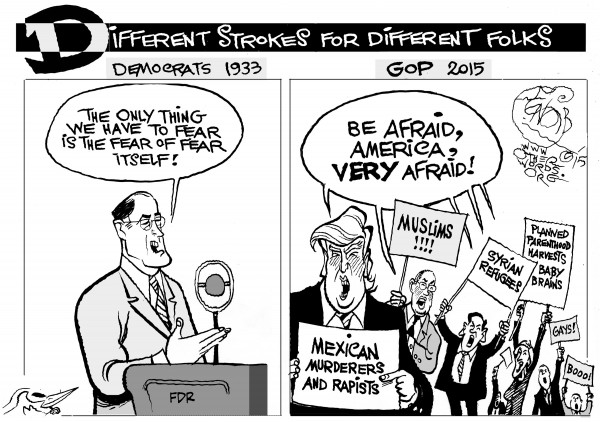
Fear Itself, an OtherWords cartoon by Khalil Bendib
Wealth is accumulated over generations, and African Americans have been historically robbed of wealth through generations of discriminatory policies that continue to echo today. Today, on average, black Americans make 60 percent as much income as whites, but have only 5 percent as much wealth.
That means that middle class whites have a safety net that middle class blacks lack.
For example, one study found that twice as many people in black neighborhoods had their wages garnished to pay off debts than those in white neighborhoods.
Why? Because when illness or disaster strikes, whites are far more likely to be able to call on friends or family to loan them money to help them get by, whereas blacks are not. That goes directly back to centuries of discrimination and violence against blacks, both legal and otherwise.
Then there’s what Trump says about Latinos (that “when Mexico sends its people, they’re not sending their best”) and Muslims (that there should be a “total and complete shutdown of Muslims entering the United States”).
Mexican-Americans run the socio-economic gamut from doctors to farmworkers. They include the sweet girl who watches my cat when I go out of town – a studious ninth grader whose mother came here from Mexico – as well as numerous professors at my university.
America got lucky the day these folks came across the border, and it’s an insult to count them alongside drug dealers and rapists.
Every time I open Facebook, moreover, I see posts by Muslim friends denouncing terrorism, showing mosques fundraising to help victims of terror attacks, or even thanking a little boy who donated his savings to help a vandalized mosque by giving him an iPad.
Obviously, these are all good things, but it makes me sad and outraged that my Muslim friends need to go to such lengths to prove to the world they aren’t terrorists. They are no more terrorists than I am. Most of them hold advanced degrees, and several are doctors.
In the end, I think Trump’s own words apply best to himself: “It is obvious to anybody the hatred is beyond comprehension.”
Yes. Exactly. And what’s truly inexplicable is why, in 2015, anyone running on a racist, xenophobic ticket finds any support at all.
To the media: Why do you continue to run snippets of Trump’s most hateful rhetoric, when you would fire any employee who said a fraction of what he’s said on TV?
And to America, it’s time we shout Trump’s own tagline at him. Let’s join together and tell the reality TV star and real estate mogul who wants to be our president, “You’re fired.”
The post It’s Time to Fire Trump appeared first on OtherWords.
This piece was reprinted from Other Words by RINF Alternative News with permission.
Video: BREAKING STORY: Jury Selected for Trial of Officer William Porter
Law Professor Doug Colbert responds to the seating of a jury in the trial of William Porter, first of 6 officers charged in the death Freddie Gray.
Via Youtube
Video: HBCU’s and Maryland Clash Over Higher Ed
TRNN Producer David Tigabu examines a landmark case on racial disparities in funding for higher education, and speaks with President of Morgan State …
Via Youtube
Video: US Meddling in Venezuela’s Elections
National Lawyers Guild President Natasha Lycia Ora Bannan discusses the U.S. interests and the rhetoric of Hillary Clinton leading up to Venezuela’s …
Via Youtube
Video: Top U.S. and World News Headlines for Thursday, December 10
Visit http://democracynow.org to watch the full independent, global news hour, read the transcript, search our archive, and to make a donation to support us.
Via Youtube
If Israel Wants to Prevent Terrorism, It Should Stop Evicting Palestinians


A bulldozed Palestinian home in the village of Beit Ommar. (Source: Palestine Solidarity Project / Flickr)
Late last year, two Palestinian cousins broke into a Jerusalem synagogue, killing five Israelis before being slain by police.
In retaliation, as part of the government’s “counterterrorist deterrence policy,” the homes of these two Palestinians were slated for demolition. Their houses were destroyed on October 6th of this year, displacing six of their family members.
A week later, their cousin Alaa Abu Jamal drove his car into a Jerusalem bus stop and killed a bystander with a cleaver.
This episode is emblematic of a larger phenomenon: Israel’s “punitive housing demolitions” are not only ethically problematic and illegal under international law, which – under the Fourth Geneva Convention – prohibits the “occupying power from destroying private property or forcibly transferring the protected population.” They’re also blatantly counterproductive at deterring terrorism.
Tensions in Jerusalem – as well as in Israel-Palestine more generally – are often boiled down to ethnic rivalry and conflicts over access to the city’s historic places of worship. But media reports often ignore or play down much more concrete grievances like home demolitions, which may have inspired Alaa Abu Jamal and others like him to lash out against Israeli civilians.
In order to better comprehend the recent wave of stabbings, a look at one of Israel’s least discussed policies is necessary. Housing demolitions, both as a military tool of “deterrence” and civil tactic of displacement, create an environment of constant anxiety for Palestinians in the West Bank – conditions that can account for the spate of violence in the past few months.
The precedent for punitive demolitions comes from the Defence Emergency Regulation (DER)119 – a 1945 law established under British colonial rule – which authorized the confiscation and destruction of “any house, structure, or land” owned by an alleged perpetrator of violence.
In the decades since, the Israeli military has used DER 119 to seal up or demolish thousands of Palestinian homes under the pretext of deterring terrorism. In 2005, however, the IDF discontinued the practice after internal studies demonstrated its ineffectiveness at achieving its stated goal. In fact, as one official remarked, “the policy had caused Israel more harm than good by generating hatred among the Palestinians.”
Yet current Prime Minister Benjamin Netanyahu has been quick to forget the findings of his own military, revitalizing punitive demolitions in response to car bombings in Jerusalem last winter. The decision has sparked a violent backlash this year: at least ten Israelis have been murdered and more than 70 wounded, further undermining the policy’s stated goal of counterterrorism.
Importantly, demolitions aren’t just used to punish the families of suspected terrorists. In fact, Israel regularly demolishes the homes of civilians who have no terrorist affiliations. Between 1988 and 2014, Israel’s Civil Administration issued 14,000 demolition orders in the West Bank, of which 11,000 are still outstanding and can be enforced at any time. Palestinians living in these condemned structures can be displaced at the whims of the ICA, and are often not notified of their demolition date until a bulldozer shows up at their doorstep. These incidents, which occur in East Jerusalem and Area C of the West Bank, occur when Israeli authorities accuse Palestinians of failing to obtain building permits for their homes.
While this may sound reasonable in theory, the sheer regulatory nightmare Palestinians are subjected to highlights their intentional exclusion from civic services. A study published on December 7th reveals that only 7 percent of building permits in Jerusalem go to Palestinian neighborhoods, despite the fact that they make up 41 percent of the city’s population. Because permits are rarely – if ever – issued to Palestinians, they’re forced to construct homes without them, giving Israel a “justification” for demolishing these structures and displacing their inhabitants.
Laura Wharton, a city councilor in Jerusalem, is unequivocally clear about the link between these demolitions and recent violence: she writes, “’If anyone thinks the Palestinians’ frustration and rage are the result of incitement alone, the numbers and facts on the ground show otherwise.”
Under these conditions, it’s easy to understand the frustration of Jerusalemites; faced by impending demolitions, either as the result of familial ties or discrimination by civic services, Palestinians like Alaa Abu Jamal lash out violently. If Israel truly wants to mitigate civilian deaths going forward, it must cease demolitions immediately.
Otherwise, the cycle of violence will continue unabated.
This piece was reprinted from Foreign Policy In Focus by RINF Alternative News with permission.
Video: RT Celebrates 10 Years on Air (Promo)
Capture RT’s Great Moments Through Interactive Timeline http://10.rt.com/ Thank you for watching us! Explore RT’s history through its most significant moments …
Via Youtube
Video: Fmr. Irish Pres. on Refugees: “It’s Shameful So Many Died and So Many Live in Terrible Conditions”
As hundreds of thousands of people from war-torn nations are housed in European refugee camps, we speak with former Irish President Mary Robinson, who …
Via Youtube
Don’t Be a Fossil-Foolish Investor

Investors who choose to steer clear of oil, gas, and coal are protecting their portfolios in the short term and the long run.
Who has divested lately? The fast-growing list includes the University of California, insurance giant Allianz, the German city of Munster, and the London School of Economics. Portfolios that add up to a total of $3.4 trillion are now either entirely fossil-free or exclude specific kinds of dirty energy like coal and tar sands.
Rather than punishing the people and institutions who commit this act of climate kindness, financial markets are rewarding them. Shunning fossil fuels has boosted returns for the past decade, as measured by a specialized index the financial tracking firm MSCI manages.
And while markets and energy trends are hard to predict, you don’t need a crystal ball to see that 2016 looks like a terrible year to bet on fossil fuels. For one thing, OPEC just passed up an opportunity to cut its oil production. Oil prices, already driven low enough to gut profits worldwide due to oversupply, are diving again.

Kevin Dooley / Flickr
How low will they go? Even before OPEC made news by doing nothing, Goldman Sachs analysts were forecasting $20 a barrel – about half of recent levels and more than 80 percent below mid-2014 highs. As consensus builds around a “lower for longer” oil outlook, U.S. natural gas prices are slumping due to a glut in that fuel too.
Then there’s the coal industry’s financial freefall. The leading coal exchange-traded fund (ETF), known as KOL, had lost nearly 55 percent of its value by early December, after suffering double-digit declines for the prior four years. KOL joined several natural gas ETFs on a list of the worst performers in that asset class during the first nine months of 2015.
With bankruptcy and debt distress in store next year for the oil and gas industries, according to Fortune, the purely financial case for going fossil-free is getting stronger.
Do you want to invest in S&P 500 companies, aside from any oil, gas, and coal outfits? Financial firm State Street Global Advisors partnered with the Natural Resources Defense Council to create a low-carbon vehicle that lets you do that now.
Better yet, invest some money in the industries bound to replace fossil fuels, such as renewable energy and other climate-friendly technologies. One option is FAN, a wind ETF. It had gained more than 10 percent through the first week of December, making it among 2015’s top performers. (Disclosure: I’ve both lost and made money over the years investing in the wind and solar power industries.)
As the Paris climate talks have made clear, the question is increasingly when, not if, the world will stop burning oil, gas, and coal. So the long-term case for abstaining from any investment in those businesses is even more powerful than current market malaise.
How powerful is it?
Those wild-eyed radicals at Citigroup have estimated what averting a climate catastrophe by leaving more than three quarters of oil, gas, and coal reserves underground or beneath the sea would cost.
The price tag for this collectively rational behavior, whether it will be due to government action or booming demand for environmentally friendlier options, is $100 trillion. That huge number, which exceeds the combined value of the economy of every country on earth, has ominous implications for ExxonMobil and all of its competitors.
In any case, a global shift toward greener energy is already underway. Acting now to protect your money from the financial risks associated with this upheaval – while putting it where your mouth is if you care about climate change – sends a message to energy companies and Wall Street. And it just might speed up this monumental industrial transformation.
The post Don’t Be a Fossil-Foolish Investor appeared first on OtherWords.
This piece was reprinted from Other Words by RINF Alternative News with permission.
Video: ‘Hegemony of Western media has to end’ – Arnab Goswami at RT conference
RT is celebrating its 10th anniversary and bringing together leading international experts to exchange ideas on shape-shifting powers in the world today – READ …
Via Youtube
Video: “It’s Going to Burn Our Planet”: Hundreds Protest “Unacceptable” Draft Climate Accord Inside COP21
It’s the final stretch of negotiations at the United Nations climate change summit, COP21, as representatives from nearly 200 countries attempt to reach a final …
Via Youtube
Video: Role of intl news media on new geopolitical chessboard (#RT10 Panel Discussion)
Details: http://conference.rt.com/ To celebrate RT’s ten-year anniversary we are bringing together the leading international experts to discuss these …
Via Youtube
Video: Climate Apartheid: Greenpeace Chief Says Poorest Suffer Brunt of Rich Nations’ Emissions
Representatives from nearly 200 nations are in the final stretch of negotiations at the U.N. climate summit in Paris. The text has nearly 100 outstanding points of …
Via Youtube
Video: ‘People live in ruins’: Israel stops cement supplies into Gaza
Israel has banned all imports of cement entering Gaza, a move which Palestinians say was imposed without notice. The material is vital for a region trying to …
Via Youtube
Video: Frantz Fanon and Lessons from a Not So Dying Colonialism
Dr. Frank B. Wilderson, III, author of Incognegro: A Memoir of Exile and Apartheid, discusses the enduring legacy of Frantz Fanon.
Via Youtube
Video: Mary Robinson on Int’l Human Rights Day: Climate Change is the Biggest Human Rights Issue There Is
Today is International Human Rights Day, which commemorates the day on which the United Nations General Assembly adopted the Universal Declaration of …
Via Youtube
Congress Plays Santa to the Rich
As Congress rushes to wrap up business before the Christmas holidays, it traditionally dangles pricy ornaments — favors to rich donors — on an omnibus bill called a “Christmas tree,” one activity that has survived the current legislative dysfunction, writes Michael Winship.
By Michael Winship
I was planning to write a festive poem to Congress as they approach their merry holiday recess but couldn’t come up with a rhyme for “dysfunctional.”
Writing in Monday’s Washington Post, Greg Sargent noted that all that inertia on Capitol Hill has been caused “less by a roughly equivalent failure by both major parties to make the incremental concessions needed to reach common ground, and more by a searing intra-GOP argument over whether the Republican Party should make such concessions to reach the common ground that has always been sitting right there in plain sight.”
Citing Ryan Lizza’s superb analysis of the right-wing House Freedom Caucus in The New Yorker this week, Sargent writes that the radical caucus members believe, “Republicans lose ground when they govern along with Democrats, because achieving bipartisan governing compromise inherently represents capitulation to Dems, in the sense that when government functions, it affirms the Dem vision.”
It’s really a profound pity – tragic, in fact, and deadly dangerous to democracy. In an alternative universe, I could see senators and House members racing home to spend holiday time with friends and family, drinking hot cocoa with peppermint sticks, making snow angels and redistributing their campaign contributions to the poor.
Video: EU diplomats confused: Italy refuses to extend sanctions against Russia
Italy is demanding a discussion on the extension of economic sanctions against Russia, and says they should not be simply rubber-stamped. Although Italy …
Via Youtube
Video: COP21 Treaty Draft Excludes Gender Equality Even Though Women are Most Impacted by Climate Change
The current draft of the U.N. climate change agreement does not include gender equality, and critics have also noted the lack of women in leadership roles at …
Via Youtube
Video: ‘Bully game between Russia, US will lead to more conflicts’ – fmr US Defense Intel Chief
For its 10th on-air and online anniversary RT is bringing together leading international experts to discuss the challenges the global community faces today …
Via Youtube
Video: Sheltering Liberation: A Short History of Maroon Settlements
This week on Telesur’s The Global African Dr. Msomi Moor and Dr. Sheila Walker discuss the legacy of the Maroon presence in Panama and Colombia.
Via Youtube
Video: Obama Accused of Giving Poor Nations a “Poison Chalice” by Skirting U.S. Climate Responsibility
On Wednesday, U.S. Secretary of State John Kerry announced plans to double the funding that the United States provides to help developing countries adapt to …
Via Youtube
What the Red Cup Controversy Really Says about Christmas in America

I happened to be visiting the first-ever Starbucks in Seattle a few weeks ago when a mini-controversy erupted: There were no Christmas trees or snowflakes on this season’s holiday Starbucks coffee cups.
The horror!
Facebook exploded with comments, as did Twitter. Even Republican presidential candidate Donald Trump bloviated from the campaign trail that “maybe we should boycott Starbucks.” Referring to the Starbucks in his own Trump Tower in New York, the candidate added, “That’s the end of that lease.”
Conservative pundits immediately deemed the minimalist Starbucks cup design a “war on Christmas.”
For the life of me, I couldn’t understand what the controversy was about. This was a corporate entity that had decided to use plain red coffee cups instead of ones festooned with holiday icons. Big deal.

Brett Neilson / Flickr
But the more I read into the story, the more I realized that Americans – and especially conservative Christian Americans – have a very parochial view of Christmas. For most people in this country, Christmas means a decorated tree, snow, and Christmas carols.
Those are nice traditions, but none of them has anything to do with the birth of Jesus Christ. They’re what modern American culture has turned Christmas into.
The Christmas tree, for example, is hardly ancient: It was popularized in Germany in the 16th century. It wasn’t adopted in the United States until the late 18th century – and even then, only among the upper classes. It’s not at all a part of the story of Jesus’ birth. Indeed, the Vatican itself didn’t even put up a Christmas tree until 1982.
Furthermore, in many cultures with longer Christian traditions than North America and Western Europe, the Christmas tree plays no role whatsoever. In Greece, the tradition favors a Christmas boat, a wooden structure around which Saint Basil the Great places presents for children. Other cultures use a large, decorated shoe.
As a Greek-American with family roots in the sunny Mediterranean, I also never understood the significance of a “white Christmas.” Even as a kid I was aware that it rarely snowed in Bethlehem in December – or, frankly, in much of the world.
So if you’re dreaming of a white Christmas, dream on. And don’t get upset if your coffee cup doesn’t have snowflakes on it.
Even many Christmas carols, including some of the most popular ones, have no connection to the birth of Jesus. Personally, I reject anything with a mention of reindeer, for example. I doubt any of those polar caribou were milling about the Middle Eastern manger where Jesus was born.
And to be honest, we don’t have any real idea of when Jesus was born anyway. The church didn’t adopt the date of December 25 until the 4th century. Many scholars believe that date was chosen to placate Roman citizens who already were celebrating the “Festival of the Unconquered Sun.”
So with so much confusion and tradition not based on fact, can we lighten up on Starbucks?
The post What the Red Cup Controversy Really Says about Christmas in America appeared first on OtherWords.
This piece was reprinted from Other Words by RINF Alternative News with permission.
Video: Security or Surveillance: Privacy vs anti-terror security in digital age (#RT10 Panel Discussion)
Details: http://conference.rt.com/ To celebrate RT’s ten-year anniversary we are bringing together the leading international experts to discuss these …
Video: In The Mix with Rosa Clemente: If I Were President
Activist, journalist and scholar Rosa Clemente concludes her 3-part visit with Jared Ball discussing her If I Were President Tour.
Via Youtube
Video: Why is Saudi Arabia Undermining COP21 When Climate Change Could Make the Gulf Uninhabitable?
“How does a country negotiate its own perceived demise? This may be the most pertinent question to consider when pondering the role of Saudi Arabia at the …
Via Youtube
So Why Did Turkey Shoot Down That Russian Plane?

(Image: DonkeyHotey / Flickr)
Why did Turkey shoot down that Russian warplane?
It was certainly not because the SU-24 posed any threat. The plane is old and slow, and the Russians were careful not to arm it with anti-aircraft missiles. And it wasn’t because the Turks are quick on the trigger, either. Three years ago, Turkish President Recep Tayyip Erdogan emphatically declared that a “short-term violation of airspace can never be a pretext for an attack.” There are even some doubts about whether the Russian plane ever crossed into Turkey’s airspace at all.
Indeed, the whole November 24 incident looks increasingly suspicious, and one doesn’t have to be a paranoid Russian to think the takedown might have been an ambush. As retired Lt. Gen. Tom McInerney, former U.S. Air Force chief of staff, told Fox News, “This airplane was not making any maneuvers to attack the [Turkish] territory.” He called the Turkish action “overly aggressive” and concluded that the incident “had to be preplanned.”
It certainly puzzled the Israeli military, not known for taking a casual approach to military intrusions. Israeli Defense Minister Moshe Yaalon told the press on November 29 that a Russian warplane had violated the Israeli border over the Golan Heights. “Russian planes do not intend to attack us, which is why we must not automatically react and shoot them down when an error occurs.”
So why was the plane downed?
Perhaps because, for the first time in four years, some major players are tentatively inching toward a settlement of the catastrophic Syrian civil war, and powerful forces are maneuvering to torpedo that process. If the Russians hadn’t kept their cool, several nuclear-armed powers could well have found themselves in a scary faceoff, and any thoughts of ending the war would have gone a-glimmering.
A Short Score Card
There are multiple actors on the Syrian stage – and a bewildering number of crosscurrents and competing agendas that, paradoxically, make it both easier and harder to find common ground. Easier, because there is no unified position among the antagonists; harder, because trying to herd heavily armed cats is a tricky business.
A short score card on the players:
The Russians and the Iranians are supporting Syrian President Bashar al-Assad and fighting a host of extremist organizations ranging from al-Qaeda to the Islamic State, or ISIS. But each country has a different view of what a post-civil war Syria might look like. The Russians want a centralized and secular state with a big army. The Iranians don’t think much of “secular,” and they favor militias, not armies.
Turkey, Saudi Arabia, Qatar, and most the other Gulf monarchies are trying to overthrow the Assad regime, and are the major supporters of the groups Russia, Iran, and Lebanon’s Hezbollah are fighting. But while Turkey and Qatar want to replace Assad with the Syrian Muslim Brotherhood, Saudi Arabia might just hate the Brotherhood more than it does Assad. And while the monarchies are not overly concerned with the Kurds, Turkey is bombing them, and they’re a major reason why Ankara is so deeply enmeshed in Syria.
The U.S., France, and the United Kingdom are also trying to overthrow Assad, but are currently focused on fighting ISIS using the Kurds as their major allies – specifically the Syrian Kurdish Democratic Party, an offshoot of the Turkish Kurdish Workers Party that the U.S. officially designates as “terrorist.” These are the same Kurds that the Turks are bombing and who have a friendly alliance with the Russians.
Indeed, Turkey may discover that one of the price tags for shooting down that SU-24 is the sudden appearance of new Russian weapons for the Kurds, some of which will be aimed at the Turks.
A Suspension of Rational Thought
The Syrian war requires a certain suspension of rational thought.
For instance, the Americans are unhappy with the Russians for bombing the anti-Assad Army of Conquest, a rebel alliance dominated by the Nusra Front, al-Qaeda’s franchise in Syria. That would be the same al-Qaeda that brought down the World Trade Center towers and that the U.S. is currently bombing in Yemen, Somalia, and Afghanistan.
Suspension of rational thought is not limited to Syria.
A number of Arab countries initially joined the U.S. air war against the Islamic State and al-Qaeda, because both organizations are pledged to overthrow the Gulf monarchies. But Saudi Arabia, Jordan, the United Arab Emirates, and Qatar have now dropped out to concentrate their air power on bombing the Houthis in Yemen.
The Houthis, however, are by far the most effective force fighting ISIS and al-Qaeda in Yemen. Both extremist organizations have made major gains in the last few weeks because the Houthis are too busy defending themselves to take them on.
Moves Toward a Settlement
In spite of all this political derangement, however, there are several developments that are pushing the sides toward some kind of peaceful settlement that doesn’t involve regime change in Syria. That is exactly what the Turks and the Gulf monarchs are worried about, and a major reason why Ankara shot down that Russian plane.
The first of these developments has been building throughout the summer: a growing flood of Syrians fleeing the war. There are already almost 2 million in Turkey, over a million each in Jordan and Lebanon, and as many as 900,000 in Europe. Out of 23 million Syrians, some 11 million have been displaced by the war, and the Europeans are worried that many of those 11 million people will end up camping out on the banks of the Seine and the Ruhr. If the war continues into next year, that’s an entirely plausible prediction.
Hence, the Europeans have quietly shelved their demand that Assad resign as a prerequisite for a ceasefire and are leaning on the Americans to follow suit. The issue is hardly resolved, but there seems to be general agreement that Assad will at least be part of a transition government. At this point, the Russians and Iranians are insisting on an election in which Assad would be a candidate because both are wary of anything that looks like “regime change.” The role Assad might play will be a sticking point, but probably not an insurmountable one.
Turkey and Saudi Arabia are adamant that Assad must go, but neither of them is in the driver’s seat these days. While NATO supported Turkey in the Russian plane incident, according to some of the Turkish press, many of its leading officials consider Erdogan a loose cannon. And Saudi Arabia – whose economy has been hard hit by the worldwide fall in oil prices – is preoccupied by its Yemen war, which is turning into a very expensive quagmire.
Russia’s Role
The second development is the Russian intervention, which appears to have changed things on the ground, at least in the north, where Assad’s forces were being hard pressed by the Army of Conquest. New weapons and airpower have dented a rebel offensive and resulted in some gains in the government’s battle for Syria’s largest city, Aleppo.
Russian bombing also took a heavy toll on the Turkmen insurgents in the Bayir-Bucak region, the border area that Turkey has used to infiltrate arms, supplies, and insurgents into Syria.
The appearance of the Russians essentially killed Turkey’s efforts to create a “no fly zone” on its border with Syria, a proposal that the U.S. has never been enthusiastic about. Washington’s major allies, the Kurds, are strongly opposed to a no fly zone because they see it as part of Ankara’s efforts to keep the Kurds from forming an autonomous region in Syria.
The Bayir-Bucak area and the city of Jarabulus are also the exit point for Turkey’s lucrative oil smuggling operation, apparently overseen by one of Erdogan’s sons, Bilal. The Russians have embarrassed the Turks by publishing satellite photos showing miles of tanker trucks picking up oil from ISIS-controlled wells and shipping it through Turkey’s southern border with Syria.
“The oil controlled by the Islamic State militants enters Turkish territory on an industrial scale,” Russian President Vladimir Putin said November 30. “We have every reason to believe that the decision to down our plane was guided by a desire to ensure the security of this oil’s delivery routes to ports.”
Erdogan and NATO
Erdogan didn’t get quite the response he wanted from NATO following the shooting down of the SU-24. While the military alliance backed Turkey’s defense of its “sovereignty,” NATO then called for a peaceful resolution and de-escalation of the whole matter.
At a time when Europe needs a solution to the refugee crisis – and wants to focus its firepower on the organization that killed 130 people in Paris – NATO cannot be happy that the Turks are dragging them into a confrontation with the Russians, making the whole situation a lot more dangerous than it was before the November 24 incident.
The Russians have now deployed their more modern SU-34 bombers and armed them with air-to-air missiles. The bombers will now also be escorted by SU-35 fighters. The Russians have also fielded S-300 and S-400 anti-aircraft systems, the latter with a range of 250 miles. The Russians say they’re not looking for trouble, but they’re loaded for bear should it happen.
Would a dustup between Turkish and Russian planes bring NATO – and four nuclear armed nations – into a confrontation? That possibility ought to keep people up at night.
Coming to the Table
Sometime around the New Year, the countries involved in the Syrian civil war will come together in Geneva. A number of those will do their level best to derail the talks, but one hopes there are enough sane – and desperate – parties on hand to map out a political solution.
It won’t be easy, and who gets to sit at the table has yet to be decided. The Turks will object to the Kurds; the Russians, Iranians, and Kurds will object to the Army of Conquest; and the Saudis will object to Assad. In the end it could all come apart. It’s not hard to torpedo a peace plan in the Middle East.
But if the problems are great, failure will be catastrophic. That may be the glue that keeps the parties together long enough to hammer out a ceasefire, an arms embargo, a new constitution, and internationally supervised elections.
Foreign Policy In Focus columnist Conn Hallinan can be read at Dispatches from the Edge and the Middle Empire Series.
This piece was reprinted from Foreign Policy In Focus by RINF Alternative News with permission.
Video: In The Mix with Rosa Clemente: Hip-Hop and Afro-Latina Activism
Activist, scholar and journalist Rosa Clemente continued her discussion with Jared Ball about her seminal work as a hip-hop and Afro-Latina activist.
Via Youtube
Israel’s Moral Erosion
Amid global anger over militants citing the Koran as a defense for terrorism, less attention gets paid to Israel citing God’s will as expressed in the Bible as the moral justification for stealing Palestinian land, an ethical crisis that is eroding Israel’s world standing, writes Alon Ben-Meir.
By Alon Ben-Meir
I have long maintained that Israel’s occupation of the West Bank defies the moral principle behind the creation of the state. Contrary to Prime Minister Benjamin Netanyahu’s assertion, the occupation erodes rather than buttresses Israel’s national security and cannot be justified on either security or moral grounds.
Unless Israel embraces a new moral path, no one can prevent it from unraveling from within only to become a pariah state that has lost its soul, wantonly abandoning the cherished dreams of its founding fathers.

A section of the barrier – erected by Israeli officials to prevent the passage of Palestinians – with graffiti using President John F. Kennedy’s famous quote when facing the Berlin Wall, “Ich bin ein Berliner.” (Photo credit: Marc Venezia)
There are four ethical theories – Kantian, utilitarian, virtue-based and religious – that demonstrate the lack of moral foundation in the continuing occupation, which imposes upon Israelis the responsibility to bring it to a decisive end.
The first moral theory is deontological ethics, whose greatest representative is Immanuel Kant. According to this theory, consequences are irrelevant to the moral rightness or wrongness of an action; what matters is whether the action is done for the sake of duty or out of respect for the moral law.
Kant provided several formulations of the moral law, which he refers to as the categorical imperative; for our purposes, what is most important are his first two formulations. The first is the principle that morality requires us to act only on those maxims we can universalize. As he puts it, “Act only on that maxim through which you can at the same time will that it should become a universal law.” In short, never do anything that you couldn’t will everybody else do at the same time.
The question is whether the Israeli occupation is a policy that…
Video: Helping you to #QuestionMore: RT coverage of police brutality & racism in USA
RT follows a wave of street fightings and protests between citizens and police in USA after cops killed a black youngster in Ferguson. RT LIVE http://rt.com/on-air …
Via Youtube
Video: Keiser Report: Paris attacks, COP21 & Bitcoin network (E847)
In this episode of the Keiser Report, Max Keiser and Stacy Herbert discuss the situation in Paris where they find, ‘Je suis en terrasse, mais je vote FN.’ They cut …
Via Youtube
NYT Rewrites Scalia to Make Him Sound Less Racist

Antonin Scalia wasn’t just talking about blacks with “inferior academic credentials.” (cc photo: Steven Masker/Wikimedia)
New York Times Supreme Court correspondent Adam Liptak (12/9/15) recounted a startling moment in the Court’s oral arguments over the University of Texas’ affirmative action plan:
In a remark that drew muted gasps in the courtroom, Justice Antonin Scalia said that minority students with inferior academic credentials may be better off at “a less advanced school, a slower-track school where they do well.”
“I don’t think it stands to reason that it’s a good thing for the University of Texas to admit as many blacks as possible,” he added.
But part of the reason that the remark drew “muted gasps,” surely, is that that’s not what Scalia said–he didn’t say minority students “with inferior academic credentials” would be better off at worse schools, he said African-Americans in general would. Here’s the whole passage:
There are those who contend that it does not benefit African-Americans to get them into the University of Texas, where they do not do well, as opposed to having them go to a less–a slower-track school where they do well. One of the briefs pointed out that most of the black scientists in this country don’t come from schools like the University of Texas…. They come from lesser schools where they do not feel that they’re being pushed ahead in classes that are too fast for them.
He goes on to suggest that “really competent blacks” would be better off if they were “admitted to lesser schools”:
I’m just not impressed by the fact that that the University of Texas may have fewer [black students]. Maybe it ought to have fewer. And maybe some, you know, when you take more, the number of blacks, really competent blacks, admitted to lesser schools turns out to be less. And I don’t think it stands to reason that it’s a good thing for the University of Texas to admit as many blacks as possible.
This is not a person talking about a subset of blacks with a particular kind of educational background; taking his words at face value, this is a person asserting that African-Americans as a whole belong in “lesser schools” that are not “too fast for them.” (Or that “there are those who contend” that that is the case, if you want to give Scalia credit for that circumlocution.)
The fact that a Supreme Court justice justifies eliminating affirmative action on the basis of openly racist views ought to be big news. By sugarcoating what Scalia actually said, the New York Times disguises that news–making the ethnic cleansing of America’s top schools a more palatable possibility. Perhaps that shouldn’t make me gasp.
Jim Naureckas is the editor of FAIR.org. Follow him on Twitter: @JNaureckas.
You can send a message to the New York Times at letters@nytimes.com, or write to public editor Margaret Sullivan: public@nytimes.com (Twitter: @NYTimes or @Sulliview). Please remember that respectful communication is the most effective.
This piece was reprinted by RINF Alternative News with permission from FAIR.
Video: Syrian rebels leave Homs following truce deal
Hundreds of Syrian civilians and anti-Assad rebels have begun leaving the last district they control in the city of Homs, under a ceasefire deal recently reached …
Via Youtube
Video: US thought it could depose Gaddafi, Assad without state collapse – Intl relations Prof
Regime change has been the most controversial and consistent aspect of US foreign policy for decades. And as the disasters following the interventions in Iraq …
Via Youtube
Video: Miami-Dade Police Yank Mom From Car For Parking On Grass (Police Brutality)
A Miami mother caught on camera in a heated debate with a Police officer near her daughter’s school in October, just had all charges dropped on Tuesday.
Via Youtube
Video: Dane Wigington: Geo-Engineering Is Systematically & Deliberately Destroying The Earth’s Ecosystems
Please Support The Show — http://richieallen.co.uk/ https://www.facebook.com/therichieallenshow http://www.youtube.com/RichieAllenShowMedia Tune in at …
Via Youtube
For Sale: Obscene Monuments to Mammon
The uber-rich like to collect trophies as proof of their unsurpassed uberness.
These aren’t like the tacky brass trophy you won in a bowling tournament. No, no – global ultra-billionaires compete ferociously with each other in their extreme wealth games to have the most dazzlingly gorgeous trophy spouse, the most humongous and elaborate trophy yacht on the seven seas, and so forth.
And now comes the most ostentatious game of one-upmanship yet: The trophy mansion.
Forget those $10-million show houses perched pretentiously atop a peak in Aspen for all to see – we’re talking $100-million, $200-million, and even $500-million mine-is-bigger-than-yours monuments to mammon.
For example, a gold rush of developers are constructing monstrous trophy mansions in Los Angeles.
How big? These things have 8,000-square-foot master bedrooms alone, along with closets so vast they include catwalks, full-size IMAX movie theaters, and even “champagne rooms.” At 1,500 square feet, my entire house would fit in those mega-master bedrooms five times over.
One of these bungalows in the luxe ZIP code of Bel Air is listed for sale at half a billion dollars. The size of a shopping mall, it covers 110,000 square feet of indoor space, plus a bowling alley, a night club, a casino, and – get this – four swimming pools!
“Who in their right mind needs four swimming pools?” asks a neighbor who paid a mere 10 million bucks or so for his luxurious Bel Air home. Well, sniffed the developer, one can work up quite a sweat going around this maxi-mansion. “Why would you not need four swimming pools?”
Adding to the narcissistic self-indulgence of these trophy hunters, note that this $500 million Taj Mahal isn’t even meant to be the owner’s main home, but a place for occasional getaways. “Nobody buys a 100,000 square foot home to use every day,” explains the developer.
Such excess isn’t just an embarrassment of riches. It’s obscene.
The post For Sale: Obscene Monuments to Mammon appeared first on OtherWords.
This piece was reprinted from Other Words by RINF Alternative News with permission.
What the GOP’s Putting Under Corporate America’s Tree

Given the commitment House Republicans profess to balancing the federal budget, you’d think tax breaks for profitable businesses would be a low priority. But this holiday season, they’re set to vote for a two-year, $96 billion package of tax breaks – 80 percent of which will benefit corporations.
All that’s missing is the gift wrap.
The package is a grab bag of loopholes and subsidies that serve specific interest groups – from NASCAR track owners to rum producers in Puerto Rico. Efforts to unbundle the parcel and vote on each gift to industry interests separately have been ignored.
Two of these corporate tax breaks encourage multinational companies to move profits offshore. The Active Financing Exception and the Controlled Foreign Corporations Look-Through Rule, which allow multinational corporations to avoid paying U.S. taxes, left taxpayers on the hook for $6 billion in 2014 alone.
The Active Financing Exception allows banks and finance companies to indefinitely avoid paying taxes on their U.S. income by claiming they earned those profits abroad. The corporate tax code officially forbids banks from shifting profits earned from loans and other financial activities, but this policy creates an exception.

Paul Bailey / Flickr
That loophole played a key role historically in General Electric’s notorious tax avoidance strategy. Despite earning $68.4 billion in profits in the past decade, GE – which was active in finance as well as manufacturing – paid a tax rate of just 0.4 percent on those profits.
The Look-Through Rule lets multinationals move profits to offshore subsidiaries without incurring U.S. taxes. Companies can exploit this loophole to create “stateless income,” in effect making those profits exempt from taxes in any country.
When this package of tax breaks was extended late last year, Congress applied it to all of 2014. That made a lovely gift to corporate bottom lines and a big lump of coal for citizens who saw their earnings subsidize profitable businesses.
Another tax break under the tree, known as bonus depreciation, allows corporations to write off the costs of their investments in new equipment at a faster rate than the actual depreciation of those assets. Supporters claim the tax break encourages businesses to buy equipment sooner than they normally would, boosting demand at equipment manufacturing firms.
But the Congressional Research Service found bonus depreciation is “a relatively ineffective tool for stimulating the economy.” In fact, the giveaway had “no more than a minor effect.” Nevertheless, Congress has proposed making bonus depreciation permanent at a cost of more than $280 billion over 10 years.
Business tax breaks have sailed through Congress in recent years with little concern for their budgetary impacts, while programs that working families depend on – like education and housing – have been squeezed amid lectures about the need for “belt-tightening.”
Indeed, Congress seems to operate under a different set of rules when it considers legislation that directly helps American families. Extended unemployment assistance was allowed to expire two years ago. And last year, nutrition assistance for hungry kids was cut.
In this year’s budget battle, tax credits for low-income working families are at risk. If the Earned Income Tax Credit and the Child Tax Credit are not extended, 16 million people – including 8 million children – will be pushed deeper into poverty in 2017. A working parent with two children earning $20,000 a year would see her Child Tax Credit fall to $810 – a loss of almost $100 a month, which would otherwise be used for utility bills, bus fare, food, or school supplies.
Americans say they want corporations to pay their fair share for the public programs and services that make our country work. This December, tell your representatives to protect credits that give hardworking parents a helping hand and consign corporate tax giveaways to the rubbish bin.
The post What the GOP’s Putting Under Corporate America’s Tree appeared first on OtherWords.
This piece was reprinted from Other Words by RINF Alternative News with permission.
Video: Helping you to #QuestionMore: RT’s history providing a platform for overlooked US third parties
When then-presidential candidates Barack Obama and Mitt Romney tried to prove that they were a real alternative to one another in the debates of 2012, RT …
Via Youtube
Video: CrossTalk: Syrian chessboard
Recent claims that the US bombed a Syrian military installation may be a telling example of how Washington and its allies intend to escalate their war on the …
Via Youtube
Video: Special offer: IMF propping up Ukraine, changing rules on money lending
The IMF has changed its own rules on lending money to indebted countries, in order to save cash-strapped Ukraine from imminent default. Previously, the IMF …
Via Youtube
Working Until It’s Time for Your Grave

“My plan is just to work until I die.” That’s how my mom sums up her retirement prospects.
She’s worked more than 40 hours a week as a legal secretary in north Florida for as long as I can remember. When my brother and I were kids, we went to her office every Saturday and entertained ourselves by sliding across the floor in fancy law firm chairs while our single mom worked overtime in her cubicle.
She managed to get me into college on a scholarship, and my brother got there on the GI Bill after a stint in the Army. Yet the American dream still hasn’t quite paid off for her. My mom’s one of the 62 percent of Americans who lives paycheck to paycheck. Even at age 60, she still doesn’t have paid sick leave or vacation time, and she avoids the doctor because she can’t afford her $2,000 deductible.
When I had to undergo a stem cell transplant to treat my stage 4 cancer in 2010, her employer allowed her to take a few days off to help care for me in Washington, D.C. Because she had no savings, my coworkers at the Institute for Policy Studies took up a donation drive to cover her travel and time off work.
My IPS colleagues recently released a report on the retirement gap between CEOs and workers. They found that nearly half of working age Americans have no access to retirement plans through their jobs. When I asked my mom about her own retirement savings, I learned she had nothing at all.
That terrified me.

Thomas8047 / Flickr
My mom isn’t bitter about it. She does the best she can with what she has, and tries to stay healthy. When I asked her permission to share her story, she was worried that it might sound like she was complaining.
As for me, I felt angry.
The 100 CEOs profiled in this report have nest eggs that are worth more than $49 million – enough to generate a $277,686 monthly retirement check for the rest of their lives. My mom’s anticipating a Social Security check worth about $1,200 a month starting five years from now – and year after year we hear politicians threaten to cut even that.
In fact, millions of Americans rely on the federal government’s safety net to support them in retirement. But the net is fraying as corporations and their top executives dodge their fair share of the taxes that sustain it. While they pad their own retirement accounts, people like my mom who work hard their entire lives could have nothing to show for it.
What can be done?
My colleagues have suggested capping tax-deferred, corporate-sponsored retirement accounts at $3 million, a move that President Barack Obama estimated would raise an additional $9 billion of tax revenue over 10 years. Funds from an annual excise tax on assets greater than $3 million could go to the Social Security Trust Fund, which would help all workers.
Even with that cap in place, the richest corporate retirees would get $200,000 a year to live on in retirement. I bet they’d be able to make do.
Here’s another good idea: Close the “performance pay” loophole that allows unlimited corporate tax deductions for executive pay. The Joint Committee on Taxation estimates that closing this loophole would generate more than $50 billion over 10 years.
My mom and other low-income and middle-class workers shouldn’t have to go it alone. It’s time for all of us to stand together and demand fairness in retirement. I don’t want her, or anyone else’s parents, to work themselves into the grave.
The post Working Until It’s Time for Your Grave appeared first on OtherWords.
This piece was reprinted from Other Words by RINF Alternative News with permission.
Video: Epidemics fears in EU: HIV, polio, cholera & more detected in refugee camps
The influx of asylum seekers has brought health concerns to Europe. About 15% of newly arriving migrants (approx. 200 000 people) require immediate …
Via Youtube
Video: Top U.S. and World News Headlines for Wednesday, December 9
Visit http://democracynow.org to watch the full independent, global news hour, read the transcript, search our archive, and to make a donation to support us.
Via Youtube
Video: Hopefully, no nukes needed in fight against ISIS — Putin
The downing of a Russian Sukhoi bomber by the Turkish Air Force was sufficient reason to start a war, but Moscow chose not to respond symmetrically, says …
Via Youtube
Video: “I Don’t Want to Die. This War Is Not My War”: A Syrian in France’s Largest Refugee Camp Speaks Out
Broadcasting from Paris, France, Democracy Now! travels an hour and a half north of the city to Calais, site of the largest refugee camp in the country.
Via Youtube
Video: Russian S-300 missile defense systems deployed to Arctic military base
Kola’s new surface-to-air regiment began their anti-aircraft duty in combat readiness at the Novaya Zemlya archipelago. The regiment is equipped with the …
Via Youtube
Video: What Do Survivors of War Have to Do to Live in Peace?: Voices from France’s Largest Refugee Camp
Residents of the largest refugee camp in France, situated outside the northern port city of Calais, often call it “The Jungle.” It is a maze of wind-swept, ripped tents …
Via Youtube
Video: Unidentified jets attacked Syrian army, US-led coalition suspected – Russia MoD
Four Western coalition warplanes were spotted over the Deir az-Zor area in Syria on December 6, when a Syrian Army camp came under attack. No Russian …
Via Youtube
How the Richest Man in the World Rules the U.S. from Riyadh

Saudi Arabia Leads the Jihadist Nations; U.S. Assists Them
Eric Zuesse
Did you know that Saudi Arabia’s Ambassador to the United States during 1983-2005, the Saudi Prince Bandar bin Sultan Al Saud (affectionately known in the U.S. as “Bandar Bush”), had donated millions to Al Qaeda before the 9/11 attacks, according to the sworn court testimony of the man who had served as Al Qaeda’s bookkeeper and as the bagman who personally collected the mega-donations to Al Qaeda, all in cash?
How come you didn’t read about that in newspapers and magazines, and hear about it on TV ‘news’-reports; and why was this stunning and crucially important testimony published only at small independent news-sites, such as here? (Evaluate it for yourself there, and figure out for yourself why the man there testifying is still kept hidden away in a U.S. super-max prison, and why his testimony has been hushed up. Even though American Presidents have changed, America’s international policies haven’t. Barack Obama protects George W. Bush, who previously had protected “Bandar Bush.” Obama, who publicly condemns torture, even privately protects Bush’s agents who perpetrated tortures.)
Americans, like the citizens of some other countries where elections are held, are told by the ‘news’ media that it’s a ‘democracy,’ even if it’s actually not. Is the U.S., really a “democracy”?
Read the following, click onto the links here for the evidence, and you will know why the U.S. government supplies Al Qaeda and even ISIS, and who the key individuals are behind Islamic terrorism, otherwise known as jihadism. Read the following, and its linked sources, and you will see clearly through the trashy ‘news’ reports that are little more than stenographic reports of what’s being said by officials who are actually lying through their teeth, partly in order to cover up their own guilt, but also because their ultimate paymasters demand these lies.
The great investigative historian F. William Engdahl headlined December 9th at sott, “Investigating Saudi Arabia’s sponsorship of Turkish politics, terrorism, and the frenzied conflict in Syria,” and he put together the pieces of the type of major news report about the Saudi-run U.S. operation, that I had been preparing and hoping to present on this matter, but he did it faster, and so everyone should see it there, because what he is showing (and all of his factual allegations are true though he failed to provide the links to the evidence, as I would have done if I had written it) is that the top priority of America’s foreign and military policies is to serve King Salman al-Saud of Saudi Arabia (the world’s richest person), and to conquer his major oil-and-gas competitor Russia, by removing heads-of-state who are allied with Russia. Russia competes with Saudi Arabia as the world’s top oil-and-gas producer, and it’s the #1 power for all natural resources combined. And the Saudi-U.S. alliance, which rules NATO and “the West” (Europe and Japan), are determined to conquer and grab those Russian assets for themselves, so that the aristocracies which are allied to the U.S. aristocracy will control these assets, and aristocracies which aren’t U.S.-allied won’t. But the U.S. is really just a ‘democratic’ front for the Saud family, in the final analysis. And the Sauds were aristocrats even before the United States existed.
Further evidence confirming the same view as Engdahl presents is provided by Joe Giambone’s superb article at International Policy Digest on 29 November 2015, “Why ISIS Exists: The Double Game.” One of the articles linked-to there quotes Saudi Prince Bandar as saying, “The Syrian regime is finished as far as we and the majority of the Syrian people are concerned. [The Syrian people] will not allow President Bashar al-Assad to remain at the helm.” That’s a bald lie, a knowing falsehood from him, as is documented here. Even Western polls show that in a free and fair, internationally monitored election, the Syrian people would overwhelmingly choose Bashar al-Assad over anyone else to lead Syria. That’s why U.S. President Obama opposes any such election in Syria, and why Russian President Putin insists that it be held. The non-sectarian, secular (though officially Shiite) President of Syria had held that country peacefully together for more than a decade until CIA and other Western and Sunni-royalty operations in Syria brought thousands of rabid Sunni jihadists into Syria to topple the secular Shiite Assad from power.
Here is a brief historical account of how this Saudi-U.S. scheme to conquer Russia started, under George Herbert Walker Bush (a Bush by birth who was informally adopted by the world’s richest family, the Sauds). And here is the type of people they are. In fact: they’re the biggest block against an effective global policy to restrain global warming. Their trillions of dollars of private wealth is more important to them than the continuation of a livable planet after they die.
They care more about their private past than about the entire world’s future. This past means a great deal to them. The Saudi dynasty goes back to the contract that was agreed-to in the year 1744 between the gangster Muhammad Ibn Saud and the fundamentalist-Islamic cleric Muhammad Ibn Wahhab to create a Saudi-ruled, Wahhabist-religious, extremist-Muslim kingdom, first by exterminating all Shiia Muslims, and then by all Muslims conquering and converting all non-Muslims.
When the U.S. allied with the Saud family back in 1945, no one – except perhaps the Saudi King himself – thought that the Sauds and not the U.S. would end up in the driver’s seat. But that seems to be the way things have worked out, because the U.S. aristocracy have been and are willing to do anything to conquer and control Russia. And the Saud family have used them very skillfully to achieve this goal. But this also means that the U.S. is likewise joined-at-the-hip with the Sauds’ goal, of conquering and controlling Iran and other Shiite-ruled nations (including even poor Yemen).
So, this is how it came to be that the U.S. is allied with the Sauds and their fundamentalist Sunnis, and that Russia is allied with Iran and all Shiites – both fundamentalists and not. The U.S. is now a handmaiden to international jihadists. But all the lies are to the contrary, and it’s the lies that are stenographically reported and broadcast in the West as ‘the news.’
Jimmy Carter was right: the U.S. is now a dictatorship.
A democracy deals with its public as citizens. A dictatorshship treats them instead as suckers. How is the U.S. leadership relating to the American people – as citizens, or as suckers?
–––––
Investigative historian Eric Zuesse is the author, most recently, of They’re Not Even Close: The Democratic vs. Republican Economic Records, 1910-2010, and of CHRIST’S VENTRILOQUISTS: The Event that Created Christianity.
Video: Naomi Klein Decries Climate Deal as Extraordinarily Dangerous; Backs Defiance of French Protest Ban
Climate activists in Paris are planning a major day of action on Saturday despite a ban on protests put in place by the French government after the Nov.
Via Youtube
Video: Iraq vs Turkey: Baghdad issues ultimatum, threatens with NATO, UN
In the wake of Turkey disturbing deployment of troops in Iraq, Moscow hopes that Ankara will avoid escalating situation in the region with any further reckless …
Via Youtube
Have Yourself Some Anti-Refugee Hysteria

As holiday shoppers empty their wallets to buy presents for family and friends, there’s been an outbreak of miserliness among our politicians – directed at some of the world’s most helpless people.
At least 30 Republican governors, and one Democrat, are vowing to bar Syrian refugees from their states. One family was actually turned away at the Indiana state line when the local resettlement agency got a nasty phone call from the authorities.
In Washington, 47 House Democrats joined their Republican colleagues to pass a bill requiring each and every Syrian applying to enter the United States to be personally approved by the heads of three intelligence agencies. That would include “widows and orphans,” says President Barack Obama, who rightly opposes the measure.
It’s not just an American affliction. In late November the European Union signed a deal with Turkey offering that country nearly $3.2 billion to clamp down on refugees trying to exit across its borders. The EU has such pacts with Libya and Morocco, too.
What’s with the mean spirits? It’s supposed to be the season of generosity.
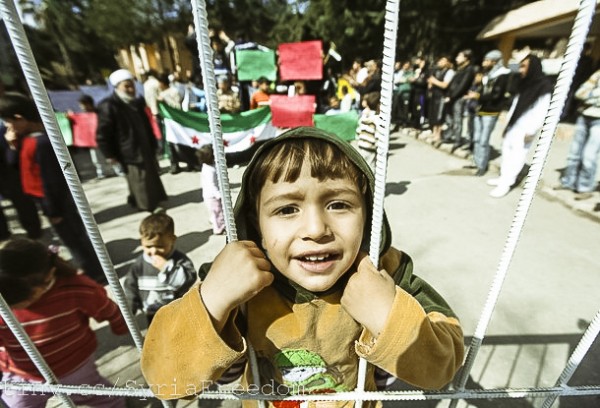
Global Panorama/Flickr
The immediate trigger is fear, prompted in part by false reports that one of the terrorists who attacked Paris on November 13 was a recent Syrian migrant. In fact, almost all of the assailants identified so far were Belgian or French citizens. But it’s only too easy for demagogues like the Republican presidential candidates to dream up nightmare scenarios about a jihadi militant or two sneaking into America disguised as an asylum seeker.
Sure enough, after the terrible mass shooting in San Bernardino, California, Rand Paul put forward a measure in Congress that would have imposed an “immediate moratorium” on visas for refugees from “high-risk” countries. Neither of the killers was a refugee – one was born in America and the other grew up in U.S.-allied Saudi Arabia. And they obtained every piece of their enormous arsenal right here in the US of A, legally.
Paul’s opportunism taps into deep currents of anti-Muslim prejudice that politicians have been stirring up for years.
When Donald Trump says that mosques should be under permanent surveillance and that Muslims should be barred from entering the country, or when Jeb Bush says that Syrian Christians can move here but not Muslims, they send a clear message: They believe all Muslims are potential terrorists.
This dark hint isn’t just the opposite of charity. It’s racist – and downright perverse.
Syrian refugees are fleeing from terrorism, whether by the regime of Bashar al-Assad or his radical Islamist opponents, among them the Islamic State. Over half of Syria’s 22 million people have been displaced from their homes over the course of the dreadful civil war – now a proxy war – that has raged there since 2011.
The pace of flight has increased with the Russian airstrikes on the side of the regime. In October alone, the UN reported, 120,000 people were forced to leave areas that had previously been spared the worst of the fighting.
Syrians run first to relatives in other provinces, then to neighboring countries like Lebanon, Jordan, and Turkey. But those front-line nations lack the resources to absorb the refugees indefinitely. So, more and more, Syrians are spending their savings to head westward via dangerous smuggling routes. Far too many are dying along the way.
Ben Carson, another GOP White House hopeful, visited a refugee camp in Jordan and claimed that most of the residents want to return home rather than come to America. He’s not wrong, exactly – anyone would rather live in familiar surroundings than in a strange country across the ocean.
But Carson left out the important part: Syrians only want to go home when it’s safe. That day, sadly, is a long way off.
In the meantime, the United States and Europe can save lives by easing the restrictions on formal, legal refugee resettlement. We should welcome as many escapees from the Syrian catastrophe as possible.
‘Tis the season of giving, not barring the door.
The post Have Yourself Some Anti-Refugee Hysteria appeared first on OtherWords.
This piece was reprinted from Other Words by RINF Alternative News with permission.
Video: “It Is Not Enough”: Despite Promise of New Aid, U.S. Urged to Take Responsibility For Climate Crisis
Secretary of State John Kerry delivered a major speech Wednesday at the U.N. climate summit, promising the United States would double its climate aid to $800 …
Via Youtube
Video: ‘Our enemies live in our own country’ – Mayor of refugee-flooded town
The political breakthrough for France’s far-right National Front in Sunday’s regional elections has been widely interpreted as a ‘shock’. But a closer look suggests …
Via Youtube
Video: Merkel becomes Time’s Person of the Year, tops Trump & ISIS leader
Time Magazine has named German Chancellor Angela Merkel its person of the year. Among the reasons, the magazine cited her role in solving Europe’s crisis …
Via Youtube
Video: Pentagon demands more from action anti-ISIS coalition allies
The Pentagon Chief says America’s allies in the anti-ISIL coalition must do more in their efforts to fight the jihadists. Ash Carter was giving testimony before the …
Via Youtube
Trump, the Islamic State, and the Cliché of Civilizations


(Photo: Aldas Kirvaitis / Flickr)
I was listening to a German parliamentarian the other night. She was making some anodyne comments about transatlantic friendship and the importance of culture. And then she veered off to mention the recent attacks in Paris and the threat of the Islamic State. This issue, she said, required an urgent response from the “free world.”
The audience murmured its approval.
I never take my freedoms for granted, but I’ve never been particularly comfortable with the phrase “free world.” It gives off the musty odor of the Cold War. Even though the phrase was tailor-made for rousing speeches a la Churchill, a division of the world into free and unfree failed to capture the complexity of international relations at the time.
However flawed such Manichean thinking might have been, the resurrection of the phrase has even less descriptive value today. Does everyone outside the limited borders of the Islamic State live in the “free world”? Where does Russia fit in? How about China, which also abhors the Islamic State but has yet to intervene militarily in Syria (except in Ben Carson’s imagination)?
And frankly, it’s not Europe, the United States, and whatever other countries constitute the zone of freedom that most need to respond to the Islamic State. It’s the countries of the decidedly unfree world – Saudi Arabia and the other Gulf States, Egypt, Jordan – that must take on their Sunni co-religionists if the battle is truly to be won.
Perhaps for these definitional reasons, some commentators have forsaken Cold War allusions to the fight against Soviet communism for something more clear-cut. They have reached further back in an effort to rally all people of conscience against the Islamic State. After all, no one calls the Cold War – or any of the deadly battles during that time in Korea, Vietnam, or elsewhere – the “good war.” That phrase is reserved for World War II and the fight against the Nazis. For the Islamic State to qualify as a truly demonic enemy and for the conflict to be stripped of all ambiguity, then, the would-be caliphate must be composed of nothing but fascists.
Last week, for instance, British Labor Party MP Hilary Benn denounced the Islamic State in such terms on the floor of parliament as part of a successful effort to authorize British participation in coalition air strikes in Syria:
We are here faced by fascists. Not just their calculated brutality, but their belief that they are superior to every single one of us in this chamber tonight, and all of the people that we represent. They hold us in contempt. They hold our values in contempt. They hold our belief in tolerance and decency in contempt. They hold our democracy, the means by which we will make our decision tonight, in contempt. And what we know about fascists is that they need to be defeated.
This speech by Benn, the son of Labor’s anti-war stalwart Tony Benn, won plaudits from a range of American conservatives such as Marc Thiessen at the American Enterprise Institute and former Moral Majority leader Cal Thomas. The former publisher of The Wall Street Journal, L. Gordon Crovitz, in his most recent column, wanted to know why the other Hillary, ditto her Democratic Party brethren, was refusing to denounce the Islamic State in similar terms.
Labeling ISIS as “fascist” contrasts with Democrats in the U.S. tying themselves into politically correct knots to avoid naming the enemy. President Obama still refuses to include “Islam” in the same breath as “terrorism.” In response to a question during last month’s Democratic presidential debate, the candidates all refused to say the U.S. is at war with “radical Islam.” Mrs. Clinton demurred by calling the term “not particularly helpful.”
At the risk of stating the obvious, I too believe that the Islamic State is barbaric. But I prefer to think of them as a murderous cult crossed with a band of criminals. Their ideology is of secondary importance. Calling them “fascist” might be satisfying at some level. But making this historical comparison can be counter-productive in conjuring up a world war of civilizational dimensions. After all, the propagandists of the Islamic State too would like to imagine that they are fighting a global conflict with the highest stakes imaginable. Bring it on, cry the followers of Abu Bakr al-Baghdadi. This is our finest hour, thunder the lions of the free world. And thus the battle becomes almost cinematic.
Few are willing to utter the phrase “clash of civilizations,” for that thesis of political scientist Samuel Huntingdon from 1993 has become a cliché, and a thoroughly debunked one at that. But make no mistake: the rhetoric on both sides has escalated to that level. Lurking somewhere in this civilizational discourse, particularly on the European side, is an age-old anxiety that goes all the way back to the days of Charles the Hammer – that Islam, like fascism, is antithetical to civilization itself.
Where Others Fear to Tread
Crovitz and his brethren, to their credit, refrain from trotting out the term of abuse that was de rigeur for their set during the heyday of neoconservative posturing in the 2000s: Islamofascism. But leave it to a French philosopher, Bernard-Henri Levy, to rush in where American conservatives currently fear to tread.
Levy’s recent article – “Paris Terror Attacks: Instructions for Warfare” – has been published all over the place (Huffington Post, Toronto Globe and Mail, Haaretz). It is a cri du coeur, a call to action, and a challenge to the “free world” all wrapped up in one. To buttress his declaration of war against the Islamic State, Levy invokes Victor Hugo:
To these vile, ignorant men we must utter the beautiful words that Victor Hugo exclaimed in September 1870, at the time of the massacres of the Paris Commune: An attack on Paris is more than an attack on France, it destroys the whole world. The only word to describe these men is fascists.
Better: Islamofascists.
“Islamofascist” became briefly popular in the wake of the terrorist attacks of September 11. George W. Bush used the term in a 2005 speech at the National Endowment for Democracy in an effort to give his “war on terrorism” a more exalted, civilizational framing. As I wrote in my 2012 book Crusade 2.0,
The linking of Islam and fascism was not new. Historians had explored the connections between Muslims and Nazis before and during World War II. The Baath movement – which produced ruling parties in Iraq and Syria – had roots in earlier fascist movements. When scholar Malise Ruthven coined the phrase “Islamo-fascism” in a 1990 article, he had in mind dictatorial governments, some of which were allied with the United States, like Pakistan and Morocco. Newt Gingrich later played around with the term “totalitarian Islam” to describe Iran. After 9/11, however, writers like Christopher Hitchens and academics like Bassam Tibi redeployed the term “Islamofascism” to describe the Islamist opposition to those dictatorial governments.
According to the venerable New York Times, the term Islamofascism had a brief life span, crashing and burning by 2006.
No term was more deserving of a fiery flameout. It was offensive on so many levels. It suggested an inherent link between Islam and fascism when historically fascism has had a more enduring love affair with Christianity (alongside flirtations with Hinduism, Buddhism, and even Judaism). Fascist ideology, moreover, focuses on the relationship between the state and the economy, favoring a corporatist model, whereas Islam coexists with many different economic systems. I could go on, but the “fascism” part of the equation was never really more than an epithet.
With the election of Barack Obama and a more nuanced U.S. approach to Islam, I thought that the term “Islamofascism” had finally been retired from service. But Levy resuscitates the term for a specific purpose. He deliberately wades into the conflict taking place within Islam itself, a clash within a civilization, between what he identifies as the good guys, the “Islam of the enlightenment,” and the bad guys, the Islamofascists. After exhorting Muslims to declare that the violence of the Islamofascists is “not in our name,” Levy then gives away his hand. He picks out, as representative of the anti-Enlightenment Islamists, not al-Baghdadi of the Islamic State or any of the terrorists who have undertaken military missions in the name of this illusory caliphate.
Rather, Levy zeroes in on Tariq Ramadan.
For those not familiar with this Muslim theologian – most famous for facing a travel ban to the United States during the Bush years – Ramadan is an articulate defender of political Islam. Born in Switzerland and grandson of the founder of the Muslim Brotherhood, Ramadan currently teaches at Oxford University. He has consistently condemned terrorism in general and specific acts of violence in particular, thus meeting Levy’s “not-in-my-name” criterion. He’s also been on the UK Foreign Office Advisory Group on Freedom of Religion or Belief.
Tariq Ramadan, in other words, would seem to be a rather odd embodiment of anti-Enlightenment values.
The dispute between Levy and Ramadan goes back more than a decade – at least to 2003, when the Muslim theologian criticized the French philosopher for his invocation of Enlightenment values in support of the invasion of Iraq. No doubt Levy is also incensed that Ramadan would have the temerity to compare Francois Hollande’s militarism after the Paris attacks to that of George W. Bush after the September 11 attacks.
Strip away the personal invective, however, and the uglier side of Levy’s argument becomes clear. Yes, of course, he hates “Islamofascism.” And yes, he has some Muslim friends. But deep down, he’s uncomfortable with key elements of mainstream Islam, represented by people like Tariq Ramadan.
Cue the Donald
All of this is rather heady stuff. Leave it to us Americans to strip the argument down to its basics. Here, in the 2016 presidential race, we get Islamophobia straight, no chaser, and without European-style philosophizing.
The anti-Muslim sentiment of the Republican presidential candidates should have disqualified the lot of them by now. Ben Carson announced that he’d never support a Muslim political candidate. Bobby Jindal made headlines with his claim of Muslim “no-go” zones in Europe. Both Lindsey Graham and George Pataki urged monitoring of mosques (which, contrary to popular misconceptions, have been central to combatting extremism). And Marco Rubio
But the ugliest intervention has come from Donald Trump, who’s urged a complete ban on all Muslims entering the United States. Presumably that would include:
- Muslims fleeing for their lives from the Islamic State
- Muslims who have risked everything to work with and fight alongside U.S. troops
- Muslims who have H-1B visas to code for Microsoft
- Muslims who are family-oriented entrepreneurs and would eventually vote Republican
Far be it for me to point out to the Republican Party that it is alienating one minority group after another in its effort to hold onto the dwindling demographic of angry white men. And jeez, even “Dark Side” Dick Cheney repudiated Trump by saying that his statement “goes against everything we stand for and believe in.”
But alas, Trump is no dummy when it comes to assessing the mood of the electorate. According to a Public Policy Survey, Trump’s Islamophobia will keep him at the top of the Republican heap:
Among Trump backers, 67 percent support creating a national database of Muslims, 62 percent believe the discredited story that Arabs in New Jersey cheered as the twin towers fell on 9/11, more than half (51 percent) want to shut down mosques, and a full 44 percent believe Islam should be outlawed.
These beliefs constitute the real face of Islamophobia. A few politicians and intellectuals decry “Islamofascists,” but the real target of Islamophobia is the mainstream Islam of mosques, moderate imams, and your friendly Muslim neighbors.
Which brings us back to this question of a civilizational conflict. To repeat, there is no clash between Islam and the West, except in the minds of the Islamic State and the ideologues of the “free world” who believe that inside every Muslim is an Islamofascist dying to get out. The real clash is taking place within a civilization, within Islam, over doctrinal issues, the nature of the state, the relationship with the market, and so on – and the Islamic State is largely peripheral to this ideological clash.
More fundamentally, an equally contentious struggle is going on within the so-called free world. Here is where the civilizational rubber really hits the road. Will enough good people of conscience – enough moderate Christians and moderate Jews and moderate whatevers in the United States – stand up to the intolerance of our native extremism?
As an unknown French wit once said in the 1930s, America is the only society to go from barbarism to decadence without knowing civilization. Bernard-Henri Levy is free to take potshots at Islam. But, honestly, we here on this side of the Atlantic, in the throes of Trumpian decadence, are in desperate need of an Enlightenment of our own.
This piece was reprinted from Foreign Policy In Focus by RINF Alternative News with permission.
A Day When Journalism Died
Exclusive: Dec. 9 has a grim meaning for the Republic, the date in 2004 when investigative reporter Gary Webb, driven to ruin by vindictive press colleagues for reviving the Contra-cocaine scandal, took his own life, a demarcation as the U.S. press went from protecting the people to shielding the corrupt, writes Robert Parry.
By Robert Parry
Looking back over my four decades in the national news media, it’s hard to identify one moment when American journalism died. The process was a slow and ugly one, with incremental acts of cowardice accumulating until mainstream reporters were clearly part of the problem, not anything to do with a solution. But the date Dec. 9 has a special place in that sad progression.
It was on Dec. 9, 2004, when the mean-spirited mainstream media’s treatment of investigative journalist Gary Webb led him — his career devastated, his family broken, his money gone and his life seemingly hopeless — to commit suicide. It was a moment that should have shamed all the big-shot journalists who had a hand in Webb’s destruction, but it mostly didn’t.

Journalist Gary Webb holding a copy of his Contra-cocaine article in the San Jose Mercury-News.
Webb’s offense was to have revived the shocking story of the Reagan administration’s tolerance of cocaine smuggling by the CIA-backed Nicaraguan Contra rebels in the 1980s. Though the scandal was real — and had been partly exposed in real time — the major newspapers had locked arms in defense of President Ronald Reagan and the CIA. The sordid scandal apparently was deemed “not good for the country,” so it was buried.
My Associated Press colleague, Brian Barger, and I had written the first story exposing the Contras’ involvement in cocaine smuggling in 1985, but our story was attacked by Reagan’s skillful propaganda team, which got The New York Times and other major news outlets to buy into the denials.
Later that decade, a gutsy investigation by then-Sen. John Kerry filled in some of the gaps showing how the Reagan administration’s collaboration with drug-tainted airlines and other parts of the Contras’ cocaine smuggling apparatus had functioned. But Kerry’s probe was…
In OtherWords: December 9, 2015

Whether we’re taking stock of the trumped-up war on Christmas or putting the torrent of inhospitality toward Syrian refugees who are fleeing turmoil into perspective, OtherWords stands up for what’s right. Thanks to your support, week in and week out we offer an alternative to what the loudest voices that dominate the mainstream media are saying – regardless of which way the wind happens to be blowing.
This week in OtherWords is no exception. We’ve got Donald Kaul’s take on the latest gunslinging carnage, the lowdown from Jim Hightower about fallen coal baron Don Blankenship’s day in court, my outlook for fossil-free investment, and Tiffany Williams’ personal viewpoint on the nation’s retirement crisis.
OtherWords commentaries and cartoons now appear in more than 300 newspapers with a total of at least 7 million readers. We couldn’t have achieved this foothold without support from independent-minded people like you, along with a handful of generous foundations. Your help is essential to sustaining our growth and keeping our voices in the opinion pages of local newspapers across the United States.
Won’t you commit to supporting OtherWords today, so we can keep providing this vital service?

Please make a year-end tax-deductible contribution to support OtherWords if you are able to do so. Even better, consider becoming a sustaining donor today. Whether you can spare $10, $100, or $1,000, your tax-deductible gift will help guarantee our ability to deliver independent, newsroom-ready, and innovative ideas to online and print editors across the nation.

All-American Bullet, an OtherWords cartoon by Khalil Bendib
- Have Yourself Some Anti-Refugee Hysteria / Chris Toensing
This holiday season, politicians are taking aim at some of the most helpless people on earth. - Working Until It’s Time for Your Grave / Tiffany Williams
Like many Americans, my mom has no retirement savings. - What the GOP’s Putting Under Corporate America’s Tree / Jessica Schieder
This year-end tax package is a grab bag of gifts for corporations and a lump of coal for working families. - Turning the USA into the OK Corral / Donald Kaul
The only winner after the San Bernardino shootout is the Second Amendment. - What the Red Cup Controversy Really Says about Christmas in America / John Kiriakou
Can we lighten up? - Don’t Be a Fossil-Foolish Investor / Emily Schwartz Greco
The purely financial case for ditching oil, gas, and coal is getting stronger. - It’s Time to Fire Trump / Jill Richardson
How, in 2015, can anyone running on a racist, xenophobic ticket find any support at all? - Put This Coal Kingpin in the Stocks / Jim Hightower
Disgraced CEO Don Blankenship won’t serve more than a year for effectively killing 29 of his workers. - All-American Bullet / Khalil Bendib
The post In OtherWords: December 9, 2015 appeared first on OtherWords.
This piece was reprinted from Other Words by RINF Alternative News with permission.
Friedman Goes After Trump: Hey, Massive Bombing Was MY Idea!
Thomas Friedman doesn’t like threats of massive bombing when they’re made by someone else.
Thomas Friedman has some harsh words in his New York Times column (12/9/15) for Donald Trump and his unsophisticated grasp of the complexities of foreign policy:
As for Trump, well, he may be a deal maker, but he’s no poker player ready for the Middle East five-card stud sharks. His xenophobic rhetoric and unrealistic, infantile threats of massive bombing make up the kind of simplistic hand you’d play in “Go Fish” – not in this high-stakes game.
Where could Trump have gotten the idea that his “infantile threats of massive bombing” would be taken seriously as foreign policy proposals? Well, as a resident of New York City, maybe he reads the New York Times:

Massive bombing of Iraq: Thomas Friedman was for it. (cc photo: Andy Dunaway/US Army)
There is only Option 2 — bombing Iraq, over and over and over again, until either Saddam says uncle, and agrees to let the UN back in on US terms, or the Iraqi people eliminate him…. Given the problems with the other options, we may have no choice but to go down this road. Once we do, however, we better have the stomach to stay the course.
–Thomas Friedman (New York Times, 1/31/98)
Blow up a different power station in Iraq every week, so no one knows when the lights will go off or who’s in charge.”
—Friedman (New York Times, 1/19/99)

Massive bombing of Serbia: Friedman was for it. (cc photo: Darko Dozet)
Let’s at least have a real air war. The idea that people are still holding rock concerts in Belgrade, or going out for Sunday merry-go-round rides, while their fellow Serbs are ‘cleansing’ Kosovo, is outrageous. It should be lights out in Belgrade: Every power grid, water pipe, bridge, road and war-related factory has to be targeted….
Every week you ravage Kosovo is another decade we will set your country back by pulverizing you. You want 1950? We can do 1950. You want 1389? We can do 1389 too.
–Thomas Friedman (New York Times, 4/23/99) on Serbia
People tend to change their minds and adjust their goals as they see the price they are paying mount. Twelve days of surgical bombing was never going to turn Serbia around. Let’s see what 12 weeks of less than surgical bombing does. Give war a chance.
–Thomasa Friedman (New York Times, 4/6/99)

Massive bombing in Afghanistan: Friedman was for it.
My motto is very simple: Give war a chance.
–Thomas Friedman (ABC News, 10/29/01) on Afghanistan
Let’s all take a deep breath and repeat after me: Give war a chance. This is Afghanistan we’re talking about.
–Thomas Friedman (New York Times, 11/2/01)
I was a critic of [Defense Secretary Donald] Rumsfeld before, but there’s one thing…that I do like about Rumsfeld. He’s just a little bit crazy, OK? He’s just a little bit crazy, and in this kind of war, they always count on being able to out-crazy us, and I’m glad we got some guy on our bench that our quarterback – who’s just a little bit crazy, not totally, but you never know what that guy’s going to do, and I say that’s my guy.”
–Thomas Friedman (CNBC, 10/13/01)
There is a lot about the Bush team’s foreign policy I don’t like, but their willingness to restore our deterrence, and to be as crazy as some of our enemies, is one thing they have right.
–Thomas Friedman (New York Times, 2/13/02)

Telling Iraqis to “Suck. On. This”: Friedman was for it.
We needed to go over there, basically, and take out a very big stick… and there was only one way to do it…. What they needed to see was American boys and girls going house to house, from Basra to Baghdad, and basically saying: “Which part of this sentence don’t you understand?
You don’t think, you know, we care about our open society? You think this bubble fantasy, we’re just gonna to let it grow? Well: Suck. On. This.” That, Charlie, is what this war was about. We could have hit Saudi Arabia; it was part of that bubble. Could have hit Pakistan. We hit Iraq because we could.
–Thomas Friedman (Charlie Rose, 5/30/03)
Israel’s counterstrategy was to use its air force to pummel Hezbollah and, while not directly targeting the Lebanese civilians with whom Hezbollah was intertwined, to inflict substantial property damage and collateral casualties on Lebanon at large. It was not pretty, but it was logical. Israel basically said that when dealing with a nonstate actor, Hezbollah, nested among civilians, the only long-term source of deterrence was to exact enough pain on the civilians—the families and employers of the militants—to restrain Hezbollah in the future.”
–New York Times columnist Thomas Friedman (1/13/09) on why Israel needed to kill civilians in Gaza
Jim Naureckas is the editor of FAIR.org.
You can send a message to the New York Times at letters@nytimes.com, or write to public editor Margaret Sullivan: public@nytimes.com (Twitter: @NYTimes or @Sulliview). Please remember that respectful communication is the most effective.
This piece was reprinted by RINF Alternative News with permission from FAIR.
Video: The Huge Political Repercussions Of The French Election
In this video Luke Rudkowski talks to author and well known media figure Pierre Jovanovic in Paris France. The two discuss the landmark elections that just took …
source
Video: (WARNING GRAPHIC POLICE VIOLENCE) Miami Beach Police Gun Down Man Blocks from Art Basel
It doesn’t appear that the suspect was in possession of a weapon or brandishing a weapon in a threatening manner, when these Miami Beach Police Officers …
Via Youtube
Video: Patrick Henningsen: “Turkish President Erdogan Is Undoubtedly Buying Black market Oil From ISIS!”
Please Support The Show — http://richieallen.co.uk/ http://21stcenturywire.com/ https://www.facebook.com/therichieallenshow …
Via Youtube
Putting the ISIS ‘Crisis’ in Context
The hysteria over Islamic State terrorism is driving talk of a new U.S.-led ground war in the Middle East — this time an invasion of Syria under the guise of a “safe zone” — but such rash actions would only make matters worse, writes ex-CIA analyst Paul R. Pillar.
By Paul R. Pillar
Emotional and ill-focused reaction to the latest mass shooting in the United States, coupled with misguided but unfortunately well-entrenched ways of thinking about terrorism and counterterrorism, along with a political campaign featuring jingoistic appeals, is increasing the pressure on the U.S. administration to embark on costly and counterproductive new endeavors in the Middle East.
A dominant theme in public discourse is that the so-called Islamic State (also known as ISIS, ISIL or Daesh) is behind what has already become highly destructive terrorism in the West and therefore the United States needs to hasten to destroy the group in its stronghold in Syria and Iraq, and this means increased use of military force.

Former Florida Gov. Jeb Bush, who has joined in calling for a “war” with “Islamic terrorism.”
Republican presidential candidates have been leading the charge with heavy use of “war” vocabulary, which is the lexicon of choice to convey toughness and to appeal to public fears even when specific meanings and implications of such terminology do not get spelled out.
“Islamic terrorism wants to destroy our way of life,” Jeb Bush declared. “They have declared war on us, and we need to declare war on them.” Chris Christie intoned, “Our nation is under siege. What I believe we’re facing is the next world war.” Ted Cruz proclaimed, “This nation needs a wartime president. … Our enemies are at war with us.”
This approach disregards what the very incidents that have aroused the fears to which these candidates are appealing tell us about the sources of international terrorism in the West and what determines its extent and severity. It disregards the true nature of any connection between strongholds of extremist groups in the Middle East and terrorism carried out on other continents.
And the approach disregards recent and glaring lessons about the…
Turning the USA into the OK Corral

People say this is a do-nothing Congress. That’s unfair.
Why, the sirens in San Bernardino had hardly gone silent before lawmakers were clamoring about a bill that might address the confluence of mental health problems and potential gun buyers.
And if that draconian proposal weren’t enough, Republican leaders said they would be forming a committee to study the mass shooting. What profiles in courage.
There were other proposals too – most of them involving doing something unpleasant to Muslims.
One thing not proposed, at least not by Republicans, was any form of gun control. Some Democrats suggested that, as a starter, the government could ban people on the terror watch list from buying enough guns and bullets to turn an armored car into steel wool in 30 seconds flat.
All-American Bullet, an OtherWords cartoon by Khalil Bendib
No dice, said the Republicans. That list isn’t perfect, they apparently realize. People get on there by mistake. And what if one of those innocents was denied the right to buy an assault rifle – and that person subsequently found himself confronted by an angry, armed mob? He or she would have no way of defending himself. Or herself.
I’m not making this up, by the way. This is a real argument.
Anyway, the proposal, despite broad support from Democratic lawmakers, never saw the light of day. Another win for the Second Amendment.
Do you like statistics? I love statistics. Here are a few:
More Americans have died of gunshot wounds in the last four years than died in our wars in Korea, Vietnam, Afghanistan, and Iraq combined. And every 16 minutes, we add to the total.
As for Muslims being the main culprits: Since the 9/11 attacks, 45 people have been killed in what might be called Islamist terrorist attacks in this country. During that same period, 48 people have died at the hands of white extremists, many of them Christians. All of which is a drop in the bucket when it comes to the number of murders during the same 14-year period – 200,000.
For the Republican presidential candidates, the San Bernardino tragedy became an instant opportunity to whip up hysteria among the faithful.
“The nation is under siege,” said New Jersey governor Chris Christie at an Iowa café. “What I believe we’re facing is the next world war.” Cruz, Rubio, and even Jeb Bush chimed in with their version of “The Muslims are coming, the Muslims are coming.”
But Donald Trump is lording over this hall of infamy. Even before The Donald called for barring all Muslims from entering the United States, he claimed, among other things, that on 9/11 he “watched in Jersey City, N.J., where thousands and thousands of people were cheering as that building was coming down.”
Actually, they weren’t. John J. Farmer, New Jersey’s attorney general at the time of the attacks, investigated the rumor and found it a vile falsehood.
You know, perhaps it’s time to start treating Trump as what he is: an entertaining buffoon who spices up the otherwise dull Republican debates. And we should call him what he is: a nasty piece of work and a lying ignoramus who’s bullied his way to the front of the Republican line by being unconscionably rude.
He’s mocked the appearance of opponents, made fun of a reporter’s congenital disability, and condoned the “roughing up” of protestors at his rallies.
And yet he’s rising in the polls, just like the sale of guns across the nation keeps spiraling upward.
President Barack Obama addressed the nation the other night seeking to add a note of reason to the climate of hysteria. It was a good speech. There was nothing wrong with it, but I fear it was too little, too late.
Americans, apparently, don’t want to be calmed by assurances that we’re winning a war that we’ve been slow to acknowledge.We want somebody up there pounding the podium promising to do something fierce. We want Winston Churchill.
Barack Obama, alas, is no Winston Churchill. But neither is he Donald Trump. For that let us be grateful.
The post Turning the USA into the OK Corral appeared first on OtherWords.
This piece was reprinted from Other Words by RINF Alternative News with permission.
Jabhat al-Nusra a Greater Threat to Syria Than Islamic State


Unlike the Islamic State, Jabhat al-Nusra actually strikes the Assad regime. (Photo: Wikimedia Commons)
There’s no shortage of players acting in bad – or at least, questionable – faith in Syria. First, of course, the regime of President Bashar al-Assad; then the Islamic State – choose your poison. On another level, Russia, the United States, and France.
At the National Interest, Daniel DePetris writes about a player too often overlooked.
… with all of the concentration on the Islamic State, another highly significant and dangerous terrorist organization is operating largely under the radar: Jabhat al-Nusra [which] shares the same … interpretation of Islam as ISIL, despises any and all sectarian groups outside of Syria’s majority Sunni community and has engaged in the same kind of atrocities [as the Islamic State].
In fact
… some of Nusra’s key commanders were originally members of ISIL’s predecessor group, the Islamic State of Iraq.
And
Before the Islamic State was operating on the ground in Syria, Jabhat al-Nusra was carrying out highly lethal terrorist attacks in the heart of the Assad regime’s territory. The first [likely] attack that the international media picked up [was] a double-suicide bombing in front of Syria’s State Security Directorate and an army office in Damascus, killing 44 civilians in the process. In May 2012, another suicide bombing in Damascus claimed 55 lives.
The Islamic State is more interested in attacking other rebel groups, and lately, the West. Whereas Jabhat al-Nusra
… continues to specialize in the kinds of attacks that other opposition groups in Syria are either unwilling or incapable of executing: strikes at the source of the Syrian regime’s military power.
In other words, should the Islamic State be destroyed or the Assad regime toppled, Jabhat al-Nusra will be waiting in the wings.
This piece was reprinted from Foreign Policy In Focus by RINF Alternative News with permission.
Video: Like cats & dogs: Tigers and German Shepherds socialize in Slovakia
Two Siberian tigers become friends with three German Shepherds in a Slovenian reservation. COURTESY: RT’s RUPTLY video agency, NO RE-UPLOAD, NO …
Via Youtube
The Toxic Agriculture of Monsanto and Big Agribusiness vs Agroecology Rooted in Communities and Locally Owned

“We are being far too kind to industrialised agriculture. The private sector has endorsed it, but it has failed to feed the world, it has contributed to major environmental contamination and misuse of natural resources. It’s time we switched more attention, public funds and policy measures to agroecology, to replace the old model as soon as possible.” Dr David Fig, Biowatch, South Africa
Based on the results on his farm in Gujarat, Indian farmer and campaigner Bhaskar Save demonstrated that by using traditional methods, his yields were superior to any farm using chemicals in terms of quantity, nutritional quality, biological diversity, ecological sustainability, water conservation, energy efficiency and economic profitability.
Bhaskar Save died in October, but in 2006 he published a now quite famous open letter to the Indian Minister of Agriculture and other top officials to bring attention to the mounting suicide rate and debt among farmers. He wanted policy makers to abandon their policies of promoting the use of toxic chemicals that the ‘green revolution’ had encouraged.
According to Save, the green revolution had been a total disaster for India by flinging open the floodgates of toxic agro-chemicals which had ravaged the lands and lives of many millions of farmers (for example, read about the impact in Punjab). He firmly believed that organic farming in harmony with nature could sustainably provide India with abundant, wholesome food.
India had for generations sustained one of the highest densities of population on earth, without any chemical fertilisers, pesticides, exotic dwarf strains of grain or ‘bio-tech’ inputs – and without degrading its soil. For instance, see this analysis which highlights better productivity levels in India prior to the green revolution. (If further evidence is required as to the efficacy of organic farming, see this report, based on a 30-year study, which concludes that organic yields match conventional yields, outperform conventional in years of drought and actually build soil fertility rather than deplete it; and see this report that says that organic and sustainable small-scale farming could double food production in the parts of the world where hunger is the biggest issue.)
Save argued that numerous tall, indigenous varieties of grain provided more biomass, shaded the soil from the sun and protected against its erosion under heavy monsoon rains. But in the guise of increasing crop production, exotic dwarf varieties were introduced and promoted. This led to more vigorous growth of weeds, which were able to compete successfully with the new stunted crops for sunlight. The farmer had to spend more labour and money in weeding or spraying herbicides. In effect, farmers were placed on a chemical treadmill as traditional pest management systems were destroyed and soil degradation and erosion set in.
Moreover, this water-intensive, high external input model of agriculture led to the construction of big dams, indebtedness, population displacement and a massive, unsustainable strain on water tables. Save noted that more than 80% of India’s water consumption is for irrigation, with the largest share hogged by chemically cultivated cash crops. Maharashtra has the maximum number of big and medium dams in the country. But sugarcane alone, grown on barely 3-4% of its cultivable land, guzzles about 70% of its irrigation waters.
For Save, in a country of farmers, it was essential to restore the natural health of Indian agriculture to solve the inter-related problems of poverty, unemployment and rising population. See his arguments in more detail here.
Such views may be out of step with global agribusiness interests and the international bodies, national governments and regulatory bodies they have co-opted or hijacked (see this, this, this, this, this and this), but there is an increasing awareness across the globe that the type of viewpoint put forward by Save and many others is valid.
Of course, millions of farmers across the world already knew that what Save had stated was correct long before he said it and have for a long time been organising and resisting the industrialised model of petrochemical-intensive and GMO farming being imposed across the planet. They are in step with what the International Assessment of Agricultural Knowledge Science and Technology (IAASTD) report (among others) advocates: a shift towards organic farming and investment in and reaffirmation of indigenous models of agriculture.
Likewise, botanist Stuart Newton’s notes that the answers to agricultural productivity do not entail embracing the international, monopolistic, corporate-conglomerate promotion of chemically-dependent GM crops. He argues that India must restore and nurture its heavily depleted, abused soils and not harm them any further with chemical overload, which is endangering human and animal health.
Newton provides good insight into the vital roll of healthy soils and their mineral compositions and links their depletion to the green revolution. In turn, these degraded and micro-nutrient lacking soils cannot help but lead to denutrified food and thus malnourishment: a very pertinent point given that the PR surrounding the green revolution claims it helped dramatically reduce malnutrition.
Over the past few years, there have been numerous high level reports from the UN and development agencies putting forward proposals to favour small farmers and indigenous agriculture, but this has not been translated into sufficient action by national governments on the ground where small farmers increasingly face marginalisation and oppression due to corporate seed monopolies, land speculation and takeovers, rigged trade that favours global agribusiness interests and commodity speculation (see this on food commodity speculation, this on the global food system, this by the Oakland Institute on land grabs and this on the impact of international trade rules).
In fact, these reports seem to have been largely ignored by offialdom in India, which seems to be intent on following World Bank advice on removing 400 million out of agriculture, thus capitulating to US agribusiness interests and in the process seeking to demonise those who criticise the prevailing trend. The erroneous reasons behind this forced displacement (largely by making agriculture financially unviable) and the impacts are discussed in the article ‘Global Agribusiness Hammering Away at the Foundations of Indian Society‘. The urban-centric model of ‘development’ being pursued is unsustainable and is wholly misguided at best and at worst little more than a con-trick.
United Nations Special Rapporteur on the Right to Food, Professor Hilal Elver:
“Empirical and scientific evidence shows that small farmers feed the world [see this]. According to the UN Food & Agricultural Organisation (FAO), 70% of food we consume globally comes from small farmers… Currently, most subsidies go to large agribusiness. This must change. Governments must support small farmers.”
Despite the situation adopted at the top in India, it should be noted that a good deal of inspiring work is taking place.
In Tamil Nadu (South India), for example, women’s collectives have been organising to restore traditional foods and farming methods, resulting in lower costs, higher yields and improved nutrition. Before the green revolution, there were 14,000 different varieties of paddy, but these traditional varieties were displaced by hybrid varieties which only grow if chemical fertilisers are used.
Sheelu Francis is General Coordinator of the Women’s Collective of Tamil Nadu and is involved in a fightback against the deleterious social, economic and environmental impacts of the green revolution. She states that by practicing agroecology, an increasing number of women farmers are now free from chemical fertilisers and pesticides and grow many crops together – grains, lentils, beans, oilseeds – to create biodiversity, using maximum input from the land within the farm to produce food.
With the onset of the green revolution, farmers gave up traditional farming practices and agriculture systems. Francis says that farmers were encouraged to grow rice because of government subsidies which promoted growing rice, especially with hybrid seeds and chemicals. Rice paddies use lots of water, so when it is the dry season or when there is drought, there is no production at all.
The use of chemical fertilizers hurt the health of the people, according Francis, not just because of the chemicals but because people rely on polished rice for their nutrition, which is not very nutritious (she says 46% of children are malnourished in Tamil Nadu).
When you combine the effects of soils depleted of nutrients, monocrop diets and chemically-laden food, you have a recipe for catastrophe.
Little wonder then that people are now going back to traditional farming practices and growing traditional crops, which are more nutritious, provide a balanced diet and help maintain soil health
However, it is an uphill struggle, as Francis notes:
“People who try to hold onto their ways of life are marginalised from their land, their seeds, and their way of farming. Now the industries are trying to take over, and to some extent they have succeeded. That is why we are strongly opposing Monsanto and Syngenta and the whole project of GM (genetically modified) seeds.”
Elsewhere, in Africa, while Monsanto and The Gates Foundation are trying to force through a corporate-controlled GMO/green revolution, the Oakland Institute recently published research that highlighted the “tremendous success” of agroecology across the continent. By combining sound ecological management, including minimising the use of toxic inputs by using on-farm renewable resources and privileging endogenous solutions to manage pests and disease, with an approach that upholds and secures farmers’ livelihoods, agroecology essentially embodies a social movement for positive change.
Anuradha Mittal, Executive Director of the Oakland Institute, says that the research provides irrefutable facts and figures on how agricultural transformation can yield immense economic, social, and food security benefits, while ensuring climate justice and restoring soils and the environment. Frederic Mousseau, Policy Director of the Oakland Institute, who coordinated the research, adds that the research debunk the myths about the inability of agroecology to deliver and highlights the multiple benefits of agroecology, including affordable and sustainable ways to boost agricultural yields while increasing farmers’ incomes, food security and resilience.
There are many stories about such local projects from across the world and it is encouraging. However, what is ultimately required is a national-level and international-level commitment to stop prioritising chemical-industrial agriculture at the expense of indigenous agriculture, to stop handing out massive subsidies to agribusiness and to get off the destructive and wholly unsustainable and poisonous chemical treadmill.
“Agroecology is more than just a science, it’s also a social movement for justice that recognises and respects the right of communities of farmers to decide what they grow and how they grow it.” Mindi Schneider, assistant professor of Agrarian, Food and Environmental Studies at the Institute of Social Studies (ISS) in The Hague.
As Mindi Schneider implies above, agroecology is essentially a system that prioritises local communities, smallholder farmers, local economies and markets. It is a system that the Rockefeller-backed green revolution has been dismantling across the globe for the last 60 years or so. The green revolution is in crisis and is causing massive damage to the environment and to farmers’ livelihoods to the point where ecocide and genocide is occurring and the cynical destruction of agrarian economies has taken place. The solution ultimately lies in challenging the corporate takeover of agriculture, the system of ‘capitalism’ that makes such plunder possible and embracing and investing in sustainable agriculture that is locally owned and rooted in the needs of communities.
Colin Todhunter is an independent writer – his website is here
Video: Meet Vincent: 1st cat with titanium hind limbs
Vincent, a 3-yo old domestic cat, went through surgery in the US to have titanium-alloy prosthetic implants attached to his unnaturally short hind limb. The cat …
Via Youtube
Video: ISIS Oil Empire: ‘It’s not smugglers with donkeys, it’s huge business with Turkey main conduit’
Amid a discord in relations over a serious violation of Iraq’s sovereignty by Turkey’s deployment of ground troops, Iraqi Prime Minister Haider al-Abadi accused …
Via Youtube
Video: Outbreak of flesh-eating skin disease spreading across Syria (GRAPHIC)
The collapse of the medical services in the terrorist-controlled territory of war-torn Syria is responsible for the spread of a flesh-eating virus, known as …
Via Youtube
The Terror from the Gun
On the campaign trail and the cable networks, it’s all ISIS all the time as Americans react with fear and fury over the San Bernardino massacre. But the U.S. crisis of gun violence goes way beyond the few cases of Islamic terrorism, says Lawrence Davidson.
By Lawrence Davidson
I was waiting for a doctor’s appointment with only the magazine rack for company. I usually don’t pay much attention to news magazines, seeing as how the range of politically acceptable points of view are pretty narrow in such sources. However, with time on my hands, I picked up Time magazine (Nov. 30-Dec. 7 issue), the cover of which announced, “World War on ISIS.”
I focused on a particularly interesting (and mercifully short) piece on this topic entitled, “ISIS Will Strike America.” No doubt millions of readers will focus on this bit of prognostication. It is written by Michael Morell, former Deputy Director of the CIA.

Billionaire businessman and Republican presidential candidate Donald Trump.
Morrell begins by telling us he has been an intelligence officer for 33 years and in that capacity his job is to “describe for a President threats we face as a nation” and then “look the President in the eye when his policies are not working and say so.” Given that Morrell managed the staff that produced George W. Bush’s briefings, one wonders if he ever practiced what he preached.
In any case, Morrell now figuratively looks his readers in the eyes and tells them that “ISIS poses a threat to the homeland” through “its ability to radicalize young Americans [why just the young?] to conduct attacks here.”
In truth, this potentiality has been known for years and various police agencies and the FBI have even been involved in setting up various entrapment schemes to prove the point. One might assume that they had to do this to counter the fact that an American’s chance of being harmed by Muslim terrorists is less than his or her chance of being struck by lightning.
Nonetheless, the probability of Morrell’s prediction coming true is certainly not zero, as the massacre in San Bernardino demonstrates. Yet, comparing attacks which have possible radical Islamic connections to…
Video: EU or not EU: British rush for dual-nationality in EU amid Brexit fears
While UK is seriously thinking of leaving the EU, trying to reduce the influx of EU migrants and to protect the national currency its citizens are rushing to get the …
Via Youtube
Video: Ukraine’s murky deals: Squeezing 5 mln euro finder’s fee for stolen art
Art pieces from the Westfries Museum in the Netherlands stolen in 2005 have surfaced in Ukraine.They are 24 paintings and 70 items of silverware – dating back …
Via Youtube
Marco Rubio Is Winning the Neocon Primary


(Image: DonkeyHotey / Flickr)
With pundits and columnists dissecting and critiquing every word uttered by GOP front-runners Ben Carson and Donald Trump, comparatively little attention has been paid to the positions and affiliations of a far more electable Republican presidential candidate: Florida Senator Marco Rubio.
Unlike Trump or Carson, Rubio is considered a stalwart member of the party’s establishment wing, standing out in the crowded Republican primary field for his comparatively moderate stances on issues such as immigration reform. While he lags behind Trump and Carson in most polls and runs neck-and-neck with “Tea Party” evangelical Ted Cruz, Rubio is primed to jump to first should the spectacle of the “anti-establishment” candidates finally run its course.
Beyond his veneer of reasonableness, however, Rubio has established himself as the most adept of the Republican candidates at regurgitating the militaristic talking points of the party’s neoconservative wing. His competency in this regard has earned him the favor of influential hawkish donors like Sheldon Adelson, as well as an array of neoconservative political operatives.
Rubio is in fact a dark horse candidate who, more explicitly than any of his competitors, would usher back into power the Bush-Cheney school of foreign policy.
Bolstered by an all-star cast of Bush-era foreign policy ideologues, the Florida senator has echoed Israeli Prime Minister Benjamin Netanyahu that the “conditions” do not exist for a two-state solution to the Israeli-Palestinian conflict; vowed to renege on the Iran nuclear deal and re-impose sanctions on the country, potentially putting the United States on the path to another catastrophic war in the Middle East; and promised to rescind the Obama administration’s diplomatic achievements with Cuba, further alienating the United States in Latin America.
With respect to other great powers, Rubio has stated he is “open to Ukraine joining NATO,” a move that would be immensely provocative to Russia and could put Washington on the hook for any further escalation of the conflict in eastern Ukraine. He’s also asserted that he would “restrict Russian access” to the SWIFT international payment system, essentially cutting Russia out of the world economy and plunging the world to the cusp of a global war. On China, Rubio has designs just as aggressive, calling for the United States to “engage with dissidents” and “champions of freedom” within the country, using language that implies a regime change agenda.
This specter brings to mind the phrase famously misquoted by former President George W. Bush: “Fool me once, shame on you; fool me twice, shame on me.”
Sheldon Adelson’s “Perfect Little Puppet”
Perhaps the most consequential relationship Rubio has built for his presidential campaign has been with billionaire casino mogul Sheldon Adelson – a major funder of Republican causes and hardline “pro-Israel” initiatives in particular. Rubio’s courtship of the controversial mega-donor has spurred criticism even from Donald Trump, who tweeted in October: “Sheldon Adelson is looking to give big dollars to Rubio because he feels he can mold him into his perfect little puppet. I agree!”
Obsessed with imposing his hawkish worldview on both U.S. and Israeli politics, Adelson has been described by veteran journalist Bill Moyers as the “unofficial head of the Republican Party” and the “uncrowned King of Israel.” Adelson doled out an estimated $100 million – more than anyone else in American history – during the 2012 presidential election, at first in support of Newt Gingrich and then to the Mitt Romney/Paul Ryan presidential ticket.
The key to Adelson’s wallet is the issue most near and dear to his heart – and the one on which he’s most out of step with decades of mainstream U.S. policy: Israel.
Adelson’s stance on the Israeli-Palestinian conflict and the broader Middle East can most charitably be described as Manichaean. Less charitably, it’s racist and reactionary. Adelson has disparaged the two-state solution, denying even the existence of the Palestinians as a distinct people; called for a nuclear bomb to be dropped on Iran; and dismissed concerns that Israel’s treatment of Palestinians was undermining its democracy with a “So what?”
Adelson is to the right of even the American Israel Public Affairs Committee – or AIPAC, the famous “pro-Israel” lobby – breaking with the group in 2007 over disagreements on U.S. economic aid to the Palestinian Authority. He’s instead propped up a host of uber-hawkish advocacy organizations that have helped make his extremist visions politically viable, such as the Zionist Organization of America, Christians United for Israel, the Republican Jewish Coalition, and the Foundation for Defense of Democracies, among others.
In April, Politico reported that Rubio has “reached out to Adelson more often than any other 2016 candidate” and “provided him with the most detailed plan for how he’d manage America’s foreign policy.” The piece added that Rubio phones Adelson “every two weeks” and is the “clear frontrunner” to win the “Sheldon Adelson primary.” A follow-up article in October added that a “formal endorsement” is imminent, “and with it, the potential for a multimillion dollar contribution.”
In Israel, meanwhile, Adelson has twisted the country’s political landscape by publishing and freely distributing the right-wing newspaper Israel Hayom, which fostered the rise of Benjamin Netanyahu and right-wing parties like the Likud. Bloomberg reported in June that Israel Hayom has “all but anointed” Rubio.
On the Campaign Trail
Rubio’s courtship of the neoconservative right may already be paying dividends for his presidential campaign.
For example, a dubious nonprofit “social welfare” group – which, under U.S. campaign finance law, doesn’t have to disclose any of its funders – has paid for all of Rubio’s early-state TV ads, including ones railing against the Iran nuclear deal. The New York Times has said of the group, called the Conservative Solutions Project: “Mr. Rubio’s heavy reliance on the group effectively keeps secret the identities of some of his biggest supporters, making it impossible to know whose agenda the senator may be embracing. Mr. Rubio has avidly courted the casino billionaire Sheldon Adelson, for example, even signing on in June as a co-sponsor of an Adelson-backed bill that would restrict Internet gambling.”
Adelson’s Venetian Hotel in Las Vegas will play host to a Republican debate on December 15, an arrangement that has led to officials from other campaigns to worry that the audience will be pre-picked to be in favor of Rubio. A recent Politico story stated that “top campaign officials” have “pressed the Republican National Committee” on whether Adelson would be able to receive a “block of tickets” to “stack the crowd for his favored candidate.” The piece added that Adelson is widely believed to formally get behind Rubio in the near future.
While Adelson waits in the wings, Rubio’s already won the official support of another major hardline “pro-Israel” donor: hedge fund billionaire Paul Singer. Declaring his endorsement in October, Singer described Rubio in a letter to his network of like-minded donors as the “strongest choice” for the nomination. According to CNN, Singer’s support is a huge boost for Rubio, and a blow to rivals like Jeb Bush, “because the billionaire has a vast network of people who will give hard dollars to Rubio and lots of money to his super PAC.”
Rubio’s political career was in fact jump-started by powerful donors in the ideological vein of Adelson and Singer. Norman Braman, a Florida businessman with a decisively hawkish attitude on U.S. Middle East policy, has been the “single-largest backer of Rubio’s presidential campaign” thus far, according to the Jewish Telegraphic Agency (JTA). Braman, a billionaire who’s funded illegal Israeli settlements in the occupied West Bank, took Rubio on a trip to Israel shortly after he was elected to the Senate.
The JTA has reported that Braman’s relationship with Rubio goes back to Rubio’s early political career. The donor “helped finance the young senator’s legislative agenda, employed Rubio as a lawyer, hired Rubio’s wife (a former Miami Dolphins cheerleader) as a philanthropic adviser, helped fund Rubio’s position as a college instructor, and assisted Rubio with his personal finances.”
Return of the Neoconservatives
Rubio’s foreign policy platform doesn’t just reflect the dangerously black-and-white worldviews of donors like Adelson, Singer, and Braman.
In fact, it’s been drawn up by the same neoconservatives who so discredited themselves with their disastrous foreign policy adventurism during the George W. Bush administration. Even Rubio’s campaign slogan, “A New American Century,” is almost certainly a homage to the infamous neoconservative letter-head group, the Project for the New American Century (PNAC), which played a decisive role in agitating for U.S. intervention in the Middle East prior to 9/11 and in the lead up to the Iraq War.
Rubio counts among his foreign policy advisors numerous prominent neocons, including Weekly Standard editor Bill Kristol, hawkish former senator Jim Talent, former Reagan official and Iran-Contra convict Elliott Abrams, neoconservative writer and historian Robert Kagan, and former George W. Bush national security advisor Stephen Hadley.
Rubio has also been advised by the avowedly militarist John Hay Initiative, an advocacy group founded in 2013 by former Romney advisor Brian Hook and former George W. Bush administration officials Eric Edelman and Eliot Cohen. The Hay Initiative consists of more than 250 “experts,” of whom the vast majority have hawkish track records, and is “structured somewhat like a campaign foreign policy team in waiting,” according to the Daily Beast. Observers have opined that the group is a “rebirth of the Project for the New American Century.”
Another Rubio advisor, neoconservative Council on Foreign Relations fellow Max Boot, recently garnered attention for his call for the United States to unilaterally declare a Sunni autonomous region in Iraq. Rubio promptly echoed him, stating that as president he would “demand” that Iraq’s government grant “greater autonomy” to the country’s Sunni regions.
On his official campaign team, Rubio has appointed Jamie Fly as his “counselor for foreign and national security affairs.” A former director of the Foreign Policy Initiative, another PNAC successor organization that was founded in 2009 by Robert Kagan and Bill Kristol, Fly co-wrote a paper in 2012 with Gary Schmitt (of PNAC fame) that explicitly called for a military attack on Iran that would “destabilize the regime.”
Is Rubio’s full-spectrum saber-rattling just campaign rhetoric, or is it reflective of what he would actually do as president? Either way, his water-carrying for hardline donors and disgraced foreign policy entrepreneurs is bad news for global peace and stability.
This piece was reprinted from Foreign Policy In Focus by RINF Alternative News with permission.
Video: Losing My Religion: Britain no longer Christian, report says
Modern Britain is no longer a Christian country, a report by the Commission on Religion and Belief in Public Life concludes. It calls on institutions to adapt to the …
Via Youtube
Video: Lori Berenson Returning to the United States After 20 Years in Peru; Hear Rare 1999 Prison Interview
The once-imprisoned U.S. activist Lori Berenson is returning home from Peru nearly two decades after being tried by a hooded military judge. She had been …
Via Youtube
Cruz Threatens to Nuke ISIS Targets
Exclusive: Republican presidential campaign rhetoric is red-hot regarding Islamic terrorism, with Sen. Cruz suggesting the use of nuclear weapons to see “if sand can glow in the dark,” a threat even more troubling than Donald Trump’s call to temporarily bar Muslims from entering the U.S., writes Robert Parry.
By Robert Parry
As Republican presidential candidates lined up to one-up each other about how they would fight Islamic terrorism, many mainstream pundits questioned the hysteria and took particular aim at billionaire Donald Trump for seeking a moratorium on admitting Muslims to the United States, but Trump’s proposal was far from the most outrageous.
Getting much less attention was a statement by Sen. Ted Cruz of Texas, who is considered by many a more likely GOP nominee than Trump. Cruz suggested that the United States should nuke the territory in Iraq and Syria controlled by Islamic State militants.

Sen. Ted Cruz of Texas, a Republican candidate for U.S. President.
“I don’t know if sand can glow in the dark, but we’re going to find out,” Cruz told a Tea Party rally in Cedar Rapids, Iowa. In reference to Cruz’s comment, a New York Times editorial added, “whatever that means.” But the phrase “glow in the dark” popularly refers to the aftermath of a nuclear bomb detonation.
In other words, Cruz was making it clear to his audience that he would be prepared to drop a nuclear bomb on Islamic State targets. While the bombastic senator from Texas was probably engaging in hyperbole — as he also vowed to “carpet bomb them into oblivion” — the notion of a major candidate for President cavalierly suggesting a nuclear strike would normally be viewed as disqualifying, except perhaps in this election cycle.
While Cruz drew little attention for his “glow in the dark” remark, Trump came under intense criticism for his proposal to block the admission of Muslims into the United States until the nation’s leaders can “figure out what is going on” in the aftermath of the Dec. 2 terror attack by a Muslim husband-and-wife team in San Bernardino, California.
Across mainstream politics and media, Trump’s idea was decried as both…
Video: Syria Strikes: US-led coalition bombing allegedly kills 26 civilians
Another suspected US-led coalition air-strike in Syria is feared to have killed 26 civilians including children. The unconfirmed reports come from a monitoring …
Via Youtube
Video: Top U.S. and World News Headlines for Tuesday, December 8
Visit http://democracynow.org to watch the full independent, global news hour, read the transcript, search our archive, and to make a donation to support us.
Via Youtube
Video: Amnesty slams US & allies for weapons falling into ISIS’ hands
Islamic State’s campaign of terror in Iraq and Syria is being aided by the weapons indirectly supplied by the very countries trying to fight them, with the US-led …
Via Youtube
Video: “I Want a World of Peace”: In Exclusive Interview UK Labour Head Jeremy Corbyn Opposes Bombing Syria
Three months ago, Jeremy Corbyn shocked the world when he was elected head of the Labour Party in Britain, becoming the country’s opposition leader, …
Via Youtube
Video: Keiser Report: Following Don Corleone (E846)
Check Keiser Report website for more: http://www.maxkeiser.com/ In this episode of the Keiser Report, Max Keiser and Stacy Herbert discuss how it is that JP …
Via Youtube
Video: “A Legal Black Hole”: Jeremy Corbyn Calls for Closing of Guantanamo, Hails Release of Shaker Aamer
In his first U.S. TV/radio interview since being elected the U.K. Labour leader, Jeremy Corbyn calls for the closure of Guantánamo Bay. “What on Earth are we …
Via Youtube
Video: Flight recorder of downed Su-24 jet showcased as Putin meets defense minister
Black box of downed Su-24 jet showcased as Putin meets defense minister Shoigu. READ MORE: http://on.rt.com/6yvr RT LIVE http://rt.com/on-air Subscribe to …
Via Youtube
Video: Jeremy Corbyn Connects Western Bombing Campaigns & Refugee Crisis: “What Goes Around Comes Around”
In his first televised U.S. interview since becoming U.K. Labour leader three months ago, Jeremy Corbyn addresses the refugee crisis. “I think we have to both …
Via Youtube
The Religious Element of Terrorism
The history of religions — especially monotheistic ones such as Christianity, Judaism and Islam — are rife with examples of cruelty, war and even genocide done in God’s name. So should people avoid the phrase “Islamic terrorism,” asks William Blum.
By William Blum
Is it terrorism or is it religion? Does the question matter?
From the early days of America’s “War on Terror,” and even before then, I advocated seeing terrorists as more than just mindless, evil madmen from another planet. I did not believe they were motivated by hatred or envy of American freedom or democracy, or of American wealth, secular government or culture, although George W. Bush dearly wanted us to believe that.

The Koran
The terrorists were, I maintained, driven by decades of terrible things done to their homelands by U.S. foreign policy. There should be no doubt of this I wrote, for there are numerous examples of Middle East terrorists explicitly citing American policies as the prime motivation behind their actions. And it worked the same all over the world.
In the period of the 1950s to the 1980s in Latin America, in response to a long string of outrageous Washington interventions, there were countless acts of terrorism against U.S. diplomatic and military targets as well as the offices of U.S. corporations. 9/11 was a globalized version of the Columbine High School disaster. When you bully people long enough they are going to strike back.
In 2006, Osama bin Laden was inspired to tell Americans to read my book Rogue State because it contained the following and other similar thoughts of mine: “If I were the president, I could stop terrorist attacks against the United States in a few days. Permanently. I would first apologize — very publicly and very sincerely — to all the widows and the orphans, the impoverished and the tortured, and all the many millions of other victims of American imperialism.”
So does this mean that I support ISIS? Absolutely not. I think they’re one of the most disgusting collections of supposed humans in all of history. But I’m surprised at how often those who are highly critical of them, and supportive of the movement to defeat them, are very…
The Saud Family to Select West’s ‘Moderate’ Jihadists Who Will Take Over Syria

Eric Zuesse
The Saud family, Saudi Arabia’s royals, have called together a meeting on December 15th in Riyadh, Saudi Arabia, of their fellow fundamentalist Sunnis who are fighting against the secular Assad government to take over Syria, and the Sauds will announce after the conference which groups will have the West’s blessings.
The only armed group that has thus far been announced to have been invited is Jaysh al-Islam, which is a Salafist-Wahhabist fundamentalist organization, and like all Salafists and Wahhabists, is rabidly anti-Shiite. By contrast, Syria’s President, Bashar al-Assad, is a Shiite, and, furthermore, he has always insisted upon a strict separation of church-and-state; so, he’s considered like the devil, by the Sauds and other Wahhabists and Salafists (including the leaders of America’s other Arabic allies: Qatar, UAE, Kuwait, and Bahrain).
This hatred against Shiites, and, really, all non-Sunnis, originated long ago:
In 1744, the two founders of Saudi Arabia, Muhammad Ibn Saud and Muhammad Ibn Wahhab, swore their mutual oath that the Sauds would exterminate Shiites, and that Wahhabist clergy would recognize the Sauds as the rulers appointed by God. From that time to this, little has changed in Saudi Arabia, except the discovery in 1938 of the world’s largest reserves of oil, which, moreover, is the cheapest-to-produce type of oil. The United States allied with the Saud family in 1945 so as to guarantee to America lots of cheap oil, and to guarantee to the Sauds lots of American military support for keeping the Saud family in power there.
The American expectation had been that the jihadist clergy wouldn’t be so influential to the Sauds if the Sauds had all the weapons they need in order to terrorize the non-royals there; but, in recent decades, that hasn’t turned out to remain true. Chopping off the heads of lots of nonbelievers no longer suffices for the Sauds. In recent times, it turns out that when clergy question the Sauds’ anointment by God, the Sauds need to pay attention, after all, notwithstanding the American alliance. Arab Spring made this clear. It’s a new world now. The Sauds are pressured, more than ever, to kill Shiites and other non-believers (people who aren’t Wahhabist or – as Wahhabism is known outside Saudi Arabia – Salafists). The only trick is for the Sauds to hide this intention until they’re fully in a position to act upon it. 9/11 was just kids’ stuff.
Wikipedia says: “Jaysh al-Islam leader Zahran Alloush gave a speech on the merits of Hajj in 2013 and praised Usama bin Laden, addressing him by the honorific ‘Sheikh’ and the honorific ‘rahimahu Allah’. … Alloush addressed the Al-Qaeda organization Jabhat al-Nusra as ‘our brothers’.” However, Al Qaeda itself has not been invited to the Riyadh conference, because doing that would be too much for the U.S. public to take. The Sauds need to fool Western publics, and therefore need to mind their manners as they proceed along. Cutting off heads of Saudis who challenge the regime or the Quran is one thing, but allowing Al Nusra or any other branch of Al Qaeda at their conference would significantly disturb Westerners.
Wikipedia adds: “Alloush said that Alawites are ‘more infidel than Jews and Christians’.” Assad isn’t just a Shiite, he’s an Alawhite, which is the least sectarian type of Shiite – like an atheist, in a fundamentalist’s eyes (and, even in the West, atheists are feared and despised – bigotry is strong in every religion; it’s how aristocrats become able to manipulate masses).
By contrast, the type of jihadists the West is considering for inclusion as ‘moderates’ is the type that can fool Westerners. All of that type are people who live outside Syria and who aren’t risking their own lives in jihad, but who are nonetheless aiming to ‘represent’ the people who are risking their lives there. In other words, these are slicksters, who seek acceptance both from suckers in the West, and from terrorists inside Syria.
Thus, some of the attendees will look like any businessman one would see on 5th Avenue in NYC, or like any candidate for President of the United States; and one such person who will be attending the conference is Dr. Khaled Khoja, President of the National Coalition for Syrian Revolutionary and Opposition Forces. He gave an address recently, on October 31st, at Britain’s prestigious neoconservative International Institute for Strategic Studies, where he spoke with gentlemanly hatred of both Russia, and the leading Shiite nation, Iran; and he said (40:00- on the video there) that only civilians were being killed in Syria by Russia’s bombings in Syria, and that Russia especially targets hospitals. So, he looks and sounds like just the right type of person for U.S. President Barack Obama to present in the West as being an acceptable person to rule the Syrian people. Obviously, someone such as Khoja would be loathed by both Syrians and ISIS etc., even at the outset, if he were to become appointed to lead Syria, but this is a show put on only for Westerners anyway. That’s where the first suckers must be targeted and manipulated. And the case for this is unmistakable:
All polling that Western firms have done in Syria shows clearly that in any free and fair election in that country, only Assad would have any chance to win. He is supported by a majority of Syrians in all polls, while all polls also show that Syrians feel fear and disgust at the United States and blame it for ISIS, which is almost universally despised among the Syrian population.
So: although the Sauds will ultimately select the candidates to replace Assad, or else will make the first-round selection of the West’s stooge to rule in Syria, it’s not going to help anybody but the West’s aristocrats, who are championing ‘democracy in Syria’ by insisting that that very thing be prohibited. Nor will this conference help to reduce the refugee crisis that the EU is experiencing from America’s latest round of international invasions: Libya, Ukraine, Syria, and so forth. It’s merely a PR operation that’s being carried out by the West’s aristocracies, to put on a show for the West’s suckers, while carving up the world.
The people who should be removed from power are clearly the leaders in the West, where democracy has died, and where deceit of the masses by the aristocracy has taken its place.
Only if the charade is forced to end, can peace become established again. But maybe things have already gone beyond even the possibility of that happening. Who will even allow the masses now to know the truth?
–––––
Investigative historian Eric Zuesse is the author, most recently, of They’re Not Even Close: The Democratic vs. Republican Economic Records, 1910-2010, and of CHRIST’S VENTRILOQUISTS: The Event that Created Christianity.
Video: FIRST VIDEO: Russian submarines target ISIS in Syria from Mediterranean
Russia has, for the first time, targeted Islamic State targets in Syria with Kalibr land-attack cruise missiles launched from a submarine in the Mediterranean Sea, …
Via Youtube
Will Washington Greenlight Another Coup in Haiti?


(Photo: Haiti Innovation / Flickr)
In October, Haitians went to the polls in a critical election for nearly 5,000 political positions, including the presidency. The preliminary results named Jovenèl Moïse, a member of outgoing President Michel Martelly’s party, as the frontrunner – though by a small enough margin that a runoff vote is planned for December 27th.
Unfortunately, evidence of overwhelming fraud discredits these results. If the putsch is successful, Haiti could have yet another U.S.-backed president with a weak democratic mandate.
The United States has a long legacy of destructive intervention in Haiti – whether through direct military occupation, support for heinous dictators, facilitation of coups d’état, or manipulation of the electoral process.
The election of Martelly in 2010 was a case in point, illustrating the lengths that the United States – along with the Washington-dominated Organization of American States – is willing to go to ensure that only politicians who comply with the policy dictates of elite interests hold power in the western hemisphere’s poorest country. The flaws in that election were profound: The most popular political party was prohibited from participating, and there was widespread disenfranchisement and fraud.
After the 2010 vote, an OAS panel of international experts, lobbied by then Secretary of State Hillary Clinton herself, intervened to move Martelly onto runoff elections, despite a lack of votes and an abundance of Haitian and international outcry. OAS Special Representative Ricardo Seitenfus described the maneuvers even then as a “silent coup d’état.”
Martelly went on to serve as a puppet for the interests of the international and Haitian elite, notably through his “Haiti is Open for Business” program, which promotes multinational investment in high-stakes extraction and development. Much of the land seized for these purposes has been taken from small farmers and other desperately resource-poor people.
The U.S. has provided Martelly enthusiastic support, with Secretary of State John Kerry, U.S. UN ambassador Samantha Power, and U.S. ambassador to Haiti Pamela White all offering statements of support in moments of crisis. Yet Martelly’s government failed to hold even one of the numerous constitutionally mandated elections for parliamentary and local offices. Martelly’s unwillingness to organize votes led to the dissolution of parliament after every member’s term expired in January 2015, allowing him to rule by presidential decree ever since.
While the October elections were praised by the international press as comparatively calm, they were plagued with the same manipulation of years past. In addition to other forms of fraud and vote theft, out of the 1.6 million votes cast, over 900,000 were entered not by normal citizen voters, but by people with passes awarded by political party representatives. The Center for Economic and Policy Research reported that these passes were sold to the highest bidder for anywhere between $2 and $30.
The preliminary results of the presidential candidates that will move onto December’s runoff elections were released on November 4th. The only candidate that did not denounce the results was the first-place winner Jovenèl Moïse, the government’s preferred candidate and a key player in Haiti’s growing agribusiness industry with a large financial backing. Seven others have called for an investigation, and the Haitian people have regularly taken to the streets to protest yet another vote being stolen.
Nevertheless, the U.S. and OAS are standing by the declared results and have both released statements of support for the integrity of the elections.
For a comment on the state of democracy in Haiti, I reached out to Mario Joseph, Haiti’s most prominent human rights lawyer, last October. Here’s what he had to say:
The elections work for the international community, who wants a president like Michel Martelly to negotiate away Haiti’s land and resources to them. They don’t want a popular president to govern Haiti, because a popular government would value the needs of the Haitian people, not the Rodham-Clinton family.
We hadn’t had elections in [five] years, and the international community is complicit in that. Can you imagine what would happen if that happened in the United States? This is the kind of democracy that we get in Haiti.
One man, one vote? Not in Haiti.
We still don’t know how many votes President Martelly received in the last elections, and I believe this will happen again. The international community will appoint “experts” who will ignore irregularities and say that the election is good. They have put everything in place to ensure that they have another puppet to exploit Haitian resources.
We need a government that will reject the neocolonial policies that destroy our country and impoverish us. The politicians tend to serve the countries with power, not the Haitian people, which is why we have terrible schools, terrible health care, and no agrarian reform. Because of these policies, our peasants are working without any support to grow food – which creates profit for the multinational corporations that exploit our resources [and are subsidized by their own governments]. Those policies are the reason the international community needs to manipulate the elections.
We could make a better Haiti, if we were able to defeat the U.S.’ plans, the World Bank’s plans, and the Clintons’ plans for Haiti. These plans are killing us; they are organizing Haiti’s disorder. It’s a struggle, but day by day the Haitian people are learning where their misery comes from. American people should learn this, too. Our poverty comes from America.
You must also understand that the United Nation’s Peacekeeping force, MINUSTAH [in Haiti since 2004], is part of this, too. MINUSTAH isn’t in Haiti to keep the peace or promote democracy. They are an occupying force there to protect the interests of the Haitian elite, the U.S., and multinational corporations. Haiti is not a threat to our region or the international community, and we are not at war.
The United Nations promotes human rights and fair elections, but they’ve been here the whole time [that the government has violated the constitution and failed to hold elections] and have operated with impunity. The EU, Canada, the U.S., and the UN have all said that it’s okay that the elections have been delayed or aren’t perfect, because it’s “just Haiti.”
The majority of Haitians don’t want MINUSTAH in their country. Yes, Haiti needs help, but we don’t want policies that create more poverty or undermine our democracy and sovereignty.
People in the US who look to CNN or Fox for their news receive biased interpretations of what happens in Haiti and of the Haitian people. They don’t understand how the United States undermines freedom and democracy. We need people to be informed and engaged so they can walk hand-in-hand with the Haitian people.
Haitians know what elections are, and we know what democracy is. We learn in school that democracy in universal, and we know that we can’t build democracy without fair elections. Better elections are held in Canada, in France, and in the United States, but why can’t we do that in Haiti? Haitians are people with rights, too.
Haiti is a model of freedom. In 1804, we won our independence. We supported BolÃvar, and others throughout South America, in their struggle for freedom. During the U.S. Civil War, Haitian people fought to give slaves their independence in Savannah. The father of our independence, Jean-Jacques Dessalines, welcomed any U.S. slave to come to Haiti to be a free person.
Our experience is a struggle, but we do understand what freedom is. We need people to continue this struggle for freedom with us, as we have in the past for others. I’ve studied the story of Rosa Parks and the civil rights movement in the U.S. Maybe one day, Haiti, too, can be a story of freedom again.
We have a saying in Haiti, men anpil chay pa lou. In English, this means “many hands make the load light.” In Haiti, we have been forced to carry many heavy burdens. The burden of slavery, of poverty, of occupations, of coups d’état organized by powerful countries. We have managed to carry these burdens by putting our hands together. I am confident that we will have a better day in Haiti, and that one day we will be free.
To learn more about and support the work of Mario Joseph at the Bureau des Avocats Internationaux, visit www.IJDH.org. For up-to-date coverage on the elections, visit the Haiti Elections Blog. Thanks to the Haiti Justice Alliance and the Institute for Justice and Democracy in Haiti for making this interview possible, and to Melissa Ballard for her help in transcription.
This piece was reprinted from Foreign Policy In Focus by RINF Alternative News with permission.
Video: War & Climate Change: Jeremy Corbyn on the Brutal Quest for Oil & the Need for a Sustainable Planet
On Monday in Paris, British Labour Party Leader Jeremy Corbyn addressed the link between labor, trade unions and climate change. We also spoke to him …
Via Youtube
Video: Top Climate Expert: Crisis is Worse Than We Think & Scientists Are Self-Censoring to Downplay Risk
Ahead of the U.N. climate change summit in Paris, France, more than 180 nations pledged to voluntarily reduce greenhouse gas emissions, but many climate …
Via Youtube
Video: “Loss and Damage”: U.S. Stymies Push for Compensation for Climate Devastation at U.N. Climate Summit
On Monday, the prime minister of Tuvalu, Enele Sopoaga, said world leaders must prevent the world from warming more than 1.5 degrees Celsius, or 2.7 …
Via Youtube
Video: Indian PM Links Worst Floods in a Century to Climate Change as More Cities Face Extreme Weather
In India, catastrophic flooding in the southern city of Chennai has killed at least 269 people and cut off basic services for more than 3 million people as the army …
Via Youtube
Translating Obama’s Speech into Candor
President Obama’s primetime speech on terrorism sought to calm a jittery nation, but by omitting relevant details, he left many thoughtful Americans scratching their heads. To clarify the unspoken parts of Obama’s speech, Norman Solomon has translated the speech into the language of candor.
By Norman Solomon
Here is a condensed version of President Obama’s speech from the Oval Office on Sunday night, unofficially translated into plain English:
I kind of realize we can’t kill our way out of this conflict with ISIL, but in the short term hopefully we can kill our way out of the danger of a Republican victory in the presidential race next year.

President Barack Obama.
As a practical matter, the current hysteria needs guidance, not a sense of proportion along the lines of what the New York Times just mentioned in passing: “The death toll from jihadist terrorism on American soil since the Sept. 11 attacks – 45 people – is about the same as the 48 killed in terrorist attacks motivated by white supremacist and other right-wing extremist ideologies. … And both tolls are tiny compared with the tally of conventional murders, more than 200,000 over the same period.”
While I’m urging some gun control, that certainly doesn’t apply to the Pentagon. The Joint Chiefs and their underlings have passed all the background checks they need by virtue of getting to put on a uniform of the United States Armed Forces.
As much as we must denounce the use of any guns that point at us, we must continue to laud the brave men and women who point guns for us – and who fire missiles at terrorists and possible terrorists and sometimes unfortunately at wedding parties or misidentified vehicles or teenagers posthumously classified as “militants” after signature strikes or children who get in the way.
We can’t see ourselves in the folks we kill. But I know that we see ourselves with friends and coworkers at a holiday party like the one in San Bernardino. I know we see our kids in the faces of the young people killed in Paris.
Also I know we don’t see ourselves in the blameless individuals who have been beheaded by our ally Saudi Arabia, which has executed 150…
Video: The Future We Want: Youth Activists Focus on Carbon Emissions with #ZeroBy2050 Campaign at COP21
Youth leaders from many of the countries most at-risk to climate change are at COP21, demanding an ambitious goal in the Paris Agreement – 100 percent …
Via Youtube
Video: COP21 The Ushering In Of Tyranny With A Green Label
In this video Luke Rudkowski interviews activist and Canadian political candidate David Clow about the corporate overtake of COP21 in Paris France. We go …
source
Video: EXCLUSIVE: 2nd Angle – Miami Beach Police Gun Down Man Blocks from Art Basel (GRAPHIC VIOLENCE)
It doesn’t appear that the suspect was in possession of a weapon or brandishing a weapon in a threatening manner, when these Miami Beach Police Officers …
Via Youtube
Video: Fiona Barnett: “After I Named 3 Former Aussie PM’s, Dozens More ABuse Victims Came Forward!”
Please Support The Show — http://richieallen.co.uk/ http://pedophilesdownunder.com/ https://www.facebook.com/therichieallenshow …
Via Youtube
Ratcheting Up the War on the Islamic State


Terrifying thought: If the Islamic State is dismantled, will it be replaced by an even more destructive entity? (Photo: Wikimedia Commons)
The Pentagon’s announcement on December 1 that the U.S. Special Operations force in Iraq would be expanded did not say how many more troops would be sent. Defense Secretary Ashton B. Carter said only, “There will be more.” There are already 3,500 U.S. soldiers in Iraq assigned to train the Iraqi army attempting to drive ISIS from the Iraqi territory it has captured. According to Carter, the additional troops will conduct raids aimed at capturing or killing ISIS leaders in Iraq, analyze intelligence, identify targets, and work with Iraq’s special forces.
They will also join with Kurdish and Iraqi troops in carrying out raids in Syria. “I think you can expect to see a slow ramp-up of American forces in Iraq and perhaps even in Syria,” a Pentagon official said. U.S. has been bombing ISIS targets in Iraq and Syria for several months with no significant effect.
It seems apparent that President Obama, who has been reluctant to send combat troops to fight ISIS, has either given in to pressure from Republican lawmakers and some Democrats, or has himself become convinced that America’s military involvement is necessary to defeat ISIS. When Carter appeared before the House Armed Services Committee last Monday with General Joseph F. Dunford, chairman of the Joint Chiefs of Staff, he told the committee, “We are at war.”
This was hardly news. Except for a brief period during Jimmy Carter’s single term as president, the U.S. has been continuously at war since shortly after World War II. The U.S. has sent troops to Korea, Indochina, Grenada, Serbia, Afghanistan, and Iraq; and waged surrogate wars in Africa and Central America, invariably on the side of thuggish rulers and would-be rulers. It is no surprise that the U.S. spends more on the military every year than all other nations combined.
The problem is that the weapons that budget pays for are obsolete when it comes to modern warfare. Nuclear submarines, stealth bombers, F-22 fighters, are of no use against alienated young men and women who can blend into the scenery and who are willing to die if they can take other human beings with them. Having no aim in life other than to kill in behalf of a cause is a powerful weapon in itself.
The word used for their actions is “terrorism,” but in its current usage it makes no sense. If terrorism means indiscriminate killing in behalf of a political goal, surely the bombs and incendiary shells the U. S. uses in its various wars, and the drone strikes that kill women and children as well as the intended victims, are terrorist weapons.
And what other word than terrorist can be applied to “extraordinary rendition,” the practice during the Bush administration of kidnapping suspects and holding them in overseas prisons while subjecting them to torture?
Calling our current enemies “terrorists” only means they don’t wear uniforms and there are no clearly defined areas of combat. The U.S. defeat at the hands of the Viet Cong and the North Vietnamese despite having dropped 8 million tons of bombs on Indochina between 1965 and 1972, should have been proof that conventional warfare had become obsolete. Bombs and massive troop deployments are no match for fighters dedicated to a cause.
This fact has been proven again in Afghanistan, where after 14 years of war the U.S. has failed to defeat the Taliban, and in Iraq, where new enemies of America have replaced Saddam Hussein. Yet the same methods, the bombing and the deployment of more U.S. troops, are being used by the U.S. and its allies Britain and France in their effort to combat ISIS. Since the killing in Paris of 130 people in mid-November there has been pressure on Obama to call for more bombing and the deployment of more troops.
Meanwhile ISIS continues to grow. The bombing has failed to dislodge it from Syria, and young men and women continue to join in substantial numbers. Clearly the greatest need now is for an intensive effort to determine why they are joining and to deal with those reasons. One reason may be the belated desire for payback on the part of young Muslims for the brutal Western interventions in the Middle East, starting in the 19th century with the British and French occupations of North Africa and continuing to the present day with the U.S. invasions of Afghanistan and Iraq and Israel’s occupation of Palestine. Another reason could be the patent anti-Muslim bigotry currently being exhibited in the U.S., not only by Donald Trump but by widespread popular opposition to taking in Syrian refugees. A stepped-up bombing campaign by the West would only add to ISIS’s ranks by intensifying the resentment of the West that already prompts disaffected young people to join. Just as the saturation bombing of German cities by Allied bombers during World War II served to unify Germans instead of turning them against their leaders, increased air strikes could harden loyalty to ISIS. Acts of terrorism would undoubtedly increase.
Fortunately, there are a few voices of reason in the current debate. One is Jeremy Corbyn, head of the British Labour party. As most members of his party in Parliament were voting to support Prime Minister David Cameron’s decision to join the U.S. in bombing ISIS, Corbyn spoke out against it. “The absence of credible ground troops,” he said, “the missing diplomatic plan for a Syrian settlement, the failure to address the impact on the terrorist threat or the refugee crisis and civilian casualties – it’s become increasingly clear that the prime minister’s proposals for military action simply do not stack up.”
Words of caution also came from a more unusual source, New York Times columnist Thomas Friedman, who wrote, in part, in his December 2 column: “To sustainably defeat ISIS you need a mutually reinforcing coalition. You need Saudi Arabia and the leading Sunni religious powers to aggressively delegitimize the ISIS Islamist narrative…You need Iran to encourage the Shiite-led government in Baghdad to create a semi-autonomous “Sunnistan” in the areas held by ISIS so they have a political alternative to ISIS.”
The choices, he pointed out, are either a power-sharing political solution that all the parties accept. or an all-out armed effort to crush ISIS followed by an indefinite occupation of the region to see that it doesn’t return. Meanwhile, in the absence of efforts to achieve a political solution, the decision to send a “specialized expeditionary targeting force” against ISIS risks involving the U.S. in a wider war. What if ISIS captures some Americans? What if the commandos are unable to weaken ISIS? And finally, ISIS replaced al Qaeda as a major threat. If the conditions that led to its rise remain unchanged, what even more evil force will replace ISIS?
This piece was reprinted from Foreign Policy In Focus by RINF Alternative News with permission.
Why Syria’s Options Are So Bad
The incoherence of Western policy toward Syria goes back decades to Cold War covert schemes that thwarted a democratic turn – and to more recent neocon insistence on “regime change,” not negotiations. Those choices have now left the West with a set of unpalatable options, says Ted Snider.
By Ted Snider
In Syria, the West finds itself stuck between the Islamic State and President Bashar al-Assad, fighting a war that the West doesn’t want either side to win. It fights the Islamic State enough to weaken it without a victorious Assad staying in power; it opposes Assad but not enough to take him and his forces out of the fight against the Islamic State. It is a war in which our “allies” fund and arm our “enemies,” and our “enemies” are our “allies.”
But it is worth remembering that it didn’t have to be this way. We didn’t have to get stuck with the choice of extremists or unfriendly dictator. Even leaving aside the contribution America’s war and post-war policies in Iraq made to the genesis of the Islamic State, the West didn’t have to be facing such a powerful network of extremists today.

A scene of destruction after an aerial bombing in Azaz, Syria, Aug. 16, 2012. (U.S. government photo)
As Vice President Joe Biden confessed during a 2014 talk at Harvard’s Kennedy School, “[O]ur allies in the region were our largest problem in Syria. . . . They poured hundreds of millions of dollars and tens, thousands of tons of weapons into anyone who would fight against Assad except that the people who were being supplied were Al Nusra and al-Qaeda and the extremist elements of jihadis.”
This financing and arming of extremist jihadis by our Mideast “allies” was not being done in secret, hidden from Washington by Saudi Arabia, Qatar, Turkey and other Sunni-ruled states. The Obama administration knew of it and tolerated it.
As David Ignatius of the Washington Post has reported, President Barack “Obama and the other US officials urged Gulf leaders who are funding the opposition to keep control of their clients so that a post-Assad regime isn’t controlled by extremists from Islamic State or al-Qaeda.” Obama did not order them to stop…
Video: What Obama did NOT (but should have) mentioned in address from Oval Office
United States President Barack Obama addresses the nation shortly after the Islamic State-related San Bernardino shooting. Obama is speaking to the nation …
Via Youtube
Video: Violent clashes & fires in Greece mark anniversary of teen’s killing by police
Athens’ streets were engulfed in smoke and tear gas on Sunday after violent clashes erupted between anarchists and riot police in the Exarcheia area on the …
Via Youtube
Video: Helping you to #QuestionMore: How RT predicted where Syrian crisis would go
As RT continues to look back at the major events of the last decade, we help you to #QuestionMore by looking at the Syrian crisis and the West’s failure to pick …
Via Youtube
Video: The Islamic State that Buys Our Weapons
Last year, Saudi Arabia became the United State’s largest purchaser of arms, enshrining the untouchable status of a ruling monarchy that many accuse of …
Via Youtube
Video: US-led coalition reportedly strikes Syrian army compound, several dead & injured
US-led coalition warplanes have inflicted a missile strike on a camp of Syrian regular troops in the Deir ez Zor province, killing three soldiers. Damascus has …
Via Youtube
Video: Meet Biuf: Skateboarding bulldog sets new record after 350m ride
A skateboarding bulldog named Biuf managed to set a new world record by skating through a human tunnel for 350 metres in the Peruvian capital of Lima, …
Via Youtube
Video: Naomi Klein Extended Interview on Role of Obama, Trudeau & Austerity at U.N. Climate Summit
In Part 2 of our interview with journalist and best-selling author Naomi Klein she examines how the 2008 economic crisis and bank bailouts continue to shape …
Via Youtube
Video: ‘Washington targets Syrian govt because of fear to lose to Russia’
Damascus has sent a complaint to the UN Security Council regarding a suspected Western-coalition air strike on army positions in Syria. Catherine Shakdam …
Via Youtube
Video: ‘Happy’ Dream Over: Refugee Afghan interpreter to be deported from UK to Greece
In recent months, RT has been following the story of a former Afghan interpreter for the British army who’s seeking refuge in the UK after getting death threats …
Via Youtube
Video: CrossTalk: Syria’s Wheel of Fortune
The Syrian Civil War is a place of cruel realities and western illusions. The only moderate force on the ground is the Syrian Arab Army — fighting for Syria’s …
Via Youtube
The Tricky Definition of ‘Terrorism’
The classic definition of terrorism as violence against civilians to make a political point may make sense but the term’s elastic use — even applied to attacks on U.S. soldiers operating in foreign lands — has transformed the word into an epithet that depends on one’s preferred bias, writes John V. Whitbeck.
By John V. Whitbeck
The Western world has reacted to the “terrorist” shooting spree in Paris with near-hysteria, immediately intensifying its own lethal violence in the Middle East. Israel is branding as a wave of “terrorism” the continuing suicidal attacks by hope-deprived Palestinian children armed only with knives and scissors.
In the new “peace process” for Syria, Jordan has accepted the thankless task of deciding which of the many armed groups in Syria are “terrorists” and, as such, are to be excluded from the process and bombed.

At the start of the U.S. invasion of Iraq in 2003, President George W. Bush ordered the U.S. military to conduct a devastating aerial assault on Baghdad, known as “shock and awe.”
And Americans have been fiercely debating whether the latest in a long line of domestic gun rampages, carried out by a Muslim married couple in San Bernardino, California, deserves to be deemed an act of “terrorism,” as President Barack Obama termed it during his nationally televised speech on Sunday night.
In this context, it may be enlightening to recall the last international effort to define this indefinable word. At the UN’s 60th anniversary summit in September 2005, the 191 member states tried but failed to agree on a convention defining the word “terrorism.” Some commentators actually sounded surprised, even saying that there had been a failure “even” to agree on a definition. No one should have been surprised.
The definition being proposed by then-UN Secretary General Kofi Annan would have defined “terrorism” as “any action intended to cause death or serious bodily harm to civilians or non-combatants, when the purpose of such an act, by its nature or context, is to intimidate a population or to compel a government or an international organization to carry out or to abstain from any act.”
A fair…
Video: ‘Turkey gets impunity for whatever it does’: Turkish troops deployed in N. Iraq
The Arab League has condemned deployment of Turkish troops in northern Iraq, saying it amounts to “an intervention.” Iraq has demanded that Ankara …
Via Youtube
Video: Historic Victory: Far-right National Front wins big in French regional elections
Marine Le Pen can break out a bottle of champagne to celebrate her latest achievement after her far-right National Front (FN) gained an unprecedented victory …
Via Youtube
Ukraine’s Nazi Government Tries to Sell Stolen Art

Eric Zuesse
On December 7th, the Netherlands Times headlined “Ukrainian Secret Service Accused of Trading in Stolen Dutch Paintings,” and Janene Pieters reported that, “Members of the Ukrainian secret service SBU played a role in trying to trade the paintings stolen from the Westfries Museum in 2005, stolen art expert Arthur Brand revealed in the press conference about the stolen paintings in the museum on Monday. … On Monday morning the museum announced that the 24 stolen paintings were traced to a Ukrainian militia, which is trying to sell them for a large amount of money. The museum called in Brand to help negotiate for the return of the paintings after attempts through the international police organization Interpol failed.” Both the thieves and the marketers are so highly placed that Interpol refuses to become involved. So: the Museum is appealing to the public for help.
Much is written about the vast Nazi operation in stolen artworks during World War II, but now the only nation in the world that has not just one, but two, outright racist-fascist, or ideologically nazi, political parties (which are called respectively the “Right Sector” Party, and the “Freedom” Party – the latter having formerly been known as the “Social-Nationalist Party of Ukraine”), which is today’s Ukraine, is starting its own black-market-art operation, and the museum from which the artworks were stolen is now finally appealing on its website for enforcement against the nazis, by the supposedly ‘democratic’ nations (the post-U.S.-coup, or post-February-2014, Ukraine’s allies, including both the United States and the Netherlands), in order to try to draw public attention to the nazi theft, since, as the Museum’s appeal says, the people who are trying to extort the money from them to recover the artworks that were stolen from them “have contacts at the highest political level.”
Indeed, the Netherlands Government was actually working with the U.S. Government to finance the overthrow in 2014 of the democratically elected President of Ukraine and replace him with a racist-fascist regime. Prior to the coup, the top three funders of the influential new TV Station in Ukraine that began precisely in order to propagandize for overthrowing the democratically elected President of Ukraine, the movement that was fashionably called “Maidan,” were, in order: Embassy of Netherlands, Embassy of the United States, and International Renaissance Fund (of George Soros). (You’ll see that list on the document’s page 6.) The station started operation on 22 November 2013, but the two Embassies and Soros were putting it together starting weeks before that. As Steve Weissman said shortly after the coup: “Without their joint funding of Hromadske and its streaming video from the Euromaidan, the revolution might never have been televised and Yanukovych might have crushed the entire effort before it gained traction.”
A branch of the Right Sector Party became separately known as the Social National Assembly or SNA, and its leader is Andriy Biletsky. Here is his ideological statement, basically like Hitler’s. According to Anton Shekhovtsov, “The leader of the SNA Andriy Biletsky is (probably) the favorite of Hromadske (hromadske.tv) journalist Roman Skrypin and some other Ukrainian media, and also heads the Azov Battalion,” which is here shown dancing and shouting “White Power!” A guest on Hromadske openly argued “There is a certain category of people that must be exterminated,” and he said that at least 1.5 million in the area that rejected the coup were “superfluous” and their land must be “exploited as a resource.” So: the backers of this Ukrainian coup obviously know that they’re backing nazisim, even if this nazism’s target is Russians instead of Jews.
And here, the victim of it happens to be a Dutch art museum, and one of the tacit backers of the theft from this Dutch entity is the Dutch Government.
The Museum’s appeal to the public (or actually public embarrasment and exposure of the ‘democratic’ governments) notes that “The OUN militia [which originally formed in Ukraine in 1929 in alliance with Germany’s then-rising Nazi Party] are claiming to have the entire collection of stolen paintings from the West Frisian Museum in their possession.” The nazi organizations in Ukraine that carried out the U.S. coup in Ukraine are all branches of the original OUN organization. After the coup, the new Ukrainian government formed these nazis into independent ‘militias,’ so as to enable them to violate Ukrainian and international laws while not being able to be held legally accountable. This also enabled the IMF, which is controlled by the U.S. Government, to have no claim upon Ukraine for the monies that the various U.S.-Government-backing ‘oligarchs’ donated to these ‘militias.’ However, as time has passed and those funds have diminished, these ‘militias’ have evidently decided to get into black-market businesses, in order to continue paying and supplying their troops and their weapons and ammunition. Of course, the international investors who are buying the privatized, sold-off, chunks of the former Ukrainian Government, including land with gas-drilling rights, cannot be held financially liable for the black-market incomes to the OUN ‘militias’ that are now protecting those sold-off formerly national assets, for the private owners. But that’s not enough income. So: income from stolen art is intended to help to support the coup-government’s military operations, in such a way that investors in that government won’t be able to seize any of it in the inevitable default-proceedings.
Thus, the Museum’s online statement says: “The militia declares itself conditionally prepared to transfer the paintings to the Netherlands, but only outside the Ukrainian government authorities.” The Museum goes on: “Current owners [the thieves or the middlemen for them] have completely unrealistic ideas about the value of the stolen paintings. They estimated 50 million euros,” but “recent auction yields of comparable works by the same artists can be estimated at 250,000 euros up to 1.3 million euros, provided they’re still in good condition. Because the latter does not seem the case, he estimates the current market value at no more than 500,000 euros.” That’s one-hundredth of what the nazis are demanding.
“The municipality of Hoorn offered the militia that plus expenses, but never received a response to the offer.” In addition, “The counterparty demands a finder’s fee of 5 million euros,” which the Museum would also have to pay to that “counterparty,” which is negotiating on behalf of the nazis – who themselves might have been involved in the theft, though it occurred before the nazi takeover of Ukraine’s government did.
When a resolution was placed before the U.N.’s General Assembly, on 21 November 2014, to condemn racism, Holocaust denial, and all forms of fascism, it was rejected by Ukraine, and so Obama’s U.N. Representative also voted against it. Canada’s Representative likewise did, in order not to break ranks with the U.S. Those were the only three nations that voted against it.
–––––
Investigative historian Eric Zuesse is the author, most recently, of They’re Not Even Close: The Democratic vs. Republican Economic Records, 1910-2010, and of CHRIST’S VENTRILOQUISTS: The Event that Created Christianity.
Video: 5 killed as Palestinians clash with IDF in West Bank
Clashes at a Palestinian university are thought to have killed at least 5 students, after Israeli forces reportedly used live rounds. RT LIVE http://rt.com/on-air …
Via Youtube
Video: Person of the Year? Time readers poll picks Bernie Sanders
Democratic presidential candidate Bernie Sanders has received a vote of confidence with the primary race in full swing. He has won an online readers’ poll for …
Via Youtube
Twenty Years of Truth-telling
From Editor Robert Parry: Consortiumnews is now 20 years old. We began in late November 1995 as the first investigative news magazine based on what was then a new phenomenon, the Internet. Our goal was then — and still is today — to provide a home for serious, independent investigative journalism.
Over those two decades, we have taken on a wide range of issues — from national security and the environment to politics and media criticism — and have expanded into a nearly daily news operation. You could say that our primary mission is to challenge mindless — and dangerous — mainstream “group thinks.”
We have done all this on a very modest budget supported by you, our readers. In recognition of our 20th anniversary, we are trying to raise $50,000 in our end-of-year fund drive, the most important of our three annual fund drives.
If you can help with a donation, you can use a credit card online (we accept Visa, Mastercard, American Express and Discover) or you can mail a check to Consortium for Independent Journalism (CIJ); 2200 Wilson Blvd., Suite 102-231; Arlington VA 22201.
For readers wanting to use PayPal, you can address contributions to our account, which is named after our e-mail address: “consortnew @ aol.com”. We are also registered with PayPal’s Giving Fund under the name Consortium for Independent Journalism. (Since we are a 501-c-3 non-profit, donations by American taxpayers may be tax-deductible.)
We also are offering a choice of thank-you gifts for those who can give $125, $150 or more — or if you set up a recurring monthly donation by credit card or PayPal.
For donations of $125 or more, you can receive a signed copy of the new edition of my first book, Fooling America, which was originally published in 1992 and has been out of print for many years. Along with it, we’ll include a CD of a book talk that I gave in Los Angeles, explaining what was then a little understood phenomenon, the corruption of the mainstream media.
Or for donations of $150 or more, we can send you the DVD of the movie, “Kill the Messenger,” recalling the mainstream media’s betrayal of the late investigative reporter Gary Webb who was punished for his work…
Video: Top U.S. and World News Headlines for Monday, December 07
Visit http://democracynow.org to watch the full independent, global news hour, read the transcript, search our archive, and to make a donation to support us.
Via Youtube
‘How Do We Move Past a Fossil Fuel-Powered World?’ – CounterSpin interview with Janet Redman on climate conference activism
CounterSpin interview with Janet Redman on climate conference activism
Janine Jackson interviewed Janet Redman about grassroots organizing at the UN climate conference in Paris for the November 20 CounterSpin. This is a lightly edited transcript.

Janet Redman: “Climate change impacts all of us…from where we can live to the food we have access to, our safety in our homes and our communities.”
Play
Stop
X
MP3jPLAYLISTS.MI_0 = [
name: “1. CounterSpin Janet Redman “, formats: [“mp3”], mp3: “aHR0cDovL3d3dy5mYWlyLm9yZy9hdWRpby9jb3VudGVyc3Bpbi9Db3VudGVyU3BpbjE1MTEyMFJlZG1hbi5tcDM=”, counterpart:””, artist: “”, image: “true”, imgurl: “”
];
MP3jPLAYERS[0] = list:MP3jPLAYLISTS.MI_0, tr:0, type:’MI’, lstate:true, loop:false, play_txt:’Play’, pause_txt:’Pause’, pp_title:’FAIR’, autoplay:false, download:true, vol:80, height:71, cssclass:’ ‘, popout_css: enabled:true, colours: [“#fff”, “rgba(201,207,232,0.35)”, “rgb(241,241,241)”, “rgba(245,5,5,0.7)”, “rgba(92,201,255,0.8)”, “transparent”, “transparent”, “#525252”, “#525252”, “#768D99”, “#47ACDE”, “”, 600, 200 ],
cssInterface: “color”: “#525252” ,
cssTitle: “left”: “16px”, “right”:”16px”, “top”:”8px” ,
cssImage: “overflow”: “hidden”, “width”:”auto”, “height”:”71px” ,
cssFontSize: “title”: “16px”, “caption”: “11.2px”, “list”: “12px” ,
classes: interface:’ verdana-mjp’, title:’ left-mjp norm-mjp plain-mjp childNorm-mjp childPlain-mjp’, image:’ Himg right-mjp’, poscol:”, ul:’ darken1-mjp verdana-mjp med-mjp childNorm-mjp childPlain-mjp left-mjp’ ;
Janine Jackson: Coverage of the upcoming UN conference on climate change has shifted to concerns about security in Paris and resulting clampdowns on activism. But before that, the conference itself was billed as pivotal on global action on the issue. Barack Obama recently declared the US global leaders in the fight against climate change–but is that really true, and what should we actually expect from the conference itself? Janet Redman is director of the Climate Policy Program at the Institute for Policy Studies. She joins us now by phone from Washington, DC. Welcome back to CounterSpin, Janet Redman.
Janet Redman: Thank you so much for having me on.
JJ: Your recent column on the issue, at least on Common Dreams, was headlined: “Will the Paris Climate Talks Deliver the World We Need? Not Likely.” Why do you say that?
JR: I think we have to look at what the Paris talks are. I mean, there’s what we want the Paris talks to do, which is to deliver an agreement between the 196 countries who signed the Climate Convention in order to really reduce greenhouse gas emissions, to reduce climate pollution. And to provide support, particularly, to the poorest countries who are most impacted by climate change, both to adapt to a warming world and to move off of the dirty energy development pathways that they’re right now projected to stay on. That’s what we want it to do, that’s actually what we need it to do, but unfortunately that’s not what it’s set up to do that at this point.
Right now, the conversation we’re having–we’re seeing the conversations between the heads of state as saying: “We’ll see how far we can get, we’ll see what we can do, based on where our circumstances are, what our economy is in the US and what our Congress will accept. We’ll add those all together and see where that gets us.” Unfortunately, we already know, based on what countries have submitted as their intended contributions to this conversation, that it doesn’t add up to what the science says we need in order to avoid catastrophic climate change.
JJ: Often the news of these conferences seems to come from the counter-narrative provided by the activists who aren’t actually in the building. Is that the case with this conference as well?
JR: Yeah, I mean, there are a couple of sets of messages that I think are important for us to listen to. Certainly there are folks inside the conference center who are part of delegations, governmental delegations, who are actively observing the various conversations that heads of state and political leaders will be having, and that’s an important space. Those are the folks that are following whether there is a shall, or a must, or a comma or a semicolon, and all that of course is really important and has material consequences on the way that then our governments work on climate.
But I think what’s really important, as you mentioned, are the messages that are coming from outside. And while it looks at this point that we will not have the large mobilizations that were planned both before the COP and for after the summit itself, there’s still going to be a lot of spaces, and the folks that I’ve talked to are still planning on going to Paris and having those “outside” conversations. Those conversations are really focused on what we actually need, so a lot of the conversations are: How do we move past a fossil fuel-powered world? How do we make sure that renewable energy is not just clean power, but democratic power, so we are shifting control out of corporate hands and into communities’ hands?
And then, of course, all the different ways we need to build resilience in our communities. So not just in the energy sector, which of course is critical, but also: How are we going to deal with flooding? How are we going to deal with new food systems? How are we going to make sure transportation not only works, and is nonpolluting, but is actually accessible by those people who have the lowest income? That’s the important set of conversations that I’m excited are still going to go on at the climate conference, but often times outside the official hallways.
JJ: I sometimes think that media frame climate change poorly. It’s presented as a political issue or as a kind of a partisan issue, rather than a life-or-death proposition.
JR: Absolutely. I mean, what in some ways has been exciting about the rise of climate change as an issue that people are even thinking about at all, is that it’s a real unifying issue. Climate change impacts all of us. It impacts both the poorest of us and the wealthiest of us in multiple aspects of our lives: from where we can live to the food we have access to, our safety in our homes and our communities.
But I think what’s also been really important about climate change is how it raises up other issues. So putting the political issues aside–and, really, we can unpack that later in terms of who’s interested in making sure there’s a denial voice around– but what’s been interesting about the climate conversation I think recently is that it’s really starting to connect to issues of inequality.
Inequality, of course, is always on our minds in this kind of Piketty moment where here in the United States, where we’re feeling the crunch of inequality in terms of economic inequality and racial inequality. And then, globally, while GDP is rising, the disparities between the have and have nots is also rising.
So what’s been interesting is how folks in the climate community are starting to think harder about not just how climate change impacts people who are in developing countries, who are in Global South countries or who are in low-income communities and communities of color, more harshly, first and worst, but also how the different solutions we propose–so if we propose carbon trading, which allows the dirtiest sources of pollution to keep on polluting, that actually impacts people of color and low-income communities disproportionately. And that has huge stakes here at home in the United States, where we are seeing the rollout of the clean power plant and other domestic policies that we’re bringing to Paris as our contribution to the global conversation.
JJ: Well, let me just draw you out further on that, because when Barack Obama rejected the Keystone XL pipeline, he said that allowing that to happen would undercut the US’s global leadership on the issue of climate change. How does that resonate with you–the idea that the US is the pace car on this issue?
JR: I think that’s a tough role to sell to the rest of the world. I was part of this conversation; I was at the UN climate talks when, for the first time, the representatives of the Obama administration came to the climate talks. People were so excited that they were seeing the George W. Bush regime of climate denialism and being obstructionist in those climate talks leave. The US got a standing ovation in that moment, the first time the new representative of the Obama administration arrived at the talks. So there was a lot of hope that the US would actually provide leadership.
Unfortunately, what we’ve seen is that while the rhetoric has become softer, the positions haven’t changed a whole heck of a lot. The US is actually taking the position that we need something called “pledge and review” in the climate talks, which is basically the idea that in the past we’ve had scientists tell us, “Listen, we need to set a cap on climate pollution. Above this level we are going to see really bad stuff happen, there’s just too much pollution in the air. So we have to make sure that everyone, totaled together, doesn’t go above that cap. Because the atmosphere really doesn’t care where the greenhouse gas pollution comes from.”
The US has said: “Geez, that’s going to be really hard; we all have different circumstances. What we should instead do is just each of us bring what we can do to the table, let’s add that up and we’re gonna really hope that that equals a total that keeps us in the safe zone. And if it doesn’t, we’ll just keep reviewing it and try to ramp that up.”
That’s the worst interpretation of grassroots that I’ve ever heard before. So that kind of bottom-up approach doesn’t work when what’s on the line is making sure we don’t add so much pollution to the atmosphere that we trigger catastrophic climate change.
JJ: Yeah, it sort of seems as if it’s discussed in the media as well as though it is something that we can negotiate, when in fact the science is pretty clear about what we need to do avoid triggering that catastrophic change.
JR: That’s right. I think what does need to be negotiated in Paris is, where does the burden fall? Whose responsibility is it to do what? So part of the big conversation there, and part of the controversy there, is whose role is it to cut emissions the fastest, cut pollution the fastest? Whose responsibility is it to support those countries who are low-income or who have large populations of people under the poverty line to move off of dirty energy pathways? Whose responsibility is it to pay for losses and damages that have already happened–that are already locked in because of the pollution that has historically been put into the atmosphere?
For example, we see almost every year now, sadly, during the climate talks a typhoon hits the Philippines. We saw the worst one three years ago, when the climate talks were in Doha. We saw it last year. It’s devastating.
That kind of loss and damage is locked in, because those emissions are already in the atmosphere. The question is, who is responsible for paying for that? Is it the Philippine government? The population of the Philippines, who’s largely low-income? Or is it the countries that have been responsible for 150 years of cheap fossil fuel pollution?
We’ve gotten rich here in the United States on cheap coal in the past, and countries like India say, “Hey, we have a huge population that still doesn’t have access to electricity and basic needs, so it’s fair for us to want to develop in the cheapest way as well,” and of course that means coal.
So what we really need to say here in the United States to our government is, OK, India obviously can’t produce the kind of global emissions we have, using the cheapest and dirtiest fossil fuel sources, so what kind of support do we need to provide, both financially and through technology, to make sure that India has the cleanest kinds of fuel, to meet and develop their electricity needs, as possible? How can we be providing money, technology, resources, capacity to make sure that folks in India have access to renewable energy?
And then how can we do that here at home also, because we deserve clean power here in our communities in the US as well.
JJ: We’ve been speaking with Janet Redman, director of the Climate Policy Program at the Institute for Policy Studies. They’re online at IPS-DC.org. Thank you very much, Janet Redman, for joining us this week on CounterSpin.
JR: Thanks so much for having me.
This piece was reprinted by RINF Alternative News with permission from FAIR.
Video: Activists Dragged Out of Climate Expo for Protesting Corporate Influence over COP21 Negotiations
The U.N. climate summit has come under scrutiny for its unprecedented level of corporate sponsorship–more than 50 companies, with some of them counted by …
Via Youtube
Video: “We Do Not Want to Die in Silence”: Indigenous People Demand Rights as Draft Climate Deal Reached
Negotiators from 195 countries at the United Nations climate summit have approved draft text for what they hope will form an accord to curb global carbon …
Via Youtube
Video: Former ISIS Hostage Nicolas Hénin: Welcoming Refugees is the Best Strategy Against ISIS
French journalist and author Nicolas Hénin spent 10 months as an ISIS hostage where he was held by Mohammed Emwazi. We spoke with him about the …
Via Youtube
The Incredible Shrinking President
Exclusive: Trying to soothe American fears about “terrorism,” President Obama glossed over the dangerous contradictions in his own policy, particularly the fact that Saudi Arabia, Turkey and other “allies” have been helping Al Qaeda and ISIS, notes Daniel Lazare.
By Daniel Lazare
President Barack Obama came off well in his nationwide address on the San Bernardino shootings. He was lively and expressive and he even achieved a moment of pathos when he urged Americans not to “turn against one another by letting this fight be defined as a war between America and Islam.”
But otherwise he was the incredible shrinking president. The problem was not so much his use of clichés — the victims are “part of our American family … founded upon a belief in human dignity … let’s make sure we never forget what makes us exceptional,” etc. — rote phrases that are somehow meant to be reassuring and comforting.

President Barack Obama addresses the nation from the Oval Office about terrorism on Dec. 6, 2015. (Image from Whitehouse.gov)
Rather, it was the denials, half-truths and outright misstatements that leave no doubt that the man is clinging to a failed policy and that whatever changes he makes in the wake of the San Bernardino killings will only make matters worse.
As for half-truths and misstatements, perhaps the best place to begin is with the concept of terrorism. Although Obama spoke the T-word some two dozen times during the course of his address, he holds a selective view of what it means.
While everyone agrees that setting off a bomb on a crowded bus is terrorism, what about using an F-16 to deposit a bomb in the middle of a Yemeni wedding party — is that terrorism too? If shooting up health workers is terrorism, then what about using an AC-130 gunship to bomb and strafe hospital workers in Afghanistan? What is the difference?
By any objective measure, there isn’t any. This is why Obama and others utter the word “terrorism” so incessantly — because it is a highly-loaded term that serves as a smokescreen to disguise the true nature of their own activities. It allows them to get away with murder, but it also leaves them punching at…
Video: Airstrikes Against Syria are a Trap, Warns Former ISIS Hostage Nicolas Hénin
In a rare televised Oval Office address on Sunday, President Obama laid out a defense of the U.S. war against the self-proclaimed Islamic State, which he said …
Via Youtube
Video: (WARNING GRAPHIC POLICE VIOLENCE)Miami Beach Police Shoot Man
http://photographyisnotacrime.com/2015/12/miami-beach-police-shoot-alleged-bank-robber-blocks-from-art-basel-updated/
Via Youtube
Video: The Richie Allen TV Show Season 2, Episode 8 In Association With DavidIcke.com & BeyondVision.tv
Please Support The Show — http://richieallen.co.uk/ https://www.facebook.com/therichieallenshow http://www.youtube.com/RichieAllenShowMedia Tune in at …
Via Youtube
Real Questions for President Obama
Part of Official Washington’s problem is that most journalists — at least those called on at presidential news conferences — represent the same “group think” that pervades the government, meaning President Obama doesn’t get asked truly probing questions, as William Blum notes at Anti-Empire Report.
By William Blum
Questions to ask President Barack Obama the next time (also the last time) you’re invited to one of his press conferences:
Which is most important to you — destroying ISIS, overthrowing Syrian President Bashar al-Assad, or scoring points against Russia?
Do you think that if you pointed out to the American people that Assad has done much more to aid and rescue Christians in the Middle East conflicts than any other area leader that this would lessen the hostility the United States public and media feel toward him? Or do you share the view of the State Department spokesperson who declared in September that “The Assad regime frankly is the root of all evil”?

President Barack Obama speaks in the White House press room on April 23, 2015. (Screen shot from WhiteHouse.gov)
Why does the United States maintain crippling financial sanctions and a ban on military aid to Syria, Cuba, Iran and other countries but not to Saudi Arabia?
What does Saudi Arabia have to do to lose its strong American support? Increase its torture, beheadings, amputations, whippings, stonings, punishment for blasphemy and apostasy, or forced marriages and other oppression of women and girls? Increase its financial support for ISIS and other jihadist groups? Confess to its role in 9/11? Attack Israel?
What bothers you more: The Saudi bombing of the people of Yemen or the Syrian bombing of the people of Syria? Does the fact that ISIS never attacks Israel raise any question in your mind?
Does it concern you that Turkey appears to be more intent upon attacking the Kurds and the Russians than attacking ISIS? And provides medical care to wounded ISIS soldiers? Or that ISIS deals its oil on Turkish territory? Or that NATO-member Turkey has been a safe haven for terrorists from Libya, Chechnya, Qatar and elsewhere? Or that last year Vice President Joe Biden stated that Turkish…
Video: Why America Remains Silent As Haitians Decry Fraud in National Election
Several reports find rampant fraud despite official results placing Martelly’s party in the next round of presidential elections.
Via Youtube
Video: ‘This is for Syria’: Man stabs 3 at London tube, police probing terrorist incident
Saturday night turned into a horror movie at London’s Leytonstone underground station as an attacker slashed a person’s throat while shouting “this is for Syria.
Via Youtube
Video: Russian ice swimmers play chess in frozen lake
Russian ice swimmers played a game of chess in the frozen Lake Shartash near the city of Yekaterinburg, Saturday, in preparation for the city games scheduled …
Via Youtube
Video: Turkish hospitals reportedly treating jihadists wounded in Syria
Reports have emerged in the media, suggesting that Turkish hospitals have been treating jihadists wounded on the battlefields of Syria. Dogu Eroglu is one of …
Via Youtube
Video: Swedish artists made to remove image of hijab on shopping mall mural
This week, some Swedish artists have found themselves at the centre of a scandal after they were commissioned to paint a wall in a shopping mall. The murals …
Via Youtube
Video: Helping you to #QuestionMore: RT coverage of Yemen destruction
As RT continues to recount its explosive coverage from the world’s hotspots, we head over to Yemen, where the Saudi-led, US-backed, bombardment campaign …
Via Youtube
Video: Aryan Dream? White supremacist tries to establish settlements in several US towns (Ep 4/4)
This week we’ve been following the story of Craig Cobb, an American white supremacist who wants to set up an Aryan community in every US state. After being …
Via Youtube
Video: Norway’s call to remove crosses from refugee housing causes backlash
While trying to make the housing conditions more welcoming for refugees, Norwegian immigration authorities have provoked a backlash within the country.
Via Youtube
Video: War Game: China holds military drill at Gulf of Aden
Chinese navy engages in military drill at Gulf of Aden. RT LIVE http://rt.com/on-air Subscribe to RT!
Via Youtube
Video: Dead End: The Calais Crisis (RT Documentary)
WATCH ON RTD: https://rtd.rt.com/films/dead-end-the-calais-crisis/ A touching look at the human side of the headlines as the historic French town of Calais …
Via Youtube
Official of U.S.-Backed Syrian ‘Moderates’ Calls for ‘Exterminating’ Shiites

Eric Zuesse
Yemen’s independent Al Masdar News headlines on Monday December 7th, “U.S. Backed Syrian Opposition Official Calls for the Extermination of Alawites,” and Leith Fadel reports that:
A prominent official from the U.S. backed Syrian Opposition has called for the extermination of Alawite [Syrian Shiite] Muslim villages after a series of defeats at the hands of the religiously diverse “Syrian Arab Army” (SAA) in the month of November. …
‘Abdullah Al-‘Ali — a former Aleppo-based attorney who has since moved to Turkey, where he works alongside the President of the Syrian National Council, Khaled Khoja, … advises followers and friends in the Free Syrian Army (FSA) to carry out deliberate sectarian attacks against Syria’s large Alawite Muslim population, which is also contrary to the message the Syrian National Council has attempted to spread to the western world about its secular nature.
“Exterminating Nusayri (derogatory term that is directed towards Alawites) villages is more important than liberating the Syrian capital,” says Abdullah Al-‘Ali. … Al-‘Ali’s sectarian post seems to be tolerated by his counterparts in the Syrian National Council as several members liked his message.
Al Masdar News had previously been in the news itself during the 2011 Arab Spring demonstrations in Yemen against the Shiite President Ali Abdullah Saleh, when the newspaper’s photographer was killed by Saleh’s troops. The newspaper is strictly nonpartisan and opposed to all sectarianism.
A sectarian, pro-Sunni, newspaper owned by Sunni Qatar, Al-Araby Al-Jadeed, bannered on December 2nd, “Syrian activists: Destroying Assad means destroying Islamic State group,” and reported that, “Many Syrian activists are frustrated by the UK debate on bombing the Islamic State group in Syria and feel that the cause of the problem, Assad, is being ignored completely.” Qatar’s royal family, the Thanis, have been major donors to jihadist groups, all of which are Sunni. The newspaper quoted a Sunni group saying that the West needs to concentrate upon destroying “the roots of the problem that allows IS to flourish: Assad and his atrocities.”
On November 18th, a U.S. Defense Department press briefing in Baghdad proudly announced the first U.S. bombing of ISIS oil tank trucks carrying Iraqi and Syrian oil stolen by ISIS, for sale in other countries, and announced:
This is our first strike against tanker trucks, and to minimize risks to civilians, we conducted a leaflet drop prior to the strike. … It says, “Get out of your trucks now, and run away from them. … Warning: airstrikes are coming. Oil trucks will be destroyed. Get away from your oil trucks immediately. Do not risk your life.”
Russia had already bombed, during the prior month and a half, thousands of such ISIS black-market oil trucks, and didn’t warn the people who were driving them.
ISIS is one of the many Sunni jihadist groups that are fighting in Syria to oust from power the secular Shiite Bashar al-Assad.
On November 24th, Michael Morell, Obama’s CIA Director during 2011-2013, explained on the PBS Charlie Rose show, “We didn’t go after oil wells, actually hitting oil wells that ISIS controls, because we didn’t want to do environmental damage, and we didn’t want to destroy that infrastructure.”
By contrast, the U.S. bombings in Syria have been directed against Syria’s infrastructure, including power stations that are in the territory still held by Bashar al-Assad’s forces. No one who was bombed in those anti-Shiite attacks was warned in advance.
Shiites in Iraq are considering whether Iraq should kick the U.S. out because the U.S. is supporting Sunni jihadists, such as ISIS.
–––––
Investigative historian Eric Zuesse is the author, most recently, of They’re Not Even Close: The Democratic vs. Republican Economic Records, 1910-2010, and of CHRIST’S VENTRILOQUISTS: The Event that Created Christianity.
Video: To Space! Soyuz-2.1b successful Russian MoD satellite launch
Russian Defense Ministry satellite was successfully launched by a Soyuz-2.1b rocket at the Plesetsk Cosmodrome. COURTESY: RT’s RUPTLY video agency, …
Via Youtube
Video: Far Right Gains: National Front winning in some regional elections in France
Exit polls of the first round of France’s regional elections show the far-right National Front party is leading. RT LIVE http://rt.com/on-air Subscribe to RT!
Via Youtube
Video: 4th time is the charm: NASA’s contractor Orbital finally launches spacecraft with supplies to ISS
After three days of strong winds, NASA’s Orbital successfully launches from Cape Canaveral, bringing supplies from US to ISS for the first time since spring.
Via Youtube
‘Targets Have Very Different Values in the US Media System’ – CounterSpin interview with Jim Naureckas on ISIS Attacks
CounterSpin interview with Jim Naureckas on ISIS Attacks
Janine Jackson interviewed Jim Naureckas about media coverage of ISIS terrorism for the November 20 CounterSpin. This is a lightly edited transcript.

Jim Naureckas (photo: Janine Jackson)
Janine Jackson: The Paris attacks were barely over before people began using them for their own purposes. They were a reason to reject Syrian refugees, though no refugees appear to be implicated. They were a reason to increase government surveillance, although the suspects were already on the French government’s radar and there’s no indication more surveillance would have made any difference. Some even used the attacks as a cause to demean antiracism activists on college campuses.
But many people also asked whether this violence might finally cause us to consider how the war on terror may foment, rather than prevent, such acts, as well as raised questions as to the media’s selective attention to violence around the world and what our guest terms the “weaponization of grief.” Jim Naureckas is editor of FAIR’s website and our newsletter Extra!. Welcome back to CounterSpin, Jim Naureckas.
Jim Naureckas: Great to be back.
JJ: No one wants to be part of a suffering Olympics, but is there something to be said about the differing ways that media have directed our attention and our sympathies in the wake of various violent acts over the last couple of weeks?
JN: It is kind of a natural experiment, where you have one group carrying out similar attacks in a short period of time against very different targets, and against targets that have very different values in the US media system. You have the Paris attacks, but just before that there was a twin bombing in Beirut carried out by ISIS, and shortly before that ISIS apparently brought down a Russian plane over Egypt’s Sinai Peninsula. And by looking at how these stories were covered, you see a lot about what the US media bring to the story, how their ideology and preconceptions change, how they present what are in some ways very similar events.
JJ: We saw how the Paris attack was covered; it was the front page and top of the news for days, and continues to be; everyone on Facebook changed their icon to the French colors. How does that compare to, for example, the attack in Beirut, which immediately preceded the Paris attacks?
JN: Well, that was treated as an incident of passing notice. The New York Times published a story on page 6 and, interestingly, at one point, the headlines at the New York Times referred to it as an attack on a “Hezbollah Stronghold.” And you saw this kind of terminology in media, referring to the suburb that was attacked as “Hezbollah bastion” or “Hezbollah area,” as if by bombing a marketplace in Beirut, ISIS was somehow striking a blow against a rival militant group. It actually, as the New York Times story noted–the justification issued by ISIS was that they were Shia: They were the wrong kind of Muslim, that was the main reason they had to die.
JJ: Some people did compare the way media treated the attacks in Paris with the attack in Beirut, but the response from some quarters in the media was to say, “Well, you can’t blame reporters for that, it’s really just people. People don’t care as much about what happens in Beirut as they do what happens in Paris.” Kind of blaming the people for it. What do you make of that?
JN: There’s a sense you get, when corporate journalists are being defensive: They think that if you just say something once that you’ve done your job, and no one can complain about the relative amount of coverage that you give something. In comparison to the one story that this got on Page A6, there were up to 20 stories a day on the Paris story, numerous stories on page 1. Clearly the mainstream media are signaling with the amount and with the placement of the story that this is a story that you should care about , and they are equally signaling that the Beirut story is one that you should not be interested in.
JJ: We can say that the attack in Beirut got less coverage than the Paris attacks, but if we compare the coverage of Paris to the coverage of the Russian plane that was bombed and went down, that was not just a lack of attention; it was a particular quality of media attention.
JN: Yeah, it was very striking, when we went back and looked at the coverage, how the media were blaming Russia for having ISIS blow up one of its planes. The New York Times listed the bombing of the plane as among the bad things that happen to Russia as “direct results of Mr. Putin’s actions,” the Russian president, and the Times was mocking Russians because their “basic reactions was to shrug and point a finger elsewhere, particularly at the West.”
Now, the reason that Putin was to blame for the bombing of the Russian plane by ISIS was because Russia has been bombing ISIS targets in Syria, just as France has been doing. France and Russia have been doing the exact same thing. ISIS has had the same reaction, which is to attack civilians in the country that is bombing them, and in one case this shows how reckless and foolish the Russians are, and in the other case it barely comes up when you are talking about France. It’s very difficult to see the cause-and-effect relationship between the French attacking this violent group in Syria and the group striking back by attacking civilians in France. It’s like it would be rude to mention that there is a consequence to French foreign policy.
JJ: It’s not, of course, to justify terrorist acts; it’s really just to help us understand them, to get beyond the idea that they are random and out of nowhere, when in fact they occur in a context.
JN: Yeah, it certainly is not to say that the response is justified. But to understand the world that you live in, you need to actually discuss the actual motivations of the actors in it, and not pretend that their actions are completely inexplicable and can only be understood in terms of some kind of religious insanity.
JJ: So when we read coverage that says the French capital is stunned, wondering ‘Why us?,’ that is the kind of context free coverage that you are talking about.
JN: The French have been the primary supporters in Europe for the overthrow of the Syrian government, and it has created a state of civil war in Syria that created the opening for ISIS to have a base, to have a territory, along with the invasion of Iraq by the United States, which opened up a similar space in Iraq. And the idea that there is connection between French intervention in the Middle East and the creation of this dangerous organization that is killing people in France is really off the table; it’s not something that you can talk about, because it would be callous to interfere with the grieving process by talking about French actions. And this is kind of what I mean by talking about the “weaponization of grief,” is that you can justify any response to a tragedy by acting as though there is no precedent for it. And so the response to the violence in France can be more French violence in the Middle East, even though there are reasons to believe that the previous French violence in the Middle East started a chain of events that led to the slaughter in Paris.
JJ: This idea of putting acts into a political context and drawing some connection between what a country does and what is done to it — it’s not that media never do it, they do do it in some situations, don’t they?
JN: Shortly after the bombing of the Russian plane, there was an AP piece sort of speculating about whether terrorism could have been behind it, and the AP article said that if it was terrorism, “many Russians could reconsider the wisdom of the country’s airstrikes in Syria.” It’s interesting that that is a possibility that is offered by corporate media to the citizens of Russia, but is not offered to the citizens of France. And, in a way, if you want coverage of your government that you can use as a citizen, that allows you to consider the actions of your government as something that has consequences in the real world, you may be better off living under a government that the US media considers to be an enemy than to live in a country that they think of as a friend.
JJ: And it would seem even less likely to get that kind of critical treatment of US foreign policy.
JN: No, that is the main thing that you will not get from US media coverage.
JJ: We’ve been speaking with Jim Naureckas; he’s editor of our website and our newsletter Extra!. Thanks very much Jim Naureckas for joining us this week on CounterSpin.
This piece was reprinted by RINF Alternative News with permission from FAIR.
Video: Obama’s address to US nation on security & California shooting
United States President Barack Obama addresses the nation shortly after the Islamic State-related San Bernardino shooting. Obama is speaking to the nation …
Via Youtube
Trump’s Heresy on Israel
The appeal of Donald Trump’s bigoted comments has exposed an unpleasant truth about the Republican Party, which has been flirting with racism since Richard Nixon’s Southern Strategy, but his refusal to toe the line on Israel also highlights the groveling by other candidates, notes ex-CIA analyst Paul R. Pillar.
By Paul R. Pillar
With less than two months until the Iowa caucus opens the 2016 primary season, Donald Trump’s poll-leading candidacy continues to cause increasing anxiety among Republican Party leaders worried about how he can be stopped from actually getting the nomination.
Trump poses two overall problems for the party. One is how freely he insults, denigrates, and offends a variety of groups – to the extent that Washington Post columnist Dana Milbank flat-out calls him a bigot and a racist and criticizes other Republican candidates for being hesitant to call out Trump in the same way. The political problem for the party, of course, is that Trump’s ignoble attitudes in this respect will become associated with the party as a whole.

Billionaire and Republican presidential candidate Donald Trump.
A second problem is in one sense a reverse of the first. It involves what Trump, in his unrestrained, not-according-to-script style, says that is distinctly different from what the other candidates are saying and what those differences imply about the other candidates. We saw an instance this week at a candidate forum held by the Republican Jewish Coalition, an important event in the “Sheldon primary,” in which most candidates are seeking the blessing and financial support of Mr. Adelson and other wealthy donors with inclinations similar to his.
Both of the leading outsider candidates made some headlines regarding foreign policy. In the case of Ben Carson it was the continued demonstration of his weak grasp of foreign affairs generally, with the main takeaway from his speech being his repeated mispronunciation of Hamas as “hummus.” In the case of Trump it was a couple of things he said, or didn’t say, about the important foreign policy issue of the Israeli-Palestinian conflict.
One was Trump’s refusal to say that Jerusalem should be recognized…
Video: BREAKING: Russia’s Huge Announcement That Will Change The War
In a huge stunning announcement just now by the Russian Foreign Minister, Russia presented direct evidence of Turkey buying illegal oil from the black market …
source
Video: Russians & Chinese allies play it cool in Syria as Israeli neocons Balkanise Middle East?
Zionist Benn’s Grab For Power https://www.craigmurray.org.uk/archives/2015/12/zionist-benns-grab-for-power/ by craig on December 3, 2015 2:32 pm …
Via Youtube
Video: Wealthiest 20 Americans Have More Wealth Than the Entire GDP of India
Josh Hoxie of the Institute for Policy Studies discusses the findings of his recent study on wealth inequality and comments on Mark Zuckerberg’s ‘philanthropy’
Via Youtube
Video: Marlyand cop convicted for placing gun against man’s head (GRAPHIC Police Brutality)
A Maryland cop who placed a gun against the head of a man because he had stepped out of an illegally parked car was convicted today. And only because the …
Via Youtube
Video: Shaun Attwood, Millionaire Stock Broker: “CIA Made Millions On Insider Trading before 9/11!”
Please Support The Show — http://richieallen.co.uk/ http://ShaunAttwood.com/ https://www.facebook.com/therichieallenshow …
Via Youtube
Obama’s Credibility Crisis
Exclusive: Inside Official Washington’s bubble, the Important People believe their “group think” is the envy of the world, but the truth is that their credibility has collapsed to such a degree that their propaganda can’t even match up with the head-chopping videos of the Islamic State crazies, writes Robert Parry.
By Robert Parry
Like the old story of the little boy who cried wolf, the U.S. government is finding out that — just when its credibility is most needed — it doesn’t have any. With all its “soft power” schemes of “perception management,” funding “citizen bloggers” and sticking with “narratives” long after they’ve been discredited, the U.S. government is losing the propaganda battle against ISIS.
That was the conclusion of outside experts who examined the State Department’s online campaigns to undercut ISIS, according to an article by The Washington Post’s Greg Miller who wrote that the review “cast new doubt on the U.S. government’s ability to serve as a credible voice against the terrorist group’s propaganda.”

President Obama and King Salman Arabia stand at attention during the U.S. national anthem as the First Lady stands in the background with other officials on Jan. 27, 2015, at the start of Obama’s State Visit to Saudi Arabia. (Official White House Photo by Pete Souza).
In other words, even when the U.S. government competes with the creepy head-choppers of ISIS, the U.S. government comes in second. Of course, the State Department remains in denial about its collapse of credibility — and typically won’t release the details of the critical study.
Instead, Undersecretary of State for Public Diplomacy Richard Stengel insisted that the State Department’s messaging operation “is trending upward,” although acknowledging that his team is facing a tough adversary in ISIS and must “be equally creative and innovative.” [For more on Stengel’s falsehoods, see Consortiumnews.com’s “Who’s the Propagandist: US or RT?”]
But the U.S. government’s problem is much deeper than its inability to counter ISIS propaganda. Increasingly, almost no one outside Official Washington believes what senior…
Video: Mount Etna dazzles with first eruption in two years
Europe’s largest volcano, Mount Etna, erupted for the first time in two years on Friday, spitting molten lava from the Voragine crater, illuminating the night sky …
Via Youtube
Video: FBI investigates San Bernardino shooting as act of terrorism
The San Bernardino, California shooting that left 14 dead and 21 injured is being investigated as terrorism, the Federal Bureau of Investigation has confirmed.
Via Youtube
Video: Keiser Report: Winners without Contest (E845)
Check Keiser Report website for more: http://www.maxkeiser.com/ In this episode of the Keiser Report, Max Keiser and Stacy Herbert discuss an economy with …
Via Youtube
Video: As with fascism only way to defeat ISIS is joint ground forces – frmr London mayor
WATCH THE FULL EPISODE HERE: http://www.youtube.com/watch?v=nSU4Tm–Z5s Ken Livingstone, Former London Mayor on Labour’s recent landslide …
Via Youtube
Video: Huge blaze rips through Azeri oil rig in Caspian Sea, dozens missing
A major fire has broken out on an offshore oil platform in Azerbaijan’s waters. While no official casualty count was immediately available, an independent report …
Via Youtube
Video: Nazi Next Door? Poor protection for N. Dakota locals terrorized by white supremacist (Ep 3/4)
Craig Cobb is a white supremacist who wants to set up an Aryan community in the US. The small town of Leith in North Dakota was the first to suffer from his …
Via Youtube
Video: Extremism? Critical of govt is sign of radicalization – guide
A child protection group has issued a leaflet to help people spot if a child is being radicalized. It claims that if they don’t agree with mainstream media, or appear …
Via Youtube
Video: Fund Flow: ISIS using charity for children as front for money source
Islamic State is exploiting charities to fund its terror. An Italian-based organisation aimed at helping Syrian children, appears to be a source of the jihadists’ …
Via Youtube
Inequality in America, the Fish that Rots from the Head

Eric Zuesse, originally posted at strategic-culture.org
Inequality of wealth is inequality of power. A study just released finds that “America’s 20 wealthiest people – a group that could fit comfortably in one single Gulfstream G650 luxury jet – now own more wealth than the bottom half of the American population combined, a total of 152 million people in 57 million households.” How much political power do the people who would be inside that jet – and their friends – actually have?
The first-ever thorough scientific and academic study of whether the U.S. is a democracy was published in 2014, and it finds, as an overwhelming statistically established fact now, that the U.S. definitely is not a democracy. This landmark study, by Gilens and Page, finds that, “When the preferences of economic elites and the stands of organized interest groups are controlled for, the preferences of the average American appear to have only a minuscule, near-zero, statistically non-significant impact upon public policy.” Conservatives tried to deny the very meaning of this study by saying such things as that “America is a republic, not a democracy,” but they were just trying to distract from the findings, which are: the U.S. is a dictatorship, not a democracy. A republic is simply another word for a “democracy.” Every democratic nation functions by means of elected representatives. So what? The “republic” matter is raised only to distract away from the reality, not in order to understand the reality.
No matter how much the conservatives try to cheat or lie their way out of the reality, America is a dictatorship. There is simply no getting around the fact: America is a dictatorship, by and for the richest. The landmark Gilens-and-Page study found the elected representatives in America don’t actually represent the public nearly so much as they represent the people who finance the political campaigns that sucker the voters to vote for the aristocracy’s preferred candidates. America’s reality is rule by the richest, rule by the people who finance those TV commercials and political operatives who make a political winner a political winner in this republic of the richest, this government of the people, by the super-rich, for the super-rich, who make the actual decisions about which candidates will have a chance to win, and which won’t.
Just the way that the Grand Ayatollah in Iran chooses which candidates there will have a chance to win the Presidency, etc., America’s few super-rich here choose which candidates will have a chance to win the Presidency etc., and which won’t. In Iran, the Grand Ayatollah is chosen by, and serves, the mullahs; and, in America, the Party chiefs etc., are chosen by, and serve, the super-rich.
In America, the aristocracy wanted Saddam Hussein removed and replaced in Iraq, “regime change in Iraq”; so, it was done – the public were suckered into supporting an invasion (and then into re-‘electing’ the man who did it).
There is no accountability for the aristocracy’s agents (such as President Bush, or President Obama). None were prosecuted for the tortures and murders and destruction that were done to Iraq, and for the trillions of U.S. taxpayer dollars that were spent by us to perpetrate that destruction of Iraq.
America’s aristocrats and their agents call America ‘the opportunity society.’ (Read all about it there, from Obama, and also from self-acknowledged Republicans. But, of course, Obama is playing the ‘good cop,’ to their “bad.” The man who was Obama’s chief economist, Larry Summers, does the same. Their propaganda-line sounds as if it comes from central headquarters.) As if equality of opportunity can actually rise while inequality of wealth is rising. It can’t really happen. The PR line is only for fools. The aristocracy enjoys playing the public for suckers. How else could the aristocracy continue to exploit the public? How much longer can it continue?
Ron Fournier headlined in National Journal on Thursday December 2nd, “The Fish Rots From the Head in Chicago,” and he opened:
President Obama needs to mail Rahm Emanuel a dead fish in a box. Hillary Clinton should deliver it. For the integrity of the party that represents a vast majority of black voters, Democratic leaders everywhere need to send the Chicago mayor a message: You’re dead to us.
A longtime lieutenant for the Clinton family and former chief of staff in the Obama White House, Emanuel never hesitated to muscle weak or disloyal Democrats out of power. It’s time to flip the script on the enforcer nicknamed “Rahmbo.”
Emanuel once sent a pollster who was late delivering a survey result a dead fish in a box. The night Bill Clinton won the 1992 presidential election, his aides were celebrating around a picnic table when Emanuel picked up a knife and shouted the names of politicians who had “f****ed us.” After each name, Emanuel declared, “Dead man!”
I’ve got nothing against Emanuel. I’ve known him since 1992 and benefited from his strategic leaks in the Clinton White House. And I know this: Emanuel epitomizes a brand of politics that puts loyalty and electoral success above all else. He was educated in the school of Clinton, where the ends justify the means, and ruled the Obama White House when it capitulated to the culture of Washington that his boss had vowed to fight.
Then, Fournier summarized the lengths that the Emanuel Administration went to cover up their murder of this Black – for which cover-up they charged Chicago’s taxpayers $5 million.
Obama himself has been the biggest cover-upper of American corruption. He refused to prosecute Bush, Cheney, the banksters, the torturers, etc. He lied by saying “we need to look forward as opposed to looking backwards,” and the U.N. called him on it. (Aristocrats don’t mind that; the U.N. has no teeth; and aristocrats own the ‘news’ media, so America’s public won’t know anyway.) This is how the aristocracy works. It is non-partisan. Most aristocrats are right-wing, but some are left-wing; and, yet, when it’s the aristocracy versus the public, the aristocracy are united – and the public get conned worse than ever. For example, the U.S. aristocracy were united not only on seizing Ukraine, but in slaughtering Ukrainians who rejected the seizure. America’s elite Brookings Institution even urged the U.S. government to step up the slaughter. The U.S. line was that the victims there were simply ‘terrorists,’ or ‘pro-Russians.’ They were actually the residents of the areas that had voted overwhelmingly for the democratically elected Ukrainian President whom the U.S. aristocracy overthrew. The American aristocracy said he was “corrupt.” So were all other recent Ukrainian Presidents – but the U.S. ‘news’ media politely avoided mentioning that fact. And Ukraine now is more corrupt than ever – and a lot more in debt: bankrupt.
When the American government is prosecuting a blue-collar crook, it doesn’t “look forward as opposed to looking backwards,” but, when prosecuting a white-collar crook, especially if that’s an aristocrat, then, for some mysterious reason, it does. “Looking backward” is only for blue-collar crimes – the type of crimes that the aristocracy want to be prosecuted, because that type isn’t the aristocracy’s specialty (which is generally fraud). What ‘justice’ is this? It’s ‘justice’ to fool suckers.
The fish rots from the head, in Washington.
No matter, Republican or Democrat, the American public’s Commander-in-Chief is the American aristocracy’s Commander-in-Cheat. He or she is the head, in Washington, and it smells much the same, either way: like rotten fish.
Said one American Judge, in issuing his verdict:
Today’s reality is that the voices of “we the people” are too often drowned out by the few who have great resources. And when the fundraising cycle slows (it never stops), lobbyists take over in a continuing attempt to gain influence over and access to elected officials.
This is not a left or right, liberal or conservative analysis, but all the points on the political spectrum are increasingly involved in shaping this country’s political agenda. In today’s neverending cycle of campaigning and lobbying; lobbying and campaigning, elected officials know where their money is coming from and that it must keep coming if they are to stay in office. Ordinary citizens recognize this; they know what is going on; they know they are not being included. …
The Court is bound, however, to follow the Supreme Court and Second Circuit’s clear guidance. Accordingly, the Court holds that the limitations contained in New York Election Laws §§ 14-114(8) and 14-126, as applied to independent expenditure-only organizations, cannot prevent quid pro quo corruption.
Of course, those higher-court ‘Justices’ had themselves been appointed by corrupt federal officials, including U.S. Presidents. The U.S. aristocracy holds iron control.
And, so, the fish keeps stinking, and the aristocracy keep lying and pretending that America is a ‘democracy.’ And the public are told that the only problem is inequality of opportunity, not inequality of wealth – no matter how enormous that inequality of wealth is. After all, there’s a self-sustaining aspect to any aristocracy. Their children even get “legacy admissions” into the elite’s colleges. So: the more extreme the wealth-concentration is, the more-extreme it will be in the future. But, no matter: “America is the land of the self-made man.”
And the suckers keep on believing it. People just get accustomed to the smell. The preachers tell them that it’s somehow ‘the will of God,’ and so must be ultimately good. The preachers and teachers know where their money is coming from, too. And, if it’s not coming from the right people, there won’t be much of that sweet smell to cover over the fish-stench. So: worshipping The Almighty is taught – even though it actually means ‘Might makes right’ (which everyone knows to be wrong).
So: everybody does what he must do to “go along to get along” – with “the right people,” of course.
And this is called ‘the free market,’ and ‘democracy,’ though it’s neither. It is, instead, as bad as it smells, even if its direct victims, such as Iraq and Ukraine (just to mention two nations that America’s aristocracy destroyed), smell even worse.
If you want to know how bad and how scary it really is, see the documentary on the Edward Snowden case, Citizen 4; but, even that documentary pulled its punch by limiting to only a single enigmatic sentence its bare reference to the international aristocracy behind it all, whose agents are stealing the public’s freedoms, in order to expand those aristocrats’ now-unprecendentedly sophisticated network of control over the publics throughout the world. It’s no longer just government, and the press, and the ‘intelligence’ agencies, and the military and the police. This is no longer science fiction – it is control over the mass-public, the termination of democracy, in all but name. It is already, and frighteningly, science-fact. This is why the last American President before our new system started to become instituted, Jimmy Carter, recently despaired in public, that America has become a dictatorship. And this is an increasingly global dictatorship. It’s where the global fish-head stinks the worst.
Not to expose it is to hide it – to become part of what promotes the stench, not part of what would reverse the rot that causes it.
–––––
Investigative historian Eric Zuesse is the author, most recently, of They’re Not Even Close: The Democratic vs. Republican Economic Records, 1910-2010, and of CHRIST’S VENTRILOQUISTS: The Event that Created Christianity.
Suffering from Global Warming First
Indigenous people who live close to the land are seeing the effects of global warming sooner and more alarmingly than many urban dwellers and thus are demanding a strong voice in the Paris Climate Summit, as Native and Indian leader Andrea Carmen told Dennis J Bernstein.
By Dennis J Bernstein
Among the world’s people already seriously impacted by global warming are the Native and Indian communities of the Americas and they are demanding to be heard at the Climate Summit now in progress in Paris, France.
Andrea Carmen, executive director of the International Indian Treaty Council, is part of the council’s delegation to the Paris talks, working with representatives of Native peoples from across the hemisphere. Pacifica Radio’s Flashpoints host, Dennis J Bernstein reached Carmen in Paris as she was working on language for a proposed preamble to the agreement being fleshed out in Paris.

Andrea Carmen, executive director of the International Indian Treaty Council.
DB: Andrea, what is the agenda for the Native peoples you are representing?
AC: It’s important that we share what’s happening here from the inside to anybody concerned about the climate crisis, which should be everybody by now. We’re keeping our future generations first and foremost in our minds as we do this work. I’m one of two representatives on the global steering committee of what’s called the International Indigenous Peoples Forum on Climate Change, which represents indigenous peoples from all seven indigenous regions in the world.
Chief Bill Erasmus, from the Canadian Northwest Territories, and I represent the Indigenous people of North America. We have about 20 indigenous people with us from the U.S., Canada and Mexico. There are also large delegations from Latin America, the Caribbean, the Pacific Islands, the Arctic, Africa, Asia and Russia. We’re very excited to be working with a very large team here.
We have collective consensus points that we’re working on with the U.N. States, which is what countries of the U.N. are called. I was selected by the whole indigenous caucus that met to finalize our positions and strategy for getting the rights of indigenous people recognized in the…
Video: RAW: Three NATO ships enter black Sea as tensions between alliance and Russia increase
Three naval ships — from Canada, Spain and Portugal — enter the Black Sea via the Dardanelles Straits as relations between NATO and Russia become tenser.
Via Youtube
WaPo Attacks Unions for Seeking Higher Wages for Their Members

The Washington Post wants to know why these autoworkers would hate workers so much that they would push for higher wages for workers. (photo: Daniel Mears/AP)
The Washington Post has long expressed outrage over the fact that unionized auto workers can get $28 an hour. Therefore it is hardly surprising to see editorial page writer Charles Lane with a column complaining that “the United Auto Workers sell out nonunion auto workers.”
The piece starts out by acknowledging that the AFL-CIO opposes tax provisions and trade agreements (wrongly called free trade agreements – apparently Lane has not heard about the increases in patent and copyright protection in these pacts) that encourage outsourcing. He could have also noted that it has argued for measures against currency management and promoted labor rights elsewhere, also measures that work against outsourcing. And it would be appropriate to note in this context its support for measures that help the workforce as a whole, like Social Security, Medicare, unemployment insurance and the Affordable Care Act.
But in spite of this seeming support for the workforce as a whole, Lane decides he is going to prove to his readers that the United Auto Workers supports outsourcing. His smoking gun is the argument that if the union had agreed to lower pay for its workers at the Big Three, then they might shift fewer jobs to Mexico.
Lane’s water pistol here is shooting blanks. As he himself notes in the piece, even the non-union car manufacturers are shifting jobs to Mexico. They have cheaper wages there; companies will therefore try to do this. Essentially, Lane is arguing that unions sell out non-union workers by pushing for higher wages for their workers because if unionized workers got low pay in the United States, there would be less incentive to look overseas for cheap labor. That may be compelling logic at the Washington Post, but probably not anywhere else in the world.
It is worth noting that the Washington Post has never once run either an opinion piece or news article on the protectionist measures that allow US doctors to earn on average twice as much as their counterparts in other wealthy countries. This costs the country nearly $100 billion a year in higher healthcare costs, or just under $800 a household.
It is probably also worth noting that manufacturing compensation is on average more than 30 percent higher in Germany and several other European countries than in the United States. And unions in general are associated with lower levels of inequality, according to the International Monetary Fund.
But, hey, Charles Lane and the Washington Post are outraged that auto workers can earn $28 an hour.
Economist Dean Baker is co-director of the Center for Economic and Policy Research in Washington, DC. A version of this post originally appeared on CEPR’s blog Beat the Press (12/3/15).
Messages can be sent to the Washington Post at letters@washpost.com, or via Twitter @washingtonpost. Please remember that respectful communication is the most effective.
This piece was reprinted by RINF Alternative News with permission from FAIR.
Video: Molotov cocktail attack on Cairo nightclub, over a dozen people killed & injured
An apparent firebombing of a nightclub in the Egyptian capital, Cairo, has claimed at least 16 lives, security officials report. Earlier reports said 18 people had …
Via Youtube
PBS Joins the MSM’s Syria-Russia Bias
Mainstream U.S. media systematically excludes points of view on world affairs that deviate from Official Washington’s “group think.” With no lessons learned from the Iraq-WMD debacle, the MSM only lets on establishment or right-wing pundits with conformist points of view on crises with Syria and Russia, notes Rick Sterling.
By Rick Sterling
PBS Newshour is considered high-quality journalism by many North Americans. But is it? A test case is their report on Nov. 24 when a Russian jet was shot down and one pilot killed as he descended by parachute. This was a significant international event and the situation is still dangerous. The conflict in Syria could get even worse. PBS Newshour presented a discussion/analysis of the event with two guests: Nicholas Burns and Angela Stent. The PBS Newshour host was Judy Woodruff.
This critique applies to that one PBS Newshour broadcast but the essential points are true for much of what you see on the program (and across the mainstream U.S. news media). Assumptions and bias regarding the Syrian conflict are pervasive and persistent. So, how can U.S. foreign policy change (or even show some nuance) if the public is continually fed biased and false information from one point of view? Here are specific points:

–PBS Newshour selected two analysts with essentially the same viewpoint, representing the U.S. government and military/security establishment:
Nicholas Burns is a former U.S. Ambassador to NATO. In early 2003 he urged the “unity” of NATO as some NATO allies expressed doubts about the U.S. the invasion of Iraq. In 2006, he urged punishing sanctions on Iran. In 2011, Burn wrote, “President Obama was surely right to commit the United States, however reluctantly, to the NATO campaign [to overthrow Libyan President Gaddafi].” Burns has a track record supporting Western aggression against other countries. He evidently has learned nothing from the resulting chaos, devastation and death.
Angela Stent is associated with conservative think tanks and a former State Department and National Intelligence Officer. She is also author of the 2015 book “The Limits of Partnership: US-Russian Relations in the 21st…
Video: Helping you to #QuestionMore: How RT covered OWS protests from Day One
Originally a little-known movement, Occupy Wall Street was at first ignored by the mainstream media. In contrast, RT thoroughly reported on OWS from their very …
Via Youtube
Video: The Warning Signs Of A Full Out Nuclear War
In this video Luke Rudkowski talks about the underreported news of the U.S and Russia posturing and expanding their military might for a full out nuclear war.
source
Video: Detroit News Suspect in stolen car case leads police on
So many times, we have reported on cops shooting at fleeing vehicles by claiming they were standing directly in the path of the vehicle, only for video evidence …
Via Youtube
Video: The Richie Allen TV Show Season 2, Episode 9 In Association With DavidIcke.com & BeyondVision.tv
Please Support The Show — http://richieallen.co.uk/ https://www.facebook.com/therichieallenshow http://www.youtube.com/RichieAllenShowMedia Tune in at …
Via Youtube
Video: We’re back to Cold War relations & geopolitics in security in Europe – OSCE Sec-Gen
WATCH THE FULL EPISODE HERE: http://www.youtube.com/watch?v=_gY1boYgxZw The Ukraine crisis and now the downing of Russia’s jet by Turkey have …
Via Youtube
Video: CrossTalk on Syria: Complicated Battlefield
The plot dangerously thickens — with the UK voting to officially join the Syrian conflict, the battlefield and airspace are now precariously crowded. And since the …
Via Youtube
Video: Silicon Protection? Anonymous accuses firm of protecting ISIS websites
The hacktivists group known as Anonymous has accused a tech company from Silicon Valley of helping Islamic State to strengthen its online security. RT LIVE …
Via Youtube
Video: RT talks to both sides of Turkish media for reaction to crackdown
Only a few independent voices are brave enough to speak out against the alleged wrong-doings of the Turkish government. RT LIVE http://rt.com/on-air …
Via Youtube
Video: End of Schengen? EU ministers consider suspension of free travel zone
The barriers could be coming down on the EU’s open internal borders – as ministers consider suspending the Schengen free-travel zone for two years.
Via Youtube
Video: Illegal Snooping: FBI exposed as IT worker wins 11yr battle over gag order
For the first time, sensitive details of the FBI’s warrantless surveillance programme have been released. It’s all thanks to an American IT worker-turned-activist, …
Via Youtube
Video: One of San Bernardino shooters pledged allegiance to ISIS before attack – reports
The female shooter in the San Bernardino, California massacre, Tashfeen Malik, pledged allegiance to Islamic State leader Abu Bakr al-Baghdadi in a Facebook …
Via Youtube
Video: Whither the Palestinian Authority? Neocolonial Police or Defender of Autonomy?
Shir Hever of the Alternative Information Center discusses various perspectives on the value, direction and future of the Palestinian Authority.
Via Youtube
When Mass Killings Aren’t ‘News’
The 24/7 coverage of the San Bernardino mass killing, perpetrated by a Muslim husband and wife, has alarmed and frightened Americans, but there is next to no mainstream interest in disclosures about far worse mayhem carried out by the U.S. government’s lethal drone program, writes David Swanson.
By David Swanson
We now know this. A young man who had successfully killed on a large scale went to his religious leader with doubts and was told that mass killing was part of God’s plan. The young man continued killing until he had participated in killing sprees that took 1,626 lives – men, women, and children.
I repeat: his death count was not the 16 or 9 or 22 lives that make top news stories, but 1,626 dead and mutilated bodies. Do such things bother you?

The MQ-1 Predator unmanned aircraft. (Photo credit: U.S. Air Force photo/Lt Col Leslie Pratt)
What if you learned that this young man’s name was Brandon Bryant, and that he killed as a drone pilot for the U.S. Air Force, and that he was presented with a certificate for his 1,626 kills and congratulated on a job well done by the United States of America? What if you learned that his religious leader was a Christian chaplain? Do such things still bother you?
What if you learned that most of the people killed by U.S. drones are civilians? That the pilots “double-tap,” meaning that they send a missile into a wedding party or a house and then wait for people to try to help the injured and send a second missile into them? That as a result one hears the injured screaming for hours until they die, as no one comes to help? That a drone pilot sent a missile into a group of children from which three children survived who recognized their dead brothers but had no idea that various pieces of flesh were what was left of their Mom and Dad and consequently cried out for those now gone-forever individuals? Is this troubling?
What if President Obama’s claim of few or no civilian deaths was proven false by well-documented reporting? And by the fact that most victims are targeted without even knowing their names?
What if a leading candidate for president in the past week were to both declare that the way to win a war is to…
Video: Russian airstrikes target 1458 terror sites in Syria
Illegal oil trade by the terrorists was also targeted by the Russian Air Force, “12 oil pump stations, eight oil fields and refineries, and over 170 oil tanker trucks” …
Via Youtube
Video: Labour MPs receive death threats over Syria bombing vote
Britain approved air strikes in Syria but some of the opposition Labour Party MPs who voted in favour of widening attacks against Islamic State are in hot water …
Via Youtube
Video: Tires Burning: 31 injured as IDF and Palestinians clash in West Bank
Violent clashes between Palestinian protesters and Israeli troops occurred in the West Bank town of Bethlehem. At least 31 injuries were reported by Palestinian …
Via Youtube
Video: RAW: Russian Su-24 that completed 50+ attacks ready for sortie at Syrian air base
A Russian Sukhoi Su-24 fighter jet that completed more than 50 attacks is ready for sortie at Hmeymim air base in Syria. COURTESY: RT’s RUPTLY video …
Via Youtube
Learning to Love the ‘Drone War’
The mainstream U.S. news media is so in the tank on the “war on terror” that it ignores critical information that the American people should know, such as the public complaint from four former Air Force drone operators that the lethal program is killing innocents and creating terrorists, writes John Hanrahan.
By John Hanrahan
The polls show it and commentators of all political stripes often cite the figures: Killer drone attacks by the U.S. military and the CIA in the Greater Middle East and Africa have strong U.S. public support.
According to the Pew Research Center’s most recent poll in May, 58 percent – up slightly from 56 percent in February 2013 – approve of “missile strikes from drones to target extremists in such countries as Pakistan, Yemen and Somalia.” The numbers of Americans disapproving of drone attacks actually increased from 26 percent to 35 percent over that two-year period – a hopeful sign, but still very much a minority view.

A collection of “unmanned aerial vehicles” or military drones. (Photo credit: U.S. Navy, by Photographer’s Mate 2nd Class Daniel J. McLain )
But how well informed can U.S. citizens be on this subject when the major news media time and again ignore or under-report drone-strike stories – as we have discussed here and here in recent weeks? Stories – such as The Intercept’s October series based on a trove of classified materials provided by a national security whistleblower – that would likely raise serious questions about the drone program in many more Americans’ minds if they were actually given the information?
And now, in the latest example of journalistic negligence, The New York Times, Washington Post and other mainstream news organizations in late November continued their apparent policy of no-bad-news-reporting-about-drones.
This time, the major media chose to ignore four former Air Force drone-war personnel who went public with an open letter to President Barack Obama. The letter urged the President to reconsider a program that killed “innocent civilians,” and which “only fueled the feelings of hatred that ignited terrorism and groups like ISIS, while also serving as a…
Video: UK Begins Bombing Syria After Pro-War Vote; Cameron Accuses Corbyn of Being “Terrorist Sympathizer”
British warplanes have begun bombing targets in Syria just hours after British lawmakers voted 397 to 223 to support Prime Minister David Cameron’s plan for …
Via Youtube
Video: President of California Senate Calls for Gun Control After 14 Killed in San Bernardino Massacre
On Wednesday morning, a man and woman armed with assault rifles and semiautomatic handguns opened fire at a social services center in San Bernardino, …
Via Youtube
Is the Drug War Coming to Argentina?


(Photo: Global Panorama / Flickr)
Buenos Aires City Mayor Mauricio Macri won November’s historic presidential runoff to usher Argentina into a new era as President Cristina Fernández de Kirchner departs from La Casa Rosada.
Macri, the Let’s Change coalition candidate, garnered 51 percent of the vote against 48 percent for Front for Victory candidate Daniel Scioli (who happened to be Kirchner’s chosen successor). During October’s first round of elections, pollsters predicted that Scioli would win by a majority, with some expecting a 10-point lead finish.
“With your vote today, you made the impossible possible, what no one believed in,” the conservative, pro-business Macri told cheering supporters at his Buenos Aires headquarters.
People are already debating the success of the presidencies of Cristina and her late husband Néstor Kirchner, whose terms have been coined la década ganada (the “hard-won decade“). Their combined 12-year legacy will undoubtedly face further scrutiny in years to come – whether for their social spending on poverty and inequality, fiscal ebbs and flows during and after the commodities boom of the 2000s, or allegations of impunity and government corruption.
As the post-election high fades, Macri’s working group will begin formulating an agenda for Latin America’s third largest economy. To address the most pressing needs, Macri will first have to tackle citizen security, which eight out of 10 Argentines labeled as the country’s main problem in 2014, according to Management & Fit.
Recent studies reinforce the notion that the public perceives insecurity as a consequence of skyrocketing levels of drug trafficking and consumption. Drug dealing in neighborhoods increased by 50 percent between 2010 and 2014, according to Argentina’s Social Debt Observatory, with vulnerable populations in villas and squatter settlements among the most affected. Further, a 2015 study by the Argentine University of Enterprise suggests that more than half the country supports tougher laws on drug trafficking.
In his victory speech, Macri asked voters to support him more than ever in his efforts to “construct an Argentina with zero poverty, defeat drug trafficking, and unite the country.” However, the question remains: What road will Argentina’s post-election security agenda follow?
Drug Woes and Security Medicine
Argentina has long been a transit point for drug shipments from Andean countries and across its shared border with Paraguay and Brazil. Its manufacturing labs and local drug markets have expanded in recent years, according to the country’s attorney general. Subsequently, the U.S. Department of State and the United Nations Office on Drug and Crime also reported increases in marijuana and cocaine seizures in 2015. Not surprisingly, the 2015 World Drug Report ranked Argentina as the most frequently mentioned cocaine transit country over a 10-year period. Two years before, the same report had placed Argentina third in the ranking, behind Colombia and Brazil.
Part of the Kirchner legacy has been a general institutional unwillingness to tackle the drug trade head-on. In 2005, amid the uncovering of an air-based cocaine smuggling ring, Néstor fired Air Force Gen. Carlos Rohde and other military and security forces for their lack of action. That year, the State Department reported that Colombian drug traffickers had increased their presence in all aspects of the drug trade in Argentina.
In another case, three major ephedrine suppliers with ties to Mexican cartels were murdered execution-style in Buenos Aires. Public outrage ensued, and Cristina Kirchner launched a highly publicized crackdown on the internal drug trade, Insight Crime reported. Although the crackdown on the distribution of chemical precursors to narcotics had only a mild effect, the late response came under fire, especially since pharmaceutical companies represented some of Kirchner’s top campaign donors.
The irony is exemplified in the contradicting narratives provided by the Kirchner administration. “Neither Argentina nor Chile is a drug producer,” said Kirchner during Chilean President Michelle Bachelet’s state visit to Argentina in May 2014. Earlier that year, Defense Minister AgustÃn Rossi had said that the South American country had evolved from a transit point to “a consumer and producer of drugs.”
Influenced by public pressure both on the campaign trail and in debates, President-elect Macri and his opponents vowed to take stronger stances against this troubling trend.
During November 15’s presidential debate, Macri pledged to create a national agency that would fight organized crime and to professionalize and double the number of security forces in four years. He also promised to expand state presence in order to regain territorial control of dangerous neighborhoods within his first 100 days in office, and to build three new regional headquarters for the Gendarmerie and Coast Guard.
Even though Macri intended to brand himself as different, Scioli’s prescription for citizen security was comparable. He similarly intended to create a federal counternarcotics agency, incorporate 100,000 new security forces, enforce stricter gun permits, and tighten border security. At a base level, both President-elect Macri and Scioli proposed improvements for drug treatment and crime prevention policies, the creation a new agency against drug-related crimes, and an increase in the number of police forces throughout the country.
Yet even though these reactive security policies were a hallmark of both presidential platforms, would they actually work?
Drug Overreaction
John Collins, coordinator of the London School of Economics IDEAS International Drug Policy Project, explains that there is a universal tendency for governments to overreact to drug problems, which often leads to counterproductive security responses.
“There is sense that says, ‘Well, the market is becoming more prevalent, therefore we must crack down on it,’” Collins said. “You’ve got this demand, which is extremely profitable. And you have got this incentive to supply it. The commodity chain is pushed between regions.”
Diego Gorgal, former head advisor to Argentina’s Ministry of Justice, Security, and Human Rights, said that under Argentina’s old-fashioned security approach, policymakers tend to call for either more police or more sanctions – which may not be an effective preventative measure.
Currently, Argentina stands second to Uruguay as the country with the largest police-to-population ratio in Latin America, with more than 700 policemen, investigative units, and special security forces per 100,000 inhabitants, according to the Development Bank of Latin America (CAF). “Our problem is not the lack of policemen, but to change the way in which the police works,” Gorgal said.
Within the interior security framework, security forces like the federal police and gendarmerie are in charge of large criminal investigations. In 2005, a de-federalization reform sought to hand over micro-trafficking cases to provincial and local police forces, although only some provinces, such as Buenos Aires, Córdoba, and Salta, have followed through. The armed forces have also played a role in domestic security, mostly limited to providing logistical support, such as in Operation Northern Shield along the tri-border area.
Even though Gorgal said that not enough evidence exists to draw causal connections between violence and the drug business, he pointed to the uptick in drug seizures and homicide rates as a tentative measure of the expanding narcotics market in various regions or cities.
“We can see how in a port city like Rosario, with cocaine and marijuana trafficking roots, the homicide rate increased,” Gorgal said. Branded by the press as Argentina’s “narco capital,” Rosario’s murder rate has recently jumped: its 2013 to 2014 murder rate of 22 murders per 100,000 inhabitants is far above the national murder rate reported by the Ministry of Health of 8.8 per 100,000 (the most recent to date).
“We know that something is going on at the street level, where the drug business and the violence are expanding,” said Gorgal, who also served as undersecretary for security planning in the city of Buenos Aires. “The market is being supplied in a different way.”
Police tend to arrest small-scale traffickers and consumers rather than high-level producers, at a rate as high as 70 percent of all drug-related cases, according to one study by Intercambios and the University of Buenos Aires. The case of San MartÃn, in Buenos Aires province, is one such example, where 93 percent of 400 of those sentenced by a judge between 2009 to 2012 were related to simple possession of drugs or micro-trafficking.
Most targets of police investigations are from low-income neighborhoods and in possession of only small quantities of drugs. Victoria Darraidou, a researcher at the Center for Legal and Social Studies (CELS), says that these types of interventions are not only ineffective, but “will lead to more systematic abuses of human rights violations and stigmatization of society’s vulnerable sectors,” citing the issue of female incarceration in the country.
The Road Ahead
Unlike other Latin American countries like Colombia and Mexico, which use their armed forces for domestic security purposes, Argentina’s Interior Security Law and National Defense Law draw an explicit distinction between national defense and homeland security.
The last time that the government reformed federal agencies, in the 1990s, it left security forces and the criminal justice system untouched. Gorgal says that the Federal Police, Gendarmerie, and Coast Guard operate under institutional and organizational models nearly a half-century old.
Gorgal said it is important to define the instances in which the armed forces can and cannot be used. “If you use the armed forces as police, that is a bad idea. They do not have the training and means to work as one [police force]” he said, although he added that the armed forces can support law enforcement in several logistical capabilities, through the use of radars and border surveillance technologies.
In the long-term, Collins said this is not a sustainable framework for public security to enforce the law. “To rely on them to fight a war that has by definition no end is a terrible idea. Racking up seizure rates tells us nothing. What we want to know is how are police institutions relative to the market,” Collins said.
Both experts agreed that the general trend will not be reversed unless a comprehensive security approach curbs the demand and supply sides of the drug problem.
Collins recommended reducing the interactions of the drug market with local populations to maximize citizen security. “The market will continue to exist. Therefore, you do not incarcerate people that have drug dependence issues,” Collins said, pointing to alternatives such as harm reduction programs and community-based treatment services, which can encourage behavior change.
On this front, Macri has agreed that the treatment of addicts should be prioritized through early-intervention and consumption reduction programs, with a special emphasis on paco (a variation of crack). He would also reform the state-run SEDRONAR, which works to reduce the supply and demand of drugs and oversees prevention policies.
Regarding the creation of an agency against organized crime, Gorgal said that the most important task for criminal intelligence was the consolidation of information from judges and federal agencies. “The information of each specific case is not shared among them,” Gorgal said. Using resources for this purpose would be more cost-effective, since there are already four security agencies in charge of prosecuting drug-trafficking organizations.
He emphasized how more criminal intelligence could be a first step to understand regional patterns of drug smuggling and money laundering. “Argentina is operating in the shadows,” he said. Macri will have to develop accountability systems, such as impact evaluations for prosecutors and police chiefs, so corrupt public servants answer for their choices on the job.
Yet to seriously dissipate public safety concerns, Macri will not only have to implement reforms that address these broader symptoms of insecurity, but also restore the lost confidence in institutions. “I hope that the next president can call all of the political forces in the country and strike an agreement to have a general agenda,” Gorgal said. “We need a comprehensive [security] policy to respond sooner than later.”
As soon as Macri takes office on December 10, the clock will start ticking.
This piece was reprinted from Foreign Policy In Focus by RINF Alternative News with permission.
Video: Climate Change and Inequality Are Driving War and Catastrophic Conflicts from Syria to Africa
As Democracy Now! broadcasts from the U.N. Climate Summit in Paris, France, we examine the connection between a warming planet and increasing conflicts …
Via Youtube
A Way Forward on Israel-Palestine
Prospects for Israeli-Palestinian peace have rarely looked dimmer — with Prime Minister Netanyahu unwilling to make concessions and President Obama incapable of applying pressure, but one option would be to abandon the so-called Quartet and embrace the Arab Peace Initiative, says Alon Ben-Meir.
By Alon Ben-Meir
During several meetings I recently had with European Union officials in Brussels, they argued that it is time to revive the Middle East Quartet, which consists of the U.S., E.U., Russia, and the United Nations, to resurrect the Israeli-Palestinian peace process. I took the opposite position because I believe that the Quartet failed from the onset to breathe new life into the peace negotiations; in fact, it has become a major impediment to the peace process.
The Quartet’s three preconditions, which require Hamas to recognize Israel, accept previous agreements and obligations, and forsake violence before it can become a legitimate partner in the peace talks, are outdated and impractical because these preconditions are tantamount to surrender.

Israeli Prime Minister Benjamin Netanyahu visits with wounded Israeli soldiers during Israel’s 2014 bombardment of Gaza and assault against Hamas. (Israeli government photo)
The Quartet’s demands on Hamas make it impossible for its leadership to negotiate under those terms – and without Hamas’ full participation as an integral part of the Palestinian delegation, no Israeli-Palestinian peace can endure even if achieved. In fact, any Israeli leader who genuinely seeks a peace agreement should not demand that Hamas first meet the Quartet’s requirements.
Having suffered the indignities of the blockade for so long, even if Hamas agreed to negotiate under duress from its current position of weakness a peace agreement or a long-term ceasefire (hudna), it would only be a question of time when they will rise again to reclaim their dignity.
Israeli Prime Minister Benjamin Netanyahu supports the Quartet’s preconditions because he knows full well that Hamas will not accept them. Thus, the Quartet has de facto been providing Netanyahu with the political cover he needs to forestall any substantive negotiations,…
Video: “A Blemish on British Political History”: Anti-War Activist Decries UK Vote to Bomb Syria
“For those who stand in solidarity with the Syrian people, we cannot say the decision to send more bombs by UK airplanes will help them,” says Asad Rehman, …
Via Youtube
Video: Former Cop: Incompetence Is No Excuse for Freddie Gray’s Death
Retired Baltimore Police Department Sergeant Michael Wood responds to the defense’s arguments.
Via Youtube
Video: State of Emergency in France: 2,200 Police Raids, 3 Closed Mosques, Hundreds of Muslims Detained
French Interior Minister Bernard Cazeneuve announced Wednesday that authorities had carried out more than 2200 raids since a state of emergency was …
Via Youtube
Video: Top U.S. and World News Headlines for Friday, December 4
Visit http://democracynow.org to watch the full independent, global news hour, read the transcript, search our archive, and to make a donation to support us.
Via Youtube
Pink Ribbons and Corporate PR Won’t Cure Cancer

Must everything be commercialized – even cancer?
That’s a question more and more women suffering from breast cancer are asking about the so-called “pinkification” of their disease. They’re referring to the ubiquitous breast cancer awareness campaign that uses pink ribbons and pink everything to promote mammograms for early detection of the cancer.
Sounds innocent enough, except for a couple of ugly realities.
Pink Problem No. 1 is that the campaign has become a cheap way for profiteering corporations to glom onto a feel-good cause, literally wrapping themselves in pink to sell their products under the guise that they’re altruists helping women fight this deadly illness.

Alexis Fam / Flickr
For example, during October’s Breast Cancer Awareness Month, Delta Air Lines dresses flight attendants in pink and sells pink lemonade on its flights. Ford sells “pink warrior” decals for its cars. And Dick’s Sporting Goods offers pink football cleats and other specially tinted merchandise.
Pink Problem No. 2 is that the millions of dollars thrown into these corporate and charitable PR campaigns are focused on detection of the disease, rather than on the more crucial needs of developing preventative measures and cures, caring for those who do get the cancer, and mounting an all-out research effort to determine its environmental causes.
“What do we have to show for the billions spent on pink ribbon products?” asks Karuna Jaggar, director of the activist group Breast Cancer Action. “A lot of us are done with awareness,” she says. “We want action.”
We’ve had 25 years of pinkwashing, yet the disease is as rampant as ever. Wearing a pink ribbon isn’t enough. To help shift the effort into causes, cures, and caring, go to www.BreastCancerDeadline2020.org.
The post Pink Ribbons and Corporate PR Won’t Cure Cancer appeared first on OtherWords.
This piece was reprinted from Other Words by RINF Alternative News with permission.
A Missed Chance to Connect Paris Massacres, Past and Present

Photograph of Paris’s Pont Saint-Michel, 1961. The graffiti reads, “Here we drown Algerians.”
In a piece picked up everywhere from the Chicago Tribune to the Knoxville News Sentinel, the Associated Press called the November 13 ISIS attacks in Paris “the deadliest violence to strike France since World War II.” The Atlantic concurred with that description for the horrific attacks that killed 130 people, calling them “the worst violence on French soil since World War II, and the worst in Europe since 2004 when coordinated blasts on Madrid’s commuter train system killed 191 people.”
It does no dishonor to those killed in Paris last month to acknowledge that at least 200 people were killed in that city on October 17, 1961. It was nearly seven years into the war for Algeria’s independence from French colonial rule, and some 30,000 Muslims demonstrated in central Paris against a curfew imposed solely on Muslims. They were met by a police force led by prefect Maurice Papon, who would later be charged with crimes against humanity for his collaborationist role in the World War II Vichy government.
In a 1997 story for the Washington Report on Middle East Affairs (3/97), reporter James Napoli cited contemporary reports of demonstrators clubbed, beaten, strangled and pushed into the Seine, of dead Algerians piled like cordwood. The French government covered up the massacre for years; official claims were that two, or perhaps five, people had been killed. Only in 2001 was a plaque erected to acknowledge the “numerous Algerians killed during the bloody suppression of a peaceful demonstration.”
Media needn’t worry that people wouldn’t care about the recent attacks without the superlatives, and though much can no doubt be attributed to lack of historical knowledge and laziness, they still missed a meaningful opportunity–to shed light on a hidden history and connect the present with the past.
Janine Jackson is the program director of FAIR and the host of CounterSpin.
This piece was reprinted by RINF Alternative News with permission from FAIR.
Video: We Do Not Want to Be An Accomplice: Nicaragua Rejects Global Consensus On Voluntary Emission Cuts
On Monday, President Obama praised fellow world leaders for submitting voluntary pledges to cut greenhouse gas emissions. “Already, prior to Paris, more than …
Via Youtube
What to Do about the ISIS ‘Caliphate’
While the first necessity in dealing with a threat like ISIS is to finally get Turkey, Saudi Arabia and Qatar to cut off its financial and military life lines, the terror group’s claim to a territorial caliphate presents a unique problem for the international community, as ex-CIA official Graham E. Fuller explains.
By Graham E. Fuller
Enthusiasts for U.S. or NATO intervention to destroy the ISIS are lining up – especially among those who have never shrunk from any U.S. military intervention in the Middle East. Some even invoke a call for initiating a “World War IV.”
While there is every reason for deep skepticism towards yet another (failing) exercise in U.S. imperial interventionism, a powerful case nonetheless exists for an exception here – as to why, in the ISIS case today, a truly broad international coalition should undertake the destruction of the territorial, administrative, military and social structure of the ISIS “state” in Syria and Iraq. Non-interventionism by the West in the Middle East, normally a sound principle, cannot be taken in every case as an invariable principle of foreign policy.

Journalist James Foley shortly before he was executed by an Islamic State operative.
Why make the exception here? Given the choreographed brutality of ISIS policies it is very hard indeed not to vigorously oppose ISIS (also known as ISIL, Islamic State or Daesh). The victims of ISIS terrorism are tragic to behold – in Lebanon, Syria, Iraq and Turkey – as well as in Paris.
But there are perhaps deeper reasons than immediate terrorist attacks that make (truly international) military intervention, in this specific case now, an important task. That argument hinges on the fateful “collateral damage” wrought by ISIS.
We witness this most vividly in the frightening resurgence of extreme right-wing, nationalist, “nativist” and neo-fascist reactions to ISIS in Europe and the U.S. Such reactions are, of course, virulently anti-Muslim – in which the actions of a few jihadi fanatics are generating a blanket Western condemnation of an entire civilization and all its members.
Over-the-top and hysterical Republican campaign rhetoric may fade after an…
Video: U.S. Accused of Shifting Responsibility of Climate Crisis Despite Role as Largest Historic Polluter
The first week of U.N. climate talks is wrapping up. On Monday, nearly 150 world leaders, including President Obama, gathered in Paris on the first day of the …
Via Youtube
Video: ‘Shame on you’: Anti-war protesters rally in London as UK govt votes to bomb ISIS in Syria
Some 1500 anti-war protesters gathered outside the parliament after the vote to protest the UK’s intervention in Syria. The airstrikes could begin “very quickly,” …
Via Youtube
Video: Will Nicaragua Build Massive Canal Despite Environmental Opposition?
In Nicaragua, thousands of rural residents from across the country flocked to the capital Managua in October to protest the construction of a canal linking the …
Via Youtube
The Afars: Eritrea’s Forgotten Refugees


(Photo: Carsten ten Brink / Flickr)
Thousands of refugees have made their way to eastern Ethiopia across Eritrea’s porous southern borders in recent years.
Many traveled by foot through the Danakil Depression, one of the lowest and hottest places on earth. Others slipped across the heavily militarized frontier with Djibouti. Still others escaped in small, single-sail dhows to Yemen. But they fly below the radar of most western media, aid agencies, and analysts, largely because they remain in the region rather than joining the flood of other Eritreans trying to reach Europe.
They are the Afars, a tightly knit Muslim minority that has long made their home in one of the most inhospitable corners of Africa – and are determined to keep it and the culture that sustains them. In the 19th century, European colonial powers and a rising Ethiopian empire carved up the parched lands of this proud warrior people, largely for their strategic location on the Red Sea. Now, like the Kurds, they are divided among three countries – Ethiopia, Djibouti, and Eritrea.
By far the largest number lives in the arid plains and volcanic hills of eastern Ethiopia, which is where most of those fleeing Eritrea end up. I spent a week there as part of a year-long project on the Eritrean refugee experience that has taken me to camps and communities from North America and Europe to Israel, East and Southern Africa, and South and Central America.
Many tell similar tales of political repression, desperate escapes and perilous desert, jungle or sea crossings to find a place where they can rebuild their lives in relative freedom and security, though each account has its twists. But the Afar stories carry the added dimension of an assault on their culture and identity by a highly centralized state run by the army that won the country’s independence nearly 25 years ago, the Eritrean People’s Liberation Front.
The EPLF runs Eritrea as if it were still a guerrilla base area, combining an obsession with secrecy with a compulsion for control that leaves no room for disagreement and has left thousands in prison for petty political crimes – or for simply trying to leave. But the Afars are as determined to hold onto their identity as to their culture, which frequently gets them into trouble.
Afar Voices
Ali Ahmed, whom I met in the Assayita refugee camp, fled in 2007 to avoid a compulsory national service originally mandated for 18 months but extended indefinitely in 2002. The extension came after a devastating border war with Ethiopia that was halted by a truce in 2000 but never resolved, leaving Eritrea on a permanent war footing.

(Photo: Dan Connell / The Image Works)
Ali said he left after watching too many friends “disappear” into the army and never return. But he was also angry over the arrests of prominent Afar elders on what he insisted were specious charges of disloyalty designed to break up their traditional system of self-administration.
Abdalla Mohammed, 32, from a small village outside the port of Assab, fled Eritrea in 2009 after 10 years in national service, but he cited the treatment of the Afars as the main reason he left. “There was no equality,” he told me when I met him in Assayita. “They abused our language, our culture, our religion.”
He said it finally became too much, so he started planning his flight as he waited for the right moment. “To leave is very difficult,” he observed, leaving unsaid the fact that border guards have long had shoot-to-kill orders. During the Eid celebrations at the end of the Ramadan fast, he slipped out, walking 16 kilometers in one night to reach Ethiopia. He went straight to Assayita and has been there ever since.
Mohammed, also in Assayita, had grown up within the liberation movement and had himself been an EPLF fighter. But in 2004 he found he was losing the use of his left leg and was diagnosed with diabetes, so he requested leave to go to the Asmara capital for treatment. When he was refused, he went on his own but still lost his leg. Upon his return, he was fired for going without permission. Angry, disabled, and impoverished, he decided to flee.
“I had served this organization since my childhood in the field [with EPLF],” he said. Rebuffed by the authorities, he had turned to an Afar sultan to plead his case and was given money for a boat trip to Yemen. He had to flee there, too, when Yemen collapsed into chaos and civil war last March, taking a small boat to Djibouti and making his way to the refugee camp. He said he has no idea about his future: “Just I am here.”
Life in the Assayita Camp
The Assayita camp is perched on a barren, rock-strewn hillside two kilometers from the town of the same name. Once the regional capital, the dusty settlement of one-story stone and adobe buildings is now something of a backwater, reachable on a barely passable, sand-swept, rutted road. The camp is an hour’s drive from the newly built regional capital of Semera and the busy two-lane highway that links Ethiopia’s heartland with the port of Djibouti, through which 90 percent of its imports come.
The refugees here are free to come and go, and there is constant traffic by three-wheeled bajajs (motorized rickshaws) and donkey carts between the camp and the town. But there is little for them to do there but shop for basics not provided in monthly UN distributions, if they even have the money to buy anything.

(Photo: Dan Connell / The Image Works)
Assayita and a second Afar camp to the north at Berhale are administered by Ethiopia’s refugee authority (ARRA) and supplied by the UN refugee agency, UNHCR. A handful of Ethiopian organizations run small projects, but there are no European or American NGOs here, despite the fact that many are active in camps elsewhere in Ethiopia. In this and other respects, the Afars are caught in a vicious circle. Because they remain in the region instead of risking the dangerous – and expensive – trans-Sahara and Mediterranean Sea crossings that have gotten so much attention, they fall through the proverbial cracks.
UNHCR counted nearly 29,000 Afar refugees at the start of 2015, but more have come since, many choosing to live in the towns with distant relatives without registering. A principal difference between them and those of other ethnic groups is that most arrive with or are joined by their large, extended families. They tend to settle near others from their places of origin, creating more or less stable enclaves. This is a key factor in discouraging secondary migration, but money is another.
Most are too poor to afford the fees smugglers charge for transit to Europe or North America and lack the diaspora connections highlanders often have to wire the money to them. Some younger men register for resettlement to a third country with the UN – mainly the United States or Australia – but if it doesn’t come through, they stay in the camp. Others who have more resources choose to stay rather than give up on their homeland.
Unsafe Anywhere, Unwilling to Leave
Abdalla Mohammed Abdalla fled Assab to Yemen in 2005. He had just arrived in the town of Assayita with 17 members of his extended family when I met him in a mud brick building that ARRA had rented for new arrivals. The women and children were spread out on mats in two rooms in the otherwise unfurnished house. A dozen soldiers, most of them non-Afars from the Eritrean highlands, some still in their uniforms, occupied two other rooms in the rear, also unfurnished.
Abdalla had been an underground cadre of the EPLF in the 1980s during the independence war and was elected to the Afar regional assembly in the 1990s. He said he did his national service as an organizer for the EPLF-sponsored youth union and in the Afar administration. But after he refused to withdraw from Assab during the border war, when most highlanders working in the city fled – “I was born in Assab. I would never leave!” he explains – he was accused of “accepting” a potential Ethiopian occupation if the city had fallen (which it did not), and he was jailed.
He said he was sent to the Neferer Prison near the now defunct Assab oil refinery and kept there for five years, beaten frequently and repeatedly called a traitor for not leaving his post with the other officials. Upon his release, he used personal connections to get a boat to Yemen and left immediately, settling in the small Yemeni port of Mokha, where he found work with local fishers and did day labor. His family soon followed.
When the civil war broke out in Yemen and Houthi militiamen captured Mokha, Djibouti Afars came to evacuate the many Eritrean Afars there. But Abdalla said he feared staying in Djibouti because Eritrean security services sometimes kidnapped high-value refugees and they’d already come twice to Yemen to get him. So he brought his family to Assayita instead, determined to stay close enough to Eritrea that he could return if and when the political situation there changes and he can finally feel safe.
This piece was reprinted from Foreign Policy In Focus by RINF Alternative News with permission.
Video: US State Dept dismisses Russian evidence of Turkey aiding ISIS
The Pentagon rushed to defend Turkey, calling it an important partner in the fight against terrorists, despite earlier claims from Washington that Ankara was …
Via Youtube
Video: Climate Scientist James Hansen Warns World is on Wrong Track to Prevent Runaway Global Warming
In 1988, James Hansen first warned about the dangers of climate change when he testified before Congress. At the time he was NASA’s top climate scientist.
Via Youtube
Video: RAW: Police officer points handgun at man’s head during traffic stop
Prince George’s County Police Department in Maryland released a video of Santiago Jenchesky, a white officer, pointing a handgun at the head of …
Via Youtube
Video: Activists Stage Paris Sit-In To Protest Role of Corporate Polluters in Climate Talks
Despite restrictions on protests following the November 13 attacks that killed 130 people, activists attempted to stage a mass sit-in at the Grand Palais in Paris …
Via Youtube
Who Wants to Weaponize Outer Space?
U.S. military hardliners are pushing for military dominance of outer space — and U.S. diplomats are blocking international efforts to ban its weaponization — but the Obama administration pretends that Russia and China are the problem, as Sam Husseini explains.
By Sam Husseini
The recent box-office hit “The Martian” — directed by Ridley Scott and starring Matt Damon — depicts crucial coordination between the U.S. and Chinese space programs, but that’s not the way it’s playing out in the real world.
Secretary of the Air Force Deborah Lee James on Wednesday at the National Press Club responded to a question about the U.S. blocking efforts by Russia, China and over 100 other countries to ensure the disarmament of outer space by alleging that China and Russia are engaging in activities in space that are “worrisome.”

Air Force Secretary Deborah Lee James (Photo credit: U.S. Air Force)
Secretary James stated “we don’t have weapons in space in the United States.” She then added: “Now what has been very worrisome in recent years is that some other countries around the world, notably China and Russia, are investing and they’re testing in different types of capabilities which could shoot satellites out of orbit, and do other things to our capabilities and the capabilities of allies in space, which is worrisome.” [Question at 54:00, video of event.]
James’s comments were in response to a question that I submitted citing a United Nations vote last month which was 122 in favor to 4 against disarmament of outer space. The U.S. was one of the nations voting against the resolution.
John Hughes, the president of the National Press Club and moderator of the event, in his introduction of James, noted that she was recently made “the principal space adviser with expanded responsibilities of all Pentagon space activities.” Yet, Secretary James stated that she was “not familiar” with the UN vote.
Alice Slater, who is with Nuclear Age Peace Foundation and the Abolition 2000 coordinating committee and is a leading activist on disarmament, said: “It’s hard to believe that the U.S. Secretary of the Air Force is unaware of the U.S. military…
Sour grapes? Nigel Farage accuses Labour of by-election fraud after Corbyn-boosting victory

UKIP leader Nigel Farage has accused Labour of election fraud in the Oldham West and Royton by-election, describing the overwhelming result for Jeremy Corbyn’s party as “seriously bent.”
Labour’s Jim McMahon stomped to victory in the by-election, which was called after the death of Corbyn-loyalist Michael Meacher, with an increased majority of 62.1 percent of the vote.
Shortly after the result was announced early Friday morning, UK Independence Party (UKIP) boss Farage claimed he had evidence of electoral fraud relating to postal votes. However, UKIP sources were quick to backtrack on the claims.
Labour’s deputy leader Tom Watson dismissed Farage’s allegations as a case of “sour grapes” following the party’s defeat.
Farage described the Oldham West result as “perverse” in an early morning Twitter rant on Friday.
As a veteran of over thirty by-elections I have never seen such a perverse result. Serious questions need to be asked.
– Nigel Farage (@Nigel_Farage) December 4, 2015
Evidence from an impeccable source that today’s postal voting was bent.
– Nigel Farage (@Nigel_Farage) December 4, 2015
Speaking to BBC Radio 4’s Today program, Faragae said “some very odd things happened” at the by-election, citing a 15 percent increase in the number of postal votes as an example.
Farage said he had heard “stories of practices that shouldn’t have been happening,” including claims people turned up at polling stations with multiple postal votes.
The UKIP leader suggested “big ethnic changes in the way people are voting” could have “perverted” the result of the election.
“In some of these seats, where … people don’t speak English, but they’re signed up to postal votes, effectively the electoral process is now dead,” he told the BBC.
Via RT.
Jodi Jacobson on Colorado Springs and Reproductive Justice
Play
Stop
X
MP3jPLAYLISTS.MI_0 = [
name: “1. CounterSpin Jodi Jacobson “, formats: [“mp3”], mp3: “aHR0cDovL3d3dy5mYWlyLm9yZy9hdWRpby9jb3VudGVyc3Bpbi9Db3VudGVyU3BpbjE1MTIwNC5tcDM=”, counterpart:””, artist: “”, image: “true”, imgurl: “”
];
MP3jPLAYERS[0] = list:MP3jPLAYLISTS.MI_0, tr:0, type:’MI’, lstate:true, loop:false, play_txt:’Play’, pause_txt:’Pause’, pp_title:’FAIR’, autoplay:false, download:true, vol:80, height:71, cssclass:’ ‘, popout_css: enabled:true, colours: [“#fff”, “rgba(201,207,232,0.35)”, “rgb(241,241,241)”, “rgba(245,5,5,0.7)”, “rgba(92,201,255,0.8)”, “transparent”, “transparent”, “#525252”, “#525252”, “#768D99”, “#47ACDE”, “”, 600, 200 ],
cssInterface: “color”: “#525252” ,
cssTitle: “left”: “16px”, “right”:”16px”, “top”:”8px” ,
cssImage: “overflow”: “hidden”, “width”:”auto”, “height”:”71px” ,
cssFontSize: “title”: “16px”, “caption”: “11.2px”, “list”: “12px” ,
classes: interface:’ verdana-mjp’, title:’ left-mjp norm-mjp plain-mjp childNorm-mjp childPlain-mjp’, image:’ Himg right-mjp’, poscol:”, ul:’ darken1-mjp verdana-mjp med-mjp childNorm-mjp childPlain-mjp left-mjp’ ;
 This week on CounterSpin: Some are wondering if the fatal shooting of 14 people in San Bernardino–along with a chart in the Washington Post showing that the year so far has included more mass shootings than days–might be the push corporate media need to stop covering gun control as a “culture war” issue on which “some say/others differ,” and move toward approaching it as an urgent public health concern.
A similar shift seems called for on abortion–which corporate media treat as, first and foremost, a “debate”–as though it can’t be the subject of straight reporting. But if media’s takeaway from the violent murders of three people at a Colorado Springs Planned Parenthood clinic, by a man reportedly ranting about “baby parts,” is that “both sides” need to tone down their rhetoric, then women and women’s reproductive rights will be taking a step backward.
We’ll discuss the broader context for the Colorado Springs killings and how to move forward on reproductive justice with Jodi Jacobson, editor-in-chief of RH Reality Check.
And first, as usual, we’ll take a look back at the week’s press, including selective reporting on civilian deaths, Argentine elections and a forgotten massacre in Paris.
This piece was reprinted by RINF Alternative News with permission from FAIR.
Video: Putin state of Nation address 2015 (Full speech)
Russian President Vladimir Putin lashed out at “part of the leadership in Turkey” during his annual address to the parliament, accusing Ankara of having trade …
Via Youtube
Video: African Women, Hit Hardest by Climate Change, Forge New Solutions Across the Continent
Africa has been praised here in Paris for leading the way on renewable energy, with the African Development Bank announcing this week it would spend $12 …
Via Youtube
Video: (WARNING GRAPHIC POLICE VIOLENCE) San Francisco Police Shoot and Kill Armed Man
We obtained an exclusive copy of the San Francisco PD’s police dispatch immediately before and after the shooting of a knife wielding suspect by 8 police …
Via Youtube
Video: 14 dead in San Bernardino mass shooting, 2 suspects shot & identified, terrorism not ruled out
San Bernardino police have confirmed that two suspects — a man and woman — died during a gun battle with police officers following a shooting at the Inland …
Via Youtube